/


Автор: Kaplan J. M.
Теги: biology reflective bioethics routledge publisher genetics genetic research social policy
ISBN: 0-415-92637-8
Год: 2000



Текст
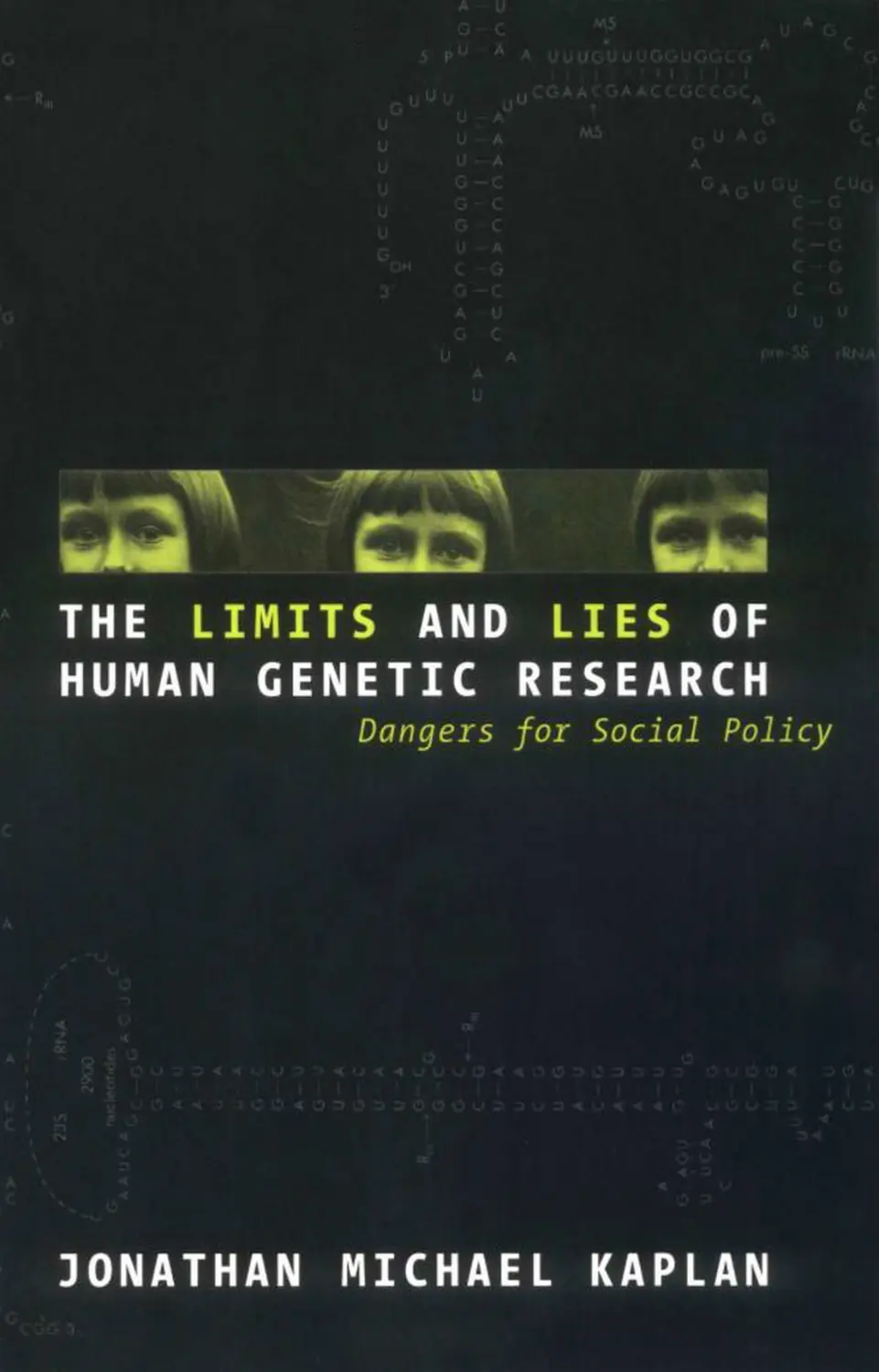
THE LIMITS AND LIES OF
HUMAN GENETIC RESEARCH
----
THE LIMITS AND LIES OF
HUMAN GENETIC RESEARCH
Dangers for Social Policy
JONATHAN MICHAEL KAPLAN
ROUTLEDGE · New York and London
Pu blished in 2000 by
Routledge
29 West 35th Street
New York, NY 10001
Published in Great Britain by
Routledge
11 New Fetter Lane
London EC4P 4EE
Copyright @ 2000 by Routledge
Printed in the United States of America on acid-free paper.
All rights reserved. No part of this book may be reprinted or reproduced or utilized
in any form or by any electronic, mechanical or other means, now known or here-
after invented, including photocopying and recording or in any information storage
or retrieval system, without permission in writing from the publishers.
Library of Congress Cataloging-in- Publication Data
Kaplan, Jonathan Michael.
The limits and lies of human genetic research: dangers for social policy / by
Jonathan Michael Kaplan.
p. cm. -(Reflective bioethics)
Includes bibliographical references and index.
ISBN 0-415-92637-8 (hb. : acid-free paper) - ISBN 0-415-92638-6 (pb. : acid-
free paper)
1. Medical genetics-Moral and ethical aspects. 2. Human genetics-Research-
Moral and ethical aspects. 3. Human genetics-Research-social aspects. I. Title.
II. Series.
RB155 .K36 2000
17f4'.28--dc21 99-044899
Designed by Cynthia Dunne
CONTENTS
List of Figures and Boxes Vlll
Acknowledgments IX
CHAPTER 1
EXPLAINING DIFFERENCES 1
Differences That Make a Difference 1
The Ascension of the Genetic 3
The Six Arenas 6
A Few General Observations 8
CHAPTER 2
VARIETIES OF DETERMINISM 9
Determinism and Determinisms 9
Against Genetic Determinism? 10
PKU: The Traditional Accounts and the History: Determinism
through the Back Door 13
CHAPTER 3
GENES AND CAUSATION 22
Techniques for Explaining Differences 22
Heritability: What It Is, What It (Doesn't) Mean, and
Why It UiJn't Just Go Away 23
"Finding Genes": Linkage and Molecular Genetics 44
"Evolutionary Reasoning" and the Evolution of
(phenotypic) Variation 52
Conclusion: Explaining Variation in Complex Human Traits 56
[vi]
Contents
CHAPTER 4
IQ AND SOCIAL POLICY 58
The Old and the New 58
Rats in a Maze: Learning Ability and Environmental Variation 60
Race and IQ 63
"Forget about Race": SES, IQ, and Molecular Studies 82
Conclusion: Policy, Race and IQ, Genes, and Heritability 86
CHAPTER 5
CRIMINALITY AND VIOLENCE: THE BRAIN AND THE GENE 89
Crimes and Individuals 89
Genes and Violence: Heritability and Evolutionary Stories 91
Finding Causes: The Dream of Prevention through Recognition 94
The Individual as Criminal and Biology as Crime 96
Biology and Society: Violence and Social Action 98
Genetic Import 102
CHAPTER 6
GAY GENES AND THE REIFICATION OF HOMOSEXUALITY 104
Why Study Sexual Orientation? 104
The Heritability and Genetics of Homosexuality 107
The Contingency of Sexuality 110
Constructions and Scripting 115
Biology and Scripts 120
CHAPTER 7
ON THE MEDICALIZATION OF MOOD-AFFECTIVE DISORDERS:
ANTIDEPRESSANTS AND THE HERITABILITY OF
DEPRESSION AND TEMPERAMENT 122
Locating Depression 122
The Heritability and Heterogeneity of Affective Disorders 124
Affective Disorders and Temperament 125
On Treating Temperament 127
Depression as Disease: Treatment, Pharmacology,
Genetics, and Temperament 128
Bioche'lllistry, Genetics, and the Environment 132
Contents [viiJ
CHAPTER 8
BORN TO BE FAT? CULTURE AND THE MEANING OF WEIGHT 135
Health and the Ideal Weight 135
Defining Obesity 138
Genetics and the Etiology of Obesity 140
The Social Construction of Ideal Weight 143
The Medicalization of Preference 147
CHAPTER 9
CONTRACT PREGNANCIES AND GENETIC PARENTHOOD 151
Parents, Genes, and the Law 1 51
Legal Parenthood, Contract Pregnancies,
and the Genetic Connection 152
The Centrality of the Gene in Pregnancy 161
The Centrality of the Gene to Parenthood Problematized 163
Observations and Conclusions: Against Easy Answers 168
CHAPTER 10
THE CONCEPT OF THE ENVIRONMENT 170
The Environment and the Status Quo 170
Environment, Organism, and the Modern Synthesis 171
Behavioral Genetics and the Conservative Environment 173
Why This Environment? 176
Organisms as Active, Environments as Unstable 179
Closing the Circles 183
Embracing Complexity 184
Notes 187
References 206
Legal Cases Cited 217
Works without Bylines 218
Index 219
LIST OF FIGURES AND BOXES
Figures
Figure 3.1: Cooper and Zubek's Rats 30
Figure 3.2: A Simplified Reaction Norm 33
Figure 3.3: A Hypothetical Case: The "Consistently Dull Rat" 41
Figure 3.4: A Hypothetical Reaction Norm 42
Figure 3.5: Drosophila Viability: Two Variants Compared
to the Average 47
Figure 3.6: Drosophila Viability: Four Variants,
No Best Temperature 49
Figure 3.7: Drosophila Viability: Two Less Successful Variants
Compared to the Average 50
Figure 4.1: A Hypothetical Reaction Norm: Canalization 71
Figure 4.2: A Hypothetical Reaction Norm:
The Assumption of Additivity 76
Boxes
Box 3.1: Calculating Heritability: An Example 26
Box 3.2: Reaction Norms and Heritability 31
Box 3.3: The Locality of Heritability 39
[vi;;]
ACKNOWLEDGMENTS
I f there has been anyone idea guiding my work in philosophy over
the past decade, it is that we are social beings. No work, however
small, is ever the product of any single individual. In working on this
book, it was my joy and privilege to be surrounded by family, friends, and
colleagues, without whom this project would obviously have been
impossible.
I'd first like to thank John Dupre, whose confidence in the original
project and encouragement were unwavering, and without whom this
work would never have been begun, let alone finished. Not only does his
work provide much of the background and inspiration for this project, but
it stands as an example of just how important, and relevant, philosophy of
science with a political bent can be.
Debra Satz has also been involved with this project since its concep-
tion, and without her this project would have been at best a pale shadow
of what it is now. My thanks; whatever and however deep our philosophi-
cal disagreements, I have always found our areas of agreement to be much
more important.
My friend Eric Schulman deserves a special note of thanks as well. He
too has been involved in this project since the beginning, albeit as an out-
sider to philosophy. Nevertheless, his help has ranged from the early con-
ceptualizations of the work as a whole to careful readings of several drafts
of the entire manuscript, and again, without his input, the work would
have been very different, and much worse. More than that, though, my
friendship with Eric has been one of the most important in my life, and I
cannot imagine the person I would be were it not for him.
Alan Nelson not only read and commented helpfully on various drafts
of this work, but has been a valued friend, mentor, and collaborator
throughout my philosophical career. Without his encouragement, and,
fix]
[xJ
Acknowledgments
more importantly, his example, I very much doubt that I would still be
doing philosophy today.
Jim Nelson also read and commented on various drafts of this work.
His comments have always been helpful and positive, and I thank him for
them.
Peter Godfrey-Smith's trenchant criticisms of early versions of this
work helped keep me honest throughout, and he made many useful sug-
gestions as well. If not for his criticisms, as well as his help developing
many of the examples used in chapters 3 and 4, the work would undoubt-
edly be less rigorous and more open to charges of sloppiness. Any mis-
takes or confusions that still exist in those chapters are, of course, my
own, but without Peter there would surely have been many more of them.
While Michael Blake, Timothy Crocket, Avrom Faderman, Lisa
Mcleod, and Matthew Price all read and commented on drafts. I'd mostly
like to thank them for their friendship and support over our time
together. Stephan Kaufer not only read and commented on early drafts of
several chapters, but has also been a valued collaborator in other contexts
as well as a valued friend.
Steffan Sonck and Janet Stemwedel helped me work through some of
the technical aspects of this material, and I'd like to thank them both for
their time, as well as their patience with my inability to grasp what must
have seemed to them to be very simple concepts. Janet also read and com-
mented usefully on substantial portions of the manuscript.
Ina Roy read and commented helpfully on early drafts of several chap-
ters. Elizabeth Anderson made several helpful suggestions at the begin-
ning of this project. My conversations with Tim Schroeder were a
valuable source of inspiration, and he found several excellent examples
I've used in the book. Steve Downes and David Magnus read the entire
manuscript and made many helpful suggestions. Doug Maclean's com-
ments were very helpful and insightful, and an anonymous reader made
significant contributions as well.
There are various philosophers whose work I relied upon more than
most in thinking through the issues I confront here. As will be obvious to
anyone who reads this book, R. C. Lewontin's work was central to my
thinking on many, if not most, of these issues, and I owe him an enormous
debt for doing the work that made this work possible. I am only half jok-
ing when I say that if more people had read and understood his seminal
work on these issues (much of it done in the 1970s) this book would be
unnecessary. It will also be clear to the reader that I have relied very heav-
ily on the recent work of Massimo Pigliucci and Carl Schlichting.
AcknowLedgments
[xiJ
Massimo I would also like to thank for many interesting discussions of
these issues and for his comments and criticisms, especially on chapters 2,
3, and 4. Again, any confusions that remain in those chapters are my own,
but without Massimo's help there would have been many more. While
not so quite so obvious, my exposure to the work of Feyerabend and
VVittgenstein informed my work on this project from the start, and with-
out that influence I would not be the sort of philosopher I am.
Finally, I'd like to thank my parents, Loretta Francesco and Martin
Kaplan. Their vast and unwavering support was more often than not all
that prevented my utter failure; any small success I've achieved in life I
owe entirely to them. I cannot express my love and gratitude deeply
enough.
No list such as this is ever complete. Many other people have been a
help in this project, either by reading early drafts, or by being around
\\Then I needed them, and often by both. If there is anything of value in
this work at all it is only because so many people supported me through-
out the process; too many, alas, to name.
Where to end such a list is always at some level an arbitrary decision,
and it always involves not acknowledging some debt. But acknowledged
or not, those people to whom I owe these debts of gratitude know they
can collect whenever, and however often, they wish.
CHAPTER 1
EXPLAINING DIFFERENCES
Differences That Make a Difference
T his book is primarily about the differences between people, and the
stories that we tell to explain these differences. That people are dif-
ferent, and different in ways that matter to us, is obvious. But the reasons
that people differ from each other are not so obvious, and explanations for
these differences vary by culture, by time, and by the individual or group
offering the explanation. In the United States, explanations that revolve
around genetics and make appeals to our genes have been popular for
some time. While explanations appealing to genes have suffered the occa-
sional setback, their popularity has been on the rise in recent years. Over
the past decade, there has been an increase both in the number and in the
boldness of explanations that attribute the differences between people
(both physical and behavioral) to the genetic variations between them.
Explanations of human variation do not occur in a vacuum; the cause of
variation in complex traits is explored because people think it is worthwhile,
and the explanations that are generated are put to various uses. Sometimes
they are used quite literally in social and political discussions; at other times,
the way these considerations are brought to bear on various issues is more
subtle. But in either case, the force of such explanations extends beyond
their obvious domains and into the domains of various political and social
issues. In these different domains, explanations premised on the importance
of genetic differences have changed not only the sorts of considerations that
are brought to bear on the political and social issues, but have also helped to
detennine the kinds of outcomes considered reasonable.
[1]
[2]
The Limits and Lies of Human Genetic Research
How do these kinds of explanations, explanations of differences that
primarily refer to genetic differences, change the sorts of considerations
brought to bear, and the outcomes considered reasonable, in the discus-
sions and debates that surround political and social issues? In this work, I
argue that explanations of this sort do at least the following things: they
increase our tendency to view the traits involved in these explanations as
real (a reification of the traits in question); they make the explanations
appear to arise not out of contingent and contestable social organizations
but out of the natural order of things (a naturalization of the traits in
question); and they create and reinforce expectations about the proper
perspective from which to view such issues as modifications to the traits in
question. These changes constitute a change in the discourse that sur-
rounds these traits, and the issues wrapped up in them. But why are such
explanations popular? How are these explanations supposed to work?
Does the research purporting to support such explanations really do so?
What other kinds of explanations could account for these differences,
given the available evidence about their causes?
There are any number of ways one could go about answering these and
similar questions. Here I approach answering these questions in two ways.
First, I look at genetic explanations of differences in both behaviors and
physical attributes generally, in order to understand the strengths and the
weaknesses of the techniques used in contemporary human genetic
research. Then I explore the research that has been done in six different
areas that seem to be important to us, at least as a culture if not necessar-
ily as individuals. That these areas involve issues that are generally seen as
important is revealed in part by the amount of media attention the traits
wrapped up in the issues generate, as well as the attention paid to them by
researchers interested in explaining their causes. In some of the cases,
such as explanations for differences in rates of violent crime or the causal
history of medical conditions like clinical depression, the reasons for the
high levels of interest are relatively easy to understand. In other cases,
such as sexual orientation, it is harder to see why the traits in question
have generated the level of interest that they have. Part of understanding
why genetic explanations are popular in these cases will involve trying to
get clear on why these traits are of interest at all, and what role attempt-
ing to "explain" them has within our culture.
In the end, I argue against accepting the role that genetic explanations
often play in these cases. The reasons I argue why we should reject these
explanations differ in the different cases, though. There is no one reason
why we should reject these explanations, and no argument is given to a
general conclusion that all such explanations must be wrong. Rather, I
ExpLaining Differences
[3J
argue that we ought to consider each case on its own merits, and strive to
understand the similarities and the differences that each individual case
might have to other issues we've confronted before. In some cases, it will
turn ont that we should reject the explanations given in tenns of genetics
because the research cited as supporting the explanations simply doesn't
do so. In other cases, even if the research is technically impeccable, it
emerges out of a perspective that is itself questionable; change the
assumptions, and the very point of the research can vanish, leaving barren
technical results with no social or policy implications at all.
But rejecting explanations in tenns of genetic differences in these cases
shouldn't lead to immediately accepting other explanations either.
Attempting to explain those differences in tenns of environmental differ-
ences would also be a mistake. In the cases that follow, it will turn out that
claims of that sort are unsupportable as well. Some people may be
unhappy being told that we currently have no explanation that is adequate
in these cases; however, I think it is unarguable that, at least as far as pol-
icy decisions are concerned, we do more hann, and make more tragic mis-
takes, when we accept bad explanations than when we admit that we
simply don't know what the right answer is. In large part, this work will be
arguing that for many of the questions that matter to us at the intersec-
tion of human differences and social policy, we simply don't know what
the right answer is, nor even how to go about figuring it out.
The Ascension of the Genetic
Gene Discovery May Yield Test for Glaucoma. . .
Brain-Tied Gene Defect May Explain Why
Schizophrenics Hear Voices . . .
Finding Genetic Traces of Jewish Priesthood. . .
People Haunted by Anxiety Appear to Be Short on a Gene. . .
Scientists Identify Site of Gene Tied to Some Cases of Parkinson's. . .
Gene May Be Clue to Nature of Nurturing . . .
Researchers Track Down a Gene That
May Govern Spatial Abilities. . .
Variant Gene Tied to Love of New Thrills. . .
It is hard to open a newspaper and not see headlines like the above.! With
each week, if not each day, there seems to be a new announcement. A
gene is found for a trait, either physical or behavioral (though rarely is a
well-understood pathway from the gene to the trait known), an associa-
tion is found between some genetic variation and some trait (although the
[4]
The Limits and Lies of Human Genetic Research
gene itself has not been located or sequenced), variation in a trait is
found to have some genetic component (though no gene has been found),
or a story about how genes must be at the heart of something is told
(though no gene has been found and no genetic component to variation
demonstrated).
Walter Gilbert thinks that three different questions are raised by the
current possibilities in genetics research (1992, 84). At the most general
level, there is a question about how human beings (or for that matter any
sophisticated multicellular organism) develop from a fertilized egg into
their adult form (a question about developmental biology generally). A
more specific question asks how that developmental process differs
between different complex organisms (between, for example, humans and
other primates). Finally, at the most specific level, we might wonder "how
do we differ from one another?" (84). Plomin et al. make a similar point
when they claim that the most specific questions, questions about differ-
ences within a species, are those that "most often confront scientists
studying human behavior" and those which "genetics. . . is uniquely
qualified to aid us in analyzing" (1990, 9-11).
Plomin et al. go on to point out that "the behavioral issues of greatest
relevance to society are issues of individual differences" (246) and that it is
"the study of things that make a difference: the description, prediction,
explanation, and alteration of individual differences" that drive "societal
interest in the behavioral sciences" (247). While there is certainly some
intellectual interest in such things as the answers to Gilbert's first two
questions, it is really the promise of answers to questions of the third sort
that generates "societal interest" (and with such interest, funding). But it
is, of course, only some of the individual differences that "make a differ-
ence." Researchers have not been inspired to spend time and money try-
ing to account for many of the traits that vary between people, such as, for
example, our particular tastes in food and clothing. And some projects
that have been undertaken (e.g., measuring the heritability of height: see
Plomin et al. 1990, 320) have aroused relatively little interest or contro-
versy. The issues at the heart of things are, indeed, those that involve the
promise to explain, predict, and control what are generally thought of as,
in one way or another, important, and often behavioral, differences. 2 It is
the hope of being able to predict and control such things as intelligence,
mental illness, alcoholism (and other "addictive behaviors'), "criminal"
behavior, violent behaviors, obesity, and the like, that make the promise of
human genetic research so tempting.
Relatively recent advances made in genetic research have been instru-
mental in contemporary work in gene mapping (finding where on the
ExpLaining Differences
[5]
human genome-on what chromosome and where on that chromo-
some-a gene correlated with a trait is located) and gene sequencing
(finding the sequence of base-pairs in the gene[s] in question). The cre-
ation of these sets of modem abilities has created a flurry of interest in
mapping and sequencing genes correlated with various traits, so far
mostly genetic diseases. However, results have begun to emerge in
research into the genetic bases of some behavioral traits, and other com-
plex traits, including those considered part of normal human variation.
Much of the current excitement in the search for genetic explanations
for variation in complex human traits comes out of the possibility of using
those techniques that have emerged from the concentration of resources
into molecular genetics to study the traits in question. The hope is that
the sort of gene finding and gene sequencing that is becoming increas-
ingly feasible with respect to physical diseases will make equally plausible
the explication of the genetic bases of those variations in, for example,
behaviors in human populations that have a partial genetic etiology.
However, as we shall see, finding, sequencing, and tracing the pathways
from the purported genes to the behavioral traits of interest has proven
difficult for researchers in human behavior genetics, who for the most
part have therefore had to content themselves with studies that attempt to
show merely that there is a genetic component to human behavioral vari-
ation in some instance, and to give some estimate of the extent of the
genetic influence on that variation. And, I will argue, even when
researchers do find genes associated with variations in complex traits, it is
often difficult to know what to make of this. Using this information to
make predictions or give certain kinds of explanations is very difficult at
best, and often impossible.
The techniques for estimating the extent of the role of genetic differ-
ences in the variation in various traits have serious limitations, however.
When used in ordinary human populations, the maximum accuracy that
can be expected from these methods is fairly low. And the techniques have
serious conceptual limitations, which put fundamental limits on the
proper interpretations of any results achieved. Attempting to make use of
these results without fully acknowledging their limitations will be
revealed as a major source of errors, errors that lead to very dubious argu-
ments about the role of genetic differences in framing discussions about
issues of public policy and social justice.
Here is where I hope the force of this work will be felt. The rise of the
popularity of these kinds of genetic explanations wouldn't be very impor-
tant if these explanations weren't linked to political and social issues that
matter. Whether the explanations followed from good research or bad,
[6]
The Limits and Lies of Human Genetic Research
whether the interpretations of the research were legitimate or not,
whether the research itself relied on culturally contingent assumptions
that could be undennined or not-none of these questions would be of
interest outside a narrow set of scientists and people interested in the
study of science if it weren't for the links between these kinds of explana-
tions and social policy choices. But once we see what the limits of these
implications really are, what the research can and cannot show, and how
easy misinterpretations are to make (as well as how they can be avoided),
the claimed policy implications will look much more questionable, and in
many cases will be revealed to be best discounted entirely. With the limits
of these kinds of genetic explanations displayed, the room will be created
for other considerations-many of which speak in directions different
from the genetic-to influence our views of these issues.
The Six Arenas
The goal of this work, then, is to demonstrate that the rise of explanations
premised on the importance of the genetic to explain many the differ-
ences in behaviors and physical characteristics that we find important has
inappropriately influenced our views of issues that matter to us.
Conversely, certain views of these issues-that is, certain kinds of pur-
ported solutions-make the appropriation of genetic research to do polit-
ical work both more likely and rather more dangerous than do other
views. The work of demonstrating these points is done primarily through
a series of case studies, each of which shows in a different way how human
genetic research has influenced, and how the interpretation of such
research has been influenced by, specific kinds of political and social issues
. .
In contemporary socIety.
The first cases examined are narrowly focused on the use of human
genetic research in supporting claims about social policies. In chapter 4
I discuss some of the history behind arguments surrounding race, socio-
economic status, and average IQ scores. Arguments from the supposed
high heritability of intelligence and the disparities in average IQ scores
between various "races" to the conclusion that it is genetic differences
that drive these disparities, have a long and ignoble history. In analyzing
both the traditional and more modern counterarguments, I attempt to
make clear what sorts of errors most often get made in this fonn of
research and how these mistakes interact with the technical limitations of
the research used. More recent research attempting to find genes associ-
ated with scores on IQ tests is also critiqued. Both the broadest conclu-
sions that I argue for in that chapter-namely, that neither heritability
ExpLaining Differences
[7]
estimates in human populations for complex traits nor molecular-level
associations between genes and such traits are in the least bit useful for
making policy decisions unless huge numbers of unargued-for (and for
the most part insupportable) assumptions are made-and the more
detailed analyses of how technical results in human behavior genetics are
often misunderstood and misused, will inform the rest of the work.
Next I explore the way in which genetic research into the causes of
criminality and violence has been instrumental in defining individuals and
delineating the bounds of discourse around the issues. Specifically, in
focusing on causation at the level of individual differences, such research
detracts attention from wider environmental differences. The next chapter,
on research into the genetics of sexual orientation, more directly con-
fronts the issue of the interaction of the social construction of behavioral
traits and ways of organizing behaviors within a culture with research into
possible genetic bases for those traits.
The next chapters move to a more general level of analysis. In the case
of the medicalization of mood-affective disorders, the focus of the chapter
is on the use of genetic models to create the clinically depressed as a type
of individual and to locate the illness within the individual. This, I argue,
makes certain forms of social critique difficult or impossible. A similar
argument is made in the next chapter, on obesity, although in this case
there is an additional wrinkle, namely that the research that purports to
show obesity as a dangerous disease is itself problematic, irrespective of
the research into the causes of obesity.
Finally, I turn to a yet higher level of analysis. I argue that the current
debates and discussions surrounding contract pregnancies, so-called sur-
rogate mother contracts, as well as the law that is emerging from the legal
cases involving such contracts, point toward the creation of the genetic as
primary to parenthood in a way both insupportable by genetic research
narrowly construed and destructive to many important social considera-
tions about what it means to be a parent. The movement in law toward
treating genetic parenthood as the most important criterion when making
decisions about the legal rights and obligations associated with parent-
hood could not, I argue, be made without the overblown rhetoric of con-
temporary genetic research, and the effects of this movement can only be
destructive to other, perhaps more useful, ways of conceiving of parent-
hood within this culture. This section deals with the genetic influence in
much broader and more general terms than the others, since there is no
one research program being alluded to when there is a legal ruling that,
for example, someone who is the genetic but not gestational mother
should get the legal rights and obligations associated with parenthood,
[8]
The Limits and Lies of Human Genetic Research
and the gestational but not genetic mother should be denied those rights
and obligations. This kind of influence, diffuse though it sometimes
seems, is important to understanding how the more narrow research pro-
jects discussed previously get a rhetorical power and force that extends
well beyond their immediate results.
A Few General Observations
For a combination of historical reasons growing out of the development
of modern evolutionary theory, conceptual reasons having to do with the
technical limitations of certain techniques used in genetic research, and
more broadly cultural reasons having to do with contemporary views of
the social and political landscape, the environment (especially the social
environment) often tends to be viewed as rather more stable and
unchanging than a dispassionate view would take it to be, at least within
the contexts of these sorts of research projects. And this is important,
because a view that takes the social and political landscape to be stable
supports the status quo in a particularly devious manner.
The sorts of research projects that are undertaken and the way that
these projects are interpreted and appropriated for political ends are
influenced by the ways that we think about our relationship to our envi-
ronment-both our cultural environment and our environment more
generally. In displaying this tendency for specific cases, and in providing
some general tools for understanding why this is so often the case and
what kinds of effects it is likely to have, I hope this book points not toward
an automatic rejection of one form of explanation and acceptance of
another, but instead toward a way of thinking carefully about the relation-
ship different kinds of explanations have to our ways of thinking about
policy. Sometimes we may think that explanations given about the causes
of variation are relevant and important to social policy considerations; at
other times, however, we may well realize that the explanations are mis-
leading in important ways and ought to be ignored when it comes to mak-
ing public policy decisions.
It is this kind of complexity and sophistication, I believe, that we need
to make sense of this world and problems we face within it.
CHAPTER 2
VARIETIES OF DETERMINISM
Determinism and Determinisms
A lmost without exception, those people who write or speak about
the relationship between genetics and human traits want to deny
that they support "genetic determinism." However, this denial is often
made against a background of deep confidence in the importance of
genetic research for understanding and controlling those traits that mat-
ter to us. This confidence sometimes results in researchers saying and
writing things that, at least on the face of it, certainly seem to support var-
ious theses that have a deterministic ring to them. Much of this book is
concerned with very specific claims, such as those about the relationship
between particular research projects and social issues. But those specific
claims emerge out of a background of faith in the relative importance of
genetics and the relative lack of importance of the environment in
explaining variations in traits that matter to us. Revealing this back-
ground, I hope, will help make clear the assumptions that lie behind the
claims made by those researchers discussed in later chapters.
In what follows, then, I will try to bring out what researchers under-
stand themselves to be denying when they deny that they support or
believe in genetic determinism, and the tensions between these denials and
the researchers' stated beliefs about the importance of genes and genetic
research for understanding and controlling human traits. On the one
hand, it will turn out that there are some versions of genetic determinism
that no one supports (at least when they are being careful); on the other,
there are some versions that seem to have wide support. In going through
[9]
[1 OJ
The Limits and Lies of Human Genetic Research
some researchers' vigorous denials that they support genetic detenninism,
some of these possible fonns of genetic detenninism will be explored.
Next, the story of the genetic disease PKU (phenylketonuria) will be
told as a way of examining how these points play out in practice. Here the
tension between many writers' and researchers' firm belief in the central-
ity of the gene both causally and methodologically and their stand against
naive fonns of genetic determinism will be explored. PKU has become
the main example used to deny genetic detenninism and delineate the
limits of the power of genes with respect to phenotypic variations. The
history of this disease, however, has traditionally been rewritten as a story
about the power and centrality of the genetic for understanding, predict-
ing, and modifying human phenotypic variations (including behavior). In
other words, I will argue that a story that was supposed to show that
genetic detenninism is false is in fact usually written to make PKU seem
far more deterministically genetic and the genetic far more important to
explaining, predicting, and controlling the disease than a more careful
reading of the history of the disease would permit. Seeing how and why
this rewriting occurred is a fascinating entry into how the tension plays
out in practice between the conviction that genes are at the "heart" of
things (as, for example, Watson would have it; see Watson 1992, 167) and
the conviction that genetic determinism must be denied.
Against Genetic Determinism?
What exactly the thesis of genetic detenninism is meant to claim is rarely
made explicit, especially in the writings of the various researchers and
popular writers who state their unequivocal opposition to it. But in deny-
ing the thesis of genetic determinism various researchers and other writ-
ers make various sorts of claims, and from these claims some ideas about
the form of the thesis they are arguing against can be gleaned. The claims
these researchers make when standing against genetic determinism, how-
ever, sometimes rest uneasily with the claims they put forward when dis-
cussing the results and likely benefits of the research they undertake. This
section stresses the general tension that results when one attempts to
deny a form of genetic determinism while simultaneously engaging in
research that is premised on the centrality of genes, and perhaps the
deterministic, but at the very least predictable, nature of the pathways
between genes and physical or behavioral traits (the pathways between
genotype and phenotype).
How, then, do researchers stand against genetic determinism, and what
is it they stand against when they do so? One strand of genetic determin-
Varieties of Determinism
[11]
ism that researchers oppose could be described as the "complete informa-
tion" strand. Genetic determinism, on this reading of the thesis, would
claim that everything about us (including, on some interpretations, our
behavior) is predictable, or at least in some way determined or dictated by
our genes. So Gilbert, in his much-quoted "A Vision of the Grail," states
that "genetic information does not dictate everything about us" and that
this sort of "shallow genetic determinism is unwise and untrue" (1992,
96). Plomin et al. state that "genes do not determine one's destiny" and
that they are not "master puppeteers. . . pulling our strings" (1990, 9).
Kagan, in his book detailing his research into the heritability of tempera-
ment, notes that the "power of genes is real but limited" and "develop-
ment is a cooperative mission and no behavior is a first-order, direct
product of genes" (1994, 37). This strand of genetic determinism, how-
ever, is generally (and quite properly) regarded as trivially false, and very
little work is done arguing against it.
A more common reading of the thesis of genetic determinism, and one
that makes it at least a bit less outrageous, is that for traits with a genetic
etiology, environmental interventions are useless: if a trait is genetic, one
is (going to be) stuck with it. This might be called the "intervention is
useless" strand. 1 So Dawkins, of Selfish Gene fame, stands against genetic
determinism in a letter published in Nature by objecting to "the sugges-
tion that we are stuck with our biological nature and can't change it"
(Dawkins 1981,528). Wilson, a founder of "sociobiology," also in a letter
in Nature, writes of the possible genetic basis of xenophobia that "a
knowledge of such a hereditary basis can lead to the circumvention of
destructive behavior such as racism" (Wilson 1981, 627). Hamer and
Copeland note that while "many core personality traits are inherited at
birth," this doesn't mean that "people are "stuck" with their personalities
from birth" (Hamer and Copeland 1998, 6, 7). Bouchard, of Minnesota
Twin Study fame, notes in one of his many articles in Science that "inter-
vention is not precluded even for highly heritable traits" (Bouchard et al.
1994, 228), about as pro forma a stand against this strand of genetic deter-
minism as one can take, but still a stand against it. Breakefield, a
researcher doing work on the genetic basis of violence, says that people
with the "right type of support" often do just fine, even when they have a
"syndrome" with "major metabolic consequences." "The purpose," she
says, "of this kind of research is to discover what that support is, and who
n eds it" (quoted in Mann 1994, 1689; re research into genetic bases of
VIolence, see also chapter 5). Plomin et al. note that the fact that "heri-
tability does not constrain environmental interventions" is a "corollary of
the point that heritability does not imply genetic determinism" (1997,
[12J
The Limits and Lies of Human Genetic Research
85). As we will see in the next section, it is this strand of genetic deter-
minism that the stories surrounding PKU are supposed to put to rest;
telling the story of PKU's environmental cure is supposed to display the
falsity of genetic determinism by showing that even for traits with genetic
etiologies, (environmental) intervention is not useless. For that reason, it
is the "intervention is useless" strand of genetic determinism that I will
most often be referring to when discussing what it is that researchers who
deny genetic determinism take themselves to be denying.
However, we might ask if the "complete information" and "interven-
tion is useless" strands capture all of the forms of genetic determinism
that could legitimately go under that name. In what follows, I will try to
make it clear that many researchers, even those who are adamantly against
being considered genetic determinists, hold that (a) the genetic is the nat-
ural place to look when attempting to explain, predict, and control traits
with even partial genetic etiologies, and that (b) traits with partial genetic
etiologies are best understood as being primarily genetic, and it is only
through directed intervention that the expression of genes for traits with
partial genetic etiologies can be avoided or controlled. The first claim is a
methodological stance that, at least in principle, can be decoupled from
any form of determinism. 2 However, the second claim seems roughly
causal in nature, and only likely to be true if, for example, genotype-
phenotype pathways are, in "normal" conditions, at least something much
like deterministic. For this reason, I think the second is a thesis that
should be considered a kind of genetic determinism. While, again, one
could hold the methodological thesis without holding the causal thesis, if
one holds the causal thesis the methodological thesis will probably be
adopted as well. In any event, as we will see in the next section, many peo-
ple denying genetic determinism seem to hold both the methodological
and causal stances discussed above. And indeed, part of the payoff of
telling a different kind of story about PKU is seeing that the version of
genetic determinism made up of the causal and methodological stances is
untenable.
Before moving on, though, it is worth noting that many of the same
researchers who attacked genetic determinism in its "intervention is use-
less" or "complete information" strands make claims about the limits of
the genetic that seem to rest uneasily with denials of any form of genetic
determinism. Early in Gilbert's "Grail" piece he states that "there is no
more basic or more fundamental information that could be available"
than our DNA sequence, that it is "the most fundamental property of the
body" (1992, 83). Gilbert goes on to claim that our DNA is what "actually
specifies the human organism," that it actually answers the question
Varieties of Determinism
[13]
"What makes us human?" (84). More boldly still, he states that actually
being able to hold one's own gene sequence in one's hand (on CD) will
"be difficult for humans" since "we look upon ourselves as having an infi-
nite potential" and the recognition "that we are detennined . . . by a finite
collection of infonnation that is knowable" is the "closing on an intellec-
tual frontier" (96). While nothing here is strictly incompatible with deny-
ing either the "complete infonnation" or "intervention is useless" strands,
there is certainly at least a kind of tension between making these kinds of
claims and denying either, let alone both, of those strands. When Watson
argues that if one is going to throw money at some large-scale project,
large-scale projects related to genetics are a good place to do it, because
"genetics lies at the heart of so much" (1992, 167), it is relatively easy to
interpret him as not supporting either the "complete infonnation" or the
"intervention is useless" strands of genetic detenninism (but perhaps only
a version of the methodological thesis mentioned above). However, at a
conference in 1995 Watson noted that as people get old, their thoughts
turn either to "genetics or to God" because they become "interested in
their fate" (1995, n.p.), it was rather harder to find an interpretation that
didn't at least point in the direction of some version of genetic detennin-
ism (either a weak reading of "complete infonnation" involved with pre-
diction, or a reading of "intervention is useless" in that it isn't at all
clear how "fates" could be avoided by environmental intervention). And
of course, Dawkins's flirtations with genetic determinism are the stuff of
legend. No one can forget, from his popular book The Selfish Gene, such
classics as the claim that we are "robot vehicles blindly programmed to
preserve the selfish molecules known as genes" (preface) and that these
genes "swarm in huge colonies, safe inside gigantic lumbering robots,
sealed off from the outside world. . . manipulating it by remote control."
"They are," he finishes, "in you and me; they control us body and mind"
(1976, 21). These claims certainly sound as if they give some support to
both of the radical strands of genetic determinism discussed above,
though perhaps they don't affirm the very strongest available versions of
those theses.
PKU: The Traditional Accounts and the History:
Determinism through the Back Door
The primary example now used to warn against genetic determinism and
to establish the limits of the genetic is that of the genetic disease phenylke-
tonuria (PKU) and its environmental cure. The version of the story that
gets told throughout the vast majority of the literature, however, is, both
[14]
The Limits and Lies of Human Genetic Research
in its broad outline and its details, simplified and misleading, and often
simply mistaken. In its standard forms, it has become a central myth of
behavioral genetics, told and retold, with its moral (that genetic determin-
ism is false) always taken to be obvious.
It is ironic, then, that the standard story of PKU actually ends up
affirming a version of genetic determinism. That which is genetic, in the
standard version of the PKU story, is, while perhaps not immutable, mod-
ifiable only through massive and directed (and usually medical) interven-
tion (a version of the weaker causal thesis discussed above). Further, the
standard story strongly implies that it is by attention to the genetic that
one gains the ability to predict, explain, and control many of the behav-
iors that interest us (a version of the methodological thesis discussed
above). The focus of this section is on the way the story of PKU gets
twisted from a warning about the limits of the genetic to a tale reaffirming
the genetic as central and more than vaguely deterministic.
In what follows, I will bring out the ways in which the variations
between the version of the PKU story ordinarily given and a somewhat
more detailed and historically accurate account of its discovery, etiology,
and treatments are revealing of deep assumptions about the power and
centrality of the genetic both within the community of researchers and in
their critics. The differences between the "mythical" PKU story and the
more historically minded story reveal all too well what a radical version of
genetic determinism writers both within and outside of traditional
genetic research programs must be standing against when they use the
standard version of the PKU story to oppose the thesis. The more histor-
ically accurate version supports none of the assumptions about the cen-
trality of the genetic that make their way into the standard account.
The Mythical PKU
It has become traditional to start cautionary tales about the falsity of the
thesis of genetic determinism by telling the story of PKU, which is,
according to the traditional account, a single-gene defect that is almost
entirely correctable through environmental interventions. In the intro-
duction to their text, Plomin et al. provide the standard story of PKU:
Once in a great while, we find relatively simple genetic and physiologi-
cal systems. This is what happened for one type of mental retardation,
phenylketonuria (PKU), which is caused by a single-gene defect.
A little later they mention,
[b]iochemical studies of the gene-behavior pathways indicated that the
ultimate cause of the retardation was the inability to break down a par-
Varieties of Determinism
[15]
ticular chemical, phenylalanine, which led to its accumulation at high
levels in the blood.
As well, they assert that
PKU individuals do not suffer retardation if a diet low in phenylalanine
is provided during developmental years. Thus, an environmental inter-
vention was successful in bypassing a genetic pIoblem. This important
discovery was made possible by recognition of the genetic basis for this
particular type of retardation. (Plomin et al. 1990, 8, 9)
For Plomin et al. the story forms an example of the sort of thing
research in human behavior genetics will someday let us find all the time-
a gene-behavior pathway that we can understand biochemically and then
modify with some form of medical intervention. 3 And it is this ability to
intervene in the gene-behavior pathway that makes the thesis of genetic
determinism false. To be genetic is not to be unmodifiable because,
Plomin et al. make clear, a "genetically determined behavioral problem
may be bypassed, ameliorated, or remediated by environmental interven-
tions" (1990, 9).4 And, the story further implies, it is by an attention to,
and the understanding of, the genetics involved that we come to be able to
understand and control these traits. 5
It is this message that is conveyed by the stories that get repeated
throughout the literature. This version of the PKU myth, in even shorter
form, makes an appearance in papers both by authors strongly in favor of
increased spending on genetic research and by authors more wary of, for
example, the Human Genome Project and its promises. Caskey, in an
article explicidy pushing for more research into medicine based on genes
and genetic technologies, notes that the ability to "detect severe, treatable
inborn errors of metabolism" soon led to "successful prevention of men-
tal retardation from phenylketonuria (PKU)" (1992, 116). Kitcher, in an
article for the New YOrk Times, noted,
Children with PKU carry genes that render them unable to metabolize
the amino acid phenylalanine. Left untreated, they build up large
amounts of phenylalanine in their cells (and lack sufficient amounts of
another amino acid, tyrosine) and become severely mentally retarded.
By testing a baby just after birth, however, a doctor can prescribe a diet
low in phenylalanine and high in tyrosine that enables an afflicted child
to develop normally. (1996)
An article by Vigue in The American Biology Teacher recounts the classic
story in surprising detail (she cites Bums 1993 as the source of her infor-
mation on PKU):
[16]
The Limits and Lies of Human Genetic Research
It is often assumed that traits with the highest heritabilities cannot be
modified by the environment. With our burgeoning understanding of
how genes work, this assumption is becoming less and less valid.
Consider, for example, the mental retardation associated with PKU
(phenylketonuria), a disorder caused by a single defective gene. There is
no question that PKU is a classic inherited disorder and that the symp-
toms will develop in almost any nonnal human environment. Once the
mechanisms whereby the PKU gene produces its devastating effects was
understood, however, the cure for its symptoms became obvious: PKU
is a disorder of phenylalanine metabolism. When phenylalanine is elim-
inated from the diet of PKU babies, the associated retardation does not
develop. . . .
From this, Vigue would have us draw two conclusions, namely:
1. Genes are inherited, but not necessarily the traits associated with
them. Environmental factors are necessary for the development of any
trait. Theoretically, the expression of any gene could be modified by
environmental manipulation (though of course most genetic disorders
are not as easily remedied as PKU-associated retardation). In a real
sense, heredity is not destiny.
and
2. The cure for PKU-associated mental retardation most likely would
never have been found had the role of the PKU gene not been under-
stood (1996, 86-88, emphasis in original).
An article by Nelkin on the possible (mis)uses of genetic information
notes that PKU is a "severe genetic disease that can result in mental retar-
dation" but that it "can be controlled by removing phenylalanine from the
diet of afflicted children," and that "[p ]ostnatal tests for phenylke-
tonuria . . . have allowed control of this disease through rather simple
dietary measures" (1992, 179). Greely, writing on the nearly ubiquitous
issue of the Human Genome Project's relationship to health insurance,
states that PKU "is a genetic disease that causes severe brain damage, but
the damage can be prevented if those affected modify their diets to avoid
a certain chemical called phenylalanine" (1992, 272). Dawkins, in the
above-quoted letter to Nature where he objects to the "suggestion that we
are stuck with our biological nature and can't change it," asks that we
"recall that warhorse of the genetics textbooks, phenylketonuria" and
goes on to mention that this "serious disease, caused by a single recessive
gene, is easily cured by rearing the child on a special diet" (1981, 528). 6
Varieties of Determinism
[17]
These versions of the story, it seems clear, affirm a form of genetic
determinism as well as an emphasis on the genetic and the centrality of
the gene. The genetically influenced, in this view, becomes not that which
is inevitable or impossible to change, but rather that which can only be
avoided or changed through medical, or at least quite deliberate, inter-
vention. In the view that emerges quite naturally from this version of the
PKU story, genes do, in fact, determine one's destiny, at least in the
absence of clever interventionist doctors (the weak causal version of
genetic determinism). And, on this story, it is by attention to the gene end
of the gene-behavior pathway that we are able to predict, explain, and
control those genetically determined problems we would otherwise be
stuck with (the methodological stance in favor of the genetic).
A Different Story, and Different Conclusions
But the story as told in the introduction of Plomin et aI., and hinted at
throughout much of the literature, is at best misleading. Murphey, in his
"Phenylketonuria (PKU) and the Single Gene: An Old Story Retold,"
refers to this story as part of the "scientific and clinical folklore" of human
genetics, as a "myth" (1982, 141, 154). Another story, one less bound to
this particular myth of PKU as "a winsome example of fact among the
largely indecisive findings of behavior genetics" (Murphey 1982, 141), 7
makes the inadequacies of the first story quite clear. Interestingly enough,
much of the more sophisticated second story is actually given, albeit
rather later, in the Plomin et ai. 1990 text, and their own retelling of the
story reveals just how misleading was the first story they told. 8
In the second story (which also has its traditional forms),9 a dentist
with two retarded children is disturbed by the fact that they "exuded a
peculiar odor that. . . aggravated his asthmatic condition" (Plomin et ai.
1990, 81). He had them examined by Asbjom Falling, who, trying to iso-
late the cause of the odor, found radically elevated levels of phenylpyruvic
acid in their urine (this in 1934). From this, Falling postulated that it was
an inborn disturbance in their ability to metabolize phenylalanine that
led to the excess of phenylpyruvic acid in their urine and that this was
" h
some ow... related to mental retardation" (81). Here the story in
Plomin et ai. gets condensed somewhat. In Kevles's In the Name of
Eugenics, we learn of Penroses's early efforts at administering low pheny-
lal.anine diets to PKU children almost immediately after Falling's discov-
erIes (in the mid-1930s) and their failure because those early diets low in
phenylalanine were also too low in protein, and resulted in his patients
metabolizing their own bodies' proteins, which were not, alas, low in
phenylalanine. The extremely high cost of creating wholly synthetic diets
[18J
The Limits and Lies of Human Genetic Research
low in phenylalanine in the 1930s prevented low-phenylalanine diets
from being adequately tested until the 1950s (see Kevles 1985, 177-78).
Here the Plomin text takes up the story again, and makes several inter-
esting points. First, even without dietary therapy, not everyone with one
of the genetic defects that causes PKU would suffer the syndrome's many
terrible effects. Once PKU screening became easy and potentially useful,
it became quite common, and it rapidly became obvious that the assump-
tion that "all phenylketonurics were. . . institutionalized for mental retar-
dation" was false and that many PKU individuals (even those with
"classical" high phenylalanine levels in their blood) had IQs solidly in the
nonnal range (Plomin et al. 1990, 82).10
A key point to note here is that understanding the gene-behavior path-
way had nothing to do with the development of the treatment of PKU.
Had FoIling not hypothesized that it was a single-gene error that pre-
vented phenylalanine from being metabolized (a hypothesis that despite
having been widely accepted turned out to be true of only some of the
PKU variants; see Murphey 1982), the suggested treatment would have
been identical. The move from "excess phenylpyruvic acid" to "inability
to metabolize phenylalanine" to "get the phenylalanine out of the diet"
has nothing to do with the genetics, nor even the exact biochemical path-
ways, of the disorder. The problems with the treatment, and their solu-
tions, emerged not from subtle excursions into molecular biology and
genetics, but from the sorts of pragmatic (mostly trial-and-error based)
medical research that most often advance health care. ll
The situation, then, was in this case quite the opposite of the known
genetics guiding the treatments. 12 Scriver notes that "with hindsight, one
sees that the medical phases ofPKU history often anticipated its scientific
phases" (1995, 137). Indeed, it was the problems with the treatments that
gave researchers some of the first hints that the disease might not be as
simple as they had thought-that it might be heterogeneous in complex
ways (see Murphey 1982, 148, 149). Murphey quotes Reiss, for example,
as noting both the presence of clinical and genetic heterogeneity in PKU
-clinical heterogeneity in that in different individuals "the same basic
defect leads to differing pattern[s] of disease (including normal menta-
tion)," and genetic heterogeneity in that several "different genetic factors
lead to [a] similar clinical entity" (Reiss, quoted in Murphey 1982, 149,
emphasis in original); (see also Hsia 1970). The same gene for (genetic
defect associated with) PKU can have different results; different genetic
defects can (and do) express themselves as the clinical condition ofPKU. 13
These realizations initially emerged not through any sort of careful
genetic studies (linkage, direct sequencing, etc.) but directly from the use
Varieties of Determinism
[19]
of widespread PKU testing, and from those difficulties encountered when
children who were thought to have identical conditions reacted very dif-
ferently to low-phenylalanine diets (there have been accidental retarda-
tions and deaths when children without classic PKU were "misdiagnosed"
and placed on low-phenylalanine diets) (see Murphey 1982, 149).14
Reading the Stories and Recent Twists of the Tale
There are several lessons to be learned from the conttast between these
twO stories. One is that the claim of understanding a problem because the
gene has been found is made in places where it simply isn't the case. The
above story makes it clear that "finding the gene" for PKU provided us
with almost none of our current understanding of the disease (an under-
standing that is still far from complete). Another lesson is that the claim is
made that cures to diseases follow from finding the gene, or from under-
standing the genetics, in places where that isn't the case either. "Curing"
PKU (preventing retardation) involved ttial and error with low-
phenylalanine diets (and other biochemical modifications), and the ther-
apy is still developing and advancing. Finding the gene or genes, and
indeed, elucidating the heterogeneity of the condition, had (and contin-
ues to have) very little to do with tteating PKU.15
Another point is that even in the absence of medical intervention at the
environmental level, the presence of a genetic error correlated with the
clinical condition of PKU, even when coupled with the highest diagnostic
levels of phenylalanine in the blood, does not guarantee the presence of
the classical PKU syndrome (mental retardation). It is not just the possi-
bility of environmental intervention that makes PKU expression nonde-
terministic; its expression is uncertain in any event.
Indeed, there is currently an interesting war of words in the pediattic-
genetics community regarding the clinical heterogeneity of PKU. Some
authors currently claim that any version of hyperphenylalaninemia that
does not result in mental retardation if untteated is, by definition,
not PKU, but rather non-PKU hyperphenylalaninemia (this is suggested
by the American Academy of Pediatrics's Committee on Genetics's
"Newborn Screening Fact Sheet" 1996; Eisensmith et al. 1996; and
Avigad et al. 1991). The ttaditional account given in Hsia 1970 makes the
diagnosis of "ttaditional PKU," "nonttaditional PKU" and "non-PKU
hyperhpenyalaninemia" out to be a matter of blood-serum phenylalanine
levels, regardless of whatever effect or lack of one they have on develop-
ent. While some authors have been so bold as to suggest that all condi-
tIons that result from identical mutations in the PAR or BH(4)-coding
regions will have the same (or very similar) results (see Eisensmith et al.
[20]
The Limits and Lies of Human Genetic Research
1996), this turns out to be false (see Rasmus et al. 1993, Tyfield et al.
1990, and Treacy et al. 1996), so defining PKU by genotype rather than
either phenotype at the mentation or phenylalanine blood-serum level
does not solve this problem.
Further, many authors currently suggest that a huge percentage of
patients with traditional PKU (as measured by blood-serum level) will
end up with the traditional PKU syndromes (especially severe mental
retardation). The "Newborn Screening Fact Sheet" (1996) claims that
some 95 percent of untreated children with traditional PKU will end up
with IQs less than 50; Eisensmith et al. claim that "severe, irreversible
mental retardation almost always develops" in untreated children with
traditional PKU (1996, 513); Vigue, as we saw above, claims that "the
symptoms will develop in almost any normal human environments"
(1996, 86); Paul claims that "about 90%" of untreated PKU individuals
will end up with IQs of less than 50 (1994, 323).16 What none of these
authors give, however, is a citation to any study backing up such numbers;
this may have to do with there not having been any such studies.
Certainly the limited amount known about the heterogeneity of the clin-
ical manifestations of given mutations would not point toward any such
numbers (see Rasmus et al. 1993, Tyfield et al. 1990), and the initial study
of treated versus untreated siblings that Berman et al. published in 1969
would not point toward such high percentages. Of course, for all that is
currently known, the figure of 95 percent could be accurate; after all,
nothing is known about the genotypes of Berman's PKU patients, and
studies such as Rasmus's are too small to be statistically significant. Then
again, such high numbers could just as easily be wildly misleading.
Indeed, based on Berman et al. 1969 and the smaller studies, one could be
forgiven for thinking that such high figures probably are misleading. It is
the very good fortune of PKU individuals that screening and treatment in
the developed world is nearly universal (which is not to say that more
research on diet, better diagnostic tools, etc., are not still needed; see
Scriver 1995); it is, however, unfortunate for those who wish to know
what percentage of PKU individuals would have normal development
without intervention. Given that tradeoff, this is an ignorance I think we
can well live with. However, researchers would do well to admit that we
have no idea what percentage of individuals with mutations associated
with PKU would have normal intellectual functioning without interven-
tion, rather than citing numbers that seem at best dubious. And we might
well ask why, given the lack of data and the uncertainty, such a high num-
ber is cited. It does not seem unreasonable to argue that the habit of
Varieties of Determinism
[21J
thinking of gene-phenotype pathways as "nearly certain" in the absence
of intervention has something to do with this.
As a last point, !' d like to stress that the Plomin et al. 1990 text is not
interesting because it underestimates the complexities of PKU, but rather
because, unlike most pieces on the subject, it eventually gets around to
telling a more complete story. The way this happens, with the myth serv-
ing as a warning about the falsity of genetic determinism in the introduc-
tion, followed by the actual history tucked into a chapter on the
"Mechanisms of Heredity and Behavior," brings out another point. Even
researchers in human genetics who are careful about historical details
tend to vastly overestimate the importance of the genetics when they
aren't being quite as careful, and they do so in ways that make the genet-
ics seem much more central, much more practical, and much more deter-
ministic than their more careful stories would allow for.
The first of the PKU stories, then, the "mythical PKU," should be
read not as a warning about the limits of genetic determinism but
rather as pointing toward the sort of genetic determinism that many
researchers implicitly believe in, and indeed take for granted. That
such a story, with its emphasis on the genetic as central to prediction
and control of behavior, and its hints of near-certain gene-behavior
pathways, can be turned into a warning about the limits of genetic
determinism reveals what a radical version of genetic determinism the
researchers stand against when they claim to stand against the thesis.
In opposing one form of genetic determinism, then, another form-
one that is both subtler and more insidious-gets slipped in, com-
pletely without argument.
In the next chapter we will see how this and similar convictions in the
certainty of causal pathways and the ease of understanding them result in
the power of various techniques to study the relationship between genet-
ics and complex human traits being systematically overestimated. The
argument, again, will not be that it is impossible that the relationships
argued for really exist, but rather that the research that purports to sup-
port such relationships fails to do so.
CHAPTER 3
GENES AND CAUSATION
Techniques for Explaining Differences
I f it were possible to accurately model the development of arbitrar-
ily complex organisms from fertilized eggs to their adult fonns at
arbitrary levels of detail, questions about the relative importance of genes,
environments, and genotype-environment interactions would probably
seem much less pressing. Indeed, since it is obvious that at each stage of
the modeling process imagined the development of the organism would
depend on all these factors and the complex relationships among them,
the question might appear entirely moot. While it is likely that for certain
classes of organisms (for example, fruit flies, flatworms) developmental
biology may eventually come close to achieving this goal, it is also possi-
ble that the world is not deterministic and mathematically/physically
tractable enough to permit such a modeling in the case of mammals and
other very complex organisms (see Dupre 1993). At the very least, models
that deal with the developmental biology of arbitrarily complex organ-
isms by tracing low-level biochemical and biophysical paths from genes to
phenotypes during development in specific environments are promises
for the far, distant future.
Given this limitation, it is often thought that in explaining those differ-
ences that matter to us in humans we must make use of techniques that
are rather less exacting than the full developmental approach suggested
above. The primary focus of this chapter is on those techniques that are
used in research projects that focus on trying to explain differences
between humans as somehow related to genetic differences. In discussing
[22]
Genes and Causation
[23J
the various techniques employed (and to which reference is made in pub-
lished works and public discussions) the concern will be to bring out the
strengths and limitations of the various techniques with respect to their
use in explaining differences between humans for the interestingly com-
plex traits that we care about. Some of these techniques have other uses
(many of which are also well established) within various other domains,
and certainly some of the criticisms made of their use in, for example,
human behavior genetics would be inappropriate if generalized to encom-
pass all their possible and actual uses.
While I will for the most part be discussing the techniques used in
exploring the relationship between genetic differences among individuals
and differences in complex traits as if they were separate, it should be kept
in mind that for any particular trait, researchers who work on trying to
discover possible genetic causes and give explanations of differences in
that trait often attempt to apply many different techniques to the particu-
lar problem they are interested in. So, for example, in thinking about the
possible genetic etiology for mood-affective disorders, as we shall see,
researchers bring in estimates of heritability, molecular genetics findings,
and evolutionary reasoning in order to attempt to support their argu-
ments. A brief example of this is presented below, where evolutionary rea-
soning is seen combined with molecular genetics findings and heritability
estimates in explaining variation in "novelty seeking" in humans. More
generally, though, how these techniques are meant to relate to each other
will be brought up briefly within the individual discussions of the tech-
niques and then more thoroughly in the individual cases to which they are
applied in later chapters.
Her;tab;l;ty: What It Is, What It (Doesn't) Mean,
and Why It Won't Just Go Away
Since it is currently impossible to simultaneously model all the relevant
developmental pathways in complex organisms, and many questions
about the details of human evolution remain unanswered, questions about
the relative importance of genes and environments to traits that vary
quantitatively within given populations are often still considered relevant.
This is of course a very different question than that which the strict devel-
opmental approach hinted at above would answer, and it is important to
realize that the answers don't (can't) do the same "work." One must take
care not to confuse the answers to the one sort of question with the
answers to the other; all too often, though, such care isn't taken. In any
event, pretty much everyone currently admits that every phenotypic trait
[24]
The Limits and Lies of Human Genetic Research
is the result of the interaction of both genes and the environment (see
Kitcher 1999 for a discussion of the ubiquity of the "interactionist" the-
sis). Further, it is obviously senseless to ask what percentage of any given
trait is owed to genes or environment simpliciter (see Lewontin 1974,
110). To take a common example, height, the idea is that we cannot ask of
a person who is, say, 62 inches tall, what fraction of those 62 inches come
from genes and what fraction from the environment. Obviously, both
genes and environment were necessary for the person's height-for them
to have any height to measure at all!-and there is no way of dividing up
the total.
What is often asked in place of this is what percentage of the variation of
particular phenotypic traits within a population is attributable to genetic or
environmental variation. For a population with an average height of, say, 58
inches, the question that is often raised is how much of the differences from
these 58 inches are the results of differences in the genetic makeup of the
population and how much are the results of differences in the environments
(developmental and otherwise) of the population. Broad-sense heritability
(often referred to simply as heritability in the literature on human behavior
genetics) is the proportion of phenotypic variance (variance, the squared dif-
ference from the mean, is used rather than the difference from the mean sim-
pliciter for technical reasons) in a population that is "attributable" to that
population's genetic variation;1 environmentality (a term suggested by Plomin
et al. 1990 as the complementary concept to broad-sense heritability) is the
percentage of phenotypic variance in a population that is "attributable" to
environmental variation. I make many simplifying assumptions below in dis-
cussing analysis of variance as given by the standard models in quantitative
genetics. However, these assumptions in no way influence any of the critiques
of the use of, for example, estimates of heritability in human populations (see
box 3.1).
The "standard equation" for analyzing the variance in phenotypic dif-
ferences is
P = G + E + GE + e
where P is the total phenotypic variance in the population, G is the vari-
ance shared by those members of the population who share the relevant
genotype, E is the variance shared by those members who share the rele-
vant environment, GE is the variance shared by those members who share
both the relevant genotype and the relevant environment but which is not
simply the additive effects of G and E (it is often referred to as the gene-
environment interaction term), and "e" is everything else. 2 Heritability,
then, is:
Genes and Causation
[25]
H2 = G / P
If you know the heritability of a trait within a population, just what is it
that you know? What predictions are you justified in making? Over the
years, many claims have been made about what the high heritability of
some given trait in some population "means" for understanding the trait,
making predictions about the trait, or even for social policy. While the
individual chapters give a better sense of the extent and character of these
claims, I'd like to give a few examples here just to get the flavor of these
kinds of claims. So, for example, Jung claims that the high heritability of
obesity "removes this condition from a social stigma to the disease cate-
gory" and implies that it is "an actual disease" (1997, 307). Hamer and
Copeland take the high heritability of IQ scores to mean that "no other
single factor is more important than genes in determining cognitive abil-
ity" (1998, 219). Hamer and Copeland go on to claim that the very high
heritability (they give a figure of "70 to 90 percent") of very shy or inhib-
ited personality types is "probably the reason it doesn't change much dur-
ing a lifetime" (1998, 66-67). Famously, Murray and Hermstein argued
that the high heritability of IQ meant that, in a society that sorted itself
according to ability, some people were going to be stuck at the bottom
because of inherited differences, and nothing much could or should be
done about this (see Murray and Herrnstein 1994, 105; see also Jensen
1969). Kendler argues that the frequency of "stressful life events" encoun-
tered is "genetically influenced" through the high heritability of tempera-
ment, and that this means that it is "because of differences in genetic
constitution" that people "select themselves into high versus low risk
environments" (1998, 8). DiLalla and Gottesman argued from the high
heritability of "anti-social behavior" to the conclusion that understanding
"intergenerational transmission" of violence and abusive behavior will
require understanding the "genetic and biological factors" which "influ-
ence violent crime" and that "social policy decisions" formed without
such an understanding will likely be "faulty" (1991, 128). Judge Parslow,
deciding a famous custody battle in California, cited the high heritability
of IQ and other behavioral traits as a reason why genetic parenthood
should determine custody; paradoxically, Annas argued from the high
heritability of IQ to the conclusion that a child's "best interests" might
not be served by giving custody to his or her genetic parents, since he or
she would probably do about the same in life whatever the environment
slhe ends up in (see Superior Court of Orange County, Nos. X-633190
and AD-57638 at 7, Annas 1991; this case is discussed in chapter 9; see
also Krim 1996 for discussion). In other cases of legal actions, the high
Box 3.1: Calculating Heritability: An Example
If the va1.iance of a trait (the average squared deviation from the population
mean) within a population (P) is accounted for by reference to the phenotypic
variance of that ttait in the population that is shared by those members of the
population that share relevant genotypes (G), the phenotypic variance of that
ttait in the population that is shared by those members of the population that
share relevant environments (E), and the phenotypic variance that is shared by
those members of the population that share both relevant genotypes and envi-
ronments but cannot be accounted for by the additive effects of G and E
(GE), and "everything else" (including random developmental noise, error,
etc.), then:
P = G + E + GE + e
where organisms with particular genotypes are spread throughout the rele-
vant environments in a random way (where there is no correlation between an
organism's possessing a particular genotype and developing in a particular
environments; see note 2,).
Given this, the broad-sense heritability (H2) of a trait within a population is
defined as the fraction of the phenotypic variance in the population shared by
those members of the population that share relevant genotypes:
H2 = G / P
Consider the following example, adapted from Cooper and Zubek's (1958)
work on maze-running ability in rats. Consider a population consisting of six
individuals and three environments. Individuals are either genotype G(A) or
G(B); environments are either type E(l), E(2), or E(3). One individual of each
genotype appears in each environment; the measured phenotypes for each
genotype in each environment is as follows:
G(A) G(B)
E(l)
E(2)
E(3)
170
117
111
170
164
120
The phenotypic average for the population is 142; the variance of ttait in
this population (the average squared deviation from the mean) is 687 squared
units. The average variance shared by those organisms that share a relevant
genotype (G(A) or G(B» is about 87.11 squared units.
Heritability (H2) is therefore 87.11 / 687, or .127
The average variance shared by those organisms that share relevant envi-
ronments (1, 2, or 3) is about 496 squared units, so environmentality, or the
fraction of the total phenotypic variance shared by those organisms that share
relevant environments (1,2, or 3), will be about .72.
Genes and Causation
[27]
heritability of IQ has been used to justify testing the intelligence of par-
ents and other relatives in cases involving liability for lead poisoning; the
theory, apparently, is that if the parents aren't too bright, and IQ is herita-
ble, then the lead probably wasn't at fault for the child's problems after all
(see Wriggins 1997).
Despite the many calls that have been made over the years for scientists
to stop spending their time trying to calculate broad-sense heritability for
traits in humans, and for people to stop publishing research based on it
(see Lewontin 1974; Feldman and Lewontin 1975; Oyama 1985; Block
1995; Kitcher 1999), researchers have obviously neither stopped working
to calculate it nor to interpret it. Nor are these interpretations "trivial"
ones that don't influence policy or people's lives-rather, they go to the
heart of our conceptions of ourselves and influence policies and legal
decisions that affect some of the most important aspects of our lives.
However, the above claims about what knowing the high heritability of
a trait tells us-what it is possible to change, what kinds of features are
"real," what "social policies" would be advisable, and the like-are, quite
simply, unfounded. This is the reason why various authors have called,
albeit with little success, for people to stop using and to stop trying to
estimate the heritability of traits in human populations. The claims are
wrong for technical reasons, and are entirely insupportable without the
addition of a number of very questionable assumptions-assumptions for
which, I argue, we have no evidence nor any way of gathering evidence. It
is unfortunate that even where other methods that are generally consid-
ered more "direct" (for example, molecular methoods) are beginning to
generate some results in human cases, many studies are still centered on
measures of heritability, and other studies supplement molecular-level
findings with estimates of heritability (see the chapters on specific cases
for examples). And, as the uses of heritability cited above suggested, many
researchers still claim that such estimates are usefu1. 3 For this reason I
nk it is worth trying to bring out the limitations of the concept of her-
Itability yet again.
Heritability estimates in human populations suffer from another major
limitation as well. Generating an accurate estimate of the heritability of a
trait in a natural population is fiendishly difficult; indeed, some recent
arguments have been put forward that it is in principle impossible to gen-
erate accurate heritability estimates except in populations where one has
access to controlled breeding and controlled environments (see Bailey
1997). Obviously, human populations will provide particular challenges
ere. This problem is, in some ways, less serious than the conceptional
lImitations of heritability. It isn't a limitation on what, in principle, the
heritability of a trait in a population can be used to explain or predict, but
[28]
The Limits and Lies of Human Genetic Research
rather a limitation on how seriously we should take the estimates that are
given by various research groups and reported in the popular press.
However, if the conceptual limitations are taken as seriously as I believe
they should be, this limitation will seem fairly pointless-it doesn't matter
how good or bad an estimate of heritability you have if that estimate is of
no use for making the sorts of predictions you wish to make, or for
explaining the sorts of things you wish to use it to explain.
What Does "Heritability" Mean?
Heritability is usually given one of two interpretations. However, both of
them are problematic. Here the two interpretations are presented, and
some of the problems with these interpretations discussed.
On one interpretation of broad-sense heritability (H2), it is the propor-
tion of the variance of the phenotype in question in the population in ques-
tion that is "attributable" to genetic differences within that population.
Crow calls this the "variance," or "population," interpretation (see Crow
1986). This is the interpretation most naturally suggested by the presenta-
tion of the basic equations used to think through analysis of variance (see
above), and it is worth going through an example that displays this interpre-
tation. Crow discusses Wright's experiments with spotted guinea pigs. He
notes that for the trait "degree of white spotting," given a total variance in
the population of 573 squared units,4 and a broad-sense heritability of about
.4, the population interpretation claims that about .4 of the total variance in
that population-that is, about 229 squared units-is "attributable" to the
genetic variation, and some 344 squared units are "attributable" to the envi-
ronmental variation (Crow 1986, 126). Plomin et al. follow this interpreta-
tion at times. For example, in their discussion of heritability book's in the
appendix, they state that a heritability of .5 means that "50 percent of the
phenotypic variance is explained by genetic variance. . . the other 50 per-
cent. . . is caused by environmental variance" (Plomin et al. 1997, 300).
Occasionally, this is taken to mean that if the genotypic variation were
eliminated, all the variance "attributed" to genetic variation would be
eliminated; that is, in Wright's example, that 229 squared units of the
variation would be eliminated, and the total variation would be reduced to
344 squared units. Alternately, it is suggested that eliminating environ-
mental variation would reduce the total phenotypic variation to the 229
squared units "attributable" to genetic variation. And, indeed, when CroW
states that
[i]f all the individuals could be reared in identical environments, the phe-
notypic variance, Vp, would be reduced to VH [variance shared by those
Genes and Causation
[29]
organisms that share the same relevant genotype - written "G" above].
Alternately if the individuals were all of the same genotype, the variance
would reduce to VE" (Crow 1986, 126),
it certainly seems to suggest such an interpretation, as does the notion of
the squared units of variation being "attributable" to genetic or environ-
mental variation respectively. However, this particular way of looking at
the population interpretation should be resisted, as it is at best very mis-
leading. Depending on the way in which genotypic or environmental
variation is eliminated, total phenotypic variance can, far from being
reduced as the above suggests, actually be increased. Essentially, this is
because different genotypes are differentially sensitive to differences in
environments, and if, for example, all the genotypes but the most sensitive
are eliminated, total phenotypic variation may actually be increased.
Consider the following example, adapted from Cooper and Zubek's
work on breeding rats for "maze-running ability" (1958).5 Cooper and
Zubek started with two strains of rats that had been selected, in a "nor-
mal" laboratory environment, to be either very good at running mazes or
very bad at it; these were called "maze-bright" rats and "maze-dull" rats,
respectively. When reared in the nonnal environment, "maze-bright" rats
made relatively few errors running mazes (around 117 errors), and "maze-
dull" rats made relatively many errors (around 164). Cooper and Zubek
then raised these two strains of rats in other environments and tested
their maze-running ability. In an "enriched" environment, an environ-
ment with lots of toys and visual stimulation, bright rats made around 111
errors, and dull rats made around 120 errors. This difference, 111 errors
versus 120 errors, was not statistically significant. In a "restricted" envi-
ronment; that is, an environment with gray cages and no moving parts,
both strains of rats made around 170 errors (Cooper and Zubek 1958).
One way to display this infonnation is with a reaction norm, the graph
that results when organisms of a given relevant genotype are raised in sev-
eral different environments and the resulting phenotype is plotted. Here,
one is plotting the average numbers of errors made in each of three envi-
ronments for each of the two strains of rat (see figure 3.1).6
Consider a population consisting of rats of both types, with equal num-
bers in each environment. It is clear that in this situation one would mea-
Sure some heritability of maze-running ability, since maze-bright rats do
better on average than maze-dull rats. It is clear as well that there is also an
en ronmental component to maze-running ability, since rats reared in an
enrIched environment do better on average than those reared in a
restricted or nonnal environment (see figure 3.1 and box 3.1). What hap-
[30]
The Limits and Lies of Human Genetic Research
COOPER AND ZUBEK'S RATS
160
V')
....
0
....
....
UJ
'+-
0
=** 135
Q)
C')
to
....
Q)
>
<
110
/
/
/
/
/
/
/
---
---
Enriched
Normal
Restricted
Environment
Maze-bright
- Maze-duLL
Data for Figure 3.1
Average number of errors made for two types of rats in three environments:
Environment/Rat Type Enriched Normal Restricted
Maze-bright 111.2 117 169.7
Maze-dull 119.7 164 169.5
Figure 3.1: Cooper and Zubek's Rats. Cooper and Zubek (1958) began their research
with two strains of rats. These strains had been bred (by McGill) from an original stock
to be either very good ("maze-bright'') or very bad ("maze-dull'') at running mazes. The
selection was done in a "normal" laboratory environment. When Cooper and Zubek
worked with the rats that were raised under ordinary laboratory conditions (the "nor-
mal" environment), the maze-bright rats significantly outperfOrmed (made far fewer
errors then) the maze-dull rats.
However, when the environment in which the rats were raised was replaced with
either an "enriched" environment (one with lots of toys, etc.) or an "impoverished" envi-
ronment (gray cages with no movable objects), there was no longer any statistically sig-
nificant difference between the strains. In the enriched environment, both peiformed very
well; in the impoverished environment, both strains peiformed very poorly.
This can be seen on a reaction norm, in which the "ecotype" (an ecotype is a population
that has undergone selection in a particular environment and become adapted to that
environment-in this case, two ecotypes resulted from the different selective pressures the
two strains faced) is plotted against the environmental variable.
Notice that the maze-bright rats only outperform the maze-dull rats in one of the
three environments testedo
Genes and Causation
[31]
pens, though, if we eliminate all the environment variation? Will pheno-
typic variance be reduced, as the interpretation given by Crow suggests?
It should be clear that this depends completely on how we reduce the
environmental variation (see box 3.2). If we eliminate enriched and nor-
mal environments, leaving only the restricted environment, we would
indeed reduce the phenotypic variance; in fact, we would eliminate all the
variation. This is rather more than the interpretation given by Crow
would have suggested! On the other hand, if we eliminate the enriched
and restticted environments and leave only the normal environment, the
total variance of the population would actually increase, since it is only in
that environment that there are large average deviations from the mean.
The other interpretation often given to estimates of broad-sense heri-
tability is the "individual" interpretation. In this interpretation, the claim is
that the difference in the phenotypic value in some ttait of an individual
from the population mean is to be accounted for by reference to the
Box 3.2: Reaction Norms and Heritability
Consider the reaction norm for "maze-bright" and "maze-dull" rats in the
three environments Cooper and Zubek tested them. (see figure 3.1) As we saw
in box 3.1, in a mixed population of roughly equal numbers of maze-bright
and maze-dull rats, with equal numbers of rats raised in each of the three envi-
ronments, a large component of the variation from the average maze-running
ability will be accountable for by environmental variation (because, on aver-
age, the better environments yield lower error scores), and a substantial com-
ponent will be accounted for by genetic variation (since, on average,
maze-bright rats score better than maze-dull rats). Hence, there is both sub-
stantial environmentality and substantial heritability.
However, what happens if no rats are raised in the "nonnal" environment?
Notice that the genetic component to the variations vanishes, since there is no
significant difference in perfonnance between maze-bright and maze-dull rats
in either "enriched" or "restricted" environments (the only two left).
On the other hand, raising most or all of the rats in the "nonnal" environ-
ment, and very few or none in the enriched and restricted environments,
would have the effect of increasing both the total phenotypic variance of the
population, and also increasing the heritability of maze-running ability, as
m?re of the variation in the population would be correlated with genetic vari-
atIon and less with environmental variation. As the number of rats in the
restricted and enriched environments went to zero, the heritability of maze-
running ability in the population would go to one.
The upshot is that neither a very low, nor a very high, heritability for a trait
can be used to argue that environmental changes would be ineffective in
changing the phenotypes of the organisms!
-
[32]
The Limits and Lies of Human Genetic Research
heritability and environmentality of that trait within the population. Crow
and Plomin et al. give the identical example of a man who is "10 inches
above the average" where the heritability of height in the population is .8.
Crow states that such a man "can attribute 8 of the 1 0 inches by which he
exceeds the population average to his genotype and the other 2 inches to
his environment" (Crow 1986, 126-27; Plomin et al. 1990, 232). While
again it is generally agreed to be senseless to ask of a man who is, say, 72
inches tall what percentage of his height he owes to his environment and
what to his genotype, the idea is that it is sensible to ask what proportion of
his difference from the population mean can be accounted for by his envi-
ronment and what proportion by his genotype. Plomin et al. consider that
this estimate is "rather imprecise" (1990, 232),7 and Crow notes that it is
"based on averages" and that "individual values differ widely" (1986, 126-
27); both, however, seem to take this interpretation seriously.
Whether this interpretation should be taken seriously is actually a fairly
deep problem. To follow the examples of Crow and Plomin et al. we
might (perhaps naively) expect that a large number of men who are 10
inches above the average height would, if raised in an average environ-
ment, have their average height reduced by some 2 inches. 8 However,
when applied to a single individual, there is some reason to doubt that this
claim can be defended.
Crow claims that for an individual with a larger than average pheno-
typic value (such as height in this example), "usually" both genetic and
environmental "influences are involved" such that "part of the excess
height is caused by the genotype and part by the environment" (1986,
125). Prima facie, there seems to be no reason to expect that an individual
with a genotype that in a given population and a given distribution of
environments would favor a higher than average height would also tend
to be reared in an environment that would favor such a height advantage
as well. Of course, for some traits where differences from the mean are
influenced by both environmental and genetic differences, these differ-
ences might in fact covary positively. But, of course, some don't covary at
all, and even among those that do, the direction in which they covary is
not a given. Without additional information about the way that G and E
covary within the given population, there seems to be no reason to sus-
pect that a person with a genotype that tends to result in higher than aver-
age phenotypic values within a population will tend to have a higher than
average chance of being reared in environments with that feature as well. 9
Perhaps more to the point, such an interpretation would yield simply
ludicrous results in some cases. Recalling that the difference in numbers
of errors made by Cooper and Zubek's maze-bight and maze-dull rats in
Genes and Causation
[33]
the enriched and restricted environments was not judged statistically sig-
nificant (Cooper and Zubek 1958, 160-61), we can consider a simplified
norm of reaction for the maze-bright and maze-dull rats in restricted and
normal environments only where only statistically significant differences
are shown (see figure 3.2). Again, notice that there is both a positive heri-
tability and a positive "environmentality" in this example. 1o Here, if we
followed Plomin et al. (1990) and Crow on the individual interpretation
of heritability, we would be forced to say that, for example, rats that made
relatively many errors owe some of that lack of ability to being in a worse
environment, and some to having a worse genotype. But in this case, that
is simply false. The number of errors that maze-dull rats make is essen-
tially independent of whether they are in the restricted or the normal envi-
ronment, as there is no significant difference in the error rates for
maze-dull rats between restricted and normal environments.
A SIMPLIFIED REACTION NORM
160
VI
0
u.J
0
# 135
QJ
0'1
QJ
>
«
110
Normal
---
---
Restricted
Environment
Maze-bright
- Maze-dull
Data for Figure 3.2
Average number of errors made for two types of rats in two types of environments:
vironment/Rat Type Normal Restricted
Maze-Bright 117 169.7
Maze-dull 164 169.5
Figure 3.2: A simplified reaction norm. Notice that the number of errors (about 170)
made by "maze-dull" rats is essentially independent of whether they are in the normal or
the restricted environment.
[34]
The Limits and Lies of Human Genetic Research
Neither of the two common interpretations given to heritability seem
particularly satisfying, then. How serious a problem this is, given that in
human behavior genetics heritability is usually not given any interpreta-
tion at all, is an open question. However, the difficulties encountered in
trying to make sense of the two interpretations usually given hint at more
serious conceptual problems and limitations of the concept.
Estimating Heritability
Before discussing the most serious conceptual flaws with the concept of
heritability, it is worth mentioning just how difficult it is to generate reliable
and convincing estimates of the heritability of complex traits, or indeed
even simple traits, in humans. To estimate the heritability of a trait, the
basic trick is to disentangle the environmental effects from the genetic
effects. The best way to do this is to distribute organisms with known geno-
types into controlled environments and see what happens. When one is
using experimental animals or plants, one can simply distribute genetically
identical, or relevantly similar, animals into the environments to be tested
in a systematic way. The most striking form of this approach is where clones,
genetically identical animals, are distributed into the same range of envi-
ronments as the population generally. Since the gestational environment
sometimes matters to the trait in question, a confounding factor is that part
of the environment of clones gestated in vivo is shared, no matter how soon
after birth the organisms are randomized. To get around this problem the
clones can be generated in vitro and the randomizing done at their implan-
tation. Using this method, it is, at least in principle, possible to calculate the
broad-sense heritability of the trait in question directly from any correla-
tions in the trait shared only by the genetic clones. The amount that differ-
ences in the trait in question shared by the clones is systematically different
from the average amount that the trait in question varies within the popula-
tion provides a fairly direct estimate of heritability. 11 Other methods used
with lab animals are less satisfactory, but the basic idea-to randomize indi-
viduals with respect to their genes and their environment-is the same
(these methods are discussed in Plomin et a1. 1990).12
Since researchers interested in estimating the heritability of complex
traits in humans cannot control the environments or the breeding of their
experimental subjects, various techniques must be used to try to get
around these limitations. Again, the basic technique is to use some analy-
sis of covariance among genetically related individuals and then to some-
how try to control for the possibility of shared environmental influences.
The most convincing estimates of the broad-sense heritability of com-
plex behavioral traits in humans-or other kinds of traits, for that matter-
Genes and Causation
[35]
would come from showing correlations in the phenotypic variation of
genetically identical people who had no environmental correlations at all
during development, over and above those shared by genetically unre-
lated individuals (see Lewontin et a1. 1984, 101 ff.; and Plomin et a1.
1990, 346-47). This would be the equivalent of those heritability esti-
mates discussed above, performed on experimental animals using clones
and deliberately randomized environments. The closest thing to this
with humans is monozygotic (identical) twins who were separated at
birth and raised apart. If one wanted really convincing evidence, of
course, one would start with large numbers of genetically identical
embryos and separate them well before birth, in order to remove any
influence the gestational environment might have. That is, one would
take care to implant the embryos in uncorrelated gestational environ-
ments in order to ensure that gestational environments were not influ-
encing the results, and one would start with large numbers in order to
generate sample sizes that would be statistically significant. With
humans, of course, such techniques are out of the question. The impos-
sibility of doing experiments of that sort already puts limitations on the
accuracy of any technique based on "separated twins." The effects of
shared gestational environments should not be thought trivial. Recent
work on the effects of the prenatal environment point toward its having
large phenotypic consequences. Further, the fact that most monozygotic
but not dizygotic ("fraternal") twins share a placenta is thought to be a
possible explanation for at least some of the extra covariance in monozy-
gotic twins as compared to dizygotic twins (see for example Davis et a1.
1995; Machin 1996; Gottlieb and Manchester 1986; for a quick survey,
see also "Double Trouble," Nov. 18 1995,89-91).
Alternately, rather than hoping to find rather rare, and perhaps mostly
mythical twins separated at birth and raised in uncorrelated environments,
(see Horgan 1993 and Lewontin et a1. 1984) "nonnal" adoptions can be
used to try to ferret out some of the effects of the environment. By com-
paring, for example, the phenotypic correlations of full siblings adopted
apart, half siblings adopted apart, biological parents and their adopted-
away offspring, adoptive parents and their unrelated offspring, and geneti-
cally unrelated adoptive siblings (genetically unrelated individuals adopted
together), different estimates of heritability can be generated. In each case
there are difficulties with the estimates, but taken together they are thought
provide a rough picture of broad-sense heritability. While it is impossi-
Ie to fully separate out genetic differences from environmental differ-
ences using these methods, it is thought that with enough different kinds
of data, some plausible estimates of broad-seIlse heritability can be made.
[36]
The Limits and Lies of Human Genetic Research
At least, it is thought, such methods yield more reliable results than any
single kind of data, or than just guessing. One problem with these methods
has traditionally been the phenomena of selective placement. Adoption
agencies often attempt to place children in homes more like the homes of
their biological parents than chance alone would yield (see Lewontin et al.
1984). Selective placement-that is, placement that tends to match
adopted children to adoptive parents with respect to race, religion, or
other cultural factors-is a serious problem for studies of separated twins
as well. In any event, selective placement makes untangling the environ-
mental and genetic influences much more difficult, if not impossible.
Another problem is the inability of such methods to fully account for non-
additive genetic effects (see above and Plomin et al. 1990 for details). Even
so, it is hoped that differences between the correlations in full siblings and
those between parents and their offspring or half siblings can be used to
extract some infonnation about the effects of dominance; that differences
between the regressions of unrelated offspring toward their adoptive par-
ents and the regressions of offspring toward those genetically related par-
ents who raised them, as well as the differences in correlations between
unrelated adoptive siblings and genetically related siblings, can provide
some estimates of the effects of shared environments, and the like.
Studies of the sort described above, so-called full adoption studies, are
somewhat complex, as they require many sorts of relationships to be
tracked over adoptions. Further, those studies that have been done have
tended to generate surprising numbers of rather odd results along with
those results that might be expected, and that tend to be prominently
featured in the research reports and media coverage (see Lewontin et al.
1984). For example, some of the results of the Texas Adoption Project,
which is often thought of as being a particularly good example of a full
adoption study, are cited relatively often (see Plomin et al. 1990, for exam-
ple). An example of a result that is easily explained and cited fairly often is
the finding that the correlation between the adoptive parents' IQs and
those of the adopted children were low, less than half that of the adopted
children and their genetic parents. This, it is argued, points toward the
genetic relationship's being important. However, it is more rarely men-
tioned that the IQs of the adoptive parents in this study were not highly
correlated with their own genetic children either; indeed, the correlations
are no higher than those they share with their adopted children (see Horn
et al. 1979, 192)! Neither is it usually mentioned that on some of the tests
the Texas Adoption Project used, the genetic mothers of adopted away
children had significant correlations with other children adopted into
the same family-children with whom they shared neither genes nor an
Genes and Causation
[37J
environment (see Horn et al. 1979, 208, table 1). These correlations were
higher than, for example, those that the adoptive parents had with their
oWn genetic children, with whom they shared both genes and environment!
I suggest that such bizarre results undennine the simplistic interpretations
given to those results that are more easily explained.
Another technique for attempting to tease apart the effects of the envi-
ronment and genes is to look at the correlations of monozygotic twins
reared together and the correlations of dizygotic but same-sex twins,
again reared together. The key assumption in this sort of study is that
twins of either sort, when raised in the same family, will share familial
environments to about the same extent, and so shared environmental
influences should be the same for both sorts of twins. This is a substan-
tive and contestable assumption for several reasons. One of them, dis-
cussed above, is that (most) monozygotic twins share a placenta, and so
have a more similar gestational environment than do dizygotic twins,
most of whom do not share a placenta. Another is that the environments
of identical twins are different in important ways from those of dizygotic
twins. In any event, since monozygotic twins share all their genetic influ-
ences, and dizygotic twins only those that ordinary full siblings would
share, it is argued that the amount that the covariances of monozygotic
and dizygotic twins differ can yield an estimate of the extent of the
genetic influences (see for example Plomin et al. 1990, 1997). However, it
is impossible to accurately account for the different effects of nonadditive
genetic influences using these methods, so their results are always some-
what contestable (nonadditive genetic influences are related to such
phenomena as dominance, epistasis, and genetic covariances, which are
discussed below).
None of these techniques are able to account for the possibility of com-
plex interactions between genes and their context. Bailey, for example,
rgues that even under ideal conditions of twins separated at birth, the
Inability to truly randomize environments means that possible covari-
a ces between genes and environments make heritability estimates ques-
?onable. These covariances could be caused by, for example, an
Individual's ability to self-select environments. Further, Bailey notes that
the ossibility of complex (e.g., nonlinear) interactions between genes and
nVIronments further undennines the reliability of heritability estimates
In human populations. In fact, Bailey goes somewhat beyond this claim to
te th t "even qualitative statements about the relative role of genes and
e enVIronment in affecting behavior and cognitive ability (e.g., Plomin
et al. 1994) are foolhardy" (Bailey 1997, 129, emphasis added).13 Insofar
as We suspect that complex human ttaits at least may involve such complex
[38]
The Limits and Lies of Human Genetic Research
interactions among genes, suites of genes, and their contexts, it is hard to
have much confidence in the estimates of heritability often cited.
Be that as it may, the accuracy of estimates of heritability really aren't
the issue at all in thinking about their use in human behavior genetics, as
I hope the next section will make clear. The conceptual problems with
heritability estimates, no matter how accurate they may be, make them
useless for eXplaining differences in traits that we care about in people
(e.g., intelligence, obesity, depression, alcoholism, violence, etc.), or for
predicting how various kinds of policy decisions could change the distrib-
utions of those traits in the population.
Conceptual Limitations of Heritability: Differences and Locality
It has long been recognized that there are serious limitations to the use-
fulness of the concept of broad-sense heritability when thinking about
human populations. The most important limitation is a conceptual one:
heritability is a local measure. The main point of this section will be to
explore what it means to say that heritability is a local measure and why
this matters. Briefly, by "local measure" I mean a measure that depends in
large part on contingent features of the population in question; that is, it
is a measure that depends upon features of the population that can, and
often do, change over time (this definition, and much of the following dis-
cussion, follows Lewontin 1974). The broad-sense heritability of a trait
within a population depends on the current genetic makeup of the popu-
lation, the current environment(s) that the population finds itself in, and
the way various member organisms of the population are distributed
within these environments. Change any of these things and the heritabil-
ity of the trait in question can, and often does, change as well.
For this reason, heritability alone is not a useful feature of a population
for thinking about what kinds of effects changes will make in the popula-
tion. In other words knowing the heritability of a trait within a population
will not permit you to make predictions about what will happen if changes
occur in either the environment, the genetic distributions, or the way that
the population is distributed with respect to the environment. In human
populations, where often all that can be given is an estimate of the heri-
tability of some trait, attempts to use this number in formulating social
policy will clearly be shown to be misguided.
EXAMPLES OF LOCALITY 14 Again, to say that heritability is a local
measure is just to point out that it "depends upon the actual distribution
of genotypes and environments in the particular population sampled"
(Lewontin 1974, 113). If any of these contingent facts change, the heri-
tability may change as well (see below and box 3.3). More to the point,
Genes and Causation
[39]
Box 3.3: The Locality of Heritability
As Lewontin noted in his 1974 article "The Analysis of Variance and the
Analysis of Causes," broad-sense heritability is a local measure. Heritability
depends upon characteristics of populations that can and do change. Some
examples of characteristics that can change and could influence the measured
heritability of a trait include:
1) The distribution of organisms into environments
a) Available environments can be encountered with different fre-
quencies by the population in general.
b) Organisms may change the way they are distributed into the
available environments by, for example, sorting themselves into
different environments depending on their relevant genetic makeup.
2) The environments available
a) If some environments simply become more common, then the
organisms in the population may well sort themselves into the
available environments differently.
b) If the range of available environments is either reduced (some
environments no longer exist) or is increased (some new environ-
ments come into existence), then organisms in the population
may well end up in different relevant environments.
3) The distribution of relevantly similar types of organisms in the
population
a) The proportion of organisms of a particular type may change.
4) The relevantly similar types of organisms available
a) The range of types of organisms in a population may be
increased-that is, new, and relevantly different, types of organ-
isms may become available in the population. Or the range of
types of organisms in a population may be decreased-that is, the
frequency of a particular type of organism in a population may
drop to zero.
wi out making some very strong, and indeed implausible, assumptions,
estImates of heritability cannot be used to predict what effects changing
e environment might have on the population in question, nor can they
e used to explain the relationship between the environment, the contem-
Porary population, and the trait in question.
[4 OJ
The Limits and Lies of Human Genetic Research
Consider again Cooper and Zubek's study of maze-bright and maze-
dull rats. One way that has already been hinted at of changing the heri-
tability of maze-running ability would be to change the distribution of the
organisms within the three possible environments. If far more rats of each
type were in the "normal" environment than in either the "enriched" or
the "restricted" environments, heritability would be higher; indeed, heri-
tability would tend toward 100 percent as the percentage of rats in the
normal environment went toward 100. However, if far more rats of each
type were in the enriched or restricted environments, heritability would
be lower; under these conditions, heritability would tend toward zero as
the percentage of rats in the normal environment went toward zero.
These, in general, can be thought of as changes in the distribution of
organisms into environments. So if all we knew of a population of Cooper
and Zubek's rats was that the heritability was 100 percent, would this
allow us to predict anything about how the phenotypes would react to dif-
ferent environments? Clearly not. Would it tell us anything about how
easy or difficult the traits would be to change through environmental
interventions? It would not. High heritability alone does not countenance
those sorts of claims.
Another way of changing the distribution of organisms into environ-
ments is to permit the types of organisms-relevantly similar genotypes
-to sort themselves into different environments in a nonrandom way.
Permitting the type of organism to covary with the type of environment
makes calculating broad-sense heritability rather trickier; in any event, it
will clearly change it. Imagine, in the original Cooper and Zubek example
(figure 3.1), if all the maze-bright rats tended to stay in restricted envi-
ronments and all the maze-dull rats tended to stay in the enriched envi-
ronments. In such a situation, heritability would cease to be even a
coherent measure in the population!
Another way of changing heritability is to change the types of environ-
ments available. If the maze-running experiment had been done with only
restricted and enriched environments, heritability would naturally be
quite low; if a normal environment were then added, heritability would
increase. Similarly, of course, if we simply eliminated the normal environ-
ment from our original example, we would decrease heritability. Changes
of this sort can be thought of as changes in the range of environments
available.
Yet another kind of change can occur when the proportion of a partic-
ular genotype changes in a population. So, considering our simplified
two-environment example again, if we increased the proportion of maz e -
dull rats, the heritability of maze-running ability will actually increase.
Genes and Causation
[41]
This is because maze-dull rats are relatively unaffected by the environ-
mental variation in this example. These changes might be called changes
in the genotypic frequencies.
For the next kind of possible change, a hypothetical organism will be
introduced. Call it the "consistently dull" rat. The consistently dull rat
doesn't do particularly well in any of the available environments (see fig-
ure 3.3). What will happen to the heritability of maze-running ability if
we add this hypothetical rat into our population? It will increase.
Conversely, if we had started with such a rat in our experiment, and we
removed it from the population, heritability would decrease. We might
call these changes in the genotypic range of the population. Obviously,
changes in the genotypic range are closely related to changes in the geno-
typic frequency. Indeed, changes in the range can be thought of as just
A HYPOTHETICAL CASE: THE "CONSISTENTLY DULL RAT"
. . . . . . . . . . . . . . . . . . . . . . . . . . . - . . . . . . . . - . . . . - . - - . . -..:..:.;. . .:..:..;.. . .
---
160
/
/
/
/
/
/
/
/
o
w
o
135
QJ
C')
"'
QJ
>
<
110
En riched
Normal
Restricted
Maze-bright
Environment
- - Maze-duLL ............... Hypothetical
Data for Figure 3.3
Average number of errors for three types of rats (one of which is hypothetical) in
three types of environments:
vironment/Rat Type Enriched
Maze-bright 111.2
Maze-dull 119.7
HYPothetical 169
Normal
Restri cted
117
164
169
169.7
169.5
169
Figure 3.3: The addition of a hypothetical "consistently dull" rat to the population.
[42]
The Limits and Lies of Human Genetic Research
A HYPOTHETICAL REACTION NORM
3.5
u 3
'5.
0 2.5
c:
OJ
c... 2
--.J
ro
u
.-
.., 1.5
OJ
..,
0
1
>.
:I:
0.5
Environment 1
Environment 2 Environment 3
Hypothetical Environmental Variation
Genotype A
- - - Genotype B
Data for F;gure 3.4
Hypothetical phenotype scores for two hypothetical genotypes in three hypotheti-
cal environments:
Envi ron ment/Genotype
Genotype A
Genotype B
Environment 1
Environment 2
Environment 3
1
3
2
2
3
1
Fig;ure 3.4: A hypothetical reaction norm.
rather special cases of changes in frequency. So, changes where the fre-
quency goes to zero are reductions in the range, and changes where
the frequency increases upward from zero are increases in the range.
However, changes in the range are a special case, and thinking of them as
distinct is worthwhile.
Would knowing that the heritability of a trait was zero tell us anything
of interest? Would it, for example, imply that there were no genetic dif-
ferences in the population that were relevant to the trait? Again, the
answer is no. Consider figure 3.4 (adapted from Lewontin 1974). Here,
the heritability of the trait across the environments in question is zero
(and so is the environmentality). Neither genotype does better overall,
nor is any particular environment better overall. It is clear, however, that
there is an important difference in how the genotypes respond to the
environments. Indeed, if the distribution of the organisms into environ-
Genes and Causation
[43]
m ents was shifted so that most found themselves to the right, suddenly
the heritability of the trait in question would be large. Indeed, it we paid
attention to only part of the environmental range, we would find signifi-
cant heritability.
It is occasionally suggested that while knowing the heritability of a trait
doesn't give any "final" answers, it is a good "first step" toward under-
standing the effects of genes and the environment within a particular pop-
ulation. Plomin et al. write that while heritability alone cannot be taken to
be a guide to what "could be" it is "important to begin with what is: the
genetic and environmental sources of variance in existing populations"
(1997, 84). When researchers are quoted to the effect that high heritabil-
ity estimates are "suggestive" (Goldman, quoted in Kitcher 1999, n. 11),
they seem to be motioning in the same direction. However, it is dubious
that even such apparently cautious views as those can be adequately
defended. If what you want to do is explain the causal source of the current
variation, or predict what kinds of changes, in, say, the distributions of
environments or the population will have what kinds of effects, you need to
know the reaction norms for the traits in questions; heritability estimates
alone, no matter how accurate, will never suffice. By now it should be
clear that very different reaction norms can have, based on local features
of the population, the exact same heritability. Another way of putting the
point is that radically different underlying mechanisms, in terms of the
developmental biology, say, can lie behind a given quantitative finding,
such as an estimate of heritability. Without additional information, there
is no way of telling even what kind of mechanism is behind the sort of sta-
tistical result heritability estimates involve (see Pigliucci and Schlichting
1997; Pigliucci 1996; Schlichting and Pigliucci 1998; Bailey 1997).
Even if you know the heritability of trait, and even if that heritability is
quite high, if you don't know the norm of reaction for the trait in question
and the environments and organisms in question, it is in principle impossi-
ble to predict what kinds of effects various possible changes in the popu-
lation will have on the trait in question. Again, in a population of Cooper
nd Zubek's maze-bright and maze-dull rats, if most of them were raised
In the "normal" environment, heritability would be very high indeed.
Does this mean that changes in the environments the rats were raised in
would have minimal effects on eliminating differences between the
strains? Not at all-when raised in either a "restricted" or an "enriched"
environment, all the statistically significant variations between the strains
of rats vanish. As we saw above, Jung claimed that the high heritability of
be.sity made it an "actual disease" (1997). Is this plausible? Does a high
erItability mean that the trait in question is in some way a "real" trait?
[44]
The Limits and Lies of Human Genetic Research
Not, I think we would be inclined to say, if you are measuring the allo-
metric response of one trait that varies because some other trait is respond-
ing to the environment in question (say),15 or is under relatively direct
genetic influence (say), but has no particular biological significance itself
(see for example Gould and Lewontin 1978; Pigliucci et al. 1996;
Schlichting and Pigliucci 1998). As for being able to say something coher-
ent about causation given nothing but the heritability of a trait, it seems
clear that extreme caution is warranted. To say that a high heritability
implies that the variation in a trait is caused mostly by the genetic variation
should strike us as awkward. Without additional information no predic-
tions can be made on the basis of this causal claim, it seems inadequate for
explaining the variations of interest, and the underlying causal structure
remains entirely opaque.
Conclusion
Heritability is difficult to calculate in human populations. Because of its
strictly local nature, it is at best of very limited use, and likely of no use in
explaining differences in traits that matter to us in human populations or
for predicting how such traits will respond to changes in the environ-
ment. These limitations, as will become clear, in turn make heritability
almost useless for formulating any policy decisions that surround these
traits. It is indeed somewhat unclear what knowing the heritability of a
trait in a particular population of people would tell us; that is, it is unclear
what interpretation should be given the number.
However, heritability estimates are still widely cited, and suggestions
about their possible use are still common. One reason for this can be seen in
surveys of what we know about the genetics of various complex human
traits: often all that is known about the relationship of genetics to some trait
is the heritability of that trait (see for example Plomin et al. 1990, 1997;
Plomin 1990; Hamer and Copeland 1998; Loehlin 1992). If heritability
estimates were to be disregarded (again, as many biologists feel they should
be), the field of human genetics research (and especially human behavior
genetics) would be left with far less "data" than it currently has.
In the next chapters, as some human traits of popular interest are dis-
cussed, some specific uses of heritability estimates will be critiqued, in
part using the framework developed here.
"Finding Genes": Linkage and Molecular GeneticS
Much of the current excitement in the popular press surrounding human
genetics research comes from "finding the gene" for some trait, or, in
Genes and Causation
[45]
more cautious moments, "finding a gene" for some ttait. Over the past
decade, increasingly large numbers of claims have been made for the dis-
covery of the genes associated with "high intelligence," "depression,"
"obesity," "violence," "risk-seeking behavior," and a range of other com-
plex traits in humans, as well as relatively simpler diseases such as
Alzheimer's disease, various early-onset fonns of breast cancer, and the
like. In this section, I will briefly outline what the basic approach to "find-
ing genes" in humans associated with various ttaits is, and discuss some of
the limitations that these approaches have.
Very crudely put, the basic technique for "discovering" genes associated
with a given ttait in humans is to compare the genomes of individuals with
and without the ttait of interest. If those with the ttait of interest share a
segment of their genome more often than those without it, this is taken to
be evidence that somewhere in the area of interest is a gene that influences
the ttait in question. Further analysis can then "home in" on the gene in
question, which can then be sequenced. This can provide information
about what protein the gene in question produces, which, it is thought,
can yield some insights into the biochemical basis of the ttait. I6
While it is becoming relatively common to find and sequence genes
associated with radically abnormal conditions,I7 finding genes associated
with variations in the "normal" part of the spectrum of behavioral or
other phenotypic ttaits in humans has proven more difficult. IS Indeed,
even the discovery of genes associated with mental diseases such as
depression and schizophrenia has proven to be very tricky, and those dis-
coveries that have been announced have often proven to be difficult to
replicate (see Horgan 1993 for a general survey; for a survey of recent
claims surrounding molecular findings in bipolar affective disorders, see
Baron 1997). In any case, what "finding genes" in any of these cases actu-
ally teaches you is a bit of an open question.
For conditions that are part of the spectrum of "normal" ttaits, where a
gene has been located that is thought to influence the ttait in question but
has not been sequenced, extreme caution in interpreting the results is
advisable. Indeed, even if the gene has been sequenced, unless there is a
firm understanding of the biochemical and especially the developmental
pathways the gene is involved in, it is difficult to determine what we have
learned in "discovering" the gene. Again, this is because particular fonns
of the gene in question may have certain kinds of effects under some
developmental conditions, but not in others. So, for example, a particular
form of a gene might be associated with a particular deviation from the
ean value for a given trait in some developmental environments but not
In others. Further, interactions with other genes may also change the way
[46]
The Limits and Lies of Human Genetic Research
a particular form of a gene is related to a particular trait, so that a gene
may have a particular effect only if other particular genes are present (see
Pigliucci and Schlichting 1997 for a summary and discussion of some of
these problems). Both these difficulties are focused on the context depen-
dence of the effects that genes have; in the first case, it was the environ-
mental context, and in the second case, it was a broader genetic context.
As many biologists now accept that these forms of context dependence are
the rule rather than the exception (see Pigliucci and Schlichting 1997;
Schlichting and Pigliucci 1998; and references therein), it is important
that the limitations they impose be taken seriously.
As we do not yet have a firm understanding of all, or even most, of the
developmental pathways involved in any complex human trait, these cau-
tions should be taken very seriously indeed. It is likely that most human
traits of interest are the result of complex interactions between many clus-
ters of genes and many environmental variables. Schlichting and Pigliucci
note that even the usual way of conceiving of these traits as being "poly-
genic" is "too narrow" because the traits in questions may not be
"directly" controlled by genes at all. Rather, they may be "the result of
complex epigenetic interactions and emergent outcomes of developmental
systems, only remotely connected with the DNA level" (1998, 337). Does
this mean that we shouldn't expect to find genetic influences on these
traits if we look for them? Not at all. Since the same complex characteris-
tics "are controlled to some extent by genes," it is possible to find "local-
ized" gene actions if one is looking for them (Schlichting and Pigliucci
1998, 337). It does mean, I think, that we ought not to take those "influ-
ences" we do find too seriously, if what we are attempting to do with them
involves in any way making predictions about or explaining variations in
those complex traits we care about. If our goal is merely a methodological
one of using gene sequencing as an entry point into an attempt to, say,
"unravel the neurochemistry" of some disorder by using the "molecular
details" as a "thread that will lead [researchers] into the" complexities of
brain chemistry and reactions (as Kitcher would have it-see Kitcher
1999, 23), these problems are not so pressing. However, insofar as our
goals are related to social policy decisions or causal explanations, "finding
a gene" can barely be considered a first step toward those goals, and will,
again, generally be irrelevant unless many more steps are taken.
The problem in which genes may have certain kinds of influences on
the phenotype of an organism in certain developmental environmentS
and not others is closely related to a more general observation. Reaction
norms (see above, and for an example see figure 3.1) are a graphical repre...
sentation of the way that particular forms of genes can interact with a
Genes and Causation
[47]
developmental environment to produce different kinds of phenotypes.
Organisms can and often do display "plastic" phenotypes (traits that vary
according to the environments, developmental and otherwise, that they
are expressed in); indeed, the evolution of "plasticity" is now a hot topic
in developmental and evolutionary biology (see Schlichting and Pigliucci
1998). If, as seems prima facie likely, many of the genes for the pheno-
typic traits of interest to us in human genetics (intelligence, tempera-
ment, sexuality, etc.) are involved in any of the various sorts of plasticity
known to exist, caution about what claims a given finding will support
is warranted. Again, while a gene may be associated with a particular
DROSOPHILA VIABILITY: TWO VARIANTS COMPARED TO THE AVERAGE
28
OJ
....J
-c
to 23
:>
t3
'-
....... 18
'-
.J:::
.."
e 13
0
8
--
""-
--
-
.........
. . . . . . . . . . . . . . . . . . . . . . . . . . . . . . . . . . . .
..........
16.5°(
21°(
Temperature
25°(
AA 1035
PA 851
. . . . . . . . . . . . . .. Average for all 23 variants tested
Data for Figure 3.5
Percent of DrosophiLa viable at three different temperatures for two different geno-
types and the average of 23 tested genotypes:
mperature/Genotype 16.5°( 21°( 25.5°(
AA 1035 30.29 23.23 10.23
PA 851 30.54 18.97 26.35
Average for aLL
23 variants tested 20.86 20.5 18.9
Figure 3.5: The percentage of Drosophila viable at given temperatures. Notice that
both variants are superior to average in some environments but inferior in others.
[48]
The Limits and Lies of Human Genetic Research
variation on a trait in one environment, it may not be associated with it in
another, or indeed may be associated with some quite different variation
on that trait.
For example, an allele (a form of a gene) that is associated with higher
than average larval viability in Drosophila in one environment can be asso-
ciated ,vith lower than average larval viability in a different one (see figure
3.5; the data for this example comes from Dobzhansky and Spassky 1944,
reprinted in Lewontin et aI., eds., 1981). Indeed, at least in the chromoso-
mal variants of Drosophila that Dobzhansky tested, "not a single chromo-
some gave viability records superior to nonnal at all the temperatures"
(377). A search for genes associated with, say, high viability, undertaken in
the Drosophila that Dobzhansky studied, would, if done at a particular
temperature, yield a result that held only for that temperature-in other
temperatures the gene would not necessarily be associated with high via-
bility anymore.
It should be noted that the same could be said of environments as well.
Any claim for finding a particular environment that was better for viabil-
ity in the Drosophila and temperatures that Dobzhansky studied would be
equally unfounded. Some variants do best at low temperatures, some at
the middle temperature tested, and others at higher temperatures (see fig-
ure 3.6). Indeed, notice that PA 851 does better at the two extreme envi-
ronments tested and worse at the middle one! Which temperature is
"best" for Drosophila viability depends on which genetic variant of
Drosophila one is dealing with. There is no more reason to think there are
universally best environments than that there are universally best genes.
This quite general point is too often overlooked in the endless "nature
versus nurture" debates. It will become an important issue in the discus-
sions of particular research projects that follow, especially those related to
temperament and mood-affective disorders and those related to intelli...
gence and IQ test scores.
Of course, there are genes that are terrible in almost all environments,
and environments that are terrible to almost all relevant genotypes. In the
case of the Drosophila tested by Dobzhansky, a few strains did terribly in
all the temperatures tested; two of these strains, AA 1005 and AA 1212,
are shown, with the average for comparison, in figure 3.7. And while no
temperature tested was worse for evety kind of Drosophila, it doesn't take
much imagination to realize that some would have been-for example, all
those above 100 0 e or well below freezing! In humans, we know that
many genetic diseases are caused by single-gene disorders and have severe
effects in every known environment (see Plomin et al. 1990, 59ff., 83ff.,
127ff.). And we know that some environments are terrible for people to
Genes and Causation
[49]
DROSOPHILA VIABILITY: FOUR VARIANTS, NO BEST TEMPERATURE
28
33
-
-
OJ
-.-.J
.D
1'0
:;
..9
"-
..c::
Q..
o
V)
e
Q
-
-
"'"
-
.,
"'"
- .'
......:.-
-------------
". .......
""
.........
23
.........
.......
o
"'"
"'" .......
18
16.5°(
21°(
Temperature
25.5°(
M
. . . .. . . . . . . . . .. PA 851
_ _ _ _ _ _ KA 688
_ _ _ PA 851
Data for Figure 3.6
Percent of DrosophiLa viable at three different temperatures for four different
genotypes:
Temperature/Genotype 16.5°( 21°( 25.5°(
M 30.6 31.89 34.14
KA 688 32.2 26.83 26.85
AA 1052 23.31 28.23 23.52
PA 851 30.54 18.97 26.35
Figure 3.6: The percentage of Drosophila viable at three temperatures for four differ-
ent variants. Note that no temperature is better for every kind of Drosophila.
develop in, such as those environments where they are constantly exposed
to large quantities of lead dust or get very little attention from other
humans. But the basic point-that in general knowing the genotype or
owing the environment alone is not enough to predict relative success
WIthout knowing how they interact-holds for many of the cases that have
been explored, especially those on the "normal" part of the spectrum.
Epistastatic effects, the interactions of genes with other genes, are now
recognized as "pervasive" (Pigliucci and Schlichting 1997, 150) and of
enormous importance to understanding the evolution and development
[50]
The Limits and Lies of Human Genetic Research
DROSOPHILA VIABILITY:
TWO LESS SUCCESSFUL VARIANTS COMPARED TO THE AVERAGE
20
Q)
.J:2
15
:>
'-
-....
.- 10
..t::
Q...
0
VI
e 5
0
0
16.5°(
----------
---
21°(
Temperature
25.5°(
AA 1005
_ _ AA 1212 ............... Average
Data for Figure 3.7
Percent of DrosophiLa viable at three different temperatures for two different geno-
types and the average of 23 tested varieties:
Temperature/Genotype 16.5°( 21°( 25.5°(
AA 1005
AA 1212
Average
0.29
8.63
20.86
0.069
8.54
20.5
1.21
7.03
18
Fig;ure 3.7: The reaction norms fOr two strains of Drosophila that were much less suc-
cessful than average at all temperatures tested. Notice that even so, one strain does better
at the higher temperatures, the other does better at the lower temperatures.
of organisms (see Schlichting and Pigliucci 1998, esp. ch. 9).19 In one
form of epistatic effect, genes that have a given effect in some genetic
contexts will not have that effect in others. Again, recognition of the per-
vasiveness of epistatic effects recommends caution in the interpretation of
studies that claim to have found a gene associated with some trait where
the biochemical developmental pathways and other details have not been
properly elucidated. A gene that has a positive influence on some trait in
some genetic contexts may well lack that effect in other genetic contexts;
Genes and Causation
[51]
indeed, genes with a positive influence on a trait in one genetic context
may, in a different genetic context, even have a negative influence on the
trait (see Pigliucci and Schlichting 1997; Schlichting and Pigliucci 1998;
Altenberg and Wagner 1996; and citations therein for an examination of
how such effects can evolve and be maintained). The assumption that a
gene that has a positive effect in one genetic context will have a positive
effect in every genetic context turns out to be false. Nevertheless, this
assumption-that genes that interact with each other in these cases will
do so in an additive way-is often made. For traits that vary quantita-
tively, the assumption of additivity is largely necessary for the search for
"quantitative trait loci" (multiple genes that each influence the trait in
question somewhat) to make sense. Without the assumption of additivity,
finding an association between one fonn of the gene in question and one
kind of variation in the trait would not permit claims about the influence
that fonn of the gene had "in general" on the trait (positive, negative, or
neutral). Indeed, the question might not even make sense.
The caution recommended in interpreting the results of studies that
claim to find a gene associated with a condition but do little to elucidate a
plausible developmental pathway from the gene to the trait in question,
then, is that these results are by necessity restricted. So, for example, a
gene found to be "associated" with "high IQ" in one context-that is, in
either one set of environments or in one kind of genetic environment-
may not be associated with "high IQ" in other environments, or even in
all the environments available. 20 Notice, for example, that in figure 3.6
one of the variants does better than average overall, but worse than aver-
age in one of the three available environments.
As noted above, so far at least the vast majority of work that has begun
to elucidate any of the complex biochemical and developmental pathways
from genes to phenotypes in humans has been done on relatively simple
genetic diseases. Until such work is done on traits where variations within
e "normal" range are of interest to us, the promise that someday genet-
ICS research will be in a position to elucidate such causal pathways must
remain just that: a promise. Given that, claims about understanding the
genetics behind a condition, or claims about what "discovering a gene"
associated with some conditions means, say, for policy decisions, should be
greeted with skepticism. Indeed, many biologists would now argue that
until we know not only about what is going on at the molecular level, and
understand how this fits into not only the organism's development but
also the overall evolutionary context of the organism, including ecological
Contexts and the like, we shouldn't claim to understand the genetics
behind the trait in question, or claim to be able to predict how the ttait in
[52]
The Limits and Lies of Human Genetic Research
question will respond to various sorts of possible changes (Pigliucci, per-
sonal communication 1998; see also Bailey 1997, 129-30, on the "fallacy
of salvation in technology").
IIEvolutionary Reasoning" and the
Evolution of (Phenotypic) Variation
Until relatively recently, most of the work that went on in fitting com-
plex human traits (behaviors and otherwise) into an evolutionary frame-
work was focused on eXplaining features that were thought to be
universal to humans (see Plomin et a1. 1997,243). These approaches,
made famous by Wilson's 1975 book Sociobiology: The New Synthesis,
attempted to explain human behaviors and other complex traits on the
basis of their value to the evolutionary fitness of the organism in ques-
tion. The promise of this project was premised on the idea of inclusive
fitness; that is, the extent to which the trait may have helped not only the
reproductive success of the individual displaying it but related individu-
als as well, who would be more likely to possess copies of the same genes
and pass them on than the population at large (see Dawkins's The Selfish
Gene, 1976). Whatever the merits of and problems with these conceptual
strategies-and many people argue that the problems, even with recent
articulations, far outweigh the merits 21 -they are of little interest in
thinking about human differences. 22 What is of interest to us here are
those research programs that, rather than trying to discern and explain
universals in human behavior by reference to some proposed evolution-
ary story, attempt to use evolutionary stories to explain the variations that
exist in complex human traits.
There are any number of conceptions how this sort of project could be
developed, and what in fact it means. Some authors write as if what we
should expect are relatively stable equilibrium states of organisms
(humans) engaged in different strategies (see for example Hamer and
Copeland 1998, 48-49). Others write as if the genetic influence is not on
the variation that exists between individuals, but rather on the ability of
individuals themselves to adopt different strategies;23 this is another way
of expressing the claim that we should expect that the traits in question
are "plastic" with respect to the environments encountered. Generally,
the arguments that link up to the molecular approaches as well as quanti-
tative approaches, such as studies estimating heritability, are of the fonner
sort; that is, they hypothesize that the variation that exists is related
(directly) to the genetic variation in the population, and not to the plastic-
ity of the trait. Both these approaches are discussed in some detail below.
Genes and Causation
[53]
Another kind of argument that is sometimes seen is that the traits in
question are not important enough from an evolutionary standpoint to
have been selected for or against, or that the evolution of such traits is
"constrained" by their links with other traits (epigenetic effects and
genetic covariances). On this argument, variation is maintained not
actively but because there was no force acting strongly enough to get rid
of it (see for example Loehlin 1992, 123). The point of these arguments is
not to show that variation must exist and be genetically influenced, but
rather that there is no reason why it could not be. This approach is not
popular among most writers involved in thinking about the possible rela-
tionship of genetic variation to the variation within complex human traits,
possibly because it often makes those traits out to seem less important
than the writers would like to think. While it is very hard to show that
variation in some complex human trait could not be related to evolution-
arily neutral genetic variation, it is also, for somewhat obvious reasons,
hard to show that variation in some trait is related to evolutionarily neutral
genetic variation. For that reason, this approach will not be discussed in as
much detail, and the (few) specific uses made of it in discussions of the
specific cases brought out later in this work will be treated individually.
The Evolution of Variation: Individuals with Different Traits
The basic idea behind arguments that purport to show that it is reason-
able to expect that the variations between people with respect to some
trait would be maintained if the trait were under some form of genetic
control is to show that there is an evolutionarily stable equilibrium state
where the population is "mixed"; that is, where different members have
different versions of the trait. The traditional way to think through these
examples is to find some model where in some population in which every-
one has a given version of some trait, someone with an alternate version
of that trait would do "better"; that is, would have greater reproductive
SUccess. This would drive the proportion of people with the alternate
fonn up. In cases where stable equilibriums form, once a certain number
o people have the alternate form of the trait, increases in the proportion
wIll actually be selected against. The claim that some "evolutionarily sta-
ble strategies" involve stable polymorphisms is just the claim that some
e olutionarily stable states are equilibriums with various different "strate-
gIes" being played simultaneously. The existence of such situations has
been well established both theoretically and, to a somewhat lesser extent,
e l11 pirically (see for example Shaw 1958).
. As applied to complex human traits, it is difficult if not impossible to
Il11agine cases where the contention that variations have been maintained
[54J
The Limits and Lies of Human Genetic Research
in this manner could be adequately tested. However, various authors have
suggested evolutionarily stable polymorphisms as a possible explanation
for the continued existence of variation. So Hamer and Copeland, for
example, hypothesize that the variation that exists in human "novelty
seeking" may have been maintained in this manner. They start by arguing
that the variation that exists is probably in some significant part due to
genetic variation. They claim that this follows from quantitative research
-namely an estimated heritability for novelty seeking of about 40 per-
cent-as well as from molecular research-namely their having "found" a
gene that is correlated with risk-seeking behavior, albeit one that
"accounted" for a very small proportion of the differences (Hamer and
Copeland 1998, 46). Of course, one must keep in mind the limitations, of
the sorts discussed above, on what quantitative studies and molecular
"finding the gene" studies can show. In any event, Hamer and Copeland
then wonder how this variation could have been maintained. They note
that within a given population, both risk seekers and risk avoiders (and
indeed, "moderates') can be successful. For example, risk seekers might
sometimes reap huge rewards by taking risks, and risk avoiders might pre-
vent disaster by being very cautious. In the right circumstance, each strat-
egy could prove advantageous in terms of reproductive success. At
different times, and in different local environments, both types of people,
Hamer and Copeland argue, will do well. It is further implied that in a
population of all risk seekers, a cautious person would likely do better
than average; in a population of all cautious people, a risk seeker might
well do better. The "equilibrium point" will be somewhere between the
extremes. Different environments, they note, might foster different per-
centages, but the basic idea would be the same (47-49).24
Again, it is hard to see how positive evidence for the maintenance of
such polymorphisms involving complex human traits in natural human
populations could be found. As was noted above, simply finding a gene (or
set of genes) where differences at the genetic level are correlated with dif-
ferences in the traits involved isn't enough to justify the claim that these
genes are, in any strong sense, for the particular versions of the trait. The
problems, again, are that (a) an organism with a given genotype may have
a very different phenotype for the trait concerned if the environment is
different (phenotypic plasticity); (b) different genes may respond differ-
ently to the environment;-that is, different genes may have different
reaction norms; and (c) the relationship between the trait in question and
gene in question may be artifact of the complex relationship the gene has
with other "suites" of traits, a problem related to the complexities posed
by epigenetic effects and genetic covariances. So without knowing the
Genes and Causation
[55]
complex relationship between the context of the gene and the resulting
phenotype-without, in other words, knowing about the epigenetic
effects and the norms of reaction for the genes in question-guesses
about the evolutionary significance of the variation found must remain
just that-guesses.
However, as long as the arguments are phrased as attempts to explain
merely how it is possible that variations in complex traits could have been
actively maintained in an evolutionary context, these problems are not so
biting. But it would be generally agreed, I think, that it is an error to
argue from the theoretical possibility of such evolutionarily stable poly-
morphisms to the conclusion that the variations we actually find are the
result of such polymorphisms-possibility is not the same thing as actual-
ity. So while it is hard to argue with such explanations being offered to
account for the possibility of variation, attempts to explain actual varia-
tion by reference to such explanations should probably be regarded with
some skepticism. \Vhile Hamer and Copeland are relatively careful to not
move beyond the claim that such polymorphisms are a possibility, their
claim that it is "probably more important" that the different evolutionary
strategies (high versus low thrill seeking) might be associated with differ-
ent sexual strategies does seem to imply that an explanation of actual vari-
ation in the population is being proffered, and not just a purely
hypothetical case. 25 In any event, one should certainly resist the tempta-
tion to interpret claims that follow from these sorts of stories in any but
the most cautious way.
The Evolution of Plasticity
Rather than searching for differences in traits associated with differences
in genes, one could approach the question of ttying to untangle the causes
of variations in complex human traits by attempting to figure out how the
development of those traits is influenced by the interaction of particular
genes with the environmental and genetic contexts in which they appear.
In some cases, complex human traits might respond to differences in the
nvironments (developmental or otherwise) encountered, and it would be
interesting and valuable to know something about both how and why they
varied. The variations of this sort that would be of note to someone inter-
es. ted in thinking about the way that genetic differences can be associated
With phenotypic differences would be those variations in the response of the
genes to environmental variations; that is, explorations of genes associ-
ated with phenotypic plasticity.
By far the most satisfactory explorations of the evolution of phenotypic
plasticity in humans would be research following the sort that is beginning
[56J
The Limits and Lies of Human Genetic Research
to yield results in, for example, some species of plants and some other
model organisms (see for example Pigliucci 1999; Pigliucci et a1. 1999a.
,
Schmitt et a1. 1999, and references therein). Here, the mechanisms by
which phenotypic plasticity-the ability of organisms to change, often in
complex ways, in response to different environments-are studied in rela-
tion to the evolutionary history and ecology of the organisms in question.
An explanation of the variation in complex human traits that made use of
the range of techniques brought out by authors interested in relatively
simple traits in plants would be welcome indeed. A study of this sort would
finally be a way of really exploring the relationship between the genetic
and the environmental influences on the traits in question. In some cases,
for some traits, it might of course turn out that there is not much plasticity
at all; in others, there might be quite a lot. Unfortunately, there is no data
on how the development of any complex human traits respond to different
environments, nor is there likely to be any in the foreseeable future.
Sadly, the basic requirements for generating any reaction norms-
that one have access to organisms with relevantly similar genotypes, and
that one be able to raise them in environments that vary according to
the environmental variables whose interaction with the genotype in
question one wishes to study-make such studies impossible on humans
(see for example Lewontin 1974). Indeed, even in plants, sometimes
interpreting the data that is generated when norms of reaction are suc-
cessfully developed for relatively simple traits can prove to be tricky (see
Pigliucci et a1. 1999b). This is further cause for pessimism about the
chances that convincing reaction norms for the interaction of any genes
and any complex human traits for any interesting environments will be
imminently forthcoming.
Conclusion: Explaining Variation in Complex Human Traits
In the coming chapters, we will be looking at specific examples of com-
plex human traits where it has been claimed that (a) research has shown US
something interesting about the relationship between genetic variation in
the population and variation in the trait of interest, and (b) this interesting
thing about the relationship has some implications for how we should
think about the trait, such as social or public policy implications, or impli-
cations for moral judgments. The argument I want to make in these cases
is similarly twofold. First, I will argue that the "interesting thing" that the
research has shown is of much more limited value (and interest) than most
accounts of it would make it appear. This is especially true of those that
occur in the popular press, but also holds for those accounts that appear in
Genes and Causation
[57]
reputable peer-reviewed journals. Second, I will argue that the research
that has been undertaken and reported so far does not support the claimed
implications it was supposed to have.
Recent research and claims in the popular press have tended to focus
on the genetic as the primary source for variation, and so, by default, my
arguments will often stress that other explanations involving complex
gene-environment interactions (for example) or environmental variations
are not excluded by the data we have now. But I will not be arguing that it
is the environment that "causes" the variation, or even that it is actually
complex interactions between genes and their contexts. For many of the
traits of interest to us, I would argue, there is no better evidence for those
claims now, nor any better way of gathering evidence for claims like
those, than for the hypotheses centered on genetic causes and explana-
tions that I will be arguing against. But in another circumstance, should
environmental influences be taken to be all powerful, and people set out
in search of the "best" environment, the same arguments could obviously
be applied against those sorts of claims as well. Now, however, most of the
excitement is surrounding genes and genetic explanations, and so that is
where the arguments will be focused.
CHAPTER 4
10 AND SOCIAL POLICY
-
The Old and the New
I n this chapter I consider the claims that have been made about the
relationship between genes and intelligence in light of the limita-
tions on what human genetic research can show that were pointed out in
the last chapters. In the case of studies of heritability, the last chapters
provided some general reasons to be suspicious about the usefulness of
the concept of broad-sense heritability in thinking about those variations
in significant human behaviors and ttaits. Because of the conceptuallimi-
tations to heritability, it was argued that heritability estimates were nei-
ther useful for making predictions about changing variations in ttaits nor
for explaining those variations that currently exist in naturally occurring
populations without knowing far more about how the purported genes
involved interacted with the environment (and other aspects of their con-
texts). It was further argued that arriving at convincing estimates of the
heritability of complex ttaits in human populations was at best difficult.
However, it was noted that none of these problems, well-known as they
are, have stopped people from embarking on research designed to gener-
ate such estimates, from publishing such estimates, or from using such
estimates in arguments about social policy.
Perhaps the best known case is the use of estimates of the heritability of
performance on IQ tests. l While estimating the heritability of a ttait like
performance on IQ tests in humans is difficult, if not impossible (see
chapter 3), this hasn't prevented people from trying, nor from publishing
their results. Indeed, the numbers for the heritability of IQ scores that
[58]
10 and Social Policy
[59]
emerge from the projects that attempt to do so have become generally
accepted in the popular press and in the discussions of the issues that sur-
round these numbers. So, for example, following the results of Bouchard's
so-called Minnesota Twin Study, heritability estimates of about .7, or 70
percent, are often cited (Bouchard, see various publications 1990ff.).
However accurate or inaccurate this number is, it is of course more
important that the interpretations often given to the heritability of per-
formance on IQ tests in humans are implausible at best.
Recently, some researchers who had been involved with heritability
studies on performance on IQ tests have turned their attention to
molecular-genetic approaches, attempting to find genes associated with
variations in "intelligence" as measured by IQ and other standardized
tests. Some researchers and popular authors have taken the reported
successes at finding genes so associated as evidence that the heritability
estimates, as well as the claims made about the implications of high heri-
tability, are at least on the right track (for a summary of some of these
arguments and the studies that they are based on, see Daniels et a1. 1996).
This chapter will primarily be concerned with the use of heritability
estimates and the findings of molecular genetics research to make claims
about the inevitability or naturalness of social ranking in the United
States. This is an especially troubling argument when it is applied to
those differences in socioeconomic status (SES) and access to power
resources that fall along so-called ethnic (or racial) differences within the
different populations in the United States. This sort of interpretation, it
will be argued, is entirely insupportable by both the data available, and,
more importantly, by the very conceptual apparatus used in estimating
the heritability of performance on IQ tests or in finding genes associated
with variations in performance on various tests meant to measure
intelligence.
Another interpretation often made of the claimed high heritability of
performance on IQ tests and the recent molecular genetics findings is not
that this somehow explains or justifies current or possible distributions of
Power and wealth within society, but rather that it points toward certain
policies in education and away from others. Usually the argument goes
something like this: Intelligence is largely genetic, so education won't
really help people who are doing poorly, so education dollars are more or
less wasted on people who aren't that smart, and, although this is rarely
rnade explicit, would be better spent on children who already are smart
(this argument is made most famously in Jensen 1969, but Jensen 1982
rnakes it even more explicit, and Murray and Herrnstein 1994 often imply
rnuch the same thing).
[60J
The Limits and Lies of Human Genetic Research
In bringing out the sorts of errors that are made in these arguments, I
will start in what might seem an unlikely place-I will return to Cooper
and Zubek's study of maze-running ability in rats, which was discussed in
the previous chapter. This study, if you will recall, was of some interest in
thinking about heritability in part because it so clearly demonstrated why
arguments from a high heritability of some trait in some population in a
given distribution of environments to its inevitability in other environ-
ments are deeply mistaken. After looking at this case again, some of the
old arguments about so-called ethnic differences and differences in IQ
scores will be reviewed, along with the old counterarguments. If the argu-
ments that currently get attention were startlingly different then the old
ones, this would be a waste of time, but, far from startlingly different, the
new versions of these arguments are very nearly the same. In going
through the newer versions of these arguments, I will try to draw atten-
tion to the way that the conceptual limitations of the techniques they rely
on make their conclusions insupportable. Next, I will argue that even the
recent and relatively less contentious claims that move from recent
research results in human genetics, whether quantitative or more molecu-
larly minded, to conclusions about the at best small possible effects of
education, or environmental changes, or the like, are flawed for much the
same reasons. In going through them, and some of the contemporary
attacks on these arguments, I hope it becomes clear that these kinds of
interpretations, even when they don't sound completely wrongheaded,
are utterly insupportable without the addition of huge numbers of unar-
gued for, and utterly insupportable, assumptions.
Rats in a Maze: Learning Ability and Environmental Variation
To briefly review what was said about Cooper and Zubek's work in the last
chapter, the experiment involved rats bred to run mazes with relatively
few errors ("maze-bright") or with relatively many errors ("maze-dull").
In the "normal" environment (the one in which selection took place) the
average number of errors made by the two strains of rats were very differ-
ent; in both the "enriched" and "impoverished" environments, however,
the two strains of rats perfonned roughly equally. As we saw in the last
chapter, in the normal environment, the heritability of maze-running
ability would be quite high, but if the populations were concentrated on
just the two modified environments, the heritability of maze-running
ability would of course have been very low or nonexistent (see figure 3.1
and box 3.2). Consider again the distribution of the population into the
possible environments. As we saw in the last chapter, a population in
1Q and Social Policy
[61]
which most of the rats were in either the enriched or the restricted envi-
ronments would have a very low heritability for maze-running ability; one
in which most of the rats were in the normal environment would have a
high heritability for maze-running ability.
Interestingly, a distressingly common reaction to the results of this
study is to claim that the researchers actually failed to breed for maze-
running ability at all, and instead bred for something else that had the
effect of influencing maze-running ability in that one environment.
Henderson, apparently, claimed that further research on the strains
hinted that it is motivation and curiosity that were the real issues in the
strains Cooper and Zubek had bred. Further, he claimed that in other
strains, with which he worked, there was a "real" difference in learning
ability "per se" and that in those strains environment and rearing made
much less difference (Henderson 1972; see Plomin et al. 1990, 270ff. and
Plomin et al. 1997, 13 1 ff. for a discussion of these experiments.)
But this response misses the point entirely. The strains that Cooper
and Zubek worked with were selected for maze-running ability; in the
case of the maze-bright rats, they were selected to be good at maze-
running, and in the case of maze-dull rats they were selected to be bad at
maze-running. The claim that in the environment where selection took
place, maze-running ability was mediated by motivation and curiosity,
and that this is what was "really" selected for in the rats, could only make
sense if traits could exist independently of environments (more on this
issue in chapter 10). But there can be no maze-running ability without an
environment, and in the environment of selection, the rats were clearly
selected to be maze-bright or maze-dull rats in as powerful a way as selec-
tion can work. The "evolutionary pressure" was extraordinarily high, to
use the metaphor. The unpredictability of what will happen to traits
selected for in one environment when they are placed in another one is
the very point, not a problem with the test. 2
But why reject the significance of Henderson's results? After all, it might
be claimed, he found a way to get rats that are really maze-bright and
maze-dull, that really differ in their learning ability "per se." Henderson
aottempted to isolate "learning ability" from other traits by creating situa-
tIons in which "motivation" was unifonnly high and curiosity irrelevant-
tasks such as escaping from electric shocks or water. That there were major
strain differences and that these differences didn't respond to early envi-
ronmental effects he took as evidence that "learning ability" didn't show
rearing effects or genotype-environment interaction (Plomin 1990, 270).
However, it is unclear why one would think of learning ability in environ-
l11ents in which motivation and curiosity are irrelevant as in any way more
[62]
The Limits and Lies of Human Genetic Research
constitutive of learning ability "per se" than those in which those traits are
key. That is, a conception of learning ability that makes it out to be deeply
wrapped up in curiosity and motivation may strike us as at least as central a
conception of learning ability as one that doesn't. What counts as learning
ability, what is a part of learning ability, and what is something separable
from it that merely looks like a part of learning ability is at the very least not
a trivial issue.
We might be suspicious of Henderson's results on other grounds as well.
His studies on learning in rats were done using several different strains of
much more heavily inbred lines of rats than those that Cooper and Zubek
used. Henderson's rats were not bred specifically for any special learning
task, but instead simply to be genetically homogeneous. As it turns out,
some commercial rat strains do worse than others on standard learning
tests, pretty much across the board. And some commercial rat strains show
little environmental or rearing effects in many of the tests commonly per-
fonned. But in all these cases, the rats in the trials were created by massive
inbreeding, which often results in "inbreeding depression" -the "general
malaise of inbred individuals caused by the increase in homozygosity"
(Plomin et al. 1990, 195; see also 285). Some rat strains are just hopelessly
bogged down by their total homozygosity; others have fewer problems.
Various different strains of homozygotic rats have different levels and sorts
of problems, depending on how deleterious is the given fonn of homozy-
gosity they happened to have latched on to. Whether or not Hendersons
rats suffered any of these sorts of problems, the point here is that the rats
in question weren't normal (relevantly similar to wild) rats at all. One can
legitimately question whether results one gets from using rats that geneti-
cally have been badly abused should be expanded to other situations.
For the most part, though, even among those massively inbred, hope-
lessly bogged-down strains, there is no regularity to their perfonnance in
various tasks. Except for the most hopelessly listless and stupid, it turns
out that strains that learn faster on some tasks will often learn slower on
others, with little in the way of regularity. Indeed, what amount to the
"best" conditions for learning are different for different strains and for
different given tasks. For example, some strains learn better (faster) if the
trials are spread out, and others if the trials are massed (Plomin et al.
1990, 268). The environment of learning obviously makes a difference to
these animals, and strains that are faster in one learning situation will
often turn out to be slower in another.
A more interesting problem with Cooper and Zubek's experiment on
learning ability in rats is that it is somewhat obvious that environments
cannot be easily ranked in a well-ordered continuous way from
1Q and Social Policy
[63]
"restricted" to "enriched"-either for rats in laboratory cages, or indeed
more generally. In the case of Cooper and Zubek's experiment, the prob-
lem was avoided by having environments that were obviously very far
apart in terms of available levels of stimulation. These included environ-
ments of truly massive deprivation. However, it is unclear what implica-
tions environments so different from each other have for thinking about
more subtle, and ordinary, differences in environments. And this is actu-
ally a serious problem in thinking about the relationship between IQ
scores and environments more generally. The continual rise of IQ scores
in the developed world over the past several decades (the so-called Flynn
effect) is sometimes attributed to "better" environments (see Block 1995,
124). This is despite the fact that there is very little data available on what
sorts of environments are better and worse for performance on IQ tests or
how they have the effects they do, except for the information we have on
environments that are awful for performance on IQ tests-for example,
environments that are nutritionally massively deprived, seriously toxic,
and so on (see Block 1995, 118-19). How the changing environment over
the past decades has had a beneficial effect on performance on IQ tests
remains unclear, as does what forms of intervention would be effective in,
for example, boosting the effect or even ensuring its continuation.
However, the basic intention here was to point out how important the
environment could be to estimates of heritability, and to point out how
changes in the environment could make apparently large differences that
can be attributed to genetic differences simply vanish. This result doesn't
require much subtlety; the problem with ranking environments is a prob-
lem of being able to quantify these differences and make predictions about
what will happen when various kinds of small changes are made. But as
we shall see, once it becomes clear that the interpretations of the heri-
tability of performance on IQ tests are completely irrelevant from the
standpoint of predicting what the effects that, for example, changes in
educational policies could be expected to have in society at large, the
temptation to attempt these kinds of quantitative analyses will, I hope,
have been purged.
Race and IQ
Arguments to the effect that differences in the economic status or social
sUccess between various ethic or racial groups could be best accounted for
by intrinsic differences among the members of the groups, especially dif-
ferences between the average levels of "intelligence," have a very long his-
tory. Kevles, in his brilliant 1985 book In the Name of Eugenics, traces the
[64]
The Limits and Lies of Human Genetic Research
last hundred years or so of such "scientific" arguments. For roughly the
last thirty years, arguments of this sort have been based on the (supposed)
high heritability oflQ scores, and the (supposed) relationship between IQ
and socioeconomic status (SES). In what follows, I will present several
versions of the basic argument, and then attempt to show why not only
are the arguments flawed as given, but also that no argument that uses the
sorts of evidence these arguments use can possibly succeed in showing
what they wish to show.
Briefly, the arguments start with a few pieces of empirical evidence that
are then leveraged in an inappropriate way. The pieces of evidence are,
roughly speaking, the following: (a) that there is a difference in SES
between two groups; (b) that there is a difference in average IQ score
between two groups; (c) that within each group, performance on IQ tests
is a heritable trait; and (d) that within each group, IQ scores are correlated
with SESe The latter two facts are then put to use in "explaining" the for-
mer facts, and it is here that conceptual errors and confusions come into
play. The most basic problem, as we shall see, is that within-group heri-
tability estimates cannot be used to explain differences observed between
groups. After exploring this problem in some detail, two other major
problems with the use of heritability in these cases will be briefly
explored; namely, their failure to deal with the questions about the possi-
bilities of changing environments, and their failure to deal with the possi-
bilities of complex gene-environment interactions.
The Argument: From the Heritability of IQ to Race
Jensen, in his infamous 1969 article "How Much Can We Boost IQ and
Scholastic Achievement?" managed to make just about every mistake pos-
sible in the use of human heritability estimates. The basic structure of
Jensen's argument follows the argument structure alluded to above very
closely. First, Jensen noted that there exist significant average differences
in performance on IQ tests between different "races."3 In this article, he
was primarily concerned with those between black Americans and white
(Caucasian) Americans. Next, Jensen noted that performance on IQ tests
is largely heritable. From there, he observed that academic success tends
to follow performance on IQ tests, and is associated with social succesS.
The conclusion Jensen drew from this is that there are limits to the extent
to which we can hope to alleviate differences in academic achievement,
and therefore social success, between "racial" groups.
A quarter century later, Murray and Herrnstein, in their best-selling
book The Bell Curve (1994), presented the following syllogism:
1Q and Social Policy
[65]
[1] If differences in mental ability are inherited, and [2] if success
requires those abilities, and [3] if earnings and prestige depend on suc-
cess, then [4] social standing (which reflects earnings and prestige) will
be based to some extent on inherited differences among people. (Murray
and Herrnstein 1994, 105)
They then attempt to defend this syllogism by trying to show that dif-
ferences in mental ability are in fact "substantially heritable." The authors
argue that IQ is a reasonable measure of mental ability; this argument is
placed in the introduction and relies heavily on Jensen's Bias in Mental
Testing (1980), a massive and misnamed tome in which he argues that
there is no bias. Murray and Herrnstein then claim that current estimates
of the heritability of IQ make the estimate they use, .6, likely to be on the
low side, and that further, an estimate of .6 + .2 will get them all they need
and includes most recent estimates on the heritability of IQ (1994, 105-
8). Most of part 2 of The Bell Curve, "Cognitive Classes and Social
Behavior," is meant to demonstrate that earnings and prestige really do
require those abilities revealed by high performance on IQ tests. The
upshot is the claim that, indeed, social standing is based, to a rather large
extent, on inherited differences among people (see for example chapter
21, "The Way We Are Headed"). At this point, all Murray and
Herrnstein have claimed is that within a particular group, the high heri-
tability of IQ, and the link between IQ and socioeconomic status means
that SES will be based at least in part on something heritable. While even
this result is deeply flawed (see "Forget about Race," below), had they left
it at this, their book would likely have been far less controversial than it
was-and it likely would have sold far fewer copies as well!
The more controversial aspect of the book lies in the two chapters that
are devoted to showing that this result holds for the differences in eco-
nomic success met with by different "racial populations" in the United
States. Chapter 13, "Ethnic Differences in Cognitive Ability," is primarily
about the differences in the mean IQ scores of black and white popula-
tions in the United States. The authors argue that the difference in mean
?lack and white IQ scores cannot be accounted for by any of the follow-
Ing: by testing bias (1994, 285-86), by differing socioeconomic status
(286-88), or by the historical legacy of slavery and continuing legacy of
racism (I interpret the otherwise inexplicable discussion of the IQ scores
o African blacks on 288-89 as their attempt to show this). There is a brief
dIscussion of the past convergence of average IQ scores in black and white
opulations, which, they claim, has now stalled and may even be reversing
Itself (289-95). Murray and Herrnstein then conclude that while it is
[66J
The Limits and Lies of Human Genetic Research
likely that there is an environmental component to the black/white aver-
age IQ differences in the United States, at least some of the difference
must be genetic (288-89, 311).
The two arguments above, that given by Jensen and that given by
Murray and Herrnstein, are clearly closely related. Indeed, in many
ways, Murray and Herrnstein's argument is simply a longer version of
Jensen's, one that attempts to deal with some of the flaws in, and objec-
tions raised to, that earlier piece. In what follows, I will argue that not
only have Murray and Herrnstein not provided a particularly good
defense of the thesis that genetic differences between "races" are respon-
sible for the differences in average IQ scores in the current population of
the United States, but that even framing the thesis in this way is deeply
misleading. In short, the following will argue that whether or not current
mean IQ score distributions are different between "races" in a way that is
related to genetic differences is entirely irrelevant for explaining (in any
important sense) those differences that exist or for thinking about what
the future could hold. 4 The conceptual limitations of "heritability" make
the sorts of predictions and explanations that surround the arguments
based on IQ and "race" deeply flawed, perhaps to the extent of being
entirely incoherent.
There are a number of other places where the arguments given by
Jensen and those given by Murray and Hermstein could be questioned.
These include, but are by no means limited to: the problems with the evi-
dence for the high heritability of perfonnance on IQ tests, which include
the problems involved with measuring heritability in natural populations
more generally (see for example Bailey 1997); problems with the concept of
IQ and its relationship to intelligence (see for example Lewontin et al.
1984); and problems with the concept of "race" as it is used in these argu-
ments (see for example Bailey 1997; Cavalli-Sforza and Cavalli-Sforza
1995). For the most part, I am going to ignore these problems in what
follows, and concentrate on the problems that are directly related to the
relationship between the claimed findings in human genetics research and
the claimed implications that these findings are supposed to have for pre-
dictions and explanations that matter to the sorts of social policies we
adopt. I will start with the most basic of the problems faced by arguments
of this sort; that is, the difficulty in moving from within-population data to
between-population explanations. Next, I will move to progressively more
complex difficulties, such as the inability of the data marshaled by these
arguments to deal with changing environments, and the inability of the
data to deal with the possibility of complex gene-environment interactions.
10 and Social Policy
[67]
Within- and Between-Population Differences
A high heritability for some trait within a given population cannot be used
to argue for a genetic etiology of differences for that trait between popula-
tions that experience different environmental distributions and/or that
have different distributions of relevant genotypes. Indeed, the claim that
because the heritability of trait is, say, .8, that .8 of the difference between
the average phenotypes of two different populations can be accounted for
by genetics is now a well-known fallacy. As Plomin et al. note, "[e]ven if
heritability within each of two groups were 1 00 percent, the difference
between the groups could be completely environmental in origin"
(Plomin et al. 1990, 367). Consider, for example, height, which, in the
samples from populations in the United States, has been estimated to
have a heritability of about .9. While this does mean that differences in
height are mostly genetic in the samples used to generate the estimate, it
cannot be taken to mean that the differences in height between groups are
mostly genetic. Note, for example, the relatively recent growth in average
height of Japan's population-a spurt that, it is widely believed, is to be
accounted for almost entirely by environmental reasons. Obviously, the
claim that most of the differences in height between native Japanese and
white citizens of the United States in, say, the early 1960s were genetic,
because most of the differences in the samples from the United States
could be accounted for genetically, would have been false.
A similar argument, by the way, holds true for molecular studies.
Basically, it is easy to mistake mere statistical associations for a causal con-
net on if one is not careful to properly partition one's samples. Hamer
and Copeland develop an amusing example of some hypothetical, badly
misguided researchers searching for the "successful use of selected hand
instruments" (SUSHI) gene (hypothesized to be associated with chop-
stick usage) between residents in Tokyo and Indianapolis. Hamer and
Copeland note that while you would be almost certain to find a gene
"associated with chopstick usage" if you did this, the design of such a
hypothetical study would be badly flawed. What would be likely to hap-
pen here is that a genetic marker associated with the heterogeneity of the
group involved Oapanese versus Caucasians) would be found, and the het-
e ogeneity of the group involved would independently account for the
differences in the trait; in this case, there is a cultural tendency for more
people who grow up in Japan than people who grow up in Indianapolis to
earn how to use chopsticks. That is, growing up in Japan is the causally
IlI1portant factor in using chopsticks; having a certain genetic marker is
only associated with chopstick use in a statistical way, and only because
[68]
The Limits and Lies of Human Genetic Research
those people who grow up inJapan are also more likely to have the marker
than those who grew up in Indianapolis. The genetic marker is in no way
causally related to chopstick use! That the genetic marker ends up associ-
ated with chopstick use is therefore just an accident of the design (Hamer
and Copeland 1998,43; Bailey 1997 develops a similar example). For this
reason, careful attempts to find genes associated with ttaits using current
molecular genetics approaches should take care that the populations they
study are as homogeneous as possible; this, it is thought, will tend to pre-
vent spurious associations of the sort described above. Indeed, it is often
argued that the best way to perform these studies is to do them within sin-
gle families, where some of the sorts of genetic and cultural variables that
might otherwise throw off the results will be minimized (see Hamer and
Copeland 1998, 43; Hamer and Copeland 1994; and Hamer et al. 1993).
While this makes the results the studies get less likely to be wholly spuri-
ous associations (as the SUSHI gene would be), it also makes them more
limited with respect to the ability to be generalized to other contexts.
That is, while using a narrowly selected homogeneous population is a
good way to avoid spurious associations, any results that one gets are
harder to generalize to, for example, populations, other genetic contexts,
or other environments.
In any event, as was pointed out quite soon after the publication of
Jensen's article, the experiences of black and white Americans in the
United States are radically different, and there is no way to conttol for
differences of environment between them. Jensen attempted to do so by
conttolling for income, but this is obviously inadequate. Below, I discuss
the research done on the IQ scores of "caste-like" minorities. Briefly,
though, even conttolling for income, average IQs of the caste-like minor-
ity in countties where it is regarded badly are much lower than average; in
populations that have emigrated to places where they are not recognized
as a separate group, average IQs go up to the population average (see
below on Ogbu's and de Vos's work on the Buraku in Japan). But more
prosaically, the way in which income ttanslates into economic and politi-
cal power is at best mildly, or over the very long term. The relatively
recent emergence of a black middle class in the United States cannot be
taken to mean that blacks and whites with the same middle-class incomes
have equal access to power resources, as, for example, at least many whites
will have long-standing social ties that pennit them access to far more or
better information, favors, and privileges than at least many blacks at the
same income level. I am thinking here of access to such things as medical
care, real estate, and financial market information, where who you know
is often thought to matter at least as much as how much you can pay.
1Q and Social Policy
[69J
But the basic point is that heritability estimates derived from one popu-
lation, or even from each population individually, and used on differences
in phenotypes between population groups in different environmental
distributions are, technically, meaningless. Given that there are, at the
heart of this issue, two very different populations whose members experi-
ence very different environments, it should be clear that heritability esti-
mates are of no use whatsoever.
Murray and Hermstein's attempts to deal with this problem are, as has
been noted above, somewhat more sophisticated. They confront the issue
directly when they note that the fact that "a trait is genetically transmitted
in individuals does not mean that group differences in that trait are also
genetic in origin" (298), and they even give an example about planting "two
handfuls of genetically identical seed corn. . . one handful in Iowa, the
other in the Mojave" (298), an example that Block traces back to Lewontin's
1970 response to Jensen 1969 (see Block 1995, 110). They even go on to
note that the environment for black Americans has often been closer to the
Mojave in their analogy, and that of white Americans closer to Iowa (298).
They then phrase the issue in the usual way. The claim is that either (1)
all the differences in mean IQ scores between black Americans and white
Americans are the result of there being an environment component
favoring white Americans (genetic effects neutral), (2) there is both a
genetic component favoring white Americans and an environmental com-
ponent favoring white Americans, or (3) there is merely a genetic compo-
nent favoring white Americans (environmental effects neutral). Block
notes that a fourth possibility, all the environmental difference favoring
whites but a genetic difference favoring blacks is generally excluded, as
Murray and Herrnstein have done here (Block 1995, 101, 102). This is
not, Block notes, merely a logical possibility, but one that serious atten-
tion should be paid to, if one is going to pay any attention to the debate
at all. Indeed, the very few studies done on cross-racial adoptions have
either pointed to no differences in IQ between "races" or, in some cases,
a statistically insignificant advantage for blacks (see Lewontin et al. 1984,
127-28). As Block points out, average phenotypic differences between
groups can be, and sometimes are, the opposite of what the average
genetic differences would be in another range of environments.
Consider the case of skin color in, say, the nineteenth-century Spanish
aristocracy and white, blue-eyed surfers in California in the 1970s, to pick
a date before people started worrying quite so much about skin cancer!
While the nineteenth-century Spanish aristocracy tanned well and easily,
for social reasons they strove to keep out of the sun and remain as light-
colored as possible. On the other hand, at least in the 1970s, surfers strove
[70]
The Limits and Lies of Human Genetic Research
to keep their skins as dark as possible, despite tanning comparatively
poorly. Given equal exposure to sun, it seems more than likely that the
members of the nineteenth-century Spanish aristocracy would be rather
darker than those surfers; however, it is at least very plausible that in fact
many members of the nineteenth-century Spanish aristocracy were sig-
nificantly lighter-skinned than many of the blue-eyed surfers in the
1970s. That is, the actual phenotypic difference could well have been in
the opposite direction of that which "equal exposure to the sun" would
generate. In any event, as will becoIIle clear, the issue is not so much
which side of the debate is right, but whether the debate is a sensible way
to deal with any of the issues it attempts to confront. In this sense, the
limitation of possibilities is, as Block notes, worth noting more for its
power to make the claim that all the difference is environmental seem like
an "extremist hypothesis," than because that way of phrasing the question
makes any sense within the context of arguments premised on broad-
sense heritability (see Block 1995, 102).
Murray and Herrnstein admit that there is quite likely an environmen-
tal component to differences in mean IQ scores between black and white
Americans. What they attempt to show, though, is that this component is
unlikely to be able to account for the entirety of the difference that cur-
rently exists.
They initially put this difference at about 1.2 standard deviations, or
something on the close order of 17 IQ points (Murray and Herrnstein
1994,277-79), but later back off and go for a "low" estimate of 1 standard
deviation, or some 15 IQ points. Given this, they argue that to explain a
I-standard-deviation difference in solely environmental terms, given
a heritability of IQ of around .6, would mean assuming that the environ-
mental mean of white Americans is better than the environmental mean
of black Americans by some 1.58 standard deviations. 5 Assuming a normal
(Gaussian) distribution, they argue that it is unlikely that the average
environment of black Americans is really at the bottom 6th percentile of
the distribution of environments of white Americans (299).6
There are a number of problems with this line of reasoning. Note for
example that heritability estimates make no mention, and indeed can
make no mention, of actual environmental conditions (see chapter 3).
Hence, what it means for an environment to be, for example, "1.58 stan-
dard deviations" better or worse is, in this case, simply that it be that envi-
ronment that makes that particular phenotypic variation disappear. From
the standpoint of figuring out how different the environments would
actually have to be in tenns of actual environmental conditions to make
the phenotypic variation in observed mean IQ scores disappear, knowing
IQ and Social Policy
[71]
that it is "1.58 standard deviations" is quite useless. In other words, you
need to answer the question of how" 1.58 standard deviations" translates
into actual environmental conditions, such as incomes of parents, number
of books in the home, years of schooling of parents and children, degree
and freedom of broad social acceptance, and so on, before you can make
any sense of that number. In the phenomenon known as canalization, in
certain environmental ranges, relatively large changes in actual environ-
mental conditions lead to at most relatively small changes in resulting
phenotypic values. It is in this range that the phenotype is said to be canal-
ized. In other environmental ranges, outside the range of environments
where the phenotype is canalized, relatively small changes in actual envi-
ronmental conditions lead to relatively large changes in resulting pheno-
typic values (see figure 4.1). Knowing the broad-sense heritability of a trait
A HYPOTHETICAL REACTION NORM: CANALIZATION
100
75
Q)
c..
o
c:
Q)
..c
a..
50
............
to
U
.
Q)
..c
......
o
c..
>,
............
............
............
............
25
............
............
o
1
2
345 6
Hypothetical Environments
7
8
A _ _ _B
Data for F;gure 4.1
Hypothetical phenotype scores for two hypothetical genotypes in eight hypotheti-
cal environments:
Environments/Genotype
A
B
1
2
3
4
5
6
7
8
10
5
48
15
50
25
52
35
54
45
56
55
75
65
90
75
Figure 4.1: A hypothetical reaction norm showing canalization. Notice that the trait cor-
responding to genotype A is highly canalized between environments 2-6, whereas geno-
type B shows no canalization.
[72]
The Limits and Lies of Human Genetic Research
within a population is useless if what one wants to know is how much one
has to change an environmental variable to change a resulting phenotypic
value. Given this, what it means for the environment of white Americans
to be "1.58 standard deviations" better than that of black Americans is
entirely opaque. In order to control for this, we would have to know
rather more about how each of the various environmental differences
affected the phenotypic differences in question for the various genotypes
than we do in fact know, or have any way of finding out. We would need,
in other words, to know the norms of reactions for various human geno-
types in various complex social environments. Murray and Herrnstein, of
course, ignore the issue entirely.
Perhaps even more significantly, it isn't at all clear why a normal
(Gaussian) distribution should be assumed here. Indeed, it is far from
obvious that any white Americans, even those in the bottom 6th per-
centile of the environmental distribution of white Americans, experience
an environment relevantly similar to that experienced by any black
Americans. This is not to say that every black American's environment is
worse than every white American's, just that they are not the same in
many relevant ways. The environments of wealthy black Americans, for
example, are undoubtedly markedly superior in many ways to those of
very poor white Americans; however, even wealthy black Americans face
an environment in which they are the target of racism (at least occasion-
ally, often on an ongoing basis), in a way that poor white Americans sim-
ply do not. 7 My argument here is that the environment faced by
"Americans," then, cannot be well-ranked from "great" to "awful" in such
a way that the different experiences of, for example, black and white
Americans are amply accounted for. The effects of living as a member of
an ill-thought of minority are such as to make the idea of a "nonnal" envi-
ronmental distribution that could encompass both the experiences of
black and white Americans in a sensible way seem hopeless.
Block, for example, notes that there is ample evidence that in at least
some cases, the mere fact of being an oppressed minority affects such
things as perfonnance on IQ tests and resulting IQ scores in radical ways.
He cites Ogbu's work on what happens when members of caste-like
minorities emigrate to other societies. The Buraku, for example, an ill-
thought-of group in Japan, have IQ scores 10-15 points lower than other
Japanese, even controlling for socioeconomic status. Those differences in
average IQ scores, however, vanish entirely in those Buraku who have
emigrated to countries in which they are not recognized as a group dis-
tinct and different from other Japanese (Block 1995,113-44; see also de
Vos 1992, 164-65). Given this observation, the United States's history as a
1Q and Social Policy
[73]
racial state, and the continuing legacy of racism in the United States (see
for example Omi and Winant 1994), it doesn't seem at all unreasonable to
assume that environmental differences drive the entirety of the differences
in average IQ scores. Indeed, Murray and Herrnstein note Ogbu's
research and its implications, but then proceed to ignore it entirely in for-
mulating their conclusions (1994, 307).8
Steele and Aronson's work on the interaction of stereotyping and testing
should also be taken as a warning against interpreting the differences
between "races" in mean performance on IQ tests as reflecting differences
in "intelligence" per see Steele and Aronson found that, for example, blacks
who were told they were taking a diagnostic "intelligence" test signifi-
cantly underperformed compared to blacks who were told it was not diag-
nostic of ability. Whites, on the other hand, performed equally well under
both conditions. This obviously has serious implications for how the
results of IQ tests are interpreted. Indeed, Steele and Aronson found that
merely being asked to state one's race, irrespective of the description of the
test, lowered the average scores of blacks, but not whites. Again, these
results should inspire us to be extremely cautious in thinking about the way
that different populations can respond differently to "the same" kinds of
environments (Steele and Aronson 1995; see also Steele 1997, 1998).
Looking at the history of IQ scores in developed Western nations
reveals that there is something deeply questionable about the line that
Murray and Herrnstein take in The Bell Curve. There has been a gradual
increase in the average IQ score in such nations, where it has been tracked
at all (the so-called Flynn effect; see Block 1995, 124; Murray and
Hermstein 1994, 307-09). Block notes that the gap between the average
IQ score in Holland in 1952 and 1982, a gap of some 21 points, must have
been the result of environmental and not genetic changes in the Dutch.
Any argument attempting to show that the genetic distribution of the
Dutch changed radically between 1952 and 1982 would be implausible, to
say the least. It seems, however, somewhat bizarre to claim that the aver-
age environment of the Dutch in 1992 was 2.21 standard deviations "bet-
ter" than that in 1952-indeed, I think it is unclear what such a claim
would even mean. Even worse, following Murray and Herrnstein's rea-
soning would lead us to conclude that the average Dutch environment of
1952 would be below the bottom 1.5 percent of the Dutch environmental
distribution of 1982! However, I cannot see how to avoid being forced to
draw absurd conclusions like these if we follow Murray and Herrnstein's
reasoning about black and white environmental differences in America. 9
Murray and Herrnstein, indeed, seem to realize that the Flynn effect
tnakes something of a mess of their argument. Primarily, they take this
[74]
The Limits and Lies of Human Genetic Research
effect as evidence that there "are things we do not yet understand about
the relation between IQ and intelligence," things that "may be relevant
for comparisons not just across times but also across cultures and races,"
and they also note that the Flynn effect should "caution against taking the
current ethnic differences as etched in stone" (1994, 309). Again, though,
after mentioning these problems they proceed to develop their own argu-
ments as if these problems were not just solvable, which they provide no
evidence for, but actually solved. In any event, given that we must be able
to account for differences of at least 21 IQ points in wholly environmen-
tal terms, without having a clue what the environmental differences that
drove the change actually were, it shouldn't strain our credulity at all to
assume that the black/white difference in contemporary society is entirely
environmental.
In saying, though, that the assumption that the differences are entirely
environmental shouldn't strain our credulity, I certainly don't want to
imply that we have any good evidence for such a claim either. We don't, in
fact, even know enough about the way that genes interact with their con-
texts to produce complex human traits like intellectual ability to know if
this is a sensible way to phrase the question. But we certainly have no evi-
dence that the fact that the mean scores on IQ tests of black Americans
are currently significantly lower than those of white Americans is in any
way inevitable or immutable.
The Changing Environment and the Genetic
The argument against moving from within-population differences to
explanations of between-population differences was explored in some
detail above. I now wish to turn a slightly different point. As we sa\\r in the
last chapter and in the discussion of Cooper and Zubek's work on maze-
running ability in rats (see above, and box 3.2 and figure 3.1), the high
heritability of variation in a trait in one range of environments provides no
evidence of its degree of heritability in different environmental ranges.
Since the most natural way to attempt to modify an individual's academic
achievement is through environmental interventions-interventions that
will often result in the creation of new environmental conditions, a high
heritability of performance on IQ tests, or academic achievement more
generally in one environment-does not entail that, when attempts to
modify the trait in question are carried out, there will remain a high heri-
tability for the trait in question. Further, the high heritability of a trait,
even within a range of environments, does not preclude the existence of
large environmental effects as well. It was perhaps some combinations of
these flaws in Jensen's reasoning that Lewontin was getting at when he
1Q and Social Policy
[75J
noted that "the only way we could answer [the question posed in the title
to Jensen's paper: 'How much can we boost I.Q. and academic achieve-
ment?'] would be to try to boost IQ and scholastic achievement. . .
not. . . by asking. . . whether there is a genetic influence on IQ, because
to be genetic is not to be unchangeable" (Lewontin 1993, 35). There are
at least two senses of Lewontin's comments, both of which provide sharp
critiques of Jensen's, as well as Murray and Hermstein's, arguments. First,
a weaker sense of this comment will be explored; that is, even assuming
that the environment and the genes in question interact in an additive
fashion, the argument doesn't hold. The sttonger reading, which ques-
tions the additivity of the effects of the genetic and environmental influ-
ences, will then be laid out.
Koshland, in an editorial in Science, argued that recent findings involv-
ing the heritability of complex ttaits implied that "better schools, a better
environment, better counseling and better rehabilitation will help some
individuals but not all" (1987, 1445). By now, I hope it is obvious that by
the very nature of the concept of heritability, no estimate for heritability
could imply any such conclusion (no matter how impeccable the study or
how high the estimated heritability turned out to be). The concept simply
does not permit heritability estimates to be used in making judgments
about what will happen in different environmental disttibutions. If any-
thing counts as constituting a different environmental range, or a differ-
ent distribution of the population within a range, I take it that "better
schools, a better environment, better counseling and better rehabilita-
tion" would be likely candidates. 10
Jensen, however, had addressed this problem by assuming, in effect,
that the effects of environment on IQ scores, across any relevant range of
environments and genotypes, would be additive. Given this assumption,
for any two genotypes, Gl and G2, if in anyone given environment
organisms of genotype G 1 have a higher mean IQ score than organisms
of genotype G2 by amount x, then within any other similar environments,
organisms of genotype G 1 will still have a higher mean IQ score than
organisms of genotype G2, by the same amount x (see figure 4.2). So,
while a better environment would help raise the scores achieved on IQ
tests by people whose IQ scores were low, it would also help raise the
Scores achieved on IQ tests by people whose IQ scores were high. The
difference, however, would remain, and according to Jensen, it is the dif-
ference that matters.
. Jensen also argues briefly for a somewhat different conclusion-that
Intelligence cannot be very "plastic" -on both empirical and theoretical
grounds (1982). Jensen claims that the low plasticity for intelligence
[76]
The Limits and Lies of Human Genetic Research
A HYPOTHETICAL REACTION NORM:
THE ASSUMPTION OF ADDITIVITY
6
5
4
Q)
u . . .
c . . . . . .
Q) 3 . . .
en
.-
....J
....J
Q) 2
+-'
C
.......
1
0
. . .
. . .
. . .
. . .
. . .
. . .
. . .
-
. . .
-
-
-
-
-
El
E2
Hypothetical Environments
E3
Gl _ _ _ G2 ............... G3
Data for F;gure 4.2
HypotheticaL phenotype scores for three hypotheticaL genotypes in three hypo-
theticaL environments:
Envi ron ment/Genotype El E2 E3
Gl 1 2 3
G2 2 3 4
G3 3 4 5
Figure 4.2: A hypothetical reaction norm displaying Jensen's assumption of additivity
with respect to "intelligence" over various environments.
argues away from increased funding for education as a way of improving
people, and toward "eugenic means" (1982, 1). Empirically, he takes as his
main evidence the fact that programs to raise the performance of children
on IQ tests have not met with much success. II But the conclusion he
draws from this, that human intelligence isn't very plastic, is too strong.
The proper conclusion to draw from the (claimed) failure of relatively
short-term, more-or-Iess intensive academic programs to help children
already identified as poor academic performers to perform much better
on IQ and other evaluative tests is, I think, simply that such programs
don't in fact help children already identified as poor performers perform
much better. \Vhatever it is in the environment that is associated with
variation on performance on IQ tests, that isn't it. \Vhether it is the sort of
1Q and Social Policy
[77]
thing we can find and exploit, however, remains an open question-but,
again, the only way of finding out is to keep trying, since no theoretical
arguments either way will have much force, and the empirical evidence is
spotty and mixed.
Indeed, there is good empirical evidence for some plasticity of perfor-
mance on IQ tests. In the very adoption studies that Jensen, and Murray
and Hermstein, so love to cite as providing evidence for the high heri-
tability ofIQ, the performance on IQ tests of children adopted away from
their biological parents was significantly greater than the performance on
IQ tests of children who stayed with their biological parents (see
Lewontin et al. 1984, 116ff, and Hamer and Copeland 1998, 219-23 for a
summary of some of these results). Jensen's theoretical grounds for argu-
ing against plasticity of intellectual ability are simply strange. Jensen
claims that IQ measures something key to the survival of humans, and a
"too-plastic malleability would give the organism little protection against
the vagaries of its environment" (1982, 2). From the standpoint of the
work done on the evolution of phenotypic plasticity and its relationship to
fitness, however, this is a very odd claim to make indeed. Phenotypic plas-
ticity is often what allows an organism to have a reasonably high fitness in
various environments it may encounter, not something that generally pre-
vents it from doing well (see Schlichting and Pigliucci 1998 and Pigliucci
and Schlichting 1995). If performance on IQ tests proves to be a highly
"plastic" trait, there would be no difficulty, in principle, of accounting for
this. While we currently have little or no evidence one way or the other,
nor any way of getting the evidence needed, stories that would relate the
plasticity of performance on IQ tests to such phenomena as allometry or
other constraints would be all too easy to tell (see chapter 3).
In any event, even granting the bold assumption of additivity, Koshland
at least still got it wrong. The reason that Koshland's mistake is so serious
in this context is that unlike Jensen, who despite his somewhat misleading
title ("How Much Can We Boost IQ and Scholastic Achievement?") was
really thinking about competitiveness, Koshland seems not to have been.
No one believes that the trait in question, intellectual ability broadly con-
s ed, is entirely nonplastic. Given this, even if we assumed perfect addi-
tIVIty, which is an assumption we have no reason to make, changes in the
nvironments could indeed help many people. Perhaps something like
competitiveness" might not be helped by the changes hinted at, but again,
that's a different question. If "improved schools, environments, counseling
and rehabilitation" succeeded in doing what they were supposed to, then
eVen assuming that competitiveness remained unchanged, so many things
would be helped that competitiveness would hardly seem to matter at all.
[78]
The Limits and Lies of Human Genetic Research
By this I mean that if, for example, the psychological torture associated
with, say, mental illness is not entirely socially mediated, then, even if
improving social systems such that everyone were a bit saner, and even
saner by exactly the same amount wouldn't make anyone better off com-
paratively, it might still make a huge difference to the lives of those people
at the bottom (more on this later).12 Or again, even if Jensen's assump-
tions about the near-perfect additivity of performance on IQ tests were
true, it might still be possible to boost "scholastic achievement" at least in
some legitimate senses of the phrase, and perhaps even to boost it radi-
cally. If everyone's ability to do mathematical problems were boosted by
the same amount, relative rankings as measured on open-ended math
tests might well be unchanged, but, we can suppose, any number of peo-
ple who couldn't balance their checkbooks before the boost would be able
to do so after it. Some changes that don't change ran kings don't matter;
some do. There is often no obvious way to tell ahead of time what kind of
change one is facing.
Again, though, Jensen, and certainly Murray and Herrnstein, are not
concerned with abilities in general but with comparative advantages.
Indeed, when discussing the Flynn effect Murray and Herrnstein note
that while we might expect mean black American IQ scores to creep
upwards with the Flynn effect, there is no reason to suppose that those of
white Americans won't do so as well. "There seems" they note, no reason
to suppose that the mean IQ scores of black Americans couldn't be raised
15 points or so through environmental changes but "also no reason to
believe that white and Asian means can be made to stand still while the
Flynn effect works its magic" (308).13 The implication is that it is the gap
that matters, and, given the implicit assumption of additivity, any
changes that increase mean black American IQ scores will do the same
for white American IQ scores. Thus the gap, and hence relative compet-
itiveness, will remain unchanged. Murray and Herrnstein state that "at
any point in time, it is one's position in the distribution [of IQ scores]
that has the most significant implications for social and economic life as
we know it" (309).
This claim should give raise to rather grave doubts; many people would
read the statistics surrounding the current social inequalities as showing
that, for example, the socioeconomic status (SES) of one's parents is a
much more important predictor of one's eventual SES than one's perfor-
mance on IQ tests (see Lewontin et a1. 1984, 93-94). But that issue aside,
even Murray and Hermstein seem to have some doubts about the truth of
these claims with respect to social standing in the United States as
fa and Social Policy
[79]
recently as the 1950s. They imply that at that time, "hard work" could
make up for a general lack of raw intelligence and make one a useful, well-
paid, and respected member of a community even if one wasn't particu-
larly bright (see, for example, page 542, on "sweat equity" and getting
ahead by hard work). Curiously, by 1997 Murray seems to have changed
his mind about the very possibility or indeed wisdom of not particularly
bright people being respected members of the community at all (see
Murray 1997).
But competitiveness is a rather tricky concept more generally. Radically
boosting everyone's "scholastic achievement" an equal amount might or
might not improve the competitiveness of the disadvantaged groups. For
some tasks, it seems clear, once a certain ability level has been reached,
further "achievements" are simply irrelevant. For tasks like these, a large
increase in everyone's ability could well result in everyone, or far more
people anyway, being equally qualified, despite the fact that there were
still in some sense absolute differences in abilities between them. For
other tasks, of course, it might well be the case that more is always better,
as far as abilities are concerned. But until we know rather more about the
tasks at hand, and what it means for "scholastic achievement" to be
boosted or abilities gained, it is hard to know what to make of this argu-
ment. The argument seems, indeed, to have been kept at too abstract a
level for it to achieve its ends. Even assuming additivity, then, the argu-
ment is deeply problematic.
The above discussion was premised on the assumption of additivity-
an assumption that there was little reason to have any faith in. Indeed, as
was stressed in chapter 3, contemporary research into the plasticity of
various traits has tended to point away from linearity and toward more
complex interactions between genes and their contexts; it seems that the
"topologies" of norms of reaction can be expected to be quite complex
(see for example figures 3.5-3.7). However, once the assumption that
average IQ scores will respond to environmental changes in a straight-
forwardly linear way is abandoned, it becomes impossible to make
any meaningful claims about the relationship between a high broad-
ense heritability of the trait and the likely effects of environmental
lI1tervention.
If additivity fails to hold in some ranges of possible environments, pre-
dicting what will happen in a new environment to a trait like perfor-
mance on IQ tests, based on broad-sense heritability in some
environment, is, again, obviously impossible. It might be thought that
merely shifting the distribution of environments within the current set of
[80]
The Limits and Lies of Human Genetic Research
existent environments would get around some of these problems, and
that the sorts of changes alluded to by, for example, Koshland-better
schools, a better environment, and the like-are really of this sort. But
again, without any additional information on what environmental vari-
ables affect IQ scores and how, a high heritability in one environmental
distribution does not point toward much of anything regarding the likely
effects of environmental distributions that are subsets of the previous
environmental distribution.
Consider again the example of Cooper and Zubek's work on maze-
running ability in rats (see above and previous chapter). In an environ-
mental distribution such that both strains of rats, "maze-bright" and
"maze-dull," were distributed across all three types of environments,
"impoverished," "ordinary," and "enriched," at equal frequencies, both
heritability and environmentality would emerge as sizable components of
an analysis of variance. This, again, is because there is a tendency for
maze-bright rats to be, on average, better maze-runners, and a tendency
for maze-running ability to increase as available environmental stimula-
tion increases. If the only information available was the broad-sense heri-
tability of maze-running ability, it would remain unclear what effects
various environmental changes would have. This would include changes
that didn't create new environmental ranges but merely shifted environ-
mental distributions; that is, that put more of the rats of each type in, say,
the enriched environment and fewer rats of each type in, the impover-
ished environment. Without information about the way the different
strains of rats respond to various different environments-without, that
is, the norms of reaction-it would be impossible to predict what even
changes of that sort would result in. Knowing the norms of reaction, of
course, we can predict that radical shifting of the environmental distribu-
tions toward the ordinary environment would tend to increase heritabil-
ity, decrease environmentality, and generally increase the variance in the
trait in question. This is because we know that it is only in the ordinary
environment that the two strains of rats show a clear difference in maze-
running ability. And, as we saw above, radically shifting the distribution
away from the ordinary environments and toward the impoverished and
enriched environments would tend to increase environmentality and
decrease heritability. Obviously, these results are not predictable from the
broad-sense heritability of the trait in the initial distribution.
As there is, at this time, no reason to suspect that whatever environ-
mental and genotypic differences affect differences in perfonnance on IQ
tests do so in an additive way, it seems reasonable to tteat the assumption
of additivity with some skepticism. Given this, all attempts at predicting
1Q and Social Policy
[81J
what effects changing various social or political policies would have on
the distribution ofIQ scores in various populations should be treated with
at least an equal degree of skepticism. We just don't know how to move
from the current data to predictions about the effects of possible educa-
tional policies or shifts in resources.
Gene-Environment Interactions: Genetic Differences and
Differing Responses to the Environment
BothJensen's and Murray and Herrnstein's arguments rely on there being
a statistically significant difference between the genotypic distributions of
black Americans and white Americans with respect to those genes that are
related to performance on IQ tests. However, if there is a genetic differ-
ence between various "races" that affects perfonnance on IQ tests,14 then
which conditions are best for developing those abilities that lead to high
perfonnance on IQ tests may vary as well. The best conditions for devel-
oping a trait like high performance on IQ tests in a population with one
genetic distribution may be very different from those with another. Recall
that, for example, different commercial strains of laboratory rats
responded differently to different learning regimes, such as massed versus
spread-out trial speed, with some learning faster under one sort of regime
and others learning faster in other regimes. I5
In general, one might think that arguments about genetic differences
influencing performance on things like IQ tests would be faced with seri-
ous problems of this sort. If they assume a large average genetic difference
to account for some phenotypic difference, they are faced with the prob-
lem that different genotypes do not in general respond to different envi-
ronments in the same way. Recall Dobzhansky and Spassky's work on the
viability of larval Drosophila (fruit flies) in different temperatures discussed
in the last chapter (see figures 3.5-3.7). There we saw that there is no best
temperature for every genotype: somt respond well to relatively high
temperatures, some to relatively low temperatures, some to middle tem-
peratures, and some even had multiple peaks; that is, there was a "local
minimum" at the middle temperature tested. Given this, the claim that
there is going to be some one type of environment that will maximize the
phenotypic score of organisms of any given genotype looks very hard to
support. It may be in principle possible to get around this difficulty; how-
ever, it must at least be dealt with, something Murray and Hermstein, for
example, utterly fail to do or even attempt. Again, the claim that there
mUst be some uniformly best environment for all genotypes-that is,
Some environment that will maximize the phenotypic result of any given
genotype-is just plain false. If there is a tatistically significant difference
[82]
The Limits and Lies of Human Genetic Research
in genotypic distributions relevant to performance on IQ tests between
black and white Americans, this problem alone would undermine any
arguments to the fixed nature of current rankings.
"Forget about Race": SES, IQ, and Molecular Studies
Turning our attention away from the very conttoversial work done on the
relationships among genetics, race, intelligence, and socioeconomic sta-
tus, (SES), we can ask what people who have steered clear of the specific
problems associated with arguments about "race" have argued for, and
what the research they cite might actually support. In some cases, the
arguments are very similar, both in style and conclusion, to those dis-
cussed above with respect to differences supposedly associated with
"race." The authors in these cases claim that since it is known that "intel-
ligence" is basically genetic, there isn't a whole lot that can be done about
inequalities in society, and schools should stop trying to help the not-
very-bright students who aren't going to get much better anyway. These
arguments will be dealt with first; if the above arguments on the inability
of heritability estimates to help us understand differences in the average
SES of various "races" were convincing, disposing of these arguments will
prove relatively quick. I will then turn toward contemporary molecular
studies. In at least some of these cases, the claims for what has been found
are far more cautious, and the policy implications (indeed, even the impli-
cations for further research) much vaguer. Again, the criticisms will fol-
low much of the work laid out in chapter 3, applying the theoretical
arguments developed there about molecular findings in the human case to
this specific instance.
Socioeconomic Status, Intelligence, and Heritability (Again)
To approach the arguments about the relationship between the "natural-
ness" or inevitability of socioeconomic status and the heritability ofIQ, The
Bell Curve is once again as good a place to start as any. While the above sec-
tion concentrated on claims in the book that regarded "race" (as did most of
the media attention and reviews), most of the book isn't about "race" at all.
The syllogism given above was mainly about differences in society gener-
ally, not between "ethnic" groups. Murray makes the point even more
plainly in his "IQ Will Put You in Your Place" (1997), where he writes that
if we had several hundred nearly ideal families and raised a bunch of chil-
dren in them, rather than most of them doing well as we might expect,
the bright children from such families will do well in life-and the dull
children will do poorly. Unemployment, poverty, and illegitimacy will
[Q and Social Policy
[83J
be almost as great among children from even these fortunate families as
they are in the society at large-not quite as great, because a positive
family background does have some good effect, but almost, because IQ
is such an important factor. (1997, 1)
"That conclusion does Murray think should be drawn from this? He
writes:
Inequality is too often seen as something that results from defects in
society that can be fixed by . . . more active social programs, or better
schools. It is just not so. (3)
Given their contention that IQ is largely genetic, Murray and
Herrnstein (1994) argued that the direct link between IQ and SES meant
that there wasn't a whole lot of room for "improving" the SES of those
less well-off through education (chapter 17). \Vhile they note that "mov-
ing a child from an environment that is the very worst to the very best"
may make a difference that is "considerable" even given "a heritability of
.6," they argue that most changes won't be that radical, and in any event
"such changes are limited in their potential consequences when heritabil-
ity so constrains the limits of environmental effects" (109).
In a similar vein, Goodhart argues from the high heritability of IQ to
the conclusion that since "differences really are inborn, there is no use
forcing children beyond their natural capacities" (1994, 50). He implies
that the claim that "extra resources should be devoted to children with
these "special needs," rather than being used to enable those who are
already doing well to do even better" is badly misguided, and that "a
selective system. . . picking out those who will benefit from being fully
stretched, with the rest going to schools to make the best of the abilities
they do possess" would give "the best results" (50). In an interview with
Seligman in the National Review, Murray stated that based on what was
known about IQ, "most people are not smart enough to profit from an
authentic college education," so policies to pennit "universal college edu-
cation" "wouldn't be" a "good policy idea" (Murray and Seligman 1997).
The conclusions these authors reach are misguided for very much the
same reasons that the above arguments (focused though they were on
"
race') were misguided. Knowing the heritability of performance on IQ
tests (or any other trait, for that matter) without knowing the reaction
norms for the trait given the genes and environments associated with it
simply does not permit one to make any judgments about how different
environments would influence the performance on IQ tests of given indi-
viduals. Do the oft-cited "failures" of programs like Head Start to make
l11assive and long-lasting improvements in performance on IQ tests (see
[84]
The Lim;ts and L;es of Human Genetic Research
Murray and Herrnstein 1994, chapter 17; Jensen 1982) imply anything
about the "plasticity" of intelligence? Not really-to find about the reac-
tion norms we would have to know far more about the genotypic makeup
of the populations involved. Would "failures" of the sort cited have any-
thing to say about the modifiability of performance on IQ tests more gen-
erally? If they do, it is only that in the populations studied, you can't make
a huge difference with a program that lasts for a couple hours a day, runs
for a year or so, and starts relatively late in life. This may be an interesting
result, but it obviously has very little to do with genetic explanations for
variations in human intelligence.
The Cautions of the Molecule
There are many questions that could be considered when thinking about
recent and projected work in finding genes "associated" with intellectual
ability. Some of these are: (a) Can it be done in principle? (b) Is it being
done well now? (c) If successful, what would it show (immediately) about
the relationship between genetics and intellectual functioning in humans?
(d) \\'hat implications would this have for thinking through issues sur-
rounding the relationship of intelligence to social policy? (e) \\'hat direc-
tions for future research would it point toward? and (f) \\'hat implications
might the finding of that future research have for thinking through social
policy issues?
There have been two sorts of associations found between forms of genes
and "intelligence," or tests purported to measure intelligence. An example
of one form has already been discussed at some length in chapter 2: genes
associated with severe mental disabilities. As we saw with PKU, genetic
errors associated with metabolic disturbances, for example, can have pro-
found effects on intellectual functioning. These cases are uncontroversial
and also unhelpful from a policy standpoint. The best one can say is that
more work is necessary, at the biochemical and medical end of things as
well as at the political and social levels, to try to alleviate the human suffer-
ing that such diseases cause. I think that this is quite uncontroversial. It is
certainly possible to argue about methodological questions, such as
whether one should concentrate on the gene end of things or the pheno-
typic end of things, but these are not so much arguments about what is in
principle possible as arguments about the best places to put scarce research
dollars. But these cases obviously have few implications for inteUecroal
functioning in the "nonnal" range. Hamer and Copeland draw one impli-
cation from the huge numbers of genes that, when they go wrong, inter-
fere with the development of nonnal intelligence; namely, that the large
number of genetic diseases associated with intellectual problems "offer a
1Q and Social Policy
[85]
glimpse into how co p cate the search" for genes associated wi nor-
mal intellectual functIorung WIll be, and for that matter how complIcated a
thing normal intellectual functioning is (1998,223-31,234-35).
The other sort of association searched for is that between high perfor-
mance on tests meant to measure intelligence and particular forms of
genes. At this time, the only association that has not been retracted yet
was found by Plomin's team (see Chorney et a1. 1998). They claim to have
found a gene that accounts for some 2 percent of the variance in "g" (so-
called general intellectual ability) of their test subjects (Chorney et a1.
1998, 159). As was noted in the last chapter, molecular genetics studies
that do little or nothing to elucidate the biochemical pathways that the
gene is involved in can, and often do, show associations between forms of
genes and complex traits. What they can't do is say much about the rela-
tionship these have to each other. Finding an association is not the same
as finding a causal relationship, nor even an association which will hold in
other contexts; we noted in the last chapter that a gene that is said to
account for "about 10 percent" of the variation in novelty seeking (as
Hamer and Copeland would have it; see 1998, 46) may do so only in some
contexts; in different environments or in other genetic contexts, such a
genetic variation may cease to be associated with any variations in
novelty-seeking behaviors at all. The same is obviously true of alleles of
genes associated with high intelligence. In other contexts, the same allele
of the gene could have no effect, or the opposite one, on the trait in ques-
tion. When Chorney et a1. argue that "if the QTL [quantitative trait
loci] . . . operates continuously throughout the distribution, the average
effect of the allele would be an increase of about 4 IQ points" (1998, 164),
the "if" should be taken very seriously indeed. We have no idea if the
"quantitative trait locus" model is a good one for complex human traits
(for a discussion of how very different mechanistic arrangements can yield
the same sorts of quantitative data, see Pigliucci and Schlichting 1997,
Schlichting and Pigliucci 1995). We have no idea if the allele associated
with the discovery "operates continuously" throughout the contemporary
distribution of genetic contexts. We also have no good way of finding out.
Recall again that even in cases where the trait is not under "direct"
genetic control, it will be possible to find associations of this sort if one
looks for them. What to make of those associations is the real question,
and it remains an open one.
However, we might ask if these (purported) discoveries point in inter-
sting directions for future research. That is, perhaps finding the gene
Itself is of little interest, but it might lead to research programs that would
yield interesting results. Perhaps they might, but some glimpse at how
[86]
The Limits and Lies of Human Genetic Research
difficult such programs might be in hUlnans can be seen, again, by looking
at the literature attempting to make sense of the molecular genetics find-
ings regarding relatively simple plants and relatively simple traits. (For
one interesting attempt to unravel some of the significance of molecular
genetics finding in a broader context, see Pigliucci and Schmitt, 1999.
,
Pigliucci, et al. 1999a; Pigliucci et al. 1999b; Schmitt et al. 1999, and cita-
tions therein.) Even where one has full control of one's experimental sub-
jects, and can perform, for example, gene knockout experiments at will,
figuring out how particular genes are causally related to particular traits
turns out to be far from trivial (see also Schlichting and Pigliucci 1998 for
a general discussion of the problems involved in successfully integrating
and understanding the relationships between developmental and evolu-
tionary biology).
It should be obvious by now that what we really want to know in order
to make policy decisions about spending education dollars and attempting
to modify people's environments are the reaction norms for the genes and
suites of genes, if such there be, involved with those aspects of human
intellectual functioning that we care about, in those environments that we
can recognize and modify.16 Only these would permit us to make sensible
policy decisions based on biological data. But again, without access to
experimental subjects where the genotypes and environments can be
simultaneously controlled, it is hard to see how such reaction nonns
could, even in principle, be generated. Without them, we must look else-
where for guidance in formulating policy decisions.
Conclusion: Policy, Race and 10, Genes, and Heritability
Given all the problems noted above, it should be clear that any attempt to
argue from the high heritability of a trait like performance on IQ tests to
suggestions that certain classes of policy changes would be ineffectual
requires, at the very least, a large number of (rather bold) auxiliary
assumptions. In particular, arguments in the style of Jensen's and Murray
and Herrnstein's, which purport to show that the high heritability of IQ
has some link to the current social and economic inequalities faced by dif-
ferent "races" in contemporary society, require a number of assumptions
that are rarely mentioned and never appropriately defended.
What are these assumptions? As we have seen, it would need to be clear
that performance on IQ tests was more than trivially heritable in s01D: e
large range of contemporary environments and populations. Further, It
would need to be shown that there was a statistically significant difference
1Q and Social Policy
[87]
between various so-called races in the distribution of those genes that
influence performance on IQ tests, and that these genes had effects that
were predictable and generally additive. That is, the genes would have to
interact with their contexts in a predictable and additive way, both in
terms of their response to environmental changes and epistatic (gene-
gene) effects, including the problems involved in the possibility that part
of what is going on is a kind of nondirect coding for emergent properties.
It would be necessary to show that all the different possible, or at least
actually available, genotypes responded to environmental changes in
much the same way, or that for some reason or another environmental
changes were impossible (for more on this topic, see chapter 10). It would
be necessary to show that socioeconomic status really did depend on these
n-aits and on the relative ranking of them. If it were clear that all these
assumptions were true, the argument would at least be able to get off the
ground, though it would still be problematic. Far from it being the case
that these assumptions are clearly true, many of them are highly question-
able, and for some of them, especially those involving the relationships
between the environments, the genes, and the traits in question, there is
absolutely no evidence for them nor any way of gathering evidence for
them. As it stands, then, the entirety of the arguments toward purported
links between the high heritability of performance on IQ tests, differ-
ences in mean IQ scores between various "races," and differences in mean
SES, should be discounted in their entirety.
The somewhat less-publicized claims about the relationship between
high heritability and social policies within populations should also be dis-
counted, for much the same reasons. Despite the claims of a few propo-
nents, we have no good reason to believe that human intelligence isn't at
least rather "plastic," and some reasons to think it might be. We have no
?,ood reason to think that the genes and environments involved all work
In an additive fashion. And finally, we have no good reason to think that
education policy should depend on which side of this empirical debate
bout the plasticity of intelligence, or the additive nature of the genes
Involved, is right.
Studies that purport to find genes associated with intelligence cannot
?e taken to support the assumptions made by those who link the high her-
bili of perfonnance on IQ tests to particular social policies. Without
b OWI.ng more about the reaction nonns and other context-dependent
ehavlors of the genes, such assumptions as additivity and low plasticity
r e . l11 a in entirely unwarranted. Nor is finding a fonn of a gene associated
WIth some particular form of a trait in some population at some time the
[88]
The Limits and Lies of Human Genetic Research
same as understanding the causal pathways between the genetics and the
phenotypes in question. Such studies may provide the beginnings of a
start into understanding, for example, the development of intellectual
abilities in humans. However, fulfilling such promises will probably prove
to be harder than most of the publicity around such findings might imply.
Where we lack biological data that is relevant to policy decisions about,
for example, education, we must look to other sources for inspiration and
to other kinds of evidence. Making use of bad, misleading, and/or irrele-
vant data in formulating our policy decisions is likely worse than having
none at all. But in fact, we do have some relevant data. Research into
effects of various kinds of educational policies is more than possible-it's
being done, and far more could be done. Such studies would be a far bet-
ter place to look to for infonnation about the effects of possible educa-
tional policies than is contemporary human genetic research.
CHAPTER 5
CRIMINALITY AND VIOLENCE:
THE BRAIN AND THE GENE
Crimes and Individuals
I f a small number of individuals are responsible for a large percent-
age of the violence and criminal behavior in a society, then prevent-
ing the crimes caused by most of these individuals would have a large
impact on the rates of violence and crime in that society. If these individ-
uals could be picked out, preferably early in their criminal careers, or, bet-
ter yet, before their criminal careers had started, and could be prevented
from committing (more) crimes, the rates of violence and crimes more
generally could be quite efficiently reduced. And if violence and criminal-
ity are the result of genetic, and more generally biological, predisposi-
tions, then, the argument goes, it should be possible to do so.
This, in a nutshell, is the argument that lies behind much research into
the genetic and biological bases for violent and criminal behavior. In his
brief survey of the state of the current research into the biological bases of
criminal behavior, Gibbs notes that one of the most consistent finding of
social scientists interested in crime and violence is that "a very small num-
ber of criminals are responsible for most of the violence" and crimes
(Gibbs 1995, 102). That in one study, for example, some 6 percent of the
I11ales studied committed roughly 70 percent of the violent crimes, is
taken, Gibbs notes, as evidence that "[p]reventing just a small fraction of
adolescent males from degenerating into chronic violent criminals could
thus make a sizable impact on the violent crime rate" (1995, 102). Given
CUrrent research into the brain chemistry, genetics, and biological markers
[89J
[90]
The Limits and Lies of Human Genetic Research
of criminality, combined with current thinking in sociology, Gibbs notes
that the notion that one "might be able to assemble a complicated model
that can scientifically pick out those who pose the greatest threat of vicioUs
attack seems to be gaining currency" (1995, 107). Indeed, some
researchers are already suggesting that society "must identify high-risk
persons at an early age and place them in tteatment programs before they
have committed" any crimes Oeffery, quoted in Gibbs 1995, 107). Once
research has shown that a person is, for biological reasons, likely to com...
mit crimes and hence medically ill, another researcher suggests, they
should be treated as medically ill, and tteatment, if available, "should be
mandatory" (Fishbein, quoted in Gibbs 1995, 107). If no treatment is
available, then the potential recidivist criminal "should be held indefi-
nitely" (Fishbein, quoted in Gibbs 1995, 107). Of course, currendyeven
the best biological markers of criminality have very high "false positive"
rates-that is, most people with the markers associated with criminality
will never commit a serious crime (see Gibbs 1995, 102). The hope that
future research will result in more reliable markers of criminality being
found, however, seems unrelated to the enthusiasm researchers have for
using the their current list of markers in a bid for the prediction and con-
trol of violent and criminal behavior (see Gibbs 1995, 107).
This story characterizes both the threat and the promise of research
into the genetic and biological bases of violent and criminal behavior. The
promise is that the small number of men who will commit the vast major-
ity of crimes will be easily identified early in their criminal careers, if not
before the start of them, and will be treated or at least removed from soci-
ety. The most obvious threat is that biological markers for criminality,
with their very high false positive rates, will be used to identify "potential"
criminals for mandatory medical intervention. A more subtle threat is
brought out by what the story doesn't talk about, such as the radically dif-
ferent rates of violent crime cross-culturally. Violence and criminality is
taken to be an individual problem, and the solution to high rates of crime
and violence in a society is taken to lie in modifying individuals, medically
or otherwise, in a way internal to the individuals in question. This sort of
analysis is very popular; Wilson and Herrnstein (1985), for example, give
a radically individualistic analysis of the causes of crime, both in their
rational choice theory of crime (see chapter 2, "A Theory of Criminal
Behavior") and in their biological correlates analysis (see chapter 3,
"Constitutional Factors in Criminal Behavior"). However, this sort f
individualistic account ignores the way individuals are shaped by the soct-
ety they live in, and it fails to deal with what n1ust be at least most of the
cause of the differing crime rates between, for exan1ple, major cities in
criminality and Violence: The Brain and the Gene
[91]
Western Europe and major cities in America. In what follows, the major
research strategies that attempt to discover biological, and especially
genetic, bases of criminal behavior will be explored with an eye toward
these sorts of threats and promises.
Genes and Violence: Heritability and Evolutionary Stories
srodies into the genetic basis of criminal and violent behaviors follow sev-
eral basic trends. The broad-sense heritability of criminal behavior has
been estimated by adoption and twin studies. These studies look for cor-
relations between parents and siblings with respect to criminal behavior,
sometimes keeping the criminally violent and crimes of property separate,
but often not. Other approaches to studying the genetic bases of criminal
behavior include a sort of sociobiological storytelling, where what is to be
explained is the existence of genes for what we now consider criminal
behavior. Lastly, occasionally a very specific biological problem will be
suspected of being correlated with criminal behavior, and standard meth-
ods of linkage analysis and direct sequencing will be used to find the
genetic cause of the disorder. Sometimes, aspects of the specific biochem-
ical pathway from the gene(s) involved to the disorder can even be eluci-
dated. In any event, in this way the gene(s) involved can be shown to be
associated with the criminal behavior insofar as the original biological
problem was so associated.
In the next two sections the basic methods, and some of the results of
the first two of these techniques will be explored; that is, sociobiological
storytelling about criminality and violence as well as the traditional ways
of estimating broad-sense heritability as applied to criminality and vio-
lence. Also, I will at least hint at some of the links among these methods.
These sorts of studies are, in effect, studies of people who can be thought
of as within the ordinary range of criminality and violence. Those studies
that concentrate on specific genetic "errors" and linkage analysis will be
covered in the next section, as it is often thought that it is these individu-
als who represent those criminals with the highest rescidivism rates.
A Framework: Heritability and Sociobiology
Studies of the heritability of criminality and violent behavior have been
conducted since at least the turn of the century. Charles Davenport
(1866-1944) firmly believed both criminality and violence to be herita-
ble (although with many modern researchers, he apparently believed
them separate traits; see Kevles 1985, 46-47, 62). Indeed, the influence
of Davenport's eugenic theories was great enough, and his arguments
[92]
The Limits and Lies of Human Genetic Research
for the heritability of criminality apparently convincing enough, that in
the first decades of the twentieth century fifteen or so states enacted laws
that made criminals subject to involuntary sterilization (Kevles 1985
,
100ff.).
In the hereditarian atmosphere of those times, Davenport and his ilk
needed little other than a theoretical framework that permitted the inheri-
tance of traits like criminality and violence and the observation that crim-
inality often ran in families for their claims to look powerful. "While
Lombroso's theory of atavism as the key to criminality (see below) sits
poorly with Davenport's separation of thievery and violence as separate
types of activity (see Kevles 1985, 46), both provided a theoretical back-
ground, generally involving "primitiveness," that eXplained why there
should be violence and criminality at all (see Gould 1981, 122ff., and
below). The theories could also account for how such "primitive" and
"atavistic" traits could get to the modern world unchanged. Davenport,
for example, was a radical Mendelian, and claimed Mendelian inheritance
for nearly every trait he studied (see Kevles 1985, 48ff.). "What mattered
to the studies of the heritability of criminality was that there were expla-
nations for both why such traits would exist at all and for mechanisms for
those traits being passed from generation to generation.
In a similar way, Harpending and Draper's rather boldly speculative
exploration of the sociobiological roots of both violent and nonviolent
behavior speaks of two broad "reproductive strategies" humans could
pursue, and which, they claim, different populations of humans actually
do pursue or did pursue during the relevant bits of evolutionary history
(Harpending and Draper, in Moffitt and Mednick 1988). One of the
strategies, they claim, leads to more broadly antisocial behavior such as
rape, child abandonment, dishonesty, and violence. The other broad
strategy, they claim, leads to lives built around a sort of happy domestic-
ity, including long-term monogamous pairing, shared parental child-
rearing, openness and honesty, and an aversion to violence. Their basic
claim is that in some social settings, such as traditional hunter-gatherer
societies, being a good provider and able to guilelessly take part in social
activities is evolutionary selected for, and being antisocial actively selected
against (see 296-97); in other social settings, such as early gardening
communities, being antisocial is selected for, as successful violent compe-
tition and lying result in the most successful reproductive strategies (see
298-301). The split, they claim, follows the split between "father-absent"
and "father-present" societies-or more broadly, between those societies
where males compete with each other for access to women and those in
which males spend their time provisioning for their own offspring (294,
criminality and Violence: The Brain and the Gene
[93J
301). The payoff to this piece of evolutionary storytelling is that genes for
both antisocial and social types may well abound, and individual differ-
ences would depend on from which of these broad types most of one's
genes for those social/antisocial traits emerged (305). Once again, there is
a background story for why traits we in the civilized Western world disap-
prove of exist at all, and the traditional mechanisms for getting those
traits to us.
Heritability Studies: Criminality and/or Violence
Early theories of the genetic basis of criminality and violence tended to
conflate the two. Lombroso's atavistic throwbacks were supposed to be
both criminal and violent by nature (see Wilson and Herrnstein 1985,
72ff.). Recent studies, though, have tended to separate crimes of violence
from crimes of property, as well as habitual offenders from occasional
criminals. In brief, several twin and adoption studies have pointed toward
violent behavior and crimes of property not being, in general, related, and
have pointed toward crimes of property as having a much clearer genetic
component. Also, several studies seem to hint that insofar as there is a
genetic component to the criminality of habitual offenders, it has a differ-
ent etiology from those on the more "ordinary" part of the spectrum.
In the case of all criminal behavior, twin studies are thought to point
toward a high degree of heritability, with an estimate of heritability
around .5 as the average, but with some studies getting numbers as high as
.6-.8. Adoption studies, though, have tended to point toward rather lower
numbers, usually generating heritability estimates of somewhat under .4
(DiLalla and Gottesman 1991, 125-26; Plomin et al. 1990,380-81, and
394-95; Mednick and Kandel, in Moffitt and Mednick 1988, 122). It is
also the adoption studies that are said to point most obviously toward a
different etiology for violent crimes and property crimes. Indeed, several
adoption studies are seen as pointing toward there being a genetic com-
ponent to property but not to violent crimes (see DiLalla and Gottesman
1991). The lack of a genetic basis for variation in violent or aggressive
behavior, at least in the normal range of behaviors, is supported by what
little observational data exists on violent behavior in twins, which, it is
claimed, also show no genetic influence on ordinarily aggressive behavior
(see Plomin et al. 1990, 387). On the other hand, several researchers have
claimed that forms of abnormally aggressive behavior do seem to have a
genetic component. Several studies, it is claimed, point toward something
called "aggressive conduct disorder" in juvenile delinquents having a
genetic component, as well as perhaps being related to antisocial tenden-
cies in adults (see DiLalla and Gottesman 1991; Plomin et al. 1990, 381;
[94]
The Limits and Lies of Human Genetic Research
Plomin et al. 1997, 210-15). As always, it is important to keep in mind
both the technical limitations of heritability estimates and the probleIIls
with generating accurate estimates in human populations (see chapter 3).
Finding Causes: The Dream
of Prevention through Recognition
Much of the hope surrounding the study of the biological and genetic
bases of criminal behavior and violence has been in the promise of predic-
tion and control of criminal and violent behavior. The hope is that some
set of techniques will allow the discovery of individuals who are likely or
predisposed to commit crimes or to be violent before they actually do so.
At least, the hope is that some set of techniques will permit one to predict
which criminals are likely to go on to commit more crimes. In
Lombroso's theory of criminality, which was popular through the turn of
the century, criminal types displayed their criminality through biological
markers, as well as self-imposed stigmata such as tattoos. Recent work in
tracking down the genetic markers for MAOA deficiency can be viewed as
a similar search for markers. l But whether past or present, the central
aspect of these claims is that there are violent or criminal types and that
these violent or criminal types of people are "marked" in a way that per-
mits them to be identified irrespective of their actions in the world.
Lombroso's influential theory of the biological basis of criminality was
based on the idea that criminals were "atavisms," throwbacks to an earlier,
less "civilized" sort of person (see Gould 1981, 122ff., and Lewontin et ale
1984, 53-54). Lombroso wrote of such people that "we may think that he
was born a criminal because he was born a savage" (Lombroso, quoted in
Gould 1981, 125). As throwbacks to earlier types, they could be readily
identified by certain physical traits, such as "a heavy and developed jaw,
projecting [eye] ridges, an abnormal and asymmetrical cranium. . . pro-
jecting ears. . . a crooked or flat nose" (Lombroso, quoted in Lewontin et
al. 1984, 53). Further, Lombroso noted such features as "relatively long
arms. . . low and narrow forehead. . . diminished sensitivity to pain" and
the "inability to blush" (Gould 1981, 125, 129-30). Atavistic criminal
types also displayed their nature through tattooing, which reflected both
their "insensitivity to pain" and their "atavistic love of adornment"
(Gould 1981,132).
With these biological markers in hand, Lombroso and his followers felt
fit to make judgments about the likelihood that an individual was a crimi-
nal. Gould cites various court cases in which Lombroso and his col-
leagues, acting as expert witnesses in trials, provided evidence that the
criminality and Violence: The Brain and the Gene
[95J
accused was of a "criminal type," and hence, we are to suppose, more
likely to have committed the crime than would otherwise have been the
case (see Gould 1981, 137-39). The Italian army apparently took
Lombroso's recommendations seriously enough to screen its recruits for
the criminal types most likely to kill their commanding officers, rejecting
those with the physiological traits supposedly associated with this practice
(Gould 1981, 136). While neither Lombroso nor his supporters argued
explicitly for the arrest, jailing, or isolation of these criminal types before
they'd committed an offense, they did argue for the "pre-screening of
children so that teachers might prepare themselves and know what to
expect from" such children (Gould 1981, 136). In Lombroso's words,
teachers ought to expect "scholastic and disciplinary shortcomings" from
such children and channel them into "careers more suited to their tem-
perament" (Lombroso, quoted in Gould 1981, 136-38).
These biological types were, if not actually destined to commit crimes,
then at least quite likely to, given anything like the right circumstances.
Criminal types were "born to evil" and all social responses to crime "break
as against a rock" when faced with these atavistic types (Lombroso, quoted
by Gould 1981, 139). There followed from this a theory of criminal jus-
tice, namely that the punishment meted out for a crime should be tailored
not to the nature of the crime but to the nature of the criminal. Ferri, a
student of Lombroso's, wrote that "[p]enal sanctions must be adapted. . .
to the personality of the criminal" rather than to "the objective gravity of
the crime" (Ferri 1911, quoted in Gould 1981, 141). Some noncriminal
people committed violent or criminal acts for understandable reasons, and
shouldn't be punished too harshly, even for quite serious offenses; others
were born criminals and should be put away for a very long time, or even
forever, for even quite trivial offenses (Gould 1981, 141). Born criminal
types were, by their very nature, dangerous and incapable of learning, and
hence should be locked away from civilized society at the slightest excuse.
The argument here-that it is the nature of the criminal that is the issue,
and hence that by divining criminal nature one can control crime 2 --contin-
ues to exercise a finn hold on the imagination of at least some researchers
and policy makers today. Moffitt and Mednick claim, in the preface to a col-
lection of essays sponsored by NATO, that "social and environmental vari-
ables cannot explain" those whose "criminal careers" start early and continue
throughout life (Moffitt and Mednick 1988, preface, xiii). Being able to rec-
ognize those "5% of males [who] commit over 50% of criminal offenses"
would allow one, they claim, to "dramatically reduce our growing crime
rate" by "intervention directed at these relatively few individuals" (Moffitt
and Mednick 1988, preface, xiii; see also Gibbs 1995, esp. 102, 107).
[96J
The Limits and Lies of Human Genetic Research
Research into the link between violence and MAOA deficiency in
humans is said by at least one researcher involved to have somewhat sUn-
ilar consequences. Breakefield is quick to note that MAOA deficiency
"does not automatically lead to violence, or indeed any other kind of
behavior" and that many people with MAOA deficiency do just fine (see
Mann 1994, 1689). The point of such research, she sttesses, is to discover
what sort of support people with these problems need in order to be just
fine (Mann 1994, 1689). Similarly, Hamer and Copeland claim that the
"real reason to study the role of genes and biology in aggression is to
understand what can be changed and what cannot, what works and what
doesn't" (1998, 126-27). Once again, it is not that to be genetic is to be
that which is unchangeable, but rather that which stands in need of (med-
ical) intervention if it is to be changed successfully. "With many of these
deficiencies," she states, "if you don't change the diet within the first year,
it's too late" (Breakefield, quoted in Mann 1994, 1689).
There is, then, running through the history of research into the bio-
logical basis of crime, the continued hope that some simple, or at least
tractable biological mechanism will be found to lie behind at least some
sorts of criminality, one that will mark the biologically determined crim-
inal and allow him to be identified and prevented from undertaking crim-
inal actions before he has actually done so.3 For the most part though, this
tactic, while much discussed, is almost never ttied, and has never met
with the least success in actually reducing crime. 4 And yet, even if such
claims never result in the sorts of actions that might be expected to
reduce crime, the claims, as the next section will show, serve another pur-
pose admirably, which is to direct attention away from the possible social
and environmental causes of crime and toward attention to the nature of
individual criminals.
The Individual as Criminal and Biology as Crime
Making the cause of violence out to be biological, and, further, genetic, is
part of a program of making violence out to be the problem of the indi-
vidual. If violence is caused by some biological problem internal to the
individuals in question, then, it seems clear, society cannot be held to
blame for its prevalence, nor can violent or criminal individuals make
claims about links between their social situations and their behavior. This
point is especially strong if it can be argued that a majority of the crime in
a society can be shown to be linked to behavior that is in some way not
part of the normal spectrum of behavior; that is, is in some way the result
of a disease state. The articulation of the majority of violence and crimi-
criminality and Violence: The Brain and the Gene
[97]
nality as the result of brain disorder disassociates the society in question
from the violence and crime. In chapter 7 a similar approach to under-
standing mood-affective disorders will be undertaken, where I will argue
that the creation of depression as a genetic disease makes depression out
to be the result of a biochemical disorder of the patient, and entirely dis-
associates it from the social system at large.
Depending on the claim in question, the excursions into hypothesized
disorders in the criminal can be boldly blunt or quite subtle. Lombroso's
biological criminals were marked, figuratively and literally, by their
atavism, their disease state. The flurry of reports about and the excite-
ment generated by the claim of a link between the XYY chromosomal
anomaly and violent behavior was another of the rather bold hypotheses,
as XYY men are indeed clearly marked by their chromosomal anomaly, as
well as some physical problems. The only firm conclusions to come out of
the vast research into XYY males is that some of them suffer minor intel-
lectual deficits, including delayed language development, and on average
may be slightly taller than the population mean (see Plomin et al. 1990,
144ff.). A small excess in the incarceration rate for XYY males remained
even in carefully controlled studies, but this may have been an artifact of
their slightly lower IQ, or perhaps their deviation from standard appear-
ances, two things that make arrests more likely to end in convictions and
jail time (see Patzer 1985, 6 Off. and below) (See also Plomin et al. 1990,
146; Hamer and Copeland 1998, 108-10; Lewontin et al. 1984, 150; and
Gould 1981, 143-45.) The single base-pair error that causes MAOA defi-
ciency is said to be correlated with "aggressive outbursts" in most cases,
and in individual cases with "arson, attempted rape, and exhibitionism"
(Brunner et al. 1993). However, there is also a tendency toward "border-
line mental retardation" (Brunner et al. 1993). What to make of this is
unclear, since the XYY males' higher incarceration rate proved to be cor-
related with their reduced mental ability, but XYY males proved to be no
more violent than the population at large-their higher incarceration rate
Was the result of mostly petty property crimes (see Plomin et al. 1990,
144ff.). It seems unlikely in the extreme that MAOA deficiency accounts
for any great percentage of violent criminals (see Hamer and Copeland
1998, 116-20). Brunner et al. suggest, however, that the population rates
of MAOA deficiency must be determined, and further study is needed on
both the prevalence of partial (rather than complete) MAOA deficiency,
and the relationship of partial MAOA deficiency and violence (Brunner et
a1. 1993). This seems to be a kind of suggestion that there might be some
chance of social benefit accruing to this research in tenns of the control of
violence and violent crime
[98]
The Limits and Lies of Human Genetic Research
However, it seems certain that no class of criminals with anyone clear
biological stigma will account for any great percentage of criminal behav...
ior, and likely that no large percentage of criminal behavior will come OUt
of any set of distinct, clearly detectable biological problems. The move
o ,
then, IS away from clear cases to more subtle forms of dysfunction.
Obvious "criminal" traits as replaced by such things as "minor physical
anomalies" (MPAs in the literature), minor variations in brain functioning
such as "abnormal distributions" of hemisphere preference and EEGs
(electroencephalograms), and by even vaguer hypothesized difficulties
named by terms like minimal brain dysfunction (MBD, originally an
acronym for "minimal brain damage").5 While no one biological problem
can account for any great percentage of criminals or crime, a host of dis-
orders, ranging from clear metabolic disorders to merely hypothesized
and undetectable "brain damage" can be imagined to account for those
4-6 percent of criminals who, it is said, commit over 50 percent of the
crimes. This is said to be especially plausible with respect to violent
crimes (see Mednick and Kandel, in Moffitt and Mednick, 1988).
Of course, with such vague criteria, there is next to no hope of "detect-
ing" such "born" criminals before they commit crimes, and hence not
much hope that detection and early intervention in this tiny minority of
the population will really cut the crime rate in half as advertised. The
problem is not simply that it is impossible to test for merely hypothesized
brain disorders but also that most people who have even a cluster of the
known traits correlated with criminal behavior will never be involved in a
serious crime (see for example Gould 1981, 145, and Mann 1994, 1689).
Biology and Society: Violence and Social Action
Hamer and Copeland, in their discussion of violence and criminality, note
that neither having "bad genes" nor being in a "bad environment" can ade-
quately account for violent and troubled youth-nor for violent and ttoU-
bled adults. They cite studies purporting to show that children without
"problem" genes did fine regardless of environment, and even children
with "problem" genes did fine as long as the environment they were raised
in was "good." The problem was with those children who had both "bad
genes" and "bad homes" (1998, 96-97). They claim that this showed that
"genes made [some children] vulnerable" and represented a kind of
"genetic sensitivity to the environment" (1998, 96-98). As additional evi-
dence, they note that it is obvious that "social and environmental factors
aren't enough to explain violence and crime" because if that "simple-
Criminality and Violence: The Brain and the Gene
[99J
minded view were true, then everybody born in the ghetto would be a
criminal" (1998, 92).
This line of reasoning isn't new. Three researchers, Sweet, Mark, and
Ervin, in what has become a famous and much quoted letter to The
Journal of the Ame1'"ican Medical Association, claimed that since only a small
percentage of the "slum dwellers" took an active part in the inner-city
riots of the late 1960s, and only a small percentage of those who took an
active part "indulged in arson, sniping, and assault," conditions in those
cities afflicted with urban riots could not be whole cause of them. Rather,
they suggested, "brain dysfunction[s]" were the key to understanding why
only some slum dwellers were unable "to resist the temptations of unre-
sttained violence" (Sweet et aI., quoted in Lewontin et aI. 1984, 169; see
also Mark and Ervin 1970, 151-52). Mark and Ervin apply the same
analysis to the police and National Guard members. They argue that rel-
atively few "lost control" and killed people inappropriately, and hence
that those that did may well have been suffering from brain dysfunctions;
indeed, they may have been suffering from the same sorts of brain dys-
functions as the rioters (Mark and Ervin 1970, 150ff.). \Vhile Hamer and
Copeland's approach is very up-to-date and genetic, the similarities
between it and this older view are striking. Again, there is a small subset of
the population being blamed for the vast majority of the crimes, and their
biology is at the heart of it.
Both this new genetic model and the older view are centered on indi-
vidual differences as being at the heart of things. The newer approach
substitutes genes that make people susceptible to bad environments for
"brain dysfunctions" but changes little else about the analysis. We might
ask, though, a question that Mark and Ervin ignore entirely, and Hamer
and Copeland treat as wholly nonproblematic. In the case of the riots
Mark and Ervin refer to, what is it that makes participation in a violent
protest a crime? \\'hat counts as indulging in arson, sniping, and assault, as
?pposed to using arson, sniping, and assault? \\'here is the line between an
Illegitimate protest, a violent revolution, and a civil war? There is, in other
Words, room to argue about whether the violence involved in those urban
iots Sweet, Mark, and Ervin were referring to was justifiable. 6 \\'hile this
IS very conttoversial, that is exacdy the point. \\'hat is going to count as
crime is up to the society in question, at least in part. \\'here random acts
of violence become terrorism, where terrorism becomes civil war, and
where legitimate acts of war become attempts at genocide are not facts to
be found outside of social systems. The claim that the most violent rioters
Were those suffering from brain disorders can only make sense within a
[100 ]
The Limits and Lies of Human Genetic Research
system that sees the violence of rioters as a problem to be controlled, that
sees the violence of rioters as dysfunctional and the rioters themselves as,
therefore, brain-damaged. But as Patterson points out, sociobiological
explanations of inner-city urban violence are relatively easy to come up
with as well, explanations that make the sort of behavior condenmed by
Sweet, Mark, and Ervin out to be entirely rational (see Patterson 1995, 9).
\Vhether high murder rates, high rates of violence, or frequent rioting are
dysfunctional or not, though, the assumption that the individuals involved
must be in some way abnormal is entirely unwarranted.
Hamer and Copeland are somewhat more sophisticated in their
attempt to deal with this issue than were Sweet, Mark, and Ervin. They
note that dealing with aggression and violence in society means "reducing
poverty, improving education, eradicating slums, eliminating racism, and
instilling discipline and respect for self and other" and that "aggression
can playa useful role in society when it is channeled into appropriate
forms of competition such as sports, games, the market economy, or at
times of national peril, into defense" (1998, 127). Of course, one might
think that "reducing poverty, improving education," and the like might be
unobtainable goals for some populations at some times without recourse
to aggressive violence or the threat of violence, which would be awkward
for such a view. Kitcher, indeed, takes the desire to find genetic or biolog-
icallinks to violence and criminality as being explained by "a society that
consistently and callously turns its back on programs that might aid the
unfortunate" and would rather see problems as "hopeless" than as requir-
ing the kind of money that the changes suggested by Hamer and
Copeland would demand (Kitcher 1999, 24-5).
Hamer and Copeland, at least, understand a key point that much of
the research and writing on the biological bases of violence and criminal-
ity miss entirely. The claim that the broad cross-cultural similarity in the
patterns of criminal activity should lead us to think about biological
causes is flawed in at least two ways. The most basic claim, that cross cul-
turally a small proportion of the men are responsible for most of the
crimes has not been shown in an adequate number of different societies
to warrant treating it as a broad truism. But even if across different cul-
tures it is true that a small minority of individuals commit the vast num-
ber of crimes, it is not the case that the general rates or types of crime are
anything like the same in different cultures. Many of the heritability
studies were carried out in Western Europe, where organized record
keeping makes adoption studies easier to perform. \Vhile it is claimed
that in both the United States and Denmark, for example, a small per-
Crim;naUty and VioLence: The Brain and the Gene
[101]
centage of men commit most of the violent crimes, both the violent
crime rates in these countries as well as the sorts of violent crimes com-
mitted are quite different (see for example Lester 1991 and Lester 1986).
Even if we were to buy Harpending and Draper's sociobiological theory
of the evolution of social and antisocial behavior (see above), the claim
that the reason for different crime rates in, say, European and American
cities is the result of population genetics should strain our credulity. In
other words, I think it ought to seem unlikely that a different mix of the
antisocial and the social genes in American and European cities is
responsible for the different crime rates.
This is less a facetious objection than it might sound. Mark and Ervin
argue that television violence cannot be a "principal" determinant of vio-
lence since Montreal and Boston have very different rates of violent crime
but the same sort ofT'\t: Since they argue that brain dysfunction may well
be a principal detenninant of violent behavior, I take it we are to believe
that Montreal and Boston have very different rates of brain dysfunction
(Mark and Ervin 1970, 150ff.).
Answering questions about why some inner cities in the United States,
as opposed to cities in Western Europe, have such atrociously high mur-
der rates quite likely has nothing to do with genetic variation, built-in bio-
chemical disorders, or brain dysfunctions at all, and everything to do with
a culture of violence and despair and easy access to high-powered fireanns
(see for example Hamer and Copeland 1998, 127; Kitcher 1999, 24;
Lester 1991). Explaining the recent genocides in Rwanda and Burundi, for
the most part carried out in a brutally personal way by individuals wield-
ing nothing more sophisticated than blunt and vaguely edged weapons, 7
likely has nothing to do with any genes for violence or antisocial behavior,
and nothing to do with reproductive strategies, however broadly we con-
ceive of them. Rather, explaining these events demands reference to the
brutal ethnic politics of radically unstable nations and the like-a politics
the Western world helped create through its gross mismanagement and
then abandonment of its African colonies. Research into the "genetics of
violence" is unlikely to be of much help in explaining why some countries,
but not others, undergo such terrible events.
However, to suggest that the explanation for differences in crime rates
between countries or cities must be, at least in broad terms, environmen-
tal in origin is not to suggest that we have an environmental explanation
available to us for individual differences. Part of what the biological
research wanted to explain was, again, why only some people became
violent criminals. Its failure to succeed at this task turned primarily on the
[102J
The Limits and Lies of Human Genetic Research
conceptual limitations of research into human beings, or for that matter
any other organisms in uncontrolled environments. But this doesn't mean
that we have an answer for that question in tenns of environment either.
Thinking that the environment, and not the genetic or biochemical, is the
right place to look in order to reduce the crime rate in the United States
is not the same as thinking that the environment can answer questions
about the individual differences. The latter question, I would argue, we
have no good answer for, and no good way of getting an answer.
Genetic Import
VVhile many researchers claim that there is evidence for a genetic link to
violence and criminality, what to make of this purported link is unclear.
Even if in any given society some small percentage of individuals with
genetic disorders commit most of the crimes, the different rates of crime
in different societies, as well as the different sorts of crimes committed,
point toward a distinctly vital role for the environment-indeed, given
the nature of crime, such evidence points especially toward the social
environment. Given the huge difference in murder rates in major cities
in Western Europe and those in the United States, it might seem that
concentrating on the genetic is, contra Moffitt and Mendick, the wrong
way to think about reducing crime. Even if every hypothesized congeni-
tal criminal in the United States were "cured" or locked away before
doing any harm, the crime rate would still be well above that of many
other advanced Western societies, all of whose hypothesized congenital
criminals would remain free. This is because, obviously, the crime rates
in such different societies differ by well over the 50 percent of crime said
to be accountable for by the small number of hypothesized congenital
criminals.
The focus on the genetic and biological causes of crime, then, is not
wrong because we can know that there are none. Rather, it is wrong
because we know that the largest differences in the rates of crime between
different societies are the result of different environments, especially dif-
ferent social environments and modes of social organization. It is unlikely
in the extreme that any of the differences in the rates of crime, including
violent crime, between societies could possibly be accounted for by any-
thing like different genetic distributions between the societies in ques-
tion. The focus on the genetic becomes a way of not focusing on the role
of the environment. It may be possible to intervene medically, as it may
well be the case that within this environment there are discoverable links
Criminality and Violence: The Brain and the Gene
[103]
between biology and crime. But even if such a link exists, it will be depen-
dent on the environment, and intervening at the level of the individual
will be only one possible way of intervening. In the case of violence and
criminality, it seems clear, this would not be anything like the best way.
Rather than attempting to understand why one inner-city youth adopts a
life of crime and violence while another does not, we perhaps ought to
concentrate our limited resources on understanding why so many more
violent crimes per capita occur in the United States than in many other
Western nations.
CHAPTER 6
GAY GENES AND THE REIFICATION
OF HOMOSEXUALITY
Why Study Sexual Orientation?
C ontemporary studies of the heritability and genetics of homosexual-
ity usually explicitly state that it is not part of their goal to enable
changes to be made; this contrasts sharply with many other human
genetic studies, such as those into the genetic etiologies of various physi-
cal diseases, mental disorders, or antisocial behaviors. 1 In the case of
physical diseases, mental diseases, and (to a lesser extent) antisocial behav-
iors, the standard story is that it is explanation and prediction with an eye
toward intervention that makes them worth doing. Given this sort of rai-
son d'etre in the case of most studies, then, the purpose of studies on the
heritability and genetics of homosexuality is always somewhat in doubt, as
intervention, at least, is generally considered an unacceptable goal, and
prediction is often thought to be too closely linked to intervention at the
level of, for example, prenatal screening and abortion, for it to be an
acceptable goa1. 2 In one version of the story, the research is supposed to
be of interest simply because of the intrinsic interest in the subject (see
Horgan 1993; Hamer and Copeland 1994, 19-20). In another version of
the story, the hope is that showing that homosexuality is innate and genet-
ically influenced, or at least biological, will tend to increase tolerance of
homosexuals (see Horgan 1993, quoting Simon LeVay; Murphy 1997, 56;
but see also Hamer and Copeland 1994, 19-20).
Neither of these responses is particularly satisfying, however, and both
have at least hints of a particularly dangerous disingenuity about them.
[104]
Gay Genes and the Reification of Homosexuality
[105J
The expectation that finding some partial biological "causes" of homos ex-
uality would have any effect on social tolerance seems, for example, star-
dingly naive. 3 Certainly, there is no evidence for any biological correlates
to homosexuality that is as certain as is the evidence that, in this culture,
sexual orientation is not for the most part anything like a matter of
"choice," and is pretty much impossible to change (at least deliberately).4
But the very attempt to show that homosexuality is biologically
"caused" and hence should be "tolerated" buys too much into a medical
model of homosexuality, and de facto makes it out to be an abnormal
state. Indeed, this should be thought of in direct opposition to, for exam-
ple, increasing social tolerance of people suffering from Tourette's syn-
drome by showing it to have a primarily biological, and perhaps a genetic,
etiology. Most people would readily agree that sufferers from Tourette's
syndrome, at least its severe forms, act in ways that are far outside the
normal variation in behavior, and further in ways that are generally
regarded as socially unacceptable. The question then becomes how to
treat these behavioral aberrations (see Mann 1994). However, the
increase in "social toleration" that follows an understanding of the etiol-
ogy of Tourette's syndrome does not take the form of making the behav-
iors socially acceptable; rather it takes the form of recognizing that the
sufferers cannot help but engage in unacceptable behavior. This is, I take
it, not the sort of "social toleration" most homosexuals, nor for that mat-
ter most people who support the rights of homosexuals, would approve
of. And it is by this parallel with Tourette's that I believe it can be most
easily seen that people who suspect that social tolerance of homosexuality
will follow from the discovery of biological causes are dealing with a rad-
ically medicalized model of homosexuality. If an effective treatment for
Tourette's were developed we would expect suffers to avail themselves of it,
and therefore to stop shouting obscenities and touching people and
things in socially inappropriate ways. If one thinks that homosexuality, in
this culture, i,; simply part of the normal range of behaviors, the implica-
tions of expecting "social tolerance" to be increased because of a medical-
ization of the condition are very deeply disturbing. 5
. On the other hand, why homosexuality should be of sufficient intrinsic
Interest to warrant studying as a possible genetically influenced trait
remains an open question. After all, the Minnesota Twin Study suggests a
high genetic component to "job satisfaction" (Arvey et al. 1994) and yet
there has been no suggestion that a study aimed at finding the relevant
genes would even be potentially interesting or useful. Still less has there
been any suggestion that further research into the "remarkable" and
"bewitching" parallels that Bouchard claimed to find between reunited
[106]
The Limits and Lies of Human Genetic Research
twins in this study might be useful, and less still that undertaking a linkage
and direct sequence study of those odd traits would prove interesting and
worth funding; no one is prepared to pay to try to find genes associated
with idiosyncratic toilet-flushing habits, wearing shirts with epaulets, or
the other "bewitching" parallels (see Horgan 1993). Murphy notes that
ceteris paribus "there probably are reasons why some people systemati-
cally prefer sttawberry to butterscotch flavorings, or vanilla to chocolate"
(1997, 47), but that these have so far not been the subject of much scien-
tific investigation-the possible genetic etiology of preferring vanilla has
been the subject of neither heritability studies nor molecular searches.
A plausible account of this difference follows from the common expec-
tation, in this culture, that a person's sexuality is, in Halperin's formula-
tion, somehow a "constitutive feature of his or her personality"; that is,
that in this culture a person's sexuality makes them a "type" of person, a
homosexual or heterosexual (Halperin 1990, 27). We do not, in other
words, expect a person's score on some job satisfaction index, or prefer-
ence for ice-cream flavors, to tell us anything particularly interesting
about the sort of person they are; but for us, sexuality, and specifically sex-
ual orientation, is one of the ways in which we categorize individuals; we
do expect that these categories, unlike flavor preferences, will tell us inter-
esting things about the world. Part of the appeal of research into sexuality,
then, may well be the expectation that people's sexuality will be linked up
with other potentially deep and interesting ttaits in a way that their score
on a job satisfaction index or their ice-cream preferences will not. 6
But on one view of sexuality, it is not intrinsically linked to other inter-
esting and deep ttaits at all. Halperin and Foucault, for example, argue
that the categories of homosexuality and heterosexuality were created,
and created rather recently. Further, they argue that the creation of
homosexuality as a category of behavior went hand in hand with the cre-
ation of homosexuality as defining a kind of person, rather than simply
being a collection of different types of behaviors that were a matter of
personal preference or taste. Dupre notes that "given the arbittariness of
the decision to treat homosexuals and heterosexuals as kinds of people in
the first place" the search for biological and genetic differences between
them "may be no more firmly grounded than the search for the typical
characteristics and genetic peculiarities of stamp collectors or aficionados
of crossword puzzles" (Dupre 1993,253, emphasis in original).
Insofar as any such correlates are found, whether for homo- or hetero-
sexuality or for stamp collecting, there is the risk of creating, or at least
reinforcing, the ttait as a type; that is, of legitimating its use as a way of
organizing the world. Indeed, we might say that the very search for such
Gay Genes and the Reification of Homosexuality
[107]
correlates implies the importance of the search-the search itself presup-
poses at the very least the coherence of there being some kinds of biological
correlates or others, and reveals assumptions about what sorts of traits
stand in need of biological explanations. Finding such correlates implies
the importance, or at least the naturalness, of the type. But if with, for
example, Appiah, one wonders about the wisdom of the cultural assump-
tion that any personal traits are going to be correlated with other deep
and interesting traits, any research that directly or indirectly makes this
sort of typing seem more natural is going to seem very suspect indeed
(see Appiah 1994). (More on this below.)
In this chapter, I will explore the way that even research that is well
done from a technical point of view can carry with important social dan-
gers and be misleading both scientifically and socially. The problems, I
will argue, with, for example, Hamer's work in genetic linkage studies on
male homosexuality have nothing to do with failures in scientific
methodology. Rather, the difficulties with properly interpreting the
results of Hamer's research stem almost entirely from the conceptual dif-
ficulties in dealing with complex and socially mediated human behaviors.
Indeed, I will argue that the context dependence of genetic associations
is adequate to explain the consistent failure of other research teams to
replicate the results of Hamer's studies. Hamer's work, like so many stud-
ies on human genetics, comes up against a dilemma: insofar as it is not
overinterpreted or misinterpreted, it is able to show little or nothing;
that is, it provides no basis for prediction, explanation, or control in the
world, and insofar as it seems to hint that it might provide such a basis, it
risks gross and dangerous over- and misinterpretation.
The Heritability and Genetics of Homosexuality
Some studies of sexual orientation seem to imply that the broad-sense her-
itability of sexual orientation is somewhere in the .3-.7 range (see Hamer
and Copeland 1994, 29-30). However, even these vague numbers should
be interpreted cautiously, given the small number of studies and the lack of
l11ethodological variation-there have been, for example, no full adoption
studies that explored sexual orientation. At this time, it is also unclear how
distinct the etiologies of male and female homosexuals are. In most studies,
however, brothers of both male and female homosexuals were more likely
to be homosexual than males without homosexual siblings; similarly, sisters
of both male and female homosexuals were more likely to be homosexual
themselves then females without homosexual siblings (see Bailey and Bell
1993, especially the summary of studies, 317). This is sometimes thought
[108]
The Limits and Lies of Human Genetic Research
to point toward at least a hint of a partial similarity in causal history.
Pattatucci and Hamer argue that the etiology of female sexual orientation
is probably at least partially distinct from that of male sexual orientation
(see Pattatucci and Hamer 1995, 408), and Hamer and Copeland argue
that they are probably "fundamentally distinct" (1998, 191-92). It should
also be noted that studies of identical twins regularly generate concor-
dance rates for homosexuality in the .5 range, and usually on the low side
of that range, which makes the highest estimates of broad-sense heritabil-
ity seem rather far-fetched (see Horgan 1993).
Hamer's work in finding a linkage between a marker on the X chromo-
some and a gene believed to influence sexual orientation had the advan-
tage of sidestepping many issues in heritability studies. Indeed, his
methodology, working on "concordant" brothers, sidestepped many of
the difficulties with most linkage studies. Hamer concentrated on gay
brothers, and used only the shared-trait sib-pair method to look for link-
age. 7 The idea behind this method is elegantly simple. A pair of siblings
who share a phenotypic trait, in this case homosexuality, will share some
heterogeneous genetic marker more often than could be expected on
average if that marker is linked to a gene that is positively correlated with
the phenotypic trait in question. 8 Since Hamer had already detennined
that the gene he was looking for a linkage with was somewhere on the X
chromosome, he had merely to test pairs of gay brothers and see if they'd
inherited the same marker from their mother; that is, to see if they had
gotten the same bit of the same X chromosome from her. If gay brothers
shared the same marker, and hence shared a piece of their mother's X
chromosome, more often than they would be expected to by chance, that
piece was implicated as being correlated with homosexuality. Famously,
Hamer found a marker (around Xq28) higWy correlated with male homo-
sexuality in the population he studied. (Hamer et aI., 1993). 9
Besides having produced a clever research design, Hamer displays a
striking humility with respect to what his research actually shows. He
notes that his work does not "address the role of the Xq28 locus in the
population at large or even among all gay men" (Hamer and Copeland
1994, 144-45). Among the questions that "remain to be answered"
Hamer lists:
What fraction of all gay men carry an Xq28-linked allele that influenced
their sexual orientation? VVhat is the frequency of this allele among het-
erosexual men? How many different alleles are present at Xq28, and what
is the effect of each? \¥hat other genes and nongenetic factors influence
sexual orientation, and what role does each play? (Hamer 1994, 145)
Gay Genes and the Reification of Homosexuality
[109]
Hamer further notes that even answering such questions within a "par-
ticular population, say residents of Washington, D.C.," would still not per-
mit any assumptions about the application of these answers to "other
populations" and notes that the social environment might well influence
the expression of any genes found (Hamer and Copland 1994, 145). This
would seem to suggest that the very recent failure of a study in Canada to
confirm a linkage at Xq28 (Rice et al. 1999) is not entirely surprising.
Finally, Hamer notes that despite the strength of the linkage, finding the
gene itself, let alone explicating the biochemical or causal pathway by which
it works, will certainly prove very difficult, and may be impossible with cur-
rent technology and methods (Hamer and Copland 1994, 147-48).10
Perhaps most interesting is Hamer's own discomfort with his work. His
and his colleagues' first paper in Science ended not with an ordinary con-
clusion or notes for future work, but with a comment on the moral impli-
cations of the work. The final paragraph reads (in full):
Our work represents an early application of molecular linkage methods
to a nonnal variation in human behavior. As the human genome project
proceeds, it is likely that many such correlations will be discovered. We
believe that it would be fundamentally unethical to use such infonnation
to try to assess or alter a person's current or future sexual orientation,
either heterosexual or homosexual, or other nonnal attributes of human
behavior. Rather, scientists, educators, policy-makers, and the public
should work together to ensure that such research is used to benefit all
members of society. (Hamer et al. 1993)
Their stress on treating homosexuality as representing part of the nor-
mal variation in human sexuality is itself revealing, because of course, for
most of this century it has not been treated as "normal" at all (see for
example Halperin 1990), and even today such a claim remains contentious.
Again, if such claims weren't contentious, no claims about the biology
of homosexuality could even be relevant to the dominant view of homo-
sexuality and the hope of, for instance, increasing social tolerance. Normal
variations in human behavior, I take it, do not stand in need of a biologi-
cal basis to be acceptable. That is, no one tries to elucidate biological
bases for those things that we take to be part of the normal range of
behavior in our society, and insofar as many behaviors within the normal
range of behavior in our society have some biological basis or other, this
isn't considered the reason that they are acceptable. Even if someone did
find a genetic marker, or even a gene, associated with a preference for
vanilla over chocolate ceteris paribus (to follow Murphy's example, see
above), that wouldn't be the reason that preferring one to the other was
[110]
The Limits and Lies of Human Genetic Research
acceptable. (See above on the comparison to the social acceptance of
those socially unacceptable behaviors associated with Tourette's syndrome.)
But it is the final sentence of Hamer's conclusion that is perhaps most
interesting, because given the list of unanswered questions, the incom-
plete penetrance of the genetic, especially in these sorts of complex
behaviors, and the obvious and admitted massive influence of the envi-
ronment, it is completely unclear what benefit "such research" could have
to any members of society. This question is especially troubling given
Hamer's insistence that such research should not be used for prediction
or control of the traits in question. The research, then, yields results that
are at best minimally explanatory in some very local situations, and that
the researchers claim cannot and should not be used for prediction or
control of the world-cannot because the research doesn't support the
sorts of results that would be necessary for prediction and control, and
should not because in any event prediction and control would be morally
repugnant.
At this point, the danger of such research must be obvious. Interpreted
as strictly as Hamer seems to wish, at least when he is writing or speaking
carefully and precisely, it shows nothing outside of a very specific linkage
associated with a trait in very specific circumstances, within a very small
population in a rather narrow environment. The research, if we are to
believe Hamer, presupposes the normality of the trait in question and
cannot be considered more than a methodological first step toward begin-
ning to explicate a small piece of a causal pathway. 11 But given a notion of
sexuality that makes it out to be central to who and what we are, the cre-
ation of a research project designed to find differences between hetero-
sexuals and homosexuals cannot help but be fit into a social system that
makes sexuality out to be something real and deeply linked to who and
what we are. Hamer's work, for all its careful methodology, is, as Halperin
puts it, just the sort of research that "is designed to confinn current cate-
gories of analysis rather than to call those very categories into question"
(Halperin 1990, 50), and it is in at least in part because it does that so well,
and so unself-consciously, that it represents so great a danger.
The Contingency of Sexuality
Hamer's work contained within it an explicit definition of homosexuality;
individuals only counted as homosexual if they scored either 5 or 6 on the
Kinsey scale of self-identification, attraction, fantasy, and behavior (see
Hamer et al. 1993). The Kinsey scale breaks various aspects of sexual ori-
entation down into seven discrete categories, with 0 being "exclusively
Gay Genes and the Reification of Homosexuality
[111]
heterosexual," 6 being "exclusively homosexual," and 3 being "fully bisex-
ual." Generally, people are scored by asking them questions like the fol-
lowing one (on attraction), taken from Hamer's research:
. . . zero stands for exclusively attracted to females and six stands for
exclusively attracted to males. Suppose you walk into a party, you notice
various people, and you think to yourself, "That one might be interest-
ing to go to bed with." \¥hat sex would that person be? (Hamer and
Copeland 1994, 59)
In the primarily white and middle-class men in the Washington, D.C.,
area that Hamer studied, most scored either 0 or 1, or 5 or 6, on the four
Kinsey scales that Hamer checked (self-identification, attraction, fantasy,
and behavior). Very few of the men recorded scores in the 2-4 range. This,
Hamer claimed, put most men either finnly in the class of heterosexuals or
that of homosexuals (see Hamer and Copeland 1994,67; and Hamer et a1.
1993). (Interestingly, this does not seem to be the case in the population of
women Pattatucci and Hamer studied. See below for discussion.)
Cross-cultural studies of male homosexuality, however, paint a some-
what different picture. While in Hamer's study relatively few self-
identified heterosexual men regularly engaged in homosexual intercourse
or scored above a 1 on the attraction index, Whitam and Mathy point out
that in, for instance, Guatemala the situation is rather different, with
some studies showing that some "eighty percent of heterosexual males
regularly have secondary homosexual contact" (1986, 134), and Halperin
makes a similar point about the sexual practices and sensibilities of some
current Mediterranean cultures (1990, 61).
Halperin wonders about the status of genetic or biological "causes" of
homosexuality with respect to various different cultural traditions. If, he
argues, we hypothesize a cross-culturally genetic or biological cause, what
are we to say of cultures where the homosexuaVheterosexual distinction is
less clear than in ours? He asks us to consider a New Guinea tribesman
who from ages eight to fifteen has been orally inseminated on a daily
basis by older youths and who, after years of orally inseminating his
juniors, will be married to an adult woman and have children of his
own. . . . According to our hypothesis, science will now be able to reveal
definitely whether he is or is not gay. Neither alternative, though, is
going to be very satisfactory. For, according to one possibility, the
tribesman isn't really gay-he just spends half his life having oral sex
with other males... according to the only other possibility, the
tribesman really is gay, but then how shall we explain why he shows no
[112J
The Limits and Lies of Human Genetic Research
erotic interest in males outside of initiatory contexts or why he does not
hesitate to marry and not experience any sexual difficulty in his adult
relations with women? (Halperin 1990, 46, 48; emphasis in original)
Of course, one perfectly reasonable thing to say is that genes express
themselves differently in different environments, and a gene that is corre-
lated with male homosexuality in, for example, some upper-middle-class
white men in the Washington, D.C., area is not necessarily likely to be so
correlated in other environments or populations.
In a sense, of course, such a response misses at least part of the point of
Halperin's example. It is not just that whatever genetic and environmental
correlates to homosexuality happen to exist in this culture may not be cor-
related with homosexuality in other cultures. Rather, other cultures may
lack the concept of homosexuality, lack "homosexuality" and "heterosexu-
ality" as categories that work to define sorts of people. Where the object
of sexual atttaction is not considered of interest, or at least not considered
the sort of thing that defines a person, any biological or genetic correlates
to such a choice might be beside the point. Further, as will be discussed in
more detail below, such correlations may well not exist in those cultures
that organize their sexual lives differently.
There are at least two descriptions of sexual behavior within cultures
with different ways of organizing sexuality that are relevant to this issue.
In one description, whatever way the culture organizes sexuality, people
still act in ways that form recognizable patterns from the standpoint of
sexual orientation. If even in cultures that don't use sexual orientation as
their primary organizational axis for sexuality, people's behavior still fell
along lines that made sense of those categories, the argument about the
contingency of the categories would lose much of its bite. If whatever the
social organization of sexuality was, individuals organized their own sex-
ual lives (at least primarily) around sexual orientation, this would be an
interesting observation. We might even suppose that they did so uncon-
sciously, such that the gender of the object of desire would never be men-
tioned or thought of as significant, but most individuals would reveal a
strong preference for a particular gender in their sexual behavior, what-
ever the categories in use within society were.
Again, though, this doesn't seem to be the case; sexual behavior is not
consistent cross-culturally (see above). The way in which a culture orga-
nizes and interprets sexuality does seem to influence the individual behav-
ior of its members, often in important ways. Indeed, a current argument is
about how to interpret the differences in male and female sexuality within
this culture.
Gay Genes and the Reification of Homosexuality
[113J
Recall again that for men in the populations studied, Hamer argued
that most were either firmly in the class of heterosexuals or homosexuals,
based on their scoring either mostly 0 or 1, or mostly 5 or 6, on the four
Kinsey scales of self-identification, attraction, fantasy, and behavior, with
very few recording scores in the 2-4 range for any of these scales (see
Hamer et al. 1993). However, for the women Pattatucci and Hamer stud-
ied, stable bisexuality, both in terms of self-identification and behavior,
was relatively common, and certainly much more common than it had
been for men. Further, for women the results of Kinsey designations
based on self-identification were not as predictive of those results based
on the designators of romantic/sexual attraction, romantic/sexual fantasy,
or sexual behavior as they were for men. That is, far more women who
were, say, Kinsey Is in tenns of self-identification admitted to having
been romantically/sexually attracted to other women, and far more
women who were Kinsey 5s or 6s admitted having been romantically/sex-
ually attracted to men, than did men with those self-identified Kinsey rat-
ings admit to being attracted to other men or women, respectively
(Pattatucci and Hamer 1995, esp. 410-12).
In interpreting these striking differences, Hamer, for example, is willing
to consider them as either emerging out of the different sexual environ-
ments men and women are born into in this culture, or to interpret them
as deeply biological, and claims to simply be awaiting some evidence one
way or the other (Hamer 1995,). The environmental interpretation is of
obvious interest here, especially given the differences in the way same-sex
sexual contact and admitted attraction among heterosexual men to men is
treated in, for example, the United States versus, for example, in certain
Latin America and Mediterranean cultures (see Carrier 1976; "Whitam and
Mathy 1986; Halperin 1990). Fadennan's work on same-sex relationships
among women in relatively recent (sixteenth-to-eighteenth-century)
Western history makes a similar point: the availability of the category
"romantic friendship" to describe these relationships and the lack of
stigma attached to this category created the conditions for the expression
of desires that might otherwise never have existed, let alone been expressed
(Fadennan 1981, 1994). In short, the existence, or lack thereof, of cate-
gories to organize various fonns of sexual expression does seem to influence
human behavior, not just descriptions of behavior.
It is for this reason that Foucault's approach to ancient Greek sexual
behavior is so interesting. In Foucault's interpretation, ancient Greek
men were not "bisexual"; as they failed to recognize any principled differ-
ence between sexual attraction to boys and women, their "sexuality"
(insofar as this term could even be said to apply-see below) was not
[114]
The Limits and Lies of Human Genetic Research
"dual, ambivalent" but rather "was simply the appetite that nature had
implanted in man's heart for 'beautiful' human beings" (Foucault 1985,
188). Halperin, with Foucault, argues that there is no evidence that the
Greeks had any category like our "homosexual," a category that captured
all and only people attracted to members of the same sex (see for example
Halperin 1990, 19-22). Part of what this meant was that for the ancient
Greeks, the man who hires a male prostitute was not in any category sim-
ilar to that of the male prostitute he hires (Halperin 1990, 96-97; see also
Foucault 1985, 46-47).
Indeed, Halperin claims that sexuality did not exist per se for the
ancient Greeks; rather, he argues, their relationship to what we would
term sexuality should be thought of "as a more generalized ethos of pene-
tration and domination" (1990 34, 36). As "the classical Athenians. . .
tended both to construct social and sexual roles hierarchically and to col-
lapse the distinctions between them, associating sexual penetration and
phallic pleasure alike with social domination" the role one took in sex vis-
a-vis one's role with respect to penetration was linked to one's social sta-
tus (Halperin 1990, 97; emphasis in original). It was, that is, the active/
passive distinction that was key, and adult Athenian male citizens could
lose their citizenship if they were found to have, as adults, permitted
themselves to be put into positions where they would be in the passive
sexual role, such as if they were found to have prostituted themselves
(Halperin 1990, 96-97; see also Laqueur 1990, 52-53). Sex between
political equals was, then, simply impossible, and for this reason sex in
"classical Athens" should, Halperin argued, be thought of as "a deeply
polarizing experience," one that "divides, classifies, and distributes its par-
ticipants into distinct and radically opposed categories" (1990, 30). There
was, though, no problem with sex between male citizens and women,
slaves, foreigners,12 or statutory minors, as long as it was the male citizen
who took the active role in intercourse. In each case, the male citizen, tak-
ing the active role, is gendered as male within an "ethos of phallic pene-
tration and domination," and the "passive" participant is gendered as
female; that is, as lacking a phallus and thus being in the position of that
which is penetrated (Halperin 1990, 34-35). The male who penetrates
was, then, engaged in a completely different sort of activity from the male
who permitted himself to be penetrated, and belonged to an entirely dif-
ferent category of person. 13
Whether there existed individuals in ancient Athens who were primar-
ily attracted to members of the same gender, despite the lack of a way of
categorizing that desire, remains something of an open question, and one
not easily answered by the historical information available. However,
Gay Genes and the Re7fication of Homosexuality
[115]
even if such people did exist, it seems clear that their way of interpreting
and acting on those desires would be very different from those of a con-
temporary homosexual; specifically, it seems very likely that they would
interpret their desires through the prism of a "sexuality" focused on
power relationships. In any event, it seems at least somewhat likely that
many ancient Athenian males participated in and enjoyed a range of sex-
ual behaviors that in most parts of the contemporary culture of the
United States would be viewed as deeply problematic; of course, ancient
Athenians would no doubt find contemporary sexual practices in the
United States deeply problematic as well.
In contemporary Western cultures, and especially in the United States,
Faderman points out that "both heterosexual and homosexual social life
demand commitment to the category" (1994, 15). The result of this
demand of commitment to the categories is that "the identities heterosex-
ual and homosexual thus become entrenched" (1994, 15). Any form of
sexuality that denies that sexual orientation is the right divide, or even
attempts to position itself outside that divide, will therefore seem espe-
cially deviant and problematic. Organization along the axis of sexual ori-
entation, then, effectively prevents the expression, and possibly the
formation, of any sexual desires that do not take as fundamental sexual
orientation as the primary way of categorization (1994, 15).
Constructions and Scripting
The above analysis suggests both that the concepts that apply to what we
would call "sexuality" are not stable cross-culturally, and that those cate-
gories deeply affect who we are and how we deal with the world. That is,
who we find attractive, how we think of the relationships between sex and
the political world, and the like are deeply influenced by the categories of
thought our cultures make available to us. Sexuality on this view is, at least
in large part, constructed, socially constituted, and contingent. While the
notion of traits being "social constructions" has, unfortunately, become
rather a loaded issue, I merely mean something like the following by this
way of phrasing the issue: Societies have and do organize sexuality in dif-
ferent ways and along different axes. Individuals' ways of conceiving of
themselves in sexual terms follow at least in part from the ways in which
their societies organize sexuality. Not only does one's self-description
emerge in part out of the way society organizes sexual expression, but also
such things as who one finds attractive and who one actually has sex with
will vary based in part on the way one's culture organizes sexuality. The
last section argued that the main axis along which contemporary Western
[116J
The Limits and Lies of Human Genetic Research
society organizes sexuality-sexual orientation-is contingent in at least
several ways. Some societies don't organize or haven't organized sexuality
in that way, and people in those societies behave differently with respect to
same-sex sexual relationships, and indeed, sexual relationships in general,
than do people in the United States and some other contemporary
Western societies. Further, that American society currently organizes sex-
uality along the lines of sexual orientation is no evidence for such a mode
of organization's having a long history in Western culture, nor does it sug-
gest that such a way of organizing sexuality is likely to be a permanent fea-
ture of even the United States's society. I believe that to take this as
implying that sexuality is a social construction and contingent is accurate,
as far it goes (see also Stein 1998).
But even if sexuality is a construct in this way, our concepts of homo-
sexuality and heterosexuality are not, as Halperin points out, merely "cat-
egories of thought"; they are also, for example, "categories of erotic
response" and as such "describe zones of freedom, pleasure, and erotic
excitement" (Halperin 1990, 53). Our categories of sexuality make up a
large part of our concepts of the self, and as such they are not categories
one could, even in principle, "think oneself out of" (1990, 53).
This, though, makes the thesis that our sexuality is constructed, socially
constituted, and contingent somewhat counterintuitive (perhaps,
Halperin suggests, necessarily so), as "our intuitions about the world and
about ourselves are no doubt constituted at the same time as our sexuality
itself" (1990, 44). Despite Halperin's claim that "gay sub-cultures provide
abundant evidence for the vast plurality of possible sexual styles" such that
it must be obvious "that "sexuality" is not the sort of thing that comes in
only two kinds (i.e., 'hetero-' and 'homo-')," he yet admits that "I don't
think there's any way that I, or anyone else who grew up in bourgeois
America when I did, could ever believe in what I've been saying with the
same degree of conviction with which I believe, despite everything I've
said, in the categories of heterosexuality and homosexuality" (1990, 44,
53). Halperin's response to being asked if the social construction and con-
tingency of the categories hetero- and homosexual doesn't "contradict
what many people claim to 'know' about themselves" seems to be that
insofar as it does, the only honest intellectual position is to admit that
while we might not be able to believe in the contingency and construction
of the categories with the same conviction we are forced to believe in the
categories themselves, yet we "can affirm" their contingency and con-
struction "with solid intellectual conviction" (1990, 44, 53).
Given this, how are we to interpret research like Hamer's? His research
takes categories that are culturally contingent, but, as suggested above,
Gay Genes and the Reification of Homosexuality
[117]
are something we may feel stuck with, as a proper starting point for a
causal analysis. That is to say, insofar as we take research into the causal
pathways of homosexuality-or, for that matter, heterosexuality-as
problematic, how do we fit this problematization into a recognition that
homosexuality and heterosexuality really are the major categories we use,
in this culture, for defining and dealing with our own and other people's
sexuality? Of course, one obvious form of problematization was suggested
above. Insofar as our culture is living,14 there is the opportunity for its
constructs to change with it, to change as it changes. \Vhen Halperin sug-
gests that gay subcultures today actually display the inadequacy of the
hetero/homo dichotomy, part of what he is suggesting is that different
sorts of sexualities, different ways of organizing the sexual world, are
becoming available, or at the very least might become available (1990,
44). We can learn, he suggests, "how idiosyncratic and various, how
unsystematic sexuality is" and how many different classification schemes
are available (1990, 44). \Vhen Halperin asks, somewhat rhetorically, "is a
gay woman into S/M more like a gay woman who is not or a straight
woman who is?" it seems that at least one of the answers we might give is
that there is no necessary fact of the matter, that whatever answer we give
is culturally mediated (1990, 44).15
Again, though, this doesn't change the fact that in this culture, homo-
and heterosexuality are categories used to type people much more readily
than, for example, specifically what sexual activities one enjoys. As Hamer
notes, "[m]ost people. . . would say they have a good idea who is gay and
who is sttaight in their own families" and that "measuring sexual orienta-
tion is something we do informally all the time" (Hamer and Copeland
1994, 53). The same cannot be said of what specific sorts of sexual prac-
tices people engage in; most of us, I take it, have little or no idea about our
different family members' relative fondness for, for example, oral-genital
intercourse or anal stimulation. But of course, this doesn't make those
categories we use to type people any deeper or more real in a metaphysi-
cal way than those categories that we don't so use (see for example Dupre
1993). Again, recall that for at least some of the ancient Greeks, it was a
(male) citizen's desire to be in the passive homosexual role, to be pene-
trated, that was considered unnatural and stood in desperate need of
explanation (see Laqueur 1990, 44). In that culture, the specific sexual
activities one enjoyed had a social and political meaning, and were in fact
a way of typing people, in the way that the object of sexual interest was not.
If, for the ancient Greeks, what specific sexual activities one enjoyed
was not an issue about personal tastes, but, being a matter of deep social
consequence involving domination, rather carried with it certain social
[118J
The Limits and Lies of Human Genetic Research
roles and expectations, so too for our culture is one's sexual orientation
not considered a matter of personal taste, but rather carries with it a set of
expectations about other aspects of one's life. The reason "many people
would claim to be able to point out at least some of the . . . gay · . . men
and women passing by" (Hamer and Copeland 1994, 53) clearly has
nothing to do with their being able to get a historical fix on the relative
frequency of the sexes/genders of the sexual partners of those people
passing by. Rather it has to do with the way one's sexuality is assumed to
be, and in fact often is, tied into a nest of other traits, traits that can then
be read as revealing one's sexuality.
To some extent, of course, our ability to do this isn't a myth at all.
Sexuality in this culture often does come with a package of traits. Such
very preliminary results on the ability of both men and women to success-
fully classify straight and openly gay speakers of American English based
on voice alone are very suggestive in the context (see Gaudio 1994), as is
the phenomena of "gaydar," the claimed ability of homosexuals to identify
other homosexuals in contexts where sexual orientation isn't transparent.
However robust a phenomena this is, and some very bold claims are often
made surrounding it, the existence of the term and widespread belief in its
efficacy are, I take it, themselves evidence that sexuality is assumed to be
linked to other traits in this culture. (see for example "Boy George, I
Think He's Got It,." box, 63).
One way to cash out this nest of traits is, with Appiah, to note that cer-
tain ways of categorizing people result in "collective identities" that come
with "loose norms or models" of "modes of behavior" that "playa role in
shaping the life plans of those make these collective identities central to
their individual identities" (1994, 159). We can speak, Appiah claims, of
these identities coming with "what we might call scripts: narratives that
people can use in shaping their life plans and telling their life stories"
(1994, 160). Fadennan is making a similar point when she notes that the
"existence of the categories homosexual and heterosexual freezes one in an
entire identity from which it is not easy to move, even if circumstances
should warrant it, because an entire social life is built around that identity"
(Fadennan 1994, 17). Certainly, in our culture being a "homosexual" puts
one in such a category in a way that one's specific tastes in sexual activities
do not. That is, I take it that being someone who is rather more fond of
penile-anal than penile-vaginal intercourse does not come with a script in
this culture, and again, it is something we would consider an irrelevant fea-
ture of the sexual lives of our family members and friends, unlike their
relationship vis-a.-vis the hetero- and homosexuality divide. Further, I
think it is interesting to note the "unnatural" feel of those categories to us.
Gay Genes and the Reification of HomosexuaUty
[119]
\Vithout additional reference to the gender and relative position of the
participants-facts that would de facto constitute them in relationship to
our concepts of sexuality and sexual orientation-these categories simply
don't speak to us at all. That is, given the ways of organizing sexuality we
have in contemporary society, "being more fond of penile-anal than
penile-vaginal intercourse" doesn't seem to us to be a category at all. In
part, I take it, this is because it seems to be a very different thing to say
this of, for example, homosexual men, heterosexual men, and heterosex-
ual women.
\Vhile who gets to write the life-scripts ends up mattering a great deal,
such scripts will always be somewhat limiting, both in terms of what one
can do as well as what one can think. As Appiah points out, part of what
one is doing when one attempts to "construct a series of positive gay life-
scripts" in response to a generally homophobic community is demanding
that one not be "treated with equal dignity despite being homosexual"
(emphasis added) but rather that one be "respected as a homosexual"
(1994, 162). Appiah observes that this may be a "historically, strategically
necessary" move, and I think he is certainly right to prefer "the world of
gay liberation" to "the world of the closet"; however, he is also quite cor-
rect in noting that the life-script of the homosexual, whether written by
the homophobic culture at large or by the homosexual community itself,
carries with it certain dangers as well (1994, 162-63). Any life-script is
going to be limiting, even if it is a "positive" one. Moreover, it is again
unclear if any account can be "so positive as to be proof against hostile
appropriation and transfonnation" (Halperin 1990, 52).
In wanting "other options" to the closet or gay liberation, in wanting
people to be able to "treat. . . their sexual body as [a] personal dimen-
sion. . . of the self," Appiah is suggesting that treating sexuality and sexual
orientation as simply a matter of personal taste should be a real option
(1994, 162-63). Appiah argues that our sexuality ought to be something
that doesn't come with a script, or at least as something that is "not too
tightly scripted" and which we shouldn't have to "organize [our] life
around" (1994, 163). Similarly, Halperin thinks that we "must acknowl-
edge that "sexuality" is a cultural production no less than are table man-
ners, health clubs, and abstract expressionism, and we must struggle to
discern in what we currently regard as our most precious, unique, original,
and spontaneous impulses the traces of a previously rehearsed and socially
encoded ideological script" (1990, 40). Through this, Halperin thinks, we
can come "to admit that what seem to be our most inward, authentic, and
private experiences are actually. . . "shared, unnecessary and political'"
(1990, 40, quoting Adrienne Rich). Recognizing this will be related,
[120]
The Limits and Lies of Human Genetic Research
Halperin suggests, to the "endless undertaking" of "distinguishing free-
dom from constraint in love, of learning to trace the shifting and uncenain
boundaries between the self and the world" (1990, 40). Fadennan makes a
similar point about the positive possibilities inherent in the construction of
human sexuality with less emphasis on categories when she notes that
"without the power and tyranny of the categories, human sexuality and
affectionality could easily be undifferentiated" from the standpoint of sex-
ual orientation (1994, 15).
One way of conceiving of the issue, then, is not as primarily about
whether society should find new ways of organizing sexuality along grand
axes, but whether such fonns of organization, which are themselves deeply
limiting, can be avoided entirely.
Biology and Scripts
Part of the problem with, for example, Hamer's work, is just that it seems
to make homosexuality out to be a thing that can-and, by implication at
least, should-be studied, and hence reinforces the idea that there is
something important and distinctive about the contemporary categories
of sexuality this culture uses. When Hamer says that the expression of
whatever gene it is that is linked to Xq28 and correlated with homosexu-
ality in white males in the Washington, D.C., area might vary in different
environments, he hides the complete irrelevance of the category "homo-
sexual" to many environments in which the gene might find itself.
But perhaps it would be better to say that it is the environment of the
person who in our culture would be carrying such a gene that makes the
gene irrelevant. That is to say, the difficulty with how to treat a gene that
supposedly codes for homosexuality in, say, middle-aged white males in
Washington, D.C., in a culture where "homosexuality" not only comes
without a script but also does not exist as a way of classifying people,
should strike us as a very deep problem indeed. In a culture whose con-
cepts of sexuality and behavioral practices do not map onto ours, what
role could a gene that codes for homosexuality in our culture play? This is
of course rather closely related to the more general question of how one
should think about the role of genes thought of as coding for specific
traits in environments where the trait is completely irrelevant. Crow, for
example, asks us to consider this puzzle from Drosophila bred to be resis-
tant to DDT: "what were the genes that detoxify DDT doing before
DDT was introduced?" (1986, 113). Even without being able to provide
an adequate general answer, however, we can note that the environmental
significance (the real social significance) of homosexuality creates an
Gay Genes and the Reification of Homosexuality
[121]
opportunity for genetic effects where none might have existed before. I6
We might wonder if, for example, there might actually have been a bio-
logically discoverable difference between men in classic Athens who
enjoyed being penetrated in anal sex and those who did not. Certainly
such "research" would have seemed very natural to the ancient Greeks
(see Laqueur 1990,44 and 258, n. 58). But so far at least, no such differ-
ences have been found among the members of the gay subcultures in our
culture. I7 Indeed, even trying to find a biological "cause" for, say, hetero-
sexual men who enjoy having their anuses manipulated (digitally or other-
wise) during sex would be considered bizarre in the extreme. In this way, I
am suggesting, our lack of interest in specific sexual tastes probably
results in some of those tastes being somewhat more fluid, or at least far
less rigid than they would have been for at least some of the ancient
Greeks. This seems especially likely, for example, with respect to the pas-
sive/active role in sex and the penetrating/penetrated dichotomy. Our
decoupling of hierarchical political position from sexual position pennits
us to unself-consciously partake in various sexual activities that would
have been diametrically opposite to the Greeks. Even so, Hamer notes
that the homosexual men in his study "exhibited a more flexible and
diverse repertoire of sexual activities and desires" than the heterosexual
men in the study (see Hamer and Copeland 1994, 168-69).
Appiah's hope seems to be, similarly, that by decoupling one's sexuality
from grand life-scripts, one will be able to live one's life in a less restricted
way; one will have more choices available, and more range in which per-
sonal tastes may playa role (Appiah 1994, 162-63; see also Faderman
1994). Insofar as this is a legitimate goal, searches for genetic or other
biological associations with homosexuality-or for that matter heterosex-
uality-that are supposed to reveal something about its "causes," or
indeed searches for biological correlates to a desire to be penetrated
anally, will seem worrisome. I8
Such searches cannot reveal the causal roles of any genes found without
far more research into the developmental pathways they are implicated in,
and that research is, at best, difficult to pursue in humans. However, they
can make the formulation of the trait in question seem more stable, more
inevitable, than the history of the trait or the differences in its expression
cross-culturally would suggest. And that, in turn, could well make the
trait more fixed as a category of thought and behavior, in a way that will
seem problematic to those people who think different fonnulations would
be associated with important aspects of human flourishing.
CHAPTER 7
ON THE MEDICALIZATION OF MOOD.
AFFECTIVE DISORDERS:
ANTIDEPRESSANTS AND THE
HERITABILITY OF DEPRESSION
AND TEMPERAMENT
Locating Depression
I f the hackneyed "nature versus nurture" debate were applied to the
causal history of clinical depression, we would on the one hand
have an argument that some people are born depressed and on the other
hand an argument that some people are made depressed by the environ-
ments they face or grow up in. While no researcher frames issues in this
"either-or" way anymore, many would now agree that depression is at
least in part the result of poor luck in the genetic lottery; some people, in
other words, are born prone to depression, and the environment merely
brings that tendency out in those people (see Platt and Bach 1997 for a
discussion of nature versus nurture debates, questions, and common mis-
takes in psychology). Even those researchers who stress the role of "tem-
perament" in depression make the link out to be direct. Some people, on
this view, have temperaments that are "more sensitive," either to environ-
mental stresses or more generally, and these people end up depressed in
large part because their temperaments predispose them to depression.
The standard story that has grown out of the treattnent of depression
and research into its causes might be summed up as follows: Some people
are genetically predisposed toward biochemical brain disorders that result
[122]
On the Medicalization of Mood-Affective Disorders
[123]
in depression. When these disorders occur, depression results, and the
correct cure is to fix the biochemical disorder. Modem antidepressants do
that, so the argument goes, and do it without very many nasty side effects.
Depression is a disease of the individual's brain chemistry, and is therefore
best fIXed through individually directed medical (biochemical)
intervention.
But how fair is this story to the complexities of the research that has
acmally been done on the causal history of depression and, more gener-
ally, temperament and personality? Here I argue that, at best, it is not very
fair; that it hides major aspects of the research, and furthermore, that
these aspects are important to the way we view depression in society. One
of these points is again a technical point about what studies of heritability
actually show. Even if depression is highly heritable in the technical sense,
recall that this means not that some people are born prone to depression
simpliciter, but rather that within a certain population within a certain
environment, much of the differences in rates of depression may be
"attributed" to genetics (in the technical sense described in chapter 3). So
even if some people in our current society are born prone to depression,
the studies we have now show only that they do so only within the envi-
ronments in which the study was done. Changing the environment may
well result in the heritability changing-perhaps dropping to zero, per-
haps increasing. Again, without knowing the reaction norms for the traits
in question in the environments envisioned, there is no way of saying
which (see chapter 3).
More importantly, I'll argue that those researchers who have been con-
centrating on the links between temperament and depression have
focused too exclusively on the most obvious of pathways between the two.
The move from the claim that much of the heritability of depression can
be explained by the heritability of temperament to the claim that tem-
peraments are therefore to blame for depression is made much too
quickly. Looked at another way, this same relationship can make the envi-
ronment out to playa much more important role in the development of
depression. While changing the environment in such a way that fewer
people end up depressed may not, in the end, prove feasible or even pos-
sible, the causal pathway of the disease would, on this view, end up having
to talk about the relationship between people and their environments.
Depression would cease to be strictly about individuals with predisposi-
tions to poor brain chemistry (either directly or because of their "tem-
peraments"), and would be about the relationships people have to their
(social) environments. This is a very different approach, and one that, at
least in principle, could be seen as empowering.
[124]
The Limits and Lies of Human Genetic Research
The Heritability and Heterogeneity of Affective Disorders
The mood-affective disorders are generally divided into two major cate-
gories: depression, including both single major episodes and unipolar
depression, and bipolar disorders, where depression alternates with manic
elevations of mood. However, these categories fail to capture the complex
relationships these disorders have to each other, nor do they do justice to
the variety of affective disorders. The relationship between the different
affective disorders is still contentious, but a variety of techniques for
assessing the degree of relatedness between the different affective disor-
ders are converging on the assertion that there is a relationship between
the various forms of mild unipolar depression, cyclic depressions, bipolar
affective disorders, and, perhaps, certain classes of obsessive-compulsive
disorders and certain forms of schizophrenia. Those techniques seem to
imply that mood-affective disorders centered on single major depressive
episodes are less related or not related to those others.
The heritability of both unipolar depressive disorders (depression) and
bipolar depression (manic depression) has been studied by twin, adoption,
and first-degree relative studies. In the case of unipolar depressive disor-
ders, specifically those involving a single major episode, the studies have
yielded somewhat confused results, with twin studies yielding higher, and
sometimes much higher, apparent heritability estimates than adoption
studies, but in any event it is often claimed that these studies do seem to
point toward there being some genetic influence (see Plomin et al. 1990,
377-78, 394; Plomin et a1. 1997, 178-82). Twin studies of bipolar depres-
sion seem to point to a very high heritability; however, as with unipolar
depression, adoption studies yield lower estimates for heritability than do
twin studies, and so the twin results must be approached with caution (see
Plomin et a1. 1990, 138-39). And again, recall that heritability estimates
in human populations are never particularly reliable, and that heritability
is often misinterpreted.
The attempt to find genes linked to affective disorders, though, has
proven frustrating. Two early studies purporting to show linkages, one in
Israeli families and another in Older Order Amish, were both retracted
relatively quickly (see Plomin et a1. 1990, 379; Horgan 1993, 125). While
no recent studies have claimed to find a gene associated with depression
simpliciter (see Plomin et al. 1997, 183), there has been a report of the
discovery of a gene associated with the level of one's "anxiety" (see Lesch
et ale 1996; and Hamer and Copeland 1998) which, it is argued, is a
related trait (see below). Further, while some of these same studies have
seemed to imply that bipolar depression is distinct from unipolar depres-
On the Medicalization of Mood-Affective Disorders
[125J
sian in that a high familial incidence of one does not imply an increased
familial incidence of the other, other research has suggested that while
unipolar depression with single major episodes may be distinct from
bipolar depression, milder forms of unipolar depression, and cyclic
unipolar depression may both be related to bipolar depression, and per-
haps to schizophrenia, both clinically and genetically (see Kramer 1993,
166ff., 319, 347ff.; and Nigg and Goldsmith 1994, 357ff.; but see Moldin
et al. 1991,223-25).
Part of the problem is that, traditionally, one way of distinguishing and
grouping psychological disorders is by what sort of treatment they
respond to. However, as different treatments tend to work on/affect dif-
ferent purported classes of psychological disorders, grouping this way
yields unstable groups, as drugs affect relatively larger or smaller classes.
The relatively recent increase in the use of SSRIs (serotonin selective
reuptake inhibitors) has focused attention on the relatively larger groups,
as drugs in this class seem useful for everything from mild depressions to
obsessive-compulsive behavior disorders (see Kramer 1993).
Affective Disorders and Temperament
In any event, while the claimed relationship among various forms of affec-
tive disorders is by no means certain, it at least provides an entry into an
even more contentious area of research-that which explores the rela-
tionship between temperament, broadly construed, and the affective dis-
orders. Relatively recent research is increasingly seen as pointing toward
depression, neuroticism, and anxiety being "linked" (see for example
Watson and Clark 1994; Hamer and Copeland 1998; McGuire and Troisi
1998). Watson et al. (1994) suggest that high correlations between various
"dysphoric mood states" and "dysfunctional cognitive schema" are the
result of their being "a single, more general construct," that being,
loosely, a personality or temperament type; in this case, the more general
construct in question is a disposition to neuroticism and "negative affect"
(Watson et al. 1994, 29).
However, it is this very relationship that is problematic, for, despite the
high correlations, the causal pathways are not at all transparent. Carey
and DiLalla (1994) attempt a model-fitting analysis on three strong
hypotheses: namely that it is the personality types that cause the disor-
ders, it is the disorders that result in the creation of the personality types,
and that some underlying phenotypic trait is responsible for both.
However, insofar as their attempt at model fitting revealed anything, it
Was that none of those models were particularly well supported by the
[126]
The Limits and Lies of Human Genetic Research
data they used (Carey and DiLalla 1994, 41 ff.). McGuire and Troisi, how-
ever, suggest that their own research implies that the personality or tem-
perament type associated with "social inhibition" predates the emergence
of depressive characteristics, and hypothesize that social inhibition is, in
fact, a causal factor in depression, at least in the women McGuire and
Troisi studied (see Kramer 1993, 167-72,348-49 for early reports on this
research; McGuire and Troisi 1998, 161-67 for its development). Hamer
and Copeland (1998) also follow this model, and it is also suggested by the
analysis of depression and stressful life events that Kendler (1998) and
Kendler and Karkowski-Shuman (1997) put forward.
An added complexity is that the studies of the heritability of tempera-
ment, irrespective of affective disorders, have convinced many researchers
in human behavior genetics that "temperament" is a highly heritable and
stable trait. Kagan's work on early predictors of inhibited and uninhibited
personality types in children is often cited as particularly interesting (see
Hamer and Copeland 1998, 63-65). Kagan found a significant correlation
between physiological traits and inhibition level, especially in the high
correlation between highly "inhibited" personality types and the cluster
of blue eyes, pale skin, susceptibility to allergies, a tall, thin physique, nar-
row facial structure, asymmetries in facial temperature, and relatively
high heart rates (see Kagan 1994, 170-236).1 Using the results of several
twin studies, Kagan reports broad-sense heritability of personality type
(inhibited or uninhibited) of around .5, and the heritability of extreme
personality types, those inhibited and uninhibited personality types that
were more than one standard distribution from the norm, at between .7
and .9 (1994, 167-68), although he is (rightly) somewhat cautious about
interpreting these results (1994, 166-67; note though that Hamer and
Copeland [1998] feel comfortable citing his estimate of .7-.9 with few
disclaimers). Carey and DiLalla (1994) report that twin studies of the her-
itability of personality have converged on heritability estimates of .4-.6
(33). However, as with depression, among other traits, adoption studies
have yielded more mixed results, pointing toward a lower bound of per-
haps .3 and an upper bound of perhaps .6 (Carey and DiLalla 1994, 33-
34). As always with heritability estimates in humans, some degree of skep-
ticism is advisable.
Given the correlations between personality type and mood-affective
disorders, and the high heritability of both, it is natural to wonder how
much of the correlation can be accounted for by the heritability. Carey
and DiLalla, citing one of the few estimates made for this, claim that
some 60 percent of the correlation of neuroticism and anxiety in the
women they consider can be accounted for by the heritability of the twO
On the MedicaUzation of Mood-Affective Disorders
[127J
traits. Hamer and Copeland argue that for the extreme end of the "inhib-
ited" spectrum, the covariance of depression and inhibition can be entirely
accounted for by their sharing the same genetic etiology (1998, 68). It
should be noted that the data that Carey and DiLalla use, unlike the data
used by Kagan and the data used by Hamer, do not distinguish between
the heritability of extreme and more nonnal personality types, and so it is
unclear how to account for the different interpretations of the data.
On Treat;ng Temperament
There is, then, at least some evidence for there being some relationship,
perhaps a quite complex one, between personality and the mood-affective
disorders. Clark et a1. (1994) suggest that the large role personality seems
to play in mood-affective disorders has implications for the treatment of
the latter. They wonder if it might be possible to directly treat underlying
personality traits, such as those highly correlated with depression, with the
hope that this will prove more effective than the treatment of the disorders
themselves; that is, they hint that treating the temperament or personality
associated with depression would be more effective than focusing on the
particular depressive episodes or cycles (see Clark et a1. 1994, 113-14).
To a certain extent, some researchers believe that this is already happen-
ing. Kramer (1993) contends that one of the effects of SSRIs is to create less
inhibited personalities, and that at least part of the effectiveness of treat-
ments based on these drugs can be traced to different relationships patients
with their newly less inhibited personality types have with the world.
Kramer argues that the patients' depression is reduced at least in part by the
increased social rewards garnered by their decreased inhibitions, increased
willingness to take risks, and the like (see Kramer 1993, esp. 182-84).
Whether or not this is really the way SSRIs achieve even part of their
therapeutic results, the implication that it might be is itself intriguing.
Further, that Clark et a1. consider temperament a proper place for thera-
peutic intervention can be seen as pointing in a direction for future phar-
macological work. But of course, the idea that temperament and other
aspects of overall personality structure are the sorts of things that ought
to be viewed as amenable to treatment raises further questions.
If the high correlation of inhibited personality types to mood-affective
disorders (especially depression) is, even in part, due to the relationship
the temperament has with the rewards available in the environment,
changing the temperament represents only one of the ways of breaking
the low-reward cycle. Because, after all, it is not a given that inhibited
temperament types are going to be associated with low social rewards;
[128J
The Limits and Lies of Human Genetic Research
indeed, it has been suggested that in other times, and in other cultures
more social rewards may have accrued to more inhibited temperamen
types (see Kramer 1993, 269ff. and Kagan 1994, 250ff.; Lewis-Fernandez
and Kleinman 1994 make a related point). While it might seem improba_
ble, perhaps for what might be termed practical reasons, changing the
environment to one more suited to the temperament would, it could be
argued, achieve much the same results as changing the temperament to
suit the environment.
Depression as Disease: Treatment,
Pharmacology, Genetics, and Temperament
Before attempting to problematize the current stories told about the
causes of and proper level at which to view the treatment of depression,
I'd like to inject a note of caution. In critiquing these approaches, I hope
it is obvious that I do not mean to suggest that depression is not a serious
problem for those people suffering from it; nor do I mean to suggest that
drug-based therapies are always, or even often, inappropriate. In suggest-
ing here that certain ways of treating depression - in both the literal
sense of the medical treatment offered and the metaphoric sense of the
discourse we permit to surround depression - are strikingly problematic
when viewed through a certain lens, I am for the most part concerned
with the theoretical background of the stories told. I am concerned, again,
with the way that, for example, successful drug-based treatments interact
with the discourse surrounding a depressive episode to hide the impor-
tance of the environment, at least in many cases. This should not be inter-
preted as an attack on current treatments, but rather, if anything, as a call
for a more cautious language pending further research.
In any event, most diagnosed mood-affective disorders are currently
treated with a combination of traditional psychiatric therapy and antide-
pressant drugs, although the popularity of drug-based therapies without
traditional psychotherapy is perhaps increasing. Once depression is made
out to be a disease, a biochemical dysfunction of some sort, the natural
place to intervene is taken to be at the biochemical level. 2 In a sense, the
articulation of mental illness as disease, albeit a disease of subtle brain
chemistries, carries with itself it the medicalization of depression, for it is
technoscientific medicine that is responsible for the treatment of diseases,
and which has, traditionally, done so invasively.
In this case, doing so has created an atmosphere in which moo d -
affective disorders are made out to be, for the most part, the problem of
the patient. The trend toward seeing mood-affective disorders as part of an
on the Medicalization of Mood-Affect;ve Disorders
[129]
array of heritable characteristics has encouraged this view. \Vhile "envi-
ronmental stressors" are habitually mentioned, mood-affective disorders
are increasingly seen as the result of a genetic predisposition to biochemi-
cal disorders of the brain. Insofar as the environment is held to have a role
in influencing mood-affective disorders, it is generally considered to be
that which brings the predisposition to the fore, that which merely permits
a problem that was, in effect, already there to be displayed.
Given this view, a tendency to favor drug-based treatments is under-
standable. If the problem is a problem of brain chemistry, and it is possi-
ble to modify brain chemistry directly, doing so is a natural move. The
assumption that brain chemistry is the proper place for intervention to
take place is reinforced by fact that, very often at least, modifying brain
chemistry does have a positive effect on the condition to be treated, albeit
usually one with a string of not insignificant side effects. Indeed, when
drug-based therapies fail to work, this can be blamed not on their failure
to cure the illness (depression) but rather the patient's inability to deal
with his or her new condition of health; in this view, traditional psy-
chotherapeutic methods can be a useful tool for helping patients deal with
their new "healthy" state, although not for curing a disease (see for exam-
ple Kramer 1993,291-93).
Part of the effect of this transformation has been the creation of a situ-
ation in which a patient's ability to make certain claims about her condi-
tion is diminished. If one is told that one's depression is the result of a
genetic predisposition to an biochemical problem, one's ability to claim
that it is one's environment that is problematic is cut off. The success of
drug-based treatments may further limit the patient's potential to critique
her environment as at fault. 3
Neither the heritability of mood-affective disorders nor the success of
drug-based treatments in affecting the course of mood-affective disorders
should, however, be taken to imply that the environment is not playing a
vital role. Heritability, again, is a measure that only makes sense given a
particular population within a particular range of environments. How
particular genotypes will interact with particular environments to pro-
duce phenotype is, again, not currently predictable without doing the
sons of experiments that give rise to norm of reaction tables-again,
these are impossible in humans (see chapter 3). The success in modifying
brain chemistry via pharmaceuticals does not imply that other approaches
to changing the relationship that the patient has with the world, such as
changing the environment, would not have been successful.
Consider again the hypothesis that at least some of the heritability of
depression is the result of the heritability of temperaments that make the
[130]
The Limits and Lies of Human Genetic Research
sort of behavior rewarded in this culture less easily engaged in. Imagine
further that at least a portion of the success of certain classes of antide...
pressants in treating these cases results from their changing the tempera...
ments of the individuals in question to ones that result in more highly
rewarded behavior patterns; that is, they modify personalities so that
engaging in more highly rewarded behavior patterns is easier or more
comfortable for the people involved. In this case, I take it, the claim that
these people are suffering from a mood-affective disorder because they
are genetically predisposed to a certain class of biochemical brain disor...
ders is true only in the most perverse sense. It is at least just as accurate to
describe their condition as their finding themselves in a culture that does
not reward the majority of the behavior patterns they find comfortable
and natural, and that this has resulted in their having to act in ways they
find intensely unpleasant and stressful, as well as their not getting their
share of social rewards. On this description, it can be thought that the
society, by not providing the cultural space necessary for a significant por-
tion of its members to flourish, is at least as much at fault as the depressed
individuals' genes and brain chemistries.
Even under this description, the suggested treatment for depression
might remain the same-phannacological, perhaps combined with tradi-
tional psychiatric therapy. This is because it is obviously very difficult to
make significant changes in our social environments in directed ways, and
further, we as yet have no idea just what kinds of changes would be effec-
tive! But there is a clear and important distinction to be made here
nonetheless. Under one description, the patient is told that her depres-
sion is the result of a heritable biochemical disorder, and therefore she
should take some antidepressant to "fix" the problem with her brain
chemistry, and thereby circumvent the disorder. Under the other descrip-
tion, the patient is told that his depression is the result of his having had
the misfortune of being born into a culture that doesn't respect or reward
the temperamental qualities that, in this culture, he had a genetic predis-
position toward and did in fact develop, and that he should therefore take
an antidepressant in the hope of its changing his temperament to one that
will permit him to garner more social rewards with less unpleasantness.
The latter description at least raises the issue of the quality of the envi-
ronments, both social and otherwise, that we find ourselves in, and
directly confronts the attempt at fitting individuals into a society and cul-
ture with which they might not be at all comfortable.
A common reaction to these sorts of suggestions is to claim that there
are people for whom drug-based therapies represent the only hope of
alleviating their depression, and that there are clearly some people for
On the Medicafjzation of Mood-Affective Disorders
[131]
whom any change in their environment would be ineffective. I take it that
this is a different claim from the claim that there are genetic dispositions
that, in any environment, would yield depression. The latter claim is not
at all supported by, for example, studies of identical twins, where the cor-
relations are always less than one; that is, there are no mood-affective dis-
orders such that if one identical twin gets it, the other is certain to.
However, I take the claim under discussion to be that for at least some
cases of depression, once the genetic, in combination with some environ-
mental influences, has led to the biochemical disorder, only intervention-
ist biochemical fixes can repair it. I find this claim both shocking and
deeply disturbing, as I cannot believe that the people who make this claim
are thinking of any research that has been done on the topic, for the sim-
ple reason that there has been none or next to none. I have never seen nor
heard of any research on attempts to use radical environmental change to
alleviate depression, and am forced to take the ubiquity of the claim that
any such attempts would surely fail to be evidence that, within our society,
the biochemical line on depression is already firmly entrenched. The
closest suggestion I have been able to find is the obvious fact that without
treatment, individuals suffering from severe mood-affective disorders
who are institutionalized don't get better simply because of their institu-
tionalization, but I do not think of this as the sort of environmental
change we would expect to have a positive influence on mood-affective
disorders-indeed, rather the opposite. 4 Far from there being persuasive
research on the topic, I can think of no hard evidence one could even pro-
vide for the view that some significant portion of people suffering from
mood-affective disorders would not be benefited by some radical change
in their environment. A related problem can be seen by asking, How many
environments would one have to try before being able to legitimately
claim that no conceivable environment would be effective?5
More importantly, perhaps, such an objection misses the point com-
pletely. Again, recall that many biologists now believe that most pheno-
types are the result of complex interactions, including those between the
genes (epistasis) and those between genes and the environment. Many of
these complex interactions occur during the ill-understood developmen-
tal process. It may now be impossible to alleviate the sort of mood-
affective disorders that come from our society's lack of cultural space for
certain temperaments without the use of drugs to directly modify brain
chemistry; this does not imply, however, that had such cultural space
existed, there would have been any depression to treat at all. Failing to
provide the cultural or social room for the temperaments that some sig-
nificant portion of the population finds itself with might well be regarded
[132]
The Limits and Lies of Human Genetic Research
as a biting criticism of a society even if, or perhaps especially if, those peo-
ple who already find themselves suffering because of this are now unabl
to be helped without direct chemical intervention. e
In the end it may well prove to be impossible to create social systems
that provide the sort of cultural space necessary for every temperament
type to flourish. However, the suggestion that it is still very different to
point toward the interaction of a social system and a temperament as a
location for causal responsibility than it is to point toward a genetic dis-
order simpliciter, is still, I think, telling. In the discourse that surrounds
contemporary research, one can clearly see the assumption that the envi-
ronment is at best secondary, that trying to change it is useless, and that
drug-based treatments are the obvious solution to psychological prob-
lems. This clearly points toward a system unwilling to even consider the
modifications that might permit more rather than fewer temperament
types to flourish, whether or not such modifications should prove
possible.
Biochemistry, Genet;cs, and the Env;ronment
The above section attempted to problematize one of the popular current
ways of conceptualizing and treating mood-affective disorders. However,
the narrow focus on claimed genetic etiologies for depression, or tem-
peraments associated with depression, shifted somewhat to a more gen-
eral account of the location of the causal basis of depression. Here, I
attempt to pull these threads together and display their relationship more
perspicuously.
First, note that an emphasis on the biochemical and an emphasis on the
genetic share the property that they make the condition out to be internal
to the patient, both in terms of cause and in tenns of what the condition
actually consists in. Making a condition and a treatment out to be internal
to the patient is an inherently stabilizing move. 6 Once a genetic explana-
tion is offered, and any plausible sounding pathway proposed, the oppor-
tunities for claiming that there are other ways of approaching the
problem are radically curtailed. A mood-affective disorder ceases to be
about a set of difficulties between a person and his environment, and
becomes a disease, a problem with the internal functioning of that person.
Indeed, even those views of depression that link it to temperament usu-
ally make the depression out to follow directly from the temperament,
which is considered to be the thing "under genetic conttol" (see Kendler
1998; Hamer and Copeland 1998; McGuire and Troisi 1998). If the envi-
ronment comes into the story at all, it can also be made out to be under a
on the Medicalization of Mood-Affective Disorders
[133]
form of "indirect" genetic control; people with certain temperaments are
more likely to "select" themselves into certain environments than people
with different temperaments (see Kendler 1998; Kendler and Karkowski-
Shuman 1997). But generally the link between the temperament and
depression is thought to be fairly direct-certain temperaments are sup-
posed to be more "sensitive" and therefore susceptible to depression.
Various kinds of evolutionary storytelling, usually involving kinds of
"pleiotropy" and other genetic constraints, are put into play to explain
why so many people are born predisposed to temperaments that cause
them "to feel anxious, depressed, and pessimistic" (as Hamer and
Copeland would have it: 1998, 81). The general claim is that the same
"genes" that result in an anxious temperament do other things as well,
things that have a positive evolutionary value; so for example Hamer sug-
gests that the genes responsible for anxious temperaments may also
increase sex drive (see Hamer and Copeland 1998, 81-82; McGuire and
Troisi 1998, 161-63). Again, the final "location" of the cause of the dis-
ease in this story is a genetic predisposition that would, it is to be sup-
posed, show in at least many environments.
As drug-based treatments become ever more sophisticated, the claim
that their success shows that it was the brain chemistry all along that was
at fault becomes ever more believable. With this conviction that bio-
chemistry is both the culprit and the place at which to generate cures
comes a decreasing sophistication in dealing with other potential sources
of the alleviation of the psychological pain associated with mood-affective
disorders, as drugs become the first-line treatment and, at least partially
because they are the first thing tried, the treatment with the highest suc-
cess rate. The story that is told surrounding depression, then, becomes
one of genes, brain chemistry, and the clever pharmacologists whose
drugs can alleviate those biochemical problems the unfortunate person's
genotype has left him with.
The emphasis on the genes as the ultimate source for behavior hides
ose environmental factors that are significant. Even where a genetic
Influence exists, the pathway by which it works remains, for the most part,
explored. As above, different pathways can have very different implica-
tI?ns for the sort of story that is to be told around an illness-it can be the
dIfference between making an affective disorder out to be primarily a mis-
Il1atch of social order and temperament, or to be a matter of raw bio-
chemical disease.
Again, a slightly different story involving a mismatch between tempera-
Il1ents and social environments would have very different implications for
explaining, if not necessarily for treating, depression. Indeed, such a story
[134]
The Limits and Lies of Human Genetic Research
would permit the easy explanation of the rise in rates of depression in
developed nations, something a straightforwardly genetic etiology has
some trouble explaining (noted by Plomin et al. 1997, 1 78, and Hamer and
Copeland 1998, 85). Of course there isn't really any very good evidence
one way or the other now-both the "direct" model and the "socially
mediated" model of the relationship of temperament to depression can
account for much of the data available (much of which is pretty question-
able anyway-see Platt and Bach 1997; Bailey 1997; and chapter 3). But
the two stories have very different implication for understanding mood-
affective disorders, and different implications for thinking about the soci-
ety we live in and its relationship to mood-affective disorders.
VVith the current emphasis on the heritable, on the genetic simply con-
strued, rides the unquestioned assumption that the environment we find
ourselves in, and in which we generate heritability estimates, is the only
one available to us, the only one it makes sense to think about. As heri-
tability tells us nothing about what the results of changing the environ-
ment might be, to study heritability at all, to take heritability estimates at
all seriously, is to assume an environment that we are unable or unwilling
to change (for more on this topic, see chapter 10). \Vhile the claim that
psychology, and medicine in general, are forces of stability in society-
that, in other words, they are technologies of the status quo-has been
much scoffed at of late, the excitement with which the medical and psy-
chiatric professions have embraced heritability studies should perhaps
give us pause (see Platt and Bach 1997, 138ff. for a critique of heritability
studies in psychology).
Once the story of mood-affective disorders as a class of biochemically
based diseases resulting from genetic conditions becomes entrenched,
and once the pharmaceutical treatments of these so-called diseases
become sophisticated and popular enough, no other stories can be told.
The conviction of so many people that antidepressants are, for at least
some people afflicted with mood-affective disorders, not merely the only
practical, but the only possible source of help dramatically displays this
trend. The genetic becomes not necessarily the unchangeable, but that
which we must change in a bold interventionist way (see chapter 2). The
environment becomes the passive participant in the process of disease fo -
mation; and changing the environment ends up being an option that IS
not even discussable, let alone discussed.
CHAPTER 8
BORN TO BE FAT? CULTURE AND
THE MEANING OF WEIGHT
Health and the Ideal Weight
O btaining the "ideal" body type is an obsession in contemporary
American culture; this obsession is most pronounced, and has the
most widespread destructive results, in American women. The ideal body
type in American culture is, it need hardly be mentioned, "extremely thin
[and] physically fit" (Brownell 1991, 1), although, again, standards for
men have been somewhat more tolerant of body types other than the rad-
ically thin than they have been for women. All this is well-known, but it is
worth noting just how radical the obsession with weight loss is. Brownell
notes, in "Dieting and the Search for the Perfect Body: Where
Physiology and Culture Collide," that as of the late 1980s, Americans
were spending well over thirty billion dollars a year on weight loss-
related products, specifically "diet foods, programs, books, etc." (1991, 1;
see also Barinaga 1 995, 475). By 1998 the figure had climbed to around
fifty billion dollars a year (Kassirer and Angell 1998, 52). While this
obsession with weight loss fits in well with some comments by the med-
ical profession about, for example, obesity being the "second leading
cause of preventable death in America" (Koop, quoted by Kassirer and
Angell 1998, 52; see also below), the money spent "treating" obesity is
rarely connected to clear health benefits, and in any event is mostly
Wasted from any standpoint (Kassirer and Angell 1998, 52).
But the pursuit of this "ideal" body type is not only, or even primarily,
about health. Rather, it is wrapped up in a complex set of symbolic
[135]
[136]
The Limits and Lies of Human Genetic Research
relationships involving cultural beliefs about the value of "self-control,
hard work, and the delay of gratification" and the relationship these are
thought to have to being thin and fit (Brownell 1991, 4). Given this,
people considered overweight by contemporary standards find them-
selves enmeshed in a set of beliefs involving their being "indulgent, lazy,
and lacking control" (Brownell 1991,4; see also Kassirer and Angell
1998, 52-53).
Behind such relationships, however, lurk assumptions about the plastic-
ity of individual body types (Brownell 1991, 2). In order for such links
between weight and notions of self-conttol and hard work to be coherent,
weight must actually be conttollable; that is, weight should, for the sym-
bolic relationship to hold, actually be relatable to those ttaits, even if not
actually related.
Current medical wisdom, for the most part, holds otherwise. The high
heritability of weight, and especially of obesity, the wide range of resting
metabolic rates and their relationship to weight, and set point theory have
all been used to cast doubt on the notion that obesity is even primarily
under the individual's local behavioral conttol (see Brownell and Wadden
1991,156; Hamer and Copeland 1998,245; and below for more details).
More to the point, the consistent failure of people to radically alter their
weight is ample evidence that doing so is at least extraordinary difficult
(see Kassirer and Angell 1998, 52-53). Increasingly, this view has become
publicly accepted, at least at the level of conscious discourse, and individ-
uals considered overweight by contemporary standards are not, in gen-
eral, held to be morally culpable for their condition. Of course, while
most people now would not say of people they considered overweight that
they are lazy, irresponsible, or lack self-control simply as evidenced by
their "weight problem," it seems that at least many people would be more
inclined to make such judgments of people considered overweight because,
in a strictly causal sense, the people are overweight. That is, it may be the
case that while people are now less inclined to say things such as "that per-
son is overweight, so that person must be lazy and irresponsible" when
confronted with an overweight person, people are still inclined to judge
that they are in fact lazy and irresponsible. Certainly, some research
points toward judgments of that form being very common in American
culture (see for example Patzer 1985 and citations therein).
This change in discourse, however deep it goes, has not done anything
to change contemporary standards. \Vhile being overweight by contem-
porary standards is no longer held to be entirely the fault of the individual
in any sttong moral sense, it is still considered to be a problem, and pri-
marily a problem of the individual. Moreover, obesity has become
Born to Be Fat? Culture and the Meaning of Weight
[137]
increasingly sharply defined as a medical problem, and treated as such by
the medical profession and the public at large. \Vhile it is recognized that
people who are overweight are not, in some sense, at fault for their condi-
tion, they are still supposed to have a problem, and often a problem in
need of medical treatment.
In what follows, I will attempt to bring out just how narrow this view of
"obesity" is. The medical community has created "obesity" as a condition,
and, implicitly, the "obese" person as a type of patient. It has done this
despite the widespread acknowledgment that obesity isn't really a condi-
tion at all, but a heterogeneous class of conditions, some of which involve
no increased medical, or, more broadly, health risks whatsoever. Indeed,
the only thing that links these very different conditions is the social con-
struction of the sufferers as "overweight" by contemporary standards,
standards that other cultures regard as absurd, and indeed that have no
long history in our own culture.
The primary point of this section will be to explore the way in which
the medicalization of a condition, while often looking like a progressive
step, can have the unintended consequence of fixing that condition as
problematic. Once obesity becomes a genetic and metabolic liability,
rather than a personal failing, the search for medical "treatments" auto-
matically follows. While no "magic bullet" has been discovered yet, the
hope for a simple drug-based therapy for obesity continues, and "break-
throughs" are announced regularly, though so far none has panned out
(see below; and Barinaga 1995; Pelleymounter et al. 1995; Halaas et al.
1995; Campfield et al. 1995; Barinaga 1996). In this way, the medicaliza-
tion of weight fixes "obesity" as an undesirable condition. Once obesity
becomes identified as a treatable medical condition it becomes much
more difficult to claim that current standards of weight in, say, American
culture are unrealistic, and that a substantial portion of what is currently
regarded as "overweight" should be accepted as part of the normal varia-
tion in human weights. The medicalization of weight threatens to
severely limit the possible discourse surrounding weight; specifically, such
a move threatens to exclude the possibility that current medicalized stan-
dards of "ideal" weights treat too many perfectly normal, and potentially
desirable, body types as being conditions in need of treatment.!
In making these points, I do not want to seem to be denying that at
least some fonns of obesity are associated with serious medical problems,
nor do I want to suggest that these forms should remain untreated.
R.a the r, I would like to suggest that the attention in "treating" obesity
should be focused almost entirely on the medical well-being, the health
and physical comfort of the individuals involved, and that social aspects of
[138J
The Limits and Lies of Human Genetic Research
weight control should be actively resisted. In part this is because only
after the social aspects of weight become a less than determining factor in
what counts as "overweight" will an assessment of the real long-tenn
costs and benefits of weight loss be possible, and a social reconceptualiz a _
tion of what it means to be a "normal" weight able to occur.
Defining Obesity
Obesity has been defined in several different ways. The most common
but least satisfactory way makes "being obese" out to be having a weight
of above a certain percentage of the "desirable body weight" (DBW). The
"desirable body weight table" was developed by Metropolitan Life
Insurance Company in 1959, based on their actuarial work relating body
weight to likely life spans, and, in a slightly modified form, is still in wide
use (see Simopoulos 1988; Bray 1987). These tables give the "desirable"
range of weights for various heights for men and women. Using a system
like this, obesity is naturally defined as being a certain amount "over-
weight," that is, above the maximum "desirable" weight range. Brownell
and Wadden (following other practitioners) suggest the following break-
down into "levels" of obesity: "Level I = 5-20% overweight; Level II = 21
-40%; Level III = 41-100%; Level IV = 100%+" (1991,161).
Another popular method is to derive a person's "body mass index"
(BMI), which is the result of their weight in kilograms divided by the
square of their height in meters. The "desirable" BMI is said to be around
21.5 kg/m 2 , with a range of 20-25 kg/m 2 considered more or less accept-
able. A BMI in excess of 25 is usually thought to represent obesity, and a
BMI in excess of 30 extreme obesity (see for example Simopoulos 1988;
Jarrett 1988). The BMI is thought to have significance primarily because
of its supposed high correlation (.6-.8) with body fat percentage (see
Simopoulos 1988, 2-3; Jarrett 1988, Bouchard and Perusse 1993), which,
it is often thought, is the real issue (Simopoulos 1988; Jarrett 1988;
Bouchard and Perusse 1993). When dealing with individuals, it is possible
to estimate body fat percentages directly by such techniques as multiple
skin-fold thickness tests, weight when immersed in water, the electrical
resistance of body parts, and the like (see Jarrett 1988). However, for pop--
ulation samples, especially as used in epidemiological research, such tech-
niques are impossibly unwieldy, forcing the use of such stand-ins as BMIs
Garrett 1988). But since the correlation between BMI and body fat per-
centage is known to vary between ethnicities, and may vary based on
other factors, extreme caution should be, but often is not, taken when
using BMI in epidemiological studies in heterogeneous populations or in
Born to Be Fat? Culture and the Meaning of Weight
[139]
making comparisons between populations (see for example Duncan et a1.
1995; Wang et a1. 1994; Ortiz et a1. 1992; and Le Marchand 1991).
Definitions of obesity based directly on body fat percentages usually
define obesity as the state of having a body fat content greater than 25
percent of total body weight in males or greater than 30 percent in
females (Gray and Bray 1988, 47). The "normal" body fat percentages for
young adult males is thought to be around 15-18 percent, and that for
young adult females around 20-26 percent (Gray and Bray 1988). Elite
athletes often have much lower percentages, with, for example, elite long-
distance women runners often having body fat percentages in the range of
10-15 percent (Brownell 1 991, 3).
None of these definitions, however, does justice to the heterogeneity of
obesity. That a person has been defined as "obese" using any of these def-
initions gives little clue about his medical condition. Depending on
where, for example, the "extra" body fat is carried, the same "level" of
obesity can have serious metabolic and medical complications, or, as far as
can be detennined, none at all (see Despres et a1. 1992). That is, some
people diagnosed as obese have "a cosmetic problem but perhaps not a
condition requiring medical intervention" (Despres et a1. 1992, 165-66).
Bouchard and Perusse present a breakdown of obesity into four types,
depending on where the "extra" fat is carried (Bouchard and Perusse
1993).2 Such heterogeneity may explain such otherwise baffling results as
the lower than average life expectancy of moderately obese people as
given by, for example, the Metropolitan Life actuarial tables, and the (pre-
liminary) results that a higher than average number of the longest-lived
people are moderately obese and that moderate obesity seems to be cor-
related with the lowest health risks in the very old (Stini 1991 and
Schneider 1994). 3
Bouchard and Perusse note that due to the heterogeneity of obesity,
"strictly speaking, one should. . . talk about obesities rather than obesity"
(Bouchard and Perusse 1993, 26-27); however, this fonnulation merely
raises the question of why a trait with no medical complications whatso-
ver should be called "obesity" at all. "Obesity," after all, is a loaded tenn;
It carries meaning, and as a negative label in general use will continue to
have negative connotations even if it were to be called, in those cases
where it carried no health risks, say, "medically irrelevant obesity." And
rther, note that it is unclear why we need to pay attention to medically
Irrelevant weight ranges at all. \Vhy, in other words, does the medical
ommunity need a name for a class of weights that have nothing of med-
Ical interest in common with one another? Tellingly, in Craddock's dis-
cussion of the role of the general practitioner in treating obesity, he notes
[140]
The Limits and Lies of Human Genetic Research
that some patients seeking advice will have "no obvious medical reasons
for losing weight" and yet given the social significance of being "over-
weight," "it is hard not to accept for treatment a patient who is Con-
cerned" about their current weight (1988, 194).
Most discussions of obesity systematically exclude those fonns of obe-
sity directly traceable to straightforward metabolic errors (see Gray and
Bray 1988, 52-53 for a list of some of these conditions). It should be men-
tioned, though, that such forms are excluded, since, culturally, "obese" car-
ries with it connotations of the sort of extraordinary obesity-"morbid
obesity," in the literature-that is often associated with such syndromes. In
these syndromes, other medical problems are often extreme. Calling these
problems "obesity" is, again, deeply problematic, since their etiologies are
so distinct from the "ordinary" fonns of obesities usually discussed.
In a sense, this hints at what the best definitions of obesity might entail:
an attention to the medical conditions demanding treatment. The hetero-
geneity of obesity might best be brought out by a consideration of what
medical problems a given form of obesity is actually associated with.
Those examples of obesity associated with identifiable medical problems,
such as hypertension, angina, congestive heart failure, diabetes,
osteoarthritis, esophageal reflux, somnolence, cerebrovascular disease,
and the like, should certainly be treated (see for example Bray 1987;
Jarrett 1988; Gray and Bray 1988; Craddock 1988 for lists of conditions
associated with kinds of obesity). But "treating" something as a medical
condition-and indeed, starting medical treatments of it-before it is
associated with any medical problems should strike us as problematic,
especially if it is unclear if the condition will ever be associated with any
medical problems. VVhere the "excess" weight doesn't strike the patient as
a problem, the claim that it is still a disease in need of treatment is espe-
cially troublesome (see Brownell and Wadden 1991, 160; see also Helb
and Heatherton 1998). (More on this below.)
Genetics and the Etiology of Obesity
Researchers have generated estimates of the heritability of such things as
obesity, weight, and body fat, using studies of siblings, twins, and twins
reared apart, as well as adoption studies. As is often the case, there is a
huge variation in results, with estimates of broad-sense heritability rang-
ing from near zero to almost .9, depending in part on the way the study
was framed (Bouchard and Perusse 1993, 30). Those studies that concen-
trated on weight simpliciter seem to generate numbers ranging from about
.4 to about .6 (Plomin et al. 1990, 320-22; Brownell and Wadden 1991;
Born to Be Fat? CuLture and the Meaning of Weight
[141]
Bouchard and Perusse 1993; Allison et aI. 1996, and 1994 cite larger num-
bers for their twin studies, in the .6-.7 range, which Hamer and Copeland
1998 follow). Those studies concentrating on the heritability of body fat
percentage seem to generate somewhat lower numbers, in the .2-.3 zone
(Bouchard and Perusse 1993; Despres et al. 1992). Those that concen-
trate on obesity, defined more broadly, have generated numbers closer to
.6 (Brownell and Wadden 1991); however, Bouchard and Perusse argue
that once the data are adjusted to reflect age and gender, they do not sup-
port any heritability estimates of obesity or weight simpliciter in excess of
.4 (Bouchard and Perusse 1993, 31). Bouchard and Perusse, and Despres
et aI., report that heritabilities for where the "extra" fat is carried (for obe-
sity type, in Bouchard and Perusse's formulation-see note 2) vary
depending on the type of fat. The heritability of subcutaneous fat was
estimated as quite low in earlier research (in the .05 range), but more
recent work by Perusse has increased the estimate to perhaps .4 or so for
certain sorts of subcutaneous fat (Perusse et al. 1996). The heritabilities of
"deep fat or visceral adipose tissue" (corresponding to type II obesity-
see note 2) were estimated as moderately high, perhaps somewhat above
.25 (Despres et aI. 1992, 160-62; Bouchard and Perusse 1993, 29-32).
The large variation in heritability estimates isn't perhaps surprising given
the difficulties involved in generating accurate heritability estimates in
human populations, and given that heritability estimates are so context
dependent in any event (see chapter 3).
\\'bat accounts for the heritability of obesity is still an open question. 4
Indeed, given the heterogeneity of the condition, it is unlikely that any
single causal explanation will be able to account for all or even most forms
of obesity observed. Several different kinds of explanations have been
offered, and several different hypothetical mechanisms put forward for
investigation. No consensus has yet fonned around which are to be
preferred.
\\'bile little research has been done on the lleritability of resting meta-
bolic rates, it is at least a plausible source for some of the heritability of
weight in general (see Brownell and Wadden 1991, 155). Again, while lit-
tle research has been done on the subject, it seems possible that the num-
ber of fat cells an individual has, or perhaps an individual's tendency to
acquire more, is heritable; as some forms of obesity, especially those asso-
ciated with early onset, involve individuals having radically elevated num-
bers of fat cells, this could explain part of the heritability of obesity
(Brownell and Wadden 1991, 155-56). A reported but as yet unreplicated
l110lecular finding related to elevated numbers of fat cells has made this
mechanism seem more plausible in the case of at least one relatively rare
[142]
The Limits and Lies of Human Genetic Research
form of massive obesity (see Ristow et al. 1998). Other molecular genetics
studies of obesity have met with very limited success; a few linkages have
been reported but not replicated in relatively isolated populations, but the
genes involved, if they exist at all, have not yet been found nor sequenced
(see Bouchard 1997 for a survey).
Set point theory explains the heritability of weight in much broader
terms. Primarily, set point theory argues, from the relative stability of
weight over time in individuals (Keesey 1978, 524-25) and the smaller
than expected gains or losses associated with increases or decreases in
caloric intake (Keesey 1988, 88), that body weight in humans is "regulated
at a relatively constant level" and that this weight will be "defended
against pressure to change" (Brownell and Wadden 1991, 156; see also
Keesey 1978, 1988; Kassirer and Angell 1998). As yet, set point theory is
still contentious, and even if the theory should turn out to be illuminat-
ing, it is unclear if individuals should be thought of as having a set point
for their weight, or a set range of weights (see Brownell and Wadden
1991, 156). It is especially unclear that set points are heritable, or even
that they are under any nontrivial form of genetic influence; however,
should it turn out that human weight is regulated in this fashion, and that
set points are heritable, of course at least some fonns of obesity would
turn out to be heritable in this fashion (Keesey 1978, 526; Keesey 1988,
100). Keesey, though, explicitly notes that only some fonns of obesity will
be amenable to analysis in terms of a "naturally" elevated set point; other
fonns of obesity will involve such things as errors in weight regulation
such as displaced set points or massively impaired weight-regulatory sys-
tems, or massive and long-term environmental disruption, or dietary obe-
sity (Keesey 1988, 100).
Research points toward the conclusion that in the majority of cases of
obesity, increased caloric intake is not a factor; indeed, many obese indi-
viduals can maintain their weight on fewer calories per day than individu-
als of average weight (Brownell and Wadden 1991, 157). Nor, again in the
majority of cases, does the eating "style" -things like the frequency or
speed-of obese people differ from that of the average (Brownell and
Wadden 1991, 157). Brownell and Wadden note that while some obese
individuals do overeat, and some have radically different eating habits,
including such eating disorders as binge eating, these are, in general, dif-
ferent conditions that must be dealt with on their own tenns, and that
most cases of obesity will not be amenable to treatment along the lines
suggested by these conditions (Brownell and Wadden 1991, 157-58).
Except for relatively uncommon sorts of cases where obesity is part of a
pattern of psychological problems, obese individuals do not "display any
Born to Be Fat? Culture and the Meaning of Weight
[143]
special psychopathology" (Brownell and Wadden 1991, 157). While
obese individuals engage in a less than average amount of physical exer-
cise, it is unclear whether this is primarily a cause or an effect of obesity
(Brownell and Wadden 1991, 157).
At a broader environmental level, it is often thought that, excepting
cases of clear metabolic disorders, there are dispositions to become obese
that are only expressed under appropriate conditions, conditions that are
much more common in affluent modern societies than in, for example,
traditional hunter-gatherer societies (Simopoulos 1996, 127-28; Brown
and Konner 1987, 32-33; Powers 1988, 35; Bouchard and Perusse 1993,
28-29, 32). Specifically, the environmental variables at issue are thought
to be the switch to relatively high-fat, high-sugar, low-fiber diets and the
decrease in physical activity (Brown and Konner 1987,32-33; Powers
1988,35; Brownell and Wadden 1991, 154; Nesse and Williams 1995,
147-50). Under conditions of relative abundance and low average rates of
physical activity, it is hypothesized, genes that make an individual suscepti-
ble to obesity will be expressed relatively more often (Simopoulos 1996,
128; Bouchard and Perusse 1993, 28-29; Hamer and Copeland 1998, 247
-48). Evolutionary explanations are proffered to explain why the tenden-
cies exist at all; generally, the argument is that in pre-agricultural popula-
tions, the ability to put on weight during times of relative plenty would
have been advantageous, but that this tendency is problematic in a culture
where for most people continually acquiring sufficient calories is not gen-
erally difficult (see for example Hamer and Copeland 1998, 243; Nesse
and Williams 1995, 147-50).
The Social Construction of Ideal Weight
America's obsession with, at least for women, very low body weights (best
summed up in the only slightly ironic saying "you can never be too thin or
too rich") is a relatively recent phenomenon. Throughout much of the
history of West em Europe, it is thought, the standards for female beauty
pushed up against what would now be regarded as rather serious obesity
(BMls of around 30) (Brownell 1991, 2-3; Powers 1988,27-30; Beumont
1988, 44). And in the United States, the ideal weight for females has fluc-
tuated quite a bit over quite short time periods. Powers (1988) points out
that Marilyn Monroe would today be considered on rather the high side
of nonnal weight and body fat percentage (with a BMI above that given
by the Mettopolitan Insurance ideals), and certainly not as having any-
thing like an ideal body type in terms of body fat percentage (see also
Brownell 1991). It is now widely recognized that current American
[144 ]
The Limjts and Lies of Human Genetic Research
cultural ideals for women are actually well below those weights associated
with the fewest health problems and lowest mortality rates (Powers 1988,
29-30); indeed, the original Metropolitan Insurance Ideal Weights have
been revised upward, in reflecting increased health risks associated with
the lower ends of the original ideal weight ranges (Powers 1988 29-30).
On the other hand, some recent research has been interpreted by some
people as implying that very low BMls are associated with the lowest mor-
bidity risk in women once those with fluctuating weights are excluded (see
Manson 1995). In any event, Brownell notes that current standards for
"the aesthetic ideal" in women require body fat percentages of less than
half what is generally considered a normal level (Brownell 1991, 4).
Cross-cultural studies show wide variation in preferred body types, with
what American culture would consider "moderately fat" being the ideal at
least relatively often (Brown and Konner 1987, 41-42; Klein 1996; see
also Stevens et a1. 1994 on the heterogeneity of views of weight and
attractiveness among elderly women from different ethnic backgrounds
in the United States).
Given the relative stability of long-term body weight in at least the
environments of contemporary culture, most people's efforts to achieve
the current ideal weight in American culture end in failure (Kassirer and
Angell 1998, 52; Barinaga 1995,475; Brownell 1991, 8; Brownell and
Wadden 1991, 160-61). Attempts, combined with these failures, result in
"weight cycling," a greater than average fluctuation of body weight now
widely recognized as unhealthy (see Brownell 1991, 9; Brownell and
Wadden 1991, 157-58; see Itoh et a!. 1996 for various definitions of
weight cycling). Wide variations in an individual's weight have been corre-
lated with coronary heart disease and increased risk for mortality in gen-
eral (see Itoh et a1. 1996, 1996; Jeffery 1996; see Muls et a1. 1995; Brownell
1991,9; and Brownell and Wadden 1991,157-58 for summaries of past
studies). While Brownell notes that it is "not possible to point to specific
negative effects [of dieting] at this time. . . much of the existing literature
suggests there may be negative effects, including increased risk for mor-
bidity and mortality" and that there is, therefore, "reason for concern
regarding the high rates of dieting produced by cultural pressures to be
thin" (Brownell 1991, 9; see also Powers 1988, esp. 35 - 37).
Indeed, it is unclear how much of the excess morbidity and mortality
associated with obesity can be explained by the increased morbidity and
mortality associated with weight cycling and dieting. Very little work has
been done on this topic, but it is likely that extreme weight cycling and
dieting are highly correlated with being overweight by contemporary
standards. Even if it should turn out that people diagnosable as obese diet
Born to Be Fat? CuLture and the Meaning of Weight
[145J
no more frequently than the rest of the population, something that seems
priola facie unlikely, their weight assuredly varies more, at least in
absolute terms, than those of their thinner counterparts. Note too that in
the Nurses' Health Study, where the data are often interpreted to show
that, barring illness or smoking, thinner simply is healthier, those women
who did not have weights that had been relatively stable were excluded
(see Manson et al. 1995). It would be illuminating to compare the mor-
bidity and mortality rates of the women in that study whose weights were
unstable against those that were stable for a given average BMI. Until
some headway has been made in resolving these issues, it is reasonable to
doubt both the most radical claims made about the health advantages of
extremely low BMIs and the most radical claims made about the extreme
health disadvantages of mild obesity (such as, for example, those that
appear in Jarrett 1988; Bray 1987; Simopoulos 1987, 1988; Gray and Bray
1988; Barinaga 1995; Manson et al. 1995; andJung 1997; see also Kassirer
and Angell 1998; Brownell 1991; and Browllell and Wadden 1991). It is
suggestive that even in clinical contexts where specific instances of obesity
have been associated with a specific health problem, relatively small
weight losses often have profound health benefits. These small weight
losses not only leave patients above the current cultural ideal, but often
still solidly diagnosable as "obese"; however, the health benefits of these
small losses are often as profound as those associated with larger weight
losses, and these small losses are much more likely to be maintained (see
Kassirer and Angell 1998; see also Brownell and Wadden 1991, 151 ff. for
a review of some of the literature on this topic).
Jarrett, in his "Epidemiological Studies in Obesity" notes that conclu-
sions about the relationship of mortality and morbidity to obesity drawn
horn studies done in one population cannot be generalized to other popu-
lations (1988, 17). The simplest reason for this is that given the hetero-
geneity of obesity, it is unclear from the results of a single population
study whether the results will hold for other populations. Since the rela-
tionship between obesity in the population studied and other environ-
mental variables cannot be well determined, making accurate predictions
about other populations will be difficult if not impossible. Smoking, for
example, has an important but complicated effect on obesity, especially on
the relationship between obesity and various forms of coronary heart dis-
ease; these complicated effects are still being explored (Jarrett 1988, 17,
19; Simopoulos 1988, 9; Gray and Bray 1988, 54). Cross-cultural studies
paint a confusing picture of the relationship between obesity and all-cause
mortality and morbidity (see Jarrett 1988, 17ff. for a literature review).
Some cross-cultural studies show a clear relationship, generally aJ-shaped
[146J
The Limits and Lies of Human Genetic Research
curve, with mortality and morbidity increasing at both extremes of the
BMI spectrum; other studies show no general relationship at all between
BMI and mortality and morbidity, once age and gender have been taken
into account (see Jarrett 1988, 19; also Schneider 1994).
If we take obesity to be a medical condition involving, at the very least,
increased health risks, then what society a given particular weight or
BMI occurs in may strongly affect whether that weight/BM! should be
regarded as "obese." That is, in some environments a BMI that in con-
temporary American society is associated with increased health risk may
not represent a medical condition at all. In cultures where there is no
clear relationship between what in the United States is called obesity and
medical problems, calling people with these increased body fat percent-
ages "obese" should strike us as problematic. This is especially striking if,
in the given culture, what contemporary American culture would call
moderate obesity is a preferred body type (BMls in the 25-35 range are
common in many countries). To treat people from such cultures, or
indeed many of the people still in such cultures, as if they had a clear
medical problem in need of treatment would, I think, be at best
misguided.
Brownell and Wadden, in their "Heterogeneity of Obesity: Fitting
Treatments to Individuals," introduce the concept of "reasonable weight"
as opposed to "ideal weight" as a way of dealing with some of these issues
(1991, 160). The dearth of long-term studies of weight loss make it
unclear if "obese" people who lower their weights to the so-called ideal
actually lower their risk of mortality and morbidity; indeed, so few obese
people manage to achieve and maintain their "ideal weights" for any
length of time that the question may be unanswerable (see Brownell 1991;
Brownell and Wadden 1991; Jarrett 1988). Given these doubts about
whether the "ideal weights" often given by the data derived for life insur-
ance actuarial tables really represent the best weights for patients, and
especially given the extreme dubiousness of the claim that many, let alone
most, "obese" individuals could achieve such weights without heroic and
possibly dangerous and unhealthy methods, Brownell and Wadden sug-
gest that the concept of a patient's "ideal weight" be replaced by that of a
"reasonable weight" for a given patient (1991, 160). A "reasonable
weight" takes into account "a client's weight history, social circumstances,
metabolic profile, and other factors" such as the health problems that the
treatment is designed to deal with (1991, 160-61, 158-59). In general,
they suggest that the "goal weight should be no lower than the client
lowest weight which has been maintained for at least a year since age 21,
clearly a weight that will often be far above the "ideal weight" given by
Born to Be Fat? Culture and the Meaning of Weight
[147]
life insurance tables, and they further note that the weight suggested by
this goal will often have to be revised upward (1991, 160-61).
Brownell and Wadden therefore suggest that obesity not be dealt with
as a general medical condition requiring treatment to achieve some
"nonobese" weight, but rather that "obese" patients be treated on an indi-
vidualized basis, with treatments focused on existing medical problems or
clear precursors to problems (1991, 158-59). For them, "achieving an
important health benefit can be used as one index of successful treatment"
where some of these health benefits are "less tangible effects such as
improved mobility," and that achieving "goal weights," the traditional
measure of success, should be at the very most a distant consideration
(1991, 159). Similar points are made by Kassirer and Angell (1998). They
too recommend that "doctors need to tailor their advice to each patient"
and "recommend weight loss if a patient is suffering from health prob-
lems that can be ameliorated by weight loss. . . or [is] clearly in jeopardy"
but otherwise that doctors should "be cautious about exhorting patients
to lose weight" (1998, 53). They warn that "until we have better data bout
the risks of being overweight and benefits of trying to lose weight, we
should remember that the cure for obesity may be worse than the condi-
tion" (1998, 53).
The Medicalization of Preference
Thinking of obesity as a disease, as a problem in and of itself, creates a
category of people: the "obese," or the "overweight," or simply the "fat."
Thinking in terms of "ideal weights," body mass indexes or body fat per-
centages problematizes deviations from these "ideals." Even if it should
turn out that some relatively low body fat percentage, BMI, or weight, if
"achieved" through a naturally low set point and existing in a certain sort
of social system, has associated with it significantly lower risks of certain
medical problems, this says nothing about at what weight everyone should
strive to be. The health benefits of having always been thin may not
accrue to those who have to struggle to be thin. Nor, obviously, do
epi"demiological studies of the relationship between weight and disease
illuminate any of the relevant causal pathways between, for example, hav-
ing a low BMI and having a decreased risk for certain classes of medical
problems. However, as long as being over a certain weight, BMI, or body
fat percentage is regarded as having a certain medical condition-that is,
as defining obesity-and is widely associated with health problems
of one sort or another, the meaning of obesity as a negative trait will
undoubtedly remain fixed.
[148]
The Limits and Lies of Human Genetic Research
Even as the moral status of obesity is thrown into doubt by research
implying that it is not in general the result of "choices" made and that it is
very difficult to change, its status as a "problem" is strengthened. That is
,
making obesity out as having a partial genetic etiology does nothing to
make it an acceptable, let alone a desirable, body type. Obese people may
no longer be explicitly blamed for their condition, but are definitely
thought of as having a condition, a condition that, ideally, should be
"treated" and, preferably, "cured." So far, however, dieting, behavior
modification therapy, drugs, and surgery have failed to consistendy bring
obese individuals into line with "ideal weights" and keep them there (see
for example Brownell and Wadden 1991). Many of these approaches
have, however, been blamed for causing serious medical problems them-
selves (see for example Kassirer and Angell 1998, 52-53).
There was enormous early hope for approaches to treating obesity that
took a molecular tack, prompted by the success of researchers in isolating
the cause of obesity in certain variants of mice and "treating" them for it.
Mice with two mutant copies of a certain gene (the ob gene) end up radi-
cally obese (see Barinaga 1995; Pelleymounter et a1. 1995; Halaas et al.
1995; and Campfield et a1. 1995). In 1995 three research teams indepen-
dently found that the normal product of this gene, dubbed "leptin" by the
team led by Friedman (see "Food for Fat Cats," 60-61), when injected
into ob/ob mice (mice with two copies of the ob gene mutation) results in
radical weight and body fat loss. Injected into either "wild-type" or ordi-
narily lean strains, the rats lost significant amounts of weight, and essen-
tially all their body fat (Barinaga, 1995,475; Pelleymounter et a1. 1995,
540,541,542; Halaas eta1. 1995,543,544 545; and Campfield eta1.1995,
546,547, 548). However, obese mice with a different genetic defect, so-
called db/db mice, seem to produce relatively large amounts of leptin
themselves, and were all but unaffected by even massive doses of the ob
protein; apparently leprin does not have the ordinary effect on their
weight-regulatory systems for one reason or another (a problem with the
receptor sites is suspected) (see Halaas et a1. 1995, 543, 544; Campfield et
a1. 1995,546, 547, 548; "Food for Fat Cats," 60-61). It soon became clear
that the effectiveness of leptin for treating human obesity would depend
critically on whether human obesity generally results from problems with
receptor sites, leptin production, or some other part of the pathway
entirely ("Food for Fat Cats," 61; Barinaga 1995, 476). Currendy it seems
clear that the majority of obese individuals would not be susceptible to
leptin as a treattnent method, since they already produce much larger
than normal amounts of it (see Considine et a1. 1996; Maffei et a1. 1995).
However, it may be the case that, given the heterogeneity and multiple
Born to Be Fat? CuLture and the Meaning of Weight
[149]
etiologies of human obesity in general, drugs based on leptin will prove
effective for some segment of the population with diagnosable obesity
(Montague 1997 is suggestive, for example).
The effect of leptin on normal, wild-type mice seems to imply that
people without obvious weight problems may be alnong the most nahIral
targets for such a drug (Barinaga 1995, 476; "Food for Fat Cats," 61);
while this idea has yet to be tested in hUlnans, the potential for such a
drug to be abused has already been noted (Barinaga 1995, 476). If the
work on wild-type mice proves to be a good indication, such a drug would
allow "nonnal-weight . . . people to drop pounds without changing" their
eating or exercise habits (Barinaga 1995,476). If such should hIrn out to
be the case, it will be interesting to see how many of the "health benefits"
that supposedly accrue to low body fat percentages and low BMIs will
accrue to such artificially controlled body fat percentages.
If a drug were developed that permitted maintainable weight loss in a
significant portion of people diagnosed as obese, even if it produced no
health benefits, there is good reason to suspect that it would be used. And,
given the option of having an "ideal" weight, there is every reason to sus-
pect that many people will "choose" to use such a drug to achieve that
weight, whether or not such a weight has any health benefits, and indeed,
even if it carried with it certain risks. In fact, it is already clear that people
are willing to take real risks to shed weight, even when they are not suf-
fering health problems associated with obesity (see Brownell 1991). The
"fen-phen" fiasco, where two diet drugs (fenfluramine and phentermine)
that had been separately approved for short-term use proved to be quite
dangerous when used in combination for long periods, revealed just how
many people under "treatment" for obesity with prescription drugs were
not in fact clinically obese (see Kolata 1997 for a summary; Connolly et al.
1997). Talk of "controlling" access to leprin notwithstanding, it strikes me
as likely that it will be abused, whether legally or illegally, if it should
prove to as effective in causing nonobese humans to shed body fat as it has
been in ordinary mice.
Drug-based treatments are a real threat, even if they are successful. If
they should prove successful, obesity would become fixed not just as a dis-
ease, but as a treatable disease, whatever the risks and benefits of the treat-
ments. And, under these conditions, there is every reason to think that it
would once again be socially unacceptable to be overweight. Being over-
weight would once again be constructed as a choice, and a choice that
people would be expected not to make.
The nearly universal, and ill-supported, assumption that obesity is
always a medical problem represents the medicalization of what is noth-
[150]
The Limits and Lies of Human Genetic Research
ing more than a cultural preference for a certain body type. Recognizing
that, except where losing weight is necessary to treat or avoid some spe-
cific medical problem, weight and body fat percentages are not necessar_
ily problems requiring medical treatment would be the first step in
creating a new approach to "obesity," an approach that treated a wider
range of body types as part of the normal range of human phenotypes,
rather than as problems to be solved. Such an approach to obesity would
recognize that the "ideal weights" given by actuarial tables and population
studies are local to the point of being meaningless, and that the hetero-
geneity of etiologies of high body fat percentages make such numbers
useless for predicting medical outcomes in individual cases.
Perhaps, with such an approach, weight could become less of a social
concern as well. Indeed, only after this culture's obsession with low body
fat percentages is somewhat ameliorated will it be possible to tell how
many of the negative effects of being overweight are really negative
effects of continual dieting, massive weight cycling, and the psychological
stress associated with being "fat" in a culture obsessed with "thin."
Indeed, if one feels that a culture that makes a significant percentage of
people with weights close to what is really an absurdly low ideal feel that
they are still "overweight" is deeply problematic, one should be concerned
about any system that associates being overweight with far more problems
than any reasonable interpretation of the evidence would pennit (see for
example Powers 1988, 33, and Brownell 1991, 3-4). Brownell ends
"Dieting and the Search for the Perfect Body" with a quote from
Freedman: "You have a right-and a responsibility-to judge yourself
according to realistic standards, a right to feel comfortable in your own
skin" (Brownell 1991 , 10, quoting Freedman 1988). For the medical com-
munity to recognize, and work to publicize, that the range of ordinary,
normal, and even desirable human body types includes many this culture
regards as overweight would be a good first step to realizing such a goal.
Working to find new "wonder drugs" that will allow people with perfectly
nonnal body types to achieve body fat percentages in the single digits
should be recognized as a distinct step backward.
CHAPTER 9
CONTRACT PREGNANCIES AND
GENETIC PARENTHOOD
Parents, Genes, and the Law
The legal decisions surrounding contract pregnancies, often called surro-
gae mother contracts, have been part of a process of defining parenthood,
at least in legal terms, as being primarily about genetic parenthood. \Vhile
there have been relatively few cases that directly test this point, those that
exist are very suggestive. The rights and responsibilities associated with
parenthood in this culture are, more and more often, being associated
with being a genetic parent. Such an emphasis on the genetic as defining
parenthood is deeply disturbing, in at least several different ways.
In this chapter, my primary concern will be on the way in which a con-
tinuing legal emphasis on the genetic as defining parenthood might tend
to undermine other more cultural and relationship-based definitions.
Insofar as one believes that parenthood is about being in certain sorts of
relationships to other people, a series of legal moves that make parent-
hood out to be strictly a matter of the genetic is particularly worrisome. 1
This chapter begins with a review of the current legal situation sur-
rounding contract pregnancies, as well as other legal decisions regarding
the nature of parenthood of interest to these issues. The trend I trace is
toward making the law compatible with an extreme emphasis on the
genetic for defining parenthood. While this occasionally takes the fonn of
arguments from the genetics being used directly in legal decisions, I argue
that even where arguments &orn the genetic emphasis are not used explic-
itly by the judges and no explicit emphasis on the genetic is stated in the
[151]
[152]
The Limits and Lies of Human Genetic Research
law, the trend toward compatibility with such an emphasis that I trace in
this chapter can be read properly as displaying an implicit concern with the
genetic. The trend toward making parenthood out to be a matter of
genetics grows out of the same sort of cultural emphasis on the genetic
that makes, for example, such things as Inajor sequencing projects (e.g., the
Human Genome Project) look like plausible places to spend public money,
and that popularizes those research projects into human genetics that, for
example, estimate heritability or work to find genes associated with various
complexes. Finally, I argue that a move to the genetic as defining parent-
hood should be resisted. Some of the cases that have helped move the def-
inition of parenthood toward being strictly a genetic matter have already
influenced decisions in other cases, and influenced them in ways that I
argue have had the effect of excluding some people from parenthood in
ways that I think ought to be regarded as problematic. In the end, I argue
that there is an important sense in which genetic parenthood, narrowly
construed, should count much less, legally and culturally.
Since my focus is on the way that a cultural emphasis on the genetic
inspires a type of reasoning that is particularly problematic when used to
define "parenthood," my attention to pregnancy contracts emerges in
large part from the way in which they serve as legal test cases in this area,
because of the way in which they separate out many of the different possi-
ble aspects of "parenthood." While this is a disturbing feature of contract
pregnancies, the other ways in which they are disturbing-ways related to
the current economic and racial inequalities in the United States, and
those related to the gender inequalities and injustices that exist in con-
temporary society-seem to many people to be clearly more problematic
and of a more immediate concern (see for example Satz 1992). My focus
on the genetic aspects of these cases should not be taken to imply that a
system of regulating pregnancy contracts such that they no longer require
or inspire a focus on the genetic would make them acceptable within a just
society. But I do want to argue that even if those gender and racial prob-
lems were ameliorated, the problematic aspects of defining parenthood as
being primarily about a genetic relationship would remain.
Legal Parenthood, Contract Pregnanc;es,
and the Genet;c Connect;on
In this section, several different ways of being declared a "parent" (in a
legal sense) are discussed. The first legal cases considered are those that
surrounded contract pregnancies. In these cases, it is argued that having a
genetic relationship to the child in question has been taken to be the
Contract Pregnancies and Genetic Parenthood
[153]
deciding factor in several ilnportant cases. The next cases considered are
those involving artificial insemination by donor (AID) and in vitro fertil-
ization (IVF) with donor eggs. In these cases, it might seem that genetic
relationships are deliberately downplayed; however, I argue that properly
understood, these cases are still compatible with an emphasis on the
genetic, just not necessarily an "absolute" one.
Contract Pregnancies: Ways of Being a Parent
\Vhile contract pregnancies have become something of a testing ground
for the law's conception of what it is to be a parent, most contract preg-
nancies, of course, do not result in legal cases. Indeed, in part because of
the practice's shaky legal status, most contract pregnancies are never
reported in any context where they can be tracked (see Lascarides 1997;
Keane 1981; and Corea 1985). This paucity of cases, combined with the
long lags resulting from the appeals process, has resulted in the law
remaining rather unsettled. The occasional addition of new legislation at
the state level and the rewriting of pregnancy contracts to take account of
this, followed by a new round of legal cases, also hasn't helped matters.
For the most part, then, the conclusions I'll be drawing from looking at
the legal cases, and the reasoning that went into those legal decisions
made, will be tentative (see also Lascarides 1997 on the "unsettled" nature
of law in this arena).
Contract pregnancies actually come in several different fonns. In what
is currently the most common, the man who is to be the genetic father
contracts with a woman who is to be both the genetic and gestational
mother. After being impregnated with his sperm (usually, although not
always, through artificial insemination) and carrying the child to tenn, she
agrees to terminate all her parental rights at the child's birth (or as soon
after the child's birth as the law in whatever state the birth takes place
permits).2 In this form, then, the birth mother is both the genetic and ges-
tational moth r, and it is the genetic father with whom she has the con-
tract. While in general both the media at large and the legal and academic
communities have used the tenn "surrogate mother" for the birth mothers
in contract pregnancies, and generally referred to the contracts involved as
"surrogate motherhood" contracts or agreements, this seems wrong-
headed. As Satz 1992 (as well as, for example, Judge Wilentz in the Baby M
case) correctly points out, the birth mothers in most contract pregnancies
are the genetic and gestational mothers of the children in question: in no
sense are they "surrogate" (see Satz 1992, 107; Ellman et al. 1991, 1307).
Even in the cases discussed below, where the so-called surrogate is the ges-
tational but not genetic mother, the tenn seems misapplied.
[154]
The Limits and Lies of Human Genetic Research
In any event, when the contract pregnancy takes the form of a genetic
father contracting with the woman who is to be both the genetic and ges-
tational mother, the contracts are often fonned so as to explicitly exclude
mention of the genetic father's wife, if there is one, in part to avoid legal
prohibitions against baby-selling and adoptions undertaken for financial
gain. The laws in question make agreements to surrender children for
adoption in exchange for monetary compensation void, but people argu-
ing that contract pregnancies do not violate these laws point out that it is
not an adoption in the usual sense that is going on at all. Instead, they
claim, there is "merely" a transfer of all rights to one of the parents
involved-there is just the termination of all the mother's parental rights,
not an adoption at all. Since the adoption proceedings that make the wife
of the genetic father the legal mother take place after all the terms of the
contract have been fulfilled, they are not a part of it.
\Vhile courts have differed on whether these contracts avoid prohibi-
tions on baby-selling, in disputes arising from contract pregnancies where
the "surrogate" is both the genetic and gestational mother, courts have
tended to regard the pregnancy contract as either entirely void or at least
as voidable, and have treated the case as more or less a traditional custody
battle between the genetic and gestational mother and the genetic father. 3
In cases where the contract pregnancy is undertaken for money, this tends
to have the effect of favoring the genetic father, since "best interest"
clauses will tend, in general, to support married couples capable of paying
on the order of ten thousand dollars, plus attendant medical expenses,
over those women or couples whose financial situations are such that they
are willing to undergo a pregnancy at least in part for that money (see
Corea 1985, 228ff.).
It was in large part this kind of "best interest" reasoning that resulted in
Baby M being placed with the Sterns, who were, respectively the genetic
father and stepmother. However, Mary Beth Whitehead, the genetic and
gestational mother, was eventually granted some visitation rights, in keep-
ing with her role as the legal mother of Baby M. (see In the Matter of Baby
M or Ellman et al. 1991, 1322 for summary and discussion). While the
majority of cases of contract pregnancy are not undertaken primarily, or
indeed at all, for monetary gain, a relatively large percentage of those that
have been legally contested have certainly had the appearance of having
been undertaken at least in large part for monetary gain (see Ellman et a1.
1991, 1322-30, esp. 1326; but see Arneson 1992, 154-55). It is likely,
though, that most of the contract pregnancy arrangements are between
family members, and are made without very much in the way of fonnal
arrangements or contracts at all.
Contract Pregnancies and Genetic Parenthood
[155]
It is interesting to note that until recently the sort of "best interest"
reasoning discussed above would have seemed very alien in the context of
custody disputes. Until relatively recently, young children's best interest
was usually taken to coincide with maternal custody (see Ellman et al.
1991, notes on the "Tender Years Doctrine," 502-3). This, though, has
changed in part as laws were rewritten to be phrased in "gender neutral"
ways (see Ellman et al. 1991, 508). While women obtain sole custody after
divorce in some 90 percent of cases, the vast majority of these are undis-
puted, and while studies of the results in contested cases give wildly vary-
ing results, there is at least not a particularly marked preference for sole
maternal custody, and there is perhaps a preference for sole paternal cus-
tody. What to make of this, however, remains somewhat unclear (see
Ellman et al. 1991, 508-10). Historically in English law, men were
assumed to have an "absolute right" to their children and women were
almost never granted custody (Corea 1985,288). (For summaries of some
of the legal practices involving best interest clauses, see Ellman et al.
1991, 500ff.).
In the other primary form of conttact pregnancies, the genetic and ges-
tational mothers are separated in the following way: the conttacting par-
ties use only their own genetic material; the man's sperm and woman's egg
are fertilized via in vitro fertilization techniques, and the resulting
embryo is then implanted in the womb of a third party, again often awk-
wardly called the "surrogate mother." In this case, the birth mother (the
"surrogate") is the gestational mother, and the conttacting parties are the
genetic father and genetic mother,4 respectively.5 In the vast majority of
cases of conttact pregnancies involving in vitto fertilization, the man and
woman involved in donating genetic material are a married couple; many
firms dealing in contract pregnancies require that the conttacting man be
part of a married couple, and often that his wife be infertile, apparently
for reasons of political expedience (see Corea 1985, 217). There have, of
Course, been exceptions; however, despite the potential, neither technique
has yet been made widely available to, for example, same-sex couples (see
Hollandsworth 1995).
There has only been one case, Johnson v. Calvert, where the so-called
Surrogate mother was the gestational mother but not the genetic mother,
and there was a conflict between the gestational and the genetic mother
for custody.6 Here the legal situation was interpreted rather differently
than in those cases where the gestational mother was also the genetic
mother; indeed, in this case, the gestational mother was denied all legal
rights associated with parenthood. The initial rulings, as well the decision
of the appeals court, made explicit reference to the importance of the
[156]
The Limits and Lies of Human Genetic Research
genetic relationship in framing their decision. Judge Richard Parslow (a
trial judge in Orange County, California) ruled that the gestational
mother in the case was "analogous to a "foster parent'" and that her
womb was merely "the home in which she had sheltered and fed another's
child," and, on that reasoning, "granted the genetic parents full parental
rights" (see Ellman et al. 1991, 1324; see Superior Court of Orange
County, Nos. X-633190 and AD-57638). Indeed, Judge Parslow based his
decision explicitly on such things as the high heritability of IQ and other
features (op. cit.; see also Krim 1996 for discussion). As this case worked
its way to the California Supreme Court, several courts in between reaf-
firmed the emphasis on the genetic. For example, the court of appeals
noted,
As evidence at trial showed, the whole process of human development is
"set in motion by the genes." There is not a single organic system of the
human body not influenced by an individual's underlying genetic
makeup. Genes determine the way physiological components of the
human body, such as the heart, liver, or blood vessels operate. Also,
according to the expert testimony received at trial, it is now thought that
genes influence tastes, preferences, personality styles, manners of speech
and mannerisms. (Cal. Rptr. 286 1 991, 381)
However, when the case got to the California Supreme Court, the jus-
tices who decided the case thought the situation a bit more complex than
the trial court or appellate court decisions would imply. In the majority
decision, they noted that each woman in the case had submitted accept-
able proof of maternity under California law: in Crispina Calvert's case,
blood and genetic testing; and in Anna Johnson's case, proof of having
given birth to the child. Further, the justices noted that there is "no clear
legislative preference" in civil code for one form of proof over the other
(Johnson v. Calvert 5 Cal. 4th, 92). Although they approvingly quote Hill's
argument that "while gestation may demonstrate maternal status. . . it is
possible that the common law viewed genetic consanguinity as the basis
for maternal rights" and that "under this interpretation gestation simply
would be irrefutable evidence of the more fundamental genetic relation-
ship," apparently they did not follow this reasoning explicitly in formulat-
ing their decision (Johnson v. Calvert, quoting Hill, 92-93).7
The judges in this case decided that there was a definite sense in which
either woman, but not both, could be the natural mother. That is to say,
the majority decision recognized that under law either woman could be the
natural mother, and took as its task deciding which woman that would be.
Contract Pregnancies and Genetic Parenthood
[157]
Indeed, several of the justices noted their explicit disapproval for any sys-
tem that would fail to explicitly choose between the two women. The Los
Angeles Times quoted Justice Panelli as wondering whether having both "a
genetic parent. . . and a gestational parent" could even be a "traditional
family unit," and Chief Justice Lucas as observing "that it could prove
awkward for a child to grow up with both a 'mother' and a 'genetic prog-
enitor.'" The judges note that while "multiple parent arrangements [are]
common in our society," they "decline to accept the contention of amicus
curiae the American Civil Liberties Union (ACLU) that we should find
the child has two mothers" because they can "see no compelling reason to
recognize such a situation here" Oohnson v.Calvert, 92, n. 8).
Given that the judges felt they had to decide between the two putative
mothers and that they found that there was no legislative law available to
"break the tie," they argued that it is the intentions of the parties
involved, as demonstrated in part by the "surrogacy" contract, that should
be used to decide parentage. At one point, the majority decision states,
We conclude that although [the Uniform Parentage Act] recognizes
both genetic consanguinity and giving birth as means of establishing a
mother and child relationship, when the two means do not coincide in
one woman, she who intended to procreate the child-that is, she who
intended to bring about the birth of the child that she intended to raise
as her own-is the natural mother under California law. (Johnson v.
Calvert, 93)
In this case, they noted, it was the intentions of Crispina and Mark
Calvert that resulted in the existence of the child and hence Crispina
Calvert was the "natural mother" under California law.
Indeed, the only dissenting decision, Justice Kennard's, took issue not
with having to pick one of two potential mothers, nor even with the par-
ticular mother chosen, but rather with the criteria used. Justice Kennard
argued that using the parties' intentions as expressed in the "surrogacy
contract" risked the "abuse of surrogacy arrangements" and that instead
the standard used should be "the best interests of the child" (Johnson v.
Calvert, 507).8 While Justice Kennard noted that "pregnancy entails a
unique commitment, both physiological and emotional, to an unborn
child," he also claims that "no less substantial. . . is the contribution of
the woman from whose egg the child developed and without whose desire
the child would not exist" (Johnson v. Calvert, 506).
So, while in the end the California Supreme Court did not entirely dis-
count the role of the gestational in its majority decision, it did deny
[158]
The Limits and Lies of Human Genetic Research
Johnson all parental rights, in large part because of the Calverts' genetic
relationship. In 1993 the United States Supreme Court declined to review
the case, letting those decisions affirming Parslow's original decision
stand (see Johnson v. Calvert 510 U.S. 874).
An Ohio court found itself ruling on a case with superficially similar
facts (Belsito et ale v. Clark et al.). In this case, however, there was no con-
flict between any of the parties. The gestational mother (Carol Clark) was
more than willing to give up the child she was carrying to term, and the
genetic parents (Anthony and Shelly Belsito) more than willing to assume
all the rights and responsibilities of parenthood. 9 The only issue turned
out to be a local hospital's unwillingness to list Shelly Belsito as the
mother on the birth certificate (Belsito v. Clark, 67 Ohio Misc. 2d, 58); the
court action was a request to have the Belsitos declared the legal parents.
In this case, the court ruled in no uncertain terms that "the law requires
that, because Shelly Belsito and Anthony Belsito provided the child with
its genetics, they must be designated as the legal and natural parents" (58).
The ruling continued:
. . . there is abundant precedent for using the genetics test for identify-
ing a natural parent. . . . The genetic parent can guide the child from
experience through the strengths and weaknesses of a common ancestry
of genetic traits . . . [the genetic test] should remain the primary test for
determining the natural parent, or parents, in nongenetic-providing sur-
rogacy cases. (64)
Indeed, in Belsito v. Clark the court was not at all sympathetic to the
"intent" doctrine put forward in Johnson v. Calvert and McDonald v.
McDonald (see below). Here, the argument was given that "intent to pro-
create" is difficult to prove, does not take sufficient account of public pol-
icy considerations, and fails "to fully recognize the genetic provider as
having the right to choose or to consent" (Belsito v. Clark, 63). The court
notes that the "procreation of a child, that is, the replication of the unique
genes of an individual, should occur only with the consent of that individ-
ual" (64). In other words, the provider of the genetic material for a preg-
nancy can only lose his or her rights if explicit consent is given (as in "egg
donation" cases, such as McDonald v. McDonald, below); the gestational
mother, however, apparently has no such presumption of rights. 10
The Mysteries of Artiftciallnsemination by Donor and In Vitro Fertilization
with Donor Eggs: Finding a Parent in the Absence of Genetic Relationships
While the reasoning alluded to above is far from being universally
accepted, the fact that such arguments can get made at all suggests at least
Contract Pregnancies and Genetic Parenthood
[159]
a certain emphasis on the genetic over other ways of defining parenthood.
And it is at least in part because such arguments do get made that Satz, for
example, worries that if "[g]enes alone are taken to define natural and bio-
logical motherhood"; that is, if "women's rights and contributions [are
defined] in terms of those of men," courts will "fail to recognize an ade-
quate basis for women's rights and needs" (1992, 127-28). \Vhile this rea-
soning is made obvious in cases of conttact pregnancies, it is of course
applicable in cases of "ordinary" pregnancies as well, and its extension to
ordinary cases is, as noted above, at least equally worrisome.
Artificial insemination by donor (AID) cases, however, might seem to
point in the opposite direction. In these cases, in a procedure that is med-
ically indistinguishable from that used in contract pregnancies where the
woman is both the genetic and gestational mother, a woman is impreg-
nated by artificial insemination. In most cases, it is the wife of an infertile
man who is impregnated by the sperm of a donor, usually unlmown to the
parties involved. In these cases, the law treats her consenting husband as
the father of the resulting child, despite his lack of any genetic relation-
ship to the child. 11 If there is, as I am claiming, some tendency for various
court decisions to point toward at least a general compatibility with a
genetic emphasis, AID cases are clearly problematic for that position.
Or so it might seem. One key feature of most AID cases, suggested
above, is the anonymity of the sperm donor. Sperm are taken from the
donor, waivers signed, and the sperm then used without the donor's
knowledge (see Corea 1985, 53-55). Often the records are destroyed, at
least in part to ensure that there will be no future conflicts (Corea 1985,
54). This de facto prevents any conflicts from arising, as there is no other
father, especially no genetic father, to claim the rights associated with par-
enthood. However, in cases where for one reason or another a sperm
donor can identify the resulting child as being (genetically) his, courts
have been much more willing to consider his rights. Ellman et al. 1991
cite the following case (a lower-court decision on this case is also alluded
to in Corea 1985, 49ff.). In Jhordan C. v. Mary K. (see 179 Cal. Appl
3d386, 224 Cal. Rptr. 530 [1986]) the sperm donor brought action to
establish paternity and visitation rights, and won, although the mother
retained sole custody. The court found that the statute excluding any
paternity rights for sperm donors was inapplicable to AID not performed
by a physician (Ellman et al. 1991,935-36; see also Henry 1993).
I know of no cases where an egg donor has ttied to get parental rights.
This may be because anonymity is always maintained, as the procedure is
nearly impossible to perfonn outside established medical facilities. In the
California Supreme Court's majority decision in the Johnson v. Calvert
[160]
The Limits and Lies of Human Genetic Research
case, however, they suggest that under their analysis in "a true 'egg dona-
tion' situation, where a wOlnan gestates and gives birth to a child fonned
from the egg of another woman with the intent to raise the child as her
own, the birth mother is the natural mother under California law," since it
is intent that "breaks the tie" between putative mothers <Johnson v. Calvert
19 Ca. Rptr., 2d, 93, n. 10). The justices make clear in Johnson v. Calvert
that it is by analogy to a "true" sperm donor situation, where it is per-
formed by a "licensed physician" and thus anonymity is maintained, that
the egg donor situation has the status they think it does (19 California
Reporter, 2d, 101). This was the reasoning used in McDonald v. McDonald,
one of the only legal cases in which egg donation was a relevant factor.
Here the gestational mother was impregnated via IVF in a "true" egg
donor situation, and, in a postdivorce custody battle, the genetic father
claimed that his former wife, the gestational mother of the child, was not a
"natural" mother and hence that he should get sole custody. This con-
tention was rebuffed, the court finding that in "a true 'egg donation' situ-
ation, where a woman gestates and gives birth to a child formed from the
egg of another woman with the intent to raise the child of her own, the
birth mother must be deemed the natural mother" (McDonald v.
McDonald, 196 A.D.2d 7). One imagines that in an "egg donor" situation
performed outside the traditional medical community the situation might
be parallel to that of the AID cases where the genetic fathers have man-
aged to win rights. In the absence of such cases, though, the situations
must remain unclear.
In any event, recent decisions have tended to be against those laws that
create assumptions about parenthood not based on genetic relationships.
For example, until relatively recently a child born in wedlock was legally
assumed to be the legitimate child of the couple involved, and attempts by
other men to claim paternity were summarily rebuffed. The laws in these
cases, presumption of legitimacy laws, usually stated that the presumption
of legitimacy could only be rebutted by the husband or wife, and then only
in certain limited circumstances (see Ellman et a1. 1991, 937ff. for a sum-
mary of some of these cases and for a brief discussion of some of the history
and issues involved). Relatively recently, however, this has changed. Recent
cases and legislature recognize the legal claims of putative fathers even in
cases where the woman involved is married to another man and both she
and her husband accept the child as legitimate. 12 Indeed, a California court
wrote into its judgment in a "traditional surrogacy" case that the Uniform
Parentage Act was inapplicable in this case as "genetic parenthood estab-
lished by blood tests trumps a presumption based on the cohabitation of a
married couple" (In Re Marriage of Cynthia J., 25 Cal. App. 4th, 1225).
Contract Pregnancies and Genetic Parenthood
[161]
There is, then, a growing tendency to take genetic contribution very
seriously in deciding issues involving parenthood. Indeed, attention to
the details of AID cases reveal them as not nearly as anomalous as might
have been thought, and the recent decisions in favor of genetic fathers
against presumed fathers-or for that matter in favor of genetic mothers
against presumed mothers (see In Re Marriage of Cynthia J., 1225)-
follow this trend. Given this, the somewhat tentative conclusions drawn
about the reasoning in Johnson v. Calvert and Belsito v. Clark-that is, that
there is a growing tendency for the legal decisions that get made in these
cases to be compatible with parenthood being defined in terms of genetic
contribution-stand on somewhat finner ground. While there has not
yet been a sweeping decision to treat parenthood as only a genetic phe-
nomenon, that there has been some tendency to move in such a direction
seems clear.
In a sense, this follows neatly from a cultural tradition of thinking of
biological parenthood as the only parenthood that really matters. Many
health insurance policies will cover the often exceedingly high costs of
infertility treanTIents but not the costs of adoption. Bartholet, for exam-
ple, notes as well the many more subtle ways that society-and more
importantly, law-expresses an implicit approval of biological, and an
implicit disapproval of adoptive, parenthood (see Bartholet 1993, 34).
The Centrality of the Gene in Pregnancy
There is at least one perspective from which defining parenthood in
terms of genetic contribution would seem nonproblematic. Indeed, read-
ing the papers that, for example, many of those people working on human
genetics research have published for popular consumption, one might
wonder what took the courts so long. Recall the bold claims made by
researchers quoted in chapter 2, for example, such as Gilbert's claims that
DNA is "the most fundamental property of the body," that the sequence
is "what makes us human," and that "how. . . we differ from one another"
is a question to be answered by biologists specializing in population
genetics (Gilbert 1992, 83-84). Researchers like Hood refer to the
genome as "our blueprint for life" and the Human Genome Project as
creating "an encyclopedia of life" (1992, 136). Hamer and Copeland's
Living with Our Genes (1998) is subtitled Why They Matter More Than Thu
Think. Given claims and descriptions like these about the importance of
the genetic (see chapters 2 and 3 for more examples), an emphasis on the
genetic in determining parenthood might seem entirely reasonable. It
would be, after all, simply a fact that genetic mothers contributed to the
[162]
The Limits and Lies of Human Genetic Research
"most fundamental property" of their offspring, while "mere" gestational
mothers did not. 13
Indeed, the way that contract pregnancies are handled by those corpo-
rations and individuals who deal in them reveals this sort of genetic
emphasis as well. \Vhere the "surrogate" mother is both the genetic and
gestational mother, many organizations involved in finding surrogates
permit the potential genetic fathers wide latitude in selecting women with
the proper set of presumably heritable traits. Keane, an attorney special-
izing in contract pregnancies and one of the biggest advocates for them,
permits selection on such criteria as height, weight, ethnicity, eye color,
hair color, complexion, IQ, religion (!), and the like (see Keane 1981, 274,
282ff.; and Corea 1985, 218-19). While it is certainly true that we pennit
many personal decisions to be made on such bases, keep in mind that in
general we do not permit people to make, for example, hiring decisions on
such bases. Insofar as the surrogate is supposed to be merely an employee
producing a product, that such criteria are regarded as permissible and
indeed indispensable, is deeply problematic. Since some other sort of rela-
tionship, one more personal than that of simply producing a product, is
hinted at by the permissibility and indispensability of these criteria, we
should be disturbed by the desire to construe the relationship, in every
other context, in simple commodified terms.
\Vhere the "surrogate" is to be the gestational but not the genetic
mother, much less care is taken with regard to the mother's traits (it is
worth recalling here that Anna Johnson, the gestational surrogate in
Johnson v. Calvert, was black, the Calverts white and Filipina). Corea notes
that Stephura, who is involved in the contract pregnancy industry, thinks
that costs in "surrogacy agreements" will come down in part because once
contract pregnancies involve the use of the surrogate only as the gesta-
tional mother, "clients will find the breeder's IQ and skin color immater-
ial" and "surrogate firms" will be able to use women from, for example,
Third World countries (Corea 1985,214-15).
However, for all the emphasis on the genetic, it is important to keep in
mind that the sorts of claims about the centrality of the gene cited above
as emerging from people involved in certain sorts of human genetics
research do not, in fact, emerge from the research as results; rather, their
status is more that of metaphors. These metaphors provide a guide to
both how to pursue research projects in human genetics and how to inter-
pret any results obtained from such research projects (see chapter 2 on the
interpretations of claims like these as "methodological" and "causal").
There is, quite obviously, no research that could show that, for example,
DNA is "the most fundamental property of the body," nor even that the
genome is a "blueprint for life." More importantly, the near ubiquity of
Contract Pregnancies and Genetic Parenthood
[163]
such claims in the literature should not be taken to imply that they are
particularly good metaphors. If the analysis given in the previous chapters
is correct about the current state of human genetics research into the eti-
ologies of the variations in complex traits that exist in society, it seems
that doubt could easily be cast on any claim that the "genetic" is "central"
in any but the most symbolic way. 14
The Centrality of the Gene to Parenthood Problematized
However, one might still wonder, just why should we care about how par-
enthood is defined? The cases of legal disputes involving contract preg-
nancies are rare, and the decisions are nonsystematic enough that, one
might argue, it doesn't look like any particular harm is done by the occa-
sional stressing of genes. It is suspicious, perhaps, that in all the legal dis-
putes between genetic and gestational mothers, genetic mothers have
won. But two cases, it might be argued, hardly demonstrate a compelling
trend. However, these decisions do not just form precedents for the rela-
tively rare legal decisions that are identical; rather they are used, and used
in important ways, in other kinds of cases, and more generally. Explicitly
they are used in deciding other legal cases and in formulating policy;
implicitly they have the effect of changing conceptions of parenthood in
ways that influence (perhaps subtly) other policy issues. Here, after dis-
playing and describing some of these effects, I argue that there is no good
reason to accept the trend toward defining parenthood as being primarily
about a genetic relationship.
The Legal Influence
How do these relatively rare cases get used? Judge Spicer, the judge in
Belsito v. Clark, did note that "the legal status of a nongenetic-providing
surrogate who claims parental rights is not at issue" in this case, and hence
that "this court cannot properly rule upon the issues involved in detennin-
ing that status" (Belsito v. Clark, 67 Ohio Misc. 2d, 65).15 So there was, we
might have thought, no danger of the case being used to detennine cus-
tody issues where there was a conflict. However, this is not to say that
Judge Spicer was unaware that his decision could be setting a precedent,
merely that deciding whether the "natural parent" should always be the
"legal" parent was not at issue here. Indeed, Pierce-Gealy quotes Judge
Spicer as saying (in interviews) that while the case was "common sense" he
still tried to formulate his decision carefully:
I've learned that you have to look at the rule you're setting out to see if
it is a good rule for a variety of cases. (1995, 538, n. 28)
[164]
The Limits and Lies of Human Genetic Research
How, then, has this case been used? The only case in which it
appears to have been used in directing the decision is that of Liston v.
Pyles (No. 97APFOI-137, 1997 Ohio App. Lexis 3627). Not surpris-
ingly, the case raises issues of legal parenthood. In this case, Tamara
Pyles and Marla Liston, who had been in a relationship for over fifteen
years, decided to raise a child together, and decided that Pyles would
be the biological mother. Three years after the birth of the child
,
Connor, the relationship ended. Liston brought legal action against
Pyles, desiring that she be granted visitation rights and shared parent-
ing responsibilities (Lexis 3627, 1-2). The court found, with the trial
court, that since Liston was not a "natural" parent, as defined in Belsito
v. Clark, and had never formally adopted the child, she was in no way
a "parent" and had no legal rights nor responsibilities with respect to
Connor (Lexis 3627,8).
There is another way to view this case, however, which the one dissent-
ing judge, Judge Tyack, took. He argued that the "facts before us indicate
that Connor was indeed the appellant's child as well as the appellee's"
(Lexis 3627,32). His reasoning was as follows:
The facts in the record before us indicate appellant was actively involved
in the decision to bear this child. Appellant nurtured this child and pro-
vided for this child's well-being. . . . This was a sixteen-year, committed
relationship between two people that resulted in the birth of a child. . . .
The birth was a planned one, the purpose of which was to extend an
already existing family unit. Mter the birth, the child was cared for by
both parties. Wills and a trust fund were modified and/or fonned by both
parties to provide for the new addition to their family. (Lexis 3627, 37)
For Judge Tyack, being a parent was not a matter of being in a certain
genetic relationship with a child, but a certain social relationship. And the
majority opinion's concentration on the genetic, Tyack implied, had the
effect of denying the importance of that social relationship.
It is, of course, unclear whether the majority opinion of the court was
actually influenced by Belsito v. Clark, or whether the judges were simply
seizing upon a convenient precedent. Certainly, many courts have been
reluctant to acknowledge the rights of homosexual parents, and it is cer-
tainly imaginable that the court's real difficulty in this case was in seeing
an openly lesbian woman as a potential parent (see Hollandsworth 1995;
Ellman et al. 1991, 517-23). But even if this was the case in Liston v. Pyles,
being able to cite Belsito v. Clark allowed them to hide behind a definition
of "parenthood" rather than having to confront what may have otherwise
contract Pregnancies and Genetic Parenthood
[165]
looked like an antihomosexual bias. And while such a bias in law and
lower courts has been upheld on appeal to higher courts (see Ellman et al.
1991,517-23; Hollandsworth 1995), having to confront it openly pre-
sents at least the possibility of objecting to it. As it stands, the stress on the
"genetic" aspects of being a parent can be used to make certain kinds of
parents look like nonparents to a court.
Ways of Being a Parent, Revisited
There are currently many ways of being a parent that are recognized by at
least some courts and some civil codes. One can be a "natural" mother at
the very least by giving birth to the child, being the source of the child's
genetics (half, the "egg" half), or "causing" the child to be born and
"intending" to raise the child. One can be a "natural" father through at
least "intent" and being the source of the child's genetics (half, the
"sperm" half). All of these "ways" of being a parent can be pulled apart by
contemporary reproductive technologies. 16
Most commonly, of course, far from being deliberately pulled apart, all
the ways of being a "natural" parent converge. And to ask in the cases
where there is a total convergence which aspects are the most important is
probably perverse; attempting to figure why exactly the genetic and gesta-
tional mother of a planned child who has also raised that child for several
years is a "natural" mother strikes me as a senseless endeavor. The ques-
tion is what to do in cases where these different ways of being a parent fail
to converge, and in those cases looking toward the more normal cases
may actually be an error.
Because while, for example, genetic parenthood is a part of "nonnal"
cases, I believe it is in fact the least satisfactory way of dealing with diver-
gent cases. Indeed, modern reproductive technologies are pulling the
genetic ever further from the other aspects of parenthood. In the case of
traditional AID, considering it a "treatment" for male infertility is obvi-
ously ludicrous (see Corea 1985, 53ff.). However, actual spenn transplants
would make a more plausible "cure" for male infertility (see Brinster, and
Zimmerman, 1994). While, should this technology be used on humans, it
would still not result in the man's own DNA being replicated, the sperm
would be fonned within his own body-they would just not be based on
his own DNA. Ovary transplants have long been used in experimental ani-
mals, and the situation if used in humans would be nearly parallel (see
Plomin et al. 1990, 272-74). In these cases, to think that "natural" parent-
hood still resided with the genetic would be absurd. A spenn donor whose
sperm were used to refertilize another man should, it seems plain, have no
[166]
The Limits and Lies of Human Genetic Research
parental rights or responsibilities toward those children the newly fertil__
ized man fathers in what would seem a perfectly ordinary way. Similarly, a
woman with transplanted ovaries who conceives, gestates, and gives birth
to a child in otherwise ordinary circunlstances would clearly be as "nat--
ural" a mother as any.
While genetic- and phenotypic-level relationships are often cited as
reasons why genetic parenthood should, in one way or another, "count"
,
even in hypothetical cases like the above, the arguments for this range
from weak to bizarre. One claim often heard is that one should know who
one's genetic parents are because of, for example, the threat of genetic dis--
ease (see for example Koehler 1996; Behne 1996-97; Weiss 1997).
Whatever the force or plausibility of this argument, it is clearly not an
argument for granting parental rights and responsibilities on the basis of
the genetic, but rather just what it claims to be prima facie-at best an
argument for knowing who one's genetic parents are for medical, not
social, reasons. Occasionally, phenotypic correlations are cited as a reason
genetic parenthood should matter; this, it seems to me, comes down to
the fact that some children look something like their genetic parents (see
Hill 1991, 371). Why this is any reason at all for genetic parents to have
rights or responsibilities remains, to me, entirely mysterious. That two
people look similar is not a reason for granting rights or responsibilities in
any other legal cases, and certainly, if not for the causal aspect of parent-
hood, thinking that someone was a natural parent because they happened
to look like the child would be crazy. More prosaically, while little is yet
known about its effects broadly, clearly that the gestational environment
is also quite important in terms of phenotypic similarities and differences,
and in some cases research has hinted that it is much more important than
the genetic relationships (see Cropanzano and James 1990,435). Even if
causal roots of phenotypic similarities matter, which seems implausible,
they do not point unequivocally toward the genetic.
The questions of who is a "natural" parent and who should get the legal
and social rights and responsibilities associated with parenthood cannot
be considered apart from the situation in which the question arises. In the
case of, for example, traditional paternity suits, the issue is primarily one
of financial obligation. In the United States, it was generally the case, at
least until relatively recently, that an unmarried man could escape pater-
nity suits by claiming either not to have had sexual relations with the
woman in question during the relevant period, or by giving evidence that
another man had also done so (the so-called exceptio plurium concubuenium
defense). In many countries, though, the exceptio plurium defense has
Contract Pregnancies and Genetic Parenthood
[167J
never been allowed (see Ellman et al. 1991,891-94) and, indeed, the law
in Denmark imposed "an obligation of support upon all of the men who
had intercourse with the woman during the relevant time" (Ellman et al.
1991, 894; see also Logdberg 1978).
One possible view is that such a system, if more widely adopted, would
have the advantage of treating the relationship between the woman
involved and the man as key, and put less emphasis on the chance occur-
rences that govern the outcome. It is also possible that such a system,
properly enforced, would be a boon to child welfare, at least in financial
terms. The California Supreme Court's reluctance to even consider the
possibility that a child might have multiple "natural" mothers makes
reform in such a direction quite unlikely, however. But it is still imagin-
able that in at least some paternity cases, the issue of whether a man
should have to, for example, pay child support might not be best viewed as
a matter of genetic relationships at all. Another view might find that look-
ing toward other sorts of relationships, such as the sexual relationship,
would be a more reasonable start. In fact, even in the United States some
"modern courts occasionally permit juries to find defendants liable
despite serological evidence of nonpaternity" (Ellman et al. 1991, 894).
This is at least evidence that a more widespread system of looking back
toward personal and social relationships rather than to "causal" happen-
stance would not be rejected as completely absurd in the context of the
current legal system of the United States. Under this interpretation,
Hill's analysis, as used inJohnson v. Calvert, is entirely backward-it is not
that the gestational is a proxy for the "more fundamental" genetic rela-
tionship at all; rather, the genetic can be a proxy for establishing a "more
fundamental" relationship between the putative parents.
As a cross-cultural aside, the reported experiences of the Trobriand
Islanders is interesting in this context. Malinowski claimed that they saw
no biological connection between children and (living) men (see
Malinowski 1 916, 221). \Vha tever we choose to make of claims like
these,17 Malinowski presents compelling evidence that among those
islanders he studied, "fatherhood" was about the relationship that the
man has to the woman who gives birth to the children. Aside from several
incidents where men returned after years of absence and accepted chil-
dren just born as their own (with all the appropriate joy at having a child)
(1916, 223-24), his informants were quite clear that the only way a child
could be "illegitimate" was by being born to an unwed woman (1916,
222). There is, it should be clear, nothing necessary about the views of
parenthood this culture has adopted or may yet adopt in the future.
[168]
The Limits and Lies of Human Genetic Research
Observations and Conclusions: Against Easy Answers
How these considerations should apply to cases of contract pregnancies
and disputes about parental rights and responsibilities more generally, i
not obvious, except that genetic relationships should not be regarded as
being the sine qua non of parenthood when making decisions about the
distribution of paternal rights and responsibilities. However, it seems
equally clear that none of the other considerations, including intent
,
"causal responsibility" (however construed), and the child's best interests
,
should be the ultimate arbiter in these cases either. There are problems
establishing "intent" in the best of circumstances, and a lack of intent has
never been considered a reason for losing parental rights and responsibil-
ities in other cases; similar arguments speak against an argument from
some privileged "causal" pathway to parental rights. And there are times
when issues like fairness and social justice may well point away from bas-
ing decisions on the best interest of children involved (narrowly con-
strued, at least).18 Rather, these different factors, including the very real
relationship at least some gestational mothers develop with the child they
give birth to, should be weighed carefully, without any of the different
factors being given an absolute priority.
So far, the more or less unique situations that have surrounded each
contract pregnancy that has resulted in a legal case have made any general
judgments about the way such cases should be treated difficult and, in all
likelihood, dangerous. The attention to the genetic has in part emerged
from a social climate in which the genetic is given a particularly robust
sort of importance, but also in part from a desperation about how else to
deal with these cases. The understandable desire to be able to pick out a
single criterion for "parenthood" has the unfortunate consequence of
pointing in the direction of the genetic; it is the one criterion that would
result in there being exactly one father and exactly one mother in every
case (at least given current technological limitations; see note 16 above).
However, the value of this desideratum should not be overestimated.
Despite the contentions of Justices Panelli and Lucas in Johnson v. Calvert
that finding some one person to have all the rights and responsibilities of
a mother (and by extension, a single person to have all the rights and
responsibilities of a father) was of absolutely vital importance, as they als. o
admitted that multiple parenting arrangements are common in this SOCI-
ety, it is fair to doubt just how vital maintaining the singularity of such
relationships could be. That children clearly need some secure relation-
ships with caretakers in their lives is not enough to reach the conclusion
that there must be exactly one mother and one father. In some circum-
contract Pregnanc;es and Genetic Parenthood
[169]
stances, children's interests in having secure relationships with caretakers
may best be served by other arrangements (multiple parenting arrange-
ments, single parents, etc.). That is to say, while it is undeniably vital that
children be put in relationships with adults that will be secure, long-term,
and so on, it is not vital that these be any particular sort of relationship
(i.e., contra the court's decision, it is not vital that there be exactly one
mother and exactly one father). And whatever value picking out some one
individual to be the mother or the father may have, it should be clear that
there is no one privileged way of doing so that makes sense, either histor-
ically or, more broadly, conceptually.
Rather than embrace simplistic and dangerous answers out of despera-
tion, we should embrace the plurality and confusion of such cases, recog-
nizing that different situations call for different solutions and legal
decisions. Sometimes, contra Judges Panelli and Lucas, multiple parent-
ing relationships may prove best for everyone concerned (perhaps espe-
cially for the children involved); at other times, an attention to children's
welfare will require that some individuals be excluded from having the
rights and responsibilities of parenthood. Indeed, in some cases it may
even turn out that an attention to the genetic will prove important in
making decisions. I suspect, however, that, properly conceived, these
cases will turn out to be quite a bit rarer than contemporary discourse and
legal theory would seem to imply.
CHAPTER 10
THE CONCEPT OF THE ENVIRCJMII1ENT
The Environment and the Status Quo
I n those projects that attempt to explain variations in complex
human traits on the basis of human genetics research, the concept
of the environment almost invariably gets used in ways that are conserva-
tive. Many of these research projects give the current environment a pri-
ority that is hard to defend by, for example, not explicitly exploring the
role that the environment, and especially culture, plays in the formation
and expression of such traits, and by all too often ignoring the role that,
for example, behaviors themselves play in shaping the environment in
which genetic effects are supposed to play out in human populations. In
many of these research projects, it is the status quo that is the standard
against which genetic influences are measured and the effects of interven-
tion are judged. Decisions from what counts as a phenotype worthy of
study to what sorts of conditions represent problems worthy of medical
intervention are made with respect to contemporary standards, often in
an uncritical way. It is in part this unself-critical acceptance of the current
environment, and especially the current culture, that so often makes the
concept of the environment used in many aspects of human genetics
research, and, to a lesser extent, evolutionary theory more broadly, so
conservative, in at least its effects, whatever its intentions.
In the previous chapters, a running criticism of the design of research
projects in human behavior genetics and related fields, as well as the report-
ing of the results of such studies, was that they underestimated the possible
importance of, and overestimated the likely stability of, the environment,
[170]
The Concept of the Environment
[171]
and especially the environment's social aspects. The widespread use of
heritability estimates, which are conceptually limited to given populations
within given environments, is a prime example (some of these uses were
discussed in the previous six chapters). In the cases of the studies that have
tried to isolate genes associated with, for example, mood-affective disor-
ders, homosexuality, and violence and criminality, the discounting of the
environment, as well as other contexts relevant to understanding what
genes "do" in a developmentally relevant sense, was also clear. This dis-
counting has the effect of making the genetics seem much more deter-
ministic and useful than may be the case, and also makes the environment
out to be much more unchangeable than many views of current society
would admit.
Here I examine the reasons for this discounting, and try to articulate
the concept of the environment these studies must be working with if
their research is to be interpretable as being useful, or indeed as making
sense. I will focus on the relationship between the sort of research that
gets done and the way the environment, and especially the social environ-
ment, is conceived of. Alternate ways of thinking of the environment, and
especially of the relationship organisms have with their environments,
will be explored with an eye toward further revealing the inadequacy of
the more traditional accounts.
Environment, Organism, and the Modern Synthesis
Odling-Smee, in his "Niche-Constructing Phenotypes" (1988), notes
that the modern synthesis, which permitted the "synthesis" of Men-
delian genetics with Darwinian evolution, had the important side effect
that "autonomous events in the environment" were held "to be exclu-
sively responsible for directing the course of evolution down nonran-
dom paths" (Odling-Smee 1988, 75; see also Pigliucci and Schlichting
1997). That is, the evolution of organisms was conceived of as caused by
environmental events that were thought of as independent of them. The
reason for this was that the reconciliation of Mendelian genetics and
Darwinian natural selection required that certain "simplifying assump-
tions" be made:
First, it was assumed that all heritable traits are detennined by genes.
Second, it was assumed that natural selection is the only modifying force
capable of selecting among different randomly arising, and heritable
traits nonrandomly. Third, it was assumed that the environment, includ-
ing both its biotic and nonbiotic components, is the sole source of nat-
ural selection. (Odling-Smee 1988, 74-75)
[172]
The Limits and Lies of Human Genetic Research
The strict separation of organisms from their environment is encour_
aged, although not demanded, by the conceptual framework set up by
these assumptions (Odling-Smee 1988, 75).
This separation can be seen in the way evolution by natural selection is
traditionally thought of. Levins and Lewontin claim that in modem evolu-
tionary theory the organism is "the object. . . of external forces, which
are. . . autonomous and alienated from the organism as a whole" (1985, 87).
The idea behind natural selection is, as Lewontin puts it, that the external
world "sets certain 'problems' that organisms need to 'solve,'" and "evolu-
tion by natural selection is the mechanism for creating these solutions"
(1978, 213). "The concept of adaptation," Lewontin notes, "implies a preex-
isting world that poses a problem to which adaption is the solution" (213).
It is not that this view demands that organisms be thought of as never
modifying their environments in ways that affect their reproductive suc-
cess. Rather, since changes in the environment, even when they are a
direct effect of the organism being studied, are able to be decoupled from
those organisms' life histories in at least a mathematical sense, one func-
tion can be used to describe the evolutionary changes in a species with
respect to the environment, and another, quite separate one, to describe
changes to the environment-even those changes to the environment
that the organisms are themselves causing (see Odling-Smee 1988, 77 and
Levins and Lewontin 1985,104-5).
Odling-Smee notes that the primary attraction of this approach is its
simplicity; the evolution of organisms can be described simply as a func-
tion of their environments (1988, 75). Since it is assumed that organisms
are acted on by their environment and that the environment is describable
independent of the organisms in question, other organisms in the same
environment can also be treated autonomously. This allows the evolution
of organisms, and indeed, even very sophisticated ecosystems, to be mod-
elable in mathematically tractable systems.
These techniques, however, reinforce a habit of thought that makes
organisms seem quite separate from their environments. Since changes in
gene frequencies are held to be a function of environmental changes, the
two are only related insofar as they are functions of each other, even whe
it is the organisms under consideration themselves that are changing the
environment, and even when they are doing so in ways important to theIr
reproductive success. While the mathematical separation of organism and
environment does not demand the assumption that the organisms in ques-
tion will be made out to be merely acted upon by an environment entirely
outside their control, there is a temptation to read some kind of asymmet-
rical relationship of this sort into systems where that kind of strict separa-
The Concept of the Environment
[173]
cion is being assumed, even if it assumed only for the purposes of model-
ing the populations in question.
One way to see how this sort of temptation plays out in practice is to
note that the only way the effect organisms have on their environment
can be modeled on this system is "self-referentially"; that is, by the
change their behaviors have on their genetic fitness (Odling-Smee 1988,
75; for an extended discussion of genetic fitness and different concepts of
adaptedness, see Brandon 1990). It is for this reason that Levins and
Lewontin object that this approach can make the organism itself out to
be irrelevant in an evolutionary sense. Since the only way the organism's
modifications of its environment can be modeled is through the effect
those modifications have on the organism's fitness, the organism can still
be thought of as the passive receiver of environmental forces, even when
its own behaviors are changing those forces. And it is this kind of view of
the organism as a passive receiver of the forces of environmental selec-
tion that makes a view of the organism as nothing more than a way of
producing more genes seem at all plausible, since it is only changes in
gene frequencies that end up mattering on this view (Levins and
Lewontin 1985, 88; see also Plotkin 1988, 10-11). Even those changes in
environments directly attributable to the actions of the organisms in
question tend to be ignored, or at least their importance radically dis-
counted, on these accounts.
Behavioral Genetics and the Conservative Environment
Contemporary studies of the relationship between genetic variation and
variations in complex human traits have been forced to embrace not only
those habits of thought that grow out of the modem synthesis, but also
assumptions about the relative stability of the environment, or equally
strong assumptions about the likely effects of environmental change on the
phenotypes in question. Not only must much of the work in the genetics of
complex human traits assume that humans are the passive receivers of
environmental effects, but, if its techniques are to be thought of as gener-
ating any meaningful data at all, the environment must be regarded as
broadly stable. It is in part that the formal techniques necessary to model
changes in gene frequencies encourage researchers to think of organisms
as separate from their environments. Similarly, making use of techniques
that estimate broad-sense heritability encourages researchers to make
those assumptions that would make those estimates meaningful.
But heritability estimates are about populations with a given genetic
distribution within a given set of environmental distributions (see chapter
[174]
The Limits and Lies of Human Genetic Research
3). So when an estimate of broad-sense heritability is reported, it can only
be assumed to hold within the population studied and in the given envi-
ronment in which that population existed. More specifically, given a pop-
ulation with a certain distribution of genotypes, an estimate of
broad-sense heritability made within that population only holds, in gen-
eral, for the particular distributions of genotypes across environments
present in that population. Even if the environments and genetic popula-
tions remain unchanged, changing which genotypes occur with what fre-
quency in which environments can radically change estimates of
heritability. This is not at all a trivial point, given many organisms', and
perhaps especially humans', ability to choose environments and the way
this ability is often ignored in studies of heritability.
Given these problems with the way broad-sense heritability can change
within a population, unless some auxiliary assumptions about either the
way the trait responds to environmental changes or about the nature of
the environment in question itself are made, it is hard to see why esti-
mates of broad-sense heritability would be of interest. For many, indeed
for the vast majority of the traits studied in human behavior genetics, we
have as yet very little or no evidence about the way the various possible
genotypes in question interact with environmental variation with respect
to the phenotypic traits under consideration, and so the assumption that
they will all respond in an additive fashion might well strike us as at least
rather too bold, if not indeed improbable (see chapters 3 and 4). Further,
most of what little evidence we do have about the effects of, for example,
environmental variation on IQ is about how awful environments, such as
those that are massively toxic or nutritionally deprived, influence the
traits in question, not about how the trait responds to more "ordinary"
variations in environment. Below I argue that the assumption that the
environment in which the study took place is at least relatively stable is
also deeply problematic.
Other ways in which a faith in the unchanging nature of the current
environment slips into behavioral genetics studies include the uncritical
acceptance of current standards of behavior, both in picking out which
traits to study and in reporting the results from such studies.! Given, for
example, the contingency of this culture's concepts of sexuality, and the
way in which the cultural organization of sexuality seems to influence the
behavior of the participants (see chapter 6), the results of studies of the
heritability of homosexuality in this culture must be contingent in at least
the same way. Doing such studies, then, presupposes that the categories of
analysis will remain relevant, and as such, implicitly supports them. That
is, if one objects to the categories of analysis, or indeed has doubts about
The Concept of the Env;ronment
[175J
their utility, studying the heritability of traits dependent upon such cate-
gories seems at best a bizarre move. Or again, as we saw in chapter 4, part
of the argument about interpreting the results on the heritability of learn-
ing ability in rats generated by Henderson and those generated by
Cooper and Zubek might well come down to what exactly is meant by
learning ability-what sort of behaviors we choose to count as being an
essential part of learning ability. Are variations in motivation and curiosity
problems to be eliminated, as Henderson believed, or are they parts of
essential components of learning? The way we choose to divide up the
world of human traits and variations matters to what sorts of ttaits, what
kinds of behaviors, for example, will turn out to be "heritable"; but it is
also a matter of social and political concern, and to support the current
ways of dividing up the world is not being neutral but is often to take a
stand on these issues. 2
Policy decisions can be and are influenced by these kinds of back-
ground assumptions. In the cases of studies of the genetic bases of mood-
affective disorders and criminality and violence, the sorts of decisions that
would emerge very naturally from an attention to the genetics would be
quite at odds with those that would emerge from a more environment-
oriented approach. Again, even if, as claimed, the percentage of crimes
committed by criminals with biological problems is over 50 percent, the
difference in crime rates between the worst cites in the United States and
best cities in Europe is so much greater than that 50 percent that the
attempt to reduce crime through biological means should seem totally
wrongheaded. In this case it seems we have some evidence, and it points
away from a narrow attention to the genetic. On the other hand, we have
much less evidence one way or the other for the causes of mood-affective
disorders. But if current society is structured such that many people will
be unable to live satisfying lives and gamer the social rewards necessary to
avoid depression, then "curing" them by medically modifying their tem-
peraments, rather than working to create a society in which more people
can lead meaningful and rewarding lives, should, I think, seem perverse.
And yet attention to the results of studies in behavioral genetics make
medical intervention at the individual level seem much more natural than
attempting to change the environment (for example, by changing soci-
ety). If the given environment is not taken for granted or the phenotype
in question not assumed to be insensitive to environmental change in one
way or another, the techniques used by the studies become pointless, at
least for making predictions or giving explanations relevant to social
policy decisions. Moreover, the studies are done, conceptually, on series
of individuals, which may make intervening at the level of individuals
[176]
The Limits and Lies of Human Genetic Research
seem the most natural approach. It is not conceptually necessary that such
studies will tend to be read as pointing in the direction of intervention at
the individual level, but it is rather something like the result of a habit of
thought. 3 Given that the studies were done on individuals, it may just
seem that the natural way of changing someone's relationship to the world
just will be to change something internal to them.
Why This Environment?
As above, if heritability estimates are to be useful, either the environment
in which the estimate was generated must be assumed to be stable, or
assumptions must be made about the way the genotypes in question will
respond to various environments with respect to the organisms' pheno-
types. Given the wide variety of phenotypes studied by human genetics
researchers for which heritability estimates are generated, and the all but
complete lack of relevant infonnation about how they respond to envi-
ronmental variation, the latter option seems closed off. And, as will
emerge below in the discussion of various possible ways to support
an assumption of environmental stability, it seems more likely that it is
the assumption of environmental stability that is being made by the
researchers involved. 4
\\'hat could be the argument for assuming that the current environment,
including contemporary culture and social systems, is not going to change
much? Again, without the assumption that they will not, or assumptions
about the way the genotypes in question will respond to changes in the
environment, it is unclear that any study whose goal is to generate esti-
mates of broad-sense heritability or find associations between genes and
complex traits doing direct sequencing and extensive biochemical path-
way analysis of the plausible pathways would be worth pursuing. After all,
without such assumptions, such studies generate only very local estimates
with little predictive or explanatory power. However, as the practitioners
of such research don't feel the need to defend the view that the environ-
ment isn't going to change enough to make their results worthless, puz-
zling out from where this view of environmental stability emerges
represents something of a challenge.
One possible view is that the current environment-taken to mean the
current social structure of contemporary culture-is pretty m ch
inevitable, at least in its broad outlines. This is the tack that many SoCIO-
biologists have taken, and it is one that is echoed in other accounts.
Current gender inequalities and stereotypic gender roles, especiaIl :
seem susceptible to treatment as somehow "inevitable" and "natural.
The Concept of the Environment
[177]
Lewontin et al. quote Wilson as stating that, given our species' evolution-
ary history, "even in the most free and egalitarian of future societies men
are likely to continue to playa disproportionate role in political life, busi-
ness, and science" (Lewontin et al. 1984, 20). This sort of view has
become distressingly common. Danielle Crittenden, in an editorial in the
New rork Times, claimed that women's average pay would always be lower
then men's, because men and women had different "genetic wiring" that
caused them to spend different amounts of time on child care and their
careers. That "no women" but at least some men are "unaffected by the
birth of" their child is, she claimed, "an issue to take up with nature"
(Crittenden 1995) and not something we can or even should try to do
anything about as a society.
Current economic systems and social inequalities in the distribution of
wealth are also taken to be natural, to be "genetically hardwired" in some
sense. Hermstein and Murray's insistence that it is the high heritability of
IQ and the high correlation between IQ and social success that makes social
success heritable is just the latest in a long line of theories using a sort of
biological determinism to support current social inequalities (see esp.
Lewontin et al. 1984, chapters 1 and 4). It is, they claim, just the inevitable
results of "the market economy" that "put intelligence on the sales block"
and resulted in current inequalities (Herrnstein and Murray 1994, 98-99).
Wilson takes the tight conceptual links between contemporary game-
theoretic/economic views of adaptationist evolution and contemporary late
capitalism as a starting place and claims that for the most part "members of
human societies. . . compete for the limited resources" available and that
this results in the "best and most entrepreneurial [gaining] a disproportion-
ate share of rewards" (Wilson, quoted in Lewontin et al. 1984, 245).
This approach has many unlikely features. Even if it were true that in
its broadest outlines (e.g., late capitalism) the current social structure was
somehow inevitable, it would still not be enough to make the conclusions
traditionally drawn from behavioral genetics studies follow. There is,
eVen within the United States today, too much environmental variation
available for any such conclusions to nontrivially follow. Even among
monozygotic twins reared together, that one twin has some particular
complex behavioral trait never guarantees that the other twin will; recall
that in the behaviors and other traits the previous chapters concentrated
on, the "concordance rates" (the fraction of the time the twins would
share the trait) were almost always below .5, and usually much lower. This
would seem to point toward the importance of the environment in the
etiologies of these behaviors. If different enough environments already
exist within the culture, and indeed within the same family, to influence
[178]
The Limits and Lies of Human Genetic Res ea
rch
the etiologies of the behaviors and other complex trait variations th
these sorts of research projects attempt to explain, claiming that u: t
current distributions of environments is inevitable is revealed as a strik
ingly bold, and indeed implausible, claim.
Further, it is worth keeping in mind that environmental changes get
made all the time in our culture, and that some of these are the son We
would expect might radically alter the heritability of some traits, and
indeed the relationship between genes and phenotypes. The environment
of a child growing up today in a well-off American household is very dif-
ferent from the environment of a child growing up a few decades ago in a
household of (adjusted) equal income. For example, thinking only of the
ubiquity of powerful personal computers, of home entertainment centers,
and the reduction in the prevalence of quality daily newspapers, one gets
a very different picture of the ways that children today, in at least some
households, are exposed to the world.
But no particularly good argument has ever been put forward that the
current social structure and stereotypical gender roles are, even in the
broadest outline, anything like "natural" or inevitable. Understood nar-
rowly, there is no unique social structure in existence now, and insofar as
there is a "Western" culture, it is a relatively recent invention, and rapidly
changing. Even in tenns of basic behavioral patterns, there is no evidence
that the basic structure is inevitable, nor that any basic structure would be
more "natural" than others. One cannot, for example, take even the ubiq-
uity of a behavior in a given culture as evidence for it having a genetic
component (see for example Lewontin 1993,94-95).
Another approach is to claim, or to insinuate, that while perhaps not
inevitable, the current situation is the best possible. This can take the
form of arguing that it is the best absolutely, or, more often, that it is the
best stable system when issues of fairness and justice are coupled with
economic efficiency. This is the approach Jensen took in "How Much
Can We Boost IQ and Scholastic Achievement?" (1969) and which
Herrnstein and Murray took in The Bell Curve (1994). The basic line is
that while things may not be perfect, and certainly are not fair in any
"absolute sense" Oensen's phrase), they are as fair, and perhaps as good, as
they could be. In Herrnstein and Murray's fonnulation, the rise of the
"cognitive elite" has been "a success for the nation as a whole" and those
times in the past, when the best and brightest weren't at the top of the
socioeconomic scale, were both inefficient and "frustrating" for those
intelligent enough to know their talents were being wasted (1994, 51 ).
Any attempt to make the less well-off better off today would result 1
everyone doing worse, or at the very least in the better-off being "dragg e
The Concept of the Environment
[179 J
down" more than conditions for the less well-off are improved. At the
very least, it is implied that we are currently in a condition of something
like Pareto-efficiency, a situation in which any attempt to make someone
better off would result in someone else doing worse. 5 Indeed, it is often
insinuated that this culture has already striven too hard for an undeserved
equality; note for example the recent attacks on affirmative action and
welfare in the United States. Hermstein and Murray go so far as to claim
that the "complex systems" that have taken over the more free-market
systems of the past have resulted in the cognitively disadvantaged being
ever more put-upon, and suggest the return to a semimythical 1950s
America (538-45).6 Again, Crittenden suggests that any attempt to create
situations in which men and women would share more equally both in
child-rearing and career advancement is either doomed to failure, or
would have associated costs that are unacceptable.
This position, though, is at best highly contentious. If the current
sociocultural environment is the best one possible, if the excesses of late
capitalism aren't excesses at all, then perhaps changing the environment
in ways that would destroy the validity of heritability studies would be
either impossible, too costly, or perhaps even unjust. But then the reason
why working to change, for example, our culture's conceptions of proper
gender roles or its conception of sexuality is the wrong thing to do, can-
not have anything to do with the "naturalness" of the current system as
revealed through heritability estimates, genes found, or sociobiological
stories, on pain of circularity. If heritability estimates have meaning
because of the "justness" of current practices, appealing to those same
estimates to show the "justness" of current systems is obviously a grossly
unacceptable move (more on this below).
Until persuasive reasons why this particular set of cultural beliefs and
practices are the best possible, without recourse to sociobiological stories
or studies from behavioral genetics, are forthcoming, there is no reason to
accept the claim that it would be impossible, or even difficult, to make
change in the broad social environment that would make current heri-
tability estimates worthless. Rather, the conservative nature of the current
heritability estimates and the use of sociobiological storytelling must be
acknowledged.
Organisms as Active, Env;ronments as Unstable
Many authors have pointed out that organisms are not the passive recipi-
ents of environmental stresses in the way that the traditional habit of
thought to emerge from the modern synthesis might imply. Rather, most
[180]
The Limits and Lies of Human Genetic Research
organisms are actively involved in choosing and modifying their environ_
ments. In examining the ways in which organisms construct and actively
select their environments, both literally and metaphorically, and the ways
in which environments should be thought of as unstable, this section will
be pointing toward ways in which the current practices of research that
claim to discover a genetic basis of variation in complex human traits are
misguided, and misguided in a particularly serious and dangerous way.
The environment of an organism cannot be identified without observ-
ing its behavior in the world. That is, figuring out which parts of the
world are parts of an organism's environment is not something that can be
done except by observing the organism's relationship with its world
(Levins and Lewontin 1985, 98-99; Brandon 1990, 68). Much of the
world is irrelevant to any given organism, and figuring out which parts are
relevant to it is an empirical matter, often of significant complexity. Some
elements of the environment that are irrelevant for much of an organism's
life can, during brief periods, become supremely relevant; consider for
example nest-building behaviors or certain plants' requirements for rare
environmental events in order to reproduce. Levins and Lewontin note
that as the niche of an organism is a "description. . . in terms of the life
activity of the [organism in question]," the concept of unoccupied niches
is deeply problematic (1985, 98; see also Brandon 1990, 68). As there is an
"uncountable infinity of ways" in which "the external world can be
divided up," the number of possible niches is equally vast (Levins and
Lewontin 1985, 68). Organisms simply do not find themselves in a preex-
isting niche that they must passively accept and to which natural selection
works to fit the species (Levins and Lewontin 1985; Brandon 1990).
Rather, organisms themselves define their niches, actively selecting from
the infinite possibilities those parts of the world that, in attending to, they
form their lives out of (Levins and Lewontin 1985; see Hutchinson 1965
for the classic statement of this principle).
The claim that organisms actively select their environments has at least
a more figurative and more literal form. The more figurative form is
hinted at above: Organisms, by living their lives in such a way that they
attend to some parts of the world and ignore others, "select" from the
infinite possibilities in the world a niche that they live in (Levins and
Lewontin 1985, 68). This sense of "selection," though, is indeed at best
figurative. More literally, however, many organisms move, and in doing so
literally select the environment in which they live. 7 Odling-Smee cites
Kettlewell's work on salt-and-pepper moths, noting that darker moths
settle on the darker areas of trees more often than would be expected by
chance (Odling-Smee 1988, 76). Prosaically, animals choose, in some
The Concept of the Environment
[181]
loose sense of the word, the parts of the day during which they will be
active. More dramatically, many mostly aquatic mammals choose how
much time they spend in water versus on land, and adapt this behavior to
current conditions (sea lions in California versus those in Alaska, for
example). And Lewontin notes that the sea lions' "problem" of living in
an aquatic environment was created by the ancestors of sea lions, and that
their evolutionary development as mostly aquatic creatures was the result
of their environment becoming increasingly aquatic, due not to changes in
the world per se but rather to changes in the way they lived their lives.
But these metaphorical and literal senses of the way organisms select
their environments leave out what is perhaps the most important way in
which thinking of the organism as separable from its environment is
problematic. It is not just that organisms choose their environments, nor
even that they simply change the environments they are in as a result of,
for example, consuming resources and the like. Rather, they actively cre-
ate environments, physically modifying the world in ways that change
their relationship to it. It is in this sense that we should think of organisms
as actively constructing their environments. Odling-Smee notes that
many organisms physically construct such things as "nests, burrows,
paths, dams, [and] pheromone trails," and, perhaps more importantly,
many organisms also "provision various 'nursery' environments for their
offspring" (Odling-Smee 1988, 76, following Waddington, various).
Many organisms come into a world already heavily modified for their
benefit; they are given resources in ways that simply do not occur without
the active participation of other organisms. Expressing this nongenetic
inheritance in a model in which the environment and organism are kept
strictly separate is quite tricky (see for example Odling-Smee 1988, 77).
\Vhile it is, Odling-Smee claims, "quite widely recognized" that "organ-
isms can modify selection forces in their own environments," there is no
clear consensus on what implications should be drawn from this (1988,
78). On one interpretation, though, the ability of organisms to modify
their own environments in such radical ways makes the strict separability
of environment from organism that is presupposed by most interpretations
of the modem synthesis an unlikely, and potentially problematic, assump-
tion. Organisms, in this view, must be thought of as integrated into their
environments such that, to put it crudely, there is not even a finn border
between organism and environment (see for example Odling-Smee 1988;
Oyama 1985; Lewontin 1978; Levins and Lewontin 1985).
The simple view of environmental change encouraged by the modern
synthesis made it out to be mostly independent of the organisms whose
evolution it influenced. The working assumption of such researchers, as
[182]
The Limits and Lies of Human Genetic Research
Levins and Lewontin point out, is to think of environmental change in
tenns of "cosmological, geological, and meteorological events that have
their own laws, independent of the life and death" of the organisIl1s
involved (1985, 87). Given such a view, heritability estimates might have
some use, at least in human populations in advanced Western cultures
whose members are, to various degrees, shielded from such sources of
change. Or, more plausibly, such changes might be thought of as long-
term in scope and effect, and hence disconnected from heritability esti-
mates, which are about what is going on now and for the next couple of
generations at most, which after all is all that is ever considered in policy
decisions.
But given even the most trivialized view of the way humans, especially,
create environments for themselves and their children, such a position
would be revealed as absurd. Whatever changes still occur, even mostly
independently of the actions of people (and it isn't clear that any but the
very fewest do),8 the effects of such changes are mediated by the social sys-
tems we have created. The amount that, for example, an earthquake
changes the way people live, and influences the broad organization of a
society, depends vitally on where it occurs, and what had been built there.
Hurricane Mitch killed over ten thousand people in 1998 primarily not
because it was particularly powerful when it struck land, but rather
because of where it struck, namely in places that couldn't be effectively
evacuated and were very susceptible to damage from the massive rainfall
(see McKinley and Stevens 1998). The effect that changes in weather pat-
terns will have on a society depend on how such changes affect, for exam-
ple, fanning or fishing practices, and these changes are not given by the
environment simpliciter, but from the interaction of the environment with
the societies that have been fonned.
But most changes in the environments that peoples are born into, grow
up in, and live in are much more closely linked to people's actions in e
world and less on anything resembling the autonomous changing enVI-
ronment often presupposed-in practice if not in principle-by evolu-
tionary theory interpreted through the modern synthesis. Again, contra a
view of our environment as basically stable, a view necessary for much of
what is done in using genetics to explain differences in complex human
traits that matter to us to make sense, the environment we live in is con-
stantly changing in vast and mostly unpredictable ways. And insofar as
what skills are relevant to living successful lives change as the environ-
ment changes, heritability studies and gene linkages are obviously going
to be of little explanatory interest. For human behavior, especially, what
makes something a skill, or even a trait worth studying or commenting
The Concept of the Environment
[183]
upon, is the way it is wrapped up in broader social contexts. As these
broader social contexts are, at least in modern Western societies, unstable,
what is going to count as a skill, and what traits are going to count as
worth explaining at all, will change as the environments change.
The importance of this point cannot be overstated. Lewontin's examples
about the ubiquity of inexpensive calculators changing what sorts of mathe-
matical skills are interesting and necessary and the diminishing importance
of physical strength for many jobs are telling (1993, 29-30). A genetically
influenced ability to do basic math quickly and accurately would no longer
be worth very much, because anyone with any skill at all, when equipped
with a calculator or spreadsheet program is, essentially, able to do any basic
math very rapidly and with perfect accuracy-indeed, data-entry skills are
now more relevant to doing basic math properly than mathematical skill
per see Changing technology and social preferences have made many previ-
ously important skills useless, and created opportunities for new skills to be
created. If there are genes that influence one's ability to do high-level com-
puter programming, they were clearly not doing that, and quite possibly not
doing much of anything, before the advent of computers. 9
Our ability to change our environment radically and indeed to change
what traits are going to be important to us and how this importance is
going to play out makes the view of organisms as separate from their envi-
ronment particularly poorly suited to the analysis of human behavior.
While such views may permit the mathematical modeling of changes in
populations through natural selection, they are clearly of no, or at best
extremely limited, use in dealing with human populations. It is not just
that there are deep theoretical problems with such views in general, but
that in this specific case, the assumptions they are premised on are not
merely false, but absurd.
Closing the Circles
In many of the cases explored in previous chapters, a main issue was the
way in which environmental changes, changes that would have the effect
of bringing the validity of the research done into question, were assumed
to be impossible. Ironically, the very reason such changes are assumed to
be impossible is often the results of those same studies. A high heritability
for a trait is assumed to reveal that most environmental changes would
have no influence on that trait; that is, that the trait is either impossible to
change much (as Jensen thinks ofIQ), or can only be changed by directed
medical intervention at the individual biochemical level (as many people
think of mood-affective disorders). From this, it is supposed to follow that
[184 J
The Limits and Lies of Human Genetic Research
those broad social environments that the trait is wrapped up in are also
fIXed. So for example, in the case of IQ, it was the relative ranking of var-
ious kinds of groups, either "racial" or class-based, that would remain
unchanged (see Murray and Herrnstein 1994, quoted above). And from
this, of course, it is thought to follow that the sorts of social changes that
would call the results of the studies into question are impossible. The her-
itability of IQ might fail in a more egalitarian society, but since power
resources are always going to be distributed unequally and weighted
toward those with high IQs, this form of egalitarianism will be at best
very unstable, and is perhaps impossible. The circle is complete: IQ is
highly heritable, so IQ can't be changed; the distribution of social posi-
tions follows from the IQ distribution, so the distribution of social posi-
tions can't be changed; since the distribution of social positions can't be
changed, the high heritability of IQ in this environment can be assumed
to hold in any future environments in which we might find ourselves.
The circularity is rarely that obvious, although the stories told by
Hermstein and Murray and by Jensen certainly get close. However, that
kind of circularity lurks behind many uses of sociobiological storytelling,
many attempts to estimate broad-sense heritability of traits in human pop-
ulations, and many of the various searches for genes linked to those behav-
ioral traits within the nonnal range of human behavior. No such studies,
after all, could be used to help make changes. As Lewontin points out
(contra Jensen), finding out how much "IQ and scholastic achievement"
can be boosted is a matter of experimenting with various educational and
social policies, not of searching for genes and genetic causes (Lewontin
1993,35; see also chapter 4). Those projects involved in finding genes and
even partially elucidating biochemical pathways have done little to suggest
ways in which the traits in question can be changed; indeed, those projects
involved in finding estimates of broad-sense heritability and sociobiologi-
cal storytelling have in general set the dialogue on changing traits back.
They have done this by creating the impression, generally false, that they
have shown that the traits are somehow not amenable to environmental
intervention, or could only be changed with enormous difficulty (again,
see for example Hamer and Copeland 1998, 245).
Embracing Complexity
Research into the partial genetic etiologies of complex human traits
should be approached with great caution and no small degree of skepti-
cism. As it stands, for such research to be seen as explanatory requires
implausible assumptions regarding environmental stability, and especially
The Concept of the Environment
[185J
the stability of the social environment. Further, such research tends to
assume that the traits being studied are somehow "natural" or "obvious"
and ignores the role that our social environment plays in shaping our con-
ception of what traits are of interest. Until research into, for example,
human behavior genetics does not embrace these assumptions, they will
do little more than reinforce social stereotypes and make various aspects
of the status quo look natural. Other possible research programs, which
take more seriously the complex interactions benveen the organism and
its environment, including the role of the organism in modifying its own
environments and the ability of organisms to respond actively to changes
in their environments,10 are much less susceptible to this sort of misuse.
\Vhatever advantages ignoring the organism's affects on its environment
and thinking in tenns of "additive" genetic effects might have in tenns of
simplicity, when programs born out of such disregard are applied to those
complex traits that matter to people living in complex societies, the
results can only be unsatisfying and, ultimately, destructive.
Again, though, this is not to say that we should expect these other, more
complex projects in biology to give us the kinds of answers we might want.
Finding out how to explain the source of those human variations that are
important to us, and how to predict what kinds of changes will influence
these differences, may well be beyond the current "state of the art" in
human genetics research. But of course, we should not be satisfied with
simplistic environmental or cultural explanations either. Rather, we ought
to recognize that explaining these sorts of differences, and predicting
these kinds of effects, is probably well beyond any simple method.
Does this mean that we ought to give up, that we ought to despair? I
think not. If we cannot, for reasons of intellectual honesty, permit our-
selves to be guided by either the findings of simplistic and conceptually
flawed research into the relationship between human genetics and com-
plex traits, or by equally simplistic and misguided "environmental" expla-
nations of these important variations, we are still not forbidden from
making changes, from ttying different things and seeing what works, from
trying out different kinds of complex explanations, and seeing which ones
We can use to best make sense of our lives. Someday; perhaps, science will
be able to give us finn answers to those questions about human variations
that we really want answered; perhaps eventually science will answer such
questions as, How do we make our children as smart as they can be, as
healthy as they can be, physically and mentally? How do we make our cities
safer without needlessly infringing on important liberties? (And so on.)
Right now, I think, science cannot do that, and we would be much better
off turning to other sources of inspiration than pretending that it can.
NOTES
Chapter 1
1. The headlines were all taken from the New York Times. They were: Associated Press 1997,
"Gene Discovery May Yield Test for Glaucoma"; Grady, D. 1997a, "Brain-Tied Gene
Defect May Explain \Vhy Schizophrenics Hear Voices"; Grady, D. 1997b, "Finding
Genetic Traces of Jewish Priesthood"; Angier, N. 1996a, "People Haunted by Anxiety
Appear to Be Short on a Gene"; Leary, W. Eo 1996, "Scientists Identify Site of Gene Tied
to Some Cases of Parkinson's"; New York Times 1996, "Gene May Be Clue to Nature of
Nurturing"; Blakeslee, S. 1996, "Researchers Track Down a Gene That May Govern
Spatial Abilities"; Kolata, G. 1996, "Is a Gene Making You Read This?"; Angier, N. 1996b,
"Variant Gene Tied to a Love of New Thrills."
2. Except perhaps for physical abnonnalities and diseases, most of the complex ttaits of inter-
est in hwnan genetic research are behavioral. And, further, it seems unlikely that the level of
interest and excitement about hwnan genetic research would be as great if it were only phys-
ical abnonnalities and diseases that were at issueo
Chapter 2
1. Bailey lists this, the "fallacy of useless intervention," as one of the five major fallacies of
"hereditarian science" (see Bailey 1997, 126)0 This is closely related to what Kitcher refers
to as "the crudest sort of genetic determinism"-the claim that "nonn of reaction for the
trait of interest is flat" (1999, 5). This articulation of genetic detenninism will be become
clearer in the next chapter, where the concept of a "norm of reaction" is introducedo
2. Kitcher points out that what I am calling the "methodological" thesis can be entirely disas-
sociated from the causal thesis (1998, 23). This point was also made clear to me by Stephen
Downes.
3. This is a common interpretation. See for example also Cantor 1992, Hood 1992, and
Caskey 1992.
4. It is this sort of claim which makes it clear that it is the above-mentioned "intervention is
useless" strand of genetic determinism that is being argued against by reference to PKU.
50 In Plomin et al. 1997 they tell much the same story:
PKU was found to be a single-gene cause of mental retardation. 0 0 . An environ-
mental intervention was successful in bypassing the genetic problem of high levels of
[187]
[188]
Notes
phenylalanine: Administer a diet low in phenylalanine. This important environmental
intervention was made possible by recogni tion of the genetic basis for this type of
mental retardation. (85)
PKU is the best example of the usefulness of finding genes for behavior.
Knowledge that PKU is caused by a single gene led to an understanding of how the
genetic defect causes mental retardationo (111)
60 One could be forgiven for thinking that many of these authors know very little about PKU,
and are simply repeating some version of the myth they've read or been told. To claim, as
for example Nelkin and Dawkins do, that the dietary measures are "rather simple" and
"easy" reveals either a complete lack of knowledge about what is involved in feeding chil-
dren a low-phenylalanine diet or a rather different concept of "simple" and "easy" than most
of us have. Low-phenylalanine diets are exceedingly unpleasant, have problematic relation-
ships to other key nutrients, and are correlated with emotional problems and behavioral dis-
orders in the children receiving them (see Scriver et a!. 1988, 311 ff.; Paul 1994 makes a
similar point). The suggestion in Greely's telling of the tale that it is the affected persons
themselves who modify their diets seems to be simply a bizarre slip.
7. Murphey writes that "although a simplistic concept of PKU genetics was heuristically useful
in the past, the belief may now have outlived its value" (1982, 141). Fifteen years later, Vigue
still writes of PKU as if it were that sort of "winsome example of fact" (see above). If, as I
claim below, the usefulness of the simplistic PKU story comes not primarily from its being
a heuristically useful set of beliefs to guide research, but rather as part of the storytelling tra-
dition of behavioral genetics itself, its value obviously remains as great now as ever.
8. Perhaps even more interesting, in Plomin et a!. 1997 the more detailed story is excludedo
Instead, the story told about PKU is a "hybrid" between what Murphey calls the "myth" and
more precise fonnulations.
9. FoIling's "The Discovery of Phenylketonuria" (1994) provides an interesting variation on
the standard storyo In this version (told by the son of Asbjom FoIling, the discoverer of
PKU), there is a much heavier concentration on the details of the chemistry than is usually
gtveno
10. The effectiveness of the low-phenylalanine diets was thrown into some doubt by the exis-
tence of individuals with high-phenylalanine blood levels but nonnal mentation (especially
since the mean IQ of those on a low-phenylalanine diet is still somewhat below average).
Studies of siblings in which the older siblings were not treated (because the treannents
hadn't been developed yet) while the younger children were treated pointed convincingly
toward the diet's effectiveness (the studies suggest that the diet is at least partially effective
in preventing retardation, especially in radically reducing the number of individuals with
severe mental retardation) (Plomin 1990, 82-83). More recent studies and developments in
the treatment of PKU (the careful monitoring of the relationship between tyrosine and
phenylalanine levels, increased treatment lengths, etco) have steadily brought the IQ and
number of other developmental problems associated with PKU closer to the population
average. It has become clear that proper management of PKU is not just a matter of "sim-
ple" diet modification, but of careful monitoring and biochemical adjustments, often
throughout the life of the individual (see the American Academy of Pediatrics Committee
on Genetics, "Newborn Screening Fact Sheet, 1996.)
There is some doubt about what percentage of individuals with blood-serum phenylala-
nine levels in the "classic PKU" range or mutations associated with a complete or nearly
complete inability to metabolize phenylalanine will have, for example, nonnal mental func-
tioningo More on this below.
11. On this topic see for example, Lewontin 1993, espo 67ff.
Below, I argue that the claim is made that medical treatments grow out of understanding
Notes
[189]
the genetics of conditions more often than is actually the case. However, it is important to
keep in mind that some medical treatments really do emerge from understanding the genet-
ics (many of the treatments developed in AIDs research, for example, grew out of an atten-
tion to the molecular level).
12. Paul (1994) makes a similar point, claiming that PKU was not a success for genetic medicine,
but rather only for genetic testing.
13. Indeed, a quick Medline search reveals an enonnous and growing number of articles listing
new defects in the PAH (phenylalanine hydroxylase) and BH(4) coding regions correlated
with PKU and other forms of hyperphenylalaninemia. Scriver's "Whatever Happened to
PKU?" (1995) gives a good summary of some of the more important results up to mid-1990so
14. Cystic fibrosis is also genetically and clinically heterogeneous. This explains, in part, why
estimates of how much it cost to "find the CF gene" vary so much. Some take the first fonn
found (which is present in some 70-plus percent of chromosomes carrying the CF mutation)
as finishing the task; others consider the search still on. See James Watson citing Francis
Collins as claiming a $10- 5 0 million cost (1992, 169). Hood estimates the cost of the search
as closer to $150 million (1992, 158) and, oddly enough, in 1989 Francis Collins told the
Senate that the search for the CF gene cost well over $400 million (though it is difficult to
assess just what he was counting as money spent aiding the search); (Collins 1989, 69)0
15. Attempts have been made to find ways to tie the treatment into the genetic discoveries, but
these have been unconvincing at best. See Ledley 1991 for a discussiono See for example
Treacy et a1. 1996, Rasmus et a1. 1993, and T yfield et a1. 1990 for some case studies that
reveal the difficulties with such a plan.
It is interesting that the faith that infonnation about genes influences treatments crops
up in so many different places where there is no reason to believe it is the case. Wilson, in
the above-quoted letter to Nature, claims that racism could be circumvented by knowledge
of its hereditary basis ''just as a knowledge of the hereditary basis of haemoglobin chemistry
and insulin production can lead to the amelioration of the pathological variants" (1981, 627,
emphasis added). But, again, the treatments for insulin-dependent diabetes, for example,
were developed well before the genetics of the disease were understood, and had nothing to
do with an attention to them.
16. Paul 1994 cites Acuff and Faden 1991 for the 90 percent figureo Acuff and Faden actually
give the figure as 95 percent, and fail to give any reference for it at all. The failure is striking
in part because every other claim made in the paragraph in which the number is given is ref-
erenced. It is likely that Acuff and Faden got the number from the "Newborn Screening
Fact Sheet" (1989, 1996), which they cite several times, and which also gives the number as
95 percento The "Newborn Screening Fact Sheet" gives no reference for that number,
however.
Chapter 3
1. I am uncomfortable with this way of describing "heritability," for reasons that will become
clear below; it is, however, the standard description (see for example Crow 1986; Plomin et
a1. 1990)0 As should be clear, the word "attributable" is a big part of the difficulty; it isn't at
all clear that any good sense can be made of thiso However, other fonnulations that lack this
problem are very awkward.
Broad-sense heritability, H2, is distinguished from narrow- sense heritability, h 2 . Narrow-
sense heritability is the phenotypic variance "attributable" (in the sense described below) to
the effects of additive genetic loci only (e.g., it excludes those involved in such phenomena as
dominance, epistasis, and genetic covariances). It is of some interest in plant and animal
breeding, but is of little interest for explaining or making predictions about human varia-
tiono Many of the objections to inappropriate uses of broad-sense heritability below apply
[190]
Notes
equally well to uses of narrow-sense heritability; however, it is somewhat rarer that narrow_
sense heritability is misinterpreted in the ways described below.
20 This discussion follows Lewontin (1974), Plomin et al. (1990), and Crow (1986). The term
"e," the "everything else" term, is often taken to be a combination of developmental noise
(the effect of irreducible randomness on the developmental process) and unique environ-
mental experiences (differences in the environmental experiences of, say, lab animals where
the environments have been made as similar as is possible; those environmental variations
that cannot be quantified)o This term, "e," is often deliberately excluded (see Kitcher 1999
for an argument that those variations ought to be, at best, thought of as artifacts of our lack
of knowledge). GE is often excluded for convenience (see Plomin et al. 1990,227), though I
will argue below that excluding GE cannot, in general, be defended.
This equation assumes the independence of the variables. This means that (for example)
organisms with a certain genotype are no more likely than any others to be in any particular
environment, or vice versa. Examples where independence fail are common in nature (see
for example Odling-Smee 1988, Lewontin 1978)0 More on this below.
3. Kitcher refers to this as an "unfortunate tic" from which the behavioral genetics community
is unable to free itself (Kitcher 1999, 22, n. 11).
4. Crow notes that Wright developed "a scale transformation that makes the variance [in white
spotting] independent of the amount of white" (Crow 1986, 126); hence, what the actual
units refer to is somewhat obscure in this example. It is, however, of no importance to the
point of the example.
S. This example was developed in large part in an exchange with Peter Godfrey-Smith in
1995-96. The discussion of this experiment that takes place in chapter 4 also owes much to
that exchangeo
I assume throughout that "e" (developmental noise, unique environmental experience,
and error) is equal to O.
6. A slight complication is that the maze-bright and maze-dull rats that Cooper and Zubek
used did not form two genetically homogeneous groups-each group probably represented
a diverse population, genetically speaking. Rather than thinking of each population as rep-
resenting a particular genotype, though, one might think of the two groups of rats as repre-
senting distinct ecotypes, populations specifically adapted to particular environmental
circumstances. Due to the selective pressures, the maze-bright rats were adapted to an envi-
ronment in which running mazes well resulted in reproductive success, and, oddly enough,
the maze-dull rats were specifically "adapted" to an environment in which running mazes
poorly yielded reproductive success.
7. Plomin et at. do not present this example in their 1997 edition.
80 But see above on problems with the population interpretation taken to be informative about
what would happen in populations with reduced genetic and/or environmental variation.
However, in this case, since we are speaking of large nwnbers of genetically heterogeno
men and an environmental distribution that is a subset of the previous one, this problem
s
perhaps not so pressing. This is especially true of Crow, who has, in the section in which this
example occurs, abstracted away from considerations of genotype-environment covarian ces
and other complications (Crow 1986, 124).
9. As Crow is explicitly abstracting away from the possible covariance of genotypes and envi-
ronments here, he cannot, even in principle, assume the above kind of covariance.
10. In this case, both heritability and environmentality are equal to about .19.
110 Once again, the actual numbers used are squared to generate variances, for technical reasons,
and this shared difference is referred to as the amount that the organisms covary. In this case,
Notes
[191]
heritability is simply the amount of covariation in the population divided by the total pheno-
typic variation.
12. Most experiments of this type actually use genetically identical animals or plants generated
through selective crossbreeding programs rather than through cloning, because of the tech-
nical difficu1ties with reliably cloning most experimental animals; even many plants are dif-
ficult to reliably clone in vitro.
13. Bailey (1997) develops several compelling (and quite interesting) examples in which mea-
sured heritability will be misleading in the extremeo
14. This discussion follows Lewontin 1974 very closely. Griffiths et a1. 1996 provide additional
illuminating examples based on the same basic ideas.
15. Alkrmetry relates the size (or other measure) of some organ or feature to changes in the size
(or other measure) of some other organ or feature (including, for example, overall size).
Allometric changes are thought to be responsible for much of the complex integration of
organisms. See Schlichting and Pigliucci 1998, 85-109.
16. This is of course merely a vastly simplified sketch meant to give a rough idea of what "find-
ing a gene" entails. Readers interested in the fascinating details of these processes may wish
to start with Judson's "A History of the Science and Technology behind Gene Mapping and
Sequencing" (1992), a very readable introduction to the subject. Readers wishing more
detail may wish to consider An Introduction to Genetic Analysis, (Griffiths et a1. 1996), an
excellent basic text that also contains a quite perspicuous discussion of heritability and reac-
tions nonns.
17. Some relatively recent discoveries include genes associated with Huntington's disease,
Alzheimer's disease, and early-onset breast cancer. There are thousands of diseases with a
known genetic component (around five thousand is a conunon estimate of the number of
known genetic diseases-see Caskey 1992 and Wexler 1992), and in many cases the genes
associated with them have been found and sequenced.
18. \Vhat constitutes part of the spectrum of the "nonnal" and what constitutes an "abnonnal"
condition is actually a hard problem, but not one we need be terribly concerned with here
(see chapter 6, "Gay Genes and the Reification of Homosexuality," for some conunents on
how this problem plays out in a specific case)o Readers interested in following up on this
topic may find Canguilhem's The Normal and the Pathological (1991) and the collection
edited by Caplan et aI., Concepts of Health and Disease (1981), of interesto In any event, the
simple heritable diseases discussed above are pretty uncontroversial.
19. In this use of the tenn, epistatic effects are to be thought of as physiological; in an individual
organism, there is, at the biochemical level, a mechanistic interaction between the gene
products that influences the traits in question. This is as opposed to, for example, Fisher's
use of the tenn, where it is a "statistical phenomenon" with "no necessary reflection at the
gene level" (Schlichting and Pigliucci 1998, 6-7).
20. See Chorney et al. 1998 and various press reports of the discovery of "a locus associated with
cognitive ability," or as the New York Times would have it, "a gene associated with high intel-
ligence" (Wade 1998). This research is discussed in more detail in the next chaptero
21. See for example Lewontin et a1. 1984; Lewontin 1993; Kitcher 1985; Fausto-Sterling 1985;
and Dupre 19970 Many of the criticisms of sociobiological accounts of human behaviors
stem from (a) the lack of empirical data for the universal existence traits proposed, and espe-
cially the lack of good, consistent cross-cultural and cross-temporal data; (b) the apparent
ease of telling stories that can account for any and all behaviors encountered; (c) the variety
of other possible explanations that can account for the same data; (d) the lack of any evi-
dence that there was genetically induced variation in the traits at some point for there to
[192]
Notes
have been selection on; and, more generally (e) the lack of evidence for any plausible devel...
opmental pathway from the hypothesized genes to the trait.
22. Exceptions to this general rule are sociobiological accounts of the differences between the
sexes in humans (see Buss 1994, etc.), where arguments about different mating strategies
being pursued by the males and females are conunonplace, and arguments about different
abilities (or levels of ability) in males and females having a biological basis that emerges OUt
of the genetics (see Dupre 1997, Longino 1990, Fausto-Sterling 1985 for critiques of these
programs).
23. \Vhile from the standpoint of certain mathematical approaches to modeling evolution these
two sources of variation (individuals who can vary their response versus mixed populations
of individuals who always play the same strategy) can often be treated as interchangeable
(see for example Skyrms 1996 and references therein), it should be obvious that they are not
equivalent from a causal point of view. In one case, the variation that exists is supposed to be
the result of genetic variation between individuals; in the other case, it is supposed that the
variation could result from the genetically controlled plasticity of a single genotype to the
different (e.g., developmental) environments encountered.
24. Readers interested in the way that these sorts of arguments can be formalized and the com-
puter simulations of the systems run may find Skyrms 1996 and the references therein of
interest. One lesson that can be learned fronI reading Skynns is that how these hypotheticaJ
systems are formalized is (a) pretty much up for grabs and (b) matters to the results. In this
case, it would be a relatively easy task to find some mathematicalization of the hypothesized
situation that would yield the desired resultso
250 Hamer and Copeland write, "This. . . may wen explain why there is still such great varia-
tion in the D4DR gene in modern day humans" (1998, 49)0 I think we ought to be inclined
to argue that while we have no evidence that the variation in the D4DR gene is not the result
of an evolutionarily stable polymorphism, we also have no evidence that it is the result of
one, which should I think dampen our enthusiasm for such phrases as "may well explain"
and the like.
This move, from "it is possible that x," to "therefore, x may well explain y" or "perhaps x
explains y" is made often in the literature on using evolutionary reasoning to account for
complex human traits (see for example Skryms 1996)0 W'here it is unclear (as it is here) that
the thing to be explained stands in need of the son of explanation offered, and it is unclear
that any evidence for the truth of the explanation could be gathered, the point of these argu-
ments (beyond the rhetorical) is often hard to see.
Chapter 4
1. I will continue to use the rather cumbersome locution "performance on IQ tests" rather
than speaking of IQs simpliciter because, while I do not deal with the problem here, the ques-
tion of what IQ tests actually measure and what the scores that are generated on them refer
to (if anything) strikes me as remaining something of an open one.
20 Sober notes that a trait may perform some useful task even where the performance of that
task is not implicated in the evolution of the trait in question (1993, 84). A trait may do
something, say, t, as a "spinoff' of its evolutionarily explanatory "use" and there would ha
e
been selection of t'ers but no selection for t-ing, to use Sober's tenninology (1993, 83). In
s
case, one might wish to consider what traits were being selected for (low error rates) In
Sober's sense, and what had merely experienced a "spinoff' selection-of
3. I will continue to refer to "races" in scare-quotes, despite serious misgivings about usin
th
notion at all in this context. Modem population genetics of the sort most often assQC1ate
with Cavalli-Sforza seem to point toward the concept of "race" being of at best very
Notes
[193J
ambiguous value in thinking about genetic differentiation among human populations. The
complexities in this attack on the concept of "race" are, however, extreme, since in popula-
tions such as the United States, where much of the continuum between those variations in
distributions of genotypic traits between, for example, people of northern European descent
and people of African descent is missing (not because it doesn't exist at all, but because peo-
ples with those sorts of distributions don't yet make up a sizable percentage of the current
population of the United States), "race" is an occasionally useful category for thinking
about, for example, risk factors for certain genetic diseaseso That this should not be taken to
imply that there is anything metaphysically "deep" about the notion of "race" should be
obvious, but getting clear on exactly what sorts of uses of "race" are valuable (e.g., some
sociological and some epidemiological uses) and what sort are actively pernicious (e.g., argu-
ments about genetic inferiority) would take us rather far afieldo
4. In however strong or trivial a sense of "because of genetic differences" one likes. Consider a
culture (like Apartheid-era South Mrica) in which "racial" facts, however socially con-
structed, correspond however loosely to some differences in genetic distributions within the
given population. In such a culture, given the radically different treatment of the identified
"races," differences in genetic distributions will end up driving, in some loose sense, al1
kinds of differences (income, respect, likelihood of incarceration, etc.). And, this happens in
a way that might be described as "because of genetic differences." Similarly, lab rats that had
their legs surgically removed if they happened to have some genetic marker would have dif-
ferences in their abilities to move that could be described, in some sense, as being "because
of genetic differences." Whether we wish to count such indirect effects as "genetic" is, how-
ever, something of an open question, and pursuing it here would take us too far afield. (See
for example Block 1995, 104; Hamer and Copeland 1998,42-43; Dawkins 1982, 12ff.).
5. The way they arrive at this number appears only in the endnotes and is as follows: "The
standard deviation of IQ being 15, the variance is therefore 225. We are stipulating that
environment accounts for .4 of the variance, which equals 90. The standard deviation of the
distribution of the environmental component of IQ is the square root of 90, or 9.49. The
difference between group environments necessary to produce a fifteen-point difference in
group means is 15/9.49, or 1.58." (Murray and Herrnstein, 724). Given their initial claim of
102 standard deviations, or 17 IQ points, the difference between group environments would
be 1.79 standard deviations.
6. A 17-point IQ gap lowers the required percentile of the average environmental distribution
of black Americans to around the 4th percentile of the average environmental distribution
for white Americans. Again, it is wise to keep in mind that these numbers emerge from an
attention to the area under nonnal (gaussian) distribution curves, and nothing more. The
assumption that a normal distribution curve is the right way to model environmental distri-
butions in the United States is, to say the least, contentious. More on this point below.
7. For example and put bluntly, even very poor white Americans are never called "nigger."
Nor are they associated with the same stereotypes-though they are, of course, associated
with different negative stereotypes. (See Omi and Winant 1986.) More locally, poor white
Americans taking, for example, an intelligence test are not under the same kind of pressures
from the threat of fulfilling stereotypes; see below on the power of stereotyping brought out
in these sorts of situations by, for example, Steele and Aronson 1995; Steele 1997, 1998.
8. Indeed, Murray and Herrnstein have become somewhat famous for doing that in The Bell
Curve. Most famously, perhaps, they tell, in a box on page 310, "The Gennan Story," where
they note that among the illegitimate children fathered in Gennany during the Allied occu-
pation in World War II, there was no discernible difference between the average IQ scores
of the children based on the "race" of their fathers. They note that this is "consistent with
the suggestion that the B/\V difference is largely environmental" and then proceed to draw
[194]
I'
Notes
the conclusion that the difference in average IQ scores of black and white Americans is
unlikely to be primarily environmental, conveniently forgetting their own stories.
9. One standard deviation of IQ scores is fixed at 15 points. The difference in average IQ
scores between the Dutch in 1952 and the Dutch in 1982 is 21 points. Following Murray
and Hermstein's calculations, we note that the standard deviation of IQ being 15, the vari-
ance is therefore 225. Again, if we assume that environment accounts for .4 of the variance,
the variance due to the environment is once again 90. The standard deviation of the distrib-
ution of the environmental component of IQ is the square root of 90, or 9.49; 21/9.94 is
about 2.21, and a quick glance at any table of normal distribution functions reveals that this
corresponds to something like. 9865 of the area under the curve.
Of course, as littIe reason as we have to assume a heritability of performance on IQ tests
of .6 in America today, we have that much less to assume any such nwnber for the Dutch of
19520 But, again, given that almost none of the attempts to estimate the heritability ofIQ in
human populations have used racially mixed populations, I can see no better reason to
asswne any such number for black Americans than for the Dutch of 1952. Since Murray and
Herrnstein pennit themselves to assume that a heritability estimate that holds for white
Americans will also hold for black Americans, I see no reason why in following their reason-
ing I shouldn't take similar liberties.
100 To be perfectly fair, Koshland's comment may simply have been a statement of general pes-
simism. But even if such pessimism is justified, it is not justified because of any findings in
genetics.
11. A critic of Murray's who claims to share many of his libertarian views takes rum to task for
using a similar line of reasoning as follows: "\Vhy . . . predict that we are not liable to
change intelligence much, citing the failure of Head Start programs as proof? IT government
uplift debacles implied that real people could not achieve real results, then the very real fail-
ure of federal housing programs would prove the theoretical inability of modern societies to
find shelter" (Hazlett 1995, 66). Bashing the government on the one hand and claiming that
its failure to do something proves it can't be done on the other does seem a bit inconsistento
12. I do not mean here to imply that any good sense can be made of the phrases "saner by the
same amount" or even by "boosting everyone's ability to do mathematical problems by the
same amount." In fact, I rather doubt that any good sense can be made of these phrases. But
the point of my argument is that even if we accept the assumption of additivity, and the
absurd consequences that seem to follow from it, the arguments about social policy that are
supposed to follow still fail to.
13. It should be noted again that, quite interestingly, Murray and Herrnstein here ignore the
data available on interracial adoptions (where the gap in the performance on IQ tests between
white and black Americans vanishes), and the improved scores of adopted children compared
to children who remain in relatively poor homes that adoption studies generally show.
14. I wish to stress here that the "if" should be taken very seriously indeed; we have no or very lit-
tle evidence about the genetic variations between "races," except that there is far less generic
variation between populations than within populations (see for example Cavalli-Sforza and
Cavalli-Sforza 1995 and Lewontin 1982). This data is often interpreted as implying that dif-
ferences of the sort suggested by Murray and Herrnstein are implausible; however, I think it
is more accurate to admit that at present there is not enough information about the relation-
ship between genetic variation and variation in for example performance on IQ tests for us to
even lrnow where to look to find support or lack thereof for such hypotheses.
15. An interesting claim that has been made in favor of continued investigation into the genetic
basis of human intellectual differences is that in the future, "teachers could be designing
classes for individual children based on their genetic makeup" to maximize each srodent's
ability to learn (Martin, quoted by Aldhous 1992, 164), basically on the hypothesis that chi1-
Notes
[195J
dren's learning responses will be varied. However, given that we have no idea how we might
be able to generate reaction norms for any human traits at all, let alone complex traits like
"learning ability," it is unclear how this promise could be realized.
16. In fact, what we really want is the multifactorial reaction norm that plots all the genes
involved and their interactions against all the environments involved, and their interactionso
\Vhether such a thing is even conceptually possible (and it might not be-environments
might not be so discretely recognizable; see chapter 10 and for example Lewontin 1978) it is
certainly beyond the current capabilities of biological research (even those studies involving
simple plants are rarely able to deal with more than a few factors).
Chapter 5
1. MAOA (monoamine oxidase A) is a compound that metabolizes serotonin, dopamine, and
noradrenaline (all involved in neural signal transmission). In MAOA deficiency, individuals
are unable to metabolize these compounds normally. The result is a variety of physical and
mental disorders. More on this belowo See Mann 1994; Brunner et a1. 1993.
2. Ultimately, perhaps, by getting rid of the criminal genes that caused it. On this topic, see
Gould on Ferri's recommendations for the "elimination" of antisocial individuals (Gould
1981, 140)0
30 The use of the gender-specific "him" is deliberate, since in the advanced Western societies
in question it is predominately males who are the small percentage of the population who
commit the majority of the crimes (see Moffitt and Mednick 1988, preface).
40 This discounts Ferri's entirely unsupported (and somewhat bizarre) claim in 1911 that the
Italian army's prescreening of recruits eliminated the practice of misdeismo (the U&agging"
of officers-where U&agging" is a very specific way of killing an officer, usually rolling an
antipersonnel grenade into his tent) during the First World War. See Gould 1981 1360
5. For some subtle biological stories, see, &om Moffitt and Mednick 1988, "EEG Topography
in Patients with Aggressive Violent Behavior" (Y. Milstein); uHemisphere Function in
Violent Offenders" (I. Nachshon); "Psychopathy and Language" (Ro D. Hare et a1.);
"Antisocial Behavior of Boys and Autonomic ActivityIReactivity" (D. Magnusson). For a
summary of some of the even vaguer links (including MBD and abnormally low serum cho-
lesterol), see, from the same compilation, "Biology, Mental Disorder, Aggression and
Violence: \\'hat Do We Know?" (So Hodgins and Mo V. Von Grunau)0 DiLalla and
I. Gottesman 1991 gives brief summaries of recent biological causal hypothesis (including
MPAs). For critiques of such vague criteria, see for example Lewontin et a1. 1984, esp.
165ff.; and Szasz 1987.
6. The extraordinary inequalities and socially enforced apartheid rioters were reacting against
could just as easily be viewed as having required a more, not less, extreme response &om
"reasonable" people. On one view of what emerged &om those times, on just how short-
lasting the gains made were and the viciousness of the "conservative" response in the 1990s,
the problem with the riots in the 1960s was not that srmze people engaged in violent protest,
but rather that most didn't (see Omi and Wmant 1994). Less controversially, there is again
room to argue about whether apartheid in South Africa would have ended as quickly as it did
without the activities of the African National Congresso
7. I mention this because it is often thought that politically motivated violence, in the forms of
wars or organized genocides, is, because of its relative impersonality and ucleanness," some-
how different from the sort of violence that makes some cities in the United States particu-
larly unsafeo Certainly, the violence of strategic bombing is very different from the violence
of a murder committed during a carjacking. However, it should be kept in mind that in
much of the world political violence is still brutally personal.
[196J
I
Notes
Chapter 6
1. Examples of physical diseases with genetic etiologies include PKU, Huntington's disease,
and cystic fibrosis. Chapter 8 argues that obesity is too often conceived of as a physical dis-
ease with a genetic etiology like these, but in any event, studies of obesity definitely aim at
control of the condition, whether or not it is a "genetic disease" simpliciter. Similar, studies
into the etiology of mental disorders like depression (see chapter 7) or schizophrenia clearly
have control as their aim. The real goals of studies into antisocial behaviors such as heavily
recidivist criminality and violence may be, as the last chapter argued, a bit more complex,
but the stated goal is still conttol of the individual behavior.
2. Although Murphy, at least, seems to argue that should it become possible to predict the
future sexual orientation of people prenatally, abortions of fetuses with orientations "unde-
sired" by their parents would not be obviously morally wrong nor stand in need of legal or
social prohibitions (Murphy 1997).
3. Although Bern notes that some survey data seem to imply that belief that homosexuality is
biologically caused is correlated with tolerance (Bern 1996, citing Ernulf et a1. 1989 and
Moore 1993)0 However, the conttast in these surveys was primarily with homosexuality's
being something like a "choice" (which is an ill-chosen contrast, as many non-biologically
determined features are yet not choices). Further, Bern notes that the direction of the causal
arrow remains unclear in these surveys; that is, it is unclear that tolerant people believe
homosexuality not to be a choice, or that people who don't believe homosexuality to be a
choice are toleranto In any event, as I note below; the evidence that homosexuality is, in the
United States (and many other Western societies; for example the United Kingdom), noth-
ing like a "choice" and not something that can be changed by deliberate interventions is
overwhelming, and the sort of toleration that would follow from homosexuality's not being
a choice is the wrong sort in any event.
4. See for example Hamer and Copeland on the "consistent failure of attempts to change gay
men to straight" (Hamer and Copeland 1994, 65, 109-10). Also note Halperin here on the
dangers of homosexual "determinism" (either biological or psychological). Halperin
reminds us that the move from treating homosexuality as a moral failing or acquired perver-
sity to a "natural condition" in the nineteenth century resulted in the move from fixed jail
terms (and the ordinary rule of law) to indefinite sentences in insane asylums (and radical
medical experimentation)o As long as the dominant discourse treats homosexuality as out-
side the normal continuum of behavior, any interpretation can be, in Halperin's tenns,
reconfigured to fit the dominant interests; "no account," he notes, "is so positive as to be
proof against hostile appropriation and transformation" (see Halperin 1990, 52). It is at least
partially for this reason that the hope that showing that sexuality is somehow innate will
somehow increase social tolerance is dangerously naiveo
5. Murphy, however, claims that if a "tteatment for adult homoeroticism" were developed and
people chose not to use it, "the reality of gay people might be driven home all the more
powerfully" (1997, 58)0 Perhaps, but the very notion that this hypothetical thing would be
properly called a "treatment" is terribly disturbing, and, to those people who believe that
homosexuality is a "sickness," such a treatment, and people's refusal to use it, could, it
seems, be badly misused politically (see note 3, above)o Would, to foreshadow an example
developed below, something that caused people who preferred chocolate to vanilla to
reverse those preferences be properly described as a "tteattnent"? I think not.
6. On the other hand, Hamer at least claims to express an equal interest in genetic correlates to
"tongue curling" abilityo Any difference in interest, he seems to think, between "tongue
curling" and sexual orientation comes not from their ties to other inttinsic characteristics,
but to the way the latter may have implications for various health-related issues related to
various sexually transmitted diseases (Hamer, personal communication). This, however,
Notes
[197]
merely highlights the differences between the opinions held by the researchers themselves
and the sorts of opinions that the funding and public consumption of their results are fueled
by. And again, however often Hamer insists that homosexuality is part of the normal varia-
tion in hUlnan sexual behavior, the interpretation given his results often remains indepen-
dent of his own views on the issues. It should also be noted that the next molecular searches
Hamer became involved in were for genes associated with "anxiety" and "novelty seeking,"
not tongue curling. \Vhile both "anxiety" and "novelty seeking" are what we might call con-
stitutive features of a person's personality, "novelty seeking," at least, seems to have no med-
ical issues directly associated with it (see Hamer and Copeland 1998, 48ffo). Perhaps, as is so
often the case, Hamer is not entirely clear about his own reasons for wanting to pursue cer-
tain research topics rather than others.
7. Although larger pedigree analysis (eog., a multi generational family tree, with the phenotype
of interest; that is, homo- or heterosexuality, noted in each case where it was mown) was
used in the original research and it was this larger analysis which first suggested sex linkage.
See Hamer et a1. 1993.
In this context, it is interesting to note that Hamer himself recognizes that in general
using sib-pair shared-trait analysis on siblings from large multi generation pedigrees prese-
lected for showing clear inheritance patterns, which his own research did, has the effect of
skewing the correlations found toward rare, high-penetrance genes, and away from what are
generally expected to be the sort of much more common low-penetrance genes implicated
in most behavioral traits that have a genetic component (Hamer, personal communication).
How to interpret his own research in light of this obsetvation remains somewhat unclear;
however, Hamer argues that this may in part explain the failure of Rice et a1. to find linkage
in the Canadian families they srudied, since the research methods of Rice's team would not
result in such a skewing (Hamer, quoted in \Vickelgren 1999,571; see also Rice et a1. 1999).
8. Besides pennitting the use of smaller family pedigrees and sample sizes, this method has the
added benefit that individual mistakes are less likely to matter than in linkage srudies that
make use of relationships between generations. Work by Hodge and Greenberg on inter-
generational linkage studies, for example, point toward the existence of "key individuals,"
those for whom changes in either phenotypic or genotypic assignment can radically change
the resulting logarithm of odds (LOD) score. The logarithm of odds score is a measurement
of the chance that the apparent linkage between a trait and a region of the genome is the
result of random chance rather than a real association. It is, as the name suggests, the log (in
base ten) of the odds that the association is a chance event. So, an LOD score of 3 represents
a 1:1000 chance (.1 percent) that the association is not real, a LOD score of 4 represents a
1:10000 chance (.01 percent), etc. The misidentification of key individuals is apparently what
happened in the Old Amish studies of manic depression, and probably accounts for many of
the most disturbing cases of vanishing LOD scores. However with sib-pair methods, no
individual can effect the resulting LOD score in such a radical way. See Marshall 1993.
However, this should not be taken to mean that the sib-pair shared-trait method is with-
out difficulties. I radically simplify Hamer's work here, ignoring such issues as his work elim-
inating the possibilities of such effects as segregation distortion, sexual imprinting, etc., with
the sections of the chromosome in question. See Hamer and Copeland 1994. Many of the
attacks on Hamer's methodology emerged from a mistrust that Hamer had in fact eliminated
these possibilities in the samples he studied (Hamer did not, for example, test sibling pairs
discordant for sexual orientation in the work for his first paper; see however Hu et a1. 1995,
where some of these early perceived shortcomings were dealt with) (see Risch et a1. 1993).
9. The LOD scores for the association Hamer found were in the high 3 to low 4 range. See
note 8, above, for discussion.
10. Hamer and Copeland are somewhat less modest about the research, and the chances of find-
ing, sequencing, and interpreting "the gene" in their Living With Our Genes (1998).
[198]
Notes
11. Of course, actually finding out anything about the pathway would require finding and
sequencing the gene and figuring out what the gene-product actually did at a biochemical/
developmental level, something that hasn't yet been done for a gene associated with any
complex human ttait (see chapter 3).
12. It would be interesting, but not terribly relevant to the topic at hand, to explore the differ-
ent sorts of sexual relationships women, slaves, and foreigners could have with each other in
ancient Greek tradition. Halperin suggests that for women to place themselves in the
insertive role was considered problematic, but it is unclear whether this is because of the
nature of their relationships with each other (ieo, that they gender themselves as male with
respect to some females), or by analogy to the political problems men face when permitting
themselves to be gendered as female (see Halperin 1990, 22-23). Butler's "The Lesbian
Phallus and the Morphological Imaginary" (1993) is suggestive in this context. See esp. 85ff.
13. Interestingly, \Vhitam and Mathy imply that this concenttation on the active/passive role,
as opposed to the (biological) sex of the participants, is mirrored somewhat in Latin-
American sexual traditions. They note that in (at least contemporary) "American homosex-
uals" the "activo-pasivo" distinction is "regarded as private and unimportant," whereas the
first question asked of homosexual Guatemalan relationships is "Who gave ass?" However,
it is not clear from Whitam and Mathy's account what role this interest plays in their rela-
tionshipso See Whitam and Mathy 1986, 135.
14. I use this term in the way the term "living languages" is used; that is, to describe a system
that is still vital and used, and hence open to change and in fact constantly changing, as
opposed, say, to historical cultures and dead languages that (perhaps) can be thought of as
rigidly definable, and certainly as "unchanging" in some senseo
15. It is sometimes suggested that the best answer to questions like Halperin's, above, is some-
thing like, "More like a gay woman who isn't into S/M in some ways, more like a sttaight
woman who is in others" (Godfrey-Smith, for example, has suggested such an answer; per-
sonal communication, 1996)0 Fair enough, but as will become clearer below, the force of
Halperin's question is about the immediate ways in which we see and categorize other peo-
ple and ourselves, and the extent to which these categories influence other aspects of our
lives. In this culture, being gay is clearly the more "basic" category of analysis, and, as
Fadermen notes, often carries with it "an entire social life" (Faderman 1994, 17) in a way
that being into S/M does noto
16. It now seems reasonable to suggest that genes that playa key role in some environments will
in some sense simply cease to exist as genes-never be transcribed-in others. Insofar as
what it means to be a gene as opposed to a sttetch of noncoding DNA is that that sttetch or
those related stretches of DNA actually code for some protein or other, or play some role in
genetic conttol (ioeo, gene regulation) at other levels, I do not think it is at all at odds with
our current knowledge of gene-environment and gene-gene interactions to suggest that in
some environments, areas that code in other environments simply won't code for anything
at all-will never be "read," or at least never be read as a gene. Certainly, gene-regulation in
developmental biology points toward the importance of the environment in "deciding"
which genes will be read; this might, for example, be the result of phenotypic plasticity at
the level of "regulatory plasticity" (see Schlichting and Pigliucci 1998, 72ffo)0 Fausto-
Sterling explores a similar topic, the way that taking a "reaction-nonn" perspective can rad-
ically alter the way one views the relationship between a particular biological finding and an
associated behavior, in her "Beyond Difference: A Biologist's Perspective" (1997, see esp.
245-49). To follow this up, however, would take us rather too far afield.
Faderman, making a related point, suggests several hypothetical ways in which biological
correlates to homosexuality could be expressed as a tendency toward homosexual identity
only within some t.llltural contexts and not others, as the way that one's own sexuality is per-
ceived is modified by cultural expectations (1994, 13-14).
Notes
[199]
17. Hamer, apparently, actually tried to find a correlation; dividing gay sib-pairs into those that
were concordant for their Xq28 markers and those that were discordant, he tried to find a
difference in correlation between preferred sexual activities (and specifically, between those
who listed "receptive anal intercourse" as their preferred sexual activity). No such correla-
tion was to be found, and Hamer concludes that "there is as yet no evidence that the partic-
ular sexual activity a person prefers is genetically influenced." Hamer and Copeland 1994,
168-69.
18. Murphy argues that much research into sexuality and sexual orientation is valuable, some-
thing I do not deny at all. The research that Murphy suggests as very useful (for example,
specific health risks and problems, or research into parenting success as a way of arguing
specific legal cases, etc.) may well be useful and valuable. However, again, I do not believe
that at this time research into the etiologies of orientation could be better than useless, as
they are likely to be dangerously nUs- and overinterpreted.
Chapter 7
1. Many researchers cite Kagan's work on the heritability of temperament as very convincing,
but have problems with some of the claimed physiological correlations. Hamer and Copeland,
for example, while praising Kagan's work in general, think that many of his correlations-
especially those involve eye and skin color-are likely spurious. They note that while some of
the physiological correlations have been replicated, "eye color" has not been, and that the
story to account for it was "spun out of thin air" (Hamer and Copeland 1998, 65).
20 For an interesting analysis of how depression, and mental illness in general, gets created as a
fonn of "brain dysfunction" see Szasz (1987).
30 But see Kramer (1993) on the increased confidence that often comes with the successful
treatment of depression, and on the way in which this confidence can be translated into a
willingness to change environments (see esp. 271-72)0
4. Especially since, given the near-ubiquity of drug-based treatments in all modem institu-
tional settings, these data come primarily from the mostly truly horrible institutions that
existed before the rise of medical approaches to mental illnesso See, for example,
MacDonald's description of "institutions" for the mad in i\1ystical Bedlam (1981).
5. This is related to Dobzhansky's comment that gaining "complete knowledge of a norm of
reaction" is a "practical impossibility" because "the perfonnance of a genotype cannot be
tested in all possible environments" as "the latter are infinitely variable" and in any event
"new environments are constantly produced" (Dobzhansky 1955, 74-77). See also Platt and
Bach 1997, 137-38.
6. See Foucault's "The Politics of Health in the Eighteenth Century" for further discussion of
these issues, and note that the move from hygiene education to vaccination programs was
another stabilizing move, both politically and socially. A vaccination program does not even
broach the question of the availability of the necessities of basic hygiene, of the sorts of liv-
ing conditions the lower classes were (and still are) forced into, whereas hygiene education
would (and to some extent did) force the state to deal with these issues.
Consider another example. Lewontin notes that the high death rate from tuberculosis in
the nineteenth century was at least in part the result of poor living and working conditions
that both fostered its spread and made it a much more dangerous disease. In a different
environment, treating tuberculosis would be for the most part irrelevant, since it would
cease to be a problem (Lewontin 1993,41-43). Currently, we are faced with the recreation
of the sorts of abysmal living conditions that create the right opportunities for the rapid
spread of tuberculosis (high concentrations of people with immune systems weakened from
everything from exposure, poor diets, and immunosuppressive diseases) and once again
[200]
Notes
tuberculosis has become problematic, with the creation and spread of multiply antibiotic
resistant strains. The treatment of tuberculosis as an internal relationship between a bac-
terium and a person has the effect of hiding the significance of its reemergence, and pre-
vents the questioning of a society that allows a significant portion of its population to go
hungry, without shelter, and without adequate medical treatment, the preconditions neces-
sary for such a reemergence.
It is interesting in this context to note that the danger of TB's reemergence is said to
come from the multiply antibiotic-resistant nature of some of the strains, and that this is
blamed primarily not on the overprescription of antibiotics, nor on the medical commu-
nity's blind trust in antibiotics having pennitted it to ignore the conditions necessary for a
disease such as TB to spread, but rather on patients not finishing their antibiotic sequences.
Once again, the problem is made out to be internal to the patients, and the social conditions
necessary for the creation and spread of new antibiotic-resistant strains are ignored. For
example, this analysis ignores the way in which the move to highly superficial and high-
speed doctor-patient relationships made, for many people, understanding their doctors'
instructions problematic. It ignored the way that the lack of availability of primary care and
hence the reliance in low-income communities of getting primary health care through
emergency rooms results in particularly cursory explanations. It ignores the way in which
the medical community, in considering the treatment of low-income patients a somewhat
secondary concern and taking an authoritative approach to medicine in low-income com-
munities, created a severe loss of doctor-patient trust, and the way that this lack of trust is
translated into an unwillingness to follow instructions.
Chapter 8
1. On this topic, see Klein's brilliant "postmodern diet book," Eat Fat, in which he "aims to
recall" the beauty of fat against the cultural obsession with thin (Klein 1996, preface).
2. The breakdown is as follows: "Type I is characterized by excess total body fat without any
particular concentration of fat in a given area of the body. 0 . . Type II is defined as excess
subcutaneous fat on the trunk, particularly in the abdominal area, and is equivalent to the
so-called android or male type of fat deposition. Type III is characterized by and excessive
amount of fat in the abdominal visceral area and can be labeled abdominal visceral obesity.
The last type (type IV) is defined as gluteo-femoral obesity and is observed primarily in
women (gynoid obesity)." (Bouchard and Perusse 1993,26)0 It should be noted that, along
with different correlations between BMIs and body fat percentages for different ethnicities,
variations in where the fat is carried are statistically correlated with different ethnicities as
well. See espo Duncan et al. 1995 and Ortiz et al. 1992.
30 I hint at another possible interpretation of these results below; namely, that the correlation
that moderate obesity has with increased health risks is at least in part explicable by the cor-
relation it has with weight cycling and dieting, both of which may be associated with
increased health risks independent of absolute weight or body fat percentageso Due to the
paucity of research on this topic, though, this remains, for the moment, speculative.
40 This is excepting those cases where there is an obvious metabolic disorder that is genetic in
origino These cases, however, are not in any event constitutive of the heritability estimates
of obesity.
Chapter 9
1. Another worrisome aspect, and one that might be thought to follow more from this cul-
ture's extreme gender inequalities rather than from the genetic as defining parenthood sim-
pliciter, is that the emphasis on the genetic as defining parenthood tends to discount
women's gestational contribution (at least as far as rights are concerned), both to the devel-
opmental process narrowly construed, and in terms of the actual labor, time commitment,
Notes
[201 ]
and the like, involved in bearing a child. Since this cultural emphasis on the genetic does not
extend to limiting women's responsibility for the "purity" of the gestational environment
during pregnancy, the control of women's bodies during pregnancy is decoupled from
"motherhood," that is, from specifically parental rights and responsibilities. In other words,
what grants the rights associated with motherhood becomes the genetic; however, the
responsibility for maintaining a "pure" gestational environment can only rest with the ges-
tational mothero If those tasks thought necessary to ensure having a "healthy" baby are no
longer those associated with the legal status of being a mother, the task of insuring fetal
health becomes a responsibility dissociated from parental rights and responsibilities. As we
shall see, in the case of pregnancy contracts where in vitro fertilization (IVF) is used, this
makes the gestational mother out to be a nonmother who yet has vast responsibilities in
tenns of ensuring fetal heal tho The only relationship she is supposed to have with the fetus
is one construed entirely in tenns of producing a product-a healthy baby. Insofar as this
decoupling tends toward a conunodification of gestational labor in these cases (but in such a
way that the reasoning can be extended more generally), the control of women's bodies dur-
ing pregnancy for the sake of a product in which the gestational relationship is thought to
contribute nothing beyond the fonnation of a conunodity is made particularly disturbing.
However interesting this line of reasoning may be, following it up would take us too far
afield of the major focus of this chapter. For a different view of the causal history of control
of women's bodies during pregnancy, see Morris 19970
2. Throughout this chapter, I will speak of "parental rights" in a rather cavalier way. I do not
mean by this, however, to support any particular notion of "parental rights" nor to imply
that parents should have any rights qua parentso On this very interesting topic see Dwyer
1995 and 1998.
3. See, for example, In the lWatter of Baby lw (109 N.Jo 537 A.2d [Atlantic Reporter, 2d series]
1227, see esp. 1234-35) (court finds the contract "illegal" and "void"); Matter of Adoption of
Baby Girl L.J. (N.Y.S., 505 N.Y.S.2d 813) (court finds the contract not necessarily il1egal
and void, but rather "voidable"); Matter of Adoption of Paul (N.YoSo, 550 N.Y.S2d 815) (court
finds, contra decision in Baby Girl L.]. case, contract void and explicitly states that any pay-
ment is illegal); Doe v. Kelley (Mich.App., 307 N.W.2d 438) (court finds that pregnancy con-
tracts are illegal, and denies the applicability of the privacy right re: procreation to the case);
Surrogate Patenting Assocs. v. Kentucky (704 S.W.2d 209), cited above (court affirms the in
principle legality of pregnancy contracts, including those for money, but maintains that they
are still "voidable" by the "surrogate" mother), In Re Mamage of Cynthia J. (25 Cal. App. 4th
1218) (court finds that the contract is unenforceable). See Ellman et a1. 1991,1322-23 for
summaries of some of these cases. In any event, as Ellman et ale 1991 points out, there has
been no case pertaining to contract pregnancies where the so-called surrogate was both the
gestational and the genetic mother where the courts have found that the contract is even rel-
evant to "compelling an unwilling surrogate mother [sic] to surrender her child" (Ellman et
a1. 1 991, 1322).
40 I am uncomfortable with the phrase "genetic mother" and believe it to be misleading in an
important wayo \\!here the "gestational" and "genetic" mothers are pulled apart (in the cases
discussed next), what the "genetic" mother contributes is not merely half a human genome,
nor is the rest of the egg simply raw material in any sense of the words. Rather, it is a cell of
significant complexity, without whose proteins, enzymes, and the like the half-genome that
each genetic parent contributes would be entirely useless. In referring to, for example, egg
donors as "genetic mothers" one ignores the significant nongenetic (and perhaps non-
nuclear genetic) role that the egg plays. This includes, for example, not only carrying all the
proteins and enzymes necessary for DNA and cellular replication, but also carrying all the
mitochondria (and other organelles and subcellular "machinery"), along with all the mito-
chondrial DNA. This pretends, falsely and perniciously, that the egg and the spenn repre-
sent a roughly equal contribution from the standpoint of developmental biology.
[202]
Notes
Caning the woman who contributes the egg a genetic mother and putting her contribu_
tion in tenns of the genetic material, is obviously a move that makes what men contribute
and what women contribute to pregnancies seem at least potentia])y equal, in a way that
strikes me as false.
5. The number of possible "parents" in these cases can grow quite rapidly. Usually, it is
claimed that there can be five possible "parents"-the genetic mother, the genetic father,
the gestational mother, the "social" or "functional" mother (she who will raise the child),
and the "social" or "functional" father (he who will raise the child) (see for example Pierce-
Gealy 1995, 542; Hill 1991, 355). Given the "intent" doctrine articulated in the Johnson Vo
Calvert case, we might think that there is even room for some number of participants who
initiate the process and cause (in a historical sense) the child to be bomo Were the possibility
of multiple-parenting arrangements and shared custody issues are taken into account, of
course, the numbers would become even largero Hill lists sixteen different possible repro-
ductive methods, based on the source of the gametes, the site of fertilization, and the site of
the pregnancy (Hill 1991, 542), some of which have never been used (and, given their baro-
queness, probably never will be used). Below, at note 16, I note some other possibilities that
new technologies might create.
6. As will be discussed below, there are two other relevant cases. In one there was no conflict
of any sort between the participants in the case, and in the other there was a custody battle
between the gestational but not genetic mother and the father to whom she had been mar-
ried prior to a divorce.
7. Interestingly, in Belsito v. Clark (discussed in detail below) the judge also noted that proof of
giving birth used to be an acceptable proof of being a "natural" parent because "for millen-
nia, giving birth was synonymous with providing the genetic makeup of the child that was
born" (Belsito v. Clark, 67 Ohio Misco 2d 54)-that is, was proof of the existence of the more
fundamental "blood" relationshipo
8. In her "Surrogacy, Slavery, and African-American Women" (written before the California
Supreme Court decision) Allen raised the same objection to what she saw as the likely out-
come of Johnson v. Calvert (a court decision affirming intention as the important deciding
factor), and also suggested that the child's best interest be used instead, just as in "ordinary"
custody battles (Allen 1991, 25). However, as above, and as Allen notes, this will often have
the effect of putting so-called surrogates in a position where they are, if not certain to lose,
at least quite likely to lose (they, after all, are almost always financially less well off) (Allen
1991, 26)0 As Allen points out, the situation is made worse in gestational mothers who give
birth to children of a different race, as courts are likely to treat multiracial families as prob-
lematic (Allen1991, 29-30).
90 As is often the case in surrogate arrangements, Carol and Shelly were relatedo Specifically,
they were sisters. So in this case, it turns out that it is not true that Nicholas (the resulting
child) was not particularly closely genetically related to Carol, as Carol was his maternal aunt.
10. Eastman argues that this is nothing more than a "veiled" intent standard, since if one con-
sents to waive one's rights, one is not intending to create and raise the child, and if one is so
intending, than one win not, presumably, waive one's rights (1995,555).
11. See Ellman et al. 1991 1323 and Corea 1985, chapter 3; see also Ellman et al. 1991, s883-
85, on the Uniform Parentage Act (but see below on its more recent restrictions). wnile the
UPA was meant to make state laws consistent on issues of parentage, different states have
enacted it in slightly different versions (see 9A West's U.Laws Ann. 593, 1985 supp. p. 311).
These differences with respect to the treatment of children from cases of artificial insemina-
tion by donor when performed by a physician are not, however, significant.
120 See for example Ellman et al. 1991, 938ff., and its discussion of Michael H. v. Gerald D. (109
Notes
[203J
So Ct. 2333, 1989), especially 956-60. Note especially the new California law mentioned,
which allows a man "to move for blood testing to establish paternity, even though the
mother is married to another man, if the motion is made within two years of the child's
birth" (Michael H. v. Gerald D., 959). While not explicitly mentioned, it is hard to see how
the scope of this would not encompass at least many AID cases as well.
130 Any full analysis of the issues surrounding contract pregnancies would have to include an
analysis of the idea that people "own" their genes (and, e.g., tissue) in a sense that grants
them something like property rights (see the quotes by Gilbert, above). The law in this area,
though, is very unsettled. As we do not think of parents as "owning" their children, it is
unclear what force the ownership claim surrounding one's own DNA is supposed to have
with respect to parental rights. The complexities of the issues forbid an exploration of them
here, and to follow up this topic would take us too far afield.
14. For more on this topic, see chapter 10. See also the growing body of work on "develop-
mental systems theory," and approaches to developmental biology more generally that
attempts to free it from the privileging of the genetic over other aspects of developmental
biology (see for example Griffiths and Gray 1994; Johnston and Gottlieb 1990; Oyama
1985; and citations therein)o
15. One nlight think it hard to reconcile this stand with the bold statement that "under Ohio
law, when a child is delivered by a gestational surrogate who has been impregnated through
the process of in vitto fertilization, the natural parents of the child be identified by a deter-
mination as to which individuals have provided the genetic imprint for that child" (66).
However, recall that the judge in this case separated out the concept of a "natural" parent
from the parent who gets the rights and responsibilities of parenthood (a legal parent)o The
genetic parents would definitely be the natural parents, the judge seems to be saying, but "a
genetic test cannot be the only basis for determining who will assume the status of legal par-
ent" (66). However, it seems likely that being declared the "natural parent" as a matter of
law would help in a custody battle.
16. Future reproductive technologies may provide even more "options." For example, "adult"
cloning would pennit there to be only one genetic parent, moving DNA from eggs into
sperm would permit there to be two genetic mothers, moving DNA from sperm into eggs
would permit two genetic fathers and a partial genetic mother-the woman who donated
the egg would still be genetically related to the resulting child with respect to the non-
nuclear (mitochondrial) DNA, so there would be three genetic parents.
17. See for example Wittgenstein's Remarks on Frazer's Golden Bough for an interesting discus-
sion of interpreting early anthropological reports. More prosaically, early anthropological
reports often underestimate the sophistication of the respondents' beliefs.
180 T'he case of children being brought up by homosexual couples is a case in point here. A nar-
row "best interest" clause might be interpreted by conservative courts to point away from
giving custody to homosexual parents in these cases,-if not on any stand against homosex-
uality qua homosexuality, then perhaps on some more nebulous grounds. Certainly the his-
tory of the courts in this context is not encouraging. See Ellman et a1. 1991, 517-29. In this
context, the cases of Jarrett v. Jarrett (mother loses custody based on court's detennination
that her "cohabiting" with a man with whom she was not married creates "moral hazards"
for her children, and may put them in awkward situations when they are "compelled to try
to explain [the man with whom their mother was living]'s presence to their friends," Ellman
et a1. 1991, 517-21) and Roe v. Roe (father loses custody based on court's detennination that
his engaging in homosexual relationships made him an unfit father, and that the child's best
interest were served by granting the mother sole custody, Ellman et a1. 1991, 521-23), are
especially troubling.
[204]
Notes
Chapter 10
1. A similar point is made by Longino; see especially chapters 6 and 7 of her Science as Social
Knowledge (1990).
2. This is obviously part of a more general and complex critique of the relationship between
the way the world is conceptualized/categorized and sociaVpolitical issues. Obviously,
though, following this up would take us rather far afield, and would be a significant project
in and of itself. But see for example Dupre 1993, Longino 1990, and MacKinnon 1984.
3. This may be linked to a more general problem with a similar "habit of thought" in evolu-
tionary biology discussed above. On a view that makes the organism out to be separable
from the environment in the way described above, "fimess" (on whatever interpretation)
ends up residing entirely in the organism (narrowly construed). There is a finn line con-
ceived between the organism and the world, and while it is always admitted that that line can
be and is often crossed, that very conception may well be implicated in a habit of thought
that results in an asymmetrical conception of the way environments and organisms interact.
See Oyama 1985 for discussion and critique of the way these sorts of habits of thought influ-
ence research.
4. Although it will also emerge below that the claims I am citing to support my contention that
many researchers assume environmental stability may be claims by the researchers that their
research has shown that the environment will be stable in some sense; that is, the claim may
be that the research supports the claim, not that it is supported by the claim. In any event,
unless very strong assumptions are made about the additive nature of the genotype-
environment interactions or insensitivity of the genotypes to the environments in question,
some assumptions about environmental stability must be used to get the research off the
ground. More on this below.
5. It is odd, and somewhat suspicious, that for some reason in these contexts this principle is
often phrased in such a way that it makes it look as if it is only the attempt to increase the
well-being of those less well-off now that generates the zero-sum problems; making the
well-off even better off is rarely mentioned, let alone assumed to be equally problematic.
6. Lest the reader think I am unfairly maligning Herrnstein and Murray, I will quote a few rel-
evant passages at length:
The same burden of complications that are only a nuisance to people who are
smart enough are much more of a barrier to people who are not. . . . [In the past] you
could get ahead by hard work. No one would stand in your way. Today that is no
longer true. American society has erected barriers to individual sweat equity. . . .
Credentialism is a closely related problemo . . . Increasingly, occupations must be
licenced 0 . . but the benefits [of licensing] are often outweighed by the costs of the
increased bureaucratization 0 . 0 (1994, 542)0
Imagine living in a society where the rules about crime are simple and the conse-
quences are equally simple. "Crime" consists of a few obviously wrong acts. . . .
Someone who commits a crime is probably caught, and almost certainly pun-
ished. . 0 . Punishment. . . is meaningful [and] follows arrest quickly. 0 . . Living in
such a world, the moral compass shows simple, easily understood directions. North is
north, south is south, right is right, and wrong is wrong.
Now imagine that all the rules are made more complicated. The number of actS
defined as crimes has multiplied. . . . The link between moral transgression and com-
mitting crime is made harder to understando . . . To top it all off, even the "wrong-
ness" of the basic crimes is called into question. . 0 .
The two worlds we have described are not far removed from the contrast between
the critninal justice system in the United States as recently as the 1950s and that sys-
tem as of the 1990s (1994, 543-44).
Notes
[205]
I am utterly unable to fathom how Herrnstein and Murray could have written the
above, apparencly in all seriousness. Apparently, and as usual, they are thinking of the
sorts of laws that matter to them-contract, stock trading, etc. But the number of
"victimless" crimes that were on the books in the 1950s, and the treatment that, for
example, homosexuals received then, is utterly appalling; the criminal justice
system's treatment of black Americans in the 1950s horrific even by today's rather
low standards. Their faith that a more free-market attitude will result in the poor
being better off would be touching if it didn't come across as so blatantly disingenu-
ous. They do not, for example, ever suggest that the doctors who treat them and the
lawyers who represent them (as members of the upper middle class) shouldn't be
licensed.
7. Plants that show significant phenotypic plasticity may also "choose" what environment they
are exposed to, by for example concentrating on vertical growth to avoid shade from com-
petitors (see for example Schlichting and Pigliucci 1998).
8. Our ability to influence, albeit somewhat indirectly and in an unguided fashion, long-tenn
climatic changes, for example, makes it seem somewhat unlikely that any changes in the
environment are completely isolated from human influence. Certain geological phenomena
(plate tectonics?) may be the best candidates.
9. This once again brings up the interesting issue of how to think about genes for a trait in
environments in which that trait is (deeply) irrelevant. (E.g., if they are no longer influenc-
ing that trait, what are they influencing? Do they necessarily code for anything at all? And if
not, should they still be thought of as genes, and if so, as genes for what? And so on.) See
discussion in chapter 6.
1 o. For some examples of such research programs, see Schlichting and Pigliucci 1998; Pigliucci
and Schlichting 1997; Griffiths and Gray 1994; various in Griffiths, ed., 1992; Johnston and
Gottlieb 1990; Odling-Smee 1988; Plotkin 1988; Levins and Lewontin 1985; and Oyama
1 985.
REFERENCES
Acuff, K. L. and R. R. Faden, 1991. "A History of Prenatal and Newborn Screening Programs:
Lessons for the Future," in R. Faden, G. Geller, M. Powers, eds., AIDS, Women, and the
Next Generation, New York, Oxford University Press, 58-93.
Aldhous, P. 1992: "The Promise and Pitfalls of Molecular Geneticso" Science 257, 164.
Allen, A. 1988. "Privacy, Surrogacy, and the Baby M Case." Georgetown Law Journal 76, 1759-92.
. 1990. "Surrogacy, Slavery, and the Ownership of Life." Harvard Journal of Law and
Public Policy 13, 139-49.
. 1991. "Surrogacy, Slavery, and African-American Women." Draft, Lott Manuscript.
Allison, D. B., S. Heshka, M. Co Neale, D. To Lykken, and So B. Heymsfield. 1994. "A Genetic
Analysis of Relative Weight among 4,020 Twin Pairs, with an Emphasis on Sex Effects."
Health Psychology 13(4), 362-65.
Allison, D. Bo, J. Kaprio, M. Korkeila, M. Koshenvuo, Mo C. Neale, and K. Hayakawayo 19960
"The Heritability of Body Mass Index among an International Sample of Monozygotic
Twins Reared Apart." International Journal of Obesity Related 1.\1etabolic Disorders 20(6), 501-
6.
Altenberg L. and Wagner G. Po 1996. "Complex Adaptations and the Evolution of Evolvability."
Evolution 50(3), 967-76.
American Academy of Pediatrics (Committee on Genetics, Desposito et al.). 19960 "Newborn
Screening Fact Sheeto" Pediatrics 98,473-501.
Angier, N. 1996ao "People Haunted by Anxiety Appear to Be Short on a Gene." New York Times,
November 29, 1996, sec.
po 1, col. 5.
. 1996bo "Variant Gene Tied to a Love of New Thrills," New York Times, January 2, 1996,
sec. A, p. 1, col. 1.
Annas, G. J. 1991. "Crazy Making: Embryos and Gestational Mothers." Hastings Center Report
21,35.
Appiah, Ko A. 1994. "Identity, Authenticity, Survival: Multicultural Societies and Social
Reproductiono" In Multiculturalism: Examining the Politics of Recognition, edited by A.
Gutmann. Princeton, N.J.: Princeton University Press.
Arneson, R. J. 1992. "Commodification and Commercial Surrogacy." Philosophy and Public Affairs
21 (2) (Spring), 132-64.
Arvey, R. D., B. P. McCan, To J. Bouchard Jr., P. Taubman, and M. A. Cavanaugh. 19940
"Genetic Influences on Job Satisfaction and Work Values." Personality and Individual
Difference 17(1), 21-330
Associated Press. 1997. "Gene Discovery May Yield Test for Glaucomao" New York Times,
January 31, 1997, sec. A, p. 15, col. 1.
Avigad, So, S. Kleiman, M. Weinstein, Bo E. Cohen, G. Schwartz, S. L. Woo, and Y. Shiloh.
[206]
References
[207]
1991. "Compound Heterozygosity in Nonphenylketonuria Hyperphenylalanemia: The
Contributions of Mutations for Classical Phenylketonuria." American Journal of Human
Genetics 49(2) (August), 393-990
Bailey, J. M. and A- P. Bello 1993. "Familiality of Female and Male Homosexuality." Behavior
Genetics 23(4), 313-220
Bailey, Ro Co 1997: "Hereditarian Scientific Fallacies." Genetica 99, 125-33.
Barinaga, Mo 19950 '''Obese' Protein Slims Mice." Science 269, 475-76.
.1996. "Obesity: Leptin Receptor Weighs In.'' Science 271,29.
Baron, M. 1997. "Genetic Linkage and Biopolar Mood Mfective Disorder: Progress and
Pitfalls." Molecular Psychiatry 2, 100-210.
Bartholet, E. 19930 Family Bonds: Adoption and the Politics of Parenting. New York: Houghton
Mifflin 0
Behne, A. 1996-97. "Balancing the Adoption Triangle: The State, the Adoptive Parents, and the
Birth Parents-Where Does the Adoptee Fit In?" Buffalo Journal of Public Interest Law 15,
49-83.
Bern, Do J. 1996. "Exotic Becomes Erotic: A Political Postscript".
Bennan,]. Lo, G. Co Cunningham, R. W. Day, R. Ford, and D. Y. Y. Hsia. 1969. "Causes for High
Phenylalanine with Nonnal Tyrosine," Americll1l Journal of Diseases of Children 117, 54-65.
Beumont, Po Jo Vo 1988. "Obesity as Human Predicament." In Handbook of Eating Disorders, Part
2: Obesity, edited by G. Do Burrows, P. J. V. Beumont, and R. Co Casper. New York:
Elsevier.
Blakeslee, S. 1996. "Researchers Track Down a Gene That May Govern Spatial Abilities." New
York Times, July 23, 1996, sec. C; p. 3; co!. 40
Block, N. 1995. "How Heritability Misleads about Race." Cognition 56, 90-128.
Bouchard, C. 1997. "Genetics of Human Obesity: Recent Results from Linkage Studies."
Journal of Nutrition 127, 1887S-1890S.
Bouchard, C. and L. Perusse. 1993. "Genetic Aspects ofObesityo" In Annals of the New York
Academy of Sciences 699 (October 29), Prevention and Treatment of Childhood Obesity, edited by
C. L. Williams and S. Y. S. Kimm. New York: New York Academy of Sciences.
Bouchard, T.]., D. L. Lykken, M. McGrue, N. Lo Segal, and A- Tellegenet. 1990. "Sources of
Human Psychological Difference: The Minnesota Twin Study of Twins Reared Apart,"
Science 250, 4978.
o 1994. "Sources of Human Psychological Differences: The Minnesota Study of Twins
Reared Apart," Science 250, 223-28.
Brandon, R. No, 1990. Adaptation and Environment. Princeton, NoJo: Princeton University Press.
Bray, G. Ao 1987. "Overweight Is Risking Fate: Definition, Classification, Prevalence, and
Risks." In Annals of the New York Academy of Sciences 499 crune 15), Human Obesity, edited by
R.]. Wurtman and J 0 J 0 Wurtman. New York: N ew York Academy of Sciences.
Brinster, R. Lo and Jo Zimmennan, 1994. "Spermatogenesis Following Male Genn-cell Trans-
plantation," Proceedings of the National Academy of Sciences of the United States of America
91(24), 11298-302.
Brown, P. J., and M. Konnero 1987. "An Anthropological Perspective on Obesity." In Annals of
the New York Academy of Sciences 499 Oune 15) Human Obesity, edited by R. J. Wurtman and
J. J. Wurtmano New York: New York Academy of Sciences.
Brownell, K. D. 1991. "Dieting and the Search for the Perfect Body." Behavior Therapy 22,1-12.
Brownell, K.. D. and T. A. Wadden. 1991. "The Heterogeneity of Obesity: Fitting Treatments
to Individuals," Behavior Therapy 22, 153-77.
Brunner, H. G., M. Nelen, X. O. Breakefield, H. H. Ropers, and B. A. Van Oosto 1993.
"Abnormal Behavior Associated with a Point Mutation in the Structural Gene for
Monoamine Oxidase Ao" Science 262,578-80.
Bums, Go W. 1983. The Science of Genetics: An Introduction to Heredity. New York: Macmillan.
Buss, D. 1994. The Evolution of Desire. New York: Basic Books.
Butler,). 1993. Bodies That Matter. New York: Routledgeo
[208]
References
Campfield, L. A., F.]. Smith, Y. Guisez, R. Devos, and P. Burn. 1995. "Recombinant Mouse OB
Protein: Evidence for a Peripheral Signal Linking Adiposity and Central Neural Networks."
Science 269, 546-490
Canguilhem, G. 1991. The Normal and the Pathological. New York: Zone Books.
Cantor, C. 1992. "The Challenges to Technology and Informatics." In D. J. Kevles and L.
Hood, eds., The Code of Codes: Scientific and Social Issues in the Human Genome Project.
Cambridge, Mass.: Harvard University Press, 98-111.
Caplan, A. L., H. T. Engelhardt, Jr., and J. J. McCartney (eds.), 1981. Concepts of Health and
Disease: Interdisciplinary Perspectives. Reading, Mass.: Addison-Wesley, Advanced Book
Program.
Carrier, J. M. 1976. "Culroral Factors Affecting Urban Mexican Male Homosexual Behavior."
Archives of Sexual Behavior 5(2), 103-24.
Carey, G. and D. L. DiLalla. 1994. "Personality and Psychopathology: Genetic Perspectives,"
Journal of Abnormal Psychology 103(1), 32-43.
Caskey, C. T. 1992. "DNA-Based Medicine: Prevention and Therapy." In Do J. Kevles and L.
Hood, eds., The Code of Codes: Scientific and Social Issues in the Human Genome Project.
Cambridge, Mass.: Harvard University Press.
Cavalli-Sforza, L. L. and F. Cavalli-Sforza. 1995. The Great Human Diasporas. Reading, Mass.:
Helix Books.
Chorney, M. J., J. Chorney, N. Seese, M. J. Owen, J. Daniels, P. McGuffin, L. A. Thompson, D.
K. Detterman, C. Benbow, D. Lubinski, T. Eley, and R. Plomin. 1998. "A Quantitative Trait
Locus Associated with Cognitive Ability in Children." Psychological-Science 9(3), 159-66.
Clark, L. A., D. Watson, and S. Mineka. 1994. "Temperament, Personality, and the Mood and
Anxiety Disorders." Jounzal of Abnormal Psychology 103, 103-16.
Coleman, M. 1996. "Gestation, Intent and the Seed: Defining Motherhood in the Era of
Assisted Human Reproduction." Cardozo Law Review 17, 497 -530.
Collins, F. 1989. Human Genome Initiative. Hearing before the Subcommittee on Science,
Technology, and Space, of the Committee on Commerce, Science and Transportation,
United States Senate, One Hundred First Congress, First Session on The Human Genome
Initiative and the Furore of Biotechnology, Nov. 9, 1989.
Connolly, H. M., J. L. Crary, M. D. McGoon, D. D.Hensrud, B. S. Edwards, W. D. Edwards,
and H. V. Schaff. 1997. "Valvular Heart Disease Ac;sociated with Fenfluramine-
Phentermine." New England Journal ofMedine 337,581-88.
Considine, R. V., M. K.. Sinha, M. L. Heiman, A. Krianuciunas, T. W. Stephens, M. R. Nyce, J.
P. Ohannesian, C. C. Marco, L. J. McKee, and T. L. Bauer, et a1. 1996. "Serum
Immunoreactive-Leptin Concenttations in Normal-Weight and Obese Humans." New
England Journal of Medicine 334(5). 324-25.
Cooper, R. M. and J. P. Zubek. 1958. "Effects of Enriched and Restricted Early Environments
on the Learning Ability of Bright and Dull Rats." Canadian Journal of Psychology 12, 159-640
Corea, G. 1985. The Mother Machine. New York: Harper & Row.
Craddock, D. 1988. "Obesity in General Practice." In Handbook of Eating Disorders, Part 2:
Obesity, edited by G. D. Burrows, P. J. V. Beumont, and R. C. Casper. New York: Elseviero
Crittenden, D. 19950 "Yes, Motherhood Lowers Payo" New York Times, August 22, 1995, Op-Ed,
sec. A, p. 11.
Cropanzano, R., and K. James. 1990. "Some Methodological Considerations for the Behavioral
Genetic Analysis of Work Attitudeso" Journal of Applied Psychology 75(4), 433-39.
Crow,]. F. 1986. Basic Concepts in Population, Quantitative, and Evolutionary Genetics. New York:
W. H. Freeman and Company.
Daniels, J., P. McGuffin, and M. Owen. 1996. "Molecular Genetic Research on IQ: Can It Be
Done? Should It Be Done?" Journal ofBioSocial Science 28,491-507.
Davis,Jo 0.,). A. Phelps, and H. So Bracha. 1995. "Prenatal Deve1opmentofMonozygoticTwins
and Concordance for Schizopreniao" Schizophrenia Bulletin 21(3), 357 -66.
Dawkins, R. 1976. The Selfish Gene. New York: Oxford University Press.
References
[209]
. 1981. "Selfish Genes in Race or Politicso" Nature 289, 528.
. 1982. The Extended Phenotype. New York: W. Ho Freeman and Company.
o 1986. The Blind Watcbmaker. New York: Oxford University Presso
Despres, J 0 P., S. Moorjani, P. J 0 Lupien, A. Tremblay, Ao Nadeau, and C. Bouchardo 1992.
"Genetic Aspects of Susceptibility to Obesity and Related Dyslipidemias." Molecular and
Cellular Biochemistry 113, 151-690
de Vos, G. 1992. Social Cohesion and Alienation: Minorities in the United States and Japan. Boulder,
Colo.: Westview Press.
DiLalla, Lo F. and I. I. Gottesman. 1991. "Biological and Genetic Conttibutors to Violence-
Widom's Untold Tale." Psychological Bulletin 109(1), 125-29.
Dion, K K and S. Stein. 1978. "Physical Attractiveness and Interpersonal Influence." Journal of
Experimental Social Psychology 14, 97-108.
Dion, K. Lo, and Ko Ko Diono 19870 "Belief in a Just World and Physical Attractiveness
Stereotyping." Journal of Personality and Social Psychology 52 (4), 775 -80.
Dobzhansky, T. 1955. Evolution, Genetics, and Mano New York: John Wiley and Sons.
Dobzhansky, T., and Bo Spassky. 1944. "Genetics of Natural Populationso XIo Manifestation of
Genetic Variants in Drosophila pseudoobscura in Different Environments," Genetics 29, 270-
90. Reprinted in Dobzhansley's Genetics of Natural Populations: I-XLIII, edited by R. Co
Lewontin, J. A. Moore, Wo B. Provine, and B. Wallace. New York: Columbia University
Press, 1981.
Duncan, D. D., L. E. Chambless, M.1. Schmidt, M. Szklo, A. Ro Folsom, M. A. Carpenter, and
J. R. Crouse m. 1995. "Correlates of Body Fat Distribution: Variation across Categories of
Race, Sex, and Body Mass in the Atherosclerosis Risk in Communities Study." Annals of
Epidemiology 5(3), 192-2000
Dupre, J. 1993. The Disorder of Things. Cambridge, Mass.: Harvard University Press.
. 19970 "Sociobiology Redux: Recent Speculations on the Biology of Gender."
Manuscript presented at the Jing Lyman Lecture Series, Stanford University..
Dwyer, Jo G. 1995. "Religious Schooling in a Liberal Society: Parents' Rights, Community
Rights, and Justice for Children." Doctoral dissertation, Stanford University Philosophy
Departmento
. 19980 Religious Schools v. Children's Rights. Ithaca, N.Y.: Cornell University Press.
Eisensmith, R. Co, D. R. Martinez, A. I. Kuzmin, Ao A. Goltsov, A. Brown, R. Singh, L. F.
Elsas II, S. Wo Woo, 1996. "Molecular Basis of Phenylketonuria and a Correlation
between Genotype and Phenotype in a Heterogeneous Southeastern US Population,"
Pediatrics 97(4), 512-160
Ellman, I. Mo, P. Mo Kurtz, and Ko T. Bartlett, eds. 1991. Family Law: Cases, Text, Problems. 2nd
ed. Charlottesville, Va.: The Michie Company.
Emulf, K E., S. M. Innala, and Fo L. Whitamo 1989. "Biological Explanation, Psychological
Explanation, and Tolerance of Homosexuals: A Cross-National Analysis of Beliefs and
Attitudes. Prychological Reports 65, 1003-100
Fadennan, L. 1981. Surpassing the Love of Men: Romantic Friendship and Love between Women frum
the Renaissance to the Present. New York: Quill, William Morrow.
. 1994. "The Social Construction of Lesbianism: Address to the Amernan Psychologi£al
Association, Division 44. August 14, 1994. Drafto
Fausto-Sterling, A. 1985. Myths of Gender. New York: Basic Books.
o 1997. "Beyond Difference: A Biologist's Perspective 0 " Journal of Social Issues 53(2),233-
58.
Feldman, M., and R. Co Lewontin, 19750 "The Heritability Hangup," Science 190, 1163-68.
FoIling, I. 1994. "The Discovery of Phenylketonuria." Acta Paediatrics Supplement 407, 4-10.
Foucault, M. 1976. "The Politics of Health in the Eighteenth Century," reprinted in Power/
Knowledge (1980), edoand ttans. Co Gordono New York: Pantheon Bookso
o 1978. The History of Sexuality, Volume 1: An Introduction, translated by Ro Hurley. New
York: Vintageo
[210]
References
. 1985. The History of Sexuality, Volume 2: The Use of Pleasure, translated by R. Hurley.
New York: Vintage.
Gaudio, R. P. 1994. "Sounding Gay: Pitch Properties in the Speech of Gay and Straight Men."
American Speech 69(1), 30-57.
Gibbs, W. W. 1995 "Seeking the Criminal Element." Scientific American, March 1995, 100-107.
Gilbert, W. 1992. "A Vision of the GraiL" In D.]. Kevles and L. Hood, eds., The Code of Codes:
Scientific and Social Issues in the Human Genome Project. Cambridge, Mass.: Harvard
University Press.
Goodhart, C. 1994. "Does a Brighter Future Beckon? Our Genetic Inheritance Should Influence
Educational Policy." New Scientist, October 22, Forum, 50.
Gottlied, K., and D. Ko Manchester. 1986. "Twin Study Methodology and Variability in
Xenobiotic Placental Metabolism." Teratogenesis Carcinogenesi.r and Mutagenesis 6(4), 253-64.
Gould, SoJ. 1981. The Mismeasure of Man New York: W. Wo Norton and Co.
Gould, So J 0' and R. C. Lewontin. 1978. "The Spandrels of San Marco and the Panglossian
Paradigm: A Critique of the Adaptationist Program." Proceedings of the Royal Society of London
205, 581-98.
Grady, D. 1997 ao 1997bo "Finding Genetic Traces of Jewish Priesthood." New York Times,
J anuaty 7, 1997, sec. C, po 6, col. 3.
. 1997b "Brain-Tied Gene Defect May Explain \\Thy Schizophrenics Hear Voices." New
York Times, J anuaty 21, 1997, sec. C, p. 3, col. 1.
Gray, D. So, and G. A. Bray. 1988. "Evaluation of the Obese Patient." In Handbook of Eating
Disorders, Part 2: Obesity, edited by G. D. Burrows, P.J. V. Beumont, and R. C. Casper. New
York: Elsevier.
Greely, H. T. 19920 "Health Insurance, Employment Discrimination, and the Genetics
Revolution 0 " In D. J. Kevles and L. Hood, eds., The Code of Codes: Scientific and Social Issues in
the Human Genome Project. Cambridge, Mass.: Harvard University Press.
Griffiths, P. E., ed. 19920 Trees of Life. Boston: Kluwer Academic Publishers.
Griffiths, P. E., and Ro D. Gray. 1994. "Developmental Systems and Evolutionary Explanation."
The Journal of Philosophy 91(6),277-304.
Griffiths, A. ]. F., ]. Ho Miller, D. T. Suzuki, R. C. Lewontin, and W. M. Gelbart. 19960 An
Introduction to Genetic Analysis. 6th ed. New York: W. H. Freeman and Co.
Hager, P. 1993. "Justices Cool to O.C. Surrogate Mother's Case." Los Angeles Times (Orange
County Edition), Februaty 3, 1993, part A, p. 1, col. 5, Metro Desk.
Halaas, J. Lo, K. So Gajiwala, M. Margherita, S. L. Cohen, B. T. Chait, D. Rabinowitz, R. L.
Lallone, S. K. Burley, and]. M. Friedman. 1995. "Weight-Reducing Effects of the Plasma
Protein Encoded by the Obese Gene." Sciente 269,543-46.
Halperin, D. M. 1990. One Hundred Years of Homosexuality. New York: Routledge.
Hamer, Do 1995. The Henty R. Luce Professorship of Biotechnology and Society's Symposium:
"Genetics and the Human Genome Project: \Vhere Scientific and Public Cultures Meet."
Stanford University, November 4, 1995.
Hamer, D., and P. Copelando 1994. The Science of Desire. New York: Simon and Schustero
. 1998. Living with Our Genes: Why They Matter More Than You Think. 1'\ew York:
Doubleday.
Hamer, Do H., S. Hu, V. Lo Magnuson, N. Hu, and A. M. L. Pattatucci. 19930 "A Linkage
Between DNA Markers on the X Chromosome and Male Sexual Orientation." Science 261,
321-27.
Hazlett, T. Wo 1995. "Ding Dong: Intelligence as a Detenninant of Achievement." Reason 26(8),
66.
Helb, M. R., and T. F. Heathertono 1998. "The Stigma of Obesity in Women: The Difference Is
Black and White." Personality and Social Psychology Bulletin 24(4), 417-26.
Henderson, No D. 1972. "Relative Effects of Early Rearing Environment on Discrimination
Learning in Housemice." Journal of Comparative and Physiological Psychology 72,505-11.
Henry, V. L. 19930 "A Tale of Three Women: A Survey of the Rights and Responsibilities of
References
[211]
Unmarried Women Who Conceive by Alternative Insemination and a Model for
Legislative Refonn." American Journal of Law and Medicine 19,285-3050
Hill, J. L. 1991. "What Does It Mean to Be a 'Parent'? The Claims of Biology as the Basis for
Parental Rights." New York University Law Review 66t 353-420.
Holden, C. 1987. "The Genetics of Personalityo" Science 2 3 7 t 598-601.
Hollandsworth, M. J. 1995. "Gay Men Creating Familes Through Surro-Gay Arrangments: A
Paradigm for Reproductive Freedom." American Univeristy Journal of Gender and the Law 3,
183.
Hood, L. 1992. "Biology and Medicine in the Twenty-First Century." In D. J. Kevles and L.
Hood, eds., The Code of Codes: Scientific and Social Issues in the Human Genome Project.
Cambridge, Mass.: Harvard University Press.
HorgantJ. 1993. "Eugenics Revisited." Scientific American 286(6), 122-31.
Horn, J. M., J. C. Loehlin, and L. Willennan. 1979. "Intellectual Resemblance among Adoptive
and Biological Relatives: The Texas Adoption Project." Behavior Genetics 9(3), 177-201.
Hsia, D. Y. 1970. "Phenylketonuria and Its Variants." In Progress in Medical Genetics, Volume 7,
edited by A. G. Seinberg and A. G. Beam. New York: Grone and Stratton.
HUt S., A. M. Pattatucci, C. Patterson, L. Lit D. W. Fulker, S. S. Cherny, L. Kruglyak, and D. H.
Hamer. 1995. "Linkage Between Sexual Orientation and Chromosome Xq28 in Males but
Not in Females." Nature Genetics 11(3), 248-56.
Hutchinson, G. E. 1965. The &ological Theater and the Evolutionary Playo New Haven: Yale
University Press.
Itoh, T., S. Horie, K. Takahanshi, and T. Okubo. 19960 "An Evaluation of Various Indices of
Body Weight Change and Their Relationship with Coronary Risk Factors." International
Journal of Obesity Related Metabolic Disorders 20(12), 1089-96.
. 1996. "Effects of Weight Cycling on Coronary Risk Factors." Journal of Epidemiology
6(1), 55-620
Jarrett, Ro J. 1988. "Epidemiological Studies in Obesityo" In Handbook of Eating Disorders, Part 2:
Obesity, edited by G. D. Burrows, Po J. V. Beumont, and R. C. Casper. New York: Elsevier.
Jeffery, Ro Wo 1996. "Does Weight Cycling Present a Health Risk?" American Journal of Clinical
Nutrition 63(3, supplement), 452S-455S.
Jensen, Ao R. 19690 "How Much Can We Boost IQ and Scholastic Achievement?" Harvard
Educational Review 3 9( 15), 1-1230
o 19800 Bias in Mental Testing New York: The Free Presso
. 1982. "The Limited Plasticity of Human Intelligence" Eugenics BulJetin (Fall).
Johnston, T. D., and Go Gottlieb. 1990. "Neophenogenesis: A Developmental Theory of
Phenotypic Evolution" Journal of Theoretical Biology 147,471-950
Judson, H. F. 1992. "A History of the Science and Technology Behind Gene Mapping and
Sequencing." In D.J. Kevles and L. Hood, eds., The Code of Codes: Scientific and Social Issues in
the Human Genome Project. Cambridge, Mass.: Harvard University Presso
Jung, R. T. 1997. "Obesity as a Disease." British Medical Bulletin 53(2), 307-21.
Kagan, J. 1994. Galen's Prophecy. New York: Basic Books.
Kassirer, J. P., and M. Angell. 1998. "Losing Weight-An TII-Fated New Year's Resolutiono"
The New EnglandJournal of Medicine 338, 52-54.
Keane, N. P. 1981. The Surrogate Mother. New York: Everest House.
Keesey, R. E. 1978. "Set-Points and Body Weight Regulation." In The Psychiatric Clinics of North
America 1(3), December 1978 Symposium on Obesity: Basic Mechanisms and Treatment, edited
by Ao J. Stunkard, Philadelphia: W. B. Saunders Company.
. 19880 "The Relation Between Energy Expenditure and the Body Weight Set-Point: Its
Significance to Obesityo" In Handbook of Eating Disorders, Part 2: Obesity, edited by Go D.
Burrows, P. J. V 0 Beumont, and Ro Co Casper. N ew York: Elsevier.
Kendler, K. So 1998. "Major Depression and the Environment: A Psychiatric Genetic
Perspective." Pharntocopsychiatry 31, 5-9.
Kendler, K. So and L. Karkowski-Shuman. 1997. "Stressful Life Events and Genetic Liability to
[212]
References
Major Depression: Genetic Control of Exposure to the Environment?" Psychological
lWedicine 27, 539-47.
Kevles, D. J. 1985. In the Name of Eugenics: Genetics and the Use.f of Human Heredity. Berkeley and
Los Angeles: University of California Press.
Kevles, D. J., and L. Hood, eds. 1992. The Code of Codes: Scientific and Social Issues in the Human
Genome Project. Cambridge, Mass.: Harvard University Press.
Kitcher, P. 1985, Vaulting Ambition. Cambridge, Mass.: MIT Press.
--. 1996. "Behind Closed Doors: Junior Comes Out Perfect," Ne7L' York Times, September
29, 1996 seco 6, p. 124, col. 1.
--. 2000. "Battling the Undead: How (and How Not) to Resist Genetic Detenninism."
Forthcoming in R. Singh, C. Drimbas, D. Paul, and J. Beatty, eds., Thinking about Evolution:
Historical, Philosophical, and Political Perspectives. Cambridge, Mass.: Cambridge University Press.
Klein, R. 1996. Eat Fat. New York: Pantheon Books.
Koehler, K. E. 1996. "Artificial Insemination: In the Child's Best Interest?" Albany Law Journal
of Science and Technology 5, 321.
Kolata, Go 1996. "Is a Gene Making You Read This?" New York Times, January 7, 1996, seco 4, p.
4, col. 1.
. 1997: "How Fen-Phen, A Diet "Miracle," Rose and Fell." New York Times, September
23, 1997, sec. F, p. 1, co1. 4.
Koshland, D. E. 1987. "Nature, Nurture, and Behavior." Science 235,1445.
Kramer, P. D. 1993. Listening to Prozac. New York: Viking.
Krim, T. M. 1996. "Comparative Heal th Law: Beyond Baby M: International Perspectives on
Gestational Surrogacy and the Demise of the Unitary Biological Mothero" Annuals of Health
Law 5, 193-216.
Laqueur, T. 1990. Making Sex. Cambridge, Mass.: Harvard University Press.
Lascarides, D. E. 1997. "A Plea for the Enforceability of Gestational Surrogacy Contractso"
Hofstra Law Review 2 5, 1221.
Leary, W. E. 1996. "Scientists Identify Site of Gene Tied to Some Cases of Parkinson's." New
York Times, November 15, 1996, sec. A, p. 19, col. 1.
Ledley, F. D. 1991. "Clinical Application of Genotypic Diagnosis for Phenylketonuria:
Theoretical Considerations." European Journal of Pediatrics 150, 752-56.
Le Marchand, L. 1991. "Ethnic Variation in Breast Cancer Survival: A Review." Breast Cancer
Research and Treatment. May 18, Supplement 1 :S, 119-26.
Lesch, K. P., D. Bengel, A. Heils, So Z. Sabol, B. D. Greenberg, S. Petri, J. Benjamin, Co R.
Muller, D. H. Hamer, and D. L. Murphy. 1996. "Association of Anxiety-Related Traits
with a Polymorphism in the Serotonin Transporter Gene Regulatory Region." Sciente 274,
1527-31.
Lester, D. 1986. "The Distribution of Sex and Age among Victims of Homicide: A Cross-
National Study." International Journal of Social Psychiatry 32(2), 47-500
. 1991. "Crime as Oppornmity." British Journal of Criminology 31 (2), 186-88.
Levins, R., and R. C. Lewontin. 1985. The Dialectical Biologist. Cambridge, Mass.: Harvard
University Press.
Lewis- Fernandez, R., and A. Kleinman. 1994. "Culture, Personality, and Psychopathology,"
Journal of Abnormal Psychology. 103(1),67-71.
Lewontin, R. C. 1974. "The Analysis of Variance and the Analysis of Causes," American Journal
of Human Genetics 26, 400-11. Reprinted in The Dialectical Biologist by R. Levins and R. C.
Lewontin 1985. Cambridge, Mass.: Harvard University Press.
--. 1978. "Adaptation." Scientifit American, 239(3)0
. 1982. Human Diversity New York: Scientific American Books, Inc.
. 1993. Biology as Ideology: The Doctrine of DNA. HarperPerennial, New York, New York.
Lewontin, R. Co, S. Rose, and L. J. Kamin. 1984. Not in Our Genes. New York: Pantheon.
Lewontin, R. C., J. A. Moore, W. B. Provine, and B. Wallace, eds. 1981. Dobzhansky's Genetics of
Natural Populations I-XLIII. New York: Columbia University Press.
References
[213]
Lodgberg, A. 1978. "The Reform of Family Law in the Scandinavian Countries." In A. G.
Chloros, ed., The Reform of Family Law in Europe. Deventer, Netherlands: KJuwer BV.
Loehlin, J. C. 1992. Genes and Environment in Personality Development. Individual Differences and
Development Series, vol. 2. Thousand Oaks, Calif.: Sage Publicationso
Longino, H. E. 1990. Science as Social Knowledge. Princeton, N.J.: Princeton University Press.
Lynch, Ro 19930 "Supreme Court Ends O.Co Surrogacy Fight." Los Angeles Times (Orange
County Edition), October 5, 1993, part A, po 1, coI. 1.
MacDonald, M. 19810 Mystical Bedlam: Madness, Anxiety, and Healing in Seventeenth-Century
England, Cambridge, Mass.: Cambridge Unversity Press.
Machin, Go A. 19960 "Some Causes of Genotype and Phenotypic Discordance in Monozygotic
Twin Pairs." American Journal of Medical Genetics 61 (3), 216-28.
MacKinnon, C. A. 1984. "Difference and Dominance: On Sex Discrimination." Reprinted in
Feminist Legal Theory, edited by Ko Bartlett and R. Kennedy. 1991. Boulder, Coloo:
Westview Press.
Maffei, Mo, J. Halass, E. Ravussin, Ro E. Pratley, Go H. Lee, Y. Zhang, H. Fei, S. Kim, R.
Lallone, and So Ranganathano 1995. "Leptin Levels in Hwnan and Rodent: Measurement of
Plasma Leptin and Ob RNA in Obese and Weight-Reduced Subjects." Nature Medicine
1 (11). 1155-61.
Malinowski, B. 1916. "Baloma: The Spirits of the Dead in the Trobriand Islands." In Malinowski
1926,1971, Myth in Primitive Psychology. Westpoint, Conn.: Negro University Presso
Mann, C. Co 1994. "Behavioral Genetics in Transition." Science 264, 1686-890
Manson,). E., W. C. Willett, Mo)o Stampfer, Go A. Colditz, D.)o Hunter, S. Eo Hankinson, C.
H. Hanknekens, and F. E. Speizero 19950 "Body Weight and Mortality among Women."
New England Journal of Medicine 333(11), 677-85.
Mark, E. H., and F. R. Ervin. 19700 Violence and the Brain. New York, Evanston, and London:
Harper and Row.
Marshall, E. 1994. "Manic Depression: Highs and Lows on the Research Roller Coastero" Science
264, 1693-95.
Maynard Smith, Jo 1981. "Genes and Race." Nature 189, 742.
McGuire, M., and A. Troisi. 19980 Darwinian Psychiatry. New York: Oxford University Press.
McKinley, J. C., and W. Stevens. 1998. "\Vhen Nature Rages: A Special Report."New York
Times, November 9, 1998, sec. A, p. 1, co!. 1.
Moffitt, T. E., and S. A. Mednick. 1988. Biological Contributions to Crime Causation (NATO
Advanced Study Institute, Series D: Behavioral and Social Sciences-Nwnber 40).
Dordrecht, Netherlands: Martinus Nijhoff Publishers.
Moldin, S. 00' To Reich, and). P. Rice. 1991. "Current Perspectives on the Genetics of Unipolar
Depression." Behavior Genetics 21 (3), 211-42.
Montague, C. T.,) 0 Bo Prints, Lo Sanders, JoE. Digby, and S. O'Rahilly. 1997. "Depot- and Sex-
Specific Differences in Human Leptin mRNA Expression: Implications for the Control of
Regional Fat Distributiono" Diabetes 46, 342-47.
Moore, Do Wo 1993. "Public Polarized on Gay Issue." Gallup Poll Monthly (April), 30-34.
Morris, Co 1997 . "Technology and the Legal Discourse of F eta! Autonomy." UCLA Women's
Law JournalS (Fall/Winter), 47-970
Muls, Eo, Ko Kempen, G. Vansant, and W. Saris. 1995. "Is Weight Cycling Detrimental to
Health? A Review of the Literature in Humans." International Journal of Obesity Related
Metabolic Disorders 19 (3, supplement), S46-S50.
Murphey, R. M. 1982. "Phenylketonuria (PKU) and the Single Gene: An Old Story Retold."
Behavior Genetics 13, 141-57.
Murphy, T. Fo 1997. Gay Science: The Ethics ofSeXUllI Orientation Research. New York: Columbia
University Press.
Murray, Co 1997. "IQ"Will Put Your in Your Place." Sunday Times (UK), May 25,1997.
Murray, C., and R.Jo Hermstein. 1994. The Bell Curve. New York: The Free Presso
Murray, Co, and D. Seligmano 1997. "More on the Bell Curveo" National Review, December 8.
[214]
References
Nelkin, D. 1992. "The Social Power of Genetic Information." In D.]. Kevles and Lo Hood, eds.,
The Code of Codes: Scientific and Social Issues in the Human Genome Project. Cambridge, Mass.:
Harvard University Press.
Nesse, R. M., and G. C. Williams. 1995. Why We Get Sick: The New Science of Darwinian
Medicine. New York: Vintage Books.
Nigg, J. T., and H. H. Goldsmith. 1994. "Genetics of Personality Disorders: Perspectives from
Personality and Psychopathology Research." P.rychological Bulletin 115(3), 346-80.
Odling-Smee, Fo J. 1988. "Niche-Constructing Phenotypeso" In The Role of Behavior in Evolution,
edited by H. C. Plotkin. Cambridge, Mass.: MIT Press.
Onu, M., and Winant, H. 1986. Racial Formation in the United States: From the 1960s to the 1980s.
New York: Routledge & Kegan Paul.
. 1994. Racial Formation in the United States: From the 1960s to the 1990s. 2nd ed. New
York: Routledge.
Ortiz, 0., M. Russell, T. L. Daley, R. N. Baumsartner, M. Waki, S. Lichtman, J. Wang, Ro No
Dierson,Jr., and S. B. Heymsfield. 1992. "Differences in Skeletal Muscle and Bone Mineral
Mass Between Black and White Females and Their Relevant to Estimates of Body
Composition." American Journal of Clinical Nutrition 55 (1), 8-13.
Oyama, S. 1985. The Ontogeny oflnfonnation. New York: Cambridge University Press.
Pattatucci, A. M. L., and D. H. Hamer. 1995. "Development and Familiality of Sexual
Orientation in Females." Behavior Genetics 25(5),407-20.
Patterson, O. 1995. "For \\Thorn the Bell Curves." Manuscript.
Patzer, G. L. 1985. The Physical Attractiveness Phenomena. New York: Plenum Press.
Paul, D. 1994. "Towards a Realistic Assessment ofPKU Screening." In Do Hull, M. Forbes, and
R. M. Burian, eds., Proceedings of the Philosophy of Science Association, vol. 2.
Pelleymounter, M. A., M. J. Cullen, M. B. Baker, R. Hecht, D. Winters, To Boone, and F.
Collins. 1995. "Effects of the Obese Gene Product on Body Weight Regulation in ob/ob
Mice." Science 269, 540-430
Perusse, L., J. P. Despres, S. Lemieux, T. Rice, D. C. Rao, C. Bouchardo 1996. "Familial Aggre-
gation of Abdominal Visceral Fat Level: results from the Quebec Family Study," Metabolism
45(3), 378-82.
Pierce-Gealy, M. 1995. "'Are You My Mother?': Ohio's Crazy-Making Baby-Making Produces
a New Defmition of "Mother.'" Akron Law Review 28 (Spring), 535-600
Pigliucci, M. 1996. "Modelling Phenotypic Plasticity II: Do Genetic Correlations Matter?"
Heredity 77, 453-60.
o 1999. "Ecological and Evolutionary Genetics of Arabidopsis." Forthcoming in Trends in
Plant Science.
Pigliucci, M., and C. D. Schlichting. 1995. "Reactions Nonns of Arabidopsis IV: Relationships
Between Plasticity and Fimess." Heredity 76, 427-360
o 1997. "On the Limits of Quantitative Genetics for the Study of Phenotypic Evolution."
Acta Biotheoretica 45, 143-600
Pigliucci, M., and J. Schmitt. 19990 "Genes Mfecting Phenotypic Plasticity in Arabidopsis:
Pleiotropic Effects and Reproductive Fitness of Photomorphogenic Mutants."
Forthcoming in Journol of Evolutionary Biology.
Pigliucci, M., C. D. Schlichting, Co S. Jones, and K. Schwent. 1996. "Developmental Reaction
Nonns: The Interactions among Allometry, Ontogeny, and Plasticity." Plant Species Biology
11, 69-85.
Pigliucci, M., Ko Cammell, and J. Schmitt. 1999a. "Evolution of Phenotypic Plasticity: A
Comparative Approach in the Phylogenetic Neighborhood." Forthcoming in Journal of
Evolutionary Biology.
Pigliucci, M., Go A. Tyler III, and C. Do Schlichting!. 1999b. "Mutational Effects on Constraints
on Character Evolution and Phenotypic Plasticity in Arabidopsis Thaliana." Forthcoming in
Journal of Genetics.
Platt, S. A., and M. Bach. 1997. "Uses and Misinterpretations of Genetics in Psychology."
Genetica 99, 135-43.
References
[215]
Plomin, R. 1990. Nature and Nurture. Pacific Grove, Califo: Brooks/Cole Publishing COo
Plomin, R., J. C. DeFries, and G. E. McCleam. 1990. Behavioral Genetics: A Primer. New York:
W. H. Freeman and Co.
Plomin, R., J. C. DeFries, G. Eo McCleam, and M. Rutter. 1997. Behavioral Genetics. 3rd ed.
New York: W. H. Freeman and Co.
Plotkin, Ho C. 19880 "Behavior and Evolution." In The Role of Behavior in Evolution, edited by Ho
Co Plotkin. Cambridge, Mass.: MIT Press.
Powers, P. S. 19880 "Social Issues in Obesity." In Handbook of Eating Disorders, Part 2: Obesity
edited by G. D. Burrows, P. J. V. Bewnont, and Ro C. Casper. New York: Elsevier.
Rasmus, S.)., S. M. Forrest, D. B. Pitt, J. A. Saleeba, and R. G. H. Cotton. 1993. "Comparison
of Genotype and Intellectual Phenotype in Untreated PKU Patients." Medital Genetics 30,
401-5.
Rice, Go, C. Anderson, N. Risch, and G. Ebers. 1999. "Male Homosexuality: Absence of Linkage
to Microsatellite Markers at Xq28." Science 284, 665-67.
Risch, N., E. Squires-VVheeler, and BoJ. B. Keats. 1993. "Male Sexual Orientation and Genetic
Evidenceo" Science 262, 2063-65.
Ristow, M., D. Muller-Wieland, A. Pfeiffer, W. Krone, and R. C. Kahn. 1998. "Obesity
Associated with a Mutation in Genetic Regulator of Adipocyte Differentiation." New
England Journal of Me dine 339,953-590
Satz, D. 1992. "Markets in Women's Reproductive Labor." Philosophy and Public Affairs 21(2),
(Spring).
Schlichting, C., and M. Pigliucci. 1995. "Gene Regulation, Quantitative Genetics, and the
Evolution of Reaction N onns." Evoluti01lary Ecology 8, 1-15.
Schlichting, C. A., and M. Pigliucci. 1998. Phenotypic Evoluti01l: A Reaction Norm Approach.
Sunderland, Mass.: Sinauer Associates, Inc.
Schmitt, J., SO Dudley, and M. Pigliucci. 19990 "Manipulative Approaches to Testing Adaptive
Plasticity: Phytochrome-Mediated Shade Avoidance Responses in Plants. " Forthcoming in
American Naturalist.
Schneider, J. 1994. ["Obesity in the Elderly and Very Elderly-Prognostic Significance and
Practical Conclusions"]. Zeitschrijt fer Gerontologie 27(3) (May-June), 208-13.
Scriver, C. 1995. "Whatever Happened to PKU?" Clinical Biochemistry 28(2), 137-44.
Scriver, Co Ro, S. Kaufman, and S. L. C. Woo. 1988. "Mendelian Hyperphenylalaninemiao"
Annual Review of Genetics 22, 301-21.
Selmer, Ro, and A. Trerda1. 1995. "Body Mass Index and Cardiovascular Mortality at Different
Levels of Blood Pressure: A Prospective Study of Norwegian Men and Women." Journal of
Epidemiology and Community Health 49(3) Gune), 256-700
Shaw, R. 1958. "The Theoretical Genetics of the Sex Ratio." Genetics 43, 149-63.
Simopoulos, A. Po 1987. "Characteristics of Obesity: An Overview." In An'TlllJs of the New York
Academy of Sciences 499 Gune 15), Human Obesity, edited by R. J. Wurtman and J. J.
Wurnnan. New York: New York Academy of Sciences.
. 1988. "Characteristics of Obesity." In Handbook of Eating Disorders, Part 2: Obesity, edited
by G. D. Burrows, P. J. V. Bewnont, and R. C. Casper. New Y orlc Elsevier.
. 19960 "Genetic Variation and Nutrition." Birnnedital and EmJtronmental Sciences 9, 124-29.
Skynns, B. 1996. Evolution of the Social Contract Cambridge, Mass.: Cambridge University Press.
Sober, E. 19930 Philosophy of Biology. San Francisco: Westview Presso
Sober, Eo, and Ro C. Lewontin. 1982. "Artifact, Cause, and Genic Selection." Philosophy of Science
49 Gune), 157-80.
Steele, C. Mo 1997. "A Threat in the Air: How Stereotypes Shape Intellectual Identity and
Performanceo" American Psychologist 52(6), 613-29.
. 1998. "Stereotyping and Its Threat Are Rea1." American Psychologist 53(6), 680-81.
Steele, C. M., and J. Aronson. 1995. "Stereotype Threat and the Intellectual Test Performance
of African Americans." Journal of Personality and Social Psychology 69(5), 797-811.
Stein, E. 1998. "Essentialism and Constructionism about Sexual Orientationo" In The Philosophy
of Biology, edited by D. Lo Hull and M. Ruse. New York: Oxford University Press.
[216]
References
Stevens, j., S. K. Kumanyika, and J. E. Keil. 1994. "Attitudes Toward Body Size and Dieting:
Differences Between Elderly Black and '\¥bite Women." Arnencan Journal of Public Health
84(8),1322-25.
Stini, Wo A. 1991. "Boby Composition and Longevity: Is There a Longevous Morphotype?"
Medical Anthropology 13(3) (September), 215-29.
Szasz, T. 1987. Insanity: The Idea and Its Consequences. New York: John Wiley and Sons.
Treacy, E., J. j. Pitt, K. Seller, G. N. Thompson, S. Ramus, R. G. H. Cotton. 1996. "In Vivo
Disposal of Phenylalanine in Phenylketonuria: A Study of Two Siblingso" Journal of
Inherited Metabolic Disorders 19, 595-602.
Tyfield, L. A., A. Lo Meredith, M. J. Osborn, R. Primavesi, T. L. Chambers, J. B. Holton, and P.
S. Harper. 1990. "Genetic Analysis of Treated and Untreated Phenylketonuria in One
Family." Journal of Medical Genetics 27, 546-68.
Vigue, L. C. 1996. "Fear of the Inflexible Geneo" American Biology Teacher 58 (2), 86-88.
Wade, N. 1998. "First Gene to Be Linked with High Intelligence Is Reported Found." New York
Times, May 14,1998, sec.! A, p. 16.
Wang, j., J. C. Thorton, M. Russell, S. Burastero, S. Heymsfield, and R. N. Pierson, Jr. 1994.
"Asians Have Lower Body Mass Index (BM!) but Higher Percentage Body Fat Than Do
Whites: Comparisons of Anthropometric Measurements." American Journal of Clinical
Nutrition 60(1) Ouly), 23-28.
Watson, D., and L. A. Clark. 1994. "Introduction to the Special Issue on Personality and
Psychopathology." Journal of Abnormal Psychology 103(1), 3-5.
Watson, D., L. Ao Clark, and A. R. Harkness. 19940 "Structures to Personality and Their
Relevance to Psychopathologyo" Journal of Abnormal Psychology 103(1), 18-31.
Watson, j. D. 1992. "A Personal View of the Project." In D. J. Kevles and L. Hood, eds., The
Code of Codes: Scientific and Social Issues in the Human Genome Project. Cambridge, Mass.:
Harvard University Press, 164-76.
. 1995. Keynote Address, The L. S. B. Leakey Foundation Symposium, "Genetics and
Human Evolution," Stanford University, December 2, 1995.
Weiss, W. L. 19970 "Ohio Bill 419: Increased Openness in Adoption Records Law." Cleveland
State La'W Review 45, 101-33.
Wexler, N. 19920 "Clairvoyance and Caution: Repercussions from the Human Genome
Project." In D.]. Kevles and L. Hood, eds., The Code of Codes: Scientific and Social Issues in the
Human Genome Project. Cambridge, Mass.: Harvard University Press, 211-430
Whitam, Fo Lo, and R. M. Mathy. 1986. Male Homosexuality in Four Societies. New York: Praeger
Publishers.
Wickelgren, I. 1999. "Discovery of 'Gay Gene' Questioned." Science 284, 571.
Widom, C. So 1991. "A Tail on an Untold Tale: Response to 'Biological and Genetic
Contributors to Violence-Widom's Untold Tale.'" Psychological Bulletin 109(1), 130-32.
Wilson, E. O. 19750 Sociobiology: The New Synthesis. Cambridge, Mass.: Harvard University Press.
. 19810 "Genes and Racism." Nature 2 89, 627.
Wilson, J. Q., and R. J. Herrnstein. 1985. Crime and Human Nature. New York: Simon and
Schuster.
Wittgenstein, L. W. c1979. Remarks on Frazer's Golden Bough, translated by A. C. Miles, edited
by Rush Rheeso Atlantic Highlands, N.).: Humanities Press International.
Wriggins, J. 1997. "Genetics, IQ, Detenninism, and Torts: The Example of Discovery in Lead
Exposure Litigation." Boston University La'W Review 77, 1025-870
LEGAL CASES CITED
Belsito et al v. Clark et al., 67 Ohio Misco 2d 54; 644 N.E02d 760; (1994)0
Doe v. Kelley, Mich. App., 307 NoW.2d.
In the Matter of Baby M, 109 N.). 396; 537 A.2d 1227 (see also N.J. 542 A.2d, 52) (1988).
In Re Marriage of CYNTHIA J. and ROBERT P. MOSCHETT A. CYNTHIA J. MOSCHE1T A,
Respondent, v. ROBERT P. MOSCHEITA, Appellant; ELVIRA JORDAN, Intervener and
Respondent, 25 Cal. Appo 4th 1218; 1994 Cal. App. LEXIS 616; 30 Cal. Rptr. 2d 893; 94.
Jhordan Co v. Mary Ko, 179 Cal. App. 3d386, 224 Cal. Rptr. 530 (1986).
Johnson v. Calvert, 5 Cal. 4th 84; 851 P02d 776 1993; 19 Cal. Rptr., 2d 494. See also 12 Cal. App.
4th 977 1991; 286 Cal. Rptr. 369. See also Johnson, 1: Superior Court of Orange County,
Noso X-633190 and AD-57638, Richard N. Parslow, Jr., Judge. See also 510 U.S. 874; 114
S. Ct. 206.
Liston Vo Pyles, Noo 97APFOl-137 1997, Court of Appeals of Ohio, Tenth Appellate District,
Franklin County; Lexis 3627.
Matter of Adoption of Baby Girl L.J., N.Y.S., 505 N.YoS.2d.
Matter of Adoption of Paul, N.Y.S., 550 N.Y.S2d.
McDonald v. McDonald, 196 A.D.2d 7; 608 N.Y.S. 2d 477 (1994).
SU17"Ogate Patenting Associates Inc. v. Commonwealth of Kentucky, ex rei., David Armstrong: Ky., 704
SoW.2d 209.
[217]
WORKS WITHOUT BYLINES
"Obesity Genes: Food for Fat Cats" The &onomist, July 29, 1995, #600
"Incalculably Inaccurate." The Economist, August 20-26, 1994, 332(7877), 220
"Panic in the Petri Dish." The &onomist,July 23-29,1994,332(7873),61-62.
"The Future of Medicine." The &onomist, March 19-25, 1994,330(7855).
"Boy George, I Think He's Got It." The Economist, July 15, 1995, Science and Technology
section, 63.
"Double Trouble." The &onomist, November 18, 1995, Science and Technology section, 89-91.
"Gene May Be Clue to Nature of Nurturing." New York Times, July 26, 1996, sec. A, p. 21, co!. 1.
[218]
INDEX
Addictive behaviors, 4
Adoption smdies, 93
mood-affective disorders, 124
obesity smdies, 140
Alcoholism, 4
Alzheimer's disease, 45
"The Analysis of Variance and the
Analysis of Causes" (Lewontin),
39
Angell, M., 146-47
Annas, G., 25
Anxiety, 125
Appiah, K. A., 107, 118-19, 121
Aronson, J ., 73
Artifical insemination by donor (AID),
153, 158-61
Atavism, theory of criminality, 92-94
Bailey, R. C., 37
Bartholet, E., 161
The Bell Curve (Murry and Herrnstein),
64-65,73,82,178
Bennan, J. L., 20
Bias in Mental Testing 0 ensen), 65
Bipolar disorders, 124
Block, N., 69-70, 72
Body mass index (BMI), 138
Bouchard, C., 139, 141
Bouchard, T. J., 11, 59, 105
Broad-sense heritability; see Heritability
Brownell, K. D., 135, 138, 144, 146-47,
150
Brunner, H. G., 97
Bums, G. W., 15
Canalization, 71
Carey, G., 125-27
Caskey, C. To, 15
Chorney, M.J., 85
Clark, L. A., 127
Clones, 34
Competitiveness, 79
Context dependence, 46
Contract pregnancies
artificial insemination by donor
(AID), 153, 158-61
baby-selling and monetary gain, 154
best interest and custody disputes,
154-55
genetic parenthood and, 151-52
genetic versus gestational mother,
155-58
legal parenthood, 152-61
surrogate mother, 7, 153
in vitro fertilization (IVF), 155
ways of being a parent, 153-58
[219]
[22 OJ
Cooper, R. M., 26, 29-32, 40, 43, 60-
63,74,80,175
Copeland, P., 11,25,54-55,67,84,96,
98-100, 126-27,161
Craddock, D., 139
Criminality and violence, 4, 175
biological markers of, 90
biology as crime, 96-98
biology and society, 98-102
brain dysfunction and, 98, 101
cross-cultural similarity in, 100-101
genetic link and, 7, 102-3
heritability of, 90-91
evolutionary stories, 91-94
heritability studies, 93-94
individuals and, 89-91
MAOA deficiency, 96-97, 195n.1
minor physical anomalies (MP A), 98
XYY chromosomal anomaly, 97
Crittenden, D., 179
Crow,). F., 28-29,31-33
Davenport, C., 91, 92
Dawkins, R., 11, 13, 16
Depression, 2, 7, 45, 97; see also
Temperament
biochemistry, genetics and environ-
ment, 132-34
as disease, 128-32
drug treatment of, 128-32
environmental factors, 133
heritability of, 122-23
temperament and, 122-23, 133-34
"Dieting and the Search for the Perfect
Body" (Brownell), 135
DiLalla, D. L., 25,125-27
Dobzhansky, T., 48, 81
Dupre, J., 22, 106, 117
Ecotype, 30
Eisensmith, R. Co, 20
Environment
behavioral genetics and, 173-76
Index
genetic determinism and, 9-11
instability and, 179-83
IQ scores and, 63, 70,74,177,184
mood-affective disorders and, 129,
131
organism and modem synthesis,
171-73
organisms as active, 179-83
sexual orientation and, 109-15
status quo and stability, 170-71, 176
Environmentality,24
"Epidemiological Studies in Obesity"
Garrett), 145
Epigenetic effects, 53
Epistastatic effects, 49-50
Ervin, F. R., 98, 100, 101
"Eugenic means", 76
Evolutionary reasoning, 52-56
Faderman, L., 113, 115, 118, 120
First-degree relative studies, 124
Flynn effect, 63, 73-74, 78
Foiling, A., 17-18
Foucault, M., 106, 113-14
Gene mapping, 4-5
Gene(s); see also Heritability
associated traits, 9, 68
causation and, 22-23
context dependence of, 46
environments and, 48
epistastatic effects, 49-50
Gene sequencing, 5
Genetic covariances, 53
Genetic detenninism, 9-10; see also
Phenylketonuria (PKU),
"complete information" strand, 11-13
environmental interventions, 11-13
thesis against, 10-13
Genetic differences; see also Human
differences
as behavioral explanations, 1-4
tra
ts and, 3-5
Index
Genetic diseases, 5
Genetic parenthood; see Parenthood
Genetic research
ascension of, 3-6
behavioral differences and, 4
criminality and violent behavior, 7,
102-3
finding genes, 44-52
parenthood and, 7
social policies and, 6
Genocide, 101
Genotypic frequency, 41
Gibbs, W. W., 89-90
Gilbert, Walter, 4, 11, 161
Goodhart, C., 83
Gottesman, 1.1., 25
Gould, S. J., 94
Greely, H. T., 16
Halperin, D. M., 106, 110-12, 114,
116-18, 120
Hamer, D. H., 11,25,54-55,67,84,96,
98-100,107-11,113,116-17,120
-21,126-27,133,161
Health insurance, 16
Henderson, N. D., 61, 62, 175
Heritability, 11, 23-44
broad-sense heritability (H2), 28, 58,
107, 174, 189n.1
calculation of, example, 26
complex traits and, 75
conceptual limitations of, 38-44
depression and, 122-23
environrnentand,63
estimates of, 27-28, 34-38, 173-74
locali ty of, 38- 39
meaning of, 28-34
mood-affective disorders, 124-25
reaction norms and, 31-33
sexual orientation, 107-10
sociobiology and, 91-93
standard equation for, 25, 190n.2
[221]
temperament and, 129-30
traits and behaviors, 25-27, 44
twin studies and, 35 - 37
variance/population interpretation,
28-32
weight and, 136, 141-42
Herrnstein, R. J., 25, 64-66, 69-70, 72-
73,75,77-78,81,83-84,86,90,
177 -79
Homosexuality; see also Sexual
orientation
cross-cultural studies of, 111-14
gay sub-cultures, 116-18
geneticlbiological causes, 111-12
heritability and genetics of, 107-10
Hood, L., 161
"How Much Can We Boost IQ and
Scholastic Achievement?"
Oensen), 64, 178
Hsia, D. Y., 18, 19
Human differences
evolutionary reasoning and, 52-56
evolution of variation, 53-55
genetic explanations for, 9, 22-23
plasticity and, 55-56
Human Genome Project, 15-16, 161
Inbreeding depression, 62
In the Name of Eugenics (Kelves), 17, 63
Intelligence, 4, 45, 66
additivity over environments, 76
heritability and, 82-84
learning ability and environmental
variation, 60-63
molecular genetics findings, 59, 82,
84-86
plasticity and, 75, 84
race and, 6
"Interactionist" thesis, 24
In vitro fertilization (IVF), 153, 155-58
IQ scores
black and white populations, 65-66,
[222]
69,72,81-82
changing environment and the
genetic, 74-81
competitiveness and, 79
environment and, 63, 70,74,177,184
gene-environment interactions,
81-82
heritability of, 64-66, 82 -84
history of, 73
as measure of mental ability, 65
molecular smdies, 82-86
race and, 63-82
relationship to intelligence, 66
socioeconomic stams (SES), 64-65,
78-79,82-86
sterotyping and testing, 73
testing bias, 65
within- and between-population dif-
ferences,67-74
IQ tests, 51
heritability of scores, 6, 25, 27,58-59
social ranking and, 59
plasticity of performance, 77
social policy and, 58-60
"IQ Will Put You in Your Place"
(Murray), 82
Jarrett, R. J., 145
Jensen, A. R., 64-66, 68-69, 74-78, 81,
84,86,178,184
Jung, R. T., 25, 43
Kagan,J., 11,126-27
Karkowski-Shuman, Lo, 126
Kassirer, J. P., 146-47
Keane, N. P., 161
Keesey, R. Eo, 142
Kelves, D. J., 63
Kendler, K. S., 25, 126
Kevles, D. J., 17-18
Kinsey scale of self-identification, 110, 113
Kitcher, P., 15, 100
Koshland, D. E., 75, 77, 80
Index
Kramer, P. D., 127
Learning ability, 61-62,175
Leptin theory, 148
Levins, Ro, 172, 180, 182
Lewontin, R. C., 39,69, 74,172,177,
180-82, 184
Locality, examples of, 38-39
Lombroso's biological criminal theory,
92-95,97
McGuire, M., 126
Mann, C. C., 11
Mark, E. H., 98, 100, 101
Mathy, R. M., 111
Mendick, S. A., 95, 102
Metropolitan Insurance Ideal Weights,
138-39, 144
Minnesota Twin Study, 11, 59, 105
Moffitt, T. E., 95, 102
Mood-affective disorders, 7, 97, 122-23,
175; see also Depression
biochemical disorders, 129
drug treatment and, 125, 127-28
environmental stressors, 129-31
heritability and heterogeneity of, 124
-25
personality and, 127
temperament and, 125-27
Murphey, R. M., 17-19
Murphy, T. F., 106
Murray, C., 25, 64-66, 69-70, 72-73,
75,77-79,81-84,86,177-79
"Nature versus nurmre", 48-49, 122
Nelkin, D., 16
Neuroticism, 125
"Newborn Screening Fact Sheet", 19-20
Obesity, 7, 25, 43, 45
associated medical problems, 135, 140
definition of, 138-40
dispositions towards, 143
genetics and etiology of, 140-43
health benefits of weight loss, 145-47
Index
heritability of, 141-42
medicalization of, 147-50
as medical problem, 137, 139-40
molecular genetics and drug treat-
ment, 148-49
weight cycling and dieting, 144-45
Obsessive-compulsive disorder, 124
Odling-Smee, F.J., 171-73, 180-81
Parenthood, 7, 25; see also Contract
pregnancIes
centrality of gene in pregnancy,
161-63
genetic parenthood, 151-52
genetic versus gestational mother,
155-58
legal definitions of, 163-65
legal parenthood, 152-61
"natural" parent, 165-66
Pattattucci, A. M. L., 108, 113
Paul, D., 20
Perusse, L., 139, 141
Phenotypic differences, 52-56
standard equation for, 24
Phenylketonuria (PKU), 10
environmental cure, 12-13, 18
gene-behavior pathway, 18-19
mythical explanation of, 14-17
traditional accounts and history, 13-21
"Phenylketonuria (PKU) and the Single
Gene: An Old Story Retold"
(Murphey), 17
Pigliucci, M., 46
Plasticity, 47
body types and, 136
evolution of, 55-56
intelligence and, 75, 84
IQ test performance and, 77
Plastic phenotypes, 47
Plomin, R., 4, 11, 14-15, 17-18, 21, 28, 32
-33,43,67,85
Powers, P. S., 143
[223]
Race
intelligence and, 6
IQ scores and, 63-82
Racism
IQ scores and, 11, 65, 72-73
Rasmus, S. J., 20
Reaction norm, 29-31, 33,46, 80
assumption of additivity, 76, 79
canalization, 71
"topologies of", 79
Risk-seeking behavior, 54
Satz, D., 153, 159
Schizophrenia, 124
Schlichting, C., 46
Scholastic achievement, 79
Scriver, C., 18
The Selfish Gene (Dawkins), 11, 13
Set point theory of body weight, 142
Sexuality, 106, 174
contingency of, 110-15
as socially constructed, 115-20
Sexual orientation
behavioral traits and, 7
biology and scripts, 120-21
contingency of, 110-15
genetics of homosexuality, 107-10
male/female orientation, 108
reasons for study, 104-7
social construction and scripting of,
109, 115-20
social dangers of, 107
X chromosome marker, 108
Simpliciter, 24
depression and, 123-24
Social policies
human genetic research, 6
human variation and, 1-2
Social ranking, 78-79
IQ heritability estimates and, 59
Sociobiology: The New Synthesis (Wilson),
52
[224J
Sociobiology, 11
criminality and violence and, 98-103
heritability and, 91-93
Socioeconomic status (S£S), 6
IQ scores and, 63-65, 78, 82-84
Spassky, B., 81
SSRIs (serotonin selective reuptake
inhibitors), 125, 127
Steele, C. M., 73
Surrogate mother conttacts; see Contract
pregnancIes
Temperament
depression and, 133 - 34
heritability of, 129-30
mood-affective disorders, 125-27
social inhibition and, 126
social system interaction, 132
treatment of, 127-28
Texas Adopti on Proj ect, 36
Troisi, A., 126
Twin studies, 35-37
criminality and violence, 93
mood-affective disorders, 124, 131
obesity studies, 140
Variance, 24, 26
Vigue, L. C., 15-16, 20
Violent behavior, 2,4,7,25,45; see also
Criminality and violence
Index
"A Vision of the Grail" (Gilbert), 11, 12
Wadden, T. A., 138, 146-47
Watson, D., 10, 13
Weight; see also Obesity
body mass index (BM!), 138
cultural beliefs surrounding, 136
"desirable body weight" (DBW), 138
health benefits of weight loss, 145-47
heritability of, 136, 141-42
ideal weight and health, 135-38
medicalization of, 147-50
plasticity of body types and, 136
reasonable weight vs. ideal weight,
146-47
set point theory, 142
social construction of ideal weight,
143-47
weight cycling and dieting, 144-45
Wfiittnan, F. L., 111
Wilson, E. 0.,11,52
Wilson, J. Q., 90
X chromosome marker, 108
Xenophobia, 11
Zubek, J. P., 26, 29-32, 40, 43, 60-63,
74,80,175