/





















































































































Автор: Thubron Colin
Теги: geography travel notes travel and research asia china silk road
ISBN: 978-0-06-146121-7
Год: 2007

Текст
                    COLIN THUBRON

Shadow of the
Silk Road

For Paul Bergne

Contents

Author’s note
1.
2.
3.
4.
5.
6.
7.
8.
9.
10.
11.
12.

Dawn
The Capital
Mantra
The Last Gate Under Heaven
The Southern Road
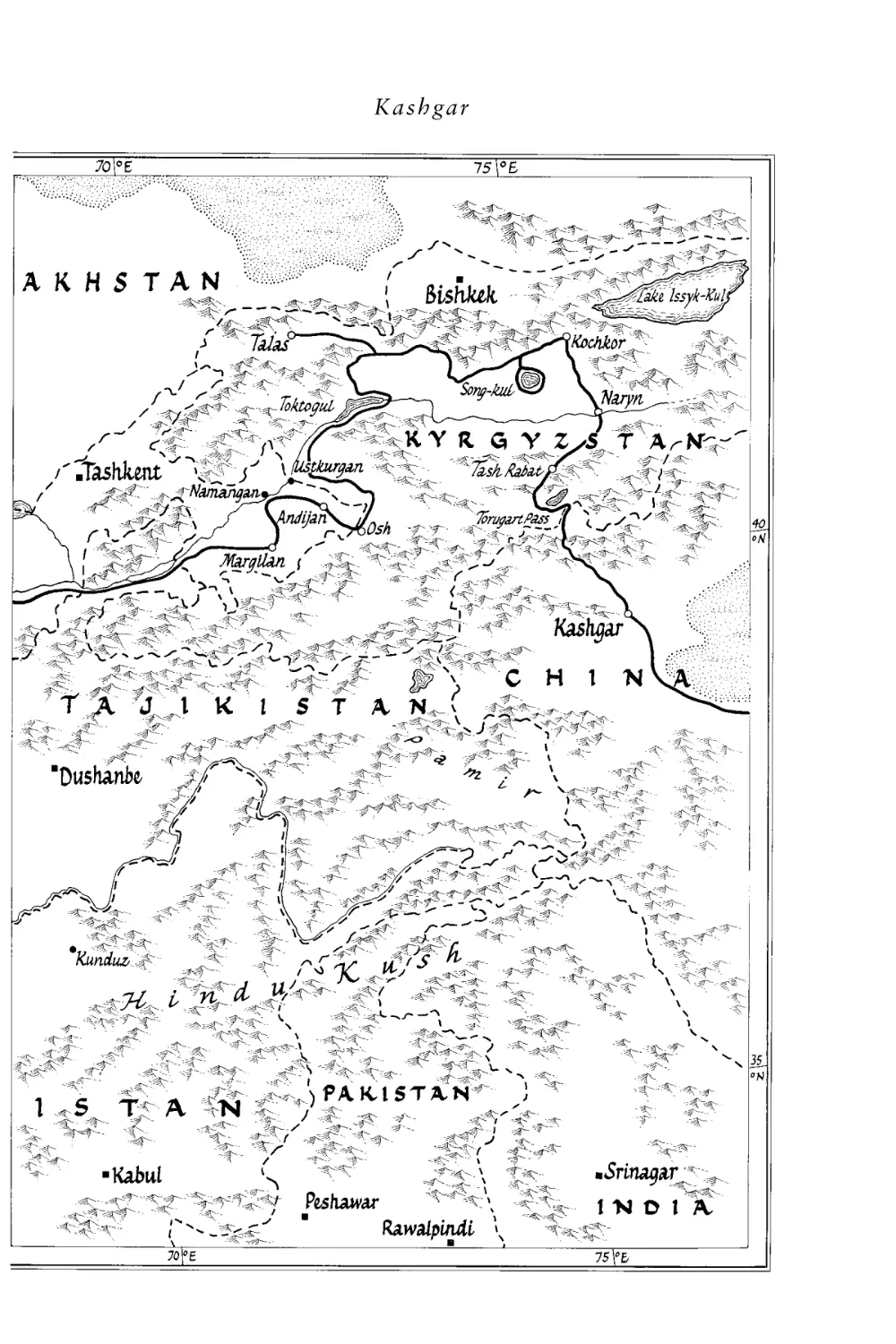
Kashgar
The Mountain Passage
To Samarkand
Over the Oxus
Mourning
The Mongol Peace
To Antioch

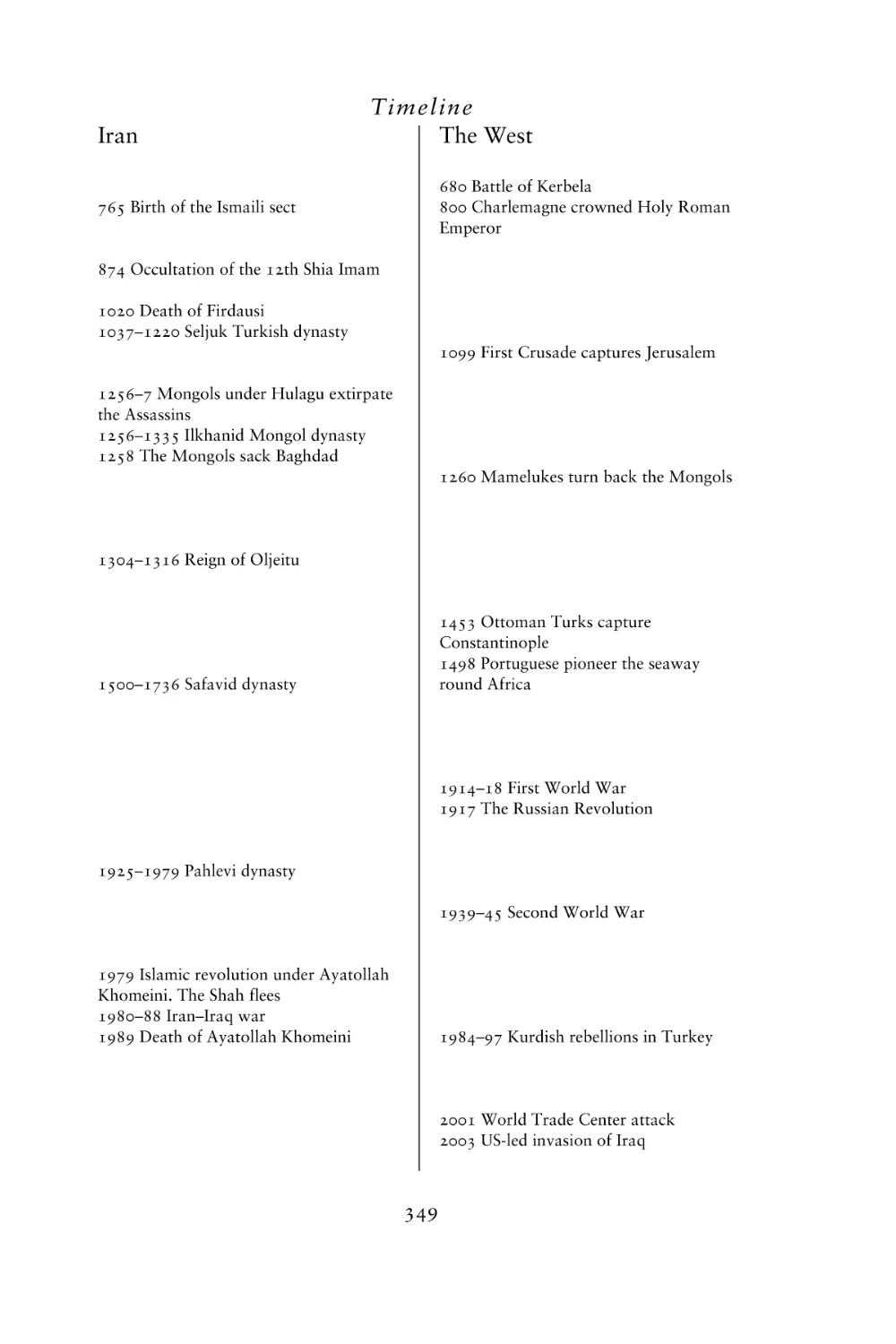
Timeline
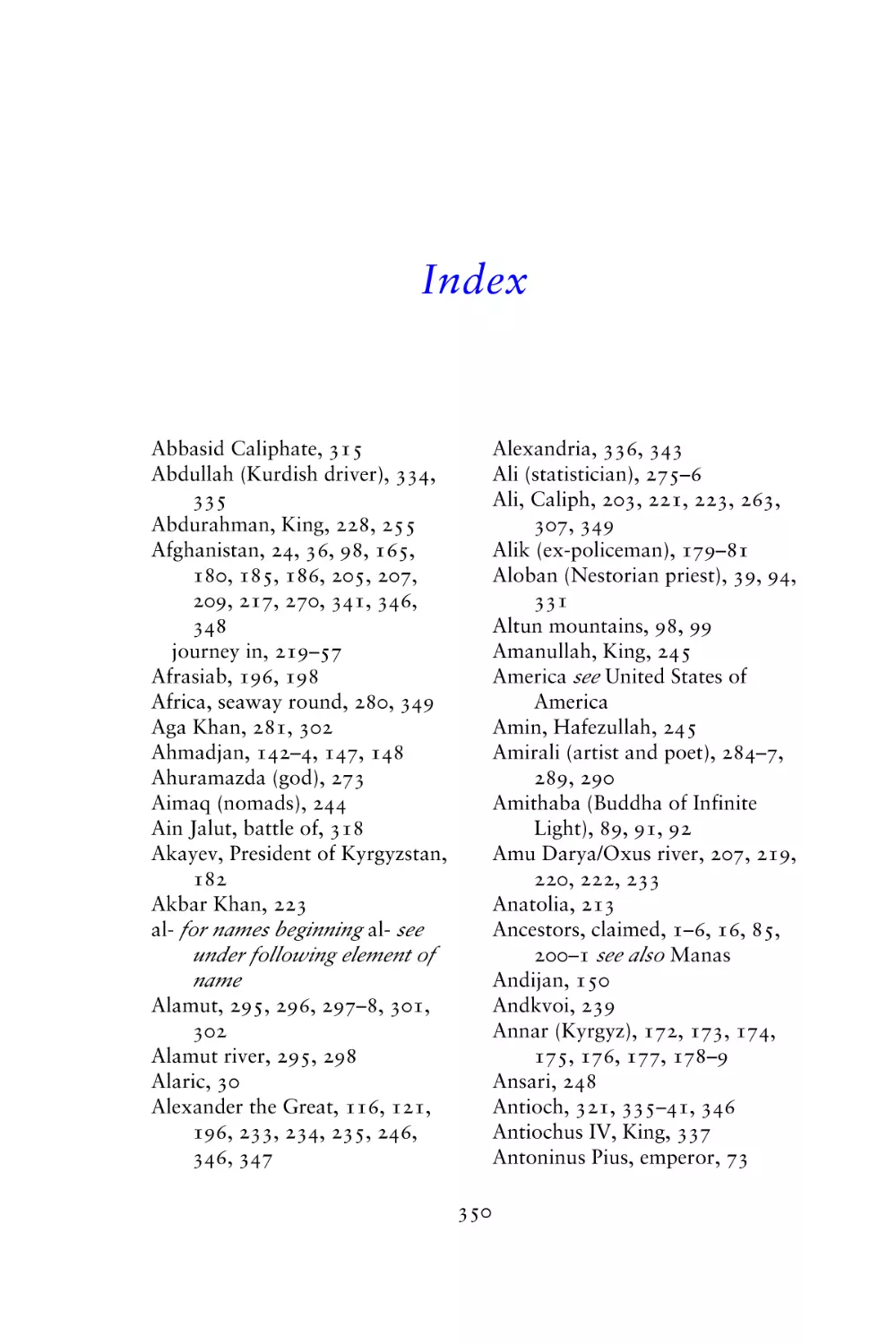
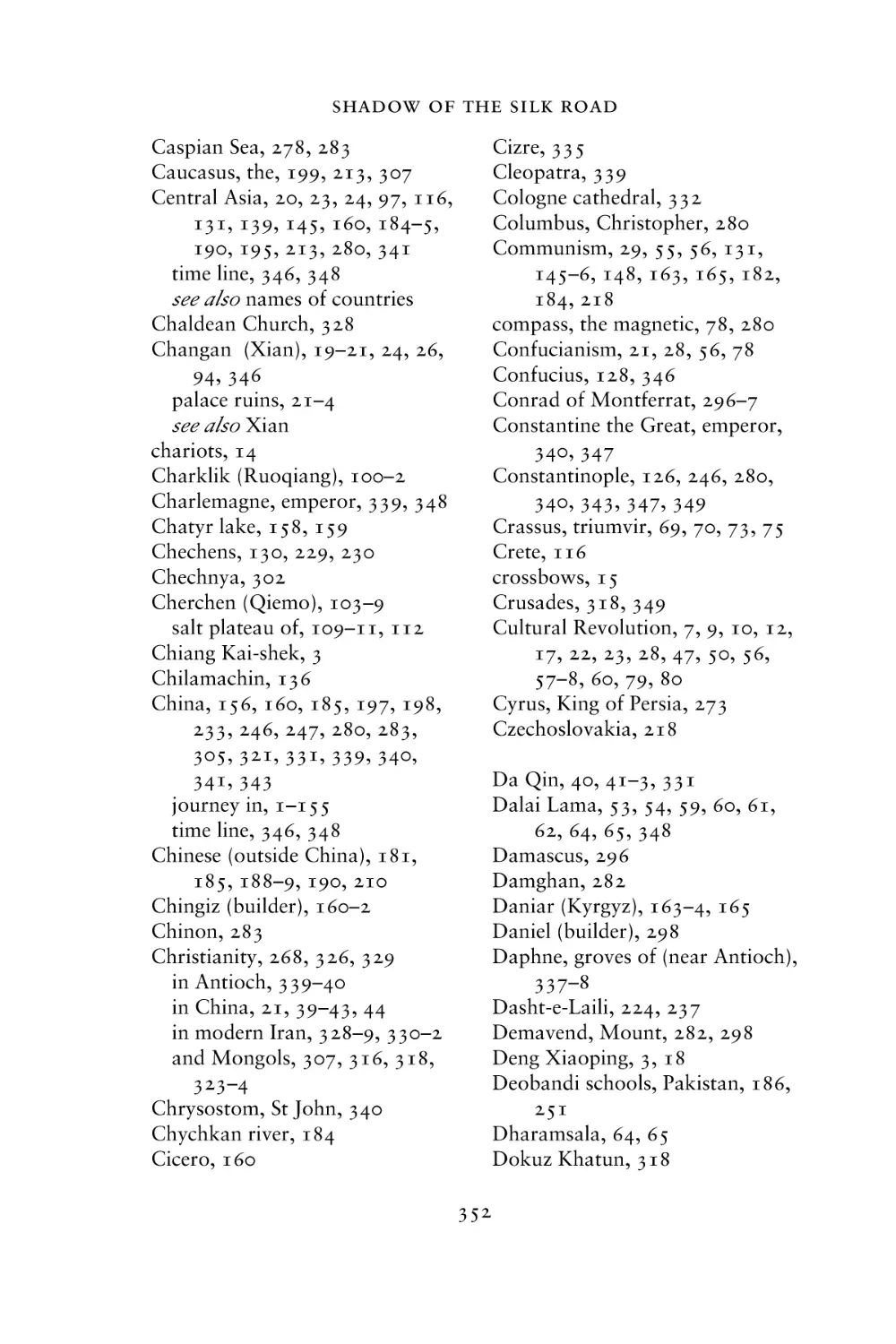
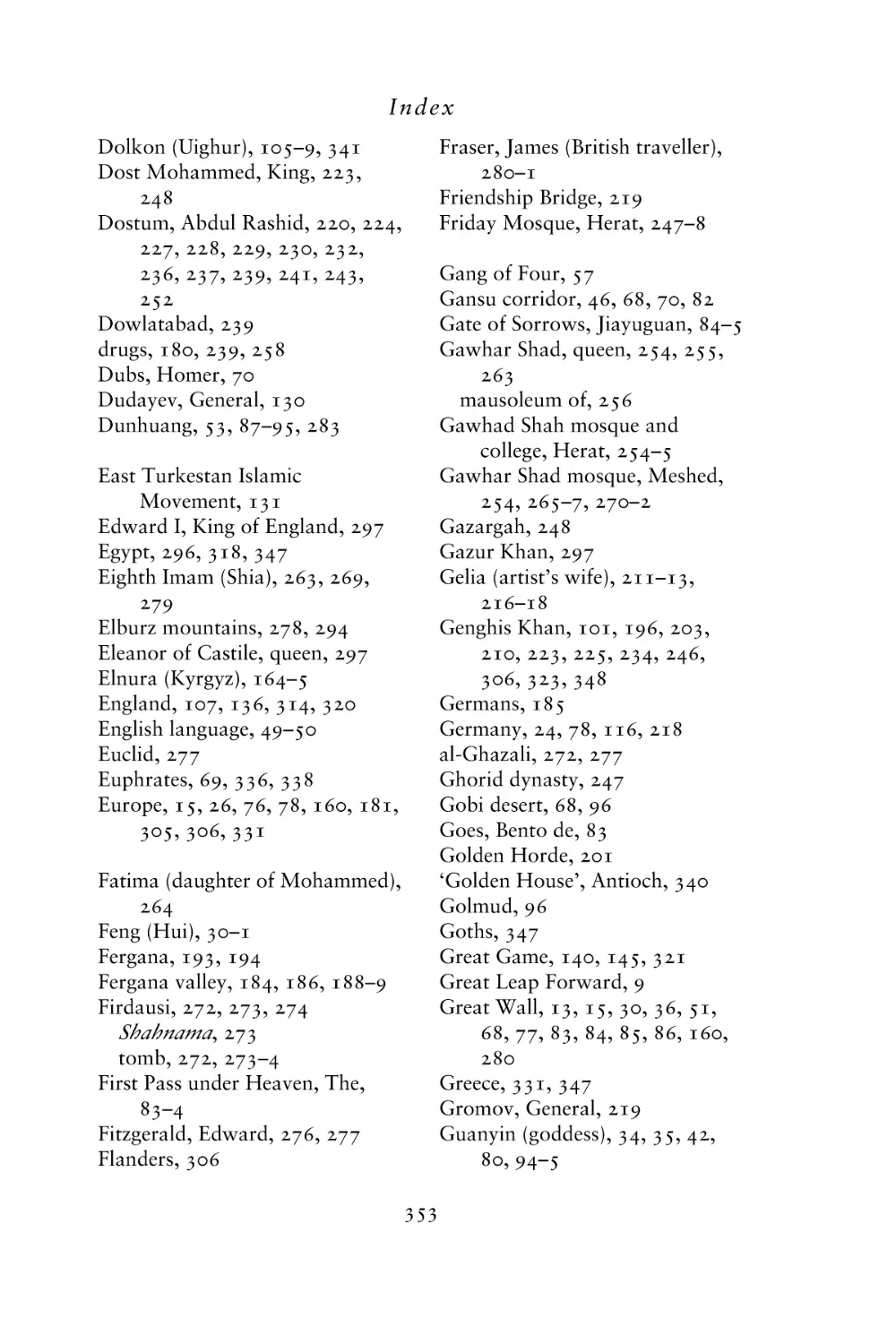
Index

ix
1
7
46
68
96
138
154
184
219
262
294
333
346
350

About the Author
Other Books by Colin ThUbron
Credits
Cover
Copyright
About the Publisher

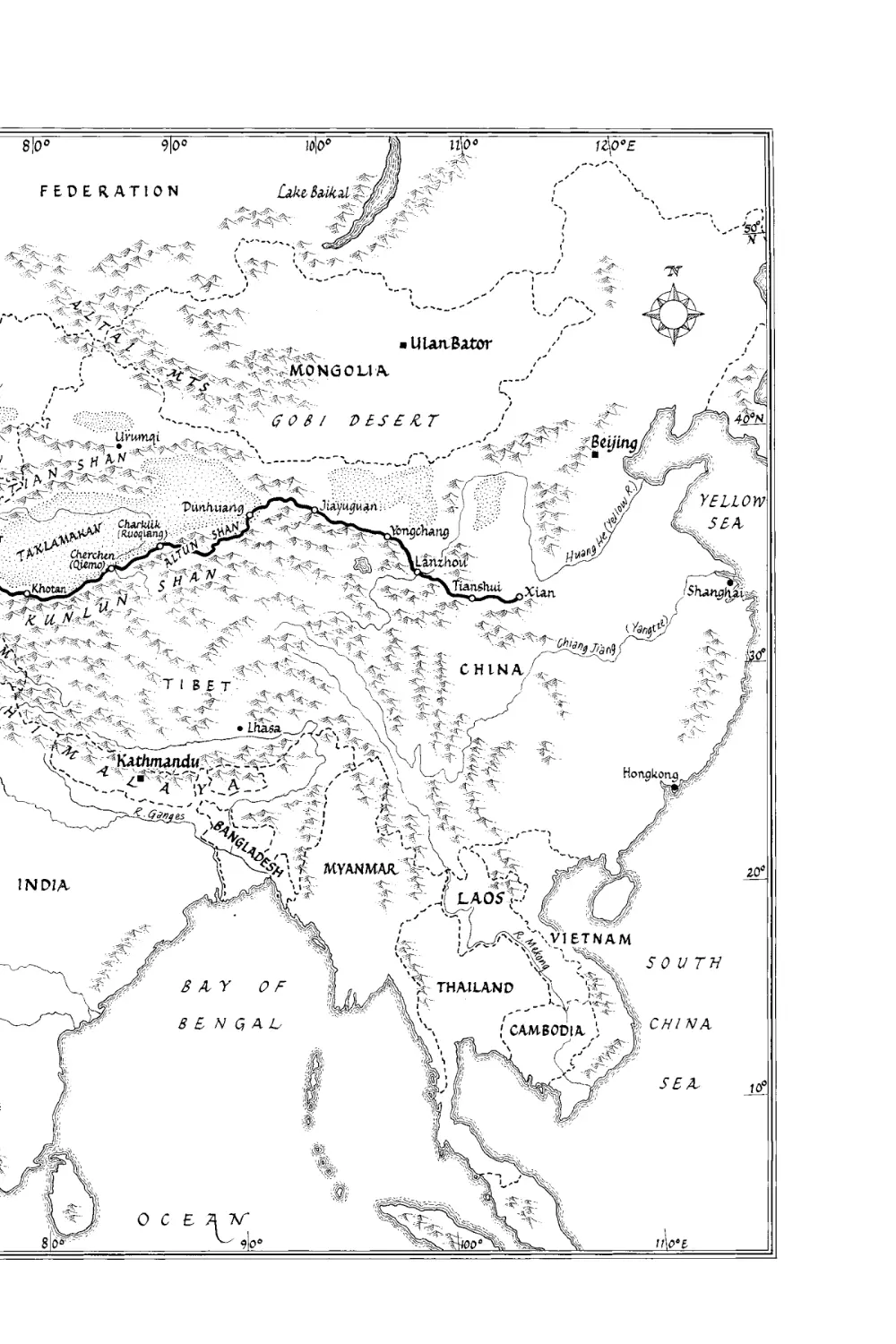
Maps

The Silk Road
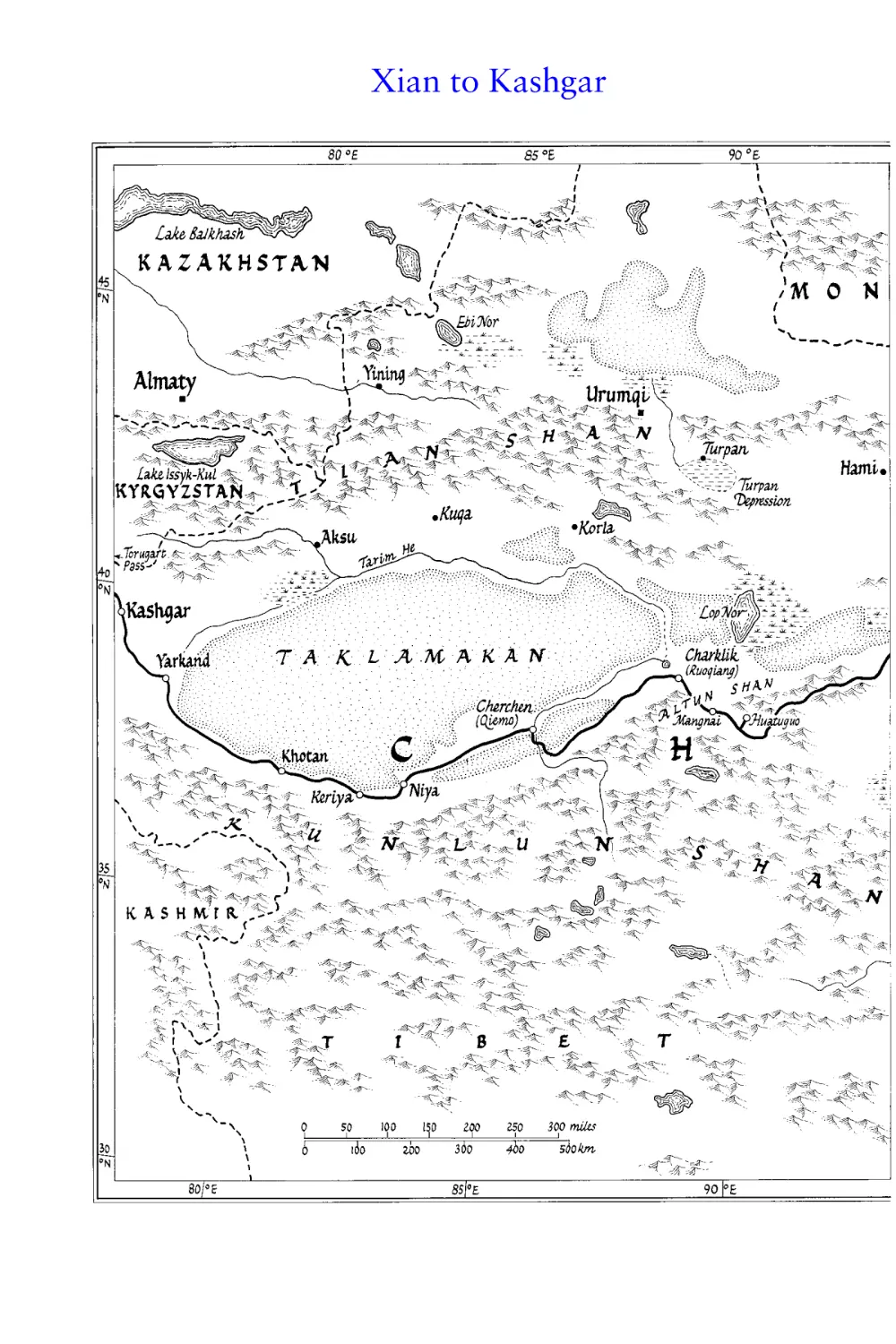
Xian to Kashgar
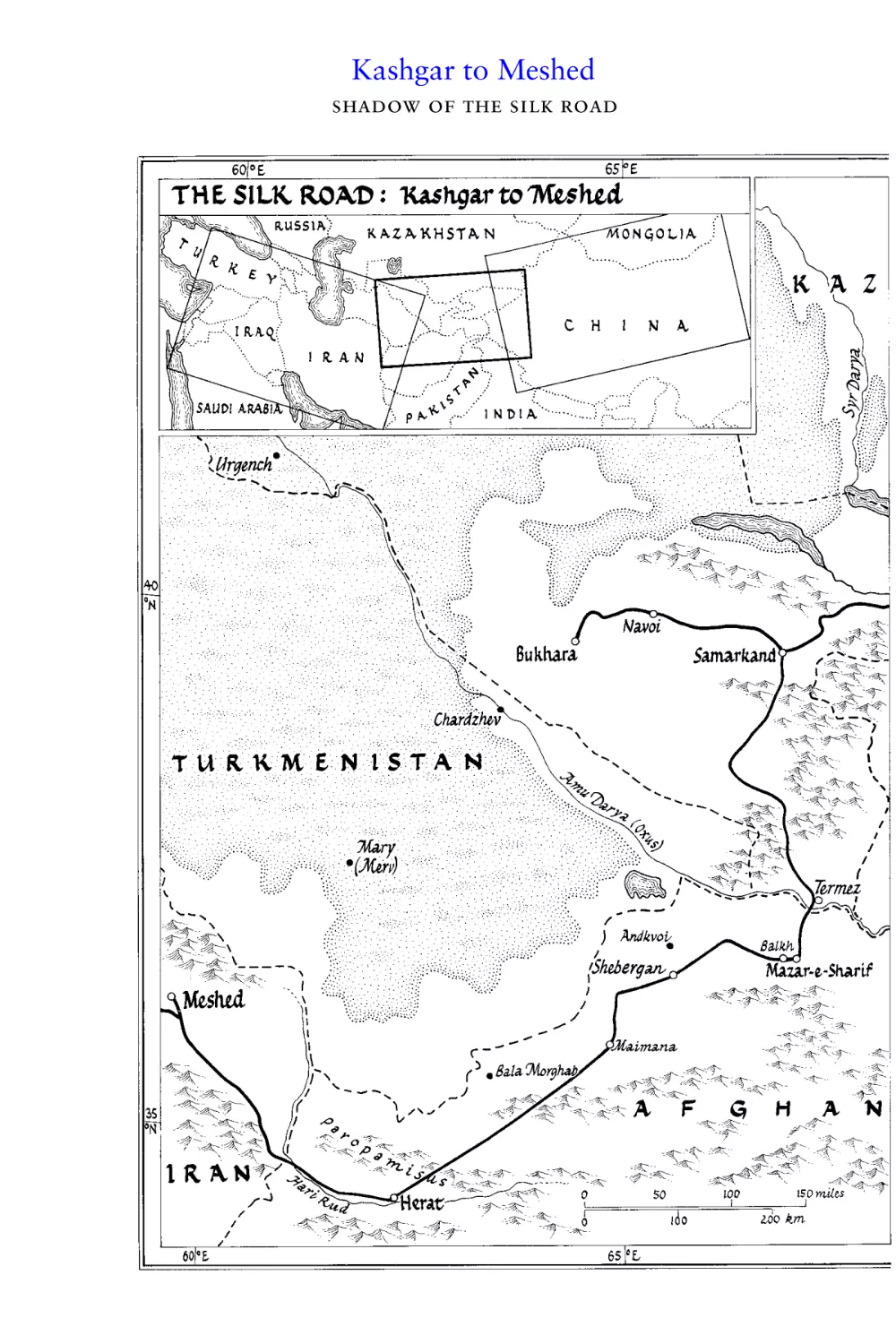
Kashgar to Meshed
Meshed to Antakya
Maps drawn by Reginald Piggott

vi–vii
x–xi
152–3
260–1

The Silk Road

AUTHOR’S NOTE

The journey recorded here was broken by fighting in northern
Afghanistan. The section delayed there was travelled the following
year, in the same season.
In the midst of political uncertainty, the identities of several
people described in the narrative have been disguised.

Xian to Kashgar

1
Dawn

In the dawn the land is empty. A causeway stretches across the lake
on a bridge of silvery granite, and beyond it, pale on its reflection,
a temple shines. The light falls pure and still. The noises of the
town have faded away, and the silence intensifies the void – the
artificial lake, the temple, the bridge – like the shapes for a
ceremony which has been forgotten.
As I climb the triple terrace to the shrine, a dark mountain bulks
alongside, dense to the skyline with ancient trees. My feet sound
frail on the steps. The new stone and the old trees make a soft
confusion in the mind. Somewhere in the forest above me, among
the thousand-year-old cypresses, lies the tomb of the Yellow
Emperor, the mythic ancestor of the Chinese people.
A few pilgrims are wandering in the temple courtyard, and
vendors under yellow awnings are offering yellow roses. It is quiet
and thick with shadows. Giant cypresses have invaded the
compound and now stand, grey and aged, as if turning to stone.
One, it is said, was planted by the Yellow Emperor himself;
another is the tree where the great emperor Wudi, founder of the
shrine two thousand years ago, hung up his armour before prayer.
The pilgrims are taking photographs of one another. They pose
gravely, accruing prestige from the magic of the place. Here their
past becomes holy. The only sound is the rustling of the bamboo
and the murmuring of the visitors. They pay homage in this temple
to their own inheritance, their pride of place in the world. For the
Yellow Emperor invented civilisation itself. He brought China –
and wisdom – into being.
1

shadow of the silk road
The woman is gazing at a boulder indented by two huge
footprints. Slight and girlish, she jumps at the sight of a foreigner.
Foreigners don’t come here – she laughs through her fingers – she
is sorry. The footprints, she says, belong to the Yellow Emperor.
‘Not really?’
‘Yes. One of his concubines used them to make boots. He
invented boots.’
We walk for a moment where memorial stones are carved with
the tribute of early emperors, and come at the court’s end to the
Hall of the Founder of Human Civilisation. Its altar is ablaze with
candles and incense, and heaped with plastic fruit. The woman’s
gaze, when I question her, stays candid on mine. The Yellow
Emperor invented writing, music and mathematics, she says. He
discovered silk. This was where history began. People had been
coming here generation after generation. ‘And now you too. Are
you from your government?’ But her eyes dip to my worn trousers
and dusty trainers. ‘A teacher?’
‘Yes,’ I lie. Already a new identity is unfurling: a teacher with a
taste for history, and a family back home. I want to go
unquestioned.
So that’s why you speak Mandarin, she says (although it is poor,
almost toneless). ‘And where are you going?’
I think of saying Turkey, the Mediterranean, but it sounds
preposterous. I hear myself answer: ‘Along the Silk Road to the
north-west, to Kashgar.’ And this sounds strange enough. She
smiles nervously. She feels she has already reached out too far, and
turns silent. But the unvoiced question Why are you going? gathers
between her eyes in a faint, perplexed fleur-de-lis. This Why?, in
China, is rarely asked. It is too intrusive, too internal. We walk in
silence.
Sometimes a journey arises out of hope and instinct, the heady
conviction, as your finger travels along the map: Yes, here and here
. . . and here. These are the nerve-ends of the world . . .
A hundred reasons clamour for your going. You go to touch on
human identities, to people an empty map. You have a notion that
this is the world’s heart. You go to encounter the protean shapes
of faith. You go because you are still young and crave excitement,
2

Dawn
the crunch of your boots in the dust; you go because you are old
and need to understand something before it’s too late. You go to
see what will happen.
Yet to follow the Silk Road is to follow a ghost. It flows through
the heart of Asia, but it has officially vanished, leaving behind it
the pattern of its restlessness: counterfeit borders, unmapped
peoples. The road forks and wanders wherever you are. It is not a
single way, but many: a web of choices. Mine stretches more than
seven thousand miles, and is occasionally dangerous.
But in the temple of the Yellow Emperor, the woman’s gaze has
drifted north. ‘He was buried up there on the mountain,’ she says.
‘It’s written that people tugged at the emperor’s clothes as he flew
to heaven, trying to pull him back. Some say that only his clothes
are buried there. But I don’t think this is true.’ She speaks softly,
with a tinge of unexplained sadness. ‘The grave is quite small, not
like those of later emperors. I think life was simpler in those days.’
We walk for a minute longer under the eaves of the temple.
Then, suddenly, the quiet is shattered by the stutter of power-drills
and the groan of dump-trucks.
‘They’re building the new temple,’ she says. ‘For celebrations
and conferences. This one’s too small. The new one will hold five
thousand people.’
Later I peer down from the hillside on the building site where it
will be. I imagine the stressless, unchanging temple-pavilions of
China rising from their wan granite. This place, Huangling, is only
a hundred miles north of modern Xian, but is lost deep in another
time of erosion and poverty. Who will come?
But the whole site is resurrecting as a national shrine, and
already the older temple is filled with the memorial stelae of
China’s statesmen offering homage to ‘the father of the nation’.
Here is the stone calligraphy of Sun Yatsen from 1912, and of
Chiang Kai-shek, predictably coarse; of Mao Zedong, who was
later to condemn the Yellow Emperor as feudal; of Deng Xiaoping
and the hated Li Peng.
The clamour of restoration dies as you climb the track where it
snakes through the cypress woods. From somewhere sounds the
drilling of a woodpecker, and human voices echo and fade above
3

shadow of the silk road
you. Here and there a yellow flag on a bamboo pole marks the
way. You are sinking back in time. Close to the summit the path
becomes a stone stairway, and the trees turn phantasmal, their
trunks twisted like sticks of barley-sugar or wrenched open on
swirling slate-blue veins. Here the grandest mandarin, even the
emperor, abandoned his sedan chair and approached the
mausoleum on foot.
For there is little in the end – from music to the calendar – whose
discovery is not attributed to the Yellow Emperor. He reigned for
a hundred years until 2597 BC before ascending to heaven on a
dragon. It was he who instituted the festivals of earth and silk.
After him the reigning emperors, from a remote time, inaugurated
the year by ploughing a ritual furrow, while their empresses
offered cocoons and mulberry leaves at the altar of his wife Lei-tzu,
the Lady of the Silk Worms.
It was Lei-tzu, in legend, who discovered silk. While walking in
her garden, she noticed a strange worm gorging on mulberry
leaves. For several days she watched it spinning itself a golden net,
and imagined it the soul of an ancestor. Then she saw it close itself
away, and thought it dead – until the reincarnate moth burst from
its cocoon. Toying, mystified, with its minute broken shroud, the
empress mistakenly dropped it into her tea. Idly she picked at the
softened fibre, then began to unwind it, with growing astonishment, into a long, glistening filament of silk. In time she became
the teacher of silk-weaving and of the rearing of the mysterious
worm, and she was deified at her death and placed in the sky in the
celestial home of Scorpio, the constellation Silk House.
You reach the summit of the hill, which the ancients called
Mount Qiao. Incense and sunlight filter through the trees. People
have made sacrifice here since the eighth century BC, and the
emperor Wudi built a prayer platform, now softly decaying. The
few attendants stare at you in mute surprise. Beside the platform,
cauldrons the size of cement-mixers are stuffed with joss sticks,
and a suspended log is being swung at a monstrous bell, whose
clang shakes the woods.
Beyond, enclosed in a sombre wall so crowded by cypresses that
it is almost invisible, rises the grave-mound of the Yellow Emperor.
4

Dawn
It is only twelve feet high, rank and tufted by shrubs. You circle it
tentatively on a path of beaten earth. The funeral stele planted
before it reads: ‘The Dragon-rider on Mount Qiao’. But you
wonder how he really died, and who he was. Some historians
believe that the dragon is the memory of a meteor, in whose
cataclysmic fall the emperor vanished. Its remnants have been
identified nearby.
As you wander the rim of the mountain, the enigma deepens. Far
on all sides the arid hills belong not to classical China but to a
harsher world. This is where Shaanxi province points to Mongolia.
Down its corridor the barbarian tribes – Huns, Turks, Mongols –
descended south into China’s heartland, to the teeming cities of the
Yellow River. In the more rigorous early histories, the Yellow
Emperor was himself the forerunner of these: a clan leader who
invaded from the north-west and unified the people in his path. It
is curious. As if to still this nomad flood into controllable history,
sages as long ago as the eleventh century BC slotted the conqueror
into time as their ancestor. His colour changed to the yellow soil
of inner China, where the wind-blown loess from the northern
deserts settles into fertile fields. The notional shade of barbarian
soils was black or red, and white the tint of death and of the West.
But yellow was the colour of the world’s heart.
I circle back to the grave in confusion. Suddenly its mound is not
a relic from some golden age, but the primitive barrow of a nomad
chief. The father of China was not Chinese at all.
As for the Lady of the Silk Worms, she too fades from known
history. The cultivation of silk had spread along the Chinese rivers
long before her. More than six thousand years ago somebody in a
Neolithic village carved a silkworm on an ivory cup, and
archaeologists unearthed an artificially broken cocoon. Silk from
the late third millennium BC turned up in a ruined city of
Turkmenistan, and early sites have yielded spinning tools and even
red-dyed silk ribbons.
In the forest clearing, by the prayer platform, one of the
attendants opens his hand to me for money, hoping to sell me
incense. But whimsically I choose another tribute. I swing the
painted log – it moves swifter, heavier than I expect – against the
5

shadow of the silk road
hanging bell. In the dark clearing it reverberates with a diffused
clamour. Long after I’ve relinquished the log, the noise goes on. It
booms over the platform, the forest, the tomb, like some
melancholy knowledge. It is indefinably alarming. The other
pilgrims turn to stare. The sound is more intrusive than any incense
or candle.

6

2
The Capital

The sun rose over a new city. Along its inner avenues, and far out
to the skyline, Xian had suffered a hallucinatory change. Eighteen
years before, I trudged through a run-down provincial capital. Its
sombre ramparts, survivors of the Cultural Revolution, had
enclosed little but concrete office blocks and half-empty state
emporia. There is a stench of coal dust in my memory, and
autumnal mud. Rusting trucks and a river of bicycles had
meandered the ghostly grid of ancient streets. The colours along
the sidewalks were regulation brown, grey and serge blue. It
seemed a place of inert history, and fatal patience.
But now it had shattered into life. I recognised almost nothing.
It had not frozen to grandeur like Beijing, but transformed into a
hectic procession of overcrowded shopping malls, restaurants and
high-tech industrial suburbs. The nine-mile circuit of its walls,
which once seemed to enclose nothing, was bursting with reborn
vigour, the massive gates funnelling in traffic which clogged the
boulevards for miles. Eight-lane highways – including the
beleaguered bicycle lane – shot between hotels and prestige
apartment blocks carrying the new-fangled private cars and a fleet
of ten thousand Citroen taxis.
At the city’s heart, the Ming dynasty bell tower had become a
swirling traffic island. As you circle its upper gallery, banging your
head on its crossbeams, an enormous shopping mall opposite
showers you with computerised advertisements, and a cavernous
McDonald’s gleams alongside; slogans proclaim new motor
scooters, CD players, mobile phones. From here the traffic streams
7

shadow of the silk road
away to the four points of the Ming compass. At every boulevard’s
end the fort-like gates leave jaundiced profiles in the smog, while
beyond them hovers a crowd of suburban skyscrapers, like the
ghost of the future waiting to break through.
The future can hardly wait. The whole city is in a turmoil of
construction. Every other site is marked by a giant computer image
of what will be built there – glass-and-tile institutes and company
headquarters topped by tilted eaves and temple turrets like paper
hats, with a scattering of blond visitors dotted in below for prestige
and perspective – so that whole stretches of avenue become
futuristic theatre-sets. If you return next year, these vistas promise,
you will enter a different city. All that China wants to be, Xian is
becoming.
Already the shops and hoardings are persuading you that
everywhere is here: Paris, New York, London. The supermarkets
are stacked with goods inaccessible even five years ago: electrical
products pour in from eastern China; food is piled up in what to
older people seems a curious dream. And here and there some
glossy mall oversteps into Elysium altogether. These cold palaces
offer an unmediated West: Givenchy, Arden, Bally, Gieves &
Hawkes, Dior, L’Oréal. The assistants look blank and sanitised, as
if adapting by instinct to their role, and their customers, appearing
shyly provincial – boyish men, girlish women – glide up and down
bedazzled on the escalators.
Sometimes, through half-closed eyes, I tried to reimagine the city
of my memory. But I found myself recalling a place which I was no
longer sure had existed, under whose louring ramparts, now
reverberating with traffic, the farmers had spread their market
stalls, and avenues had run deserted. Already this older Xian was
retreating to a sepia photograph in my head. I struggled to recover
it, but it faded by the hour.
All around now, another generation was on the move. Their
pace was more nervous and directed. Little silver cellphones
glittered at every ear. In my memory, their parents’ expressions
were guarded or blank, and footsteps lumbered. But now they had
wakened into difference: more changeable, demonstrative, uneasy.
A few reminded me of friends in the West. I half expected them to
8

The Capital
ignite in recognition. Couples were walking hand in hand, even
kissing – a Maoist outrage. Women with auburn-dyed hair were
walking little dogs. Long, pointed shoes were in fashion – like
jesters’ slippers – and luridly bleached jeans.
Something had been licensed which they called the West. I
gawped at it like a stranger. Yet the outbreak of individualism, I
sensed, was not quite that. Being Western was a kind of
conformity. Even as the West touched them, they might be turning
it Chinese. And among these crowds of urban young an undertow
of rural migrants – like shockwaves from their past – was
threading the streets: loud-mouthed men and women with sunblackened faces and bushy hair, whose harsh voices filled the
noodle shops.
On this transforming city, old people gazed as if at some
heartless pageant. Dressed in their leftover Mao caps and frayed
cloth slippers, they would settle by a roundabout or park and stare
for hours as the changed world unfolded. It was hard to look at
them unmoved. Men and women born in civil war and Japanese
invasion, who had eked out their lives through famine in the Great
Leap Forward and survived the Cultural Revolution, had emerged
at last to find themselves redundant. Under their shocks of grey
hair the faces looked strained or emptied by history. Sometimes
they seemed faintly to smile. They smoked continuously, if they
could afford it, and tugged their trouser legs above their knees to
catch the sun. And sometimes their expressions had quietened into
a kind of peace, even amusement, so that I wondered in surprise
what memory can have been so sweet.
Stray from any avenue within the walls, and you become lost in
a skein of old suburbs. Just behind the concrete boulevards, they
pulse like the city’s unconscious – twist and bifurcate into
claustrophobic courtyards where the flimsy wooden walls of
family compounds, studded with cracked windows, last out the
cold winters under grey-tiled roofs or corrugated tin. As you walk
here, the weight of Xian’s past returns. You hear only the squeak
of bicycles or the clatter of a pedicab as it deposits its bone-shaken
passengers.
In one street, where artists and calligraphers toiled in dark
9

shadow of the silk road
studios, I was surrounded by classical ink-stones for sale, and
ranks of badger-hair brushes in discrete sizes (with a stuffed ferretbadger hanging alongside as guarantee). Vendors of bamboo pipes
and bottle-flutes blew them in quaint seduction as I passed. But the
wonky eaves and balconies above them had been self-consciously
restored, and the alley was called ‘Old Culture Street’. Beyond it,
lanes selling painted fans and classical opera costumes merged into
a market of massed artefacts in lacquer and porcelain, jade and
bone. Reproduced as antique, they occupied a shadowland where
the old crafts had grown nostalgic, food for tourists. Among them
all – the quaint and the occasionally beautiful – I even found
mementoes of the Cultural Revolution, manufactured as
curiosities. There were Little Red Books for sale, published as
posthumous souvenirs; cigarette lighters played ‘The East is Red’
as they lit up. On a popular wristwatch a painted image of Mao
Zedong waved his hand jerkily with every second. ‘He is not
greeting you,’ the vendor grinned. ‘He is saying goodbye.’ It was as
if those years, with all their horror, were being sucked already into
the slipstream of the past. The pain was leaving them. They had
become kitsch.
But that afternoon a storekeeper offered me another Little Red
Book, almost forty years old. It was stained with oil, and inscribed
with its owner’s name, Yang Shaomin. Then an old unease came
over me. The terror of the Cultural Revolution – its unknown
millions persecuted, its hallmark mental cruelty – had never quite
left me. Eighteen years ago I had encountered its human wreckage
everywhere. I fingered the book tentatively, almost with reverence.
It seemed to breathe a corrupt mana. I remembered photographs
of Mao Zedong haranguing the Red Guards in Tiananmen Square,
and the ocean of Red Books lifted to worship him. Had this been
one of them? It felt rough and small in my hands. In the back it
enclosed a yellowed newspaper clipping of Mao’s thoughts. And as
I fingered its paper, that nightmare became real again, and I
wondered what had happened to Yang Shaomin, and what he had
done.
Then I was back in the daylit street. It was snarled with traffic,
and children were coming out of school. Years before, they would
10

The Capital
have followed their teacher in a dutiful crocodile, the infants
strung together by a long cord. Now they jostled and shouted and
ran amok. Their satchels were inscribed ‘Happy Journey’ and
‘No. 1 Cool Dog’. I felt foolishly comforted. In the local cinema a
Shanghai romance called Why me, Sweetie? was playing alongside
Harry Potter and the Chamber of Secrets.
Now I was walking in fascinated confusion. My eyes kept
alighting on those vaguely disturbing advertisements featuring
Europeanised models. Their eyes were unnaturally rounded, the
epicanthic folds surgically cut, their noses subtly arched or thinned
by photographic lighting, and the bud-like mouths were stretched
in a Western smile.
‘We are not like our parents. We have no time and no security. You
say we walk differently from the old, well that is why. It’s
something nervous.’
He seemed to wince across the restaurant table: a young man,
barely twenty-three, with a pale, heart-shaped face. ‘Our parents’
world was safer: state pensions, assured jobs and housing. And
they want to go on as before, cautiously, preserving. But my
generation – our world depends on us.’
He looked at once anxious and excited. This was the sea-change
that was transforming China. All at once the future had grown
more potent than the past. Change was rendering things obsolete.
You could see this where high-rise apartment blocks barged into
the old suburbs, bulldozing the clustered generations of the
communal courtyard and banking up tiers of nuclear families in
their place. Whole regions of the city had become unrecognisable,
the man said. And of course it was not merely buildings that were
being exchanged, it was the values they fostered.
‘I spent my childhood in those old hutong courtyards.
Relationships were warmer then.’ His mouth puckered, as if
hunting a lost taste. I wondered if he were not simply regretting
being adult. ‘Now we live on the fourteenth floor of a skyscraper,
and whenever we go out we lock an iron door behind us.’
He was the awkward by-product of this changed world. He
loved animals and green spaces – in childhood he had longed
11

shadow of the silk road
hopelessly for a dog – and was studying ecology with a tinge of
despair at his country’s ruthlessness. He was an only child. ‘Most
of my friends are outcomes of the One Child policy, state birth
control. They call us “little emperors”. Parents and relatives all
dote on these single children. But I don’t think it shapes us for
reality. I read the other day of a ten-year-old boy who died
drowning, trying to save his friend. He couldn’t swim at all.
Everybody said: how brave! But I thought: that’s a typical little
emperor. Stupid. He imagined he could do anything.’ His
chopsticks dithered over chilli-flavoured chicken. He had eaten
almost nothing. ‘There’s a kind of wisdom we’re not taught,’ he
said. ‘And every family is full of silences.’
With vague wonder I realised that to him the terrors of the
Cultural Revolution were pure history. Mao Zedong had died
years before he was born: a symbol, not a man. He said: ‘My
parents never talk of that time. I think they don’t want to
remember. So I’ll never know what they did. They were Red
Guards, of course, and I heard that my father smashed up old
things. He may even have killed a man. But I’ll never know.’
He suddenly laughed. ‘The Cultural Revolution is a joke to my
friends. When we take group snapshots we sing silly Mao hymns.
That’s what they did in those days. They sang hymns before taking
a photo. And if you wanted to buy a camera, the shopkeeper might
not sell until you’d chanted two or three Mao hymns . . .’
I said: ‘Can you imagine you and your friends at that time? What
you’d have done?’ An old disquiet was surfacing.
‘No. I really can’t imagine this . . . or, well . . . no, I can’t . . . The
truth is my whole generation is sick of politics. The government’s
rotten. People just join the Party to get on. We want change, but
nobody’s going to die for it.’
I thought of the Tiananmen Square massacre. However
incoherently, its victims had died for change. But even as I asked
him, I realised he had been nine years old at the time.
He said: ‘My father was working in Beijing then, and I was at
primary school. I remember the noise and the soldiers, and later we
saw blood in the streets everywhere. Soon afterwards I crossed that
square with my mother, and I realised something terrible had
12

The Capital
happened. But that was all, and she said nothing. And now we
don’t think about it much, or talk about that.’
In his alert, restless eyes, I imagined misgiving. ‘All the same,’ he
said, ‘I think they were brave.’
For a while he picked delicately at the chicken in front of him,
sometimes dabbing the corners of his mouth with his sleeve. Then
he said with the sudden, paradoxical spareness of his people: ‘I’m
afraid of death. And loneliness. When I close my eyes, I go cold. I
think: death is like this. Blackness, where there’s no feel or taste.
Many young people are afraid of it, I think. Old people can look
back on rich lives, perhaps, and are not afraid . . .’
I thought: everything was always assured to them.
‘. . . But we young people are unfulfilled, and afraid. Some of my
friends go to the Buddhist temple, but only because they want
something. I don’t believe in that. For us, after death, there’s
nothing.’
* * *
The valleys of the Wei and Yellow rivers, where Xian stands, were
China’s ancient heartland. To the north the plateaux of windborn
loam mount towards Inner Mongolia; to the south the hills,
suddenly humid, are terraced for rice and tea. It was in the mild
basin between, now spread with wheat and cotton, that the tyrantemperor Qin Shi Huangdi proclaimed the first capital of a unified
China in 221 BC, and was buried in a tomb guarded by massed
echelons of terracotta warriors which came to light more than two
thousand years afterwards. In his reign the fiefdoms of the past
were brutally homogenised: their script, their laws, even their
history. He knit together the Great Wall with the labour of a
million conscripts and peasants, who died of exhaustion and were
immured in it like landfill. The annals of all dynasties but the
emperor’s were put to the flames, and dissenting scholars buried
alive. Nothing survived that was not his. So a recognisable country
came into being: a land in which diversity was morally offensive.
The terracotta army still marches where it was found, through a
subterranean vault fifteen miles east of Xian. Fear of the SARS
13

shadow of the silk road
virus, which was spreading north that April, had brought tourism
to a standstill, and I found myself almost alone in the cold-lit
tunnel. No photograph prepares you for these eerie legions. They
move through the earth in their hundreds, eleven columns deep.
Once brilliant in vermilion and green, shiny with black armour and
pink skin, they have faded to spectral beige. Their robes fall thick
and loose over their concave chests, and their hair is knotted in
tight buns or bunched behind winged headdresses. Studded platearmour overlaps their shoulders. But instead of the stone-hearted
war engine a despot might demand, they wait in a disparate
regiment of watchful and unequal men. Almost no two are alike.
There are veterans with wide moustaches and sloping stomachs,
thin recruits and scholarly-looking campaigners sporting little
chips of beard. In the wan light their expressions are those of
expectation, even alarm, as if they await the enemy charge.
But everything wooden – all their arms – has disintegrated. The
fists of the spearmen are closed delicately around nothing. Arrows
and lances, halberds and crossbows have left behind only splinters
of bronze. Horses stand unharnessed to chariots which have gone,
while their drivers’ hands extend to grasp thin air.
Circling the dim gangway above them, you imagine this massed
and intricate armament, with its mailed elite infantry and
expendable conscripts, to be the upsurge of a self-sufficient realm:
the country China claimed to be. But already I was dreaming of the
road to the west, and it filled my head with a complex ebb and
flow. Behind the terracotta horses the earth was printed with the
rings of vanished wheels, for at the heart of the imperial armies
rolled the leather-bound war chariots, manned by aristocratic
archers and armoured spearmen. Yet the chariot was not a Chinese
invention. For two thousand years before 221 BC these fleet cars
had criss-crossed the steppes of Mesopotamia and southern
Russia, and they reached China along the Silk Road a thousand
years after their origin. The bronze metallurgy which shaped those
vanished weapons perhaps originated in the steppelands too, and
all the ancestors of those horses – alert and chariotless in the
museum dust – had come along tracks from the west.
Fewer than seven hundred figures have been restored out of an
14

The Capital
estimated six thousand. Many lie unexcavated under the roofs
which crashed in at the end of the Qin dynasty in 206 BC: headless
torsos and snapped limbs submerged in a mire of coagulated dust.
In another pit an estimated nine hundred soldiers and ninety
chariots lie buried under a debris of sagged timbers, where
platoons of bowmen kneel to arms. Their bent fingers cradle
weapons which have perished, but in the hardened loam nearby,
the perfect outline of a long-rotted crossbow startles thoughts of
medieval Europe. A Chinese invention from the fourth century BC,
it travelled the Silk Road west, arriving in time to arm the
phalanxes of Norman and Capetian kings, and to meet its nemesis
from the English longbow at Crécy.
These exchanges swarm with question marks. Chinese
inventions which percolated along the ancient road – printing and
gunpowder, lock-gates and drive-belts, the mechanical clock, the
spinning-wheel and equine harness that transformed agriculture –
flourished behind the Great Wall for centuries before emerging
phoenix-like in the West. And the knowledge of other prodigies –
iron-chain suspension bridges, deep-drilling techniques (the
Chinese were boring for brine and gas at two thousand feet in
the second century BC) – took over a thousand years to travel.
But the notion of China as a sealed empire was breaking apart
around me. Reassembled from the grave-pits, a terracotta
messenger stood ready with his horse behind him. His harness and
saddle were in place, but there was not yet a stirrup. The heavy
stirrup was a Chinese brain-child as early as the fourth century AD,
it seems, and as it travelled westward, stabilising its rider in battle,
it made possible the heavily armoured and expensively mounted
knight. To this simple invention some have attributed the onset of
the whole feudal age in Europe; and seven centuries later the same
era came to an end as its castles were pounded into submission by
the Chinese invention of gunpowder. The birth and death of
Europe’s Middle Ages, you might fancy, came along the Silk Road
from the east.
These imaginings followed me at will through the dim vaults of
the Qin emperor. He himself lies a mile away beneath a 290-foot
mound, where years before I had wandered alone. Now the
15

shadow of the silk road
Chinese tourist board had discovered it. A flight of steps beetled to
the summit among firs and marigolds. Souvenir sellers thronged to
meet me at the top, and a fancy-dress Qin dynasty band – drums,
horns, squealing pipes – marched in from time to time to shatter
the quiet.
But beneath my feet the terrible emperor still lay entombed – if
contemporary chronicles are accurate – in a vast and intricate
facsimile of his empire, threaded by quicksilver rivers, set in
motion by invisible machinery, with his executed wives beside him.
Seven hundred thousand workmen, it is said, laboured on this
mausoleum through the last years of his reign, and on its completion those who knew too much were immured inside by the
descent of stone gates. Within the tomb-chamber, among
mountains carved from copper and cities in precious stone, he rides
in a boat-shaped coffin on a mercury river, which flows to a
mercury sea beneath a night sky printed with pearl stars.
So in death he contrived a self-contained mirror-kingdom,
perfect control. Its gemstone cities were laid out for eternity,
echoing the stasis of the heavens. The internal gates and
passageways, raked secretly by primed crossbows, sealed the
borders of his posthumous state. He had walled off the past and
the future. His ancestry, like the Yellow Emperor’s, was probably
barbarian; yet China was named after him. The seal-fat lamps
which lit his tomb were supposed to last for ever.
* * *
Huang found me outside my hotel, and had haunted it ever since.
I wondered what he wanted. He spoke a breathy English, split by
bursts of Mandarin, and above his broad peasant face his hair
sprouted so low that it almost met his eyebrows. He invited me
home to meet his family, but his family were not there. He was
racked by some intense, festering energy.
In his three-room flat, seated on rock-hard upholstery, he
unfolded the old ambition of his people with a bright fixation.
‘I don’t want my life to stay level. I’m dreaming a big dream. I
want my life to go like this! And this!’ His hand lifted in a jagged
16

The Capital
stairway. ‘I want to plant a flag on each step! Up, up from nothing,
until I die.’
His staccato voice rang through the apartment, where his absent
womenfolk had left themselves behind in a whiff of cooking oil
and some scattered dolls. ‘My father used to tell me that there was
an order to things: first education . . . then work, then family, then
friends. But first, education! You are like a tree, he said. Drinking,
smoking, gambling are branches to be cut off. Cut them off, and
you grow high.’ He stood up proudly, but he was barely five and
a half feet.
‘We have many dangers now. Our society has changed very fast.
We are addicts to gambling. Old people just lose a few kwai, and
it doesn’t matter. But young people are ruined. And the massage
parlours are everywhere, calling themselves beauty salons. They’re
just brothels.’ On his rustic face a fastidious wince appeared, then
faded. ‘It’s the modern West, it’s because of the fast change.’
‘Yes,’ I mumbled, feeling responsible. A generation ago all this
had been unimaginable. Now, every night, my hotel telephone
rang with a chirruping woman’s voice offering amo, massage.
‘My father warned me against these things. He noticed my
friends. If they were dutiful to their parents, he approved. If not,
they were like wolves, he said, bad for the spirit, and I should leave
them. They will turn your heart sick, he said.’
His father obsessed him. The old man had been persecuted in the
Cultural Revolution for owning books. ‘He was paraded in a
dunce’s hat, with his arms wrenched out of their sockets.’ Huang
let out a tremor of strained Chinese laughter. ‘But now he’s gone
home. He’s retired to the village of his childhood.’
‘The village that persecuted him?’
‘Yes. But to trees now, and flowing water, and a newspaper.’
But he had left behind this son tormented by a zeal for selfimprovement. In a belated Maoist spirit Huang had recently
volunteered to help farmers, harvesting vegetables into a basket
strapped to his back. ‘Useless!’ He tossed some invisible cabbages
over his shoulder. ‘Within two days I was like a cripple.’ He was
wincing. ‘Soon afterwards my father asked me to join a charity.
There are poor people in the mountains here, people who have
17

shadow of the silk road
nothing. So I go with my wife and daughter into the mountains –
nine hours, up and down, to a part we’d seen on television – and
we find a poor village and a man with four children, and I talk with
him, and say don’t be afraid. He has no money, no school for his
sons. Just some wheat. So I give money for his oldest child to go to
school for the first year. This is big education for me, for my wife
and daughter. I ask my daughter to talk with the man’s children,
and she bursts into tears because they are so poor . . .’
His face had simplified into theatrical fervour. Only afterwards
did I wonder if his tale were true, or if he had merely witnessed it
on television and longed in fantasy to fulfil his father’s ideal.
‘I don’t know what the government can do about the peasants,’
he said. ‘I’m not interested in politics. I don’t want to touch them.’
He swept away a whole troubling world with his hand. ‘I’m an
accountant with the municipality. I just work with a computer. But
I’m thirty-six already, and I must change my life. I want to dream
a big dream and go abroad.’ His face split into a tense, euphoric
smile which now never left it. ‘A year ago I helped a Brazilian
tourist. He’s a lawyer. He is my only foreign friend – and now
you.’ I felt sudden misgiving, the start of a delicate interplay of
debt and request. But he said: ‘I want to go to Brazil. During the
day there I’ll work at anything, but in the evening I’ll give Chinese
lessons. Free, no charge! Money is important, of course, but later.
First, friends. Friends will be more important for my life.’ It was a
twisted version of his father’s advice. ‘Maybe after a year I’ll have
five people studying Chinese – all new friends. Here! . . . here! . . .
and here!’ He planted them in space, like aerial seeds. ‘Soon maybe
one of the friends will tell me: Oh, Mr Huang, I have good news –
my father or my uncle works in a company that needs . . .’
So he was planning to make the move most coveted now: out of
administration and into business. He had grown up in the new
China of Deng Xiaoping, the land where riches were glorious, an
arena of accelerating mobility.
But I felt an amazed misgiving for him. I said: ‘Do you know
anything about Brazil?’
‘Brazil is in South America. It has some economic problems.
Many people have no job. But some economies are better than
18

The Capital
here in China, some companies. I’ll make contacts in these
businesses . . .’ – he began planting airy seeds again – ‘touch . . .
touch . . . touch! I’ll find a company with big production. Maybe
they are making this’ – he picks up a tinny bell from his table. ‘So
I’ll send one of these to friends in China who’ll find a company to
make them cheaper. After that we sell them back to the Brazil
company. This, this!’ He taps the bell, which doesn’t work. Then
he advances down other avenues, to other schemes. And slowly, as
he juggles with a ferment of percentages and notional deals, my
fear for him dissipates. I start, with dim foreboding, to pity the
Brazilians. I imagine Huang conquering the world. Under his squat
hands the tinny bell gets substituted by a porcelain saucer, which
is joined by a vinegar-pot. They move across the table and
rehabilitate themselves in another security or investment portfolio
(I’ve lost the thread). He is talking like a machine-gun. His mind
has a tough, calculating acumen. His English floods into
Mandarin. His eyes never leave my face. They glitter with an
innocent cunning. ‘. . . The company puts its own label on it, of
course – but same quality! Then . . .’
After that I understood nothing he said, in either language, but
became lost in a narcoleptic mist of figures, and only emerged after
seeming hours to hear: ‘But I won’t stay in Brazil, because this
country not so good economy. I’ll go to a better country . . .’
* * *
Xian was once the greatest city in the world. For three centuries
after AD 618, under the royal name Changan, ‘Eternal Peace’, it
incarnated the zenith and decline of the peerless Tang dynasty. For
twenty-two miles its ramparts enclosed nearly two million
inhabitants, and immured them again in a nest of inner walls and
gates, as ward after ward piled up around a vast chessboard of
avenues. The nine-mile walls of today’s Xian trace merely those of
Changan’s inner city. On one side it sucked in tribute by canals
stretching to the South China Sea; on the other it stood as a
lodestar at the eastern end of the Silk Road, where the Tang empire
stretched to the Pamirs.
19

shadow of the silk road
Its aristocracy survive in the damp murals of their tombs
pockmarking the Wei valley. Along the underground walls their
women walk in décolleté bodices and silk gowns, chatting together
or playing with pet cicadas. Fabulous birds flutter for a moment
out of the plaster. Beneath their chignons, piled up like crowns and
cats’ ears, the faces are dimpled by tiny mouths and lizards’ eyes.
They look like exquisite children. Their men, meanwhile, are
playing polo, a game imported from Persia, in a charge of weightless cavalry. Under these dim vaults their lives are reinvented in a
vacuum – their colours faded to rust and grey – yet are sweetly
precise. When they follow the chase, their hunting leopards perch
on saddles behind them, with a falcon or two, while a pair of
provision-laden camels lumbers contemptuously behind.
They inhabited a city of fabled refinement and excess, whose
street plan mirrored an imagined cosmic order. In spring its boulevards drowned in a snowstorm of apricot and peach blossom, with
women sailing through the air on swings. These were the people,
connoisseurs of the peony and the courtesan, who lifted to their
lips the amber wine-cups which now rest in the city museum. Its
cabinets still shine with their vanity: gold hair-pins, petal-shaped
mirrors, silver censers for the wardrobe.
But beneath this artifice, of course, a power was throbbing: the
power of trade. In the Western Market where the Silk Road came
to rest, two hundred guilds of merchants worked. Their reach was
immense. They embraced almost every people between Arabia and
Japan: Persians, Turks and central Asian Sogdians especially,
Indians, Bactrians, Jews, Syrians. There were times when whole
echelons of the Tang court – including its elite bodyguard – were
foreign. The moneylenders – sometimes so extortionate that
people pledged their slaves and sacred relics – were Uighurs from
the west. Along the Silk Road too came the music and dance of
Turkestan – a fearsome, whirling flamenco was the rage for years
– along with acrobats, jugglers and trapeze artists; and in the inns
near the Gate of Spring Brightness the fair girls of Central Asia
sang to flutes and befuddled the poets with their green eyes.
Although the imperial supervision of foreign merchants stayed
rigid and finicky, a new tolerance was in the air. The silks and
20

The Capital
ceramics of the time show winged horses and peacocks – the
decorative motifs of Persia – flying alongside Chinese dragons; and
no burial was complete without its attendant figurines of roaring
camels led by a gnomish barbarian in a Phrygian cap. The classier
brothels gave puppet shows satirising big-nosed people in peaked
bonnets. Fashion followed suit. The enveloping mantle of the
palace ladies slid away, and by the early eighth century women
were to be seen riding like steppeland men in boots and Turkic
caps, even bare-headed.
And deeper attachments were at work. For two centuries the
capital reverberated with the gongs of Buddhist temples and
monasteries. In 645 the pilgrim-monk Xuanzang returned from
India laden with more than six hundred scriptures, settling to
translate them in a pagoda that still stands, and the whole city
massed to greet him. Zoroastrianism, Christianity, Manicheism –
all were accepted with benign curiosity, while the indigenous faiths
of China – Taoism and Confucianism – bided their time.
But by the tenth century this city of complicated glory lay in
ruins. The willows binding its canal banks had been cut down for
barricades, the beams and pillars of its mansions lashed together
into rafts, on which its people floated away to greater safety in the
east.
Somewhere in the northern suburbs the imperial palace of
Changan is turning to dust. I cannot find it. The people living in
the district are recent immigrants, and poor. It is hard to ask
among their hovels for the Palace of Great Light. In any case, they
do not know.
Only through a Tang historian Hu Ji – friend of a friend – do the
gates of a forbidden compound clank open, and we enter a
building site ringed far away by smoking suburbs. It is a scarred
hillside. On one hand it descends to broken-down cottages and
workshops. On the other I look up and see with chill astonishment
the huge, sepulchral terraces glimmering in blue-white stone. The
palace foundations have just been restored.
Hu Ji is slight and greying. He carries an old canvas shopping
bag, and seems more fragile than his years. A sharp wind is cutting
21

shadow of the silk road
across the terraces. He has come with his twenty-eight-year-old
daughter Mingzhao, who looks like porcelain, like him. We are
alone. The last time he was here, he says, the foundations were a
heap of rubble. And now this. ‘It is strange.’ I cannot tell what he
is thinking.
For a long time we climb over this perfect, sterile geometry.
Beneath us the city moans invisibly through smog: the drumming
of a train, faint cries. Sometimes his daughter takes his arm, as if
comforting him for something. I try to imagine the imperial Son of
Heaven conducting state affairs from this gashed hillside, gazing
down on the ocean of his prostrate officials or the passage of a
military parade. Viewed from below, wrote chroniclers, the palace
seemed to float in clouds. But now the great ramp of platforms,
shorn of all structures, all colour, makes a cold, Aztec symmetry
against the hill.
‘Look . . . here is some of the old stone . . . and here.’ The
professor tugs back some plastic sheets to show a patch of wall, the
socket for a pillar. They lie isolated in the waxy sheen of
reconstruction. ‘You see how vast it was. There’s a Tang-era
palace in Japan, but you could fit it into one wing of this . . .’ His
pride sounds sombre in the bleakness. ‘The first time I came here,
nearly forty years ago, this place was almost out in countryside,
and people were carting away its stone for their houses . . .’ He
shivers in the wind.
‘Why were you here?’
But I think I know. Nearly forty years ago, at the start of the
Cultural Revolution, the Red Guards had rampaged all through
the country.
He says tightly: ‘We travelled free by train everywhere that
summer. We were happy for a moment.’ At that time the pillaging
of the Tang palace had made perfect sense: the destruction of the
feudal past by the working masses.
But Hu had come because he loved history . . .
He belonged to that lost generation who were banished to the
countryside after the chaos grew too great. Many Red Guards
returned years later with their faith annihilated, their schooldays
wasted, to a world which was forgetting them. Some lived with the
22

The Capital
memory of unspeakable things. Ageing towards its sixties now,
this cynical generation makes a black hole in China’s heart. Yet Hu
Ji, I sense, has escaped.
As we mount the Linde hall, the pleasure palace of nineteen
successive Tang emperors, his daughter falls back beside me. She is
pretty and delicate, with child’s hands. Her father is tracing where
the columns of the banqueting chamber have left their circles in the
flower-speckled earth. ‘In the Cultural Revolution he was sent into
the mines,’ she says. ‘He was there eleven years. He had silicosis in
his lungs long afterwards. But he kept up his studies even there.
I’ve seen his old notebooks, covered in Maoist slogans.’ Her father
is stooping curiously over a stone-lined basin: a solitary detail in
the ruined earth. ‘But what he most remembers,’ she says, ‘is his
old tutor. This man committed suicide just before the Revolution,
knowing what was coming. My father feels a great debt to him,
and great sadness.’
Hu Ji has stood up among the ghosts of Tang banqueteers.
‘Imagine here,’ he says, ‘the music of the emperors!’ We gaze
over the mounds, the faltering lines of brick. ‘The emperor
Xuanzong had an orchestra and a dance troupe of thirty
thousand!’
This ruler, he says, changed their musical instrumentation for
ever, to play the Western music which the Chinese loved. Its flutes
and harps still sound on their tomb walls. He enjoys these transmutations, as I do: how the harp travelled east from Central Asia
or the flute went west; or how the horsehead fiddle – created in
legend by a Mongolian prince to speak his sorrow to his dying
horse – moved down the Silk Road to become the ancestor of
strings everywhere, even the European violin.
Hu Ji is now lamenting Xuanzong, the emperor of China’s
misfortune. He ruled for forty years or more, but his generals were
catastrophically defeated by the Arabs. In an episode beloved of
poets, says the professor, the concubine he adored was executed by
the army; and civil war weakened his dynasty for ever. Hu Ji
speaks with whispering fastidiousness. I cannot imagine him a Red
Guard. But some broken ideal, perhaps, has healed in the rational
glow of the Tang.
23

shadow of the silk road
In the vanished banqueting hall he is smiling. ‘The emperor had
four hundred beautiful horses! He taught them to dance . . .’
The Silk Road started at the western gate of old Changan. The
Xian municipality commissioned a train of camels in commemoration, sculpted in red sandstone, twice life size. But the
gate’s site had already been engulfed by a supermarket, splashed
with advertisements for credit cards. So the camels occupy a traffic
island nearby.
In Tang times nobody spoke of the Silk Road. It was a
nineteenth-century term, coined by the German geographer
Friedrich von Richthofen, and it was not a single road at all, but a
shifting fretwork of arteries and veins, laid to the Mediterranean.
Historians claim its inception for the second century BC, but the
traffic started long before accounts of it were written. Chinese
silk from 1500 BC has turned up in tombs in north Afghanistan,
and strands were discovered twisted into the hair of a tenthcentury BC Egyptian mummy. Four centuries later, silk found its
way into a princely grave of Iron Age Germany, and appears
enframed – a panel of sudden radiance – in the horse-blanket of
a Scythian chief, exacted as tribute or traded for furs twenty-four
centuries ago.
Silk did not go alone. The caravans that lumbered out of
Changan – sometimes a thousand camels strong – went laden with
iron and bronze, lacquer work and ceramics, and those returning
from the west carried artefacts in glass, gold and silver, Indian
spices and gems, woollen and linen fabrics, sometimes slaves, and
the startling invention of chairs. A humble but momentous
exchange began in fruits and flowers. From China westward went
the orange and the apricot, mulberry, peach and rhubarb, with the
first roses, camellias, peonies, azaleas, chrysanthemums. Out of
Persia and Central Asia, travelling the other way, the vine and the
fig tree took root in China, with flax, pomegranates, jasmine,
dates, olives and a horde of vegetables and herbs.
In eras of stability, when the great Han imperium reached across
central Asia towards ancient Rome, or the Mongol empire laid
down its unexpected peace, the Silk Road flourished. But even in
24

The Capital
these times the same caravans never completed the whole route.
No Romans strolled along the boulevards of Changan; no Chinese
trader astonished the Palatine. Rather their goods interchanged in
an endless, complicated relay race, growing ever costlier as they
acquired the patina of rarity and farness.
Beside the carved camels, stranded on their traffic island, Hu Ji’s
daughter suddenly asks me: ‘How long is your journey?’
In the shadow of the sculpted cameleers – central Asian
Sogdians, who dominated Silk Road trade for half a millennium –
any modern journey faded away. My answer – eight months –
would have sounded nothing to these men. They were sometimes
gone years. Sometimes for ever. Their bones scattered the sand. In
glazed earthenware the Sogdians’ figures – usually crowned by
dwarfish hats – look faintly comical. With their popping eyes and
knob-like noses, they smack of Chinese caricature. But they grasp
recalcitrant beasts, and their quaint-looking shoes are upturned
only to reduce friction in the sand. Their chances of death – by
bandits or sandstorm or flash-flood – were a calculated risk, a
percentage in hard heads. By comparison my own chances – an
Afghan mine, perhaps – only frivolously existed. That night, in the
idle interval before sleep, I imagined one of these grizzled
entrepreneurs.
He: What are you going for?
I [piously]: For understanding. To dispel fear. What did you go
for?
He: To trade in indigo and salt from Khotan. Why should your
understanding dispel fear, idiot?
I [worried]: It’s true, it may confirm it.
He: Are you, then, afraid?
I: I’m afraid of nothing happening, of experiencing nothing.
That is what the modern traveller fears (forgive me). Emptiness.
Then you hear only yourself.
He: ‘Nothing happening’. I offered two pounds of incense to
the Buddha for that. As for yourself, you’ll hear that anyway. I
know a sorcerer in Bukhara, sells bronze mirrors. There’s only
yourself in this world, he says. The rest is illusion. There’s just
you. Nobody else. Is that why you go alone? Only pilgrims
25

shadow of the silk road

and madmen go alone. Which are you? [Silence.] You should
take a concubine. [Tugs his beard.] Which is your country
then?
I: England . . .
He: England does not exist. [Silence.] You talk of the world’s
heart, but the world is not a person, idiot. No part is more
meaningful than any other part. Even in Siberia, there is amber.
[More kindly:] Why don’t you trade in tin? There’s value in
tin . . .
* * *
In a dim-lit gallery of the city’s chief museum, almost unnoticed,
hangs the oldest piece of paper in the world. Its surface – a dull café
au lait – is ridged and lined like a relief map, and its edges are in
tatters. It was made in the reign of the emperor Wudi, about 100
BC, from the fibre of hemp and a local nettle. Nothing is written on
it. It is as if a camel had rubbed off its hide against the museum
wall.
You gaze on this wrinkled ancestor with a sense of time shaking.
It would be over twelve hundred years before paper-making
reached Europe. Meanwhile, in Changan, paper was being used as
clothes, armour, handkerchiefs, kites, belts, money. Beautiful
coloured vellums appeared (the favourite was Pure Heart Hall
paper, finished in scrolls over fifty feet long). The imperial library
owned two hundred thousand scrolls, catalogued by coloured
ivory labels, their wrappers studded with rock crystal and their
paper glossed with mica. As early as the sixth century the production of sacred texts was so common that a noted mandarin was
forbidding his family to use them as lavatory paper.
Only after AD 751, when the Arabs routed the Chinese at the
battle of Talas, did the jealously guarded craft of paper-making
travel west, along with captured Chinese artisans, to Samarkand.
It would not reach Europe for another three hundred years. In the
hushed museum this first page looks too rough to inscribe. But by
AD 100, letters written on mulberry bark were travelling the Silk
Road. The archaeologist Aurel Stein, while investigating a watch26

The Capital
tower in the Lop desert, came upon a cache of undelivered mail,
with messages in Sogdian dating back to AD 313. These are the first
known inscribed paper. Their words are in carbon ink. One
contains the outburst of a neglected wife (‘I’d rather be a dog’s or
a pig’s wife than yours!’). Another touches on the failing state of
China – the sack of cities, the flight of the Emperor – and its
implications for trade. But for the rest, across their fragments, the
script runs neat as a company balance-sheet: ‘In Guzang there are
2,500 measures of pepper for dispatch . . . Kharstang owed you 20
staters of silver . . . He gave me the silver and I weighed it, and
there were only 4.5 staters altogether. I asked . . .’
In a dumpling restaurant that hangs its red lanterns near the city’s
drum tower, Hu Ji and his daughter are debating something. They
share the same small mouth and slim nose. She is studying the Sung
dynasty, as he has studied the Tang. Sometimes she laughs, while
he smiles. He is writing a book of essays – they are complex, provocative – which will expose old pieties to a new light. ‘We have
these stories which go far back in our history.’ He orders up the
dumplings as if they might be memories. ‘I am trying to question
them, to rewrite them in a way that will put them in doubt.’
Such a story, he says, emerged from the Tang dynasty, when a
garrison commander, besieged by rebels, found his six-hundredstrong force close to starvation. Instead of surrendering, he first
killed his wife and fed her to his soldiers, then one by one killed the
weaker men and fed them to the stronger. Finally his troops were
reduced to a hundred. They were overwhelmed three days before
relief came.
‘And this has always been held up as glorious in our history – an
example of perfect service to the state! So I’ve rewritten it in
another spirit. How should it be judged?’ He frowns with a slow,
delicate regret. ‘You know, in China we have no tradition of
respect for human life. It’s simply not in our past.’ His hands have
lifted from his lap and clench at his chest. They look rougher than
a scholar’s should; I remember his years in the mines. ‘That is our
problem: inhumanity.’
My hand brushes his arm. I feel for his compassion – surprising
27

shadow of the silk road
myself – a surge of consolation, and I realise that I have never lost
some misgiving at this hard land. It is the residue, I know, of the
Cultural Revolution.
Hu Ji says quietly: ‘That’s why the Tiananmen Square massacre
could happen.’
I hear myself ask: ‘Could it happen again?’
Seconds go by before he says: ‘I don’t think so. We have opened
up too much to the world now. We are overseen.’
Is that the only reason? I wonder. So has nothing really changed?
I glance round the restaurant. Twenty years ago the place would
have been pompous with the stiff suits and buttoned collars of
banqueting bureaucrats. Now there are family groups, business
colleagues, teenagers flirting. Yet for a moment my anxiety
imagines that all is as before, and that the men sitting in their black
or grey jackets, dark shirts, have merely exchanged one uniform
for another.
But Hu Ji is looking at his daughter, says softly: ‘Our culture is
starting to change, it’s true.’
He is seeing it in her; and she answers my unspoken question: ‘I
don’t know what my generation would do in revolution. But I
think mine are more selfish. They have a conscience. They must
decide things for themselves.’
Her gaze stays innocent on mine. She is twenty-eight, but looks
a child. For a moment I do not understand her – the equation of
conscience with selfishness is strange. But ever since the Cultural
Revolution, she implies – when morality was vested in a nearmystical leadership – the lifeline between authority and virtue had
snapped. Responsibility could no longer be displaced upward, but
had come to rest, with guilt, in the confines of the self. Implicitly
Mingzhao is announcing the death of the whole Confucian
order, which places in an immutable hierarchy every person
under heaven. Prematurely, smiling back into her earnest face, I
imagine a huge, tectonic shift beneath the Chinese surface, as the
timeless submission of selfhood to the group loosens into
individual life.
These thoughts are still jostling in bewilderment as the last
dumplings vanish down our throats. Hu Ji has relaxed, sighing,
28

The Capital
over a little glass of rice wine. As a young man, he says, he worked
as assistant to the author Shen Congwen, who fell silent under
Communism – and something of the old man’s sweetness and
liberalism, I think, has survived in him.
‘But it’s not true the Red Guards felt no guilt,’ says Mingzhao.
‘My own teacher was beaten brutally, and one of his ex-students
still can’t bear to face him. After thirty-seven years, he still can’t
bear it.’
Hu Ji puts down his glass. ‘We were very young. It was like a
fever.’
In his words, unintended, lie a faint reproof to the foreigner.
How could I understand? Not even in the intellect, let alone the
heart. I was born into a society of other inhumanities.
Before gloom can gather, Mingzhao asks me brightly: ‘What
period would you have liked to live in?’ She enjoys these parlour
games.
‘It depends if I were rich or poor,’ I laugh. ‘And you?’
‘It depends if I were a man or a woman.’
We turn to her father. Surely he would choose to live under the
Tang. But he only smiles, and says uncertainly: ‘The future.’
The silk flows cold through my hands. Its colours are rich, faintly
synthetic. The woman asks forty-five yuan (five dollars) per square
foot. She says her cloth comes from the old silk-producing cities of
Hangzhou and Suzhou in the east, and I imagine their patterns
unchanged since the Sung. They are bustling with dragons and
phoenixes, or webbed in a gold skein of flowers.
It is hard to imagine who would wear them now. They reek of
past leisure and artifice. Yet this silk is supremely resilient,
temperate to wear, absorbent to dyes, almost rot-proof. When all
else has disintegrated in the two-thousand-year-old graves of the
Han, their silk gifts and shrouds remain, often thinned to colourless slivers, sometimes shockingly vibrant. By Han times the
women of every household cultivated silk, and the whole imperial
court was shimmering in a hierarchy of complicated grades:
silk unicorns and peacocks, peonies and horses. The Tang
emperors, dripping with silks, were portrayed in full-length silk
29

shadow of the silk road
portraits, or riding in silk-curtained chariots flying ceremonial silk
banners.
The Chinese discovered in silk an astonishing tensile strength. It
was strung to bows and lutes, and became fishing-lines. Even
waterproof silk bags appeared for transporting liquids, and
lacquered silk cups. Along with bone and wood, silk became the
first surface to be written on. It sanctified imperial edicts and in
ritual sacrifice carried messages to the dead. Long after the
discovery of paper, books of divination and magic were confined
to silk, together with all names of ancestral spirits.
As a surface for painting, too, this was the most precious. The
once vast imperial collections of silk scrolls did not last – in one
cataclysm rebel soldiers used them for tents and knapsacks – and
from those earliest years only copies or fragments remain. But
landscape painting became a near-mystical art. Around its
mountains and people – sometimes touched in with brushes made
of sable hair or mouse whiskers – the expanses of sky or invisible
ocean were given up to unpainted silk. Its lustrous emptiness
became a living presence. All solids, said the Taoists, were on their
way to nonexistence. The silken void was more real than they: pure
spirit.
Above all, for more than a millennium, silk was used to pay off
and soften the nomads ravening beyond the Great Wall. Often it
took on the status of currency. As lasting as coin, it became
salaries, taxes, tribute. By the first century BC the ancestors of the
Huns were exchanging its beauty for their horses. In Rome,
beyond the other end of the Silk Road, it began fascinating the
rich, and subverting the economy. Long afterwards the Visigoths
of Alaric, besieging the tired city, were deflected by a partial
ransom of four thousand Chinese silks.
* * *
Feng had an aggressive nose and heavy cheeks, and his eyebrows
arched in thick feathers. His Arab ancestors had come along the
Silk Road seven hundred years ago, he said, and one of his
forebears had been general to the first Ming emperor. Arab and
30

The Capital
Persian blood made his Hui people more handsome than the
Chinese, he laughed. But his teeth were blackened pillars on
shrunken gums, and he was running to fat.
As early as the seventh century these traders had arrived along
the Silk Road while their Islam was young, or filtered in through
the ports of the South China Sea. But through intermarriage,
whatever the man said, they had mostly become indistinguishable
from those around them. Perhaps only a cyclical history of revolt
and suppression, and the Chinese label ‘Hui’, had persuaded them
that they were a nation. Sixty thousand strong in Xian now, they
remained avid traders, and Arabic words still littered their talk.
You roam the streets of their quarter at dusk, sensing new
activity. They walk in tall white hats, like chefs, and sometimes
dangle beards. In the alleys under the green mosque domes, the
stalls are rowdy with kebab-sellers, men kneading five-yard-long
noodles, and butchers’ kiosks hung with halal lamb and beef.
In their chief mosque, the fusion of China with Islam is like
artful theatre. You wander through courtyards interlocked like
those of a Ming palace, where the stelae are carved alternately in
Arabic or Mandarin, and a minaret rises out of a porcelain-tiled
pagoda. Stone dragons and tortoises coil and slumber here and
there, ignorant of the Muslim ban on living images. The roofs tilt
and swing above their high-coloured eaves, and across the lintels
Chinese birds and flowers flock round Koranic inscriptions. An
imam’s sermon booms over loudspeakers from a prayer-hall
strung with neon lights. The voice is emphatic, overamplified, but
I can barely comprehend a word.
Then, alongside my disquiet, an excitement rises: it is the stir of
things transforming, of peoples intermingling and transmuting one
another. This, I recognise, is the merchant’s reality: everything
convertible, kaleidoscopic. The purity of cultures, even the
Chinese, becomes an illusion. So the hybrid mosque is like a
promise or a warning. It is the work of the Silk Road, long ago.
Nothing ahead of me, I sense, will be homogeneous, constant. To
follow a road is to follow diversity: a flow of interlocked voices,
arguing, in a cloud of dust.
* * *
31

shadow of the silk road
Huang was still dreaming his big dream, and hoping, I think, that
I might become part of it. One evening he caught me returning to
my hotel, and grasped my arm in sudden conspiracy. He knew a
man, he said, who collected things. You understand, things.
‘He knows people in the villages, farmers. They find tombs.
They go down on ropes with a lamp, and take the things out at
night. By day they cover the hole up again.’
‘How does this man get them?’
‘He stays in a village for two days, three, then he begins to hear
who has the antiques. They start to come to him. There are some
villages where they’ve become very rich.’
I said uselessly, knowing these people’s poverty, ‘They’re
destroying history.’ Huang was silent. ‘And it must be dangerous.’
‘The air in the tombs is very bad. Some have died down there.’
That night, in a dead-end alley, Huang shouted up at a curtained
window. The silhouette of a woman came and went. Then silence.
The smuggler presented a moving target, Huang said. His shop
was rented for a few months only; so was his house. ‘But you don’t
have to buy. Just look. Just look.’
The door opened on an owlish, sallow face, and we were
motioned round the corner. The corrugated-iron gates of a shop
rattled up and crashed down again behind us. In its dimness I saw
that the man was very young. A pair of thin-rimmed spectacles
turned his eyes to weak headlamps. His moustache was a light
dust. He looked like the kind of student who was crushed in
Tiananmen Square. And his shop showed almost nothing: a few
Qing vases and some modern scroll paintings – the usual horses
and landscapes. A cover.
‘You are interested in these?’ He pointed to some lurid oils by a
local painter.
‘No, not these.’ I wondered what Huang had told him about
me.
The man hovered behind his counter, fumbled in boxes, and I
heard a lock click. His owl’s eyes flickered to mine. Then
cautiously he unwrapped something from swathes of cloth, and
stood it upright, without speaking. I found myself looking at a Han
dynasty terracotta soldier in a blue jerkin with red sleeves, very
32

The Capital
faded. Its face was smudged away except for a pinch of nose, and
its right hand grasped a lost weapon. I’d seen identical pieces in the
Shaanxi museum that morning. Perhaps too identical.
The smuggler said: ‘Two thousand dollars.’
I circled it uncertainly. It was interesting, unlovable. The
smuggler circled it with me, as if afraid I might snatch it. Perhaps
he was older than I imagined, I thought. He carried a cold,
pedantic authority. One by one he began unwrapping other Han
pieces: a yellow dragon coiled in a roundel – the detritus of some
building, it seemed; a little incense-burner upheld by stumpy
beasts; pieces of green pottery.
Huang’s chatter drained away against the man’s silence, and we
peered at these objects unspeaking across two thousand years. I
found no clue for doubting them. This region was riddled with
ancient cemeteries, impossible to police. The smuggler dusted the
dragon with remote tenderness. Unbelieving, like him, in their
efficacy for the dead, I gazed on these only as dissociated objects.
Yet once snatched from the context of their tombs, I knew, their
scientific value was lost.
After a while the man began rummaging in his cupboards again,
and gentled a statuette out of a cardboard box. This, I sensed, was
his real treasure. More than anything that he said, the fluttering
care with which he unfolded it, and the tightening in his face,
betrayed its value. ‘Tang dynasty,’ he said.
It was the foot-high figurine of a temple guardian. Its head
twisted upward in a leonine roar, its cap’s earflaps were flying out
and one fist was raised in fury. It was still coated in earth. He
wanted six thousand dollars for it.
It was, of course, hideous. It was meant to be. I shook my head.
He said: ‘This comes from an imperial tomb.’
I asked in disbelief: ‘Which emperor?’
He answered at once: ‘Taizong.’ So he imagined it early seventh
century, and I had no idea if this could be so. He said: ‘This will
sell for three hundred thousand dollars in New York.’
I said: ‘I can’t take it out.’
‘I understand.’ He pursed his lips. ‘These are the most risky to
take out. But if you have a friend in the embassy, or business
33

shadow of the silk road
contacts in Hong Kong . . . they can ship it to you anywhere. No
questions.’
‘No questions,’ echoed Huang.
I looked back at the statuette indifferently. Huang’s eyes had
dilated. ‘You could make big money back home.’
Then, almost casually, as if in afterthought, the smuggler lifted
something heavy from a nest of paper and set it on the counter.
‘Tang dynasty. Only four thousand dollars.’
I stared at it in shock. In the sordid secrecy of his shop, locked
in that yellow light and silence, it was beautiful. A head of
Guanyin, the goddess of mercy, almost life size. Under the
commotion of her coiffured hair and flower-studded headdress,
the face was stilled into an abstract peace. The deep double curve
of the brows above the near-closed eyes imposed a geometric
severity. In this stone diagram the delicate nose and mouth made
no disturbance. Carved from the white local granite, she might
have been sleeping.
The man sensed my quickened interest. ‘I can put you in touch
with someone in Hong Kong . . .’
I gazed at the face in a turmoil of indecision. It was in Tang
dynasty China that the mustachioed Indian Bodhisattva, who
ushered souls to paradise, underwent a sex change and became the
goddess Guanyin. Perhaps those serenely androgynous features
recorded the moment of transition. If genuine, the head was all but
priceless. But I had no way to know, no way to save it. I glanced
back at the smuggler. I wanted to despise him. But he looked
clouded, abstract. Beneath his drift of boyish hair shone a scholar’s
forehead, polished like eggshell. I wondered vaguely: if I
denounced him, would he be executed? A life for a statue.
Perhaps it was to save myself, or him, that I began to decide the
head was fake. It was surely too smooth, too perfect? Where was
its body? And why did he value it less than the tomb guardian? If
it was a forgery, I concluded in bewilderment, it was pure kitsch. I
stared at it again, in frustration. The face was a radiant blank: a
receptacle for people’s dreams. Gently I put it back in its paper
nest, and covered it over.
For a while the smuggler talked of other, exculpating things: the
34

The Capital
rash of urban unemployment, the hardships of peasant life. Then
his interest faded. He sensed me slipping away. A few minutes later
the iron gate rattled down and he was gone, leaving Huang and me
in the unlit alley.
For an hour or two I put the goddess’s head out of my mind.
Only afterwards, over several days, I wondered in misery if
perhaps it were not genuine. Then I would stray into daydream. I
imagined myself years hence, wandering the Chinese galleries of
the Metropolitan or the British Museum, and coming across a
cabinet of new acquisitions. There, chastened, I would gaze into its
face in recognition: ‘Head of Avalokitesvara (Guanyin). Tang
dynasty, 8th century AD. Provenance unknown.’
In the glare of the restaurant, under his black helmet of hair,
Huang’s eyes were burning with their own frustration. For a long
time the sweet-and-sour pork lay untouched between his hands,
while his words stammered out like firecrackers. He had just given
in his notice.
The catalyst had been a casual e-mail from the Brazilian lawyer;
then Huang’s impatience had grown unbearable. ‘My friend write
me from Brazil: “Mr Huang, you can work in business for a
Brazilian company.” This sentence very important to my heart.
Now what does this mean, do you think? “You can work in
business for . . .” ’ He repeated it like a spell, as if the words
contained something they would not yield up. What was their true
essence? ‘ ‘‘You can work . . .” ’
I felt fear for him again. What would he do? He knew no word
of Portuguese. And what would the lawyer feel when Mr Huang
turned up on his doorstep?
‘My father was very angry,’ he said. ‘Because my job is good,
powerful. Many people want such a job. But he knows that since I
grew up I have had this big dream. I tell him: I will be all right, I
have some English and a clever heart. Then my father understand.’
‘You must try to find a Chinese trading company,’ I said,
‘somewhere you can use your Mandarin.’
‘Trading? How is that spelt?’ He took out his notepad.
‘T . . . r . . . a . . .’
35

shadow of the silk road
‘But what about your wife and daughter?’
His eyes sank to his meal. ‘Oh, this is my big problem.’ He
poked at the sweet-and-sour. ‘First time I tell my wife she’s very
angry. One week, don’t touch me! Don’t even speak with me! I
understand her thought. But later I explain everything to her
mother, who knows that my heart and my dream are very big, and
that I will develop good business. So at last my wife says okay,
okay, I understand you.’ But he looked rueful. ‘You know our
women are very strong, too strong. Seventy per cent, I’d say, are
stronger than their men . . .’
‘Will your wife come with you?’
‘The first year I am alone. Then when I’ve made a good life, my
wife come over to find job. My daughter will go to my mother,
maybe to my wife’s mother. Sometimes here, sometimes there – no
problem! They all love her, they all want her.’
‘Is this good for her, do you think?’ My mind was crammed with
Western notions of childhood. ‘So many people?’
He grimaced suddenly. ‘I think not so good. But I have to do
this. Later she will follow me.’
As he talked about work permits and aeroplane tickets, his
spirits revived. He gulped down his doubts with the pork, then
grew a little maudlin, because this was our last evening. He
wondered if we would meet again. My journey was dangerous to
him, more dangerous than his. Here in Xian things were all right,
he said, but in those north-west lands . . . He shuddered visibly. His
was the old Chinese fear of inner Asia lapping at the Great Wall,
the emptiness beyond the Celestial Kingdom. And I had not even
mentioned Afghanistan . . .
‘I like talking with you,’ he said. ‘I will miss you. We Chinese just
make chicken-talk, just surface things, joking. You are different.’
We got up to go. Would he return to China? I wondered. In old
age, at least, the first generation of emigrants often came back, to
build prestigious houses and die where they were born. But Huang
said no. He would not come back to any village. Others would
tend his parents’ graves. ‘After death there is nothing. I believe only
in knowledge.’
Out in the street a light rain was falling. He took no notice of it.
36

The Capital
Something else was bothering him, small but insistent. He said:
‘We have a tomb-sweeping day, you know, when we burn paper
money for the dead. For two years now, just before this day, my
dead grandparents have come to me in dreams . . .’
But this coincidence was all he knew of faith, and the thought
dwindled away with the rain. He took my hand. He was afraid for
me, he said. Then, with an incongruous sweetness, he became
reluctant to say goodbye. He thought of me as his father, he said
depressingly. I was so old and my health wasn’t good (I had a
cold). And the railway stations were dangerous. I must never talk
to anyone in a station. They were full of drifters and criminals.
‘And you must not go out at night. Here’s my mobile number . . .
you must ring me if you ever have trouble . . .’
But as he drifted away from me, perpetually turning to wave,
turning again until the rain and the dark subsumed him, it was his
own journey that I wondered at – the self-exile of millions of his
countrymen. That night I tried to picture him succeeding. I
surprised myself by badly wanting this. I almost telephoned him.
In the hotel’s quiet it became uncomfortable, then painful, to
envisage the alternatives: Huang scraping a pittance in some crimeridden barrio, while his dream faded away.
I closed my eyes, imagining a distant, changed time. This other
fantasy developed pleasurably as I fell asleep. In some unknown
future, needing financial help – a loan perhaps, to support my old
age – I would find myself in a grand banker’s office wavering down
a gauntlet of secretaries and assistant managers; and there at the
end, his hedgehog hair flecked discreetly with grey, proffering his
gold-ringed hand from behind the director’s desk, would be my old
friend.
* * *
Through the cold halls of the Confucian temple, 2,300 stone stelae
rise in ranks higher than a man. Sacred texts, imperial edicts, early
poems: this imperishable library accumulated for a thousand
years, after the Roman-era Han dynasty. Some stand isolated on
the backs of stone tortoises, symbols of longevity, topped by a
37

shadow of the silk road
twirl of dragons; others stretch in seamless walls of black granite,
eight feet high. Ancient classics – the Book of Rites, the Book of
Odes, the Book of Changes – become avenues of stone you walk
through. The core texts alone cover the surface of 114 giant stones.
There are laws about fields and canals, records of peasant
uprisings and the removal of ancestral graves, even the killing of
missionaries, copybooks of calligraphy, maps, and a single sixfoot-high character, ‘Harmony’, carved on its own stele. You are
walking through the memory-trace of a whole people. You have no
power to turn a page or unfurl a scroll. The words might be the
voice of the stone. Incorruptible, they have been proof against the
Chinese whispers of generations of scribes.
Their redundancy was majestic now. The neat, incised
characters in their vertical columns struck me like a chilly magic. I
had learnt to speak Mandarin only through the pinyin system
which Romanises the characters. I could not read them. But each
character, I knew, was discrete, inflexible. The language had no
developed past or future, no gender, no singular or plural. In these
dank halls it suddenly seemed less a living organism than a
wondrous monument. Locked in a changeless system of notating
history, the near and the distant past might seem to co-exist.
Duration was recorded by the reign of emperors, or in sixty-year
cycles. There was no trajectory to the future, no opening-out of the
centuries, no last day. Instead, sometimes, there was the illusion of
perfect equilibrium.
This gloomy power followed me through hall after hall of
granite memory. I went in fascinated alienation, as if tramping
between tombstones. The characters were filing up and down their
stelae like worker ants. The word had become immortal, and dead.
The tortoises groaned under their loads.
Once, where the Book of Odes moved in a curtain of interlocked
slabs, I heard a subdued noise. The stones seemed to be mewing.
Round the corner was a young woman tracing a passage with her
finger, and trying to sing.

I go through open lands,
The trees are flowering,
38

The Capital

Married, I lived with you,
Uncherished, I returned.
‘I can’t sing it, I was just experimenting.’ She covered her mouth.
‘Even by the twelfth century they couldn’t remember how to sing
the songs of the Tang. They pronounced the words differently too,
and we can’t tell how. Every poem was written to be sung. But now
we have the words only.’ She was copying the ode from the stone
into a notebook. ‘I love these. But everybody seems to have
forgotten them. People don’t know what our ancestors left us. I
feel sorry for them.’
Sorry for her ancestors or contemporaries, I did not know. But
the words were beautiful, weren’t they? She did not have a
husband (she was only twenty-two) and nor had she returned. But
the words were already potent, although even the meaning of
many was controversial, I knew. One translator went so far as to
say: ‘There is not one single word in these ancient poems whose
precise significance we understand.’ You could wander their
interpretations for ever. I left her alone with her notebook,
thinking, and soon afterwards the stones were mewing again.
The stele I was hunting was quite another. The dragons that
crested it writhed around a flaming pearl and a vivid superscription. Along its base and sides, running like light cavalry round
the Chinese columns, was a cursive script which turned out to be
Syriac. The carved inscription read: ‘Record of the Transmission of
the Western Religion of Pure Light through China’. And it was
crowned by a Christian cross.
Raised in AD 781, the stone recorded the arrival of the priest
Aloban from the West a century and a half earlier. He ‘came on
azure clouds bearing the true scriptures’, and the emperor Taizong
received him, indulging the translation of his books in the imperial
library, and even founding a monastery. ‘If we carefully examine
the meaning of the teaching it is mysterious, wonderful, full of
repose,’ the emperor decreed astonishingly. ‘It is right that it
should have free course under the sky.’ The stone goes on –
drenched in Buddhist and Taoist imagery – to celebrate the Trinity,
the Incarnation, the Virgin Birth and Christ’s Ascension. But the
39

shadow of the silk road
Crucifixion is only cryptically remembered, and the Resurrection
not at all.
I scrutinised the Syriac as if I might decipher it. Who on earth
were these Christians?
It happened like this. In AD 431 the patriarch of Constantinople,
Nestorius, maintained with half the eastern Church that the nature
of Christ was not indissolubly divine, but dual – that he was a man
sometimes visited by divinity – so that Mary could not rightly be
called the Mother of God. ‘I cannot imagine God as a little boy,’
he said. The heresy split Christendom. Within a few years the
Nestorians were taking refuge in the Persian empire, and spreading
east along the Silk Road, and perhaps it was for this that their great
stele describes how at the Nativity the light-dazzled Magi came
with their gifts from Persia.
But in the Chinese heartland the Nestorians dwindled as
suddenly as they had arrived, persecuted as the Tang dynasty
declined, their monasteries in ruins. No authenticated trace of their
churches has ever been detected here. If the Xian stele did not exist,
you could imagine their coming a myth.
Yet five years ago, fifty miles south of the city, a British
Sinologist rediscovered an obscure site named Da Qin, ‘Roman
empire’ or ‘the West’, the name by which Nestorian communities
were known. It was located eerily in the Taoist precincts most
sacred to the emperors, the forgotten Vatican of the Tang,
where the Qinling mountains open northwards on the road to the
West.
The Sinologist’s agent was a careful, silent man. He had been born
in a peasant village, but his studious intelligence had lifted him to
another life. He wanted to be called Peter. Southward beyond the
smog and detritus of Xian, we drove together towards mountains
we could not see. It was early April and the foxglove trees were in
lilac bloom along the fields. In the villages the cottage walls were
stacked with last year’s maize, and New Year posters still dangled
from their doors. Once we came behind a truckload of mourners,
their heads bound in white bands, who threw out symbolic money
to blow like blossom over the road. Beyond them, we found
40

The Capital
ourselves traversing empty fields and patches of scrubland alive
with sand-coloured marmots.
Then the shadow-waves of mountains came pouring to the
plain. Our road twisted into green foothills. The air was limpid, as
if after rain. China had become beautiful. As we entered the Pass
to the West, imagined exiles and merchants rode past us the other
way. Suddenly Peter said: ‘There’s Da Qin!’
The pagoda was leaning against the mountain mists. Wheatsown hills curved in green terraces around it, and poplars made
faint brush-strokes in the valleys. It was utterly still: a willowpattern dream of rural China. This pagoda was all that was left,
Peter said. Its seven creamy tiers, their roofs limned with grass,
tapered to a ribbed pinnacle. It kept a lonely grace. Thirteen
centuries had pushed it aslant to the wind.
But as we drew near, it loomed into harder focus. What had
appeared frail in the hills’ spaces was in fact formidably solid and
ninety foot high. It dwarfed everything beneath it: a rustic shrine,
two farmhouses. A lone survivor from the Tang – a monastery
library, perhaps – it betrayed some once-opulent community.
I wandered the rutted ground beneath it for a long time. A
Buddhist monk and nun had guarded the place for years. Now she
lay under its earth – her tombstone put her age at 116 – while he
tended her grave, but had gone mad. But if Da Qin had been
Buddhist, Peter said, its temples would have probably aligned
north–south, whereas this plateau ran east–west. It was covered by
a weft of yellow flowers shifting with black butterflies; there was
an orchard of kiwi fruit, and the monk had planted some garlic.
East of the pagoda, perhaps, the Nestorian dead had awaited in
their graves Christ’s coming from the sunrise. On its other side, the
church may have lain. But even the excavator’s spade might
unearth no conclusion. Long after Christianity was suppressed in
845, Buddhists had spread their own temple here. In 1556 an
earthquake had emptied the site of its last inhabitants. Now a
caretaker kept the few fragments come to light: some clay tracery
painted chrome green; a torn stone wing.
The doors of the pagoda were blocked. Earthquake and repair
alike had sealed it. The corn-coloured plaster was flaking off its
41

shadow of the silk road
brick. But someone stretched a huge ladder against one wall for
me, reaching to the third storey, and on this I climbed shakily in.
Through the window’s tunnel, its stone smooth and dry under my
hands, I crawled into a high chamber. The light faded away.
Pigeons were moaning somewhere. In front of me, against the
walls’ angle and startlingly pale in the semi-darkness, a ten-foothigh plaster statue was splashed against the brick. In a double
mandorla of foliage and mountains, its figure had been reduced to
a pair of mysteriously reclining legs. Where the plaster had been
torn away, wisps of straw still showed in the clay, and a wooden
peg jutted empty. The upper body had left no outline there. Only
the legs – an outstretched calf and a bent knee – rested in formal
eloquence. They were dressed in wide trousers caught up under the
knee in the Persian fashion, and the hem of a short tunic survived
above.
Who this figure was – overarched by a froth of Taoist hills – was
still unknown. The Sinologist believes it is the Virgin Mary,
reclining in Byzantine posture beside her Child. You may even
imagine the shadow of a draped arm in the plaster, holding
something. Or perhaps it is the Buddhist saviour Guanyin,
lounging in this pose named ‘royal ease’, resting her right arm
before her in consolation. Or perhaps it is neither.
Peter had crept in beside me, and we clambered by wooden stairs
to upper storeys. On the floor above, a surge of sculptured plaster
enshrined a figure in repose, more ruined than the other. Higher
again, around the topmost tier, a dense cloud of pollen floated in
the still air. In one window the Qinling mountains rose, and
birdsong sounded; in another, wedged on its own tree-clouded hill,
was the Taoist monastery of Lou Guan Tai which had ushered in
this region’s holiness.
In the years of tolerance, I imagined, the Taoists must have
gazed across at the Christians, mystified. The Nestorians, it seems,
never adapted to Chinese taste the death and resurrection of their
complicated god. But they shared with Taoism a belief in the
innate purity of the soul. They were egalitarian and rather ascetic,
vegetarian, refusing slaves. Every dawn they gathered to the clang
of their wooden semantra, and periodically indulged in their
42

The Capital
mysterious Eucharist: for ‘every seven days we have an audience
with heaven’.
Peter found Christianity deeply alien, he said, although he
worked for the Christian Sinologist. Crouched beside me in the
topmost window, he wondered at its miracle-laden history and
theological maze. Sometimes the lines of his forehead gathered
between his eyes in a questing knot, and he took on an eager
student’s concentration. This was the weapon he kept sharp: the
mind which had bettered him. ‘My mother was a Buddhist,’ he
said, ‘but my father was an official in our village. He was always a
little cool, a little sceptical.’ He touched his chest. ‘Like me.’
But he pointed out to me, on three separate bricks, a trace of
spidery writing, still untranslated. It was raised in the surface – a
mason’s mark, perhaps – and might have been a name in broken
Syriac, the liturgical language of the Church of the East. In time, I
thought, this web-like clue might unravel the whole pagoda. Peter
would not guess who had inscribed it. It had simply been left
behind: a tiny, teasing signature.
In 845 Nestorianism was banished from China. As its lifeline to
Persia shrank, it contracted westward along the Silk Road,
fortifying itself in the oases of the Taklamakan desert, and
proselytising the Mongols. By the thirteenth century, in the reign
of Kublai Khan, it revived once more, only to dwindle away with
the collapse of his dynasty. Centuries later Jesuit missionaries
found in China a few estranged people who unthinkingly made the
sign of the cross over their meals.
You climb a cobbled way under trees shaking with cicadas. It is
almost dark. Nothing tells you that you are entering the Vatican of
a once great faith. Behind you the Da Qin pagoda has returned to
its lonely frailty against the mountains. In front is the Taoist
sanctuary of Lou Guan Tai, which the parvenu Tang emperors,
whose blood was more barbarian than Chinese, adopted as their
ancestral shrine, covering the surrounding hills with chapels.
Soon you are lost among its courts and altars. Worn steps climb
and descend through circular moon-gates to grey-walled terraces.
The air is awash with incense. There is a whiff of dereliction. The
43

shadow of the silk road
roofs are sloughing their tiles, and rubbish drifts along the paths.
Inside the halls preside monstrous fairytale divinities. They repel
all thought, all meaning. Lao-tzu himself, ‘Old Sage’ – in legend the
sixth-century BC founder of Taoism – sits huge and high-coloured
behind his altar, a white waterfall of beard forking to his waist. He
may have been less a man, in fact, than the name for a compendium of wisdom: a mystic pantheism, the faith of the recluse.
But his way became lost. The monks live casually in woodlatticed cells along the courts. They are sallow and young. Their
hair is bunched into shiny knots on their heads, and their chins
wisped in sleek beards. Dressed in black with white gaiters, they
seem a race apart: slight men with shifting eyes.
Peter despises them. ‘The religion has sunk very low. It’s not like
Buddhism or even Christianity here. There are only ten thousand
of these monks in all China. Some of them are criminals, I think.
They join the sect to escape the law. They make some kind of
living, then disappear again.’
So the vision of Lao-tzu has sunk to this. Around its unworldly
philosophy – the Tao was both spiritual path and transcendent
knowledge – it had always been rife with magic and outlandish
deities, and was obsessed with immortality. Even here a fortuneteller murmurs over an astrological chart, and the monks keep a
hexagonal stone – when struck, it sings like metal – which the
goddess Nuwa gave to Lao-tzu while she mended the sky.
Beneath the temple of the Queen Mother of the West, who keeps
the peaches of immortality in the Kun Lun mountains where I was
going, I stare up at a giantess in painted plaster. Her altar is
jumbled with paper flowers, some old bottles and a bag of steamed
buns. She brandishes a peach in one hand, a half-moon in the
other, and her pinprick mouth is drowned in double chins.
Peter says: ‘This is strange to me too. I don’t know what she is.’
He starts to wonder aloud what hallmark identifies this religion
– in Christianity it is love; in Islam, perhaps, justice – then his
brows curdle and he does not guess. What is it, then, to a secular
countryman of Confucius? I wonder. The Queen Mother’s
neutered gaze fixes us through her curtained canopy. At last he
says: ‘Integrity.’
44

The Capital
It was for lack of integrity in the world, it seems, that Lao-tzu –
if he existed – mounted a black buffalo and prepared to shake the
dust of China from his hoofs. The corruption of court life, it is
said, had sickened him. Here in the Pass to the West, two and a half
millennia ago, a watchman saw him coming – a moon-gate in grey
brick enshrines the view – and persuaded him to stop. For a single
night the sage distilled his doctrine for posterity in the Tao Te
Ching, the Taoist bible. Then he remounted his black buffalo and
disappeared into the west.
But perhaps this was a metaphor for death.
Thereafter, for many centuries, when new faiths arrived along
the Silk Road, people wondered if in fact they were foreign creeds
at all, or if they were not the ancient wisdom of China returning
home.

45

3
Mantra

As my train eased westward out of Xian, following the vanished
caravans along the Wei river, the brick and tile villages were misted
in pear blossom and the high mauve flowering of the foxglove
trees, or were circled by concentric lines of vegetables protected
beneath plastic, so that half the fields looked under snow. All
around us, the labyrinthine earth had been sculpted by the windblown sands of Mongolia, pouring southward over the ages. For
hours we twisted and tunnelled through their plateaux. Terraces of
wheat and rapeseed billowed into ravines, or overhung us in ledges
of brilliant green.
It took us fifteen hours to cover 450 miles. In the ‘hard seat’
carriages of China’s poor, the farmers sat wedged together among
stacked luggage, dozing on each other’s shoulders, munching
picnics, sipping jars of green tea. Where years before the aisles had
been rinks of ash-clogged spittle and prostrate bodies, they were
now strewn only with rubbish and the trussed bags of peasants and
travelling salesmen. The shouting, the spitting, the smoking, even
staring at the foreigner, had subtly abated. Instead, among
students and families on holiday, the plump babies of the One
Child policy sat in majesty, gurgling and urinating into hand-held
potties.
But as we veered north into the corridor of Gansu, curving
toward Xinjiang, the emptiness of inner Asia filled the land with
its premonition. The villages seemed to disintegrate as we
approached them, their brick walls changed to mud. They looked
near-deserted. Their dead lay under mounds in their fields.
46

Mantra
Everything seemed half constructed, or in decay. Slowly the fields
thinned and the hills turned to unclothed dust. Their spurs
crowded the canyons in compacted staircases, until we were
winding among ziggurats. Sometimes cave-villages appeared, their
terraces sown with early wheat above them, and a few trees
stubbled the heights. Then everything – villages, canyons, fields –
turned to the monochrome brown of the wind-borne loess. The
earth was carved like soft cake. Beneath us the river was liquid
loam, the colour of milk chocolate, roiling between cliffs split by
rain into bitter gullies. Over this drama the dark descended
suddenly, and our train became a snake glimmering through
emptiness.
At Lanzhou, stiff from sleeplessness, I stepped off the train into the
China I remembered. A swarm of louche, swarthy men came
hovering round me – the underclass of which Huang had warned
– and the crowds marching the pavements looked rougher, poorer.
I saw no other foreigner. I was walking the most polluted streets in
China. For Lanzhou was an industrial Gehenna built up after the
Communist victory to breathe economic life into the north-west.
Now its three million inhabitants sprawled for fifteen miles along
the Yellow River among oil refineries, textile and chemical plants,
under mine-blackened hills. The longer streets disappeared into
smog as if over a precipice. The cars gorged petrol at thirty pence
a litre. Everyone coughed and retched.
Twenty years ago a young schoolteacher had befriended me
here, and I wanted to see him again. In those days Mouli was filled
by a dogged sadness. He had been born a peasant on the fringes of
Inner Mongolia, and in his youth during the Cultural Revolution,
when millions of bourgeoisie were banished to the villages, he had
become attached to the daughter of an exiled official.
It has been said that the Chinese do not love. Observers of their
family hierarchies have written that the only true tenderness exists
between mother and son. Others have insisted that even the word
for love in Chinese does not exist. And it is true that neither the
blanket ai nor the benevolent ren translates into any unconditional
passion.
47

shadow of the silk road
But Mouli, in his peasant ignorance, fell deeply, violently in love.
Into his grim village the official’s pale daughter, who suffered from
a weak heart, arrived like a chaste spirit. And she gently
reciprocated. After the Revolution ebbed, and her parents took her
back weeping to the east, nobody replaced her in his slow heart.
The social immobility of China in those years fatally separated
them. She became a secondary school teacher in Tangshan, while
he struggled into language college and started to better himself.
After I first met him he wrote me a bittersweet letter. He had
decided, at the late age of thirty-three, to bow to family pressure
and get married. When I saw him the following year I found his
bride, a rosy twenty-six-year-old nurse, sottishly devoted. But he
treated her like a servant, regretting her rural coarseness, and
sometimes, he confided, dreamed helplessly of the other.
All this was long ago, and now, when I arrived at his college, I
had no idea what I might find. He was waiting for me at its gate.
In the split second before recognition I saw a squat, sturdy
stranger, whose fiercely bushing hair and thick brows and lips
belonged, I thought, to a northern Chinese type. But the next
moment, to my transient bewilderment, this substantial figure had
coalesced with the young man I remembered, and Mouli was
smiling at me.
Our old friendship enveloped us. The humorous irony I
remembered still interrupted his talk with pursed lips and mordant
silences, over a tide of warm feeling. Only he had eased into a
subtle authority – he had become associate dean of his faculty –
and his hair was sprinkled grey. ‘Come home,’ he said.
I had last seen him in a narrow room monopolised by a stark
marriage bed – the symbol for double happiness still dangling
above it. Now he occupied a four-room apartment where his wife
came shyly to meet me. A big television sat unwatched in his sitting
room, and the walls were hung with calligraphic scrolls and
framed prints of the English countryside.
She kept the dark glow he had once despised. Her features were
stamped mask-like and regular on a broad face, yet she was
handsome in her way, with a full mouth and tender eyes and hair
swept back now in a glistening sheath. Her old slavery had eased
48

Mantra
away. She was studying law. Their teenage daughter, absent at
school, wanted to look like her mother, Mouli laughed, and drew
a deprecating hand down his own peasant face. She made him put
on a waistcoat before he went out – his cardigan had gone at the
elbows – and their eyes met in something like affection. Before, he
had never looked at her.
We walked through a university transformed from the drab
buildings I remembered. The student intake had tripled, and big
new blocks had gone up beside sports fields and a park. With his
thick hands and rugged body, Mouli looked cursed with a harsher
blood or history than those around him. ‘The students are quite
different now. They even ask questions in class! We never dared do
that!’ They passed us with deferential smiles: gangling, long-haired
youths and soft-faced girls. They walked in tracksuits and
sometimes held hands. ‘And they all know standard Chinese,’
Mouli said. ‘That’s the real change. They learn it on television, and
even on the internet. In regions like my old village the dialects were
utterly remote. Thirty years ago, I remember, when officials
arrived there, we couldn’t understand a word each other said.’
Now his office was twice the size of his old bedsitter, scattered
with a suite of armchairs and a planetary desk, topped by
two computers. Only the concrete floor maintained that this
was China, with a washstand in one corner and a view of the
Yellow River sunk among suburbs. He occupied this space
with some pride, and a tinge of impermanence. The post of dean
itself had lain open for nearly three years, because the college’s
Party Secretary had blocked its occupancy. But Mouli’s
colleagues already talked of him as ‘our dean’, and he was loved
by the younger teachers, I sensed, because of his ingrained
irreverence.
Yet his current obsession betrayed a deep conservatism. For
what he – an English teacher – most feared was the spread of
English. To teachers in every faculty, he said, even in maths and
Chinese history, a knowledge of English had become mandatory.
And this was happening all over China. ‘We might as well adopt
America wholesale! The president and all his senators! Get them
over here! And what would they do for us? Nothing. Because our
49

shadow of the silk road
minds are different, shaped in a different language. And it won’t
change.’ He was staring out of his office window. ‘Already China’s
one big reconstruction site!’ All along the river the white buildings
were going up, each one topped by a crane. ‘The trouble is this,’ he
said. ‘You can’t relate Chinese life in English language. Because
nothing really translates. Not culture, politics or even the everyday. The words don’t fit. The concepts aren’t there.’ He was
writing a hefty article on this – it would make him enemies – in the
university magazine called Silk Road. ‘The foundation of language
is thought. How can we think in English?’
As he spoke I was remembering, with dim amazement, the
university I had strayed into twenty years ago. Then it was still
reeling from the Cultural Revolution, when teachers had been
persecuted for owning an English novel, a tape of Western music,
a letter from abroad. Where, I wondered, was the old professor
condemned to ten years as the college dustman for possessing a
bible?
Above all I remembered the gentle Yu, professor of English
literature, whose body had been broken for crimes he never
knew. I had come with a collapsible white stick for his daughter.
They were both going blind: she from a childhood cancer, he
from detached retinas caused by his battering in the Revolution.
In parting he had predicted to me a better future for his people,
born of exhaustion and a new sanity. Now that future had
arrived, and its unpredictable power was spreading through
the nation. Even then he had been frail, murmuring farewell
beneath a hanging of his favourite poem: a verse by Li Bai which
he could no longer read. I did not ask now what had become
of him.
See the waters of the Yellow River
Leap down from Heaven.
Roll away to the sea
And never turn again . . .
I had supper with Mouli’s colleagues that night, in a rather grand
restaurant. It was heartening to see him in his semi-public role, his
face still crumpling in humorous collusion, his chopsticks
50

Mantra
whirring. Long ago in writing about him, I had displaced him, for
his protection, to another city. Now he was no longer at risk. He
presided over the banquet like a benevolent king, distributing its
delicacies, proposing toasts. Beside me his wife was dressed in a
becoming green jacket and jester’s shoes. She still gazed at him
from time to time, as if from some speechless exile, but I was no
longer tempted to ask him about the past, or the pale teacher in
Tangshan – if she was still there, or if he knew. He was content
now, I thought, and it did not always do to remember. His journey
from passion to stability had been China’s own.
On my other side he had placed a young teacher, as if to
illustrate the new uprootedness of China. She was almost
European to look at, with her long frizzed hair and surgically
rounded eyes. Her family were in a far city. She was flushed with
rice wine. All through the meal she tossed me giddy proposals and
intimacies. Once the traditional restraints were gone, it seemed,
nothing remained. Her fingers travelled my shoulders, ribs. ‘You
are going to Yongchang? I love to travel . . . It’s hard to find a
decent guy . . . Maybe I can come with you? Take me to
Yongchang!’ She was serious, maudlin with confidences. ‘I’d
prefer to be a child, you know. Things become too complicated
afterwards. I don’t want choice. I want to go backwards . . . take
me with you!’
‘I already have a partner.’
‘But she is not here. What are you doing after this? Maybe we
can go somewhere . . .’
At last our party got to its feet with that Chinese abruptness
when the banquet is over. As we clasped each other in parting,
Mouli and his wife thrust a gift into my arms: a shirt from the
Eternal New Fashion Co. – the label said – made from ‘the finest
selected European fabric, designed to meet today’s fashion
criteria’.
Then I remembered, with a shock of long-past time, how years
ago, before I travelled north in winter, Mouli and she had bought
me one of the stiff quilted overcoats worn through the upheavals
of the early Revolution. It had warmed me through my bitter
journey to the end of the Great Wall, and it still hung gathering
51

shadow of the silk road
moths in my London flat, like a fragment of Chinese history, of
crueller, more disruptive times, and of Mouli’s sorrow.
My hotel was a gaunt leftover from the sixties, with a Sunday
dance-floor where couples waltzed unisexually under wan lights to
sweet music. From my veranda on its twenty-first storey Lanzhou
receded through a yellowing smog where skyscrapers and
chimneys poked like drowning ships. A few car horns sounded
weak and lost below. The sun stalled overhead like a sickly orange,
and far away the scarred mountains along the Yellow River locked
the horizon in.
The hotel sucked in newly mobile workers and small businessmen. The local prostitutes were so persistent that I unsportingly
disconnected my phone. Policemen lounged on guard in the lobby,
and a chart on my table warned about the cost of damaging the
hotel fittings, from destroying a double bed to chipping a mirror.
This meticulous list turned vandalism into recreation. Wallpaper
stains could cost you $5 per square foot, and carpet stains $10
(cleanable), $50 (serious). I could not help imagining some peasant
bull in this flimsy china shop, pocketing a basin plug ($5) and
defacing some pictures (I sympathised, $3–$8), then losing control
and hanging on the luggage rack ($80) and breaking down the
door ($120) before smashing the lavatory ($200) and surrendering
to the police in the lobby.
My only visitor here – a chance contact from England – took me
to his home instead. Hongming lived in a rickety block put up in
the fifties. In the city their cracked white tiles and splintered
window-frames loomed everywhere, entered by fetid stairways
which spiralled past iron doors and peepholes. Hongming had
been married for twenty years, but his wide-open face was still a
boy’s. He made documentary films, and his flat was bursting with
technology. But alongside his DVD player, the laptop and the fax
machine, the shelves were strange with Lamaist artefacts. Stone
inscriptions lay alongside ceremonial horns. They were mementoes
of a love affair, for Hongming had fallen for Tibet. He spoke about
this – and everything – with restless ebullience, as if on the edge of
some internal anarchy. ‘Will you see my film?’
52

Mantra
Then he played me the video of the documentary he had made,
with fascinated passion, on Tibet. It was the first of several which
he hoped would one day appear on local television. His camera
had gazed on those magic ceremonies and customs with rapt
sympathy, lingering over sand-prayers on the shores of the upper
Yangtze, on the engraved libraries laid in walls of sacred stones,
end to end.
‘I was invited to show this at a Santa Barbara film festival,’ he
said. ‘and I managed to go. I was astonished to find the Dalai Lama
there. I was sitting next to him. I didn’t know what he’d say. While
they showed the film, I didn’t dare even to look at him. Only at the
end I looked.’ He bit his lip. ‘And he was weeping.’
His wife appeared from the kitchen with dumplings and a
Tianshui wine. She looked even younger than he.
Hongming said: ‘I told the Dalai Lama: you should go back to
your country. He replied: your people will not allow it.’ He poured
out the wine. ‘And there was nothing more to say.’
Even now we were deceptively close to the Tibetan hinterland.
Barely a hundred miles to the west, the Qilian mountains sheltered
the Lamaist monastery of Labrang, where I hoped to go, then lifted
to the grasslands of Qinghai, whose plateaux roll without break
south-westwards to Lhasa. Hongming had access to aerial satellite
photographs of the whole region to our north, and we tried to
trace my route on these – from Labrang to the oasis of Dunhuang,
then west again over expanses of alarming yellow nothingness a
thousand miles to Kashgar. ‘It’s dangerous,’ he said.
For a while we argued the dilemmas of this route, then elfishly,
out of the blue, he said: ‘You should wash your feet.’
‘What?’ They were splayed indelicately in front of me,
marinated in thick socks and trainers. How long had he been
enduring them? Some Chinese are hypersensitive to smells, I knew.
I looked down in dismay. They had almost seven thousand miles
to go. Perhaps the Uzbeks would be easier, the Afghans, the
Iranians . . .
Then he said: ‘It’s a kind of therapy. Traditional Chinese footwashing.’
Twenty minutes later we were sitting in a massage parlour while
53

shadow of the silk road
two pretty girls in green brocaded jackets and white kerchiefs
tugged off our shoes. Some of these places are not what they
pretend, but this one was. Our feet were dunked in scalding pails
of herbal medicine, then pummelled and kneaded into pink puree.
The foot – so Chinese tradition goes – is a microcosm of the body,
with its own lungs, heart, kidneys: and as my attendant chopped
my soles with fingers like steel rods, I started to believe it. My feet
had migraines and heart attacks. The girl smiled sweetly. ‘Foreign
feet are so big!’
Meanwhile, on an overhead television broadcasting financial
news, Edward Cheung of China Assets Management was discussing the foreign equities outlook with Brian Chu of the
Associated Trading Department. I affected to relax like a consequential businessman, but the girl began pulling my fingers from
their sockets. They went off like pistol-shots. When I looked across
at Hongming, he was lounging in his chair while his torturer went
to work, his face bisected by a hedonistic smile, his eyes closed.
‘Are you happy?’ he asked. ‘You are happy, aren’t you?’ Then:
‘Would you like to meet the Living Buddha?’
‘Yes,’ I said automatically, with no idea who that was. I only
knew it wasn’t this.
Then the girl transferred her attention to my toes. I had
forgotten I had so many. They suffered strokes and seizures. For a
while longer she beat a steely tattoo on my calves and shins,
knuckling my insteps, frowning a little. Then, just as Brian Chu
was clinching his theory about foreign exchange reserves, it was all
over. The girls kept my dirty socks by mistake, or as souvenirs, and
I hobbled off with Hongming into the shaking city lights.
A Living Buddha is the highest form of Lamaist saint. He is chosen
not by lineage but by divination, for he is the reincarnation of
many previous Buddhas, the inheritor of a distilled holiness. The
Dalai Lama is the highest of these chosen ones, and in China and
Tibet there are others; but Beijing fears them as a focus of Tibetan
nationalism, so they are displaced, half secularised, hidden away.
The Living Buddha of Tianshui inhabits a small flat in a guarded
compound of the National Minority People’s University, where he
54

Mantra
teaches Buddhism. There, I suppose, he has been safely sterilised by
authority, and there he greets me with a heavy calm, sitting me
down on a sofa upholstered with Chinese flowers before a
ceremonious bowl of fruit. He emanates a sturdy power. His
slippers are inscribed ‘Sport’. His shaven head emerges seamlessly
from a bull neck, and his eyebrows stop halfway through their
natural arc, dotting his face with a look of genial surprise. In the
background I glimpse a shining coil of hair as his wife withdraws,
and two teenage daughters linger in the doorway to watch us. One
is dark, effervescent; the other tall and heartbreakingly beautiful.
The Living Buddha smiles at them, and they vanish. Only
occasionally his eyes flicker away from mine, as if a thought or
question momentarily perturbs him.
I wonder how he started on this troubled path, who chose him,
why. His answers come tranquil and measured, as if he had been
born into this state and nothing had ever changed. ‘By custom we
identify a Living Buddha after the previous one dies. It’s done by
charms, by prayer perhaps, and by the patterns on the oracle lake
near Lhasa. I was chosen by the teacher of the last Panchen
Lama . . .’ He adds without a flicker: ‘And it was confirmed by the
Chinese government.’ It is my gaze that drops from his. ‘I was born
in the same year as the previous Buddha – that’s important. I was
just a boy, living with my parents, when the search group reached
my area. A neighbour told them my birth date, and they took me
away with them to the temple at Tianshui. I was selected from a
thousand others.’
‘What did you feel about being taken away?’
‘I was just a child. I didn’t feel anything.’
I search his face. Has he forgotten? Or have I? Years ago, my
head full of psychologists’ clichés, I had watched in bewilderment
as children in a Beijing orphanage played together with no trace of
Western tension. I ask: ‘What did your parents feel?’
‘They didn’t want me to go. They were peasants. They wanted
me to help in the fields.’ He looks down at his hands. ‘All the same,
I went. But at the age of seventeen I had to leave again. The
Communist revolution had come, and the monks were being
disbanded everywhere. At first I went on studying. Then in 1964
55

shadow of the silk road
the government ordered me to marry. They wanted monks to be
like other people.’
‘You have a beautiful family.’
He smiles softly. ‘Thank you.’
Buddhism had always struggled to justify itself here, I knew.
Confucianism and Communism worked themselves out in society
– whether in filial piety or social advance – but Buddhism conjured
private salvation. Its destiny was the shedding of illusion. And
society was a mirage.
‘But personal things are important to us too.’ The Living Buddha
glances at the door where his daughters were. ‘This life, after all, is
the only one in which the present relationships will ever exist. So
we must do well by them. In the next life I will be born to different
parents, and my children will not be born to me, or perhaps even
know me, and my wife will be someone else’s. After death, your
family cannot follow you.’
These Buddhist values had not saved him, of course. ‘During the
Cultural Revolution I was struggled badly. The Red Guards hated
the idea of a Living Buddha. Four thousand of them came to get
me. I was beaten so badly I had to lie flat for three months, my
body broken.’ He touches his arms and knees. ‘All the time they
were beating me they were saying “You’re wrong! You’re wrong!
Wrong!” and I said “Yes, yes, I’m wrong, I’m wrong!” ’ He bursts
suddenly into laughter: not the tense Chinese stammer but a
timeless greeting of worldly folly. ‘And all the time I knew in my
heart that I was on my way somewhere else, my own path. But I
said nothing. While I lay on my back I composed a Tibetan
grammar in my head, and years later I wrote it. That way I
survived.’
These struggle sessions could be uniquely terrible. In essence
they were mass gang-beatings – a Calvary of mockery and torture
– sometimes inflicted by a mob of neighbours and erstwhile
friends. As the bullying and the terror intensified, everything the
victim said would be cursed and denied, until all shred of selfworth was gone. Forced confessions set in train the liquidation of
the self. The shame drove many to suicide. If the victim repudiated
his family, another prop of selfhood fell away. In time, if he
56

Mantra
underwent deeper thought-reform, his pretence of shame might
itself slowly destroy the conviction of his innocence, like a mask
eating into the face. In this scenario the victim longed to be
culpable, otherwise the world itself was deranged. A strange, freefloating guilt enshrouded him. He became his own accuser, his
own crime. And the work was complete.
But the struggle session was usually too swift and sudden for
more than makeshift pretence. The screamed confessions were like
acts of theatre, and the persecutors too were playing a preordained
role – the state had written the script. Yet a million people died.
Now, almost forty years later, the rhetoric seems as thin as ditties.
And often, as with the Living Buddha, something in the victim’s
core remained inviolate.
He says: ‘After that I was sent out into the countryside to work
among the peasants in the region where I had been Buddha. I was
there twelve years.’ He speaks without bitterness or self-pity.
‘Then at last I was assigned here. And now I teach religion to
Tibetan students. I even have a house beside the temple in
Tianshui, and often I go there for ceremonies. It’s a beautiful
place.’
The environment is for ever, he says – now he might be
addressing a class – so we must be tender to it. We come and go,
but it stays. So he is happy now?
‘After the Cultural Revolution, anything is happy.’
His younger daughter has eased the door open a crack, but is
betrayed by a tiny dog which barges through, flies round the room
and out again. The Buddha grins indulgently. ‘And yes, I can
forgive those young people, because all China went mad at that
time.’ He bursts into incredulous laughter again. ‘From top to
bottom, nobody escaped – not the high officials, nor Party
members, nor the Living Buddha, nor ordinary workers. All
China, mad! And now I put that time out of my mind.’ He plucks
an imaginary worm from his forehead. ‘I just forget it.’
I do not know if this forgiveness stems from Buddhist compassion or from something else. The Cultural Revolution was
blamed on a handful of conspirators – the so-called Gang of
Four – then the country set about forgetting. Secretly the terrible
57

shadow of the silk road
fault-line of the past ran through all society – through every work
unit, every village, sometimes every family – but silence closed
over it.
As I talk with the Living Buddha, his forgiveness touches me
with paradoxical misgiving. I realise I want anger, I want
recrimination and failure to understand. In Western dogma
psychic health depends on acknowledgement of the past, on
coming to terms. Remembrance is catharsis. But to the Cultural
Revolution, in the end, almost everybody fell victim, everybody
suffered. Perhaps to recall what you did, or what was done, is to
remember another person, in another existence. And to choose
forgetfulness is to choose life.
* * *
My bus winds up into the land of carved dust. The hills circle and
uncoil around us, then level out into a high valley where a tributary
of the Yellow River has smoothed its bed to a broken pavement.
Out of the scattered villages the bus fills up with Muslim Hui, their
women wimpled in black or dark green lace; and soon the towns
are thronged with their high white caps, as if thousands of chefs
were inexplicably wheeling bicycles and handcarts through the
streets. As we go west, the mosque minarets, where no muezzin is
allowed to call, taper above the roofs in fantastical belvederes and
colonettes, or stand like filigreed toys along the heights which
shadow us to Labrang.
Then suddenly, beyond Linxia, the loess hills have gone, and our
valley steepens into stone. A young monk climbs on board, and
smiling Tibetan herdsmen in dented felt hats. The shoulders of
unseen mountains drop towards us out of the clouds. Once some
police stop the bus and we are all emptied on to the verge while a
man sprays disinfectant over the floor. The SARS virus has erupted
in Xian to our east. The leftover Chinese hook on white masks.
The Tibetans go on smiling.
Soon we are travelling up a steep, misty corridor. The river flows
faster, purer, the colour of pale jade. The mountains close in. We
have crossed a border unmarked by any map, already infringing on
58

Mantra
the plateaux of Tibet. The Buddhist stupas sit like nipples on the
hills, while prayer-flags fly from the house courtyards and rustle
over cairns in the pastures. Here and there, set far up a hillside, the
tiered roofs of a monastery cascade to white walls. Then the road
disintegrates to a gravel track. In the dusk the slopes are stamped
with the shapes of sleeping yaks, and snow is falling in a soft, thin
silence.
I disembark into the night and cold of Labrang. I am still more
than three hundred miles from the Tibetan frontier. Lights fade
down the street where Hui and Chinese shops have settled beside
the monastery town beyond. My feet crunch over the snow,
seeming light and lonely, and from somewhere in the darkness
ahead – like an old god clearing his throat – sounds the braying of
a horn. Then a familiar elation wells up: the childlike anticipation
of entering the unknown, some perfect otherness. Your body
lightens and tingles. The night fills up with half-imagined
buildings, voices you do not understand. The experience is
inseparable from solitude and a vestigial fear, because you don’t
know where the road will end, who will be there.
As it is, the street empties and I cross a rubbish-filled dyke into
the unlit Buddhist quarter, and turn by chance into the monastery
guesthouse. It is a courtyard of naked rooms, frosty with trees.
Besides a caretaker, I glimpse only the herdsmen pilgrims lumbering from door to door, huge against the snow in their swathing
coats. My room has a wooden bed and a pail for collecting water
from the communal tap. A coal-burning stove sends a wonky
chimney through a hole in the ceiling. A lightbulb hangs from a
wire. The room costs fifty pence a night. I stretch out under a damp
quilt, and listen to the faint, brittle snap of twigs outside as the
snow settles.
The monastery grew up three hundred years ago under the tutelage
of local Mongol princes. A stronghold of the Yellow Hat sect, to
which the Dalai Lama belongs, it became one of the six great
lamaseries of the Tibetan world. Its curriculum was liberal in its
way, tinged by the shamanism of local nomads, but rooted in
meditation and theology, and in Buddhist medicine and
59

shadow of the silk road
mathematics. By 1959, when the Tibetans rose against China and
the Dalai Lama fled, it sheltered four thousand monks.
Then came mass arrests and expulsions. The library of ten
thousand manuscripts burnt to the ground. In the Cultural
Revolution half its temples were levelled. Only in 1980 did the
monastery cautiously reopen; the monks started to filter back, and
novices came from Tibet, Qinghai, Inner Mongolia. Now there
were over two thousand, and in the dawn snow the pilgrims’ bootprints already trailed out of the hostel toward their old sanctuaries.
I cleaned my teeth in the snow. The communal tap was frozen. The
lavatory was a line of holes above a pit, where I squatted in a row
of jovial herdsmen, whose windburnt faces cracked into grins. One
wore a silver medallion of the young Dalai Lama, which he
concealed again in the folds of his coat.
Outside, feathers of snow were still falling. In the whitened sky
the mountains left only the tracery of their stone, like stencils hung
in nothing. I followed a curved track – slushy with mud now –
between the walls of the monks’ fraternities. There was no sound
but the dripping of snowmelt from the eaves, and the lisp of water
in the open drains. Suddenly ahead of me a cluster of pilgrims fell
to their knees. Up the long avenue between the monks’ cells,
misted in falling snow, I saw far away – like the backdrop to some
sacred drama – the crests of gilded temples glinting against the
mountains. They rose in façades of oxblood red, then mounted to
green and mustard-yellow tiles, while beyond them again the
farthest shrines banked upward in a surge of golden roofs. Beneath
this unreal city, the magenta and purple robes of the monks were
drifting back and forth.
But as I approached them, the buildings separated into roughbuilt halls and fort-like gates. Their height was an illusion. The
distinctive façades – a deep oxide red – were built of compacted
twig bundles, long dry. The rooftops teemed with golden griffins,
the deer of Benares, the Wheel of the Law. Dragon gargoyles leered
from their eaves. All was earthy, vivid, strange.
Under the arcades of the philosophy hall – the largest of the
temples – three hundred monks waited in casual conclave,
wrapped in magenta and crested in yellow cockscomb hats. The
60

Mantra
young were innocently boisterous, thumping and tussling together.
They greeted me in rough Chinese, and foraged for news of the
Dalai Lama. Outside, they were snowballing one another. But a
senior monk beckoned them by groups into the shrine, and from
there the guttural prayers stirred like the drone of bees, or a mantra
muttered in sleep.
I slipped into the sanctuary beside them, enclosed among
avenues of pillars. Twenty years ago the hall had been swept by fire
– an electrical fault, the monks said – and now it was lit only by a
glimmer of butter lamps and the wintry light dying through its
porticoes. The monks had dwindled in its gloom, squatting round
their teachers in broken semicircles. I walked here alone. The
pillars were draped in cloth, as if they were alive, and faded to
darkness down glades of synthetic colour. A thousand tiny,
identical Buddhas covered the side walls, and across the deepest
recess, perched on clouds and lotus thrones, a double rank of
reincarnate saints filled the dark with their dreamy power. Their
fingers held up flowers and bells, or cradled thunderbolts. Yakbutter lamps and hundreds of candles stranded each in a zone of
orange fire. Here sat the multiform Bodhisattvas, blessed beings
who had delayed their entry to nirvana in order to save others.
Monastic founders perched gold-faced in pointed wizard’s hats,
and demon guardians – the countervailing faces of death – danced
with necklaces of skulls or severed heads. Everywhere divinity
branched and proliferated – many-headed, multi-armed – loving,
death-dealing, indifferent. I stared at them in alienated bafflement,
as a lama might wander a church. The air reeked of rancid butter.
On one altar I noticed three photographs. They were of the past
three incarnations of the Panchen Lama, second in holiness only to
the Dalai Lama. The last was a rosy-cheeked boy in a peaked hat.
Where was he now? I asked.
‘I believe he is in the Chinese capital,’ a young monk said, not
meeting my eyes. The chosen Panchen Lama had been taken away
by the Chinese and never seen again. They had cynically
substituted one of their own.
And where was the Living Buddha of Labrang? I wondered.
He was in Lanzhou – the monk said unhappily – serving in the
61

shadow of the silk road
Ministry of Religion. So he too had been sterilised. The monk
beckoned me away. ‘Here,’ he said a little desperately, steering me to
other statues, ‘are the two most important Buddhist philosophers.’
‘Who are they?’
‘I’m sorry . . .’ he looked crestfallen. ‘I do not know.’
How long had he been here?
‘I came twelve years ago, from a village near here. I was
fourteen.’
‘Why did you come?’
‘Because my mother and father wanted it. At the time I knew
nothing. Then the world became strange for me. Everything very
strange. I understood nothing at all.’ He spoke as if he still did not
understand. He looked far younger than his years: a shy youth
with a dust of moustache. ‘We pray a long time, three times a day.
We may study all day, or just an hour or two. It never ends.’
I went out into the labyrinth of the monastery, following the
groan of horns. I attempted to gain entrance to closed courtyards,
forbidden halls. The palace of the Living Buddha, the monks said,
had been locked up for years. The relics of his forerunners lay
under gilded stupas. In another temple these ancestral Buddhas
had been intricately sculpted in yak butter for the Buddhist New
Year: high-coloured saints who would melt with the summer.
Once only I saw a photograph of the Dalai Lama – put up before
he fled, a monk said, and so it had remained: a cloudless face, from
the time of peace.
Along the galleries of prayer-wheels, and threading between all
the shrines, the pilgrims marched in dogged, hungry devotion:
Tibetans and Mongolians from the grasslands, their hair matted
and wild, mysteriously happy. Their ankle-length robes, trimmed
with lynx or fox, transformed them to giants in brilliant cuffs and
sashes. Their cheekbones surged under coppery skin, the women’s
sometimes wind-flayed scarlet, as if by rouge. Often their coats
eased off their shoulders, and their enormous sleeves trailed
unused along the ground. Then the women’s robes would part
casually on an arsenal of coral and turquoise jewellery; and belts
dangled silver pendants. Their hair fell to their waists in two
glistening cables, linked high up by silver clasps.
62

Mantra
What were they seeing? What did they expect? They tramped in
robust euphoria. Divinity to them was everywhere. You might
touch it with your hand. Turn a prayer-wheel, light a butter lamp,
and something was set in motion. Wizened elders and tiny
matriarchs tapped their foreheads at temple doors and caressed the
votive scarves which hung there. The perpetual breath of their
prayer, Om mani padme hum, sighed like a low heartbeat. Some
prostrated themselves full length in a clatter of bangles, drew their
bodies forward to their outstretched hands, rose, fell again, and
sometimes circled the temples or the whole monastery like this,
their palms blistered, their hair clogged with mud, in a state of
unearthly grace.
The April snow dusted from the mountains. In early morning,
approaching the walled fraternities, I would hear the chanting rise
from different courtyards, but often could not locate them, and
ambled without direction through a murmuring city. Then the
monks’ black felt boots, heaped in a shrine’s porch, betrayed their
presence, and I would glimpse them lining its avenues, lost in
prayer, cowled in their robes against the cold. From time to time
their chanting would peter to a stop and its thread be sustained by
a lama’s single, deep hum; then the throbbing patter would start
again, and an abbot ring a bell or clash little cymbals, and novices
would run in with kettles to replenish the monks’ teacups.
The pilgrims meanwhile would be stirring along the sacred way.
For two miles they tramped an intermittent gallery of prayerwheels – more than a thousand of them – which ringed the
monastery with the perpetual whirr and whine of supplication.
Sometimes whole colonnades of the copper drums were set
squealing and whispering together as the burlier pilgrims bustled
past. Often they turned hand-held prayer-wheels of their own.
With each roll of the cylinder the paper invocations inside awoke
and chanted themselves to heaven. I found myself turning them
too, as a kind of courtesy, and the old women laughed while entire
galleries shimmered with their spinning.
At the end of each arcade, a prayer-cylinder higher than a man
stood in its own chamber, and struck a little bell whenever turned.
63

shadow of the silk road
In one of these a tall young monk, nervously alert, asked me where
I came from, what was my faith? I answered, a little ashamed, in
faltering Mandarin, that I was not a Buddhist, but he seemed to
take pleasure in my turning the wheels, and after each gallery
he would wait for me and ask me another question. Was my work
in England or in China? . . . So I was travelling then . . . Was I
alone? . . .
Sometimes the way swerved into temples where tiers of brass
orbs spun noiselessly, then flowed out again into the galleries. And
the monk was always lingering outside, waiting. ‘What is your
work? . . . Have you seen other Buddhist places?’
‘Yes. Nepal, Sri Lanka . . .’ I could not keep the apology from
my voice. They could not mean to me what they would to him. He
went silent. His boots squelched over the huge polished stones of
the arcade. ‘Have you been to India?’
Then I realised his intent. He was still wary, always waited until
we were alone. ‘Yes,’ I said. ‘To Bodh Gaya and Sarnath.’ The
Buddhist heartland.
Perhaps it was his thin frame, restless with diffidence, which
made him seem insubstantial beside other monks, transient. Or
perhaps, I thought now, it was because he did not want to be here
at all. He asked: ‘And how will you leave?’
‘I’m going out through Kyrgyzstan, Uzbekistan . . .’
He frowned. He didn’t know where these were. But by now our
way had climbed in a tranquil arc behind the monastery, close
against the hillside, and we were looking down in solitude on the
white-walled maze of monastic dwellings, and on shuttered temple
windows. Settled on a wall above them, the monk loosened his
robes in the weak sun. His gaze was tentatively trusting. ‘You’ve
been to Dharamsala?’
‘No. But I have friends who’ve worked there for the Dalai Lama.
People say he’s a good man. Intelligent, spiritual.’
Sadly, whispering: ‘Yes.’ He sank his head. Its shaven pate was
barely glazed with black. ‘But it is forbidden to love him.’
Black-winged hawks were grazing the temple roofs below, while
above us, scattered like beehives along the hillside, were tiny
meditation cells, abandoned. I asked: ‘When did you come here?’
64

Mantra
‘Twelve years ago. I’d wanted to be a monk since I was ten.’
‘Why?’
‘I just felt it. I liked the dress.’ He looked back at me unsmiling,
with the same eyes and bow-shaped lips as the Buddhas he served.
Then, as if to make certain, he asked: ‘You in the West favour the
Dalai Lama, don’t you?’
‘Yes. We think of him as the head of your Buddhism.’
His face opened in the sunburst Tibetan smile. ‘I want to leave
here! I have an older brother at Dharamsala. He crossed into India
eleven years ago. I want to follow him! So do both my parents. My
father’s a peasant, out of work now. We all want to go.’
‘How easy is that?’
‘I can go through Tibet into Nepal. You have to be strong for
that, and have a little money. But others have done it, and I can’t
stay here. Things are wrong between the Chinese and my people. I
want to go away. To India, to anywhere.’
‘Do many of you feel that way?’
‘Some.’ His smile disappeared. ‘They all love the Dalai Lama.’ A
group of pilgrims passed in a scuttle of mud-spattered robes. ‘But
I’ve only been able to telephone my brother twice in eleven years.’
Back in the guesthouse, hidden among the bricks beneath the
stove, I had left my satellite telephone – a faltering lifeline back to
the West, which I barely used. Now it might come into its own. Its
calls would be untraceable. I offered him the use of this, and he
accepted with lingering uncertainty, and a tinge of wonderment.
So we went on walking along the path under the hillside, I going a
little ahead of him, while beneath us the monastery swam
supernaturally under its golden roofs.
In the safety of the guesthouse, where only a few pilgrims
lingered, he sat in my room, staring at nothing, while I went out
into the courtyard and tried to dial his brother. After a while I
received a message that the number was out of service. I tried
again, with the same faded answer. The monk was still sitting on
my bed as if in a trance, upright among my notebooks and thermal
underwear. But he had the number of the Dalai Lama’s bodyguard,
he said – the man worked with his brother. So I tried this number
too – but it too failed. I felt a creeping sadness. I imagined that only
65

shadow of the silk road
some extra digits separated us from contact, but I could not guess
them.
Back in my room the monk was fumbling a key-ring decorated
with a London bus, which I’d imagined giving to some child or
other; now I offered it to him instead: anything Western seemed to
comfort him. He nodded wanly, and it disappeared into his robes.
There was nothing more to do. The numbers were out of date,
he realised, and the knowledge of this new barrier deepened his
dejection. So I promised to telephone his brother from England
somehow, to pass on a message, and we slid back into the
monastery streets, not knowing what to say. A light snow was
falling again, blurring the temples and the sky to the same cold
oblivion. As we walked up the alleys in silence, his feet began to
drag, and he wrapped his robes around his face, closing himself
away.
I asked: ‘Is it okay to be seen walking with me?’
‘No, no problem.’
The problem was elsewhere, I realised, rankling in his mind, and
as his pace slowed I drew slightly ahead of him, and he did not
quicken his step, so that we drifted little by little apart, until he was
lost in the purple and magenta crowds of the others, and in the
thickening snow.
The immense doors unlock, and for an instant, looming in scented
darkness, I glimpse the Maitreya, the Buddha of the Future, like a
vast doll squeezed into a cupboard. As the gilded features disclose
themselves high above, a band of pilgrims pitch to the ground, not
daring to lift their eyes again, murmuring long-learnt prayers.
I stare up through the fumes of floating candles and the stench
of yak butter. The enormous face does not see me. Its heavy-lidded
eyes are gazing unfathomably beyond. It is splashed with anemone
lips and flanked by the long ears symbolic of wisdom. This
passionless titan – far-focused, oracular – is how the Maitreya was
anciently conceived. The last things are in his hands. At some
unknown time – in ten thousand, a hundred thousand years – he
will be reborn on earth to redeem all living beings.
But like the messiahs of another culture, he spawned sedition.
66

Mantra
Peasant rebellions arose in his name, under leaders claiming to be
the Maitreya reincarnate: men with fallible desires, and too-mortal
destinies. In Tang times, it seems, this dangerous Indian deity was
suppressed, to reappear centuries later as a fully Chinese
domesticated godling: a fat, laughing hedonist swarming with little
children. This ‘Laughing Buddha’ embodies a worldly ideal: a full
stomach and many progeny. He squats in the doors of Chinese
temples, and is the bane of curio shops. Here only the Tibetans
remember the promise of his austere ancestor.
Beneath the temple the pilgrims at last clamber to their feet,
sheathed in dust, and dare to gaze up at the Maitreya. Still
standing, I feel nervously profane. But I see swathes of silk falling
from golden shoulders and the coil of gold dragons on his crown.
Behind him blossoms a mandorla of luminous intricacy, and eight
Bodhisattvas circle the hall around him. Then the doors clang shut
and the image is gone.

67

4
The Last Gate Under Heaven

In the long Gansu corridor, curving to the end of the Great Wall,
the air hung dim with the dust of the Gobi. Aeons ago the windborne loam had layered itself beneath the mountains in puttycoloured scarps, combed into vertical furrows and gashed by
gullies. To the west the Qilian ranges, rising toward the plateaux
of Tibet, glimmered through the haze in flanks of sallow stone.
Down this desolation glided a new highway. Eighteen years ago
I had laboured this way in fierce cold on a train packed with Hui
farmers. Now a sleek bus moved through the wilderness, and I sat
among unkempt commercial travellers bellowing into mobile
phones, while a conductress served mugs of hot water, and a kung
fu film fluttered across a television overhead.
For millennia this passageway to central Asia had drawn
nomadic tribes south-eastward into China’s heart, and funnelled
merchants and armies the other way. It was chronically restless. In
the nineteenth century the rebellious Hui, rising under Muslim
banners, had been decimated by Chinese arms and hunger. The
villages still looked poor and half populated under that colourless
sky. Even their tiled roofs vanished; they became mud squares and
rectangles, which crumbled like biscuit. Auburn mules tugged their
ploughs through the dust.
For two hundred miles we pounded between derelict fields and
gravel flood-beds, while on one side the hills flattened to desert and
on the other the mountains lit up with snow and gleamed before us
in a long, jagged blade of dimming light. I disembarked on to the
empty highway, in a valley whose ends had blurred away, then
68

The Last Gate Under Heaven
started along an embankment toward a town two miles across the
fields. I had no idea what Yongchang was like: it had caught my
curiosity for strange reasons. For all I knew it was off-limits to
foreigners.
There was no one to be seen at first. Then beneath me I noticed
a middle-aged peasant lying with his back propped against the
dyke, masturbating. I went past in quiet some twenty yards behind
and above him. I wondered what he was dreaming, or if he was
dreaming at all: of the village beauty, perhaps, or a blonde fantasy
from one of the porn movies that circulate in secret; or perhaps he
was remembering his wife. But I went by fast, silently laughing a
little, my feet noiseless on the track above, and did not look back.
An hour later I entered a neat country town, prospering
mysteriously in the bleakness. People crossed the street to stare at
me. Others burst out ‘Foreigner!’ in open shock. In my small hotel
the Soviet system survived – of a guardian with keys on each floor;
but mine was young and distracted, and kept peeping down from
her window into the local secondary school, where the little
emperors were playing netball. Outside stood a Ming dynasty bell
tower, complete on a crossroad. But at the town’s southern end,
heralding the rumours which had drawn me here, was the statue of
a mandarin flanked by a Roman soldier and a Roman matron. They
were chunky and weirdly characterless. The Romans had Chinese
eyes, half Chinese dress. Only an inscription identified them.
They disclosed a strange story. In 53 BC, when Rome was ruled
by the triumvirate of Caesar, Pompey and Crassus, and the
Chinese empire was expanding under the Han dynasty, the boorish
and avaricious Crassus, hunting for the military glory of his peers,
marched an army of forty-five thousand against the West’s
ancestral enemy, the Persian empire. But Persia no longer fielded
the cumbrous phalanxes of its past. It had been overrun by a halfnomadic Parthian dynasty, whose elusive horsemen could fire a
tempest of heavy arrows at full gallop. As the Romans started
across the desert beyond the Euphrates, they were surrounded by
a haze of cavalry. In an unnerving moment, while the air shook
with a terrible reverberation of leather drums strung with bells, the
Parthians unfurled banners of blinding gold-embroidered silk – a
69

shadow of the silk road
stuff the Romans had never seen. Although the legionaries formed
their traditional ‘tortoise’, converting themselves to a moving shell
of locked shields and spears, the Parthian bolts pierced clean
through their armour, sometimes nailing their arms to their
shields, their feet to the ground. Through three long, hot days
twenty thousand Romans died without getting to grips with the
enemy. Others escaped back over the Euphrates. Crassus was
killed – the Parthian king would fill his skull with gold – and the
last exhausted ten thousand men surrendered.
According to Plutarch, these shattered soldiers were marched
away to guard the eastern frontiers of Parthia as mercenaries.
There they vanished. In 20 BC, when Rome made peace and
requested their repatriation, not a remnant could be found.
Two thousand years later they re-emerged in the imagination of
an Oxford Sinologist, Homer Dubs. In Han dynasty annals he
discovered the account of a Chinese battle against a Hunnish chief,
seventeen years after the Roman disaster. The Chinese recorded in
astonishment how a corps of elite soldiers had defended the gates
of the Huns’ stockade with their shields locked in a curious fishscale formation. After the Chinese victory, Dubs believed, these
soldiers – the leftover veterans of Crassus – were among the
handful captured; and around this time there appeared in Han
records a little settlement named Lijian in the Gansu corridor. It
was common practice for settlements to be named after those
transferred there, and Lijian – a Chinese corruption of Alexandria,
perhaps – was synonymous with the Roman empire. Soon
afterwards, in mounting oddity, the place was briefly renamed
Jielu, ‘Captives from the Storming’.
For years the notion was lost in the corridors of academe, then
resurfaced for a moment in the enthusiasm of a Chinese scholar
who died with his work unpublished. In 1993 some archaeologists,
digging near Yongchang in the village of Zhelaizhai, the supposed
site of Lijian, identified Roman-era walls. Stories began appearing
in the local Chinese press. The people of Zhelaizhai were rumoured
to have blond hair and blue eyes. They were very tall. They
practised bull-worship. Two professors at Lanchou University
argued the contending cases. Then the story faded again.
70

The Last Gate Under Heaven
I found the tiny museum of Yongchang indefinitely closed; but
someone went to fetch a caretaker they called ‘the redhead’, while
I waited on the pavement in stirring apprehension. A few minutes
later Song Guorong was shambling towards me along the street.
He was instantly strange. A knee injury tilted his six-foot frame
into a gangling limp and his hair curled to his shoulders in fox-red
strands. His eyes were light almonds. When I shook his hand I saw
that it was pale and reddish, like mine. As a crowd began to gather
round us, I imagined his face perfectly European. Yet he was a
local villager – awkward and shy – and his dialect put his speech
beyond my comprehension.
A bystander turned his words into simplified Mandarin. He
could not open the museum for me, he said. He had no power, he
was just a clerk. But was it true, I asked, that the museum kept a
two thousand-year-old helmet unearthed in the area? It was
rumoured to be inscribed with the characters zhao an, ‘one of the
surrendered’.
‘Yes,’ he said. ‘I have seen it.’
Would soldiers have fought under such a legend?
‘We cannot show it. It is being restored.’
A soft-drinks vendor gave up her two chairs to us, and the crowd
thickened. Guorong’s strangeness grew as he talked to me. In his
long face – its skin more rosy than yellow – the eyes were deeper set
than those around him. His heavy, high-bridged nose plunged to a
loose mouth crammed with discoloured teeth. Yes, he said, there
were others like him in the villages round about. Sometimes they
were born fair, then went dark. He did not know why. But no, there
were no traditions of their ancestry. It was all too long ago. ‘But
look at him!’ He pointed to a friend, Luo Ying. ‘He was born in
Zhelaizhai. That’s the place called Lijian. He was born right there.’
Ying looked dark and suave. But his face, too, was puzzling. The
rosy complexion, the pointed features and aquiline nose might
have been north Italian. He had curly hair, and under his arched
brows the eyes shone light hazel. Compared to the smooth, yellow
faces round us, which were smiling in perplexity, I imagined us
three Europeans – our features different from one another’s, but
different too from theirs.
71

shadow of the silk road
Ying owned a decrepit three-wheeled taxi, and offered to take
me to Zhelaizhai. He had left the village at the age of five, he said;
his father had found life hopeless there. Guorong would not come
with us. In parting, when I asked about his family, he said simply:
‘My people were Romans.’ Then he retreated into the crowd which
now overflowed the pavement: the multitude of others in which he
could never quite be lost.
Ying’s cab crashed over the fields. Once we crossed the
motorway as it followed the Silk Road north-west: a new snake
gleaming supernaturally between archaic villages. For ten miles we
jolted along a gravel track over desert scarred by floods. Blackcloaked shepherds were grazing their sheep on the scrub. In front,
the shadows of the Qilian mountains bloomed ashen on the sky.
Zhelaizhai was one of the poorest villages I had seen. It hedged
us in a yellow blaze of walls. It was almost deserted, the houses
half windowless, their doors locked. Many were in ruins. People
owned just patches of corn or barley, Ying said, and a few had
sheep. Nobody followed us as we inspected the ancient wall. Built
of tamped earth ten feet high, it was incised with the scars of
spades, where farmers had hacked at it for building material. Now
it extended barely twenty yards, and was enclosed by a
ceremonious chain, labelled ‘Lijian’. But once it had been
formidable: in his youth, Ying said, it had risen three times higher
and stretched for almost a hundred yards.
‘I remember the archaeologists coming. They told us how the
Romans assembled wooden panels in sections and filled the spaces
between with mud. That was how they built.’
In the village of his memory the children were often yellow- or
red-haired. ‘But we never knew our history. Even now I only know
what the archaeologists told us.’
When we tramped through the alleys there was no one he
remembered, no one who greeted us. We heard only the whisper
of an irrigation channel, and a few cocks bugled from the
rooftops. A small brown-haired girl was digging in the dust. But
her brother was black-haired, and the villagers who hovered to
their doors were black-haired too. In this Chinese sea, it seemed,
some rogue gene would surface out of the distant past, and stamp
72

The Last Gate Under Heaven
its bearer with the mark of a world that had otherwise left no
remembrance.
Ying walked buoyantly, glad that this destitution was no longer
his. All around us, those who remained had stacked their hay in the
gutted homes of those who had left, hoping for better times. Then
we came to where the wall re-emerged and steepened, as if to a
ruined acropolis. A crude Doric pavilion had been raised there by
some local official, and was already cracking. In the rampart of
compacted loam and rocks, a few ashlars – grey and pink regional
stone – had been cut to frame a doorway or edge a palisade. Ying
read out the inscription beneath: ‘Built by Romans, under the
Chinese. They came to conquer the East, but lost heart.’
The Chinese must have looked on these barbarian campaigners
with fascinated awe. Rome and China were so mutually ignorant
that even a century later they mistook for one another the central
Asian middlemen with whom they traded in dumb-show. It would
be two hundred years before a Roman embassy from Antoninus
Pius reached the confines of China.
As I examined the shapeless bastion, its few carved stones –
painstaking, intimate – surprised me with faint sadness, so that I
touched the faded chisel marks in a moment’s foolish communion,
where the ageing legionaries of Crassus – my disbelief suspended –
had come to rest at last, and built a rampart to hold their shrunken
fellowship in place.
When I returned to my hotel, a phalanx of masked, white-coated
men fanned out to meet me. The SARS virus had leapfrogged west
to Lanzhou, bringing panic and bureaucracy. In the foyer, while
passers-by crowded in to watch, I was inquisitioned about my
itinerary, a thermometer stuck under my armpit and blood
extracted from my earlobe by a nurse with a surreptitious needle.
I might be quarantined, they said, if my temperature was up. After
a while I was handed my haematology report, which I could not
decipher, and a histogram whose graph featured a low, solitary
hump, like the tomb of the Yellow Emperor. Then they all smiled,
apologised, filled in their forms and departed. But I feared for my
journey.
73

shadow of the silk road
*
The desolation is palpable, of a land once watered, softer, now
close to wilderness. Villages that once sustained themselves have
shrunk inside their bleached walls, their people ageing, half their
doors and windows bricked up. For two days Ying and I searched
for farmers rumoured fair-skinned, red-haired, freakishly tall,
while his collapsing taxi carried us down rutted tracks and over
long-dry irrigation channels, the sluice gates raised uselessly above
them. Often the only crops were the paper flowers from the
graveyards, which had disintegrated and blown over the fields, to
stick on shrubs in a wan blizzard. Sometimes we encountered a few
grizzled shepherds in dusty pastures, where goats and sheep
moved. They returned to ghost villages at night. It rained here less
and less each year, they said, nobody knew why. Many had
abandoned the region altogether, and gone to faraway towns.
Those whom Ying remembered tall or fair had vanished too. His
childhood friend Liu now lived who-knew-where; another friend
was dead; and the red-headed Yan had emigrated to Xinjiang.
But in another hamlet we knocked at the courtyard gate of
Wang Zhonghu. I was inured to disappointment by now, to friends
gone and rumours petering out. So Wang’s face came as a chill
shock. He had hazel-green eyes, and above his wide brows flowed
curly cinnamon-coloured hair. Some subtle disposition of features
– the receding mouth, tapering chin – reminded me of Westerners
I knew, and this haunting expression continued to disrupt me from
time to time, with the fantasy that he might break into English.
But his look of urbanity was a genetic fluke. His people were
peasants, with black eyes and inscrutable dialects. They left us
nervously alone. He was unemployed, barely twenty. His family
courtyard was cluttered with washing and a broken walk-tractor.
The main room showed a single bed, and a stove on a brick floor.
‘I don’t know why I look like this.’ He was alert, eager. He
wanted us to explain him to himself. ‘In this village I’m the only
one who has this face. It’s odd. My eyes are blue’ – he thought
them so – ‘I believe they were inherited from long ago.’ He gazed
at me in delight. ‘And we both have big noses!’
Later he brought in bowls of noodles and spiced cucumber, the
74

The Last Gate Under Heaven
limit of their food. He said simply: ‘We are peasants. Our harvest
is very little. We have barley . . . and some sheep. I’m sorry.’
As he sucked in his noodles with famished relish, I could not
help wondering if his ancestors had not lived differently. Had some
sturdy forefather marched into the Syrian desert and seen the silk
standards unfurling over those terrible horsemen? I stared into his
strange eyes, which glittered palely back. For all I knew, his
predecessors had banqueted with Caesar on the Palatine Hill, or
marvelled at the oratory of Cicero. But behind his head the
window-frames were rotting, their shredded curtains dangling
from a string, and the last mounds of cucumber were now
dissolving into his mouth.
‘My father’s dead,’ he said. ‘But I look like my uncle. His eyes
and face were like mine . . . like yours . . . pale . . .’ He pointed to
a group photograph on the wall: his uncle taller than the others,
brown-haired, out of focus.
Like Ying and Guorong, Wang wanted to be Roman. Recently
a Beijing geneticist had taken blood and urine samples from two
hundred local inhabitants, and run DNA tests, and forty of the
volunteers showed some trace of Indo-European ancestry. But
everywhere along the Silk Road this genetic confusion reigns. For
centuries Western peoples – Persian traders, perhaps, Sogdians and
Tocharians – trickled eastward unrecorded. When I looked from
Ying to Wang my belief foundered in a mire of possibilities. And
nobody had even asked what the legionaries of Crassus looked
like. Republican Romans, these were not the blond giants of
Chinese imagination, but a more motley crew – Sabines and Latins
from the yeoman farms of Italy. Little by little, in my sad
imagination, Wang’s Roman helmet was being dislodged by a
Sogdian peaked hat or a Persian cap.
An hour later Ying and I were blundering down the track to a
last village, looking for a farmer whom people described as fair as
any Westerner. And there, in the naked compound of a destitute
farmstead, I was astonished to see sitting a white-faced, sandyhaired man, who got up feebly to greet us. He was slight and
strange. All the lines of his face fanned out from pearl-grey eyes
and a thin mouth. I took his hand in astonishment. He flinched in
75

shadow of the silk road
the sun. It was as if his hair and skin had sucked in all the
desiccation of that bitter land, even his eyebrows and lashes gone
platinum-white. His home was the poorest I had seen, bare under
a ceiling of split reeds. A traditional kang brick bed, heated from
below in winter, stood on a floor of beaten earth. A small broken
television was the only luxury, and a single colour photograph was
pinned to one wall – a sheet torn from a magazine, featuring a
landscape with birds in a country gentler than this.
His aged mother hovered towards us with a mug of green tea –
all they had – and for a long time her face circled and wavered in
front of mine, trying to focus me. Her eyes glimmered tiny in a
landscape infinitely faded. Yet her worn-out son was only thirtyfour, he said, and his mother was my contemporary. In them the
scuttling rural dialect had become an incomprehensible flow of
aspirated consonants. I heard only: ‘Work is hard here . . . many
things are difficult . . . for farming you need luck . . .’ And once his
mother, gazing at him with an ancient, helpless tenderness, said:
‘His eyes used to be very blue, but now he’s ill . . .’
Ying said robustly: ‘Only he is like this. He doesn’t know why.
People say his ancestors must be foreign.’
The man sat beside me on the kang, his hand curled rough beside
mine, its nails cracked. Often a silence fell. I wondered at his
hand’s pallor, the white veins. Even in my own veins the blood was
infinitely more complex than I could know. His voice came faint,
husky. Sometimes he gazed at me with a kind of amazed sweetness,
as if we might be kin. His mother went on hovering before us with
her kettle, refilling the enamel mugs. I imagined her feeling that in
some way I might be their salvation, their way out. It became
unbearable to look at them. I thought: we should not have come.
Once, turning to me, all the man’s hopelessness filled his myopic
eyes as he said: ‘Will you take me back to England with you?’
But I sensed that something was wrong. His skin was blotched
brown and his eyes were hung with reddened pouches, their rims
too pink. His wrists were flaky-white beside mine. He was, of
course, an albino. Yet he imagined, in some cloudy way, that he
belonged in Europe, in Rome, although he did not know where
Rome was.
76

The Last Gate Under Heaven
‘He’s ill,’ said Ying. ‘His eyes aren’t well.’
In parting, guilty, I offered him money, excusing it as a gift for
medicine. Even this poverty-stricken man hesitated for a moment
in decorum, before he accepted a small sum equivalent to many
months’ income, and his face broke into a harrowing smile.
* * *
Overnight the snow has fallen. It whitens the fields and melts in the
streets of Yongchang. As I leave, the mountains make a glacial
confusion to the west. The minibus goes past small towns clouded
in apple blossom, and over stubbled pastures where once the
imperial horse herds grazed, tens of thousands strong. Soon, far to
our east, the broken ramparts of the Great Wall appear. At first
they are no more than isolated chunks and cubes, stretching dark
over the snow like a file of disconnected railway carriages. Ruined
forts have left a ghostly tracery alongside. Later the battlements,
spiked with beacon towers, draw a near-solid line over the plain,
the garrison’s walkways still clear along their crest.
A hundred miles beyond Yongchang, in the town of Zhangye,
legendary birthplace of Kublai Khan, a nine-hundred-year-old
temple shelters the largest reclining Buddha in China. He sleeps
unvisited in its gloom, his eyes wide open, stretched out for more
than a hundred feet. His smile is the height of a man. This is no
mortal sleep, but the entry into nirvana. In effect, he is dying.
Outside, an icy rain sets the bells tinkling on a pagoda. The clay
arm on which his head rests is crumbling away.
I go out into thickening sleet. Under the temple eaves, the
colours are flaking from the doors, the pillars and lattices.
Beyond, in a shrine museum, I come upon the scrolls of six
thousand Buddhist scriptures, bestowed on the temple in 1411 by
the Ming emperor, together with the stone blocks incised for
their printing.
I stare at these, at first, with no sense of time. The sleet gusts
through the door. They rest in low glass cabinets: the mellow
scrolls that unfurl right to left, the black stone blocks. Then I
realise with a start that in Chinese centuries they are recent.
77

shadow of the silk road
Printing was invented more than twelve hundred years ago, under
the Tang, and movable type perhaps three centuries later.
This skill, it seems, travelled haltingly west over the Silk Road,
reaching Europe via Persia and Mongol Russia, heralded by
Chinese paper money and playing-cards. Some time in the
fourteenth century the first crude religious images were being
stamped in Germany, with ink almost identical to that used in
China. I peer back wondering into the cabinets. At the time these
scrolls were being created in a centuries-old routine, Gutenberg,
the father of Western printing, was still a boy in Mainz.
The seventeenth-century philosopher Francis Bacon cited three
inventions which had transformed his contemporary world:
printing, gunpowder and the magnetic compass. They had been
invented, of course, in China, and at first were put to peaceful uses
there. Gunpowder created fireworks, not war. The compass was
not yet used for navigation or conquest, but as a child’s toy and for
the siting of graves. And printing did not usher in a revolutionary
future, but sacralised and shored up the past, duplicating laborious
commentaries on Confucian classics, ponderous dynastic histories,
and the whole Buddhist canon in 5,048 volumes from 130,000 cut
tablets.
* * *
For hours I tramped along a mountain road forty miles south of
Zhangye, toward the cliff temples of Matisi, before the headlights
of a van swung bleakly into view through the falling snow. Its
driver shouted that the road ahead was closed: panic over the
SARS virus was bringing everything to a standstill. All the same, he
said, he would get me through.
We clattered unquestioned past a police post. Then, as the snow
cleared and a weak sun came out, we entered an Alpine beauty of
dark, unflowering trees under the Qilian mountains. In the village
beneath the temples nothing moved. Someone had built a line of
wooden villas, for pilgrims or mountain-lovers, but they were
deserted. Against one slope a solitary farmer drove a yak at a
plough.
78

The Last Gate Under Heaven
‘This place is poor now. Maybe the temples are finished.’ The
driver looked unsure. ‘It’s years since I was here.’ He was a young
man, Gwelin, who worked transporting things. His lank hair
framed restless eyes. He said with a tinge of self-wonder: ‘My uncle
brought me here once. I became a Buddhist because of him.’
Nobody met us as we climbed the worn path to the cliff. The
only account I had read had been written seventy years ago by a
pair of hardy women missionaries. In a honeycomb of rock shrines
they had found carvings still intact, tended by a proud community
of lamas, and were astonished by a secret treasury of embroidered
silk robes and lacquered headdresses – imperial gifts – which were
accoutrements of the sacred Buddhist dramas.
The cliff reared two hundred feet above us in a wall of fiery
sandstone. Banked up its face, uneven tiers of windows betrayed
that the whole scarp was riddled by stairs and chambers. Here and
there a short gallery hung in a wasp’s-nest of bleached timbers;
murals glimmered in the darkness behind, and sometimes the
statue of a vanished Buddha had left its halo on the rock as an
orphaned circle of green.
A tiny, angry-faced monk lived here alone. The place was closed,
he said, and it had been locked for a long time. But his robes jingled
with keys. Gwelin and I peered helplessly through the barred
mouths of the lower temples, where restored Buddhas blessed the
gloom with gilded hands. We crouched along rock-cut stairs and
over the suspended bridges. The monk dogged our footsteps,
opened a few doors, refused others. He had come here in 1958, he
said, when the lamas were many, but even before this the statues
and paintings had been mutilated by local vandals. And then the
Cultural Revolution came.
In the tallest temple a twenty-five-foot golden Gautama glared
down at us, reconstructed, vacuous. In the murals around him the
teeming images of one thousand miniature repeated Buddhas had
been defaced by Red Guards, each one scratched with an
obliterating cross, as if it were a mathematic equation that hadn’t
worked out. Somewhere here, perhaps, fragmentary figures had
survived from early dynasties, but I could not identify them. A
bitter wind had got up, and the monk was chivvying us on. I began
79

shadow of the silk road
to imagine that every chapel undiscovered, every stair unclimbed,
concealed something important, beautiful. I remembered the
treasury of silks which the missionaries had seen in its secret
grotto.
‘It’s gone,’ the monk said, and turned away.
Farther down the slope, where the Mati stream idled between
fields, a wooden monastery protected other caves. Stone figures
lurched from their walls, the bodies repainted. Their heads –
severed in the Cultural Revolution – had been balanced back
precariously on their torsos. They wore expressions of odd pain, or
of nothing. Gwelin prostrated himself before each one with a
convert’s fervour, while a group of monks came curiously to watch
us.
Nearby, as if abraded by water, the banks of a dry river had been
carved with small stupas and bas-reliefs; and here in this emptyseeming country, in the hollows of the wind-smoothed sculptures,
passing farmers had lain their pleas: some gold-tinted figurines of
the longevity god, all broken, an effigy of Guanyin bandaged in
cotton, a mound of steamed buns. I came upon them with
estranged tenderness. These offerings were those not of lamas but
of peasants: a man hoping to live longer, a woman craving a child.
Gwelin took me home, to a village whose inhabitants were
thinning away. It was grimly familiar: the arid courtyard and the
range of low, naked rooms, the kang and the few sticks of furniture
where I was ushered to sit under a poster of Chinese gardens the
family would never see.
They gathered shyly round us: his mother and grandmother like
shadows of one another, bustling speechlessly for food, his quick
sister and giant brother. Their smiles flickered on and off, and their
laughter gusted and stopped. The father in his frayed blue jacket
and Mao cap would not meet my eyes, but limply took my hand in
greeting, then turned to tend the stove. He was out of work,
Gwelin said, and ashamed.
I asked quietly: ‘Why out of work?’
‘Because he is too uneducated.’
Somehow his father had fallen foul of the freedoms of private
80

The Last Gate Under Heaven
farming. Perhaps his family plot had been unwisely sold, I could
not ask. Methodically, in silence, while the others warmed into
talk, he continued cutting up potatoes and kneading noodles, as if
this was all he was good for now.
Gwelin said: ‘Everything is backward here. It’s better to do odd
jobs than farming. The land isn’t enough. Work in the fields is too
hard. Look at my father.’
We ate potatoes and homemade bread, and noodle soup served
so hot that I could not taste it; but everybody else tucked in. Eating
a meal, in this famine-threatened land, was silent except for an
earthy sucking and burping as bowls were lifted to avid lips and
the chopsticks got to work.
Then the ritual was over, and as we eased into talk I realised that
I was witnessing a deep generational divide. The older people – the
parents, grandmother – were fading victims of China’s change, left
suddenly, bitterly behind. Survivors of decades of political terror
and folly, even their memories were not transmitted. ‘They never
talk about their past,’ Gwelin said, and this too was familiar. Now,
all these remote villages – you might mark them by hundreds of
thousands – languished in the forgotten hinterland of the nation’s
economic miracle. His parents had always been peasants, Gwelin
said, and their pensions were no longer enough to sustain them.
But their children each had a small, tentative foothold in the new
world. Gwelin had bought his ramshackle van second-hand, and
was making freelance trips. His sister taught singing in the local
primary school – no longer revolutionary anthems, she laughed,
but traditional songs, which the children sang with fervour. She
had a perfect, heart-shaped face, eventless and pretty. Did children
sing in England? she wondered.
But their brother was a slothful giant – six foot five inches, I
guessed. How his frail parents had bred such a man was
unimaginable. His curly hair dribbled round a baby face. He
played basketball for Zhangye – that was his job, he said, although
the money was lousy. He never took his eyes from me, simply
gazed under leaden lids with a bemused smile. It was as if the
sleeping Buddha of Zhangye had lumbered to his feet, wearing a
tracksuit.
81

shadow of the silk road
All the time we were talking, the mother and grandmother
replenished our cups of weak tea, and seemed interchangeable,
smiling shy, worn smiles, so that I wanted to embrace them. But
the father sat hopelessly in his silence, his shoes split, his hands
clasped between his knees. His eyes barely left the brick-paved
floor. I tried to speak with him, stumbling into platitudes which
were really saying: your wife is good, you have reared three
promising children, you have a home, take heart. But he answered
me only with quick, watery stares, as if I were unbridgeably far
away. At the age of sixty, he seemed long ago redundant. China
itself was slipping away from him.
* * *
As the train curled west to Jiayuguan, easing toward the head of
the Gansu corridor, the snowline of the Qilian mountains, which
for hours had hung disconnected in the sky, began to close in. The
nearer slopes were tissued with dry water-courses, faintly edged by
scrub. Then hard, glacial peaks materialised out of the haze. For a
hundred miles they lurched and barged together before drifting
away into soot-coloured foothills, while to the north-east low
violet ridges melted to Mongolia and the sky.
Yet even this desert was being disrupted. Sometimes a crane
stuck up out of the sand, or a lorry crossed the emptiness. Pipes
were being laid, drainage dug. The drifting line which I had
thought was mist turned out to be streaming from a cement factory
under the mountains. The faintest intrusion here – a gravel pit, a
track – left its scars and stains for ever. No wind blurred them with
loose sand, no plants devoured them.
In my low-class carriage, stinking of smoke and urine, half the
passengers were wearing anti-SARS masks. Solitary, alien, I was
engulfed by their intense, unblinking gaze, as if a huge operatingtheatre team was wondering what to do with me. I could not tell if
the masked mouths were smiling or scowling. Sombrely dressed
men in army fatigue trousers, their hair tousled under peasant
caps, they sat above aisles of spittle and discarded bottle-tops.
Ranks of string bags and washrags swayed on the hooks above
82

The Last Gate Under Heaven
them, and the racks overhead groaned with their merchandise.
Sometimes they removed their masks to spit and shout in genial
badinage, or picnic on dry cakes and bottled tea.
And slowly the questions came. Why was I here? How much did
I earn? Where was my work unit? And suddenly, from an eager
youth: why had Britain fought against Iraq? My answers were
shifting, sometimes apologetic. The old woman beside me dropped
a bag of apples on my lap and fell asleep.
We idled to a halt in Jiuquan – where it is said the first rhubarb
was grown – and for a while I could not recall why the town’s
name troubled me. Then I remembered the tale of Bento de Goes,
the Jesuit lay brother – he was five years on the road between India
and Beijing – who was cheated of his money and died here destitute
in 1607. His remains lay somewhere under the wheatfields and
run-down factories. Even now this is the kind of death – not by
sickness, but by heartlessness – that sends a chill through travellers’
bones.
As we lurched into motion again, a young woman pulled out a
tray from her luggage and started selling chewing-gum around the
carriage. Within a minute the railway police found her. Her voice
scuttled up an octave in sing-song pleading, but the officers led her
away, and we didn’t see her again. Half an hour later, beyond a
desert glazed with grey stones, the old frontier post of Jiayuguan
appeared, and dusk was stealing in from the east.
From my empty hotel, slung with banners proclaiming it sterilised
from SARS, I bicycled out at dawn towards ‘The First Pass under
Heaven’. Here, in 1372, the Ming built a fortress on the site which
already, for nearly a thousand years, had marked the end of the
Great Wall, and of ancestral China. Now the once-bare miles were
littered with factories, and the fort was edged by a barren park and
artificial lake.
But its ramparts still carved a harsh geometry above the desert.
Their raked walls and heavy crenellations shone flax-pale in the
young light. Their entranceways were vaulted tunnels where my
footsteps echoed. Yet over each gate a pagoda tower fluttered up,
like a leftover toy, in tiers of scarlet columns and tilted roofs.
83

shadow of the silk road
Then the weight and mass of the inner fortress crowded in. Its
iron-belted gates were folded ajar, but there was nobody in sight,
and no sound. The SARS virus had frozen travel. Above the
gateways the turrets’ beams were painted with scenes of rural
peace, but beneath them the fort turned grimly functional. In the
dog-leg baileys attackers would be mown down from walls which
loomed vertically for forty feet on all sides. Wide ramps mounted
to parapets which became highways for cavalry, five abreast. The
entrance tunnels ran thirty-five yards deep.
I roamed the parapets in the desert’s silence. To the north rose
the tormented Black Mountains; to the south the Qilian massif
floated like an astral ice-field; while between them the last of the
Great Wall came stumbling in, broken, after its two-thousand-mile
journey from the Pacific. It crossed the plain in chunks of tamped
earth, then heaved itself round the ramparts under my feet, before
meandering south to seal the pass under the mountain snows.
But to north and west the desert opened in a tremendous camelcoloured void. A creamy mist dissolved it into the sky. This was the
barbarian hinterland that haunted the Chinese imagination
through centuries of chronic war. The early annals groan with
battles fought against the shifting sea of nomads, as if against some
elemental fate, and contemporary poetry throbs with the lament of
princesses wedded to Hunnish chiefs as the price of peace. The
frontiers are forever scattered with bleached bones, while back in
the homeland the women are mounting watch-towers among the
lingering swallows, to scan the horizon for their returning men.
The western gate of Jiayuguan, the Gate of Sorrows, leads out
into this wilderness. This was the ‘mouth’ of China. To be ‘within
the mouth’ was to belong to civilisation. To be ejected was to
wander a hopeless limbo. Down its tunnel the flagstones are worn
with exiles’ feet. Its ramp lifts to the empty sky and the empty
desert. People went out into terror. There they would be buried in
forgotten graves, among the unquiet demons, and Buddhists were
condemned for ever to barbarian incarnations. Beyond the hairy,
milk-drinking nomads, fantastical creatures took wing: hominids
with triple bodies and eyes in their chests, human-headed leopards
and quadrupeds that howled like dogs.
84

The Last Gate Under Heaven
Even in the twentieth century the tunnel walls were carved with
farewell verses scratched by shamed officials as they exchanged
their sedan chairs for carts or camels. And with them, as late as the
last dynasty, common convicts trudged westward with their whole
families in tow, their foreheads tattooed in black characters,
without hope of return.
As a true bulwark the Wall was senseless. Huns, Mongols,
Manchus overswept it almost at will. The Sinologist Owen
Lattimore proposed that it was built to keep the Chinese in rather
than the nomads out. Perhaps, unwittingly, it was less a physical
defence than a monstrous definition. It separated civilisation from
barbarism, light from darkness. It was an act of shuddering denial:
over there is not what we are. And it was steeped in fear. Dead men
were immured along its length to ward off the spirits ravening out
of the desert. As the Russians discharged their condemned to
Siberia, so the Chinese cast into their hinterland all the waste of the
Celestial Empire: the dissident, the criminal, even the unwise. And
so they purified themselves.
Thus the wilderness into which Lao-tzu rode his black buffalo
took up residence in the Chinese unconscious as a symbol for
mortality. They believed that all their gods lived in walled cities
like them, and in walled palaces. Among these the God of Walls
and Moats was the god of death. He whispered to people when
they must pass through.
Yet though the fear remained, the frontier was often no restraint.
In times of imperial expansion the Chinese flooded far beyond it.
The scattered chain of a Han dynasty rampart still stretches three
hundred miles to the Wall’s west. At such times the exiled convicts
became agricultural slaves, or worked imperial mines beyond the
Wall, and disgraced officials took up distant posts on probation.
In other centuries, when China began to fail, the feared desert
rushed in not to destroy but to replenish it. Like the half-mystic
Yellow Emperor, its great unifying dynasties – the founding Qin,
the Sui, the Tang, the Yuan – were not Chinese in origin at all, but
came in clouds of dust out of the barbarian north and west.
85

shadow of the silk road
Here at Jiayuguan, where the Great Wall ended, the fabled
isolation of China fell apart. The desert breathed a countervailing
promise. Somewhere beyond the fiend-ridden distances was a
mountain paradise where the Queen Mother of the West presided
over a garden of immortals; and as the first caravans departed with
their bolts of pale silk and yarn, traders began returning with
wares whose origins were unexplained. For centuries China and
the West continued in ignorance of one another. Just as the
Romans, familiar with cotton, imagined that silk grew on trees, so
the Chinese, deducing from the silkworm, imagined that cotton
must emanate from an animal. So they dreamt up the ‘Vegetable
Lamb’, a creature which sprouted from the soil where it grazed
secretly at night, and produced cotton-bearing young. To the
Romans the faraway Chinese were a gentle, blessed people, and at
the same time, vague at first, rumours in China spread of a
powerful elective monarchy beyond Persia whose citizens were
honest and at peace.
It was no longer a frontier. China extended more than a thousand
miles beyond. As my bus plunged westward and Jiayuguan sank
into the desert, I felt a raw anticipation. We were moving into
somewhere starker, less predictable. Sometimes the desert
smoothed to unblemished dunes. More often it crumpled like a
rough sea, strewn with pebbles or speckled by camel-thorn, whose
million sprays each gathered to itself an islet of sand.
I sat wedged among storekeepers from oasis villages, and
became involved in debate about the prices of things – I could
rarely remember them – which must have been the staple of the
Silk Road always, so that for a long time I did not notice the
darkening sky. But outside, the visibility had shrunk to a hundred
yards through an air blurred with sand. A premature dusk seemed
to be falling. Yet there was no wind. During the next seven hours
Han dynasty beacon towers loomed and faded in ruined silhouette,
and we passed the ancient site of the Jade Gate. Once a sandclogged seventeenth-century town hovered out of the twilight,
abandoned. And once the bus was flagged down where local
officials, alerted to the SARS virus, had set up their desks in a
86

The Last Gate Under Heaven
disused garage. Everybody clambered out to receive thermometers
under their armpits, and fill in forms about where they were going
and where they had been, while figures in white materialised out
of the sand-blackened air to spray the bus with disinfectant. The
passengers had donned masks now, not only against the disease, I
fancied, but against the airborne sand, and the closing void itself.
For a long time we waited, muffled, by the roadside. Over the potholed tarmac, where the highway of the world had once shuffled
with thousand-strong camel trains, the headlights of a lone lorry
came and went.
Two hours later, under a lightening sky, the oasis of Dunhuang
assembled in a mist of green out of the sand. Its town looked
small and lost. Its lifeblood was travellers, and the travellers had
gone. In my hotel the symptoms of SARS were bannered in
warning across the empty foyer: dry coughs, malaise, headaches,
muscle fatigue – but they were all afflictions which routinely
accompany travel in China. In a restaurant that night I sat alone,
except for a small girl with an outsize guitar, who strummed me
songs of welcome in a squeaky, charmless voice, and looked
about to cry.
A slender river is the cause of the miracle, running from the hills
into nowhere. You drive out of Dunhuang over a bitter plain,
pocked only with graves. The hills make desolate wrinkles against
the whitened sky. Then, after ten miles, Dunhuang’s stream
reappears under an arc of cliffs which drop over a hundred feet
beneath ridges of drifted sand. Poplars and willows crowd its bed,
and the mouths of the Buddhist grottoes – three, four tiers deep –
darken the rock-face for over a mile. There are almost five hundred
of them. Since the fourth century AD, when a monk wandering
these hills saw a vision of Buddhas blazing in the cliffs, monastic
communities had burrowed through the soft stone and painted its
darkness with their faith.
Even then the oasis was a lodestar for merchants. Here the Silk
Road forked westward, skirting the terrible Taklamakan desert
north and south on fifteen-hundred-mile tracks to the Pamir
mountains. Whichever route the merchants took, they converged
87

shadow of the silk road
on Dunhuang to amass supplies, hire guides, buy camels. From the
southern branch pilgrims might diverge from the Taklamakan over
the Karakoram into India, and another track cut through
Dunhuang north–south, linking Siberia with Tibet. Of all the Silk
Road passages, the Taklamakan was the most dreaded, and in
these cave sanctuaries travellers petitioned the monks to pray for
their souls, or offered gifts in thanksgiving for their return.
The place was almost empty now. The cliffs were shored up by
rough-plastered stone, threaded with walkways. A guide took me
round alone. The antechambers of many temples had collapsed
through erosion, and we entered their inner sanctuaries straight
out of the sunlight, shedding fifteen centuries at a footstep. The
painted figures massed over the walls shone in the powdered
minerals of their first creation – malachite green, ochre, lapis lazuli
– while above them the coffered ceilings flowered down in radial
brilliance, as if from the apex of a giant tent. The influences of
China, India, Central Asia, even Persia, jostled and interfused.
Only a red pigment, often used for skin colour, had oxidised black,
so that the naked Indian Bodhisattvas had coarsened to a danse
macabre of charred waists and black breasts swaying under whiteslashed eyes and crowns. Sometimes, in the background of the
Buddha’s incarnations, a routine trade and domesticity were going
on: a farmer stabling his horses, a woman putting on makeup,
some cocks fighting across a rooftop. Still other walls were
carpeted with hundreds of miniature Buddhas. And sometimes the
chapel’s donors processed along the lower tiers, humble in the
earlier caves, but later proud in Tang silks and jewels, with high
waists and phoenix headdresses dangling pearls, their whole
retinue behind them.
Yet other caves were still inhabited by their statues. In one
surviving porch the six demon door-guardians bawled and
threatened, twice life size, while beyond them the Buddhas of
present, past and future towered huger still. But they were
modelled perilously in clay, their bodices still painted with fragile
Persian lozenges filled by horsemen and flowers.
Size itself held a grim mystique. Two giant seated Buddhas,
eighty and a hundred and twenty feet high, had been shaped out of
88

The Last Gate Under Heaven
a sanctuary deep in the cliff, and could be viewed only piecemeal,
from a tier of caves superimposed against them. Their robes
dripped senselessly out of the darkness. From one level I glimpsed
a pair of six-yard feet, and some log-like fingers splayed over a
knee; from another the nostrils and red upper lip flared into sight;
from another, eyes that were crevices.
Then, just as I imagined this clay too coarse a medium, I entered
a shrine of eerie beauty. On its dais the Amithaba, the Buddha of
Infinite Light, presided over a semicircle of Bodhisattvas and
disciples, whose sculptors had struck a haunting tension between
naturalism and otherworldliness. The Buddha gazed from his
double mandorla like a benign warlord, his face tufted with a light
beard and moustache. Around him the slight double chins and high
coiffures of his followers hinted at courtly decadence. But the
unearthly pallor and delicacy of their faces, turned upon one
another with half-closed eyes, endowed them with a remote,
introverted majesty, and their hands hovered in rapt prayer, so that
I felt I had intruded on some private ceremony.
But Buddhism in China kept open house. Here its founder’s
austere journey to perfection shattered into clouds of myth and
godlings, and was often subsumed by folk cosmology. In several
shrines the ceilings teemed with Hindu angels and lotus flowers,
while among them flew nine-headed dragons and all the Taoist
pantheon: winged ghosts and horses, human-headed birds and
airborne immortals. The Queen Mother of the West careered on
her sled of phoenixes through a blizzard of falling blossom, and
every scene – as if glimpsed dreaming – was sketched in with
discrete dashes and swirls, like a celestial Morse code. So the
otherworld was not stable at all, but a cosmic whirlwind in which
animal and human, earthly and divine, were helplessly
intermingled, and the borders between faiths swept away. Was the
painted palace in Cave 249 the Hindu stronghold of Indra or the
mansion of the Yellow Emperor? No one could be sure.
Beneath his regulation hedgehog hair, greying a little, Jiahuang’s
face is abstracted and melancholy. At most times this incipient
sadness finds no voice; but at others, as we sit at a restaurant table,
89

shadow of the silk road
he hints at confused duties and frustrations. This is strange,
because in Dunhuang he has just completed financing a complex
of artificial sanctuaries which minutely reproduce ten of the
genuine ones, and offer visitors the tranquillity of light and time.
He has devoted himself to this for ten years.
‘I’m following my father.’
His father had been an expatriate artist in Paris, and rich; he had
known Braque and Picasso. But in 1935 he had chanced upon a
book about the temples of Dunhuang, and in fascination he
returned to China. In the chaotic years before Independence, he
became the protector and chronicler of the sanctuaries, and was
still revered here.
Jiahuang shows me photographs on a little viewer. He thrusts
this across the table between bowls of noodles, and I see his father,
an elderly man in spectacles labouring at the excavation of a
temple. I think how often parents dominate Chinese thought, even
among the middle-aged. The old seem to stand on holy ground.
And the dead are holiest of all. Jiahuang had grown up in the treesoftened house that was now a museum to his father.
‘But I hated Dunhuang when I was little. My parents were never
with me, always at work on the caves. Dunhuang took them away.
My father always wanted me to carry on his work. But I went off
to Japan and studied painting and Buddhism there . . .’ The viewer
is pushed across to me again, and his paintings flash on and off:
landscapes in derivative European styles.
‘In the end I understood my father.’ His face splits into one of
those smiles without pleasure. ‘Twenty years ago, when he lay
dying, I told him: “I will return to Dunhuang.” And suddenly –
although the doctor said he was unconscious – from under his
eyelids, he started to weep.’
Of all the scenes that crowded the cave walls, the richest and most
intricate were those of paradise. This was not the Buddha’s hardwon nirvana, but the solace of simple people in cruel times: the
Pure Land of the Amithaba, to which entry needed only the
invocation of his name. Again and again, over some enormous
space, my torchlight awoke its floating palaces. In the paradise of
90

The Last Gate Under Heaven
the Buddhist sutras the jewelled trees proclaim the law and the sky
throbs with banners and music, and rains down flowers. But over
the cave walls this prodigal hereafter had been patterned by the
Chinese mind into a garden of tiered temples and kiosks, like those
vanished from the terraces of Changan. Across a green lake, to
which stairways dropped from colonnaded terraces and halls, the
souls of the reborn floated as naked babies wrapped in lotus buds.
Altars with flaming pearls were suspended above the waters, and
celestial winds blew in from above. Over this easy world the bluehaired Amithaba towered from a lotus throne, while his
Bodhisattvas assembled about him like the high domestics in a
Tang household. Everywhere a crowded and gracious life was
going on. Sometimes the angels paraded leisurely up and down the
steps, or chatted together in distant pavilions, with a convivial
nodding of haloes. And once I glimpsed them leaning over a
balcony, releasing white doves.
And paradise remembered past pleasures. Close above the soulfilled lake, musicians accompanied a solo dancer. They were
celestials at play, of course, voluptuously serene, but their
instruments were those of Central Asia, and the spinning artiste a
Western showgirl. Sometimes, like the deities above them, they
wavered across stucco where the tempera coating had half gone.
Then the orchestra began to disassemble and I would glimpse only
the curve of a harp in the faded plaster, or a flute lifted to vanished
lips.
As the Tang centuries wore on, this Pure Land grew ever more
elaborate: an infinite living space for souls. Above the Amithaba
my eye was drawn up into a mazy wedding cake of ochre and green
roofs, then diffused among multiple vanishing-points where the
last pavilions beetled skyward and clouds bore them away. In the
quiet gloom, where the bored guide, perhaps fearful of SARS, kept
several paces from me, I scrutinised the painted donors – humble
or vain – who shuffled along the lower tiers. In their minds,
perhaps, the gorgeous literalism of what they had sponsored
hastened its realisation: they had created their own destiny.
Then my gaze would be drawn down to the lake. Sometimes its
babies perched upright on their lotus flowers, their hands clasped
91

shadow of the silk road
in worship, ringed with discreet loin-cloths. More often they were
tiny, almost foetal, too young even to pray, the petals still furled
around them. In later years the blooms scattered over Amithaba’s
waters were said to be the spirits of people still on earth. They
blossomed or faded with the fortunes of their mortal owners.
There was something poignant about this even now: the soul as
a child. I lingered curiously over them. I remembered the swaddled
souls of Byzantine frescos, where they rest papoose-like in the lap
of Abraham, or are delivered up to angels. In my weak torch-beam
they bloomed strangely on the water’s surface. In all paradise there
was no adult human. They had stayed babies, or become gods.
My light fades over other murals, then picks up a merchant in
magenta robes, pulling a mule. I imagine my Sogdian trader again.
I see him more clearly now. He has hard eyes, but a wry mouth,
and he detaches himself from the cave wall in my mind.
So what is this fascination with foreign religions? Is it because
you’ve lost your own?
At first I find no answer. It is about time passing. When you’re
young, you don’t care. This is hard to think about. But now there
are too many dead. Those you love take away a part of you, the
self you were with them. So the Pure Land seems beautiful in its
way, as if it were a place we once had, but was lost. You know this
is foolish, but you imagine it with nostalgia, like something
remembered . . .
He: Nostalgia for lies! The Pure Land is a lie. I’m told we cannot
escape one another, that in the end we shall all become One, and
that is our eternity . . .
I: I don’t want your One. I’m in the twenty-first century, a
Westerner. I want to preserve my lover’s cast of mind, the tone of
her voice. I want to hear my father again.
He [bitterly]: I too want the lilt of my lover’s voice. He died of
a fever two hundred parasangs from here, and I was not there. A
boy from Penjikent. I should even like to see my horse again, the
one from Fergana. There was never such a horse . . . But these are
corrupt dreams. After we experience the Great Light, we won’t
want them. We will be changed. So forget. There are goods to be
bought . . .
92

The Last Gate Under Heaven
I: We say that to forget is to break faith with the dead.
He: The dead are gone, idiot. Make peace with them.
I: How can you know? We don’t know. You can’t even imagine
my century . . .
He: So you’ll be reborn in a lotus flower, will you, and sit among
the Buddhas? I’d rather trade in hell.
I: [Angrily:] You’ll go to dust. [Relenting:] But you’re as
ignorant as I am. And there’s hope in ignorance. The mystery is
consciousness. That I imagine I am here now. And you too, in
a way.
He: In a way. [He grows impatient.] But life is not like that. You
must live it as if it was real. When I was young, my brother and I
traded salt between Tibet and Khotan. It was profitable work, but
Tibetan soldiers hounded us. Among them were horsemen in allenclosing armour like scales, and faceless. My brother said they
were not men at all, but demons, hollow inside. Then one day we
found one fallen. When we pulled off his helmet he had a face, and
he spoke.
I: What did he say?
He: He said: I’m wounded . . . Don’t hurt me . . .
I was led at last, like all travellers, to Cave 17, where my guide,
suddenly animated, recounted a story of colonial duplicity and
pillage. Some time around AD 1000, a chamber in the cave had
been blocked up and its entrance painted over with a parade of
Bodhisattvas. For nine hundred years it remained forgotten. Then
in 1900, when Dunhuang was all but deserted, the chamber was
cracked open by earthquake, and its guardian Abbot Wang, after
peering inside with astonishment, locked it up.
Seven years afterwards the Anglo-Hungarian archaeologist
Aurel Stein, who had been investigating relics of the Great Wall
nearby, heard rumours about the cave, and inveigled the shy abbot
into letting him enter; and there, in the light of the priest’s oil lamp,
he saw a wall of documents preserved in the desert air, banked
almost ten feet high. With painful patience, and in secret, he
coaxed the abbot into selling, and departed at last with twenty
thousand manuscripts and silk paintings laden on to camels,
93

shadow of the silk road
including the oldest printed book in the world. A rush of other
adventurers followed – my guide identified them with disgust –
French, Japanese, Russian. Stein returned, and took away five
more crates, and the American Langdon Warner carried two of the
ethereal Tang statues to Harvard, and incompetently prised out
some murals.
Now the Bodhisattvas lose their way across the breached wall,
and the chamber is empty. Abbot Wang lies buried under a stupa
near the ticket office.
But the cache revealed a multicultural world which had barely
been suspected. The pious Buddhist manuscripts were stiffened by
used paper which often turned out more informative than they did:
inventories, wills, legal deeds, private letters. Chinese ballads and
poems came to light. And chance intimacies. There was a prayer to
alleviate menstrual pains; even a funeral address for a dead
donkey. A letter from a manual of etiquette conveys a guest’s
apology for behaving indecorously drunk the night before. A nun
barters a black cow; another bequeaths a slave. Somebody pens a
whimsical argument between wine and tea. And beside the mass of
Chinese prayers are documents in Sanskrit, Tibetan, Uighur,
Sogdian, Khotanese, Turki in a melange of scripts: a letter in
Judaeo-Persian, a Parthian fragment in Manichean script, a Turkic
tantric tract in the Uighur alphabet, even copies of the scriptures
which the Nestorian priest Aloban brought to Changan. Language
and identity become as shifting as the sands.
The silk paintings of Dunhuang have survived too, while their
Tang counterparts in central China vanished. Because its
manufacture caused the death of the silkworm, Buddhists viewed
silk ambivalently. Monks wore it only on pain of being defrocked;
but its bolts covered the sacred stupas, sometimes in thousands,
and streamed as banners above the processional images. The silkpaintings of Dunhuang are sometimes magically preserved. Even a
blue-eyed Nestorian saint emerges from their sheen, a liturgical
cross clear on his crown and breast. In another painting the
goddess Guanyin, her sex-change incomplete (tiny wriggles of
moustache and beard survive), guides a human soul to paradise,
her Indian nudity long ago draped in a complex magnificence of
94

The Last Gate Under Heaven
silks and pearls. And the soul who follows her is ambiguous too:
not a baby but an infantilised adult, her hair coiffured but her
robes bagged childishly about her, and her face a waiting blank.

95

5
The Southern Road

The deserts of Lop and Taklamakan – the western surge of the
Gobi – still force travellers to skirt them north or south. The
northern route, more populous and frequented, follows the
Heavenly Mountains and the railroad to Kashgar, which is
carrying a flood of migrants into the north-west. But the southern
is still desolate. For fifteen hundred miles it moves between the
desert and the Tibetan plateau on its own way to Kashgar, and has
long been banned to foreigners. Even now it is intermittently
forbidden. Here is the heartland of the Turkic natives of this
enormous province, the threatened Uighur, and I chose it for this.
I climbed on to a bus for Golmud, hoping to branch off west: the
closest way to shadow this southern route. The road into Tibet
beyond was closed, and to the east, I knew, was a military zone. I
was at the mercy of any official. I shrank into my seat and retracted
my head into my dirty collar. But out of the faceless bus-station
crowd a man in plain clothes detached himself. It is these men, not
the uniformed police, who matter. They show no papers, and
nobody questions them. He boarded the bus and ordered me off. I
noticed my hands trembling.
I answered his questions until he grew bored with me, then I
sunbathed mutinously outside the station, waiting for the crowd to
thin. An hour later I climbed on to another bus, going in the same
direction by a different route. I huddled among farmers behind the
smeared windows and after an hour we took off free in a pall of
dust.
At first we crossed an ocean of roughened sand. A solitary
96

The Southern Road
billboard shouted at the wilderness: ‘Develop the West Lands!’,
then the desert hardened into miles of strewn rocks. Three hours
later, as we mounted to the plateaux of Qinghai, the wind was
howling through a pass in driving snow. The heating pipe which
ran the length of the antique bus clattered into life, and black
mountains reared on either side. Yet even here a tent was pitched
at the pass’s head and SARS officials, shapeless in army greatcoats,
their faces wrapped against the blizzard, clambered on board to
take our names and temperatures. I thought they might turn me
back, but there was no transport, and they were numb with cold.
An hour later we were travelling through clouds over a tableland
blistered by ice and wind. Its level deadness was split by sudden
lesions and upheavals of rock, with no shrub or plant in sight.
From time to time shadowy fortifications surged from the ground,
but their walls all faced the same way, fanning parallel with one
another in pointless arcs – freaks of geology and the wind.
For eleven bone-shaking hours the snows ringed us far away in
a great bowl of emptiness. We seemed to be reaching nowhere. We
were ten thousand feet up, our road cracked and corrugated by
frost. It was night before we touched the foothills above the oil
settlement of Youshashan. A few stars had come out, and the
passengers lay asleep on one another’s laps or shoulders. I peered
through the clogged windows in amazement. Under the weak
starlight, all over the slopes, antique oil derricks were rising and
dipping like prehistoric birds over their pools. We passed them in
silence to the derelict village of Huatuguo, where I found a room
by the bus station and fell into exhausted sleep.
The border of the great north-west province of Xinjiang, a region
three times the size of France, lay at the mining town of Mangnai,
fifty miles beyond where I was sleeping. This was an old, feared
frontierland – High Tartary or Chinese Turkestan – one sixth of all
China now, which barged up against Central Asia. But at Mangnai
the road roughened to a stone trail, where trucks, even my bus,
gave up.
The settlement was a monochrome horror. Half its buildings
were smashed, the glass gone from their windows. Asbestos mines
97

shadow of the silk road
ringed it in ashen amphitheatres. I walked in apprehension,
wondering how I was going to get out, or go on. The miners’
houses were unlit dens, where wind-blackened men emerged like
convicts. I was found by the police.
In the guard-post five men slept in one room, its walls insulated
by old newspapers, under a thatch ceiling. Cellophane was stuck
over the windows, where the glass had broken. Their only visible
possessions were washing-bags hanging on hooks, and a pile of
vegetables rotting in a shack.
A big sergeant, lethargic with power, leafed through my passport again and again, brimming with suspicion. His fingers ran
over visas for Uzbekistan, Afghanistan, Iran, unsure what they
meant. I told him, not knowing, that I was permitted here. He said
I was not. His men muttered and grinned. Then I turned my age
and occupation (I’d shamelessly become a historian) into a joke,
and mimicked a myopic professor drowning under tomes. The
laughter diffused things a little. Snow was fluttering through the
door. The sergeant went out and lumbered up and down the torn
street, thinking; while I followed. The waste-heaps spread ghastly
pustules above us. The air was full of a light, corrupting dust. He
intimated a bribe; I gave him some Marlboro cigarettes. He went
on walking.
I was saved by chance. Twice a week a Land Cruiser carried post
over ten hours along the hundred-and-fifty-mile track ahead,
dropping through the Altun mountains to the Taklamakan desert.
Now it pulled up opposite us, and the policeman, after a last
hesitation, let me go. I crammed into the back. A Chinese miner
from Shandong and a robust Uighur shepherdess were already
huddled there, with an old Hui pedlar selling coloured stones
between Tibet and Korla; he unfurled them over my lap from a
little blanket, where they shone in veins of rose and green.
The stony track made no dust behind us as I watched the
discoloured slag-walls drop away. Marco Polo, whether or not he
came here, recorded asbestos somewhere in the mountains of
Tartary, and said that Kublai Khan had sent the Pope a fireproof
napkin to cover Christ’s face on the handkerchief of St Veronica.
But to the early Chinese, asbestos was a mystery. It came to them
98

The Southern Road
from the west, and they thought it the wool of a white rat. At the
other end of the trade route, meanwhile, the Romans were
cremating their imperial dead in asbestos shrouds, and using it for
tablecloths and napkins which they cleaned in fire. They realised
too its threat to health – slaves who mined or wove it died of lung
disease – but this knowledge was forgotten for two millennia.
The miner opposite me had had enough. When I asked him
about safety at Mangnai, he could not say, he only knew that
everyone fell ill there. He was going back east to Shandong, home.
He stared gauntly ahead through the windscreen. Two Chinese
women were seated beside the driver, chirruping gossip, and
dressed as if for shopping. For a while we followed a rutted
riverbed, jostling against one another, and edged along the shores
of a lake.
Then we entered the mountains. On my map the Altun looked
like nothing: a thin outcrop of the ranges shielding Tibet. But now
they erupted about us to eighteen thousand feet in sheets of inky
rock. They made a fearful, sombre violence. All their intersecting
ridges were picked out by snow, so that they engulfed us skyward
in a chiaroscuro of blackly shining precipices. No shrub softened
them. Soon we were running along five-hundred-foot chasms. As
we ascended, they plunged and hacked their way into constricted
valleys where nothing was, while high above them the mountains
hung like wrecked stencils for hundreds of feet. The snow soon
banked around us. It had fallen overnight, and lay virgin over our
track. We all craned forward. Three times we clambered down to
dig out the Cruiser, and once it slewed out of control altogether,
landing at right angles to the verge two yards away. I went to the
edge and stared down into nothing.
For hours we wound on more slowly, while the track coiled
dizzily under us. The Chinese women fell silent, and the old Hui
beside me turned his face to the steel frame of the window and
fixed his gaze on it. The afternoon was waning before we left the
snowline, but our path was now slashed by avalanches and mudslicks. For hours longer we picked our way gingerly between
boulders, and sometimes followed a stream’s course while its
waters lapped our axles.
99

shadow of the silk road
Then suddenly we were released, purring over sand. Before us
stretched a plain where the horizon levelled to a purplish line, and
dusk was falling. An old excitement welled up. I was on the rim of
the Taklamakan, one of the largest deserts on earth, and the most
bitter: the heart of Xinjiang. The Tian and Kun Lun mountains
curl north and south like pincers upon Kashgar and the Pamirs, but
the desert separates them in a vast, advancing oval and eats their
rivers. Before India merged with Asia, this was the Tethys Sea.
At nightfall the oasis of Charklik sprang up to meet us. Dark
with orchards, it passed us by in rural lanes fringed by irrigation
channels, where farmers on donkey-carts were riding home. The
centre was little more than a single arid street, too wide, where the
few Chinese kept shops. Surrounded by the thick, unseen Uighur
suburbs, there were no advertisements, no cars, almost no sound.
I sat in a half-lit restaurant, among a different people. A heavy
woman with large, soft eyes and hennaed fingernails served me
kebabs on sesame-sprinkled bread. From the room beyond rose an
ornate, liquid song, and the plunk of a native lute. I had forgotten
people sang. Sometimes outside, a horse- or donkey-cart trotted by
in the night, driven by grizzled men in skull-caps, whose wives
dangled their thick-stockinged legs over the side. And once a blind
man came in, led by a child, and was given bread. This was the
Muslim world. I was in another nation, only half acknowledged by
my map.
A fleeting nostalgia touched me. I remembered a young man in
Damascus forty years ago, seated alone like this, eating, watching.
But now those around me spoke not Arabic, but the scuttling,
stressless language of a Turkic people. Compared to the tight,
boyish Chinese, the Uighurs seemed released into sensuous adulthood. They were bigger, laxer, more varied. Mongol cheekbones
sometimes undercut hazel eyes, auburn hair, features thicker
spread. The young women had a lush prettiness, which loosened
early. Whatever etiquette constricted them, something vivid and
earthy had kept alive, and was singing to a lute.
Perhaps this hedonism came down from those Turkic tribes
which had coalesced in the sixth century all along the steppes of
eastern Asia. The Uighur had founded a kingdom in north-west
100

The Southern Road
Mongolia, and their military prowess kept the Tang emperors on
their throne – at the price of much silk – before the Kyrgyz
scattered them in the ninth century. Then they rode their shaggy
ponies to the oases of the Tarim basin north of where I sat, their
felt homes piled on carts and camels, and absorbed the ancient
mélange of peoples settled there. In time, spreading, they lost the
eclectic Manichean religion which had clothed them with Persian
art and dress, and they turned to Buddhism. Centuries later they
became scribes and teachers to the Mongols of Genghis Khan,
before converting to Islam. Now they had become a living
palimpsest of the Silk Road. Nationalism had passed them by, until
anger united them against the suffocating Chinese. Scattered
through the Taklamakan oases, their traditions were the easeful,
mercantile ones of another time. They traced their myth of origin
to a multilingual king.
In the only hotel a surly receptionist offers me a room at
double price – five dollars – and a clutch of Uighur maids comes
to stare. I can understand nothing anybody says, behind a
palisade of sanitary masks. I know only that I am alien to them,
that they are talking about me, and I suddenly feel irretrievably
separate.
Later one of the women comes in with a thermos of hot water,
which she sets down by the porcelain tea-cups on my table: a
Chinese custom. Tentatively I ask about life here, and she starts to
talk in a shy Mandarin.
The work is lonely. She earns 350 yuan a month, less than fifty
dollars. She gazes at me with something between hope and
anxiety, and says: ‘My face is pale, did you notice?’ She pulls off
her mask.
‘Yes.’ I do now; it is broad and strange.
‘It’s like a Westerner’s. Someone – my grandfather’s father, I
think – came from somewhere else. I’m not sure where . . .’
She sleeps in a cubicle behind a glass window: a bed, a chair, a
ring of keys. ‘It can’t be helped.’ She points out her parents’ home
on my map. It is a desert village eighty miles away. Then she leaves.
But she takes away with her my sense of alienation. Suddenly the
101

shadow of the silk road
world beyond the room no longer belongs to others, or to anyone
at all. Solitude is its natural condition. Fancifully I imagine it
inhabited only by the excluded: a mass of exiles.
In the next-door room, hours later, I am woken by a raucous
argument, then somebody weeping.
* * *
Within a few miles the road disintegrated into the desert. Floodwater from the Kun Lun glaciers had ignored or torn away its
makeshift bridges and buried its asphalt under stones.
Occasionally the mountains loomed in and out of haze to the
south, then disappeared, and we were crashing across the scars of
their rivers or winding over drifted sand. My bus was a skeleton,
its seats punctured by cigarette burns or gutted altogether, its
windows cracked, its arm-rests disintegrated to steel rods. Its only
passengers were Uighur farmers, shaken into silence by the road,
their booted feet spread sturdily and their heads thrown back in
clusters of spiky beards and burnished brows.
There was nothing else on the track. Thirty or forty miles to the
north our way was shadowed by old towns which had died in the
desert alongside strangled seasonal rivers and vanished lakes.
From the fourth century AD the retreat of mountain glaciers had
turned their traders and farmers into semi-nomads, until
deforestation set in and the desert drifted south. Three hundred
settlements, it is said, lie under the sands of the Taklamakan.
Whenever the wind pushes the dunes clear, petrified timbers poke
up where orchards and wheatfields were, and explorerarchaeologists a century ago traced monasteries and fortresses,
and dug out murals and silks desiccated by the dry air, with
hundreds of documents on wood or paper, clay seals, even brooms
and mousetraps.
For fourteen hours we struggled westward through this
changing desert. For mile upon mile the roots of camel-thorn and
willow lifted the surface into archipelagos of rumpled sand,
littered with bone-white twigs. Then the earth would smooth to a
savannah of bleached grass, running over ground so salinated that
102

The Southern Road
it petered out under seeming fields of snow. A white-breasted
hawk was perched on a stump, waiting for something to move. A
tamarisk tree shone green above underground water. Once a herd
of wild-looking donkeys crossed the track. Then the pure dunes
would tremble into existence again and curve in yellow blades to
empty sky.
And over this desolation, centuries of caravans had moved.
Through my splintered window I looked out on their memory with
amazement. At different periods, everything on the known earth
had passed this way: frankincense, rhinoceros horn, cucumbers,
musk, dwarfs, lapis lazuli, peacocks, indigo eye-shadow (the
monopoly of the Chinese empress), even a caged lion or two.
Wares changed hands so often, or so distantly, that their origins
became fabulous and forgotten. Amber was carried down from the
Baltic along the Russian rivers by red-haired giants (‘the most
disgusting savages the world has ever seen,’ thought Persian
middlemen): wherever a tiger died, some Chinese imagined, its
eyes became amber underground. In the seventh century even a
pair of Arabian ostriches was marched to China – their speed and
digestion (they ate metal) a great marvel.
Just to my north the route along the choked wells and streams
had grown harsher with the centuries, but the barren Kun Lun
offered perverse protection: nomads and bandits shunned it. And
now, towards evening, the road smoothed out, the sun went down
softly, invisibly, into the haze, and the Uighur farmers were all
asleep. A wind started to moan over the dunes. Only a handsome
woman in a gold-threaded headscarf went on sitting upright in
front with her child beside the driver, singing.
We came into Cherchen at nightfall. Along the mud-walled
streets, double gates swung on to family courtyards where old
people reclined on wooden divans, and women moved in a glint of
gold. Here and there a rustic mosque sent wobbly minarets into the
night. Cherchen’s centre foreshadowed all these oasis towns: a few
wide Chinese streets converging on a crossroads, where a pillar
quoted the sayings of Mao Zedong, or his statue greeted a grateful
Muslim peasant. And all around were the massed, unspeaking
suburbs of the poor.
103

shadow of the silk road
But in the centre our bus was flagged down and a team of SARS
officials boarded: a faceless policeman, a lanky municipal worker
and an official in a peasant cap and dark glasses. An edict had gone
out from Beijing, the official said, that any travellers who couldn’t
prove their movements must be quarantined for two weeks, the
length of time the virus took to develop.
I fixed my mask uselessly over my mouth. But my luck had run
out. SARS had broken out in Jiayuguan, the official said (it seemed
to be following me). He was very sorry. I answered, with
deepening hopelessness, that Jiayuguan was already a thousand
miles behind us, but five minutes later a truck was taking me to a
quarantine compound. I felt the irrational guilt of someone already
ill. The driver averted his face from me.
It was an empty municipal building, stranded in fields. The
official released the chain across its entrance, and stayed on the
other side. ‘You can’t leave here.’ In the weak moonlight his dark
glasses gaped like eye-sockets. Perhaps some second-hand memory
of camps or sanatoria tinted this harmless scene with horror,
because I began instinctively to look for an escape.
A grizzled doctor came to the gate to meet us, but did not dare
shake my hand. A bevy of nurses flittered behind him. Above their
masks their eyes were wide with alarm and curiosity. One of them
led me inside to a big room. Under a birth-control poster in
Uighur, a white bed stood on a white-tiled floor, with a rickety
table. The doctor pointed out a makeshift lavatory built in the
grounds a few days earlier. It already stank.
‘In two weeks you will be dead,’ he said, ‘if you have it.’ But he
spoke gently, as though apologising to me.
Minutes later everybody had vanished down the gaunt
corridors. It was after midnight. By some electrical freak it was
impossible to turn off the neon lights in my room; so I slept in their
glare, like a prisoner under surveillance, pulling the sheet over my
eyes. Waking hours later, I went out into the moonlight and
walked along the perimeter wall, wondering how long I would be
here. I was not afraid of the disease – I had been in wilderness for
weeks – but of bureaucracy closing in, shutting down roads,
frontiers, time. I imagined counting off the bricks – one for each
104

The Southern Road
day – that decorated the top of the wall enclosing me. A low wind
was coming off the fields beyond.
‘This place frightens me.’ Dolkon’s eyes flicker above his mask. He
is very young. We sit on the steps in the sun, after a watery
breakfast. Because everybody wears a mask, we belong to the same
tribe: but we barely speak and never smile. It is a badge of shame.
By daylight the compound looks unkempt and abandoned, like the
site of some crime committed long ago. We are the only inmates.
Dolkon comes from the Niya oasis two hundred miles away, and
is interned for three days. He is worried about his mother.
‘And your work?’ I wonder what he does: a Uighur youth with
thin arms and frail, pointed features. His hair is boyishly parted,
and flops across a pale forehead.
‘My job is temporary. Just clerk’s stuff. I want to finish
university . . .’
‘University?’
Perhaps it is our present desolation that makes this seem remote.
The hot brightness of the day adds to its unreality. And this strange
youth. He looks too fragile to have survived in this land. He has
the hands of a pianist.
But he comes from a village of subsistence farmers, where his
mother was widowed young, with four children. ‘We own just one
mu of land.’ His arms describe a fraction of the courtyard in front
of us. ‘That’s all we ever had. Whenever I or my sisters asked for
anything as children, my mother could only say: “God will give it
to you.” ’ I sense him smiling. He is thinking of home, where his
mother is fretting at his absence. He says: ‘She is very determined,
very intelligent. The only one in our village like that, no, I don’t
know why. All the other peasants took their children out of middle
school to work in the fields. Only she did not. So I got accepted at
Urumqi University, for computer studies.’ It still sounds a wonder
to him. He speaks as if it were not his doing at all. ‘I worked in a
cotton mill to pay for my first year. Now I’ve got this clerk’s job,
boring, which will buy my second year. My mother still works on
our mu of land. But it will be all right now . . .’
I try to imagine this woman. Her lonely intelligence is
105

shadow of the silk road
inexplicable in her son’s head. He says: ‘But I take after my father.
He was always contriving things. That’s how I am.’
Then there flows out of him, fervent and forgetful of my poor
Mandarin, a torrent of inventions which have flowered in his head.
There are nine or ten of them, he says, and if just one works he will
be happy, and perhaps rich. He has designed a grain-sifter which
requires only two people to operate it instead of seven and which
separates wheat from husk so clinically that the result will be
almost pure. ‘I remember in childhood how my parents laboured
over those machines. The dust was terrible. It may have killed my
father. My machine will have no dust.’ He has already paid a
metallurgist to make the first component, and is saving up for the
second. And a host of other brain-children teems in his mind,
creations I cannot grasp, although from their rush there surfaces a
pen (he had already designed it) which would automatically
transcribe handwriting on to the computer screen.
I start: ‘And when you return to the village . . .’
‘No one understands. No one is interested. I think they hate me.
But I’m dreaming a dream . . .’
For a moment this phrase resonates unlocated in my head; then
I remember another, coarser dream, and the would-be tycoon
Huang. ‘You need to find partners,’ I say. ‘Businessmen.’
But Dolkon is rushing on. ‘Everything’s changed in my village
now. In my mother’s generation, she was the only one. It was very
hard for her. But now all the young fathers want their children to
get educated, before it’s too late . . .’
I listen to him with growing astonishment. At first he had
seemed a chance anomaly in this peasant world: a coddled only
son. But now he has become a mystery. The everyday computer
had released in him some talent that could bypass wider
knowledge, all that had been denied him. It was its own language.
I smile at him through my mask. Now his brittle-looking knees and
wrists, interlocked beside me, suggest not malnutrition but the
rarefied fragility of some genetic loner. There are moments when I
have the illusion that my mental world interknits perfectly with
his, as if we were children only of our time, not of our race or faith.
Our grandparents, I think, would have seemed far stranger to us
106

The Southern Road
than one another. Then suddenly, out of the blue, he would say:
‘What are the peasants like in England? How do they deal with
irrigation problems?’
‘We have a lot of rain.’
‘Here it rains twice a year.’ He glances at the blank sky. ‘Do you
have cattle over there?’
Across the courtyard a chain rattles. The official appears with
another policeman, and five traders from Hunan are brought in.
They had hoped to do business in Xinjiang, but will be shipped
back out of the province tomorrow. A new edict has gone out, the
doctor says, from the provincial capital of Urumqi. Everyone
entering the province will be quarantined. He picks up a bucket of
disinfectant and an antique spray. He is a Uighur, gentle and old,
interred here with us, forbidden to cross the chain. ‘More than
three hundred have died now,’ he says, ‘many of them doctors.
Seventy per cent, I believe, doctors.’ He looks at me softly from
over his mask. He is telling me that he is afraid. ‘We’ll see.’
The Hunan traders are playing cards in the sun, slapping them
on to the ground. They try to flirt with the nurses, who are trapped
here too, and frightened, and who dart in and out of the rooms in
flashes of green uniform. The doctor passes the spray over the
men’s trousers and over their playing-cards in the dust. It is grimly
impressive. Even in this hinterland the mass machinery for social
action is in place, and this disinfection crusade, however belated,
is moving along the nerve-system of countless bureaucracies to stir
the farthest extremities of the nation. Doggedly the doctor plods
from end to end of the compound, spraying our feet, spraying the
wheels of a beached lorry, the chain sagging between the gateposts. He performs these useless-seeming duties with a forlorn
dignity. He too does not want to die here.
Walking along the perimeter wall, Dolkon and I look out on the
fields as if on a foreign land. He says: ‘It’s useless hating the
Chinese, I know, or blaming them for SARS. But their policies are
hateful. “It’s socialism!” they say. “It’s socialism!” ’ He spreads his
thin arms, mocking without bitterness. ‘But there’s no socialism
here. Officials just do what they like. And somehow the system
goes on . . .’
107

shadow of the silk road
‘Do many believe?’
‘I don’t know. Maybe a few. But most of the Uighur Party
members are secret Muslims. You pray in the home, and nobody
knows. They keep Korans, hidden. And when they die, and are
safely out of reach, they are buried in the Muslim way, with a
mullah officiating.’
As we walk, he takes off his mask. It is like a sign of trust,
inadvertently touching, and I remove my own. His face is more
haggard than I had imagined, his lips thin. He is looking at me too.
It is as if only now are we uncontaminated. We smile.
‘These are useless things,’ he says, and scrunches the mask into
his pocket.
He starts nervously to smoke. ‘Before my father died he wasn’t
a practising Muslim at all. But as he declined he asked the village
mullah for instruction, and was buried in the Islamic faith.’
‘Why did he die?’
‘He had lung cancer.’
‘And you smoke!’
‘Well, youths in my village do. Alcohol too. Yes, I know it’s not
Islamic, but we all do it. If you don’t, you’re not really a man.’
‘It’s the same in the West.’
‘I’ll give it up.’ He throws away a stub, then lights another.
‘Older people are better Muslims. You should see our mosques on
Fridays. But the young are drifting away. They see TV in the
villages all the time. And the internet has changed them.’
‘Internet? In the villages?’
‘Not exactly. But it’s in the towns, and villagers come back with
its knowledge.’ He adds, wonderingly: ‘People like me, I suppose.
So it is seeping through. And then they want to get out. They want
a modern culture.’
Dolkon regrets this; yet he embraces Western freedoms, and
yearns wistfully to travel.
I ask: ‘You go to the mosque?’
‘Yes, it is important.’
I have the fleeting image of a fatherless boy, hunting for male
authority. He says: ‘But the Chinese believe nothing. It shows in
their culture. Look at this Uighur doctor, for instance. I talked to
108

The Southern Road
him last night. He is kindly, you can see it, a humane old man. But
the Chinese doctors aren’t like that. They are not individuals.’
I wrestle with this in silence. It is not true, of course, but I know
why he says it. His people accuse the Chinese of coldness and
constraint.
He says: ‘You only have to look at how they build. In rectangles
and squares.’ His hands invoke an arid heap of cubes. ‘But we
build like flowers’ – here, the blossoming domes of a mosque.
‘We’re poets and musicians. In our hearts we’re freer than they
are!’
Suddenly next morning I was told I had to leave. No explanation
was given. One moment I was a leper, the next I had to board a
crammed bus. But the bus did not depart for three hours, and there
was a place I wanted to see in the oasis. The official in dark glasses
checked back on his mobile to somebody unknown, and told me I
might go there in a car, under guard. A big labour reform camp, I
knew, lay just to the north, and I wondered if the local authorities
were trying to deflect me from this. But no, said Dolkon, they
probably just didn’t want me to die on them. His spirits had
flagged. ‘It’s very hard for me, your leaving.’ As my car arrived
with two guards, he thrust a bottle of cold water and a roundel of
bread into my hands, and turned away. The doctor hovered in
half-farewell. The chain stretched taut between us. Then the car
was moving through rural suburbs, and the faces beside me did not
speak.
I heard the rush of running water again, and saw poplars
standing in still pools. A few motor-scooters interwove the
donkey-carts, but the signs were all in Arabic, the script of the
Uighur. Outside several gates I noticed the mobile wooden flourmills, like communal cement-mixers, which Dolkon had
redesigned.
Whenever I feared for human possibility, I thought, I would
remember him.
Then we emerged on to a desert plateau. It was dimpled by the
craters of salt-diggers, and glazed with gravel far to the horizon.
We got out into a warm wind. Behind us, the oasis smeared the
109

shadow of the silk road
horizon lime-green, where a pair of factory chimneys were
smoking. In front of us was nothing at all. A dust-devil travelled
leisurely against the sky. All about us the ground was ruffled by
yellow circles where the sand had shifted in, and was strewn with
slivers of wood and bleached bones.
A lone shelter stood on the flats. It covered a pit where wooden
props still thrust up strong after two thousand years. I stared down
in its dim light. Beneath me some fifteen human beings sat in
families together, their knees drawn up, their clothes in tatters. All
colour had been drained out of them, their flesh hardened to
mahogany, and they were glazed by a uniform dust. The salt-dry
air had preserved the frame of a harp, a leather toilet box, even the
remains of roast mutton chops for the dead. Several of their heads
were smooth as stone, expressionless, so that I was reminded of
abstract sculpture or the statue of Guanyin.
The pit was only one of hundreds of graves multiplying for a
mile along the flats. Their desiccating sands and salt have yielded
an astonishing people. Many go back more than three thousand
years, and some have been pulled from the sand so well preserved
that they might have just fallen asleep there. These corpses are not
Mongoloid, but Western giants with blond and reddish hair, highbridged noses and heavy beards. Beneath me the shapes were too
blackened to recognise, but in a grave close by, dug in 1000 BC, a
prodigious fair-haired chief was discovered intact with his wives.
In another chamber an elderly woman – a shamaness, perhaps –
had lain beneath evidence of violent sacrifice. Through the
chamber ceiling a baby boy had been inserted face downwards, his
nose and cheeks still smeared with mucus and tears, while on a
platform above her a young woman lay dismembered, her clothes
soaked in blood, and her eyes gouged out.
Early Chinese annals reported grotesque barbarians on their
western frontiers: a white-skinned rabble with flaming hair, outsize
noses and green or blue eyes. But as the first millennium wore on,
these strangers were forgotten. A century ago Western archaeologists were astonished by what they found. Now these enigmatic
mummies have surfaced all round the Taklamakan, some of them
dressed in Celtic-looking tartans, others in witches’ hats.
110

The Southern Road
Around their origins, controversy rages. Out of a maze of
linguistic and archaeological data, they move against the great
east–west tide of nomad migration, and flow down in the third
millennium BC out of the Siberian steppes, from the easternmost
reaches of the Indo-European world. In time these so-called
Tocharians were followed by their Indo-Iranian cousins, in
eastward drifts of restless cavalry, and intermingled with them in
the oases, and only by about 300 BC did a counterwave of
Mongoloid peoples flood in. As late as the tenth century AD
Tocharian descendants walk across the murals of cave temples
fringing the Taklamakan. Their neatly parted hair is blond or
ginger, and their eyes pale. But they are pious Buddhists now,
dressed in the high Persian fashion, in stiff, brocaded coats, and
their hands rest on long-hilted swords, like those of medieval
knights.
The Uighur, who absorbed these people after the ninth century,
embrace them as ancestors. Long pre-dating China’s rule, the
Tocharians seem to lend them an ancient right of possession. Red
hair and blue or hazel eyes surface like eerie memories among
today’s populace, and Uighur nationalists have adopted the
reconstructed face of a once-beautiful mummy as ‘the mother of
the nation’. DNA tests, all but thwarted by Beijing, confirmed the
corpses’ European link. Nervous Chinese officials have been
accused of letting the telltale mummies rot in museum basements,
while more workaday despoilers – scavenging villagers, saltdiggers, even pious Muslims – have scattered the corpses in
thousands over the sands.
No one is here. Only the whirr of air-conditioning in the darkness.
The museum is half demolished, and the traffic of Urumqi mutters
outside. In their cabinets the bodies lie as if tumbled in sleep. I walk
among them lightly, fearing they might wake. The chosen mother
of the Uighur people, ‘the Beauty of Kroran’, lies stretched in brown
woollens and a pointed hood, plumed with a goose feather. Her
hip-bones are pressing through her tight dress, whose fur is turned
inward for warmth, and bearskin moccasins are disintegrating
round her feet. I circle her, feeling a voyeur, alone. The museum
111

shadow of the silk road
label acknowledges her of European race. Her chestnut hair is
parted around regular features: the scaffolding of a delicate beauty.
Her eyes are closed under long lashes, and her small, childish teeth
gleam through thin lips. She is four thousand years old.
An overwrought Chinese archaeologist fell in love with one of
these corpses he disinterred. Imagination fills in whatever is
absent, as with someone glimpsed in passing. But death has not
simplified ‘the Beauty of Kroran’. Her clothes, and the winnowing
tray and wheat basket found beside her, betray a people who came
with sheep and new grains from the west. But the face shrunken in
her cowl has dried to ebony, and her eyes are sunk away.
Archaeologists found that nits had infested her brows and eyelashes, and her lungs were filled with charcoal dust.
A thousand years after her, an Indo-European people were still
being buried on the salt plateau of Cherchen, astonishing for their
size and fairness. In the next-door cabinet a tribal chief lies
stiffened in mortal tension. His knees and head are tilted upwards,
and his long hands curl across his stomach, every fingernail and
knuckle clear. His face is pale and fiercely aquiline. Long, reddishbrown hair tumbles about it, with a short beard, and sunbursts of
yellow ochre cover his temples and Roman nose in an enigmatic
half-mask. He stood almost six foot tall, and was buried with ten
hats – including a beret and a cap with white felt horns – and the
matted wool of his leggings has burst through his deerskin boots in
dashing layers of scarlet and eggshell blue. At any moment, it
seems, he may lurch up and give orders.
Three women accompanied him in death, perhaps sacrificed,
and one wears a dress dyed the same burgundy-red as his shirt and
trousers. In another cabinet a baby discovered close by lies
wrapped in a magenta shroud, tied safe with a blue and red cord –
the same cord as gently ties in place the chieftain’s hands. The
baby’s head is warmed by a blue bonnet, from which poke auburn
locks. The face is masked in flesh-coloured paint, the nostrils
stuffed with wool, and the eyes covered by flat blue pebbles. A
nursing bottle lies nearby, shaped from a sheep’s udder.
I stare at these a while, wondering which woman’s child this is,
buried in another grave. The painted face bears no expression. It
112

The Southern Road
seems less like an infant than a tenderly trussed parcel, attracting
curiosity across the years not to itself, but to whoever in grief or
ritual wrapped her disappointment in blue and magenta – the
colour of its father’s shirt – and placed the head on a white pillow,
and closed its eyes with stones.
The bodies send up a flutter of apprehension. They seem
paralysed in the act of dying, delayed here by accident, like birds
frozen in flight. In the museum entrance a notice declares that its
relics prove this province to be an inalienable part of China. But
they suggest, of course, the opposite.
The corpses are not at rest. Their outlandish preservation lifts
them out of prehistory into the political present, more potent than
a skeleton or a fragment of DNA. They wait like a solemn family.
There seems something conditional about their postures – their
knees tilted askew, their tentatively furled hands – as if one day
they will get up and take their baby into the streets.
* * *
For hundreds of miles my bus crossed a wind-torn wilderness, its
surface glazed with pulverised stone swept down from the Kun
Lun. The stillness of the previous night had gone. Somewhere in
the desert’s core a storm was raging, and soon the sand was
streaming over the ground in low, scudding waves, and the sky had
dimmed to premature dusk. Objects appeared and melted in the
half-light – tamarisk trees, an abandoned truck. The sun died to a
white stain. Occasionally we stopped at tiny settlements where
sheep were grazing on litter, and brushwood fences bent against
the moving sands.
The bus was empty except for silent farmers in sheepskin hats
and a gang of village youths. Their dark, pitted faces were
powdered with beards. One tried to play a bamboo flute, but gave
up, and they turned to scrutinise my possessions. How much were
my boots, my watch? When I said I’d forgotten, they hooted in
disbelief. But now the dust was swirling through the cracked
windows and settled in a tawny membrane over every surface,
while we retched and coughed.
113

shadow of the silk road
Outside, the sand was exploding off the high dunes. The world
stopped at fifty yards. The tracks of meltwater rivers wove out of
nowhere and disappeared back into the storm. Soon earth and air
had fused in a single vacancy. The dunes seemed to be rising
vertically above us, and we moving through elemental sand. I
imagined the whole desert reassembling, covering its scars.
Sometimes the storm brought us to a halt altogether, our
headlights flickering weakly, and we sat and listened to the wind
howling.
These black hurricanes, the kara-buran, I knew, could lift up
whole sand dunes and had buried caravans without trace. Even in
stillness, the Taklamakan was the most dangerous desert on earth.
Its name perhaps means ‘abandoned place’, but in local parlance
‘You go in and you never return.’ In its heart, unlike the Sahara,
nothing lives. It is almost rainless. Silk Road merchants found their
way by no landmarks but the piled bones of animals and men. And
they peopled it with demons. The shifting sand particles in sharp
temperature changes stirred plaintive music and piteous cries,
which lured travellers to their end. Marco Polo spoke of the tramp
and clash of great cavalcades at night, which panicked merchants
into believing that an army was on the move. Sometimes magnetic
sparks glint like camp fires on the night horizon, and movements
close at hand are streaked with uncanny light.
But the darkness, as we crept toward Niya, was empty of
everything but blown sand. Somewhere we passed the turning
where the cross-desert highway comes down from the north to
serve the oil wells of Tazhong, and at last we stumbled out into a
bare hotel. On this half-abandoned route the inns belong to an
older China: flyblown hostels with flooded lavatories and enamel
spittoons and stone-hard pillows. Cold water dribbled out of a tap,
where electric fittings dangled from cracked tiles. The few carpets
were punctured by cigarette burns, and familiar smells – noodles,
urine, cooking fat – mingled and drowsed into sleep.
Sometimes you feel yourself weightless, thinned. You draw back
the curtains (if there are any) on a rectangle of wasteland at dawn,
and realise that you are cast adrift from everything that gave you
114

The Southern Road
identity. Thousands of miles from anyone who knows you, you
have the illusion that your past is lighter, scarcely yours at all. Even
your ties of love have been attenuated (the emergency satellite
phone is in my rucksack, and nobody calls). Dangerously, you may
come to feel invulnerable. You fear only your failure to understand
or to reach where you are going. Sometimes you are moved by a
kind of heartless curiosity, which shames you only on your return
home. At other times you are touched, even torn; but you move on.
In this heady state – I am reminded of a bird, alert, brittle, free
– I breakfasted on biscuits from my rucksack and went out into the
deserted street. The air was warm and close. I could not tell if the
sun had risen. The sky was sealed in its own colourless light, as if
some pallid lamp were shining behind a gauze. Sand had drifted
over the roads, and a storm was still bending the poplars. In the
bus the woman behind me started praying in a whisper, her hands
clasped on her breast. And hours later, as we pulled into Keriya,
the tempest was still raging.
I sheltered with other passengers in the nearest restaurant.
Boisterous jokes and innuendo blew between the tables, and the
owner and his wife – who shared European features and green eyes
– served me a mountainous pilau, and wondered which oasis I
came from, since I could not speak their Uighur. All around them
gales of laughter were swirling between burly men and open-faced
women. Only the sultry daughter simmered stormily at her
mother, and refused to smile.
I settled hungrily to eat, warmed by the zest around me. Outside
the window, men in toppling sheepskin hats were driving their
goats through the flying sand, and women went muffled in white
veils beneath local caps like inverted teacups. This region was
peculiar, I knew. The Uighur are more than fifty per cent
Caucasoid – so genetic research reveals – and here at Keriya, at the
desert’s south-east reach, survive the most hybrid people of all.
Every few minutes the doors flew open and another windblown
apparition burst in on us. Sometimes they pulled off their shaggy
hats from tangles of fiery hair, and their features drooped in long,
heavy-lidded collages of forgotten ancestry. Sometimes the sundarkened faces were lit by uncanny eyes. A mixture of early
115

shadow of the silk road
Iranian, Tocharian, even Bactrian turned them to a walking
memory of peoples who had vanished. A rosy-faced man reminded
me of a friend in England, but he wore a faded skull-cap and had
a limp. A trio of women peeled their scarves from faces of olive
pallor.
Trying to comprehend the medley of voices and features around
me, I was slipping into a river where nations lost their meaning.
This, after all, was the road whose Chinese silk lay in the graves of
Iron Age Germany. It had spread variousness, and a rich impurity.
And the Taklamakan was both its nemesis and protector. The
desert has turned up seals engraved with Zeus and Pallas Athene:
the distant legacy of Alexander the Great. A shroud from its
eastern salt-flats displays a portrait of Hermes, complete with his
caduceus, and the two-thousand-year-old corpse of a Chinese
official lies buried in a coat woven with Graeco-Roman cherubs.
Everything seems in flux. The long sleeves beloved of Chinese
opera appear to have come, through many permutations, from
ancient Crete. The tartan plaids of Tocharian mummies echo those
of early Celts, and gold Byzantine coins stopped the mouths of
Tang dynasty corpses, or were converted by its nobles into
jewellery, still incised with the symbols of Christian kingship.
And you could go mad, I imagined, tracing the origins of the
simplest things. The peppers in my pilau would return to India, I
fancied, the sesame on my bread to Central Asia. I pictured the
onions flying westward off my neighbour’s plate, while his
pistachio nuts disappeared to Persia. China, of course, would
claim the paper napkins and the rose wilting on the counter; while
the complications of iron metallurgy split our cutlery west and
east. And what of ourselves, I wondered, our complicated blood (I
was sodden with pilau now)? Along the ghost of the Silk Road,
among today’s inhabitants, haemoglobin and DNA tests have
linked western China by an indelible trail far to the Mediterranean.
So who, exactly, was the restaurateur’s green-eyed wife, now
clearing away my plate? Perhaps . . .
But my bus was leaving.
* * *
116

The Southern Road
Khotan is the last of the great Uighur towns, solitary on the
desert’s edge in a vast, intricately watered oasis. Now that the
railway has reached its sister-city, Kashgar, and the Chinese are
pouring in, Khotan has become the stronghold and retreat of
Uighur purity. As you approach it, and a pale sun comes out, the
poplars line the road ten deep against the sand. Here and there,
among the mud-built suburbs, a grander house shades its
courtyard with a wooden portico, or covers itself in a vine trellis,
and mosques with slim-towered gates and crenellated walls stand
in the orchards.
In the town centre, the broad Chinese streets soon taper away,
and the world belongs to farmers and traders, to women glittering
in gold-threaded silk, to gangs of half-employed youths, and cartdrivers with roses behind their ears. Long two-tiered arcades totter
above the bazaars, and seem to age prematurely, like the people
below, their bright paint fading.
Yet Khotan was once a kingdom. More than two thousand years
ago, after it was settled from north-west India, it grew into a
luxuriant and sophisticated city-state, famous for its silks, jade
and paper. Its citizens were connoisseurs of dance and music,
elaborately courteous, and cunning. Chinese travellers wrote with
astonishment how these people with deep-set eyes and prominent
noses greeted each other by touching one knee to the ground, and
how whenever they received a letter they would hold it to their
forehead in respect. Their women – to Chinese horror – wore
girdles and trousers and rode horses like the men; and an unveiled
openness, with rumours of promiscuity, touches them still.
This sensuous and tolerant city was a Buddhist paradise. The
monk Xuanzang in the seventh century described its oasis gleaming
with scores of monasteries, and rife with miracle. Hermits radiated
light from its forests, and statues of the Buddha flew magically by
night. In the clefts of the Kun Lun mountains, holy men meditated
so intensely that they turned almost to corpses; but their hair kept
growing, and they were shaved by visiting shamans.
I found the site of all this ardour and ceremony far from the
modern city, deep in the oasis, deserted. Only a huge, shallow
depression marked its confines, where nothing was left. A morning
117

shadow of the silk road
mist drifted over the rice-fields above it, stilling the mud-banks and
water-channels in a soft, unreal light, while all around the horizon
was closed by an amphitheatre of poplar trees, as if in memorial. I
walked between the fields in faint bewilderment. Swarms of tiny
frogs teemed at the pool edges. The distance echoed with cuckoos.
Here and there some shards of brown pottery had been eased up
by the flowing water, and lingered in its runnels. For centuries the
city had rotted away under the moist earth – its dampness
crumbling wood and clay-brick together – and the soil was leached
for treasure by the local inhabitants again and again.
Only hardy fragments survived: pottery figurines and seals, and
the thousands of flakes of leaf-gold which had covered palaces and
temples. But these leftovers were startling in their diversity:
engraved wind-deities and sun-chariots, griffins and coins bearing
Indian symbols on one side, Chinese on the other. Hellenised
Buddhist statues mingled with signs of Nestorian Christianity and
Zoroaster. Mustachioed Indian heads were washed up alongside
Roman intaglios. Strangest, perhaps, and still unexplained, were
the hordes of lewd little terracotta monkeys – real monkeys were
unknown here – which mimicked human activity in all its domestic
variety: nursing babies, feasting, playing flutes, copulating,
clashing cymbals.
But now this strained and sifted earth was at last at peace. The
loudspeakers promoting family planning in a faraway village were
drowned out by the pipe of wagtails. The mist never lifted, but
hung as if painted, over a painted desolation. It was impossible to
tell the limits of the city. But somewhere under my feet, in a
fourteen-day ceremony, monastic floats like rolling temples had
once carried their carved Buddhas and devas suspended in gold
and silver, and the king and his women had emerged barefoot from
the city gate to meet them, and prostrated themselves, and strewed
the earth with flowers. Only in the tenth century, after bitter wars
with Islamic Kashgar, did the kingdom fall; then the Mongols
came, and the earth crept over it.
Perhaps it was the city’s disappearance, mulched by the oasis
waters, which turned my mind to the preserving desert. But a day’s
118

The Southern Road
march into the sands, I knew, a lonely relic of the kingdom had
survived: a great Buddhist stupa discovered by Aurel Stein over a
century ago. I found a jobless guide who had once been there, a
Uighur woman who knew where to hire a Land-Rover and camels.
Gul had once been handsome, and even now, in middle age, her
eyes glittered vivid under strong brows, and she dressed for the
desert as if for a party.
For an hour we drove over grasslands beyond the oasis, until we
came to brushwood shelters disintegrating round a well. No one
was in sight. A misted sun lit up the desert beyond. Then, from far
away, out of the scrub-speckled dunes, a herdsman came driving
camels – huge, moulted beasts with lax humps and chewed ears –
and an hour later we were swaying through the May heat into a
purer wilderness. Perched on felt blankets lashed over a wooden
frame, I watched the salinated scrublands thin away. The sun – a
frosted lamp when we set out – burnt away the haze and blazed
down over amber dunes crumpled to the horizon. Ahead of me the
camel-driver rode in silence, and Gul, under a white sunhat sashed
in muslin, her skirts overlapping leather boots, sat her beast
delicately and fanned herself with a lilac handkerchief.
Around us was utter silence. The camels’ plate-like feet went
noiseless over the sand. Only the saddle-packs beneath us, where
the beasts’ humps drooped like empty bags, creaked in uneasy
rhythm with their stride. All about us the dunes were scored with
concentric ripples, as if a giant comb had been run down them, and
flowed together in a sculptural peace. But here and there, where
water lay deep underground, a red willow blew, or a tamarisk tree
sent up a tangle of startling green, clotted by hawks’ nests, and
over the lifeless-seeming sands a snake or lizard had left its feathery
track.
Then a weird delusion gathered. Far into the distance, the slopes
and valleys of the intersecting dunes, and the punctuation mark of
tamarisks, started the fantasy that a landscape of hedged fields and
hamlets had been petrified here long ago, and that we were riding
through a once-Arcadian land. Momentarily I could believe the
Uighur legend that this was anciently a country of lakes and cities.
Taklamakan – Gul called back to me – might in Uighur mean
119

shadow of the silk road
‘homeland’, and its civilisation was said to have drowned in a great
hurricane which raged for forty-nine days. Now they called it ‘the
Sea of Death’.
Our way grew emptier, starker. The tamarisks disintegrated into
bleached twigs like chicken bones, littering the humps where they
had stood. The pulverised gravel along the dunes glinted with
quartz. Into this wilderness the camels pushed easily, as if padding
back into prehistory. Rearing in front of me, my beast’s wrinkled
neck had moulted upward to the mauve crown of its head, tufted
with leftover auburn curls, like the skulls of the Cherchen
mummies.
Suddenly the camel-driver pointed – ‘Rawak!’ – and we all
squinted into the glare. A mile away, perhaps, paler than the pale
sands around it, a building shone in isolation. The tributary that
nourished it had long ago gone underground, and its oasis
disappeared, leaving this champagne-coloured sanctuary to
disrupt the desert with its tiers of etiolated brick. Even in decay, it
was gracefully simple: a circular shrine mounted on a star-shaped
base, ascended on four sides by tapering stairways.
As we drew close, a broken drum rose from the debris of its
terraces, its cupola crashed in, and the rectangle of an enclosing
rampart undulated over the sand. We passed the brushwood hut of
its watchman, who had gone, and our camels slumped to their
knees.
We walked through the walls by a vanished gate. The whole
enceinte was half drowned under the dunes, which overflowed the
ramparts or poured through their breaches. Above me the stupa
too was blurred by coagulated sand, and its stairways crumbled;
but its upper tiers shook clear in bulwarks of creamy brick, and
pushed their bright, domeless cylinder into the sky.
It was along the half-buried courtyard, in 1901, that Stein
uncovered more than ninety giant statues. In this stoneless land
they had been moulded of stucco around wooden frames: Buddhas
and Bodhisattvas looming over life size from the walls, their heavy
heads – many had fallen – gazing downward through sleepy,
almond eyes. The drip of their robes, moulded to the bodies’
contours, betrayed the Greek heritage that had emanated out from
120

The Southern Road
the upper Indus, conquered by Alexander six hundred years
before.
But the wood inside them had rotted away; they were thinned to
shells, impossible to transport. Reluctantly Stein covered them
over again – it was eerily like a human burial, he wrote – but within
a few years they had been disinterred and smashed by Chinese
jade-diggers, seeking treasure. Since then the dunes had shifted and
re-formed; above half the walls they towered to thirty feet, burying
whatever artefacts remained.
As I scrambled beneath the north-east wall, where traces of a
parapet eased clear, I glimpsed patches of the white-painted
stucco which had once coated the whole shrine; and here against
the smoothed rampart I uncovered, with trembling hands, the
gutted torso of a statue. Gul and the herdsman were resting near
the camels, and nobody shared with me this furtive violation. The
figure was startlingly vulnerable. The sand fell from it at my
touch, and I saw that its head had gone. It was a curved and
fluted husk, in red clay, painted pale pink. I could feel with my
fingers the rough descent of its lower robes under the dune’s
surface. Then I covered it up again, and heaped sand even over
my footprints. The day had cooled. A wind was droning in the
stupa’s crevices, and the desert now shimmering with a veil of
floating sand.
When I returned to Gul, she was anxious to start back. The
camels were busy chewing the thatch from the watchman’s hut.
Their prehistoric heads on bald necks, and their long doubleeyelashes, proof against sandstorms, gave them the look of
seductive reptiles. As we mounted, they stooped forward with odd,
whimpering honks, then lurched angrily to their feet. Their poorly
trussed packs slithered askew and first the herdsman, then Gul,
were thrown to the ground. For a minute Gul lay doubled up,
groaning. I clambered down and stood uncertainly above her.
Then she started to whimper, clutching her left breast. Something
soft landed on my shoulder – a gob of green cud spat by her camel
– as I bent down to hold her. She breathed, ‘I’m all right, I’m all
right.’ But beneath her torn jacket I noticed the thick-padded bra
of a mastectomy. She was not hurt, but frightened. And the next
121

shadow of the silk road
moment she had shaken herself free of the sand, ashamed, and was
upbraiding the camel.
Gingerly, after tightening girths, we started home through the
weakening sunlight, following our own tracks. Behind us the stupa
glimmered back into the desert, as if we had imagined it. An hour
later the sun had set, and some suffocated stars came out. The
wind sharpened and stirred the sand along the dune-crests, and by
the time we had returned, all traces of our coming were smoothed
away.
‘People are afraid now. They saw the Iraq war and the World
Trade Center on television – every peasant has a television – and
they feel America or China might do anything.’ But Gul disowns
this fear. In the half-darkness her smile ignites her fallen face, and
she is handsome again. ‘Normally the peasants only watch two
channels – kung fu and sport. They just want to be left alone. They
never felt anything about al Qaeda or Saddam Hussein. It all seems
far away to us.’
We are sitting on one of the wooden divans, in a suburban alley,
where bakers are browning enormous meat pies. A cavalcade of
donkey-carts is going home. We gnaw our pies and look out
through the night on the weak-lit street, whose trees are slung with
banners for birth control.
‘But the peasants can’t read,’ she says. ‘To them the banners are
just decoration.’
She slips off her protective headscarf, and notices my faint
surprise. ‘Nobody cares. We aren’t really an Islamic people, not
deeply. If you came into the countryside at night, you’d find the
peasants drunk on the roadside. They drink secretly – Ili wine,
mostly. Even the women drink a homemade rose or pomegranate
brew, and get red cheeks.’ She laughs airily. ‘We may seem devout,
but it’s not so.’
In the cluttered street, where the women dangle their legs from
the passing carts, and the drivers flick their whips, Gul seems to
belong to another race. Her torn jacket is smartly buttoned again,
and her hair falls shoulder-length. Her eyes glint with a hardy
fatalism.
122

The Southern Road
‘Khotan is full of prostitutes now – Chinese peasant women
from Sichuan and Hunan, who only know how to sleep with
people. They even turn up at religious festivals, anywhere men
come without their wives.’ She shifts in anger. ‘We Khotan women
are said to be promiscuous too. It’s an old idea – there are a lot of
yellow stories about us.’ She glances at her torn jacket, checking.
‘But in fact we’re afraid about our husbands now, because
everything’s changed. Twelve years ago my sister divorced because
her husband had an affair. Now it’s common, and everyone
endures it. But we wouldn’t tolerate the Islamic alternative, men
having four wives, even if we needed help in the house.’ She
discards her pie and spits gristle into her hand, angry about
something I cannot tell. ‘Even during my illness, my husband never
did a thing.’
‘Illness?’ But I have already guessed.
‘Two years ago they found this lump.’ She touches her breast. ‘If
it had spread, I’d be dead now. Instead I had seven courses of
chemotherapy.’ Perhaps it is for this that she shakes free her long
hair. ‘But my company refused to pay. The director changed the
rules fast and got out of it. So we had to pay ourselves. My
husband earns just a policeman’s salary, but we did it. Soon
afterwards the director was paralysed by a stroke, which may have
been God’s judgement on him.’ She laughs implacably. ‘He ate too
many kebabs. And now he can’t speak or walk . . .’
Yet she is preoccupied not by her lost job, nor by her perhaps
indifferent marriage, nor even by her cancer. Without prompting,
a starker obsession breaks surface. It is the power of another
woman. This tyrannical beauty, her husband’s sister – I see her
only through Gul’s eyes – walks in silks and jangles with bracelets
of solid gold. Her will and intelligence are frightening. She has
married the mayor of Khotan, and become his chief against
corruption.
‘The only thing she couldn’t have was a daughter,’ Gul says. ‘If
I’d given birth to one, she’d have taken her. Each time I went into
hospital to have a baby, she’d be hovering on the telephone,
waiting. Is it a girl, is it a girl? But I only had sons.’
‘Did she imagine you’d give it to her?’
123

shadow of the silk road
‘No. She thought she’d take it.’ Gul’s gaze drops from mine. ‘I
don’t think I could have stopped her. She was very powerful, very
rich. We’re poor.’
‘She sounds a monster.’
‘No, not exactly. It’s odd. When I had my cancer operation she
worried that I’d die and my little son be left without a mother. She
said that if anything happened to me, she’d bring him up . . . He’s
handsome, like she was.’
‘Was?’
‘Yes. Last October she promised me a job in the municipality. It
would have changed my life. A salaried job instead of this
precariousness . . . A month later she was dead.’
‘How?’ I was starting to be affected by this woman too.
‘On the trans-desert highway. She took the wheel from her
driver – she liked doing that. She must have fallen asleep. She died
at a hundred and fifty k.p.h.’ Gul turns away to where the donkeycarts are trotting in the night. ‘My life changed then. She was
beautiful, always wore gorgeous dresses. But they brought her
back from the desert that morning and within two hours she was
buried in a cotton shroud costing sixty kwai. That’s our Muslim
way. Ten metres of hand-woven white cloth, stitched together.
Then laid in the earth.’
Gul looks haggard, as if her own life were draining. She says:
‘Even in death she was powerful. Her husband bought a tract of
land for her grave, and all her relatives – my husband and I too –
will be buried round her.’
The shock is still palpable, as if there were those to whom death
cannot happen. ‘And now I don’t think much about my career any
more, or about money. Nothing is very important. Is it?’
* * *
The only purpose in the silk moth’s life is to reproduce itself.
During its two-week existence it never eats and cannot fly. Instead
this beautiful Bombyx mori lays eggs from which larvae as thin as
hairs are born: offspring so light that an ounce of eggs yields forty
thousand caterpillars.
124

The Southern Road
At once they start to gorge ravenously. Their only food is the
white mulberry, whose pollarded skeletons line the fields of
Khotan. Peasant families exhaust days and nights in feeding them,
with an ancient care which no machinery can match. Sightless,
almost immobile, the silkworm has been reduced by millennia of
cultivation to a helpless dependence on humans. The caterpillars
are like neurotic babies. They thrive only on fresh leaves, gathered
after the dew has evaporated, and served to them, at best, every
half-hour. Ideally the age of the mulberry shoots should coincide
with their own.
In five weeks of frenzied feasting they consume thirty thousand
times their weight at birth. The munching of their jaws makes a
noise like rain falling. Centuries ago the Chinese noted that the
colour of their forelegs anticipated the tint of the silk they would
spin. Abrupt changes of temperature or lapses in hygiene, any
sudden noise or smell wreaks havoc with their nerves, and they
may die. But after a month each silkworm has multiplied its initial
weight four thousandfold, and has swollen to a bloated grub, its
skin tight as a drum, with a tiny head.
Then suddenly – when moulted to creamy transparency – the
caterpillar stops eating. For three days the future silk flows from
its salivary glands in two colourless threads which instantly unite,
and it spins these about its body with quaint, figure-of-eight
weavings of its head. Even after its has sealed itself from sight
inside its shroud, it may sometimes be heard, faintly spinning.
Then comes ‘the great awakening’, as the Chinese say. Within
twelve days, locked in an inner chrysalis, the wings and legs of the
future moth lie folded on its breast. Then it stirs and bursts with
dreamy brilliance into the sun.
But to the silk farmer, and the rustic factories scattered through
the oasis, the broken carapace is useless, its threads snapped. So
instead, a few days after the caterpillars shroud themselves away,
the harvest is steamed, and they die in the cocoon.
In the little factory where I go, these cocoons rattle light and
intact in my hands. They are off-white and furry. A woman sits
barefoot on a coal-burning stove, and immerses them in a steaming
cauldron. She stirs the cocoons as they soften, then hooks them
125

shadow of the silk road
upward in a golden mesh, like a fishing-net stuck with winkles.
The individual threads are almost invisible. They feel like thin,
sticky rain. Beside her the cauldron is afloat with the pathetic
detritus of what appear to be shelled and blackened walnuts: the
dead pupas of the Bombyx mori.
She offers me one in reddened hands. I finger it in wonder. From
this kernel comes a filament of such strength that a silk rope is
stronger than a steel cable of the same diameter, a fabric which
endures pristine in graves where all else has disintegrated. The
thread may unravel from a single cocoon for over a mile. An older
woman draws these fibres through an eyelet, pinching some
twenty into a single strand, then reels them on to an iron wheel.
I walk down a brick-floored hall between the looms. The raw
silk hangs from the loom-ends in bundles, weighted by stones
which drop into holes dug in the floor. The weavers are all men or
youths. There is no sound but a muffled clanking, and the thump
of pedals attached to their frames by strings. The looms look
absurdly delicate: scaffolds of matchstick, cord and stones. I am
walking through hanging dust. Nothing seems changed from how
it always was. Only an old woman spins the weft with the help of
two bicycle wheels.
It was from Khotan, perhaps, not from the Chinese heartland,
that the jealously guarded secrets of sericulture spread. Old
legends tell of their betrayal. A spoilt Chinese princess, it is said –
betrothed to the king of Khotan – smuggled the mulberry seeds and
silkworms over the frontier in her headdresses, and the convent
where she established them was still there in Xuanzang’s time.
More than a century after her, in about AD 552, silkworm eggs
reached Constantinople concealed in the staffs of two Nestorian
monks, travelling, it seems, from Khotan. And China’s age-old
monopoly was broken.
For more than half the year the sky above the town was opaque
muslin, dense with unseen sand, and the sun only a white coin
discarded there. From the invisible Kun Lun mountains, the twin
Black and White Jade rivers came winding out of mist between
banks of silt and pebbles, flowing through the oasis to the desert.
126

The Southern Road
The Kun Lun seem to retreat forever into a cold elusiveness. Here,
in the Chinese mind, bloomed the orchards of immortality and the
white land of death, where the Queen Mother of the West ruled
from her jade mountain at the gate of heaven.
So jade, swept down by the twin rivers, was the chance detritus
of another world. In the third millennium BC, before any official
Silk Road existed, a Jade Road foreshadowed the same path,
carrying the stone westward to Mesopotamia and eastward to
China, whose emperors all but worshipped it. In autumn, after the
mountain floods have abated, people still wade along the river
with linked arms, feeling for the jade with their toes. Women are
most gifted at this – they attract the male yang in the stone – and
often used to comb the waters by the full moon. Jade, some said,
was crystallised moonlight.
I waded into the White Jade river with Osman, an old taxi-driver
who had once found a jade bigger than his fist, he said. A few
families straggled across the gravel shoals, digging with little
spades. I had seen stones being traded on the Khotan streets – one
the size of a football – but these days, Osman said, people found
fewer and fewer. He chanted Allah, Allah as he threaded the
shallows, and sometimes told his beads. Each time you chanted
Allah, he said, you prolonged your life. His eyes were tired and soft
above a waterfall of beard. He should have retired long ago, but he
had four old relatives at home to support.
Several times I imagined I had discovered a piece, and so did he.
The stones gleamed translucent and olive-green in the water; but
once dry in our pockets, they faded to common rock, and we
tossed them disconsolately back. I realised I did not know what I
was looking for. The colour of the nephrite jade which has so
haunted China ranged from black through spinach green and
reddish tints to the treasured milky ‘mutton-fat’. Half the stones
shimmering underwater could persuade you they were jade.
Then, paddling in the shallows, my toes encountered a pebble
smoother than the rest. It shone moss-green against my feet, and
was a little oily to the fingers, as nephrite is. I slipped it into my
pocket, at once smug and guilty that Osman, with Allah’s help,
had found nothing. The fragment seemed a key or talisman. I had
127

shadow of the silk road
China in my pocket. No stone has ever fascinated a people more.
To Confucius jade exemplified the virtues of the perfect man:
strong as intelligence, moist and smooth like benevolence, loyal,
humble (it hung down in beads), righteous. It elicited a nervous
awe. Only the emperor, the Son of Heaven, could use the pure
white kind, and the princes and mandarins below him carried
ministerial tablets of minutely graded jade and dignity. At the
winter solstice jade was sacrificed in fire, and the beasts
slaughtered and laid in jade dishes were the colour of the emperor’s
nephrite wand. His authority itself rested on six ancestral seals –
with a seventh, secret one – of incised white jade.
There were those to whom the stone became a madness. The
eighteenth-century emperor Qianlong penned eight hundred
poems to it, and would sleep only in a jade bed. Vital to astrology
and divination, it turned people invisible and made them fly. It was
sculpted into statuettes (even of Xuanzong’s dancing horses) and
all the vessels of state ceremony; it adorned swords and girdles –
aesthete-courtiers tinkled as they walked – and became hairpins
and bells and flutes. Hung in frames, it emitted celestial music.
Above all, it promised immortality. The rich sometimes
swallowed powdered jade, or drank it with rice and dew. In death,
they imagined, it would preserve them from decay and hasten
resurrection. Jade amulets covered the corpse’s eyes, tongue and
lips, stopped up its orifices and sheathed its penis. Princes were
buried like gorgeous reptiles plated from head to foot in jade,
stitched with gold thread.
I fingered the stone like an amulet in my pocket. Its symbolism
cropped up everywhere. In Chinese literature the sleek luminosity
of jade became a metaphor for the purity of a woman’s skin, and
old handbooks of sexuality exalted the jade stalk entering the jade
garden until jade fountains overflowed. At the other end of time,
ancient emperors commanded jade to abate storms and floods, and
imbibed it as an aphrodisiac.
I walked a little way downriver to examine my fragment alone.
But when I unclasped it in my hands, I saw only a pebble of coarse
gneiss. I searched my other pockets, disappointment dawning.
There was nothing else. There would be no flying, no immortality.
128

The Southern Road
Like all the others, it had dulled to matt rock. And soon Osman
was coming towards me with his hands dangling empty, chuckling,
and wanting to go home.
* * *
I sit at a restaurant table beside an empty chair. The room is blue
with smoke. Solitude is lonelier in public places. Suoman noodles
in a sea of fried tomatoes, flat bread and spiced laghman: their
smells drowse in the air.
Then a man sits down beside me. He is heavy and restless, and
starts to talk about nothing in particular. I sense I’m being tested.
Under his flat cap the face is coffee-brown, simmering. After a
while he says: ‘You are Russian.’
‘I’m English. You’re Uighur?’
‘It doesn’t matter. Yes, I’m Uighur. But I’ve just got Kazakh
nationality.’ He flashes his new passport at me. ‘My wife is
Kazakh.’
‘Why are you here?’
‘I’m not here. My family is all in Kazakhstan now. And I’m
leaving tomorrow.’ Then there breaks from him a headlong anger.
There are feelings he has to speak to someone, anyone, before it is
too late. He glares about us, then slides into Russian. ‘Getting out
of this filthy society. These Chinese motherfuckers. Do you know
how many are settling in my homeland every day?’
Seven thousand, I had heard: a silent, demographic genocide. In
1949, at the dawn of Communist power, there were fewer than
three hundred thousand Chinese in the province. Now, in
purposeful, ever-mounting waves, they outnumbered the eight
million Uighur.
The man says: ‘This is a military occupation. It’s like Tibet. It’s
like Kosovo. It’s like . . .’ He runs out of parallels, then seizes my
fork and clasps it to his chest. ‘Could I take this and say it’s mine?
No! But that’s what they’re doing.’ He drops it on the table. ‘This
Chinese . . . shit . . . they will . . . they will get out of our country.’
I say mercilessly: ‘It won’t happen. Your country’s too rich.’ Its
vast gas fields and recently discovered oil were already feeding the
129

shadow of the silk road
industries of the Pacific coast. The mineral resources here were
greater than in all the rest of China.
The man tears his cap from a massive, balding head. ‘Yes, my
country’s rich, and they’re destroying it. They live in their filthy
high-rises and make cities of smog. And they loved Stalin, the
Chinese did.’ He clasps his two hands in accord. ‘I think they have
no souls. In middle school Chinese teachers told us we were
descended from monkeys. Monkeys! And the Chinese eat
monkeys. They eat their ancestors . . .’
Were it not for the plight of his people, I would think him
overacting, perhaps an agent provocateur. But his fury is old. He
carries it like a virtue. ‘They want to brainwash us. In school we’re
forced to learn Chinese, just like black slaves learnt English. A
foreign language! An imposter!’ He glances round the tables, but
they are filled only by Uighurs celebrating. ‘They create jobs, yes,
then they fill them themselves. You’ll never find a Uighur in a
decent job. Even in the army – a lieutenant, yes, a captain maybe.
But nothing higher. We’re the cannon-fodder. My brother got out
years ago. He went into the army in Russia – he was in rockets,
secret stuff – and got promoted under Dudayev, the Chechen
general in Moscow, before Dudayev turned on the Russians. We’re
brothers, you know, the Chechens and Uighurs, and the Uzbeks
and the Kazakhs and the Kyrgyz.’ He lifts his arms. ‘All Turkish
brothers!’
I mutter: ‘Yes . . .’ But this is a frail identity. For centuries the
Uighur had related more fiercely to their separate oases than to any
notional state. The very name Uighur, ironically, after resurrection
in the thirties, had been enforced by Communist Beijing,
inadvertently handing its bearers a nationality. Above all, perhaps,
it is hatred of the oppressor which has turned this scattered and
diluted people into a tentative nation.
‘This is a dead place,’ the man says. ‘Kazakhstan isn’t wonderful
– I’ll take a factory job – but it’s better than here. Freedom’s a
delusion here. You speak your mind and . . .’ He draws his hand
across his throat. ‘But if we decided, we could throw them out!’ He
fires an imaginary rifle with bitter glee. ‘Yes!’
‘No,’ I say. ‘There are too many.’
130

The Southern Road
‘We could do it! Perhaps America would help us. It’s the same
as Iraq here, the suppression. They’d come to our aid . . . and the
British . . .’
I think he has forgotten my nationality. I feel ashamed. ‘No . . .’
A sense of hopelessness descends on me. Rebellions and riots
have erupted here ever since the Communist takeover in 1949, and
the Chinese response has always been ruthless: mass arrests,
indoctrination courses, public executions, and the disappearance
of thousands of suspects into labour reform camps. In the 1990s,
especially, after neighbouring Central Asian states gained
independence, the tension had heightened; and since the attack on
the World Trade Center the United States – in a political windfall
for Beijing – had condemned the shadowy East Turkestan Islamic
Movement, for acts the movement largely disowned.
The restaurant is closing down. A matt-haired man has hovered
up behind us and is listening. A wiry beard dribbles from his
cheeks, and under his creased and recessed brows two myopic eyes
glimmer out.
For the first time my companion looks nervous. ‘Chinese KGB,’
he murmurs. He stares back at the man, who does not move.
‘He’s just a farmer,’ I say.
‘He’s Chinese. That’s what they look like, the Chinese KGB. I
tell you. I know. They’re peasants.’
The man retires, still watching us through small, perplexed eyes.
But my companion has stood up and is leaving. ‘I told you.’ He is
shaking with anger or fear, I cannot tell. Now I too am shivering
inside, as if a cold draught was blowing in. ‘They have no souls.’
* * *
Threading the giant oasis in his old, nursed taxi, Osman carried
me to graveyards and shrines and lonely mazars, the tombs of
holy men. His head was full of wonders. He knew caves where
spiders had woven webs to protect Muslim pilgrims hiding there,
and a place where cornfields had turned to stone to starve
unbelievers. But he had aged into poignant sympathies. He slowed
down before every sick tree with tender outrage – the walnuts and
131

shadow of the silk road
mulberries were diseased this year – and once he swerved into an
irrigation ditch to avoid a hoopoe pecking in the road. He would
have liked me to become a Muslim, I think, and made me repeat
There is no God but God, as if its incantatory power might work
some good.
But the shrines we entered were rife with heresy. In a great
cemetery – a dust-sea of graves on the desert’s edge – the flags and
headstones teemed with shamanic tridents and Buddhist wheels.
An official Chinese notice labelled this a historical place, and so
protected – and cauterised – but it was crammed with the recent
dead, and long belief.
At the holiest of these sites, the tomb of Imam Asmu, it was a
time of festival, Osman said, but the Chinese had warned away
worshippers because of the SARS epidemic. We travelled through
sad fields. The mulberry trees had sickened to reddish tufts along
their ditches, and the sand was blowing in. Our track ended at a
copse of date palms on the desert’s edge. A storm was scything
over the dunes. In other years, Osman said, the path was lined by
beggars and abdals – dervishes rumoured to wander under a curse
– and pilgrims would feed them raisins. Now only a single ancient
in rags, his eyes ice-blue, sightless, lifted a wasted Mongolian face
to us, and washed his hands over his cheeks in blessing as we
passed. Then Osman’s feet slowed in the sand. The grave was over
there, he said – he gestured across the dunes – but he would not
go on.
The Chinese fear these mazars as seedbeds of revolt. Their
rumoured dead are Muslim warriors martyred in battle a thousand
years ago, fighting the Buddhist infidels of Khotan and buried
where they fell. But their true age is unknown. Imam Asmu, said
Osman as I left him, had been killed by a poisoned spear in the
eleventh century.
At first I could see nothing as I went. Then, dropping between
one ridge and another, as if time had slipped, I came upon a band
of pilgrims kneeling in the dunes, their hands cupped before them.
They wore outsize fur hats and lavish mounds of turban, and the
women’s veils were blowing in the wind. Their half-sung prayers
trembled in the quiet.
132

The Southern Road
Soon afterwards the sanctuary appeared. It might have been
improvised from driftwood. A long, low mosque was bleaching in
the wind, its dome stuck with flying sand, and latrines had been
built over the grave of the saint’s killer. Beyond it, high walls of
blistered plaster – ringed by a palisade of stakes and streaming
flags – floated above the desert like a fantastical galleon on a
yellow sea. Enclosed on its platform, the saint’s tomb was like the
grave of a giant, daubed blue and yellow, under a rustling tumult
of banners.
Barely fifty pilgrims had reached it. Most looked grimly poor.
They stood along the protective fence, becalmed in worship. The
stutter of their prayer, and the women’s mewling cries, were faint
in the gathering storm. They looked like the occupants of a
concentration camp, but they were all gazing inward, longing to
enter, while knotted to every strand of the fence the rags of other
worshippers – left as pleas for health, fortune, babies – fluttered in
their torn thousands.
A group of caretakers stood nearby. And there were two
plainclothes police. The workers joked with me: they were hoping
somebody would donate a sheep. ‘Then we can feed you!’ The
agents sat separate, bored. But when a stately old mullah arrived
with a gaggle of villagers, one of the silent men detached himself
and told them to return. The old man replied that they had come
a long way, and the saint would protect them from SARS. They
were permitted to pray for ten minutes.
The policeman, noticing my anger, said: ‘We are rooting out
Wahabis.’
Wahabi had become a label for any Muslim zealot. There were
surely none here. The mazars, said Osman later, were sites of
seasonal celebration and the voicing of simple needs.
Nobody stopped me as I walked among the pilgrims round the
fence. They prayed with muted sadness, several of the women
crying, in a quiet, transposed grief for someone unknown, perhaps
imaginary, killed a thousand years before. The spindly flagpoles,
bound with the fleeces of sacrificial sheep, flapped and rasped
above them. As the storm thickened, they did not move. Only the
fence quivered and shook with its votive burden – with poverty,
133

shadow of the silk road
barrenness and misfortune – as the wind sifted the dunes around
the martyr’s grave.
Gul took me next morning to the Place of Drumbeats. Near the site
of old Khotan, it marks the spot where the monk Xuanzang,
returning from India in 644, was welcomed by the king with drums
and incense into the city. This obscure tradition led us down
overgrown tracks to a hillock dense with bamboo. Gul lingered
below, playing with her small son, while I climbed a maze of
footpaths to the summit.
The mound heaved among willows dripping dust. I clambered
unthinking through the noon heat, the air sultry and windless.
Suddenly I came on a heap of skeletons. Their skulls gleamed
among scattered shin-bones and rib-cages. Bamboo was growing
through their eye-sockets. Soon I was labouring up over a
blackened litter of legs and arms and pates. My feet sent up spurts
of anonymous dust. The entire slope, I realised, was man-made: I
was ascending a hill of compacted corpses. At its summit a tower
of baked brick had worn smooth and hollow. The hard grasses
pierced its floor.
Descending, I saw a man in the fields. What was this place? I
called. How old? He did not know. He came towards me. In rustic
Mandarin he recounted a garbled myth of Buddhists butchering
Muslims at Friday prayer. So the place opened in my journey like
a dark space, awaiting explanation, which never came.
I blundered down, covered in dust, sick. Women were walking
with hoes through the wheatfields, singing, and Gul was sitting
under a willow nearby, while her son sprinkled her with a rain of
dandelions.
The pilgrim monk Xuanzang recorded a strange story as he drew
near Khotan from the west. The region was dimpled by mounds,
he wrote, which were the home of gold- and silver-haired rats, the
size of hedgehogs. Centuries before, an army of Huns had camped
here against Buddhist Khotan, whose king, with a small contingent, confronted them in despair. But on the eve of battle he
dreamt that the King of the Rats promised him help, and when the
134

The Southern Road
Buddhists attacked next dawn the Huns found that in the night
their harness and bowstrings had been gnawed through by a
rodent army, and they were routed headlong. Thereafter, the rats
were worshipped. The king built them a temple, and passers-by
would descend from their chariots to offer them propitiatory gifts
of clothes, flowers and meat.
A millennium and a half later Aurel Stein, travelling the same
way, found the site still sacred, but its story transformed. The king
of Khotan had become an Islamic saint, slain in battle against the
Buddhists, and the rats were transposed into traitors from a nearby
village who had entered the Muslim camp at night disguised as
dogs, and dismantled its arms. (Later the village fell under a curse:
all its males were born with four feet and a tail.) But from the
Muslim martyr’s breast two sacred doves had flown, and in Stein’s
day their descendants clouded the desert in their thousands above
the shrine of Qumrabat Padshahim, ‘My King’s Castle in the
Sand’, and were fed corn by pious passers-by.
Thirty miles west of Khotan, where Stein and Xuanzang had
found the site, Gul and I enquired among blank-faced villagers. For
hours we were passed from one family to the next, seated
ceremoniously on quilts and carpets, fed on yoghurt and homebaked bread, until at last, in a hut poorer than the rest, we found
the wife of the shrine’s guardian.
A faded track carried our Land-Rover along a stream and a
lonely lake where wild ducks swam, and a tower stood in ruins.
Then the water vanished underground. Along a trail of thinning
grass we followed its course into the desert, and at last foundered
to a stop by a mud hut high among the dunes. For fifteen years
Arhun had been watchman here, guarding, as it seemed, nothing.
He was squatting over the earth floor, but asleep. A few tattered
bags hung on the walls, and a painted chest had disintegrated in
one corner.
I could understand nothing he said. He was tiny, bewildered,
coppery from wind and sun. But Gul translated, and bit by bit the
watchman’s memories reassembled. The ‘pigeon shrine’ was five
miles deeper into the desert, abandoned, he said, on a battlefield
between Buddhists and Muslims. The saint had been felled by a
135

shadow of the silk road
sword blow and buried where he lay, and all his descendants came
to worship him, and be interred nearby. Out there also a Buddhist
town lay in ruins, he said – he called it Chilamachin – and people
had accused him of selling off its artefacts, but they were liars, and
wicked.
But he had never heard of the golden-haired rats.
‘The place will change soon,’ he said. ‘People have found water,
and it will be fields. When people move into a place, it becomes
theirs. Or else the desert will take everything. The sand is coming
in. Always. So you will be the last to see it. It will be gone.’
He drove me there alone in his donkey-trap. I sat on its bare
planks behind him, while it jolted along a faint path between dunes
sprinkled with grass. Its wheels were frail as a bicycle’s. Sometimes
he turned his frosted head and shouted something – a word or
phrase would surface intact – then he would go back to guiding the
donkey, lifting a flimsy stick over its buttocks, while the scrub
ebbed from the ridges.
Once he bellowed: ‘Where’s England?’ and I tried to pinpoint it
by anything he might know. ‘Where’s America then?’
‘Beyond England. To the west.’
He raised his stick. ‘If America is there’ – pointing to a dune –
‘where is England? And where are we? . . . And do you have these
in London?’ He whacked the donkey’s rump.
‘No, not these.’ I imagined donkey-carts streaming up Piccadilly.
After an hour he handed me lunch, opening his wizened palm on
a walnut and five raisins. For a moment, among these sere slopes,
there seemed nothing that the sun had not leached dry – the blackskinned watchman with his shrivelled gifts, the stunted donkey,
the bleached cart. Then out of the wastes, where the last camelthorn died and a range of pure sand surged across the skyline, I
saw what appeared to be a scatter of low buildings high on the
dunes, with a thicket of prayer-flags above them. Someone had
tried to re-excavate a well in a hollow at the dune’s foot – this must
have been the spring which Stein had noted – but the sand was
sliding in again, and when we loosed the donkey it found nothing
to drink.
As we climbed the long, soft slopes, the buildings dematerialised
136

The Southern Road
before our eyes. Like fantastical theatre-sets they thinned into
skeletal fences enclosing graves. Their frames had shredded into
fragments, or toppled wholesale. Some ancient storm might have
raged and subsided there. Now the slope was bathed in a stark
brightness. In front of us the flagpoles multiplied over the hill, sunk
in the sand like the pennants of drowned tents. The only sound,
beyond the slurr of our footsteps – sand falling, settling, falling –
was the rasp of stiffened flags in the breeze. Once Arhun pointed
out earlier fence posts, lightly carved, sunk deep in the ground.
Plainer ones had been raised above them. Every few years, it
seemed, the sand sucked down all surface things, and they were
replaced by ever more faded wood and memory.
The biggest grave, when we reached it, simplified to a long
wooden canopy, pinned with a blanket. It covered an inchoate
heap of timbers and some bleached pigeon feathers. The sand was
piling against it. This, said Arhun, was the grave of the sainted
padshah, ‘the king in the sands’, and he lifted his hands and broke
into song. For a moment, in that stark silence, only the flicker of
the flags and his lonely prayer sounded above the graves. As for the
pigeons, he had heard from old people about their multitudes.
Fifteen years ago a broken-down sanctuary survived – he pointed
to the level sand which had buried it – and he conjured the
feathers, eggs and the mass of excrement he had seen left behind.
It was said that any bird of prey that tried to kill the pigeons
would die while it swooped. But now, as we returned down the
shifting slope, the sky was darkening towards evening in a void of
gentian blue.

137

6
Kashgar

For three hundred miles the road bends north-west to Kashgar.
The sands lap against it, but gently now, and the oases multiply
and start to merge. You go through towns of venerable decay,
past the sleepy Islam of nineteenth-century travellers, of
cemeteries disintegrating in solitude for a Sunday sketchbook.
The kings of Yarkand lie on a lonely platform under plaster
cenotaphs ringed by trees and birds. The June sun pours down.
To the west the horizon glitters into life as the Pamir foothills
trace wavering lines of forest, and the peaks beyond them
fracture the sky with an unearthly brilliance. Here the desert at
last ends, and China is petering out. For a long time, as the road
veers harder north, the mountains float above Central Asia in a
stupendous punctuation mark.
My bus was half empty. In eastern China the threat of SARS was
escalating, as millions of migrant workers returned to their villages
from the infected cities. Monotonously we were flagged down and
sterilised. Once the bus was invaded by card-sharpers, but nobody
played their game. They were replaced by a crowd of youths from
Guma. For a long time a fat salesman shouted questions at me in
Uighur, before it dawned on him that I didn’t understand. Then he
resorted to a slurred Mandarin, hitting my knee or shoulder with
his loose knuckles before each question. The others joined in.
Sometimes, for no fathomable reason, a bus or train ride would
develop like this. Three youths crowded into my seat, alternately
nudging and pulling at me. The fat one was selling clothes between
Guma and Kashgar. What did I have to sell? How much was my
138

Kash gar
shirt? How much my trousers ? He bunched them in his fist. What
did my last hotel cost? Where was England?
Nobody notices your anger. Your book is lifted from your lap
and fruitlessly scrutinised. Your map is opened, then torn while
somebody locates his village. Somebody else tries on your glasses.
Drowned in this Uighur boisterousness, you find yourself longing
for the Chinese reticence. But the restaurant where you disembark
is raucous with hard-headed Chinese from Sichuan, and soon you
are romanticising the Uighur warmth and generosity. You reach
your destination in a schizophrenic misery, and take refuge in your
room, only to be invaded by a troupe of SARS doctors alerted by
the hotelier to the fevered-looking foreigner.
Kashgar lies where the maps in people’s minds dissolve. The
southern and northern Silk Roads converge here, and the desert
dies against the mountains. Fifteen centuries ago, in its Buddhist
days, its inhabitants were famously fierce and impetuous, and in
time it grew to be a champion of Islam. To Europe it was barely
known until the nineteenth century. Then, as tsarist Russia pushed
south and east, Kashgar became a listening-post in the Great Game
of imperial espionage, played out between the Russian and British
empires beside an impoverished China.
But the game was China’s now. Through the soft sprawl of the
Uighur town, the Chinese roads pushed like knife-blades. The
crossroads of People’s Road and Liberation Road, carrying their
white-tiled banks and emporia among serried offices, lay like a
crucifix on the old city. And in People’s Square an antique, sixtyfoot statue of Mao Zedong – too vast safely to dismantle – lifted
his arm like a club. In these cold spaces the Arabic script vanished
from the shop signs, displaced by Chinese. Official hoardings
announced the friendship between the two peoples, betraying
Beijing’s anxiety. The city was at flashpoint. In the year 1999 a
long-planned railroad had arrived from the east, and was pouring
in immigrants. Already the Chinese population had soared above
its official ten per cent.
I walked along People’s Road. The Construction Bank of China,
China Unicom, the Agricultural Bank of China, ChinaTelecom:
139

shadow of the silk road
they marched together, trumpeting the new order. A high-tech
centre called ‘Newyield Fast Foreign International Trade City’ was
going up. I went into a shop selling videos of Chinese pop groups.
They were called Power Station or WonderGirl, and pretended to
be made by Miramax. The Uighur who walked these streets or sold
trinkets on the bank steps looked suddenly out of date. A few were
begging. Beside them the Chinese seemed hard and pale, the
women’s tight skirts and faces – even their occasional silks –
elaborately defined amongst the flaring colours of native headscarves and bodices. Each race reflected cruelly on the other.
Then I turned into the labyrinth of the old town, and all was
changed. Its alleys converged in walls of plaster and whitewash,
tunnelling blindly through mud brick. The paving dipped and
splintered underfoot. Often the houses lurched overhead until they
spanned the whole way on timbered bridges. Only occasionally, in
the blank corridors of lanes, a carved door was left ajar, a breeze
blew its hanging aside, and I saw courtyards and beetling staircases,
a child chasing a chicken, an old man asleep among oleanders.
Then the way debouched into dinning markets of ironmongers,
potters, wood-turners. In the crowds, at either pole of life, went
little girls in iridescent caps, like old-fashioned dolls, and widows
under coarse brown veils. The air reeked of resin and coal dust,
and filled with the quavering music of Arabia. No Chinese was in
sight. Central Asia was suddenly close and palpable. The turrets of
streetside mosques scythed the sky with crescents, and stairs
teetered up to prayer-rooms among painted pillars and potted
flowers. Among the sheepskin hats and skull-caps of the Uighur
went Kyrgyz herdsmen in white felt trilbies, and here and there
were lean Tajiks from the Pakistan border, their women walking
under high pillbox hats dripping with silver pendants. This
resurgence of a once-nomadic world reached its crescendo in a
teeming Sunday market where the bullocks, donkeys and wobbling
chorus-lines of fat-rumped sheep mingled with the Barkol and Ili
horses, and a few camels roared.
The cliché Uighurs dance and sing. There are statues and paintings
of them: on crossroads, in restaurants. The sculptured figures are
140

Kashgar
extravagantly physical. The woman swirls in fandango while the
man, fallen to one knee, glares up at her with conjuring eyes and
bangs a tambourine. Fanciful pictures show rustic orchestras
playing – lute, tambour, mandolin – in a hoary dream of craftsmanship and ecstasy.
At first these platitudes irritate, as condescending. Then you
discover that they are the creation not of the Chinese, but of the
Uighur, defining themselves against the occupying power. Where
the Chinese see a village society, backward, irrelevant, the Uighur
find zest and freedom. Each culture can embrace these symbols
because they also define some perceived emptiness in the other: to
the Chinese, a Uighur lack of balance or realism; to the Uighur, a
Chinese failure of the heart.
Ahmadjan’s village lay deep in the oasis. Each weekend he
returned there from Kashgar like a hero. He worked for the
telegraph office in town, and traded in dried fruit on the side: the
only man of his family to make good money. He was just twentythree. He looked trim and efficient: a wood-chip nose and short
chin, a powdery moustache. When he stood in his family
compound – a ramble of stark rooms round an overgrown orchard
– he liked to imagine its future. Already he had built an extra room
with carved ceilings in the Uighur way, and in time, he said, he
might add a new range, and live there with his bride.
His father listened in silence, perhaps ashamed. He was a peasant
in broken sandals, and he could not afford these things. From time
to time Ahmadjan’s mobile phone would ring and he would talk
importantly to someone, while his younger siblings gazed at him as
if he were a sorcerer, and his mother clucked and smiled.
Later, ambling round his village across poplar avenues and fields
of barley, he said: ‘Perhaps I won’t live here at all. Perhaps I’ll live
in the city.’ He gestured hopelessly. ‘I can’t work in the village. It’s
boring, terribly boring. And hard.’ In this community of five
hundred, he said, there were nine mosques, with an imam for each,
and when we reached the graveyard his hands cupped automatically in prayer. ‘My grandparents are here, and my sister. All
my ancestors, buried on their sides, facing Mecca.’
141

shadow of the silk road
Incongruous for a moment in his belted jeans dangling keys and
cellphone, he stood praying in the dust.
And how many in this village were believers?
‘All of them, I’d say.’ He thought, repeated: ‘All.’ There was no
other belief. Above the house doors as we passed small plaques
proclaimed: ‘This is a five-star [or eight-star or ten-star] civilised
family.’
Ahmadjan laughed. ‘I don’t know what they mean. It’s a
Chinese thing.’
He spoke bitterly of the Chinese incursions, of the sterile
streets laid over Kashgar a few years before. He remembered as
a boy playing football in People’s Square, now a cemented
desert, and the blooming of fruit trees along vanished alleys. ‘I
think Kashgar will become a Chinese city, like Urumqi. Pure
concrete.’
With an outsider’s boorishness, I found myself probing his
allegiances, as if identity were not a slippery, partial thing, but
something whole and graspable. Did he feel himself a Uighur or a
Kashgari, or simply a Muslim? Living between urban desires and
country loyalties, China and Islam, he seemed to encapsule a deep
dilemma.
But he said: ‘I don’t know what I feel. Kashgar is like a country.
So is Khotan, and the rest. All isolated. Perhaps we Uighur are a
group of countries. Communism has changed nothing.’ Far away
a few figures acknowledged him across the fields, then bent to
work again. ‘Even in the villages you find the farmers drunk in the
evening. And some get married many times, and some even have
more than one wife, in secret.’ He had forgotten that Islam
sanctioned this. ‘I hate it. I’ll marry only once.’
He looked bright and sure. I asked: ‘Do you know her?’
‘Well, there’s a girl I’m chasing, very pretty. She works in a
cement factory.’
I imagined a Soviet poster. ‘She’s a builder?’
‘Oh no. She operates a computer, computing the cement components. Experimental work.’
He sounded proud of her, although she was not yet his. But her
factory was Chinese, of course, as was his own workplace, and was
142

Kash gar
producing the prefabricated concrete blocks which would one day
smother his city.
* * *
Eighty miles to Kashgar’s north the mountain republic of
Kyrgyzstan, fearful of contagion from SARS, had closed its
borders against China, severing my route. I settled into the Seman
hotel, which had been built on the remains of the old Russian
consulate, and waited with a cluster of stranded backpackers and
thinning staff.
Frustrated, torpid with the summer heat, I roamed the city by
day and oscillated at night between Chinese and native
restaurants. In food-palaces worked by waitresses in crimson and
gold-frogged uniforms, giggling and careless, pale versions of
eastern Chinese dishes were served up with an emigrant’s
nostalgia; while in the Uighur eateries pilau and laghman noodles
would be thumped down before me in enamel bowls, kebabs oozed
oil over roundels of new-baked bread, and businessmen and
traders drank pigeon soup in discreet dining rooms which
mimicked the Chinese.
Behind my hotel the long-defunct Russian consulate spread
cottagey rooms like wooden chalets turned to stucco. Inside, the
gloomy chambers with their moulded ceilings and brass-handled
doors were eerily untouched. Even their brown-painted wooden
floors remained, with a sprawling mythological mural. Here, at the
end of the Victorian age, the tyrannical consul Nikolai Petrovsky
– temperamental, polymathic, stormily ambitious – had bullied
and threatened the local Chinese under the shadow of the tsarist
empire. Now there was no more than a derelict laundry where his
forty-five Cossacks had slept in grey-blanketed berths and eaten at
monastic tables.
In 1890 the British, alarmed for the northern gateways to India,
opened their own residence half a mile away, and for twenty-eight
years the assiduous George Macartney sparred with his Russian
rivals, while his wife turned their quarters into an English country
home, complete with gardens and a cow, and took turns serving
143

shadow of the silk road
cream teas with the Russian wives, while their husbands played
tennis. The British Foreign Office sent out a coat of arms to hang
above the gate.
Now the old residence had been swamped by a thunderous new
hotel, where Pakistani traders – come up on the Karakoram
Highway to buy televisions or trade in tea – went back and forth
in dazzling white, on holiday from puritanism, and drank alcohol
and pursued the local girls. Behind its looming glass and concrete,
I found a modest building painted orange and white, plumped with
a crenellated tower. It was locked and derelict. The English apple
trees, of course, had gone, with the acacia avenues and ornamental
pond. The chief rooms had been turned into ‘the Tasty
Restaurant’, now defunct.
I padded like a revenant to the building’s rear, where casement
windows had once looked down on melon-fields and a Russian
cemetery. Its terrace was shored up on plaster arches. But beneath
me there was only the rubble of demolished suburbs; and the Pamir
and Tian mountains, which freeze the sky in pastel waves to the
west, were obliterated by the high-rise hotel.
After Macartney a succession of able consuls, with their sturdy
wives and patient Indian secretaries, had played out the last of the
Great Game, until India became independent in 1947. Now,
around the shuttered desolation of the consulate, where I searched
vainly for traces of the Macartneys’ garden, a lonely irony
flowered. Had things gone otherwise, and Russia conquered
Xinjiang, the region would have been enrolled as a Soviet Socialist
Republic among the states of Stalin’s Central Asia. With the
collapse of the Soviet Union, it would have become an independent
nation like the rest, a landlocked country rich in oil and minerals:
the Republic of Uighuristan.
* * *
‘Communism, what can it do for us? We need to feel looked after,
that there’s a future. But the Party’s lost. In the offices, nobody
works. They take in a newspaper and some tea, even a pillow for
napping. Then each one sits in his own room, doing nothing. In a
144

Kash gar
day they read a few government documents, perhaps, and hold a
meeting. That’s all. There are thousands and thousands of these
offices, all doing nothing.’
The woman’s forehead knits with anger, but is cleared again by
laughter in a soft, continuous duel. We are walking up a hillside
beneath the tomb of Mahmud Kashgari, compiler of the first
Turkic dictionary a millennium ago. The anonymity of our
meeting here releases a fleeting intimacy.
‘The Party has no morality now,’ she says. ‘I’m a member myself,
so I know. Sometimes our leaders make excuses to hold a banquet,
and afterwards they go to a foot-washing parlour – they’re really
brothels – and they get drunk and go with the dancing girls.
Sometimes they even give these women as gifts. One leader will
present another with a prostitute for the night, and after that the
donor “has him by the tail”, because of their secret.’ The lines are
massed across her forehead now, and there is no more laughter.
‘Last week my husband went off to one of these banquets and
didn’t come home. When I rang him he answered that he was going
to the foot-washing place, and I said, You come home now. He was
already drunk. But he came. That night he was furious and kept
saying: “You’re not a leader’s daughter, why am I afraid of you?” ’
In front of us the hillside opens out on to a high sea of tawny
graves under the tomb of Kashgari. The only person in sight is an
old woman murmuring to a tangle of willows by a sunken pool.
The saint, she tells us, with little upheavals of her hands, had
conjured its spring from the ground.
The woman beside me stops on the scorching hill. She says:
‘Most of our Party members are secret Muslims. I’m a believer
myself. My father didn’t care about Islam, but my mother taught
me the prayers in Arabic, even though she didn’t know what they
meant. Hardly anyone here understands Arabic, so when they
chant it, they don’t understand.’
This does not trouble her. The prayers take on an incantatory
magic, singing beyond knowledge.
She says: ‘We are taught them as children, so by the time the
Party machine gets hold of us, it’s too late. I pray in my home
where I can’t be seen. Women do that.’
145

shadow of the silk road
‘And you never veil?’ Even here she goes bareheaded.
‘I’m still a Party member. If I suddenly covered my head, people
would start to wonder . . .’ Then her anger returns. ‘But above all
I’m a mother. I want to bring up my children to trust. God is what
my people have. They are very poor. I am not surprised we have
turned back to God. I think that is happening, even among people
in the cities. Our life is too hard. And the Party offers us nothing
beyond.’
By the time we return down the hill, the old woman is asleep by
the holy spring. She lies where the tree-roots come swarming out
of the water, her head rested on the gnarled trunk.
The Apak Hoja mausoleum is the closest to a royal necropolis that
Kashgar knows. A wide dome overspreads its cenotaphs in a
garden of poplars and roses, where I walk idly with Ahmadjan. Its
dead are eighteenth-century holy men, mostly forgotten, and it is
gently dilapidated. Its green-tiled façade glares with blank spaces,
like erased history.
In one courtyard Ahmadjan points out where the bark of every
tree has been abraded to its core. ‘Donkeys!’ he says. ‘This place
was so popular in festival times that a donkey was tied to every
tree!’ He hesitates. ‘Then it was decided that to pray to the dead
was wrong. You should pray only to God. So the festival was
stopped.’
‘Who stopped it?’
‘The people themselves. They decided.’
He does not look at me. Does he believe this fiction? But he is
living in a world of selective truth.
And here, I say, is another blank space. The grave of Yacub Beg,
who ruled an independent Chinese Turkestan for twelve years
until 1877, was dug up in these gardens by the resurgent Chinese
and his bones scattered. Where was the grave? Ahmadjan looks at
me in bewilderment. He does not know. He has never heard of it.
This shadow-history goes untaught. China claimed a twothousand-year sovereignty over Xinjiang, but even in the early
twentieth century its grip was feeble. During the turmoil of the
1930s Kashgar became the capital of the ‘Turkish Islamic Republic
146

Kash gar
of East Turkestan’, which for three months flew its own flag and
printed a handsome currency on blue and red dyed cotton. In 1944
the region rose again, securing quasi-independence, and only
succumbed to Communist power five years later. But self-rule
remained an inveterate dream. In 1997 protesting Uighur students
were gunned down in Gulja waving the flags of an Eastern
Turkestan. Thousands disappeared into prison or labour camps, to
join those vanished every year before.
The camps too are absences. The Production and Construction
Corps, which ruthlessly manages them, hovers behind bland
pseudonyms: innocently named farms and factories. Created in
1954 from disbanded Nationalist soldiers and officials, bolstered
over the years by criminals and excess urban labour from the east,
the Corps has metamorphosed into a paramilitary regime of the
semi-free, controlling irrigation and railways, mines and even
hotels. Gradually its old prison camps have filled with so-called
criminal Uighurs, many on the desert fringes, whose numbers are
unknown.
I say to Ahmadjan: ‘I won’t ask what you think about the labour
camps,’ which is a way of asking, of course. He smiles into silence.
But that evening, in western Kashgar, across a distant building
site, I notice a line of men in blue uniforms, digging a trench under
armed guard. When I approach, a soldier raises his arm and waves
me away. It is the gesture of somebody wiping a pane of glass. It
washes the air clear of anything I have witnessed. This does not
exist, it says, this you will not remember.
* * *
Now that I’m leaving, I wonder if I have become too used to this
land, deadened to its surprise: to the donkey-carts streaming frailwheeled into market under their harness plumed with artificial
flowers, to the women – some of them beautiful – perched behind
in silk, to the strangeness of golden eyes and rosy skin.
So I go on Friday to the Id Kah mosque, the largest in China, to
feel this vibrancy again, and watch two thousand sashed and
booted men pour through the gates in a tumult of green skull-caps
147

shadow of the silk road
and snowy turbans and high, fur-trimmed hats. All through the
Old City the alleys are clogged with the overflow of mosques:
dense ranks of men and boys kneeling on the cobblestones. When
worshippers emerge from the Id Kah an hour later, its porch is
lined by veiled women holding out loaves and open kettles. The old
men breathe on these to sanctify them, their windpipes fluting
through thin beards. Then the women carry the food and drink
home to the sick. On the mosque doors hangs a government
warning about SARS. And outside, the beggars assemble: a woman
with no legs, a bare-chested man without arms. And no Chinese is
to be seen.
But today a crowd has gathered in silence round a new
hoarding, where a computerised image hangs. It shows the Id
Kah square as it will soon be. Instead of today’s rumbustious
forum, fringed by bazaars along the mosque wall, a huge space
radiates out from the sanitised mosque to empty parkland. In this
future there is no squalor, no disorder, no intimacy. The faces
around me look darkly perplexed. I cannot tell what they are
murmuring. But after a minute someone edges beside me. His
voice rasps in English:
‘In two years there’ll be nothing left of the Old City, just a
sample town for tourists. Ten thousand people have already been
moved out, and paid rubbish for their homes.’
At once I wonder if he is an informer. But I stare into a zany,
reckless face, alert as a chipmunk, dancing with irony. ‘Look at
those . . .’ He points out the miniature domes and orientalist
arcades of the Chinese future. ‘They think this is Uighur style! Even
in building they want to dilute us . . .’
We move away – now I am steering him protectively out of
others’ earshot – and sit at the pavement table of a sleepy
restaurant. ‘They even plan to move our cemeteries.’ His bitterness
is fighting disbelief. ‘There’s an old one near the Apak Hoja – tens
of thousands of graves going back hundreds of years. And they’re
planning to move it into the next-door valley! The imams of the
cemetery were summoned to discuss it, but they couldn’t even open
their mouths, they were so aghast.’ He opens his mouth in ghoulish
parody. A cynical hoot leaves it. ‘First the Chinese plan to drive a
148

Kash gar
road through. Then of course they’ll need buildings to line the
road. Then the cemetery will have to go . . .’
He closes his eyes, as if he wants to lock out reality. I say: ‘You
want to leave?’ It is I now who am provoking him.
His eyes stay closed, as though he is seeing a vision. But it is a
vision of blood. ‘We need to fight them. Even ten years ago, we
did. Better to be free and die with our culture intact.’ He stops, so
that I wonder in surprise if he has fallen asleep, if his chipmunk
vitality needs instant rest. Then he says: ‘But I think the spirit is
going out of us. I think our people have changed. We’ve stopped
being angry. We’re getting polluted. Even our women. In the past
they were very pure. But now they sleep with different men. Not
many, but it’s beginning. At a country marriage the groom still has
to show a bloodstained cloth after the first night. But now Chinese
surgeons are advertising they can restore a woman’s virginity! A
cosmetic job, I don’t know what, probably just something to make
her feel better. But you can’t restore her heart.’
Kashgar’s reputation has not always been so pure, I know. In the
nineteenth century its women were famously lax with travellers.
But the man goes on to castigate the Chinese brothels – ‘All you
pay is ten kwai and it’s still not worth it!’ – and a new casualness
in women’s dress. I listen in vague bafflement. His distaste, I later
feel, is a recoil from his own past, for three years ago he had fallen
in love with an Uzbek woman in Andijan, and lived with her there,
and last year he had brought her back to Kashgar to marry her.
‘The preparations were almost finished when her mother wrote
to say her father was very ill, dying. So she went home, and then I
heard nothing. When I reached her by telephone she said her
mother had taken away her passport. There was nothing wrong
with her father at all. It had been a trick.’ His lips writhe. ‘She
couldn’t return to me.’
I hear my voice, very Western, say: ‘Could the mother do that?’
‘Yes. And my woman is the only daughter in a family of men.
There was nothing I could do.’ His eyes close again. ‘I want to
marry now. But it’s very hard. I keep thinking of her, I still love
her. How do you get over that? I’m thirty-four now, and I’m
alone.’
149

shadow of the silk road
I ask: ‘Why did they stop the marriage?’ Sometimes he looks
deranged.
His eyes shoot open. ‘Because I’m a Uighur.’ He is laughing,
cynically, at my simplicity. ‘Uighurs don’t have a nation as the
Uzbeks do. We’re just a persecuted minority. Nobody wants to
marry a Uighur. That’s what they’ve done to us.’

150

Kashgar to Meshed
shadow of the silk road

Kash gar

7
The Mountain Passage

The mountains shining in my hotel window, inaccessible beyond
closed borders, marked an ancient divide between the desert and
high grasslands. Here the ranges of the Tian Shan and the Kun Lun
melded at last into the bleak Pamirs, and the silk roads which had
converged on Kashgar divided again and climbed north and west
into a starkly different country. These passes have always been
sensitive. In Soviet times they were all but closed, and I waited
uncertainly, aware that even in summer, freak snowdrifts or an
unpredictable officialdom could slam them shut.
But by August the SARS epidemic was receding, and I hired a
Land-Rover whose silent driver took me north through curtainfolds of yellow hills toward the Torugart pass. Kyrgyzstan had
opened its borders. In the echoing halls of the Chinese customs
house, a sleepy soldiery stared through my passport and sifted my
rucksack, trying to make sense of things. With barren diligence
they thumbed through crumpled language manuals, minimal
clothes, notes in an indecipherable hand. Lack of a camera
bemused them, eased suspicion. And my money was concealed in
a gutted bottle of mosquito repellent. After two hours, with
mandarin ceremony, an official stamped my passport, and the last
I remember of Xinjiang was a roadside billboard advertising a
future duty-free zone called the ‘Everlasting Commodities Fair’.
The final Chinese heaven.
Above us the naked hills glared and steepened. For seventy
miles, through this bitter no-man’s-land, we followed a dustblinded track. As the hills lurched into mountains, their flanks
154

The Mountain Passage
burned with mauve strata or a dull, charred black, and dribbled
purple scree. Beside us, out of the gravel-bed of the Ushmurvan
river, a few strands of malty water meandered to their end far
away in the Taklamakan. Then the track entered a procession of
canyons. They opened on to mountain-flanks splashed tangerine
or marble-white, and sometimes a far slope was still felted with
summer green. But the road was deserted. Twenty-one Chinese
traders had been found slaughtered that spring in a burnt-out bus
– nobody knew by whom. The only traffic was a few Kyrgyz lorries
heaped with scrap-iron on their way to Kashgar.
Then the canyons released us into wind-torn uplands. Halfabandoned villages appeared, the colour of the mountains, and the
sky was fleet with clouds. We were still nominally in China, but the
villagers were short-legged, barrel-chested mountaineers, Kyrgyz
herdsmen shaggy under their white felt hats. Seven hundred years
ago their ancestors – Turkic clans on the banks of Siberia’s upper
Yenisei – had been pressed from their homeland by the Mongols,
and filtered south to mingle with the tribes of the Tian Shan. Only
early in the twentieth century did the Russians name their scattered
peoples a nation, and fixed their borders, until the collapse of the
Soviet Union released them into startled independence.
Before us, where the Torugart pass loomed twelve thousand
feet, we broke into grasslands adrift with horse herds, and snowpeaks littered the horizon. Then the road stopped dead at the
Kyrgyz frontier. A huge, shaky gate, wreathed in barbed wire, was
shouldered apart by heavily armed soldiers, and the Land-Rover’s
journey ended. I tramped through flagstoned rooms created for
crowds who never came. The only others here were a pair of
Uighur traders transporting sacks of vegetables out of the Kashgar
oasis. My passport was barely scrutinised. Beyond the open door
a truck was waiting for me – a condition of my coming – and I
walked out into Kyrgyzstan.
The wind rose dry and cold. In front of me the disintegrated
road descended grandly into the dimming light. My truck-driver,
once beyond the militarised zone, made for the lonely caravanserai
of Tash Rabat, where I had asked to go, while beside us, for many
miles, ran a grim Soviet leftover: a double electric fence stretched
155

shadow of the silk road
on concrete posts, divided by the raked earth of mines. At intervals, watch-towers stood like paranoids above – all empty – until
their line diverged from ours and disappeared over the mountains.
The frontiers were now patrolled by Kyrgyz and Russian troops
together. Tens of thousands of Chinese were said to have migrated
illegally over the border, buying property and even marrying
Kyrgyz. Yet the enemy was no longer China, but a haunting
terrorism. There were fifty thousand Uighurs in Kyrgyzstan, angry
for their homeland, and Beijing was offering aid in exchange for
their control. China had even held joint military exercises with
Kyrgyzstan. While to the north, near the capital of Bishkek, three
thousand US servicemen and a fleet of jet fighters stood ready in
the air base at Manas.
So Russians, Chinese and Americans were joined in unique
concord. But the deeper frontier lay unmarked, of course, far to the
east on the road by which I had come. Its shadow-line fell where
the Chinese world elided with the Turkic – where Uighur dreams
simmered, and domes appeared, and people started to talk about
God.
We left the road at dusk, and followed a track into a quiet valley.
A cold stream clattered alongside. The heights were quilted in
yellowing grass, their folds untouched by rock, and slid in long
fingers to the valley floor. Yaks and cows were grazing
intermingled, and sleek ponies cantering in the valley. Tarmac,
telegraph poles, even the wind had gone. Above the river a spray
of birds hung – birds I did not know, still nameless as on their day
of Creation. The Kyrgyz homes were only nomad yurts on hillside
pastures, where blue smoke drifted. Far away a herd of horses was
moving in silence across the mountains.
Then the caravanserai came muscling out of the valley side. It
was dark-stoned with rounded towers. Nobody knew its age, but
it straddled a site a thousand years old. In its lea some yurts were
scattered, and a cottage, and as I approached a crowd of jovial
Kyrgyz were climbing into two battered cars. They had killed a
sheep the evening before, they said, and had feasted and then
prayed all night with their mullah in the caravanserai by
156

The Mountain Passage
candlelight. Boisterous with farewells, they clattered away in a
blur of dust, and my truck went with them: a rustic Sufi brotherhood, travelling to wherever they thought holy.
Under the caravanserai’s high gate, down a vaulted corridor of
uneven stones, I walked alone into its central chamber. From its
bare corbels rose a low octagonal drum breached by rough
windows, which leaked in an ashen light. A ghost of old plaster
clung to its squinches, and above this twilit cavern a cold dome
hung. I pushed in half-darkness down other passages, the walls
clammy to my touch, and entered sleeping-chambers domed like
old beehives. Beyond them stretched long, platformed rooms lit
above by tiny windows where stars were shining. Their stones were
laid in dark slabs, like stacked-up leather books. Nothing broke
the immured silence. I could feel the beating of my heart, spurred
by the high altitude. Before the stone platforms around me, horses
and Bactrian camels had dozed in restless line, while the merchants
lay among piled goods, huddled in sleep above the hot stench of
the animals. Men coming westward suffered in the sudden
mountains. Bewildered by altitude sickness, they labelled the high
defiles ‘big headache’ and ‘small headache’ passes (the Chinese
thought the sickness rose from wild onions), and often they traded
in their horses for mules, their camels for yaks. Sometimes
snowstorms buried whole caravans.
But in this obscure valley, just off the mainstream, the place may
have served humbler traffic. For the nervous system of the Silk
Road radiated into the poorest extremities. It traversed minor
ecological divides as well as empires. Its exchanges were wheat and
sheepskins, grease and horse hides. Wherever the steppe abutted
farmland, or mountains dropped to forest, this trade intensified,
deep out of prehistory.
But by now my own transport had gone, and it was night. A
padlock was rattling in the outer gate, where a caretaker was
laughing that she would lock me in. I emerged to see a young
woman robust in baggy jacket and trousers. A wool hat was pulled
close over her wind-flayed cheeks, and her hair sprouted in two
black side-tufts bound with blue ribbons. She had a spare yurt for
the night, she said, and would make me supper.
157

shadow of the silk road
Nazira’s cottage was circled by a crew of savage dogs and
donkeys. She lived alone with her white cat. The wallpaper bulged
from the damp partitions of her room. She did not mind. When she
tugged off her hat I saw a broad face with warm, overcast eyes. She
was happy here, she said, because of the pure air and solitude. In
this valley she was alone half the year. Sometimes her parents
drove up with food from the little town of At-Bashy fifty miles
away, and brought news of her two brothers who were training for
the law. I wondered if she were being sacrificed to their ambitions,
as she catered to stray travellers by the empty caravanserai.
But no, she said. Even the small town of Naryn gave her
claustrophobia; and she had never been to Bishkek, the capital. In
summer she rode her glossy horses, crossing the mountains to
Chatyr lake. In winter she loved the sudden whiteness, which could
pile up a metre high, closing her in. Sometimes she would go down
the track to her neighbours – sheep and cattle farmers – and they
would drive their horse-carts across the snow, singing in the
sunlight – and that was happiness.
I was glad to be talking Russian again: its soft consonants came
more intimately to me than a half-forgotten Mandarin. She
crouched opposite me, one hand drifted over her bent knee, like
the mysterious statue at Da Qin three thousand miles away where
I had started. Her intermittent smile lit her with girlish charm.
‘Of course it’s hard here. It becomes very cold. But it’s beautiful.
The cat and me and the donkeys, in the silence. Just me – and now
you too!’ she added innocently. I could not tell what age she was.
She laughed a lot. When she pulled off her jacket, I sensed a girl’s
nubile body. On the walls hung an ornate silvery clock, careless of
time, and a print of the Taj Mahal. She laid out supper on a quilt,
where we squatted to eat by lamplight: roundels of bread, yak
butter, mutton stew. Often she sat with her girl’s eyes downcast,
heavy, thinking something. And the mountain air made my head
light.
‘This Tash Rabat is not a caravanserai at all.’ She gazed at me
with her grave innocence. ‘It is the fortress of King Rabat, a hero
older than Manas even. My grandfather told me. This was his
house. He knew.’ She nodded to one wall, where his photograph
158

The Mountain Passage
hung: a whimsical ancient covered in Soviet medals and crowned
by a Kyrgyz hat. His words had descended to her in a garbled
scripture. She believed in a secret passage and dungeons under the
caravanserai, where the forty warriors of Manas – the Kyrgyz
national hero – had been buried in some legendary time; and she
had named her favourite dog Kumayik after the champion’s
hunting-hound. ‘And even before King Rabat, there was a prince
who was building this place for his old father, until he was lured
away by a beautiful demon . . .’ She frowned. ‘But that may not be
true.’
I wondered who she ever met here. Didn’t she want to marry?
Would her parents choose somebody for her?
‘No. If they did, I wouldn’t agree. I’ll marry the one of my
choice.’
He lived two miles down the valley and his people owned six
hundred sheep. Soon he would be passing this way to visit his
flocks on the Chatyr lake. He would linger here then, to talk. She
was twenty-one, she said, which was late for a Kyrgyz girl to
marry. And he was only twenty. ‘He studied in school in the same
class as my younger brother. That embarrasses me. Do you think
it matters?’
‘Not at all.’ It was he, I supposed, who took her singing over the
horse-trampled snow in winter.
‘We ride everything together. Horses, donkeys, yaks . . . But
there is one bad thing about him.’
‘How bad?’ I imagined alcoholism, disfigurement. ‘What
thing?’
‘Well . . . He has to get up before dawn to milk his cattle – there
are scores of them. Scores!’ She tugged at aerial udders with a
grimace of boredom. ‘Yaks!’
Later, in the sharp night air, I lay under quilts in the nearby yurt,
and trailed my torchlight over it before sleep. It was a nest of
colour. Its crimson skeleton of willow boughs converged on the
apex of its dome in a carnival blaze. No surface escaped ornament.
Across its tasselled felt hangings the chunky designs marched to
and fro like a forgotten script.
159

shadow of the silk road
The thin air made for a febrile sleep. Musings about Nazira
shelved into thoughts of home, and other eyes, other voices.
Nameless insects were dropping into my hair, and I smelt the
musty odour of felt. Hours later I was woken by a calf cropping
the grass round the yurt, and I went out into the cold. Moonlight
flooded the sky. The gateway to the caravanserai yawned like a
cave in the hill, and its towers were frosted columns. Nazira’s
donkeys stamped and coughed together.
I listened to the river, and felt the traveller’s old excitement. The
early Silk Road seemed to enter Central Asia as into somewhere
wild and opaque. The great empires to east and west – China,
Persia, Rome – petered out in its silence. The illusion was of a dark
transition. But in fact this black hole in Asia’s heart nursed a
delicate interdependence of nomad and settler. A distant
disturbance at one end of the road trembled along its length like an
electric current, so that the pressure of pastoral tribes along the
Great Wall, in a relentless chain reaction, might unleash the Huns
over Europe. A disaster could not occur in Asia, wrote Cicero, that
did not shake the Roman economy to its foundations.
After the dawn light had slid down the hills, and Nazira’s
silhouette, anonymous in her jacket and wool hat, waved farewell
from the river, I walked back down the silent track, and hitched a
lift with a builder driving along the corridor to Naryn. To the east
the mountains broke like a rough sea into the valley, while beneath
them a distant tributary of the Syr Darya, the ancient Jaxartes,
began its thousand-mile journey to the Aral Sea in a trickle of blue.
The villages were scattered and few: mud cottages with
corrugated-iron roofs and broken Russian fences. Their courtyards
were piled with hay, and here and there a car stood in the dust, as
blistered and old as ours. Often the graveyards looked more
substantial than the houses of the living. They clustered along the
ridges and rivers in dreamy settlements, their castellated turrets
and wrought-iron domes sprouting Islamic moons and Communist
stars.
‘They say we live like paupers and die like kings!’ Chingiz the
builder laughed, too young to care. He had the physique and
160

The Mountain Passage
features of his people, heavier and more Mongoloid than the
Uighur: his face a genial mask. ‘Things were better in the Soviet
time.’ He gestured at the empty pastures – tousled swamps and
plains of swaying grasses. ‘These fields were covered in sheep then
– thousands of them! – and at this time of year they were full of
hay. In the collective farms people had to work. But now some do,
some don’t, and they’ve collapsed. Look how it is!’
Under the hills the long sheds and pens of the farms lay in ruin.
Only horse herds travelled the fields: glossy, long-legged creatures,
chestnut and roan. The rough, strong horses and the smoothrunning ones – ‘Like aeroplanes!’ Chingiz guessed (he’d never
flown) – replicated the Uighur horses of Xinjiang. The whole
economy seemed to have reverted to its immemorial staple, the
horse.
We branched off the road to the ghostly quadrangle of a city
built by a Turkish dynasty a thousand years before. Its battlements
and towers hovered out of the scrub, enclosing nothing. Chingiz,
following me along the broken walls, imagined them Chinese, but
pointed far away to where a burial mound heaved beneath the
mountains, and cried: ‘That is the tomb of Kochoi, the companion
of Manas!’
He had learnt about Manas from infancy. This superhuman
founder – enshrined in oral epic – shed on his people their notional
identity. Who were the Kyrgyz otherwise? The tsarist Russians had
found them in their steep, insulating valleys, split into many clans,
with no concept of a nation. They could speak their genealogies far
back into the patrilineal mist, and that was their country. (Chingiz
could do this even now.) It was Stalin who defined their
boundaries in 1924, brutally collectivised them and codified their
language, packing it with loan-words to separate them from their
Kazakh kin. And now, the Soviet vision ended, they clung to
affinity with a half-mythic nation, the creation of a song.
Chingiz longed only for stable times. He wanted a better job. He
was laid off half the year. When he stopped at his mother’s cottage,
I saw a hovel as poor as any Chinese home, its walls mud, its floors
concrete. She was straining yoghurt in the yard. Her shallow nose
and eyes were duplicated in her son, and her cheekbones polished
161

shadow of the silk road
islands in a wrinkled sea. When we left she clambered to her
slippered feet like an old woman, groaning; and Chingiz winced.
‘You see how hard our life is?’
To the west, as we went, the hills undulated like frozen sand. But
to the east the mountains grew ever steeper as the noon haze
dimmed them, until only their disembodied snowfields glittered
high up, leaking glaciers and gleams of cloud. At every other hill
Chingiz’s forty-year-old Moskvich gasped to a halt, its gear-box
failing, its engine wreathed in steam. Already its body was
disintegrating, half its dashboard had gone, its radio mercifully
dead, and styrofoam belched from its seats. At every slope he
would throw open the blackened bonnet and splash cold streamwater over its radiator, and we would lumber miraculously on to
Naryn.
‘But the factories there are all shut down,’ he said, ‘and half the
people out of work. Old people can barely stay alive. The average
pension is eight hundred som a month’ – that was less than twenty
dollars – ‘barely enough for bread. In the villages people grow
vegetables and survive, and their children help them. But in the
towns it’s hard. Some without families have just died.’
The town was squashed in a vortex of hills. It looked slow and
tired. A municipal palace stood in a dusty park, its statue of Lenin
still in place, and the roads were lined with Russian trees. ‘But the
Russians have left,’ Chingiz said. The men walked the streets in the
clothes of a shabby West, their women in ankle-length dresses and
headscarves. Only the white Kyrgyz hats made a jaunty commotion along the pavements. Some projected rakish beaks like
ships’ prows, while others were fringed with black lamb’s wool or
dangled cheery tassels. Still others resembled bells clamped over
the head, or rose outlandishly tall, like the hats of dervishes; and
occasionally the brim would disappear altogether, to leave a
Scythian-looking cone. Chingiz, who lived here, recovered his own
hat from his rubbish-strewn car and perched it at a sunny angle,
before clasping my hand and vanishing into the bazaar.
‘We’re a poor country. We never looked for independence. It just
fell into our hands. We should have had battles and rebellions
162

The Mountain Passage
against Moscow. But it was all done for us by others – Poles and
Baltic people.’
Even seated, Daniar looks tall, thick-chested. A troubled knot
flickers between his eyes. He has come up from Bishkek to visit
relatives where he was born. The tea-house where we sit is a noman’s-land between his present and his past, when as a boy he
roamed the grasslands among his grandfather’s cattle, slaughtered
long ago in the slump after independence. We look out through the
glass at people passing. He is waiting for his cousin to join him.
‘She’s only twenty-one. She can barely remember Communism.
She’s different.’
‘You mean she has no fear? Or no regret?’
He answers enigmatically: ‘Perhaps at my age it’s too late.’ But
he is barely thirty. In the pale moon of his face his mouth makes
only small disruptions. ‘My generation is not a happy one. We
were brought up to believe in the Soviet dream. We sang those
hymns in school, about a bright future, and I believed it all. Then
when I was eighteen it fell to bits. Now what are we to believe?
Islam? No . . .’ His eyes dart about him, hunting for something
else. ‘That Arabic is not my tongue, it’s not my history, not my
desert. We’re mountain people. Pagans, really. And we had seventy
years of Soviet rule. We’ve got used to vodka . . .’ But he sips tea.
Islam had always lain thin here, I knew, a late arrival in the
nineteenth century, carried by Sufis.
‘Your parents believed?’
‘My father died by drowning when I was a child, I don’t know
how. I don’t remember him. I only have photos and my mother’s
stories. And this memory of my grandfather trying to understand.
He was already old. He had survived a German concentration
camp and then internment in the Gulag. But after my father’s death
he tried to read the Koran, in Arabic, on and on, hopelessly. I think
he couldn’t understand it at all. And I, too, would listen and try to
get it by heart, without understanding.’ The knot trembles between
his eyes, clears away. ‘It is in paganism that we pray for the spirits
of the dead, to fortify them. Maybe my grandfather was seeking
that again. The countryside is still full of paganism. People there
talk of Unai Enye, the mother goddess, and remember the cult of
163

shadow of the silk road
the sky. Sometimes they’ll call on the sky to support them, or cry
Tengri Ursun! May the Sky strike you! which can carry a terrible
authority in the mouth of the old. And it’s the old who keep the
past. I remember how my great-grandmother – she died at a
hundred and nine – would drum her fist on my chest, my forehead,
when I was ill, and wriggle her finger against my breastbone
saying: This is not my finger, this is the finger of the spirit Batma
Zura, healing you . . .’
The old woman believed the boy’s illnesses sprang from anxiety.
Sickness, to her, was fear. He had loved her.
‘As for Manas, the true bards died out long ago. It’s said they
could see the scenes of battle with their closed eyes, and sang them
from the heart, extempore.’ He speaks as of a mysticism. ‘But we
have no temples, nothing. Nothing we can touch, except
mountains. It’s all inside us.’ He taps his chest, where the old
woman must have tapped it. ‘And I think it’s not enough. People
don’t experience the Manas any more, not as they did. A few years
changes everything. Younger people have woken to other things.
My cousin is only nine years younger than me, but compared to
her I’m asleep.’ He tilts his face in his cupped hands. It is a quaint
self-image. ‘My whole generation, asleep!’
And when Elnura arrives, I understand. She is button-bright,
with short, streaked hair, and stylish jeans. She works for an NGO
in Bishkek, and her husband is in government. Her eyelids are
touched with blue.
She sits beside Daniar, but belongs to a different time. She wears
her impatience like a badge. She says: ‘Have you noticed about this
town? There are no Russians.’ She stares through the window,
turns to me. ‘Bishkek is full of Russians.’ She laughs, suddenly
girlish – ‘Too many!’ – and turns back to the window, as if she has
never seen her people before. I look out too, but some trick of
personality makes me forget that Elnura is one of them. Their
heavy heads seem stamped with masks: little mouths, clenched
eyes, short noses. She says suddenly: ‘You know, to be Kyrgyz is to
have no burden’ – she feels her shoulders. ‘Others have a burden
of history. But we – nothing! Nothing!’
The same absences that Daniar regrets seem to release her. She
164

The Mountain Passage
loves only the bland, mongrel city of Bishkek, where she was born.
‘All we have is tribes!’ she says. ‘Mine is a sub-clan called “Five
Stomachs”, I don’t know why. You’d think one was enough!’ She
glances at her trim belly, and laughs the name away.
But politics, I’d heard, were rife with tribal links, impenetrable
to the outsider. The Russians had never fathomed them.
‘No, the Russians never understood,’ Elnura says. ‘And everybody hates them.’
Her energy has assigned Daniar to near-silence, but now he says:
‘I don’t hate them.’ He doesn’t look as if he hates anybody. ‘We are
intertwined with them.’ He is closer to them in time than she, more
conscious of what they have given. It would be like hating yourself,
a little.
But Elnura looks at me, says relentlessly: ‘We feel angry with the
Russians for degrading us. For treating us as second-class, for
rejecting our language. It’s like a revenge now, against them. Now
they must learn our language, as we were forced to learn theirs. I
have to say, I hate them. Most of us hate them. You won’t see it on
the surface, but it’s everywhere. My sister shivers whenever they
pass her in the street. My mother too. She says she’s not a
nationalist. “I’m not, I’m not! I just hate the Uzbeks – oh, and the
Jews. And I hate the Russians. But no, I’m not a nationalist!” ’ Her
laughter is like a scythe. ‘But we have cause to hate the Russians.’
Daniar says: ‘My mother told me people here wept at Stalin’s
death, just as they did in Moscow.’ His look of trouble returns.
‘But in the end, they left us too little. A poor Islam and a disgraced
Communism . . .’
Elnura sings out: ‘Nothing but the future!’
That evening, walking along the main street, I trip over a broken
paving stone, and at once a police car looms alongside. I see a
huge, blotched face speckled with stray hairs, and missing teeth.
He leans out, the door ajar. ‘Have you been drinking? Drugs?
Whisky?’ He jerks his thumb. ‘Get in the back!’
I affect not to understand. His fingers circle my hips, fumble the
pockets. ‘Opium?’ He finds my passport, with visas for
Afghanistan, Iran. ‘This is Arabic?’ The plainclothes driver sits
165

shadow of the silk road
dark and quiet. The policeman’s hands discover a wad of my
money. Clumsily he folds the notes double under my passport. His
fist closes over the dollars, then shoves the passport back at me.
‘You can go!’
I grab his wrist. It’s like seizing a rolling-pin. I shout: ‘They’re
mine!’ I am suddenly furious. ‘Who the hell are you?’
He crumbles strangely in surprise, the face emollient. His vast
fist releases the money back into mine. But I grow angrier, shout
absurdly: ‘Where are your papers? Who are you?’ A rogue
policeman, I think, or not one at all. Then the driver accelerates
away.
Perhaps this is good for me. I have started to idealise Kyrgyzstan,
its placeless beauty. But now that the men are gone, my anger
drains, and I am left alone under the street lights, shaking.
* * *
Seventy miles north of Naryn, near the little town of Kochkor, a
family rented me a spare room in a house among orchards. Its
double gate swung on to a whitewashed courtyard, where turkeys
scratched among vegetables, and in the thickets nearby a sheep
pulled straw from a box, and the trees dropped red and gold
apples. I relapsed into peace. In its corridors and rooms the brownpainted Soviet floorboards were silenced by felt rugs, and Uzbek
carpets clothed the walls.
Already these homes had grown familiar to me: the privy found
in darkness through shrubs by starlight; the double windows sealed
against the cold; the photographs of dead elders high on the walls
– enduring women in headscarves, men braided with war medals.
I had other reasons for coming here. I had heard of a curious
mazar in the hills to the south. The family knew nothing of it, but
one of the sons owned an old taxi, and in pious curiosity drove me
there with his teenage daughter. We crossed a country scattered
with the tumuli of early warriors – ‘That was our pride, fighting!’
– and down a long track we entered a broken massif at evening. In
its valley, deepening with shadows, two gnarled orange hills stuck
up in isolation.
166

The Mountain Passage
Long before we reached the prayer-hall beneath, a wild staccato
singing skirled across to us. Four women were rocking on their
heels beneath its wall, their scarves piled like turbans on their
heads. One of them seemed mad, and for minutes after an imam
had emerged and the others fallen silent, she let out sharp,
involuntary cries, and clawed at her shoulders. ‘They want a
miracle,’ the taxi-driver said. He was tall and urbane, his hair
receding from a high forehead. ‘This is their holy place.’
The imam led us to the foot of the linked hills. He was stout as
a barrel. Under his velvet skull-cap his face spread ruddy and
ebullient, innocently proud. The taxi-driver trudged behind us in
his tracksuit and trainers. His daughter’s hand slipped into his. She
wore a baseball cap labelled ‘Fashion Maker’, and sequined socks
glinted through her sandals.
It was almost night. The hills loured above us in knuckles of
coagulated rock. Around them the earth smoothed to a shrubspeckled plain, but on all sides the horizon was closed by snowpeaks still pale in the last light. We crouched at the hill’s foot, by
a semicircle of charred stones, where sheep were sacrificed, and
prayed. ‘You’re a Christian?’ The imam opened his palms. ‘They
come here too. Everybody comes.’
A half-moon rose, and the lights of a distant village – it was still
named Lenin – glimmered out of the dark. The white buildings of
a Soviet collective farm lay abandoned nearby. We followed a path
fringed with pebbles, circling the hills anticlockwise in the Muslim
way. Others were before us, their lanterns shifting among the
rocks, praying in scattered groups. Every spot was holy. From a
cave above us, the imam said, a hermit had ascended to heaven,
and those who lay on its floor would be cured of epilepsy and
madness.
A family had lined up cautiously beneath it. Their prayers
quavered and died. One of them – a young girl – was wandering
among the rocks. Then an angry shout went up and we saw her
elder brother, grasping a whip, bellowing at her to come to heel.
She faltered to her place in the line, bewildered, and they prayed
again in unison. ‘She has a nervous disorder,’ the imam said, ‘in her
head.’
167

shadow of the silk road
She was just a schoolgirl, sixteen perhaps, with wide-set,
anxious eyes in a pallid face. The imam prayed above her in a hard,
rapid monotone while she gazed at him uncomprehending. When
he took her arm, she wrenched it away. Her mother fluttered the
imam an apology, while the brother’s whip tapped against his leg.
The girl turned away from them, stared at me in wonderment, and
when I smiled at her she tried to speak.
‘He’s from England,’ her mother said.
Then the girl came pathetically and leant against my shoulder,
perhaps because I was the only one who did not bawl at her. She
said suddenly in English: ‘How do you do?’
‘She is learning English,’ her mother said. ‘She is in sixth grade.’
The girl asked: ‘Where are you? Who is your name?’ then
repeated ‘Colin . . .’ She spoke barely above a whisper.
‘And who are you?’
‘I am Nurana.’ She uttered it like her only dignity.
They pulled her up the hill toward the cave, while she stared
back with frozen eyes.
From our track a multitude of faint paths, edged with stones,
dribbled up the hill to anywhere strange – a sudden ledge, a curious
rock-face – and there the miracles might start. Below us, pilgrims
who had seen visions had marked the spot with rocks. Magically
healing plants covered the slopes – you burnt the green-flowering
adrashmun, the imam said, like an odorous incense to repel all
sickness – and lavender-scented shrubs thrust up their lambs’ tails
in the wind. The imam shambled before us like a magus, prayerbeads dangling from his fingers. His face glittered with hot,
believing eyes. We traversed a hill of wonders, filled with the rush
of prayer and angels’ wings. People had been resurrected here.
They flew in a few minutes to heaven or to Bishkek. ‘Everybody
came! Tamerlane was here! Alexander Macedonski was here! Even
people from the Bishkek municipality!’ His voice dropped to an
involuntary hush. ‘Even in the Soviet time people came secretly, at
night. Many.’
All over the slopes pilgrims had left the memory of their passing
with pebbles piled on boulders or inserted into clefts. There were
sites for the healing of migraine and earaches, intestinal cancers
168

The Mountain Passage
and blindness. Every pathway ascended to hope. Stammerers and
stutterers found peace by circumambulating an isolated bush. A
nose-shaped boulder cleared the sinuses. Those who could not
read or pray were cured as they knelt below a bluff, and barren
women followed a path to a lichen-green cliff where they rubbed
against the stone. And God listened.
In one place a heart had been traced over the ground – a Western
intrusion – and here you could overcome your unrequited love, or
invoke spirits to lure the beloved to your arms. And in an enclave
of living rock believers struck a match to attract an archangel.
There you learnt the future: how many children you would have,
how much money, when you would die.
Everywhere there were angels. There were special places where
they haunted most thickly, and sang. The imam’s voice rose in
wonder as he gave away their habitats. And beneath our feet lay
the forty warriors of Manas, he said, buried in secret to protect
them, nobody knew the exact spot, while their official mausoleum
stood empty far away. Night had descended now, and the lights of
Lenin glimmered under Venus, which shone brighter than anything below. We could hear the faint singing of pilgrims behind us.
Once our path turned beneath a ridge where igneous rocks were
scattered under a crag. Visiting mullahs went into trance here, the
imam said – his eyes gleamed with the awe of it – then the stones
burned with fire all around, and broke into prayer. ‘Yes. They
glow and speak. I have seen this . . .’
In that unearthly light, under the wakened stars, the volcanic
slopes grew tortuous and impenetrable. I imagined all the released
prayers ascending from the hilltops in a burst of hope and sorrow.
Behind me the cab-driver walked in silence. I waited for him to
show irony or disbelief, but he only asked a question or two, and
once chose a stone to place among the rocks, while his daughter
trailed alongside, her smile disengaged, like a child bored in church.
Once the imam lined us up before a black-stoned ledge whose
heat, he warned, could burn our veins. Place your palms there, he
said, and the fire would race up your arms and through your body
back into the stone. So we bathed our hands over the plutonic
surface. They all trembled a little. ‘You feel it?’
169

shadow of the silk road
‘A bit,’ I hoped. ‘It’s just beginning.’ But I felt nothing. And the
girl murmured: ‘Nothing.’ This place frightened her, she
whispered. She’d mistaken her father’s words and thought we were
visiting a bazaar, not a mazar. She had wanted to go shopping.
By now we had circled almost to our starting place. The prayerhall was lost in darkness, with the white collective farm, fallen to
ruin ten years ago. At the hills’ farthest point, the imam listened,
lifted his hand. Then he wriggled his fingers. ‘Snakes!’
But they were sacred. They emerged through doorways from
their paradise in the depths of the earth. Their bite was a blessing,
or else they refused to bite, he said. If outside snakes intruded, they
repelled them. To my eyes there was nothing here but a path
wandering over a patch of stones and scrub. I followed it gingerly,
sensing my feet fall coarse and heavy over the earth, the snake
paradise, the bones and veins of warriors. Somewhere in the dark
of the hill a cicada sang. ‘That’s one of the snakes!’ the imam cried.
‘That’s how they sing!’ He raised his short arms to the starry sky
in triumph. ‘God made all things! Even Kyrgyzstan and England!
And New York and Albion and Moscow!’
But the cab-driver’s daughter was trembling, wanted to go
home. In farewell I slipped the imam some money for the place. It
was barely two dollars, but his face convulsed in delight before he
pocketed it. ‘May you have health! May your children have
children! May they give you money in your old age!’ He took my
arm.
We reached a last site alone. It was a smoothed rock, pale under
the risen moon. ‘This is the throne of the emperor of the snakes,
Shah Maran! He appears here, yes, like a president. I have seen
him.’ His hands conjured a crown on the head of a rearing serpent.
The vacant stone became sinister in the moonlight. ‘Sometimes he
speaks.’ Then the imam’s head bent back to the stars, and he began
to pray for me. The name Colin sounded strangely in the rush of
his Arabic and Kyrgyz. Arabic itself rang out young in this
primeval place – Islam itself still young – while the moon shone in
front of us above the hill, rising indifferently over the dust of
Manas’s warriors, over Nurana’s loneliness and the shrill of the
cicadas.
170

The Mountain Passage
* * *
Late every spring the people along the Jumgal valley go up with
their flocks and yurts to the high pastures of Song-kul lake, and
return to their villages in the waning summer. This release into the
mountains – a transhumance older than memory – incited me to
follow them, although the summer warmth had already chilled
into September.
A man I met in Kochkor said he could find me horses. Ruslan
came from a village in the valley under the lake, and knew
everybody there, he said. I wanted to trust him. We looked at each
other in mutual appraisal. His face was a polished plate, clouded
by a slack, sensuous mouth and hazel eyes. But he spoke with
gravelly sureness.
We reached the village late at night, after the petrol transmission
had failed in his borrowed car. He no longer owned a house here,
he said, and nobody knew we were coming. He roused the local
teacher, an old school friend, who even now, at two in the
morning, greeted us with decorum, his hair sculpted round his face
in fastidious curls, while his tired-eyed wife made beds.
I slept under hanging Kyrgyz carpets by a case of Soviet china. A
native lute lay on a divan. In the morning I discovered that I had
shared my room with a minute cat, which shot like a gecko over
the carpeted walls. In the yard outside, ringed by a sky-blue
Russian fence, the frame of a summer yurt was building. But things
were hard now, the schoolmaster said, their sheep and cattle so
few. Snow blocked them in three months of the year. He made only
a thousand som a month – twenty-five dollars – while his wife sold
kumis, the Mongol fermented mare’s milk, in a nearby market. In
early summer his brothers climbed to the pastures where I was
going, and grazed their dwindling herds.
It was afternoon before Ruslan found me a horse. He would
catch me up by jeep on the mountainside, he said, or by the alpine
lake. Uncaring, I mounted the black stallion, and turned its head
to the south. Its owner, a sinewy herdsman with a forked Mongol
beard, rode as my guide in silence, watching me through wary eyes.
At first we went through abandoned wheatfields, bristling with
171

shadow of the silk road
thistles and scrub. Small birds volleyed from them in sudden
clouds, and they were filled with the whirr and rasp of summer
insects. Then our way steepened into foothills.
Abbas the herdsman mellowed with the hours, and his look of
simple cunning eased. He was proud of my horse. ‘These are kuluk
horses, very strong. They go sixty kilometres without tiring. Yes,
there is another kind, the jorgo, runs smooth, gallops like a fast
walk. But these’ – he pointed down to his stocky mount – ‘these are
the poor man’s horse. They belong in our country.’
Above us the mountains round Song-kul were severed by
stormcloud. Once we passed a group of herders descending, their
dismantled yurts stacked on horse-carts, their few cows lumbering
in front, their surly dogs following. As we climbed, the mountains
unwrapped beneath us. To the north-east they dispersed into
snaking ridges, their snows darkening to the valleys. In the west
another palisade of peaks was decapitated by a black stream of
thunder; while at our feet sunlight still smeared the yellow hills
along the Jumgal river.
Just as we began the last ascent, Ruslan’s jeep came pitching and
roaring behind us. It was steered by two raucous villagers, its radio
screeching, its doors flung open to receive me. The villagers
Tochtor and Annar, rivals since boyhood, drove in a squall of
badinage and insult. So we crashed on upward, blaring and
shouting as we went, while I gazed back at the black stallion and
the silent Abbas, left behind on the mountainside.
Suddenly ahead, in the softened light and just beneath us, the
blue triangle of Song-kul appeared. Across its still-green pastures
drifts of horses, sheep and cattle grazed intermingled, and smoke
hung like incense over the yurts. For a moment this nomad camp
froze in limpid idyll by the lake; then we were clattering down into
its bivouacs among loosed dogs and chickens, while friendly
shouts and smells went up.
Ruslan took me on ceremonious visits to old kinsmen. They sat
in dignified semicircles, men and women together, on the stained
carpets, their yurt-frames festooned around them with harness and
frayed clothes. Sometimes a sewing machine or a piece of lowland
furniture appeared – half-broken chests and stools – and
172

The Mountain Passage
reassembled stoves poked their chimneys through the roofs. With
the approaching cold, they were all ablaze. Out of a cavernous and
discoloured cauldron a matriarch would ladle kumis into tin bowls
– it streamed fizzy and bitter down my throat – with nan bread and
freshly churned butter.
But sometimes our reception was different. Once a fierce-faced
despot stood above me, hands on hips, his lips spitting: ‘Are you a
guest? Are you a friend?’ I noticed he had a maimed hand. Yes, I
said, had his family not welcomed me in? He wanted some
obeisance which I did not give, and Ruslan never explained him.
Once too we sat uneasily with a haggard mother and her daughter
– this was a very poor yurt – and suddenly her finger was wagging
at him and her voice cracked into harangue. After long minutes
Ruslan stood up in silence and left. I imagined this serious; but no,
he said, it was an old vendetta, something about some fish.
We emerged into dusk. I hoped to spend the night among the
family yurts. Their felt walls, latticed with ropes, turned them into
badly done-up parcels; but inside they were sealed and warm.
Instead Ruslan made for the only sordid object in the seventy-mile
circuit of the wild lake: a steel shipment container piled with the
wreckage of beds and stoves. We crammed into its heat and
closeness, already packed with herdsmen and two poachers
fishing the lake. A feisty woman ran it like an inn, cradling an
infant boy in her arms. Hunched like convicts round the walls, we
were all changed in the gaslight. Under his sheepskin cap Ruslan’s
features melted into wide jowls and a bull neck. I could read
nothing there. But Tochtor was boyish and delicate, with
blackcurrant eyes. He was quicker, but less foxy, than Annar,
whose long, melancholy face – perhaps from Tajik blood – was
crowned by a cockscomb of hair under a wobbly wool hat which
he never took off. Only the woman was a voluptuous enigma. The
glimmer of her stove, where she knelt among black pans, lit a
sultry, handsome face, with the broad eyes and generous lips of
her people.
‘I don’t know where her husband is,’ Ruslan muttered. ‘Maybe
he has another wife. Quite a few of us are like that. Two wives,
even three. But in secret, against the law. Or maybe she’s alone.’
173

shadow of the silk road
Tochtor went out and drove the jeep close against one wall.
Then he dangled a lightbulb from its battery into the cabin, where
it bathed me as if I were on stage. Blinded, I talked and listened to
shadows.
Bowls piled with food appeared, and the avid ranks of faces
stooped forward under fur-trimmed Mongol caps and fishermen’s
bobbles. The rich, oily stew of a Marco Polo ram – the largest
sheep in the world – dripped down our chins on to mounds of pilau
and stacks of long-hard bread. Lukewarm kumis went the rounds,
and then the vodka began.
Soon the air filled with rough argument and repartee. For hours
I listened to a language which scuttled and lisped and tripped over
itself in glottal tics. Occasionally a man would try out some dimly
remembered Russian on me. And then the toasts started. Vodka
inflamed already wind-dark cheeks, and maudlin arms flopped
over shoulders. Tochtor and Annar punched one another harmlessly. Everyone drank in the Russian way, the cups drained at each
toast, and Ruslan inexorably replenished mine. Reclining stage-lit
against the tin wall, I could barely see anyone else. But I was
fearing the aftermath of vodka. I lost count of the toasts and began
to leak my glass surreptitiously into the felt where I sat. Opposite
me the bobbing heads were only shadow-puppets. I never knew
what they saw. But the felt was almost waterproof. My vodka
spread there in a betraying pool, so that I tried to manoeuvre my
feet and absorb it into my socks.
Voices from the backlit dark called out: ‘How is our Song-kul?
How is our beautiful nature?’ Drunkenly I yearned for it. Through
one window I could see the moonlit lake moving in iron ripples
over its pebbled bed, touching the shore with phosphorescence.
After a while I went out and stood on the cold bank, suddenly
regretful, my back to the cabin. An icy wind was blowing off the
surface. After five minutes I felt my coat settled tenderly over my
shoulders, and my cup placed in my hand. ‘You’ll get cold,’ Ruslan
said, and he went back inside.
By midnight the feasting was over. Everybody’s hands lifted in
unison and swept against flushed faces with a murmured
‘Bismillah!’, and we slept at last in quilted heaps against one
174

The Mountain Passage
another’s shoulders, the woman’s hair flooded loose from her
scarf, her child in her arms.
Snow fell overnight, the first of autumn. I went out at dawn into
its childhood miracle, half an inch thick under the faded stencil of
the moon. The neutral-coloured lakeland of the day before had
transformed to the chiaroscuro of winter. Cattle were moving in
soundless silhouette over the hills, and the mountains across the
water gleamed with the artifice of icing sugar. I could hear nothing.
A low wind was pouring off the lake under the young sun, where
black-tailed gulls paddled close to shore, and a scatter of rustcoloured birds fidgeted in the short grass.
I borrowed a horse – a docile roan – to wander the lake. In its
high pommel the nail-heads were worn to silver, and its girth-strap
was rotting. It ambled on automatic holiday, its hoofprints solitary
over the snow. We went through an icy stillness. The shadows of
powder-puff clouds marbled the water, which lisped alongside in
nervous waves. A faint wind tapped in my ears. Yet by noon the
snow was thawing, the horse’s hoofs sinking into slush. I
dismounted on a spur above the camp, and watched the snowdrifts
vanishing one by one below. Close inshore, the shallows made
zones of turquoise and peacock blue.
Then I heard the jeep behind me. As it lurched to a halt, Annar
and Tochtor tumbled out, with a herdsman cradling a lamb, and
Ruslan jubilant. They beckoned me on to a knoll. This was in my
honour, they said. We stood in a line facing west – the drivers,
Ruslan, the herdsman, the lamb and I – west not to Mecca, Ruslan
said, but to the place of sunset – and opened our hands in prayer.
Then the herdsman drew a knife across the lamb’s throat. A
surprised bleat as the blade sliced through, then a piteous scream
which seemed eternal . . . and the blood gushed from the severed
throat, as the man sawed. Then they all invited me to the bivouac
below with cries of ‘We’ll eat! Eat!’ and I stifled my nausea, my
hypocrisy, and accepted. This was the age-old cry to the guest from
an impoverished world, plying him with precious meat, thrusting
titbits past his protesting hand and filling his glass again.
An hour later I descended the hill to the tent. The lamb’s
175

shadow of the silk road
intestines were swimming in a bowl, and its bloodstained pelt
curled on the floor. Twenty men had assembled to feast. They
settled in a famished circle, squatting or cross-legged in their hefty
boots, I in the place of honour. Their mouths gaped black or flashed
gold in hard, burnished faces. Soon they were engorging minced
lamb in pudding-like fistfuls, scouring their plates with workblunted hands, while noodles dribbled from their lips like the
whiskers of so many cuttlefish. Their cups filled up with tea, then
vodka. They wrenched and gnawed on the bones, picked them
white, discarded them, and sucked in the last gravy with a noise like
emptying bathwater. Then they dispersed without a word, or slept.
It was mid-afternoon before we stirred ourselves for the journey
back. I shook a host of unknown hands in parting, embraced
strangers. We’d be down in an hour or two, Tochtor said, checking
his broken watch. But by seven the sun was settling over Song-kul
and we were still circling the eastern shore. Then darkness
descended. I felt replete and faintly sick. Two hours later we were
still grinding down the mountain, our headlights swerving over a
sunken track. We were stopped at a lonely checkpoint. Ruslan
vanished, perhaps to bribe our passage, while Annar and Tochtor
lugged bottles of vodka from their pockets and drank in a tin
canteen moored there like a railway carriage.
I had entered a shadowland. Nobody explained anything. We
were prevented from continuing, Tochtor said, by these filthy
government people. They were just highwaymen. In the days of the
Soviet Union such a thing would never . . .
Then Ruslan returned. While Annar crossed the checkpoint in
the jeep, he guided me on foot up a defile. The stars were bright
overhead. He murmured something about stolen permits, but I
could unravel nothing. It seemed his lack of papers made him easy
prey. Later the jeep caught up with us, stealing over a stone track,
but soon we were flagged down at another checkpoint, where
Ruslan haggled grimly in a candlelit hut. No one I saw was in
uniform. Only by one in the morning had we blundered down to
the tarmac road, and made for home.
We sank into our separate silences: Annar driving, Ruslan
gloomy and flaccid beside him, I half asleep. Only Tochtor went
176

The Mountain Passage
on talking. But suddenly the words were slushy and gurgling in his
mouth, and a minute later he had collapsed forward in his seat, his
head on Ruslan’s neck, where he began to kiss him, mumbling.
Annar pushed him away. Our jeep wandered over the empty road.
I sat hunched in the back, muffled in a mountain jacket and
growing fatalism. The drink was now overrunning Annar too.
Twice he swerved into the dust, scattering rocks, while Ruslan
shouted at him. He corrected us, giggling in maudlin fits.
Then, on the deserted road, a lorry approached. As if fascinated,
mothlike, by those two headlamps, Annar drifted the car across the
tarmac towards them. I noticed this and expected him to
straighten. But he never did. I yelled at him; so did Ruslan. A few
yards further and the lights engulfed us. The lorry loomed
mountainously above. We converged on it in ghastly magnetism,
sliding alongside once our fronts had passed each other
inexplicably, without sound, then out into the vacant road.
We dreamed to a halt. We may have missed it by a finger’s or a
hand’s breadth. Now it was gone. Tochtor was still unconscious. I
shouted at Ruslan to take the wheel – suddenly furious, spurred
into life by my survival – and wrenched Annar across to the
passenger seat. He lay arched back over the crumpled shoulders of
Tochtor behind.
Ruslan drove angrily on until our petrol gave out, barely ten
miles from his village. We waited for another vehicle in the dark.
It was four o’clock. The moon emerged from cloud and shone
indifferently on our predicament. Tochtor, in the rear seat, was
slumped forward; Annar, in the front, had collapsed back, and
they lay intertwined like spent lovers. Annar burbled something,
then he too passed out. I could see his pale throat in the moonlight.
Ruslan banged his head gently, continuously, on the steering wheel
before him, saying nothing. Only by sunrise did we reach home,
after a passing truck had sold us a litre of diluted petrol, and I fell
into bed with no goodnight.
In the black silence, while I lie exhausted without sleep, and there
is nothing more to do, the Sogdian trader stirs, closer in times of
stress.
177

shadow of the silk road

What about those you love? What about all you’ve left undone?
You could have been killed. Don’t you think about death?
Yes, it’s never far. You, whose lives were shorter than ours,
harder, what did you think?
We sacrificed to our gods, and did not think. That’s how we are,
humans. [Pause.] But we paid our debts.
What do you mean?
I would have slit that throat in the moonlight.
No, he was only drunk. And these people are like those mine
once enslaved. Poor people. So there are things we can’t say, can’t
do. Our values are imperialist. This is guilt because of our
ancestors. You will understand.
You must learn to slit his throat, idiot. Pay him that compliment.
[He fingers his own neck.] When those lights came for you, weren’t
you afraid?
I have to think, then answer: No, just numb.
Ah yes. Death is like that. I knew a glass-trader from Yarkand
who told me death would be momentous, that just before the end,
everything would be revealed. He leant over a well in the Rafad
caravanserai by night, and fell in. That was his revelation. Water
drowns you.
Why do these ironies please you?
Because of you. You want significance; but it doesn’t come.
Death is not beautiful. It’s nothing. Death for the dead does not
exist. [Silence.] And you put yourself at the mercy of a drunk! I’d
rather trust a lame donkey. [Pause.] But we do what we are born
to. I’ve known caravans disappear under the sand. The merchants
walk on over them.
[Bitterly:] Business as usual.
When the trade in sable dried up at Itil, they said the town was
finished. But then honey came in from Siberia, and amber . . .
[His voice starts to fade.] Did you know that amber embalms?
You can see . . . bees in it . . . and tigers’ eyes . . . eternal life . . .
Next morning Annar could not face me. He sent an apology by
Tochtor, then disappeared. Tochtor – ebullient and himself
again – offered amends by inviting me to eat. In his yard I found
178

The Mountain Passage
a dog lapping from a bowl of new blood, and knew that a second
lamb had been killed for me. Then he proposed I take his wife for
fifty dollars – ‘just for you, but only once’ – and that was a joke.
But Ruslan’s hands trembled over her shoulders. ‘Tochtor’s
impotent,’ he said, ‘that’s why he offers her. And he needs the
money.’ But the woman clouted them both and answered
spiritedly back. She was pretty and able, and Tochtor was out
of work.
Someone else drove us back to Kochkor, while Ruslan slumped
in the back, unkempt, his face clouded. He said at last: ‘I didn’t
sleep last night at all.’
‘Why not?’
‘Because I felt ashamed. I said I would find you horses in time,
and I failed. And you are my guest. And yesterday, last night . . . if
you had been killed . . .’
Parting, I took him in my arms – it was like cradling a huge,
disconsolate baby – and he held me limply, and did not seem much
comforted. ‘I’m sorry, I’m sorry . . .’
It was my anger that chiefly caused his shame, I think. And this
anger, as in some Victorian explorer’s narrative, had made things
happen. (The car had been almost punctual that morning, and was
filled with petrol.) But I recoiled from its memory.
We left each other, half-healed, on a street in Kochkor.
* * *
Where the Jumgal valley met the massif of Sussmayr, a painted
wall of mountain rose. The cliffs were torn with symmetrical scars,
as if by some monstrous animal, and fell to the track in violent
slabs of black and apricot. Sometimes its scree was pure coal.
Through it the Kekemeren river made a passage of brilliant
turquoise, and drew a bloom of willows after it. A few poor
homesteads squeezed alongside.
‘These are primitive people. You see their black faces. This is not
a good region. I think we’re travelling very dangerously.’ I had met
Alik – an ex-policeman – in the Kochkor bazaar, and bargained
with him to drive me the two hundred and fifty miles west to Talas.
179

shadow of the silk road
Now, absurdly, he was afraid. ‘There are no cars here. Why are
there no cars? Nobody else? I don’t like this.’
He was barely a hundred miles from his home town, but he felt
himself in a foreign country. There was a village which would
stone us if we did not buy its wayside vodka, he said, but we passed
its hovels without glimpsing a soul. Now we were moving through
canyons. They came down in abraded claws of rock, rubbed raw
and grassless, dribbling avalanches of black and red stones. It was
a region of old volcanic violence. Some mountains poured to the
river in a liquid-seeming waste, the colour of sewage, while others
shone crimson and incendiary beyond them, already daubed with
snow.
Alik became more nervous. Under the dip of his felt hat his face
had at first seemed tough and spirited. His sturdy Zhiguli saloon,
he said, was only fourteen years old and could easily make the
journey. But now it proved like all the superannuated Soviet cars
here – the Moskvichs, Ladas and petrol-devouring Volgas, some
of them forty-five years old – panting to a near-halt on every
slope. They were like terminal patients who should have been
released years ago. But Alik blamed his car’s failures on contraband petrol – ‘The stations dilute it with diesel and water, the
motherfuckers.’
‘Our crimes are getting worse,’ he said. ‘You’d think these places
quiet, towns like Kochkor. But we’ve had knifings and rapes in the
street – usually drunks – and endless thefts, mostly of people’s
sheep. Drugs, they’ve reached us too, but less than in the cities.
Heroin, opium, marijuana. There’s a route from Afghanistan
through Tajikistan . . .’
‘I know.’ This trail moved north across the frontiers of
Afghanistan and into the Pamirs, converged on Osh to our south,
then dispersed its load of misery by varying routes to Moscow and
the West. Iran and Pakistan had both been bitterly affected,
tightening their borders, and there were already five million
addicts in Russia.
Alik said: ‘With so many unemployed, there’s no lack of carriers
. . . and yes, the police are corrupt. We were always paid a pittance.
The best way to raise your earnings was to stop cars at
180

The Mountain Passage
checkpoints. We’d find something illegal about them – it wasn’t
hard – and take money. It was part of the job.’
The canyons released us into a wide upland valley, where Alik
and his Zhiguli relaxed, and we started across velvet grasslands
ringed by mountains. He said contentedly: ‘With you in Europe,
everything’s cultivated, isn’t it? With us, nearly nothing. As things
were before, so they stay. Yes, it’s beautiful.’
We ate in a truck-driver’s tea-house where he shouted for food,
his stocky legs planted apart, his hands clasped behind his back.
He became a policeman again. Later we reached an ancient
Turkish grave memorial where he prayed, not knowing what it
was, pulling from his pocket a handwritten verse from the Koran.
As we crested the last pass, the mountains above the Talas river
came rolling out of Kazakhstan, and we descended to its valley
through fields of sweetcorn and sunflowers and new-mown hay.
We spent the night with an acquaintance of Alik, and I was never
sure how welcome we were. He was an old man with enormous
carbuncled cheeks. He had fifty-seven grandchildren, some of
them walking in his courtyard, cradling children of their own. We
sat in a room furnished only by cushions and a television flashing
news of a hurricane in the United States. Alik was pleased by this
– by scenes of people losing their homes to tornado winds – and
my growing distaste for him hardened into dislike. We argued over
Stalin – a fine man, he thought – until we both dropped into
silence. Later our host spread quilts for us on the floor, where Alik
grumbled and burped in crimson underpants, before at last falling
asleep.
* * *
From the summit of a knoll above the Kenkol ravine, an ocean of
mountains surges into the Talas valley, sprinkling its orchards with
isolated hills. Somewhere here, in AD 751, the invading Arabs
routed a Chinese army in a battle which drew Islam as far east as
Kashgar, and sent west captive Chinese paper-makers and silkworkers whose legacy would mesmerise Europe. Here too, the
country swarms with tales of Manas. Wherever a stone circle or a
181

shadow of the silk road
mound appears, a myth alights. In this spot he hurled a boulder;
down there he stooped to drink; over there he fired an arrow. And
at the hill’s foot, invisible among the trees beneath me, he was
buried.
I found the site become a national shrine. A path led over a
bridge balustraded with spears, between flowerbeds where purple
and red roses sent up an earthy blaze. Warriors in gaudy armour
sauntered about like bored movie extras, with attendants dressed
as Turkish odalisques in tapering headdresses and chiffon gowns.
A shamaness ensconced in a ‘house of healing’ offered seances and
cures through the cosmic power of the dead. And everywhere
billboards trumpeted precepts drawn from Manas’s epic, about
homeland unity and the love of nature.
But this pagan theatre-set, I grasped, had been built to heal a
wound: the void left by Communism. In 1991, as the Soviet Union
disintegrated, Kyrgyzstan uniquely ousted its old Communist
rulers and became a liberal democracy: a small Switzerland in the
heart of Central Asia. Its president, Akayev, was not a bureaucrat,
but a physicist. He inherited a desperate economy and a corrupt
administration, in a country riven with regional and tribal
loyalties, and at last he took on some of the habits of dictatorship,
silencing opposition, suborning parliament.
As a focus of national unity he turned to the great saga of
Manas: the longest oral epic known, outstripping the Iliad,
Odyssey and Mahabharata combined. Like a singing palimpsest, it
ranges back over a thousand years to the Kyrgyz conquest of the
Uighur, and centuries later mirrored its people’s struggle against
the Mongols, before veneering itself with Islam. History and
legend are ravelled inextricably; it is at once the Kyrgyz birth
certificate and national anthem. Yet Akayev in a keynote speech –
conscious that his country brims with Russian, Uzbek and other
minorities – stressed the saga’s universal values and the multiethnic makeup of Manas’s warriors, and it was for this, perhaps,
that I came into a vast ceremonial circle where the hero’s forty
paladins were sculpted large as life around him.
Beyond, I entered a shrine-like museum. In its central painting
Manas was conjured as a steel-plated prodigy – part wizard, part
182

The Mountain Passage
Arthurian hero – whose hosts gathered behind him in a spectral
forest of banners, ascending at last to the pastel clouds of heaven.
But who was he really? I wondered. Did he even exist, or was he a
conflation of half-mythic war leaders?
For the Manas, in origin, was a whole family of epics. Just as it
was the Russians who defined the nation’s language and borders,
so it was they who codified the saga from the songs of the last
manaschi bards, and promoted it, in expurgated form, to divide
the Kyrgyz from their Turkic neighbours. The Kyrgyz nation-state,
in a sense, was the gift of Stalin.
So you come to the tomb. The epic tells how Manas’s wife, the
clever Kanikay, assembled its clay on six hundred camels and
roasted its bricks in the fat of a thousand goats. Before it now
stands a black boulder which Manas struck as a flint, and a
monolithic pillar where he tethered his horse – the wondrous
Akula whose light illumined the road. Beyond them, eight concentric friezes ring the tomb entrance under a tent-like spire. Their
colours have flaked, and have left exposed the delicately textured
clay beneath, pitted by carving like the trails of lost insects. A
notice forbids pilgrims to pick off the plaster. Inside the chamber,
there is nothing.
But a thin, continuous stream of pilgrims comes: old men with
their swathed wives, youths in dark glasses, dutiful children,
women in high heels. A local imam chants a prayer while they
listen with bowed heads. Then they circle the tomb, pressing their
palms and foreheads against the warm terracotta. Among the
friezes above them, the richest blooms into Arabic, twined in
fronds and flowers. Its colours, too, have gone from the pink clay.
But its Kufic script says that this is the grave of the princess
Kyanizyak-khatun, the daughter of a Mongol emir, who died in
the fourteenth century.
The pilgrims kiss the soft walls. If they could read the Kufic, it
would not trouble them. A legend can lodge anywhere, and
Manas, like the Yellow Emperor, swims in his own stream of time.
A nation, as the philosopher Renan said, is bound not by the real
past, but by the stories it tells itself: by what it remembers, and
what it forgets.
183

8
To Samarkand

I went south for two days. Along the gorges of the Chychkan river,
slung with pylons, my road emerged at last beside the lake
reservoir of Toktogul, where I shared a hostel room with builders’
labourers, and took a bus on to the derelict industrial town of
Ustkurgan. Winding beside the Naryn river, stilled beneath a vast
hydro-electric dam, I was moving across Kyrgyzstan’s north–south
divide, towards its poorer, Islamic regions in the Fergana valley,
close against Uzbekistan.
A genial driver carried me alongside the frontier in a litany of
nostalgia for Communism. In his home town of Ustkurgan, he
said, the crystal-mining complex had barely been inaugurated
before the Soviet Union crashed, and the place now lay in ruins. In
Soviet years the town had been wonderful, he remembered – the
past growing rosier all the time – when people went to the cinema
and theatre on full stomachs. But now the future had stopped, and
the national barriers were up. ‘Uzbekistan is a foreign country
now.’
I was barred at two border posts. Once Kyrgyz soldiers waved
me through to walk a mile over no-man’s-land, where women were
harvesting melons, but the Uzbek guards ordered me back. Where
once merchants had travelled at will between decaying Muslim
khanates, the frontiers of the new Central Asia were a bureaucrat’s
paradise. It was as if an ancient passageway had been cut into
rooms. Wary of a united Muslim bloc inside his empire, Stalin had
delineated these countries’ borders in the mid-1920s, handing
them doctored histories. Hopelessly his frontiers tried to trace
184

To Samarkand
ethnic realities. Even now, after seventy years of Soviet rule, the
Turkic dialects flow into one another. Uzbekistan, misshaped like
a dog barking at China, spills its people into all the countries round
it. Yet Tajiks and other Iranian peoples form the bedrock of its old
cities of Samarkand and Bukhara, and spread into Afghanistan
and even China; the Turcomans overlap into Iran and
Afghanistan, and all Central Asia is infused by Russians,
Ukrainians, Tartars, Germans, Uighurs, Chinese and Koreans.
With the disintegration of the Soviet Union, its infant Muslim
republics, whose boundaries had been planned to grow meaningless with time, took their frail identities on to the world stage.
Nowhere were the borders more tortuous than in the region I
was entering. Kyrgyz and Uzbek lived interleaved, and riots in
1990 had left three hundred dead. It was evening, near Osh, before
I reached a working border post. Twelve years ago I had crossed
here at the wave of a sleepy policeman. Now, beyond Kyrgyz
guards, the Uzbek frontier was cluttered with roadblocks and
customs houses where a loutish soldiery in desert battledress and
forage caps was harrying old women to commit their bags to a
scanner, and ordered me from office to office. Only by nightfall
was I through and on my way into the darkness to Namangan,
conscious of a changed land.
The air is warm and still, a lowland softness. At dawn the burbling
and trilling in the trees evokes tropical jungle, but the birds are
brown and elusive. In the bazaar, where the Uzbek merchants go
in embroidered skull-caps, you breakfast on goat stew and nan
bread, lounging on one of the platform seats where cross-legged
men and women gossip separately. The stalls uncover melons and
walnuts, or are mounded with clothes from China, Turkey and
Dubai, printed with pirated Western logos. The mountain faces of
the Kyrgyz have dwindled, like a lost innocence, and the features
around you are more various and watchful – it is a large, poor
town, after all, Namangan – and the unemployed thicken around
the parks and stations.
You walk warily. The place has a tough reputation. The plane
trees which the Russians planted have reached full height along the
185

shadow of the silk road
streets, but the Russians themselves have left. Their brick cottages
and neo-classical public buildings are lapped on all sides by the
labyrinth of the older town. Lenin Square has become Freedom
Square – although sometimes this draws cynical laughter – and in
his place sits a statue of Babur, founder of the Mogul empire.
In the memorial park for the Second World War there is no
word of glory or the Soviet motherland, no eternal flame. It has
become a monument to disembodied grief. The statue of a
mourning woman stands in a garden, ringed by the names of the
dead inscribed in hanging books. They might have died in a plague.
Above the entrance the Turkic inscription has been translated
quaintly into English: ‘You are ever in our hearts, my dears.’
But the Fergana valley is its own country. Fertile, populous, even
in the 1940s it was filled with unofficial mosques, sown with secret
Sufi societies and criss-crossed by itinerant mullahs. In the early
1990s the streets of Namangan were patrolled by Muslim
vigilantes, cracking down on crime and indecorous dress, and by
the end of the decade the Fergana villages were harbouring
guerrilla ‘sleepers’, dedicated to the founding of an Islamic state.
Each year their confederates – often nurtured in the Deobandi
schools of Pakistan, which had nourished the Taliban – infiltrated
the valley from bases in Tajikistan or Afghanistan. Their hatred
was directed above all at Uzbekistan’s president Karimov, an exCommunist tyrant whose rule has seen the routine torture and
disappearance of all dissenters. Their leaders were young. In
Afghanistan they grew close to Osama bin Laden and Mullah
Omar, and were funded from Saudi Arabia, before in 2001 the US
invasion of Afghanistan engulfed them.
I heard no call to prayer. Since Muslim radicals beheaded a
police captain and some local officials six years before, the
minarets had been silenced. The cells of one religious college were
being turned into a museum of handicrafts, and shops gouged out
of its walls. In another mosque – once a Soviet museum of atheism
– the double prayer-hall of a Koranic school was building. ‘But the
money is little and very slow,’ said its old imam. ‘It just comes from
the people.’
The epicentre of the Islamic insurgence had been the Gumbaz
186

To Samarkand
mosque. Years before, the Russians had turned it into a storehouse
for vodka and wine, but soon after independence activists of the
future Islamic resistance took it over for prayer. By 1995 it had
become a bridgehead of Wahabism, the puritanical Islam of Saudi
Arabia, which was financing a rumoured two thousand students
there.
But when I entered it, its ferment had gone. A tiny caretaker
attended me, grinning, and a few students in black skull-caps were
laying pavement over its courtyard. A clean-shaven young
administrator approached me. An invisible fault-line, I knew, ran
between the appointees of official Islam and the parallel mullahs of
an earthier faith. This man wore a suit, and was smiling. The
Wahabis, he said, were removed in 1996, and the place now held
a hundred and twenty students, taught properly, with government
money. The caretaker guided me beneath the enormous cupola of
its mosque, our faces fanned by pigeons in the gloom. The posters
plastered to the walls were not Koranic injunctions to piety, he
grinned, but the sayings of President Karimov.
I look for the future as if it will be written like a street sign – in
Cyrillic or Latin or Arabic – and it comes to meet me by chance (if
this is the future) as I’m strolling past the little university in the
town’s heart. Students invite me in, and follow me like a swarm of
bees through the dilapidated corridors. Whenever we enter a
classroom, its forty pupils scramble to their feet in a barrage of
beaming faces, half of them young women. They pay five hundred
som a week – fifty cents – unless they have scholarships. They are,
in their way, the elite of Namangan, and will become its lawyers,
doctors, civil servants and perhaps its dissidents.
I settle to green tea and halva in a café. A student is sitting there
alone, staring at the tulips in the linoleum table-top. When Mansur
smiles his face is a boy’s, alert, a little callow. No, he says,
Namangan is no longer really dangerous. The radicals were never
more than a few hundred. ‘We don’t go in for that extremism. We
never did. It belongs over there somewhere!’ He nods in the
direction of Pakistan. He is cracking his knuckles nervously,
bunched against his mouth. ‘In the university, I’d think, only one
187

shadow of the silk road
per cent are truly Muslim. Or even fewer. People say they are, of
course, but even in Namangan it’s not so. My father, for instance,
he knows a few prayer formulas, but he doesn’t pray. And he
drinks vodka.’
‘So what happened to the Wahabis?’
‘They’re still here, but their beards have gone and they look like
anyone else. They may be in many jobs – teachers, even professors.
Some must be out of work, others in prison. They were very young,
impressionable. Now their faith is blocked by the government, and
I think it’s a pity. They should have been allowed to take their own
way. Not many people will follow them.’
He smiles, a boy again. His is a familiar Turkic voice. It implies
that extremism is unmanly. It may suit Iranians, Pakistanis, Arabs
– merchant races, some of them infidels, people with no selfcontrol. But our Uzbek way is different. Travelling here years
before, in the dawn of their independence, I had heard this often.
Mansur says: ‘But we have been taught always to obey, to
conceal. That was even before the Russians came, perhaps for
centuries, I don’t know. How do you lose that?’
I say: ‘Independence is a start.’
‘We’ve become poorer with independence. Old families are even
having to sell their Korans – lovely things, written on skin, some of
them, with feathered quills. People say things were better in the
Soviet time. We young can’t remember that.’ He presses a finger to
his pulse. ‘But I think there is slavery in our blood.’
* * *
My bus moved through a country of lush calm, under a sky
dissolved in haze. Its roof was pitted with holes for air and lights
now gone, shaking above the passengers’ heads. Maize and
sunflowers ripened in the torpid fields, and lines of women were
stooped over the cotton harvest. Two thousand years ago the great
valley had been pastureland to the ‘heavenly horses’, a swift,
powerful breed, which the Chinese believed to be half dragon and
to sweat blood. Chinese armies, fearful of the mounted Huns,
invaded these lands to gain bloodstock, and for centuries bought
188

To Samarkand
horses in exchange for silk. But now the fields were crossed by
misted files of poplars and mulberries, and the shine of slow
canals. Occasionally a village sealed the road in a corridor of
whitewashed walls, where carved doors hung. The land looked
deceptively at peace. But at roadblocks checking for drugs and
arms, the police were flagging down every car, and it was noon
before we reached Margilan.
An old Silk Road town, refined, pious, a nest of the black
economy in Soviet times, Margilan was sleepily alluring. I went
into tranquil mosques and idled in tea-shops. I tried the main bank
for money, but it had none, so a kindly official took me to a black
marketeer, who passed me a parcel of near-valueless notes. In the
streets around me the women seemed more vivid than elsewhere.
They went in a shimmer of violent-coloured silks, gold-woven,
their trousers silken too beneath ankle-length dresses. They
flooded the pavements in a broken rainbow. Their darkly various
faces, the high Mongol cheekbones or near-Persian fineness, were
chastened by knotted headscarves, and this restraint, with the long
beauty of some hands, was more erotic than nakedness. Only
occasionally the hair of the very young cascaded in a ponytail,
scandalously uncovered. They clutched carrier bags made in China
or Pakistan, blazoned ‘Estée Lauder’ or ‘Have a Nice Day’.
Silk was everywhere. Margilan had been the silk capital of the
Soviet Union, and its factories still whirred out millions of metres
every year, dyed in cheap anilines. But older ways survived
alongside. I walked into a courtyard atelier hung with rusty
ventilation pipes and sown with roses. It extracted its red dyes
from pomegranate skin, its yellow from onions, its brown from
nuts. It echoed the workshops of Khotan in a practice so old,
perhaps, that it pre-dated frontiers. Barefoot and cross-legged on
their ovens, the same friendly witches attended simmering
cauldrons, and pulled up the boiled cocoons in the same glistening
webs.
Here the skeins of silk were intricately tied and retied with
cotton and plunged into successive vats, until the fabric became a
conflagration of interfusing colour, to produce the Atlas cloth
beloved of the whole region. It lay on the loom like a hazy jigsaw
189

shadow of the silk road
puzzle. The clack and squeak of the shuttles was the only sound,
and the thump of slippered feet on the treadles. But here the
weavers were all young women, their looms spangled with the
stickers of their dreams: Uzbek pop idols, Bollywood film stars.
This tie-dyeing was traditional to the valley, passed down
through families, and imbued with a symbolism now lost. Islam –
in which none but abstract patterns were permitted – had
transformed the whole craft. Yet only in paradise, said the Koran,
were the pious clothed in silk; in this life it was forbidden. The
Prophet himself, it was said, tore off his silk gown in revulsion
while at prayer, and the caliph Omar, at the capture of Jerusalem
in AD 638, was horrified to see his followers wearing looted silks
and ordered them dragged through the dust.
But after the battle of Talas, when captured Chinese silkworkers shared the last refinements of their craft, Muslim workshops in Persia and Syria flourished and fed the whole Western
world. The Moors introduced sericulture to Spain, and all through
Islam the old austerity gave way to heady indulgence. From their
turbans to their embroidered slippers, silk was the choice of
nobles. It hung gorgeously in the palaces of caliph and sultan,
sometimes woven with Koranic precepts, and their retinues
glittered like water. As late as the nineteenth century the only
luxury in the decaying courts of Central Asia’s khanates was the
silk which clothed the coarse bodies of their retainers, and the bolts
of precious cloth they lavished as gifts.
After the homesteads of Kyrgyzstan, the hotels of Margilan were
grim. Mine had wrecked furniture, no water, failed electricity. My
boots made homesick tracks in the dust over the floor. I was there
alone. Even the staff had abandoned it, except for a clerk who
visited on afternoons.
So I found a family to take me in. In an old cul-de-sac, ending in
apple trees above whitewashed walls, three generations lived
round a peaceful courtyard. With unemployment rife, its young
men were absent, hunting jobs or trading in other cities. Only the
stout paterfamilias – a retired trucker – had given up driving and
bought a Chinese bicycle, which was more peaceful, he said. His
190

To Samarkand
wife was selling the local leather boots in Tashkent; but his
youngest daughter served us tea and mutton stew, and at evening
sat with me on the platform seats, and talked in a pattering,
stressless English.
In these private courtyards, life unravelled. Young women
changed into jeans, and children ran amok. In Soviet times the
tight-knit mahallalar – clusters of supportive households – had
been a quiet bastion of Islam, and now the state was trying to
co-opt their elders as an organ of control. But they were selfprotective, the girl said, and inward-looking. In the maze-like
alleys their compounds became interlocking fortresses. Yet inside,
every room was bright with windows and glass-panelled doors, all
gazing on their courtyards, for among the family everything, on the
surface, was transparent, shared.
We sat out late, dusk gathering. The old man plucked
pomegranates from a tree and split them apart for me, while the
children of an absent son scavenged under the seats. ‘They are
mujahidin,’ he chortled, and slipped away at last to watch
television, while his daughter calmed the children and lit a lantern
in the trees above us.
Mahmuda puzzled me. At twenty-four, she was unmarried. But
as the evening wore on, she talked with growing obsession, as if
confiding in a foreigner was like confessing to a far planet, and
somehow did not count. Her upper face and eyes were animated
and pretty, but the cheeks fell heavy round her mouth in a
countervailing weight of tiredness or regret. ‘When I was fourteen
I lived for that television,’ she said, ‘but my parents forbade it. As
soon as they went out, I’d turn on Santa Barbara and soap operas
from Mexico.’
‘You thought the West was like that?’
‘I didn’t think anything.’ She laughed. ‘I suddenly lost interest in
it all. Instead I wanted to go to the madrasah, to religious college.
I wanted to know about God. In those days almost all the
madrasahs were closed, but after I finished high school I
discovered one in Tashkent, funded from Saudi Arabia, which
worked undercover. I went to the teachers’ homes secretly – that’s
how they worked – and prayed alone. I prayed five times a day and
191

shadow of the silk road
read the Koran in Arabic, one page each day, and the Hadith in
Turkish, praying and fasting. I was only sixteen. Then I began to
feel strange. I walked under a veil, my whole face covered. And
suddenly I began to feel ill.’ She clasped her hands to her face.
‘Whenever I studied the Arabic, something happened in my head.
I don’t know what it was. I’ll never know. But whenever I read the
Arabic or turned to prayer, these piercing headaches started.’
I wanted to say something comforting, but my mind filled only
with clichés about adolescence. I did not understand. I felt instead
the irony of her journey. From pious Margilan – where on Fridays
the lanes were blocked by the kneeling faithful – she had gone to
modern Tashkent, and grown ill with secret prayer there, where
women were becoming free.
She said: ‘In the end I felt too weak to pray. My parents came
and brought me back to Margilan.’
‘They were right.’
‘So I went to university, to study languages, but after two years
my father decided I should marry. That’s the tradition here, in
Margilan. Your parents choose.’
I wondered if she had a husband, after all. But there was no sign
of him, and she emanated solitude. She stared down at the table.
‘You know, there’s no way for young people to meet here. If you
live in a flat, like the Russians, it’s easier. You meet on the stairs,
and talk. But here in the mahallalar, whenever you leave, the old
people are sitting out on their benches, watching . . .’
‘I’ve seen them.’ And in the streets were only men walking with
men, women with women.
‘So my parents prepared this enormous wedding.’ She spread
out her ringless hands. ‘The first time I saw my husband was at the
registry office. He was skinny and dark and ten years older than
me – not handsome at all. I looked at him and thought: I cannot
love you. I can never love you.’ She had been barely eighteen, and
her experience was Santa Barbara. ‘I stayed with him and his
family for three months and I couldn’t touch him. He was a good
man, he didn’t force me. Then I went out and looked into the canal
near his house and thought: I want to die. Just to disappear. And I
walked in very deep. I cannot swim. The water was soft, I
192

To Samarkand
remember. I walked in and sank. I don’t know what happened
after.’ Her mouth opened, as if for air. Her lips were crimson with
pomegranate juice. ‘I was in hospital for weeks. My husband came
to see me there.’ She allowed herself another laugh. ‘But after
I returned to his family I knew I couldn’t go on being married. I
asked for a divorce and went home, and after a year it was done.
My parents accepted this, and took me back. They are good
people.’
Now she worked to help them. She had studied English and
Korean, and taught privately. Many young people wanted to learn,
she said. Korea had opened up for work, and her two elder
brothers both planned to go. ‘My parents let me do what I like
now. Anything. They’re afraid for my mind, I think . . .’
She looked ashen, exhausted by memory. Her parents might
well be afraid. She emitted a sad wildness. Before sleeping, she
injected herself with sedative.
She said suddenly, gravely: ‘When I was thirteen I fell in love.
We couldn’t talk about it, we were only at school. But we loved
one another. Now he’s in Fergana a few miles away – I hear about
him sometimes from a classmate. It will soon be seven years since
our class graduated, and my friend wants to give a party of
reunion. Maybe he will come.’
But then this brightness faded. Most of the boys were married
now, she said, and many had children, and were living too far
away. Perhaps there would be no party.
In the main room, at breakfast, I sit surrounded by murals – pastel
and delicate, in an old Uzbek style – where birds of paradise are
perched among flowers. But all their heads, I notice, have been
chipped away, leaving blank plaster above falls of harlequin
feathers. ‘That happened six years ago,’ Mahmuda says. ‘My
brother was very angry. He’s a decorator, and they were his work.
But I used to pray here. And the Hadith says that angels will not
enter a house where any living creature is portrayed. So I took a
knife . . . I was strange then.’ She seems to be remembering another
person.
‘Now I don’t pray any more, and I no longer read the Koran,
193

shadow of the silk road
because Arabic makes me ill. But I’m afraid. I’m afraid to think
about my soul, because of all I have done. I don’t want to think of
what will happen to me after I am dead.’
* * *
The train to Samarkand was like a refugee camp on the move.
Stacked on our bare bunks above aisles of cigarette-ash and
sunflower seeds, our picnics stenching the air with mutton fat and
onions, we edged west for sixteen hours across the constricted
valley. Beyond our windows the land went by unchanging – cotton
and horseless pastures where hay was mounded – and mulberry
trees fringed the fields in crop-haired ranks, as they did in China.
On one side the Pamir mountains were lost in rainclouds; on the
other the shadowline of the Tian Shan faltered west.
By nightfall the tortuous borders of Tajikistan were cutting
across our track, and we stopped four times while guards bullied
along our passageways, hunting for contraband and bribes. First
Uzbek soldiers boarded, with hordes of plainclothes customs
officials; then the dark green uniform of Tajik police appeared; an
hour later the Tajiks boarded again, then the Uzbeks.
In my cubicle an impromptu community coalesced in selfdefence. Two women were taking textiles between Fergana and
Samarkand, and a young schoolmistress with a baby was selling
pillowcases and coverlets. Above them a sallow sweet-seller knelt
on his bunk, trying to face Mecca. Every week they suffered the
indignities of the officials fingering their wares, looking for
trouble. ‘The Uzbeks are the worst,’ they said.
At the last frontier I was ordered into a closed compartment
where an inspector demanded why there was no Tajik stamp in my
passport. ‘Nothing! Nothing! Why not? They should have
registered you at the first border.’
‘They didn’t.’
‘Why are you not registered?’ He scrolled through his computer.
‘You will have to get off here.’ We had stopped at an unlit station,
stranded in nowhere. ‘Well?’ He was wanting money, awaiting my
acquiescence. I stared at him. ‘Why are you staring at me like that?’
194

To Samarkand
I was growing angry, refusing for the sake of the harassed
others. It was easier for me. I was a foreigner, protected. I went on
staring. Then he smiled, pushing his cap back on his head. He
looked worse when he smiled. The big soldier standing behind me
said: ‘Give him money.’
‘No!’
There was silence. Then the inspector said: ‘It was a joke.’ He
went back to his computer. ‘Perhaps you were registered.’ He
handed back my passport, the soldier stood aside, smirking, and I
left.
Back in the open corridor, in the sudden silence of the stopped
train, only a diffused breathing sounded, and the whimper of
children. The women lay cowled in their scarves, their babies in
their arms, and the old men’s boots, sticking out in scuffed pairs,
fidgeted and shook as the engine started up again.
Two hours later the stars were fading over Samarkand.
Twelve years ago, in the dawn of Central Asia’s independence
from the broken Soviet Union, I had stood on the city’s crumbling
plateau and looked down on a sea of biscuit-coloured roofs and
turquoise domes – and this image, circled in spring by snow-lit
mountains, had printed itself insensibly on my mind. For a few
minutes, as I stand here again, the memory persists, pushing
nonexistent Russian trucks around the traffic island at my feet, and
installing a defunct clock there, while the bazaars spread still
ramshackle beyond, with a ghostly flyover beyond that. The valley
fills with remembered mud homes, and a dark, restless tide of men
is returning from market under the shattered hulk of Bibi Khanum,
the cathedral mosque of Tamerlane the Great.
But little by little this city – vivid for an instant in my memory –
fades and reshapes into the present, until I grow unsure if it ever
existed. It hardens into somewhere more self-conscious and
sanitised. A new roundabout is in place below me, stubbled with
globular lamps. Under the old clock is an advertisement for Unitel,
and the cars are Korean-made. The bazaar has been rebuilt in a
prettified Uzbek style, with curved walls of faceted mirrors, and a
statue of three girls holding plates. In Soviet years this confection
195

shadow of the silk road
would have reeked of imperial condescension. But the Uzbeks have
built it themselves. Streets have been renamed. Statues of Turkic
grandees have arisen. And the Bibi Khanum mosque is no longer a
gaping ruin but a thunderous restoration.
Everything is huger than my memory of it. In the modern
suburbs, hefty buildings have gone up – colleges, institutes – to join
the dour Soviet blocks I remember. I wonder frenetically what I
have forgotten, what imagined. I ask people: when was this built?
Is that one new? But they rarely know. University students are
trickling into the boulevards: girls in jeans or miniskirts, too young
to remember Communism. The only veils are worn by beggars at
the mosque gates, a Russian woman among them. Yet people say
little has changed, except they are poorer now. The same queues
are waiting for minibuses outside the bazaar, and unemployed
youths loiter round the government drink shops, or at kiosks
selling pop cassettes and gangster videos. For hours I wander wideeyed, while around me the city recomposes itself: the new, the
remembered and the forgotten settling at last under the snowless
autumn hills.
The oldest Samarkand, named from a mythic giant, has sunk
beneath the plateau of Afrasiab in the city’s north-east. Once
fortified with eight miles of ramps and iron gates, it is now a
fissured wasteland where the shards tinkle underfoot. On the
heights of the citadel wrecked by Genghis Khan – a gaunt, rainsmoothed bluff – the trenches of Russian archaeologists are filling
with dust. Its crevasses were once gates, its gullies streets.
Pavements and plastered walls, stairs and storage pits are sunk
colourlessly into the ground. Here and there a trace of auburn
pottery shines, iridescent glass, bones.
This was Maracanda, metropolis of the Sogdians, the greatest
merchants of the Silk Road. A sophisticated Iranian people – less a
nation than a confederation of states – their city was already rich
when Alexander the Great entered it in 329 BC, and it remained
beautiful long after the Arab conquest in the eighth century
scattered its people.
On the plateau’s edge a small museum has collected Sogdian and
196

To Samarkand
Hellenistic things: cosmetics, carved chessmen, iron swords. The
portable hearths of fire worship have come to light, still layered
with ash; ossuaries where the bones of the dead were laid after
dogs had picked them clean; and terracotta goddesses of earth and
water. The Sogdians’ faith was a syncretic mix of Zoroastrian and
Mesopotamian beliefs, tinged with Hinduism. Born traders – so
the Chinese believed – their mothers fed them sugar in the cradle
to honey their voices, and their baby palms were daubed with paste
to attract profitable things. Their slow, shaggy camels carried
Chinese raw silk even to Byzantium. Xuanzang, passing through
Samarkand in AD 630, described them as skilled in all arts, yet
savage soldiers, who met death as salvation. Their armour was
supreme in its day – they perfected chain mail – and they took back
into China the secrets of fine glass, with horses and Indian precious
stones, the skills of wine-making and of underground irrigation.
By their heyday in the sixth century AD Sogdian was the lingua
franca of the Silk Road.
On the frescoed walls of a palace – the museum’s showpiece –
ambassadors bring tribute to the gods of Samarkand. Attended by
Turkish mercenaries, whose hair streams to their waists, the
Chinese carry silk bales and cocoons to the foot of an obliterated
throne. On another wall Vakhuman, the king of Samarkand, visits
the tomb of his ancestors. Nothing is left above the stride of his
outsize horse except the fall of a fantastical coat, embroidered with
beasts in faded damson and white, his hanging bow and sword.
But around him all is opulence and delicacy, as his court assembles
to honour his lineage. Through voids of flaking plaster, above a
procession of amputated horses’ legs, the boots of a royal wife
survive, riding side-saddle. Two jewelled emissaries – on
dromedary and elephant – are parading together in ruined pomp,
cradling their wands of office; and a group of courtiers advances
to meet the king in Persian silks like his, spangled with dragons;
while above them all, defying gravity, a file of geese marches to
sacrifice.
At some time in the mid-fourteenth century, Tamerlane, the
Conqueror of the World, was born into an obscure Turco-Mongol
197

shadow of the silk road
clan fifty miles south of Samarkand. In 1362 he was no more than
a fugitive sheep-rustler, lame from war wounds. But within forty
years, after nearly twenty campaigns of ruthless brilliance, he
governed a bloodied empire stretching from the Mediterranean to
the frontiers of China. All across Asia the cities that resisted him
were marked by towers and pyramids of cemented skulls – old
men, women, soldiers, children butchered together. In north India
alone he left behind five million dead.
Yet his was a complex barbarism. With ravening curiosity, even
on campaign, he plunged into debate with a travelling court of
scholars and scientists. He wanted to hunt down truth as he might
an enemy. In his private library he gazed entranced at the
illuminated manuscripts he could not read. He loved in particular
the practical disciplines of mathematics, astronomy and medicine,
and deployed his passion for chess over a board of 110 squares, on
whose battlefield manoeuvred intricate new pieces – camels, war
engines, giraffes.
But his thirst for ascendancy overbore all else. He venerated
Islam as a source of power, yet manipulated it cynically to his will.
And his paradox was intensified in the refined dynasties he
spawned: the Timurids of Herat, the Mogul empire of India. In the
courtly miniatures of Bihzad and Mir Sayyid Ali, his painted
descendants savour roses or cradle books of verse. They are
delicate, even exquisite. But they stir a vague disquiet: the
intimation that culture is not always gentling, and not humane. For
those dreamy princes perhaps come fresh from murdering a
brother or erasing a city, before they settle again to ponder tulips
and open a book.
In Samarkand Tamerlane built a capital to his own glory. After
each campaign the city overflowed with captured scholars and
craftsmen until it bulged south and west of Afrasiab into a walled
and gated cosmopolis whose mosques and academies, arsenals and
bazaars, were crammed with the skills and goods of empire. Its
suburbs were named contemptuously after the great cities
Tamerlane had conquered, and ringed with sixteen parks whose
faience pavilions glowed heretically with murals celebrating his
wars and loves. Yet even when not campaigning, he spent little
198

To Samarkand
time here. With the nomad’s unease in cities, he camped among the
outlying gardens in a sea of silk-hung tents. His Samarkand was
less a home than a momentous trophy, leached from his conquests.
Near the city’s centre his megalomania reached its zenith in the
Bibi Khanum mosque: a monument to God and to himself. It was
pegged out with 160-foot minarets and sprouted the tallest of the
turquoise domes which were to become a hallmark of his heirs.
Returning suddenly from campaign, he executed its architects for
building the portals too low, then himself flailed forward its
construction, tossing meat and coins to masons who pleased him,
while ninety-five elephants lugged its marble into place from Persia
and the Caucasus.
But the builders in their terror raised it too quickly, for within
the emperor’s lifetime it began to crack apart. By the nineteenth
century it had degenerated into a cotton warehouse and a stable
for tsarist cavalry. Only in the last few years has it been shored up;
and now restoration, little by little, is snuffing out the strange
vitality of ruin, and building in its place a shining blandness. The
titanic entranceway and colossal iwan – the vaulted, open-sided
hall – the acres of glazed designs zigzagging blue and green across
still vaster acres of beige brick, all have lost their voice. Dwarfed
and a little bored by them, I trespassed into the central prayerchamber, where the restorers had yet to go. Here, where the 130foot dome leaked down cracks like inverted creepers, splitting the
sanctuary walls through and through, the Bibi Khanum completed
itself shakily in my imagination, and only the squeak of sparrows
nesting in the cupola were not coeval with Tamerlane’s assault on
heaven.
At the heart of his city, where six avenues converged from its six
fortified gates on to the Registan bazaar, there opens up a square
of calm enormousness. Three great religious schools gleam over its
empty space. One was built by his grandson, the astronomerprince Ulug Beg; the others completed more than two centuries
later. All have been restored, in recent years, to a serene, sanitised
brilliance. On two sides their façades reflect each other in twin
splendour, window for window, arcade for arcade. In their deep,
120-foot iwans the purple and aquamarine tiles that sprinkle every
199

shadow of the silk road
surface darken and intensify into panels of pure faience, where a
barbed and beautiful Arabic surrounds the doors to inner courts.
Beside them the stout minarets, netted in violet and blue, are
leaning out of true like warped candles, and ascend to huge corbels
supporting nothing.
When I entered the courtyards I found the students’ cells intact,
even to their wooden doors. But they had been converted to little
shops whose dispirited owners sat chatting or asleep. Tourism had
withered ever since 2001. I found myself buying things out of pity
or embarrassment. I felt I had wandered backstage. Seen from
here, the great madrasahs, the religious colleges, resembled
awkward theatre-sets. Yet their cells were still sheathed in tiles,
and bands of faience script, heaped about by unsold tourist goods,
circled the halls with broken scripture.
At the intersection of the Registan avenue and the fountains
sloping to Tamerlane’s grave, a giant statue sits. The monster
straddles its throne in heavy silks, his hands ready on the hilt of his
scimitar. But his features have been transmuted to those of a
philosopher-king, and a stream of wedding parties poses for
photographs beneath him. Mounting the steps in a flock of fussing
relatives, the brides ascend bare-shouldered under a cloud of silk
and chiffon, their hair bound in jewelled coils or massed behind a
tiara. They never smile. Their grooms climb self-consciously beside
them in skewed ties and ill-fitting suits. But to the feet of Tamerlane
(which are shod in outsize jester’s boots) they carry their bouquets
delicately, and lay them in tribute on the marble ledge below.
Looming above them, the Scourge of God has become the
symbol and father of Uzbekistan. His feet, by the day’s end, are
drowned in flowers. In late Soviet times he was either ignored or
vilified. Now his statues are going up everywhere. Politicians
invoke him, academics write encomiums, conferences abound. He
appears on banknotes and roadside billboards; streets and schools
and state honours are named after him. His example is extolled
before the army. Unveiling his equestrian statue in the centre of
Tashkent (ousting a bust of Marx), President Karimov hailed him
as ‘our great compatriot’, and has even invoked him in the war
against terror.
200

To Samarkand
Yet Tamerlane was not an Uzbek at all. He was Turco-Mongol.
So were other reconstructed national heroes: his descendant
Babur, founder of the Mogul dynasty – whose statue had startled
me in Namangan – and the astronomer-emir Ulug Beg, whose
broken sextant still curves like a giant escalator under the earth of
Samarkand. And the proliferating statues to ‘the father of Uzbek
literature’, the poet Alisher Navoi, celebrate a man who mentioned
Uzbeks only to disparage them.
It was late in the fifteenth century, in fact, before the
Uzbeks arrived from the north, where their name had once
attached to a khan of the Golden Horde. The name carried
with it no national or ethnic meaning, and the world into
which they settled was rich with overlapping identities. Islam
nurtured the family and the umma, the whole community of the
faithful: it preached no country. Nomads sang their lineage back
to the seventh generation, and that, with the clan, was their
home.
So the tsarists, and the Bolsheviks after them, entered a land
without nations, where a state was only the outreach of a ruler. Its
heart was not an abstract institution, but a living dynasty. Its
frontiers were blurred opinions. Craving order from this multilingual soup, Moscow prescribed labels, tinkered with languages,
allotted suitable heroes and carved out countries as best it could.
By the time Uzbekistan lurched to independence in 1991, the
nation was a full-blown Russian invention. Its rulers, part of the
myth themselves, discovered legitimacy in the Soviet fantasy of a
pre-existing Uzbekistan, embracing the glory of Tamerlane now,
and fading back into an indefinite past.
Once, in the barren spaces behind the Registan, I came upon a
marble platform holding the sixteenth-century tombstones of the
first true Uzbek dynasty, the Shaybanids, enthroned in 1500. It
was, in a sense, the pantheon of the Uzbek nation. Yet it was
deserted. Nobody read its faded inscriptions, nor laid flowers.
When I questioned passers-by, they knew nothing about it.
For the Shaybanids had arrived too late. Their invasion
suggested uncomfortably that something other than Uzbekistan
201

shadow of the silk road
had existed here before. So the Russians, and the Uzbeks
themselves, mislaid them.
I walk between flowerbeds to the tomb of Tamerlane. Beside me a
hoarding pairs his image with a photo of Karimov: the grim
emperor shadowing the grim president, opportunists both. But
past the butterflies shifting among the faded chrysanthemums, the
makeup of identity itself grows elusive to me, and in its variousness
slips away from state manipulation. I remember how a woman
cooks her pilau with quince, as her mother did. How her neighbour arranges the photographs of her grandparents on the
carpeted wall, just so. The flutter of her father’s hand to the heart,
in greeting. I remember the way laughter separates us, like a
private language. How bread is shared, and water splashed from a
ewer over the hands. How babies are eased to sleep in the cradle,
and what is sung to them.
And now the tomb spreads around me. Its fluted dome, taller than
anything nearby, glitters in sudden solitude, and seems – in its
aquamarine beauty – the quintessence of all its kind. Inside, the
burial chamber is huger, more brilliant than I remember. It is as if
the tomb of Attila or Genghis Khan had been discovered, and was
strangely exquisite. You catch your breath as barbarism turns into
beauty. Beside you the walls are sheathed in green onyx, while just
above eye level a frieze of engraved jasper records the emperor’s
deeds, pricked out in faded gold. High above the stalactite recesses,
the dome sheds down a level fall of gilded leaves. They drop in a
net of golden stucco over the bays and spandrels, and fill the
chamber with a soft, refracted light. And below, in the centre of the
floor, the cenotaphs of the dead are long, carved blocks of marble
and alabaster. Here lies Tamerlane’s son Shah Rukh, emir of
Herat, and Ulug Beg, his murdered grandson. And in the centre,
darkly shocking, the emperor’s stone is a six-foot block of nearblack jade, the largest in existence.
He died in the winter steppes in 1415, on his way to attack
China, and was brought back here to lie by his favourite grandson,
dead of wounds two years before. Embalmed in camphor and
202

To Samarkand
musk, he was sealed in a lead coffin, and interred in the crypt
beneath his stone. For months he was heard howling from the
earth.
I stand by the crypt door, above its dark descending ramp. The
caretaker is old and nervous. As we go down, lit by a naked bulb,
I see the emperor’s grave-slab below, more elaborate than the rest.
In 1941 Russian anthropologists had opened its coffin and found
the skeleton of a big man, lame on his right side, with scraps of
ginger beard still clinging to his skull. I smooth my fingertips over
the slab’s broken surface. It is carved with a genealogy which
Tamerlane never claimed in life. In a dense Arabic script, it traces
his line back through Genghis Khan to Adam. And it roots him
deep in Islam through Muhammad’s cousin Ali – catalyst of the
schism between Sunni and Shia – far back to the virgin Alanquva,
who was impregnated by a moonbeam.
* * *
They are so few now. Eleven women and two old men, bowed in
the incense-laden air. They stand, the Russian Orthodox, in
shifting worship, or shuffle along the walls to light a taper. But the
spaces between them ache with those who have gone, returned to
a Russia they barely knew. In fifteen years the Slavic population of
Uzbekistan – once two million – has shrunk to less than half. The
congregation barely sings. The little choir outnumbers it. Beside
every worshipper is a ghost family of others whom fear of isolation
has taken away.
The survivors stumble to their knees and touch their foreheads
to the cold floor. Their voices rise trembling and old. Kyrie eleison
. . . Upright again, they cross themselves on and on, as if nothing
can cleanse them. O Lord forgive us. The priest – slight and fair
and younger than anyone here – stands like a lost angel at the altar.
The liturgy throbs and sings in the long cadences of the Russian
rite, whose stanzas fall away like a chanted sigh. A woman
wanders toward the icons to kiss the Infant’s cheek, the pierced
feet, the candle’s sheen on a painted hand.
Old women – child victims of famine, collectivisation,
203

shadow of the silk road
bereavement – what is there to forgive? One of them slides down
her clenched stick, weeping, to the floor. I want to lift her up. But
this grief is not discretely hers, I know. It is diffused, almost
impersonal. It is not to be pitied. Suffering is the crucible of
redemption. It is sanctioned by Christ’s wounds: fostered,
treasured, recreated.
The waves of the liturgy sweep over us. As the congregation
bows towards the Host, my mind is drawn back compulsively to
Russia’s past, to suffering endured like the nature of things, like
descending rain. Sometimes it seems as if in Russian eyes there
were no individual guilt: only sin, vast and communal.
But as the priest moves among us, censing the icons banked
along the walls and pillars, he might be consecrating a museum.
The pale martyrs hold up their swords and books like broken
spells.
I want to ask him – we are sitting in the courtyard now – about
his people’s past, and conscience, but my Russian fails me, and he
only frowns and smiles. It is the beauty of the liturgy, he says, that
educates the heart. He ascribes the fatalism and hopelessness of the
Gulag years to the numbness of a degraded people. ‘They had lived
too long in darkness already. They couldn’t feel anything. That
was Satan’s time.’
I feel harshly impatient with this. Some people, I say remorselessly, found a premonition of the Stalin years in the Orthodox
Church itself, in people’s timeless subjection to authority.
The priest is unperturbed. ‘Whenever we sin, we say goodbye to
God. He grows distant from us. In those days, in Satan’s time, they
thought only of material things, like you in the West, although they
did not have them.’ He looks at me too mildly for reproof. Above
his young face, I am surprised to see, the fair hair, tied back with
an elastic band, is greying.
So Satan had turned the world upside down, spilling out humankind. Blame was displaced on to a phantom. There was nothing
more to know, nothing to ask. The Gulag commissars had retired
long ago, with medals and pensions. Not one had been arraigned.
Russia had turned its back on the past. And I, how could I
understand? Since the Holocaust, my world had made a duty of
204

To Samarkand
remembrance. Russia, like China, had chosen forgetfulness. That,
said the writer Shalamov, was how people survived. A nation was
not built on truth.
The priest goes back slowly to the church. The caretaker’s
children are sitting like waifs on the steps. For a while I accompany
him in his duties, as if he may hold some secret. This is the power
of innocence. Others appear too: a young woman in love with him.
Whenever she comes close, he makes the sign of the cross between
them, as if to obliterate her. And a little girl follows him about
adoringly. They share the same honey skin, blonde ponytail and
receding chin. I ask: ‘Is she your child?’
‘She is my child in God.’ He is not married, but lives in a tiny
room off the refectory. ‘This church was built a hundred years ago
by a childless couple. They said: whoever prays here becomes our
child. It’s protected by angels’ wings.’ His green eyes trust me. ‘It
will protect you too, who have prayed here. Where are you going
now, all alone?’
Usually, in answering this, I curtail my journey. It invites
disbelief, even alarm. But now I blurt out: ‘I’m going across
Afghanistan . . . then into Iran . . .’
Quickly he signs the cross above me. ‘God protect you!’ Then we
walk across the sunlit courtyard to the gates. For a moment his
hands stay delicate on their padlock, reluctant for me to leave. ‘Be
careful. Only here, in this church, is light. I never pass these gates
without thinking I am going into darkness.’
* * *
Up the eastern ramparts of the old city, a sunken path is lined with
tombs where the women and warriors of Tamerlane were buried
in chambers of jewelled intimacy. In the early morning a few
swallows dip among the plane trees, and the first pilgrims are
already arriving: old men and village women glinting in Atlas silks,
who haunt the way with the patter of their sticks and prayers.
Their goal at the stairway’s end is the grave of the half-legendary
Qusam ibn Abbas, cousin of Muhammad, beheaded in the seventh
century by Zoroastrian fire-worshippers. From him the necropolis
205

shadow of the silk road
is named Shah-i-Zinda, ‘the Shrine of the Living King’, who in his
immortality underground was perhaps conflated with some pagan
demigod.
You climb a stairway of intricate splendour. Its hexagonal
stones are mellow underfoot. Here and there a willow brushes the
path, or a swallow chirrups from a cupola. On either side the tomb
façades converge in waterfalls of pure faience, sometimes only
twelve feet apart. Their colours are turquoise and kingfisher blue,
often on a dark blue field, tinged by olive or Pompeian red. Half
close your eyes and you imagine this a street of the living, lined
with mansions of inexplicable richness, their doors open.
Sometimes their porches are lined by six or eight vertical bands of
glazed terracotta, perforated with a spider’s delicacy, so that the
whole building seems to glisten in a skein of blue lace. Over them
a gallery of fifteenth-century ornament unfurls: interlocked
flowers, a dusting of stars, tears, wheels, a lexicon of scripts. To
the illiterate eye, calligraphy and foliage intertwine, words become
leaf-stems, creepers blossom into letters.
But walk up the steps of these mansions, and the anterooms are
chill. Like the great gateways of contemporary palaces and
madrasahs, the portals betray their promise. Their inscriptions
sound with pure loss. ‘All creation is passing . . . there is no friendship but in sleep . . . The tomb is a gate which all must enter . . .’
You go through the radiant doorways into small chambers faint
with fresco, where the grave is a stone cube or plastered mound.
Here and there, across their flaking murals, a heretical dragon
roams or a crane takes wing. Perhaps some Mongol paganism
lingered, dressed in Islamic faience, among the fierce aristocracy
interred here. Or the presence of so many women – imperial wives
and sisters – lent a more private sorrow. (‘Here a precious pearl is
lost’: this above Tamerlane’s niece, dead in her young beauty under
a vault faienced with tears.) The pilgrims crouch and murmur with
upturned palms. Pigeons nest along the ledges. Only when you
reach the precinct of the saint do you read on his porcelain grave
that those killed in the path of Allah will never die.
* * *
206

To Samarkand
Northward from Samarkand, the last foothills of the Tian Shan
fade into the Kizilkum desert. These formless sands, sprinkled with
salt flats, spread through deepening wilderness west to the Aral
Sea; while to the south the Amu Darya, the early Oxus, starts to
curl north-west along the borders of Turkmenistan. The fertile
heart of this region – the Arab ‘Land beyond the River’ – is the fastflowing Zerafshan whose waters, flecked with useless gold, come
down from the Pamirs to die in the desert beyond Bukhara. From
there the central Silk Road went across the Turkmen flats to Merv,
but I planned to follow an ancient branch south into Afghanistan,
and to push on seven hundred miles towards the frontier of Iran.
Meanwhile the road to Bukhara carried me west. Beside me the
Zerafshan no longer nourished the cherry, fig and almond
orchards – with the best apricots and nectarines in Asia – extolled
by nineteenth-century travellers. Instead gangs of students were
harvesting the state cotton fields, whose reddening foliage, salted
with blooms, dwindled far into the haze. Cotton, under the
Soviets, had been the country’s fatal monoculture. But now its
legacy – dried rivers, disease-bearing pesticides, salinated earth –
was being belatedly curtailed. Apple, pear and plum plantations
were struggling in the wastes, and wheatfields spread a blaze of
yellow stubble.
Toward sunset I entered the modern town of Navoi, and the
stalled Socialist future. An industrial brainchild conjured from
the desert, its Russian workers had abandoned it in droves. Half
the high-rise flats gaped empty, while the chimneys of the surviving
factories – electrochemical and textile plants – retched out the
pollution which had steeped the fields and rivers for decades. A
colossal statue of Alisher Navoi, the Turkic poet elevated under
Moscow, was stranded in a park of fading flowers
I walked along streets now full of Uzbeks. A few kebab-sellers
had appeared, and some beggars. A man’s voice – wheedling,
importunate – reached me from the kerbside. His trousers were
stained with urine, and blackened toes stuck through his sandals.
‘Can you let me have . . .’ – I stared, shaken, at a European beggar
on an Asian street – ‘. . . a tiny dollar?’ He touched me with
confusion and vicarious shame. I wanted at once to efface and to
207

shadow of the silk road
claim him. I could not tell the Russian’s age; but he carried a stick,
and his teeth were almost gone. He was on a pension, he said, and
alone.
We went into a nearby shop, where I bought him sausage, bread
and a little wine, and sat out at a table in the cooling night, where
Uzbek girls were selling ice-cream. He eyed me with the
obsequious opportunism of the drunk, but was sometimes
peremptory too, as pride surfaced. He called out to the Uzbek girls:
‘Daughters! We have a foreign guest here, bring us a cup, get us
some water . . .’ and they giggled and did so. Then he pulled the
food from his bag and spread it over the table, as if I were his guest,
and by this fiction we tried to forget the Soviet humiliation. But in
his filmy eyes I saw, despite myself, an empire and faith faded
away; and in the suppressed ridicule of the Uzbek passers-by – they
seemed to know him – I felt the gulf deepen between us. I asked:
‘How are these people?’
‘Not like our people.’
Beside his holed socks and frayed jacket, my pullover and
crumpled trousers looked suddenly opulent. But we carved the loaf
with our penknives and passed each other sausage. He’d lived here
for many years, he said, working as a builder. ‘I came here in the
Soviet time. You’ve heard of our Lenin?’
We poured wine into our cardboard cups, but did not drink to
Lenin. I asked: ‘Where is your family?’
‘My sons are in Moscow.’
‘You could live there?’
He thumped his stick. ‘They haven’t invited me.’
‘Your wife?’
‘She’s dead.’
Suddenly, as if a switch had turned, or the little wine gone to his
head, his eyes found their focus and clenched into suspicion.
Perhaps I had asked too many questions. He said: ‘Have you your
passport?’ Knocking over his wine, not noticing, he fumbled
through its pages.
Then I realised he had come here as a convict. A city labour
camp (designated Uya-64/29) had supplied building labour to
many projects in Navoi, including a secret chemical plant. His
208

To Samarkand
fingers trembled through the passport’s leaves. Who did he think I
could be? What secret police would be interested in him now? But
he doesn’t think, of course: years of fear are thinking for him. And
now he found my photograph in the alien booklet, and ran his
thumb under the Uzbek visa. Then he lurched across the table in
relief or contrition, and kissed me.
The best days, he said, were those of Stalin. ‘That was the time!’
He got to his feet and dropped the leftover food back into his bag.
‘In those days you either worked or you went to prison. You got
work in five minutes!’
Maybe he was speaking of himself. Maybe he was even sincere.
And now, straightening, he said: ‘Thank you.’ His stick tapped the
pavement. ‘Well, goodbye . . .’ Moving away, shaking a little, he
seemed to have summoned a last dignity, then hesitantly turned.
‘Can you spare something for cigarettes?’ Then: ‘No, no, you’ve
given enough . . .’
* * *
So I came next morning to Bukhara, city of old tyranny and
holiness, and the last to fall to the Bolsheviks, when in 1920 its
dissolute emir fled to Afghanistan. Among its meshed courtyards
the alleys wound in a muddy bloodstream that never quite petered
out, and flaking plaster walls converged on blackened timbers
across the lanes. Cars and even donkeys disappeared. The sounds
were all muffled or tiny: a radio playing, a child singing. I walked
excluded, without direction. Carved and studded doors pocked the
walls like closed mouths.
I emerged into a centre quieter than I remembered. Tea-houses
tinkled around a green pool, where old men were gossiping on
wooden divans, as if continuing stories left off years before. Their
heads nodded under powder-blue turbans or black skull-caps, and
some still lounged in multicoloured chapan coats. But there were
fewer of them now. Everywhere seemed thinner, tidier than my
memory. Just to the west, where the mosques and baths of the
once-holy city crowded, a desert of restoration spread. Everything
was being renewed breakneck in a glaring brick. The air choked
209

shadow of the silk road
with its dust. The gates of the great religious schools were stranded
ajar, but in their courtyards the cells had become nests of shopkeepers, hung with cheap jewellery and carpets, their alcoves
broken, their beds gone.
These mighty academies were mostly raised by the Shaybanids
in the sixteenth century, when the city flowered into pious glory,
supplanting Samarkand, while the Silk Road withered away to
either side of it. Then Bukhara ‘the Holy, the Noble’ still
burgeoned with crafts and merchandise. Its chimney-tall minarets
bristled above two hundred mosques like factories pouring out
faith. Even in the nineteenth century a shell of this civilisation
remained. Bukhara was the fashion model of a decayed world. Its
aristocracy rode horses decked in turquoise and gold, or minced
pompously on high heels, and the depleted bazaars were still piled
with Turcoman rugs and caressing local silks (worn by women
under gowns and horsehair veils) and swarmed with Hindus,
Tartars, Jews, Persians, Armenians, even Chinese.
But by then the eight miles of ramparts and gates were a rotting
theatre-set. Under its feeble emirs, the city was shutting itself away.
Its hundred stagnant pools and open canals, polluted by cattle and
dogs, were spreading incurable diseases; pederasty was rife, and a
slave market in Persians and even Russians survived. Before the
1870s scarcely a Westerner ventured here, and those who did
reported a place of confusions: filthy, proud, steeped in a depraved
decorum and piety.
I wandered in fascination. From time to time, through the dust
haze, above the cement-brown walls, this older city recomposed
itself. It returned in the fretted mosque windows, in the tiles still
splashed on college gateways, and sometimes, like a breaking
memory, it printed the sky with turquoise domes. At its heart the
155-foot Kalan minaret, spared by an astonished Genghis Khan
when he levelled the city in 1220, still thundered above its mosque;
while opposite, the blue-green cupolas of the Mir-i-Arab sat
gorgeously on their decorated drums above the oldest working
madrasah.
But Bukhara, its students said, was godless. Perhaps it had lost
heart more than a century ago, as the pressure from tsarist Russia
210

To Samarkand
mounted, and its isolation fell apart. Within half a century the
once-bigoted populace was reported strangely peaceful: a tolerant,
unarmed race who sat about drinking tea.
* * *
Zelim Khan lived with his wife and mother in the labyrinth of the
Old City, where their house merged anonymously into the alleys.
A door in these blind walls might open on to any state: cramped
squalor or palatial decay. Beyond Zelim’s was a gaunt, three-tiered
courtyard, a feel of passages half inhabited, resonant rooms lined
with books.
It was years since we had met here, but their faces surfaced
gently into remembrance. Zelim seemed less altered than intensified. A reclusive artist, stooped, fragile, his beard and hair circled
his face in frost, and his husky voice came light and detached, as if
from far off. His wife Gelia spoke a feisty English. Her hennaed
hair had turned blonde and her body thickened. But her Tartar
features were still vivid and handsome, the blue eyes (I had
remembered them green) brimming with hardy laughter.
Only Zelim’s mother, once massive and formidable, had
dwindled from my memory of her. She was pushing a zimmerframe along the veranda, and perhaps did not notice me. Behind
her outsize spectacles spread a powerful, mannish face, lapped by
short grey locks. Even in the mélange of Bukhara, her eyes and
chalky skin were strange. Her grandmother had been Chinese –
sold in the city’s slave market – and her buyer had fallen in love
with his purchase, and married her. The old woman’s father had
fought for the early Bolsheviks, but had died in a Siberian camp for
the crime of being rich. And she herself had married a Chechen
writer, Zelim’s father, who vanished into the Gulag a year later.
Yet she remained a fervent Stalinist. She had served as a radio
operator in the war – a plaque over the door still honoured her as
‘a Veteran of the Great Patriotic War’ – and no contradiction
stirred in that heavy, crippled body.
I was nervous of meeting her. Years ago I had written harshly of
her. She was angry with me, Gelia said. I wondered aloud what in
211

shadow of the silk road
my account had most offended her: her possessiveness of Zelim, or
the grotesqueness of her loving Stalin – killer of her father and
husband? ‘Oh no!’ Gelia laughed. ‘You wrote that she had
bandaged knees. She hated that. Why did he have to say I had
bandaged knees? she asked.’
‘I don’t remember that.’
Zelim said: ‘But now she’s fallen and broken her hip, and there’s
nobody here able to do that operation. Her sister has been
bedridden six years with the same thing.’
The Russians were still leaving, Gelia said: surgeons, technicians, teachers. And of the once-rich Jewish community, who
kept the secrets of dyeing silk, barely a hundred families remained.
She herself had taught in the main Russian school, which Uzbeks
had once clamoured to enter. ‘Now these schools are fading.
They’ll disappear in the end. The teachers are so ill-paid they have
to find extra work. I resigned, to teach English privately. All the
young want to learn English now . . .’
We sat over a meal of mutton and vodka, while the old woman
stayed scowling on her veranda and occasionally let out a mewing
bark for help: that a television be switched on, or a cushion
brought. Sometimes, listening to Gelia’s light, warm English, and
Zelim’s faraway Russian, I had the illusion that nothing here had
changed.
Gelia said: ‘But after independence, I began to feel afraid. I
sensed people’s enmity when I went to the markets – something I’d
never met before. Sometimes, when I realised I was the only blonde
woman on a bus among all those others, I wondered if something
was going to happen . . .’
‘The mosques suddenly filled up with worshippers,’ Zelim said.
‘Everyone was praying. Maybe it was fear. Nobody knew what the
future was. Then it all fell away. Just like that. Maybe they realised
that God was not going to answer them.’
Gelia said: ‘And that resentment has gone too. Now they are
poor, they respect us. They remember the Soviet expertise. Some of
them even want us back. You see, the chains that bound them to
the past are broken. Soviet rule broke them. We can see this now.
They might return to Islam if they had pride in their own culture.
212

To Samarkand
But they’ve lost even their old courtesies. They no longer create.
They sit in the market all day and sell nothing.’
She slipped away to take the old lady tea, returned. ‘Everyone is
just trying to stay alive.’ It was she, by her teaching, who sustained
this fractured household. Zelim lived in the dream-world of his
painting, while the old woman stayed in the past, reading Soviet
histories and war memoirs. Gelia fed and bathed her. But the
power balance in the family had changed with the advent of a
pretty Tartar daughter-in-law, whom Gelia loved and the old
woman hated – because she said what she thought of her. Soon a
black-eyed grandchild was racing underfoot, chanting English
nursery rhymes, and only calmed when Zelim gathered her in his
arms.
‘Children trust him,’ Gelia said. ‘As for his mother, she’ll talk to
you in the end. She gets angry, but she forgives. So come back to
us.’
* * *
If God existed – and it was inconceivable that He did not – then
the duty of the faithful was to approach Him, to seek selfannihilation, even to become Him. In the eastern reaches of the
Arab empire, two centuries after Muhammad’s death, this nearheresy was already taking root, and in time the corridor of Central
Asia gave birth to a medley of mystical sects which echoed
orthodox Islam like a fervent internal music.
Of these, the Naqshbandi, originating in the twelfth century,
became the most powerful and widespread. They took their name
from the adept who shaped their uniquely silent prayer, and whose
tomb here is the lodestar of pilgrims. Their influence pervaded the
councils of central Asia’s khans, and entranced the great poets of
the age, even Alisher Navoi. They spread into India and Anatolia,
converted the Kyrgyz in the nineteenth century, and fought the
tsarist Russians almost to a standstill in the Caucasus. Even their
quieter eastern brotherhoods stirred into revolt against the
Bolsheviks, and they haunted decades of Soviet rulers with the
nightmare of a secret renaissance. Keeping only a loose hierarchy,
213

shadow of the silk road
practising silent rituals, and engaging seamlessly in everyday life,
they were impossible to identify. The KGB never infiltrated them.
But when independence came, they proved strangely peaceful.
Their sheikhs turned out scattered and few. The lines of inherited
learning were broken. Even the Bukhara adepts had disappeared.
But the humbler faithful did not forget. Through the Soviet
decades, when the Naqshbandi shrine served as a museum of
atheism, they came at night, vaulting the perimeter fence, to circle
the tomb and kiss its stones. And now the Karimov government,
sensing in this mysticism a counterweight to radical Islam, had
proclaimed it a national glory.
A few miles east of Bukhara, the once-silent shrine is stifled in
dust and clamour. Labourers clamber over its rooftops and swarm
through the stripped chambers with trestles of cement and
clanking wheelbarrows. The air shakes with the ding and clash of
hammers. Even the saint’s tomb – a platform of grey stone,
polished by devout lips and hands – is heaped with earth and
ripped-up paving. Already a vast guesthouse has gone up, with a
bazaar and offices, and a kitchen with twenty hearths for the
slaughter of sacrificial sheep. A whole Naqshbandi city is stirring,
complete with park gardens, and the once-derelict cemetery is a
suburb of marble and granite mausoleums, whose lanterned roofs
loom eerily above the ground.
The pilgrims come and go through the dust. They dress as if for
carnival, the women brilliant in silk pantaloons, their hair coiled
up or gorgeously released. They pray where they can, then unfold
their picnics under the trees. The shrine is rife with magic. Women
wanting children crawl beneath the trunk of a fallen mulberry tree,
said to have been planted by the saint; then rub themselves over it
and leave petitions in its crevices. Others visit the tomb of the
saint’s mother and aunts, of whom one, Lady Tuesday, is powerful
once a week. But I search in vain for any members of the sect. The
mullahs and imams who preside here are merely caretakers of the
tradition; they do not belong. Only towards evening does somebody point me to ‘a man with knowledge’.
He sits with me beneath a portico. There are few Naqshbandi
left in Uzbekistan, he says. It is in Turkey and Pakistan that they
214

To Samarkand
are strong. He is swarthy and animated. He is only a pupil, a
murshid, he says, and every murshid was fixed on his teacher. This
was the real, the living link, which Soviet rule had snapped. ‘Our
truest leader now is a sheikh from Kokand. Twice I’ve seen him
come here, when his followers arrive from all over Uzbekistan –
nearly four hundred – and three camels are killed to feed us . . .’
‘And your prayer?’
‘Our prayer is voiceless. The saint prescribed a silent ritual.
Allah knows what is in the heart, he said, so you need not utter it.’
For the advanced adept, I had read, life became a permanent
prayer. The saint had respected work – he himself had toiled as a
road-mender – but had taught the cultivation of an inner solitude.
Even when the hands were busy, the heart should rest with God.
I circle, as delicately as I can, around the nature of this prayer,
and at last the man says: ‘We believe there are five points in the
body, special points – we call them latoif.’ His fingers touch his
chest and trickle across it, right to left. ‘It is from these places that
prayer proceeds when we touch them. The first’ – he drills into his
ribcage – ‘is named from Moses, the next from Abraham, then
Jesus, then Joseph, and at last – just where the heart is! –
Muhammad. And at each place we think the name of Allah five
thousand times – to speak His greatness – until twenty-five
thousand times in all. Then, the saint said, it will no longer be the
worshipper who thinks the words, but his heart as it beats will be
uttering the name of Allah. His soul is lifted above, while his body
remains here.’ He draws his hand across his slackened shoulders,
down his chest. He is no longer, I sense, seeing me.‘If a man is truly
good, the name of Allah is written on his heart.’
The consciousness of breathing is vital, it seems, and the
hypnotic power of repetition – the reiterated Allah, Allah, on and
on, until the name submerged the senses, and yes . . . perhaps
engraved the heart.
The man focuses me again, smiling. ‘The saint said you may cut
off the hand of the man who is with God, and he will not know it.’
* * *

215

shadow of the silk road
Zelim’s people were born ill. They stare from his canvases in
haunted fragments, isolated even from themselves. Often his
couples and families are reduced to two tones in watercolour:
disconnected, unpitying. Others are scarcely mantled in flesh; the
bones press beneath their skin like the heavy, complicated
skeletons of cattle. There are fantasies of Bukhara too, as if Zelim
were turning momentarily from an inner distress to the outer
world. Fantastical demons have broken from the earth, and roost
on the city domes. Men have turned monstrous, monsters grown
humanoid.
He pulls them from their stacks with a look of tired abstraction,
trailing a naked bulb from a point in the basement wall. But he
chooses and places them fastidiously for my view, and once or
twice his pale eyes sparkle and he breaks into sweet, selfdeprecating laughter: a child gazing on a broken universe.
Once Gelia asks him quaintly: ‘Are you happy?’
He answers simply: ‘No.’
She laughs without hurt. He has just been offered an exhibition
in Tashkent, and wants to share it with the artist friends of his
youth. ‘They were like a movement,’ Gelia says. ‘They were poor
and existed only for their art. High art! They were impossible to
live with. They quarrelled continually with their wives, who were
trying to bring up their children.’
Zelim has named the exhibition ‘Bukhara Underground’, which
alarmed the authorities at first, although it was not political. But
his friends have drifted apart long ago. One has gone to Israel,
another to America, another to drink. The rest have sold out to
commerce. He is starting to regret sharing with them. It is turning
into the exhibition of a betrayed past.
We climb up into the light, while Zelim stays below. Gelia says:
‘He’s the only one who’s held his course. Nothing has ever
deflected him. People sometimes ask: how can you live with such
a man? Because he is so silent. And he makes no concessions. All
his life he has been looked after like a baby, first by his mother,
then by me. But with me he talks. He’s kind and utterly honest.
And his friends stay true to him.
‘Do you know, we got married after the third time we met?’ She
216

To Samarkand
sits at her kitchen table, toying with tomatoes. ‘The first time was
in a dark street, and we barely spoke. I imagined him a foreigner.
He had shoulder-length chestnut hair and a full beard. The second
time I was giving a talk – I was just a student – and he simply
walked in and handed me a rolled-up paper. It was a picture of
horses, very lovely. The third time . . . I was living in a student
dormitory, and at midnight there was banging on my door. I
opened it in my pyjamas, and it was him. He had climbed over the
roof of a four-storey building to get to me. His jacket was in
shreds. I had to let him in, and he sat on my bed in the dormitory
and asked me when we were going to get married.’ She laughs with
the astonishment of it, sweeps back her hair. ‘The next day, in the
registry office, I didn’t even know his name. I didn’t even know he
was a Chechen. I remember peering down as he was signing the
register, to see who he was.’
She describes this not as some student mischief, but as a
romantic need which immediately foundered. ‘Because then I
asked him to shave off his beard. And when he turned round in the
barber’s chair and looked at me, I got the fright of my life. He
looked like a silly boy. I’d expected to be protected in life, but now
I realised it would be I protecting him. I had married one man but
was going to spend my life with another. I cried for a month. And
after that I thought: if a better man comes along, I’ll go with him.’
I remember before how she says devastating things in this buoyant
voice. ‘Later many men wanted to marry me. But none was better
than him. So I’ve stayed . . .’
Into the silence comes the bark of the old woman from her
veranda, and Gelia gets up to go to her. I too cross the porch to say
goodbye. Once or twice I have glimpsed her through the door,
staring at me balefully, remembering (I suppose) her bandaged
knees. But Gelia is right: now she seems to have forgiven me, and
she asks me courteously what I am writing, where I am going.
‘To Afghanistan?’ I cannot read her expression. The word spells
Soviet death. ‘Isn’t that dangerous?’
I say: ‘I don’t know yet.’ But I seem suddenly foolhardy to
myself. I am going out of interest, where her people died.
‘That is not a place to go.’ Her hands fumble her book. It is an
217

shadow of the silk road
old Soviet warhorse, Ostrovsky’s How the Steel was Tempered.
She says: ‘Yes, that’s what I’m reading. And Zhukov’s war
memoirs. I was a veteran in Czechkoslovakia and Germany, you
know . . . so that’s what I read.’ I gaze for a moment into the broad,
pale face. It seems stoically at peace. Yet everything she values has
deserted her. What does it mean now to hold the Order of Lenin?
Gelia says: ‘Friends come to her and ask, “Why aren’t you
thinking of your soul? Why are you still thinking about the
Communist Party?” And they offer her prayers to read. She says
she can’t read Arabic, so they find them in Uzbek. But she looks at
them for a while, then goes back to war memoirs and works
praising the Komsomol.’
‘Those prayers,’ the old woman says, ‘what’s the point of them?’
She would die as she had lived. There would be no false
consolations, no belated attention to her soul, whatever (she
wondered) that was. This was her Stalingrad. I took her hand in
parting. It was heavy and still. I felt a great warmth for her.
Zelim was holding little glasses, and we toasted one another.
‘Write about us again,’ he said. ‘It’s good to see yourself as others
see you. We’ll laugh together!’
I walk back to my hotel in the night, as I did once years ago,
passing the parade ground with its vacant pedestal for Lenin, and
the war memorial where the old woman’s family had once owned
a dacha. The names of the war dead are still clear in their
thousands on the marble, but the carved Russian soldier – and all
the Soviet insignia – have gone. I stand shivering in the moonlight.
The meaning of the dead is changing. Under my feet the painted
lines for the May Day parade have faded into the tarmac, and
Lenin’s torso lies toppled unnoticed in the grass of a nearby
institute, his pedestal still empty.

218

9
Over the Oxus

I reached the Afghan frontier in mid-October. All along the Uzbek
side, above the flood of the Amu Darya, stretched a triple rampart
of barbed wire and minefields, laid to immunise the country
against the Islamic insurgency and civil war that had raged for
twenty-five years to the south. For two hours I threaded the guardposts in chilling quiet. It was Friday, and nothing was entering or
leaving. Soldiers and Russian officials checked my documents with
remote consternation. Foreigners did not cross here. Twice my
identity was radioed back to a nervous foreign ministry in
Tashkent, while I waited in the sharpening wind, wondering still if
they would let me go. To either side the electrified wire and
insulators gleamed intact; the watch-towers were all manned.
At last, an hour before dusk, the enormous central gates
bandaged in razor-wire rasped ajar, and I went out on to the empty
span of the Friendship Bridge. For over half a mile its white
cantilever hung above the river. The sun was dipping. I was
walking across an aerial no-man’s-land, with nothing clear in front
except the tapered highway of the bridge, and the river coiled
below. My footsteps made a distant scraping in the stillness.
Behind me the river port of Termez lay invisible beyond a fringe of
reeds. I started, self-steeling, to sing. The asphalt underfoot was
spotted with oil and divided by a Russian railtrack long abandoned. Here, in December 1979, the Soviet tanks had poured into
Afghanistan; and ten years later it was across this bridge that the
last Russian soldier on Afghan soil, the diminutive General
Gromov, had walked back into a crumbling Soviet Union.
219

shadow of the silk road
The shores were low and shelving, marking no change in the
plain to north or south, where the river wound like an accident: a
meandering, mud-coloured sea, glistening with sandbanks. I saw it
with dreamlike excitement. This ancient Oxus, the immemorial
divide between the Persian and Turkic worlds, had already
plunged down half its length out of the Pamirs, and would wander
another seven hundred miles north-west over the Turkmen desert
to trickle at last into the dying Aral Sea. Over this branch of the
Silk Road monks and merchants had travelled to the Afghan
kingdom of Bactria, and piously on to India, while Buddhism, long
before, had percolated north the other way.
As I neared the Afghan lines, I felt an odd lightness: a curiosity
about what was going to happen, as if it would happen to someone
else. On the shore just ahead, the village of Hairatan appeared to
be in ruins. Then a barrier crossed my way, lounging with soldiers.
They were swathed in cavalier headscarves and lambskin hats, and
they were grinning. One cried in Russian: ‘Welcome Afghanistan!’
A courteous old man led me to a broken-down office, where he
stamped my passport without looking at it, and logged me in under
an unrecognisable name. A list of candidates for the past
presidential election dangled on the crumbling wall. Outside,
photographs of the Uzbek general Dostum, the region’s favourite
warlord, were plastered on the customs-house gates. But Hairatan
seemed a village of refugees. In the days of the Soviet occupation it
had been a busy border crossing. Now leftover tin and wood were
cobbled into makeshift dwellings, where patriarchs in looseflowing trousers and careless turbans were striding through
rubble.
The old man found a driver to take me the fifty miles south to
Mazar-e-Sharif. It was nearly night. We entered a desert of yellowgrey dunes pricked with camel-thorn. We had no language
between us. The man was swarthy and young, swathed stormily in
cloaks and turban; but soon, as if unwrapping a monstrous parcel,
he unwound his shawls and there emerged a delicate face with
girlish skin and Tajik features. We drove in silence. The road was
narrow and deserted. Often the dunes overlapped it in hillocks of
ash-blond dust. We passed a lone satellite dish where a shepherd
220

Over the Oxus
was lighting a campfire. The sand hardened under a glaze of grey
stones. Once the rocks were daubed red in warning of mines, and
a burnt-out personnel-carrier lay blown upside down. By now the
sun was lowering in a blurred disc through dead seams of cloud,
touching the horizon. At lonely checkpoints soldiers emerged from
their beds in beached shipment containers to stare at us, wearing
no uniform, muffled against the wind. It was blowing cold and
hard in the darkness as we entered the outskirts of Mazar.
I found a hotel on the main square. In its gaunt five storeys I was
the only guest. The locks of all its rooms were smashed, but there
was water in the communal bathroom. The hotelier sent out his
son to bring me shashlik from the bazaar: it was dangerous at
night, he said. For a long time I stood looking down from my
window on the still city, which seemed to be glimmering under
water. I felt a light expectancy. This, I thought idly, was how
people died: by mistake, imagining themselves bodiless. I took this
uncomfortable notion to bed with me, after wedging my door shut
with a chair, and lay awake a long time, the bedsprings raking my
back. Outside, the few street-lamps flickered out, until only the
twin domes of the Hazrat Ali shrine – legendary tomb of the caliph
Ali – went on shining in a necklace of amber lights.
I woke to streaming sunlight. Beyond my balcony, around the treedarkened square, Mazar-e-Sharif spread in multicoloured arcades
and awnings dangled over splintered pavements. Already the
bazaars were stirring, and hand-carts and horse-carts and old
Russian taxis were about, with turbaned men on bicycles, who
went very upright, as if riding horses. Beyond this reviving heart,
the suburbs stretched in a lake of mud and whitewash, and the
Hindu Kush hung a blurred curtain to the south.
I went out into the markets round the shrine gardens. They
covered the paths with second-hand garments, cheap penknives,
cigarettes. Cobblers, fortune-tellers and street masseurs were at
work, with vendors of turquoise jewellery and overripe bananas.
Chinese radios blared out the music once forbidden by the Taliban,
and youths were peddling cassettes of Indian pop singers and
pirated DVDs of a Sylvester Stallone movie.
221

shadow of the silk road
Bargaining with abrupt courtesy, striding quick from stall to
stall, the men went in shin-length chapans and baggy trousers,
their heads heaped with turbans – one end flying free – and
debonair shawls tossed about their shoulders. This lordly costume,
familiar from years of mujahidin news footage, lend them a frisson
of threat and glamour. They looked like starved hawks. Sometimes
their bearded faces carried a shock of ginger hair or grey eyes. But
the women, draped to their ankles under thin-pleated blue or white
burkas, walked in fluttering voids.
Nobody stared at me. I might have been indistinguishable from
others, or immaterial. There was no other foreigner here, yet men
looked clean through me. I feared they thought me Russian. Only
when I met their eyes did they flash back smiles – ferociously genial
– or spoke something. If I made no overture, I returned to
anonymity. Then I felt that lifting of the heart which early
travellers recorded, of moving among a fiercely separate people.
Despite a million dead and half the population displaced, despite
the beggars lining the shrine gates – mine-victims thrusting their
prosthetic legs in front of them – I sensed some heritage inviolate
in these people, refusing pity. They seemed in sharper focus than
their northern kin: faces more mercurial, angry, courteous,
austere. It was as if some great lamp had been turned up. These
were the natives of Samarkand and Bukhara writ large: Tajik and
Uzbek mingled. To their south the Hindu Kush sealed them off
from the peoples of the Afghan centre. But to the north their plains
overlap the Amu Darya uninterrupted deep into Central Asia.
They survived from a time of fluid borders. Uzbeks had flooded
over the great river early in the sixteenth century, mixing with
Tajiks settled long before. Centuries later they had held up a wild
mirror-image to the Soviet republics to their north. At the start of
the 1979 invasion Moscow had sent in conscripts chosen for their
kinship with the Afghans. But the affinities proved fatally strong.
Almost half a million Uzbek and Tajik refugees had crossed the
Amu in the 1920s, and soon the invaders were discovering relatives
among the mujahidin. The Soviet divisions began to unravel.
Now the legacy of that war crowded the shrine entrance, calling
for alms. I changed a few dollars for a wad of soiled afghanis, and
222

Over the Oxus
went into a courtyard of empty peace. Over its grey marble the
figures of women were drifting among clouds of white pigeons.
Beyond them the sanctuary spread like a windowless palace,
frothed with turrets and balustrades and sheathed in nineteenthcentury tiles – aquamarine and hazy yellow – which shone
unscathed in glassy, bland perfection. Inside, as I gazed down a
gauntlet of seated elders to the tomb, Islam seemed natural and
alive again. The grave was the city’s raison d’être. Mazar-e-Sharif,
‘Tomb of the Noble’, is built on the legend that the fourth caliph
Ali, cousin and son-in-law of the Prophet, was interred here after
his murder in 658. In tradition his followers, fearing that his
enemies would desecrate his corpse, bound it to a white she-camel
which wandered east, and he was buried at the place where she fell.
The great Seljuk sultan Sanjar ordered the first shrine built in
1136, but Genghis Khan destroyed it, and for centuries the tomb
survived as a lonely site of pilgrimage, overshadowed by the
mighty metropolis of Balkh nearby. Only in the nineteenth
century, after its rival lay in malarial ruins, did Mazar flower into
a city.
I roamed its dusty rose gardens under the pines. Lesser graves
sheltered in domed chambers around the walls, graves that
belonged to Afghanistan’s infant nationhood: relatives of Dost
Mohammad, the country’s long-lived nineteenth-century king, and
his son Akbar Khan, whose forces annihilated a 16,500-strong
British-Indian army on its retreat from Kabul in 1842. Their graves
were piled with electrical fittings and old brooms. But the domes
were white with pigeons. Pigeons misted the whole sanctuary like
a snowdrift. Their ancestors, it is said, were brought here in the
fifteenth century from the true grave of Ali near Baghdad, as if in
acknowledgement that at the heart of Mazar’s tomb lies only a
transposed desire. The birds are gentled in myth. In times of
hardship they leave the shrine for havens of their own, and their
return is a pledge of peace. Should a grey pigeon join them, it turns
white within forty days. And every seventh bird is a spirit.
* * *

223

shadow of the silk road
During the years of Soviet occupation, Mazar-e-Sharif never saw
the devastation visited on other cities, and far into the 1990s the
region’s brutal Uzbek warlord, Abdul Rashid Dostum, whose
posters still plastered the walls, maintained the independence of his
six northern provinces, using and betraying every faction in the
country. As refugees poured in from the south, Mazar became the
last liberal outpost in Afghanistan, and centre of a brisk smuggling
trade. Its bazaars were full of vodka and French perfumes. Women
students walked its campus in high heels.
But in May 1997, with the Taliban closing in, Dostum was
betrayed by one of his own generals, and fled north over the Amu
to Uzbekistan, then on to Turkey. For two or three days the
Taliban occupied the city alongside his renegade soldiers and their
allied Hazara militia. Then fighting broke out. The Hazara
especially – Shias distrustful of the fiercely Sunni Taliban – turned
on the invaders in a wholesale massacre. The Taliban were mown
down in streets they did not know. Some two thousand were taken
west into the desert at Dasht-e-Laili, where they were thrown
down wells, or asphyxiated in shipment containers. Even those
sheltering in the Hazrat Ali shrine where I walked were taken out
and shot.
But the next year, in August, the Taliban returned. They drove
their jeeps into the city, machine-gunning shopkeepers, women,
old men, children, even donkeys and dogs. Then they hunted down
the Hazaras, house by house, killing the men with three shots, to
the head, chest and testicles. Their leaders broadcast from the
mosques that the Hazara were pagans, and so licensed their death.
As refugees streamed from the city, Taliban aircraft strafed them
at will. And soon the terrible truck containers were rolling again,
some to Dasht-e-Laili in vengeful imitation of the year before. For
five days the bodies lay in Mazar’s street, mauled by dogs.
A few miles to the north, the Hazara village of Qezelabad was
visited by the Taliban even before they sacked Mazar. I could
induce no car to take me there, but found a contact in the city, a
young Tajik who had worked for the BBC. People shunned
Qezelabad, Tahir said – it was rumoured a place of bandits, he’d
never been – but soon our taxi was nosing between fields
224

Over the Oxus
smoothing to dust. Beyond the mound of its crumbled fortress, a
mud village crouched under the white sky. We drove into silence
and ruined streets. They wound off one another past breached
rooms, where sometimes the paint was still bright on the walls –
green and blue – and courtyards spread derelict. We trod them
gingerly, as if trespassing. The cone of a rusted mortar bomb lay in
a crashed basement.
Yet people had returned. A rivulet snuffled between the walls,
and women were washing clothes there, unveiled, squatted in the
silt. The shell of a hovel was labelled ‘National Solidarity’ in
Arabic, where a charity had come and gone. Only the mosque had
been rebuilt, it seemed, where a group of men ushered us in with
the harrowing grace of the poor.
They motioned me to a pile of cushions, and crouched or sat
cross-legged around me, their beards twitching in their hands, their
faces haggard, courteous, a little distrustful. Some showed high,
polished cheekbones under crescent eyes – for the Hazara, it is
thought, descend from the Mongols of Genghis Khan.
When the Taliban came, they said, they had escaped into the
mountains, and at last to their fellow believers in Shia Iran. But
their old people were left behind, with those who could not flee.
They had been shot or stabbed to death. None were left.
‘People came from the outside to bury our dead,’ a man said.
‘They were lying in the streets, they told us, and in the houses. Old
people, harmless. They were our elders. It was four years before we
could return, after the Taliban left. And nobody knew their
graves.’
‘There were once three hundred families living here,’ said
another man. ‘Now there are barely a hundred. They killed
thirteen people from my family.’
And another, a youth with a round, tight-skinned face: ‘My
father stayed behind to protect our home. My mother took the
children into the mountains. We did not see him again.’
There had been stories of infants slaughtered, of bodies defiled.
But of these they knew nothing. ‘What they did was enough.’ It
was the present that obsessed them now. The past lay unidentified
beneath the dust. So they spoke of their rifled furniture in the same
225

shadow of the silk road
breath as their murdered families, breaking in and capping one
another’s stories, while Tahir translated.
‘Now we have no school, no road, no clinic. We are surrounded
by villages with electricity, but it hasn’t come here. Nobody
favours us, because we’re Hazara. The government does nothing.
We fought in the jihad against the Russians, but . . .’
‘We have only one stream. Animals and humans drink from the
same canal . . .’
‘The Taliban killed my cows!’
‘Look!’ A fat, hirsute man yanked up his shirt. His stomach and
chest were corrugated by a foot-long scar from belly to armpit. The
fingers of his hand were stumps. ‘I stayed behind to fight.’
Another said darkly: ‘The government won’t help us. Only a
revolution will help us.’
They were not pleading, but angry: angry at their exclusion, as
if the Taliban’s branding of them as separate and inferior were
being reiterated in calmer times. ‘Write about us,’ they said.
Tahir and I went out into the village, where only a watchful dog
or a crying child betrayed a building’s habitation. But once the
ruins fluttered with voices and we came upon an improvised
school. Threadbare carpets covered the earth floor of a gutted
house, where forty children sat. There was no furniture, no light.
A blackboard stood in a crumbled alcove, where a young woman
was teaching geography. In the sunlight falling through the
fractured walls, the children turned to stare at us, clear-faced and
smiling. Under the gaping roof next door a young man was holding
an exam among older students, some of them adults, male and
female mixed. A few of the women were miraculously beautiful.
The teacher stood in a patch of broken sun. I stayed and listened
for a while, wishing I spoke their Persian. His voice made a
nervous music. But it was the women who burnt the eyes with
tears. The Taliban had hated them. All schools were closed to
them. Together with a ban on music, chess and the flying of kites,
no woman’s voice was to be heard in public – on pain of whipping
– nor her laughter, nor even her footsteps.
We went back to our car in the twilight. We had both gone
silent. A shepherd was driving a pair of goats with mud-clogged
226

Over the Oxus
fleeces up the street. In a tenantless courtyard, someone had
planted winter wheat. And above the ruined walls a kite was
sailing.
* * *
In the streets of Mazar, a few hours after sunset, nothing moves.
The crescent moon of a new Ramadan rises over the domes of the
Hazrat Ali, and the main roads become the haunt of dog-packs
which shiver the night with their howls. But between the last
sunlight and darkness, the call to prayer releases the faithful from
their day’s fast, wavering and multiplying through the city in a
long, melancholy clamour.
I turn into the side streets, no longer wary, to find a meal in the
darkening bazaar. Underfoot the patchy tarmac turns to compacted rubble. Beyond the memorial portrait of Massoud, the
mujahid hero against the Russians, past bicycle repair shops and
sellers of tin, I go into markets cluttered with wares from China
and Pakistan. Outside the wedding shops, the billboards of
synthetically painted brides are being hustled away.
Less than a year ago these streets had been quartered by the
militia of rival warlords – the Uzbek Dostum and the Tajik
Mohammed Ata – but now, in a first, uneasy reaching beyond
Kabul, the national police have moved in. By nightfall the streets
are empty, as if by curfew. In their upper storeys no light shines.
The windows are cracked or gone, where the sacred pigeons roost,
and human life has shrunk to street level.
I stumble on a chaikhana and enter a glow of feasting. The host
sits in a kiosk between the doors, wielding festive authority. On the
platform opposite him a throng of villagers reclines, scooping rice
and tearing bread at low tables, swirled in robes which double as
bedclothes – they are sleeping here – and focusing me with careless
curiosity.
Then their stare returns to the black-and-white television
suspended from the ceiling. They are watching the votes being
counted for the first general election in their history. Their eyes are
sharp and still. Their talk is a murmur. Outside, the walls still
227

shadow of the silk road
flutter with the posters of seventeen presidential candidates, one of
them a woman. The election, so far, has passed without disruption.
Three days before, in the early morning, queues of men and veiled
women had snaked outside the polling stations.
A young man, cross-legged beside me, starts to talk in a goulash
of Russian and English. He wears a waistcoat banked with
pockets, like a travelling toolkit. His eyeballs are yellow with fever.
‘Dostum is winning. Dostum will be president.’ He sees me wince,
and laughs. ‘Well, he may be a bad man, but he’s our bad man.’
I glance at the villagers who are standing up to pray now, their
gaze against the wall, facing south. I ask: ‘And what are these
people feeling?’
‘They are not from here.’
Later one of them lurches over and stands above me, stroking
such an immense beard that he seems to be glowering from a bush.
Then he shouts something, and pulls an imaginary trigger.
‘He is asking if you are not afraid of the Taliban al Qaeda?’
I am unsure how to answer. It is unmanly to admit fear, but
complacent to deny it. I fall back on the will of God, and the bush
grins and retires. His companions are preparing for the night,
unfurling shawls and rewinding turbans, settling into the chrysalis
of their robes. So long as they are in motion, their swank and
glitter transforms them. But as they fall asleep, they look strangely
undone. The nestled faces seem thinned, the beards a fallen
disguise. Many are malnourished, scarred. Their ankles poke out
like mahogany sticks. Looking down at their closed faces, I wonder
what they have suffered, what inflicted.
As I make to leave, the lights go out – the whole city plunged in
darkness – and the chaikhana seethes with jokes about Karimov.
Their electricity, they say, comes from Uzbekistan – but only when
the president is making illicit love in the dark.
* * *
A few miles north of Mazar, beyond cotton fields and
pomegranate orchards, rears the grim fort of Qala-i-Jangi. It was
built over a century ago by the Afghan king Abdurahman, and its
228

Over the Oxus
walls jut and retract under violent, saw-tooth crenellations. I
came here with Tahir, unsure of our welcome. The fort was the
regional headquarters of Dostum, and was black with rumour. He
himself, Tahir said, had retreated west to Shebergan, to await the
outcome of the election, hoping for a post in Kabul’s cabinet (he
was not to gain one) and claiming that his private army had all but
disbanded.
We circled a scrub-speckled glacis, where the outworks had
crumbled away. Children were playing netball in the dry moat. An
Afghan flag flew from the ramparts. Beneath the gate-tower,
flanked by two obsolete howitzers, Tahir shouted up for permission to enter, inflating my importance, while an officer
hesitated on the parapet.
After a long time, and an unsmiling scrutiny of documents, we
were granted a hurried half-hour, dogged by a soldier, roaming the
wasteland of pines and silent barracks, their inmates gone. Ringed
by mud towers and crenellations, we might have been walking
through a far past. But on the gateway to an inner ward, a notice
in English read: ‘Kal-i-Janghi was destroyed by vicious and devil
Taliban-Al Qaida and was again repaired capitally after the
downfall of terrorism by the initiative of Gen. Abdul Rashid
Dostum, leader of NIMA [the Northern Alliance], deputy defence
minister . . .’
Even among the violences of 2001, the events these words
conceal left a bitter question mark. Dostum had returned bloodily
to Mazar in the wake of the US–British invasion, and within days
of the city’s fall the embattled Taliban had surrendered en masse at
Kunduz, a hundred miles to the east. Then their foreign fighters –
some three thousand Pakistanis, Arabs, Uzbeks, Chechens,
Uighurs – were separated off from the native Afghans. Stuffed into
freight containers, more than two hundred to a crate, some were
trucked to Shebergan, others to Mazar. About 470 were incarcerated here in an insulated compound. That evening several blew
themselves up with hand grenades. Next morning, as Northern
Alliance soldiers began tying their hands, they turned on their
captors, killed a CIA interrogator, and seized some weapons. For
six days they held out from their prison block, surrounded by
229

shadow of the silk road
troops firing down from the battlements, and blitzed by US
bombers and helicopter gunships. Eighty-six survived.
Beyond the gateway we entered an enclosure powdered with
thistles and cotton. Marooned in its centre, overlooked on all sides
by battlemented walkways, the prison block was a riddled shell. Its
cemented façades were so shattered that its shape was hard to
descry. A rain of bullet holes covered them, thickening round
leftover doors and windows. Tentatively we went into a passage,
wading through rubble and dust and stray sunbeams. The plaster
had cascaded from the walls, the ceiling girders crashed in.
‘We were not maltreating them,’ the soldier said. ‘They just
attacked us.’
I asked him through Tahir: ‘What were these people like?’
But he only said: ‘Pakistanis, in a bad way, and some
Chechens . . .’ He was bored, wanted us to leave.
Once or twice the wreckage eased from a painted dado of grey
on whitewashed walls, or polished cement floors. A bathroom was
still hung with tiles. Here and there Afghan and American names
were scribbled on the plaster. And once we came upon the iron
stairway to a basement, crashed into debris, where the last
defenders had taken refuge. Dostum’s soldiers had poured down
diesel fuel there and set it alight. We trod delicately, as if we might
disturb something. The soldier’s boots grated in the silence. He
started to sing a faint marching song.
We emerged in numbed silence. Across the scrub all around us
loomed the ramps and parapets from which Dostum’s militia and
US Special Forces poured in their fire. The container lorries by
which the prisoners had come were a twisted heap nearby. I
brushed the dust from my clothes, catching a tinge of fear. The
crumpled fields beyond the ramparts had become the mass grave
of the Taliban, some with their hands still bound behind them. A
few miles beyond, the desert was strewn with the bones of those
they themselves had slaughtered.
Hafizullah is a friend of Tahir’s. He was born in Maimana, where
I hoped to go, of mixed Uzbek and Tajik descent, calling himself
neither. He has boyish hair and eyes, but his small, cusped mouth
230

Over the Oxus
says shocking things. In 1997 he was in high school in Mazar when
the truckloads of Taliban came thundering through the streets.
‘We lay low in the school,’ he says. ‘Then we heard gunfire that
increased all evening. It was the Hazara turning on the Taliban. I
think they were afraid they would be killed, so they got the blow
in first. In the morning I went up on to the rooftop and saw the
bodies of the Taliban lying in the street, and people taking them
away in handcarts. I saw a wounded Taliban shoot at a militiaman, then they killed him.’
He speaks these things with excited clarity, sitting in a stark
room, looking back on a boy of sixteen who thought he might die.
‘But then the Taliban came back, and it was terrifying. They
fired a rocket at the school, smashing an upper floor. We were
sheltering below. They came in and ordered us out at gunpoint.
‘Infidels!’ they yelled. ‘What are you doing here?’ ‘We’re just
students,’ we said. ‘We’re learning the Koran! The holy Koran!’
We were able to speak to them, because we had learnt some
religion and knew as much as them, they were very simple. But
they made their headquarters in our school. We were there over
two weeks, afraid to go out. We just drank what water we had
with us, and ate a little bread, and grew beards as we were told.
Our teachers too.’ He touches his chin. ‘Now we saw the bodies of
the Hazara in the streets. They threw them out, and they were lying
there for days, the dogs eating them. And later we saw the
handcarts again, as their people tried to take them away.’ He does
not talk about this often, he says.
‘The Americans arrived three years later. They came to the
school looking for interpreters, and selected me.’ He is touched by
a flash of pride. ‘They took me to the Qala-i-Jangi. I was used as a
liaison between an Afghan commander and the American operator
guiding the bombers. The Afghan directed them to the centre of the
fortress, a thousand metres from us. We’d laid out flags over the
ground to give our position, but I saw the plane circle and drop a
five-hundred-kilogram bomb wide off-mark. I was crouching
under a wall and saw it coming for us. The noise was terrific. It hit
the Afghan soldiers round me, and flipped a tank on to its side. I
don’t know how many were killed. The wall fell on me’ – he
231

shadow of the silk road
cringes against a cupboard beside him – ‘and I woke to find myself
buried, and a bloodstained body on top of me. I couldn’t move.
There was chaos everywhere, and I saw arms and hands lying
about. In the end a British logistics team dug me out. I was unhurt,
except for my hearing. Then I ran. I just ran away. But that night
Dostum withdrew his men from the castle wall, and the American
bombers went in.’
Out of this trauma he had become a medical student – he had
finished three years of seven – and his English had grown fluent.
‘All my life there’ve been bullets and bombs. We just hoped to
stay alive, to have bread. And I thought it would always be like
this. But now we’ve had a year of peace, and there’s this hope.’ His
face is brimming with the present. ‘Young people are different
now. The divide has grown between the generations. My father,
for instance, can’t find any work. He’s well educated, but he’s out
of date, with a Soviet-type education. No computer training, no
languages.’ He grimaces without regret. ‘The future belongs to us
now.’
* * *
Across stubbled desert through a world of mud – village courtyards and walled fields where small mud-coloured dromedaries
stood – Tahir and I drove towards Balkh, which Afghans call the
oldest city in the world. The husks of Russian tanks littered the
way like dead reptiles: casualties from the Taliban advance of
1998. To our left, in haze, hovered the mud-brown Hindu Kush.
Ahead, the horizon was feathered by a long, yellow-green oasis.
We went through city ramparts without any city in sight,
drenched in the sudden lushness of plane trees and apricot
orchards. Balkh was no more than an overgrown village now,
shrunk in its seven miles of walls. We reached its centre among a
crush of carts and horse-drawn taxis, and glimpsed the broken
sheaf of the Khoja Parsa shrine above its parklands.
Balkh’s extreme age – the Arabs called it ‘the Mother of Cities’
– is a poetic guess. But as early as 1500 BC, perhaps, Aryan
warriors rode their chariots into the surrounding plains, bringing
232

Over the Oxus
Vedic Hinduism and bronze; and Zoroaster, the founder of
Persia’s ancient faith – whose doctrine refined the concepts of
purgatory and absolution – is said to have been born here and to
have been slain at the city’s fire-altar.
Alexander the Great, advancing east after crushing Persia,
turned Balkh into his eastern capital for two years. He found the
Oxus river worshipped on its banks – a star-crowned goddess
robed in thirty otter skins – and he married the daughter of a
Bactrian chief, Roxana, whom his dazzled followers thought the
most beautiful woman in Asia after the widow of the Persian king.
And here – in that first, fatal softening to the Orient – he enraged
his followers by instigating the practice of prostration.
After 126 BC, for almost four centuries, Balkh was the merchant
jewel of the Kushan kings, whose Tocharian ancestors I had seen
mummified far away in the Taklamakan desert. Their huge,
syncretic kingdom straddled the Silk Road between China to the
east, Parthia and Rome to the west. A single trove unearthed near
their lost summer palace yielded Chinese lacquers, Egyptian
bronzes and erotic Indian ivories, with a Parthian sphinx and a
shoal of glass dolphins, a statue of Hercules and a bust of Mars. It
was the rich and pliant Buddhism of the Kushans which travelled
east along the Silk Road to China, and at last to Japan. Still bearing
the Hellenistic print of Alexander, their artefacts were to astonish
future archaeologists with Grecian Buddhas pulled from the
Afghan earth, and acanthus leaves carved in a Chinese desert
where none were known.
But of all these centuries, almost nothing in Balkh remained, and
the Islamic splendour that succeeded them – a city ringing with the
poetry of Persia – was snuffed out by the Mongols. From a later
age the clotted fantasy of the Khoja Parsa shrine survived like a
traumatised descendant in the garden where we were walking. It
was built only in 1461, over a theologian’s grave, but in its lonely
endurance it seemed to carry the burden of all the city’s past.
Flanking its high portal, two barley-sugar columns twisted up fifty
feet and snapped off against nothing, and the drum of its bruised
cupola still gleamed with white blossom opening on an indigo
field.
233

shadow of the silk road
In the park where Tahir and I walked for a while in quiet, the
plane trees were turning yellow and a few old men lingered to stare
at me. The ghostly arch of a seventeenth-century madrasah swung
enormously against the sky, and we came upon the spurious tomb
of the tenth-century poetess Rabia Balkhi, who in legend was killed
by her family for loving a slave, and wrote her last poem in her
blood. Sometimes young women murmur here the tangle of their
own hearts.
We drove through choked streets until the plateau of the inner
city stopped us. Then, climbing through the gap where a gate had
been, we looked down on a desolation that choked the breath.
Against the circling oasis, immense ramparts of platinum-coloured
earth undulated. From the shapeless ridges of the earliest wall,
threaded by goat-tracks, the bastions erupted in shattered fangs
and stubs, stretching like a worn mountain range toward the Oxus.
This inner city must have measured a mile across. It enclosed only
bleached earth. Here and there a ruined gate left a gap of sky. A
lone horse-cart was travelling across its wastes.
We did not know if there were leftover mines, and there was no
one to ask. Most villagers never left well-known paths or even
ventured on to verges. Above us the inmost citadel was a gaunt hill,
leached by the sun. We followed each other’s footsteps delicately
along the tracks winding up it, over a brittle crust of clay. Fifty
years before, French archaeologists had dug for Alexander’s city
here, and given up. They found nothing beneath the dense Islamic
detritus except the vestige of a Kushan platform. Only in 2002 did
a local gold-digger stumble on Corinthian columns, which mostly
disappeared again. Under our feet the earth was strewn with
turquoise and mauve-painted shards. They glistened imperishably
in the compacted soil, with fragments of a dark green ceramic, and
indecipherable bones. The noises of the little town ascended below
us, and the squeaking of birds in the clefts.
When Genghis Khan invaded with a hundred thousand horsemen, the city he devastated was an Islamic cosmopolis still rich in
Buddhist and Zoroastrian temples, even a Nestorian cathedral.
Jelaleddin Rumi, founder of the great Mevlevi sect of whirling
dervishes, was born here, and had departed the city as a boy the
234

Over the Oxus
year before. All its people were driven into the plain and
butchered.
On the citadel the slim clay bricks of a later age were knitting
indissolubly with those of the Kushans, perhaps of Alexander.
Tamerlane, remembering Balkh’s prestige, crowned himself among
its ruins in 1370, and his dynasty restored it. Far to the east and
south the parapets of these later walls still ringed the oasis, bulging
with towers. I followed them half-heartedly, and came upon two
coagulated mounds which were all that remained of the Buddhist
wonders visited by Xuanzang in 630. In his day the monasteries
were in decline, and vaguely repellent: their jewelled statues and
encrusted relics – the Buddha’s washbasin, the Buddha’s sweepingbrush and tooth – guarded by a lax brotherhood.
But a mile or two beyond, on a track between fields, I reached a
chance survivor of the Mongol fury. It stood isolated in a grove of
plane trees, where an armed sentry slept. Outside its walls the
grave of Hajji Piyada, who tramped seven times to Mecca, has lent
it his name. Inside I found myself walking among giant, drum-like
pillars sunk almost to their capitals in the heaped earth. The nine
domes of the ceiling had fallen, and the spring of pointed arches
rose to nothing.
But over their sombre strength, over the brute square capitals
and all the soffits of the arches, there swarmed a tracery of leaves
and rosettes incised in stucco. Here and there the interlocking
zones of foliage were tinged with white plaster and a hint of blue.
This ninth-century Islamic prayer-hall – the oldest in the country –
belonged to the world of an earlier Persia, the Persia of the
Sassanian kings, and must have been echoed a hundred times in
vanished Balkh.
The city, it seems, never recovered. A Taoist monk who passed
by in the night two years after the Mongol sack heard only dogs
barking in the streets. Even a century later the Berber traveller Ibn
Battuta entered a maze of azure-painted ruins.
* * *
I had found a driver prepared to take me west. Mobin looked like
235

shadow of the silk road
a ruffianly Talib, but he drove a Land-Cruiser, spoke halting
English and was quickly resourceful. We went to the Mazar
headquarters of the national police to find out the dangers of our
route. The compound teemed with recently arrived government
militia. In their sooty uniforms they looked drab and expendable.
Some of them had probably belonged to disbanded warlord
squads, and might as easily return. We were interviewed by a
massive, slovenly officer with hooded eyes. He told us we should
take two militia as bodyguards.
But they looked a liability. They might cause trouble with
Dostum’s soldiers, who controlled Shebergan along the way, and I
decided to leave without them. In the fortified offices of the UN
Assistance Mission, a sleek Pashtun told me that the road beyond
Shebergan to Maimana, two hundred miles away, was impassable.
Better to take a track across the desert, he said, and a satellite
phone.
But when I asked about the road beyond that, he thought for a
second, then drew his hand across his throat.
We started before dawn, the stars still shining. The streets of
Mazar were empty, the bazaars cluttered with covered carts, and
dogs scavenging between. Our road went easily over the dark
plain. A year before it had been impassable as Dostum’s men
fought with the rival militia of Mohammed Ata. Now we passed
without challenge through the walled emptiness of Takht-i-Pul,
where the Taliban had slaughtered hundreds in 1998. No lights
showed. A burnt-out tank was abandoned in a field. Towards
dawn Mobin stopped the Land-Cruiser and spread his prayer-mat
over the tarmac, alert to mines. Then he prayed, facing west in the
headlights, the motor ticking over. His prostrations were almost
feverish. Perhaps, I thought uncomfortably, he was thinking of the
way ahead.
It was morning as Dostum’s militia lifted a barrier and we
entered the fir-lined streets of Shebergan, passing the white
confection of his palace. Shebergan was Dostum’s stronghold, and
his portraits – the face of a genial uncle – were pasted everywhere.
On the main street we picked up an old man who knew the track
236

Over the Oxus
to the west, and soon afterwards our tarmac petered out. We
veered on to a trail which ran between sandy ridges, sometimes
opening on to flats of ashen earth and scrub. Mobin said sombrely:
‘This is the Dasht-e-Laili.’
I could make out nothing. But somewhere here, close together,
the prisoners of Mazar-e-Sharif’s double sack – Taliban in 1997,
Hazara in 1998 – were laid brutally to rest. Then it became
Dostum’s killing field. In December 2001, after the Taliban
surrender at Kunduz, most of the crammed container lorries did
not go to Qala-i-Jangi but laboured on to Shebergan, and to here.
Their doors opened on a mass grave. Half their human cargo, it is
said, had already suffocated; those who survived were executed.
Some 2,500 may have died. The United Nations called for supervision of the site, for fear of evidence vanishing, but would not
investigate without military protection. None was granted.
I saw nobody in the crumpled wilderness. The sand was drifting
over it. The guerrilla chief Namangani, who had fought alongside
the Taliban, dreaming of a fundamentalist Uzbekistan, might well
lie here. Mobin said: ‘I came once before. There were hands and
feet sticking out of the earth.’ He was driving nervously, faster.
Seated in the back, the old man said nothing.
For miles the Land-Cruiser – a tough Toyota – slid and bucked
along an undulating corridor of sand. Then the track lifted, and
our path diffused over compacted desert, while the old man tried
to guide us. The air was windless in a sky flaked with silvery cloud.
Once or twice we passed a patch of tilled earth, where a lone
opium farmer camped. And once, astonished, I glimpsed a tent
pitched on a high slope, and saw the grey uniforms of the national
army. A bandit had plagued this region for months, the old man
said, and they had recently shot him.
The way grew starker. Nothing softened or scarred it. Whenever
we crested a slope, we looked down on a lunar stillness of rounded
hills, touched by weak sunlight, and on valleys eroded to
aluminium or matted grey-green with dying grass. And out of this
wasteland, where surely nothing could live, the nomadic Kuchi
came like a mirage, perched on their delicate-looking camels
among herds of goats and golden, bob-tailed dogs: haggard, black237

shadow of the silk road
faced men hung with great cataracts of beard. They went by
without a look, as if either they or we were dreaming. Some were
riding white donkeys, their small boys high on the camels, laden
with silver canisters for water – the earth so dry now, the old man
said, that they were forced to buy it in oasis villages. Others, blackturbaned and cloaked, loped with heavy sticks among their herds.
Minefields all over the country had decimated the Kuchi livestock,
which now jostled round them in clouds of dust, led by black rams
with backswept horns.
Yet the sand-scarps and hillocks were riddled with obscure life.
Sometimes along the shallow banks an audience of marmots stood
erect above their burrows, their forelegs dangled before their white
chests. Once a sand-coloured fox turned its broad, assessing face
to watch us. Buzzards waited on ridges – their only vantage-point
in this treeless land – and we met the hot stare of a burrowing owl,
before it turned its back on us.
Mobin drove exhilarated now. His head was full of didactic
Islam and he plied me with country lore. ‘They say desert rats live
in thieves’ houses. If there are rats in a house, the people are
stealing. And the owl – wherever he lands will be destroyed.’ He
guffawed, his mouth loose-lipped between unshaven jowls. ‘But
what is here to destroy?’
An ethnic Tajik, he hated the Taliban. ‘A Muslim should be
clean, gracious and believing. The Taliban only believed.’ With the
Taliban advance, he had escaped over the Iranian border, leaving
behind his wife and small son with her father. ‘She wasn’t allowed
to leave the house without a male relative. She couldn’t even take
the boy to hospital!’ Near the Iranian border he had evaded the
road checkpoints by circling them on foot at night fifteen or twenty
times, and found work at last as a mechanic in Tehran. ‘Those
Taliban times won’t come back, and I think our future will be
good.’ He was squinting into fiercer sunlight. ‘Everybody is sick of
fighting. We are very tired.’
We plunged again into a defile of dust, its flanks knit by longdead grass, thrashing the Land-Cruiser’s sides. Suddenly we
emerged at a village by a dry stream. Its roofs bubbled under low
domes, and bleached doors closed in the walls. A gang of men was
238

Over the Oxus
carving the earth with spades, where a canal guided a lonely
trickle. Two oxen were pulling a plough. But in the courtyards
vines were yellowing, and there were apples and water-melons,
and the world seemed rich. Bright-clad women in high, tapering
hats made a sparkle on the hillsides, and swept gauzy veils aside to
watch us pass.
These people were Turcomans, Mobin said – the Turkmenistan
frontier lay barely twenty miles away. Drought had blistered their
fields, and they were probably growing opium poppies. There was
no other way to survive. The previous year Afghanistan had
produced three quarters of the world’s opium, eighty-seven per
cent of its heroin. The poppy grew in near-aridity. But now the
harvest was in, and the fields looked innocently barren.
A minute later our track merged with the half-vanished road
from Andkvoi, and the valley to Maimana channelled us south. In
the village of Dowlatabad, among a semicircle of stalls under
brushwood awnings, Mobin hunted for petrol. The place looked in
suspension. The electoral polling booths were still up, hung with
posters of Dostum riding a black horse. Young men crouched
there, silent, and boys in high-coloured pillbox caps. Others were
riding motor-scooters over the scrubland of the Friday market,
their handlebars twined with plastic roses, their veiled women
perched behind them.
We drove on into evening. Beside us, beyond the violent green
banks of the Shirin river, the earth turned to powder within a few
steps against a parapet of ash-white hills. The Toyota filled with
blown dust as we went. Fortified villages straggled along the cliffs,
or crumbled into wadis. They might have been ruined a century or
a day ago. Two lorries passed us, carrying oil and rocks.
Up this valley, in July 1998, the last Taliban offensive against the
Northern Alliance had thrust to Shebergan. Wrecked tanks littered
the road, toppled and stripped, their gun turrets buried in the cliffs
or severed on the ground. An armoured car had foundered into a
canal and become a footbridge.
As we approached Maimana, we did not know what would
greet us. The town had seen violence for the past three years.
Dostum’s militia had overrun it six months before, ousting the
239

shadow of the silk road
governor, but the fledgling national soldiers had moved in
afterwards, to maintain a fragile peace, and it was they who
flagged us down as we entered, then let us through. Mobin located
the walled government guesthouse, and fell into an exhausted
sleep; the old man disappeared into the suburbs, and I was left to
walk the town alone.
In the eighteenth century Maimana had been the capital of an
Uzbek khanate, and the tatters of urban grace still clung about it.
Along the streets of whitewashed brick the flurry of surprise as I
passed composed itself at once into dignified reserve. Merchants,
who never solicited – theirs was an old market in lambskins,
leather, barley – returned my smile and touched their hands to
their hearts. The melon and grape harvests were in, and horsedrawn droshkies jingled in the alleys. The mound of a vanished
fort had become a park, where women walked. But above the cavelike shops, spilling out their wares on to the pavements, all the
upper storeys gaped derelict, their window-frames crashed in.
Mobin and I ate supper in a chaikhana packed with men
released by sunset from the Ramadan fast. Fasting was good,
Mobin said. You remembered poverty, you remembered your past.
Midway through our meal, as we scooped up fistfuls of rice and
mutton bones, the mullah beside us got to his feet and invited
everyone to pray. The tables were thrust aside. The men banked up
four abreast, six deep, facing Mecca and the kitchen. Then, fervent
and larger-than-life in the cramped room, they knelt, prostrated,
knelt again, their turbaned heads hitting the carpeted floor, Mobin
among them, a stranger now, while I sat to one side – a solitary
heathen – my heart and pilau growing cold, until I realised that not
a man was even seeing me, but facing his God.
Back in the guarded courtyard of the guesthouse, Mobin and I
said goodbye. He planned to start back to Mazar before dawn,
while I would continue west to Herat. But the road ahead through
Badghis was scarcely travelled now, I knew. The last aid personnel
in the region, five workers for Médecins Sans Frontières, had been
killed there five months before. It was already two weeks since I
had seen another foreigner. Nobody would take me farther.
We embraced warmly. Mobin reminded me that there was an
240

Over the Oxus
airstrip beyond the town, used by soldiers and repatriated
refugees. I could reach Herat by air.
Herat! Thirty years ago, in a time of peace, I had walked
euphorically under its pines and minarets. And beyond it the road
moved through Khorasan to the holy city of Meshed. I emptied my
rucksack contentedly into my cell-like room. Its bulb was dimmer
than the starlight. It had an iron bed and an Afghan rug, which for
the moment were enough.
Every year, in an underground palace on an island of the Hari Rud
river, the warring leaders of Afghanistan meet to exchange their
differences. As in the ancient festival of Olympia, this conference
marks an interval of wary peace. They all come. The old king
Zahir Shah, shadowed by unsavoury relatives, flies in from Rome
to host the meeting with President Karzai. Ismail Khan is there,
and the loathsomely charming Gulbuddin Hekmatyar, fresh from
ambushing US soldiers near the Pakistan border. Mullah Omar
arrives on his motorbike. Then the ex-wrestler Dostum lumbers in
with ten bodyguards, followed by his rival Mohammed Ata in a
woolly ski-cap. All is precarious peace. Omar embraces Karzai,
Dostum kisses Ata.
I had been invited to this extraordinary summit and was
preparing to go when I was startled awake by a lonely gunshot. For
a full thirty seconds, between sleep and wakefulness, I wondered
how I would attend, before realising that such a conference, of
course, had existed only in my dream.
In the night another shot echoed. It was clear and solitary, like
a signal. I lay listening for more, but none came. I tried to sleep
(still hoping to attend the conference), but could not. Outside my
window the stars were glittering above the pines, still alive in a sky
blanched by a half-moon. I walked down the passageway to the
compound door, which stood ajar. A soldier was lying on a
palliasse in the moonlight, his Kalashnikov propped against the
wall. He leant on one elbow, and coughed in warning.
I went back to my room and lay in the darkness. Perhaps it was
the mid-point of the night, the hour of dark thoughts, which
stopped me sleeping. As if a cold draught had blown in, I
241

shadow of the silk road
wondered at my coming here. On the telephone to my partner I
had sensed her startle, like a deer pricking up its ears, wondering
what there was to fear. Outside there was no sound but the
scraping of the pine trees in the wind. Danger was cumulative, of
course, it crept up step by step half-noticed as your journey took
you deeper, farther. Until you woke up at night in a place beyond
help.
Why do you travel this way? It is the Sogdian merchant again.
Will your book tell how many days’ journey between trading
towns and what markets are to be found there?
No, my markets are not yours. People create their own
countries.
So it is. When I took to trading copper and indigo, all cities
turned to copper and indigo. [Waits.] Only when you become old,
and no longer move, the countries do not change. They sit in your
head like artefacts . . .
[Irritably]: It may not be like that.
. . . Then, looking back, you will see the cities become a long
procession leading to nothing. This is beautiful in its way, and
was once enough to make you travel. Would you want this for
ever?
I want to sleep . . .
Then there comes a time when you have nothing more to sell.
You become very tired . . . Perhaps also you have witnessed too
much. You have seen too many gods, heard too many people swear
by them. That way you lose your judgement, even your sanctities,
and other travellers notice, and become afraid of you. In the end,
you lose your way. So you must know when to stop. Otherwise
nothing will have more value than any other thing. And cities will
bar their gates to you . . .
[Scowling]: So you would give up!
. . . Sometimes you see tracks disappearing into the sand. The
nomads say they are the tracks of those who have lost their souls.
So you need to return home . . .
Home?
As for your failed merchandise, it will not matter, or not very
much. The bazaars are still there, and the tracks between them.
242

Over the Oxus

Others will be buying and selling. And the goods, too, will change
with time. There is a new stone found in Bactria, I’ve heard:
translucent, like a very pale flame. New merchants will grow up to
serve it. Is that not still exciting?
[Grumpily]: No.
And the Chinese have invented ways of preserving paper. That
might be good for you.
[Cheering up]: Yes!
But in the end, with luck, you will remember. There is a man
back home who has sat all his life by the village well. He is happy,
and mad. But you have heard the water falling in the gardens of
Kashmir, and tasted the sweet Kumul melons, and walked
through the tulips that stain the Mountains of Heaven. Isn’t that
enough?
* * *
Beside the Maimana airstrip a village of serried tents waited for a
new batch of returning refugees: Pashtun victims of recent drought
and war, and families from exile in Iran. The runway’s control
tower was an old man with a microphone. He sat in a concrete
room and chatted into it, while an imbecile goatherd mimicked
him through the window. Outside, a heavily armed soldier
emptied my rucksack into the sand, and tenderly repacked it.
A few minutes later a jeep stopped on the airstrip, and I saw fairhaired soldiers. Norwegians and Finns, they were part of the tiny
NATO assistance force which was at last reaching beyond Kabul.
They looked scrubbed and innocent. But they had just come back
from Dostum’s disbanded 200th Division, and had overseen the
demolition of its armour. Most of this was useless anyway, they
said: broken-down Russian tanks with no spare parts. Beneath
Maimana’s quiet, the warlord’s power was still waiting.
A twin-engine Antonov appeared out of the sky, and screeched
down the tarmac. Its pilot was Russian, but the passengers were all
Afghans except me, and filled the cabin with a phantasmagoria of
turbans and veils and pillbox hats. They were returning from
Kabul, and from the refugee camps in Pakistan. As the plane
243

shadow of the silk road
shuddered into the air again, their hands lifted to their faces in
blessing, sweeping over cavernous cheeks and jungled beards. We
might have been a planeload of terrorists. Only I, in my drab
anorak, looked suspiciously different.
I gazed down on the wilderness I was missing. It was the colour
of dull brass. Seven years of drought glared up from the valleys.
Hills like monstrous dunes bumped and interlocked beneath us.
For miles there was no new colour, no movement: only once or
twice a mud village by a vanished river, unimaginable unless
abandoned. Northward this desolation flattened to haze where the
Oxus went unseen across a lilac-grey horizon. Southward the
steepening walls of the Hindu Kush battered towards us out of
blended cloud and snow. Our shadow wrinkled over the dunes like
a spectral dragonfly.
We were crossing a divide more profound, in this fractured
nation, than the Oxus or the Karakoram. Somewhere in the
invisible settlements below us, the Uzbeks were being displaced by
Tajiks and Persian-speakers. Enclaves of Pashtun and Aimaq
nomads created momentary confusion; but little by little, across
this wavering border marked on no map, the Turkic world –
stretching 2,000 miles behind me across Uzbekistan, Kyrgystan,
deep into Uighur China – was giving way to the Iranian.
The Antonov shook and roared. Within half an hour the
mountains – the last gasp of the whole Himalayan massif
westwards – were stumbling into isolated scarps and hummocks of
rock. Then the dunes themselves grew troubled, like the ebb-tide
of a great sea. Their valleys elongated, raked into an illusion of
terraces, brindled suddenly with trees. Strange colours disturbed
the earth: powdery greens and terracottas and heather-purple
scree. Then fields appeared, and out of the last mountains the Hari
river came coiling toward the pines and courtyards of Herat.
Thirty years of memory had reduced the city to a few lanternslides: a pony-trap pawing the ground outside my small hotel;
sunbeams hanging in dust through the pines by the minarets of
Gawhar Shad. But now a quarter-century of war had intervened.
In March 1979, during the pro-Communist regime of Hafezullah
244

Over the Oxus
Amin, a hundred Russian advisers and their families were hacked
to death by militant Muslims and a mutinous garrison led by a
young officer, Ismail Khan. A week later Soviet tanks and helicopter gunships pulverised the city, killing unknown thousands.
Only after ten years of guerrilla resistance, and the exhausted
withdrawal of the Russians, did Ismail Khan come back as the selfstyled Emir of the West, to be ousted by the Taliban in 1995. But
over this most cultivated of Afghan cities, the Taliban had hovered
like a foreign occupation, despised for their ignorance, feared for
their fanaticism. With the US-led campaign of 2001, Ismail Khan
returned as warlord to a chastened city.
No memory surfaced from the place I had known. My hotel had
gone. The streets laid out by the modernising king Amanullah in
the 1920s, once jingling with pony-carts, now converged in a
ramshackle cavalcade of trucks, motor-scooters, horses and cabs.
Diesel fumes stank in the air I remembered pure. National militia
patrolled the pavements – Ismail Khan had been deposed a few
weeks before – or signalled hopelessly on traffic islands.
But beneath this clamour an old suavity and grace survived. Cut
off from Kabul by five hundred miles of mountains, Herat
belonged to the Iranian plateaux flowing in from the west. Its
people looked sleek and fine-boned. Their spoken Dari was purer
than Persian. Compared to the striding ruffians of Mazar-e-Sharif,
they touched the streets with an urbane ease. Here the fantastically
wound turbans belonged only to the villages and suburbs. Most
Heratis went bare-headed. Their watches rattled like bracelets at
their wrists. Among them bobbed the glittering skull-caps of
Kandahar, and occasionally the face of a passing woman, framed
only in the black Iranian chador – a returned immigrant, perhaps
– sent out a brazen shock-wave.
I settled into a hotel near the Old City. Time – even Afghan time
– had run away from it. Its porters stared at me indifferently from
a wooden cubicle, drowsing over stacked ledgers and a Bakelite
telephone. Plastic sunflowers gathered dust along the stairs under
loosening stucco friezes. My room overhung a swirling crossroads,
where the Taliban had once hanged their victims on makeshift
gallows.
245

shadow of the silk road
But from its window, to the north, the isolated minarets of my
memory reared up in golden pillars against a blurred sky, while to
the west the fifteenth-century citadel perched like a fat toy over the
inner city. By ten o’clock at night, when Mazar was a place of
howling dogs, Herat still clattered with traffic and voices under my
balcony. After the midnight curfew, I would be woken by the
shouts of militiamen as they flagged down trucks on the haunted
crossroads.
Herodotus called this region the breadbasket of Asia, and its
vulnerability and richness have seen it perpetually conquered and
reviving, even from the obliteration of Genghis Khan. In the
twelfth century Herat’s population exceeded that of Paris or
Rome. It knew a golden age under the descendants of Tamerlane.
Then its markets were still glutted from the Silk Road, and
embassies arrived from as far as China and Constantinople, with
gifts of tigers and thoroughbred horses. Babur, who went on to
found the Mogul empire, visited its refined and debauched court
the year before it fell to the Uzbeks, and loved the city.
Even in late October the memory of dusty heat lingers, and the
sky is a colourless glass. Sometimes you glimpse the Paropamisus
mountains that steer the Hari river west, sheltering Herat in a
valley mouth which its people have irrigated for five thousand
years. The castle that guards the city’s old confines stands on
wreckage from the time of Alexander. It was rebuilt by Shah
Rukh, the son of Tamerlane, and has been battered and restored
ever since. The drums of huge, unequal towers roll from its
hundred-foot-high walls, whose gashed foundations show a
coagulated mass of bricks and debris. The only surviving decor is
a band of imitation script, which says nothing. Anti-aircraft guns
poke above the battlements, and I was barred at the entrance by
soldiers. To its west, Russian carpet-bombing had left an ocean
of rubble.
I slipped back into the Old City. Its streets burrowed through it
in long arteries of brick and stucco, scooped with stores and
workshops, and overarched by upper storeys of splintered tiles and
shattered window-frames. Only rarely did the walls part on the
246

Over the Oxus
entrance to an arcaded caravanserai, where the merchants slept
immemorially among their wares.
I walked at ease, forgetful. Children sang out broken greetings.
Once an old man ran up and embraced me, crying like a
clairvoyant, ‘English! English!’, and kissed my cheeks. In the
bazaars, musky with spices and kebabs roasting as the Ramadan
sun set, the air lilted with the songs of Iran and Kabul, and pictures
of Mecca dangled alongside posters of the actress Anuhita
Hemmati and defiant portraits of Ismail Khan. Jewellers – young
men with quick hands – were setting in silver or iron their slips of
turquoise and lapis lazuli; glass-makers were at work; and once I
came upon a tiny atelier sunk in decaying walls. In its half-light
men were labouring on looms at silks in russet and cream, using
eggs imported from China.
Yet even in this most Persian of Afghan cities, the men (the
women were airbrushed out) seemed to preserve some impalpable
part of themselves untouched. Even the beggars – some stripped
pitifully of half their limbs – repudiated sorrow. I never heard the
arguments which rise and fall in the self-orchestrated fury of the
Arab world, nor those tense disputes which mediating elders
ritually dispel in China; such squabbles here would end in blood.
Even without guns – they had been officially banned – men walked
as if armed. Sometimes they held hands.
I wandered into side streets. Often the doors opened on nearruin. The drains were clogged with refuse and a tangle of obsolete
wires meandered overhead, snagged with children’s kites. Scarcely
a car intruded. Sometimes a pony-trap clopped by, its halter
sprouting claret bobbles, with women seated like ghosts behind;
and once an old man tried to sell me caged partridges, loved for
their fighting and their song.
I emerged by the Friday Mosque, the congested heart of the city:
in its garden, inexplicably, a pair of stranded field-guns; above it,
two sky-battering minarets. It was founded in 1175 by a ruler of
the short-lived Ghorid dynasty, and became the pantheon of the
sultans who followed. Alisher Navoi, minister to the sultan Husain
Baiqara and champion of literary Turki, restored its falling
sanctuary. But seventy years ago it was reported a skeleton of
247

shadow of the silk road
shoddy brick and lost mosaic, and I entered it without expectation.
Yet ever since 1943 a ceramic studio had been at work here, and
now, across the six-hundred-yard sheen of its marble court, all the
walls and minarets were misted in mosaic tiles whose apple green
and amber, flooding among bands of inscribed lapis blue, returned
it to a shining sanctity.
This stilled radiance restored me to the city I remembered. But I
only once found it again. Three miles to the north-east, among the
white marble tombs of Gazargah, shrine of the mystic poet Ansari,
among the long-bearded Sufi guardians where Dost Mohammad
sleeps, an epigraphic beauty wreathed every other stone.
A mile beyond, on a sun-burned plateau, the mass graves of the
thousands killed by the Russian bombing fluttered in a forest of
pennants.
* * *
‘Nobody knows what will happen now that Ismail Khan has gone.’
The young man, Jafar, spreads his arms to the park where we are
sitting. He is keen to practise his English. ‘Ismail Khan created all
this, got in electricity, paved the roads, even put free telephones in
the streets.’
Six weeks before, the legendary mujahidin warlord had been
deposed by the central government. With his army of over ten
thousand and 120 tanks, he had capitulated peaceably.
Jafar looks bitter. He is a trainee doctor. His long, hooked nose
descends to full lips where his beard smothers a falling chin. ‘For
us Ismail Khan was a hero. Everybody loved him. When the news
broke of his resignation, I was working in the hospital. We heard
the crowds gathering almost at once, chanting for him, on and on.
I looked out and saw them pouring down Walayat Street, and I ran
out to join. They were burning United Nations offices and I was
near the front when the police met us at the crossroads. At first the
cordon fired into the air, over our heads. But the shouting went on.
Then one of the police – it was just one man – opened fire on us,
spraying his gun’ – he swivelled an imaginary rifle – ‘and we ran. I
saw bodies falling. I got back to the hospital, and soon the
248

Over the Oxus
wounded started to come in. There were about thirty of them, I
think, and seven dead. We dressed the wounds and gave blood
transfusions, but one man was riddled with bullets, his head and
abdomen. We couldn’t save him.’ A moment’s anger flares and he
repeats: ‘Everybody here loves Ismail Khan. He got things done.
But after his resignation he came on television and told us to stay
at home and not to fight the government. I think the American
ambassador told him to do that, that’s what I think. It’s the
Americans behind this.’
Ismail Khan, I imagine, is waiting. The love affair between him
and Herat has lasted twenty-five years, ever since he led a
mutinous garrison against the Russians, and it might last a while
longer. His city and provinces were the best-ordered in the
country, financed by customs revenue from the Iranian border; but
he was vain, it was said, and his regime was run by ex-mujahidin,
who knew nothing beyond fighting; his Islamic rigour revived
Taliban practices against women, and his security forces were
mired in torture.
Jafar will have none of this. ‘It was not like under the Taliban.
Women could go to school, work in government. Perhaps his
police were harsh on them in the streets. It’s said they were.
Anyone improperly dressed . . . But my fiancée, for instance, is
in tenth grade, and she can go on to university, to study
journalism. A doctor and a journalist! I like that. I told her she
could do that.’
I ask uneasily: ‘What did she do in the Taliban years?’
‘Her family were refugees in Iran, and had money, so she was all
right. Even in Herat women went on learning in secret classes, in
their homes. But she went to proper school!’
Jafar has forgotten Ismail Khan now. He is in love. He is going
to be married next year. ‘We talk on our mobile phones. She can
even talk under her burka! Yesterday we talked together for ten
minutes.’ The marvel of this turns him silent, then anxious. ‘Tell
me, in your country, if a man and a woman are seen talking
together, what happens? What happens if one of their parents finds
out? . . . Nothing? There’s no dishonour?’
‘Just talking?’
249

shadow of the silk road
‘The parents would go mad here. Only a husband and wife can
sit and talk . . .’ He gets up and we start to walk in Ismail Khan’s
park, which is a planted traffic-island fringed by gaudy
balustrades. He says: ‘You mean, if I was in England, I could talk
to any girl, and then maybe have sex with her?’
I glance at him, at his glossy black beard and black hair shelving
over a narrow forehead. Our illusion of understanding is tearing
apart. ‘Perhaps. If you became friends. If she wanted.’
‘You’ve had girlfriends without marriage?’
‘Yes.’ I see myself in his eyes, and don’t meet them.
He says: ‘If a man and girl were discovered like that here, they’d
each get eighty lashes.’
‘And if one of them was married?’
‘Then they’d be stoned to death.’ His tone is matter-of-fact. He
is remembering the Taliban. ‘But if a woman is unfaithful, her
husband will kill her first. If not, her brothers will.’
‘You think this is okay?’
‘It is our law.’ He plucks a flower in passing. ‘You know, even
the Taliban did good things, they kept things clean. Nobody loved
them here, because they were stupid and illiterate. They left us no
pleasures. But they dealt with the adulterers and homosexuals and
thieves. I saw it myself.’
‘Saw what?’
‘In the stadium, I went about ten times. They shot murderers
there, and once I saw a thief’s hand cut off. A doctor was nearby –
no, not me – to sew up the stump. And people were happy because
justice had been done. And I saw two homosexuals killed. The
stadium was full that day – it usually was. A man of twenty-eight
and a youth of sixteen. The Taliban had built a wall in the middle
of the stadium, and the men were brought in on a truck with their
hands bound. They were laid down beside the wall. Then a tractor
toppled it over them and they were buried.’
‘What did you think?’
‘I was happy. Because they had done a monstrosity. Everyone
was glad. People clapped and shouted Yes, kill them! Kill them!
Allah akbar! Although others were silent.’
I too was silent, imagining something bitterly complex here. The
250

Over the Oxus
Taliban, raised in the Deobandi madrasahs of Pakistan, and
separated as boys from all women, grew up to despise and fear
them. In this hothouse of frustration, it has been cruelly supposed,
sodomised boys grew into scarred men. Jafar says: ‘Of course there
is homosexuality here, men and boys usually, but I don’t think
much. And there are men who take prostitutes before they are
married. But these women are not many.’ He lifts his finger. ‘Our
brides should have the complete hymen. The hymen is very
important. The man may have taken a prostitute, but such a
woman . . . nobody will know her.’
He has never had a woman himself, he says. He is going to be
married, and he does not know what to do. ‘We have satellite
dishes so we get Western films. And there are sex videos smuggled
in from Pakistan. They are the only way we know how to act.’ He
kicks nervously at the earth. ‘Tell me, is it true that people can go
on like that, making love for an hour? You see, as a doctor I know:
our problem here is we cannot hold back. It is all too quick. One
minute, maybe. Do you in the West have a way to delay? What do
you call that? Yes, premature ejaculation. And the women feel
nothing. They have no pleasure from sex, ninety per cent of them,
I’d say.’ He examined women patients sometimes, he said – this
was permitted now – and there would be nothing physically
wrong. ‘And by the age of sixty our men are finished. They’re old.’
He had painted a miserable picture. His feet dragged to a halt on
the path. Above all he was anxious about his bride, and his dignity.
How could they move from the furtive foreplay of those phone
calls into this ignorant nakedness of panic and delay?
Later I wondered at what he had said. Wandering the bazaars, I
imagined the proud Afghan warriors lapsed into forlorn boys and
premature dotards, while their cowled women took on a nun-like
sadness. Then I remembered that a doctor hears only the casualties.
And by evening the city had grown mysterious again, and the
revellers in my hotel restaurant, roaring greetings and downing
lamb kebabs and Mecca Cola, had returned to uncouth manhood.
Next day, down a pine-shaded alley, past a tented sentry, I go with
Jafar to an immured iron gate concealing everything behind. It
251

shadow of the silk road
seethes with armed men: a fierce, motley militia in black-and-white
keffiyehs and cracked shoes. I am carrying a letter to Ismail Khan,
sent by a friend in England.
We wait a long time after our message has been taken in. The
gates are stuck with photographs of Ismail Khan’s son, gunned
down in a confused fight with a government army commander last
March. He looks like a playboy. Another poster shows one of the
warlord’s lieutenants killed last month fighting the remnant of
the Taliban.
Beyond the gate, as we are conducted in, the constricted din of
Herat fades, and there opens up a prodigious rose garden where a
house lies half invisible behind trees. Armed guards direct us
forward and lurk among the rose bushes. Beneath a long, pinkstuccoed pergola, smothered in vines, some eighty men are seated
down an aisle of chairs, facing one another over low tables draped
in carpets. Down this gauntlet of robed and turbaned veterans we
walk delicately – ushered to the centre – and I am motioned to sit
opposite Ismail Khan.
He rises to greet me in soft broken English, and I merge in this
timeless Eastern audience – the ruler open to his humblest subjects
– and listen to its grave and (to me) incomprehensible exchanges.
Ismail Khan sits on a chair embroidered with flowers, rather
Victorian, a teenage bodyguard cradling a Kalashnikov behind.
Under his white cap the black hair is fading to ash, and a white
beard sprays beneath. His is not a typical Herati face, but broad,
with a splayed nose and a look of brooding calm. His eyes are
golden grey. In 1997 one of Dostum’s renegade generals had
betrayed him to the Taliban, and for three years, before he escaped
to Iran, he was chained in a tiny cell in near-darkness. People
murmured that it had darkened his mind.
He speaks very calmly. His fingers dangle bronze-red beads. To
either side the ranks of heads are turned like sunflowers towards
him. The elder opposite – a village mullah – is complaining about
electricity, Jafar whispers. Ismail Khan had negotiated electricity
from Turkmenistan to Herat, but it has not reached the mullah’s
village, and he wonders why not. For a long time Ismail Khan
answers gently, rationally. At one point the mullah pipes up
252

Over the Oxus
unafraid, and they laugh at something. Ismail Khan is trying to
explain that he no longer has the power to implement what the old
man is seeking, or complete the work he has started. The mullah
must apply to the new governor. Eventually the man seems to
understand, and cups his hands in prayer – the whole aisle opens
its hands with him – before his little delegation leaves.
I wonder what Ismail Khan is thinking. He looks contented,
peaceful even, as if glad that responsibility has passed. In time,
perhaps, realising he can do nothing, the delegations will dwindle.
He will pay off his bodyguards, and enter old age in his rose
garden. Perhaps he wants this. Perhaps he has had enough. His son
is dead.
Or perhaps he is waiting. After all, he is used to exile (and he has
money stashed abroad, people say). Maybe he already knows that
he will gain a post in Karzai’s newly elected government: a shred
of uncertain power.
I hand him my friend’s letter, and the name brings a glow of
memory to his face. For they had fought together against the
Russians in the years when things were simpler, at a time almost of
happiness.
* * *
Out of the dynastic chaos following the death of Tamerlane in
1405, his youngest son Shah Rukh murdered his way to the head
of a shrunken empire. Shah Rukh left his own son, the astronomerprince Ulug Beg, to govern Samarkand, and for thirty-eight years,
from his capital at Herat, he presided over the golden summer of
the Timurid realm. He had served his father well, and he was tired
of war.
In his court of architects and painters, calligraphers and poets,
Mongol vigour and Persian delicacy struck momentary fire.
Another son, the talented prince Baisanghur, assembled a fortystrong workshop of illuminators and book-binders – and a unique
library – before drinking himself to death at the age of thirty-seven.
In Samarkand, meanwhile, two centuries before the invention of
the telescope, Ulug Beg was charting the course coordinates of
253

shadow of the silk road
1,018 stars, and recalculating the stellar year to within seconds of
that computed by electronics.
At the heart of this renaissance was Shah Rukh’s prodigious
queen, Gawhar Shad. These were her children. Her foundations –
mosques, palaces, colleges, baths, libraries – spread in lavish
patronage all over eastern Persia and Afghanistan. In 1405, with
the rare tolerance of a Sunni for a Shia saint, she founded a famous
mosque in Meshed, which I longed to see. And for ten years after
her husband died she schemed for the succession of her grandson
and great-grandson, until she was put to death for conspiracy at
the age of eighty.
She was buried at Herat in the heart of her musallah: a mosque
and college which were the wonder of her age. Every morning I
gazed from my balcony at the hundred-foot minarets around it,
standing like kiln chimneys in an industrial desert. The track there,
which I remembered as a pine-scented path, now went along a fetid
canal between refugee hovels. Old men sat out blindly in the failing
sun. The children ran away.
The five minarets loomed ever taller over the rooftops as I
approached, and at last shattered the sky above me. I remembered
them gleaming blue with mosaic tiles, and my heart sank. Now
they were the colour of earth. I emerged on the edge of a wasteland
heaped with refuse. They rose there in fantastical solitude,
consecrated to nothing, leaning this way and that like ancient
companions: huge, solitary, unexplained. A road had been driven
between them, breaking their ghostly collusion. A lone hawk
trembled on the air. On a broken wall some daubed red crosses,
scored out by white, declared the site cleared of mines.
I walked in momentary exhilaration over the blemished earth,
glad to be here at all; but the pillars were travesties of my
memory. In Gawhar Shad’s day a forest of more than twenty
minarets bristled above the cupolas of a mosque and madrasah,
whose walls were dressed from head to foot in faience. Now,
from that time, only a single minaret remained, near her badly
restored tomb.
The wrecking of this brilliant ensemble is a wretched story. For
four centuries the incomparable edifices survived, dilapidated but
254

Over the Oxus
intact. Then engineers of the British-Indian army, advising King
Abdurahman in 1885 and fearful of a Russian advance on India,
blew them up to create an open field of fire. The Russians never
came. Nine minarets lasted into the twentieth century, but two
were shaken down by earthquake in 1931. Two years later Robert
Byron described a pair of the survivors as uniquely fine. But one of
them fell in 1951, and in 1979 Soviet gunfire smashed another,
leaving a thirty-foot stump where I found a trace of marble
panelling.
The last of Gawhar Shad’s minarets leaned perilously over its
whole height. A Russian mortar shell had bitten a hole in it. Pigeons
were fluttering in and out. For thirty feet its shaft rose bare, where
the madrasah walls had enclosed it. But above this, for another
forty feet, it shone intermittently with lozenges of lapis blue,
enclosing Kufic knots and olive-green stalks spraying white flowers.
Above these again, the scalloped corbels of two vanished balconies
were clotted with cobalt and turquoise. Nothing more was left of
Gawhar Shad’s college, except a hoary tale of her state inspection
with two hundred ladies-in-waiting. The students had been ordered
to leave beforehand, but one overslept and awoke to a ruby-lipped
beauty. Her dishevelled dress, when she emerged from the building,
betrayed what had happened; but Gawhar Shad – a woman of
robust sense – ordered all two hundred ladies to be married to the
students, and supplied each one with a salary and a bed.
To the east, the four last minarets belong to a later age – built
towards the century’s end by Husain Baiqara, the last Timurid
sultan of Herat – and it is easy to read in them an elegiac decline.
For forty years before 1507, in a palmy Indian summer, Herat
again became the sanctum of painters and historians, of Alisher
Navoi and Bihzad, the prince of miniaturists. Babur, looking back
from the time of his greatness as the first Mogul emperor of India,
remembered the city with awe as the seat of brilliant, dissolute
princes, of curious sports and matchless learning. You could not
stretch out a leg, said Navoi, without kicking a poet. But within
months of Babur’s leaving, the Shaybanid Uzbeks, fresh from
seizing Samarkand, descended on Herat and put out its light for
ever.
255

shadow of the silk road
I roamed for a long time under these final minarets, which by
some irony had outlived their sturdier cousins. They reared up over
a hundred feet, leaning faintly out of true, their summits broken
off. The Russian battle-line against Ismail Khan’s mujahidin had
run straight between them. They had been chipped and torn by
bullets, shaken by artillery. Over their surface, in high relief, the
thin white frames for vanished mosaic spread like broken lace.
Fancifully they seemed to create a net of stars and Maltese crosses,
and occasionally still enclosed ceramic blossoms on a midnightblue ground. But I walked beneath them softly over a heartbreaking debris of turquoise, black and lapis flakes, which
glittered like tears.
There was one last building. The mausoleum of Gawhar Shad –
dwarfed, ill-restored and ruined again – pushed up a fat-ribbed
dome, now bald of tiles. Beside it a caretaker pointed out the grave
of Navoi, then opened the mausoleum door. I caught my breath.
Over its void a ceiling of interlocking vaults and fanned
pendentives played in faded russets and blues. In the floor’s earth,
lined up casually like rubble, were six black tombstones, one a
child’s. Baisanghur had been buried here, with Gawhar Shad’s
grandson and great-grandson, whom she had fatally cherished;
and a stepson, Mohammad Jahi, who had died of mortification
(wrote a historian) because she hated him. But I could not read the
inscriptions, nor could the caretaker. He invented their dead, and
tugged out a torn visitors’ book for me to sign – his only foreigner
that year. The body of Shah Rukh, I knew, had been taken back to
Samarkand to rest beside his father. But Gawhar Shad was lain
under the complex splendour of these vaults, under a stone
inscribed ‘the Bilqis of the Age’, likening her to the Queen of
Sheba.
* * *
Two days later, in a chilly dawn, I found a bus going to the Iranian
frontier. Moving away from the raw intensity of this country,
with its mixed threat and beauty, I felt flat and emptied. I wanted
to stay. But my route, snaking north-west, would meet the main
256

Over the Oxus
Silk Road at the shrine city of Meshed, and there it was festival
time.
We eased out into semi-desert, under a sky lit by no visible sun.
The woman in front of me exchanged her burka for a full-length
Iranian chador, leaving her face exposed and pale, and the man
next door took off his black-and-white keffiyeh linked to Ismail
Khan, and stuffed it in his bag. The border belonged to Kabul now.
We moved fast down the road asphalted by Ismail Khan for the
customs dues he would no longer see. Outside, the air filled with
sand, and the horizon levelled to a dove-grey mist. The villages
seemed deserted under their cracked domes.
Then, with a noise like pebbles rattling in a tin, our bus broke
down. Patiently the passengers got out and sat along the kerbside,
careless of mines. Some walked into a village across the road, as if
to meet friends; others slept; while the driver and his henchman
sprawled beneath the chassis for the long, accustomed business of
repair.
For the last time I follow a track into a village and see again how
people live. How a seven-year drought is draining their fields,
their crops, their lives. One quarter of their children never
reaches the age of five. The average life ends at forty-three. Then
all thoughts about brutality and conscience drain away, and the
mystery becomes not cruelty, but compassion: why somebody
offers a stranger a cigarette, or turns away from killing an
enemy’s son.
At the frontier all was pandemonium. Government police had
moved in to supervise its hundred-million-dollar annual revenue,
and a machine-gun perched on a truck looked down on a mob of
customs officials. After an hour our bus crept past a last barrier.
The way swarmed with money-changers. The red, green and black
of the Afghan flag gave way to the red, green and white of Iran,
and the photogenic smile of President Karzai was replaced by the
painted scowl of Ayatollah Khomeini and the owlish confusion of
Supreme Leader Khamenei. The lorries were banked up five
abreast for quarter of a mile, heavy with the shipment containers
257

shadow of the silk road
of evil memory, and piled with cement, Mitsubishi trucks, steel
rods, Nestlé bottled water . . .
The Iranian police, dapper in bottle green, boarded our bus in
twos and threes, glittering with suspicion, hunting for the opium
which leaked like bacilli across the border. Iran had over a million
addicts, and its frontiers teemed with armed guards. (Many of the
Afghan opium-carriers who took to the mule tracks by night never
returned.) The policemen’s screwdrivers tapped and rang over
dashboard, bulkhead, engine. Our cases and sacks – and my wornout rucksack – were dragged out, rolled past a scanner, then
disembowelled. But my dollars, curled in their bottle of mosquito
repellent, stayed undetected.
Then, just as our bus was easing free, it was flagged down again,
and the real search started. We were stood against a wall, as if to
be shot, with our baggage at our feet. The Afghans looked bitter
and depleted. Many of their passports had been signed by the
illiterate with a thumbprint. When an officer realised I was a
Westerner, I was motioned aside, guiltily exempt, with women and
mewling children, while the men were ordered to take off their
shoes, then sharply frisked. The bags were emptied again into the
dust, spilling out their intimacies: spangled shoes and bras and
family photographs. The few goods people were carrying for sale,
the small exchanges of the Silk Road – pistachio nuts, woollen
coats – were fingered, questioned, valued, then at last, mostly,
returned. Two hours later our decrepit bus, nosing through
stranded trucks, emerged on to the plains of Khorasan.

258

Meshed to Antakya
shadow of the silk road

Over the Oxus

10
Mourning

Our bus was travelling over a sunken plain. Behind us the Hari
river turned north toward the deserts of Turkmenistan to die. Here
and there a tractor carved the bleached fields, and women were
harvesting onions. I gazed out with new anticipation. But I saw the
same smoky Afghan horizon and felt the same breath of a dry,
rasping wind which fell away. The mud villages had turned to
brick, where the farmers moved in snowy turbans; but the long,
dark faces beneath them had not changed.
For the steppes of Khorasan swept behind us without break
beyond the Afghan border – decided by the British in 1905 – to the
true, unmapped frontier where they met the Hindu Kush east of
Herat. Khorasan, to medieval geographers, stretched even to
Balkh, and its plains had been inhabited by Iranian tribes long
before Alexander marched out of the west.
Then, ahead, a white city was shining. After Afghanistan it
looked futuristic, outlandishly clinical, afloat with gold and blue
domes. An hour later, spilled out among the populace of Meshed,
the passengers looked down-at-heel and ruffianly, and we
scattered as if ashamed of one another. I found myself walking
along smooth footways, barely a paving-slab torn up, past traffic
which stopped at red lights, sometimes, on horseless streets.
People stared. I went past glass-fronted shops where jewellery
and watches were lit up after dark, and neon signs came on.
Everything was soft, muted, the people fat and smooth. Sometimes young men went clean-shaven. They wore anoraks and
check shirts. Someone was carrying a briefcase. There were
262

Mourning
buildings with whole upper storeys intact, and advertisements for
beds and water pumps.
As for the women, framed in chadors leaving the face bare, they
seemed scandalously exposed. I stared at them rudely as they
passed. They had feathery brows and dark, swimming eyes and
lashes. Many were softly beautiful. Some wore a brazen hint of
lipstick or eye-shadow. They might have been naked.
It was the eve of the birthday of the Twelfth Imam, venerated in
Shia tradition as the coming saviour, and the city was choked with
pilgrims. Only after a long time did I find a hotel, above a noisy
crossroads. In the foyer hung a trio of photographs: the awkwardlooking Supreme Leader Khamenei, the mild reformist president
Khatami, and in the centre an angry Ayatollah Khomeini,
watching them both. I was shown to a cleanish room. In its bedside
drawer were a Koran, a folded prayer-mat and a medallion of clay
to which the faithful touch their foreheads in prayer.
Meshed enshrines the memory of murder and loss. In 818 the
Eighth Imam in the Shia line was poisoned here by the reigning
Sunni caliph (say the Shia) with grapes and pomegranate juice. At
first he was buried royally beside the great Haroun al-Rashid of
‘The Thousand and One Nights’, father of his murderer, who had
died here nine years before. (Even in the last century Shia pilgrims
spat on the site of Haroun’s grave.) But the shrine was many times
razed and restored. In 1405 Gawhar Shad founded a famous
mosque here, and when in the sixteenth century the Safavid shahs
– the last great Persian dynasty – turned the country to Shiism, the
sanctuary mushroomed into a state Vatican.
The Shia imams shadow in martyred procession the caliphs of
Sunni orthodoxy. They descend in twelve generations from Ali,
cousin and son-in-law of the Prophet, and their followers
repudiate all caliphs but him. The true succession, they claim,
was wrenched from Ali’s son Hussein at the battle of Kerbela in
AD 680 (it was from Kerbela that my clay medallion came), and
Hussein’s death became the catalyst for centuries of ritual
mourning. All over Iran the battle is recreated during the month
of Moharam in fervid passion-plays, from which Hussein
emerges like a holy intercessor. He dies, like Jesus, for his
263

shadow of the silk road
people’s sins; and his mother Fatima, daughter of the Prophet,
becomes the Mother of Sorrows.
The imams who followed him lived secluded in Mecca and
Medina, watched anxiously by the orthodox caliphs. To the Shia,
each imam was the sole guardian of God’s word in a corrupted
world. And each one, they say, was secretly poisoned by the
Sunnis. Only the last, the Twelfth, whose birthday I would see
here, vanished as a small child in 874, and remains in mystic
occultation, waiting to return at the Last Day.
So Islam, in this sorrowful tradition, suffered a curious seachange. The Shia sublimated political failure into pious grief and
future promise. And the triumphant Sunni, entrenched in Islamic
governance and law, were henceforth haunted by a bitter counterimage of themselves, which repudiated earthly authority, and
feasted on historic wrong.
The crowds coursing through Meshed next morning had come
on pious festival, to honour the Awaited One, and to buy and sell
things. The shops, I noticed – so glamorous the evening before –
were mostly homely providers for the poor: of rope, tools, turban
cloth, sheepskin jackets. The streets were wide and charmless. No
restaurant was in sight this Ramadan; and no portrayal of a human
being existed anywhere, unless of a tiny child. All the roads
converged in streaming tributaries of cabs and buses on a single
point, where the shrine of Imam Reza spread a confusion of courts,
mosques, madrasahs, libraries, hostels: the greatest concentration
of holy places in Islam.
I walked in a crowd of pilgrims. They looked poor, for the most
part – people from villages and country towns. But some ancestral
grace touched them. There were young men defiantly groomed,
and fine-boned women. I remembered how Uzbeks parodied the
Iranians as urbane, too sweet. I strained to understand anything in
their talk. It was a gently guttural tongue, but fluent and agile.
Sometimes I imagined I understood.
At the shrine’s walls, through deep entranceways, a great tide of
people was flowing in and out. Amongst them, between blackturbaned sayyids and brown-robed mullahs, the whole wider
family of Islam swept: Pakistanis, Iraqis, Afghans and Saudi
264

Mourning
Arabians, yellow-turbaned Baluchis and white-turbaned
Turcomans. But I could not follow them in. Before the inner
courtyards, at every entrance, custodians with silver-headed
maces stood in ceremonial calm, and only Muslims could pass.
Even Gawhar Shad’s mosque, which unbelievers had sometimes
entered, was forbidden now.
For a long time I smarted outside, unable to leave. Sometimes,
beyond the crowds darkening the gates, framed in the rectangle of
a distant door, I glimpsed a vista of mosaic tiles or a flash of gold.
These great inner courtyards – the Enqelab and the Azadi – were
rumoured exquisite. Years ago a woman friend of mine had
entered, concealed in full chador; and Robert Byron in 1933 had
penetrated the Gawhar Shad in trembling disguise and euphoria.
At last it became unbearable. I merged with the moving crowd,
in a knot of tall, concealing men. My head cringed into my anorak.
The man beside me stooped to kiss the guardian’s mace-head. I had
no idea, at that moment, how my foreignness blazed out, or went
unseen. But the next minute I was in the bright enormousness of
the Enqelab court. I waited for a shout, the shock of rough hands.
But nothing came. I stood with my back to the gate, gazing. My
heartbeat stilled. I was staring into a vast, hushed quadrangle
across a moving sea of worshippers. Their carpets unfurled fifty
yards deep before the inner sanctuary, and they knelt or stood with
cupped hands, intent, some barefoot, all facing where the gold
dome budded above the tomb. Some of them, dangling amber
beads, held prayerbooks or Korans, but their prayer in that huge
expanse was only a hum of bees.
The court enclosed them like a drawing room. On either side its
two-tiered and arcaded walls drew a curtain of brilliant tilework
for five hundred feet, while two sixty-foot iwans – one in pure
gold, one in pure faience – echoed each other across it. In the
golden cave of the first, hung with stalactite honeycombs, the
almost unbearable opulence was broken by a single band of
ultramarine blue; while behind the faience iwan, drenched in
yellow and opal green, sailed a gold minaret.
Gingerly I started to circle the crowds. But the faces that turned
to me did not change. They looked mild, separate, as if they had
265

shadow of the silk road
accepted my presence, then forgotten it. Perhaps the ethnic
diversity all around protected me. I might have been invisible.
Under my feet the paving was a sheen of grey and pink. I began to
imagine myself merged with the others. My face was dark from
months of wind and sun.
Then the prayer of an imam sounded from the sanctuary, and
the pilgrims broke into a deep, answering roar, so that I
shuddered until I saw their rapt faces. Hesitantly I approached a
grille above a passage to the tomb-chamber. Its bars were hung
with rags and votive padlocks. Women were sobbing against it.
Their hands, red with henna, trembled over its iron. I glimpsed
nothing beyond. All around it clustered the maimed and sick,
their crutches interlocking, their wheelchairs stranded askew.
Some lay in blankets, as they had all night, their ankles tied to the
tomb’s grille by coloured cords. They stared up at me with
clouded eyes.
I moved at will now, lost in the crush of bodies, pushing from
court to court. I averted my eyes only from the guards, and
oriented myself by the dome above the tomb – a bloated bowl of
gold. It was impossible to tell how many thousands were worshipping here. I watched them mesmerised. Walking those blazing
courts, in their chadors and drab jackets, they might have strayed
into paradise, and they slept or picnicked in its alcoves, while
others read the Koran above them. Here the Muslim umma was
assembled in peace: the community of the faithful, which
transcends nation and even sect (there were Sunni Turcomans and
Saudis) to become a momentary family united by Arabic prayer, as
Latin had once united medieval Europe.
I came into Gawhar Shad’s mosque. It was packed with
worshippers at noon. Several times men stood up and let out a
harsh entreaty, and a storm of chanting answered them. But the
mosque that enshrined this agitation stopped the heart. All its
arcades and iwans, its open sanctuary, shone in a mist of porcelain
tiles. Its minarets were dusted with dark diamonds enclosing white
script or blossoms, set in pale brick. Inside the iwans, the stalactites
clustered in a scalloped density of aquamarine and white. New
colours – mustard and rich damson – burned under the vaults. And
266

Mourning
over all the spandrels a translucent foliage swarmed into golden
blooms or a rain of milky flowers. In the court’s centre, half
obscured by pilgrims, a marble pool and fountain stirred. And
along the roofline, in a deep, continuous frieze, ran a bramble of
magnificent script.
By noon the mosque and all its passageways were suffocated in
worshippers, kneeling or prostrate through court after court, their
hands lifted to the sanctuary, until it was impossible to walk. Here
on a throne screened by a banner, the Twelfth Imam, the Mahdi,
would return in the chaos and terror of the Last Day, attended by
Jesus. The time of his coming is as clouded as the Maitreya
Buddha’s, whose statue had smiled above me at Labrang, in what
seemed another life. But beside me, as then, an old woman crawled
on her stomach, pouring dust lovingly over her head on and on,
awaiting the moment when the wicked would perish, and time and
space be rolled up.
In the outer courtyards new construction was going forward, not
in the dead toil of Uzbekistan, I sensed, but with a more loved and
careful craft. I was walking here, sated, happy, when a man
approached me speaking English. He was curious about what I
was doing. The Westerners had all left, he said. Was I, by any
chance, a Muslim? Under his woollen cap Hussein’s eyes were
amber and warm. His English was very old, he laughed softly, he
had chosen it at school.
In front of us, outside the Azadi gate, a circle of some hundred
men were smiting their chests in rhythm, shouting, ‘Ah Ali! Yah
Ali!’, bandying the cries between them in a broken martial dirge.
Hussein saw my face. ‘They love Ali,’ he said, ‘and they are
expecting the Mahdi.’ We walked beyond them, and found an
alcove under a wall. ‘He may come at any time. People are
awaiting him now, especially on his birthday . . .’
I met his gaze, tried to smile. In the Anglican tradition of my
childhood, the Messiah had been postponed indefinitely. Perhaps
there was something weary in my voice when I said: ‘And then
there will be judgement . . .’
Hussein nodded: it might happen soon. ‘Our scriptures are like
267

shadow of the silk road
yours. We believe in the same prophets.’ He touched my arm. ‘I
think good Christians go to heaven. We are the same people.’
Some tension in me leaked away, so that I wondered what the
last years had done to my sense of his faith. There were many
Islams, as there were many Christianities. Hussein’s required that
I join him in heaven. His smile spread in a beard fringed with
white, then flickered out. ‘But your scriptures . . . are imperfect.
Sometimes even they are a blasphemy to the Creator.’ There were
things that were unbearable. His shoulders straightened with
urgency. ‘Listen. Your Bible says Adam and Eve were naked in
the garden, and God did not see them at first because they hid.
How can that be? God sees everything. In your scriptures God
tells Adam and Eve that if they eat of the fruit of the tree they
will die. The serpent says they will not. And the serpent is right.
The Bible says that Jacob wrestled with God, and won. That is
absurd . . .’
A hundred more literalisms, I could tell, were banking up in his
head. I answered wanly that the Bible was not the verbatim word
of God, like the Koran, but a record of sacred history. Yet I felt
vulnerable, as if I were talking across centuries. His eyes, very
focused and grave, never left my face. Sometimes I flinched from
them. His piety was active: he had abandoned teaching to help in
the upkeep of the shrine. Doubt would have shocked him silent. To
him the patriarchs and prophets – Abraham, Noah, Moses – were
not actors in a complex human chronicle, but the flawless
messengers of God. The Koran was the purification of Jewish and
Christian scripture, the last revelation. It absolved the prophets
from the human mire of history. Jesus above all, said Hussein.
Islam did not repudiate Jesus but the biblical version of him. How
could a God be crucified?
Out of my faded faith I said: ‘He was human among humans.’
But a gulf yawned between us, and seemed to widen.
Hussein said: ‘It never happened. Or it happened to someone
else.’ He hurried on: ‘And in your scriptures, God purposely makes
the prophets lie. He makes them . . .’
I said: ‘Your own Koran says often that God leads astray.’ In the
distance, the echoing thwack of fists on chests deepened, flat and
268

Mourning
angry, like blows on a too-taut drum. Yah Ali! Yah Ali! ‘How do
you trust God?’
Hussein said: ‘In the Sunni tradition, you can go only to the
Koran. But we Shia have the lives of the holy imams as our guide.
If I have a question, I pray to our Eighth Imam in the tomb.’ His
eyes lifted to the golden dome. ‘And the answer arrives . . .’
This communing, I thought, came close to conscience. Its
authority rose disordered, from within. Orthodox Islam, I knew,
was wary of it, and fell back on law and the Koran. Moral choice
could not be left to instinct. When I asked Hussein about this, he
became troubled. Yes, he said, the Koran was first. Always. The
tongue of God.
He said: ‘I’ve always wanted to memorise our Holy Koran, and
I know a little part of it now.’ But his soft surety had disappeared.
He closed his eyes. ‘I want to keep these verses in my heart, so that
when I am in the tomb I will not be alone.’ He looked suddenly
abashed, but said again: ‘When I am lying in my grave, these holy
words will be with me.’ He drew a hand down his body, then
seemed to be ashamed. ‘More lately I have thought it better to
forget this . . .’
I asked uncertainly: ‘You’ve been near death?’
‘Yes, in the war, our war against Iraq. I volunteered four times.
I’d done military service in the Shah years, and knew how to fire a
rifle.’
So he had joined the Revolutionary Guard, whose fanatic waves
had been scythed down, ill-armed and fearless. I asked: ‘Were you
wounded?’
‘Unfortunately not.’ I thought I had misheard, but he went on: ‘I
wanted martyrdom. If I’d been killed, I’d have been killed for God.
I wasn’t afraid. I only didn’t want to be captured. My older brother
spent eleven years in one of Saddam Hussein’s jails. Now time is
not there for him. He still thinks he’s twenty-five, far younger than
me. But many of my friends were killed, glorious martyrs, or
maimed’ – he severed his thigh with one hand. ‘And you know it
was the Americans behind it? They forced Saddam Hussein into it.
When I was in the front line we saw American helicopters helping
the Iraqis. A friend of mine went up to a hill with a rocket-launcher
269

shadow of the silk road
and hit one. It didn’t come down on our side. But it was the
Americans. They were in it.’
‘How do you know?’
He was suddenly unsmiling. ‘We know. And we know about the
World Trade Center attack too. It was the Americans who did it to
themselves. And the Israelis. It was done on a Tuesday, the Jewish
holy day, so none of them were there. Then the Americans made it
an excuse to attack Afghanistan and Iraq.’
I said stonily: ‘The Jewish holy day is a Saturday. There were
many Jews killed. The names were published.’ But his fantasy was
common currency, I learnt, all through the Middle East, and
although Hussein looked momentarily bemused by what I said, it
could not shake his certainty. When I looked at him now, I saw
another person, far away.
‘The Americans are pouring in propaganda, trying to undermine
our culture from inside. Ten years ago we had a bomb even in this
shrine. It killed twenty-six faithful. It was done by hypocrites,
Communists, supported by America. They have an office in your
country too, the Mujahidin-e Khalq.’ He was bitterly angry, but
looked away from me. It was anger with my government, not
myself, and when his gaze returned, he smiled again. ‘Where will
you go now?’
‘I’m crossing to Tehran and Tabriz, then into Turkey.’
He searched my face. ‘But why are you alone? Only God goes
alone.’
I said: ‘It’s better.’
For another minute we listened in silence to the rhythmic shouts
for Ali, fading now, and the murmur of worshippers through the
gates where I had trespassed on his holy ground.
I slipped back that evening into the mosque of Gawhar Shad,
hoping to find it quieter, but its courtyard in the dusk was black
with pilgrims. Through its walls, from deep inside the tombchamber, came the muffled commotion of ritual grief. All along the
arcades families were settling to sleep under blankets and heaped
clothes, and from these a small, lean man cried in broken English
that I go with him into the tomb.
270

Mourning
I could not, I said. I murmured I was not a Muslim. I was already
afraid. But the man did not understand. He urged: ‘No . . . guest
. . . follow . . .’ He was beaming, innocent. He lifted the carpet
where his family was seated, and I hid my shoes beneath. I felt
vaguely sick. I started to follow him. I knew this was wrong – I
think so still – but I followed like a shadow.
He did not go directly, but cut down a side passage. I padded
close behind him, my eyes on the ground. I was aware of light
flooding over crimson carpets, and a gauntlet of kneeling men,
rocking above their Korans. My feet threaded prostrate
worshippers. Then we were in the chamber, and the press of bodies
enclosed us. Everywhere chandeliers blazed low under vaults of
faceted mirror-work. A murmur of prayer rose all around.
Suddenly we were swept up in a moving crush of worshippers.
Staccato groans and cries broke out, and I looked up to see,
beyond a black ocean of heads, the huge, gilded casket of the
grave. Its canopy surged above the devotees like a golden bedstead.
The man whispered, ‘Follow, follow.’ My hands were clamped to
his shoulders, my head sunk out of sight between my own. I looked
down on champagne-coloured marble. Somewhere under our feet
was the lost grave of Haroun al-Rashid. My heart was flailing.
Every time I dared lift my head I expected a shout of incendiary
outrage. The world became flashing lantern-slides. I glimpsed the
beaten silver panels on the cenotaph, and the spinach-green cloth
that draped it, woven with golden flowers. A forest of hands was
massed against its grille, hirsute arms bare to the elbow. The sound
now was a roar of tears and anger. On the far side, entered by
another court, women were wailing.
Even now, as I shrank into the millrace of the faithful, this
hysteria for a man dead twelve hundred years struck me with
wonder. A deep, maudlin well of grief, it seemed, was waiting
always to overflow, born of imagined helplessness and loss. By this
enacted suffering, perhaps, some disorder at the heart of things
was being healed.
Then a swarthy, tattooed hand fell on my shoulder. I twisted
round, shaking. But it was only the random clasp of the man
pinned against me. His stare flashed on and off my face. As we
271

shadow of the silk road
were forced toward the grave, the press grew terrible. Under the
double glare of chandeliers and mirrors, every head was turned
toward the cenotaph. Several times I looked up to see what beauty
of mosaic tiles survived, but I glimpsed only our own fractured
violence in the mirror-studded ceiling. Drowning hands tore at the
casket’s bars and men were clambering on to others’ shoulders,
caressing its filigree, kissing its gold, smearing their palms over
their faces.
For an instant it seemed we would be swept against the tomb.
Then the slipstream carried us away.
I had been inside barely quarter of an hour, but in the courtyard
the cold was setting in and the sun had gone. Fairy lights garlanded
the shrine with a pantomime gaiety. I crossed the still-forbidden
courtyards, and out at last on to the road. Behind me the multicoloured bulbs swung down on cables from the tips of the minarets
and over the quietening courts, as if a great ship with lit rigging
were setting sail into the dark.
* * *
North of Meshed the little town of Tus is still threaded by the
sunken walls ruined by Tamerlane in 1390. Its lonely tomb –
named perversely for Haroun al-Rashid – is probably the grave of
the great mystic al-Ghazali, who died in the twelfth century. In a
strange, intense autobiography, Ghazali recorded his hunt for
enlightenment even through the byways of heresy, until he suffered
a nervous collapse and took to the road as a Sufi, returning years
later to write classic works of mystic piety.
Through the portal you walk into a space of naked serenity,
under a beehive dome. Traces of carving fret the ceilings of the
mortuary chapel. Misted hills stand in its windows. And in the dust
and silence the resolved calm of the chamber seems to echo its
dead: the greatest Muslim sage, it is said, after Muhammad.
But a mile farther on you come to an older place, a site of other
pilgrims, where a long pool fringed with canna lilies leads to a
stone cenotaph. This is the sepulchre of the poet Firdausi, the
laureate of Iran. Couples are walking hand in hand beside the
272

Mourning
water. A crowd of cheery women poses for a photograph, their
chadors eased back on their heads. There is a faint sound of music.
A man and woman rest on a bench, her face tilted to his.
Firdausi died here impoverished around 1020, and was buried in
his garden. Now his mausoleum, built in 1933, ascends fifty feet,
echoing the tomb of Cyrus, greatest of the early Persian kings, at
Pasargadae. It is ringed by columns supporting Mithraic bulls, and
is blazoned with the symbol of Ahuramazda, god of ancient Persia.
Iranian flags flutter round it. It bears no sign of Islam.
Out of oral legends, sung histories and narratives now lost,
Firdausi, after thirty-five years’ toil, completed in his Shahnama,
the Book of Kings, the epic of the Iranian peoples. It ended with
the last of Persia’s Sassanian dynasty, just before the Arab
conquest, and its sixty thousand verses were as purified of Arabic
loan-words as the poet could achieve. It handed to Iranians a
resplendent identity. Soon its words and images illumined books
and inscribed themselves on pottery and palace walls. Like the
Kyrgyz Manas, its verses became the property of the humble. They
were recited round caravan fires, and by mothers to their children.
Illiterate farmers still know their stories.
This is the other Iran: the culture not of grievance, but of heroes.
It is a triumph of legend over history. In the twentieth century the
Pahlavi shahs stoked it into a national cult, reaching back beyond
Islam to a world they imagined theirs. Among a nation of
dissonant identities, the Shahnama popularises the idea of an
ancient and proud race, born of a single line. Sometimes it
dramatises the antipathy between Iran and Turan, the Persian and
the Turk; and obliquely it appeals to a subtle Iranian despisal of
Arab culture, so that the people wandering these gardens, calling
greetings, taking snapshots, grew gently paradoxical. Arabs say
the Iranians love poetry more than faith. It has even been proposed
that they are not deeply religious at all. For years after the 1979
revolution the Shahnama was banned from school curricula as unIslamic, and fanatics attacked Firdausi’s tomb.
Its doors open on a subterranean chamber of polished marble.
Around its walls the Shahnama moves in stone-carved relief: the
hero Rustam skewering a dragon or catching a witch. People circle
273

shadow of the silk road
it with murmurs of affectionate recognition. In the centre, the
poet’s dust lies under a cube of marble, red-veined, as if leaking
blood.
Firdausi knew what he had done. When his patron, the sultan
Mahmoud of Gazni, paid him in silver instead of the gold he had
been promised, the poet retired to the local bath-house and
contemptuously divided the sum between the bath attendant and a
sherbet-seller, then fled for his life. He was by then an old man.
After he penned a satire on Mahmoud’s stinginess, the sultan
relented, it is said, and sent him a camel-train loaded with precious
indigo. But as the royal caravan entered Tus, it encountered
Firdausi’s funeral cortège leaving the other way. His only daughter
spent the money building a handsome bridge, which is still used.
* * *
My bus to Nishapur jostles shopkeepers and farmers together
among sacks of vegetables, bales of clothes and a pair of trussedup sheep. The week before, it had carried pilgrims; it is blazoned
‘Islam is Victorie’. To our north a familiar parched plain ruffles
around grey and orange hills; to the south it corrugates into wheatfields, already harvested, and grasslands desolate to the horizon.
The passengers around me talk quietly or sleep. I long to
understand them. Their language has lost the fierce glottal stops
and starts of Turkic, and teases me with sounds I think I know. I
stare covertly at its speakers, hunting for clues. Who are they?
Who is the aquiline young woman with the long-lashed eyes of her
people: why is she alone? Her hands – you notice the women’s
hands here – are fine-boned like harp strings, and glimmer with a
trace of nail varnish. In front sits an old man in a worn-out suit,
his white hair swept back from the sensitised face of a conductor.
But his hands will never hold a baton: they are thick, and callused
from work in the fields. Behind him perches a snow-turbaned
mullah with anxious eyes and sunken cheeks, his brown cloak
folded in his hands The plump young man beside me, in pressed
blazer and jeans, is flicking through a business diary with no
appointments. I pull out my Farsi phrasebook, and try to engage
274

Mourning
him. It’s hopeless. I learn only that he’s twenty-seven and a civil
engineer. What does he think or dream? I cannot know.
An hour later the oasis of Nishapur gathers round us. I have seen
it many times before, I feel, all through Central Asia, and will see
it again: the motley procession of low-built shops and offices,
bordered by open drains and screened in poplars and chenars; the
same octagonal or foliated paving-stones; overhead, the tangle of
half-redundant wires (some crawling away to illicit satellite
dishes), or the lean of a casement window. The women, wrapped
against the wind, are walking absences. Yet the world has changed.
Intangibly, it has become more urbane, sensuous, perhaps more
deceiving. The young men in their pirated Nike and Adidas tracksuits look barbered and self-conscious. In my hotel the suave
owner summons a friend who speaks some English.
But Ali is remorselessly himself. He is perhaps a little mad: a
government statistician who seems to have no work. In his chaotic
gait his body looks dragged forward by his craning head. He
speaks fast, half comprehensibly. After my fear of not conversing,
words are now poured over me in a hectic gabble. Ali is practising
his vocabulary (‘utopia’ and ‘hypothesis’ are his favourites), and as
we go his commentary becomes a farrago of archaic politesse and
modern pieties:
‘You are very kind, sir. I will help you everywhere. Where you
go, I will take you. You are free. Look at these old women. That is
the old culture. It is wrong. Out, out! Never mind. In the Shah’s
time you could speak what you liked. [You couldn’t.] But now, if
you are truthful, you are a terrorist. There was not this bigotry,
bogarty. That is my hypothesis. Look, these young women are
good. The chador pressed back to show the hair. That is culture.
A utopia of the mind. Thinking is the future. I hate the Sunni, more
free is the Shia. You are very kind, sir. Utopia! That is my favourite
word. Never mind. What do you think of my ideas? . . .’
He rushes me from place to place, showing me off to friends,
officials, nearly anyone who crosses our path. He is greeted
everywhere with affectionate bewilderment. In a brief hour he
cures me of all my yearning for talk.
‘. . . Look at those women. They are veiled, dangerous. It is the
275

shadow of the silk road
old culture, very peril to the mind . . .’ We circle back at last to my
hotel. ‘Tomorrow I will take you everywhere. Tomorrow we will
see the tomb of Attar, the tomb of Omar Khayyám. A utopian
hypothesis, sir! I am at your service, never mind. Tomorrow . . .’
Tomorrow, to my relief, he is not there, and I make my way alone
to the grave of Omar Khayyám, in silence. Omar is an old friend,
indulged in adolescence, when I found his Rubáiyát – in the
translation of Edward Fitzgerald – ravishingly meaningful and sad;
and as I walk through the shabby town, a whiff of that nostalgia
lingers. Out beyond the southern suburbs, where the lines and
hummocks of old ramparts are, the city of Nishapur, capital of the
first, great Seljuk Turks, has all but vanished. Early in the twelfth
century, in Omar Khayyám’s day, it was a sanctum of learning,
magnificent for libraries, and seat of a sultanate that stretched into
Anatolia. And Omar’s patron was the Seljuk grand vizier Nizam
al-Mulk himself, the premier statesman of his age.
The suburbs fall behind at last, and I walk into a garden of
slanting shadows. The air is musky with old scents. Under a bluedomed mausoleum, high among pines, devotees are padding to
and fro. In 1135, thirteen years after Omar’s death, a disciple
found his grave beside the cemetery wall, under drifts of pear and
peach blossom. Later it was incorporated into the mausoleum of a
local holy man, and it is this shrine that I am seeing.
But something else is ahead. A monstrous cone of concrete
lozenges shoots up fifty feet in the air. It is hideously tiled, and
scrawled with Omar’s poetry. Seventy years ago this cement
wigwam was concocted above the poet’s relocated grave. Nobody
is here. Everybody is too busy supplicating the holy man – except
for me, shambling about in disgust. I am a boy again, and my
Orient has evaporated. The scent of Omar’s poetry – the emptied
wine-cup, the overgrown gardens and the nightingale – all expire
in the concrete tent. In the absence of Westerners – international
terror has kept them away – the place is as deserted as when
Omar’s solitary disciple was shown a grave by a garden wall.
For the Iranians do not much esteem Omar Khayyám. They
prefer the poet Attar, who is entombed more prettily nearby. Even
276

Mourning
in his own day Omar was respected rather as an astronomer and
mathematician (and as the inventor of clay scarecrows). He wrote
a learned commentary on Euclid, which still exists. In 1074 he
helped to construct an observatory for the sultan Malekshah, and
composed astronomical tables for a calendar more accurate than
the future Gregorian. Waspish and taciturn, he debated with alGhazali, who disliked him. He was called a free-thinker and an
atheist. He probably frightened people.
Nine hundred years later, a melancholy Victorian recluse named
Edward Fitzgerald reinvented Omar in the spirit of his own time.
With a fair knowledge of Farsi, he pored over the verses attributed
to the Persian poet and composed in their spirit a work
distinctively his own. Here, for instance, is a literal translation of
an Omar quatrain:
From the beginning was written what shall be; unhaltingly the
Pen writes, and is heedless of good and bad; on the First Day
He appointed everything that must be – our grief and our
efforts are in vain.
From which Fitzgerald rather wonderfully elicits:
The Moving Finger writes; and, having writ,
Moves on: nor all your Piety nor Wit
Shall lure it back to cancel half a Line,
Nor all your Tears wash out a Word of it.
Within sight of Omar’s grave, as if the foreboding of his
Rubáiyát had come to pass, the remains of old Nishapur are ridges
under the earth. I walk there over fields of sunflowers. Excavators
have just uncovered some stone-paved streets and a plastered wall,
thrown down by earthquake seven hundred years ago. In the house
foundations, two skeletons – a man and a woman – sprawl where
they fell, their heads turned to one another. Across the street, in a
neighbouring house, a second man lies as if in foetal sleep. Beyond
them a citadel looms in a whale-back of mud out of the stubble.
Seventy years ago American archaeologists found its chambers
277

shadow of the silk road
decorated with Seljuk plasterwork. Now the clay bricks are
impacting into one another. The town museum has gathered
almost nothing, and has jumbled up its ages: a coin of Alexander,
some elegant bronze warriors, a surgical bowl for cupping blood.
A tiny Buddha waves his hand in blessing.
Something terrible has happened to these places: Balkh, Tus,
Nishapur, Merv, Rey, where I am going. They were not just laid in
ruins; they were all but extinguished. The Mongols herded their
inhabitants outside the gates – men, women, children – and
massacred them, even dogs and cats, then ploughed every dwelling
into the ground. Of Nishapur’s population, sixteen escaped. As for
their ruins, they never knew the permanence of stone, and their
baked brick, wherever exposed, has crumbled and coagulated back
into its earth. In the horror of contemporary historians, nothing
survived. The Mongol invasions, it is said, marked a psychic
watershed. Over the centuries the lyrical hedonism in Persian
poetry – the delight in a winsome companion, the joys of wine –
faltered and darkened. Its loves turned unobtainable, its wine a
refuge. As for Omar Khayyám, his melancholy truth grew
impossible to endure, and his pagan quatrains were reinterpreted
as a mystical yearning for God.
* * *
For more than five hundred miles, through a half-ruined land of
bleached plains and villages, the road goes west towards ancient
Rey and the suburbs of Tehran. This was an invader’s highway,
sick with the tramp of armies going east – Persians, Macedonians,
Arabs – and with Turkic and Mongol cavalry swarming west, and
its Silk Road was too rich and vulnerable for lasting peace. To the
north the Elburz mountains begin, with the Caspian Sea beyond;
to the south the plateaux of Khorasan smooth into the saline
deserts at Iran’s heart.
In late autumn the road traversed a near-desert plain. From time
to time a faint, brown wash overhung the horizon, as if a watercolourist had started painting mountains there, then forgotten
them. Sometimes they drew closer, discoloured ranges in orange,
278

Mourning
dun and cream, or detached themselves to hazy islands. Even in the
last century Turcoman slave-raiders would erupt on their hardy
horses through these ethereal-looking passes, and the country was
pocked with fortified enclosures raised in terror and now falling to
dust. The shells of watch-towers still loured over lonely settlements; caravanserais disintegrated like old forts; and even towns
were ringed by walls.
On my map the country was crammed with villages. On the
ground, solitary hamlets stood in wilderness. The road stretched a
wrinkled line between them. A few cars travelled it, and trucks
driving by flair and threat, carrying cement, cables, chickens. Hold
out a hand on any open road, and a van or a Paykan car
(descendant of the long-extinct Hillman Hunter) will clatter to a
stop beside you, and turn itself into a taxi for a few pence. For four
days I went in a chain of clapped-out cars and buses. Only once,
with a nervous driver, was I stopped and searched for drugs by
police, our baggage scoured, the Paykan stripped of its upholstery.
I slept in small hotels and empty guesthouses, and grew used to
the same food: streetside kebabs and ovals of fresh-baked nan,
sometimes so large that people carried them home like towels over
their arms. In night-time restaurants I swilled down chicken and
rice with black tea or a heretical Zamzam Cola named from the
holy well at Mecca.
And out of the land’s monotony, from time to time, a prodigy
rose. The 120-foot minaret of a vanished Seljuk mosque tapered in
wasteland, still banded by six bracelets of decorative brick. A
Mongol tomb-tower radiated thirty-odd flanges in razor
chiaroscuro. And at Qadamgah, where the waters of a sacred
spring slipped out from an underground chamber, two outsize
footprints were indented in black larval rock: the tracks of the
Eighth Imam. They were soft-edged, primitive; and I recalled, with
muffled surprise, the footprints of the Yellow Emperor in the hills
of China.
In the most feared stretch of the road, ‘the Tract of Terror’, the
giant caravanserai of Miandasht lunged into sight behind brick
parapets muscled with round towers. As late as the nineteenth
century two fortified courtyards bigger than football fields had
279

shadow of the silk road
been added to the elegant sixteenth-century inn. I walked here
amazed. In the long galleries of the dormitories, twilit through
perforated domes, the platform steps were still in place where the
merchants had mounted to sleep, and the flues of hooded fireplaces
wound up to the roof. Thick with smoke and gossip, these
platforms were the airwaves and newsprint of their day, where
men discussed the worth of things, and broke into poetry or
prayer, while their camels and horses shuffled and roared beneath.
Vaulted shafts went down to cisterns white with salt, and the
tethering-holes for beasts were still smooth in the stone. Outside,
over the memory of the Silk Road, a lonely traffic murmured.
When the caravanserai was abandoned, I could not tell. For
hundreds of years the Silk Road had stayed in gentle decline. In the
mid-fifteenth century, as Central Asia splintered into belligerent
Turkic and Mongol khanates, China closed itself away. In an
astonishing act of self-isolation, the Ming dynasty unrigged its
entire heavy merchant fleet of 3,500 ships, and abandoned trade
contacts by both land and sea. Little by little the road that had
once joined the Pacific to the Mediterranean fractured and stilled.
In 1498 the Portuguese pioneered the seaway round Africa: a
harbinger of all that was to come. As in some deep tectonic shift,
the weight of the civilised world was changing. European sea-dogs
were on the move, with triple-masted galleon and compass, and
gradually the frontierless ocean – free from ruinous middlemen –
turned to a teeming highway. By the nineteenth century a few
camel-trains were still bearing brick-tea from an enfeebled China
into Siberia, and sometimes the nomads drove their horse herds for
sale at the Great Wall. But there was little else. For three centuries
the eastern Mediterranean had turned silent before the roar of the
Atlantic seaboard.
If there was a fatal moment in the nemesis of the Silk Road, it
was perhaps not the capture of Constantinople nor the closure of
the Ming nor the landfall of Columbus. It was the day, sometime
in the tenth century, when an unknown Chinese discovered the
maritime compass.
Nearly two centuries ago, a British traveller named James Fraser,
280

Mourning
traversing the same bleak highway as I, strayed into the village of
Mazinan, and while his camels rested, explored a maze of ruins.
Amongst them, he was told, a monumental tomb covered the
bones of Ismail, progenitor of the sect from which the fearsome
order of Assassins grew. These Ismailis were an offshoot of the
Shia – heresy of a heresy – and if the story were true, the man
buried here was their founding imam. Somewhere beyond Tehran
the Assassin heartland was dense with castle ruins, and the sect still
survived in the Ismaili of the Aga Khan, scattered through Syria
and India, Mombasa and Badakshan.
A stoic driver veered off the road down a pot-holed track to a
half-deserted village. Beyond it, across worn-out fields and troughs
of lost irrigation, Fraser’s ruins glimmered clear under a weak sun,
like ancient follies. We found the tomb beyond them. It stood, with
another shrine, adrift in scrub. They were built in brick the colour
of cinnamon, and ringed by a high, cracked wall. The larger was a
mosque, it seemed, topped by a ziggurat dome. The walls of the
smaller, split by rains, lifted to an octagonal drum and a cupola of
dense herringbone brick.
I gazed at them a long time. No sign betrayed their identity. I
wondered, as Fraser had, if it could be true: that the founding
holiness of this great sect lay not in Medina, as believed, but
desolate beside an unknown Iranian village. The buildings looked
as if they had been locked up years ago, then abandoned. A cold
wind was whining over the scrub. The driver left his car to join me,
but we had no language between us. For a while I circled the wall
uneasily, then levered myself over its parapet. Warily, with a
qualm of violation, I made for the smaller shrine. My feet crackled
over dying carob plants, then sunken paving. There was no other
sound. As I went, I realised I was walking over gravestones. The
faces of their dead, crudely engraved, stared up at me from the
dust.
I pushed gently at the tomb’s door. I was sure it was a tomb now.
The door was made of iron, and did not yield. But the meshes of
its bars, for the height of a man, were dripping with a mane of
knotted rags, left by some mysterious faithful.
Later, walking across the scrubland, I met a lone farmer. By
281

shadow of the silk road
signs and isolated words, I learnt what I already imagined. That
the older building was a grave (he laid his head on his arm). That
the place was forbidden. And that in the village (he touched his
heart), the memory of Ismail was still alive.
Someone opens a door in an alley of Damghan, and you enter the
oldest mosque in Iran. It was built about 760. Like the Piyada
mosque near Balkh, it belongs not to the sky-domed Islamic future,
but to the earthbound Sassanian past. Round its square courtyard
the arcades are carried on immense round piers, which mass three
deep at their end to form a tunnelled prayer-hall. The arches, for
the first time in Islam here, are slightly pointed. Its plaster is
cracked, the vaults poorly restored. But in the suddenly blazing
sun, a monumental stillness settles over it. The gracious Seljuk
minaret which rises alongside looks frivolous. And you imagine a
faith at peace.
For the last hundred miles to Tehran the road curved round the
invisible mass of Demavend. New-built mosques stood at intervals
along the way, like wells on a parched journey. It was four days
since I had left Nishapur. At noon a dust-storm brewed up in the
north-east, blowing in waves low off the land’s emptiness. We
entered dark hills, threaded by salinated streams. Cement factories
appeared, and ironworks. The wind was thrashing the roadside
poplars. Then the southern outskirts of Tehran thickened round,
the festering-ground of revolution, and smokestacks protruded out
of the smog and blown sand.
I had never meant to come here. In the days of the Silk Road,
Tehran had hardly existed, and I was aiming pedantically for the
caravan city of Rey. But Rey was drowned in the suburbs. When I
found it that afternoon, the towers and ramparts noted by
travellers a century ago had sunk under factories and apartment
blocks. In one place only, above a once-sacred spring, a ridge of
flinty rock was still crested by Seljuk walls which ran weakly over
the suburbs. I followed them high along the track where their
parapets had been, but they eroded to intermittent cliffs, scarred
with vertical worry-lines, then petered into nothing.
282

Mourning
Yet Rey was once compared to Baghdad. As early as preChristian times the Parthians built palaces here, and it became a
mighty Sassanian way-station on the burgeoning Silk Road. Just as
the Chinese guarded the secrets of the silkworm, so the Parthians,
and the Sassanians after them, refused the Chinese true knowledge
of the West. In AD 67 a Chinese emissary seeking Roman Syria was
deflected to the Persian Gulf by his Parthian hosts, then persuaded
that the sea journey would take a preposterous two years and that
people died of homesickness on it. The emissary turned back.
For centuries the Persians kept the overland trade in their own
hands. Chinese silks reached them through intermediaries,
bargained in dumb-show for Western gold and silver. In the saltladen air of the Taklamakan, Chinese fabrics unearthed from
archaic refuse heaps appear to have been woven for export as early
as the first century BC. Their colours are faded crimson and copper
now, and the blues darkened to myrtle-green. Han dynasty
phoenixes and dragons fly beside the winged lions and goats of
Parthia. Sometimes they are paired in the heraldic Persian style.
The birds grow horses’ legs, the goats sprout wings, or unscroll
themselves from clouds to carry a jewel or a flower.
By the time their silk banners unfurled before the dazed Roman
legionaries at Carrhae, the Parthians had been trading formally
with China for half a century. Their decorative inheritance was an
ancient Mesoptamian one, rich with the hunt and beasts of Assyria
and Babylon, and in time Persian silks, woven with Chinese yarn,
came to beguile the West. As early as the fourth century AD a
Christian bishop was rebuking his flock for wearing imported silks
that portrayed lions, bears and panthers instead of the disciples;
and a silk cope enclosing the corpse of St Mexme survives at
Chinon on the Loire, blazoned with cheetahs chained to a
Zoroastrian fire-altar.
By the fifth century the secrets of sericulture had long been out;
mulberry trees were spreading along the Caspian; and the whole
Sassanian court was glistening in silks – even boatmen and cameldrivers. Soon the opulence of the Persian designs was bewitching
the Tang emperors themselves. I had glimpsed it in the frescoed
gowns of Dunhuang Buddhas, and of Sogdian courtiers in
283

shadow of the silk road
Samarkand. But in Rey, from their time, nothing but a shattered
fort remains. The city’s greatness had continued after the Arab
conquest, and now its relics were those only of Islam. Haroun alRashid was born here in 763, while his father rebuilt the city; Shah
Rukh died here on campaign seven hundred years later. But the
vibrant metropolis of the Seljuks, with its celebrated bazaars and
gates, was so devastated by the Mongols that its scattered
survivors never returned.
A few Seljuk ceramics shine in Tehran’s museums. Enamelled
courtiers, forgetting the Islamic ban on living images, are riding
their Mongol horses with whip and falcon to the chase. A haloed
saint (or so he seems) sits beside a haloed woman, and lifts – O
Omar Khayyám! – a little wine-glass. And a handful of silks, once
laid in graves, retain their dragons and Trees of Life, where I can
make out twin-headed birds with stiff wings and parrots’ bills, and
gardens of faded flowers.
* * *
Tehran engulfed me. Hunting for friends – I had been given two
addresses here – threading a tempest of traffic to the northern
suburbs, so thick that motor-scooters mounted pavements and
pedestrians zigzagged inch-close among cars, I looked out from my
cab window on a city of public abstinence: one of the most
polluted in the world, with a population of fourteen million that
had doubled in twenty years. Everywhere the black-bearded heroes
of the Iran–Iraq war gazed down from outsize hoardings: selected
martyrs with the soulful eyes of premonition, yet too poorly
painted to be quite real: symbols only of the Shia hunger to weep.
‘Beloved Khomeini!’ an advertisement cried. ‘We will never drop
the banner you have raised!’
Impossible to tell, in the quiet streets that followed, what lay
behind their steel gates and walled courts. Through a door in a
closed alley, Amirali worked in the converted garage of his father’s
house. I knew only that he was an artist and poet, who designed
websites; but the man who greeted me was not quite a stranger. He
had stepped from a Persian miniature, an inbred prince, with silky
284

Mourning
beard and creamy skin. He was delicate, melancholy. His eyes
behind their glasses flickered with nagging thoughts. He suffered
from asthma and depression.
His rooms were plastered with photos, sketches, posters, any
image that had appealed to him. Sometimes the place doubled as
an underground art gallery. A dog-eared rank of books, some
translated into Farsi before the 1979 revolution – Calvino,
Nietzsche, Khalil Gibran, Kundera – mingled with videos of rock
groups he admired. He had been influenced by Sting and heavy
metal, he said. He spoke of them with a dreamy passion. Above all
he studied the images projected behind bands as they performed,
and had just created some for a half-illicit pop group. He dabbled
in everything. And everything, he said, was available. Films
appeared on the DVD black market within ten days of their
premiere: ‘They get them in via Malaysia. You can pick up
anything.’ He watched them with the hot love of the forbidden.
‘And everybody, of course, has illegal satellite dishes.’
Among those I had met to whom the internet was a lifeline out
of solitude, nobody lived within it as obsessively as Amirali. As he
veered all afternoon between his four computers and a maze of
personal websites, the Persian prince became a Bohemian
obsessive. His long hair hung adrift, his check shirt flapped over
his jeans. For him these screens assembled a universe more real
than the repressive world around him.
He showed me a film he had made, hoping forlornly to sell it
abroad. It portrayed himself and some friends as they travelled to
a village beyond Demavend in winter, planning to collect
picturesque stories and scenes of village life. They were blinded, he
said, by middle-class romanticism. ‘But we found those villages
had no memories. No stories. There were no lullabies they sang
their babies. The songs they sang were the same as ours.’ He smiled
wanly. ‘It was an unhappy place. The young had abandoned it for
the towns. The only one left was mad. They were complaining
about how bad the road to the village was. They wanted tarmac.
So we made a film about that. About how there were no stories.
How history had disappeared.’
The images wavered bleakly over the screen. Even the village’s
285

shadow of the silk road
sense of God had faded. One old woman, kneading dough,
equated Him with good health. The film ended with a quote from
Nietzsche that God was dead. He had died of pity for mankind.
Amirali liked this film. It refuted urban fantasy about the countryside. He wanted to make war on clichés, his own and Western
ones. ‘Western movies want our suffering. They just want women
in chadors, suffering. But I can only show this film on my website,
because our censors are dinosaurs. On the internet we’re left alone,
but when we display to the public – my paintings, for instance –
then things are different. There’s a borderline. But you can never
be sure where it is . . .’
Perhaps from some inner loneliness, or perhaps in unconscious
self-censorship, Amirali had fallen in love with inanimate objects.
A year before, working in his garage surrounded by coat-hangers
where his clothes dangled, he had sensed a life in them. ‘I started
to think of the coat-hangers as having histories.’ He pulled them
out of a box, one by one, some twisted, others hung with ties or a
sleeve: fat ones, spindly ones, one dangling half a bra. He had
transformed them for an exhibition. The coat-hangers became
collages against canvas, grouped with other objects – a broken
compass, a tea-bag or a scrawled word. Sometimes he had
projected light on to them so their sepia shadows fell on a painted
canvas, and these he had photographed to produce an oblique
familiarity. None of this could he quite explain. Since childhood,
he’d felt the emotion in lifeless things. ‘A while ago I became
attracted to cups. It began with a cup of coffee left cold,
abandoned.’ He added unsmiling: ‘It struck me as lonely . . .’
I wondered how the censor would view them. Just as the word
had been dangerous in Soviet Russia, so the image was precarious
here. Would some mullah sniff in those teacups a pagan animism,
the endowment of dead things with life?
But the exhibition would move through the ghostly rooms of the
internet. Which was a way of hoping. Amirali clung to this.
Sometimes his asthma came back in the polluted city. Sometimes
he couldn’t get out of bed. He needed work. ‘Two years ago,’ he
said, ‘when I separated from my girlfriend, it was work that saved
me. And when I wasn’t working, I started writing poetry.’
286

Mourning
‘To her?’
‘No. I invented another girl, different. And this one became real
for me.’ He said with his odd, matter-of-fact dreaminess: ‘I spoke
to her, went out with her, slept with her. All the poems were about
her. The poems created her. They were her.’
So he had produced her as he had recreated teacups and coathangers. They might not have a life of their own, but they had the
life you gave them. And a teacup did not laugh at or desert you.
Later, while hunting for something else, he came with a shock
on a sketch he had made of his girlfriend, the real one. He had
drawn her on black paper, like a commemoration. She had already
left him: a gauntly beautiful face torn by withheld lips and eyes like
dark glasses.
He folded her back among sketches of inanimate things, and
changed the subject. Soon his friends would be coming to view the
back-projections he had created for their rock concert, he said. It
was going ahead. He wanted me to come too. The dinosaur
censors had listened to a tape of the music, subtly watered down,
and had passed it. There were no lyrics, of course: lyrics were a
problem. And the censors would probably come to the concert.
‘They hate anything that brings people together. They hate
anything that rouses emotion.’
Of course they were afraid, I thought: afraid as the Soviets had
been afraid, and the Taliban: of the power of music to raise up
anarchy. Amirali said: ‘But you’ll come, won’t you? Listen to us.’
Yalda is distractingly beautiful. Once she crosses her office
threshold, she flings off her hijab, and her hair shimmers to her
shoulders. It is not hard to scent some privilege in her. But when
she talks of her country, the flashing eyes and full, made-up lips are
ablaze:
‘Iran is finished. It will take twenty years – or more – to recover
from the mess the mullahs have made of it, even if they were
thrown out tomorrow. Incompetence, dogmatism and corruption!
The corruption is vast and everywhere. It filters from top to
bottom. It’s hard to see how it can be reversed. The street vigilantes
are less active now, but they can still search a person and extract a
287

shadow of the silk road
bribe. That’s what they’ve come to. And the secret police – there’s
a whole army of them – are ruthless, they’ll throw acid in your
face, slash you . . .’
Her fingertips brush her cheek. ‘And everything’s getting worse.
All the time. The traffic here – everybody’s talking about it – has
become a hell. In the last six months it’s become easier to buy a car
without a deposit, and they’re selling four thousand a day in
Tehran . . .’
I listen, wondering where her radiance comes from. She is at
once furious and happy. She asks: ‘Where have you been?
Meshed!’ The city deepens her rage. ‘That’s how the mullahs
control! That’s the cast of mind! They say such-and-such an imam
said this-or-that, and people will obey. If people really believe the
Mahdi’s been alive for thirteen hundred years, they can be
persuaded of anything. And men’s dominance here is total. The
marital laws are appalling.’ She glares at her discarded scarf.
‘When I wear that hijab in summer it’s intolerable. You’ve seen
how our women dress . . .’
‘Yes.’ Pared to their veils, the women’s features looked darkly
classical. But under their chadors they wore jeans and trainers, and
hectic locks of hair and jesters’ shoes peeped out. Many opted for
coats buttoned to the knee over trousers.
‘Our world is made by men. I’ve seen a report that fifty per cent
of patients in our intensive care wards are failed suicides.’ I hear
this with astonishment; but she is in a position to read such
reports. ‘Another twenty-five per cent are drug addicts. Cocaine
and heroin. It’s everywhere. You can get them at the street corner.
And nobody works. After eleven in the morning you can’t get
anything done. The calendar’s packed with religious holidays,
usually mourning some saint.’ She shakes her freed hair. She has
two passports, she says at last. If she wants, she can get out. But
this is her country. All the same, she says: ‘I don’t know how much
longer I can stand it.’
The rock concert happened in an old military hospital on the
heights of the northern suburbs, while beneath, in the dusk, half
Tehran winked with smothered lights. In the atrium of the
288

Mourning
makeshift lecture theatre some hundred youths were milling,
arrived by word of mouth. Amirali – in baseball cap and spectacles
– was dithering between his projector and backstage; Yalda was
there; and after a while a gang of teenagers coalesced, selfconscious with privilege, who wore their hair and clothes in rude
defiance. Their jeans fell in baggy folds round their feet, and were
slung with chains from pocket to pocket. Woollen hats teetered
above their shoulder-length hair, their wrists flashed spiky
bracelets, and their T-shirts were blazoned ‘Jackass’ and ‘Born
Wild’. Several wore rings in pierced lips. In my crumpled trousers
and drab shirt I faded into anonymity. A bar was serving weak tea
and macaroons.
‘These youths are rich,’ Yalda said. ‘You’d never see them like
that in public.’
At the centre of the stage was no one. The guitarists played on
either wing, as if awaiting an absent star, while above and in
between them, across a big screen, Amirali’s back-projections
rolled in gaudy surrealism, flowing into one another like chemicals
under a microscope. Often the guitarists and their drummer played
in near-darkness. There was no backup group, no dancers –
women on stage were all but banned – no stunts, no costumes: just
three young men and their music. They played with elated
concentration. This was their permitted moment, and they brought
to it a tense commitment, as to something that might never happen
again. Through the blistering beat and crash of the drummer the
lead guitarist insinuated a trembling melody. The headscarves of
the few women in the audience were sliding backwards over their
hair, and their tiny, hesitant screams echoed faintly from an
imitated West. Meanwhile Amirali’s back-projections reproduced
the band in giant silhouettes, interspersed by fluid abstractions and
a cheeky stream of sperm. Once the spotlight strayed above the
proscenium arch to reveal the glowering portraits of the
ayatollahs.
An intangible aura of the forbidden was brewing up. The gilded
youths in their blazoned T-shirts began jerking backwards and
forwards, their hair cascading over their faces. Cramped in their
seats, they looked impotent and vulnerable. The music was
289

shadow of the silk road
passive, its beat indistinct, but they bobbed and bowed to a rhythm
of their own, bent on being scandalous. A steward moved down
the aisle beside them and told them to stop. But half an hour later
they started again, more wildly, with strident shouts. A few stood
up. They looked constricted and foolish. Two guards appeared on
either side now, and ordered them to go. The music went on. They
leapt derisively away down the aisles towards the door, raising
their fists weakly to the band’s rhythm.
An hour later, as the last number ended, a formal applause went
up, and the audience trickled away. But when I looked for Amirali
in a room beside the lobby, I blundered into a hospital
administrator. Under her white headscarf the matronly face was
crimson with outrage. The band leader, sitting patiently in a chair,
was deflecting her questions, while Amirali translated to me in
whispers.
Who were those dreadful people? she demanded. Were they
trying to break up her hospital?
A handful of the audience might have been like that, the band
leader said, as if to a child. But there were no drugs and no
smoking going on . . . and they were just kids.
The matron exploded. But what was that disgusting thing she
saw going across her hospital wall? The band leader looked blank.
She exploded: ‘It was a sperm!’
‘I think it was a tadpole,’ the guitarist said, managing no trace
of smile. Why did she consider it a sperm? It had not occurred to
him . . .
‘It was revolting! It was a sperm. Swimming across my hospital
wall!’
‘No, no. It was a tadpole. A young frog. And anyway, it was
passed by the censors. The censors recognised a tadpole . . .’
* * *
It rises for miles over the plains. Even through the smog of south
Tehran, its pylon-high minarets can be seen half an hour’s journey
away, glimmering in new gold above the closed bud of its dome.
Marble galleries are going up beneath the blue-tiled cupolas beside
290

Mourning
it, and acres of garden unfolding, studded with outsize vases;
hostels are being built, and ranges of shops. The lavatories are
marble palaces, already stinking. A vast, deserted car park is
complete.
This is the tomb of Ayatollah Khomeini, where he was buried
amid mass hysteria in 1989. It is not a mosque but a husseiniya, a
place almost of leisure, as he wanted. The central chamber is over
a hundred yards square, and rigged up in galvanised steel, like an
exhibition hall. Its marble paving refracts ranks of chandeliers, and
the rugs are a machine-made forest floor. Yet it is all but empty.
Five or six pilgrims are trailing across the carpets, where a knot of
visiting soldiers sit, their boots scattering the entrance. Some
children are playing. It is as if a temporary exhibition had just
ended, or had not yet begun.
The grave lies in a white cage, an airy cousin to the imam’s
tomb at Meshed. Above it the dome twirls stained-glass tulips,
and flashes down a jigsaw of mirrors. I approach it in a
Westerner’s confusion. Who was the man who lies here? His
followers called him imam, as if he were the Hidden One,
returning in righteousness. He did not refute them. A strategic
revolutionary, he created his own Islamic state above Islamic law,
and from a period of youthful mysticism, perhaps, confused
himself with God. He executed thousands, and sent thousands
more to needless deaths. Yet in his mystic poetry, he cannot hurt
a fly. He dreamed of resurrecting the imagined utopia of seventhcentury Arabia. But he left behind a stricken economy, and an
Islam so mired in politics that within a few years it had lost its old
mystique and integrity.
The pilgrims are circling his tomb. The laughter of playing
children drowns out the whispering prayers of the women. I touch
the bars of the cenotaph, feeling nothing. Under a frosty chandelier
the grave is covered by a green brocade and a Koran, and heaped
with donors’ money. I turn back into the void which was planned
to hold a giant. Some workmen are asleep against the walls. Only
on the anniversary of the Ayatollah’s death, I’ve heard, the tomb
swells with pilgrims, and the ancient Shia grief rises again.
*
291

shadow of the silk road
A few hundred yards from where the aged Ayatollah is enshrined
lie the youthful legions he sent to their deaths in the Iraq war. I
crossed the road beyond the shrine, and was suddenly among their
graves. Aisle after aisle, hundreds of yards long, hedged by junipers
and roses, the grave-slabs of young men multiply in tens of
thousands, their portraits carved in the stone, with slight
moustaches or beards and a young bush of hair. Behind each one
stands a small glass-fronted cabinet, filled with mementoes. In this
Behesht-e Zahra, ‘the Paradise of the Radiant Daughter of the
Prophet’, some two hundred thousand lie. Their aisles sag with
national banners. The poorer gravestones, given by government,
are inscribed only with a name, or with nothing, unknown.
Relayed through loudspeakers in the trees, marching songs throb
with triumphant doom, and recorded sermons mount into
hysteria. ‘Ali! . . . Ali! . . . Hussein . . .’ A few years before, every
Friday, the fountains gushed with crimson-dyed water.
Ever since entering Iran I had been walking among tombs, and
here it was Thursday, the day for cemetery visits. Families were
picnicking with their dead, perched on benches or reclining on the
grave-slabs. They brushed the leaves from the stone, scrubbed it
with detergent, sprinkled it with rose petals. On the name-day of
the dead they offered food to anyone nearby – you must accept it
– biscuits, buns, dates. An old woman thrust on me a meal
wrapped in cellophane, with a plastic spoon, smiling through spent
tears. But she spoke of somebody whose name I did not know and
could not pray for. Several old men were bowed by the Unknown
Martyr’s Grave, for those who had simply disappeared.
Here and there, as families aged, dereliction was creeping in. The
war had lasted from 1980 to 1988. Iranians call it ‘the Imposed
War’, for Iraq had attacked first, unprovoked, then slowly been
repelled. When Iran might have made peace, it refused. Khomeini
had his eyes on Baghdad, on the Shia holy places, and on oil. But
the Iraqis, in their homeland, stood firm as the Iranians had, and
Khomeini was forced to agree a peace, crying: ‘I drink this chalice
of poison for the Almighty.’ He never recovered. For once, he had
misjudged God.
The war was fought far from Western sight, and Western caring.
292

Mourning
It inflicted over a million casualties. Often the Iranians advanced
in human waves, preceded over the minefields by ill-armed boys
and old men. Revolutionary Guards and volunteer militia alike
were on their way to paradise. They had few tanks or planes, and
no international friends. The Iraqis were equipped with both, and
the United States covertly supported them. The war stagnated
among trenches, machine-guns, barbed wire. Massive concentrations of infantry bogged down after advancing a few
hundred yards. Sometimes Iran lost a thousand men a day. They
were cut down by helicopter gunships as they struggled forward
trying to sever the Baghdad highway, or they drowned in the
water-filled defences north of Basra, their lungs blistered by
mustard gas, while the Iraqi artillery, banked up behind earth
bunkers, rained down shells and cyanide.
If you lift the covers from the glass-fronted cabinets, their
photographs look out at you. Sometimes they grasp rifles or hold
up banners. Bottles of rosewater stand beside them, or a lantern for
remembrance. The faces are earnest and callow. A few of the
cabinets hold a Koran or a pile of expended cartridges. But mostly
the things assembled are intimate with another life – snapshots of
them as boys, a woman’s necklace, a child’s surrendered toy – so
that I turn away from the smeared glass.

293

11
The Mongol Peace

By mid-November a cold wind was stilling the hillsides, and the
last green fading. Ninety miles west of Tehran, where the Elburz
massif began to shadow the Caspian north-west, I left the main
road and the oases of Qazvin behind and entered a labyrinth of
mountains to the valleys of the Assassins. The tracks into this
wilderness had been newly asphalted, and the few truck-drivers
who travelled it, starved of company, would stop at the plea of an
outstretched hand, and charge a few pence for petrol.
One of these, a bluff old man, had once been a merchant
seaman. He remembered Glasgow and Portsmouth and a smattering of English. Crustily outspoken, as if still on open seas, he
despised the road Iran had taken. ‘Ninety per cent of our people
hate these mullahs, I’d say. We just want them to go. They only
teach us to weep. We’re a country of martyrs. Every town has its
tomb for some relative or other of Hussein. I’m a Shia, but I think
the Sunnis are better. They don’t have all this mourning. We have
no singing or dancing. Only sorrow.’
The slopes heaved bleakly round us. Beneath their skin of
thistles the bones of a slatey, lichened rock were pressing, and
stones littered the hills. I asked: ‘What about Khomeini?’
‘He was good, mostly, but he only had one idea. And now the
mullahs just cry Allah! Allah! Allah is fine, but not all these
mosques going up, all these saints. We need hospitals and
businesses. And you know who’s behind the mullahs?’ He glanced
at me without rancour. ‘Your government. The British.’ I heard
this fantasy with only small surprise. Suspicion of Britain had long
294

The Mongol Peace
preceded that of the United States. It clung like moss. ‘They want
to keep our country poor.’
Beyond a last ridge we were dropping into another land.
Between its naked slopes rose the golden spires of poplars, with
maples and reddening cherry orchards. The morning sun traced
the rivers in splintered silver down their clefts, and suddenly the
whole wall of the Shah Rud valley surged up to meet us: a vast,
unbroken battlement where erosion tossed mauve foothills this
way and that, and villages clung to near-perpendicular scarps.
We corkscrewed down to where the Shah Rud river wound and
forked between gravel shoals. Ricefields appeared, and salt pans.
The farmers looked darker, wilder. In the valleys above, where the
grim sect of the Assassins had scattered its castles, I lost my
bearings. But somewhere an iron bridge crossed the Alamut river
at a village which the driver called Shutur Khan, and here, I
remembered, the writer Freya Stark, a loved friend of my youth,
had collapsed with malaria after exploring the castles in 1931,
when the going was harder. Her map was in my rucksack. Almost
half a century later, walking with her in the hills of the Italian
Veneto, I remembered her speaking with elation of this country,
where my truck now jarred to a halt beyond the river. I got out into
still air. I wondered if any memory remained of the sharp-eyed
Englishwoman who had lain sick in the headman’s house, listening
to the rivulet diverted through his garden for her pleasure, not
knowing if she was going to die.
But the village since her time was unrecognisable: a single street
of tractor repair yards and barracks. After my truck left, I found
nobody to speak with. I rested a while by the river, until another
driver took me on in silence into the mountains, where the rock
Alamut, the Assassin nerve-centre, was filling up the sky.
The implacable sect was an offshoot of the Ismaili, whose
founder’s lonely tomb, perhaps, I had stumbled upon five hundred
miles east at Mazinan. An early history records that the Assassins’
progenitor, the darkly brilliant Hasan-i-Sabah, was a schoolmate
in Nishapur of Omar Khayyám and Nizam al-Mulk. The three
became blood-brothers, swearing that the first to attain eminence
would help the others. After Nizam was appointed grand vizier of
295

shadow of the silk road
the Seljuk empire in 1063, his friends arrived to claim their
promise, and he offered them provincial governorships. Omar
Khayyám claimed a modest pension instead, happy to return to his
studies. But Hasan-i-Sabah sought higher office, and from there he
began to undermine his benefactor, who was at last forced to exile
him.
This unlikely story – its dates conflict – became part of the
Assassin legend. In fact Hasan-i-Sabah converted early to
Ismailism, was outlawed for sedition from his native Rey and
gathered followers who seized the castle of Alamut by trickery. His
power spread through the valleys, subverting other fortresses, until
it reached even to Syria. By now he had refined his disciples into a
ruthless order of messianic secrecy, dedicated to overturning the
Seljuk and Sunni imperium, indoctrinating followers who
murdered in the certain hope of paradise, making no attempt to
flee; and his successors continued his terror for a century and a
half.
In the Western imagination the Assassin lord, ‘the Old Man of
the Mountain’, wielded a ghoulish magic. Marco Polo spoke of an
enclosed garden beside Alamut, where his drugged agents awoke
among young women and rivulets of wine, to imagine themselves
in paradise, and this memory never left them. They were falsely
said to be hashashin, drugged on hashish, and bequeathed the
name Assassin to the world.
No one was safe from their hand. The religious divines who
condemned them and the generals who fought them might all die
by the dagger. Their first victim was Nizam al-Mulk, stabbed in his
litter as he left his audience chamber. Over the years there followed
two caliphs of Baghdad and a Seljuk sultan, the Fatimid caliph of
Egypt and his vizier, the Christian Patriarch of Jerusalem and the
Crusader Count Raymond of Tripoli. Sometimes the Assassins
waited for years, inveigled into the service of their victim. ‘Like the
devil,’ wrote a German priest, ‘they transfigure themselves into
angels of light, by imitating the gestures, garments, customs and
acts of various nations and peoples.’ The ruler of Damascus,
surrounded by armed guards, was yet struck down by men who
seemed his protectors. Conrad of Montferrat, the Crusader king of
296

The Mongol Peace
Jerusalem, was murdered by agents robed as Christian monks, and
the ruler of Homs by men masquerading as Sufis. They killed the
Qadi of Isfahan during Friday prayer, and Philip of Montfort as he
knelt in church. Rulers who opposed them walked in a thicket of
bodyguards, with armour beneath their robes. Edward I of
England, while still a prince on Crusade, was stabbed near-fatally
(legend had his queen, Eleanor of Castile, sucking the poison from
his wound), and Saladin himself was saved only by a cap of mail
beneath his turban. As far away as Mongolia, the Great Khan went
in fear, while the Seljuk sultan Sanjar awoke trembling in the night
to find a warning dagger by his bedside.
Now the rock of Alamut swam like a battleship across the
valley. Nine hundred feet above the village of Gazur Khan, it
loomed with no sign of access. I was walking toward sheer cliffs.
But as I skirted their northern foot, the enormous overhang,
plunged in shadow, disclosed a beetling path among the rocks.
Snow-peaks broke over the eastern horizon as I climbed. In the
cliff-face towering beside me I glimpsed fragmentary walls and an
arch bridging a gully. I could hear the wind howling over the
heights above, but here in the rock’s lee clouds of thistledown were
drifting. Around the escarpment the path lifted at last to the
wreckage of a curtain wall. Its rubble core, shorn of hewn stone,
still lurched up fifty feet, and beyond, its ramparts torn away, the
long, precipitous spine of the castle reached into space.
For hours I picked among its stones. There was almost nothing
left. The Mongols, muscling through the valley with their own
mercilessness, had extinguished the enfeebled sect in 1256, and
tipped their battlements into the abyss. Years later the place
became a prison, and often I could not tell their foundations apart.
Here and there a leftover skin of Ismaili brick coated the sheer wall
sliding a thousand feet into the valley; and on the heights above it
the same brick traced a few rooms or the circle of a cistern. I
wondered where the great library and archives had been, destroyed
as heresy, or the room where Hasan-i-Sabah, in grim seclusion,
had taught and studied, never passing through the castle gate for
thirty years.
I stumbled among lost chambers in the tearing wind. On all sides
297

shadow of the silk road
the labyrinthine mountains were awash with scudding clouds, and
rust-brown hills banked into crags or faded to snow in the east.
Almost at my feet a tributary of the Alamut river filled the valley
with orchards and a faint shine of water, and a narrow road
shadowed the track where the messengers of the Old Man of the
Mountain had brought him the news that rejoiced his heart.
A pair of builders – hospitable, bored – invited me to their camp
for the night. In an isolated valley thirty miles away, they were
constructing a hospital – its steel frame was already up – but the
track there had been torn up by rains the year before. Our LandCruiser plunged between torrent-strewn boulders as big as
cottages, before weaving to the valley’s end and a village misted in
walnut and apple orchards.
They lived with three others in a two-room hut of mud walls
hung with overalls. In their makeshift kitchen they brewed up a
supper of chicken garnished with hazel nuts, which we ate on the
earth floor. I felt curiously at peace, as if nothing else mattered –
not the deepening cold, the stench of the lavatory outside nor the
insects crawling over the timber ceiling – except the unruffled
courtesy around me. These men – two of them spoke tentative
English – were touched by a delicacy which I was starting to
recognise, of people educated for something else, derailed by hard
times.
The foreman Mahmoud, suave, grey-locked, sat like a vizier
cross-legged on the polished earth; while his frail assistant Daniel,
whose domed forehead seemed to touch him with learning,
confided wrecked dreams. He had wanted to be a market gardener.
‘Greenhouses were what I loved. Years ago I started a business,
and built greenhouses under Mount Demavend, but they were
blown away in a gale. Cucumbers, tomatoes, I had, and a special
banana shrub only two metres high, which produced’ – he laughed
– ‘rather bad bananas.’ He had been trained as an agricultural
engineer, yet now he was a builder’s aide. ‘But one day, if my
country gets better, I will go back to greenhouses.’ He flexed his
fingers. ‘Tomatoes . . . cucumbers . . .’
Later Mahmoud dragged an old television from under a quilt
298

The Mongol Peace
and we settled, replete with chicken, before its flickering box. To
my astonishment a bare-shouldered chanteuse with streaked hair
walked across the screen. ‘I thought that was forbidden!’ I cried.
‘Is that from Iran?’
They burst into laughter. ‘Never!’
They had wired a video machine to the back of the television,
and we were viewing pirated programmes. ‘There’s a fellow here
with a computer who gets them off the internet,’ Mahmoud said,
‘and we have videos of our own.’
I watched in mute amazement. Even from this village of a
hundred and twenty, somebody had accessed the world outside.
Theirs were black-and-white films for the most part, shot at pop
festivals among the Iranian diaspora in Los Angeles and Germany.
Even after twenty-five years of Western exile the singers looked
demure, almost grave, while the expatriate audience around them
stood in rapt nostalgia – old and young – listening to songs now
banned at home, the music of their severed past, perhaps singing
itself into extinction. The builders’ favourite was a programme
acquired by Mahmoud ten years before. Swathed in quilts against
the dirt and cold, they listened with the hunger of dissidents. But
the film staged no rebellion, no anger, no sex: only a portly middleaged chanteuse who lilted and trilled and careened up and down
marble stairways, shadowed by an obese tenor in baggy trousers.
When this ended we went out into the starlight to look at the
hospital. A month before, they had unearthed its foundations from
twenty feet of rubble, where the cliff above had crumbled into
avalanche, and they had started again. Now a gaping geometry of
doors and passageways hovered before us like a Meccano set, and
the loose-bouldered cliff still loomed behind, so that I imagined the
next rains washing everything away again.
Soon the villagers, seeing the builders’ return, filtered into the
hut with questions. Their ancestors, in local tradition, had come up
from the Caspian long after the Mongols swept through the
valleys, and had survived here in isolation. ‘They belong to just
two families, intermarried,’ Daniel said. ‘They’re all called
Hosseini or Rashvand. No, it can’t be good. I’ve seen four or five
imbecile children here, and at least one mad adult. I think the girls
299

shadow of the silk road
would marry outside if they could. You sense it, the way they look
at you . . .’
Employed as casual labour, villagers arrived with petitions or
simply to sit, when the television became too boring, and gaze in
unblinking puzzlement at the foreigner. In my frayed shirt and
trousers I imagined myself little different from them. The day
before, when I glanced in a mirror, a hardened face had glared
back at me through seething eyes. But its harshness, of course –
with its windburn and darkening stubble – was temporary. Life
had been kinder to it than to these others, whose ruggedness had
accrued like tree-rings, and whose hands hung knotted at their
sides. Standing before Mahmoud they were mumbling and
deferential. A driver couldn’t understand the hours he should come
and go, and an old plasterer was frightened that somebody else –
perhaps me – was being drafted in to replace him. Sometimes, after
the foreman had explained very slowly, patiently, what had to be
done, a sweet smile would spread over the beard-blackened faces,
and they would bow their thanks with an old-world humility
before leaving.
Only by midnight did we curl under our quilts on the hard floor,
the timber ceiling shifting with insects above us, and sleep to the
mechanical pipe of winter cicadas from the orchards outside, and
the howl of the village dogs.
* * *
For a century and a half the Assassin heartland in these valleys
remained unassailable. Then nemesis came suddenly. In 1256 the
Mongol khan Hulagu, grandson of Genghis Khan, crossed the
Oxus with an immense army. The last Grand Master of the
Assassins, Rukn-ad-din, walled himself up in his palace-castle of
Maimundiz, and hoped to endure until snows choked the valleys.
But that year winter was the mildest in memory. For four miles the
Mongols set up siege works around the cliff-castle, while their
Chinese engineers bombarded it from mangonels and giant crossbows which shot bolts of fire into the battlements. The defenders
answered with a blizzard of catapulted rocks, and the first Mongol
300

The Mongol Peace
assault was repulsed. But the flaming arrows drove the defenders
inside the cliff-face, and the Grand Master – a poor wraith of his
predecessors – lost his nerve and sued for peace. Some of his
soldiers, hardier than he, retreated to an upper keep and sold
themselves dearly. Then the castle – with all its immured chambers
and galleries – was put to the torch.
Hulagu spared Rukn-ad-din so long as his life was useful. When
the Grand Master ordered his other castles to surrender, many of
them obeyed. Alamut capitulated within days, then the Mongols
began clearing the valleys of the last Ismaili fortresses, massacring
even the garrisons that gave in. Rukn-ad-din, it seems, lapsed into
senility. He became obsessed by Bactrian camels – Hulagu gave
him a hundred – and fell in love with a Mongol girl, whom he was
allowed to marry. But soon afterwards, wrote a contemporary
historian, he was ‘kicked to a pulp and then put to the sword . . .
and he and his kindred became but a tale on men’s lips and a
tradition in the world’.
The crags that interlock around Maimundiz were still snowless
in mid-November, when Mahmoud drove me there. Above their
red and pink foothills, frosted with dying thistles, the iron-grey
mountains separated into a maze of defiles and abrupt valley walls.
A British expedition in 1960 had located the castle here on a
precipitous mountain beyond the village of Shams Kilaya, where
its gutted chambers survived deep inside the rock.
Mahmoud and I hunted for two men rumoured to own climbing
equipment; but one was absent and the other said the place was
too dangerous. So Mahmoud drove back to his hospital, while
inky clouds piled above Maimundiz. For an hour I tramped the
oasis among swarthy men in black woollen caps, and wondered
what to do, then found a room above a little restaurant. From my
plank bed I watched the eerie storm-light playing across the face of
the mountain, then the flash-bulbs of lightning, until at midafternoon, with a din like artillery, the storm broke. Far into the
night it trembled like hail over the roof of my room. Iron and glass
walls and a solitary bulb suspended me in a dim-lit cage above the
village street, until the electricity failed, and I waited in the
darkness to sleep, while muddled dreams succeeded one another.
301

shadow of the silk road
Sleepily I wondered if any trace of Assassin blood endured in the
valley. For the Mongols did not quite exterminate them. The
Assassins even returned twenty years later, and fleetingly
reoccupied their ruined Alamut. Gradually the sect dwindled into
obscurity, steeped in millennial dreams, and thinned at last to a
scattering of rural villages in Syria and central Asia. But the infant
son of Rukn-ad-din was said to have survived, preserving the line
of Ismaili imams down to the present Aga Khans.
In time the Assassins’ memory faded. But perhaps they were the
first to devote themselves to terror through suicide. Even as I lay in
the clattering darkness below Maimundiz, their heirs were grimly
at work, dreaming of the same elysium. Yet no cultural memory
connected them. The Assassins’ bitterness rose from sacred
history, from the ingrained Shia sense of wrong; it did not know
the violated heritage of their modern counterparts – Palestine,
Chechnya, Iraq – an anger complicated by alienation from the
worldly pantomime of the West, whose memory was growing
daily stranger to me.
Dawn broke softly over the mountain. In the cleaned light, far
beyond the orchards and poplars of Shams Kilaya, the castle
precipice lifted two thousand feet above the valley floor in wrinkles
of pink stone. Dogs were emptying garbage-cans in the street as I
left. The air was cold. I went through cherry orchards, picking at
ripe blackberries, while the rose-coloured bluff grew in front.
Beyond a thin stream the slopes were furred in grass and climbed
past a small shrine into wilderness.
Now the whole mountain spread above me. It was split by clefts
which ate their way up half its height, then delved into artificiallooking caves. Scree and boulders loosened and cascaded under my
feet. In the airy silence their brittle grating was the only sound, like
pebbles dragged by the tide. Nothing moved in the stone valley. It
was as if the stream below marked a divide between the present
and a shunned past. I followed a goat-track along the foot of the
bluffs. I had imagined them untouched: but now, vertically above
me, I made out scarps which had once been plastered, and the swell
of a round tower. In the south-west angle, a change of light awoke
302

The Mongol Peace
walls reaching sixty feet up – a coating of brick stuccoed hard
against the cliff, almost indistinguishable from it. Diagonal seams
of rock might once have been stairways. The crescent of an arch
showed clear in a cave, where swallows were flying in and out. The
whole mountain was one vast, riddled sanctuary.
I longed to enter. But the cavern-mouths gaped sixty feet sheer
above, blackened where fire had raged inside, their outer
structures burnt away. When I scrutinised the fissures ascending to
them, only one seemed to offer a few thin holds. Tentatively at
first, I started to climb its crevice. But under my fingers the solidlooking cliff felt loose and friable, and I realised that the whole
mountain – perhaps the stark crags of all this region – was not
living rock but a coagulate of sand and shale.
At first my body seemed light to me, and swung easily into the
spaces I planned for it. I was a little surprised. When I tested the
soft-looking scarp, kicking or wrenching at it before each step,
nothing crumbled. My trainers felt out invisible knobs and dents.
Slowly, clambering from side to side, I was winching myself into
space. Then stones began to skitter down below me, and echoed on
the rocks. A sharp wind was blowing over the higher cliffs. Little
by little, I became afraid. I had not really thought the ascent
possible.
Halfway up, my nerve failed me. I stopped, spread-eagled
against the rock-face. A few drops of rain fell. Above me the
crevice – thirty feet of it – rose sheer. Beneath me was a drop to
solid stone. I could see the autumn valley descending past the oasis
of Shams Kilaya to hills like grey dust. I waited for my breathing
to still. I noticed the hands clenching the rock close against my
face: they were lean and broken-skinned, not hands that should be
doing this. Then I looked up and glimpsed the ceiling of the cavechamber I could not reach. It was sooted by Mongol fires.
With helpless excitement I began to crawl upwards again. It
became too late to turn back. Years ago, young, I would have
hurried in fear and perhaps fallen. Now I waited, with pained
slowness, to secure a handhold here, a foothold there. I could hear
my own heart. For the last ten feet the sides of the cleft were so
close that I braced my body inside it. Once I felt my toes slipping;
303

shadow of the silk road
then they held. I was afraid to look down. A broken arch appeared
in the opening above. The scarp beside me had been cemented
smooth.
Only when I heaved myself on to the level floor, heady with
triumph, did I look down at the sixty-foot drop to stone, shaking
with the thought of my descent. I was in a huge broken chamber.
Outside, but close by, the hewn stone of a tower bulged from the
plaster.
Now I can barely read what I wrote there. In my notebook half the
sentences tremble indecipherably. But I think they say this:
I do not know where I am. In stables, maybe, or a guardhouse.
An arch spans the cleft where a bastion once stood. Whatever
passageway it connected has fallen in. A room has broken open
above it. I am treading lightly, for fear of falling. All the ceilings
are charred.
Somewhere I remember smoothing my hands over a long,
mortared cistern. Beyond, I grope down a rough-hewn corridor
fifty yards into the mountain, until it opens on a high vault. I have
no torch, and cannot go farther. I sit down exhausted in the
opening above the valley, gazing at the traces of stucco flaking
round its threshold. I feel light and strange. The soot-stains are still
vivid there. I think of Rukn-ad-din and his family hurrying down
these passageways to some lost stairway, going to their surrender
and to death. I steady my nerves for my own descent. Birds flitter
and squeak in the fissures, and an invisible sun is shining out of
storm-clouds over other mountains.
* * *
‘Britain! Football! Manchester United!’ Three youths expend their
English on me before crying: ‘You Iraq! Why in Iraq?’ Not a soul
I have met, between eastern China and western Iran, has
applauded the invasion of Iraq. ‘Oil!’
Our minibus rattles over a factory-blackened plain, where
apartment blocks of naked iron and brick jut out of scrubland. Its
seats are banked with sacks of nuts and apples from the markets of
304

The Mongol Peace
Qazvin, and the passengers have been rearranged so that nobody
unrelated is sitting next to a woman. ‘Football very good! Iraq no!’
After an hour the flotsam of industry drifts away, but nothing gives
you to expect what is coming. Then, across the level wastes, from
a pool of orchards, the dome of Sultaniya lifts out of solitude.
I clamber from the bus into its shadow. Only a dwarfed village
surrounds it, the alleys scoured by a howling wind. For a minute I
shelter in its lee, then I walk free and gaze up through flying dust
with a shock of elation. This is the resting-place of the Mongol
sultan Oljeitu, built seven hundred years ago within living memory
of Genghis Khan: one of the supreme monuments of Asia.
A giant octagon of lion-coloured brick rises for sixty feet, before
it shadows into a gallery of triple arches grouped round each
façade. Above them, like broken eyelashes, the remains of glazed
tiles cling – azure starred with steel blue. From the topmost terrace,
circled by turrets which were once minarets, the dome hangs in
brilliant turquoise – a spiked crown 170 feet above the ground.
Here at Sultaniya, Oljeitu established the Ilkhanid capital after
his great-grandfather Hulagu founded the dynasty from Balkh to
Anatolia. A great city burgeoned overnight, filled by royal
command with mosques and palaces, merchants and craftsmen,
under a skyline – if early travellers are to be believed – forested in
globular domes and even a ziggurat. An astonished peace had
settled over the Silk Road. The Mongols’ havoc had died away,
and from the Great Khanate of a conquered China their dynasties
ruled unbroken to the Mediterranean. From the mid-thirteenth
century, for close on a hundred years, trade flowed along routes
overseen by forts and the posting-stations of imperial couriers. It
was said that a virgin bearing a gold dish could walk unmolested
from China to Turkey. Under this Pax Mongolica, the popes and
kings of Europe sent monks as emissaries eastward, seeking
alliance with the Mongols against the Arabs, and hunting for the
elusive Christian realm of Prester John. A Turkic Nestorian monk
from China turned up in the Vatican and the court of Philippe le
Bel in Paris, and the Polo brothers travelled to the capital of Kublai
Khan with a gift of oil from the Holy Sepulchre.
The markets of Sultaniya, meanwhile, were hung with newly
305

shadow of the silk road
freed luxuries. The raw and woven silks of China penetrated
overland again, with lacquer and musk. Genoese and Venetians
set up shop. At this time, too, the knowledge of gunpowder
passed from China to Europe, with silk-weaving machinery and
the mechanical clock. Arabian horses and Turkish falcons
appeared, and the textiles of Flanders and Italy, and the great
days of the Tang returned with Indian spices and stones come up
from the Persian Gulf, rubies and lapis lazuli, ivory and
rhinoceros horn.
I wandered this vanished city under a flailing wind. The traces
of its walls and towers ringed the dust in greenish stone, restored,
and beyond Oljeitu’s tomb the ruffled ground was covered with
blue shards. On the very day he died, it was said, fourteen
thousand families abandoned Sultaniya, for it straddled no major
crossroad, but was raised by the sultan’s fiat on the summer
pastures of his fathers, which were temperate and rich in game.
Every autumn the court forsook it for lower camping-grounds.
They were still pastoralists at heart. Even Oljeitu’s mausoleum was
orientated south, in the old Mongol way, not south-west toward
Mecca, and his favourite holy man (I found his grave nearby) was
a filthy shaman who went naked in a necklace of bells and bones
and a felt hat sprouting cows’ horns.
All through Ilkhanid times the Mongols’ tents were more
gorgeous than cities. Silk came into its own. There were silk tents
raised on gold-plated and gold-nailed pillars; tents that became
throne-rooms and ministries, tents that two hundred men could
barely erect in twenty days. Silk lined the wagons of the Mongol
princes, and was routinely demanded in tribute. A gold-woven
fabric named nasij was especially prized, and skilled weavers were
moved into the Mongol heartland from Samarkand and Herat to
create it. Genghis Khan himself had marvelled at his silk-clad
women, glittering ‘like a red-hot fire’, and Marco Polo described
the whole court of Kublai Khan assembling in identical coloured
silks, according to the feast-day.
As for their sepulchres, the Ilkhanids eventually broke with the
Mongol custom of secret burial, and each vied with his forebears
to be lavishly entombed. Their haunting model was the Seljuk
306

The Mongol Peace
tomb of Sultan Sanjar at Merv. Yet the mausoleum of Oljeitu, as I
entered, shed down a more complex richness. Even thicketed in
scaffolding, its diffused light disclosed a vast, still space. The
double tier of bays that encircled it, shaping the octagon, were
carried within framing arches reaching to fifty feet, where
stalactite ceilings were still stuck with faience fragments in
turquoise and ultramarine. Under the gallery I circled painted
ceilings which glowed in garnet and bronze, like a Persian carpet
set in motion overhead. And within the arches of the sanctuary,
climbing all their soffits and spandrels, there ebbed and flowed a
broken river of mosaic tiles, polychrome plaster and bands of
gilded script, dissolving at last to the slow curve of the dome into
infinity.
A mysterious uncertainty in the tomb’s decor – a tracery of
stucco had been plastered over the first, beautiful tilework –
perhaps reflects the wavering of Oljeitu’s time or heart. He was
born a Nestorian Christian (and baptised Nicholas after the
current pope); he flirted with Buddhism, then adopted Sunni Islam.
But in 1310, a sudden convert to Shiism, he decided to transport
the corpses of Ali and Hussein to his half-built mausoleum, before
reverting to Sunnism and resuming the tomb for himself. Often the
Shia faience and Sunni plaster have survived side by side.
Sometimes both have vanished. And high above the gallery,
obscured in scaffolding and gurgling with pigeons, a band of tiles
still twins the names of Ali and the Prophet.
* * *
It was on the railway platform in Zanjan that I realised people
were no longer speaking Persian. A Turkish dialect was in the air
(it had started at Qazvin). I was crossing another unmarked
frontier. Here, where the plains start to rumple into tablelands, the
ethnic Persians thin away before Turkic Azeris, who number
quarter of Iran’s people, and far to the north-west the mountain
corridors of the Caucasus, and Turkey itself, exert their faint,
unseen presence.
Something odd was happening to my own language too. It came
307

shadow of the silk road
out lisping and misshapen. For several hours my mouth had been
filling with pain, and now I was seized by nausea. In the train’s
mirror I saw a swollen, discoloured face. Its two halves might
belong to different people, one cheek so inflated that its eye was
closing. Beneath a wobbling tooth, the gum was inflamed by a livid
abscess. I wondered with misgiving what dentist might work in the
old Mongol town of Maragheh ahead of me, and regretted leaving
behind the delicate hands of Persia.
My third-class sleeper had none of the communal festivity of
carriages in China or Central Asia. Its six-bunk cabins were closed
by sliding doors in clouded glass. They were noiseless and private.
Dosed with aspirin, I lay awake on an upper bunk, while the rainsoaked wind clanked in the ventilator by my head, and we moved
into darkness. A policeman had warned me as I boarded: ‘Keep
your things close: if anyone offers you to eat or drink, refuse it.’
Now, faint from sickness, with the vulnerability of the lone
traveller, I wedged my rucksack behind my back and curled under
the railway’s flowery sheets, and tried to sleep.
The other passengers seemed far away. Below me two soldiers
sprawled in battledress; beneath them an old woman lay asleep in
her hijab, a scarf lashed around her face, while her husband sat
awake, telling his prayer-beads with tiny cries. Sometimes we
drifted past small stations where nobody stirred, or stopped in
emptiness; and platform signs lit the dark incongruously with
English – ‘Prayer Room’, ‘Ablutions Place Women’ – while the rain
thickened into the night.
I stared out unsleeping. Once I saw a fox. And once we stopped
a long time beside a station awning, where a youth and a girl were
seated on broken chairs, oblivious of us. His head and body were
turned to her with fierce, beseeching eyes, his shoulders hunched
almost to his ears, while she – beautiful in profile – sometimes
granted him a smile, then tied her headscarf more decorously and
looked elsewhere. Then he would say something pleasing, and her
smile would return and her feet in their trainers tapped nervously
under her chador, on and on, until our train slid away.
Laughter floated up from the berth opposite me, where a palefaced man had followed my gaze. He was young, but his round
308

The Mongol Peace
head was balding, with fine, close-shaven features. His English
came lucid, tinged by something like American. ‘In two years
they’ll be kissing!’
I said: ‘How do they find any privacy?’
‘Maybe they’ll go back to one of their parents’ houses. Young
people do that.’ He spoke as if he were no longer young. ‘But here
in the provinces it can be terrible if you’re caught.’
Outside our window I glimpsed low hills, blacker than the sky,
sensed the train climbing. Its lights nosed far ahead over
scrubland and gravel sidings. The man’s face came into focus
opposite me. He had frank, hard eyes. I asked: ‘How do you
speak English?’
‘I was in Canada by the age of sixteen. I was there four years.’
‘Your father . . . ?’
‘No, I was alone.’
The strangeness of this hung in the air a moment, with the
snoring of the soldiers. Then he said: ‘I escaped before being called
up for the Iran–Iraq war.’ He waited, as if testing the silence.
Perhaps it was the intimacy of darkness which eased these confidences, I thought, or our suspension above the sleeping others.
He said: ‘My parents were divorced. He had another woman, and
I didn’t get on with her. I wanted to get out. I didn’t want to fight
that war. I thought it senseless. So I left.’
‘How?’
‘Over the mountains. Into Turkey. There was a whole gang of
us. The Kurds ran an escape network, and smuggled us over. We
were shot at as we went, and twice we were nearly caught by
Turkish police. The Kurds mocked up a passport for me – we all
laughed at it – before my father paid for a Canadian one to reach
me. There was a racket going on using passports sold by Western
drug addicts. Mine had belonged to Gordon ——, I remember. I
was sixteen and he was thirty-four, but at the Greek border they
never bothered even to open it. And at Montreal airport I flushed
it down the lavatory and claimed refugee status.’
I felt an uneasy wonder. Had he not done this, he might be lying
beneath the flower-fetid soil of the Martyrs’ cemetery, with tens of
thousands of other teenagers. Instead he had worked as a waiter in
309

shadow of the silk road
a fast-food restaurant in Montreal, and studied English. He had
changed his name from Vahid to David. ‘Canada was good,’ he
said. ‘But I was sorry for the family I’d left behind. By the time I was
twenty, the war was over, and I felt homesick. I decided to return.
Because I’d been a minor when I escaped, I wasn’t jailed. I was just
fined. But now I’m sorry I ever left Canada. I want to go back.’
‘I don’t blame you.’ But I wondered if he had left it too late to
return.
He said: ‘That was a futile war, you know. They’ve never told us
how many died. And they’re still bringing back the bodies. You see
the billboards everywhere, of the faces of the martyrs. Half the
streets are named after them – big streets for big martyrs, little
streets for little ones.’ His laughter disappeared into the silence. I
wondered if he felt himself a deserter, after all, compelled to
belittle those who had stayed behind.
He shifted nervously. ‘Now we’ve had enough blood. There’ve
been too many dead. The people are exhausted. They don’t want
any more. So we wait. We wait for these old mullahs to die out. It
may take ten years. Their holy city, Qum, is a kind of mullah
factory, churning them out. And they’re in league with the rich
bazaaris – they have a common interest in keeping the country
backward. But in the end it’s got to change. We’re a softer people
than the Arabs, you know, more open to things. It’s an irony.’ He
was whispering now. ‘We need a secular government. Everyone I
know wants that. We want access to the world.’
‘Can you wait ten years?’
‘No. I’ll go back to Canada.’
For a while we were silent under the slurr of the rain and the
grinding wheels. We were climbing more steeply now, into Azeri
country: the land of his people. Turkic tribes had drifted south into
Iran over many centuries, as the nomads had into China, and
founded dynasties. The great Safavid dynasty was Turkic; so was
the whole nineteenth-century Qajar house; and the Azeris still
wielded power in government and commerce greater than their
numbers. Persian-speakers ridiculed them. ‘They tell donkey jokes
about us,’ Vahid said, and reckoned it jealousy.
By now my sedated toothache had stilled to a sullen throb, and
310

The Mongol Peace
I was fading in and out of sleep. Vahid too had turned his face to
the cabin wall, but he went on talking in a pained monotone. ‘Of
course I love my country . . . but not to live in, just to dream of . . .
We live a lie here, we even have two economies . . . Western stuff
gets smuggled across the Gulf from Dubai . . . nobody can police
those waters . . . Satellite dishes everywhere, receiving foreign
channels, and drugs galore . . . They say we have two million
addicts among the poor . . .’
Blurred by painkillers, I had the illusion now that the voice
belonged to no one in particular, floating in the night like the
disembodied lament of all his country.
‘. . . Tehran’s grown terrible . . . The whole city’s polluted,
petrol’s so cheap . . . yet we have to send it abroad to be refined . . .
My women friends walk about like sheets in the day . . . but
indoors they dress in miniskirts and drink imported vodka and
their parties make such a racket they get stopped by the police . . .
then my girlfriend has to go home before the night’s over because
of her parents . . .’
Somewhere out in the rainswept night we had passed the town
of Mianeh and the fifteenth-century bridge over the gorge of the
Qizil Uzun nearby. The murmur of his voice merged with the
murmur of the train-wheels. ‘I think the Mongol invasion changed
my people . . . So much devastation. Every city. We were a happier
people before . . .’
Much later, it seemed, I emerged from sleep again, and heard
him say: ‘That war against Iraq . . . I pretend I disagree with it, even
now. But I remember one of my teachers at school was killed
fighting there . . . They just said he was dead. It made me tremble
. . . The truth is I didn’t have the guts to fight . . .’
Light dawned over another land. The dusty plains had gone. Vahid
too, at some time in the night, had gone. Through eyes swollen half
shut I gazed out at the hard plateaux of the Turkic world, rolling
their brown grass into a changeless sky. I leant outside to cool my
inflamed face. Through the hills in front, our multicoloured
carriages moved like a harlequin snake, obscenely bright.
Half an hour later I stumbled out on to the platform at
311

shadow of the silk road
Maragheh, and into the first hotel I saw. On its lobby wall the trio
of ruling clerics had shrunk to two, the hardline Khamenei
surviving alone while the dead Khomeini loured behind him like an
angry ghost. In these poor rooms – along with the Koran, the
prayer-mat and the sacred stone – a lonely touch of the past
surfaced: a hung carpet, perhaps, or some faded plasterwork.
Anxious, hunting for a dentist, I tramped the grid of streets
between the hills and a thin river. I felt faint, my own footsteps far
away. Under the dusty chestnut trees I became aware of a harsher
world. The food stalls were shut for Ramadan and gangs of outof-work youths were marching the pavements. Their stubbled
beards seemed to stem more from poverty than faith. Through my
pain-blurred nerves I imagined some unexpended force, even
threat. The Persian suavity had gone.
I found two dentists in a tiled alley. Off their waiting room one
door led to the male dentist, the other to the female, and nobody
mingled. In the mirror my abscess was erupting like a livid
anemone. It hung in my upper jaw above the failing tooth. My
smile, when I tried it, was a slit in a mask. The only other patients
were two green-faced women with handkerchiefs clamped to their
mouths.
I had hoped for an elderly practitioner, a leftover Armenian
perhaps, who would probe tenderly into my mouth, disperse the
abscess and send me away with an antibiotic. Instead the male
door opened on a stocky mechanic with a crew cut. He beamed
welcome. I said in a panic that I didn’t want a tooth extracted. But
he spoke no English. In the basement an old man worked an
antique X-ray machine. On its photograph my tooth looked like a
rotted mandrake, its roots coagulated. The dentist held this to the
light, and murmured foreboding. Then he motioned me to his
divan – patients lie here, they do not sit – and chose his
instruments. He gave no anaesthetic. Overhead a lamp shed a
baleful pool For two hours he drilled and dug and chiselled, first
at one tooth, then at its neighbour, and I had no idea what he was
doing. From time to time he realigned my head left or right by
pulling my nose. He seemed to be grinding my skull with pumice
stone. I mewed again that I wanted to keep my tooth, most of my
312

The Mongol Peace
teeth, any teeth, but he only grinned uncomprehendingly, and
went on excavating with the help of medieval-looking tongs and
files, while I tried to recall what instruments my London dentist
used.
Slowly the ache of my abscess turned into the raw pain of
whatever he was doing. He chattered to me in Turki and once,
with a spark of hope, I heard the word ‘root canal’. Then he
stopped for another X-ray. He was looking bewildered. My heart
sank. He motioned me to rest, take a walk. An hour later I was on
his rack again. But something had changed.
One by one, three colleagues in chadors filtered in. Their heads
circled close above me, fascinated, as if a Western mouth might be
different from an Iranian one. Then they started to hand out
instruments and murmur suggestions. Their headscarves turned
them sleek as seals. There was a pretty one who scowled, and a
homely one who smiled, and one who had no expression at all.
Finally, heretically, from the circle of murmuring seals, a woman
dentist took over. For another hour she picked delicately into my
gums, refining something which the man had been unable to do.
Beneath her chador and surgical mask only a pair of spectacles
gleamed, like headlights in a fog. The man stood back, with no
visible shame, while she filled my root canals.
In the end, when someone produced a mirror, I did not know
what I would see. For an instant I expected a landscape of cracked
incisors and a cave where the tooth had been. Or perhaps, after
this four-hour ordeal, I would see a mouth surgically transformed.
But when I looked, all seemed perplexingly the same. Only the sac
of the abscess hung empty, and the pain had gone.
* * *
The November wind rustles the dust in the streets. A weak sunlight
falls. Passing faces, especially the old, elicit curiosity again. I
wonder what the tired eyes have seen. Gently my head is clearing.
In the grocery, a modest corner-shop, the man’s soft English
arrests me. He hands me sweet bananas, refusing money. I linger
in curiosity. His long, pared face and silver cockscomb dip and
313

shadow of the silk road
reappear behind sacks of fragrant nuts until the last customers
have left, and he talks again.
Forty years ago he had served in the air force – once the Shah’s
pride – transporting military equipment. Even now, in his wallet,
he keeps photographs of those times, and he shows them to me
with sad pride. Here he is in London outside the Passport Office,
standing rather diffidently in fashionable flared trousers. Behind
him a passing girl in miniskirts pinpoints the era. And there he is
again, nonchalant under the Arc de Triomphe, a cigarette drooping from his fingers, with a forgotten friend. His young face is
empty, more ordinary than now, waiting, his hair boyishly parted.
‘Life was good then.’ His shoulders have straightened among the
walnuts. ‘I had memberships in all the officers’ clubs. I even bought
parachutes in your England. I remember the chains of shops in
Motherwell, beautiful. Do you know Motherwell?’ For a moment,
as others enter his store, I have the notion that he and I are alike:
our starved features and light eyes. ‘I remember a demonstration
too. Young people with no shirts and long hair. I didn’t know what
it meant, because we didn’t have demonstrations in Iran. Things
were fine then, under the Shah. Goods were cheap. In those days
one dollar was only seventy rials. Today it’s eighty-three thousand.
By the week’s end now my income looks quite big, but . . .’ He
puffs it away across his palm.
I wonder: has he forgotten the hubris of which he was a part?
The build-up of useless arms, the Shah’s mismanaged reforms, the
secret brutality? I ask: ‘And then?’
‘Then? Then I was sacked. There were thirty-seven thousand of
us sacked, just before the war against Iraq. Suddenly we were told
to go. Without reason. At the moment when we were needed.
Some left for the States, some for England, or just went into
commerce, into anything.’
‘Because you were the Shah’s people . . .’
‘Well yes, that was the secret reason. They didn’t trust us. They
only wanted people who felt like they did.’ His sadness is open
now; but this is as far as he will condemn them, as if from some
innate courtesy. ‘After that I didn’t know what to do. Three of us
got together and tried to buy sand-mixing machines from
314

The Mongol Peace
Armenia. Enormous things, as big as here to there . . .’ he waved a
hand to the far side of the street. ‘We would have made a huge
profit. But between them the Armenian police and immigration
office took everything. We were Azeris, you see, and the
Armenians hated Azerbaijan even then. Twenty years later our
ministry is asking Armenia to compensate us.’ His face mists into
dreaming. He stops to sell a few grams of pistachio nuts. ‘Anything
is possible. I’ve learnt that. Only God has all knowledge . . .’
Now he looks at me harder, asks suddenly: ‘How old are you?
. . . Ah yes, and I am sixty-one . . . Why do our people age so fast?
I think it is because we are not happy. When people are sad, they
age.’ I tell him that age has left him trim, fine-boned. But he says:
‘We cannot enjoy ourselves as in the past. Last year my wife and I
went to the sea, but all the time we felt watched. These police
everywhere. Checking. Listening. What are we doing? What are
we saying? What are we thinking? Even by the sea. Now if my
compensation comes . . .’ – he is straying into dream again – ‘I’d
like to travel with my wife, to go back to your country. If I should
live so long, fifteen years maybe . . . and then we will meet again
and celebrate together.’
Momentarily believing this fantasy, I write down my address for
him.
‘My wife loved to travel. She is always hopeful. When I was put
out of the air force, I felt a great despair. But she said: go on, be
strong, it will be all right. Always.’ Quaintly he adds: ‘She is my
dear friend. When I go home tonight, I know she will be there.
That is a wonderful thing. To have a friend.’
For a second I see him in her eyes: a decent man to whom the
wrong things happened. Parting, I take his hands. He presses a bag
of dates on me. My address is lying among the almonds, forgotten.
* * *
In 1257 the Mongol Hulagu – after rooting out the Assassins –
poured his cavalry and siege engines west into the nerve-centre of
Islam. Within a few weeks Baghdad fell, and the venerable Abbasid
Caliphate, which previous conquerors had revered, was brutally
315

shadow of the silk road
extinguished. The caliph himself was rolled up in a carpet and
trampled to death under horse-hoofs, so his royal blood did not
soak the ground. Soon afterwards Hulagu advanced to the conquest of Syria, in whose sacked cities the Muslims were slaughtered
and the Christians spared, until dissension in the Mongol
heartland called him home.
At Maragheh, where he raised the first capital of his Ilkhanid
empire, only the tall brick tombs remain, like petrified nomad
tents, from this and earlier times. I found them down dilapidated
alleys. Their tranquil towers, domeless now, still glowed in a web
of patterned bricks, and Islamic inscriptions rambled above their
doors. The loveliest of them, older than Hulagu, was raised on a
plinth of hewn stone: a lyrical turret of rose-coloured brick. Its
dome had been sheered off, and its vault was empty. But its bonded
brickwork – clothing even the columns and the broken octagon of
its roof – teased the whole building into a dry, shimmering life.
But Hulagu himself was buried secretly, in the Mongol way.
Islam was his inherited enemy (his mother and favourite wife were
Nestorian Christians), and like his pagan ancestors his mind was
haunted by the night sky. After he captured the Assassin eyrie of
Maimundiz, almost the only inmate he spared was the celebrated
astronomer Nasir ad-din Tusi, who had persuaded the wavering
Grand Master that the planets favoured surrender. To Tusi
Hulagu entrusted the creation of an observatory on the plateau
above Maragheh, which was soon bristling with the latest refinements of science and magic. By a pinpoint of sunlight through its
dome a giant quadrant assessed the meridian altitudes of the sun,
and an army of other instruments – armillary spheres, astrolabes,
a dioptra for measuring the diameter of sun and moon – were built
out under the stars. Even Chinese astronomers were recruited; and
a library of four hundred thousand volumes, many salvaged from
Baghdad, confirmed the observatory as the greatest of its time.
Within thirty years, using instruments more precise than those
of Copernicus two centuries later, its scholars produced
astronomic tables of an accuracy to supersede the calendar derived
from Ptolemy. But Hulagu – addicted to alchemy and astrology –
could not wait for Saturn to complete its thirty-year revolution.
316

The Mongol Peace
For him the heavens were the mind of God: they moved affairs
below. And he would soon be dead. He demanded results within
twelve years.
On the half-abandoned plateau above Maragheh, beyond the
sentries of a military broadcasting station, I came to a white canvas
dome. Its canopy was torn by wind, the circling hills alight with
new snow. When I pushed at its doors, hung with unlocked chains,
they grated open on the trace of a perfect, circular building. In this
filtered light the stone foundations radiated barely two feet high. A
paved aisle divided the rooms. Thistles were edging between. I
could make out the circle of a small tower. The armada of
instruments had long ago been plundered or destroyed. Only I
blundered with surprise upon the snapped arc of Tusi’s quadrant
– three feet of stone curving from the earth, the grooves still clear
on it.
Hulagu died six years after his observatory’s foundation. Tusi
followed him in 1274. Saturn completed its awaited revolution,
and the celestial tables were refined. Then the Ilkhanid dynasty
fractured, and by 1340 the observatory lay in ruins. Some sixty
years later, Ulug Beg, the astronomer-grandson of Tamerlane,
wandered its ruins as a child, enchanted. He went on to create his
own great observatory, whose quadrant I had seen beneath the
ground in Samarkand.
But by then its parent at Maragheh had fallen to dust. Hulagu
himself had questioned the wisdom of knowing the future, if you
could not change it.
* * *
In a derelict yard I come upon a last tomb-tower. Its walls are spun
with a tissue of lace-like brick, and perhaps it is for this that
tradition assigns the tomb to the mother of Hulagu. But over its
door the inscription gives a date sixty years before Hulagu’s
coming, and the Mongol matriarch – the mother, too, of Kublai
Khan – would not have been entombed in the Islamic way, for she
was a Christian. Already Nestorian missionaries had been at work
among the Mongols for two centuries. Hulagu’s formidable wife,
317

shadow of the silk road
Dokuz Khatun, was Christian too, and their son was to marry the
daughter of the emperor of Byzantium.
In these anxious years of the mid-thirteenth century, the whole
Mongol empire, in European eyes, was close to conversion. Pope
Innocent IV and St Louis, King of France, sent envoys to the Great
Khan seeking help for the Crusades against the Arabs, and Asian
Christians hailed Hulagu’s destruction of Baghdad as a triumph
over the second Babylon. As the Mongols advanced toward the
Mediterranean, the last great Muslim power, the Mamelukes of
Egypt, mustered to meet them. But disruption in the Mongol
homeland forced Hulagu to withdraw, leaving behind a depleted
force under his general, the Christian Kitbogha. Had Kitbogha
prevailed, almost the whole Muslim world would have fallen
under a Mongol aristocracy sympathetic to Christianity. But he
was slain at the battle of Ain Jalut, and his army decimated.
What kind of Christianity the Mongols embraced may hardly be
guessed. King Louis’s ambassador to Karakoram described the
Nestorian clergy as debauched and ignorant, and their services as
little less than orgies. One Sunday he saw the empress of the Great
Khan reeling back from High Mass.
* * *
Eighty miles north-west of Maragheh, oil refineries and power
plants cluster the sky round Tabriz, capital of Iranian Azerbaijan,
where past destruction – earthquakes that buried a hundred
thousand at a time – overcasts any memory of earlier splendour. A
mighty Ilkhanid capital, and a fourteenth-century metropolis
whose income (wrote a marvelling Franciscan friar) exceeded the
annual revenue of the king of France, its past has withered to the
exquisite but fractured tilework of one mosque, the shorn hulk of
another, and a maze of bazaars.
I am walking, in my mind, the streets of Maragheh writ large.
Tabriz’s reputation is of roughness and bigotry. The twilit spider’sweb of its markets – many vaulted in fifteenth-century brick –
glimmers with delusory richness. Posters of the seventh-century
Shia martyrs show soft, doomed faces under green-turbaned
318

The Mongol Peace
helmets. They are selling for sixty pence. Elsewhere baseball caps
labelled ‘Oakland Raiders’ or ‘For Someone Nice’ mix for sale
with army shoulder-tabs, and portraits of Bruce Lee and the
Ayatollah Khomeini.
At evening somewhere in the northern suburbs, starved of
contact, I sidle into an English language college, where I am passed
like a talisman from teacher to teacher. They have never seen an
Englishman before, and I feel suddenly responsible for my country.
Soon a young tutor monopolises me, his long, burnished face
wreathed in some private amusement. He is teaching ten young
women, and wants me to talk with them. As I enter the room, they
rise from their chairs along the wall with a rustle of chadors and
emit a demure cheer. I perch on a stool before them, the teacher
beside me. I wonder what to ask. They are in their late teens, early
twenties. They shift against the wall like shadows. I cannot tell
anything about them. Banally I begin: ‘Why are you learning
English?’
A voice pipes up at once: ‘Because I’m in love with our teacher!’
They burst into laughter – the teacher too – and the shadows
body into life. There is a fair one with grey eyes: her chador is black
silk, embroidered. Another is lean-faced, high-browed; another
already owlish and matronly. The humorous one, pretending to be
in love, slips her headscarf back from raven hair. They wear jeans
under their chadors, and sport silver bracelets and wristwatches.
When I ask what they think about the West, another burst of
levity ensues. ‘Manchester United! Football! David Beckham!’
Somebody asks astonishingly: ‘Did you know that Manchester
United beat Portsmouth 3–2 last night?’
‘How do you hear?’ I ask. ‘On satellite TV?’ Then I wonder if
I’ve gone too far. Satellite is forbidden. But laughter trembles like
an infection up and down the line of shadows. ‘Satellite?’ they
chorus in irony. ‘Oh no, no, we don’t have satellite! Never!’
The teacher grins. ‘Everyone has it.’
A pretty, voluble woman – he calls her feminist – breaks in
irritably: ‘This is all nonsense. They’re just footballers.’
What they dislike about the West, she says, is its racial prejudice,
but I cannot grasp if they have garnered this from films or from
319

shadow of the silk road
state propaganda. English, they signal, holds a cosmopolitan
glamour for them. They all own computers. Only the owlish one,
who does not smile, says she loves English literature. She had seen
Laurence Olivier’s Hamlet as a girl, and never forgotten.
Now I have the illusion that their chairs have edged closer. Their
chadors no longer hide them, but accentuate their brimming eyes,
their manicured hands. Several are beautiful. Sometimes I feel
faintly uncomfortable, as if our roles have reversed, and that they
hover in black inquisition, thinking: so this is how England reacts,
this is what England believes . . . I had expected shyness, but
instead I find humour, anger, outspokenness. Perhaps they look
more darkly mature than they are. And what, I wonder, do they
expect of marriage?
The humorous one spits out: ‘A henpecked husband!’
‘Nothing,’ the feminist says. ‘I don’t expect anything. No, no
children. It’s not worth it.’ She dusts the matter out of her lap.
‘Nothing.’
I try out: ‘In the West, many people have relationships before
they marry . . .’
The lean-faced woman says at once: ‘Yes. That’s better.’
Nobody dissents. ‘Better to know your man. Better to love before.’
‘But segregation only stops at university,’ the fair woman says.
‘And by then it’s terribly awkward.’ Under her silk chador her jeans
are sown with imitation rents. ‘If we had an affair, we’d be jailed.’
‘You can’t do anything you want here! Nothing!’ My presence
has released them now. The lean woman is angry. ‘You can’t say
what you think! You’d be imprisoned. Freedom is a joke here!’
The humorist covers her friend’s mouth with her hand in mock
alarm. ‘She didn’t say anything! She never spoke!’ But the laughter
is edged with nerves, and she is suddenly serious. ‘I should like to
go on loving after marriage. But men are hard.’
I wonder, from her opaque tone, if she has a secret lover. Men
are hard everywhere, I say, in the West too, laughing a little.
‘But not like here!’ they chorus. ‘Here it’s impossible!’
‘And we’re still unequal before the law . . . Our government is
only men.’
I ask: ‘What about voting?’ I know this may change nothing, but
320

The Mongol Peace
there will be a presidential election next year (it was to bring in a
hardliner).
‘Sham! Useless!’ They reject it with a hard, bright hopelessness.
‘I’ll vote,’ the feminist says. ‘I’ll write down: Nobody.’
With the lean-faced woman and the joker, she sometimes forms
a mock-angry clique, lifting pallid fists and clasping each other’s
hands. The teacher says: ‘They’ve read a few feminist books from
the Shah’s period.’
‘I go on the web,’ the feminist answers, overhearing. ‘You just
have to click on feminism. You get it all.’
I warn myself: these women are an elite, who touch me with
such hope. Their parents are rich. And now the owl is looking at
me sombrely. Suddenly she says: ‘I’m sorry to say so, but eighty per
cent of Iranians hate the British.’
I should have expected this. Ever since the early nineteenth
century, Britain had misused Persia as a playing-field in the Great
Game against Russia. Even now, suspicion of Britain equalled that
against the United States.
She goes on: ‘We were great once. We were great when you were
grazing sheep.’
I start irritably: ‘The Chinese were great when . . .’
‘I don’t understand the Chinese,’ the feminist breaks in. ‘Why
are they ahead? We’re an intelligent people, but look at us!’
A moment’s silence yawns. I try to fill it with some understanding, but hear myself only condescending, British. It is the
sound of hypocrisy. The fair one, perhaps trying to mend some
offence, says: ‘The West is a dream. We don’t know about it. We
can’t reach it. You’d have to live lives like us to understand this.’
She adds into the silence: ‘Our land has never been happy.’
I think of the sweetness I have met with in this country. I have told
people, at last, that I am going to Turkey, to Antioch. They say I
am travelling through too much danger, and they murmur about
the Kurds. A man in Qazvin writes me a card in halting English,
wishing me a safe passage. Another offers me his wristwatch (mine
has broken). Villagers give me rides on their motorbikes, showing
off a little. Shopkeeepers add some small item free. Almost
321

shadow of the silk road
everybody is courteous to the stranger. Occasionally they arrange
to meet you again (they do not always turn up). They are old in
politesse, you know, and sometimes in duplicity. Do they, in fact,
hate you?
The teacher says: no, they may hate the idea of you, your
country, what it has done to ours. But not you. In the empty
common room, we sit over tea and baklava. His face is polished
smooth, like ivory, but its playfulness gone: ‘I think the West is
corrupting us. That is what I hate. Pornography comes to us from
everywhere, and drugs. You see people just lying in the street now.
And anyone can buy porn videos under the counter. They don’t
cost a dollar. I plan to get married soon, and it makes me hate this
more, much more. Our world has grown sick.’ I listen to him in
surprise. I had imagined him urbane, even a little cynical. But he is
entering an anxious reverie. ‘What I most regret is that love has
been debased here. Women are subjected to violence on our streets
all the time. They can’t walk free. My first wish is to buy a car, so
she won’t suffer this.’
‘What kind of violence?’
‘Men mutter vulgar things at her, and bystanders join in.’ He
winces in recoil, looks away. I am reminded, for some reason, of
those idealised Shia posters: Hussein, with a cosmetic sabre-wound
on his brow. ‘And sometimes they’ll try to touch her.’
Perhaps this is the price, I say, of a feebly dawning liberalism.
Even his female students had favoured the idea of premarital
affairs.
‘That’s because they have them already. Of course they do.
They’re secret, but they have them.’
‘How do you know?’
He doesn’t answer, but sensing my surprise at his disquiet says:
‘I’ve always been afraid of violence. I came from a violent home.
I’d go into the garden as a boy and hide. They say violence begets
itself, but not with me. I just got more anxious.’ The common
room is filling up with others, but he takes no notice. ‘The trouble
was my mother wasn’t a virgin when she married, and my father
only discovered this on their wedding night, and never forgave her.
She had deceived him, he said. He never trusted her after that, he
322

The Mongol Peace
thought she was a whore. But I think you can lose your virginity
other than by intercourse – an accident, or something. She said
that. They were divorced when I was small.
‘In this country the pure feelings have disappeared. Women have
become conscious of their bodies, and it’s perverted them. I’ve
talked to my fiancée about this, about her friends. We’ve always
had male homosexuality here, but not this . . . women going
together. That’s what having no freedom does. After our marriage
we plan to go to Turkey. Life is better there.’
His gaze returns to mine, seeking confirmation. I see in his boy’s
face his mother’s outraged purity. In Turkey, he imagines, he will
recreate some happier time, a little before his memory, before
rampant pornography, before his parents’ raging. ‘Love is lost
here,’ he says.
* * *
The white-blue sheet of Orumiyeh, the largest lake in Iran,
averages barely thirty feet deep, and is so briny that only
primordial crustaceans and sea-worms inhabit it. Its littoral is
deserted. It spreads in a brilliant vacancy of blue, almost to
Turkey.
At first I thought waves were breaking on its shores. Then I
realised that for six feet up the rocks were crusted with salt. They
gleamed through its mist where all else had faded, in a wavering
beam of dimming curves and promontories. A few white birds
swam alongside, like pieces broken off the shore.
In 1265, somewhere on the island of Shahi, Hulagu was buried
in secret. The year before, a comet had warned him of his end, and
he was shaken by epileptic fits. He died in winter camp, aged fortyeight, leaving thirty sons, and was followed four months later by
his Christian queen. He was the last princely descendant of
Genghis Khan to be entombed in the high Mongol manner,
immured with gold and slaughtered concubines. The Christians of
Asia sent up a paean of grief for their terrible protector; but the
Muslim world rejoiced. He was interred, it seems, in the great
tower of his own treasury, guarded by a thousand men. But within
323

shadow of the silk road
a few decades, as the Ilkhanids declined, the tomb was pillaged,
and by Tamerlane’s time the whole region was deserted. The site
faded from memory.
Now, in the shrinking lake, the island of Shahi had become a
mountainous peninsula. I reached it over a long causeway, circling
the steep plateau which was once presumed the tomb of Hulagu.
But in 1939 an investigating scholar found nothing convincing
there. Instead he recorded a local rumour of rock-cut chambers
and cisterns on a near-inaccessible mountain above the peninsula’s
western shore; but he never came back.
A mystified taxi-driver dropped me off at dawn, and promised
to return before night. In the tangled massif before me, one
mountain – it looked too precipitous to scale – shouldered across
half the horizon. Where its wall steepened, pitted by artificiallooking caves, the milky cliffs seemed to drop sheer at either end.
For three hours I followed the stone-littered bed of a river, while
the mountain receded and another one barged across my track.
Two goatherds, resting by pens cobbled from the river’s boulders,
motioned me the way around it, and seemed to be asking me what
was beyond. But I had no words to answer, and I did not know.
They watched me go, in bafflement.
Then the valley squeezed to a canyon. Above its narrowing
corridor the cliffs filled up with caves, shrilling with unseen birds.
After an hour a fall of boulders blocked the way, and I climbed
painfully out, skirting the intervening mountain, until its giant
neighbour overbore the skyline again. Its caves hung clearer now,
two of them high and tantalising. Their entrances looked too
smooth to be natural, one a perfect arch, and I could make out
window embrasures. Under my feet the slopes steepened to
igneous lava, scattered with black and rose-coloured rocks, and
swept by shoulder-high thistles. Their blown flowers stuck on my
clothes and hands. Even high up, the air was deathly still. And in
this euphoria, as if the seasons were collapsing, butterflies flickered
out of bushes heavy with red-haired caterpillars. Partridges got up
under my feet, and once, quite close, a herd of thistle-pale deer
turned on their long legs to watch me, gazing through white-circled
eyes, before careering up a gully.
324

The Mongol Peace
But as I neared them, scrambling on all fours, the caves
roughened into savagery. Their entrances turned out uncut. Their
imagined windows were only the tracks of rainwater. I was threequarters of the way up the mountain now, my hope fading. An old
pain in my knee was starting up again. I sat down among the rocks,
my frustration dissipated in the wild magic of the place. Far
beneath me, the mountains divided before a triangle of water. Its
shores, even its surface, were misted clean away, so that a jetty lay
westward over pure whiteness, and a lone boat moved there like a
rent in silk. Over this void the suspended tiers of Kurdish snows
glistened, one high above the other.
I turned back towards the ridge where the caves were. I
wondered whether it was worth climbing on. The scarp beyond
them rose sheer before easing to the summit. Then, beneath my
hands, something gleamed sky-blue. It was a glazed shard. There
were more among the rocks nearby. Chips of turquoise glistened
among the thistles, and I saw a chunk of greenish fritware like that
of Nishapur. They glinted in the waste, unexplained.
High above the caves, I saw that someone had hammered a chain
into the cliffside. So I was not the first. A few minutes later I
emerged on to a level shelf and found myself gazing into a plastered
cistern. There was another beyond it, and another. Scooped
beneath the rock-face, they were settled in walls of black stone, the
chisel-marks still sharp across their ceilings. A rock-cut room was
nearby, and beyond it opened a deep circular chamber, where a
stone stairway dropped broken into the dark. For a fevered instant
I imagined this a tomb, then saw that for up to eight feet its walls
were plastered, and that a gully for rainwater fed its entrance.
But beyond this again, just before the mountain overswept into
a spinning drop, the cliff had been sheered to a height of forty feet,
conjuring two sides of a vanished tower. In places it had been
gashed to its core, yet I could not tell if this was conglomerate
plaster or living rock. But I touched it with tired elation. The
shadows in the valley were tilting toward evening. No hewn stone
was in sight: only this yawning matrix left by the treasury tomb (if
that is what it was) where the plunder of Baghdad and Maimundiz
had lain beside human dust.
325

shadow of the silk road
* * *
A salt-encrusted ferry took me west across the lake beside the piers
of a wrecked bridge. The salt had bitten into their iron at the
water-line, leaving the fallen stanchions crystallised in the
shallows, as if locked in ice. I watched the mountains in front of
me rising out of Turkey.
A nineteen-year-old student squeezed on to the chair beside me.
He had thick glasses and religious stubble. At first he wanted to
practise his English, then to convert me to Islam. He knew about
Christians, he said. Arab geographers had named this water ‘the
Lake of Schismatics’, because of the sects living along its shores,
and the town of Orumiyeh, where we were heading, was a last
Christian stronghold. All day Hamed clung to me in its streets,
following me everywhere. He forgot to convert me. His certainties
were fragile and histrionic. He simply wanted to talk, tramping the
pavements with hundreds of black- and grey-clad others, exuding
as they did an impotent longing for something else.
But he said: ‘For us, religion has failed, you know. Young people
may still believe in God, but they practise nothing. I foresee
disaster. We all want change. But they’ll only make violence. This
whole country is a powder-keg.’ Sometimes his feet slurred to a
halt. ‘We must wait for the Mahdi! Things will get worse before he
comes. But he will come. And Jesus will be beside him, your Jesus
. . . Then all doors will be open . . .’
His litany was familiar now: how the West was sucking away
the purity of his country. How half the girls at his university were
sleeping with men. Like the teacher in Tabriz, he was obsessed by
women’s chastity. But this obsession, I began to realise, discoloured everything around him. When police passed us, he
muttered: ‘They’re looking for boys and girls walking together. If
they’re not brother and sister, they’ll take them away . . .’ And if
any youths went by: ‘They’re looking for escaped girls.’
‘Escaped?’
‘Yes, girls who’ve run away from their families. They sleep in the
parks, and the boys get them there. Some of them become
prostitutes. My father runs an organisation which recovers them
326

The Mongol Peace
from the police. He finds them counsellors. If they run away two
or three more times, they go to prison.’
We entered his father’s office later, and I found a heavy, gentle
man sitting under a cartoon poster of parents being deafened by six
chidren, captioned: ‘Two babies is enough!’ His organisation had
been founded in the Shah’s time, and distributed food coupons to
two hundred of the old or crippled. Sometimes he took heroin
addicts off the streets. I wanted to talk longer with him, but
Hamed drew me away. ‘He mustn’t smell my breath . . . My
parents don’t know I smoke.’
Hamed was starting to fascinate me. He hated the West, but
revelled in its trivia. His jargon betrayed a fixation with movies,
and occasionally he broke into half-learnt pop songs. ‘Britney
Spears is my favourite. You go to her website and you get
everything. And Jennifer Lopez. Did you know she’s just insured
her bum for two million dollars?
“How do I stay one night without you?
What kind of life would that be?
I need you in my arms . . .” ’
We were wandering out of the suburbs past citrus and apple
orchards. When Hamed took off his glasses I saw a blunter, poorer
face. His body was lax and soft. He longed for a girl who sat beside
him in his classroom. ‘But it will have to be marriage before . . .
and I don’t want children. All that screaming and having my sons
disobey me. I’d prefer a girl. Girls are more loyal. I know this will
make trouble for me, but if my wife became pregnant, I’d have her
tested for the baby’s sex. If it was a boy, I’d have it aborted.’
‘Isn’t that against Islam?’
‘The mullahs have a ruling on it. There’s a schedule, as to when
it has a soul. You can know the sex after five months.’
‘After five months perhaps it has a soul.’
His voice came unperturbed, suave. ‘I wouldn’t care. I’d still
have it aborted.’ He gave a short laugh, picked a few fruits from a
wild plum tree, and handed me some.
I said: ‘Your wife will want the baby.’
327

shadow of the silk road
But he did not answer. He was on his knees in the dust, coughing
and retching. ‘Shit!’ he cried. ‘The bastard! Excuse me, sir. I forgot,
it’s Ramadan!’
He was trying to sick up the plums he had eaten. For five
minutes he stayed kneeling in the dust. His glasses fell off. He
rasped: ‘If you eat by mistake, it’s not a great sin . . . not great . . .
You must clean out your mouth . . .’
I had given up disliking him. I simply listened, mesmerised, for
whatever he would say next. A minute later we stopped by a tiny,
blue-painted shrine. He leaned shaking against it. ‘This is a
Christian village,’ he said. ‘You can tell them by their faces. They
have that flushed look. It comes from drinking. I’ve seen it in your
movies.’
I squeezed into the shrine. Portraits of a synthetic Christ were
propped on a shelf yellow with candle-wax. On a picture of Jesus
healing a blind man somebody had written: ‘I am a Muslim, but I
was born on your birthday, and I have faith in you. Help me.’
Hamed translated equably. He knew where the Christian
churches in Orumiyeh were, he said, and I used him shamelessly as
an interpreter. There was no one else to hand. For more than a
century the town’s Christians had dwindled. Periodically the
Kurds had devastated it, and during the First World War more
than half the region’s Nestorians died in flight from the Turks. We
found the Armenian church locked up, and the Protestant
congregation – converted by American missionaries after 1830 –
shrunk to six hundred. They were converts from Nestorianism.
Occasionally, a priest said, they still celebrated the liturgy in
Aramaic, the language spoken by Christ, ‘and it is very sweet to
us’.
Some four hundred years ago the Nestorians, the guardians of
this threatened tongue, had started to divide. Many had defected
to Rome to form the Chaldean Church – their leader styled ‘the
Patriarch of Babylon’ – and in Orumiyeh a lonely French priest,
who had arrived from Brest thirty-five years before, was still at
work among them. But there were scarcely two and a half
thousand left, he said, and perhaps three thousand orthodox
Nestorians. In outlying villages they had thinned to three families
328

The Mongol Peace
here, six there. They had fled to North America, Australia. And
their liturgy was no longer held in Aramaic, except for a brief
reading before Vespers.
In an obscure outpost of this tongue – a village north of
Damascus – I had once heard someone declaim the Lord’s Prayer,
as Jesus might have spoken it. When I repeated the words to the
priest, he wistfully recognised them. ‘But Christ’s language,
monsieur, is fading from our world . . .’
Hamed disliked all this. He sat stooped with his arms between
his knees, his head down, and the priests, I think, distrusted him.
These Christians, he said later, with their drink-flushed faces, were
probably traitors. So were the Kurds. ‘These are a barbarous
people, come down from the mountains. They’re swamping us.
Fifty per cent of the town must be Kurdish now [it wasn’t].’ From
time to time he went back to clearing his throat of plum juice with
nervous retches. As for the Jews, who had all left, he said: ‘Their
old people were mostly sorcerers. They dealt with captured djinns.
If you stick iron into a djinn – prick its arm, say – you’ve got it
captive.’
‘You believe this stuff?’
The suave voice went on: ‘Of course. Djinns aren’t about so
much now, but in the past there were many. They used to live in
stables. My mother told me. They are a bit smaller than humans,
and their faces covered in hair. Some are women. Others have only
half a body. The Jews used them to make people divorce . . .’
The only religion Hamed tolerated, beyond his own confused
Islam, was the leftover faith of Zoroaster, whose celebratory fires
before the vernal equinox still stained the walls of the richer
suburbs where we walked. Zoroaster, he imagined, had been born
in Orumiyeh, and once a year, he said, young people leapt through
bonfires at night, the youths’ faces painted green, the girls’ red.
But later that evening, in parting, when I offered Hamed money
for his interpreting, he refused. Instead he said suddenly: ‘I just
want to tell you that if I find Salman Rushdie, I will kill him.’
The absurdity of this muffled its shock. I asked: ‘Would you do
whatever your government told you to do?’ He was silent. ‘Would
you kill me?’
329

shadow of the silk road
‘No,’ he continued awkwardly. ‘I would listen to my
conscience.’
‘What is that?’
‘It’s an angel. We call it an angel. It tells you.’
We shook hands limply in farewell, as if sealing some grotesque
pact. Then he started down the half-lit street, turning once to
wave, and took away his fears and confusions into the night.
The courtyard stirred with dust. It might have been made for a
huge concourse that had gone. The church alongside was white
and plaster-smooth, high-steepled, like a playground cathedral.
Inside it was blazoned ‘The First Church of the East’ – the home of
the Nestorian orthodox – but the clutter of the ancient rite had
purified to bare pews and a simple altar. Even the name Nestorian
had been superseded a century ago by a notion that the sect’s
adherents were leftover Assyrians.
A burly caretaker in sandals and a bloated jacket wondered why
I was there. His greying temples were bound by a piratical black
headband and dangled spectacles from a black string. Grudgingly
he took me to a door in a low building raised on worn stones, all
that remained of the older church above its crypt.
We descended into whitewashed vaults. In the harsh-lit
closeness lay the graves of four priests. An altar was crowded with
fake flowers and devotional pictures. A pained Christ gazed from
its candlelight. The caretaker softened. He spoke a little Russian.
He was called Artur Mikhail Masihi, he said, and the French first
name, with the Russian second and the Arabic third (it meant
‘Christian’) betrayed his complex Assyrian allegiances.
‘My father wanted me to be a priest. He called me Mikhail from
the Russian. The Russians were here in the Second World War,
and he served in their submarines.’ He stood to attention and
saluted, then launched into a bearish jeremiad. He had come here
from Hamadan when young, he said, but his wife had betrayed
him. He had no children to gentle his old age. He’d wanted to go
to America – his mother and sister had gone – and he had travelled
as far as Rome before he was refused a visa. ‘So I’m looking after
things here.’
330

The Mongol Peace
‘And how is it here?’
‘Here it is hard.’ But he baked the holy bread with his own
hands, he said, and pulled the great bell for worship, and
administered the wine alongside the Assyrian priest.
For a while he left me, crouched by the graves, scrutinising their
inscriptions. None was old. In the crypt’s silence theirs was the
only voice, and I could not read it. There was a stench of dying
candles. I wondered how many centuries ago this place was sanctified. I thought of the great Nestorian stele at Xian, celebrating the
arrival of the priest Aloban, who ‘came on azure clouds bearing the
true scriptures’, and remembered the pagoda of Da Qin leaning in
the mist against the green hills of China. But while the eastern
Nestorians had become suborned by the culture around them –
their saints turned into Bodhisattvas, their scriptures into sutras –
in Persia and Syria they became merchants and scholars, and
helped translate into Syriac and Arabic the learning of classical
Greece, which would pass back after long centuries to Europe.
‘Now we Assyrians are come to very little,’ the caretaker said,
returning; there were a few thousand more in Syria and Turkey,
and the rest scattered.
But propped against one grave, I found a notice giving the
history of where we were. It went like this: more than two
thousand years ago Zoroastrians had built a shrine here. Their
priests, three Magi, journeyed to Bethlehem at the birth of Jesus,
then returned and died here under the protection of a Chinese
princess.
The origins of this story, I knew, lay long ago. Iran was rife with
legends of the three Magi, and at least one of them had long been
rumoured buried here. The Xian stele has them travelling to
Bethlehem from Persia, and the earliest Christian images dress
them in the Parthian way, in peaked caps and baggy trousers.
According to New Testament apocrypha they were following a
prophecy of Zoroaster. Returning with one of Jesus’s swaddling
clothes, a gift of the Virgin Mary, they burnt it reverently in their
sacred fire – the garment remained unscathed – and were
entombed with it at last in an unknown church.
In later tradition these three Wise Men spanned different ages
331

shadow of the silk road
and races – Persian, Ethiopian, Indian – as if all humanity had
knelt at the manger. Their bodies, it is said, were gathered up by
St Helena, the mother of Constantine, and found rest at last in
Cologne cathedral. The cloth which drapes their relics probably
belongs to third-century Syria, and contains threads of Chinese
silk.
But historians – and the Assyrian caretaker – dismiss these
claims. Scholars point out that the account of Jesus’s birth – the
tale of the Magi with their star and gifts, of Herod’s massacre, even
of Mary’s virginity – was told only in the later Gospels, Matthew
and Luke, anxious to fulfil a prophecy of Isaiah. The caretaker says
the bodies of the Magi never left his crypt, but he does not know
when their graves vanished.
‘I wasn’t here then.’
‘And the Chinese princess?’ She echoes like a memory-trace
from the far end of the Silk Road.
The caretaker rattles his keys, eager to leave now. ‘I think the
Magi died in Jerusalem,’ he says, ‘and she brought their bodies
back.’ But he knows nothing more.

332

12
To Antioch

The Turkish frontier was muted in its own disquiet. For four years
the crossing had been safe, but now, after the US-led invasion of
Iraq, the Kurds were in arms again. I was travelling an
unacknowledged country of thirty million, whose peoples
thronged the marches of west Iran and south-east Turkey, and had
just gained near-autonomy in north Iraq. In all these lands this
veteran Kurdish nation, famed for its stubborn valour, had been
bitterly persecuted. A fifteen-year war in Turkey had abated only
in 1999, leaving thirty thousand dead. In Iran the Kurds were
repressed after the 1979 revolution and throughout the war
against Iraq. In Iraq itself, rising in the aftermath of the Gulf War,
they were ruthlessly bombed and gassed.
Now the frontier seemed all but closed. In its empty customs
house three Kurdish farmers were waiting, ignored, by their sacks
of rice and peppers. A few soldiers loitered outside. But nobody
searched me. A single, urbane official questioned why I had come
this way. Then I walked out beneath the painted glower of
Ayatollah Khomeini, through iron gates into the secular gaze of
Ataturk.
A dolmus taxi, stuffed with exuberant Kurds, welcomed me on
board. They were the first people, in all my months of travelling,
to applaud the invasion of Iraq. They clapped my shoulders and
shook my guilty hands. They ejected the Iranian mullahs in gobs of
spittle through the windows, and stamped on the ghost of Saddam
Hussein. Then they unfurled my map to point out the proper
reaches of their country, grabbing outsize chunks of Syria and Iran.
333

shadow of the silk road
The man behind me angrily crossed his wrists in symbol of their
Turkish captivity. Since the establishment of a Kurdish state in
Iraq, several thousand guerrillas, dormant since 1999, were
roaming the country in front of us.
Outside, the valleys steepened and new-fallen snow came
lapping against the road. In the villages, still bathed in apple
orchards, the rounded minarets of Iran had sharpened to Ottoman
daggers, and the women went unveiled among roistering children.
Along our road the Latin alphabet gave a spurious sense of
homecoming. After an hour we twisted south-west into the gorges
winding to Hakkari. For mile after mile the limestone cliffs came
crashing down a thousand feet to the river, while the road writhed
around them, and the froth of sepia water rushed south toward the
Tigris.
In Hakkari my taxi stopped. Beyond, where the road shadowed
the Iraqi border, martial law came down. No buses were going;
but a crowd of Kurdish drivers vied to take me farther. The
most fervent persuaded me into his derelict Mercedes, which
carried me clamorously on. Abdullah was riding high on his
people’s new hopes. He looked barely eighteen. He drove like a
hysteric. His radio blasted out Kurdish songs from Kirkuk, and
once he veered off the road to find a depot of contraband Iraqi
petrol, where a grinning villager filled our tank. ‘Saddam Hussein
gas!’
As the police and military barriers thickened along the border,
Abdullah only grew more truculent. Their officers noted my
passport details with barely a word, but checked his papers grimly,
over and over. Then they peppered him with questions, while he
stood with arms akimbo or swung his radio provocatively at his
side. From each encounter he would return uncowed, drilling his
fingers into his temples. ‘Turks! Stupid!’
Then to our south the faltering massif of the Tanintanin
mountains parted intermittently on the misty hills of Iraq. The
road became a pot-holed track. Nothing passed us. For more than
fifty miles the checkpoints turned to redoubts of sandbags and
stone, where helmeted heads shifted, and tanks and armoured
personnel-carriers waited behind uneasy sentries.
334

To Antioch
Somewhere near Sirnak the police got Abdullah. They flagged
us down, dragged him from the car and fined him for reckless
driving. He sobered up, and we went on in silence. By nightfall,
still far within Kurdish lands, we crossed the wide, shallow
flood of the Tigris at Cizre, and here he left me. By now he had
declined into querulous self-pity: not the Kurdish freedom-fighter
of my ideal at all, but an incompetent boy, hoping I would pay his
fine.
For a while I walked the town’s long, desolate main road. Its
hotels were grimmer than those over the border: gaunt piles
enclosing rooms with flaking walls, and clogged lavatories. But I
slept in exhausted contentment.
I was going to Antioch.
All next day a relay-race of buses thundered west. For a hundred
miles beyond Cizre the Syrian frontier was stretched across the
plain, sealed by Turkish barbed wire and raked earth, and nailed
with watch-towers every four hundred yards. Beyond the barbed
wire to our south the land dropped imperceptibly, under a thinning
skin of stone, toward the villages and fields of Syria.
Slowly, beyond Mardin, the Kurds dwindled. We were travelling
a sea of umber hills. A weak sun came out in an overclouded sky.
Cotton plantations were dotted with working children. Kiziltepe,
Sanliurfa, Gaziantep: for three hundred miles we laboured to the
Mediterranean, while the villages grew sprucer, and horse-carts
disappeared from their lanes. At Birecik, the lake-wide flood of the
Euphrates was shining beneath us, and three hours later, through
driving rain, we had turned south into the night.
From my hotel window the banked lights glimmer like a city
behind gauze. The Orontes river flows sunken through the rainfilled dark beneath me. I imagine I can smell the Mediterranean.
In the murk of Antioch I have blundered into my grandest hotel
in eight months. It is empty. Tourism, ever since the Iraq invasion,
has thinned away. I sit alone in the dining room, watched by
waiters. It is strange. Back in my bedroom the lavatory flushes, and
when I turn a tap, hot water comes out. A voluptuous woman is
335

shadow of the silk road
hosting a chat-show on my television. No dead mosquitoes smear
the walls.
My clothes, in these corridors, are suddenly uncouth. I try to
conceal the holes in my pullover – it’s hopeless – and button my
anorak against my neck, to hide a torn collar. I feel like a stray
animal. The face in the mirror belongs somewhere else. For a sad
instant I mistake it for my father’s. But it seems startlingly solid
now: not the refinement of eyes and ears I had imagined on my
journey. I see features harsher than mine, or his. A wind-tan has
darkened them since China. The eyes are hung with tired crescents.
One tooth is chipped, so that smiling is a qualified event. And my
fingernails are still jagged from climbing Maimundiz. As I fall
asleep between white sheets, I feel surprised that anyone ever
talked to me, belatedly grateful.
* * *
The Orontes river, running deep in its stone-lined bed, divides the
old town from the new. Greek Antioch has become Turkish
Antakya, annexed from Syria in 1938, and in its streets you still
hear Arabic spoken. On the west bank, apartment blocks crowd
like a waiting army. On the east, the Old Town is massed against
Mount Sipylus, the last thrust of the Taurus mountains as they
descend toward desert.
I followed alleys winding to the mountain. I had a dreamy sense
of coming home. A motley of walls diverted and funnelled me on:
walls of plastered stone sheltering old courtyards, under vine
trellises raised for summer rest, and pencil minarets. Once or twice
I passed an Ottoman fountain or a mosque porch laden with
orange trees. I felt a pang of excitement. Far underfoot, I knew –
as deep as thirty feet in places – the ancient town lay in limestone
rubble: a skeleton of colonnaded streets, the curve of theatre and
circus, palace floors.
This great city, where the Silk Road ended – or began – became
second only to Rome and Alexandria. Yet it was a late intruder in
these immemorial lands, a Hellenistic island in a Semitic sea.
Seleucus I, successor to Alexander’s empire in Asia, planned it as
336

To Antioch
his western capital in 300 BC, delineating its streets by lines of
planted wheat, and staking out its towers with tethered elephants.
By then the austere glory of Athens was long over, and for
centuries nothing dimmed the sybaritic splendour of its selfappointed successor. In the games celebrated by King Antiochus
IV, inaugurated by thousands of gold-crowned youths, by
elephant-drawn chariots and tableaux of manifold gods, you sense
what will happen when the Romans reach the city, and how in
time it will suborn them. Soon the Silk Roads – some threading the
Euphrates and Palmyra – were flowing alongside the Arabian
Incense Road to a Roman metropolis which controlled both the
traffic east and the merchant fleets west. The laden camels were led
like brides through its gates. Its populace mushroomed to half a
million. Its avenues were orientated to catch the summer breeze
and the winter sun, and were lit brilliantly all night. But the people
were notoriously sensual and turbulent, and cynical of their rulers.
Their festivals were laced with modish revelry and ribald songs.
Their theatre was erotic ballet. Juvenal complained that the
lasciviousness of the Orontes was spilling into the Roman Tiber.
In the groves of Daphne, five miles to the city’s north, this
licence flowered among a coterie of sumptuous villas and temples.
Around a forested ravine high above the Orontes, it rustled with
half-hidden springs and waterfalls. Here the nymph Daphne,
pursued by Apollo, was turned benignly into a laurel tree, and I
found its trunks still crowding the gorge in sombre profusion,
where Seleucus had built a temple to the god.
The December earth was cold and damp underfoot. Makeshift
cafés had been built down the slopes as far as they could go, hung
with awnings blazoned for Tuborg and Efes beer. They were all
deserted. A few Roman columns lay in the thickets. I found myself
walking softly, as if I might waken something. Around me the
ravine burgeoned with cypress and chestnut trees, while the waters
splashed or contracted through icy tunnels to open on sudden
vistas of the once-enchanted valley.
The palatial villas long ago fell to ruins, but in their mosaic
floors, spread in the town museum, Antioch swarms back to life.
In the delicacy of their minutely graded stones – dusky green and
337

shadow of the silk road
Pompeian red, light brown and champagne yellow – Orpheus
charms the beasts again, Iphigenia departs to her death, and the
Psyches set sail on butterfly wings over a wrinkled sky. Narcissus
is a favourite, of course, lounging above his pool in a sun-hat. And
satyrs abound. And the sea, which lay barely twenty miles away,
stirs into mythic life. The god Oceanus, horned with lobster claws,
bathes in a fishy ocean, while his consort Thalassa emerges from
her cupid-infested waters under a weed-green aureole of hair,
brandishing a rudder. In the imagined halls of Daphne, the faces
dream unsmiling under their garlands. The mosaic borders are lush
with blossom, the cornucopias are all full. Hands touch under
rouged and jewelled faces. A buffet table is laden with boiled eggs
and salted pigs’ feet. And everywhere are personified desires: Joy,
Wealth, Life, Friendship, Salvation . . .
This was the Antioch that clothed itself in Chinese silks, and sent
them westward. Yet its people did not know silk’s origins. It grew
like a pale floss – the Romans thought – on the forests of a people
called the Seres, who lived at the eastern limits of the world and
sometimes combed it from their multicoloured flowers. Only in the
second century did they hear tales of the Seres tending eight-legged
spiders, which rolled silken webs about their feet.
Yet eight years after the silk banners of the Parthians panicked
the Roman legions at Carrhae, Julius Caesar was unfurling them
above the astonished spectators at his processional triumph. At
first silk was so rare in Rome that it was sewn on to togas only in
precious patches or strips, sometimes stained with brilliant
Phoenician purple and scarlet dyes. Yet within a few years its
costly import was ruining the economy of the empire, so that in
AD 14 the Senate declared its use dishonourable, and banned it to
men. The philosopher Seneca still complained that silk-clad
women walked as good as naked, and the more dissolute emperors
fell in sickly love with it. Fruitlessly, in AD 273 the emperor
Aurelian warned: ‘Let us not exchange Roman gold for spiders’
webs.’ By the fourth century silk was being worn even by poorer
classes, and was contributing again to Rome’s decline.
A magic clung about it always. The earliest silk – the Indians
called it ‘woven wind’ – was sometimes sheer as gauze. Lucan
338

To Antioch
described Cleopatra shining before Caesar in transparent lawn
silk, and even in later ages a mystique hovered about the finest
fabrics, which might be sent abroad only as state gifts, like the
precious cope sent by Haroun al-Rashid to Charlemagne. In
Baghdad a gold-threaded tunic costing a thousand gold dinars was
spun regularly for the caliph alone. In the West, silk was believed
woven by fairies, and was sovereign against lightning and rats.
But it was in China still that the most delicate cloth was spun –
often for the emperor alone – and sometimes it reached the West
only as hearsay. There were silks that reproduced the veins of
seashells or the skin of minute fish, and others interwoven with the
feathers of tiny birds, which the Romans knew as opus plumarium.
The mythic ‘ice silkworm’, covered in frost and snow, exuded a
translucent yarn that was watertight and fireproof. You might
imagine the Chinese despised transparency – they preferred jade to
jewels, porcelain to glass – but this was denied by their dress. An
Arab merchant in the ninth century was astonished to observe the
mole on an imperial eunuch’s chest through five layers of gossamer
silk.
As I climbed higher up Mount Sipylus, the suburbs petered into
rocks. Above me, a Crusader façade of honey-coloured stone,
pierced with star-shaped windows, enclosed a big cavern, which
was echoing with prayers in my own tongue. Beneath the roughhewn vault a semicircle of evangelical Christians was singing.
They had come here from Utah, they said, to find the wellspring
of their faith. Some murals had left a dull rose smear over the
rock, and fourth-century mosaic floors spread underfoot in
monochrome tatters. I felt vaguely unsettled, as if this Christianity,
the faith of my inheritance, had been transmuted by the long road
behind me.
The church had been a secret place of worship. St Peter had
preached here, in tradition, for he worked in Antioch between
AD 47 and 54, when he became the first bishop in Christendom.
The city’s Jewish population, partly Hellenised, proved fertile
ground for conversion. St Paul and St Barnabas preached in its
streets, and sailed from the port on their first missionary journey.
339

shadow of the silk road
It was in Antioch that their followers were first named Christians,
and here the momentous decision was taken to baptise Gentiles.
So Antioch, the sink of decadence, became the fount from which
the Roman empire would be converted, and the evangelists of Utah
were right, perhaps, to locate their roots here. Its Hellenised
Christianity – a potent blend of fervour and learning – would be
inherited in time by Constantinople and the long-lived Byzantine
empire. In Antioch itself Constantine built one of the great
churches of Christendom, the ‘Golden House’ where St John
Chrysostom preached, likening the progress of the soul to the
transformation of the silkworm. True to its nature, Antioch
became a hotbed of schism, and from here Nestorianism took its
long journey east to triumph among the Mongols and the Tang
dynasty Chinese.
If you scramble more steeply eastward, where the Byzantine
ramparts lurch down razor ridges to the river, you sense in their
titanic ruin the city’s power into the sixth century. But its end came
in brutal waves. In AD 526 an earthquake on Ascension Day buried
nearly quarter of a million inhabitants. Fourteen years later, in the
teeth of Persian invasion, the Byzantine army deserted the city as
indefensible. Its young men – notoriously effeminate – manned the
ramparts and fought almost unarmed, but the metropolis was
burnt to the ground, then swept by plague before the Persians
returned and burnt it again. The grey-white fragments that lie
tumbled among thickets along the summit, or loom above the
pines, belong to a more fragile Christian age, and to Crusader
restoration, and by the thirteenth century Antioch was lapsing
towards its long decline into a village asleep among tales.
* * *
It is night. The hotel dining room remains empty, except for me,
tasting a glass of wine. I feel restless, expectant, as if my journey
has not yet ended, and that tomorrow the foyer doors will open on
to desert . . .
For the last time I stand on my balcony and watch the stars
sharpen above Mount Sipylus, and the Byzantine walls blacken to
340

To Antioch
silhouette. A few lights are moving above the river. It’s time to
sleep, but I cannot. Instead I spill my dog-eared maps on to the
double bed, and dreamily collate them with my memory. When the
hotel lights fuse, I find the last of my candle-stubs, and by this
yellow flicker cross again the false and absent frontiers. Even in
China I had come upon the shadowline of the Uighur border far to
the east, and all through Central Asia and Afghanistan – a paradise
or hell of mingled ethnicities – the nations had interwoven one
another. In the shaky candle-flame I remember reaching countries
hundreds of miles before their official frontiers, or long after.
Often I imagine that the Silk Road itself has created and left behind
these blurs and fusions, like the bed of a spent river, and I picture
different, ghostly maps laid over the political ones: maps of
fractured races and identities.
The unaccustomed wine has gone to my head. I fumble my notes
together and lie on the bed half dressed, drifting toward sleep. I
wonder if Huang is still trying to reach Brazil, or if Dolkon has
completed his grain-sifter, or Mahmuda met her childhood
sweetheart in Namangan. I will never know. Perhaps the Labrang
monk has already escaped to India, and Vahid to Canada.
So you think your journey is ending? That you’ve had enough
horizon?
I can’t imagine ever . . .
You will. You will, yes. At first, when you’re young, each place
you come to is poorer than the place ahead, which you do not yet
know. This other is extraordinary, beautiful. So you go on,
perhaps for many years. You go on until you realise that the
trading was also good, with certain shortcomings, in the city you
left behind. Soon younger men say you have lost ambition; older,
that you have grown wise. Then, as you settle, there is comfort,
and a kind of sadness.
You have done this?
I left my sons rich and my estate in order. My wife wore sapphire
earrings, which I brought home from Bactria. What did you bring
back? [Silence.] Why don’t you answer?
A handful of stories . . .
What is their profit? [Silence.] I think they are your religion.
341

shadow of the silk road
[Silence.] I curse it.
[Shrugs]: In my world we don’t insult religions.
Why in God’s name not? I think it is because you don’t care, and
have lost faith. Those who care, they fight.
I turn out the light, very tired: Most of the time it does not
matter. We go on buying and selling, like you. But then something
comes in the night. And the death of those we love we cannot bear.
The void embraces us. There is nowhere to look.
Maybe we’ve all been too long on the road. Too many
generations. I have forgotten my tribe, even what its totem was. It
is time to go back. And we cannot. I died in the desert near Khotan,
too soon. We were carrying salt, and the camels were overloaded.
Sometimes the wind changes the dunes overnight, and in the
morning you cannot tell where you are . . . My friend, farewell. It
is not so bad . . .
* * *
Twenty miles to the south, where the Orontes once carried skiffs
to the sea, the ancient port of Seleucia Pierea rears a ruined
acropolis above the waves. The shore stretches empty now, and the
Mediterranean opens beneath me with a leap of the heart, in a
plain of glinting thunder.
I circled the acropolis through dense undergrowth, wet with
oleanders and young pines. Hewn blocks clung to the heights
above me, or scattered the scrub-tangled earth. I mounted a
stairway through a vanished gate. It was starting to rain. Within its
ramparts the town had crumbled from the hill, leaving only the
incision of cisterns and drains in its rock, wandering steps. A
monolithic sarcophagus was filling with water.
Two thousand years ago the legionaries of Titus and Vespasian,
with prisoners from their grim Judean campaign, carved out a
fifteen-hundred-yard channel which split the acropolis in a
precipitous ravine, to divert floodwater from the port. I entered it
by a chilly rush of water. For two hundred yards it thrust clean
through living rock, then opened in a defile that trailed a long,
rain-misted skylight eighty feet above me. In and out of its
342

To Antioch
darkness, it made a gauntly beautiful passage now. I followed it
upstream, its torrent purling beside me. I heard nothing but the
drip and splash of the breaking storm, and the downward rush of
water. Chisel-strokes still cross-hatched the rock. At the end,
beneath a blackened inscription to the deified emperors, towered
the ivy-hung dam which had guided the floodwaters in. Beside it –
sudden and enigmatic in the solitude – a copse of laurel trees
bloomed with votive rags.
I emerged from this twilight, close to the shore, where the port
had left its wall in huge, disconnected stones. The inner harbour
had been choked up long ago, and I found myself crossing an
empty depression of silted earth where the portly Greek and Syrian
merchant ships had carried in their Roman glass and metals, and
taken west the silks of China.
The jetty had sunk to smothered stones. I tried to imagine the
traffic floating here: the luxuries grown magic with distance, the
wheat and hides of the unrecorded poor, the whole intricate
caravan of the world. The goods were myth-bearers. They carried
their own stories, their own ironies. There was a rumoured trade
in unicorns. The silted harbour was noiseless under my feet.
And still the Romans did not know the land the silks came from.
Somewhere edging the easternmost sea, they heard, the country of
the Seres escaped the influence of the stars, and was guided only by
the laws of its ancestors. Mars never drove its people to war, nor
Venus to folly. They had no temples, no prostitutes, no crimes, no
victims. The king’s women – seven hundred of them – rode in
golden chariots drawn by oxen. But this land of Serica, by some
divine spell, was impossible to reach.
Meanwhile the Chinese, in mirror-image, came to believe that in
a great city to the west – Rome, Alexandria or Constantinople –
the people were ruled by philosophers, peacefully elected. Their
palaces rose on crystal pillars, and they travelled in little whitedraped carriages, and signalled their movements by the shaking of
bells.
It was as if the road between the two empires, quarter the length
of the equator, had leached out in its passage all their trouble. For
as they declined both China and Rome were racked by war.
343

shadow of the silk road
I walked along the black sands to the mole. Close inshore, the
water shone brilliant turquoise. It came warm to my touch. But to
west and east the sky was not the blue calm of my imagined
homecoming, but a troubled cloudscape that swept the sea in
moving gleams and shadows.

344

Timeline
China

Central Asia

c.4000 BC Silk cultivation begins.
2697–2597 BC Legendary reign of Yellow
Emperor
c.2000 BC Tocharians arrive in north-west
c.604(?) BC Lao-tzu, legendary founder of
Taoism
c.551–479 BC Confucius

c. 1500 BC Aryans invade north
Afghanistan

500 BC Persians conquer Afghanistan
330–329 BC Invasion of Alexander the
Great

221 BC Qin Shi Huangdi unifies China;
Changan (Xian) becomes capital
206 BC–AD 220 Han dynasties
2nd c BC Official inauguration of Silk
Road

300 BC–AD 50 Bactrian Greeks rule north
Afghanistan

c. 100 BC The invention of paper

1st c AD Buddhism reaches China
AD 50–330 Kushan empire. Gandara art
flourishes

4th c Climate change in Taklamakan;
Desert starts to destroy its settlements
375–400 Huns invade
5th–7th c The Sogdian zenith

618–907 Tang dynasty
629–645 The monk Xuanzang journeys to
India
635 Nestorianism reaches China

7th c Islamic traders (later Hui) reach
China along Silk Road

346

Iran

Timeline
The West
3110–2258 BC Old Kingdom Egypt

628–551 BC (?) Zoroaster
640–323 BC Achaemenian dynasty

331 BC Invasion of Alexander the Great
323 BC Death of Alexander. Persia passes
to Seleucus I
323–223 BC Seleucid dynasty
223 BC–AD 226 Parthian dynasty

479–431 BC The golden age of Greece
323–64 BC Seleucids rule Syria
300 BC Antioch founded

64 BC The Romans conquer Syria
53 BC The battle of Carrhae

27 BC–AD 14 Reign of Augustus Caesar,
first emperor of Rome
AD 224–642 Sassanian dynasty. They
defeat the Huns and extend their empire
to the Oxus

637–642 Arab conquest of Persia: advent
of Islam

AD 313–337 Reign of Constantine the
Great
330 Constantinople becomes capital.
Dawn of the Byzantine empire
410 Rome falls to the Goths
431 Nestorianism divides the Eastern
Church
527–565 Reign of Justinian in Byzantium
552 Silkworms carried to Constantinople
632 Death of Muhammad
637 Arabs capture Jerusalem
658 Murder of Ali, 4th caliph of Islam.
Origins of the Sunni-Shia divide

347

China

Timeline
Central Asia
751 Battle of Talas. Arabs defeat the
Chinese
c 840 The Uighur migrate west to the
Tarim

c. 800 Woodblock printing invented
845 Nestorianism suppressed by the Tang
9th c Kyrgyz migrate into north-west
960–1279 Sung Dynasties
11th c Islam advances into north-west.
Buddhism wanes

1220–7 Mongols invade under Genghis
Khan
c. 1260–1294 Kublai Khan emperor
1260–1295 Marco Polo’s supposed
journeys
1279–1368 Yuan dynasty

1260–1368 The ‘Pax Mongolica’

c. 1300 The Kyrgyz migrate from Siberia
into the Tian Shan
1381 Tamerlane invades Afghanistan
1405 Tamerlane dies
1405–1530 Timurids rule at Herat

1368–1644 Ming dynasty

1500 Uzbek Shaybanids seize Samarkand
1504 Kabul captured by Babur

Mid 15th c The Ming close their borders
1644–1912 Qing dynasty

1747 Foundation of Afghan state
1885 Russians complete the conquest of
Central Asia
1917 Soviet power established in Kyrgyz
territory
1920 Bolsheviks seize Bukhara; Uzbek
and Tajik refugees flee to Afghanistan
1924–7 Stalin defines the borders of
Uzbekistan, Kyrgyzstan

1949 People’s Republic founded
1959 Flight of the Dalai Lama
1966 Cultural Revolution starts
1976 Mao Zedong dies
1989 Tiananmen Square massacre
1990–98 Uighur uprisings against Chinese

1979–80 USSR invades Afghanistan
1989 USSR retreats from Afghanistan
1991 The Central Asian states gain
independence from USSR
1994 Rise of the Taliban
1997 Taliban seize Mazar-e-Sharif, then
are massacred
2001 US-led invasion of Afghanistan
2004 First free Afghan elections

348

Iran

Timeline
The West
680 Battle of Kerbela
800 Charlemagne crowned Holy Roman
Emperor

765 Birth of the Ismaili sect

874 Occultation of the 12th Shia Imam
1020 Death of Firdausi
1037–1220 Seljuk Turkish dynasty
1099 First Crusade captures Jerusalem
1256–7 Mongols under Hulagu extirpate
the Assassins
1256–1335 Ilkhanid Mongol dynasty
1258 The Mongols sack Baghdad
1260 Mamelukes turn back the Mongols

1304–1316 Reign of Oljeitu

1453 Ottoman Turks capture
Constantinople
1498 Portuguese pioneer the seaway
round Africa

1500–1736 Safavid dynasty

1914–18 First World War
1917 The Russian Revolution

1925–1979 Pahlevi dynasty
1939–45 Second World War

1979 Islamic revolution under Ayatollah
Khomeini. The Shah flees
1980–88 Iran–Iraq war
1989 Death of Ayatollah Khomeini

1984–97 Kurdish rebellions in Turkey

2001 World Trade Center attack
2003 US-led invasion of Iraq

349

Index

Alexandria, 336, 343
Ali (statistician), 275–6
Ali, Caliph, 203, 221, 223, 263,
307, 349
Alik (ex-policeman), 179–81
Aloban (Nestorian priest), 39, 94,
331
Altun mountains, 98, 99
Amanullah, King, 245
America see United States of
America
Amin, Hafezullah, 245
Amirali (artist and poet), 284–7,
289, 290
Amithaba (Buddha of Infinite
Light), 89, 91, 92
Amu Darya/Oxus river, 207, 219,
220, 222, 233
Anatolia, 213
Ancestors, claimed, 1–6, 16, 85,
200–1 see also Manas
Andijan, 150
Andkvoi, 239
Annar (Kyrgyz), 172, 173, 174,
175, 176, 177, 178–9
Ansari, 248
Antioch, 321, 335–41, 346
Antiochus IV, King, 337
Antoninus Pius, emperor, 73

Abbasid Caliphate, 315
Abdullah (Kurdish driver), 334,
335
Abdurahman, King, 228, 255
Afghanistan, 24, 36, 98, 165,
180, 185, 186, 205, 207,
209, 217, 270, 341, 346,
348
journey in, 219–57
Afrasiab, 196, 198
Africa, seaway round, 280, 349
Aga Khan, 281, 302
Ahmadjan, 142–4, 147, 148
Ahuramazda (god), 273
Aimaq (nomads), 244
Ain Jalut, battle of, 318
Akayev, President of Kyrgyzstan,
182
Akbar Khan, 223
al- for names beginning al- see
under following element of
name
Alamut, 295, 296, 297–8, 301,
302
Alamut river, 295, 298
Alaric, 30
Alexander the Great, 116, 121,
196, 233, 234, 235, 246,
346, 347
350

Index
Behesht-e Zahra, 292
Beijing, 12–13, 55, 104, 111,
130, 131, 140, 156 see also
Tiananmen Square
Bethlehem, 331
Bibi Khanum mosque,
Samarkand, 195, 196, 199
Bihzad, 198, 255
bin Laden, Osama, 186
Birecik, 335
Bishkek, 156, 158, 163, 164, 165
Black Jade river, Khotan, 126
Black Mountains, 84
Bodh Gaya, 64
Bolsheviks, 201, 209, 211, 213,
348
Bombyx mori (silk moth), 124–6
Book of Changes, 38
Book of Odes, 38–9
Book of Rites, 38
Borders, 3, 85, 154–6, 184–5,
194, 201, 219–20, 222, 244,
257–8, 262, 307–8, 310–12,
333, 341
Brazil, 18–19, 35, 341
British, the, 144–5, 262, 294–5,
321
Buddhism, 220, 233, 235, 307
in China, 21, 41, 44, 55, 56,
59–67, 77, 78, 79–80, 84,
87, 88–9, 94, 101, 117,
120–1, 134–6, 346
Bukhara, 185, 207, 209–18,
348
Byron, Robert, 255, 266
Byzantine empire, 197, 340, 347

Apak Hoja mausoleum, Kashgar,
147, 149
Apollo, 337
Arabian Incense Road, 337
Arabs, 23, 26, 30, 181, 229, 273,
318, 346, 347
Aral Sea, 160, 207, 220
Arhun (watchman), 135–6, 137
Armenia, 315
Armenians, 210
Aryans, 232–3, 346
Asmu, Imam: tomb, 132–4
Assassins, 281, 294, 295–8,
300–1, 302, 316
Assyria, 283
Assyrian church, 330–2
At-Bashy, 158
Athens, 337
Ata, Mohammed, 227, 236, 241
Attar, 276
Augustus Caesar, emperor, 347
Aurelian, emperor, 339
Azerbaijan, 315
Iranian, 318
Azeris, 307, 310, 311, 315
Babur, emperor, 186, 201, 246,
255, 348
Babylon, 283
Bacon, Francis, 78
Bactria, 220
Bactrians, 20, 346
Badakshan, 281
Baghdad, 223, 283, 292, 293,
296, 315, 318, 325, 339,
349
Baisanghur, prince, 253, 256
Balkh, 223, 232–5, 262, 278
Barnabas, St, 339
Basra, 293
‘Beauty of Kroran, The’, 111–12

Caesar, Julius, 69, 338, 339
Canada, 309, 310, 341
Carrhae, battle of (53 BC), 69–70,
283, 338, 347
351

shadow of the silk road
Cizre, 335
Cleopatra, 339
Cologne cathedral, 332
Columbus, Christopher, 280
Communism, 29, 55, 56, 131,
145–6, 148, 163, 165, 182,
184, 218
compass, the magnetic, 78, 280
Confucianism, 21, 28, 56, 78
Confucius, 128, 346
Conrad of Montferrat, 296–7
Constantine the Great, emperor,
340, 347
Constantinople, 126, 246, 280,
340, 343, 347, 349
Crassus, triumvir, 69, 70, 73, 75
Crete, 116
crossbows, 15
Crusades, 318, 349
Cultural Revolution, 7, 9, 10, 12,
17, 22, 23, 28, 47, 50, 56,
57–8, 60, 79, 80
Cyrus, King of Persia, 273
Czechoslovakia, 218

Caspian Sea, 278, 283
Caucasus, the, 199, 213, 307
Central Asia, 20, 23, 24, 97, 116,
131, 139, 145, 160, 184–5,
190, 195, 213, 280, 341
time line, 346, 348
see also names of countries
Chaldean Church, 328
Changan (Xian), 19–21, 24, 26,
94, 346
palace ruins, 21–4
see also Xian
chariots, 14
Charklik (Ruoqiang), 100–2
Charlemagne, emperor, 339, 348
Chatyr lake, 158, 159
Chechens, 130, 229, 230
Chechnya, 302
Cherchen (Qiemo), 103–9
salt plateau of, 109–11, 112
Chiang Kai-shek, 3
Chilamachin, 136
China, 156, 160, 185, 197, 198,
233, 246, 247, 280, 283,
305, 321, 331, 339, 340,
341, 343
journey in, 1–155
time line, 346, 348
Chinese (outside China), 181,
185, 188–9, 190, 210
Chingiz (builder), 160–2
Chinon, 283
Christianity, 268, 326, 329
in Antioch, 339–40
in China, 21, 39–43, 44
in modern Iran, 328–9, 330–2
and Mongols, 307, 316, 318,
323–4
Chrysostom, St John, 340
Chychkan river, 184
Cicero, 160

Da Qin, 40, 41–3, 331
Dalai Lama, 53, 54, 59, 60, 61,
62, 64, 65, 348
Damascus, 296
Damghan, 282
Daniar (Kyrgyz), 163–4, 165
Daniel (builder), 298
Daphne, groves of (near Antioch),
337–8
Dasht-e-Laili, 224, 237
Demavend, Mount, 282, 298
Deng Xiaoping, 3, 18
Deobandi schools, Pakistan, 186,
251
Dharamsala, 64, 65
Dokuz Khatun, 318
352

Index
Fraser, James (British traveller),
280–1
Friendship Bridge, 219
Friday Mosque, Herat, 247–8

Dolkon (Uighur), 105–9, 341
Dost Mohammed, King, 223,
248
Dostum, Abdul Rashid, 220, 224,
227, 228, 229, 230, 232,
236, 237, 239, 241, 243,
252
Dowlatabad, 239
drugs, 180, 239, 258
Dubs, Homer, 70
Dudayev, General, 130
Dunhuang, 53, 87–95, 283

Gang of Four, 57
Gansu corridor, 46, 68, 70, 82
Gate of Sorrows, Jiayuguan, 84–5
Gawhar Shad, queen, 254, 255,
263
mausoleum of, 256
Gawhad Shah mosque and
college, Herat, 254–5
Gawhar Shad mosque, Meshed,
254, 265–7, 270–2
Gazargah, 248
Gazur Khan, 297
Gelia (artist’s wife), 211–13,
216–18
Genghis Khan, 101, 196, 203,
210, 223, 225, 234, 246,
306, 323, 348
Germans, 185
Germany, 24, 78, 116, 218
al-Ghazali, 272, 277
Ghorid dynasty, 247
Gobi desert, 68, 96
Goes, Bento de, 83
Golden Horde, 201
‘Golden House’, Antioch, 340
Golmud, 96
Goths, 347
Great Game, 140, 145, 321
Great Leap Forward, 9
Great Wall, 13, 15, 30, 36, 51,
68, 77, 83, 84, 85, 86, 160,
280
Greece, 331, 347
Gromov, General, 219
Guanyin (goddess), 34, 35, 42,
80, 94–5

East Turkestan Islamic
Movement, 131
Edward I, King of England, 297
Egypt, 296, 318, 347
Eighth Imam (Shia), 263, 269,
279
Elburz mountains, 278, 294
Eleanor of Castile, queen, 297
Elnura (Kyrgyz), 164–5
England, 107, 136, 314, 320
English language, 49–50
Euclid, 277
Euphrates, 69, 336, 338
Europe, 15, 26, 76, 78, 160, 181,
305, 306, 331
Fatima (daughter of Mohammed),
264
Feng (Hui), 30–1
Fergana, 193, 194
Fergana valley, 184, 186, 188–9
Firdausi, 272, 273, 274
Shahnama, 273
tomb, 272, 273–4
First Pass under Heaven, The,
83–4
Fitzgerald, Edward, 276, 277
Flanders, 306
353

shadow of the silk road
Huang, 16–19, 32, 33, 34, 35–7,
47, 106, 341
Huangling, 3
Huatuguo, 97
Hui, 31, 58, 68, 346
Hulagu, emperor, 300, 301, 305,
315, 316, 318, 323–4, 349
Hunan, 107, 123
Huns, 5, 30, 70, 84, 85, 134,
135, 160, 188, 346, 347
Husain Baiqara, sultan, 247, 255
Hussein (Iranian acquaintance),
267–70
Hussein (son of Caliph Ali),
263–4, 294, 307, 322
Hussein, Saddam, 122, 269, 333

Guarong (Song Guorong), 71, 72,
75
Gul (Uighur), 119–24, 134, 135
Gulag, 204, 211
Gulja, 150
Guma, 141
Gumbaz mosque, Namangan,
186–7
gunpowder, 15, 78, 343
Gutenberg, 78
Gwelin, 79, 80–1
Hafizullah (Afghan), 230–2
Hairatan, 220
Hakkari, 334
Hamed, 326–8, 329–30
Han, 24, 29, 32, 33, 37, 69, 70,
85, 283, 346
Hangzhou, 29
Hari river, 244, 246, 262
Haroun al-Rashid, 263, 271, 272,
284, 339
Hasan-i-Sabah, 295, 296, 297
Hazara, 224, 225, 226, 231,
237
Hazrat Ali shrine, Mazar-eSharif, 221, 224, 227
Heavenly mountains see Tian
Shan mountains
Hekmatyar, Gulbuddin, 241
Helena, St, 332
Herat, 198, 202, 240, 241,
244–56, 306, 348
Herodotus, 246
Hindu Kush, 221, 222, 232, 244,
262
Hinduism, 89, 197, 233
Homs, 297
Hongming (film-maker), 52–4
Horses, 14, 141, 161, 172, 188–9
Hu Ji (historian), 21–4, 27–9

Ibn Battuta, 235
Id Kah mosque, Kashgar, 148–9
Ilkhanid dynasty, 305, 306, 307,
316, 317, 324, 349
India, 21, 64, 65, 88, 116, 117,
134, 145, 198, 213, 220,
255, 281, 341
Indians, 20
Innocent IV, Pope, 318
Inventions, Chinese, 2, 4, 15,
116, 306 see also crossbows,
stirrups
Iran, 98, 165, 180, 205, 207,
225, 238, 243, 247, 249,
252, 333
journey in, 257–332
time line, 347, 349
see also Iran-Iraq war
Iran-Iraq war, 269, 292–3, 309,
311, 349
Iranian Azerbaijan, 318
Iraq, 122, 131, 270, 302, 304,
333, 334, 348 see also IranIraq war
354

Index
Isfahan, Qadi of, 297
Islam/Muslims, 44, 101, 163,
165, 181, 182, 186–7, 190,
191, 198, 201, 203, 212,
223, 245, 263–7, 268, 269,
284, 291, 307, 316, 324,
326, 327, 348
in China, 31, 108, 132, 133,
134, 135, 140, 143, 146,
347
see also Mevlevi sect;
Naqshbandi sect; Shia; Sunni
Ismail, 281, 282
Ismailis, 281, 295, 302, 349 see
also Assassins
Israelis, 270
Italy, 306 see also Romans; Rome

Kabul, 223, 229, 243, 247, 257,
348
Kalan minaret, Bukhara, 210
Kanikay, 183
Karakoram, 318
Karakoram mountains, 88
Karakoram Highway, 145
Karimov, President of
Uzbekistan, 186, 187, 200,
202, 214, 228
Karzai, President of Afghanistan,
241, 253, 257
Kashgar, 2, 53, 96, 100, 117,
118, 139–51, 154, 155, 181
Kazakhs, 129, 130
Kazakhstan, 129–30
Kekemeren river, 179
Kenkol ravine, 181
Kerbela, battle of (AD 680), 263,
349
Keriya, 115–16
Khameini, Supreme Leader, Iran,
257, 263, 312
Khan, Ismail 241, 245, 247, 248,
249, 252–3, 256, 257
Khan family, Bukhara, 211–13,
216–18
Khatami, President of Iran, 263
Khoja Parsa shrine, Balkh, 232,
233
Khomeini, Ayatollah, 257, 263,
284, 291, 292, 294, 312,
319, 333, 349
tomb of, 291
Khorasan, 241, 258, 262, 278
Khotan, 117–18, 123, 125, 126,
127, 132, 134, 135, 143,
189
Kitbogha, 318
Kizilkum desert, 207
Kiziltepe, 335

jade, 117, 127–9
Jade Gate, 86
Jade Road, 127
Jafar (trainee doctor), 248–51,
252
Japan, 233
Jaxartes (Syr Darya) river, 160
Jelaleddin Rumi, 234–5
Jerusalem, 190, 332, 347, 349
Crusader king of, 296–7
Patriarch of, 296
Jesuit missionaries, 43
Jesus Christ, 268, 326, 328, 329,
331
Jews, 20, 210, 212, 270, 329
Jiahuang (painter), 89–90
Jiayuguan, 82, 83, 84–5, 86,
104
Jielu, 70
Jiuquan, 83
Jumgal valley, 171–2, 179
Justinian, emperor, 347
Juvenal, 337
355

shadow of the silk road
Living Buddha of Tianshui, 54–8
Lop desert, 27, 96
Lou Guan Tai, 42, 43–4
Louis, St, King of France, 318
Lucan, 338–9

Kochkor, 166, 171, 179
mazar near, 166–70
Kochoi, tomb of, 161
Kokand, 215
Koran, 268, 269
Korea, 193
Koreans, 185
Kublai Khan, emperor, 43, 77,
98, 305, 306, 317, 348
Kuchi, 237–8
Kun Lun mountains, 44, 100,
102, 103, 113, 117, 126,
127, 154
Kunduz, 229, 237
Kurds, 309, 322, 328, 329, 333,
334, 335, 349
Kushans, 233, 234, 235, 346
Kyanizyak-khatun, princess, 183
Kyrgyz, 101, 130, 141, 155, 161,
183, 185, 213, 348
Kyrgyzstan, 64, 144, 154, 348
journey in, 155–85

Macartney, George, 144, 145
Magi, 331–2
Mahdi see Twelfth Imam/the
Mahdi
Mahmoud (builder), 298–9, 300,
301
Mahmoud of Gazni, sultan,
274
Mahmud Kashgari, tomb of,
146
Mahmuda (Uzbek woman),
191–4, 341
Maitreya (Buddha of the Future),
66–7
Maimana, 230, 236, 239–42, 243
Maimundiz, 300–4, 316, 325,
336
Malekshah, sultan, 277
Mamelukes, 318, 349
Manas (Kyrgyz national hero),
158–9, 161, 164, 169,
181–2, 182–3
Manas air base, 156
Manchus, 85
Mangnai, 97–8, 99
Manicheism, 21, 101
Mansur (student), 187–8
Mao Zedong, 3, 10, 12, 103,
140, 348
Maracanda, 196
Maragheh, 308, 312–17
Mardin, 335
Margilan, 189–94
Masihi, Artur (church caretaker),
330–1, 332

Labrang, 53, 58, 59–67, 341
Living Buddha of, 61–2
Lady of the Silk Worms (Lei-tzu),
4, 5
Lanchou University, 70
Lanzhou, 47–54, 61–2, 73
Lao-tzu, 44, 45, 85, 346
Lattimore, Owen, 85
Lei-tzu see Lady of the Silk
Worms
Lenin (village), 167, 169
Lenin, V.I., 208, 218
Lhasa, 53, 55
Li Bai, 50
Li Peng, 3
Lijian, 70, 71, 72–3
Linxia, 58
Living Buddha of Labrang, 61–2
356

Index
Mount Demavend, 282, 298
Mount Qiao, 4–6
Mount Sipylus, 336, 339–40
Muhammad, Prophet, 190,
347
Mujahidin-e Khalq, 270
murals, Chinese, 20
Buddhist, 88–9, 90–2, 94–5
Sogdian, 197
Muslims see Islam/Muslims

Massoud, Ahmed Shah, 227
Matisi temples, 78–80
Matthew, St, 332
Mazar-e-Sharif, 220, 221–4,
227–8, 229, 231, 236, 237,
245, 246, 348
Mazinan, 281
Mecca, 264
Médecins Sans Frontières, 240
Medina, 264
Mediterranean, 24, 116, 198,
280, 305, 318, 335, 342
Merv, 207, 278, 307
Meshed, 241, 254, 257, 262–72,
288
Mesopotamia, 14, 127, 283
Mevlevi sect, 234
Mexme, St, 283
Miandasht, 279–80
Mianeh, 311
Ming dynasty, 7, 30, 69, 77, 83,
280, 348
Mingzhao (daughter of Hu Ji),
22, 23, 25, 27–9
Mir-i-Arab, Bukhara, 210
Mir Sayyid Ali, 198
miscegenation, 5, 75, 115–6
Mobin (driver), 235–6, 237, 238,
239, 240–1
Moguls, 198, 201
Mohammad Jahi, 256
Mombasa, 281
Mongolia, 5, 46, 82, 101, 297
Inner, 13, 47, 60
Mongols, 5, 24, 43, 59, 85, 101,
118, 155, 182, 225, 233,
235, 278, 284, 297, 300–1,
302, 305, 306, 307, 316,
318, 340, 348, 349
Moscow, 180, 201, 208, 222
Mouli (teacher), 47–52

Namangan, 185–8, 341
Namangani (guerrilla chief),
237
Naqshbandi sect, 213–15
Naryn, 158, 160, 162–6
Naryn river, 184
Nasir ad-din Tusi, 316, 317
National Minority People’s
University (Lanzhou), 54–5
nationalism and identity, 3, 101,
115–6, 130–1, 142, 147–8,
182–3, 200–2, 273
NATO assistance force, 243
Navoi, 207–9
Navoi, Alisher, 201, 207, 213,
247–8, 255, 256
Nazira (caretaker), 157–9, 160
Nepal, 64, 65
Nestorians, 40, 41, 42–3, 307,
316, 317, 328–9, 330–1,
340, 346, 347, 348
Nestorius, patriarch of
Constantinople, 40
Nishapur, 274, 275–8, 282,
295
Niya, 105, 114
Nizam al-Mulk, 276, 295–6
Northern Alliance, 229, 239
Nurana (Kyrgyz girl), 167–8
Nuwa (goddess), 44
357

shadow of the silk road
Persia, 21, 24, 69, 78, 116, 160,
190, 199, 233, 235, 254,
321, 331, 347
Persian Gulf, 283, 306
Persians, 20, 75, 210, 283, 307,
340, 346
Peter (Sinologist’s agent), 40, 41,
42, 43, 44
Peter, St, 339
Petrovsky, Nikolai, 144
Philip of Montfort, 297
Philippe le Bel, 305
pilgrimage, 1, 59–60, 61–3, 65–6,
132–5, 167–9, 183, 205–6,
213–14, 235, 263–7, 270–2,
291
Piyada, Hajji, 235
Place of Drumbeats, 134
Pliny, 70
Polo, Marco, 98, 114, 296,
306–7, 347
Polo brothers, 305
Pompey, 69
Portuguese, the, 280, 349
Prester John, 305
printing, 15, 77–8, 348
Production and Construction
Corps, Xinjiang, 148
Pure Land of the Amithaba, 90–2

Oljeitu, sultan, 305, 306, 307,
349
mausoleum of, 305, 306, 307
Omar, caliph, 190
Omar, Mullah, 186, 241
Omar Khayyám, 276–7, 278,
295, 296
Rubáiyát, 276, 277
grave of, 276
One Child policy, 12, 46
Orontes river, 335, 336, 337,
342
Orumiyeh (town), 323, 328–32
Orumiyeh lake, 323, 326
Osh, 180, 185
Osman (taxi-driver), 127, 129,
131–2, 133
Ostrovsky, Nikolai, 218
Oxus river see Amu Darya/Oxus
river
Pahlavi shahs, 273, 349
Pakistan, 180, 186, 187, 214–15,
243, 251
Pakistanis, 145, 229, 230
Palestine, 302
Palmyra, 337
Pamir mountains, 19, 87, 100,
139, 145, 154, 180, 194,
220
Panchen Lama, 55, 61
paper, 26–7, 117, 346
Paris, 246, 306
Paropamisus mountains, 246
Parthia, 70, 233
Parthians, 69, 70, 283, 338, 347
Pasargadae, 273
Pashtuns, 243, 244
Pass to the West, 41, 45
Paul, St, 339
Pax Mongolica, 305–6

Qadamgah, 279
al Qaeda, 122, 228, 229
Qajar, 311
Qala-i-Jangi, 228–30, 231–2,
237
Qazvin, 294, 305, 321
Qezelabad, 224–7
Qianlong, emperor, 128
Qiao, Mount, 4–6
Qilian mountains, 53, 68, 72, 78,
82, 84
358

Index
Russians, 155, 161, 162, 164,
165, 183, 185–6, 187, 201,
203–5, 210, 212, 213, 253,
255, 330, 348
Rustam (hero), 273

Qin dynasty, 15, 85
Qin Shi Huangdi, emperor, 13,
346
terracotta army, 13–15
tomb, 13–16
Qing dynasty, 348
Qinghai, 53, 60, 97
Qinling mountains, 40, 42
Qizil Uzun, gorge of, 311
Queen Mother of the West, 44,
86, 89, 127
Qum, 310
Qumrabat Padshahim, 135
Qusam ibn Abbas, 205–6

Safavid, dynasty, 263, 310, 349
Saladin, sultan, 297
Samarkand, 26, 185, 194,
195–206, 207, 210, 253,
255, 256, 284, 306, 317,
348
Sanjar, sultan, 223, 297, 307
Sanliurfa, 335
Sarnath, 64
SARS, 13–14, 58, 73, 78, 82, 83,
84, 86–7, 97, 104–7, 132,
133, 139, 140, 144, 149,
154
Sassanian dynasty, 235, 273, 282,
283, 347
Saudi Arabia, 186, 187, 191
Seleucia Pierea, 342–4
Seleucus I, 336–7, 347
Seljuks, 276, 282, 284, 296, 297,
349
Seneca, 338
Seres, 338, 343
Serica, 343
Shaanxi museum, 33
Shaanxi province, 5
Shah Rud valley, 295
Shah Rukh, 202, 246, 253, 254,
256, 284
Shah-i-zinda (grave of Qusam
ibn Abbas), Samarkand,
205–6
Shahi, 323–6
Shahnama, 273
Shalamov, Varlam, 205
Shams Kilaya, 301–2, 303

Rabia Balkh, 234
Rawak, 120–2
Raymond of Tripoli, 296
Red Guards, 10, 12, 22–3, 29,
56, 79
Revolutionary Guard, 269, 293
Rey, 278, 282–3, 284, 296
Richthofen, Friedrich von, 24
Romans, 69–70, 72, 73, 75, 86,
99, 283, 337, 338, 340, 343,
347
Rome, 24, 30, 69, 70, 73, 76,
160, 233, 336, 338, 343,
347
Roxana (wife of Alexander the
Great), 233
Rukn-ad-din, 300, 301, 302,
304
Rushdie, Salman, 329
Ruslan (Kyrgyz), 171, 172, 173,
174, 175, 176, 177, 179
Russia, 14, 78, 130, 140, 145,
156, 180, 205–6, 245, 321,
349
Russian Orthodox Church,
Samarkand, 203–5
359

shadow of the silk road
lingua franca of, 197
spread of inventions along, 14,
15, 78
spread of musical instruments
along, 23
trade along, 24–5, 103, 157
Sipylus, Mount, 336, 339–40
Sirnak, 335
Sogdians, 20, 25, 75, 196, 197,
283–4, 346
Song-kul lake, 171, 172–6
South China Sea, 19, 31
Soviet Union/USSR, 145, 155,
163, 182, 184, 185, 189,
195, 212, 219, 222, 286,
287, 348
Spain, 190
Sri Lanka, 64
Stalin, Joseph, 130, 161, 165,
181, 183, 184, 204, 209,
212, 348
Stark, Freya, 295
Stein, Aurel, 26, 93–4, 119, 120,
121, 135, 136
stirrups, 15
Sufis, 163, 186, 248, 272 see also
Mevlevi, Naqshbandi
Sui dynasty, 85
Sultaniya, 305–7
Sun Yatsen, 3
Sung dynasty, 27, 29
Sunni, 203, 224, 254, 263, 264,
269, 294, 307, 349
Sussmayr massif, 179
Suzhou, 29
Syr Darya (ancient Jaxartes) river,
160
Syria, 190, 282, 283, 296, 302,
316, 331, 333, 335, 336,
347
Syrians, 20

Shandong, 98, 99
Shaybanid dynasty, 201–2, 210,
255, 347
Shebergan, 229, 236, 237, 239
Shen Congwen, 29
Shia, 203, 224, 254, 263–4, 269,
281, 284, 294, 307, 319,
322, 349
Shirin river, 239
Shutur Khan, 295
Siberia, 88, 111, 155, 211, 280
Sichuan, 123, 140
silk, 117, 197, 346
in Buddhism, 94–5
discovery, 4, 5
dissemination, 24
in Islam, 190
among the Mongols, 306–7
manufacture, 124–6, 189–90
in Persia, 283–4
qualities, 29, 30
Roman view of origins, 86,
338, 343
secret betrayal, 126
subverting Roman economy,
338
superfine, 338, 339
uses, 30
Silk House constellation, 4
Silk Road, 2, 3, 24, 31, 40, 43,
45, 75, 86, 87–8, 140, 160,
196, 207, 220, 233, 283,
305, 341
Antioch at western end of, 336,
337
Changan at eastern end of, 19,
20, 24
decline of, 280
humbler traffic, 157
interconnectedness, 160
letters travelling along, 26–7
360

Index
Tazhong, 114
Tehran, 238, 270, 278, 282–93,
311
Termez, 219
terracotta army, 13–15
Tethys Sea, 100
Tian Shan mountains, 96, 100,
147, 154, 155, 194, 207,
348
Tiananmen Square, Beijing, 10
massacre, 12–13, 28, 348
Tianshui, 55, 57
Living Buddha of, 54–8
Tibet, 52, 53, 54, 59, 60, 65, 68,
88, 96, 99
Tigris river, 335
Timurids, 198, 253, 255, 348
Titus, emperor, 342
Tocharians, 75, 109–113, 116,
233, 346
Tochtor (Kyrgyz), 172, 173, 174,
175, 176–7, 179
Toktogul lake reservoir, 184
Torugart pass, 154, 155
Turcomans, 185, 239, 279
Turkestan, 20, 147–8
Turkey, 214–15, 224, 270, 307,
309, 321, 323, 331, 349
journey in, 333–44
Turkic peoples, 96, 100, 155,
310–11
‘Turkish Islamic Republic of East
Turkestan’, 147–9
Turkmen desert, 220
Turkmenistan, 5, 207, 239, 252,
262
Turks, 5, 20, 349
Tus, 272–4, 278
Tusi, Nasir ad-din, 316, 317
Twelfth Imam/the Mahdi, 263,
264, 267, 288, 326, 349

Tabriz, 270, 318–23
Tahir (BBC worker), 224, 226,
229, 230, 232, 234
Taizong, emperor, 33, 39
Tajikistan, 180, 186, 194
Tajiks, 142, 185, 222, 244, 348
Takht-i-Pul, 236
Taklamakan desert, 43, 87, 88,
96, 98, 100, 101, 102, 110,
111, 113–14, 116, 119–20,
155, 233, 283, 347
Talas, 180
battle of (AD 751), 26, 190,
348
Talas river, 181
Talas valley, 181
Taliban, 186, 221, 224, 225, 226,
228, 229–30, 231, 232, 236,
237, 238, 239, 245, 246,
249, 250, 251, 252, 287,
348
Tamerlane the Great, 195, 197–9,
200–1, 202–3, 205, 206,
235, 246, 253, 272, 348
tomb, 202–3
Tang dynasty, 27, 29–30, 33, 34,
35, 39, 40, 41, 43, 67, 78,
85, 91, 94, 101, 116, 283,
340, 346, 348
and Changan, 19–24
Tangshan, 48, 51
Tanintanin mountains, 334
Tao Te Ching, 45
Taoism, 21, 30, 42, 44, 45, 89,
346
Tarim basin, 101
Tartars, 185, 210
Tash Rabat, 155, 156–60
Tashkent, 191, 192, 200, 216,
219
Taurus mountains, 336
361

shadow of the silk road
Warner, Langdon, 94
Wei valley, 13, 20
Wei river, 46
West, the, 9, 15, 86, 180, 283,
302, 319, 320, 321, 322,
326, 327, 339
time line, 347, 349
Western Market, Changan, 20
Western music, 23
White Jade river, Khotan, 126,
127–8
World Trade Center, 122, 131,
270, 349
Wudi, emperor, 1, 4, 26

Uighurs, 20, 96, 100–1, 102, 103,
108, 111, 115, 117, 119,
129, 130, 140, 141–2, 148,
151, 156, 182, 185, 229,
341, 348
Ukrainians, 185
Ulug Beg, prince, 199, 201, 202,
253–4, 317
Unai Enye (goddess), 163
United Nations (UN), 237, 248
Assistance Mission, Mazar-eSharif, 236
United States of America, 122,
131, 136, 156, 181, 230,
231, 249, 269–70, 293, 348,
349
Urumqi, 107, 111–13
University, 105
Ushmurvan river, 155
Ustkurgan, 184
Uzbekistan, 64, 98, 184, 219,
224, 228, 348
journey in, 185–218
Uzbeks, 130, 151, 185, 201, 207,
208, 222, 229, 244, 255,
348

Xian, 7–13, 16–40, 46, 58, 331
Xinjiang, 46, 97, 100, 107, 145,
147, 154
Xuanzang, monk, 21, 117, 126,
134–5, 197, 235, 346
Xuanzong, emperor, 23
Yacub Beg, 147
Yalda, 287–8, 289
Yangtze river, 53
Yarkand, 139
Yellow Emperor, 1–2, 3, 4, 5, 85,
279, 346
grave-mound of, 4–5
Yellow Hat sect, 59
Yellow River, 5, 13, 47, 49, 52,
58
Yenisei river, 155
Ying (Luo Ying), 71, 72, 73, 74,
75, 76, 77
Yongchang, 51, 69, 70, 71, 77
Youshashan, 97
Yu (professor), 50
Yuan dynasty, 85, 348

Vahid (Iranian emigrant),
309–11, 341
Vakhuman, king of Samarkand,
197
Vatican, 306
‘Vegetable Lamb’, 86
Vespasian, emperor, 342
Virgin Mary, 42, 331, 332
Visigoths, 30
Wahabis/Wahabism, 133, 187,
188
Wang, Abbot, 93, 94
Wang Zhonghu, 74–5

Zahir Shah, king, 241
362

Index
Zanjan, 307
Zelim (Zelim Khan) (artist), 211,
212, 216–17
Zerafshan river, 207
Zhangye, 77, 78, 81

Zhelaizhai, 70, 71, 72–3
Zhukov, Marshal, 218
Zoroaster, 233, 329, 331, 347
Zoroastrianism, 21, 197, 205,
331

363

About the Author
COLIN THUBRON is an acknowledged master of travel writing. His first
books were about the Middle East—Damascus, Lebanon and Cyprus. In
1982 he traveled in the Soviet Union, pursued by the KGB. From these
early experiences developed his great travel books on the land mass that
makes up Russia and Asia: Among the Russians, Behind the Wall, The
Lost Heart of Asia, In Siberia and now Shadow of the Silk Road Road.
An award-winning novelist as well as, arguably, the most admired travel
writer of our time, Thubron lives in London.
Visit www.AuthorTracker.com for exclusive information on your favorite
HarperCollins author.

By the same author
NON-FICTION
Mirror to Damascus
The Hills of Adonis
Jerusalem
Journey into Cyprus
Among the Russians
Behind the Wall
The Lost Heart of Asia
In Siberia
FICTION
The God in the Mountain
Emperor
A Cruel Madness
Falling
Turning Back the Sun
Distance
To the Last City

Credits
Jacket Design by Christine Van Bree
Jacket Art: (Top) One Hundred Flowers, Early Seventeenth Century, Painted
Silk © Gift of the C.C. Wang Family Collection, Brooklyn Museum of
art/The Bridgeman Art Library; (Child on Train) © Guang Niu/Getty Images

Copyright
SHADOW OF THE SILK ROAD. Copyright © 2007 by Colin Thubron. All
rights reserved under International and Pan-American Copyright Conventions.
By payment of the required fees, you have been granted the non-exclusive,
non-transferable right to access and read the text of this e-book on-screen. No
part of this text may be reproduced, transmitted, down-loaded, decompiled,
reverse engineered, or stored in or introduced into any information storage
and retrieval system, in any form or by any means, whether electronic or
mechanical, now known or hereinafter invented, without the express written
permission of HarperCollins e-books.
Adobe Acrobat eBook Reader June 2007 ISBN 978-0-06-146121-7
10 9 8 7 6 5 4 3 2 1

About the Publisher
Australia
HarperCollins Publishers (Australia) Pty. Ltd.
25 Ryde Road (PO Box 321)
Pymble, NSW 2073, Australia
http://www.harpercollinsebooks.com.au
Canada
HarperCollins Publishers Ltd.
55 Avenue Road, Suite 2900
Toronto, ON, M5R, 3L2, Canada
http://www.harpercollinsebooks.ca
New Zealand
HarperCollinsPublishers (New Zealand) Limited
P.O. Box 1
Auckland, New Zealand
http://www.harpercollinsebooks.co.nz
United Kingdom
HarperCollins Publishers Ltd.
77-85 Fulham Palace Road
London, W6 8JB, UK
http://www.uk.harpercollinsebooks.com
United States
HarperCollins Publishers Inc.
10 East 53rd Street
New York, NY 10022
http://www.harpercollinsebooks.com