/













Текст
Introduction
Introductions
J Possessive adjectives
'1 S Read the text and write the names of the
people.
3 £1®1 Complete the sentences about Ryan and
his family. Use my, his, her, our or their.
'Hi. 1 My name's
Ryan.'
'This is4 5 6 sister.
5 name is
Cathy.'
'This is2_________
brother.3
name is Tom.'
'Hi.6 names
are Cathy, Ryan and
Tom.'
Hi. My name's Ryan and this is my family. I'm with
my brother, my sister, my parents and our dog in
our garden. My brother's name is Tom. He's twelve.
My sister is seven. Her name's Cathy. My mum's
name is Lucy and my dad's name is Stephen. Our
dog's name is Spot.
'This is9 dog.
He's a boy dog.
10 name is
Spot.'
'These are 7
parents.8
names are Lucy and
Stephen.'
2 ЕЗШ Look at exercise 1. Answer the questions.
1 Who is Tom?
He is Ryan's brother
2 Who is Cathy?
She is Ryan's.
3 Who are Lucy and Stephen?
They are Ryan's.
4 Who is Stephen?
He is Ryan's.
5 Who is Lucy?
She is Ryan's.
6 Who is Spot?
, He is Ryan's.
Giving personal information
4 EOS Write the questions to complete the
interview.
Interviewer	1 What's your name?
Oliver	Oliver Gerrard.
Interviewer	2
Oliver	I'm twelve.
Interviewer	3
Oliver	Fifty-one, Baker Street.
Interviewer	4
Oliver	It's 0243 87239.
Interviewer	5
Oliver	Yes, it's oliver@xyz.co.uk.
Interviewer	Thank you.
can/can't_______
5 пи Look at the table and complete the
sentences.
1 Sam can play the guitar but he can't play
the piano.
2	Anna the guitar the
piano.
3	Sam a horse ice hockey.
4	Anna a horse
ice hockey.
7ИЕМфТ2) Listen to a description of a picture
and choose the answers to the questions.
1	How many people are there in the picture?
	a two	b three	c	four
2	Where are they? a at school	b at a cafe	c	at home
3	How many tables are there? a four	b two	c	five
4	What are they wearing? a jeans	b dresses	c	coats
5	What colour is the bag? a blue	b brown	c	black
6	Where is the bag? a on a chair b next to a chair c under a chair
I have got / has got
Prepositions of place / questions
6 Complete the questions with How many,
What or Where.
1 How many people are there?
There are two people.
2	dogs are there?
There are two dogs.
3	a re t h ey ?
They're in the garden.
4	colour is the ball?
It's white.
5	is the ball?
It's in a tree.
6	is the girl wearing?
She's wearing jeans and a T-shirt.
8 £133 Complete the questions and answers.
1 Has Ben got a drink in his bag?
Yes, he has.
2 How many sandwiches Ben
___________in his bag?
3 Ben a pen in his bag?
4 How many keys Kate in
her bag?
5 Kate a mobile phone in
her bag?
6 Kate a watch in her
bag?
7	Mike and Lee a drink in
their bags?
My daily life
Ordinal numbers
1 Write the ordinal numbers in words in the
correct row.
3 ШН Read the text in exercise 2
again. Are the statements true (/) or
false (X)? Correct the false ones.
1 Stella goes to a primary school. |x|
2 3 5 10 12 20 21 22 30 31 40 43
-st	first
-nd
-rd
-th
-ieth
She goes to a secondary school.
2 She's in Year 10.	О
3 Her brother is in the same class.
4 They go to school by bus.
5 She likes Maths and Science.
6 She doesn't like History.
2 138И Complete the text. Write the words for the pictures.
7 She plays tennis on Fridays.
8 She doesn't play a musical
instrument.

questions.
Listen and answer the
Hi! I'm Stella Phillips. I'm twelve and I live in Brighton. I'm in
Year 8 at West Park Secondary School. My favourite subjects
are 1 Maths and 2. I don't like 3.
I take the4 to school. My brother comes, too.
He goes to the same school, but he's in Year 9. We meet our
friends at5. School starts at6, and
finishes at7.
After school, on Wednesdays, I play8 and on
Fridays I go 9. I have a 10 lesson on
Tuesdays. After that, I go home and read a 11.
I do my homework in the evening. My friends live in the
same street, so they come to my house on Friday or Saturday
evenings and we watch 12 together.
1 What floor do John and Stella live on?
They live on the fourth floor.
2 What is John's favourite subject at
school?
3 What time does his piano lesson start?
4 What time does his piano lesson finish?
5 What does John do on Fridays?
6 When do John and his friends play
music together?
Present simple
5 ШЕЯ Look at the pictures and correct the information.
Use the verbs in brackets.
ESZ3 Look at the information in
brackets and write affirmative and
negative sentences about you and
your friend.
About me
1 (get up-time)
I get up at...
I don't get up at..
2 (leave home - time)
3 (play - sports)
4 (like - school subjects)
5 (go - extra lessons or activities)
1 Harry gets up at seven o'clock, (get up)
Harry doesn't get up at seven o'clock. He gets up at
About my friend
6 (live - where)
half past seven.
2 Harry walks to school, (walk/take)
7 (go to school - how)
3 Harry likes Maths, (like)
8 (like - school subjects)
4 After school, Harry plays tennis, (play / go)
9 (do homework - time)
5 Harry's friends play computer games, (play / watch)
10 (play - sports)
6 Harry's parents get home at half past five, (get)
IB Birthdays
Months
3 S3® Complete the chart.
1 ШИ Write the months.
We write	We say
1 May	1 the first of May
2	the fifteenth of October
3 April	3
4	the thirty-first of July
22 September	5
6	the eighteenth of January
9 February	7
8	the twentieth of June
12 August	9
10	the fifth of November
3 tAgusu 4 bmeSpetre
2^1» Complete the crossword with the months.
11
4 Ш11 When are their birthdays? Write the
dates in full.
1	Amy's birthday is on the fourth of July. (4/7)
2	Harry's______________________________________
_____________________________________. (15/1)
3	Diana's______________________________________
_____________________________________. (23/8)
4	D a m i a n's________________________________
______________________________________•	(1/2)
5	Paul's_______________________________________
______________________________________•	(3/3)
6	Jack's_______________________________________
______________________________________.	(8/10)
7	Stephanie's___________________________________
______________________________________.	(21/4)
8	M e I a n i e's _____________________________
______________________________________ (5/12)
5 ЁИЗ Look at the calendar and answer the
questions.
JULY
Ш1		ШШ			BOW?
1	2	3	4	5	6	7
8	9	10	11	12	13	14
15	16	17	18	19	20	21
22	23	24	25	26	27	28
29	30	31
1 Is the thirtieth of July a Monday?
No, it isn't. It's a Tuesday.
2 What day is the seventeenth?
3 What date is the first Saturday in July?
4 What date is the third Friday?
5 What days are the tenth and the sixteenth?
6 What day is the fourth day in July?
7 What dates are all the Sundays on?
8 What date is the last day of the month?
9 Is the twenty-first of July a Sunday?
10 What day is the thirteenth?
6 031 фта Listen to five people and write the
dates of their birthdays. Write sentences.
5 ____________________________________________________
Mickey, Millie and Mut

Listen to Lisa and answer the
1 ЕЯЯ1 This is Casey. Hefs from the USA. Some
children are asking him about Thanksgiving.
Complete the questions with do or does.
1	What do children in the USA do on
Thanksgiving Day, Casey?
2	you go to school?
3	your mum do all the cooking?
4	What your dad do to help her?
5	What time you have dinner?
6	you watch TV in the evening?
7	people give presents on Thanksgiving?
2™ Write the words in the correct order to
make questions.
1	Lisa I does / live / Where
Where does Lisa live?
2	get up / time / does / What / she
	?
3	go to / time / work / parents / do / What / her
	?
4	play / does / sports / What / Lisa
______________________________________________?
5	Maths / Lisa / Does / like
	?
6	do / do / on Saturdays I Lisa / What / and her
friends
_______________________________________ 7
questions from exercise 2.
1	She lives in Leeds.
2	She gets up at.
3	They go to work at.
4	She plays.
5	.
6	They.
4™ Complete the dialogues with the correct
form of the verbs in brackets.
1	® Where does your mum work ? (work)
© She works in London.
2	® you and your sister TV
after school? (watch)
& Yes. I Science World and my sister
Fun with Art.
3	» What sports you and your friends
_________? (play)
® David and I tennis and Amy
_________football.
4	® your parents other
languages? (speak)
Q My father French and they both
_________English.
5	® you and your sister to the
same school? (go)
® No, she to a primary school and I
to a secondary school.
6	® What time your school?
(finish)
° My school at half past three.
5 Use the pictures to make questions and
answers about Brett.
6 133% Look at the pictures and write the
questions and answers.
1	® What sport/you play?
What sport do you play?
® I play table tennis
2	® What musical instrument / your brother play?
® He.
3	® What time / your school start?
© It.
4	® What / you do in the evening?
© I and.
5	® How / your sister get to school?
1	® Does Brett live in France?
© No, he doesn't. He lives in the UK.______________
2	® volleyball?
© _________________________________________________
3	® Spanish?
© _________________________________________________
4	® in a block of flats?
© _________________________________________________
5	®	at seven o'clock?
о She.
6	® What / your favourite school subject?
© My.
7	® you / a pet?
о Yes,,
8 ® Where / you live?
11D At home

Household jobs
1 Я Match the words in A to the words in B.
A	В
load 	•	the bed
cook	—— the dishwasher
do	the floor
feed	the dinner
make	the cat
set	the recycling
take out	the shopping
tidy	the table
vacuum	the dog for a walk
take	your room
2 ШИ Label the pictures with the expressions in exercise 1.
3 ПЗИ Complete the text with the
correct form of the verbs in exercise 1.
In our house, we all have jobs. My
father always1 takes out the
recycling. He puts it in the bins outside.
My mother usually2
the dinner, but I sometimes help her. I
like making pasta! After dinner, I
3 the dishwasher.
My mother4 the
shopping on Saturdays. I always
5 the dog.
His name's Bobo and he's always hungry!
I also 6 him for a walk
before I go to school and when I come
home. My brother7
often his room. My
sister8 her room every
day!
4 SOS ОИ"б) Listen and write what
jobs Toby does and doesn't do in the
house.
Things Toby does:
1 He sets the table.__________________
2 ____________________________________
3 ____________________________________
4 ____________________________________
Things Toby doesn't do:
5 He doesn't cook dinner.____________
6 ___________________________________
7 ___________________________________
8 ___________________________________
Adverbs of frequenc
5 E3Hi Write the words in the box in order of
frequency.
often normally not often
sometimes always usually never
1 never
2 ______________
3 ______________
4 ______________
5 and 6
Box Read the chart. Write five more sentences
about the things Kristen does.
Kreil'us uh|^Mfoursel' How often do you ...?						f
p &	£ —V	Q	Q % % 1 I I 1 Й P	Ф P	Ф
1 forget someone's birthday			v
2 go on the Internet				J
3 play computer games
4 watch DVDs			J
5 do homework before school					J
6 tidy your room
1 Kristen sometimes forgets someone's birthday.
2 ____________________________________________
3 ____________________________________________
4 ____________________________________________
5 ____________________________________________
6 ____________________________________________
J П Complete the sentences so that they are
true.
About me:
1	I always do my homework in the evening .
2	I never.
3	I sometimes.
4	I don't often.
5	I usually.
About other people (my mum, my brother,
my best friend ...):
1 My sister never watches football on TV .
2 sometimes.
3 doesn't often.
4 usually.
5 always.
Progress check
1 Complete the chart with the months
of the year.
3 & ®EEZ) Listen. Are the statements true (/) or false (X)?
1 Luke and his friends are in the same class.	jx
2 Luke plays the drums.
3 The teachers don't like the band's music.
2 Write the dates how we say them.
1
2
1/5
the first of May
13/2
4	Sarah is good at French.
5	Ed often cooks at Luke's house.
6	Luke always sets the table.
I
I
3 19/12
4 22/6
5 31/10
6 3/4
b (WT/T) Complete the questions about Luke and his
friends. Then listen again and answer them.
1	What school do they all go to?
They all go to Northview Secondary School_
2	How they get to school?
They________________________
3	What instrument Sarah play?
She_________________________
4	Where they practise?
They.
5	the teachers like Luke's Maths?
6	Luke like PE and Geography?
7	What subject Ed know everything about?
He.
8	What they all love eating?
They________________________.
4 Put the words in the correct order to make
sentences.
1	often / I / make my bed / don't
I don't often make my bed.
2	vacuums / My mother / usually / the floor
3	loads / My dad I the dishwasher / normally / after
dinner
4	a walk / the dog / never / for / My brother / takes
5	take out / We / the recycling / every day
6	sometimes / goes swimming / Craig / in the
morning
5 Match the questions to the correct answers.
1 Do you like dogs?	i c* 1
2 Does your brother get up at seven o'clock? Д
3 Where does your mum work?
4 How many languages does your mum speak? П
5 When do you do your homework?
6 When is your birthday?	Q
7 How often does your dad cook?
8 Does your sister tidy her room?	; ]
a No, he doesn't.
b I do it in the evening.
c Yes, I do.
d Never. He can't cook.
e Yes, she does.
f She works in London.
g Three. Italian, English and French.
h It's on 17 January.
Write the answers and tick (/) the correct box.
2 I never / often / sometimes
__________in my
bedroom.
But I never / sometimes I
always__________!
3 Today is_________
My birthday is on
Animals
,Д?] (yr^yol trip
Farm animals
continuous .	\
1 OH Circle the word which is a young animal.
1 dog / cat/(foalj
2 sheep / kitten / horse
3 puppy / pig / duck
4 cow / lamb / sheep
5 pig / kid / goat
6 calf/cat/dog
3 EM Read the sentences and draw
the times on the clocks.
2 ШЯ Write the words for the young animals.
1 a dog and a puppy
5 a horse and a
3 a cat and a___________________
2 a cow and a
6 a pig and a___________________
7 a sheep and a
8 a goat and a
1	It is quarter past eleven. Matthew is
swimming.
2	It is half past four. Kate is watching
television.
3	It is ten o'clock. The children are
walking.
4	It is half past one. Lisa and Debbie are
running.
5	It is quarter to two. Russ and Mike
are doing their homework.
6	It is half past ten. Tanya is eating a
sandwich.
5 ИЗЯ Write the verbs in the correct column.
б Q33 Find five more differences between the
pictures. Write sentences.
1 In picture A, Mark is swimming, but in picture
В he's running.
2 In picture A, Alison_
1	go	4	get	7	run
2	have	5	write	8	cook
3	swim	6	eat	9	take
+ -ing	e + -ing	double last letter + -ing
going


3 In picture A, Natalie and Sara
4 In picture A, Tim____________________________________
5 In picture A, Harry and Rob
6 In picture A, Selina and Vicky
2В Mickey's model dinosaur
1 И1И Complete the questions with am, is or are. Then match the answers (a-g) to the questions.
1	Is	_ Sally waiting for her friends?	|c I	a	They're going shopping.
2	—	_ I sitting on your sandwiches?		b	Yes, I am.
3	Where _		your parents going?	1	c	-Yesr'She-tsv
4	—	_ it raining?		d	No, he isn't. He's watching television
5	—	_you making a model?		e	He's eating a bone.
6	What _		your dog eating?		f	Yes, you are.
7		_ Leo playing a computer game?		g	No, it isn't.
2 a (jtGD Listen and write the names next to the people in the picture.
b Answer the questions.
1	Is Kate reading?
Yes, she is.
2	What is Kate reading?
3	What is Ann doing?
5	Is Dan playing a sport?
6	What is Ben doing?
7	Are Tom and David playing football?
4 Are Debbie and Sara playing tennis?
8 What are Tom and David looking for?
3 Е£Я Complete Ellen's questions. Then write Neil's short answers.
1	Ellen Neil	Are you drinking No, I'm not.	_ juice? (you / drink)	4 Ellen	?
					(Lewis and Joe / play with their band)
2	Ellen			? (Joanna / dance)	Neil
	Neil			5 Ellen		? (Joanna's
3	Ellen	(Simon / wear)		funny clothes?	Neil	grandparents / watch)
Neil _____________________________________________
4 ЮШ Write questions for the answers. Use the
present continuous tense.
1	® И/here are you going 7 (you I go)
о I'm going to the park.
2	® ? (Ewa / do)
© She's doing a crossword.
3	® ? (Steve / look for)
© He's looking for the glue.
4	® ? (Jill and Claire /
make)
о They're making a model.
5	® ? (you / phone)
о I'm phoning my friend.
6	® ? (it/rain)
© No, it isn't.
5кп Answer the questions about yourself.
1	What are you wearing now?
2	What are your parents doing now?
3	Is your teacher talking now?
4	Where are you sitting now?
5	Are you listening to music now?
6	Is it raining today?
My favourite animals
Make another animal from the special letters:
2 M Write the animals in exercise 1 in the correct column.
Some animals can go in more than one column.
They live on land	They live in water	They fly
a giraffe
Present simple or present continuous? \
3	Listen and complete the table.
	usually	today
Fiona	1 does homework	2 is writing emails
Alex	3	4
Mum	5	6
Dad	7	8
4 KM Complete the sentences.
1 I usually take the bus to school, but today
I'm walking . (take / walk)
2 Sally the monkeys' cage, but today
the giraffes, (clean / feed)
3 My mum and dad shopping on
Saturdays, but today tennis, (go / play)
5 My friends and I TV on Fridays, but
today to music, (watch / listen)
5 ЕГО Read the dialogue. Write the names of
the animals in the correct places.
Corinne Oh, it's great at the zoo! Let's go and
see the tigers first. Look at the map.
Where are we now?
Hugh Well, we're here, watching the zebras.
The camels are next to the zebras and
the tigers are behind the camels.
Corinne OK. What can we see after the tigers?
Hugh There are monkeys next to the tigers.
We can see them and then we can walk
to the kangaroos. They're between the
camels and the crocodiles.
Corinne Oh, I love crocodiles! What about the
insect house? Where's that?
Hugh The insects are behind us, next to the
bats.
Corinne OK, let's go!
1 EBB Label the pictures.
2 Complete the story with the words
opposite.
One day an old woman makes a cake. It's a
1 gingerbread man ! The old woman takes the
cake out of the 2. But the gingerbread man
jumps up and runs away! 'Help,' the old woman
shouts. 'My gingerbread man is running away!' The
old woman runs after him. But she can't run fast.
The gingerbread man comes to a 3. He
stops because he can't swim. But a fox is sitting
there, under a big 4. 'Come with me. I can
swim very well,' he says. So the gingerbread man
jumps on his 5.
They swim across the river. But the fox is hungry
now. He says, 'You're very heavy on my back. Jump
on my6.' The gingerbread man jumps on
the fox's head. Then the fox opens his7
and eats the gingerbread man. So next time you
see a fox, don't listen to him!
Subject and object pronouns ^
ЗпяфтЕ Listen to Terry. Choose the correct sentence.
4
1 Paula and David are going to school.
(She's waiting for hirnj/ He's waiting for her.
2 I'm shopping with my parents.
I'm looking for them. / They're looking for
me.
3 Zara wants to play tennis. I'm there with her.
I don't want to play tennis with her. / Zara
doesn't want to play tennis with me.
My dad's talking on the phone to my mum.
She often phones him. I He often phones her.
5 Paula and David are helping Zara and me with
our homework.
They often help us. / We often help them.
6 I'm going to school with my dad today.
I don't often go to school with him. /
He often goes to school with me.
4 Sil Circle the correct word.
б EX33 What must Brad do for his dog. Prince?
1	My best friend's name is Alison. I'm writing an
email to she /(herjat the moment.
2	My mother loves birds. She / Her always reads
books about they / them.
3	My aunt has got three cats. I / me always play
with they / them when I go to her house.
4	This is my sister's horse, Lord. Lord likes she /
her but he doesn't like I / me! He gets upset
when I try to ride he / him!
5	Please, Dad, can you take we I us to the zoo
again? There are two new baby bears there and
we / us want to see they I them.
6	I don't understand this exercise. Can you help 11
me, please?
Ь GCM Give advice. Use must and the words in
the box.
learn the words feed him clean it
go to bed early buy some at the shop tidy it
1	I've got a spelling test tomorrow.
You must learn the words.
2	I'm always tired in the morning.
3	I can't find anything in my room!
4	My dog isn't happy.
5	I haven't got any glue for my project.
6	My bike is dirty.
Make sentences with the verbs in brackets.
Progress check
1 Circle the correct word.
Which one ...
1	is an insect?
2	can't fly?
3	can fly?
4	can swim?
5	can climb a tree?
6	eats insects?
7	is a wild animal?
8	is a farm animal?
a chicken I a duck fly)
a budgie / an eagle / a shark
a giraffe/a bat/a dolphin
a shark / a cow / a goat
a monkey I a horse / a pig
a sheep / a goat / a frog
a sheep / a lion I a duck
a giraffe / a snake / a cow
4 Melanie works on a farm. Read the interview.
Complete the questions and answers. Use the
verbs in brackets.
2 Find nine more animals in the wordsearch.
	H	E	0	Y	T	p	I	C	H	S
I	0	0	H	N	s	H	A	R	К	В
p	R	P	E	0	I	G	0	0	S	E
p	S	P	0	E	E	H	E	C	H	A
0	E	I	E	P	S	A	S	0	E	R
p	G	R	E	H	К	E	H	D	E	E
о	0	E	0	C	и	E	A	I	P	E
T	E	В	О	R	E	S	В	L	В	T
A	A	S	E	M	0	N	К	E	Y	M
M	G	E	P	L	0	L	Y	S	M	Y
U	L	I	0	N	p	H	0	R	I	A
u	E	L	E	P	H	A	N	T	P	S
1.12) Listen and number the animals in the
order you hear them.
cow
sheep
pig
tiger
duck
monkey
frog
Interviewer	What1 are you doing at the moment, Melanie? (do)
Melanie	12	the pigs' house. They aren't very tidy animals! (clean)
Interviewer	When 3	usually 	them? (feed)
Melanie	They4	their breakfast at seven o'clock in the morning and their dinner at five o'clock in the afternoon, (have)
Interviewer	What5	the pigs 	at the moment? (do)
Melanie	Well, that's the mother and her babies. She always 6	 them. At the moment they 7	. (watch / sleep)
Interviewer	What8	the other pig over there	? (do)
Melanie	It9	for food. That is
the daddy pig. He is always hungry.
He 10 for his dinner. He
loves dinner time! (look / wait)
5 Change the words in brackets to me, he, him,
it, she, them, they, us, we or you.
® It's my brother's birthday today but1 he
(my brother) isn't having a party.
о Why not?
® My mum and dad are taking * 2(my
brother) to the cinema.
® My sister and I have got a hamster.3
(my sister and I) like 4(the hamster) very
much.
о Do 5(you and your sister) clean it every
week?
® I do. My sister doesn't.6(My sister)
doesn't help 7(I) at all.
* It's our class trip today. Our teacher, Mrs Bell, is
taking 8(our class) to the zoo.
® I want to go to the zoo. I want to see the lions.
9(The lions) are my favourite animals.
I love 10(lions).
6 What must these people do? Write sentences
with must.
1 Johnny can't play the guitar very well.
(practise more)
He must practise more.
2 My sister always gets 1/10 for her tests.
(do her homework)
I can
Write the answers and tick (/) the correct box.
-------------—-	•  “
1 The monkeys usually
1	the tree,
but at the moment
they2.
(climb / sleep)
I can talk about things that usually happen
and things happening now.
Ц Yes ЦI need more practice
2	We're at the farm.
I'm watching the
1.	They
are sleeping. Next to
them, I can see a
2.	The
farmer is feeding it.
In a field, two
3	are
running.
3 My brother's hair is very long, (cut it)
4 My friends aren't quiet in class, (stop talking)
I can talk about animals.
Yes Ц1 need more practice
5 I can't see the board in class, (wear glasses)
6 We're going to the wildlife park, (bring cameras)
-------- Don’t forget! ~
® practise the piano
Learn new English words
® buy !A.u.m a birthday card
------------------------
3 I must1. Then 12
And it's Mum's birthday tomorrow.
к
Where were you last weekend?
Phrases with at, in, on
1 ШИ Label the pictures.
4 in d

2s8®D3 Listen and complete the
information about Pia's day.
My birthday was last1 Saturday In the
morning, I was at the * 2 with my
friends but it was raining so that wasn't fun. Later,
we were at the 3.
The film was about4. It was
great! I was at home at quarter past
5 and there was a party. There
were 6 people there. There was
a cake and presents for me. I was very happy. I was
in bed at half past7. It was a
great day!
I was [were__________
3 И1 Complete the text with was or were.
Last week, we 1 were at the seaside. We
2 on holiday. The weather3
very good. Our hotel4 opposite the
beach. The sea 5 lovely and warm.
There 6 umbrellas on the beach. My
brother and 17 always in the sea, but
my mum 8 usually in the sun! Next to
the hotel, there 9 a lot of restaurants
and cafes. The ice-creams 10 * great!
There 11 twenty different ice-creams!
My favourite ice-cream 12 the chocolate
one. There 13 also a very interesting
reptile park near our hotel. There 14 a
big crocodile and there 15 a lot of snakes.
They 16 horrible. The beach 17
the best place to go!
4ехж Where were they? Look at the pictures
and correct the sentences.
5 в Write questions and answers.
1 Dana and Emily were at
the zoo.
Dana and Emily
weren't at the zoo.
They were on the
beach.
1 you / school / yesterday
® Were you at school
yesterday?
° No, I wasn't. I was at
the swimming pool.
2 Andrew was at his
sister's wedding.
2 Sam and Dave / a birthday
party/yesterday
©
3 Our teacher was at
work.
3 Tony / home / on Saturday
о
4 We were at the cinema.
4 Where / Adrian and Iza /
last week
©
о
5 Martha was at the
shops.
5 your parents / at the zoo /
last weekend
0
6 Sally and Josh were at a
birthday party.
6 Where/your teacher/last
week
®
©
1 КЗЯЗ Label the pictures.
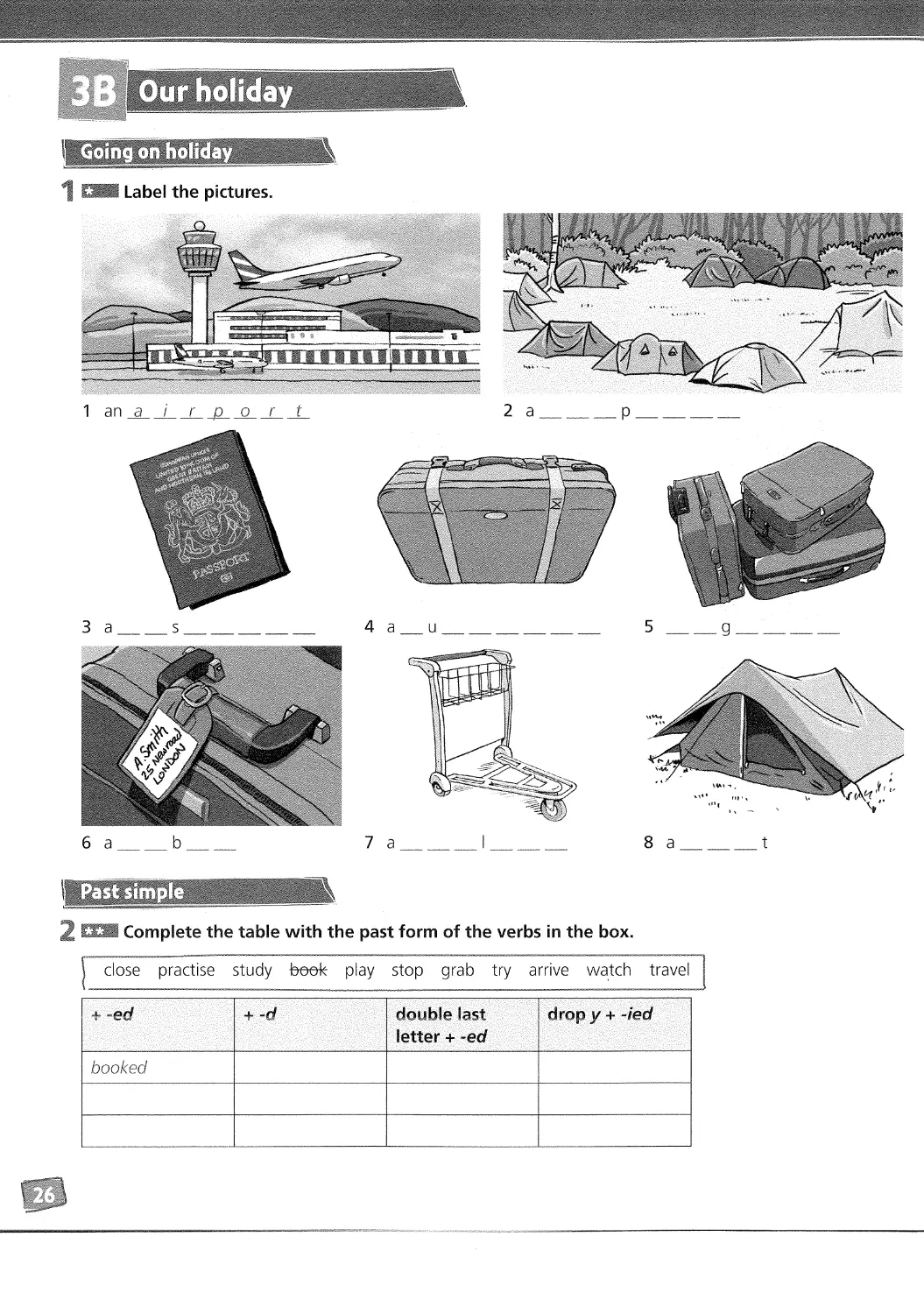
2пя Complete the table with the past form of the verbs in the box.
3 а ЕИЗ^^ЗЛЗ) Listen to Jude and complete
his diary for last week.
Monday 11	practised 1 the guitar
Tuesday 12	visited * 2
Wednesday 13	watched 3	at Simon's house
Thursday 14	played 4	with Ian
Friday 15	tried to learn more 5	words
Saturday 16	collected my 6	for the school trip
Sunday 17	packed my 7	for the trip
b Correct the sentences.
1 On Monday, Jude practised the piano.
He didn't practise the piano.
He practised the guitar.
2 On Tuesday, Jude visited his friend.
4 Write about your last holiday. Write
affirmative and negative sentences using
the verbs.
1 stay
I stayed on a campsite.
I didn't stay at a hotel.
2 visit
3 On Wednesday, Jude watched football at
Simon's house.
3 play
4 On Thursday, Jude played tennis with Ian.
4 watch
5 On Friday, Jude tried to learn more French
words.
6 On Saturday, Jude collected his train ticket.
5 try
6 pack
7 On Sunday, Jude packed his black suitcase.
Holiday problems 1
11 Regular and irregular verbs
1 EXH Complete the crossword with the past
form of the verbs.
Across
2 forget
4 leave
Down
1 steal
2 feel
5	fall	3	get
7	bite	6	lose
8	take	7	break
2	Listen to five people talking
about holiday problems. Match the people
(1-5) to the problems (a-e).
1	Casey	\dj
2	Johnny
3	Tom	| |
4	Tracey
5	Liz	П
a He / She felt ill.
b He / She broke his / her leg.
c He / She lost some money,
d He/ She missed a train-.
e He / She dropped a camera.
3 ЕЕЯ Put the verbs in brackets into the correct
form. Then number the pictures in the correct
order.
1	Mum and dad packed (pack) the suitcases.
Susie and I didn't help (not help) them.
2	We(say) goodbye to our dog. He
(not come) with us. He(stay)
at home with my grandma.
3	We(get) to the airport at ten o'clock.
We(not miss) our plane. The plane
(leave) at twelve o'clock.
4	Mum and dad(sleep) on the plane.
Susie and I(not sleep). We
(play) games.
5	We(arrive) at our hotel at six o'clock in
the evening. We(not go) out. We were
tired.
6	We(go) to the beach. Dad
(not have) his swimming trunks. He
(forget) to pack them.
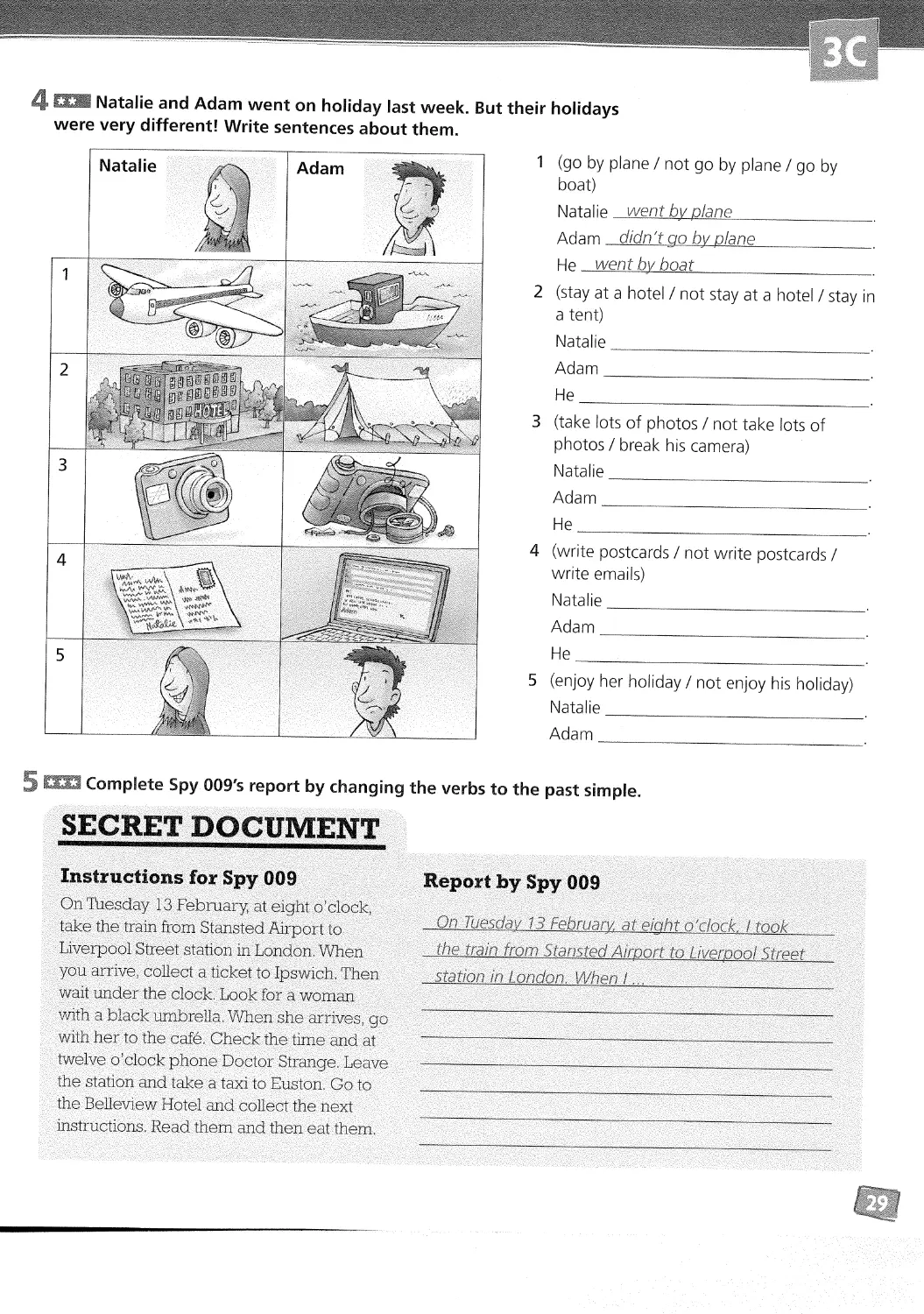
4 КЙЯ Natalie and Adam went on holiday last week. But their holidays
were very different! Write sentences about them.
5
1	(go by plane / not go by plane / go by
boat)
Natalie и/ent by plane__
Adam didn't go by plane_
He went by boat_________
2	(stay at a hotel I not stay at a hotel / stay in
a tent)
Natalie.
Adam.
He.
3	(take lots of photos / not take lots of
photos / break his camera)
Natalie.
Adam.
He.
4	(write postcards / not write postcards /
write emails)
N ata I i e.
Adam.
He.
5	(enjoy her holiday / not enjoy his holiday)
Natalie.
Adam.
5 E333 Complete Spy 009's report by changing the verbs to the past simple.
SECRET DOCUMENT
Instructions for Spy 009
On Tuesday 13 February at eight o’clock,
take the train from Stansted Airport to
Liverpool Street station in London. When
you arrive, collect a ticket to Ipswich. Then
wait under the clock. Look for a woman
with a black umbrella. When she arrives, go
with her to the cafe. Check the time and at
twelve o’clock phone Doctor Strange. Leave
the station and take a taxi to Euston. Go to
the Belleview Hotel and collect the next
instructions. Read them and then eat them.
Report by Spy 009
On Tuesday 13 February at eight o'clock, I took
the train from Stansted Airport to Liverpool Street
station in London. When I...
Mat's holiday
Holidays
1 ЯВИ (j^TTTlG) Listen to Lucy and complete her
email.

OQC
Dear Helen,
We are on holiday in 1 Croatia . \Ne arrived on
2	at ten o’clock in the evening. I was
very tired and sad because Sandy, my dog,
wasn’t with me. We left Sandy with our
3	, Mr Jackson. Then we drove our car
to the airport and took a plane.
We are staying at a campsite right next to the
4	. There’s a picture of it in this email.
At night, we sleep in a5! I like it but
mum and dad don’t!
The weather is good - sunny and 6.
We go swimming every day. I brought my
camera with me, so I can show you some
photos when I come home.
Bye!
Love from Lucy


t:
О
H
1 Where did you go on holiday?
Jess Match the questions to the answers.
1	Were you on holiday last week?
2	Where did you go?
3	How did you travel there?
4	Where did you stay?
5	Did you take your dog with you?
6	Who looked after him?
7	What did you do in Rome?
8	What did you like best?
a In a hotel.
b The food!
c No, we didn't.
d Yes-rwe-were?
e We visited the Colosseum.
f To Rome.
g Our friends.
h By train.
[d
!!
I went to New York.
2 with?
I went with my parents and my brother.
3 ?
We stayed at my aunt's house.
4 ?
We saw the Statue of Liberty and Central Park.
5 ?
I bought some jeans and a T-shirt.
6 ?
I ate lots of burgers and hot dogs.
7 ?
Yes, I had a great time!
8 ?
We got home last Saturday.
4 П Write questions and short answers.
2 travel / plane?
1 go/Paris?
Did you go to Paris?
No, I didn't.
3 stay/hotel?
4 buy/anything?
5 Read Martha's mum's note. Martha
didn't do everything on the note. Write the
questions her mum asks when she gets home.
Then write Martha's answers.
PovCt forget!
Finish у о ar homework. У b o'clocK
Feed the cats /
Practise the pietvvo )(
Pack, your suitcase
Have something to eat J a sandwich
Look, after Kieran! У placed games
1	®	Did you finish your homework?
© Yes, I did.______________________________
2	® When it?
о _________________________________________
3	® the cats?
о _________________________________________
4	® thepiano?
о _________________________________________
5	® your suitcase?
о _________________________________________
6	® What to eat?
7	® What you and Kieran do?
о _________________________________________
5 like / the food?
6 swim/the sea?
j Writing	23
6 И Martha is writing her diary about what
she did today. Complete the diary with the
information from exercise 5.
Munn and Dad went ouf this evening. They left me
а noie wif/n lots of things to do on if. I didn’t do
everything I
First, I fnisfed my homework ...
Progress check
2 Complete the dialogue with was or were.
1 Label the pictures.
Donna 1 Were you at home yesterday
evening?
Nick No, 12 at the cinema.
Donna 3 your parents with you?
Nick Yes, they4.
Donna 5 the film good?
Nick Yes, it6 great!
3 Write the past form of the verbs in the box in
the correct column.
eat miss walk watch go be drive
forget have leave lose take break
shout phone play come swim arrive
Regular verbs	Irregular verbs
arrived	was / were
4 Use the past form of verbs from exercise 3 to
complete Amelia's blog.
Yesterday I 12___________the train to
the cinema but I 13____________my ticket.
I 14___________my dad and he
15___________in his car. He 16___________
me back home.
On Friday I 1_ 2 I 3	 4 5 I 6	 So I 7		had a bad day. I late for school, because _ the bus. The teacher at me, because I to do my homework. And _ my sandwiches at home! 	very hungry all day.	i
□n Saturday, beach.	we 8	to the
We 9	 10		in the sea and wonderful food. Later, I
11	a football match on TV.
5фпэ Listen to Adrian talking about his
holiday. Did he do all of these things? Write
Y (Yes) or N (No). Then write sentences about
his holiday.
1 Travel by plane	N
2 Stay in a hotel
3 Like the food
4 Go to the beach
5 Break his camera
6 Lose his money
7 Write postcards
8 Enjoy his holiday
1	He didn't travel by plane.____________________
2
3
4
5
6
7
8
6 Complete the questions.
1	« When did you go swimming?
о I went swimming on Friday afternoon.
2	* How________________________?
© I went there by bus.
3	® Who?
© I saw Melanie there.
4	• What after that?
о We went to a restaurant for a pizza.
5	® it?
© Yes, we liked it very much.
6	® When?
© We got home at eight o'clock.
Write the answers and tick (/) the correct box.
1 Last year I went on
holiday to Brighton.
We travelled by
i
We stayed in a
2
”--------------------------------
2 ® Did you go swimming last Friday?
© No, I 1. And 12
(not see) my friends, because they
3(not be) at home.
I can say what I didn't do in the past.
 Yes ЯИ1 need more practicej|
3 Where / go on holiday last month?
1
travel / by train?
2
When / arrive?
3
What / do there?
4
have I a good time?
5
I can ask about things people did in the past.
Ц Yes Ц I need more practice

Food and drink
Types of food and drink
1 ЕйШ Circle the food which is different.
1	lemonade tea (eggs) coffee
2	tuna chicken lamb pork
4 tomatoes beef lettuce beans
5 orange juice cheese pasta rice
3	satsumas bananas salmon grapes
2 EUS Write the foods from exercise 1 in the correct column.
Meat	Fish	Fruit	Vegetables	Other	Drinks
				eggs


3 ESS8 Look at what three people usually eat for lunch. Complete the texts.
Hannah
Becky
Gary
I usually have two ]eggs and
two 2s. I love them with
cheese and 3t. I always
have 4t to drink.
For lunch I often have a
5s and lots of 6f.
I like 7a, 8b and
9o. I also have
10l to drink.
I usually have a big lunch. I love
11c,________with 12b and
13r. I don't like tea or
coffee. I usually drink 14o
j---------
Ordering food
a! an
4ma(ftr .18) Ed and Penny are ordering lunch.
Listen and write what they order.
Penny: Meat/Fish:1 chicken
Vegetables I other:* 1 2
Drink:3____________
Ed:	Meat / Fish: 4
Vegetables / other:5
Drink:6____________
Penny: Dessert: 7
Ed:	Dessert:8
Countable and uncountable nouns
5 ЪЯЛ Write the underlined food items in the
correct column.
Countable nouns	Uncountable nouns
beans,	,	lettuce,	,

—
бшв Look at the picture. Complete the text
with a, an or -.
We're having a picnic! We've got1
pasta and 2 cheese. There are 3
sandwiches, there is 4 chicken and there's
5 big chocolate cake. And there's
6 big salad. We put7 egg (only
one),8 lettuce and 9 tomatoes in
it. To drink, we've got10 cola and
11 lemonade. And there is 12 fruit,
too. We've got13 bananas, apples and
14 orange.
Writing
What do they want to eat and drink?
Make sentences.
Annie - beef, rice, banana
Charlie - cheeseburger, chips, apple
Dean - sandwich, satsumas, cola
Liam - chicken, beans, lemonade
Vicky - spaghetti Bolognese, orange, tea
1 Annie wants beef, rice and a banana.
2 Charlie wants.
3 Dean wants.
4 Liam wants.
5 Vicky wants.
1 аж Complete the crossword.
Down
2 £Sii Write the words from exercise 1 in the
correct column.
Meat	Fruit	Vegetables	Drinks	Other
ham
a!an, some
3 ЕИЙ Circle the correct word.
1 I'd like a /(so me) water, please.
2 Can I have an / some apple, please?
3 Carole usually has a / some ham sandwich for
lunch.
4 My mum often cooks a / some beef for our
Sunday dinner.
5 Can I have an / some egg for breakfast, please?
6 My brother likes pasta with a / some cheese.
7 Ben had a / some big chocolate cake for his
birthday.
8 We've got some / an onion, a / some tomato
and a / some ham here.
9 There are a I some mushrooms and an / some
onions in this spaghetti Bolognese.
10 There's a / some bread and a I some butter
here. We can make a / some sandwiches.
some and any
Д E3H 01.19) Listen to William and his mother.
Tick (/) the things they have got and cross (X)
the things they haven't got.
Jixic.e-
Ьге-лЗ
IaAvk
butter
^o^kurt
su^oir
5 EOS Answer the questions about what
William's family have and haven't got.
1	® Have they got any juice?
© Yes, they've got some juice._________________
2	® Have they got any bread?
© No, they haven't got any bread.______________
3	« Have they got any ham?
© _____________________________________________
4	® Have they got any butter?
0 _____________________________________________
5	® Have they got any milk?
0	____________________________________________
6	® Have they got any coffee?
О _____________________________________________
7	® Have they got any yoghurt?
0 _____________________________________________
8	® Have they got any sugar?
0
Q ЕЗЗЗ Has Dominika got a healthy lunch?
Complete the text with some, any, a or an.
I
HEALTHY
®
0
a
©

Healthy things
a sandwich with chicken
cheese
fish
fruit (apples, bananas, oranges)
salad
pasta or rice
water or fruit juice
Unhealthy things
cola, lemonade
sweets
crisps
chips

Dominika hasn't got1 a chicken sandwich.
She's got2 hamburger with 3
chips. That's not very good for lunch! But Dominika
has got4 cheese and 5 fruit. She
hasn't got6 apples or bananas, but she's
got7 orange. She hasn't got8
pasta or rice and she hasn't got9 water.
But she's got10 fruit juice. She hasn't got
11 cola or lemonade today. She hasn't got
12 sweets and she hasn't got13
crisps. She's got14 carrot. Dominika loves
carrots!
Mut goes shopping
I.
How much?I How many? 'J
Quantities
'I И Put the things into the correct bag.
3 ESii Label the pictures. Use the words in the box.
dog food lemons water onions
bread salt sausages mushrooms
a packet a loaf a carton a tin
a bar a pot a bunch a bag
How much?
1 dog food
2
How many?
3
5 lemons
4
------------- 6
8
1 a packet of crisps 2
Complete the questions.
1	® How much chocolate do you eat a
week?
© I eat a bar of chocolate a week.
2	® packets of crisps do
you eat a week?
© I eat three packets of crisps a week.
3	й cola do you buy a
week?
© I never buy cola.
4	® bread do you eat for
breakfast?
© I eat two slices of bread for breakfast.
5	® water do you drink a
day?
© I drink about one litre of water every
day.
6	® pots of yoghurt do you
eat a week?
© I don't eat yoghurt. I don't like it.
3 	4
5 	6
7	8
4n Circle the correct word.
1	Can I have a kilo of (cheese)/ cheeses?
2	Kelly has got a bunch I bar of grapes for lunch.
3	How much / many loaves of bread are there in
the shop?
4	How much / many cartons of milk do we need?
5	Do you want a pot/tin of yoghurt?
6	How much / many bread is there in the shop?
5 ESI Find six more differences between the
two pictures.
gCT 1.2'6) Rebecca is doing the shopping.
Listen and complete her shopping list.
Writing
7	ПП Use the words to write a dialogue
between Nick and a shop assistant.
1	Nick (have / you / bread)
Have you got any bread?
2	Assistant (yes / how I you need)
	?
3	Nick (two / please)
4	Nick (also / need / eggs)
5	Assistant (sorry / we / not / got / eggs)
1	In picture A there are two sZ/'ces of bread , but
in picture В there is one slice of bread . (bread)
2	In picture A, but in picture В
	. (chocolate)
3	In picture A, but in picture В
______________________. (yoghurt)
4	In picture A, but in picture В
. (bananas / grapes)
5	In picture A, but in picture В
	. (fish)
6	In picture A, but in picture В
	. (milk)
7	In picture A, but in picture В
	. (crisps)
6	Nick (have / you / apples)
	7
7	Assistant (yes I how / you want)
	7
8	Nick (want / two / apples / and / small bunch /
bananas, please)
1 ОШ Label the pictures.
2 ЕЕИ Complete the word puzzle.
1	You boil potatoes in this.
2	You cook food in this.
3	You put soup in this to eat it.
4	You put food in your mouth with this.
5	You cut your food with this.
6	You eat soup with this.
7	You do this to cheese before you put
it on your spaghetti Bolognese.
3 ВЗЗИ .21) Listen to the cooking instructions and
number the pictures in the correct order.
a I an, some, the	'S
4 SJS38 Complete the text with a, an, some or the.
How to make
country style chicken
What do you need? 1 Some chicken, о/
course! And 2 potatoes and 3
tin of tomatoes. You can use:
4 onion (one is enough), 5
red pepper (one whole pepper), 6
mushrooms, 7 big carrot and 8
peas. And you need 9 oil for frying.
Oh, and don’t forget 10 large frying pan!
First, wash 11 vegetables. Then peel
them with 12 knife. Chop 13
chicken, onion, carrot and potatoes into small
pieces. Boil 14 potatoes and carrots in
a saucepan and fry 15 chicken. Then
add '6 onions, pepper and mushrooms
to the chicken. You can then put in 17
potatoes, carrots, peas and 18 tin of
tomatoes. Mix everything together and serve it
on plates.
6 H'S! Circle the correct word.
Ross Let's make '(a]/ an chocolate cheesecake!
Julia OK! Have we got 2a few / any chocolate?
Ross Yes, there's 3a few I a little chocolate in
the cupboard. How 4much I many do we
need?
Julia A lot, about two big 5tins I bars.
Ross We haven't got enough. We can buy
6some / any.
Julia And of course, we need ‘a I some cheese,
too.
Ross We've got 8a few / a little cheese in the
fridge. Look at the recipe. How 9much /
many flour do we need?
Julia About a cup. And we need 10a / some
water. And what about 11a / an egg? How
12much / many eggs do we need?
Ross Two. We need 13some / any sugar and
14some / any butter. Oh, dear. We haven't
got 15some / any sugar.
Julia We can buy a 16bowl / bag of sugar in the
shop, too.
7 E333 Write your own recipe. Write the
ingredients and instructions.
5 ЕИЯ Complete the sentences with a little or a
few.
1 I like pizza with a little ham and cheese.
2 There are slices of chocolate cake
on the table.
3 Can I have butter on my potatoes?
4 Martin always has bread with her
soup.
5 Tara is making pasta with
tomatoes and cheese.
6 We need to buy more cups and
plates for our party.
Progress check
1 Circle the correct word.
4 Look at the picture. Write the answers to the
questions in exercise 3. Use some, any, a or an.
1 knife (fork) spoon
3 carrots grapes
satsumas
4 beans tomato
lettuce
1	There _	isn 't any water.
2	There _		orange juice in the bottle
3	There _		eggs.
4	There _		bananas.
5	There _		tea.
6	There _		sandwich.
5 bread butter
cheese
6 onions peas
mushrooms
5®32Z)
the pictures (a-h).
1 Angela	2 Ed
5 Barbara	6 Peter
Listen and match the people (1-8) to
3
7
2 Write C for countable or U for uncountable.
1	tuna	U	6	rice
2	onions	7	carrots
3	lemonade	8	cola
4	grapes	9	bananas
5	chicken	10	pasta
3 Complete the questions with much, many, is
or are.
1	How _	much water	is		there?
2	How_		orange juice.		in the bottle?
3	How _		eggs		_ there?
4	How _		bananas			there?
5	How _		tea		. there?
6	How _		sandwiches _		there?
6 Complete the text with the words in the box.
cleaned summer mixed dropped bowl
any some cakes spoon oven recipe
ingredients butter kitchen
Fiona and Leo didn't have anything to do. It was
their1 summer holiday but it was raining.
'What can we do today?' asked Fiona. 'We can
make some 2,' said Leo. 'There's a
great3 in this magazine. We can
make lemon cakes.'
'Have we got all the 4?'
asked Fiona. Leo looked in the cupboard.
'We've got flour and sugar, but we need some
eggs and 5.' 'Have we got
6 lemons?' asked Fiona. 'There
aren't any on the shelf,' said Leo. 'That's OK,' said
Fiona. 'There are 7 oranges on the
table.'
They put the ingredients in a 8.
Leo 9 them together with a
10. They made fifteen cakes and
put them in the 11. 'We've got
thirty minutes,' said Leo. 'We can play computer
games.'
After an hour, Leo shouted, 'Oh no! Our cakes!'
They ran to the 12. Fiona opened
the oven. She grabbed the dish, but it was hot and
she 13 all the cakes on the floor.
That afternoon, Fiona and Leo had lots of things
to do. They loaded the dishwasher and
14 the kitchen. But they didn't
have any delicious orange cakes...
Write the answers and tick (/) the correct box.
1 For breakfast,
1 I have a slice of bread,
2 and 3.
I can say what I eat.
 Yes Ц I need more practice
3 ® How 1 apples have we got?
° We've got a 2- about five or six.
® How 3 butter have we got at home?
о Only4 butter. We need more.
I can plan the shopping.
Ц Yes 11 need more practice
I can say how to make my favourite food.
Ц Yes 11 । ?d more practice

The United Kingdom
1 Rearrange the letters to make ten things, then find them on the map.
1 The New	Forest			(sorFet) is very	7	The Channel			(ulTnen) goes
beautiful.			from England to France.
2 Ben Nevis is a			(noamiutn).	8	The Forth		__ (reiBgd) is in
3 Windermere is a			(akel).		Scotland.
4 The Severn is a	(ivrre).	9	The Shard building is a
5 The M1 is a		(owymrtoa).		(akpscyesrr) in London.
6 The Isle of Man is an			(sdilna)	10	Pendine Sands is a			(ecbah) in
between England and Ireland.			Wales.
2 Match the words from exercise 1 to the
places on the map.
«
3 ESH Look at the map. Complete the questions
and answers. Use the words in the box.
deep high long wide
1	How It'S —	long is the River Severn? 354 km long
2	How		is Ben Nevis?
	lt's_	•
3	How		is Lake Windermere?
	It's _		in the middle.
4	How		is the Shard skyscraper?
	lt'S_	1
5	How		is the Channel Tunnel?
	It's _
6	How		is the Forth Bridge?
	It's _	1	-		-	-	-
7	How		is the M1 motorway?
	It's __
4 £OSI f^.1.23) Listen to someone talking about
Loch Ness and answer the questions.
1	How	long	is Loch	Ness?
It's 36	km long.
2	How	wide	is Loch	Ness?
It's wide.
3	How	deep	is Loch	Ness?
It's deep.
4 How many islands are there in the Loch?
5 How high is Mealfurvonie?
It's about high.
6 How long is the walk?
It's about long.
НИ Make full questions.
1 wide / the Champs Elysees in Paris?
How wide is the Champs Elysees in Paris?
It's 70 metres wide.
2 high / Mount Etna in Sicily?
6 а EH3 Look at the information about The
London Eye. Complete the text with one word
in each gap.
Name:
Where:
Facts:
The London Eye
London, next to
River Thames
135 m high
Opened:
9/3/2000
3.5 million visitors
each year
See from top: all
of London
This 1 is The London Eye. It’s 2
London. It’s next to the River Thames. It’s 135
3 high. It opened 4 9 March
2000 and 3.5 million people 5 the
| London Eye each year.6 the top, you
can see all of London.
I.....................,	, .........
It's 3,329 metres high.
3 What / GB / short for?
It's short for Great Britain.
4 long / River Danube?
b Now write about the Eiffel Tower.
It's 2,850 km long.
5 Where / Cardiff?
It's in Wales.
6 Milan / big city?
Name:	The Eiffel Tower
Where:	Paris, next to River Seine
Facts:	324 m high Opened: 31/3/1889 Over 6 million visitors each year See from top: all of Paris
This
Yes, it is. It's a very big city.
7 deep / Lake Geneva?
It's about 300 metres deep in some places.
8 long / the Interstate 44 road in the USA?
It's 4,991.81 km long!
North and south
й
I The weather
1 QH Label the pictures. Use the words in the
box.
2 Complete the crossword.
Across
1 > on a compass.
4	September, October and November are months
in ...
5	The opposite of dry.
7	March, April and May are months in ...
2 A great time of year to swim in the sea in Europe.
3 t on a compass
5	A cold time of year in Europe.
6	When it is sunny and dry, we can say it is...
7	| on a compass.
Comparative adjectives
Circle the correct word.
Ц England isfbigger)/ smaller than Wales,
gj London is hotter / cooler than Athens.
• Щ Mt Blanc is shorter / higher than Ben Nevis.
% Щ Holland is flatter / wider than Switzerland.
I he Eiffel Tower is higher / older than the
s Tower of London.
i В The Thames is longer / shorter than the
I ‘ Nile.
ftetto cso вши «ж яйм вал» tasoe ваши sate» паяя моя ясне квп амав кий*
Д ES3i (||) 1.24) Listen to the descriptions. Label
the people with the correct names.
Lisa Anna Kate Eve Pam
6eeq Write sentences. Make comparisons.
2 thin/thick
Complete the sentences with the
comparative form of the adjectives in brackets.
1	France is much smaller than Canada,
(small)
2	Who do you think is-
Jennifer Lopez or Angelina Jolie? (beautiful)
3	I am in summer than in
winter, (happy)
4	I think English is than French,
(difficult)
5	The south is much than the
north, (flat)
6	Antarctica is than any other
place in the world, (cold)
7	Parrots usually live than dogs
or cats, (long)
8	I think swimming in the sea is
than swimming in the pool, (nice)
4 wet / dry
5 quiet / crowded
The mountains
2ия Find the places on the map. Write the
correct letters (a-h).
® the Amazon	E	* Everest	□
• Vatican City		® the Atlantic	□
® the Nile		• the UK
® Tokyo		® the Pacific	□
4s™ Look at the map again and answer the
questions.
1 Which continent is the largest?
Asia
2 Which continent is the smallest?
Згхя Write the places in exercise 2 with the
correct descriptions.
1 It's a river.	the Amazon, the Nile
2 It's a country. ________________________________
3 It's an ocean. _________________________________
4 It's a capital. ________________________________
5 It's a mountain. _______________________________
3 Which island is the biggest in Oceania?
4 Which continent is south of Europe?
5 Which continent is the River Amazon in?
6 Is North America bigger or smaller than Europe?
! Superlative adjectives
Writing
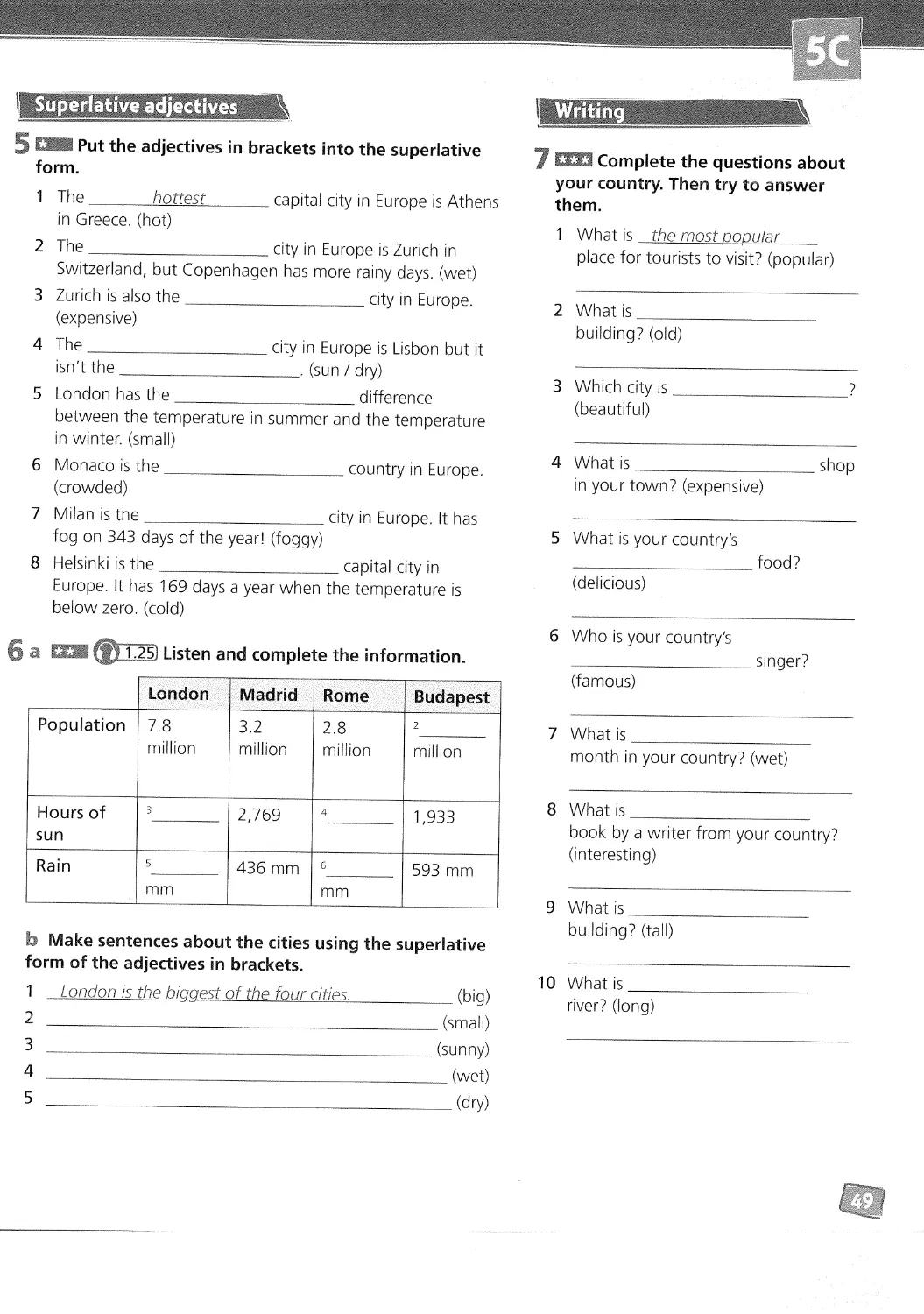
5 ISM Put the adjectives in brackets into the superlative
form.
1	The hottest capital city in Europe is Athens
in Greece, (hot)
2	The city in Europe is Zurich in
Switzerland, but Copenhagen has more rainy days, (wet)
3	Zurich is also the city in Europe,
(expensive)
4	The city in Europe is Lisbon but it
isn't the. (sun / dry)
5	London has the difference
between the temperature in summer and the temperature
in winter, (small)
6	Monaco is the country in Europe,
(crowded)
7	Milan is the city in Europe. It has
fog on 343 days of the year! (foggy)
8	Helsinki is the capital city in
Europe. It has 169 days a year when the temperature is
below zero, (cold)
6 a ШИ Listen and complete the information.
/ £333 Complete the questions about
your country. Then try to answer
them.
1 What is the most popular
place for tourists to visit? (popular)
2 What is_______________________
building? (old)
3 Which city is?
(beautiful)
	London	Madrid	Rome	Budapest
Population	7.8 million	3.2 million	2.8 million	2 million
Hours of sun	3	2,769	4	1,933
Rain	5 mm	436 mm	6	593 mm
			mm
4	What is shop
in your town? (expensive)
5	What is your country's
	food?
(delicious)
6	Who is your country's
	singer?
(famous)
7 What is_____________________
month in your country? (wet)
8 What is__________________________
book by a writer from your country?
(interesting)
b Make sentences about the cities using the superlative
form of the adjectives in brackets.
1	London is the biggest of the four cities.(big)
2	(small)
3	(sunny)
4 (wet)
5 (dry)
9 What is_______________________
building? (tall)
10 What is________________________
river? (long)
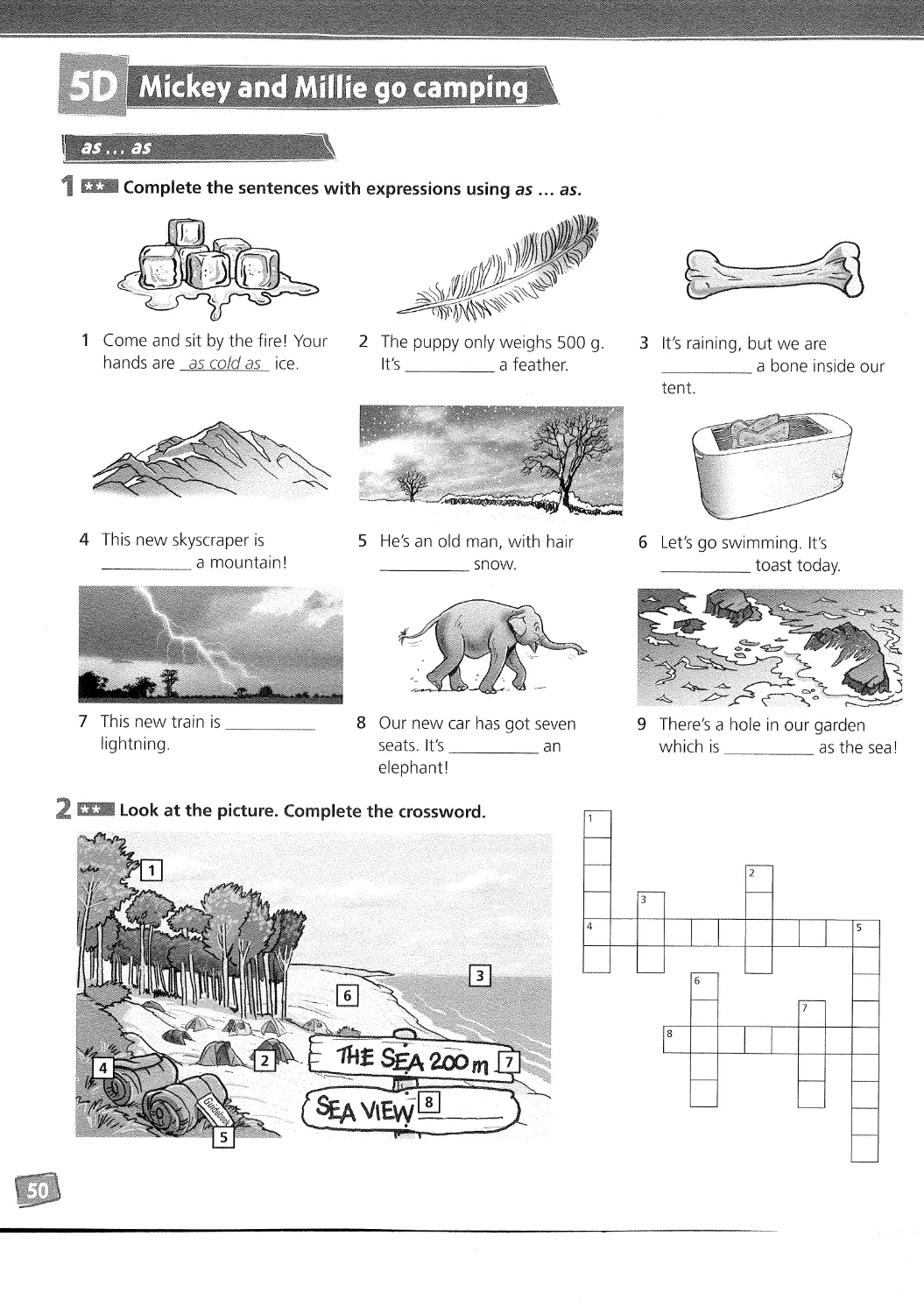
IВШ Mickey and Millie go camping
as... as
1 ЕЖЖ Complete the sentences with expressions using as ... as.
1 Come and sit by the fire! Your
hands are as cold as ice.
2 The puppy only weighs 500 g.
It's a feather.
3 It's raining, but we are
a bone inside our
tent.
4 This new skyscraper is
a mountain!
5 He's an old man, with hair
_____________snow.
6 Let's go swimming. It's
_____________toast today.
7 This new train is
lightning.
8 Our new car has got seven
seats. It's an
elephant!
9 There's a hole in our garden
which is as the sea!
2 1ХЯ Look at the picture. Complete the crossword.
3 a EES! (jh 1.26) Listen and number the places in the
correct order.
	Sennen Beach	St Ives Beach	Praa Sands Beach
1 Longest	7	3	2
2 Most popular
3 Best for swimming
4 ЕЕИ Complete the sentences with better,
the best, worse or the worst.
® Do you want a pizza?
о Yes, but not from here. The pizzas in here
are 1 the worst in the world.
® They're * 2 than in Pizza Power.
о Oh yes. I forgot that restaurant. You're
right. Pizza Power is 3 than this
place.
® So where's4 place for pizzas?
о Pete's Pizzas. They're delicious!
® You look happy.
о Yes. My project was 5 in the
school.
® Really? Was it6 than Joe's?
® Yes, it was. I was surprised because my last
project was much 7 than his.
He usually does very good projects but this
was8 one he's done this year.
	Caravan	House	Hotel
4 Most expensive
5 Most comfortable
6 Most exciting
5 ES3 Make either a superlative sentence
(S) or a comparative sentence (C).
1 difficult (school subject)
The most difficult school subject
is Maths.(S)
2 interesting (place to visit in your country)
_________________________________(S)
3 bad (pop group)
_______________________________(C)
4 good (month of the year)
_______________________________(C)
5 good (place to eat in your town)
_________________________________(S)
6 funny (TV programme)
_______________________________(C)
7 nice (place to go for a walk in your town)
_________________________________(S)
8 big (city in your country)
_________________________________(C)
b Complete the sentences.
1 Praa Sands is longer than St Ives
beach, but the longest beach is Sennen.
2 Praa Sands is than Sennen,
but beach is St Ives.
3 Praa Sands is beach for
swimming because it has the warmest water. St Ives is
for swimming than Sennen.
4 Housesare than caravans,
but places to stay are hotels.
5 Hotels are places to stay.
Houses are than caravans.
6 Hotels are places to stay than
houses, but places to stay are
caravans on big campsites.
Prog ress check
Write the answers.
1	North and South America are examples of
continents .
2	China and Russia are examples of c,
3	The Atlantic is an example of an о.
4	Paris and London are c cities.
5	The four points of a compass are:
3 Make full sentences.
1	She's got beautiful eyes. They I blue I sky.
They're as blue as the sky.
2	I've got all my books in my bag and I can't pick it
up. It / heavy / lead.
3	I keep my books at school, so my bag isn't
heavy. It / light / feather.
6	Spring and summer are two of the s.
The two others are: .
7	The Amazon and the Nile are two long
r.
8	The highest m in the world is
Everest.
9	A is the coldest continent.
10	The Channel T runs under the sea
from England to France.
4 Don't touch me. Your hands / cold / ice.
5 It's very sunny today and 20°C I It / warm / toast.
6 David won the 100 metres race. He / fast /
lightning.
Match the pictures to the sentences.
1	It's cloudy.	\b]	5	It's	cold.	I	]
2	It's raining.	I	!	6	It's	snowing.	Г	)
3	It's foggy.	I	7	It's windy.	Г	I
4	It's warm.	[	j	8	It's sunny.
Complete the sentences with the comparative
or superlative form of the adjectives in
brackets.
1	Amy and Donna are the friendliest girls in
our class, (friendly)
2	James is friend in the world,
(good)
3	A Rolex watch is than a
Swatch watch, (expensive)
4	I think that weather is in
summer, (nice)
5	Tom is than Dan. But Luke is
boy in our class, (tall)
6 It rained all day yesterday, but today the weather
is. (good)
7 Yesterday was day of my life!
It was than the day I broke
my arm! (bad)
8 Rome is than London in the
winter but it is also .
(hot / wet)
Progress check 1
1 Write the answers.
1	North and South America are examples of
continents .
2	China and Russia are examples of c.
3	The Atlantic is an example of an о.
4	Paris and London are c cities.
5	The four points of a compass are:
3 Make full sentences.
1	She's got beautiful eyes. They / blue / sky.
They're as blue as the sky.
2	I've got all my books in my bag and I can't pick it
up. It / heavy / lead.
3	I keep my books at school, so my bag isn't
heavy. It / light / feather.
6	Spring and summer are two of the s.
The two others are:.
7	The Amazon and the Nile are two long
r.
8	The highest m in the world is
Everest.
9	A is the coldest continent.
10	The Channel T runs under the sea
from England to France.
4 Don't touch me. Your hands / cold / ice.
5 It's very sunny today and 20°C! It / warm / toast.
6 David won the 100 metres race. He I fast /
lightning.
2 Match the pictures to the sentences.
4 Complete the sentences with the comparative
or superlative form of the adjectives in
brackets.
1	Amy and Donna are the friendliest girls in
our class, (friendly)
2	James is friend in the world,
(good)
3	A Rolex watch is than a
Swatch watch, (expensive)
4	I think that weather is in
summer, (nice)
5	Tom is than Dan. But Luke is
boy in our class, (tall)
6 It rained all day yesterday, but today the weather
is. (good)
7 Yesterday was day of my life!
It was than the day I broke
my arm! (bad)
8 Rome is than London in the
winter but it is also.
(hot / wet)
2	It's raining.	□	6	It's snowing.	□
3	It's foggy.		7	It's windy.
4	It's warm.	I 1	8	It's sunny.	□
5ф1 2Z) Listen and complete the text
I'm from New Zealand. There are only about
1 four million people in my country.
There are more 2 than people
here! New Zealand is one of the most
3 countries in the world.
There are two big islands. South Island is
4 than North Island, but the
weather in North Island is better - it's
5__________________and sunnier. But it isn't sunny all
the time. In winter it6 a lot.
There are a lot of hills and high mountains in South
Island. The highest is Mount7. It's
3,754 metres high. The capital city is in the North
Island. It's called 8.
Write the answers and tick (/) the correct box.
—-—---------—     —"	' ——
2 I think summer is* 1(good) than
winter. It is 2(hot) and 3
(sunny). Winter is 4(dark) and
5(wet) than summer. But6
(nice) season is spring!
I can compare different things.
fees need more practice |
3 The capital city of my country is 1. The
highest mountain is 2 and the longest
river is 3. I think the most beautiful
place in my country is 4.
I can talk about my country.
Ц Yes  I need more practice
Wproqrammes
Types of TV programmes
1 EZ3I Match the programmes (1-9) to
the descriptions in the TV guide (a-i).
1 a quiz show	[T|
2 a soap opera
3 a cartoon	О
4 a police drama
5 a documentary
6 the news
7 a reality show
8 a comedy programme
9 a film
a Learn all about whales and dolphins
in this great new programme.
b What is Mickey Mouse going to do
this time? Watch all your favourites -
Tom and Jerry, Donald Duck, ...
c It's a story about students at a wizard
school, with Daniel Radcliffe as Harry,
and Emma Watson as Hermione.
d Do you remember what happened
last week? Jessica's boyfriend arrived,
but she wasn't there ... Find out what
happened to him in tonight's show!
e This is the funniest programme in the
world!
f Who is going to leave the house this
week? On this show, you have a chance
to choose. Decide and phone us!
g They drive fast cars and catch robbers
... See what happens tonight in
Miami Cops.
h Find out what is happening right now
around the world.
i How much do you know? Try to
answer these questions!
2 KIM Complete the dialogue with the words in the box.
j show opera TV- guide record interview control
Nick Where's the 1 TV guide ?
Amber I'm reading it. Oh great! My favourite soap
2	is on soon. Oh no! There's a good chat
3	on at the same time. They always
4	interesting people like film stars and
pop stars.
Nick You can 1 2 3 4 5 the soap opera and watch it
later.
Amber Good idea. Can I have the remote 6 7 8 9?
Nick Here it is.
3 (W 1.28* Listen to two people talking about
television programmes. Number them in the order they
are going to watch them. There are two programmes
that they aren't going to watch.
a । I a sports programme
b Q|a cartoon
c I j a police drama
d Г ] a chat show
e > J the news
f | j a reality show
g О a comedy programme
h | j a film
going to
4 Ш Complete the dialogue with going to and
the verbs in brackets.
1	have a tennis lesson I Monday?
Is Paul going to have a tennis lesson on Monday?
No, he isn't. He's going to have a piano lesson.
2	revise for a test / Tuesday?
Karina What1 are we going to watch (watch)
on TV tonight?
Alec Well, 12_______________________(not miss)
	The Simpsons tonight. It's my favourite programme. Do you remember what happened last week?
Dad	There's a football match on TV tonight. It starts at seven o'clock.
Karina	Oh no! It ends at ten o'clock. 3	(you 1 watch) it all?
Mum	No, he isn't! My favourite quiz show is on at eight o'clock. 14	 (watch) that. And you and your brother5	(finish) your homework before you watch anything.
Karina	OK, Mum. I don't mind. I 6	(record) In the House. It's my favourite reality show. I can watch it later.
Alec	So, what about The Simpsons? Dad 7	(watch) the football, Mum 8	(see) her programme, Karina 9	 (not miss) her reality show - what about me?
Dad	Don't worry. I 10	(do) some work this evening. I don't really want to watch the football!
Alec /	Dad!
Karina
5ш Read Paul's diary for next week.
Complete the questions and answers.

U MONDAY have a piano lesson
TUESDAY revise for a test
- S ----------------------------
" WEDNESDAY do the 'Science project
Л. -----------------------------
THURSDAY watch The Simpsons on TV
FRIDAY see the new film with Nigel
" Э
3 do the English project / Wednesday?
4 watch Friends on TV / Thursday?
5 see the new film with Nigel / Friday?
б Ш Write sentences.
What are you and your friends going to do?
1	This weekend, I____________________________
2	My sister / brother / friend
3	We_________________________________________
4	My pa rents________________________________
What are you not going to do?
5	I__________________________________________
6	My sister / brother / friend
7	We_________________________________________
8 My parents__________________________________
Ц EMil Write the adverbs.
adjective	adverb
bad	badly
beautiful
careful
easy
fast
good
happy
hard
heavy
horrible
loud
quick
quiet
slow
sudden
2 ЕЕЯ Complete the sentences with the adverbs
3 S, a monster 4 He is walking
jumped out in front of c.
them.
5 They are talking
6 He is working
h.
in exercise 1.
1 She is acting
badly
2 They are moving
s.
7 They are watching 8 They are laughing
q.	h.
9 She is acting
w
10 He is driving
f
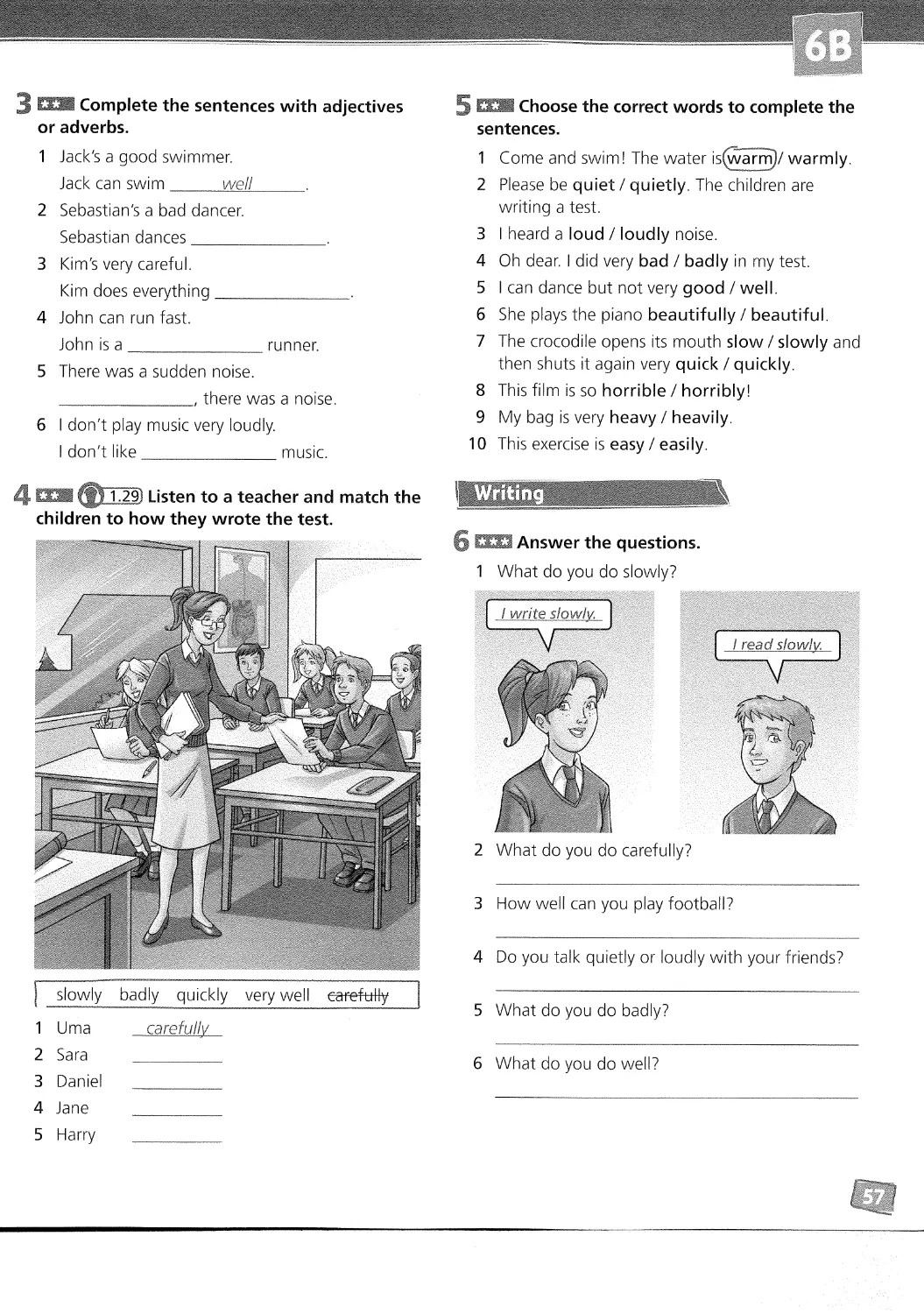
3 1ОЙ Complete the sentences with adjectives
or adverbs.
1	Jack's a good swimmer.
Jack can swim well.
2	Sebastian's a bad dancer.
Sebastian dances.
3	Kim's very careful.
Кi m does everyth i n g.
4	John can run fast.
John is a runner.
5	There was a sudden noise.
, there was a noise.
6	I don't play music very loudly.
I don't like music.
5 ееи Choose the correct words to complete the
sentences.
1	Come and swim! The water isfwarm)/ warmly.
2	Please be quiet / quietly. The children are
writing a test.
3	I heard a loud / loudly noise.
4	Oh dear. I did very bad / badly in my test.
5	I can dance but not very good / well.
6	She plays the piano beautifully / beautiful.
7	The crocodile opens its mouth slow / slowly and
then shuts it again very quick / quickly.
8	This film is so horrible / horribly!
9	My bag is very heavy / heavily.
10	This exercise is easy / easily.
4	(Wl-29) Listen to a teacher and match the
children to how they wrote the test.
slowly badly quickly very well carefully
1	Uma carefully
2	Sara _________________
3	Daniel _______________
4	Jane _________________
5	Harry ________________
6 ЕПЭ Answer the questions.
3 How well can you play football?
4 Do you talk quietly or loudly with your friends?
5 What do you do badly?
6 What do you do well?
2 пои Complete the sentences with types of
films.
1	The new Mr Bean film is the funniest comedy
film in the world!
2	I was so scared. I really don't like h
films.
3	I like films with a happy ending, especially
r c, where there is a
wedding at the end.
4	My favourite films are t. They are so
exciting and full of action.
5	I don't like m because I hate it when
people start singing in the middle of a film.
6	I love all of the Star Wars	films	because I like
s f.
7	The	Harry Potter films are	my favourite
f films.
8	Rio is a great c about a parrot but
Madagascar3 is better!
3 ® Answer the questions in full.
1	What is your favourite film?
My favourite film is...
2	What kind of films do you like best?
3	What kind of films don't you like?
4	Who is your favourite actor?
5	How often do you watch films at the cinema?
6	How often do you watch films on TV?
>ave to
4keis
Look at the list. What do Howard and
Meg have to do this week?
5 BS (Д11.30) Listen to Simon talking about his
weekend. Tick (/) the things he has to do and
cross (X) the things he doesn't have to do.
	Howard	Meg
take the dog for a walk		X
go to the dentist	X	у
practise the piano	у	У
revise for a test		X
help with the housework	у	у
cook dinner		у
buy a present	у
Writing , . ,
6 ЕЭЗ Write the questions and answers about
yourself using have to.
1 you / do homework at the weekend?
Do you have to do homework at the weekend?
Yes, I do. I don't have to do homework on
Saturdays but I have to do homework on
Sundays.
2 you / go shopping with your parents?
3 you and your classmates / stand up when a
teacher comes into the classroom?
4 What jobs / you / do in the house?
1	H о wa rd has to take the dog f о r a wa I к.
2	Meg doesn't have to take the dog for a walk.
3	Meg to the dentist.
4	Howard and Meg the piano.
5	They for a test.
6	They with the housework.
7	Meg dinner.
8	She a present.
5 How often / you / tidy your room?
6 What time / you / get up / on school days?
I The lost penguin
к
Making suggestions
1 ESH! Complete the dialogue with the
sentences (a-f).
a Let's come again next weekend.
b----Let's go-te-the^eo-to-see-the-penguins-.-
c Let's look on the signpost.
d They're £2 each.
e Why don't we come back later when it's quieter?
f Why don't we walk?
Tom I'm bored. What shall we do?
Matt 1 Let's go to the zoo to see the penguins.
Tom	Good idea!
Tom	I hate waiting for the bus.
M a tt 2_________________________________________
Tom OK.
Matt Let's buy a map of the zoo.
Tom 3____________________________________________
Matt Oh, OK, let's not buy one!
Tom Where are the penguins?
Matt I don't know.
Tom 4____________________________________________
Matt Wow, there are lots of people here.
Tom 5____________________________________________
Matt No, I think they are feeding the penguins
now. It'll be fun.
Tom I'm glad we came. This is great.
Matt 6___________________________________________
Tom Good idea.
2 Match the words in A to the words in В
to make phrases.
A
В
go —shopping
play \	a pizza
watch \ a film
have \ computer games
go	\ a CD
pack	\ the match on TV
watch	' on the Internet
listen to
our suitcases
Зеея Complete the sentences with the phrases
in exercise 2.
1	® Why don't we have a pizza?
© That's a good idea. I'm going to have ham
and mushrooms on mine.
2	* Let's.
& OK. We can look for information about the
theatre.
3	® Shall?
© Yes, that's a good idea. I must buy a present
for my mum.
4	® Let's.
© OK. Who is playing?
5	® Why_____________
__________________?
© OK. But be careful, I'm really good. I always
win every game!
6	® Shall?
© OK. Shall I meet you in front of the cinema?
7	® Why_____________
__________________?
© OK, but not loudly because my mum hates
loud music.
8	® Shall today?
© Good idea. We have to be at the airport at
eight o'clock in the morning.
the same meaning.
5 ЕШ @T‘3l) Listen and complete the notes.
1 a Let's watch something else.
	Friday
	doinq io: the cinema
	Meeting at (place):
	Meeting at (-Lime):
b Shall we watch something else?
c Why don't we watch something else?
2
	Saturday
	doinq to:
	Meeting al (place):
	Meeting at (lime):
2 a Shall we go swimming?
b Let's swi m mi ng.
	Sunday
	doinq to:
	Meeting al (place):
	Meeting a} (Lime):
	Wednesday
	doinq to:
	Meeting a} (place):
	Meeting at (time):
b Shall a cake?
c Let's a cake.
5 a Let's have a cola.
b Why a cola?
c Shall	a cola?
5
	Thursday
	doinq to:
	Meeting aL (place):
	Mee-Ling at (Lime):
Progress check	1
1 Circle the correct words.
1	'Why are you laughing?' 'I'm watching the
news /(^comedy shovy)/ a documentary.'
2	My uncle works for a TV company. He makes
documentaries / films / police dramas about
animals.
3	River City is one of the most popular films /
reality shows / soap operas in Scotland. Every
week, people watch to see what happens to
their favourite characters in the story.
4	It's important to know about things in the world.
That's why I always watch comedy shows /
reality shows / the news.
5	I love police dramas / quiz shows / soap
operas, because I often answer all the
questions!
6	When they make a character in the news /
a soap opera / a cartoon, they have to draw
lots of pictures and then use a computer to
make them 'move'.
2 Write the types of films.
1	It's very funny. Owen Wilson is the main actor
and he is the funniest man in the world!
comedy
2	Lots of famous people do the voices of the
characters. Ben Stiller does the voice of Alex the
lion.
3	It's about a magic land full of wizards and
talking animals.
4	The singing is great and the dancing and
costumes, too.
3 Complete the dialogue with going to and the
verbs in brackets.
® Are you 1 going to study (study) tonight?
о No, I'm too tired.
12(watch) a DVD.
® Why don't you come to the sports centre with
me? 13(play) basketball.
о Who 4(play) with?
® Tom, Anna and some other friends.
We 5(meet) at seven o'clock.
о 6(you / take) the bus?
® No, 17(go) by bike. It isn't far.
© Wow. Cycling and basketball in one evening!
® So,8(you / come) with us?
« I don't know. My parents9
(be) home late and I have to look after my little
sister. We 10(watch) Diary of a
Wimpy Kid. She loves that film.
® OK. Well, enjoy the film.
© Thanks.
fgTl,32) Listen to an interview with an actor
and circle the correct words.
The actor:
1	works(hard)/ slowly.
2	learns his lines easily / carefully.
3	is going to work on television / make a film.
4	isn't going to work in America I get married.
5	sings badly / well.
The interviewer says:
6	Shall we sing a song / watch a film?
7	Let's talk about your new film I family.
8	Why don't you go to Hollywood / make a CD?
5 It's really scary. Sometimes you have to close
your eyes when the monster comes out of the
dark night.
6 It's about a man who travels in time and space.
5 Make sentences using have to / don't have to.
1	Ted is a teacher.
(work on Saturdays I prepare lessons)
He doesn't have to work on Saturdays.
He has to prepare lessons.
2	Miranda is on a school trip.
(go to school / get up early)
3	They are school children.
(do homework / go to school on Sundays)
4 Annie is a waitress.
(cook food / bring food to customers)
Write the answers and tick (/) the correct box.
1
On Monday 1I 'm going to
watch TV . (watch TV)
Next week my parents
. (buy an
3 go/Let's/to/cinema/the
® 1 Let's go to the cinema i
idea / That's / good I a
о 2______________________________________
we / Why / meet I don't / the bus stop / at
© 3	7
we / meet / Shall / two o'clock / at
5 Seth works in a zoo on Saturdays.
(feed the animals / buy a ticket for the zoo)
Q 4 5?
OK / you / See / there
1®G33) Listen to the interview and answer the
questions.
1	Has he got any brothers or sisters?
Tes, he has. He's got one brother.
2	What subjects does Josh like?
3	What sports does Josh do?
4	When does he do sport?
5	What does he usually do at the weekend?
6	Does he like playing computer games?
7	What jobs does he have to do in the house?
3 Write the correct form of the verbs
in brackets.
1 Every Tuesday, after school I have
(have) a music lesson. But today
I(go) to the dentist, so I
(not have) a music lesson.
2 Karl usually(watch) TV in
the evenings, but tonight he
(play) football for the school team.
3 I always(read) a lot when
I go on holiday. At the moment, I
(read) a book by Phillip
Pullman.
4 Angela(not / usually / go)
to bed late. But tonight she
(go) to bed later, because she has to
finish her homework.
2 Write about Tony and Stephanie. Use a verb and the
correct form of have to.
Д What did Sara buy? Write questions
and answers with some or any.
1 Did she buy any oil?
Yes, she bought some oil.
2 ____________________________________
3 Tony and Stephanie the shopping.
4 Stephanie the recycling.
5 Tony the recycling.
6 Tony and Stephanie the floor.
4 ____________________________________
5
5 Complete the sentences with one word in each
gap.
1	Are	there any	grapes?
2	there any	meat?
3 There some cheese.
4 There some apples.
5	How eggs	are there?
6	How milk	is there?
7 I went to the shop and bought a of
bread.
8 Do you have one of toast for breakfast
or two?
7 Complete the text with the correct form of the
adjectives in brackets.
I think Looney Tunes is funny, but Tom and Jerry is
much * 1 11 1 funnier (funny). But the 2
(good) cartoon of all is The Simpsons. My favourite
character is Homer. He's 3(old) and
4(fat) than Marge, his wife. She's much
5(nice) than Homer. Maggie, the baby,
is6(young) of the three children.
The 7(old) child is Bart. I think he's
8(bad) at schoolwork in his class!
S Look at Valerie's diary. Write what she is going
to do or not going to do next week.
6 What happened to Andy on holiday? Complete
the sentences with the words in the box in the
past simple tense.
eat close leave lose start take
be watch drive get have
Hi Craig,
The first day of our holiday 1 was
terrible! First, we 2 to the wrong
hotel. We finally 3 to our hotel
at ten o’clock. But they 4 the
restaurant at half past nine! I was lucky -
I 5 an apple in my bag.
The next morning, we 6 a taxi to
the beach. We drove for a long time. At the
beach, it7 raining. We 8
in a cafe and 9 the rain.Then we
went back to the hotel by bus. But my mother
10 her bag on the bus! So we
11 all our money. It was a bad day!
Bye,
Andy
Monday play tennis badminton
finish my homework,
o Wednesday	***
Melanie Match a DVD
( )	vdth Melanie
Thursday	cook dinner for T&n Dan
Friday boy tickets fir the
concert
1 On Monday, she isn't going to play tennis.
She badminton.
2 On Tuesday, she her
homework.
3 On Wednesday, Valerie and Melanie
_________________________to the cinema.
They a DVD.
4 On Thursday, Valerie_______________________
dinner for Tom. She_______________________
dinner for Dan.
5 On Friday, she tickets
for the concert.
1 We You They	have buy	a holiday in May. presents for the children.
He She It	visits lives	Scotland in November, on a farm.
a To make the present simple, we use the infinitive.
For he, she and it, we add -s.
b We use the present simple to talk about things that
happen repeatedly. We also use the present simple
to talk about facts that are generally true.
c Note these spelling rules:
1 With verbs ending in -o, add -es.
She goes to the sports centre every day.
2 With verbs ending in -ch, -sh, -s, -x or -z,
add -es.
We pronounce the -es as /iz/.
She watches TV.
1.2 Present simple: negative
To make the negative of the present simple we use
don't/ doesn't and the infinitive.
I don't live in Britain. She doesn't like school.
1.3	Present simple: questions
To make questions in the present simple, we use
do / does and the infinitive.
Do you go to bed late on Saturday?
For Wh- questions we add the question word at the
beginning.
Where do you live? When does she do her homework?
1.4	Present simple: short answers
To make short answers, we do not repeat the main verb.
We use only do / does in the affirmative and don't /
doesn't in the negative.
Do you play the violin?
Does he live on a farm?
Yes, Ido. (NOT Yes, I play.)
No, he doesn't. (NOT No,
he doesn't live.)
1.5	Ordinal numbers 4
1st	first	20th	twentieth
2nd	second	30th	thirtieth
3rd	third	40th	fortieth
4th	fourth	50th	fiftieth
5th	fifth	60th	sixtieth
6th	sixth	70th	seventieth
7th	seventh	80th	eightieth
8th	eighth	90th	ninetieth
9th	ninth	100th	hundredth
10th	tenth
a We use ordinal numbers for dates.
My birthday is the twenty-seventh of June.
b We also use them to describe the order of a noun.
This is my fourth visit to England.
We live on the second floor.
Translate
New Year's Day is the first of January.
November is the eleventh month of the year.
1.6	Adverbs of frequency^
always
usually / normally
often
sometimes
never
a We use adverbs of frequency to tell us how often
something happens. We ask questions about frequency
with How often ...?
How often do you go to the cinema?
b We usually put adverbs of frequency before a verb.
I usually watch TV in the evening.
c When there is an auxiliary verb (eg. do, don't), we put
adverbs of frequency after the auxiliary and before the
main verb.
/ don't often go to the cinema.
What do you usually watch on TV?
d We usually put adverbs of frequency after the verb be.
It's always cold in winter.
Translate
I usually watch TV before I do my homework.
We don't often go to football matches.
How often do you go to pop concerts?
I'm usually not at home on Wednesdays.
1	am 'm	sleeping. reading a magazine. wearing jeans.
We You They	are 're
He She It	is 's
We use the present continuous to talk about something
that is happening at the moment we speak.
Note these spelling rules:
1 with most verbs, add -ing.
go - going
2 with verbs ending in -e, drop the -e and add -ing.
take - taking
3 with verbs ending in a short vowel and one consonant,
double the consonant.
sit - sitting
resent continuous: negative Л
2.5 Present simple and continuous
I go to school every day.
I am going to school now.
Tony gets up at eight o'clock every day.
It is eight o'clock now. Tony is getting up.
Translate
She waits for the bus every day.
She is waiting for the bus at the moment.
1 You He She It We They	must	go home now.
We use must when it is necessary to do something.
We don't have an -s in the he I she I it form of must.
Peter must do his homework.
Translate
You must clean your room.
My sister must buy some new clothes.
To make the negative we add not after the verb be.
J 2.7- Subject and object pronouns 1
You are not going shopping.
(long form)
They aren't taking the bus.
(short form)
2.3 Present continuous: questions
a To make questions in the present continuous we put
Am, Is or Are in front of the subject.
He is taking a photo. Is he taking a photo?
b For Wh- questions we add the question word at the
beginning.
When are you going shopping?
Why is he taking a photo?
What are they doing?
Subject	Object
1	me
you	you
he	him
she	her
it	it
we	us
they	them
subject pronoun		object pronoun
We	love	him.
He	doesn't love	us.
[ 2.4 Present continuous: short answers
To make short answers, we use only the verb be, NOT the
-ing form. The verb be is in the full form, not the short form.
Translate
They see her on Saturdays.
She loves him.
Is she wearing her school uniform?
Yes, she is. (NOT Yes, she is wearing or Yes, she's)
I He She It	was	on holiday at school at the cinema ill in London out	last week, yesterday, on Monday.
We You They	were
We use the past simple of be to talk about a definite time in
the past.
3.4 Past simple of fee; short answers v
Yes,	I he she it	was.	No,	I he she it	wasn't.
	we you they	were.		we you they	weren't.
Translate
Were you at the cinema yesterday? Yes, I was.
Was he at school last week? No, he wasn't.
Translate
I was at home yesterday.
She was on holiday in England last year.
They were at the cinema on Thursday.
j 3.2 Past simple of fee; affirmative
I He She It	was not wasn't	on holiday at school at the cinema ill in London out	last week, yesterday, on Monday.
We You They	were not weren't
To make the negative we put not after the verb. To make
the short form, we use wasn't/ weren't.
3.3 Past simple of fee: questions 'I
Was	I he she it	here at five o'clock last week? at home yesterday evening? at the cinema on Friday? on TV yesterday? in England two years ago? at home yesterday? ill last week?
Were	we you they
Why were you at home yesterday?
a To make questions, we put the verb in front of the
subject.
He was at home yesterday. Was he at home yesterday?
3.5 Past simple affirmative: \i
regular verbs
I stayed in bed for three days.
He watched TV all day.
It arrived four days ago.
We needed help last week.
They visited us after school.
a We use the past simple for actions and states which
happened at a particular time and are now complete.
We often use it with time expressions, such as yesterday,
ago, on (+ day), in (+ month I year), and at (+ time).
b To make the past simple tense we add -ed to the
infinitive.
c Note these spelling rules:
1	With verbs ending in -e, add -d.
We closed our books.
2	With verbs with a short vowel and one consonant at
the end, double the consonant and add -ed.
They stopped the car. They robbed the bank.
They travelled to Spain.
3	With verbs ending in -y, remove the -y and add -ied.
He studied in London. I carried the bag.
4	Note this pronunciation rule:
When the stem of the verb ends in -d or -t, the -ed
ending is pronounced /id/.
She needed an operation. I wanted a book.
b For Wh- questions we add the question word at the
beginning.
3.6 Past simple; negative
1 He She It We You They	did not didn't	have lunch yesterday.
To make the negative of the past simple of regular and
irregular verbs we use did not I didn't and the infinitive.
He went to school. He didn't go to school.
Translate
Did you see your teacher on holiday? No, I didn't.
He didn't write the letter yesterday.
3.7 Past simple affirmative: 'J
irregular verbs________________J
I had a headache.	It bit me.
You wrote a letter.	И/е got some medicine.
He went to London. They drove home.
She took my temperature.
A lot of verbs are irregular. There is no rule to make these
verbs. You need to learn the form for each verb. See page
79 for a list of some irregular verbs.
Й 3.8 IPast simple: Kes/Ato questions
Did	1 hurt him? he drop the camera? she cut her finger? it ring? we play rugby? you break your leg? they have a headache?
Did is the past of do. To make questions in past simple,
we use Did and the infinitive. We put Did in front of the
subject.
To make short answers, we use only did I didn't - NOT the
infinitive.
Did he play football yesterday?
Yes, he did. (NOT Yes, he played.)
Did they go to Paris?
No, they didn't (NOT No, they didn't go.)
3.10 Past simple: Wh- questions
a For Wh- questions we add the question word at the
beginning.
When did you go to England?
Why did you come home?
b When the question word is the subject, we use the full
verb.
Who bought a new car?
What happened to Mandy?
Translate
Did you go to London last year?
Did they play tennis yesterday?
When did she go to Paris?
4|	1
4.1 Countable and	'I
uncountable nouns	'
We need some tomatoes. We need some bread.
How many do we need? How much do we need?
a Some nouns are countable. These nouns can be singular
or plural.
an apple	six apples
an onion	lots of onions
a sausage	WOg of sausages
b Some nouns are uncountable. These have no singular or
plural form.
some milk a lot of rice a little butter
She went to London. Did she go to London?
3.9 Past simple: short answers
Yes,	1 he she it we you they	did.	No,	1 he she it we you they	didn't.
a potato
a hamburger
an apple
an egg
a A I an are indefinite articles. When the following noun
begins with a consonant, we use a. When the following
noun begins with a vowel (or vowel sound), we use an.
b We don't use a I an with plurals or uncountable nouns,
(see 4.3)
Grammar summary
Translate
You need a frying pan.
You need an egg.
I like apples.
There's sugar in this tea.
4.3	some and any
I've got some books.
I haven't got any food.
Have you got any money?
a We use some and any with countable nouns in the plural
and with uncountable nouns.
some books
some money
b We use some when the sentence is positive.
We use any when the sentence is negative or a question.
/s there any milk?
There isn't any time.
4.4	How much?/ How many? \
We use How many to ask about the quantity of countable
nouns.
How many oranges have you got?
We use How much to ask about the quantity of
uncountable nouns.
How much cheese do you want?
Translate
How much milk do we need?
How many eggs do we need?
4.5	Definite and indefinite articles^
You need some oil and a frying pan.
Put the oil in the frying pan.
a We use a I an when we mention a singular, countable
noun for the first time.
b We use the when we know or can see which thing or
person we are talking about or when we mention it for a
second time.
c We use the same form of the for singular and plural
countable nouns and for uncountable nouns.
the apple the onions the water
Translate
Slice the onions.
Put the flour in the bowl.
I've got a sandwich for lunch.
4.6 Quantity; a little and a few
a little a few	salt butter carrots
\Ne use a little and a few to talk about small quantities.
We use a little with uncountable nouns and a few with
plural countable nouns.
How	long high deep	is this street? is this building? is this ocean?	It's 400 metres long. It's 20 metres high. It's 2 kilometres deep.
We use How with an adjective to ask about the
measurements of something. We can use the same adjective
in the answer.
How long is this river? It's 500 kilometres long.
Translate
How wide is the Amazon?
How deep is the Atlantic Ocean?
5.2 Comparatives
We use the comparative when we compare two things or
people. After a comparative we use than.
Canada is larger than England.
a To form the comparative of most short adjectives
(adjectives with one syllable), we usually add -er.
small - smaller warm - warmer
b With adjectives which end in -e, just add -r.
large - larger nice - nicer
c With adjectives which end in one consonant after a short
vowel, double the consonant and add -er.
hot - hotter big - bigger
d With adjectives which end in -y, change the -y to -/' and
add -er.
dirty - dirtier easy - easier
e With adjectives with two or more syllables (except when
the second syllable ends in -y), put more before the
adjective.
interesting - more interesting
f Some adjectives are irregular.
far - further
Translate
Scotland is smaller than England.
I am taller than my best friend.
5.3 Superlatives
Adjective	Comparative	Superlative
small	smaller	the smallest
nice	nicer	the nicest
wet	wetter	the wettest
heavy	heavier	the heaviest
modern	more modern	the most modern
far	further	the furthest
We use the superlative when we compare three or more
things or people. We use the before the superlative.
Mount Everest is the highest mountain in the world.
a To form the superlative of adjectives we use the and -est.
b With adjectives with two or more syllables (except when
the second syllable ends in -y), put most before the
adjective.
c Spelling changes also apply to the superlative form.
5.5 Comparatives and superlatives 1
with more and the most 1
Adjective	Comparative	Superlative
gorgeous expensive intelligent	more gorgeous more expensive more intelligent	the most gorgeous the most expensive the most intelligent
We make the comparatives of adjectives with more than
one syllable with more. We make the superlative with the
most, except where the second syllable is -y.
useful more useful the most useful
BUT happy happier the happiest
Translate
Geography is more difficult than Maths.
He bought the most beautiful card in the shop.
Who is the most intelligent person in the class?
as heavy as lead as white as snow
We use as... as to say two things or people are the same.
Sometimes we use as ... as in fixed phrases.
as warm as toast	as dry as a bone
Adjective	Comparative	Superlative
big	bigger	the biggest
hot	hotter	the hottest
easy	easier	the easiest
Translate
My sister is as tall as me.
That building is as high as a mountain.
Translate
I'm the oldest student in my class.
What is the furthest planet from Earth?
5.4 Comparatives and superlatives: !
good and bad______________________ *
Adjective	Comparative	Superlative
good	better	the best
bad	worse	the worst
The comparative and superlative forms of good and bad are
irregular.
Translate
I think football is better than basketball.
The worst subject is Maths.
Andy is the best student in our class.
1	am 'm	going to	visit Grandma next week, have pizza for lunch. buy a new CD tomorrow.
He She It	is 's
We You They	are 're
To make going to we use be and going to and the infinitive.
We can use going to to talk about what we have decided to
do in the future.
Translate
I'm going to watch TV this evening.
They're going to have lunch in a restaurant tomorrow.
Grammar summary
1 6.2 go/ng fo: negative

i	am not 'm not
He She It	is not isn't	going to	phone Tim. play in the garden. play computer games.
We You They	are not aren't
To make the negative form of going to, we use the correct
form of the negative of be.
Translate
He isn't going to get up early tomorrow.
We aren't going to eat at home today.
6,3 going tot questions
Am	1	going to	see you this evening? do today's homework? rain this afternoon? have a party?
Is	he she it
Are	we you they
What is she going to sing?
a To make questions with going to, we put the verb be in
front of the subject.
Are they going to play football?
b For Wh- questions we add the question word at the
beginning.
What are you going to do this weekend?
Translate
Are you going to have a pizza?
What are you going to do on your birthday?
[ 6.4 going tot short answers
Yes,	1	am.	No,	I'm	not.
	we you they	are.		we you they	aren't.
	he she it	is.		he she it	isn't.
To make short answers, we use the verb be, NOT going to.
Translate
Is she going to play tennis tomorrow? Yes, she is.
Are they going to phone you this evening? No, they aren't.
6.5 Adjectives and adverbs
Adjective	Adverb
The car is slow. He was quiet. She's happy.	It moves slowly. He spoke quietly. She's singing happily.
a Adjectives describe nouns - they say what something
is like.
He was a horrible man.
b Adverbs describe verbs - they say how you do
something.
She opened her eyes quickly.
c We make the adverb by adding -ly to the adjective.
careful - carefully loud - loudly
d With adjectives that end in -y, change the -y to -/ in
the adverb.
easy - easily happy - happily
e These adverbs are irregular.
fast - fast good - well hard - hard
This is a fast car. The car travels fast.
He is a good driver. He drives well.
She is a hard worker. She works very hard.
Translate
She's careful. She does her homework very carefully.
It's a good robot. It works very well.
6.6 have tot affirmative
1 We You They	have to	get up early, be very fit. stay outdoors.
He She It	has to
To show when something is necessary, we use have / has to
and the infinitive.
Translate
You have to wait.
He has to wear a uniform at school.
6.7 have to: negative
6.9 have to: short answers
I We You They	do not don't	have to	get up early, be very fit. stay outdoors.
He She It	does not doesn't
Yes,	I we you they	do.	No,	I we you they	don't.
	he she it	does.		he she it	doesn't.
a We use don't have to I doesn't have to when something
is not necessary.
b To make the negative, we add don't/ doesn't before
have to.
I have to get up early. I don't have to get up
early.
She has to work.	She doesn't have to
work.
Translate
We don't have to go to school on Saturdays.
He doesn't have to get up early.
6.8 have to: questions
	Do	I we you they	have to	wear a uniform? travel a lot? do a lot of homework? sleep outdoors?
	Does	he she it
	When do they have to go to bed?
a To make questions with have to, we use Do I Does, have
to and the infinitive.
b For Wh- questions we add the question word at the
beginning.
Translate
Do you have to wear a uniform?
Does she have to get up early?
To make short answers, we do not repeat have to or the
main verb. We use only do I does in the affirmative and
don't / doesn't in the negative.
Do you have to travel a lot? Yes, I do.
Does she have to work outdoors? Yes, she does.
Translate
Do they have to wear a uniform? Yes, they do.
Does she have to do her homework? No, she doesn't.
6.10 Making suggestions
a We make suggestions with:
1	Why don't we and the infinitive.
Why don't we play tennis?
2	Let's and the infinitive.
Let's watch TV.
3	Shall we and the infinitive.
Shall we meet outside the sports centre?
b We also use shall with question words to ask for a
suggestion.
Where shall we meet?
c If you agree with a suggestion, you can say:
OK, that's a good idea or All right.
Shall we go shopping? All right.
Why don't we go to the cinema? That's a good idea
Translate
Let's go swimming.
Why don't we have a pizza?
When shall we meet?
Introduction
introductions
best friend /.best 'frond/
dark hair /'da:k ,heo(r)/
garden /'ga:dn/
Her I His / My name's ... /'hs:, 'hiz, 'mai
.neimz/
He's / She’s ... /hi:z, ,fi:z/
Hi. /hai/
I'm ... /aim/
live /liv/
neighbour /'neibo(r)/
next door /.nekst 'doi(r)/
over there /.ouvo 'deo(r)/
people /'pirpl/
short hair /'.fort ,hco(r)/
the boy / girl with ... /do 'boi, 'дз:1 wid/
Their names are ... /'deo .neimz .a:(r), o(r)/
These are ... /'di:z ,a:(r), o(r)/
This is/That's... /'dis ,iz, daets/
Welcome to ... /'wclkom to/
What's her I his / your name? /.wnts 'Из:,
'hiz, jo: .neim/
Who are / Who's...? /'hu: ,a:(r), o(r),
hu:z/
At the sports centre
activity /aek'tivoti/
address /o'dres/
age /eids/
child (children) /tJ'aild ('tfildran)/
club /к!лЬ/
email address /'iimeil o.dres/
How old is ...? /'hau ,ould ,iz/
include /in’kluid/
interested (in) /'introstid (,in)/
join /djoin/
membership card /'membojip ,ka:d/
open /'эирэп/
postcode /'poustkoud/
receptionist /n'sepj’onist/
sport /sport/
sports centre /'sports .sento(r)/
telephone number /'tehfaun .плтЬо(г)/
Where does she live? /.weo doz Ji: 'liv/
Sports and activities
badminton /'baedminton/
basketball /'burskitborl/
fitness class /'fitnos .klars/
football /'fotborl/
karate /ko'rurti/
swimming /'swimig/
table tennis /'teibl .tenis/
tennis /'tenis/
volleyball /'vnliborl/
weight training /'wcit .treinig/
yoga /'jouga/
What can you do?
bike /baik/
both /bond/
Can you ...? /’kaen, kon , jur/
count from ... to ... /.kaunt from '... to/
divide ... by ... /di.vaid'... .bai/
English /'igglif/
French /frentj/
ice hockey /'ais hoki/
metre /'mirto(r)/
ride /raid/
speak /spirk/
spell /spel/
swim /swim/
throw /0гои/
write /rait/
Yes, I can. I No, I can't, /, jcs ,ai 'ksen, ,noo
,ai 'karnt/
In the street
bag /baeg/
box /boks/
carry /'kaeri/
holiday /'hnlodci/
How many ... are there? /.hau ,meni '...
,a: ,deo/
memory /'memori/
poster /'poosto(r)/
tennis racquet /'tenis .raekit/
wear /weo(r)/
What colour is / are ...? /'wnt ,кл!ог ,iz,
,ur(r), o(r)/
What's this? /.wots 'dis/
What is / are ... doing? /,wot ,iz, cu(r), a(r)
... 'dung/
Where is/are ...? /'wear ,iz, ,a:(r),o(r)/
What has he got?
a bit of /о 'bit ov/
a lot of /о 'lot ov/
apple /'aepl/
back /Ьаек/
chance /tjams/
Come on! /'клт ,nn/
dance /dams/
desk /desk/
do /du:/
drink /drigk/
everybody / everyone /'evribndi, 'cvriwAn/
exercise book /'eksosaiz ,buk/
give /giv/
have got /hov 'got/
hips /hips/
jump /очлтр/
key /ki:/
know /пои/
learn /1зт/
little /'litl/
make /meik/
mobile (phone) /.maubail ('foun)/
now /паи/
orange /'nrinds/
pen /реп/
photograph (photo) /'footograif (’foutou)/
ruler /'ruilo(r)/
sandwich /'samwitJV
song /sog/
swing /swig/
thing /Gig/
train /trein/
umbrella /лт'Ьге!о/
up /лр/
watch /wotJ7
1 My life
1A My daily life
after /'aifto(r)/
assembly /o'scmbli/
at the moment /ot do ‘moomont/
at the weekend /ot do wiik'end/
band /bamd/
before /bi'fo:(r)/
block of flats /.blnk ov 'flaets/
city /'siti/
correct /ko'rekt/
cue /kju:/
daily 7'deili/
don't / doesn't like /.daunt, .dAznt 'laik/
favourite /'feivorit/
flat (n) /fleet/
good (at) /'god (ot)/
grow up / grou 'лр/
happen /'пгепоп/
high school /'hai .skuil/
Гт ... years old. /.aim ... ,jioz 'ould/
in the evening /,in di: 'i:vnuj/
leave home /,li:v 'hoom/
lesson /'lesn/
life /laif/
like /laik/
morning /'momig/
near /nio(r)/
on the ... floor /.nn do ...'fbi(r)/
practise /'praektis/
really /'riioli, 'noli/
registration /.redgi'streijn/
right /rait/
school /sku:l/
sixth form college /'siksO .fo:m .kolidg/
subject /'sAbjikt/
too Ztu:/
walk /wo:k/
wrong /год/
yet 7jet/
Ordinal numbers
first /fa:st/
second /'sekond/
third /03id/
fourth /fo:0/
fifth /fif0/
sixth /siksO/
seventh /'sevnO/
eighth /eitO/
ninth /пат0/
tenth /tenO/
eleventh /i'levn0/
twelfth /twclfO/
thirteenth /03:'ti:n0/
fourteenth /fo:'ti:n0/
twentieth /'twcntioO/
twenty-first /.twenti 'foist/
twenty-second /twenti 'sekond/
thirtieth /'03itio0/
IB Birthdays
a long time /о .log 'taim/
birthday cake /'boiOdci .kcik/
birthday card /'baiOdei ,ka:d/
blow out /.blou 'aut/
bowling alley /'boolig .aeli/
buy /bai/
candle /'ksendl/
CD /.si: 'di:/
celebrate /'selibreit/
cinema /'sinama/
clean /klim/
close to /'klous to/
date /deit/
day /dei/
decide /di'said/
each /i:t!7
extra /'ekstro/
flowers /'flauoz/
get /get/
go on holiday /.goo ,on 'hnlodei/
Happy Birthday! * /.hacpi 'b3:0dei/
have a party /.haev a'pa:ti/
hear /hio(r)/
important /im'po:tnt/
in ... days’ time /.in ... ,deiz 'taim/
list /list/
look at /'luk ot/
make a wish ^meik о'wij7
maybe /'meibi/
money /'тлт/
month /тлп0/
name day /'neim ,dei/
not... much /'not ... .mAtJ7
older /'ouldo(r)/
only /'oonli/
own /ооп/
present (n) /'preznt/
problem /'problom/
same /seim/
sing /sig/
some /said, som/
someone I somebody /'sAmwAn, 'sAinbodi/
somewhere /'sAmweo(r)/
sweet (n) /swiit/
take /teik/
today /to'dei/
toy /toi/
What's the date today? /'wots da ,deit
to.dci/
When is your birthday? /'wen.iz.ioi
.b3i0dei/
Months of the year
January /'djaenjuori/
February /'februari/
March /moitJ7
April /'eipral/
May /mei/
June /djuin/
July /dgu'lai/
August /'oigost/
September /sep'tembo(r)/
October /ok'toobo(r)/
November /noo'vcmbo(r)/
December /di'sembo(r)/
1C Mickey, Millie and Mut
agree /o'grii/
аП /oil/
answer /'amsa(r)/
clever /'kleva(r)/
coffee /'kofi/
come from /'клт from/
Good idea. /.god ai'dio/
hate /heit/
I'm not sure, /.aim .not 'Joo(r)/
interview /'intovjui/
I've got no idea. /.aiv ,gnt 'nao ai.dio/
last /loist/
mean (v) /mim/
musical instrument /.mjuizrkl 'instramont/
oil /oil/
OK /(au 'kei/
penguin /'peggwin/
polar bear /.poolo 'bea(r)/
postman /'paustman/
quiz /kwiz/
rubber /'глЬэ(г)/
see /sii/
summer /'sAmo(r)/
think /Oink/
tree /tri:/
Well done! /.wel 'с1лп/
winter /'winto(r)/
1D At home
brilliant /'bnliont/
busy /'bizi/
cup /клр/
DJ /'di: .dgei/
do wrong /,du: 'год/
early /'3ili/
exam results /ig'zaem n.zAlts/
great /greit/
help /help/
How often ...? /'hao ,ofn, ,oftan/
iob /ОзпЬ/
knives and forks /,naivz an 'folks/
late (for) /'leit fa(r)/
meal /mi:l/
place /pleis/
plate /pleit/
put /pot/
robot /'raobnt/
text (v) /tekst/
Which ...? /witJ7
Household jobs
cook the dinner /,кок da 'dina(r)/
do the shopping / ,dui do ' fopig/
feed the cat /.fiid do 'kaet/
load the dishwasher /bud do 'dijwoja/r)/
make the bed /,meik do 'bed/
set the table /.set do 'teibl/
take / put out the recycling /.teik, ,pot
,aot do rii'saiklig/
take the dog for a walk /,teiк do ,dog for
о 'wa:k/
tidy your room /.taidi .jo: 'ru:m/
vacuum the floor /.vaekjuom do 'floi(r)/
Adverbs of frequency
always /'oilweiz/
never /'nevo(r)/
not often /.not'ofn,'ofton/
often /'ofn, 'nfton/
sometimes /'sAintaimz/
usually / normally /'juiguoli, 'noimoli/
Culture
also /'oilsoo/
autumn /'o:tom/
because /bi'koz, bi'koz/
beginning /bi'ginig/
bun /Ьлп/
chocolate egg /.tfoklot 'eg/
come together /,клт to'gedo(r)/
decorate /'dekoreit/
decoration /deko'reijn/
eat /iit/
festival /‘festivl/
fireworks /'faiowaiks/
followed by /'foloud ,bai/
go shopping /.goo'fopig/
half-term holiday /.naif Дз:т 'hnlodei/
hide /haid/
How long ...? /'hao .log/
hunt /hAnt/
in the middle of /.in do'midi ov/
match ZrnaetJ/
midnight /'midnait/
music /'mjuizik/
next /nekst/
put up /.pot 'др/
sale /sell/
several /'scvrol/
spring /sprig/
street party /'striit .paiti/
strike midnight /.straik 'midnait/
sweet (adj) /swiit/
switch on /.switj 'nn/
term /t3:m/
traditional /tro'difonl/
turkey /'t3iki/
typical /'tipikl/
vegetable /'vcd3tobl/
visit /'vizit/
Why ...? /wai/
Holidays and festivals
Boxing Day /'boksig ,dci/
Christmas /'krismos/
Christmas Day /.krismos 'dei/
Christmas Eve /.krismos 'i:v/
Christmas pudding /.krismos 'podig/
Christmas tree /'krismos .tri:/
Easter Z'i:sto(r)/
Easter egg /'iistor ,eg/
Easter egg hunt /‘iistor .eg .hAnt/
Easter Monday /.iisto 'mAndei/
Easter Sunday /.iisto 'sAndei/
Good Friday /.god 'fraidei/
New Year /.nju:'jio(r)/
New Year's Eve /.njui . jioz 'iiv/
English Across the Curriculum
about /o'baot/
add /aed/
at night /ot 'nait/
calendar /'kaclindo(r)/
Earth /з:0/
fix /fiks/
for example /for ig'zuimpl/
go round /.goo 'raond/
hour /'auo(r)/
in fact /.in 'faekt/
leap year /'liip jio(r)/
minute /'minit/
Moon /mum/
need /niid/
nobody /'noobodi/
once /wAns/
period /'pioriod/
sleep /sliip/
still /stil/
Sun /sAn/
tie your shoelaces /.tai .jo: ' Juileisiz/
turn Лзт/
until (till) /on'til (til)/
use (v) /juiz/
Your Project
dislike (v) /dis'laik/
event /I'vent/
go sledging /.goo 'sled3ig/
illustrate /'ilostreit/
mind /maind/
plan /plaen/
rest /rest/
scrapbook /'skraepbok/
snow /snoo/
stay /stei/
think about /'0igk o.baot/
title /'taitl/
trumpet /ЧглтрИ/
2 Animals
2A Our school trip
coach /kootJ7
farm /fuim/
guess /ges/
hamburger /'ЬжтЬз:до(г)/
listen (to) /'lisn (to)/
mime /maim/
outside /aot'said/
pigeon /'pid3in/
programme /'prougraem/
run /глп/
take (it in) turns /.teik (it .in) 't3inz/
trip /trip/
wait (for) /'weit (Го)/
young /jAg/
Farm animals
cat /kaet/
calf /kaif/
cow /као/
dog /dog/
duck /с!лк/
duckling /'dAklin/
foal /fool/
goat /gout/
horse /hois/
kid /kid/
kitten /'kiln/
lamb /laem/
pig /pig/
piglet /'piglot/
puppy /'рлрк
sheep /Jiip/
2B Mickey's model dinosaur
act /aekt/
bone /boon/
dinosaur /'dainosoi(r)/
ending /'endig/
glue /glui/
guard /gold/
I'm stuck! /.aim 'stAk/
instruction /in'strAkJn/
in the afternoon /.iri dii aifto'nuin/
look for /'lok .foi(r), fo(r)/
magazine /maego'zim/
model /'modi/
mouth /таоО/
move /muiv/
other /'лдо(г)/
something /'sAmOig/
Sorry. I Гт sorry, /'sori, .aim 'sori/
What’s wrong? /.wots'год/
2C My favourite animals
bark /bulk/
description /di'skripjn/
different /'difront/
egg /ед/
elephant /'eldont/
even /‘iivn/
fox /foks/
ground /graond/
Word l ist
group /gruip/
hole /haul/
in the morning /.in da 'moinig/
lizard /'lizad/
love /Iav/
meerkat /'miokast/
mouse (mice) /maos (mais)/
pair /реэ(г)/
plant /plaint/
poisonous /'paizanas/
quite /kwait/
scorpion /'skaipian/
size /saiz/
southern /'sAdan/
stripe /straip/
water /'waita(r)/
wildlife park /'waildlaif ,paik/
work /walk/
Wild animals
bat /baet/
camel /'kaeml/
crocodile /'krokadail/
dolphin /'dolfin/
eagle /'iigl/
frog /frog/
giraffe /dsa'roif/
hippopotamus /hipa'pntamas/
insect /'insekt/
kangaroo /kaengo'ru:/
monkey /'mAijki/
shark /folk/
tiger /'taiga(r)/
zebra /'zebra/
2D The story of Chicken Licken
come with /'клт ,wid/
den /den/
down /daon/
fall (down) /.fail ('daon)/
farmyard /'foimjoid/
Follow me. /.fnlou 'mil/
king /kiq/
meet /mut/
must /mAst,mast/
nut /llAt/
Oh dear! /,ao 'dia(r)/
pond /pond/
put out the rubbish /.put ,aot da 'глЬЦ/
road /raod/
side /said/
sky /skai/
stop /stop/
suddenly /'sAdanli/
tell /tel/
village /'V1I1CI3/
wash up /.woj 'лр/
way /wei/
while /wad/
wife (wives) /waif (waivz)/
Culture
apart from /a'poit from/
bear /beo(r)/
bird-watching /'baid ,wnt firj/
build /bild/
building /'bildig/
butterfly /'bAtaflai/
come out / клт 'aot/
common /'koman/
countryside /'kAntrisaid/
deer /dia(r)/
disappear /diso'pio(r)/
escape Zi'skeip/
fooa /fuid/
gardener /'goidno(r)/
government /'gAVonmont/
hedgehog /'hedxhog/
hobby rhnbi/
in danger /.in 'deindjafr)/
knock down /,nok 'daon/
large /lords/
local /‘loukl/
mention /'menfn/
most /maost/
of course /ov 'kais/
owl /aol/
panther /'paenOa(r)/
paragraph /'paeragroif/
pest /pest/
protect /pro'tekt/
pupil /'pjuipl/
rare /reo(r)/
restaurant /'restrnnt/
safari park /so'foiri .paik/
south-west /.sau0 'west/
squirrel /'skwirol/
topic /'topik/
town /taon/
try /trai/
wallaby /'wnlobi/
wild /waild/
wolf (wolves) /wolf (wolvz)/
zoo /zui/
English Across The Curriculum
air /ea(r)/
amphibian /aem'fibian/
backbone /'baekbaon/
breathe /briid/
carp /kaip/
classification /.klacsifi'keijn/
cold-blooded /.kould 'blAdid/
control /kon'troul/
fast /foist/
fly /flat/
fresh /f re J/
instead /m'sted/
keep /kiip/
land (n) /laend/
lay eggs /,lei 'egz/
mammal /'maerhl/
milk /milk/
more /mai(r)/
produce (v) /pro'djuis/
reptile /'reptail/
swimmer /fswima(r)/
temperature /'temprot fa(r)/
turtle /'t3itl/
type /taip/
unusual /An'juisual/
vertebrate /'vaitibrot/
warm-blooded /,waim 'bkdid/
whale /wed/
Revision
grass /grois/
on the phone /.on da 'faon/
organize /'oigonaiz/
wake up /,wcik 'лр/
zoo keeper /'zu: .Kiipo(r)/
Your Project
alone /a'laon/
cave /keiv/
from side to side /from .said to 'said/
funny /'fAni/
get on /.get 'rm/
nigh /had
interesting /'introstig/
look like /'luk ,laik/
nearly /'nioli/
reach /riitj/
sway /swei/
3	Holidays
ЗА Where were you last
weekend?
apartment /a'poitmont/
away /o'wci/
beach ZbiitJ/
expression /ik'sprej’n/
far /foi(r)/
hope /haop/
ill /d/
off /of/
rain /rein/
Really? /'riioli, 'noli/
sir /s3i(r)/
sports instructor /'spaits in.strAkto(r)/
theme park /'0i:m ,poik/
wedding /'wedig/
weekend /wiik'end/
Phrases with at, in, on
at a theme park /at 0 '0iim ,poik/
at a wedding /at a 'wedig/
at home /at 'haom/
at school /at'skud/
at work /at 'w3ik/
in bed /,in 'bed/
in the garden /.in do'goidn/
in the park /.in do 'poik/
on holiday /.on 'hnlodei/
on the beach /.on da 'biitj/
3B Our holiday
angry /'aeggri/
ask /oisk/
car wash /'koi ,wnJ7
close (v) /klaoz/
collect /ko'lekt/
enjoy /in'dsai/
grab /graeb/
fa nd (v) /laend/
notice /'naotis/
pack /раек/
phone call /'faun .kail/
pick up /.pik 'лр/
pocket /'pnkit/
shopping list /'fopig .list/
shout Tjaut/
someone else /.sAmwAn 'els/
thanks (for) /'0aegks fo(r)/
travel /'traevl/
unpack /лп'раск/
want /wont/
Holidays
airport /'epnait/
campsite /'kaempsait/
caravan /'kaeravaen/
label /'leibl/
luggage /'kgids/
passenger /'paesindso(r)/
passport /'poispoit/
plane /plein/
rucksack /'глкзаек/
runway /'rAnwei/
suitcase /'suitkcis/
taxi /'tacksi/
tent /tent/
ticket /'tikd/
trolley /'troli/
3C Holiday problems
by boat /.bai 'boot/
drive /draiv/
drop /drop/
Greetings from ... /'griitigz from/
have an accident /.liaev ah 'aeksidont/
hurt /bait/
irregular /I'regjalo/
journey /'d33ini/
luckily /'kkili/
not... any more /.not ... ,eni 'mai(r)/
on the way /.on da 'wei/
out of /'aut ov/
painful /'peinfl/
piece of paper /.piis ov 'peipa(r)/
postcard /'poustKoid/
regular /'regjola(r)/
separate (adj) /'seprot/
spooky /'spuiki/
top /top/
waiter /'wcita(r)/
Holiday problems
bite /bait/
break /breik/
fall over /.fail 'auva(r)/
feel seasick /.fill 'siisik/
forget /fa'get/
get lost /.get 'lost/
leave /liiv/
lose /luiz/
miss /mis/
steal /still/
take the wrong bus /.teik do .rng 'bAs/
3D Mut's holiday
go camping /,900 'kampig/
go sailing /.gau 'sellig/
took after /.luk 'azfta(r)/
picnic Z'pikmk/
unhappy /An'hapi/
Culture
abroad Za'braid/
by car / bai 'kai(r)/
cathedral Zko'fliidral/
end /end/
environment /in'vaironmont/
exciting /ik'saitig/
famous /'feimas/
ferry Z'feri/
go away /.gau o'wci/
sights /salts/
spend /spend/
tourist /'toonst/
tunnel /Члп1/
university /,ju:ni'v3isati/
visitor /'vizita(r)/
English Across the Curriculum
a few /0 'fjui/
ago /э'дэи/
at first /ot 'fazst/
century /'sentjari/
change /tjeinds/
cheap /tjiip/
dangerous /'deindjoros/
everywhere /'evriwea(r)/
expensive /ik'spensiv/
factory /'faktri/
for short /fa'fart/
front /frAiit/
history /'histri/
however /hao'evo(r)/
invent /in'vcnt/
later /'leita(r)/
motorcycle /‘mootosaikl/
motor vehicle Z'maota , viiakl/
ordinary /'aidnri/
over /roovo(r)/
past /puist/
pedal /'pedl/
push /puJ7
railway /'reilwei/
rich /ntJ7
soon /sum/
thousand /'Oauznd/
transport /'transport/
wheel /will/
wooden /'wodn/
Revision
finally /'fainoli/
make friends /,meik 'frendz/
rush /гл//
terrible 7'tcrabl/
Your Project
choose /tju:z/
copy /'kopi/
draft /drurt’t/
fun /Глп/
memory stick /'memori .stik/
mistake /mi'stcik/
seem /si:m/
since /sins/
take away /,teik a'wei/
4	Food
4A Food and drink
Anything else? /.eniOig 'els/
Here you are. /'hia , jux .a:(r)/
kind /kaind/
lunchbox /'lAntfboks/
menu /'menju:/
mixed /nukst/
order /'oida(r)/
Food and drink
banana /ba'nama/
beans /bimz/
beef /bi:f/
bread /bred/
butter /'bAto(r)/
cabbage /'kabidj/
carrot /'karat/
cheese /tj'i:z/
cheeseburger /'t/i:zb3igo(r)/
chicken Ztjikin/
chips /t/ips/
coffee /'kofiZ
cola /'kaula/
cream /krirni/
crisps /krisps/
dessert /drz3it/
drink /drigk/
fruit /fruit/
grapes /greips/
ham /ham/
hot chocolate /.hnt't foklot/
ice-cream / ais 'kriim/
lamb /lam/
lemon /'lemon/
lemonade /.lema'neid/
lettuce /'letis/
meat /milt/
milk /milk/
milkshake /'milkfeik/
mushroom /'тл/гот, -u:m/
onion /'Anjon/
orange juice /'ormds .dsuis/
pasta /'pasta/
pepper /'pepo(r)/
pie /pai/
pork /рэ:к/
potato /pa'teitau/
rice /rais/
salad /'salad/
salmon /'samon/
salt /soilt,snlt/
satsuma /sat'sumio/
sausage /'snsidj/
soup Zsuip/
spaghetti bolognese /spa.geti bola'naiz/
sugar /'Jogo(r)/
tea /til/
tomato /to'murtoo/
tuna /'tjuma/
vegetable /'vedgtobl/
water /'worto(r)/
wine /wain/
yoghurt /'jogot/
4B Stone soup
almost /'oilmaust/
another /э'плдэ(г)/
any /'eni/
anyone /'eniwAn/
bottle /'bntl/
bring back /.brig 'bak/
come back /.клт 'bak/
cut up /.kAt 'лр/
delicious /di'lijos/
diet /'daiot/
Excuse me. /ik'skjuiz .mil/
fetch /fet]7
find out /.faind 'aut/
healthy /'nelOi/
knock /пок/
loaf /lauf/
magic /'madsik/
normal /'nornil/
pity /'piti/
ready /'redi/
saucepan /'soispan/
slice /slais/
spoon /spurn/
stone /staun/
taste /teist/
tramp /tramp/
whether /'weda(r)/
4C Mut goes shopping
apple juice /'apl ,d3u:s/
At last! /at 'kust/
bar /bcii(r)/
bunch /oAntJV
carton /'kurtn/
gram /gram/
How much ...? /'hau .mAtJV
packet /'pakrt/
pot /pot/
quantity /'kwnntati/
shelf ZJelf/
tin ZtmZ
worried Z'wahcI/
4D Emma's apple crumble
apple crumble Z.apl 'кглтЫ/
boil ZboilZ
bowl ZbaulZ
cover Z'kAva(r)Z
degree Zdi'griiZ
dish ZdiJ7
flour /'ilaua(r)/
fry ZfraiZ
frying pan Z'frang .pan/
grate /grcit/
grill /gril/
half a/an /'half a, an/
ingredient Zin'griidiantZ
margarine /.muidso'rim/
melt Zmelt/
mix /miks/
mixture Z'mikstJ’a(r)/
oven /луп/
peas /piiz/
peel /pill/
peeler /'pi:la(r)Z
pour /pai(r)/
recipe /'resapi/
sauce /sais/
serve /s3iv/
the rest /да 'rest/
toast /taust/
vinegar /'viniga(r)/
Welsh rarebit Z.welJ 'rcabit/
Culture
around /a'raund/
bacon /'bcikan/
baked beans /.bcikt 'bimz/
canteen /kan'tim/
cereal Z'siarial/
curry /'клп/
custard /'kAStad/
grapefruit /'greipfrurt/
honey /ЪлпГ/
jam Мзат/
lasagne /la'zanja,-'sanja/
light /lait/
main course /'mein ,ka:s/
marmalade /'mumialeid/
midday /mid'dei/
nowadays /'nauadeiz/
pudding Z'pudig/
risotto /ri'zntao/
such as /'sAtf az/
supper /'sApa(r)/
vegetarian /ved3a'tearian/
English Across the Curriculum
avocado /ava'kaidau/
Aztecs /'azteks/
bring /brig/
cool /kuil/
grow ZgrauZ
language Z'laggwid3/
maize /mciz/
seed /slid/
spread /spred/
sweetcorn Z'swiitkom/
wet /wet/
Wordlist
Revision
circle /'s3ikl/
cut out /,kAt 'aut/
parcel /'puisl/
plastic /'plaestik/
puzzle /'pazI/
round /raond/
stir /st3i(r)/
Your Project
celebrity chef /sa.lcbrati 'Jef/
replace /n'plcis/
sticky /'stiki/
take a photo /.teik э 'fautau/
toffee /'tofi/
5	The world
5A My country
beautiful /'bjuitifl/
capital /'kaepitl/
coast /kaust/
deep /diip/
map /maep/
million /'miljan/
monster /'mDnsta(r)/
wide /waid/
wood /wod/
Places
beach /biitJV
bridge /bridx/
canal /ka'nael/
cliff /klif/
field /fiild/
forest /'forist/
harbour /'haiba(r)/
hill /hil/
island /'ailand/
lake /leik/
motorway /'mautawei/
mountain /'maontan/
power station /'paua .steifn/
river /'nva(r)/
sea /six/
skyscraper /'skaiskreipa(r)/
tunnel /Члп1/
valley /'vaeli/
5B North and south
crowded /'kraudid/
difference /'difrans/
difficult /'difikalt/
east /iist/
except /ik'sept/
flat (adj) /fleet/
friendly /'frendli/
hilly /'hili/
low /1эо/
north /naif)/
north-west /.nai0 'west/
rule /ruil/
season /'siizn/
south /sau0/
south-east /.sau0 'iist/
west /west/
yesterday /'jestadei/
The weather
It's cloudy, /.its 'klaudi/
It's cold, /.its'kauld/
It’s cool, /.its'kuil/
It's dry. /.its 'drai/
It's fine, /.its'fain/
It's foggy, /.its'fogi/
It's freezing, /.its'friizig/
It's hot. /.its'hot/
It's icy. /.its 'aisi/
It's raining, /.its 'reinirj/
It’s snowing, /.its 'snauirj/
It's sunny, /.its 'sAni/
It's warm, /.its'worm/
It's wet. /.its'wet/
It's windy, /.its 'windi/
5C Record breakers
cheetah /'tjiita/
clue /klu:/
continent /'kontmant/
gold /gaold/
iron /'aian/
lead (n) /led/
lion /'laian/
metal /'metl/
ostrich /'ostritj/
record (n) /Tekaid/
sportsperson /'spaitspaisn/
5D Mickey and Millie go
camping
area /'earia/
as ...as... /az... az/
better /'beta(r)/
Beware of ... /bi'wear av/
bull /bul/
describe /di'skraib/
feather /'feda/
football team /'futbail .tiim/
full (of) /'ful (av)/
get dark /.get 'dark/
guide /gaia/
guidebook /'gaidbuk/
ice /ais/
lightning /'laitnirj/
pop group /'pop ,gru:p/
runner /Тлпэ(г)/
sign /sain/
snore /snoi(r)/
translate /traens'leit/
view /vju:/
worse /w3is/
worst /W3ISt/
Culture
across /a'kros/
barbecue /'baibikjui/
blackberry /'blaekbari/
bluebell /'bluibel/
chilly /'tfili/
climate /'klaimat/
cloud /к laud/
come in /,клт 'in/
daffodil / daefadil/
eastern /'ixstan/
fete /feit/
frosty /'frost i/
hayfever /'hci .fiiva(r)/
hurricane /'Илпкэп/
saying /'seiig/
shower /‘faua/
sports day /'spoits ,dei/
storm /staim/
English Across the Curriculum
federal /'federal/
flag /flaeg/
form /form/
Hawaii /ha'waii/
original /a'ndganl/
population /pnpju'leifn/
president /'prezidant/
settler /'setla(r)/
star (n) /stcii(r)/
state /steit/
time zone /'taim ,zaun/
whole /haul/
Revision
boring /'bairirj/
flight /flait/
Your Project
as long as /az ’lor) az/
copy /'kopi/
download (v) /daun'laod/
fact /faekt/
information /infa'meij’n/
invitation /invi'tcijn/
It doesn't matter, /it ‘dAznt .maeta(r)/
laughing /'luifig/
nation /'neij’n/
present (v) /pri'zcnt/
search engine /‘s3itf ,endjin/
singing /'sirjii)/
tourism /'tuarizam/
website /'websait/
word /w3id/
6	Entertainment
6A TV programmes
hall /hail/
perfect /'p3ifikt/
record (v) /ri'kaid/
remote control /ri.maut kan'traul/
revise /ri'vaiz/
test /test/
TV set /.tii 'vii .set/
Types of TV programmes
cartoon /kai'tum/
chat show /'tjaet Jau/
comedy programme /'knmadi .praugraem/
documentary /dnk ju'mentri/
film /film/
nature programme /'neitja .praugraem/
police drama /pa'liis .draima/
quiz show /'kwiz Jau/
reality show /ri'aelati Jan/
soap opera /'soup .Dpra/
sports programme /'sports .praugraem/
tne news /da 'njuiz/
6B At the movies
Are you all right? /.ui . jux .oil 'rait/
belt /belt/
blanket /'blaerjkit/
bottom /'bntam/
briefcase /'briifkeis/
by /bai/
carefully /'keafali/
computer chip /kam'pjuita .tj’ip/
die /dai/
easily /'iizali/
enemy /'enomi/
engine /'endjin/
happily /'haeprli/
hard /huid/
horrible /'horabl/
horribly /'hnrabli/
imagine /I'maedsm/
laugh /luif/
lock /Ink/
loud /laud/
loudly /'laudli/
movie /'muivi/
pull /pul/
quick /kwik/
quickly /'kwikli/
quiet /'kwaiat/
quietly /'kwaiatli/
reporter /ri'poito(r)/
sad /seed/
sadly /'saedli/
safe /seif/
safely /'seifli/
satellite /'saetalait/
save /seiv/
seat /silt/
secret /'sirkrot/
sink /sirjk/
slow /slau/
slowly /'slauli/
stomach /'stAmak/
sudden /'sAdn/
well /wel/
whisper /'wispa(r)/
6C Lights, cameras, action
Action! /'aekjn/
actress /'aektras/
correctly /ka'rektli/
dentist /'dentist/
line /lam/
scene /siin/
Types of films
adventure film /od'ventja .film/
cartoon /kai'tum/
comedy film /'komadi .film/
fantasy /'fsntasi/
horror film /'hnro film/
musical /'mjuizikl/
romcom (romantic comedy) /'rnmkom
(rao.maentik ’knmadi)/
sci-fi film (science fiction) /'sai .far .film
(.saians 'fikjn)/
thriller /'Onla(r)/
western /'west an/
6D The lost penguin
bus Stop /'bAS .stop/
Let's... /lets/
policeman /pa'li:sman/
Shall we...? /.Jael, Jal wi:'.../
suggest /safest/
suggestion /sa'dsestjn/
What shall we do? /.wot Joi wi 'du:/
Where shall we meet? /.wea Joi wi 'mi:t/
Why don't you ...? /'wai .doont , ju:/
Culture
actor /'aekta(r)/
adventure /od'ventjo(r)/
appear /o'pio(r)/
assistant /o'sistont/
character /'kaerokto(r)/
create /kri'eit/
creator /kri'eita(r)/
detective /di'tcktiv/
evil /'iivl/
fight /fait/
film star /'film ,sta:(r)/
hero /'hioroo/
hold /hoold/
international /mto'naejnol/
inventor /in'vento(r)/
modern /'mndn/
plasticine /'pleestosim/
secret agent /.silkrot 'eidgont/
star (v) /stu:(r)/
TV series /.ti: 1 vi: ,siari:z/
win /win/
wizard /'wizod/
English Across the Curriculum
bored /bold/
camcorder /'kaemkoido(r)/
cameraperson /'keemropaisn/
director /do'rekto(r), di-, dai-/
edit /'edit/
equipment Zi'kwipmont/
especially /I'spefoli/
excellent /'eksolont/
feel sick /.fill 'sik/
indoors /in'dorz/
just /d3ASt/
lighting /'laitig/
media studies 7'miidio .stAdiz/
microphone /'maikrofoon/
premiere /'premieo(r)/
script /skript/
soundperson /'saundpsisn/
tip /tip/
tripod /'traipod/
useful /'juisfl/
voice /vois/
Your Project
channel /'tjajnl/
entertainment /ento'temmont/
nothing /'пл01Г)/
opinion /a'pinjan/
pretty /'priti/
review /ri'vju:/
screen /skriin/
settle /'setl/
survey (n) /'ssivei/
turn down /Дз:п 'daon/
Reading
Unit 1
attic /'aetik/
axe /asks/
branch /bramtj/
cart /kart/
chop (down) /.tjnp ('daon)/
corner /'komo(r)/
fire /'faia(r)/
fir tree /'fa: .tri:/
hang /hasg/
inside /in'said/
living room /'livnj ,ru:m/
piece /pi:s/
point /point/
proud /nraod/
sail /sen/
servant /'s3:vont/
ship /Jip/
silver /'silva(r)/
ugly /'лдН/
Unit 2
councillor /'kaonsolo(r)/
drown /draon/
ever /'eva(r)/
flute /flu:t/
get rid of /.get 'rid ov/
Mayor /meo(r)/
offer /'ofa(r)/
pay /pei/
please /pliiz/
through /0ru:/
too much /'tu: .mAtJ/
town hall /.taon 'hod/
Unit 3
dirty /'d3:ti/
entrance /'entrons/
genie /'dgimi/
golden /'gooldon/
in a flash /.in a 'flaej/
jewel /Мзи:э1/
lamp /laemp/
lift /lift/
live happily ever after /.liv .haepili ,evar
’u:fta(r)/
long ago /.Ing о'дэо/
magician /ma'dsijn/
marry /'maeri/
master /'maista(r)/
moment /'maomant/
Once upon a time ... /'wahs o.pnn a .tairn/
out /aot/
palace /'paelas/
pedlar /'pedla(r)/
poor /po:(r)/
prince /prins/
princess /prm'ses/
prison /'prizn/
ring (n) /rig/
rock /гок/
rub /глЬ/
wicked /'wikid/
Unit 4
African /'aefrikan/
bake /beik/
go to sleep /.goo to'ship/
have a rest /.hasv о 'rest/
lie down /.lai 'daon/
look down /.luk 'daon/
noisy /'noizi/
pick flowers /.pik 'flaooz/
See you later, /'si: , ju: .leita(r)/
share /Jeo(r)/
spin /spin/
smell /smel/
Thank you. /'Oaerjk ju:/
walk on /'wo:k .bn/
web /web/
Unit 5
climb /klaim/
farmer /'faima(r)/
legend /'Iceland/
polite /pa'lait/
run away /,глп o'wei/
scream /skri:m/
stand up /.staend 'лр/
stepdaughter /'stepdo:to(r)/
strawberry /'stro:bori/
widow Avidao/
Unit 6
angrily /'aerjgroli/
cry /krai/
cut off /.kAt 'of/
dead /ded/
god /god/
goddess /'godes/
helmet /'helmit/
instantly /'mstontli/
invisible /in'vizobl/
invite /in'vait/
just in time /,d3ASt .in 'taim/
kiss /к is/
mirror /'miro(r)/
put on /.pot 'on/
shield /ji:ld/
statue /'staetju:/
sword /so:d/
take off /.teik 'of/
temple /'tempi/
Irregular verbs
Infinitive I Past
can / could
be / was, were
become / became
begin / began
bite / bit
break I broke
bring / brought
build / built
burn / burnt
buy/bought
catch / caught
come / came
cost / cost
cut / cut
do / did
draw / drew
drink I drank
drive / drove
eat I ate
fall/fell
feel I felt
fight / fought
find / found
fly / flew
get / got
give / gave
go I went
grow / grew
have / had
hear/heard
hide / hid
hit/hit
hold / held
hurt / hurt
keep / kept
know / knew
learn / learnt
leave / left
simple
lose / lost
make I made
mean / meant
pay / paid
put / put
read / read
ride I rode
ring / rang
run / ran
say / said
see / saw
sell / sold
send I sent
set / set
sing / sang
sink / sank
sit / sat
smell / smelt
speak/spoke
spell I spelt
spend/spent
stand / stood
steal / stole
stick I stuck
sweep / swept
swim / swam
take / took
teach / taught
tear/tore
tell / told
think I thought
throw I threw
understand I
understood
wake / woke
wear / wore
win / won
write / wrote

PHONETIC SYMBOLS
OXJFORD
UNIVERSITY PRESS
i:	as in	see /si:/	t	as in	tea /ti:/
1	as in	sit /sit/	d	as in	did /did/
e	as in	ten /ten/	к	as in	cat /kaet/
ж	as in	hat /haet/	g	as in	got /got/
U:	as in	arm /a:m/	t.f	as in	chin /tjn/
0	as in	got /got/	d3	as in	June /с1зи:п/
Э:	as in	saw /so.7	f	as in	fall /fod/
0	as in	put /pot/	v	as in	voice /vois/
II:	as in	too /tU:/	e	as in	thin /0in/
A	as in	cup /клр/	d	as in	then /деп/
3:	as in	fur /f3:(r)/	s	as in	so /sou/
0	as in	ago /o'gou/	z	as in	ZOO /ZU:/
ei	as in	page /peidj/	J-	as in	she /Ji:/
ЭО	as in	home /hoom/	3	as in	vision /'v3n/
ai	as in	five /faiv/	h	as in	how /hao/
au	as in	now /паи/	m	as in	man /тжп/
01	as in	join /с1зэш/	n	as in	no /пои/
IO	as in	near /nio(r)/	0	as in	sing /sing/
eo	as in	hair /hco(r)/	1	as in	leg /leg/
UO	as in	pure /pjoo(r)/	r	as in	red /red/
P	as in	pen /реп/	j	as in	yes /jes/
b	as in	bad /baud/	w	as in	wet /wet/
Great Clarendon Street, Oxford, 0x2 6dp, United Kingdom
Oxford University Press is a department of the University of Oxford.
It furthers the University’s objective of excellence in research, scholarship,
and education by publishing worldwide. Oxford is a registered trade
mark of Oxford University Press in the UK and in certain other countries
© Oxford University Press 2013
The moral rights of the author have been asserted
First published in 2013
2017 2016 2015 2014 2013
10 987654321
No unauthorized photocopying
All rights reserved. No part of this publication may be reproduced, stored
in a retrieval system, or transmitted, in any form or by any means, without
the prior permission in wr iting of Oxford University Press, or as expressly
permitted by law, by licence or under terms agreed with the appropriate
reprographics rights organization. Enquiries concerning reproduction outside
the scope of the above should be sent to the ELT Rights Department, Oxford
University Press, at the address above
You must not circulate this work in any other form and you must impose
this same condition on any acquirer
Links to third party websites are provided by Oxford in good faith and for
information only. Oxford disclaims any responsibility for the materials
contained in any third party website referenced in this work
isbn:9780 19 4765114
isbn:9780 19 476553 4
isbn:9780 19 476476 6
Workbook
Audio CD
Pack
Printed in China
This book is printed on paper from certified and well-managed sources
ACKNOWLEDGEMENTS
The authors and publisher are very grateful to all the teachers who have offered their
comments and suggestions which have been invaluable in the development of Project
Fourth edition. We would particularly like to mention those who helped by writing
reports on Project:
Slovenia: Jezerka Beskovnik, Andreja Hazabent Habe, Jelena Novak
Croatia: Ela Ivanic
Czech Republic: Jana Pechackova, Petra Guslova, Jana Ferancova, Sarka
Karpiskova
Slovakia: Mgr. Bronislava Gulanova, Mgr. Peter llumay, Mgr. Katarina Toth
Mikocziova, Mgr.Monika Szilvaova, Mgr. Annamaria Zatik
Hungary: Szilvia Csanady, Csilla Papne Szalay, Melinda Bollog, Zsuzsanna
Gyorfi, Katalin Fule
Serbia: Sonja Preda Foljan, Ljiljana Cuzovic, Ana Jovanic, Emina Milosevic,
Natasa Milosavljevic
Cover artwork by: Paul Daviz
The publisher would like to thank the following for permission to reproduce photographs:
Corbis pp.8 (boy with cap/Ocean), 8 (girl playing tennis/Ben Welsh/Design
Pics); Getty Images p.30 (The Statue of Liberty/Mai/Mai/Time & Life Pictures);
Oxford University Press pp.45 (London Eye/Image Source), 45 (Eiffel Tower/
Photodisc).
Illustrations by: DTP Gecko p.53 (ex.5); Glyn Goodwin p. 19 (ex.5); Phil Healey
p.48; Javier Joaquin/The Organisation pp.6,11,15,25, 27, 31,42, 56; Chris
Pavely pp.4, 9,14 (ex.2), 18,21, 26, 32, 33, 36,40, 44, 50, 59,63; Jorge Santillan/
Beehive pp.2, 10, 13,19 (ex.4), 24, 28, 38, 39,47, 54, 57, 64; Si Smith pp.3, 5, 7,
12, 14 (ex.3), 16,17, 20, 22, 23, 29, 34, 35, 37,43, 46, 51, 52, 53 (I can), 58,60, 61.
Workbook audio CD tracklisting
Section	Track
Title	1.1	4A Ex 4	1.18
Introduction Ex 7	1.2	4B Ex 4	1.19
1A Ex 4	1.3	4C Ex 6	1.20
1B Ex 6	1.4	4D Ex 3	1.21
1C Ex 3	1.5	Progress check Ex 5	1.22
1D Ex 4	1.6	5A Ex 4	1.23
Progress check Ex 3	1.7	5B Ex 4	1.24
2A Ex 4	1.8	5C Ex 6a	1.25
2B Ex 2a	1.9	5D Ex 3a	1.26
2C Ex 3	1.10	Progress check Ex 5	1.27
2D Ex 3	1.11	6A Ex 3	1.28
Progress check Ex 3	1.12	6B Ex 4	1.29
ЗА Ex 2	1.13	6C Ex 5	1.30
3B Ex 3a	1.14	6D Ex 5	1.31
3C Ex 2	1.15	Progress check Ex 4	1.32
3D Ex 1	1.16	Revision Ex 1	1.33
Progress check Ex 5	1.17