/




Текст
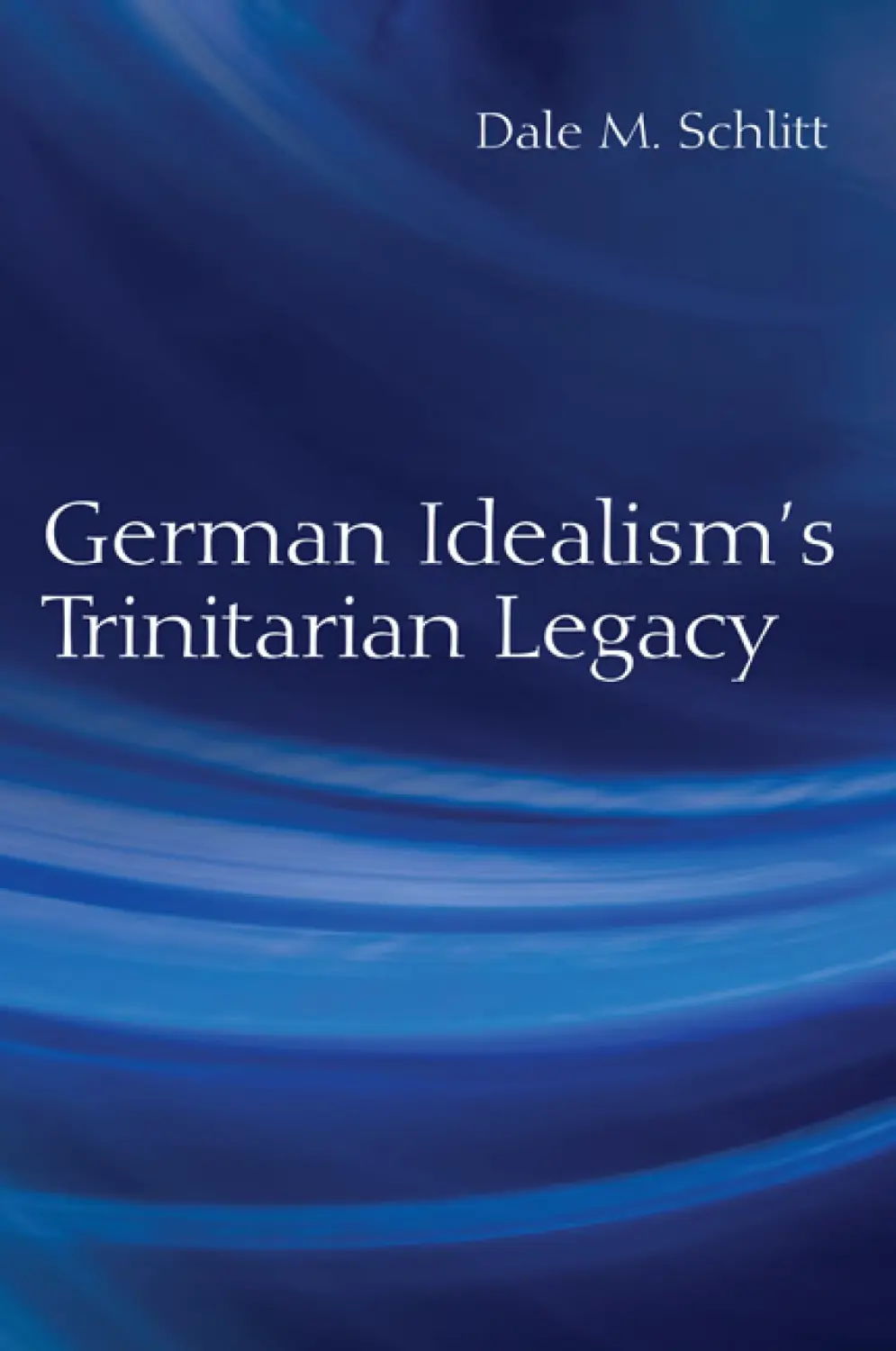
                    German Idealism’s Trinitarian Legacy

German Idealism’s Trinitarian Legacy

DALE M. SCHLITT

Published by State University of New York Press, Albany
© 2016 State University of New York
All rights reserved
Printed in the United States of America
No part of this book may be used or reproduced in any manner whatsoever without
written permission. No part of this book may be stored in a retrieval system or
transmitted in any form or by any means including electronic, electrostatic, magnetic
tape, mechanical, photocopying, recording, or otherwise without the prior permission
in writing of the publisher.
For information, contact State University of New York Press, Albany, NY
www.sunypress.edu
Production, Eileen Nizer
Marketing, Fran Keneston
Library of Congress Cataloging-in-Publication Data
Names: Schlitt, Dale M., author.
Title: German idealism’s Trinitarian legacy / Dale M. Schlitt.
Description: Albany : State University of New York Press, 2016. | Includes
bibliographical references and index.
Identifiers: LCCN 2016005980 (print) | LCCN 2016037205 (ebook) | ISBN
9781438462219 (hardcover : alk. paper) | ISBN 9781438462233 (e-book)
Subjects: LCSH: Trinity. | Idealism, German—History. | Philosophical theology.
Classification: LCC BT111.3.S35 2016 (print) | LCC BT111.3 (ebook) | DDC
231/.0440943—dc23
LC record available at https://lccn.loc.gov/2016005980
10 9 8 7 6 5 4 3 2 1

Contents

Acknowledgments

ix

Introduction: Identifying Idealist Influences

1

Part 1
The Idealist Trinitarian Adventure
Introduction to Part 1
Johan Gottlieb Fichte: Setting the Stage

11
11

1. Georg W. F. Hegel: A Daring Claim
The Shape and End Result of Hegel’s Efforts
How Hegel Argued His Trinitarian Position
Systematic Concerns Motivating Hegel’s Reconceptualization

13
14
20
22

2. Friedrich W. J. von Schelling: A Radically Free and
Personal God
The Radically Free and Personal Trinitarian God
What Schelling Has Done

25
26
40

Part 2
Early European Testimonials to Idealist Influence
Introduction to Part 2
3. Philipp Marheineke: A Trinitarian Dialectic of Being and
Thought
Marheineke on Trinity
An Early Testimonial to Idealist Influence

47

51
52
53

vi

Contents

4. Isaak August Dorner: An Ethical Trinity
Dorner on Trinity
A Later Testimonial to Idealist Influence

57
58
67

5. Vladimir Sergeyevich Solovyov: A Trinitarian Metaphysics
Solovyov’s Lectures on Divine Humanity
An Eastern Testimonial to Idealist Influence

71
72
93

Part 3
German Idealist Family Resemblances
Introduction to Part 3

107

6. Karl Barth: A Self-Revealing Trinity
Barth on Trinity
Idealist Family Resemblances

111
112
121

7. Karl Rahner: A Self-Communicating Trinity
Rahner on Trinity
Idealist Family Resemblances

125
126
138

8. Wolfhart Pannenberg: Reciprocally Self-Distinguishing
Divine Persons
Pannenberg on Trinity
Idealist Family Resemblances

147
148
162

Part 4
American Idealist Echoes
Introduction to Part 4
9. Robert W. Jenson: A Narrative Trinity
Jenson on Trinity
Transatlantic Idealist Echoes
10. Catherine Mowry LaCugna: One Trinity of Communion
among Persons
LaCugna on Trinity
Transatlantic Idealist Echoes

175
181
182
206

217
218
230

Contents

vii

11. Joseph A. Bracken: A Panentheistic Process Trinitarian Society
Bracken on Trinity and the God-World Relationship
Transatlantic Idealist Echoes

241
242
259

12. Dale M. Schlitt: An Experiential Trinity
Schlitt on Trinity
Transatlantic Idealist Echoes

265
266
283

Conclusion: Idealism’s Enduring Trinitarian Legacy
Recalling the Idealist Trinitarian Adventure
Testimonials, Family Resemblances, Transatlantic Echoes
A Challenging Legacy

291
292
296
302

Notes

307

Bibliography

405

Index of Names

435

Acknowledgments

Chapter 1 is a slightly modified version of my article, “The Whole Truth:
Hegel’s Reconceptualization of Trinity,” The Owl of Minerva, Biannual
Journal of the Hegel Society of America 15 (1984): 169–82, included here
with the kind permission of Ardis B, Collins, Editor-in-chief of The Owl of
Minerva. A previous version of parts of chapters 2 through 8 appeared in my
chapters, “German Idealism’s Trinitarian Legacy: The Nineteenth Century,”
“German Idealism’s Trinitarian Legacy: The Twentieth Century,” in The
Impact of Idealism: The Legacy of Post-Kantian German Thought, ed. Nicholas
Boyle and Liz Disley, vol. 4, Religion, ed. Nicholas Adams (Cambridge:
Cambridge University Press, 2013), respectively 48–68 and 69–90.
I would like to express my deep gratitude to Mr. Andrew Kenyon,
Acquisitions Editor, Philosophy, State University of New York Press, for his
encouragement and for wise professional guidance through the process of
review and publication. Sincere thanks to Ms. Maria M. Garcia, Director of
the Oblate School of Theology’s Donald E. O’Shaunessy Library, for overall
support and research help and to Ms. Carmen Rodriguez, Library General
Services Manager, for so diligently hunting down and obtaining often hardto-find items through interlibrary loan. A special word of thanks to Prof.
Peter C. Hodgson for translation of one of Hegel’s remarks, particularly
difficult to translate, in the margin of one of Hegel’s texts; to Prof. Renata
Furst for discussion and insight concerning aspects of the notions of narrativity and plot; and to Prof. Dr. Martin Wendte for insightfully drawing
attention again to Hegel’s and Schelling’s development of their thought on
Trinity in relation with their thought on various religions of the world.

ix

Introduction
Identifying Idealist Influences

The German Idealists Georg W. F. Hegel and Friedrich W. J. von Schelling
are two outstanding thinkers in the overall Greek-Western tradition of reflection on Trinity. Following upon Johan Gottlieb Fichte’s proposal to see subjectivity as triadic in structure, they each in his own way developed at great
length philosophical readings of Trinity as movement of inclusive divine
subjectivity. For Hegel that movement took on a more monosubjectival
formulation and for Schelling a more intersubjectival structure. It has been
rather widely accepted that they individually and together have significantly
influenced many trinitarian thinkers who came after them.
Two previous, shorter studies have confirmed in an initial way that
Idealist trinitarian thought, particularly that of Hegel and Schelling, has
indeed had a considerable impact on much subsequent trinitarian thinking.1 These studies led to the discovery that we can document further and
more closely such impact in several ways by reviewing in detail specific texts
from selected trinitarian thinkers. We can as well note what these thinkers
themselves have often enough written concerning Idealist trinitarian thought
and recall remarks made by others regarding possible Idealist influence on
their thought. We can, furthermore, more directly reflect on what these
thinkers have said about Trinity, considering it in relation to and comparing it with what the Idealists had said. When we make such comparisons
in the context of various indications of Idealist influence on the thinkers
concerned, we can recognize and reasonably affirm specific cases of Idealist
influence on their trinitarian thought.2
The present study brings together the results of further research
and reflection concerning the German Idealist trinitarian legacy. In order

1

2

German Idealism’s Trinitarian Legacy

properly to appreciate and evaluate these results it will be helpful first of
all to present in somewhat more summary fashion particularly characteristic
aspects of what Hegel and Schelling have in fact said about Trinity. This
initial overview in part 1, combined with points concerning their trinitarian
thought highlighted in the first part of the conclusion to the present study,
will alert us to Idealist themes and approaches potentially influencing subsequent trinitarian thinkers. In this overview Schelling will require greater
attention and, consequently, a slightly longer presentation than that on
Hegel since Schelling’s trinitarian thought seems less well known, especially
in the English-speaking world, than that of Hegel.
To confirm the existence of, and further identify, the overall Idealist
trinitarian legacy it is not necessary and perhaps not desirable to aim at more
or less comprehensive coverage of potentially relevant trinitarian thinkers
following after the Idealists. Rather, I have found that an approach focusing
on a number of selected thinkers who in their trinitarian thought exemplify
Idealist influence has proven more useful. This approach can help us avoid,
so to speak, missing the forest for the trees. For there is a certain, dare we
say, elegance in economy. Such economy involves making an argument in
relatively succinct fashion, a variant on Occam’s razor.3 In the present case,
we of course need to work with a sufficient number of thinkers permitting
us to argue to, and exemplify Idealist influence on, subsequent trinitarian
thinking. And, naturally, selecting such thinkers who may be expected to
reflect something of that legacy is quite a delicate task. It inevitably leaves
room open for further discussion as to whom we should include and why
we should include them. But that is, in a way, the beauty of scholarly
research and writing. More generally stated, one makes an argument. Others
make counter arguments. And in the process they come to a deeper insight.
Perhaps, then, more important than any specific decision taken here about
who is to be included in the study is the discussion these decisions may
encourage, thus bringing to light further possible indications of Idealist
influence on later trinitarian thought.
A fuller consideration of reasons for including certain thinkers in the
present study will surely require noting what is said about their thought in
the various chapters and in part 2 of the conclusion. But perhaps it will be
helpful at this point to summarize my “due diligence” in deciding which
trinitarian thinkers to include here. In a first step, the selection process
began with reference to a doctoral seminar on the notion of the Trinity
offered during the academic year 1997–98 at Claremont Graduate School,
now University, by Prof. Dr. Ekkehard Mühlenberg, presently emeritus

Introduction

3

professor in Göttingen University. It continued with a review of material
from undergraduate and graduate courses and seminars as well as doctoral
seminars on Trinity I had offered over the years at Saint Paul University in
Ottawa, Canada, and Oblate School of Theology in San Antonio, Texas.
In a second step, these reviews led to the formulation of initial and then,
over time, further developed selection criteria: (1) relatively direct access
to the selected persons’ trinitarian thinking which is readily available in
a clearly analyzable fashion; (2) in some way documentable identification
of the influence of Idealist thought on these persons’ trinitarian thought;
(3) at least for those in the nineteenth century, whether such persons may
have played an identifiable role in the transmission of the Idealist trinitarian legacy; (4) for those in the twentieth century, whether they may have
played an identifiable role in the transmission and further development of
that legacy in a rigorously presented reading of Trinity; and (5) as a further
consideration, whether persons could be chosen from earlier and later on
in a given period of time being considered.
A third step consisted in actually selecting a number of trinitarian
thinkers who might be expected to exemplify the influence of German
Idealists on their thinking. A fourth step involved further reviewing potential
candidates for consideration in preparation for a presentation on German
Idealism’s trinitarian legacy as part of an international conference. The
conference, on the impact of Idealism, was held at Magdalene College in
Cambridge University during the fall of 2012. In the presentation I focused
more specifically on three nineteenth-century European examples, namely,
Philipp Marheineke from very early on in the century, Isaak August Dorner
from later on in the same century, and Vladimir Sergeyevich Solovyov from
later on in Eastern Europe. Though time did not permit the presentation
on Solovyov, there seemed to be considerable support at the conference
for including him along with Marheineke and Dorner. Choosing several
trinitarian thinkers from twentieth-century Germany proved much more
difficult, given the good number of great theologians there expressing an
ever-increasing interest in Trinity.4 Finally I settled on Karl Barth, Karl
Rahner, and Wolfhart Pannenberg as exemplifying, on one hand, respectively earlier, middle, and later twentieth-century trinitarian thought and,
on the other, many and perhaps most of the different forms which Idealist
influence took in twentieth-century German trinitarian thought.5 At the
conference various participants expressed general acceptance of the selection
of these three. And no recommendations were made to include further postIdealist European thinkers among the six included or at least referred to

4

German Idealism’s Trinitarian Legacy

in the presentation. I took these reactions to be encouraging confirmation
of the reasonable viability of the initial selection, while realizing one could
always consider further possible examples of Idealist influence. Such is in
fact the nature of decision and choice. In a post-conference fifth step, it
seemed important to include as well several American examples of trinitarian thinkers influenced directly or indirectly by Idealist thought: Robert W.
Jenson; Catherine Mowry LaCugna; Joseph A. Bracken; and, my own more
modestly developed thought.
The trinitarian thinkers here included often occupy strategic positions
within the developing German Idealist trinitarian legacy and usually provide rather impressive and creative, rigorously constructed understandings
of Trinity. They have been selected from many who have written on Trinity
over a period of about 180 years and in several geographically distinct cultural settings. Given the varying distances of these trinitarian thinkers in
time and space from Hegel and Schelling, it seemed wise to identify several
ways in which these thinkers could be grouped together. Gathering them in
these ways will help us highlight variously identifiable types of relationships
between them, on the one hand, and Hegel and Schelling, on the other,
as well as among themselves. The first three chosen, namely, Marheineke,
Dorner, and Solovyov, have been gathered in part 2 under the rubric of
“testimonials.” Marheineke was among the first to work with the trinitarian
thought of Schelling and Hegel. It is even said that he influenced Hegel’s
own further development of Hegel’s philosophical reading of, or at least
interest in, Trinity. Dorner represents a high point in the nineteenth-century
development of what we would today call immanent Trinity. In dialoguing
with both Hegel and Schelling, he created a unique understanding of Trinity
that has considerably influenced a number of trinitarian thinkers in the
twentieth century. Solovyov brought German Idealist thought in a massive
way to the attention of Eastern, but especially Russian, philosophers and
theologians. Marheineke, Dorner, and Solovyov are examples of those in
the nineteenth century in Central and Eastern Europe who dialogue more
directly and openly in an appreciative way with Hegel and Schelling.
In twentieth-century Germany a good number of trinitarian thinkers
share certain overall social, cultural, and especially intellectual roots among
themselves as well as with Hegel and Schelling. This doubled sharing suggests that we can consider and refer to similarities in trinitarian thought
between them and Hegel and Schelling, as well as among themselves as
“family resemblances.” Among them, in part 3, we will treat of Barth, who
rather single-handedly launched renewed interest in Trinity, especially among

Introduction

5

Protestants. Rahner is surely one of if not the most important systematic
Catholic theologian of the twentieth century. Pannenberg stands out for the
exceptional breadth of his knowledge and force of his argument.
Then, in part 4 we turn to the North American scene. There we will
review the proposals of four twentieth- and twenty-first-century trinitarian
thinkers across the Atlantic from continental Europe. Jenson rather impressively replaces Hegel’s logically structured presentation of Trinity with a
carefully worded, temporally structured trinitarian narrative. LaCugna works
with a series of thinkers variously influenced by Idealist thought as she daringly insists on a single Trinity of divine and human persons. Bracken takes
on the whole Whiteheadian tradition. He transforms it in dialogue with,
among others, Hegel and Schelling as he develops a trinitarianly structured
relationship between the many and the one. I myself, in a considerably
more modest presentation, propose to replace Hegel’s development of his
understanding of Trinity in terms of a movement of thought with a view
of Trinity as a movement of experience. The image of “transatlantic Idealist
echo” seems to reverberate well with and hence describe in a more general
fashion the varied ways in which these four thinkers exemplify Idealist
influence in their trinitarian thought.
Identifying Idealist influence on the trinitarian thought of these ten
quite diverse thinkers will then serve to exemplify in a concrete way the
continuing legacy of post-Kantian German Idealist trinitarian thinking. In
order to recognize such influence we need to take one or more varied
approaches to these thinkers, depending on what the nature of their thought
requires and ways in which it develops. At times, they clearly and explicitly
acknowledge a certain respect for and reliance on one or more aspects of
Idealist trinitarian thought. Citing their remarks helps confirm a certain
Idealist influence on their thought. At other times, pointing out a specific
intellectual lineage traceable back through mentors of various kinds to the
Idealists provides an at least partial basis for asserting a certain Idealist
influence. Or again, drawing attention to the fact that trinitarian thinkers
at times cite and build upon the thought of others who themselves have
in turn been influenced directly or indirectly by Idealist thought in general
and trinitarian thought in particular permits us to speak of a real but less
direct Idealist influence. Of particular importance, it is helpful to compare
aspects, perhaps insights, structural similarities, even words, phrases, structured movements of thought, and the like of a given thinker’s reflection
on Trinity with those of Hegel or Schelling or both. But we will not be
concerned simply with similarities as such. Rather, we will, in the context

6

German Idealism’s Trinitarian Legacy

of the overall discussion of the thinkers concerned, want to consider such
similarities as possible indications of Idealist influence. With our understanding of what Hegel and Schelling proposed, it will at times even be
possible more spontaneously to have an “aha” moment. An example of
Idealist influence on a specific trinitarian thinker will simply jump out at
us and appear to be quite evident.
We need then to do a close reading of carefully selected texts presenting reasonably well important aspects of the trinitarian thought of a given
author. That reading will be shorter or longer, depending on what we need
to bring forth in regard to a specific author. For example, the summary
of several aspects of Marheineke’s trinitarian thought can be quite short.
There our concern is simply to show specific aspects of his use of terms and
note his probable influence on Hegel regarding Trinity. The presentation of
Dorner’s thought will necessarily be longer, given our interest in spelling
out aspects of his notion of an ethical Trinity. Length of presentation will
also depend on the way in which authors develop their thought. The presentations can be shorter if authors in effect concentrate the core of their
trinitarian thinking in specific chapters or numbered articles. Such is the
case, for example, with Rahner. They will need to be longer if authors tend
to interweave their thought on Trinity with their reflections on a series of
other subjects such as, for example, the relationships among various religions. An example here would be Solovyov. In effect, there are basically four
grounds for varying the lengths of the chapters, not all of which need apply
in each case and one of which may at times seem, at first sight at least, to
offer a counterweight to another. The first ground or reason involves just
what we want to say regarding the thinker concerned. The second reason
is the very way in which a given thinker develops his or her thought on
Trinity, namely, whether in more concentrated fashion, permitting a more
focused and limited presentation or as the development of an understanding of Trinity interwoven with a more widely ranging thought. To these
two should be added two more: a third reason, namely, the way in, and
the extent to which, a particular thinker is or can be linked with reasonable security to Idealist thought; and a fourth, the way or ways in which a
particular thinker may function in continuing the Idealist trinitarian legacy.
Whether shorter or longer, these close readings involve paying special
attention to order of thought, dynamics of presentation, even specific choices
of words and phrases. We will perforce want in various presentations of the
thought of these ten trinitarian thinkers to stay rather close to the texts
themselves. The hope is that we will, in reading these presentations, be able

Introduction

7

ourselves to recognize further Idealist influences beyond those identified
here, thus further advancing our understanding of the important German
Idealist trinitarian legacy that continues on into the twenty-first century.
Yet in this enterprise a word of caution is in order. In examining these
texts my own more immediate aim has of course been to recognize and
appreciate the ongoing Idealist trinitarian legacy to which they give witness as they provide examples of Idealist influence on their authors. In so
focusing, however, there is a danger that this way of proceeding could leave
us with an unintended impression. We might feel that drawing attention
to certain Idealist influences tends to overshadow, and thus diminish our
appreciation of, the creative insight and constructive contributions found in
the various works under review. But, important as these Idealist influences
are, we should recall already now that they remain influences. In identifying
these influences and briefly noting challenges Idealist trinitarian thought
poses, I do not want to imply any sort of reductio. Rather, my purpose is
to launch a celebratio. Drawing attention to the Idealist legacy should not
reduce our appreciation of the outstanding creativity manifest in the various forms of trinitarian thinking to which we refer. It should not diminish
our admiration for the enriching contributions these writers have made to
ongoing reflection on Trinity. My hope is that it will lead us to celebrate
that creativity and those contributions, preparing the road on which we
continue, in varied ways, the Idealist trinitarian adventure.

Part 1

The Idealist Trinitarian Adventure

Introduction to Part 1

Fichte, but especially Hegel and Schelling, have had an enormous impact on
the development of trinitarian thought. Through their creative philosophical interpretations of the ancient notion of Trinity they already influenced
certain theologians of their day. But their enduring impact lay more in the
influence, both direct and indirect, that they and their thought have exercised on much trinitarian thinking during the rest of the nineteenth century
and especially throughout the twentieth on into the twenty-first centuries.
We continue to feel their influence in trinitarian thinking even today.1
We can trace this influence back to the overall approach according to
which, from early on, Fichte, Hegel, and Schelling, each in his own way,
embraced and were fully enamored with what they understood to be the
triadic structure of dynamically developing subjectivity. In their earliest philosophies they had not yet in an explicit way linked this overall fascination
for triadic structure with the religious notion of Trinity. Yet their interest
in the triadic predisposed especially Hegel and Schelling to consider Trinity
from a variety of perspectives as they continued to develop their thought
over many years.2

Johan Gottlieb Fichte: Setting the Stage
Fichte (1762–1814) was the earliest of the three to focus so intensely on
what came to be this Idealist trademark, namely, the triadic structure of subjectivity. In his search to find a way to ground all experience and knowledge
he rejected Kant’s notion of the thing-in-itself. He argued at length that
all we had to deal with was consciousness as such.3 In his groundbreaking
work of 1794–95, Science of Knowledge,4 he laid out his basic principle
(Grundsatz), followed by two further principles. These three principles were

11

12

Introduction to Part I

to ground all science and thinking. He reworked various parts of this study
over the years following its publication. But it was his initial formulation
of the triadic structure of subjectivity which had such a great impact on
Hegel and Schelling, and with which we can briefly remain in view of
present interests.
Fichte argued that all we have to start with is the basic principle: I
= I; I am I; I am (Ich = Ich; Ich bin Ich; Ich bin).5 Since the “I” does not
adhere in anything else and underlies all experience, this is a principle of
initial identity. With the affirmation of this first principle, Fichte is working
out philosophy as a scientific knowing of knowing, a doctrine of knowledge
based in one starting point. However, though this initial identity of the I is
the certainty of my relation with myself, it does not explain its own reality,
namely, being free as it is and yet limited. For Fichte, then, as a second
principle the I posits or sets over against itself a not-I or not-self (NichtIch).6 The I posits itself as limited by the not-I, which is an other over
against the I itself. The third principle is the recognition that each of these
first two principles determines the other.7 The I posits the not-I as limiting
itself and the I limits the not-I. The I, as limited by the not-I, is passively
posited. The I, as knowing it limits the not-I or object, is active. With this
third principle Fichte accounts for the reciprocal interaction between self
and other. These three principles underlie and ground the further elaboration of his systematic thought. He will go on later to work with a form of
trinitarian expression.8 But it is really his initial insight into the dynamic
triadic structure of subjectivity which, as modified and further developed
by Hegel and Schelling, has had an impact through their thought on subsequent trinitarian thinking.9

1

Georg W. F. Hegel
A Daring Claim

Hegel (1770–1831) acknowledged that Fichte followed in the tradition of
Descartes and Kant when Fichte identified the I as an initial unity and,
along with Kant, as the source of the categories of thought. He praised
Fichte for taking the tremendous step of trying to show how the categories
of thought arise in necessary fashion out of the initial I itself. But Hegel
claimed that with the ever-recurrent presence of the non-I Fichte ended
up in what Hegel called an absolute contradiction. The non-I should have
been absolute and inclusive in its own right. So from Hegel’s perspective
Fichte ended up merely with the infinite of infinite progression, in which
limit constantly recurs without an enriched return to a renewed identity.
Though in Fichte’s view thought was creative, Fichte was not able to reintegrate subjectivity and objectivity in a true concept of spirit as movement
of inclusive subjectivity.1
Over the years Hegel worked out his mature, we could say, true
concept of spirit. He presented that concept on the level of religion as a
movement of inclusive trinitarian divine subjectivity. He first set forth his
philosophical reading of Trinity in his 1807 Phenomenology of Spirit.2 He
then succinctly sketched out his readings of Trinity in the 1817, 1827, and
1830 editions of his Encyclopedia of the Philosophical Sciences in Outline.3
He filled in these readings at greater length in his 1821, 1824, 1827, and
1831 lectures on the philosophy of religion.4
Hegel saw his true concept of spirit as bringing to explicit formulation
the necessary movement of logical thought categories in, from the point
13

14

German Idealism’s Trinitarian Legacy

of view of his system, the first sphere of logic. This sphere was, formally
speaking, a movement of inclusive subjectivity whose realization then occurs
in the second and third spheres, respectively, of nature and spirit. These
second and third spheres are, in contradistinction to the first sphere of
logic, the realphilosophical spheres.5 In his Encyclopedia sketches of this
overall movement of spirit, his presentations of Trinity stand as penultimate
or second-last moment. He identifies this moment as revealed religion and
presents it just before his treatment of philosophy.

The Shape and End Result of Hegel’s Efforts
It will be helpful to take a first look at Hegel’s philosophically informed
efforts to reconceptualize Trinity, namely, to develop a philosophy of absolute or inclusive divine subjectivity. We can do this by summarizing selected
aspects of his presentation of Trinity in the 1830 Encyclopedia. With this
wider systematic context in mind, we will then consider at greater length his
presentation of Trinity in his 1827 lectures on the philosophy of religion.
Hegel’s Encyclopedia begins with logic, understood as movement of
pure thought and, more precisely, with logic’s initial moment. This initial
moment is the thought category of pure being, the being of pure thought.
It ends in an enriching advance that, in the philosophy of absolute spirit,
is equally enriched resultant return to what was the initial movement of
logic. But now, at the end of this encyclopedic, self-developing movement
of spirit, the logical concept has become the philosophical concept. Here
form and content are truly and fully adequate. Hegel would say that concept
and reality are united in the absolute idea. Indeed, as its title indicates, the
Encyclopedia constitutes an outline of Hegel’s overall mature philosophical
system. It does this, as we have intimated, not as a mere juxtaposition of
philosophical sciences. Rather, it presents absolute spirit as idea developing
from the immediacy of logic to the logical idea’s self-othering in nature and
finite spirit. This development of spirit continues as enriching, advancing
return through finite spirit in philosophic thought to the renewed and
enriched immediacy, or identity, of the idea. This overall movement from
logic to the realphilosophical spheres, culminating in philosophy, is a process
of self-determination by absolute spirit. The movement of spirit occurs in
logic as inclusive subjectivity, in nature as self-othering of the idea, and
then in and through art, religion, and philosophy as absolute subjectivity.

Georg W. F. Hegel

15

Within this overall process Hegel places revealed religion, which he
identifies with Christianity and especially Lutheran Christianity, as the penultimate sphere. In this sphere the content is true but the form is as yet
burdened with pictorial representation. It is only the ultimate sphere, philosophy, which is characterized by conceptual clarity. He presents revealed
religion schematically in the form of a syllogistically structured “immanent”
and “economic,” so to speak, divine self-revelation. This divine self-revelation
is the self-development of trinitarian divine subjectivity, the movement of
spirit in the realm of revealed religion. He employs an explicitly religious or
representational, but nevertheless always philosophically informed, language
to lay out “immanent” and “economic” Trinity. He sees these as three syllogistically structured moments of universality (U, Allgemeinheit), particularity
(P, Besonderheit), and individuality (I, Einzelheit).6 He again develops the
last of these, individuality, as a movement of three self-mediating syllogisms.
In the Encyclopedia this moment of individuality climaxes as the effective
self-revelation of absolute spirit in and through finite spirit in community.
It is the final moment of syllogistically structured divine trinitarian reconciliation. In the sphere of religious representation this reconciliation remains
the movement of self-determining divine subjectivity. It has not yet been
explicitly established as mediation of the absolute self or concept in the
form of philosophical thought where the otherness indicated by reference
to God will have been overcome.7
In his encyclopedic system as a whole, this final moment, namely,
philosophical thought, is for Hegel the truth or perfect correspondence of
subject and object, or better, of self and concept.8 It is this perfect correspondence or absolute spirit, this infinite or inclusive totality, only in so far
as it is the end result inclusive of the whole process. As the final moment,
philosophy is for Hegel the grounding return to the immediacy of logical thought. It is this enriched return which finally justifies seeing Hegel’s
realphilosophical spheres themselves, and in particular his philosophical
thought or concept, as his reconceptualization of Trinity. Moreover, it is this
return that justifies recognizing his logic as the appropriate systematic logical
reformulation of “immanent” Trinity, with “immanent” carefully nuanced
so as not to insinuate an independently existent reality. This return on the
part of philosophical thought explains why Hegel can use philosophically
reinterpreted representational language to describe logic as the presentation
of God as God is in the eternal divine essence before the creation of nature
and finite spirit.9

16

German Idealism’s Trinitarian Legacy

When we look at his encyclopedic system, we see that from the perspective of his system in its speculative formulation Hegel appropriately
treats of “immanent” Trinity twice. He does this first as movement of selfdetermining inclusive subjectivity in the form of pure thought or logic.
He treats of “immanent” Trinity again as moment of universality in the
realphilosophical sphere of the philosophy of religion. He likewise presents
“economic” Trinity twice. He does this, first, in the realphilosophical sphere
of the philosophy of religion as including “immanent” Trinity. Second, he
again treats of “economic” Trinity in philosophical thought as grounding
return, as enriched return that justifies the whole process. This return is
both to the immediacy of “immanent” Trinity on the level of philosophy of
religion and to the immediacy of logic on the level of spirit as a whole. The
encyclopedic system is, in its totality, Hegel’s philosophically reinterpreted
presentation of “economic” Trinity inclusive of “immanent” Trinity. Hegel
rather humbly, though daringly as well, ends his 1827 and 1830 editions
of the Encyclopedia with his famous quote from Aristotle’s Metaphysics: “For
it is this, what God is” (τοῦτο γὰρ ὁ Θεός).10
In this overall sweep identified by Hegel as what God is, “immanent” Trinity is the initial moment structuring the overall dynamic of divine
self-development as self-revelation. From the perspective of his system in
its speculative presentation, this overall dynamic is a movement from initial identity to difference to enriched, grounding we could say, return as
renewed, inclusive identity. It is a movement from initial infinite, to finitude, to inclusive or true infinite.11 In this way, logically reformulated as
inclusive subject, religiously represented as absolute divine subjectivity, and
philosophically reconceptualized as absolute spirit, Trinity is for Hegel the
whole truth.
In order to flesh out Hegel’s briefer presentation in the 1830
Encyclopedia, we need now to focus on his lectures and, more specifically,
his well-developed 1827 lectures. In these lectures Hegel clearly saw religion
as the consciousness of the all-encompassing object or God, which has
become the fully inclusive self-consciousness of absolute spirit. This inclusive
self-consciousness is trinitarian divine self-positing subjectivity. It is, as was
the case in the Encyclopedia, a movement in and through finite spirit from
universality to particularity to individuality.12 In examining more closely
what Hegel said about Trinity in his 1827 lectures, we will first look at what
he said in his mature systematic reinterpretation of Trinity. We will then
speak of how and why he argued so forcefully concerning the importance
of thinking God as Trinity.

Georg W. F. Hegel

17

Over the course of his four series of lectures on the philosophy of
religion, Hegel apportioned theological content somewhat differently in various presentations of the second and third moments in the movement of
self-positing trinitarian divine subjectivity. Still the basic progression of this
movement from first to second to third sphere or element is consistently
describable in terms of moments of the concept as, respectively, universality,
particularity, and individuality.
We are here proposing that Hegel sets up the dialectical movement
in each of these three elements in such a way that it develops according to,
and therefore manifests, a specific syllogistic structure. When we speak of
syllogism here, we should mention that we mean Hegel’s particular interpretation of the syllogism and not merely the traditional understanding of
syllogism as a form of three-termed movement of inference. Hegel gave
to this traditional notion of syllogism a specific dialectical spin when he
placed it as a thought determination or moment in the movement of pure
thought. For him it was a movement of inclusive subjectivity. It was a selfmediating development of thought, progressing on the basis of a middle
term that mediated between the two extremes, the syllogism’s major and
minor premises.
It is especially in his 1827 lectures on the philosophy of religion that
Hegel uses considerable terminology from his Science of Logic to describe
the first element of the consummate religion. He refers to this element as
the overall appearance of God. It is the divine idea or the realized unity of
concept and reality, in the realm of thought as universality, the immediacy
of the “in itself ” (an sich).13 His use of logical terms, and especially of the
three moments of the concept, is particularly appropriate with regard to
this first element since it is the appearance of the divine idea in the realm
of thought. This self-enclosed movement of, theologically speaking, “immanent” Trinity is for Hegel the concrete universal containing otherness within
itself. It is, in its own way, the moment of initial identity. It contains this
otherness within itself as moment of judgment or separation as negation, the
begetting, so to speak, of itself as the Son, but it does this only as a sort
of play. With otherness so understood here as moment of negation, Hegel
sets up a dialectical moment at the very core of God’s being. He has built
the formal structure of the crucifixion and death of Christ into the very
movement of “immanent” Trinity. With otherness as moment of negation,
he wants us to think together, dialectically, initial identity (God the Father)
with the other (God the Son) of that initial identity in their momentary
contradiction (positive and negative, universal and particular). As was just

18

German Idealism’s Trinitarian Legacy

mentioned, for Hegel here in the first element of the consummate religion
this otherness arises only as a sort of play. Still, the distinguishing is itself,
as difference, momentarily the entire idea. In line with Hegelian dialectical
thinking, when the contradiction of universal and its negation or its other is
thought through they are seen to have become a new identity, traditionally
referred to theologically as the Holy Spirit. For the other is the other of
this initial identity, which it thus includes. This inner dynamic of otherness,
or particularity, functions as mediating totality inclusive of the extremes of
universality and of the resultant identity as individuality. In this way, it
presents the triadic structure of inclusive and, here, absolute subjectivity.
When thought through, this movement of subjectivity takes on the form
of the logical thought determination that Hegel calls the categorical syllogism (U-P-I).14
The second element in the development of the consummate religion
as movement of spirit is the appearance of the divine idea in the doubled
movement of diremption and reconciliation.15 It is the sphere of particularity, difference, and objectivity. It appears as the movement of judgment in
which the divine idea comes into existence “for itself ” (für sich). In this
element, characterized by contradiction, the divine idea others itself as an
independent world in and out of which there arises finite spirit. Within this
world finite spirit in turn distinguishes itself from nature and from its own
nature. This distinguishing that goes on within finite spirit gives rise to the
contradictory reality of finite spirit as both good and evil. It is one with its
nature, namely, with what it should be, and yet is not what it should be. So,
finite spirit is self-estrangement. The very establishment of this contradictory
character of finite spirit is itself the indication of a need for reconciliation.
According to Hegel, such reconciliation has to occur in an exclusive individuality. It has to take place in an individual divine-human self, in the
mediating death of Christ. Hegel goes on to present reconciliation in the
particularity of the community’s consciousness of an immediate existence
spiritually interpreted as the risen Christ. As this historical appearance of the
divine idea, the second element of the consummate religion is the moment
of objectivity in the overall development of God as spirit. This historical
appearance of the divine idea has taken place as a triadically structured
movement. The movement occurs from God, as presupposed universality,
to the particularity of the community’s spiritual consciousness of the risen
Christ by means of mediating individuality, the doubled individuality of
nature and finite spirit. Mediating individuality reaches its climactic depths
in the death of Christ. For the philosophically informed religious conscious-

Georg W. F. Hegel

19

ness, this triadic structure of the absolute subject reveals the form of what
Hegel identifies as the hypothetical syllogism (U-I/I-P).16
In the third element of the consummate religion, namely, in spiritual
community,17 the objective reconciliation achieved in Christ has become the
subjective relationship of the individual subject to this objective reconciliation with the truth. The previous two elements of the consummate religion,
and now this third element, are for Hegel the very progression of the idea
of God and, indeed, of God as spirit.18 They are the absolute eternal idea
“in itself ” (an sich), “for itself ” (für sich), and now “in and for itself ” (an
und für sich). These elements are the very life and activity of God consummated in the third element as the community or unity of the individual
empirical subjects who are filled by the Spirit of God. These subjects are
individuals who live in the Spirit of God and with whom the Spirit of
God is dialectically identified. God existing in and as the community of
finite subjects is the very realization of God as spirit, the Holy Spirit or
reconciling return of the divine idea out of the self-othering of judgment.
The third element of the consummate religion is the movement of inclusive,
and now absolute, divine subjectivity.
This third element develops as the reconciliation of the individual
believer with the life, death, and resurrection of Christ in three stages.
These stages are: first, the origin of the community in the outpouring of
the Holy Spirit; second, the realization or actualization of the community
through faith, doctrine, church, and Eucharist; and, third, the realization
of the spirituality of the community in universal actuality as philosophy.
In the first stage, the community originates in the particularity of a shared
religious consciousness. In the second stage, Hegel sees the various theologoumena there discussed as the reconciling active presence of the spirit.
This presence of the spirit is the objectively presented universality of truth
mediating the objective reconciliation, already obtained in Christ, to the
individual subjects. In the third stage, he presents the movement from
the shared conscious inner enjoyment of the presence of God, which was
achieved in the second stage, to an adequate mediation in self-knowledge,
in philosophical thought. The knowledge of being at peace with God has
become knowledge of being at peace with oneself. Here in philosophical
thought, knowledge or subjectivity is recognized as developing out of itself
and as reconciling itself with itself. For Hegel this rationality is true freedom.
Philosophy is the comprehending thought which, as essentially concrete,
determines itself to its totality, the idea. It is absolute spirit, the very peace of
God, true individuality.19 In this third element of the consummate religion,

20

German Idealism’s Trinitarian Legacy

the mediation of particularity with inclusive individuality occurs by means
of objective universality (P-U-I) as religious reconciliation in community.
It is the realization of what Hegel calls the disjunctive syllogism20 and is,
overall, the moment of individuality. It results, as dynamic movement of
spirit, both in a grounding return to the immediacy or identity of “immanent” Trinity in the realphilosophical sphere of revealed religion and in the
advance to philosophical thinking.

How Hegel Argued His Trinitarian Position
Hegel is always doing philosophy ultimately from the perspective of the
concept. So his presentation of his realphilosophical trinitarian thought is
itself already a response to the question of how he argued his trinitarian
position. For Hegel, correct presentation is argumentation. Nevertheless, it is
important to refer more directly to the 1812/1816 Science of Logic for two
reasons. 21 The first is that for Hegel logic represents the appropriate reformulation of “immanent” Trinity as self-determining inclusive subjectivity.
The second is the way in which he conceives of the systematic relationship
between the realphilosophical spheres and the sphere of logic. This latter
is the movement of pure thought as a series of self-positing thought determinations. For Hegel logic is discovered and “contained” in the spheres of
nature and spirit since it is their inner formative principle. Specific logical
thought determinations arise out of and are thereby revealed as such inner
formative principles in the spheres of nature and spirit. These principles can
then be examined in the clarity of their archetypal expression as moments
in the dialectical movement of pure thought. So logic itself likewise is and
“contains” the spheres of nature and spirit insofar as it is their archetype.22
Hegel’s construction of a dynamic logic, a post-Kantian replacement for
traditional metaphysics, forms his strongest and most prolonged argumentation for his philosophical interpretation of Trinity. He reconceptualized
Trinity by means of an ontological reinterpretation of “immanent” Trinity.
It will be helpful to recall that Hegel’s reconceptualization of the triune God is a process of sublation (Aufhebung) in which there has occurred
a triply structured transition of negation, preservation, and development.
The Trinity of religious representation retains for Hegel the characteristics of
three independently represented subjects in an inadequately purified parental
and filial relationship. This is true particularly for popular piety, but also for
dogmatic theology.23 Hegel’s reconceptualization negates such a representa-

Georg W. F. Hegel

21

tion. It negates as well the continuing projection of reconciliation insofar as
it is achieved in a divine subject over against the self. The true content of
this religious reconciliation is preserved, according to Hegel,24 in the move
to philosophical thought as the full mediation of subject and object, self
and concept, in self-determining conceptual thought. As purification this
transition not only negates but preserves in a truer form, and therefore
develops, the true content expressed as Trinity. Nowhere can this sublation
be more clearly seen than in Hegel’s proposal to translate what appears on
the level of religious representation as divine freedom, namely, to create or
not to create, into a logically necessary self-othering of the absolute idea
in, and as, nature. Hegel calls this self-othering as logically necessitarian
self-determination “free self-release” (“frey entläßt”).25
Hegel understood logic to be an immanent and consistent, internally self-justifying progression of thought determinations. Already in the
philosophy of religion he had, in principle, elaborated creation and crucifixion within “immanent” Trinity by means of his understanding of difference as negation. Now in the dialectical movement of self-positing and
self-determining logical thought he has integrated positivity by defining
it as otherness characterized as negation. It is, then, the overcoming of
this negation in the realization that the other is the other of the initial
identity which constitutes the fundamental dynamic of self-determining
pure thought. Logic presents the structure of inclusive subjectivity as selfrelationality. The speculative dialectic of self-relationality is what underlies
all of Hegel’s mature systematic thought, including his reconceptualization
of trinitarian divine subjectivity.
For Hegel the logical thought determinations or categories are themselves nontemporal “momentary” totalities of the concept. There is no underlying subject or thinker. Each thought determination arises as a momentary
totality within Hegel’s dialectically developing movement of inclusive subjectivity. Each is, in its own way, a form of becoming (werdend).26 To the
extent, then, that the structure of “going over into” or self-donation is
constitutive of all logical moments, Hegel’s speculative presentation of the
movement of pure thought is as a whole the systematic reformulation of
“immanent” Trinity. It is equally the archetypal structure of “economic”
Trinity. Furthermore, to the extent that such “self-donation” is the dynamic
structure of personhood, or better with reference to logic, of subjectivity,
Hegel has managed to elaborate in a logical formulation what was for him
represented in the consummate religion as a tri-personal God.27 Though he
carries out this elaboration in the singular and speaks simply of person or

22

German Idealism’s Trinitarian Legacy

subject,28 Hegel is, in regard to logic, not referring to an existent. He thinks,
in a post-nominalist framework, of the concrete universal as the structure
of subjectivity. In his so thinking we can see Hegel as one attempting to
move beyond the dichotomy between what would today be termed monosubjectival and societal formulations of Trinity.

Systematic Concerns Motivating Hegel’s Reconceptualization
In order to get at some of the systematic religious and philosophical concerns motivating his endeavor, we can reformulate the question of why
Hegel reconceptualized Trinity as follows: What did he see was at stake
in his attempt to reconceptualize the trinitarian God from the perspective
of the concept? We can indicate what is in play for Hegel by reviewing
religious-representational formulations of his claim that God can be conceived adequately as person, subject, and spirit only if God is conceived
as Trinity. We can then infer the underlying philosophical concerns which
pushed him to reinterpret Trinity, and to do this in specific ways, from his
resultant philosophical position as a whole.
In his manuscript for the 1821 philosophy of religion lectures on the
consummate religion Hegel wrote, “God is spirit—that which we call the
triune God.”29 God is spirit because God becomes the other and sublates this
other.30 Hegel claims that God remains but an empty word if God is not
grasped as triune.31 He is concerned to establish a concept of God which
does not leave personhood behind.32 There is, then, a particular earnest with
which he allows his concerns to surface as he makes this claim that only if
God is known as what would today be termed “immanent” and “economic”
Trinity can God be known as spirit. Only as Trinity can God be inclusive
subjectivity becoming absolute spirit finally as philosophical concept. We
can further spell out these concerns of Hegel’s by citing the consequences he
draws from the successful, or unsuccessful, establishment of the trinitarian
structure for which he so ardently argues. Here we should recall that for
Hegel trinitarian divine self-othering and sublation of that otherness is not
a simple movement of othering and return. It is, rather, one of progression
which is both development and enriched return. It is in this trinitarian selfothering and sublation of that otherness that Hegel recognizes the principle
and axis upon which history turns.33 World history is, for Hegel, a history
of God.34 This trinitarian dialectic is equally the principle of freedom,35 the
reason why God can be the source of community,36 the reason why God

Georg W. F. Hegel

23

can be known37and the justifying content of Christianity’s distinctive truth
claims38 as the religion of absolute subjectivity39 and freedom.40 Trinity, the
content of the true religion, is divine self-revelation.41 According to Hegel,
without a trinitarian structure to the divine there could be no true reconciliation in Christ.42 God would, as mentioned, be an empty name, one-sided
and finite rather than inclusive and infinite.43 There could be no truth as
mediation for there would be no possibility of a transition from religion,
with its true content but representational form, to philosophy where form
and content would be identical.
In religion, the overcoming of alienation in reconciliation is realized
representationally in the trinitarian God as a movement of divine self-revelation and absolute subjectivity. That same content has for Hegel received
its adequate form in philosophical thought. There it is expressed in its
necessary movement, namely, as a self-mediation which is the identity of
thought and reality, identity and difference or, from another perspective,
self and concept.44 In this sense, Hegel’s famous claim in the preface to
the Phenomenology that the true must be grasped not only as substance but
also as subject45 becomes an appropriate philosophical reformulation of his
trinitarian claim. It reiterates his concern not to conceive of God as less
than inclusive subject.
Hegel’s particular formulation of the concept of inclusive subjectivity
meant he had to insist that truth could be mediated only by a content which
was seen to be the other of itself and yet, indeed, was ultimately not other
than itself.46 Or again, religiously expressed, in the God-world relationship
God must be seen as inclusive of the world. Hegel gave logical expression
to this inclusive relationship in his elaboration of the true infinite as the
mediation of infinite and finite, and thus as inclusive totality.47 What he
had termed the “bad infinite” (das Schlecht-Unendliche) or merely an infinite
progression, had to go over into the concept of the true infinite (wahrhaft
Unendliches), in which the thinking of finitude would result in the transition to the infinite, and vice versa. For Hegel the true infinite is finally, in
its speculative formulation, the process of mediation in which the infinite,
having become finite, sublates itself as its own difference or finitude into
its own self-affirmation. The true infinite is the posited negation of negation.48 It is identity inclusive of difference, the one inclusive of the many.
To be anything less than inclusive would be to remain one-sided and finite.
In the context of the present discussion it is this concept of the true
infinite as concrete universal, inclusive totality, or absolute spirit which provides the best access to the systematic religious and philosophical concerns

24

German Idealism’s Trinitarian Legacy

lying behind Hegel’s reconceptualization of Trinity. The true infinite, as a
movement from the positive to its negation to the negation of this negation, recalls again how Hegel integrated the positivity of religion, or even
positivity in general, into a widened notion of reason. To the Enlightenment
mind, positivity had designated a form of particularity which could not be
deduced from universal reason. Hegel’s definition of difference or otherness
as negation allowed him to integrate particularity, as the other of universality, into the overall movement of reason itself.
To recapitulate, Hegel’s dialectical and speculative reconceptualization
of Trinity was his post-Kantian response to the problem of the one and the
many or of the relationship between identity and difference.49 By means of
this reconceptualization Hegel was able to give content to the term “God.”
In his philosophy of religion, he traced the development of the concept of
God through the various religions of the world. That development arrived
ultimately, in Christianity, at an explicit understanding of the trinitarian
God as absolute subjectivity and subject, with the spiritual community
becoming the locus of spirit’s self-realization. He saw in the trinitarian
divine self-othering and sublation of that otherness a movement of progression which is both development and enriched return, the principle and axis
upon which not only the history of religions but history itself turns. World
history is then for Hegel the history of God. Freedom was understood
ultimately as logically necessary but truly self-determination. Knowledge
of God, Christianity’s truth claim, and truth itself, were likewise grounded
immediately in Hegel’s reconceptualization of Trinity as movement of selfdetermining divine subjectivity. In eliminating the need for a distinction
in “immanent” Trinity between divine essence and divine person, Hegel
continued the modern turn to the subject. He was able to avoid a Cartesian
appeal to God to guarantee truth and certainty in knowledge by making
of the trinitarian God the very structure of truth itself. Hegel claimed to
recognize in Trinity in general, and in the “inner” or “immanent” Trinity
in particular, a congruity with his fundamental, speculatively formulated
dialectic of positive/negation/negation of negation. In the Christian doctrine of the Trinity he discovered the means to give religious expression to
mediation in the self as concept. This, and especially this latter idea of the
self as concept, was his philosophical response to alienation in his time.
Hegel might well argue that in the future it would still be this philosophical
response, in the form of the true infinite as inclusive totality, which, when
appropriately adapted, would prove most fecund for a further reconceptualization of Trinity as the whole truth.

2

Friedrich W. J. von Schelling
A Radically Free and Personal God

Schelling (1775–1854) judged Hegel’s philosophy in general and Hegel’s
philosophical reconceptualization of Trinity in particular to be too rationalist. Among various objections on Schelling’s part, Hegel did not allow
sufficiently for the freedom and the personal nature of God.1 In reaction to
Hegel, Schelling, especially in his later years, used the distinction between
what he called negative philosophy (negative Philosophie) and positive philosophy (positive Philosophie) to critique Hegel’s thought and bring forth
his own alternative approach.2 By negative philosophy Schelling understood
transcendental reflection. Such reflection could lead to the idea of God but
could never really express that idea and could not capture the reality of existence. For Schelling, Hegel’s philosophy and trinitarian thought constituted
a form of merely negative philosophy. But positive philosophy, as Schelling
proposed it, recognized the facticity and priorness of being as, in a sense, a
given. Positive philosophy thus included philosophy and theology, with the
latter’s reference to revelation, in a creative philosophical construction taking
into consideration “the un-prethinkable God of Exodus 3:14.”3 Schelling
found in Christianity the affirmation of the just-mentioned facticity and
priorness of God as being. In emphasizing this facticity and priorness, he
gave his notion of ground an interesting reformulation in the context of
his discussion on God.
From this starting point in positive philosophy, Schelling made his
philosophically formulated presentation of Trinity the core theme of his

25

26

German Idealism’s Trinitarian Legacy

positive philosophy, bringing together trinitarian theological traditions and
philosophical reflection. With his reading of Trinity, he in fact laid the
speculative foundation for his stress on the radical freedom of God and for
his insistence that God is in some way personal from the very beginning
of the self-development of God. In so distinguishing himself from what he
understood Hegel to have said, Schelling worked out an intriguing interpretation of Trinity. That interpretation focused on the Father as source of
trinitarian unity, presented the Son as subordinate to the Father though not
a created reality, and envisioned the Holy Spirit as the final reestablishment
of the initial divine unity previously disrupted in creation.

The Radically Free and Personal Trinitarian God
In 1811 and 1813 Schelling had offered a certain trinitarian speculation
in Die Weltalter.4 It is, however, in his 1831/32 lectures, published as
Urfassung der Philosophie der Offenbarung (Original Version of the Philosophy
of Revelation),5 that he develops further and in greater detail his positive
philosophical presentation of Trinity. Schelling seems to have dictated this
Urfassung,6 which will serve as our text of reference.7 After 1831/32, he
continued lecturing on his positive philosophy. For example, his 1841/42
lectures, published as Philosophie der Offenbarung (Philosophy of Revelation),
are particularly well known. They are available in a version published
by the theologian, Heinrich Ebehard Gottlob Paulus (1761–1851) during Schelling’s lifetime but without his permission. Further versions of
Schelling’s various lectures on the philosophy of revelation have become
available after Schelling’s death.8 These lectures of Schelling’s on the philosophy of revelation follow, systematically speaking, upon his lectures on
the philosophy of mythology. Together they make up what we might refer
to as constituent elements in his philosophy of religion. In the philosophy
of mythology Schelling had treated of the world of religion characterized
by necessity. Still, the Trinity was already at least implicitly at work in the
various religions in an overall movement toward the realm of Christian
revelation, a realm characterized by freedom. The key then to understanding Schelling’s lectures on the philosophy of religion, and especially his
philosophical reconceptualization of Trinity, is the notion and reality of
freedom. At crucial points in his lectures Schelling refers to and works with
the reality of will in its ability, at least in theory, to decide to act or not
to act (for example, 190.23–24).

Friedrich W. J. von Schelling

27

Schelling’s 1831/32 lectures on the philosophy of revelation can be
divided into three sections in the following order: opening consideration on
creation (lectures 1 to 15); elaboration of a presentation on Trinity (lectures
16 to 30); and, working out of further Christological reflections (lectures 31
to 83).9 Schelling in effect treats his presentation on Trinity in the second
section in two parts: an introduction to the overall role of the Christian
doctrine of the Trinity (lectures 16 to 22); and, a focus on his interpretation of the content of the doctrine (lectures 23 to 30). We will limit
our immediate review to selected aspects of this focus on content. Malte
Dominik Krüger helpfully analyzes this focus on content, seeing Schelling
as proceeding there in seven steps. In the first two steps Schelling works to
show the way in which God’s unity is actual in the freedom of the Father
that comes to fruition in the Son. In the third to sixth steps he explains
the arising and the result of the generation of the Son through the Father
in the Spirit. In the seventh step he affirms that the Creator has become
one God in three Persons.
Before entering on the first of these seven steps, Schelling notes that
the monotheistic theory to which he had argued in the previous lectures up
to and including lecture 22 leads to the Christian doctrine of the Trinity.
He then in the first step itself (155.22–159.34),10 as found in lectures 23
and 24, identifies the immediate point of departure for his constructive
interpretation of Trinity as, in Krüger’s way of putting it, the unity of God
functioning in the freedom of the Father. More specifically, Schelling begins
his exposition of the Christian doctrine of the Trinity with a reference to the
freedom of God in the creation of the world (155.22–24). In these lectures
23 and 24 Schelling, as can be justified by the complexity of his thought,
brings in and makes reference to many elements which he will develop
only later on in his presentation of Trinity. However, we will remain with
certain more essential moves which he makes here and which structure his
further constructive philosophical reflection on Trinity.
In order to affirm the most radical sense of divine freedom Schelling,
from the very beginning, asserts the priority and givenness of God’s essence
as pure being. In God’s essence, God is for Schelling pure actuality and
unity, so that God as such is absolute subjectivity.11 He continues from this
point, saying that God is the Lord even of being so that God could will
either to be or not to be (155.34–156.5). As this pure unity, God presumes
no prior potentiality. But unity implies the notion of difference and, thus,
the possibility of becoming and development. As this beginning, unity, and
source of potential development, God can appropriately be named Father.

28

German Idealism’s Trinitarian Legacy

So, for Schelling at this stage in his thought on Trinity, Father refers to
God as such in his original and potentially originating unity. Since this
unity implies difference, there is the potency (Potenz) for development and
this potency is the first of three potencies which Schelling affirms as residing in God as Father.12 Here this latter reference to Father is to be taken
in a wider sense to refer to what today is often called “immanent” Trinity.
Schelling is quick to note that God does not at this point become this and
any following potencies, since such an understanding would imply necessity
in God. Rather, this first potency and further potencies reveal what God
is, namely, the Lord of being. This first potency for further development
gives rise to a second potency, which is the potentiality to become real or
actual. Thus the second potency is not one which gives rise to but which
is given rise to. It is the arising of an essence homogeneous with the first
potency but in such a way that it needs to actualize itself. Schelling calls this
“giving rise to” generation (Zeugung) and refers to this “being given rise to”
as generated (Gezeugte). This second potency can only be given the name
“Son.” He brings this, his initial reflection, together with the assertion that
these two potencies find their renewed unity in the third and final potency.
Already now we can by way of anticipation describe this third potency as
the realization, in and through creation, of the actuality of the two first
potencies in the renewed unity of being of the Father. Schelling names this
final potency Spirit.
This threefold structure at which Schelling arrives will come not only
to lay the groundwork for his later affirmation of three Persons in God but
also to characterize and underlay his thought on, among various religious
themes, Trinity, creation, incarnation, reconciliation, and what we might
more traditionally refer to as the Parousia. He is, in his own more systematic way and with a special emphasis on the radical freedom of God, in
fact introducing Jakob Boehme (1575–1624), the German mystic’s notion
of movement in God into his own understanding of God.
In the second step (159.35–164.19), presented in lecture 24, Schelling
reiterates that the point of departure, which he has previously indicated as
being in the unity of God and freedom of the Father, implies the differentiation of the Son established in the Father. He gives further precision to his
presentation of the arising of the Son by distinguishing three perspectives on
that arising: the originary form of divine being within the Father; the Son
first as for the Father and then as established outside the Father (160.5–11).
From the first perspective, the Son is willed by the Father as the
possibility of being outside of the Father though at this point, in referring

Friedrich W. J. von Schelling

29

to the Son, Schelling is speaking of pure eternity unaffected by temporal
considerations. From the second perspective, the Son stands over against
the Father. Here Schelling says that the Father is indeed free only in the
Son. For it is in willing the Son that the Father intends through the Son to
will, in creation, that which is external to the Father. The Father loves the
Son as the possibility of this creation. So, the glory of the Father, which is
his freedom, is also the glory of the Son who will freely bring into being a
world of which the Father will ultimately be Lord. From the third perspective, Schelling spells out the idea that the generation of the Son can only
be properly spoken of in relation to the act of creation. It is not a question
of the Son being created but rather that, given the will of the Father to
create, in and through that creation the Son as second potency begins the
process of self-development toward personhood through nature, history, and
religion. With these distinctions concerning the arising of the Son, Schelling
argues that his philosophical presentation of the arising of the Son assures
a notion of eternal generation from the first perspective. And from the
third perspective it takes into consideration various trinitarian theological
traditions and Scripture. These traditions and Scripture, especially John’s
Gospel, recognize in the Son one who has received all from the Father
and who consequently shows a certain dependence on and subordination
to the Father. In his affirmation that the Son becomes person only through
self-development in creation, Schelling tries to capture something of the
scriptural affirmation of a movement on the part of the Son to hand over
all to the Father.
In the third through sixth steps Schelling reflects further on the generation of the Son and its resulting in creation. He explores the arising and
the appearance of the Son, with arising referring to the internal relationship within God and appearance, in turn, to the relationship of the world
to God. The third step (164.21–167.13) then, in lecture 25, involves, as
Krüger13 puts it, making the internal arising of the Son as image (Bild) of
the Father plausible. Schelling speaks of the dialectical process of the arising of the Son hidden in the Father. He says that the arising of the Son
from originary being involves negation (the Son is not the Father) and
being rendered potential (able to develop). The arising of the Son involves
especially being posited as non-being, then being. This generation of the
Son is more of an exclusion leading to the need for the Son to develop,
for the Son is not the original pure being. The Son is that which can be,
namely, a potency received from the Father. As such, the Son is selfless self
because he does not have his own will. He fulfills the will of the Father.

30

German Idealism’s Trinitarian Legacy

His essence is thus selfless will. His work is to reveal the will of the Father
toward unity. So the Son makes the Father to develop or be actual in the
real world, but does not make the Father as such develop or be actual. The
Father is, as Krüger puts it, real principle and not an ideal to be actualized.14
In the fourth step (167.14–181.29), in lectures 25 to 27, Schelling
speaks of the external generation of the Son as the establishment of divinity
(Göttlichkeit) outside of God. He spells out the continuing process, and then
result, of the generation of the Son that takes place in the Son’s kenosis,
an act and process occurring in, though, and as creation. Here Schelling
continues to resist the notion of an eternal generation of the Son. He had
discussed this notion in the previous step in his overall presentation on
Trinity. He sees it merely as a response to Arius, a response no longer needed
(168.2–20). He acknowledges the eternity of the Son as possibility hidden
within the Father, whom he identifies with God who is pure being. But he
refuses to accept eternal generation on philosophical grounds as well as on
the basis of his careful reading of New Testament passages, especially those
in the writings of John and Paul. From a philosophical perspective, he asserts
that being outside the Father can only be thought with the occurrence of
creation, so the beginning of creation is the first moment of true generation
and thus of the appearance of the Son outside of God (170.10–13). Parallel
to this reference to the beginning of creation, Schelling says the Son will be
fully avowed as Son only at the end of creation (171.14–16). He argues as
well that eternal generation would mean the Son arises by necessity of the
divine nature rather than through the free act of the Father. This would for
Schelling not be a true generation since it would lack the spontaneity of
freedom. He further says that such a necessary generation would not result
in the possibility of development and actualization on the part of the Son.
For it is by the Father’s will that the Son is obliged to develop and realize
his potential to become Person. The Son would in effect be without will,
not just his own will but will as such (167.28–29). Schelling complements
his philosophical argumentation with an appeal to various New Testament
texts in support of his rejection of the notion of eternal generation. He cites,
for example, the First Letter of Peter 1:20, where the text does not speak of
eternal generation but merely says “he was destined before the foundation
of the world.” He recalls as well the Letter of Paul to the Ephesians 3:9
and many other places in Pauline texts which refer simply to God’s plan
and not to an eternal generation (168.36–169.35).15
Schelling has used the notion of the Son’s generation by the Father
to speak of the arising, in God, of the Son as the potency for development

Friedrich W. J. von Schelling

31

and growth. But it is really in connection with creation that he wishes to
speak more properly of the generation of the Son. For it is here that there
appears being which is truly other to God and needs to evolve and develop.
Schelling notes that it was the intention of the Father already with the internal generation of the Son to give rise to a world external to himself. And it
is this appearance of an external world which he identifies at the same time
with the generation of the Son, for both result in a form of being external
to God the Father. The generation of the Son is both appearance of the
world and the Son’s appearance in the world. However, we need to qualify
this word “identifies” because for Schelling the demiurgic Son internal to
the Father is of course the cause of the being of the world (for example,
174.23–26). The Son is the means by which creation occurs. So in creation
the Father is cause which remains outside the tension characteristic of the
world and the Son is the cosmic cause which brings forth the world and
acts in it (176.32–177.1). In this creation as externalization the Father is in
effect giving up his divinity in a form of kenosis which begins with creation.
And with creation the Son is no longer hidden within the Father. Rather the
Son is excluded from the Father. So, for Schelling with this externalization
the Son is no longer divine for he is no longer in the Father, who is pure
being. This obliges the Son to develop on his own and to work to bring
the world back to God. He is at work in the world, slowly reestablishing its
unity with the Father. In this work the Son reveals to the world not his own
but the Father’s will, which he has received from the Father. As Schelling has
already mentioned in a more speculative formulation, the Son has received
this will from the Father and indeed received all that he is. So the Son is
a selfless self. Schelling is picking up on various New Testament references
which would seem at least at first reading to imply a certain subordination
of the Son to the Father. By way of example, we can cite his noting the
New Testament reference to the Father as ὁ Θεός and to the Son merely
as Θεός without the definite article (168.22–27).
Schelling knows quite well various trinitarian traditions. He furthers
his argument by claiming that the error on the part of the Arians, for
example, was to say that the Son was created. So the Son has his being only
outside of God, which Schelling of course denies. The Arians had drawn
the wrong conclusion when they thought that what Schelling describes as
the Son’s loss of divinity at the moment of creation meant the Son was
created. Rather, for Schelling what really happened was that the Son emptied out his divinity with creation and then, as potency, must regain this
divinity (178.27–179.4). The Arians mistook what was only a momentary

32

German Idealism’s Trinitarian Legacy

characteristic of the Son for a generally applicable understanding of the Son
as such (179.16–18). Schelling also faults the more orthodox theological
position, which for him excludes the Son’s existence outside God before
the Incarnation. In this position the focus was on the moment of the Son’s
divinity to the exclusion of the Son’s role in creation. In so doing, according
to Schelling this orthodox theological position simply denies Arianism and
therewith accepts the alternatives Arianism proposes rather than finding a
way to incorporate the Arian position into and subsume it under a wider
or more inclusive position (179.32–180.5). Schelling argues that only his
own more complex position can avoid the pitfalls in these two positions.16
In the fifth step, worked out in lectures 27 to 28 (181.30–189.34),
Schelling conceives of human consciousness as, in Krüger’s way of phrasing
it, the external result of the generation of the Son. Though the generation
of the Son gives rise to creation as such, human consciousness will be the
ultimate level, so to speak, at which the drama of reconciliation between
God as pure being and the loss of that being in the externalization of
creation will take place.
Schelling begins17 what we identify as the fifth step in his trinitarian
theological presentation by noting that the Son has been posited in existence
outside God in an overall negative and suffering relationship. Schelling will
come back to this subject and the others treated in this fifth step at much
greater length later on in the lectures. But for now he provides a summary
of what he will say then concerning the way in which the Son brings about
creation’s reconciliation with God the Father. He immediately notes that
at the end of creation the Son should have arrived at fully realized glory
(Herrlichkeit) and this as his own particular personhood (Persönlichkeit).
With this remark Schelling indicates that the reconciliation begun by the
Son from the moment of creation on is disrupted by human sinfulness in
turning away from the unification being brought about by the Son. So the
Son must begin a new creation in his appearance as an individual human
being. But even this interruption of the Son’s glorification does not hinder
the final outcome of the Son’s work in the world.
Then Schelling takes up another point for further philosophical reflection. He acknowledges that the glorification of the Son in this new creation
is, with the resurrection, a full glorification before the Father but not before
the world. The Son overcomes the second self-emptying but has not as
yet arrived at the full glorification which is the goal of creation as such
and will only come about at the end of things. For this to occur, both
the Son’s and the Father’s glorification has to become evident and known

Friedrich W. J. von Schelling

33

to human consciousness. But God as such, the Father, remains outside
the world. Indeed Schelling will stress this divine otherness by describing
it as otherworldly (außerweltliche), superworldly (überweltliche), superactual (überwirkliche), and outside that which is actual (äußerwirkliche) cause
(183.12–21). Throughout the process of creation’s move to its end the Son
is not the fully actualized Son. He is this first when he has completely
overcome his own potency which excludes divinity. Only at this point is
the true will of the Father revealed, which is to overcome externally posited
non-being in the renewed and fuller realization of the fullness of being.
The Father is fully revealed only when he is present to the self, to and in
human consciousness, as the fullness of being he is. As is for Schelling so
clear in John’s Gospel, this revelation only takes place when Father and Son
are, together, fully actualized as divine Persons.
Creation’s goal is the external glory of the Father become immanent
in creation through its recognition in human consciousness. Schelling sees
the fact that the Father is not externally glorified without the Son being so
glorified, and vice versa, in John’s statement of Christ’s prayer that the Father
would glorify the Son so that the Son might also glorify the Father. This is
then a mutual glorification in which both are in possession of the true being
of the Father. In the end, all of creation will, through human consciousness,
be aware of the fullness of being which the Father was from the beginning.
Both Father and Son will have equal right to this finally established being,
and this is the final unity of Father and Son. The realization of this shared
possession of being in and through its revelation to human consciousness
is the goal and purpose of creation. It is Paul’s good news.
Schelling reinforces his remarks in this fifth step and brings them to
a conclusion with his interpretation of Paul’s First Letter to the Corinthians
15:24–28 (186.5–189.34). As he notes, these verses have proven difficult to
interpret. We can loosely paraphrase several elements of his translation of
these verses: when Christ has submitted all to himself, he will hand over the
kingdom to God, who will be all in all (186.5–18). He finds that these verses
support his position and, in discussing them, he further clarifies aspects of
that position. First of all, he identifies the kingdom with being, which the
Father had given over to the Son. The role of the Son is to transform this
being, which is external to God, into divine being. Since this transformation
is ongoing, handing over the kingdom to God does not imply that the Son
gives up his Lordship. The Father’s receiving the re-divinized being from
the Son is the beginning of the Father’s now having this being in common
with the Son. Second, Schelling notes that for Paul the Son retains direct

34

German Idealism’s Trinitarian Legacy

Lordship over the kingdom until all enemies have been overcome, when
all that is ungodly in being has been overcome. This is the point at which
the Son’s exclusionary Lordship over being outside of God ends and the
Lordship over being is common to Father and Son. Third, Schelling argues,
in part on the basis of his interpretation of ἑν το παν, that God’s being all
in all does not mean the disappearance of the Son’s Lordship. Rather now
it is common with that of the Father. At this point each potency, as person,
is the whole divinity. For Schelling the Greek phrase means all in all, not
all in one. With this remark he opens the way to his further trinitarian
reflection. After a brief recapitulation of what he has said so far, he argues
that what was heretofore in itself that of the Father is now the Son’s as well.
But this sharing of being in itself cannot as such be accomplished by the
Son, whose role is to develop and actualize. It can only be accomplished
by a third potency, namely, that of the Holy Spirit, which goes out from
the Father and the Son as final potency. To emphasize the importance of
this point, Schelling ends this step in his presentation by insisting that this
is a necessary assertion.
In the sixth step (189.35–192.6), in lecture 28, Schelling justifies his
assertion that the Holy Spirit is the inner result of the Father’s generation
of the Son, that is, active in nature and especially in human consciousness.
The Father’s willing the tension between his own divine being and the being
of the world is not only a negation of the Son’s divine being within the
Father but also that of the Spirit. The Spirit’s being is mediated through the
Son. This mediated negation of the Spirit’s divine being helps appreciate the
fact that in the New Testament the Spirit does not work immediately and
forcefully. Rather, the Spirit urges, incites, and prompts prophets to speak
out and individual persons to establish, perhaps better, reestablish the world
and themselves in divine being (190.5–16). Schelling indicates three sides to
what the Spirit does. They are the role of demiurgic potency working with
the Son in the creation of a tension between divine being and the being
of the world, the role of cosmic potency in the development of creation,
and the role of unifying the Father and Son in their glorification at the
end of time. At this last moment the Spirit becomes fully individualized
divine person (190.19–21).
It is especially interesting to note that Schelling insists on the role of
the Spirit in the realm of nature. He says that we can recognize this activity
in nature wherever we discern any even very subtle indication of free will
within the necessity characteristic of nature, what he refers to as the breath
(Hauch) of the Spirit (for example, 190.28–29). Here Schelling draws his

Friedrich W. J. von Schelling

35

listeners’ attention to such phenomena as, more generally speaking, goaloriented functioning. More specifically, he refers to the actions of animals
and the singing of birds as well as the very multiplicity of forms arising in
nature by chance and caprice. He calls particular attention to the notion
of play (Spiel) found even within the limits which seem to be established
within nature in given circumstances (190.31–191.4). Schelling does, however, seem to qualify his remarks by saying that whatever is not attributable
to chance and caprice alone is of the all-ensouling Spirit (191.4–6). In all
of this, the Spirit does not directly work things out in nature but, so to
speak, interweaves his action in and through the course of nature. Again,
Schelling draws attention to New Testament remarks concerning the notion
of a creator Spirit and, indeed, a Spirit which is holy because it is without
comparison (191.15–21).
This Spirit can only come fully upon us with the glorification of
the Father which, in turn, can only come through the glorification of the
Son. Here Schelling recalls various sayings in John’s Gospel to this effect.
If Christ does not go, the Spirit will not come upon the disciples. In so
doing, namely, coming upon the disciples, the Spirit as we will see becomes
fully divine Person bringing together in human consciousness the glory of
the Father and the Son (191.21–192.6).
In the seventh step (192.7–213.18), in lectures 28 to 30, Schelling
provides what Krüger calls the decisive insight into the doctrine of the
Trinity, namely, that human seeking after the free origin of actual being
finds its answer in God in three Persons. At the end of lecture 28, Schelling
provides a summary (192.7–193.14) of the results of his reflection so far
before continuing the development of his thought on Trinity in lectures 29
and 30. He says we have arrived at the point where God as a whole has
become actual in three different Persons, with each one being the whole
God, as he phrases it. Much of the rest of Schelling’s summary deserves
being cited at greater length, especially considering our interest in carrying
out a careful and somewhat detailed reading of his thought:
The Father . . . is now . . . the whole God, where he possesses
the Son and Spirit brought back into his own being. The Son is
no longer the potency of the Son . . . he is the whole God. This
must equally be the case with the Spirit. So . . . the purest act,
the actual self, is re-established, only with the difference . . . that
the three forms are now three personalities . . . three different
names of the same absolute personality. The three personalities

36

German Idealism’s Trinitarian Legacy

are not different Gods; for the essence, the substance, is always
the same. . . . And yet they are not merely three different terms
or three different subjective views of one and the same God,
but rather they are three objective differences. . . . During each
of the processes, each potency was for itself independent. This
independence is not lost in the unity. Each one returns into
the unity with its own subjective character. This is the highest
expression of the idea of Trinity. (192.22–193.10)18
After this summary of where his trinitarian reflection has led, Schelling
continues to spell out his understanding of Trinity by insisting that the three
divine Persons are not parts of God. To help us understand this he employs
the notion of moment (Moment) and speaks of three necessary moments
in the development of the doctrine. The first of these is what he calls
Tautousie, a position stressing the moment of essential or substantial unity
(195.7–196.17). This moment corresponds to Schelling’s notion of initial
divine unity. God as a whole is, through his will, the cause of the tension
between divine being and creation. In creation the divine unity remains, so
that here we have what is referred to as Sabellianism, according to which
there is only one personality. So God as Father in the Old Testament takes
on, in the New Testament, the name of Son in human form and the name
of Spirit as coming down upon the Apostles. Older theologians set this
understanding of God, moment as Schelling describes it, over against that
of Arianism, which latter exaggerated the notion of difference in the divine.
Schelling then calls the second necessary moment in the scientific
development of the doctrine of the Trinity Heterousie, necessary if a merely
nominal form of divine unity is to be avoided. He identifies it with the
second moment in his own trinitarian presentation, in which the three
potencies develop into independent divine Persons (196.18–200.7). Here,
if we do not think in terms of three potencies which develop outside God
as Persons, we end up, on one hand, either with merely three names or
ways in which the One works or, on the other hand, a tritheism of three
Gods—one essence or three essences. The former position says too little
and the latter too much. Schelling notes, however, that if he had to choose
between the two he would choose to say too much. For without affirming
true difference nothing would finally be explained. Affirming three Gods
involves thinking in terms of a species and three individuals as, for example,
when we think of humankind and three individual human beings. In this
basic position of Heterousie, what is lacking is the appropriate affirmation of

Friedrich W. J. von Schelling

37

the unity of the three divine Persons who cannot be thought one without
the other. Schelling draws attention to the fact that, in the third moment
which he himself will present, the difference stated so strongly in this second
moment is truly a super-substantial one. This clarification leads him to a
consideration of the third necessary moment in the scientific development
of the doctrine of the Trinity.
This third moment Schelling names Homousie. He identifies it with
his own affirmation of the reconstituted divine unity now rooted in the
interpersonal relations among the three divine Persons (201.7–203.33).
He insists that, without the moment of Heterousie and its insistence on
differentiation of the potencies developing as Persons, there would be no
such third, culminating moment. There must be a moment in which the
potencies exist in the context of the tension between divine being and the
non-being of creation. This moment of tension makes it possible for each
potency to develop its own characteristics and, as fully God, to bring them
into the renewed unity of God. That which is substantial then is exposed
in each Person in a particular way. The Trinity, in this its highest moment,
can only be posited and grasped in connection with creation. Here Schelling
introduces the notion of economy and in effect the idea of the “economic”
Trinity. He draws attention to this existence of the potencies of the Son
and of the Spirit outside of God and has regularly noted the difficulty
theologians have encountered in distinguishing appropriately between Father
and Son. However we describe this relationship, he insists that at all costs
we must defend the freedom of the Father to be outside, so to speak, of
the Son and to posit the Son outside of himself. Only in this way will the
Trinity itself be a living, dynamic reality.
With the 30th lecture (204.1–213.18) Schelling brings to a close the
seventh and final step in his presentation on Trinity as well as that presentation as a whole. He reflects further on the questions of divine and human
freedom, of creation and the role of the three potencies in it, of the order
among them and their relations to time, of divine glorification and the
fact that we do not yet experience it in fullness. He ends the lecture with
three questions concerning human beings. He will return to these questions
in his more Christologically focused reflections that will follow upon his
presentation on Trinity. In this lecture it is as if Schelling has hit full stride.
He speaks more clearly and directly, providing helpful triadically structured
summaries from time-to-time during his discussion. To profit from his succinct and careful phrasing, we will more closely paraphrase what he actually
says in our own recounting of these summaries.

38

German Idealism’s Trinitarian Legacy

Schelling opens the lecture by insisting on the importance of the indissoluble bond between Father and Son. But he again recalls that this unity
must not be conceived in such a way as to deny or restrict the Father’s and
Son’s freedom, for it is only through this freedom that the idea of the Trinity
can become lively and actual. He moves on to consider human freedom and
to assert an important distinction between those who live in peace with God
and those who do not. For the latter, those who are not reconciled with
God, God cannot really be God. So such persons are Godless. God exists
as God only in the perfected person, and exists in the Godless person as
well, but not as God (204.1–205.4). With these remarks Schelling prepares
the way later on in the lecture for further reflections on human freedom.
Presently Schelling continues with a consideration of the roles of the
three potencies in creation and its further development from the initial
tension among the three potencies to the resolution of this tension at the
end of things. He acknowledges that theologians insist God works as one
in creation. Yet he in turn strongly insists that each of the divine potencies plays a specific role in creation while, as the same essence, working
together. For him the Creator is inseparably one, but he is Creator only
in the tension of the potencies, through each of which the Creator works
differently. “He must be thought in the potency of the Father as the one
who comes forth as excluding being—in the potency of the Son as the one
who overcomes excluding Being—in the potency of the Spirit as the one
who confirms and completes being” (205.19–23).19 In each potency, the
subsequently divine Person does in each and every work what the others do
not do. Yet the potencies and the divine Persons into which they develop
must, in creation and especially in its accomplishment, be thought of in
relation to one another.
We can say that in creation the Father hands over the material for
creation, which the Son then brings into creational form while the Spirit
brings this form to be what it should be and completes it. For Schelling
these ways of acting represent one and the same will while at the same time
representing differing wills. He says that his position here coincides with
that of Basil the Great, who identified the Father as the cause providing
that out of which creation occurs, material causality. Schelling refers to the
Son as the properly effecting and creating cause, formal causality, and to
the Spirit as perfecting and completing cause, final causality (205.4–207.2).
Interestingly, Schelling does not refer explicitly to efficient causality though
he does speak of the Son and Spirit as demiurgic.

Friedrich W. J. von Schelling

39

At this point Schelling appeals to the New Testament prepositional
structure of the relationship between Father, Son, and Spirit to further
ground his understanding of God as Creator and even of his way of relating
the three divine Persons to one another. He cites especially most of Romans
11:36, which he renders as “from him and through him and to him are all
things.” Or in Greek: “ἐξ αὐτοῦ καὶ δι’ αὐτοῦ καὶ εἰς αὐτὸν τὰ πάντα.”20
He sees these three prepositions as giving expression to the cause of creation,
and even to the relationship among the potencies become divine Persons,
as beginning, middle, and completion. In their unity they are the nature
of God who is the three causes without losing the unity of his essence. For
Schelling, as the Spirit is the final cause of the whole God, of the Father
and the Son, so the Son is the nearest (nächste) final cause of the Father.
Again, in view of the Son all from the Father is directed to the Son and
Spirit, and in view of the Father and the Son all is directed to the Spirit.
These patterns apply to all that God does (207.2–208.7).
Working again with the notion of being, Schelling recalls that the
Father is the whole God in that all being is in him and the Son is the
whole God in that he has mastery of being and the Spirit is the whole
God in that he has mastery of being in as it arises from Father and Son,
reconciled being. From this Schelling concludes that we must conceive of
the three potencies as three successive masters or rulers of being in line
with temporal succession. The time before creation is that of the Father,
the time of excluding power, a form of pastness. The time of creation is
that of the Son, the present time of actual creation and the great ages of
the world (Weltzeit). The Father was before all time, the Son the personality
ruling during creation and the Spirit the future and last ruler of fulfilled
creation as return to the beginning. In all of this the glory of the Father
and of the Son comes to fullness in the glory of the Spirit. The glory of the
Father and of the Son, and consequently the Father and the Son themselves,
are not surpassed but continue therein. What John had said regarding the
completion of divine immanence in the human person is applicable to all
of creation (208.15–211.19).21 So “the day of glory is the day of common
glorification” (211.18–19).22
Toward the end of lecture 30 Schelling acknowledges that this full
glorification has not yet taken place. Divine being appears to have been
suspended, so to speak. For example, we see only a monotonous cycle in
nature. Schelling refers to the Second Letter of Peter 3:8 and speaks of
God’s patience in wanting all to work through the freely willed conversion

40

German Idealism’s Trinitarian Legacy

of human beings to God. Human beings are the cause of this new suspension of the movement toward divine being. The situation can be remedied
only through a new creational move on the part of the Son and the goal
of reestablished communal divine unity achieved through humans. But this
movement is again hindered by humans’ suspension of divine working in
the world (211.20–212.17).
At this point, Schelling says this resistance on the part of free human
beings leads us to pose three questions which he will work to answer in
his Christological reflections following his presentation on Trinity. The first
question concerns the role of human beings in distinction from the rest of
creation. The second is about humans’ hindering the process of movement
toward divine being. The third treats of changes brought about in the relationship of humans to the cosmic potencies of the world once it exists, to
the potencies among themselves, and to God (212.17–212.30). Already, here
at the end of the lecture, Schelling takes up the first of these three questions
in preliminary fashion. He notes that the potencies are at their most negative
and distant from one another at the beginning of creation and its movement
toward its goal. As they come closer to one another, that which was original
divine being becomes more of a joint or shared being. And so in this process
creation develops more of a relationship to God. At the end of this process
of overcoming tension among the potencies, sublated divinity enters into
the human being and is immanent therein (212.31–213.18). Schelling ends
the lecture with a description of this entry of full divinity as Trinity into
and as object of human consciousness with a picture-like remark: “The ray
of divinity, which enters obliquely in all other creatures enters vertically in
humans so that they are divinized creation” (213.15–18).23

What Schelling Has Done
We have spent slightly more time on Schelling’s constructive philosophical
reading of Trinity since it is less well-known in the English-speaking world,
especially in its original version of 1831–32. Here we see Schelling adventurously working out his presentation on Trinity within the context of his
overall positive philosophy, including his philosophy of mythology and his
philosophy of revelation. He has in his own unique way proposed to affirm
at the same time both the radical freedom and the personal character of
God. He does this by insisting that God develops from an initial unity in
the Father, including three potencies, to three divine Persons who, in their

Friedrich W. J. von Schelling

41

interaction through the Spirit, together glory in renewed and enriched divine
unity. For Schelling this development takes place in and through creation,
culminating in the free recognition by human persons that God is one
God in three divine Persons. The three Persons are characterized by their
ongoing, varied lordship of being, by spontaneity, free movement of will,
and shared final glory. What for others might be a sign of dependence and
lack of autonomy, namely, God’s self-development in and through creation,
is for Schelling the very means by which God exercises God’s own freedom
and reveals divine personhood becoming tri-personal. Indeed, Schelling has
proposed an understanding of Trinity in which he affirms both that the three
potencies are present in each work and that there is a temporal succession
to their presence to and in creation as a whole.
Of particular note is the way in which Schelling gives a philosophical
reading of various Scriptural texts and of various orthodox, or less orthodox,
trinitarian traditions. With regard to Scripture, he takes somewhat more
literally various texts regarding, for example, the relationship between the
Son and the Father. In some of these texts there is an at least apparent
tendency to emphasize the Son’s dependence on the Father with regard to
the Son’s divinity. Schelling puts this dependence front and center, whereas
many early trinitarian thinkers interpreted such texts within the context of
and under the influence of their wider concern to affirm the equal divinity
of the three divine Persons. With regard to earlier trinitarian and quasitrinitarian traditions, he argues that we can really come to terms especially
with those traditions which are not fully trinitarian when we see them as
constituent moments in a full understanding of Trinity.
In that full understanding of Trinity, as he presents it, Schelling works
with a good number of basic themes or notions which, in listing some of
them, help us recall the rich complexity of his trinitarian thought. Among
these basic themes we should mention being, facticity, positivity, ground,
unity, freedom, will, spontaneity, potency, creation, revelation, nature, history, religion, personhood, and spirit.24 Yet, complex as that thought and
numerous as these themes may be, he still seems to understand these various
notions in a rather literal way and perhaps even to apply them univocally
to God and world.
❧
We have referred more tangentially to Fichte’s thought and dwelt at greater length on Hegel’s and Schelling’s Idealist trinitarian thought. It would

42

German Idealism’s Trinitarian Legacy

perhaps be helpful to note again that Hegel himself had argued that his
own thinking on the notion and movement of spirit was the culmination
of a movement more immediately from Descartes and his emphasis on the
thinking “I” to Kant with his idea of categories on to Fichte and his effort
to deduce the categories from an initial “I.”25 Surely Schelling considered
himself, at least in his later thought, as having continued and corrected
that longer trajectory beyond Hegel. Now he places greater stress on will.
He makes explicit reference to facticity as starting point in positive philosophy and, consequently, to what we would surely today, in somewhat
more complex formulation bringing together “subjective” and “objective,”
call experience.
Hegel and Schelling each saw their systematic presentations as the
culmination of a long philosophical development. It would perhaps not be
unfair to say that Hegel’s thought in general, and in particular on Trinity,
moves from possibility to actuality to necessity. And that Schelling’s thought,
especially on Trinity, moves from initial pure actuality to potentiality to
realization of that potentiality in renewed actuality. It has been said that
in their trinitarian positions Hegel represents a somewhat more modalist
understanding of Trinity while Schelling borders on tritheism.26 Hegel would
of course claim that he is simply presenting the true content of Trinity as
a movement of inclusive divine subjectivity and Schelling would argue that
without real difference there would be no progress or development.
Following, then, upon Fichte’s early initial insights into the triadic
structure of subjectivity, Hegel and Schelling have each worked out an
inclusive philosophical theology or philosophy of God. Each in his own
way characterizes God as a dynamically developing, triadically structured
movement occurring in and through history, which has become the history of God. This movement toward a unity of human and divine brings
the human into the divine and the divine into the human, enriching both.
Hegel and Schelling have each pushed this notion of the development of
God considerably beyond what more orthodox traditional trinitarian thinking has embraced. Together and individually, they have indeed pushed the
philosophico-theological envelope and in so doing have consequently had
a considerable influence and resultant impact on later trinitarian thinkers.
They have brought forward enriching trinitarian insights as well as serious
challenges, especially in the ways in which they spell out divine development or becoming.
We would do well to recall what Karl Barth once wrote in evaluating Hegel and his thought: “A great problem and a great disappointment,

Friedrich W. J. von Schelling

43

but perhaps also a great promise.”27 This could surely be said of Schelling
as well.28 Depending on our philosophical and theological perspectives, we
might or might not agree with problem and disappointment, but Barth was
certainly a prophet when he spoke of promise regarding Hegel on Trinity
and, we could say, by extension regarding Schelling on Trinity as well.

Part 2

Early European Testimonials
to Idealist Influence

Introduction to Part 2

Hegel’s overall presentation of the dialectical development of trinitarian
divine subjectivity and Schelling’s daring proposal of a dynamic trinitarian
God developing from three divine potencies into three divine persons have
appeared to many who have studied their thought to be quite impressive,
even in certain aspects persuasive. It would be hard to delimit Hegel’s and
Schelling’s at least indirect, but often quite direct, influence on nineteenthcentury as well as twentieth- and twenty-first-century trinitarian thought.
This impact should come as little surprise in view of the insight, industry,
and intention toward inclusiveness with which especially Hegel, but certainly
also Schelling, have in their trinitarian thinking handled so many universal
themes of ongoing human and religious importance. Without trying to be
comprehensive, we could list the following themes surfacing especially in
their treatments of Trinity: subjectivity and personhood; spontaneity; freedom; alienation; spirit; history; universality and particularity; community;
infinity; revelation; being as becoming; spirit; and, experience and knowledge of God. Of particular importance, Hegel and Schelling have each in
his own way introduced the notion of history into their very understandings
of God, who, in a form of becoming, develops into divine fullness in and
through history.
In this part 2 we will take a look at several witnesses who give testimonials, in thought developed and word written, to the influence and
resultant impact of German Idealist thinking on trinitarian thought during
the nineteenth century.1 We will leave consideration of that influence on
twentieth- and twenty-first-century trinitarian thinkers for parts 3 and 4. It
will be somewhat more challenging to identify such influence on these later
thinkers, especially given their distance in time and, later on, in place as well
from the German Idealists. Happily, nineteenth-century trinitarian thinkers
have themselves often referred to and explicitly expounded at some length

47

48

Introduction to Part 2

on German Idealist thought. Such explicit reference will make it easier
to identify their creative dependence on post-Kantian German Idealists in
their overall trinitarian thinking and on the ways in which they structure
what they see as a dynamic and developmental relationship between divine
and human.
We will then in the present part 2 of our study trace the influence
especially of Hegel and Schelling on selected nineteenth-century trinitarian thinkers who exemplify Idealist influence in their understandings of
Trinity. Hegel’s influence on trinitarian thought is generally better known
in the West than that of the later Schelling. So, while not neglecting that
of Hegel, we will tend to focus slightly more on Schelling’s influence as
we turn now to several nineteenth-century trinitarian thinkers. In reviewing selected aspects of their thought, we will at times note specific ways in
which they rejected or, from their perspectives, corrected various positions
taken by Hegel and Schelling. But our focus will remain on the more positive influence and impact of Idealist thinking on the trinitarian thought of
these selected thinkers.
We should recall that the nineteenth century saw considerable study of
Trinity and related questions. There were of course those who tended to concentrate more on classical Thomist and Augustinian as well as Reformation
approaches to Trinity. Others picked up on and worked with what was for
them more recent Idealist interpretations of Trinity. In either case, with the
arrival of Idealist thought those reflecting on Trinity could not easily avoid
dealing with a whole host of new or at least newly phrased questions about
God. Samuel M. Powell has noted a series of such questions: “Questions
about God’s self-consciousness and actuality. Does God become? If so, does
God become actual through a relation with the cosmos? Is God free? Is the
cosmos an element of God’s being? Is God’s knowledge of the cosmos an
act of self-consciousness? In what sense is God personal? Does personality
imply finitude?”2
We will concentrate on the influence and resultant impact of Idealist
thought on three nineteenth-century thinkers who have entered more directly
into dialogue with Idealist approaches to Trinity. In their constructive reflection they have witnessed to, and indeed provided testimonials concerning,
the post-Kantian German Idealist trinitarian legacy already evident to some
extent from early on in the nineteenth century. Philipp Marheineke was in
his later thought truly enamored of Hegelian ideas. Much farther along in
the century Isaak August Dorner worked critically and constructively with
the thought of both Hegel and Schelling. Vladimir Sergeyevich Solovyov

Introduction to Part 2

49

was a creative and autonomous Orthodox thinker who wrote directly of
Idealist thinkers and whose trinitarian thought has a strong Idealist ring to
it. We will survey their trinitarian thought, less so that of Marheineke but
more so that of Dorner and especially of Solovyov, in somewhat greater
detail since they are perhaps less well-known and since they represent first
efforts to work with Idealist approaches to understanding Trinity. As first
efforts, their constructive reflection on Trinity mirrors, though the word
is perhaps a bit too strong, quite directly and explicitly various directions
taken by Idealist philosophers.

3

Philipp Marheineke
A Trinitarian Dialectic of Being and Thought

Marheineke (1780–1846) was Hegel’s friend and colleague in the Theological
Faculty of the University of Berlin.1 He was particularly well known in
Hegelian circles as editor of the 1832 First Friends Edition of Hegel’s works.
He himself edited the 1832 version of Hegel’s lectures on the philosophy
of religion. Marheineke was influenced more by Schelling in the first edition of his Die Grundlehren der christlichen Dogmatik,2 published in 1819,
but he turned to Hegel as resource and special source of inspiration in his
second edition, Die Grundlehren der christlichen Dogmatik als Wissenschaft,3
published in 1827. It may well be that these theological studies, especially
that of 1819, influenced Hegel himself as he developed a more explicitly trinitarian structure for the Christian or consummate religion in his
lectures on the philosophy of religion.4 We will, however, concentrate on
Marheineke’s more often cited second edition where he is said to have converted to Hegel’s overall philosophical reading of Trinity while working to
remain faithful to ecclesial trinitarian terminology and traditions. In briefly
reviewing Marheineke’s mediating position,5 we will refer to several representative sections of Marheineke’s presentation on Trinity. These references
will permit us to appreciate his interweaving of Idealist and more traditional
trinitarian terminology. Our focus especially on terminology will provide us
with a key to understanding the extent to which Idealist thought, namely,
that of Hegel but also Schelling, was a considerable influence on the way
in which Marheineke developed his understanding of Trinity.

51

52

German Idealism’s Trinitarian Legacy

Marheineke on Trinity
As is the case with so many trinitarian thinkers, and especially those influenced by German Idealism, Marheineke’s thought as a whole forms the
context in which he works out his understanding of Trinity. It is in this
wider context that he spells out presuppositions to that understanding as
well as ways in which he continues to work it out in further reflections on
Christian doctrine and life. For present purposes, however, we will be able
to concentrate primarily on selected sections of his explicit presentation
on Trinity. The fact that he developed the core of his trinitarian thought
in relatively brief sections of his study will permit a briefer review of his
trinitarian thought.6
Marheineke treats directly of the Trinity in his study’s third part,
entitled “On God as Spirit” (“Von Gott, dem Geist”).7 He opens this third
part with more general remarks concerning God as spirit in article § 413.
To paraphrase what he says as he interweaves Idealist and more traditional
theological terminology, we can say that God is not only absolute, substantial being and not only absolute thinking but also thinking substance and
substantial thinking. God is equally object and subject, and so spirit. As
spirit, then, God is the truly actual essence and, herewith, active. The actual
being of God as spirit in itself is the unity of Spirit with Father and Son,
and so God is therein Trinity. Spirit, as active being for itself, is its being
for others and, thus, the principle of power and movement in the world as
the Spirit of Grace. God’s actual and active being or God’s being in- and
for-itself in human nature is the establishment of the spiritual community as
the community of God in it. On the basis of these three considerations, he
divides the third part of his Dogmatics into three subsections, in which he
treats respectively of Trinity, the working of grace, and the Kingdom of God.
Now in the first subsection of the third part of the Dogmatics,
Marheineke moves to sketch out in several numbered articles his rather
dense understanding of Trinity as such. In § 422, he identifies the God
of the Christian religion as the Trinity presented in representational form
as Father, Son, and Spirit. The first moment is the pure being of God in
itself, in God’s substantiality, and is not as such to be thought. Here that
which relates itself to God is an other than that to which it relates itself.
We have then a mutual negation one of the other. The Father is not the
Son, and the Son is not the Father. Each one is the negation of the other,
and both are over against one another. Through this negative power of differentiation God mediates God with Godself. When God is seen as mere

Philipp Marheineke

53

identity, as being, we end up with pantheism and God is in this case not
considered as thought. However, in the Christian representation there is
reason, reasoning being, logos.
Marheineke continues to fill in his presentation in the following articles. In § 423 he again speaks of the moments of God in which God is
being in itself and being for itself. In the eternal mediation of these two,
as he puts it, God is spirit. The mutual negation of being in itself, the
being of the Father, and being out of itself, the being of the Son, is the
negation of this negation and thus their positive positing. Here we have to
do with identity and difference. God is neither the self-identical absolute
and selfless substance nor the absolute self or subject in its difference from
substance. In God’s so being known, God is the identity of identity and
difference, Trinity. In this actuality of God as Spirit, the being of the Father
and of the Son is contained and sublated. In § 424 Marheineke continues
with a remark to the effect that Father (“being in itself,” Insichselberseyn)
and Son (“being outside itself,” Aussichselberseyn) are Spirit in that each
has the being, so to speak, of the Spirit, but there is only one Spirit. The
Spirit goes out from Father and Son, an origin which not only qualifies the
Spirit’s relation to Father and Son but also the Spirit’s relation to the world.
In § 425 he turns to the notion of love. Here he affirms that in its form
as “for itself ” (Fürsichseyn) the divine Spirit is knowing and, as this “for
itself,” is for the other. The Father is then for the Son and the Son for the
Father. As this being one for the other and in the other, the Spirit is love.
Each is eternal love for the other. And as love for others, each is love for
the world. The Spirit is this love of the Father and the Son for the world,
whether in creation or in the sending of the Son. The Spirit carries out
this love through revelation in humans and their consciousness. Humans
in turn give expression to this love in their relations with one another. So,
as Marheineke indicates in § 426, true religion, whose content is the unity
of God as Father, Son, and Spirit, is the work of the Spirit in the faith and
subsequent further reflection as knowing in and through human consciousness. It is not the result of human effort but the movement of God in and
through that human consciousness.

An Early Testimonial to Idealist Influence
In these selected references to Marheineke’s trinitarian thought we can
see, for example, in his regular reference to Father, Son, and Spirit how

54

German Idealism’s Trinitarian Legacy

determined he is, on the one hand, to retain certain basic terms common to
various Christian trinitarian theological traditions. He speaks, again, of the
love of Father and Son for the world whereas in Hegel, at least, it would
have been more appropriate to speak of God’s love for the world rather
than intimate the possibility of Father and Son each loving the world.8 At
the same time, on the other hand, we can hardly avoid recognizing his
constantly working with a number of terms and ideas clearly taken from
Hegel. We need only think, for example, of Marheineke’s regular reference
to knowing or his use of “in itself,” “for [outside] itself,” and the sublation
of these two in the Spirit.
Though Marheineke works so much with Hegelian terms and dynamics, his positing of an initial moment of being which is prior to thought is
quite foreign to Hegel, who presented being as the being of thought and
first thought determination in his science of logic.9 Marheineke tries to
bring being and thought together. Still, his constant reference to being, and
especially to a first moment of being before thought, harkens back rather to
Schelling. Marheineke’s references to Schelling (being) may well then be at
least in part the result of his effort to remain coherent with more orthodox
trinitarian theological traditions. But they would as well, at least to some
extent, seem to be a continuing indication of his earlier attachment to the
thought of Schelling. That Marheineke spoke more fundamentally of knowing rather than willing clearly throws him into the Hegelian camp. Still
he may, perhaps not fully self-consciously, be mediating not only between
more orthodox traditions and Hegel but also between Hegel and Schelling.
Indeed, Marheineke’s notion, namely, that the action of the Spirit as revelation occurs in and through human consciousness, is congenial to and
compatible with the thought of both Hegel and Schelling.
In the end, Marheineke seemed neither to satisfy philosophers nor
theologians. From the philosophical side Falk Wagner has criticized him for
falling back behind the critical approach already established in Idealism.10
And from the theological side Karl Barth referred to the Marheineke of the
second edition of the Dogmatics as one who wanted to give theology its
due but who in the final analysis succumbed to the wiles and temptations
of philosophy.11 It remains, however, the case that Marheineke exemplifies
in testimonial a major early effort to work theologically with insights and
dynamics around a variety of themes and understandings of them which
Hegel and Schelling had introduced systematically into reflection on the
notion of God as Trinity. Among these themes and their dynamically structured interrelationships we can list being and thought, identity and dif-

Philipp Marheineke

55

ference, becoming, negation and integration, and spirit.12 In his effort to
rethink Trinity creatively, Marheineke drew inspiration especially from Hegel
but also perhaps from Schelling.

4

Isaak August Dorner
An Ethical Trinity

Dorner (1809–1884) published the first volume of his important study, A
System of Christian Doctrine,1 in 1879. By that time he had already for a
number of years held the prestigious Chair in Theology at the University of
Berlin previously occupied by Schleiermacher. Dorner will be of particular
interest since he brought into this trinitarian thought elements from both
Hegel and Schelling, while showing as well in his own thought similarities to that of Schleiermacher and Kant. Indeed, we can already now say
that it was Dorner who, in his thought on Trinity, mediated at least to a
certain extent Idealist thinking on Trinity to twentieth-century theologians.
Pannenberg has, for example, described him as “the most important champion of an essential Trinity in Protestant theology during the second half of
the 19th century.”2 Though Barth was quite appreciative of Dorner’s effort
to say something new and to let theology be theology, he claimed that as
a speculatively developed position Dorner’s theology represented more the
thinking of the 1840s than that of the 1870s. In fact, six years before the
appearance of Dorner’s own System Albrecht Ritschl had already published
his monumental study, Justification and Reconciliation. With Ritschl there
had already come a shift in theology from metaphysics toward historical
studies, which latter were in fact carried out in an increasingly Neo-Kantian
philosophical context.3
Dorner’s A System of Christian Doctrine is a study in what is traditionally called mediating theology. In this study Dorner worked with and between
such thinkers as Schleiermacher, on the one hand, and Hegel and Schelling,
57

58

German Idealism’s Trinitarian Legacy

on the other, as well as between newer and more traditional approaches. He
started his theological reflection, for example, from the Christian experience
of faith and yet asserted the need faith has to seek understanding through
thought and reflection. As we shall see, he mediated as well between the
thought of Hegel and that of Schelling as he developed his notion of an
ethical Trinity in which are held together an at least quasi-Hegelian notion
of necessity and a Schellingian insistence on freedom.

Dorner on Trinity
Dorner divides his System into two main parts: “Fundamental or Apologetic
Doctrine,” treated in §§ 15–70, and “Specific Doctrine,” treated in §§
71–155. We will focus on selected elements in the first part, which has as
its purpose to verify the “Godhumanity” of Jesus Christ. More germane to
our interests, in this first part Dorner does this verification by arguing to
the certainty of the object of faith, namely, the Christian idea of God as
Trinity. More specifically, we will concentrate on the second division of this
first part, entitled “The Doctrine of God or of the Holy Trinity” (344),4
subsection C, “Positive Exposition of the Doctrine of the Holy Tri-unity”
(412),5 composed of §§ 31, 31b, and 32.
Before turning directly to Dorner’s creative presentation of Trinity,
however, it will be helpful to mention briefly the more general relationship
Dorner sees between faith and its content or object. In this regard, along
with Schleiermacher he insists that we start from the Christian experience
of faith. But, in order to avoid what he considers to be the inevitably subjective direction in which Schleiermacher’s approach and method leads, he
speaks of Christian faith as a way of knowing which has its own proper
pious object or content. He then says that this faith seeks out certainty
with regard to what it believes. He argues that neither an appeal to ecclesiastical authority nor to the authority of Scripture as such is sufficient to
establish certainty with regard to faith’s object. For these authorities are both
ultimately appeals to a source of certainty outside of the object or content
itself of faith. Here he understands especially the evangelical faith of the
Reformation. The certainty faith seeks is not that of a logical demonstration
but, rather, that of reasoned necessity. By way of anticipation, we can note
that this demonstration of scientific certainty regarding the Christian idea
of God as Trinity will lay in this idea’s ability, starting from experience, to
solve a number of problems arising in relation to the notion of God. So,

Isaak August Dorner

59

for Dorner faith is the way of knowing and the object or content of faith
is the way of being. Theology, then, is the reflexively carried out development of the understanding of the object or content of faith now no longer
merely as piously understood but as scientifically demonstrated both to the
believer and even to others as well.6
With this understanding of the relationship between faith and its
object or content in mind, we can now consider more specific selected
elements of Dorner’s richly developed positive statement of the doctrine of
God as the essentially triune. Dorner presents his trinitarian thought, as
mentioned, in three articles, §§ 31, 31b, and 32, parts of which we will
present in closer paraphrasing of his own wording. In the first of these,
§ 31, he makes two basic points. In the first part of § 31 (412–16) he
spells out the aim of his reflection, which is to sketch out the relationship
between Christian Evangelical faith and the Christian idea of God as Trinity.
In a brief phenomenological analysis of faith he affirms that “the objective
basis of our communion with God is contained in the theanthropic personality of Christ.” Faith could not assure its full sense if it did not accept
that there was in Christ “a mode of the being of God, which refers to an
internal distinction of God in Himself as its secure and eternal ground”
(415). Without such a mode of being (Seinsweise, often used in parallel
with Hypostase), Christ would be a mere man. Dorner continues, saying
that the immanence of the Holy Spirit equally weighs upon and affects
faith. Both Christ and the Holy Spirit must be permanent modes based in
the eternal and immutable being of God. Thus faith poses the problem of
the relationship between unity and triunity (415–16). In fact, for Dorner
faith poses this problem to science as well (413).
In the second part of § 31 (417–19), Dorner spells out his aim in
developing his trinitarian theological position. He acknowledges that, with
its notion of Christian freedom, the Reformation worked out an anthropological consideration as to how necessity and freedom are brought together
in the Christian personality. But now he wishes to take that reflection
a step further and show how necessity and freedom are maintained, and
their unity rooted, in God. He proposes a theological expression of the
necessary anchorage of the unity of necessity and freedom in God seen as
eternal archetype and supreme principle. By way of anticipation, Dorner
acknowledges this unity has already been treated at length by the Fathers
of the fourth century. But he rather insightfully notes that they remained
with what he calls more physical and logical forms. To be adequate to the
needs of Evangelical faith, which necessarily involves the ethical, Dorner

60

German Idealism’s Trinitarian Legacy

will propose an ethical Trinity (ethische Trinität, also ethical Triunity, ethische
Dreieinigkeit) as “the divine foundation of believing Christian personality”
(419).
Dorner continues this creative reflection in § 31b, where he first speaks
of the Trinity of the physical definitions of the concept of God and then
of the logical Trinity. In this first part of the article (420–22), he speaks
of a living God who is characterized in that life by aseity. As any living
reality, then, God must include distinction and union of these distinctions.
Self-origination requires that this union must be the result of an internally
originating triad, otherwise there would result either an infinite progression
or God’s not reaching Godself again. In effect God would remain simply
a rigid, self-identical substance. In the second part of the article (422–26),
Dorner refers to the logical Trinity, in which divine self-consciousness arises
due to the Son’s being the image of the Father. But any knowledge must
arise as the union of thought and thinker, subject and object. In God’s
knowledge as self-consciousness, God fully knows Godself, which requires
a third moment. To explain this, Dorner appeals to the example of human
self-consciousness which, in its alienation, does not arrive at full self-consciousness but does come to some limited form of such knowledge. In the
divine, however, where all is transparent in the full gift of Father to Son, a
“third and equally real principle of union is necessary.” This “Third is not
the mere sum of the two first forms of Being of the Godhead, is not the
divine Essence as such, but one of the modes of the existence of the divine
Essence, as the two others also are. This Third is the principle of their union
by being the power in God, which elevates into consciousness the unity of
Essence in the distinctions” (425).
Dorner moves in the third part of § 31b, tellingly entitled “The Ethical
Derivation of the Trinity, or the Ethical Triunity of the Divine Will” (426–
47), to the core consideration of his trinitarian thought. That core consideration is the way in which necessity and freedom can be maintained and
united in God so that we can recognize the Trinity as archetype and principle
(427) of Christian ethical personality. He considers the ethical in four steps.
At the beginning of the first step (426–32), he recalls that in § 26 he had
concluded God should be thought of as the primary ethical Essence and
the ultimate, real, and primary Goodness. However, the question now arises
as to how we can think of God as good. It would seem we cannot think
of the ethical in God as pertaining to being since the ethical is the result
of willing. But if we think of the good in God existing only as the result
of willing, we end up in an arbitrary understanding of the good, which is

Isaak August Dorner

61

antithetical to the notion of the good as such. Dorner sees Plato as already
having noted this dilemma when he asked whether the good is good because
of the divine will or whether the divine will wills it because it is good. He
notes that antiquity had no answer to this question. Finally neither did the
Middle Ages have an answer, given its vacillation between Duns Scotus, who
took the volitional side, and Thomas Aquinas, who thought in terms of what
was ethically necessary and good in itself (427–32). Dorner closes this first
of four considerations by arguing, in very tight wording, that God as the
Good is both “the ethically necessary and the ethically free.” He has to have
this “antithesis within Him, or eternally divide Himself.” The questions as
to whether God is good because God wills goodness or goodness is good
because God wills it can only be answered if we think of God in such a
way that God is divine in various ways, “absolutely correlated, however, and
reciprocally conditioning” (432). Dorner insists that in order to establish
this we must start with the ethically necessary and not from the free. If we
start with the latter, we arrive only at that which is arbitrary. But willing
in an arbitrary fashion does not realize the ethical.
Dorner begins the second (432–38) of the four steps in his argument
in favor of an ethical Trinity by asserting that the ethical is rational and
good in itself and is not above God. Rather, it lies within divine Being.
God is good as the ethically necessary Being. He identifies this “first form of
Being in God as the ethical One . . . the Principle of Fatherhood in God”
(433). God the Father is necessarily good Being. But this does not describe
God completely and we need to think a further “mode of divine Being
in relation to the ethical.” Without freedom we would end in Fatalism.
Dorner recalls physical definitions of Trinity involving self-production and
logical definitions involving self-consciousness. They must be ethical selfproduction or we fall back upon a God who is merely naturally ethical
and not such as spirit. There is, then, in a satisfactory conception of God
a movement of ethical self-production or self-realization. He names this
“second Principle . . . God the Son, the mode of the existence of the spiritual
God in the form of freedom” (434). Both of these, the necessary and the
free or volitional forms of goodness in God, refer mutually to one another.
Dorner speaks, for example, of the Son’s internal connection to the Father
in New Testament terms as the incarnate Son’s free obedience to the Father.
In God the ethically necessary and the free are not contradictory.
Dorner argues in various ways that the ethically necessary is rational and
desires its own idea and expression in freedom. “It is a love of freedom”
(435). In turn, the free strives to get back to the ethically necessary and to

62

German Idealism’s Trinitarian Legacy

condition itself by that ethically necessary. It cannot maintain itself without
the ethically necessary. With reference again to the Reformation standpoint
of Christian freedom, Dorner says that the union of ethical necessity and
freedom in God is “only perfected by the third Principle; one and the same
Principle, namely, the Holy Spirit, originally and archetypically combines in
God the ethically necessary and the free, and consummates the same union
as a kind of copy in man, the image of God” (437). The agency of the Holy
Spirit eternally effects the unity of the self-knowledge and the self-volition
of the free in the necessary, and that of the necessary in the free. This is
absolute self-consciousness and free Love. This “ontology or metaphysics of
love thus depicted forms the conclusion of the process by which God is
eternally absolute Personality” (437).
In the third (438–44) of these four steps in his reflection on the ethical
Trinity, Dorner opens with the statement that God is absolute personality.
He then, as if he has gained his stride, moves quickly but clearly and succinctly through a series of potential objections to attributing personality or
personhood to God. He demolishes them, from his perspective, one after
another in tight, direct argumentation. In his consideration of potential
objections, Dorner first argues more generally that divine knowledge would
be an imperfect knowledge if it did not include self-knowledge or if, in
God’s consciousness, God did not know and perceive Godself. God would
not be free if, as absolute good, God did not will Godself.
We can get a further taste of the way in which Dorner responds to
and refutes various objections to thinking of God as absolute personality by
briefly listing a sampling of those objections and several of his responses.
For example, some say God would be limited by what is distinct from God.
So personality involves limitation. Dorner says Fichte accepted this objection and stayed with the affirmation of a moral order of the world. Hegel
in turn spoke, rather, of an ongoing subjectivization in and through finite
spirits. For Dorner, God would in this case “never come to self-realization
as absolute spirit.” Then, too, some say self-consciousness and personality
come about only through action of an other on a passive self. Here Dorner
interestingly distinguishes between “being produced by” and “stimulated by.”
Self-consciousness is not, as Dorner says, produced but, rather, stimulated
from without (439). He goes on to assert that God is always active in the
positing of Godself. Since God is in control of all which is not God, there
is no clear evidence that something not God would limit God. Rather, God
“conceives and embraces everything in Himself dynamically” (440). God’s
infinity is not simply boundlessness. God is definite and the most definite

Isaak August Dorner

63

being. Again, some say we cannot grasp God in thought. Thus God cannot be thought as personal. In thinking God we would only finitize God.
Dorner responds that in saying anything we think of God finitizes God
we end up in an internal contradiction because when we so speak we are
nevertheless affirming a definition of God.
Again others say that thinking of God as personality would make God
merely an individual or single being. But God is supposed to be the allembracing universal or the whole of which individuals or persons are parts.
Dorner responds, saying here we are thinking in inadequate quantitative
terms. That God alone has aseity is the basic point to keep in mind. God
is to be thought as “the universal ground of the possibility of everything
He is not” (441), all of which owes its existence to his divine self-conscious
will. Dorner insists that God knows and wills Godself by being triune and
through his self-originating aseity in being, knowledge, and ethical volition.
God is primarily his own content, for absoluteness means a fullness. God’s
uniqueness lies in God’s having aseity as triune. “The concept of God is a
particular and definite concept, and it has an essentially universal reference”
(442).
Dorner brings this third step in his presentation of the ethical Trinity
to a close with further reflection on God as love and on the implications
of this understanding for thinking of God as absolute personality. He treats
of this question of God’s absolute personality in relation to the notion of
love in what he calls a turn from his previous focus more on thinking and
being to the side of the will. In effect, by way of anticipation, we can say
that Dorner has, while continuing to refer to being, reformulated the notion
of divine essence as absolute personality. This move on his part reflects, and
is part of, his serious effort to rethink God in terms brought into play by
Idealist thinkers in a new and modern way congenial to at least certain
strands of nineteenth-century thinking. For him the contents of divine love
are the idea that God is love “by means of the three Trinitarian Principles,
[and who] necessarily loves Himself primarily” (442). Dorner remarks that
all he has said so far is simply the description of the process of divine selflove. He then goes on to develop the idea that God’s perfection includes
communicability. So God’s love as self-preservation is equally an ethical
self-love, a universal love open to that which is not God. While God is
transcendent, God is able to exist in anything distinct from Godself. In
divine self-preservation God is master of Godself and does not lose Godself
in loving what is not God. There is no question then of simple pantheism.
The fact that God, as the unity of necessity and freedom, loves the good

64

German Idealism’s Trinitarian Legacy

and can will to communicate it to another is the highest thing of which we
can conceive, namely, divine love. God concentrates in Godself “all modes
of being of the ethical good.” In a way reminiscent of Hegel’s himself making a trinitarian claim, Dorner ends this third step with his own claim in
which he stresses will. For him, the true concept of the Trinity must be
ethical and this ethical conception permits “Christian personality [to] attain
its absolute theological verification” (444).
Dorner ends § 31b and his four-step presentation of the ethical Trinity
with a fourth and final series of remarks (445–47) concerning the fruitfulness of his understanding of the ethical Trinity. He says that we find in his
understanding a uniting of objective doctrines with the Protestant principle.
Bringing these together gives us a basis for asserting something truly true,
that is, human beings who are created in the image of God find their truth
in God who is the archetypal unity of necessity and freedom, the ultimate
expression of love. He then turns to a practical consideration, namely, the
relationship between religion and morality or ethics. In God we see the
necessity of the ethical verified in the fact that in his essence God freely
wills the good. So Nomianism or the stress on the importance of the law
for salvation becomes a merely intermediary stage in which one has not yet
profited from the experience of the Holy Spirit. Again, religion is necessary
for the ethical. If God is the absolutely ethical, then true morality requires
at least an unconscious surrender to God. For in God, as the archetype of
the good, freedom requires necessity to avoid caprice and arbitrary willing.
So Anti-Nomianism or the lack of stress on the importance of what is good
and right also finds its corrective in the ethical Trinity. With the ethically
necessary and the ethically free maintained in their difference, neither Deism
nor pantheism can stand. Both Deism, with its cold and distant God, and
pantheism, with its God who loses Godself in the created world, end up in
contradictions. In the ethical Trinity transcendence remains ever communicative without losing itself and immanence remains holy and exalted, as Dorner
writes, “in participation with and condescension to what is beneath” (447).
Dorner brings to an end his “Positive Exposition of the Doctrine of
the Holy Tri-Unity” with § 32, entitled “The Absolute Personality in its
Relation to the Divine Hypostases and Attributes” (447–65). In line with
Idealist thought taken very generally, he focuses on the notion of absolute
personality as the basic way of understanding the triune God. He locates
the unity of God in this notion and subordinates to it the more traditional
trinitarian notions such as being, essence, and substance. He equates God as
absolute personality with a movement of what he calls ethical love, namely,

Isaak August Dorner

65

in self-preservation a love of Godself and in communicative form a love of
what has been brought about by God.
Article § 32 opens with a general statement. There then follow six
final reflections on the ethical Trinity. After these six reflections, which constitute six steps in his presentation, he will turn to the question of creation
and a series of subsequently treated more specific, soteriologically oriented
theological themes, all of which he discusses in the light of his trinitarian
thought.7 In his general statement, Dorner says that absolute personality is
the combination of the three modes of divine existence participating in it. So
the absolute personality is the eternally present result of the trinitarian process of God as spirit and life. Though the three modes are not in themselves
individually personal, they “share in the One Divine Personality” (448).
Following upon this initial clarification of his position, Dorner teases
out further consequences of that position. In a first step (448–50), he argues
that, in line with Christian consciousness and the witness of Scripture,
each of the divine modes remains distinct in the resultant absolute divine
personality. He refers to the ancient trinitarian doctrine of perichōrēsis or
intermingling of the three as he argues that the absolute personality relates
to what is not God in and through each of the divine modes in a distinct
way while they always work together. God knows and wills Godself in a
distinct way in each mode of being. This is true, he says, as well within
the triune God as it is in God’s relation to the world. Dorner concludes
this section, saying “He [God] is personal in the three Hypostases, as He
is personal by their means” (450).
In step two (450–51) of his further reflections, Dorner works with
the notion of divine life as an organism to underscore again that result and
members reciprocally condition one another. The absolute personality is unity and eternal result while equally being cooperative in its self-production.
As organism, the members cooperate in the production of the result while
the result precedes the parts. In God distinctions become more profound
than they do in us while the union becomes absolutely intimate. In step
three (452–53) he affirms that his view brings together what we would today
tend to identify as Western and Eastern approaches to Trinity. Unity brings
about the persistence of distinctions. With regard to the ancient saying that
God acts outside of God as one, he concludes that “in the revelation of
each of the Modes of the divine existence the one absolute Personality is
present and efficient” (453).
In step four (453–62), Dorner spends a great deal of time reviewing
the now-affirmed supreme divine unity and its ability to ground a whole

66

German Idealism’s Trinitarian Legacy

series of divine attributes he had previously considered. Without indicating them in detail here, we can simply note that he speaks of rising from
physical attributes to the intellectual and then to the ethical, with all the
complex connotations these references bring with them in his thought. In
a special observation at the end of this fourth step (460–62), he refers to
divine immutability which, in his thought, is of particular import.8 He notes
the importance of being able both to count on the continuing faithfulness of
God and to acknowledge that God is the living God who maintains a living
relationship with the world. How then to balance immutability and living
presence? He finds the response in the Christian ethical idea of God with its
correct idea of love. In God, love includes justice, so God is both concerned
with self-preservation and with self-communication. Immutability includes
rather than excludes love. To be truly Godself, God cannot be indifferent to
history and its development. God assumes different relations to it. In this
way God retains ethical self-identity through changing relations with the
world. Through change, God remains and retains his ethical self-identity.
“In the last resort the divine Immutability rests upon God’s ethical Essence,
which is at once the principle of His Self-preservation and of His movement
or of the guarantee of His living relation to the world” (461).
Dorner then continues his reflection on the importance of his ethical
understanding of immutability for our life of piety. He does this in a fifth
step (462–63) in his further reflections on the implications of understanding God as absolute personality. His notion of ethical immutability leads
to an understanding of the history of God’s deeds in the world, to seeing
justification as a special act, to asserting a special providence, and to affirming a change not only in the relation of the world to God but of God to
the world. After the coming of Christ, the world has a different meaning
and value for God. This all gives rise to a living intercourse and relation
of reciprocity between God and humans. In a relation of asking and giving, God actually hears prayer and lets Godself, in his very self-identity, be
conditioned by prayer. In a sixth and final step (463–65), Dorner speaks
of God’s being all-sufficient and blessed. God is blessed not because God
becomes love by willing something distinct from Godself but because God
is “love which wills to be itself holy and communicative and is blessed in
itself. Only thus can God will a world without being dependent upon a
world.” He hints that God’s all-sufficiency, to the affirmation of which the
ethical concept of God leads, brings us to the question of creation (464).
With these last two steps in his further reflection on the implications of
our understanding of God as absolute personality, and especially the fifth

Isaak August Dorner

67

step concerning the relationship between the Christian idea of a trinitarian
God and Christian piety, Dorner comes back to the starting point of his
positive presentation of the triune God. That point is of course the Christian
experience of faith. He will continue on to theological considerations of a
more formally soteriological character in the rest of his System of Christian
Doctrine.

A Later Testimonial to Idealist Influence
We should acknowledge that Dorner, in his constructive reflection on Trinity,
works insightfully and in original ways directly with various ecclesial understandings of Trinity as developed especially in the earlier centuries of the
history of the Church. Yet, of more direct concern here, we can as well readily recognize his creative appropriation of Idealist approaches to Trinity. He
reflects at least the indirect influence of Fichte to the extent that he works
throughout with a triply structured understanding of reality as we know it,
though he clearly rejects Fichte’s more limited and restrictive understanding
of the notion of personality or personhood (438). With Hegel he sees the
critical importance of beginning with the Trinity, though in Hegel this is
a beginning in the realm of logic or pure thought where Hegel speaks of
moments in the dialectical development of that thought. Dorner, for his part,
begins not with such a realm of pure thought but with the more theologically
acceptable aseity of the triune God, in whom the distinctions among Father,
Son, and Holy Spirit are, in a sense with Hegel, not persons. Rather, as
Dorner says, they are modes of being (Seinsweise). With Schelling he stresses
the importance of will in his idea of an ethical Trinity, though he maintains
this notion of will in tandem with the need for reference to necessity, a more
Hegelian theme, in the idea of a truly ethical Trinity.9 Whereas Schelling
will speak of potencies becoming persons, Dorner maintains the trinitarian distinctions as divine modes of being out of which absolute personality
eternally arises, and in and through which absolute personality eternally
expresses itself.10 In his insistence that the dynamically developing ethical
Trinity be thought of as absolute personality, Dorner reflects the influence
of both Hegel, who spoke more of divine subjectivity, and Schelling, who
spoke more explicitly of absolute personality. In a brief but telling one-page
discussion of Hegel and Schelling, Dorner acknowledges the contributions of
both. There he writes, “It is impossible to deny that these systems [Hegel’s
and Schelling’s] have done the service of having achieved something for the

68

German Idealism’s Trinitarian Legacy

metaphysical foundations of the concept of the Trinity” (400).11 We might
perhaps recall, then, for sake of comparison and discussion that Hegel’s
philosophy in general and his reading of Trinity in particular is a movement
of thought from possibility to actuality to necessity. The later Schelling’s
philosophical reflection on Trinity begins with an initial moment of full actuality followed by a movement from possibility (potentiality) to renewed, full
actuality. Whereas with Hegel the movement is one of conceptual thought,
for Schelling it develops fundamentally as a movement of will. Dorner, for
his part, develops his theological reflection on ethical Trinity as a movement
from necessity to actuality to realized possibility.12
Samuel M. Powell has drawn attention to the influence of Idealist
philosophies on Dorner’s theology and speaks of that theology’s congruence, at various points, with Hegel’s philosophy. He likewise indicates ways
in which Dorner differed from Hegel on Trinity, such as the fact that for
Dorner philosophy did not constitute a higher way of knowing than faith.
However, as he points out, like Hegel, Dorner presented God as a “harmony of opposites, a unity that embraces difference.”13 He notes as well
that Dorner, with Hegel, refused to remain with God understood merely as
substance. God was spirit, the unity of two prior moments of thought for
Hegel and of three modes of being for Dorner. We might add, however, that
much of what Powell notes concerning Hegel’s influence on Dorner would
apply as well in a general way to Schelling’s potential influence on Dorner.
In his dissertation, written some years before these just referred to
statements, Powell cited Robert F. Brown as to whether Dorner sided more
with Hegel or Schelling regarding freedom. Powell writes that Brown saw
Dorner as following Hegel’s view of God rather than Schelling’s. The implication then was that for Dorner “freedom [is] uninhibited and complete
actualization, and not the Schellingian freedom that can choose among
alternatives.”14 John W. Cooper15 also, again citing Brown, says that Dorner
sides with Hegel on the question of whether Dorner follows Schelling on
freedom. It is true that Schelling himself develops at least a hypothetically
radical metaphysics of will, but that metaphysics remains perhaps, once
launched, slightly less radical than we might at first think. It is true that I
have not in my limited reading of Dorner seen that he speaks explicitly of
choosing among alternatives. That Dorner does not speak of such choosing
would seem to be one of the reasons why various commentators say Dorner’s
understanding of freedom is closer to that of Hegel than that of Schelling.
Dorner does indicate that necessity is the first of three modes of being and
wants to avoid mere arbitrary choosing on the part of the divine. Yet he

Isaak August Dorner

69

clearly says that, in line with divine aseity, God did not need to create the
world in order to be absolute personality. This would seem to distinguish
his view of God and God’s free relationship with the world rather clearly
from that of Hegel. It would seem to leave room at least in this regard for
a somewhat more Schellingian interpretation of Dorner’s understanding of
freedom.16 Not unlike Schelling, Dorner strongly stresses will in his understanding of Trinity. But, without wanting to tear Dorner away from Hegel
and Schelling regarding necessity and freedom, perhaps in this regard we
might say he was more his own person than we have tended to recognize.
Dorner reflected in his trinitarian thought a number of generally speaking Idealist themes and the overall Idealist dynamic of a movement from a
first distinction to a second and then to an inclusive third distinction. In
addition to points already mentioned, we could note that Dorner has picked
up on the Idealist effort to go beyond another form of distinction, even if
only a distinction of reason in classical Thomist theology. That distinction
he wished to go beyond is one between divine essence and the distinctions
in God. He has as well brought God and history into a close relationship
and even introduced the notion of history into his understanding of God
and God’s development. In the process, Dorner did indeed incorporate a
number of identifiably Hegelian elements into his own thinking. However,
we cannot really escape the feeling that he was finally closer to Schelling
than to Hegel. He himself had written two important articles on the thought
of the later Schelling.17 He strove to maintain in God both necessity and
freedom and, while he held them to be mutually conditioning, he insisted
that necessity needed freedom. Following in a somewhat more Kantian
line, he stressed the importance of the good. And, consequently, in his own
thought he insisted on the role of will, even ultimately over the role of
knowing. For Dorner, God as Trinity was not, as for Hegel, a movement of
conceptual thought in three syllogistically related moments. God was, rather,
absolute personality in three ever-distinct modes of being related to one
another eternally and acting together in creation and salvation. In this way
of presenting ever-distinct divine modes of being, he was again surely closer
to Schelling’s position. As with Schelling, so too in Dorner there is a certain
fullness in God already from the beginning of God’s development. There is
then a clear resemblance between Dorner’s trinitarian thought and that of
Hegel and Schelling, but especially that of Schelling. This resemblance and
his own statements regarding Idealist thought permit us to claim Dorner as
a strong witness, indeed as providing a strong testimonial, to the influence
of post-Kantian German Idealism on subsequent trinitarian thought.

5

Vladimir Sergeyevich Solovyov
A Trinitarian Metaphysics

Solovyov (1852–1900) is often described as the founder of modern Russian
philosophy.1 Philosopher, mystic, poet, all of these and more, he was a profound original thinker. In 1862, at the age of nine he claimed to have had
a mystical vision of what he came to identify as divine Sophia appearing
in a feminine form. Yet, around the age of fourteen, he turned atheist. At
about eighteen he returned to a committed religious outlook. At the end
of his life, after a long-term interest in Roman Catholicism, he received
Holy Communion from a Russian Orthodox priest.2 In 1874, at the age of
twenty-one, he defended his master’s thesis, The Crisis of Western Philosophy:
Against the Positivists.3 The thesis served for many years in Russia as an
important reference in philosophy. Already then in this early work he had
shown a strong interest in and gave evidence of being quite enamored with
the triadic structure of subjectivity. It would be hard to overestimate his
influence on Eastern, but especially Russian, thought.
He went to England for further study and while there was told, in
1875 in a second vision, to look again for divine Sophia in Egypt. There in
1876 he reported a third and final vision of her in the desert near Cairo.4
He taught briefly in Moscow and in St. Petersburg but resigned his university appointment after encouraging without success the Tsar Alexander II to
pardon the assassins of the Tsar’s father.5 For the rest of his rather solitary
life, beyond lecturing briefly in France “he lived out his ideal of practical
Christianity to the point of folly.”6 Generous perhaps to an extreme, he
gave away whatever he might have in his wallet to someone in need or his
71

72

German Idealism’s Trinitarian Legacy

coat and shoes to some needy person he met on the street. Apparently even
animals loved him.7 Through all of this he continued to work, in various
original and creative ways, with a wide range of religious and scriptural
sources as well as with much of Western and Russian philosophy including,
for example, the thought of the Neo-Platonists, of British Empiricists, and
of German Rationalists and Idealists.
Of particular present interest, he focused on religious and philosophical themes such as, for example, an enriched and seemingly at least initially
Spinoza-inspired view of the all-unity or absolute taken as oneness inclusive
of multiplicity.8 Further examples would include a variously understood
notion of Sophia or wisdom9 and the ancient idea of divinization, so dear
especially in Eastern Christian traditions. He reworked this notion of divinization rather dramatically into what he called “divine humanity” (bogochelovechestvo).10 He also worked to favor Church unity. He did this in some
ways reminiscent of Schelling’s interrelating of the Petrine, Pauline, and
Johannine Churches. He sketched out a philosophically expressed reading
of the history of the Church and the particular role the Russian Orthodox
Church would play in the eventual attainment of true Church unity. This
unity was ultimately to be “a ‘tri-unity’ of papal, imperial and prophetic
forces representing a temporal manifestation of the Trinity.”11 The famous
twentieth-century Roman Catholic theologian, Hans Urs von Balthasar, generously, and indeed with some reason, accepted the description of Solovyov’s
work as “the most universal intellectual construction of modern times” and
“the most comprehensive philosophical statement of the Christian totality
in modern times.”12 For von Balthasar, Solovyov was right up there with
Thomas Aquinas in his ability to order the history of thought13 and, we
might add, with Hegel and Schelling.
As we turn to his thought on Trinity, we can already now by anticipation call attention to Solovyov’s concern for wholeness, which we will highlight through more direct quoting when he speaks of it. He creatively brings
together this Idealist concern with what he finds to be a similar concern in
the overall Russian mindset. Solovyov’s trinitarian religious metaphysics, a
form of concrete Idealism, reflects the dialectical development proposed by
Hegel but is closer to Schelling in its stress on will, facticity, and existence.

Solovyov’s Lectures on Divine Humanity
Solovyov delivered his famous series of twelve lectures in St. Petersburg from
1877 to 1881 before a distinguished audience that included Dostoevsky and

Vladimir Sergeyevich Solovyov

73

Tolstoy.14 In these exquisite and lofty reflections, published as Lectures on
Divine Humanity,15 he gave a carefully developed philosophical interpretation to a good number of religious themes. The Lectures represent his major
systematic effort to construct a reasoned, coherent presentation of Trinity.16
Solovyov himself probably composed, at least partially, the following excerpt
from the announcement of his lectures, in which he focuses on the notion of
Divine Humanity, the final flowering of his understanding of God as Trinity:
The central idea of the lectures is Divine humanity as the living
God. Of the twelve lectures the first six will represent a necessary transition from the natural content of human consciousness to that central idea that first received historical actuality in
Christianity . . . The remaining six lectures will be concerned
with the positive development of the religious idea itself. They
will cover the actualization of Divine Humanity.17
In the first six lectures Solovyov proceeds in a manner generally speaking similar to the ways in which Hegel and Schelling had, each in his own
way, done in arguing to their philosophical readings of Trinity. That is, he
sees the understanding of God or the absolute, considered as Trinity, as
the climax to a philosophical reading of the varied ways in which several
selected exemplary religious and philosophical traditions conceive of God.
Consistent with his just-cited announcement of the lectures, Solovyov confirms in lecture ten that he had earlier on in lectures three, four, and five
respectively pointed out the relative significance of the Hindus, Greeks,
and Jews in religious history (147). To appreciate his creative reworking
of the notion of Trinity and be better positioned to reflect on the varied
German Idealist influence on his understanding of Trinity, we will select
several insights and remarks found in the first five lectures. These insights
and remarks are needed to understand better what Solovyov will say more
explicitly concerning Trinity in lectures six and seven. Following upon a
somewhat longer review of his creative presentation on Trinity in these two
lectures, we will then refer to several of his ideas developed in lectures eight
through twelve insofar as they complement and provide further insight into
his presentation on Trinity in lectures six and seven.
Solovyov opens the first lecture with reference to what he calls the
religious principle: “Religion is the connection of humanity and the world
with the absolute principle and focus of all that exists” (1). This is in fact
his first reference to what he will later on in the lecture refer to as “the
reality of all, the universal, integral reality . . . the reality of Him Who is

74

German Idealism’s Trinitarian Legacy

all. It is the reality of God” (9–10). It is this notion which he will further
refine, step-by-step, throughout the lectures and various aspects of which he
will recall time and again as he analyzes negative and positive realizations
of reality, among them, especially here in the first lecture, the sorry state
of religion. He regretted that in his day religion had been reduced to the
private sphere. He cleverly sets up the overall argument of his lectures by
examining what he says has replaced religion, namely, either socialism or
positivism. Socialism, especially as it arises in the West, ought to work for
material equality but is unsuccessful. In a tightly argued analysis, Solovyov
introduces the notion of will, which becomes so central to his overall argument in the lectures. Of particular interest is the way in which he proposes
that egoism is the root of social untruth, and that social truth lies in selfdenial and love. All can be freely subordinated to the will of all only when
all have freely accepted the absolute or moral principle of being properly
related to the focus of all that exists. In Solovyov’s succinct analysis socialism ironically leads to religion (6–8). Positivism, which stresses truth as
fact or given, equally leads for Solovyov to religion. For neither a single
separate fact, that is, a single will, nor the totality of them yields the truth.
“Consequently, the reality of the all . . . is the reality of Him Who is all”
(9–10). Thus, positivism likewise leads to religion.
In this first lecture Solovyov works especially with the notion of will
to argue to the free realization of the religious principle, namely, his understanding of the “all” as inclusive and thus unlimited. This is for him the only
principle which truly grounds, for example, the French Revolution’s call for
liberty, equality, and fraternity (3 with 10). In this lecture he has variously
introduced the themes of all-inclusivity, will, and freedom with which he
will work in various ways to carry his argument throughout the lectures.
In the second lecture, Solovyov continues to develop these three
themes, but now more specifically with reference to two aspects of or,
perhaps better, movements in overall Western thought. He sees Western
thought as a necessary transition, a negative moment opening the way to a
more positive, fuller religious future. In Western thought these two aspects
or movements are Roman Catholicism, representing the religious past, and
materialism. For Solovyov, Roman Catholicism contains within it the truth
of God, as he so colorfully puts it, “even if this truth wears an unbecoming
garment” (14). Roman Catholicism includes within it the general principle
that the spiritual should include the secular and civil.18 But it tries to achieve
this inclusion as an external unity by means of force. And, in so doing, it
reduces itself to a merely external force rather than working to bring about

Vladimir Sergeyevich Solovyov

75

this inclusion in a way appropriate to the divine principle that should lead
to this form of subordination. According to this divine principle, God is
love and free spirit, so that the inclusiveness appropriate to the Church must
be that attained by free consent, by spiritualizing secular society. Solovyov
then sees Protestantism as liberating the concrete individual to turn freely
to the divine principle. The individual can so turn because he or she has,
as he puts it, absolute, divine significance (16–17).
Solovyov uses this reference to human absoluteness to introduce a careful, doubled analysis of absoluteness which will lead him to affirm that in
God freedom is necessary (17–21). He distinguishes two types of absoluteness
characteristic of the human person, the first of which is negative absoluteness
referring to the individual’s capacity to go beyond any finite content (17).
This negative absoluteness constitutes as well a demand for all of reality, positive absoluteness. He goes on to say that Western civilization has come to
affirm human inner freedom and the absolute rights of the person, but then
without acknowledging positive absoluteness. Contemporary consciousness
asserts absolute rights but recognizes that the holder of these rights is limited
and transitory. For Solovyov presence of this assertion and this recognition
in fact posits a contradiction within human consciousness itself (19). He
then pursues the question of ever-sharpening contradictions arising out of
this situation as he moves slowly to the insightful but surprising conclusion
that contemporary consciousness leads to a fuller religious future.
For Solovyov this affirmation of contradiction is rooted in a false
reading of the notions of matter and force, on the one hand, and of necessity, on the other. He instead argues to the existence of spiritual forces and
not merely material ones. He likewise claims that necessity means different
things at different levels. It is one thing to assert that a stone necessarily
falls to the ground when released. It is quite another to say that a “sublime idea . . . provokes one to do noble deeds.” Freedom is for Solovyov
one form of necessity. In the case of God, “it is necessary for God to love
all . . . for God freedom is necessary” (21).
Finally, Solovyov turns briefly to the question of materialism (22–23).
To the extent that it concerns itself only with physical forces, materialism
is true. It is false insofar as it extrapolates beyond them to assert that only
such forces exist, for it goes beyond its own domain into the wider realm
of philosophy within which it is only one of many philosophical opinions.
The truth is that the human person is negatively absolute but also able to
be positively absolute in that the human person is able to attain the fullness
of being and content. Solovyov ends the second lecture with a fundamental

76

German Idealism’s Trinitarian Legacy

announcement opening the way to the rest of his lectures. Belief in the
human person is equally belief in God “for Divinity belongs to human
beings and to God.” Yet God’s divinity is eternal actuality whereas for
humans it is given to them, present only in “possibility, only [in] striving.”
But belief in God and in humanity are fully actualized when they “meet in
the one, complete, integral truth of Divine humanity” (23–24).
As Solovyov had announced at the beginning of his lectures, in the
third, fourth, and fifth lectures he turns to Buddhist pessimism and nihilism, then Plato’s idealism, and Old Testament monotheism. In each case, he
explores the notion of God and the relationship between God and humankind typical of each people as he moves, in his own form of dialectical
progression, toward Christianity and its idea of that relationship.
However, in the third lecture Solovyov does considerably more than
simply reflect on Buddhism as the last word uttered by Hindu consciousness
(147). He first sets up his basic understanding of the three spheres making
up human consciousness (25–30). He starts out by distinguishing between
material and mechanical means used to give expression to what he calls a
universal content itself independent of such means. He refers to such content as the idea and the organs of speech or the brain and its functioning as
the means used to express it. Once he has established the independence of
this absolute content or idea, he identifies will, reason, and feeling as means
through which a determinate content is realized but not constituted (28).
He continues to lay the groundwork for his overall triply structured understanding of reality. He sets up, as point of departure for further reflection,
the need each of these three forms of consciousness, namely, will, reason,
and feeling has for an object appropriate to it and which attracts it. Thus,
the will has as its object something objectively good, thought something
objectively true, and feeling something objectively beautiful, with good,
truth, and beauty being characteristics of one and the same thing. Since will,
reason, and feeling are “forces of one spirit,” they are three spheres of the
spiritual life, merely “different forms (ideas) of the one absolute principle,
which in its actuality is the proper object of religion” (29–30).
With this affirmation Solovyov arrives at the second topic he presents
in his third lecture, namely, a further development of the overall understanding of religion to which he had referred in the first lecture. Here he argues
to the importance of philosophy of religion or thinking about revelation.
He will then identify three stages of religious development (30–38).
Solovyov proposes that the reality of God, or even that of any other
being beyond us, is necessary “for the will and moral activity, for reason and

Vladimir Sergeyevich Solovyov

77

true knowledge, for feeling and art” (30). But this necessity only establishes
the highest degree of probability. To paraphrase several of his remarks rather
closely, he says that absolute certainty about this reality comes only through
faith. He follows up this affirmation with various examples and a careful
consideration of them. For him, facts beyond those of our direct consciousness are beyond the limits of our experience. It takes faith as an act of spirit
reaching beyond what we actually are. However, once faith confirms the
existence of an external reality, experience provides the content, with the
latter becoming a further confirmation of the former. For example, once we
accept the existence of the sun, the experience of warmth and light confirm
that acceptance and tell us something about the sun (30–32).
This approach toward confirming the existence of an external reality
can be applied to the reality of God as well. Once we believe that God is, we
experience and work to know what God is. To know what God is we need
to develop a philosophy of religion. For “only . . . a connected system and a
complete synthesis of religious truths can give us adequate knowledge of the
divine principle as the absolute or all-embracing principle” (33). He argues
that religious development is a divine-human process in which religion at
various stages in this development is not false but simply seen from a later
perspective as becoming an element in a fuller or complete revelation (35).
Solovyov succinctly sketches out what are for him the characteristics of
the highest degree of religious development and divine revelation. This series
of characteristics sets the stage for his interpretations of Buddhism, Greek
religion, Jewish religion, and his subsequent presentation of Christianity as
the trinitarian religion. That which is to constitute the highest degree of
religion must be free from exclusiveness and one-sidedness, thus representing
the greatest generality, and have the greatest positive content, fullness, and
integrity. It must constitute positive universality, the opposite of negative
universality. He rejects deism and the like, which reduce religion to a lowest common denominator. Rather, the highest form of religion must have
the fullest positive content, rich, alive, and concrete. The perfect religion
contains all religions within itself. In an Hegelian turn of phrase reminiscent
of Hegel’s true infinite, he says that the truest form of religion, as possessing all religions, is free of all of them for they are not external to it and
do not limit it.
In focusing on the ideal content of religious truth, Solovyov abstracts
for the moment from the means by which that ideal content is revealed.
This way of proceeding permits him to concentrate on sketching out the
progressive order of historically disclosed religious truth to humankind since

78

German Idealism’s Trinitarian Legacy

historical order and logical order coincide, as he says, in their content. He
identifies three elements that will structure this order, thus laying as well
the groundwork for his later development of the notion of divine humanity. These three elements are “nature, the given, present reality . . . the
divine principle, the sought goal and content, which is gradually revealing
itself . . . the human person, the subject of life and consciousness . . . [which
last] passes from the given to the sought and, by assimilating the divine
principle, reunites nature too with this principle, transforming nature from
the accidental into what ought to be” (37).
The first stage of religious development is that of mythological or
natural religions where polytheism reigns in this, the stage of natural or
immediate revelation. The second stage is the one in which the divine principle stands out over against nature. It is best represented by Buddhism and
involves the negation of nature and can be called negative revelation. In the
third stage the divine principle “is successively revealed in its own content,
in that which it is in itself and for itself ” (38). This is positive revelation.
In nature religion, humans first submit themselves to nature and then
find it is merely external and without content, no longer divine. They are
liberated externally and then internally from nature. This latter is liberation as first developed in Indian philosophy, namely, as pure personhood
(39). Nature appears as evil, deceit, and suffering. Humans realize that all
they have comes from themselves, and that they are linked only by will
with nature when they strive to overcome suffering. The recognition that
nature does not bear the significance of the absolute principle means it
receives a “negative determination . . . the absence of being, as nothing, as
nirvana” (42).19 Solovyov recalls that this philosophical negation of all being
is found, in contemporary consciousness, in the systems of Schopenhauer
and Hartmann. He sees this negative worldview as “a logically necessary step
in the development of the religious consciousness,” a worldview to which
contemporary Western philosophy had returned. Solovyov brings the lecture
to a close by remarking that if nature, considered outside of the divine principle, is evil, deceit, and suffering, then it becomes in its positive relation
to the absolute principle that which makes possible the full actualization
of the divine principle itself (44).
Solovyov opens the fourth lecture with reference to the Buddhist
understanding of the absolute principle as nothing, but here only a negative nothingness or the deprivation of all being. In positive nothingness,
freedom from all things presupposes dominion over all things. So, the divine
principle is “free from all being” and “thereby the positive force or power

Vladimir Sergeyevich Solovyov

79

of all being” (45). The divine principle is absolute. He asks in what the
all or content of this positive content of the divine principle consists, and
immediately says it cannot consist in natural phenomena individually or in
total since they are in constant transition and constitute only appearance.
So we find “the positive all (the all-integrity or fullness of being)” only in
the “world of ideal essences, as the realm of ideas.” But, as he had done in
the third lecture, here too he does considerably more than simply reflect
on Plato’s Idealism. His lecture takes on the form of a brief review of the
history of thought from Platonism to present-day views. He argues that
logical consistency leads “from the sensuous experience of phenomena to
the speculative belief in ideas” (46).
Solovyov begins his brief review, in itself a remarkable tour de force,
with what could be called a quasi-Kantian presentation of certain elementary
truths. He argues, for example, that sound and light are representations of
the one who hears and sees. Sound and light as such do not exist independently of the one hearing and seeing. Of themselves they would only
be waves or motion. Yet he will also insist that our world of representation
is not arbitrary, for that which is material is not as such merely subject to
will (47). This involuntary character obliges us to affirm the existence of
independent causes which, given our phenomenal world of representation,
must interact with one another.20 For him, “the essence that generates them
must also constitute a certain multiplicity, or it could not contain the sufficient ground or cause of the given phenomena” (48). In alluding in various ways to early Greek philosophers, he goes on to speak of this general
foundation as an aggregate of eternal and immutable elementary entities
or causes, as indivisible atoms. These atoms he in turn describes as that in
which the phenomenal world is real. He again appeals to our sense perception, this time of hardness, to argue that there is a cause of this sense of
hardness. So atoms are forces which bring about this sensation of hardness
or any sensation. They are active forces moving outward from themselves.
Yet they are as well passive. We act upon something in movement, and we
receive from others in representation. He goes on to say that these forces
have reality for themselves as well, what we call consciousness, so they are
entities. Solovyov seems to be thinking here in a Fichtean way as he works
to explain interaction. With reference to Leibniz he goes on to call these
entities monads and argues to interaction among them. Each fundamental
entity making up the content of the absolute principle is qualitatively different from every other such entity or there would be no interaction among
them (49–51).

80

German Idealism’s Trinitarian Legacy

Solovyov closes the fourth lecture with several concluding remarks.
Platonism agrees with Buddhism that the world is not true. But he then
says that such a claim can be seen as untrue only if there is another reality
that is true. Whatever is found in the untrue natural world must be found
in the true realm. This realm is “therefore determined not simply as an idea
but as the ideal all, as the world of ideas, the realm of ideas” (52).21 He illustrates this point by referring to that which characterizes the human person.
A person is a natural phenomenon with actions and receptions externally
determined. Yet each person is somehow unique, beyond all external determinations and thus something absolute. This absolute character determines
the individual human person in all which that person does. Solovyov then
returns to the relation between fundamental entities. He proposes that there
is something common to them, something which is itself a particular idea or
fundamental entity, resulting in a complex organism of entities. And so on
with other such organisms whose center lies in a still more general idea.22
The general and broadest idea is one which must include within itself other
ideas. “This is the idea of absolute goodness, or more precisely, absolute
love. . . . Absolute love is precisely that ideal all, that all-integrity, which
constitutes the proper content of the divine principle” (53).23
In the first half of lecture five (54–64), Solovyov prolongs his presentation made in lecture four on the world or domain of ideas. At the
same time, his continuing remarks on ideas form a transition to Jewish
monotheism. He moves more or less in five steps in this transition from
idea to person, with reference to the latter then opening the way to his
reflection on Judaism and divine personhood. In briefly highlighting selected
aspects of this multi-step move, we should note that in a first step (54–57)
he speaks of entities as being the synthesis of atom, living force (monad),
and idea. He takes up the question of the one and the many as he argues,
in various ways, that entities are both single and multiple. They are atoms,
but also forces interacting. Given that entities are, most importantly, determined by their ideal content, there is “an internal connection among all
entities, by virtue of which the system of entities is an organism of life”
(56–57).
In a second step (57–59) in this transition to Judaism, Solovyov recalls
his earlier assertion of a certain correspondence between ideal cosmos and
our rational concepts. Particular entities are embraced by more general ones
and specific concepts by generic ones. He uses this reference then not only
to show this continuity but also to distinguish the ways interrelationships
occur among rational concepts and among essential ideas (57). Whereas

Vladimir Sergeyevich Solovyov

81

concepts become more inclusive through abstraction from particular details,
essential ideas become more inclusive and broader to the extent that they
have a richer content. The greater number of particular ideas with which
a more general idea interacts, the fuller and more determinate is the general idea. Solovyov defines ideas as “perfectly determinate, special forms of
metaphysical entities that are not the product of our abstracting thought
but are inherent to the entities themselves” (59).
Solovyov’s third step (59–63) in this transition from idea to person
consists basically in his distinguishing among three ways of knowing: sense
perception of phenomena and experience; rational or abstract thinking; and,
intellectual intuition. To illustrate what he means by intuition in particular,
he appeals to artistic creation. For him art has a close linkage with what
he calls the metaphysical world of ideal entities. Artistic ideas and images
are not the result of one’s perception or reflection. Rather, they “appear to
mental vision all at once, in their inner wholeness” (62).
In a fourth step (63–64) leading to his presentation on Judaism,
Solovyov refers again to absolute love as expressing the notion that there is
an inner connection among all ideas within absolute love as itself one allembracing idea. It is by nature “the concentrated expression of the all; it is
the all as unity” (63). For Solovyov this unity can only be real if what is
united has its own autonomy, for entities are not only ideas but also monads
and atoms. Without multiplicity the unity could not be actual but would
only be potential. For the all-one to be its full unity it must not only be
the unity of others but also that unity in itself. “The all-one idea must be
the proper determination of the one central entity” (64).24
In a brief fifth and final step (64–65), Solovyov recalls that the idea
is objective as the object of intuition by the other. The bearer of that idea
must be an independent center for itself, possessing self-consciousness and
personality. So the bearer of the idea is for Solovyov a person. Applying
this notion that person and idea stand in relationship to one another and
need one another, Solovyov finds that we herewith are given the idea of the
living God. “God is all.” Just as every entity says “I am” in relation to its
determinate essence, so “the divine being affirms its ‘I am’ not with respect
to any separate particular content but with respect to the all, that is, first
with respect to the absolute, all-one, and all-embracing idea, and through
it and in it, also with respect to all the separate ideas that constitute the
scope and content of the absolute idea” (64–65).
At this point, Solovyov turns in the second half or part of the fifth
lecture (65–72) to the Bible, Moses, and Jewish monotheism.25 At the

82

German Idealism’s Trinitarian Legacy

beginning of this second part he succinctly summarizes the trajectory traced
so far. He recalls that in Buddhism the divine principle was understood
negatively, as nirvana or nothingness. In Greek idealism it was determined
objectively, the ideal all. In Jewish monotheism it “receives an inner subjective determination as the pure “I” or the absolute person” (65). But
Buddhism and Greek idealism only affirmed a content and not the divine
principle in itself, for an idea is actual only in as it is the content of something which is. Divinity, so understood only as a content, has nothing to
offer the human will. Solovyov says that for the Greeks Divinity was ultimately considered objectively, impersonally, and without a will, merely the
object of contemplation. But to have a positive moral value, “a religion must
reveal Divinity as a willing person, whose will gives the supreme norm to
the human will” (66). And this is what Old Testament revelation has done.
Solovyov then takes up the question, so hotly discussed in nineteenthcentury German thought, as to whether or not the absolute can be a person.
He says that those who say the Divinity is only a person and, thus limited,
take up a position against which Pantheists rightfully rebel. Divinity as the
absolute is more than a person. But he likewise notes that those who deny
divine personhood fail in the opposite direction in that they see the Divinity
as impersonal substance. For even, as substance, Divinity must assert its
own being or there would be no container, as Solovyov says, no inner
independence. It is necessary for Divinity to involve “self-determination and
self-discernment; it must possess personhood and consciousness” (66–67).
Divinity is free from personal being not because it lacks personal being but
because it is not exhausted by it and contains it within.
The fifth lecture comes to a close with further remarks concerning
the advance Judaism represents over Hellenism and with a final reference
to the full truth of Old Testament revelation. For the understanding of
God as absolute “I” and personal will brings with it, if this understanding
does not undergo, further developed, a notion of God as arbitrary author
of law binding upon the human will. Solovyov appeals to the prophetic
tradition in Judaism, especially as found in Isaiah and Jeremiah, to show
that this notion of law was meant to be transitory. As absolute, the will of
God cannot be linked to any specific external object or act, ceremony or
activity for its object. “Its object . . . can only be the all” (70). God’s will
excludes none. Solovyov sees God’s will as love, as loving all, and thus able
to serve no longer as external force but now as inner law for the human
will. “The will of God must be the law and norm for the human will,
not as acknowledged despotism but as the consciously chosen good.” Prophetic

Vladimir Sergeyevich Solovyov

83

revelation announces that external law is replaced by a new relationship, a
new and nonexclusive covenant through which humankind and through it
nature are renewed (71).
With the sixth and seventh lectures we arrive at Solovyov’s core presentation of Trinity. Here he presupposes and builds upon what he had
said in his previous lectures.26 He opens the sixth lecture, as he often does
more generally in these lectures, with a helpful summary (73–74) of certain
aspects of what he had spoken about so far but especially in the previous
lecture. He does this, however, not simply to help in following what he
is saying, but also as a further step in his overall argument. He of course
recalls that in Judaism prophecy provided a corrective to a possible reading
of God the personal divine “I” as arbitrarily imposing his will in an external
fashion. He notes parenthetically that this earlier Jewish understanding of
God seems to some extent at least to characterize a Muslim view of God.
For Solovyov, Jewish prophecy identified God as love and thus as will which
appears as norm internal to humans, freely inviting them to respond. With
this notion of God as love, which insight fittingly arose in relation to one
nation, God becomes the God of all and salvation is available to all. For
divine love is not exclusive. However, he reiterates as well that the Greeks
had brought us to the realization that the divine idea or content is itself
universal. So now the task becomes one of bringing the universal “I” and the
universal idea or essence into a synthesis: “If the truth of Divinity consists
in the unity of God as an existing being, or the absolute subject, with His
absolute essence, or objective idea, then this unity, this inner relation of the
two elements (the personal and the essential) in Divinity must be conceived
in a certain manner, must be defined” (74).
This synthesis occurs, according to Solovyov, when the Jewish and
Greek worlds collide in Alexandria among Jews who received a Hellenistic
education. He names especially Philo and Plotinus. The Neo-Platonists
argued philosophically to a trinity of three divine hypostases. But Christianity
came to an understanding of Trinity on the basis of a lived experience. For
in Christianity the divine life appeared in a living person. Christians saw the
Logos in the crucified and risen Jesus and experienced directly the Spirit as
the cause of their spiritual regeneration (75). So the early Church Fathers
quite naturally turned to Greek and Greco-Judaic thinkers as they reflected
on the divine principle. Solovyov then describes what he intends to do during the rest of this lecture six. He will focus on the essential truth of the
trinitarian doctrine and bring forth truth in what he calls a logical form
meeting reason’s requirements (77).

84

German Idealism’s Trinitarian Legacy

Solovyov carries out his logical development of the notion of Trinity
in four main steps. First, he discusses the relationship of divine subject to
divine content (77–79). Second, he argues to three modes of divine existence
(79–84). Third, he turns to a consideration of our triadic structure as human
beings (84–86). And, fourth, he further clarifies his notion of Trinity. He
does this by distinguishing between the ways in which God and humans
manifest a threefold structure of being (86–95). He analyses the temporal
character of the triadic structure of human consciousness (86–87) and argues
to three eternal subjects (87–88) which do not equal three gods (88–89)
and are not to be thought of in any merely mechanical way (89–95).
In discussing the relationship between divine subject and divine content, Solovyov creatively identifies existence with subject as existent subject
and essence with content. Subject gives rise to and expresses itself in and as
content, which two, namely, subject and content, he later on also identifies
respectively with God the Father and God the Son. Here he no longer
ties consideration of the relationship between existence and essence with
the divine as substance, as had been done so often in prior philosophical
and theological reflection. He now thinks in terms of subjectivity, arguing
that to say God is and God exists is to say in fact that God is a “What.”
If, on the one hand there were no “What,” God would simply be being
in general which, as he acknowledges Hegel had shown, is simply nothing
(78). On the other hand God cannot be only something and limited to
a particular content, for then God would not be absolute. He concludes
that God must be the all in a positive, inclusive sense. Otherwise there
would be something outside of God limiting God externally, and God
would then not be God.
Once he has established the distinction between divine subject and
divine content, with the distinction between subject and content being in
fact characteristic of all entities, Solovyov builds upon this distinction to
argue to three modes of divine existence. He will base his argument on the
three different ways in which the all-total is present in the Divinity as God’s
content or essence. He sets up a guiding principle, namely, that if the all
represents God’s essence or content, then God as existent subject must be
distinguished from it, “what expresses from what is expressed, oneself from
one’s own. And this distinction is a relation.” For this content to be God’s
own, God must manifest it and “possess it substantially, that is, He must
be all or the unity of all in an eternal inner act.” In this first positing we
have God as existent is actual and his content “exists only in a latent state,
potentially” (79). Without this content existing in God at least potentially,

Vladimir Sergeyevich Solovyov

85

God as existent would be nothing. But then, for this universal essence to be
actual it must exist not only in God but also for God as distinct from Him.
With this affirmation Solovyov has arrived at the second mode or
positing of divine existence. Here the all-total is no longer present as potential in a latent state, but “as a certain ideal actuality . . . posited as an
object.” This object is of course not external to the divine subject since it
is absolute. It is, rather, the subject’s own inner content. Solovyov recalls
again, by way of explanatory example or incomplete analogy, the artistic
idea which, when realized, is the externalization for the artist of what he or
she is within, namely, the idea. This second mode of existence is a different
expression of what is in the first mode. Solovyov then reflects further on
the nature of the first positing in which only the existent subject is actual.
“This absolute subject, as unitary, is pure act, pure absolute actuality” (80).
He says we can gain some insight into this first positing by referring to a
deeply spiritual experience in which we abstract from all forms of impression, feeling, and the like. There we come into contact with the spiritual
source of spiritual life and of the universal life. In what has the ring of an
appeal to a form of mystical experience, he says that “we come to know
God essentially, as the first principle, or the substance of all. We come to
know God the Father” (81).
Solovyov returns to the second positing, the second mode of existence,
as he insists that the first positing would, without the second positing, be
unable to act. There would be no object for which it could appear as “a
positive possibility or force, since, in itself, it is actuality” (81). For the
absolute to be fully absolute, it cannot be only actuality but must also be
potentiality or power without limitation by another. The absolute, to be
absolute, must become “actual not only in itself but also for itself ” (82)
through self-determination. The true one is that which not only is one in
itself but produces multiplicity for itself, within itself, without then being
disrupted in its unity. At this point, Solovyov asserts, in the briefest of
fashions, a third positing or mode of existence. The first is immediate and
indifferent. The second manifested through differentiation “and it is thereby
intensified. . . . Thus, we have here the third positing, or mode, of that which
absolutely is—the mode of a perfect unity, of the absolute that has asserted
itself as such.” Solovyov then describes these three positings or relations succinctly. The first possesses content in nondifferentiated unity including all
in absolute power. The second opposes its own absolute content to itself by
self-determination. The third asserts its own content by “realizing itself in an
actual, mediated, or differentiated unity with this content, or essence, that

86

German Idealism’s Trinitarian Legacy

is, with the all—in other words, as finding itself in its other, as eternally
returning to itself and remaining ‘at home with itself ’ ” (83).
Solovyov’s next major move will be to identify these three modes of
divine existence as three subjects. But first, to facilitate the transition from
mode to subject, he briefly sketches out the triadicity, similar to that of
divine existence, which is necessarily to be found in the human spirit. He
first of all identifies what he calls states of our consciousness, by which he
means all desires, thoughts, and feelings which we experience consciously.
He then insists that there are other states of consciousness constituting us
as spirit, and which are not tied to the external or internal world. He gives
some examples, referring to sleep and loss of consciousness. Since our spirit
perdures beyond determinate states of consciousness, it would be absurd,
he argues, not to recognize this deeper spiritual form of consciousness. So
Solovyov speaks of the primordial, indivisible, and integral subject in whom
our identity is there only substantially, “in immediate unity with the subject
as its inner idea, an idea as yet unrevealed and unembodied.” We have,
secondly, of course as well our differentiated conscious life wherein our
spirit is revealed and our content or essence “exists actually, in a multiplicity of diverse manifestations” (85). Thirdly, these various manifestations are
“disclosures of one and the same spirit present in all of them.” Solovyov
appeals to the fact that we can reflect upon these manifestations and come
to be a single subject. He identifies this assertion as self-consciousness. In
it our spirit asserts the content as its own and in so doing “asserts itself as
that which has manifested this content” (86).
Solovyov acknowledges the correspondence between, on the one hand,
the triadic relation of the human subject to its content and, on the other
hand, that of the absolute subject to its absolute content. But of course,
the parallel goes no further, given the temporal character of the triadic
structure of human consciousness. For Solovyov we cannot at the same time
be conscious at the predeterminate and deeper level as well as be conscious
in a determinate way. He says we cannot both think and think about our
own thought (at the same time) (87). For Solovyov, these three positings
or modes of existence characterize a single human subject.
In continuing to clarify his notion of Trinity, Solovyov now distinguishes between the ways in which a time-conditioned human subject and
the eternal subject manifest a threefold structure of being as he argues to
three eternal subjects. The very concept of absolute entity excludes the
possibility of a temporally based “alternation of its three positings, or of
the three relations to its essence or content.” Again, we cannot think of

Vladimir Sergeyevich Solovyov

87

one subject as having three exclusive positings. “One and the same eternal
subject cannot at the same time conceal in itself all its determinations, and
manifest them for itself, separating them from itself as its other, and still
remain in them ‘at home with itself ’ ” (87). We must then assume three
eternal subjects (hypostases), the second proceeding from the first and the
third from the first as having already manifested itself in the second. God
would not be God if God did not have the absolute content not only as
potentially present but also for himself and with himself (88).27
Yet monotheism will not permit the assertion of three gods. Solovyov
says that if we are thinking of any subject which simply participates in the
divine essence we have many gods. But if we think of God as the One who
is in total possession of the divine content, then the three divine subjects
can be called God only insofar as they exist in absolute unity. It is only in
our abstracting thought that the three divine subjects exist separately. God
the Father cannot exist without the Word expressing him and the Spirit
asserting him. The Word and the Spirit cannot exist without the first subject,
their common source. “God . . . actualizes Himself in three indivisible and
consubstantial subjects (hypotheses). (89)
Solovyov dedicates the rest of this sixth lecture to presenting further
remarks giving greater precision to his logical presentation of Trinity as
found so far especially in this lecture. He first of all distinguishes between,
on the one hand, merely mechanical thinking that separates and considers
entities in their separateness and, on the other hand, organic thinking that
considers “an object in its all-sided wholeness and, consequently, in its
inner bond with all the other objects” (89–90).28 He identifies this organic
thinking with the intellectual or ideal intuition he had discussed in his
previous lecture. While saying that rational knowledge of the divine content
present in three ways within the Trinity is knowable by reason, he agrees
that there is a specific sense in which the Trinity is unknowable by that
same reason. As existent and individual subjects the three modes of divine
being are in themselves unknowable, as is any entity in its singular individual
existence. He returns briefly to his earlier remarks on the triunity of finite
human beings, noting that inner analogies arising from a consideration
of spiritual beings serve not to prove the truth of God’s triunity but as
examples that can help us understand better (93). He takes a moment to
present conditions for a real analogy. Triunity must be the inner law of the
life of what is being considered as reference for an analogy and characterize
the very essence of what is being considered. Furthermore, Triunity must
“follow from unity and unity must follow from trinity” (94). With regard

88

German Idealism’s Trinitarian Legacy

to essential significance, he cites Leibniz as originally pointing this out with
full clarity, and attributes a major role to this notion in German Idealism.
With reference to triunity following from unity and vice versa, he brings up
the example of Augustine who in the Confessions writes, as Solovyov sums
it up, of differentiating simple immediate being (esse), its knowledge (scire),
and its will (velle). Solovyov says these three acts are identical in content in
that there is one subject and each of these, namely, being, knowing, and
willing include the other two. He sees in Augustine’s example a natural
transition to his further consideration, in the next lecture, of the particular
relation of each divine subject to the one divine essence or idea which each
subject “actualizes” and in which they are themselves “concretely actualized”
(94–95).
As has proven customary for Solovyov over the course of these lectures,
he opens the seventh lecture with a concise, confirmatory summary of what
he said in the previous lecture. We must acknowledge three consubstantial
subjects and indivisible subjects in the divine principle as absolute content.
Each subject has the same content possessed in its own way. The first is
spirit “immediately existing as absolute substance.” The second is the Word,
the eternal manifestation of the first. The third is the Spirit “returning to
itself and thereby closing the circle of divine being.” He has referred to these
three subjects in more logical terms as being-in-itself, being-for-itself, and
being-at-home-with-itself. Now in the seventh lecture he proposes to speak
more concretely of them, working out, as he says, their more meaningful
determination (96).
Given our primary interest in identifying possible German Idealist
influence on Solovyov’s trinitarian thought, we need not review here in
detail the various steps in Solovyov’s tightly presented and argued effort to
give a more particular determination to each of the three subjects. We will,
however, want to note his creative description of these subjects in terms of
will, representation, and feeling along with their absolute content or object
considered, respectively, as goodness, truth, and beauty. We shall note as
well his initial reference to Christ and wisdom, respectively, as active and
passive sides to what he calls the divine world. With this remark he will
bring the lecture to a close.
In this seventh lecture, Solovyov first recalls a basic principle, namely,
that “if determinate being is a certain relation of that which is, or the subject, to its essence, or content, the modes of that relation are the modes of
being” (96). Following through with this basic principle, he describes three
ways in which the subject is related to its content. In the first case, what I

Vladimir Sergeyevich Solovyov

89

posit is at the same time my own and yet object distinct from me. Here the
essence is both that which is and its other is that other “only potentially, or
by its tendency,” what Solovyov then calls will. For that which is to desire
its other, that other must be distinguished from the will of that which is
and in some way be given to that which is. It must represent that which
is, so we have, secondly, “the being of that which is . . . determined not
only as will but as representation.” The represented essence also manifests
will in that it has the capacity to act on that which represents. The two in
so acting “become sensitized to, or capable of, feeling each other.” Solovyov
calls this interaction, as the third mode of being, “feeling” (97). In line,
then, with the basic principle that that which is is simply its relation with
its content, that which is is will, representation, and feeling.
Solovyov makes reference to our own experience of these three modes
of being and distinguishes them from modes of divine being. In this way, he
is able further to clarify his understanding of divine being in its relationship
with absolute content. He identifies the content, or other, appropriate to
each of the three modes of divine being as, respectively, goodness, truth, and
beauty. Strictly speaking, he insists that the content or divine idea remains
ever the all-total. But now that all-total can be described in relation to will29
as goodness, in relation to representation as truth, and in relation to feeling
as beauty. The unity of that which is of course already contains goodness,
truth, and beauty within it. Yet, they must also be separated out from their
initial indeterminacy and considered separately, though they remain always
interrelated, one not there without the other two. That which is is, first,
preeminently willing, second, preeminently representing, and, third, preeminently feeling (100). He calls the three subjects, respectively, primordial
spirit, intellect, and soul. He further insists that the content of the divine
idea as goodness, as truth, and as beauty is simply the all, different only
in “the mode of containment (formal differences)” (102). In his creative
reworking of what is traditionally referred to as transcendentals or universal
characteristics of being, Solovyov has distributed the notions of goodness,
truth, and beauty among the three divine subjects, Father, Son, and Spirit.
With love understood as inner unity, he says that goodness represents unity
more fully than the others, given its mode of more potential realization
(103). Truth is love as objectively represented, and beauty is love as made
available to the senses. In their interpenetration, goodness, truth, and beauty
form a new concrete unity, which we find in Christianity (104).
Solovyov recalls the four forms of religious consciousness: pessimism
and asceticism, especially found in Buddhism; idealism or an ideal world

90

German Idealism’s Trinitarian Legacy

beyond material reality, clearly represented in Plato; monotheism or the
“absolute principle or the positive subject as the I, in Judaism”; and, the
absolute principle’s determination as Trinity, in Alexandrian theosophy. In
Christianity Trinity becomes the central focus, and Christianity includes
within itself the four different forms of religious consciousness not in an
eclectic fashion but in a new and integrated way. That is, in Christianity
the divine content is realized in a concrete way in the Christ who teaches
that he himself is “the way, the truth and the life [John 14:6]” (105). The
content of Christianity is Christ himself.
Solovyov goes on to argue that God is an organism, with multiplicity
in God being reduced to a wholeness. He works with a general principle
that, given the interrelatedness of elements in an organism, the more elements in an organism the more determinate it is. So the most inclusive
organism is the most universal organism and thus the most individual. “This
individual entity, the actualized expression of the absolutely existent God, is
Christ.” Given as well that there are in every organism two unities, namely,
that which actively reduces multiplicity to oneness and multiplicity reduced
to unity, “there is the unity that produces and the unity that is produced”
(107). With this distinction Solovyov introduces his view of the divine
organism of Christ as being constituted by the absolute as such, namely, an
active principle, the Word, or Logos bringing multiplicity to unity and by
the absolute’s content or produced unity, which he here identifies as Sophia
or wisdom. Logos and Sophia are both distinct and internally related. “This
unity, Christ, as the integral divine organism, both universal and individual,
is both Logos and Sophia” (108).
Referring back then to God more generally, Solovyov acknowledges
many would claim that considering God as integral being, as inclusive living
organism, would threaten the absoluteness of Divinity. In response he argues
that if one would not “acknowledge in Him [God] His own distinctive
eternal nature, His own distinctive eternal world” (108–9), one would be
conceiving of God as more abstract and poorer than the world. Considering
God as an empty abstraction ultimately leads to atheism.
To God, then, belong both unity and multiplicity, including “the
multiplicity of substantial ideas, of potencies or forces with a determinate,
particular content” (109). Solovyov here speaks especially of forces in general and then, more specifically, of three forces in the divine world. He
seems to be laying the groundwork for a more clearly constructed trinitarian metaphysics, for these forces establish three spheres within the divine
world, spheres in which the force actualizing the content “can have this

Vladimir Sergeyevich Solovyov

91

content as an object of will, or contain it as what is willed; it can represent
it; and finally, it can feel it.” These forces can “relate to the determinate
content, or idea, substantially, ideally, and really, or sensuously.” He speaks
respectively of the will (the moral principle), representation (the theoretical
principle), or feeling (the aesthetic principle). These three spheres in the
divine world are, then, respectively composed of pure spirits, intellects, and
souls—three closely united spheres in which each fulfills the other. “Thus,
a single, unbreakable bond of love unites all the countless elements that
form the divine world” (110).
Solovyov brings the seventh lecture to a close by opening on to the
prolonged constructive reflection on humanity which he will carry out in
the following lectures. Here he simply argues that access to this rich divine
world is available only to those who pertain to it. And he finds them in
human beings, who can enter into that world by intellectual intuition (110).
Over the course of the following three lectures Solovyov develops
at length his understanding of the human being not merely as either an
agglomeration of individuals or simply individual human beings. Rather, he
focuses on the ideal human being as such or, perhaps more exactly, the idea
of the human being, humanity (114–15). In the eighth lecture he speaks of
various questions concerning humanity as the necessarily eternally presupposed receiver of God’s act of self-othering (114), and ends the lecture with
an argument in favor of human immortality. In the ninth lecture, he takes
up at length the questions of human freedom, evil, and suffering. Human
freedom will become for Solovyov a most important consideration since
for him human beings must be free in their identifying with the divine
in the development of divine humanity (for example, 132).30 And in the
tenth lecture, Solovyov presents a dense and compact, indeed quite rich,
reading of the movement from an original fall from unity toward a renewed
all-unity, a reading reminiscent of Teilhard de Chardin’s later constructive
reading of the universe as an increasingly complex process of unification.31
In his presentation, Solovyov sees the movement toward all-unity as taking
place in two phases of incarnation, taken first in a wide sense and then
more traditionally, of the divine principle. First, a cosmogonic process in
which there is a development through various stages of material development
culminating in humans. And, second, a theogonic process in which there is
a movement from earliest forms of religious consciousness on through those
of Buddhism, the Greek and Roman worlds, and Judaism (for example,
141). He ends the lecture with reference to the crucial moment toward
which these two processes lead, namely, the arrival of a unique individual:

92

German Idealism’s Trinitarian Legacy

With the arrival of “truth . . . embodied in a living force” and the eternal
truth “concentrated in one living person . . . a deified human, the Roman
Caesar—it is then that God’s truth appeared—in the living person of God
incarnate in humanity, Jesus Christ” (154).
In the final two lectures, eleven and twelve published together,
Solovyov moves in whirlwind but fascinating fashion through what we might
call Christology and ecclesiology. In each case he builds upon, and works in
a coherent way with, what he has said in the previous lectures. We should
note that in his Christological argument he first succinctly announces his
Christological project: “In the sphere of eternal divine being, Christ is the
eternal spiritual center of the universal organism. This organism, or universal
humankind, falling into the stream of phenomena, became subject to the
law of external being and, by labor and suffering, had to restore in time
that which it lost in eternity: its inner unity with God and nature” (155).
The rest of his creative Christological reflection consists in an examination, first, of the possibility of the real union of Divinity with humankind
and then the way in which that union occurs (156). He argues that a
new unity between the divine principle and the natural one in humankind
had to take place in a single person or it would not be real. In Christ
then there had to be two wills, with the divine will renouncing itself to
make room for the human will freely to embrace the divine will (158–59).
Solovyov further develops this thought by bringing into consideration the
three temptations of Christ, namely, making material welfare (bread) the
goal, the “self-assertion of human personality” or the sin of pride (having
the angels protect Christ in a fall), and using “one’s divine power to force
the world into subjection.” In this way Christ divinizes his humanity in
freely subordinating his human will to the divine will after having humanized his divine will in the incarnation. This inner self-renunciation must
be followed by an external renunciation as well, hence the suffering and
death of Christ (161–63).
Solovyov makes a transition from Christology to ecclesiology by referring to “ideal humankind as the body of the divine Logos” in the eternal
world and the Church as “the body of the Logos incarnate, that is, of
the Logos historically individuated in the divine-human person of Jesus
Christ” (164). Then, in applying again the three temptations this time
to the social aggregate of humankind, he argues, among various observations, that the Roman hierarchy gave in to the temptation to rule by force
rather than to work for moral improvement through free assent.32 He notes
that Protestantism corrected this approach, but that it naturally passed into

Vladimir Sergeyevich Solovyov

93

Rationalism, the idea that “human reason is a law unto itself . . . the pride
of the mind.” He calls this the essence of German philosophy and notes
its complete realization in Hegel, with “a failure just as complete” (168).
This domination by reason was then replaced by an effort falsely to see all
in terms of materialism and empiricism (166, see 166–69).
In his final remarks, Solovyov widens his reflection to cover, at least
in principle, the whole of Western and Eastern ecclesial and philosophical
thought. Though he insists on the ultimate failure of Western thought, he
sees the importance of the West in having developed the human principle.
He sees the East, and especially Russia, as having preserved the focus on the
divine principle but, regrettably, without having developed the “spontaneous
human principle, which is necessary for the perfection of this truth [Christ’s
truth, Divine humanity]” (172). When the human principle recognizes its
utter helplessness, it can “enter into a free union with the divine foundation
of Christianity, preserved in the Eastern Church, and . . . give birth to a
spiritual humankind” (174, see 170–74).

An Eastern Testimonial to Idealist Influence
It is reported that Solovyov himself described his philosophy as concrete
Idealism.33 He interweaves philosophy and theology, in line with many
Eastern Christian and more generally Eastern philosophical approaches. He
does this while himself proceeding in his reflections on the basis of reasoned argument.34 We can gain some first insight into what he meant by
concrete Idealism if we recall that he insisted on facticity, positive facts, and
existence (76), which cannot be grasped by logic or reason as such and can
be asserted only on the basis of faith (31). We should note as well that
he affirmed the ideal existence of a content, essence, or idea, knowable by
intellectual intuition, of each actually existing entity. This ideal existence
was located in the divine world which itself served as the content, essence,
or idea of the second existent divine subject identified as Word or Logos.35
For Solovyov, concrete Idealism would seem to refer to, and describe, his
doubled insistence on each real entity’s particular facticity or actual existence
and that entity’s ideal existence in the Divinity.
Though Vasily Vasilevich Zenkovsky does not use the term “concrete
Idealism” in his important study, A History of Russian Philosophy, he recognizes the strong Idealist cast to Solovyov’s thought as he helpfully identifies
a series of more philosophical as well as other influences on Solovyov.36

94

German Idealism’s Trinitarian Legacy

He describes Solovyov’s task as one of developing an organic synthesis in
which Solovyov brings together in integrated fashion elements from many
and varied sources.37 With reference to those more philosophical sources,
Zenkovsky cites both Western and Russian thinkers,38 though for present
purposes we will focus on Western philosophers.
It should not be surprising that Solovyov would be well acquainted
with the thought of various Western philosophers and, in particular, with
that of post-Kantian German Idealist thought. The latter was already wellknown in the university where his father, a recognized historian, taught.39
Now, as we explore the influence of Idealist thought on Solovyov, it will
prove enlightening to consider first of all Zenkovsky’s evaluation, along
with that of several others, of the influence of various philosophical positions and especially that of post-Kantian German Idealists on Solovyov’s
thought more generally considered. Zenkovsky shows himself particularly
well situated to appreciate Solovyov’s thinking and writing. Beginning with
Zenkovsky will then provide a context within which we can look in more
specific fashion at post-Kantian Idealist influence on Solovyov’s trinitarian
thought. This approach, starting with such a more general focus, will be
especially helpful in light of the fact that Solovyov worked assiduously to
develop a coherent, almost seamless, religious metaphysics applicable across
the broad spectrum of reality, whether divine or cosmic or human. What
can be said of his overall thought can readily be said as well, at least in
principle, of his more explicitly trinitarian thought.40 Sampling Zenkovsky’s
identification of various sources with which Solovyov worked to develop his
own creative religious metaphysical synthesis will in effect help us come to
understand the wide scope of Solovyov’s interests. It will, as mentioned,
also set the stage for specific remarks on Idealist influence, and consequent
impact on, Solovyov’s trinitarian thought.
Zenkovsky succinctly states that Solovyov “deduced his metaphysics
from the general doctrine of the Absolute; and [that] here he combined
Schelling and Spinoza in an original way, engrafting Platonic elements at certain points.”41 In pointing to Spinoza, Zenkovsky speaks of him as Solovyov’s
first philosophical love, the one who provided Solovyov not only with “a
living sense of God’s reality but a clear ‘experience of the spiritual total unity
of the world.’ ”42 Zenkovsky alerts the reader as well to the influence of Kant
and Schopenhauer, with Solovyov apparently having read Schopenhauer
before Fichte43 and before Hegel and Schelling as well.44 He stresses Hegel’s
influence on Solovyov in the area of historicity, where Solovyov usually
constructs his historical syntheses “in the forms of the Hegelian dialectic.”45

Vladimir Sergeyevich Solovyov

95

According to Zenkovsky, Solovyov reinterpreted Hegel’s idea of the end of
history as the “glory of Sophiology. The ‘end of history’ is the Kingdom of
God, i.e. the complete union of the ‘Absolute in process of becoming’ with
the First Principle.”46 Solovyov took over both formal dialectical method
and rationalism from Hegel.47 But of course we should add that Solovyov
worked with dialectic more widely taken and often in the form of a movement of consciousness, and indeed religious consciousness, rather than as a
movement of conceptual thought. Still, Zenkovsky sees Solovyov working
“wholly in the spirit of Hegel” when he holds that historical and logical
order “coincide in their content, i.e. in their inner connection.”48
Zenkovsky’s following insightful and more specific remark complements the citation above concerning Solovyov’s deducing his general metaphysics from Spinoza and Schelling: “In particular, one senses very clearly
a twofold series of ideas in Solovyov’s metaphysics: on the one hand, the
doctrine of the Absolute as a ‘total-unity,’ and the generation by the Absolute
of its ‘other,’ dominates all of his metaphysical constructions. Here Solovyov
drew inspiration from the doctrines of Spinoza and Schelling, which had
captivated him in his youth.”49 For Zenkovsky, the most important of
all these influences was that of Schelling.50 From Schelling, for example,
Solovyov integrated ideas such as that of there being two Absolutes, poles,
or principles (and of course from Fichte as well in that Fichte had spoken of
the “I” and the “not-I”). Zenkovsky notes that the idea of, to use his words,
an Absolute in process of becoming is, however, rooted in the thought
of Hegel.51 Importantly, for Zenkovsky, Solovyov works with Schelling’s
notion of intellectual intuition.52 Solovyov brings “together . . . the ‘intellectual intuition of ideas’ and artistic intuition—wholly in the spirit of
early Schelling.”53 Continuing in line with Plato, Plotinus, and Schelling,
Solovyov saw beauty not as an appearance but as a reality and thus as “an
actual, transforming force.”54 He developed the Schellingian notion of world
soul considerably beyond what Schelling had done with it.55 Zenkovsky sees
Solovyov as learning of three forms of knowledge from Spinoza, namely,
“experience, reason, and the ‘mystical realm,’ corresponding to the three
kinds of being (phenomena, the realm of ideas, and absolute being).” This
leads Solovyov to make his own several of Schelling’s “epistemological
ideas.”56 To these remarks by Zenkovsky concerning Schelling’s influence
on Solovyov or, perhaps better put in this case, concerning Schelling as
source with which Solovyov worked, we should add that Solovyov made
his own Schelling’s stress on existence. He saw existence as that which is
not deducible from conceptual thought (92). Solovyov stressed will as well

96

German Idealism’s Trinitarian Legacy

as freedom in its relationship with and as a form of necessity. Though on
this last point, namely, freedom in relation to necessity, Solovyov did not
insist as strongly as Schelling had on the role of free decision in relation
to the nontemporal arising of each of the three modes of divine being.
We could add that Solovyov worked with the more general post-Kantian
German Idealist understanding of the self not as substance but as subject,
and especially with the Hegelian and Schellingian views of the subject as
dynamically developing.57
In addition to Zenkovsky’s remarks especially concerning the influence
of Schelling on Solovyov, Michael Aksionov Meerson draws attention to
several further points that he holds Solovyov learned from Schelling. These
were “the concept of nature as a manifestation of the absolute, the concept
of the world-soul, the view of the universe as ‘a unified self-developing and
self-organizing super-organism,’ the idea of the Absolute as ‘total unity,’
and the concept of God’s humanity (Godmanhood, bogochelovechestvo).”
Meerson goes on to note that it was Schelling who said philosophy’s true
task is cognition of the Absolute. Meerson says Solovyov faults Schelling
for not having worked out a truly dialectical development and cites Hegel
as having accomplished this. “Though following the formal rules of Hegel’s
dialectic, Solovyov radically changes its content by replacing Hegel’s idea of
being with his concept of the existent (subject).”58
In this brief review of philosophical sources of Solovyov’s overall philosophy, we will do well to complement Zenkovsky’s and Meerson’s remarks
with those of George L. Kline as found in a paper, “Hegel and Solovyov.”59
He read this paper at the 1972 Hegel Society of America Conference. He
focuses more on the early Solovyov and enters into some rather detailed distinctions between what Hegel said and what Solovyov ended up saying. For
present purposes we can remain with his more general remarks concerning
Solovyov in relation to Hegel. Kline refers to Solovyov as “the most systematic and original of the Russian neo-Hegelians,” his early systematic thought
being “profoundly influenced by Hegel.”60 Kline describes Solovyov’s early
work, The Crisis of Western Philosophy, as “a Hegelian taxonomy of historical
philosophies in their dialectical interconnection and development.”61 In this
work Solovyov sees the Western empiricist tradition or syllogism concluding
with J. S. Mill and the Western rationalist tradition or syllogism climaxing
with Hegel.62 Solovyov’s general conclusion was that, with Hegel, rationalist philosophy came to an end. Kline proposes that Solovyov’s system “is a
neo-Hegelian and, as compared to Hegel’s own philosophy, a moderately
de-Aristotelianized and heavily re-Platonized position. It attempts a universal

Vladimir Sergeyevich Solovyov

97

synthesis—not a Hegelian Aufhebung.” Solovyov takes seriously the Platonic
triad of beauty, truth, and goodness.63 Kline notes that, in contradistinction
to Hegel, Solovyov with his notion of integral knowledge does not subordinate doing to knowing. We could add that here we see an example of
Solovyov’s working with a quasi-Hegelian sense of dialectic, namely, with a
more generalized movement from “in itself ” to “for itself ” to “in and for
itself or being at home with itself,” but without tying that dialectic directly
to and rooting it in a movement of conceptual thought.64 Kline interestingly
compares Solovyov’s working with a notion of wholeness and Hegel’s position on it: “Solovyov’s terms tsel’nost’ (“wholeness”) and tsel’ny (“integral”) are
stronger synonyms for Hegel’s ‘concreteness’ and ‘concrete.’ . . . In Hegel’s
usage ‘concrete’ means ‘many-sided, adequately related, complexly mediated’;
Solovyov’s tsel’ny seems, in addition, to connote ‘harmoniously unified.’ ”65
In Solovyov’s system the development seems more horizontal, with
the three divine subjects interacting simultaneously within the eternal and
as well as within the temporal realm. This sense of a more horizontal orientation can be seen as well in the point that the three major elements, so
to speak, of each temporal entity structure that entity in a threefold way.
In Hegel the movement seems more vertical, with the various moments or
elements following one another dialectically and, in certain cases at least
where history comes into play, temporally sequentially.66 Kline sums up his
stress on Hegel’s influence on Solovyov:
In his early works Solovyov was, as I have suggested, systematically
Hegelian in metaphilosophy [especially Solovyov’s early study, The
Crisis of Western Philosophy] and systematically neo-Hegelian in
philosophy, even though he assigned Hegel a rather reduced role
in the history of speculative thought. Later he came to confess
his debt to Hegel more honestly and more openly. One of his
last published works, a long encyclopedia article on Hegel, is
both fair and sympathetic.67
Before turning directly to the more specific question of the influence and impact of post-Kantian German Idealism on Solovyov’s trinitarian
thought, we can refer for a moment to Solovyov’s early work of 1874, The
Crisis of Western Philosophy. Referring to this work will help us indicate,
at least by citing numbers of references to various thinkers, his intimate
knowledge of Kantian but, especially important here, post-Kantian German
Idealism. Here in Crisis we find documentation confirming his profound

98

German Idealism’s Trinitarian Legacy

understanding of German Idealism, which will serve him well in his 1877–
81 Lectures on Divine Humanity.
It is especially in the first chapter68 of Crisis that Solovyov demonstrates
his in-depth knowledge of Kantian and post-Kantian German Idealism. Yet
he refers to and discusses Kant, Fichte, Hegel, and Schelling throughout
the book. In it he names Kant around seventy-eight times as he discusses
at some length various aspects of Kant’s thought and implications of the
various philosophical positions to which Kant argues. He identifies Fichte
as the first to reject Kant’s notion of the thing in-itself or Ding an sich,
with Fichte thus introducing a move from thinking or consciousness to that
which is known.69 Over the course of Crisis Solovyov mentions Fichte at least
nineteen times. In criticism of Fichte, he points out that the absolute act
precedes our consciousness and that this “is the meaning given to Fichte’s
principle by his successor in philosophy Schelling.”70 He refers to Hegel
explicitly at least eighty-four times, manifesting in the process an insightful
understanding of Hegel’s philosophy. Several times Solovyov criticizes it as
one-sided, a rather strong criticism given Solovyov’s interest in wholeness, an
interest already discernible in this early study.71 For Solovyov, Hegel’s notion
of the concept cannot tell us anything about whether something exists or
not.72 At first sight surprisingly, Solovyov refers explicitly to Schelling only
about fourteen times. However, though he will make rather sweeping statements to the effect that Western philosophy as a whole is one-sided,73 he
will as well speak more positively of Schelling: “There appears [in Hegel’s
philosophy] that indeterminacy and fogginess of metaphorical expressions
which Schelling, in his positive philosophy, was the first to notice and
ridicule.”74 Such references and remarks by Solovyov lead us to think that
he was influenced, in a substantial way, in his trinitarian thinking more by
Schelling than Hegel. Still, he seems as well to have learned a great deal
from Hegel and indeed from post-Kantian German Idealism in general.75
We have reviewed the question of the overall influence of several
Western philosophers on Solovyov’s thought and confirmed Solovyov’s own
profound understanding of post-Kantian German Idealism. This review and
confirmation will permit us now to speak, in surer and more succinct fashion, of the influence and impact of Hegel, and of Schelling in particular,
on Solovyov in his trinitarian thinking. It will be helpful to look at that
thinking through the prism of his emphasis on the notions first of wholeness and then of development.
This post-Kantian German Idealist influence shows up especially well
in the ways in which Solovyov conceived of and worked with his notion of

Vladimir Sergeyevich Solovyov

99

the whole, namely, the all, the all-one, and the all-unity. It is in effect this
notion of the all as inclusive whole which provides the constant point of
reference for his various constructive reflections on everything. Here we refer
more especially to his reflections ranging in the Lectures from the history
of religious consciousness to nature-oriented, human, ethical, and spiritual
considerations. This notion of the “all” serves as the fundamental criterion
on the basis of which and in line with which he works out his varied philosophical stance in relation to the whole host of ideas and positions with
which he works and which he modifies as he uses them to build his own
system. In working with this notion of the all and its various forms, Solovyov
is surely reflecting his deeply rooted, perhaps partially pre-reflexive awareness and appreciation of the sense of wholeness and inclusiveness which we
are told is so fundamental to the Russian psyche and overall outlook on
reality.76 Solovyov criticizes, for example, Neo-Platonism for its notion of
oneness which does not include within itself multiplicity. For Solovyov the
one gives rise to and includes within it the many, otherwise it is not truly
one and leaves the many outside of it.
We see this idea of the one including the many made explicit in
Solovyov’s presentation on Trinity. In this presentation he insists that ideal multiplicity is to be found even in the eternal divine principle itself.
Solovyov goes even further with his understanding of Trinity as inclusive
wholeness when he insists that there must as well be a real multiplicity
“outside” of God, hence the eternal creation of a temporal world. Following
upon this notion of creation as the realization of multiplicity, Solovyov
arrives at his notion of divine humanity, which is the Kingdom of God
understood as inclusive divine-human reality. This divine-human reality is
the final integration of the one and the many in the inclusive divine and
human all-unity of God’s humanity. It is of course true that Solovyov’s
rich notion of the all in its various forms is creatively constructed in dialogue with and drawing upon a wide variety of philosophical, theological,
and mystical sources. Yet that notion would surely be unthinkable in the
philosophically expressed forms it takes, and among them preeminently as
Trinity, in Solovyov’s thought without some recognition that Solovyov is
working rather more directly with Hegel and Schelling. He is surely thinking of Hegel’s own concept of the true infinite inclusive of finitude. He
surely has as well in mind Schelling’s notion of the final reestablishment of
initial divine unity through what is, for Schelling, the interaction of three
modes of divine being becoming three divine Persons in the realization of
a renewed and enriched, inclusive divine unity.

100

German Idealism’s Trinitarian Legacy

Solovyov is particularly indebted to post-Kantian German Idealists,
and especially Hegel and Schelling, for his insight that the all or inclusive
whole can be such only if it develops from an original moment which is
both whole and yet needs an other to come fully to be inclusive whole.77
When Solovyov speaks more formally of this dynamic development, he tends
to call upon Hegelian terminology to express this development, which latter
he sees as at least formally and structurally speaking Hegelian in character.
He refers to it as a movement from “in itself ” to “for itself ” to “being at
home in itself.” As mentioned earlier, however, he of course works with this
dynamic developing of the other to which the initial mode of being needs to
give rise if the initial mode is to represent itself and include ideal multiplicity without defining this dynamically developing movement as one of pure
conceptual thought. We will momentarily refer to this move by Solovyov
as his embrace of Schelling’s critique of Hegel. Again, Solovyov recognizes
the need for that which is represented and that which is representing to
interact in such a way that the first and second modes give rise to a third
mode. In this third mode that which represents is at home in that which
is represented. In using such terms and describing Trinity in these terms,
Solovyov gives his overall trinitarian thinking an at least initial and indeed
continuing overall Hegelian cast.
However, Solovyov in effect embraces Schelling’s critique of Hegel when
he insists that thinking, and indeed the wider notion of consciousness, requires
a prior act. More precisely, Solovyov insists that there must be an initial existent subject logically prior to any movement of thought and to any content
attributable to that subject. Without denying the Hegelian cast Solovyov has
given to his trinitarian thought, we can affirm that with this doubled insistence
he shifts to a more Schellingian understanding of the dynamic development of
the divine principle as Trinity. While so adopting Schelling’s stance, Solovyov
is still in fact acknowledging the importance of the previously more generally
noted movement common to both Hegel and Schelling. That movement is
one away from a substance-based to a subjectivity-based understanding of
reality and, of special concern here, of the trinitarian God.
In so working with a subjectivity-based understanding of reality,
Solovyov has in effect picked up on and made his own the notion of
becoming and development so characteristic of the Idealist thought of both
Hegel and Schelling.78 Hegel had seen this development as a movement of
inclusive subjectivity, inclusive in that it moved, as we have mentioned, from
potentiality to actuality to necessity. This is simply a way of referring to his
movement of thought from its first moment as, generally stated, “in itself ”

Vladimir Sergeyevich Solovyov

101

or implicit to “for itself ” or the explicitation of what was implicit in the
first moment to “in and for itself ” or the advancing resultant integration of
what was previously merely implicit and explicit.79 In Hegel this dynamic
took the form, essentially, of a monosubjectivally structured movement of
subjectivity dialectically developing through sublation (Aufhebung) of previous moments in an ever richer and more inclusive momentary whole. This
movement ends in the culminating moment of absolute spirit inclusive of
all that came before it, an enriched return to the original moment of pure
being. In Schelling this development took the form of a free movement of
will from an initial moment of pure being or actuality to that act’s potential
for development, indeed a threefold potentiality involving three potencies.
They are a first potency for development through self-othering (the Father),
a second potency which is the potentiality to become actual or real (the
Son), and a third potency as the realization, in and through creation, of
the actuality of the two first potencies in the renewed unity of being of
the Father (the Spirit).
Solovyov’s move away from a Hegelian understanding of subject as
a movement of conceptual thought to a more Schellingian approach permitted him to describe “subject” in terms of existence. Rather than taking
up Hegel’s monosubjectivally developing dialectical movement of subjectivity in and through a series of sequentially related moments, Solovyov
embraced Schelling’s model of three modes of divine being interacting in
the temporal realm to arrive at a renewed and enriched divine unity. He of
course modified considerably what Schelling had said when he veered away
from Schelling’s more radically developmental approach. In that approach
modes of divine being became divine Persons through their interaction in
the temporal realm as they worked to restore the original divine unity in
a final and fuller form. For Solovyov, these three modes of divine being
were, each in its own way, an inclusive whole from the beginning. Each was
existent subject bringing about, again in its own way, the inclusive all-unity
of God and humankind in what he called divine humanity. So Solovyov
took up Schelling’s approach to working with three interacting modes of
divine being and ran with it, so to speak. He did this as he worked out a
rich description of the Father as will whose content is love as good, Son as
intellect whose content is love as truth, and Spirit as feeling whose content
is love as beauty. In the process, Solovyov stressed less the absolute freedom
of God in the arising of each of these modes than did Schelling.
Solovyov did then indeed develop his trinitarian thought in the form
of a concrete Idealism, in effect a trinitarian religious metaphysics. In a sort

102

German Idealism’s Trinitarian Legacy

of metaphysical shorthand, we can describe his concrete Idealism at least in
the earlier Solovyov as, from the perspective of the existent self, a necessary
movement from an initial actuality to potentiality to renewed and inclusive
actuality. From the perspective of content, it was a necessary movement,
again at least in the earlier Solovyov, from potentiality to ideal actuality to
real actuality, with the last considered finally as being the unity of divine
and human through free human participation in divine humanity. In this
trinitarian religious metaphysics Solovyov worked in a manner similar to
that of Schelling in Schelling’s positive philosophy of revelation. That is to
say, Solovyov interwove philosophy and theology while he proceeded in his
reflections on the basis of reasoned argument. In these reflections and in
his constructive work in general, Solovyov never seemed able fully to tear
himself away from Hegel. He referred regularly to Hegel’s terminology and
overall emphasis on self and other and renewed, enriched self. He seemed
ever ready to work, at least in a general way, with that terminology and
emphasis. Still, with Schelling he stressed facticity and existence, which
he insisted cannot be grasped by logic or reason as such. He affirmed the
ideal existence, in the divine world, of a content, essence, or idea of each
actually existing entity in the temporally conditioned or real world, which
content was knowable by intellectual intuition. It was this stress upon the
ideal existence of the essence of each entity in the divine world parallel to
the actually existing entity itself in the temporal realm which made it possible for him to speak of inclusive wholeness. He spoke of this wholeness in
regard both to the eternal realm of the trinitarian God and to the temporal
world in as it is brought together with God in divine humanity. It was this
doubled actualization, ideal and real, which permitted Solovyov to work out
his understanding of God as developing without, at least in his own view,
threatening the transcendence of God. Whereas Schelling seemed to stress
so much potentiality in God, Solovyov spoke more positively of an ideal
actualization in God so that God was, as triune God, already in an eternal
way inclusive whole or all-one. God could then actualize in a temporal way
that inclusive wholeness in relation to the world through free and divinely
inspired human participation in divine unity.
While most of those who study the thought of Solovyov admire his
brilliance and strength in constructive reflection, there are discernible two
overall evaluations of what he has accomplished. On the one hand, there
is the evaluation of those, represented by Zenkovsky, who speak highly
of Solovyov’s organic synthesis80 while noting what they consider serious,
unresolved inconsistencies in his integrating thought.81 On the other hand,

Vladimir Sergeyevich Solovyov

103

there is the evaluation of those, represented by Frederick Copleston and
von Balthasar,82 who readily acknowledge Solovyov’s working with a great
variety of sources. But they then stress, in what we might call more generous
fashion, Solovyov’s own creative advance as he brings forth something new
in and through his synthesis. It might be helpful to provide an example,
in line with this second evaluation, of the way in which Solovyov made his
own, but in a new way, something typical of post-Kantian German Idealist
thought. He brought together, in one overall movement climaxing in his
idea of divine humanity, notions such as those of Trinity, Incarnation, creation, history, divinization, Church, and Kingdom of God.83 He did this
by adopting, but as well strongly adapting, the move characteristic of postKantian German Idealists to favor subject over substance as fundamental
notion on the basis of which they elaborated their philosophical insights. I
myself would be closer to Copleston and von Balthasar than to Zenkovsky in
my evaluation of Solovyov’s efforts to rethink Trinity anew by working with
the trinitarian thought of Hegel and Schelling in conjunction with Scripture,
Orthodox tradition, and so many other philosophical and mystical thinkers.
Throughout these remarks concerning the ways in which others, but
in particular Hegel and Schelling, have influenced Solovyov’s thinking, and
especially his trinitarian thought, I have often used the phrase “working
with.” Speaking in this way permitted us to recognize that Solovyov took
much inspiration from the thought of Hegel and Schelling, and especially
their trinitarian thought. At the same time, it allowed us to acknowledge
that he referred to and drew upon the insights of other sources, whether
they be those of Scripture, early Church Fathers, Medieval thinkers, mystical
writers or other philosophers, and philosophical as well as literary traditions.
He referred to and drew upon such insights while creatively modifying positions taken by Hegel and Schelling to bring these insights and modified
positions together in harmony with the overall direction his own trinitarian
thought was taking. In effect, in his own integrating trinitarian thought
Solovyov retained many of the more formal and structural directions which
Hegel and Schelling laid out in their own philosophical reflection and in
their trinitarian thought in particular. Admittedly, Solovyov often did this
in ways divergent from what they had done.84 He went further in working
with Hegel and Schelling in that he made his own many of their more
specific insights, sometimes more or less the way Hegel and Schelling had
presented them but often in significantly modified form. The end-result
was his own unique way of thinking Trinity as a Schellingian reworking
of Hegel’s notion of the individual as inclusive universal and true infinite.

104

German Idealism’s Trinitarian Legacy

His concrete idealism is a clear testimonial concerning the impact of postKantian German Idealism on trinitarian thought. It has, in turn, come to
influence greatly subsequent Russian thinking.
❧
The work of Marheineke, Dorner, and Solovyov on Trinity would be
unthinkable without reference to post-Kantian German Idealism, and to
Hegel and Schelling in particular. Marheineke, Dorner, and Solovyov are
three important nineteenth-century trinitarian thinkers who each in his own
way in thought and word witnesses to and constitutes a testimonial concerning the influence of German Idealist trinitarian thought in philosophical
and theological circles. In his constructive trinitarian reflection, Marheineke
is an example of a first effort early on in the nineteenth century to work
with the thought of Schelling and then with that of Hegel as he interweaves
notions of being and thought. Interestingly, it seems quite probable that
he himself in turn reinforced Hegel’s own commitment to working with
the notion of Trinity. Dorner is in a sense a man out of season, especially
given the onslaught, during the second half of the nineteenth century, of
historically oriented thinking often Neo-Kantian in its approach and epistemology. But he does lay the groundwork for a renewed theological interest
in the possibility of working, in the twentieth century, with post-Kantian
German Idealist trinitarian thought. As the Neo-Kantians were winning the
day in Germany, Solovyov burst upon the Russian philosophical and theological scenes with his Idealist-inspired dynamic understanding of oneness
and unity as inclusive of multiplicity, a notion richer and fuller than the
earlier Neo-Platonic notion of oneness. With his enriched understanding of
oneness Solovyov recognized and reinforced the overall Russian appreciation
for a sense of inclusive wholeness. He creatively reworked German Idealist
trinitarian thought and mediated it to generations of Russian philosophers
and theologians coming after him.85 But it took a couple decades into the
twentieth century before Idealist-influenced trinitarian thinking would, in
part through Dorner, return with a vengeance to the German theological
scene.

Part 3

German Idealist Family Resemblances

Introduction to Part 3

At the beginning of the twentieth century, liberal Protestant theology was to
a great extent characterized by an interest in more historical approaches to
theological reflection and shared a number of general Neo-Kantian presuppositions. It formed an intellectual landscape hardly conducive to nourishing
creative trinitarian reflection in any fruitful way. But shortly after the First
World War, Karl Barth burst upon this seemingly barren scene, a theologian
who launched what many consider a true theological revolution. He proceeded as Hegel and Dorner had done, each in his own way, in the previous
century. That is to say, he, though also in his own way, began his whole
mature dogmatic theological enterprise with Trinity, strongly emphasizing
the autonomy of theology vis-à-vis other intellectual endeavors. Barth is
generally credited with inciting a renewed interest in Trinity, which interest
then increasingly marked much of the rest of twentieth-century theological
reflection, whether confessionally or more philosophically rooted. He and a
good number of other twentieth-century trinitarian thinkers drew critically
upon the resources of Idealist thought on Trinity, sometimes more overtly
and at other times in a more discrete fashion. In so doing they, with their
own creative insights into the ancient Christian notion of the triune God,
have witnessed to the perduring Idealist trinitarian legacy.
In its twentieth-century realization, this legacy lies at a farther remove
from the post-Kantian Idealists who wrote and lectured in more or less the
first half of the nineteenth-century. So tracing that legacy and seeking out
evidence for it involves a process of interpretation, perhaps as much art as
science and more complex than was the identification of Idealist influence
and its resultant impact in the nineteenth-century. This process requires
paying attention to more general considerations as well as to factors related
to the self or the one interpreting and to the other or that which is the
subject of interpretation.

107

108

Introduction to Part 3

Among more general considerations, we need to take into account
both the intrinsic importance of what Hegel and Schelling had to say
about Trinity and the growing chronological distance between them and
twentieth-century trinitarian thinkers. Our process of interpretation requires
recognizing, at least in principle, the possibility of a certain lineage among
trinitarian thinkers who will have influenced those following after them. We
have as well to recognize that Idealist philosophers and those whom their
thought has influenced have conditioned, irrevocably, the overall intellectual
and cultural context within which especially, but not only, Western thought
finds itself and in which thinking about Trinity in particular takes place.
For example, it would be hard not to acknowledge the more general impact
the Idealists have had on contemporary understandings of experience and
of the relationship between self and other. This impact establishes a context
that has surely affected and conditioned, at times overtly and at other times
less consciously, those in the twentieth century who were thinking creatively
about Trinity. This impact surely continues to be an important factor in
such reflection now into the twenty-first century.
In this interpretative process, from the side of the self we who are
doing the interpreting need a reasonably good acquaintance with and knowledge of what Hegel and Schelling actually said. This is so that we may
be sensitive to themes, approaches, and directions characteristic of Idealist
trinitarian thinking. Being sensitive in this way will permit us, with creative insight and careful judgment, to identify and point out the presence
of such themes, approaches, and directions in the thought of philosophers,
theologians, and others who follow after the German Idealists. We also
want to profit from previous study of the influence of Idealism on various
trinitarian thinkers. And we need to recognize, surely critically, consensuses
formed or forming around the Idealist trinitarian lineage in general as well
as concerning particular forms of Idealist influence noted in the positions
developed by specific trinitarian thinkers.
In order to carry out this process of interpretation permitting us to
trace the Idealist trinitarian legacy continuing in the twentieth-century, we
must of course focus directly on the other or others whose thought is to be
interpreted. We will want to consider whether various trinitarian thinkers
have themselves acknowledged a debt to Idealist thinking, or even whether
they have rejected such thinking. Of utmost importance, there must be
something recognizable in a given trinitarian thinker’s way of approaching
Trinity and the themes addressed in that approach which makes of those
thinkers at least potential witnesses1 to an ongoing Idealist trinitarian legacy.

Introduction to Part 3

109

There follows upon these more initial remarks about tracing the twentieth-century legacy of Idealist trinitarian thought a further step in this
process of discovery and interpretation. That step is to work carefully with
these here-proposed ideas and approaches concerning ways to recognize this
legacy in order to identify it more concretely. We will so work especially
by referring to several carefully chosen twentieth-century trinitarian thinkers who, in their understanding of Trinity, exemplify and thus give witness
to this legacy. We will do well to start on German soil, where three major
theologians, namely, Karl Barth, Karl Rahner, and Wolfhart Pannenberg,
among many possible others, serve as such witnesses. They have themselves
in turn influenced, often quite directly, trinitarian thinkers who followed
after them, whether in Europe or North America. Focusing on selected
aspects of the thought of these three theologians will help us recognize what
we might well call “family resemblances” between their thought on Trinity
and that of Hegel or Schelling, or both. Here family resemblances refers
to likenesses similar to those noted in a multigenerational family portrait
when we rather spontaneously notice and then focus on facial and other
features passed on from one generation to another.2
These family resemblances are similarities of thought identifiable in
a variety of ways and which can, when examined, often be traced to the
influence of post-Kantian German Idealist thinking. At times we can note
such influence and its resultant impact on the basis of explicit statements
made by the trinitarian thinkers themselves. At other times, however, it will
be necessary to single out important themes similarly focused on, thought
patterns ordered in like fashion, and dynamics according to which, in comparable fashion, relationships between human and divine develop. In some
cases, there is a rather clear and established consensus concerning a relationship of what we can describe as trinitarian thinkers’ creative dependence on
Idealist approaches to the question of Trinity. In other cases, the link may
be less evident. Establishing it will then depend on a certain more spontaneous insight into the influence and resultant impact of Idealist thought
on a specific trinitarian thinker. Identifying Hegelian influences will be
easier since more work has been done on Hegel’s direct and indirect influence on subsequent trinitarian thought. Tracing Schelling’s influence will be
somewhat more challenging since there is much detailed research still to be
done on ways in which, and paths through which, Schelling’s thought may
have come to influence later trinitarian thinking. Occasionally it will be
helpful to note specific ways in which one or the other trinitarian thinker
rejected or, from his perspective, corrected a position taken by Hegel and/or

110

German Idealism’s Trinitarian Legacy

Schelling. But in the following remarks we will focus primarily on the more
positive reception of Idealist thinking by our selected subsequent trinitarian
thinkers and, through them, the impact that thinking has had on trinitarian
thought in general.
Already now, in a sense by way of anticipation, we can say that
German Idealist thinkers, especially Hegel and Schelling, have indeed left
in their aftermath a cultural and intellectual context especially conducive
to reflecting creatively on the notion of God as Trinity. They have provided
many specific insights and novel approaches which trinitarian thinkers coming after them have often found helpful, whether as such or in modified
form, as these thinkers worked to give more contemporary expression to
the ancient understanding of God as Trinity. Among these there is, then,
first of all Karl Barth.

6

Karl Barth
A Self-Revealing Trinity

Barth (1886–1968) served for several years in pastoral ministry, first as vicar
and then pastor. During this time he came to realize that his training in
liberal Protestant theology had not prepared him well for preaching what his
congregation needed to hear. Furthermore, the First World War effectively
destroyed liberal theology’s seemingly facile cultural optimism. Faced with
this situation, he turned to Paul’s Letter to the Romans and discovered
there a new approach requiring that he stress the transcendent otherness
of God. He came to see that divine revelation must include, without any
other rational or cultural grounding, the condition for its being recognized.1
The 1919 edition, and especially the 1922 edition, of his publication, The
Epistle to the Romans,2 launched a theological revolution. “Dialectical theology” became a term used to describe Barth’s and his followers’ theological
stance developing out of this study.3 However, ten years or so after the
appearance of the 1922 edition of Romans, in the preface to the first volume of his Church Dogmatics, namely, The Doctrine of the Word of God,
part 1, Prolegomena to Church Dogmatics,4 Barth repudiated any impression
he might have given that he wished to root his theology in philosophical
existentialism or anything other than the Word of God heard in the Church.
He writes in the preface with great determination that, come what may, he
will be faithful to his understanding of his theological calling. His resulting
monumental, multivolume Church Dogmatics, five overall volumes divided
effectively into fourteen volumes including Index, has profoundly marked
the further development of theology, and especially trinitarian theology,
111

112

German Idealism’s Trinitarian Legacy

throughout the twentieth century. It remains an important point of reference now well into the twenty-first century.
As we turn to Barth we will want to note how he almost singlehandedly, in the Protestant world and surely beyond, relaunches interest in
the notion of God as triune. He began his definitive systematic theological
reflection with Trinity, thus bringing Trinity to the fore in theology as Hegel
had done in philosophy early on in the nineteenth century. As we shall see,
Barth’s trinitarian thought resembles in structure that of Hegel when Barth
sees Trinity as a movement of divine subjectivity reformulated in terms of
divine self-revelation.

Barth on Trinity
With great passion Barth lays out his initial, more formal presentation of
Trinity in volume 1 of his Church Dogmatics.5 Wolfhart Pannenberg summarizes the outline of that presentation as follows:
In CD, I/1, §§ 8–9, he [Barth] moves on from the concept of
revelation to the doctrine of the Trinity, in §§ 10–12 he moves
back from the revelatory work of the Father, Son, and Spirit to
their eternal deity, then in §§ 13–15 (CD, I/2) he deals with the
objective revelation of the triune God in the incarnation of the
Son, and finally in §§ 16–18 he concludes with the subjective
revelation of the triune God through the Holy Spirit.6
For a fuller view of Barth’s thought on Trinity we would need to complement and enrich Barth’s more monosubjectivally formulated opening understanding of Trinity in volume 1, especially part 1. Doing this would require
longer reference to his further discussions, in the subsequent volumes of his
Church Dogmatics, of various aspects of Trinity which he considers there in
the context of his prolonged reflections on reconciliation and redemption.7
For present purposes, however, we will accept that, despite considerable
discussion, there is a basic continuity8 along with development between what
Barth says in volume 1, part 1, about Trinity and his further reflections in
subsequent volumes. In these volumes he seems in his more concrete discussions to give greater stress to distinctions and relations among the three
modes of being in and through which, as Barth will say of course already
in volume 1, “God reveals Godself as Lord.”

Karl Barth

113

This basic continuity will permit us, for present purposes, to get a
fair taste of Barth’s trinitarian theology by focusing on what Barth says in
§§ 8–9, Church Dogmatics, 1/1. We would need on another occasion to
refer to texts found later on in Church Dogmatics in order to get a better
sense of the way in which he has further enriched his trinitarian thought,
especially in volumes 2 and 4.9 With regard to Barth’s trinitarian thought
in the later volumes, we can by way of anticipation mention what we will
note later on in chapter 8 below. That is, it has been said that the stress
Pannenberg places on the distinctions and relationships among the three
divine Persons would be inconceivable without Barth’s increased emphasis in
volume 4 on the distinct ways in which God acts in God’s self-revelation.10
Many great thinkers condense the essence of their thought into several paragraphs or pages here and there in their longer writings. Barth has
surely done this in volume 1, part 1, of his Church Dogmatics and, more
specifically, in chapter 2 entitled “The Revelation of God, Part I: The Triune
God,” §§ 8 and 9. So, as just mentioned, we will focus on these texts in
which we can identify places where he spells out in concentrated fashion
his trinitarian theology after a longer preliminary reflection in chapter 1 on
“The Word of God as the Criterion of Dogmatics.”
Barth opens § 8, entitled “God in His Revelation” (295–347), with the
following summary statement indicating where he will go with his argument
in the three sections of this article as he lays out his initial presentation of
Trinity: “God’s Word is God Himself in His revelation. For God reveals
Himself as the Lord and according to Scripture this signifies for the concept
of revelation that God Himself in unimpaired unity yet also in unimpaired
distinction is Revealer, Revelation, and Revealedness” (295).11
In the first of this article’s three sections, “The Place of the Doctrine
of the Trinity in Dogmatics” (295–304), Barth begins with reference to
revelation, and to Scripture as witness of revelation, as unique and not to
be put alongside other possible revelations. Scripture testifies to the revelation of God as Yahweh in the Old Testament and as Θεός or κύριος in the
New Testament. For Barth, then, the triple question, which in the following
phrase is expressed in condensed form, arises immediately: Who is this God,
how does the revelation occur, and what is the result of the revelation? In
his famous phrase, Barth answers, “God reveals Himself. He reveals Himself
through Himself. He reveals Himself.” So God is identical with God’s act of
revealing Godself and with that revealing’s effect. Already here Barth sees
that we must “begin the doctrine of revelation with the doctrine of the triune God” (296). God is the self-revealing God whose revelation is received

114

German Idealism’s Trinitarian Legacy

by people. Barth continues to work with these three questions which he
intriguingly intertwines in a perichoretic interaction, though Barth does not
quite use this word perichoretic in regard to them. The first question, who
is God, cannot be answered fully without reference to God’s self-revealing
and without further reference to what makes possible the reception of this
revealing by those addressed in the act of revelation. And the second and
third questions cannot be handled without referring to the first question
as well as to each other. With reference again to the Scriptural witness, he
concludes, “Thus to the same God who in unimpaired unity is the Revealer,
the revelation and the revealedness, there is also ascribed in unimpaired differentiation within Himself this threefold mode of being” (299). Beginning,
then, from the primordial reference to divine self-revelation, Barth puts the
concrete doctrine of the Trinity at the beginning of his Church Dogmatics,
and says that it conditions not just in an external fashion but from within,
so to speak, all further theological reflection (303).
Barth further unpacks his understanding of the relationship among
revelation, scripture, and the doctrine of the Trinity in the second of these
three sections of article § 8, “The Root of the Doctrine of the Trinity”
(304–33). At the end of this longer section and the beginning of the following section he makes a rather succinct and helpful summary (332–34)
of what he has said over the course of this section. We will paraphrase at
some length this summary, and supplement it with further points he makes
earlier on in the section.
At the end of the second section Barth affirms straightforwardly that
he has been looking at the root of the doctrine of the Trinity in the concrete
revelation witnessed to in the Bible. He says, to pick up his colorful expression, revelation is the ground or soil out of which the doctrine of the Trinity
has grown. Throughout this second section Barth has repeatedly affirmed
that the basic statement, “God reveals Himself as the Lord,” has “a threefold
meaning and yet a simple content” in the biblical texts and their witness.
He found there “the three elements of unveiling, veiling and impartation,
or form, freedom and historicity, or Easter, Good Friday and Pentecost,
or Son, Father and Spirit.” He sees in these statements and this reading
of them that he has said “the same thing three times in three indissolubly
different ways,” and has rightly concluded “that revelation must indeed be
understood as the root or ground of the doctrine of the Trinity” (332).
Barth more modestly asserts he has found “that the biblical doctrine
of revelation is implicitly, and in some passages explicitly, a pointer to the
doctrine of the Trinity” (333). So doctrine is not some externally imposed

Karl Barth

115

or arbitrarily developed position. Rather, it is Church exegesis in which it is
necessary ever to refer back to the biblical texts. The doctrine of the Trinity
stands, and here we are saying it perhaps slightly more bluntly than Barth
does, as an answer in relation to the question of revelation as witnessed to
by Scripture.
Barth opens the third of these three sections in § 8 succinctly: “In
trying to analyse the biblical concept of revelation, we have arrived at the
thesis that this analysis reduced to its simplest form, the threefold yet single
lordship of God as Father, Son and Spirit, is the root of the doctrine of the
Trinity” (334). Before proceeding on to the third section of § 8, however, it
will be helpful to supplement our paraphrasing of and citing from Barth’s
own summary of the second section with several points he makes, during
the course of that section, concerning divine lordship.
Barth insists that he is not working with anything other than the
concrete revelation witnessed to in and through Scripture. Revelation is
God speaking as I to a Thou, “Dei loquentis persona” (304). God is the very
speaking itself, so divine revelation is self-revelation in the strictest sense of
this term. Barth summarizes all of this “in the statement that God reveals
Himself as the Lord” (306). He reads the biblical phrase “kingdom of
God” as God’s lordship, thus in effect identifying God’s being with God’s
action and God’s rule. In this action and rule God is the ground without
ground (307). In phrases which foresee his further reflection on God’s lordship, Barth writes, again with a threefold rhythm of expression: “To be
Lord means being what God is in His revelation to man. To act as Lord
means to act as God in His revelation acts on man. To acquire a Lord is
to acquire what man does in God when he receives His revelation” (306).
Barth identifies divine lordship with divine freedom and then spells out
how this freedom is exercised as Father, Son, and Spirit, to use traditional
dogmatic terminology.
In his consideration of divine lordship, Barth confirms that the doctrine of the Trinity is an analysis of revelation as witnessed to in Scripture,
“the interpretation of revelation” (312). It is using other words to say what
has been said of revelation in Scripture. Of particular importance, he says
that “the question of revealer, revelation and being revealed corresponds to
the logical and material order both of biblical revelation and also of the
doctrine of the Trinity” (314). He then develops at length various aspects
of God’s lordship as freedom, with special emphasis on the Christological
moment, namely, the fact that God’s freedom is specifically manifested, and
consequently his lordship as well, in his self-revelation in what he is not,

116

German Idealism’s Trinitarian Legacy

namely, a human being. “This Sonship is God’s lordship in His revelation”
(320). God exercises lordship as well in revealing Godself, in unveiling
Godself as not being unveilable. The hidden God is the revealed God as hidden God (321). In revealing himself, God the Father reveals himself in the
very fact that he does not take form as the Son. So “God’s fatherhood, too,
is God’s lordship in His revelation” (324). And, third, God’s self-unveiling
is an impartation to humans by God who cannot be unveiled. Here Barth
argues against any form of historical understanding of divine self-revelation
which would be subject to scientific, cultural, or other reasoned norms. He
wishes even in the reception of divine self-revelation to assert and protect
divine transcendence, yet the impartation of divine revelation occurs to
certain people in very definite situations (326). Here Barth is speaking
of God who “reveals Himself as the Spirit, not as any spirit, not as the
basis of man’s spiritual life which we can discover and awaken, but as the
Spirit of the Father and the Son.” In reference to John 4:24, he says that
God’s being spirit “is also God’s lordship in His revelation” (332). In his
grammatical analysis of revelation according to trinitarian categories, Barth
moves from revelation as witnessed to by Scripture to the affirmation of
God’s lordship understood as freedom on to the exercise of that freedom
in self-revelation as the structured movement from hidden Father, revealer,
to the Son who has taken the form of not-God, revelation, to the Spirit
who is the revealedness of God in humans.
In the third and last of these sections of § 8, entitled “Vestigium
Trinitatis” (333–47). Barth reiterates the single rootage of the doctrine of
the Trinity in revelation witnessed to in Scripture.12 He rejects the more
traditional usage of the expression “vestiges of the Trinity,” which refers to
creaturely realities not taken up into and used by God in God’s divine selfrevelation. He might accept considering the unveiling of God as the Son or
Word as a vestige, but he wants at all costs to protect divine transcendence
by resisting the possible identification of any other root of the Trinity or
knowledge of it in creation as such. He shows a certain respect for ancient
searches for such vestiges, recognizing that persons with good intentions
noticed a certain aptness for various things and expressions to be appropriated as ways of speaking of the Trinity known through revelation (340).
But the true vestiges of the Trinity are the forms “which God Himself in
His revelation has assumed in our language, world, and humanity” (347).
Barth accepts only one root, and not two, of the doctrine of the Trinity.
Barth treats directly of the immanent Trinity in § 9, “The Triunity of
God.” He opens with the following initial summary: “The God who reveals

Karl Barth

117

Himself according to Scripture is One in three distinctive modes of being
subsisting in their mutual relations: Father, Son, and Holy Spirit. It is thus
that He is the Lord, i.e., the Thou who meets man’s I and unites Himself to
this I as the indissoluble Subject and thereby and therein reveals Himself to
him as his God” (348). After this opening statement, Barth sketches out his
thought on immanent Trinity in four sections. In the first section, entitled
“Unity in Trinity” (348–53), he briefly reviews the history of trinitarian
thought in the Church, with a focus on unity or, better, the oneness of
God as subject of revelation.13 God is one in such a way that the triunity of
God is “the basis of the Christian concept of the unity [oneness] of God”
(348). In his effort to refute all possibilities of tritheism, Barth identifies the
essence or being of God with God’s lordship. Given his previous remarks on
divine lordship, he can now speak of the name of Father, Son, and Spirit
as indicating God is one in threefold repetition, which repetition in turn is
grounded in His Godhead. Continuing to stay close to Barth’s own wording,
we can say God is God only in this repetition and “is the one God in each
repetition” (350). For the moment Barth is using the word “repetition” to
refer to the three divine persons as he rejects vehemently all notions of three
individuals in God or of threeness of divine essence. For him the traditional
use of divine persons does not refer to three personalities. There are not
three divine I’s of which we speak but “thrice of the one divine I” (351).
He ends this first section by stressing that revelation means God’s presence.
And if this is the case, Christ and Spirit cannot be subordinate hypostases.
“In the predicate and object of the concept revelation we must again have,
and to no less a degree, the subject itself. Revelation and revealing must
be equal to the revealer” (353). The oneness of God requires that Father,
Son, and Spirit, respectively Revealer, Revelation, and Revealedness be equal.
Otherwise the oneness of God would be identified only with Revealer, and
Revelation and Revealedness would be impossible.
In bringing this review of the first section of § 9 to a close, we will
do well to cite George Hunsinger’s listing of three different senses in which
God is one for Barth: personal, ontological, and dominical.14 At first reading
in Barth, these three senses do not seem evident though they can be found
there at further reading. Hunsinger identifies personal divine oneness as the
Scriptural insistence, according to Barth, on God as indissolubly Subject and
divine Thou (348). He refers to ontological divine oneness when he recalls
that Barth speaks of divine personality as belonging, to cite Barth, “to the
one unique essence of God which the doctrine of the Trinity does not seek
to triple but rather to recognize in its simplicity” (350). By dominical divine

118

German Idealism’s Trinitarian Legacy

oneness Hunsinger means Barth’s reference to divine lordship. Hunsinger
writes that God’s “essence is identical with his sovereignty and freedom.”15
He closes his remarks on this section of § 9 with the reminder that for
Barth “the eternal God’s personal, ontological, and dominical oneness subsist in and through (and only in and through) his eternal threeness, never
above it or behind it.”16
With the second of these four sections in § 9, bearing the sectional
title “Trinity in Unity” (353–68), Barth turns more directly to the question of the threeness in God. More specifically, he raises the most difficult
trinitarian question of the notion of the three, which are distinct in God,
as persons. He rejects the idea that the oneness of God might indicate an
understanding of one as indicating a simple singularity or some form of
isolation. He then turns to the notion of person and affirms we use it simply
because we have no better term with which to refer to the three who are
irrevocably distinct in God and in whom God is one. Barth provides succinct and admirably clear analyses of various efforts throughout the history
of Christian theology to come to terms with one or the other meaning of
person as used in relation to the Trinity. He struggles with these various
interpretations and notes approvingly Thomas Aquinas’s effort to understand
the divine Persons in relational terms. However, he argues that his preferred
term, “modes of being” (Seinsweise), serves him best in his effort to express
the distinct threeness of the triune God in an era when person or personality has come to mean someone with an independent self-consciousness and
will.17 Without, then, in any way embracing modalism since the distinctions
will be affirmed not only in regard to the economic Trinity but as subsisting
in the immanent Trinity itself, he summarizes his insight as follows:
The statement that God is One in three ways of being, Father,
Son and Holy Ghost, means, therefore, that the one God, i.e.,
the one Lord, the one personal God, is what He is not just in
one mode but—we appeal in support simply to the result of
our analysis of the biblical concept of revelation—in the mode
of the Father, in the mode of the Son, and in the mode of the
Holy Ghost. (359)
At this point Barth acknowledges he cannot say too much about that
which distinguishes each of the three divine modes of being in their subsistent distinctness. To say more, he will turn shortly to a consideration of
God the Father, God the Son, and God the Holy Spirit first of all for each

Karl Barth

119

one in revelation as witnessed to in Scripture and, consequent thereupon,
then primordially and by way of archetypal realization in the immanent
Trinity (for example, 362, 366). For now, Barth insists that God “is God
three times in different ways, so different that it is only in this threefold
difference that He is God, so different that this difference, this being in
these here modes of being, is absolutely essential to Him, so different, then,
that this difference is irremovable” (360). The divine distinctions derive from
their differing relationships to one another as indicated in revelation. For
the present, Barth remains content with indicating the more formal relations
among Father, Son, and Holy Spirit as, respectively, Revealer, Revelation,
and Revealedness or Being Revealed. He brings these three notions together
with the general scriptural reference to begetter, begotten, and one arising
from begetter and begotten. Revealer and Revelation are distinct in that
the latter brings about something new. The third, Revealedness, is a result,
namely, the “purpose of the revealer and . . . the goal of the revelation”
(363). According to the Scriptural witness, for Barth God “possesses Himself
as Father, i.e., pure Giver, as Son, i.e., Receiver and Giver, and as Spirit, i.e.,
pure Receiver” (364). With subsistent, related divine modes of being Barth
feels he has provided a relatively better understanding than does person
(367). Yet, when all is said and done, for Barth, “the mysterium trinitatis
remains a mystery” (368). To bring his thought on the oneness and threeness
of the triune God together, he takes up the notions of dialectic, perichōrēsis,
and appropriation.18 He does this in the third section of § 9, entitled
“Triunity” (Dreieinigkeit) (368–75), before he brings § 9 to a close with a
final, fourth section, entitled “The Meaning of the Doctrine of the Trinity”
(375–83). Given our overall interest in Idealism’s influence and impact on
trinitarian thinking, we can review these two sections more briefly.
In the third section, Barth faces the difficulties many find in thinking
through the notion of Trinity and states, straightforwardly, that thinking
the oneness in three and the threeness in one must be done dialectically.
This is about all we can do, given the mystery of the Trinity. In the immanent Trinity, the threeness in one occurs as what has classically been called
perichōrēsis. He speaks of difference and fellowship among the divine modes
of being, which modes are identical with the relations of origin. He then
moves to consider the unity of the Father, Son, and Spirit ad extra. While
distinguishing divine essence as such and God’s work, Barth says that God’s
essence is his work as freely grounded in his essence. While God remains
ultimately incomprehensible, there is no reason why God’s work should
not be able to draw our attention to the incomprehensible distinctions

120

German Idealism’s Trinitarian Legacy

in Godself. He speaks of an analogy “between the terms Father, Son, and
Spirit along with other formulations of this triad in revelation on the one
side, and on the other side the three divine modes of being which consist
in the different relations of origin and in which we have come to know
the truly incomprehensible eternal distinctions in God” (372). This is an
analogy which respects and allows the ultimate incomprehensibility of God
to remain. Barth makes an appeal to the notion of appropriation to help
explain that the interrelationships among the divine modes of being in the
immanent Trinity correspond to the involution and convolution, as he says,
in God’s work. In all God’s work, it is God, who is Father, Son, and Holy
Spirit, who works. In this effort to understand God’s work, Barth says we
can proceed by appropriation, a process in which an act or attribute is given
to one particular divine mode of being, though it is God in all his modes
of being who acts. Barth brings the notions of perichōrēsis and appropriation
together by saying they are dialectically interrelated (375).
In the fourth and final section of § 9 concerning the meaning of the
doctrine of the Trinity, Barth provides a wonderful overview of his presentation of the doctrine of the Trinity as the grammar of revelation as it is
witnessed to in Scripture. He reminds us that for him the doctrine of the
Trinity is a Church dogma spoken in a time and using words different from
those of the earliest Church, during whose time the Scriptures were written
or at least increasingly recognized as Scripture. The doctrine of the Trinity
tells us who is the subject of revelation, namely, God. The self-revealing of
God in being and speech and action is “the moments of His self-veiling
or self-unveiling or self-impartation to men.” The Bible does not say that
“Father, Son, and Holy Ghost are equal in essence . . . nor does it say that
God is only in this way . . . [these points] are the twofold content of the
Church doctrine of the Trinity” (380–81). With this doctrine the Church
rejects subordinationism, which would make of God a subject like us. The
Church equally rejects modalism, which would imply that the divine distinctions are not real. There is nothing behind the three divine modes of being.
Barth goes on in § 10 to discuss in greater detail God as Father. He
speaks first of God as creator, and then as eternal Father. In § 11 he speaks
of God the Son, first referring to God as reconciler and then as the eternal
Son. In § 12 he presents God the Holy Spirit, first under the rubric “God
as Redeemer” and then as the eternal Spirit. In each of these, Barth moves
from Revealer, Revelation, and Revealedness as seen in divine revelation, the
economic Trinity, to the archetypal understanding of God as these three in
the immanent Trinity, constituting it.

Karl Barth

121

Idealist Family Resemblances
As we now look back over this admittedly partial but hopefully not unfair
presentation of Karl Barth’s brilliant work on Trinity, we would perhaps be
justifiably tempted to say that Barth relaunched twentieth-century interest
in Trinity with some Idealist help. We begin to recognize a more direct and,
as well, a more indirect or mediated influence and consequent impact of
Idealist thought on Barth’s interpretation of revelation in trinitarian terms.
To help us identify this influence, we can do no better than turn first of all
to an important article by Wolfhart Pannenberg, “Die Subjektivität Gottes
und die Trinitätslehre: Ein Beitrag zur Beziehung zwischen Karl Barth und
der Philosophie Hegels.”19 Pannenberg brings to the fore several elements of
Hegelian thought which he sees as reflecting various parallels between the
thought of Barth and that of Hegel. As we shall note later on, in this article
he draws attention to such parallels at least in part as a way of critiquing
both Hegel and Barth. In helping understand Barth better, Pannenberg
seems also to have created a space for his own trinitarian reflection.
Pannenberg opens his discussion on the relationship between Barth
and Hegel with the acknowledgment that there is a growing consensus
that Barth’s theology is a variation on modern themes of subjectivity and
autonomy.20 After a review of various aspects of the development of Barth’s
thought in the 1920s, Pannenberg draws attention to several content-wise
parallels between Barth and Hegel in that thought from 1927 on, and
especially from 1932 on. For instance, as Barth himself had mentioned,
Hegel had almost single-handedly reintroduced the notion of the Trinity
into philosophical and at least Protestant theological discussion. In his own
passionate and inimitable way, Barth did this again for theology in the twentieth century. Indeed, Barth found in Trinity, and here especially immanent
Trinity, a way to begin his theological reflection. But, in reaction to Hegel,
he assured the independence of God who, as Father, stands in relation to
the Son and not then in a necessary relation with the world as a condition
for divine self-development. In both Hegel and Barth the notions of revelation and Trinity are closely linked, and are ultimately the same movement.
Hegel speaks of the movement as one of divine self-development and Barth
focuses more on the movement as one of divine self-revelation, though of
course Hegel had spoken of both.21 Hegel and Barth both worked with and
gave great emphasis to Anselm’s ontological proof for the existence of God.22
Despite these more material resemblances, Barth never ceased to recall the
ambiguities tied to Hegel’s thought as, for Barth, ultimately finitizing Hegel’s

122

German Idealism’s Trinitarian Legacy

supposed infinite movement of thought when Hegel tied it necessarily with
finite human subjectivity, out of which it never escapes. Barth seems to have
found in his encounter with Kierkegaard’s thought confirmation of his basic
hesitancy before that of Hegel.23
Pannenberg then refers to Dorner, whom he sees as falling under
the influence of Hegel but does not specifically mention Schelling. As
Pannenberg brings out, Barth greatly appreciated Dorner especially for
his insistence on the importance of the Christian doctrine of the Trinity
and the way in which it permitted him to move beyond both Pietism
and Rationalism.24 Also, Dorner insisted that human personality had its
grounding in the Trinity, a theme dear to Barth. Pannenberg reminds us
that Dorner had already spoken of divine modes of being, which phrasing
Barth took over as his own. But surely we have in Dorner a theologian
serving as mediator between not only Hegel’s thought but also that of the
later Schelling, on the one hand, and that of Barth and those subsequently
influenced by him, on the other. Idealist thought influenced Barth both
more directly through his reading especially of Hegel and more indirectly
through Dorner.
Following Pannenberg again, we see that he notes difficulties with the
idea of establishing the divine I as already realized with God the Father.
Among these difficulties, he points to the almost inevitable subordination
of Son and Spirit when one begins in such a way. This was for Pannenberg
a problem Dorner, but not Barth, had resolved by establishing the divine
I as absolute personality resulting from the interaction of the three divine
modes of being.25 As we have seen, for Barth the divine I of absolute
personality expresses itself from the beginning in and as each of the three
divine modes of being.
Among the further points Pannenberg makes in this dense, insightful
article, we could mention his claim that Barth in fact does not so much
work out his trinitarian thought on the basis of Scriptural exegesis but more
on the basis of an analysis of the inner logic of the concept of revelation.26
As we will recall, Barth would of course respond that his very notion of
revelation was, for him at least, witnessed to in Scripture. Pannenberg goes
on to refer to Barth’s saying that God already in eternity is not without his
other and is Godself insofar as he is with and in that other. Pannenberg
then insightfully asks the rather astute question as to whether this is not
at least in its structure the very understanding of subjectivity which Hegel
worked out in the development of his understanding of Trinity out of the
concept of the Spirit. Pannenberg goes on further to ask if even the form

Karl Barth

123

of this argument is not similar to that of Hegel. For, while we need to
recognize real differences, both Hegel and Barth had, each in his own way,
worked out the notion and structured movement of Trinity from and as
one of divine self-revelation.27
With this remark by Pannenberg we have come to the essence, so
to speak, of the resemblance between the thought of Barth and that especially but not only of Hegel. The structured movement of Barth’s thought
on Trinity as a movement of subject, predicate, and object or Revealer,
Revelation, and Revealedness parallels that of Hegel with his notions of “in
itself,” “for itself,” and “in and for itself.” This is, according to Pannenberg,
for both Hegel and Barth a self-objectivizing movement as divine self-revelation, though Hegel articulates this movement in a more radical formulation including creation as moment of divine self-revelation whereas for
Barth that self-revelation occurs in Jesus Christ.28 We can complement what
Pannenberg says by adding that, while for Hegel Trinity is a movement of
spirit formulated in various ways appropriate to the various moments in
his encyclopedic system, for Barth Trinity is a triply exercised movement of
divine lordship. Spirit is, as we will recall, for Hegel an ultimately necessary
movement of thought. Lordship for Barth is the free acting of the one divine
personality in the three distinct divine modes of being. The movement
Barth proposes then reflects the structure of that of Hegel. But the way in
which he sees it developing reflects more the thought of Schelling as mediated through Dorner. For once Dorner and Barth have veered away from
Hegel’s project of identifying God as a movement of conceptual thought
in and through human thinking, there is a next, natural step. Within the
overall Idealist framework constituting at least a partial context for Barth’s
thought that next step is to think more, as Schelling did, in terms of will
and decision. And this is precisely what Barth does at least indirectly to the
extent that he identifies the essence or being of God with the acts of God
within the Trinity and in further revelation through creation, reconciliation,
and redemption.
Other authors have indicated additional resemblances in Barth’s trinitarian thought to aspects of the thought of Idealist thinkers, resemblances
we could not always address more directly, given our focus on part 1 of
the first volume of Barth’s Church Dogmatics. By way of example we might
cite Samuel M. Powell, who draws attention to what he calls resonances
between Barth’s thought and that of Hegel. He speaks of the “centrality and
Christocentric character of revelation in Barth’s theology,”29 which resembles
Hegel’s view of revelation. He also speaks of Barth’s presentation of “the

124

German Idealism’s Trinitarian Legacy

dialectical relationship between Father and Son” in volume 4 of the Church
Dogmatics. In this relationship God passes over into the negation of God
without ceasing to be God. Then too, Ebehard Jüngel30 has, with regard
to Barth’s trinitarian thought, written that God’s being is in becoming, a
theme Hegel himself had in a systematic and determined way introduced
into philosophical and theological reflection on God.31
Barth has, then, followed in the footsteps of Hegel. He has, like
Hegel, thought Trinity without having, at least in principle, to identify
a divine essence beyond or underlying what is for Hegel the moments
constituting the movement of divine subjectivity or for Barth the modes
in and through which absolute divine personality expresses itself. This one
movement, whether in Hegel or Barth, permitted each of them to bring
together and identify a number of theologoumena. Among them we can
name trinitarian divine subjectivity or personality, divine self-revelation, and
the kingdom of God. With respect to the kingdom of God, each of these
thinkers identified it with what can be termed more loosely the being itself
of God. In this Hegel set up and Barth reinforced a pattern and an approach
toward understanding the kingdom or reign and realm of God serving as
an alternative to the more ethically oriented Kantian understanding of the
kingdom of God. These two alternatives, with the former more easily incorporating the latter, have conditioned and established the general parameters
of further twentieth-century philosophical and theological reflection on the
notion of the kingdom of God.
In evaluating the greatness of Hegel’s philosophy, Barth had written,
“It is possible to bypass Fichte and Schelling, but it is as impossible to pass
by Hegel as it is to pass by Kant.”32 Yet at least in regard to trinitarian
thinking, Barth himself seems in his emphasis on divine freedom and divine
modes of being to remind us as well of the continuing influence of the later
Schelling on trinitarian thinking. In Barth we recognize at least the indirect
influence of Schelling through that of Dorner. Indeed we notice family
resemblances between Barth and several of his Idealist predecessors, and
especially Hegel.33 In one way or another, through Barth those predecessors
have continued to influence subsequent trinitarian thinking. We can do well
to recall again Barth’s evaluation of Hegel as “a great problem and a great
disappointment, but perhaps also a great promise.”34 We may indeed see
Barth, with all his strengths and weakness, as fulfilling his own prophecy. In
the various family resemblances Barth’s trinitarian thought shares with that
of Hegel and Schelling; Barth in his own creative way shows something of
the great promise of Hegel and indeed, even to some extent, Schelling.35

7

Karl Rahner
A Self-Communicating Trinity

Rahner (1904–1984) is arguably the most influential Catholic theologian
of the twentieth century.1 He is a complex thinker, a theologian who has
worked with and incorporated elements from several philosophical traditions and approaches into his thinking as he addressed a wide-ranging series
of theological questions. Among these traditions and approaches we could
point, among others, to those of Thomas Aquinas, Neo- and transcendental
Thomists, Heidegger, and of course German Idealists, with the influence
of the Idealists mediated to a certain extent through Heidegger.2 Complex
as Rahner’s thought may be and much as Rahner brought philosophy into
his theological reflection, it is important not to lose sight of the basic fact
that, like Barth, he was working out of a deep pastoral concern rooted in
his early experience. During the war-torn period from 1939 to 1945 he
served variously as university lecturer in Vienna, colleague at the Vienna
Pastoral Institute, and pastoral worker in Lower Bavaria. And, as a Jesuit
he was familiar with Ignatian spirituality, which is generally said to form
a background to and point of regular, but usually more implicit, reference
for much of his theological reflection in general. Here, we could add, for
his thought on Trinity and the experience of God in particular.3 Regarding
his trinitarian thought we should already now note that Rahner, in a way
structurally similar to what Barth had done, develops his understanding of
Trinity as a movement of divine self-communication which resembles in
structure and dynamic that of Hegel who spoke of divine self-development.

125

126

German Idealism’s Trinitarian Legacy

Rahner on Trinity
In line with our present concern for the influence and resultant impact of
Idealist thought on twentieth-century trinitarian thinking, it will be helpful
to approach Rahner’s complex thought by examining three aspects of it.
They are, first and very briefly, his emphasis on uncreated grace; second,
his understanding of the Christian experience of God as he structured his
presentation of it in line with his transcendental theological anthropology;
and, third, his trinitarian thought itself. As we will see, Rahner shows considerable formal similarity in approach and in the dynamic movement of
his thought with Hegel in particular. At the same time he rather explicitly
attempts to make what he will consider essential theological correctives to
aspects of Idealist thought.
It is his sensitivity to and emphasis on the Christian reality of the
experience of God which, I would suggest, led Rahner in his early years as
a theologian to veer away from the then more current, especially Thomist
and neo-Thomist, emphasis on created grace. Created grace was the effect
resulting from divine action within the human person. Its understanding was
linked more especially with the notion of efficient causality. God worked as
one efficient cause not only in creation but also in salvation, with a resulting effect identified in persons as a change in them and in their ontological
status. Created grace was in effect an elevation of the created person to be
able to function at a supernatural level. But such emphasis on created grace,
with its concomitant and presupposed divine activity understood in terms
of efficient causality, did not seem to account sufficiently for the richness
of Christian experience of God and, Rahner would even come to say, of
human experience of God as such. In his alternative approach, he proposed
to focus on the notion of uncreated grace, that is, on another way in which
we can speak of God exercising causality in the relationship between divine
and human. He referred to this alternative form of divine causality as one
of quasi-formal causality. He later spoke more simply of formal causality,
namely, the varied presence of Godself in our lives. This was God present
to us, God as uncreated grace.4
Following upon our noting Rahner’s emphasis on uncreated grace as
the presence of God in and to us, we can now turn more explicitly and
quite naturally, so to speak, to Rahner’s understanding of the Christian
experience of God. We can access pertinent aspects of his creative insight
into the structure of that experience by taking a look at selected elements
in his transcendental theological anthropology. This review of such elements

Karl Rahner

127

will then more easily open onto a summary of his trinitarian thought, the
systematic presentation of which presupposes, and yet as well leads to, his
theological anthropology.
By now the major lines of Rahner’s transcendental theological anthropology and thus of his analysis of experience of God are well-known.5
Rahner argues that an analysis of the transcendental character of the human
self should always consider the fact that the human self is a historically
conditioned unitary reality. But what is more immediately relevant for us
is the fact that he distinguishes and relates two sides, aspects, or levels to
that self and so to the human experience of God (Gotteserfahrung). Rahner
sees a more everyday side to human experience where the self functions
in what he calls a thematic or reflexively conscious way. He calls this level
categorial. It is here that humans experience reality in terms of a subject/
object structure and that they talk of such experiences. But he also identifies what he calls a pre-thematic or non-reflexive aspect or level of human
experience prior to and more fundamental than the more discursive, categorial level. He speaks of the pre-thematic aspect or level as transcendental.
Often using and in so doing transforming Kantian terminology, he works
with this transcendental aspect of experience to ground and explicate his
various theological positions on a variety of questions such as revelation,
grace, and especially the experience of God.6 For him, on this transcendental
level we are pre-reflexively aware of the prior, freely given mystery of God
intimately present in and to every human self open to the infinite in what
he calls that self ’s transcendentality. Here he can speak of an experience of
God without reducing God to a mere object among other objects. God
is present to the human self as subject to subject and as the infinite and
mysterious loving horizon of human transcendentality.
For Rahner the human self is a whole and a united reality. This divine
presence as freely given loving and forgiving horizon and the free reception
or rejection of it by the human self come to expression to varying degrees
in and through the categorial level, or perhaps we could also say side, to
human experience and communal history. The human experience of God
occurs most properly on the transcendental level. Yet it is expressed or
mediated in and through the reflexive consciousness and everyday historical
activity of the self and of the various human communities.7 This a priori,
pre-reflexive transcendental experience of God assures that no true divine
revelation or prophetic announcement “from without” and on the level of
categorial experience functions in a merely extrinsic fashion in relation to
the free, experiencing human self. For what comes from without as true

128

German Idealism’s Trinitarian Legacy

divine revelation and self-gift, historically conditioned, reverberates with
what has already taken place in the intimacy of the transcendental experience of divine gift and human freedom. The human self freely discovers
and recognizes what has already occurred in the depths of its own heart.8
Rahner goes on to mention various totalizing and integrating experiences such as those of joy and of being loved or of loving. But what is of
particular present interest is his analysis of certain aspects of the structure
and dynamic of the experience of God as such. Of special interest are the
ways in which for him the mediation of the human experience of God
takes place. In his insistence that God is experienced directly through the
mediation of concrete finite realities, Rahner does acknowledge the role of
such mediation.9 But he recasts the discussion somewhat when he thinks of
such words and deeds themselves as expressions and objectifications of what
has already taken place at the transcendental level.10 His focus is on words
and deeds in their function as expressions of what has already occurred
within the depths of the human self. For Rahner, such words and deeds are
expressions both of the divine other as loving and freely self-communicating mystery within the depths of the human self and of the free human
response to that self-communication (Selbstmitteilung).
As we move now from his embrace of a transcendental/categorial
structure to the experience of God on to a consideration of selected aspects
of his understanding of Trinity, we will find that Rahner in this understanding stresses more clearly the need for a double mediation. He speaks
of the presence of the Spirit at the transcendental level and the presence
of the historical savior, Jesus Christ, at the categorial level. In the context
of this trinitarian discussion, he will insist on the absolute necessity for
the doubled form of this mediation, to which he will refer as the doubled
form of divine self-communication.11 His thought in this regard becomes
quite complex and seems to vary somewhat, at least in emphasis, from one
writing to another. At this point, we need simply note that, outside his
more explicitly trinitarian writings, he seems to continue to give a certain
priority and emphasis to the transcendental as compared with his reference
to the categorial.12
Our brief review of the emphasis Rahner places on uncreated grace
and his analysis of the Christian experience of God lead into a consideration
of selected aspects of his trinitarian thought. Referring to his analysis of the
Christian experience of God before considering his more explicit trinitarian
thought has allowed us to bring to the fore elements of his thought which
tend to fade into the background as Rahner works out his more formal

Karl Rahner

129

presentation of Trinity as an analysis of divine self-communication and selfgift. We will now focus on Rahner’s presentation of his trinitarian thought
in his study, Trinity, whose title in its German original reads, significantly,
“Der dreifaltige Gott als transzendenter Urgrund der Heilsgeschichte” (“The
Trinity as Transcendent Ground of Salvation History”). Of special interest
will be his remarks in the third section, “A Systematic Outline of Trinitarian
Theology.”13 We will complement this review with further points drawn
from his two articles, “Trinity, Divine,” and “Trinity in Theology,” in the
six-volume theological encyclopedia, Sacramentum Mundi,14 which he edited
along with others.
In his “Systematic Outline,” the third section of Trinity, Rahner proceeds in seven steps identified in the text as subsections of this third section. In
the first step (80–82), he recalls that he is now presuming what we have so far
heard, to use his own rich term: “What Scripture, the history of dogma, and
the official doctrine of the Church tell us about the Trinity, we must now say
[in our own way] once more what we have heard” (80). After noting that we
need not say everything again, he, in the second and certainly the weightiest
step in his presentation, speaks of “Developing the Starting Point” (82–98).
He opens this second step with a simple reference to his previously
announced “basic axiom of Trinitarian theology,” which will be his starting
point for the rest of his reflection on Trinity. He is in fact referring back
to his preliminary announcement of what has come to be called Rahner’s
Rule,15 namely, “The ‘economic’ Trinity is the ‘immanent’ Trinity and the
‘immanent’ Trinity is the ‘economic’ Trinity” (22).16 With the affirmation of
this much discussed axiom, Rahner is arguing, among many points, that we
can in theology no longer either neglect Trinity or treat it in a secondary
way. He is in effect insisting that there is but one Trinity, to which we refer
as economic when we speak of the Trinity in its self-communication with
created reality, and especially humankind, and as immanent Trinity when
we refer to the Trinity in itself and its capacity for self-communication. He
rather convincingly argues to the truth of this axiom, at least in its more
general meaning, when he appeals to the incarnation of the Son. He refers
to the witness of Scripture, tradition, and magisterial teaching to ground
his position that only the Son could be incarnate as a human being. He
maintains this position despite past theological speculation in which one
at times affirmed that the Father or the Spirit could as well have been
incarnate in a human being. If this single case stands, namely, that only the
Son could be incarnate, then the implication is that not only the Son but
also the Father and the Spirit give themselves, as they each are but without

130

German Idealism’s Trinitarian Legacy

Father and Spirit becoming incarnate, in self-communication to the created
receiver of such self-communication (21–33).
Rahner then proceeds, in this second step, to develop his presentation on Trinity as an unpacking of what is at least implicitly stated in his
axiom. In seven carefully entitled moves within this second step, he starts
by speaking of “the necessity of a ‘systematic’ conception of the ‘economic’
Trinity” (82–83). He immediately reveals that his heart is really with a
move from Christology and the doctrine of grace to a consideration of the
economic Trinity. He then proceeds to a discussion of the immanent Trinity,
which will be his focal theme, in light of its self-communication to created
receivers of that communication or self-gift.
In a second move, under the heading “The inner relation between the
ways of God’s self-communication” (83–87), he speaks of a free divine selfcommunication, occurring in two distinct ways and in a certain order, to
“the spiritual creature in Jesus Christ and in the ‘Spirit’ ” (83). Here Rahner
is referring to a primordial experience of God as Father, to stay close to his
own terminology, as unoriginate God free and incomprehensible. No lifeless identity, God is absolute mystery primordially present to us.17 He then
asks how we can think through in a coherent way one self-communication
of God. He laments the fact that Catholic theology has often considered
the twofold divine self-communication in incarnation and in the descent
of the Spirit as only extrinsically related through a divine moral decree. If
we propose that the Spirit could as well have been incarnate and the Spirit
could come without the prior incarnation, then we cannot arrive at “inner,
mutually related moments of the one self-communication, through which
God (the Father) communicates himself to the world unto absolute proximity” (85). Rahner starts from the opposite assumption, namely, that it is only
the Son who appears in history in the flesh and the Spirit who, in turn,
brings about acceptance of this appearance. The connection between these
two aspects of the one divine self-communication is complementary and
necessary, though God remains free to carry out this self-communication
or not to do so. Rahner says that incarnation and the doctrine of grace
are not understandable without this ordered conception and structure of
divine self-communication which is based on properties we know of them
from revelation. The doctrine of the Trinity would become a mere verbal
accompaniment to salvation history if there were not this necessary and
ordered twofold form of the one divine self-communication.
In a third move, “A formal exposition of the concept of ‘God’s selfcommunication’ ” (87–88), Rahner first acknowledges that the concept of

Karl Rahner

131

divine self-communication again raises the classic philosophical and theological question of God’s relation to us. He defends the theological acceptableness of his position by stressing that the mystery which God is remains a
mystery, a point his trinitarian proposal indeed includes. In further support
of the theological acceptability of his position, he notes the absoluteness
of God as mystery. He insists on the absolute freedom of God in this selfcommunication and the fact that “the inner possibility of the self-communication as such . . . can never be perceived. It is experienced as an event
in pure facticity” (88n10). He then lists, in a formal way and in admitting
there could perhaps be further aspects, a doubled series of four aspects of
divine self-communication considered from the perspective of the addressee.
“Once we presuppose this concept of the self-communication of God, it
reveals to us a fourfold group of aspects: (a) Origin—Future; (b) History—
Transcendence; (c) Invitation—Acceptance; (d) Knowledge—Love” (88).
To defend his position, Rahner proceeds in a fourth move within the
second step, “Self-communication to a personal recipient” (88–90). Here
he reminds us that we are in the first place speaking of these four basic
aspects from our perspective as creatures and human beings, but without
danger of falling into modalism. This is so first of all because we are speaking of self-communication, which necessarily requires reference to someone
to whom the communication is addressed. In the incarnation God truly
enters into the human situation and takes it on. So the human situation
is not an obstacle to divine self-communication. Second, creation can be
considered a moment of God’s self-communication since “it is the condition
of the possibility of constituting an addressee” (89) though God would not
be obliged to carry out such self-communication. However, Christ’s human
nature is precisely what arises “when God’s Logos ‘utters’ himself outwards.”
So the four pairs of aspects of divine self-communication, as seen from our
standpoint, do not add anything extrinsic to God’s self-communication.
These structures of the world and the person arise when God creates the
addressee of his self-communication. “The self-communication of the free
personal God who gives himself as a person (in the modern sense of the
word!) presupposes a personal recipient” (89). He turns aside the possibility of such an incarnation occurring in angels who, because they are not
spirit and matter, cannot represent the pinnacle of the one world of spirit
and matter (90).
Rahner continues in a fifth move, “Towards a better understanding
of the single basic aspects of the self-communication” (91–94). With his
reference to the addressee of divine self-communication he has now brought

132

German Idealism’s Trinitarian Legacy

into focus what we had mentioned above concerning his transcendental
theological anthropology and the understanding of the experience of God
to which it gives rise. But before going on to Rahner’s further unpacking of
the four pairs of aspects of divine self-communication, we should note that
one might argue Rahner is not consistent. At one time he seems to begin
his theological reflection on experience of God and Trinity with a transcendental analysis of what it means to be human. At another time he appears
to begin with an analysis of the concept of divine self-communication.
Rahner would surely respond that one does not exclude the other. Rather,
both approaches imply, are intimately related with, and lead to one another.
If we keep in mind the freedom of God’s self-communication and
the historicity of the addressee, we can appreciate that communication’s
having an origin and a future. An origin in that God freely creates and
gives, and a future in that the creating and giving is for or toward a total
communication of God. Origin and future stand in open tension with one
another. The future stands opposed, Rahner says, to the origin “as the other
moment of something radically new, something separated by a real history
of freedom” (91).
In his presentation of the second pair or couple of aspects, namely, history and transcendence, Rahner treats more explicitly of what we have seen
him say concerning the experience of God at categorial and transcendental
levels. He speaks of the need for God’s self-communication to occur at the
levels of both history and of the human person’s openness to its mysterious
horizon if that communication wishes to reach the whole human person.
With this difference of levels within the unity of the human person in mind,
Rahner speaks of “the difference (in knowledge and in action) between the
concrete object and the ‘horizon’ within which this object comes to stand”
(91–92). Rahner had referred to a horizon in the context of spelling out
his understanding of the transcendental level of the experience of God. But
now he is quick to insist that this reference to a horizon does not mean the
human person can retreat to this level. The human person cannot abandon
the historical level of space and time in which the other appears. For transcendence has its history in the appearance of the object. Again, the human
person is a unity which gives rise to this distinction between historical and
transcendental. Here we see Rahner stressing more the importance of the
external or historical than he did in his presentation on the experience of
God. There he stressed more the depth or transcendental level at which
God communicates Godself to the human person as holy mystery. Rahner
brings his brief reflection on history and transcendence together by saying

Karl Rahner

133

that “if there occurs a self-communication of God to historical man, who
is still becoming, it can occur only in this unifying duality of history and
transcendence which man is” (92).
The human person is a duality of origin and future as well as of history
into transcendence, and so free. Rahner says that “God’s self-communication
must also mean the difference between offer and acceptance (the third couple
of aspects) of this self-communication” (92). God gives Godself in such a
way as to be accepted in freedom.
In these reflections Rahner is working with his understanding of the
human person and that person’s experience of God to move ever closer to
identifying two, and only two, ways through which God’s self-communication occurs. He makes a major advance with his identification of the
last of the four couples of aspects as knowledge and love, the actuation of
truth and the actuation of love. He continues working with the notions
and realities of unity and difference as he further describes knowledge and
love as essential means of communication if that communication is to be
addressed to the whole person as such. For this duality in the human
person cannot be overcome. Rahner lines up his notions of truth and of
love respectively with the perduring categorial and transcendental levels of
the human person. Though knowledge and love are perichoretically interrelated in what he calls a transcendental yet ordered unity, the true and the
good are really distinct. For Rahner willing is not just an “ ‘appetite’ of an
ultimate unique ‘good,’ which would be the ‘true.’ Nor is knowledge only
the radiance of love” (93). Will, freedom, and good are love for a person
and that person’s full well-being. With these distinctions in mind, Rahner
then concludes there is no reason to add a third to these two, namely, to
knowledge and love. Knowledge and love express the duality of the human
person to which God’s self-communication takes the form of absolute truth
and absolute love (94).
Rahner continues his development of the basic principle that the
economic Trinity is the immanent Trinity and vice versa in a sixth move,
entitled “The inner unity of the different aspects of God’s self-communication” (94–98). He looks at each side of the four sets of aspects and finds
that, in the first set, origin—history—offer make up a more easily identifiable unity. Origin and history are the offer of God’s self-communication.
He insists that the offer in history must be made as the historical presence
of the “absolute bringer of salvation” (95). Here he refers theologically to
the incarnation of God as an absolute and irrevocable offer of divine selfcommunication. Linking truth (knowledge) to and identifying it with this

134

German Idealism’s Trinitarian Legacy

listing of moments of divine self-communication is more challenging. But
if we think of truth as revealing what we are in a voluntary moment as an
act, we see truth as fidelity, which then fits with the biblical understanding
of God as true in history. Divine self-communication makes such an act
possible through an “objective presentation, that is, by way of truth” (96).
With this reference in effect to free response in love, Rahner turns
to the unity of the four opposed moments: future—transcendence—acceptance—love, the unity of which seems for Rahner harder to establish than
that of the first listing of four moments of divine self-communication. For
him future means not just something yet to happen but God’s giving of
Godself as the human person’s final consummation. So future opens to and
contains transcendence within its reference. Such a consummating future
requires that it itself must ground its acceptance. Rahner insists that this
bringing about of acceptance must occur without threatening the freedom
of the human person responding in acceptance. It is as if here he has
sensed something of what pushed early Christian thought to find a way
in which the infinite God would be present to human persons that would
not crush their freedom but leave space, so to speak, for a free response.
Early Christians and Rahner have found this way in the affirmation of the
Spirit as, at least implicit in Rahner’s thought, a gentler divine presence.
Even so, as with the inclusion of knowledge or truth among the first series
of moments in divine self-communication, here too Rahner notes the difficulty, at least at first sight, of including love in a series along with future,
transcendence, and acceptance. He says we can so link love with the prior
three moments or aspects when we understand love as, in the case of divine
love, creating “its own acceptance” and “because this love is the freely offered
and accepted self-communication of the ‘person’ ” (98).
In his seventh move in the development of his basic axiom, a move
entitled “The two fundamental modalities of divine self-communication”
(98–99), Rahner argues both to the unity of each of the two series of
aspects of divine self-communication and to their perduring distinction.
These two series constitute two modalities of divine self-communication,
namely, as truth and as love. Truth occurs in history and love opens this
history toward the absolute future (98). Rahner brings his thought together
here in a short phrase in which he, on the basis again of his prior reference to his transcendental analysis of the human experience of God, lets
history stand for origin—history—offer—truth and spirit for future—transcendence—acceptance—love. Though they condition one another, these
two modalities are not the same thing. And though they reflect the doubled

Karl Rahner

135

nature of the human person, “they derive from the nature of the self-communication of the unoriginate God who remains incomprehensible, whose
self-communication remains a mystery both as possible and as actual.” He
concludes: “The divine self-communication occurs in unity and distinction in
history (of the truth) and in the spirit (of love)” (99).
Following upon his more developed and longer second step in his
systematic presentation of Trinity, Rahner, now in a briefer third step, discusses the “Transition from ‘Economic’ to ‘Immanent’ Trinity” (99–101).
He uses the word “postulate,” with its Kantian connotations, to describe his
effort to show that his study of the economic Trinity permits him as well to
speak of what the Church refers to as Father, Son, and Holy Spirit in the
immanent Trinity. He recalls his basic axiom that divine self-communication
in history and in spirit must belong to God or else there would be no selfcommunication. These modalities and differentiations must be in God if we
are to affirm a true self-communication and not just a creation. God gives
Godself and not just a gift distinct from Godself.
Rahner continues with step four, “How the ‘Economic’ Trinity is
Grounded in the ‘Immanent’ Trinity” (101–03). He draws several conclusions from what he has said in the previous step. First, and this deserves a
fuller quoting: “There is real difference in God as he is in himself between
one and the same God insofar as he is—at once and necessarily—the unoriginate who mediates himself to himself (Father), the one who is in truth
uttered for himself (Son), and the one who is received and accepted in love
for himself (Spirit)—and insofar as, as a result of this, he is the one who
can freely communicate himself ” (101–02). He further concludes that differentiation in God is by double self-communication of the Father.18 What
is communicated is the divinity, “hence the ‘essence’ of God” (102). The
distinctions in God between the original self-communicator and the one
uttered and the one who is received, using a close paraphrase of Rahner’s
words, are to be understood in terms of relations, which are absolutely real.
In a fifth step in his systematic presentation on Trinity, “The Problem
of the Concept of ‘Person’ ” (103–15), Rahner spends some time on his
concern regarding the modern concept of person. As characterized by individual consciousness and will, this understanding of person leads too easily
to a misunderstanding of the classical terms of persona and hypostasis used
to identify the distinct moments in the immanent Trinity. His concern
for appropriate ways to speak, in preaching and in catechesis, of God as
Trinity reflect his continuing, underlying pastoral preoccupation despite
what might appear as rather ethereal speculation.19 For present purposes

136

German Idealism’s Trinitarian Legacy

we can concentrate more directly on his own proposal to offer the wording
“distinct ways or manners of subsisting” (distinkte Subsistenzweise, or as in
a note with reference to Karl Barth, “ways of existing” (Existenzweise) as a
better way of rending today what we experience and what was earlier referred
to by the terms “person” and “hypostasis” (74n27).20 He argues that what we
experience is the Spirit as God, the Son as God, and the Father as God,
and that this does not require the generalization person (106). He proposes:
The one God subsists in three distinct manners of subsisting.
“Distinct manner of subsisting” would then be the explanatory
concept, not for person, which refers to that which subsists as
distinct, but for the “personality” which makes God’s concrete
reality, as it meets us in different ways, in precisely this one
who meets us thus. . . . The single “person” in God would then
be: God as existing and meeting us in this determined distinct
manner of subsisting. (109–10)
He distinguishes his proposal from that of Barth, namely, the notion of
manner of being, in that “manner of subsisting” picks up on the classical
emphasis on subsistence in reference to the intra-trinitarian divine relations
when the Eastern word hypostasis is employed. And manner of subsisting
suggests more the unity of God than does the notion of divine person
as such. While not implying a specifically Latin approach to the Trinity,
Rahner’s, way of speaking does not carry with it the idea of three subjectivities in God.
Rahner brings to a close his systematic exposition of the Trinity in step
seven (115–20) with a discussion of problems he sees arising from the use
of the psychological model to understand Trinity and in step eight with a
modest reference to what he terms his very unsystematic way of presenting
his systematic doctrine of the Trinity. But he feels that he has covered all
that “the Bible or revelation or kerygmatic necessity invited us to say about
the Trinity” (120).
Before commenting on possible Idealist influences on Rahner’s systematic presentation of Trinity, we would do well to gather a few more of
his remarks as found in his two articles on Trinity in Sacramentum Mundi,
“Trinity, Divine” and “Trinity in Theology.” He says we can start from the
occurrence of divine self-communication in the history of salvation, namely,
from a consideration of the incarnation of the Son and the experience of the
grace of the Spirit. With this reference to a starting point for his reflection,

Karl Rahner

137

he raises again the question we have seen before. He seems at times to begin
his reflection from an anthropological perspective, namely, from the point
of view of the recipient of divine self-communication. He at other times
begins his reflection with a more formal analysis of the structure of divine
self-communication and, here, is starting from the occurrence of divine selfcommunication in the history of salvation. As was previously mentioned,
some would criticize him as being inconsistent with regard to his starting
point. However, it would seem fairly clear that these three proposed starting
points are simply aspects of the overall reality of divine self-communication
which includes its reception, as Rahner himself observed in 1965.21
In these Sacramentum Mundi articles Rahner refers explicitly to the
experience of salvation by the individual and the collectivity. It is helpful
to remember that he may speak mostly of the individual human being but,
in the course of his reference to the New Testament, he refers as well to
the experience of the collectivity. He realizes that, mutatis mutandis, what
is said of the individual is applicable as well to groups and the collectivity
in general. Reading these articles reinforces our understanding that Rahner
conceives of divine self-communication in the Spirit (grace) and in the hypostatic union as one and the same free act. Each is the condition of the other.
Again, both the act of creation and personal divine self-communication are
necessary and eternal acts in as they are identical with God’s being, “though
free as regards the world.”22
Rahner refers in a qualified sense to the two divine processions,
identical with the external missions, “as the ‘potentialities,’ of the twofold self-communication, i.e., still in the light of the economy of salvation. . . . (These ‘potentialities’ are not of course entities in God which
have to go through the stage of being actuated).”23 With his qualification
indicated in parentheses, he clearly intends to distinguish his position concerning initial divine fullness from that of Schelling. He continues, then,
in a more Hegelian vein, with of course a corrective remark stressing God’s
freedom in relation to the world:
But since the processions, in their actual reality, have a free
(contingent, so to speak) relation to the world, they must be
proper to God not merely “in himself ” but also “for himself.”
They must also have an “immanent” significance. It may therefore
be affirmed that the real distinction between the two processions
is constituted by a twofold immanent self-communication, inasmuch as the unoriginated God (the Father) is he who is expressed

138

German Idealism’s Trinitarian Legacy

in the truth for himself (the Son) and he who is received and
accepted in love for himself (the Spirit), and hence is he who
can freely communicate himself ad extra in this twofold way.24
Of interest as well is Rahner’s note that self should be reserved for what he
calls “the ultimate concrete ‘individuality’ ” and thus for God who subsists
in three ways.25 For Rahner, then, God, the divine self, is free in relation
to creation and personal self-communication because a created world does
not reduce the radicalness of God’s relationship to that world in personal
self-communication.26

Idealist Family Resemblances
In our presentation of selected elements of Rahner’s trinitarian thought, we
have moved from a consideration of God as uncreated grace to a review
of his analysis of the twofold structure of human, and indeed more explicitly Christian, experience of God on to his quite succinct presentations
on Trinity. In a wider study we would need to refer more directly to the
starting point in his transcendental theological anthropology, namely, the
fact that human beings question, a fact which, when so questioned, of
course confirms the reality of human beings as those who question. In a
move with a Heideggerian ring to it, he says that humans question their
own being, which then means they have some prior experience of being.
With this move, he has arrived at an affirmation of what he refers to as
the pre-thematic awareness (Vorgriff) of being as horizon. This horizon he
identifies with God as absolute mystery. As we have noted, in his trinitarian
thought he further identifies God, as absolute mystery, with God the Father.
While remaining within a certain overall Kantian context, Rahner has in
effect moved from Kant’s unacceptable distinction between knower and the
unknowable thing-in-itself to a pre-thematic moment of union of self and
other. He continues this move in his discussion of the finite human self
and its transcendental awareness of being, which latter in its absoluteness
he identifies with God and, finally again, with God the Father within the
Trinity. Given this identification of the horizon of being as mystery with
God the Father, Rahner has likewise, at least in a way vaguely recognizable, transformed both the Kantian thing-in-itself and Schelling’s notion
of ground (Grund) into a notion of God the Father as absolute mystery.27

Karl Rahner

139

With these transformations, Rahner is well poised to continue developing
his thought on the Son and the Spirit in us and in history as well as within
the immanent Trinity.
As several have noted, there is a strong Hegelian cast, at times mediated through his encounter with Heidegger, to Rahner’s overall philosophy
and theology, and to his trinitarian thinking in particular.28 By way of
preliminary example we might note that Rahner himself established a parallel between his thought and that of Hegel when, as Winfried Corduan
points out, Rahner introduced a lecture on Thomistic epistemology. In that
introduction he said: “The reflection that we are going to make can be
grouped into three equal parts. In Thomistic terms, these are: the judgment; the light of the agent intellect; God, pure being, pure thought. And
if we adopt Hegelian terminology corresponding to the three parts of his
Phenomenology of Spirit, we would have: consciousness (Bewusstsein); selfconsciousness (Selbstbewusstsein); absolute Spirit.”29
But before we turn more directly to Rahner’s thought on Trinity and
its possible relationships to Idealist trinitarian thought, it will be helpful
to recall several rather significant “similarities,” to use a phrase Corduan
employs in his study on Hegelian elements in Rahner’s transcendental method. Corduan will help us situate very briefly Rahner’s trinitarian reflection
within the wider context of Rahner’s overall philosophical approach to what
it means to be a human who knows him- or herself, the world, and God.
Corduan30 identifies a series of problems which both Hegel and
Rahner faced in the aftermath of Kant as well as parallel solutions each of
them offered in at least partial response to those problems. Among many
considerations, two are of paramount importance, given our concern to trace
Idealist influences and impact on subsequent trinitarian thinking. The first
of these significant similarities, or for us better here family resemblances,
between the thought of Hegel and that of Rahner is the initial affirmation that we do not start with a self which then approaches an other than
itself. Rather, for Hegel and Rahner, each in his own way, we begin with
an initial unity. For Hegel, this is the unity of thought and being as the
first moment in the dialectical development of logical or pure thought, the
being of thought. For Rahner, this is the initial moment of unity of human
knower and being which is known, the thought of being. With more specific
reference to our interest in the experience of God, this initial Rahnerian
moment is the Vorbegriff or preconceptual grasp of God as the mysterious
horizon of being. At this moment, human and divine are not present to

140

German Idealism’s Trinitarian Legacy

one another as self to other, but in a way as self to self, subject to subject,
what is on the part of God quasi-formal causality, namely, immediate divine
presence at the pre-thematic level of human consciousness.
This starting point of knowledge in an initial unity is common to both
Hegel and Rahner. It gives rise, for each of them, to an other from within
the initial subject itself. This is the case for Hegel in all forms of knowing and for Rahner both on a more general level of human knowledge as
such and on the grounding level of human pre-thematic awareness of God.
Corduan points out that in each case, namely, for Hegel and for Rahner,
the self as initial unity of self and other gives rise to the other. For Hegel
this occurs as the thinking through of what the self is initially, that is, a
one-sided unity requiring an other to come to itself fully and explicitly. For
Rahner, this occurs in human knowing as the recognition that the other
is “within” the subject which latter, in its act of knowing, gives rise to a
knowledge of the other in which the self becomes the other. Thus, both
Hegel and Rahner see the need for the self as such to come to itself through
an other arising internally from the subject. This arising occurs, for Rahner,
as the conversion to the phantasm, a Thomist notion of the way in which
the self becomes the other in knowing the other which arises out of it in
this conversion.31 Here we come again to the notion that Rahner places the
focus of knowledge especially on a move inward in order to move outward.
As Corduan says, in Rahner we recognize a solution to the epistemological
question of how we know the other by a turn inward to the subject, a turn
Hegel had taken before Rahner. Hegel and Rahner, each in his own way,
see subjectivity as a movement from initial self to other on to recognition
and realization of the initial self in the other, a movement of inclusive
subjectivity. Each of them speaks of subjectivity as, in its structure, a more
monosubjectivally formulated movement.
We could with profit learn considerably more by exploring further
Corduan’s identification of various parallels between the thought of Hegel
and that of Rahner on the level of transcendental theological method. But
for present purposes we can be satisfied simply to build upon the observations, common to Hegel and to Rahner though differently formulated,
concerning an initial unity of self and other, the arising of the other from
within the self, and the resultant understanding of monosubjectivally formulated structured movement of inclusive subjectivity. Though differently
formulated by each of them, this movement is, in its formal structuring,
common to both Hegel and Rahner and surely reflects a strong influence
of Hegel upon Rahner.

Karl Rahner

141

With more specific reference now to Rahner’s trinitarian thought,
we turn to a consideration of what he prefers to call distinct manners of
subsisting, namely, God as Father, Son, and Holy Spirit. Rahner does not
follow either Hegel’s or Schelling’s lead in establishing, each in his own
way and Schelling of course with a certain presupposition of initial fullness,
the Trinity as a dynamic movement of spirit from potentiality to actuality.
In his presentation of immanent Trinity Rahner starts with the Father as
unoriginated, fully actualized divinity. This divine self needs, in order to
be divine person characterized by consciousness and will, to utter himself
within the immanent Trinity as truth and to be the reception and acceptance
of that truth in love. This structured movement is one of self-othering and
return, a movement, formally speaking, the same for Hegel and for Rahner
both with regard to knowledge as such and as characterizing the trinitarian
dynamic in particular. For both Hegel and Rahner immanent Trinity is
necessarily a movement of inclusive divine subjectivity. For Hegel, immanent Trinity needs a further externalization to become fully actualized. For
Rahner, however, the immanent Trinity would suffice for establishing the
triune God as a real movement of inclusive divine subjectivity. But if there is
a freely created world and a further free divine self-communication in truth
and love, then the economic Trinity is likewise for Rahner a movement of
divine subjectivity inclusive of the world. In effect, Rahner has formulated
his own version of what Hegel had called the true infinite, namely, that
outside of which there is not.
With this reference to economic Trinity as a movement of inclusive
divine subjectivity, we need to turn to a consideration of certain aspects
of Rahner’s understanding of divine self-communication as moments of
incarnation and grace, respectively, truth and love. First of all, the inner
procession of the Son from the Father and His external mission of incarnation constitute the highest and unique exemplifications of Rahner’s way of
making his own the Hegelian notion of a move from subject to other. In
each case, whether regarding immanent Trinity or economic Trinity, the Son
is a symbol of the Father, for the Son is the expression of the Father. In an
important statement, which further exemplifies Rahner’s formally speaking
Hegelian turn to the subject, Rahner writes:
The Logos is the “word” of the Father, his perfect “image” . . . his
self-expression. . . . The Word—as reality of the immanent divine
life—is “generated” by the Father as the image and expression of
the Father . . . this process is necessarily given with the divine

142

German Idealism’s Trinitarian Legacy

act of self-knowledge, and without it the absolute act of divine
self-possession in knowledge cannot exist. . . . The Father is
himself by the very fact that he opposes to himself the image
which is of the same essence as himself, as the person who is
other than himself; and so he possesses himself. But this means
that the Logos is the “symbol” of the Father, in the very sense
which we have given the word: the inward symbol which remains
distinct from what is symbolized, which is constituted by what
is symbolized, where what is symbolized expresses itself and
possesses itself. . . . It is because God “must” “express” himself
inwardly that he can also utter himself outwardly.32
Following upon this important citation, we may well find it helpful
to bring together in more succinct fashion several of the points brought out
so far concerning Rahner on Trinity before returning to a consideration of
further family resemblances between the trinitarian thought of Rahner and
that of German Idealists. Rahner speaks of the Father’s self-communication
through the presence of the Spirit at the transcendental level of human
experience and through the appearance of the historical savior, Jesus Christ,
at the categorial level of that experience. The Trinity is, then, for Rahner
a movement of self-communication of the Father as holy mystery, Son as
divine self-gift, and Spirit as the one who enables the acceptance of this
self-gift. The unoriginate Father mediates himself to himself. The Son is
in truth uttered for himself and is the symbol of the Father in which the
Father is other than himself and through which he possesses himself. The
Spirit is the one who is received and accepted in love for who the Spirit
is. These are three distinct ways or manners of divine subsisting making up
one movement of divine self-communication. In this self-communication,
the immanent Trinity is the economic Trinity and vice versa. Otherwise it
would not be self-communication and self-gift. Rahner is quick to stress that
this divine self-communication arises out of abundance and not as a movement from potencies to actualities,33 again surely a reference to Schelling’s
idea of potencies becoming persons through their action in creation. Still,
it is interesting to note a further possible family resemblance between the
thought of Schelling and that of Rahner. Schelling had spoken of the Son’s
causality in terms of formal causality, whereas Rahner himself refers to this
as quasi-formal causality and later on simply as formal causality.
With specific reference to the incarnation, Rahner agrees with Hegel
that there is a sense in which every human being is open to the presence

Karl Rahner

143

of the divine. Yet in each of their two systems or systematic thinking the
incarnation must also occur as one specific individual in history. More specifically, in Rahner’s view it is especially this incarnation of the Son which
occurs as the highest and unique instantiation of the more general relationship between human and divine.34 The human nature of Christ is divinized
in its reception of the divine Logos. Given the social character of the human
nature the Logos takes on, all of humanity is in principle divinized as well.
And from the perspective of the impact of the incarnation on the trinitarian God, Rahner argues for a history of God established on the basis of
this incarnation of the divine Logos in a human nature. In his adoption of
this Idealist theme of the history of God, Rahner insists that there is no
change in God, as such, in Godself. But there is change in God insofar as
God is, through the incarnation of the Logos, involved in human history
which receives its meaning from the incarnation and becomes the history of
God.35 So, there is no internal change in God but there is external change
rooted in God’s plenitude that enables God, in the Logos, to become fully
other than what God is in Godself. God the Father, then, gives Himself to
humankind in and through the incarnation of the divine Logos, which is the
self-gift of God to humankind at the categorial level of human experience
and, thus, in human history.36
As we have seen, for Rahner God’s one divine act of free self-communication occurs as well in a second and parallel manner, namely, as the
movement of grace and love. The Holy Spirit is the distinct manner of
divine subsistence sent to humankind at the transcendental level of human
experience, assuring the efficacious reception of the Father’s gift of the Son
to humankind and, thus, as well the reception of the Father as absolute
mystery. The Holy Spirit is the self-gift of God to humankind at the transcendental level. We could speak of this gift as a sighing and a gentle,
softer divine presence allowing for a response in human freedom in a way
that a more direct presence of the Father as absolute mystery would not
and could not. As has already been mentioned, here Rahner seems to be
making a move similar to that of the Cappadocians who, in a Neo-Platonic
framework which they creatively modified, sensed the value of the Spirit as
a way to create a space in which both God and humans would be free in
the relationship between them.37
In this doubled divine involvement in history and in the depths of the
human person at the transcendental level, Son and Spirit assure that all is
taken up into and returns to God the Father. Again, the immanent Trinity
as such is itself, for Rahner, in its internal fullness a form of inclusive divine

144

German Idealism’s Trinitarian Legacy

subjectivity. In view of Rahner’s distinguishing between God as unchangeable in Godself and changeable in light of the incarnation, the sending of
Son and Spirit can suggest that for Rahner the economic Trinity is an enriching, but perhaps more delicately phrased, enriched movement of inclusive
divine subjectivity. At the end of an overview presentation of Rahner on
Trinity, Vincent Holzer brings out a further aspect of Rahner’s understanding of divine subjectivity when Holzer writes that God “manifests himself
as Being who is self-differentiated in an act of pure interior donation and
of which the Father is the source and the goal.”38 This understanding of
God arises out of the divine external self-donation, in which likewise the
Father is source and goal.
There have been several criticisms of Rahner’s creative reflection on
Trinity.39 We might, for example, note Rahner’s own hesitation about whether to treat Trinity at the beginning of a theological treatise or at the end,
or perhaps both.40 That hesitation helps draw attention to the fact that he
himself did not explicitly structure his own widely ranging theological writing along more explicitly trinitarian lines, even in his monumental work,
Foundations of Christian Faith: An Introduction to the Idea of Christianity.
Nicholas Adams41 has generously placed this work in its wider context,
namely, as an effort to help theology students passing through a certain
period of crisis. In further partial response, we might note that Rahner
was very systematic in his thought, though he did not as such lay out a
system or, perhaps more exactly, a more traditional, full-blown systematic
theology. He usually worked in depth on specific questions, as is witnessed
to in his multivolume Theological Investigations.42 His basic argument that
the immanent Trinity is the economic Trinity and vice versa has undergone
criticism while also being widely embraced.43 A rather fundamental question
has been raised as to why for Rahner there should be a creation and further
divine self-communication?44 For Hegel the need for creation and then for
incarnation was clearly rooted in the movement of his thought, from the
point of view of his system as a whole, from potentiality to actuality. But,
at least in the context of Rahner’s discussion on Trinity, Rahner tends to
bring in creation and more specifically creation of humankind rather quickly,
and almost unexpectedly, as a necessary presupposition for divine self-communication. There needs to be a recipient of such communication outside
the Trinity if this self-communication is to be received there. However, why
such divine self-communication to such a recipient if it is not needed as
such? Rahner would surely respond by referring in one way or another to
the ancient adage that “good is diffusive of itself ” (“bonum diffusivum sui”).

Karl Rahner

145

He would as well of course simply say that the divine self-communication
has occurred and we work from there. It may simply be that the overall
Idealist working with the notion of a subject as that which others itself
in order to come to itself was so prevalent and powerful in Rahner’s own
philosophical and theological context that it seemed self-evident.
Again, in continuing this reflection on various criticisms of Rahner’s
thought on Trinity we could note that, though Rahner spoke so much of
the Son and the Father, some have felt he neglected the New Testament
presentations of that relationship from the perspective of the Son and so
had more difficulty recognizing three divine persons.45 This lack of stress on
that relationship from the perspective of the Son may be symptomatic of a
further hesitation one might have concerning Rahner’s Hegelian emphasis
on the arising of the other out of the subject or self as well as Rahner’s
strong emphasis on internal experience. Nicholas Adams46 has suggested
that we can better understand that latter emphasis if we recall the historical
context within which Rahner was working and which he seemed to want to
modify somewhat. In that context great importance was laid on the institutional and on the role of authority. Others have felt uncomfortable with
his notion of quasi-formal causality and stress on grace as God’s intimate
presence through the Holy Spirit within the depths of the human heart. Yet
it would be hard to imagine working with the idea of experience of God
without affirming some form of a real divine presence of God as other to
the finite self in human experience.47
Following in line with the Idealist tendency characteristic of Hegel’s
philosophical reinterpretation of the truth of Trinity, Rahner has developed
an understanding of Trinity as a single movement of divine subjectivity.
And in so doing he has brought together, as Hegel had in his own way
done before him, various theological themes such as incarnation, grace and
especially his emphasis on uncreated grace, experience of God, revelation,
reconciliation, and salvation in one basic move of divine self-communication
and self-gift to humankind. This Hegelian and indeed overall Idealist practice of bringing together various theological themes allowed Rahner in his
own way to maintain elements of what he refers to as the psychological
approach to Trinity. However, in doing so he was able to avoid appealing
in a more extrinsic way to the functioning of human mind and will. Once
it is accepted that God has in fact communicated Godself to humankind in
direct self-communication, Rahner can proceed with a reflection that moves
ahead on the basis of an appeal to an internally generated structure of subjectivity. He no longer needs to refer to factors extrinsic to that movement

146

German Idealism’s Trinitarian Legacy

of subjectivity, or at least appeal to them in an extrinsic way, in support of
the analysis of that movement.
We might note then, by way of comparison, that though Rahner’s
notion of divine self-communication and Barth’s notion of self-revelation
are similar in formal structure one to the other and both to Hegel’s notion
of spirit as self-development, Rahner’s shows greater affinities with Roman
Catholic theological outlooks whereas Barth’s is more compatible with
Protestant sensitivities.
Finally, with his fundamental notion of divine self-communication
Rahner has picked up on and run with an idea rather more latent in
Hegel’s thought. For there is in Hegel’s thought in general, and at times
more explicit especially with reference to the death of Christ, a sense of
self-sacrifice and self-gift. In that thought the movement, from the point of
view of Hegel’s speculative dialectic, is always one from an initial moment
to a second moment and then an enriched return to the first moment. In
each of these moves, the prior move involves a going over into, appearance
as, or development into an at least momentary other, in effect a giving over
of oneself to another, a move reflecting in formal structure that of self-gift.
So, despite the fact that these moves are described by Hegel as moves from
unrealized to realized, his philosophy can be seen at least implicitly as a
philosophy of generosity. What Rahner has done, especially in his trinitarian thought characterized by family resemblances with that of Hegel and
Schelling as well as that of Barth, has been to bring to the fore especially
Hegel’s at least implicit generous move of self-gift. So Rahner’s theology of
the Trinity becomes a theology of divine generosity.

8

Wolfhart Pannenberg
Reciprocally Self-Distinguishing Divine Persons

Pannenberg (1928–2014) many years ago wrote “An Autobiographical
Sketch”1 in which he discussed aspects of his early childhood in Eastern
Germany before, during, and after the Second World War. He spoke movingly of those early years as well as of his subsequent spiritual and intellectual journey until about 1988. His family had left the church already
in the 1930s. In 1944 he had begun reading Nietzsche. Then, on January
6, 1945, he took part in what he described as an extraordinary event
which occurred while he was taking a long walk home from school: “I
found myself absorbed into the light of the setting sun and for one eternal moment dissolved in the light surrounding me.”2 After a time in the
army at the age of sixteen, including being a prisoner of war under the
British, he continued his studies and began to read Kant. He developed
an interest in Christianity and found that his professor of German literature did not seem to fit the more negative description of a Christian that
Nietzsche had laid out. Pannenberg wrote, “Contrary to my expectations,
this teacher obviously enjoyed and appreciated the fullness of human life
in all its forms, which he was not supposed to do, according to Nietzsche’s
description of the Christian mind.”3 Pannenberg continued to try to understand his 1945 experience and went on to further studies. In the spring of
1947 he enrolled in philosophy and theology at the Humboldt University
in East Berlin. He became fascinated with what he found in his exploration of Christianity and saw that he would spend the rest of his life as

147

148

German Idealism’s Trinitarian Legacy

a theologian while continuing “philosophical studies with at least equal
intensity.”4 Over the ensuing years the list of names of his professors such
as Gerhard von Rad reads like a Who’s Who of the then German philosophical and theological academy. In 1955 he was ordained a Lutheran minister
in Heidelberg. After a doctoral dissertation on John Duns Scotus and a
habilitation-writing on analogy, he taught systematic theology at various
German universities, spending many years from 1968 on at the University
of Munich. He often taught and lectured in the United States. His work
encompasses a wide range of interests from theological anthropology to
systematic theology, science, world religions, ecumenism, and beyond. He
brought to his study an open Lutheran stance,5 ready to examine even his
own tradition’s specific theological positions and to enter into dialogue
with others, secular or religious, around the world.
It will be helpful now to alert us to a couple aspects of Pannenberg’s
complex trinitarian thought. In rather Schellingian fashion he writes of
reciprocally self-distinguishing divine Persons whose unity arises out of their
interaction. In that interaction, each of the divine Persons acts in a way
recognizable as giving concrete expression to the Hegelian notion that subject or person is constituted relationally as self-dedication one to another,
in this case as one to the others.

Pannenberg on Trinity
Pannenberg himself spells out his mature vision of Trinity in critical and
creative discussion with earlier and then contemporary trinitarian thinkers. He does this in the first volume of his Systematic Theology,6 published
in German in 1988. This more concentrated presentation on Trinity will
permit us to focus on it, though his trinitarian thought pervades, and to
a great extent structures, all three volumes of his study. But already from
early on in his career as a Christian theologian the notion of Trinity was
operative in his theology.7 By 1981 he had written that his development of
the doctrine of God, which is what his Systematic Theology is about,8 “will
be more thoroughly trinitarian than any example I know of.”9
In chapter 5 of the first volume of his Systematic Theology, Pannenberg
sketches out the essential lines of his trinitarian thinking. He entitles this
chapter quite directly, “The Trinitarian God,” and lays out his argument in
four parts. After a briefer review of the first and second parts, we will focus
at greater length on the third part, “Distinction and Unity of the Divine

Wolfhart Pannenberg

149

Persons,” and on the fourth part, “The World as the History of God and
the Unity of the Divine Essence.” We will then draw attention in more
explicit fashion to possible Idealist influences on his trinitarian thought.
In the first part of chapter 5, “The God of Jesus and the Beginnings
of the Doctrine of the Trinity” (259–80), Pannenberg chooses several New
Testament texts. He selects them in order, in a first move, to introduce and
ground his basic insight that the three divine Persons are identified there at
least initially by the fact that they distinguish themselves from one another.
He likewise takes a first look at several major Patristic thinkers who relatively
early on in the history of trinitarian thought develop, in various directions,
roles and, consequently, identities of the three divine Persons. He pays particular attention to ways in which such Patristic thinkers identify various
bases on which they propose to affirm the unity of Father, Son, and Spirit.
Pannenberg begins his reflection in this first part of chapter 5 with
reference to Jesus’ message. Jesus announces the kingdom or reign of God
is at hand, an announcement inextricably tied in with the notion of the
God of Israel as Father (259). Pannenberg finds a witness to this linkage,
for example, in the very form and content of the Our Father. For Jesus,
Father is the proper name for God (262). Pannenberg insists that this reference to God as Father does not in essence carry with it sexual distinction
(261). Rather, it refers to the goodness of God described variously in so
many New Testament texts, a number of which Pannenberg cites explicitly.10
Interestingly, he speaks of the Father as the “divine Other in terms of whom
Jesus saw himself and to whom he referred his disciples and hearers” (262,
emphasis added). Citing further New Testament references, he brings attention to the fact that Jesus stresses the difference between himself and the
Father and “distinguishes between the future of God’s rule and its presence
with his own coming” (263). Yet Jesus also recognized his closeness to the
work of the Father, a closeness justifying his being identified as the Son.
Indeed, given the imminence of the coming of the Father’s kingdom, there
can be no further expectation of talk about God beyond that of Jesus (264).
Furthermore, New Testament references to Jesus as Kyrios indicate the full
deity of the Son (265–66). Pannenberg then makes the point that there is
a third here, namely, the Spirit of whom Paul and John as well as other
New Testament writers variously speak. “The Spirit of God is the mode of
God’s presence in Jesus as he formerly was of God’s presence in the prophets or in all creation.” Pannenberg finds further indication of such a third
in New Testament reference to the inclusion of believers in the sonship of
Jesus, resulting in a Trinity rather than “a biunity of the Father and the

150

German Idealism’s Trinitarian Legacy

Son” (268). But the New Testament speaks of interrelationships without
clarifying them (269).
Following on this rather condensed but rich initial New Testament
reflection, Pannenberg delights in citing several times the thought of
Athanasius, who had written of the cooperation of Spirit and Word in
creation. Athanasius and the Cappadocians stressed “the participation of
all three hypostases in all divine activity as a consequence and condition
of their unity of essence” (271). But this still did not as such give a basis
for distinction among the hypostases. Athanasius himself, though not the
Cappadocians, argued in addition that the Father would not be the Father
without the Son. However, the further conclusion that Jesus was the Son
“in self-distinction from the Father on the one side and the Spirit on the
other” (273) could only arise, according to Pannenberg, through the historical revelation of the Son. In speaking of one principle in Father, Son,
and Spirit, Athanasius had overcome subordinationism by defending the
consubstantiality of the three. But, according to Pannenberg, arguing to a
divine unity that would capture the essence of the Old Testament insistence
on monotheism still remained a challenge for the early Church. More or
less exclusive insistence on relations of origin (Ursprungsrelation) and identification of the Father with the divine essence in order to assure divine
unity seemed to lead to subordinationism. Athanasius, for his part, had in
fact anchored the unity of the Son with the Father not in a relation of
origin but “on the logic of the relation that is posited when we call God
‘Father’ ” (278). For Athanasius, the Father could not be thought of as
Father without reference to the Son. Consequently, the Son was fully divine.
And Athanasius continued this argument, using it in relation to the Spirit as
well (279). He applied “the relational conditioning of personal distinction,
as mutual conditioning, to the Father as well, so that the Father can be
thought of as unbegotten only in relation to the Son” (280). Pannenberg
ends this first part of the fifth chapter by saying that we will have to come
to affirm the unity of Father, Son, and Spirit in a new and different way
beyond what has been done in the ancient past.
In the second half of the first part of chapter 5, Pannenberg has
reviewed the early history of trinitarian thought, focusing on various
attempts to affirm divine unity while assuring an appropriate understanding of the three. Now, in the second part of chapter 5, entitled “The Place
of the Doctrine of the Trinity in the Dogmatic Structure and the Problem
of Finding a Basis for Trinitarian Statements” (280–99), he continues his,
generally speaking, chronologically structured review of thinkers. He moves

Wolfhart Pannenberg

151

from High Scholasticism through to Barth in the early twentieth century,
finding that most trinitarian thinkers considered provide examples of further, mostly for him unsuccessful, efforts made to ground divine threeness
in divine unity.
Of these efforts we can note three approaches in particular. The first is
that of Thomas Aquinas. Pannenberg describes him as moving in the Summa
theologiae from a consideration of God as first cause of the world, with the
notion of divine simplicity as a sort of ongoing regulatory reference, to
three divine subsistent relations. He finds in Thomas a series of deductions
from first cause to trinitarian statements, deductions which despite careful
nuance by Thomas seem for Pannenberg not to be coherent with Thomas’s
insistence that we come to know the Trinity only through revelation (288).11
The second approach, of particular importance for us, is the recognition by Pannenberg that it was German Idealism which revived philosophical and theological interest in Trinity. He credits Lessing with having
again brought to the fore the notion of spirit “as an expression of the
self-understanding of God in self-awareness.” And he goes on to say: “The
doctrine of God which was developed in German Idealism on the basis
of a philosophy of self-consciousness adopted the thoughts of Lessing and
impressively expanded them. In Hegel’s philosophy of the absolute Spirit
the renewal of the doctrine of the Trinity in terms of self-conscious Spirit
took classical form” (292). But for Pannenberg the problem with this Idealist
approach and, more generally that of others trying to derive trinitarian
distinctions from one divine essence, was that such an approach resulted
in a single divine personality, an understanding not compatible with the
notion of Trinity (294).12
The third approach to which we should refer was that of thinking of
God in terms of love. Pannenberg here considers quite a series of trinitarian thinkers. Among them, he says that Hegel, for example, recognized in
love the notion of plurality but was not able to work it out in terms of
spirit’s self-consciousness (295). He mentions as well Richard of St. Victor,
for whom it is not evident that the divine Persons are truly constituted by
love. So often trinitarian theories rooted in the notion of love presuppose
a prior subject who loves, rather than three Persons who are love. In that
case such theories easily end up in subordinationism. Working with the
notion of love is for Pannenberg better than working with the idea of selfconsciousness, for it leaves more room for plurality. Yet even the three divine
Persons themselves are too easily conceived as subjects who love rather than
as themselves each being love as such. In this case, close as the Persons may

152

German Idealism’s Trinitarian Legacy

be, their required independence does not easily allow for the conclusion to
unity. Pannenberg is in effect distinguishing between “loving” and “being
love,” that is, being “constituted by love,” with only this latter adequately
reflecting the Johannine idea (1 John 4:8) that God is love (295–98).
In this second part of chapter 5 Pannenberg continues his argument in
the form of a review of various efforts in the history of trinitarian thought
to work from a consideration of the divine essence to affirm the unity of
the three divine Persons. He concludes, more specifically, that neither the
concept of spirit nor the notion of love as such provides an adequate basis for
correctly affirming divine unity. Moving in this way from unity to threeness
leads to either modalism or subordinationism. In the following part 3 of
chapter 5 he will present his own proposal for rightly relating oneness and
threeness in God. Here, however, he closes this second part of the chapter
with the announcement that to seek a basis for the doctrine of the Trinity
we must refer to the way in which the Scriptures present and relate Father,
Son, and Spirit in the event of revelation. He sees in this the “material
justification for the demand that the doctrine of the Trinity must be based
on the biblical witness to revelation or on the economy of salvation” (299).
Pannenberg tellingly focuses on the divine Persons when he entitles
the third part of chapter 5 “Distinction and Unity of the Divine Persons”
(300–27). Here he develops his core presentation on Trinity in three subsections. He calls the first “The Revelation of God in Jesus Christ as the
Starting Point, and the Traditional Terminology of the Doctrine of the
Trinity” (300–08). As this first subsection’s title indicates, Pannenberg provides further precision to his conclusion to the previous, second part of
chapter 5 and then examines the question of trinitarian terminology, especially in relation to terms used in New Testament texts.
So Pannenberg first repeats and gives greater precision to his position that the doctrine of the Trinity is to be systematically grounded in
and developed on the basis of the revelation of God in Jesus Christ (300).
He recognizes that there are no explicit references in the New Testament
to God existing in three Persons. And triadic formulations do not as such
provide a sufficient basis for establishing the doctrine of the Trinity (302).
He repeats his earlier remark that “Scripture clearly refers separately to the
deity of the Son and the Spirit. But even in these passages it is not clear
how the deity of the Son and Spirit relate to that of the Father” (302–03).
He respects the fact that theologians work with speculative notions such as
that of relations of origin as long as doing so does not lead to subordinationism or the identification of the Father as the sole divine subject (303). He

Wolfhart Pannenberg

153

then reminds the reader that Barth and, in a more precise way, Hegel had
grounded divine self-relationality in self-consciousness, an approach from
which he distances himself. He starts from, and roots his own position in,
the concrete relationship of Jesus to the Father, repeating his initial remark
made at the beginning of chapter 5. There he links together Jesus’ message
about the coming of the Kingdom and Jesus’ relation to the Father (304).13
Pannenberg has made it clear that in his reference to revelation he is
not going to look for explicitly trinitarian New Testament references. Rather,
he will base his doctrine of the Trinity on the New Testament relation of
Jesus to the Father and the Spirit. With this clarification in mind, he draws
out some implications of his approach for the way in which classical terminology has been used in trinitarian thought. For example, he sees Eastern
thought as employing more Johannine terminology when it distinguishes
between the generation of the Son and the procession of the Spirit. In the
West, medieval speculation commonly refers to the processions of Son and
Spirit, with the former described as begetting and the latter as breathing.
He considers the references to begetting and breathing problematic in that
relevant New Testament texts do not justify referring to eternal begetting or
breathing. He does not intend here so much to deny that we can work with
such notions. But he warns of the danger that we may excessively simplify
the relations among Father, Son, and Spirit by reducing those relations to
relations of begetting and breathing (305–07). He thus opens the way to
his discussion of multiple relations among Father, Son, and Spirit established
through their reciprocal self-distinction.
Pannenberg moves into theological high gear as he lays out his own
approach to divine threeness and oneness in this key second subsection of
chapter 5’s third part, “The Reciprocal Self-Distinction of Father, Son, and
Spirit as the Concrete Form of Trinitarian Relations” (308–19). Here he
starts in a way quite compatible with Lutheran traditions but focuses on
the revealed God rather than the hidden God: “God is infinitely above all
that is human and creaturely. He may be known only through the Son.”
And he adds, “Only through the Father is Jesus known as the Son (Matt.
11:7)” (308). In this second subsection, Pannenberg continues from this
quite Lutheran sola scriptura starting point, following an overall method for
arguing his theological positions. In that method, generally stated, he cites
specific New Testament texts which describe or at least identify the role or
roles of the divine Person or Persons under consideration. Then he draws
inferences14 from this role or these roles permitting him to speak of mutually
self-distinguishing (wechselseitige Selbstunterscheidung) personal relationships,

154

German Idealism’s Trinitarian Legacy

temporal and eternal, to which this role or these roles witness. He bases
these inferences on logical analyses of the role or roles identified in the
New Testament with reference, as controlling considerations, to the overall
notions of God and divine Lordship with which he is working. The fact that
Pannenberg presents together a series of New Testament citations, followed
by a page or two of further reflection and remarks, and then repeats this
pattern serves as a first confirmation of this method as the one according
to which he is more generally proceeding.
The first time Pannenberg works with this method or way of proceeding he addresses the question of the Son’s distinguishing himself from the
Father and the consequent self-distinguishing of the Father from the Son.
A sampling of New Testament texts to which Pannenberg refers (308–10)
will give us an idea of how he starts with such texts to establish the Son’s
self-distinguishing as a constitutive element of the Son’s relationship to the
Father. He begins by recalling that the Son’s role is to glorify the Father,
as indicated in the first three verses of the Our Father (Luke 11:2ff, Matt.
6:9–10). He refers as well to John 17:4 and the High Priestly prayer. The
Son serves the will of the Father (John 10:36ff) in establishing the lordship
of God. And Pannenberg then says, “The title ‘Son’ reflects Jesus’ message
of the Father. The reflection of the content of the message falls on his
person” (309). He continues with citations from John (for example, 8:18)
identifying Jesus as one who distinguishes himself from the Father who
witnesses to him. Among many further New Testament indications that
Jesus distinguishes himself from the Father, Pannenberg points to Mark
10:18, where Jesus says only one is good, only God alone. He appeals to
this and other New Testament references to Jesus’ subordination of himself
to the Father in order to continue his argument to the important role the
New Testament attributes to Jesus in distinguishing himself from the Father.
With this New Testament witness at hand, Pannenberg moves to establish this role of self-distinguishing as constitutive element in the self-identity
of the Son not only on earth but in the eternal God (310–12). For not
only does Jesus distinguish himself from God insofar as he is a human
person, but he also indicates that he is so close to God in his relation to
God and in his sending into the world that “God in eternity is Father only
in relation to him.” Since the Father is Father only insofar as He is in relation to the Son, the Son “shares his deity as the eternal counterpart of the
Father” (310). Pannenberg brings forth various arguments in favor of this
position. Among them we should especially note that for him the eternal
God “cannot be directly thought of as from eternity related to a temporal

Wolfhart Pannenberg

155

and creaturely reality unless this is itself eternal, as a correlate of the eternal God” (311). The Son receives his divinity in this act of self-distinction
from the Father (310). Pannenberg then asks if this does not mean that the
Father also distinguishes himself from the Son and is God in and through
that self-distinction. He is aware that in traditional trinitarian thought the
Father is without origin. But he recalls that already Athanasius had said the
Father was not the Father without the Son.15 Pannenberg recognizes that
the Father is not begotten and that the relationship of begetting is irreversible. However, he suggests that the “relativity of fatherhood . . . might well
involve a dependence of the Father on the Son and thus be the basis of
true reciprocity in the Trinitarian relations” (312).
In working a second time with his method of seeking characterizations
of the role or roles of divine Persons in the New Testament, Pannenberg
complements the previous reflection with a consideration of the Son’s selfdistinguishing from the Father in terms of the Son’s being himself plenipotentiary. He draws attention to a series of New Testament texts which
affirm that God has given all power to the risen Christ (Matt. 28:18),
indeed to the pre-Easter Jesus (John 5:23). Jesus is the holder of lordship
(Phil. 2:9ff, Heb. 2:8). He must reign till all enemies are overcome (1 Cor.
15:24–25) (312–14).
Pannenberg moves from this witnessing to the power of Jesus on to
a reflection on the implications of that power for a further understanding
of divine lordship. He says the handing over of rule to the Son and its
being returned to the Father are, as such, part of the sending of the Son.
But by inference from the mutual relations of the historical person of the
Son and the Father, we see that handing over and handing back of rule
are the fulfillment of that sending, thus defining “intratrinitarian relations
between the two.” The Son exercises his lordship in proclaiming the lordship of the Father, an exercise consummated when all is handed over to
the Father. Here Pannenberg sees a mutual relationship between Father and
Son which, as he mentions, is not indicated by the notion of begetting.
The Father begets the Son and hands over lordship to the Son, “so that
his kingdom and his own deity are now dependent upon the Son.” For in
God rule is not to be distinguished from being. God need not create but
if God creates a world, his lordship and consequently his own deity cannot
be separated from rule over that world. Indeed, already in the eternal God
the Son “freely subjects himself to the lordship of the Father.” And the
Father “hands over his lordship to the Son” (313), establishing a reciprocity of relationship between Father and Son. Pannenberg then briefly takes

156

German Idealism’s Trinitarian Legacy

up the question of the relevance of the cross of Jesus. He objects to the
rather more direct discussion of the death of God, a discussion taking place
at least since the time of Hegel. But he does see in the death of Jesus the
“ultimate consequence of his self-distinction from the Father and precisely
in so doing showed himself to be the Son of the Father” (314). The death
of Jesus challenges the deity not only of Jesus but also that of the Father.16
For a third time Pannenberg again follows, in a general way, his
method of moving from New Testament textual witness to further reflection on the implications of that witness (314–19). But here more than in
the previous two exercises of that method he tends to interweave reference
to New Testament texts with further reflection. In this third exercise, he
turns to the question of the relationships between the Spirit, on the one
hand, and the Father and Son, on the other. He remarks that the death
of Jesus Christ not only raises doubts about the deity of Father and Son
but also has implications for the Spirit who as life-giver raises Jesus (314).
Among various citations, Pannenberg draws attention to the pre-Pauline
formula that the resurrection is the work of the Spirit (Rom. 1:4, 1 Tim.
3:16b). Indeed, the resurrection of the dead is the work of the Spirit (Rom.
8:11). Pannenberg works especially with John, who speaks of the Spirit as
another advocate to be sent by the Father (John 14:16). Though the Father
acts through the Spirit, it is primarily the Spirit who raises Jesus from the
dead. While the resurrection is also an act of the Son, it is by the power
of the Spirit that he is raised. The Spirit’s role in the resurrection of Jesus
is decisive, although all three Persons are at work. The Spirit is “the creative
origin of all life. To that extent we may say that here the Father and the
Son are referred to the working of the Spirit.” Pannenberg complements this
consideration with considerable further reference to John who, for example,
stresses the Spirit’s glorifying the Son (John 16:14) who in turn glorifies the
Father (John 17:4). And Jesus prays that the Father will glorify Him. In
response, the Father sends the Spirit, who “manifests Jesus as the Son” and
glorifies Son and Father in their permanent fellowship. The Spirit’s glorifying
not himself but the Son and the Father is a form of “self-distinction which
constitutes the Spirit a separate person from the Father and the Son and
relates him to both.” The Spirit does not refer to himself (John 16:13) but
witnesses to Jesus (John 15:26) and recalls his teaching (John 14:26). The
Spirit then is the Spirit of both Father and Son (315).
Pannenberg does not accept the notion that the Spirit is the “we” of
Father and Son, for this would not acknowledge the proper personhood of
the Spirit. He does, though, appreciate Augustine’s thought that the Spirit

Wolfhart Pannenberg

157

is the love uniting Father and Son. Augustine’s idea of the Spirit as the
bond of union between Father and Son helps bring out the New Testament
affirmation that the Son’s relationship to the Father is rooted in the Son’s
reception of the Spirit at baptism, in the overall working of the Spirit
(Rom. 1:4), and even in Luke’s attribution of Jesus’ birth to conception
through the Spirit (Luke 1:35). Pannenberg then brings together various
New Testament themes to support his understanding of the Spirit as being
part of the eternal fellowship of Father and Son “because he is the condition and medium of their fellowship” (316). Pannenberg takes the occasion
to criticize the notion that the Spirit arises from Father and Son, an idea
based in an understanding of the Spirit only in terms of a relationship of
origin. All Scripture permits us to say is that the Spirit “proceeds from the
Father and is received by the Son . . . [who] gives the Spirit to his people.”
Father and Son send the Spirit “to incorporate believers into his fellowship
with the Father (John 16:7; cf. 14:16; 15:26)” (317). He closes this second
subsection of the third part of chapter 5 with the reminder that reciprocity in relations among the divine Persons complements, qualifies, and in
a sense replaces at least in its exclusivist formulation the more traditional
approach to establishing the identity of the divine Persons only on the basis
of relations of origin (319).
The title of Pannenberg’s third subsection of the third part of chapter
5 is “Three Persons but Only One God” (319–27). Here he prolongs his
reflection on what he now terms three separate centers of action (selbständiges
Aktzentrum, 319), drawing out further implications concerning the question
of divine unity. He reiterates that the relations constituting the three divine
Persons in their mutual self-distinction are more than relations of origin. The
various relations indicated in the New Testament are all constitutive of the
divine Persons. He refers again to Athanasius as he says that the Persons are
these relations which distinguish them and constitute them in communion.
This brings Pannenberg to the question of whether we might “define the
relational nexus of the perichoresis more accurately and also show how it
relates to the unity of the divine life” (320–21), with each Person being
distinct in that Person’s own way.
Pannenberg continues to harken back to Athanasius as he explores
ways to ground divine unity appropriately. In reacting against the Arians,
Athanasius had affirmed the full deity of the Son, as Pannenberg phrases
it: “The Father is not the Father without the Son . . . he does not have his
Godhead without him” (322).17 But, according to Pannenberg Athanasius did
not pursue further the rootage of divine unity in the relations constituting

158

German Idealism’s Trinitarian Legacy

the Persons, which is the approach Pannenberg himself takes. Pannenberg
does not, however, deny the monarchy of the Father, for he sees this monarchy as being fully established and consummated through the work of the
Son and the Spirit (324–25).
With this presentation of the monarchy of the Father achieved through
the Son and the Spirit Pannenberg moves to his fourth and final part of
chapter 5, “The World as the History of God and the Unity of the Divine
Essence” (327–36). Here he says that Barth had not successfully based
Trinity on divine revelation in Christ. Rahner was more successful in that
he identified the immanent Trinity with the economic Trinity specifically
on the basis of the incarnation of the second Person of the Trinity. Though
Rahner managed to link the incarnation with the whole history of salvation, Pannenberg proposes that Rahner’s thought be extended to include
linking incarnation with creation so that it “is brought into the relations of
the trinitarian persons and participates in them” (328). Though the Father
remains transcendent, when he has freely acted in the world through Son
and Spirit “he has made himself [and his deity] dependent upon the course
of history” (329). The cross thus questions the deity of both Father and
Son. Pannenberg then sees the history of the world as such tied in to the
immanent Trinity in light of the handing over of the kingdom to the Son
and its being handed back to the Father. And he agrees with Moltmann
that the glorifying of Father and Son in history implies the glorification of
Father and Son in the eternal Trinity as well.
Though Pannenberg himself disavows the descriptor “panentheistic”
for his position, an argument could be made in its favor.18 He rejects the
notion that the Trinity’s reality develops through history to an eschatological
consummation. Here he is harkening back to his way of thinking earlier
on. According to that thinking, at the end of time we will see God was
always fully God from the beginning and even before the foundation of
the world, though presently we affirm this only in anticipation as rooted in
the resurrection of Jesus. “The eschatological future of the consummation of
history in the kingdom of God thus has a distinctive function in establishing belief in the trinitarian God if on the basis of this event a decision is
made concerning the existence of God from eternity to eternity, i.e., before
the foundation of the world” (331–32). For Pannenberg, detaching the
Trinity from temporal change, as he puts it, results in a one-sided understanding of Trinity. There is a need to bring together eternal Trinity and
the process of history, leading again to the need to rethink in a new way
the unity of the three divine Persons. Simply seeing essence and revelation

Wolfhart Pannenberg

159

working reciprocally, or appealing to the movement of perichōrēsis as basis
for that unity, will not work. Moving from essence to a relation of origin,
or neglecting the fact that perichōrēsis presupposes some more fundamental
explanation of the unity of the persons (334) does not give us an adequate
basis for affirming divine unity. The theme of unity of the divine essence
will have to be treated on its own. Pannenberg recognizes the provisional
nature of his own thought on Trinity, given his understanding of God in
relation to history. His thought is provisional and more anticipatory, both
more generally in that all is in a sense provisional until the consummation
and more concretely in that he must examine the three divine centers of
action through further theological reflection. He then points to their action
in creation, Christology, soteriology, ecclesiology, and eschatology, which
he treats in the rest of his Systematic Theology. He wants to work “on the
basis of a differentiated concept of the unity of the divine essence” beyond,
for example, the notion of the divine Persons as individuals in a species
or genus, a view he attributes to Basil of Caesarea (336).19 But for our
purposes, as we round out somewhat our understanding of his position on
divine unity we will have to limit ourselves to further, brief reference to his
notions of infinity, field (Feld), and divine love.20
At various points in his Systematic Theology Pannenberg discusses at
some length the history of the development of the notion of infinity and
its understanding as the true infinite. We can though sense something of
his idea of the true infinite by reviewing selected remarks in chapter 6,
“The Unity and Attributes of the Divine Essence,” part 6, “The Infinity of
God: His Holiness, Eternity, Omnipotence, and Omnipresence,” subsection
a, “The Infinity and Holiness of God” (397–401). Here Pannenberg interweaves appreciative remarks concerning Hegel’s multiple understanding of
the infinite with his own treatment of the biblical theme of God’s holiness.
He acknowledges that the Bible does not speak of God in terms of infinity,
though biblical descriptions imply this notion. So we need to refer to the
Bible to elucidate it. He then describes the infinite as that which, generally considered, is seen as being over against the finite. But he immediately
brings in Hegel’s more specific argument that the true infinite cannot be
so conceived. In such a case the infinite would not itself be infinite but
merely another something finite (397n126). Though he does not use Hegel’s
terminology, he briefly speaks of what Hegel had called the abstract infinite,
namely, the empty infinite standing over against the finite, and the bad infinite, the latter being infinite succession in which limit continually returns.
However, Pannenberg proposes that the basic understanding of the infinite

160

German Idealism’s Trinitarian Legacy

distinct from anything finite or limited does permit linking it with holiness
understood as “separateness from everything profane” (398, see 397–98).
He then reviews earlier biblical texts which stress God’s standing apart from
the profane. He argues that this standing apart is in fact a way of protecting the profane from divine intrusion that would destroy the profane. In
this regard he cites Exod. 19:12, for “contact with the holy brings death.”
Through Yahweh’s election, Israel becomes a holy people, permitting the
people to be protected by God’s own holiness. In the New Testament, “Jesus
has sanctified his own in the truth (John 17:17–19)” (398) and Paul calls
the churches “saints.” Pannenberg continues to review biblical texts as he
reminds us that beyond judgment the holiness of God implies, and indeed
offers, definitive salvation. In the post-exilic period this hope is available to
all and then the sending of the Son is to bring the world into “the sphere
of the divine holiness” (John 3:16) (399). The holiness of God standing
over against the profane world, and embracing it, shows a structural affinity
between God’s biblical holiness and the true infinite (400).
Pannenberg again refers to Hegel: “The Infinite that is merely a negation of the finite is not yet truly seen as the Infinite (as Hegel showed),
for it is defined by delimitation from something else, i.e., the finite.” The
holiness of God is truly infinite because it opposes the profane and enters
into it, making it holy. This entrance of divine holiness into the world is
mediated by the Son and is also the work of the Spirit. “We also see the
structure of the true Infinite in the life of the Spirit. As the Spirit who is
identical with the divine essence (John 4:24) he is opposed to the world
(Isa. 31:3), but he is also at work in creation as the origin of all life.”
Pannenberg closes this brief reflection with a reminder that for him an
abstract concept of the true Infinite does not exhaust the biblical notion
of the holiness of God and the Spirit. For Pannenberg, God through the
Spirit gives existence to the finite. Here one can sense a certain critique
of Hegel’s more abstractly formulated notion of the true infinite, though
Pannenberg does see affinities, perhaps we could say structural affinities,
between the infinite and God’s holiness (400).
Pannenberg’s reference to the Hegelian notion of the true infinite
gives us some further idea of what he understands by divine unity, namely,
a real inclusivity. Pannenberg works as well with the notion of field taken
from modern physics. Concerning field, we can look at a brief but helpful
reference, again in chapter 6, and this time in part 4, “God’s Spirituality,
Knowledge, and Will.” Modern field theories do not require thinking about
“field phenomena as bodily entities,” so we can more easily speak of the

Wolfhart Pannenberg

161

Spirit of God in terms of Michael Faraday’s notion of a universal force field.
For example, the field’s autonomy does not require speaking of a subject as
is needed when thinking of Spirit in terms of mind or nous. “The deity as
field can find equal manifestation in all three persons” (383). Pannenberg
identifies this divine life or field both with the loving fellowship of Father,
Son, and Spirit and specifically with the Spirit who grounds and brings
about that fellowship. In a more provisional statement, Pannenberg here
proposes that the Holy Spirit is the third realization of this field but, for
the moment, stresses more that “the living essence of God as Spirit has
more the nature of a force field than a subject” (384).21
Finally, we turn now to part 7 of chapter 6, “The Love of God,” and
specifically to the first subsection, “a. Love and Trinity” (422–32). Here
Pannenberg first reviews aspects of the biblical revelation (422–25). He says
that John and Paul locate the basic meaning of Jesus’ history in God’s love
for the world and for believers (422). Jesus regarded this love as the reason
for which he was sent. Pannenberg recalls various parables which illustrate
God’s love for the lost and sees them as revealing the love of the Father for
the lost. Early Christians saw this message as characterizing the work and
mission of Jesus, giving meaning to His death. Pannenberg then refers briefly
to Old Testament prophets who spoke of God’s love for the elect, a shepherd
seeking lost sheep. He notes that Jesus saw his own mission in terms of
this prophetic vision. What is special about Jesus’ self-understanding is the
fact that he sees the lordship of God breaking in with him. Paul, in turn,
sees Jesus as expressing not only the love of God expressed in the sending
of the Son but also as the love of Christ himself as subject of that love
alongside the Father. “One and the same event has two different subjects.
Their fellowship finds expression in the unity of the event” (423). Then
Pannenberg goes on to remark that the love of God fills us (Rom. 5:5)
through the Spirit working in us (424). With Regin Prenter, he remarks
that the New Testament speaks not of God as loving, that is, not as one
subject, but as being love itself (1 John 4:8 and 4:16) and “calls love the
unity of the divine being of Father, Son, and Spirit” (425).22 Pannenberg
in effect identifies three subjects of one divine love in the New Testament,
setting the stage for his own constructive reflections concerning divine unity
as the mutual love of Father, Son, and Spirit.
In the rest of the subsection “Love and Trinity” (425–32), Pannenberg
presents what could practically be called a hymn to the Father as love, the
Son as love, and the Spirit as love. They are three divine Persons, each a
movement of love in a particular and distinct way in line with the relations

162

German Idealism’s Trinitarian Legacy

constituting them. He immediately underscores the fact that there is here
no further subject or hypostasis beyond the three divine Persons. This is, in
a way, the error he finds in the thought of Barth and Hegel in that they
posit a single divine subject. For the divine Persons love one another not
in the sense that they love themselves in the other. Rather, more generally
speaking, love gives rise to the selfhood of a person. “Each receives his or
her self afresh from the other, and since the self-giving is mutual there is
no one-sided dependence in the sense of belonging to another” (426–27).
In speaking more directly of God again, Pannenberg appeals anew to
1 John 4:8 and 16 to say that love is the same as the divine essence. “God
is Spirit” and “God is love” denote “the same unity of essence by which
Father, Son, and Spirit are united in the fellowship of the one God” (427).
But love is no separate subject beyond Father, Son, and Holy Spirit. “It
is the eternal power and deity which lives in the Father, Son, and Spirit
through their relations and which constitutes the unity of the one God in
the communion of the three persons” (428).
Pannenberg continues in the rest of this subsection to bring out
various aspects of the mutual relations constituting Father, Son, and Spirit
insofar as these relations are ones of love as self-gift one to the other. For
example, the Father gives all to the Son who receives all in loving obedience to the Father. The Spirit is self-gift to Father and Son as the one who
glorifies them and, in so doing, constitutes them in divine fellowship. In
comparing the divine Persons to human persons, Pannenberg says that the
divine Persons are fully constituted by their specific mutual relations, “thus
their existence as persons is coincident with the divine love” (431). He ends
the section “Love and Trinity” by saying that “divine love constitutes the
concrete unity of the divine life in the distinction of its personal manifestations and relations . . . and . . . consummates the monarchy of the Father
through the Son in the Holy Spirit” (432).23

Idealist Family Resemblances
Pannenberg has long been thought of as having maintained Hegel’s notion
of history as the history of God, transforming Hegel’s final-causality-oriented
notion of God, as movement of spirit, into an eschatological understanding
of God. In this understanding God is the power of the future proleptically
active in the present and especially in the resurrection of Jesus.24 While this
observation concerning the transformation proposedly made by Pannenberg

Wolfhart Pannenberg

163

may well be true, he is not simply a Hegelian. Schelling as well had worked
out an end-oriented and indeed future-oriented understanding of Trinity
moving toward a renewal, in Schelling’s case, of an initial unity of being lost
with creation. And though Pannenberg clearly reflects the general Idealist
thrust toward a culminating end, he interacts with many different theological, philosophical, anthropological, sociological, and scientific traditions
regarding history and the wider question of Trinity. To some extent at
least these traditions have themselves mediated various Idealist themes and
approaches to Pannenberg and others of his generation. On the theological
scene, for example, post-Idealist thinkers such as Dorner, Barth, and Rahner,
themselves influenced by Idealist thought, have in turn had great influence
on Pannenberg, who is deeply cognizant of such theological traditions.25 For
present purposes, however, it will be sufficient to acknowledge several comments regarding possible Idealist influence on Pannenberg’s thought. Then
we will focus at greater length on examples of what we could call family
resemblances between Pannenberg’s thought on Trinity and that of German
Idealists, whether that Idealist thought may have influenced Pannenberg
more directly or as mediated through others. We will note as well his profound knowledge of Idealist traditions, the noting of which facilitates and
reinforces our recognition of these family resemblances.
Many of us admire Pannenberg’s true theological virtuosity while
admitting the need for a great deal more study of the relationships between
the thought of Pannenberg and that of Hegel and especially Schelling. On
reading his thought on Trinity we quickly come to recognize the greatgreat-grand paternity, so to speak, of Hegel and Schelling in Pannenberg’s
theology. By way of brief entry into this complex question of an Idealist
intellectual paternity of so rich and creative a thinker as Pannenberg, especially with reference to Hegel, we should note, for example, that Iain Taylor26
argues against stressing too much a Hegelian influence. Though Taylor himself refers little to Schelling, he notes Samuel M. Powell’s Hegelian reading
of Pannenberg in Powell’s The Trinity in German Thought. He acknowledges
Powell’s insight into the Hegelian character of Pannenberg’s understanding
of person in terms of self-donation, and cites to this effect Pannenberg in
Jesus—God and Man.27 On the other hand, he rejects Powell’s Hegelian
interpretation of Pannenberg on the historicity of God’s being.28 Veli-Matti
Kärkkäinen’s brief remarks are also helpful: “While there is no reason to deny
the importance of some ideas of Hegel to Pannenberg’s systematic reflection—which he himself freely acknowledges—it is also a fact that he uses
Hegelian resources critically and at times is critical of some ideas of Hegel.”29

164

German Idealism’s Trinitarian Legacy

Again, Klaus Vechtel discusses the wider relationship between Pannenberg
and quite a range of philosophers. In the first part of Trinität und Zukunft,
entitled “Philosophie und Offenbarung,” Vechtel frequently refers to Hegel
and to Pannenberg’s critique of Hegel.30 In the second part, entitled “Trinität
und Zukunft,”31 he presents Pannenberg’s trinitarian thought and refers,
among philosophers, to Hegel but seemingly not to Schelling.32 Here in this
second part, one of Vechtel’s major concerns is to underscore the fact that
Pannenberg rejects Hegel’s idea, as Pannenberg understands it, that God or
the infinite needs finitude to develop into the fullness of Godself.33 He notes
that Pannenberg grounds this rejection in his own trinitarian thought.34
Following on these examples of references to several discussions of
Pannenberg especially in relation to Hegel, we can now focus at greater length
on several examples of family resemblances between Pannenberg’s thought
on Trinity and that of German Idealists. As we have seen, Pannenberg
critiqued Barth for not really letting Scripture provide the content of his
notion of revelation. In a way reminiscent of Schelling, Pannenberg himself works extensively with a wide variety of Scriptural witnesses as well as
with various theological traditions to describe the mutual, interrelational
activity of Father, Son, and Spirit. He refers to these three as centers of
action whose distinctive features emerge more clearly in the world-historical
move from creation to eschatological consummation. His proposal to follow
the development of Father, Son, and Spirit in their relationships with one
another and with creation recalls Schelling’s way of conceiving the three
divine potencies on their way to personhood, as does his affirmation of
divine unity fully established only at the eschaton. For Schelling, this is
the reestablishment of full divine unity of being which had been lost at the
moment of creation, a reestablishment rooted in the interpersonal relations
among the three divine potencies become Persons. For Pannenberg this is
the divine unity established through the mutual relations of love among
Father, Son, and Spirit.35
In emphasizing the variety of ways in which the three divine Persons
interact in divine revelation, Pannenberg takes an important step beyond
what is for so many trinitarian thinkers the more traditional and accepted
way of understanding the three Persons. That way of understanding involves
speaking more or less exclusively in terms of relations of origin.36 Without
denying these relations, he goes on to explore the richness with which he sees
Scripture describing mutual relations between each of the divine Persons and
among them in their multiform interaction with one another (308–19).37
But whereas Schelling spoke of shared divine being, Pannenberg speaks more

Wolfhart Pannenberg

165

of shared kingdom and lordship. As we have seen, for Pannenberg the Father
gives rise to the Son and yet is Father only in relation to the generation and
sending of the Son. The Father depends on the Son to carry out the Father’s
reign. The Son both accepts lordship from the Father and submits himself to
the Father’s lordship. Each bears witness to the other.38 And the Spirit not
only comes from the Father but glorifies Father and Son and bears witness
to the Father by bringing to fullness the Son’s revelation of the Father. In
and through his analysis of these and other mutual relations witnessed to
in the Scriptures, Pannenberg identifies an interrelated movement among
the three Persons which is formally but not materially common to them.
Though each remains truly different one from the other, this formally common movement is one of self-constitution through self-gift one to the other
and discovery, in love, of who one is in and through the other.39 As we will
recall, Pannenberg rejects the idea that “the one loves self in the other instead
of loving the other as other” (426). Yet he has in fact transferred Hegel’s
overall idea of subjectivity as self-development through otherness from God
as such, essentially a monosubjectivally formulated development, to each of
the three divine Persons in their mutual, intersubjectival action. Pannenberg
speaks of person in three ways: as movement in which the self comes to
its fuller self through the other; as movement of mutual self-distinguishing
from others; as movement of self-gift to the other or others. Though with
regard to Hegel it would generally be better to speak in terms of subjectivity
rather than personhood, Pannenberg has in effect teased out these various
meanings of person or subject, the first found more explicitly and the second
and third perhaps more implicitly in Hegel’s thought.40
With reference to Pannenberg on the notion of person, it will be helpful to recall more explicitly what he himself had written earlier on about
Hegel and Hegel’s notion of person in Jesus—God and Man, published in
German already in 1964:
In his treatment of the doctrine of the Trinity in his Philosophy
of Religion, Hegel was the first to so elaborate the concept of
“person” in such a way that God’s unity becomes understandable precisely from the reciprocity of the divine Persons. . . . He
[God] shows himself to be such [personal] in his revelation as
Father in relation to the Son, who as the Son of the Father
belongs indissolubly to the divinity of God. . . . Father, Son,
and Spirit confront one another as three distinguished subjects,
three Persons. . . . Through this profound thought that the

166

German Idealism’s Trinitarian Legacy

essence of the person is to exist in self-dedication to another
person, Hegel understood the unity in the Trinity as the unity
of reciprocal self-dedication.41
In the full text, here cited only in part, Pannenberg had made several references
to God as person and to God’s personality, remarks which he would revise in
his later trinitarian thought and which have not been included in this citation.
This phrasing, including reference to God’s personality, would rather be more
reminiscent of aspects of Schelling’s later thought. There Schelling strove to
defend initial divine personhood and spoke of it as three potencies becoming
tri-personal. Pannenberg then says: “With the exception of the problematic
derivation of the Trinity from the concept of Spirit that Hegel shared with
tradition, his idea is especially suited to the relation of Jesus to the Father
and of the Father to him, as well as to that of the Spirit, who glorifies both,
to the Father and the Son, as it is expressed in the New Testament.”42
Already here in this earlier study Pannenberg indicates an affinity, dare
we say a family resemblance, between, on the one hand, his understanding of
Hegel on person and self-distinction and, on the other, what we have seen
as his later working with the notion of three divine Persons. In this later
work he speaks of the three divine Persons who, in their mutual relations,
distinguish themselves from one another and, in that distinguishing as selfgift, provide the basis for divine unity in love. It may also well be, however,
that Pannenberg attributes more to Hegel regarding the concrete working
out of self-differentiation among the divine Persons than would be warranted. The concrete self-differentiation to which Pannenberg refers surely
has greater affinity to the thought and approach of Schelling, especially in
Pannenberg’s heavy stress on difference and differentiation in the divine.43
In his mature systematic presentation, then, for Pannenberg the triune
God is not one subject acting in three distinct ways. Rather, the triune
God is three distinct divine subjects as centers of action moving, through
the mutual relations and interaction that they are, to a final consummation
at the end of time. In this final consummation Pannenberg insists on the
continuing distinction among the three centers of action, thus recalling
Dorner’s insistence that the three divine modes of being remain distinct as
Persons in the final divine unity. In fact, Schelling, Dorner, and Pannenberg
all find it important, in working out their thought on Trinity, to emphasize
this ongoing and finally perduring distinctness of the three.
Among other family resemblances between the trinitarian thought of
Schelling and that of Pannenberg, we could briefly note that both stress

Wolfhart Pannenberg

167

divine freedom, though Schelling does this more radically than Pannenberg.44
For Schelling the Father will eventually become Lord while for Pannenberg
the Father’s lordship over creation will be established through the action
of Son and Spirit. For Schelling and for Pannenberg the Father remains
outside the temporal reality of creation. Schelling speaks of the Father giving up his divinity whereas Pannenberg speaks of the Father giving up his
lordship. Schelling, as does Hegel though differently, identifies God’s being
with God’s kingdom or lordship, and so does Pannenberg. Schelling speaks
of our experiencing divine glorification in its fullness only at the end of
time, though it has occurred already now in the Resurrection. Pannenberg
points to the Resurrection as proleptic realization of the fullness of divine
lordship to be established finally and fully along with divine unity only in
the future. For Schelling the role of the Spirit is the glorification of Father
and Son at the end of time, one of the roles Pannenberg as well attributes
to the Spirit. Hegel, Schelling, and Pannenberg all attribute to the Spirit a
more inclusive or including consummatory role.
As we have seen, in describing the consummation of world history and
the activity of the three divine Persons in that history Pannenberg employs
the scientific notion of a field.45 He in fact proposes, more generally, to
“conceive of the ‘spiritual’ nature of the one God in Father, Son, and Spirit
in terms of a field of power rather than in terms of a single divine subject
or person.”46 This field is God’s essence as movement of interpersonal love
occurring, and when referring to God in relation to the world Pannenberg
would say acting, in, through and, more radically, as the divine Persons.
It comes cumulatively, through and as the Holy Spirit, to full realization
as the triune unity of love. This triune unity finally includes all that has
occurred in history. So Pannenberg sees history as the history of God, who
becomes what Hegel had called the true infinite. For Hegel this true infinite
took the form of an inclusive movement of subjectivity: love on the level of
religion and self-thinking thought in philosophy. For Schelling the infinite
was an inclusive movement of three freely willing divine potencies become
divine Persons through restoring and then sharing in the fullness of divine
being. And now for Pannenberg the true infinite is a field constituted by
the interpersonal love of the three divine Persons as movements of love.
They are persons or subjects from eternity to eternity.47
We can further identify family resemblances by recalling again the
general approach according to which Schelling, but especially Hegel, have
each in his own way brought so many philosophical and theological notions
together in one overall extended movement of subjectivity. Pannenberg joins

168

German Idealism’s Trinitarian Legacy

with others, including Barth, who have taken up this Idealist approach.
Pannenberg does it, however, without tying it to a single movement of
divine subjectivity. He brings together in one overall movement, even if
worked out in terms of the mutual relations of three centers of activity, such
notions as divine being, kingdom and lordship, revelation and history, creation and reconciliation, eschatology and Parousia or final consummation.48
Underlying this general approach is the shift in emphasis, with the Idealists,
from a so-called substance-based thinking to subject-based thinking. In the
case of Pannenberg, this subject-based thinking takes the form of relationbased thinking. The divine Persons are understood as subjects constituted by
their reciprocally self-distinguishing relations structured as movements of selfgiving love. The divine Persons act in the world in line with these relations
understood as expressions of divine love. This notion of subjectivity can be
characterized in a certain general sense as one of intersubjectivity as long as
intersubjectivity is not understood to mean relations between already existing
subjects. It is this stress on subjectivity rather than substance which permits
Pannenberg to establish divine unity on the basis of reciprocal self-distinction
taking the form of love as self-gift to the other. With his multifaceted and
diversely applied notion of divine love, Pannenberg has brought together,
without reference to an underlying substance, notions of divine essence,
existence, person, and unity while, as a further development of Rahner’s
rule, intimately linking immanent and economic Trinity.49
Pannenberg has, with major corrective moves, creatively interwoven
various Idealist themes in such a way that it is often hard to identify more
specifically whether the direct source of a specific insight or approach might
be Hegel, Schelling, or Idealist patterns of thought more generally considered. Furthermore, in most cases he traces the various theological positions
he embraces back to ideas he finds at least implied in Scriptural witnesses
to the multiple roles of the three divine Persons and in further theological
developments over the course of the history of Christian thought. At times
he is in agreement with these developments, at others he offers corrective
remarks, and sometimes distances himself from them. However, even in
these various cases it would be difficult to see how he could have entered into
such critical and constructive dialogue without having taken some inspiration, whether regarding overall approaches or concerning specific points,
from post-Kantian German Idealist thought in its various forms. This is
especially true with regard to the inference from New Testament descriptions
of the roles of Father, Son, and Spirit to their reciprocally constituting selfdistinguishing relations in the temporal sphere and, consequently, in eternity.

Wolfhart Pannenberg

169

We can, at least indirectly, further ground and justify our more spontaneous, initial recognition of various family resemblances or intellectual
kinship between Pannenberg’s trinitarian thought and that especially of
Hegel and Schelling by acknowledging Pannenberg’s great familiarity with
German Idealist thought. We can confirm Pannenberg’s profound and even
appreciative familiarity with Idealist trinitarian thought and Idealist thought
in general by noting examples of remarks Pannenberg has made concerning
Hegel and Schelling in some of his own writings and then by citing several
attestations, coming from those who have known him or met him, to his
profound knowledge of Idealist thought.
Early on Pannenberg had referred to Hegel and both the earlier and
the later Schelling in his introduction to the volume he edited, Revelation
as History.50 That Pannenberg continued an intense interest in Hegel is
witnessed to by the fact that he invited Ludger Oeing-Hanhoff to treat
of the theme of the reception and critique of Hegel’s trinitarian thought
in a presentation to the Protestant Theological Faculty of the University
of Munich in 1976.51 Pannenberg’s own in-depth understanding of Hegel
is evident in his impressive 1970 study, “The Significance of Christianity
in the Philosophy of Hegel.”52 We should note as well his later study, “La
Doctrina de la Trinidad en Hegel y su recepción en la teologia alemana.”53
In this article Pannenberg first provides a helpful overview of Hegel on
Trinity and then reviews the history of Western trinitarian thought. He refers
back briefly but of course insightfully to Augustine, Aquinas, and Spinoza,
then forward from Hegel through Marheineke and especially Dorner to
Barth, Rahner, Jüngel, and Moltmann. He stresses Dorner’s mediation of
Hegel to Barth, who then influences Rahner in his affirmation that the
economic Trinity is the immanent Trinity and vice versa. Jüngel in turn
links Barth’s thought on Trinity and revelation more explicitly with the
cross and Moltmann takes this linkage up in the form of a social model
of the Trinity.54 We, naturally enough, easily situate Pannenberg and his
extraordinarily creative trinitarian thought in this lineage as well.
Along with these references to Pannenberg’s study of Idealist thought
and especially that of Hegel, we can cite enlightening personal anecdotes concerning Pannenberg and his great interest in Idealist thought. For example,
Robert W. Jenson provides a particularly pertinent witness to Pannenberg’s
knowledge of and being at home in Idealist thought:
I began my study at Heidelberg just as Pannenberg was beginning
his teaching. My first semester, he lectured on nineteenth-century

170

German Idealism’s Trinitarian Legacy

Protestant theology, which for most of the semester meant Fichte
and Schelling and Schleiermacher and Hegel. . . . It was apparent
that here was the lecturer’s intellectual and even spiritual milieu;
for all his sometimes pointed critique, he was at home with and
indeed loved these thinkers. When he disagreed with any of
them, it was in the way that they disagreed with each other.55
I myself also remember fondly the occasion on which, early in my
research prior to writing a doctoral dissertation on Hegel on Trinity, I
submitted to Prof. Dr. Pannenberg a series of questions written in my best
German and also in English. Later, when he kindly received me in his office
in Munich, he thanked me for sending the questions in both German and
English because he was not sure he would have understood my written
German. In any case, it was clear from our conversation that he had a deep
and detailed understanding of Hegel. Still, Winfried Corduan56 recounts that
in discussion Pannenberg was uncomfortable with the idea of identifying a
Hegelian rootage to his thought, referencing instead Duns Scotus. In this
regard we can perhaps give Pannenberg almost the last word:
I . . . had to teach courses concerned with . . . modern history
of Protestant theology. It was in this connection that I came to
appreciate the importance of Hegel’s thought in the development
of modern theology, but mainly as a challenge to theology. I
never became a Hegelian . . . Because my publications also gave
evidence of this [his prolonged study of Hegel], the tenacious
prejudice of my alleged Hegelianism developed, and it effectively
concealed the more important philosophical roots of my thought.57
Unlike Hegel, Pannenberg did indeed reject the direct linkage of the doctrine of God as spirit with the notion of nous or mind and consciousness.
He opted instead for a more inclusive form of the notion of God as spirit.
That more inclusive form was for him Trinity as consisting of three divine
Persons who were reciprocally self-distinguishing centers of action.58 We
might, however, be permitted to think that his prolonged study of Hegel left
him with a seemingly rather spontaneous reflex to work with more formally
speaking Hegelian approaches and dynamics as he developed his doctrine
of God. And with his emphasis on love as self-gift, Pannenberg was able to
present the three self-distinguishing divine centers of action as actively present, directly for Son and Spirit and more indirectly for the Father through
Son and Spirit, in the world and moving toward the final establishment of

Wolfhart Pannenberg

171

the monarchy of the Father. Though I would say his idea of three divine
Persons interacting in creation and history recalls Schelling’s approach, his
emphasis on love as self-gift permitted him to speak of this movement
without making an explicit, more Schellingian reference to divine Persons as
the realization of divine potencies.59 Pannenberg’s trinitarian thought shows,
in many ways, family resemblances with that of Hegel and Schelling as well
as with that of Barth and Rahner—quite an intellectual lineage.
❧
Barth, Rahner, and Pannenberg—three who in their trinitarian thought give
clear witness to post-Kantian Idealist influence in Germany over the course
of the twentieth century. Each one of them, but especially Pannenberg with
his profound knowledge of Idealist trinitarian thought, witnesses to both
Hegelian and Schellingian influences. Barth, Rahner, and Pannenberg exemplify, and have thereby given more specific content to, what we have spoken
of as family resemblances among themselves and, especially important here,
between their thought and that of post-Kantian German Idealists. Generally
speaking, Barth and Rahner lean more toward the Hegelian, essentially
monosubjectival approach to understanding Trinity. In his intersubjectival
approach Pannenberg tends more toward, and perhaps moves beyond, the
Schellingian approach to Trinity, which latter is itself in a way already intersubjectival. It has often been said that Western trinitarian thought stressed
more the oneness of God whereas Eastern trinitarian thought emphasized
more the threeness in God.60 Hegel, Barth, and Rahner have, each in his
own way, continued this Western stress on oneness. But now especially
Schelling and Pannenberg have, in ways often particular to each of them,
led a move to bring into the very heart of Western trinitarian thinking a
special stress on temporally and eternally parallel threeness. Western trinitarian thinking can never again be described so monolithically in terms of focus
on oneness. In both cases, namely, whether one stresses oneness or threeness
in thinking God as triune, post-Kantian German Idealism continues to
influence such subsequent philosophical and theological reflection. It does
this both on its own, namely, on the basis of the power of its insights as
presented and, in more mediated fashion, through such nineteenth-century
trinitarian thinkers as Marheineke, Dorner, and Solovyov. That influence
continues, further mediated now, among others, through Barth, Rahner, and
Pannenberg, who are themselves extraordinarily creative twentieth-century
German theologians.61

Part 4

American Idealist Echoes

Introduction to Part 4

In nineteenth-century Europe, Marheineke, Dorner, and Solovyov gave
explicit testimony to German post-Kantian Idealist influence on their
own trinitarian thinking. In twentieth-century Germany, Barth, Rahner,
and Pannenberg developed their trinitarian theologies in ways that reveal
strong family resemblances between their own thinking and that of the
post-Kantian German Idealists. In so doing they evidence their profound
knowledge of Idealist approaches to Trinity. An ocean away from Germany
and a century and a half after the German Idealists we might well think
that any possible Idealist influence on twentieth- and twenty-first-century
American trinitarian thinking would at best be quite diffuse and, in any
case, difficult to discern. We might be tempted in this regard to recall the
image of a rock thrown into a pond creating an expanding but ever wider
and weaker circle of increasingly diffuse circular wavelets.
German Idealism does indeed continue to have a wider and now more
diffuse intellectual influence in the United States where such influence is
rooted in the long and varied contact of American thinkers with German
Idealist thought.1 This prolonged contact has permitted that thought to
condition, both in mediated and more direct fashion, various American ways
of thinking and of responding to problems. This influence often occurred
in rather subtle fashion and usually goes unnoticed today. Yet it continues
to contribute significantly to the overall American intellectual context. This
ongoing, often more or less discrete, influence gives rise to a situation in
which those working to think Trinity anew in effect take for granted and
then work more easily with, while significantly modifying, typically Idealist
ideas and approaches in general as well as Idealist ways of understanding
and structuring the notion of Trinity in particular.
Since the mid-1800s or so, American contact with German Idealism
has occurred in various ways. Without intending to provide a full review

175

176

Introduction to Part 4

of the complex history of this varied contact, we can briefly mention several such ways the citing of which will permit us to bring to the fore
this more general and more diffuse background Idealist influence. Noting
examples of direct as well as more mediated contact by American thinkers
with German Idealism will also help us as we move on to the American
scene. Bringing these examples to our attention will enable us to identify
aspects of that influence which favor and facilitate incorporating elements
of German Idealist trinitarian thinking into ways in which various American
trinitarian thinkers have come to their own constructive views on Trinity.
When something like this longer-term contact with Idealism is in the air,
so to speak, trinitarian thinkers may easily, perhaps more spontaneously,
embrace its insights and overall approaches. They may do this even if they
are not themselves directly engaged in discussion with the German Idealists
or perhaps do not give evidence of being clearly aware of such Idealist influence. By way of quick example, we might recall the Idealist stress on and
dynamic, developmental understanding of subjectivity considered in a wide
sense. This insight is taken more or less for granted in much contemporary
American reflection.
Among the varied ways of contact through which German Idealist
thinking has come to have an influence on the overall American intellectual
context we can, first of all, recall the direct reading of Idealist works by nineteenth- and early twentieth-century American intellectuals. In particular we
should note the work of the St. Louis Hegelians, who were actively engaged
in philosophical reflection for several decades from about the middle of the
nineteenth century on. They often focused their reflection on the thought
of Hegel, considering it in relation to specific practical problems such as,
for example, coming to terms with the American Civil War.2 Especially in
the second half of the nineteenth century, many Americans developed a
considerable acquaintance with German Idealist thought during the course
of their studies, often in Europe, before becoming university professors.
These scholars in turn exposed their students and others on the American
scene to such thought. They in effect left after them a generalized, residual
background of Idealist thought influencing nineteenth- and even twentiethcentury American thinking. This influence has of course been further reinforced by the work of nineteenth- and twentieth-century British Idealists
who themselves further mediated German Idealist thought to American
readers through their own creative reflection.3
In addition to recognizing this more general American interest in
Idealist thought and its perduring impact on the context within which more

Introduction to Part 4

177

scholarly reflection was carried out, we should acknowledge the continuing
influence of modern personalist thought in the United States. Though such
thought tends to stress relationality, it would perhaps somewhat ironically
seem to have reinforced, while qualifying and reshaping, already present
American ideas of the rugged, autonomous individual. In this personalist
thought person is, to put it without further nuance, the highest form of
reality. Such an understanding of person, with its underpinning of relational
thinking, pretty well pervades much reflection in America. Its origins, present forms, and currency can be traced back in part at least to the ways in
which German Idealist thinkers structured their understanding of person in
terms of a dynamically developing movement of subjectivity. This Idealist
character of American personalist thought has been helpfully noted by Jan
Olof Bengtsson: “American personalism began as a rather distinctly idealistic philosophy: the term ‘personal idealism’ was first used by the American
George Holmes Howison, and subsequently by a number of British thinkers.
The concept of idealistic personalism, however, can be said to be much older.”4 Indeed, he traces “the broad movement of personalism” back especially
to Jacobi and Schelling,5 while acknowledging aspects of Hegel’s thought
variously being accepted and rejected by personalist thinkers.6
We can illustrate further the continuing rather diffuse influence of
German Idealism on American thinking in general. To do this it will be
particularly helpful to recall that American philosophers have often commented on and proposed profound revisions of various notions of subjectivity, whether considered as such or as found in German Idealism. They have
in turn even developed their own understandings of subjectivity. They did
all of this while regularly enough reacting rather explicitly against Hegel’s
way of understanding the movement of inclusive subjectivity as a movement of conceptual or pure thought. But not all of them simply rejected
Hegel’s understanding and, by way of extension that of other Idealists, of
subjectivity as being triadic in structure. It could indeed be argued that this
threefold character of subjectivity so characteristic of post-Kantian German
Idealists has influenced in various ways a range of American thinkers. Among
American philosophers who creatively received, reworked, or even rejected
Hegel’s (and in certain cases Schelling’s) thought on subjectivity7 while working out their own positions, we can point, for example, to Charles Sanders
Peirce, who developed his triadic theory of interpretation and sign, namely, a trinity of firstness, secondness, and thirdness.8 Following after Pierce,
Josiah Royce,9 with his notions of the spiritual community and the Spirit as
movement of interpretation, structured his understanding of experience as a

178

Introduction to Part 4

triadic process of interpretation involving three terms, namely, interpreter,
interpreted, and interpretee. John Dewey,10 in turn, wrote in Experience and
Nature of gross or primary non-reflective experience, secondary reflective
experience, and reflectively enriched consummatory experience. The influential American philosopher and former professor at Yale University, John
E. Smith, once wrote, in discussing various theories of experience, “There
is the theory developed by the American philosophers—Peirce, James and
Dewey—influenced by some fundamental notions first set forth by Kant and
Hegel.”11 I would suggest that Smith’s own further developed understanding
of experience as revelatory constitutive encounter and as funded result has
itself also been so influenced.12
We have then cited, by way of example, the St. Louis Hegelians and
other American intellectuals who worked with post-Kantian German Idealist
thought in so many different ways. We have also noted the rise of personalist Idealism in the United States with it strong emphasis on the notion
of person. And we have underscored several American philosophers’ varied
reworking of the overall Idealist notion of dynamically developing subjectivity or at least working out their own understandings of such subjectivity in
parallel with that of the Idealists. These examples have helped to ground
our reference to a certain rather more diffuse German Idealist influence
continuing to contribute to the overall American intellectual context. It
is within this context that we can more easily consider several examples
of such Idealist influence on American trinitarian thought. Despite strong
reactions in various circles against German Idealism, it is as if its continuing
influence in North America has created a certain openness on the part of
various American trinitarian thinkers to Idealist thought. They themselves
may not always have given evidence of being aware of their own openness
to ideas, ways of proceeding, and overall thought patterns arising from and
characteristic of post-Kantian German Idealism.
We have tried to sharpen our awareness of the German-Idealisminfluenced overall intellectual context within which this trinitarian thinking takes place. Now, in addition we also need to find a fluid and flexible
way of identifying more explicitly the influence of the German Idealists on
trinitarian thinking in the United States. I would propose that such a way
is to employ the notion of “echo” to refer to identifiable results of postKantian German Idealist influence on at least certain instances of American
trinitarian thinking. Of course this idea of working with the notion of echo
limps to some extent since, in using it, we can easily give the impression
we are talking of simply echoing what another has said. And this would

Introduction to Part 4

179

of course not be a fair way in which to characterize the insightful and
creative trinitarian thinking of those to whom we will refer. But perhaps
taking a brief further look at the notion of echo can help us see ways in
which we can use this notion to point to instances of Idealist influence on
American trinitarian thinking. It is true that, in the world of sound, echoes
presuppose and reflect a sound occurring prior to their own sounding. An
echo is an echo of something. Still, in such repeating, echoes are surely
also conditioned in their quality and tonal coloring by that which serves as
the surface giving rise to the echo. For example, a sound reverberating off
a softer surface of high rolling hills will have a different and more diffuse
quality than one bouncing off harder-surfaced granite mountains.
It is evident that, in echoing the thought of others, creative thinkers
at least in some sense presuppose that thought. But such thinkers do not
simply repeat what they have heard or read or in some way presupposed.
Their receiving, whether more directly or in more diffuse fashion, and working with the thought of others is conditioned by who they themselves are
as well as by their interests and concerns, education, experience, personal
history, and community or communities in which they live and work. Their
thought is colored by the overall social, political, religious, and cultural
milieu within which they find themselves.
More specifically concerning American trinitarian thinkers, it is surely
true and no surprise that many of them are so conditioned.13 In echoing various Idealist insights and ways of thinking about Trinity, they too
creatively develop those insights in ways affected by the social, political,
religious, and cultural milieu in which they work. Issues with which they
struggle will have surfaced out of that milieu, which is often quite concrete
and problem-oriented.14
We want then to catch echoes of Idealist trinitarian thinking as we
hear them sounding in the ways in which various American trinitarian
thinkers develop their understandings of Trinity. To do this we will need, as
mentioned, to be sensitive to the rather more diffuse Idealist influence on
the overall intellectual context within which American trinitarian thinking
occurs. Acknowledging this more diffuse influence should make it easier for
us in turn to be sensitive to and recognize more specific Idealist echoes.
We will as well need to carry over with us from part 1 our insight into the
ways in which Idealists have pursued their trinitarian adventures, an obvious
fundamental condition for identifying echoes of those Idealist approaches to
Trinity in American trinitarian thinking. We will also want to bring with
us the insights, gained in previous chapters, into ways in which we can

180

Introduction to Part 4

identify and interpret appropriately what our selected American trinitarian
thinkers will be saying.
It will be especially helpful to recall more explicit references made
by American trinitarian thinkers to Europeans who have themselves been
influenced by Idealist thought as we work to identify, and then further
justify our recognition of, echoes of Idealist thinking in American trinitarian thought.15 Several American trinitarian thinkers will go a step further
in that they will dialogue and interact more directly and explicitly with
Hegel’s and, more to be referred to later on, Schelling’s thought. A number of them have worked as well with such Idealist-influenced thinkers as
Barth, Rahner, Pannenberg, and their predecessors. Indeed, some have either
studied with the just-mentioned German thinkers and others like them or
at least worked at the doctoral level on their thought. As examples of such
witnesses to the influence of post-Kantian German Idealists on American
trinitarian thought and to their trinitarian legacy, we turn to Robert W.
Jenson, Catherine Mowry LaCugna, and Joseph A. Bracken, closing this
part 4 with reference to my own reflections on Trinity.

9

Robert W. Jenson
A Narrative Trinity

Robert W. Jenson (1930– ) has been considered perhaps the “most significant Trinitarian theologian in the United States.”1 He is an ordained
Lutheran who has dedicated much of his energy to ecumenical endeavors.
In “A Theological Autobiography, to Date,” he reports that, while teaching
for several years as resident Lutheran in the Oxford University system, he
found himself “cast as a one-man ecumenical movement.”2 He participated
in the first round of U.S. Episcopal/Lutheran dialogue and then in Catholic/
Lutheran discussions, notably, the third round of the international dialogue
on justification and ecclesiology. In what is typical of his own occasionally
wry but always extraordinarily attractive way of writing, he says “a closed
Lutheran caucus demanded and got my removal from the drafting committee, as being too friendly with the opposition.”3 Later in life he compared
himself with another colleague who was “decidedly Reformed, a liberal, and
a drinker of Scotch,” while he was “a catholicizing Lutheran/Episcopalian,
who hung out with neocons, and sometimes had a martini.”4
Jenson recounts that during the course of his studies he delved deeply
into Latin and Greek literature. Over the years he read a great deal of philosophy and theology and has mentioned explicitly his study of the thought of
such philosophers as Kant and Kierkegaard, Schelling, Hegel, and Heidegger
as well as that of a whole host of theologians from Gregory of Nyssa to
Augustine and Aquinas, Jonathan Edwards to Bultmann and beyond. He did
his doctoral studies in Heidelberg and Basel, participating in seminars offered
by such renowned theologians as Wolfhart Pannenberg, then a Privatdocent,
181

182

German Idealism’s Trinitarian Legacy

and Karl Barth. Peter Brunner served as his Doctor-Vater, proposing a dissertation on Barth’s doctrine of the election of Christ. He accepted the proposal
and happily notes that Barth read and approved the work.5 Carl E. Braaten,
his close associate, goes so far as to say that Jenson “has . . . always been
a Barthian with a sharp Lutheran cutting edge, but increasingly less so the
more he has engaged the thought of Catholic . . .and Orthodox . . . theologians.”6 So many years after Jenson wrote his Heidelberger dissertation and
after he had published two books and several other studies on Trinity, in
2000 Pannenberg reviewed Jenson’s two-volume Systematic Theology, volume
1 being entitled The Triune God. He opened the review with the following
evaluation of Jenson’s overall work: “His [Jenson’s] books on the concept of
God, on eschatological theology, on the Trinity, and on ecumenism have
established him as one of the most original and knowledgeable theologians of
our time. Jenson is a distinctively American voice in the worldwide endeavor
to retrieve and reformulate a Trinitarian theology.”7
As we listen to Jenson’s trinitarian narrative, we can note from the
very beginning that he in effect no longer works with an understanding of
Trinity structured, as Hegel did, according to the logic of the concept but
with one reflecting the logic of time. He replaces Hegel’s conceptual plot
with a narrative plot, ultimately describing the Trinity as true temporal
infinite with the three divine Identities, his way of referring to the divine
persons, interacting along more Schellingian lines.

Jenson on Trinity
Jenson has published two books on Trinity, The Triune Identity: God according to the Gospel,8 and The Triune God,9 which is volume 1 of his two-volume
Systematic Theology, plus several other studies on Trinity.10 Given our present interests in the possible influence of post-Kantian German Idealism on
Jenson’s trinitarian thought, we will focus rather more selectively on elements
of his trinitarian thought as they appear in his earlier, 1982 study, Triune
Identity. This work has been referred to as programmatic.11 It shares many
of the characteristics of a first study on a subject of strong interest to the
author. It is an impassioned, rapidly moving narrative written in refreshingly
direct and succinct phrasing. We will try to capture its flavor by peppering our review with characteristic words and short phrases taken from the
author himself. In order to lighten the text, many of these will be used

Robert W. Jenson

183

without quotation marks or simply with close paraphrasing. If the word or
short phrase is particularly felicitous or attractive, it is probably Jensonian.
The sound of Idealist echoes is conditioned by the medium contributing to their re-sounding. In reading Triune Identity we sense the presence
of the author himself arguing his position on each page. Jenson’s concern
here in this, a first work, seems not so much to dot theological “i’s” or cross
philosophical “t’s.” He does refer to various patristic and medieval authors to
anchor his thought in a critically retrieved and at times corrected tradition.
Often, it would seem that such references serve as occasions for him to bring
forth his own innovative proposals. But he does not go to great lengths, as
he will appropriately do in his more systematically developed second book
on Trinity, to document larger numbers of patristic and medieval references.
Such documentation allows him to root his thought more securely, or at
least more explicitly, in what has already been said before and to correct
what are from his point of view possible errors and lost opportunities in that
earlier thought. But in Triune Identity his intention seems to be to sketch
out in rather straightforward, we might say less encumbered, fashion his
understanding of the dynamic narrative of the triune God. Here he lays out
quite overtly his overall approach and the rich insights constituting the core
of his trinitarian thinking. We can then expect that Triune Identity will be
of particular interest. Its rather impassioned and straightforward, dynamic
presentation will more directly reveal the overall dynamic structure and
movement of his understanding of the triune God than does his later, more
heavily nuanced study, Triune God. Triune Identity’s rather direct presentation should make it easier for us to identify possible resemblances between
his trinitarian thought and that of other trinitarian thinkers who themselves
have been influenced by German Idealism. It should, more importantly
for present purposes, help us to note possible resemblances between his
trinitarian thought and that of the German Idealists themselves, indeed
echoes of the latter.
Already in the preface to Triune Identity Jenson argues that God’s
identity takes on great importance in a religiously pluralistic age (ix). He
announces that the triune proper name of the Christian God is “Father,
Son, and Holy Spirit” (x). He notes that to avoid naming God amounts to
providing a religiously vacuous response to the question of who God is. He
acknowledges that he has two aims which are inseparable, namely, clarifying
the trinitarian tradition and further developing it (xii). After acknowledging
that his reading of the tradition is not systematically neutral, he provides

184

German Idealism’s Trinitarian Legacy

a brief overview of the book’s various chapters. In the first chapter he will
present the bases for his insisting that Father, Son, and Holy Spirit and
its variants function as the proper name of the Christian God. Then in
the second chapter he will analyze, to use his own carefully chosen words,
“the tradition’s first-level trinitarianism, the trinitarianism of speech habits
and liturgies and immediate interpretation of experience, as embodying a
primal Christian logic and rhetoric.” In the third, fourth, and fifth chapters
he carries out his dialectical analysis of the Christian identification of God,
constantly working with the notion of identity to, as he says, understand,
reform, and extend the tradition. He foresees future discussion of his proposals as he writes that, in his view, what he does with regard to the tradition
is fair but untraditional (xiii).
We begin our recounting of selected aspects of Jenson’s story of the
Trinity with chapter 1, entitled “Father, Son, and Holy Spirit,” where Jenson
takes up, in five considerations presented in five sections of the chapter, his
point previously stated in the preface that Father, Son, and Holy Spirit is the
proper name of the Christian God (x). In the first of these considerations,
“The Sense of ‘God’ ” (1–5), he is in fact introducing several basic notions
which will inform his further discussion throughout the rest of the book.
In this first consideration, he sketches out in preliminary analysis ways in
which the word “God” is used. Here the basic notion of most interest to
us at this point is that of time as the horizon of life and the no-more, still,
and not-yet of all we know and will. Human life takes on meaning in as
past and future are brought together so that “our lives somehow cohere to
make a story.” This coherence he calls eternity, and says that we usually refer
to this eternity as God (1–2). Jenson notes that there are two great ways of
understanding this eternity, namely, escaping from time as in, for example,
referring to Brahman-Atman or embracing time as is done in referring to
Yahweh. With regard to Yahweh or indeed other proper names, we work
with a name that is proper in as it brings with it identifying descriptions
signaling one individual identity (3).
Jenson continues with several additional remarks. For him, in the
long run religion involves either fleeing from time or embracing it. We
can understand eternity as union of past and future in two further ways,
namely, a beginning which continues or an end that is anticipated (4).
And we name the union between memory and expectation God. We speak
to God as we try to discern who he is and “how our lives hang together.
Trinitarian discourse is Christianity’s answer to this need” (5).

Robert W. Jenson

185

After his preliminary analysis of time, life, eternity, and the various
ways in which it can be understood as well as the notion of identifying
individuation, now in a second consideration (5–7) Jenson points in an
initial way to “Israel’s Identification of God,” which is the title of this second section of chapter 1. For Jenson, though the original meaning of the
proper name of Israel’s God, Yahweh, has been lost, that has no particular
theological significance. Yahweh has provided his name in Exod. 3:14, “I
am who am,” and insists in the Ten Commandments that his name be
respected (Exod. 20:7). Jenson identifies various descriptions accompanying
the name. Among them there is most fundamentally the idea that Yahweh
is the one who led Israel out of Egypt (Exod. 20:2; Deut. 26:5–9). Name
and narration go together to identify ever more exactly who Yahweh is, even
though the name was no longer spoken (7). The daily use of the name was
effectively replaced by Adonai, Lord, translated Kyrios.
Jenson continues his initial presentation of the name of the Christian
God in the third section, entitled “Identifying God in the New Testament”
(7–10). The message of the New Testament is that Yahweh, the one who
brought Israel out of Egypt, is given further identifying description as the
one who raised Jesus from the dead. In the New Testament another proper
name comes into use. All is now done in the name of Jesus: exorcisms, healing, church discipline, forgiveness, prayer. The church’s mission is described
as preaching in the name of Jesus (Luke 24:47; Acts 4:17–18; 8:12; 9:15).
And another new name appears in the New Testament: Father, Son, and
Holy Spirit (9).
At the beginning of the fourth section, “The Triune Name” (10–16),
Jenson affirms that Father, Son, and Holy Spirit is to the church what
Yahweh was to Israel. He documents this in various ways through careful
reference to the formulas used in early Christian liturgical forms and rites,
noting that these trinitarian formulas are quite pervasive in the church and
do not presuppose a prior theological development. This use “appears to
have been an immediate reflex of believers’ experience of God” (10). Jenson
recalls in particular the trinitarian naming-formula at the end of 2 Cor.
13:14 and the Matthean commission, in Matt. 28:19, to baptize in the
name of the Father and of the Son and of the Holy Spirit. He sees this
triune name, Father, Son, and Holy Spirit, as being rooted in Jesus’ calling
God Abba, Father, with Jesus himself then Son, and Spirit as indicating
what comes of a meeting between the two (13). Father, Son, and Holy
Spirit summarizes the event that Jesus is. At this point Jenson makes his

186

German Idealism’s Trinitarian Legacy

by now famous argument against attempts to replace the name Father with
another word or expression. Father is, for Jenson, a proper name and, so,
irreplaceable. Its use is analogous, beyond the gender differentiation characteristic of humans as male and female, the latter of which he considers
ontologically superior (14).
The fifth and last section, “The Name as Doctrine” (16–18), moves the
story along from what Jenson calls the historically conditioned character of
early ecclesial discourse to the authoritative character of this fact in light of
the Matthean baptismal formula (16). He notes the extension of this triune
name from baptism on through liturgical celebration and the Christian life
of prayer more generally considered. Father, Son, and Holy Spirit is a proper
name indicating, within the phrase, the Father of the next-named Son, Jesus,
and the Holy Spirit who is the spirit of Jesus and his Father. This phrase
gives expression to “the primal Christian interpretation of God” (18).
Chapter 1 served as a sort of brief rehearsal, or perhaps overture if we
were to use a musical reference, of certain themes of the trinitarian narrative. In chapter 2, “The Trinitarian Logic and Experience,” Jenson begins to
recount in greater detail the story of the Trinity at what he calls a second
level of trinitarianism (18). By second level he means an analysis of what
he had previously referred to as a first level trinitarianism (xiii). Here in
chapter 2 he proceeds in six steps: analyzing trinitarian logic; indicating its
soteriological necessity; speaking of trinitarian life; identifying the roots of
trinitarianism in the Hebrew Scriptures; then referring again to what he has
termed primary trinitarianism; and, closing with a brief reflection on what
he calls the three-article creeds.
In the first step (21–25), Jenson draws up what he calls “The Trinitarian
Logic.” His language is particularly elegant at this point and quite succinct.
For him Father, Son, and Holy Spirit express the content and logic of God’s
identity arising out of “the church’s primal experience of God.” He works
out this trinitarian logic by unpacking the Gospel identification of God as
the one who raised Jesus from the dead. He immediately appeals to the
temporality indicated in this phrase, captured already by the very earliest
liturgy: “God is here identified by a narrative that uses the tense-structure
of ordinary language” (21). We have here a story rooted in the existence
of an historical individual whose identity is established in narrative fashion.
Identifying God requires identifying Jesus. Jenson then presents Jesus as the
lover who gives himself fully for others. “The plot of his life is an unconditional love” (22). This individual, the risen one, now loves with death
already behind him. His love embraces all and his self-definition defines

Robert W. Jenson

187

the ultimate human goal of communion. The risen Jesus is God, with
God understood as “some sort of eternity, some sort of embrace around
time.” Jenson then says we can now identify God a second time as what
will result out of Jesus and our being together (23). This is the Spirit, the
power of the future.
So, with Jenson the trinitarian logic bears a threefold, temporal structure. To identify God in line with the Gospel we must use temporal arrows
to refer to God: “To the Father as Given, to the Lord Jesus as the present
Possibility of God’s reality for us, to the Spirit as the Outcome of Jesus’
work” (24). For Jenson, then, the trinitarian logic to which he refers is in
effect the mutually interacting temporal structure of Father as past, Son as
present, and Spirit as future.
In the second step (25–28) in the argument of this second chapter,
Jenson briefly makes this logical point again, this time in soteriological
terms. That is, he argues, with Gregory of Nyssa but especially Martin
Luther, that we cannot go beyond the temporally presented God in Jesus
who is the unconditional promise of salvation. There is no going behind
Jesus to some a-temporal God. Rather, God’s hiddenness is his hiddenness
under weakness and forgiveness and death, what Jenson calls the hiddenness of love (28).
In a third step (28–33), Jenson speaks of trinitarian life, namely, the
trinitarian logic underlying the church’s historical existence (28) which we
see exemplified in the Church’s mission and the Lord’s Supper. This mission is rooted in Jesus’ sending disciples to announce the Kingdom and in
Jewish looking forward to universal salvation (29). After a review of several
scriptural texts, Jenson concludes that “the Christian missionary lives in the
trinitarian time-pattern. Blown onward by the Spirit, he serves the Lord to
carry out the promises of the Father.” Jenson then refers to the Eucharist,
so central to Church life (31). He reviews the Lord’s Supper as an act in
remembrance of Jesus, a celebration which bears the temporal structure of
Jewish prayer. The congregation shares in God’s triune life by giving thanks
to God as source of all good, namely, Christ, and the good that will come,
now awaited (Jenson says anticipated) in the Spirit (33).
Many, perhaps most, today would hold that a trinitarian understanding of God first comes into view in the Christian New Testament. But
the fourth step (33–40) in Jenson’s argument here in chapter 2 takes the
form of a re-reading of the Hebrew Scriptures to identify them as what
he calls “the Root of Trinitarianism” (33). Here Jenson returns in a longer
presentation to what he discussed earlier, in chapter 1, concerning the name

188

German Idealism’s Trinitarian Legacy

of God in the Hebrew Scriptures. He proposes that speaking of Jesus as
God would not raise problems, given the way the Hebrew Scriptures and
the earliest church think of God. Jenson summarizes what he is going to
say regarding the Hebrew Scriptures as the root of trinitarianism when he
mentions that the immediate trinitarianism characteristic of the early church
involved no serious confrontation with Hellenic theology nor even a tension
between trinitarian and Jewish thought on God. “This immediate trinitarianism was . . . the only possible fulfillment of the Hebrew Scriptures” (34).
Jenson sketches out the characteristics of God the rescuer from Egypt.
Yahweh does not defend the established order. Rather, he rescues from
oppression, whether from without or from within Israel. Yahweh’s will is
really a will and not simply the expression of natural necessity. In distinguishing the creation of the world and that of Israel, the Hebrew Scriptures
see patriarchal Israel as being brought into existence through the promise
of a land (36), a creation by a word as promise kept. Yahweh refused
images, namely, that over which we have some control. Yahweh acts from
a future here seen through promise as freedom. Interpreting God in the
Hebrew Scriptures displays “the key steps of the trinitarian logic” (38).
Jenson then goes on to a similar analysis of prophetic traditions in the
Hebrew Scriptures. Yahweh is eternal because he is faithful, a form of continuity Jenson calls personal. Yahweh’s faithfulness to promises “transcends
time, to be eternal . . . It is just this interpretation of God’s eternity that
we introduced as the logical necessity—given the resurrection—of trinitarian
identification of God” (40).
In a fifth and penultimate step (40–48), Jenson again discusses what
he calls primary trinitarianism, namely, the trinitarian identity of God found
in the New Testament and on till about 150 AD and the beginning of
the major confrontation with Hellenistic thinking on God. In relatively
unself-conscious New Testament and early Christian thinking about God
continuity with the Hebrew Scriptures made it easy to consider the Spirit’s
role as such, given the Pentecost experience. But the case of the relationship between God the Father and Jesus the Son is, as Jenson puts it, more
complicated (40).
Though identifying God by historical events was characteristic of the
way in which the Hebrew Scriptures understood who God was, Jenson
admits that an event such as the resurrection of Jesus, indeed an individual’s
life, calls for language not in the Hebrew Scriptures but congruous with it
(41). He then reviews such developments, to which we will refer in more
summary fashion.

Robert W. Jenson

189

Jenson begins by pointing to a “semantic pattern in which the uses
‘God’ and ‘Jesus Christ’ are mutually determining” and are fundamental. He
gives many examples, drawn primarily from the Pauline writings. He finds a
primary example in Rom. 10:9: “If you confess with your lips that Jesus is
Lord and believe in your heart that God raised him from the dead, you will
be saved.” In this pattern we see expressed the early church’s experience of
the relationship between Father and Son. Jenson goes on to review various
Hebrew Scripture titles and images used eclectically by early Christianity to
speak of the relationship between Father and Son. These titles and images
refer as such not to Christ’s being but his function. But Jenson writes that
we cannot avoid asking the question about the form of being implied by
speaking of Jesus as Lord. This function did not raise this question for the
primal church, and for that church this was not a defect. For Jenson, the
resurrection forced the early church to find new language, which it did
quite unselfconsciously (42). He cites various New Testament phrases that
rather spontaneously reflect a trinitarian pattern. Among them, for example,
Eph. 5:18–20: “But be filled with the Spirit, addressing one another in
psalms and hymns and spiritual songs, singing and making melody to the
Lord . . . giving thanks in the name of our Lord Jesus Christ to God the
Father.” And in the reverse order, Eph. 1:11–14, describing the work of
salvation: “In him, according to the purpose of him who accomplishes all
things . . . , we who first hoped in Christ have been destined . . . to live
for the praise of his glory. In him you also, who . . . have believed in him,
were sealed with the promised Holy Spirit, which is the guarantee of our
inheritance” (43).
Among Jenson’s many other New Testament references, we should note
Jenson’s stress on the importance of Rom. 8:11, which reads: “If the Spirit
of him who raised Jesus from the dead dwells in you, he who raised Christ
Jesus from the dead will give life to your mortal bodies also through his
Spirit which dwells in you.” Again, for Jenson we see here the trinitarian
logic: “The Spirit is ‘of him who raised Jesus’ ” (44).
Jenson then recalls the early postapostolic church’s efforts to speak
both in trinitarian terms and about the Trinity (44–45). He refers to various function-images. He cites, for example, a name christology, a Torah
christology, in Ignatius a Logos christology different from later trinitarian
Logos speculation, and, most importantly, an effort to understand Son and
Spirit as angels in ways the term is used in Hebrew Scriptures and related
writings such as the Ascension of Isaiah. Jenson brings this fifth step in his
reflection on the trinitarian logic and experience to a close with reference to

190

German Idealism’s Trinitarian Legacy

the use of various prepositions so important in later arguments concerning
the equality and roles of the divine Persons in the trinitarian economy of
salvation. He writes that “Christians bespeak God in a triune coordinate
system; they speak to the Father, with the Son, in the Spirit, and only so
bespeak God. Indeed, they live in a sort of temporal space defined by these
coordinates, and just and only so live ‘in God’ ” (47).
Chapter 2 closes with a rather brief, sixth step, “The Three-Article
Creeds” (48–51), in which Jenson reminds us that the structures of language
and experience he has just presented are proclaimed in Christian worship
when and wherever the Apostles’ and Nicene Creeds are recited (48). He
refers to two forms of creedal formulations, namely, stories and summaries
about Jesus and the command to baptize (48–49). The creeds arose out of
these stories and summaries and this command. For Jenson they declare the
trinitarian logic he has worked out in this chapter to be the “necessary logic
of the gospel” (50). He ends this second chapter with the recognition that in
these creeds the Father is addressed as God. But he insists the gospel-insight
is that, while we address the Father as God, we do so in praying “with
Jesus in their Spirit. The particular God of Scripture . . . envelops us” (51).
Jenson continues his trinitarian narrative in the following chapters,
where he distinguishes between “the dogmatic statement of Christianity’s
trinitarian identification of God and dialectical analysis of this identification”
(xiii). In these chapters he works with the concept of identity to, as he says,
understand, reform, and extend the tradition. In chapter 3, entitled “Of
One Being with the Father,” he retells the story of Christianity’s encounter
with the Hellenic understanding of God. He talks of the gains made in
this encounter, and especially of the overall incompatibility of that understanding of an immutable God with early Christianity’s quite spontaneously
formulated, historically based and temporally understood identification of
the triune God. For present purposes, we will continue to follow the plot
of his retelling in somewhat less detail. Now especially in chapters 3 and 4
we will spotlight moments where he brings to the fore aspects leading more
directly to or expressing his own constructive proposals (xiii).
Jenson divides chapter 3, the third act so to speak, of his overall triune narrative, into four scenes. In the first of them, entitled “The Hellenic
Interpretation of God” (57–61), he sets the stage for all four, noting he
has a story to tell. He holds that the Gospel account of God came up
against that of the Greeks, with which it was ultimately irreconcilable. But
Christianity and trinitarian doctrine and analysis are the result (57). He
sees Greek religion and reflection as arising out of classical Greece’s violent

Robert W. Jenson

191

origins, in which tribes from the North overthrew the there-existing civilization. He points to five moves characteristic of Greek religion that set it up
in an antagonistic relationship with Christianity. First of all, time must be
overcome. The gods were immortal. Whereas “Yahweh was eternal by his
faithfulness through time . . . the Greek gods’ eternity was their abstraction
from time” (58). Second, there needed to be actors, humans and gods, to
explain events and time. Third, the Ionian philosophers reduced all godly
characteristics to immortality, resulting in “the divine” being understood as
a unitary abstraction of the power and plurality of the gods. Fourth, since
timeless reality is not experienced, there must be a quest for a timeless basis
for that which is temporal (59). Fifth, this quest is in effect Greek religion
and reflection. The quest involved applying predicates to God which negate
the temporality of experienced reality. In an approach essentially analogical, the Greeks refer to God as, for example, impassible or indescribable.
With us being in time and God not, there arose the need for divine and
semi-divine mediators.
In chapter 3’s second scene, “The Initial Christianizing of Hellenism”
(61–78), Jenson recounts the encounter of Christianity with Greek religion
and philosophy, indeed a confrontation leading to what he calls, as the
title indicates, the Christianizing of Hellenism (62). In the course of this
review, he brings forth his own trinitarian insights as he embraces, critiques,
reforms, or even rejects certain compromises he finds Christian thinkers
made in their inculturating dialogue with the Greeks and the latter’s nontemporal understanding of the divine. Christians who worked with Greek
thought were themselves members of the Greek world who had to come to
terms with the presupposed distance of God. In this encounter, Christians
tended to juxtapose or put alongside one another Greek nontemporal and
biblical temporal descriptions of God (62). For example, Justin Martyr’s
God was unoriginated, impassible, immaterial, and so forth, yet was likewise compassionate, one who acts in Jesus and both punishes and rewards
(63). Jenson continues his narrative with special focus on what he calls the
thread of our story, namely, modalism and subordinationism (64). He sees
modalism as a way of understanding God above time, with Father, Son,
and Spirit as distinctions indicating the roles of creating, redeeming, and
sanctifying. Subordinationism at least was able to identify the Father with
God himself (65), with Son and sometimes Spirit being at lower ranks in
a vertical order between timeless God and temporal world. Over the course
of his review of this earlier encounter of Christianity with Greek religious
and philosophical thought, Jenson stresses again, and among many points

192

German Idealism’s Trinitarian Legacy

of great overall interest, that “the primal trinitarian naming and liturgical
pattern make a temporal structure horizontal to time and inherently triple
as time is” (68).
During the rest of this second scene, Jenson focuses on the trinitarian thought of Tertullian in the West and Origen in the East. In what
would seem for many readers to be a somewhat surprising turn, he seems
to find certain aspects of Tertullian’s thought particularly congenial to his
own approach. In this approach Jenson stresses the mutual distinction of the
divine persons among themselves. Usually we have tended to identify the
idea of mutual distinction more with an Eastern approach to Trinity. But
Jenson recalls at some length Tertullian’s many contributions to trinitarian
theology, including of course the establishment of the terminology of three
persons in one substance (tres personae unius substantiæ) (71). He notes
various insights of Tertullian’s that were not further developed (74). Among
strong points in Tertullian’s trinitarian thought, he includes Tertullian’s focus
on the Trinity itself, a more biblical interpretation than that of those before
him, especially the Apologists, and a greater role given to biblical characteristics of God. He sees Tertullian as working with a more Old Testament
notion of logos as God’s utterance when he translates logos as sermo. He notes
that the creed established the structure of Tertullian’s trinitarian thought.
He credits Tertullian with adopting the notion of economy to express the
uniqueness and self-consistency of God’s rule in saving history (72). He
refutes modalism through an appeal to the scripturally described relations
among Father, Son, and Spirit, three proper names, and saying that the
three in God form perfect community.
Jenson then turns briefly to Origen of Alexandria. He focuses on
two points in Origen’s thought, namely, his “hermeneutically self-conscious
biblical exegesis” and his doing “all theology as meditation on and analysis
of the reality of Christ” (74). For Origen God the Father is divinity in the
Greek sense of being apart from the world, ontologically different, timeless.
Origen, then, thinks in terms of mediation between the timeless Father and
the temporal world. He works, Jenson says, with the notion of image or
eikon as the chief way of mediating between time and eternity. As image
of God, “the Son has his own Ground in the Father and is in turn the
Ground of all other being” (75). God in knowing himself gives birth to
the Son who is God’s self-knowledge. The Spirit likewise is eternal as the
source of sanctification. Thus Origen’s famous division of labor, which we
could almost describe in the following way though these are not Jenson’s
words: the Father gives being; the Son knowledge to those capable of it;

Robert W. Jenson

193

the Spirit holiness fulfilling such knowledge. For Jenson, in citing Origen
On First Principles 1.3.5, Origen’s system is “fully trinitarian in its own
way,” yet fully subordinationist. As image the Son is intermediate between
Father and time-conditioned reality, true God for us but not for the Father.
The third scene is that of “The Arian Crisis” (78–84). Among the actors
Jenson refers to in this dramatic crisis we can note in particular: Eusebius of
Caesarea; Alexander, Bishop of Alexandria; Athanasius, Alexander’s adviser
and later his successor; and, Arius, a priest of an Alexandrian parish. For
Jenson the basic question to which the Origenist system could not really
respond was whether the Logos was Creator or creature. It was the Origenist
study of Scripture which, with its radical distinction between Creator and
creature, eventually forced this question (78).
According to Jenson’s scenario, Eusebius led the Origenist left wing.
He adopted completely the Greek view of God as beyond all categories, with
the adjective “God” applied literally to the Father and less so to the Son. The
true God, the Father, could not be involved in time. Jenson quotes Eusebius
in Demonstration of the Gospel 5.11 as saying that “[the Son] is greater than
any angelic nature, but less than the First Cause” (79). Athanasius reflected
Origen’s vision, having studied Eusebius. But for Athanasius the Logos is
God without qualification and without subordination. He identifies God
not by using ontological prerogatives such as unoriginated, but as the Father
of our Lord (80). Given these two positions, there followed quite a struggle
among clergy in Egypt. One of them, Arius, denied what Athanasius had
affirmed, namely, the true divinity of the Son. In so doing he in effect
struck at Alexander and was deposed by a synod.
Jenson takes up for discussion the role of Arius who, he says, held
from the beginning that the Son cannot be coeternal with the Father unless
the Son emerges “from within the Father’s being or as a parallel unoriginated
being.” But for Arius deity is unoriginated and in effect internally undifferentiated (81). Again, Jenson notes, the underlying factor here is the Greek
need to escape time. For Athanasius, on the other hand, God is intrinsically
Father of the Son. And God cannot be Father without the Son. Indeed,
God’s being his Father is just what the Son reveals. With this relation within
God, God does not need bridge-beings. Jenson says antiquity’s religious need
for mediation is not “filled by the gospel; it is abolished” (83). Then in
about 360 AD, Gregory of Nazianzus brought together various anti-Arian
arguments when he asked how the Logos can unite us to God by baptism
if he is not worshipped. But if he is worshipped, he would seem to be
God.12 Athanasius had built his argument on the triune baptismal formula.

194

German Idealism’s Trinitarian Legacy

The fourth scene, Nicene and Constantinople (84–92), brings the third
chapter to a close with a dramatic reading of the political, ecclesiastical,
and theological struggles leading up to these two ecumenical councils. Of
particular interest to us are Jenson’s remarks here and there linked directly
or more indirectly with the notion of deity in relation to time. In condemning Arius at the Nicene Council in 325, the Council insisted Christ
is consubstantial with the Father, begotten not created (84). In this thusexpanded creed, the Nicene decree is “daily trinitarian liturgical naming of
the gospel’s God, and interpreting of three-arrowed time by his particular
deity” (85). There is differentiation in a relational God. And Christ is constitutive of God. There is no need for “ascent to a timeless and therefor
distant God.” The Creed proclaims a God who “never has been timeless
and distant from us” (87).
But then there arose the further dispute about the Spirit. Athanasius
embraced and worked with the notion of homoousios to defend the idea that
“the Son—and the Spirit—are [in Athanasius’ words in Discourse against
the Arians I, 9] ‘proper to the Father’s reality.’ ” So the differentiation of
Father and Son is within God and constitutive of what God is (88). The
Trinity as such is God. Origen’s idea that there are three in God remains,
but the three are now no longer ranked ontologically. In a brief preview of
further analyses in the next chapter, Jenson provides a succinct summary
of what the Cappadocians accomplished: “The Cappadocians took Origen’s
three hypostases and his real distinctions among them, in Origen a ladder
reaching vertically from God to time, and tipped it on its side, to make
a structure horizontal to time and reaching from point to point in God.
Of what was for Origen the structure joining God and time, they made a
structure of God’s own reality” (90).
In chapters 1 through 3, Jenson has argued to the overall time-conditioned character of the Christian God. Now in chapter 4, “The One and
the Three,” and then in the fifth and final chapter, “Triune Infinity,” he
develops various elements of his own more specific narrative interpretation
of the triune God as one of triune identity. Earlier on he had referred to
these chapters 4 and 5, as well as chapter 3, as the place where “materially
constructive proposals are thickest on the ground” (xiii).
Chapter 4 moves along in six sections, the first of which is entitled
“The Cappadocian Language” (103–05). Here Jenson reviews linguistic
and philosophical backgrounds to the words ousia and hypostasis. He noted
that the latter stresses distinguishability and identifiability while the former

Robert W. Jenson

195

refers to what that distinguishable and identifiable one is (104–05). The
Cappadocians sought to explain why there were three, but not three gods.
The second section, “Hypostasis/Identity” (105–11), is where Jenson
addresses head-on his intention to work with identity rather than with
hypostasis when he speaks of the triune God. He first of all describes the
Cappadocian move as one in which the Cappadocians rework hypostasis.
Though there can be no characteristics which render the Godhead plural,
there is one which identifies the various hypostases without so rendering
the Godhead, and this is the notion of relation. These are different ways
of being one God. Going beyond the merely historical, Jenson then recalls
that the hypostases are “Jesus and the transcendent Will he called ‘Father’
and the Spirit of their future for us.” What happens here happens in God.
In Jenson’s reading, then, begetting, being begotten, and proceeding are
biblical ways of speaking of the temporal structures of evangelical history
(106). The three are God through the “temporal dynamic between Jesus and
his Father and our Destiny” (107). It is at this point that Jenson proposes
to replace the notion of hypostasis with that of identity, which would be
the more modern way of saying what hypostasis in its separation from ousia
had originally tried to say.
Jenson reinforces his argument in favor of identity by recalling three
aspects of its use in modern parlance. Without intending to capture the
detail of his presentation, we can simply note, first, that Jenson says we
point out a “this” to indicate that about which we are speaking. We also
use proper names and identifying descriptions. So, with regard to the Trinity
there are three discrete sets of names and descriptions which give rise to
three identities of the same reality. Thus, “God is good in the way that a
giver is good, and he is good in the way that a gift is good, and he is good
in the way that the outcome of a gift is good” (109). Second, we assert
a certain continuity characteristic of a person. There is no simple ongoing
identity in God but, rather, a plurality that has a structure of tenses. Third,
we speak of identity to interpret personal existence, identity as something
we seek. In the modern sense we are persons when we remember who we
have been and hope for that which we will be. The Cappadocian reworking
of hypostasis was an effort to give expression to “this sense for the peculiar
identity of person-realities.” Jenson ends this section with remarks to which
we will want to return when we consider possible Idealist influence on his
trinitarian thought. In a way reminiscent of Barth, he says “that there are
three identities in God means that this God’s deed of being the one God

196

German Idealism’s Trinitarian Legacy

is three times repeated, and so that each repetition is a being of God, and
so that only in this precise self-repetition is God the particular God that
he in fact is” (111).
Jenson opens the third section, “ ‘Being’ or ‘Event’ ” (111–14), with
a return to the Cappadocians. Here he refers to their notion of ousia as
the being of “three individuals without these being three instances of God”
(111). This brief, more general reference to the Cappadocians serves as a
way into his own understanding of divine ousia as infinity. He says he will
follow more especially the lead of Gregory of Nyssa, which he does in logical
moves somewhat reminiscent of Gregory’s own tight logical argumentation.
He first makes two preliminary points and then turns directly to what he
wants to say about ousia as infinity. In the first of these points he repeats,
with Gregory, that the identifying description of God’s one ousia is infinity,
for God’s being is infinite. Other descriptions, whether positive or negative,
follow from infinity and cannot mark off deity, which is boundless. In a
second point, Jenson says that Gregory recognizes the trinitarian compound
of three names as the proper divine name (112). He then shifts to his main
insight, namely, that God is “not predicated of the divine ousia at all, singly
or trebly.” Neither the ousia of God nor its instances are logical subjects of
“God.” In line with his reading of Gregory, Jenson asserts rather that God
is predicated of God’s activity toward us. Since for Jenson “all divine activity is the structuredly mutual work of Father, Son, and Spirit, the divine
activity is but one logical subject of ‘God’ ” (113). He concludes this section
by indicating that that “there is one event, God, of three identities” (114).
In the longer, fourth section of chapter 4, “The Western Version”
(114–31), Jenson, as indicated by the title, turns to the West. He notes four
characteristics of the Western reception of the trinitarian thought that had
been laboriously worked out in the East. That reception was characterized,
first, by the fact that the West received the trinitarian doctrine as a finished
product. Second, there was considerable terminological confusion in the
West, with little understanding of Eastern subtleties. Third, the Western
reception occurred concurrently with the collapse of paganism, with the
result that there was no longer a need to identify the God of the Gospel
over against other gods. Fourth, the Western synthesis was mainly the work
of one man, Augustine (114–16).
Jenson then reflects at length on Augustine’s understanding of Trinity
in which, however, Augustine distinguished between God as triune and the
history of salvation (116). Under Platonic influence, Augustine sets up the
Western understanding of God’s timelessness. When we think of creatures

Robert W. Jenson

197

we think of “was” and “will be,” but when we think of God these two cannot enter in. God is being itself with the destructive consequence, as Jenson
phrases it, that God is simple. He emphasizes that this stress on divine
simplicity was incompatible with Nicene trinitarianism (118). The three
divine relations become irrelevant to the being of God, just the opposite
of what Jenson saw the East as saying. To paraphrase Jenson closely, for the
East the Trinity was called God because of the relations and differences and
for Augustine the Trinity was so called in spite of them (119).
In his continuing narrative, Jenson follows the further development
of Western trinitarianism with its arrival at the classical affirmation of two
processions giving rise to four relations, namely, begetting, begotten, breathing, and breathed. He himself describes his reading of this development
as alternating, in his own words, between lamentation and admiration of
the virtues of its defects (130). In the course of this reading, to which we
will refer quite selectively, he sketches a resulting divine movement from
Unoriginated as such, with Father begetting the Son who is begotten and
Father and Son breathing the Spirit—three divine relations/Persons established on the one-way basis of relations of origin. So, in citing Aquinas
Jenson says divine person means a relation as a subsistent, though for the
metaphysical tradition such a notion is sheer nonsense. Jenson is here pointing out that the biblical narrative reverses Greek metaphysical thinking.
Relation is no longer a characteristic of something which already is but, to
put it without nuance, that which makes something be what it is. And he
tellingly remarks that “the general consequences of this reversal of interpretation have long appeared in Western philosophy, most explicitly in some
aspects of German idealism, as Hegel’s definition of spirit as the relation
between self and not-self, which just so is the being of the self ” (123).
Much of the rest of this section takes the form of a critical reaction
by Jenson to a great deal of the Western trinitarian thought set in motion
by Augustine. He sees these Western developments, overall, as a reversion
to pre-Nicene metaphysical attitudes toward the distinction and difference
between timeless being and temporal being. He appreciates the Fourth
Lateran Council of 1215’s decision siding with Peter Lombard. The Council
said that the Father begets the Son “from his divine substance” rather than
taking up the position of Joachim of Fiore that locates the source of the Son
in “the divine substance of the Father” (124). Here and elsewhere in this
section Jenson highlights and favors theological developments which stress
distinctions among the divine Persons and the possibility of their mutual
interaction. He sees this to some extent at least, for example, in Augustine’s

198

German Idealism’s Trinitarian Legacy

exploration of the dialectical complexity of the human soul in which “each
factor is what it is only by and for the other factors.” The soul loves itself
with knowledge provided by memory and so seeks to know itself. Though
this is not the route Jenson takes in his effort to develop a trinitarian theology, he stresses that personal being as ontological and God’s being personal
are deeply Christian notions (130–31).
The ever-further developed Western distinction between nontemporal
begetting and breathing, namely, the divine processions constituting the
immanent Trinity, on the one hand, and the temporal missions of Son
and Spirit establishing the economic Trinity, on the other, is, for Jenson, a
particularly disastrous trinitarian proposal. For such a distinction separates
the understanding of the triune God from its moorings in salvation history. Jenson summarizes the problem as follows: “The three derive from
God’s reality in time, from time’s past/present/future. But if the One is one
precisely by abstraction from time, the one-and-three can never be made
to work” (125–26). We end up with, for Jenson as indeed before him for
Rahner, the infamous affirmation that the work of the Trinity outside itself
is one. The consequence is that any Person of the Trinity, and not specifically the Son, could have been incarnate. There then arises the theory of
appropriation, according to which various characteristics, attributes, and
roles are applied to one or other of the divine Persons without these being
really characteristic or constitutive of the identity of the divine Person to
whom they are applied. We have again a return to a timeless deity. And,
in Jesus’ baptism the Father speaking could be any of the divine Persons
or the Trinity as a whole.
Jenson takes the opportunity in the fifth section, “Vicissitudes of
Western Trinitarianism” (131–38), to make several remarks of particular
present interest as he recounts further theological and philosophical developments selected from the time of the Reformation on. In this section
we should note especially his move in three chronologically sequent steps.
He begins with initial remarks concerning the more or less disappearance
of the doctrine of the Trinity. He then focuses on Schleiermacher and his
brief reference to Trinity as well as Hegel, who proposed a philosophical
reinvigoration of the doctrine. And he concludes with a consideration of
Barth, who launched a theological retrieval of the doctrine.
In the first step, Jenson says that Western abstract trinitarianism had
a regrettably negative impact even on trinitarian reference in liturgy, preaching, and personal piety (131). He speaks as well of benign neglect from
within the Church, citing for example Melanchthon, and from more or less

Robert W. Jenson

199

Pietist corners as well. He notes, of course, the various Unitarian movements
as well as other directions of thought leading up to the Enlightenment with
its rejection of trinitarianism.
Jenson then, in the second step, focuses on two figures who at the beginning of the nineteenth century attempted to overcome the Enlightenment,
namely, Friedrich Schleiermacher and Georg W. F. Hegel, both of whom
he considers important for current trinitarian thought (133). While Jenson’s
treatment of Schleiermacher as representing what many Protestants will have
learned about the Trinity is of great interest, we will here concentrate in
somewhat more detail on his remarks on Hegel’s work on Trinity (134–36).
We should note that Jenson provides only one note directly referencing
Hegel, namely, his Phenomenology treatments of lordship and bondage and
of the revealed religion as well as his Lectures on the Philosophy of Religion
and, more specifically, the introduction, parts 1 and 3. He also refers to
brief remarks he made on Hegel in his study, God after God.13 Jenson writes
as one who has plumbed the depths of Hegel’s thought so well that he is
able to present it in a more synthesizing but quite accurate reading.
According to Jenson, Hegel “deliberately set out to reinvigorate the
inherited doctrine of the Trinity by releasing its metaphysically revolutionary
implications.” He sees Hegel as centering his philosophy on the AugustinianWestern version of the trinitarian doctrine, picking up on Augustine’s perception of God as personal, whose being is constituted by memory, knowledge,
and freedom that unites them. Hegel ran with this notion of personal
being, giving all reality the character of being personal. Jenson continues his
remarks on Hegel in a masterful paragraph in which he in effect spells out
Hegel’s bringing together the dialectical movement of logical thought with
the chronological development of history. In that development, Hegel sees
figures as diverse as Plato, Napoleon, and Goethe in terms of a movement
of the rational subject through contingency and contradiction to reconciliation, a movement of spirit. With reality considered as historical, then, this
movement is one in which God is “Thinker; and he is Thought; and finally
he is the Act of the Thinker finding himself in what is thought” (134–35).
Jenson rather colorfully describes Hegel’s God as “absolute Statesman-PoetPhilosopher. God is just what Augustine said: Mind and Knowledge and
Love that joins them.” In this varied movement of spirit, however, Hegel
takes the world as “God’s Object, rather than Jesus” (136).
In the third and final step in this fifth section of chapter 4, Jenson
moves on to Karl Barth and his early twentieth-century revival of a more
radical trinitarianism before making a few further proposals of his own in

200

German Idealism’s Trinitarian Legacy

the sixth and final section of the chapter. As Jenson boldly notes, “Only put
Jesus in place of Hegel’s ‘world,’ and you have the doctrine of Barth’s Church
Dogmatics, volume 1/1—which observation takes nothing from the extraordinary ingenuity of Barth’s move” (136). Jenson first recalls Barth’s answer to
various questions concerning God: “God reveals himself. He reveals himself
through himself. He reveals himself.” With this response, Barth rejects all
human striving and thus avoids both subordinationism and modalism. It
is always God acting. The same answer to the questions of who is revealed,
what is done, and what revelation accomplishes does not reduce the three
questions to one. Then Jenson, in noting Barth’s adapting much of the
trinitarian tradition, says that the notions of act and repetition are central.
For Barth, God is the one God in a triple repetition, and only in this repetition. In Jenson’s evaluation, “It is Barth who taught twentieth-century
theology—or the lively parts of it—the importance and point of trinitarian
discourse” (138). Yet Jenson carefully remarks that there remains room for
further reflection after Barth.
In the sixth and final section of chapter 4, “Proposals” (138–48),
Jenson presents several further trinitarian insights of his own, which he
at one point speaks of as required modification of past teaching (141).
The first of these is to cease thinking of God as timeless (138). Here he
refers back to Lutheran scholastic attempts to rework Trinity in the light
of Reformation insights, which attempts were rather unsuccessful. At this
point, Jenson refers approvingly to Rahner’s axiom, and that of Eberhard
Jüngel as well, that “the ‘economic’ Trinity is the ‘immanent’ Trinity, and vice
versa” (139). But then he qualifies his agreement by saying that the unity of
economic and immanent Trinity is an eschatological unity. Jenson recognizes
that the notion of immanent Trinity is there to protect divine freedom. He
says God would be Trinity without the creation and revelation of which we
know, but that we have no way of knowing anything about the God who
would still be triune. He argues that in the present situation a prior or past
immanent Trinity, in which the Logos is a-temporally and asarkos, simply
perpetuates the notion of a timeless and changeless deity. Rather, for him
the second Person of the Trinity is the human person, Jesus of Nazareth, and
his conversations with the Father and actions on earth are divine trinitarian
conversations and actions. For, “truly the Trinity is simply the Father and
the man Jesus and their Spirit as the Spirit of the believing community. This
‘economic’ Trinity is eschatologically God ‘himself,’ an ‘immanent’ Trinity.” A
nontemporal immanent Trinity would provide only the spurious freedom of
unaffectedness. Real freedom is the possibility and openness to the future.

Robert W. Jenson

201

“Genuine freedom is Spirit.” We can say God is Spirit only if we think of
“God’s eternity as the certainty of his triumph” (141).
The second of Jenson’s further trinitarian insights involves modifying the classical understanding of the triune God framed only in terms
of relations of origin. He proposes to replace the unidirectional trinitarian
movement of unoriginated beginning with the Father who begets the begotten Son and who together breathe forth the Spirit who is breathed. In his
proposal, he replaces this simple, forward movement that points only in the
direction indicated by time’s arrow with a more complex movement in which
there is mutuality of relations among the divine Identities, as witnessed to
in the Scriptures. So the Father is no longer the unique and only source
of deity. Rather, in part at least to overcome the danger of subordinationism, Jenson works with the biblical notions of witness and freeing: “The
Spirit’s witness to the Son, and the Son’s and the Spirit’s joint reality as
the Openness into which the Father is freed from mere persistence in his
pretemporal transcendence, are equally God-constituting with the traditional
relations” (142). Jenson provides a revised formulation, diagrammed in the
text (143), with the following terms being taken from various parts of the
diagram. That formulation moves from Unoriginated to Unsurpassed in a
movement from Father who begets to Son who is begotten to Spirit who is
breathed by Father and Son. The Spirit in return frees the Father and is thus
freed, witnesses to the Son and is thus witnessed. With the Spirit as future,
the more complex trinitarian movement is characterized as Unsurpassed in
parallel with the initial notion of Unoriginated. Unsurpassed brings into
consideration the Gospel as promise, referring to the resurrection of Jesus
and final fulfillment in the Spirit.14 As biblically appropriate, God is Spirit.
We might identify, as a third proposal or insight, Jenson’s further
consideration of “the Augustinian-Hegelian discovery of God’s personhood,
in the modern sense.” He summarizes that understanding of personhood as
follows: “God . . . is himself as Subject; is himself his own Object, to be
self-consciousness; and, discovering himself as object, is himself only as the
occurrence of this discovery, to be Spirit.” But in this understanding God
still remains a pure monad in relation to creation, and a monad cannot
be personal in the modern relational sense of that word. We remain with
the Hellenic understanding of eternity as timelessness and consciousness-assubstance (144). We need to see that neither humans nor God are person
without others, without community.
Jenson fills out this affirmation by means of a further reflection on
Jesus of Nazareth. In three brief steps, he first refers to the resurrection as

202

German Idealism’s Trinitarian Legacy

rendering Jesus’ intention, namely, particular life and death, unsurpassable. In
what might well be a variation on Hegel’s notion of the relationship between
master and slave, he argues that persons address themselves to one another
in such a way that they become object to one another, for “true mutuality
is mutual self-objectification.” When God addresses us, God grants us an
object: “Jesus is the object and his resurrection is the grant” (145).
In a second step, Jenson argues that for this revelation in Jesus to be
true Jesus must himself be the one in whom, in words important in view
of our present concerns, “God knows and wills himself. The object to which
we look as we attend to the gospel, the temporal Jesus, is the same object
that God intends in the ‘immanent’ self-consciousness that is his life . . . the
temporal Jesus is a second identity in God . . . God has himself as his own
Object, to be personal being and so to be Spirit.” And in a third step, Jenson
takes up more directly the question as to how the personal, including the way
in which the term is used of God, is communal. He does this by asserting
that we have ourselves only through an other, for through communication
we share also the way we perceive ourselves. He maintains, nevertheless, that
God would be community even in God’s eschatological immanence, even
without creation. Though we do not know how there would be community
(146). He brings his corrective remarks on the Augustinian-Hegelian insight
to a close with the proposal that “begets” be replaced with “intends” and
“breathes” with “gives.” So in a third and final diagram, he shows that “the
Father gives and intends, the Spirit frees and witnesses, Jesus is intended and
is witnessed to. And interpreting each pair personally, we get: the Father gives
and intends = Subject; Jesus is intended and is witnessed to = Object; the
Spirit frees and witnesses = is Spirit” (148).
We are justifiably tempted to identify Jenson’s last chapter, “Triune
Identity,” as the last act in Jenson’s narration of this trinitarian drama. It is a
fitting, integrating consideration which brings this drama to final resolution
in an understanding of the triune God. After recalling that the trinitarian
God “is an event, and one . . . constituted in relations and personal in
structure . . . an event between Father, Son, and Spirit” (161), he turns to
Gregory of Nyssa’s idea of divine infinity and works from there to present
his own understanding of the divine ousia in terms of Gregory’s understanding of divine ousia as, Jenson says, temporal infinity (165). We will not
follow in detail Jenson’s dense, dialectical presentation with its numerous
metaphysical implications. Rather, we will simply highlight several aspects
of his thought, especially several concerning overall approach, structure, and

Robert W. Jenson

203

phrasing more particularly pertinent to our present interest in possible ways
in which Jenson’s trinitarian thought might echo Idealist thought.
In the first of four sections in this chapter, “Infinite Deity” (162–68),
Jenson takes up Gregory of Nyssa’s revolutionary idea that, in contrast to the
Hellenic notion of God, God’s ousia is not made up of a series of attributes.
Rather, it is constituted by God’s own unboundedness and temporal unhinderedness, to use Jenson’s words (164, 166). With multiple references to
Ekkehard Mühlenberg’s classic study on Gregory’s notion of God’s infinity,
Die Unendlichkeit Gottes bei Gregor von Nyssa,15 Jenson takes up Gregory’s
position that “God is eternal in that he envelops time, is ahead of and so
before it” (165). We can, with a couple citations, give a taste, and regrettably only a taste, of what Jenson is rather eloquently affirming: “That time
cannot overhaul him is what Jesus receives from his relation to the Father.
Just so, the Spirit that ‘goes out’ from them is the very Power of futurity.”
And, at greater length,
The three identities are identities of one God . . . Jesus’ love is
the love of God in that it is in all ways final. . . . The structure
of transcendence . . . is the freedom of the future to overcome all
persistence, and just so to fulfill all that otherwise would merely
have persisted. It is Spirit. Thus each identity has its priority. The
Son is epistemologically prior. The Father has the ontic priority;
he is the given transcendence to Jesus, and the given of hope and
love. But the Spirit has the metaphysical priority . . . It is this
structure of priorities that is the “substantiality” of God. (166–67)
Jenson moves forward in the second section, “Triune Infinity” (168–
76), to “adumbrate a trinitarian concept of infinite futurity” (169). Here
Jenson soars off into his own reflections on trinitarian temporal infinity.
He opts for an understanding of spirit as spirit-of someone. The Holy
Spirit is the Spirit of Jesus and the Father. In this way, Jenson avoids a
merely infinite succession of temporal moments. Triune infinity is, rather,
“the inexhaustibility of the relation between Jesus as the final Lord and all
that precedes his coming” (170). True temporal infinity is the transformation achieved by love occurring in and as the life of the historical Jesus of
Nazareth including plot, sequence, and particular death. In giving himself,
Jesus is the one whose individuality is open in relationship to others with
“no end to mutual possibility” (171). Eschatologically promised love, “the

204

German Idealism’s Trinitarian Legacy

infinite futurity that encompasses all things[,] is the space of utter freedom
that Jesus and we will occupy” (173).
Working with “love” to speak of infinite futurity, Jenson finds he has to
understand this infinity in personal terms. With this move he now speaks of
the Father and of related considerations he describes as metaphysical. Among
them, he first mentions that thinking of God as personal leads us to think
of the Father as one who thinks and wills himself in the Son, with the Spirit
as love uniting his knowing and willing. Of particular interest, “The Father
intends himself in the Son and intends all creatures by the way he intends
the Son. Divine infinity is the infinity of this intention; that is, it is the
infinity of a specific—loving—consciousness” (173). Jenson then reflects briefly
on the notion of consciousness as being centered only if given an object. In
a move now closer to what Hegel had said of master and slave, he speaks
of consciousness as being centered as self-consciousness only if some objects
are themselves subjects. Jenson then considers this insight in relation to the
Father and the Son. He says an actually infinite consciousness would be one
that was centered on a true object without thereby being hindered in relation
to other objects. He finds this other in Jesus who is not “merely” God but
a creature identifying with sinful humankind as the one for others (174).
But we are not, then, for Jenson to think of the Father as some sort
of supernatural person over against us. It is the Trinity that is the conscious
person. “The Trinity is constituted a centered and possibly faithful selfconsciousness by his object-reality as Jesus, the Son.” Only Jesus can truly be
grasped as an individual personal something, which cannot be appropriately
said either of Father or Spirit. Jesus is the second and objective identity
of God. The being of God the Father is that of being so addressed by the
Son. The being of God the Spirit “is being the spirit of this communication” (175). But Jesus does not create Father and Spirit. Rather, all three
identities are relations.
Jenson brings this second section, on triune infinity, to a close with a
final, metaphysical remark. He admits that he is determining the metaphysical or general by the particular, namely, the individual, Jesus. He says, on
the other hand, that Hegel attempted to bring the general and the particular
together in his generalized trinitarianism by setting up the universe as object
or “Son” rather than just Jesus. Hegel had tried, unconvincingly according
to Jenson, to reinsert the individual, Jesus, into universal history which is
not able to work without that historical appearance. In line with this more
general metaphysical remark, Jenson closes this important second section
by identifying temporal infinity as “the inexhaustibility of one event, the

Robert W. Jenson

205

final appropriation of all history by the particular love actual as Jesus of
Nazareth” (176).
In the third section, “God as Event” (176–81), Jenson’s considerations
move from the structure of time to the notion of enduring entities on to
the nature of an event and the understanding of God as event and enduring
entity, indeed triune event. He goes on to recognize God and humans as
personal, from which recognition there arise certain Augustinian analogies.
He ends, acknowledging that the idea of God as event has been developed
especially by Barth and by process theology.
For Jenson time is neither linear nor cyclical, either of which ultimately stresses persistence and implies that realities are substances or at least are
acts and so forth of substances. He agrees, rather, with Wolfhart Pannenberg
that the temporal process as usually understood must be replaced by a
process “into the depths of our present lives.” He accepts the need for this
replacement, though he does not describe that replacement as Pannenberg
does, namely, as, according to Jenson, a contortion of time. Jenson proposes
that “the future whose oncoming temporalizes us is an appropriation to each
other of the specific event of Jesus and all created history . . . a reaching
back in anticipation” (177). An enduring entity, in turn, is “at any moment
an entity by structural openness to the future and is the same entity as itself
in the future moment by the identity of that future.” Such enduring entities
then have the same structure as an event. God in turn is both enduring
entity and event, but not in the way in which humans are. Jenson writes
that we are an event by virtue of the future triumph of Jesus. God does
the same but “is himself that event . . . a triune event” (178). Indeed, that
God and we are personal provides the basis for the Augustinian analogies
as discoveries of our personhood but does not mean that we are triune.
Jenson closes this third section with several remarks on efforts by Karl
Barth and by process theology to speak of God as event, an interpretation
endemic in contemporary theology (179). Regarding Barth, he says Barth’s
initial trinitarian focus enabled him to move away from the Hellenic identification of God. Barth further spells out the nature of this triune event as love
and freedom in later volumes of his Church Dogmatics, which much subsequent theology has neglected to its loss. Yet, Barth too has unfortunately
focused on Christ’s primal reality rather than his final reality. According to
Jenson, process theology in turn regrettably does not, ultimately, understand
God as event, despite its best intentions. In process theology an enduring
event is only a sort of abstraction from a series of momentary events. In
a delicate analysis, Jenson sees God in process thought, especially that of

206

German Idealism’s Trinitarian Legacy

Hartshorne, as abstract, a “timelessly given structure of relations between
all events” (181). For Jenson, process theology contributes a great deal, but
not to understanding God as event.
Jenson ends this chapter 5 with a very brief fourth section entitled
“Being” (181–82). To the question, “What is being?” he responds in a way
he describes as aphoristic:
To be God is to anticipate a future self by an inexhaustible
interpretive relation to an other that God himself is; to be a
creature is to anticipate a future self, by a finite interpretive
relation to an other that the creature is not; being is interpretive relatedness across time . . . to be is to rise from the dead.
Such is the description of reality that coheres with trinitarian
doctrine of God. (182)

Transatlantic Idealist Echoes
In his afterword to Triune Identity, Jenson refers briefly to the fact that, for
him, “Christian experience has a definite logical structure” (186). Again, by
way of anticipation, we might recall in this regard our earlier remark that
time replaces conceptual thought as basic movement or plot. Jenson has
worked to refine and further specify this insight, carrying recent reflection
on God and God’s relation to history to its final extreme, we could say, in
defining the triune God as the true temporal infinite. I would spontaneously suggest that remarks such as those regarding a true temporal infinite
witness in various ways to the continuing, indeed significant influence of
post-Kantian German Idealism on recent trinitarian thinking, even in North
America. To back up this initial impression and to flesh it out in some
detail, I would suggest that we keep in mind the previously referred to more
diffuse influence of German Idealist thought as we proceed in the following
way. First, we will gather a random but I think helpful sampling of what
others have remarked concerning possible resemblances between Jenson’s
thought and that of post-Kantian German Idealism. Second, we will review
his exposure to and knowledge of German Idealism. Third, we will note
his remarks concerning German Idealist thought and trinitarian thinking in
particular. And, fourth, we will discuss aspects of his thought which might
indicate either a more direct or at times more mediated possible influence
of German Idealism on his own trinitarian thought.

Robert W. Jenson

207

First, then, we should note in preliminary fashion that numerous
writers have commented on possible resemblances and parallels, echoes I
will prefer to call them, between Jenson’s thought and that of post-Kantian
German Idealism. In so doing, these writers have at least implied a certain Idealist influence on Jenson’s thought. They have usually done this
as a way of negatively critiquing one or another aspect of that thought.16
By way of example, among those who point out Idealist characteristics
we can cite John Byung-Tek Song. Song writes that “Jenson does seem
to reflect the philosophical ethos of our day—that is, Hegel, Fichte and
Schelling”—when Jenson spells out his own theological position on divine
im/passability.17 Song seems hesitant about Jenson’s position. Though in this
remark Song is focusing on a specific aspect of Jenson’s overall trinitarian
thought, his comment remains striking and leads us to suspect he would not
hesitate to apply it to that thought more widely considered. Song refers to
David Bentley Hart, who speaks of a more specifically Hegelian influence
on Jenson. Song notes that Hart finds “in Jenson’s hermeneutic, a strong
application of Rahner’s rule [which] causes him to enmesh God in time,
a ‘repristination of Hegel’s “Trinitarian” logic.’ ”18 Hart himself speaks at
some length19 of what he sees as Jenson’s inability, despite Jenson’s major
efforts, ultimately to avoid the necessity characteristic of Hegel’s movement
of thought. Hart recognizes that he himself owes a great debt to Jenson,
who “was especially patient and good-humored in allowing me to argue with
him over my differences with him regarding how one should understand the
relation between the immanent and economic trinities.”20 Indeed, Hart refers
to Jenson’s trinitarian thought as powerful and profound.21 Yet concerning
that thought he writes: “When the universal scope of an essentially Hegelian
vision of Trinity has been reduced again to the more ‘subjectivist’ emphasis
of an earlier transcendental idealism, one set of ambiguities replaces another.”22 In addition to Song and Hart, Wesley J. Wildman speaks of Jenson,
among others, as developing his Christology out of a creative reworking of
Schelling’s and Hegel’s philosophies of history, that is, out of the trinitarian
history of God.23 With more specific reference to Trinity, several commentators have focused their remarks on their perception of some resemblance
of Jenson to Hegel on the question of God in relation to history. For
example, Paul D. Molnar speaks of Jenson’s advancing “a Hegelian notion
of God’s involvement with history.”24 And Jeremy Ive proposes that Jenson
sees the three divine Persons as acting “within the historical process rather
than constitutive of it,” thus risking to reduce “the Trinity to the historical
process, as Hegel has done.”25

208

German Idealism’s Trinitarian Legacy

Authors such as these have identified what they considered to be
resemblances and parallels between certain aspects of Jenson’s thought and
that of one or more of the post-Kantian German Idealists, at least implying that Jenson has been influenced by Hegel and perhaps Schelling as
well. It is indeed the case that Jenson has himself had considerably more
than a casual acquaintance with German Idealist thought and its varied
understandings of Trinity. He pursued his studies with such theologians
as Karl Barth and Wolfhart Pannenberg, who were themselves deeply cognizant of Idealist thought. I have proposed that their trinitarian thought
shows clear family resemblances with that of various Idealists. And we have
already noted Jenson’s considerable studies in philosophy, including focus on
Kant, Heidegger, and Gadamer. Jenson even set up, chaired and taught in a
Department of Philosophy. Specifically regarding his knowledge of German
Idealism, he has spoken explicitly of his more direct encounters with it. In
so speaking, he has made it possible for us to document more closely that
knowledge. In his “A Theological Autobiography, to Date,” published in
2007, he recalls his wife, Blanche, had found it “odd that I knew quite a
lot about what happened in Germany in the 18th and 19th centuries and
almost nothing about what was concurrently happening in my own country.”26 At Heidelberg, his Doktor-Vator, Peter Brunner, had insisted he do a
doctoral dissertation on Karl Barth on the election of Christ. But he quickly
found himself “catching up what I did not know that a German faculty
supposed everyone did: Kant, Schelling, Schleiermacher, Hegel, etc. Only
about Kant did I have a clue. Lectures by a just beginning Privatdozent,
Wolfhart Pannenberg, were a big help with the others.” Pannenberg led
Jenson to see that “if there is one God and he is triune, reality must be
historical, history must be a whole with an outcome, and revelation must
be God’s inner-historical anticipation of that outcome.”27 It will be helpful
to recall, as was previously mentioned in relation to Pannenberg’s familiarity with German Idealism, what Jenson had written regarding Pannenberg’s
lectures: “I began my study at Heidelberg just as Pannenberg was beginning
his teaching. My first semester, he lectured on nineteenth-century Protestant
theology, which for most of the semester meant Fichte and Schelling and
Schleiermacher and Hegel.”28 Of particular interest are Jenson’s remarks
about the famous German doctoral exam:
In the rigorosum I was congratulated on my grasp of Schelling: I
have forgotten what that was. As for the Hegelianism for which
some now berate me, I will admit only to great profit from and

Robert W. Jenson

209

disappointment by the Phänomenologie des Geistes, to hope that
history does indeed have its own dynamic kind of logic, and to
ad hoc use of Hegelian language and notions, which like Kantian
turns are simply part of our historical situation.29
Jenson is, then, quite familiar with post-Kantian German Idealist
thought, especially as expressed by Hegel.30 He has at various times discussed
that thought, usually praising certain of its contributions while equally if
not more so chastising it for what he considered serious weaknesses on its
part. By way of example, we can recall his rather well-known accolade of
Hegel with its important caveat. In a note at the end of a long chapter
on “Hermeneutics: Historicity” he refers to Hegel, remarking that “Hegel’s
only real fault was that he confused himself with the last judge; but that
is quite a fault.”31 More specifically regarding Hegel on Trinity, we might
well remind ourselves of one of Jenson’s several references to Hegel within
the Augustinian-Western trinitarian tradition: “Hegel deliberately set out to
reinvigorate the inherited doctrine of the Trinity by releasing its metaphysically revolutionary implications” (134).32 Jenson is of course quite critical of
the Hegelian understanding of Trinity in which God is, to put it without
nuance, dependent on the world for God’s full personhood. Jenson’s earlier
cited remark concerning Barth bears repeating: “Only put Jesus in place
of Hegel’s ‘world,’ and you have the doctrine of Barth’s Church Dogmatics,
volume 1/1—which observation takes nothing from the extraordinary ingenuity of Barth’s move” (136). And Jenson makes this solution his own, in
his own way, when he writes: “To reclaim Hegel’s truth for the gospel, we
need only a small but drastic amendment: Absolute consciousness finds its
own meaning and self in the one historical object, Jesus, and so posits Jesus’
fellows as its fellows and Jesus’ world as its world.”33 God’s personhood is
not established in and through a relationship with the world but with Jesus
of Nazareth.34
Our longer review of Jenson’s thought on Trinity has to some extent
already brought to the fore areas in which we can recognize in that thought
echoes of the post-Kantian German Idealists, especially Hegel. This longer
review, plus our recognition of Jenson’s knowledge of German Idealism, will
make it easier for us to move more quickly now to a direct consideration
of various aspects of his systematic understanding of Trinity, in effect, as
one person in three identities.35 Our present consideration will be guided
by interest in noting the impact of German Idealist thought on Jenson’s
trinitarian thinking. Noting that impact serves as an important step in our

210

German Idealism’s Trinitarian Legacy

overall effort to document, thereby giving witness to, post-Kantian German
Idealism’s continuing trinitarian legacy.
Jenson’s speaking of the triune God as one person has surprised some36
and been rejected by others.37 In attributing full personhood or selfhood to
the triune God only as one person, Jenson embraces, but creatively modifies,
what he refers to as the Augustinian-Hegelian notion of person. Person is that
which comes to be personal through a relationship with an other, personhood
“in the modern sense.”38 His motivation in so attributing personhood to God
only, at least in Triune Identity, at the level of the divine oneness may well
reflect an interest in avoiding the effective location of divine personhood primarily or even only in the Father. At the same time this attribution permits
him to respect and try to account for the quite common Christian practice
of addressing God as such in prayer. In any case, with a ring reminiscent of
Hegel’s thought in the Phenomenology of Spirit, Jenson summarizes what he
refers to as the modern understanding of personhood, with specific reference
to God, in the following way: “God . . . is himself as Subject; is himself
his own Object, to be self-consciousness; and, discovering himself as object,
is himself only as the occurrence of this discovery, to be Spirit” (144).39 But
then, to avoid a monadal understanding of God, Jenson further specifies this
understanding of divine personhood by indicating that the human Jesus is
the object and that the Spirit active in the world is the occurrence of this
discovery. For Jenson, Jesus is the one in whom God knows and wills himself (146). Along with Barth, Jenson has indeed replaced Hegel’s idea of the
world as divine other with Jesus as divine other.40
As we have seen in our review of his trinitarian thought, Jenson, with
this move to identify the human Jesus as the divine other, comes to focus
on the events recounted in Hebrew Scriptures and the New Testament
but especially on their temporal character. In recalling Rahner’s rule that
the immanent Trinity is the economic Trinity and vice versa, he argues
that the three divine identities of Father, Son, and Holy Spirit are indeed
their temporal interventions in the world and human history. He drops
the notion of a pretemporal beginning and works simply with the timeconditioned movement of history.41 The result is a focus on time and the
logic of time as structure of the mutual relations among the three divine
identities. Reference to this focus provides us with the opportunity briefly to
note at least partially echoing parallels between, on the one hand, Jenson’s
temporalized understanding of the three divine identities and, on the other
hand, Schelling’s linkage of divine potencies with modes of time and Hegel’s
overall understanding of time.

Robert W. Jenson

211

In Jenson, the Father is the Given and past; the Son, the “present
Possibility of God’s reality for us” and the active present; the Holy Spirit
the “the Outcome of Jesus’ work” and future (24).42 The interaction of
the three divine identities occurs according to the threefold logic of time,
namely, past, present, and future while not being restricted to it in a purely
linear direction (177). In this identification of Father with past, Son with
present, and Spirit with future Jenson parallels, better echoes, in many ways,
Schelling’s similar linkage of divine potencies and temporal moments.43 In
effect, this dropping of a pretemporal beginning is a move that has resulted
for Jenson in an emphasis on the constitutive function of time itself. He
seems in his temporalization of the divine to be left with a notion of time
in some ways similar to that of Schelling, once Schelling’s notion of the
Father considered as initial pure act of personal freedom has been dropped.
In addition, he seems to embrace more especially the view of time of which
Hegel spoke in his preface to the Phenomenology. There time was “the existent Notion itself.”44 In speaking of the notion or concept as existent Hegel
is, in a sense, comparing the phenomenological realization of the concept
with its presentation in logic as nontemporal, dialectical movement in the
form of pure thought, the first moment or sphere in Hegel’s overall, triadically structured encyclopedic system. In his narrative Trinity, Jenson has in
effect replaced Hegel’s logic of the concept with the logic of time.45 One
would be tempted to suggest that the structured movement of the concept
becomes temporal plot-line in Jenson’s narrative.46
But perhaps here the word “suggest” is too weak. For Jenson himself writes concerning plot in relation to Hegel: “The future that opens a
narratable history shapes that history, and after the fact this shaping may
sometimes be discerned. Vice versa, what can be seen to shape a plotted
history must, if the discernment is true, in some future occur within that
history. Or, at least, so the church from the first understood history.” To
this Jenson attaches a footnote: “That for the modern world the insight was
stated by Hegel should not in itself discredit it.”47
It is interesting to note that Jenson had already in his 1969 publication, God after God, spoken of plot in relation to Hegel: “Hegel develops
a mode of thinking which finds the intelligibility of reality exactly in the
plot of the drama of contradiction, resolution and new contradiction, i.e.,
in the plot of history in its freedom and conflicts.”48 Jenson’s later trinitarian thought, especially concerning Trinity and the complex notion of time,
seems quite consistent with Jenson’s earlier reflections carried out in dialogue
with Barth. Again, in God after God Jenson treats of his understandings of

212

German Idealism’s Trinitarian Legacy

time and its triplicity as the setting of the plot of life whose occurrence is
God.49 In dialogue with Ernst Fuchs he comes to consider time as being50
and speaks of the Spirit as future, the Father as past, and the Son as present.51 But he identifies Barth as what we could call the more immediate root
of his thinking of God in terms of temporality when he acknowledges that
“the temporality of the triune God is thoroughly worked out by Barth.”52
It would seem, then, that Barth serves as bridge between Hegel, along to
a lesser degree with Schelling, and Jenson on time.53
Barth seems as well to have helped transmit Idealist insights concerning the structure of Hegel’s concept (Begriff) to Jenson. While Jenson does
not of course refer directly to notion or concept, he does work with a
dynamic idea of perichōrēsis or mutual interaction of the three divine identities in which they establish their identities in and through that temporal
interaction. This mutual interaction recalls the relational character of Hegel’s
concept of subject and person. By way of further recall, Jenson says that “the
Father gives and intends, the Spirit frees and witnesses, Jesus is intended and
is witnessed to. And interpreting each pair personally, we get: ‘The Father
gives and intends = Subject; Jesus is intended and is witnessed to = Object;
the Spirit frees and witnesses = is Spirit’ ” (148). The notion of identities is
of course Jenson’s own novel way of referring to persons or hypostases. But
the mutual, historically and, more precisely, temporally occurring interaction
among the three identities as the repeated identity of one God (166) recalls
something of Barth’s trinitarian reflections both earlier and later on in the
Church Dogmatics. That interaction recalls as well Pannenberg’s speaking of
three centers of action constituted by mutual relations rather than merely
relations of origin. Jenson maintains the overall threefold Hegelian structure
of subject and person. But, in fact his focus, as well as those of the later
Barth and especially Pannenberg on various New Testament descriptions of
the interactions of Father, Son, and Holy Spirit, resembles that of Schelling
himself. Schelling had described the development of three divine potencies into three divine Persons by mining New Testament resources. Like
Schelling, now Barth, Pannenberg, and Jenson have worked with a more
literally interpreted reading of New Testament descriptions of the activity
and interaction of Father, Son, and Holy Spirit.
Jenson further describes the interaction among Father, Son, and Spirit
by referring to aspects of what is surely Hegel’s presentation of the relationship between master and slave in the Phenomenology.54 Jenson spells out the
way in which the three divine identities address themselves to one another.
They become object to one another, for “true mutuality is mutual self-

Robert W. Jenson

213

objectification.” As we had noted in the course of our reading of Jenson, in
a move now even closer to what Hegel had said of master and slave, Jenson
speaks of consciousness as being centered as self-consciousness only if some
objects are themselves subjects. He then considers this insight in relation
to the Father and the Son. “An actually infinite consciousness could only
be one that encountered a genuine, resistant object, and so was centered,
without thereby being impeded in his intentions of other objects.” He finds
this other in Jesus, “a creature, an other than mere God,” who is identified
with sinful humankind and yet who is “the creature for all others” (174),55
thus permitting the Father to intend as well all of creation. Jesus is the way.
To identify the three divine identities, Father, Son, and Holy Spirit,
and their dynamic interaction, Jenson has brought together in a creative synthesis a variety of elements. These include, among others, the AristotelianHegelian, as he describes it, modern understanding of personhood and
Hegel’s reading of the master-slave relationship. He has thoroughly reviewed
Hebrew Scripture and New Testament narratives witnessing to temporally
occurring divine action in history, especially in the Exodus and in the resurrection of Jesus. He has built on insights of Barth and perhaps Pannenberg,
whether their own or Idealist insights mediated through them. One notes
as well a more vaguely discernible move of development toward freedom
in the Spirit. With particular reference to this last point, for Schelling the
development took the form of potencies becoming persons. But for Jenson
the development involves, in somewhat Schellingian fashion, three identifiable instances of the divine interacting with one another and with creation
in such a way as to reveal or, better, to constitute their unique identities.
In a way more reminiscent of Schelling than Hegel, Jenson sees the three
divine instances as mutually interacting, in time, to bring creation to its
eschatological culmination in a divine, for Jenson now, temporal infinity
(168–76). His term “temporal infinity” recalls especially Hegel’s idea of
the true or inclusive infinite.56 Jenson identifies this temporal infinity as
immanent Trinity (141).
We turn now to a brief consideration of this final, temporal divine
inclusivity, which consideration will provide the occasion for us to bring
together remarks on further possible echoes, in Jenson’s trinitarian thought,
of that of the post-Kantian German Idealists, especially Hegel and Schelling.
Jenson has, as we will recall, turned to Gregory of Nyssa’s idea of
divine infinity to anchor in patristic thought his own understanding of the
divine ousia in terms of Gregory’s understanding of divine ousia as temporal
infinity (165).57 Jenson speaks of God’s own unboundedness and temporal

214

German Idealism’s Trinitarian Legacy

unhinderedness (164, 166). He proposes that “if temporal reality is bracketed by the specific eternity of the triune God, it is bracketed by the specific
deity of this God, by unbounded futurity” (168). Jenson is working with
Gregory’s position, which for Jenson as we have seen can be formulated
as “God is eternal in that he envelops time, is ahead of and so before it”
(165).58 Indeed, for Jenson himself “the very process of time is in fact a
reaching back in anticipation . . . the future . . . is the interpreting of all
prior occurrence” (177). There has been some discussion as to whether this
reading of Gregory’s notion of divine infinity as temporal infinity is truly
representative of what Gregory had in mind. Jenson draws upon Ekkehard
Mühlenberg’s highly respected and often cited study, Die Unendlichkeit
Gottes bei Gregor von Nyssa,59 to confirm his reading of Gregory of Nyssa’s
divine infinity as temporal infinity. But others have challenged Jenson’s reading of Gregory’s divine infinity as temporal.60 Jenson has acknowledged that
his reading of the tradition, “while as accurate as I could make it, is not
systematically neutral” (xii). He recognizes that we may not be able fully to
distinguish where his reading of Gregory’s thought ends and his own begins
(162). It may well be that Jenson tends to read patristic authors through
a more Idealist, or at least Idealist influenced, lens.61 Gregory may or may
not have given some indication that he was thinking in terms of a temporal
infinity. In either case, Jenson’s understanding of infinity as inclusive temporal infinity clearly manifests, in its inclusiveness, characteristics of Hegel’s
true infinite inclusive of finitude, including infinite progression now read
by Jenson as temporal succession. It is as if Jenson in the trinitarian script
he is writing has transformed Hegel’s more spatially imaged idea of the
true infinite into a temporally formulated understanding of it in which the
triune God is never temporally bounded or surpassed.62 In effect, whereas
for Hegel God was the relationship between self and other expressed in
terms of conceptual thought, for Jenson God is that relationship expressed
in terms of temporal coherence.
Underlying Jenson’s thought of the true infinite as temporal infinity
is, of course, his strongly held conviction that we must rid ourselves of a
substance-based notion of reality. He does this by embracing the overall,
especially Idealist thrust of a shift from substance to subject, expressed by
Hegel, for example, as substance becoming subject.63 This shift, combined
with the rejection of a pretemporal beginning, results in Jenson’s dynamically developing notion of God now as temporal movement of Spirit. Jenson
sees this notion as not only compatible with, but fundamentally true to,
the Scriptural witnesses concerning God. In line with the general thrust of

Robert W. Jenson

215

Hegel’s and Schelling’s trinitarian thought as a triadically structured movement resulting in a final, inclusive fulfillment in the Holy Spirit, an overall
movement of Spirit, Jenson sees the Eschaton as the Holy Spirit reaching
back from the future in anticipation and bringing the unbounded love
expressed by Jesus to full fruition (166–67, 176–77).64 In his temporalization of the Trinity, Jenson has fully embraced what he calls the modern
notion of personhood. With his idea that the triune God is person and
personal, he has developed his trinitarian thought as a movement of free and
inclusive divine, temporally constituted subjectivity, a movement realized
in, though, and as the three divine identities in their mutual interaction.
Jenson has created something truly new.65 Still, various considerations
such as the ongoing, diffuse influence of post-Kantian German Idealism on
American thought help us recognize thought patterns and language in his
own trinitarian thought which echo such patterns and language in German
Idealist thought, especially that of Hegel but also of Schelling. Further
considerations or factors so helping us include German Idealism’s influence through personalist currents of thought, Jenson’s own familiarity with
German Idealist thought gained through both direct and more mediated
contact with it,66 and his own statements regarding it. A further factor,
especially characteristic of Jenson’s thought, is the verve of his dynamic
and narrative way of saying what he says. His choice of expressions and
formulation of various phrases helps give expression to and win the reader’s
interest in his transformation of Hegel’s logic-based trinitarian plot into a
temporally structured one. In listening to what he says and the way he says
it in his quite original presentation of Trinity, we hear creatively sounded
echoes, sometimes loud and clear and at other times more muted and diffuse, of post-Kantian German Idealist thinking. In his trinitarian thought
Jenson is a premier American witness to the continuing, even cumulative
legacy of German post-Kantian Idealist trinitarian thought.67

10

Catherine Mowry LaCugna
One Trinity of Communion among Persons

Catherine Mowry LaCugna (1952–1997) joined the Notre Dame University
Faculty in 1981 after finishing her doctorate at Fordham University on
Hans Küng’s methodology.1 She taught Systematic Theology at Notre Dame,
where she eventually held the Nancy Reeves Dreux Chair of Theology.
Greatly appreciated by students, she received the Sheedy Teaching Award of
the Notre Dame University College of Arts and Sciences in 1996. Briefly,
and for now only very initially stated, she stands out for having argued
strenuously in favor of understanding Trinity as a single trinitarian movement or, better, life of communion among relationally constituted divine
and human persons. Indeed, her primary concern was to develop what
she called a practical understanding of Trinity, a concern so well indicated
by the title of her major book on Trinity, God for Us: The Trinity and
Christian Life.2 In 1992 she won the First Place Award from the Catholic
Press Association for this book. Before her untimely death, she intended
to pursue further work in pneumatology. In her memory, the Catholic
Theological Society of America established the Catherine Mowry LaCugna
Award for New Scholars.
As we turn to a review of LaCugna’s presentation of Trinity, we should
already now note that Karl Rahner, John Macmurray, and John D. Zizioulas
will mediate various elements of Idealist thought to her as she develops her
understanding of Trinity. She embraces and reads, in one might say rather
radical fashion, Rahner’s axiom that the economic Trinity is the immanent

217

218

German Idealism’s Trinitarian Legacy

Trinity and vice versa, appeals to Macmurray’s thought to anchor her insight
that person is relational, and identifies with Zizioulas’s assertion that person
takes priority over substance.

LaCugna on Trinity
In reviewing LaCugna’s trinitarian thought, we will refer mainly to LaCugna’s
longer work, God for Us. In this study she brings together much of what she
had explored earlier on in various shorter studies. She provides strategically
placed, helpful summaries and methodological remarks, surely a pedagogically helpful lesson learned over her years of teaching. These summaries
and remarks will help guide us as we select, present and then examine in
further detail aspects of that thought more susceptible to being recognized
as echoes of earlier, post-Kantian German Idealist trinitarian thought. In
one of her more methodological remarks toward the end of God for Us she
reviews the overall development of her trinitarian argument. It begins with
an historical reconstruction in part 1 of this study, where she notes problems arising from the separation of theologia and oikonomia. She sees the
doctrine of the Trinity being developed separately “from the experience of
salvation, from sacramental and liturgical life, from other doctrines.” Then
in her methodological and metaphysical reconstruction in part 2 she argues
the need for theology to work out of the recognized “unity of theologia and
oikonomia” (382).3 Part 1, “The Emergence and Defeat of the Doctrine of
the Trinity,” proceeds in six chapters. In them she examines the history of
trinitarian thought, East and West, up to and including Thomas Aquinas
in the West and Gregory Palamas in the East. Part 2, “Re-Conceiving the
Doctrine of the Trinity in Light of the Mystery of Salvation,” moves, in four
chapters, from a consideration of what she identifies as method in chapter
7 to a longer examination of content in chapter 8. For the most part,
chapters 9 and 10 provide further reflections on implications of her theological, and at times more philosophically rooted, positions taken regarding a
single trinitarian movement or life of communion for various areas of study.
She mentions theological anthropology, ethics, spirituality, and sacramental
theology (381–82).
In part 1 LaCugna draws attention to the ancient Christian distinction
between oikonomia and theologia, with more stress on oikonomia as referring,
using her words, to the mystery of salvation and less focus on theologia, referring to the mystery of God (22–30). After a brief review of selected New

Catherine Mowry LaCugna

219

Testament texts, she leads us into a consideration of pre-Nicean Christian
reflection, remarking that what we see is the economy’s own order (taxis)
which “marks the economy that expresses the mystery of God’s eternal being
(theologia).” All things come from God the Father through Christ in the Holy
Spirit and return through Christ and the Spirit to God (25, see 12, 24–25).
She will, especially in chapter 7, consider the patristic distinction between
theologia and oikonomia preferable to the relatively more recent one between
immanent and economic Trinity. For LaCugna, this latter distinction leads
far too easily to the idea of two Trinities, one Trinity ad intra or within
and another Trinity ad extra or without, that is, outside the Trinity (212).
Here in part 1 she reviews the history of trinitarian thought, East and
West, from the perspective of the growing distinction and even separation
of theologia, considered more and more as referring to God in Godself independently of the oikonomia or work of salvation (42–43). She sees this move
toward separation verified, for example, in the case of the Cappadocians
who developed an understanding of Trinity that more and more stressed
self-relatedness over relatedness to us (57).4 She has several concerns regarding Augustine’s approach to Trinity, among which is the fact that Augustine
stresses God’s working ad extra as one (97–99). She speaks of his Trinity
as the Trinity within (82),5 a view of Trinity reinforcing the sense that the
Trinity can be understood in itself and with less reference to the economy
of salvation. LaCugna finds that after the Cappadocians and Augustine this
overall movement toward a separation of theologia from oikonomia climaxes
in the West with Thomas Aquinas, who first treats of God as one or De Deo
Uno and then God as Trinity or De Deo Trino.6 In the East the separation
comes to full expression with Gregory Palamas. He makes a real distinction between the unknowable and incommunicable divine essence, including apparently the divine Persons, and the communicable divine energies
through which God brings about, and relates with, creation (10, 188, 197).7
After what LaCugna identifies as her historical reconstruction of
Trinity-related thought from the New Testament to Aquinas and Palamas
in part 1, in part 2 she carries out, as has been mentioned, her methodological and metaphysical reconstruction of the doctrine of the Trinity. She
entitles this part 2 “Re-Conceiving the Doctrine of the Trinity in Light of
the Mystery of Salvation” (207) and proceeds in four chapters. She takes
up method in chapter 7 (13, 249, 319) and content in chapter 8 (319). In
chapters 9 and 10 she continues her reflection on Trinity, mostly considering
various theological themes and the ways in which they become problematic
when we separate theologia from oikonomia. She reinterprets these themes

220

German Idealism’s Trinitarian Legacy

positively in light of her proposed reintegration of theologia and oikonomia.
We will focus more closely on chapters 7 and 8, in which she in effect
reconstructs the early New Testament and pre-Nicean patristic focus on
oikonomia (for example, 222–24), understanding theologia as contemplation of it (169). This reconstruction is presented, one might dare say in
almost Hegelian fashion, as a return, through the history of the developing
separation between oikonomia and theologia, to a renewed and enriched
understanding of oikonomia as that in and out of which we understand
theologia. In this renewed understanding of oikonomia, for LaCugna all of
theology is doxology, praise of the God who is for us.
But here we are getting ahead of ourselves. We need to turn now to
chapter 7, entitled “The Self-Communication of God in Christ and the
Spirit” (209). As the title itself indicates, LaCugna accepts and will work
axiomatically with Rahner’s general notion of Trinity as movement of divine
self-communication.8 More specifically, she takes up Rahner’s Rule, namely,
that “the ‘economic’ Trinity is the ‘immanent’ Trinity and vice versa” (211).9
She says that Rahner has gone in the right direction, but not far enough.
In speaking of the possibilities and limits of Rahner’s axiom, she opens the
way to her own proposal: “Is there a way to preserve a distinction of reason
between economic and immanent Trinity without allowing it to devolve
into an ontological distinction?” (217). LaCugna goes farther than Rahner
does. For her, distinctions in the economy neither originate in nor need be
based in distinctions in God (221, see 230–32).
At this point we would do well to step back from LaCugna’s text to
note Elizabeth T. Groppe’s well-documented summary of the reasons why
LaCugna generally prefers not to work with the distinction between immanent and economic Trinity. Groppe brings forth eight reasons, here closely
paraphrased, which in fact give us a further sense of LaCugna’s concerns
in developing her trinitarian thought. According to Groppe, for LaCugna
immanent and economic terminology is imprecise and often misleading,
may suggest two Trinities, does not promote a doxological understanding of
theology and fails to allow for a careful handling, in theology, of the freedom
of God. Furthermore, such imprecise terminology stands in the way of a
deeper understanding of Incarnation and grace without “subsuming God
into a world process,” blocks a consideration of the doctrine of the Trinity’s
soteriological significance, and seems to continue a metaphysics of substance.
Such terminology obfuscates the distinction between God and creature.10
We return now more directly to LaCugna’s text of God for Us. Here in
chapter 7 we find that LaCugna does indeed seem more concerned with the

Catherine Mowry LaCugna

221

question of possibly ontologically distinct immanent and economic Trinities
than at other points in her book. At some points she appears to be more
open to the possible usefulness of an at least epistemological distinction
between immanent and economic Trinities. But here she makes a rather
forceful assertion: “There is neither an economic nor an immanent Trinity;
there is only the oikonomia that is the concrete realization of the mystery of
theologia in time, space, history, and personality” (223). She illustrates this
oikonomia in terms of exitus and reditus, one overall movement representable
as a parabola: descending as God (Father), Jesus Christ, Holy Spirit, with
the world at the low point of the parabola, and ascending as Holy Spirit,
Jesus Christ, God (Father). LaCugna arrives at her key point, namely, that
Trinity is about God’s life with us and ours with one another. She thinks
here in terms of communion and indwelling: “God in us, we in God, all
of us in each other” (228). With this point she opens the way to her consideration of content in chapter 8.
After this methodological reconstruction, radicalization we might say,
of Rahner’s Rule, LaCugna turns in her longer chapter 8, entitled “Persons
in Communion” (243), toward a metaphysical reconstruction. In this metaphysical reconstruction she proposes shifting from a substance-based metaphysics to one stressing the priority of the person, with person understood
in relational terms, hence, person-in-communion. She develops her personbased relational ontology in eight steps plus a concluding summary. In the
first of these steps, “Person as Relation” (243–50), she examines Eastern or
Greek thought as represented by the Cappadocians and interpreted by John
D. Zizioulas.11 She finds, in recapitulation as well as further development
of what she had said earlier in part 1, that the Cappadocians had in effect
recast Greek substance-based ontology with a relation-based one. They did
this with their emphasis on the three divine hypostases as the ways in which
the divine ousia or essence exists. The hypostases are themselves relations of
origin, and God the Father is preeminently personal as the unoriginated
but originating source of Son and Holy Spirit as well as of all of creation.
So, from this Eastern perspective, all of reality is ultimately relational and
person. LaCugna states rather forcefully that focusing on divine relations
means personhood is constitutive of being (245).
LaCugna continues this first step as she takes up the Western or Latin
perspective. She notes that Augustine, for example, rooted personhood more
in the divine nature or substance, though with strong relational aspects
as well. Aquinas himself stressed person as relation, though with a focus
on relations within the Trinity itself. For LaCugna, the Greek approach

222

German Idealism’s Trinitarian Legacy

stressed the relational character as it worked more with the oikonomia. Still
both Greek and Latin trinitarian thinking led to a reconstructed relational
ontology of the person in communion. “Personhood is the meaning of being”
(248). She stresses in a striking way the relationship between person and
freedom when she quotes from Zizioulas: “The fact that God exists because
of the Father shows that His existence, His being is the consequence of a
free person; which means, in the last analysis, that not only communion
but also freedom, the free person, constitutes true being” (249).12 She sees
the proposed relational ontology as focusing on personhood, relationship,
and communion (250).
In this first step in chapter 8, LaCugna has set up her basic position concerning a relational metaphysics or ontology. In the rest of the
chapter she will look at notions of personhood as she “think[s] about the
relationship between oikonomia and theologia as a structuring principle for
trinitarian theology” (249). So, in the second step, “Personhood in the
Horizon of Modern Thought” (250–55), she briefly recalls Descartes’s turn
to the subject as basically non-relational self, Locke’s working with selfconsciousness, and Leibniz’s consideration of personhood as self-awareness
and self-presence. She speaks as well of Kant with his stress on morality.
These were understandings of person in which “the tradition (of Latin theology) that had understood God as Supreme Substance gave way to the idea
of God as Absolute Subject.” At this point she refers to Moltmann and
his insights in these regards (251).13 She then describes Barth’s trinitarian
thought as a form of modalism and speaks of Rahner’s quite similar conclusions. For LaCugna, both Barth and Rahner arrive at an impasse in their
understanding of God as absolute subject. They shy away from working with
the modern concept of persons as discrete self-consciousnesses in referring
to the three divine hypostheses but apply that concept to their understanding of the divine essence. LaCugna suggests an alternative when she notes
that already in the “eighteenth and nineteenth centuries, Feuerbach, Fichte
and Hegel had argued that persons exist only in relation” (255). She recalls
various philosophies, such as those of Whitehead, Sartre, and personalist
philosophies which break away from the isolated Cartesian ego. As she
has announced, her own presentation will now proceed as a movement
through four spheres of discourse. She will examine the thought of the
Scottish philosopher John Macmurray on person, the contemporary Greek
Orthodox writer John D. Zizioulas’s insights especially on communion,
arguments developed in feminist and Latin American liberation theologies,
and Trinity-based Roman Catholic and Orthodox ethics (254–55).

Catherine Mowry LaCugna

223

In the first of these studies, her first sphere of discourse, which
is equally the third overall step in chapter 8, “Persons in Relation: The
Personalist Philosophy of John Macmurray” (255–60),14 LaCugna draws
upon several aspects of Macmurray’s personalist philosophy to reinforce
her understanding of person as relation. Among the many elements she
brings to discussion from that thought there is, first, the rejection of the
Cartesian idea of the isolated individual or subject. For Macmurray the
self is an agent, one who acts and is what one does. She summarizes his
notion of the self as agent, “embodied, operative, material, existent. . . . a
person directed toward other persons, or better, toward an entirely personal world. The Self can be a Self only in relation to other selves” (256).
In referring to Macmurray’s Buber-like language of you and I,15 LaCugna
stresses the importance of the notion of mutuality in establishing personal
identity, whether the relationships be equal or unequal. We should note a
second element in Macmurray’s thought to which LaCugna calls attention,
namely, Macmurray’s idea of God. She quotes Macmurray as saying that
God is “a personal Other who stands in the same mutual relation to every
member of the community” (259).16 We should as well briefly indicate a
third element that LaCugna brings in, namely, Macmurray’s emphasis on a
positive understanding of community as a heterocentric communal way of
life (257–58). In extrapolating from Macmurray’s thought, LaCugna then
defines a person as “a heterocentric, inclusive, free, relational agent” (259).
She turns to John D. Zizioulas for clarification concerning community and
communion.
This turn occurs in and constitutes her fourth step in chapter 8. Here
LaCugna takes up the second of what she has called four spheres of discourse,
the first having been that of Macmurray. She entitles this second sphere,
“Persons as Ecstatic and Hypostatic: The Contribution of Contemporary
Orthodox Theology” (260–66). Here she draws upon Zizioulas’s thought
especially as it is found in the first study, “Personhood and Being,” in his
volume of collected studies, Being as Communion: Studies in Personhood and
the Church.17 We can briefly review several aspects of LaCugna’s drawing
upon Zizioulas, but not so much at this point by following LaCugna’s order
of presentation. Rather, we will focus in a more synthesizing way on her
uptake of Zizioulas on person as ecstatic and as hypostatic.
With Zizioulas, for LaCugna hypostatic recalls the Cappadocians’ use
of hypostasis to distinguish person from essence and substance (ousia) (261).
She says that for Zizioulas this distinction means that the Cappadocians,
and he with them, give priority to person over essence or substance, and

224

German Idealism’s Trinitarian Legacy

specifically divine Person over divine substance. In that person is essentially
relational in the Cappadocian presentation, such reference to person gives
rise to an understanding of substance as the communion of persons. Though
such communion is only imperfect and partial in its human actualizations,
it is perfect in its realization as what the triune God is. Hence, for Zizioulas
there is an overall priority of person over being. LaCugna’s stress on the
hypostatic character of the person, meaning in fact on personhood as relational, brings us to the notion of person as ecstatic. Here, again following
Zizioulas, LaCugna distinguishes between biological hypostasis characterized
and structured by ontological necessity and what Zizioulas calls ecclesial
hypostasis brought about through baptism. Ecclesial hypostasis is the relational
being of personhood characterized and structured by ontological freedom
(262). She quotes Zizioulas to the effect that true personhood is ecstatic in
character, involving a free going out of oneself to another in love.18 She adds
that his way of relating freedom and nature, with freedom taken ontologically rather than morally, is rooted in the Greek trinitarian understanding
of God (261). LaCugna brings her presentation of this second sphere of
discourse to a close with a summary of what she takes from Zizioulas on
person as free and relational in communion: “The constitutive elements of
personhood are self-affirmation in freedom and not necessity; the affirmation
by another in love; uniqueness, concreteness and unrepeatability; subsistence
in communion” (265).
LaCugna enters into what she identifies as her third sphere of discourse when she develops the fifth step, “Persons Oppressed: The Trinity
and Liberation Theologies” (266–78), in her overall argument in the present
chapter 8. We will regrettably not be able to entertain a more detailed review
here of this longer constructive consideration, which treats of subjects so
important to and consonant with her stress on Trinity as oikonomia, God
for us. Rather, we simply note first of all that LaCugna opens this reflection
by recalling Macmurray’s and Zizioulas’s turning away from Cartesian individualism to an understanding of person as “relation-to-”. She then develops
this insight with reference to personhood’s social dimension, a point she
does not find in Zizioulas’s thought. She reflects critically on the liberating
functions of theological feminism and of the notion of perichōrēsis (266).
With regard to theological feminism, she notes the difficulties inherent
in a comparative theology of complementarity between men and women
with, among others, the description of men as more active and women as
more passive. She recalls that such understandings have sought justification in the trinitarian rootage of all in God the Father. She counters such

Catherine Mowry LaCugna

225

understandings by referring to Patricia Wilson-Kastner’s calling upon the
notion of relationality within God that leads to a richer and more complex
understanding of men and women as “unique, embodied, and . . . equal
qua person” (269–70). Each person, male and female, human and divine,
is self-reflexive and has a capacity for self-transcendence. LaCugna quotes
approvingly Wilson-Kastner’s application of her thought to Trinity. God is “a
unity of three centers of awareness and centeredness who are also perfectly
open and interdependent on each other.”19 As LaCugna notes, this idea of
three centers is just what Barth and Rahner avoided affirming.
LaCugna continues to work with the thought of Wilson-Kastner who,
in order to establish divine unity, focuses on the idea of perichōrēsis as
understood by Jürgen Moltmann.20 Wilson-Kastner reviews the background
to this patristic notion that, according to LaCugna, came to replace the
earlier idea that divine unity was tied to the person of God the Father
(270). Being-in-one-another, permeation without confusion, a sort of divine
dance (272), came to be accepted as a description of the relations among
the divine Persons in both East and West. However, especially in Latin
trinitarian theology there remained the danger of considering this as occurring in divinis alone. LaCugna says it can be better understood in terms of
the oikonomia. She develops this idea by referring to the trinitarian thought
of Leonardo Boff who, like Wilson-Kastner, does not identify the divine
monarchy with that of the Father (275). She quotes Boff as saying that
“the united society that exists [through perichōrēsis] in the Trinity is the
foundation of human unity; the latter is inserted in the former.”21 This
human unity, properly understood and realized, takes the social form of a
community that is inclusive and constituted by interrelated equals.
After her considerable discussion of the liberating movements of theological feminism and Latin American liberation theology, LaCugna enters
the fourth and final sphere of discourse to which she had earlier referred.
This sphere now forms the sixth step in her overall argument here in chapter
8. She entitles this sixth step “Voices from Christian Ethics: Catholic and
Orthodox” (278–88). As we did with regard to the third sphere, that of
liberation theology discourse, again here we will simply note several points
indicating the overall thrust of her argument. Here LaCugna dialogues with
Margaret Farley, a Catholic moralist working with the notion of personhood
in relation to Trinity. In this dialogue LaCugna carries out a series of reflections, in relation to Latin trinitarian theology, on the possibility of expressing
the equality and mutuality of the divine Persons in various gender-based
terms when they are understood within the framework of person as actively

226

German Idealism’s Trinitarian Legacy

receptive. But she proposes that, even more fundamentally, we should look
at Jesus Christ, in whom there is expressed divine sexuality, that is, free and
perfect relationality overcoming “the antinomies of maleness and femaleness”
(281–82). She refers as well to the Spirit, actively receptive in animating
the human community. With Farley, and stressing active receptivity, she
agrees on the importance of a strong eschatological ethic of “interpersonal
communion characterized by equality, mutuality, and reciprocity” (282).
LaCugna then turns to Greek trinitarian theology, referencing especially that of Stanley Harakas, an Eastern Orthodox ethicist whose thought
is rooted in that of Gregory Palamas (283). After considering various Eastern
notions such as the role of the divine energeia in relation to the unknowable divine ousia, she stresses the importance of the Eastern emphasis on
person as constitutive of being which establishes an ontological foundation
for a Trinity-based understanding. In this understanding personhood is the
“norm of every relationship, every ethic, every institution, every decision”
(286–87). She fears, though, that the unknowable ousia and revealed energeia
distinction could weaken the general Eastern stress on the relation between
God and economy. Ironically, she finds that Latin trinitarian theology with
its heavy ethical emphasis seems to have more to say about persons in the
oikonomia, though it stresses theologia. Greek trinitarian theology, which
is less explicit in its reflection on specific ethical questions, seems to have
less to say about persons in the oikonomia, despite the fact that person is
what it stresses.
At the end of her reflection in this fourth sphere of discourse, LaCugna
proceeds in a shorter but helpful synthesizing seventh step in her argument,
entitled “Toward an Understanding of Persons in Communion” (288–92).
Here in a series of italicized paragraph headings and a further nonitalicized
remark she describes persons as being
essentially interpersonal, intersubjective . . . ineffable, concrete,
unique, and unrepeatable ecstasis of nature . . . the foundation
of a nature . . . free-for, free-toward others, poised in the balance between self-possession and other orientation . . . catholic
[inclusive and expressing totality] . . . requires ascesis . . . an
exponential concept . . . with each new relationship we “are” in
a new way . . . [those] living as persons in communion, in right
relationship, [and this] is the meaning of salvation and the ideal
of Christian faith. (288–92)

Catherine Mowry LaCugna

227

Following on this summary presentation of what it means to be person, LaCugna brings together many elements of her overall understanding of Trinity in an eighth and final step in her argument, “Communion
with the Living God through Christ in the Holy Spirit” (292–304). Her
intention here is, briefly stated, to highlight from a trinitarian perspective
several aspects of the work of Christ and the Spirit as person (316n137).
She insists that Trinitarian reflection as such and the notion of personhood
must be measured by revelation occurring “in the face of Christ and the
activity of the Holy Spirit” (293). She proceeds to do this in three reflections, the first of which is entitled “Jesus Christ: The Communion of Divine
and Human” (293–96). Here she recalls and works with the basic notion
that person is, as she says, the foundation of nature. She draws attention
to three characteristics of Jesus which flow from this notion of the ontological priority of person. First of all, she points out rather colorfully that
Jesus was neither a doormat nor an autocrat (293). He was strong and
yet tender, proclaimed the reign of God through service, dying for others.
Second, Jesus was what LaCugna calls a Catholic person, namely, one who
is inclusive. All he did was rooted in his person and served as an expression
of who he was. He related well with women, showed concern for sinners,
and was fully culturally conditioned. All this he was as a person. Indeed,
when “Jesus’ person is identified with God’s ousia, then we must say that
God suffers” (294–95). Third, Jesus is the divinized human being. He is
the communion of divine and human and, as LaCugna says, the perichōrēsis
of theologia and oikonomia (296).
In the second reflection, “The Holy Spirit: Uniting Persons in
Communion” (296–300), LaCugna reminds us of ways in which we experience the Holy Spirit active in the world and in the Christian community.
Among her many remarks, we should note, for example, that “the Spirit
humanizes God, and also divinizes human beings.” She insists that concentrating on the filioque origin of the Spirit in Father and Son along with
the idea that ad extra God works as one will simply draw attention away
from who the Spirit really is. Understanding who the Spirit is requires
attention to the oikonomia. The Spirit is the Spirit of God, of Christ, and
of the Christian community (298). The Spirit, as for any person, cannot be
considered alone and without relational reference to others. As principle of
communion, the Spirit is free with the freedom of a person, a freedom of
love for and toward others. “God’s freedom cannot be located in solitariness” (299).

228

German Idealism’s Trinitarian Legacy

LaCugna continues in a third reflection, “The Living God” (300–304),
to reconsider several of the classical divine attributes. She recasts these attributes by shifting their point of reference from substance to person. Divine
immutability means that God is “immutably personal.” Impassibility needs to
be interpreted “in the light of the cross” (301). God suffers in Christ, though
this phrase requires careful interpretation. Also, God is incomprehensible not
because the divine essence as substantial is unknowable by the human mind
but because God as personal is ultimately mystery. Persons are “indefinable, unique, ineffable” (302). Unoriginate origin comes to express the fact
that God is the source of all personhood and is, as such, directed outward
toward others. As Creator, both Father and Mother indicate origin, with
Mother in some ways a better way of referring to God. Incomprehensibility
then is the unfathomable mystery of a God with us through Christ in the
Spirit (302–03). And incorporeality is transformed into corporeality insofar
as in Christ God has taken on the full human condition, while remaining
in a sense incorporeal because God “is not exhausted or defeated by the
economy.” God is incorporeal in that the Spirit moves as it wills and yet
becomes corporeal in the Spirit-established communion among persons, the
Body of Christ. Regarding God’s perfection, LaCugna brings her overall
trinitarian thought together when she says God is the perfection of love,
communion, and personhood rather than being mere self-sufficiency (303–
04).
Here in chapter 8 LaCugna’s argument in favor of the priority of
person over essence or nature or substance, namely, persons in communion, proceeded in eight steps. More generally stated, LaCugna moved from
considering person as relation to brief remarks on modern thought on personhood, Macmurray on persons, reference to Zizioulas on communion
especially in relation to God, feminist and liberation theology critiques
of unacceptable social situations. She continued with a consideration of
Catholic and Orthodox ethics in relation to trinitarian thought, a summary review of the proper understanding of persons in communion, and,
finally, the measure of these reflections on personhood in light of God’s
self-revelation in Christ and the Spirit. She brings the chapter to a close
with several remarks further qualifying what she has said. She says that
theologia exceeds oikonomia in the way in which being a person exceeds
“even a life-time of self-expression” (304). She then proposes that using the
word “person” of God does not describe the essence of God but indicates
the ineffability of God. She ends the chapter with what would seem to be
a rather surprising, longer remark, given the emphasis on the hypostatic

Catherine Mowry LaCugna

229

character of Father, Son, and Spirit. She stresses what is important is that
God is personal and not whether God is “one person in three modalities,
or one nature in three persons.” Trinity is about the “encounter between
divine and human persons in the economy of redemption” (305).22
In chapters 9 and 10, LaCugna prolongs her trinitarian reflection
with a series of more practical considerations flowing from her understanding of a single relational Trinity as communion of persons. In chapter 9,
for example, she asserts that the best way to come to understand “God’s
economy is theology in the mode of doxology” (320). Here she embarks on
a series of enriching theological discussions carried out from the perspective of her having brought together theologia and oikonomia in a doxological trinitarian theology. This trinitarian theology includes both primary
theology, which is ultimately Christian living, and secondary theology as
systematic, conceptually expressed reflection on primary theology (357). It
is at this point in her spelling out of theology and even all of Christian
life as doxology that LaCugna cites, often and quite specifically, Hebrew
Scriptures and the New Testament (335–46). At the end of the chapter
she summarizes these discussions, seeing doxological trinitarian theology as
bringing together “spirituality with theology, orthodoxy with orthopraxis,
the contemplative with the speculative, apophatic with kataphatic, the pastoral with the academic” (368).
In chapter 10 she further sketches out aspects of life in line with
trinitarian faith (368). Among the various themes taken up, she works at
length with the reign of God as “where God’s life rules” (383). Here she
regularly and often refers to the Gospels of Matthew and Mark as well as
to the Acts of the Apostles when she surveys New Testament teaching on
the ways in which Jesus speaks of the reign of God and lives it in his own
life (383–88). Jesus’ ways of speaking and living take on particular meaning
for those who are to live in the household of God as persons in communion with God and with one another. LaCugna takes up as well the notion
of God as archē. She recalls that in a truly trinitarian perspective divine
monarchy is “the shared rule of equal persons in communion” (394) with
all this implies in the social and political realms of human life when this
life is seen as a share in divine life. Throughout this chapter LaCugna is
concerned to highlight the practical character of the doctrine of the Trinity,
including its implications for ecclesial living, sacramental life, sexual life,
overall Christian ethical living, and spiritual life (377 with 400–10). She
ends her study with the conviction that God’s being for us implies we share
with one another as we live the life of God (411).

230

German Idealism’s Trinitarian Legacy

Transatlantic Idealist Echoes
Hearing and recognizing Idealist echoes in LaCugna’s trinitarian thinking
can at first sight prove challenging. Though in God for Us she carries out
a critical and constructive review of what she has identified as pertinent
moments in the history of the development of trinitarian thought, for all
practical purposes her review ends with Thomas Aquinas in the West and
Gregory Palamas in the East. She works within the overall American intellectual context rather diffusely impacted by Idealist thought. But she only
briefly refers directly to Idealist insights as when, for example, she says
Rahner “is not echoing Hegel’s idea that God’s self-enactment is necessary in
order for God to be God” (168). As we have seen, LaCugna also acknowledges that “already in the eighteenth and nineteenth centuries, Feuerbach,
Fichte and Hegel had argued that persons exist only in relation” (255).23 She
cites Jürgen Moltmann when she speaks of the movement from Descartes to
John Locke and Kant as leading to understanding God as absolute subject
(251). She does note that this notion of absolute subject is not foreign to,
but of course fully restructured by, post-Kantian German Idealists. But if
we are to catch the sounds of Idealist echoes in her trinitarian thought, we
will in addition to these few references need to trace ways in which Idealist
thought may have influenced her thinking more indirectly. We will want to
attend to various authors to whom she refers and with whose thought she
works, authors who themselves have been influenced directly or indirectly
in their own trinitarian thinking by Idealist thought.
LaCugna has often enough referred to such trinitarian thinkers as
Barth and Pannenberg who themselves surely manifest various Idealist influences in their thought. But the way in which she starts from, appreciates, and wants to push further Rahner’s axiom, “The ‘economic’ Trinity is
the ‘immanent’ Trinity and the ‘immanent’ Trinity is the ‘economic’ Trinity,”24
makes of Rahner an ideal conversation partner of hers to whom we can
turn. So we will begin with him in our effort to trace a path of more
indirect Idealist influence on her trinitarian thought. As we have seen, she
no longer wishes to speak of an immanent and an economic Trinity, as
Rahner does. Already in discussing Rahner’s axiom, she insists on only one
Trinity, that of experience and not another beyond it (212, see 216, 223)
and only one level, not two, ad intra and ad extra (228). She continues her
reflection on a possible distinction between immanent and economic Trinity
as epistemological rather than ontological, insisting that we must not think
in terms of, and separate out, two trinities (229, see 217, 231). Rather, she

Catherine Mowry LaCugna

231

speaks of one Trinity of communion among divine and human persons in
the oikonomia.25 She sees “the eternal begetting of the Son and the breathing
forth of the Spirit taking place in God’s economy” (354) with God’s economy
in turn being “the life of God and creature existing together as one” (377).
LaCugna has then offered a further, some might say radicalizing, clarification
of the identity Rahner posits between economic and immanent Trinity when
she takes it to mean one Trinity, namely, that of the oikonomia.
With LaCugna’s clarifying stress on the oneness of the Trinity in mind,
we can now look at a question we had not explicitly raised in our treatment
of Rahner in chapter 7 above. That question concerns a possible rootage
of Rahner’s axiom itself in Idealist trinitarian thought. We propose to find
a family resemblance between Rahner’s axiom and the thought of Hegel
and Schelling and thus an Idealist influence, mediated through Rahner, on
LaCugna’s trinitarian thought.
In the case of Hegel, from the perspective of his encyclopedic system
we can say that he presents immanent Trinity twice: first, as the conceptual
movement of pure thought in logic; second, as first moment in the triply
structured movement of the consummate or Christian religion. In each
case, immanent Trinity is contained, so to speak, as first moment ultimately
taken up into the third dialectically developing moment. In the movement
of logic, namely, that of pure thought, this inclusive third moment is the
absolute idea and in the movement of the consummate or Christian religion
it is, as Hegel comes to identify it in his 1831 lectures, the kingdom of the
Spirit. These movements, and indeed the whole of Hegel’s encyclopedic system, constitute, dialectically speaking, one triadically structured movement
of Spirit. Underlying this integrated and integrating conception of Trinity is
of course the way in which Hegel relates the sphere of logic as movement
of pure thought and the realphilosophical spheres, with these latter being
the ones in which he presents the philosophies of nature and of Spirit. For
Hegel “the relationship between logic and the spheres of nature and Spirit
remains mutual, in that logic both is and contains the spheres of nature and
Spirit in as it is their ‘archetype’ (Vorbildner) and the latter spheres in turn
are and contain logic as their ‘inner formative principle’ (inner Bildner).”26
Given for Hegel the inclusion of immanent Trinity within economic Trinity
and the fact that they are aspects of, or perhaps better moments in, one
overall movement of Spirit, it is surely the case that for Hegel immanent
Trinity is ultimately the economic Trinity and vice versa. Hegel presents a
single trinitarian movement of inclusive divine subjectivity, a movement of
self-developing Spirit.

232

German Idealism’s Trinitarian Legacy

In the case of Schelling as of Hegel, reference to a movement of
immanent and economic Trinity should be used carefully and with various qualifications. Furthermore, Schelling’s presentation of Trinity is not as
monosubjectivally formulated as was that of Hegel. But Schelling did work
with a series of three potencies effectively structuring for him all of reality from the willed arising of Father, Son, and Spirit as originating forms
of these potencies on through history to the revelation of Trinity in the
Christian religion. There the potencies of Son and Spirit effect through their,
we could say, more dialogical interaction occurring in human consciousness
ultimately resulting in an enriched and fuller reestablishment of the divine
unity. This interaction is a movement of Son, Spirit, and Father, each one
individually and the three together, from potency to personhood. In this
scenario, we see as well in Schelling’s thought an all-encompassing coherence of structured movement characterizing all of reality rooted in this
single free divine movement of potencies becoming Persons. To this extent
at least we can say that for Schelling the immanent Trinity is the economic
Trinity and vice versa.
So with regard to Hegel and Schelling we would say that the immanent Trinity is the economic Trinity and vice versa in order, with this way
of speaking, to reflect the movement from potentiality to realization of that
potentiality. In comparison, Rahner, for his part, would first say that the
economic Trinity is the immanent Trinity and then vice versa, surely due
at least in part to his emphasis on the human experience of God based
in the one divine self-communication. Especially Hegel but also Schelling
would in fact seem to be stressing as much or even more the continuity, even ultimate identity, of movement between immanent and economic
Trinity than does Rahner. To safeguard divine freedom and transcendence,
he seems in his concrete treatment of Trinity to distinguish more strongly
between the two while still insisting that one is the other. This position of
Rahner’s is rooted in his understanding of the relationship of God to us as
one of true divine self-communication. Yet, considered within the context
of our previous indication of Rahner’s familiarity at least with Hegel, there
are sufficient grounds here to speak in terms of family resemblance. That
is, a family resemblance between the one overall single trinitarian divine
self-development in the thought of Hegel and, perhaps less directly, of
Schelling, on the one hand, and the insistence by Rahner, on the other,
that the economic Trinity is the immanent Trinity and vice versa. This family resemblance permits us to claim for Rahner’s axiom a certain Idealist
paternity. Without wishing to push the familial image too far, we can I

Catherine Mowry LaCugna

233

think justifiably say that this family resemblance between Rahner’s axiom
and Idealist trinitarian thought permits us in turn to recognize a certain
therewith mediated Idealist grand-parenthood to LaCugna’s further development of Rahner’s axiom. It is striking that LaCugna, in emphasizing one
Trinity, seems at least in relation to this oneness to echo quite clearly the
trinitarian thought of Hegel and Schelling. As we just saw, they themselves
each proposed a single overall movement of Trinity, a movement respectively more monologically or dialogically structured. She seems, perhaps
ironically, to be closer to these Idealist approaches than is Rahner in that
he in fact continues to work with the distinction between immanent and
economic Trinity.
Again, within the overall context of a rather diffused Idealist influence
on American thinking LaCugna draws upon the thought of the Scottish
personalist philosopher, John Macmurray. She does this to bring to the fore
a more explicitly formulated notion of person as relational. Macmurray
reacted strongly against Idealism, whether in its post-Kantian German forms
and especially that of Hegel or in various forms into which Idealist thought
and especially that of Hegel developed in England and Scotland. Yet we
can still recognize some significant Idealist influence on various aspects of
his thought and in particular on his notion of person as relational. And,
as we have seen, it is to Macmurray’s thought on person as relational that
LaCugna appeals in support of the development of her own trinitarian
thought. It is true that Macmurray rejected the overall Idealist idea, going
back to Descartes and reaching a certain climax in the Hegelian concept as
Macmurray understood it, of person considered as movement of thought.
He replaced it with a view of person as agent, one who acts.27 Still, he
retained a sense of person recognizably close, at least structurally speaking,
to the overall Idealist conception of person as dynamically developing in
and through its relationship to an other.28
By way of recall, we should note that for Hegel in particular this
dynamic development occurs as a dialectical movement of self-positing subjectivity in which, stated most generally, subjectivity gives rise to objectivity,
the thinking through of which brings forth a renewed and more inclusive
subjectivity. In Hegel’s encyclopedic presentation, this movement of spirit
takes place in the sphere of logic as inclusive subjectivity, in nature as selfothering of the idea, and then in and through art, religion, and philosophy
as absolute subjectivity. In this overall movement of spirit, logic presents,
in a certain pristine conceptual clarity, the structure of inclusive subjectivity as self-relationality.29 Then, in the realphilosophical sphere of spirit and

234

German Idealism’s Trinitarian Legacy

more precisely in the moment of objective spirit as Hegel develops it in his
Elements of the Philosophy of Right,30 he speaks explicitly of person in various ways in line with his overall triadically structured dialectic. For present
purposes it will be sufficient to note that for Hegel a person is a subject
who has rights, recognizes that other persons have rights, and expects to
have her or his rights respected by others.31
In line with this very general understanding of person, Hegel discusses the notion of person as, for example, the abstract holder of rights
who then becomes subject actualizing his or her personal freedom in action
(Handlung).32 Given that Hegel’s rather complex notion of person includes
the idea that a person is an acting subject, it would seem Macmurray’s
notion of person as agent is not as far removed from certain aspects of
Hegel’s overall idea of person, at least in Hegel’s Elements of the Philosophy
of Right, as Macmurray might have thought. In fact, Macmurray himself
had continued to maintain a relationship between acting and thinking, with
the former including the latter. As Macmurray writes, with a slight hint of
Hegelian ordering, “A theory of action will exhibit the form of the personal
by including within it, as its negative aspect, a theory of knowledge. . . . We
may begin by defining action itself . . . as a unity of movement and knowledge.”33 Furthermore, “acting from the motive of care for others leads paradoxically to genuine self-realization.”34 He seems to be reacting negatively
less to Hegel’s presentation of person as subject who acts in the Philosophy of
Right and more to Hegel’s understanding of subject in the Science of Logic.
He is so reacting when he insists that the other does not arise in Hegelian
fashion out of the subject or self but is, rather, that in relation to which
the subject or self, and more specifically, the person acts. For Macmurray
the subject or self is person only in, though, and as this relation brought
about through the self ’s acting. Hegel and Macmurray propose two quite
different ways in which the subject or self relates to the other, especially
when we think in terms of the Hegel of the Science of Logic. Yet in each case
the subject or self is constituted as true subject or self, and in Macmurray’s
preferred term person, only through its being in relation with an other.35
I would suggest, then, that we find in Macmurray’s understanding
of the self as agent and person as relation a certain movement structured
essentially the same way as we see in Hegel’s notion of person as relation and even perhaps with Hegel’s view of subject in action. As we have
noted, LaCugna had herself as well acknowledged that Feuerbach, Fichte,
and Hegel understood person as relational (255). So I would propose that
LaCugna was not only herself aware of Idealist understandings of person but

Catherine Mowry LaCugna

235

has, in her insistence on personhood or subjecthood as relational (256), in
fact echoed the overall post-Kantian German Idealist and especially Hegelian
idea of person as relational. This judgment is based then not only on her
own reference to Fichte and Hegel but also on the way in which this understanding of person was mediated to her through Macmurray.
In his history of Scottish philosophy, Alexander Broadie interestingly goes so far as to identify Macmurray, at least in some ways, with the
long dominant Idealist philosophical tradition in Scotland when he lists
Macmurray under the heading, “Aspects of idealism.”36 Surely Broadie is
using the descriptor “idealist” in a fairly wide sense to indicate someone
for whom the self, subject or, more exactly here, person is the ultimate
form of reality. This self, subject, or person does not require reference as
such to a continuing, underlying substance or essence. Fichte, Hegel, and
Schelling had each in his own way so conceived the self without underlying
substrate. Thus, Macmurray remains, fundamentally, identified with those
who, like the post-Kantian German Idealists, had shifted from a substancebased metaphysics to a subject-based one. As was the case for Macmurray
and for personalist philosophers in general, for LaCugna person is ontologically ultimate (301).
LaCugna reinforces her understanding of person as ontologically ultimate by referring, as we have seen, to John D. Zizioulas, Greek Orthodox
theologian and Metropolitan of Pergamon. She finds very helpful his understanding of person as relational and as highest form of reality, namely,
person as ecstatic and hypostatic. Of particular interest to us at this point
is Zizioulas’s attribution of his understanding of person as relational to the
Cappadocian Fathers, Gregory of Nazianzus, Gregory of Nyssa, and the latter’s older brother, Basil of Caesarea. As previously noted, LaCugna herself
cites directly two of Zizioulas’s works, namely, Being as Communion: Studies
in Personhood and the Church, chapter 1, “Personhood and Being,”37 and
an earlier article, “Human Capacity and Human Incapacity.”38 But it is in
Zizioulas’s later study, “The Doctrine of the Holy Trinity: The Significance
of the Cappadocian Contribution,”39 to which we can turn for a rather
more distilled formulation of his reading of the Cappadocians on, among
many rich considerations, person as relational and as ultimate reality to be
given priority over substance. Here, in basic continuity with his previous
studies, Zizioulas writes of his reading of the Cappadocian understanding of
person not as individual but as relational reality. By way of example, we can
cite one of Zizioulas’s conclusions: “For according to it [the thought of the
Cappadocian Fathers], true personhood arises not from one’s individualistic

236

German Idealism’s Trinitarian Legacy

isolation from others but from love and relationship with others, from communion.”40 And concerning the priority of person over substance, Zizioulas
concludes that “the philosophical scandal of the Trinity can be resolved or
accepted only if substance gives way to personhood as the causing principle
or arche in ontology.”41
Zizioulas’s attributions of the notion of person as relation rather than
individual and of the priority of person over substance to the Cappadocians
have been challenged by several scholars. Lucian Turcescu,42 for example,
argues rather, with reference to specific texts from Gregory of Nyssa, that
person and individual were not so clearly distinguished in Cappadocian
thought. He analyses several texts by Gregory in which Gregory thinks of
person precisely in terms of individual and concludes that Zizioulas has
misrepresented the thought of the Cappadocians when he insists so strongly
on a Cappadocian distinction between person and individual.43 Turcescu
speaks as well of Zizioulas’s “alleged primacy of the person over substance
in Cappadocian theology.”44 We might add that, in a similar vein, James
L. Fredericks45 cites Jaroslav Pelikan to anchor his remarks concerning the
inability of the Cappadocians to work out well the relationship between
one substance and three hypostases.
Sarah Coakley46 is a third scholar who has questioned the attribution
of a seemingly more modern relational understanding of person to the
Cappadocians, but without mentioning Zizioulas specifically until the last
lines of her study. She argues that “we ‘moderns’ have . . . misconstrued
Gregory [of Nyssa], reading him only selectively or with an eye to particular theological ends.”47 She notes early on, for example, that Gregory was
diffident, to use her word, about exploring at length the nature of God as
such.48 More specifically with regard to Gregory’s understanding of person,
she examines key texts from Gregory to counter the attribution to him of
aspects of the more modern notion of person (often defined in terms of
autonomous consciousness) that are usually embraced in social models of
Trinity.49 She corrects ten ways in which she says Gregory has been misinterpreted as a social Trinitarian. Without listing them fully, we can note
that for her it is a misinterpretation to say Gregory starts apologetically with
three when in fact his apologetic concern is to stress unity at the level of
the divine Nature. She clarifies that Gregory starts with the Father as “one
‘person,’ as source and cause of the others.”50 With Gregory there is one
divine motion of will, though the Spirit serves as an experiential, again her
word, point of entry into that flow. For Gregory there are not three consciousnesses: “A hypostasis is simply a distinct enough entity to bear some

Catherine Mowry LaCugna

237

‘particularizing marks.’ ”51 Regarding hypostasis and Gregory’s more often
used prosopon, she further remarks that hypostasis refers less to relationality,
since its technical and delimited meaning in Gregory is what identifies in an
individual that which is otherwise more general. She sees this term as applying more literally to Father, Son, and Spirit. As to prosopon, she recognizes its
“more obviously ‘relational’ or ‘psychological’ meaning as visage or personal
presentation.” But its use would then be considered more as analogical or
even metaphorical language.52 Coakley concludes that in Gregory we see
stress on “a unified flow of divine will and love.” She says we do not find
here various versions of the notion of person as relational that one finds
especially in trinitarian theology today. She insists that in Gregory there is
“not a ‘community of individuals’; nor, incidentally, does . . . [Gregory]—
on my [Coakley’s] reading—prioritize ‘person’ over ‘substance’ (a matter that
has become polemical in the thought of John Zizioulas.)”53
Coakley and Turcescu each suggest that Zizioulas has attributed to
the Cappadocians modern understandings of person which are apparently
not present in any explicit or developed way in their trinitarian thinking.54 And Fredericks hesitates to state so directly that the Cappadocians
gave a clearly expressed ontological priority to person over being or substance.55 Turcescu goes somewhat beyond this more generally framed overall question of attributing modern understandings of person. He proposes
to identify several sources of such modern understandings that may well
have influenced Zizioulas and his understanding of person as relational. He
points to similarities between the thought of John Macmurray and Martin
Buber in this regard, on the one hand, and that of Zizioulas, on the other.
He notes that Zizioulas has referred to these two philosophers explicitly.
He is of the opinion that they have influenced Zizioulas in his thinking
about person.56 We have already explored possible post-Kantian German
Idealist influence on Macmurray and, consequently, through Macmurray
on Zizioulas. Turcescu traces back to Feuerbach, Buber’s understanding of
person, as compared with individuality, in terms of appearance through
relation with other persons.57 And of course this tracing back could easily
continue through Feuerbach to Hegel.58 Again, a likely mediated Hegelian
influence on Zizioulas.
Among others hesitant about attributing more recent notions of person
to the Cappadocians, there is Alexis Torrance. He critiques what he identifies as twentieth-century attempts at “mapping the concept of personhood
onto early Christian sources, an activity pursued in particular (though not
exclusively) by Greek Orthodox theologians in the twentieth century.” He

238

German Idealism’s Trinitarian Legacy

criticizes as well the idea that Orthodox personalism really reflects patristic
thought.59 He opens his study with a very helpful introduction to that to
which he refers as early twentieth-century personalism. He makes special
mention of the French School of personalism and the thinking of Emmanuel
Mounier, who was himself almost certainly influenced by Nikolai Berdyaev,
a Russian émigré. According to Torrance, it was Mounier, for instance, who
early on stressed the antithesis between individual and person.60 Torrance
then notes the complex series of links between the French Personalist School
and Eastern Orthodox thinkers, including the Orthodox personalist thinker,
Fr. Georges Florovsky.61 He connects Florovsky with Zizioulas when he notes
that “in the realm of personalist theology, his [Florovsky’s] most significant
contribution was to train the pre-eminent representative of Orthodox personalism active today, Metropolitan John Zizioulas.”62
Torrance opened his study with a brief overview of early twentiethcentury personalism and especially that of the French School. He thus
raises the question of the history of the complex relationship, both positive
and negative, between post-Kantian German Idealist thought and that of
various Orthodox thinkers. I would suggest that Idealist thought is mediated to them, especially to Russian Orthodox thinkers, in a special though
not exclusive way through Solovyov. Given then this complex relationship
and the challenges to which Zizioulas’s interpretation of the Cappadocians
on person as relational and as having priority over being, I would like to
examine another, perhaps complementary, way of envisioning the relationship of Zizioulas’s relational ontology of persons in communion to what
the Cappadocians have said, within the context of their trinitarian thought,
about person.
Despite his criticism of Zizioulas’s reading of the Cappadocians,
Turcescu himself had appreciatively noted the creative insight and value of
Zizioulas’s thought as such.63 Following upon his appreciative remarks, I
think it is reasonable to propose that Zizioulas has in fact proceeded in a
quasi-Gadamerian way in developing his relational ontology of persons in
communion.64 It would seem that Zizioulas has, on the one hand, come
to the question of the trinitarian notion of person from within his own
intellectual horizon, namely, that of the more modern, nineteenth- and
twentieth-century understandings of person. On the other hand, he has
as well, and critically important, come to realize that the Cappadocians,
with their own creative reworking of Greek philosophy within their own
intellectual horizon, have in effect posed the question as to how we can
think of persons, divine and human, in a fuller way appropriate to our

Catherine Mowry LaCugna

239

own contemporary times and concerns.65 In bringing together these two
horizons through dialogue, Zizioulas has, to use Gadamer’s term, brought
about a fusion of them (Horizontverschmelzung). I suggest we could consider these moves, especially here on the part of Zizioulas, as an example
of what Gadamer calls history of effect (Wirkungsgeschichte) and consciousness of being affected by history (wirkungsgeschichtliches Bewußtsein).66 In
the process, Zizioulas has created something new and exciting, namely, his
own relational ontology of persons in communion. And in so doing, he has
mediated to LaCugna an understanding of person further developed out of,
but beyond, what both the post-Kantian German Idealists themselves and
the Cappadocians had proposed.67
We can, then, hear various echoes of Idealist trinitarian thought from
within that of LaCugna. Indeed, more generally speaking she was sensitive
to Idealist-influenced personalist thought as such. And she herself acknowledged the overall Idealist understanding of person as relational. But those
echoes sound more clearly and distinctly when we listen carefully to what
she has to say while discussing the thought of Rahner, Macmurray, and
Zizioulas. Each of these three has creatively reworked various post-Kantian
German Idealist trinitarian insights and in this way mediated them to her.
These insights include the identification of immanent and economic Trinity,
the notion of person as relational and, we could add, agent, and person as
the ultimate form of reality, which last is then essentially a movement of
communion. In turn, while with these insights witnessing to the Idealist
trinitarian legacy, she has in her own rather forceful way brought them
together. But she has done this now with a sound distinctly her own:
“God for Us.”

11

Joseph A. Bracken
A Panentheistic Process Trinitarian Society

Joseph A. Bracken, S.J., (1930– ) is “one of the more significant North
American theologians of the past forty years,”1 and certainly the most important contemporary Catholic process theologian and philosopher.2 He wrote
his 1968 PhD dissertation in philosophy, “Freiheit: Wesen und Wirklichkeit”
(“Freedom: Essence and Actuality”) for the University of Freiburg, Germany,
under the direction of his Doctor-Vater, the phenomenologist Eugen Fink. He
published a revised version of his dissertation as Freiheit und Kausalität bei
Schelling (Freedom and Causality in Schelling’s Thought) in 1972.3 He taught
philosophy and philosophical theology at St. Mary of the Lake Seminary in
Mundelein, Illinois, from 1968 to 1974. He then became a member of the
Theology Department of Marquette University in Milwaukee, Wisconsin,
and was named Chair of the Theology Department of Xavier University in
Cincinnati, Ohio, from 1982 to 1985. He taught for the rest of his career
at Xavier, where he was the first occupant of the Beckman Family Chair in
Roman Catholic Theology from 1989 to 1992 and served as Director of the
Brueggeman Center for Interreligious Dialogue from 1999 to 2003. He is
Emeritus Professor of Theology and Director Emeritus of the Brueggeman
Center. Throughout these years Bracken has continued to develop his understanding of the relationship between the one and the many in trinitarian
terms. Marc A. Pugliese calls him “a shining example of the longstanding
Catholic approach of grappling with the best philosophy at a given point in
history.”4 Brandon Gallaher captures the essence of what Bracken has to say
when, concerning Bracken, he writes that his “most important contribution
241

242

German Idealism’s Trinitarian Legacy

to modern theology is his creative and systematic utilization, as well as
thorough revision, of Whiteheadian process relational metaphysics in the
service of a trinitarian vision of the God-world relationship.”5
We will be particularly interested in seeing how post-Kantian German
Idealist thinkers, Schelling and Hegel in particular, have influenced Bracken
as he works out a trinitarian revision of Whiteheadian metaphysics. By way of
preliminary remark, we can note that he draws on Schelling whose thought
he works with to reinforce Whitehead’s notion of the free, self-determining
subject. He calls upon Hegel’s idea of objective spirit to strengthen the ontological status of the whole, namely, society and, consequently, to attribute
a stronger notion of formal causality to Whitehead’s notion of a society.
He picks up on Schelling’s insight into the nature of ground as prerational,
transforming it into his enriched understanding of society as a field arising
out of the interaction of concrescing subjects.

Bracken on Trinity and the God-World Relationship
Bracken wrote explicitly on Trinity at least as far back as 1974 when he
published two articles, “The Holy Trinity as a Community of Divine Persons
I, II.” There, from the very beginning, he describes what will become his
guiding concern throughout his career-long project. “In these articles a
fresh attempt will be made to describe the Trinity as a society of persons.
The basic hypothesis will be that the three divine Persons are one God in
virtue of their unity-in-community.”6 For the next forty or so years he has
continued to pursue this interest in Trinity and its relevance for a wide
range of philosophical and theological questions.7 Among his earlier works,
in addition to a series of articles we should note his review of then-recent
work on Trinity, What Are They Saying about the Trinity?8 In the epilogue9
he stresses the contemporary need for community and the need to consider Trinity “within a broader systematic frame of reference”—hence the
importance of process theology along Whiteheadian, though not exclusively
Whiteheadian, lines. He draws attention in the epilogue as well to Josiah
Royce’s The Problem of Christianity, first published in 1913. In 1985 he
produced a longer study, The Triune Symbol: Persons, Process and Community,
based on texts presented in the classroom in order to test whether what he
said reverberated with the experience of others.10
Over the following decades Bracken pursued his trinitarian interests in
relation to numerous points of great theological and philosophical import as

Joseph A. Bracken

243

he developed his own broader systematic, indeed cosmological, framework.
By way of example, we can mention several of his books. Citing them gives
an idea of the scope of his wide-ranging interests and provides the occasion
to note an impressive, representative listing of those with whom he enters
into critical and constructive dialogue as he develops his own thought.
For example, his 1995 text, The Divine Matrix: Creativity as Link between
East and West,11 is a book on Trinity in the context of world religions and
represents, in part, the fruit of a sabbatical in India.12 In it he works with
Aristotle, Aquinas, Eckhart, Schelling, Heidegger, and Whitehead, on the
one hand, and Hindu, Buddhist, and Taoist thought, on the other. His 2001
book, The One in the Many: A Contemporary Reconstruction of the God-World
Relationship, is, among other contributions, an effort to “set forth the basic
outline of a process-oriented metaphysics based on . . . the logic of intersubjectivity.”13 Here he explores and builds upon the ideas of such diverse
thinkers as Robert Neville, David Ray Griffin, William Desmond, Jacques
Derrida, Ervin Laszlo, Jürgen Habermas, Bernard J. Lonergan, Alfred North
Whitehead, Colin E. Guntor, Kitaro Nishida, and Jorge Nobo. In his 2006
work, Christianity and Process Thought: Spirituality for a Changing World,
Bracken draws out implications of his trinitarian cosmology for a richer
understanding of the spiritual relationship of all of creation with the Trinity
in an inclusive cosmic community.14 As appropriate in a book with a spiritual focus, he has tested out in his preaching various aspects of his thought
and received, as he indicates, a positive reaction to much of what he wrote
here and elsewhere.15
Among these and his many other important works, we will focus
primarily on his 1991 study, Society and Spirit: A Trinitarian Cosmology.16
In this volume he refers at length to, and in effect summarizes and further develops, what he had said in his earlier work, The Triune Symbol. In
a postscript to this latter volume Bracken notes he realized only after its
writing “that a Whiteheadian society is perhaps best understood as a unified
field of activity for its constituent actual entities,” a remark he confirms in
Society and Spirit.17 It is here in Society and Spirit that he lays out at greater
length his argument in favor of his major insight into Trinity as a dynamic
society which is a field of activity of mutually interacting divine Persons
or subjects. Of particular interest, he carries out his argument by means
of explicit reference to specific thinkers including, among so many others,
Schelling and Hegel, with whom he enters into critical and constructive
dialogue. It is in this volume that we see him laying a strong foundation
for his later work.18

244

German Idealism’s Trinitarian Legacy

We can get an initial handle on the overall position Bracken will
develop in Society and Spirit by referring briefly to his opening remarks in
the preface. There he announces that his intention in part 1, “Society,” and
especially in chapter 1 is to develop a Whitehead-based but significantly
extended philosophical cosmology constructed in terms of “a Whiteheadian
notion of a society as a preconstituted ‘environment’ or patterned field of
activity for the emergence of successive generations of ‘actual occasions’ ”
(14).19 In part 2, entitled “Spirit,” Bracken develops the more European
philosophical notion of spirit in dialogue with, among others, Whitehead’s
notion of actual occasion. As he writes, “I will probe the affinities between
Whitehead’s thought and that of two great German Idealists, namely,
Schelling and Hegel, who were themselves in every sense of the word cosmologists” (14). In the book’s part 3, “Society and Spirit,” he sketches out
his panentheistic trinitarian understanding of the God-world relationship in
which the three divine Persons and creatures “co-constitute a cosmic society
that is in the final analysis Ultimate Reality” (15).
In the introduction, entitled “Being—Object of Thought or Subject of
Experience?,” Bracken carries out a quick review of the history of philosophy.
He does this in line with, but critical of, the way in which Heidegger had
taken this path as well. In a selective review of remarks made in the introduction, we can say that, for Bracken, up until Descartes being was considered in relation to form and thus, in effect, in terms of thought. Descartes
shifted concern to the human subject.20 The post-Kantian German Idealists
brought in a cosmological consideration in regard to human subjectivity.
Fichte stressed the synthesizing activity of the preconscious transcendental
ego, Schelling underlying reality as pure activity, and Hegel the logical structure of all of reality (27–29). But it was Whitehead who brought “being”
back into the picture more explicitly when he spoke of all that is, whether
prehuman, human, or divine, as movements of subjectivity. Heidegger had
proposed the end of philosophy, meaning the end of metaphysics, but did
not truly provide an alternative to what he critiqued. It was Whitehead who
proposed, in metaphorical phrasing, a metaphysics of becoming (32–34).
Bracken then turns in part 1 to the notion of society and says that “in part
two of the book, I will elaborate my understanding of spirit in heavy dependence upon the German Idealists, Schelling and Hegel” (35). He reminds
the reader that in part 3 he will bring together the notions of society and
spirit in a new, panentheistic divine-human cosmic society.
Part 1, “Society,” consists of three chapters, from which we will, especially in referring to chapters 1 and 2, distill elements of his thought more

Joseph A. Bracken

245

directly pertinent to our understanding of his constructive reflection. This
constructive reflection itself will be found especially in part 3, where he
will reflect on the God-world relationship conceived in trinitarian terms. In
chapter 1 Bracken presents his further development of Whitehead’s notion
of society, which he will in chapter 2 interpret as a field and in chapter 3
relate to developments in chemistry and biology.
In chapter 1, entitled “Substance—Society—Natural System,” Bracken
begins with a longer discussion of the Whiteheadian notion of a society,
which for present purposes we can simply understand as “any non-random
grouping or ‘nexus’ of actual entities which perdures through time and is
governed by a common element of form.”21 He reviews the critique of that
notion by the eminent philosopher of nature Ivor Leclerc,22 who prefers to
work with the more Aristotelian notion of substance as basic cosmological
category. Bracken agrees with Leclerc that the idea of society is underdeveloped in Whitehead’s thought. But he argues that, rather than abandoning
that idea, we should suitably modify it so it will serve as a better basic
cosmological category than substance. Society accounts for what substance
refers to but substance cannot do the same for society (39). Bracken proposes that we see a society, constituted ultimately by actual occasions or
movements of self-determining subjectivity, as explanation of what we experience at the level of various things from molecules and cells on up to
humans and their communities. Of particular importance is his insistence
that for Whitehead societies are more than mere aggregates of actual occasions. Whitehead himself seems in his later thought to have moved toward
attributing some form of agency to a society, though he usually insists that
the only true agency, in this case causal efficacy,23 belongs only to actual
occasions (43). Bracken proposes that we see societies as exercising another
form of agency, that is, an agency in and through each of the actual occasions which constitute them. For him a society exercises agency not in the
way an actual occasion does, namely, through decision but in a collective
agency “proper to a society acting in and through its constituent occasions”
(44, also 43, 45, 49).
Bracken continues his further development of Whitehead’s notion of a
society by entering into critical dialogue with, among others, the cosmologist Ervin Laszlo (49–52),24 and the philosopher Edward Pols (52–55).25 He
picks up on Laszlo’s idea of natural system and Pols’s notion of originative
act (55). He appreciates the fact that Laszlo sees his own idea of natural
system, akin in many ways to Whitehead’s notion of society, as applicable
to both organic compounds and “specifically social groups of otherwise

246

German Idealism’s Trinitarian Legacy

relatively self-sufficient entities (for example, human communities and ecological or environmental systems)” (50). With Laszlo, Bracken finds that
the common element of form arises out of the interaction of constituent
members at any given level in the natural system or, in the Whiteheadian
term Bracken prefers, society. In this way he can with Whitehead affirm
causal efficacy attributable to actual occasions and, with Laszlo, a type of
formal causality attributable to societies. He then brings this consideration
of society to a close by referring briefly to Pols’s notion of originative act.
Bracken recalls that Pols bases his understanding of agency on his interpretation of Socrates who, by free decision, decided to end his life. With
this example Pols is rejecting the explanations of human actions either as
mere interactions of subatomic particles or as actions regulated by laws
appropriate to the level of action. In effect Pols rejects the deterministic
character of each of these two possible explanations of human action. But,
whereas in Pols’s more Aristotelian approach form is active in relation to
matter, for Bracken form is passive, arising out of the individual decisions
of the constituent actual occasions (54). As so modified, for Bracken Pols’s
stress on the role of the originative act helps us appreciate Bracken’s own
now modified, or better, further developed Whiteheadian understanding
of a society. In that understand, a society as such exercises agency through
its constituent actual occasions, each of which makes its own a common
element of form, resulting in a true societal “collective agency emergent
out of the ‘sub-acts’ of its constituent parts” (52).26 This common element
of form does not exist apart from the actual occasions. While coming and
ceasing to be with the actual occasions, it constitutes a “necessary context
or environment for the coming and ceasing to be of subsequent actual
occasions (55).27 As we come to the end of our review of selected aspects
of Bracken’s argument in this first chapter, it is helpful to recall Bracken’s
reminder of where he is going in further chapters. “I . . . hold that the
material universe is a structured society that is itself included within the
Trinitarian society of the three divine persons. Thus the ultimate ontological
reality is a society” (49).
In chapter 2, “Energy-Events and Fields,” and in chapter 3, “Entropy
and Dissipative Structures,” Bracken further develops his cosmology or systematically worked-out comprehensive philosophical analysis of reality at
the levels, respectively, of physics and then chemistry and biology. He does
this by considering representative questions raised at these various levels
and responding to them in light of his neo-Whiteheadian understanding of
society as a field of activity. He addresses these questions in order to draw

Joseph A. Bracken

247

out further aspects of that understanding and to indicate the compatibility
between his neo-Whiteheadian understanding and that of those working
more directly in physics, chemistry, and biology.
Of particular interest to us in chapter 2 is Bracken’s view of field
as developed in physics, a view he sees as giving further content to his
neo-Whiteheadian view of society. At the level of physics, he sees reality
in terms of fields within which actual occasions act. Bracken asks physical
scientists to consider what they call localized energy-events as, to use his own
Whiteheadian term, actual occasions, namely, acts of experience considered
as the fundamental philosophical and even metaphysical actualities (58). We
can rather loosely paraphrase aspects of Bracken’s tightly phrased presentation by noting that these acts of experience are moments of becoming or
concrescence. In these moments the subject coming into being prehends,
feels in effect, that which has come before it. Whitehead envisions the
nontemporal succession of feelings in the concrescing actual occasion not
as chaotic but as taking place in a series of orderly nontemporal phases, the
description of which we can leave aside except to mention the final phase.
This final phase Whitehead calls satisfaction and describes as one complex,
fully determinate feeling. It is the result of the fact that the actual occasion
has made an implicit decision as to what to include positively (and negatively) in its coming into being. At the end of this process of concrescence
the actual occasion ceases to exist but presents itself to the next actual occasion as part of what is to be prehended by that actual occasion. Whitehead
refers, in this respect, to this final phase as superject. Bracken underscores
the idea that concrescing subjects prehend waves of energy from the field
within which they occur and release that energy back into the field. Actual
occasions, energy-events, assure there is continuity and subtle change within
the field (69). In referring to actual occasions as waves of energy, Bracken
has found a way to respond to one of the fundamental questions in physics, namely, the “wavelike and particlelike behavior of electrons and other
sub-atomic entities” (57). For him, this Whiteheadian understanding of
actual occasions provides the best philosophical approach to understanding
wavelike and particlelike behavior. “Actual occasions, immaterial subjects
of experience . . . are objectified now as wave lengths of energy, now as
particulate matter” (87).
It will be helpful to bring forward several aspects of Bracken’s own
notion of field, which Bracken says further concretizes that to which
Whitehead is in fact referring when he speaks of a society. He introduces
the Whiteheadian notion of an “ ‘extensive continuum,’ the all-embracing

248

German Idealism’s Trinitarian Legacy

field of relationships for actual occasions past, present, and future” (59).
He proposes that his notion of field is applicable to and helpful in understanding both microscopic and macroscopic levels of reality from subatomic
particles on up to environments and even human societies. They function
as subsocieties, “subordinate fields of activity within the all-comprehensive
field of the extensive continuum” (60). Societies, as previously presented in
chapter 1 and now as fields, are constituted by the common element of
form arising in and through the concrescing actual occasions. Societies arise
not only at the subatomic level but even at the level of complex organisms.
“Social realities, such as communities and environments” can be described as
societies, indeed fields. They can be so described because the fundamental
interrelatedness of constituent members explains well both continuity and
novelty within them. It explains continuity in that the constituent members, whether actual occasions or subset societies, generally reproduce the
form common to the society or field. It explains novelty because actual
occasions, through their decisions, bring about modification of the common form (69–72). In chapter 2 Bracken has argued that notion of field
of activity will serve well as a basic notion that can be used in developing
a new cosmology (73).
Bracken continues his treatment of field at the levels of chemistry
and biology in chapter 3, there insightfully arguing to the usefulness of
the notion of field particularly at these levels. He works his way through
complex questions such as the possibility of newness and greater complexity arising in a universe characterized by entrophy (74, 79–80). He comes
down firmly on the side of the inevitable irreversibility of time, given the
process of becoming and perishing of actual occasions (84–85, 87). For
present purposes, however, we will move directly to “Spirit,” part 2 of
Society and Spirit. There he continues to flesh out, to put it in very basic
form, his understanding of actual occasion in relation to Schelling’s notion
of freedom and of society as field of activity in relation to Hegel’s thought
on more complex forms of human social organization. He summarizes the
way in which he will proceed: “In chapter 4, I will use the philosophy of
Schelling to inquire into the reality of subjective spirit as the power of radical
self-constitution. Chapter 5 will deal with Hegel’s notion of objective spirit
as embodied in progressively more comprehensive structures or intelligible
patterns. Undergirding these forays into the history of philosophy, of course,
will be the neo-Whiteheadian scheme that I have already elaborated” (88).28
Chapter 4 can be seen as proceeding in several steps identifiable in
various ways. Among these ways I propose that we consider the chapter as

Joseph A. Bracken

249

consisting in three sequentially distinguishable, though interrelated, discussions. In the first of these discussions Bracken enters into critical review
of Schelling’s thought on the notions of freedom and ground (91–98).
With his own doctoral dissertation, published as Kausalität und Freiheit bei
Schelling (Causality and Freedom in Schelling’s Thought) in the background,
he enters into critical conversation with Heidegger concerning the way in
which Heidegger29 reads Schelling on these notions. He will then bring
Whitehead more explicitly into the conversation. But for now he picks up on
four points Heidegger makes regarding the thought of Schelling in his 1809
Freiheitsschrift (Of Human Freedom),30 with the first three of which he agrees.
Schelling was the first to see the importance of the question of how to handle
the notion of freedom within, as Bracken puts it, a wider systematic understanding of reality. Second, Schelling understood the phrase “God is all,” not
in terms of simple identity but as “the expression of a Ground-Consequent
(Grund/Folge) relationship whereby God is the ground of everything else that
exists.” Individuals have their grounding in God but are equally independent and autonomous. Third, Ground requires no ground. In fact, Schelling
proposes a free act outside of time as itself the only reason for a primordial
free choice for evil. So, in both God and humans Ground and Existence are
related, we should add, by free act of will: “Ground within the Godhead
is a prerational desire or striving for self-expression. Existence, on the other
hand, within the divine consciousness as within human consciousness, is a
rational will (Wille des Verstandes) that opposes itself to the prerational will
of the Ground and thereby paradoxically generates the unity of the divine
consciousness, namely, God as Spirit” (93, see 92–93).
In a fourth point, Heidegger disagrees with Schelling concerning the
need to consider freedom within a wider, rational system. For Heidegger
God is not needed as ground for the dialectical functioning of human
consciousness. But for his part Bracken disagrees with Heidegger regarding
the way in which Heidegger seems to be interpreting Schelling’s distinction between Ground and Existence as an earlier equivalent to his own
distinction between Being and beings. According to Bracken, Heidegger’s
interpretation misses the basic point that for Schelling the real ground, with
a small “g,” for human existence is not Schelling’s Ground with a capital
“G” but the sheer free act of self-determination, which occurs not outside
time but time and again in reality. With this subtle shift in the meaning of
Ground/ground we see in effect Bracken’s being guided by Whitehead and
his notion of actual occasion as self-determining movement of subjectivity
(95 with 97).

250

German Idealism’s Trinitarian Legacy

In the second of three discernibly distinguishable discussions, Bracken
works with Wolfgang Wieland, who is himself influenced by Heidegger’s
understanding of time when he interprets Schelling on time, especially in
Schelling’s 1811 and 1813 Weltalter manuscripts (98–101).31 The essential
point Bracken makes here is that, in line with what Wieland says, for
Schelling the human being is the very act itself by which in free decision the
human makes a break with the past. But Bracken argues that Wieland did
“not move logically from the self-constituting free decision to an underlying power of decision-making as its ontological source or ground.” Perhaps,
Bracken observes, among various considerations Wieland simply followed
his mentor, Heidegger, in trying to avoid presupposing an underlying subject
who takes the decision. He did not have at his disposal a process-based
conceptuality such as that developed by Whitehead. So it would seem he
remained with the interplay between Ground and Existence without going
deeper into the idea of free self-determination. For Bracken, Schelling and
Whitehead both, though less clearly for Schelling, hold that “human subjectivity is grounded . . . in its own power of radical self-constitution” (101).
Bracken concludes the fourth chapter with a brief reference (104) to
Wolfhart Pannenberg and the latter’s distinction between, and unity of, ego
and self.32 Pannenberg cites Fichte as the first to try to think through this
unity. Pannenberg himself, and Bracken in agreement with him, holds that
“the ego or the momentary subject of experience is basically a power of
synthesis issuing in a decision that ends the process of self-constitution for
this moment.” What the ego synthesizes is, among other factors, its own
previous self. For Bracken, however, in line with Whitehead the ego is not
conscious of itself in this process of synthesizing while the process is occurring. It is only conscious “of the self of the immediately preceding moment
from which it is here and now distinguishing itself ” (102). Pannenberg goes
on to describe “person” as the presence of the self in the ego, a form of
anticipatory consciousness. Person seems to describe the commonsense experience of self-consciousness. For Pannenberg person is a synthesis of past,
present, and future while for Whitehead “temporal consciousness . . . [is] a
personally ordered society of actual occasions [that] yields the same results”
(103). In both cases there is a “temporal thickness and a developmental
teleology” (103). Bracken then stresses the similarity between Pannenberg’s
notion of the ego and Whitehead’s notion of an actual occasion. Both
are acts of radical self-determination and, with Bracken’s further precision,
conscious of their past self but unconscious in present decision-making.
Bracken closes the chapter, saying that it is important to identify the ego

Joseph A. Bracken

251

as in itself preconscious so we may distinguish between subjective spirit or
subjectivity and consciousness. “Spirit and consciousness are not synonymous. A measure of spirit is to be found in every actual occasion and in
every society to which it belongs, whether that society be the reality of an
atom or the reality of a highly complex animal organism such as a human
being” (104). With Schelling and Whitehead, Bracken here sees spirit as
the immanent capacity for self-determination.
In chapter 5 Bracken develops his own understanding of objective
spirit as structured fields of activity. He takes the term “objective spirit” from
Hegel who, with this term, referred to the moment in the movement of
spirit where he treated philosophically of, as Bracken states it, such themes
as right, morality, and ethical life. However, Bracken works with the notion
of objective spirit as such, namely, the “realm of intersubjectivity insofar as
the latter is incarnated in progressively more comprehensive and structured
fields of activity between human beings as (at least implicit) members of a
social whole or society” (105). He works out his understanding of objective
spirit by, to capture some of his own words, comparing, contrasting, and
treating as complementary, mutually corrective, and compensatory Hegel’s
notion of spirit, particularly objective spirit, and Whitehead’s notion of
society (106, 118–19).
Compare, contrast, and complement. Though throughout chapter
5 Bracken interweaves these three approaches to Hegel’s and Whitehead’s
thought, we can profitably gather his remarks by starting with his first
approach in which he compares what he sees as similarities in their thought.
For Bracken the basic similarity justifying examining together Hegel on
objective spirit and Whitehead on society is the fact that both insist the
whole is greater than the mere sum of its parts. Hegel and Whitehead are
each working in their own ways with the question of the one and the many
(106, 109, 110).
In his wider presentation of the dialectically developing movement
of spirit, Hegel seems to imply some form of presence of spirit already at
a preconscious level in the realm of nature, given the organizing activity
of the concept in this realm. So even there the functioning of an organic
totality witnesses to the presence of spirit in some form or other. Bracken
reviews various moments in the movement of Hegel’s philosophy of nature
to confirm this insight that spirit is inchoatively present. He notes that for
Hegel nature exhibits progressively more complex organic totalities in which
spirit is unconsciously present (106–09). Whitehead in turn speaks of a
society, at any level from that of a subatomic particle to that of a human

252

German Idealism’s Trinitarian Legacy

being, whose members share a common element of form. So a society is
in some way an actuality in its own right and “a structured whole that is
more than the sum of its constituent actual occasions” (109). Despite some
ambiguities, Whitehead too holds that societies are “their own reason” and
“self-sustaining.” A society “possesses an objective unity that is reflected in
the self-constitution of its constituent actual occasions” (110).
Bracken’s second approach consists in contrasting Hegel on objective
spirit and Whitehead on society to bring out certain differences between
them that are more relevant to Bracken’s own project. Among them, Bracken
first notes for example Hegel’s consideration of intersubjectivity only in
regard to finite conscious humans whereas Whitehead argues that all actual
occasions at any level are subjects of experience (105). Again, for Hegel the
whole is the result of a “predetermined structure or form of intelligibility”
whereas for Whitehead it “emerge[s] out of the dynamic interaction of its
constituent parts or members” (110). For Hegel, a preexistent unity shapes
the material elements while for Whitehead form arises out of the interaction of actual occasions moment-by-moment. Whitehead then stresses the
interaction of form and matter more than Hegel does. Thus Whitehead and
Hegel differ in the way in which they envision the relationship between
the one and the many.
In his third approach, namely, stressing complementarity, Bracken
presents his understanding of objective spirit as a synthesis and mediating
position between those of Hegel and Whitehead (112, 119). With Hegel
he holds that totalities are not just aggregates. They are immanently selforganized elements forming “an intelligible whole or structured field of activity.” With Whitehead he maintains that material elements are “momentary
subjects of experience” which in interaction produce the element of form,
“the objective intelligibility, which gives them their unity as a society or
structured field of activity.” Bracken then defines objective spirit as “the
realm of intersubjectivity insofar as the latter is incarnated in progressively
more comprehensive and structured fields of activity for momentary subjects
of experience” (113). In seeing all of reality as moments of experience, he
understands all levels of reality as acts of subjective spirit due to their power
of self-constitution.
Bracken continues his consideration of Hegel and Whitehead as complementary when he draws attention to Hegel’s more developed presentation of increasingly complex intersubjective totalities such as those of the
family, civil society, and the ideal state. With particular reference to the
state, according to Bracken Hegel sees it as a single organism of interrelated

Joseph A. Bracken

253

parts. Whitehead envisions it as a “structured society or complex field of
activity for its citizens.” Hegel’s strength lies in his stressing the state’s in
a sense distinct unity, but this brings with it the danger of totalitarianism.
Whitehead’s strength rests in his ability to see the state arising out of the
interaction, competitive or harmonious, of groups and even individuals.
While Whitehead seems to restrict the possibility of attributing agency to
societies, Bracken argues for a societal agency “that flows out of a series
of decisions” (116–17). In this regard he says that Hegel can be seen as
correcting Whitehead concerning family life, civil society, and the state in
that he more clearly speaks of an agency proper to them. And Whitehead
corrects Hegel by providing a way to expand subjective spirit to all levels
of reality (118–19). As Bracken concludes, “I have developed a notion
of objective spirit that is partly of Hegelian and partly of Whiteheadian
inspiration” (118).
It is in dialogue then with a carefully selected series of discussion partners that Bracken has worked out his notions of society and of spirit. And
he has structured his presentation of these discussions in Society and Spirit
in three sequentially ordered parts: “Society”; “Spirit”; “Society and Spirit.”
We can hardly resist noting that this tripartite structure itself seems to echo
the threefold focus of dynamically developing German Idealist thought.
Now in part 3, “Society and Spirit,” he is ready to bring the two ideas,
society and spirit, together to introduce a new way of envisioning the Godworld relationship (123). Part 3 consists of chapter 6, “The Triune God,”
and chapter 7, “The Cosmic Society.” We will consider various aspects of
Bracken’s thought in each of these two chapters, but especially in chapter
6. We will do this from the perspective of our overall interest in identifying
post-Kantian German Idealist influences on Bracken’s trinitarian thought.
In this very clearly presented chapter 6, Bracken summarizes what he had
said earlier in The Triune Symbol concerning Trinity as a community of
three divine persons. He then further develops that trinitarian thought in
light of his major or, as he says, key insight in the present volume, namely,
that Whitehead’s notion of a society can well be understood as a field
of activity (124 with 129).33 He opens the chapter with an indication of
his profound conviction that the only satisfactory way to come to a truly
panentheistic understanding of the relationship between God and world is
to do this by understanding God in a field-oriented approach (123). For a
really panentheistic understanding of the relationship will require that finite
reality exists and functions autonomously in perduring fashion within a
wider, englobing divine field.

254

German Idealism’s Trinitarian Legacy

Bracken then provides, as mentioned, a dense summary (124–29) of
his view of God as a community of divine persons, which view he had
previously spelled out in his 1985 volume, The Triune Symbol. There he had
drawn on Whitehead and, of note, on Josiah Royce as he embraced a social
conception of God.34 Though he no longer refers to Royce in Society and
Spirit, it would seem that this earlier Roycean influence remains with him,
at least in the background, in his further reflection on Trinity and the Godworld relationship. He continues to carry on this reflection throughout his
further research and writing beyond Society and Spirit. In contradistinction
to Whitehead, who had considered God as a single, ever-concrescing actual
entity, and Hartshorne, who conceived of God as a personally ordered society of actual occasions, Bracken proposes that God be understood as three
divine Persons. Each of them, to put it technically, is a “personally ordered
society of occasions . . . one God . . . [as] the unity of a Whiteheadian
structured society or society of subsocieties.” Through their interactions the
three divine persons co-constitute their unity as God. Bracken sums up these
interactions in the following model:
At every instant God the “Father” proposes to the divine “Son”
a possibility for their co-existence as a community of divine
persons. The “Son” in that same instant responds invariably (but
still freely) to the proposal of the “Father” with an unequivocal yes. The third person of the Trinity, the divine Spirit, is
simultaneously active in this dialogue between the “Father”
and the “Son,” prompting the “Father” to offer and the “Son”
to respond. As a result, their continued coexistence as a community is necessarily dependent upon the ongoing cooperation
of all three divine persons. (124)
Working with Whitehead’s overall construction of God as bipolar in
nature, namely, primordial and consequent, as well as with Whitehead’s
notion of creativity, Bracken spells out more precisely the roles of each of the
divine Persons.35 He sees the Father as providing initial aims, in Whitehead
proposed by God in God’s primordial nature, to finite actual occasions
which respond in their own ways. In this view, finite reality retains its own
autonomy as appropriate to true panentheism. This way of functioning is
appropriate to the Father who in each instant provides the equivalent of an
initial aim to the Son in the power of the Spirit (125). The Son, in turn,
is associated with humankind as its head and with all of creation. The Son
responds to the Father and serves as the focal point of the responses of

Joseph A. Bracken

255

each concrescing actual occasion to the initial aims provided by the Father.
Whereas with Whitehead the actual occasions are unified in the consequent
nature of God, for Bracken they form a cosmic society with the Son in the
Son’s ongoing response to the Father. So created reality remains a “semiautonomous reality governed by its own laws and patterns of activity” while
being, through the Son, a “participant in the communitarian life of the three
divine persons, the ultimate society.” The Spirit is the mediating principle in
the model according to which the Father proposes and the Son responds,
thus justifying seeing the Spirit in a similar role “in the relation to creation
as a whole and each finite occasion in particular to the ‘Father’ and the
Son.’ ” To capture Bracken’s terminology, we can say that the Spirit prompts
the Father to offer initial aims to concrescing occasions and prompts them
to unite their responses to these initial aims with the continuing response
of the Son to the Father. The Spirit is “creative and vivifying principle” in
creation and especially in humans “even as the Spirit is the effective vivifying principle within the Godhead” (126).
Bracken wraps up this summary of the roles of Father, Son, and
Spirit, as he had described them in The Triune Symbol, first by presenting
a diagram of three circles, two on the bottom and one on the top forming
a triangle. The left-hand bottom circle represents the Father, the right-hand
bottom circle the Son, and the top, mediating circle the Spirit. The circle
representing the Son contains two circles within it, one encompassing the
other. The innermost circle stands for the human community and the larger
circle containing the innermost circle signifies creation. Bracken admits that
with this two-dimensional diagram he is not able to represent the way
in which concrescing actual occasions “interpenetrate without losing their
own standpoint or identity” (127). He then closes this summary with a
further clarification. In his neo-Whiteheadian view, creativity is not just, as
in Whitehead, that which powers “the subjective unification of actual occasions,” but also “the power of divine intersubjectivity” (127, 128). For the
reality of the divine persons as a succession of actual occasions and their
objective unity as a structured society are rooted in and powered by one and
the same creativity. Finally, the Father then communicates to each actual
occasion not only initial aims but also the energy of creativity as a share in
the divine being. In this way, “in virtue of Creativity they [actual entities]
constitute societies of various kinds up to and including the all-embracing
society or community of the three divine persons” (129).
In the rest of chapter 6 Bracken rethinks his trinitarian scheme in
view of his now more developed understanding of Whiteheadian societies as
structured fields of intentional activity (129–39). The divine Persons are to

256

German Idealism’s Trinitarian Legacy

be understood as subsistent fields giving rise through their interaction to a
common field identified with the extensive continuum. Each divine occasion
is transient, so each divine Person is a society as a structured field, namely, an
ongoing nontemporal succession of occasions. It is the field which endures,
not the occasion (129–30). Each divine Person prehends its past occasions
as well as those of the other divine Persons, though each prehends its own
subjectivity more completely than that of the others. Each Person fully
understands the subjectivity of the other Persons while maintaining its own
subjective identity “within the field of intentional activity common to them
all, which is their reality as one God” (130). This unbounded field is identified with what Whitehead calls the extensive continuum and constitutes,
with creativity, the underlying nature of the triune God. Bracken refers
to the extensive continuum as a receptacle for actual occasions in their
actualization within their own space-time continuum and the divine communitarian life. Yet this extensive continuum, the field common to the three
divine Persons, is not limited to a present epoch. It includes past, present,
and future, as well as all possible worlds. It, and we could say consequently
the triune God, is the “wherein of all becoming” (131).
Bracken picks up again on and underscores his understanding of
extensive continuum and creativity as co-constituting “first the ground of
their [the three divine Persons’] own divine being and then by extension or
participation the ground of all created entities” (131). He returns as well to
his description in The Triune Symbol of the ways in which Father, Son, and
Spirit are respectively brought in line with Whitehead’s way of conceiving
God in terms of primordial nature, consequent nature, and superject. “The
Spirit . . . appears to be the hypostatized ‘Superject’ of the ongoing relationship between the ‘Father’ as representing pure potentiality and the ‘Son’
together with all creatures as representing actuality here and now” (133).
He continues this overall line of thought now, however, more specifically
with reference to his identification of extensive continuum and creativity
with the underlying nature of the triune God. The Father stands associated
with the “field of possibilities that constitute the extensive continuum” and
the Son with the space-time continuum which “is a partial actualization of
the full reality of the ‘Son’ within the divine community.” The Spirit can
continue to be identified with creativity as dynamic principle actualizing
the extensive continuum. Bracken prolongs his reflections on the triune
God, now understood as a society or field, by bringing together ways in
which the three divine Persons are one God. They all pervade the extensive
continuum and are “affected by events taking place within the space-time

Joseph A. Bracken

257

continuum.” All are energized by the principle of creativity in relation to
themselves and all actual occasions. “They co-constitute the objective unity
of a single structured society or divine field of activity” (134).
At the end of the chapter Bracken returns to the question of true
panentheism, saying that with Whitehead, and to some extent Hartshorne
as well, ultimately finite occasions do not perdure but perish. It would seem
that Whitehead in particular may still be unconsciously thinking of God
as a transcendent Substance. For both Whitehead and Hartshorne only
God finally survives. In comparison, Bracken says that in his own neoWhiteheadian view finite occasions retain their ontological independence
within the embrace of the divine field constituted by the interaction of
the three divine Persons. Divine occasions impact on creation’s field. And
finite occasions in turn, in a less significant way, affect the activity of the
divine occasions. They all share a common field, a sort of place, where they
influence one another while retaining their identity. “Within the framework
of a field occasions of various kinds can co-exist and produce a common
effect” (137, see 136–37).
In chapter 7 Bracken further develops his thought on Trinity, expressing it now more in terms of the God-world relationship as he responds to
several questions concerning various aspects of that relationship. Throughout
the book and indeed here as well he handles these questions in a variety
of ways or even combinations of ways. At times he indicates agreement
with the thought of a specific writer, at other times he details an at least
partial disagreement with that thought. He then typically appeals to his
notion of field, using it to expand on, supplement or even at times correct
such thought. Here we will focus more on the first of the questions he
addresses, namely, the idea of immortality. He works with the distinction,
to put it colloquially, between objective immortality as God remembering us
and subjective immortality as us remembering God and others. He recalls
that Whitehead affirmed objective immortality, with God prehending all
actual occasions in their actualization. But Bracken argues that this still does
not permit a full or true panentheism since the actual occasions cease to
exist. Their subjectivity as such perishes (141–43). He then refers to David
Griffin and Marjorie Suchocki,36 who in developing their thought within
Whitehead’s overall process philosophy have each in their own way argued
to some form of subjective immortality.
Bracken works primarily with Suchocki’s modification to Whitehead’s
presentation of the last phases of the concrescing actual occasion. This modification permits Suchocki to affirm subjective immortality on the part of

258

German Idealism’s Trinitarian Legacy

finite occasions within the consequent nature of God. She takes a close look
at Whitehead’s analysis of the completion of the concrescing actual occasion
and makes a further distinction there. Bracken summarizes Suchocki’s move
as follows: “Whereas Whitehead stipulated that each occasion is first a subject of experience and then a superject for later occasions, Suchocki suggests
that intermediate between these two phases of existence is enjoyment where
the occasion is a determinate actuality and thus capable of prehension by
God and yet still a subject of experience enjoying the completion of this
process of concrescence” (143). With this distinction Suchocki can now
say that finite occasions continue their subjectivity, and all that implies, in
their being prehended in their entirety by God. God prehends this moment
of enjoyment. Finite occasions prehend God and, in and through God, all
other finite occasions. Bracken embraces this insight of Suchocki, especially
because it allows for God to prehend the subjectivity, whether unconscious,
conscious, or self-conscious, of all finite occasions and not just those of
humans. Since finite occasions prehend all in and through God, there is
never the danger of some sort of eternal ennui. The finite occasions experience themselves in ever new and transforming ways (144–47).
Bracken sees a further reason for having pursued his longer presentation of Suchocki’s effort to anchor an affirmation of subjective immortality
in a modified Whiteheadian reading of the final phases of the concrescing actual occasion. He proposes to show that considering this affirmation
of subjective immortality in relation to his “trinitarian and field-oriented
approach to the God-world relationship” allows it to take on further meaning (147). Among the points he takes up is the advantage that occurs in
relating Suchocki’s insight to a more explicitly communitarian understanding of God as three divine Persons. Bringing these two together helps avoid
problems inherent in working with a notion of God as an individual entity
(Whitehead) or a compound individual (Hartshorne). Bracken warns, on
the one hand, that in thinking in either of these ways one ends up at least
implicitly with a notion of substance and with the consequent difficulty of
relating actual occasions to that substance as anything but a part of, or accident in relation to, it. On the other hand, such thinking can reduce God to
nothing more than a sort of name for all finite entities taken together. What
is needed to establish a true panentheism is of course a way to affirm that
finite occasions retain their identity within a greater whole. Bracken holds
that the notion of field as he has developed it, namely, one in which “the
three divine persons and all their creatures possess an ontological independence of one another and yet co-constitute a common world,” permits him

Joseph A. Bracken

259

to affirm such a true panentheism. As he writes, “the divine persons and
their creatures [together] constitute Ultimate Reality” (149, see 148–49).
Bracken sees a further advantage to working with his understanding of
field in regard to the God-world relationship in that it permits us to uphold
a proper understanding of the relationship between the one and the many.
He has come back to this theme at various times over the course of Society
and Spirit, indeed throughout his various works. He argues that Suchocki
and Whitehead work with a scheme in which the unity of the many “is
grounded in a common relationship to a transcendent One” (151). But he,
in turn, holds to the idea he has developed, namely, that “the One is emergent out of the interrelated activities of the Many vis-à-vis one another.” His
approach involves understanding God as a community of three divine Persons
“who share a common field of activity with their creatures” (152) and out of
which emerges divine unity. He argues that this, we might say quasi-empirical,
approach allows him to continue working with the notion of a personal God.
Others such as Bernard Meland and Bernard M. Loomer, who also proceed in
a somewhat similar empirical approach, have found it more difficult to speak
in terms of a personal God.37 Bracken brings this chapter and the book as
such to a close with a further description of his understanding of panentheism:
“God immanent in the world and the world immanent in God without loss
to the independent status of either God or the world” (159). The God-world
relationship takes the form of a cosmic society (139).

Transatlantic Idealist Echoes
Bracken offers an original and creative, panentheistic process-trinitarian
reading of reality. He develops his thought in dialogue with others working in areas pertinent to his own interests and concerns. As we have seen,
this has been the case with regard to two post-Kantian German Idealists,
Schelling and Hegel. There are indeed strong Idealist echoes sounding from
and reverberating through his thought. By entering into critical and constructive conversation with Schelling and Hegel, he has in effect also helped
document in his own work their influence on his efforts to produce a new
cosmology anchored in his constructive trinitarian proposal. Especially in
Society and Spirit he draws heavily upon Schelling to develop his understanding of subjective spirit as the subject’s self-determination. He has taken
Whitehead’s notion of decision and further justified its use through reference to Schelling’s notion of radical freedom, namely, that freedom and its

260

German Idealism’s Trinitarian Legacy

exercise is at the root of all reality. In doing so, however, he no longer sees
decision as occurring before or outside of time, as Schelling argued, but
repeatedly in time (97). He has as well used Hegel’s notion of objective
spirit, which he interprets as the realm of intersubjectivity. Based upon the
similarity he sees between Hegel’s emphasis and that of Whitehead on the
one as being more than the sum of its parts (106), he employs Hegel’s more
developed understanding of objective spirit to enrich Whitehead’s view of
society. At the same time, he takes from Whitehead the idea that all of
reality is constituted by movements of subjectivity, thus widening Hegel’s
realm of intersubjectivity to reality as a whole. Now for Bracken objective
spirit, at all levels, includes within it moments of subjective spirit which, in
turn, draw upon objective spirit as well as upon the preceding moments of
subjective spirit in the process of their becoming.38 It will be good at this
point to recall Bracken’s own remarks in the preface to Society and Spirit:
The reflections of Schelling on the nature of human subjectivity
illuminate Whitehead’s notion of an actual occasion as a selfconstituting subject of experience; likewise, Hegel’s development
of the notion of objective spirit casts light on Whitehead’s use
of the category of society to describe civil society and the state.
Hence, there is much to be learned from a judicious comparison
of Whitehead’s thought with that of Schelling and Hegel. (14)
Bracken confirms this dependence when he says that “in part two . . . I
will elaborate my understanding of spirit in heavy dependence upon the
German Idealists, Schelling and Hegel” (35). It is, in good measure, on the
basis of these insights grounded in both Whitehead’s cosmological scheme
and Idealist understandings of subjectivity and intersubjectivity that he
develops his trinitarian thought. For Bracken, the three divine Persons are
the many as societies of actual occasions giving rise to the one God as the
inclusive field of divine activity. More generally stated, the many are now
actual occasions and subsocieties giving rise to societies as fields providing
an environment or place within which subsocieties perdure and actual occasions come into being.
We can see as well that Bracken has been influenced, though perhaps
in a sense more subtly, by Schelling and especially by Schelling from 1809
on, in constructing his understanding of society as a field. While it is true
that in Society and Spirit Bracken refers to the notion of field as developed
in physics, he in fact works with that notion in a more philosophical way

Joseph A. Bracken

261

(57–58).39 He has noted in personal communication that his use of field is,
at a more general level, based on Schelling’s idea of ground. It would seem
that with his idea of ground Schelling offered to Bracken a way to build
on Whitehead’s reference to society as an environment while compensating
for Whitehead’s not attributing to society what we could describe as a sufficiently significant ontological status.40 For Schelling the rational requires
something pre- or even non-rational though not irrational, what he calls
ground, in order to account for existence and facticity. And this idea of a
prior ground becomes for Bracken field. One might indeed be tempted to
trace this conceptual linage from Kant with his notion of a thing-in-itself
(Ding an sich) to Schelling’s ground (variously Grund, Abgrund, Ungrund,
Urgrund) to Bracken’s field.41
It will suffice to focus on the conceptual lineage from Schelling to
Bracken by bringing together and examining several of his remarks concerning ground, field, and Trinity in Society and Spirit, with reference as
well to his revised doctoral dissertation published as Freiheit und Kausalität.
According to Bracken, Schelling followed the pattern Ground/Consequent
(Grund/Folge) in his thought from at least 1809 on, arguing thus for a certain
priority to ground.42 Bracken in turn attributes, properly understood, a type
of ontological priority to society as field in relation to the actual occasions
constituting it.43 Furthermore, he in effect identifies ground and field when
he equates the unbounded divine field with what Whitehead calls the extensive continuum and creativity. For these latter two together are “inseparable
dimensions of the ultimate ground of the universe, but . . . this ground is
the underlying nature of the Triune God.” As he says explicitly, the extensive
continuum and creativity, and so the divine field, co-constitute “first the
ground of their [the three divine Persons’] own divine being and then by
extension or participation the ground of all created entities as well” (131).
Bracken’s understanding of society as a field of activity, and more specifically the triune divine society as field, functions in his thought in a manner
similar to the way in which ground functions more generally in Schelling’s
thought. In an insightful and creative way Bracken has taken inspiration
from Schelling’s notion of ground as he developed his own understanding
of field, in which he found his needed “prior.”
Along with Bracken’s indications of direct Idealist influences on his
thought there is the question of Idealist influence mediated through the
impact Idealist thinkers have had on various thinkers with whom he enters
into critical conversation. Among them, the most evident is Alfred North
Whitehead, with whom he is to a great extent in agreement and with whose

262

German Idealism’s Trinitarian Legacy

overall process cosmology he works. Of particular interest in this regard
is an article by Antoon Braeckman, “Whitehead and German Idealism: A
Poetic Heritage.”44 In this article Braeckman notes that Whitehead insists
he had read directly very little if any of Hegel. Still, as Braeckman points
out, he had considerable secondhand contact with Hegel’s thought.45 With
regard to Schelling’s possible influence on Whitehead, Braeckman proceeds
by tracing at some length the complex intellectual history of Schelling’s
influence on Coleridge and Wordsworth and their adoption of Schellingian
ideas, at least as they understood them. Whitehead himself says that he had
read especially Wordsworth, a fact Hartshorne confirms.46 On the basis of
this affirmation and of a number of striking resemblances Braeckman finds
between aspects of the thought of Whitehead and Schelling, he strongly
suggests that Whitehead was influenced by Schelling through these poets.47
He examines in some detail a number of such resemblances of thought.
But for present purposes we should note in particular the dynamic role
of imagination and the importance of the notion of value in Schelling’s
philosophy of nature. These Braeckman sees as paralleled, respectively, in
Whitehead’s dynamic notion of creativity and Whitehead’s envisioning of
actual occasions as concrescing movements of experience, subjectivity even
in nature. He points as well to the fact that both Schelling’s philosophy of
nature and Whitehead’s cosmology are philosophies of organism in which
the one arises out of the many.48 Braeckman of course recognizes profound differences between these two philosophies. Still he says, “I think
the least we can say is that the suggested similarities are astonishing.”49
These resemblances between two dynamic and developmental philosophies,
when coupled with Bracken’s own direct study of Schelling, help us better
understand and appreciate from where Bracken is coming. They help us as
well appreciate what he has accomplished in constructing his own dynamic
and developmental, ultimately trinitarian, cosmology.
Marc A. Pugliese has noted that over the course of his career Bracken
has made significant creative advances in trinitarian understanding by dialoguing with a wide variety of thinkers in many different areas of interest.50 These thinkers have themselves, in turn, in various ways influenced
his thought. An important part of that decades-long dialogue is Bracken’s
work more directly with Idealist thought. In fact, Idealist insights reverberate in rather varied echo throughout Bracken’s Trinity-enrooted cosmology.
Pugliese reminds us, for example, of the importance of Schelling for Bracken
when Pugliese says that the “central concern of both Schelling and process
thinkers [including Bracken] is freedom as its own ground, generating being.

Joseph A. Bracken

263

For both Whitehead and Schelling [and again Bracken] human subjectivity is not grounded in God as First Cause of every existent. Rather, it is
grounded in its own power of radical self-constitution.”51 We would need
to qualify this important point Pugliese makes concerning the autonomy
of human subjectivity and of course for Bracken all movements of subjectivity. We should recall, for example, Bracken’s understanding of the way
in which creativity is communicated by God to such finite movements.
Again, Pugliese reminds us of the importance of Hegel for Bracken when
he says that for Bracken “the Hegelian Begriff or ‘concept’ is equivalent
to the Whiteheadian concept of a ‘society,’ and governs both Hegel’s and
Whitehead’s organismic view of reality.”52 With these two themes, namely,
the fundamental role of freedom and the way in which “society” functions
(we might add in this latter case at least in certain ways in a manner similar
to that of the Hegelian concept), we hear rather strong Idealist echoes in
Bracken’s cosmology and in his more explicitly trinitarian thought.
In listening attentively, we recognize other echoes as well. For example,
with the Idealists, especially Schelling and of course Whitehead, Bracken
thinks in terms of a self-determining subject as action not presupposing a
preexisting substantial entity. Along with various other resemblances previously mentioned between his thought and that of the Idealists, we might
with more specific reference to Trinity note the key role that Trinity plays
on the one hand in the philosophies, even in the philosophies of nature,
of Hegel and Schelling and on the other hand in Bracken’s cosmology. We
might also recall Bracken’s attribution of the extensive continuum to the
Father and the space-time continuum to the Son (134). These attributions
have a Schellingesque ring to them, reminding us of Schelling’s relating
of the Father both with the primordial divine unity and with the first of
the three divine potencies and Schelling’s relating of the Son, as second of
these potencies, with creation. Taken together, these stronger as well as often
somewhat softer Idealist echoes we hear in Bracken’s thought confirm that
Bracken’s own creatively developed trinitarian cosmology witnesses in an
outstanding way to the ongoing influence of post-Kantian German Idealist
trinitarian thought and to its perduring legacy.

12

Dale M. Schlitt
An Experiential Trinity

As our review of a number of witnesses to the post-Kantian German Idealist
trinitarian legacy comes to a close, I would like to take the opportunity to
include reference to my own considerably more modest trinitarian reflection.
With this reflection my intention has been, in more limited fashion, to put
into words what we can say about Trinity on the basis of a closer examination of the Christian experience of God as Trinity and the affirmation of that
experience.1 In principle the experience itself and its basic affirmation remain
relatively simple. But reflection on the experience and the desire, indeed the
felt need people have, to speak of it becomes considerably more complex.
During my doctoral studies at Claremont Graduate School, now
Claremont Graduate University, Prof. Dr. Ekkehard Mühlenberg suggested
I do a dissertation on Hegel’s trinitarian claim that to think God as personal one had to think of God as Trinity. This insightful and felicitous
proposal led to my dissertation, subsequently published by Brill in 1984
as Hegel’s Trinitarian Claim: A Critical Reflection2 and republished by the
State University of New York Press in 2012 in paperback format with bibliographical updating, a new preface, and a postscript.3 In the dissertation I
argued that “Hegel cannot establish his trinitarian claim as he intended to,
namely, on the basis of an argumentation in the public realm from infinite
to finite.”4 But I did accept that his overall trinitarian claim, when argued
in a different way, remained unchallenged—at least by me. Over the years
my perhaps overly audacious interest in fundamentally reworking Hegel’s
notion of Trinity continued as I taught and served in administration at Saint
265

266

German Idealism’s Trinitarian Legacy

Paul University in Ottawa, Canada, and then at Oblate School of Theology
in San Antonio, Texas. My effort to work sympathetically and yet critically with Hegel’s thought on Trinity has resulted in the 2007 publication,
Experience and Spirit: A Post-Hegelian Philosophical Theology,5 on which the
following review focuses.
Already now we can say that I myself proposed to rework Hegel’s
claim, namely, that to think God as personal one needed to think God as
Trinity, by working with experience rather than conceptual thought. The
understanding of experience which I developed had itself been influenced at
least in part by Hegel directly, with persons understood in the fullest sense
as those who are generous movements of self-gift. That understanding was
further influenced more indirectly by Hegel through the impact his thought
had on pragmatist notions of experience.

Schlitt on Trinity
Experience and Spirit moves in three parts from “Thought and Spirit” to
“Experience” to “Experience and Spirit.” In the first part, chapter 1 treats
of Hegel’s philosophy of religion as a philosophical theology. His philosophy
of religion is a philosophy of God ultimately presented as a movement of
inclusive divine subjectivity that in Christianity takes the form or shape
(Gestalt) of Trinity. Chapter 2, “Hegel on Spirit and Trinity,” traces Hegel’s
reading of the development of the notion of spirit from Descartes through
Kant to Fichte on to Hegel’s own concept of spirit. It continues with reference to Hegel’s dialectical interpretation of Trinity and ends with two further
considerations: first of Hegel from within a more theological context and
then, more generally, of Trinity as movement of spirit. Chapter 3, entitled
“With and Beyond Hegel,” rehearses, among various points, Hegel’s major
concern with wholeness as the result of a dynamic movement of inclusive
conceptual thought, a movement of spirit. The chapter also very briefly lists
some of the hesitations commonly expressed concerning Hegel’s thought.
From a more philosophical perspective, there are concerns regarding adequacy and internal coherence. Regarding adequacy, for example, conceptual
thought might not be the most appropriate medium with which to interpret
religion. And his reading of the history of religions might not correspond
sufficiently to that history’s actual development. Regarding internal coherence, I have argued among several points that, given the exigencies of his
systematic thinking, Hegel cannot justify the initial moment of the move-

Dale M. Schlitt

267

ment of pure or logical thought as the moment of pure being. From a more
religious perspective, many find unacceptable his ways of dealing with evil,
freedom, and mystery in terms of and as forms of a movement of conceptual thought occurring in and through human thought. After remarks on
several of Hegel’s important contributions to philosophy in general and, by
extension, to trinitarian thought, the chapter returns to the question of the
overall problematic character of Hegel’s philosophical theology. It then closes
with a few first suggestions concerning ways to work with Hegel on Trinity
while at the same time going beyond him. For example, mention is made
of Gadamer’s effort to rethink and rehabilitate Hegel’s notion of the bad
infinite or infinite progression as a movement of linguistically conditioned
experience. This reference to Gadamer is followed by some initial proposals
on my part for a renewed understanding of spirit as movement of enriching
experience and of Trinity as the infinite form of such a movement.6 These
briefly stated remarks on and proposals concerning Hegel, experience, spirit,
and Trinity lead into the second and third parts of Experience and Spirit.
The second part of Experience and Spirit opens with chapter 4, entitled
“Gadamer, Royce, Dewey, Smith.” The chapter details at greater length what
we have already mentioned in the introduction to part 4 of the present
study concerning the influence of German Idealism, and especially that of
Hegel, on American philosophically formulated, more pragmatist understandings of experience. This chapter 4 first refers to Gadamer in Germany.7
It then proposes a trajectory of development in the United States from Hegel
through Royce, who in his own creative reflection further developed certain
aspects of the thought of Peirce, on to Dewey and John E. Smith. These
developments resulted in, as I would read it, an understanding of experience as the relationship between self and other giving rise to an enriched or
impoverished self. I suggested that this development constituted, in effect,
a longer-range reworking of Hegel’s notion of spirit seen now not as a
movement of conceptual thought but of enriching experience. In effect, the
notion of becoming spoken of at the end of my doctoral dissertation had
taken on flesh, at least from my perspective, as a movement of experience.8
The second part of Experience and Spirit continues with chapter 5, “A
Grammar of Experience,” and chapter 6, “A Phenomenology of Experience.”
Especially in the English-speaking world experience is such a rich and complex notion that we need to come at it from various perspectives. So chapter
5 conjugates, so to speak, experience in order to arrive at an understanding
of its varied forms. To identify varieties of experience, I first drew especially
upon Dewey in identifying three overall types or phases of experience. First

268

German Idealism’s Trinitarian Legacy

experience is characterized by a sense of immediacy and givenness. Second
experience is a more abstractive reflection on and prolongation of first experience. Third experience is an enriched return to first experience, often
leading to engaged action. In summary:
These three types and phases of experience . . . are each in
its own way relation, process and result. Each is a structured
movement of becoming, namely, initial selfhood and otherness
in relationship giving rise to resultant selfhood that is equally
renewedly initial selfhood in relationship with otherness. First
experience is, however, that which launches the overall movement of human experience. Second experience arises out of and
prolongs first experience as the critical, creative and constructive
examination of first experience. Third experience is a return in a
new way to first experience that validates and consummates the
second experience. It is, in fact, a synthesizing prolongation of
first and second experiences. The three, as Dewey says, “functionally distinct” types of experience constitute three phases in
a fully lived overall movement of experience. (143–44)
Chapter 5 continues with experience further identified as communal,
shared by a couple or between friends, and individual, or a combination
of them, depending on the nature of the self in relationship with the other
and of course then the resultant self. From the point of view of the other,
experience can be described as occurring within, without, and up ahead,
according to where the other concerned is located in relation to the experiencing self. Again from the point of view of the other, experience can be
that of a certain absence of the other. Finally, if experience is considered on
the basis of reference to the resultant self, it can be described as enriching
or impoverishing, and at times perhaps a bit of both, though one or the
other usually characterizes the experience as such (144–51).
Chapter 6 accounts more fully for the overall dynamic movement
of experience. This phenomenological account takes the form of a longer
looking at, analyzing, and reflecting on ways in which self and other relate
to one another (155). The chapter opens with a series of initial remarks
concerning what is given in such a reflection, including reference to the
variously conditioned character of any human experience. It then proceeds
with a presentation in the form of two parallel analyses, one from the perspective of the self and the other from the perspective of the other. These

Dale M. Schlitt

269

analyses are followed by a further consideration from the perspective of the
resultant self. The self moves, very briefly stated, in dialectically sequential
fashion from the openness of faith or closedness of indifference toward
the other to a sense of hope or despair in reaching the other. It continues
on to the discovery that the only way to respect the other while bridging
the gap between self and other is through love or, regrettably, violence. In
parallel, dialectically sequential development, the other appears or does not
truly appear to the self, then becomes present to or in some sense absent
from the self and, finally, more fully reveals itself to or conceals itself from
the self. In this dialogically structured relationship between self and other
they can participate generously. That is, they so participate if the self in
relation to the other stands open and trusting in faith, longs for the other
in hope and gives of itself to the other in love, and if the other manifests
itself in appearance to the self, in real presence to the self and in true selfrevelation to the self. If we are dealing with generous participation, then
the experience takes on the form of qualitative increase through generous
self-gift and the result is enriched selfhood. But self and other may at any
point participate selfishly, that is, with the self being indifferent to the other,
despairing of reaching the other or violent in its reach for the other. Again,
the other may not appear to the self, not be really present to the self or
finally conceal itself from the self. If such is the case, then the experience
becomes one of qualitative decrease and results in impoverished selfhood
(160–94). In fact, a dialectically sequential movement of experience can be
halted by self and/or other at any moment along the way.
I have proposed that this structured movement is in principle characteristic of all of the various forms of experience indicated in the previous
chapter. In effect, whereas for Hegel phenomenological analysis led to the
uncovering of logical thought determinations structuring the various shapes
according to which self and other relate to one another, here such analysis
directs attention to the various shapes or stances themselves manifested by
self and other. This complex, phenomenologically analyzed movement of
experience can be summarized as follows:
The dialogical interplay between self and other occurs again and
again as the self progresses in a dialectically structured dynamic
development . . . as a series of potentially enriching or impoverishing moments as stances of the self vis-à-vis the other. The
other likewise moves in a dialectically structured dynamic development through a series of potentially encouraging or menacing

270

German Idealism’s Trinitarian Legacy

moments or ways of relating to the self. In the self ’s movement
of conversion, or non-conversion, and in the other’s movement of
epiphanic self-manifestation, or non-manifestation, each moment
is the dialectically developed successor of the previous moment
or moments. Each is momentary totality of self or other. (194)9
The third part of Experience and Spirit is, as the title of the book, itself
entitled “Experience and Spirit” (203).10 It consists of three chapters, the first
of which is chapter 7, “Experience of God.” Chapter 7 opens with several
preliminary remarks. In this chapter the focus is on enriching experience,
the form of the movement of spirit’s essentially triadic structure: initial selfhood and otherness in relationship, giving rise to enriched selfhood (205).
More specifically, reference is made to what we have called first or more
immediate experience, in this case the Christian communal, shared, and
individual experience of God and the affirmation of that experience. The
chapter proceeds in the form of a series of reflections on this first experience,
reflections which we can identify as second experience, namely, a longer
reflection on the just mentioned first experience. This more reflexive and
analytical second experience serves, if one is reflecting on a first experience
one has shared in or had, as a prolongation of that first experience in the
realm of reflexive thought. If not, then it can be seen as a reflection on
the affirmation of that first experience. In either case, the reflection is carried out in the public realm on the basis of what can be said in line with
accepted canons of logic and with the notion of experience worked out in
previous chapters. After this second or more reflexive experience, the chapter
continues with the description of what we might call a third experience,
an enriching return to first experience. Third experience brings together the
results of the more reflexively presented and argued second experience and
the more immediately realized first experience in a finally fuller and more
complete overall movement of experience. In effect, this chapter proposes a
form of philosophical theology describable as experientia Dei quærens intellectum (“experience of God seeking understanding”) (206–08).
The more conceptually expressed analysis or second experience moves
in two parts or, perhaps better, moments, with the first being a more phenomenological look at the trinitarian experience of God and/or, as the case
may be, its affirmation. It then takes the shape of a more conceptually
expressed philosophical reflection in the form of a logical argument reconstructing certain elements of that experience. The first or phenomenological
look at the experience of God and its affirmation (209–25) opens with

Dale M. Schlitt

271

several recapitulative remarks on experience including the observation that,
whether enriched or impoverished, the self has in developing through a
movement of experience both left something behind and found itself at a
new vantage point. As well, this finite self finds itself immediately and ever
renewedly in relationship with an other. Experience is, consequently, both
constitutive revelatory encounter and resultant impoverishment or enrichment (209).
Following upon such remarks as these, the chapter takes up more general considerations concerning the notion of experience of God (210–14).
Among these considerations, two receive particular attention. The first is the
question of what is given in a phenomenological look at an experience of
God. There is brief mention of the four “givens” and their variously conditioned character in any phenomenological regard: “The initial, underlying
relationship between self and whatever other is involved; the experiencing
self; the other with which the self finds itself in relation; the result of the
relationship between self and other . . . as well [as] . . . the conditioned
character [social, cultural, linguistic, religious, and so forth] of this quadruple “given” and . . . the structured movement that a phenomenological
analysis reveals” (210). We should add as well and perhaps more explicitly
further factors conditioning the self, namely, factors rooted in its past and
influencing what it is and the way it interacts with the other in the present
moment. Such conditioning does not relativize an experience, not even an
experience of God. Rather, it recognizes and affirms the concrete character
of any experience in general and such an experience in particular.
A second consideration involves recognizing a common characteristic
of religious experiences and experiences of God more specifically, with these
phrases taken here in a rather general sense. Such experiences of course vary
greatly throughout history, sometimes occurring at the founding moment
of a religious tradition and at other times within the ongoing history of
various religious traditions or even independently of them in their more
institutionalized forms. Yet there seems common to them all a form of
enrichment realized and recognized as the overwhelming sense of an at least
momentary wholeness, integration, well-being, and balance or harmony with
others and the ambient world that the community, couples or friends and
individuals come to sense and that they then affirm (211).11
We can reverse the order of relation, presence, and result characteristic of the phenomenological structure of an experience in order better to
point more specifically to the four givens considered in relation to religious
experience. This conditioned quadruple given involves, first, a resultant sense

272

German Idealism’s Trinitarian Legacy

of wholeness on emotive, affective, and mental levels. Second, we cannot
explain it, namely, this sense of wholeness, simply by referring to ourselves.
Third, it implies an experiencing self. And fourth, it refers as well to an
awareness that this has its origin in some form of underlying relationship or
even identity between self and other. So one usually refers to some “beyond”
which would take the shape of a divine personal reality or simply a “beyond
the self ” (212). These preliminary remarks end with two further, qualifying
notes. First, we are here dealing with moments of awareness, calm or more
explosive, of being in relationship with God and, consequently, with all that is
around us (213). Second, while we are speaking more explicitly of Christian
experiences of God, we need to remain sensitive to the varieties of individual
religious experiences and to the communities and members of other religious
traditions as well as those more or less outside any such traditions.
After these preliminary remarks, chapter 7 continues this second experience with a phenomenological analysis of the trinitarian experience of God.
This analysis itself proceeds in two phases. The first phase takes the form of
a more abstractly expressed look laying the groundwork for further reflection.
With special reference here to recurrent structure and dynamic, we can note
that the felt sense of wholeness is attained through human experience, indeed
through a series of ever-renewed tetradically structured finite experiences:
selfhood and otherness in relationship giving rise to resultant, enriched or
impoverished selfhood itself initial selfhood in relationship with recurrent
otherness. Though this sense of wholeness arises out of such a tetradically
structured movement of experience, it is as if it momentarily suspends the
awareness of recurrent otherness, giving a sort of premonition of eternity.
In looking at these experiences, Christian communities, couples,
friends, and/or individuals see that the sense of wholeness has a double
focus. First, it occurs as a more immediate feeling within the self. Second,
the self feels, indeed has a felt conviction, that this sense of wholeness and
balance with all around arises from beyond the self. This sense of origin
beyond the self in turn occurs in two ways. The self appreciates such a
sense first as welling up from beyond but within the self. The self is equally
aware that it comes from without, in that through its orientation outward
to others the self is aware of the revelatory presence of an other, so to
speak, offering itself generously to the self through these various others.
This other is perceived in turn as offering itself in terms of call and invitation to enrichment through serving others and as goal toward which the
self lives. Thus there is a triply self-manifesting otherness: otherness within;
otherness from without as more immediate external source of enriching

Dale M. Schlitt

273

growth; and, otherness from without as goal and purpose for which one
lives. With this triply present otherness as source of enriching growth, here
a sense of wholeness within and balance with all around, Christians live
within the context of a triply structured dynamic personal, generously selfgiving embrace (218, see 215–19).
The second phase at (and of ) the level of second experience continues
the phenomenological look at the trinitarian experience of God. It fleshes
out the previous, more abstractly formulated structural analysis. In it we
pick up on the more emotive language Christians use and rich affective
tenor characteristic of their lives (215, 215–25). To give a brief taste of the
form and direction this more concrete phase takes, we will selectively present several aspects which that look brings forth. We will do this, however,
without trying to capture in any detail the more exact transitions presented
in the analysis. Of particular note will be basic phenomenological stances
of self and other, previously presented in chapter 6, as they show through
in the present analysis of what Christians experience, which experience they
spontaneously see as being in continuity with Christian experience through
2,000 years. That experience had its founding moment in Jesus of Nazareth’s
sense of sonship and consciousness of the power of the eschatological spirit
working in and through him.12 We should note as well that language used
in the affirmation of these experiences, both contemporary and past, often
weaves together liturgical and scriptural phrases.
Christians find themselves living within the context of a triply structured dynamic divine other experienced as personal embrace. They situate
themselves within a dialogically structured relationship between the Spirit
of God and the Risen One (220). At least at certain moments they feel
themselves related to a unique, personalized presence within, a form of
more immediate unity with the divine other. This divine other appears to,
is present to, and reveals itself to the self as necessary initial source, within
the self, of the sense of wholeness felt as welling up within the finite self.
The self responds in stances of faith, hope, and love, finding itself urged
to turn outward to others in response to the more immediate presence of
this divine other. The internally experienced, outwardly directing divine
personal other, this movement of generosity, is at times addressed directly,
and is traditionally named the Holy Spirit, the necessary moment of initial
divine selfhood (221).
The Spirit’s murmuring and urging from within becomes a freeing from self-enslavement as Christians turn in self-giving love to others.
Christians also experience the Spirit of God as the Spirit of Jesus, for in this

274

German Idealism’s Trinitarian Legacy

move outward the self focuses on a particularized divine other recognized as
having been a historically identifiable individual, Jesus of Nazareth, now the
Risen One. This encounter is of course mediated through the community.
The self finds itself, through the Risen One, in balance with all of finite
reality. It addresses directly this particular divine other, traditionally called
Christ and Risen One, in attitudes of faith, hope, and love. Christ the
Risen One is recognized as more immediate source of wholeness, integration, and balance, source existentially manifest to finite consciousness from
without and explicitly in the form of an other whose very appearance to
the self is a call and invitation to a richer and fuller life (222). This divine
other provides an enriching salvific example and is one who brings into
being the reign of God. Having historically addressed God as Father and
surely as Abba, my Father, the Risen One’s presence and self-revelation in
turn gives Christians encouragement and courage. The Risen One is love
incarnate, a generous self-offering to God, to friends and even to enemies.
This exteriorly experienced divine personal other is thus the actual moment
of divine otherness that is, in its particularity, nevertheless inclusive of finite
otherness as such.
So urged and moved by the Spirit, Christians are opened to the Risen
One’s appearance, whom they then recognize, to whose call and invitation
they respond, and the demands of whose discipleship they accept. They
turn to the Risen One for whose presence they long and to whom in his
self-revelation they, urged by the Spirit, spontaneously and generously wish
to give themselves in love (223). The Spirit orients Christians to the Risen
One, by and through whom they are directed to the one Jesus of Nazareth
had addressed as Father and, again, as Abba, my Father, God who is Abba.
The Spirit within the self and the Risen One as historically and now
spiritually experienced divine other direct finite spirit’s hope toward a realm
of peace and justice and love (224). Manifest through appearance, presence,
and revelation as universal goal, this divine other is addressed by Christians
as Father and loving Parent. Such a way of referring to God mirrors Jesus’
own favored way of address. This basic attitude of looking up to and toward
is what a child first does in relation to the child’s parent or parents. The
child only later develops a more explicit sense of origination. In summary,
God is experienced as that divine other to whom the Risen One’s
friends and followers look in trust, longing and love. God is that
goal toward whom the Spirit urges and to and of whom the Risen
One speaks so intimately that these friends and followers too

Dale M. Schlitt

275

look forward with confidence and without fear . . . In the Spirit
and through Jesus, now the Risen One, . . . Christians recognize
they have the final realization and fullness of their potential only
in God who, especially according to divine appearance, presence
and self-revelation in the Spirit through the Risen One, is the
truth of pure, generous self-giving love that is a movement of
enriching experience or spirit. (225)
As we finish our review of this two-phased phenomenological analysis
of the trinitarian experience of God, we should note that the analysis in
effect brings to light three underlying phenomenological givens or basic
human experiences and attitudes: the urge outward from the self (Spirit);
otherness as source of enrichment (the Risen One); the fundamental human
attitude of “looking toward” and “longing for” (God as goal) (256). This
two-phased phenomenological analysis just referred to constitutes the first
moment in what we have termed second experience or more abstractive
and reflective examination of the initial and more immediate, emotionally
more engaged first experience. The second moment in this more reflective
examination takes the shape, as mentioned earlier, of a more conceptually expressed philosophical reflection in the form of a logical argument
reconstructing certain elements of the first experience. This second moment
focuses on the move from finite to inclusive infinite (225–36). As was the
case with the first moment, namely, that of the two-phased phenomenological analysis of first experience, here we will simply highlight selected
elements of the overall argument in order to give a sense of the approach
being taken in this philosophical reflection.
This reflection opens with a brief recall that for Hegel, from the perspective of his systematic philosophy as a whole, the movement is one from
abstract infinite to finitude to true or inclusive infinite. According to Hegel,
“there is this to be said about the coming or going forth of the finite from
the infinite: the infinite goes forth out of itself into finitude because, being
grasped as an abstract unity, it has no truth, no enduring being within it;
and conversely, the finite goes into the infinite for the same reason, namely
that it is a nullity.”13 In contrast, I have proposed that arguing in the public realm requires, rather, that one begin with finitude, as one does when
one works with the notion of experience rather than that of thought. This
reflection on the Christian experience of God and the affirmation of that
experience will help us recognize that the Christian experience of God has
already, in its own way, given expression to the transition from finite to

276

German Idealism’s Trinitarian Legacy

infinite in first experience. Again, in the second experience the transition has
also been seen to have occurred in the phenomenological analysis constituting the first moment in that second experience. Reflection on the Christian
experience of God and its affirmation has done this in a way appropriate
to each of the two types of experience, namely, first and second. Now, this
philosophical reflection serves, as characteristic of such reflection, to spell
out the logic, so to speak, of this transition. It does this with reference to
the in principle triadic structure of experience: initial selfhood and otherness
in relationship giving rise, in light of present concerns, to enriched selfhood.
However, in line with our intention to move from finite to infinite, we
will proceed from reflection more directly on the de facto tetradic structure
of finite experience. That tetradically structured movement is, by way of
recall, one from initial selfhood and otherness in relationship to enriched
selfhood renewedly in relationship with the recurring presence of otherness.
In this philosophical reflection we will conclude that, without this inclusive
infinite, namely, triadically structured enriching experience as such, finitude
as available to reflective review would remain finally incapable of explaining
the wholeness that humans experience from time-to-time. More profoundly,
finitude would itself remain ungrounded self-contradiction (228).
We can now summarize several moves in the argument from finite
to inclusive infinite. Finite becoming is real but, also, problematic. The
otherness involved is never inclusively related to selfhood and vice versa, so
it never finally grounds and explains experienced resultant wholeness. For
resultant selfhood is constitutively both inclusive and one-sided, given the
recurrence of otherness making resultant selfhood equally and at the same
time initial selfhood over against otherness. Resultant enriched selfhood,
which is our concern here rather than impoverished selfhood, is what it is
primarily and paradoxically through respectful inclusion of otherness by the
self ’s generous act of self-gift to the other. Yet equally such enriched resultant
selfhood does not include otherness. There is a one-sidedness and incompleteness in the very moment of respectful inclusion. The very moment
of inclusion or enrichment is the moment of noninclusion as well since
the limit identifying recurrent otherness as not being enriched selfhood/
renewed initial selfhood is common to enriched selfhood as well (230).
Enriched selfhood is self-contradictorily inclusive and one-sided in its very
moment of enrichment. Furthermore, finite becoming itself, in its tetradic
structure, involves self-contradiction. The process takes place, from the same
perspective, both as inclusion and noninclusion, enrichment and limitation.
Limit is present within it both at the beginning in the distinction between

Dale M. Schlitt

277

initial selfhood and otherness and at the end in resultant selfhood being
equally and at the same time initial selfhood over against recurrent otherness.
Otherness is in turn both potential source of enrichment for the self and
not the self. As an endless progression of recurrent relationships between
selfhood and otherness, experience always brings with it a sense both of
loss and of gain (231).14 The sequential process remains in its enrichment
one-sided, for it remains as process equally inclusion and noninclusion.
Neither result nor process resolves the self-contradiction.
This tetradic structure of experience as finite becoming not only indicates but, in its own way as reflecting in discursive philosophical language
what the trinitarian experience of God reveals, calls for and points to beyond
itself. It points to that triadically structured inclusive whole wherein the tension of its own self-contradictory inclusion and noninclusion finds respectful resolution and where there would only be a sense, so to speak, of gain
without reference to loss or limit. The problem of the recurrent limit rooted
in the recurrence of otherness must be resolved if we wish to justify the
more, here the experience of wholeness, which is enriched selfhood (232).
Thinking through otherness as source both of enrichment and limitation
points to a way to resolve this contradiction, for it can be a source of
both only if otherness as such can be considered within the context of a
becoming in which it is neither recurrent nor multiple but simply source
of distinction within the movement of experience and thus of enrichment
(233). There needs to be a form of infinite becoming containing otherness
qua otherness, including tetradically structured finite becoming. Otherwise
we remain with the self-contradictory finite form of becoming. This infinite
becoming is the dialectically argued to, and dialogically functioning, respectfully inclusive other of tetradically structured or finite becoming (234). Now
the erotic need of the abstract infinite to have finitude as other over against
itself in order to become truly concrete and true infinite is transformed. The
abstract infinite’s erotic need is re-identified as the erotic need of finitude to
find itself situated within the context of an infinite movement of experience
consisting of dialogically related constituents or moments of initial selfhood
and otherness as such giving rise to resultant enriched selfhood.
So far this reflection on the Christian trinitarian experience of God,
on what we have called a first experience, has proceeded as what we have
termed a second experience. This critical, creative, and constructive reflection on first experience consisted in two parts or, as said earlier, moments.
The first moment took the form of a phenomenological regard itself carried
out in two phases. The first phase consisted in an analysis focusing more

278

German Idealism’s Trinitarian Legacy

on structure and then the second phase amounted to a reflection bringing
into play the more emotive concrete language of the first experience. The
second part or moment involved a more philosophical reflection on the
move from finite to infinite exemplified, and affirmed at least implicitly,
in the first experience and in the second experience up to this, its second
part or moment.
We now proceed to what we have named a third experience as an
enriching and integrating return to first experience. This third experience
brings with it, consummates so to speak, what has been gained through the
more reflective and analytical second experience (236–49). Second experience
was a prolongation of first experience and/or its affirmation. Third experience
is a prolongation of the first and second types or phases of the experience of
God and/or its affirmation. To further explain and ground the relationships
here proposed among first, second, and third experiences, it will be helpful to
recall the rootage of this notion and affirmation of prolongation. That rootage
lies in the “idea that in any movement of finite experience the resultant self
is equally renewedly initial self . . . [with there being] continuity through
development . . . to the human self that participates in . . . second experience. The self resulting from the second experience is . . . then capable of
being the initial self in a third experience” (236–37).
The sketching out of this reading of third experience or enriching
return to the first or initial Christian communal, shared, and individual
experience of God itself or at least its affirmation consists in a further
phenomenological look that also takes place in two phases, steps or, probably better, moments. The first of these moments involves working with
an integrating metaphor, namely, the kingdom or, as preferably phrased,
reign and realm of God. The second is a recapitulative revisiting of the
first experience. In taking up the integrating biblical metaphor of the reign
and realm of God as rooted in the proclamation of Jesus of Nazareth, we
follow in part at least what Hegel himself had done in his own philosophy of religion, especially in his later lectures (239–43).15 Among many
advantages, the metaphor of the reign and realm of God brings with it
a strong emotional reaction that leaves few people indifferent even today,
2,000 years after Jesus of Nazareth spoke of it. This capacity to evoke an
emotional reaction helps us recapture and reintroduce into the discussion
aspects of the first or original Christian experience of God not focused on
in the second experience. Speaking of the reign and realm of God leads us
to further understanding and to action, often action in the areas of social
justice and ecological concern.

Dale M. Schlitt

279

We have come to affirm that experience of the Spirit of God leads
to a recognition of the Spirit as the One who initiates the reign of God
among and within Christians by urging them outward in a generous way
toward others (239). The Risen One, in turn, calls Christians to form a
more inclusive Christian community and provides, through generous concern for others, an example of how to live in that community and in the
wider world. The Risen One’s historical existence and activity is in effect
the inbreaking of the renewed reign of God in human history. Christians
then live within the relationship between Spirit and Risen One. We had
spoken of the enriching movement from self to the other with whom the
self is in relationship, calling the moments in this movement those of faith,
hope, and love. Living in ways which short-circuit or arrest this enriching
move result in an at least momentary thwarting of the inbreaking of the
reign of God into the lives of Christians and into the world in which they
live. Christians’ communal, shared, and individual experience of the Trinity
affirms and grounds their sense of freedom, ultimately their freedom from
self-enclosure and, consequently, self-enslavement. It confirms their reality
as spirit and shows a certain sense of purpose in that the experience leads
them to a feeling of communal, shared, and individual wholeness as well
as a consequent desire to serve others.
Christians experience the Trinity as itself experiencing finitude, both
that which is good and that which is evil (240). They experience the inbreaking of the reign of God as the triply occurring divine movement of manifestation and, more precisely, appearance, presence and revelation, of Spirit,
Risen One, and God as goal. All three, active in and through the tetradically structured movement of experience, are experienced by Christians as a
single overall movement of enrichment respectfully including otherness and
the other, a generous divine movement of self-giving love (241). The reign
of God is the inbreaking of Spirit as urge, Risen One as call, and God as
goal, all in and through human, and on another occasion we might even
say cosmic, experience. This inbreaking has effects at various levels. It results
in a slow enrichment of life in a wounded world: moments of faith, hope,
and love; gestures of concern for social justice; expressions of mutual respect
and caring for one another; working toward ecological balance. Indeed,
Christians experience the Spirit, Risen One, and God as experiencing them.
The Spirit urges all that is good and enriching, the Risen One experiences
all that is good and that is evil or impoverishing. Abba, God the goal of life
and of finite reality, has received all through Spirit and Risen One. There
is then a slow and almost imperceptible introduction of finitude into the

280

German Idealism’s Trinitarian Legacy

whole realm of the triune God (242). While ever maintaining the clear
distinction between finite and inclusive infinite, we can say that Christians
experience the inbreaking of the reign of God as their being freed from selfenclosure, consequently, self-enslavement. And the triune God experiences
them for they are taken up into the life of the Trinity, itself a movement
of enriching experience and spirit (243).
So far in our sketching out of this third experience we have considered
the reign and realm of God a movement of enriching experience and spirit.
We have presented it in the form of a movement of inclusive divine subjectivity (243). Now in the second moment of this further phenomenological
look at the initial Christian experience of God we return in more recapitulative fashion to previous phenomenological and philosophical analyses of
the Christian experience of God who, as both truth and goodness, is the
structured trinitarian movement of divine self-giving love (243–49). More
fully stated, Christians’ human experience of God reveals a divine personal
embrace or context, the triune God as a triadically structured movement of
inclusive or infinite divine enriching experience, a movement of divine subjectivity and of spirit in the form of divine self-giving love. Christians find
that within this embrace, ultimately the realm of God, they can speak of
God’s active and passive experience of the world and human history. Through
the Spirit as initial divine selfhood and the Risen One as divine other in
principle including all others, God is their goal, addressed intimately, all in
all. The active presence of the Spirit and the incarnation establish three real
relationships between world and God as well as between God and world.
The structured divine context is “one all-embracing and unrepeated,
finally non-temporal triadically structured infinite or inclusive movement”
of experience. In this movement of experience the three divine constituents
or moments are not reducible to one another. Without all three of them
there would be no movement of divine enriching experience. The whole
movement of divine enriching experience is, and here we say this particularly
from the perspective of the communal, shared, and/or individual experiencing self, “one of self-giving love as epiphanic self-manifestation, namely,
a movement of appearance, presence and revelation, [and] each moment
or instantiation is itself a particular moment, itself developing in its own
dialectical way as a movement of appearance, presence and revelation, and
thus a moment of self-giving love offered to finite selves and all of created
reality” (245). Christians pray to the Spirit, the Risen One, and God as
goal of their lives in ways appropriately reflecting their experience of each

Dale M. Schlitt

281

one of these three who are, as self-giving, experienced as divine others. They
are each in a particular way personal selves. Each personal or self-giving
divine other is an identifiable source of human enrichment and wholeness.
At the same time, since Christians experience themselves as living within
one divine embrace, they find themselves quite able to focus now on one,
now on another, instance of divine self-giving love.
There is an ordered relationality to this triadically structured movement of love that Christians experience. In this movement of divine enriching experience, the Spirit is experienced as often hardily thematized, but
necessary, initial other manifesting itself through appearance, presence, and
revelation intimately within the finite self and orienting it outward beyond
itself. As originating source of all that is true and good and self-giving, the
Spirit actively experiences the world, exercising a form of what is often called
efficient causality, a causality sometimes quite subtle and gentle and other
times more dramatic and noticeable. Within the relationship between Spirit
and Risen One, the latter is experienced by the finite self as that permanently present actual other whose historical existence and risen presence is,
for Christians, the more immediate, explicit source of human enrichment,
the paradigm of all human enrichment. In historical existence and now in
resurrectional presence, the Risen One experiences, actively and passively,
history and the experiences constituting it. The Risen One’s historically
identifiable epiphanic movement of appearance as call and invitation, supportive presence, and generous self-revelation are expressed respectively in
and through this incarnate divine self ’s life of faith, hope, and love. The
Risen One exercises, through suffering, death, and resurrection, a certain
formal causality, referring thus to God who is “the fullness of the divine
potential toward whom the Spirit urges, to whom the Risen One constantly
points and, consequently, for whom Christians are called to live” (247). In
their trinitarian experience, Christians glimpse God, Jesus’ Abba, as final
moment of wholeness and integration, a realized fullness working as a form
of final causality. God who is realized potential appears, is present, and
reveals Godself through Spirit and Risen One as, from the perspective of
Christians, that potential toward which they long and which promises to be
a realm of peace and justice and love. God is self-giving in character and
thus personal, “resultant enriched divine selfhood inclusive of all that has
been urged by the Spirit and either offered or received by the Risen One”
(248). This movement of the triune God as spirit is as well, in self-offer, a
threefold divine experience of the universe and of humankind:

282

German Idealism’s Trinitarian Legacy

The Spirit is experienced by finite selves as experiencing finitude
as the field in which it actively moves them outward to others
and to the Risen One. The Risen One, in turn, is experienced
as experiencing finitude both as that to which the Risen One
makes an intentional self-offer and as that from which all that
the Spirit has successfully urged is received. . . . God as goal
and fulfilment of all human striving for wholeness, integration,
well-being and balance is experienced as experiencing finitude as
that through which all Spirit-urged human endeavor patterned
on the life, death and resurrection of the Risen One arises. (248)
In this divine experience, the Risen One also experiences evil and suffering, that which is at least immediately impoverishing rather than enriching (248). And God thus experiences as well evil and suffering which is, in
hope, to be re-seen in view of the death and resurrection of the Risen One.
So the triune God is “the true infinite, a movement of enriching experience,
divine subjectivity and spirit respectfully inclusive of all finite otherness, a
movement of love” (249) as generous self-gift.
Chapter 7, which we have reviewed at some length, leads into chapter
8, which proposes a revised form of analogical predication. In this revised
form, analogical predication is based on the real distinctions among the three
divine Persons rather than on the more traditionally expressed Thomistic
understanding of analogy rooted in a distinction of reason between divine
essence and divine existence. Chapter 7 leads as well on through this chapter
8 to the final chapter, which reconsiders the questions of evil, freedom, and
mystery in light of the previous reflections on Trinity as movement of divine
enriching experience. These are questions that have often been considered
as inadequately handled by Hegel when he interpreted them in terms of
conceptual thought.
Chapter 7 itself closes with several further, wider-ranging remarks.
Among them, it draws attention to the incipient trinitarian metaphysics
discernible in and through a further reflection on the Christian trinitarian
experience of God, namely, becoming as a movement from necessity through
actuality to potentiality (249). The Spirit is initial necessary moment, the
Risen One actuality, and God, as goal, potentiality fully realized from the
divine perspective and that which is longed for from the human perspective. In finite becoming initial selfhood is the necessary moment, otherness
is the actuality to which one refers, and resultant enriched or impoverished
selfhood the potentiality toward which initial selfhood and otherness in rela-

Dale M. Schlitt

283

tionship move. Resultant enriched or impoverished selfhood is again necessary moment as initial selfhood renewedly in relationship with otherness as
actuality. As movement to enriched selfhood, divine and human becoming
are movements of spirit. By comparison, very generally stated anew, Hegel’s
thought moves from potentiality to actuality to necessity and Kierkegaard’s
reflection from necessity to potentiality to actuality. As mentioned at the end
of chapter 2 above, in the later Schelling’s trinitarian thought the movement
would be one from initial pure actuality to potentiality to the realization
of that potentiality in renewed actuality.
Chapter 7 ends with the suggestion that the understanding of Trinity
here presented has certain advantages. It proposes a more horizontal and less
Neo-Platonic hierarchical structuring of reality. It helps move beyond the
tension between universally formulatable and positively revealed religion and
the mere juxtaposition of social and monosubjectival expressions of Trinity.
Each phenomenologically distinguished personal divine other is addressed
as “You,” yet the overall movement of divine self-giving experience or love
is clearly one (251). The proposal arises in at least implicit dialogue with
modern and postmodern thought. With the former it maintains an interest
in subjectivity and with the latter it stresses the fundamental role of otherness. It has the potential to open dialogue on religious experience with
other religious and ethical traditions. In line with what Basil of Caesarea and
the other Cappadocians did in fundamentally reworking the Neo-Platonic
worldview, in speaking of divine and human experience this proposal opens
a space, so to speak, for the interplay between divine and human freedom.
Starting with the Spirit recall’s Basil’s remark that “the way of knowledge
of God lies from One Spirit through the One Son to the One Father.”16
Finally, understanding the triune God as a movement of enriching experience as self-giving love lays the basis for affirming our liberation from selfenslavement and opens out to a renewed understanding of the spiritual as
well as to prophetic concerns for engaged ethical action (251–52).

Transatlantic Idealist Echoes
From early on I had intended to work with Hegel on Trinity, arguing that
he could not establish his trinitarian claim on the basis of an argumentation in the public realm from infinite to finite. The critique focused on
the way in which he argued that spirit and, in the philosophy of religion,
Trinity was, in its speculative formulation, a self-determining movement of

284

German Idealism’s Trinitarian Legacy

conceptual thought from infinite to finite. I wanted to continue working
with his general idea of the divine as a triadically structured inclusive infinite, God inclusive of the world, while proposing to ground this idea in an
alternative Trinitarian argument from finitude to triadic inclusive infinite.
Over the years I attempted to work with Hegel, while so to speak going
beyond him in a sympathetic yet critical way—sympathetic to his overall
project but critical of the way in which he argued it.
My initial intention, the subsequent decision taken to work with
Hegel, and further follow-through make it quite easy to hear and recognize varied echoes of Hegel’s Idealist trinitarian thought in my trinitarian
proposal. Among these there is, first of all and most fundamentally, the very
working with experience rather than with conceptual thought in speaking
of Trinity. Working especially with the notion of enriching experience as
in principle triadically structure movement continues Fichte’s initial insight
into the triadic structure of subjectivity and echoes in many ways Hegel’s
triadically structured movement of spirit. So, working with the notion of
experience builds upon the longer trajectory from Hegel’s relating of self
and other in Hegel’s 1807 Phenomenology of Spirit on through pragmatist
and pragmaticist understandings of experience, understandings themselves
influenced, among others, by German Idealist thought. I would contend
that it helps avoid some of the perceived problems with Hegel’s philosophy,
which arise in good part from the fact that Hegel understands spirit as a
movement of conceptual thought. At the same time, working with the
notion of spirit as movement of enriching experience permits one to retain
many of the gains that come with Hegel’s philosophy. One of these gains,
for example, is seeing subjectivity as an ontologically dense movement in
its own right, not requiring recourse to an underlying substantialist substrate. Experience also serves as a better medium through which to speak
of evil, freedom, and mystery. These are questions whose handling by Hegel
many have found either ambiguous or, on the other extreme, too clear in a
reductionist way that does not recognize a certain impenetrability seemingly
constitutive of them.
Of course such a fundamental shift from conceptual thought to experience requires and conditions in significant ways echoic revisions of various
notions with which Hegel had worked. The notion of experience leads quite
naturally to speaking in terms of an experience of God, with all that entails.
It provides a concrete point of departure for further reflection on a move
from finite to triadically structured inclusive infinite, a revised version and
clear re-sounding of Hegel’s notion of the true infinite. At the same time

Dale M. Schlitt

285

it presents a way, especially in line with Dewey’s Hegelian construction of
experience, to retain the importance of conceptual thought by placing it
within a wider context, namely, seeing it as itself a form of experience, a
second experience.
The notion of experience brings with it a greater stress on the dialogically structured relationship between self and other as compared with the
more dialectically understood and more sequentially developing relationship between them characteristic of Hegel’s thought, especially in its form
as movement of logical or pure thought. We find Hegel’s ultimately more
monosubjectivally structured understanding of spirit recast in more intersubjectival or at least interrelational ways.17 Otherness is now not only the
first negation of an initial positive moment in Hegel’s dialectically structured
movement of spirit. It is equally negative as not being the self and positive
as potential source of enrichment. So in working with experience we retain
the Hegelian idea that self, and now other as well, develop each as in principle parallel dialectical movements. Here “dialectical” is understood quite
generally as sequentially developing momentary attitudes, on the part of the
self, in a sequence of attitudes of faith, hope, and self-giving love and, on
the part of the other, in a sequence of progressively fuller self-manifestations
as appearance, presence, and self-revelation. When the other is itself a self,
these self-manifestations occur, as well, as moments of faith, hope, and love.
These developments are dialectical in that the self or other go over into,
appear as, and develop into their fuller selves. In this doubled movement of
becoming, these moments recall in various ways the transitions Hegel refers
to as characteristic, respectively, of the three spheres of his logic, namely,
being, essence, and spirit.
Though Hegel works most fundamentally with the idea of subject,
he treats of it more in terms of person in his philosophy of right and his
philosophy of religion. Structurally, subject and person are for him the
same. They are a dialectically developing movement from self to other to
enriched return to the self. Stated in rather logical fashion, the movement is
one from “in itself ” (an sich) to “for itself ” (für sich) to “in and for itself ”
(an und für sich). The notion of subject or person, understood in terms of
enriching experience, echoes what underlies Hegel’s own understanding of
spirit as movement of conceptual thought. Hegel has variously conceived
and described the transitions occurring in his understanding of the movement of conceptual thought. In the overall sphere of logic he describes
the transitions from one thought category to another within the logic of
being as the immediacy of “going over into an other” (übergehen in ein

286

German Idealism’s Trinitarian Legacy

Anderes) or perhaps better “having gone over into an other” (übergegangensein). Within the logic of essence he sees them as the reflective form of
“appearance in the other” (scheinen in dem Entgegengesetzten). And within the
logic of the Concept he recognizes them as “self-development into the other”
(Entwicklung).18 These various forms of transition and the overall movement
within which they occur reveal at their base a movement away from what
something was to what it should be or, perhaps better, should become, to
use the terms “was” and “should be/should become” rather loosely. Hegel’s
dialectically developing movement of spirit and the varied forms of transition constituting it involve a movement “fromAto,” which manifests the
basic, underlying structure of what could today, in a more intersubjectival
context rooted in the notion of experience, be called generous self-gift. It is
this notion of generosity, more implicit in Hegel’s thought, that finds echo
in the understanding of a subject or person as being such insofar as, in an
enriching experience, subject or person achieves such enrichment, paradoxically, by bridging the gap between subject or person and other through a
movement of self-gift to the other.19 This movement of enriching experience
is one in which the self is self-gift to the other. It ultimately structures my
argument from finite to infinite. The overall understanding of experience
with which this argument is made is the result of a transition from Hegel’s
working with conceptual thought, through various stages of reaction to and
transformation of that thought by diverse philosophers, to a more pragmatist
understanding of experience. This understanding itself continues to resound
with Hegelian insight. Now the argument moves from tetradically structured
finite communal, shared, or individual movement of experience, formerly
Hegel’s bad infinite as infinite progression and then Gadamer’s linguistically
conditioned movement of experience, to a triadically structured inclusive
divine infinite movement of enriching experience. This last is a rather strong
echo of what Hegel called the true infinite.
Hegel’s move from infinite to finite is reversed. Now the movement
is one from finite to infinite, on the basis of a reinterpreted understanding
of limit. For Hegel limit was that which defined finitude as contradiction
insofar as limit was immanent to it and yet through limit finitude was
directed and forced out of and beyond itself (356). In the notion of finitude
as tetradically structured movement of experience limit is now that which
refers to the difference between self and other and which recurs simultaneously with the enrichment or impoverishment of the resultant self due to
the recurrence of otherness. Limit draws attention not to the need merely
to go beyond oneself but, ultimately, the need to situate oneself within

Dale M. Schlitt

287

a triadically structured movement of enriching experience in which limit
remains within the movement of experience and is non-recurrent.
Among further echoes of points and patterns more generally characteristic of Idealist thought, we could note continuing to work with Hegel’s
notion of subjectivity as a movement of becoming. But now that movement
is more intersubjectival in its formulation while, with Hegel, not presuming
or requiring the idea of a preexistent self as a form of substance. Working
with the notion of a dynamic movement of subjectivity has made it possible
to continue bringing together into one overall movement such themes as
revelation, grace, kingdom of God now reign and realm of God, experience
of God, and the like in a way similar to what Hegel has done with many
of them. This way of considering God as inclusive movement of enriching experience avoids, as Hegel did in his own way, considering God in
what might be called a more natural theology mode, namely, in abstraction
from created reality. I have learned from Hegel, who stressed wholeness and
integration. But I feel I have in a modest way more adequately stressed the
perduring reality of otherness as both positive and negative than he seems
to have done. More specifically regarding Trinity, this movement remains
an ordered one and, to that extent also, an Hegelian echo. For Hegel the
movement of Trinity occurred in variously structured syllogistic ways but
proceeded overall as a movement from Father through Son to Spirit. In
the present proposal, however, from the perspective of the self the ordered
movement goes from Spirit through Risen One to God as goal, in a sense
acknowledging the important New Testament reference to God as Jesus’
Abba. With Hegel, the present proposal continues working in principle with
an overall understanding of relationships among potentiality, actuality, and
necessity which he rather marvelously interrelates in different configurations
throughout his philosophy. Yet ultimately he structures his overall thought
in that order, namely, potentiality, actuality, necessity. In the present proposal they remain related but the overall movement is one from necessity
to actuality to potentiality.
My proposed understanding of Trinity as inclusive movement of
enriching experience echoes, strongly but in a very modest way, much of
what Hegel has in brilliant fashion worked out in so many different presentations. It proposes to go beyond him in a certain limited sense, while
retaining the threefold structure of subjectivity characteristic of his as well
as Fichte’s and Schelling’s Idealist thought. This threefold structure of Trinity
now takes on more the character of an intersubjective movement and, as I
have discovered in the course of the present study, might well at some point

288

German Idealism’s Trinitarian Legacy

profit from further review especially of Schelling’s later trinitarian thought.
A dialogue especially with Schelling, but along with further reflection on
Hegel and his proposed syllogistically structured relations among the divine
moments, would surely provide resources toward, for example, further reflection on potential relationships among the three divine Persons.20 There is as
well, I would think, considerable potential for further development of my
proposal in light of what has been learned in reviewing so many great trinitarian thinkers as well as those to whom we have only been able to allude
over the course of the present study. My Dewey-dependent understanding of
first, second, and third experience, itself echoing Hegel’s thought, may well
provide a framework for working with Schelling and with various insights
of these trinitarian thinkers, especially with regard to second-experience
reflection. For the time being, though, the present proposal remains more
strictly within the confines of what would seem to be able to be asserted
on the basis of an analysis tied more directly to what has been called first
experience. As it stands, the present trinitarian proposal surely sounds loudly
with echoes of Idealist trinitarian thought but especially that of Hegel. In
this way it gives witnesses to and exemplifies the continuing German Idealist
trinitarian legacy.
•
Jenson, LaCugna, Bracken, all three quite boldly, and I to some extent,
have dared to go where many previous trinitarian thinkers had not yet
gone. In Jenson’s, Bracken’s, and my thinking and ways of proceeding we
find rather more direct reference to German Idealist thought. Such reference in that of LaCugna is more indirect. In our thinking we subtly sense
the continuing background, and indeed rather diffuse general influence, of
German Idealist thought. In a somewhat more explicit way we feel the presence of what we could call modern personalist thought. And surely there
lies at the base of such personalist thinking, sometimes more implicitly but
often quite explicitly, a seemingly inescapable reference to and dependence
on the notion and reality of experience. Jenson, LaCugna, Bracken, and I
are, each in her or his own way, in effect rather more concerned with the
concrete and the practical.
In particular, Jenson has told the story of a temporalized Trinity. His
working, for example, with notions of time, plot, and a triadically structured and dynamically developing true temporal infinite bring to creative
use what we can identify as various Hegelian and Schellingian insights.

Dale M. Schlitt

289

LaCugna breaks with much if not most past trinitarian thinking when she
for all intents and purposes works only with what we today often refer to
as the economic Trinity. She reaches a strong conclusion that there is only
one Trinity of divine and human persons in communion. She arrives at
this conclusion in dialogue with Rahner, Macmurray, and Zizioulas who
have, in turn, served to mediate to her various aspects of German Idealist
thinking.
Bracken works boldly with a modified or, perhaps better, further developed Whiteheadian understanding of society and its constitution. He carries
out that development, in part at least, by appealing to affinities between
the thought of Schelling and that of Whitehead. In this way he stresses the
notion that the subject is self-determining. He calls as well upon Hegel,
whom he contrasts, compares, and presents in complementary fashion with
Whitehead, to enhance his own understanding of the objective status of
societies. He sees societies as totalities which arise out of self-determining,
and thus self-constituting, subjects and which equally exercise a formal causality in relation to such subjects. He thinks of a society as a field, with the
notion of field functioning for him as ground did for Schelling. Bracken
brings these various Idealist-influenced strains of thought together into an
understanding of Trinity as a panentheistic process society, an understanding
which permits him to work at the level of a wide-ranging cosmology. This
cosmology, in turn, serves him well in addressing more specific concerns
regarding, in various ways, the relation between the one and the many,
between God and the world, and among religions of the world.
I myself have proposed rethinking Hegel’s claim that to think God as
personal one needs to think God as Trinity. This rethinking has involved
replacing Hegel’s understanding of God as movement of thought with a
notion of God as triadically structured movement of enriching experience
inclusive of the finite, with this last seen as tetradically structured movement
of enriching and impoverishing experience. The idea was that working with
a more flexible notion such as experience rather than conceptual thought
would permit learning from so profound a thinker while appreciating more
the experiential roots of the affirmation of God as Trinity. It would as
well make it possible to avoid some of the more serious objections raised
against Hegel’s way of conceiving God. These objections touch, among others, on areas related to Hegel’s understandings of evil, freedom, and mystery.
Perhaps this idea of an experiential Trinity more modestly, but then much
more so Bracken’s truly panentheistic process trinitarian society, LaCugna’s
single trinitarian communion of persons, and Jenson’s true temporal infinite

290

German Idealism’s Trinitarian Legacy

represent signal achievements. They include creative reworkings, here called
transatlantic echoes, of several basic insights brought forward especially by
Hegel and Schelling. These echoes continue to reverberate in exemplification
of, and consequently witness to, German Idealism’s perduring trinitarian
legacy.

Conclusion
Idealism’s Enduring Trinitarian Legacy

The history of reflection on the experience and notion of God as Father,
Son, and Spirit is marked by three major efforts to provide, in systematic form, a coherent and comprehensible understanding of Trinity. First,
Eastern Church Fathers such as Gregory of Nyssa and Basil of Caesarea
understood Trinity as one concrete substance (ousia) in the form of a triply realized concrete essence, namely, distinct persons (hypostasis). They in
effect modified the Neo-Platonic view of reality so that Son and Spirit were
on the same divine level with the Father rather than emanating, as the
Neo-Platonic intellect (nous) and world soul (psychē) did, in a descending
and deterministic way from the initial One (hen). With these modifications carried out in at least implicit dialogue with various philosophical
traditions, the Eastern Church Fathers affirmed equality of the Persons in
divinity and protected divine freedom and transcendence by saying that the
Father freely sends the Son and the Spirit into the world. In shifting from
a Neo-Platonic hierarchical view to a more horizontal one at the level of
divinity, they created as well a space within which human freedom could
be exercised.1 Second, in Augustinian-Thomistic traditions there was a turn
inward to the self especially by Augustine of Hippo to find analogies, or
at least perhaps similarities,2 with which to shed light on the relationships
of origin of Son to Father and Spirit to Father and Son. Thomas Aquinas
reflected on the second Person of the Trinity in relation to knowing as
resulting in a word and the third Person of the Trinity in relation to willing
as impulse and movement toward an object. In this way he came to a clear
distinction between the processions of Son and Spirit within the framework
of a concern for relations of origin. And he identified the divine Persons

291

292

German Idealism’s Trinitarian Legacy

themselves as subsistent relations distinct from the divine essence only by
a distinction of reason.
Third, in something of a tectonic shift the Idealists proposed, in a
systematic and formal way, to think of Trinity not from a substance-based
understanding of reality but from one rooted in a dynamic notion of subjectivity. Hegel and Schelling would in a sense say they were simply bringing to
explicit consideration the notion of self that is latent in previous trinitarian
thinking when they in dramatic fashion highlighted the developing self as
movement of becoming. They introduced in a systematic way the consequent
notion of history as the history of God into their understandings of Trinity
as movement of inclusive divine subjectivity, more monosubjectivally formulated by Hegel and more intersubjectivally structured by Schelling. They, but
perhaps especially Hegel following after Fichte, formally and effectively freed
themselves from the need to refer to a substantial substratum underlying that
which was distinct in God, whether such distinction would be conceived as
moment or potency or mode of being. This move permitted them to give
primacy to the notion of relation and opened the door to a consideration
of variously formulated mutual relationships between God and world in line
with and culminating in the idea of the true infinite as inclusive whole.3

Recalling the Idealist Trinitarian Adventure
To appreciate the continuing importance of the Idealist trinitarian legacy, it
will be helpful to recall certain aspects especially of what Hegel and Schelling
had proposed in their constructive reflection on the notion of Trinity as
a dynamic movement of divine subjectivity constituting a truly inclusive
infinite. We can do this in a certain form of inclusio, as biblical scholars
would say regarding several phrases or points presented in one order and
then more loosely or more strictly repeated in the reverse order to create a
sense of completion and wholeness. So, after a few initial remarks, we will
look at Schelling, then Hegel. This reversed-order repeating of selected elements of their previously presented trinitarian thought in chapters 1 and 2
will now after our longer review of various trinitarian thinkers in chapters 3
through 12 make it easier, perhaps also rather more spontaneously, to note
elements in their trinitarian thinking indicating the influence of German
Idealism on their thought. In addition to elements already brought to the
fore in the present study, it may as well permit us to recognize further elements to which I have not myself drawn attention.

Conclusion

293

In speaking of the post-Kantian German Idealists, we referred in briefer fashion to Fichte’s insight concerning the triadic structure of subjectivity
and dwelt at greater length on Hegel’s and Schelling’s Idealist trinitarian
thought. Hegel himself had argued that his own thinking on the notion
and movement of spirit was the culmination of a movement more immediately from Descartes, with his emphasis on the thinking “I” to Kant and
his idea of categories on to Fichte and his effort to deduce the categories
from an initial “I.” Surely Schelling considered himself, at least in his later
thought, as having continued that longer trajectory, but now beyond Hegel.
He placed greater stress on will and made explicit reference to facticity as
starting point in positive philosophy and, consequently, to what we would
surely today, in somewhat more complex formulation bringing together
“subjective” and “objective,” call experience.
Following upon Fichte’s early initial insights into the triadic structure
of subjectivity, Schelling and Hegel each developed an inclusive philosophical theology or philosophy of God. Each in his own way characterizes God
as a dynamically developing, triadically structured movement occurring in
and through history, the history of God. This movement toward a unity of
human and divine brings the human into the divine and the divine into
the human, enriching both. Each pushes this notion of the development
of God considerably beyond what more orthodox traditional trinitarian
thinking had embraced.
Schelling adventurously works out his presentation on Trinity within
the context of his overall positive philosophy, including his philosophy of
mythology and his philosophy of revelation. In his own unique way he
proposes to affirm at the same time both the radical freedom and the personal character of God. He does this by insisting that God develops from
an initial act of freedom giving rise to a first unity in the Father, including
three potencies, to three divine Persons who, in their interaction through the
Spirit, together ultimately glory in renewed and enriched divine unity. This
renewed unity includes creation since, for Schelling, its development takes
place precisely in and through creation. This movement toward renewed
unity culminates in the free recognition by human persons that God is one
God in three divine Persons. These three divine Persons are themselves then
characterized by their ongoing, varied lordship of being, by spontaneity, free
movement of will, and shared final glory. What for others might be a sign
of dependence and lack of autonomy, namely, God’s self-development in and
through creation, is for Schelling the very means by which God exercises
God’s own freedom and reveals divine personhood becoming tri-personal.

294

German Idealism’s Trinitarian Legacy

Indeed, Schelling has proposed an understanding of Trinity in which he
affirms both that the three potencies are present, as potencies becoming
Persons, in each work and that there is a temporal succession to their presence to and in creation as a whole.
Of particular note is the way in which Schelling gives a philosophical
reading of various Scriptural texts and of several trinitarian traditions, not all
of which latter are generally considered orthodox. With regard to Scripture,
he takes somewhat more literally various texts regarding, for example, the
relationship between the Son and the Father. In these texts there is often an
at least apparent tendency to emphasize the Son’s dependence on the Father
with regard to the Son’s divinity. Schelling puts this dependence front and
center, whereas many early trinitarian thinkers interpreted such texts within
the context of and under the influence of their wider concern to affirm the
equal divinity of the three divine Persons. With regard to earlier trinitarian
and quasi-trinitarian traditions, he argues that we can really come to terms
especially with those traditions which are not fully trinitarian only when
we see them as constituent moments in a full understanding of Trinity.
In his understanding of Trinity, Schelling works with a good number
of basic themes or notions which, in listing some of them, help us recall
the rich complexity of his trinitarian thought. Among these basic themes
we should again here mention being, facticity, positivity, ground, unity,
freedom, will, spontaneity, potency, creation, revelation, nature, history, religion, personhood, and spirit. Yet, complex as that thought and numerous as
these themes may be, he still seems to understand these various notions in a
rather literal way and to apply several of them univocally to God and world.
Regarding, in turn, Hegel and the grand sweep of his thought, we
should note that his dialectical and speculative reconceptualization of Trinity
was his post-Kantian response to the problem of the one and the many
or of the relationship between identity and difference. By means of this
reconceptualization he was able to give content to the term “God.” In his
philosophy of religion he traced the development of the concept of God
through the various religions of the world. That development culminated, in
Christianity, in an explicit understanding of the trinitarian God as absolute
subjectivity and subject, with the spiritual community becoming the locus
of spirit’s self-realization. He saw in the trinitarian divine self-othering and
sublation of that otherness a movement of progression which is both development and enriched return, the principle and axis upon which not only
the history of religions but history itself turns. World history is then, as
has been mentioned, for Hegel the history of God. This trinitarian dialectic

Conclusion

295

is equally the principle of freedom, with freedom understood ultimately as
logically necessary but truly self-determination. This dialectic is the reason
why God can be the source of community and why God can be known.
It is the justifying content of Christianity’s distinctive truth claims as the
religion of absolute subjectivity and freedom. Trinity, the content of the true
religion, is divine self-revelation. According to Hegel, without a trinitarian
structure to the divine there could be no true reconciliation in Christ. And
God would be an empty name, one-sided and finite rather than inclusive
and infinite.
Hegel’s particular formulation of the concept of inclusive subjectivity
meant he had to insist that truth could be mediated only by a content which
was seen to be the other of itself and yet, indeed, was ultimately not other
than itself. Or again, religiously expressed, in the God-world relationship
God must be seen as inclusive of the world. Hegel gave logical expression
to this inclusive relationship in his elaboration of the true infinite as the
mediation of infinite and finite, and thus as inclusive totality. What he had
termed the bad infinite or merely infinite progression had to go over into
the concept of the true infinite in which the thinking of finitude would
result in the transition to the infinite, and vice versa. For Hegel the true
infinite is finally, in its speculative formulation, the process of mediation
in which the infinite, having become finite, sublates itself as its own difference or finitude into its own self-affirmation. This resultant true infinite is
the posited negation of negation. It is identity inclusive of difference, the
one inclusive of the many. To be anything less than inclusive would be to
remain one-sided and finite. It is this concept of the true infinite as concrete
universal, inclusive totality, or absolute spirit which, as a movement from
positive to its negation to the negation of this negation, permitted Hegel
to integrate the positivity of religion, or positivity in general, into a notion
of reason wider than that of the Enlightenment. For the Enlightenment,
positivity had designated a form of particularity that could not be deduced
from universal reason. Hegel integrated particularity, as the other of universality, into the overall movement of reason itself. In summary fashion, we
can then note that Hegel works with a good number of basic themes or
notions, which he brings together in his philosophically expressed reading
of Trinity. Among these basic themes we should mention revelation, grace,
the kingdom of God, salvation history as the history of God, alienation, sin,
reconciliation, Christology, church and spiritual community, the Eucharist,
presence of the Holy Spirit, and responsible social and political as well as
overall ethical living. He presents these themes in one overall sequential

296

German Idealism’s Trinitarian Legacy

movement of thought. He is able to bring these religious themes together
because he presents them as moments in the dialectical development of God
as movement of inclusive divine subjectivity and, finally, absolute spirit.
Furthermore, Hegel grounded knowledge of God, Christianity’s truth
claim, and truth itself immediately in his reconceptualization of Trinity as
movement of that self-determining divine subjectivity. In eliminating the
need for a distinction in “immanent” Trinity between divine essence and
divine person, he continued, perhaps we could say radicalized, the modern
turn to the subject. He was able to avoid a Cartesian appeal to God to
guarantee truth and certainty in knowledge by making of the trinitarian
God the very structure of truth itself. He claimed to recognize in Trinity
in general, and in the inner or immanent Trinity in particular, a congruity
with his fundamental, speculatively formulated dialectic of positive/negation/negation of negation. In the Christian doctrine of Trinity he discovered
the means to give religious expression to mediation in the self as concept.
This was his philosophical response to alienation in his time. Hegel might
well argue that in the future it would still be this philosophical response
in the form of the true infinite as inclusive totality which, when appropriately adapted, would prove most fecund for a further reconceptualization
of Trinity as the whole truth.
It would perhaps not be unfair to say, indeed now to repeat, that
Hegel’s thought in general and on Trinity in particular moves from possibility to actuality to necessity. In what strikes one as somewhat more complex
fashion, Schelling’s thought, especially on Trinity, moves from initial pure
actuality to potentiality to realization of that potentiality in renewed actuality. It has been said that in their trinitarian positions Hegel represents a
somewhat more modalist understanding of Trinity while Schelling borders on
tritheism. Hegel would of course claim that he is simply presenting the true
content of Trinity as a movement of inclusive divine subjectivity. Schelling in
turn would argue that without real difference there would be no progress or
development. These and so many other issues raised by Hegel and Schelling
appear again in various ways in a good number of trinitarian thinkers from
the time of Hegel and Schelling on into the twenty-first century.4

Testimonials, Family Resemblances, Transatlantic Echoes
With their working out of a dynamic and developmental understanding of
subjectivity, the post-Kantian German Idealists represent a major shift in

Conclusion

297

Western thinking from a more Parmenedian emphasis on the stability of
being to a more Heraclitian dynamic of becoming.5 Most if not all of those
whose trinitarian thought we have reviewed have, each in his or her own
way, continued this shift. They have, in many ways and to differing degrees,
embraced various aspects of the agenda set forth by the German Idealists and
worked negatively or positively with elements of Idealist trinitarian thought
to develop their own creative understandings of Trinity. But the fact that we
find their trinitarian thought drawing indirectly or even more directly on
Idealist philosophical interpretations of Trinity does not in any way deny
or denigrate their original, creative contributions to the ongoing exploration
of the notion of Trinity. Nor does it reduce the importance of their calling
upon a wide variety of other sources. It means, rather, we are acknowledging that progression in human thinking about the divine occurs through
critical dialogue with various points of view. And, in the present case, that
progression occurs in a special way in relation to the remarkable insights
developed, and challenges in effect launched, by the German Idealists.
We can now recall, and by so doing in a way further ground our
selection of trinitarian thinkers chosen for review, one or more aspects of
the thought of each of them. In working more directly with Hegel and
Schelling, Marheineke, Dorner, and Solovyov give testimony to Idealism’s
trinitarian legacy. They witness to the influence and resultant impact of
post-Kantian German Idealist trinitarian thought already during the nineteenth century. Of the three, Marheineke was one who, with his 1819
study, may well in turn have influenced Hegel’s own reflection on Trinity
or at least reinforced Hegel’s commitment to such reflection. As found in
his 1827 study, his dialectic of thought and being reflected elements from
the work of both Hegel and Schelling. Later on in the nineteenth century
Dorner for his part also mediated between the thought of Hegel and that
of Schelling, though he dialogued especially with Schelling and Schelling’s
approach to Trinity as he developed his ethical understanding of Trinity. He
spelled out that understanding in terms of the relationship between necessity,
perhaps a nod to Hegel, and freedom, surely a reference to Schelling. For
Dorner, when necessity and freedom are appropriately related in the Trinity,
it becomes the archetype and principle of Christian ethical personality. But
several decades passed before Dorner’s trinitarian thinking, and of course
Dorner’s famous notion of divine ethical immutability, would influence
further trinitarian reflection in the twentieth century. Again later in the
nineteenth century, this time in Eastern Europe, Solovyov showed great
interest in both Hegel and Schelling. His trinitarian religious metaphysics,

298

German Idealism’s Trinitarian Legacy

a form of concrete Idealism, reflects the dialectical development proposed by
Hegel but is closer to Schelling in its stress on will, facticity, and existence.
His master’s thesis, an early study of Western philosophy and especially that
of Hegel and Schelling, served for generations as an important philosophical reference in Russia. His philosophy and poetry brought together in a
notion of inclusive wholeness Idealist trinitarian insights with what has been
referred to as the Russian sense of total-unity.
In their trinitarian thought Marheineke, Dorner, and Solovyov give
clear testimonial to the influence of German Idealist trinitarian reflection.
Especially Dorner and Solovyov helped assure that reflection’s continuing
influence into the twentieth century. Marheineke, but particularly Dorner
and Solovyov, testify in at least three ways to the German Idealist trinitarian
legacy. They refer directly and explicitly to the Idealists; their thought itself
bears various characteristics of Idealist approaches to Trinity; they serve as
a channel making such Idealist approaches available to those who follow
after them. Indeed especially Dorner and Solovyov contribute to the ongoing
development of an increasingly valuable legacy as they mediate Idealist trinitarian reflection to others coming after them, respectively, in West and East.
Among many great trinitarian thinkers in the twentieth century, Barth,
Rahner, and Pannenberg surely stand out for the ways in which their trinitarian thought bears significant family resemblances with that of the German
Idealists. It was indeed Barth who early on in the twentieth century began
his definitive systematic theological reflection with Trinity, thus bringing
Trinity to the fore in theology in a way similar to what Hegel had done in
philosophy early on in the nineteenth century. Barth’s trinitarian thought
resembles in structure that of Hegel when Barth sees Trinity as a movement of divine subjectivity reformulated in terms of divine self-revelation,
a notion more congenial to Protestant sensitivities than Hegel’s notion of
divine self-development. For Barth, the phrase “God reveals Himself as the
Lord” gives rise to the trinitarian formula of Revealer/Revealed/Revelation,
the threefold mode of divine being, in fact three modes of being. This
trinitarian structure parallels that of Hegel when he spoke of “in itself,”
“for itself,” and “in and for itself,” though the way in which Barth sees
it developing reflects more the thought of Schelling as mediated through
Dorner. In line with Schelling and Dorner, Barth stresses will and decision.
In somewhat similar fashion to Barth’s overall understanding of the
trinitarian structure of divine self-revelation, a little over halfway through the
twentieth century Rahner too works with a notion that resembles in structure and dynamic that of Hegel, namely, divine self-development. Rahner

Conclusion

299

does this when he speaks of divine self-communication, which is a notion
more congenial than Hegel’s to Catholic sensitivities. Rahner’s twofold form
of divine self-communication at the transcendental and categorial levels,
respectively Spirit and Word, takes place as a movement of divine subjectivity. In this movement the Word, or other, arises from and as symbol
of the Father, who is originating subject and horizonal absolute mystery
somewhat akin to Schelling’s notion of ground. The Spirit is divine self-gift
transcendentally present as inner enabler of human response to the Word
present in history. In phrasing reminiscent of Barth and Dorner, Rahner
refers to Father, Word, and Spirit as three distinct ways or manners of
subsisting. He announces as axiomatic the idea that this economic Trinity
is the immanent Trinity and vice versa. This axiom permits him to speak
at the same time both of God in relation to us and God in Godself, surely
an essentially Hegelian approach.
While appreciating many aspects of the trinitarian thought of Barth
and Rahner, Pannenberg still later in the twentieth century takes a different tact in his presentation of Trinity. He proceeds in a way reminiscent of
Schelling when he begins with an analysis of New Testament texts describing the various forms of interaction among Father, Son, and Holy Spirit.
He continues at some length with a discussion of various Patristic insights
concerning relations among them. In rather Schellingian fashion he writes
of reciprocally self-distinguishing divine Persons whose unity arises out of
their interaction. In that interaction, each of the divine Persons acts in
a way recognizable as giving concrete expression to the Hegelian notion
that subject or person is constituted relationally as self-dedication one to
another, in this case as one to the others. Along with Dorner and Schelling,
Pannenberg stresses divine freedom and the continuing distinction among
the divine Persons in their final unity as field of interpersonal love.
We want to acknowledge that these three individuals, namely, Barth,
Rahner, and Pannenberg, are clearly creative thinkers who have each developed strikingly unique and overall internally consistent constructive presentations of Trinity. And yet it is in looking at these very presentations that
we also easily enough recognize certain German Idealist family resemblances.
Indeed the whole notion as such of family resemblances, with its idea of
overlapping and crisscrossing similarities, presumes a concern with individuals who are themselves unique and different from one another. Their very
individuality and differences serve as the condition making it possible for
such resemblances to stand out and thus for identifying them. The various
resemblances noted over the course of our study of Barth, Rahner, and

300

German Idealism’s Trinitarian Legacy

Pannenberg involve similarities, though in the context of our study not
just mere similarities, with the trinitarian thought of what we here might
call several of their intellectual ancestors from whom they have learned
and by whom they have thus been influenced. We have as well noted such
resultant resemblances with aspects of the thought of their more recent
predecessors, with aspects of the thought of one another and, of course,
with that of those who will follow after them and learn from them. We
can well recall the dynamic and developmental character of Hegel’s and
Schelling’s trinitarian thought variously developed in Hegel’s and Schelling’s
understandings of Trinity as movement of inclusive subjectivity, an insight
underlying in effect all that Hegel and Schelling say about Trinity. We see
this fundamental insight taken up and playing itself out in different ways in
the trinitarian thought of Barth, Rahner, and Pannenberg. Yet we recognize
that it is this underlying family resemblance, among others, which characterizes each of their constructive reworkings of the notion of God as Trinity.
It is this shared resemblance, with attendant further shared characteristics,
that Barth, Rahner, and Pannenberg have passed on to future generations
of trinitarian thinkers. In so doing, they reinforce the continuing postKantian German Idealist trinitarian legacy and contribute to its transmission
to further generations of such thinkers, creating in effect a certain Idealist
trinitarian intellectual lineage.
As we have seen, from the twentieth on now into the twenty-first
centuries German Idealist trinitarian thought has as well influenced much
constructive trinitarian reflection in the United States. This influence can
be heard resonating in the thought of several thinkers as what we have
called transatlantic Idealist echoes. These echoes took on quite varied sound
reflected, for example, in the ways we referred to Jenson and his narrative Trinity, LaCugna and her understanding of one Trinity as communion
among persons, Bracken and his panentheistic process trinitarian society,
and me with a proposal of an experiential Trinity. They worked, each in
his or her own way, with various Idealist insights, usually along with other
references and dialogue partners, as they proposed rather unique and clearly
distinguishable understandings of Trinity.
Jenson in effect no longer worked with an understanding of Trinity
structured, as Hegel did, according to the logic of the concept but with
one reflecting the logic of time. He replaced Hegel’s conceptual plot with a
narrative plot, ultimately describing the Trinity as true temporal infinite with
the three divine Identities interacting along more Schellingian lines. He in
particular envisions the true or inclusive infinite in strictly temporal terms.

Conclusion

301

Many if not most other trinitarian thinkers working with the notion of a
true infinite tend to express their understanding of the true infinite, at least
in its final expression, in more spatially imaged terms. LaCugna’s trinitarian
thought was influenced more indirectly by Idealist thinking through her
drawing on others who themselves have been more directly so influenced.
For example, she embraced Rahner’s axiom that the economic Trinity is the
immanent Trinity and vice versa in such a way as to affirm only one Trinity,
that of the oikonomia. She appealed to the thought of Macmurray to anchor
her insight that person is relational. And she identified with Zizioulas’s assertion that person takes priority over substance. I have proposed that each of
these three sources, Rahner, Macmurray, and Zizioulas, has mediated various
elements of Idealist thought to her as she developed her idea of one Trinity
understood to be an inclusive communion of persons, human and divine.
Bracken worked primarily with Whitehead, in a sense then in this
way indirectly with Schelling by whom Whitehead seems to have been
influenced. Bracken drew more directly on Schelling when he called upon
Schelling’s thought to reinforce Whitehead’s notion of the free, self-determining subject. He drew upon Hegel’s idea of objective spirit to strengthen
the ontological status of the whole or society and, consequently, to attribute
a stronger notion of formal causality to Whitehead’s notion of a society. He
picked up on Schelling’s insight into the nature of ground as prerational,
transforming it into his enriched understanding of society as a field arising
out of the interaction of concrescing subjects. In dialogue then especially
with Whitehead but also importantly with Hegel and Schelling as well as
so many others, Bracken concluded that each person, human and divine,
is a form of personal society whose interaction gives rise to an inclusive
cosmic society. In his panentheistic view, the God-world relationship takes
the form of a cosmic society in which the three divine Persons and their
creatures constitute ultimate reality. Finally, I myself proposed to rework
Hegel’s claim that to think God as personal one needed to think God as
Trinity and to do this by working with experience rather than conceptual
thought. The understanding of experience which I developed had itself been
influenced at least in part by Hegel directly, with persons understood in
the fullest sense as those who are generous movements of free self-gift. That
understanding was further influenced more indirectly by Hegel through the
impact his thought had on pragmatist notions of experience.6 I have suggested that we understand Trinity as a dynamically developing movement
of triadically structured enriching experience ultimately embracing finitude,
with the latter itself being a movement of tetradically structured experience.

302

German Idealism’s Trinitarian Legacy

In effect, we experience Spirit and Risen One as being in relationship leading us to God as goal of our lives and, in so doing, we experience them
as variously experiencing us.
Jenson, LaCugna, Bracken, and I myself more modestly, have in trinitarian reflections, each in his or her own way and to varying degrees, echoed
aspects and elements of the dynamic and developmental understanding of
German Idealist understandings of Trinity as movement of inclusive divine
subjectivity. As previously mentioned this movement is realized in more
monosubjectival fashion in Hegel and in more intersubjectival fashion in
Schelling. Each of the four has, again in her or his own way, in effect
understood Trinity as what Hegel called the true infinite, namely, the infinite
inclusive of the finite.
Reviewing the trinitarian thought of Marheineke and a number of
trinitarian thinkers following after him has permitted us to identify Idealist
influences in their thought and, in so doing, to draw attention to the continuing post-Kantian German Idealist trinitarian legacy. That legacy takes
the form of a continuing history of the effects the Idealists have had in and
through creative appropriation of their thought by others coming after them
in ever new historical contexts. Though this history is not one of unilinear
development, it is cumulative at least to the extent, for example, that earlier post-Idealist trinitarian thinkers influenced by the Idealists themselves
contribute further to the ongoing impact of Idealist trinitarian thought.
They do this, and thus reinforce that impact, through their influence on
trinitarian thinkers who follow after them. Awareness of this continuing
legacy provides us with a historical background against which, and a contemporary horizon within which, to appreciate, indeed celebrate, the outstanding creativity manifest in the various forms of trinitarian thought to
which we have made reference. That awareness helps us to embrace with
deeper insight what we come to recognize as enriching insights provided
by these many trinitarian thinkers into what is regularly enough spoken of
as the mystery of the Trinity.

A Challenging Legacy
Hegel’s and Schelling’s impressive reenvisionings of Trinity in a more dynamic and developmental mode pose, or at least at times greatly intensify, a
number of serious challenges facing trinitarian thinkers following after them.

Conclusion

303

Many such thinkers have found it important to respond to these challenges and, in so responding, have in fact continued to bring them to our
attention. They have thus helped assure that these challenges remain “out
there,” so to speak, even today. These perduring challenges surely provide
opportunities for future trinitarian thinkers to pay further attention to and
continue addressing what are often difficult and complex questions as they
work toward ever deeper understandings of the communal and individual
experience of God as Father, Son, and Holy Spirit. Among such challenges
facing those who would continue serious efforts to think creatively of Trinity,
we can point out the need to:
1. return ever again to a fresh reading of Scriptural texts,
and especially those of the New Testament, which witness
to early community and individual experience of God as
Father, Son, and Spirit;
2. develop an understanding of divine “self,” perhaps rooted in
the notion of the expressivist self, which allows for coming
to terms with the tendency in religious communities to
address one God while praying as well directly to Father,
Son, and Holy Spirit, a practice reflected to some extent
in various more monosubjectival or more intersubjectival
philosophical and theological understandings of Trinity;
3. reflect further, concomitant with challenge two immediately
above, on how to relate divine unity to divine multiplicity
and vice versa;
4. discover ways to speak of Trinity in the public realm while
remaining committed and faithful to the notion that Trinity
is in some ultimate sense a profound mystery;
5. envision ways in which Trinity can shed light on the structure and movement of reality without itself becoming a
mere instantiation of such structure and movement;
6. find coherent and comprehensible ways in which to think
of becoming and development in relation to God in such
a manner that religious communities, their theologians and
leaders can recognize those ways as helping them give faithful expression to what they experience;

304

German Idealism’s Trinitarian Legacy

7. examine ever anew the notion of God as Trinity in relation
to questions of eternity, temporality, and history;
8. return in a creative way to the question of possible real
relations, and the parallel notion of receptivity, not only on
the part of created persons in relation to the three divine
Persons of the Trinity but also on the part of these latter
in relation to the former;
9. explore further possible ways of relating the assertion of
divine and human freedom to the notion of Trinity;
10. recognize, as Hegel and Schelling did, each in his own way
in his own day, that trinitarian philosophical and theological reflection must take into consideration the culturally
and religiously pluralist world in which such reflection takes
place today;7
11. reflect, in an ongoing way, on possible relationships between
Trinity and universe (or universes) in light of the Idealist
notion of the true or inclusive infinite, whether imaged in
spatial, temporal, or other terms;
12. reflect, concomitant with challenge eleven immediately
above, on the theme of creation and its groaning for trinitarian fulfillment, carrying out this reflection respectfully
in the name of creation as humans who are in effect a
self-aware side to creation;
13. continue to build upon the Idealists’ insights into the
importance of working with internally interrelated elements
in furthering thought on Trinity, including, as a consequence, bringing together and treating in a more integrated
way various themes such as kingdom of God, revelation,
and grace in more dynamic understandings of Trinity;
14. explore whether, after having seen the Idealists and those
following them work with notions of being, thought, and
will, it would perhaps be helpful and indeed the next
logical step to look further into the notion of experience
which, as a more inclusive reality, might well serve to bring
together various Idealist insights, along with insights from

Conclusion

305

older trinitarian traditions and Scripture, in a renewed and
enriched, indeed enriching, understanding of Trinity and,
consequently, of ourselves in light of that understanding.
Post-Kantian German Idealist thinkers, but especially Hegel and
Schelling, have had an enduring impact on so many areas of thought and
reflection including, in a special way, creative trinitarian reflection. They
have forever changed the intellectual context within which such thought
and reflection and, in particular, trinitarian reflection will continue to be
carried out. Often enough they and their trinitarian thought seem to serve
as a sort of lens through which more recent trinitarian thinkers review,
retrieve, and even revise earlier reflection on Trinity. Their influence would
seem to be rooted, in part at least, in the particularly impressive ways in
which they dialogued with, critiqued, and modified various prior, more
general philosophical traditions as well as more specifically trinitarian ones.
But, of special note, beyond working with and modifying such traditions
they themselves actually worked out their own original understandings of
the dynamically developing movement of subjectivity with which they could
then carry on their creative trinitarian reflection. This reflection continues to
influence many who in our twenty-first century are exploring creative ways
in which to further trinitarian thought. The post-Kantian German Idealists
have indeed left a significant and perduring, in many ways enriching but
likewise challenging, trinitarian legacy.

Notes

Introduction
1. Dale M. Schlitt, “German Idealism’s Trinitarian Legacy: The Nineteenth
Century,” “German Idealism’s Trinitarian Legacy: The Twentieth Century,” in The
Impact of Idealism: The Legacy of Post-Kantian German Thought, ed. Nicholas Boyle
and Liz Disley, vol. 4, Religion, ed. Nicholas Adams (Cambridge: Cambridge
University Press, 2013), respectively 48–68 and 69–90.
2. Here, given the subject matter involved, focus is on the German Idealists
Hegel and Schelling, with initial reference to Fichte. Nicholas Boyle works with a
more inclusive listing of Idealists: “The term ‘German Idealism,’ in short, means,
for present purposes, the philosophical work of Kant, Fichte, Schelling, Hegel,
and Schopenhauer, and—more controversially, perhaps—some components of the
work of such major literary contemporaries of these as Goethe, Schiller, Hölderlin,
and Friedrich Schlegel.” “General Introduction: The Eighteenth and Nineteenth
Centuries,” in The Impact of Idealism: The Legacy of Post-Kantian German Thought,
ed. Nicholas Boyle and Liz Disley, vol. 1, Philosophy and Natural Sciences, ed. Karl
Ameriks (Cambridge: Cambridge University Press, 2013), 3.
3. Rev. William P. Clark kindly pointed out this reference to William of
Ockham (c. 1287–1347), who, to put it very briefly and inadequately, stressed
the value of parsimony with regard to assumptions in evaluating a multiplicity of
hypotheses.
4. Usually “Trinity” without the definite article refers more to the notion
of a triune God and “the Trinity” with the definite article refers more to the reality
of the triune God.
5. Difficult as decisions regarding whom to include in the study may be, if
three or so thinkers provided sufficient witness to the ongoing Idealist trinitarian
legacy in a particular place and period of time it did not seem necessary to add
further examples.
That being said, the cases of Jürgen Moltmann and Paul Tillich called for
added consideration. These twentieth-century German, and for present purposes I

307

308

Notes to Introduction

would include Tillich here, theological giants have clearly been influenced in their
trinitarian thinking by the German Idealists. The question became one of whether
or not including them would contribute further in a significant way to understanding the Idealist trinitarian legacy beyond what was exemplified by Barth, Rahner,
and Pannenberg.
John W. Cooper remarks that “Jürgen Moltmann is probably the most widely
known and popular contemporary Protestant theologian.” Panentheism: The Other
God of the Philosophers, from Plato to the Present (Grand Rapids, MI: Baker Academic,
2006), 237. Moltmann has been very well received and studied at length especially
in the United States. His book, The Trinity and the Kingdom of God (San Francisco:
Harper and Row, 1981), has been widely read. In addition to various earlier studies, also to be noted among his later studies: Experiences in Trinity: Ways and Forms
of Christian Theology (Minneapolis, MN: Fortress, 2000), 303–33; History and the
Trinitarian God: Contributions to Trinitarian Theology (New York: Crossroad, 1992),
with comment on 181 concerning The Trinity and the Kingdom of God. And important as well, among others Moltmann’s earlier volume, The Crucified God: The Cross
of Christ as the Foundation and Criticism of Christian Theology (New York: Harper
and Row, 1974).
Cooper, Panentheism, 237–58, provides a helpful discussion of the influence of Idealist thought, both that of Hegel and of Schelling, on Moltmann and
especially in relation to Moltmann on Trinity. Samuel M. Powell has provided an
easily accessible and very helpful overview of aspects of Moltmann’s thought on
Trinity. The Trinity in German Thought (Cambridge: Cambridge University Press,
2001), esp. 193–202, 226–33, 248–53, with various references made here and there
to and insightful comments on Hegelian and Idealist influences on Moltmann’s
trinitarian thought. Powell does not make reference to Schelling’s possible influence
on Moltmann. In the area of Trinity studies Moltmann has surely been influenced
by Hegel despite the fact that he criticizes Hegel and especially Barth on Trinity.
Moltmann disagrees particularly with regard to what he considers their monosubjectival approach to Trinity. Especially in The Crucified God, 246 with 253–54, he has
creatively spoken of the notion of a suffering God, linking this notion with Hegel’s
idea of the trinitarian history of God inclusive of the crucifixion. In proceeding
this way, Moltmann works with an idea at least in a structural way possibly traceable back to Hegel’s idea of including a moment of negativity in the movement of
dialectically developing logical or pure thought, which is for Hegel a philosophical
reformulation of “immanent” Trinity. It is this dialectically developing movement
of logical thought which provides the depth-structure underlying Hegel’s representationally expressed reading of the crucifixion in Hegel’s philosophy of religion.
In a sense, then, the form, so to speak, of crucifixion would already be present
in Hegel’s philosophical reformulation of “immanent” Trinity. So far I have not
been able to document such a possible reference to Hegel’s logical thought in this
regard either in Moltmann’s work or in commentaries on it. In somewhat parallel

Notes to Introduction

309

fashion to his referring to Hegel’s philosophy of religion in relation to his position
that each person of the Trinity suffers in the crucifixion, Moltmann also speaks, in
the preface to The Trinity and the Kingdom of God, xvi, of Andrei Rublev’s trinitarian icon: “Through their tenderly intimate inclination towards one another, the
three Persons show the profound unity joining them, in which they are one. The
chalice on the table points to the surrender of the Son on Golgotha. Just as the
chalice stands at the centre of the table round which the three Persons are sitting,
so the cross of the Son stands from eternity in the centre of the Trinity.” In “The
Hegelian Element in von Balthasar’s and Moltmann’s Understanding of the Suffering
of God,” Toronto Journal of Theology 14 (1998): 45–60, Brian J. Spence perhaps
opens a way of referring to God’s suffering as a somewhat more technical way in
which Moltmann has worked with Hegel’s thought. Spence proposes that the key
to Moltmann’s and von Balthasar’s thought is “the notion [in Hegel’s philosophy of
religion] that the Incarnation has implications both for human history and the inner
life of God” (p. 46). Spence then moves from Hegel’s idea of the death of God to
Moltmann’s notion in which Moltmann speaks of the three divine persons rather
than of “God,” as Hegel does. In so doing, according to Spence Moltmann transfers
the Hegelian idea of the death of God to his own notion of the cross as a window
into the life of God who, as three divine persons, suffers in various ways. One could
explore this approach further, but I would suggest that the here-proposed Hegelian
idea of person as relation and self-othering underlying Moltmann’s move is already
discussed in our review of the thought of Barth, Rahner, and Pannenberg. It may
well be that the specific notion of a suffering triune God, especially as applied in a
particular way to each of the three divine persons, is more original with Moltmann
than some commentators would suggest.
For remarks on the way in which Moltmann’s Göttingen professor, Hans
Joachim Iwand, mediated Hegel’s thought to Moltmann, see M. Douglas Meeks,
Origins of the Theology of Hope (Philadelphia: Fortress, 1974), 30–41, esp. 34–39.
Concerning Moltmann on Trinity, one could also note Randall E. Otto, The God
of Hope: The Trinitarian Vision of Jürgen Moltmann (Lanham, MD: University Press
of America, 1991), 175–98. And see the important study mentioning at times
Moltmann in relation to German Idealism, Hegel, and, briefly, Schelling: Joy Ann
McDougall, Pilgrimage of Love: Moltmann on the Trinity and Christian Life (Oxford:
Oxford University Press, 2005), on Hegel, 49–50, where on the latter page I was
happy to see she refers to “strong family resemblances [emphasis mine] between
Moltmann’s dialectic and German Idealism” as well as 95–97 concerning Moltmann
and Hegel on the notion of “person”; on Schelling, 44.
In his often more generally proclamatory manner of presentation, especially
in his later work, Moltmann shows in his trinitarian thought a good number of
what we can identify as Idealist influences, whether of Hegel or Schelling or perhaps
Schelling through various Eastern Christian thinkers. In regard to “proclamatory
manner,” one might note Powell’s references to Moltmann’s “assertions.” Trinity in

310

Notes to Introduction

German Thought, for example 199. But perhaps a better way to refer to Moltmann’s
theological approach, especially in his later years, is to speak of it as “prophetic.”
For an excellent, appreciative reading especially of the later Moltmann, see M.
Douglas Meeks, “Jürgen Moltmann’s Systematic Contributions to Theology,” Religious
Studies Review 22 (1996): 95–102, where he speaks of “two primary movements” in
Moltmann’s thought, namely, “the experience of God in all things and the experience
of all things in God” (98, italics in the original).
A number of elements of Idealist influence noticeable in Moltmann’s trinitarian thought will be referred to in our dealing with the trinitarian thought of
Barth, Rahner, and Pannenberg. Such influences include, for example: stress upon
divine revelation as divine self-communication (an influence exemplified in Rahner);
stress upon revelation as such (Barth and Pannenberg); stress upon revelation and
history (Pannenberg); stress on the history of Jesus as starting point for trinitarian
reflection (Pannenberg); the Hegelian notion of person as relational (Pannenberg);
the idea that the unity of the Trinity arises out of the interaction of the three
divine Persons, already spoken of by Schelling (Pannenberg); the focus on mutual
interrelations among the three divine Persons with, however, this interaction taking
on the form of suffering in Moltmann (Pannenberg); the axiom that the immanent Trinity is the economic Trinity and vice versa (Rahner); divine self-differentiation (Pannenberg). For a somewhat comparative presentation of Moltmann
and Pannenberg on Trinity, see Veli-Matti Kärkkäinen, “The Trinitarian Doctrines
of Jürgen Moltmann and Wolfhart Pannenberg in the Context of Contemporary
Discussion,” in The Cambridge Companion to the Trinity (Cambridge: Cambridge
University Press, 2011), 223–42, esp. 235 on.
Tillich is, to say the least, a complex thinker. And it is true that he speaks openly
of his working in theology with the thought of Schelling. One could review his explicit
presentation on Trinity, “The Trinitarian Symbols,” in his monumental Systematic
Theology, vol. 3: Life and the Spirit, History and the Kingdom of God (Chicago: The
University of Chicago Press, 1975), 283–94. There he treats of Trinity under the theme
of “life,” working with what is arguably a basically Hegelian structure but giving it
a Schellingian cast. Powell, Trinity in German Thought, provides an easily accessible
overview of Tillich on Trinity (180–83, 211–16, 240–43), with insightful comments
on Hegel’s and Schelling’s influence on Tillich’s trinitarian thinking (esp. 211–16
and 243). On Idealist influence on Tillich’s thinking, see also Cooper, Panentheism,
194–212, with helpful bibliographic references on 195n7. On 206n60 Cooper cites
Adrian Thatcher, The Ontology of Paul Tillich (Oxford: Oxford University Press, 1978),
52–62 specifically concerning Idealist influence on Tillich’s trinitarian thought.
Though Powell and others provide excellent insight into Idealist influences
on Tillich’s trinitarian thought, it would still not be easy to pin down further, so to
speak, just what Tillich means by Trinity. He works with Father, Son, and Spirit as
symbols and with somewhat complex distinctions such as the one between experiential
revelation and doctrinal expression. It may well be that coming to terms with his

Notes to Introduction

311

trinitarian thought would require a wide-ranging and more constructive review of all
three volumes. In addition then to a certain ambiguity in Tillich’s thought on Trinity
as such, there are as well seeming ambiguities as to how he relates Logos and Jesus
and how he can move from different experiences of the divine to a united divinity.
Pan-Chiu Lai, Towards a Trinitarian Theology of Religions: A Study of Paul Tillich’s
Thought (Kampen, The Netherlands: Pharos, 1994), 154–59, notes several such aspects
of Tillich’s trinitarian thought which could be considered ambiguous. While it is not
the purpose of the present study to provide a critical review of possible ambiguities
in various thinkers, it would seem to be necessary, in treating of Tillich, to come
to terms with them in some way. Ultimately, it would seem that Tillich’s trinitarian
thought remains underdeveloped and prolegomenic at least as regards the new form
trinitarian doctrine (the more organized, reasoned presentation) should take today.
Powell writes in a somewhat similar vein: “The content of the doctrine is the
vital matter and that which must be recovered; the doctrinal form, which is the
product of human rationality and symbolic expression, may be amended or cast away
if the historical form of the doctrine impedes its principal function. . . . Tillich, in
the Systematic Theology, no more than adumbrated the direction such revision might
take.” Trinity in German Thought, 242. In a later study, Powell remarks as well that
“a better account [than what Tillich has provided] of the Trinity is needed.” Powell
makes this remark in the context of his discussion of Tillich within the context of
Powell’s constructive reflection on “Creation and Trinity.” See Participation in God:
Creation and Trinity (Minneapolis, MN: Fortress, 2003), 51–55, with the quote on
54. In the third part of Tillich’s discussion of “The Trinitarian Symbols,” entitled
“Reopening the Trinitarian Problem” (Systematic Theology, 3:291–94), Tillich writes:
“Will it ever again be possible to say without theological embarrassment or mere
conformity to tradition the great words, ‘In the name of the Father and the Son
and the Holy Spirit’? . . . I believe it is possible, but it requires a radical revision
of the trinitarian doctrine and a new understanding of the Divine Life and the
Spiritual Presence” (292). We should note the more programmatic character of
this third and last part of the section, “The Trinitarian Symbols.” In a sense Tillich
seems to be appealing to his whole systematic theology as a resource for further
developing trinitarian doctrine for today. It might be of interest to point out that
Leroy T. Howe, “Tillich on Trinity,” The Christian Scholar 49 (1966): 206–13, proposes that Tillich’s systematic theology is “essentially an exposition of the doctrine
of the Trinity, a systematic interpretation of Christian faith whose indispensable
foundation and structure is the Trinitarian formula, ‘ecstatic’ reason’s most fitting
response to the divine self-manifestation” (206). If this is the case, which it may
be with certain further qualifications, we would in a sense have to do the work of
bringing Tillich’s constructive reflection on divine self-manifestation (in some sense
Christ) and “ecstatic” reason (in some sense concerning Spirit) to more explicit
expression in trinitarian terms. These remarks are of course in no way meant to
deny, for example, the great value of looking further, in another context than the

312

Notes to Introduction to Part 1

present one, at Tillich’s notion of “revelatory experiences” in relation to the notion
of Trinity. For considerable further reflection on Tillich on Trinity, see Trinität und/
oder Quaternität—Tillichs Neuerschließung der trinitarishcen Problematik/Trinity and/
or Quaternity—Tillich’s Reopening of the Trinitarian Problem, ed. Gert Hummel and
Doris Lax (Münster: Lit Verlag, 2004).
There are various elements of Idealist influence noticeable in Tillich’s trinitarian thought which we will refer to in our dealing with the trinitarian thought
of Barth, Rahner, and Pannenberg. We might, for example, note: the Hegelian
movement of separation and return (Barth, Rahner, and Pannenberg, though Tillich
works with this movement as a threefold dialectic of life rather than spirit, perhaps
a nod, but also more than a nod, to Schelling); the role of revelation (self-revelation
in fact) in relation to trinitarian thought, with the latter grounded in the former
(Barth, Pannenberg), though Tillich limits revelation to “content”; and, the connection between God’s selfhood and Trinity (Barth, Rahner, and Pannenberg). Powell
says Tillich’s notion of symbol may stand in relation to Hegel’s notion of representational thinking while the linkage of Father with darkness and power would seem
to reflect a more Schellingian than Hegelian approach.

Introduction to Part 1
1. For a contextualizing overview of German Idealism, see Nicholas Boyle,
“General Introduction: The Eighteenth and Nineteenth Centuries,” in The Impact
of Idealism: The Legacy of Post-Kantian German Thought, ed. Nicholas Boyle and
Liz Disley, vol. 1, Philosophy and Natural Sciences, ed. Karl Ameriks (Cambridge:
Cambridge University Press, 2013), 1–16.
On the more general question of the relationship between Trinity and
philosophy, see, for example, the literature-oriented discussion: [Erwin Schadel],
“Epilog/Epilogue. Das trinitarische Problem und die Philosophie. Überlegungen
zum Forschungsstand und Literaturbericht anläßlich des Erscheinens einer TrinitätsEnzyklopädie,” in Bibliotheca Trinitariorum: International Bibliography of Trinitarian
Literature, ed. Erwin Schadel with Leonore Bazinek and Peter Müller, vol. 2, Indices
and Supplementary List (Munich: K. G. Saur, 1988), 576–94. For primary and
secondary bibliography on a number of the trinitarian thinkers referred to in this
and the following chapters, see the various indexes in this volume 2 as well as
the alphabetical listing in the first volume, Bibliotheca Trinitariorum: International
Bibliography of Trinitarian Literature, ed. Erwin Schadel with Dieter Brünn and
Peter Müller, vol. 1, Author Index (Munich: K. G. Saur, 1984).
2. Samuel M. Powell, The Trinity in German Thought (Cambridge:
Cambridge University Press, 2001), 7; Cyril O’Regan, “The Trinity in Kant, Hegel,
and Schelling,” in The Oxford Handbook of the Trinity, ed. Gilles Emery, O.P., and
Matthew Levering (Oxford: Oxford University Press, 2011), 256.

Notes to Chapter 1

313

3. See, in general, Günter Rohrmoser, Subjektivität und Verdinglichung:
Theologie und Gesellschaft im Denken des jungen Hegel (Gütersloh: Mohn, 1961).
4. The 1794–95 German text of the critical edition of Fichte’s Science of
Knowledge, Grundlage der gesamten Wissenschaftslehre, is available in J. G. Fichte—
Gesamtausgabe der Bayerischen Akademie der Wissenschaften, Band 1/2, Werke 1793–
1795, ed. Reinhard Lauth and Hans Jacob with collaboration by Manfred Zahn
(Stuttgart: F. Frommann, 1965). However, references here are to Johann Gottlieb
Fichte’s sämmtliche Werke, ed. J. H. Fichte, erste Abteilung, Zur theoretischen
Philosophie, erster Band (Berlin: Veit und Comp., 1845; Walter de Gruyter & Co.,
1971, reprint of the nineteenth-century edition of Fichte’s writings), 83–328. The
1845 edition was accessed February 21, 2012, http://books.google.com/books?id=
sgJKAAAAcAAJ&printsec=frontcover&source=gbs_ge_summary_r&cad=0#v=twopa
ge&q&f=true. English translation: Science of Knowledge, ed. and trans. Peter Heath
and John Lachs (Cambridge: Cambridge University Press, 1982), 89–286. The pages
of the German edition of 1845 are helpfully provided in the left-hand margins of
the English translation.
5. On this first principle, see Fichte, Grundlage, in Zur theoretischen
Philosophie, § 1, pp. 91–101/Science, § 1, pp. 93–102.
6. On this second principle, see Fichte, Grundlage, in Zur theoretischen
Philosophie, § 2, pp. 101–05/Science, § 2, pp. 102–05.
7. On this third principle, see Fichte, Grundlage, in Zur theoretischen
Philosophie, § 3, pp. 105–23/Science, § 3, pp. 105–19.
8. See O’Regan, “The Trinity,” 256. In regard to this trinitarian expression, O’Regan refers especially to Fichte’s 1806 Die Anweisung zum seligen Leben
oder auch die Religionslehre, the critical edition of which can be found in J. G.
Fichte—Gesamtausgabe der Bayerischen Akademie der Wissenschaften, Band 1/9, Werke
1806–1807, ed. Reinhard Lauth and Hans Gliwitzky (Stuttgart-Bad Cannstatt,
frommann-holzboog, 1995)/The Way towards the Blessed Life; or, the Doctrine of
Religion, trans. Willima Smith (London: John Chapman, 1849), accessed April 28,
2014, http://books.google.com/books?id=s08EAAAAQAAJ&printsec=frontcover&s
ource=gbs_ge_summary_r&cad=0#v=onepage&q&f=false.
9. For a brief summary of Hegel’s presentation and evaluation of Fichte’s
philosophy, see Dale M. Schlitt, Experience and Spirit: A Post-Hegelian Philosophical
Theology (New York: Peter Lang, 2007), 36–37. In the present reference to Fichte
I have taken several phrases from these pages.

Chapter 1
1. On Hegel’s interpretation of Fichte’s philosophy, see Georg Wilhelm
Friedrich Hegel, Vorlesungen: Ausgewählte Nachschriften und Manuskripte, vol. 9,
Vorlesungen über die Geschichte der Philosophie, Teil 4, Philosophie des Mittelalters und

314

Notes to Chapter 1

der neuren Zeit, ed. Pierre Garniron and Walter Jaeschke (Hamburg: Felix Meiner,
1986), p. 156 line 576 to p. 162 line 741 with endnotes pp. 392–96/Lectures on
the History of Philosophy: The Lectures of 1825–1826, vol. 3, Medieval and Modern
Philosophy, ed. Robert F. Brown, trans. Robert F. Brown and J. M. Stewart with
the assistance of H. S. Harris (Berkeley: University of California Press, 1990). The
pages of the German edition are helpfully provided in the outer margins of the
English translation.
2. Georg Wilhelm Friedrich Hegel, Gesammelte Werke, vol. 9, Phänomenologie
des Geistes, ed. Wolfgang Bonsiepen and Reinhard Heede (Hamburg: Felix Meiner,
1980), p. 409 line 37 to p. 421 end, hereafter referred to as Phänomenologie des
Geistes and cited by page and line/Phenomenology of Spirit, trans. A. V. Miller
(New York: Oxford, 1977), p. 464 line 37 to p. 478 end, hereafter referred to as
Phenomenology of Spirit.
3. For Hegel’s presentation of Trinity in the 1830 Encyclopedia, see Gesammelte
Werke, vol. 20, Enzyklopädie der philosophischen Wissenschaften im Grundrisse (1830),
ed. Wolfgang Bonsiepen and Hans-Christian Lucas, with Udo Rameil (Hamburg:
Felix Meiner, 1992), §§ 564–71, explicitly on trinitarian syllogisms §§ 567–71,
hereafter referred to as Enzyklopädie/Hegel’s Philosophy of Mind, trans. William
Wallace (Oxford: Clarendon, 1975), §§ 564–71, explicitly on trinitarian syllogisms
§§ 567–71, hereafter referred to as Philosophy of Mind. For a convenient parallel
presentation of the English translations of Hegel’s presentation of the revealed religion in the three original editions of the Encyclopedia, see John W. Burbidge, “The
Syllogisms of Revealed Religion, or the Reasonableness of Christianity,” The Owl
of Minerva 18 (1986): 29–42.
4. Hegel’s various lecture series texts are clearly identified in Vorlesungen:
Ausgewählte Nachschriften und Manuskripte, vol. 5, Vorlesungen über die Philosophie
der Religion, Teil 3, Die vollendete Religion, ed. Walter Jaeschke (Hamburg: Felix
Meiner, 1984), hereafter referred to as Vorlesungen, 5 and cited by page and text line/
Lectures on the Philosophy of Religion, vol. 3, The Consummate Religion, ed. Peter C.
Hodgson, trans. R. F. Brown, P. C. Hodgson, and J. M. Stewart with the assistance
of H. S. Harris (Berkeley: University of California Press, 1985), hereafter referred
to as Lectures, 3. The German edition pagination is conveniently indicated in the
outer margin of the text of this English translation. Therefore, unless the English
translation of Hegel’s texts and lecture transcripts is quoted, generally reference is
made only to the German edition. The corresponding English translation can easily be found by following the indication of the German pagination in the English
edition. For bibliography by and on Hegel on Trinity, noting especially the by
now classic works on Hegel’s philosophy of religion by Walter Jaeschke and Peter
C. Hodgson (for example, Walter Jaeschke, Reason in Religion: The Foundations of
Hegel’s Philosophy of Religion [Berkeley: University of California Press, 1990; Peter C.
Hodgson, Hegel and Christian Theology: A Reading of the Lectures on the Philosophy
of Religion [Oxford: Oxford University Press, 2005]), see Dale M. Schlitt, Hegel’s

Notes to Chapter 1

315

Trinitarian Claim: A Critical Reflection (Albany, NY: State University of New York
Press, 2012), 349–70; Dale M. Schlitt, Divine Subjectivity: Understanding Hegel’s
Philosophy of Religion (Scranton, PA: Scranton University Press, 2009), 177–83 in
notes, and more generally 315–27. See also Kurt Steinhauer, Hegel Bibliography:
Background Material on the International Reception of Hegel within the Context of
the History of Philosophy, 2 vols. (Munich: K. G. Saur, 1980, 1998), under the
appropriate Keywords. For a brief, excellent overall presentation of Hegel on Trinity,
see Powell, Trinity in German Thought, 104–41.
5. The distinction here is between the realphilosophical spheres of nature and
spirit, on the one hand, and the sphere of logic as the movement of pure thought,
on the other. “Realphilosophical” refers to all the spheres of Hegel’s systematically
developed philosophy other than that of logic.
6. We can, in a sort of shorthand form and with important qualifications,
speak of Hegel’s reconceptualization of Trinity in terms commonly used in contemporary trinitarian theology, namely, the distinction between “immanent” and
“economic” Trinity. “Immanent” Trinity refers to distinction or difference within
the divine itself. “Economic” Trinity refers to the externalization of this distinction
in human history. Hegel regularly enough discussed what has thus come to be
identified as “immanent” and “economic” Trinity.
Unless otherwise indicated, in the present chapter when we speak of “Trinity”
we are referring in an inclusive sense to both “immanent” and “economic” Trinity.
For a most helpful overview of Hegel’s discussions on Trinity see Jörg Splett, Die
Trinitätslehre G. W. F. Hegels (Munich: Karl Alber, 1965), and esp. 78 on “immanent” and “economic” Trinity. Note that “immanent” Trinity will be used to refer
not only to the first moment in the development of revealed religion but as well
to Hegel’s logic as reformulation of the structure and movement of Trinity. For an
example of the use of “immanent” and “economic” Trinity in theology, see Karl
Rahner, The Trinity (London: Burns and Oates, 1970), esp. 21–24, 99–103.
7. Though the exact description, as here presented, of Hegel’s trinitarian
thought as syllogistic is somewhat disputed, Hegel himself is cited in his lectures
on the history of philosophy as saying, “Aber das Konkrete ist, daß Gott ein Schluß
ist, der sich mit sich selbst zusammenschließt.” Sämtliche Werke: Jubiläumsausgabe
in zwanzig Bänden, ed. Hermann Glockner, vol. 18, Vorlesungen über die Geschichte
der Philosophie, vol. 2 (Stuttgart: Frommann, 1928), 253/“But the concrete is, that
God is a syllogism, which brings itself together with itself,” Lectures on the History of
Philosophy, trans. E. S. Haldane and F. H. Simson, vol. 2 (New York: Humanities,
1955) 76, but translated here from the second Friends edition of 1840. The present
translation is my own. The German text is cited by Hermann Schmitz in Hegel als
Denker der Individualität (Meisenheim/Glan: Hain, 1957), 99.
Hegel stated explicitly though parenthetically in an 1829 book review that
his thought on Trinity (Dreieinigkeitslehre, as the author of the book in question
had referred to Hegel’s thought) was a “Schluß der absoluten Vermittlung mit

316

Notes to Chapter 1

sich, den drei Schlüsse ausmachen.” Review of “Über die hegelsche Lehre oder:
absolutes Wissen und moderner Pantheismus,” 2. “Über Philosophie überhaupt und
Hegels Enzyklopädie der philosophischen Wissenschaften insbesondere. Ein Beitrag
zur Beurteilung der Letzteren. Von Dr. K. E. Schubarth und Dr. L. Carganico,”
in Berliner Schriften 1818–1831, Philosophische Bibliothek, vol. 240, ed. Johannes
Hoffmeister (Hamburg: Felix Meiner, 1956), 352/“syllogism of absolute self-mediation, which [syllogism] is made up of three syllogisms” (my translation), with the
German text being cited by Schmitz in Hegel als Denker, 99.
8. On philosophy, see Enzyklopädie, §§ 572–77/Philosophy of Mind, §§
572–77.
9. Georg Wilhelm Friedrich Hegel, Gesammelte Werke, vol. 11, Wissenschaft
der Logik, erster Band, Die objektive Logik (1812–1813), ed. Friedrich Hogemann
and Walter Jaeschke (Hamburg: Felix Meiner, 1978), p. 21 lines 16–21/Hegel’s
Science of Logic, trans. A. V. Miller (New York: Humanities, 1969), 50, hereafter
referred to as Science of Logic.
10. In the 1830 Encyclopedia text the quote from Aristotle is found at
Enzyklopädie, § 577/Philosophy of Mind, § 577. The English translation of the quote
is that of Walter Jaeschke, “Philosophical Theology and Philosophy of Religion,”
in New Perspectives on Hegel’s Philosophy of Religion, ed. David Kolb (Albany, NY:
State University of New York Press, 1992), 7.
11. In this presentation of Hegel’s philosophy of religion I have chosen to
emphasize somewhat more the speculative formulation of Hegel’s movement of spirit
as a generally triadically structured movement of thought. This approach seems to
me to reflect what Hegel actually did in his philosophy of religion, and especially
his philosophy of the revelatory or consummate religion. Certainly Hegel’s thought
is not that of a simple or mechanical exit and return. It is, however, in its overall
fundamental speculative formulation, which undergirds his other formulations, one
of ordered advance through posited otherness to enriched resultant and grounding
return. For a brief and clear statement by Hegel, see his remarks on religion, on
determinate religion, on the consummate religion, and concerning his generalization
of this dynamic to the whole of scientific knowing (Wissenschaft) in Vorlesungen,
5:177.3–21 (1827 Lasson text).
12. For example, Vorlesungen, 5:254.80–89. See also the text following,
Vorlesungen 5:254.90–105 and 255.136–256.141. Note that in view of Vorlesungen,
5:198.660–62 the third element, community, is to be identified as individuality or
the individual. These three texts are from the 1827 lectures.
13. Vorlesungen, 5:199.690–215.73 with the overviews in 197.608–17 and
198.669–70. In the 1831 lectures Hegel will refer to this first element as the kingdom of the Father and to the second and third elements respectively as kingdom
of the Son and kingdom of the Spirit. See: Vorlesungen, 5:280.67–281.96; 199–200
note to line 688.

Notes to Chapter 1

317

14. On the categorical syllogism, see Gesammelte Werke, vol. 12, Wissenschaft
der Logik, zweiter Band, Die subjektive Logik (1816), ed. Friedrich Hogemann and
Walter Jaeschke (Hamburg: Felix Meiner, 1981), p. 119 line 13 to p. 121 line 15
(hereafter abbreviated Die subjektive Logik (1816) and cited by page and text line)/
Science of Logic, 696–98. On syllogism in Hegel’s thought in general, see Dale
M. Schlitt, Hegel’s Trinitarian Claim (Leiden: E. J. Brill, 1984/Albany, NY: State
University of New York Press, 2012), 100–06, (1984), 60–63 (2012).
15. Vorlesungen, 5:215.74–251.24 with the overviews in 197.618–198.645
and 198.671–199.678.
16. On the hypothetical syllogism, see Die subjektive Logik (1816), 121.16–
123.31/Science of Logic, 698–701.
17. Vorlesungen, 5:251.25–270.520 with the overviews on 198.646–51 and
199.679–81.
18. Vorlesungen, 5:196.601–197.607.
19. We should note that Hegel values religiously expressed reconciliation in
its representational form as the truth for all humanity. For example, Enzyklopädie,
§ 573 R, § 1/Philosophy of Mind, § 573 R, § 1. And already in the Logic, Die
subjektive Logik (1816), 236.27–29/Science of Logic, 824–25.
20. On the disjunctive syllogism, see Die subjektive Logik (1816), 123.32–
126.11/Science of Logic, 701–4.
21. Logic so italicized refers to the published text of the Science of Logic.
“Logic” not italicized refers to the dialectical movement of thought determinations
as Hegel proposes them in the Logic. At times the Logic will be cited according to
Hegel’s 1832 revision of the first part of the Science of Logic, the logic of being:
Gesammelte Werke, vol. 21, Wissenschaft der Logik. erster Band, Die objective Logik
(1832), ed. Friedrich Hogemann and Walter Jaeschke (Hamburg: Felix Meiner,
1985) (hereafter abbreviated Die objective Logik (1832) and cited by page and text
line). Unless otherwise noted, the translation in Science of Logic will be cited for
both the original and revised editions of the logic of being.
22. Die subjektive Logik (1816), 25.29–33/Science of Logic, 592.
23. See Jaeschke, Die Religionsphilosophie Hegels, 89–90.
24. Here we will not discuss the question whether Hegel’s reconceptualization
of Trinity is more or less compatible either with the general Christian trinitarian
dogma or with one or more specific Christian trinitarian theologies.
25. See especially at the end of the Logic, Die subjektive Logik (1816), 252.25–
253.34/Science of Logic, 842–44.
26. Karl Heinz Haag, “Die Seinsdialektik bei Hegel und in der scholastischen
Philosophie,” PhD diss., Johann Wolfgang Goethe Universität, Frankfurt am Main,
1951, 20–22.
27. On the questions of “tri-personal” and dyadic versus triadic interpretations of Hegel’s trinitarian thought, see the helpful review and reflections with

318

Notes to Chapter 1

further references in Jaeschke, Die Religionsphilosophie Hegels, 87–91. See also Splett,
Trinitätslehre, 145–48.
28. E.g., Die subjektive Logik (1816), 236.3–20, 246.23–27, 248.14–16,
251.8–13/Science of Logic, 824, 835–36, 837, 841.
29. “Gott ist Geist d.i. das, was wir dreieinigen Gott heißen.” Vorlesungen,
5:16.419/Lectures, 3:78.
30. Vorlesungen, 5:150.667–69 (1824 lecture transcript). Hereafter the philosophy of religion lecture series will be identified by date.
31. Vorlesungen, 3:43.292–310 (1824).
32. See Hegel’s hand-written marginal note to § 35 in Grundlinien der
Philosophie des Rechts, Philosophische Bibliothek, vol. 124a, ed. Johannes Hoffmeister
(Hamburg: Felix Meiner, 1967), 324. There Hegel wrote, “Hohes der Person, Höchstes
Persönlichkeit—Gottes Persönlichkeit—Mag man an Gott glauben,—bestimmen, wie
man will, fehlt Persönlichkeit, so nicht genügend”/“Sublimity of the person—highest
personality of [is ascribed to] God—one may believe in or define the personality of
God as one chooses—but lack of personality [is] not satisfying.” Translation of this
difficult fragment has kindly been provided by Prof. Peter C. Hodgson, with as well
my consultation of Prof. Robert F. Brown as suggested by Hodgson.
33. Georg Wilhelm Friedrich Hegel, Vorlesungen über die Philosophie der
Weltgeschichte: Auf Grund der Handschriften herausgegeben, Philosophische Bibliothek,
vol. 171b–d, ed. Georg Lasson (Hamburg: Felix Meiner, 1976), 722. See also Hegel’s
remarks, within the context of his philosophy of world history, on the importance of
Spirit as Trinity in Vorlesungen: Ausgewählte Nachschriften und Manuskripte, vol. 12,
Vorlesungen über die Philosophie der Weltgeschichte: Berlin 1822/1823, ed. Karl-Heinz
Ilting, Karl Brehmer, and Hoo Nam Seelmann (Hamburg: Felix Meiner, 1996),
p. 421 lines 444 to 464, and see early pp. 31–32/Lectures on the Philosophy of
World History, vol. 1, ed. and trans. Robert F. Brown and Peter C. Hodgson with
the assistance of William G. Geuss (Oxford: University of Oxford Press, 2011),
448, and see 151.
34. Georg Wilhelm Friedrich Hegel, Vorlesungen über die Philosophie der
Weltgeschichte: Auf Grund der Handschriften herausgegeben, Philosophische Bibliothek,
vol. 171a, ed. Johannes Hoffmeister (Hamburg: Felix Meiner, 1970) 74. See also
Hegel’s observation, namely, that Spirit can free itself only in history and in the
present and that “what is happening, and has happened [in history] does not just
come from God but is God’s work” (“das, was geschehen ist und geschieht, nicht
nur von Gott kommt, sondern Gottes Werk ist”) in Vorlesungen über die Philosophie
der Weltgeschichte 1822/1823, p. 521 lines 381 to 385/Lectures on the Philosophy of
World History, vol. 1, 521. As Brown and Hodgson succinctly put it, “Historical
events are objectifications of spirit in interaction with nature, yielding the history
of the consciousness of freedom. The latter . . . also constitutes a theodicy, for the
progress of freedom is the work of God in history,” Editorial Introduction to Hegel,
Lectures on the Philosophy of World History, vol. 1, p. 6.

Notes to Chapter 2

319

35. E.g., Vorlesungen, 5:265.390–266.424 (1827).
36. Note the variously stated dialectical interrelationship between spirit and
community, Enzyklopädie, § 554 with Remark/Philosophy of Mind, § 554 with
Remark; and, for example, Vorlesungen, 5:78.142–48 (1821).
37. Vorlesungen, 5:265.406–266.424 (1827).
38. For example, Vorlesungen, 5:79.178–87 (1821).
39. Vorlesungen, 5:193.496–513 (1827).
40. For example: Vorlesungen, 5:5.106–10 (1821); Vorlesungen, 5:106.228–
107.266 (1824).
41. Phänomenologie des Geistes, 405.16–25/Phenomenology of Spirit, 459;
Enzyklopädie, § 564/Philosophy of Mind, § 564.
42. Vorlesungen, 5:250.995–251.9 (1827).
43. God as totality is spirit, Vorlesungen, 5:281.97–282.109 (1831?).
More philosophically formulated, Enzyklopädie, §§ 8, 74/Philosophy of Mind, §§
8, 74.
44. Phänomenologie des Geistes, 427.28–31/Phenomenology of Spirit, 485;
Encyklopädie, § 571 with Remark/Philosophy of Mind, § 571 with Remark.
45. Phänomenologie des Geistes, 18.3–5/Phenomenology of Spirit, 10. In his
critical review of previous thinkers Hegel often incorporates into and situates in
his own thought, that is, into his conception of the movement of spirit, insights
developed by those thinkers. He has here, then, incorporated substance into and
as moment, so to speak, in the development of spirit as subject. It is to this that
reference will be made later on when it is said that Hegel thinks of Trinity in terms
of subject and not in terms of a perduring, underlying substance.
46. Enzyklopädie, § 74/Philosophy of Mind, § 74.
47. On finite and infinite as thought determinations in the movement of pure
thought, see Die objective Logik (1832), 104.19–137.15/Science of Logic, 116–50,
and for a summary, see Schlitt, Hegel’s Trinitarian Claim, 252–67 (1984), 162–74
(2012).
48. Die objective Logik (1832), 135.35–136.2/Science of Logic, 148.
49. As Cyril O’Regan has put it recently, “Hegel is convinced that it [the
trinitarian meta-narrative] provides the religious form of apprehending the unification of a reality marked by history, difference and contradiction.” “Aesthetic Idealism
and Its Relation to Theological Formation,” in The Impact of Idealism: The Legacy of
Post-Kantian German Thought, ed. Nicholas Boyle and Liz Disley, vol. 4, Religion,
ed. Nicholas Adams (Cambridge: Cambridge University Press, 2013), 148.

Chapter 2
1. On Schelling’s critique of Hegel, see, for example, the discussion somewhat more favorable to Hegel in Walter Jaeschke, Reason in Religion: The Foundations

320

Notes to Chapter 2

of Hegel’s Philosophy of Religion, trans. J. Michael Stewart and Peter C. Hodgson
(Berkeley: University of California Press, 1990), 415–21.
2. Malte Dominik Krüger, Göttliche Freiheit: Die Trinitätslehre in Schellings
Spätphilosophie (Tübingen: Mohr Siebeck, 2008), 146n91. Krüger locates Schelling’s
critique of Hegel more precisely in the transition Schelling makes from negative
philosophy to positive philosophy.
3. See, for example, briefly in Douglas Hedley, Review of Göttliche Freiheit:
Die Trinitätslehre in Schellings Spätphilosophie by Malte Dominik Krueger, in Modern
Theology 27 (2011): 193–94 and in more detail in Saitya Brata Das, “Friedrich
Wilhelm Joseph von Schelling (1775–1854),” in The Internet Encyclopedia of
Philosophy, accessed March 2, 2012, http://www.iep.utm.edu/schellin/#SH2d. In
presenting an overview of Schelling’s later trinitarian thought I have, in reading
Schelling, followed the steps indicated in the development of that thought by,
and taken guidance first and foremost from, Krüger, Göttliche Freiheit. Krüger’s
study includes full bibliography and extended discussion of relevant historical,
textual, and systematic studies. A particularly insightful work is that of Walter
Kasper, Das Absolute in der Geschichte: Philosophie und Theologie der Geschichte in der
Spätphilosophie Schellings (Mainz: Matthias-Grünewalt, 1965), with a longer review
of Schelling’s thought, over the course of Schelling’s career, on time, 241–65, and
on Trinity, 266–84, along with helpful remarks on 266–69 situating Schelling in
relation to the context of discussion on Trinity, or lack thereof, around the beginning
of Schelling’s career. In the course of this brief presentation, Kasper insightfully proposes that Schelling will have transformed Kant’s consideration of Trinity in “moral”
terms as the last condition of the possibility of ethical activity (“die letzte Bedingung
der Möglichkeit sittlichen Handelns,” 267) into the process of world history (“Was
bei Kant der Prozeß des moralischen Selbstbewußtseins war, wird hier zum Prozeß
der Weltgeschichte” [268]). Also most helpful: Émile-Alfred Weber, Examen critique de la philosophie religieuse de Schelling (Strasburg: Truttel et Wurtz, 1860),
36–73, accessed March 4, 2012, http://books.google.com/books?id=ncwGAAAAcAA
J&printsec=frontcover&source=gbs_ge_summary_r&cad=0#v=onepage&q&f=false;
Emilio Brito, “Trinité et création: l’approche de Schelling,” Ephemerides Theologicae
Lovanienses 62 (1986): 66–88, who provides reference to several classic studies on
Schelling on God; Cyril O’Regan, “The Trinity in Kant, Hegel, and Schelling,” in
The Oxford Handbook of the Trinity, ed. Gilles Emery, O.P., and Mathew Levering
(Oxford: Oxford University Press, 2011), 262–65. For further studies on Schelling
on Trinity, see Bibliotheca Trinitariorum: International Bibliography of Trinitarian
Literature, ed. Erwin Schadel with Leonore Bazinek and Peter Müller, vol. 2, Indices
and Supplementary List (Munich: K. G. Saur, 1988), 256. On Schelling on Trinity,
see also the succinct discussion in Sisto J. Garcia, “Seminar on Trinitarian Theology,”
in Catholic Theological Society of America: Proceedings 48 (1993): 137–42, with discussion on Schelling on 139–42. And note Peter Tawny, Die Zeit der Dreieinigkeit:
Untersuchungen zur Trinität bei Hegel und Schelling (Würzburg: Königshausen &

Notes to Chapter 2

321

Neumann, 2002), 111–83; a more general, contextualizing consideration of Trinity
in Schelling: Malte Dominik Krüger, “Rationality and Freedom: Schelling’s Later
Philosophy,” Sic et Non 12 (2010): 1–13, accessed April 25, 2013, http://journ.
sicetnon.org/index.php/sic/article/view/24.
4. Brito, “Trinité et création,” 67–69, provides a helpful summary of
Schelling’s trinitarian thought as found in Die Weltalter: Fragmente; In den
Urfassungen von 1811 und 1813, ed. Manfred Schröter (Munich: Beck, 1946).
Kasper, Das Absolute in der Geschichte, 269–71, 272, discusses Trinity in Die Weltalter
with special interest in what he refers to as Schelling’s “many surprising insights”
(“manche überraschende Einsicht”), including reference to the nature of divine unity
achieved through Trinity and the characterizing of Father, Son, and Spirit in relationship to time as past, present, and future.
An English translation, Schelling: The Ages of the World, trans. with
Introduction and Notes by Frederick de Wolfe Balman, Jr. (New York: Columbia
University Press, 1942), accessed March 7, 2012, http://www.archive.org/stream/
agesoftheworld032250mbp#page/n7/mode/2up. John W. Cooper, Panentheism: The
Other God of the Philosophers; From Plato to the Present (Grand Rapids, MI: Baker
Academic, 2006), 103n53, cites these further translations: The Ages of the World (3rd
version, 1815), trans. Jason M. Wirth (Albany, NY: State University of New York
Press, 2000) and The Ages of the World (2nd draft, 1813), trans. Judith Norman,
in Slavoj Zizek, The Abyss of Freedom/Ages of the World (Ann Arbor: University of
Michigan Press, 1997).
For a wider presentation of Schelling on God, see Rowland Gray-Smith, “God
in the Philosophy of Schelling: A Dissertation in Philosophy Presented to the Faculty
of the Graduate School of the University of Pennsylvania” (Philadelphia, PA, 1933);
and more specifically on God in Schelling’s later thought, Klaus Hemmerle, Gott
und das Denken nach Schellings Spätphilosophie (Freiburg: Herder, 1968). Hemmerle’s
volume follows a method of “thinking with” (Mitdenken, 5, 323), but does not focus
on Trinity as such (228), which theme is really only mentioned more directly on
278–87. For an almost meditative recounting of the development of the notion of
God in Schelling’s thought from the early Schelling through the later Schelling, in
which Walter Kasper brings together questions of pantheism, monotheism, and the
three potencies as he reviews Schelling moving to an understanding of God as free
Lord of being, creation, and history, see Das Absolute in der Geschichte, 187–215.
5. Friedrich Wilhelm Joseph von Schelling, Urfassung der Philosophie der
Offenbarung, ed. Walter E. Ehrhardt (Hamburg: Felix Meiner, 1992), published
in the Philosophische Bibliothek, vols. 445a and 445b with continuous pagination,
hereafter usually cited by page and text line in the text and regularly referred to
as Urfassung.
6. On the importance and reliability of this text, see Walter E. Ehrhardt,
Nachwort des Herausgebers in Friedrich Wilhelm Joseph Schelling, Urfassung der
Philosophie der Offenbarung, Teilband 2, Philosophische Bibliothek, Band 445b, ed.

322

Notes to Chapter 2

Walter E. Ehrhardt (Hamburg: Felix Meiner, 1992), 729–42; Krüger, Göttliche
Freiheit, 25–29.
7. Following the lead of Krüger, Göttliche Freiheit, 16–29, 97–98, I will
work with Schelling’s lectures on the philosophy of revelation as found in Urfassung.
Though trinitarian thinkers before 1992 would normally have been more familiar
with the 1841–42 text and not with the Urfassung text, the latter is a more reliable text of reference. The two versions are sufficiently coherent to permit moving
from the Urfassung to a consideration of possible Schellingian influences on later
trinitarian thinkers who generally have worked with later lecture versions. Xavier
Tilliette witnesses to the continuity in Schelling’s philosophy of revelation: “Le
cours a été professé sous ce titre [philosophie de la révélation] à partir de 1831. Il
n’a subi ensuite que de remaniements mineurs . . . Les thèses principales étaient
fixes et formulées dès la première presentation, comme le confirme le témoignage
de Hamberger.” Schelling: Une philosophie en devenir, vol. 2, La dernière philosophie
1821–1854 (Paris: J. Vrin, 1970), 435, and see 447, 449. Tilliette cites Schelling
himself, who affirms the continuity in his presentations of the philosophy of revelation from 1831 on: “Je declare que je n’ai rien enseigné [concernant la philosophie
de la révélation] qui ne l’ait été également dans les années 1831, 1832 et suivantes.”
Tilliette, La dernière philosophie, 435–36/“I declare that I have not taught anything
[concerning the philosophy of revelation] that was not equally [taught] in the years
1831, 1832 and following.” My translation, based on Tilliette’s French text and
the German original: “Ich erkläre deßhalb daß ich nichts vorgetragen, was nicht in
den Jahren 1831, 1832 und des folgenden ebenso vorgetragen worden.” Friedrich
Wilhelm Joseph von Schelling, Sämmtliche Werke, Teil 2, Band 4, Philosophie der
Offenbarung (Stuttgart: J. G. Cotta’schen Verlag, 1858), 232, accessed November 3,
2013, http://books.google.de/books?id=V_MGAAAAcAAJ&printsec=frontcover&hl
=de&source=gbs_ge_summary_r&cad=0#v=onepage&q&f=false. In his introduction in Schelling: Une philosophie en devenir, vol. 1, Le système vivant 1794–1821
(Paris: J. Vrin, 1970), 11–17, Tilliette provides a helpful overview of the shifting
evaluation of Schelling from someone seen as zigzagging, so to speak, from one position to another on to the more recent emphasis on continuity in his thought, followed by an extensive review of “Schellingian Research” (21–55). He remarks more
specifically (13–14) concerning the importance of giving due weight to Schelling’s
own evaluations of continuity and development in his thought.
8. The Paulus text is available in Philosophie der Offenbarung (Frankfurt
am Main: Suhrkamp, [1993] 1977). Among the various printings of this volume,
that whose ISBN is 978-3-518-27781-2, includes Kierkegaard’s notes on Schelling’s
lectures. These notes provide an interesting reading of the lectures that is relatively easy to follow: “Kierkegaards Nachschrift der Schelling-Vorlesung von 1841,”
391–467. There is also the earlier, collected-works text of these lectures in Friedrich
Wilhelm Joseph von Schellings sämmtliche Werke, zweite Abtheilung, dritter Band and
vierter Band, Philosophie der Offenbarung (Stuttgart: J. G. Cotta, 1858). They are

Notes to Chapter 2

323

often referred to respectively as vols. 13 and 14, accessed March 14, 2012, vol.
13, http://books.google.com/books?id=CVIPAQAAMAAJ&printsec=frontcover&so
urce=gbs_ge_summary_r&cad=0#v=onepage&q&f=false, and vol. 14, http://books.
google.com/books?id=Fc2FqJALccgC&printsec=frontcover&source=gbs_ge_summ
ary_r&cad=0#v=onepage&q&f=false. Schelling’s philosophy of revelation lectures
will also be included in the Historisch-kritische Ausgabe, 40 Bände (Reihe 1, Werke;
Reihe 2, Nachlass; Reihe 3, Briefe), hrsg. im Auftrag der Schelling-Kommission der
Bayerischen Akademie der Wissenschaftern v. Thomas Buchheim, Jochem Hennigfeld,
Wilhelm G. Jacobs, Jörg Jantzen, and Siegbert Peetz (Stuttgart-Bad Canstatt:
Fromman-Holzboog, 1976ff).
9. Here and in the following analyses of the structure and development of
the 1831–32 lectures we are, as previously mentioned, following Krüger, Göttliche
Freiheit, 157–61 and 200–18.
10. Indications of pages and text lines of each of the seven steps in Schelling’s
presentation on Trinity follow those of Krüger. The delineation of texts indicating
the parameters within which a specific step in Schelling’s presentation is to be found
do not necessarily coincide with the full texts of the chapters concerned.
11. In a wide-ranging and imaginative article referring to Schelling in a
more general way, Bradley A. Johnson speaks of Schelling’s “unthought subjectivity.” “Original Voice, Original Sin: Friedrich Schelling, Self-Becoming, and the
Implications for Aesthetic Theology,” The Journal of Religion 89 (2009): 165–86,
with reference on 174.
12. Earlier on in these lectures Schelling had worked out a specific understanding of these potencies. See, for example, lecture 14, Urfassung, 82.3–88.32. He
refers to the three potencies respectively as “sein Könnendes,” “sein Müssendes,” and
“sein Sollendes,” Urfassung, 86.18–20. These three terms are translated respectively
as “potential existence,” “necessary existence,” and “proposed existence” by Alfred
Cave in his translation of Isaak August Dorner’s A System of Christian Doctrine,
revised edition in 4 vols., trans. Alfred Cave and J. S. Banks (Edinburgh: T & T
Clark, 1888–1891; vol. 1, 1888). For fuller discussion on potencies, see Krüger,
Göttliche Freiheit, 123–54. Philip Clayton, however, claims that Schelling’s presentations of the potencies has varied, and refers to further extensive secondary studies
in his book, The Problem of God in Modern Thought (Grand Rapids, MI: Eerdmans,
2000), 487n35.
13. Krüger, Göttliche Freiheit, 159.
14. Krüger, Göttliche Freiheit, 207.
15. For a fuller listing of Scripture texts cited by Schelling, see Krüger,
Göttliche Freiheit, 209n59.
16. Krüger, Göttliche Freiheit, 212n71 recognizes that Schelling does not
explicitly draw this conclusion.
17. This summary of the first part of the fifth step is taken from Urfassung,
181.30–186.4.

324

Notes to Chapter 2

18. “Der Vater . . . ist auch jetzt im gewordenen Selbst der ganze Gott, wo er
in sein Ansich zurückgebracht den Sohn und Geist besitzt. Der Sohn ist nicht mehr
Potenz des Sohnes, . . . er ist der ganze Gott. Dies muß vom Geiste ebenfalls der
Fall sein. Also . . . ist der actus purissimus, das wirkliche Selbst wieder hergestellt,
nur mit dem Unterschiede, . . . daß die drei Gestalten jetzt drei Persönlichkeiten
sind . . . drei verschiedene Namen derselben absoluten Persönlichkeit. Die drei
Persönlichkeiten sind nicht verschiedene Götter; denn das Wesen, die Substanz, ist
immer dieselbe. . . . Und doch sind sie nicht bloß 3 verschiedene Bezeichnungen
oder drei verschiedene subjektive Ansichten eines und desselben Gottes, sondern
sie sind drei objektive Unterscheidungen. . . . Während des Prozesses jeder, jede
Potenz, für sich selbständig war. Diese Selbständigkeit geht in der Einheit nicht
verloren. Jeder tritt mit dem subjektiven Charakter in die Einheit zurück. Dies ist
die höchste Steigerung der Dreieinigkeits = Idee.” This and other translations from
Schelling’s rather elegant German in the Urfassung are my own.
More specifically on Schelling’s understanding of person in relation to Trinity,
see Krüger, Göttliche Freiheit, 275–83, where he focuses on Schelling’s notion of the
Father as person, with the Father then taking on the role of what we would call
“immanent” Trinity. In this way for Schelling, according to Krüger, “immanent”
Trinity becomes the “economic” Trinity (281).
19. “Er muß gedacht werden in der Potenz des Vaters als der im ausschließlichen Sein Hervortretende—in der Potenz des Sohnes als der das ausschließliche
Sein Überwindende—in der Potenz des Geistes als der das Sein Bekräftigende und
Vollendende.”
20. “Aus ihm und durch ihm und zu [ihm] sind alle Dinge.” Urfassung,
207.9–10 with note at line 35.
21. On Schelling’s complex, and not merely linear, linkage of the three
divine potencies respectively with past, present, and future, see, for example, Walter
Schöpsdau, “Zeitlichkeit und Trinität: Theologische Anmerkungen zur Zeittheorie
Schellings,” Evangelische Theologie 38 (1978): 37–61, esp. from 1811 on, 45–61;
Tawny, Die Zeit der Dreieinigkeit, esp. 120–28; also briefly, Krüger, Göttliche Freiheit,
196–97, 217–18, and 219. On the question of time more generally in Schelling,
see Kasper, Das Absolute in der Geschichte, 241–65, and in particular concerning
Schelling’s later philosophy, 259–65. See also, Drew M. Dalton, “Being and Time
for Schelling: An Exploration of Schelling’s Theory of Temporality and Existence,”
Idealistic Studies 38 (2008): 175–84.
22. “Der Tag der Herrlichkeit ist der Tag der gemeinschaftlichen
Verherrlichung.”
23. “Der Strahl der Gottheit, der in allen andern Geschöpfen schief einfällt,
fällt im Menschen senkrecht ein, so daß er Mensch das vergottete Geschöpf ist.”
24. More especially on “ground” throughout Schelling’s thought, see Miklós
Vetö, Le fondement selon Schelling (Paris: Beauchesne, 1977). And note Vetö’s reflection on Schelling’s notion of “ground” as critiqued by Schelling’s contemporaries

Notes to Introduction to Part 2

325

and in relation to the thought of Kant and Fichte, “Le fondement selon Schelling:
une interpretation partielle,” Revue philosophique de Louvain 70 (1972): 393–403,
accessed February 9, 2014, http://www.persee.fr/web/revues/home/prescript/article/
phlou_0035-3841_1972_num_70_7_5683. Joseph A. Bracken provides an extensive
review and analysis of Schelling’s thought on freedom and causality from 1809
on, in which he concludes that Schelling’s varied “double presentations” such as,
for example, the “philosophy of mythology” and the “philosophy of revelation” in
Schelling’s later philosophy of religion are respectively characterized as “ground”
(Grund) and “result” (Folge), a pattern Schelling follows regularly in his reflection
from 1809 on. In each case so characterized, it would seem the result arises out
of a free decision which cannot be deduced from the ground by reason as such;
otherwise it would not be free. Bracken provides a final summary of this insight as
follows: “Denn der erste Teil seines jeweiligen Denksystems wird regelmäßig als der
notwendige ‘Grund’ einer freien Handlung Gottes oder des Menschen dargestellt,
aber die Tat selbst muß nach Schellings Ansicht von diesem ‘Grund’ unabhängig
sein, um ihre Wirklichkeit als seine freie Handling aufrechtzuerhalten. Ebenso wird
der zweite Teil desselben Denksystems von Schelling doppeldeutig aufgefaßt: einerseits als die notwendige ‘Folge’ des ersten Teils des Denksystems und andererseits
als die freie ‘Folge’ der jeweiligen Handlung Gottes oder des Menschen in der
Geschichte.” Freiheit und Kausalität bei Schelling (Freiburg: Karl Alber, 1972), 122.
25. See Dale M. Schlitt, Experience and Spirit: A Post-Hegelian Philosophical
Theology (New York: Peter Lang, 2007), 29–40 and 53–55, with references to Hegel’s
lectures on the history of philosophy.
26. O’Regan, “The Trinity,” 265.
27. Karl Barth, Protestant Theology in the Nineteenth Century: Its Background
and History (Valley Forge, PA: Judson Press, 1973), 421.
28. Brito, “Trinité et création,” 87.

Introduction to Part 2
1. For a contextualizing overview of German Idealism’s impact especially on
nineteenth-century central European intellectual development, see Nicholas Boyle,
“General Introduction: The Eighteenth and Nineteenth Centuries,” in The Impact
of Idealism: The Legacy of Post-Kantian German Thought, ed. Nicholas Boyle and
Liz Disley, vol. 1, Philosophy and Natural Sciences, ed. Karl Ameriks (Cambridge:
Cambridge University Press, 2013), particularly 16–21.
2. Samuel M. Powell, “Nineteenth-Century Protestant Doctrines of the
Trinity,” in The Oxford Handbook of the Trinity, ed. Gilles Emery, O.P., and Matthew
Levering (Oxford: Oxford University Press, 2011), 267–80, with the quote on 269.
In addition to this essay, see the following studies focusing on Trinity in nineteenthcentury thought: Samuel M. Powell, “The Doctrine of the Trinity in Nineteenth-

326

Notes to Chapter 3

Century German Protestant Theology: Philipp Marheineke, Isaak Dorner, Johann
von Hofmann, and Alexander Schweizer,” PhD diss., Claremont Graduate School,
1987; Samuel M. Powell, The Trinity in German Thought (Cambridge: Cambridge
University Press, 2001), esp. 104–72; Christine Helmer, “Between History and
Speculation: Christian Trinitarian Thinking after the Reformation,” in The Cambridge
Companion to the Trinity, ed. Peter C. Phan (Cambridge: Cambridge University
Press, 2011), 149–69; Aidan Nichols, O.P., “Catholic Theology of the Trinity in
the Nineteenth Century,” in The Oxford Handbook of the Trinity, 281–93.
Cyril O’Regan recalls as well the important nineteenth-century figures who
reflected at length and widely on Hegel’s thought: “Ferdinand Christian Bauer (1772–
1869), a Protestant, and Franz Anton Staudenmaier (1800–56), a Catholic . . . Bauer’s
[final verdict] is overwhelmingly positive, and Staudenmaier’s negative.” “Aesthetic
Idealism and Its Relation to Theological Formation,” in The Impact of Idealism: The
Legacy of Post-Kantian German Thought, ed. Nicholas Boyle and Liz Disley, vol. 4,
Religion, ed. Nicholas Adams (Cambridge: Cambridge University Press, 2013), 158.
Though Trinity is not a topic of direct focus in Thomas F. O’Meara’s two major
studies on the impact of Romantic Idealism and Schelling in particular on Roman
Catholic theologians, one would be remiss in not noting them since they provide a
fine, contextualizing historical context for appreciation of the impact of Idealism on
Catholic thought in the nineteenth and early twentieth centuries: Romantic Iealism
and Roman Catholicism: Schelling and the Theologians (Notre Dame, IN: University of
Notre Dame Press, 1982); Church and Culture: German Catholic Theology, 1860–1914
(Notre Dame, IN: University of Notre Dame Press, 1991).

Chapter 3
1. In this presentation on Marheineke, I am following especially Samuel
M. Powell, “The Doctrine of the Trinity in Nineteenth-Century German Protestant
Theology: Philipp Marheineke, Isaak Dorner, Johann von Hofmann, and Alexander
Schweizer,” PhD diss., Claremont Graduate School, 1987, 62–104, esp. 88–104;
Samuel M. Powell, “Nineteenth-Century Protestant Doctrines of the Trinity,” in
The Oxford Handbook of the Trinity, ed. Gilles Emery, O.P., and Matthew Levering
(Oxford: Oxford University Press, 2011), 272–74. Martin Wendte says “Marheineke
stands at the beginning of Hegel’s historical reception.” “The Impact of Idealism
on Christology: From Hegel to Tillich,” in The Impact of Idealism: The Legacy of
Post-Kantian German Thought, ed. Nicholas Boyle and Liz Disley, vol. 4, Religion,
ed. Nicholas Adams (Cambridge: Cambridge University Press, 2012), 27. For further biographical information, Wendte refers on 44n9 to Eva-Maria Rupprecht,
Kritikvergessene Spekulation: Das Religions- und Theologieverständnis der spekulativen
Theologie Ph. K. Marheinekes (Beiträge zur rationale Theologie, vol. 3) (Frankfurt
a.M. and Berlin: Peter Lang, 1993), 12–34.

Notes to Chapter 4

327

2. Philipp Marheineke, Die Grundlehren der christlichen Dogmatik (Berlin:
Ferdinand Dümmler, 1819), accessed August 6, 2014, http://books.google.com/
books?id=hH4rAAAAYAAJ&printsec=frontcover&source=gbs_ge_summary_r&cad
=0#v=onepage&q&f=false.
3. Philipp Marheineke, Die Grundlehren der christlichen Dogmatik als Wissenschaft
(Berlin: Duncker und Humbolt, 1827), accessed April 6, 2012, http://books.google.
com/books?id=BCpAAAAAcAAJ&printsec=frontcover&source=gbs_ge_summary_r&
cad=0#v=onepage&q&f=false, hereafter referred to as Grundlehren (1827).
4. “In view of its temporal priority, the question arises whether it was not the
first of these works [Die Grundlehren der christlichen Dogmatik, 2019] that induced
Hegel to adopt a trinitarian schema for the ‘Consummate Religion.’ ” Observation
by Walter Jaeschke, Reason in Religion: The Foundations of Hegel’s Philosophy of
Religion (Berkeley: University of California Press, 1990), 296n45.
5. “Mediating theologian” is a term being used here in a more general sense
as compared with the more traditional sense in which it is applied to theologians
like Isaak August Dorner, to whom we will refer below. See Powell, “The Doctrine
of the Trinity,” 63, 65–66.
6. Grundlehren (1827), §§ 413–36, esp. §§ 413, 422–36. Given that the
sections are relatively short and have surely been numbered by Marheineke himself,
reference will generally be made to them directly in the text.
7. Grundlehren (1827), with part title on 253.
8. Powell, “The Doctrine of the Trinity,” 98–101.
9. As Powell judges, “I believe that the central direction of Marheineke’s
thought indicates that at least he intended to be a Hegelian, whether or not he
was a rigorous practitioner of the dialectic.” “The Doctrine of the Trinity,” 104.
10. See criticism of Marheineke’s trinitarian thought by Falk Wagner in his
article, “Der Gedanke der Persönlichkeit Gottes bei Ph. Marheineke: Repristination
eines vorkritischen Theismus,” Neue Zeitschrift für Systematische Theologie 10 (1968):
44–88. Powell describes Wagner’s criticism as “focusing on Marheineke’s failure fully
to adopt the standpoint of the Hegelian system.” “The Doctrine of the Trinity,”
64–65.
11. Karl Barth, Protestant Theology in the Nineteenth Century: Its Background
and History (Valley Forge, PA: Judson Press, 1973), 491–98, esp. 497–98.
12. Powell, “Nineteenth-Century Protestant Doctrines of the Trinity,” 272,
writes: “Marheineke’s main categories for understanding God are being, thought,
identity, and difference.”

Chapter 4
1. Isaak A. Dorner, System der christlichen Glaubenslehre, vol. 1, Grundlegung
oder Apologetik, vol. 2, Specielle Glaubenslehre (Berlin: Wilhelm Hertz, 1879–81,

328

Notes to Chapter 4

1st ed.; 1886, 2nd ed.), with the 1879 edition available online, accessed January
19, 2013, http://books.google.com/books?id=1bkHAAAAQAAJ&printsec=frontcove
r&source=gbs_ge_summary_r&cad=0#v=onepage&q&f=false; A System of Christian
Doctrine, revised edition in 4 vols., trans. Alfred Cave and J. S. Banks (Edinburgh:
T & T Clark, 1888–91, vol. 1: 1888). Reference will be to this revised, 1888 version of vol. 1 of the English text, translated by Alfred Cave, abbreviated System, 1
and cited by page number when referenced in footnotes. Usually this volume will
be cited directly in the text only by page number. There will be occasional references in the text simply to numbered section. The 1880 printing of vol. 1, with
the same pagination as the 1888 printing, is available online, accessed January 19,
2013, http://books.google.com/books?id=zOZJAAAAMAAJ&printsec=frontcover&s
ource=gbs_ge_summary_r&cad=0#v=onepage&q&f=false.
In this presentation on Dorner, I am working especially with Samuel M.
Powell, “The Doctrine of the Trinity in Nineteenth-Century German Protestant
Theology: Philipp Marheineke, Isaak Dorner, Johann von Hofmann, and Alexander
Schweizer,” PhD diss., Claremont Graduate School, 1987, 105–50, esp. 126–50;
John W. Cooper, Panentheism: The Other God of the Philosophers; From Plato to the
Present (Grand Rapids, MI: Baker Academic, 2006), 122–24; and Jonathan Norgate,
Isaak A. Dorner: The Triune God and the Gospel of Salvation (London: T & T Clark,
2009), esp. 1–47, with a very helpful overview of System, 1 on 1–9; Samuel M.
Powell, “Nineteenth-Century Protestant Doctrines of the Trinity,” in The Oxford
Handbook of the Trinity, ed. Gilles Emery, O.P., and Matthew Levering (Oxford:
Oxford University Press, 2011), 274–75. These studies provide further bibliographic
references, and especially Norgate discusses important previous works on Dorner
on Trinity. For a more critical consideration of Dorner on Trinity in the context
of discussion with various trinitarian thinkers especially in the nineteenth century, see Christine Axt-Piscalar, Der Grund des Glaubens: Eine theologiegeschichtliche
Untersuchung zum Verhältnis von Trinität und Glaube in der Theologie Isaak August
Dorners (Tübingen: Mohr, 1990). In this study, her doctoral dissertation directed by
Wolfhart Pannenberg, she focuses, on 178–94, more directly on Dorner’s constructive reflection on Trinity as found in System, 1, §§ 31, 31b, and 32.
2. Wolfhart Pannenberg, Systematic Theology, vol. 1, trans. Geoffrey W.
Bromiley (Grand Rapids, MI: William B. Eerdmans, 1991), 295.
3. See Karl Barth, Protestant Theology in the Nineteenth Century: Its Background
and History (Valley Forge, PA: Judson Press, 1973), 577–78. See also Emanuel
Hirsch, Geschichte der neuern evangelischen Theologie (Gütersloh: C. Bertelsmann,
1951), 211, cited by Norgate, Isaak A. Dorner, 5n23.
4. In the Contents, the title reads “The Doctrine of the Holy Triunity, or of
God, as the Essentially Triune,” System, 1:vii. The variation in the English translations of the titles reflects the German original.
5. In the Contents, the title reads “Positive Statement of the Doctrine of
God as the Essentially Triune.” System, 1:viii. The variation in the English translations of the titles reflects the German original.

Notes to Chapter 4

329

6. For his extended treatment of faith, see Dorner’s long introduction in
System, 1:33–168.
7. This affirmation of the closest relationship between Dorner’s trinitarian
thought and Dorner’s further theological reflection is the thrust of Norgate’s overall
argument in Isaak A. Dorner, 5–6, 8.
8. See Isaak Dorner, “Dogmatic Discussion of the Doctrine of the
Immutability of God” (1856), trans. Claude Welch, in God and Incarnation in
Mid-Nineteenth Century German Theology, ed. Claude Welch (New York: Oxford
University Press, 1965), 115–80, cited by Cooper, Panentheism, 122n5. On Dorner’s
view of ethical immutability as compared with ontological immutability, see Norgate,
Dorner, 45–46, with relevant English-language bibliography in 45n184.
9. Cooper, Panentheism, 123.
10. In a rather telling phrase we can sense Dorner’s rejection of Schelling’s
notion of potencies: “Because of the Christian consciousness (§ 31, 2), and in
accordance with Scripture, it is requisite to know that these three modes of the
divine Being do not become extinct in their product, the divine Personality, but
that they eternally endure, in such a way indeed that God can reveal Himself in
the world according to each of the three modes of Being, and that in each of them
God knows Himself and wills Himself according to its distinction from the other
modes, that in each of them He exists as a person and not merely as a power”
(System, 1:448–49).
11. For Dorner’s wonderfully clear and succinct presentation of Schelling’s
understanding of divine potencies in relation to Trinity, see System, 1:406–07.
12. Each thinker of course has his own particular understanding of these
“moments.”
13. Powell, “Mediating Theologians,” 275.
14. Powell, “The Doctrine of the Trinity,” 109, citing Robert F. Brown,
“Schelling and Dorner on Divine Immutability,” Journal of the American Academy
of Religion 53 (1985): 237–49. However, perhaps Schelling’s idea of freedom, at
least in relation to Trinity, was less describable as one of a choice among alternatives
than one might conclude. For a brief remark on the nature of freedom in Schelling,
see Cooper, Panentheism, 119. Axt-Piscalar, Grund des Glaubens, 183–84n83, agrees
with Brown that Dorner’s notion of freedom is closer to that of Hegel since Dorner
wishes to exclude freedom of choice. However, we should also note the Dorner
wanted ultimately to avoid the type of logical necessity inevitably characteristic of
Hegel’s movement of thought.
15. Cooper, Panentheism, 123, citing Brown, “Schelling and Dorner,” esp.
245–48.
16. See, for example, System, 1:464. In his article, “Schelling and Dorner on
Divine Immutability,” Brown presents a very careful and nuanced, succinct reading
of Dorner in relation to Schelling and Hegel, with reference to his own further
studies on Dorner. We should also note that there may well have been some further
shifts in stress and phrasing in Schelling’s thought even throughout his later years,

330

Notes to Chapter 5

though Schelling claims and indeed seems to maintain a fundamental continuity
in that thought throughout that period of time.
17. Isaak Dorner, “Über Schellings neues System, besonders seine
Potenzenlehre” (1860), reprinted in Isaak Dorner, in Gesammelte Schriften (Berlin:
Wilhelm Hertz, 1883), 378–431, accessed April 30, 2012, http://books.google.com/
books?id=H_FJAAAAMAAJ&printsec=frontcover&source=gbs_ge_summary_r&cad
=0#v=onepage&q&f=false; Isaak Dorner, “Schelling: Zur Erinnerung an seinen hundertjährigen Geburtstag,” Jahrbücher für deutsche Theologie, 20 (1875): 1–82, accessed
November 3, 2013, http://www.digizeitschriften.de/fileadmin/scripts/pdf.php?UklQPTc0LjYwLjExNy43OCZQUE49dXJuOm5ibjpkZTpic3o6MjEtZHQtNTE
xMyZsb2dJRD1sb2cwMDAwNCZmZXM9JkFDTD1ZVG96T250cE9qQTdjem80T2lKeVpXeHBaMmx2YmlJN2FUb3hPM002TkRvaVpuSmxaU0k3YVRveU8zTTZNVEU2SW5WaWRIVmxZbWx1WjJWdUlqdDkmdGFyZ2V0RmlsZU5hbWU9dXJuOm5ibjpkZTpic3o6MjEtZHQtNTExM19sb2cwMDAwNC5wZGY=.
For a brief but helpful discussion of these two articles, see Xavier Tilliette, Schelling:
une philosophie en devenir, vol. 1, Le système vivant 1794–1821 (Paris: J. Vrin,
1970), 28–29.

Chapter 5
1. Among the many helpful introductions to and presentations of the life and
work of Solovyov see, for example, the following, each with further bibliography:
Peter Peter Zouboff, introduction in Vladimir Solovyov, Lectures on Godmanhood,
trans. Peter Peter Zouboff (San Rafael, CA: Dennis Dobson Limited, first edition 1948; Semantron, second, facsimile edition, 2007), 9–66; Vasily Vasilevich
Zenkovsky, A History of Russian Philosophy, trans. George L. Kline, vol. 2 (New
York: Columbia University Press, 1953; London: Routledge & Kegan Paul 1953),
469–531; Dimitri Strémooukohff, Vladimir Soloviev and His Messianic Work, ed.
Phillip Guilbeau and Heather Elise MacGregor, trans. Elizabethe Meyendorff
(Belmont, MA: Nordland, 1980), outstanding on life and influences: 23–74 with
notes 339–49; George L. Kline, “Russian Religious Thought,” in Nineteenth Century
Religious Thought in the West, ed. Ninian Smart and others (Cambridge: Cambridge
University Press, 1985), vol. 2, esp. 208–17, 223–25, 228–29, where on 229 Kline
refers to Hans Urs von Balthasar’s presentation in Herrlichkeit: Eine theologische
Aesthetik (Einsideln: Johannes Verlag, 1962), vol. 2, part 2, pp. 645–716/The Glory
of the Lord: A Theological Aesthetics, vol. 3, Studies in Theological Style: Lay Styles (San
Francisco: Ignatius Press, 1986), 279–352, as “an appreciative and philosophically
penetrating discussion”; a particularly readable and sympathetic presentation by
Fredrick C. Copleston, “Chapter 9. Religion and Philosophy: Vladimir Solovyov,”
in Philosophy in Russia: From Herzen to Lenin and Berdyaev (Notre Dame, IN:
University of Notre Dame Press, 1986), 201–40; Maxime Herman, Vie et œuvre de

Notes to Chapter 5

331

Vladimir Soloviev: essai (Friburg, Switzerland: Éditions Universitaires, 1995); Judith
Deutsch Kornblatt and Richard F. Gustafson, introduction in Russian Religious
Thought, ed. Judith Deutsch Kornblatt and Richard F. Gustafson (Madison, WI:
The University of Wisconsin Press, 1996), 3–30, esp. 9–13, and in the same volume
“Solovyov: Background,” 27–30.
2. Zouboff, introduction in Solovyov, Lectures on Godmanhood, 15; Kline,
“Russian Religious Thought,” 215; Copleston, Philosophy in Russia, 206–07, 209–10,
218, 239; Boris Jakim, editor’s introduction in Vladimir Solovyov, Lectures on Divine
Humanity, ed. Boris Jakim (Hudson, NY: Lindisfarne, 1995), viii; David Bentley
Hart, foreword to Vladimir Solovyov, The Justification of the Good: An Essay on Moral
Philosophy, trans. Nathalie A. Duddington, ed. and annotated Boris Jakim (Grand
Rapids, MI: William B. Eerdmans, 2005), xxxvii–xxxviii.
3. Vladimir Sergeyevich Solovyov, The Crisis of Western Philosophy: Against
the Positivists, trans. and ed. Boris Jakim (Hudson, NY: Lindisfarne Press, 1996).
Hereafter referred to as Crisis.
4. Copleston, Philosophy in Russia, 212, where he says that Solovyov’s philosophy “can be outlined without reference to visions.” Kornblatt and Gustafson
in turn write that “we can understand his [Solovyov’s] subsequent life’s work as an
attempt to reconcile the mystical with the rational, the modern secular with the
traditional and sacred.” “Solovyov. Background,” 27. It would seem both are right,
each in his own way, Copleston referring to content and argument, Kornblatt and
Gustafson to motivation and intent.
In 1898, two years before his death, Solovyov wrote a biographical poem
entitled “Three Meetings,” in which he spoke at greater length of his three visions.
A partial text is available in Jakim, editor’s introduction in Lectures on Divine
Humanity, xiii–xiv, with a full translation by Ivan M. Granger, accessed January
27, 2013, http://www.poetry-chaikhana.com/S/SolovyovVlad/ThreeMeeting.htm. A
more recent translation is available in The Religious Poetry of Vladimir Solovyov,
selected, edited, and introduced by Boris Jakim, trans. Boris Jakim and Laury
Magnus (San Rafael, CA: Semantron, 2008), 99–107.
5. Copleston, Philosophy in Russia, 208.
6. Balthasar, Glory of the Lord, 3:295.
7. Balthasar, Glory of the Lord, 3:295, cites multiple sources for this information concerning Solovyov’s radical sense of practical Christian life. See also Zouboff,
introduction in Lectures on Godmanhood, 14.
8. Copleston, Philosophy in Russia, 207.
9. On Solovyov’s varied understandings of Sophia, see: Zenkovsky, Russian
Philosophy, 507–10; briefly in Copleston, Philosophy in Russia, 224–25; Jakim,
editor’s introduction in Religious Poetry of Vladimir Solovyov, 3–7; Judith Deutsch
Kornblatt, Divine Sophia: The Wisdom Writings of Vladimir Solovyov (Ithaca, NY:
Cornell University Press, 2009), a wide-ranging discussion of Sophia in relation to
Solovyov’s life and writing on 3–97, and in presentations, throughout the book,

332

Notes to Chapter 5

of various works by Solovyov with extensive bibliography on Solovyov in general
and on his varied notion of Sophia, 273–87. Zenkovsky, however, considers Sophia
only a secondary theme in Solovyov’s thought, Russian Philosophy, 2:479–80. He
will hold a similar reserve with regard to considering positive total-unity as a single
central idea in Solovyov’s thought. Zenkovsky seems to fear that citing such a unifying element will detract from a better recognition that Solovyov integrated insights
from various sources and that his role was, more importantly, one of working out
an organic synthesis of such insights (again, 2:479–80). Yet a few pages later he
will write, “The idea of ‘total-unity’ gradually became the central idea and guiding
principle of his philosophy” (482). But on 483n1 he notes: “In fact, this concept
[positive total-unity] merely crowns his system, but is not central for him. The
concept of Godmanhood, on the contrary, unites Solovyov’s cosmology, anthropology, and historiosophy.” Unfortunately, working with Zenkovsky in translation does
not permit deciding whether total-unity and positive total-unity refer, in English,
to the same Russian term and idea.
10. On the role of divine humanity or, as Zouboff translated the Russian
term, Godmanhood, in Solovyov’s philosophy, see Zouboff, introduction in Lectures
on Godmanhood, 39–66. On difficulties in translating well the Russian word, see
the brief discussion in Kornblatt, Divine Sophia, 9n12.
11. David Bakhurst, “Idealism in Russia,” in Cambridge History of Philosophy
1870–1945, ed. Thomas Baldwin (Cambridge: Cambridge University Press, 2003),
63. See also Balthasar, Glory of the Lord, 3:351.
12. Balthasar, Glory of the Lord, 3:281. See Aidan Nichols, The Word Has Been
Abroad: A Guide through Balthasar’s Aesthetics (Washington, DC: Catholic University
of America Press, 1998), 114.
13. Balthasar, Glory of the Lord, 3:284.
14. Copleston, Philosophy in Russia, 207–08; Boris Jakim, “Editor’s
Introduction” in Lectures on Divine Humanity, vii.
15. Vladimir Sergeyevich Solovyov, Lectures on Divine Humanity, translation
revised and edited by Boris Jakim (Hudson, NY: Lindisfarne Press, 1995), referred to
as Lectures and cited in notes by lecture in Roman numerals and by page in Arabic
numerals but in the text simply by page number. It is quite difficult to condense
further Solovyov’s thought beyond his own concise presentations. In referring to
the Lectures, I will paraphrase somewhat more closely, and quote somewhat more
liberally from, Solovyov’s text to allow for a better appreciation of, and Solovyov
might say a better feeling for, the simple elegance of this text which is somewhat
less known in Western circles. This paraphrasing and quoting will as well help us
see better the ways in which Solovyov was influenced by German Idealism and in
which he significantly adapted that thought to his own purposes.
For brief presentations of Solovyov’s overall thought in the Lectures, see:
Zouboff, introduction in Lectures on Godmanhood, 39–66; Jakim, editor’s introduction in Lectures on Divine Humanity, ix–xv, where on xii he draws attention to the

Notes to Chapter 5

333

summary in Maxime Herman, Vladimir Soloviev: Sa vie et son œuvre (Paris, n.p.,
1947), 47–52. For dates when the various lectures were delivered, see Kornblatt,
Divine Sophia, 274. In a longer study, it would be fascinating to read the Lectures
in relation to Solovyov’s French manuscript written over a couple years before he
delivered the Lectures and unpublished in his own day, “The Sophia,” which he
described as “a kind of work of mystical-theosophical-philosophical-theurgic-political
content in a dialogic form,” quoted in Kornblatt, Divine Sophia, 109, where much
of the text can be found on 115–63.
16. Michael Aksionov Meerson points out that Solovyov “presented his understanding of the trinitarian doctrine three times: in his unfinished work, Philosophical
Principles of Integral Knowledge (1877); in his Lectures on Divine Humanity (1877–
81) which contained the most detailed exposition of his trinitarian thought; and
in his treatise, Russia and the Universal Church (1889).” The Trinity of Love in
Modern Russian Theology: The Love Paradigm and the Retrieval of Western Medieval
Love Mysticism in Modern Russian Trinitarian Thought (from Solovyov to Bulgakov)
(Quincy, IL: Franciscan Press, 1998), 28.
17. This announcement appeared in the Pravoslvnoye Obozrenie (Orthodox
Review) in 1878, cited by Jakim, editor’s introduction in Lectures on Divine
Humanity, ix.
18. Lectures, II, 13–15, with quote on 14.
19. See further succinct remarks on Hindu-Buddhist consciousness in Lectures,
X, 147–48.
20. Solovyov seems here to be distinguishing between the confirmation of
the existence of external entities by faith and the subsequent recognition of them
as causes.
21. In passing, we might already here note a certain parallel between what
Solovyov says concerning the relation of the untrue to the true and what Hegel
says about the bad infinite and the true infinite.
22. Also Lectures, V, 57.
23. See further remarks on this world of ideas or the ideal world in Lectures,
V, 62–63; X, 148–51.
24. Emphasis in this and other quotes from the translated text of the Lectures
is found in the translated text.
25. Solovyov makes further remarks on Jewish monotheism and the personhood of God in Lectures, X, 151–53.
26. On Solovyov’s presentation of Trinity, especially in the sixth lecture, see:
Zenkovsky, Russian Philosophy, 497–502; Strémooukhoff, Vladimir Soloviev and
His Messianic Work, especially 80–100; Copleston, Philosophy in Russia, 221–27;
Balthasar, Glory of the Lord, 3:305–10, where he refers to one or the other later
work in which Solovyov softens some of his positions taken in Divine Humanity,
one example of which would be Solovyov’s speaking earlier on more of a necessary
linkage between eternal begetting and creation (306–07); David Brown, “Solovyov,

334

Notes to Chapter 5

the Trinity and Christian Unity,” Dialogue and Alliance 4 (1990): 41–54; Meerson,
Trinity of Love, 23–47, 211–16; Zouboff, introduction in Lectures on Godmanhood,
in effect 39–66. These works often indicate further bibliography.
27. And Meerson remarks: “Thus, for Solovyov, the distinction between the
three hypostases is logically contingent on the necessary threefold relation of the
existent (Sushchii) to his substance. Solovyov defines the manners of this relation
in the general logical form as being-inside-itself (v-sebe-bytie), being-for-itself (dliasebia-bytie) and being-at-home-with-itself (u-sebia-bytie). In the concreteness of revelation, these three manners of subsistence are called the Father, the Son, and the
Holy Spirit.” Trinity of Love, 32.
28. This reminds us, in its own way, of Hegel’s distinction between, generally stated, “understanding” (Verstand) which distinguishes and “reason” (Vernunft)
which unites.
29. Perhaps here we can recall that Schelling’s first moment was in fact that of
act of will, but in Schelling’s case more radically asserted than Solovyov does here.
30. Solovyov mediates this free acting on the part of particular human beings
through what he calls the world soul, a rather complex notion whose presentation
we cannot pursue further here.
31. For comparative remarks on the thought of Solovyov and that of Teilhard
de Chardin, see, for example, Balthasar, Glory of the Lord, 3:290, 296. I have not
been able to consult Karl Vladimir Truhlar, Teilhard e Soloviev (Rome: Edizioni
Paoline, 1967).
32. Balthasar suggests that it may well have been Solovyov who applied “the
three temptations of Jesus to the Church and to Catholicism in particular” before
his close friend, Dostoyevsky, did. Glory of the Lord, 3:295.
33. In citing Vladimir Solovyov, Sobranie Sochinenii (The Works) (St.
Petersburg, 1901–03, reprinted Bruxelles: Foyer Oriental Chrétien, 1966), 3:65,
Meerson remarks that “Solovyov responded to Kant’s epistemological criticism with
his religious-philosophical synthesis which he called a system of concrete (or real)
idealism.” Trinity of Love, xv with 207n2 and see 27.
34. Balthasar, Glory of the Lord, 3:293. See further on Solovyov on the complex relationship between philosophy, on the one hand, and theology, religious
consciousness, and faith, on the other hand, in Zenkovsky, Russian Philosophy,
2:487–93.
35. For example, Lectures, IX, 129–30 with V, 59–62, and X, 135.
36. Zenkovsky’s identification of influences on Solovyov’s thought or, perhaps
in a sense better here, sources with which Solovyov worked, gains in importance
because that identification is based on his extended work in the history of philosophy, his keen sense of affinity between what Solovyov writes and what various
philosophers have said, statements made by those who knew Solovyov, and indeed
on remarks made by Solovyov himself. N. O. Lossky also helpfully summarizes
various influences on Solovyov: “The main influences under which Solovyov’s phi-

Notes to Chapter 5

335

losophy took shape were the Christian Platonism of his master, Professor Yurkevich
(of the University of Moscow), Schelling’s doctrine of the relationship between
the absolute and the world stated in his Philosophy of Mythology and Revelation as
well as Schelling’s natural-philosophical doctrine of the evaluation of nature toward
the creation of an absolute organism.” History of Russian Philosophy (New York:
International Universities Press, 1951), 127, with discussion of Solovyov on 81–133.
37. Zenkovsky, Russian Philosophy, 2:469, 479.
38. Zenkovsky, Russian Philosophy, 2:485–86 on Russian thinkers.
39. Kornblatt, Divine Sophia, 12.
40. In a sense, however, Meerson reverses the comparison by speaking first of
Trinity and then of creation as “the vestige of the Trinity.” Trinity of Love, 22. See
also, Judith Deutsch Kornblatt and Richard F. Gustafson, introduction in Russian
Religious Thought, 11.
41. Zenkovsky, Russian Philosophy, 2:504.
42. Zenkovsky, Russian Philosophy, 2:473–74, with 484. It may be that
Solovyov not only knew of Spinoza more directly but also took certain information concerning Spinoza’s thought from Hegel’s reassessment of Spinoza. See, for
example, concerning Omnis determination est negatio (Every determination is a negation), Kornblatt, Divine Sophia, 126 with n. 29.
43. Zenkovsky, Russian Philosophy, 2:485.
44. Copleston, Philosophy in Russia, 207.
45. Zenkovsky, Russian Philosophy, 2:482–83.
46. Zenkovsky, Russian Philosophy, 2:525.
47. Zenkovsky, Russian Philosophy, 2:485.
48. Zenkovsky, Russian Philosophy, 2:497. Solovyov speaks more generally here
of “logical order” and not of Hegel’s specific understanding of logic as a movement
of conceptual thought giving rise in Hegel’s encyclopedic system to existent or
realphilosophical realms of nature and spirit.
49. Zenkovsky, Russian Philosophy, 2:493.
50. Zenkovsky, Russian Philosophy, 2:285.
51. Zenkovsky, Russian Philosophy, 2:495–96.
52. Zenkovsky, Russian Philosophy, 2:489–90, 519.
53. Zenkovsky, Russian Philosophy, 2:521.
54. Zenkovsky, Russian Philosophy, 2:528.
55. Zenkovsky, Russian Philosophy, 2:505–06.
56. Zenkovsky, Russian Philosophy, 2:519.
57. Zenkovsky notes Solovyov’s working with the subject as consciousness
rather than as substance, but does not explicitly trace this back to an Idealist influence. Russian Philosophy, 2:512. To round out these remarks, especially regarding
Schelling, we can cite a note jotted down by Solovyov around 1875 concerning his
mystical side: “Kabbalah and Neoplatonism: Boehme and Swedenborg. Schelling
and Me,” cited by Kornblatt, Divine Sophia, 82.

336

Notes to Chapter 5

58. Meerson, Trinity of Love, 24–25. Piama P. Gaidenko also stresses, in some
detail, points at which Solovyov is influenced by Schelling. “Russian Philosophy
in the Context of European Thinking: The Case of Vladimir Solovyov,” Diogenes
56 (2009): 24–36.
59. George L. Kline, “Hegel and Solovyov,” in Hegel and the History of
Philosophy, ed. Joseph J. O’Malley, K. W. Algozin, and Frederick G. Weiss (The
Hague: Martinus Nijhoff, 1974), 159–70. For an appreciation of Kline’s great expertise in this and other areas, see Philip T. Grier, “In Memoriam: George Louis Kline,
March 3, 1921–October 21, 2014,” The Owl of Minerva 46 (2014–15): 85–100.
60. Kline, “Hegel and Solovyov,” 159.
61. Kline, “Hegel and Solovyov,” 161.
62. Kline, “Hegel and Solovyov,” 162.
63. Kline, “Hegel and Solovyov,” 165.
64. See Kline, “Hegel and Solovyov,” 166, and “Russian Religious Thought,”
210.
65. Kline, “Hegel and Solovyov,” 166.
66. This formulation is a variant on what Kline says in “Hegel and Solovyov,”
166.
67. Kline, “Hegel and Solovyov,” 169–70. In a later study, Kline cites several Schellingian expressions borrowed by Solovyov: “The expression teogonicheskii
protsess is one of many which Solovyov borrowed from Schelling (theogonischer
Prozess). Others include mifologicheskii protsess (mythologischer Prozess), umstvennoe
sozertsanie (intellektuelle Anschauung), and the key term vseyedinstvo (‘total-unity’ or
‘all-unity’) modelled on Schelling’s All-Einheit and All-Einigkeit. Schelling’s mystischer
Empirismus is the model for Solovyov’s mistitsizm.” “Russian Religious Thought,”
223n14.
In his foreword to Solovyov, Justification of the Good, xxxvii, Hart speaks
briefly of Solovyov’s philosophical journey and on p. xlii says “Solovyov is always
engaged in a subtle struggle with the ghost of Hegel.”
For further remarks concerning Solovyov’s moves in his critical reworking
of Hegel’s thought on the absolute, see Meerson, Trinity of Love, 25, 35. And
Zouboff writes: “Solovyev was a most forthright pupil of Hegel; yet he somehow
transcended his master’s dialectic and Protestant concept of the Idée as the ultimate
being—transcended it, and filled it with the great riches of the Orthodox trinitarian
God.” Introduction in Lectures on Godmanhood, 39.
Frederick Copleston, in turn, sees Schelling as appealing to Russian panSlavist groups and Hegel to “westernizers.” He writes regarding Solovyov: “It would
certainly not be accurate to call Soloviev a disciple of Schelling. . . . He was in any
case an original philosopher and not the ‘disciple’ of anyone. But in his tendency
to theosophical speculation he showed a marked affinity of spirit with Schelling,
and certain aspects of his profoundly religious thought are very similar to posi-

Notes to Chapter 5

337

tions adopted by the German philosopher.” History of Philosophy, vol. 7, Fichte to
Nietzsche, bound in three vols. 7 through 9 (New York: Doubleday, 1985), 147. In
Philosophy in Russia, 237–38, Copleston gives some idea of the wide-ranging influences on Solovyov’s thought: “For example, [the influences] of Plato, Neoplatonism,
Nicholas of Cusa, Jakob Boehme, Kant, Fichte, Schelling and Hegel, Franz Baader,
Schopenhauer and Eduard von Hartmann, Ivan Kireevsky and Khomyakov, Indian
thought, the Greek Fathers, theological and spiritual writers.” We should add
Auguste Comte, as Copleston in effect does on 227, as well as a number of others.
In “Vladimir Solovyov (1853–1900),” Internet Encyclopedia of Philosophy,
accessed March 3, 2013, http://www.iep.utm.edu/solovyov/, Thomas Nemeth
brings up the question of various influences, perhaps one or the other being principal, on Solovyov: “Historically, another central concern among interpreters has
been the extent of Solovyov’s indebtedness to various other figures. Whereas several have stressed the influence of, if not an outright borrowing from, the late
Schelling [Mueller, Shein], at least one prominent scholar has sought to accentuate Solovyov’s independence and creativity [Losev]. Still others have argued for
Solovyov’s indebtedness to Hegel [Navickas], Kant [Vvedenskij], Boehme [David],
the Russian Slavophiles and the philosophically-minded theologians Jurkevich
and Kudryavtsev.” Nemeth is referring, respectively, to: Ludolf Mueller, Solovjev
und der Protestantismus (Freiburg: Herder, 1951); Louis J. Shein, “V. S. Solov’ev’s
Epistemology: A Re-examination,” Canadian Slavic Studies 4/1 (1970): 1–16; Aleksej
Losev, Vladimir Solov’ev (Moscow: Mysl’, 1983); Joseph L. Navickas, “Hegel and
the Doctrine of Historicity of Vladimir Solovyov,” in Frederick J. Adelmann, ed.,
The Quest for the Absolute (The Hague: M. Nijhoff, 1966), 135–54; Aleksandr
I. Vvedenskij, “O misticizme i kriticizme v teorii poznanija V. S. Solov’eva,” in
Filosofskie ocherki (Prague: Plamja, 1924), 45–71; Zdenek V. David, “The Influence
of Jacob Boehme on Russian Religious Thought,” Slavic Review 21/1 (1962):
43–64.
68. Crisis, 34–69.
69. See, for example, Crisis, 38–40, 48.
70. Crisis, 40–41.
71. On Solovyov’s reading of Hegel’s philosophy see, for example, Crisis,
44–58 and 104–17. He explicitly calls it one-sided on 50, 56. As Copleston remarks,
“Solovyev, however, while admiring Hegel, regarded absolute idealism as a one-sided
rationalist system.” Philosophy in Russia, 214. We might note that this was also
Schelling’s criticism of Hegel.
72. For example, Crisis, 109. Again, Schelling’s criticism of Hegel.
73. Crisis, 92.
74. Crisis, 110. On 176n88, Solovyov further quotes E. von Hartman appreciatively in the latter’s affirmation that “this (real) principle posits that (quod) something is (dass etwas ist), whereas the ideal or logical principle determines what (quid)

338

Notes to Chapter 5

it is (was es ist),” and notes that Hartmann took this from Schelling’s positive
philosophy.
75. For examples of further direct references to Hegel and Schelling, from
whom Solovyov says he learned a great deal, see Kornblatt, Divine Sophia, 128,
136, 167, 171, 228.
76. Note, for example, the brief remark, “Until the seventeenth century,
then, except for some heterodox Jewish and Roman Catholic tendencies, Russian
thinking tended to continue the ascetical, theological, and philosophical tradition of
Byzantium, but with a Russian emphasis on the world’s unity, wholeness, and transfiguration,” in “Esalen Institute/Lindisfarne Press, Library of Russian Philosophy,” in
Solovyov, Lectures on Divine Humanity, 187, no author indicated. And see: Nicolas
Berdyaev, The Origin of Russian Communism (Ann Arbor, MI: The University of
Michigan Press, Ann Arbor Paperbacks, 1960), 21, 23, 27–28; Kline, “Russian
Religious Thought,” 180, 183, 199; Kenneth Michael Stokes, Paradigm Lost: A
Cultural and Systems Theoretical Critique of Political Economy (Armonk, NY: M. E.
Sharpe, Inc., 1995), 141–42; Bakhurst, “Idealism in Russia,” 66: “Russian metaphysical idealism is important not because of its truth, but because of what it
reveals about the characteristic quest of Russian thinkers (a quest found equally
within the Russian Marxism that displaced idealism): the search for an all-embracing
vision to facilitate the renewal, even deification of humanity through apocalyptic
transformation, and a burning desire for all-encompassing unity, equality, and the
transcendence of the commonplace.”
77. See, more generally, Copleston’s remarks in Philosophy in Russia, 222.
78. See, for example, Balthasar, Glory of the Lord, 3:282–83, 288.
79. Remarks taken from my study, Experience and Spirit: A Post-Hegelian
Philosophical Theology (New York: Peter Lang, 2007), 250.
80. Zenkovsky, Russian Philosophy, 2:469 with 479.
81. Zenkovsky, Russian Philosophy, 2:528–31.
82. Copleston, History of Philosophy, vol. 7, Fichte to Nietzsche, 147; Copleston,
Philosophy in Russia, 207, where Copleston refers to the later Schelling as providing
“stimulus for his [Solovyov’s] theological ideas”; Balthasar, Glory of the Lord, 3:281.
83. Richard F. Gustafson and others mention a number of these themes but
do not link them to Idealism and its influence on Solovyov. “Soloviev’s Doctrine of
Salvation,” in Russian Religious Thought, ed. Judith Deutsch Kornblatt and Richard
F. Gustafson (Madison, WI: The University of Wisconsin Press, 1996), 41.
84. Meerson phrases Solovyov’s working with Hegel and Schelling as follows:
“Solovyov constructed his Trinitarian love paradigm within the framework of idealist
philosophy.” Trinity of Love, 47.
85. Concerning Schelling’s influence, more generally considered, on Slavic
and especially Russian thinking, see Xavier Tilliette’s brief but important review of
several commentators on that influence, in Schelling: Une philosophie en devenir, vol.
2, La dernière philosophie 1821–1854 (Paris: J. Vrin, 1970), 496–97n23.

Notes to Chapter 6

339

Introduction to Part 3
1. “Witness” was used in a more technical sense in the previous chapter to
refer to those who gave explicit testimonial to Idealist influence especially through
direct and often appreciative dialogue with Idealist philosophers. Here and later on
the word will often serve in a wider sense to describe a more general relationship
between their trinitarian thought and that of these Idealist philosophers.
2. For a philosophically astute understanding of family resemblances we
might recall Ludwig Wittgenstein’s notion of Familienänlichkeit. See Ludwig
Wittgenstein, Philosophical Investigations, trans. G. E. M. Anscombe (Oxford:
Blackwell Publishing, 1958, 2nd ed.) where, for example, at the end of § 66 and
beginning of § 67, he writes: “And the result of this examination [of games] is: we
see a complicated network of similarities overlapping and crisscrossing: sometimes
overall similarities, sometimes similarities of detail. [§ 67] I can think of no better
expression to characterize these similarities than family resemblances; for the various
resemblances between members of a family: build, features, color of eyes, gait, temperament, etc. etc. overlap and crisscross in the same way.—And I shall say: ‘games’
form a family.” Accessed August 23, 2014, http://gormendizer.co.za/wp-content/
uploads/2010/06/Ludwig.Wittgenstein.-.Philosophical.Investigations.pdf.

Chapter 6
1. Alan Torrance, “The Trinity,” in The Cambridge Companion to Karl Barth,
ed. John Webster (Cambridge: Cambridge University Press, 2000), 75.
2. Karl Barth, The Epistle to the Romans, trans. from the sixth edition by
Edwyn C. Hoskyns (London: Oxford University Press, 1933, reprint 1975).
3. See, however, Bruce L. McCormack, Karl Barth’s Critically Realistic
Dialectical Theology: Its Genesis and Development, 1909–1936 (Oxford: Oxford
University Press, 1997), who proposes that after 1915 Barth was “a critically realistic dialectical theologian—and that is what he remained throughout his life” (vii).
4. Karl Barth, Die kirchliche Dogmatik, vol. 1, Die Lehre vom Wort Gottes,
part 1, Prolegomena zur kirchlichen Dogmatik (Zollikon: Verlag der Evangelischen
Buchhandlung, 1932), “Vorwort” on 6–12 (Auflage 1955), cited as Die kirchliche
Dogmatik, 1/1/Church Dogmatics, vol. 1, The Doctrine of the Word of God, part
1, Prolegomena to Church Dogmatics, 2nd ed., trans. G. W. Bromiley, ed. G. W.
Bromiley and T. F. Torrance (Edinburgh: T & T Clark, 1975), preface on xi–xvii.
With one or the other exception reference will be to the English translation of
Church Dogmatics, 1/1 so referred to and cited in the text by page number.
5. There have been several recent review studies, in English, of Barth on
Trinity. For a summary of Barth’s thought on Trinity, following the order in which
Barth presents it in vol. 1, pt. 1 of the Church Dogmatics, see George Hunsingen,

340

Notes to Chapter 6

“Karl Barth’s Doctrine of the Trinity, and Some Protestant Doctrines after Barth,” in
The Oxford Handbook of The Trinity, ed. Gilles Emery, O.P., and Matthew Levering
(Oxford: Oxford University Press, 2011), 294–313, esp. 294–309. For a presentation referring to a wider range of citations from the various volumes of the Church
Dogmatics, see Peter Goodwin Heltzel and Christian T. Collins Winn, “Karl Barth,
Reconciliation, and the Triune God,” in The Cambridge Companion to the Trinity,
ed. Peter C. Phan (Cambridge: Cambridge University Press, 2011), 173–91; Scott
R. Swain, The God of the Gospel: Robert Jenson’s Trinitarian Theology (Downer’s
Grove, IL: IVP Academic, Intervarsity Press, 2013), 32–66, who reviews elements
of Barth’s trinitarian thought in both vol. 1 and vols. 2 and 4, with a special
focus on what he refers to as Barth’s “historicizing lead” and “Hegeling/historicizing
Interpretation of God” (62). Again, R. D. Williams, “Barth on the Triune God,”
in Karl Barth: Studies of His Theological Method, ed. Stephen W. Sykes (New York:
Oxford University Press, 1979), 147–93; Torrance, “The Trinity,” 72–91; Samuel
M. Powell, The Trinity in German Thought (Cambridge University Press, 2001),
183–93, 216–26, 243–48; Stanley J. Grenz, Rediscovering the Triune God: The Trinity
in Contemporary Theology (Minneapolis, MN: Fortress Press, 2004), 34–55; VeliMatti Kärkkäinen, The Trinity: Global Perspectives (Louisville, KY: Westminster John
Knox Press, 2007), 67–75; Trinitarian Theology after Barth, ed. Myk Habets and
Phillip Tolliday, (Cambridge: James Clarke & Co, 2011). For a favorable and quite
developed consideration of Barth on Trinity, see Claude Welch, In His Name (New
York: Scribner’s, 1952), 161–213. Bibliographies and references in these studies
open on to what we quickly discover to be seemingly innumerable further studies
on Barth on Trinity.
6. Wolfhart Pannenberg, Systematic Theology, trans. Geoffrey W. Bromiley
(Grand Rapids, MI: Eerdmans, 1991), 1:328.
7. Showing the importance of Barth’s later writing in his Church Dogmatics
on Trinity for a fuller understanding and appreciation of his overall trinitarian
thought is a major overall thrust of Hetzel and Winn in “Karl Barth, Reconciliation,
and the Triune God,” 173–74.
8. Hunsinger, “Karl Barth’s Doctrine of the Trinity,” 294. We should, however, note Powell’s remark: “It is evident, then, that in addition to the view of God’s
selfhood found in the first volume of Church Dogmatics there is another view in the
fourth volume. According to the former, God is a simple personality, an individual
subject of action. According to the latter, God exists as the in-between of the Father
and the Son.” Trinity in German Thought, 224. For entry into the argument in favor
of a “second” trinitarian theology in Barth, see Benjamin Myers, “Election, Trinity,
and the History of Jesus: Reading Barth with Rowan Williams,” in Trinitarian
Theology after Barth, ed. Myk Habets and Phillip Tolliday, (Cambridge: James Clarke
& Co, 2011), 121–37. On the other hand, Bruce McCormack stresses continuity with further development in Barth’s trinitarian thought: “Still, the structure
of Barth’s doctrine of the Trinity remains unchanged. It is still the case that what

Notes to Chapter 6

341

we have before us is a single Subject in three modes of being. What has changed
is simply the fact that we can now do a much better job of distinguishing these
modes one from another.” “The Lord and Giver of Life: A ‘Barthian’ Defense of the
Filioque,” in Rethinking Trinitarian Theology: Disputed Questions and Contemporary
Issues in Trinitarian Theology, ed. Giulio Maspero and Robert J. Woźniak (London:
T & T Clark International, 2012), see 244–48, with the quote on 247–48. Iain
Taylor argues especially on the basis of ways in which Barth works with “person”
and “mode of being” to a basic continuity in Barth’s trinitarian thought throughout
the various volumes of Church Dogmatics. “In Defence of Karl Barth’s Doctrine
of the Trinity,” International Journal of Systematic Theology 5 (2003): 33–46, esp.
41–45.
9. By way of example, see further references to later volumes in Powell,
Trinity in German Thought, 221–26.
10. “While in their criticism of Barth they [Moltmann and Pannenberg] focus
on volume I of the Church Dogmatics, their positive formulations of the doctrine
[of the Trinity] are unthinkable apart from volume IV.” Powell, Trinity in German
Thought, 222n152.
11. Since many of Barth’s basic trinitarian expressions are included in this
succinct quote, it will be helpful to include the German original here: “Gottes Wort
ist Gott selbst in seiner Offenbarung. Denn Gott offenbart sich als der Herr und
das bedeutet nach der Schrift für den Begriff der Offenbarung, daß Gott selbst in
unzerstörter Einheit, aber auch in unzerstörter Verschiedenheit der Offenbarer, die
Offenbarung und das Offenbarsein ist.” Die kirchliche Dogmatik, l/1:311.
12. See Hunsinger, “Karl Barth’s Doctrine of the Trinity,” 297–99.
13. Hunsinger helpfully notes the potentially misleading translation of Einheit
by unity, since Barth himself is concerned here with God’s oneness. “Karl Barth’s
Doctrine of the Trinity,” 299.
14. “Karl Barth’s Doctrine of the Trinity,” 299.
15. Hunsinger, “Karl Barth’s Doctrine of the Trinity,” 299.
16. Hunsinger, “Karl Barth’s Doctrine of the Trinity,” 300.
17. In their editor’s preface in Church Dogmatics, 1/1:viii, Bromiley and
Torrance recall that Barth once agreed “way of being” might be a better translation of Seinsweise than “mode of being.” Though this would help avoid misunderstanding Barth as a modalist, according to the editors Barth’s various arguments in
support of his understanding of Seinsweise led them, generally speaking, to retain
the translation “mode of being.”
18. See Hunsinger, “Karl Barth’s Doctrine of the Trinity,” 301–02.
19. Kerygma und Dogma 23 (1977): 25–40. Jürgen Moltmann, in The Trinity
and the Kingdom of God: The Doctrine of God, trans. Margaret Kohl (New York:
Harper and Row, 1981), 241n22, draws attention to the similarity of Barth’s doctrine of the Trinity with Hegel’s, as indicated as well by L. Oeing-Hanhoff, “Hegels
Trinitätslehre,” Theologische Quartalschrift 159 (1979): 287–303. I have not been able

342

Notes to Chapter 6

to consult J. Hanvey, S.J., “Hegel, Rahner and Barth: A Study in the Possibility of
a Trinitarian Theology,” doctoral thesis, Oxford University, 1989/1990.
20. Pannenberg, “Subjektivität Gottes,” 25. Concerning the importance of
the “Hegelian category” of divine subjectivity for Barth’s trinitarian doctrine in
Church Dogmatics, 1/1, Myers refers to Michael Menke-Peitzmeyer, Subjektivität
und Selbstinterpretation des dreifaltigen Gottes: Eine Studie zur Genese und Explikation
des Paradigmas “Selbstoffenbarung Gottes” in der Theologie Karl Barths (Münster:
Aschendorff, 2002). “Election, Trinity, and the History of Jesus,” 125n20.
21. In his brief history of the notion of self-revelation, Pannenberg proposes
that Barth may well have taken over from Marheineke the idea of linking God’s
self-revelation with its uniqueness. Wolfhart Pannenberg and others, Revelation as
History, trans. David Granskou (London: The Macmillan Company, 1968), 3–6,
and Pannenberg, Systematic Theology, 1:223.
22. Pannenberg, “Subjektivität Gottes,” 27.
23. Pannenberg, “Subjektivität Gottes,” 28.
24. Pannenberg, “Subjektivität Gottes,” 28.
25. Pannenberg, “Subjektivität Gottes,” 29.
26. Pannenberg, “Subjektivität Gottes,” 30, 36.
27. Pannenberg, “Subjektivität Gottes,” 31. In noting this reflexive structure
of subjectivity or here, in Barth, personality, Moltmann, Trinity and the Kingdom,
142 with 242n37, refers as far back as Fichte, who “talked about ‘being,’ about
‘the existence of being’ and about ‘the bond of love’ or of reflection, which permits the two to be one.” Moltmann cites J. G. Fichte, Die Anweisung zum seligen
Leben oder auch Die Religionslehre (1812) (Stuttgart: Freies Geistesleben, 1962),
10th lecture, 155ff.
28. Pannenberg, “Subjektivität Gottes,” 30–31.
29. Powell, “Nineteenth-Century Protestant Doctrines of the Trinity,” 279.
30. Ebehard Jüngel, God’s Being Is in Becoming: The Trinitarian Being of
God in the Theology of Karl Barth, rev. trans. John Webster (Grand Rapids, MI:
Eerdmans, 2001).
31. In addition, Torrance, “The Trinity,” 89–90n7, cites R. D. Williams,
“Barth on the Triune God,” in Karl Barth: Studies of His Theological Method, ed.
Stephen W. Sykes (Oxford: Clarendon, 1979), 188, as referring to a “similarity of
pattern between Barth’s concept of the Word and Hegel’s pan-unity of ‘Absolute
Spirit, the one and universal self-thinking thought.’ ” Torrance also refers to strong
parallelisms between Barth’s actualism and Hegel’s dynamic conception of “Being,”
spoken of by Horst George Pöhlmann in Analogia entis oder Analogia fidei? Die Frage
der Analogie bei Karl Barth (Göttingen: Vandenhoeck & Ruprecht, 1965), 117. See
also Alan Torrance, Persons in Communion: An Essay on Trinitarian Description and
Human Participation (Edinburgh: T & T Clark, 1996), 244ff.
32. Barth, Protestant Theology, 396.

Notes to Chapter 7

343

33. Williams speaks, interestingly, of “Barth’s kinship with Hegel.” “Barth
on the Triune God,” 188.
34. Barth, Protestant Theology, 421.
35. To follow up on further possible family resemblances between Barth’s
trinitarian thought and that of Hegel and possibly Schelling, especially regarding
their understandings of time and the history of God, one would need to review
in greater detail what Barth has said in later volumes of the Church Dogmatics.

Chapter 7
1. Among the many so esteeming Rahner and his influence, see John W.
Cooper, Panentheism: The Other God of the Philosophers; From Plato to the Present
(Grand Rapids, MI: Baker Academic, 2006), 224; more specifically regarding his
influence on Catholic trinitarian theology, Peter C. Phan, “Mystery of Grace and
Salvation: Karl Rahner’s Theology of the Trinity,” in The Cambridge Companion to
the Trinity, ed. Peter C. Phan (Cambridge: Cambridge University Press, 2011), 192.
Concerning Rahner’s more indirect influence in Protestant Theology, see Nicholas
Adams, “Rahner’s Reception in Twentieth-century Protestant Theology,” in The
Cambridge Companion to Karl Rahner, ed. Declan Marmion and Mary E. Hines
(Cambridge: Cambridge University Press, 2005), 211–24.
2. On the impact of Idealism on Heidegger, with Idealism widely understood
and including the modern Idealism of Kant, Schelling, and Hegel, see Daniel O.
Dahlstrom, “Heidegger and the Impact of Idealism,” in The Impact of Idealism:
The Legacy of Post-Kantian German Thought, ed. Nicholas Boyle and Liz Disley,
vol. 1, Philosophy and Natural Sciences, ed. Karl Ameriks (Cambridge: Cambridge
University Press, 2013), 225–45. Dahlstrom draws particular attention to Heidegger’s
1936–38 Contributions to Philosophy, in which Heidegger “reads the entire history
of philosophy in terms of the impact of idealism” (230). See Martin Heidegger,
Gesamtausgabe, vol. 65, Beiträge zur Philosophie (vom Ereignis), ed. Friedrich-Wilhelm
von Herrmann (Frankfurt am Main: Klostermann, 1989)/Contributions to Philosophy
(From Enowning), trans. Parvis Emad and Kenneth Maly (Bloomington, IN: Indiana
University Press, 1999).
3. Later in life Rahner said, “I think that the spirituality of Ignatius himself
which one learned through the practice of prayer and religious formation was more
significant for me than all learned philosophy and theology inside and outside the
order . . . I do think that in comparison with other philosophy and theology that
influenced me, Ignatian spirituality was indeed more significant and important.” In
Karl Rahner in Dialogue: Conversations and Interviews, 1965–1982, ed. Paul Imhof
and Hubert Biallowons, trans. Harvey D. Egan (New York: Crossroad, 1986), 191.
For a greatly nuanced but somewhat hesitant evaluation of the strength of the

344

Notes to Chapter 7

relationship between Rahner and his thought, on the one hand, and Ignatius and
his Spiritual Exercises, on the other, see Philip Endean, Karl Rahner and Ignatian
Spirituality (Oxford: Oxford University Press, 2001), esp. 239–46, with valuable,
relevant bibliography 258–86. Prof. Philip Sheldrake kindly brought Endean’s study
to my attention.
For a helpful listing of “Significant Dates in the Life of Karl Rahner,” see
Imhof and Biallowons, eds., Karl Rahner in Dialogue, 362–65.
4. For Karl Rahner on the question of efficient causality and quasi-formal
causality, see briefly The Trinity, trans. Joseph Donceel (London: Burns and Oates,
1970), 36, hereafter referred to as Trinity; “Trinity, Divine; Trinity in Theology,” in
Sacramentum Mundi, ed. Karl Rahner and others, vol. 6 (New York: Herder, 1970),
295–308, explicitly 298, 306–07; Foundations of Christian Faith: An Introduction
to the Idea of Christianity, trans. William V. Dych (New York: Crossroad, 1978),
120–22. At greater length on the scholastic concept of uncreated grace, see Karl
Rahner, “Some Implications of the Scholastic Concept of Uncreated Grace,” in
Theological Investigations, vol. 1 (Baltimore, MD: Helicon Press, 1961), 319–46. In
Trinity, 22n17, Rahner himself cites other writings by him on grace.
5. This and the following two paragraphs are a somewhat shorter paraphrase
of remarks in my book, Theology and the Experience of God (New York: Peter Lang,
2001), 37–39. We can obtain a good sense of Rahner’s interpretation of the notion
“experience of God” from two of his texts: “The Experience of God Today,” in
Theological Investigations, vol. 11 (New York: Seabury, 1974), 149–65, esp. 152–60;
and, Foundations of Christian Faith, 14–23, 26–39, 51–71, 131, but especially the
marvelous and dense summary of his theory of revelation, 170–75.
On Rahner on the experience of God see, among many studies: J. Norman
King, “The Experience of God in the Theology of Karl Rahner,” Thought 53 (1978):
164–202; Edward L. Krasevac, “Revelation and Experience: An Analysis of the
Theology of George Tyrrell, Karl Rahner, Edward Schillebeeckx, and Thomas
Aquinas,” PhD diss., Graduate Theological Union, Berkeley, CA, 1986, 34–69, with
bibliography of works by Rahner, 224–26; Annice Callahan, Spiritual Guides for
Today (New York: Crossroad, 1992), 61–78. For an elegant discussion of Rahner on
experience of God in the context of further reference to other writers, see Nicholas
Lash, Easter in Ordinary: Reflections on Human Experience and the Knowledge of God
(Charlottesville, VA: University Press of Virginia, 1988; reprinted, Notre Dame,
IN: University of Notre Dame Press, 1990), 219–53, esp. 242–51. On Rahner on
theology and experience in relation to his theological method and anthropology,
see Anne Carr, “Theology and Experience in the Thought of Karl Rahner,” The
Journal of Religion 53 (1973): 359–76, esp. 371. For further primary and secondary
bibliography, in addition to the standard Rahner bibliographies and the notes in the
article by King, see Callahan, Spiritual Guides, 152–53n2. We should note that for
Rahner grace, revelation, and experience of God are essentially co-extensive terms,
although as theological concepts I would think the last of these should be seen as

Notes to Chapter 7

345

undergirding the previous two in the sense of providing a point of departure for
further reflection on the previous two.
6. On Rahner on the experience of God at this transcendental level, see
his remarks in “Experience of God,” 150–56, along with remarks in Foundations
of Christian Faith, 171–73.
7. Rahner, Foundations of Christian Faith, 172–73. See Rahner, “Experience
of God,” 156.
8. Rahner, “Experience of God,” 153 and 155 with 164–65.
9. Rahner, “Experience of God,” 161–62.
10. This shift allows us to see, for example, the way in which Rahner handles
the more Kantian concern to show how the social, institutional, and moral elements
of a religious tradition can be considered important without seeing them as imposing illegitimate demands upon human autonomy. For a helpful critical reading of
Rahner’s emphasis on the transcendental, a critique elaborated in terms of the relationship between experience and language, see Derek Simon, “Rahner and Ricœur
on Religious Experience and Language,” Église et Théologie 28 (1997): 77–99. For
a defense of Rahner’s understanding of the human experience of God as an understanding rooted in the experience of Jesus, see Mary V. Maher, “Rahner on the
Human Experience of God: Idealist Tautology or Christian Theology?” Philosophy
and Theology 7 (1992): 127–64.
11. Already now we can, with regard to Rahner’s thought on the doubled
trinitarian mediation, note for example Rahner’s text, Trinity, 82–99.
12. Comparing his various more important presentations of his thought on
Trinity, the experience of God, and his more general anthropology would surely
make an interesting topic for further study.
13. Rahner’s study on the Trinity: “Der dreifaltige Gott als transzendenter
Urgrund der Heilsgeschichte,” in Mysterium Salutis: Grundriß heilsgeschichtlicher
Dogmatik, ed. Johannes Feiner and Mognus Löher, vol. 2, Die Heilsgeschichte vor
Christus (Einsiedeln: Benziger, 1967), 317–401, with the third part on 369–97/The
Trinity, trans. Joseph Donceel (London: Burns and Oates, 1970), with the third
part on 80–120, with the English translation referred to as Trinity and usually cited
in the text simply by page number.
Several helpful recent English-language presentations of Rahner on Trinity:
Stanley J. Grenz, Rediscovering the Triune God: The Trinity in Contemporary Theology
(Minneapolis, MN: Fortress Press, 2004), 55–71; David Coffey, “Trinity,” in The
Cambridge Companion to Karl Rahner, ed. Declan Marmion and Mary E. Hines
(Cambridge: Cambridge University Press, 2005), 98–111; on certain aspects of
Rahner’s thought, Cooper, Panentheism, 224–26; Käkkäinen, Trinity in Global
Perspective, 76–87. Vincent Holzer, “Karl Rahner, Hans Urs von Balthasar, and
Twentieth-Century Catholic Currents on the Trinity,” in The Oxford Handbook of
the Trinity, ed. Gilles Emery, O.P., an Matthew Levering (Oxford: Oxford University
Press, 2011), 318–23; Phan, “Mystery of Grace and Salvation,” 192–207. An earlier

346

Notes to Chapter 7

study: Thomas F. Torrance, “Toward an Ecumenical Consensus on the Trinity,”
Theologische Zeitschrift 6/31 (1975): 337–50. Also, Michael Schulz, Sein und Trinität:
Systematische Erörterungen zur Religionsphilosophie G. W. F. Hegels im ontologiegeschichtlichen Rückblick auf J. Duns Scotus and I. Kant und die Hegel-Rezeption in
der Seinsauslegung und Trinitätslehre bei W. Pannenberg, E. Jüngel, K. Rahner und
H. U. v. Balthasar (Erzabtei St. Ottilien, Germany: EOS Verlag Abtei St. Ottilien
Erza, 1997), on Rahner 581–685.
14. Rahner’s two articles: “Trinity, Divine; Trinity in Theology,” in Sacramentum
Mundi, ed. Karl Rahner and others, vol. 6 (New York: Herder, 1970), 295–308,
esp. 298–303, hereafter referred to as Sacramentum Mundi, 6.
15. Phan, “Mystery of Grace and Salvation,” 197–201.
16. Italics in the translated text. Italics in quotes from Rahner are in the
translated texts from which the quotations are taken.
17. Rahner’s earlier study on God in the New Testament, in which he identifies God without further reference as the Father, certainly lies behind his more
systematic formulation here. See Karl Rahner, “Theos in the New Testament,”
in Theological Investigations, vol. 1 (London: Darton, Longman & Todd, 1961),
79–148. See also his older study, “ ‘Gott’ als erste trinitarische Person im NT,”
Zeitschrift für katholische Theologie 66 (1942): 71–88.
18. It would be good to recall that behind Rahner’s various references to
God as Father and the one who is the source of divine self-communication there
lays his longer study, “Theos in the New Testament.”
19. For example, Trinity, 105; Sacramentum Mundi, 6:301–02.
20. See Coffey, “Trinity,” 103–04.
21. Karl Rahner in Dialogue: Conversations and Interviews 1965–1982, ed.
Paul Imhof and Hubert Biallowons (New York: Crossroad, 1986), 18. Note also
Rahner’s remark in a lecture delivered in Chicago in 1966: “Anthropocentricity and
theocentricity in theology are not contradictories but strictly one and the same thing
seen from two different aspects, and each aspect is unintelligible without the other.”
Quoted by Johannes B. Metz, foreword to Spirit in the World, by Karl Rahner, trans.
William Dych, S.J. (New York: Herder and Herder, 1968), xxx.
22. Sacramentum Mundi, 6:299.
23. Sacramentum Mundi, 6:300–01.
24. Sacramentum Mundi, 6:301.
25. Sacramentum Mundi, 6:302.
26. Sacramentum Mundi, 6:303.
27. Nicholas Adams speaks more generally of Rahner’s working with a
German understanding of ground as being mediated to Rahner from Schelling
by contact with Heidegger. Adams writes, “The main point is that the ‘ground’ of
thinking is itself unthinkable, yet must be presupposed if one acknowledges that
thinking nonetheless happens.” “Rahner’s Reception in Protestant Theology,” in The

Notes to Chapter 7

347

Cambridge Companion to Karl Rahner, ed. Declan Marmion and Mary E. Hines
(Cambridge: Cambridge University Press, 2005), 217.
28. See, for example, Winfried Corduan, “Elements of the Philosophy
of G. W. F. Hegel in the Transcendental Method of Karl Rahner,” PhD diss.,
Rice University, 1977; Winfried Corduan, “Hegelian Themes in Contemporary
Theology,” Journal of the Evangelical Theological Society 22 (1979): 351–61, esp.
357–58. I have so far not been able to consult the following two studies: H.
Striewe, “Reditio subjecti in seipsum: Der Einfluss Hegels, Kants und Fichtes auf die
Religionsphilosophie Karl Rahners,” Doctoral diss., Faculty of Philosophy, Freiburgim-Bresgau University, 1979; James W. Hanvey, “Hegel, Rahner and Karl Barth:
A Study in the Possibilities of a Trinitarian Theology,” DPhil thesis, University of
Oxford, 1989. Milton Michael Kobus explores more especially the influence of
Heidegger and Maréchal on Rahner’s trinitarian thought, but without reference
to Hegel, in “The Doctrine of the Trinity according to Karl Rahner,” DTh diss.,
Graduate Theological Foundation, 2007. Anne Carr speaks of Hegelian ideas as only
occasionally present in Rahner’s thought, though she does point out several: “Chief
among these are Hegel’s use of the transcendental method to show the grounding
of contingent experience in the absolute; his criticism of Kant in showing the ability of the human intellect not only to establish its own limits but simultaneously
to transcend those limits in doing so; the dialectical unity of knowing and being;
and the turn to history as the realm of the realization of transcendent spirit.” The
Theological Method of Karl Rahner (Missoula, MT: Scholars Press, 1977), 11 with
n. 1. In speaking more generally of Hegel’s influence on contemporary theology
and on Rahner, Stanley J. Grenz and Roger E. Olson have left us with the rather
colorful remark: “The specter that haunts Rahner’s theology begins to look more and
more like the ghost of Hegel, whose panentheistic philosophy of the ‘true infinite’
that includes the finite in itself blurred the distinction between God and humanity.
The house of contemporary theology has been haunted by Hegel’s ghost ever since
the great German philosopher lectured at Berlin, and Rahner’s theology has not
been completely exorcised of it.” 20th Century Theology: God and the World in a
Transitional Age (IVP Academic, Intervarsity Press: Downers Grove, IL, 1991), 254.
29. Karl Rahner, “Aquinas: The Nature of Truth,” Continuum 2 (1964)
62, cited by Corduan, “Elements of the Philosophy of G. W. F. Hegel,” 122–23
with 144n8. As Corduan indicates on 144n2, “This is a translation by Andrew
Tallon from the Portuguese. The German original is lost.” For further reflection
on this remark by Rahner, see Winfried Corduan, “Hegel in Rahner: A Study in
Philosophical Hermeneutics,” The Harvard Theological Review 71 (1978): 285–98.
We should note as well that Rahner occasionally tried to distance himself from Hegel
and his thought. It is interesting to see that Rahner attributes Prof. Honecker’s rejection of his philosophical dissertation to the fact that “he felt that I had incorrectly
interpreted the doctrine of Saint Thomas too much according to modern philosophy

348

Notes to Chapter 7

(Heidegger’s ideas in particular) and the fundamental tenets of German idealism.”
Karl Rahner in Dialogue, 12 and see 337.
30. On what follows, see Corduan, “Elements of the Philosophy of G. W.
F. Hegel,” 119–48; Corduan, “Hegelian Themes,” 357–58. While Corduan speaks
of “similarities,” it will be good to recall that we are here working not just with
similarities as such but in the context of our present discussion similarities that we
are referring to as family resemblances between Hegel and Schelling, on the one
hand, and Rahner in the present case, on the other hand—with the implication here
that such similarities reflect a certain influence on the part of Hegel and Schelling.
31. On the relationship between being and knowing in Rahner, see the helpful
presentation by George Vass, A Theologian in Search of a Philosophy: Understanding
Karl Rahner, vol. 1 (Westminster, MD: Christian Classics, 1985), 35–37; and succinctly with explicit reference to the identity of pure being and pure knowing as
what we call God, Louis Roberts, The Achievement of Karl Rahner (New York: Herder
and Herder, 1967), 48n19. Francis P. Fiorenza has early on noted this resemblance
between Hegel and Rahner in their starting points, a resemblance evidenced already
throughout Rahner’s argument in Spirit in the World: “Hegel proposes . . . an absolute starting point which is immediate and indetermined and therefore does not
contain an opposition between thinking and being. The philosopher then proceeds
from his starting point via negationis to develop categories of thought. These observations of Hegel have strongly influenced Martin Heidegger and are also implicitly
considered by Karl Rahner in his dialogue with Kant.” Introduction in Spirit in the
World, by Karl Rahner, trans. William Dych, S.J. (New York: Herder and Herder,
1968), xxx/German original, Geist in Welt (Munich: Kösel, 1957).
32. Karl Rahner, “The Theology of the Symbol,” in Theological Investigations,
vol. 4 (London: Darton, Longman & Todd), 236–37. See Corduan, “Elements of
the Philosophy of G. W. F. Hegel,” 191.
33. Sacramentum Mundi, 6:300–01.
34. Karl Rahner, “Jesus Christus, Systematik der kirchl. Christologie,” in
Lexikon für Theologie und Kirche, 2nd edition, vol. 5, ed. Josef Höfer and Karl
Rahner (Freiburg: Herder, 1960), cols. 955–56. See Corduan, “Hegelian Themes,”
357.
35. Karl Rahner, Foundations of Christian Faith, 219–23, where, in a section
entitled “Can the Immutable ‘Become’ Something?” Rahner discusses this point in
some detail. See also Rahner, “Jesus Christus, Systematik der kirchl. Christologie,”
cols. 957–58. Corduan, “Hegelian Themes” 357, cites this latter text of Rahner’s, but
indicates as reference p. 956 and refers to Hans Küng’s analysis in Menschwerdung
Gottes (Freiburg: Herder, 1970), 648–52. Veli-Matti Kärkkäinen’s remarks in The
Trinity: Global Perspectives (Louisville, KY: Westminster John Knox Press, 2007),
79–80 are quite helpful. In regard to this question of an immutable God changing,
he also refers on 79n20 to Karl Rahner, “On the Theology of the Incarnation,” in
Theological Investigations, vol. 4 (New York: Crossroad, 1982), 105–20.

Notes to Chapter 7

349

36. It would be interesting to explore further in Rahner whether he sees
any change in God at the Parousia, given this history of God rooted for Rahner
in the Incarnation.
37. Regarding Rahner’s pneumatology, Coffey writes: “In general it has to
be admitted that Rahner’s pneumatology was rather weak, even if it began to show
signs of strengthening towards the end of his life. Inevitably, his trinitarian theology
suffered as a result.” “Trinity,” 110. We might well wonder whether Rahner’s need
in his earlier theological context to focus on quasi-formal causality as compared
with efficient causality might not have contributed to his apparently focusing less
on final causality, stressed so much by Hegel and Schelling, with as result his then
somewhat more understandably concentrating on God the Father and God the
Son. In his discussion of Trinity Rahner does refer to the Spirit when he speaks
of grace. However, in his other writings on grace he tends to refer more generally
to God as such.
38. Vincent Holzer, “Karl Rahner, Hans Urs von Balthasar, and TwentiethCentury Catholic Currents on the Trinity,” in The Oxford Handbook of the Trinity,
ed. Gilles Emery, O.P., and Matthew Levering (Oxford: Oxford University Press,
2011), 323.
39. For example, for a careful consideration, from a theological perspective,
of more positive as well as more problematic aspects of Rahner’s trinitarian thought,
see Walter Kasper, The God of Jesus Christ (New York: Crossroad, 1986), 301–03.
Even after mentioning his reservations regarding Rahner’s trinitarian thought, in the
following pages (303–16) Kasper rather strikingly follows and incorporates a good
number of Rahner’s insights into his own further reflections.
40. Sacramentum Mundi, 6:303.
41. Adams, “Rahner’s Reception in Protestant Theology,” 219–20 and 222.
42. Karl Rahner, Theological Investigations, 23 vols. (New York: Crossroad,
1961–92). Carr suggests that Rahner’s working with essays on individual topics may
have given him greater freedom in his writing. Theological Method, 59n1.
43. For a particularly insightful review of this question of the identity of
immanent and economic Trinity, see Wolfhart Pannenberg, Systematic Theology, vol.
1 (Grand Rapids, MI: William B. Eerdmans, 1991), 328–36. For a recent, negatively critical presentation of the core of Rahner’s thought on Trinity, see Dennis W.
Jowers, The Trinitarian Axiom of Karl Rahner: The Economic Trinity Is the Immanent
Trinity and Vice Versa (Lewiston, NY: The Edwin Mellen Press, 2006), esp. 85–111.
For a positive and creative interpretation of Rahner’s assertion of this identity, see
Eberhard Jüngel, “Das Verhältnis von ‘ökonomischer’ und ‘immanenter’ Trinität,”
Zeitschrift für Theologie und Kirche 72 (1975): 353–64. For an appreciative reading
but with an intention to go beyond Rahner’s formulation, see the discussion in
chapter 10 below on Catherine Mawry LaCugna’s trinitarian thought.
44. Prof. Dr. Ekkehard Mühlenberg raised the question in 1977 in the course
of a class session on Trinity.

350

Notes to Chapter 8

45. See, for example, Pannenberg, Systematic Theology, 1:307–08.
46. Adams, “Rahner’s Reception in Protestant Theology,” 219.
47. For an example of a critique of Rahner’s use of uncreated grace, see
William J. Hill, “Uncreated Grace: A Critique of Karl Rahner,” Thomist 16/17
(1963): 333–56.
Coffey identifies several further possible weaknesses, as well as strengths, in
Rahner’s trinitarian thought. Among the weaknesses, he refers especially to Rahner’s
understandings of person and relation. “Trinity,” 108–10.

Chapter 8
1. Wolfhart Pannenberg, “An Autobiographical Sketch,” in The Theology of
Wolfhart Pannenberg, ed. Carl E. Braaten and Philip Clayton (Minneapolis, MN:
Augsburg Publishing House, 1988), 11–18.
2. Pannenberg, “An Autobiographical Sketch,” 12. In a sermon on Ex 3:1–
12, entitled “Religious Experience—a Contemporary Possibility?” and preached in
the Fall of 1975 at the School of Theology at Claremont, California, Pannenberg
said a bit more about this experience: “Quite similar experiences [referring to that
of Moses before the burning bush] can still happen today. To myself, at the age of
sixteen, there occurred at a midwinter sunset early in 1945 what I never shall forget:
There was not a dornbush, to be sure, but a flood of light suddenly all around me
and penetrating my body in such a way that all gravity was forgotten. Nothing
supernatural about that. Many people, in their years of adolescence at least, may
have experiences like that. And yet it changed definitively my attitude toward reality
for all my life, although at that time I did not yet know, as Moses did from his
tradition, What God was speaking to me.” See also Wolfhart Pannenberg, “God’s
Presence in History,” in Theologians in Transition: The Christian Century “How My
Mind Has Changed” Series, ed. James M. Wall (New York: Crossroad, 1981), 93–99,
where on 94 Pannenberg again describes his experience, this time noting that later
he realized it occurred on the feast of the Epiphany. Stanley J. Grenz and Roger E.
Olson affirm that “the theologian [Pannenberg] now sees in this experience Jesus
Christ making claim to his life, even though he was not yet a Christian. Over the
ensuing years this experience has become the basis for Pannenberg’s keen sense of
calling.” 20th Century Theology: God & the World in a Transitional Age (Downers
Grove, IL: IVP Academic, InterVarsity Press, 1992), 186.
3. Pannenberg, “An Autobiographical Sketch,” 13.
4. Pannenberg, “An Autobiographical Sketch,” 13.
5. For further remarks on his open Lutheran stance, see Wolfhart Pannenberg,
“A Response to My American Friends,” in The Theology of Wolfhart Pannenberg, ed.
Carl E. Braaten and Philip Clayton (Minneapolis, MN: Augsburg Publishing House,
1988), 315.

Notes to Chapter 8

351

6. Wolfhart Pannenberg, Systematische Theologie, 3 vols. (Göttingen:
Vandenhoeck & Ruprecht, 1988), esp. 1:283–364 but also 365–483/Systematic
Theology, trans. Geoffrey W. Bromiley, 3 vols. (Grand Rapids, MI: William B.
Eerdmans, 1991), esp. 1:259–336 but also 337–448. Vol. 1 of the English translation will in this chapter be referenced in the text by page number and in the notes
as Systematic Theology, 1. Pannenberg indicates several of his concerns in working
out his own trinitarian theology, especially toward the end, in his article, “Die
Subjektivität Gottes und die Trinitätslehre: Ein Beitrag zur Beziehung zwischen
Karl Barth und der Philosophie Hegels.” Kerygma und Dogma 23 (1977): 25–40.
For more recent and quite comprehensive studies of Pannenberg on Trinity,
see: Klaus Vechtel, Trinität und Zukunft: Zum Verhältnis von Philosophie und
Trinitätstheologie im Denken Wolfhart Pannenbergs (Frankfurt am Main: Josef Knecht,
2001), with wide-ranging discussion of Pannenberg’s working with various philosophical resources in the first part, “Philosophie und Offenbarung” (9–95), direct
treatment of Pannenberg on Trinity in the second part, “Trinität und Zukunft”
(97–184), and critical discussion with Pannenberg in the third part, “Punkte zum
Gespräch mit W. Pannenberg” (185–267), with bibliographic coverage especially
of primary and secondary works in German (276–88); Iain Taylor, Pannenberg on
the Triune God (London: T & T Clark, 2007), who treats of Trinity throughout
Pannenberg’s Systematic Theology and provides abundant bibliography referencing
major German and English studies on 9–10 and an indication, on 2nn3 and 4
(and also p. 6), of additional studies by Pannenberg on Trinity beyond his Systematic
Theology; Theodore James Whapham, The Term “Person” in the Trinitarian Theology
of Wolfhart Pannenberg, American University Studies, series 7, Theology and Religion,
vol. 321 (New York: Peter Lang, 2012), with very helpful bibliography. These three
studies provide easily locatable presentations of and commentaries on various aspects
of Pannenberg’s trinitarian thought.
See also: the earlier study, a more critical as well as Hegelian reading of
Pannenberg on Trinity, by Roger E. Olson, “Trinity and Eschatology: The Historical
Being of God in the Theology of Wolfhart Pannenberg,” PhD diss., Rice University,
1984, esp. 230–323; somewhat more broadly, Grenz and Olson, 20th Century
Theology, 186–99; a particularly lucid study: Christiaan Mostert, “From Eschatology
to Trinity: Pannenberg’s Doctrine of God,” Pacifica: Australasian Theological Studies
10 (1997): 70–83, accessed September 16, 2012, http://www.pacifica.org.au/
volumes/volume10/issue01/; Samuel M. Powell, The Trinity in German Thought
(Cambridge University Press, 2001), 202–10, 233–39, 243–45, 253–58; Stanley
J. Grenz, Rediscovering the Triune God: The Trinity in Contemporary Theology
(Minneapolis, MN: Fortress Press, 2004), 88–106; John W. Cooper, Panentheism:
The Other God of the Philosophers; From Plato to the Present (Grand Rapids, MI: Baker
Academic, 2006), 259–81, esp. 278–82; Veli-Matti Kärkkäinen, The Trinity: Global
Perspectives (Louisville, KY: Westminster John Knox Press, 2007), 123–50; VeliMatti Kärkkäinen, “The Trinitarian Doctrines of Jürgen Moltmann and Wolfhart

352

Notes to Chapter 8

Pannenberg in the Context of Contemporary Discussion,” in The Cambridge
Companion to the Trinity (Cambridge: Cambridge University Press, 2011), 223–
42, esp. 229–42; Gunther Wenz, Introduction to Wolfhart Pannenberg’s Systematic
Theology (Bristol, CT: Vandenhoeck & Ruprecht, 2013), 66–104, with abundant
primary and secondary bibliography.
7. Taylor, Pannenberg on the Triune God, 3–5.
8. “We shall be expressing the subject matter of dogmatics in all its variety
as the unfolding of the Christian idea of God,” Pannenberg wrote at the beginning
of his three-volume study. Systematic Theology, 1:x.
9. Wolfhart Pannenberg, “God’s Presence in History,” The Christian Century,
March 11, 1981, 263, cited by Taylor, Pannenberg on the Triune God, 1. While
greatly appreciative of Pannenberg’s contributions to trinitarian theology and artfully
presenting the trinitarian character of most of Pannenberg’s thought in the three
volumes of Systematic Theology, Taylor indicates several areas in which he finds that
character lacking. See especially his conclusion, 182–207. He criticizes, in particular,
what he considers as the non-trinitarian character of Pannenberg’s epistemology:
“The importance of the Trinity in how one comes to understand God’s revelation
is at best very much in the background” (198).
10. Systematic Theology, 1, for example 259, with references to Matthew and
Luke.
11. In disagreeing with Pannenberg on this objection that Thomas seemingly
rooted Trinity in a notion of causality, Taylor proposes that Thomas’s use of the
notion of cause “is a matter of controlled metaphorical usage and not, as it were,
a straightforward extension of the language of causality as we employ it to speak
of things and processes in the world.” This quotation by Taylor is from Nicholas
Lash, Easter in Ordinary: Reflections on Human Experience and the Knowledge of
God (London: SCM, 1988), 228. Pannenberg on the Triune God, 32, and 48–49.
Pannenberg’s hesitation concerning the role of causation, even when causation
is more metaphorically considered, would seem to form part of his wider rejection
of analogy rooted in causality. See Wolfhart Ulrich Pannenberg, “Analogie und
Offenbarung: Eine kritische Untersuchung der Geschichte des Analogie Begriffs in
der Gottes-erkenntnis,” Habilitation Writing, Theologische Fakultät der RupprechtKarls Universität zu Heidelberg, 1955, on Aquinas 105–31. For Pannenberg’s most
important other writings on analogy, see Elizabeth Ann Johnson, “The Right Way
to Speak about God? Pannenberg on Analogy,” Theological Studies 43 (1982): 673–
74n4. See also Elizabeth Ann Johnson, “Analogy/Doxology and Their Connection
with Christology in the Thought of Wolfhart Pannenberg,” PhD dissertation, The
Catholic University of America, 1981; Vechtel, Trinität und Zukunft, 257n263.
12. We might already now mention that Pannenberg’s critique would seem
to apply more appropriately to the trinitarian thought of Hegel and less that of
Schelling.

Notes to Chapter 8

353

13. The original remark is found at the beginning of the chapter, Systematic
Theology, 1:259–60.
14. The English translation of Ablesen, the word Pannenberg uses to describe
his move from identification of temporally enacted relationships to eternal ones, for
example, in Systematic Theology, 1:312.
15. Taylor recounts Pannenberg himself ’s noting that John D. Zizioulas drew
his attention to Athanasius’s speaking of the Father not being the Father without
the Son: “This enabled Pannenberg to achieve a new emphasis on the mutuality in
the personal relations within the Trinity.” Pannenberg on the Triune God, 7, where
Taylor cites the fact that Pannenberg mentioned reciprocal triune relations already
in Metaphysics and the Idea of God (Grand Rapids, MI: Eerdmans, 1990, published
in German in 1988), 40–41. More recently Pannenberg has confirmed that “many
years ago, when I was wrestling with this problem [mutually self-distinguishing of
the divine Persons],” Zizioulas had pointed out to him Athanasius’s insistence that
the Father would not be Father without the Son. “Divine Economy and Eternal
Trinity,” in The Theology of John Zizioulas: Personhood and the Church, ed. Douglas
H. Knight (Aldershot, Hampshire, England: Ashgate, 2007), 79–86 with reference
to Zizioulas on 81. Pannenberg had been thinking about this idea of the mutual
self-distinguishing of the three divine Persons for some time before he read the way
in which Athanasius spoke of the relationship especially between Father and Son.
In this essay Pannenberg succinctly recapitulates his argument in favor of mutually
self-distinguishing divine Persons and responds to several critiques of this area of
his thought.
16. Among the many further points Pannenberg makes concerning the role of
the Logos and consequently of the Son is the idea that the “Logos is the generative
principle of all the finite reality that involves the difference of one thing from another—a principle grounded in the self-distinction of the eternal Son from the Father.”
And the Son “is the creative origin of the particularity of each creature and at the
same time the concrete epitome of its varied manifestations.” Systematic Theology,
vol. 2, trans. Geffrey W. Bromiley (Grand Rapids, MI: William B. Eerdmans, 1994),
quotes on 62 and 65. Taylor speaks of the Logos as “the eternal principle of difference and otherness,” sounding an interestingly Hegelian ring in relation to what
Pannenberg is saying. Pannenberg on the Triune God, 73.
17. Pannenberg cites Athanasius, C. Arian. 3.6, and see 1.29.34. He refers
as well to Jean Zizioulas, “Vérité et communion,” in L’être ecclesial (Paris: Labor
et Fides, 1981), 73–74, where Zizioulas writes: “En ramenant l’être du Fils à la
substance meme de Dieu, Athanase transformait aussi la notion de substance ellemême. . . . Dire que le Fils appartient à la substance de Dieu implique que la
substance possède presque par definition un caractère relationnel. ‘Dieu a-t-il jamais
existé sans ce qui Lui appartient?’ [Contra A. 1, 20] . . . Si par nature l’être de
Dieu est relationnel et si on peut l’indiquer par le mot ‘substance,’ ne doit-on pas

354

Notes to Chapter 8

en conclure alors presque inévitablement que, étant donné le caractère dernier de
l’être de Dieu pour toute ontologie, la substance, en tant qu’elle indique le caractère dernier de l’être, ne peut être conçue que comme communion?” (73, with
references to and quotations from Athanasius on 73–74n59). The French text was
first published as “Vérité et communion dans la perspective de la pensée grecque”
in Irénikon 50 (1977): 451–510, from which the English translation reads: “By
connecting the Son’s being with the very substance of God, Athanasius also transformed the idea of substance. . . . To say that the Son belongs to God’s substance
implies that substance possesses almost by definition a relational character. [quoting
Athanasius:] ‘Has God ever existed without his own (Son)?’ . . . If God’s being is by
nature relational, and if it can be signified by the word ‘substance,’ can we not then
conclude almost inevitably that, given the ultimate character of God’s being for all
ontology, substance, inasmuch as it signifies the ultimate character of being, can be
conceived only as communion?” “Truth and Communion” in Being as Communion:
Studies in Personhood and the Church (Crestwood, NY: St. Vladimir’s Seminary Press,
1985, 1993), 84, with references to and quotations from Athanasius on 84–85n60.
Here Zizioulas is thinking more in terms of the notion of person, as relational, as
being implied in the trinitarian thought of the Cappadocians.
18. “Panentheistic” is the rubric under which Cooper treats of Pannenberg’s
thought, in Panentheism, 259–81. On Pannenberg’s rejection of panentheism as
a word characterized by “vagueness and misleading implications,” see 259–60. It
should be noted that Cooper himself does not agree with using the notion of
panentheism to describe the relation between God and world (319–46).
19. The English text of Pannenberg’s Systematic Theology, 1:336, refers to
the previous note 50, but should surely indicate, rather, note 68 on p. 279. It
would seem that there is a certain consensus that this letter 38 attributed to Basil
is the work of his brother, Gregory of Nyssa, as noted by Whapham, “Person”
in the Trinitarian Theology of Wolfhart Pannenberg, 39n27. Whapham refers to
Sarah Coakley’s “ ‘Persons’ in the Social Doctrine of the Trinity: Current Analytic
Discussion and ‘Cappadocian’ Theology,” in Powers and Submissions: Spirituality,
Philosophy and Gender (Oxford: Blackwell, 1999), 109–29, see esp. 116–24 and
therein 119–20. See the basic study by Reinhard Hübner, “Gregor von Nyssa
als Verfasser der sog. Ep. 38 des Basilius: Zum unterschiedlichen Verständnis der
ousia bei den kappodozischen Brüdern,” in Epektasis: Mélanges patristiques offerte
au Cardinal Jean Daniélou, ed. Jacques Fontaine and Charles Kannengiesser (Paris:
Beauchesne, 1972), 463–90. More important perhaps than authorship is the fact
that the letter itself would seem to present an interpretation of Aristotelian concrete essence being realized in three instantiations in a more sophisticated way than
simply that of specimens of a common genus. This more nuanced reading might
well support, to some extent at least, Pannenberg’s own position concerning the
concrete reality of the three divine hypostases, to use here the term found in the

Notes to Chapter 8

355

letter. See further very briefly in my study, Experience and Spirit: A Post-Hegelian
Philosophical Theology (New York: Peter Lang, 2007), 48.
20. Whapham, “Person” in the Trinitarian Theology of Wolfhart Pannenberg,
156–57 with n. 37 identifies two ways, namely, field theory and the self-giving
nature of love, in which Pannenberg responds to the question as to how the three
divine Persons can be “absolutely and perfectly united in the one divine essence.” In
this n. 37 he quotes Pannenberg on love, in which quote Pannenberg himself refers
to the infinite. Whapham renders a rather severe judgment on Pannenberg’s efforts
to establish divine unity on the basis of a move from three divine Persons to one
God: “In the end, both of Pannenberg’s arguments [field theory and nature of love]
for the unity of the divine persons suffer from an imprecision which is unfitting
for such a crucial element of the Christian notion of God,” 157, and see 156–58.
21. Cooper provides multiple references to various places in Pannenberg’s
Systematic Theology where Pannenberg refers to or discusses the notion of field as
well as to several secondary sources in which the notion is discussed. Panentheism,
266–78.
22. Regin Prenter, “Der Gott, der Liebe ist: Das Verhältnis der Gotteslehre
zur Christologie,” Theologische Literaturzeitung 96 (1971): 403, with reference to
this study on 424n182.
23. Pannenberg ends his three-volume Systematic Theology (Grand Rapids,
MI: William B. Eerdmans, 1997), 3:646, in a similar but more explicit vein: “On
the whole path from the beginning of creation by way of reconciliation to the
eschatological future of salvation, the march of the divine economy of salvation
is an expression of the incursion of the eternal future of God to the salvation of
creatures and thus a manifestation of the divine love. Here is the eternal basis of
God’s coming forth from the immanence of the divine life as the economic Trinity
and of the incorporation of creatures, mediated thereby, into the unity of the
trinitarian life. The distinction and unity of the immanent and economic Trinity
constitute the heartbeat of the divine love, and with a single such heartbeat this
love encompasses the whole world of creatures.” Pannenberg has in effect found a
way to affirm not only real relations among the three divine Persons but also, on
the basis of a free divine decision to create, real relations with created reality. See
briefly in Whadham, “Person” in the Trinitarian Theology of Wolfhart Pannenberg,
134, in the context of his summary presentation of the notion of “divine person”
in Pannenberg’s trinitarian thought, and see also 152.
24. For a brief but insightful negative critique of what is often understood as
Pannenberg’s transformational reading of Hegel’s focus on the inclusive end-moment,
see Nicholas Adams, “Eschatology Sacred and Profane: The Efforts of Philosophy on
Theology in Pannenberg, Rahner and Moltmann,” International Journal of Systematic
Theology 2 (2000): 283–306, with treatment of Hegel and Pannenberg on 286–92.
In a memorable phrase, Adams writes: “For Hegel, eschatology is put in its place

356

Notes to Chapter 8

in the system. For Pannenberg, the system is put in its place by eschatology,” 291.
For a more sweeping negative critique of Pannenberg’s “Hegelian Trinitarianism,”
see Anselm K. Min, “The Dialectic of Divine Love: Pannenberg’s Hegelian
Trinitarianism,” International Journal of Systematic Theology 6 (2004): 252–69.
25. Kärkkäinen provides a handy, compact list of themes Pannenberg (and
Moltmann) have, to a large extent, developed following upon the thought especially
of Barth and Rahner. It is easy to recognize the relationship of these themes to
Idealist trinitarian thought. “The Trinitarian Doctrines,” 223. Käkkäinen here notes
that Pannenberg (and Moltmann) “both echo and have shaped nearly all the key
themes of the doctrine of the Trinity in contemporary theology.”
26. Taylor, Pannenberg on the Triune God, for example 14–21.
27. Taylor, Pannenberg on the Triune God, 17–19. Taylor refers to Jesus—God
and Man (London: SCM, 1968), 197.
28. For a listing of further studies on the relationship between Pannenberg
and Hegel, see Taylor, Pannenberg on the Triune God, 19–20n65.
29. Kärkkäinen, Trinity: Global Perspectives, 146–47.
30. The first part of Trinität und Zukunft is on 5–6, 9–95, and the presentation of Pannenberg’s critique of Hegel especially on 14–22.
31. Vechtel, Trinität und Zukunft, 6, 97–184.
32. One of the few who do allude to Schelling’s overall influence on
Pannenberg is Sisto J. Garcia, “Seminar on Trinitarian Theology,” in Catholic
Theological Society of America: Proceedings 48 (1993): 141, accessed April 25, 2013,
http://ejournals.bc.edu/ojs/index.php/ctsa/article/view/3859/3426.
33. Vechtel, Trinität und Zukunft, 97.
34. Vechtel, Trinität und Zukunft, 129, and see later 191–94 and 271. In the
third part of Trinität und Zukunft, “Punkte zum Gespräch mit W. Pannenberg,”
6–7, 185–267, Vechtel examines various aspects of what he indicates as problematic
points in Pannenberg’s trinitarian thought and Pannenberg’s understanding of the
ways in which analogical divine predication works. In this third part, to put it
somewhat crudely, as Vechtel had seen Pannenberg distance himself from Hegel’s
notion of the need for God to create a world in order to come to inclusive divine
fullness so now Vechtel, with some continuing critical reference to Hegel, proposes
several modifications to Pannenberg’s thought on Trinity. He does this essentially by
arguing to various ways in which Pannenberg’s trinitarian thought can be modified
by working with other notions than the idea of God as the power of the future.
Vechtel (287) lists two further studies of Pannenberg in relation to Hegel:
Michael Schulz, “Zur Hegelkritik Wolfhart Pannenbergs und zur Kritik am
‘Antizipationsgedanken’ Pannenbergs im Sinne Hegels,” Münchener Theologische
Zeitschrift 43 (1992): 197–227, a study however which focuses less on Trinity and
more on the question of Pannenberg’s reworking of Hegel’s “realized eschatology”
in a form of eschatology involving “anticipation”; Sein und Trinität: Systematische
Erörterungen zur Religionsphilosophie G. W. F. Hegels im ontologiegeschichtlichen

Notes to Chapter 8

357

Rückblick auf J. Duns Scotus and I. Kant und die Hegel-Rezeption in der Seinsauslegung
und Trinitätslehre bei W. Pannenberg, E. Jüngel, K. Rahner und H.U. v. Balthasar
(Erzabtei St. Ottilien, Germany: EOS Verlag Abtei St. Ottilien Erza, 1997), where
Schulz after extensive treatment of Hegel on Trinity, 128–422, takes up the question
of Pannenberg, in relation to Hegel, on Trinity, 423–505.
35. In Systematic Theology, 1:223, Pannenberg refers to Hegel and to the
earlier Schelling in the course of his history of the notion of divine revelation but
no longer to the later Schelling, as he had done in Revelation as History. And he
continues to refer to Hegel over the course of his presentation on the history of the
notion of the Trinity in his Systematic Theology but does not there refer explicitly to
Schelling. Nor does he seem to refer explicitly to Schelling in developing his own
theology of the Trinity other than to make a brief reference to the later Schelling
in relation to Tillich in Systematic Theology, 1:356. But farther on in his Systematic
Theology Pannenberg makes reference to Schelling’s 1845 lectures on the “Philosophy
of Revelation.” Systematic Theology, 3:602.
Whapham, however, sees in the overall relationships among Father, Son, and
Spirit a general Hegelian similarity in that for Pannenberg “the Father is best understood as the moment of original divine unity and completion . . . the Son is best
seen as the divine principle of distinction and difference . . . The resulting tension
and distinction within the intratrinitarian life of God can only be resolved by a third
principle, which is the reconciling and consummating Spirit of God that resolves
the divisions among the divine persons in a new unity.” “Person” in the Trinitarian
Theology of Wolfhart Pannenberg, 23.
36. See again, for example, Systematic Theology, 1:307, 318–21.
37. And here and there throughout the three volumes of Systematic Theology.
38. It might be helpful to repeat, by way of example, an extract from our
previous summary of some of what Schelling had said in his 24th lecture concerning Father and Son: “Schelling says that the Father is indeed free only in the Son
for it is in willing the Son that the Father intends through the Son to will, in
creation, that which is external to the Father. The Father loves the Son as the possibility of this creation. So, the glory of the Father, which is his freedom, is also
the glory of the Son who will freely bring into being a world of which the Father
will ultimately be Lord.”
39. See again Pannenberg’s particularly inspiring reference to “person” in
Systematic Theology, 1:422–32, and especially 425–32, under the subtitle and rubric,
“The Love of God.”
40. In an interesting, brief discussion of the late nineteenth- and early twentieth-century “turn” to the notion of a social Trinity, Grenz refers to “proponents of
the turn-of-the-century reformulation of the social Trinity . . . who accepted Hegel’s
focus on subjectivity, but applied the descriptor to the three trinitarian persons rather
than to the one divine Subject, as Hegel had done.” He sees these Trinitarians as
“anticipating the work of Moltmann, Pannenberg, and Jenson.” Rediscovering the

358

Notes to Chapter 8

Triune God, 132–33. And Grenz makes explicit reference to early twentieth-century
British trinitarian thinkers when he speaks of an application of Hegel’s notion of
person to each of the three divine Persons. The Social God and the Relational Self:
A Trinitarian Theology of the Imago Dei (Louisville, KY: Westminster John Knox,
2001), 31–32, with special reference, regarding this development, to Claude Welch,
In His Name: The Doctrine of the Trinity in Contemporary Theology (New York:
Charles Scribner’s Sons, 1952), 29–34.
41. Wolfhart Pannenberg, Jesus—God and Man (Philadelphia: The Westminster
Press, 1968), 181–82.
42. Pannenberg, Jesus—God and Man, 182–83.
43. Olson had earlier on raised a question regarding Pannenberg’s understanding of Hegel’s view of person, at least as presented in the context of Hegel’s
presentation of Trinity. “Trinity and Eschatology,” 168–71, 282.
For further remarks on Pannenberg’s reception of Hegel’s “personalistic model
of Trinity,” to use Vechtel’s phrase, see Vechtel, Trinität und Zukunft, 104–9. Vechtel
also sees a similarity between Hegel’s and Pannenberg’s ideas that the second moment
or Person in the Trinity is the principle of otherness (123), a position reminiscent as
well of Schelling’s idea of the second potency as potential for realization of diversity.
44. Hegel as well speaks of freedom as free self-release of the absolute idea
in logic into the realm or sphere of nature. However, this self-release takes place,
from the perspective of Hegel’s encyclopedic system as a whole, on the basis of a
lack of concrete being on the part of the absolute idea in logic in relation to the
realphilosophical spheres of nature and spirit.
45. See again, for example, Systematic Theology, 1:382–84.
46. Pannenberg, “A Response to My American Friends,” 327.
47. See, among many references concerning Pannenberg on God as love,
Spirit, and the Infinite, Systematic Theology, 1:396. In Systematic Theology, 1:446, he
speaks of Hegel’s inability to resolve the problem as to how to “combine the unity
of the infinite and the finite in a single thought without expunging the difference
between them and argues that this can only be accomplished in the thought of
divine love. Robert Jenson draws attention to Pannenberg’s point: “Only love, he
[Pannenberg] says, fulfills Hegel’s posit of a ‘true infinite.’ ” Systematic Theology, vol.
1, The Triune God (Oxford: Oxford University Press, 1997), 220n64.
Kärkkäinen, Trinity: Global Perspectives, reminds us of the multiple background to Pannenberg’s notion of God as the infinite. He cites, for example, Gregory
of Nyssa, Duns Scotus, and Descartes (131) and of course Hegel (146–47). Vechtel,
Trinität und Zukunft, 25, remarks that Pannenberg, like Hegel, thought the world
could not be fully understood without the idea of God. Again, Vechtel points
out Pannenberg agrees with Hegel that the truth is the whole with, however, for
Pannenberg the whole being established only at the end of the historical process
(33). Vechtel then speaks further of Pannenberg’s reception of Hegel’s idea of the
true infinite (for example, 46–49, 54, 75). For Pannenberg’s own appreciative pre-

Notes to Chapter 8

359

sentation of Hegel on the true infinite and even spirited defense of Hegel in this
regard, see, for example, Wolfhart Pannenberg, “Father, Son, Spirit: Problems of a
Trinitarian Doctrine of God.” Dialog 26 (1987): 256–57. In this article Pannenberg
acknowledges the importance of Hegel and Schelling in the history of Trinity (250).
He continues to refer to Hegel in the article but not to Schelling.
48. As Vechtel, Trinität und Zukunft, 85–86, notes, Pannenberg recalls that
divine self-revelation understood, to quote Pannenberg, “im Sinne der strengen
Identität von Subjekt und Inhalt des Offenbarens gedacht,” first came to the fore
with German Idealism and especially Hegel. Vechtel cites Pannenberg, Systematische
Theologie, 1:244, and refers overall to 234–44. The full sentence in English reads:
“Only in the philosophy of German Idealism do we first find the thought of the
self-revelation of God in the sense of the strict identity of subject and content.”
Systematic Theology, 1:222–23. See also Pannenberg, Revelation as History, 4–5.
49. Wenz, Wolfhart Pannenberg’s Systematic Theology, 83.
50. English translation 1968, pp. 16–17 (German edition published in 1961).
51. The text of this important study is available in Ludger Oeing-Hanhoff,
“Hegel’s Trinitätslehre: Zur Aufgabe ihrer Kritik und Rezeption,” in Metaphysik
und Freiheit: Ausgewählte Abhandlungen, ed. Theo Kobusch and Walter Jaeschke
(Munich: Erich Wewel, 1988), 91–120, with reference to Pannenberg’s invitation
on 115.
52. In Wolfhart Pannenberg, The Idea of God and Human Freedom
(Philadelphia: The Westminster Press, 1973), 144–77.
53. Wolfhart Pannenberg, “La Doctrina de la Trinidad en Hegel y su recepción en la teologia alemana,” Estudios trinitarios 30 (1996): 35–51.
54. Pannenberg, “La doctrina de la Trinidad,” 35–41 for the overview of
Hegel on Trinity and 41–51 for the more historical review.
55. Robert Jenson, “Parting Ways?” First Things, Issue Archives, May 1995,
accessed July 17, 2012, http://www.firstthings.com/article/2008/09/001-partingways-22.
56. “Some Facts about Pannenberg,” Corduan’s blog online May 13,
2009, accessed July 17, 2012, http://win_corduan.tripod.com/theologians.html/#
pannenberg. Philip Clayton also recounts a meeting with Pannenberg in which he
spoke of Hegelian influence on Pannenberg’s thought, much to Clayton’s regret.
“Anticipation and Theological Method,” in The Theology of Wolfhart Pannenberg
(Minneapolis, MN: Augsburg Publishing House, 1988), 132–34. Here Clayton
provides further helpful remarks concerning Pannenberg’s philosophical allegiances
and refers to Pannenberg’s own brief review of modern philosophers, “Faith and
Reason,” in Basic Questions in Theology, vol. 2, trans. George H. Kehm (Philadelphia:
Fortress Press, 1971), 59–62, where Pannenberg refers to Kant, Fichte, and Hegel,
among others, but not to Schelling.
57. Pannenberg, “An Autobiographical Sketch,” 16. In a similar vein: “I am
not a Hegelian. I just happen to think that Hegel was one of the outstanding

360

Notes to Chapter 8

minds in the history of modern thought, one whose work sets a high standard for
us to follow. That is why I believe that theology after Hegel should strive to rise
to his level of sophistication and rigor. But very few of my ideas did I actually get
from Hegel—very few. I feel much more closely related and indebted to thinkers
other than Hegel. His ideas, for example, are not as good as those of Wilhelm
Dilthey, to whose assumptions in the area of hermeneutics I am indebted.” In M.
Baumann, Roundtable: Conversations with European Theologians (Grand Rapids, MI:
Baker Book House, 1990), 48, quoted by Wenz, Wolfhart Pannenberg’s Systematic
Theology, 247n9.
58. We may gain further insight into Pannenberg’s hesitation about being
linked too closely with the Idealist tradition from his following remark: “I am not
sure whether every claim to truth in the sense of correspondence of thought to
reality must be ‘idealistic.’ If so, everyone who does not surrender the notion of
truth has to be called an idealist, and in that case I shall not be ashamed to be
counted among that company. But normally, the notion of idealism is used in a
somewhat narrower sense. I certainly do not want to equate thought and being in
general.” “A Response to My American Friends,” 321. And in an early remark, “We
should also remember that to locate a theological thought in German idealism is
not automatically to condemn it.” Wolfhart Pannenberg, introduction in Revelation
as History, ed. Wolfhart Pannenberg and others, trans. David Granskou (London:
The Macmillan Company, 1968), 5.
Wenz, Wolfhart Pannenberg’s Systematic Theology, 234–47, provides initial access to some of Pannenberg’s longer reflections on theology and philosophy in two studies by Pannenberg. The first of these is Theologie und Philosophie:
Ihr Verhältnis im Lichte ihrer gemeinsamen Geschichte (Göttingen: Vandenhoeck &
Ruprecht, 1996), on German Idealism esp. 216–93. Pannenberg discusses Fichte,
Schelling, and Hegel in relation to “early Idealism,” but then dedicates the whole
of chapter 10, 257–93, to Hegel’s systematic thought. There, at the end, 285–93,
he indicates Hegel’s continuing relevance (bleibende Bedeutung) as well as limits to
Hegel’s thought. Among aspects of or elements in that thought which he appreciates as being of continuing importance, we could note Hegel’s overall contribution
in opening to theology new ways of thought (285), his discovery in Hegel of the
concept as anticipation (286), and his appreciation of Hegel’s notion of the true
infinite although he criticizes the specific way in which Hegel linked his notion of
the true infinite with the notion of Trinity (288). The second Pannenberg study
Wenz notes is Problemgeschichte der neueren evangelischen Theologie in Deutschland:
Von Schleiermacher bis zu Barth und Tillich (Göttingen: Vandenhoeck & Ruprecht,
1997), on Schelling and Schleiermacher 62 to approximately 65, on Hegel on God,
with occasional reference to Schelling, 276–89. Pannenberg underscores Hegel’s
preeminent influence in theology, along with that of the later Schelling: “Von den
bedeutenden Philosophen des deutschen Idealismus hat Hegel,—when man von
der Spätphilosophie des alten Schellings absieht, . . . sich am entscheidensten dem

Notes to Chapter 8

361

Christentum zugewandt und bewußst und erklärtermaßen seine Philosophie auf
dem Boden der christlichen Religion entwickelt” (276).
In a more specific but related point, Ronald D. Pasquariello suggests that
Pannenberg may well have chosen his category of pre-grasp or anticipatory grasping
(Vorgriff) in “conscious contrast to Hegel’s grasping or conceptual thought (Begriff)
to stress the unity of history and its ultimate fulfillment only at the end whereas
Hegel thought of it more in the present.” “Pannenberg’s Philosophical Foundations,”
Journal of Religion 56 (1976): 341.
59. As Taylor remarks, “God’s Trinitarian fullness is the ground for affirming
creation as an act of pure love, rather than as a necessity or a making good of a
lack within God.” Pannenberg on the Triune God, 64.
60. Catherine Mowry LaCugna, God for Us: The Trinity and Christian Life
(New York: HarperSanFrancisco, 1991), 11 with 18n6, attributes this classic typology to Theodore de Régnon, Études de théologie positive sur la Sainte Trinité, 3
vols. (Paris: Retaux, 1892–98). LaCugna is right in seeing this typology as an
oversimplification and one that has been increasingly challenged. See, for example,
Philipp Gabriel Renczes, “The Scope of Rahner’s Fundamental Axiom in the Patristic
Perspective: A Dialogue of Systematic and Historical Theology,” in Rethinking
Trinitarian Theology: Disputed Questions and Contemporary Issues in Trinitarian
Theology, ed. Giulio Maspero and Robert J. Woźniak (New York: T & T Clark,
2012), 267 with references in nn. 36 and 37. Yet there is perhaps something to
this typology. In reading one or the other of the earlier Greek Fathers, one has the
impression that some of them argued so well for the threeness of God that they
ended up unable to come back to a well-expressed divine unity.
61. Barth’s and Rahner’s writings on Trinity have been translated into many
languages. Whapham notes that Pannenberg’s Systematic Theology has as well been
translated into several languages and offers a brief initial assessment of the influence Pannenberg’s trinitarian thought has so far had, more in Protestant circles
and less in Roman Catholic ones. “Person” in the Trinitarian Theology of Wolfhart
Pannenberg, 144–46. The recent appearance of Whapham’s book (2012) and that
of Taylor, Pannenberg on the Triune God (2007), witness to a continuing interest
in Pannenberg’s trinitarian thought on the part of English-speaking theologians.
On the German scene we should note again Vechtel, Trinität und Zukunft (2001).
Kärkkäinen helpfully summarizes a series of themes, especially those developed by
Pannenberg (with Moltmann), which he sees as major contributions to trinitarian
thinking. He refers to these themes, and especially as found in Pannenberg, as a
“prelude to American responses to and reflections on the Trinity.” Trinity: Global
Perspectives, 148–50. We might well add that these themes often reflect an Idealist
cast.
Toward the end of his book, The Trinity in German Thought, Powell proposes
rather strongly, but quite correctly, that “the parameters of Trinitarian thinking in
German thought were set in place by the end of the idealist period in nineteenth-

362

Notes to Introduction to Part 4

century philosophy.” He continues: “It is fair to claim that Trinitarian thought
would not have enjoyed its twentieth-century revival without Hegel’s prior setting
of the stage” (258), and “it [Idealism] set in motion powerful ideas that, in altered
and sometimes disguised forms, issued finally in the renewal of Trinitarian thinking
that has been the subject of this chapter [the twentieth century]” (259). We would
surely want to add, especially regarding Pannenberg, reference to Schelling as well.

Introduction to Part 4
1. For a contextualizing overview of German Idealism’s impact on American
intellectual development, see Nicholas Boyle, “General Introduction: The Eighteenth
and Nineteenth Centuries,” in The Impact of Idealism: The Legacy of Post-Kantian
German Thought, ed. Nicholas Boyle and Liz Disley, vol. 1, Philosophy and Natural
Sciences, ed. Karl Ameriks (Cambridge: Cambridge University Press, 2013), 24–29.
2. For a colorful history of St. Louis Hegelianism, see Henry A. Pochmann,
New England Transcendentalism and St. Louis Hegelianism: Phases in the History
of American Idealism (New York: Haskell House Publishers Ltd., 1948); a longer introduction to the St. Louis Hegelians and for a collection of their writings,
The St. Louis Hegelians, 3 vols., ed. Michael H. DeArmey and James A. Good
(Sterling, VA: Thoemmes Press, 2001); a particularly succinct and insightful review
of the St. Louis Hegelians and their influence in the United States, Boyle, “General
Introduction: The Eighteenth and Nineteenth Centuries,” 27–29, where he refers
especially to Henry A. Pochmann, German Culture in America: Philosophical and
Literary Influences 1600–1900 (Madison, WI: University of Wisconsin Press, 1957,
1961). In this 1957 volume, accessed February 22, 2014, https://archive.org/details/
germancultureina00poch, Pochmann treats directly of the St. Louis Hegelians on
257–94. Over the course of his study, he provides a detailed review of German
influences on American life and thought.
3. See James Allard, “Idealism in Britain and the United States,” in The
Cambridge History of Philosophy 1870–1945, ed. Thomas Baldwin (Cambridge:
Cambridge University Press, 2003), 43–59; a contextualizing overview of German
Idealism’s impact on British intellectual development, Boyle, “General Introduction,”
in The Impact of Idealism, vol. 1, Philosophy and Natural Sciences, 22–24 and 29–34,
where he makes particular reference to W. J. Mander, British Idealism: A History
(Oxford: Oxford University Press, 2011).
4. Jan Olof Bengtsson, The Worldview of Personalism: Origins and Early
Development (Oxford: Oxford University Press, 2006), 1. This is an extraordinarily
rich and rewarding study.
5. Bengtsson, Worldview of Personalism, 27.
6. For a further consideration of aspects of Hegel’s thought which personalist thinkers at times tend to accept and at others to reject, see Walter G. Muelder,

Notes to Introduction to Part 4

363

“Personalism’s Debt to Hegel,” in The Boston Personalist Tradition in Philosophy,
Social Ethics and Theology, ed. Paul Deats and Carol Robb (Mercer, GA: Mercer
University Press, 1986), 30–54. For his part, though he is less than enthusiastic about post-Hegelian revivalist trinitarian thought, Lewis Ayres does note the
origins of personalist thought in Kant, Schelling, and Hegel. “Into the Cloud of
Witnesses: Catholic Trinitarian Theology Beyond and Before its Modern ‘Revivals,’ ”
in Rethinking Trinitarian Theology: Disputed Questions and Contemporary Issues in
Trinitarian Theology, ed. Giulio Maspero and Robert J. Woźniak (London: T & T
Clark International, 2012), 8–9.
7. For an excellent study, with abundant references, of Hegelian influence
on this developing understanding of subjectivity from the perspective of Hegel’s
influence on Pragmatist understandings of experience in the thought of Dewey
and James, but especially of Peirce, see Dina Emundts, “Idealism and Pragmatism:
The Inheritance of Hegel’s Concept of Experience,” in The Impact of Idealism:
The Legacy of Post-Kantian German Thought, ed. Nicholas Boyle and Liz Disley,
vol. 1, Philosophy and Natural Sciences, ed. Karl Ameriks (Cambridge: Cambridge
University Press, 2013), 347–72. Justus Buchler identifies a number of Peirce’s
remarks concerning Hegel and his thought, including various references to Hegel
in relation to pragmatism and pragmaticism. Philosophical Writings of Peirce (New
York: Dover, 1955), index 383. A copy of these references has been brought together
for convenient review in “On Hegel,” accessed May 22, 2014, http://www.marxists.
org/reference/subject/philosophy/works/us/peirce3.htm.
8. By way of entry into Peirce’s “trinitarian thought,” see the insightful
remarks in James Bradley, “Transformations in Speculative Philosophy,” in The
Cambridge History of Philosophy 1870–1945, ed. Thomas Baldwin, (Cambridge:
Cambridge University Press, 2003), 444–46, where on 444 he writes: “In line
with his emphatic declarations of indebtedness to Augustine, Aquinas, Hegel, and,
above all, Duns Scotus, actualization is understood by Peirce as a threefold serial
structure, which he defines in terms of the categories of Firstness or Spontaneity,
Secondness or Existence, and Thirdness, which is Community or Continuity.”
On the other hand, Josiah Royce said that Peirce’s theory “is, historically speaking, a theory not derived from Hegel . . . [and that] Peirce’s theory . . . promises
new light upon matters which Hegel left profoundly problematic.” The Problem of
Christianity: Lectures Delivered at the Lowell Institute in Boston, and at Manchester
College, Oxford, 2 vols. (New York: Macmillan, 1913; reprinted 2 vols. in one,
Hamden, CT: Archon, 1967), 2:186, cited as in the Archon reprint. In line with
this remark, however, as I had noted earlier in my study, Experience and Spirit: A
Post-Hegelian Philosophical Theology (New York: Peter Lang, 2007), 99: “Royce himself had logically, though not necessarily in terms of historical dependence, viewed
the transition from Hegel’s dialectic to Peirce’s theory of signs and interpretation
to his own communitarian/individual theory as a process of widening of conception and of application (The Problem of Christianity, 2:185–86).” For a succinct

364

Notes to Introduction to Part 4

and insightful entry into the discussion concerning Peirce and Royce in relation
to Hegel, and especially through consideration of Hegel’s thought on essence, see
John Kaag, “Hegel, Peirce, and Royce on the Concept of Essence,” Dialogue 50
(2011): 557–75. John W. Cooper, in turn, sees parallels between Peirce’s “Firstness,”
“Secondness,” and “Thirdness,” and the thought of Hegel and Schelling. He writes:
“Peirce shares with Hegel and Schelling the view that the metaphysical structure
of reality is triadic”; and, “Firstness, secondness, and thirdness are clearly reminiscent of Schelling’s three potencies.” Panentheism: The Other God of the Philosophers:
From Plato to the Present (Grand Rapids, MI: Baker Academic, 2006), 137–39,
with the quotes respectively on 138 and 139. A helpful point of entry into the
well-documented more general influence, mediated through other thinkers as well
as occurring more directly, of Schelling on American thought and especially that
of Peirce is H. G. Callaway’s discussion in his review of Franz Josef Wetz, Friedrich
W. J. Schelling: Zur Einführung (Hamburg: Junius Verlag, 1996), “Schelling and the
Background of American Pragmatism,” accessed September 22, 2013, at http://www.
cspeirce.com/menu/library/aboutcsp/callaway/schelling.htm.
More particularly concerning the complex relationship between Hegel’s
thought on experience, especially as found in Hegel’s Phenomenology of Spirit, and
that of Peirce, see Emundts, “Idealism and Pragmatism,” 350–68. Emundts variously notes “Peirce maintains that his three categories are taken over from Hegel”
(353–54) and “after having said that he got the idea of phenomenology from Hegel,
Peirce also claims that Hegel considered phenomenology in a ‘fatally narrow spirit’ ”
(355–56). Emundts draws attention to several important papers by Robert Stern:
“Peirce, Hegel and the Category of Firstness,” International Yearbook of German
Idealism 5 (2007): 276–308; “Peirce, Hegel, and the Category of Secondness,”
“Peirce on Hegel: Nominalist or Realist,” Transactions of the Charles S. Peirce Society
41 (2005): 65–99. These three studies are reproduced in Robert Stern, Hegelian
Metaphysics (Oxford: Oxford University Press, 2009), along with Stern’s “Hegel
and Pragmatism,” in Hegelian Metaphysics, 209–37. With regard to the relationship between Hegel and Peirce, we could almost say that what goes around comes
around. Recently, John Burbidge has proposed an interpretation of Hegel’s Logic
as metaphysics, namely, that logical concepts say something about reality, by calling upon Peirce’s idea, very generally stated, of appealing to experience to correct
concepts. Burbidge proposes, again very generally stated, that this is what occurs in
Hegel’s Phenomenology of Spirit as Hegel moves from a phenomenological study to
the conceptual world of his Science of Logic. “Hegel’s Logic as Metaphysics,” Hegel
Bulletin 35 (2014): 100–15, esp. 110–12.
We can in regard to Hegel give the last word here to Peirce himself, who
often enough commented on the strengths and especially the weaknesses of Hegel’s
thought: “The truth is that pragmaticism is closely allied to the Hegelian absolute
idealism, from which, however, it is sundered by its vigorous denial that the third
category (which Hegel degrades to a mere stage of thinking) suffices to make the

Notes to Introduction to Part 4

365

world, or is even so much as self-sufficient. Had Hegel, instead of regarding the
first two stages with his smile of contempt, held on to them as independent or
distinct elements of the triune Reality, pragmaticists might have looked up to him
as the great vindicator of their truth. . . . For pragmaticism belongs essentially to
the triadic class of philosophical doctrines and is much more essentially so than
Hegelianism is.” “What Pragmatism Is,” The Monist 15 (1905): 180–81, accessed
September 5, 2013, http://www.jstor.org/stable/27899577?seq=1.
And again concerning Schelling, for example, “I [Peirce] have begun [my
task] by showing that tychism must give birth to an evolutionary cosmology, . . . ,
and to a Schelling-fashioned idealism which holds matter to be mere specialized
and partially deadened mind. I may mention, . . . , that I was born and reared
in the neighbourhood of Concord—I mean in Cambridge—at the time when
Emerson, Hedge, and their friends were disseminating the ideas that they had caught
from Schelling, . . . I am not conscious of having contracted any of that virus.
Nevertheless, it is probable that some cultured bacilli, some benignant form of the
disease was implanted in my soul, unawares, and that now, after long incubation,
it comes to the surface, modified by mathematical conceptions and by training in
physical investigations.” “The Law of Mind,” The Monist 2 (1892): 533–34, accessed
September 23, 2013, http://www.jstor.org/stable/27897003?seq=4.
Yet again concerning Schelling, Joseph L. Esposito stresses the Idealist character of Peirce’s thought, especially the early Peirce. He refers, for example, to
the pragmatist trinity of Peirce-James-Dewey, but suggests another trinity, that of
Schelling-Hegel-Peirce. He writes that “in his capsule autobiographies he [Peirce]
closely associates himself with German Idealism, and specifically the philosophy of
Schelling. . . . In a letter to James he considered Schelling ‘like a scientific man’
and his own philosophy ‘Schellingism transformed in the light of modern physics.’ [Esposito’s reference 138n2:] Letter dated January 18, 1894 in Ralph Barton
Perry’s The Thought and Character of William James (Boston: Little, Brown, 1935),
2, pp. 415f.” “Peirce and Naturphilosophie,” Transactions of the Charles Sanders
Peirce Society 13 (1977): 122–41 with quote on 122, accessed January 28, 2014,
http://www.jstor.org/discover/10.2307/40319807?uid=3739920&uid=2134&uid=
372791751&uid=2&uid=70&uid=3&uid=372791741&uid=3739256&uid=60&s
id=21103351697927. On 135, Esposito refers to Royce: “Royce, who may have
known more of Schelling than his own works on idealism reveal, saw enough
idealism in Peirce to have regarded him as a ‘pure Schellingian.’ [Esposito’s reference 141n22:] This is reported in a letter from Herbert Nichols to Peirce in L-320
[Richard S. Robin. Annotated Catalogue of the Papers of Charles S. Peirce (Amherst:
University of Massachusetts Press, 1967)].”
9. Josiah Royce, The Problem of Christianity: Lectures Delivered at the Lowell
Institute in Boston, and at Manchester College, Oxford, 2 vols. (New York: Macmillan,
1913; reprinted 2 vols. in one, Hamden, CT: Archon, 1967). For a brief exposition
of Royce on experience, see Schlitt, Experience and Spirit, 93–100, 123–25. In order

366

Notes to Introduction to Part 4

to recall Royce’s intimate understanding of post-Kantian German Idealism, it might
be well to note Royce’s 1906 lectures, entitled “Aspects of Post-Kantian Idealism,” at
Johns Hopkins University, posthumously published as Lectures on Modern Idealism,
ed. J. Loewenberg (New Haven, CT: Yale University Press, 1919, 5th printing
1967). In lecture 4, “The Dialectical Method in Schelling,” Royce speaks first of
Idealists more generally (87–96) before briefly mentioning Fichte (96–98) and then
masterfully focusing on Schelling’s 1797 System of Transcendental Idealism (98–114).
He continues to analyze this 1797 work in his further discussion of Schelling in
lecture 5, “Schelling’s Transcendental Idealism” (115–35). He then concentrates
more on Hegel’s Phenomenology of Spirit as he dedicates lectures 6 through 9 to a
prolonged discussion of Hegel’s thought (136–231). Toward the end, Royce colorfully remarks: “The idealistic movement in later European thought, although frequently suppressed, although often deliberately ignored, has been as constant as the
movement of a great river beneath masses of winter ice. Every now and then the
ice breaks or melts, and the idealistic tendency comes to the light of consciousness.
It is irrepressible, because it is human” (237–38). And more specifically regarding
American pragmatism in particular, he notes: “In more recent times, post-Kantian
idealism, influencing thought in France, in England, and in this country, has led
to a complication of opinions which it would require many courses of lectures to
unravel . . . in a measure, most of our own American pragmatists could be viewed
as the outcome of the same movement” (2).
10. See John Dewey, Experience and Nature, in The Later Works, 1925–1953,
ed. Jo Ann Boydston with associate textual editors, Patricia Baysinger and Barbara
Levine (Carbondale, IL: Southern Illinois University Press, 1981, 1st ed. originally
published 1925, 2nd ed. 1929) with, by way of example, Dewey’s more general
criticism of Idealism on 61–62. The phrases describing each of these three forms
or phases of experience I refer to are taken from Francis E. George, “Dewey and
Dialectic,” in Dewey and His Influence: Essays in Honor of George Estes Barton,
Tulane Studies in Philosophy 22, ed. Robert C. Whittemore (New Orleans: Tulane
University, 1973), 22. On Dewey on experience, see briefly in Schlitt, Experience
and Spirit, 100–07. For longer analyses of Dewey’s thought, analyses carried out
in support of the idea of an ongoing influence of Hegel on Dewey, see John R.
Shook, James A. Good, and John Dewey, John Dewey’s Philosophy of Spirit, with the
1897 Lecture on Hegel (New York: Fordham University Press, 2010). In this volume
see: John R. Shook, “Dewey’s Naturalized Philosophy of Spirit and Religion,” 3–55;
and especially James A. Good, “Rereading Dewey’s ‘Permanent Hegelian Deposit,’ ”
56–89; also transcribed seminar lecture notes of Dewey’s own 1897 seminar at the
University of Chicago on Hegel, “Hegel’s Philosophy of Spirit,” 93–174. Shook and
Good provide further bibliographic references concerning relationships between the
thought of Hegel and that of Dewey, indicating in their view the influence of Hegel
on Dewey’s thought. Good in particular stresses the impact of Karl Rosenkranz’s
life of Hegel on Dewey (for example 62, with 183n22). Rosenkranz himself had

Notes to Introduction to Part 4

367

been an “auxiliary member of the St. Louis Philosophical Society [the St. Louis
Hegelians]” (62). As a further indication of resemblances between the thought of
various Americans and that of Hegel, we could note Good’s citation of a letter from
Dewey to William James, dated May 6, 1891, in which Dewey wrote: “Would it
horrify you, if I stated that your theory of emotions (where you seem to me to
have completely made out your case) is good Hegelianism?” (188n67). Perhaps
Dewey’s remark would have horrified James, given James’s overall critique of Hegel
in James’s collected lectures, A Pluralistic Universe (New York: Longmans, Green
and Co., 1909), 83–129, accessed October 24, 2014, https://archive.org/stream/
apluralisticuni01jamegoog#page/n0/mode/2up, and see Don Morse, “William
James’s Neglected Critique of Hegel,” Idealistic Studies 35 (2005): 199–213.
See also briefly in Emundts, “Idealism and Pragmatism,” 349. In a look back,
Dewey himself wrote that Hegel’s philosophy answered “a demand for unification
that was doubtless an intense emotional craving, and yet was a hunger that only
an intellectualized subject-matter could satisfy. . . . [T]he sense of divisions and
separations that were, I suppose, borne in upon me as a consequence of a heritage
of New England culture, divisions by way of isolation of self from the world, of
soul from body, of nature from God, brought a painful oppression—or, rather,
they were an inward laceration. . . . Hegel’s synthesis of subject and object, matter
and spirit, the divine and the human, was . . . no mere intellectual formula; it
operated as an immense release, a liberation. Hegel’s treatment of human culture,
of institutions and the arts, involved the same dissolution of hard-and-fast dividing walls, and had a special attraction for me.” John Dewey, “From Absolutism to
Experimentalism” (1930), in The Later Works, 1925–1953, ed. Jo Ann Boydston
(Carbondale, IL: Southern Illinois University Press, 1981–90), vol. 5, 153. Quoted
by Louis Menand, The Metaphysical Club (New York: Farrar, Straus and Giroux,
2001), 266–67.
11. The Analogy of Experience: An Approach to Understanding Religious Truth
(New York: Harper and Row, 1973), 33. For a succinct reminder that by “experience” Peirce, James, and Dewey meant far more than something epistemological,
see John E. Smith, “The Reconception of Experience in Peirce, James and Dewey,”
in John E. Smith, America’s Philosophical Vision (Chicago: University of Chicago
Press, 1992), 17–35, esp. 35. For a fuller discussion of experience in pragmatist
thought, see John E. Smith, Purpose and Thought: The Meaning of Pragmatism (New
Haven, CT: Yale University Press, 1978; Chicago: University of Chicago Press, 1978,
pagination the same in both editions), with special focus on Dewey, James and
Peirce on experience, in chapter 3, “The New Conception of Experience,” 78–95;
again, “The Reconception of Experience in Peirce, James and Dewey,” 17–35, with
discussion of similarities and differences between the thought of Dewey and that
of Hegel, but without focus on historical influences, on 111–15.
12. Smith himself has remarked that “[Robert C.] Neville is right in calling
attention to the two traditions that have determined most of my thought—the devel-

368

Notes to Introduction to Part 4

opment of American philosophy starting with Edwards and moving to the pragmatists,
and the tradition of German idealism which for me meant largely the tension between
Kant and Hegel.” “Metaphysics, Experience, Being, and God: Response to Robert C.
Neville,” in Reason, Experience, and God: John E. Smith in Dialogue, ed. Vincent M.
Colapietro (New York: Fordham University Press, 1997), 131. See Robert C. Neville,
“John E. Smith and Metaphysics,” in Reason, Experience, and God: John E. Smith in
Dialogue, 71–72. Especially regarding experience and the validity and value of religious
experience, a good point of entry into Smith’s longer engagement with the thought
of Jonathan Edwards is Smith’s earlier study, the “Editor’s Introduction” to Jonathan
Edwards, Religious Affections, ed. John E. Smith (New Haven, CT: Yale University
Press, 1959), 1–89, where Smith stresses several aspects of Edwards’s thought which
we can see with hindsight as providing an opening toward American philosophical
pragmatism. Among these many aspects or insights we might note what we can call
Edwards’s appreciation of empiricism now expanded by Edwards in a holistic, spiritual
direction (see, for instance, 52–53 taken within the context of the overall introduction)
and Edwards’s understanding of the role of practice in relation to the discernment
of true religious conversion (see in this latter regard especially 40–43, where Smith
discusses Edwards’s twelfth sign of gracious affections.)
On Smith on experience, see in my study, Experience and Spirit, 107–21, with
further bibliography indicated there. By way of additional comment here at the end
of these references to, generally stated, Pragmatism on experience, I think it could be
argued that many Western theories of experience can, to a certain extent, in a real
sense find roots and something of their origin in Hegel’s efforts in his Phenomenology
of Spirit to work out an understanding of the varied relationships between self and
other. This would be especially true with regard to the first part of the text itself.
See Georg Wilhelm Friedrich Hegel, Gesammelte Werke, vol. 1: Phänomenologie des
Geistes, ed. Wolfgang Bonsiepen and Reinhard Heede (Hamburg: Felix Meiner,
1980), 63–70/Phenomenology of Spirit (New York: Oxford University Press, 1977),
58–66. On the relationship between pragmatist thought on experience and Hegel’s
Phenomenology, see briefly Emundts, “Idealism and Pragmatism,” 249–50.
13. Veli-Matti Kärkkäinen, The Trinity: Global Perspectives (Louisville, KY:
Westminster John Knox Press, 2007), 153–54, identifies “several factors [that] are
shaping the thinking about God in North America . . . First . . . asking questions
relevant to the multicultural, multidenominational, and somewhat pluralist context . . . Second . . . the theological currents increasingly include not only evangelical churches . . . but also various kinds of ‘Free Churches’ . . . Third, North
America provides fertile soil for the rise of contextual theologies for the simple
reason of its multicultural population.” He refers to further remarks in this regard
in his book, The Doctrine of God: A Global Introduction (Grand Rapids, MI: Baker
Academic, 2004), 165–67, 239–40.
14. The following, for example, give a first sense of this approach to trinitarian
reflection as a response to the needs of people in particular or even marginalized

Notes to Chapter 9

369

situations: Miguel H. Díaz, “The Life-giving Reality of God from Black, Latin
American, and US Hispanic Theological Perspectives,” in The Cambridge Companion
to the Trinity, ed. Peter C. Phan (Cambridge: Cambridge University Press, 2011),
259–73; Patricia A. Fox, “Feminist Theologies and the Trinity,” in Cambridge
Companion to The Trinity, 274–90. The Latin American liberationist theologian,
Leonardo Boff, is a particularly striking example of one in whom we can recognize trans-Atlantic “echoes” of post-Kantian German Idealism’s trinitarian thinking
which give expression to Idealist insights in light of the needs of those who find
themselves in marginalized situations. He works with great concern for liberation
in Trinity and Society (Maryknoll, NY: Orbis Books, 1988) and Holy Trinity: Perfect
Community (Maryknoll, NY: Orbis Books, 2000). From an explicitly praxis starting
point and perspective, see David N. Power and Michael Downey, Living the Justice
of the Triune God (Collegeville, MN: Liturgical Press, 2012).
15. Kärkkäinen, Trinity: Global Perspectives, 151, entitles the overall section
of his book on American traditions “North American Traditions: Dialogue with
European Views.” He relates the thought of the North American trinitarian thinkers
to several European trinitarian thinkers, with brief reference to German Idealism
(233).

Chapter 9
1. Veli-Matti Kärkkäinen, The Trinity: Global Perspectives (Louisville, KY:
Westminster John Knox Press, 2007), 163, where he quotes R. Kendall Soulen,
“YHWH the Triune God,” Modern Theology 15 (1999): 35, speaking of Jenson as
“perhaps the major trinitarian theologian writing in English today.” He also cites
Carl Braaten as calling Jenson the “first American theologian to write a systematic construction of the Trinity.” “God and the Gospel: Pluralism and Apostasy
in American Theology,” Lutheran Theological Journal 25 (1991): 47. See further
laudatory remarks and references cited by Stanley J. Grenz, Rediscovering the Triune
God: The Trinity in Contemporary Theology (Minneapolis, MN: Fortress Press, 2004),
106–07.
2. Robert W. Jenson, “A Theological Autobiography, to Date,” Dialog: A
Journal of Theology 46 (2007): 46–54, with quote from 51. Much of the content
of these introductory remarks is taken from this article. On his being Lutheran,
note also his self-description as “a representative of an in Britain now exotic species
of Christian: I am a Lutheran.” “What is the Point of Trinitarian Theology?” in
Trinitarian Theology Today: Essays on Divine Being and Act, ed. Christoph Schwöbel
(Edinburgh: T & T Clark, 1995), 31. See more generally, Carl E. Braaten, “Robert
William Jenson—A Personal Memoir,” in Trinity, Time, and Church: A Response to
the Theology of Robert W. Jenson, ed. Colin E. Gunton (Grand Rapids, MI: William
B. Eerdmans, 2000), 1–9.

370

Notes to Chapter 9

3. Jenson, “A Theological Autobiography,” 52.
4. Jenson, “A Theological Autobiography,” 53.
5. Jenson, “A Theological Autobiography,” 49. Jenson subsequently published
a version of the thesis as Alpha and Omega: A Study in the Theology of Karl Barth
(New York: Thomas Nelson, 1963), as well as another study on Barth’s thought,
God after God: The God of the Past and the God of the Future Seen in the Work of
Karl Barth (Indianapolis, IN: Bobbs-Merrill, 1969).
6. “Jenson—A Personal Memoir,” 4.
7. Wolfhart Pannenberg, Review of Systematic Theology, vols. 1 and 2,
by Robert W. Jenson, in First Things (May 2000): 1–13, with the quote on 1,
accessed August 3, 2013, http://www.firstthings.com/article/2007/01/systematictheology-volumes-i-amp-ii-25.
8. Robert W. Jenson, The Triune Identity: God According to the Gospel
(Philadelphia: Fortress Press, 1982), hereafter mostly cited in the text by page
number and generally referred to, especially in notes, as Triune Identity. Emphasis
in quotations reflects the original.
9. Robert W. Jenson, Systematic Theology, vol. 1: The Triune God (New York:
Oxford University Press, 1997), hereafter referred to as Triune God.
10. Among them, Robert W. Jenson, “Second Locus: The Triune God,” in
Christian Dogmatics, ed. Carl E. Braaten and Robert W. Jenson, vol. 1 (Philadelphia:
Fortress, 1984), 83–191, based in part on Triune Identity. For a listing of a number of Jenson’s other writings on Trinity, see: Grenz, Rediscovering the Triune God,
249n178; Kärkkäinen, Trinity: Global Perspectives, 164n8.
Among a growing number of insightful studies of Jenson’s trinitarian thought,
I have found the following particularly helpful, especially from the point of view
of present interest in identifying possible Idealist influence on that thought: the
constructively critical chapters in Colin E. Gunton, ed., Trinity, Time, and Church:
A Response to the Theology of Robert W. Jenson (Grand Rapids, MI: W. B. Eerdmans,
2000), chapters covering various aspects of Jenson’s trinitarian thought, among which
are of special interest here: Jeremy Ive, “Robert W. Jenson’s Theology of History,”
146–57; Wolfhart Pannenberg, “Eternity, Time, and the Trinitarian God,” 62–70;
A. N. Williams, “The Parlement of Foules and the Communion of Saints: Jenson’s
Appropriation of Patristic and Medieval Theology,” 188–200; furthermore, Grenz,
Rediscovering the Triune God, 106–16, where he refers primarily to Jenson’s Triune
God; Kärkkäinen, Trinity: Global Perspectives, 162–77, where he works more with
Jenson’s Triune Identity, while drawing as well on Jenson’s Triune God (he considers
his approach and that of Grenz as complementary); Scott R. Swain, The God of
the Gospel: Robert Jenson’s Trinitarian Theology (Downer’s Grove, IL: IVP Academic,
2013), esp. 63–141, where in chapters 3 and 4 (77–120) he refers mainly to Triune
God when he presents Jenson’s trinitarian reading of God’s identity in the Old and
New Testaments, but where in chapter 5 (121–41) he, it should be noted, cites

Notes to Chapter 9

371

much more often Jenson’s earlier work, Triune Identity, as he “analyzes the major
implications Jenson draws from his theological interpretation of Scripture for the
being of the gospel’s God” (26).
11. John Webster, “Systematic Theology after Barth: Jüngel, Jenson, and
Gunton,” in The Modern Theologians: An Introduction to Christian Theology since
1918, ed. David F. Ford with Rachel Muers (Oxford: Blackwell Publishing, 2005),
256. It is interesting to note that Jenson has not let drop the title of his 1982
monograph on the Trinity, The Triune Identity. Rather, he has used the phrase as
the title of the second of three parts of vol. 1 of his Systematic Theology, The Triune
God, 61. In a 1995 essay, Jenson continued to refer readers to Triune Identity
for “my understanding of trinitarian doctrine generally,” and notes this work can
be improved. “What Is the Point of Trinitarian Theology?” 36n5. For a particularly helpful, more synthesizing summary of Jenson’s trinitarian thought in Triune
Identity, with reference as well to “Second Locus: The Triune God,” in Christian
Dogmatics, vol. 1, see Ted Peters, GOD as Trinity: Relationality and Temporality in
Divine Life (Louisville, KY: Westminster John Knox Press, 1993), 128–34.
12. Triune Identity, 84 with 100, citing Gregory of Nazianzus, Orations 32.28.
13. Triune Identity, 157n154, with reference to God after God, 33–35, where
he says “Hegel brought the Christian synthesis or accommodation to its perfection,
by defining reality as history” (34).
14. With careful nuance, Jenson sees this mutually constituting movement of
Trinity as the overcoming, as well, of the last vestiges of a male view of a dominating God. Triune Identity, 144.
15. Ekkehard Mühlenberg, Die Unendlichkeit Gottes bei Gregor von Nyssa
(Göttingen: Vandenhoeck & Ruprecht, 1966).
16. In referring to a Hegelian coloring to Jenson’s systematic theology, George
Hunsinger has been rather negatively critical of that theology overall. “Robert
Jenson’s Systematic Theology: A Review Essay,” Scottish Journal of Theology 55 (2002):
161–200, on Trinity esp. 175–200. He writes, for example: “It is Hegel, more
than any other who determines Jenson’s view of the trinity . . . Jenson develops
his trinitarian proposal within the confines of a broadly ‘Hegelian’ metaphysics”
(175); “Hegel’s presence in the background is unmistakable” (195); “His [Jenson’s]
vision of the great consummation transcends, as does much else in his soteriology,
the Hegelian straight jacket that constrains it” (200).
17. John Byung-Tek Song, “An Assessment of Robert Jenson’s Hermeneutics
on Divine Im/Passibility and the Emotions of God,” International Journal of
Systematic Theology 15 (2013): 87, accessed September 29, 2013, http://onlinelibrary.
wiley.com/doi/10.1111/j.1468-2400.2012.00653.x/pdf. Song refers to Richard A.
Muller, “Incarnation, Immutability, and the Case for Classical Theism,” Westminster
Theological Journal 45 (1983): 23. However, Muller himself does not speak there
of “the philosophical ethos of our day.” He refers, rather, to “a new perspective on

372

Notes to Chapter 9

philosophy . . . developed by Hegel, Fichte, and Schelling.” Still, Song himself has
been quite perceptive in his own remark specifically concerning Jenson in relation
to Hegel, Fichte, and Schelling.
18. Song, “An Assessment of Robert Jenson’s Hermeneutic,” 87, citing David
Bentley Hart, The Beauty of the Infinite: The Aesthetics of Christian Truth (Grand
Rapids, MI: Eerdmans, 2003), 156–57.
19. Hart, Beauty of the Infinite, 160–66.
20. Hart, Beauty of the Infinite, xi.
21. Hart, Beauty of the Infinite, 160. For Hart’s particularly positive and
insightful overall reading of Jenson on Trinity, see “The Lively God of Robert
Jenson,” First Things, Issue Archives, October 2005, accessed October 13, 2013,
http://www.firstthings.com/article/2007/01/the-lively-god-of-robert-jenson-4.
22. Hart, Beauty of the Infinite, 161.
23. Wesley J. Wildman, “Basic Christological Distinctions,” Theology Today
64 (2007): 291.
24. Paul D. Molnar, “Robert W. Jenson’s Systematic Theology, vol. 1, The Triune
God,” Scottish Journal of Theology 52 (1999): 122, cited by Grenz, Rediscovering the
Triune God, 115.
25. Jeremy Ive, “Robert W. Jenson’s Theology of History,” in Time, Trinity,
and Church: A Response to the Theology of Robert W. Jenson, ed. Colin E. Gunton
(Grand Rapids, MI: William B. Eerdmans, 2000), 157, emphasis in the original, again cited by Grenz, Rediscovering the Triune God, 115. Kärkkäinen refers to
Molnar (as cited in the note immediately above) and Ive as he observes that “in
contemporary theology, reference to Hegel has become a mantra (often used in
relation to Pannenberg’s theology too) that can be called to aid whenever problems
such as the ones related to Jenson’s proposal arise.” Trinity: Global Perspectives,
174n73.
26. A situation aptly corrected with a major study, Robert W. Jenson, America’s
Theologian: A Recommendation of Jonathan Edwards (Oxford: Oxford University
Press, 1988).
27. Jenson, “A Theological Autobiography,” 49.
28. Robert W. Jenson, “Parting Ways?” First Things, Issue Archives, May
1995, accessed July 17, 2012, http://www.firstthings.com/article/2008/09/001-parting-ways-22. Braaten, close colleague of Jenson’s, complements Jenson’s own remarks
when he notes that Jenson “taught [at Luther College] what he knew and believed
with impassioned vigor and uncompromising integrity. That included . . . serious
engagement with the great thinkers of German Protestantism—Immanuel Kant,
Georg Hegel, and Friedrich Schleiermacher.” “Jenson—A Personal Memoir,” 4–5.
29. Jenson, “A Theological Autobiography,” 49.
30. In Triune God (Systematic Theology, vol. 1), Jenson makes several passing
references to Fichte as well, but I have not noted any in Triune Identity. He seems
not to have referred to Schelling by name in either of these volumes.

Notes to Chapter 9

373

31. Robert W. Jenson, The Knowledge of Things Hoped for: The Sense of
Theological Discourse (Oxford: Oxford University Press, 1969), 158–233, with the
quotation on 233n327, the quotation being cited by Colin Gunton, “Creation and
Mediation in the Theology of Robert W. Jenson: An Encounter and a Convergence,”
in Time, Trinity, and Church: A Response to the Theology of Robert W. Jenson, ed.
Colin E. Gunton (Grand Rapids, MI: William B. Eerdmans, 2000), 90n25.
32. On Triune Identity, 157n154, Jenson refers to his further remarks in
God after God, 33–35. There Jenson admits that Hegel speaks of reality as history
and provides a definition of reality as freedom, but Hegel is really searching for
logical necessity. So, “the God of Hegel is the perfected realization of the God of
past history. . . . Reality is history, says Hegel, but means a history in which all is
already decided” (35). Jenson reiterates these points on 61. In this discussion, he
cites Hegel’s Phenomenology and Encyclopedia.
33. Robert W. Jenson, “Eighth Locus: The Holy Spirit,” in Christian
Dogmatics, vol. 2, ed. Carl E. Braaten and Robert W. Jenson (Philadelphia: Fortress
Press, 1984), 169, cited by Hart, Beauty of the Infinite, 157. Jenson reflects at greater
length on Hegel, his system, and his understanding of Trinity, on 167–71.
34. For a wider consideration of Hegel on spirit by Jenson, see “Eighth Locus:
The Holy Spirit,” 167–70.
35. Jenson continues, except in historical references, to speak of “three identities of one being” in Triune God, where in 106n115 he refers to his earlier work,
Triune Identity, 105–11. He does, however, note in Triune God, 117n7, that, in difference with what he had said previously, Father, Son, and Spirit are indeed persons
in the sense that they can address and converse with other persons. In Triune God,
123, in response probably to critical remarks concerning his notion of one divine
person and three identities, Jenson says that “when the Trinity is regarded as in one
way personal, and Father, Son, and Spirit as in variously other ways personal, then
Father, Son, and Spirit can be fully acknowledged as persons and also interpreted
as poles in the Trinity’s personal life.”
36. For example, Kärkkäinen, Trinity: Global Perspectives, 170–71 and 174–75.
37. Wolfhart Pannenberg, for example, argues that “the one divine essence
taken by itself, without the persons, is not personal, not the one personal God.
Otherwise it would have to count as a fourth person in addition to Father, Son,
and Spirit.” “Eternity, Time, and the Trinitarian God,” 170, citing Jenson, Systematic
Theology, 1:116 and 122. In referring to these two pages, Pannenberg documents
in effect that Jenson maintains in Systematic Theology, vol. 1: The Triune God, his
position argued in his earlier study, Triune Identity, that person is to be affirmed
of God as a whole. We might note, however, that Jenson’s revised Hegelian understanding of person would not seem to mean that the one divine essence could be
considered personal independent of the mutual interaction of the three identities.
38. Of particular interest regarding Jenson’s proposal of a single divine trinitarian person, see Triune Identity, 144–47 and 173–76, esp. 175 regarding the

374

Notes to Chapter 9

Trinity as person. Swain, God of the Gospel, 138, is particularly helpful in bringing
together Jenson’s somewhat expanded understanding, in Triune God, 138, of God’s
being personal: God is a “subsisting self-consciousness” (essentially the AugustinianHegelian understanding of person); there is the threefold structure “of the Father’s
singular self-consciousness”; and “the dialogical, interpersonal relationships of his
[God’s] three subsistent social relations.”
39. As noted in our review of aspects of Jenson’s trinitarian thought, Jenson
refers explicitly to “Hegel’s definition of spirit as the relation between self and
not-self, which just so is the being of the self,” see Triune Identity, 123. In Triune
God, 20n20, Jenson acknowledges Hegel’s “deepest reading” regarding consciousness but “disappointing concluding capitulation to the doctrine of identity” in the
Phenomenology. Jenson notes that he is proposing a notion of infinite person to
counter Fichte’s argument that God cannot be personal since a person must be a
bounded, finite self. “Second Locus: The Triune God,” 170.
One might wonder as well whether or not someone like Albrecht Ritschl,
with his strong emphasis on the single personhood of God, might not have had a
role in Jenson’s insistence on the single personhood of God. On Ritschl, see Dale
M. Schlitt, “Albrecht Ritschl on God as Personal and as Loving Will,” Theoforum
42 (2012): 229–72.
40. Though with regard to Jenson we have here focused more on his references to Augustine and Hegel regarding the triune God as a single divine Person,
it is striking to note that Schelling spoke as well in terms of one divine Person, but
of course with much greater emphasis on the three differing potencies becoming
differing Persons: “The actual [divine] self, is re-established [at the end of time],
only with the difference that now there are three different names, that the three
forms are now three personalities. They are however only three different names of
the same absolute personality”/“das wirkliche Selbst wieder hergestellet, nur mit dem
Unterschiede, daß jetzt drei verschiedene Namen sind, daß die drei Gestalten jetzt
drei Persönlichkeiten sind. Sie sind aber nur drei verscheidene Namen derselben
absoluten Persönlichkeit.” Urfassung der Philosophie der Offenbarung, ed. Walter E.
Ehrhardt (Hamburg: Felix Meiner, 1992), 192:30–34 (my translation).
41. Jenson’s rejection of any beginning in a pretemporal state can be illustrated by his critique of Barth who, as Jenson says, “locates Christ’s function as
God’s centering object not in Christ’s final reality but in his primal reality.” Triune
Identity, 180, and see more generally, 141. We can find at least inklings of several
aspects of Jenson’s future trinitarian thought already in his book, Alpha and Omega,
151–71, based on his doctoral dissertation and published in 1963. There, toward
the end, he criticizes the notion of pretemporal eternity (151) and reinterprets the
“pre” in predestination (159–60). He does not like speaking of God acting “to”
Jesus but, rather “through” him (168). God is that acting in temporal history,
“a God who happens among us” (162, with quote on 168, and see, for example,
110–11).

Notes to Chapter 9

375

Jenson prolongs his own reflection on what the “pre” means in relation to
Jesus in Triune God, 138–44. During this reflection, he speaks of Barth in language
which has a rather strong Schellingian ring to it. For example, Jenson says that
“according to Barth, God’s being is most decisively construed by the notion of
decision. God is so unmitigatedly personal that his free decision is not limited even
by his ‘divine nature’: what he is, he himself chooses” (140). There may be more
of the Schellingian notion of freedom in Barth’s trinitarian thought, especially that
of the later volumes of Barth’s Church Dogmatics than we had previously noted.
42. In “The Point of Trinitarian Theology,” 39, Jenson speaks of the Father
as “the ‘whence’ of divine events,” the Spirit as “the ‘whither’ of God’s life,” and
the Son as “God as his own ‘specious present.’ ” He even speaks of a narrative
causality among the three divine identities (42). He repeats the identification of
Father with “whence,” Spirit with “whither,” and Son with “specious present” in
Triune God, 218–19.
43. In summarizing Schelling, Urfassung der Philosophie der Offenbarung,
Philosophische Bibliothek, vols. 445a and 445b with continuous pagination, ed.
Walter E. Ehrhardt (Hamburg: Felix Meiner, 1992), 208.15–211.19, we previously noted that for Schelling the Father is the whole God in that all being is in
him and the Son is the whole God in that he has mastery of being and the Spirit
is the whole God in that he has mastery of being in as it arises from Father and
Son, reconciled being. So we must conceive of the three potencies as three successive masters or rulers of being in line with temporal succession. The time before
creation is then that of the Father, the time of excluding power, a form of pastness.
The time of creation is that of the Son, the present time of actual creation and
the great ages of the world (Weltzeit). The Father was before all time, the Son the
personality ruling during creation and the Spirit the future and last ruler of fulfilled
creation as return to the beginning. In all of this the glory of the Father and of
the Son comes to fullness in the glory of the Spirit. The glory of the Father and
of the Son, and consequently the Father and the Son themselves, are not surpassed
but continue therein.
However, as also previously noted, Schelling’s notion of the Father is complex.
It serves to refer, in a way, to what we have come to call “immanent” Trinity (though
acknowledging that prior to this point there is for Schelling a moment of initial
fullness) for Schelling the initial realm of possibility as such. And in this sense the
Father was before all time. And yet, there is a sense in which the Father is the first
of the three divine potencies, and thus to some extent at least characterizable as past.
On Schelling on time, see chap. 2, n. 21 above for a brief listing of several
studies. Again, by way of entry into the question, see Drew M. Dalton, “Being
and Time for Schelling: An Exploration of Schelling’s Theory of Temporality and
Existence,” Idealistic Studies 38 (2009): 175–84. It will be helpful to recall that
Walter Kasper has studied Schelling’s understanding of time from Schelling’s early
works through to and including the later philosophy. Das Absolute in der Geschichte:

376

Notes to Chapter 9

Philosophie und Theologie der Geschichte in der Spätphilosophie Schellings (Mainz:
Matthias-Grünewald, 1965), 241–65.
44. Georg Wilhelm Friedrich Hegel, Phenomenology of Spirit, trans. A. V.
Miller (Oxford: Oxford University Press, 1979), 27, with the following comment
by J. N. Findlay in “Analysis of the Text”: “Time with its essential, living self-differentiation, is the very Notion present in actual existence,” 501. A text in German
reads: “So ist sie [die Zeit] der daseyende Begriff selbst.” Georg Wilhelm Friedrich
Hegel, Gesammelte Werke, vol. 9, Phänomenologie des Geistes (Hamburg: Felix Meiner,
1980), 34:20–21. In a similar vein: “Time . . . appears as the destiny and necessity
of Spirit that is not yet complete within itself ” (487)/“Die Zeit erscheint daher als
das Schicksal und die Nothwendigkeit des Geistes, der nicht in sich vollendet ist”
(429:13–14). On Hegel’s interpretation of “time” in the Phenomenology, see Alan B.
Brinkley, “Time in Hegel’s Phenomenology,” in Tulane Studies in Philosophy, vol. 9,
Studies in Hegel (New Orleans: Tulane University, 1960), 3–15. Among Brinkley’s
remarks on Hegel on time, the following will be of particular present interest: “The
future appears in the present because it has denied the past” (6); “Hegel regards the
temporality of the notion or the necessary appearance of the spirit in time, as reality itself ” (9). See also Michael Murray, “Time in Hegel’s Phenomenology of Spirit,”
Review of Metaphysics 33 (1981): 682–705 where he traces the development of the
notion of time through the Phenomenology and interprets its meaning at various
stages in that development. Murray’s references to time and Trinity would lead one
to think that in the Phenomenology Hegel linked Father with past, Son with present, and Spirit with future (695–97). More generally, on time in Hegel’s thought,
see: Georg Wilhelm Friedrich Hegel, Gesammelte Werke, vol. 20, Enzyklopädie der
philosophischen Wissenschaften im Grundrisse (1830), ed. Wolfgang Bonsiepen and
Hans-Christian Lucas, with Udo Rameil (Hamburg: Felix Meiner, 1992), §§ 257–
59/Hegel’s Philosophy of Nature, part 2 of Encyclopedia of the Philosophical Sciences
(1830), trans. A. V. Miller, (Oxford: Oxford University Press, 1970, 2004), §§
257–59; and, Peter Tawny, Die Zeit der Dreieinigkeit: Untersuchungen zur Trinität
bei Hegel und Schelling (Würzburg; Könighausen & Neumann, 2002), esp. 179–94;
Catherine Malabou, The Future of Hegel: Plasticity, Temporality and Dialectic (London:
Routledge, 2005). In addition to Hegel’s remarks on time in the 1830 edition of
the Encyclopedia, Malabou recalls, on 6 with 199n15, Hegel’s earlier remarks in his
Jena philosophy of nature lectures (1804–05 and 1805–06) as well as in the 1817
and 1827 editions of the Encyclopedia. In partial critique of Heidegger’s reading of
Hegel on time, Malabou finds in Hegel’s thought not only the more standard notion
of time as sequence of “nows,” so to speak, “the vulgar, ordinary understanding [as
expressed by Heidegger],” but another notion, namely, that of “originary temporality” which “forms that succession [of nows]” (191, see 1–5). Malabou suggests that
“the times of Hegel’s philosophy, with a generosity Heidegger consistently denies,
were perhaps generous enough to offer him a name for his own time of ontological difference” (192). It is interesting to note that Malabou says she “decided to

Notes to Chapter 9

377

take as my starting point for this study not Hegel’s Philosophy of Nature but the
Philosophy of Spirit” (191). It may well be that in so proceeding she is reflecting
somewhat the tendency in a good amount of French reading and interpretation
of Hegel to stress the Phenomenology of Spirit. Though Malabou chooses to work
with the Encyclopedia as such (in a way illustrated by her reference to “the System
as the dwelling place of spirit,” 153), she still refers often and at crucial moments
to the Phenomenology (e.g., 1, chap. 12 [167–83]) which in a way, within Hegel’s
encyclopedically expressed system of spirit as movement of thought, is where he
treats of “phenomenology” in the third part, which is on spirit. This might help
explain her working with a more originary notion of temporality than that seemingly present early on in the Encyclopedia’s second part, namely, the one on nature.
45. Jenson himself writes that “time is the form of God’s life with and for us.”
God after God, 128, cited by Peters, GOD as Trinity, 135. Grenz speaks of Jenson’s
“understanding of the divine self-disclosure as narrative, temporal, and eschatological,” Rediscovering the Triune God, 113, and Kärkkäinen, Trinity: Global Perspectives,
172, considers this an accurate description of Jenson’s project. With particular reference to narrative, it would be interesting to follow up on a report that Xavier
Tilliette refers to Schelling’s philosophy as a narrative philosophy, perhaps pointing
to a possible relation with Jenson’s notion of a trinitarian narrative more explicitly
developed in Jenson’s Triune God but strongly present as well in Triune Identity.
46. I am grateful to Prof. Renata Furst, who first drew my attention to this
notion of a possible shift from movement of the concept to temporally based plotline. Without suggesting that Jenson has been influenced by the following works, it
would perhaps be rewarding to review his working with narrative and plot in light
of studies in literary theory such as, for example, Ruth Ronen, chapter 5, entitled
“Fictional Events and the Intricacies of Plot,” in Possible Worlds in Literary Theory
(Cambridge: Cambridge University Press, 1994), 144–74. Ronen summarizes the
chapter as follows: “This chapter has traced stages in the history of narratological studies, from classical structuralism to current semantics of possible worlds, as
stages located along one continuous line of theorizing about plot-structures” (173).
Though her study concerns fiction, there might well be insights to be gained from
examining Jenson’s trinitarian narrative in light of her analyses of plot theory. She
notes that “fictional narratives are not necessarily different ‘objectively’ from nonfictional narratives’ ” (174). In relation to Jenson’s working with narrative, it would
be helpful as well to consider further notions such as character and time, as does
Shlomith Rimmon-Kenan, Narrative Fiction: Contemporary Poetics, 2nd ed. (New
York: Routledge, 1983, 2002). Prof. Furst drew my attention to these studies as well.
47. Triune God, 81 with n. 53.
48. God after God, 34.
49. God after God, 169.
50. God after God, 184.
51. God after God, 191.

378

Notes to Chapter 9

52. God after God, 173.
53. See further on Barth on God and time, for example, in Jenson, God after
God, 123–35. The following doctoral thesis on Barth should be noted: Adrian E.
V. Langdon, “God the Eternal Contemporary: Trinity, Eternity, and Time in Karl
Barth’s Church Dogmatics,” PhD diss., McGill University, Montréal, 2008, accessed
October 14, 2013, http://www.collectionscanada.gc.ca/obj/thesescanada/vol1/
QMM/TC-QMM-40681.pdf. Langdon brings to the fore the various understandings of time with which Barth is working. He also presents and evaluates Jenson’s
reading of Barth on time and Trinity (53–90). This study has been published under
the same title (Eugene, OR: Wipf & Stock, 2012). With its emphasis on the third
and fourth volumes of Barth’s Church Dogmatics, Langdon’s study opens the possibility of exploring at greater length the possible similarities between Barth’s notion
of time in relation to Trinity and Hegel’s overall notion of time. See, for example,
Langdon’s brief remark concerning Hegel and Schelling (283n9 and 194–95 with
n. 9, both references to the electronic version).
On Trinity and time in Barth and Jenson, see also Jason M. Curtis, “Trinity
and Time: An Investigation into God’s Being and His Relationship with the Created
Order, with Special Reference to Karl Barth and Robert W. Jenson,” PhD diss.,
University of Edinburgh, 2007, accessed October 15, 2013, https://www.era.lib.
ed.ac.uk/bitstream/1842/2216/1/Curtis%20JM%20thesis%2007.pdf. Curtis points
to various senses in which Barth and Jenson use the word “time.” Curtis himself
briefly raises the question of a possible trajectory, in the understanding of time,
from Hegel to Barth to Jenson (3n11) and, we might ourselves add Schelling and
Pannenberg. At the same location, Curtis provides a helpful listing of various places
in Hegel’s writings where Hegel speaks of “time.”
Kasper contrasts Hegel’s understanding of time as a necessary moment or
element in the development of Spirit with Schelling’s understanding of time as
God’s freely determined actualization of the eternal possibility (Möglichkeit) of time
as temporal succession. Das Absolute in der Geschichte, esp. 259–60. We might note,
however, that Hegel also moves from a form of possibility regarding time in that
his encyclopedic moment of logic as movement of pure thought gives, in principle
and intention at least, structure to the development of history. However, Kasper
seems correctly to note the ultimately necessary realization of logical movement in
realphilosophical or, here, historical form. He regularly brings out the importance
for Schelling of time as the result of free decision and says that only a further
working out of trinitarian speculation will clarify whether time is a moment in
the development of the Absolute or something truly positive with a continuing
significance for the Absolute. The loose rephrasing in this last sentence is based in
Kasper’s words: “In der Trinitätsspekulation erst wird es sich entscheiden, ob die
Zeit nur Ausfaltung und Rückkehr des Absoluten in der Geschichte ist oder ob der
Zeit wirklich positive, bleibende Bedeutung angesichts des Absoluten zukommt”
(265).

Notes to Chapter 9

379

54. See Georg Wilhelm Friedrich Hegel, Gesammelte Werke, vol. 9,
Phänomenologie des Geistes, p. 109 line 4 to p. 119 line 25/Phenomenology of Spirit,
trans. A. V. Miller (New York: Oxford, 1977), 111–23. In Triune God, 155–56,
with 155n61, Jenson explicitly refers to Hegel’s treatment of master and slave as
found in the Phenomenology.
55. Jenson is not denying Christ’s deity, which is finally fully established in
the eschatological unity of the then immanent Trinity (140–41), with this final
establishment reminiscent of Schelling’s idea that the potencies become fully Persons
at the end of time. Jenson further clarifies his position when he writes in Triune
God: “But once it is clear that there truly is only one individual person who is the
Christ, who lives as one of the Trinity and one of us, and that he is personal precisely
as one of us, then to say that he as creature is our savior—or that he as creature
exercises any divine power—is simply to say that he plays his role in the triune
life and does not need to abstract from his human actuality to do so” (144–45).
In Triune God, 220n65, Jenson refers back to his earlier Triune Identity,
183n22, concerning Hegel and self-consciousness. And see also in Triune God, where
Jenson speaks of the overall danger of enslavement to avoid which “each [in mutual
discourse] must be both subject for and object of the other” (228).
56. On Hegel’s idea of the true infinite, see, with further references, Dale
M. Schlitt, Experience and Spirit: A Post-Hegelian Philosophical Theology (New York:
Peter Lang, 2007), 353–63, or a somewhat wider consideration in Dale M. Schlitt,
Hegel’s Trinitarian Claim: A Critical Reflection (Leiden: Brill, 1984; Albany, NY:
SUNY Press, 2012), 249–75 (1984), 159–82 (2012).
57. Jenson speaks of Gregory of Nyssa on infinity in Triune God, 212,
215–16, and refers the reader to Triune Identity, 111–13, 162–63 on Gregory. He
remarks briefly on Gregory as well in Triune God, 152–53 with n. 40, where he
refers to Triune Identity, 111–14, 161–68.
58. By way of comparison with Schelling, note Kasper’s conclusion that God’s
eternity is for Schelling the “depth dimension” (Tiefendimension) of time and does
not stand before, after, or under time. Die Absolute in der Geschichte, 382.
59. Ekkehard Mühlenberg, Die Unendlichkeit Gottes bei Gregor von Nyssa
(Göttingen: Vandenhoeck & Ruprecht, 1966).
60. For example, Hart, Beauty of the Infinite, 161, 193n54. Hart himself
returns to Gregory of Nyssa toward the end of this study (402–11). There he speaks
of Gregory as being much richer, so to speak, in his understanding of history and
eschatology than either Plato or the later Idealists. Though Hart may, then, not
himself reflect or echo more directly the post-Kantian German Idealist trinitarian
legacy, he nevertheless finds that Idealist legacy of value as an at least negative point
of reference through which he clarifies his own understanding of and identification
with the thought of Gregory.
It is indeed surprising to see the conclusion to a temporal infinity drawn
from a reading of Gregory of Nyssa since Gregory himself argued strongly against

380

Notes to Chapter 9

Eunomius when he insists Eunomius misunderstood and misrepresented the begottenness of the Son of God. Gregory says in effect that Eunomius temporalized what
is a nontemporal begottenness, namely, that of the Son, without temporal beginning.
See, for example, the remarks by Mühlenberg, Unendlichkeit Gottes, 111–12. And
see, again for example, Gregory of Nyssa, Against Eumonius, in Philip Shaff and
Henry Wace, eds., Nicene and Post-Nicene Fathers, Second Series, vol. 5, trans. H.
A. Wilson (Buffalo, NY: Christian Literature Publishing Co., 1893.), book 1 §§ 25
and 26, pp. 67–71. There Gregory writes: “But the existence which is all-sufficient,
everlasting, world-enveloping, is not in space, nor in time; it is before these, and
above these in an ineffable way; self-contained, knowable by faith alone; immeasurable by ages; without the accompaniment of time; seated and resting in itself, with
no associations of past or future; there being nothing beside and beyond itself, whose
passing can make something past and something future. Such accidents are confined
to the creation, whose life is divided with time’s divisions into memory and hope.
But within that transcendent and blessed Power all things are equally present as in
an instant: past and future are within its all-encircling grasp and its comprehensive
view” (69–70). Most of this quote would tend to stress the otherness of God in
relation to time, yet the last words, “past and future are within its all-encircling
grasp and its comprehensive view” may serve as an opening to Jenson’s reading of
divine temporal infinity in terms of temporal unhinderedness (see below). Jenson
says that “as my language has already been driven by the logic of the case to show,
the infinity that is, according to Gregory, God’s ousia, is temporal infinity.” Triune
Identity, 165. And on 182n9 attached to this quote: “For a surplus of citations,
ibid. [Mühlenberg, Unendlichkeit Gottes], esp. pp. 106–11.” On the other hand, it
could be noted that Mühlenberg closes this section with the following, including
several qualifications: “Gregor faktisch nur die zeitliche Ausdehnungslosigkeit Gottes
in dem Begriff des Unendlichen behauptet. Aber er meint, daß das Unendliche
doch in jeder Hinsicht für Gott gelte. Denn die menschliche Vernunft kann den
Gedanken der Größe nur fassen, indem sie durch die Zeit die Grenzen der gewordenen Dinge findet. Ist ein Ding der Zeit entzogen, wie die ungeschaffene göttliche Natur, so kann die Vernunft keine Grenzen erkennen. . . . Der Begriff der
Unendlichkeit ist zwar bisher nur in negative Weise als Ausdruck für die Zeitlosigkeit
aufgetaucht. Aber er kann auch positiv verstanden werden, indem er die Ewigkeit
Gottes aussagt”/“In fact Gregory only asserts the absence of temporal extension.
But he means that the infinite in any case, though, is valid for God. For human
reason can only grasp the thought of size in that it finds through time the limits
of that which becomes. If something is removed from time, as is the case with the
uncreated divine nature, then reason can acknowledge no limit. . . . The concept of
infinity has indeed arisen so far only in a negative way. But it can also be understood
in a positive sense, in that it expresses the eternity of God” (roughly translated by
myself ). Unendlichkeit Gottes, 110–11. Shortly thereafter, Mühlenberg adds: “Der
trinitarische Gott liegt außerhalb jeglicher Begrenzung, da er über die Schöpfung

Notes to Chapter 10

381

erhaben ist. Er ist zeitlich gesehen das Unbegrenzte oder, wie Gregor auch sagt,
das Ewige”/“The trinitarian God lies outside every limit, since he is elevated above
creation. He is with respect to time the Unlimited or, as Gregory also says it, the
Eternal” (118) (my translation). So Jenson speaks of the triune God’s “temporal
unhinderdness” (Triune Identity, 166; see Triune God, 216). It would be of interest
to see how far Jenson seems to have gone in his own creative way beyond what
Gregory of Nyssa himself has said about God when Jenson speaks of a temporal
infinity of Father, Son, and Spirit (see, for example, Triune Identity, 170–71). It
would seem that he has moved from “temporal unhinderedness” to “embracing
time” to a “temporal” or even “temporalized infinite.”
61. Williams writes somewhat more generally: “If Jenson’s trinitarian theology often acknowledges the Cappadocians with appreciation, it nonetheless follows
a theological line that is unmistakably modern.” “The Parlement of Foules,” 190.
62. Jenson confirms in the later Triune God that he maintains “God’s eternity
is temporal infinity” (218).
63. See, for example, Hegel, “Vorrede,” in Phänomenologie des Geistes,
18:18–21/“Preface” in the Phenomenology of Spirit, 10.
64. And, as stated in Triune God, 157: “Of course, we have already many
times noted and said where in fact the Spirit stands: at the End of all God’s ways
because he is the End of all God’s ways. The Spirit is the Liveliness of the divine
life because he is the Power of the divine future.”
65. Though of course, as almost any theologian would want to argue, it
would really also be very old.
66. Kärkkäinen mentions several of the thinkers whom I would include as
ones mediating to Jenson various elements of Idealist thought: “He builds on his
mentor Karl Barth, gleans significantly from Rahner and Pannenberg, and creatively
echoes and expands themes from other recent developments in trinitarian theology
such as the turn to history.” Trinity: Global Perspectives, 163.
67. Regrettably it has not been possible to do justice to Jenson’s overall view
of theology in his volumes Triune God and Triune Identity, to the metaphysical
implications of his trinitarian insights which he sketches out in brief but tantalizing remarks in these two volumes, and especially to his rich remarks on Jesus in
relation to time and to the Trinity as such.

Chapter 10
1. Catherine Mowry LaCugna, The Theological Methodology of Hans Küng,
American Academy of Religion Academy Series, vol. 39 (Chico, CA: Scholars Press,
1982). See further remarks on LaCugna and her career in Nancy A. Dallavalle, “In
Memory of Catherine Mowry LaCugna (1952–97),” Horizons 24 (1997): 265–
66.

382

Notes to Chapter 10

2. Catherine Mowry LaCugna, God for Us: The Trinity and Christian Life
(New York: HarperSanFrancisco, 1991), referred to as God for Us and usually cited
in the text by page number. LaCugna opens the book as follows: “The doctrine of
the Trinity is ultimately a practical doctrine with radical consequences for Christian
life. That is the thesis of this book” (1). Among her many other studies on Trinity,
we could note, by way of a here particularly relevant example, “Philosophers and
Theologians on the Trinity,” Modern Theology 2 (1986): 169–81. Among many
studies of various aspects of LaCugna’s trinitarian thought: Ted Peters, GOD as
Trinity: Relationality and Temporality in Divine Life (Louisville, KY: Westminster
John Knox Press, 1993), 122–28; Earl Muller, “The Science of Theology: A Review
of Catherine LaCugna’s God for Us,” Gregorianum 75 (1994): 311–41; “Review
Symposium, Four Perspectives,” Horizons 20 (1997): Susan Wood, 127–29, who
on 129 asks: “Even though you [LaCugna] begin with the economy, you still seem
to be largely operating within the conceptual framework of a specific philosophical
system”; Roger Haight, 129–32; Mary Ann Donovan, 132–33; Barbara A. Finan,
134–35; with “Author’s Response,” 135–42, where she responds to Wood’s question concerning her having worked from a “specific philosophical system” rather
than from the biblical witness by saying she is “averse to beginning with a specific
philosophical system and applying it to biblical data” (136). She goes on to insist
that what is pertinent is especially what is expressed in Scripture concerning God’s
relationship, with “relationship” as an appropriate category for working with biblically expressed religious experience (136); Mary Catharine Hilkert, “The Mystery of
Persons in Communion: The Trinitarian Theology of Catherine Mowry LaCugna,”
Word & World 18 (1998): 237–43; Elizabeth T. Groppe, “Catherine Mowry
LaCugna’s Contribution to Trinitarian Theology,” Theological Studies 63 (2002):
730–63; Stanley J. Grenz, Rediscovering the Triune God: The Trinity in Contemporary
Theology (Minneapolis, MN: Fortress Press, 2004), 147–62; Veli-Matti Kärkkäinen,
The Trinity: Global Perspectives (Louisville, KY: Westminster John Knox Press, 2007),
178–93; Patricia A. Fox, “Feminist Theologies and the Trinity,” in The Cambridge
Companion to the Trinity, ed. Peter C. Phan (Cambridge: Cambridge University
Press, 2011), 282–84, 286–87.
3. Italics here and in other quotes from this volume are in the original.
4. For LaCugna’s careful consideration of selected aspects of the thought of
the Cappadocians, see chap. 2, 53–79.
5. On Augustine see God for Us, chap. 2, 81–109.
6. God for Us, for example: 10, 44, 145, 150–52, 167, 215. For LaCugna’s
quite respectful treatment of Aquinas, see chap. 5, 143–80.
7. For LaCugna’s in many ways sympathetic presentation of Gregory Palamas,
see God for Us, chap. 6, 181–205.
8. However, LaCugna references Aloys Grillmeier, Église et tradition (Le
Puy: X. Mappus, 1963), 118, in her first note regarding divine “self-revelation” and

Notes to Chapter 10

383

“self-communication.” God for Us, 233n1. She refers explicitly to Rahner regarding
divine self-communication on 212.
9. In God for Us, 233n2, LaCugna refers more generally to Karl Rahner, The
Trinity (New York: Herder and Herder, 1970) and to several of his other works.
10. Groppe, “Catherine Mowry LaCugna’s Contribution,” 732–41.
11. LaCugna’s reference at this point is especially to John D. Zizioulas, Being
as Communion (Crestwood, NY: St. Vladimir’s Seminary Press, 1985), 41–42, in
God for Us, 245, with 306nn5 and 6.
12. LaCugna cites Zizioulas, Being as Communion, 18.
13. LaCugna refers to Jürgen Moltmann, The Trinity and the Kingdom of God
(New York: Harper and Row, 1981), 139–48.
14. LaCugna works with John Macmurray’s Self as Agent (New York: Harper
and Brothers, 1957) and Persons in Relation (New York: Harper and Brothers, 1961).
15. God for Us, 257 with 307–08n40.
16. LaCugna cites Macmurray, Persons in Relation, 174.
17. John D. Zizioulas, Being as Communion: Studies in Personhood and the
Church, Forward by John Meyendorff (Crestwood, NY: St. Vladimir’s Seminary
Press, 1985, 1993), 27–65.
18. For example, God for Us, 260–61.
19. Patricia Wilson-Kastner, Faith, Feminism and the Christ (Philadelphia:
Fortress, 1983)126, cited by LaCugna in God for Us, 270.
20. Moltmann, Trinity and the Kingdom, 174–76, referred to in God for Us,
270.
21. Leonardo Boff, Trinity and Society (Maryknoll, NY: Orbis, 1988), 133–34,
cited by LaCugna in God for Us, 276.
22. Of particular note is LaCugna’s later clearly affirming Trinity in terms
of divine and human persons in communion: “The point of the doctrine of the
Trinity is the relationship and communion among persons, divine and human, not their
absolute distance from each other.” “Author’s Response,” Horizons, 139, and see 140.
23. For a critique of Hegel, with Augustine, as doing a “transcendental projection of humanity’s self-understanding,” see God for Us, 321.
24. Rahner, The Trinity, 22 (italics in the Rahnerian original and in LaCugna’s
citation).
25. “There is only one God, one self-communication, one triune mystery of
love and communion, which has both eternal and temporal modalities.” God for Us,
231, and see 320, 334. As well, “There is neither an economic nor an immanent
Trinity; there is only the oikonomia that is the concrete realization of the mystery
of theologia in time, space, history, and personality” (223 and see 6). See LaCugna’s
further remarks in “Author’s Response,” Horizons, 139. Overall, when LaCugna
works directly with her preferred notions of theologia and oikonomia, she tends to
use a somewhat more flexible language to express the relation between these two as

384

Notes to Chapter 10

compared with her language regarding “immanent” and “economic” Trinity. With
regard to theologia and oikonomia she will typically speak of essential relationship
(for example, God for Us, 293), essential unity of the two and “not collapsing the
distinction between them” (for example, 319). Five years before God for Us, LaCugna
had said that “after medieval theology the speculative tradition ran aground in two
directions. On the one hand the speculation on God became indistinguishable from
God as such (Hegel). On the other, speculative reason sundered the two histories
of God, thinking that we could have knowledge only of the ‘economic trinity’
(Schleiermacher). Speculative idealism is incompatible with Christian trinitarianism
for a number of reasons; either it fails adequately to distinguish between the eternal
and temporal enactments of God’s history as God, or, it conflates them. Deus in se
must be distinguished but not separated from Deus pro nobis.” “Philosophers and
Theologians on the Trinity,” 180n24.
See further remarks on the relationship between theologia and oikonomia
in: Groppe, “Catherine Mowry LaCugna’s Trinitarian Theology,” 742–47, 753–54;
Grenz, Rediscovering the Triune God, 158–62, with abundant references to various
concerns with and praise or critique of what he terms LaCugna’s corollary, namely,
“her contention that theologia is oikonomia with its attendant rejection not only of
the distinction between, but even of the language of, the immanent Trinity and the
economic Trinity” (159); Kärkkäinen, Trinity: Global Perspectives, 179, 182, 187–93.
26. Dale M. Schlitt, Hegel’s Trinitarian Claim: A Critical Reflection (Leiden:
Brill, 1984; Albany, NY: SUNY Press, 2012), 18–19 (1984), 7 (2012).
27. Macmurray was certainly quite familiar with post-Kantian German
Idealist thought, especially that of Hegel. In Macmurray’s Gifford Lectures, entitled
“The Form of the Personal,” of 1952–53 and 1953–54, published respectively as
The Self as Agent (New York: Harper and Brothers, 1957; London: Faber and Faber,
1957, 1969 [same pagination]) and Persons in Relation (New York: Harper and
Brothers, 1961; London: Faber and Faber, 1961, 1970 [same pagination]) we find
remarks such as the following: already at the beginning of his first Gifford Lecture
series, “The Self must be conceived not theoretically as subject, but practically, as
agent. . . . The first [the point that the Self must be conceived not theoretically but
practically] requires us to substitute for the Self as subject, which is the startingpoint of modern philosophy, The Self as Agent.” Self as Agent, 38. This remark by
Macmurray should be taken in conjunction with his further, though quite sparse,
references concerning Hegel in the published Gifford Lectures concerning Hegel
(see Self as Agent, 32, 34, 40, 52, 53).
On Macmurray more generally see: John E. Costello, John Macmurray: A
Biography (Edinburgh: Floris Books, 2002), with an overview of the published
Gifford Lectures 323–33; Alexander Broadie, A History of Scottish Philosophy
(Edinburgh: Edinburgh University Press, 2009/2010), who treats Macmurray under
the title “Aspects of Idealism,” 339, with biographical background on 351–52 and
a survey, on 352–62, of aspects of his thought in the published Gifford Lectures.

Notes to Chapter 10

385

James Allard speaks of post-Kantian German Idealism’s rather commanding presence on the British philosophical scene beginning with Henry Longueville
Mansel in this latter’s A Lecture on the Philosophy of Kant (London: John Henry and
James Parker, 1856), reprinted in Henry Longueville Mansel, Letters, Lectures and
Reviews (London: John Murray, 1873), where he encourages the study especially of
Schelling and Hegel, 181 (1873 text), and with James Hutchison Stirling, The Secret
of Hegel (London: Longmans, 1865). “Idealism in Britain and the United States,” in
The Cambridge History of Philosophy 1870–1945, ed. Thomas Baldwin (Cambridge:
Cambridge University Press, 2003), 43–44. See also Jan Olof Bengtsson, The
Worldview of Personalism: Origins and Early Development (Oxford: Oxford University
Press, 2006), chap. 4, section entitled “British Personal Idealism,” 240–70, where
on 255, he discusses the thought of A. A. Pringle-Pattison, among others, and
remarks: “Pringle-Pattison’s formulations neatly sum up arguments that had been
polemically set against impersonalism since the 1780s. For his positive alternative
he employs, as did his predecessors, the resources of modern idealism, to which he
adds those of more recent philosophies.” And more specifically concerning Idealism
as a major force in Scottish philosophy see Broadie, History of Scottish Philosophy,
especially in chapters 10 and 11. See also David Boucher, introduction to The
Scottish Idealists: Selected Philosophical Writings, ed. David Boucher (Exener, UK:
Imprint Academic, 2004), 1–22. On the important presence of German Idealist
thought in Scotland, see the comprehensive article by David Fergusson, “Scottish
Idealism,” in The Impact of Idealism: The Legacy of Post-Kantian German Thought,
ed. Nicholas Boyle and Liz Disley, vol. 1, Philosophy and Natural Sciences, ed. Karl
Ameriks (Cambridge: Cambridge University Press, 2013), 272–98, where Fergusson
underscores the importance of Hegel (280, 295) and makes regular reference not
only to Idealism’s impact on Scottish philosophy but also, through various philosophers and theologians, on religion and social ordering. He speaks as well of
the influence of Scottish Idealism on philosophical thought in Australia (289–90).
Of particular present interest, he colorfully refers to continuing twentieth-century
Idealist impact in Scotland when he speaks of metaphysical Scotland, within the
context of which he notes the work of more personalist Idealists and, in particular,
John Macmurray (293–94).
28. On more general, recognizably Idealist elements in Macmurray’s thought,
see, for example: Stephen Cowley, “John Macmurray’s Early Milieu,” in “Hegelian
News & Reviews,” accessed December 6, 2013, http://scottish-hegelian.blogspot.
com/2012/07/john-macmurrays-early-milieu.html; Stephen Cowley, “Hegel and
John Macmurray on Personhood and Society,” in “Hegelian News & Reviews,”
accessed December 8, 2013, http://scottish-hegelian.blogspot.com/2012/09/johnmacmurray-and-hegel.html; Mark Bevir and D. O’Brien, “From Idealism to
Communitarianism: The Inheritance and Legacy of John Macmurray,” History
of Political Thought 24 (2003): 305–29; Costello, John Macmurray: A Biography,
especially in chapter 7, “Discovering the Personal (1925–1928),” the part entitled

386

Notes to Chapter 10

“Exploring the German Romantics,” 130–37, where Costello discusses Macmurray’s
reading, among others, of Fichte, Schelling, and Hegel. There Costello notes that
Macmurray studied mechanical and organic conceptions of unity, critiquing both as
inadequate to the human reality. According to Costello, for Macmurray “the organic
conception . . . produced the need for a dialectical logic, the expression of which
reached its greatest refinement in Hegel’s thought. It forced him [Macmurray] to
acknowledge that whatever way an advance might be made towards a philosophy
of the distinctively human, it would necessarily have to be a logic that included,
in some manner, the gains made by the two earlier modes of thought” (132).
Costello makes further remarks concerning Macmurray in relation to Hegel on,
for example, 101, 125, 130, 138, 145. In “Idealism against Religion,” (booklet)
(London: The Lindsey Press, 1944), Macmurray reflected what would indicate a
more negative impact of Idealism on his thought. As Michael Edwards puts it,
without referring to a specific Idealist thinker, “Macmurray defined Idealism, both
in its popular and philosophical forms, as an emotional attachment to ideas rather
than to things. “Idealism against Religion: A Summary,” in “John Macmurray: The
John Macmurray Fellowship Website,” accessed December 12, 2013, http://johnmacmurray.org/reviews/idealism-against-religion/. The references here to Macmurray
in relation to the post-Kantian German Idealists are not, of course, meant to indicate
that Macmurray was not as well variously influenced by a wide range of thinkers
including, notably, Kant and his stress on the practical.
29. On Hegel’s dynamic presentation of dialectically developing subjectivity,
see Schlitt, Hegel’s Trinitarian Claim, 1–28 (1984), 3–14 (2012).
30. Georg Wilhelm Friedrich Hegel, Elements of the Philosophy of Right, ed.
Allen W. Wood, trans. H. B. Nisbet (Cambridge: Cambridge University Press,
1991). This English “translation is based on the text of the first edition of the
Rechtsphilosophie (1820), as reproduced in Volume VII of Hegel’s Werke, edited by
Eva Moldenhauer and Karl Markus Michel and published by the Suhrkamp Verlag
(Frankfurt am Main, 1970). I [Nisbet] have compared the text throughout with
the variorum edition of the work in Volume II of Karl-Heinz Ilting’s edition of
Hegel’s Vorlesungen über Rechtsphilosophie 1818–1831 . . . whose readings I have
at times adopted in preference to those of the Suhrkamp edition.” H. B. Nisbet,
translator’s preface to Elements of the Philosophy of Right, xxxv. The critical edition
of the 1821 text can be found in Hegel’s Gesammelte Werke, vol. 14 (in three vols.),
Grundlinien der Philosophie des Rechts, ed. Klaus Grotsch and Elisabeth WeisserLohmann (Hamburg: Felix Meiner, 2007).
31. On Hegel’s concept of person in the Philosophy of Right, see, for example,
§§ 34–40, 186–87, 190 remark. In looking forward to his further development
of the notion of “person,” and this in particular relationship to the question of
property, Hegel remarks, “Die Person sich von sich unterscheindend verhält sich
zu einer andern Person.” Grundlinien der Philosophie des Rechts, § 40/“A person, in

Notes to Chapter 10

387

distinguishing himself from himself, relates himself to another person.” Elements of
the Philosophy of Right, § 40.
For further remarks on Hegel’s concept of person in the Philosophy of Right,
in addition to works cited immediately below in n. 32, see here and there throughout the following: Allen W. Wood, Hegel’s Ethical Thought (Cambridge: Cambridge
University Press, 1990); Paul Franco, Hegel’s Philosophy of Freedom (New Haven,
CT: Yale University Press, 1999); Frederick Neuhouser, Foundations of Hegel’s Social
Theory (Cambridge, MA: Harvard University Press, 2000).
32. See, for example, Elements of the Philosophy of Right, §§ 105, 113, 114. On
Hegel on person in relation to action, see: Dudley Knowles, Hegel and the Philosophy
of Right (London: Routledge 2002), 165–90; Michael Quante, Hegel’s Concept of
Action, trans. Dean Moyar (Cambridge: Cambridge University Press, 2004); David
Rose, Hegel’s Philosophy of Right: A Reader’s Guide (New York: Continuum, 2007),
78–84.
33. Self as Agent, 127–28. See Costello, John Macmurray: A Biography, 325–26.
34. Self as Agent, 327.
35. Though it is perhaps harder to establish any direct or perhaps even
indirect connection between Macmurray and Schelling on the notion of person
as relational and as agent, it might be helpful to recall that Schelling himself had
envisioned the development of the divine potencies into divine Persons through
the interaction of the second and third potency giving rise to the full personhood
of Spirit, Son, and Father.
36. Broadie, History of Scottish Philosophy, 339.
37. Zizioulas, Being as Communion, chapter 1, “Personhood and Being,”
27–65, esp. 15, 43–63.
38. John D. Zizioulas, “Human Capacity and Human Incapacity,” The Scottish
Journal of Theology 28 (1975): 401–48.
39. In Trinitarian Theology Today: Essays on Divine Being and Act, ed. Christoph
Schwöbel (Edinburgh: T & T Clark, 1995), 44–60.
40. Zizioulas, “The Doctrine of the Holy Trinity,” 58.
41. Zizioulas, “The Doctrine of the Holy Trinity,” 52.
42. Lucian Turcescu, “ ‘Person’ versus ‘Individual,’ and Other Modern
Misreadings of Gregory of Nyssa,” Modern Theology 18 (2002): 527–39. For a
response to Lucian Turcescu’s critique of Zizioulas, see Aristotle Papanikolaou, “Is
John Zizioulas an Existentialist in Disguise? Response to Lucian Turcescu,” Modern
Theology 20 (2004): 601–07. Papanikolaou says that Turcescu does not successfully
argue his critique of Zizioulas’s reading of the Cappadocians on “person” as relational
being. Papanikolaou does, however, remark that “though Turcescu may, in the end,
be correct that a relational ontology of trinitarian personhood does not exist in the
Cappadocian Fathers, this particular article does not by itself discredit Zizioulas’s
interpretation” (602). He goes on to say that Zizioulas has himself admitted to being

388

Notes to Chapter 10

influenced by modern personalism and names J. Maritain, E. Mounier, M. Buber, G,
Marcel, as well as the existentialism of S. Kierkegaard as those by whom Zizioulas
has been influenced (604). Papanikolaou cites Zizioulas’s article, “The Being of God
and the Being of Anthropos” (in Greek), SYNAXIS 37 (1991): 11–35, esp. 15–19.
Turcescu has published his own reading of Gregory of Nyssa on Divine
Persons in Gregory of Nyssa and the Concept of Divine Persons (New York: Oxford
University Press, 2005), with a succinct summary of that reading on 116–17. This
study is based on his PhD dissertation, “The Concept of Divine Persons in St.
Gregory of Nyssa’s Works,” University of St. Michael’s College, Toronto, 1999.
On Zizioulas’s personalist thought see, among many studies, Basilio Petrà,
“Personalist Thought in Greece in the Twentieth Century: A First Tentative Synthesis,”
trans. Norman Russell, Greek Orthodox Theological Review 50 (2004): 1–48, on
Zizioulas 26–33 plus important notes on 43–48, including references to hesitations concerning Zizioulas’s personalist thought in nn. 112–17, accessed January 26,
2014, http://web.ebscohost.com/ehost/pdfviewer/pdfviewer?vid=53&sid=4ae0bc8fa788-4299-adef-ee0ec8becacc%40sessionmgr4005&hid=4209. Petrà stresses the
influence of Émigré Russian Thought on the development of personalist thought
in Greece since 1960 (13), including that of Zizioulas.
43. Turcescu, “ ‘Person’ versus ‘Individual,’ ” for example, 530 with 533, 534,
and 537.
44. Turcescu, “ ‘Person’ versus ‘Individual,’ ” 534.
45. James L. Fredericks, “Primordial Vow: Reflections on the Holy Trinity
in Light of Dialogue with Pure Land Buddhism,” in The Cambridge Companion
to the Trinity, ed. Peter C. Phan (Cambridge: Cambridge University Press, 2011),
326–27, citing Jaroslav Pelikan, The Emergence of the Catholic Tradition (100–600)
(Chicago: University of Chicago Press, 1971), 220–23. Pelikan writes: “Significantly,
the defense of the dogma of the Trinity did not rely primarily on this metaphysical
identification [the identification of the divine ousia as a universal]. Even Gregory
of Nyssa, philosophically the most brilliant and bold of the three Cappadocians,
stopped short of providing a speculative solution for the relation of the One and
the Three or of the distinction between the properties of the One and those of
the Three” (222).
46. Sarah Coakley, “Chapter 7: ‘Persons’ in the ‘Social’ Doctrine of the
Trinity: Current Analytic Discussion and ‘Cappadocian’ Theology,” in Powers and
Submissions: Spirituality, Philosophy and Gender (Oxford: Blackwell, 2002), 109–29,
a lightly revised version of the text first published in The Trinity: An Interdisciplinary
Symposium on the Doctrine of the Trinity, ed. Stephen T. Davis, Daniel Kendall,
S.J., and Gerald O’Collins, S.J. (Oxford: Oxford University Press, 1999), 123–44.
Coakley questions the reading of Gregory of Nyssa on person by, for example,
David Brown and cites the following works by him: “Trinitarian Personhood and
Individuality,” in Trinity, Incarnation, and Atonement: Philosophical and Theological
Essays, ed. Ronald J. Feenstra and Cornelius Plantinga (Notre Dame, IN: Notre

Notes to Chapter 10

389

Dame University Press, 1989), 48–78; The Divine Trinity (London: Gerald
Duckworth, 1985), with Brown discussing the notion of “person” and Gregory of
Nyssa on, for example, 285–87; “Trinity,” in A Companion to Philosophy of Religion,
ed. Philip I. Quinn and Charles Taliaferro (Oxford: Blackwell, 1997), 525–31.
Among others who have expressed hesitations concerning Zizioulas’s interpretation of the Cappadocians on the notion of person, see Najeeb G. Awad
“Personhood as Particularity: John Zizioulas, Colin Gunton, and the Trinitarian
Theology of Personhood,” Journal of Reformed Theology 4 (2010): 1–22, on Zizioulas
3–15.
47. Coakley, “ ‘Persons’ in the ‘Social’ Doctrine of the Trinity,” 110.
48. Coakley, “ ‘Persons’ in the ‘Social’ Doctrine of the Trinity,” 112.
49. Coakley, “ ‘Persons’ in the ‘Social’ Doctrine of the Trinity,” 117–24.
50. Coakley, “ ‘Persons’ in the ‘Social’ Doctrine of the Trinity,” 118, emphasis
in the original.
51. Coakley, “ ‘Persons’ in the ‘Social’ Doctrine of the Trinity,” 119–20.
52. Coakley, “ ‘Persons’ in the ‘Social’ Doctrine of the Trinity,” 125–26.
53. Coakley, “ ‘Persons’ in the ‘Social’ Doctrine of the Trinity,” 123. And
she concludes: “A reduction of ‘person’ to ‘relationality’ is not what he [Gregory
of Nyssa] intends” (129), emphasis in the original texts. The Cappadocians, and
especially Basil of Caesarea, were involved in controversy with those who denied
the full divinity of the Holy Spirit. Basil spends a great deal of time and energy
discussing a wide variety of roles and functions of the Holy Spirit in his effort to
argue to its equality in divinity and honor with Father and Son. In light of discussions as to the understanding of person in Cappadocian thought, it would perhaps
be interesting to re-read Basil’s On the Holy Spirit to see whether it would provide
any further insight into that understanding.
Several studies by Coakley and Turcescu as well as Zizioulas have been referenced with regard to Zizioulas’s reading of the Cappadocians on person. One
might say the discussion concerning this reading continues, at least indirectly, as
witnessed to by studies such as the following: John D. Zizioulas, Communion and
Otherness: Further Studies in Personhood and the Church (London: T & T Clark,
2006); John D. Zizioulas, “Relational Ontology: Insights from Patristic Thought,” in
The Trinity and an Entangled World: Relationality in Physical Science and Theology, ed.
John Polkinghorne Grand Rapids, MI: Eerdmans, 2010), 146–56; Sarah Coakley,
ed. Re-thinking Gregory of Nyssa (Oxford: Basil Blackwell, 2002); Sarah Coakley,
“Afterword: ‘Relational Ontology,’ Trinity, and Science,” in The Trinity and an
Entangled World, 184–99, with explicit reference to Zizioulas especially on 188–91
and reference in 189–90n16 to several further relevant discussions in her edited
volume, Re-thinking Gregory of Nyssa, by herself (chapter 1), Lewis Ayres (chapter
2), and Lucian Turcescu (chapter 7).
54. Coakley, “ ‘Persons’ in the ‘Social’ Doctrine of the Trinity,” 110, 111,
115, 116; Turcescu, “ ‘Person’ versus ‘Individual,’ ” 528, 530, 534, 535.

390

Notes to Chapter 10

55. Generally stated, Fredericks, “Primordial Vow,” 327, see 337, 341.
56. Turcescu cites Zizioulas’s references to John Macmurray’s Persons in
Relation and Self as Agent as well as Martin Buber’s I and Thou, in Zizioulas,
“Human Capacity and Human Incapacity,” 408, as well as Zizioulas’s reference
to Buber in Being as Communion, 17. “ ‘Person’ versus ‘Individual’ ” (in Modern
Theology), 539n51, with references on 539n45 by Turcescu to Zizioulas’s further
references to Buber.
57. Turcescu, “ ‘Person’ versus ‘Individual’ ” (in Modern Theology) 535–36.
Charles D. Raith, II, follows in many ways a critique similar to that of Turcescu concerning Zizioulas’s reading of the Cappadocians, but he does so in critiquing more
directly LaCugna’s own interpretation of the Cappadocian’s on Trinity. He in effect
criticizes LaCugna’s “nominalist” reading of the Cappadocians when she stresses the
priority of person or hypostasis over ousia as not reflecting what the Cappadocians
held, thus for Raith making her appeal to the Cappadocians in support of her own
position unacceptable. “Resourcing the Fathers? A Critical Analysis of Catherine
Mowry LaCugna’s Appropriation of the Trinitarian Theology of the Cappadocian
Fathers,” International Journal of Systematic Theology 10 (2008): 267–84, where in
addition to his own references directly to Church Fathers he refers to Turcescu and
others, including Sarah Coakley (276n51), on 269n10, 274n37, 277–78n61, with
reference to Turcescu, Gregory of Nyssa and the Concept of Divine Persons, 269n10.
He speaks on 271, 279, 281, and 283 of LaCugna’s nominalism.
58. Regarding Hegel and Buber and the question of similarities in their
thought, see, by way of entry, Stephen Hudson, “Intersubjectivity of Mutual
Recognition and the I–Thou: A Comparative Analysis of Hegel and Buber,” Minerva:
An Internet Journal of Philosophy 14 (2010): 140–55, accessed December 29, 2013,
http://www.minerva.mic.ul.ie/vol14/intersubjectivity.pdf.
59. Torrance, “Mapping Modern Concepts of the Person onto the Greek
Patristic Past,” 1, 9, with references on 9n26 indicating articles challenging patristic
sources as being “key to true relational ontology. The vocabulary simply isn’t consistent, even if the concepts in question can arguably be discerned” (9), accessed
November 24, 2013, http://dataspace.princeton.edu/jspui/bitstream/88435/dsp010c483j425/1/Mapping%20Modern%20Concepts%20of%20the%20Person%20
onto%20the%20Greek%20Patristic%20Past.pdf, 1.
60. Torrance, “Mapping Modern Concepts of the Person,” 1–4. For a brief
but most helpful reference to Mounier within the overall context of the development
of personalism, see Thomas D. Williams and Jan Olof Bengtsson, “Personalism,” in
The Stanford Encyclopedia of Philosophy (Winter 2013 Edition), ed. Edward N. Zalta,
accessed December 30, 2013, http://plato.stanford.edu/archives/win2013/entries/
personalism/. While Mounier of course reacted strongly against Hegel’s thought
as he understood that thought, it would be of interest to see whether or not he
might have been influenced, at least indirectly, by Schelling, whether through the

Notes to Chapter 10

391

thought, for example, of Kierkegaard or of Solovyov, the latter perhaps through
subsequent Russian thinkers.
61. On Florovsky and his shifting relationship to Solovyov and German
Idealism, see Paul L. Gavrilyuk, Georges Florovsky and the Russian Religious Renaissance
(Oxford: Oxford University Press, 2013), for example, 206–09, 159–62.
62. Torrance, “Mapping Modern Concepts of the Person,” 4.
63. Turcescu, “ ‘Person’ versus ‘Individual’ ” (in Modern Theology), 528.
64. For a brief presentation of key elements of Hans-Georg Gadamer’s hermeneutical theory, see Truth and Method, 2nd rev. ed., trans. Joel Weinsheimer and
Donald G. Marshall (New York: Crossroad, 1990, 1995), 300–07.
65. It might be helpful to recall that, in a somewhat similar situation, Zizioulas
saw in Athanasius someone who at least implicitly, to use Zizioulas’s word as in
the English translation, in effect brought about a new ontological understanding
of being as relational and as communion. See the French and English texts cited
in chapter 8, n. 17 above.
66. Hans-Georg Gadamer, Wahrheit und Methode: Grundzüge einer philosophischen Hermeneutik (Tübingen: Mohr, 1965), 284, 285/Truth and Method, 300,
301, with examples of German terms and English translations. Of course, even
Gadamer himself seems to root his notion of horizon, as a form of flexible limit,
in Hegel’s notion of limit. See, for example, Truth and Method, 343. It is important
to recall again as well the rich variety of thinkers with which Zizioulas interacts
either explicitly or implicitly in addition to those here indicated as mediating to him
in various ways post-Kantian German Idealist insights into the notion of person.
For a recent rather positive reading of Gadamer, at a wider level of hermeneutics,
in relation to Hegel, see Nicholas Boyle, “Biblical Hermeneutics: From Kant to
Gadamer,” in The Impact of Idealism: The Legacy of Post-Kantian German Thought,
ed. Nicholas Boyle and Liz Disley, vol. 4: Religion, ed. Nicholas Adams (Cambridge:
Cambridge University Press, 2013), 134–39.
We should note that others have tried to insulate Zizioulas from too close
a connection with post-Kantian German Idealism. For example, Paul M. Collins
writes: “Zizioulas does not set out to combine the Cappadocian tradition with that
of Augustine and Hegel. Any appeal which Zizioulas makes to the notion of selfrealization is in relation to each particular divine person, not to a simple Absolute
Subject.” Trinitarian Theology, West and East: Karl Barth, the Cappadocian Fathers,
and John Zizioulas (Oxford: Oxford University Press 2001), 194. But it is just such
notions as self-realization which have a certain rootage in German Idealist thought,
whether self-realization would be considered in relation to a singly personal triune
God or, as Schelling had done, in relation to each divine person.
67. In “On the Criticism of Being as Communion in Anglophone Orthodox
Theology,” in The Theology of John Zizioulas: Personhood and the Church, ed. Douglas
H. Knight (Aldershot, Hampshire, England: Ashgate, 2007), 35–78, Alan Brown

392

Notes to Chapter 11

has mounted a forcefully stated, sweeping critique of a number of individuals and
their criticism of the thought of John Zizioulas. Of particular interest here, he
argues (35n2) against the positions especially of John Behr in The Way to Nicea
(Crestwood, NY: SVS, 2001); John Behr, The Nicene Faith (Crestwood, NY: SVS,
2004); Lucian Turcescu, “ ‘Person’ versus ‘Individual’ and other Modern Misreadings
of Gregory of Nyssa,” in Re-thinking Gregory of Nyssa, ed. Sarah Coakley (Oxford:
Blackwell, 2003), 97–109; Andrew Louth, John Damascene: Tradition and Originality
in Byzantine Theology (Oxford: Oxford University Press, 2002). To these should be
added Sarah Coakley, “ ‘Persons’ in the ‘Social’ Doctrine of the Trinity: A Critique of
Analytic Discussion,” in The Trinity: An Interdisciplinary Symposium on the Trinity, ed.
Steven T. Davis, Daniel Kendall and Gerald O’Collins (Oxford: Oxford University
Press, 1999), 123–44. Of particular interest are his summary of several objections
to Zizioulas’s reading of “Anti-personalist and Anti-existentialist Objections” (43–
45) and his “Refutation of the Patristicist Objections” related to “Personalism and
Existentialism” (see esp. 66–68). To put it very broadly, Brown responds to objections to Zizioulas’s reading of person and relation in the Cappadocians by emphasizing that Zizioulas is working not so much with specific words as used by them but,
rather, with their fundamentally revised view of ontology. Brown writes, for example:
“It is no part of Zizioulas’ programme to show that the meanings the Cappadocians
gave to these words are absolutely isomorphic to the meanings he [Zizioulas] gives
to these words. . . . It is no refutation of Zizioulas’ ontology to point out that he
accords different meanings to the words ὑπόστασις and/or πρόσωπον than does a
particular Father” (67). For a recent, positive reading of Zizioulas on person as relation in Gregory of Nyssa, a reading based in Zizioulas’s stress upon the Father who,
as Person, is the origin of Son and Spirit, see Giulio Maspero, “Patristic Trinitarian
Ontology,” in Rethinking Trinitarian Theology: Disputed Questions and Contemporary
Issues in Trinitarian Theology, ed. Giulio Maspero and Robert J. Woźniak (New York:
T & T Clark, 2012), 211–24.

Chapter 11
1. Marc A. Pugliese, introduction to Seeking Common Ground: Evaluation
and Critique of Joseph Bracken’s Comprehensive Worldview, ed. Marc A. Pugliese and
Gloria L. Schaab, S.S.J. (Milwaukee, WI: Marquette University Press, 2012), 7
and see 10, 15. Introductory material is drawn from this introduction as well as
a curriculum vitae accessed January 30, 2014, http://www.xavier.edu/_application/
media/faculty/Bracken%202010.pdf.
2. See similar remarks in Marc A. Pugliese, The One, the Many, and the
Trinity: Joseph A. Bracken and the Challenge of Process Metaphysics (Washington, DC:
The Catholic University of America Press, 2011), xv, 67, 246.

Notes to Chapter 11

393

3. Joseph A. Bracken, Freiheit und Kausalität bei Schelling (Freiburg: Karl
Albert, 1972). On Schelling, Bracken has also published: “Freedom and Causality
in the Philosophy of Schelling,” New Scholasticism 50 (1976): 164–82; “Schelling’s
Positive Philosophy,” Journal of the History of Philosophy 15 (1977): 324–30.
4. Pugliese, The One, the Many, and the Trinity, xv.
5. Brandon Gallaher, “The Problem of Pantheism in the Sophiology of
Sergii Bulgakove: A Panentheistic Solution in the Process Trinitarianism of Joseph
A. Bracken,” in Seeking Common Ground: Evaluation and Critique of Joseph Bracken’s
Comprehensive Worldview, ed. Marc A. Pugliese and Gloria L. Schaab, S.S.J.
(Milwaukee, WI: Marquette University Press, 2012), 147.
6. Joseph A. Bracken, “The Holy Trinity as a Community of Divine Persons
I, II,” Heythrop Journal 15 (1974): 166–82, 257–70, with the quotation on 168.
7. For Bracken’s impressive list of scholarly works, see Pugliese, The One,
the Many, and the Trinity, 251–58.
8. Joseph A. Bracken, What Are They Saying about the Trinity? (New York:
Paulist, 1979).
9. Bracken, What Are They Saying, 80–83.
10. Joseph A. Bracken, The Triune Symbol: Persons, Process and Community,
College Theology Society Studies in Religion, 1 (Lanham, MD: University Press
of America, 1985), vii.
11. Joseph A. Bracken, The Divine Matrix: Creativity as Link between East
and West (Maryknoll, NY: Orbis, 1995). See the thoughtful reflection on Bracken’s
work in the area of interreligious philosophical theology by Leo D. Lefebure, “The
Infinite Ground & the Triune God in Interreligious Perspective: The Contribution
of Joseph Bracken,” in Seeking Common Ground: Evaluation and Critique of Joseph
Bracken’s Comprehensive Worldview, ed. Marc A. Pugliese and Gloria L. Schaab,
S.S.J. (Milwaukee, WI: Marquette University Press, 2012), 235–51, with Bracken’s
response, “Response to Contributors,” 263.
12. Joseph A. Bracken, Curriculum vitae, accessed January 30, 2014, http://
www.xavier.edu/_application/media/faculty/Bracken%202010.pdf.
13. Joseph A. Bracken, The One in the Many: A Contemporary Reconstruction
of the God-World Relationship (Grand Rapids, MI: William B. Eerdmans, 2001),
10.
14. Joseph A. Bracken, Christianity and Process Thought: Spirituality for a
Changing World (Philadelphia: Templeton Foundation, 2006), with the description
here noted in the present text coming from the back cover of the volume.
15. Bracken, Christianity and Process Thought, xvi.
16. Joseph A. Bracken, Society and Spirit: A Trinitarian Cosmology (London:
Associated University Presses, 1991), hereafter referred to as Society and Spirit and
usually cited in the text by page number.
17. Bracken, Triune Symbol, 189, and Society and Spirit, 172n33.

394

Notes to Chapter 11

18. For a more comprehensive, synthesizing presentation of Bracken’s philosophical process theology, see Pugliese, The One, the Many, and the Trinity, 68–159,
with special reference to Trinity on 123–59. Pugliese refers, quite fully throughout
Bracken’s corpus, to various themes to which Bracken attends and ideas which he
develops over the course of his career. In this way he is in effect documenting a
fundamental continuity in Bracken’s thought.
19. Bracken works directly with Whitehead’s technical terminology. For present purposes we will simply follow his lead, while occasionally noting his own
brief descriptions, in The One in the Many, 218–21, of what Whitehead meant by
specific terms. Here, for example, Bracken refers to “actual occasion” which he notes
is “another term for an actual entity.” He in turn describes an actual entity as “a
submicroscopic subject of experience which exists only for an instant but in that
interval makes a self-constituting decision as to what it is to be” (218).
20. See, for example, Bracken’s summary of what he is saying in the introduction in Society and Spirit, 22.
21. Bracken, The One in the Many, 221.
22. Ivor Leclerc, The Philosophy of Nature (Washington, DC: Catholic
University of America Press, 1986); The Nature of Physical Existence (New York:
Humanities Press, 1972). In Society and Spirit Bracken discusses Leclerc’s thought
especially on 39–49.
23. “Causal Efficacy: In Whitehead’s philosophy, the more primitive and fundamental mode of perception in which data from past actual occasions are transmitted on a feeling-level to a concrescing actual occasion in a massive but nevertheless
vague and inarticulate manner.” Bracken, The One in the Many, 218. In quotations
from Bracken italics are as in his texts.
24. Ervin Laszlo, Introduction to Systems Philosophy (New York: Gordon &
Breach, 1972).
25. Edward Pols, Meditation on a Prisoner: Towards Understanding Action and
Mind (Carbondale, IL: Southern Illinois University Press, 1975).
26. Bracken also holds that his modified version of a Whiteheadian society,
with its further developed understanding of a society’s formal causality, corresponds
better, in his reading, to Whitehead’s various remarks on society than do those of
Charles Hartshorne and John B. Cobb, who do not go as far as Bracken in attributing such further causality to a society. Spirit and Society, 56.
27. Bracken further states: “I have argued throughout this book . . . that
Whiteheadian societies are functioning ontological unities in their own right”
(173n24).
28. See also Society and Spirit, 14, with regard to Schelling, 91, and concerning Hegel, especially 105–06.
29. Martin Heidegger, Schellings Abhandlung über das Wesen der menschlichen
Freiheit, ed. Hildegaard Feick (Tübingen: Max Niemeyer Verlag, 1971).

Notes to Chapter 11

395

30. Friedrich Wilhelm Joseph von Schelling, “Philosophische Untersuchungen
über das Wesen der menschlichen Freiheit und die zusammenhängende Gegenstände,”
in Sämtliche Werke, ed. K. F. A. Schelling, vol. 7, 1805–1810 (Stuttgart: J. G.
Cotta’ser Verlag, 1860), 336–416. For Bracken’s own analysis of the Freiheitsschrift,
see Freiheit und Kausalität, 36–66, with a helpful summary of what he calls Schelling’s
“thought model” (Denkmodell) on 17–18 and four conclusions on 121–22, in the
last of which he clarifies that divine or human action (Handlung) must necessarily arise out of ground (Grund). But as an act (Tat) it must be independent of
ground in order for it to be free. See his conclusions at the end of his analysis of
the Freiheitsschrift, on 65–66.
31. Wolfgang Wieland, Schellings Lehre von der Zeit (Heidelberg: Winter
Verlag, 1956). Bracken refers to Friedrich Wilhelm Joseph von Schelling, Die
Weltalter. Fragmente, ed. Manfred Schröter (Munich: Biederstein & Leibniz, 1946).
32. Wolfhart Pannenberg, Anthropology in Theological Perspective, trans.
Matthew O’Connell (Philadelphia: Westminster, 1985).
33. Prof. Bracken has recently worked with the notion of open-ended system
in order to express what a Whiteheadian society, and thus a field of activity, is.
See Joseph A. Bracken, Does God Roll Dice? Divine Providence for a World in the
Making (Collegeville, MN: Liturgical Press, 2012), 75–89, 111–24. See also his
study, “Whiteheadian Structured Societies as Open-Ended Systems and Open-Ended
Systems as Whiteheadian Structured Societies,” in Metaphysics, ed. Mark Pestana
(InTech, 2012, ISBN 978-953-51-0646-3), 111–26, esp. 122, accessed March
13, 2014, http://www.intechopen.com/books/metaphysics/whiteheadian-structuredsocieties-as-open-ended-systems-and-open-ended-systems-as-whiteheadian-s.
34. See, for example, in Bracken, Triune Symbol, 20–24.
35. Bracken describes the Whiteheadian notion of the primordial nature of
God as “the ordered relevance of all eternal objects to one another as grasped by
God . . . in a comprehensive vision and progressively employed by God . . . in
guiding the world of creation in its ongoing development.” The consequent nature
of God is “God’s prehension of everything that has happened thus far within the
cosmic process.” Creativity is “the ultimate principle of existence and activity both
for the self-constitution of actual occasions . . . and for the co-constitution of the
various societies to which they belong.” Eternal objects are “objective possibilities
of existence and activity for actual entities which are to be found in their fullness
(as conceptually ordered to one another) within the primordial nature of God and
in a more limited though concrete way within the world of past actual entities.”
Bracken, The One in the Many, 218–20.
36. David Griffin, “The Possibility of Subjective Immortality in Whitehead’s
Philosophy,” The Modern Schoolman 53 (1975–76): 39–57; Marjorie Suchocki, The
End of Evil: Process Eschatology in Historical Context (Albany, NY: State University
of New York Press, 1988).

396

Notes to Chapter 11

37. See Society and Spirit, 154–59, where Bracken discusses these two thinkers
who seemed to show this difficulty: Bernard Meland, Fallible Forms and Symbols:
Discourses on Method in a Theology of Culture (Philadelphia: Fortress, 1976); Bernard
M. Loomer, “The Size of God,” in The Size of God: The Theology of Bernard Loomer
in Context, ed. William Dean and Larry E. Axel (Macon, GA: Mercer University
Press, 1987), 20–51.
38. See all of chapter 5 in Society and Spirit.
39. On Bracken’s working with the notion of field in physics, see Marc A.
Pugliese, “Orthodoxy or Orthopraxy? Recent Developments in Physics and Joseph
A. Bracken as Revisionist Whiteheadian,” in Seeking Common Ground, 97–116.
40. For example, Society and Spirit, 44 and 42. Bracken further discusses
Schelling on ground, especially in Schelling’s 1809 Freiheitsschrift, in Divine Matrix,
45–51, 66–67.
41. Regarding the German terms, see, for example, Society and Spirit, 97,
174n19; Bracken, Freiheit und Kausalität, 62.
42. Bracken, Freiheit und Kausalität, 121–22. According to Bracken, Schelling
thought of “ground” in relation to both divine and human consciousness and to
its consequence in history. The factuality (Faktizität) of free action was, however,
independent of this ground. On Schelling’s relating of principles of unity and differentiation with will rather than with mind from 1809 on, see briefly Society and
Spirit, 28. We should note Bracken himself argues that Schelling was not finally
successful in his attempt to maintain the autonomy of free action while at the same
time trying to provide that free action with a more systematic, rational explanation
(Erklärung). Bracken sees this as an unresolved tension arising in Schelling’s work
from 1809 on through to and including the negative and positive philosophy of the
later Schelling. Freiheit und Kausalität, 55, 65–66, 76–77, 81, 84, 89, 90, 119–20,
and 122 where Bracken provides an example of the relationship between ground
and consequent when he speaks of the later negative philosophy as ground and the
positive philosophy as consequent, with the latter following from the former, and
yet ultimately including the former, and with the two being related through a free
divine act, namely, that of creation. See also Bracken, “Freedom and Causality in
the Philosophy of Schelling,” 182n27; Bracken, “Schelling’s Positive Philosophy,”
328–30.
43. “Properly understood” implies recognizing that a society as field arises out
of the concrescence of its constituent actual occasions while providing them with a
common element of form. On the common element of form, see Society and Spirit,
64–65, 70 and passim. Properly understood also in light of the society-as-field’s many
characteristics and functions. By way of example, among these characteristics and
functions we could mention its enduring character (69–70), its serving as principle
of continuity (62), its having ontological actuality (65), its being self-sustaining and
possessing an objective unity (110), its corporate agency (117–18), and its being a
functioning ontological totality (118). More recently Bracken has clearly identified

Notes to Chapter 11

397

the causality attributable to actual occasions as efficient causality and that exercised
by society/field as formal causality. “Response to Contributors,” in Seeking Common
Ground, 262.
44. Antoon Braeckman, “Whitehead and German Idealism: A Poetic Heritage.
“Process Studies 14 (1984–85): 265–86. Prof. Bracken’s citing this article brought
it to my attention. Bracken notes Braeckman “argues that for both Schelling and
Whitehead the ultimate ground of Being is not an entity, but rather an underlying ontological activity” (Society and Spirit, 175n34, referencing pp. 278–79 in
Braeckman’s article). See also further reflection on the thought of Whitehead and
that of Schelling in Philip Clayton, “Pluralism, Idealism, Romanticism: Untapped
Resources for a Trinity in Process,” in Theology as Process: A Relational Theology of
God, ed. Joseph A. Bracken and Marjorie Hewitt Suchocki (New York: Continuum,
1997), 118–45, esp. on Whitehead and Schelling 128–36 with constructive reflection on Schelling’s thought. See at greater length the studies comparing the thought
of Whitehead and Hegel in: Hegel and Whitehead: Contemporary Perspectives on
Systematic Philosophy, ed. George R. Lucas, Jr. (Albany, NY: State University of
New York Press, 1986); Whitehead und der deutsche Idealismus, ed. George R. Lucas,
Jr., and Antoon Braeckman (Bern: Peter Lang, 1990). A further avenue by which
to examine possible Idealist influences on Whitehead’s thought would be, among
others, to follow up on Whitehead’s remark that he is “greatly indebted to Bergson,
William James, and John Dewey.” Alfred North Whitehead, Process and Reality:
An Essay in Cosmology, corrected edition, ed. David Ray Griffin and Donald W.
Sherburne (New York: The Free Press, 1978), xii. For a helpful wider presentation
of antecedents of Whitehead, including various forms of Idealism, see Pugliese, The
One, the Many, and the Trinity, 8–22.
45. Braeckman, “Whitehead and German Idealism,” 265–66, where he
quotes Whitehead’s own evaluation of his knowledge of Hegel in Whitehead’s
Essays in Science and Philosophy (New York: Greenwood, 1969), 116. For a reading
of Whitehead’s thought as exhibiting particular similarities to that of Hegel, with
reference to further literature on the question, see Robert Ellis, “From Hegel to
Whitehead,” The Journal of Religion 61 (1981): 403–21, with brief reference to a
possible trinitarian reading of Whitehead on 419–20.
46. Braeckman, “Whitehead and German Idealism,” 274–76.
47. Braeckman, “Whitehead and German Idealism,” 274.
48. Braeckman makes these comparisons in rather intertwined fashion in
“Whitehead and German Idealism,” 274–82.
49. Braeckman, “Whitehead and German Idealism,” 282.
50. On antecedents to Bracken’s thought, those with whom he enters into
conversation, sources of his thought, and his working with them, see Pugliese, The
One, the Many, and the Trinity, xv, 68, 69, with reference, throughout 71–159,
246, to many of these thinkers with whom Bracken enters into discussion. For the
record, we should note that in addition to Hegel and Schelling, Bracken dialogues

398

Notes to Chapter 12

at length with, among many others, such greats as Aristotle, Thomas Aquinas,
Heidegger, and Hartshorne.
51. Pugliese, The One, the Many, and the Trinity, 76. More generally, Pugliese
reflects on Bracken in relation to Schelling on 72–76, 116.
52. Pugliese, The One, the Many, and the Trinity, 81–82n62. More generally,
Pugliese reflects on Bracken in relation to Hegel on 81–82, 90, and 91.

Chapter 12
1. When we speak of the Christian experience of God as Trinity and its
affirmation we easily think, in these regards, of various forms of trinitarian spirituality as so many points of reference to which we might call attention. Among
them, by way of brief example, we could note indications of lived experience of the
Trinity witnessed to by various New Testament assertions, Basil of Caesarea’s writing
on the Holy Spirit, Andrei Rublev’s icon of the Trinity, Marie of the Incarnation’s
recounting of her experiences of Father, Son, and Holy Spirit, certain aspects of
late Romanesque and early Gothic cathedral structures, Charles Wesley’s numerous
hymns to the Trinity, Leonardo Boff’s trinitarian theology of liberation, and constructive reflections on creation’s “groaning” for trinitarian fulfillment.
2. Dale M. Schlitt, Hegel’s Trinitarian Claim: A Critical Reflection (Leiden:
E. J. Brill, 1984).
3. Dale M. Schlitt, Hegel’s Trinitarian Claim: A Critical Reflection (Albany,
NY: State University of New York Press, 2012).
4. Schlitt, Hegel’s Trinitarian Claim, 7 (1984); xxiii and see x (2012).
5. Dale M. Schlitt, Experience and Spirit: A Post-Hegelian Philosophical
Theology (New York: Peter Lang, 2007). Usually cited in the text by page number
and referred to in notes as Experience.
6. Experience, on Gadamer 73–75, on initial proposals 75–83.
7. On Gadamer’s philosophical journey, as he puts it, one could well note
in addition to Gadamer’s many writings on Hegel and Heidegger, Gadamer’s
“Reflections on My Philosophical Journey,” in The Philosophy of Hans-Georg Gadamer,
ed. Lewis Hahn (Chicago: Open Court, 1997), 3–63. In addition of course to Plato,
Gadamer refers in this study to Heidegger throughout, and to Hegel especially on
32–48. In a similar personal vein, see also Hans-Georg Gadamer in Conversation
with Riccardo Dottori, A Century of Philosophy, trans. Rod Coltman with Sigrid
Koepke (New York: Continuum, 2004), where, for example, on 75–79 Gadamer
speaks of Hegel, Schelling, and Heidegger. Among so many studies by Gadamer, one
would be remiss if one did not mention his quasi-meditative reflection in “Hegel and
Heidegger,” in Hans-Georg Gadamer, Hegel’s Dialectic: Five Hermeneutical Studies,
trans. P. Christopher Smith (New Haven, CT: Yale University Press, 1976), 100–16.

Notes to Chapter 12

399

Along the trajectory from Hegel to Gadamer via Heidegger who so strongly influenced Gadamer, it is fascinating to follow Heidegger’s own move from Hegel on
consciousness and thought to Heidegger’s being of beings by way of the notion of
skepsis taken as regard or seeing. See Martin Heidegger, Hegel’s Concept of Experience
(San Francisco: Harper & Row, 1970, 1989), 55–71, and further 109–12, 126–29
as well as passim thereafter; for the transition from being to appearance to experience
as presentation and movement, with the last briefly referred to as dialectical and
then dialogical, see 113–16. Here and there, for example 129–30, Heidegger uses
the rather, in this overall context, strange phrase (perhaps vaguely recalling Schelling
and more directly Nietzsche), “the will of the Absolute” (for example, 129), to refer
to the role of what would seem to be the Hegelian notion of absolute knowing,
but now in the context of his own concern for appearance and presence. Heidegger
continues with an almost hymnic description of experience expressed in terms of
his own thought including reference to those notions of appearance and presence
(120 on). He says, for example, that “experience is a mode of being present, that is,
of Being” (120, italics in the translated text). In this study, Heidegger focuses in
a fascinating way on what is usually referred to as the “Introduction” to Hegel’s
Phenomenology of Spirit, with the introduction being a text written before the body
of the Phenomenology and surely worthy of further close study. For several more
classic studies analyzing various aspects of what Hegel says in the introduction, see
Schlitt, Hegel’s Trinitarian Claim, 281n168 (2012).
8. Experience, for example, 90 with 119–20. See also Schlitt, Hegel’s
Trinitarian Claim, 186–92 (2012).
9. Working with both a grammar of experience and a phenomenology of
experience has permitted recognizing more fully the richness of experience as relation, process, and result. Experience, 198.
10. In recounting selected aspects of the overall presentation in Experience,
but especially in relation to chapter 7, I remain close to the presentation, especially
with regard to specific terms needed to express what is being said.
11. In a session of our 2014 PhD seminar in Spirituality of the Trinity,
Cliff Knighten reminded us of the complexities around the notion of a resultant
sense of wholeness arising out of an experience of God. In situations such as those
referred to as a dark night of the soul there is not easily identifiable any such feeling of more immediately resultant wholeness. Further discussion helped us recall
that following upon such a dark night experience, there can occur a subsequent
experience of wholeness that englobes, so to speak, the prior experience. It would
be interesting to pursue this complex question of an experience of God in which
there is not as such an experience of resultant wholeness. One might, for instance,
take into consideration the notion of the absence of the divine other as a form, in
itself, of presence. One might also pay further attention to the more general notions
of experience of God and experience of the Trinity as well as possible distinctions

400

Notes to Chapter 12

between them. As a first remark, one might note that “dark night” would seem
to refer more to experience of God whereas speaking of dark night in relation to
experiences of Trinity would seem to be considerably rarer.
12. See James D. G. Dunn, Jesus and the Spirit: A Study of the Religious
and Charismatic Experience of Jesus and the First Christians as Reflected in the New
Testament (Grand Rapids, MI: William B. Eerdmans, 1975), 11–92. We might
note, however, that Dunn’s position might well need to be qualified by stressing
further the mediating and testimonial roles of the Gospels of Mark and Matthew.
13. “So ist über das Herausgehen des Endlichen aus dem Unendlichen zu
sagen, das Unendliche gehe zur Endlichkeit heraus, darum weil es keine Wahrheit,
kein Bestehen an im, wie es als abstrakte Einheit gefaßt est, hat; so umgekehrt geht
das Endliche aus demselben Grunde seiner Nichtigkeit in das Unendliche hinein.”
Georg Wilhelm Friedrich Hegel, Gesammelte Werke, vol. 21, Wissenschaft der Logik.
Erster Teil: Die objective Logik. Erster Band: Die Lehre von Sein (1832), ed. Friedrich
Hogemann and Walter Jaeschke (Hamburg: Meiner, 1985), 141, lines 22–26/Hegel’s
Science of Logic, trans. A. V. Miller (New York: Humanities, 1969), 154.
14. In a session of our 2014 PhD seminar in Spirituality of the Trinity, August
Higgins brought our attention to a somewhat different approach to arguing to the
need for an inclusive infinite. This approach would involve starting reflection from
the resultant self as such and recognizing directly in it as such a sense of merely
finite realization of inclusion so that one could as well maintain a triadic structure
to finite forms of the experience of enrichment and here wholeness. These remarks
are my formulation of Higgins’s insight and do not necessarily do justice to his
intervention which merits further reflection.
15. For an overview of Hegel on the Kingdom of God, see Dale M. Schlitt,
Divine Subjectivity: Understanding Hegel’s Philosophy of Religion (Scranton, PA:
University of Scranton Press, 2009), 253–95, with brief reference on 284–86 to
Hegel’s significant influence on subsequent theological and philosophical understandings of Kingdom of God.
16. Basil continues, “And conversely the natural Goodness and the inherent
Holiness and the royal Dignity extend from the Father through the Only-begotten
to the Spirit.” “The Treatise De Spiritu Sancto.” A Select Library of [the] Nicene and
Post-Nicene Fathers of the Christian Church. Letters and Selected Works, 2nd series, vol.
8, St. Basil: Letters and Selected Works (Grand Rapids, MI: Eerdmans, 1955) chap. 18,
para. 47, p. 29 (New York: The Christian Literature Company, 1895 edition, with
same pagination as the 1955 edition, accessed July 11, 2014, http://books.google.
com/books?id=ahQNAAAAIAAJ&printsec=frontcover&source=gbs_ge_summary_r
&cad=0#v=onepage&q&f=false).
17. Robert R. Williams argues to Hegel’s understanding of spirit as an
ultimately intersubjectival dynamic. Concerning Hegel and especially Hegel’s
Phenomenology of Spirit, he says that “Subjectivity finds its culmination in intersubjectivity . . . My thesis is that the idealist model cannot account for the social, but

Notes to Conclusion

401

the social can include and incorporate the idealist model. Moreover, Hegel concludes
the Phenomenology with the social model.” Recognition: Fichte and Hegel on the Other
(Albany, NY: State University of New York Press, 1992), 255. On 283n88, he cites
my remarks in Hegel’s Trinitarian Claim, 151 and 246 (1984), concerning the modified role of otherness once I’ve critiqued Hegel’s understanding of otherness in terms
of negation. He suggests that “Schlitt’s observations cited above tend to undermine
his own reading.” However, my observations concerning the constitutively positive
and negative aspects of otherness, especially on 246, were made with reference to
a transformed reading of Hegel in light of my critique of his thought on otherness
rather than affirming what Hegel would say. See also Robert R. Williams, Hegel’s
Ethics of Recognition (Berkeley, CA: University of California Press, 1997).
18. Succinctly stated, Georg Wilhelm Friedrich Hegel, Gesammelte Werke,
vol. 20, Enzyklopädie der philosophischen Wissenschaften im Grundrisse (1830), ed.
Wolfgang Bonsiepen and Hans-Christian Lucas, with Udo Rameil (Hamburg:
Felix Meiner, 1992), §§ 161, 240/Hegel’s Logic, trans. William Wallace (Oxford;
Clarendon, 1975), §§ 161, 240 (translations here are mine).
19. Wolfhart Pannenberg seems to have sensed years ago something of this
idea of generosity as somehow implicit in Hegel’s thought when Pannenberg spoke
of the essence of “person” consisting in “self-dedication.” Jesus—God and Man
(Philadelphia: The Westminster Press, 1968), 181–82. But Pannenberg may have
gone a bit far in his own generous reading of Hegel on this point.
20. In referring to what has here been mentioned in a perhaps more intersubjectival fashion as “relationships,” Duane Alexander Miller uses a rather catching
phrase: “Trinity is God’s revelation to humanity regarding his own experience of who
he and what he is. Specifically, that God experiences himself in three modes called
Father, Son, and Holy Spirit.” Two Stories of Everything: The Competing Metanarratives
of Islam and Christianity (Ambridge, PA: Whitchurch Publishing, 2016).

Conclusion
1. Prof. Dr. Ekkehard Mühlenberg suggested these points regarding NeoPlatonism and Christian Trinity several years ago, though the formulation of them
is my own and for which I am responsible. See also Giulio Maspero, “Patristic
Trinitarian Ontology,” in Rethinking Trinitarian Theology: Disputed Questions and
Contemporary Issues in Trinitarian Theology, ed. Giulio Maspero and Robert J.
Woźniak (New York: T & T Clark, 2012), 216–21.
Concerning the much discussed question of the notion of freedom that is
signally important in Plotinus, and for the moment we are more concerned with
divine freedom, see the helpful distinction, concerning the notion of freedom in
the thought of Plotinus, made by Cassian Patrick Gorman, “Freedom in the God
of Plotinus,” The New Scholasticism 14 (1940): 379–405, “We have seen that his

402

Notes to Conclusion

[Plotinus’s] conception of divine freedom is totally different from the Christian
conception. In place of the freedom which the Christian places between the nature
of God and reality, Plotinus posits a freedom which is intrinsic to the nature of
God. The divine liberty is made to coincide with the divine essence. The God of
Plotinus is not free to will the Many; he is free to be an essence from which the
Many must follow necessarily. His freedom is the realization of his essence” (405).
See Laura Westra, Plotinus and Freedom: A Meditation on Enneads 6.8 (Lewiston,
NY: Edward Mellen, 1990), for a prolonged and appreciative study of freedom in
the thought of Plotinus (e.g., 175), of which she stresses the originality and which
she prefers not to see as a precursor of Christian thought (see, for example, 133 and
135, 194). In this study she does not refer to Gorman’s article. Rather, she seems to
remain with Plotinus’s own, as she describes it, original understanding of freedom
of the One which appears to be close to that to which Gorman refers as freedom
coinciding with the divine essence and certainly not freedom of choice, namely, that
God could have created or not created. Westra reminds us that “we really cannot
affirm anything about the One” (106), though “the only thing we can surely attest
to is pure freedom [with regard to the One]” (110). Juxtaposing several brief quotations from Westra’s book will help appreciate the complexity of Plotinus’s thought,
and interpretation of it, on freedom with a special focus on freedom in relation to
the One and to God, as Plotinus understands God (25, regarding this caution by
Westra): “The One does not have Freedom but is Freedom. As Cliento [Vincenzo
Cliento, an author with whose interpretation of Plotinus on freedom Westra is in
general agreement] puts it: ‘In conclusion: the One is Freedom. He is no thing;
He has no essence. He is absolute and complete Freedom in relation to which even
Nous’s divine freedom comes second’ ” (96); “In His [the One’s] absolute solitude,
in which He is not dependent on or related to anything other than Himself, the
One must desire and possess His Act, His Being, for Himself alone (6.8.15). And
that, of course represents absolute Freedom” (101); “He [the One] freely creates
Himself and everything that is. At that supreme pinnacle He is totally free and alone
and is the only example of ‘being freely oneself ’ that we can be aware of ” (110);
Westra quotes Armstrong approvingly: “Plotinus frequently attacks the idea that
God first planned the universe and then created it, and insists that it is everlasting
and not the result of divine deliberation and choice but of spontaneous outflow of
creative power without beginning or end” (154n16) (see A. H. Armstrong, trans.,
Plotinus: Ennead III [Cambridge, MA: Harvard University Press, 1967], 44–45n1
in reference to 3.2[1].1); “For Plotinus . . . Freedom does not admit of further
choice; therefore, in a sense, it is a freedom that is necessary” (38); and concerning
the finite self, “We should acknowledge that when we understand what our ‘real
self ’ is, we must—ipso facto—realize that it is a necessity of our nature to follow
the road back to the One” (103, and see “Freedom and Determinism,” 180–86).
On the Cappadocians and their creative modifications, see further briefly in Dale
M. Schlitt, Experience and Spirit: A Post-Hegelian Philosophical Theology (New York:

Notes to Conclusion

403

Peter Lang, 2007), 45–49. On Patristic efforts to assert freedom more specifically
within the Trinity see, for example, John D. Zizioulas, “Trinitarian Freedom: Is
God Free in Trinitarian Life?” in Rethinking Trinitarian Theology: Disputed Questions
and Contemporary Issues in Trinitarian Theology, ed. Giulio Maspero and Robert J.
Woźniak (London: T & T Clark, 2012), 193–207. Zizioulas speaks of freedom
within the Trinity as “personal freedom,” in which there is no temporally prior
“given” which is free. He does not identify freedom with substance or essence as
it would seem Plotinus does when speaking of God. He writes: “Had it not been
for the Trinity, God would have been a necessary being, a monad enslaved to its
essence, a being incapable of going out of itself. It is the Trinity that makes God
free from the necessity of his essence; had it not been for the Trinity God would
require an eternal creation in order to be free to reach beyond his essence, and
then he would bind himself necessarily and eternally to creation. By transferring
divine freedom from the level of substance to that of personhood, the Fathers
rescued theology from eternally binding God to his creation, a danger inherent in
pagan religions and to a great extent also in ancient philosophical thought” (197).
It might be that Zizioulas has, at least to some extent and with great nuance we
cannot capture here, transferred the Plotinian notion of divine freedom as identified
with divine essence to the level of divine Person.
2. Lewis Ayres, “Into the Cloud of Witnesses: Catholic Trinitarian Theology
beyond and before Its Modern ‘Revivals,’ ” in Rethinking Trinitarian Theology:
Disputed Questions and Contemporary Issues in Trinitarian Theology, ed. Giulio
Maspero and Robert J. Woźniak (New York: T & T Clark, 2012), 17–18 concerning
Augustine’s working at least in certain instances with similitudo.
3. More specifically on Hegel, see Ludger Oeing-Hanhoff, “Die geschichtliche Notwendigkeit des Hegelschen Gottesbegriffs,” in Metaphysik und Freiheit:
Ausgewählte Abhandlungen, ed. Theo Kobusch and Walter Jaeschke (Munich: Erich
Wewel, 1988), 123–24. Oeing-Hanhoff argues that Hegel’s focus on subjectivity and
relation, rather than on substance, permitted Hegel and others after him to affirm
a mutual relationship between God and humankind which, in turn, established the
“space” within which human freedom can be exercised.
4. It should be noted that we have not as such focused on defining and
describing further specific trajectories of ways in which Hegel and Schelling, in
comparison with each other, have influenced subsequent trinitarian thinking beyond
several points mentioned here and there such as, for example, Hegel leading in a
more monosubjectival direction and Schelling in a more intersubjectival direction.
5. Prof. Stephen Chase noted this in a discussion on this renewed stress
on becoming.
6. We could note that this idea of working with experience fits well enough
with recent understandings of spirituality, and the rapidly developing field of spirituality studies, as being concerned with lived experience. See, for example, Sandra
Schneiders, “Approaches to the Study of Christian Spirituality,” in The Blackwell

404

Notes to Conclusion

Companion to Christian Spirituality, ed. Arthur Holder (Oxford: Wiley-Blackwell,
2005, 2011), 16. One might well further say that experience is the basis upon which
philosophy, theology, and religious studies themselves ultimately rest.
7. Prof. Dr. Martin Wendte insightfully brought my attention more fully to
the relationships Hegel and Schelling developed between their thought on various
religions of the world and their thought on Trinity.

Bibliography

Adams, Nicholas. “Eschatology Sacred and Profane: The Effects of Philosophy on
Theology in Pannenberg, Rahner and Moltmann.” International Journal of
Systematic Theology 2 (2000): 283–306.
———. “Rahner’s Reception in Twentieth-century Protestant Theology.” In The
Cambridge Companion to Karl Rahner, ed. Declan Marmion and Mary E.
Hines, 211–24. Cambridge: Cambridge University Press, 2005.
Allard, James. “Idealism in Britain and the United States.” In The Cambridge History
of Philosophy 1870–1945, edited by Thomas Baldwin, 43–59. Cambridge:
Cambridge University Press, 2003.
Armstrong, A. H., trans. Plotinus: Ennead III. Cambridge, MA: Harvard University
Press, 1967.
Athanasius of Alexandria. Select Treatises of St. Athanasius in Controversy with the
Arians. Freely translated by John Henry Cardinal Newman. Vol. 1. 2nd
ed. London: Pickering, 1881. Accessed November 5, 2015. http://babel.
hathitrust.org/cgi/pt?id=hvd.ah3w66;view=1up;seq=15.
Awad, Najeeb G. “Personhood as Particularity: John Zizioulas, Colin Gunton,
and the Trinitarian Theology of Personhood.” Journal of Reformed Theology
4 (2010): 1–22.
Axt-Piscalar, Christine. Der Grund des Glaubens: Eine theologiegeschichtliche
Untersuchung zum Verhältnis von Trinität und Glaube in der Theologie Isaak
August Dorners. Tübingen: Mohr, 1990.
Ayres, Lewis. “Into the Cloud of Witnesses: Catholic Trinitarian Theology Beyond
and Before Its Modern ‘Revivals.’ ” In Rethinking Trinitarian Theology:
Disputed Questions and Contemporary Issues in Trinitarian Theology, edited
by Giulio Maspero and Robert J. Woźniak, 3–25. London: T & T Clark
International, 2012.
Bakhurst, David. “Idealism in Russia.” In Cambridge History of Philosophy 1870–
1945, edited by Thomas Baldwin, 60–66. Cambridge: Cambridge University
Press, 2003.
Balthasar, Hans Urs von. Herrlichkeit: Eine theologische Aesthetik. Vol. 2, part 2,
Laikale Stile. Einsideln: Johannes Verlag, 1962. English translation: The Glory
of the Lord: A Theological Aesthetics. Vol. 3, Studies in Theological Style: Lay
Styles. San Francisco: Ignatius Press, 1986.
405

406

Bibliography

Barth, Karl. The Epistle to the Romans. Translated from the sixth edition by Edwyn
C. Hoskyns. London: Oxford University Press, 1933, reprint 1975.
———. Die kirchliche Dogmatik. Vol. 1, Die Lehre vom Wort Gottes, part 1,
Prolegomena zur kirchlichen Dogmatik. Zollikon: Verlag der Evangelischen
Buchhandlung, 1932. English translation: Church Dogmatics. Vol. 1, The
Doctrine of the Word of God, part 1, Prolegomena to Church Dogmatics, 2nd
ed. Edited by G. W. Bromiley and T. F. Torrance. Translated by G. W.
Bromiley. Edinburgh: T & T Clark, 1975.
———. Protestant Theology in the Nineteenth Century: Its Background and History.
Valley Forge, PA: Judson Press, 1973.
Basil of Caesarea. “The Treatise De Spiritu Sancto.” In A Select Library of [the] Nicene
and Post-Nicene Fathers of the Christian Church. Letters and Selected Works,
2nd series, vol. 8, St. Basil: Letters and Selected Works, edited by Philip Schaff
and Henry Wace, translated by Blomfield Jackson, 1–50. Grand Rapids, MI:
Eerdmans, 1955/New York: Christian Literature Publishing Company, 1895.
Accessed July 11, 2014. http://books.google.com/books?id=ahQNAAAAIAA
J&printsec=frontcover&source=gbs_ge_summary_r&cad=0#v=onepage&q&f
=false.
Baumann, M. Roundtable: Conversations with European Theologians. Grand Rapids,
MI: Baker Book House, 1990.
Behr, John. The Nicene Faith. Crestwood, NY: SVS, 2004.
———. The Way to Nicea. Crestwood, NY: SVS, 2001.
Bengtsson, Jan Olof. The Worldview of Personalism: Origins and Early Development.
Oxford: Oxford University Press, 2006.
Berdyaev, Nicolas. The Origin of Russian Communism. Ann Arbor, MI: University
of Michigan Press, 1960.
Bevir, Mark, and D. O’Brien, “From Idealism to Communitarianism: The
Inheritance and Legacy of John Macmurray.” History of Political Thought 24
(2003): 305–29.
Boff, Leonardo. Holy Trinity: Perfect Community. Maryknoll, NY: Orbis Books, 2000.
———. Trinity and Society. Maryknoll, NY: Orbis, 1988.
Boucher, David. “Introduction.” In The Scottish Idealists: Selected Philosophical
Writings, edited by David Boucher, 1–22. Exener, UK: Imprint Academic,
2004.
Boyle, Nicholas. “Biblical Hermeneutics: From Kant to Gadamer.” In The Impact
of Idealism: The Legacy of Post-Kantian German Thought, edited by Nicholas
Boyle and Liz Disley, vol. 4, Religion, edited by Nicholas Adams, 114–41.
Cambridge: Cambridge University Press, 2013.
———. “General Introduction: The Eighteenth and Nineteenth Centuries.” In The
Impact of Idealism: The Legacy of Post-Kantian German Thought, edited by
Nicholas Boyle and Liz Disley, vol. 1, Philosophy and Natural Sciences, edited
by Karl Ameriks, 1–40. Cambridge: Cambridge University Press, 2013.
Braaten, Carl E. “God and the Gospel: Pluralism and Apostasy in American
Theology.” Lutheran Theological Journal 25 (1991): 38–50.

Bibliography

407

———. “Robert William Jenson—A Personal Memoir.” In Trinity, Time, and
Church: A Response to the Theology of Robert W. Jenson, edited by Colin E.
Gunton, 1–9. Grand Rapids, MI: William B. Eerdmans, 2000.
Bracken, Joseph A. Christianity and Process Thought: Spirituality for a Changing
World. Philadelphia: Templeton Foundation, 2006.
———. Curriculum vitae. Accessed January 30, 2014. http://www.xavier.edu/_
application/media/faculty/Bracken%202010.pdf.
———. The Divine Matrix: Creativity as Link between East and West. Maryknoll,
NY: Orbis, 1995.
———. Joseph A. Does God Roll Dice? Divine Providence for a World in the Making.
Collegeville, MN: Liturgical Press, 2012.
———. “Freedom and Causality in the Philosophy of Schelling.” New Scholasticism
50 (1976): 164–82.
———. Freiheit und Kausalität bei Schelling. Freiburg: Karl Alber, 1972.
———. “The Holy Trinity as a Community of Divine Persons I, II.” Heythrop
Journal 15 (1974): 166–82, 257–70.
———. The One in the Many: A Contemporary Reconstruction of the God-World
Relationship. Grand Rapids, MI: William B. Eerdmans, 2001.
———. “Response to Contributors.” In Seeking Common Ground: Evaluation and
Critique of Joseph Bracken’s Comprehensive Worldview, edited by Marc A.
Pugliese and Gloria L. Schaab, 259–71. Milwaukee, WI: Marquette University
Press, 2012.
———. “Schelling’s Positive Philosophy.” Journal of the History of Philosophy 15
(1977): 324–30.
———. Society and Spirit: A Trinitarian Cosmology. London: Associated University
Presses, 1991.
———. The Triune Symbol: Persons, Process and Community. Lanham, MD:
University Press of America, 1985.
———. What Are They Saying about the Trinity? New York: Paulist, 1979.
———. “Whiteheadian Structured Societies as Open-Ended Systems and OpenEnded Systems as Whiteheadian Structured Societies.” In Metaphysics, edited
by Mark Pestana, 111–26. InTech, 2012, ISBN 978-953-51-0646-3. Accessed
March 13, 2014. http://www.intechopen.com/books/metaphysics/whiteheadian-structured-societies-as-open-ended-systems-and-open-ended-systems-aswhiteheadian-s.
Bradley, James. “Transformations in Speculative Philosophy.” In The Cambridge
History of Philosophy 1870–1945, edited by Thomas Baldwin, 438–48.
Cambridge: Cambridge University Press, 2003.
Braeckman, Antoon. “Whitehead and German Idealism: A Poetic Heritage. “Process
Studies 14 (1984–85): 265–86.
Brinkley, Alan B. “Time in Hegel’s Phenomenology.” In Tulane Studies in Philosophy,
vol. 9, Studies in Hegel, 3–15. New Orleans: Tulane University, 1960.
Brito, Emilio. “Trinité et création: l’approche de Schelling.” Ephemerides Theologicae
Lovanienses 62 (1986): 66–88.

408

Bibliography

Broadie, Alexander. A History of Scottish Philosophy. Edinburgh: Edinburgh University
Press, 2009/2010.
Bromiley, G. W., and T. F. Torrance. “Editor’s Preface.” In Church Dogmatics, vol.
1, The Doctrine of the Word of God, part 1, Prolegomena to Church Dogmatics,
2nd ed., edited by G. W. Bromiley and T. F. Torrance, translated by G. W.
Bromiley, vii–ix. Edinburgh: T & T Clark, 1975.
Brown, Alan. “On the Criticism of Being as Communion in Anglophone Orthodox
Theology.” In The Theology of John Zizioulas: Personhood and the Church, edited
by Douglas H. Knight, 35–78. Aldershot, Hampshire, England: Ashgate,
2007.
Brown, David. The Divine Trinity. London: Gerald Duckworth, 1985.
———. “Solovyov, the Trinity and Christian Unity.” Dialogue and Alliance 4 (1990):
41–54.
———. “Trinitarian Personhood and Individuality.” In Trinity, Incarnation, and
Atonement: Philosophical and Theological Essays, edited by Ronald J. Feenstra
and Cornelius Plantinga, 48–78. Notre Dame, IN: Notre Dame University
Press, 1989.
———. “Trinity.” In A Companion to Philosophy of Religion, edited by Philip I.
Quinn and Charles Taliaferro, 525–31. Oxford: Blackwell, 1997.
Brown, Robert F. “Schelling and Dorner on Divine Immutability.” Journal of the
American Academy of Religion 53 (1985): 237–49.
Brown, Robert F., and Peter C. Hodgson. Editorial Introduction to Lectures on the
Philosophy of World History, vol. 1, Manuscripts of the Introduction and the
Lectures of 1822–3, by Georg Wilhelm Friedrich Hegel, edited and translated
by Robert F. Brown and Peter C. Hodgson with the assistance of William
G. Geuss, 1–63. Oxford: University of Oxford Press, 2011.
Burbidge, John W. “Hegel’s Logic as Metaphysics.” Hegel Bulletin 35 (2014): 100–
15.
———. “The Syllogisms of Revealed Religion, or the Reasonableness of Christianity.”
The Owl of Minerva 18 (1986): 29–42.
Callahan, Annice. Spiritual Guides for Today. New York: Crossroad, 1992.
Callaway, H. G. “Schelling and the Background of American Pragmatism [:Review
of ] Franz Josef Wetz. Friedrich W.J. Schelling: Zur Einführung. Hamburg:
Junius Verlag, 1996.” Accessed September 22, 2013. http://www.cspeirce.
com/menu/library/aboutcsp/callaway/schelling.htm.
Carr, Anne. The Theological Method of Karl Rahner. Missoula, MT: Scholars Press,
1977.
———. “Theology and Experience in the Thought of Karl Rahner.” The Journal of
Religion 53 (1973): 359–76.
“Charles Sanders Peirce: On Hegel.” In Hegel-by-HyperText|Philosophy_Archive_@_
marxists.org. Accessed May 22, 2014. http://www.marxists.org/reference/subject/philosophy/works/us/peirce3.htm.
Clayton, Philip. “Anticipation and Theological Method.” In The Theology of Wolfhart
Pannenberg: Twelve American Critiques, with an Autobiographical Essay and

Bibliography

409

Response, edited by Carl E. Braaten and Philip Clayton, 122–50. Minneapolis,
MN: Augsburg, 1988.
Clayton, Philip. “Pluralism, Idealism, Romanticism: Untapped Resources for a
Trinity in Process.” In Theology as Process: A Relational Theology of God, edited
by Joseph A. Bracken and Marjorie Hewitt Suchocki, 118–45. New York:
Continuum, 1997.
———. The Problem of God in Modern Thought. Grand Rapids, MI: Eerdmans,
2000.
Coakley, Sarah. “Afterword: ‘Relational Ontology,’ Trinity, and Science.” In The
Trinity and an Entangled World: Relationality in Physical Science and Theology,
edited by John Polkinghorne, 184–99. Grand Rapids, MI: Eerdmans, 2010.
———. “ ‘Persons’ in the ‘Social’ Doctrine of the Trinity: Current Analytic
Discussion and ‘Cappadocian’ Theology.” In Powers and Submissions:
Spirituality, Philosophy and Gender, 109–29. Oxford: Blackwell, 2002. A
slightly revised version of the text was first published in The Trinity: An
Interdisciplinary Symposium on the Doctrine of the Trinity, edited by Stephen
T. Davis, Daniel Kendall, and Gerald O’Collins, 123–44. Oxford: Oxford
University Press, 1999.
———, ed. Re-thinking Gregory of Nyssa. Oxford: Basil Blackwell, 2002.
Coffey, David. “Trinity.” In The Cambridge Companion to Karl Rahner, edited by
Declan Marmion and Mary E. Hines, 98–111. Cambridge: Cambridge
University Press, 2005.
Collins, Paul M. Trinitarian Theology, West and East: Karl Barth, the Cappadocian
Fathers, and John Zizioulas. Oxford: Oxford University Press 2001.
Cooper, John W. Panentheism: The Other God of the Philosophers, from Plato to the
Present. Grand Rapids, MI: Baker Academic, 2006.
Copleston, Frederick, C. History of Philosophy. Vol. 7, Fichte to Nietzsche, bound in
three volumes, 7 through 9. New York: Doubleday, 1985.
———. “Religion and Philosophy: Vladimir Solovyov.” In Philosophy in Russia:
From Herzen to Lenin and Berdyaev, 121–40. Notre Dame, IN: University
of Notre Dame Press, 1986.
Corduan, Winfried. “Elements of the Philosophy of G. W. F. Hegel in the
Transcendental Method of Karl Rahner.” PhD diss., Rice University, 1977.
———. “Hegel in Rahner: A Study in Philosophical Hermeneutics.” The Harvard
Theological Review 71 (1978): 285–98.
———. “Hegelian Themes in Contemporary Theology.” Journal of the Evangelical
Theological Society 22 (1979): 351–61.
———. “Some Facts about Pannenberg.” In Theologians of the Latter Part of the
Twentieth Century [Blog], May 13, 2009. Accessed July 17, 2012. http://
win_corduan.tripod.com/theologians.html/#pannenberg.
Costello, John E. John Macmurray: A Biography. Edinburgh: Floris Books, 2002.
Cowley, Stephen. “Hegel and John Macmurray on Personhood and Society.” In
Hegelian News & Reviews. Accessed December 8, 2013. http://scottish-hegelian.blogspot.com/2012/09/john-macmurray-and-hegel.html.

410

Bibliography

———. “John Macmurray’s Early Milieu.” In Hegelian News & Reviews. Accessed
December 6, 2013. http://scottish-hegelian.blogspot.com/2012/07/john-macmurrays-early-milieu.html.
Curtis, Jason M. “Trinity and Time: An Investigation into God’s Being and His
Relationship with the Created Order, with Special Reference to Karl Barth
and Robert W. Jenson.” PhD diss., University of Edinburgh, 2007. Accessed
October 15, 2013. https://www.era.lib.ed.ac.uk/bitstream/1842/2216/1/
Curtis%20JM%20thesis%2007.pdf.
Dahlstrom, Daniel O. “Heidegger and the Impact of Idealism.” In The Impact of
Idealism: The Legacy of Post-Kantian German Thought, edited by Nicholas
Boyle and Liz Disley, vol. 1, Philosophy and Natural Sciences, edited by Karl
Ameriks, 225–45. Cambridge: Cambridge University Press, 2013.
Dallavalle, Nancy A. “In Memory of Catherine Mowry LaCugna (1952–97).”
Horizons 24 (1997): 265–66.
Dalton, Drew M. “Being and Time for Schelling: An Exploration of Schelling’s
Theory of Temporality and Existence.” Idealistic Studies 38 (2008): 175–84.
Das, Saitya Brata. “Friedrich Wilhelm Joseph von Schelling (1775–1854).” In The
Internet Encyclopedia of Philosophy. Accessed March 2, 2012. http://www.iep.
utm.edu/schellin/#SH2d.
David, Zdenek V. “The Influence of Jacob Boehme on Russian Religious Thought.”
Slavic Review 21 (1962): 43–64.
de Régnon, Théodore. Études de théologie positive sur la Sainte Trinité. 3 vols. Paris:
Retaux, 1892–98.
Dewey, John. “From Absolutism to Experimentalism” (1930). In The Later Works,
1925–1953, vol. 5, 1929–1930: Essays, The Sources of a Science of Education,
Individualism, Old and New, and Construction and Criticism, edited by Jo
Ann Boydston, 147–60. Carbondale, IL: Southern Illinois University Press,
1984, 2008.
———. “Hegel’s Philosophy of Spirit.” In John Dewey’s Philosophy of Spirit, with the
1897 Lecture on Hegel, by John R. Shook, James A. Good, and John Dewey,
93–174. New York: Fordham University Press, 2010.
———. The Later Works, 1925–1953. Vol. 1, Experience and Nature. Edited by Jo
Ann Boydston. Carbondale, IL: Southern Illinois University Press, 1981, 1st
ed. 1925, 2nd ed. 1929.
Díaz, Miguel H. “The Life-giving Reality of God from Black, Latin American, and
US Hispanic Theological Perspectives.” In The Cambridge Companion to the
Trinity, edited by Peter C. Phan, 259–73. Cambridge: Cambridge University
Press, 2011.
Donovan, Mary Ann. “Review Symposium, Four Perspectives [on LaCugna’s God
for Us].” Horizons 20 (1997): 132–33.
Dorner, Isaak August. “Dogmatic Discussion of the Doctrine of the Immutability
of God” (1856), translated by Claude Welch. In God and Incarnation in
Mid-Nineteenth Century German Theology, edited by Claude Welch, 115–80.
New York: Oxford University Press, 1965.

Bibliography

411

———. “Schelling: Zur Erinnerung an seinen hundertjährigen Geburtstag.”
Jahrbücher für deutsche Theologie, 20 (1875): 1–82. Accessed November
3, 2013. http://www.digizeitschriften.de/fileadmin/scripts/pdf.php?UklQPTc0LjYwLjExNy43OCZQUE49dXJuOm5ibjpkZTpic3o6MjEtZHQt
NTExMyZsb2dJRD1sb2cwMDAwNCZmZXM9JkFDTD1ZVG96T25
0cE9qQTdjem80T2lKeVpXeHBaMmx2YmlJN2FUb3hPM002TkRvaVpuSmxaU0k3YVRveU8zTTZNVEU2SW5WaWRIVmxZbWx1WjJWdUlqdDkmdGFyZ2V0RmlsZU5hbWU9dXJuOm5ibjpkZTpic3o6MjEtZHQtNTExM19sb2cwMDAwNC5wZGY=.
———. System der christlichen Glaubenslehre. Vol. 1, Grundlegung oder Apologetik.
Vol. 2, Specielle Glaubenslehre. Berlin: Wilhelm Hertz, 1879–81, 1st ed.; 1886,
2nd ed., with the 1879 edition available online. Accessed January 19, 2013.
http://books.google.com/books?id=1bkHAAAAQAAJ&printsec=frontcover&
source=gbs_ge_summary_r&cad=0#v=onepage&q&f=false. English translation: A System of Christian Doctrine, revised edition in 4 vols. Translated by
Alfred Cave and J. S. Banks. Edinburgh: T & T Clark, 1888–91, vol. 1:
1888. The 1880 printing of vol. 1, with the same pagination as the 1888
printing, is available online. Accessed January 19, 2013. http://books.google.
com/books?id=zOZJAAAAMAAJ&printsec=frontcover&source=gbs_ge_summary_r&cad=0#v=onepage&q&f=false.
———. “Über Schellings neues System, besonders seine Potenzenlehre” (1860).
In Gesammelte Schriften, 378–431. Berlin: Wilhelm Hertz, 1883. Accessed
April 30, 2012. http://books.google.com/books?id=H_FJAAAAMAAJ&p
rintsec=frontcover&source=gbs_ge_summary_r&cad=0#v=onepage&q&f=
false.
Dunn, James D. G. Jesus and the Spirit: A Study of the Religious and Charismatic
Experience of Jesus and the First Christians as Reflected in the New Testament.
Grand Rapids, MI: William B. Eerdmans, 1975.
Edwards, Michael. “Idealism against Religion: A Summary.” In John Macmurray:
The John Macmurray Fellowship Website. Accessed December 12, 2013. http://
johnmacmurray.org/reviews/idealism-against-religion/.
Ehrhardt, Walter E. “Nachwort des Herausgebers.” In Urfassung der Philosophie der
Offenbarung, Teilband 2, Philosophische Bibliothek, Band 445b, by Friedrich
Wilhelm Joseph Schelling, edited by Walter E. Ehrhardt, 729–42. Hamburg:
Felix Meiner, 1992.
Ellis, Robert. “From Hegel to Whitehead.” The Journal of Religion 61 (1981):
403–21.
Emundts, Dina. “Idealism and Pragmatism: The Inheritance of Hegel’s Concept of
Experience.” In The Impact of Idealism: The Legacy of Post-Kantian German
Thought, edited by Nicholas Boyle and Liz Disley, vol. 1, Philosophy and
Natural Sciences, edited by Karl Ameriks, 347–72. Cambridge: Cambridge
University Press, 2013.
Endean, Philip. Karl Rahner and Ignatian Spirituality. Oxford: Oxford University
Press, 2001.

412

Bibliography

“Esalen Institute/Lindisfarne Press, Library of Russian Philosophy.” In Lectures on
Divine Humanity, by Vladimir Sergeyevich Solovyov, translation revised and
edited by Boris Jakim, 187. Hudson, NY: Lindisfarne, 1995.
Esposito, Joseph L. “Peirce and Naturphilosophie.” Transactions of the Charles Sanders
Peirce Society 13 (1977): 122–41. Accessed January 28, 2014. http://www.
jstor.org/discover/10.2307/40319807?uid=3739920&uid=2134&uid=37279
1751&uid=2&uid=70&uid=3&uid=372791741&uid=3739256&uid=60&s
id=21103351697927.
Fergusson, David. “Scottish Idealism.” In The Impact of Idealism: The Legacy of PostKantian German Thought, edited by Nicholas Boyle and Liz Disley, vol. 1,
Philosophy and Natural Sciences, edited by Karl Ameriks, 272–98. Cambridge:
Cambridge University Press, 2013.
Fichte, Johann Gottlieb. Die Anweisung zum seligen Leben oder auch die Religionslehre.
In J. G. Fichte—Gesamtausgabe der Bayerischen Akademie der Wissenschaften,
Band 1/9, Werke 1806–1807, edited by Reinhard Lauth and Hans Gliwitzky.
Stuttgart-Bad Cannstatt, frommann-holzboog, 1995. English translation: The
Way towards the Blessed Life; or, the Doctrine of Religion. Translated by Willima
Smith. London: John Chapman, 1849). English translation accessed April 28,
2014. http://books.google.com/books?id=s08EAAAAQAAJ&printsec=frontco
ver&source=gbs_ge_summary_r&cad=0#v=onepage&q&f=false.
———. Die Anweisung zum seligen Leben oder auch Die Religionslehre (1812).
Stuttgart: Freies Geistesleben, 1962.
———. “Grundlage der gesamten Wissenschaftslehre.” In J. G. Fichte—
Gesamtausgabe der Bayerischen Akademie der Wissenschaften, Band 1/2, Werke
1793–1795, edited by Reinhard Lauth and Hans Jacob with collaboration
by Manfred Zahn. Stuttgart: F. Frommann, 1965.
———. “Grundlage der gesamten Wissenschaftslehre.” In Johann Gottlieb Fichte’s
sämmtliche Werke, edited by J. H. Fichte, erste Abteilung, Zur theoretischen
Philosophie (1794), erster Band, 83–328. Berlin: Veit und Comp., 1845;
Walter de Gruyter & Co., 1971, reprint of the nineteenth-century edition
of Fichte’s writings. English translation: Science of Knowledge. Edited and
translated by Peter Heath and John Lachs. Cambridge: Cambridge University
Press, 1982. The 1845 German edition was accessed February 21, 2012,
http://books.google.com/books?id=sgJKAAAAcAAJ&printsec=frontcover&so
urce=gbs_ge_summary_r&cad=0#v=twopage&q&f=true.
Finan, Barbara A. “Review Symposium, Four Perspectives [on LaCugna’s God for
Us].” Horizons 20 (1997): 134–35.
Findlay, J. N. “Analysis of the Text.” In Phenomenology of Spirit, by Georg Wilhelm
Friedrich Hegel, translated by A. V. Miller, 495–592. Oxford: Oxford
University Press, 1979.
Fiorenza, Francis P. Introduction to Spirit in the World, by Karl Rahner, translated
by William Dych, xix–xlv. New York: Herder and Herder, 1968.
Fox, Patricia A. “Feminist Theologies and the Trinity.” In The Cambridge Companion
to the Trinity, edited by Peter C. Phan, 274–90. Cambridge: Cambridge
University Press, 2011.

Bibliography

413

Franco, Paul. Hegel’s Philosophy of Freedom. New Haven, CT: Yale University Press,
1999.
Fredericks, James L. “Primordial Vow: Reflections on the Holy Trinity in Light of
Dialogue with Pure Land Buddhism.” In The Cambridge Companion to the
Trinity, edited by Peter C. Phan, 325–43. Cambridge: Cambridge University
Press, 2011).
Gadamer, Hans-Georg. Conversation with Riccardo Dottori, A Century of Philosophy.
Translated by Rod Coltman with Sigrid Koepke. New York: Continuum,
2004.
———. “Hegel and Heidegger.” In Hegel’s Dialectic: Five Hermeneutical Studies,
translated by P. Christopher Smith, 100–16. New Haven, CT: Yale University
Press, 1976.
———. “Reflections on My Philosophical Journey.” In The Philosophy of Hans-Georg
Gadamer, edited by Lewis Hahn, 3–63. Chicago: Open Court, 1997.
———. Wahrheit und Methode: Grundzüge einer philosophischen Hermeneutik.
Tübingen: Mohr, 1965. English translation: Truth and Method. 2nd, rev.
ed. Translated by Joel Weinsheimer and Donald G. Marshall. New York:
Crossroad, 1990.
Gaidenko, Piama P. “Russian Philosophy in the Context of European Thinking: The
Case of Vladimir Solovyov.” Diogenes 56 (2009): 24–36.
Gallaher, Brandon. “The Problem of Pantheism in the Sophiology of Sergii
Bulgakove: A Panentheistic Solution in the Process Trinitarianism of Joseph
A. Bracken.” In Seeking Common Ground: Evaluation and Critique of Joseph
Bracken’s Comprehensive Worldview, edited by Marc A. Pugliese and Gloria L.
Schaab, 147–67. Milwaukee, WI: Marquette University Press, 2012.
Garcia, Sisto J. “Seminar on Trinitarian Theology.” In Catholic Theological Society
of America: Proceedings 48 (1993): 137–42. Accessed April 25, 2013. http://
ejournals.bc.edu/ojs/index.php/ctsa/article/view/3859/3426.
Gavrilyuk, Paul L. Georges Florovsky and the Russian Religious Renaissance. Oxford:
Oxford University Press, 2013.
George, Francis E. “Dewey and Dialectic.” In Dewey and His Influence: Essays in
Honor of George Estes Barton, edited by Robert C. Whittemore, 22–37. New
Orleans: Tulane University, 1973.
Good, James A. “Rereading Dewey’s ‘Permanent Hegelian Deposit.’ ” In John Dewey’s
Philosophy of Spirit, with the 1897 Lecture on Hegel, by John R. Shook, James
A. Good, and John Dewey, 56–89. New York: Fordham University Press, 2010.
Gorman, Cassian Patrick. “Freedom in the God of Plotinus.” The New Scholasticism
14 (1940): 379–405.
Gray-Smith, Rowland. “God in the Philosophy of Schelling.” PhD diss., University
of Pennsylvania,” 1933.
Gregory of Nazianzus. A Select Library of the Nicene and Post-Nicene Fathers of
the Christian Church. 2nd series. Vol. 7, S. Cyril of Jerusalem, S. Gregory
Nazianzen. Edited by Philip Schaff and Henry Wace. Translated by Charles
Gorden Brown and James Edward Swallow, 185–498. New York: Christian
Literature Publishing Company, 1894.

414

Bibliography

Gregory of Nyssa, “Against Eumonius.” In A Select Library of the Nicene and PostNicene Fathers of the Christian Church, 2nd series, vol. 5, Gregory of Nyssa:
Dogmatic Treatises, etc., edited by Philip Shaff and Henry Wace, translated by
William Moore and Henry Austin Wilson, 33–248. NY: Christian Literature
Publishing Company, 1893.
Grenz, Stanley J. Rediscovering the Triune God: The Trinity in Contemporary Theology.
Minneapolis, MN: Fortress, 2004.
———. The Social God and the Relational Self: A Trinitarian Theology of the Imago
Dei. Louisville, KY: Westminster John Knox, 2001.
Grenz, Stanley J., and Roger E. Olson. 20th Century Theology: God and the World
in a Transitional Age. Downers Grove, IL: IVP Academic, 1991.
Grier, Philip T. “In Memoriam: George Louis Kline, March 3, 1921–October 21,
2014.” The Owl of Minerva 46 (2014–15): 85–100.
Griffin, David. “The Possibility of Subjective Immortality in Whitehead’s Philosophy.”
The Modern Schoolman 53 (1975–76): 39–57.
Grillmeier, Aloys. Église et tradition. Le Puy: X. Mappus, 1963.
Groppe, Elizabeth T. “Catherine Mowry LaCugna’s Contribution to Trinitarian
Theology.” Theological Studies 63 (2002): 730–63.
Gunton, Colin E. “Creation and Mediation in the Theology of Robert W. Jenson:
An Encounter and a Convergence.” In Time, Trinity, and Church: A Response
to the Theology of Robert W. Jenson, edited by Colin E. Gunton, 80–93. Grand
Rapids, MI: William B. Eerdmans, 2000.
———, ed. Trinity, Time, and Church: A Response to the Theology of Robert W. Jenson.
Grand Rapids, MI: W.B. Eerdmans, 2000.
Gustafson, Richard F. “Soloviev’s Doctrine of Salvation.” In Russian Religious
Thought, edited by Judith Deutsch Kornblatt and Richard F. Gustafson,
31–48. Madison, WI: University of Wisconsin Press, 1996.
Haag, Karl Heinz. “Die Seinsdialektik bei Hegel und in der scholastischen
Philosophie.” PhD diss., Johann Wolfgang Goethe Universität, Frankfurt am
Main, 1951.
Habets, Myk, and Phillip Tolliday, eds. Trinitarian Theology after Barth. Cambridge:
James Clarke & Co, 2011.
Haight, Roger. “Review Symposium, Four Perspectives [on LaCugna’s God for Us].”
Horizons 20 (1997): 129–32.
Hanvey, James W. “Hegel, Rahner and Karl Barth: A Study in the Possibilities of a
Trinitarian Theology.” DPhil thesis, University of Oxford, 1989.
Hart, David Bentley. The Beauty of the Infinite: The Aesthetics of Christian Truth.
Grand Rapids, MI: Eerdmans, 2003.
———. Foreword to The Justification of the Good: An Essay on Moral Philosophy,
by Vladimir Sergeyevich Solovyov, translated by Nathalie A. Duddington,
edited and annotated by Boris Jakim, xxxvii–li. Grand Rapids, MI: William
B. Eerdmans, 2005.
———. “The Lively God of Robert Jenson.” First Things, Issue Archives, October
2005. Accessed October 13, 2013. http://www.firstthings.com/article/2007/01/
the-lively-god-of-robert-jenson-4.

Bibliography

415

Hedley, Douglas. Review of Göttliche Freiheit: Die Trinitätslehre in Schellings
Spätphilosophie, by Malte Dominik Krueger. In Modern Theology 27 (2011):
193–94.
Hegel, Georg Wilhelm Friedrich. Elements of the Philosophy of Right. Edited by Allen
W. Wood. Translated by H. B. Nisbet. Cambridge: Cambridge University
Press, 1991.
———. Gesammelte Werke. Vol. 9, Phänomenologie des Geistes. Edited by Wolfgang
Bonsiepen and Reinhard Heede. Hamburg: Felix Meiner, 1980. English translation: Phenomenology of Spirit. Translated by A. V. Miller. New York: Oxford
University Press, 1977.
———. Gesammelte Werke. Vol. 11, Wissenschaft der Logik. Erster Band, Die objektive Logik (1812–1813). Vol. 12, Wissenschaft der Logik. Zweiter Band, Die
subjektive Logik (1816). Vol. 21, Wissenschaft der Logik. Erster Teil, Die
objective Logik. Erster Band, Die Lehre von Sein (1832). Edited by Friedrich
Hogemann and Walter Jaeschke. Hamburg: Felix Meiner, 1978, 1981, 1985.
English translation: Hegel’s Science of Logic. Translated by A. V. Miller. New
York: Humanities, 1969.
———. Gesammelte Werke. Vols. 14/1, 14/2, 14/3, Grundlinien der Philosophie des
Rechts. Edited by Klaus Grotsch and Elisabeth Weisser-Lohmann. Hamburg:
Felix Meiner, 2009, 2010, 2011.
———. Gesammelte Werke. Vol. 20, Enzyklopädie der philosophischen Wissenschaften
im Grundrisse (1830). Edited by Wolfgang Bonsiepen and Hans-Christian
Lucas, with Udo Rameil. Hamburg: Felix Meiner, 1992. English translations:
part 1, Hegel’s Logic. Translated by William Wallace. Oxford: Clarendon,
1975; part 2, Hegel’s Philosophy of Nature. Translated by A. V. Miller. Oxford:
Oxford University Press, 1970, 2004; part 3, Hegel’s Philosophy of Mind.
Translated by William Wallace. Oxford; Clarendon, 1975.
———. Grundlinien der Philosophie des Rechts. Philosophische Bibliothek. Vol.
124a. Edited by Johannes Hoffmeister. Hamburg: Felix Meiner, 1967.
———. Rechtsphilosophie. Vorlesungen über Rechtsphilosophie 1818–1831. Vol. 2.
Edited by Karl-Heinz Ilting. Stuttgart-Bad Cannstatt: frommann-holzboog,
1973.
———. Review of “Über die hegelsche Lehre oder: absolutes Wissen und moderner
Pantheismus,” 2. “Über Philosophie überhaupt und Hegels Enzyklopädie der
philosophischen Wissenschaften insbesondere. Ein Beitrag zur Beurteilung
der Letzteren. Von Dr. K. E. Schubarth und Dr. L. Carganico.” In Berliner
Schriften 1818–1831, by Georg Wilhelm Friedrich Hegel, Philosophische
Bibliothek, vol. 240, edited by Johannes Hoffmeister, 339–402. Hamburg:
Felix Meiner, 1956.
———. Sämtliche Werke: Jubiläumsausgabe in zwanzig Bänden. Edited by Hermann
Glockner. Vol. 18, Vorlesungen über die Geschichte der Philosophie. Stuttgart:
Frommann, 1928. English translation: Lectures on the History of Philosophy. Vol.
2. Translated by E. S. Haldane and F. H. Simson. New York: Humanities, 1955.
———. Vorlesungen: Ausgewählte Nachschriften und Manuskripte. Vol. 5, Vorlesungen
über die Philosophie der Religion. Teil 3, Die vollendete Religion. Edited by

416

Bibliography

Walter Jaeschke. Hamburg: Felix Meiner, 1984. English translation: Lectures
on the Philosophy of Religion. Vol. 3, The Consummate Religion. Edited by Peter
C. Hodgson. Translated by R. F. Brown, P. C. Hodgson, and J. M. Stewart
with the assistance of H. S. Harris. Berkeley: University of California Press,
1985; New York: Oxford University Press, 2007.
———. Vorlesungen: Ausgewählte Nachschriften und Manuskripte. Vol. 9, Vorlesungen
über die Geschichte der Philosophie, Teil 4, Philosophie des Mittelalters und der
neuren Zeit. Edited by Pierre Garniron and Walter Jaeschke. Hamburg: Felix
Meiner, 1986. English translation: Lectures on the History of Philosophy: The
Lectures of 1825–1826. Vol. 3, Medieval and Modern Philosophy. Edited by
Robert F. Brown. Translated by Robert F. Brown and J. M. Stewart with the
assistance of H. S. Harris. Berkeley: University of California Press, 1990; New
York: Oxford University Press, 2009.
———. Hegel, Georg Wilhelm Friedrich. Vorlesungen: Ausgewählte Nachschriften
und Manuskripte. Vol. 12, Vorlesungen über die Philosophie der Weltgeschichte:
Berlin 1822/1823. Edited by Karl-Heinz Ilting, Karl Brehmer, and Hoo Nam
Seelmann. Hamburg: Felix Meiner, 1996. English translation: Lectures on the
Philosophy of World History. Vol. 1, Manuscripts of the Introduction and the
Lectures of 1822–3. Edited and translate by Robert F. Brown and Peter C.
Hodgson with the assistance of William G. Geuss. Oxford: University of
Oxford Press, 2011.
———. Vorlesungen über die Philosophie der Weltgeschichte. Auf Grund der
Handschriften herausgegeben. Philosophische Bibliothek. Vol. 171a. Edited
by Johannes Hoffmeister. Vols. 171b–d. Edited by Georg Lasson. Hamburg:
Felix Meiner, vol. 171a 1970, vols. 171b-d 1976.
———. Werke. Vol. 7, Rechtsphilosophie (1820). Edited by Eva Moldenhauer and
Karl Markus Michel. Frankfurt am Main: Suhrkamp, 1970.
Heidegger, Martin. Hegel’s Concept of Experience. San Francisco: Harper & Row,
1970, 1989.
———. Gesamtausgabe. Vol. 65, Beiträge zur Philosophie (vom Ereignis). Edited by
Friedrich-Wilhelm von Herrmann. Frankfurt am Main: Klostermann, 1989.
English translation: Contributions to Philosophy (From Enowning). Translated
by Parvis Emad and Kenneth Maly. Bloomington, IN: Indiana University
Press, 1999.
———. Schellings Abhandlung über das Wesen der menschlichen Freiheit. Edited by
Hildegaard Feick. Tübingen: Max Niemeyer, 1971.
Helmer, Christine. “Between History and Speculation: Christian Trinitarian Thinking
after the Reformation.” In The Cambridge Companion to the Trinity, Edited
by Peter C. Phan, 149–69. Cambridge: Cambridge University Press, 2011.
Heltzel, Peter Goodwin, and Christian T. Collins Winn. “Karl Barth, Reconciliation,
and the Triune God.” In The Cambridge Companion to the Trinity, edited
by Peter C. Phan, 173–91. Cambridge: Cambridge University Press, 2011.
Hemmerle, Klaus. Gott und das Denken nach Schellings Spätphilosophie. Freiburg:
Herder, 1968.

Bibliography

417

Herman, Maxime. Vie et œuvre de Vladimir Soloviev: essai. Friburg, Switzerland:
Éditions Universitaires, 1995.
———. Vladimir Soloviev: Sa vie et son œuvre. Paris, n.p., 1947.
Hilkert, Mary Catharine. “The Mystery of Persons in Communion: The Trinitarian
Theology of Catherine Mowry LaCugna.” Word & World 18 (1998): 237–43.
Hill, William J. “Uncreated Grace: A Critique of Karl Rahner.” Thomist 16/17
(1963): 333–56.
Hirsch, Emanuel. Geschichte der neuern evangelischen Theologie. Gütersloh: C.
Bertelsmann, 1951.
Hodgson, Peter C. Hegel and Christian Theology: A Reading of the Lectures on the
Philosophy of Religion. Oxford: Oxford University Press, 2005.
Holzer, Vincent. “Karl Rahner, Hans Urs von Balthasar, and Twentieth-Century
Catholic Currents on the Trinity.” In The Oxford Handbook of the Trinity,
edited by Gilles Emery and Matthew Levering, 314–27. Oxford: Oxford
University Press, 2011.
Hübner, Reinhard. “Gregor von Nyssa als Verfasser der sog. Ep. 38 des Basilius:
Zum unterschiedlichen Verständnis der ousia bei den kappodozischen Brüdern.”
In Epektasis: Mélanges patristiques offerte au Cardinal Jean Daniélou, edited by
Jacques Fontaine and Charles Kannengiesser, 463–90. Paris: Beauchesne, 1972.
Hudson, Stephen. “Intersubjectivity of Mutual Recognition and the I–Thou: A
Comparative Analysis of Hegel and Buber.” Minerva: An Internet Journal of
Philosophy 14 (2010): 140–55. Accessed December 29, 2013. http://www.
minerva.mic.ul.ie/vol14/intersubjectivity.pdf.
Hummel, Gert, and Doris Lax. Trinität und/oder Quaternität—Tillichs Neuerschließung
der trinitarishcen Problematik/Trinity and/or Quaternity—Tillich’s Reopening of
the Trinitarian Problem. Münster: Lit Verlag, 2004.
Hunsingen, George. “Karl Barth’s Doctrine of the Trinity, and Some Protestant
Doctrines after Barth.” In The Oxford Handbook of The Trinity, edited by
Gilles Emery and Matthew Levering, 294–313. Oxford: Oxford University
Press, 2011.
———. “Robert Jenson’s Systematic Theology: A Review Essay.” Scottish Journal of
Theology 55 (2002): 161–200.
Ive, Jeremy. “Robert W. Jenson’s Theology of History.” In Trinity, Time, and Church:
A Response to the Theology of Robert W. Jenson, edited by Colin E. Gunton,
146–57. Grand Rapids, MI: W. B. Eerdmans, 2000.
Jaeschke, Walter. “Philosophical Theology and Philosophy of Religion.” In New
Perspectives on Hegel’s Philosophy of Religion, edited by David Kolb, 1–18.
Albany, NY: State University of New York Press, 1992.
———. Reason in Religion: The Foundations of Hegel’s Philosophy of Religion.
Translated by J. Michael Stewart and Peter C. Hodgson. Berkeley: University
of California Press, 1990.
Jakim, Boris. Editor’s Introduction to Lectures on Divine Humanity, by Vladimir
Sergeyevich Solovyov, edited by Boris Jakim, vii–xvi. Hudson, NY: Lindisfarne,
1995.

418

Bibliography

———. Editor’s Introduction to The Religious Poetry of Vladimir Solovyov, by
Vladimir Sergeyevich Solovyov, selected, edited, and introduced by Boris
Jakim, translated by Boris Jakim and Laury Magnus, 3–7. San Rafael, CA:
Semantron, 2008.
James, William. A Pluralistic Universe. New York: Longmans, Green, 1909. Accessed
October 24, 2014. https://archive.org/stream/apluralisticuni01jamegoog#page/
n0/mode/2up.
Jenson, Robert W. Alpha and Omega: A Study in the Theology of Karl Barth. New
York: Thomas Nelson, 1963.
———. America’s Theologian: A Recommendation of Jonathan Edwards. Oxford:
Oxford University Press, 1988.
———. “Eighth Locus: The Holy Spirit.” In Christian Dogmatics, vol. 2, edited
by Carl E. Braaten and Robert W. Jenson, 101–78. Philadelphia: Fortress
Press, 1984.
———. God after God: The God of the Past and the God of the Future Seen in the
Work of Karl Barth. Indianapolis, IN: Bobbs-Merrill, 1969.
———. The Knowledge of Things Hoped for: The Sense of Theological Discourse.
Oxford: Oxford University Press, 1969.
———. “Parting Ways?” First Things, Issue Archives, May 1995. Accessed July 17,
2012. http://www.firstthings.com/article/2008/09/001-parting-ways-22.
———. “Second Locus: The Triune God.” In Christian Dogmatics, 2 vols., edited
by Carl E. Braaten and Robert W. Jenson, 1:79–191. Philadelphia: Fortress,
1984.
———. Systematic Theology. Vol. 1, The Triune God. Vol. 2, The Works of God. New
York: Oxford University Press, 1997, 1999.
———. “A Theological Autobiography, to Date.” Dialog: A Journal of Theology 46
(2007): 46–54.
———. The Triune Identity: God according to the Gospel. Philadelphia: Fortress, 1982.
———. “What is the Point of Trinitarian Theology?” In Trinitarian Theology
Today: Essays on Divine Being and Act, edited by Christoph Schwöbel, 31–43.
Edinburgh: T & T Clark, 1995.
Johnson, Bradley A. “Original Voice, Original Sin: Friedrich Schelling, SelfBecoming, and the Implications for Aesthetic Theology.” The Journal of
Religion 89 (2009): 165–86.
Johnson, Elizabeth Ann. “Analogy/Doxology and Their Connection with Christology
in the Thought of Wolfhart Pannenberg.” PhD diss., The Catholic University
of America, 1981.
———. “The Right Way to Speak about God? Pannenberg on Analogy.” Theological
Studies 43 (1982): 673–92.
Jowers, Dennis W. The Trinitarian Axiom of Karl Rahner: The Economic Trinity Is
the Immanent Trinity and Vice Versa. Lewiston, NY: Edwin Mellen, 2006.
Jüngel, Ebehard. God’s Being Is in Becoming: The Trinitarian Being of God in the
Theology of Karl Barth. Translated by John Webster. Grand Rapids, MI:
Eerdmans, 2001.

Bibliography

419

———. “Das Verhältnis von ‘ökonomischer’ und ‘immanenter’ Trinität.” Zeitschrift
für Theologie und Kirche 72 (1975): 353–64.
Kaag, John. “Hegel, Peirce, and Royce on the Concept of Essence.” Dialogue 50
(2011): 557–75.
Kärkkäinen, Veli-Matti. The Doctrine of God: A Global Introduction. Grand Rapids,
MI: Baker Academic, 2004.
———. “The Trinitarian Doctrines of Jürgen Moltmann and Wolfhart Pannenberg
in the Context of Contemporary Discussion.” In The Cambridge Companion
to the Trinity, edited by Peter C. Phan, 223–42. Cambridge: Cambridge
University Press, 2011.
———. The Trinity: Global Perspectives. Louisville, KY: Westminster John Knox
Press, 2007.
Kasper, Walter. Das Absolute in der Geschichte: Philosophie und Theologie der Geschichte
in der Spätphilosophie Schellings. Mainz: Matthias-Grünewalt, 1965.
———. The God of Jesus Christ. New York: Crossroad, 1986.
Kierkegaard, Søren. “Kierkegaards Nachschrift der Schelling-Vorlesung von 1841.”
In Philosophie der Offenbarung 1841/42, by Friedrich Wilhelm Joseph von
Schelling, edited by Manfred Frank, 391–467. Frankfurt am Main: Suhrkamp,
1977, printing whose ISBN is 978-3-518-27781-2.
King, J. Norman. “The Experience of God in the Theology of Karl Rahner.” Thought
53 (1978): 164–202.
Kline, George L. “Hegel and Solovyov.” In Hegel and the History of Philosophy, edited
by Joseph J. O’Malley, K. W. Algozin, and Frederick G. Weiss, 159–70. The
Hague: Martinus Nijhoff, 1974.
———. “Russian Religious Thought.” In Nineteenth Century Religious Thought in
the West, 3 vols., edited by Ninian Smart and others, 2:179–229. Cambridge:
Cambridge University Press, 1985).
Knowles, Dudley. Hegel and the Philosophy of Right. London: Routledge 2002.
Kobus, Milton Michael. “The Doctrine of the Trinity according to Karl Rahner.”
DTh diss., Graduate Theological Foundation, 2007.
Kornblatt, Judith Deutsch. Divine Sophia: The Wisdom Writings of Vladimir Solovyov.
Ithaca, NY: Cornell University Press, 2009.
Kornblatt, Judith Deutsch, and Richard F. Gustafson. Introduction to Russian
Religious Thought, edited by Judith Deutsch Kornblatt and Richard F.
Gustafson, 3–30. Madison, WI: University of Wisconsin Press, 1996.
Krasevac, Edward L. “Revelation and Experience: An Analysis of the Theology of
George Tyrrell, Karl Rahner, Edward Schillebeeckx, and Thomas Aquinas.”
PhD diss., Graduate Theological Union, Berkeley, CA, 1986.
Krüger, Malte Dominik. Göttliche Freiheit: Die Trinitätslehre in Schellings
Spätphilosophie. Tübingen: Mohr Siebeck, 2008.
———. “Rationality and Freedom: Schelling’s Later Philosophy.” Sic et Non 12
(2010): 1–13. Accessed April 25, 2013. http://journ.sicetnon.org/index.php/
sic/article/view/24.
Küng, Hans. Menschwerdung Gottes. Freiburg: Herder, 1970.

420

Bibliography

LaCugna, Catherine Mowry. “Author’s Response [to] Review Symposium, Four
Perspectives.” Horizons 20 (1997): 135–42.
———. God for Us: The Trinity and Christian Life. New York: HarperSanFrancisco,
1991.
———. “Philosophers and Theologians on the Trinity.” Modern Theology 2 (1986):
169–81.
———. The Theological Methodology of Hans Küng. Chico, CA: Scholars Press, 1982.
Lai Pan-Chiu. Towards a Trinitarian Theology of Religions: A Study of Paul Tillich’s
Thought. Kampen, The Netherlands: Pharos, 1994.
Langdon, Adrian E. V. “God the Eternal Contemporary: Trinity, Eternity, and Time
in Karl Barth’s Church Dogmatics.” PhD diss., McGill University, Montréal,
2008. Accessed October 14, 2013. http://www.collectionscanada.gc.ca/obj/
thesescanada/vol1/QMM/TC-QMM-40681.pdf.
Lash, Nicholas. Easter in Ordinary: Reflections on Human Experience and the
Knowledge of God. Charlottesville: University Press of Virginia, 1988; reprinted, Notre Dame, IN: University of Notre Dame Press, 1990.
Laszlo, Ervin. Introduction to Systems Philosophy. New York: Gordon & Breach, 1972.
Leclerc, Ivor. The Nature of Physical Existence. New York: Humanities Press, 1972.
———. The Philosophy of Nature. Washington, DC: Catholic University of America
Press, 1986.
Lefebure, Leo D. “The Infinite Ground and the Triune God in Interreligious
Perspective: The Contribution of Joseph Bracken.” In Seeking Common
Ground: Evaluation and Critique of Joseph Bracken’s Comprehensive Worldview,
edited by Marc A. Pugliese and Gloria L. Schaab, 235–51. Milwaukee, WI:
Marquette University Press, 2012.
Leroy T. Howe, “Tillich on Trinity.” The Christian Scholar 49 (1966): 206–13.
Loomer, Bernard M. “The Size of God.” In The Size of God: The Theology of Bernard
Loomer in Context, edited by William Dean and Larry E. Axel, 20–51. Macon,
GA: Mercer University Press, 1987.
Losev, Aleksej. Vladimir Solov’ev. Moscow: Mysl’, 1983.
Lossky, N. O. History of Russian Philosophy. New York: International Universities
Press, 1951.
Louth, Andrew. John Damascene: Tradition and Originality in Byzantine Theology.
Oxford: Oxford University Press, 2002.
Lucas, George R., Jr., ed. Hegel and Whitehead: Contemporary Perspectives on
Systematic Philosophy. Albany, NY: State University of New York Press, 1986.
Lucas, George R., Jr., and Antoon Braeckman, eds. Whitehead und der deutsche
Idealismus. Bern: Peter Lang, 1990.
Macmurray, John. “Idealism against Religion” [booklet]. London: The Lindsey Press,
1944.
———. Persons in Relation. New York: Harper and Brothers, 1961.
———. Self as Agent. New York: Harper and Brothers, 1957.
Maher, Mary V. “Rahner on the Human Experience of God: Idealist Tautology or
Christian Theology?” Philosophy and Theology 7 (1992): 127–64.

Bibliography

421

Malabou, Catherine. The Future of Hegel: Plasticity, Temporality and Dialectic.
London: Routledge, 2005.
Mander, W. J. British Idealism: A History. Oxford: Oxford University Press,
2011.
Mansel, Henry Longueville. A Lecture on the Philosophy of Kant. London: John
Henry and James Parker, 1856. Reprinted in Henry Longueville Mansel.
Letters, Lectures and Reviews. London: John Murray, 1873.
Marheineke, Philipp. Die Grundlehren der christlichen Dogmatik. Berlin: Ferdinand
Dümmler, 1819. Accessed August 6, 2014. http://books.google.com/books?
id=hH4rAAAAYAAJ&printsec=frontcover&source=gbs_ge_summary_r&cad=
0#v=onepage&q&f=false.
———. Die Grundlehren der christlichen Dogmatik als Wissenschaft. Berlin: Duncker
und Humbolt, 1827. Accessed April 6, 2012. http://books.google.com/book
s?id=BCpAAAAAcAAJ&printsec=frontcover&source=gbs_ge_summary_r&ca
d=0#v=onepage&q&f=false.
Maspero, Giulio. “Patristic Trinitarian Ontology.” In Rethinking Trinitarian Theology:
Disputed Questions and Contemporary Issues in Trinitarian Theology, edited by
Giulio Maspero and Robert J. Woźniak, 211–29. New York: T & T Clark
International, 2012.
McCormack, Bruce L. Karl Barth’s Critically Realistic Dialectical Theology: Its Genesis
and Development, 1909–1936. Oxford: Oxford University Press, 1997.
———. “The Lord and Giver of Life: A ‘Barthian’ Defense of the Filioque.” In
Rethinking Trinitarian Theology: Disputed Questions and Contemporary Issues
in Trinitarian Theology, edited by Giulio Maspero and Robert J. Woźniak,
230–53. London: T & T Clark International, 2012.
McDougall, Joy Ann. Pilgrimage of Love: Moltmann on the Trinity and Christian
Life. Oxford: Oxford University Press, 2005.
Meeks, M. Douglas. “Jürgen Moltmann’s Systematic Contributions to Theology.”
Religious Studies Review 22 (1996): 95–102.
———. Origins of the Theology of Hope. Philadelphia: Fortress, 1974.
Meerson, Michael Aksionov. The Trinity of Love in Modern Russian Theology:
The Love Paradigm and the Retrieval of Western Medieval Love Mysticism in
Modern Russian Trinitarian Thought (from Solovyov to Bulgakov). Quincy, IL:
Franciscan Press, 1998.
Meland, Bernard. Fallible Forms and Symbols: Discourses on Method in a Theology of
Culture. Philadelphia: Fortress, 1976.
Menand, Louis. The Metaphysical Club. New York: Farrar, Straus and Giroux, 2001.
Menke-Peitzmeyer, Michael. Subjektivität und Selbstinterpretation des dreifaltigen
Gottes: Eine Studie zur Genese und Explikation des Paradigmas “Selbstoffenbarung
Gottes” in der Theologie Karl Barths. Münster: Aschendorff, 2002.
Metz, Johannes B. “Foreword.” In Spirit in the World, by Karl Rahner, translated by
William Dych, xiii–xviii. New York: Herder and Herder, 1968.
Michael H. DeArmey and James A. Good, eds. The St. Louis Hegelians. 3 vols.
Sterling, VA: Thoemmes Press, 2001.

422

Bibliography

Miller, Duane Alexander. “Two Stories of Everything: The Competing Metanarratives
of Islam and Christianity.” Ambridge, PA: Whitchurch Publishing, 2016.
Min, Anselm K. “The Dialectic of Divine Love: Pannenberg’s Hegelian Trinitarianism.”
International Journal of Systematic Theology 6 (2004): 252–69.
Molnar, Paul D. “Robert W. Jenson’s Systematic Theology, vol. 1, The Triune God.”
Scottish Journal of Theology 52 (1999): 117–31.
Moltmann, Jürgen. The Crucified God: The Cross of Christ as the Foundation and
Criticism of Christian Theology. New York: Harper and Row, 1974.
———. Experiences in Trinity: Ways and Forms of Christian Theology. Minneapolis,
MN: Fortress, 2000.
———. History and the Trinitarian God: Contributions to Trinitarian Theology. New
York: Crossroad, 1992.
———. The Trinity and the Kingdom of God. New York: Harper and Row, 1981.
Morse, Don. “William James’s Neglected Critique of Hegel.” Idealistic Studies 35
(2005): 199–213.
Mostert, Christiaan. “From Eschatology to Trinity: Pannenberg’s Doctrine of God.”
Pacifica: Australasian Theological Studies 10 (1997): 70–83. Accessed September
16, 2012. http://www.pacifica.org.au/volumes/volume10/issue01/.
Muelder, Walter G. “Personalism’s Debt to Hegel.” In The Boston Personalist Tradition
in Philosophy, Social Ethics and Theology, edited by Paul Deats and Carol Robb,
30–54. Mercer, GA: Mercer University Press, 1986).
Mueller, Ludolf. Solovjev und der Protestantismus. Freiburg: Herder, 1951.
Mühlenberg, Ekkehard. Die Unendlichkeit Gottes bei Gregor von Nyssa. Göttingen:
Vandenhoeck & Ruprecht, 1966.
Muller, Earl. “The Science of Theology: A Review of Catherine LaCugna’s God for
Us.” Gregorianum 75 (1994): 311–41.
Muller, Richard A. “Incarnation, Immutability, and the Case for Classical Theism.”
Westminster Theological Journal 45 (1983): 22–40.
Murray, Michael. “Time in Hegel’s Phenomenology of Spirit.” Review of Metaphysics
33 (1981): 682–705.
Myers, Benjamin. “Election, Trinity, and the History of Jesus: Reading Barth with
Rowan Williams.” In Trinitarian Theology after Barth, edited by Myk Habets
and Phillip Tolliday, 121–37. Cambridge, UK: James Clarke, 2011.
Navickas, Joseph L. “Hegel and the Doctrine of Historicity of Vladimir Solovyov.”
In The Quest for the Absolute, edited by Frederick J. Adelmann, 135–54. The
Hague: M. Nijhoff, 1966.
Nemeth, Thomas. “Vladimir Solovyov (1853–1900).” In Internet Encyclopedia of
Philosophy. Accessed March 3, 2013. http://www.iep.utm.edu/solovyov/.
Neuhouser, Frederick. Foundations of Hegel’s Social Theory. Cambridge, MA: Harvard
University Press, 2000.
Neville, Robert C. “John E. Smith and Metaphysics.” In Reason, Experience, and
God: John E. Smith in Dialogue, edited by Vincent Michael Colapietro, 71–81.
New York: Fordham University Press, 1997.

Bibliography

423

Nichols, Aidan. “Catholic Theology of the Trinity in the Nineteenth Century.” In
The Oxford Handbook of the Trinity, edited by Gilles Emery and Matthew
Levering, 281–93. Oxford: Oxford University Press, 2011.
Nichols, Aidan. The Word Has Been Abroad: A Guide through Balthasar’s Aesthetics.
Washington, DC: Catholic University of America Press, 1998.
Nisbet, H. B. Translator’s Preface to Elements of the Philosophy of Right, by Georg
Wilhelm Friedrich Hegel, edited by Allen W. Wood, translated by H. B.
Nisbet, xxxv–xliv. Cambridge: Cambridge University Press, 1991.
Norgate, Jonathan. Isaak A. Dorner: The Triune God and the Gospel of Salvation.
London: T & T Clark International, 2009.
O’Meara, Thomas F. Church and Culture: German Catholic Theology, 1860–1914.
Notre Dame, IN: University of Notre Dame Press, 1991.
———. Romantic Idealism and Roman Catholicism: Schelling and the Theologians.
Notre Dame, IN: University of Notre Dame Press, 1982.
O’Regan, Cyril. “Aesthetic Idealism and Its Relation to Theological Formation.” In
The Impact of Idealism: The Legacy of Post-Kantian German Thought, edited by
Nicholas Boyle and Liz Disley, vol. 4, Religion, edited by Nicholas Adams,
142–66. Cambridge: Cambridge University Press, 2013.
———. “The Trinity in Kant, Hegel, and Schelling.” In The Oxford Handbook of
the Trinity, edited by Gilles Emery, and Matthew Levering, 254–66. Oxford:
Oxford University Press, 2011.
Oeing-Hanhoff, Ludger. “Die geschichtliche Notwendigkeit des Hegelschen
Gottesbegriffs.” In Metaphysik und Freiheit: Ausgewählte Abhandlungen, edited
by Theo Kobusch and Walter Jaeschke, 121–32. Munich: Erich Wewel, 1988.
———. “Hegels Trinitätslehre.” Theologische Quartalschrift 159 (1979): 287–
303.
———. “Hegel’s Trinitätslehre: Zur Aufgabe ihrer Kritik und Rezeption.” In
Metaphysik und Freiheit: Ausgewählte Abhandlungen, edited by Theo Kobusch
and Walter Jaeschke, 91–120. Munich: Erich Wewel, 1988.
Olson, Roger E. “Trinity and Eschatology: The Historical Being of God in the
Theology of Wolfhart Pannenberg.” PhD diss., Rice University, 1984.
Otto, Randall E. The God of Hope: The Trinitarian Vision of Jürgen Moltmann.
Lanham, MD: University Press of America, 1991.
Pannenberg, Wolfhart. “Analogie und Offenbarung: Eine kritische Untersuchung
der Geschichte des Analogie Begriffs in der Gottes-erkenntnis,” Habilitation
Writing, Theologische Fakultät der Rupprecht-Karls Universität zu Heidelberg,
1955.
———. Anthropology in Theological Perspective. Translated by Matthew O’Connell.
Philadelphia: Westminster, 1985.
———. “An Autobiographical Sketch.” In The Theology of Wolfhart Pannenberg:
Twelve American Critiques, with an Autobiographical Essay and Response, edited
by Carl E. Braaten and Philip Clayton, 11–18. Minneapolis, MN: Augsburg,
1988.

424

Bibliography

———. “Divine Economy and Eternal Trinity.” In The Theology of John Zizioulas:
Personhood and the Church, edited by Douglas H. Knight, 79–86. Aldershot,
Hampshire, England: Ashgate, 2007.
———. “La Doctrina de la Trinidad en Hegel y su recepción en la teologia alemana.” Estudios trinitarios 30 (1996): 35–51.
———. “Eternity, Time, and the Trinitarian God.” In Trinity, Time, and Church:
A Response to the Theology of Robert W. Jenson, edited by Colin E. Gunton,
62–70. Grand Rapids, MI: W. B. Eerdmans, 2000.
———. “Faith and Reason.” In Basic Questions in Theology, vol. 2, translated by
George H. Kehm, 46–64. Philadelphia: Fortress Press, 1971.
———. “Father, Son, Spirit: Problems of a Trinitarian Doctrine of God.” Dialog
26 (1987): 250–57.
———. “God’s Presence in History.” The Christian Century 98 (1981): 260–63.
———. “God’s Presence in History.” In Theologians in Transition: The Christian
Century “How My Mind Has Changed” Series, edited by James McKendree
Wall, 93–99. New York: Crossroad, 1981.
———. The Idea of God and Human Freedom. Philadelphia: Westminster, 1973.
———. “Introduction.” In Revelation as History, edited by Wolfhart Pannenberg
and others, translated by David Granskou, 1–21. London: Macmillan, 1968.
———. Jesus—God and Man. Philadelphia: Westminster, 1968.
———. Metaphysics and the Idea of God. Grand Rapids, MI: Eerdmans, 1990.
———. Problemgeschichte der neueren evangelischen Theologie in Deutschland: Von
Schleiermacher bis zu Barth und Tillich. Göttingen: Vandenhoeck & Ruprecht,
1997.
———. “Religious Experience—a Contemporary Possibility?” Sermon on Ex
3:1–12 preached in Fall 1975, School of Theology at Claremont School of
Theology, Claremont, CA.
———. “A Response to My American Friends.” In The Theology of Wolfhart
Pannenberg: Twelve American Critiques, with an Autobiographical Essay and
Response, edited by Carl E. Braaten and Philip Clayton, 313–36. Minneapolis,
MN: Augsburg, 1988).
———. Review of Systematic Theology, 2 vols., by Robert W. Jenson. In First Things
(May 2000): 1–13. Accessed August 3, 2013. http://www.firstthings.com/
article/2007/01/systematic-theology-volumes-i-amp-ii-25.
———. “Die Subjektivität Gottes und die Trinitätslehre: Ein Beitrag zur Beziehung
zwischen Karl Barth und der Philosophie Hegels.” Kerygma und Dogma 23
(1977): 25–40.
———. Systematische Theologie. 3 vols. Göttingen: Vandenhoeck & Ruprecht, 1988,
1991, 1993. English translation: Systematic Theology. 3 vols. Translated by
Geoffrey W. Bromiley. Grand Rapids, MI: Eerdmans, 1991, 1994, 1998.
———. Theologie und Philosophie: Ihr Verhältnis im Lichte ihrer gemeinsamen
Geschichte. Göttingen: Vandenhoeck & Ruprecht, 1996.
Pannenberg, Wolfhart, and others, Revelation as History. Translated by David
Granskou. London: Macmillan, 1968.

Bibliography

425

Papanikolaou, Aristotle. “Is John Zizioulas an Existentialist in Disguise? Response
to Lucian Turcescu.” Modern Theology 20 (2004): 601–07.
Pasquariello, Ronald D. “Pannenberg’s Philosophical Foundations.” Journal of
Religion 56 (1976): 338–47.
Peirce, Charles Sanders. “The Law of Mind.” The Monist 2 (1892): 533–34. Accessed
September 23, 2013. http://www.jstor.org/stable/27897003?seq=4.
———. Philosophical Writings of Peirce. Edited by Justus Buchler. New York: Dover,
1955.
———. “What Pragmatism Is.” The Monist 15 (1905): 180–81. Accessed September
5, 2013. http://www.jstor.org/stable/27899577?seq=1.
Pelikan, Jaroslav. The Emergence of the Catholic Tradition (100–600). Chicago:
University of Chicago Press, 1971.
Perry, Ralph Barton. The Thought and Character of William James. Boston: Little,
Brown, 1935.
Peters, Ted. GOD as Trinity: Relationality and Temporality in Divine Life. Louisville,
KY: Westminster John Knox, 1993.
Petrà, Basilio. “Personalist Thought in Greece in the Twentieth Century: A First
Tentative Synthesis.” Translated by Norman Russell. Greek Orthodox Theological
Review 50 (2004): 1–48. Accessed January 26, 2014. http://web.ebscohost.
com/ehost/pdfviewer/pdfviewer?vid=53&sid=4ae0bc8f-a788-4299-adef-ee0ec
8becacc%40sessionmgr4005&hid=4209.
Phan, Peter C. “Mystery of Grace and Salvation: Karl Rahner’s Theology of the
Trinity.” In The Cambridge Companion to the Trinity, edited by Peter C. Phan,
192–207. Cambridge: Cambridge University Press, 2011.
Pochmann, Henry A. German Culture in America: Philosophical and Literary Influences
1600–1900. Madison, WI: University of Wisconsin Press, 1957, 1961. Accessed
February 22, 2014. https://archive.org/details/germancultureina00poch.
———. New England Transcendentalism and St. Louis Hegelianism: Phases in the
History of American Idealism. New York: Haskell House, 1948.
Pöhlmann, Horst George. Analogia entis oder Analogia fidei? Die Frage der Analogie
bei Karl Barth. Göttingen: Vandenhoeck & Ruprecht, 1965.
Pols, Edward. Meditation on a Prisoner: Towards Understanding Action and Mind.
Carbondale, IL: Southern Illinois University Press, 1975.
Powell, Samuel M. “The Doctrine of the Trinity in Nineteenth-Century German
Protestant Theology: Philipp Marheineke, Isaak Dorner, Johann von Hofmann,
and Alexander Schweizer.” PhD diss., Claremont Graduate School, 1987.
———. “Nineteenth-Century Protestant Doctrines of the Trinity.” In The Oxford
Handbook of the Trinity, edited by Gilles Emery, and Matthew Levering,
267–80. Oxford: Oxford University Press, 2011.
———. Participating in God: Creation and Trinity. Minneapolis, MN: Fortress, 2003.
———. The Trinity in German Thought. Cambridge: Cambridge University Press,
2001.
Power, David N., and Michael Downey. Living the Justice of the Triune God.
Collegeville, MN: Liturgical Press, 2012.

426

Bibliography

Prenter, Regin. “Der Gott, der Liebe ist: Das Verhältnis der Gotteslehre zur
Christologie.” Theologische Literaturzeitung 96 (1971): 401–13.
Pugliese, Mark A. Introduction to Seeking Common Ground: Evaluation and Critique
of Joseph Bracken’s Comprehensive Worldview, edited by Marc A. Pugliese and
Gloria L. Schaab, 7–18. Milwaukee, WI: Marquette University Press, 2012.
———. The One, the Many, and the Trinity: Joseph A. Bracken and the Challenge of
Process Metaphysics. Washington, DC: Catholic University of America Press,
2011.
———. “Orthodoxy or Orthopraxy? Recent Developments in Physics and Joseph A.
Bracken as Revisionist Whiteheadian.” In Seeking Common Ground: Evaluation
and Critique of Joseph Bracken’s Comprehensive Worldview, edited by Marc A.
Pugliese and Gloria L. Schaab, 97–116. Milwaukee, WI: Marquette University
Press, 2012.
Quante, Michael. Hegel’s Concept of Action. Translated by Dean Moyar. Cambridge:
Cambridge University Press, 2004.
Rahner, Karl. “Aquinas: The Nature of Truth.” Continuum 2 (1964) 60–72.
———. “Der dreifaltige Gott als transzendenter Urgrund der Heilsgeschichte.” In
Mysterium Salutis: Grundriß heilsgeschichtlicher Dogmatik, edited by Johannes
Feiner and Mognus Löher, vol. 2, Die Heilsgeschichte vor Christus, 317–401.
Einsiedeln: Benziger, 1967. English translation: The Trinity. Translated by
Joseph Donceel. London: Burns and Oates, 1970.
———. “The Experience of God Today,” in Theological Investigations, vol. 11,
Confrontations, 149–65. New York: Seabury, 1974.
———. Foundations of Christian Faith: An Introduction to the Idea of Christianity.
Translated by William V. Dych. New York: Crossroad, 1978.
———. “ ‘Gott’ als erste trinitarische Person im NT.” Zeitschrift für katholische
Theologie 66 (1942): 71–88.
———. “Jesus Christus, Systematik der kirchl. Christologie.” In Lexikon für Theologie
und Kirche, 2nd ed., vol. 5, edited by Josef Höfer and Karl Rahner, cols.
953–62. Freiburg: Herder, 1960.
———. Karl Rahner in Dialogue: Conversations and Interviews, 1965–1982. Edited
by Paul Imhof and Hubert Biallowons. Translation by Harvey D. Egan. New
York: Crossroad, 1986.
———. “On the Theology of the Incarnation.” In Theological Investigations, vol.
4, More Recent Writings, translated by Kevin Smyth, 105–20. New York:
Crossroad, 1982.
———. “Some Implications of the Scholastic Concept of Uncreated Grace.” In
Theological Investigations, vol. 1, God, Christ, Mary, Grace, translated by
Cornelius Ernst, 319–46. Baltimore, MD: Helicon, 1961.
———. “The Theology of the Symbol.” In Theological Investigations, vol. 4, More
Recent Writings, translated by Cornelius Ernst, 221–52. London: Darton,
Longman & Todd.
———. “Theos in the New Testament.” In Theological Investigations, vol. 1, God,
Christ, Mary, Grace, translated by Cornelius Ernst, 79–148. London: Darton,
Longman & Todd, 1961.

Bibliography

427

———. “Trinity, Divine; Trinity in Theology.” In Sacramentum Mundi: An
Encyclopedia of Theology, edited by Karl Rahner and others, vol. 6, Scandal
to Zionism, 295–308. New York: Herder, 1970.
Raith, Charles D., II. “Resourcing the Fathers? A Critical Analysis of Catherine Mowry
LaCugna’s Appropriation of the Trinitarian Theology of the Cappadocian
Fathers.” International Journal of Systematic Theology 10 (2008): 267–84.
Renczes, Philipp Gabriel. “The Scope of Rahner’s Fundamental Axiom in the
Patristic Perspective: A Dialogue of Systematic and Historical Theology.” In
Rethinking Trinitarian Theology: Disputed Questions and Contemporary Issues
in Trinitarian Theology, edited by Giulio Maspero and Robert J. Woźniak,
254–87. New York: T & T Clark International, 2012.
Rimmon-Kenan, Shlomith. Narrative Fiction: Contemporary Poetics. 2nd ed. New
York: Routledge, 1983, 2002.
Roberts, Louis. The Achievement of Karl Rahner. New York: Herder and Herder,
1967.
Robin, Richard S. Annotated Catalogue of the Papers of Charles S. Peirce. Amherst:
University of Massachusetts Press, 1967.
Rohrmoser, Günter. Subjektivität und Verdinglichung: Theologie und Gesellschaft im
Denken des jungen Hegel. Gütersloh: Mohn, 1961.
Ronen, Ruth. Possible Worlds in Literary Theory. Cambridge: Cambridge University
Press, 1994.
Rose, David. Hegel’s Philosophy of Right: A Reader’s Guide. New York: Continuum,
2007.
Royce, Josiah. Lectures on Modern Idealism. Edited by J. Loewenberg. New Haven,
CT: Yale University Press, 1919, 5th printing 1967.
Royce, Josiah. The Problem of Christianity: Lectures Delivered at the Lowell Institute
in Boston, and at Manchester College, Oxford. 2 vols. New York: Macmillan,
1913; reprinted 2 vols. in 1, Hamden, CT: Archon, 1967.
Rupprecht, Eva-Maria. Kritikvergessene Spekulation: Das Religions- und
Theologieverständnis der spekulativen Theologie Ph. K. Marheinekes. Frankfurt
a.M.: Peter Lang, 1993.
[Schadel, Erwin], “Epilog/Epilogue: Das trinitarische Problem und die Philosophie;
Überlegungen zum Forschungsstand und Literaturbericht anläßlich des
Erscheinens einer Trinitäts-Enzyklopädie.” In Bibliotheca Trinitariorum:
International Bibliography of Trinitarian Literature, vol. 2, Indices and
Supplementary List, edited by Erwin Schadel with Leonore Bazinek and Peter
Müller, 576–94. Munich: K. G. Saur, 1988.
Schadel, Erwin, with Dieter Brünn and Peter Müller, eds. Bibliotheca Trinitariorum:
International Bibliography of Trinitarian Literature. Vol. 1, Author Index.
Munich: K. G. Saur, 1984.
Schadel, Erwin, with Leonore Bazinek and Peter Müller, eds. Bibliotheca
Trinitariorum: International Bibliography of Trinitarian Literature. Vol. 2,
Indices and Supplementary List. Munich: K. G. Saur, 1988.
Schelling, Friedrich Wilhelm Joseph von. Friedrich Wilhelm Joseph von Schellings sämmtliche Werke. Zweite Abtheilung. Dritter Band and vierter Band, Philosophie

428

Bibliography

der Offenbarung. Stuttgart: J. G. Cotta, 1858 (often referred to respectively as
vols. 13 and 14). Accessed March 14, 2012. Vol. 13, http://books.google.com/
books?id=CVIPAQAAMAAJ&printsec=frontcover&source=gbs_ge_summary
_r&cad=0#v=onepage&q&f=false. Vol. 14, http://books.google.com/books?id=
Fc2FqJALccgC&printsec=frontcover&source=gbs_ge_summary_r&cad=0#v=
onepage&q&f=false.
———. Historisch-kritische Ausgabe. 40 Bände. Reihe 1, Werke; Reihe 2, Nachlass;
Reihe 3, Briefe. Hrsg. im Auftrag der Schelling-Kommission der Bayerischen
Akademie der Wissenschaftern v. Thomas Buchheim, Jochem Hennigfeld,
Wilhelm G. Jacobs, Jörg Jantzen and Siegbert Peetz. Stuttgart-Bad Canstatt:
fromman-holzboog, 1976ff.
———. Philosophie der Offenbarung 1841/42. Edited with Introduction by Manfred
Frank. Frankfurt am Main: Suhrkamp, 1977, printing whose ISBN is
978-3-518-27781-2.
———. “Philosophische Untersuchungen über das Wesen der menschlichen Freiheit
und die zusammenhängende Gegenstände.” In Sämtliche Werke, edited by
K. F. A. Schelling, vol. 7, 1805–1810, 336–416. Stuttgart: J. G. Cotta’ser
Verlag, 1860.
———. Sämmtliche Werke. Edited by K. F. A. Schelling. Teil 2. Band 4, Philosophie
der Offenbarung. Stuttgart: J. G. Cotta’schen Verlag, 1858). Accessed November
3, 2013. http://books.google.de/books?id=V_MGAAAAcAAJ&printsec=front
cover&hl=de&source=gbs_ge_summary_r&cad=0#v=onepage&q&f=false.
———. System of Transcendental Idealism. Translated by P. Heath. Charlottesville:
University Press of Virginia, 1800/1978.
———. Urfassung der Philosophie der Offenbarung. Philosophische Bibliothek. Vols.
445a and 445b. Edited by Walter E. Ehrhardt. Hamburg: Felix Meiner, 1992,
———. Die Weltalter: Fragmente; In den Urfassungen von 1811 und 1813. Edited
by Manfred Schröter. Munich: Biederstein & Leibniz, 1946; C. H. Beck,
1946. An English translation: Schelling: The Ages of the World. Translated
with Introduction and Notes by Frederick de Wolfe Balman, Jr. New York:
Columbia University Press, 1942. Accessed March 7, 2012. http://www.
archive.org/stream/agesoftheworld032250mbp#page/n7/mode/2up. Further
English translations: The Ages of the World (3rd version, 1815). Translated by
Jason M. Wirth. Albany, NY: State University of New York Press, 2000; The
Ages of the World (2nd draft, 1813). Translated by Judith Norman. In The
Abyss of Freedom/Ages of the World, by Slavoj Zizek, 113–82[?]. Ann Arbor,
MI: University of Michigan Press, 1997; The Ages of the World. Translated by
Jason M. Wirth. Albany, NY: State University of New York, 1811–15/2000.
Schlitt, Dale M. “Albrecht Ritschl on God as Personal and as Loving Will.”
Theoforum 42 (2011): 229–72.
———. Divine Subjectivity: Understanding Hegel’s Philosophy of Religion. Scranton,
PA: Scranton University Press, 2009.
———. Experience and Spirit: A Post-Hegelian Philosophical Theology. New York:
Peter Lang, 2007.

Bibliography

429

———. “German Idealism’s Trinitarian Legacy: The Nineteenth Century,” “German
Idealism’s Trinitarian Legacy: The Twentieth Century.” In The Impact of
Idealism: The Legacy of Post-Kantian German Thought, edited by Nicholas
Boyle and Liz Disley, vol. 4, Religion, edited by Nicholas Adams, respectively
48–68 and 69–90. Cambridge: Cambridge University Press, 2013.
———. Hegel’s Trinitarian Claim: A Critical Reflection. Leiden: E. J. Brill, 1984/
Albany, NY: State University of New York Press, 2012.
———. Theology and the Experience of God. New York: Peter Lang, 2001.
Schmitz, Hermann. Hegel als Denker der Individualität. Meisenheim/Glan: Hain,
1957.
Schneiders, Sandra. “Approaches to the Study of Christian Spirituality.” In The
Blackwell Companion to Christian Spirituality, edited by Arthur Holder,
15–33. Oxford: Wiley-Blackwell, 2005, 2011.
Schöpsdau, Walter. “Zeitlichkeit und Trinität: Theologische Anmerkungen zur
Zeittheorie Schellings.” Evangelische Theologie 38 (1978): 37–61.
Schulz, Michael. Sein und Trinität: Systematische Erörterungen zur Religionsphilosophie
G. W. F. Hegels im ontologiegeschichtlichen Rückblick auf J. Duns Scotus and I.
Kant und die Hegel-Rezeption in der Seinsauslegung und Trinitätslehre bei W.
Pannenberg, E. Jüngel, K. Rahner und H. U. v. Balthasar. Erzabtei St. Ottilien,
Germany: EOS Verlag Abtei St. Ottilien Erza, 1997.
———. “Zur Hegelkritik Wolfhart Pannenbergs und zur Kritik am
‘Antizipationsgedanken’ Pannenbergs im Sinne Hegels.” Münchener Theologische
Zeitschrift 43 (1992): 197–227.
Shein, Louis J. “V. S. Solov’ev’s Epistemology: A Re-examination.” Canadian Slavic
Studies 4/1 (1970): 1–16.
Shook, John R. “Dewey’s Naturalized Philosophy of Spirit and Religion.” In John
Dewey’s Philosophy of Spirit, with the 1897 Lecture on Hegel, by John R. Shook,
James A. Good, and John Dewey, 3–55. New York: Fordham University
Press, 2010.
Shook, John R., James A. Good, and John Dewey, John Dewey’s Philosophy of
Spirit, with the 1897 Lecture on Hegel. New York: Fordham University Press,
2010.
Simon, Derek. “Rahner and Ricœur on Religious Experience and Language.” Église
et Théologie 28 (1997): 77–99.
Smith, John E. The Analogy of Experience: An Approach to Understanding Religious
Truth. New York: Harper and Row, 1973.
———. America’s Philosophical Vision. Chicago: University of Chicago Press, 1992.
———. Editor’s Introduction to Religious Affections, by Jonathan Edwards, edited
by John E. Smith, 1–89. New Haven, CT: Yale University Press, 1959.
———. “Metaphysics, Experience, Being, and God: Response to Robert C. Neville.”
In Reason, Experience, and God: John E. Smith in Dialogue, edited by Vincent
M. Colapietro, 131–44. New York: Fordham University Press, 1997.
———. Purpose and Thought: The Meaning of Pragmatism. New Haven, CT: Yale
University Press, 1978; Chicago: University of Chicago Press, 1978.

430

Bibliography

Solovyov, Vladimir Sergeyevich. The Crisis of Western Philosophy: Against the
Positivists. Translated and edited by Boris Jakim. Hudson, NY: Lindisfarne,
1996.
———. Lectures on Divine Humanity. Translation revised and edited by Boris Jakim.
Hudson, NY: Lindisfarne, 1995.
———. The Religious Poetry of Vladimir Solovyov. Selected, edited, and introduced
by Boris Jakim. Translated by Boris Jakim and Laury Magnus. San Rafael,
CA: Semantron, 2008.
———. Sobranie Sochinenii (The Works). St. Petersburg: n.p., 1901–03, reprinted
Bruxelles: Foyer Oriental Chrétien, 1966.
———. “Three Meetings.” Translated by Ivan M. Granger. Accessed January 27,
2013. http://www.poetry-chaikhana.com/S/SolovyovVlad/ThreeMeeting.htm.
Song, John Byung-Tek. “An Assessment of Robert Jenson’s Hermeneutics on Divine
Im/Passibility and the Emotions of God.” International Journal of Systematic
Theology 15 (2013): 87. Accessed September 29, 2013. http://onlinelibrary.
wiley.com/doi/10.1111/j.1468-2400.2012.00653.x/pdf.
Soulen, R. Kendall. “YHWH the Triune God.” Modern Theology 15 (1999): 25–54.
Spence, Brian J. “The Hegelian Element in von Balthasar’s and Moltmann’s
Understanding of the Suffering of God.” Toronto Journal of Theology 14
(1998): 45–60.
Splett, Jörg. Die Trinitätslehre G. W. F. Hegels. Munich: Karl Alber, 1965.
Steinhauer, Kurt. Hegel Bibliography: Background Material on the International
Reception of Hegel within the Context of the History of Philosophy. 2 vols.
Munich: K. G. Saur, 1980, 1998.
Stern, Robert. Hegelian Metaphysics. Oxford: Oxford University Press, 2009.
———. “Peirce, Hegel and the Category of Firstness.” International Yearbook of
German Idealism 5 (2007): 276–308.
———. “Peirce, Hegel, and the Category of Secondness,” “Peirce on Hegel:
Nominalist or Realist.” Transactions of the Charles S. Peirce Society 41 (2005):
65–99.
Stirling, James Hutchison. The Secret of Hegel. London: Longmans, 1865.
Stokes, Kenneth Michael. Paradigm Lost: A Cultural and Systems Theoretical Critique
of Political Economy. Armonk, NY: M. E. Sharpe, 1995.
Strémooukohff, Dimitri. Vladimir Soloviev and His Messianic Work. Edited by Phillip
Guilbeau and Heather Elise MacGregor. Translated by Elizabethe Meyendorff.
Belmont, MA: Nordland, 1980.
Striewe, H. “Reditio subjecti in seipsum: Der Einfluss Hegels, Kants und Fichtes auf
die Religionsphilosophie Karl Rahners.” Doctoral diss., Faculty of Philosophy,
Freiburg-im-Bresgau University, 1979.
Suchocki, Marjorie. The End of Evil: Process Eschatology in Historical Context. Albany,
NY: State University of New York Press, 1988.
Swain, Scott R. The God of the Gospel: Robert Jenson’s Trinitarian Theology. Downer’s
Grove, IL: IVP Academic, 2013.

Bibliography

431

Tawny, Peter. Die Zeit der Dreieinigkeit: Untersuchungen zur Trinität bei Hegel und
Schelling. Würzburg: Königshausen & Neumann, 2002.
Taylor, Iain. “In Defence of Karl Barth’s Doctrine of the Trinity.” International
Journal of Systematic Theology 5 (2003): 33–46.
———. Pannenberg on the Triune God. London: T & T Clark, 2007.
Thatcher, Adrian. The Ontology of Paul Tillich. Oxford: Oxford University Press,
1978.
Tillich, Paul. Systematic Theology. Vol. 3, Life and the Spirit, History and the Kingdom
of God. Chicago: The University of Chicago Press, 1975.
Tilliette, Xavier. Schelling: Une philosophie en devenir. Vol. 1, Le système vivant
1794–1821. Vol. 2, La dernière philosophie 1821–1854. Paris: J. Vrin, 1970.
Torrance, Alan. Persons in Communion: An Essay on Trinitarian Description and
Human Participation. Edinburgh: T & T Clark, 1996.
———. “The Trinity.” In The Cambridge Companion to Karl Barth, edited by John
Webster, 72–91. Cambridge: Cambridge University Press, 2000.
Torrance, Alexis. “Mapping Modern Concepts of the Person onto the Greek Patristic
Past.” Accessed November 24, 2013. http://dataspace.princeton.edu/jspui/
bitstream/88435/dsp010c483j425/1/Mapping%20Modern%20Concepts%20
of%20the%20Person%20onto%20the%20Greek%20Patristic%20Past.pdf.
Torrance, Thomas F. “Toward an Ecumenical Consensus on the Trinity.” Theologische
Zeitschrift 6/31 (1975): 337–50.
Truhlar, Karl Vladimir. Teilhard e Soloviev. Rome: Edizioni Paoline, 1967.
Turcescu, Lucian. “ ‘Person’ versus ‘Individual’ and other Modern Misreadings of
Gregory of Nyssa.” In Re-thinking Gregory of Nyssa, edited by Sarah Coakley,
97–109. Oxford: Blackwell, 2003. Previously published as “ ‘Person’ versus
‘Individual,’ and Other Modern Misreadings of Gregory of Nyssa.” Modern
Theology 18 (2002): 527–39.
———. Gregory of Nyssa and the Concept of Divine Persons. New York: Oxford
University Press, 2005. Based on “The Concept of Divine Persons in St.
Gregory of Nyssa’s Works.” PhD diss., University of St. Michael’s College,
Toronto, 1999.
Vass, George. A Theologian in Search of a Philosophy: Understanding Karl Rahner.
Vol. 1. Westminster, MD: Christian Classics, 1985.
Vechtel, Klaus. Trinität und Zukunft: Zum Verhältnis von Philosophie und
Trinitätstheologie im Denken Wolfhart Pannenbergs. Frankfurt am Main: Josef
Knecht, 2001.
Vetö, Miklós. Le fondement selon Schelling. Paris: Beauchesne, 1977.
———. “Le fondement selon Schelling: une interpretation partielle.” Revue philosophique de Louvain 70 (1972): 393–403. Accessed February 9, 2014.
http://www.persee.fr/web/revues/home/prescript/article/phlou_0035-3841_
1972_num_70_7_5683.
Vvedenskij, Aleksandr I. “O misticizme i kriticizme v teorii poznanija V. S.
Solov’eva.” In Filosofskie ocherki, 45–71. Prague: Plamja, 1924.

432

Bibliography

Wagner, Falk. “Der Gedanke der Persönlichkeit Gottes bei Ph. Marheineke:
Repristination eines vorkritischen Theismus.” Neue Zeitschrift für Systematische
Theologie 10 (1968): 44–88.
Weber, Émile-Alfred. Examen critique de la philosophie religieuse de Schelling.
Strasburg: Truttel et Wurtz, 1860. Accessed March 4, 2012. http://books.
google.com/books?id=ncwGAAAAcAAJ&printsec=frontcover&source=gbs_
ge_summary_r&cad=0#v=onepage&q&f=false.
Webster, John. “Systematic Theology after Barth: Jüngel, Jenson, and Gunton.” In The
Modern Theologians: An Introduction to Christian Theology since 1918, edited
by David F. Ford with Rachel Muers, 249–64. Oxford: Blackwell, 2005.
Welch, Claude. In His Name: The Doctrine of the Trinity in Contemporary Theology.
New York: Charles Scribner’s Sons, 1952.
Wendte, Martin. “The Impact of Idealism on Christology: From Hegel to Tillich.”
In The Impact of Idealism: The Legacy of Post-Kantian German Thought, edited
by Nicholas Boyle and Liz Disley, vol. 4, Religion, edited by Nicholas Adams,
24–47. Cambridge: Cambridge University Press, 2012).
Wenz, Gunther. Introduction to Wolfhart Pannenberg’s Systematic Theology. Bristol,
CT: Vandenhoeck & Ruprecht, 2013.
Westra, Laura. Plotinus and Freedom: A Meditation on Enneads 6.8. Lewiston, NY:
Edward Mellen, 1990.
Whapham, Theodore James. The Term “Person” in the Trinitarian Theology of Wolfhart
Pannenberg. New York: Peter Lang, 2012.
Whitehead, Alfred North. Essays in Science and Philosophy. New York: Greenwood,
1969.
———. Process and Reality: An Essay in Cosmology. Corrected edition. Edited by
David Ray Griffin and Donald W. Sherburne. New York: Free Press, 1978.
Wieland, Wolfgang. Schellings Lehre von der Zeit. Heidelberg: Winter Verlag, 1956.
Wildman, Wesley J. “Basic Christological Distinctions.” Theology Today 64 (2007):
285–304.
Williams, A. N. “The Parlement of Foules and the Communion of Saints: Jenson’s
Appropriation of Patristic and Medieval Theology.” In Trinity, Time, and
Church: A Response to the Theology of Robert W. Jenson, edited by Colin E.
Gunton, 188–200. Grand Rapids, MI: W. B. Eerdmans, 2000.
Williams, R. D. “Barth on the Triune God.” In Karl Barth: Studies of His Theological
Method, edited by Stephen W. Sykes, 174–93. New York: Oxford University
Press, 1979.
Williams, Robert R. Hegel’s Ethics of Recognition. Berkeley, CA: University of
California Press, 1997.
———. Recognition: Fichte and Hegel on the Other. Albany, NY: State University
of New York Press, 1992.
Williams, Thomas D., and Jan Olof Bengtsson. “Personalism.” In The Stanford
Encyclopedia of Philosophy (Winter 2013 Edition), edited by Edward N. Zalta.
Accessed December 30, 2013. http://plato.stanford.edu/archives/win2013/
entries/personalism/.

Bibliography

433

Wilson-Kastner, Patricia. Faith, Feminism and the Christ. Philadelphia: Fortress,
1983.
Wittgenstein, Ludwig. Philosophical Investigations. Translated by G. E. M. Anscombe,
Oxford: Blackwell, 1958. 2nd ed. Accessed August 23, 2014. http://
gormendizer.co.za/wp-content/uploads/2010/06/Ludwig.Wittgenstein.-.
Philosophical.Investigations.pdf.
Wood, Allen W. Hegel’s Ethical Thought. Cambridge: Cambridge University Press,
1990.
Wood, Susan. “Review Symposium, Four Perspectives [on LaCugna’s God for Us].”
Horizons 20 (1997): 127–29.
Zenkovsky, Vasily Vasilevich. A History of Russian Philosophy. Translated by George
L. Kline. Vol. 2. New York: Columbia University Press, 1953; London:
Routledge & Kegan Paul 1953.
Zizioulas, John D. Being as Communion: Studies in Personhood and the Church.
Crestwood, NY: St. Vladimir’s Seminary Press, 1985, 1993.
———. “The Being of God and the Being of Anthropos” (in Greek). SYNAXIS
37 (1991): 11–35.
———. Communion and Otherness: Further Studies in Personhood and the Church.
London: T & T Clark, 2006.
———. “The Doctrine of the Holy Trinity: The Significance of the Cappadocian
Contribution,” In Trinitarian Theology Today: Essays on Divine Being and Act,
edited by Christoph Schwöbel, 44–60. Edinburgh: T & T Clark, 1995.
———. “Human Capacity and Human Incapacity.” The Scottish Journal of Theology
28 (1975): 401–48.
———. “Relational Ontology: Insights from Patristic Thought.” In The Trinity and
an Entangled World: Relationality in Physical Science and Theology, edited by
John Polkinghorne, 146–56. Grand Rapids, MI: Eerdmans, 2010.
———. “Trinitarian Freedom: Is God Free in Trinitarian Life?” In Rethinking
Trinitarian Theology: Disputed Questions and Contemporary Issues in Trinitarian
Theology, edited by Giulio Maspero and Robert J. Woźniak, 193–207. London:
T & T Clark, 2012.
———. “Truth and Communion.” In Being as Communion: Studies in Personhood
and the Church, 67–122. Crestwood, NY: St. Vladimir’s Seminary Press, 1985,
1993.
———. “Vérité et communion.” In L’être ecclesial, 57ff. Paris: Labor et Fides, 1981.
———. “Vérité et communion dans la perspective de la pensée grecque.” Irénikon
50 (1977): 451–510.
Zouboff, Peter Peter. Introduction to Lectures on Godmanhood, by Vladimir
Sergeyevich Solovyov, translated by Peter Peter Zouboff, 9–66. San Rafael,
CA: Dennis Dobson Limited, 1st edition 1948; Semantron, 2nd, facsimile
edition, 2007.

Index

*Excluding traditional religious names for the divine
and listings in the “Bibliography.”
Adams, Nicholas, ix, 144, 145, 307n1,
319n49, 326n2, 343n1, 346n27,
349n41, 350n46, 355n24, 391n66
Adelmann, Frederick J., 337n67
Alexander (Bishop of Alexandria), 193
Alexander II (Tsar), 71
Algozin, K. W., 336n59
Allard, James, 362n3, 385n27
Ameriks, Karl, 307n2, 312n1, 325n1,
343n2, 362n1, 363n7, 385n27
Anscombe, G. E. M., 339n2
Aristotle, 16, 243, 316n10, 398n50
Arius of Alexandria, 30, 193, 194
Armstrong, A. H., 402n1
Athanasius of Alexandria, 150, 155,
157, 193, 194, 353n15, 353–54n17,
391n65
Augustine of Hippo, 88, 156, 157,
169, 181, 196, 197, 199, 219,
221, 291, 363n8, 374n40, 382n5,
383n23, 391n66, 403n2
Awad, Najeeb G., 389n46
Axel, Larry E., 396n37
Axt-Piscalar, Christine, 328n1, 329n14
Ayres, Lewis, 363, 389n53, 403n2
Baader, Franz, 337n67
Bakhurst, David, 338n76, 332n11

Baldwin, Thomas, 332n11, 362n3,
363n8, 385n27
Balthasar, Hans Urs von, 72, 103,
309n5, 330n1, 331nn6,7, 332nn11–
13, 333n26, 334nn31,32,34,
338nn78,82, 345–46n13, 349n38,
357n34
Banks, J. S., 323n12, 328n1
Barth, Karl, 3, 4, 42, 43, 54, 57, 107,
109–25, 136, 146, 151, 153, 158,
162–64, 168, 169, 171, 175, 180,
182, 195, 198–200, 205, 208–13,
222, 225, 230, 298–300, 308–10n5,
312n5, 325n27, 327n11, 328n3,
339nn1–4, 339–40n5, 340n7, 340–
41n8, 341nn10–18, 341–42n19,
342nn20,21,27,30–32, 343nn33–35,
347n28, 351n6, 356n25, 360n58,
361n61, 370n5, 371n11, 374–
75n41, 378n53, 381n66, 391n66
Barton, George Estes, 366n10
Basil of Caesarea, 38, 159, 235, 283,
291, 354n19, 389n53, 398n1,
400n16
Bauer, Ferdinand Christian, 326n2
Baumann, M., 360n57
Baysinger, Patricia, 366n10
Bazinek, Leonore, 312n1, 320n3

435

436

Index

Behr, John, 392n67
Bengtsson, Jan Olof, 177, 362nn4,5,
385n27, 390n60
Berdyaev, Nikolai Aleksandrovich, 238,
330n1, 338n76
Bergson, Henri, 397n44
Bevir, Mark, 385n28
Biallowons, Hubert, 343–44n3, 346n21
Boehme, Jakob, 28, 335n57, 337n67
Boff, Leonardo, 225, 369n14, 383n21,
398n1
Bonsiepen, Wolfgang, 314nn2,3,
368n13, 376n44, 401n18
Boucher, David, 385n27
Boydston, Jo Ann, 366–67n10
Boyle, Nicholas, 307nn1,2, 312n1,
319n49, 325n1, 326nn1,2, 343n2,
362nn1–3, 363n7, 385n27, 391n66
Braaten, Carl E., 182, 350nn1,5,
369nn1,2, 370n10, 372n28, 373n33
Bracken, Joseph A., 4, 5, 180, 241–63,
288, 299, 300–02, 325, 392nn1,2,
393nn3,5–17, 394nn.18–23,26,27,
395nn30,31,33–35, 396nn37,39–43,
397nn44,50, 398nn51,52
Bradley, James, 323n11, 363n8
Braeckman, Antoon, 262, 397nn44–49
Brinkley, Alan B., 376n44
Brito, Emilio, 320n3, 321n4, 325n28
Broadie, Alexander, 235, 384–85n27,
387n36
Bromiley, Geoffrey W., 328n2, 339n4,
340n6, 341n17, 351n6, 353n16
Brown, Alan, 391–92n67
Brown, David, 333n26, 388–89n46
Brown, Robert F., 68, 314nn1,4,
318nn32–34, 329nn14–16
Brünn, Dieter, 312n1
Brunner, Peter, 182, 208
Buber, Martin, 223, 237, 388n42,
390nn56,58
Buchheim, Thomas, 323n8
Buchler, Justus, 363n7

Bulgakove, Sergii, 393n5
Bultmann, Rudolf, 181
Burbidge, John. W., 314n3, 364n8
Callahan, Annice, 344n5
Callaway, H. G., 364n8
Carganico, L., 316n7
Carr, Anne, 344n5, 347n28, 349n42
Chase, Stephen, 403n5
Clark, William P., 307n3
Clayton, Philip, 323n12, 350nn1,5,
359n56, 397n44
Cliento, Vincenzo, 402n1
Coakley, Sarah, 236, 237, 354n19,
388n46, 389nn47–54, 390n57,
392n67
Cobb, John. B., 394n26
Coffey, David, 345n13, 346n20,
349n37, 350n47
Colapietro, Vincent M., 368n12
Coleridge, Samuel Taylor, 262
Collins, Ardis B., ix
Collins, Paul M., 391n66
Coltman, Rod, 398n7
Comte, Auguste, 337n67
Cooper, John W., 68, 308n5, 310n5,
321n4, 328n1, 329nn8,9,14,15,
343n1, 345n13, 351n6, 354n18,
355n21, 364n8
Copleston, Fredrick C., 103, 330n1,
331nn2,4,5,8,9, 332n14, 333n26,
335n44, 336–37n67, 337n71,
338nn77,82
Corduan, Winfried, 139, 140, 170,
347nn28,29, 348nn30,32,34,35,
359n56
Costello, John E., 384n27, 385–
86n28, 387n33
Cowley, Stephen, 385n28
Curtis, Jason M., 378n53
Dahlstrom, Daniel Oscar, 343n2
Dalton, Drew M., 324n21, 375n43

Index
Daniélou, Jean, 354n19
Das, Saitya Brata, 320n3
David, Zdenek V., 337n67
Davis, Stephen T., 388n46, 392n67
Dean, William, 396n37
DeArmey, Michael H., 362n2
Deats, Paul, 363n6
Derrida, Jacques, 243
Descartes, René, 13, 42, 222, 230,
233, 244, 266, 293, 358n47
Desmond, William, 243
Dewey, John, 178, 267, 268, 285,
288, 363n7, 365n8, 366–67n10,
367n11, 397n44
Díaz, Miguel H., 369n14
Dilthey, Wilhelm, 360n57
Disley, Liz, ix, 307nn1,2, 312n1,
319n49, 325n1, 326nn1,2, 343n2,
362n1, 363n7, 385n27, 391n66
Donceel, Joseph, 344n4, 345n13
Donovan, Mary Ann, 382n2
Dorner, Isaak August, 3, 4, 6, 48, 49,
57–69, 104, 107, 122–24, 163, 166,
169, 171, 175, 297–99, 323n12,
326nn2,1, 327n5, 327–28n1,
328n3, 329nn6–8,10,11,14–16,
330n17
Dottori, Riccardo, 398n7
Downey, Michael, 369n14
Duddington, Nathalie A., 331n2
Dunn, James D. G., 400n12
Dych, William V., 344n4, 346n21,
348n31
Eckhart, (Meister) Johannes, 243
Edwards, Jonathan, 181, 368n12,
372n26
Edwards, Michael, 386n28
Egan, Harvey D., 343n3
Ehrhardt, Walter E., 321nn5,6, 322n6,
374n40, 375n43
Ellis, Robert, 397n45
Emad, Parvis, 343n2

437

Emerson, Ralph Waldo, 365n8
Emery, Gilles, 312n2, 320n3, 325n2,
326n1, 328n1, 340n5, 345n13,
349n38
Emundts, Dina, 363n7, 364n8,
367n10, 368n12
Endean, Philip, 344n3
Esposito, Joseph L., 365n8
Eunomius (Bishop), 380n60
Eusebius of Caesarea, 193
Faraday, Michael, 161
Farley, Margaret, 225, 226
Feenstra, Ronald J., 388n46
Feiner, Johannes, 345n13
Fergusson, David, 385n27
Feuerbach, Ludwig, 222, 230, 234, 237
Fichte, J. H. (Immanuel Hermann),
313n4
Fichte, Johann Gottlieb, 1, 11–13, 41,
42, 62, 67, 94, 95, 98, 124, 170,
207, 208, 222, 230, 234, 235, 244,
250, 266, 284, 287, 292, 293,
307n2, 313nn4–9,1, 325n24,
337n67, 338n82, 342n27, 347n28,
359n56, 360n58, 366n9, 372nn17,30,
374n39, 386n28, 401n17
Finan, Barbara A., 382n2
Findlay, John N., 376n44
Fink, Eugen, 241
Fiorenza, Francis P., 348n31
Florovsky, Georges, 238, 391n61
Fontaine, Jacques, 354n19
Ford, David F., 371n11
Fox, Patricia A., 369n14, 382n2
Franco, Paul, 387n31
Fredericks, James L., 236, 237,
388n45, 390n55
Fuchs, Ernst, 212
Furst, Renata, ix, 377n46
Gadamer, Hans-Georg, 208, 239, 267,
286, 391nn64,66, 398n6, 398–99n7

438

Index

Gaidenko, Piama P., 336n58
Gallaher, Brendan, 241, 393n5
Garcia, Maria M., ix
Garcia, Sisto J., 320n3, 356n32
Garniron, Pierre, 314n1
Gavrilyuk, Paul L., 391n61
George, Francis E., 366n10
Geuss, William G., 318n33
Gliwitzky, Hans, 313n8
Glockner, Hermann, 315n7
Goethe, Johann Wolfgang von, 199,
307n2, 317n26
Good, James A., 362n2, 366–67n10
Gorman, Cassian Patrick, 401–02n1
Granger, Ivan M., 331n4
Granskou, David, 342n21, 360n58
Gray-Smith, Rowland, 321n4
Gregory of Nazianzus, 193, 235, 371n12
Gregory of Nyssa, 181, 187, 196,
202, 203, 213, 214, 235–37, 291,
354n19, 358n47, 371n15, 379n57,
379–81n60, 387–88n42, 388n45,
388–89n46, 389n53, 390n57,
392n67
Gregory Palamas, 218, 219, 226, 230,
382n7
Grenz, Stanley J., 340n5, 345n13,
347n28, 350n2, 351n6, 357–58n40,
369n1, 370n10, 372nn24,25,
377n45, 382n2, 384n25
Grier, Philip T., 336n59
Griffin, David Ray, 243, 257, 395n36,
397n44
Grillmeier, Aloys, 382n8
Groppe, Elizabeth T., 220, 382n2,
383n10, 384n25
Grotsch, Klaus, 386n30
Guilbeau, Phillip, 330n1
Gunton, Colin E., 371n11, 372n25,
373n31, 389n46
Gustafson, Richard F., 331nn1,4,
335n40, 338n83

Haag, Karl Heinz, 317n26
Habermas, Jürgen, 243
Habets, Myk, 340nn5,8
Hahn, Lewis, 398n7
Haight, Roger, 382n2
Haldane, E. S., 315n7
Hanvey, James W., 342n19, 347n28
Harakas, Stanley, 226
Harris, H. S., 314nn1,4
Hart, David Bentley, 207, 331n2,
336n67, 372nn18–22, 373n33,
379n60
Hartmann, Eduard von, 78, 337n67,
338n74
Hartshorne, Charles, 206, 254, 257,
258, 262, 394n26, 398n50
Heath, Peter, 313n4
Hedge, Frederic Henry, 365n8
Hedley, Douglas, 320n3
Heede, Reinhard, 314n2, 368n12
Hegel, Georg Wilhelm Friedrich, ix,
1, 2, 4–6, 11–26, 41–43, 47, 48,
51, 54, 55, 57, 58, 62, 64, 67, 69,
72, 73, 77, 84, 93, 94, 95–104,
107–10, 112, 121–26, 139–42,
144–46, 148, 151, 153, 156, 159,
160, 162–71, 176–78, 180–82,
197–202, 204, 207–15, 220, 222,
230–35, 237, 242–44, 248, 251–53,
259, 260, 262, 263, 265–67, 269,
275, 278, 282–90, 292–302, 304,
305, 307n.2, 308–10n5, 312nn2,5,
313nn1,3,9, 314nn2,3, 314–15n4,
315nn5,6, 315–16n7, 316nn9–11,
317nn14,19,21,23,24,26, 317–
18n27, 318nn32–34, 319nn45,47,49,
319–20n1, 320nn2,3, 325n25,
326nn2,1, 327nn4,9, 329nn14,16,
333n21, 334n28, 335nn42,48,
336nn59–66, 336–37n67, 337n71,
338nn75,84, 341–42n19, 342n31,
343nn33,35,2, 346n13, 347nn28,29,

Index
348nn30–32, 349n37, 351n6,
352n12, 355n24, 356nn28,30,
356–57n34, 357n35, 357–58n40,
358nn43,44, 358–59n47, 358n48,
359nn51,53,54,56, 359–60n57, 360–
61n58, 362n61, 362–63n6, 363n7,
363–65n8, 366n9, 366–67n10,
367n11, 368n12, 371nn13,16,
372nn17,25,28, 373nn32–34,
374nn39,40, 376–77n44, 378n53,
379nn54–56, 381n63, 383n23,
384nn25,26, 384–85n27, 385–
86n28, 386nn29,30, 386–87n31,
387n32, 390nn58,60, 391n66,
394n28, 397nn44,45,50, 398nn52,2–
4, 398–99n7, 399n8, 400nn13,15,
400–01n17, 401nn18,19, 403nn3,4,
404n7
Heidegger, Martin, 125, 139, 181,
208, 243, 244, 249, 250, 343n2,
346n27, 347n28, 348nn29,31,
376n44, 394n29, 398n50,
398–99n7
Heltzel, Peter Goodwin, 340n5
Hemmerle, Klaus, 321n4
Hennigfeld, Jochem, 323n8
Herman, Maxime, 330n1, 333n15
Herrmann, Friedrich-Wilhelm von,
343n2
Herzen, Aleksandr Ivanovich, 330n1
Higgins, J. August, 400n14
Hilkert, Mary Catharine, 382n2
Hill, William J., 350n47
Hines, Mary E., 343n1, 345n13, 347n27
Hirsch, Emanuel, 328n3
Hodgson, Peter C., ix, 314n4,
318nn32–34, 320n1
Höfer, Josef, 348n34
Hoffmeister, Johannes, 316n7,
318nn32,34
Hofmann, Johann von, 326nn2,1,
328n1

439

Hogemann, Friedrich, 316n9,
317nn14,21, 400n13
Holder, Arthur, 404n6
Hölderlin, Johan Christian Friedrich,
307n2
Holzer, Vincent, 144, 345n13, 349n38
Honecker, Martin, 347n29
Hoskyns, Edwyn C., 339n2
Howe, Leroy T., 311n5
Howison, George Holmes, 177
Hübner, Reinhard, 354n19
Hudson, Stephen, 390n58
Hunsingen, George, 339n5
Ignatius of Loyola, 343–44n3
Ilting, Karl-Heinz, 318n33, 386n30
Imhof, Paul, 343–44n3, 346n21
Ive, Jeremy, 207, 370n10, 372n25
Iwand, Hans Joachim, 309n5
Jacob, Hans, 313n4
Jacobs, Wilhelm G., 323n8
Jaeschke, Walter, 314nn1,4,
316nn9,10, 317nn14,21,23,
318n28, 319n1, 327n4, 359n51,
400n13, 403n3
Jakim, Boris, 331nn2–4,9,
332nn14,15, 333n17
James, William, 178, 363n7, 365n8,
367nn10,11, 397n44
Jantzen, Jörg, 323n8
Jenson, Blanche, 208
Jenson, Robert W., 4, 5, 169,
180–215, 288, 289, 300, 302,
340n5, 357n40, 358n47, 359n55,
369nn1,2, 370nn3–9, 370–71n10,
370nn11,14,16, 371–72n17,
372nn18,21,24–30, 373n31–
35,37, 373–74n38, 374nn39,40,
374–75n41, 375n42, 377nn45,46,
378n53, 379nn54,55,57, 380–
81n60, 381nn61,62,66,67

440

Index

Joachim of Fiore, 197
John Damascene, 392n67
Johnson, Bradley A., 323n11
Johnson, Elizabeth Ann, 352n11
Jowers, Dennis W., 349n43
Jüngel, Ebehard, 124, 169, 200,
342n30, 346n13, 349n43, 357n34,
371n11
Jurkevich, Pamfil (see Yurkevich, Pamfil
Danilovich)
Justin Martyr, 191
Kaag, John, 364n8
Kannengiesser, Charles, 354n19
Kant, Immanuel, 11, 13, 42, 57, 94,
98, 124, 138, 139, 147, 178, 181,
208, 222, 230, 261, 266, 293,
307n2, 312n2, 320n3, 325n24,
334n33, 337n67, 343n2, 346n13,
347n28, 348n31, 357n34, 359n56,
363n6, 368n12, 372n28, 385n27,
386n28, 391n66
Kärkkäinen, Veli-Matti, 163,
310n5, 340n5, 348n35, 351n6,
356nn25,29, 358n47, 361n61,
368n13, 369nn15,1, 370n10,
372n25, 373n36, 377n45, 381n66,
382n2, 384n25
Kasper, Walter, 320n3, 321n4,
324n21, 349n39, 375n43, 378n53,
379n58
Kehm, George H., 359n56
Kendall, Daniel, 388n46, 392n67
Kenyon, Andrew, ix
Khomyakov, Aleksey Stepanovich,
337n67
Kierkegaard, Søren, 122, 181, 283,
332n8, 388n42, 391n60
King, J. Norman, 344n5
Kireevsky, Ivan, 337n67
Kline, George L., 96, 97, 330n1,
331n2, 336nn59–67, 338n76

Knight, Douglas H., 353n15, 391n67
Knighten, Cliff, 399n11
Knowles, Dudley, 387n32
Kobus, Milton Michael, 347n28
Kobusch, Theo, 359n51, 403n3
Koepke, Sigrid, 398n7
Kohl, Margaret, 341n19
Kolb, David, 316n10
Kornblatt, Judith Deutsch, 331nn1,4,9,
332n10, 333n15, 335nn39,40,42,57,
338nn75,83
Krasevac, Edward L., 344n5
Krüger, Malte Dominik, 27, 29,
30, 32, 35, 320n2, 320–21n3,
322nn6,7, 323nn9,10,12–16,
324nn18,21
Kudryavtsev-Platonov, Victor
Dimitriyevich, 337n67
Küng, Hans, 217, 348n35, 381n1
Lachs, John, 313n4
LaCugna, Catherine Mowry, 4, 5, 180,
217–31, 233–35, 237, 239, 288,
289, 300–02, 349n43, 361n60,
381n1, 382nn2,4,6–8, 383nn9–
14,16,19,21,22,24, 383–84n25,
390n57
Lai Pan-Chiu, 311n5
Langdon, Adrian E. V., 378n53
Lash, Nicholas, 344n5, 352n11
Lasson, Georg, 316n11, 318n33
Laszlo, Ervin, 243, 245, 246, 394n24
Lauth, Reinhard, 313nn4,8
Lax, Doris, 312n5
Leclerc, Ivor, 245, 394n22
Lefebure, Leo D., 393n11
Leibniz, Gottfried Wilhelm, 79, 88, 222
Lenin (Ulyanov), Vladimir Ilich, 330n1
Lessing, Gotthold Ephraim, 151
Levering, Matthew, 312n2, 320n3,
325n2, 326n1, 328n1, 340n5,
345n13, 349n38

Index
Levine, Barbara, 366n10
Locke, John, 222, 230
Loewenberg, Jacob, 366n9
Löher, Mognus, 345n13
Lombard, Peter, 197
Lonergan, Bernard J., 243
Loomer, Bernard M., 259, 396n37
Losev, Aleksej, 337n67
Lossky, Nikolai Onufrievich, 334n36
Louth, Andrew, 392n67
Lucas, Hans-Christian, 314n3,
376n44, 401n18
Lucas Jr., George R., 397n44
MacGregor, Heather Elise, 330n1
Macmurray, John, 218, 222–24,
228, 233–35, 237, 239, 289, 301,
383nn14,16, 384–85n27, 385–
86n28, 387nn33,35, 390n56
Magnus, Laury, 331n4
Maher, Mary V., 345n10
Malabou, Catherine, 376–77n44
Maly, Kenneth, 343n2
Mander, William J., 362n3
Mansel, Henry Longueville, 385n27
Marcel, Gabriel, 388n42
Marheineke, Philipp, 3, 4, 6, 48,
49, 51–55, 104, 169, 171,
175, 297, 298, 302, 326nn2,1,
327nn2,3,6,9,10,12, 328n1,
342n21
Marie of the Incarnation (Guyart),
398n1
Maritain, Jacques, 388n42
Marmion, Declan, 343n1, 345n13,
347n27
Marshall, Donald G., 391n64
Maspero, Giulio, 341n8, 361n60,
363n6, 392n67, 401n1, 403nn1,2
McCormack, Bruce L., 339n3, 340n8
McDougall, Joy Ann, 309n5
Meeks, M. Douglas, 309–10n5

441

Meerson, Michael Aksionov, 96,
333n16, 334nn26,27,33, 335n40,
336nn58,67, 338n84
Melanchthon, Philipp, 198
Meland, Bernard, 259, 396n37
Menke-Peitzmeyer, Michael, 342n20
Metz, Johannes B., 346n21
Meyendorff, Elizabethe, 330n1,
383n17
Michel, Karl Markus, 386n30
Miller, A. V., 314n2, 316n9, 376n44,
379n54, 400n13
Miller, Duane Alexander, 401n20
Min, Anselm K., 356n24
Moldenhauer, Eva, 386n30
Molnar, Paul D., 207, 372nn24,25
Moltmann, Jürgen, 158, 169, 222,
225, 230, 307–10n5, 341nn10,19,
342n27, 351n6, 355n24, 356n25,
357n40, 361n61, 383nn13,20
Morse, Don, 367n10
Mostert, Christiaan, 351n6
Mounier, Emmanuel, 238, 388n42,
390n60
Moyar, Dean, 387n32
Muelder, Walter G., 362n6
Mueller, Ludolf, 337n67
Muers, Rachel, 371n11
Mühlenberg, Ekkehard, 2, 203, 214,
265, 349n44, 371n15, 379n59,
380n60, 401n1
Muller, Earl, 382n2
Müller, Peter, 312n1, 320n3
Muller, Richard A., 371n17
Murray, Michael, 376n44
Myers, Benjamin, 340n8, 342n20
Napoléon Boneparte, 199
Navickas, Joseph L., 337n67
Nemeth, Thomas, 337n67
Neuhouser, Frederick, 387n31
Neville, Robert C., 243, 367–68n12

442

Index

Nicholas of Cusa, 337n67
Nichols, Aidan, 326n2, 332n12
Nichols, Herbert, 365n8
Nietzsche, Friedrich Wilhelm, 147,
337n67, 338n82, 399n7
Nisbet, Hugh Barr, 386n30
Nishida, Kitaro, 243
Nobo, Jorge, 243
Norgate, Jonathan, 328nn1,3, 329nn7,8
Norman, Judith, 321n4
O’Brien, D., 385n28
O’Collins, Gerald, 388n46, 392n67
O’Connell, Matthew, 395n32
Oeing-Hanhoff, Ludger, 169, 351n19,
359n51, 403n3
Olson, Roger E., 347n28, 350n2,
351n6, 358n43
O’Malley, Joseph J., 336n59
O’Meara, Thomas F., 326n2
O’Regan, Cyril, 312n2, 313n8,
319n49, 320n3, 325n26, 326n2
Origen of Alexandria, 192–94
Otto, Randall E., 309n5
Pannenberg, Wolfhart, 3, 5, 57,
109, 112, 113, 121–23, 147–71,
175, 180–82, 205, 208, 212, 213,
230, 250, 298–300, 308–10n5,
312n5, 328nn1,2, 340n6, 341n10,
342nn20–28, 346n13, 349n43,
350nn45,1–5, 351–52n6, 352nn7–
9,11,12, 353nn14–17, 354nn18,19,
255nn20,21,23, 355–56n24,
356nn25–28,30,32, 356–57n34,
357nn35,39,40, 358nn41–43,46,
358–59n47, 359nn48,49,51–54,56,
359–60n57, 360–61n58, 361n59,
361–62n61, 370nn7,10, 372n25,
373n37, 378n53, 381n66, 395n32,
401n19
Papanikolaou, Aristotle, 387–88n42

Pasquariello, Ronald D., 361n58
Paul of Tarsus, 30, 33, 111, 149,
160,161
Paulus, Heinrich Ebehard Gottlob, 26,
322n8
Peetz, Siegbert, 323n8
Peirce, Charles Sanders, 177, 178, 267,
363n7, 363–65n8, 367n11
Pelikan, Jaroslav, 236, 388n45
Perry, Ralph Barton, 365n8
Pestana, Mark, 395n33
Peters, Ted, 371n11, 377n45, 382n2
Petrà, Basilio, 388n42
Phan, Peter C., 326n2, 340n5, 343n1,
345n13, 345n15, 369n14, 382n2,
388n45
Plantinga, Cornelius, 388n46
Plato, 61, 76, 79, 90, 95, 199, 308n5,
321n4, 328n1, 337n67, 343n1,
351n6, 364n8, 379n60, 398n7
Plotinus, 83, 95, 401–03n1
Pochmann, Henry A., 362n2
Pöhlmann, Horst George, 342n31
Polkinghorne, John, 389n53
Pols, Edward, 245, 246, 394n25
Powell, Samuel M., 48, 68, 123,
163, 308–12n5, 312n2, 315n4,
325–26n2, 326n1, 327nn5,8–10,12,
328n1, 329nn13,14, 340nn5,8,
341nn9,10, 342n29, 351n6, 361n61
Power, David N., 369n14
Prenter, Regin, 161, 355n22
Pringle-Pattison, A. A., 385n27
Pugliese, Mark A., 241, 262, 263,
392nn1,2, 393nn4,5,7,11, 394n18,
396n39, 397nn44,50, 398nn51,52
Quante, Michael, 387n32
Quinn, Philip I., 389n46
Rahner, Karl, 3, 5, 6, 109, 125–46,
158, 163, 168, 169, 171, 175,

Index
180, 198, 200, 207, 210, 217,
220–22, 225, 230–33, 239, 289,
298–300, 301, 308–10n5, 312n5,
315n6, 342n19, 343n1, 343–44n3,
344nn4,5, 345nn6–11, 345–46n13,
346nn14,16–18,21, 346–47n27,
347n28, 347–48n29, 348nn30–
32,34,35, 349nn36–39,41–43,
350n46,47, 355n24, 356n25,
357n34, 361nn60,61, 381n66,
383nn8,9,24
Raith II, Charles D., 390n57
Rameil, Udo, 314n3, 376n44, 401n18
Régnon, Theodore de, 361n60
Renczes, Philipp Gabriel, 361n60
Richard of St. Victor, 151
Rimmon-Kenan, Shlomith, 377n46
Ritschl, Albrecht, 57, 374n39
Robb, Carol, 363n6
Roberts, Louis, 348n31
Robin, Richard S., 365n8
Rodriguez, Carmen, ix
Rohrmoser, Günter, 313n3
Ronen, Ruth, 377n46
Rose, David, 387n32
Rosenkranz, Karl, 366n10
Royce, Josiah, 177, 242, 254, 267,
363–65n8, 365–66n9
Rublev, Andrei, 309n5, 398n1
Rupprecht, Eva-Maria, 326n1
Russell, Norman, 388n42
Sartre, Jean-Paul, 222
Schaab, Gloria L., 392n1, 393nn5,11
Schadel, Erwin, 312n1, 320n3
Schelling, Friedrich Wilhelm Joseph
von, ix, 1, 2, 4–6, 11, 12, 25–43,
47, 48, 51, 54, 55, 57, 58, 67–69,
72, 73, 94–96, 98, 99, 100–04,
108–10, 122–24, 137, 138, 141,
142, 146, 163, 164, 166–71, 177,
180–82, 207, 208, 210–13, 215,

443

231–33, 235, 241–44, 248–51,
259–63, 283, 287–90, 292–94,
296–302, 304, 305, 307n2, 308–
10n5, 312nn5,2, 319n1, 320n2,
320–21n3, 321nn4–6, 322n7,
322–23n8, 323nn10–12,15,16,
324nn18,21, 324–25n24, 326n2
Schelling, K. F. A., 395n30
Schillebeeckx, Edward, 344n5
Schiller, Johann Christoph Friedrich
von, 307n2
Schlegel, Karl Wilhelm Friedrich von,
307n2
Schleiermacher, Friedrich Daniel
Ernst, 57, 58, 170, 198, 199, 208,
360n58, 372n28, 384n25
Schlitt, Dale M., 265, 266, 307n1,
313n9, 314–15n4, 317n14, 319n47,
325n25, 365n9, 366n10, 374n39,
379n56, 384n26, 386n29, 398nn2–
5, 399nn7,8, 400n15, 401n17,
402n1
Schmitz, Hermann, 315–16n7
Schneiders, Sandra, 403n6
Schopenhauer, Arthur, 78, 94, 307n2,
337n67
Schöpsdau, Walter, 324n21
Schröter, Manfred, 321n4, 395n31
Schubarth, Karl Ernst, 316n7
Schulz, Michael, 346n13, 356–57n34
Schweizer, Alexander, 326nn2,1, 328n1
Schwöbel, Christoph, 369n2, 387n39
Scotus, John Duns, 61, 148, 170,
346n13, 357n34, 358n47, 363n8
Seelmann, Hoo Nam, 318n33
Shein, Louis J., 337n67
Sheldrake, Philip, 344n3
Sherburne, Donald W., 397n44
Shook, John R., 366n10
Simon, Derek, 345n10
Simson, F. H., 315n7
Smart, Ninian, 330n1

444

Index

Smith, John. E., 178, 267, 313n8,
367n11, 367–68n12
Smith, P. Christopher, 398n7
Smith, Willima, 313n8
Socrates, 246
Solovyov, Vladimir Sergeyevich, 3, 4,
6, 48, 49, 71–104, 171, 175, 238,
297, 298, 330–31n1, 331nn2–4,7,
331–32n9, 332n10, 332–33n15,
333nn16,20,21,25,26, 334nn27,29–
34, 334–35n36, 335nn42,48,57,
336nn58–66, 336–37n67, 337nn71,
74, 338nn75,76,82–84, 391nn60,61
Song, John Byung-Tek, 207, 371–
72n17, 371n18
Soulen, R. Kendall, 369n1
Spence, Brian J., 309n5
Spinoza, Baruch, 72, 94, 95, 169,
335n42
Splett, Jörg, 315n6, 318n27
Staudenmaier, Franz Anton, 326n2
Steinhauer, Kurt, 315n4
Stern, Robert, 364n8
Stewart, J. Michael, 314nn1,4, 320n1
Stirling, John Hutchison, 385n27
Stokes, Kenneth Michael, 338n76
Strémooukohff, Dimitri, 330n1
Striewe, H., 347n28
Suchocki, Marjorie, 257–59, 395n36,
397n44
Swain, Scott R., 340n5, 370n10,
374n38
Swedenborg, Emanuel, 335n57
Sykes, Stephen W., 340n5, 342n31
Taliaferro, Charles, 389n46
Tallon, Andrew, 347n29
Tawny, Peter, 320n3, 324n21,
376n44
Taylor, Iain, 163, 341n8, 351n6,
352nn7,9,11, 353nn15,16,
356nn26–28, 361nn59,61

Teilhard de Chardin, Pierre, 91,
334n31
Tertullian, 192
Thatcher, Adrian, 310n5
Thomas Aquinas, 61, 72, 118, 125,
151, 218, 219, 230, 291, 344n5,
347n29, 352n11, 363n8, 382n6,
398n50
Tillich, Paul, 307–08n5, 310–12n5,
326n1, 357n35, 360n8
Tilliette, Xavier, 322n7, 330n17,
338n85, 377n45
Tolliday, Phillip, 340nn5,8
Torrance, Alan, 339n1, 340n5, 342n31
Torrance, Alexis, 237, 238,
390nn59,60, 391n62
Torrance, Thomas F., 339n4, 341n17,
346n13
Truhlar, Vladimir, 334n31
Turcescu, Lucian, 236–38, 387–
88n42, 388nn43,44, 389nn53,54,
390nn56,57, 391n63, 392n67
Tyrrell, George, 344n5
Vass, George, 348n31
Vechtel, Klaus, 164, 351n6, 352n11,
356nn31,33,34, 358nn43,47,
359n48, 361n61
Vetö, Miklós, 324n24
Vvedenskij, Aleksandr I., 337n67
von Balthasar, Hans Urs (see Balthasar)
Wace, Henry, 380n60
Wagner, Falk, 54, 327n10
Wallace, William, 314n3, 401n18
Weber, Émile-Alfred, 320n3
Webster, John, 339n1, 342n30,
371n11
Weinsheimer, Joel, 391n64
Weiss, Frederick G., 336n59
Weisser-Lohmann, Elisabeth, 386n30
Welch, Claude, 329n8, 340n5, 358n40

Index
Wendte, Martin, ix, 326n1, 404n7
Wenz, Gunther, 352n6, 359n49,
360nn57,58
Wesley, Charles, 398n1
Westra, Laura, 402n1
Wetz, Franz Josef, 364n8
Whapham, Theodore James, 351n6,
354n19, 355n20, 357n35, 361n61
Whitehead, Alfred North, 222,
242–47, 249–63, 289, 301,
394nn19,23,26, 395n36,
397nn44–49
Whittemore, Robert C., 366n10
Wieland, Wolfgang, 250, 395n31
Wildman, Wesley J., 207, 372n23
William of Ockham, 307n3
Williams, A. N., 370n10, 381n61
Williams, Rowan D., 340nn5,8,
342n31, 343n33
Williams, Robert R., 400–01n17
Williams, Thomas D., 390n60
Wilson, Henry Austin, 380n60
Wilson-Kastner, Patricia, 225, 383n19
Winn, Christian T. Collins, 340nn5,7
Wirth, Jason M., 321n4
Wittgenstein, Ludwig, 339n2

445

Wolfe Balman Jr., Frederick de, 321n4
Wood, Allen W., 386n30, 387n31
Wood, Susan, 382n2
Wordsworth, William, 262
Woźniak, Robert J., 341n8, 361n60,
363n6, 392n67, 401n1, 403nn1,2
Yurkevich, Pamfil Danilovich, 335n36,
337n67
Zahn, Manfred, 313n4
Zalta, Edward N., 390n60
Zenkovsky, Vasily Vasilevich,
93–96, 102, 103, 330n1, 331–
32n9, 333n26, 334nn34,36,
335nn37,38,41–57, 338nn80,81
ŽiŽek, Slavoj, 321n4
Zizioulas, John D., 217, 218, 221–24,
228, 235–39, 289, 301, 353n15,
353–54n17, 383nn11,12,17,
387nn37,38,40,41, 387–88n42,
389nn46,53, 390nn56,57,
391nn65,66, 391–92n67, 403n1
Zouboff, Peter Peter, 330n1, 331nn2,8,
332nn10,15, 334n26, 336n67