/


Автор: Hubbard L.R.
Теги: management personnel management enterprise management management theory
ISBN: 0-38404-040-2
Год: 1976



Текст
                    I
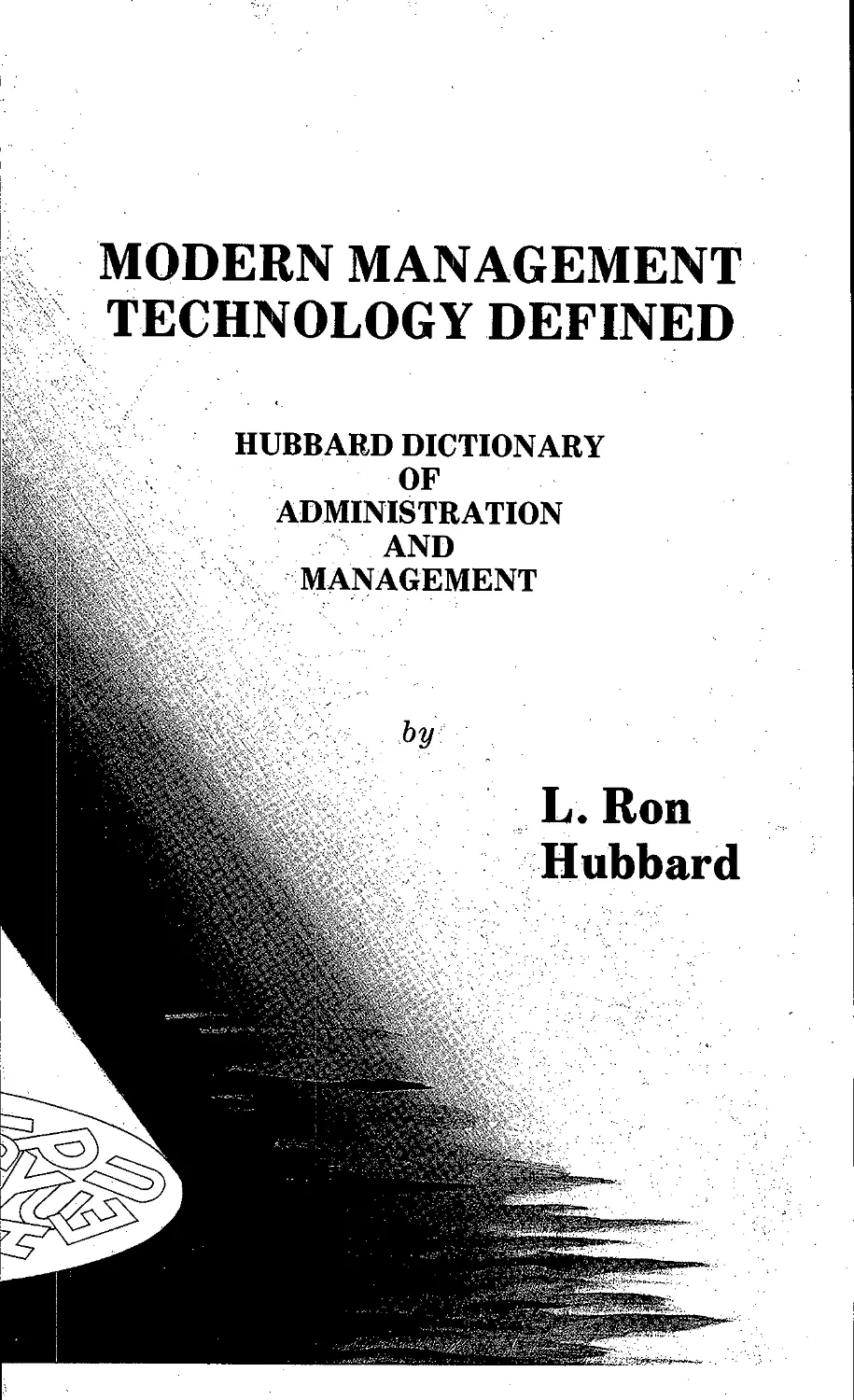
MODERN MANAGEMENT
TECHNOLOGY DEFINED
HUBBARD DICTIONARY
OF
ADMINISTRATION
. AND
MANAGEMENT
L. Ron
Hubbard

Published by
Church of Scientology of California
Publications Organization United States
2723 West Temple Street
Los Angeles, California 90026
The Church of Scientology of
California is a non-profit organization.
Scientology iz an applied religious philosophy.
Dianetics ® and Scientology ® are registered names.
First printing 1976
Copyright © 1949,1950,1951,1952,1953,1954,1955,
1956,1957,1958,1959,1960,1961,1962,1963,1964,
1965,1966,1967,1963,1969,1970,1971,1972,1973,
1974,1975,1976 by L. Ron Hubbard.
ALL RIGHTS RESERVED.
The E-meteris not intended or effective for the
diagnosiz, treatment or prevention of any disease.
A Dianetics Publication.
Dianetics is the trademark ofL. Ron Hubbard
in respect of his published works.
Compiled and edited by
The LRH Personal Secretary Office,
LRH Personal Compilations Bureau
LRH Personal Secretary: Alethiea C. Taylor
LRH Personal Compilations Bureau I/C: Pat Brice
Editor: Ernie Ryan
Compilers/Researchers: Cliff Von Shura, Barbara
de Celle, Maggie Sibersky, Pat Broeker,
Jim Dincalci
Manuscript Typist: Rae Chase
Design: Arthur Hubbard
Artists: Andre Clavel, Arthur Hubbard
ISBN 0-38404-040-2
Printed in the U.S.A. by Kingsport Press
Typeset by Freedmen’s Organization, Los Angeles
Important Note
One of the biggest barriers to learning a new subject is its nomenclature,
meaning the set of terms used to describe the things it deals with. A subject
must have accurate labels which have exact meanings before it can be
understood and communicated.
If I were to describe parts of the body as “thingamabobs” and "whatser-
names,” we would all be in a confusion, so the accurate naming of something
is a very important part of any field.
A student comes along and starts to study something and has a terrible
time of it. Why? Because he or she not only has a lot of new principles and
methods to learn, but a whole new language as well. Unless the student
understsnds this, unless he or she realizes that one has to “know the words
before one can sing the tune,” he or she is not going to get very far in any field
of study or endeavor.
Now I am going to give you an important datum-.
The only reason a person gives up a study or becomes confused or unable
to learn is because he or she has gone past a word that was not understood.
The confusion or inability to grasp or learn comes AFTER a word that
the person did not have defined and understood.
Have you ever had the experience of coming to the end of a page and
realizing you didn’t know what you had read? Well, somewhere earlier on that
page you went past a word that you had no definition for.
Here’s an example. “It was found that when the crepuscule arrived the
children were quieter and when it was not present, they were much livelier.”
You see what happens. You think you don’t understand the whole idea, but
the inability to understand came entirely from the one word you could not
define, crepuscule which means twilight or darkness.
This datum about not going past an undefined word is the most important
fact in the whole subject of study. Every subject you have tsken up and
abandoned had its words which you failed to get defined.
Therefore, in studying Scientology be very, very certain you never go
past a word you do not fully understand. If the material becomes confusing
or you can’t seem to grasp it, there will be a word just earlier that you have not
understood. Don’t go any further, but go back to BEFORE you got into trouble,
find the misunderstood word and get it defined.
That is why we have a dictionary. It will not only be the new and unusual
words that you will have to look up. Some commonly used words can be
misdefined and so cause confusion. So don’t depend on our dictionary alone.
Use a general English language dictionary as well for any non-Scientology
word you do not understand when you are reading or studying.
Scientology words and their definitions are the gateway to a new look
and understanding of life. Understanding them will help you live better, and
will assist you along the road of truth that is Scientology.
Note
While this dictionary has attempted to
include all Scientology management and ad-
ministration words and terms, there is a chance
you might find some words not included.
If you discover any missing words, please
write them to:
Dictionary Staff
LRH Personal Secretary
Saint Hill Manor
Past Grinstead
Sussex, England
The Editor
vi
Contents
Introduction......................................................... ix
Guide to the Dictionary.............................................. xi
MODERN MANAGEMENT TECHNOLOGY DEFINED
Hubbard Dictionary of Administration
and Management........................................................ 1
Abbreviations....................................................... 565
Organizing Boards................................................... 595
Reference Summary................................................... 606
LRH Definition Notes........................................... 607
MSH Definition Notes.........................................   607
Editor’s Notes................................................. 607
Editorial Staff Definitions.................................... 607
Books.......................................................... 608
Booklets....................................................... 609
Charts......................................................... 609
Dianetic Auditor’s Bulletins.... .............................. 609
Magazines...................................................... 610
Professional Auditor’s Bulletins............................... 610
Scientology Journals........................................... 610
Aides Orders................................................... 610
Base Flag Orders............................................... 610
Base Orders.................................................... 611
Board Policy Letters........................................... 612
Board Technical Bulletins...................................... 618
Central Bureau Orders.........................................  618
Central Office of LRH Executive Directives..................... 622
Commodore’s Staff Orders....................................... 622
Continental Orders............................................. 623
Ethics Orders, US Base......................................... 623
Executive Directives, Area Estates............................. 623
Executive Directives, Flag.................................... 623
Executive Directives, Flag Admin Org........................... 625
Executive Directives, Flag Advanced Org........................ 625
Executive Directives, Flag Bureau.............................. 625
 Executive Directives, U.S. Base............................... 625
Executive Directives, Worldwide................................ 626
Flag Bureau Data Letters....................................... 626
Flag Conditions Orders......................................... 627
Flag Debriefer Forms........................................... 627
Flag Divisional Directives..................................... 627
vii
Flag Mission Orders............................................ 628
Flag Orders.................................................... 628
Flag Orders of the Day......................................... 644
Flag Personnel Orders.......................................... 644
Flag Project Orders............................................ 645
Flag Ship Orders............................................... 645
Founding Church Policy Letters................................. 647
Guardian Finance Order, Guardian Personnel Orders.............. 647
Hubbard Association of Scientologists International
Policy Letters................................................. 648
Hubbard Communications Office Administrative Letters........... 648
Hubbard Communications Office Bulletins........................ 648
Hubbard Communications Office Information Letters.............. 650
Hubbard Communications Office Policy Letters...............  ♦	650
Hubbard Communications Office Technical Bulletins.............. 668
Hubbard Communications Office Training Bulletins............... 668
LRH Executive Directives....................................... 668
Miscellaneous References....................................... 670
Sea Organization Executive Directives.......................... 671
Secretarial Executive Directives............................... 673
U.S. Base Conditions Orders.................................... 673
LRH Tape Recorded Lectures..................................... 673
About the Author.................................................... 678
Church and Mission List............................................. 681
viii
Introduction
By Scientology study technology, understanding ceases on going
past a misunderstood word or concept.
If a person reading a text comes to the word “Felix Domesticus”
and doesn’t know it simply means HOUSE CAT, the words which
appear thereafter may become “meaningless,” “uninteresting” and he
may even become slightly unconscious, his awareness shutting down.
Example: “Wind the clock and put out the Felix Domesticus and
then call Algernon and tell him to wake you at 10:00 am,” read as an
order by a person who didn’t bother to find out that “Felix Domesticus”
means “house cat” or “the variety of cat which has been domesti-
cated” will not register that he is supposed to call Algernon, will feel
dopey or annoyed and probably won’t remember he’s supposed to
wake up at 10:00 am.
In other words, when the person hit a misunderstood word, he
ceased to understand and did not fully grasp or become aware of what
followed after.
All this applies to a sentence, a book, a post or a whole
organization.
A crashing misunderstood will block off further ability to study
or apply data. It will also block further understanding of an organiza-
tion, its organizing board, an individual post or duties and such misun-
derstoods can effectively prevent knowledge of or action on a post.
ALL THIS IS THE MOST COMMON CAUSE OF AN UNAC-
CEPTABLE POST PRODUCT, OR NO PRODUCT AT ALL.
The difficulties of an organization in functioning or producing
stem from this fact.
The by no means complete list of words that have to be fully
cleared and understood just to talk about organization as a subject,
and to intelligently and happily work in an organization EVEN AS
ITS LOWEST EMPLOYEE are:
A Company
A Board of Directors
Top Management
Policy
Management
Programmes
Targets
Orders
Technology
Know-How
Organizing Board
Post
Hat
Cope
Purposes
Organize
Duties
A Checksheet
A Checklist
A Communication Channel
A Command Channel
A Relay Point
A Stable Terminal
Double Hatted
A Product
Aberration
VIABILITY
This is key vocabulary. Out of a full understanding of what is
implied by each, a brilliantly clean view is attained of the whole
subject of organization, not as a fumble but as a crisp usable activity.
Unless one at least knows the basic words completely so that
they can be used and applied they will not buffer off confusions that
enter into the activity.
There is a lot to organization. It requires trained administrators
who can forward the programs. But a “trained*’ administrator who
does not grasp the principles of organization itself is only a clerk.
At this current writing Man has not had administrative training
centers where actual organization was taught. It was learned by
“experience” or by working in an organization that was already
functioning. But as the principles were not the same company to
company and nation to nation, the differences of background ex-
periences of any set of administrators differed to such a degree that
no new corps could be assembled as a team.
Thus it was said to require a quarter to a half a century to make
a company. But the number of ineffective bureaucracies and national
failures which existed stated clearly that there were too few skilled
administrators and too few training activities.
Man’s happiness and the longevity of companies and states
apparently depend upon organizational know-how. Hiring specialized
experts to get one out of trouble is a poor substitute for knowing what
it is ail about in the first place.
Organization is actually a simple subject, based on a few basic
patterns which if applied produce success.
If one would dream and see his dreams an actuality, one must
also be able to organize and to train organizational men who will
make those dreams come true.	____________—4
x
Guide to the Dictionary
This dictionary is uniquely comprehensive in that as well as
containing the bulk of the words and abbreviations needed to study
the powerful and fantastically successful management and adminis-
trative technology of Scientology, as developed by L. Ron Hubbard, it
also contains a large number of conventional business management
and administration terms.
Thus whether one is studying the management and administra-
tive technology developed for the Church of Scientology or any other
business management or administrative technology this book is a
must..
The Scientology definitions are mainly extracts taken from the
works of L. Ron Hubbard. Some are extracts taken from the works of
L. Ron Hubbard’s Aides and top executives in Scientology. The entry
words for all Scientology definitions are in bold face type. In compiling
these definitions the editorial staff have chosen to omit the conven-
tional use of the ellipsis (. . .) which would indicate an intentional
omission of words in the definition. This is so that each definition
imparts a complete uninterrupted thought to the reader and allows
him to form a concept of the word without distraction or the inclusion
of data not contributory to the definition.
At the beginning of several definitions a word or phrase some-
times appears in parentheses such as (Flag) (Post), (Flag Ship Org), or
(FOLO). These serve to designate specific areas of Scientology organi-
zations, posts, organizing boards and subjects that the term or
definition originates from or applies to only.
The purpose of the Scientology definitions is solely to aid a person
in the study of Scientology management and administrative tech-
nology. Some of these definitions are taken from early Scientology
policy letters and issues which have since been cancelled. These are
included because the words defined are mentioned in later policy
letters and issues that are in current use. Thus the purpose of these
definitions is not to set Scientology policy but to aid in the study of
Scientology management and administrative technology.
The conventional business management and administration defi-
nitions were researched and formulated by the editorial staff after
extensive study in these subjects. A great deal of effort was made to
xi
ensure these are as clear and straightforward as possible to aid any
person engaged in the study of business administration and manage-
ment. The entry words for these are in light face type which
differentiates these from the Scientology terms and definitions.
A section of organizing boards is included at the end of the
dictionary to show the structure of various Scientology organizations
as they evolved from 1961 to 1976. Any business organization in the
world could be set up to run more successfully from the standard
Scientology Seven Division Organizing Board released by L. Ron
Hubbard.
A complete list of the references used for the Scientology
definitions appears in the reference summary at the back of the
dictionary.
Scientology is the fastest growing religion on the planet by
actual surveys and statements by sociologists. The management and
administrative technology of Scientology developed by L. Ron Hubbard
is the source of this expansion.
Whether you are studying this or any conventional business
management and administration technology this dictionary is the
guide to modern business and management technology.
The Editor
MODERN MANAGEMENT
TECHNOLOGY DEFINED
HUBBARD DICTIONARY
OF
ADMINISTRATION
AND
MANAGEMENT
ABBREVIATED BOOKKEEPING, the term
abbreviated bookkeeping has been used to mean
bookkeeping which by-passed and ignored the use
of personal accounts. In other words, the double
entry is effected by entries made directly between
the organization’s bank account and another
impersonal account of the organization. (BPL 14
Nov 70 VI)
ABERRATED CONDITION, mental mass ac-
cumulates in a vast complexity solely because one
would not confront something. To take apart a
problem requires only to establish what one could
not or would not confront. When no-confront
enters, a chain may be set up which leads to total
complexity and total unreality. This, in a very
complex form, we call an aberrated condition.
People like that can’t solve even rudimentary
problems and act in an aimless and confused way.
To resolve their troubles requires more than
education or discipline. It requires processing.
Some people are so “complex” that their full
aberration does fully not resolve until they attain a
high level of ОТ. (HCO PL 18 Sept 67)
ABERRATION, 1. by definition “a crooked line.”
It is from the Latin aberratio, “a wandering from,”
and from the Latin errare, to wander or to err. A
sane person thinks, looks and sees in straight lines.
Black is black, white is white. The aberrated
person looks toward black and wanders off in his
gaze to something else and makes the error of
saying it is “grey.” You can consider aberration in
a passive way (supinely, of no force or action). A
person is sane or not sane. He thinks straight or
crookedly. Now consider aberration in a forceful
way. A person looks, then an opposing force to him
pushes aside his gaze or distracts it. But the really
sane, forceful person looks right on through and
past the opposition and sees what is there anyway.
(HCOB19 Aug 67) 2. the number of out-points the
guy is carrying around in his skull is how aberrated
he is. That has very little to do with his sanity. It
has everything to do with his competence. (ESTO
10,7203C05 SO II) 3. aberration is just the basis of
out-points. (ESTO 4, 7203C02 SO II) 4. a chain of
vias based on a primary non-confront. (HCO PL 18
Sept 67) 5. aberration is non-straight line by
definition. (HCOB 5 Dec 73)
Aberration (Def. 1)
AB FACTOR, we don’t wholly guarantee you and
your co-auditor that you will со-audit in the Level
VI со-audit for one team member may be case type
A and the other B. A case type A can run through
anything. A case type В stops at a comma. Thus
one gets too far out of pace with the other and it’s
just too hard on one member of the team who
would be, of course, the type В and already in
1
ABILITY
trouble. It would be selfish indeed of a type A to
force a type В to run GPMs far beyond where he or
she has had them run. We will try to put the team
together in the Level VI со-audit and mostly do but
this AB factor is a technical one and we can’t do
anything about it short of good auditing. (HCO PL
11 Jun 64) [See PC TYPE A, PC TYPE В in
Dianetics and Scientology Technical Dictionary.}
ABILITY, 1. the ability to complete a cycle of
action, to handle the matter so it does not have to
be handled again. (HCO PL 22 Feb 68) 2, ability is
measured not by opinion, but by the person’s
ability to raise statistics and produce the product
of the particular post. (BPL 4 Jul 69R V)
ABILITY MAGAZINE, Ability magazine should
be issued semi-monthly. Issues shall be used
broadly as mailing pieces and are not to go just to
the membership and be forgotten. The first Ability
of the month shall be an Ability major issue, the
second issue of the month shall be an Ability minor
issue. Ability major: shall consist of informative
technical material, advertisements and programs.
Ability minor: shall be dedicated only to programs
such as extension course, such as training, such as
processing results. Ability major is mainly of
interest to the membership and informed Scien-
tologists. Ability minor shall be of interest to the
broad public. (HCO PL 24 Oct 58, Ability Maga-
zine) [Ability is published by the Church of
Scientology Washington D.C.]
Able Bodied Seaman (Def. 1)
ABLE-BODIED SEAMAN, 1. a Sea Org AB is
a Sea Org member in good standing who has
completed his AB checksheet. Gender or age are
irrelevant. The vital datum is that an AB knows
enough to make himself useful aboard a Sea Org
ship. An AB knows the basic tech of the sea and he
can survive on the sea. (FSO 156) 2. a permanent
rating as able-bodied seaman is required before
any higher deck rating or appointment can be
considered permanent. An AB rating requires the
completion of checksheet and demonstration of
competence on deck. (LRH Def. Notes, circa
Aug 67) 3. a trained seaman more highly skilled
than an ordinary seaman. Able = having enough
power, skill, etc., to do something; capable; worth
of being. Bodied = having a body or substance,
especially of a specific kind. Seaman = a sailor,
mariner. (SO ED 214 INT) 4. qualified sailor.
(FO 196) Abbr. AB.
ABLE-BODIED SEAMAN CONFERENCE,
instituted on a trial basis at Flag only. It is
composed of all present ABs on the ship, as active
members. Its purpose is to make and keep Sea Org
ship tech known and applied. To back up command
in all phases of ship operation, and to ensure
optimum survival for its members including their
rapid promotion as deserved. (FSO 156)
ABSENTEE MANAGEMENT, see MAN-
AGEMENT, ABSENTEE.
AC-1A FORM, this form is filled in by the
Treasury Secretary each Friday evening. The
form provides additional data and verification for
the AC-1/2 for financial management purposes.
(BPL 4 Dec 72 IIRB)
AC-1 FORM, 1. reports the gross income of the
organization for the week, shows the calculation of
the corrected gross income and the allocation of
the corrected gross income. The corrected gross
income is the income available for use and is
calculated by deducting various items as detailed
on the form. The AC-1 form does not apply to an
AO, SH, FOLO, Estates Org or any non-service
org. These orgs will use the AC-2 form. (BPL4 Dec
72 IIRB) 2. HCO WW form AC-1 is the only
proportionate breakdown acceptable to HCO WW
Accounts. (HCO PL 19 Sep 62) [The above HCO PL
was cancelled by BPL 10 Oct 75 IV.]
AC-2 FORM, the AC-1 form does not apply to an
AO, SH, FOLO, Estates Org or any non-service
org. These orgs will use the AC-2 form. The AC-2
form follows the AC-1 form exactly except that the
management bills payment does not conform to the
scale laid out for the AC-1 and the allocation of the
proportionate amount is not per the percentages
given. (BPL 4 Dec 72 IIRB)
ACADEMY, 1 . in Sen the academy is that depart-
ment of the Technical Division in which courses
and training are delivered; Department 11, Divi-
sion 4. (BTB 12 Apr 72R) 2. (Academy of Sen)
headed by the Director of Training, the academy is
2
ACC INSTRUCTOR HAT
responsible for the technical excellence of Sen
practice tomorrow. Precise scheduling, crisp
training and true, direct answers to the students’
questions make an academy. A bad academy
results in a bad HGC tomorrow as many graduates
become staff auditors. A good academy is known
by its snappy scheduling and the degree of basic
data and action the student actually absorbs. (HCO
PL 20 Dec 62) 3. Academy of Sen purpose: to train
the best auditors in the world. To coach outside
and staff auditors for employment in the HGC.
(HCO London, 9 Jan 58) Abbr. Acad.
Academy (Def. 1)
ACADEMY ADMINISTRATOR, purpose: to
handle the comm lines and supplies of the
academy. (HCO London 9 Jan 58)
ACADEMY COURSES, 1. academy training
Level 0-IV. (HCO PL 4 Nov 71II) 2. an academy
course then hereafter means 160 hours of class
instruction to certificate for all levels zero to IV.
(HCO PL 11 Dec 64)
ACADEMY INSTRUCTOR, duties of an Acad-
emy Instructor: (1) to train with accuracy and
precision the students we have, (2) to leave
administrative duties to the academy adminis-
trator, (3) to get coaches to do a better job of
coaching, (4) to read TRs to the students. If they
have a question on them to read again the TR and
ask them what the TR said. If they still do not get
it, repeat the above. (5) to get the students to
execute the TRs with the same snap and precision
as was expected of students in the 18th ACC, (6) to
run a tight 8-C on the students. (SEC ED 37,
15 Jan 59)
ACADEMY SENIOR INSTRUCTOR, should
handle the advanced class and do no administra-
tive work. His job is making sure the student is an
auditor at course end. (HCOB 9 May 58)
ACC ADMINISTRATOR, purpose: to ensure a
smooth running ACC as regards material. Works
under ACC Chief Instructor and ACC Conductor.
Supervises ACC Clerk. (HCO PL 24 Feb 60) [The
above HCO PL was cancelled by BPL 10 Oct 75III.]
ACC CHIEF INSTRUCTOR, purpose: to turn
out auditors who are responsible for clearing their
pcs and who know and can use the best methods of
doing so; makes an ACC the greatest real
education on this planet. (HCO PL 24 Feb 60)
[The above HCO PL was cancelled by BPL 10
Oct 75 III.]
ACC CLERK, purpose: to create an orderly ACC
by performing efficiently the routine work of ACC
Administration. The ACC Clerk works directly
under the ACC Administrator, who is under the
ACC Chief Instructor, who is under the ACC
Conductor. It is an HCO post. (HCO PL 24
Feb 60) [The above HCO PL was cancelled by BPL
10 Oct 75 III.]
ACCEPT AN CE, 1. a formal indication by a debtor
of willingness to pay a bill of exchange, usually
writing the word “accepted” and his signature
across the face of the document. 2. the bill of
exchange itself. 3. in law, the agreement by one
party with the terms of an offer of another so that a
contract becomes legally binding between them.
ACCEPTANCE SAMPLING, the concept of
inspecting or testing a portion of a product in order
to decide whether or not the whole amount is
acceptable and/or meets the standards required.
ACCEPTANCE TEST, testing a program or
project early in development to determine
whether or not the completed final work will
produce the expected result.
ACCEPTING AN ALMOST, Example: a mes-
senger accepting the almost of turning down
the heat. The order was to turn it off. An executive
or communicator or messenger who accepts and
forwards an almost is permitting dev-t. Orders
given are to be executed and reported done, not to
be nearly done or almost done. A communicator
can often be tripped up by this form of dev-t. It is
most easily spotted by insisting that the original
order or orders be returned with the compliance so
that any terminal on the line can tell at a glance
what was ordered, and what was done. (BPL 30
Jan 69)
ACCIDENT PRONENESS, a manifestation of a
tendency to succumb. (HCO PL 3 Nov 70 II)
ACC INSTRUCTOR HAT, purpose: to train
the best auditors on earth. Works directly under
3
ACCOMMODATION COUNSELORS
ACC Chief Instructor, who is under ACC Con-
ductor. (HCO PL 24 Feb 60) [The above HCO PL
was cancelled by BPL 10 Oct 75 1П.]
ACCOMMODATION COUNSELORS, (Flag)
room and food registrars are to be called Accom-
modation Counselors. They reg immediately after
the training and service reges have completed.
The training and processing reges sign-up the per-
son for the services and then when the subject of
room and food comes up, they direct the person to
the accommodation counselor. (BFO45)Abbr. AC.
ACCOUNT, simply a sheet of paper (or page of a
book) headed at the top as to the category of inflow
or outflow of the organization or else the name of
the outside person with whom the organization
deals. It is divided by a line down the middle to
give a left-hand side and right-hand side. The left-
hand side of an account is the receiving or inflow
side and the right-hand side is the outflow side.
(BPL 14 Nov 70 II)
ACCOUNTABILITY, 1. being charged with the
responsibility for the results or effects of some-
thing. 2. the duty that a junior person has to a
senior for reporting on the progress or perform-
ance of a job that they both share responsibility for
completing.
ACCOUNTANCY, the practice of using the book-
keeping records to analyze and report upon the
financial transactions of a business for a particular
period of time. In short it means the preparation of
financial reports. (BPL 14 Nov 70 II)
ACCOUNTANT, purpose: to expedite, handle and
police the financial items from the moment they
enter the organizational comm lines to the moment
they depart. (HCO London, 9 Jan 58)
ACCOUNT, CHARGE, a business arrangement
between a company and an individual allowing the
individual to obtain goods or services on credit,
paying for them later within an agreed time
period.
ACCOUNT, DESCRETIONARY, type of in-
vestment account wherein the investor leaves
buying and selling, within limits or overall, to the
discretion of his broker or an advisor.
ACCOUNT, DRAWING, a weekly or monthly
record of cash payments made to an owner,
director or executive to cover expenses or to a
sales representative as advances against commis-
sions due.
ACCOUNT EXECUTIVE, in advertising it is
that person who manages a client’s account by
liaising and negotiating with the client. An account
executive may manage several clients’ accounts
and ensures that they receive the services they are
paying for. The term is also applied to stock
brokers.
ACCOUNT, EXPENSE, 1. a special account out
of which an employee of a firm is reimbursed for
expenses incurred in the transaction of business
affairs. 2. arecord of business expenses paid for by
an employee and submitted to his employer for
approval and reimbursement. •
ACCOUNTING, the game of accounting is just a
game of assigning significances to figures. The
man with the most imagination wins. But there
must be correct figures and there must not be
gross misassignment of debts as profits or the
whole thing won’t hang together. (HCO PL 25
Jun 67)
ACCOUNTING, the action of noting down, clas-
sifying, ensuring the accuracy of, evaluating and
interpreting the financial facts and figures of an
organization or business.
ACCOUNTING COST CONTROL, the use of
accounting procedures to study the recorded
transactions of a business in an effort to control
costs. Accounting cost control can spot the inef-
ficient use or misappropriation of funds and
establish responsibility for such. Bills paid twice,
overexpenditures, unauthorized expenditures
etc., are all the subject of accounting cost control.
See OPERATIONAL COST CONTROL.
ACCOUNT, LEDGER, a page or several pages
in a ledger listing all the transactions with a
specific firm. The page iz divided in half with a
record of transactions resulting in debts to that
firm posted on the left-hand side of the page or
debit side and a record of transactions resulting in
credit with that firm posted on the right-hand or
credit side of the account. By totalling each side of
the account it can be seen if one owes money to that
firm or has credit with that firm.
ACCOUNTS AND MATERIEL BUREAU,
1. bureaux accounts will be handled under Supply
and Materiel Bureau which will be renamed
Accounts and Materiel Bureau and operate under
the Coordination Bureau and LRH Comm
authority. (CBO 27) 2. supply and materiel
becomes Accounts and Materiel and is the Division
3 of bureaux with Supply and Materiel as Branch 4.
(CBO 28)
4
ACCOUNT, SUSPENSE
ACCOUNTS ASSISTANT TO THE ORGAN-
IZATION SECRETARY, there will no long-
er be income and disbursement posts as separate
personnel. Both these posts will be held by one
person with the title Accounts Assistant to the
Organization Secretary, effective at once. (HCO
PL 18 Jun 64)
ACCOUNT, SAVINGS, a private account into
which a depositor puts savings money that the
bank pays interest on, with the right of withdraw-
ing funds by presenting his passbook so that the
bank teller may record the transaction or by giving
required notice to the bank.
ACCOUNTS CLEARANCE, it does not mean
“bills known” or “bills arranged to be paid.” It
means "all bills paid.” (HCO PL 1 Aug 72) [The
above HCO PL was cancelled by BPL10 Oct 75 X.]
ACCOUNTS CLEARANCE SLIP, slip which
says—John Jones has been cleared by Accounts
for one HCA course, April 25, 1965, signature in
full of cashier. (HCO PL 15 Mar 65 II) [The above
HCO PL was cancelled by BPL 10 Oct 75 V.]
ACCOUNTS DEPARTMENT, there are two
sections to the Accounts Department. One is the
Income Section. The other is the Disbursement
Section. (HCO PL 6 May 64)
ACCOUNTS DIVISIONS, these are: the Income
Division and the Disbursement Division. They are
in separate areas and are run by different persons.
(HCO PL 23 Nov 61)
ACCOUNTS FILES ADMINISTRATOR,
this staff member will help the accounts assistant
with files and in other ways as contained in the
administrative directive of the post. (HCO PL 18
Jun 64)
ACCOUNTS, MARGINAL, accounts of credi-
tors or potential creditors who are questionable
risks or have a poor credit rating.
ACCOUNTS PAYABLE, 1. accounts of sums
payable to a company’s creditors. 2. the amounts
thus owed to a creditor.
ACCOUNTS POLICING, it is the specific duty
of the Treasury Secretary in an org to pick up and
trace the course of every particle of money
through the entire organization, from the time it
enters through the mail or with a customer, until it
exits from the org as a disbursement or a reserve
action. That is quite a job, and it is the most
important job a Treasury Secretary has got. It
sums up the purpose of the post. It is called
accounts policing. To police something means “to
control, regulate, keep in order, administer.” The
anatomy of accounts policing is: (1) policing income
to ensure that the org is collecting the income from
the services that it delivers, and that all org
income is channelled into treasury and into the
bank without delays. (2) policing disbursements to
ensure that financial planning occurs and that only
monies which are so designated and authorized are
allocated out of the org accounts. (3) policing
reserves to ensure that the org never spends more
than it makes, and that it builds up substantial
reserves through excellent control of its income-
outgo flows. (BPL 1 Feb 72 I)
ACCOUNTS RECEIVABLE, accounts which
show money owed by a customer to the company.
Depending on the collectibility of these accounts
receivable, they may be acceptable as collateral for
a loan or sold outright to a commercial factor for a
percentage of their value giving the commercial
factor the authority to collect and retain the debts
thus collected.
ACCOUNTS RECORDS, any and all items that
may be considered to be accounts records
meaning: bills, cancelled checks, invoices,
receipts, chits, lists, record books, and any other
item that may be considered by you to have to do
with accounts. (HCO PL 25 Sept 59)
ACCOUNTS SYSTEM, a Sch accounts system is
simple. It works. It consists of writing an invoice
on a four-copy machine for everything received
and a disbursement voucher on a four-copy
disbursement machine for everything expended,
even petty cash, with a completed statement of
what Accounts knows of the expenditure. The
system consists of four files—one with a file for
every creditor, one with a file for every debtor,
one with a complete file for every bank account and
one with a file for every weekly breakdown
envelope. A board with nails on it for pinning up
invoices for every category on the breakdown
sheet and a book to put income sheets in plus an
adding machine and cabmets completes the entire
system. (HCO PL 20 Dec 62)
ACCOUNTS UNIT FOR SAINT HILL,
manages the accounts. Handles all financial
records, income, disbursement and reports for the
Org Sec and maintains all accounts files and the
purchase order system. Purchases for Saint НШ.
(HCO PL 18 Dec 64, Saint НШ Org Board)
ACCOUNT, SUSPENSE, a temporary account
in which are entered credits and charges until they
5
ACCRUAL
are assigned properly to their correct permanent
accounts.
ACCRUAL, 1. the natural growth of a fund due to
interest being paid into it. 2. the interest resulting
from an investment.
ACCRUED EXPENSES, expenses for which
the organization is liable, i.e. a liability account.
(BPL 14 Nov 70 V)
ACCRUED INTEREST, interest accumulated
by or accrued on a bond since the last interest
payment so that the buyer pays the market price
plus the accruement.
ACC SUPERVISOR, purpose: to ensure for
HCO that the administration of an Advanced
Clinical Course runs smoothly from beginning to
end. That proper quarters are secured in accord-
ance with HCO policy. That all required supplies
and materials are acquired and on hand as
scheduled. (HCO PL 24 Feb 60)
ACCUMULATING GRAPH, an accumulating
graph merely means you keep adding one day’s
statistic to those of the day before. (BPL 8 Feb 72)
and the market value of saleable investments of a
business to its current liabilities, the result acting
as a guide to credit rating and establishing a
company’s ability to handle current obligations.
ACK, 1. a despatch thanking the person (for the
report) with the report and date of it and some
mention of what was in it so he isn’t left in mystery
as to which one or what it was. (CBO 348R) 2. the
first answer to a telex origination may add data
which requires a third telex in the cycle. This
would be sent by the originator to get done or find
out whatever more is needed. This similarly
requires a speedy answer. If the orginator is now
satisfied and has gotten the needed information or
compliance desired, he sends the ack, which ends
the comm cycle. That “ack” indicates that the reply
was received and thus ends the telex comm cycle.
(This takes the place of the nod or smile at the end
of the face-to-face comm cycle described in chapter
ten of Dianetics ’55.) (BPL 12 Jun 73R II) 3. this
word ends a comm cycle. It is the best way to end a
telex comm cycle. It is the final telex on that cycle.
(BPL 8 Apr 731) 4. the acknowledged yellow copy
of a communication. (HTLTAE, p. 117) — v. to
acknowledge. To stamp “ack” and initial.
(HTLTAE, p. 117)
Accumulating Graph
ACE FIGHTER TEAMS, the Battle of Britain
has two Ace Fighter Teams. Ace Fighter Team
One is a Division 6 trouble shooter set of
establishes on rotation building up and strength-
ening org Division 6s to pour new people into orgs.
Ace Fighter Team Two is the second prong of the
UK group operation. In this Ace Fighter Team
Two, only seasoned veterans and star fighters will
be assigned with CS-6 permission (touring to
spread the word on Sen to every town and leaving
behind new groups). (BO 37 UK)
ACID TEST RATIO, (or quick ratio or liquid
ratio) the ratio of total cash, accounts receivable
Ack (Def. 2)
ACKNOWLEDGEMENT, something said or
done to inform another that his statement or action
has been noted, understood and received. “Very
good,” “okay," and other such phrases are
intended to inform another who has spoken or
acted that his statement or action has been
accepted. An acknowledgement also tends to
6
ACTION BUREAU
confirm that the statement has been made or the
action has been done and so brings about a
condition not only of communication but of reality
between two or more people. Applause at a
theater is an acknowledgement of the actor or act
plus approval. Acknowledgement itself does not
necessarily imply an approval or disapproval or
any other thing beyond the knowledge that an
action or statement has been observed and is
received. In signaling with the morse code the
receiver of a message transmits an R to the sender
as a signal that the message has been received,
which is to say acknowledged. There is such a
thing as over-acknowledgement and there is such a
thing as under-acknowledgement. A correct and
exact acknowledgement communicates to someone
who has spoken that what he has said has been
heard. An acknowledgement tends to terminate or
end the cycle of a communication, and when
expertly used can sometimes stop a continued
statement or continued action. An acknowledge-
ment is also part of the communication formula and
is one ofits steps. The Scientologist, sometimes, in
using Scientologese abbreviates this to “ack”; he
“acked”the person. (LRH Def. Notes) АЬЬт. Ack.
ACKNOWLEDGEMENT OFFICER, you
have an Acknowledgement Officer who is doing
acknowledgements of standard reports coming in.
He just plain acks them. (BPL 9 Apr 73 II)
ACKNOWLEDGEMENT REPORT, a staff
member who does some action which is above the
call of duty of his or her post hat may write an
acknowledgement report on himself detailing
what it was he did and how it benefited the org.
This is sent to Division 1 for filing in his or her
personnel file. In reviewing staff for promotion,
such self acknowledgements are taken into
account in assessing the staff member’s responsi-
bility level, along with other data and- statistics.
(HCO PL 11 Nov 66) [The above HCO PL has been
cancelled by BPL 10 Oct 75 IV.]
ACQUIRE, to gain possession, ownership or
power over something as an acquiring of funds or
property.
ACQUISITION, 1. the act of gaining possession,
ownership or power over something as an acquir-
ing of funds or property. 2. the thing so gained or
acquired.
ACTAD, 1. action addressee, the person to whom
the communication goes for action. {HTLTAE
p. 117) 2. the actad message has four copies, each
of which is under the eye of some individual and
each of which is demanding that the message be
acknowledged and completed. {HTLTAE p. 88)
ACTING, 1. a prefix to a title meaning appointed
conditionally and if shows good statistics for a year
will become of permanent title. (HCO PL 13
Mar 66) 2. if it is appointed from Saint Hill why
then that becomes an acting, which is the first
rank, and for a while the post is held under an
acting status and then is held in a full status. The
acting is simply removed. (SH Spec 61, 6505C18)
3. acting is prefixed to a title until checksheets are
passed. (FO 79) 4. where other posts are held
without qualification above the rating of able
bodied seaman or engineman first class the word
acting will always be used in writingtitle and name
and these may not be written or used without
acting before them, or the letter “A.” (LRH Def.
Notes circa Aug 67)
ACTING ETHICS OFFICER, any Ethics Offi-
cer is to be known only as Acting Etirics Officer
until he or. she has covered the OEC section on
ethics and has proven competent on post. (LRH
ED 39 INT)
ACTING FLAG OFFICER, there is always an
Acting Flag Officer. It may be the Commodore,
which is signed simply “Commodore,” or in his
absence it may be one of his deputies. The title
Acting Flag Officer means that for that time, he is
head of the flotilla, the ships’ senior officers and
crews wherever they may be, and all connected
organizations. (FO 3342)
ACTION, Action Bureau. (7012C04)
ACTION, 1. that motion which makes planning an
actuality. 2. the carrying out of assigned tasks.
ACTION AFFLUENCE, the formula for action
affluence is: (1) economize on needless or dispersed
actions that did not contribute to the present
condition. Economize financially by knocking off
all waste. (2) make every action count and don’t
engage in any useless actions. Every new action to
contribute and be of the same kind as did
contribute. (3) consolidate all gains. Any place we
have gotten a gain, we keep it; don’t let things
relax or go downhill or roller-coaster. Any advan-
tage or gain we have, keep it, maintain it. (4)
discover for yourself what caused the condition of
affluence in your immediate area and strengthen
it. (LRH Def. Notes)
ACTION BUREAU, 1. where an org is in trouble
(stats down) the Action Bureau Flag takes it over.
Based on searching and accurate evaluation,
mission orders are written to correct the out-
points and get the stats up and the org viable. If it
is a major situation in a major org the mission goes
from Flag to the org. The mission is operated by
7
ACTION FILES
Flag Action. (FBDL 191R) 2. evaluates the
extreme condition and establishes the why or
decides on special investigation, writes up appro-
priate mission orders for another liaison bureau to
run or briefs and sends, via the Comm Bureau,
missionaires, and keeps after the matter until the
extreme condition up is understood and published
for use or the extreme condition down is gotten
back up. (CBO 7) 3. is responsible for the speed and
quality of the mission and for operating it while it is
out. All missions, immediate, courier, emergency,
garrison, go through Action. (FO 2756) 4. the basic
purpose of Action is planning and emergencies.
When all else fails you have to sent it to the Action
Bureau. Somebody isn’t complying with your
orders and so forth and your orders being valid
orders would have to be implemented by a mission.
That’s how we force the thing home. (7012C04)
5. Operations. Called the Action Bureau on Flag,
they run missions into orgs to handle extreme
conditions and to do special projects for clients.
Any special service a client might need is handled
by them expertly and flawlessly. They must have a
pool of management experts to draw from who are
fully trained in Flag mission tech. They operate
strictly by Sea Org mission procedure. If need be,
they can call on org staff who are qualified to go on
missions. They have priority. Missions are sent by
approved evals only. There is a complete and
highly refined technology of mission operation in
the Sea Org. (BPL 13 Feb 73R) 6. FOLO Action
Bureau selects missionaires from MU, prepares,
briefs, fires Flag missions, sends preparations file
via External Comm Bureau to Flag and gets
missionaires trained and controls the missionaire
unit. (CBO 192) 7. the Sea Org Action Bureau is
established in the Office of LRH Flag. It is headed
by the Chief of Sea Org Operations. It consists of:
Evaluation Branch, Action Orders Branch, Opera-
tions Branch. It is clearly the purpose of an Admin
Unit to collect, file and compile, post and organize
data. And it is clearly the function of the Action
Bureau to find the situations in that data that
urgently need handling, to demand action and
obtain a proposal from the Action Orders Branch
that can be passed at an aides or assistant aides
conference and the Flag Org or continental
commanding officer that can then be written up
and launched as a mission. (FO 2474) 8. consists of
Evaluation Branch, Planning Branch, Mission
Preparations Branch and Operations Branch.
(CBO 18) 9. Action has planning, briefing, opera-
tions. (FBDL 12)
ACTION FILES, it is possible, through a commu-
nications system, to organize files so that they are
action files, so that they are the memory of a mind
which thinks. A file should have three sections:
(1) the action file, which holds a datum that calls for
action at a certain time, and injects it back into the
system at the proper moment, (2) working files,
which hold the information that is valuable to the
operation, (3) dead files, which could be junked
without any loss of value to the operation.
(HTLTAE, p. 64)
ACTION SKILL, the ability to take the right
action to handle a situation.
ACTIVE, L engaging in Sen full or part time in an
org, forming org, city office, franchise or indi-
vidually in the field. (LRH ED 259 ШТ) 2. a major
issue of the continental magazine must be mailed
out every other month to all active persons in the
files. Active means members and active files.
(HCO PL 23 Sept 64) 3. (CF and address) the
simple test for active is do they ever answer? (HCO
PL 23 Sept 64)
ACTIVE FIELD STAFF MEMBER, one who
is in constant communication with his selectees for
the purpose of getting them onto the bridge and
into the org for service. (BPL 15 Jun 73R I)
ACTIVE FILES, are simply “the files of those
persons who are members and those persons who
have been trained or processed and those persons
who have expressed a desire to be trained or
processed.’’ (HCO PL 8 Apr 65)
ACTIVE MONEY, funds that are in active use
being exchanged hand to hand within society or
those funds being used in business dealings.
ACTIVITY LEARNING (OR TEACHING),
a method of learning which requires that one get
involved in or carry out the practical aspects of
how to do something as opposed to learning
straight theory in textbooks and lectures, with
little practical application. This can take the form
of workshops, field trips, projects, group discus-
sions, etc.
ACTUALS, commodities or products traded on a
market (i.e. spot market) that one can take
delivery of immediately as opposed to futures
markets where a commodity becomes available in
the future.
ADDED INAPPLICABLE DATA, just plain
added data does not necessarily constitute an
out-point. It may be someone being thorough. But
when the data is in no way applicable to the scene
or situation and is added it is a definite out-point.
In using this out-point be very sure you also
understand the word inapplicable and see that it is
8
ADDRESSOGRAPH
only an out-point if the data itself does not apply to
the subject at hand. (HCO PL 30 Sept 73 I)
ADDED TIME, in this out-point we have the
reverse of dropped time. In added time we have, as
the most common example, something taking
longer than it possibly could. (HCO PL 30 Sept 731)
Added Time
ADDED VALUE, increase in value of an item by
reason of production and distribution. Example:
cloth to manufacture a shirt cost $1.00 per square
yard. Production cost=5O0. Distribution cost=
500. Added value per square yard of cloth=$1.00.
ADDENDUM, an addition to a report, book or
motion at a formal meeting etc. An addendum does
not change the original but adds to it.
ADDITIVES, 1. in the period up to 1966 we were
plagued by an occasional obsessiveness to add to
any process or policy. Additives made things
unworkable. (HCO PL 30 May 70, Important,
Cutatives) 2. people add things that aren’t there. If
it isn’t written into the .line-up it isn’t there.
(HCO PL 16 Jan 61)
ADD-ON SALES, additional sales made to a
customer after a prior purchase. Such sales can
account for as much as 50% of a company’s income.
ADDRESS, 1. the address files contain, ready for
use in mailings, all the names in central files and
ready reference designations about these persons.
Address is the name-status index of central files.
(HCO PL 23 Sept 64) 2. keeps up-to-date the
Scientologist address files, cuts plates and has
charge of all address equipment and address area,
furnishes addresses or addressed envelopes or
tapes for all departments. Furnishes card files of
names for departments. (HCO PL 18 Dec 64, Saint
Hill Org Board) 3. this means the location of the
terminals outside the org that the org contacts.
(HCO PL 7 Jul 71) 4. the central files index as well
as who gets the magazine. (HCO PL 18 Nov 69 I)
ADDRESS COORDINATOR, see WW AD-
DRESSO COORDINATOR.
ADDRESS FILES, see ADDRESS. .
ADDRESS-IN-CHARGE, under Address-In-
Charge, the up-to-date addresses of all persons in
the live and inactive files of CF are kept readily
useable on a proper address machine. All mailing
and mail functions of the organization properly
come under Address-In-Charge. This is external
mailings. The internal dispatch system can also be
included here if in use. All franking machinery also
comes under Address-In-Charge as well as stamps
and their safekeeping. (HCO PL 20 Dec 62)
ADDRESSOGRAPH, 1. the card file system of
central files, and addresso plates are tabbed and
reflect CF exactly without further card files.
Addresso gives letter reg card files from the
addresso plates. (HCO PL 12 Jan 62) 2, addresso is
the name-status index of central files. The address
files contain, ready for use in mailings, all the
names in central files and ready reference designa-
tions about these people. The addresses are
normally stored in some sort of addressing equip-
ment. Addresso plates are tabbed in such a way
that they reflect CF exactly. As a person’s grade or
training level increases the tabbing is changed to
reflect this. Copies of all invoices are routed via
reception and addresso to CF so that addresses can
be kept up to date and accurate. Copies of training
and processing certificates are sent via addresso to
CF so that the tabbing is updated. (BPL 17 May
69R) Abbr. Addresso.
9
ADDRESSOGRAPH MACHINE
ADDRESSOGRAPH MACHINE, a machine
which prints addresses on mail. It uses little
stencils, each of which has a desired address typed
on it. It feeds these stencils and the mail through it
so that each piece of mail gets neatly addressed
with a different address.
ADDRESS SECTION, section in Department 2,
Department of Communications. Address section
handles all address actions and equipment, keeps
address files. (HCO PL 17 Jan 66II)
ADDRESS UNKNOWN, if a person’s address is
unknown, his plate should be removed from active
addressograph files until a correct address is
obtained, and his CF folder must be marked
address unknown. (BPL 11 Nov 66R) Abbr. add
unk.
ADEQUATE DATA, a plus-point. No sectors of
omitted data that would influence the situation.
(HCO PL 3 Oct 74)
ADJUSTMENT DIVISION, your next division
after Technical Division is not really Qualifications
but Correction. It would be called the Correction
Division or the Adjustment Division. But Qualifi-
cations would also serve. (SH Spec 77, 6608C23)
ADMIN CHECKLIST, the head of an org or
portion of an org is directly responsible for all
admin functions and actions in that org or its
portion. The head of an org (or the HCOES where
there is no Commanding Officer) must have
routinely (at least weekly) submitted to him a
checklist of all admin functions in that org showing
their state. This checklist is to contain every basic
action of admin in that org such as finance
summaries to(date), payroll, bills files,
tax summaries, CF files, OIC graphs, addresses,
FSM commission files, FSM commissions etc.
Anything administrative that has to be worked on
and kept upzmust bepn that checklist. (FO 2286)
ADMIN CYCLE, the correct sequence is: (1) have
a normal information flow available, (2) observe,
(3) when a bad indicator is seen become very alert,
(4) do a data analysis, (5) do a situation analysis,
(6) obtain more data by direct inspection of the
area indicated by the situation analysis, (7) handle.
(HCO PL 15 May 70 II, Data Series No. 5,
Information Collection)
ADMIN CYCLE DRILL, (1) study and grasp
the Data Series PLs. (2) study out the ideal scene
for your post, section, department and division. (3)
work a stat for post, section, department and
division. (4) work out the ideal scene for your org
or ship or activity and its stat. (5) work out the
ideal scene for the whole SO. (6) work out the stat
for the whole SO. (7) work out how your post ideal
scene contributes to the whole SO. If not refine
your own ideal scene. (8) work out how your stat
expresses your own ideal scene. To do this
requires a lot of data to be dug up. But when you
finish it you really got it. (FO 2584)
ADMIN DUTIES, when one says admin duties
one refers to the org functions. There is a great
deal of Admin Org actions for a ship’s officer-
personnel, personnel control, conferences, FP, con
or OOD in port, org boards, hats, checksheets and
packs for division personnel—a lot of purely org
duties that prevent a technical officer from doing
his job. We put a Deputy Fourth Mate to take care
of the org duties of Qual. This has worked out at
least to permit the Fourth Mate to C/S and run the
technical aspects of the product of the division.
(FO 2660)
ADMINISTER, “to have charge of; direct: man-
age.” It is taken from the Latin administrare, to be
an aid to: ad-, to + ministr are, to serve. From
minister, servant. (HCO PL 29 Oct 71II)
ADMINISTRATION, I. (admin) A contraction
or shortening of the word administration, admin is
used as a noun to denote the actions involved in
administering an organization. The clerical and
executive decisions, actions and duties necessary
to the running of an organization, such as originat-
ing and answering mail, typing, filing, dispatch-
ing, applying policy and all those actions, large and
small, which make up an organization. You will
also see the word admin in connection with the
three musts of a well run organization. It is said
that its ethics, tech and admin must be “in,” which
means they must be properly done, orderly and
effective. The word derives from minister, which
means to serve. Administer means to manage,
govern, to apply or direct the application of laws,
or discipline, to conduct or execute religious
offices, dispense rights. It comes from the Latin,
administrare, to manage, carry out, accomplish, to
attend, wait, serve. In modern English, when they
use administration they mean management or
running a government or the group that is in
charge of the organization or the state. (LRH Def.
Notes) 2. contains the establishment of the
communication lines, and the flow lines and the
information lines and so on, so that you can get
team operation. (FEBC 1, 7011C17 SO) 3. the
subject of how to organize or establish or correct
the spaces, terminals, flows, line duties, equip-
ment, materiel and so forth of a production group
so as to establish optimum volume, quality and
10
ADMINISTRATIVE TRAINING DRILLS
viability. (HCO PL 4 Jun 71) 4. the principles,
practices and rationalized techniques employed in
achieving the objectives or aims of an organiza-
tion. We commonly call this “admin” as a short-
ening of it and to designate the work of doing it.
(HCO PL 9 Nov 68) 5. a form of communication.
Adequate administration consists of keeping
certain communication terminals . in place and
making sure that the proper particles go to and
through the proper terminals. (PAB 78) 6. consists
of the formation and handling of the lines and
terminals involved in production. (HCOB 25 Aug
71) 7. includes promotion, personnel, lines or
anything, not ethics, mentioned in policy letters.
(FO 495) Abbr. Admin.
ADMINISTRATION TRAINING OFFICER,
it is the primary function of the Assistant Assoc
Sec to act at this time as an Administration
Training Officer to all departments to shape their
administrative lines and actions and also “to get
people to get the work done.” (HCO PL 12 May 59)
ADMINISTRATIVE ABILITY, the ability of
an individual to formulate policy or procedure
which will result in the safe, efficient and profit-
able running of an organization or business. The
ability to interpret and apply already laid down
policy to the same results.
ADMINISTRATIVE ASSISTANT TO THE
BOARD, executive of the Founding Church of
Scientology, Washington, D.C., supplanting the
post of Org Sec. (FCPL 9 Oct 58)
ADMINISTRATIVE COUNCIL, the Admini-
strative Division shall no longer be governed by a
Director of Administration but shall be governed
by an Administrative Council which shall be
composed of the Director of Procurement, the
Director of Material and the Director of Business.
(FCPL 9 Oct 58)
ADMINISTRATIVE DIVISION, 1. there are
two divisions in a Central Organization. One is
technical, the senior division; the other is admini-
stration. The Administrative Division consists of
three departments: Promotion and Registration,
Material and Accounts. These care for the three
basic functions of contacting and signing up
people, taking care of quarters and supplies, and
handling all matters of finance. (HCO PL 20
Dec 62) 2. purpose: to ensure good and accurate
communication inside organization. To handle
business and administration affairs. To ensure
good working quarters and conditions for and good
work from organizational personnel. (HCO PL 12
Oct 62) 3. the three departments of the Admini-
strative Division shall be the Department of
Procurement, the Department of Material and the
Department of Business. (FCPL 9 Oct 58)
ADMINISTRATIVE EXPENSE, research,
general managerial and administrative expenses.
(HCO PL 26 Juri 64)
ADMINISTRATIVE LETTERS, 1. normal
general policy enforcement or advices by the
Executive Director are carried in administrative
letters. These are on yellow paper, are mimeo-
graphed and are usually designated general non-
remimeo. The Executive Director’s administra-
tive letters are different from others in being
headed ahove their subject title: Executive
Director Directive. They remain m force unless
cancelled. (HCO PL 22 Feb 65 Ш) 2. pale salmon
paper. HCO Divs—green ink, Org Divs—red ink,
Public Divs—black ink. Purpose: normal general
policy enforcement or advices. Usually designated
general non-remimeo. Remain in force until
cancelled. (HCO PL 13 Jun 69)
ADMINISTRATIVE MANAGEMENT, see
MANAGEMENT, ADMINISTRATIVE.
ADMINISTRATIVE MATTERS, means per
sonnel arrangements, supervision and duties of
personnel in that office and execution of tasks
assigned. (HCO PL 20 Jan 66II)
ADMINISTRATIVE PERSONNEL, 1. an
administrative personnel is there to keep the lines
moving and the function of his post operating.
Administrative personnel gets Sen to the public,
keeps the public happy and the organization
solvent. Administrative personnel are there to
keep administration out of technical hands and let
technical work. (HCO PL 29 May 61) 2. the
function of the administrative personnel in a
Central Organization is to make technical quality
possible and get it delivered to Scientologists and
the public. (HCO PL 29 May 61)
ADMINISTRATIVE TRAINING DRILLS,
1. these TRs fall into six categories: (1) mest TRs
0-4 (2) people TRs 0-4 (3) mest bull-bait TRs 0-4
(4) people bull-bait TRs 0-4 (5) reach and withdraw
mest (6) reach and withdraw people. The dynamics
they cover are 3 (groups) and 6 (physical universe).
The purpose of these TRs is to train the student to
get compliance with, and complete a cycle of action
on administrative actions and orders, in spite of
the randomities, confusions, justifications, ex-
cuses, traps and insanities of the third and sixth
dynamics, and to confront such comfortably while
11
ADMINISTRATOR
doing so. (BTB 7 Feb 71) 2. the purpose of the
admin TRs was to drill and train FEBC students to
get through the noise created by staff members
and to get the job done. (FO 2982)
ADMINISTRATOR, 1. one who can make things
happen at the other end of a communication line
which result in discovered data or handled situa-
tions. A very good administrator can get things
handled over a very long distance. A mediumly
skilled administrator has a shorter reach. As this
scale declines we get people who can make things
happen only at arm’s length. A skilled admini-
strator therefore can be defined as one who can
establish and maintain communication lines and
can thereby discover, handle and improve situa-
tions and conditions at a distance. (HCO PL 15
Oct 73) 2. an auditor on the third dynamic, only he
audits lots of people at the same time. (FO 3005)
3. the terms Administrator and Director of
Administration are interchangeable. (HCO PL 5
Dec 62) 4. (post). oversaw all administrative
actions. (HCO PL 30 Jan 62)
ADMINISTRATOR, a person who is named by a
court to manage or dispose of the estate left by a
deceased person or one who is legally incompetent.
ADMIN SCALE, I have developed a scale for
use which gives a sequence (and relative seniority)
of subjects relating to organization:
goals
purposes
policy
plans
programs
projects
orders
ideal scenes
stats
valuable final products.
This scale is worked up and worked down until it is
(each item) in full agreement with the remaining
items. In short, for success all these items in the
scale must agree with all other items in the scale on
the same subject. (HCO PL 6 Dec 70) See SCALE
OF IMPORTANCE.
ADMIN TRAINING CORPS, 1. purpose: to
build strong teams of administrative executives
for the Sea Org to take it to new heights of
production. (FO 3324R-5) 2. the Admin Training
Corps modelled on the already successful Tech
Training Corps (TTC) is established in each
AO/SH, FOLO and CC, and EULO, as training
corps for the orgs themselves. (FO 3324) Abbr.
АТС.
ADMIN UNIT, 1. the Admin Unit and CIC are
now the Data Bureau. (OODs 15 Aug 70) 2. it is
clearly the purpose of an Admin Unit to collect, file
and compile, post and organize data. (FO 2474)
3. the “office” or Admin Unit heretofore placed
under CS-7 (then CS-9) is now an autonomous unit
under the Staff Captain called the Flag Executive
Office Unit and the person in charge is the Flag
Executive Office Manager. (FO 2381) 4. a person
assigned to the Office Manager is an expeditor.
The Officer Manager plus expeditors plus Flag Org
internal actions makes up the Admin Unit. Every
duty in the Admin Unit is assigned by functions,
not hats. These functions are written up as to how
they are done. They are such things as address,
posting graphs, briefing, debriefing, mission files,
CIC traffic boards, etc. (FO 2379) 5. composed of
all clerical and operational personnel. CIC is kept
up by the Admin Unit. (FO 2439)
ADMIN UNIT SPECIALIST, a person enter-
ing the Admin Unit automatically becomes an
expeditor and will remain so until trained up on the
following functions: stats, posting and pinning,
mail logging in and out, CIC filing, excerpting,
handling of requests from LRH and aides. When
the above training is completed the expeditor is
qualified as an Admin Unit specialist. (FO 2493)
ADVANCE, 1. the payment of money before it is
due. The payment may be for service or goods still
to be delivered. 2. to supply money or goods on
credit.
ADVANCE CLO ISSUES, issues sent in Flag
mail packs for CLO remimeo and distribution:
FBDLs, CBOs, Project Orders and Program
Orders. (FO 3124)
ADVANCED COURSE REVIEW CONSUL-
TANT, the duty of a solo review consultant is to
personally handle pre-OT solo jams rapidly with
metered two-way communication. (OODs 16
May 72)
ADVANCED ORG ADDRESSO, includes the
names and addresses of those persons who have
bought something from the AO and those persons
who are eligible or may come to the AO. (BPL 19
May 72R)
ADVANCED ORGANIZATION, 1. the ad-
vanced courses were at first separate in the Office
of LRH at Saint НШ and then became the
Advanced Orgs (AOs) under the Sea Org. (HCOB 8
Oct 71 II) 2. that organization which runs the
advanced courses. Its production then is OTs. (FO
12
ADVANCE PAYMENT USED
508) 3. organization whose function is to run the
Clearing and ОТ Courses. (FO 1151) 4. Advanced
Organizations deal in the upper levels of ОТ. They
are staffed with Sea Org members. They have
direct lines to Flag. (FO 1604) Abbr. AO.
ADVANCE ENROLLMENT REGISTRA-
TION, deals in future business, and is a function
of the Advance Scheduling Registrar. The game
with future business is to: (1) get the advance
scheduling book evenly filled up, and (2) then more
full, and (3) to concentrate on persons advance
scheduled, keeping them hot, encouraging ad-
vance payments, helping them overcome stops,
etc., and driving them into the org for service,
(4) then keeping Tech advised of what’s in the book
from week to week and what its future is, (5) and
rescheduling those persons who don’t arrive on
their scheduled date. (HCO PL 28 Nov 71R I)
ADVANCE! MAGAZINE, 1. the magazine of
the Advanced Organization. Its purpose is to sell
advanced courses, solo training, books, tapes and
meters, and monitor the line of information and
reality to those following the route to ОТ. (FO
688RA) 2. magazine mailed by an advanced org
each month to all persons in their CF. (BPL 20
May 72R)
Advance! Magazine (Def. 1)
ADVANCE MIMEO PACKS, packs sent by
Flag to assist the org in quickly duplicating Flag
issues applicable for general use Or for information
in advance of receipt of bulk issues for distribution.
The packs contain: HCO PLs, HCOBs, EDs INT
and EDs CONT (including LRH EDs, SO,
SO/WW, etc.), FDDs, tally sheets, HCO Info
Letters, Advice Letters, Admin Letters, any
other issue for all orgs or all continental orgs such
as FCOs, FPJOs, FPMGOs, Finance Directives,
etc. (FO 3124)
ADVANCE PAYMENT, 1. payment weU in
advance—not for service to be taken “tomorrow”
or “in a few days.” (HCO PL 29 May 70) [The above
HCO PL was replaced by BPL 29 May 70.]
2. prepayments replaces the term advance pay-
ments. (HCO PL 15 Jan 72RA) Abbr. AP.
ADVANCE PAYMENT RECEIVED, pay-
ment received by an AO (or QTL or ship) from a
student in advance of the time when he will use the
service. Any payment which results in the student
having unused credit in his account can be
considered an advance payment, whether the
student qualifies for a 5% discount or not. For the
5% discount to apply, the student makes his
payment well in advance of using the service,
usually prior to his arrival at the org. (FO 1828)
ADVANCE PAYMENT REPORT, the In-
come Department (Director of Income) must fill in
the advance payment report each week. This
report is compiled by taking the total amount of
APs unused, adding the APs received this week
and minusing the amount of the APs used this
week. This will show you the total amount of APs
you have unused each week. (HCO PL 26 Nov 65R)
ADVANCE PAYMENT USED, 1. the statistic
of the Advance Scheduling Registrar is: total
amount of advance payments used for the week.
The definition of advance payment used is the total
of the week’s debit (APU) invoices written against
previous advance payments. (Refunds on AP do
not count as APUs for stat purposes.) (HCO PL 15
Sept 711) 2. any use of services or items (such as
bookstore) against existing credit, i.e., for which
the student has paid previously. The exact value of
that individual service, based on what the student
paid for it, is the advance payment used. As an
example, a student having paid for ОТ 1-8 as a
package, now begins ОТ 1. The cashier writes a
debit invoice for the value of ОТ 1, at a prorated
price consistent with the package price paid by the
student. Thiz (debit invoice) amount then becomes
an advance payment used and is marked as such on
the debit invoice. Where and when the student’s
previous payment was made is not important—
except that the payment must have been received
eventually by the Sea Org at one of its AOs, bases
or ships before the payment can be considered
received or used. (FO 1828) 3. APU—this is
written on the invoice when the student starts a
service for which he has already paid the advanced
13
ADVANCE PAYMENT USED FCCI
payment. (FO 2988) Abbr. APU. See PREPAY-
MENT.
ADVANCE PAYMENT USED FCCI, (Flag)
the amount of money used that week from past
FCCI payments on account for future processing.
This is part of the delivery sum. (FSO 667RC)
ADVANCE PAYMENT USED PUBLIC
STUDENT, (Flag) the value of AP used by
public students whose training is heing paid for by
themselves and is validly part of delivery sum only
on a completion. Org future promises then paid off
by orgs do not count as this is a form of student
freeloaderism. (FSO 667RC)
ADVANCE REGISTRATION PACK, each
org has an advance registration pack. Combined
AO-SH orgs have a reg pack for AO services and a
separate reg pack for SH services. Advanced
registration packs are mailed out to persons in CF
who have expressed a want to be trained and/or
processed. The packs even include filled out
sign-up forms for the person’s signature and give
the person the opportunity to pay for his service in
advance or at least make a reservation payment.
(BPL 20 May 72R)
ADVANCE RESERVATION BOOK, this
book (also called the book of letter scheduling) is a
date-order reference of what people are .due to
arrive when. (HCO PL 18 Feb 731)
ADVANCE RESERVATIONS RECORDS
I/C, mainly concentrates on those people who
have made a decision i.e., to come to Saint Hill.
Her function is giving information and encour-
aging the person in all possible ways to get here
fast fest fast. Not to be found by their schedule
date, as this gives a stuck point in time which is a
lie. We want them here now. This terminal pushes,
pressures, shoves and gets them here. At this
stage the whole concentration is on getting them to
. enroll. It is also to be understood that this unit
totally concentrates on the upstat person. This
differs from the Letter Registrar who is weeding
out the able from the less able. When an individual
has said he is coming, and is eligible for SH, he is
then entirely in the hands of the Advance Reser-
vations Records I/C. The Advance Reservations
Records I/C mainly concentrates on those people
who are coming within six weeks to four months
ahead. Advance Reservations Records I/C contin-
ues writing to people and calling them in, even
after they have enrolled. (HCO PL 29 Nov 68)
ADVANCE SCHEDULING REGISTRAR,
the prime purpose of the Advance Scheduling
Registrar is: to help LRH schedule and secure
individuals by mail in advance for technical
services and ensure the future prosperity of the
organization. The Advance Scheduling Registrar
keeps two large heavy books. One is for students;
one for preclears. It is laid out one page per week
two years in advance. He receives letters from the
letter registrar that are hot prospects and sched-
ules the person promptly and informs him asking
for any correction of date. As individuals are
scheduled their names and addresses are entered
in the hook for the week they are arriving. This
registrar uses also prepared registration packets
which even include sign-up forms and give the
opportunity to pay for the service in advance, or at
least, make a reservation payment in advance.
(HCO PL 21 Sept 65 VI)
ADVANCE SO ISSUES, issues sent in Flag
mail packs to provide SO Orgs, ships and units
with fast information from Flag in advance of bulk
issues from their CLO or OTL or mimeo distribu-
tion point. They contain: FOs, Base Orders, FCOs.
(FO 3124)
ADVERTISEMENT, BLIND, advertisement
done with no reference to the company. An
example would be a help-wanted advertisement in
which a position is described but the company’s
name is not given.
ADVERTISING, an action done to call public
attention to a product or service by presenting it to
the public via mass media. The object is to inform
public enough to create interest, demand or
favorable opinion for the thing advertised which
then increases sales or usage.
advertising budget, the sum of money
set aside to advertise, promote or otherwise
increase the sales of a product or line of products; a
promotional allowance.
ADVERTISING, COOPERATIVE, a type of
promotion activity wherein the manufacturer and
local distributor or retail source share the cost of
advertising a certain product or line of goods.
ADVERTISING, CORRECTIVE, advertizing
done to correct misleading or incorrect claims
made by earlier advertising. In the United States
the Federal Trade Commission has the power to
require this of a company or business.
ADVERTISING, COUPON, a type of adver-
tisement that includes in its format a reply form or
coupon for the reader to fill in and mail to the
14
ADVISORY COUNCIL
advertiser, either ordering an item or service or
requesting additional information.
ADVERTISING, NATIONAL, advertising of
products or services on a national basis or with
coverage in the majority of selected locations in
the country, easily identifiable due to a popular
product name or well-known manufacturer.
ADVERTISING PORTFOLIO, a sales repre-
sentative’s portfolio of proofs of past, current and
future advertisements for the products he sells
and other related promotional material.
ADVICE, anything you can do off-the-cuff that he
will accept and do that is more beneficial to him
than what he is doing. (SH Spec 30, 6407C15)
ADVICE LETTERS, pale salmon paper. HCO
Divs—green ink, Org Divs—red ink, Public Divs
—black ink. Purpose: normal general policy
enforcement or advices. Usually designated gen-
eral non-remimeo. Remain in force until cancelled.
(HCO PL 13 Jun 69) [The above HCO PL was
cancelled by BPL 10 Oct 75 VII.]
ADVISOR, the executive secretaries have one
Advisor for each of his or her divisions who operate
as liaison officers. An Advisor has the rank of
officer. The Advisor advises the executive secre-
tary not the division he is in liaison with and issues
no orders with his own authority and uses only the
authority of the executive secretary even in
conversation or letters. He must be given express
orders to issue by the executive secretary even
though he in fact writes them. An Advisor is really
an aide to the executive secretary for the division
he is appointed to advise upon. The Advisor is
there to lighten the executive secretary’s burden
in all possible ways as they relate to the area of
responsibility for which the Advisor is named. The
executive secretary usually seeks the advice of an
Advisor before handling a situation in that
Advisor’s type of division but is in no way bound to
take it, whereas the Advisor is bound to issue and
get executed any orders expressly given by the
executive secretary. (HCO PL 20 Jan 66 II)
ADVISORY, the title advisory where used as a
helper to an executive secretary is changed to
“(HCO or Org) Exec Sec Communicator for
(division represented),” (HCO PL 21 Jan 66)
ADVISORY COMMITTEE, 1. an Advisory
Committee, as the advisory group of a division,
meets every Friday about 5:30 pm and conducts its
meeting on the statistics of the division for the
week ending Thursday 2:00 pm (the day before).
The Ad Comm assigns conditions for its depart-
ments, sections and persons for the division in
accordance with statistics and confirms any
personnel appointments or transfers or dismissals.
(HCO PL 11 Jan 66) 2. an Advisory Committee
exists for each division in the org (seven) and is
advisory to the Ad Council and is appointed by the
Ad Council of the org and consists of the secretary
of the division and the three directors (heads of
departments) or in an Executive Division, the
three office coordinators of the three executive
division offices, who are the same as directors but
have a different title. (HCO PL 13 Mar 66) 3. there
will be one Adcomm for each division except
Division 7. It will be composed of the three
directors of the division or their representatives,
and chairmanned by the secretary of the division
or his or her representative. The Divisional
Adcomm has ready the statistics of the division
and takes these up in an effort to improve them.
The entire purpose of the Adcomm is to arrange to
improve statistics for its departments, sections
and units. The period taken up is the week closed
on Thursday. (HCO PL 12 Aug 65) 4. Advisory
Councils are senior to Advisory Committees. An
Adcouncil runs the whole org, an Adcomm runs
only one of its divisions. (HCO PL 13 Mar 66)
5. Adcomms establish and assign statistics for
their departments and sections or units and
individuals. (HCO PL 12 Oct 65) 6. the basic
purpose of an Adcomm is to advise the Assoc/Org
Sec on promotional matters relating to the various
departments. (HCO PL 9 Sept 64, Purpose of
Adcomm) 7. purpose: to advise the executives of
the organization as to the needed changes and
policies. To act as a meeting ground of department
heads. To assemble and report the statistics of
finance and action to the Association Secretary. To
advance ideas for promotion and improvement.
(HCO London, 9 Jan 58) 8. composed only of the
following persons: the Technical Director, the
Director of Administration, the Director of Train-
ing, the Director of Processing, the Registrar, and
HCO Secretary. (HCO PL 8 Apr 57) Abbr.
Adcomm.
ADVISORY CONFERENCE, a group meeting
at which new or altered policy or plans of action are
suggested or advised for use but which does not
necessarily formulate definite recommendations.
ADVISORY COUNCIL, 1. the income of the org
and its delivery is the primary business of an
Advisory Council. When it has accomplished its
business in this it may then consider the limitation
of expenditures. The Advisory Council planning is
expressed in an executive directive drawn up for
executive council approval. This usually covers the
15
ADVISORY COUNCIL CHECKLIST
coming week but may also take up longer range
planning. Advisory Council collects up all divi-
sional FP submissions, sees to it that those things
necessary to execute its planning have been FPed
for, sees that at least 15°/o of the allocation is
allotted to promotion and that there are adequate
promo items to utilize this 15°/o without waste.
This is the extent of Advisory Council in financial
planning. The divisional FP submissions and the
completed checklist with Advisory Council pro-
posals and all work papers are then forwarded to
executive council for approval. (HCO PL 28 Jun 75)
2. does income and delivery planning. (HCO PL 23
Jun 75) 3. the Advisory Council of an organization
shall be composed of the heads of divisions and
various representatives, duly elected, of field
auditors, students, preclears and public bodies and
representatives of subordinate organizations and a
representative of the senior organization or, in
case of the highest Advisory Council, a represen-
tative of the senior officer of Sen and the Board.
Executive secretaries may not be members of the
Advisory Council. All representatives of an Ad-
visory Council must be elected to it by a majority
vote of the Advisory Council and the appointment
confirmed by the two executive secretaries, on
submission of the results of election by the
Secretary of the Advisory Council. Exception:
heads of divisions are automatically appointed to
the Advisory Council. The Advisory Council
purpose is: to advise the executive secretaries or
executive council as to required directives and
policies and to implement directives and policy for
approval and to examine statistics and conditions
and implement remedies or intensification for
approval and to originate and recommend for
approval promotion ideas. (HCO PL 21 Dec 66 I)
4. Advisory Councils are senior to Advisory
Committees. An Adcouncil runs the whole org, an
Adcomm runs only one of its divisions. Advisory
Councils are advisory to the Board of Directors or
the Executive Director or the Guardian and have
no other powers. They cannot open or close bank
accounts or change corporate status. They are
appointed by a senior Adcouncil or the Executive
Director or the Guardian. An Adcouncil consists of
the two executive secretaries of an organization
and the Executive Director. (HCO PL 13 Mar 66)
5. it is composed of the HCO Executive Secretary
and the Organization Executive Secretary and is
understood to include LRH. Receiving all Adcomm
statistics, the Advisory Council determines the
states of conditions of the organization, each
division or separate departments, and publishes
the states assigned as from the Office of LRH. The
Advisory Council does all minor planning and
adjustments necessary as an executive admin
letter, local. Should large changes be envisioned,
the change must be authorized by LRH also and is
issued as a SEC ED from Saint HUI. (HCO PL 12
Aug 65) 6. at WW, the prime concern of the
Advisory Council is the competence of executive
secretaries of other organizations in keeping their
divisions going well. In Area Orgs the concern of
the Advisory Council is the competence of divi-
sional secretaries, in keeping their divisions going
well. AU actions are taken only on statistics.
(HCO PL 21 Jan 66) 7. handles the gross divisional
statistics, looking for steep ups (to assign afflu-
ence) or steep downs (to assign emergency).
(HCO PL 30 Sept 65) 8. we wUl call the Advisory
Council the AdCouncil, never AdCoun, to avoid
any errors in confusing it with Adcomm. (HCO PL
30 Sept 65) 9. is composed of bureaux deputies who
head internal bureaux functions on Flag, formerly
division heads. (ED 1 Flag) 10. that body of
executives in immediate charge of an organization
subject to supervision by a further governing
authority. (HCO PL 1 Nov 66 II) 11. purpose: to
advise the executives of the organization as to
needed changes and policies. To act as a meeting
ground for department heads. To assemble and
report the statistics of finance and action to the
Executive Director. To advance ideas for promo-
tion and improvement. (HCO PL 27 Nov 59)
Abbr. Ad council.
ADVISORY COUNCIL CHECKLIST, an Ad
Council must know every corner of the org’s
marketing, promotion, pricing, sales and delivery.
This means surveys, pricing and things to seU.
Things to promote. How to promote and who can
one reach (CF, address, new publics). Howto seU.
How to deliver. How to get in repeat business.
These actiops have been assembled into an
Advisory Council checklist, BPL 22 June 1975.
Use of this checklist now becomes mandatory for
Ad Council who may not touch expenditure
matters until it has reviewed all points of the
checklist and formulated an income planning which
forces in promotion, delivery, and sales, and which
remedies the weak points and removes the
barriers to achieving these. The checklist serves
as a guide to direct Ad Council’s attention to vital
areas, but may not be taken to supplant policy.
(HCO PL 28 Jun 75)
ADVISORY COUNCIL WW, the Advisory
Council World Wide meets every Wednesday
afternoon. Its procedure is as follows: it takes up
the Adcouncil SH minutes and passes or alters
them and sends them on to the Executive Director
for OK as a SEC ED. The Adcouncil then takes up
the statistics of the International Division itself. It
issues any orders as a SEC ED and forwards it to
the Executive Director for approval and issue. It
16
AIDE
then takes up international statistics org by org
and draws up general SEC EDs WW or individual
SEC EDs for orgs and sends them to the Executive
Director for approval and issue. (HCO PL 11 Jan
66)
AFFILIATION, the establishment of a close rela-
tionship with; a joining or connecting up so that the
parts or branches so connected come under
common control.
AFFLUENCE, sudden peaks of income (SH Spec
62, 6505C25)
AFFLUENCE ATTAINMENT, consists of:
(1) hard work, (2) in ethics, (3) standard tech,
(4) doing the things that won, not new things
untried as yet, (5) applying the formula of the
condition one is in. (HCO PL 13 Nov 72)
AFFLUENCE FORMULA, (1) economize. Now
the first thing you must do in affluence is
economize and then make very very sure that you
don’t buy anything that has any future commit-
ment to it, don’t buy with any future commitments
—nothing. That is all part of that economy, clamp
it down. (2) pay every bill. Get every bill that you
can possibly scrape up from any place, every
penny you owe anywhere under the sun, moon and
stars and pay them. (3) invest the remainder in
service facilities, make it more possible to deliver.
(4) discover what caused the condition of affluence
and strengthen it. (HCO PL 23 Sept 67)
AFTER SERVICE INTERVIEW, an individ-
ual completing a major service is routed from
Success to the registrar via the Promotion Depart-
ment for an “after service” interview. Every single
person has a story to tell of a major win or
interesting occurrence from applying Sen tech-
nology, but the results being obtained and the wins
in tech are unknown to promotion people. To
remedy this situation, a line is established in order
that promo people: (a) get data for current and
future promotion of Sen and org services, and
(b) are well informed of the wins and successes
through the application of Sen technology. (BPL 22
Dec 71 III)
AGAINST ORGANIZATION, “against organi-
zation or posts and protesting at org behavior or
existence.” (HCOB 19 Aug 63)
AGAINST SCIENTOLOGY, attention off Sen
and protesting Sen behavior or connections.
(HCOB 19 Aug 63)
AGENDA, that which is placed before a com-
mittee, meaning a table of actions. (7201C02 SO)
AGENT, one who has the power or authority to act
for or represent another as in the acquisition or
disposal of goods, property, services, funds, etc.
AGENT FOR GREAT BRITAIN, [HASI was
a foreign corporation doing business in UK. As
such it had to have a designated agent responsible
in law for the activities of the ebrporation in the
UK. This is because without a legally assigned
representative (called agent) the corporation
would have no legal identity m the foreign
country.]
AGFA GEVAFAX, photocopier machine. (FO
2152) [Agfa Gevafax is a brand name of a
photocopier machine.]
AIDA, attention, interest, desire and action. These
four things have been isolated as necessary
ingredients to successful sales. A number of sales
training courses are built around AIDA.
AIDE, 1. an aide in a bureau (Flag, CLOs, OTLs,
Org Liaison Office) is defined as the bureaux
specialist and leading officer for that division,
internal and external, in all its functions. Aide is
the title of a Flag Staff Officer on Flag. “Assistant
aide” is the title in a CLO. The org equivalent in
duties and hat is a divisional secretary. In the case
of an aide it is understood that the person aided is
the Commodore. In the case of an assistant aide,
the person aided is the Flag aide. (CBO 52) 2. an
17
AIDE’S COMMUNICATOR
aide has a certain exact part of the functions of the
org board to handle and keep going in all Sen, SO
and Sen orgs. They could be considered the head of
a division or function of a planet-wide org board.
When that part of the planet-wide org board
declines or is in trouble, it is the aide who is held
responsible. Similarly, when the area is upstat it is
the aide who is commended. (FO 2945) 3. an aide,
by definition, has to be an expert on the Data
Series and how to conduct investigations. Other-
wise an aide will consistently operate on “whys”
derived from a dispatch line. The bulk of an aide’s
duties should consist of discovering, tracing,
finding the data about and the real whys of
situations and then getting ideas to handle them
and programming and handling them. The remain-
ing time at the disposal of an aide should be spent
in implementing programs that have already been
released to handle things and getting them in fully
and completely. (FO 3064) 4. the duties of an aide
and an assistant aide could be broken down
roughly into the following categories: (1) assist-
ance to the Commodore, (2) assistance to their FB
and CLO seniors, (3) administrative duties (includ-
ing dispatches), (4) evaluations, (5) programming,
(6) implementation of existing programs including
logging compliances, (7) conference duties,
(8) executive responsibility to juniors, (9) inspec-
tions and assistance in the nearby service org on
those functions which apply to their post so as to
maintain and continue familiarity with the existing
scene. (FO 3064) 5. an aide in the Flag Bureaux is
required to do the following evaluations each week
using the data available in the Data Bureau and
applying the technology of the Data Series:
(a) each branch of their own bureau at Flag based
on the international stat of Sen organizations (plus
franchise for CS-6), (b) each branch of their own
bureau at Flag for Sea Org organizations based on
the international Sea Org stat, (c) each assistant
aide in CLOs covering their division or activity,
(d) their divisional continental stat for each conti-
nental area. (FO 3064) 6. it is clearly the function of
aides and assistant aides to manage their opposite
numbered divisions over the world. (FO 2474)
7. there are now six aides to the Commodore.
These are: CS-1, CS-2, CS-3, CS-4, CS-5, CS-6.
(FO 795) 8. the primary purpose of a Commodore’s
Staff Aide is to forward the actions and targets
established by the Commodore and to assist him in
accomplishing these. The next important purpose
is to assist the Commodore in the planning and
establishment of actions and targets. (CS Order
71) 9. Aide is the title of a Flag Staff Officer on Flag
who aids LRH with respect to a particular division,
bureau, or zone of activity. (BTB 12 Apr 72R)
10. International Secretary. (HCO PL 7 Mar 72)
AIDE’S COMMUNICATOR, all communica-
tions to any aide from any terminals other than
staff must be routed via that aide’s communicator.
The Aide’s Communicator sorts out all dev-t and
handles as per dev-t policy. AU out-going comms
from aides to terminals other than staff go via the
Aide’s Communicator for logging orders. (FO
1548)
AIDES CONFERENCE, (DOC and Aides Con-
ference) these fail by misuse. They are bodies to
approve or modify prepared CSW of members for
passing by higher authority. They are not planning
bodies which originate. It can approve, reject or
modify. Its individual members prepare CSW for
the committee before its meeting. Authority
senior to the committee is then assisted. The whole
upset with committees is they are used wrongly.
They are not there to plan. They are there as
individuals to be informed and have a say in
modifying or approving or rejecting material
drawn up before. This is also true of the Aides
Conference, FOs and PLs sent direct to me, for
instance, is a committee or conference by-pass.
These deny information and a say to aU the other
aides. Also I often have to submit them back to
other individual aides to see if it is all right—a
function of the Aides Conference. (FO 2653)
AIDES COUNCIL, 1. it is a coordinating body for
an evaluation. It is a coordinating body so that
somebody isn’t trying to do something that
somebody else is doing. They should be doing an
evaluation of what should be evaluated, so that
nothing gets away from it. (7205C18SO) 2. the
aides and the pure bureau functions are aU devoted
to a body caUed the Aides Council, which is
engaged in management of external orgs. (ESTO
2, 7203C01 SO II) 3. an Aides Council or А/Aides
(or International Secretary or Assistant Interna-
tional Secretary) Council is held as (1) a product
conference or (2) a program conference or (3) an
establishment conference, but never two or three
of these at the same time. (HCO PL 7 Mar 72)
4. the aide or assistant aide in the CLO is a member
of the Aides Council. Such a council is used for
briefing and for recommending. A council handles
situations by spotting them and requiring evalua-
tions, plans and programs. The council reviews old
programs and progress on them. (CBO 52)
АЬЬт. AC.
AIDES LEVEL, the business you’re in (aides) is
putting up the stats of orgs. The action in which
you’re engaged, is find an org that has been
responsible for income in the past and evaluate it,
and that’s at aides level, and that’s what’s known
18
ALLOCATION BOARD
as Staff. Evaluations and MOs would be at aides
level, Staff Aides. (7205C18SO)
AIDES ORDER, 1. covers external matters hav-
ing to do with FOLOs and outer orgs. Usually
contains evaluations by myself or Flag manage-
ment personnel. The program of an evaluation is
sometimes issued as an FPGMO issued to senior
executives on Flag and personnel concerned. They
are numbered by area to which they apply. (HCO
PL 24 Sept 70R) 2. the basic order form of Flag is
the Aides Order. This is an evaluation done by a
Flag evaluator. It contains targets. (HCO PL 7
Aug 731) 3. all programs and projects come from
evaluations. They are the handling' part of the
evaluation in the program or project. These
evaluations are issued as Aides Orders. (CBO
218RB) 4. Aides Orders cover external matters
having to do with CLOs and outer orgs, or
whenever orders refer to both internal and
external. Aides Orders are not exported: they go
only to bureaux personnel and those on Flag who
might be concerned in the order. (ED 1 Flag)
Abbr. AO.
AIMS, the organizational goals and intentions.
These are usually expressed in the policies of the
organization.
ALERT COUNCIL WW, these eight posts work
in close liaison and must meet weekly as the Alert
Council WW: International Communications Offi-
cer, International Ethics Officer, International
Admin Officer, International Special Programs
Execution Officer, International Promotion Offi-
cer, International Technical Officer, International
Declarations Officer and the International Treas-
urer WW. This council has advisory powers and is
to draw up weekly for the LRH Comm WW, the
Guardian WW and the HCO and Org Exec Secs
WW an alert bulletin org by org giving a prediction
of good expansion or trouble or contraction based
on their respective fields of comm, ethics, admin
pattern, tech, programs execution, public expan-
sion and money with recommendations for any
action in each org or generally. They are then to
execute the action as individual officers when it is
approved or as modified unanimously by the
executives to whom it is sent. (HCO PL 21 Sept 67
International Officers at WW, Alert Council)
ALERT OFFICER, 1. the major stats of an org
are plotted in big stat books. The gross divisional
stats are plotted in folders. These are gone
through carefully each week by an Alert Officer.
He is looking for dangerous stat situations or
extremely good ones. All this information is
written up in a published weekly Data Bureau stat
report. (FBDL192R) 2. officer trained up to spot
orgs in trouble or orgs shooting the moon and to
make sure situations do get handled. (OODs 4 Jun
72) 3. the Alert Officer’s main duty is to find the
things that need to be handled. The first thing he
looks for is down stats. The second thing he looks
for is unanswered comm—he ensures that Pro-
gram Chiefs take care of the correspondence in the
Data Bureau folders. He would also find high stats
that need to be reinforced. He ensures the relevant
terminals are informed of all these situations and
maintains the necessary administrative proce-
dures to see they are located, called to attention
and handled. A routine duty of the Alert Officer is
the weekly stat summary. (CBO 204)
ALL AUDITORS ACTION, whenever an org
has a Tech or Qual backlog it is usual to call an all
auditor action. Any admin personnel assist with
scheduling and getting pcs in to the auditors
without making pcs wait or wasting an auditor’s
time. All tech trained personnel in the org devote a
certain number of hours in the day to delivering
auditing for Tech or Qual and spend a certain
amount of time on their regular posts until the
backlog is gone. Too many of these “all auditors”
can cut an org to bits. They are only done so long as
there is a backlog. (LRH ED 49 INT)
ALL HANDS, an action requiring a huge burst of
activity is called an all hands action. Thus a mailing
to be stuffed in envelopes and mailed, a huge
doorbell ringing campaign to get individual pur-
poses, a big drive to persuade civic groups by
individual calls—all these are all hands actions.
(HCO PL 3 Dec 68)
ALLOCATION, how much one can pay or is going
to pay (ED 459-28-1 Flag)
ALLOCATION, 1. a sum of money or a quantity
set aside or allotted for a specific purpose. 2. the
calculation of the correct amount of personnel,
materials, machines or finances needed to obtain
the planned results.
ALLOCATION BOARD, in Department 1, an
allocation board is kept which shows vacancies.
This board is a piece of cardboard which shows all
divisions and departments of the org board aligned
such as the org board. It is kept by personnel
procurement and when a request for a staff
member comes in, the personnel procurement
officer writes on a small strip of paper the post that
is vacant and who requested the personnel on the
reverse side of the paper. A pin is then stuck
19
ALLOCATION PRODUCTION RATIO
through the end of the paper and it is stuck in the
department where the vacancy is. At the top of
each division and department is the maximum
quota of personnel authorized for that department
or division by the Ad Council and the current
number of persons in the department concerned
and the division. (HCO PL 14 Jan 66 II)
ALLOCATION PRODUCTION RATIO, the
FBO has as a statistic the allocation production
ratio of the org. If his allocation buys VFPs, he can
expect a rising allocation production ratio statistic.
Normally, this is assured by the use of an allocation
system which allocates against VFPs. (BPL 4 Sept
71R)
ALLOCATION SUM, 1. calculated by subtract-
ing from gross income any bounced checks or
refunds, book moneys, and “reimbursement” type
receipts (payments for phone calls, postage, etc.,
by students or crew). Allocation percentages are
then calculated from this figure. (FO 1980) 2. that
figure from which percentage allocations are
derived. The allocation sum is gross income after
adjustments have been made (per FO 1681) for
bounced checks, refunds, advance payments
received, advance payments used, and book
monies. Also called “net income” or “corrected
gross income.” (FO 1828) 3, the allocation sum for
AOs (also called “corrected gross income” or “net
income”) is defined as: gross income less advance
payments received, plus advance payments used.
There are also adjustments for refunds or re-
turned checks on services used, and a deduction
for book income. The final result is the allocation
sum, from which the allocation percentages are
then derived. (FO 1681) 4. the gross income less
the congress, books and tapes sum. (HAS! PL 19
Apr 57 Proportionate Pay Plan)
ALTERED COMPLIANCE, a type of dev-t
where something was introduced or changed in the
orders which made them non-optimum. This
sometimes wastes and repeats all earlier traffic.
(HCO PL 27 Jan 69)
ALTERED IMPORTANCE, an importance
shifted from its actual relative importance, up or
down. An out-pomt. (HCO PL 19 Sept 70 III)
ALTERED SEQUENCE, any things, events,
objects, sizes in a wrong sequence is an out-point.
The number series 3, 7, 1, 2, 4, 6, 5, is an altered
sequence, or an incorrect sequence. Doing step
two of a sequence of actions before doing step one
can be counted on to tangle any sequence of
actions. (HCO PL 19 Sept 70 III)
Altered Sequence
ALTER-IS, 1. a composite word meaning the
action of altering or changing the reality of
something. Is-ness means the way it is. When
someone sees it differently he is doing an alter-is;
in other words, is altering the way it is. (LRH Def.
Notes) 2. alteration of orders and tech is worse
than non-compliance. Alter-is is a covert avoid-
ance of an order. Although it is apparently often
brought about by non-comprehension, the non-
comprehension itself and failure to mention it, is an
avoidance of orders. (HCOB 22 Mar 67) 3. uncer-
tainty comes totally from lack of understanding.
Understanding is barred out by the misunderstood
word. AU alter-is comes after the misunderstood
word. (LRH ED 154 INT)
20
ANALYSIS, CRITICAL PATH
ALTER-IS REPORT, staff member report of the
alteration of design, policy, technology or errors
being made in construction. (HCO PL 1 May 65)
ALTERNATIVE COSTS, see COSTS, ALTER-
NATIVE.
AMENDMENT, an addition, deletion, modifica-
tion or revision made to a law, bill, constitution or
motion, etc. If it is solely an addition being made
the amendment may be called an addendum.
AMENDS PROJECT, an individual may clean
his own file by approaching ethics and offering to
make amends. Any amends project must benefit
the org and be beyond the routine duties. It may
not only benefit the individual. Offers to “get
audited at own expense in Review” are acceptable
as auditing will benefit everyone. No work one
would normally do himself on post is acceptable
amends. Doing what one should do anyway is not
amends, it is the expected. No org funds may be
employed in an amende project. (HCO PL 1
May 65)
AMERICAN COLLEGE OF PERSONNEL
EFFICIENCY, DUBLIN, this establishment
and its personnel cease to be in any way connected
with the admin or information lines of HASI
London, Founding Church D.C., or HCOs. This
entire establishment reverts to status of Field
Auditor. (НСОВЗ Nov 58) [This college, located in
Dublin, Ireland, gave PE lectures and functioned
to introduce people to Sen.]
AMERICAN PERSONALITY ANALYSIS,
see OXFORD CAPACITY ANALYSIS.
AMERICAN SOCIETY OF CIVILIAN
DEFENSE, see HUBBARD DIANETIC RE-
SEARCH FOUNDATION.
\
AMNESTY, a general pardon for past offenses;
the granting of such a pardon; a forgetting or
intentional overlooking; the rendering of punish-
ment null and void for offenses earlier than the
amnesty date, known or unknown; forgiveness of
past criminal or antisocial actions. (HCO PL 6
Mar 65)
AMORTIZATION, 1. the act of extinguishing a
debt by installment payments or some agreed
means such as the use of a sinking fund. 2. the
money used to accomplish this.
ANALOGUE MODELS, training aids and tech-
niques used to simulate actual situations in a
business or activity. These are drills, wargames,
etc. Analogue models can also be a set of
established factors and relationships which, if
accurately constructed, may be applied to current
statistics to project the state of economy.
ANALYSIS, the breakdown of anything into
clearly definable and understandable parts and the
study of the relationship of the parts to the
integrated whole. This can take the form of
examining personnel performance, product quan-
tity and quality, financial and production statis-
tics, etc., in order to create or improve a beneficial
condition or wipe out a bad one.
ANALYSIS, CATEGORY, market research
method for determining whether market condi-
tions are favorable to the introduction and devel-
opment of a product.
ANALYSIS, CLUSTER, the analysis of a broad
field of information on people or products, break-
ing it down into categories or clusters that share
common characteristics.
ANALYSIS, CONCENTRATION, focusing of
attention and action on those areas of a business
which are of greatest importance, such as leading
customers, major products, adequate stock levels,
etc.
ANALYSIS, CONSEQUENCES, the exami-
nation and evaluation of a series of posed manage-
ment alternatives to ascertain how the organiza-
tion in each instance would be influenced in its
operation, and if any of these plans were to fall
short or fail, what would be the overall effect
caused.
ANALYSIS, COST-BENEFIT, the evaluation
of the worth of company benefits against costs so
as to make choices that will give maximum benefits
at minimum cost.
ANALYSIS, COVERAGE, a mathematical pro-
cedure to discover and establish the optimum
stock levels to be carried by an organization in
order to minimize stock costs while still meeting a
standard level of production.
ANALYSIS, CRITICAL PATH, sophisticated
evaluation technique wherein a complete plan is
made for a project as to sequence of tasks involved,.
provisions for labor, material and overhead costs,
tight time schedules and regular checks to be done
at various stages along the way. Once in operation,
reports on progress and results are made so that
21
ANALYSIS, DEMAND
corrections of any variance or bottlenecks may be
done at once. Abbr. CPA.
ANALYSIS, DEMAND, a study of the condi-
tions in an economic scene that maintain increase
or decrease demand or sales of a specific product or
service.
ANALYSIS, ESTIMATE, cost accounting sys-
tem for estimating direct costs as materials and
equipment as well as indirect costs or overhead,
including profit and selling price of the product or
service involved.
ANALYSIS, FACTOR, analysis of a large or
complex body of data to establish those factors or
common denominator which lead to being able to
understand the data and arrive at correlations and
conclusions about it.
ANALYSIS, INPUT-OUTPUT, market re-
search method, often presented in table or graph
form, for finding out the costs and sales of various
industries with a view to identifying markets to be
pushed by discovering changes in technology,
consumer demands and trading variables.
ANALYSIS, JOB, the determining of what
duties, functions and responsibilities belong to
specific jobs and what qualifications and salary are
appropriate for the job.
ANALYSIS, MANPOWER, a technique used
in manpower planning in which an analysis is made
of all the employees in an organization or depart-
ment according to job title and general work
classification, age, sex, tenure and turnover
experience, over a given period.
ANALYSIS, MARKET, that part of market re-
search which establishes the characteristics and
size of a market for a particular product or service
such as the identification of potential buyers and
sellers and the price they are willing to pay. Also
called market intelligence.
ANALYSIS, MEANS-ENDS, the analysis of
decisions to ensure that the means proposed will
best accomplish the ends envisioned.
ANALYSIS, MEDIA, evaluation of the efficacy
of various advertising media for promoting specific
products and services and for reaching particular
segments of the consumers market.
ANALYSIS, OCCUPATIONAL, defining the
jobs in an organization and classifying them as to
the principal tasks they hold in common suffi-
ciently to be able to group them under broader
occupational titles such as sales, service, clerical,
etc.
ANALYSIS OF FAULTS, in repair or conver-
sion of a ship, never repair a thing to fail the same
way again. Do not be afraid of solving. If gauges
break, don’t just replace them. Find out why they
broke. Be sure you have the real answer. Fix that;
then replace the gauges. Don’t keep leaving the
same error in. It is a very expensive practice. It
means continual repair bills doing the same repair
over and over. Find and correct why it has to be
repaired! If something is broken find out why it
broke. Don’t just put it back to be broken again.
Eradicate the fault! (Ship's Org Bk.)
ANALYSIS, PRODUCT, market research
study of products that finds out which product
features are most valued by consumers, develops
new products and improves old ones so they are
suited to new uses.
ANALYSIS, REGRESSION, market research
analysis founded on the idea that studying and
knowing one trend can result in being able to
relate and accurately forecast other trends, such
as a general decline in the standard of living may
be expected to curtail savings deposits, buying
power in the luxury markets, etc.
ANALYSIS, TECHNICAL, in investments,
the researching of the stock market and individual
securities based on supply and demand with
attention to volume, price movements, trends and
patterns to assess the current market situation
and its possible effect on the future not only of
individual stocks but of market performance
overall. Also called technical research.
ANALYST, a person who can break something
down to its component parts, study them and
establish the relationship of each of the parts to the
others and to the integrated whole. He would then
be capable of recommending desirable changes or
improvements to increase productivity or effi-
ciency, reduce cost or errors in personnel or
equipment, etc.
ANALYTIC METHOD OF SELECTION,
see SELECTION, ANALYTIC METHOD OF.
ANALYTIC RATING, see RATING, ANA-
LYTIC.
ANATOMY OF THE HUMAN MIND
COURSE, this course teaches about observa-
tion and understanding of the fundamentals of the
human mind. End result is an ability to observe
22
AO INSIGNIA
and understand the basic mechanisms and aberra-
tions of the human mind. (CG&AC 75)
ANNOTATED DIAGRAM, an explanatory dia-
gram such as a flow chart or organization chart.
ANNOYANCE REPORT, staff member report
of anything about which one is annoyed, giving the
person or portion of the org one is annoyed with.
(HCO PL 1 May 65)
ANNUAL REPORT, a formal financial state-
ment prepared annually by a corporation or
business showing assets, liabilities, profits, etc. It
shows the company’s financial standing at the close
of the busmess year, how well it did profit-wise for
the year and any other data shareholders would be
interested to know.
ANSWERING COPY, the message system we
use is based on three copies of every telex. If you
do not receive three you must instantly make
three. Every phone, cable or telex message needs
three copies. The first copy is the answering copy.
It is called this because it is the copy which one
reads and writes his answer to. (FO 2528)
ANSWERING SENSIBLY, “ an intelligible re-
sponse dealing at least vaguely with the question.”
(HCO PL 20 Mar 61II)
ANTI-KICKBACK LAW, a law prohibiting an
employer from receiving any of an employee’s pay
back (kickback) as a condition of employment.
ANTI-PIRATING AGREEMENT, an agree-
ment between employers (often in the same
industry) not to procure already employed person-
nel from each other.
ANTISOCIAL PERSONALITY, 1 . the antiso-
cial personality has the following attributes: (1) he
or she speaks only in very broad generalities.
(2) such a person deals mainly in bad news, critical
or hostile remarks, invalidation and general sup-
pression. (3) the antisocial personality alters, to
worsen communication when he or she relays a
message or news. Good news is stopped and only
bad news, often embellished, is passed along.
(4) a characteristic, and one of the sad things about
an antisocial personality, is that it does not
respond to treatment or reform or psychotherapy.
(5) surrounding such a personality we find cowed
or ill associates or friends who, when not driven
actually insane, are yet behaving in a crippled
manner in life, failing, not succeeding. (6) the
antisocial personality habitually selects the wrong
target. (7) the antisocial cannot finish a cycle of
action. (8) many antisocial persons will freely
confess to the most alarming crimes when forced to
do so, but will have no faintest sense of responsi-
bility for them. (9) the antisocial personality
supports only destructive groups and rages
against and attacks any constructive or better-
ment group. (10) this type of personality approves
only of destructive actions and fights against
constructive or helpful actions or activities.
(11) helping others is an activity which drives the
antisocial personality nearly berserk. Activities,
however, which destroy in the name of help are
closely supported. (12) the antisocial personality
has a bad sense of property and conceives that the
idea that anyone owns anything is a pretense made
up to fool people. Nothing is ever really owned.
(HCOB 27 Sept 66) 2. the suppressive person. You,
in speaking of it, actually marry up with old
technology because they have looked for this
fellow called the antisocial person for a long time.
Freud used the term. Psychologists use the term.
They’ve used the term for a long time. They know
there is such a person called the antisocial
personality and this is the personality for which
they have been groping. We’re calling it a
suppressive because it is more explicit. (SH Spec
78, 6608C25)
AO1 FORM, see FORM AO1.
AO2 FORM, see FORM AO2.
AO3 FORM, see QUALIFICATIONS FORM AO3.
AO ALICANTE, the Royal Scotman and AO
Alicante were more or less the same AO. (ED 68
Flag) Abbr. AOA.
AO-AOSH, BASE AND OTL MISSIONS, a
mission is so classified when the mission personnel
are permanently assigned or transferred to an AO,
AOSH base, or OTL. (FO 2132)
AO DOMESTIC ACCOUNT, AOUKwillestab-
lish two bank accounts under the headings of AO
reserve account and AO domestic account. The
domestic account will be for withdrawals of a ship
type nature, i.e., financial planning, FSM commis-
sions, weekly allocation for OTL AO, capital
expenditure, etc. The signatories for this account
will be LRH singly and any two of the following
persons: Commanding Officer, Chief Officer,
Supercargo, Third Mate, Purser and Director
Disbursements. (FO 1120)
AO INSIGNIA, the ОТ badge is now the AO
insignia. (FO 331)
23
AO LIAISON
АО LIAISON, 1. an AO liaison sees to all promo-
tional matters, traffic and programs, because she
is responsible for getting compliance. Information
is sent to the AO liaison RSM Flag by the AO
liaison for the AO. This includes all divisional
reports, AO OODs, new names and addresses, a
list of those in the shop, names and addresses of
new FSMs and all promotional data, and proposals
of Division 6. An AO liaison is a promotional
liaison, nothing else. He or she gets compliance on
promotional matters. (FO 1314) 2. an AO liaison is
only a relay point of information and will ensure
compliance on all promotional orders and traffic for
Flag Division 6. The type of information wanted is
a total coverage of what the AO has been doing.
(FO 1330)
AO LIAISON FOR FLAG, 1. the Advanced
Organization is a functioning unit for the public
and to that degree it is under the operation of
Division 6 Flag. Flag Division 6 is responsible for
every concern, part and operation of the Advanced
Organization. To operate such an organization
from a distance requires good definite liaison work
to and from Flag and AO. The person who is in
charge of this is under Division 6 Flag. His title is
“AOLF” AO Liaison for Flag and has two repre-
sentatives under him (1) AOLS who is the Flag
Representative at Scotland for AO. (2) AOLWW
who is the Flag Representative at WW for AO.
(FO 986) 2. there are three AO Liaisons at this
time; the senior AO Liaison is AO Liaison for Flag.
AO Liaisons under him are AOLWW, AOLS,
AOL-LA. AOLF is responsible for AO Liaisons
under him, their compliance and orders. The
welfare of AOs is his concern. (FO 1237)
AOL-LA, 1. Advanced Organization Liaison Los
Angeles (FO 1364) 2. there are three AO liaisons at
this time. The Senior AO Liaison iz; AO liaison for
Flag, AO liaisons under him are: AOLWW, AOLS,
AOL-LA. AOL-LA is responsible for all AOLA
and that it is so well promoted that US and
Canadian students will know that AOLA is the
proper location to go to and not AOUK. (FO 1237)
AOLS, 1. Advanced Organization Liaison Scot-
land. (FO 1364) 2. AOLS is responsible for all
AOUK, its comm lines, promotion activities and
product. AOLS carries the job at pushing com-
pliance at Pubs Org because she is conveniently
near Pubs Org. (FO 1237)
AOLWW, 1. Advanced Organization Liaison World
Wide. (FO 1364) 2. the senior AO liaison is
AO Liaison for Flag. AO liaisons under him are;
AOLWW, AOLS, AOL-LA. AOLWW expedites
AO comm lines going via OTLWW and to outer
orgs, and ensuring that AO mailings from WW are
speedily handled. Also AOLWW is in charge of AO
activities at WW, making them go right etc.
furnishing anything an AO may need at WW, Adv
Reg Pack; Info Pack Routine, keeping informed on
the activities of outer Orgs and passing on
information useful in AO planning to Div 6 Flag,
and knowing the activities of both AOs. (FO 1237)
AO PC, by AO PC, or pre-OT, is meant a VA or
above. (BPL 12 Sept 72R)
A/OPERATIONS AIDE, the head of Bureau IV
Flag is entitled Operations Aide. His opposite
number in a CLO is entitled А/Operations Aide.
(CBO 81)
AO RESERVE ACCOUNT, AOUK will estab-
lish two bank accounts under the headings of AO
reserve account and AO domestic account. The
reserve account is for deposits of all hard cash—no
checks. The signatories for this account will be
LRH singly, and the Commanding Officer and
Chief Officer jointly. (FO 1120)
AO REVIEW CASE SUPERVISOR, (AO Re-
view C/S) C/S who C/Ses for fast reviews on
advanced course students. (HCO PL 25 Sept 74)
Apollo
24
APPRENTICESHIP RATIO
APOLLO, the yacht Apollo (3,278 gross tons)
measures 328 feet long and is 50 feet at her beam
(widest point). Her draft is about 13—16 feet. Her
top speed is 18 knots, but for optimum stability,
depending on seas and weather, she usually
cruises between 8 and 15 knots. Her usual ship’s
complement is 150 to 200 people. (FO 2674)
APOLLO TROUPE, the purpose of the Apollo
Troupe is the creation of safe ports and safe
countries through improved image, musical comm
line, and fame for the Apollo. (OODs 12 Aug 74)
Abbr. ATO. [The Apollo Troupe was a large
troupe of musicians and dancers comprising
several different bands, each with different names
and styles of music and entertainment. The troupe
was put together and worked with by L. Ron
Hubbard during the course of the extensive
musical research he was doing in 1974 and 1975.]
APPEARANCES, comes under the Department
of Ethnics, Division 6, Department 16, Ethnic
Acceptable Appearance Section. The Public Exec
Sec, therefore, is directly responsible for the
appearance of the org, its staff, its literature and
publications so far as appearance and acceptability
go. Appearances never worked under Department
1. "Image” is actually a PRO function and it is of
vital interest to the Public Exec Sec as otherwise
his promotion may be dulled or rendered null. The
image of an org and its staff and its literature and
publications actually is a form of projection into the
public. (HCO PL 11 Dec &3, Appearances in Public
Divisions)
APPEARANCES SECTION, section in De-
partment 1, Department of Routing, Appearances
and Personnel. Appearances Section sees that
organization staff looks good, sees that all en-
trances are of easy access and channelled by signs,
handles all signs. (HCO PL 17 Jan 66 II)
APPLICABLE DATA, a plus-point. The data
presented or available applies to the matter in
hand and not something else. (HCO PL 3 Oct 74)
APPLICANT, someone who has applied for staff,
personally or in response to a mailing. (BPL 28
Apr 73)
APPLICANT LETTER, that is the most impor-
tant mail. The applicant letter is an exceedingly
precise thing. It says "I am coming in.” It broadly
divides into “I am coming in on a certain date” and
“I am coming in.” (HCOB 6 Apr 57)
APPLIED SCHOLASTICS, Applied Scholas-
tics has been operating in the US and England for
four years now. This program was started by
credentialed teachers in the US who had been
trained in study techniques developed by me for
use in Sen training. Applied Scholastics has had
excellent results increasing the ability of students
to read and understand materials. (LRH ED 256
INT)
APPRAISE, to establish the worth or value of
something by estimation or through the use of a
sequence of tests or physical examinations de-
signed to show up the value or condition of
something.
APPRAISER, a person authorized to set or esti-
mate the value or cost of something as a property
appraiser. Usually this is a professional person
who has experience in the manufacturing, market-
ing, use or ownership of such things.
APPRECIATION, an increasing in the value or
market price of something often due to increased
demand, superior design, scarcity or inflation.
APPRENTICE, a person learning a craft or trade
who enters into a legal agreement with an
employer to work for the employer usually for
little or no pay in exchange for instruction in the
trade.
APPRENTICEABLE OCCUPATION, an oc-
cupation calling for usually a four-year apprentice-
ship, two years of which are spent by the qualified
beginner in formal training.
APPRENTICEABLE TRADE, in terms of
time, a period of more than two years or an
equivalent of4,000 hours is deemed as the training
period necessary to develop a competently skilled
trade worker.
Apprenticeship, the time spent as an
apprentice working under the supervision of
persons skilled in a trade, with the intention of
learning that trade.
APPRENTICESHIP, INDENTURED, an ap-
prenticeship whereby the apprentice signs an
indenture or apprenticeship training agreement
which stipulates the conditions of employment
such as wages and length of time the apprentice
must work for the employer.
APPRENTICESHIP RATIO, the ratio of ap-
prentices to journeymen in an organization, a
proportion which may be part of its employment
policy or which may be stipulated in a collective
bargaining agreement.
25
APPRENTICESHIP TRAINING AGREEMENT
APPRENTICESHIP TRAINING AGREE-
MENT, a contract between an employer and
apprentice which lays out the terms of the
apprenticeship such as wage rate, hours of work,
length of apprenticeship. In the case of a minor the
agreement is between the employer and the
parents or legal gnardian of the apprentice.
APPRENTICE SYSTEM, consists of perform-
ing as an assistant to the post to be relieved long
enough so the post is learned. It is not somebody
standing around waiting to take over the post.
(FSO 96)
APPRENTICE TRAINING, see TRAINING,
APPRENTICE.
APPRENTICING, apprenticing is just that: an
“in training” period taking weeks to a month or
more before the person (a) has studied all the
materials of the post he is in training for; (b) has
studied and knows his post in relationship to the
org} his post in relationship to all other orgs and
the Sen network; his post in relationship to
himself; (c) has worked on the post long enough to
know the post, its functions, lines, terminals, what
particles flow through the post, what changes he
makes to all these, what products he is expected to
achieve and can achieve; (d) and before he has
become a valuable and full contributive member of
the org. (HCO PL 21 July 71II)
APPROPRIATION, the allocation or setting
aside of funds for a specific use such as payment of
bills or building up of reserves etc.
A PRIORI DECISIONS, decisions based on
opinion or theory as opposed to those based on
experience or practical knowledge. Also known as
armchair decisions.
APTITUDE FOR WORK, the degree of sim-
plicity with which a person is able to do all aspects
of his job and his willingness to assume responsi-
bility for it. This is not an inherent quality but is a
result of careful training and apprenticeship and
taking the time to learn how to do the job.
APTITUDE TEST, mainly tests the ability of the
testee to duplicate. It is also designed to measure
the accident proneness (a manifestation of the
tendency to succumb) of the testee. (HCO PL 3
Nov 70 II)
APTITUDE TEST, test designed to show up a
person’s potential for acquiring the knowledge or
skill necessary to do a job. Different’ jobs have
different requirements and thus aptitude tests can
be devised to test mechanical aptitude, spatial
orientation, clerical aptitude, etc.
ARBITER, a presiding justiciary who must be a
minister appointed to the Chaplain’s Court Unit.
The chaplain (or the permanent or part time
assisting arbiter) presides over all court hearings
and renders judgment. (HCO PL 5 Aug 66 II)
ARBITRAGE, the purchase of securities on one
market for quick resale on another market in order
to take advantage of an advantageous price
difference; a method of buying at a lower price to
sell at a higher price for immediate profit.
ARBITRARY, 1. probably just a wrong why held
in by law. And if so held in, it will crash the place.
(HCO PL 13 Oct 70 П) 2. a false order or datum
entered into a situation or group. (OODs 16 Apr
70) 3. anything which interrupts your ability to do
your job. (7004C09SO) 4. an interjected law or rule
or decision which does not fit or is unnecessary. An
arbitrary can be said to be something which
actually violates natural law and which becomes,
when held in place, an enforced lie. This causes
endless board or governing body trouble when-
ever it occurs. (HCO PL 20 Oct 66 II) —adj.
(a) derived from mere opinion or preference; not
based on the nature of things; hence, capricious,
uncertain, varying, (b) unrestrained in the exer-
cise of will; of uncontrolled power or authority,
absolute; hence, despotic, tyrannical. Usual forms
of arbitrary are: disagreement, counter-policy,
cross-order, other-intentionedness, counter-
intention, no reality. (BPL 10 Nov 73II)
ARBITRATION, a procedure for settling a dis-
pute whereby the disputing parties agree on an
impartial third party (called an arbitrator) who
decides on the matter after a thorough examina-
tion of the issues presented by the disputing
parties. The decision of the arbitrator is final and
binding on the disputing parties.
ARBITRATION AGREEMENT, an agree-
ment that if the need arises, an arbitrator
agreeable to the disputing parties may be called in
to settle the matter.
ARBITRATION BOARD, board set up to hear
any complaints on examination fairness on Flag
and CLOs. (Formerly HCO Board of Review). .
(ED 8 Flag)
ARBITRATION, COMPULSORY, arbitration
in which the parties concerned are ordered to have
26
archives
their dispute referred to an arbitrator. Com-
pulsory arbitration may be ordered by a state or
federal agency, or may be required by law.
ARBITRATION, LABOR, a means of handling
a labor dispute whereby the matter is submitted
for decision to arbitrators agreeable to the disput-
ing parties. The decision of the arbitrators
becomes final and must be adhered to by the
parties involved.
ARBITRATION, TERMINAL, a mediation
agreed to by employer and employees as the final
stage in settling a labor dispute.
ARBITRATION, VOLUNTARY, a form of
arbitration where the conflicting parties willingly
agree to settling the dispute by submitting it to
arbitration.
ARBITRATOR, a person selected to examine and
settle the issues involved between disputing
parties. The arbitrator then recommends a han-
dling which is binding on all parties involved.
ARC, a word from the initial letters of Affinity,
Reality, Communication, which together equate to
understanding. It is pronounced by stating its
letters, A-R-C. To Scientologists it has come to
mean good feeling, love or friendliness, such as
“He was in ARC with his friend.” One does not,
however, fall out of ARC, he has an ARC break.
(LRH Def. Notes)
ARC BREAK, a sudden drop or cutting of one’s
affinity, reality or communication with someone or
something. Upsets with people or things come
about because of a lessening or sundering of
affinity, reality or communication or understand-
ing. It’s called an ABC break instead of an upset,
because, if one discovers which of the three points
of understanding have been cut, one can bring
about a rapid recovery in the person’s state of
mind. It is pronounced by its letters A-R-C break.
When an ARC break is permitted to continue over
too long a period of time and remains in restimula-
tion, a person goes into a “sad effect” which is to
say they become sad and mournful, usually
without knowing what is causing it. This condition
is handled by finding the earliest ARC break on the
chain, finding whether it was a break in affinity,
reality, communication, or understanding and
indicating it to the person, always, of course, in
session. (LRH Def. Notes)
ARC BREAK AUDITOR, see ARC BREAK
PROGRAM.
ARC BREAK PROGRAM, I routinely order
orgs to pick up and smooth out at any org expense
every ARC broken pc they can find in their files or
areas as a special program. They put in an ARC
break registrar who liaisons with accounts and
with review and with CF searching for ARC
broken pcs and students. A special genned-in full
time auditor is put in review and at no charge to
pcs is kept busy on ARC breaks only with it being
an ethics offense to use him or the ARC Break
Registrar for any other student, pc or duty. And
you clean up the whole field from years and years
back. This ARC break auditor cures the ARC
breaks with Level III tech and sends the person to
the usual registrar when done. This is his stable
datum: if your pc is not smiling and happy at
the end of session you are not auditing. The ARC
Break Registrar has a special dual stat—how many
ARC broken pcs have been found, in files, etc.,
how many contacted. The ARC Break Auditor has
a special dual stat—how many ARC breaks (not
pcs) found, how many handled. (ED 473 WW,
842 SH)
ARC BREAK REGISTRAR, see ARC BREAK
PROGRAM.
ARC BREAKS FOUND/HANDLED, the
ARC Break Auditor has a special dual stat—how
many ARC breaks (not pcs) found, how many
handled. (ED 473 WW, 842 SH)
ARC BROKEN, upset. (HCO PL 13 Mar 65 II)
ARC BROKEN FIELD, a “field” ARC breaks
when you don’t take an interest in individuals.
Failure to comm to people, failure to lead them
upward, failure to handle their upsets or get flubs
repaired all lead to ARC broken field. If you don’t
do the basic usual case and training actions, if you
ignore those people, if you don’t write to them and
care what happens to them you will ARC break
them. (LRH ED 145 INT)
ARCHEOLOGY, 1. the study of the past as
interpreted by bits and pieces of pottery, beads,
skulls, graves, ancient structures. From these the
type of civilization and custom is figured out.
Anybody with a past life can figure out a lot from
“a bit of pottery.” (OODs 21 Mar 69) 2. my
definition of it: archeology is the art of reconstruct-
ing the past by finding material bits of it and
figuring out the rest from that small evidence.
(OODs 22 Mar 69)
ARCHIVES, rare items or old original issues of
historical value go into specially prepared files
marked “archives.” (HCO PL 7 Feb 73 III)
27
ARC TRIANGLE
ARC TRIANGLE, 1, the A-R-C triangle—its
points being affinity, reality and communication.
These are the three elements which combined give
understanding. (HCO PL 18 Feb 72) 2. consists of
affinity, reality and communication. Of these
communication is the most vital. (HCO PL 24
Feb 66)
AREA, port and town and country (usage as in PRO
area control). (FO 3094)
Area
AREA CASHIER AND COLLECTIONS
SECTION, (in the Income Department) the area
cashier and collections is total body traffic. It takes
in all payments and collections in the area-
meaning people who are on the premises. It must
have its window, its own invoice machine, its own
cash box and records, independent of the other
sections. (HCO PL 18 Apr 69 II)
AREA CONCENTRATION, to saturate a spe-
cific geographical location with promotion or
advertising.
AREA ESTATES ORG, the senior org over all
estates functions for the whole of the new Flag
Land Base. (ED 774R Flag)
AREA MAGAZINE, each and every org, but not
franchise centers, may issue a magazine. World-
wide is to furnish two sets of copy monthly for such
magazines. One set for the continental magazine,
one set for a smaller area magazine. An area
magazine should go to every person in the central
files of an Area Org, unless restrained by an ethics
order on that person cutting comm, regardless of
the duplication of the continental org’s mailings.
(HCO PL 7 Dec 66, Magazines Permitted AU Orgs)
AREA OBSERVATION, questions to provide
Flag with a viewpoint of the area observed. (Flag
Debriefer Org Area Observation Form 7 Aug 74)
Abbr. Area Obs.
AREA OFFICE, now the Area Office services the
area Central Organization, the central organiza-
tion in that immediate area. And an Area Office
means just this: it means “that HCO which does
the work I have to do to keep that Area Office
running.” (5812C29)
AREA SEC, see HCO AREA SECRETARY.
ARIES, [The Aries was an ex air-sea rescue vessel.
It was approximately 63 feet long and gas
powered. She was used to train Sea Org members
and was based in the Pacific area in 1970.]
ARMCHAIR DECISIONS, decisions that re-
flect a lack of experience or first hand knowledge of
the area. Armchair decisions connote the idea of a
person in authority making an arbitrary or
opinionated decision on a matter when that person
has virtually sat back in an armchair as a spectator
and lacks experience to make the proper decision.
A ROUTING, goes directly across from own post
to same org post in another org only. Do not go
28
ASSETS, INTANGIBLE
across to same post and then up or down. This is
clearly marked at the top of all dispatches so
routed A Routing, with no vias marked. (HCO PL
13 Mar 65 П)
ARRIVAL GI, total collected on arrival (of the
person at the org) for the week. (BFO 119) [Only
money collected after the person arrives at the org
but before he starts any services may count on this
stat.]
ART, 1. (basic definition) art is a word which
summarizes the quality of communication. (HCOB
30 Aug 65) 2. art simply is an assistance to
communication. The point where it communicates
is the point where it’s finished. (ESTO 9, 7203C05
SO I) 3. it’s an acceptable communication. (FEBC
1, 7011C17 SO)
ARTICLES OF ASSOCIATION, the associa-
tive contract between a company and its stock-
holders that stipulates the powers of the board of
directors and the legal structure of the company.
ARTICLES OF INCORPORATION, the writ-
ten document submitted by persons establishing a
corporation and filed with state administrative
authorities, requesting permission to operate a
particular kind of business giving its corporate
name, address, names of parties incorporating and
amount of investment and stock to be issued.
ART OF PUBLIC RELATIONS, consists of
how the truth is told and how the lie is disproven.
(HCO PL 27 Oct 74)
ASIA, Excatibur. (FO 3192) [For a short time the
ship Excatibur was called the Astd.]
AS IS, this refers to the condition something is
presently in. Damaged or used goods are often sold
as is at reduced prices under the condition that the
buyer waives any claims against the seller after
the transaction.
ASK OFF LGL, a person who says or writes in
“to stop sending me information or letters” and
who threatens legal action such as going to the
police if mailings continue, is removed from the
mailing list. His address plate is marked ask off Igl
and is put into a separate drawer which is never
activated until the person writes to “Put me back
on” and also has clearance to be put back on the list
from the A/G. (BPL 6 Dec 72)
ASK OFFS, persons who ask off mailing lists.
(BPL 6 Dec 72)
ASR MASTER CARD FILE, a file which con-
tains in alphabetical order one 5” x 8” card for each
person that is advance scheduled and for when.
The card is made out after a person has been
advance scheduled and sent a reg pack. It is then
filed in the ASR master card file for easy future
reference and kept up-to-date. Having this card
enables persons to be located easily and know if
they are advance scheduled and for when without
having to look all through the reservations book.
(HCO PL 18 Feb 73 I)
ASSENT FORM, see PARENT OR GUARDIAN
ASSENT FORMS.
AS SE S SMENT, 1. a determination of the value of
property, goods, etc., for taxation purposes. 2. the
amount (of taxes, damages or a fine) calculated as
owing.
ASSET, something of value owned by the organi-
zation at the end of the financial period concerned.
(BPL 14 Nov 70 III)
ASSETS, CAPITAL, any assets of a long term or
permanent nature such as land, buildings, machin-
ery, etc., which may be subjected to continued
use. Also called fixed assets.
ASSETS, CURRENT, a measure of what assets
can be converted into cash readily or within a short
period of time. Cash, short term investments,
present inventory of stock or goods and accounts
receivable usually make up current assets. Also
called floating assets.
ASSETS, FIXED, 1. items used in current
operations that have value and which would take a
minimum of a year to convert into cash if they were
sold for what it is worth. 2. land, buildings,
machinery, industrial installations, tools, office
equipment, etc., bought as a long term invest-
ment by a business and used in the manufacture of
goods or delivery of services; capital assets.
ASSETS, FLOATING, see ASSETS, CUR-
RENT.
ASSETS, HIDDEN, assets which are not imme-
diately seen or especially one which is visible but
its true value is not seen in an examination of the
balance sheet. This applies especially to property
which has had an incorrect figure of value assigned
to it less than its current worth.
ASSETS, INTANGIBLE, such items as good
will and patents which while they do not have
29
ASSETS, LIQUID
tangible presence, are considered to be of value
and thus appear as an asset on a company’s balance
sheet.
ASSETS, LIQUID, cash m banks or on hand as
well as any securities which can be converted
without delay into cash.
ASSETS, NET CURRENT, see CAPITAL,
WORKING.
ASSETS, QUICK, cash, money in the bank, call
loans, securities or other current assets that can be
converted quickly into cash.
ASSETS, TANGIBLE, material assets that
have physical existence and are appraisable.
ASSET STRIPPING, the purchase of a company
by another in order to strip it of its assets and
quickly dispose of them at a profit. No attempt is
made to further develop the company. The sole
view in mind is the liquidation of the purchased
company’s assets for financial gain.
ASSETS, WORKING, any other asset than a
capital asset such as the raw materials, com-
ponents, supplies, work-in-progress, completed
products on hand and the sum represented by
money owed to a company by its credit customers.
ASSIGN, to legally hand over a claim, right or
property. The assignor is the person who is
relieved of such while the assignee is the one who
receives the claim, right or property.
ASSIGNING A COMPLEMENT, designating
the post necessary to be held is what is meant by
assigning a complement. (HCO PL 24 Jun 73)
ASSIGNMENT BOARD, a large cellulose or
soft board at least three feet by five high exists in
HGC Admin. Each auditor’s name is printed on a
card and each pc’s name is put on a card. There is a
column for each session period if there are more
than one in the day. The auditors’ names are in the
column on the left on green cards and the pcs’ are in
the other columns on white cards. HGC Admin
assigns and routes by moving cards on the
assignment board. (HCO PL 4 Jul 65)
ASSIST, an assist in this definition means only
auditing given after a physical injury or physical
illness. Other auditing “to help case” or “to help
perform duty” is not by this definition an assist.
(FO107)
ASSISTANT, a division and its personnel operat-
ing is the duty of the deputy. The valuable final
30
product is the duty of the senior divisional officer.
The deputy actually has products 1 and 3 (Org
Series 10). The deputy system is not the appren-
tice system. In an apprentice system the deputy
should be called an assistant to the actual post to
keep the meaning straight. (FO 2660)
ASSISTANT, a person who helps or aids a super-
ior and is learning the practical aspects of a job.
Assistant is the term normally applied to white
collar jobs, whereas apprentice is used similarly in
the case of blue collar jobs.
ASSISTANT AIDE, 1. aide is the title of a Flag
Staff Officer on Flag. Assistant Aide is the title in a
CLO. The org equivalent in duties and hat is a
divisional secretary. In the case of an aide it is
understood that the person aided is the Commo-
dore. In the case of an assistant aide, the person
aided is the Flag Aide (CBO 52) 2. (CLOs) each
assistant aide of a bureau has the external to orgs
and internal to the CLO functions of the bureau
and its branches and sections. (FBDL 12)
ASSISTANT CAPTAIN FOR ESTATES,
the Assistant Captain for Estates is there as
back-up to the Captain, particularly when the
Captain is double-hatted as the CO FSO. He is
answerable to the Captain in ship matters and is
responsible for a well functioning E/R, deck and
galley. He sets stat quotas, coordinates, organizes
and establishes the areas. Additionally, he gets
compliance to the Captain’s PGMs, which must be
approved by LRH Comm FSO and network
seniors. (FO 3576RA)
ASSISTANT CS-6, there will be an Assistant
CS'6 in each FOLO over Bureau 6 and under the
CO FOLO for administrative purposes. The pur-
pose of this post is to help the Commodore expand
Sen on this planet by proper assistance to CS-6 in
expanding, enhancing, safeguardingand strength-
eningthe Division 6 Network. The products of this
post are: (a) valid compliances to CS-6 orders,
(b) upstat Division 6s. (CBO 332) Abbr. A/CS-6.
ASSISTANT ESTO MAA, l.theone who helps
handle the Estos and cross checks on them and
helps them and acts as liaison between them and
the Ethics Officer or HCO terminals of the org.
(HCO PL 14 Mar 721) 2. is responsible for Estos.
(HCO PL 6 Apr 72)
ASSISTANT ETHICS OFFICER, the title
Assistant Ethics Officer is used to indicate ethics
officers who have an in-charge over them. (HCO
PL 20 Jun 68)
ASSOCIATE MEMBER
ASSISTANT FLAG QUALITY CONTROL
OFFICER, established in Department 21, Per-
sonal Officer of LRH US within the Office of
LRH US. The post is an extension of the Flag AVU
Quality Control Office. It is held as a part-time
duty, but it is understood that at any time that the
duties of the post require full-time duty, the post
becomes single hatted. It is under the LRH Comm
US for administrative purposes only. The com-
mand line for the Assistant Flag Quality Control
Officer is Quality Control Officer Flag, AVU
Officer, LRH Personal Communicator, Commo-
dore for orders and other business of the post. The
purpose of the post is to see that Flag quality
specifications are met on all Flag literature printed
in the US, that all such are of top top top quality
and that no badly printed promo or other literature
of a downgraded nature gets through. (FO 3572)
ASSISTANT GUARDIAN, 1. an Assistant
Guardian can exist in any org that is big enough. It
may not be worn as an additional hat. It is
appointed only by the Guardian. The Assistant
Guardian does not act as Guardian in the Guard-
ian’s absence but only forwards direct orders from
the Guardian and collects data for the Guardian.
An Assistant Guardian has no power of his own not
derived from the Guardian’s authority directly and
so may not act independently without exact
instructions from the Guardian. (HCO PL 1 Mar
66) 2. it is a primary duty of the Guardian and
Assistant Guardians to get policy followed and in
such a way as to expand the org and not stop flows.
(HCO PL 26 Sept 67) Abbr. A/G.
ASSISTANT GUARDIAN FOR FINANCE,
the post of Assistant Guardian for Finance is
established to help Ron bring solvency and sanity
to Sen orgs by ensuring more is never spent than
made and substantial reserves are built up. (HCO
PL 8 Dec 68) Abbr. A/GF.
ASSISTANT GUARDIAN POLICY
KNOWLEDGE, the Office of LRH org board is
revised and updated to incorporate the former GO
Tech and Policy Knowledge Bureaux functions
into the Office of LRH. The former titles of A/G
Tech and A/G Policy Knowledge now become
those of “Keeper of Tech” and “Keeper of Policy”
respectively. (HCO PL 1 Oct 73)
ASSISTANT GUARDIAN TECH, see AS-
SISTANT GUARDIAN POLICY KNOWLEDGE.
ASSISTANT LITERATURE AIDES,D/CS-2
for Literature heads the Flag Literature Unit
under CS-2. Assistant literature aides are posted
in FOLO Department 19s, under the D/CO FOLO
for local administrative purposes, and on a direct
command line from D/CS-2 for Literature. Every
FOLO must have an Assistant Literature Aide
posted single-hatted. The function of Assistant
Literature Aide FOLO is to provide assistance to
D/CS-2 for Literature in the way of data collec-
tion, manufacturing expediting and supervising
and literature distribution and utilization expe-
diting. (FO 3557)
ASSISTANT PRODUCTION AIDE,(A/CS-4)
is the coordination authority of Data, Action,
External Comm and Org Management Bureaux.
The product is organizations. (FBDL 12)
ASSISTANT REGISTRAR, 1. hot files from
central files get written to by registrar and ARC
breaks with the organization get cared for by the
Assistant Registrar. (SEC ED 1,15 Dec 58) 2. the
Assistant Registrar is mainly concerned with the
past, that is she handles ARC breaks. She is
concerned with finding out why people are upset
with us or why they have stopped communicating
with us. She re-establishes communication with
people. (SEC ED 66, 30 Jan 59)
ASSISTANT TO THE ORG SEC FOR
ACCOUNTS, manages the Accounts Unit and
is in full charge of its personnel. (HCO PL 18 Dec
64, Saint HUI Org Board)
ASSISTANT TO THE SUPERCARGO, to
prevent the Supercargo from continually going
into non-existence, due to having many duties
ashore and ship duties becoming neglected a new
post is created—named, Assistant to the Super-
cargo. This person handles ship duties for the
Supercargo while she is ashore and is to ensure the
smooth running of the post. The Supercargo and
Assistant to the Supercargo may never be ashore
at the same time. Assistant to the Supercargo also
handles all the clerical work: typing, filing, etc.,
and can also be ashore on duties providing the
Supercargo remains aboard. (FO 489)
ASSIST AUDITOR, he’s just an Assist Auditor.
He gives touch assists and runs out the last
automobile accident and the delivery and some-
thing, something, something. That’s all he does.
It’s usually one of the better word clearers. He’s
also assigned the double hat of Assist Auditor.
(ESTO 11, 7203C06 SO I)
ASSOCIATED COMPANY, see COMPANY,
ASSOCIATED.
ASSOCIATE MEMBER, 1. (Gung-ho Group)
one must sharply differentiate in giving out
31
ASSOCIATION SECRETARY
membership cards between the contributor of
money or things and the action member, by always
calling the money contributor an “associate” or
“patron” and the time and effort contributor a “full
member” or a “true group member” or an “active
member” on the card. An active member should
have a full credentials card with picture, thumb
print and description. An associate just a name
typed on a card. (HCO PL 3 Dec 68) 2. giving
money or things to a group are both a form of
participation and contribution. But while this is an
important matter, it doesnot involve actual action.
Thus a contributor of money or objects to a group
is yet withholding himself and his time. One should
seek contribution of money and things. But the
status granted for this is that of patron or
associate, not of a true member of the group. (HCO
PL 3 Dec 68) 3. receives no discounts or services,
pin and card only. (HCO PL 26 Oct 59) 4. a member
without time limit of Sen, An associate member
does not receive publications but does receive a pin
and a membership card. (PAB 74)
ASSOCIATION SECRETARY, 1. in early
days there was an HCO Secretary in charge of the
functions of the first three divisions (Executive,
HCO, Dissemination) and an Association Secre-
tary in charge of the functions of the last four
divisions. The org board evolved further and the
HCO Executive Secretary became the person in
charge of the functions of the first three divisions
and the Organization Executive Secretary the last
four. In the Sea Org these titles became Super-
cargo and Chief Officer but the functions were
similar. (HCO PL 9 May 74) 2. Organization
Secretaries (US and Saint Hill) or Association
Secretaries (Commonwealth and South Africa).
(HCO PL 5 Mar 65 II) 3. the Association Secretary
runs the Central Organization. He is usually
assisted by a secretary who expedites his com-
munications, writes his letters and gets in his
reports for the OIC and keeps it. (HCO PL 20 Dec
62) 4. proper operation, willing performance of
duty of its executives and personnel, its ample
financial solvency and general high effectiveness
of the technical and administrative functions of the
Central Organization are all the responsibility of
the Association Secretary. (HCO PL 20 Dec 62)
5. the Association Secretary is looked upon to keep
the organization in existence and functioning at a
high level. HCO helps but the final responsibility of
keeping an organization going is the Association
Secretary’s. (HCO PL 14 Feb 61, The Pattern of a
Central Organization) 6. the Association Secretary
or Organization Secretary has full authority over
his or her organization and personnel. It is his or
her task to cope when policy does not exist, to hold
the form of the organization, to keep it busy and
prosperous and its morale high. (HCO PL 31 Jan
61, Spheres of Influence) 7. procures persons, puts
them bodily on post, puts the person’s hands on the
equipment or mest of the job, handles pay,
supervises the actual conduct of the work (gets the
work done), sees that the proper hours are kept,
etc., and changes, transfers, or dismisses the
personnel. (HCO PL 27 Feb 59) 8. purpose: to
execute policies and orders. To coordinate organi-
zational activities. To care for legal and public
concerns of the organization. (HCO London 9 Jan
58) Abbr. Assoc Sec, Assn Sec.
ASSURANCE, often used as a synonym of insur-
ance. Assurance policies normally cover the occur-
rence of inevitable events which will occur at an
unknown time. Life assurance is such an example.
Insurance policies connote protection against ran-
dom or chance mishaps occurring at any time. Fire
or theft insurance is an example.
ATHENA, 1. formerly the Avon River. (6903C27
SO) 2. was phased over from a training vessel to a
cramming vessel on 19 Jan 1972. The basic plan
was to have a place where a rapid (one week)
cramming action can take place for SO and EU Org
staff members to gen them in on their posts and
scene and on such things as translated tape use,
tape recorder use, correct auditing comm cycle,
and other short cycle matters and expertise they
vitally need in their orgs. (FO 3132)
A to I Hat
A TO I HAT, hat content. A hat must contain:
(a) a purpose of the post, (b) its relative position on
the organizing board, (c) a write-up of the post
(done usually by people who have held it before
relief and when so done it has no further authority
than advice), (d) a checksheet of all the policy
letters, bulletins, advices, manuals, books and
drills applicable to the post (as in a course
checksh'eet). (e) a full pack of the written materials
32
AUDITING SECTION
plus tapes of the checksheet plus manuals or
equipment or books, (f) a copy of the organizing
board of the portion of the org to which the post
belongs, (g) a flow chart showing what particles
are received by the post and what changes the post
is expected to make in them and to where the post
routes them, (h) the product of the post, (i) the
statistic of the post, the statistic of the section, the
statistic of the department and division to which
the post belongs. (HCO PL 22 Sept 70)
A TO J, types of persons who have caused us
considerable trouble. These persons can be
grouped under “potential trouble sources/’ (HCO
PL 27 Oct 64)
ATTESTATION, 1. to assert the validity of by
oath or testimonial. 2. the signing of a written
statement that asserts the validity, occurrence,
genuineness, value, completion, etc., of some-
thing. 3. the signature itself.
ATTITUDE, the opinion one holds or the behavior
one expresses toward some person, place, thing or
symbol as a result of the concept he has of it.
Attitudes can be changed through public relations,
advertising, education, realization or the like.
ATTITUDE SURVEY, a survey designed to iso-
late the attitudes a person has to new or existing
products, other people, the organization he works
for, etc., etc.
ATTRITION, 1. a gradual breaking down due to
friction or erosion. 2. a reduction in strength due to
constant stress. 3. the reduction of staff in an
organization due to unavoidable circumstances
such as old age, retirement, death, etc. 4. a
gradual decrease in salary levels paid due to hiring
personnel at lower wages than their predecessors.
This occurs because new staff do not qualify for the
additional wages provided in an incremental
payment system due to lack of seniority, proven
value, etc.
AUDIO AID, any piece of equipment that records,
reproduces, intensifies or carries sound over a
distance which is used as an aid to education, work,
research or the like. Tape recorders, microphones
and PA systems are some examples.
AUDIO-VISUAL AID, any piece of equipment
that records, reproduces, intensifies or carries
both sound and visual images over a distance,
which is used for education, work, research, etc.
These can be used to instruct on how to do a job,
inform one of company procedures or many other
things. Television, motion pictures or slide films
are examples.
AUDIT, 1. the process whereby an auditor inspects
the accounts of a company to ensure they are
correctly recorded, tallied and summarized and
that profit, loss and expenditure figures have been
honestly represented. A company may have an
independent auditor audit its accounts as a check
on the company’s own financial and accounting
systems. 2. any systematic study and evaluation of
a problem or situation.
AUDIT BY ROTATION, procedure for auditing
the accounts of a company in which the major parts
of the accounts are examined m depth by rotation
over a period of years as opposed to trying to audit
all of a company’s accounts regularly each year.
Often auditors will take care not to establish a
predictable pattern of handling any company’s or
group of companies’ accounts.
AUDIT CYCLE, the period (usually about three
years) during which an audit by rotation covers all
the sections of the concern being audited.
AUDITED AT CAUSE, you have heard that a
pc has to be audited at cause. This means he has to
be audited in a way which puts him at cause over
his bank and environment. Posts are the same
way. (OODs 26 May 75)
AUDITING FLUBS, consist of corny things like
running a rud but no F/N, failure to flatten a chain,
bad TRs, auditing over out-ruds, chopping the pc
before full end phenomena is attained. Evaluation
or even chatter after the session can upset a pc that
ended session on F/N VGIs. (HCO PL 8 Sept 70R)
AUDITING RUDIMENTS CHECKSHEET,
used in straightening up HGC pcs or cancelling
sessions on students. The checksheet should be
used by Ds of P, supervisors and instructors
seeking to establish whether or not the HGC or
student auditor got the rudiments in during a
session. (HCO PL 1 Jun 62)
AUDITING SECTION, 1. that section of a train-
ing course where auditing occurs. It is not where
auditing is taught. It is that section where auditing
is experienced, as an auditor, as a preclear.
Auditing is taught in theory and practical. It is
only guided in the auditing section. (HCO PL 21
Oct 62) 2. the student when he has passed minimal
theory and practical for an auditing class, is then
also assigned to the auditing section. While
working in the auditing section, the student
completes the requirements of the level he or she is
33
AUDITING SESSION
auditing in. The Auditing Section is there to instill
the fact that standard auditing gets results, that
only results are acceptable and that extraordinary
solutions get bad results. (HCO PL 14 May 62)
AUDITING SESSION, a precise period of time
during which the auditor listens to the preclear’s
ideas about himself. (HCO PL 21 Aug 63)
AUDITING SUPERVISOR, 1. the post of Au-
diting Supervisor is abolished since all instructors
are doing auditing supervision as a training
measure. The missing action is that of Case
Supervisor. (HCO PL 24 Jan 64, Case Supervisor)
2. the Auditing Section is headed by the Auditing
Supervisor (usually the Director of Training). The
Auditing Supervisor does most of his or her
inspection by studying auditing reports written by
the auditor. In the event of no gain or worse, the
Auditing Supervisor investigates the auditor’s
auditing in terms of gross auditing errors and finds
and corrects these by close inspection of the next
session. The Auditing Supervisor is not there to
crack cases. The Auditing Supervisor is there only
to get good auditing done. His or her attention is on
the auditor, not the pc, an important fact which, if
overlooked, will stagnate auditing results. (HCO
PL 14 May 62) 3. on the Saint Hill Special Briefing
Course and in academies, supervision of the
Auditing Section is done by the Auditing Super-
visor and Auditing Instructor or instructors. The
Auditing Supervisor and instructors are not there
to audit cases. The Auditing Supervisor (or in
some cases, the Course Supervisor as at Saint Hill)
assigns all sessions and teams. There are three
sources of observing auditing used by the Auditing
Supervisor and instructors. These are: (a) direct
observation of the session; (b) study of the
auditor’s report; (c) observation of the preclear.
The Auditing Supervisor combines all three,
giving the most time to (a) direct observation of
the session. (HCO PL 21 Oct 62) 4. ensures
students can audit. (HCO PL 15 May 63)
AUDITING TIME, time spent in sessions and
does not include doing the folder admin which is
done at once after the session and sent to case
supervisor. (FO 2151)
AUDIT, INTERNAL, a relatively independent
investigation activity within an organization car-
ried on by an internal audit executive or group as
an aid to management , having the responsibility of
verifying the reliability of records and reporting
on the financial effectiveness of programs and
operations.
AUDIT LEDGER, in this ledger one can see how
much was banked, how much was drawn out of the
bank, what the income was, what the money was
spent on, and how much you have in the bank. In
other words, you have all your money affairs
condensed into eight sheets of paper instead of
spread over thousands upon thousands of invoices,
vouchers, checks and other pieces of paper of
different types. (HCO PL 10 Oct 70 I)
AUDIT, MANAGEMENT, an analysis and
recommendation by a qualified and impartial
person, such as an outside management consult-
ant, of the quality of management in a business. It
looks at how efficiently the current management
handles finances, personnel, personnel training,
production, sales, planning, organization, etc. In
analyzing this it usually gets around to looking at
the management personnel as well. The resulting
recommendation shows the current picture and
recommends an appropriate handling to increase
the efficiency of management.
AUDIT, MARKETING, in overall marketing
planning, the review and appraisal of marketing
strategy, current services, activities and accom-
plishments.
Auditor (Def. 1)
AUDITOR, 1. Sen processing is done on the
principle of making an individual look at his own
existence, and improve his ability to confront what
' he is and where he is. An auditor is the person
trained in the technology and whose job it is to ask
the person to look, and get him to do so. The word
auditor is used because it means one who listens,
and a Sen auditor does listen. (Sen 0-8, p. 14) 2. an
auditor (literally: one who listens) is a trained Sen
34
AUDITOR, THE
minister or minister-in-training, who delivers Sen
or Dn auditing. (BPL 24 Sept 73RA XIII)
AUDITOR, that person who inspects the accounts
of a company to ensure they are correctly
recorded, tallied and summarized and that profit
and loss figures have been honestly represented as
such.
AUDITOR CONFERENCE, normally follows
directly after the departmental meeting. Keep
conference brief. Ensure all auditors adequately
set up with pcs for the day (scheduled by Director
of Processing). Set production targets for each
unit auditor daily. (Director of Processing sets
overall auditing hours and completion targets for
each unit.) (BPL 23 Nov 72)
AUDITOR CORRECTION LIST, HCO Bul-
letin 27 March 1972, Auditor Correction List,
Study CorrectionList 3. This one corrects auditors
who are having a rough time. (LRH ED 257 INT)
AUDITOR CORRESPONDENTS, corre-
spondents needed in every org to provide ample
materials for use in the Auditor so that the Auditor
can show the world successful Sen and Scientolo-
gists and make them want more Sen. (LRH ED
159R-I)
AUDITOR ESTIMATION TEST, general test
questions used directly or to make up tests for
HGC auditor proficiency or for students or in-
ternes seeking to qualify as HGC auditors. It may
be required of any HGC en masse at any time to
rate the tech proficiency of that department. The
test is verbal and accompanied by the auditor
having to demonstrate with the examiner marking
the form used in the test. (HCO PL 21 Sept 65 II)
AUDITOR-IN-CHARGE OF CO-AUDIT,
those terminated from the SHSBC may join the
Co-audit Unit, listing their goals to Clear. One of
themselves is to be in charge of the unit and will be
known as the Auditor-In-Charge of Co-audit.
(HCO PL 20 Sept 62)
AUDITOR MAGAZINE, see AUDITOR, THE.
AUDITOR MAJOR ISSUE, it is the vital sta-
tistics motif of the original Auditor, containing
proper ads and specializing in the names and faces
of people, graduates from SH and academies, etc.;
long lists, lots of lists of names, even in tiny type,
as provided by correspondents in orgs and by SH.
This issue is a fat Auditor. (HCO PL 25 Nov 68)
AUDITOR MINOR ISSUE, an Auditor minor
is sent out to the entire list we have every two
months. This is a thinner, more elementary,
Auditor. (HCO PL 25 Nov 68)
AUDITOR NEWS OFFICER, the executive
who handles and supervises all correspondents for
the editor, responsible to see that the editors are
supplied with more than enough on-policy ma-
terials for issues. (BPL 29 Nov 68R)
AUDITOR’S CLUB, club for auditors and’ for
those who wish to be auditors. It has free
membership. Those belonging to this club are
entitled to (1) all mailings of the Auditor magazine,
(2) auditor’s club identification card for special
admission to special functions, (3) Gradation Chart
to show the next step as an auditor, (4) mailings of
new HCOBs up to their training level, (5) complete
information pack on training, (6) personal help of
the Auditor’s Club Reg in speeding their progress
as a fully trained auditor. (SO ED 41 INT)
AUDITOR’S DAY, in recognation of all the audi-
tors throughout the world, Auditor’s Day is
officially established. It is to be held each year on
the second Sunday of September. This day is set
aside for any auditor, anywhere, so he can receive
the full acknowledgement of his or her valuable
abilities and actions in the freeing of man. He can
receive this validation in many different forms and
ways. This is his day. (BPL 12 Jul 73RII)
AUDITORS DIVISION, the Enrollment Divi-
sion is transferred from HCO (Saint Hill) Ltd. to
HCO (WW) Ltd., and is renamed Auditors Divi-
sion. The head of the Auditors Division is the
Director of Auditors. The purpose of the Auditors
Division is to make all auditors well trained and
successful. Enrollment in academies, proper certi-
fication, enrollment at Saint Hill are all functions of
the Auditors Division. Central files and address
comes under the Auditors Division. Saint Hill
News comes under the Auditors Division. Keeping
the Saint Hill course fully enrolled is the responsi-
bility of the Auditors Division. (HCO PL 11 Mar
64, Departmental Changes. Auditors Division)
AUDITOR, THE, 1. the Journal of Sen. Journal
means: a daily newspaper; a periodical dealing
especially with matters of current interest. (HCO
PL 27 Nov 68) 2. a magazine issued at Saint Hill
called the Auditor, the Saint Hill journal of the
Auditors Division. (HCO PL 11 Mar 64, Auditors
Division New HCO WW Organization) 3. the
Auditor magazine is the number one main income
getter in the long run for SH Orgs. Aside from
35
AUDITOR TRAINEE PROGRESS BOARD
letters and advance registration and selectee
advice packs planned in advance, on-policy, hard-
sell Auditors that offer the services of Saint Hill
with heavy impact and that are mailed all at once
on schedule are the backbone of SHs. (LRH ED
159R-I INT) [The Auditor is published by the
Saint Hill organizations.!
AUDITOR TRAINEE PROGRESS BOARD,
a vertical auditor trainee progress board is kept by
the Interne Supervisor. This has a space under
each of the headings, left to right. Boxes along the
top, left to right, serve to indicate the exact action
the trainee is doing. The trainee’s name is on a tab
that is pinned to the space. The name tab is merely
dated each time it is moved to the right. Thus the
Interne Supervisor can chase up any faltering
student. (HCOB 7 Jan 72)
AUDIT, PERSONNEL, a periodic evaluation of
a company’s personnel policies and practices in
relationship to all its employees, to ascertain how
closely they approximate reliable personnel ad-
ministration and to what extent they are adhering
to the organization’s original tenets.
AUDIT, SALES, an accounting of sales by prod-
uct, size of product, methods and locations of
distribution, heaviest purchasing periods, replace-
ment rate, etc.
AUTHORITARIAN, -n. a person who gives
orders without reasons. A person who arbitrarily
tries to think for others instead of letting them
think for themselves. (HTLTAE, p. 118)
AUTHORITARIAN ACTIONS, arbitrary ac-
tions. (DAB Vol. II, 1951-52, p. 141)
AUTHORITARIANISM, is little more than a
form of hypnotism. Learning is forced under
threat of some form of punishment. A student is
stuffed with data which has not been individually
evaluated. (DAB, Vol. П, 1951-52, p. 9)
AUTHORITY, the degree of power or right to give
orders, demand obedience or assume control that
is vested in a specific job. Authority cannot
function properly without responsibility.
AUTHORITY AND VERIFICATION
UNIT, 1 . is going in at LRH Personal Communi-
cator level so that authorities and verifications of
correctness are done at that level instead of my
own. (OODs 14 Apr 72) 2. the unit at Flag that does
exactly those functions. (HCO PL 28 Jul 73RA)
3. orders may only be issued from Flag to orgs or
areas or any part thereof whether by dispatch or
telex, with proper and passed evaluation. An area
will sag if: (1) the evaluation it is being handled on
is not severely pure per Data Series, (2) it receives
orders that are part of no evaluation at all. The
second is by far the most serious. Only if the Data
Series is in full and exact use will a consequent
increase of SO and Sen strength and stats occur.
This is the mission of AVU. AVU sees that:
(a) needed-evaluations are done, (b) evaluations
are severely pure per Data Series and are on the
exact scene, (c) that barriers to (a) and (b) are
rapidly called to attention and are properly
handled per (a) or (b). (FO 3149-1) 4. the
Authorization and Verification Unit is in Depart-
ment 21 (Source). All actions must have the unit’s
authorization before they are taken. This is one of
the keys to the workability of the multiple
viewpoint management system. (BPL 13 Feb 73R)
5. it is the point at which all Staff, FB and other
evaluations and resulting plans, programs, pro-
jects and orders are authorized and verified for
issue. The unit has the responsibility of catching
and handling all errors in such traffic before they
are issued. (CBO 301-2) Abbr. AVU.
AUTOCRATIC CONTROL, tight control exer-
cised over a company or part of it by the person in
charge. The person acts similarly to an autocrat
who must have absolute control and maintains a
domineering status over those below him.
AUTO-EVALUATION SLIPS, on the Ameri-
can Personality Analysis or the Oxford Capacity
Analysis, there are the personality traits, lettered
from A to J. For purposes of auto-evaluation, the
total span of the top (+100) to the bottom (—100)
for each trait has been divided into sections
numbered 1,2,3 and 4. These sections are divided
as follows: from +70 and above to +100 is section
1. From +20 and above to +69 is section 2. From
—40 and above to +19 is section 3. From —100 and
above to —39 is section 4. Each trait therefore has
four possible auto-evaluation cards. The cards,
say, for happy, trait B, are lettered Bl, B2, B3 and
B4. According to the score made by the person
tested, a card is selected on the basis of that
person’s score. A person scoring +50 on active
would have card E2 selected scoring +10 on
appreciative would have card 13 selected, and so
on. These auto-evaluation slips and the graph are
part of the eight unit automatic evaluation packet
for the PE foundation. (See HCO Policy Letter of
March 2,1961, Automatic Evaluation Packet For
PE Foundation) (BPL 28 Apr 61R)
AUTO FINANCING, the concept that if a com-
pany establishes the right profit margin it can
36
AVON RIVER
meet the costs of expenditure on capital assets
without having to rely on financing.
AUTOMATED, automatically run by machinery,
not people. (HCO PL 30 Aug 70)
AUTOMATIC EVALUATION PACKET,
the following items are the current extent of the
evaluation packet. It is intended that when a
person is tested, his test is marked and auto-
matically evaluated, and the evaluation (with the
literature tentatively listed below) is sent to the
evaluator. When the person tested comes in for his
or her evaluation appointment, evaluation is done
from the automatic evaluation strictly in accord-
ance with the model evaluation script. The person
is then given the whole packet and is directed to
the registrar or whatever routing is arranged. The
packetishisor her property. (1) graph, evaluation
slips. (2) form letter giving IQ and future. (3,4, 5,6
and 7 are letterpress sheets.) (3) What is Sen?
(4) the cheapest way—PE Co-audit. (5) the fastest
way—individual processing. (6) the educational
way—books, training. (7) the state of release.
(8) two free tickets for a test they can give their
friends. (HCO PL 2 Mar 61)
AUTOMATIC REGISTRAR, automatic regis-
trar machines are used so enrollment in training
and in individual processingcan be effected at once
by any visitor. An automatic registrar has all the
information about training or processing and all
the forms and routing displayed on a board with
pigeonholes. It is prominently displayed. One is for
training. One is for processing. Each is a full sales
talk and has all forms. (HCO PL 28 Jan 61)
AUTOMATION, 1. the reduction of the need for
human labor in an activity because of the introduc-
tion of self operating machinery to do the same
functions. 2. the use of electronic devices and
servomechanisms to perform physical or mental
tasks which then obviate the need for people to do
such. Modern security systems are an example
with their use of electronic sensing devices to open
or close doors, sound alarms or silently alert
security personnel remote from the area.
AUTOMATIZATION, the use of machines to
either replace or assist human control.
AUTONOMOUS, it operates independently of
local control and is under the direct control of its
own seniors. (BPL 10 Feb 72R I)
AUTONOMOUS ACTION, something dreamed
up all by themselves, pushed forward all by
themselves, not coordinated in any way with any
other management anyplace. (7208C02 SO)
AUTONOMOUS UNIT, an autonomous unit is
totally self-sufficient and operates with no higher
orders. (FBDL 12)
AUTONOMOUS WORK GROUPS, see
GROUPS, AUTONOMOUS WORK.
AUTONOMY, “self-government” and “independ-
ence.” In other words areas or orgs operated
independently on self-government. (FO 2534)
AVERAGE, 1. the figure that results from adding
a quantity of figures and dividing the sum by the
number of figures added together. The average of
the numbers 1, 2, 3 and 4 is 2.5. 2. the general
tendency, attitude or figure indicated by the total
of related figures, statistics or data available.
AVERAGES, various formulas for measuring the
trend of stock prices with built-in devices to
compensate for stock splits and dividends.
AVOIDABLE COSTS, see COSTS, AVOID-
ABLE.
AVON, the (ship) Avon River. (BO 11, Circa 10
Jun 67)
AVON RIVER, 1. yacht Avon River. (BO 14, 6
Jun 67) 2. the AvonRiver remains the flagship and
her company are Flag perspnnel. (FO 327) [The
Avon River, later renamed the Athena, was a
converted North Sea trawler approximately 145
feet long and steam driven.!
37
AVU AUTHORIZATION OFFICER
AVU AUTHORIZATION OFFICER, thepur-
poses of AVU Authorization Officer are (1) to
receive and authorize submissions which are
on-origin and on-policy and which apply the
relevant Dn and Sen technology to the subject of
the submission. (2) to bring about corrections and
improvements in submissions so as to increase
effectiveness by increasing numbers of exact
applications of technology. (CBO 280)
AVU VERIFICATION OFFICER, the pur-
poses of AVU Verification Officer are (1) to
verify in evaluations submitted that the data as
stated does exist and has been taken fully into
account according to existing PLs and FOs. (2) to
verify that the statistics as stated in evaluations
are correct and do exist and do require evaluation.
(3) to verify that completed handlings have
brought about the ideal scene and that opportuni-
ties for further expansion are taken. (4) to verify
that no necessary evaluation has been omitted.
(CBO 225)
AWARD OF MERIT, (The Franchise Award of
Merit) the Award of Merit is an award given
quarterly to those missions who have produced
consistently high statistics. The award, intro-
duced in 1965, has been successful in encouraging
production in missions. One award—one voucher
equal to ten currency units. We define a currency
unit as the full cost of one auditing hour at the local
per policy cost. (At this time for example this is $50
in the U.S.) Each voucher may be exchanged as
credit for ten currency units against any training
at any org, Saint Hill or AO. (BPL 10 Sept 65R)
AWARE, marked by realization, perception or
knowledge. (OODs 27 Apr 72)
AWARENESS, is the ability to perceive the
existence of. (OODs 27 Apr 72)
AXIOMS OF EDUCATION, the logics of Dn
are the science of education. Those are the axioms
of education. (OS 2, 5610C18)
г
Azimuth Meter
AZIMUTH METER, a good auditor is expected
to see his meter, pc and worksheet all at one time.
No matter what he is doing he should always notice
any meter movement if the meter needle moves. If
he cannot do this he should use an Azimuth meter
and not put paper over its glass but should do his
worksheet looking through the glass at his pen and
the paper—the original design purpose of the
Azimuth meter. Then even while writing he sees
the meter needle move as it is in his line of vision.
(HCOB 28 Feb 71)
38
BABIES, 1. anyone below six years old is to be
called “little children” or “babies.*’ (FO 1630)
2. (babies—small children) people who are under
six years of age who are not cadets. (FO 3167)
Babies
BACHELOR OF SCIENTOLOGY COURSE,
1. the Academy also teaches an upper level course
once or more a year known as the B. Sen (Hubbard
Clearing Scientologist) course. (HCO PL 20 Dec 62)
2. the tapes for B. Sen and HCS courses are now as
follows: 5th London ACC tapes, 21st US supple-
mentary tapes. These are the total data given in
these units. (HCO PL 10 Mar 59) 3. the standard
B. Scn/HCS course is in actuality the 20th ACC.
The tapes to be used are the 20th ACC tapes. The
texts are Scientology Clear Procedure, Issue One
and ACC Clear Procedure as published in booklet
form. The B. Scn/HCS course is five weeks in
length. If comm course and upper indocs have not
been covered by the student, the course becomes
seven weeks in length. (HCOB 26 Dec 58) 4. B. Sen
(UK) or Hubbard Clearing Scientologist (US).
(HCO PL 12 Feb 61) Abbr. B. Sen.
BACKFLASH, an unnecessary response to an
order. This can get fairly wicked. They are not ac-
knowledgments, they are comments or refutals.
Example: “sell the bricks” as an order, is replied to
by “bricks are hard to sell” or “we should have sold
them yesterday.” This is a disease peculiar to only
a few staff members. They cannot receive an order
directly and are seeking to be part of the
communication, not the recipient. This goes so far
as senseless “wilco’s” or “I’ll take care of it” when
the executive only wants to know “is it done?”
(HCO PL 10 Apr 63)
Backlog (Def. 1)
BACKLOG, n. 1. an increasing accumulation of
tasks unperformed or materials not processed.
(HCO PL 26 Jan 721) 2. (AVU) the definition of a
backlog is anything in AVU for more than an hour.
(CBO 340R) 3. a backlog is negative production.
39
BACKLOGGING
(HCO PL 19 Mar 72 П) 4. for Tech Services a
backlog is any service paid in full but not delivered.
The service isn’t delivered until it is completed.
(BPL 8 Dec 72R)— v. to accumulate as a backlog.
(HCO PL 26 Jan 721)
BACKLOGGING, a type of dev-t where if traffic
or bodies begin to be backlogged, one can stall
completely just handling the queries about the
backlog without getting anything really done.
(HCO PL 27 Jan 69)
BACK ORDERS, orders received for items tem-
porarily out of stock. This is different from backlog
in that backlog applies to all unfilled orders.
Backlog accumulates where orders arrive at a
faster rate than staff and equipment can process
them.
BACK PAY, wages or additional wages owed to an
employee for past work due to errors in the
calculation of wages, changes in legislation award-
ing retroactive wage payments, arbitration
awards, etc. Also called retroactive pay.
BACK-SELLING, a form of promotion that skips
certain progressive steps in the sales chain of a
product (manufacturer to wholesaler to retailer to
consumer) such as a manufacturing company that
promotes its products either directly to consumers
or directly to retailers so that they in turn will
demand the product from wholesalers.
BAD ACTION, is really just an out-point. (OODs
11 Apr 72)
BAD COMMUNICATION LINE, a bad com-
munication line would be too slow, one on which
messages become altered or get delivered to, or
seen by, the wrong people, or where the message
arrived in incomprehensible form or not at all. It
could also be one that was so expensive it could not
be used freely. Here is an uncertain, balky or
dangerous comm line. (FO 2528)
BAD CONTROL, we define bad control as not-
control, or as an unknown attempt at control
without actually effecting control. (POW, p. 44)
BAD DEBT, a debt which is known or believed to
be uncollectible and is written off as a loss.
BAD EXECUTIVE, he simply tries to do several
posts, thus leaving many posts unsupervised and
leaving many details uncoordinated and depriving
staff of necessary liaison and supervision amongst
the various posts. He takes the juicy tidbits which
require “command decision” away from the posts
and leaves each post a naked drudgery of petty
detail; in other words, he scoops off the cream and
does, to a slight degree, each of the jobs around
and thus brings about a state of irresponsibility on
the various terminals. (HCO PL 30 Oct 62)
BAD INDICATOR, what is a bad indicator
really? It is merely an out-point taken from the five
primary out-points. It is not “bad news” or
“entheta” or a rumor. The “bad news” could easily
be a falsehood and is an out-point, because it is
false bad news! “Good” news when it is a falsehood
is an out-point! (HCO PL 15 May 70 П, Data Series
No. 5, Information Collection) Abbr. BI.
Bad Indicator
BAD INDICATORS, pc sour, mean, sad, etc'.
(HCO PL 16 Feb 66 П) Abbr. Bls.
BAD LEADERSHIP, bad leaders (1) issue no or
weak orders (2) do not obtain or enforce compli-
ance. Bad leadership isn’t “grouchy” or “sadistic”
or the many other things man advertises it to be. It
is simply a leadership that gives no or weak orders
and does not enforce compliance. (HCO PL
3 Nov 66)
BADPOLICY, ideas or procedures that were
unsuccessful in assisting the basic purpose of an
individual, species, organism, organization, be-
come bad policy. (HCO PL 13 Mar 65, Division 1,2,
3 The Structure of Organization What is Policy?)
BAD PROGRAM, a program is a bad program if
it detracts from programs which are already
moving successfully or distracts staff people or
associates from work they are already doing (doing
that is adding up to successful execution of other
programs). (HCOB 12 Sept 59)
BAD SITUATION, 1. a situation is something
that applies to survival and if you evaluate the
40
BANK
word “situation” against survival, you’ve got it. A
good situation is a high level of survival; a bad
situation is a threatened survival and a no-situa-
tion is something that won’t affect survival.
(7201C02SO) 2. a departure from the ideal scene.
(HCO PL 17 Feb 72).
BAD WORKER, one who is unable to control the
equipment he is supposed to control or the
communication lines he is supposed to handle.
(POW, p. 40)
Bad Worker
BAIT AND BADGER, a busy executive or divi-
sion is not necessarily a producing executive or
division. So if no products from him or staff for
whatever reason, he’s below danger. You don’t
have a head of div or org if you don’t have products
coming off and exchange occurring. Only these,
not excuses or motions, tell the tale. You can get
“PR” and glowing (but false) reports. You can get
all sorts of things. But where are the products. So
you bait (tease) and badger (nag) the head of div
(or org) to impinge on him (draw his attention)
until he snarls or cries or screams and spits out an
out-point. You don’t ask him like repetitive
commands, “Why aren’t you working?” You ask in
many ways “Where are the products?” and he’ll
eventually tell you an out-point. Like “But I can’t
get out any products because they aren’t products
until they are back home telling people how good
we are so how can I....” Or “I just keep running
around here and nothing happens.” Or some other
nonsense that is nonsense. That’s his WHY. So you
tell him, “Look, you don’t get out products because
you don’t think you can!” or “You are just trying to
look busy so you won’t be thought idle.” And if
you’re smart and on the ball, that will be it. The
exec will cognite and go into smooth 2WC at once
and you got him out of the Esto P/L Series 13 state
into a confront. This is “bait and badger” to get him
broken out of non-confronting. That’s all that’s
wrong with him really. He doesn’t look. (HCO PL
24 Apr 72)
BALANCE OF PAYMENTS, the balance be-
tween a nation’s imports and exports (of products
and services) and the attendant inflow and outflow
of income over a given period of time, usually a
fiscal year.
BALANCE SHEET, 1. is composed of all the
accounts representing either assets or liabilities.
These accounts are not terminatedly handled at
the balance sheet date and so remain as “balances.”
Hence the term “balance” sheet—it is simply a
sheet of paper listing down all those accounts not
terminatedly handled and therefore still showing a
“balance.” (BPL 14 Nov 70IV) 2. simply a financial
statement' which lists down all the assets and
liabilities of the organization at the end of the
financial period concerned. (BPL 14 Nov 70 Ш)
BALANCE SHEET RATIOS, the ratios that
are disclosed on balance sheets or financial
accountings of a division, department, project or
an entire company giving the breakdown of the
relationship of specific assets to specific liabilities,
investments to working capital, production costs
to sales revenue, etc.
BALLOON MATURITY, the instance of com-
pleting the payment of a loan by making a final
payment that is substantially larger than previous
installments.
BANDA, a Methyl alcohol duplicator. (HCO PL
8 May 65 П)
BANK, an establishment which loans money and
receives deposits for which interest is paid or
safety is guaranteed. Various types of banks offer
other financial services such as issuing or
exchanging currency, cashing checks, safe deposit
boxes, etc.
41
BANK-AGREEMENT
BANK-AGREEMENT, the common denomina-
tor of a group is the reactive bank. Thetans without
banks have different responses. They only have
their banks in common. They agree then only on
bank principles. Person to person the bank is
identical. So constructive ideas are individual and
seldom get broad agreement in a human group. An
individual must rise above an avid craving for
agreement from a humanoid group to get anything
decent done. The bank-agreement has been what
has made earth a hell. (HCO PL 7 Feb 65)
BANK BALANCE, the amount of money that a
depositor has in his bank account; the difference
between deposits and withdrawals.
BANK, COMMERCIAL, a business organization
authorized to receive and protect money and other
valuables, lend money at interest, etc., as exem-
plified in customer checking and savings accounts,
safe deposit vaults and loan and credit services.
BANK, CORRESPONDENT, abankwhichreg-
ularly performs services for another bank in an
area to which the other does not have direct
access, such as foreign countries or far removed
states.
BANK GROUP THINK, I differentiate between
bank group think which occurs in the absence of
leadership, and theta group agreement which is
possible and a source of power when leadership
exists. (FO 1844)
BANK HOLIDAY, a legal holiday or weekday
when banks are not open for business.
BANK, INVESTMENT, a bank which sells
stocks and bonds, sometimes in large blocks, and
may buy outright from corporations new issues of
securities.
BANK, NATIONAL, a commercial bank which is
granted a charter by the federal government
instead of by the state in which it is established.
BANK RECONCILIATION, the bank reconcili-
ation is to show the name of each account, the
balance per bank statement for each account, to
which is added the outstanding deposits for each
account (not credited by bank) less outstanding
checks for each account (all checks expended which
have not yet been debited to the account by bank
statement). This will give you the reconciled
balance for each account. A bank reconciliation
basically shows the state of the account if all
deposits and checks clear the bank. (BPL 4 Dec
72RA П) (The above BPL was cancelled and re-
placed by BPL 4 Dec 72 П RB.]
BANK RECONCILIATION SECTION, the
Bank Reconciliation Section of the Department of
Records, Assets and Material makes up the latest
bank records of monies on deposit concurrent with
- the monthly bills summary. This section once each
month (concurrent with the monthly bills sum-
mary) reconciles all bank statements, tapes all
cancelled checks on their counterfoils and in short
makes certain there ar no bank errors or
omissions. (HCO PL 26 Nov 65R)
BANKRUPTCY, the state of an individual or
company legally declared unable to pay its debts.
BANK, SAVINGS, a commercial bank which is
authorized to receive and invest the savings
money of private depositors and which pays
interest on such deposits.
BANK, STATE, a commercial bank which is
granted a charter by the state in which it is
established.
BANK STATEMENT, a monthly statement pre-
pared and sent out to a depositor by a bank. It lists
such data as present balance, deposits and with-
drawals for the month, service charges and
interest.
BARCHART, see CHART, BAR.
BARGAIN, 1. an agreement to do business made
between a buyer and seller. 2. the terms of such an
agreement. 3. atransaction seen as advantageous.
BARGAINING, the act of coming to terms with or
settling a disagreement between parties as in the
case of management and labor settling a wage
dispute or establishing cooperative agreements.
BARGAINING, PLANT, collective bargaining
restricted to the level of one manufacturing plant
or factory but not occurring at all or many of the
plants of a company, as in company bargaining.
BAROMETER, 1. a compilation of statistical data
that predicts future market trends or business
activity. 2. anything that serves to predict or
indicate future action or change.
BARTER SYSTEM, basically money is “an idea
backed by confidence.” The idea is that the
exchange of goods or services kind for kind is too
clumsy. To carry your dozen eggs all over town
42
BASIC SCIENTOLOGY LIBRARY
until you find someone who has bread he will
exchange for your eggs so you can have bread is
too clumsy. That is called a barter (trading) system
and is used in primitive tribes. To solve this, men
get the idea of making metal or slips of paper to
represent the eggs and the bread. Thus you don’t
need to look all over town. (HCO PL 27 Nov 71)
Barter System
organizations. Divisions 7, 1 and 2 are under the
HCO Executive Secretary, Base. Divisions 3, 4, 5
and 6 are under the Base Org Executive Secretary,
Base. The Divisions are under secretaries. Only
those posts are filled which are active. Executives
nearest empty posts fill the duties of those posts if
required. All ships, executives, and personnel of
the project come under the base organization.
(LRH Def. Notes, circa May 1967)
BASE PAY, the basic wage received by an em-
ployee not including bonuses, overtime, profit
sharing or the like.
BASIC ADMIN, Staff Status I, Staff Status II,
Staff Member Hat, etc. (HCO PL 24 Sept 71)
BASIC COMPLEMENT, a basic complement
would be the number required to fill the basic
needs and handle the basic functions of something.
(FO 3194RA-2)
BASE, the bottom of something considered its
support. (HCO PL 9 Nov 68)
BASE FLAG ORDERS, all regulations and
standing orders applying to Flag’s Base which will
remain in continuous force shall be issued as: Base
Flag Orders. These issues may be approved only
by myself. (BFO 1) Abbr. BFO;
BASE ORDER, 1. has been used interchangeably
for Flag Order. FOs started as Base Orders.
Occasionally erroneously used at bases. Should be
a CO (Continental Order) when locally issued.
These are filed by area in consecutive number
sequence in their own files. (HCO PL 24 Sept 70R)
2, all Base Orders previously issued shall be
considered to be in force as they apply and by this
Flag Order are made into Flag Orders. (FO 1)
Abbr. BO.
BASE ORGANIZATION, the sea project in-
cludes the Section III Base, ships, and allied
activities. The controlling organization of the sea
project is called The Base Organization. This is
located ashore or at sea; according to accommoda-
tion. The Base Organization has seven divisions.
These are: (7) the Executive Division which
includes the Office of LRH, (1) HCO (Hubbard
Communications Office), (2) the Dissemination and
Preparation Division, (3) the Treasury Division,
(4) the Production Division, (5) the Qualifications
Division, (6) the Public Relations Division. These
contain the usual policies and duties accorded
generally to divisions of the same number in our
BASIC COURSE COMPLETIONS, basic
course completions cover those of the HAS course,
HQS course and Anatomy of the Human Mind
course where taught. (SO ED 191INT)
BASIC COURSE INSTRUCTOR, instructs
lower level courses. (HCO PL 18 Dec 64, Saint Hill
Org Board)
BASIC COURSE POINTS, basic course points
cover those of the HAS course, HQS course and
Anatomy of the Human Mind course where taught.
(SO ED 191 INT)
BASIC COURSES, HAS course, HQS course and
Anatomy of the Human Mind course where taught.
(SO ED 191 INT)
BASIC COURSE SUPERVISOR, handles all
courses for the public or staff given at Saint Hill
such as PE, HAS, HQS, and appoints and has
control of their instructors. (HCO PL 18 Dec 64,
Saint Hill Org Board)
BASICS, basics means basic-s, something that is
basic: fundamental. (HCO PL 9 Nov 68)
BASIC SCIENTOLOGY LIBRARY, in the
bookstore, a successful action has always been to
sell packages. The most successful of these has
been the basic Scientology library which consists
of Dianetics: The Modem Science of Mental
Health, Science of Survival, Scientology: The
Fundamentals of Thought, Advanced Procedure
and Axioms, Scientology 8-8008, Creation of
43
BASIC SCN ORGANIZATION BOOK
Human Ability, and Dianetics 55!. Wrap these up
as a package and put up a sign saying: “The Basic
Scientology Library. L. Ron Hubbard selected
these seven books because they fully embrace all
aspects of Sen data. Buy and read these books and
you will acquire a much broader understanding of
Sen.” (FBDL 289)
Basic Scientology Library
BASIC SCN ORGANIZATION BOOK, all
new hats and hat changes will appear as Secre-
tarial to the Executive Director orders. When all
hats of the organization have been completed as
Secretarial to the Executive Director, they will be
printed into a basic Sen organization book for
general issue to staff. However, this book will only
be a pattern and the hats themselves will be the
authority of the post. (SEC ED 12, 16 Dec 58)
BASIC STAFF HAT, OEC Volume No. 0 avail-
able from Pubs Orgs. It tells how an org operates
and gives the basic information necessary to a staff
member to operate properly as one. (HCO PL
11 Aug 711)
BASIC STAFF PROFICIENCY CERTIFI-
CATE, this consists of (a) a specified period on
staff (variable from two weeks to three months
depending on employment conditions at the time),
(b) a demonstrated proficiency or outside training
in his type of work, (c) a completed checksheet
demonstrating prescribed study of specified
materials (such as have been staff hat materials),
(d) a completed checksheet of prescribed materials
covering the character of the organization and its
pattern and purpose, (e) a thorough knowledge
of the org board and comm system used by org, (f)
a clearance from the Ethics Section, (g) a final
examination. (HCO PL 21 Apr 65)
BASIC STOCK, 1. (PR&C paper and litho sup-
plies) the basic stock consists of those standard
items that have been used over and over for many,
many months. (FSO 681) 2. (PR&C paper and litho
supplies quantitative definition) basic stock is that
amount of stock needed to serve as an adequate
supply resource to last through heavy use during a
one month period. (FSO 681) 3. (PR&C paper and
litho supplies functional definition) basic stock is
that paper or litho supply that is required to get
out products. (FSO 681)
BASIC TECHNICAL CERTIFICATE, this
certificate requires (a) a specified period on staff to
be set from time to time, (b) a demonstrated
proficiency in technical matters and a certificate
from an Academy HQS or above, (c) a completed
checksheet of basic org technical procedures for
Estimations, the HGC, the Academy, Examina-
tions, Review, Certification, Classification and
Ethics, (d) a completed checksheet of prescribed
materials covering the relationships of various
technical posts and their policies and admin
procedures, (e) the recommendation of a senior
technical executive in the org, (f) a final examina-
tion. (HCO PL 21 Apr 65)
BASIC WHY, the basic why is always the major
out-point which has all other out-points as a
common denominator. And that’s the real why.
That explains everything. But what is this every-
thing? All the other out-points. What is the major
out-point that explains all other out-points that
I’ve found in this area? And that could be the
definition of a why. (ESTO 12, 7203C06 SO II)
BATCH PRODUCTION, see PRODUCTION,
RATCH.
BATTERY OF TESTS, IQ, Leadership, Apti-
tude, OCA. (FO 3466R-1)
BATTING AVERAGE, stat of each Programs
Chief which is computed as follows: up paid comps
and up GI for the week divided by 2X the number
of orgs they have. Example: a chief with 5 orgs has
3 up paid comps and 4 up GI for the week. His
.3 up Pd comps & 4 up GI
batting average is: — --—-5.----------—
2x5 orgs
yy = 0.70 batting average. (FSO 737)
BATTLE CONDITIONING, I developed the
theory and practice of Battle Conditioning used in
World War II. I did a paper on it for the Navy
before the war and was sent over to the Army G2
44
BEAN THEORY
with it and Army G2 gotit in practice—training by
crawling under machine-gun fire and all that. Must
have saved a few hundred thousand lives. (OODs
24 Aug 70)
BATTLE OF BRITAIN, there was a gala event
making the official opening (of the Battle of Bri-
tain) for all Scientologists in the UK. Every Scien-
tologist had to choose their route in the Battle of
Britain. They had five choices: (1) taking service
directly, improving themselves, (2) joiningmission
or org staff, (3) joining the booksellers brigade
which has battalions forming in various parts of
the UK, (4) setting up a new mission in the UK, (5)
signing up as an FSM individual. This event
brought them together to make their choice.
FBDL 381)
BATTLE PLAN, the battle plan was introduced
on Flag in order to coordinate necessary actions
and prepare strategy and tactics concerning
management of AO/SHs and Class IV orgs. On
stat night a meeting is held of the senior FB (Flag
Bureau) execs and at this meeting a Battle Plan is
drawn up to handle such things as what orgs will
need evaluating, what orgs need program debugs,
what orgs are doing fine etc., for the coming week
based on stats. Duration of the meeting is usually
no longer than one hour. “Battle planning** is a way
of helping to win the “war.” (BPL 1 Apr 73RA)
Battle Plan
BEANS, money. (HCO PL 13 Feb 71)
BEANSTALK, [Note: beanstalk, extending rack.
“Beanstalk” is a trade name of Beanstalk Shelving
Limited, Chichester, Sussex, England. These are
used as basket systems in orgs and may be
attached one on top of another resulting in a
system of racks or baskets extending one above
the other that look like a beanstalk.}
Beanstalk
BEAN THEORY, 1. financeis best understood as
a commodity in terms of beans. So many beans
issued to an activity and so many more beans back.
Beans do not magically materialize into more
beans. What brings back more beans for those
issued is the production and industry of org staff
and how wisely the beans are allocated. Even the
interest one earns on a bank account is earned in
fact by someone’s production and ability to get
more beans out of an activity than are put in.
Where finance uses its beans to buy production
and industry and projected income at a cost which
requires the activity to be viable, it gets back more
beans and a raised allocation-production ratio. The
first rule of finance and any activity is income
greater than outgo. Where finance can skillfully
apply this to the divisions and personnel of an org
as well as the org as a whole, the additional beans
materialize because what is bought is production
and the products which add up to the product of
45
BEAR MARKET
raised income and viability. (BPL 19 Mar 71) 2. buy
more money made with allocations for expense
(bean theory). A small sack of beans will produce a
whole field of beans. Allocate only with that in
mind and demand money be made. (HCO PL
9 Mar 721)
BEAR MARKET, see MARKET, BEAR.
BEEF UP A TA, send it up high (BPL 30
Jul 70R)
BEGINNING SCIENTOLOGIST COURSE,
this is the first, lowest course. It is the old PE
Course. It is not a level course. The B.S. Course is
all evening PE, covering the ProfcZems of Work
and stressing how people need Sen, being in a
mess, and their need for change. It has no auditing,
just data. (HCO PL 31 May 65) Abbr. B.S. Course.
BEHAVIOR, 1. the way a person responds to
stimuli in his immediate environment and the
world around him. This is primarily determined by
previous experience and education. 2. the manner
in which a person achieves his own survival in
carrying out his purposes and obtaining his goals.
BELOW SOURCE, doesn’t recognize the causes
of his problems. (HCO PL 28 Apr 65)
BENEFICIAL ACT, something that helps broad-
ly . It can be a beneficial act to harm something that
would be harmful to the greater number of dyna-
mics. (HCO PL 1 Nov 70 III)
BENEFIT METHOD OF SELLING, see
SELLING, BENEFIT METHOD OF.
BEST-WORST ISSUES, lists of worst to best
orgs (for Sea Org and Sen international) issued
weekly as the FB’s stat briefing. (ED 31 FB)
BETRAY, to be disloyal or faithless to. (HCO PL
3 May 72)
BETTER DEAD CLUB, the “the world owes me
a living” preclear (or student) is a candidate for the
Better Dead Club. There were two branches of this
dub, by the way—better dead for their own sakes
and better dead for the sake of others. Demands by
individuals for free service on any pretext should
be given a light, airy laugh. It doesn’t do anybody
any good, often not even the person who received
it. (HCO PL 9 May 65, Auditing Fees Preferential
Treatment of Preclears Scale of Preference)
BIG BOOK DISTRIBUTOR, by which is meant
a wholesale bookseller to the trade. (HCO PL
19 Jul 65, Discounts Central Orgs Books)
BIG IDEA, abigideais, usually, howto get more
consumption of what you’re producing. So all of
your big ideas, the real big ideas, have to do with
the increase of consumption. (FEBC 8,
7101C24 SO I)
BIG LEAGUE, the book, Big League Sales Clos-
ing Techniques. (BPL 1 Dec 72 R II)
“BIG LEAGUE” REGISTRATION SERIES,
in order to make known all the salesmanship
techniques and skills, research of the materials on
the market has been done and as a result Big
League Sales Closing Techniques written by Les
Dane, an experienced US super-salesman, is
highly recommended. The “Big League” registra-
tion series is written especially to align the
techniques with the basic framework of Sen policy.
(BPL 2 Nov 72RA) Abbr. BLRS.
BILGE BRIGADE, RPF’s RPF. (FO 3434-27)
BILGES, the inside bottom of the vessel where
water collects. (OODs 29 Sept 71)
BILLED AND DRILLED, by billed I mean you
put up the guy’s name and his duties and what the
drill is, and then drilling it you go out and get him
to do it. (6910C16 SO)
BILLING, 1. the action of sending out bills, state-
ments, notices or otherwise informing a debtor of
an amount owed. 2. a bill, statement or notice
informing a debtor of an amount owed.
BILL OF EXCHANGE, an unconditional written
order signed by one person directing another
person to pay a specified amount of money to a
third person, named in the document, on a
particular date or on demand.
BILL OF LADING, a document made out by a
transportation firm which acknowledges receipt of
goods for shipping, states what was received and
who it is being delivered to. Normally the shipper,
transporter and receiver each get a copy of the bill
of lading.
BILL OF PARTICULARS, a written and
signed appointment of a Committee of Evidence
naming (1) the chairman, secretary and members
of the committee, (2) the interested party or
parties, (3) the matter to be heard and a summary
of data to hand. It is duly signed by the convening
authority and a copy of it is furnished to each
person whose name appears in it and to local legal
files and a copy to the HCO WW Committee of
Evidence via all upper committees. (HCO PL
7 Sept 63)
46
BLINDNESS
BILL OF SALE, a document showing the trans-
fer of ownership of property from one person to
another.
BILLS, all suppliers* bills due and other expenses
committed to. (FSO 443)
BILLSOWING, a total accumulation of state-
ments and purchases plus overdrafts and current
payments due on mortgages, hire purchase (time
payments) and loans and bond or share retirement
but not the gross amount of mortgages, hire
purchase (time payments) or loans or bonds. Bills
owing does not include any inter-org bills owing.
Bills owing includes outstanding purchase orders
against which purchase has been activated but for
which nobill has been received yet. (BPL 1 Jul 72R)
BILLS PAID, see GROSS BILLS PAID.
BILLS SUMMARY, see MONTHLY BILLS
SUMMARY.
BILLY-(H)O, n. (colloquial, used in the intensive
phrase) Zifce-s raining fe’fce—(cats & dogs): fight-
ing like^^ereefy). {The Concise Oxford Diction-
ary of Current English)
BIRDDOG, 1. somebody sent in by an enemy to
mess things up. (OODs 14 Dec 68)
BIRD DOG NAMES, (CF and address) people
who are hostile such as a medico who wants our
literature to eventually upset us. (HCO PL
23 Sept 64)
BIRTHDAY CONTRIBUTION FUND, sums
sent in by orgs and FBOs to the Commodore as a
birthday offering. The Commodore requested that
they be placed in a separate fund to be used to
make the ship and galley better for the crew.
(ED 472 Flag) [Although the above definition
appears on ED 472 Flag, the term Birthday Contri-
bution Fund does not, but is in ED 473 Flag.)
Abbr. BCF.
BLACKIN G, term expressing the action taken in a
labor dispute wherein employees will not work
with materials or parts about which there is
something that is related to or violates a point
under dispute.
BLACKLEG, a person who refuses to strike or
takes the job of a striking worker; a scab or
strikebreaker.
BLACKLIST, n. a list of persons considered unde-
sirable for employment or dealings with. — v. to
put a person’s name on such a list.
BLACK PROPAGANDA, 1. about the most
involved employment of PR is its covert use in
destroying the repute of individuals and groups.
More correctly this is technically called black
propaganda. (HCO PL 11 May 71 III) 2. (black=
bad or derogatory, propaganda=pushing out
statements or ideas), the term used to destroy
reputation or public belief in persons, companies
or nations. It is a common tool of agencies who are
seeking to destroy real or fancied enemies or. seek
dominance in some field. (HCO PL 21 Nov 72 I)
3. the activity called black propaganda consists of
spreading lies by hidden sources. It inevitably
results in injustices being done by those who
operate without verifying the truth. (OODs
17 May 71) 4. when PR is used for the destruc-
tion of ideals or institutions or repute of persons, it
is called, traditionally, black PR. This is usually
covert and a distortion of truth or a whole cloth
fabrication. (HCO PL 7 Aug 72) 5. black propa-
ganda is in its technical accuracy, a covert
operation where unknown authors publicly effect a
derogatory reaction and then remain Unknown.
(HCO PL 11 May 71 III) 6. a covert attack on the
reputation of a person, company or nation using
slander and lies in order to weaken or destroy.
(HCO PL 21 Nov 72 I) 7. black PR also uses
imagination in order to degrade or vilify or
discredit an existing or fancied image. (HCO PL
7 Aug 72) Abbr. Black PR.
BLAMING MEST, I have noticed that, when
personnel have been careless or incompetent to
repair, they blame the mest. This is usually an
effort to “get off the hook” and cover up lack of skill
or industry. Given good equipment to begin with,
beware of alarming tales on how it won’t work. It
will if competently handled. (FO 14)
BLANKET MARKET PENETRATION, the
instance of reaching, covering and penetrating the
consumers market over a wide scope or influencing
a majority of potential buyers.
BLIND ADVERTISEMENT, see ADVER-
TISEMENT, BLIND.
BLINDNESS, the blindness of a person can stem
from two sources, one of those is fixidity, he just
never spans his attention and the other one is
overts. An individual who has committed overts
long enough and often enough on a certain area will
not be able to perceive it anymore. He just doesn’t
see and by that we mean ocular. A person who
commits overts often enough on another person
will have that person disappear right in the
physical universe before them. (ESTO 5,
7203C03 SO I)
47
BLOW
BLOW, v. leave hurriedly. (HCO PL 25 Jun 72)
BLOW-OFFS, departures, sudden and relatively
unexplained from sessions, posts, jobs, locations
and areas. One can treat people so well that they
grow ashamed of themselves, knowing they don’t
deserve it, that a blow-off is precipitated, and
certainly one can treat people so badly that they
have no choice but to leave, but these are extreme
conditions and in between these we have the
majority of departures: people leave because of
their own overtsand withholds. That is the factual
fact and the hard bound rule. A man with a clean
heart can’t be hurt. The man or woman who must
must must become a victim and depart is departing
because of his or her own overts and withholds. It
doesn’t matter whether the person is departing
from a town or a job or a session. The cause is the
same. (HCOB 31 Dec 59)
BLOWS, n. desertions. (HCO PL 22 Sept 70)
—v. recognizing the source of an aberration in
processing “blows” it, makes it vanish. (HCO PL
18 Sept 67)
BLUE, 1. the color for ethics upstat folders per
LRH Ethics Program No. 1 (FO 2866) 2. the
comcenter copy of a communication. (HTLTAE,
p. 118)
BLUE CHIP, a stock market term referring to a
highly successful firm with a history of paying
good dividends and whose products and/or ser-
vices are recognized for quality and wide usage.
BLUE-CHIP CREW LIST, crew Kst of those
who are posted on basic complement posts and can
be trusted to do the job. (ED 483 Flag)
BLUE CHIP INVESTMENT, see INVEST-
MENT, BLUE CHIP.
BLUE-CHIP POSTING, simply someone posted
who can be trusted to do the job. It does not
necessarily mean he can be trusted to do any job
but refers to the specific post. (FO 3194RA-2)
BLUECOLLARTRADEUNION, a union for
persons employed in blue collar jobs as opposed to
white collar and management trade unions.
BLUE COLLAR WORKER, a person who does
manual labor and commonly wears rough clothes.
Usually applied to persons in factory or assembly
line jobs as opposed to white collar workers.
BLUE-EYED BOY, an employee who in the eyes
of other employees is considered to be receiving
preferential treatment by management.
BLUE FLAG? all Flag personnel wear a small blue
flag no longer than three-quarters of an inch,
which can be a blue bunting or felt rectangle, or a
made-up Commodore’s flag in metal on their right
collar tab or right breast. (FO 1)
BLUE INVOICE, 1. blue debit and credit invoices
are kept in the Department of Income for collection
purposes. Blue not debit or credit invoices are
routed to address and then CF. (Invoice routing for
all orgs except Saint Hill.) (HCO PL 16 Feb 66)
2. invoice copy distributed to the Department of
Records, Assets and Materiel for record purposes
(Saint Hill only). (HCO PL 13 Oct 66) 3. (Saint Hill
invoice routing) the additional set of invoices
which are separated and used for income analysis
by separating into income types is the blue set and
are placed in the folder with the green invoices and
bank deposit records at the end of each week. (BPL
18 Nov 67R)
BLUE LANYARD, Commodore’s personal staff
wear a blue lanyard with uniform B. With dress
uniform they wear a blue and gold woven cord over
the right shoulder. (FO 467)
BLUE SKY LAWS, the popular name for vari-
ous state laws which have been passed to protect
investors against securities frauds. Historically,
the term is said to have originated when a judge
remarked that a particular stock had about the
same value as a patch of blue sky.
BLUE STAR, a Class II auditor who has his Staff
Status II may assign his or her own ethics
conditions when requested to do so. He or she may
be given ethics hearings or removed from post
pending an ordered Committee of Evidence for
crimes or high crimes. (HCO PL 13 Feb 69)
BLUE TABBED LABEL, (or blue marked),
tape color flash code for dictative tape, may be
erased when transcribed and checked against
copy. (HCO PL 7 Dec 65)
48
BOARD OF INVESTIGATION
BOARD EXECUTIVE DIRECTIVE, color
flash—dark blue ink on cream paper. These are the
issues of the Boards of Directors of the Churches of
Scientology and are separate and distinct from
those executive directives written by LRH. Only
LRH issues may be printed blue on white for EDs
and only LRH issues may have the prefix HCO.
(BPL 14 Jan 74R I) Abbr. BED
BOARD FINANCE OFFICER, one or two
staff members in Treasury whose sole duty is
handlingthe finance emergency, the creditors, the
refunds and repayments. Put up a sign “Board
Finance Officer” with another sign or two around
pointing to that office—“Board Finance Officer.
All finance matters.” Give them a phone with a
number. Give everyone else on staff that number
as the finance number so they at once direct any
callers to it. Instruct Dir Comm where to put. all
such mail—to the Board Finance Officer. And let
the rest of staff get on with it. People put on the
finance special post only handle the subjects of
finance emergency. They do not handle all finance
hats and lines in the org. (HCO PL 19 Nov 74)
BOARD ISSUES, BPLs (Board Policy Letters),
BTBs (Board Technical Bulletins), BEDs (Board
Executive Directives). These are similar in con-
tent to HCO PLs, HCOBs and LRH EDs respec-
tively, but are written by someone other than LRH
and issued on Flag by or for the Boards of
Directors of the Churches of Scientology. BPLs
and BTBs are valid until cancelled or revised.
BEDs are valid for one year after which they
expire unless cancelled before that. Distribution of
Board issues is as indicated. They are printed on
buff paper with green ink for BPLs, red for BTBs
and dark blue for BEDs. (HCO PL 24 Sept 70R)
BOARD OF APPEAL, 1. the Board’s duties
consist of correcting any false reports, false
accusations and third party activities which have
been detrimental to the repute of the individual or
harmful to his well being. The Board is to meet
every Friday in the early afternoon each week.
The Board will issue its findings on a weekiy basis
and these shall have the force of ethics orders. The
membership of the board shall consist of a
chairman of officer rank, a secretary and from one
to three members. This membership shall be
appointed by the Commanding Officer, the Captain
or Deputy Captain of an AO, OTL, ship or SO unit.
(FO 2024) 2. This is separate from the OTL Last
Court of Appeal which handles any Scientologist or
Sea Org member. The Board of Appeal only
handles cases within its own ship or SO unit.
(FO 2850)
BOARD OF COMMENDATION, the Guar-
dian can convene a Board of Commendation to look
into affluences and find what caused tbem and
publish the result and commend the responsible
parties. (HCO PL 1 Mar 66)
BOARD OF DIRECTORS, the Board of Direc-
tors or owner of the vessel is responsible for the
general overall control of the ship and its activities.
A Board of Directors, however, is responsible only
as a board. An individual member of a board of
directors cannot issue orders which are not passed
by the entire board of directors. At the top of an
org board goes—Board of Directors, and under
that—general planning, finance and ownership of
the activity and its property, ships and its profits
and final authority on all ships or fleet matters and
their policy, conduct and operation. (FO 1109)
BOARD OF DIRECTORS, the shareholders of a
corporation elect a Board of Directors. The num-
ber of votes cast by each shareholder is propor-
tionate to the amount of shares he holds. The
Board of Directors usually consists of at least three
officers, a president, treasurer and secretary. The
board acts as the representative of the corporation
in managing the business. It formulates corpora-
tion policies, manages the day-to-day affairs of the
business, declares dividends, issues stock, en-
gages into contracts in the name of the corporation
and exercises any additional powers granted it by
the charter of the corporation.
BOARD OF INVESTIGATION, l.the purpose
of a Board of Investigation is to help LRH discover
the cause in any conflict, poor performance or
down statistic. A Board of Investigation is com-
posed of not less than three and not more than five
members. A majority of the members must be
senior to the persons being investigated except
when this is impossible. The board may investi-
gate by calling in a body on the persons concerned
or by sitting and summoning witnesses or princi-
pals. A Board of Investigation is a much less seri-
ous affair than a Committee of Evidence. Persons
appearing before it are not under duress or punish-
ment. The whole purpose is to get at the facts. A
Board may recommend a Committee of Evidence.
(HCO PL 4 Jun 66) 2. a Board of Investigation may
(and should) be convened any time there is an
unusual improvement in an org or its statistics.
Such a Board must (a) isolate the reasons or
changes which brought about the improvement,
(b) draw up their findings in the form of policy or
directives to pass them on to the convening
authority and (c) recommend commending any
person found responsible for the improvement (the
board does not commend, it only recommends, the
convening authority alone may issue the commen-
dation). (HCO PL 31 Oct 66II) Abbr. В of I.
49
BOARD OF ISSUES
BOARD OF ISSUES, a Board of Issues is estab-
lished. The purpose, function and duties of this
Board are to examine and approve policy letters,
bulletins and EDs authorized by anyone other than
LRH. These, when approved are designated as
Board Issues and are valid for use by Scientology
Churches and missions. The Board of Issues shall
consist of the following: Chairman; D/CS-7 Flag,
Secretary; Programs Bureau Aide Flag, member;
External HCO Aide Flag, member; Flag Flag Rep-
resentative. (BPL 14 Jan 74 II)
BOARD OF REVIEW, each OTL is constituted
as a Board of Review. The Board of Review is
headed by the Commanding Officer of the OTL and
has two other members appointed by him. Member
of the board must have completed the Org Exec
Course. Occasionally, an administrative body
issues a directive that: (a) cannot be executed
(impractical), (b) results in lowered statistics, (c)
causes contraction of an area. The Board of Review
has no authority to write or issue new policy or
issue new directives. It can only cancel a directive
or new policy which is found to: (a) be impractical,
(b) lower statistics, (c) cause contraction, (d)
violate basic LRH policy. (HCO PL 20 Apr 69 I)
[The above HCO PL was cancelled by BPL 10 Oct
75 VII. ]
BOARD OF SCHEDULES, a Board of Sched-
ules is instituted on the Flagship, Its purpose is to
arrive at firm schedules of ship operation, thereby
eliminating looseness of operation and unpredicta-
bility aboard and ashore.
BOARD OF TRUSTEES, the policies of this
organization are established by the Board of
Trustees and are formed by common agreement
which then becomes reality by execution through
its command lines. (SEC ED 41, 15 Jan 59)
BOARD POLICY LETTERS, color flash-
green ink on cream paper. These are the issues of
the Boards of Directors of the Churches of
Scientology and are separate and distinct from
those HCO Policy Letters written by LRH. Only
LRH issues may be printed green on white for
policy and only LRH issues may have the prefix
HCO. (BPL 14 Jan 74R I) Abbr. BPL.
BOARD REPRESENTATIVE, that officer
appointed by the local board of directors as their
principal management officer for the org of that
board. The Board Representative is the governing
head of the org. He directs the org toward
expansion from Flag and does everything neces-
sary at Flag to assist the СО/ED and executives of
the org to keep the org viable and rapidly
expanding. The Board Representative constantly
evaluates the org and provides properly evaluated
effective Flag programs for his org and area. His
programs, directions and orders are mandatory
upon the org and must be complied with. The Flag
Representative is the Board Representative’s
terminal for execution of his orders from Flag. The
post of Board Representative supersedes the Flag
Programs Chief post, which is discontinued when
replaced by a Board Representative. (BPL 22
Jun 74)
BOARD RESOLUTION, orders or directions in
Sen for anything relating to corporate status,
starting or closing bank accounts and vital plan-
ning. (Black ink on white paper, signed by all board
members.) (HCO PL 13 Mar 66)
BOARDSCOPY, the message system we use is
based on three copies of every telex. If you do not
receive three you must instantly make three.
Every phone, cable or telex message needs three
copies. Your second copy is called the boards copy.
Its purpose is to post on the traffic control board.
The traffic board is a large cork board divided np
into the different areas to which we communicate.
Its purpose is to display message cycles clearly.
(FO 2528)
BOARD TECHNICAL BULLETINS, color
flash—red ink on cream paper. These are the
issues of the Boards of Directors of the Churches of
Scientology and are separate and distinct from
those HCO Bulletins written by LRH. Only LRH
issues may be printed red on white for technical
bulletins and only LRH issues may have the prefix
HCO. These board issues are valid as tech. The
purpose of this distinction is to keep LRH’s comm
lines pure and to clearly distinguish between
source material and other issues and so that any
conflict and/or confusion on source can easily be
resolved. (BPL 14 Jan 74R I) Abbr. BTB.
BOATS, the boatswain (bosun) is generally ad-
dressed as “boats.” (FO 87)
BOATS AND TRANSPORT UNIT, see
TRANSPORT UNIT.
BOATS IN-CHARGE, his responsibility is for
the care, condition, and proper handling of boats
and their motors—attached or detached. All ship’s
transport: cars, motorbikes, or other vehicles
come under boats in-charge. All life saving
equipment is under the charge of boats in-charge.
(FO 2677)
BOATSWAIN, bosun. (Skip's OrgBk.)
BOATSWAIN OF THE WATCH, each watch
the boatswain of the wateh is ordered by the officer
of the deck to thoroughly inspect the vessel from
stem to stern—all decks, ali quarters, and all
holds. Anything fonnd to be unseaman-like is
50
BOGGED-DOWN CASES
corrected by him with the help of his deck force.
(SWPB)
BODIESINTHESHOP, 1. (Dissemination Di-
vision GDS) total number of pcs in the HGC, plus
total number of students in the academy and
HSDC, plus total number of pcs and students in
Cramming and Review. (SO ED 43 INT)
2. people who actually walk in to the registrar’s
office for an interview. (HCO PL 31 Oct 61 (The
above HCO PL was cancelled by BPL 10 Oct 75 III. ]
BODY, the news story has two parts, theleadwhich
quickly tells what has happened, and the body
which documents the lead. (BPL 10 Jan 73R)
BODY MIMICRY PROCESS, process where
auditor and pc sit across from each other and the
commands are hand signals which are answered by
the same hand signal and the command is repeated
by the auditor until it is duplicated by the pc. (HCO
PL 31 May 65)
BODY OF KNOWLEDGE, (Logic 2)—a body of
knowledge is a body of data, aligned or unaligned,
or methods of gaining data. (AP & A, p. 64)
BODY Q AND A, some people Q and A with their
bodies. The body is, after all, composed of mest. It
follows the laws of mest. One of these laws is
Newton's first law of motion: inertia. This is the
tendency of a mest object to remain motionless
until acted upon by an exterior force. Or to
continue in a line of motion until acted upon by an
exterior force. Well, the main force around that is
continually acting on a human body is a thetan, the
being himself. The body will remain at rest (since it
is a mest object) until acted upon by the thetan that
is supposed to be running it. If that being is an
aberrated non-straight line being, the body reacts
on him more than he reacts on the body. Thus he
remains motionless or very slow. When the body is
in unwanted motion; the being does not deter the
motion as the body is acting upon him far more
than he is reacting on the body. As a result, one of
the manifestations is Q and A. He wants to pick up
a piece of paper. The body inertia has to be
overcome to do so. So he does not reach for the
paper, he just leaves the hand where it is. This
would be no action at all. If he then weakly forces
the motion, he finds himself picking up something
else like a paper clip, decides he wants that
anyway and settles for it. Now he has to invent
why he has a paper clip in his hand. His original
intention never gets executed. Some people on
medical lines are just there not because of actual
illness but because they are just Qing and Aing
with their body. The cure for this sort of thing (Q
and A with a body) is objective processes. (HCOB
5 Dec 73)
BODY REGISTRAR,!. (Sign-up Registrar) the
prime purpose of the Body Registrar (Body
Sign-up Reg) is; to help Ron sign up individuals for
technical services who come into the organization
and sign-up individuals again for further technical
services and increase the activity and production
of the org. The Body Registrar is then a sign-up
registrar of individuals who come with their bodies
into the org and then signs them up again for
further services when they have completed the
services they signed up for. This registrar signs up
individuals for technical services and her concern
is to move pcs and students further down the road
to Clear by signing them up for technical services
and then repeatedly signing them up for each next
step. (HCO PL 21 Sept 65 VI) 2. Dissem body reg
functions: to enroll Scientologists in the org's CF
for the major services of the org (hours of auditing,
HSDC, HSDG, Academy training and Qual in-
terneships). The CF is used to get the largest pos-
sible volume of business for the org. (LRH ED 112
INT)
BODY ROUTER, 1. there are two types of body
routers. Type 1 is body routers operating outside
the org bringing people into the org. Type 2 is body
routers operating inside the org guiding and
controlling the public once in the org so they make
it to the Public Registrar. (BPL 1 Dec 72R IV)
2. body routers route the public coming into the
org so each person makes it to the registrar and
gets signed up or at least buys a book. (LRH ED
159RA INT)
BODY ROUTING, a Division 6 action whereby
expeditors, FSMs, volunteers and/or specially
assigned Div 6 body routers in Dept 16 hand out
tickets and bodily route new public into the org for
introductory lectures and/or testing after which
they see the Public Reg who signs them up and
starts them on their first service in Div 4.
(FBDL 469)
BODY SIGN-UP REG, Body Reg. (HCO PL 21
Sept 65 VI)
BOGEY, term used to describe limits imposed by
employees on the amount of production occurring.
In recession times when employees are afraid of
being fired, they may impose such limits on
production in the mistaken belief that it will make
the smaller amount of work available, stretch
further and thus make them appear essential in
their jobs.
BOGGED-DOWN CASES, those cases, not
psychotic, which cease to run well. A bogged-down
51
BOGGED STUDENT
case does not find himself able to absorb informa-
tion or acquire skill and certainly cannot be said to
be running well. (HCO PL 2 Sept 70, Instruction
Protocol Official)
BOGGED STUDENT, what is a bogged student?.
Is he stretched out on the floor snoring? No, he is
groggy or puzzled or frowning or even emotionally
upset by his misunderstood words. When not
caught and handled he will go to sleep or just stare
into space. (HCO PL 26 Jun 72)
BOLIVAR, 1. see GRINNEL. 2. Simon Bolivar,
liberator of South America, 1783—1830. (HCO PL
12 Feb 67)
BOND, a legal paper evidencing a debt wherein the
issuing company usually promises to pay the bond-
holder a stated amount of interest for a definite
period of time and to repay the loan upon
expiration. A bondholder, therefore, is a creditor
of the company and not a part owner as is a
stockholder.
BONUS, usually applies to money in excess of what
is normally received, given in consideration of
superior production. (OODs 28 Feb 75)
BONUS EARNINGS, earnings additional to the
normal salary or hourly wage rate.
BONUS RANGE, what I am calling bonus range
is when one week of collections take care of one
month’s operation. This permits expansion funds
and gets some local bonuses being paid. (OODs
21 Aug 72)
BONUS SCHEME, a plan which establishes the
amount of bonuses a person may earn and what
conditions must be met to receive such. Usually a
bonus scheme rewards staff on the basis of
production which would be reflected by increased
product output, increased sales, increased com-
pany income, etc.
BONUS SUM, (Flag) all monies remaining from
the delivery sum up to a ceiling of $55,000 in any
week once reserves and expenses have been
covered and all debts to org payments or reserves
have been paid and all Flag bills have been paid and
Flag is in good operating condition, serve as FSO
bonuses with 1/2 bonus, per quad bonus system,
going to Commodore’s Staff, Personal Office of
LRH and Office of the Controller. With a new ship
or shore installation afforded and income materi-
ally increased and paid for the $55,000 ceiling can
be raised. (FSO 667RC)
BOOK ACCOUNT, see HCO BOOK ACCOUNT
and HCO DIV ACCOUNT.
BOOK ADMINISTRATOR, purpose: to handle
the printing of promotional and disseminating
materials for the organization. To secure good
prices and fast service on printed matters. (HCO
PL 12 Feb 59) Abbr. B/A.
BOOK ADMINISTRATOR HCO WW, in
charge of book and meter supply, sales and
distribution. (HCO PL 5 Feb 62)
BOOK ADS AND DISTRIBUTION OFFI-
CER, head of Div 2 of the Tours Org. The product
of the BA and D Officer is sold and delivered books.
He works on getting book ods placed in news media
and on getting books placed in bookshops and sold
by many different means. (BPL 15 Jun 73R)
BOOK AND BOTTLE, Op Pro by Dup. (ESTO
12, 7203C06 SO П)
Book and Bottle
BOOK AUDITOR, 1. audits preclears below clas-
sification levels without pay and operates study
groups. (HCOPL 21 Oct 66 П) 2. someone who has
studied books on Sen and listens to other people to’
make them better. (HCO PL 21 Aug 63) See
HUBBARD BOOK AUDITOR.
BOOK AWARD PROGRAM, see FSM
AWARD PROGRAM.
BOOK DEPARTMENT OF HCO WW, the
Book Department of HCO WW is regarded simply
as a book department—its sole purpose being to
supply books and other materials to individuals,
bookstores and the HCOs throughout the world.
It is not directly concerned with the dissemination
of Sen, and it does not deal with any correspon-
dence whatsoever apart from that entailed in the
supply of books, etc. (HCO PL 14 Oct 60) [The
above HCO PL was cancelled by BPL 10 Oct 72 III. ]
BOOK DISTRIBUTION UNIT, belongs in the
Public Promotion Department of the Public Plan-
ning Division (Div 6) in the Promotion and
52
BOOKS MAKE BOOMS BROCHURE
Dissemination Section. This unit handies book
advertising placement and book distribution.
(HCO PL 24 Jul 69 П)
BOOK FLYER, 1. a printed promotion piece
which advertises a book. (SO ED 45 INT) 2. hand-
bills (HCO PL 20 Nov 65R)
BOOKKEEPER, that person in a business who
does the recording of ail financial transactions.
BOOKKEEPING, a system of recording the trans-
actions of a business. Specifically it means the
recording, in monetary terms of the basic flows of a
business. It records the business’s sales and its
purchases and it records the receipt of money in
respect of sales and the disbursement of money in
respect of purchases. And it would record any
other flows such as the inflow of money by way of
loans (or investments) received and the outflow of
money by way of loans (or investments) made.
(BPL 14 Nov 70 II)
BOOKLET, a small book, usually with paper
covers. (FO 3275R)
BOOK OF IN PERSON SCHEDULING, reg-
isters people who schedule ahead in person. (HCO
PL 6 Apr 65)
BOOK OF LETTER SCHEDULING, the
Letter Reg actually registers. This is done by
getting people to schedule courses and intensives.
For example, on a questionaire, Bill says he
someday wants to be trained, one intensifies this
with when and gently coaxes Bill to say “next
year” and then coaxes Bill in a next letter to say
when next year. So Bill does and it becomes a fact
and the Letter Registrar registers Bill on her book
of letter scheduling. Such a book is best if heavy
paper loose leaf, very heavy binding and snap ring
for page removal and replacement. Thus such a
book can have a page removed for a copy machine
to copy, the page replaced and the copy sent on
with no other work. One week can be one page or
several pages if it goes to many students and pcs.
One can keep the right side of the open double page
for students and the left side for preclears and the
week at the top of each page. Thus one can put a lot
of pcs and students in it if it’s big enough and can
see week by week for months and even a year what
is coming. (HCO PL 6 Apr 65)
BOOK OF PHONE SCHEDULING, registers
people who phone m to schedule. (HCO PL
6 Apr 65)
BOOK ORDERERS, 1. (class of tabulation in
central files) our first category is book orders and
that is established by just this one fact: an invoice
saying he bought something. We don’t care what it
was, Associate Membership, a book, anything. He
bought something. That makes him a book
orderer. (HCOB 6 Apr 57) 2. persons who have
ordered books. (HCO PL 7 Jan 64)
BOOK ORDERS, No. 1 of five classes of tabula-
tion of central files. That is established by just this
fact: an invoice saying he bought something, we
don’t care what it was, Associate Membership, a
book, anything. He bought something—so your
interest is, on that category, did this person buy
something? That makes him a book orderer.
(HCOB 6 Apr 57)
BOOK SECTION, stocks, inventories and keeps
in supply all books, tapes, records, film, items and
insignia and fills all orders rapidly. Notifies the
director of all dwindling or over-stocked materials
promptly. (HCO PL 18 Dec 64, Saint Hill Org
Board.)
BOOKS-IN-CHARGE, manages the Book Sec-
tion. Is accountable for all orders, stocks and
• shipments. (HCO PL 18 Dec 64, Saint Hill Org
Board.)
BOOKS MAKE BOOMS BROCHURE,  what
is the BMB? It is a magnificent, full color brochure
with over 40 photos, each one shot by Ron himself.
As the name implies, this brochure gives you the
full cycle on booming your org or mission and area
showing the various methods of getting books sold
right through the cycle of follow up, to sign up, to
in the org for service. (FBDL 591) Abbr, BMB.
53
BOOK, TAPE, RECORD ADMINISTRATION
BOOK, TAPE, RECORD ADMINISTRA-
TOR, sees that books, tapes and records are in
supply adequate to meet the demand. He gets OKs
to reprint books, to print books, to cut records,
tapes, etc. He does not let his supply become
exhausted, ever. If a publication (or tape or
record) is going out of print, and not to be
reprinted, he sees that this fact is published in the
Sen magazine—that Dissemination Secretary is
advised—that HCO WW Book Administrator is
advised. If a book is to be continued in supply, he
sees that the book is reprinted, getting proper
OKs to do so, that the preparation of the MSS is
done, and that Printing Hat follows through on it
from there. (HCO PL 15 Mar 60) [The above HCO
PL was cancelled by BPL 10 Oct 75 III.]
BOOK VALUE, book value of a stock is deter-
mined from a company’s records, by adding all
assets (generally excluding such intangibles as
good will), then deducting all debts and other
liabilities, plus the liquidation price of any pre-
ferred issues. The sum arrived at is divided by the
number of common shares outstanding and the
result is book value per common share. Book value
of the assets of a company or a secnrity may have
little or no significant relationship to market value.
BOOM, a time of rapid expansion and growth of a
business shown by rising statistics and increased
production, sales, prices or values. The continu-
ance of a boom depends on isolating and reinforc-
ing the reasons for the boom.
BOOSTER RUNDOWN, (Flag only) where a
student is not making his targets or is slow on lines
and has been to word clearers and cramming we
must assume that he has a case problem that is
slowing his progress. The Booster RD is delivered
by internes only of Class IV or above. The rundown
is for Flag only. This RD consists of three or four
separate lists done. Each list is taken to an F/Ning
assessment. Done with flubless TRs, flubless
metering and perfect auditor’s code will give a real
case boost! with increased reality on Sen or its
organizations. (HCOB 20 Dec 75)
BOOSTER TRAINING, see TRAINING,
BOOSTER,
BOOT, where an exchange involving two properties
or items of unequal value is contemplated, a boot is
the payment that makes up the difference. Exam-
ple: X trades his new car in exchange for Y’s older
car plus $1,000.
BOOT CAMP, this is where one does his basic Sea
Org training and only that. All new Sea Org
recruits come here. It re-establishes the original
successful formula for beginning SO members
which was lots of physical work. (FO 2046)
BOOTS, all new recruits are referred to as boots.
(FO 87)
BOSUN, 1. the bosun and his deckhands is like a
foreman and his gang. Traditionally, the First
Mate and Bosun run the decks. The Bosun must be
able to 8C like mad; he must be a leader and driver
of men without being vicious. He should be an
expert seaman, exceedingly well versed in ropes
and their use. The Bosun’s store is his domain.
Here he keeps his ropes, tackle, shackles, blocks;
he knows where the water measuring rods are,
where the tools are, he sees they are returned at
the end of each working day cleaned and in good
condition. He sees to the landing and retrieving of
boats, the handling of cargo, the condition of rig-
ging and fenders—all the .working rig of the decks.
The bosun is the kind of man that when there is
something tricky to be done, or some emergency,
you immediately “send for the Bosun.” He is a
seaman’s seaman; a jack-of-all-trades and master
of all of them. (Ship ’$ Org Bk.) 2. officer or seaman
responsible for the supervision and maintenance of
a ship’s boats, ropes and decks. (FO 2674)
3. Boatswain. (FO 87)
BOUGHT IN GOODS, completed components
purchased by a firm for incorporation into its own
products. Also called bought out goods.
BOUNCED CHECK, a check not honored by the
bank and returned. (BPL 29 May 70R)
BOUNCED CHECK FLOAT, all income is
banked into the Finance Office No. 1 Account and
all counter checks and bounced checks are handled
by this account. A bounced check float is kept in
the FO No. 1 Account as a cushion against bounced
checks. The float is accumulated from: (a) unused
allocations returned by the org to the FBO, (b) any
billings the FBO has collected from the org for
overspending, (c) l°/o of the CGI may be retained
temporarily by the FBO for the bounced check
float until the float reaches the equivalent of the
average amount of one week’s GI. (BPL 6 Jul 75 III)
BOUNDING MAIN, wide open seas. (OODs 17
Dec 71)
BOYCOTT, an organized action taken against a
person, business or nation to prevent anyone from
54
BREAK-EVEN POINT
trading or doing business transactions with them.
A boycott is usually instigated to remedy an abuse
such as unfair labor dealings or disagreements
with methods of operation.
BPI, 1. broad public information is a designation
(BPI) that sometimes appears on an information
letter. (HCO PL 2 Jnl 64) 2. broad public interest.
(HCO PL 24 Feb 64, Urgent Org Programming)
3. broad public issue (BPI) is a designation that
sometimes appears on a policy letter or HCOB.
This follows the same distribution procedure as for
remimeo, with the exception that it may also be
put in The Auditor and continental or Org
magazines. (BPL 14 Apr 69R) 4. designation on
HCO Policy Letters and HCO Bulletins indicates
dissemination and restriction as follows; broad
public issue, give to HCOs of all types, all staff
of central organizations, field auditors, put in
magazines, do what you like with it. (HCO PL
22 May 59)
BRAINWASHING, 1. brainwashing is a very
simple mechanism. One gets a person to agree that
something might be a certain way and then drives
him by introverting him and through self-criticism
to the possibility that it is that way. Only then does
a man believe that the erroneous fact was a truth.
By gradient scale of hammering, pounding and
torture, brainwashers are able to make people
believe that these people saw and did things which
they never did do. But its effectiveness is minor as
Russia does not know enough about the mind, even
though we recently taught nothing bnt German-
Russian theory in our schools. (AAR, p. 84)
2. is actually that technique by Pavlov which
makes the dog believe that he can’t tell the
difference between a bell and a buzzer. Now П1
untangle that for you. They ring a bell and feed the
dog, and they ring a bell and feed the dog, and they
ring a bell and feed the dog. Now the dog is
conditioned (psychological term) to be fed when
the bell rings. Now, they buzz a buzzer and beat
the dog, and buzz a buzzer and beat the dog, and
they buzz a buzzer and beat the dog, and they buzz
a buzzer and beat the dog. Now what they’re really
doing is adding up a bunch of engrams, they aren’t
conditioning him at all. And then they gradually
reduce the sound of the bell to the sound of the
buzzer, and reduce the sound of the buzzer to the
sound of the bell till the dog can’t tell the difference
between the buzzer and the bell and at that
moment he goes psychotic. He can’t tell whether
he’s going to be beaten or fed. That is brainwash-
ing. It is specific technology. (6804SM—) 3.
changing the values of things. (6804SM—) 4. is
subjection of a person to systematic indoctrination
or mental pressure with a view to getting him to
change his views or to confess to a crime. (HCO PL
20 Dec 69 VIII)
BRANCH, a new complete bureaux org board is
posted and displayed on Flag and is being readied
for export to CLOs. Instead of divisions, they are
bureaux. Instead of depts they are branches.
Section is retained. (FBDL 12)
BRANCH, 1. any part or extension of an organiza-
tion or company that handles one aspect of the
business such as the financial branch, personnel
branch, sales branch, etc. 2. a local office of a
company that has headquarters elsewhere; branch
office. Example: a brewing company could have
branches in several major cities. Each one would
be capable of handling all aspects of production,
sales and distribution that the company is overall
engaged in.
BRANCH MANAGER, that person who man-
ages a branch or branch office of an organization.
The branch may be in the same location or remote
from the organization’s central offices or main
location.
BRAND, the distinguishing symbol, mark or name
associated with a particular product or service by
which the consumer may readily identify it. A
brand name is usually copyrighted by the owner.
BRAND LEADER, that brand of product in a
field of similar products that is recognized as a
leader due to any number of factors including
superior quality, availability, amount of sales or
public opinion.
BRAND NAME, the name given to a service or
product by a manufacturer so that it may be
distinguished easily from similar products on the
market. The name is usually prominently dis-
played on the product. For example, in distin-
guishing manufacturers of denim garments the
brand names often seen would be Levi’s, Lee,
Wrangler, etc.
BREAK-EVEN CHART, see CHART, BREAK-
EVEN.
BREAK-EVEN POINT, that point where pro-
fits and losses balance. One has neither gained nor
lost money at this point. A break-even point is
often calculated before investing in something in
order to determine at what point or after how
much production or sales one will be making a
profit.
55
BRIDGE
BRIDGE, the raised platform with a clear view all
around, from which the Captain controls the ship
at sea. (FO 2674)
Bridge
BRIDGE, THE, the Classification, Gradation and
Awareness Chart. This is the famous bridge
mentioned at the end of Dianetics: The Modem
Science of Mental Health. It is now complete and is
functioning. The being enters it from somewhere
in the minus regions as a beginning Scientologist
and moves on up. By following this chart one can
make release and then Clear. (HCO PL 5 May 65)
BRIEF, v. to give final instructions to; to coach
thoroughly in advance; to give essential informa-
tion to. (CBO 57-2)
BRIEFING, 1. the Action Bureau is responsible for
briefing. Briefing consists of all the data needed in
the MOs and the MOs themselves. Briefing
consists of genning the person in on all the data he
will need to do his mission and also getting him to
totally grasp hisMOs. (FO 2756) 2. briefing simply
consists of the person briefing doing the following:
(1) ensures that all mission information is available
and is written. If it isn’t written it isn’t true. There
is no verbal data given. There is no hidden data
line. If something is missing then it is up to the
person who is briefing to add it to the mission
information but it must be in writing and ap-
proved. (2) ensures he has all the mission’s orders.
There are no verbal orders. All orders are in
writing. (3) he gives the missionaires the mission
information to study. (4) he gives the mission
orders to the missionaires for study. (5) has the
missionaires do clay demos of all mission orders,
and any of the mission information as necessary to
ensure a proper understanding. (6) he then checks
the missionaires out on the data and the orders
directly from the written materials. (7) when
satisfied that the missionaires are briefed and can
do a successful mission, he then sends them to be
checked out by an examiner on the mission data
and orders. (FO 1606)
BRIEFING OFFICER, see MISSION BRIEF-
ING OFFICER.
BRIEFING PROGRESS BOARD, a briefing
progress board makes it easy to keep track of
several missionaires, missions and pending mis-
sions and the cycles which have to be done by the
Briefing Officer to get the mission out. Each cycle
as labelled on the board is necessary to be complete
before the mission can fire. (CBO 187)
BRIEFING SHEET, to facilitate a mission brief-
ing, the Briefing Officer prepares a Briefing Sheet.
This is a checklist of what has to be done during a
briefing by the missionaires. It is similar to a
course checksheet in that it gives the exact steps
necessary to complete a briefing. One copy is made
for each missionaire. This is done in advance of the
mission coming into briefing. The missionaire’s
name goes on it. As each item is done he ticks it off.
(CBO 260)
BRIEFING TAPE, done to brief or debrief mis-
sionaires or to record a conference or to record
special instructions to a person or group. It can
then be used for reference or to settle any dispute.
It can also be used to inform a staff or several
staffs. A briefing tape is then a tape designed for a
special and informed audience. (HCOB 10 Nov 71)
BRIGHT STUDENT, you will find that often you
have very glib students you won’t be able to find
any fault in who yet won’t be able to apply or use
the data they are passing. This student is dis-
cussed as the bright student. (HCO PL 4 Oct 64)
BRINGING A BODY, we can tell in orgs who is
making fresh individual decisions as that person
has to bring each of his own dispatches in
personally. (Wecallit,bringingabody.) He routes
himself too! (HCO PL 16 Apr 65RA III)
BRINGING ORDER, putting in stable data and
“stringing the lines” in spite of the confusion.
(FEBC 10, 7101C24 SO III)
BRING ORDER, 1. in times of stress, commotion,
riot or threats to person, an HCO personnel may
instantly deputize any other Scientologist merely
by saying loudly, “HCO bring order.” Making it
known in any way that the Scientologist or
Scientologists present should intervene or act.
56
BUDGET ALLOCATION
(HCO PL 17 Mar 65II) 2. also means bring justice.
(HCO MO J)
BROADBANDED, we are being too broad
banded meaning we offer too many things. The
variety makes no solid punch. Thus the public can
see no purpose. (ED 164 FAO)
BROAD HANDLINGS, seeШТ/CONTHAND-
LINGS.
BROAD PUBLIC ISSUE, see BPI in Abbrevia-
tions section.
BROADSHEET, THE, the broadsheet is so
called because it is in the tradition of the 17th-18th
century broadsheet which were news sheets or
pamphlets which were given out or posted in
public places to give news and views to the local
population. The broodsheet was started in the UK
as an action in the handling of attacks. This was at
a time when we were being attacked in Parliament
and in the press and on TV when no air time or
newsprint time or newsprint was devoted to give
our viewpoint or the true facts from our viewpoint.
Thus we decided that if we could not get our
viewpoints printed we would print and distribute
them ourselves, giving them away if necessary.
This was done throughout the British attack, the
broadsheets were sought by far more individuals
than we had previously envisaged. (BPL 31 Jan 69,
PHO Broadsheets)
BROCHURE, a compact list and description of
HASI services and books issued by a Central Org.
Must contain only standard services. No dated
material. Describes each activity crisply and
shows how to obtain these services. (HCO PL
4 Feb 61)
BROKER, 1. an agent who buys or sells stock,
goods, services, etc., at the request of another;
stockbroker, insurance broker. 2. a middleman
who, for a fee, obtains a buyer for a seller or vice
versa.
BROKERAGE, a company or joint interest that
functions as a broker for clients in transactions
involving stocks, bonds, commodities, etc.
BROKERAGE FEE, the fee or commission
charged to a client by a broker for making a
purchase or sale on behalf of the client.
BROKERS* CONTRACTNOTES, a document
sent by a broker to a client that confirms that a
purchase or sale requested by the client has been
made. Data such as what was bought or sold at
what price and when is usually included on the
note.
BROUGHT BY A BODY, А, В, C and D rout
ings are not brought by a body ever, any more than
routine org dispatches would be. By brought by a
body is meant brought in person, not by HCO.
(HCO PL 13 Mar 65 II)
В ROUTING, 1. goes up in one’s own org and
across and down again to the same post as own in
the other org. Dispatches so routed are clearly
marked at the top В Routing with a full list of vias,
written on it by the sender. Each via initials and
forwards or stops it, says exactly why and returns
it to sender. (HCO PL 13 Mar 65II) 2. by channels.
(HCO PL 1 May 65)
BUDDY, the purpose of the buddy is to help new
arrivals become familiar with the environment and
learn the lines of the ship. The buddy helps train up
the new arrival as a specialist on his WQSB post
and attests in Qual that this has been done.
(FSO 72)
BUDDY SYSTEM, 1. a flagship service to newly
arriving pcs, recruits and students called the
buddy system. A well qualified and experienced
crew member or officer will act as your buddy to
help you do your orientation checksheet and
familiarize you with your new surroundings. He
will answer any queries you may have. He is there
to help you feel at home. He is your stable terminal
for any confusions you might have when first
aboard. (FO 2674) 2. a standard duty of the
Chaplain, to assign an experienced crew member
as buddy to any new arrival to the ship. It is then
the responsibility of the experienced member to
take the new arrival under wing—be a safe
terminal, and help groove the newer member in on
what is expected of him on the ship, and what
different channels are available for his use. E.g.
training, processing, SO No. 1 line, daily report
line, divisional conference procedure, Qual Consul-
tant, canteen, bookstore, etc., etc. The experi-
enced member should take responsibility for
handling any misunderstoods and confusions of the
newer member. (FSO 39)
BUDGET, 1. a statement of the total amount of
money or resources available to an activity within
a stated period of time and a breakdown of how it
will be spent or allocated. The amount allowed to a
budget is normally a calculation of what the area
needs to be functional or achieve its purpose. 2. an
estimation of future costs.
BUDGET ALLOCATION, a financial plan of
probable income and expenditures for a given
57
BUDGETARY CONTROL
period, assigning a certain amount of money for
use in meeting expenses to each department,
division and project within the organization.
BUDGETARY CONTROL, the execution of
measures designed to contain expenditure or use
within the limitations of a budget. This is largely
done by ensuring that only those expenditures
called for in a budget are made and that no more is
spent on goods or services than was originally
planned in the budget.
BUDGET DEPARTMENT, the department in
an organization responsible for financial summar-
ies of anticipated income and expenditures for a
given period usually just ahead and often accom-
panied by a systematic plan for meeting expenses.
BUDGET DETERMINATION, the determina-
tion of how large or small a budget should be.
BUDGET, FIXED, a firm budget used to fore-
castfuture expenditures, sales results, etc., based
on past and present trends and levels of activity;
forecast budget.
BUDGET, FLEXIBLE, 1. a budget that takes
into consideration variations in production or
business activity and makes alternate provisions
for these variations. A flexible budget is used
when the amount of production, sales or activity is
variable and can only be generally predicted or
where costs vary to a large degree. 2. a budget
which may have to change during the course of
operations.
BUDGET MANUAL, see MANUAL, BUDGET.
BUDGET, MASTER, the final or overall budget
of an organization representing the combined
budgets of all other aspects of the organization.
BUDGET, PERSONNEL, a special graph show-
ing the minimum to maximum salary range in the
field for various positions compared to the salaries
actually paid by a company for each employee in
each of those positions.
BUDGET, SUMMARY, an overall budget which
shows the various budgets of other departments or
functions of a business. This allows an overall
financial picture showing what each area has been
allocated.
BUDGET, TIME, 1. an estimation of the time
necessary to do a job or complete a contract. 2. an
allocation of the amount of time available to be
spent on a job or series of jobs in order to
effectively comply with an obligation, complete a
contract, fill an order, etc.
BUFFER STOCK, see STOCK, BUFFER.
BUG, any bug will be found to be a stop on obtaining
the valuable final product. (OODs 28 Mar 71)
BUGGED, 1. slang for snarled up or halted. (HCO
PL 29 Feb 72 II) 2. stalled (HCO PL 14 Dec 73)
BUGGED TARGETS, a type of dev-t where a
target develops bugs in its forwarding which are
not seen or reported. The target stalls. A furious
traffic burst may eventually occur to redo it and
catch it up. (HCO PL 27 Jan 69)
BUILDING FUND, 1. the purpose of this ac-
count is to provide a cushion by which an
organization which is becoming insolvent may be
salvaged. The secondary purpose of the building
fund is to purchase property, but when this is
done, the purchase must be for cash or, if any
mortgage is involved, all further payments than
the initial payment must be made from the
expense sum. Building fund monies, being under
the control of only the International Board, may
also be used for other board purposes without local
consultation. These include research projects or
experimental dissemination projects in the local
area or research on an international basis. (HCO
PL 18 Jan 65) 2. 12 1/2 per cent of the allocation
sum. (HASI PL 19 Apr 57, Proportionate Pay
Plan)
BULK MAIL, letters in and out is defined as
personal signed letters, not a form letter. This
statistic does not include mailing pieces, leaflets or
circulars. Bulk mad is defined as all particles—
mailingpieces, magazines, letters, etc. (HCO PL 5
Feb 71Ш) [The above HCO PL was cancelled by
BPL 10 Oct 75 IX.]
BULL-BAIT DUMMY RUN, you take a whole
bunch of questions which the public would be
prone to ask and you’d be surprised how funny
some of the questions are. “Well, I have a check
here on the Farmers Bank of Des Moines and it is
for $2,000 and I owe you $260, so if you could give
me the change, why then I would be happy to
buySee what your cashier does. See what he
says. See if he handles it at all. You find out the
bulk of the cashiers sort of say, “Get out, get out—
hah!” That’s not the proper public response. And
therefore, your bull-bait dummy runs pay off
because the buil-bait dummy run tests the person-
nel. The plain dummy run just tests the lines.
(FEBC 10, 7101C24 SO HI)
58
BUREAU AIDES
BULL-BAITING, in coaching certain drills, the
coach attempts to find certain actions, words,
phrases, mannerisms or subjects that cause the
student doing the drill to become distracted from
the drill by reacting to the coach. As a bullfighter
attempts to attract the bull’s attention and control
the bull, so does the coach attempt to attract and
control the student’s attention; however the coach
flunks the student whenever he succeeds in
distracting the student from the drill and then
repeats the action until it no longer has any effect
on the student. Taken from a Spanish and English
sport of “baiting” which means to “set dogs upon a
chained bull,” but mainly “to attack or torment
especially with persistent insult, criticism or
ridicule.” Also “to tease.” (LRH Def. Notes)
BULLETIN, see HUBBARD COMMUNICA-
TIONS OFFICE BULLETINS.
BULLETIN CHECKLIST, the bulletin check-
list is issued one each month, before the 15th of the
next month. It will be airmailed to all Sen orgs
independently. No electronic stencil is cut for it.
Two copies, one for the HES and one for the LRH
Comm are sent by airmail to each Sen org
independently. This cross-checks whether or not
the mimeo distribution system is working.. In
listing all mimeos sent, the distribution designa-
tion of each is given on the bulletin checklist. (HCO
PL 14 Apr 69) [The above HCO PL was replaced by
BPL 14 Apr 69R which does not mention bulletin
checklist.)
BULL MARKET, see MARKET, BULL.
BULLPEN, that, by the way, is technical nomen-
clature used in these big electronic brains. They
have standard banks and bullpens and the bullpen
is where the data waits to be answered. (SPR
Leet 13, 5304C07)
BUMPING, a system whereby. a person with
seniority in a company can take the job of an
employee with lesser seniority. Bumping would
normally occur for reasons of higher wages, better
conditions, increased status, etc.
BUREAU 1, 1. (FB Org Board) External HCO.
(FB CO 9-1) 2. The Flag Bureaux Establishment
Bureau has its opposite bureau in all FOLOs. At
that level it is also called the Establishment
Bureau but contains only the first and third
branches—Internal and External HCO. The Ex-
ternal HCO branch on Flag operates its opposite
FOLO branches as a network. Through this it
executes its functions at a continental level. FOLO
Bureau I also mans FOLO management on direc-
tion of Flag Bureau 1. (FO 3591)
BUREAU 1A, (FB Org Board) HCO FB. (FB
CO 9-1)
BUREAU 2, (FB Org Board) Dissemination Bu-
reau. (FB CO 9-1)
BUREAU 2A, (FB Org Board) Marketing Bureau.
(ED 459-56 Flag)
BUREAUS, (FB Org Board) Treasury Bureau.
(FB CO 9-1)
BUREAU 4, 1. (FB Org Board) Data Bureau. (FB
CO 9-1) 2. (CLO) Bureau 4 is the production bureau
and covers the functions of data collection, assem-
bly, display and evaluation, mission activities,
management activities and routing communica-
tions to and from orgs and Flag. (SO ED 96 INT)
BUREAU 4A, Management Bureau. (CBO 435R)
BUREAU 4B, Programs Bureau. (CBO 435R)
BUREAUS, 1. (FB Org Board) Action Bureau.
(FB CO 9-1) 2. (CLO) Bureau 5 covers the standard
functions done in Sen org Tech and Qnal divisions.
(SO ED 96 INT)
BUREAU 5A, 1. (FB Org Board) Training and
Services Bureau. (FB CO 9-1) 2. there would be a
Qual Bureau, or it’s called a Correction Bureau in a
CLO, and it’s Bureau 5A because Training and
Services is Bureau 5. It is released with its org
board of HCO PL 14 August 1971. Revised 5
September 1971. The basic line design is the Qual
inthe org, the Qual Bureau (Correction Bureau) in
the CLO, and then there is somebody in the Flag
Bureau who is looking after that line. (7109C05 SO)
BUREAU 6, 1. (Flag) the purpose of the Distribu-
tion Bureau (Bureau 6) is: to help LRH distribute
Sen by putting Sen orgs in every spot of the globe
such that every conceivable geographical area is
totally covered. The valuable final product of
Bureau 6 is: new orgs. (FBDL 443) 2. a bureau in
the FB that manages FOLO Tours Orgs, groups,
missions and creates new orgs as well as public
surveys and campaigns. (BFO 122-6) 3. (CLO)
Bureau 6 covers those functions done in Sen orgs,
three Public Divisions. (SO ED 96 INT)
BUREAU 7, [Executive Bureau.]
BUREAU AIDES, 1. the Bureau Aides are the
heads of the Bureau Divisions and are at the same
time responsible for opposite numbered divisions.
(FBDL 3) 2. Staff Aides’ responsibilities are
covered in various LRH CBOs. They are responsi-
ble for their opposite number divisions in all orgs.
59
BUREAU LIAISON OFFICER
They do divisional evaluations. FB Bureaux Aides
run their bureaux and ensure all their bureau
functions are carried out which add up to managed
orgs. (CBO 435R)
BUREAU LIAISON OFFICER, 1. in Depart-
ment 21 you have another post which is liaison
officer. He’s the Bureau Liaison Officer. Now, all of
your communication to the bureau should go
through a Bureau Liaison Officer and all the
communication from a bureau should go to the
Bureau Liaison Officer. (FEBC12, 7102C03 SO II)
2. the basic communication terminal through
which the bureau communicates to the org. (FEBC
12,7102003 SO II) 3. a Bureaux Liaison Officer will
be established in orgs. At the moment he double-
hats also as LRH Comm. The Bureaux Liaison
Officer (in the LRH Comm Dept) is the one channel
to CLOs which are the one channel of command for
orgs. (LRH ED 135 INT) 4. in each Sen org an
officer in the department of the LRH Comm, who
will be the single receipt and dispatch terminal for
that org for its orders, reports, compliances, etc.
(SO ED 96 INT) See FLAG REPRESENTATIVE.
BUREAU SYSTEM, 1. an admin system which
extends authority and control as well as generates
correction by admin checks and balances. No-
where does it depend on current individual
authority and individual authority can be consid-
ered as almost negligible in a well organized
bureau system. (FO 2534) 2. a bureau system is an
extension of central authority and is itself an
administrative generation of authority and orders.
An autonomy succeeds only by a few stellar
individuals being opportunely placed. A bureau
system runs by admin and corrects itself by admin.
(FO 2534)
BUREAUX, 1. a bureaux set up is defined as a
team where each member works as a team
member first and a trained specialist second, who
contributes his specialty to the team effort.
Bureaux exist to expand Dn and Sen by raising
stats and delivery in existing activities and
expanding the area by forming new activities
whose stats and delivery are then raised. (CBO 51)
2. a division is called a bureau. The plural (French)
is bureaux. (CBO 52) 3. the bureau is external. A
bureau always has external products. The exter-
nal management function and so on is the bureau
function. Bureau is something that operates
another org; it doesn't operate the org that’s there.
(ESTO 2, 7203C01 SO II) 4. Flag Org, WW and
Conti ECs go through bureaux which coordinates
their orders, prevents conflict and makes a one
channel communication line to orgs. (CBO 28)
5. policy is the broad general outline originated by
top management. Orders are the instructions
issued by the next lower level of management to
get things done that result in products. Here is
where a bureau acts. It is a supervisor and orderer
for top management. (FBDL 12) 6. each CLO is
patterned after the highly successful and standard
7 Division Org Board issued in HCO Policy Letters
in 1967. Each division is called a bureau. (SO ED 96
INT) Abbr. BU.
BUREAUX ACTION, any stress or confusion in
running the Flag Bureaux or a Continental Liaison
Bureaux would have to be made. The flow is
elementary.Thedata is gotten in=collected stats,
reports, dispatches. It is condensed=plotted,
assembled, filed, made available internally. A
very high or very low stat is spotted by evaluations
and all relevant data on it is found in the bureaux so
as to locate and state the real why. The evaluation
analysis is distributed. The action planning does a
plan. Operations designates a branch office or the
local unit to activate it. A missionaire goes or it is
left to the Bureaux Liaison Office in the org. The
plan is posted with the stat and when the stat
recovers or we have the new data to publish on a
high stat, the cycle is ended. This is actually all
that is basically going on in bureaux. When you
understand it as a simple, repeating cycle, you
understand bureaux action. (CBO 50)
BUSH TELEGRAPH, the rumor factor. It is
valueless in itself being fragmentary data. (HCO
PL 13 Mar 65 II)
BUSINESS, remunerative activity. (7205C18 SO)
BUSINESS ADMINISTRATION, see AD-
MINISTRATION.
BUSINESS COMMUNICATIONS, the types
of written or spoken communication that a busi-
ness uses in the administration of its affairs, i.e.,
telex, dispatch, telephone, written directives and
letters, verbal communications, etc.
BUSINESS CONDITIONS, the external condi-
tions exerted by the environment which affect or
modify business activities. These include prohibi-
tive or inhibitive national or state legislation,
availability of personnel, raw materials, fuel,
current demand for goods or services, public
opinion, scientific advancement, future trends,
etc.
BUSINESS CONFERENCE, a group meeting
on one or more business matters whose members
are each qualified in their field to present data and
valid viewpoints of the topics under discussion.
60
BYPASS
BUSINESS INDICATORS, see INDICATORS,
BUSINESS.
BUSINESS ORGANIZATION, see ORGANI-
ZATION.
BUSINESS PLANNING, see PLANNING,
BUSINESS,
BUTLER, in general charge of domestic staff.
Hires and dismisses domestic personnel. Looks
after the security of the Manor, its doors,
windows, locks. Has charge of all furnishing and
decoration. Supervises all food preparation and
serving. Serves as valet. Cares for all interior
electrical supplies. Handles and sees to the repair
of all domestic appliances and' cooking fuel.
Conserves heat and electricity. Has charge of all
menus. (HCO PL 18 Dee 64, Saint Hill Org Board)
BUTTON, the primary thing you get from your
survey is a button. This is the answer that was
given the most number of times to your survey
question. (BPL 13 Jul 72R)
BUYER, 1. a person who purchases goods or
services for himself; customer, patron. 2. a person
authorized or employed to purchase goods or
services for another.
BUYER CREDIT, credit extended to someone
solely for the purpose of buying goods or services.
Such credit is not advanced for the purpose of
manufacturing or investment in the marketing of
goods or services.
BY DEP, the appearance of the deputy counts as
attendance by the member but is noted in the
minutes as "Smith by deputy” instead of "Smith?’
An Ad Council meeting is called to order by the
Master at Arms who reads the roll call from a
prepared list, marking absent with an X, present
with a circle and by dep when by deputy. (HCO PL
2 Nov 66)
BYLAWS, a set of rules that a corporation adopts
to handle its internal affairs and methods of
operation. The bylaws are usually drawn up by the
Board of Directors during the formative stages of a
corporation.
BYPASS, 1 . ignore the junior or juniors normally
in charge of the activity and handle it personally.
(HCO PL 16 Jan 66) 2. jumping the proper terminal
in a chain of command. (HCO PL 19 Jan 66 III)
61
CADET, any child who has passed his Staff Status
II and AB or engine room checksheet and has a
post which he is holding in the Sea Org and who
has a good ethics record is hereafter to be
referred to not in a generality of “children,” but
as a cadet. A cadet has rank equal to a deckhand
or motorman. (FO 760)
CADET ORG, it will be a Seven Division Org
manned by children who have actual posts. Its
org board must be planned out; must be stand-
ard. Any discipline goes through the Cadet Org.
They must, every one of them, be hatted. Unless
they are signed up SO members, the children are
used in the galley or estates EPF only. There
must be a nursery. There must be QMs on duty
as reception. There must be stable personnel—
and there only could be if this were to have the
status of an org. You want quarters where you
can have a baby care unit, dormitories, kitchens
and moderate space for the Cadet Org desks,
auditing and Qual functions. Why should they be
miserable and knocked about when they can
have their own org and be respected and demand
respect from their elders as well, and feel proud
of themselves. The real trick is to get them over
to cause without their having to use naughtiness
to be at covert cause. A Cadet Org could
accomplish that. (ED 18 Area Estates)
CADET SCHOOL, the basic purpose of Cadet
School is to: (a) have all cadets able to read
quickly with a large vocabulary and compose
well, (b) have all cadets able to write swiftly,
legibly and elegantly, (c) have all cadets able to
do arithmetic quickly, accurately and legibly,
including addition, subtraction, multiplication
and division, and including degrees, minutes and
seconds. (FO 2013)
CAESAR MANAGEMENT, see MANAGE-
MENT, CAESAR.
CALCULATING MACHINE, basically an elec-
tronic or mechanical machine operated similar to
a typewriter and having numbered keys which
you press to feed in figures for addition, subtrac-
tion, multiplication and division. Pushing a final
key will instantly give the answer to the mathe-
matical figures fed in,
CALCULATOR see CALCULATING MA-
CHINE.
63
CALLABLE
CALLABLE, 1. a type of preferred stock which
may be redeemed by the issuing company. 2. a
bond issue, all or a portion of which may be
redeemed by the issuing company under definite
circumstances before maturity.
CALLER BOOK, the Personnel Chief must keep
a caller book and note in it each person and time,
with date and other particulars, a person comes
to him asking for transfer. (FO 2127)
CALL-IN REGISTRATION, calling in paid-up
persons, a function of the Advance Scheduling
Registrar. An Advance Scheduling Registrar
never never waits for tech to call in paid-up
persons. The Advance Scheduling Reg calls
these people in! (HCO PL 28 Nov 71R I)
CAMERA WORK, where plates are made and
photos or art plates are made. This has a branch
line, in color, which comes just before it of
making color separation negatives. (FO 3574)
CAMOUFLAGED HOLE, 1. a hole in the org
line up that appears to be a post. Yet it isn’t a
held post because its duties are not being done.
It is therefore a hole people and actions fall into
without knowing it is there. It can literally drive
an org mad to have a few of these around.
Camouflage means “disguised” or made to ap-
pear something else. In this case a hole in the
line up is camouflaged by the fact that somebody
appears to be holding it who isn’t. (HCO PL 10
Sept 70) 2. means post not filled but only appears
to be, thus leaving a hole in the line up. Such
people always cause overwork by persons above
or below them and are pretty dangerous to have
around. (HCO PL 17 Nov 64). 3. when a hat is
not worn for any reason at all, one gets a
breakdown at that point. We call this a camou-
flaged hole. Somebody has a title but doesn’t do
the duties or actions that go with it. (OODs 25
Apr 70) 4. a camouflaged hole is one that looks
like there is something there, but it is actually a
hole, and of course that itself will generate dev-t.
Now he’s very obvious as a being and he may be
carrying the title of Qual Sec but if he is not
holding the actual post duties of Qnal Sec he will
generate just by that missingness, enormous
dev-t, because the people all around him will have
to wear the hat of Qual Sec. (ESTO 3,7203C02 SO
I) 5. undetected neglect area. (HCO PL 19 Dee
69)
CAMPAIGN, basically a campaign is a series of
connected activities to get something done; a
planned course of action for some special pur-
pose. (FBDL 325)
CAN’T BE DONE, in the matter of can’ts, an
executive seldom orders the impossible and gen-
erally consults with people before issuing an
order. A persistent can’t be done means “I am
unwflling.” (HCO PL 10 Apr 63)
CAN’T BE SPARED PHENOMENON, this is
where one staff member who produces well is
considered so vital to the org’s production that
he can’t be spared even for further training
which will enhance his value to the org and its
production. (FO 3367)
CANTEENS, canteens serve the purpose of pro-
viding crews and staffs with food, drinks, cigar-
ettes and confections at those times when meals
are not being served. (FO 2416)
CAPACITY, 1. the measure of ability to pay a
debt when due. 2. the ability to perform some
task. 3. the degree of competency to deal with
organizational situations, work and personnel.
CAPERS, PR events or actions. (HCO PL 27
Feb 74)
CAPITAL APPROPRIATION, funds set aside
to spend on fixed assets.
CAPITAL ASSETS, see ASSETS, CAPITAL.
CAPITAL, FIXED, capital represented by land,
buildings, plant equipment or other long lasting
asset used over and over again over a long
period of time.
CAPITAL GOODS, 1. goods of a permanent na-
ture such as buildings and machinery necessary
for the production of a company’s commodities.
2. fixed assets.
64
CARE FOR IT
CAPITALIZATION, total value of the securities
issued by an organization which may be com-
posed of bonds, debentures, preferred and com-
mon stock and surplus.
CAPITAL, LIQUID, currency, notes, securi-
ties, or other assets that will readily convert to
cash. Also called current or quick capital.
CAPITAL, NOMINAL, total of the nominal or
face value of a company’s shares.
CAPITAL, RISK, term for capital used for long
term loans or invested in businesses or ventures
with an appreciable amount of risk. Also called
venture capital.
CAPITAL, UNCALLED, company capital that
is authorized for the issuance of more stock but
about which stockholders have not yet been
approached.
CAPITAL, VENTURE, see CAPITAL, RISK.
CAPITAL, WORKING, the current monies or
net worth of an individual or company, after
deducting current liabilities, that is available to
be put to work in the operation. Also called net
current assets.
CAPTAIN, 1. on Flag the Captain is double-
hatted as the CO FSO and thus has an assistant
captain though this is not necessarily the way it
must be. Therefore, as CO FSO he is located in
Dept. 19, wearing a separate hat from captain.
The Captain runs his ship which includes the
engine room, deck and galley, and carries out his
post duties in accordance with his hat as estab-
lished in FOs. He runs these areas via the
Assistant Captain, Chief Engineer, 1st Mate and
Chief Steward. He is the Senior Product Officer
of the area, and wears the planning and pro-
gramming hats. (FO 3576RA) 2. the Captain in
Department 21 is subject to owner or board; the
highest authority aboard in all divisional and
departmental matters, and subject to the owner’s
or board’s and their Commodore, but the ship,
its cargo, its crew and passengers, and all
conduct of operations are subject to the Captain.
This is regardless of his licenses or qualifications
and he may be assisted by a yeoman, messenger,
etc. (FO 1109) 3. the Chief Product Officer for
the ship. (ED 145 Flag) 4. the senior officer in
command of a ship, org, or area. (FO 2389) Abbr.
Capt.
CAPTAIN’S MAST, the Captain of a ship is its
judge and at sea Captain’s Mast is held on
Saturday morning. In a very large ship it is
preceded by the Chief Officer’s (or Executive
Officer’s) Mast wherein the Executive Officer
passes on all offenders and sends the more
reprehensible ones to the Captain’s Mast. The
Captain may, however, at any time sentence
offenders. Up until only a century ago he had the
authority to hang men until one hanged the son
of the Secretary of the Navy of the US for
mutiny, after which the custom lapsed. Modern
practice limits the Captain’s Mast punishment to
ten days in the brig on bread and water. In
merchant service the offender is logged and loses
one or more day’s pay as a result. In the Sea
Organization the Commodore or the ship’s Cap-
tain assigns conditions without the formality of a
mast and these conditions and their rewards or
penalties constitute in the main the bulk of Sea
Organization justice. (FO 87)
CAPTAIN’S MESSENGER, the Captain of any
major SO vessel has a messenger. The messen-
ger carries the Captain’s Messages. He helps the
Captain’s Yeoman keep the files and comm sta-
tion. The messenger also serves as a guard. The
messenger serves as Captain’s Bowman m boats.
The messenger carries packages or luggage for
the Captain when ashore. The messenger may be
sent on errands by the Captain’s Yeoman. The
captain’s messenger on duty wears a tar hat and
a petty officer cap badge on it and a duty belt
which is white. (FO 1274)
CAPTAIN’S STEWARD, regardless of who is
captain, there must be on major Sea Org vessels
a Captain’s Steward. The duties of a Captain’s
Steward are similar to those of a Commodore’s
Steward. The Captain’s Steward keeps the quar-
ters, clothes, laundry, equipment, dishes, silver,
linen and supplies of the Captain up and cared
for. The Captain’s Steward serves the Captain at
meals and prepares and serves snacks and coffee
when the Captain is on long watches at sea. (FO
1274)
CAPTAIN’S YEOMAN, the Captain of Flag is
entitled to a yeoman. The Captain’s Yeoman
handles the Captain’s paper, letters, routings,
arrangements and papers and helps the Captain
keep his files. (FO 1274)
CARD VOTE, see VOTE, CARD.
CARE FOR IT, care for it is a broader concept
than but similar to start, change or stop it. It
includes guard it, help it, like it, be interested in
it, etc. (HCO PL 17 Jan 62)
65
CARRIAGE, INSURANCE AND FREIGHT
CARRIAGE, INSURANCE AND FREIGHT,
carriage, insurance and freight means that the
price quoted is inclusive of shipping costs, insur-
ance and freighting charges to a specified ad-
dress. (FO 2738) Abbr. GIF.
CARRIER, in an office, a carrier is one who
carries written messages and various materials.
In transportation and mail, the same definition
applies. In insurance, the company that takes on
the financial risk is known as a carrier.
CARRIER WAVE, a Public Relations Officer
uses ideas to act as a carrier wave for his
message. By carrier wave is meant the impulse
to forward them along. (HCO PL 5 Feb 69 II)
CARTEL, a combine of several, usually large,
companies that agree to fix prices, control re-
gions, etc., in order to dominate the market for
their products and/or services by escaping com-
petition.
CASE ASSESSMENT FORM, the first action
of an auditor with a pc new to him is to fill in the
Case Assessment Form. This is done on the pc’s
auditing time. (See HCOB of November 18, 1960
for exact form.) (HCO PL 20 Mar 61II) [HCOB 18
Nov .60, Preclear Assessment Sheet mentioned
above is now issued as BTB 24 Apr 69R, Preclear
Assessment Sheet. ] See METER CASE ASSESS-
MENT FORM.
CASE FILE, it is vital that the HGC retain a case
file for every case it ever processes. This specific-
ally includes staff members. All auditor’s reports,
assessments and notes and recommendations
concerning a case, including staff cases, must be
part of this file. This file must be available to staff
auditors processing the preclear. Anything an
auditor knows about a case, as a general sum-
mary, should be put in the pc’s file for future
reference, especially at the end of an intensive.
(HCO PL 30 Jan 61)
CASE SUPERVISOR, 1. the case supervisor
does the folders. The case supervisor does not
interview cases but runs them by the book and
folder. (HCO PL 1 Feb 66 III) 2. supervises the
cases of all students on the course. (HCO PL 18
Dec 64, Saint Hill Org Board) 3. the case
supervisors of an org are all located in Division 4,
Department 12 in the HGC case supervision
section headed by the Senior CS. This includes
the Senior CS, the EX DN CS, the Grades CS,
one or two DN CSes, the Academy or Student CS
and the Staff CS. (HCO PL 26 Sept 74) Abbr. CS.
CASE SUPERVISOR CORRECTION LIST,
HCO Bulletin 27 March 1972, Issue IV, Case
Supervisor Correction List, Study Correction
List 4. This one corrects case supervisors, gets
them back on the rails. (LRH ED 257 INT)
CASH, any cash shown on a cash bills graph is cash
salvaged from former allocations (org reserves) or
current allocations. The cash expressed on the
cash bills graph of the org must exist in actuality
and must be real sums that can be expended. It
may not be “credit coming to us from an FBO” nor
collectible but not received sums. Even cheques
delayed in clearing may not be part of this org
cash figure. (HCO PL 29 Jan 71)
CASH, money or actual currency in hand or in the
bank.
CASH/BILLS, cash/bills as reported by Div 3
includes sums actually on hand in the 3 org
accounts (Main, Reserve, HCO Book) vs bills due
and purchases newly ordered. (BPL 26 Apr
71RA)
Cash/Bills
CASH BOOK, a record book of transactions list-
ing the amounts of money spent (debits) and
money received (credits), and whether the busi-
ness was done in cash or via a bank.
CASH DIFFERENTIAL, this is a phrase used
to describe the difference between what a depart-
ment or organization receives in income and what
it directly spends in costs. It does not include
funds for research or the support of non-profit
activities, gifts, royalties or other matters. It is a
clean statement of so many pounds received due
to a department’s or an organization’s activities
less how many pounds that department or organi-
zation spent for salaries, materials, supplies,
printing, advertising, maintenance and a general
share of quarters, utilities, and general service.
(HCO PL 26 Jun 64)
66
CELEBRITY CENTRE
CASH FLOW, 1. the movement of cash in and out
of an organization necessary to meet operating
expenses on a daily, weekly, monthly or yearly
basis. 2. record of the origin of all cash receipts,
the items purchased with the cash, and the
consequence of these transactions on an organiza-
tion’s ready cash supply.
CASHIER, a person who has charge of money in a
bank or business. (HCO Admin Ltr 30 Jul 75)
CASH ON HAND, cash on hand iz from recon-
ciled bank statements of org bank accounts. Any
cash shown on a cash/bills graph is cash salvaged
from former allocations (org reserves) or current
allocations. The cash expressed on the cash/bills
graph of the org must exist in actuality and must
be real sums that can be expended. It may not be
“credit coming to us from an FBO” nor collectible
but not received sums. Even cheques delayed in
clearing may not be part of this org cash figure
(nor may any expenditures be committed against
uncleared funds). The cash on hand figure may
not include sums held in FBO No. 1 or No. 2
accounts, or in any Guardian Office accounts.
(BPL 1 Jul 72R)
CASH RATIO, 1. in an organization, the cash
ratio is the relative magnitude of liquid assets to
its current liabilities. 2. in a bank, cash ratio is the
relative magnitude of cash holdings to its deposit
liabilities.
CASTING VOTE, see VOTE, CASTING.
CASUALTY CONTACT, a fruitful source of
HAS Со-audit people is casualty contact, using his
minister’s card, an auditor need only barge into
any non-sectarian hospital, get permission to visit
the wards from the superintendent, mentioning
nothing about processing but only about taking
care of people’s souls, to find himself wonderfully
welcome. It’s fabulous what one can get done in a
hospital with a touch assist and locational pro-
cessing. (HCOB 15 Sept 59)
CATASTROPHES, a type of dev-t. A catas-
trophe occurs by lack of prediction of a possible
circumstance. Those things planned for do not
become catastrophes. Catastrophes usually follow
a period of excessive dev-t. (HCO PL 27 Nov 69)
CATEGORY ANALYSIS, see ANALYSIS, CA-
TEGORY.
CAUSATION, self-determinism is entirely and
solely the imposition of time and space upon
energy flows. Imposing time and space upon
objects, people, self, events, and individuals, is
causation. (Sen 8-80, p. 44)
CAUSATIVE STATISTICS, in any set of sta-
tistics of several kinds or activities, you can
always find one or more that are not “by luck” but
can be directly caused by the org or a part of it.
Amongst any set of statistics are those which can
be pushed up regardless of the rest and if these
aren’t, then you know the worst—no manage-
ment. (HCO PL 6 Nov 66 I)
CED PROJECT, when targets of a Compliance
Executive Directive require a project to get it in,
such a project shall be called CED Project. (BPL
24 Jul 73R III)
CEILING, is defined as the set figure on which an
organization operates weekly, regardless of the
income. (HCO PL 10 Dec 68)
CEILING PRICE, see PRICE, CEILING.
CELEBRITY, any person important in his field or
an opinion leader or his entourage, business
associates, family or friends with particular atten-
tion to the arts, sports and management and
government. (HCO PL 23 May 76)
CELEBRITY CENTRE, 1. one of the major
purposes of the Celebrity Centre and its staff is to
expand the number of celebrities in Sen. It does
this disseminating to and selecting celebrities to
orgs. This is done by establishing itself as the
67
CELEBRITY DISSEMINATION DEPARTMENT
stable datum for handling celebrities. If any
celebrity wishes to. know more about Sen, he is
contacted by the Celebrity Centre, handled,
disseminated to, and selected. (FO 2810) 2. it is
responsible for ensuring that celebrities expand
in their area of power. This organization is also
responsible for a celebrity’s basic training in Sen.
(FO 2861) Abbr. CC.
CELEBRITY DISSEMINATION DEPART-
MENT, Celebrity Center Department 11A. Its
product is celebrity broad disseminations of Sen.
(BO 7 РАС, 17 Feb 74)
CELESTIAL NAVIGATION, simply the sci-
ence of recognition of your position by the
recognition of celestial (which means heavenly)
objects (stars, moon, sun, planets, etc.) and
estimating the angles between them and your
horizon. (FO 3370)
CELLULAR ORGANIZATION, see ORGANI-
ZATION, CELLULAR.
CENSUS SURVEY, a market research survey
to obtain the total prospective buyers, or the
market, for a product. When only a portion of
prospective buyers or market is contacted, this is
called a sample survey.
CENTRAL, (letter designations on HCOBs) HCO
Area Offices only, no City Offices. These are
issued only to HCO Area Offices. (HCOB 24 Feb
59)
CENTRAL BUREAUX ORDER, applies to SO
Bureaux. It is distributed to bureaux personnel
and SO org executives only. Usually noted under
heading to what bureau it refers. Issued by the
head of a central bureau at Flag. Black on white.
Has no force on non-bureaux personnel. Similar to
a Guardian’s Order in content and effect. These
regulate the organization and activity of SO
Bureaux and their offices. Bureaux need master
files for bureaux hats. (HCO PL 24 Sept 70R)
Abbr. CBO.
CENTRAL COMMITTEE OF EVIDENCE,
a Central Committee of Evidence is convened by
the Association/Organization Secretary of any
Central Organization or City Office. It has exactly
the same powers and scope as the HCO Area Com-
mittee of Evidence, but would normally not handle
cases involving field auditors, field technical
practice or matters relating to disputes between
public and the Central Organization or City Office
as to fees, payments or service failures, which are
all more properly the business of HCO. The
Central Committee of Evidence is more properly
concerned with all matters relating to the conduct
and activities of organization members, admini-
strative, technical and personal, fixing responsi-
bility for various conditions or breakdowns within
the organization and safeguarding the organiza-
tion against personal conduct or security risks
prejudicial to effectiveness and public repute.
Threatened dismissals, requests for reinstate-
ment, protests against transfers or injury to
reputation as well as marital or second dynamic
matters are all heard by the Central Committee of
Evidence. (HCO PL 7 Sept 63)
CENTRAL FILES, 1. a collection of files, one for
every person who has ever bought something
from an organization, gathered together in the
one location in the organization. The name and
address of every person in central files collec-
tively make up the org mailing list. Conversely,
every person on the org mailing list has a folder in
central files. (BPL 17 May 69R I) 2. receives and
files all Scientologist and student correspondence
for filing and files. Furnishes materials for de-
partments and registrars. (HCO PL 18 Dec 64,
Saint №11 Org Board) 3. the purpose of central
files is to collect and hold all names, addresses,
pertinent data about and correspondence to any-
one from anyone who has ever bought anything
from the organization. (HCO PL 28 Sept 64) 4.
central files contains folders of persons who
have bought something. Not idle lists. CF folders
contain names of persons active in the last three
years, persons who wrote to us or bought
something. (HCO PL 16 Apr 62) 5. the definition
of the Div 2 CF is those who have bought
something from the org. (FSO 360) 6. these
include a file folder for everyone who has ever
bought anything from the Central Org. Every-
thing about a person, except his financial state-
ments, actual training record and test record is in
CF, but data even on these, such as a profile
sheet, can be included. For instance, a copy of an
invoice, the profile of a new test taken, a notice of
certification, all are forwarded to CF for filing.
(HCO PL 14 Feb 61, The Pattern of a Central
Organization) Abbr. CF.
CENTRAL FILES - ADDRESSO TASK
FORCE, a task force is a specially trained,
self-contained unit assigned to a specific mission
or task, or any group assigned to a specific
project. A CF-addresso task force is a specially
trained, self-contained unit assigned to the spe-
cific project of handling backlogged and ill-
matched CFs and addresses in SO and Area Orgs.
(FO 3489)
68
CENTRALIZATION
CENTRAL FILES CLERK, you need a mini-
mum of three people in CF: (1) CF Officer, (2) CF
Clerk, (3) CF Liaison. The CF Clerk pulls and files
folders for the org other than Dissem and files
particles. Particles are filed in date order to save
the registrars messing around with out of se-
quence folders. (HCO PL 18 Feb 73 IV)
CENTRAL FILES FOLDER, 1. the CF folder
is the folder of a person who has bought some-
thing from an organization. In it is filed all the
data concerning the person, any correspondence
to or from the person to anyone in the organiza-
tion. Everything about a person, except his
financial statements, actual training record, and
test record is in CF, but data even on these such
as a notice of certification, can be included.
(BPL 17 May 69R I) 2. is the folder of a
person who has bought something from an org.
(HCO PL 8 Apr 65) 3. CF folders contain names of
persons active in the last three years, persons
who wrote to us or bought something. (HCO PL
16 Apr 62) 4. the CF folder is an interesting item
all by itself because it is the body of the opposite
number, the magic body of the person who is in
the field. It’s actually a magic body. It’s a
counterfeit body that the organization holds, so
therefore a person is never in CF until he has
originated himself to the organization. The defini-
tion of a CF folder is: it is that folder which
contains all and everything (except for the testing
records) that has been originated to an organiza-
tion by an outside person. There should be a
folder for every such person. (5812C16) 5. these
folders never decay unless the person dies or asks
to be taken off the list. Everything relating to
communication with this person and new invoices
etc., including phone notes goes in his folder.
(LRH ED 49 INT)
CENTRAL FILES IN-CHARGE, all files on
Scientologists or applicants are under Central
Files In-Charge. These include a file folder for
every one who has bought anything from the
Central Org. (HCO PL 20 Dec 62)
CENTRAL FILES INFORMATION SLIP,
(CF info slip) with current invoice routing policy
no copy of credit/debit invoices ever get to CF.
The fact that a person has just made an AP or has
just come into the org to start a service on AP
used may not be known from the CF file. To
remedy this situation and prevent further un-
usual solutions and complicated admin, the CF
information slip is brought into use. The CF info
slip is made out: (1) whenever an invoice is
written for an AP received, whether in the mail
or over the counter; (2) whenever an invoice is
written for an AP used. The person who has
written such an invoice fills in the CF info slip and
routes it at once to CF via the ASR or org
communication lines. (HCO PL 29 Apr 731)
CENTRAL FILES LIAISON, you need a mini-
mum of three people in CF: (1) CF Officer, (2) CF
Clerk, (3) CF Liaison. The CF Liaison only pulls,
collects folders and files for Dissem. He never
files particles, only CF folders and only for
Dissem. (HCO PL 18 Feb 73 IV)
CENTRAL FILES OFFICER, you need a
minimum of three people in CF: (1) CF Officer,
(2) CF Clerk, (3) CF Liaison. The Central Files
Officer is in charge of the section and sees to: (a)
new folders being made up, (b) correction to
addresses, (c) folders being pulled into the org
(new business from Div 6), (d) folders filed, (e) the
CF Clerk and CF Liaison producing, (f) sufficient
file cabinets and adequate space for CF to expand
into. (HCO PL 18 Feb 73 IV)
CENTRAL FILES/PROMOTION LIAISON,
your post of CF Liaison is important to me. You
have to select hot files from CF and get them
written to by registrar and select ARC Breaks
with the organization from CF and get them cared
for by the Assistant Registrar. (SEC ED 1, 15
Dec 58)
CENTRAL FILES SECTION, (Dissemination
Division) the prime purpose of the Central Files
Section is: to help Ron collect and hold all names,
addresses, pertinent data about and correspon-
dence to anyone from anyone who has ever
bought anything from the organization. (HCO PL
21 Sept 65 VI)
CENTRAL FILES UNIT, all files on Scientolo-
gists or applicants are under Central Files In-
Charge. These include a file folder for everyone
who has ever bought anything from the Central
Org. The files are divided into live and inactive
files. Magazines go out only to live files. But
letters may be written to persons in live and
inactive files. Everything about a person, except
his financial statements, actual training record
and test record is in CF, but data even on those,
such as profile sheet, can be included. For
instance a copy of an invoice, the profile of a new
test taken, a notice of certification, all are
forwarded to CF for filing. (HCO PL 20 Dec 62)
CENTRALIZATION, an organizing plan by
which activities of the same type or similar in
69
CENTRALIZED HIRING
nature are brought together in an organization
forming a central group, as in the establishment
of one purchasing department for an entire
company.
CENTRALIZED HIRING, see HIRING, CEN-
TRALIZED.
CENTRALIZED MANAGEMENT, seeMAN-
AGEMENT, CENTRALIZED.
CENTRALIZED PURCHASING, see PUR-
CHASING, CENTRALIZED.
CENTRAL OFFICE OF LRH ED, a new
numbered series is established for the Office of
LRH on Flag. Anyone in this office may use this
series. The color of the paper is yellow or buff.
The ink is blue. LRH Pers PRO Bureau, Compila-
tions Unit and other Central Ofilce of LRH
activities have their orders and actions in these
issues. (COLRHED 1R) Abbr. COLRHED.
CENTRAL ORGANIZATION, 1. to clarify the
functions and purposes of Scientology organiza-
tions, this was the original intention: Worldwide
was to provide supreme control over Scientology
and orgs over the world. Continental Orgs under
the guidance of WW took full responsibility for
their continental areas. Central Orgs under the
guidance of Continental took full responsibility for
their zones. Area Orgs took full responsibility for
their own areas. WW founded new Continental
Orgs. Continental Orgs founded Central Orgs.
Central Orgs founded Area Orgs. Area Orgs
founded Franchise Centres. This was the original
pattern of intention. (LRH ED 1 INT) 2. Class IV
Org. (HCO PL 6 Feb 66) 3. a Central Org
promotes action in junior orgs and franchises and
field and helps by training up their auditors and
handling their tough pcs. An auditor in a lesser
org or the field should know he can get training
from the Central Org and should know that he can
unload tough pcs on it. Services may be delivered
to anyone in the continental area who wishes to
take them in the Central Org. The Central Org
promotes directly to the public in its own area,
and helps the Area Orgs, franchises and groups to
successfully carry out their functions so as to
produce streams of customers from their areas to
the Central Org. The Central Org has long been
charged with holding the tech standard for its
area. It must hold a standard, as a stable
terminal, for all the flow lines of its continent.
(LRH ED 34 INT) 4. there are two divisions in a
Central Organization. One is Technical, the senior
division, the other is Administration. There are
six departments. The Technical Division includes
these three departments: the PE Foundation, the
Academy of Scientology and the Hubbard Guid-
ance Center. These carry out the three basic
services of a Central Organization—public train-
ing and processing, individual training and indi-
vidual processing. The Administrative Division
consists of three departments: Promotion and
Registration, Material and Accounts. These care
for the three basic functions of contacting and
signing up people, taking care of quarters and
supplies, and handling all matters of finance.
(HCO PL 14 Feb 61, The Pattern of a Central
Organization) 5. a Central Organization is basic-
ally a service organization. (5812C29)
CENTRAL PERSONNEL FILES SECTION,
(Central Personnel Office) The purpose of the
Central Personnel Files Section is to collect data
relating to personnel from all orgs, coordinate it
by continent and org, and by alphabetical order of
the staff of-that org, so that it can be used for
postings, evaluations, and for monitoring the
progress of each staff member wherever he may
be. Therefore the purpose of the files is to furnish
information on any staff member from any org in
order in one folder. (BPL 12 May 73R II)
CENTRAL PERSONNEL OFFICE, 1. The
Flag Central Personnel Office exists on Flag
headed by the Central Personnel Officer, with a
command line into the Department One of every
org. The purpose of the Central Personnel Office
is: to help LRH accomplish internationally re-
cruited personnel well trained before placing and
all personnel well and properly posted. The
purpose is achieved by ensuring that each indi-
vidual org is recruiting and hiring, is training
personnel before placement, and is posting per-
sonnel well and properly and continuing staff
training in accordance with all personnel policy..
(BPL 3 Apr 73R II) 2. that office on Flag with
branches in each continental area which super-
vises the recruitment, programming, training,
posting and utilization of personnel in Sea Org
and Scientology orgs in all continents. (CBO
214RA) Abbr. CPO.
CENTRAL PERSONNEL OFFICE FILES,
files where records of every staff member of
every org and operation past and present are
kept. (BPL 13 Aug 73RII)
CENTRAL PERSONNEL OFFICER, the
Flag Central Personnel Office exists on Flag
headed by the Central Personnel Officer. (BPL 3
Apr 73R II) Abbr. CPO.
70
CHAIN OF COMMAND
CENTRE MAGAZINE, the publication Centre
magazine is authorized for issue by Franchise
Office WW to field and missions. It is issued
quarterly. The purpose of the magazine is,to help
Ron establish new missions and get existing ones
active and expanded. It contains feature news
photos of mission personnel in action, and of
mission centres. Articles concern successful ac-
tions or good applications of tech in dissemination
or administration and show how missions are
changing their environments with Sen. (BPL 1
May 71R)
CERTAINTY, he walks over to the wall and
pushes the button and the lights go on. He knows
if he goes over to the wall and pushes that button
the lights will go on, that’s all. That’s what’s
known as certainty. He doesn’t hope the lights
will go on, he knows they will. (ESTO 12, 7203C06
SO II)
CERTAINTY MAGAZINE, Certainty maga-
zine should be issued semi-monthly. Issues shall
be used broadly as mailing pieces and are not to
go just to the membership and be forgotten. The
first Certainty of the month shall be a Certainty
major issue, the second issue of the month shall
be a Certainty minor issue. Certainty major: shall
consist of informative technical material, adver-
tisements and programmes. Certainty minor:
shall be dedicated only to programmes such as
Extension Course, such as training, such as
processing results. Certainty major is mainly of
interest to the membership and informed Scien-
tologists. Certainty minor shall be of interest to
the broad public. (HCO PL 24 Oct 58, Certainty
Magazine) [Certainty Magazine is published in the
British Isles.]'
CERTIFICATE COURSE, there are two courses
to one class. First one does the Certificate Course
(theory) and gets his certificate. Then one takes
the Classification Course (practical) for that class
and gets his Provisional Classification. (HCO PL 5
May 65)
CERTIFICATION BOARD, the Certification
Board of a Certified Auditors’ School has as its
chief responsibility the certifying of students of
the school. As such it is one of the most
responsible and trustworthy posts of the Founda-
tion and can be manned only by the most
trustworthy personnel. The Board is headed by
the Chief Examiner. He is the only full-time
member of the Board. He may request, to aid him
in check-running and examining students, audi-
tors from the processing units or from the
clearing service but he must not overstrain either
organization. He is not to use, for check-runs,
instructing auditors from the school. It is ex-
pected that the Chief Examiner deliver, himself,
examinations to the students. And it is not
expected that he certify anyone unless he himself
has interviewed the person. The board has a dual
purpose. First, it has in its charge the certifica-
tion of students and second it has in its charge the
awards given to instructing auditors and to
auditors in the processing units. (Directive 12
Dec 50)
CERTIFICATION EXAM, this is a written test
taken from the HCOBs, tapes, policy letters of
the theory material the student studies. This test
examines the student to ensure the student
knows the data. (FO 1685)
CERTIFICATIONS AND CLASSIFICA-
TION, (Saint Hill Org Board) handles certifica-
tions and classifications at Saint Hill and anything
relating to them internationally. (HCO PL 18 Dec
64, Saint Hill Org Board)
CERTIFIED PUBLIC ACCOUNTANT, an
accountant in the US who has passed his state’s
legal examination and holds a certificate authoriz-
ing him to practice his profession. Abbr. CPA.
CERTS AND AWARDS OFFICER, 1. the
Certs and Awards Officer maintains excellent
hard cover log books which list (a) all personal
attainments, including the name of the auditor for
each grade, and (b) category list of all course
completions. Prepares handsome certificates the
org’s publics will be proud to display, in advance
and supplies these when attained for registrar
presentation. Observes for any flubbed products
and ensures these are corrected. Issues all the
org’s certificates and awards including member-
ship cards. Keeps memberships up-to-date by
calling for renewals. Issues preclears and stu-
dents with data about their next step as a routine
action. Calls in all provisional certificates within
one year for interneships (inspection for admin
courses) and permanent certificate validation.
(BPL 7 Dec 71R I) 2. (Gung-Ho Group) the Certs
and Awards Officer gets made up and issued all
certificates, memberships or otherwise, pins,
etc., as well as conditions. (HCO PL 2 Dec 68)
CHAIN OF COMMAND, a structured line of
management authority and communication in an
organization used to pass down data and orders
from seniors to juniors and information and
compliances up from juniors to seniors. It may be
71
CHAIRMAN BOARD OF DIRECTORS OF HASI, INC.
used as well to send information laterally between
persons of equal authority.
CHAIRMAN BOARD OF DIRECTORS OF
HASI, INC., convenes and conducts board
meetings. Signs on all bank accounts worldwide.
Directs basic planning and promotion. Suggests
policy to the board. Sees that corporate struc-
tures worldwide are properly composed and
registered. (HCO PL 18 Dec 64, Saint Hill Org
Board)
CHAIRMAN OF THE BOARD, the chief offi-
cer of a corporation’s Board of Directors.
CHAIRMAN OF THE COMMITTEE, (Com-
mittee of Evidence) the chairman is appointed at
the discretion of the Convening Authority ap-
pointing the committee. The appointment may be
of a permanent nature but again at the discretion
of the Convening Authority. The chairman may
not appoint members to serve on the committee.
The chairman presides over all meetings, con-
ducts the largest part of the interrogation and
sees that the committee properly executes its
duties in all respects in a dignified and expedi-
tious manner. The chairman may not interfere
with the votes of the members and must include
any divergences of opinion on the findings by
dissenting members. The chairman sees to it that
the findings are based on majority opinion. The
chairman votes only in case of deadlock. The
chairman may himself dissent .from the majority
opinion in the findings but if so, includes it as a
separate opinion in the findings like any other
member dissenting, and may not withhold find-
ings from the Convening Authority for this
reason. The chairman runs good S-C-S during all
proceedings and gets evidence given rather than
put in itsa lines. He gets the job done. (HCO PL 7
Sept 63)
CHANGE OF COMMAND CEREMONY, in
the Sea Organization, when a new commanding
officer takes command in a vessel or chapter or
unit, relieving the former commanding officer of
his duties, it is traditional to hold a formal change
of command ceremony. It is a time for the crew of
the vessel to pay their respects, to the retiring
commanding officer for the valuable leadership
they received from him, and for the new com-
manding officer to be introduced to and welcomed
by the crew over which he now assumes com-
mand. (FO 3348)
CHANGES LIST, includes all significant changes
in method of operation, personnel or conditions in
that organization that week. Included is any
change which might affect gross income and gross
divisional statistics. The changes list is compiled
by I & R for the HCO Area Secretary or by the
HCO Area Secretary and is presented at Divi-
sional Officers Conference. (BO 44)
CHANNEL, one must remember to channel a
basic purpose. A channel has two boundaries, one
on either side of it. These must exist in an org.
They consist of discipline of those who would
distract or stray or wander or who help the
opposition or suppress the basic purpose or
sub-purposes or who cannot seem to learn or
comply with policies or orders. Discipline must
only be aimed at the above and where it is random
or doesn’t serve to channel, then it itself is a
distraction or a barrier and will breed non-com-
pliance. (HCO PL 13 Mar 65, Division 1, 2, 3 The
Structure of Organization What is Policy?)
CHANNEL SKIPS, a type of dev-t where some-
thing is not forwarded in channels but skips vital
points and if acted on confuses the area of the
points skipped. (HCO PL 27 Jan 69)
CHANNELS OF DISTRIBUTION, the vari-
ous distribution ways along which a product flows
from producer to consumer.
CHAOS, 1. individual policy making on every post
is the definition of chaos. (HCO PL 13 Mar 65,
Division I, 2, 3 The Structure of Organization
What is Policy?) 2. no line or particle control.
(HCO PL 27 Feb 72) 3. chaos and confusion are
the result of an executive’s (1) inability or
unwillingness to simply supervise and do none of
their work, and (2) inability to grant beingness or
confront the good sense of other people. (HCO PL
4 Nov 70)
CHAOS MERCHANT, the suppressive person.
(HCO PL 5 Apr 65)
CHAPLAIN, 1. the purpose of the Chaplain is to
help Ron minister to others, to succor those who
have been wronged and to comfort those whose
burdens have been too great. It should be made
well known to pcs and students that when they
cannot elsewhere be heard, they always have
recourse to the Chaplain. He is also the com-
plaints department. The Chaplain holds services
where required, regularly on Sunday, or mar-
riages, christenings or funerals. The Chaplain
takes over Ron’s hat in all these things. (HCO PL
2 Aug 65 II) 2. the Chaplain’s primary duties are
keeping people on the org board and the public in
Sen. The Chaplain’s main area of operation in
preventing people from falling off the org board,
72
CHARTER
is, auditors. He/she is concerned with the audi-
tor’s morale, and endeavors to see that their
troubles and problems get seen to. The Chaplain
also knows who is their next of kin and family.
The reason for this area being chosen as Chap-
lain’s priority is that auditors make others better,
the able more able in using Sen tech and must not,
above all be hindered by low morale, problems
and troubles. (HCO PL 2 Sept 68, Chaplain)
3. the Chaplain exists in the Qualifications Divi-
sions to expedite and speed pcs/pre-OTs and
students through their services. Refer to the
Chaplain if you have any slow progress, stops,
hindrances or if you are not progressing satisfac-
torily with your auditing. If there is any arbitrary
or barrier preventing you from completing your
auditing etc., see the Chaplain. (BPL 29 Jan 72R)
4. (Correction Division) the Chaplain cares for
those who have been neglected or fallen off lines,
visits the sick, handles civil disputes and wrongs
between individual Scientologists and Dianeti-
cists and generally sees that justice is done. The
Chaplain also advises the Dir Personnel Enhance-
ment or the Cramming Officer of needed correc-
tion cycles on staff. (BPL 7 Dec 71R I)
Chaplain
CHAPLAIN’S COURT, the Chaplain (or the per-
manent or part time assisting arbiter) presides
over all Court Hearings and renders judgement.
The organization of this activity is similar to any
civil proceedings and may, when conditions war-
rant have clerks and other personnel. The Court,
may charge reasonable fees and has these as its
statistic. Only civil matters may be heard or
judged. All ethics matters must be referred to
ethics. (HCO PL 5 Aug 66 II)
CHAPLAIN’S COURT UNIT, the purpose of
the Chaplain’s Court Unit is to resolve matters of
dispute between individuals. Staff personnel, pcs,
students and Scientologists may utilize this Court
Unit to resolve their own disputes or legal affairs.
(HCO PL 5 Aug 66II)
CHARACTER, the term, when used in business,
designates a debtor’s willingness and ability to
pay off debts he has incurred, as in noting
affirmatively that a person is of "good character.”
character reference, a declaration in
writing from previous employers, teachers or
other appropriate contacts as to a person’s char-
acter, abilities and reputation.
CHARGE ACCOUNT, see ACCOUNT,
CHARGE.
CHARGE PLAN, the credit terms agreed to be-
tween a company and a customer which may
include establishing credit limits, billing intervals
and penalties for late or missed payments.
CHART, 1. a diagram drawn with lines, bars or
curves that graphs, the fluctuations of production
statistics, prices, etc., and clearly shows trends,
presenting an instant picture of what is happen-
ing in an area of an organization. 2. a sheet
presenting in list, table or graphic form any kind
of business or other information.
CHART, BAR, a type of chart on which parallel
bars of relative lengths are drawn either vertic-
ally or horizontally to show statistical relation-
ships in a body of data.
CHART, BREAK-EVEN, a chart or graph
which shows at which point an organization has
regained its expenditures but has made no profit.
CHART, COMPONENT BAR, a bar chart
where each bar representing a quantity .is made
up of several factors or components. For example,
a bar chart with bars representing the total
population of a country could have each bar
divided into components that show the percent-
age of people in that country under 21 years of
age, between 21 and 65, and over 65. The various
age groups or components in each bar could be
shaded differently for emphasis.
CHARTER, a written grant by a national or state
government to a colony, a group of citizens, a
university, a commercial company, etc., bestow-
ing the right of organization, with other privi-
leges, and specifying the form of organization.
(BPL 9 Mar 74)
73
CHART, FLOW
CHART, FLOW, a graphic representation of the
sequence of actions involved in accomplishing
something. A typical flow chart might show
pictures or drawings of the sequence of assembly
of a certain product. A flow chart could be made
to show the sequence of basic actions of a job,
most efficient or economical manner of routing
particles, handling goods, moving equipment, etc.
CHART, FLOW PROCESS, see CHART, PRO-
CESS.
CHART, INPUT-OUTPUT, a type of flow chart
which shows the origin and distribution of things.
An example would be a chart showing the inflow
of raw materials to a factory, how they are
distributed within the factory and what happens
to them until they exit from the factory as a
product.
CHART, MULTIPLE BAR, a bar chart with
bars of varying heights and containing different
design patterns for further identification drawn
to illustrate, for example, the comparative sales
volume between diverse products produced by a
company. Also called Compound Bar Chart.
CHART, ORGANIZATION, a chart or graphic
representation of the structure of an organization
showing all titles and their seniority, all divisions,
departments or units of the organization and the
functions and products of each; an organizing
board.
CHART, PIE, a circular graph divided from the
center to the circumference into pie-shaped parts
in order to show the percentage relation between
various parts as well as of a single part to the
whole.
CHART, PROCESS, a type of flow chart show-
ing the sequence and details of work involved in a
process. The time and conditions required for
each step are usually stated. Periodic analysis of
process charts often leads to discoveries of how to
increase efficiency of that process; also called flow
process chart.
CHART, PROGRESS, horizontal bar chart
showing by variously shaded, colored and pat-
terned bars the stages of development and pro-
gress made on a project.
CHART, SCATTER, a diagram that has dots
representing statistics, usually connected by a
line to illustrate central tendencies, trends and
performances.
CHARTS, FLIP, a sequence of charts gradiently
arranged one underneath the other to show a
sequence of actions, the logical development of
some technique or principle, etc. They are usually
set on a stand, flipped over in succession and
viewed or discussed.
CHATEAU ELY SEE, (Fifield Manor, Holly-
wood) the luxury 7-story French-Normandie Cha-
teau located at 5930 Franklin Avenue, Hollywood,
California. Chateau: a country house, especially
one resembling a French castle. Elysee: (from
Greek mythology) a place or heaven assigned to
virtuous people. Any place or condition of ideal
bliss or complete happiness. Paradise. (BO 23 US,
11 Jul 73)
Chateau Elysee
CHATTER, the only purpose of having a telex
jargon is to keep telex chatter down to a bare
minimum. Chatter is defined as hand transmis-
sion of comm between telex operators. Chatter
should only be done in order to expedite the
transmission of actual telex messages, which are
always sent on tape. Chatter is sometimes valu-
able to unscramble line snarls—beyond that it
should not be used at all. (BPL 5 Nov 72RA-1)
CHAUFFEUR, looks after the personal and com-
pany vehicles. Has charge of all automotive tools
and repairs. Cleans and keeps in order the garage
area and everything in it. (HCO PL 18 Dec 64,
Saint HiU Org Board)
Chauffeur
74
CHECK TYPE ONE
CHECK, a check represents money which is there
to be drawn and will be credited to the account of
the org when deposited or when cleared by the
bank. (BPL 28 May 71R)
;i кггаипм (Mi™ ti 11 chi и । u m::;i tn 11111 a tiirnni11 bi : 1111	। rpritu i scsraii 11 tcsmi rm
XCTIONWIDBOFFKESUPFLYCO	8«5
st-w kiwsw
___________________________________________Вжы» ; '
Check
CHECK, a printed bank form representing money
in the bank. The individual who has an account
with the bank fills in the form designating to
whom the money is to be paid, amount of the sum
and signs the check authorizing the bank to
withdraw the money from his account.
CHECK, DUSTBIN, market research method
whereby the choice of products and volume
consumed by an individual family is determined
by having the household put all empty packages
in a special dustbin, over a specific period of time,
for checking by the research team.
CHECKLIST, 1. a list of actions or inspections to
ready an activity or machinery or object for use or
estimate the needful repairs or corrections. This
is erroneously sometimes called a “checksheet”
but that word is reserved for study steps. (HCOB
19 Jun 71 III) 2. a list of items, which when
checked and inspected, ensures that the item or
machine is fully operational. It points out those
specific parts most likely to demand more fre-
quent attention than given during its routine
servicing. (FSO 78)
CHECKOUT, the action of verifying a student’s
knowledge of an item given on a checksheet.
(HCOB 19 Jun 71 III)
CHECKOUT MINI COURSE, this course is a
pre-requisite to all major Sen and Dn training
courses. At Flag it was found that these policies
were not being applied in the field in some cases,
resulting in a loss of ability to apply Sen technol-
ogy. The course should take about 2 hours. The
end result of the course is the ability to do a
standard starrate checkout and the knowledge of
what happens when those policies are not applied.
(HCO PL 6 Mar 71)
CHECK, PANTRY, a market research method
in which householders are contacted to find out
how many households have a particular product
or products on hand.
CHECK-RUNNER, one-who checks on the actual
performance of a student or apprentice. He runs
(meaning performs, observes, reports) check on
the student or apprentice during the actual
actions of the student or apprentice. Example: a
student is supposed to be able to start and stop a
steam engine. In his examination, the check-
runner orders him to start and stop a steam
engine and observes whether he does it correctly
by the book or write-up the student studied. As a
note, it would not be the opinion of the check-
runner but an actual checked off list taken from
the study materials of the student and each one
would be passed or flunked. (LRH Def. Notes)
CHECK-RUNNING, see CHECK-RUNNER.
CHECKSHEET, a list of materials, often divided
into sections, that give the theory and practical
steps which, when completed, give one a study
completion. The items are selected to add up to
the required knowledge of the subject. They are
arranged in the sequence necessary to a gradient
of increasing knowledge on the subject. After
each item there is a place for the initial of the
student or the person checking the student out.
When the checksheet is fully initialed, it is
complete, meaning the student may now take an
exam and be granted the award for completion.
Some checksheets are required to be gone
through twice before completion is granted.
(HCOB 19 Jun 71 III)
CHECK SIGNING PROCEDURE, an execu
tive with the authority to sign checks must for his
own protection and that of the org, know and
have the following before signing any check of any
kind for anything: (1) amount of bills owed by the
org, total and since when; (2) amount of cash in
the bank by bank statement (not by adjustment of
outstanding checks); (3) the adding machine tape
of the checks being presented; (4) a disbursement
voucher white clipped to each check. With these
data one can see whether or not it is safe to sign a
check or whether instead one must carefully plan
one’s way out of an impasse and preserve credit.
(HCO PL 30 Jan 66 IV)
CHECK STUBS, counterfoils. (HCO PL 28 Jan
66)
CHECK TYPE ONE, pre-intensive interview
and pre-goals assessment check. Before the pre-
clear is audited in an intensive where SOP goals
may be employed the checksheet is filled out by
75
CHIEF
the D of P and passed by pc before a goals
assessment is made. (HCO PL 25 Apr 61) [See
HCO WW Form CT1-CT8 for other D of P
checks.)
CHIEF, 1. (Flag Bureaux) each of the branches is
under a chief. (FO 3591) 2. head of a branch in the
Central Bureaux. SO(branch title) Chief.
(FO 2544) 3. the Chief Engineer is addressed as
“Chief.” (FO 87) Abbr. CH.
CHIEF ADMINISTRATOR, (post) in command
of a base. (FO 196)
CHIEF ENGINEER, 1. in charge of ship's en-
gines, engineers, motors, and all machinery, lines
and pipes, fuel and water supply, tanks, valves,
pumps, anodes, propellor, shaft and rudder and
their maintenance, repair and operation, genera-
tors, electricity, services of the vessel, plumbing,
etc. (FO 1109) 2. in command of an engine room
under the Captain. (FO 196) Abbr. C/E.
CHIEF ESTABLISHMENT OFFICER, a
Chief Establishment Officer + division is an Esto
who in a division has Establishment Officers
under him due to the numerousness of the
division. (HCO PL 7 Mar 72)
CHIEF ETHICS OFFICER, the title Chief Eth-
ics Officer is used when he has three full time (or
in Foundations, foundation time) Ethics Officers.
(HCO PL 20 Jun 68)
CHIEF EXECUTIVE, see EXECUTIVE,
CHIEF.
CHIEF INSTRUCTOR, one Chief Instructor is
in charge of each unit (Saint Hill Special Briefing
Course). He or she is responsible for the theory,
practical and auditing supervision and folder
marking and all other training and case and
discipline matters relating to that student for the
duration of his progress up through the levels
covered by that unit. (HCO PL 27 Feb 65)
CHIEF MISSION AIRE, 1. a Chief Missionaire
exists as the senior missionaire of the unit
(Missionaire Unit) as always. This is a matter of
highest rank. The Chief Missionaire is nominally
the product officer of the unit. He is deferred to
for opinion by the Org Officer but is in fact
holding a courtesy post and is expected to attend
class full time. (FO 2725) 2. all missionaires come
under the Chief Missionaire who is appointed by
the Flag Captain. (FO 1554) 3. the Chief Mission-
aire is also the Operations Officer. (FO 1889)
Children (Def. 2)
CHIEF OFFICER, 1. in early days there was an
HCO Sec in charge of the functions of the first
three divisions (Exec, HCO, Dissem) and an
Assoc Sec in charge of the functions of the last
four divisions. The org board evolved further and
the HCO Exec Sec became the person in charge of
the functions of the first three divisions and the
Org Exec Sec, the last four. In the Sea Org these
titles became Supercargo and Chief Officer but
the functions were similar. (HCO PL 9 May 74) 2.
(Org Exec Sec) Product Officer Divs 3, 4, 5, 6.
(HCO PL 9 May 74) 3. Chief Officer, Department
19, is the Captain’s Representative for opera-
tions, finance, supply, material control, opera-
tions, maintenance, navigation, public (not offi-
cial) relations and profitable current and future
business, general control of Divisions 3, 4, 5 and 6
and their Departments 7 to 18. (FO 1109)
4. second in command of a ship. (FO 196)
CHIEF OFFICER’S CONFERENCE, there is
a Chief Officer’s Conference consisting of the
heads of Divisions 3, 4, 5 and 6 to advise them or
ask for advices. It is headed by the Chief Officer
and is called by him. It is in Div 7, Dept 19. (FO
1021)
CHIEF OFFICER’S MAST, see CAPTAIN’S
MAST.
CHIEF OF SEA ORG OPERATIONS, the
Sea Org Action Bureau is established in the Office
of LRH Flag. It is headed by the Chief of Sea Org
operations. (FO 2474)
CHIEF PETTY OFFICER, head of any depart-
ment. (FO 196) See PETTY OFFICER.
76
CHURCH OF AMERICAN SCIENCE
CHIEF YEOMAN, 1. the post of Chief Yeoman
has been abolished. The head of Department One
is the Recognitions Chief. (FO 1416) 2. Depart-
ment 1, which is in the charge of Chief Yeoman,
has personnel, addresses, crews, recruiting, issu-
ance of orders, record books, uniform of the day,
complement of the ship, watch quarter and
station bill, etc., assisted by various yeoman. (FO
1109)
CHILDREN, 1. people who have not passed check-
sheets and have no paid posts in the Sea Org. (FO
760) 2. a child is one who cannot handle an org or
ship post. He or she is not on payroll. (FO 1630)
CHILDREN S INSTRUCTOR, instructs Saint
Hill children in Scientology. (HCO PL 18 Dec 64,
Saint HtU Org Board)
CHINESE DRILL, see CHINESE SCHOOL.
Chinese School
CHINESE SCHOOL, 1. as very few Westerners
have ever seen a Chinese or Arab school in
progress, it is very easy for them to miss the
scene when one says Chinese School. The term
has been used to designate an action where an
instructor or officer, with a pointer, stands up
before an assembled class and taps a chart or org
board and says each part of it. A Chinese class
sings out in unison (all together) in response to
the teacher. They participate! Chinese School,
then, is an action of class vocal participation. It is
a very lively, loud affair. It sounds like chanting.
It is essentially a system that establishes instant
thought responses so that the student, given “2 x
2” thinks instantly “4.” You could teach the laws
of listing and nulling, The Auditor’s Code, axioms
and so on in this way. There are two steps in such
teaching, (a) the instructor taps and says what it
is, then asks the class what it is and they chant
the answer; (b) when the class has learned by
being told and repeating, the instructor now taps
with the pointer and asks and the class chants the
correct answer. Anything can be taught by
Chinese School that is to be learned by rote; (HCO
PL 13 May 72) 2. staff or div staff all together in
front of a big org board chanting together the
hats, duties, and products of the org as visible on
the org board. (HCO PL 9 Mar 72 III) 3. an
answering chorus of responses to a teacher’s
questions, the teacher standing by an org board
or chart with a pointer. (HCO PL 14 May 70) — v.
to teach staffs by repetition and demonstration.
(LRH ED 53 INT)
CHIPS, the carpenter is generally addressed as
“Chips.” (FO 87)
Chips
CHIT, ethics chit. (HCO PL 15 Dec 65)
CHRONICALLY SICK, violently PTS which is
your chronically sick. (7205C11SO)
CHRONIC LOW TA CASE, a symptom of
chronic apathy. He’s not dangerous, just apa-
thetic. It’s somebody chronically below 2.0. (SH
Spec 73, 6608C02)
CHURCH OF AMERICAN SCIENCE, there
is a difference between the Church of American
Science and the Church of Scientology. The
Church of American Science is a Christian reli-
gion. It believes in the Holy Bible, Jesus is the
Savior of man and everything that’s necessary to
be a Christian religion. People who belong to that
church are expected to be Christians. These two
77
CHURCH OF SCIENTOLOGY MEMBERSHIP
churches fit together. We take somebody in as a
Church of American Science. It doesn’t disagree
with his baptism or other things like that, and he
could gradually slide over into some sort of
better, wider activity such as the Church of
Scientology and a little more wisdom and come a
little more close to optimum. Then if he was good
and one of the people that we would like to have
around he would eventually slide into the HASI.
So we have provided stepping stones to Sen with
these organizations. (5410C04)
CHURCH OF SCIENTOLOGY MEMBER-
SHIP, today, with the great expansion of
Churches of Scientology throughout the. world, a
new class of church membership is needed. It is
additional to Lifetime, International and Asso-
ciate Memberships. (1) It is called Church of
Scientology membership. (2) It is free. (3) It does
not have to be renewed annually. (4) It is
terminated only by (a) announced departure of (b)
expulsion from Sen. (5) It is open to anyone who is
in agreement with the aims and creed of the
religion Scientology. (BPL 24 Sept 73R XI)
CHURCH OF SCIENTOLOGY OF CALI-
FORNIA, the Church of Scientology of Cali-
fornia has been the continental headquarters of
the church since its incorporation in 1954, and is
the senior ecclesiastic body in the United States.
(Scientology a World Religion Emerges in the
Space Age, p. 60)
CHURCH OF THE NEW FAITH, incorpor-
ated, Adelaide, South Australia, 18 August 1969,
There is no significant difference between the
Church of the New Faith and the Church of
Scientology. A decision of the Court of Petty
Sessions held at Perth, Western Australia, de-
cided on 2nd December 1970 Inter Alia “The
Church of the New Faith is a religion.’’ (The
Scientology Religion, pp. 93-95)
CHURCH REGISTER, a register for marriage,
recognition and naming and funeral services to be
kept in every Church of Scientology. (BPL 24 Apr
69R)
CINE, —adj. cinematographic; motion-picture: a
cine camera, cine projector, cine film, [short for
cinema] (World Book Dictionary)
CIPHER, a cipher is generally a substitution of
letters or numbers for other letters or numbers.
Scrambling their sequence is a common second
step. Loosely, also means “code.” (HCO PL 11
Sept 73)
Circular File
CIRCULAR FILE, Slang, the waste basket.
(HCO PL 9 May 65)
CITIZENS COMMISSION FOR HUMAN
RIGHTS, the Citizens Commission for Human
Rights works to secure the rights of mental
patients and to guard against their abuse. It is a
national organization composed of Scientologists
and non-Scientologists who are concerned about
psychiatric violations. (LRH ED 266 INT)
CITWASH, the public service unit for the “City of
Washington,” abbreviated to “Citwash.” Was a
function .performed by the Washington, D.C.
Foundation. (LRH Def. Notes)
. CITY CHURCHES, city offices. (HCO PL 6 Nov
64 II)
CITY OFFICE, 1 . has less than 35 staff members,
has a Six Section System and org board. It gives
training and processing as assigned by WW and
its continental senior. It has Field Staff Members.
Its Evening Foundation has the same type org
board as the Day City Office. (HCO PL 21 Oct 66
II) 2. Class I to III org. (HCO PL 6 Feb 66) 3. any
organization having less than ten persons is
classed as a City Office or Forming Org. A City
>№ ЖАП CV 3 IBIW
THE ABOVE IS A CIPHER
Cipher
78
CLASS I AUDITOR
Office is organized to do PE and select persons to
upper orgs to do со-audits and non-classed
courses and incidental processing. A City Office
may not have executive secretaries. It can have
an HCO Area Sec and an Org Sec and an org
board such as fits its actual functions. (HCO PL 30
Jan 66 II) 4. a City Office evolves much as a large
Central Organization did. A City Office is at its
beginning characterized by the fact that everyone
on staff wears all the hats. There is no individua-
tion of departments. Later some semi-individua-
tion can take place. This comes in as income grows.
Even if all the titles are worn, the departments do
not exist in fact and a condition can arise where
people try to be department heads when they are
really just sweeping floors. In a City Office at first
one cannot afford to employ administrative staff
who only administer. The first break-out of this is
hiring a receptionist. A City Office is composed
almost entirely of technical personnel who while
working at technical activities (teaching, proces-
sing) somehow handle administration. A City
Office invoices everything received, banks it all
and pays all its salaries and bills by cheque. That
is the lowest rung of an accounts department.
Probably the Assn Sec in a City Office does this.
The records are kept no further and someday get
audited. The fundamental action of a City Office is
technical service. A City Office which is well
established may have seven or eight people on
staff. A City Office, well-handled, can grow to
become a Central Organization with a Six Depart-
ment System. (HCO PL 21 Feb 61) Abbr. CITO.
CITY OFFICE DISCOUNT, discount of 40%.
(HCO PL 19 Jul 65, Discounts Central Orgs
Books)
CIVIL ACTIONS, by civil is meant disputes—
marriages, separations, settlements, child care,
money owed, that sort of thing. (HCO PL 2 Jun
65)
CIVIL COMMITTEE OF EVIDENCE, 1. one
person satisfactory to both contestants used in
disputes between Scientologists or portions of
Sen, the contestants abiding by the findings of the
one person committee. (HCO PL 31 Mar 65) 2. if a
staff member wishes to sue a fellow staff member
or right a wrong he or she may request a Civil
Committee of Evidence of HCO. HCO usually
appoints one senior staff member on which the
two can agree. The senior staff member holds a
session or sessions and both contenders must
abide by his findings and award of any money or
damages or return of property. There is no
further appeal. A Civil Committee of Evidence
follows the same procedure and has the same
rights as any other Committee of Evidence. (HCO
PL 17 Mar 65 II)
CIVIL HEARING, all civil matters in writing an
ethics order are headed Civil Hearing. (HCO PL 2
Jun 65)
CLAIMS VERIFICATION BOARD, hereaf-
ter, no refund or repayment may be made by any
org without its being passed by the Claims
Verification Board. The Board is established
under the Finance Bureau of the Guardian Office.
The purpose of the CVB is to prevent the
payment of false claims and to see to the validity
and payment of claims. (BPL 14 Nov 74) Abbr.
CVB.
CLASS, a technical certificate in Sen goes by
classes on the Gradation Chart. The class of a
Scientologist's certificate is noted in Roman num-
erals after his name on the orgboard. (HCO PL 13
Mar 66) Abbr. CL.
CLASS 0 AUDITOR, certificate is Hubbard
Recognized Scientologist (HRS). The Academy
Classification Course Zero teaches about com-
munication. End result is an ability to audit
others to Grade Zero Communications Release.
(CG&AC 75)
CLASS 0 ORG, 1. an academy that trains up to
class zero and an HGC that processes up to class
zero. An org board based on the six department
system of summer 1964. Highest officers are an
HCO Area Sec and an Org Sec. The rest are
directors. (HCO PL 6 Feb 66) 2. a Forming Org,
unable yet to function fully, is a Class Zero Org. It
is only at recognition and gives a Class Zero
Course only and uses only Grade Zero processes.
When it can give a Level I Course and use Grade I
processes it is a Class I Org, and so on. (HCO PL 1
May 65 III)
CLASS la, it is expected that the student know the
basics of Sen and be able to do duplicative
processes. Theory section: Auditor’s Code,
E-Meter Essentials, basic scales, dynamics. Prac-
tical section: complete CCH section of HCO Policy
Letter of May 3, 1962. TR 0, 1, 2, 3, 4. Model
session. The complete E-meter check items on
HCO Policy Letter of May 3, 1962. Auditing
section: Op Pro by Dup, SCS and assists. (HCO
PL 21 May 62)
CLASS I AUDITOR, 1. certificate is Hubbard
Trained Scientologist (HTS). The Academy Clas-
sification Course I teaches about problems. End
79
CLASS lb
result is an ability to audit others to Grade I
Problems Release. (CG & AC 75) 2. relatively
unskilled. HCA/HPA graduate, field auditor
called in part or full time or current staff auditor
or HGC or academy personnel or executive. This
auditor is asked what process he has had success
with on pcs. What process he has confidence in.
Whatever it is, as long as it’s Sen, a Class One
auditor is not permitted to use any other process
on HGC pcs, regardless of their “case require-
ments.” This is mandatory. (HCO PL 29 Sept 61)
CLASS lb, it is expected that the student be able
to do a good session with an E-meter and
repetitive formal processes. Theory section: com-
munication formula, E-meter tapes, tapes on the
theory and attitudes of an auditor, Code of a
Scientologist, basic materials of ARC and ARC
straight wire. Havingness. Practical section:
model session section of HCO Policy Letter of
May 3,1962. Auditing section: ARC straight wire
done in model session. Havingness. Repetitive
formal processes. (HCO PL 21 May 62)
CLASS I ORG, see CLASS 0 ORG.
CLASS Па, 1 . it is expected that a student be able
to get good results with prepchecking and CCH’s.
Theory section: HCO Bulletins and tapes on
prepchecking. Tapes on CCH’s. Axioms. Practical
section; handling pc part of HCO Policy Letter of
May 3, 1962. Pertinent items of the practical
processes section of HCO Policy Letter of May 3,
1962. Auditing section: prepchecking by HCO
Policy Letter forms and HCO Bulletin of May 10,
1962 and CCH’s. (The prepchecking is done in
conjunction with CCH’s, some of one, some of the
other alternatively.) (HCO PL 21 May 62) 2. the
equivalent of HPA/HCA and results in the award
of that certificate. The highest level of skill of an
HPA/HCA is expected to be repetitive processes,
assists, and the CCH’s combined with prepcheck-
ing. (HCO PL 14 May 62II)
CLASS П AUDITOR, 1. certificate is Hubbard
Certified Auditor (HCA). The Academy Classifi-
cation Course П teaches about relief, overt acts
and withholds. End result is ability to audit
others to Grade II Relief Release. (CG & AC 75)
2. any auditor auditing on staff who has finally
passed a perfect score on HCO quizzes on (1)
Е-Meter Essentials, (2) model session, (3) secur-
ity checking HCO Bulletins, (4) Saint Hill Special
Briefing Course tape of September 26, 1961.
(These quizzes must embrace the most minute
details of those items.) This auditor is thereafter
permitted only to use security checks on HGC
pcs, either standard checks or checks combined
with specially devised checks. (HCO PL 29 Sept
61)
CLASS ПЬ, it is expected that the student have a
complete command of the fundamentals of ses-
sions and E-meters at an advanced level. Theory
section: Auditor’s Code, E-Meter Essentials, hav-
ingness, E-meter tapes. Practical section: TRs:
TR 0, TR 1, TR 2, TR 3,. TR 4. E-meter:
trimming, on-off switch, sensitivity knob, tone
arm handling, needle pattern reading, nuil needle,
theta bops, rock slams, falls, rises, speeded rise,
speeded fall, slowed rise, slowed fall, ticks, free
needle, stuck needle. Body motion, tiny reads
testing for a clean needle, finding Havingness
process. Model session: script; beginning rudi-
ments; end rudiments; rudiment doingness:
room, auditor, W/H, PTP, untruth, etc., influ-
ence, commands, session W/Hs, auditor, room.
And other drills as required. Auditing section:
none. (HCO PL 21 May 62)
CLASS Пс, it is expected that the student have a
theoretical and practical level command of pro-
cesses for this lifetime and be able to audit a
skilled model session with havingness and be able
to keep all rudiments in. Theory section: basic
HCO Bulletins and tapes on prepchecking and the
CCH’s, axioms, basic rudiment processes, tapes
and bulletins. Practical section: CCH’s: CCH 1,
CCH 2, CCH 3, CCH 4. Two-way comm: drill.
Handling pc: detecting missed W/Hs, ARC
breaking PCs, getting off missed withholds,
getting off invalidations, Q and Aing with pc.
Practical processes: ARC Break action by goals,
finding overts, forming “What” questions: when,
all, appear, who system, finding bottom of chain,
cleaning a needle reaction, cleaning a dirty
needle. Auditing section: beginning ruds, locating
havingness process and running it, and end
rudiments (1 hour sessions only). Short session-
ing. (HCO PL 21 May 62)
CLASS nd, it is expected that the student acquire
a high level skill in handling the CCH’s and
prepchecking and administer these perfectly in an
auditing session. Theory section: completion of
CCH and prepchecking bulletins tapes. Practical
section: getting pc into session, getting pc out of
session, controlling pc’s attention, holding up
against pc’s suggestions, creating R-factor, hold-
ing constant against adversity. And other drills as
required. Auditing section: prepchecking and
CCH’s. Form 3 and Form 6A completed. (HCO PL
21 May 62)
CLASS Ша, 1. it is expected of a student to have
a theoretical and practical command of the basics
80
CLASS VI AUDITOR
of assessment. Theory section: basic bulletins and
tapes on assessments. Problems intensive, ad-
vanced HCO Bulletins and tapes on rudiments.
Practical section: Pre-Hav assessment, listing,
testing completeness, nulling, checking, getting
missed W/Hs off, getting item invalidations off,
room. End rud, getting suppressions off, cleaning
needle reaction, cleaning dirty needle, getting
more goals or items, and other drills as required.
Auditing section: none. (HCO PL 21 May 62)
2. theory section: various tapes and bulletins on
assessments. Problems intensive. Advanced HCO
Bulletins and tapes on rudiments. Practical sec-
tion: practical processes section of HCO Policy
Letter of May 3, 1962 in full and any weakness
remedied in any phase of practical. Auditing
section: havingness. Getting rudiments in. Dy-
namic assessment, Pre-Hav assessment. Prob-
lems intensive. (HCO PL 14 May 62II)
CLASS III AUDITOR, 1. certificate is Hubbard
Professional Auditor (HPA). The Academy Clas-
sification Course П teaches about freedom, ARC
and ARC Breaks. End result is ability to audit
others to Grade III Freedom Release. (CG&AC
75) 2. any staff auditor who has graduated up
through class two skills and who is having
excellent results with class two skills and who
thereafter has been specially trained directly by a
person who has attended and passed the Saint
Hill Special Briefing Course and who has also
passed a perfect examination by HCO on (1) all
HCO Bulletins relating to Routine 3, (2) all Saint
Hill tapes on Routine 3, (3) who has a good grasp
of the technical side of auditing and can run a
smooth session. This Class Three auditor may use
Routine 3 on HGC pcs but may only utilize goals
and terminals and levels that have been checked
out and verified by a person graduated from the
Saint Hill Special Briefing Course. He may not
run engrams on HGC pcs. (4) who can find
rudiments when out and get them in. (HCO PL 29
Sept 61)
CLASS Dlb, 1. it is expected of a student to have
a high level command of the theory and practical
aspects of the Class III skills and be able to audit
by assessment. Theory section: further bulletins
and tapes on assessments, basic Routine 3 process
bulletins and tapes. Practical section: getting pc
into session, getting pc out of session, controlling
pc’s attention, creating R-factor, holding up
against pc’s suggestion, holding constant against
adversity. And other drills as required. Auditing
section: dynamic assessment, Pre-Hav assess-
ment, problems intensive. (HCO PL 21 May 62)
2. theory section: Routine 3 processes, various
HCO Bulletins and tapes on auditing and auditing
attitudes. Practical: review of any weakness in
practical. Auditing: current Routine 3 process.
(HCO PL 14 May 62 II)
CLASS Шс, it is expected of a student to have a
high level command of routine 3 processes and to
audit them with skill. Theory section: Routine 3
processes as given in tapes and bulletins. Audit-
ing and auditing attitudes. Practical section:
review of any weakness in practical and other
drills as required. Auditing section: current
Routine 3 processes. (HCO PL 21 May 62)
CLASS IV AUDITOR, 1. certificate is Hubbard
Advanced Auditor (HAA). The Academy Classifi-
cation Course IV teaches about abilities and
service facsimiles. End result is ability to audit
others to grade IV Ability Release. (CG&AC 75)
2. any Class Three auditor who has achieved
excellent results with Routine 3 and who has had
his or her goal and terminal found and is a release
and who has had engrams run on his or her own
goals terminal chain and who has excellent sub-
jective reality on engrams. This auditor may run
Routine 3 and engrams on HGC pcs. (HCO PL 29
Sept 61)
CLASS IV C/S COURSE, teaches the basics of
Sen 0-IV grade С/Sing and the set up for those
grades. The status of a graduate at this level is
actually that of a grades C/S. In order to become
a fully qualified C/S one must do the SHSBC as
one factually requires all the data of the hundreds
of tapes and materials of the Saint Hill Special
Briefing Course in order to fully understand the
mind and development and full application of
tech. The prerequisite for the Class IV C/S
Course is academy 0-IV training. The Class IV
C/S Course is available at any Class IV Org. (BPL
26 Apr 73R I)
CLASS IV ORG, Central Org. (HCO PL 6 Feb 66)
CLASS V AUDITOR, certificate is Hubbard
Validated Auditor (HVA). The course, Saint Hill
Special Briefing Course, teaches about chrono-
logical development of Sen with full theory and
application. Processes taught are all Sen Grades 0
to IV processes, progress programs, assists,
advance program processes. End result is ability
to audit others to all Expanded Lower Grades
Releases. (CG&AC 75)
CLASS VI AUDITOR, certificate is Hubbard
Senior Scientologist (HSS). The course, Saint Hill
Special Briefing Course, teaches about the full
practical application of Sen grades, repair, set
ups, assists and special cases tech up to Class VI.
81
CLASS VI C/S COURSE
Processes taught are Sen set up and repair
processes and rundowns for special cases up to
Class VI. End result is a superb auditor with full
philosophic and technical command of materials to
Level VI. (CG&AC 75)
CLASS VI C/S COURSE, this is the profes-
sional Sen C/S Course. On the Class VI C/S
Course done after completion of the SHSBC, one
learns to apply that great body of data to the
resolution of any case by use of the fundamentals
of the mind and of life taught only at this level.
Available only at Saint Hill orgs. (BPL 26 Apr
73R I)
CLASS VII AUDITOR, certificate is Hubbard
Graduate Auditor (HGA). Course is only available
to Sea Org or 5-year contracted org staff. Teaches
about power processing and review auditing.
Processes taught are power and power plus
processes. End result is ability to audit others to
Grade V and VA Power Release. (CG&AC 75)
CLASS VII C/S COURSE, this is the level of
the mighty power processes. It is a specialist
course in power processing which contains spe-
cialized data beyond that of Class VI. It is a
specialized case cracking level. Prerequisite is
Class VII internship. Available only at Saint Hill
Orgs. (BPL 26 Apr 73R I)
CLASS VIII AUDITOR, 1. certificate is Hub-
bard Standard Technical Specialist (HSTS). Class
VIII Course teaches about exact handling of all
cases to 100% result and specializes in ОТ
processes and reviews. Processes taught are
Class VIII procedures, all case set up actions, all
processes and corrective actions, ОТ processes
and reviews. End result is ability to handle all
cases to 100% result. (CG&AC 75) 2. an ОТ
auditor trained in the special review technology
used in all Quals for all levels and in particular the
review technology of ОТ sections. (FO 497)
CLASS VIII CASE SUPERVISOR, certifi-
cate is Hubbard Specialist of Standard Tech
(HSST). The Class VIII C/S Course teaches about
C/Sing of 100% standard tech and ОТ C/Sing.
Processes taught are Class VIII procedures, all
case set up actions, all processes and corrective
actions, ОТ processes and reviews. End result is
flawless case supervision of all cases. (CG&AC 75)
CLASS VIII COURSE, 1. it is essentially a stan-
dard tech course that teaches the exact actions for
every grade and section and correction and case
supervision of all grades and sections. (FO 1268)
2. Class VIII is sharp rapid standardization of
auditing and case supervising with 100% gains.
(FO 1746)
CLASS VID COURSE DIRECTOR, in 1968
the full and part time Class VIII Course was
under the general charge of the Class Vin Course
Director. (FO 1450)
CLASS VID C/S COURSE, (HSST) this is the
100% standard tech level of case supervision of
Dn and grades. This level reviews earlier levels
and concentrates on standard tech. The Class VIII
Course is its prerequisite. It is available only at
Saint Hill Orgs. (BPL 26 Apr 73R I)
CLASS IX AUDITOR, 1. certificate is Hubbard
Advanced Technical Specialist (HATS). Class IX
Course teaches about advanced developments.
Processes taught are advanced procedures and
developments since Class VIII. End result is
ability to audit advanced procedures and special
rundowns. (CG&AC 75) 2. there’s an auditor band
which starts just before the exteriorization run-
down and runs up to about the middle of 1970,
which is a IX. (FEBC 10, 7101C24 SO III)
CLASS X AUDITOR, Class X Course is avail-
able only to Sea Org members. It teaches about
L-10. Process taught is L-10 ОТ, an upper level
rundown whose basic tech comes from research
into increasing ОТ powers. Obtained on Flag, the
end result is ability to audit L-10 ОТ. (CG&AC 75)
CLASS XI AUDITOR, Class XI Course is avail-
able only to Sea Org members. It teaches about
L-ll and L-ll Expanded. Processes taught are
L-ll New Life Rundown and L-ll Expanded New
Life Expansion Rundown. Obtained on Flag, the
end result is ability to audit L-ll and L-ll
Expanded. (CG&AC 75)
CLASS ХП AUDITOR, 1. Class XII Course is
available only to Sea Org members. This level
teaches about L-12. Process taught is L-12 the
Flag ОТ Executive Rundown. Obtained on Flag,
the end result is ability to audit L-12. (CG&AC 75)
2. the XIIs are flawless auditors and they take a
case and finish it up. (OODs 23 Feb 71)
CLASS ХП ORG, Flag. We are the only Class
XII org. (OODs 31 Jan 76)
CLASS CHART, see CLASSIFICATION, GRA-
DATION AND AWARENESS CHART.
CLASSED OFFICIAL ORG, there is no such
thing as a classed official org. Any official org (not
82
CLEANERS
a franchise or gung-ho group) can perform and
teach any class or grade up to Class IV. This
includes Standard Dn HDC and HDG. Only an
official org can teach academy courses and qualify
students for Sen certificates. (HCO PL 15 Dec 69)
CLASSIFICATION, 1. classification is in addi-
tion to certification and is by additional examina-
tion by HCO. Classification is sealed on any
certificate by “class” and large Roman numerals
and a Hubbard Communications Office ring, the
Roman numerals denoting class to be huge and in
the center of the seal. The object of class is that
course completion alone may award a certificate.
But course proficiency is denoted by a class seal.
Auditors who have difficulty getting results
should not be classed. Classification is not a
matter of obligation to HCO. It is a special award
and is not owed to anyone. (HCO PL 12 Aug 63)
2. means that we require certain actions to have
been done or conditions to have been attained
before we say that individual is classified in that
and let him go on up. (SH Spec 66, 6509C09)
CLASSIFICATION CHART ISSUE ONE,
the general classification chart issue one is as
follows:
Class	Process Types	Certificate
0	Listen Style,	HAS
I	Listen Style, Assists, R-1C Principles of ARC, Dynamics.	HAS Classed
II	Repetitive Processes, CCH’s, Straight Wire, Tone 40 and Formal Auditing, Axioms, O/W.	HCA
III	Prepchecking, Metered Processes, Assessing, Old R2 and R2H.	HPA
IV	Service Facsimiles, ARC Break, Assessments, Program- ming, Missed W/Hs.	HCS
V	Implants, Engrams, Whole Track, Whole Track Case Analysis.	HAA
VI	ОТ Processes, Own GPMs, Old R3 and R4 Processes.	HSS
VII	Old Route One and other Drills.	HGA
(HCO PL 26 Nov 63)
CLASSIFICATION COURSE, 1. the practical
drills and student auditing portion of an auditor
training course. After completion of the classifica-
tion course the auditor is classified to that level
and may audit pcs professionally on the processes
of that level. (PRD Gloss) 2. first one does the
certificate course (theory) and gets his certificate.
Then one takes the classification course (practi-
cal) for that class and gets his provisional classifi-
cation. Every auditor must be classified now.
(HCO PL 5 May 65)
CLASSIFICATION EXAM, 1. this is a prac-
tical exam. The test consists of a checkout of
TR-4, any of the meter drills of the level, and the
auditing of a doll on the process or processes of
that level with full TRs and admin. The examiner
gives the student a mock C/S and the student
audits the doll on that C/S. The student is
required to pass this exam 100%. The student is
flunked for out TRs, out meter drills, out admin,
or out tech only. (FO 1685) 2. this is just a good,
comprehensive examination of the exact course
he has completed earlier. It is in theory, practical
and auditing. (HCO PL 3 Dec 64)
CLASSIFICATION, GRADATION AND
AWARENESS CHART, the route to Clear,
the bridge. On the right side of the chart there
are various steps called the states of release. The
left-hand side of the chart describes the very
important steps of training on which one gains the
knowledge and abilities necessary to deliver the
grades of release to another. It is a gnide for the
individual from the point where he first becomes
dimly aware of a Scientologist or Sen and shows
him how and where he should move up in order to
make it. Sen contains the entire map for getting
the individual through all the various points on
this gradation scale and for getting him across the
bridge to a higher state of existence. (AUD 107
ASHO)
CLASS SEAL, classification is in addition to
certification and is by additional examination by
HCO. Classification is sealed on any certificate by
“class” and large Roman numerals and a Hubbard
Communications Office ring. The Roman num-
erals denoting class to be huge and in the center
of the seal. The object of class is that course
completion alone may award a certificate. But
course proficiency is denoted by a class seal.
(HCO PL 12 Aug 63)
CLAY PIGEON, any staff member who does not
know ethics' policy is a clay pigeon. Clay pigeons
are used to throw up in the air and shoot at. (HCO
PL 24 Feb 72)
CLEAN, v. get all the charge off. (Clearing Course
1967 Instruction Booklet}
CLEANERS, 1. keeps domestic quarters, offices
and outbuildings in good order. (HCO PL 18 Dec
83
CLEAN HANDS CLEARANCE CHECK
64, Saint Hill Org Board} 2. new recruits become
swampers (deck), cleaners (Steward’s Dept) and
wipers (engine room). (FO 748)
Cleaners
CLEAN HANDS CLEARANCE CHECK, in
order for an auditor who is regarded as a security
risk to be considered to have clean hands, it is
necessary for him to receive a clean hands
clearance check from HCO. The clean hands
clearance check consists of that auditor having
the following rudiments put in very thoroughly by
an HGC Class II staff auditor using prepclearing
techniques. (1) auditor. “Are you willing to talk to
me about your difficulties?” (2) withholds—last
two pages of Joburg Form 3 or all of Form ЗА;
and all of an HCO WW Sec. Form 6A. Plus
asking “Has a withhold been missed on you?”
frequently as all such persons specialize in getting
them missed. This will be checked out on comple-
tion by the HCO Area Secretary for any questions
on Form 3 or ЗА and Form 6A which may be still
alive and for any missed or partial withholds.
(HCO PL 27 Feb 62)
CLEANING CLEANS, doing something that is
already done or ordering something to be done
already done. (BPL.30 Jan 69)
CLEANING STATION, 1. that particular area
of a ship which one is responsible for to see that it
is clean and nothing in its space gets damaged.
(FO 315) 2. a cleaning station is assigned to every
staff member in the org, with a cleaning stations
list drawn up to cover all areas of the org with all
staff members participating. A staff member is
usually assigned his own work area as a cleaning
station, with the divisional officer I/C of the
cleaning stations for his whole area. (HCO PL 16
Aug 74 HR)
CLEAR, a Clear has risen from the analogy
between the mind and the computing machine.
Before a computer can be used to solve a problem,
it must be cleared of old problems, of old data and
conclusions. Otherwise, it will add all the old
conclusions into the new one and produce an
invalid answer. Processing clears more and more
of these problems from the computer. The com-
pletely cleared individual would have all his self-
determinism in present time and would be com-
pletely self-determined. (Abil11ЛА)
CLEAR AMERICA CRUSADE, crusade to
boom USA (February 1974). Every Scientologist
had to get in one new Scientologist by mid April.
(AO 467-1)
Clear Bracelet
CLEAR BRACELET, 1. Grade VII Clear is
signified by a silver identification bracelet with
the S and double triangle on it. (HCO PL 27 Oct
65) 2. silver Clear bracelets are issued by HCO
Secs at the expense of the HGC or the field pc to
those who meet Clear requirements. (HCO PL 12
Aug 63)
CLEAR CHECKER, a Clearing Course student
is not officially Clear before being pronounced so
by a qualified checker and Qual and may not
announce the fact as a fact until so checked by an
authorized Clear Checker who has actually offi-
cially checked him out and until he/she has been
84
CLO COUNCIL WW
declared Clear by Qualifications Division SH.
(HCO PL 16 Dec 66) See CONTINENTAL
CLEAR CHECKER.
CLEAR CHECKOUT, 1. the checkout hereafter
shall consist of (1) has run the materials of the
Clearing Course to free needle. (2) is the person’s
TA between 2 and 3 with a loose or flowing
needle? (3) Rehabbing all grades from Dn release
up to Clear, making sure they have actually, each
one, been run and attained. (4) a marked change
in the person. (5) is the person cheerful and happy
about being Clear? (HCO PL 13 Sept 67) 2. (Grade
VI Clear Test) for a clear checkout, there must be
no reaction on the needle. The needle must be
completely free with the tone arm at clear read
for the sex of the person being tested. The needle
can be made to impulse with the body totally
motionless, hands steady, and no tricks. Further
the needle can also be shov.ed from one side of the
dial to the other by the Clear looking at it.
Records must be presented showing that all R6
materials have been run and no other character-
istics or phenomena are required or demanded of
the Grade VI Clear. (HCO PL 2 Apr 65, Meter
Checks)
CLEAR ESTIMATE, [Called a case estimate
now. Was an estimate of number of hours of
auditing required to clear a person given to that
person at his request.)
CLEARING, an operation whereby a badly clut-
tered communication channel may be swept clean.
Sometimes an emergency exists which requires
an enormous traffic volume and this has communi-
cators slaving all up and down the lines. When a
line or number of lines are to be cleared of an
emergency situation which has ceased to exist,
the Chief Communicator is informed by the
deciding executive and all messages appertaining
to the past situation are swept back to files
whether they have been acknowledged or com-
pleted or not. (HTLTAE, p. 118)
CLEARING CONSULTANT, the title of “goal
finder” is changed to a Clearing Consultant. (HCO
PL 11 Apr 63, Goals Finding and Goal Finders)
CLEARING POST PURPOSE, is another way
of saying “get the policy that establishes this post
and its duties known and understood.” (HCO PL
25 Nov 70)
CLEAR NEWS, news mailed twice monthly by
Advanced Orgs to all persons who are Clear or
above and persons who have expressed a reach
for clear. (BPL 20 May 72R)
CLEAR PROFIT, income less all area expenses.
(FO 2451)
CLEAR PROSPECTS CARD FILES, consist
of “I Want to go Clear Club” members who have
not yet signed up for the Clearing Course. (BO 47,
8 Aug 70)
CLEAR REGISTRAR, 1. the public Reg of an
AO. (FO 3139) 2. a single hatted registrar on post
in Div 6 AO/SH to do tour and event regging. She
handles tour and event attendees for the duration
they attend. At all other times these people come
under Division 2. The name of this registrar in
AOLA, AOSH UK, AOSH DK, is the Clear
Registrar. (LRH ED 159R-1 INT) 3. the post of
Clear Registrar is in Division 8, Dept 24. The
Clear Registrar does not do any sign-ups in-the-
org. She does sign-up people for Clear at AO
public events and on tours. The Clear Registrar
also handles the administration of the “I Want to
go Clear Club.” She is primarily responsible for
the Clear Club cycle. (BO 47, 8 Aug 70)
CLEAR TEST, 1. the entirety of the Clear test is
conducted with the testee on the E-meter. A
Clear test form is used by the Director of
Processing. The Director of Processing only
conducts the E-meter Clear test and forwards all
tests up to the HCO Board of Review. He cannot
tell the person he is Clear. (SEC ED 150, 9 Mar
59) 2. for a release (formerly keyed-out Clear)
check, the TA position may be anything from 2.0
to 3.0 with a floating needle. There is no other
test of any kind for a release. Note that this is the
old “Clear Test.” It now is classified as a release.
(HCO PL 2 Apr 65, Meter Checks)
CLERICAL WORK, the functions in an office of
handling mail and inter-department communica-
tions, record keeping, filing, and typing.
CLINICAL, 1. at this point in Sea Org develop-
ment, there are two categories of DPF members:
new recruits and clinical. Clinical personnel in-
clude out-ethics cases, tiger types, persons who
need extroverting from their environments, and
the like. Not to put ethics in on these guys is very
cruel indeed. Ethics is what is needed most;
ethics and good 8-C. (FO 3126) 2. for review of
actions, possible auditing, not to be included or
used in crew in any way above SPF and DPF and
then only temporary pending disposition. (OODS
27 Jan 72)
CLO COUNCIL WW, the CLO Council WW is
established as a body composed of all properly
85
CLO ETHICS OFFICER
appointed CLOs at WW. Its primary function is to
serve as an examining body on complaints re-
ferred to it concerning orders and directions
issued on or against Continental and/or Area
Orgs. A complaint may be originated by a CLO,
or the CLO may be ordered by his Continental
Exec Council to raise it. The Council may only
veto an order or directive already issued. It may
not issue orders, plan or advise. It handles only
after the fact of issue. No LRH order may ever be
overridden by the Council. No Controller order
may ever be over-ridden by the Council. No
Guardian order may ever be over-ridden by the
Council. (HCO PL 20 Apr 69 II) [The above HCO
PL was cancelled by BPL 10 Oct 75 VII.}
CLO ETHICS OFFICER, the duties of an FB or
CLO Ethics Officer in Bureau 1 are the general
standard ethics actions external, making certain
that ethics is standard and in throughout CLOs
and orgs. A Bureau 1A FB or CLO Ethics Officer
duties are internal in the FB or the CLO. (FO
3067)
CLO EXPENSE, a CLO is supported by funds
from its nearest major org. This does not mean
all funds above allocation for that org belong to a
CLO. 10°/o of the CGI of the major org should be
more than adequate to support a CLO since if the
CLO is any good at management at all the income
will be high in that major org. It is expected to
send far more to SO reserves than it consumes.
(HCO PL 9 Mar 721)
CLO LEVEL, Flag level—international whys ap-
plying to all orgs. CLO level—continental whys to
remedy to get Flag programs and projects in. Org
level—divisional and departmental and individual
whys that prevent Flag programs and projects
from going in. So that’s the reason for a CLO: to
observe and to send all data to Flag and to
continentally find out why Flag projects and
programs are not going “in” in an org and remedy
that why and get the programs and projects in.
That is a CLO. (HCO PL 22 Jul 71)
CLO-OTL RESERVES, any reserves that may
be built up locally by book and pack sales, events,
FSM commissions and booming the major org. It
is expected to send far more to SO reserves than
it consumes. (HCO PL 9 Mar 72 I)
CLOSED CORPORATION, see CORPORA-
TION, CLOSED.
CLOSED SHOP, see SHOP, CLOSED.
CLOSE ORDER DRILLS, close=confined to
specific persons or groups. Order=a command or
direction. Drills—disciplined, repetitious exercise
as a means of teaching and perfecting a skill or
procedure. (ED 118 Flag),
CLOSE, THE, The final and most important
stage of the sale. It begins when the salesman has'
successfully located and removed his prospect’s
key objections and arguments, and ends with the
paperwork finalized and signed and payment re-
ceived {The Language of Salesmanship)
CLOSE, THE, m investments, the term desig-
nates the end of a trading session or market day
wherein all trades have been executed and closed
or finalized.
CLOSURE, 1. at a meeting or conference, the
ending of a discussion or debate at the chairman’s
suggestion or by taking a motion from the floor
followed by a vote, in order to take up the next
topic of business. 2. in British Government,
closure enforces a time limit on a debate.
CLUSTER ANALYSIS, see ANALYSIS,
CLUSTER.
COACH, a student who is standing in the role of
“pc.” (HCOTB 17 May 57)
Coach
COACHING THEORY, see THEORY COACH-
ING.
COAT OF ARMS, in all ages and places, men
have used symbols to communicate. From very
early times, we find that people belonging to the
same family or group or tribe wore similar
clothing. Aside from being a matter of fashion,
this also made it easy to identify one’s group
members even at a distance. In the Middle Ages,
it became even more important to develop distin-
guishing symbols since a knight in full armor is
not easy to identify. So the practice of designing
distinguishing symbols and designs to be used by
the knight, his retinue, his family and group
became a very important art and science. Soon,
every knight had his distinguishing marks which
86
COINS
represented not only his symbolic prowess but
also the heritage of his family and its connections.
The coat of arms as a whole consists of several
major parts: the crest, the mantling, the shield or
escutcheon (a word coming from the Latin word,
scutum, meaning shield) and the motto. If you
inspect a coat of arms as a whole, knowing the
relationship of the parts, you will see how it
derives from a very simple representation of the
basic armor of a knight, along with its distinguish-
ing symbols, with the motto as the guiding
principle on which he and his group operate, set
just beneath it. The coat of arms became the
rallying point and sign of recognition for any
group of people. By it, they could identify
themselves as a group with common purposes,
common goals. (FO 3350)
Coat of Arms
CO-AUDIT, 1. a team of any two people who are
helping each other reach a better life with Sen
processing. (HCO PL 21 Aug 63) 2. we will call
со-audit “Do it yourself therapy.” Do it yourself
therapy is the lowest cost therapy in the world. It
is cheap because you give some when you get
some. (HCO PL 23 Jan 61)
СО-AUDIT CASE SUPERVISOR, (Co Audit
C/S) C/S where a со-audit exists separate from
the HGC lines. (HCO PL 25 Sept 74)
CO-AUDITOR ROUTE, preclear progresses as
in the preclear route. Auditor progress, is by
training for certificates only, not classification.
There is a certificate for every level. (HCO PL 5
May 64)
CO COUNCIL, it is vital that COs. of interdepen-
dent orgs in close proximity form amongst them-
selves a means of resolution of situations that
require their coordinated attention and action.
Each CO has exact problems. Each depends on
the other orgs. The purpose of the CO Council is:
to state and resolve their major current concerns
and to form immediate and longer range actions
to handle expansion. The chairman of the council
is the CO of the Founding Org (Management Org)
or its liaison office. The council meets no less than
once a week and more frequently as needed. (FO
2810)
CODE, generally an arbitrary list of words that
stand for words actually meant. (HCO PL 11
Sept 73)
CODE OF A PETTY OFFICER, (1) uphold
command intention. (2) follow exactly the rules of
the Sea Org. Let there be no out-ethics among
POs. (3) always take command in a situation that
needs urgent handling when there is no senior
present. (4) wear your Petty Officer uniform
every day. (5) insist on your rights as a senior
rating. (6) back up your seniors. (7) take responsi-
bility for your juniors. (8) never invalidate your
status or let it be invalidated. Hard work and
nothing else won you your title. Be proud of it.
(9) increase your knowledge and skill in seaman-
ship daily—a Petty Officer is an experienced
sailor. (FO 1978)
CODE OF A SEA ORG MEMBER, the code
of a Sea Org member has been distilled from the
collected works of L. Ron Hubbard. These rules
are not new; on the contrary they are the
traditional ones with which the Sea Org was built.
(FO 3281) [See the referenced FO for the full
code.]
CODE OF REFORM, see REFORM CODE.
COFFEE SHOP AUDITING, auditing inevita-
bly done casually out of auditing rooms by staff on
staff or students on friends and students even
when you try to prevent it. (HCO PL 20 Mar 61II)
COGNITIONS, new concepts of life. (HCO PL 5
May 65)
COINS, 1. an organization has so many registrar
minutes to invest. And the registrar minutes it
has to invest determines the number of sign-ups
which an organization has. Do you get how you
figure out the coins? This is the internal economy
of an organization and these are the real factors of
87
COLD PROSPECTS
economy. It’s the HAS that makes them available
to be spent. He’s in charge of the personnel lines
and spaces. So he also must be in charge of the
potential coins the organization has to spend. Not
dollars, they’re worthless. He’s in charge of how
many auditing hours the HGC can furnish, how
many instructor minutes can be furnished, how
many typist minutes. (FEBC 10, 7101C24 SO III)
2. the coins are the volume— potential volume of
production per department for the final product of
the department, not necessarily the final valuable
product of the org. (FEBC 10, 7101C24 SO III)
COLD PROSPECTS, prospects who have not
expressed a reach for training or processing. (SO
ED 230 INT)
COLLATERAL, personal property pledged by
the borrower to the lender to partially or fully
cover the amount of a loan, and which is capable
of being converted to cash.
COLLECTION, in business, the act of collecting
cash, usually by a specified time, from customers
who have made purchases on credit.
COLLECTION FOLDER, every person owing
money has a collection folder into which copies of
invoices of all payments made are filed, the folder
to include copies of all contracts and notes.
Collection folders are summarized monthly and
statements are sent out monthly to debtors.
(HCO PL 23 Jan 66)
COLLECTION PROCEDURE, contacting by
phone, letter or in person credit customers who
have not yet paid for their purchases.
COLLECTIONS LETTERS; letters encourag-
ing payments. (BPL 13 Feb 68)
COLLECTIONS SECTION, (Income Dept) the
Collections Section sends out all mailed state-
ments to individuals and statements to orgs and
acts and writes to collect any money owed the org
from any source. It has its own statements books
and files and receives whatever Area Cashier and
Collections has uncollected when a person leaves
the area. Collections should have a statement
sheet for every person who owes the org money.
(HCO PL 18 Apr 69 II)
COLLECTIVE OPINION, by the nature of the
bank, collective opinion is always derogatory or
bank, this being the one thing held in common by
all. So the group ignores the good and embraces
the bad. (HCO PL 21 Jan 65)
COLLECTIVE-THINK, 1. is always closer to
bank-think than individual reasoning. That’s be-
cause the bank is the one constant people have in
common. And it’s crazy. So almost any individual
alive can plan better than a group will execute
and certainly better than a group can plan. Sen
groups are far superior to human groups. But the
rule still applies that collective-think is always
less sane than the thinking of an individual. (HCO
PL 18 Jan 65) 2. every human has in common with
every other human the same reactive bank. This
is the most they have in common. The reactive
bank—unconscious mind, whatever you care to
call it—suppresses all decent impulses and en-
forces the bad ones. Therefore a Democracy is a
collective-think of reactive banks. Popular opin-
ion is bank-opinion. Collective-think is basically
bank. (HCO PL 13 Feb 65)
COLLEGE OF SCIENTOLOGY, I am forming
the College of Scientology with the headquarters
at Saint Hill. It is part of HASI Arizona, Inc.
Saint Hill will be the College of Scientology and
the other orgs wifi have “Academies of Scien-
tology.” The College of Scientology will be the
final recommending body for the issue of degrees,
etc. (HCO PL 14 Oct 65, College of Scientology}
COLONEL WEBSPREAD, [Colonel Web-
spread is a comical cartoon character made up by
L. Ron Hubbard. He is portrayed as an adventur-
ous duck and rated as Chief of the Northern High
Flying Duck Weather WarningPatrol in the OODs
of 11 Oct 70]
COLOR FLASH SYSTEM, color flash system
for dispatches and letters. (HCO PL 4 Jan 66 III)
BLUE, 1. Division 7 (or white). (HCO PL 4 Jan 66
III) 2. carbon copy of reports, messages, dis-
patches—intra-organizational (but not Advisory
Committee or Board Minutes copy). (HCO PL 13
Dec 62) 3. all hat write-ups, changes, notations.
This is original, department head copy and copy
in actual hat. (HCO PL 12 Sept 58) BROWN,
Division 7—Public Activities. (HCO PL 23 May 69
IV) [The above HCO PL was cancelled by BPL 10
Oct 75 VII.] BUFF, Division 6 (or canary). (HCO
PL 4 Jan 66 III) GOLD, HCO Division 1. (HCO PL
4 Jan 66 III) GRAY, 1. Division 5. (HCO PL 4 Jan
66 III) 2. all internal dispatches between per-
sonnel of HCO (St. Hill) Ltd. (HCO PL 31 Mar 64,
adds to HCO PL 13 Dec 62, Re-Issue Series (7)
Sen Organizations Communications System: Dis-
patches) GREEN, 1. Division 4. (HCO PL 4 Jan 66
III) 2. intra-organizational letters, memos, data
sheets, reports, dispatches, field offices to Cen-
tral Organizations and vice versa. (HCO PL 13
Dec 62) 3. intra-organization letters, memos, data
88
COMMAND CHANNEL
sheets, dispatches. All Sen organizations to all
Sen organizations. Carbon copy of any green
dispatch is green. (HCO PL 12 Sept 53)
ORANGE, 1. Division 8—Distribution. (HCO PL
23 May 69 IV) [The above HCO PL was cancelled
by BPL 10 Oct 75 VII.] 2. used between HCO
personnel only. (HCO PL 13 Dec 62) 3. HCO
Bulletins; HCO Policy Letters; dispatches be-
tween HCO personnel; all dispatches from HCO
personnel to any and all organizations, depart-
ments and personnel. HCO carbon copies of
dispatches are orange. Except HCO releases for
hats which will be blue. (HCO PL 12 Sept 58)
PINK, 1. financial reports—anything to do with
cash inside all Sen orgs, also copies of Advisory
Committee, Council and Board minutes; original
of latter will be white, carbons pink. (HCO PL 13
Dec 62) 2. all financial dispatches or reports
amongst all organizations, departments or term-
inals. All purchase orders. All committee, council,
staff meeting minutes including original (which
should be on heavier paper than its carbons).
(HCO PL 12 Sept 58) PINK, DEEP, Division 3.
(HCO PL 4 Jan 66 III) PINK, LIGHT, (or violet)
HCO Division 2. (HCO PL 4 Jan 66 III) VIOLET,
1. HCO Division 2 (or light pink). (HCO PL 4 Jan
66 III) 2. all dispatches between personnel of
Scientology Library and Research, Ltd., and all
dispatches to other orgs’ personnel from SLR,
Ltd. (HCO PL 31 Mar 64, adds to HCO PL 13 Dec
62,Re-Issue Series (7) Sen Organizations Com-
munications System: Dispatches) WHITE, 1.
Division 7 (or blue). White paper is also used for
letters to the field, business houses, board min-
utes, and for manuscripts and research notes.
(HCO PL 4 Jan 66 III) 2. letters to field, business
houses, incoming and outgoing (white paper in
files means original letters from “outside” organi-
zations) . White used for original only of Board and
Advisory Committee minutes. Manuscript and
research notes on white paper. (HCO PL 13 Dec
62) 3. all board minute originals and carbons.
Letters to field, business houses. Student re-
ports. Testing. Case analysis. Forms for sign-ups.
Releases. Contracts. MS and research notes,
original and carbon. (White paper in file means
original letters from outside people or organiza-
tions.) (HCO PL 12 Sept 58) YELLOW, Division
6-Public Planning. (HCO PL 23 May 69 IV) [The
above HCO PL was cancelled by BPL 10 Oct 75
VII.] YELLOW, CANARY, 1. Division 6 (or
buff). (HCO PL 4 Jan 66 III) 2. carbon copy of
business and field letters. (Means copy of letter
we originated, not copy of dispatch.) (HCO PL 13
Dec 62) YELLOW, PALE, carbon copy of busi-
ness and field letters outgoing. (HCO PL 12
Sept 58)
COLOR FLASH TABBED, the central files are
divided up as follows: five classes of tabulation,
color marked (color flash tabbed). They have little
plastic tabs that go on top of them and a color is
assigned to each class. That makes them easier
than any file system you ever saw. (HCOB 6
Apr 57)
COLUMN, type of article other than straight news
usually included in a newspaper. A columnist is
entitled to use his byline as authority, he needs
not name source. Does not necessarily express
opinion or party line of paper, but can compliment
or amplify it. A column should be public service
journalism (to inform the public, expose rotten
spots, act as an opinion leader, form a viewpoint
for all). The columnist is solely responsible for the
content of this column and can express his own
viewpoint. (BPL 10 Jan 73R)
COMBAT INFORMATION CENTER, takes
all the data from all known sources and areas and
combines it in certain ways. (6806C01SO) See
CONTROL INFORMATION CENTER.
COMBINATION, CORPORATE, the combin-
ing or association of corporations by an official
agreement or unofficially, in order to pursue
common goals.
COMBINATION, HORIZONTAL, a combining
or association of companies offering the same or
similar services or products.
COMBINATION, VERTICAL, a combining or
association of companies engaged in different
levels or phases of producing the same or directly
related products. An example would be the
combining of an electronic parts manufacturer
with a radio and television manufacturer.
COMBINED STATISTIC, a combined statistic
is of course where you take the same statistics
from several functions and add them up to one
line. A very large function added into a combined
graph can therefore obscure bad situations. (HCO
PL 6 Nov 66 I)
COMCENTER, Central Communications Office,
of which there can be only one in any given
communication system. {HTLTAE, p. 35)
COMMAND CHANNEL, 1. (communication
routing) command channels go up through seniors
over to a senior and down to a junior. Or they go
up through all seniors. It is used upward for
89
COMMAND COMM CYCLE
unusual permission or authorizations or informa-
tion or important actions or compliances. Down-
ward it is used for orders. (HCO PL 25 Oct 711) 2.
junior to senior to senior’s senior -or on down.
(HCO PL 25 Jul 72)
COMMAND COMM CYCLE, essentially there
is a command comm cycle. He who gives the order
gets an answer! Compliance reports are never
routed off the lines before they reach the origin-
ator of the order. To do so creates an atmosphere
of non-compliance. A compliance report is not a
cycle begun, it is not a cycle in progress. It is a
cycle completed and reported back to the origin-
ator as done so that the command comm cycle is
completed. (BPL 26 Jan 69RA)
COMMANDING OFFICER, 1. the Command-
ing Officer of an organization is the Product
Officer of that organization. He does nothing but
think, eat, breathe—product. He knows the
valuable final products of the organization; he
demands them. When he doesn’t get them he
investigates by data analysis, finds the why,
debugs it, writes a program. (ESTO 1, 7203C01
SO I) 2. the org is commanded by the Command-
ing Officer (SO orgs) or the Executive Director
(non-SO orgs). In the triangular system of the
Flag Executive Briefing Course (FEBC) (Product-
Org Officer System) the CO or ED coordinates
the work of the Product Officer, Org Officer and
Executive Esto. In most orgs the CO or ED is also
the Product Officer of the org which is a double
hat with CO. (HCO PL 7 Mar 72) 3. the head of the
org is the Commanding Officer or Executive
Director. He is usually also the Product Officer.
He is senior to the Exec Esto. (HCO PL 7 Mar 72)
4. when the Captain leaves a ship even for a few
hours or days, he always leaves someone in
charge. This person is “the senior officer with the
duty” and is in fact the Commanding Officer
during the absence of the Captain. By virtue of
that he is responsible for the ship and everyone
aboard. (FO 3342) Abbr. CO.
COMMANDING OFFICER REPORTS, any
and all Commanding Officers of ships, AOs, OTLs
and special assignments shall write and send by
fast airmail a daily report to the Commodore, Sea
Organization. The report should include briefly
any important occurrence and any decisions made
during that day. (FO 1368)
COMMAND LINE, 1. a line on which authority
flows. It is vertical. (HCO PL 1 Apr 72) 2. those
on which orders and compliance travel from
senior to junior and back as per the command
lines on the org board. (FSO 137)
COMMANDO SALES TEAM, see SALES
TEAM, COMMANDO.
COMMAND TEAM, there is an idea afoot to
form command teams to send to existing orgs in
populace areas to build them up. This would
consist of at a guess a commanding officer, and
HES (org officer), OES (product officer) and PES
(Public Officer). These would all be Sea Org
members. They would be in the area many
months and would build a good, solid-going org.
(OODs 13 Nov 71)
COMM BASKETS, three baskets constitute a
comm station and consist of an “in,” “pending,”
and “out.” These baskets are for the use of the
staff member to whom the station belongs and the
communicator who distributes and picks up dis-
patches, messages and letters. (HCO PL 9 Feb 64)
Comm Baskets
COMM CENTER BASKETS, the comm center
contains a basket for each staff member. Each
basket is tagged with the person’s name, and
underneath the name is their post or posts. Each
person is responsible for delivering his own
dispatches to the proper baskets, and for picking
up daily his own dispatches (except in some larger
orgs, where there is a communicator for this
purpose). (HCO PL 13 Dec 62)
COMM CYCLE ADDITIVES, good auditing
occurs when the comm cycle alone is used and is
muzzled. Additives on the auditing comm cycle
are any action, statement, question or expression
given in addition to TRs 0-4. (HCO PL 1 Jul 65 II)
COMMENDABLE, we’re going to introduce a
new noun in Scientologese. It’s a commendable.
We need a word meaning a good action. There is
90
COMMITTEE ORGANIZATION
no single word for it in English. Thus we coin the
word a commendable. (FO 2610)
COMMERCE, the buying and selling of commod-
ities and services between businesses, large
industries, cities and nations.
COMMERCIAL APPRENTICE, a beginner or
novice contracted to work for a business employer
for a specified time usually in return for the job
knowledge gained or related education.
COMMERCIAL BANK, see BANK, COMMER-
CIAL.
COMMERCIAL CREDIT, extent of credit al-
lowed in transactions in business or industry such
as the limit of credit a supplier extends to a
manufacturer, manufacturer to wholesalers, or
bank credit made available to a firm on which it
may draw. Also called mercantile credit.
COMMERCIAL SURVEY, a market research
technique based on doing investigative interviews
that reveal such things as the popularity of and
satisfaction consumers feel regarding existing
competitve products as well as their acceptance
level for new products.
COMM FILES SECTION, section in Depart-
ment 2, Department of Communication. Comm
files section handles all HCO files, handles telex
files, handles personnel files, handles ethics files,
handles LRH Communicator files, Xerox (office
duplicator) machine. (HCO PL 17 Jan 66 II)
COMM FLOAT, used to cover the cost of telex
traffic, postage and transport to and from any
telex machine or post office. (FO 1400)
COMM FORMULA UNUSED, (a type of dev-t)
all orders out answers m are on the communica-
tion formula. Failing to answer the question
asked can triple traffic. (HCO PL 27 Jan 69)
COMM INSPECTION, to inspect in baskets for
unanswered communications. The Comm Inspec-
tor goes through pending baskets weeding out
dev-t and misrouted particles and putting them
back on lines to the originator, and makes a
complete report to the HCO Area Secretary. Goes
through desk drawers, filing cabinets and any
nook and cranny in the org searching for hidden
letters, book or tape orders, requests for informa-
tion, or any communication dead ended some
place. The Communication Inspector has as his
primary concern ferreting out jammed inflow
lines and getting letters flowing. (HCO PL 25 Jan
66 II)
COMMISSION, a percentage of each sale or
service fee, paid to a salesman, agent or broker
and which may represent part or all of his income.
COMMITTEE, a group of persons headed by a
chairman appointed to take up a special piece of
business or proposal and present its findings to
the executive level of an organization.
Committee of evidence, i. a committee
of evidence is not a court. It is simply a fact-find-
ing body with legal powers, convened to get at
the facts and clean up the ARC breaks caused by
. rumor. When it has the truth of it, then a
convening authority acts—but only in exact ac-
cordance with a justice code. (HCO PL 27 Mar 65)
2. a fact-finding body composed of impartial
persons properly convened by a convening
authority which hears evidence from persons it
calls before it, arrives at a finding and makes a
full report and recommendation to its convening
authority for his or her action. (HCO PL 7 Sept
63) 3. a fact-finding group appointed and em-
powered to impartially investigate and recom-
mend upon Sen matters of a fairly severe ethical
nature. (ISE, p. 28) 4. a Committee of Evidence is
considered the most severe form of ethics action.
A staff member may not be suspended or de-
moted or transferred illegally out of his division
or dismissed without a Committee of Evidence.
(HCO PL 29 Apr 65 III) 5. a Committee of
Evidence is convened by the Office of LRH
through the HCO Secretary and is composed of
staff members. Its purpose is entirely to obtain
evidence and recommend action which the Office
of LRH then modifies or orders. If a person is
wrongly dismissed, demoted or transferred he or
she may request a Committee of Evidence from
the HCO Secretary and may have recourse. (HCO
PL 10 Apr 65) Abbr. Comm Ev.
COMMITTEE OF EVIDENCE SECTION,
HCO Division, Department 3, Committee of /
Evidence Section handles all matters regarding
Committees of Evidence. (HCO PL 25 Jan 66)
COMMITTEE OF MESS PRESIDENTS,
meets on matters of food quality and service and
submits recommendations to the Chief Steward,
Purser or Captain depending on the gravity of the
situation. All complaints or suggestions about
food go to the President of a mess who in turn
takes it to the committee. In special cases such as
a birthday or party where the action entails a
cake or some small action, the President advises
the Chief Steward by dispatch. (FO 2586)
COMMITTEE ORGANIZATION, see OR-
GANIZATION, COMMITTEE.
91
COMMITTEES
COMMITTEES, the whole upset with committees
is they are used wrongly. They are not there to
plan. They are there as individuals to be informed
and have a say in modifying or approving or
rejecting material drawn up before. (OODs 24
Jan 70)
COMM LINE, 1. (communication line) a comm line
is the line on which particles flow, it is horizontal.
A command line is a line on which authority flows.
It is vertical. (HCO PL 1 Apr 72) 2. these are the
usual lines used aboard for handling dispatch and
voice originations and. replies, including com-
mands and compliance, information, requests,
etc. The comm basket system, messenger relay,
intercom system, telephones, loud hailer, flags,
radio, signals, sound powered phones, are all lines
of communication. (FSO 137) 3. (comime) a
communications line. This does not refer to
physical equipment but to the passage of ideas
between two points. A flow of ideas, in two
directions, on paper, establishes a comime. A
verbal exchange of ideas can be considered a
comime only when the discussion is summarized
on paper and then sent over the line as a
confirmation. (HTLTAE, p. 118)
COMM LOG, see LRH COMM LOG.
COMM MEMBER, the holder of the same post in
another org is a comm member. (HCO PL 13 Mar
65, Admin Technology, The Comm Member
System)
COMM MEMBER SYSTEM, 1. a direct com-
munications system between the staff member of
one org and only the exact staff post in another
org without vias. It is governed by direct policies
and regulations and its own technology of hand-
ling matters. It does not change or alter any
existing internal or between-org policy or com-
munication channels. (HCO PL 13 Mar 65 II) 2. a
communications and contact system. The staff
members of organizations may communicate di-
rectly with the same post as their own at Saint
Hill for information, guidance and orders. The
holder of the same post in another org is a comm
member. (HCO PL 13 Mar 65, Admin Technology,
The Comm Member System)
COMMODITY, any transportable article of com-
merce which having value can be bought and sold.
COMMODORE, 1. head of the flotilla and related
organizations as well as the immediate Flag
organization above the level of Captains, which
carry out and help him to carry out his duties. (FO
3342) 2. a large amount of a Commodore’s time,
92
contrary to popular belief and tradition, is spent
estimating the efficiency and standards of Cap-
tains and senior officers, inspecting the conditions
of crews and seeing to their welfare, seeing that
vessels and their equipment are in operational con-
dition. This comes.under the heading of inspection.
But it is more than that; it is maintaining a visual
information service which includes continuous
awareness of the content of various communica-
tion lines; these include not only awareness of all
types of reports but also the personal daily
reports of individuals. This collection of informa-
tion adds up to an awareness of the existing scene
which changes daily. (FO 3342-2) 3. the post of
Commodore relates to Sea Org matters. (FO 766)
4. a courtesy title for a Flag officer commanding
several ships. (FO 2889) 5. command of the flotilla
and all ships, boats, bases and stations. (FO 196)
Abbr. Cmdr, Cmdre.
COMMODORE QUEEN, the 150 (approximate-
ly) foot diesel vessel Commodore Queen pur-
chased by UKLO. (FBDL 15 UK)
COMMODORE’S COXSWAIN, any and aU
ships or LRH personal vehicles including bikes
and motorbikes are under the control of and are
the responsibility of the Commodore’s Coxswain.
(FSO 17}
COMMODORE’S FLAG, 1. a ship, on which a
Flag officer has his office and staff, flies, when he
is aboard, a blue flag from the yardarm which is
the flag signal that he is aboard. When he leaves
or goes or is not aboard, the blue flag is lowered.
In our case this is called the Commodore’s Flag.
We have such a flag. (FO 1) 2. blue with white
stars. (FO 38)
COMMODORE’S MESSENGERS, Commo
dore’s Messengers are not in HCO; they are a unit
under the Commodore for his use and orders. (FO
1872)
COMMODORE’S STAFF, 1. the lines of the
Commodore’s Staff are mainly concerned with
external Sea Org actions, handling SO matters,
Sen orgs, missions, etc. (FO 1490) 2. the deputy of
the Board of Directors is Commodore of the
flotilla (who may be assisted by aides and other
personnel known as Commodore’s Staff). (FO
1109) 3. the theory of appointment for the
Commodore’s Staff is based on: (1) a liaison officer
for each of the seven divisions on each ship and (2)
a communications service for the Commodore and
(3) personal service for the Commodore. When
the Commodore is afloat his staff, insofar as
practical, is with him, performing their regular
COMMUNICATION
staff duties and any seamanship duties he may
require in assisting him to handle ships or boats
or operations in which they may be required to
take an active part. Some of the staff, such as
typist, may continue on in a shore office when the
Commodore is afloat. Not all his staff always
accompanies him but those who do may be
expected to perform sea duties as well as staff
duties. (FO 1) Abbr. CS. See AIDE.
COMMODORE’S STEWARD, 1. cares for the
Commodore’s quarters, clothes and meals afloat.
(FO 1) 2. is not called “Flag Steward” as she is not
the steward of the Flag Section and should avoid
other responsibilities as I would shortly have no
steward but the Flag Section would have one. On
the ship where I am Captain she is still the
Commodore’s Steward. (FO 87)
COMMODORE STAFF ORDERS, Commo-
dore Staff Orders are created. Their designation
is CS Order. These are orders necessary to staff
and not concerning Flag. They will be typed and
issued by our own yeoman. Where a Staff Order
is necessary to be known to Flag it will also be
issued as a Flag Order and handled by Division 1.
(FO 795)
COMMODORE’S TRANSPORT l/c, Commo-
dore’s Transport I/C is responsible to the Second
Deputy Commodore for the readiness and care of
the Commodore’s transport and boats and that of
the Controller. (FO 3342)
COMMON ROOM, each house (or floor in a hotel)
must have a common room for its members. This
is a lounge which is used by all members for
guests, or reading or relaxation during free time
or liberties. Anyone who abuses the privilege of
using the common room may be barred from it by
the House Captain. The common room must have
specific persons assigned to clean it every day as a
cleaning station. (FO 3176R)
COMM STATION, three baskets constitute a
comm station and consist of an “in,” “pending,”
and “out.” These baskets are for the use of the
staff member to whom the station belongs and the
communicator who distributes and picks up dis-
patches, messages and letters. Every administra-
tive staff member, without exception, should
have a comm station. (HCO PL 9 Feb 64)
COMM SYSTEM ESTABLISHMENTS SEC-
TION, the establishment of internal org com-
munication systems includes our comm centers,
our comm stations. Director of Communication
sees that every staff member has a basket in a
comm center and a personal comm station near
his area of work no matter who the staff member
is—that includes the janitor! This is a section in
the Department of Communication, the Comm
System Establishments Section. It works out the
system, puts up the baskets, establishes other
needful systems. (HCO PL 25 Feb 66)
Communication (Def. 1)
COMMUNICATION, 1. the consideration and
action of impelling an impulse or particle from
source-point across a distance to receipt-point,
with the intention of bringing into being at the
receipt-point a duplication and understanding of
that which emanated from the source-point. The
formula of communication is: cause, distance,
effect, with intention, attention and duplication
with understanding. The component parts of
communication are consideration, intention, at-
tention, cause, source-point, distance, effect,
receipt-point, duplication, understanding, the
velocity of the impulse or particle, nothingness or
somethingness. A non-communication consists of
barriers. Barriers consist of space, interpositions
(such as walls and screens of fast-moving par-
ticles), and time. A communication by definition
does not need to be two-way. When a communica-
tion is returned, the formula is repeated, with the
receipt-point now becoming a source-point and
the former source-point now becoming a receipt-
point. (HCO PL 4 Apr 72 III) 2. communication
consists of the flows of ideas or particles across
space between solids. (POW, p. 81) 3. simply a
familiarization process based on reach and with-
draw. When you speak you are reaching. When
you cease to speak you are withdrawing. When he
hears you, he’s at that moment a bit withdrawn
but then he reaches toward you with the answer.
(HCOB 23 May 71R I) 4. communications could be
said to be the study and practice of interchanging
ideas, individual to individual, individual to
group, group to individual, and group to group.
(HTLTAE, p. 1) Abbr. Comm.
93
COMMUNICATION BUREAU
COMMUNICATION BUREAU, 1. the com-
munication bureau has the cycle of receiving,
logging and sending or distributing all comm,
telexes, people, packages internal and external.
The cycle is (1) in, (2) log, (3) send on the outflow
to other points and (1) receive, (2) check, (3)
distribute, on the inflow from other points. (CBO
7) 2. consists of Communication Network Estab-
lishment Branch, Internal Communication Branch,
External Communication Branch, and Transport
Branch. (CBO 13R) 3. the External Communica-
tion Bureau. (FEBC 1, 7011C17 SO)
Communication Center
COMMUNICATION CENTER, 1. the commun-
ication center contains a basket for each staff
member. Each basket is tagged with the person’s
name and underneath the name is their post or
posts. Each person is responsible for delivering
his own dispatches to the proper baskets and for
picking up daily his own dispatches. In larger orgs
a comm center and separate divisional comm
centers may be instituted. The comm center
would consist of one basket for each division plus
a basket for L. Ron Hubbard and an outer org
out-basket. Each divisional comm center is placed
in the divisional working area with a basket for
each staff member in that division plus a divisional
in-basket and a divisional out-basket. An HCO
dispatch courier would be responsible for deliver-
ing dispatches into the divisional in-baskets and
from the divisional out-baskets into the comm
center baskets. The Sec Sec is responsible for the
distribution of dispatches from the divisional
in-basket to staff members’ baskets. (HCO PL 4
Jan 66 III) 2. a communication center is useful only
when it centers and channels all communications of
specific kinds from the public to the organization
and the organization to the organization. (An
organism with more than one brain does not
survive well. All гптпшппггдНпп channels must
center in one room and area for all departments.)
The types of communication to be handled thus are
as follows: (1) callers in person, (2) callers by
phone, (3) written dispatches within the organiza-
tion to other parts of the organization, (4) personal
letters to organization members, (5) posted orders
and notices, (6) messages for staff from public to
staff or staff to staff. (HASI PL 9 Apr 57)
COMMUNICATION COURSE, gives people a
reality on Sen and teaches communication formula
by dummy auditing. (HCO PL 12 Oct 62)
COMMUNICATION FORMULA, the formula
of communication is: cause, distance, effect with
intention, attention and duplication with under-
standing. (HCOB 5 Apr 73)
COMMUNICATION INSPECTION UNIT,
(HCO Division, Department 2) this post is most
active when letters out statistic has dropped.
Communication Inspection Unit inspects all in-
baskets and pending baskets for unanswered
communications and reports to the HCO Area
Secretary via Director of Communication what is
found. If the statistic doesn’t rise, may go around
and empty pending baskets back onto lines routed
back to sender, dev-t or misrouted particles, and
reports what is found to HCO Area Secretary via
Director of Communication. Inspects, when
letters out still does not rise, drawers, file cabinets
and other places unanswered commmay be stored,
and reports what is found to HCO Area Secretary
via Director of Communication. (HCO PL 25
Jan 66)
COMMUNICATION INSPECTOR, (HCO Di-
vision , Department 2) the purpose of the Commun-
ication Inspector is: to help Ron keep the organiza-
tion there by assuring communications in to the
organization are answered. The Communication
Inspector has as his primary concern ferreting out
jammed inflow lines and getting letters flowing.
(HCO PL 25 Jan 66 П)
COMMUNICATION LINE, see COMM LINE.
94
COMMUNICATOR
COMMUNICATION MEDIA, word of mouth,
newspaper, magazines, loudspeakers. (FEBC 2,
7101C18 SO I)
COMMUNICATION OFFICER, 1. what has
formerly been called reception is redesignated
Communication Officer. The post has outgrown
what is commonly held to be reception responsibil-
ity. The Communication Officer is responsible for
relaying anything or anyone that is received at or
sent by Saint Hill. (HCO PL 18 Jun 64) 2. the title
Communication Officer is changed to HCO Area
Secretary Saint Hill. The HCO Area Secretary
Saint Hill is also a department head under, as such,
the Organization Secretary, The duties of the HCO
Area Secretary Saint HSU include heading the
Communications Unit. (HCO PL 22 Feb 65 II)
3. Promreg Department includes the HCO Com-
municator, who now becomes the Communications
Officer. The department includes reception, all
means of communication, the comm center, org
board, central files and address, mail and mailing
and any other purely promotional-communication
function. (HCO PL 15 Mar 65 I)
COMMUNICATION ROUTING, there are
three types of communication routing. They are:
(1) horizontal fast flow, (2) command channels, (3)
conference. (HCO PL 25 Oct 711)
COMMUNICATIONS AIDE, CS-1. (FO 1031)
COMMUNICATIONS DIVISION, this first di-
vision in actual fact is the Communications Divi-
sion. It’s called HCO with us but it’s the Communi-
cations Division. This is analogous to getting
things communicating as you would have to do in
putting together any plant or factory. You’d first
have to have something where people could get
into communication with somebody about what
you were doing otherwise nothing would happen
thereafter. (SH Spec 77, 6608C28)
COMMUNICATIONS EXECUTIVE, in the
Dianetic Counseling Group the Communications
Executive has two divisions under his responsi-
bility. Division 1 Communications Division headed
by the Communications Secretary. Division 2
Dissemination Division headed by the Dissemina-
tion Secretary. (BPL 4 Jul 69R VI)
COMMUNICATIONS OFFICER COMMUN-
ICATIONS UNIT, isin charge of the Commun-
ications Unit, its functions, its personnel, equip-
ment and material. Handles all staff, transport and
routing and all hired domestic transport. (HCO PL
18 Dec 64, Saint HUI Org Board)
COMMUNICATIONS SECRETARY, Divi-
sion 1, Communication Division is headed by the
Communications Secretary (in the Dianetic Coun-
seling Group). (BPL 4 Jul 69R VI)
COMMUNICATIONS SYSTEM, 1. a communi-
cations system is not only the nervous system but
also the brain of an organization—that is, it forms
the medium, the mass of tissue through which the
planning mind of the organization (all those
individuals who originate plans, from the greatest
to the smallest) operates. A mind cannot operate
without memory. Whether that mind is running an
organism or an organization, it must be able to
communicate with its past. Memory is absolutely
essential to the operation of an organization.
(HTLTAE, p. 15) 2. a communications system is a
reason system. It produces reason on an organiza-
tional level, just as the individual minds of the
personnel produce reason on an individual level.
(HTLTAE, p. 64)
COMMUNICATIONS UNIT, 1. this contains all
comm functions of the org, such as mimeograph,
central files and address, mail and mailing, the
comm center, the comm system, telephone, recep-
tion, telex, everyone’s desk comm station or
basket and the normal functions of hat checks,
bulletin and policy checks, nominal supervision of
the staff co-audit, the receipt and dispatch of all
goods, the arrival, departure and absence of
personnel, the keeping of the log book and any
other record books and whatever other functions
may be assigned to this unit and the HCO Area
Secretary heading it. (HCO PL 22 Feb 65 П)
2. handles all communications at Saint Hill. Does
checkouts of technical and policy matters on staff.
Acts as a watch during business hours. Has in its
keeping all communications equipment and mater-
ials at Saint Hill and sees that it is properly used,
clean and in good repair. (HCO PL 18 Dec 64, Saint
Hill Org Board)
COMMUNICATION SYSTEM, the standard
Sen communication system consists of a comm
center, a basket as a comm station for every
member of the crew near the place of work and an
in-out-basket for every admin person. The comm
center contains a basket for every crew member.
There is also a Comm Communicator. (FO RS 16)
COMMUNICATOR, 1. one who keeps the lines
(body, dispatch, letter, intercom, phone) moving
or controlled for the executive. A communicator’s
title is always his or her executive’s followed by
w______*s communicator?’ To that, when there are
more than one, may be added, "for . . .” being a
95
COMMUNITY
function or division. The Communicator is to help
the executive free his or her time for essential
income earning actions, rest or recreation, and to
prolong the term of appointment of the executive
by safeguarding against overload. Policing com-
pliance for a senior executive is a vital function of a
communicator. (HCO PL 16 Nov 66) 2. Communi-
cator, Department 2, handles all ship’s communi-
cations, comm center, messengers, telephones,
intercom, bullhorns, whistles, ship’s signals,
siren, baggage, transport, vehicles, telexes, ra-
dios, walkie talkies, signals, flags, signaling and all
forms of communication, pickup and delivery of
ship’s boats, their use and schedule, travel, travel
arrangements, tickets, all communication logs and
files. It is assisted by radio operators, signalmen,
drivers, coxswain, typists, messengers, opera-
tors, etc. (FO 1109) 3. purpose: to help LRH by
maintaining fast, certain communication lines
between all the terminals of the organization and
between the organization and outside terminals,
with proper routings. (FO 2528) 4. (Gung-Ho
Group) the Communicator handles all communica-
tions of whatever kind, in and out. (HCO PL 2 Dec
68) 5. one who operates a post or comcenter.
{HTLTAE, p. 119)
COMMUNITY, a number of people having common
ties or interests living in the same place and
subject to the same laws. (BPL 9 Mar 74)
COMMUNITY ACTION, the action of residents
in a particular locality banding together to bring
something about, as in achieving a particular goal
or project or to correct an injustice.
COMPANY, 1. a company has various actions. It is
essentially a collection of small org boards com-
bined to operate together as a large org board.
(HCO PL 13 Sept 70 II) 2. company in this policy
letter is defined as the corporate entity of Flag. It
does not mean the local org’s corporation or the C
of S. (HCO PL 10 Mar 71)
COMPANY, a corporation.
COMPANY, ASSOCIATED, 1. a company asso-
ciated with another company in a subordinate
relationship. 2. a company, fifty per cent of whose
stock is held by another company.
COMPANY DIRECTOR, a member of an execu-
tive board or board of directors which has been
appointed by the stockholders to govern the
affairs of a corporation or institution.
COMPANY FILE, see FILE, COMPANY.
COMPANY (FLAG) LOGISTIC ITEMS
SHIPPING COSTS, the cost of shipping to
Flag items purchased as company (Flag) logistic
purchases. Such items are shipped overland unless
an OK to send by air freight has been received
from one of: the Founder, the Controller or their
Personal Communicators on their behalf, or the
Flag Purser. (BPL 3 Nov 72RA)
COMPANY (FLAG) LOGISTIC PUR-
CHASES, due to better local prices, quality or
availability of certain items required by central
management, these are ordered by Flag from
FOLOs and occasionally from orgs. This would
include such items as fuel and insurance bills of
Flag but not such bills of stationships or orgs. It
could include promotional items ordered for local
printing, manufacturing or distribution, where
these are specifically designated by Flag as Flag
expense. All such logistic purchases must bear the
authorization of one of the following terminals: the
Founder, the Controller or their Personal Com-
municators on their behalf, or the Flag Purser.
An external purchase order form or at times a
telex authorizes the expense. (BPL 3 Nov 72RA)
COMPANY (FLAG) MISSIONAIRE EX-
PENSES PAID, funds given to Flag or FOLO
missionaries on Flag mission orders to carry out
their mission purpose or targets. Sometimes a
mission stays longer than was intended or for
other reasons requires additional funds. (BPL 3
Nov 72RA)
COMPANY, HOLDING, a company owning the
stock or a majority of stock of another or other
companies and usually having voting control;
parent company.
COMPANY, JOINT STOCK,agroupofindivid-
uals acting jointly to form and operate an organiza-
tion, electing a board of directors and having a
capital investment that is divided into transferable
shares.
COMPANY LABOR POLICIES, see POLI-
CIES, COMPANY LABOR.
COMPANY, MARKETING-ORIENTED, one
that produces a product which fulfills a market or
consumer demand as opposed to producing what is
easy to produce,
COMPANY, NON-OPERATING, a company
not engaged in actual production and marketing
such as a holding or parent company or a travel
agency not directly concerned with the operation
96
COMPLEMENT
of transportation means but working as travel
arrangers in liaison with transportation organ-
izations.
COMPANY, PARENT, see COMPANY, HOLD-
ING.
COMPANY POLICIES, see POLICIES, COM-
PANY.
COMPANY, PRODUCTION-ORIENTED, a
concern which relies on the manufacture of
products that are technically easy for it to make in
terms of labor and equipment rather than adjust to
consumer demands.
COMPANY, PUBLIC, company that issues stock
for sale to the public and the majority of whose
stock is owned by persons other than its execu-
tives and employees.
COMPANY SCHOOL, a school set up by a
business offering to its employees instruction and
training in company procedures and individual
jobs.
COMPANY, SHELL, 1. a company that does not
actually operate but exists on paper only, some-
times formed to conceal illegal actions. 2. a
company legally registered for the sole purpose of
being sold to someone who has need of such a
made-to-order company.
COMPANY STORE, a store owned and operated
by a company that sells commodities to its
employees.
COMPANY, TRUST, a bank or other organiza-
tion that manages trusts and administers duties
according to the stipulations therein which in-
cludes the authority to invest trust funds, oversee
income, distribute earnings to beneficiaries, etc.
COMPENSATION, 1. money given or received
as an exchange for work rendered, as in an
employer-employee relationship. 2. money, aid,
etc., given as a recompense for injury, loss or to
settle a grievance or injustice.
COMPETENCE, 1 . the competence of a person is
in direct ratio to his degree of consciousness and
their awareness (now I’m talking about the
eyeball) of their environment. Competence is
directly proportional to those two things. So don’t
expect a half knocked out druggy to be very
competent. He won’t be. Now similarly the insane
are all degrees of competence. There have been
some of the most brilliant geniuses who are
utterly screamingly insane. There have been
some of the dumbest boobs that were utterly
screamingly insane. It has nothing to do with it.
It’s not on the same scale. We’re dealing now with
the scale of aberration as the scale of competence.
The number of out-points the guy is carrying
around in his skull is how aberrated he is. It has
very little to do with his sanity, it has everything
to do with his competence. How conscious he is
and his width of awareness (can he see?) is what
demonstrates his competence. (ESTO 10,7203C05
SO II) 2. competence on any given subject is what
a person is not unconscious on, and those things
he can’t see he is unconscious on and that
determines his competence. (ESTO 10, 72Q3C05
SO П) 3. when a person is competent, nothing can
shake his pride. The world can yell, but it doesn’t
shake him. Competence is not a question of one
being being more clever than another. It is one
being being more able to do what he is doing than
another is. (HCO PL 3 Apr 72) 4. being competent
means the ability to control and operate the
things in the environment and the environment
itself. When you see things broken down around
the mechanic who is responsible for them, he is
plainly exhibiting his incompetence—which
means his inability to control those things in his
environment and adjust the environment for
which he is responsible—motors. When you see
the mate’s boats broken up you know he does not
have control of his environment. Know-how,
attention, and the desire to be effective are all
part of the ability to control the environment.
(HCO PL 30 Dec 70) 5. the estimation of effort.
(2ACC 31В, 5312C22)
COMPETITION, a striving with another or
others in the same business field for leadership in
sales, profit, position and exceptional recognition.
COMPETITOR, one in competition with or rival-
ing another in the same business market, striving
to advance his product or service as superior or
available at less cost.
COMPILATIONS SECTION, Department 21,
Office of LRH. Formed in the first place with just
exactly this purpose and no other purpose: to help
LRH get out the magazine materials and the
promotion materials that he gets out for Sen.
(HCO PL 31 Jan 66)
COMPLEMENT, 1. the officially allowed number
of persons and the officially designated posts for
an activity, whether an org or a ship. Without
these basic complements orgs get misposted. A
97
COMPLEMENT BOARD
complement is the full list of posts and where they
belong on the org board, which must be held.
(OODs 8 Nov 71) 2. by name the list of men and
officers of a ship. It’s the number of officers and
men allowed to a ship. But just because you are
allowed those guys is no reason that those are the
only guys you have. The word is very badly
misunderstood. It is usually issued as something
that we will try to adjust to. Now if we have got
an overmanned area we will say maximum al-
lowed complement. (ESTO 8, 7203C04 SO II)
3. the maximum allowed personnel on permanent
posts in an organization. (OODs 12 Nov 71) 4. a
complement lays down the allowed number of
personnel per division/bureau and the total allow-
able number for the whole org. It is the basis for
accurate postings to be done to gain maximum
utilization. (FSO 518}
COMPLEMENT BOARD, now you’ve got the
complement board and that is asking this ques-
tion: who is double hatted and how many posts
are held from above and how many posts are
empty? You do that by workload. You, for the
first time are in an optimum position to be able to
adjust an org by workload. A function board
doesn’t have any posts on it. A post board has no
names on it and a complement doesn’t have post
name or function on it. It says Dissem—four, or it
says Department 4—three. (ESTO 8, 7203C04
SO II)
COMPLETED, (students and pcs completed)
completed of course means only certified or
classed or graded. (HCO PL 30 Sept 65)
COMPLETED STAFF WORK, 1. an assem-
bled package of information on any given situa-
tion, plan or emergency forwarded to me suffic-
iently complete to require from me only an
“approved” or “disapproved.” (HCO PL 21 Nov
62) 2. an assembled dispatch or packet which (1)
states the situation, (2) gives all the data neces-
sary to its solution, (3) advises a solution, and
(4) contains a line for approval or disapproval by
myself with my signature. If documents or letters
are to be signed as part of my action, they should
be part of the package, all ready to sign, and each
place they have to be signed is indicated with a
pencil mark with a note in the recommendations
saying signatures are needed. (HCO PL 21 Nov
62} 3. means routed to the board, with all related
policy letters clipped to the requested change and
the new policy letter all written ready for issue.
(HCO PL 17 Nov 64) 4. if a problem is encoun-
tered it is forwarded only with a full recommenda-
tion for handling (completed staff work or CSW).
(HCO PL 29 Feb 72) Abbr. CSW.
COMPLETE PLANNING, 1. complete planning
and programs are synonymous at this time and
programs is the preferred word. (HCO PL 24 Jan
69) 2. a plan would be the design of the thing
itself. Complete planning would be all the targets
plus the design. (HCO PL 18 Jan 69 II, Planning
and Targets)
COMPLETION, 1. the completing of a specific
course or an auditing grade; meaning it has been
started, worked through and has successfully
ended with an award in Qual. (HCOB 19 Jun 71
III) 2. a final valuable product. (ED 41 FAO)
3. means a finished level or rundown. (HCO PL 29
Aug 71)
COMPLETION POINTS, see PAID COMPLE-
TION POINTS.
COMPLEXITY, 1. to the degree that a being
cannot confront he enters substitutes which,
accumulating, bring about a complexity. (HCO PL
18 Sept 67) 2. I found that any complexity
stemmed from an initial point of non-confront.
This is why looking at or recognizingthe source of
an aberration in processing “blows” it, makes it'
vanish. (HCO PL 18 Sept 67)
COMPLIANCE, 1. consists of: (1) agreement on
the survival goals of the group and participation
in working towards and accomplishing them by
following the broad procedures laid down in policy
and tech. (2) working towards specific goals for
one’s own post or area which contribute to the
accomplishment of the whole group’s goals, by
following the procedures for that post or area as
laid down in policy and/or tech. (3) carrying out
the legal orders issued one that forward specific
plans, programs and projects that implement
specific policies in order to accomplish a goal or
goals of the group, in an orderly fashion. (4)
compliance is a series of actions, or a specific
action, which duplicates what was intended to
happen by the originator of the requirement or
order. (BPL 20 Feb 73) 2. the acting in accordance
with, or the yielding to a desire, request, condi-
tion, direction, etc.; a consenting to act in
conformity with, an acceding to; practical assent.
(BPL 20 Feb 73)
COMPLIANCE EXECUTIVE DIRECTIVE,
1. carries a program on how to get an LRH issue
or issues implemented in an area that by evalua-
tion has been found to need these issues imple-
mented. May also carry a project to execute a
target in the program. Drawn up by an area or
continental LRH Comm and authorized by CS-7
98
CONDITION
on Flag for a local CED. International or conti-
nental CEDs are issued from Flag only and only
with AVU authorization. Blue ink on blue paper.
(HCO PL 24 Sept TOR) 2. are for use by area LRH
Comms and continental LRH Comms as well as
Senior LRH Comms to, when necessary, compile
a pack of LRH issues and to write a program on
how to get these implemented in the area(s) that,
by evaluation, have been found to need these
issues implemented. Even getting in a single
issue requires this handling. When such a pro-
gram is drawn up and issued, it shall have the
title of: Compliance Executive Directive, or CED
for short. (BPL 24 Jul 73R III) Abbr. CED.
COMPLIANCE REPORT, 1. in practice a com-
pliance report takes the following form: (1) it is in
standard dispatch form routed through the usual
channels. (2) it is headed at the top of the page in
the middle compliance report. (3) it has a brief
concise description of what was done. (4) it has
clipped to it ай the original orders so that the
originator and communicators on the line can see
at a glance what was ordered, and comparing this
with what was done, see that it is in fact a
compliance, a completed cycle. (5) any other
relevant information is also clipped behind, such
as a carbon of a letter written if that was what
was ordered. (6) and it is addressed and goes to
the person originating the order, via any com-
municator who logs it as a compliance. (7) it
contains an attestation that what was done has
been completed; such as “order attached com-
pleted.” (BPL 26 Jan 69RA) 2. a compliance
report is exactly that. It is a report of compliance,
a completed cycle reported to the originator done.
It is not a cycle begun, it is not a cycle in progress.
It is a cycle completed and reported back to the
originator as done so that the command comm
cycle is completed. (BPL 26 Jan 69RA) 3. a
compliance report is made out for each target as
it’s done, and the admin belonging to it is attached
as evidence along with any other evidence of
completion. (BPL 6 Mar 73)
COMPLY, 1 . to merely commence a cycle is not to
comply. To merely make some progress is not to
comply. To drive it through to completion is. And
to then report done to the originator is to put in a
compliance report. (BPL 26 Jan 69RA) 2. to act in
accordance with, and fulfillment of, wishes, de-
sires, requests, demands, conditions, or regula-
tions; to fulfill the wishes or requirements of; to
consent to. (BPL 20 Feb 73)
COMPONENT BAR CHART, see CHART,
COMPONENT BAR.
COMPOUND BAR CHART, see CHART,
MULTIPLE BAR.
COMPULSORY ARBITRATION, see ARBI-
TRATION, COMPULSORY.
COMPUTER, an electronic machine which has
built-in devices or can be programmed with the
necessary instructions and data to solve complex
mathematical problems, correlate, select or ana-
lyze data and rapidly print out the appropriate
answers.
COMSTATION, 1. a communications station. A
physical arrangement, in boxes, slots, wires, etc.,
of positions for communications. There is a
comstation for every terman and terminal.
{HTLTAE, p. 119) 2. the comstation of any indi-
vidual or section is merely eight boxes or slots or
racks, which may be large or small, depending
upon the volume expected. {HTLTAE, p. 36)
CONCENTRATION ANALYSIS, see ANAL-
YSIS, CONCENTRATION.
CONCILIATION, the act of working out a busi-
ness or labor dispute by bringing together the
two or more interested parties to air their
differences and reach a compromise agreeable to
all concerned.
CONCILIATOR, in a business or labor dispute,
one who acts as an intermediary between the
parties involved to persuade them to adjust their
differences and reach a compromise agreement
satisfactory to all.
CONDITION, 1. a condition is an operating state.
Organizationally, it's an operating state and oddly
enough in the mest universe there are several
formulas connected with these states. There are
apparently certain formulas which have to be
followed in this universe or you go appetite over
tincup. (SH Spec 62, 6505C25) 2. in Sen the term
also means the ethics conditions (confusion,*
treason, enemy, doubt, liability, non-existence,
danger, emergency,, normal, affluence, power
change or power). The state or condition of any
person, group or activity can be plotted on this
scale of conditions which shows the degree of
success or survival of that person, group or
activity at any time. Data on the application of
these conditions is contained in the ethics policies
and tapes of Sen. (BTB 12 Apr 72R) [*The ethics
condition of confusion came later than the date of
this BTB in HCO PL 9 Feb 74 and is added here by
the editor in order that all the current ethics
conditions are included.]
99
CONDITION I
CONDITION I, 1. Condition I is not the same as
all hands. One can carelessly toss off “all hands to
anchor stations” and even say “Condition I anchor
stations” without sufficient reason. If it’s a normal
anchoring it usually is done in Condition II or even
Condition Ш with a bosun and a hand at the
anchor winch. Condition I means dangerous oper-
ation. You set Condition I when it’s touch and go
or may be. The best steersman, the best naviga-
tional team, the best radarman, the best QM, the
best lookouts, the best conning officer, etc., make
Condition I, Condition I. Things are dangerous. A
dangerous approach to harbor, a dangerous pass
crowded with ships, dangerous waters. A bad
storm at its height. All these and more can
demand Condition I. A damage control party, the
Medical Officer set up, are all part of Condition Is.
(FO 2464) 2. by definition, Condition I, which
means emergencies or periods which are risky,
has the best specialists posted on the bridge and
E/R. (OODs 30 Oct 71) 3. a Condition I bill assigns
the most competent person in each case to a key
post to handle any emergency as a team. (OODs 7
Jun 70) 4. Condition I isn’t how you dispose of the
crew around the ship. It’s the expert in the right
place, no excess people and ready to handle any
goof-up. (OODs 7 Jun 70)
CONDITION П, condition two is an emergency
situation or where an emergency may occur. Half
the ship (Port or Starboard) is called up. If they
are on 4 hours they are relieved by the other
watch—4 on, 4 off. Continuing storms, bad seas,
lots of ships about, docking, anchoring, a touchy
but not really dangerous harbor approach or
docking. Here again the best in that watch for a
post is assigned in that watch. There is a damage
control party. A Condition II usually comes
alongside docks or leaves them. It is adequate to
handle lines, anchor, all other actions including
signals. (FO 2464)
CONDITION Ш, 1. Condition III is considered
normal. Smooth sea, no sweat, even a simple
anchoring or heaving the anchor when done with
no harbor or breakwater or traffic to contend
with. It is usually 4 (hours) on, 8 off. Or there can
be several watches if lots of officers and people
are available. (FO 2464) 2. Condition III = third
of the ship on watch . (FO 80) 3. under way with 3
watches. (BO 34, 16 Jun 67)
CONDITION VI, for normal conditions at sea, the
ship’s company is divided up into 6 watches, each
watch controlling the ship at sea for two hours on
a rotational basis. (FO 2674)
CONDITIONAL SYSTEM, the conditional sys-
tem does not require completion of any auditing
requirements to graduate. The certificate re-
ceived is cross-stamped conditional. The student
is required to interne on that level upon gradua-
tion, before going onto his next course in order to
demonstrate his ability to apply his materials:
e.g. a conditional HSDC would interne on Dn then
do his Academy levels. A student on Academy
levels would complete through IV then interne.
(SO ED 401-1 INT)
CONDITIONAL TARGET, 1. there is a type of
target known as a conditional target: if I could
just then we could and so accom-
plish . This is all right of course until it gets
unreal. There is a whole class of conditional
targets that have no if in them. These are
legitimate targets. They have lots of will in them:
“We will  and then A valid
conditional target would be “We will go there and
see if the area is useful.” All conditional targets
are basically actions of gathering data first and if
it is okay, then go into action on a vital target and
operating target basis. (HCO PL 16 Jan 69) 2.
those which set up either/or to find out data or if
a project can be done or where or to whom. (HCO
PL 24 Jan 69) 3. a survey of what’s needed or
feasible. Survey of what’s wanted and needed.
(HCO PL 18 Jan 69 II) Abbr. CT.
CONDITIONS BOARD, a fast flow conditions
board posted near the Master at Arms’ desk and
visible to the public, giving areas for the various
conditions. The name of a person is typed on a slip
and moved with a thumbtack immediately the
condition is assigned. (FO 411)
CONDITIONS CARD, when a whole ship is
assigned a condition or a whole division or
department, a conditions card as to that condition
is made out and placed in the file of each
personnel included. (FO 160)
CONDITIONS ORDER, any executive may as-
sign any condition and improve any condition he
assigns to any person immediately junior to him
on his command channel or within his own office
or area. To assign or improve a condition it is only
necessary to write the order and send it to Mimeo
or the Duplication Unit which duplicates it and
sends the copies to Dir Comm for issue. An order
so issued is called a Conditions Order and is
published on the divisional flash paper not golden-
rod. Where a mimeo or duplication line jams, an
executive may post the order in his own hand-
writing on the staff notice board, filing two copies
100
CONFONE
with the Ethics Officer, all on his division’s color
flash paper, using carbon paper and clip board.
(HCO PL 5 Jan 68)
CONFER, to converse, talk together, now always
on an important subject, or on some stated
question; to hold conference, take counsel, con-
sult. (FO 2645-2)
CONFERENCE, 1. the action of conferring or
taking counsel, now always on an important or
serious subject or affair. (FO 2645-2) 2. confer-
ences are called to advise and inform and to ask
for advice and information. (FO 1021) 3. (type of
communication routing) this is a line usually from
an executive to the chairman of a governing body
such as Advisory Committee or Executive Com-
mittee or Aides Council or Commanding Officer
Conference, etc. It is used for program clearance
or policy requests. (HCO PL 25 Oct 711)
Conference (Def. 1)
CONFERENCE, a meeting between a group of
persons to present a particular subject or area for
examination calling for a free exchange of ideas,
suggestions and proposals pertaining to the topic
in hand.
CONFERENCE COMMUNICATOR, a com-
municator who sets up a temporary station for a
given conference, so that the information which is
developed in conference may get into the system.
{HTLTAE, p. 81)
CONFERENCE LEADER, the person who is in
charge of a conference and upon whom the
responsibility is placed for successful leadership.
CONFESSIONAL CORPS, the function of the
corps is to do modern confessionals on individual
staff members or entire staffs of orgs in the
continental area in which the corps is located as
directed by Flag. The purpose of this corps is: to
help Ron bring about, through the skillful applica-
tion of the powerful tech of modern confessionals,
honest, in-ethics and unafraid org staffs who
enable increased production and high stats to
occur. (FO 3276R)
CONFIDENCE, confidence is composed of know-
ing what other people do and know they are doing
it or will do it. Confidence is confirmed by
continuing survival. (FO 2471)
CONFIDENTIAL COURSES, Grades V, VI,
Clearing Course, ОТ I, ОТ II, ОТ III, ОТ IV, ОТ
V, ОТ VI, ОТ VII, ОТ VIII, Solo Course, Level VI
SHSBC, Level VII Interneship, Class VIII, and all
auditor classifications above VIII. (BPL 24 Sept
73RA XIII)
CONFIDENTIAL DATA, 1. such material so
classified is contained in power processes, R6EW,
Clearing Course, advanced courses and Solo C/S
Course and above. (BPL 20 Sept 67R) 2. from
power processing on up the data is confidential.
Up to there, you can release Sen data as you
always have—freely and to everyone. But this
last bit is dangerous in unskilled or uneducated or
unscrupulous hands and it is purely ours. It
belongs to the Scientologists who keep the show
on the road and must be available to them when
they are ready. (HCO PL 11 Aug 71 V)
CONFIDENTIAL MATERIAL, 1. is data of
which the illegal use would harm us. It is kept
by the rule of controlled access. In this category is
all of CIC, telex traffic and files, mission orders,
debrief files, advance course data and ethics files.
(FO 1669) 2. Grade V and above materials are
classified as confidential. (BPL 10 Feb 71R)
CONFIRMATION COPY, (telex procedure) a
confirmation copy is a repeat of the message,
complete with its reference number, either a
fourth copy of the transmission or an extra copy
made up. It is marked clearly in writing or with a
rubber stamp confirmation copy and routed on
dispatch lines to the org or unit to which the telex
was addressed (not to the relay points—to the org
of final destination). If the message was sent to
more than one org or unit, then each must get a
confirmation copy. On receipt of confirmation
copies, the communicator of the org or unit
receiving them checks that the original message
was received. This is checked against the telex
master files. If receipt is verified, the confirma-
tion copy is filed. (FO 2557)
CONFONE, a communication which is put through
as a confirmation of a telephone conversation.
101
CONFORMER
Without a confone, a telephone conversation
cannot get into the system and must be con-
sidered never to have happened. [HTLTAE, p.
119)
CONFORMER, a worker who agrees to limit his
output level to that level tacitly set by his fellow
workers and contrary to management policy. The
object is to hide the real output level of each
worker to guarantee continued employment or so
that work quotas are not increased, or where
piecework rates are paid, to prevent the piece-
work rate from being lowered by management.
Confront (Def. 2)
CONFRONT, 1. to stand facing or opposing,
especially in challenge, defiance or accusation.
(OODs 27 Apr 72) 2. to face without flinching or
avoiding. (OODs 27 Apr 72) 3. to be able to see
what is or isn’t before one. (CBO 190) 4. direct
observation. (HCO PL 18 Sept 67)
CONFRONTING, seeing. (HCO PL 18 Sept 67)
Confusion (Def. 1)
CONFUSION, 1. all a confusion is, is unpatterned
flow. The particles collide, bounce off each other
and stay in the area. Thus there is no product as
to have a product something must flow out. (HCO
PL 13 Sept 70 II) 2. could be called an uncon-
trolled randomness. Only those who can exert
some control over that randomness can handle
confusions. Those who cannot exert control
actually breed confusions. (POW, p. 26) 3. any set
of factors or circumstances which do not seem to
have any immediate solution. More broadly, a
confusion in this universe is random motion.
{POW, p. 21) 4. the definition of confusion is
simply unstraight lines. (7201C02 SO) 5. a confu-
sion occurs whenever two or more things start
creating against each other. (POW, p. 35) 6. a
confusion is only a confusion so long as all
particles are in motion. A confusion is only a
confusion so long as no factor is clearly defined or
understood. Confusion is the basic cause of
stupidity. (POW, p. 22)
CONFUSION AND THE STABLE DATUM,
unless an executive or staff member fully grasps
the basic principles of confusion and a stable
datum then the org board is completely over his
head, the reason for posts is not understood and
dev-t becomes routine. A post on the org board is
the stable point. If it is not held by someone it will
generate confusion. If the person that is holding it
isn’t really holding it, the confusion inherent in
that area on the org board zooms all over the
place near and far. Any executive .getting dev-t
knows at once what posts are not held because
dev-t is the confusion that should have been
handled in that area by someone on post. With
that stable terminal not stable, dev-t shoots
about. (HCO PL 27 Oct 69)
CONFUSION FORMULA, there is a condition
below treason. It is a condition of confusion. The
formula of the condition is: find out where you
are. The additional formula for the condition of
confusion is: (1) locational on the area in which
one is. (2) comparing where one is to other areas
where one was. (3) repeat step (1). (HCO PL 9
Feb 74)
CONFUSION LEVEL, you can test promo by its
confusion level. If the public has to read a whole
long paragraph to find out what it’s all about, they
won’t read it. So the delivery of your message has
to be sharp, clear and fast. They have to get your
message at once. Know what your message is and
get it across with the least effort required by your
reading public to grasp what you are saying
instantly. (BPL 13 Jul 72R)
CONGLOMERATE, one large organization made
up of many companies that frequently operate in
widely diverse fields.
102
CONSISTENCY
CONGRESS BOOKS AND TAPES SUM,
the total receipts of congresses, book and tape
sales before any expense deduction is made.
(HAST PL 19 Apr 57, Proportionate Pay Plan)
Abbr. CBT.
CONNING OFFICER, 1. the stand-by for the
Captain while on watch. He receives appraised
data from the 00W or from his or her own
observation, evaluates it and changes course and
speed when so required. Anything that would
normally be appraised to the Captain is told to the
Conning Officer. The Conning Officer is the one
responsible for the ship if anything goes wrong.
(FO RS 32) 2. the Conning Officer is responsible
for the ship and crew. Duties: (1) the Conning
Officer single hands the ship while he trains the
crew. (2) he safely puts the ship through its
evolutions during all hands evolutions. (3) he
controls the course and speed of the vessel. (4) in
cruising a primary responsibility is external,
other ships and storms and the motion of the
vessel, while the OOD keeps the ship off rocks
and shoals and fixed obstructions. (5) the Conning
Officer sees that the ship makes good her distance
toward destination, as safely and comfortably as
possible, but within the time required by opera-
tional demands. (6) no pilot or bridge watch
member or engine room errors relieve the Con-
ning Officer of any of his responsibilities as above.
“Con” stands for and is short for “control.” (FO
2111) 3. officer who is directing the ship’s move-
ments and is senior to the OOD. The Conning
Officer is the one who chooses the courses and
eases the ship. (FO 41) 4. the Conning Officer is
responsible for the competence of his watch
members, the efficiency of the watch as a whole,
and the safety of the ship while having the con.
(FSO 546) 5. the senior officer of a watch
responsible for the vessel when his watch is on
duty. (FO 2674) 6. has control of the bridge.
(6910C20 SO) 7. a con ideally is an expert on S-C-S
on an object. Only the object is a ship. (FO 3232)
Abbr. Con.
CONSEQUENCES ANALYSIS, see ANALY-
SIS, CONSEQUENCES.
CONSERVATION, the cycle of action has at its
exact center conservation. Start, increase, no
change, decrease, stop. There is a complete
maybe right in the middle of the cycle of action.
That would be the null between increase and
decrease. It would be the null point between
growing and decaying. There is a plateau in there
where something hits. It’s an effort to maintain
the state. The way you maintain the state is to
have a maybe. You get an apparent stop which is
what we call conservation. The maybe between
growth and decay is conservation. (PDC 61)
CONSERVATIVE, when one is stuck on the time
track it may seem pretty difficult to envision a
future. In politics this is called “reactionary” or
“conservative.” These mean any resistance to
change even when it is an improvement. The bad
old days seem to be the good old days to such
people. Yet the old days will not come again. One
has to make the new days good. (HCO PL 11
Aug 74)
CONSIDERATION, enduring or continuing pos-
tulate, that’s all a consideration is. It’s a postulate
that continues or endures. (5904C15)
CONSIDERATION, in the case of a contract it is
something of value given or done by one party as
an exchange or in consideration of something of
value given or done by another party and without
which the contract is not binding.
CONSIGNEE, a person who is entrusted with
goods for custody or sale. If the goods are to be
sold the consignee agrees to pay the sender or
consignor after they are sold.
CONSIGNMENT, the delivery of goods, without
transfer of title, from the owner or consignor to a
consignee. After the consignee has sold the
merchandise, he reimburses the consignor keep-
ing a commission for his services.
CONSIGNOR, person who entrusts goods to
another, called the consignee, on the agreement
that he does not expect to be paid until after the
articles have been sold by the consignee.
CONSISTENCY, when doing an evaluation, one
can become far too fixated on out-points and miss
the real reason one is doing an evaluation in the
first place. To handle this, it is proper form to
write up an evaluation so as to keep in view the
reason one is doing one. This is accomplished by
using this form:
SITUATION:_____________
DATA:__________________
STATS:_________________
WHY:___________________
IDEAL SCENE:___________
HANDLING:_________;____
The whole of it should concern itself with the
same general scene, the same subject matter.
This is known as consistency. One does not have a
situation about books, data about bicycles, stats
of another person, a why about another area, a
different subject for ideal scene and handling for
103
CONSISTENT EVALUATION
another activity. The situation, whether good or
bad, must be about a certain subject, person or
area, the data must be about the same, the stats
are of that same thing, the why relates to that
same thing, the ideal scene is about the scene of
that same thing and the handling handles that
thing and especially is regnlated by that why. A
proper evaluation is all of a piece. (HCO PL 17
Feb 72)
CONSISTENT EVALUATION, all good evalu-
ations are very consistent—all on same railroad
track. Not pies, sea lions, space ships, but pies,
apples, flour, sugar, stoves. (OODs 24 Feb 75)
CONSULTANT, 1. an instructor who is on duty
sporadically or from time to time but not rou-
tinely in any one place. (HCOTB 17 May 57) 2. for
public purposes all registrars may be called or
sign themselves as consultants. (HCO PL 20 Dec
62) 3. (Division 5, Department 15) uses two-way
communication to establish what needs correct-
ing. (HCO PL 8 Aug 70 III) [The above HCO PL
was cancelled and replaced by BPL 7 Dec 71R I.
The replacement issue does not have the post of
consultant on it.]
CONSULTANT, an outside professional person
well-qualified in a particular field or area who is
called upon by businesses for expert advice.
Examples include consultants on personnel man-
agement, economics, marketing, industrial plan-
ners, environmentalists, etc.
CONSULTANT AUDITOR, see CONSULT-
ANT PLAN.
CONSULTANT MISSION, associated with the
FLO (continental) is a consultant mission. This
mission ts a mission. It has all the privileges of a
mission. It does however have added duties and
responsibilities which are (a) to provide a location
in which prospective Mission Directors and staffs
can be trained and apprenticed on mission ac-
tions, and (b) to provide the FLO with advices as
duly consulted and requested by the FLO. (CBO
144)
CONSULTANT PLAN, organizations have at
one time or another nearly gone extinct because
they employed outside auditors on an occasional
or “consultant” basis. They keep several auditors
“on call” and when they have a pc for them call
them in. This measure is only an effort to
preserve units. It is foolish as it eventually
destroys units. At least three great evils result
from “the consultant policy.” (1) there is no way of
104
setting up a staff training program or a staff
auditing program that includes such people. (2)
technical result suffers because the pc is not
really given an HGC auditor but someone who is
not under direct control of the Director of
Processing. (3) HGC pcs often wander off from
the HGC and turn up later in somebody’s practice
—even though the org investment in procuring
that pc was great. So there will be no more of this
“consultant auditor” idea. (HCO PL 21 Aug 64)
CONSULTANT POLICY, see CONSULTANT
PLAN.
CONSULTATIVE SUPERVISION, see SU-
PERVISION, CONSULTATIVE.
CONSULTING MEMBERSHIP, two different
memberships for franchised auditors will be
available: (1) professional membership, (2) con-
sulting membership. The consulting member will
pay an annual subscription of 45 gnineas sterling
($135.00), in return for which he receives a
consulting member certificate, a weekly mailing
of bulletins by air mail, the Auditor magazine
monthly, and also participates in a two-way
consultation service with Saint Hill. He will
receive fast attention and advice from Saint Hill
on his preclears and other activities, and Saint
Hill will consult with him on how he achieves his
results and success. (HCO PL 22 Apr 64)
CONSUMER, one who purchases goods and
services.
CONSUMER ACCEPTANCE TEST, a mar-
ket research technique whereby a product is let
out to consumers in a limited quantity and
monitored to see what the level of consumer
acceptance is.
CONSUMER DISPOSABLE, a consumer pro-
duct that is used once or only for a very short time
before it must he disposed of.
CONSUMER DURABLE, a consumer product
that endures, continuing to be usable for a
relatively long time.
CONSUMER GOODS, goods bought and used by
the public as opposed to goods, components or
capital equipment used by industry to manufac-
ture other goods.
CONSUMER, PROGRESSIVE, a consumer
who would accept a price increase on an existing
product or service if it were improved as opposed

CONTINENTAL EXECUTIVE DIVISION
to a retrogressive consumer who is seeking to pay
less for a product or service as it currently
appears on the market.
CONSUMER PROMOTIONS, see PROMO-
TIONS, CONSUMER.
CONSUMER RESEARCH, see RESEARCH,
CONSUMER.
CONSUMER, RETROGRESSIVE, see CON-
SUMER, PROGRESSIVE.
CONSUMPTION, in economics, the using up of
consumer goods and services.
CONSUMPTION OFFICERS, there are con-
sumption officers who get the products wanted
outside and consumed. These are the Dissemina-
tion Secretary (Division 2) (old public) and the
Distribution Secretary (Division 6) (new public).
(FO 2794)
CONTACTS, people one knows who because of
their knowledge in particular areas or positions in
their companies might be of assistance.
CONTACT UNIT, formed in Division 1, Depart-
ment 2 under the Third Mate. Contact Unit is
responsible for operating communication, infor-
mation, and facility lines between Flag and AO
and may handle missions as necessary. (FO 558)
CONTEXT, the interrelated conditions in which
something exists or occurs. (HCO PL 14 Dec 73)
CONTINENTAL CAPTAIN US, duties of the
Office of the Continental Captain US are to ensure
a steady continuing expansion of the US, South
America, Canada and Asia, based on earlier
successful actions. (CBO 115)
CONTINENTAL CHIEF, Continental Director.
(HCO PL 1 Apr 64, New Mvneo Line, HCO
Executive Letter)
CONTINENTAL CLEAR CHECKER, per-
sonnel appointed in certain Continental Orgs to
perform the checking out of Clears. (HCO PL 7
Nov 66)
CONTINENTAL COMMITTEE, see CEN-
TRAL COMMITTEE.
CONTINENTAL DIRECTOR, 1. the HCO Con
tinental Secretary and the Continental Director of
all areas shall be the senior HCO Area Secretary
and the senior Association/Organization Secre-
tary of the continental area. The offices of HCO
Continental Secretary and Continental Director
exist mainly to increase Sen activity and income
in a continental area. (HCO PL 14 Jan 64)
2. Continental Directors oversee continental
groups of organizations and act as designated
board officers although not board members. (HCO
PL 18 Dec 64, Saint Hill Org Board)
CONTINENTAL DIRECTOR DIRECTIVES,
green ink on green paper; used for the issuance of
board minutes and any broad area directive
emanating from a Director of the International
Board, or a Continental Director. A technical
directive emanating from such a source shall be in
red ink on green paper. (HCO PL 23 Feb 61)
CONTINENTAL DIVISION, Continental Ex-
ecutive Division. (HCO PL 1 Mar 66 II)
CONTINENTAL DIVISION 6 ESTABLISH-
MENT TEAM, (FOLO Division 6) team of at
least four who rotate from org to org building up
and recruiting up Division 6s. (BO 91, 23 Feb 74)
CONTINENTAL DIVISION 6 TOURS
TEAM, (FOLO Division 6) team of at least
three who lecture to and sell books to raw public
in every town leaving behind new Sen groups.
(BO 91, 23 Feb 74)
CONTINENTAL EVALUATOR, the function
of the Continental Evaluators is to evaluate and
provide competent evaluations and programs for
all orgs and units in their zone of responsibility to
the result of expanded orgs and raised stats. The
motto of the Continental Evaluators is “No
continent, org or unit left unevaluated.** (CBO
379)
CONTINENTAL EXECUTIVE DEPART-
MENT, where a Continental Division has its
home org as a Six Department Org, it is called a
Continental Executive Department, (HCO PL 21
Oct 66)
CONTINENTAL EXECUTIVE DIVISION,
there are eight divisions posted in every organiza-
tion . There are two executive divisions, the
International Executive Division and the Area
Executive Division for every org. There are nine
in a continental org, the International Executive
Division, the Continental Executive Division and
the normal seven divisions of the Area Org. There
is no difference in the pattern of the WW or a
continental or an area executive division except
105
CONTINENTAL FBO
numbers of staff in it. AU posts that appear in the
International Executive Division will also even-
tually appear in the Continental Executive Divi-
sion and an Area Executive Division as orgs grow
and numbers of staff increase. When a continental
executive division exists, then area orgs report
by cable or telex to their Continental Org which
then sends the data (OIC cable) by cable to WW.
The Area Org where the Continental is located
sends their data by dispatch to Continental which
includes it in their cables to WW. (HCO PL 1 Mar
66 II)
CONTINENTAL FBO, 1. the Continental Fi-
nance Office is the continental management eche-
lon of the FBO Network. It is headed by the
Continental FBO who is responsible for successful
operation of all FBOs under his command, and the
expeditious handling of ever-increasing Sea Org
reserve payments. (FO 3415R-1) 2. the FBO
Officer and the Office engaged in the financial
management of a continental area under Sea Org
control. (HCO PL 9 Mar 72 I)
CONTINENTAL FINANCE OFFICE, lo-
cated, as an autonomous network, in Division 7,
Branch 19, of the FOLO. The Continental Finance
Office is the continental management echelon of
the FBO Network. (FO 3415R-1)
CONTINENTAL FLAG REPRESENTA-
TIVE, the immediate senior of a Flag Repre-
sentative in any church organization is the Con-
tinental Flag Representative for that continental
zone. The immediate senior of a Continental Flag
Representative is the Flag Flag Representative.
A Continental Flag Representative ranks with
the CO of a Flag Operations Liaison Office but not
above or below. (HCO PL 7 Aug 73 I)
CONTINENTAL FLAG REPRESENTA-
TIVE OFFICE, the Continental Flag Repre-
sentative Office in the Management Bureau at a
FOLO ensures that Flag programs and legal
orders do get done speedily and to a good result
using any necessary nudging, debugging of man-
agement representatives and FRs per standard
Continental FR procedures and verifying com-
pliances as really done. Coordinates orders from
the FOLO or other local network personnel
(except GO) into orgs so that priorities are known
and not cross ordered. Sees to it there is a trained
and hatted Flag Representative Network on the
continent that is able to carry out all its functions.
Oversees management representatives* operation
of org FRs. Sees to it that fully completed
programs with all necessary evidence get back to
FR Network on Flag. (CBO 375)
CONTINENTAL GROUPS OFFICER, (FO-
LO Division 6) officer to establish and run groups.
(BO 91, 23 Feb 74)
CONTINENTAL HCO EXECUTIVE SEC-
RETARIES, \ oversee continental groups of
HCO offices. (HCO PL 18 Dec, 64, Saint HUI Org
Board)
CONTINENTAL LIAISON OFFICE, 1. Con-
tinental Liaison Offices have become Flag Opera-
tions Liaison Offices. (FBDL 191R) 2. the Sea Org
office of a continent that manages that continent.
(HCO PL 9 Mar 72 I) 3. to relieve orgs from the
burden of receiving orders from many different
bosses (some say there are as many as 29 senior
bodies) a new command channel pattern is set up.
A central authority for each area has been
established which channels all orders in one
channel to the org. These are called Continental
Liaison Offices. (LRH ED 130 INT) 4. a conti-
nental liaison office is in charge of its continental
areas. It has direct communication with orgs. Has
or will have Finance -Banking Officers and
Bureaux Liaison Officers in each org. The first
duty of a continental liaison office is to observe
and get those observations into its own continen-
tal information center (OIC) and observations and
reports and lists of its own activities to Flag.
What are these activities? They are: (a) to
observe, (b) to send observations by users, orgs
and the publics to Flag, (c) to push in Flag
programs and projects, (d) to find the why
(reasons) that any Flag program or project is not
going in in an org or franchise or public and
remedy that why so the Flag program or project
does go in, (e) keep itself set up and operating on
the pattern planned for its establishment by Flag,
(f) handle sudden emergencies. Those are the
total duties of a continental liaison office. They
are also the duties of an OTL in respect to its CLO.
(HCO PL 22 Jul 71) 5. the major purpose of a CLO
or OTL is to make Flag planning become an
actuality in orgs, franchises and thereby the
various publics. (HCO PL 22 Jul 71) 6. a command
and communication and knowledge relay point of
Flag. (CBO 134) 7. Sea Org Continental Liaison
Offices (CLOs) are the senior Sea Org offices in
the continents where they exist. They are data
liaison offices between Flag and SO orgs, station-
ships and OTLs, and get Flag orders carried out
in their areas. They originate only by authority of
Flag. (FO 2608) 8. a liaison office is depended
upon to see that data is supplied to Flag. Current
contemporary data to Flag is a valuable final
product of a CLO. (CBO 75) 9. a continental liaison
office implements, makes take place, makes
known, makes occur Flag management policies
106
CONTINENTAL REPRESENTATIVE
and programs. It keeps Flag informed. A CLO
acts to handle counter-policy situations. A CLO
acts to keep stats up and the area cool and the
orgs smooth. (FBDL 12) Abbr. CLO.
CONTINENTAL LIAISON OFFICER, Con
tinental Liaison Officers are only in the business
of getting stats up in each org and portion they
represent and finding out for the executive
secretaries WW why the stats aren’t up. The
authority of the Continental Liaison Officer at
WW, for HCOs or the org portions is junior to the
executive secretaries of any org. Only the HCO
Executive Secretary WW and the Org Exec Sec
WW are senior to the executive secretaries of
orgs. The Continental Liaison Officer is not there
to issue orders to orgs. He is at the service of
orgs. HCO Continental Liaison is the WW com-
munication point for the HCO Executive Secre-
taries in every org in the continental zone. The
Org Continental Liaison is the WW communica-
tion point for the Org Executive Secretaries for
every org in the continental zone. They are
essentially representatives. They are there to get
the stats of each org up by providing service from
WW. (HCO PL 8 Sept 67 II)
CONTINENTAL MAGAZINES, 1. magazines
are a vital factor in solvency. Thus Area as well as
Continental Orgs should issue magazines. Over-
lapping coverage does not matter. A continental
magazine must go to every person in central files
unless a person is on non-comm by reason of
ethics orders or is dead filed. (HCO PL 7 Dec 66,
Magazines Permitted AU Orgs) 2. (names) Abil-
ity, Communication, Understanding, Reality,
Affinity. (HCO PL 16 Jul 65)
CONTINENTAL MAGAZINES MAJOR,
magazines mailed by the Central Orgs every two
months alternating with the minor to members
and trained auditors and processed lists in their
central files. (BPL 20 May 72R)
CONTINENTAL MAGAZINES MINOR,
magazines mailed by the Central Orgs on in-
between months to all orgs’ central files lists in
the overall area, less memberships. (BPL 20 May
72R)
CONTINENTAL MISSIONS OFFICER,
(FOLO Division 6) officer to promote and estab-
lish new franchises. (BO 91, 23 Feb 74)
CONTINENTAL OFFICES, Continental Of-
fices used to be called OTLs, called CLOs, will now
be called something else. (7205C18 SO) [They are
now called FOLOs.]
CONTINENTAL ORDER, issued by Continen-
tal Captain or the Commanding Officer of a
FOLO. Distribution is all Sea Org personnel in
the area. (HCO PL 24 Sept 70R) Abbr. CO.
CONTINENTAL ORGANIZATION, 1. to
clarify the functions and purpose of Sen organiza-
tions this was the original intention: Worldwide
was to provide supreme control over Sen and orgs
over the world. Continental Orgs under the
guidance of WW took full responsibility for their
continental areas. Central Organizations under
the guidance of Continental took full responsibil-
ity for their zones. Area Organizations took full
responsibility for their own areas. WW founded
new Continental Orgs. Continental Orgs founded
Central Orgs. Central Orgs founded Area Orgs.
Area Orgs founded Franchise Centers. This was
the original pattern of intention. (LRH ED 1 INT)
2. the comparable order of a senior org cancels the
order of or takes precedence over an org junior to
it. The seniority is: Worldwide, Continental,
Zone, Sub-zonal, Area, District Office. The Ad-
council WW can cancel or takes precedence over
an Advisory Council Continental. An Advisory
Council Continental takes precedence over that of
an org junior to it. (HCO PL 13 Mar 66)
CONTINENTAL ORGANIZATION COM-
MITTEE OF EVIDENCE, the Convening
Authority is the Continental Director. It handles
matters relating to any Sen executive in a
continental zone. It investigates any matter re-
quested of it by the WW Committee of Evidence b
and reviews any lower organization Committee of
Evidence matters or cases in its zone. (HCO PL 7
Sept 63)
CONTINENTAL RECRUITMENT CHIEF,
Continental Recruitment Cirief below FPPO Con-
tinental handles the planning and coordination of
FPPO Recruiters and Sea Org org Recruiters.
(FO 3475) [The above FO was cancelled by FO
3555.]
CONTINENTAL REPRESENTATIVE, the
International Advisory Council would be made up
of representatives of continental parts of the
world and executives who represent types of
divisions of organizations. It’s about a fifteen-man
Advisory Council. That Adcouncil is composed of
Continental Representatives. Now these are
representatives that represent continental areas.
In other words they represent all the organiza-
tions and all the Scientologists on that continent
in that continental area. They are specifically the
representatives of the Continental Adcouncil but
more importantly they represent all the other
107
CONTINGENCY PLANNING
orgs and all those people too. (SH Spec 81,
6611C01)
CONTINGENCY PLANNING, see PLAN-
NING, CONTINGENCY.
CONTINUOUS PROCESS PRODUCTION,
see PRODUCTION, CONTINUOUS PROCESS.
CONTINUOUS SERVICE, consecutive service
over a period of time in any Sen official organiza-
tion i.e., City Office, Central Org (Day or Founda-
tion) or Saint Hill. In other words, if a staff
member transfers to another org, his service time
in the previous org does count. In a foundation by
continuous service is meant continuous service in
the foundation only since the staff member
working also in the. day brg is paid his service
units for such in his day pay. (HCO PL 21 Jul 66)
CONTRACT, 1. the written, provable evidence of
what the agreement actually is. (FO 2938) 2. con-
tracts are basically agreements in writing. (BPL
24 Jan 73 III)
CONTRACTED STAFF MEMBER, 1. one
who has signed a two-and-a-half year or five year
contract. (HCO PL 17 May 74R) 2. those working
on a staff contract for a social program, such a
contract to be not less than two-and-a-half years.
(BPL 12 Aug 74 II)
CONTRACT PURCHASING, see PURCHAS-
ING, CENTRALIZED.
CONTRARY FACTS, when two statements are
made on one subject which are contrary to each
other, we have contrary facts. Previously we
classified this illogic as a falsehood, since one of
them must be false. But in doing data analysis one
cannot offhand distinguish which is the false fact.
Thus it becomes a special out-point. (HCO PL 26
Nov 70)
CONTRIBUTION, I work on a theory of contribu-
tion. The way to contribute is to effectively and
energetically wear one’s hat, defend one’s hat and
not let anyone else do one’s hat. I contribute to
those who contribute. (FO 4)
CONTRIBUTISM, contributism is a philosophy in
itself. You find it in the Factors. You also would
apply it in economics. One contributes, one is
contributed to. By others contributing to others
who then contribute back, one is also benefited.
(HCO PL 27 May 71)
CONTROL, the cycle of action of this universe is
start, change and stop. This is also the anatomy of
control. Almost the entire subject of control is
summed up in the ability to start, change and stop
one’s activities, body and one’s environment.
(POW, p. 46)
CONTROL AREAS, areas within a fifty-mile
radius of a Central Org. Any auditor within a
fifty-mile radius of a Central Org must operate a
District Office with finances completely under
Central Org supervision and pay comparable to
org staff. All franchises within these fifty-mile
radius control areas are to be withdrawn by
March 1st, 1963. (HCO PL 14 Feb 63)
CONTROL INFORMATION CENTER,
1. CIC contains all of Flag’s security information
(files, telexes, mission orders, etc.) and is not for
everyone’s access. Control Information Center
does control information and maintains security
for Sea Org operations. (FSO 615-1) 2. the
purpose of a CIC is to collect data related to
management from all over, coordinate it by
continent and org and month so that it can be
evaluated and on need produce the whys for high
or low stat situations. (CBO 189) 3. the functional
definition of CIC is: CIC is an administrative
organization which assembles data from all points
of observation in such a way as to indicate the
inevitable solution. It is like a manual computer,
with its program files, area boards and plotting
table. (FO 2192) 4. CIC is the program files, and
statistic and alert information posted on the
boards, and coordinated on the plotting table so
that it gives the inevitable solution, plus some
information to make life interesting for the crew.
(FO 2192) 5. the prime responsibility of CIC is the
briefing and firing of missions including the
coordination of all items and actions; needed to get
a mission off. (FO 1954) 6. the whole essence of
CIC is it takes separate channels of information,
summates them for the channel and transfers the
summation to the main board, which then indi-
cates the action necessary. The main board then
can predict, from the summation of the data and
handle an area before it breaks down totally. CIC
is a substitute for a captain. CIC should always
know more about it than Command. (FO 898)
CONTROLLED DAYWORK, (or measured
daywork) defines measuring the optimum amount
of work that can be accomplished per day and
thereby arriving at a daily production target.
CONTROLLED ECONOMY, a system of regu-
lating a country’s economy wherein decision-
making government economists plan and control
overall production, distribution, consumption,
employment, wages and pricing. Also called
planned economy.
108
COOK’S SICK CALL BOOK
CONTROLLED REPORT, a personnel-evaluat-
ing report in which a senior goes down an
established checklist, checking off the qualities of
performance and abilities evident to him in a
junior’s work.
CONTROLLER, Mary Sue Hubbard. (BPL 16
Aug 73) 2. the post is just senior to the Guardian.
The duties of the post consist of coordination of all
Sen orgs and activities. There is just one Con-
troller in all Sen, just as there is only one
Guardian. The Controller is appointed by the
Founder or in his absence by the Guardians and
Board of Directors in single meeting. The term of
the Office is for life as is that of the Guardian.
(HCO PL 21 Jan 69)
CONTROLLER, (also comptroller) the executive
in cnarge of financial operations for an organiza-
tion under whose jurisdiction falls budgetary
planning and control, accounting, internal audit-
ing and statistical reports.
CONTROLLER COMM ORDER LOG, the
Controller Communicator keeps a Controller
Comm order log. Each incoming order by the
Controller is entered into this log. (BPL 16 Aug
73)
CONTROLLER COMMUNICATOR, the pur
pose of the Controller Communicator is: to find and
report situations to the Controller and to obtain
compliance on orders issued by the Controller. All
Controller Communicators operate under the
authority of the Controller. The immediate senior
of the Controller Communicator is the Controller
Communicator Flag. The senior of the Controller
Communicator Flag is the Controller, Mary Sue
Hubbard. A Continental Guardian ranks with but
not above or below a Controller Communicator for
his Continental Guardian Office. (BPL 16 Aug 73)
CONTROLLING, the supervision of an activity
against a laid down procedure, standard or policy
and the correction of deviations from that proce-
dure, standard or policy. Controlling is normally
associated with management from the supervis-
ory level up but can take the form of automated
controlling as in the case of a machine that
automatically rejects bottles not filled to the
required level.
CONVENING AUTHORITY, that duly ap-
pointed official of Sen who appoints and convenes
a Committee of Evidence to assist him in carrying
out and justly exercising his or her authority, and
who approves, mitigates or disapproves the find-
ings and recommendations of the Committee of
Evidence he or she appoints. The Convening
Authority may not be a member of the committee
and may not sit with it and may not interfere with
its conduct of business or its evidence, but may
disband a committee he or she convenes if it fails
to be active in the prosecution of its business, and
may convene another committee in its place. The
Convening Authority may not increase penalties
recommended by the committee he or she con-
venes. (HCO PL 7 Sept 63)
CONVERTIBLE, the right attached to certain
preferred stocks, bonds or debentures whereby
the holder may convert or exchange them for
common stock or another security, usually of the
same company.
COOK, 1. the Cook prepares and serves all meals
and washes up. When the Cook is also the Purser,
washing up may be assisted by other ship’s
company. The Cook also assists cleaning below
decks. Safeguarding the use of fresh water is the
Cook’s responsibility at sea. Where there is an
assistant cook but not a cook, the Purser closely
supervises or prepares the actual preparation of
meals, but stands helm watches. (Ship’s Org Bk.)
2. cooks for the family and living-in staff. Has
charge of all equipment, dishes and the kitchen.
Designates required supplies. (HCO PL 18 Dec
64, Saint HUI Org Board)
Cook (Def. 1)
COOK’S SICK CALL BOOK, any person
treated by the Cook shall be noted in the Cook’s
Sick Call Book with name, date, hour and steps
taken or medicine given and how much. Repeat
doses are also noted. (FO 253)
109
COOPERATION
COOPERATION, cooperation is senior to orders
at all times, but “co** means together. There isn’t
any together where there is no understanding of
what’s occurring. So cooperation depends upon
being able to see and grasp the scene. And the
tech to make things go right. (OODs 5 May 74)
COOPERATIVE, an undertaking wherein a
group of people form a business collectively
owned and operated for their mutual benefit,
distributing profits and losses equally to all its
members.
COOPERATIVE ADVERTISING, see AD-
VERTISING, COOPERATIVE.
COORDINATE, to harmonize in a common action
or effort. (FO 3404)
COORDINATING, the harmonious alignment of.
actions and people in an organization ensuring a
smooth interacting performance overall.
COORDINATION, 1. “combining in harmonious
action” or “combination in suitable relation for the
most effective or harmonious results.” It does not
mean “ordering along with.” Before one orders
into an org one should know what orders it is
running on. (FBDL 152 Additional, FBDL 160
Additional) 2. working in agreement together.
(7208C02 SO)
COORDINATION AND PRIORITIES SET-
TING UNIT, 1. (Management Bureau Flag) all
orders are now channeled through a Coordination
and Priorities Setting Unit in the Flag Rep
Network and Execution Branch, where they get
checked for accuracy against the current pro-
grams of your org, alignment with priorities, etc.
(FBDL 488R) 2. Branch 12A, the Flag Flag Rep
Network and Execution Branch contains a Coor-
dination and Priorities Setting Unit. All orders to
an org must go through this unit for coordination,
clearance for cross orders and priorities setting.
In this branch boards are kept for each org that
have on them the current program for the org,
any LRH ED INT programs being worked on,
telex and dispatch orders for the last month,
current priorities and any other vital information
pertaining to operating the org. (CBO 377)
COORDINATION BUREAU, 1. the Coordina-
tion Bureau establishes, mans, oversees the
training and processing and performance of duty
of bureaux personnel and coordinates all internal
bureaux functions. (CBO 7) 2. the supervision of
bureaux comes under the Coordination Bureau.
(FSO 123) 3. consists of Coordinator Branch,
110
Bureau HCO Branch, Internal Bureau Supervi-
sion Branch, and External Bureau Coordination
Branch. (CBO 23)
COORDINATION CONFERENCE, it is in the
interest of network heads at the FOLO level to
maintain full coordination. With the various re-
ports that come up the network lines, each
network head has a vast amount of data about
each org. Pooling that data as a coordination
council and using that to get LRH and Flag
programs executed per policy and CBO on a
concerted effort will greatly improve the effec-
tiveness of FOLO management. The FOLO Net-
works hold regular coordination conferences at
least three times per week. The CO FOLO and
Management Rep are present. The Coordination
Conference is chaired by the CO FOLO. Any
network head may request a coordination con-
ference at any time to the FR Continental.
Minutes must be kept of each conference with a
copy sent to Flag. (FBDL 488R)
COORDINATOR OF RESEARCH, in addition
to other identities and titles there is that of LRH,
Staff Member. As such I give staff lectures in the
org where I am, assist where I can, crack cases
and train students as Coordinator of Research
(meaning application of research). (HCO PL 4 Jan
66 VI)
COORDINATORS, the three offices of the Execu-
tive Division are headed by coordinators rather
than directors as in other divisions. They have the
rank and privileges of directors of departments.
Coordinators manage the activities and personnel
of the office. The executive secretaries have first
authority in their own offices of course. In chain of
command the exec sec forwards all office admini-
strative matters for his or her office through the
Coordinator. Administrative matters means per-
sonnel arrangements, supervision and duties of
personnel in that office and execution of tasks
assigned. The executive secretaries do not for-
ward HCO and org affairs through the Coordina-
tors or the Division 7 Secretary but through
Advisors. (HCO PL 20 Jan 66 II)
CO-OWNERSHIP, joint ownership of a business
enterprise or property.
COPE, 1. I’ve had an insight into what cope really
is. It is the process of finding and correcting
out-points without ever discovering a why and
without organizing any return to the ideal scene.
A coper goes, “Out-point found—correct it; out-
point found—correct it; out-point found—correct
it.” This perpetual cycle never finds or corrects
CORPORATION
why these out-points. So it just gets worse and
worse. (OODs 21 Sept 70) 2. to handle whatever
comes up. In the dictionary it means “to deal
successfully with a difficult situation.” We use it
to mean “to handle any old way whatever comes
up, to handle it successfully and somehow.” (HCO
PL 22 Sept 70) 3. the right way to go about it is to
have the tech of a job, plan it, get the materials,
and then doit. This we call organizing. When this
sequence is not followed, we have what we call
cope. Too much cope will eventually break mor-
ale. One copes while he organizes. If he copes too
long without organizing he will get a dwindling or
no product. If he organizes only he will get no
product. Coping while organizing will bit by bit
get the line and action straighter and straighter
and with less work you get more product. (OODs
15 May 71) 4. doing the best one can with it.
Single-handing goes with cope. (CBO 133)
COPE ORDER, the correction of an error, an
omission or an out-point. (FEBC 1, 7011C17 SO)
Copy
COPY, 1. (graphic arts) the idea and words (bro-
chures). (ED 459-49 Flag) 2. the significances of
the issue, what’s in words. (BPL 29 Nov 68R)
3. words to be used in the final product in any
promotional piece. (ED 62 FAO)
CORPORATE, adj. belonging to a corporation;
having to do with a corporation. (BPL 9 Mar 74)
CORPORATE COMBINATION, see COMBIN-
ATION, CORPORATE.
CORPORATE IDENTITY PROGRAM, the
overall program of a company that creates its
image and ensures its name, insignia and other
distinguishing features are kept before the public.
The promotional forms range from advertising
and public relations to stationery and packaging
design to lapel pins and vehicle identification.
CORPORATE IMAGE, the distinctive style a
company presents operationally and visually
within and without, to its own staff as well as to
the public.
CORPORATE MANAGEMENT, see MAN-
AGEMENT, CORPORATE.
CORPORATE PLANNING, see PLANNING,
CORPORATE.
CORPORATE REGULARITY, by which is
meant their incorporation must be passed upon
and in accordance with policy. (HCO PL 31 Oct
64 II)
CORPORATE SOLE, 1. an individual may sell
his franchise to another providing that other is
going to operate it and be as a person in that area.
The franchise may not be sold into any network
for non-resident management. The proper US
term for the type of company is corporate sole;
meaning an individual in whom the property and
funds of a social or religious group is invested.
The corporate sole is a person who is a custodian
of the funds and property of the group. This type
of “corporation” is permissible in franchise. (HCO
PL 10 Nov 69 II) 2. the grantee may incorporate
his mission as a corporate sole which means that
the mission is permanent and continuous and can
survive a change in personnel in charge of the
mission. (BPL 20 Nov 69R)
CORPORATION, a group of persons who obtain a
charter giving them as a group certain legal
rights and privileges distinct from those of the
individual members of the group. A corporation
can buy and sell, own property, etc., as if its
members were a single person. (BPL 9 Mar 74)
CORPORATION, a legal entity formed by a
group of persons who have obtained a charter to
engage in a profit or nonprofit business under a
distinct corporate name. A corporation has legal
rights and privileges separate and distinct from
its owners. Primary among these is that a
corporation’s owners enjoy a limited liability to
111
CORPORATION, CLOSED
the corporation’s creditors if a financial disaster
occurs. Only the assets each owner has invested
in a corporation are subject to a creditor’s claims.
An individual’s personal assets are generally
secure from the claims of a corporation’s creditors
because a corporation is an entity legally distinct
from its owners as individuals.
CORPORATION, CLOSED, a corporation
which does not sell its stock to the general public.
The stock is held by a few shareholders who own
and operate the corporation.
CORPORATION COORDINATOR, a newly
created post, the function of which is concerned
solely with the setting up and maintaining of new
autonomous Sen corporations on a worldwide
basis. It is a function of HCO Worldwide and
comes under the aegis of the newly created HCO
(WW) Ltd. (HCO PL 31 Jan 64)
CORPORATION, DOMESTIC, a corporation
operating in the country or state in which its
charter was granted.
CORPORATION, FOREIGN, 1. under Federal
income tax law, a corporation formed under the
laws of another country. 2. under state corpora-
tion laws, a corporation established under the
laws of another state or country.
CORPORATION, MUNICIPAL, the organiza-
tional form through which a village, town, city,
borough, county or other territory carries on its
business affairs.
CORPORATION, NONPROFIT, a corporation
which does not seek to make a profit for profit’s
sake and whose owners do not benefit from or
share in any profits made. A nonprofit corpora-
tion would be one formed to benefit its patrons or
serve society; such as a church, school, or
charitable organization.
CORPORATION, NONSTOCK, a nonprofit en-
tity which issues no stock; a nonprofit cor-
poration.
CORPORATION, OPEN, a corporation which
makes its stock available for sale to the general
public, as opposed to a closed corporation, and
whose stockholders receive at least an annual
financial report.
CORPORATION, PRIVATE, a corporation
formed to profit by engaging in commercial and
industrial activities. It is owned and controlled by
private individuals.
112
CORPORATION TAX, a tax imposed on the
profits of a corporation by a Federal or state
government.
CORRECT ACTION, the correct action is the
action based on the right why that raised the
stats, increased delivery and expanded the area.
(CBO 51)
CORRECTED GROSS INCOME, 1. the AC 1
reports the gross income of the organization for
the week, shows the calculation of the corrected
gross income and the allocation of the corrected
gross income. The corrected gross income is the
income available for use and is calculated by
deducting various items as detailed on the AC-1
form. (BPL 4 Dec 72 HRB) 2. in a Central
Organization, all the money taken, whether in
cash or checks, is banked in the Main Account at
the Central Org’s local bank. Ten per cent of this
total taken during one week is remitted to HCO
WW. This leaves 90% of the total take for that
week in the Main Account. This balance is called
the corrected gross income. (HCO PL 20 Feb 63)
[The above HCO PL was cancelled by BPL 10 Oct
75 IV.] See ALLOCATION SUM.
CORRECT EXPANSION, expansion which
when expanded can hold its territory without
effort is proper and correct expansion. It is almost
impossible to consolidate territory where one was
not invited in in the first place and force had to be
used in order to expand. (HCO PL 4 Dec 66)
CORRECTION ALERT FORM, form to en-
sure that quick reporting of persons or situations
requiring correction can occur. A correction alert
form is authorized for use by all Qual staff or any
staff member in an org. These org correction
reports could be filed in a divisional folder and
used in evaluations on specific divisions and
areas. (BPL 25 Oct 72R)
CORRECTION BUREAU, there would be a
Qual Bureau in a CLO called a Correction Bureau
and it’s Bureau 5A. (7109C05 SO)
CORRECTION DIVISION, 1. your next divi-
sion after Technical Division is not really Qualifi-
cations but Correction. It would be called the
Correction Division or the Adjustment Division
but Qualifications would also serve. (SH Spec 77,
6608C23) 2. Division 5. (HCO PL 3 Nov 73RA)
3. Correction unsnarls things, it finds out the why
of things, why a job can’t be done, why a target is
stopped, why a mission failed, why a cycle cannot
be completed, etc., etc. Once the why has been
found, the cycle, target, etc., can usually now go
COSTING FORMULA
ahead and be completed. Up to now it has been
thought that once Qual or Correction stepped in
to correct that it would also now step in, do all the
work and complete the cycle. This is not right.
Qual will handle it for you, to the point of finding
why or how come it’s jammed, then will hand it
back to you to complete. (FO 1753) 4. purpose of
the Correction Division: to find and restore lost
tech and safeguard knowledge; to ensure the
technical honesty and results of Sen and Dn,
correct them when needful and attest to them
when attained. (BPL 7 Dec 71R I) 5. (Qual)
ensures org tech and admin staff cleared of
misunderstoods and corrected in their tech and
admin duties so that orgs that falter renew their
purpose and deliver in quantity with quality
without undue numbers of refunds and repay-
ments and both public and org winning fully and
we can get on with clearing the planet. (BPL 7
Dec 71R I)
CORRECTION FORMS, (used by the LRH
Comm) a very vital tool in obtaining compliance is
the correction form. It is very essential that a
correction form may be started on any bugged or
stalled compliance on the WHOs found by investi-
gation to be not wearing their hats. The correc-
tion form handles the why behind non-compliance
and results in overall improvement of the org.
(BPL 19 Oct 73)
CORRECTIVE ADVERTISING, see ADVER-
TISING, CORRECTIVE.
CORRECT POLICY, the correct policy in oper-
ating bureaux is the policy that swiftly accom-
plishes the purpose of the bureaux. (CBO 51)
CORRECT RELATIVE IMPORTANCE,
a plus-pomt. The important and unimportant are
correctly sorted out. (HCO PL 3 Oct 74)
CORRECT SOURCE, a plus-point. Not wrong
source. (HCO PL 3 Oct 74)
CORRECT TARGET, a plus-point. Not going in
some direction that would be wrong for the
situation. (HCO PL 3 Oct 74)
CORRECT TIME, correct time or the expected
time period is a plus-point. (HCO PL 30 Sept
73 I)
CORRELATION, the degree of relationship that
is shown to exist between one thing and another.
Positive correlation is the increase or decrease
occurring simultaneously between two random
statistics. When both statistics simultaneously go
up or down there is a possibility that they are
both being affected by a common cause. Once the
correlation between statistics has been noted,
statistical management can isolate the factors
affecting the statistical change. Negative correla-
tion is when one stat goes up and another goes
down simultaneously. In this situation there is
also a possible common cause.
CORRESPONDENT BANK, see BANK, COR-
RESPONDENT.
COST, 1. the amount (usually money) that is
demanded as an exchange for a product or
service. 2. the amount expended to produce a
profitable return or income.
COST ACCOUNTING, the recording, breaking
down, summarizing and analyzing of operational
cost data as an aid to management. Cost account-
ing informs management of current areas of cost
and makes future predictions with advices on
obtaining greater financial efficiency. It is the
subject of how to produce as much or more at a
smaller cost.
COST-BENEFIT ANALYSIS, see ANALY-
SIS, COST-BENEFIT.
COST-EFFECTIVENESS, the examination of
an expense to see if its advantages could be
obtained for less money or whether the expense
could be allocated to better advantage or ef-
ficiency.
COSTING, 1. a precise art by which the total
expenses of the organization administration and
production must be adequately covered in the
pricing allowing for all losses and errors in
delivery and adequate to produce a reserve.
(HCO PL 14 Dec 70) 2. this is a detailed rundown
of what the costs of the action will be—includes
premises, pay of personnel, legal fee estimate,
etc. Any and all costs are estimated and listed.
(FO 2261)
COSTING, the action of determining the cost of
various functions, products or services in a
business; cost accounting.
COSTING FORMULA, the costing formula for
pricing a book by the publishing agency (not the
seller) is as follows: printing cost x 5 + 2x surface
post to furthest org. This is the standard pub-
lisher costing formula and allows for discounts up
to 50°/o for large distributors, overhead and
royalties. To sell for less than this is to cause loss
and prevent distribution. This also allows enough
113
COSTING, MARGINAL
money for the distributor and the publisher both
to advertise. This is a minimum price formula.
(HCO PL 10 Feb 65)
COSTING, MARGINAL, the determination of
what costs are marginal or variable. Those costs
not fixed costs are usually termed marginal.
COSTING SYSTEM, a system designed to ob-
serve and control organizational costs and keep
them within or below the specified limits. A
costing system allows management a view of
organizational operations and performance by
monitoring production costs, labor costs, etc.
COST OF LIVING, the amount of money for
food, clothing, shelter, medical attention, recrea-
tion, etc., that a person must pay at any given
time to maintain a certain standard of living.
COST OF LIVING INDEX, 1. anything like a
chart or graph that illustrates a comparison
between the cost of living at various distinct time
intervals. 2. a measurement of the cost of specific
items or goods at different time intervals that
serves, as an indication of a fluctuation in the cost
of living; consumer’s price index.
COST PLUS PRICING, see PRICING, COST
PLUS.
COST-PUSH INFLATION, see INFLATION,
COST-PUSH.
COST REDUCTION PROGRAM, a program
aimed at getting a maximum decrease in costs,
relative to past costs or a standard cost.
COST REPORT, a report dealing with the costs
of a corporation or business.
COSTS, ALTERNATIVE, the costs of various
alternative courses of action a company’s manage-
ment has at its disposal. All costs of each
alternative course of action, to the obtaining of an
end product, would be taken into account when
appraising opportunity cost.
COSTS, AVOIDABLE, those costs which, not
being vitally essential, could be avoided. The
launching of a research project to develop a new
product would be an avoidable cost, while rent,
basic equipment and labor costs are unavoidable
costs.
COSTS, CRASH, the costs involved in imple-
menting a crash program to complete a contract
or obligation by the deadline set or within a
revised deadline.
COSTS, DIRECT, the basic production costs of
an article such as its materials, irrespective of
manufacturing overhead costs. Together the
direct cost plus overhead, or indirect cost, com-
prise the factory cost of an item. Also called prime
costs.
COSTS, DIRECT LABOR, costs for labor di-
rectly involved in the manufacture of a product.
COSTS, DIRECT MATERIAL, those costs
which are directly attributable to the material
used to make a product.
COSTS, EMPLOYMENT, the cost to the em-
ployer of employee salaries, pensions, insurance,
profit sharing, etc. Sometimes indirect costs are
included such as the provision of facilities to
better accommodate or convenience employees.
COSTS, FACTORY, the sum of the direct and
indirect costs associated with the manufacture of
a product; what it costs the factory to produce a
product.
COSTS, FIXED, costs that do not vary with the
amount of production or level of operation such as
a fixed rental cost, taxation or depreciation.
COSTS, INDIRECT, a cost which cannot be
directly attributed to the production of a specific
product. In a factory producing a variety of
products, rent, depreciation, utilities, and super-
vision would all function as indirect costs.
COSTS, INDIRECT LABOR, the cost of sal-
aries for workers in production-associated ser-
vices but not directly involved in the production
of goods such as those in maintenance, equipment
upkeep, supplies and guarding at night.
COSTS, INDIRECT MATERIAL, cost of
plant material not being used directly in a product
but found in materials used for cleaning and
general maintenance.
COSTS, MIXED, costs that contain partially
fixed and partially variable costs. When a
company rents a car there may be a fixed cost for
the car in addition to a cost that varies with how
much use the car is put to.
COSTS, OPPORTUNITY, a company often has
several courses of action it may pursue to make a
114
COUNTER-INTENTION
'profit. When it pursues a less profitable oppor-
tunity, the money lost or not made as income
represents the opportunity cost.
COSTS, PRIME, see COSTS, DIRECT.
COSTS, REPLACEMENT, the costs at current
market prices in a particular location of replacing
items such as materials, components, goods,
equipment, or a building.
COSTS, RUNNING, basic costs related to keep-
ing a business in good running condition such as
equipment maintenance, consumable supplies,
wages, rent, taxes, daily services, etc.
COSTS, SELLING, expenses incurred in selling
or marketing a product or service which includes
salesmen’s salaries, commissions, expense ac-
counts, advertising, shipping, display boards,
samples, etc.
COSTS, SEMI-VARIABLE, costs that vary in
an indirect way with changes in the business
activity level such as electric power, water, etc.
COSTS, STANDARD, a projection of the cost of
producing something based upon the normal
expenditures required to produce that product
under current or expected economic conditions.
The calculation of standard costs is important in
discovering the source of overexpenditures or
inefficiencies in the utilization of resources or
manufacture of goods.
COSTS, START-UP, costs needed to launch or
start a project or business, usually of a prepara-
tory type that are separate to running costs to
keep the business in operation.
COSTS, STEPPED, a fixed cost that steps up
and fixes at a higher level. This could happen
where increased productivity is planned requiring
additional rental of space, vehicles, etc.
COST STUDY, a close study of the various costs
incurred to produce a product or service.
COSTS, TURNOVER (PERSONNEL), the
cost resulting from the replacement and hiring of
personnel. This is not only what it costs to
contact, interview and train personnel enough to
get them on the job, but what it costs in
decreased production or increased operating ex-
pense due to lack of needed personnel.
COSTS, UNIT, the cost calculated to be a stan-
dard for each unit of production such as cost of a
particular service delivered or of a single product
as well as dollar costs per labor hour, per bushel,
ton or applicable measurement.
COSTS, VARIABLE, operating costs which
vary directly with any variance of volume of
production or sales or utilization, such as direct
labor and power and materials consumed.
COUNCIL, a group of persons assembled to handle
the administrative and legislative functions of an
organization. (FSO 138)
COUNSELING, an effort to help others employ-
ing a wide range of techniques but generally
recognized as that activity where a. professional
person or counselor causatively helps employees,
students, etc., to resolve their problems and
function better as a result.
COUNSELOR, 1. a professional person skilled in
techniques that assist a person to resolve his
problems. Counselors are often employed by
companies as a service to employees and ideally
help to create less troubled, more productive
employees. 2, one who has knowledge in a specific
area and can advise others of how a situation
should be handled or what course of action to
follow.
COUNTER CHECK, a check written by someone
on a check form other than that supplied by his
bank for his own account. Counter checks are just
blank check forms obtainable in stationery stores,
dime stores, etc. Counter checks are legal and
valid in most states, providing they are properly
made out and drawn on an account which does
exist and which has an adequate balance to cover.
A counter check is also a “postulate” check if the
person either has no bank account or inadequate
balance in his account to cover. (CO 1 US)
COUNTER-EFFORT, contrary action or effort
to your action or effort. (HCO PL 1 Oct 70)
COUNTERFOILS, (stubs) example: checks when
cleared and back from bank must be taped in to
original check book into their stubs (counterfoils).
(HCO PL 23 Jan 66)
COUNTER-INTENTION, (form of arbitrary)
the receipt of a communication is an extremely
important part of the sequence of actions that
results in a compliance. Common reasons for the
non-receipt of a communication is that arbitraries
(or arbitrary factors) exist in the area. Counter-
intention means a determination to follow a goal
115
COUNTER-POLICY
which is in direct conflict with that known to be
the goal of the originator and the goals of the
group (either a big goal or a little one). (BPL 10
- Nov 73 II)
COUNTER-POLICY, 1. illegal policy set at unau-
thorized levels jams the actions of a group and are
responsible for the inactivity, non-production or
lack of team spirit. Counter-policy independently
set jams the group together but inhibits its
operation. (HCO PL 6 Dec 70) 2. (form of
arbitrary) the receipt of a communication is an
extremely important part of the sequence of
actions that result in a compliance. Common
reasons for the non-receipt of a communication is
that arbitraries (or arbitrary factors) exist in the
area. Counter-policy means a local policy that
demands a procedure or sequence of actions be
followed that prohibits or inhibits the carrying
out of the origination that is expected to be
followed by a source which is senior to the
originators of the counter-policy. (BPL 10 Nov 73
II) 3. cancelling published orders or PLs or FOs or
FSOs or OOD orders by rumor or inventing
orders or policies that were never published and
attributing them to Command. (OODs 20 Jan 71)
COUNTRY OF ORIGIN, the country from
which something was exported but not neces-
sarily produced. Goods produced in and exported
from the same country are called domestic
exports.
COUPON ADVERTISING, see ADVERTIS-
ING, COUPON.
COUPON BOND, a bond to which interest cou-
pons are attached, to be clipped as they come due
and presented by the owner in order to receive
the interest payment.
COURIER, 1 . there are five major types of Mission
Orders. These types are (1) observation mission
orders, (2) situation handling mission orders, (3)
garrison mission orders, (4) project mission or-
ders, (5) courier mission orders. The term “mis-
sionaire” is used for the personnel who conduct
the first four types and courier is used for the last
type. (FO 2936) 2. the name courier implies
outgoing mail. A courier is on the ship schedule
and leaves with mail, etc., at routine times. (FO
2494) 3. taking mail to and fro from org to org or
from org to Flag would be done by a courier. (FO
2505)
COURIER LINES, courier lines carry mail.
Couriers travel normally by air. (FO 2611R)
COURIER MISSION ORDERS, couriers es
cort or carry people or things to ensure safe
arrival. All couriers go on mission orders, are
briefed, debriefed. Courier mission orders are
usually the same pattern but need rewriting when
new routes are used. (FO 2936)
COURSE, in Sen a course consists of a checksheet
with all the actions and material listed on it and all
the materials on the checksheet available in the
same order. A course must have a supervisor. He
may or may not be a graduate and experienced
practitioner of the course he is supervising but he
must be a trained course supervisor. The final and
essential part of a course is students. The final
valuable product of any course is graduates who
can apply successfully the material they studied
and be successful in the subject. (HCO PL 16
Mar 71R)
COURSE ADMINISTRATOR, 1. the course
staff member in charge of the course materials
and records. (HCOB 19 Jun 71 III) 2, a supervisor
in a course of any size has a course administrator
who has very exact duties in keeping up course
admin and handing out and getting back materials
and not losing any to damage or carelessness. The
Course Admin is in charge of routing lines and
proper send off and return of students to cram-
ming or auditing or ethics. (HCO PL 16 Mar 71R)
3. the Course Administrator’s purpose is to help
the Course Supervisor keep all bodies correctly
arranged, placed or routed and to keep all course
materials, folders, records, checksheets, invoices
and dispatches handled, filled out and properly
filed. (HCO PL 16 May 69) 4. the supervisor is
there to get the course materials fully understood
and applied by the student. The Course Admini-
strator’s function of service to students is equally
important. The Course Administrator must see
that the course materials are available and in
sufficient quantity and quality. (BPL 11 May 69R)
COURSE COMPLETION, a course completion
is a checksheet not a condition or classification.
(HCO PL 22 Mar 65, Current Promotion and Org
Program Summary Membership Rundown Inter-
national Annual Membership)
COURSE DEPARTMENT, 1. the Course De-
partment procures, trains and graduates students
of Sen. (HCO PL 18 Dec 64, Saint Hill Org Board)
2. this, under the Course Supervisor, is respons-
ible for about one third of the income received at
Saint Hill. It consists of its technical and admini-
strative staff, including the Course Secretary,
Registrar and Letter Registrar. (HCO PL 23
May 64)
116
CRAMMING
COURSE INSTRUCTOR, Course Supervisor.
(HCO PL 17 May 65)
COURSE PROGRAMS DIRECTOR, arranges
all TV programs, tape plays, live lectures and all
social programs. (HCO PL 18 Dec 64, Saint HiU
Org Board)
COURSE REGISTRAR, acts as registrar and
Letter Registrar for the Course. Is responsible
for procuring new students and the income level
of the department. (HCO PL 18 Dec 64, Saint Hill
Org Board)
COURSE SUPERVISOR, 1. basically, someone
who in addition to his other duties can refer the
person to the exact bulletin to get his information
and never tells him another thing. (6905C29)
2. the instructor in charge of a course and its
students. (HCOB 19 Jun 71 III) 3. a course must
have a supervisor. He may or may not be a
graduate and experienced practitioner of the
course he is supervising but he must be a trained
Course Supervisor. He is not expected to teach.
He is expected to get the students there, rolls
called, checkouts properly done, misunderstoods
handled, finding what the student doesn’t dig and
getting the student to dig it. The supervisor who
tells students answers is a waste of time and a
course destroyer as he enters out data into the
scene even if trained and actually especially if
trained in the subject. The supervisor is not an
“instructor,” that’s why he’s called a supervisor.
A supervisor’s skill is in spotting dope-off, glee
and other manifestations of misunderstoods, and
getting it cleaned up, not in knowing the data so
he can tell the student. (HCO PL 16 Mar 71R)
4. the Course Supervisor oversees all Course
Department activities and is directly responsible
for producing course income, the training of
students and graduating auditors at a high level
of technology and good will. (HCO PL 18 Dec 64,
Saint Hill Org Board)
COURSE SUPERVISOR CORRECTION
LIST, HCO Bulletin 27 March 1972R, Issue II,
Course Supervisor Correction Inst, Study Correc-
tion List This is to get the Course Supervisor
going well. (LRH ED 257 INT)
COURT MARTIAL, Committee of Evidence.
(FO 236)
COURT OF APPEAL, see FOLO LAST COURT
OF APPEAL.
COURT OF ETHICS, 1. a Court of Ethics may
be convened by any Ethics Officer. Any Scien-
tologist of the status of officer or below may be
summoned before a Court of Ethics. The sum-
mons is issued as an HCO Ethics Order. It must
state when and where the person is to appear.
(HCO PL 26 May 65 III) 2. a Court of Ethics or
Executive Court of Ethics is not a fact finding
court. One is convened solely on statistics and
known evidence. (HCO PL 26 May 65 III) 3. a
form of ethics hearings based on known data and
convened on misdemeanors or crimes and author-
ized to direct discipline such as suspension from
training or processing, payment of damages,
restitution of wrongs, etc. (BTB 12 Apr 72R)
COVENANT, 1. a binding agreement made be-
tween two or more parties; legal contract. 2. a
particular clause in such an agreement or
contract.
COVERAGE ANALYSIS, see ANALYSIS,
COVERAGE.
COVERING UP SITUATIONS, consists of ac-
tions to do just that, ranging from denial that a
situation exists or data on it is not to hand, when
it does exist and data on it is available—whether
perceived or not, to ignoring situations, or failing
to take actions to detect and locate situations in
one’s area. (FSO 788)
CPA, 1. Certified Public Accountant. 2. Critical
Path Analysis.
CR, 1. credit. 2. creditor.
CRACKED CASE, case unmistakably improved
and applicant is fully aware of it. (HCO PL 26
Jan 64)
CRAFT, a highly skilled and often artistic activity
commonly employing only one or a small number
of persons throughout the making of a product. A
craft connotes the requirement of years of train-
ing in order to make or assemble precision parts
to attain the product. Silversmithing and watch-
making are crafts.
CRAFTSMAN, 1. a highly skilled person who
through substantial education and experience in a
particular area is now accomplished in the range
of activities covering all phases of producing the
product of his trade. 2. a person who has attained
technical perfection but has not yet attained
artistic perfection in his trade.
CRAFT TRAINING, see TRAINING, CRAFT.
CRAMMING, there are two areas of cramming:
(1) tech cramming, (2) admin cramming. There
117
CRAMMING OFFICER
are two basic types of cramming: (a) to rapidly
prepare a person for post or technical action,
through intensive study, word clearing and dril-
ling on key materials, (b) to rapidly correct a
person after the fact of an error or flub, by finding
the why, and handling that why with study and
word clearing of the particular data involved and
drilling the actions to a point of confidence and
competence. This covers cramming orders sent to
Qual or originated by the Cramming Officer or
Qual See on out-points in the org. (BTB 8 Mar
75 П)
CRAMMING OFFICER, (Correction Division)
purpose of the Cramming Officer is to help LRH
to isolate and correct real causes for staff and
student misapplication of technology or policy and
see that the correct data is known, cleared of
misunderstoods and drilled to confident certainty,
thus ensuring the technical honesty of the organi-
zation. (BPL 7 Dec 71R I)
CRAMMING SECTION, a section of the De-
partment of Review (Division 5, Department 14).
The prime purpose of the Department of Review
and all its sections and units is: to help Ron
correct any non-optimum result of the organiza-
tion and also to advise ways and means based on
actual experience in the department to safeguard
against any continued poor result from any
technical personnel or the function of the organi-
zation. More specifically, the Cramming Section
teaches students what they have missed. (HCO
PL 10 Nov 65)
CRASH COSTS, see COSTS, CRASH.
CRAZY PEOPLE, people who explain how
wrong it is all going and who have reasons why
and who aren’t putting it right are the real crazy
people in the universe. The only ones crazier than
they are, are the ones who are quite happy to
have everything fail and go wrong with no protest
from them. And the only ones even worse are
those who work endlessly to make things go
wrong and prevent anything from going right and
oppose all efforts instinctively. (HCOB 19 Aug 67)
CREDIT, 1. credit does not entirely deal with
money. It has everything to do with confidence
and reliability. (HCO PL 23 Jan 65) 2. the word
credit comes from the Latin creditum meaning
something entrusted to another—a loan. In book-
keeping the word is used to mean any right-hand
entry made to an account but the making of such
right-hand entries does not necessarily mean the
recording of a loan. In fact, when you make a
right-hand entry to an impersonal account it
means the recording of an outflow of a mest,
service or money particle; it does not mean the
recording of a Ioan. (BPL 14 Nov 70 III)
CREDIT ACCOUNT, the credit account is estab-
lished as a service of Division 3. It is a savings
account like a banking establishment delivers.
Any member of the ship’s company may use the
service and are encouraged to do so as it is a safe
place to save one’s money. (FSO 621-1)
CREDIT BALANCE, a credit balance occurs
when the sum of the credit entries exceeds the
sums of the debit entries. (BPL 14 Nov 70 IV)
CREDIT CARD, usually a wallet size identifica-
tion card that allows a person to buy items or
obtain services on credit simply by showing a
retailer the card and signing the bill. The card is
backed by a credit card company which pays the
bill and bills the credit card owner. Usually
purchases made with a credit card are interest
free for one month after which interest is payable.
CREDIT COLLECTED, 1. credit collected in-
cludes collection for Qual services and any other
services given on credit, freeloader collections,
and any monies owed to the org for services or
sales. (HCO PL 12 Mar 71II) [The above HCO PL
was cancelled by BPL 10 Oct 75IX.] 2. (Flag) this
includes amounts collected for Flag on-board
services or manufactured items, books, tapes,
etc. (It does not include management fees even
though these are on the same statement. They
should be on a separate statement in the accounts
file of the org.) (ED 103 FAO)
CREDIT CONTROL, any system of controlling
the amount of credit extended to a customer or
the total of credit extended to customers. This
would include requiring credit references, limit-
ing the amount of credit available to a customer,
increasing the efficiency of collecting debts due to
credit extended, etc.
CREDIT MANAGER, that executive respons-
ible for determining a customer’s credit worthi-
ness and ability to pay off credit extended.
CREDITOR, a person who advances credit or to
whom a debt is owed.
CREDIT OUTSTANDING, the extent of credit
allowed to a customer by a company which
includes goods on order as well as goods received.
CREDIT RATING, a rating or estimation of how
much credit may be extended to a person or firm
118
CRIMES
based upon past performance in paying off debts
and present capacity to do so.
CREDIT SALE, a transaction where the seller
extends credit to the buyer to purchase goods or
services. The buyer agrees to pay off what is
owed to the seller in regular installments. In a
credit sale the buyer becomes the legal owner of
what he purchases at the time of the sale.
CREST, the crest is actually the insignia that a
knight of old wore on the top of his helmet and
frequently also affixed to the top of his horse’s
bridle. It could be as simple as a tuft of colored
feathers or as complex as a representation of a
leaping lion carved out of wood. In some coats of
arms, in fact, the helmet itself is actually repre-
sented as part of the coat of arms. In the Sea Org
coat of arms, however, we are not a military sort
of group, the helmet is not represented, but
simply the cross of the eight dynamics. (FO 3350)
CREW, when we say crew, we normally mean all
below officer rank. (BO 34, 16 June 67)
CREW MORALE OFFICER, he is the Cap
tain’s assistant in matters of crew welfare and
morale. Pride is to be built up by the Crew Morale
Officer. (ED 240-7 Flag)
CREW STUDENT AND PC LINES, lines
handled by routing forms and are similar to but
not the same as public lines, as the crew are
receiving their training and auditing as SO
members and are not paying for the service but
are expected to do their post and WQSB duties
and are assigned to duty aboard even if the
assignment is one of full time study. (FSO 137)
CRIM ANON, Crimanon has the purpose to ensure
that reforms in criminal laws and prison systems
come about. Crimanon is dedicated to the success-
ful rehabilitation of prisoners to make them useful
members of society. Crimanon is completely
reversing the 80°/o recidivism of criminals with
fantastic success. (LRH ED 256 INT)
CRIME, 1. the action of the insane or the action of
attempting seizure of product without support.
Example: robbers who do not support a com-
munity seek to rob from it supporting funds.
(HCO PL 25 Mar 71) 2. stems totally and entirely
from lack of belonging and understanding that to
'which one belongs. The criminal or juvenile gang
is a substitute for society. It is an outlaw pack at
the throat of that which forced it not to belong.
(HCO PL 16 Sept 70) 3. crime is directly the result
of a lack of hat and training on the hat. (FO 2580)
4. action without inspection. (SH Spec 90,
6112C07) 5. crime might be defined as the
reduction of the survival level along any one of
the eight dynamics. (SOS, Bk. 2, p. 33) 6. there
are two types of crime. There’s the crime of
commission and the crimes of omission and in
modern society they pay very little attention to
the crimes of omission. The penalty is usually
awarded to a person really for two reasons: one is
for being there and the other for communicating.
Now that is the normal penalty in this society. If
you want to reduce any crime down, it was
basically composed of those two elements: being
there and communicating. But there are crimes of
not being there and not communicating, too. The
society doesn’t pay much attention to these. (SH
Spec 73, 6608C02)
C
Crime (Def. 1)
CRIME REPORT, staff member report of any
crime noted or suspected, but if suspicion only it
must be so stated. (HCO PL 1 May 65)
CRIMES, these cover offenses normally considered
criminal. Crimes are punished by convening
Committees of Evidence and may not be handled
by direct discipline. Crimes may result in suspen-
sion of certificates, classifications or awards,
reduction of post, or even dismissal or arrest
when the crime clearly warrants it. But such
penalties may not be assigned by direct discipline.
Certificates, classifications or awards may not be
cancelled for a crime. (HCO PL 7 Mar 65 III)
119
CRIMINAL
CRIMINAL, 1. the criminal, the suppressive
person (same thing) is trying to get even with
people. That’s his common denominator. He does
it by covert omissions or overt violence. It all
amounts to the same thing. (HCO PL 7 Dec 69II)
2, real criminals may have bad meters but crimes
are often so unreal to them that they do not read
(meters’ needles read only on things within , the
reality or borderline reality of a person), and the
reality level of a criminal is too bad for reads to
occur in a majority of cases. (HCO PL 15 Nov 70R)
CRIMINAL RECORD, one with the police for
the commission and imprisonment for felony. The
fact of a crime is irrelevant if not seen as a crime
by law. (HCO PL 13 Mar 69)
CRIMINAL THINK, whether theft or threat or
fraud is used, the criminal think is to get
something without putting out anything. (HCO
PL 4 Apr 72)
CRITICAL PATH ANALYSIS, see ANALY-
SIS, CRITICAL PATH.
CRITICAL THOUGHTS, these are always only
indicators that the person being checked has
committed an overt against what he or she is
criticizing. Critical thoughts, comments and atti-
tudes toward something indicate always a prior
actual overt. (BPL 3 Feb 62R)
CROSS, the symbol of the cross has been widely
used in symbolic tradition, and with many inter-
pretations given to it. The many forms of the
word “cross” itself, however, traditionally are
said to derive from (come from) a basic root word
meaning “light of the Great Fire.” The distinctive
cross of the Church of Scientology is symbolic
because of its eight points, of the eight dynamics.
Above the shield of the Sea Org coat of arms, it
not only symbolizes the Sea Org member’s devo-
tion to the aims of the Church of Scientology, but
also his commitment to the greatest good for the
greatest number of dynamics. The cross’s position
above the shield also indicates that Sea Org is a
religious fraternity within the formalized struc-
ture of the Churches of Scientology. (FO 3350)
CROSS DIVISIONS, one person in two different
divisions. (HCO PL 9 Mar 71II)
CROSS-HATTING, you’re trying to hat this
person as one thing and somebody has crossed
your lines and is hatting him as something else.
That is one of the favorite tricks of a suppressive
person: “You really don’t want to be here, what
you really want to be doing is waffle, waffle,
waffle. . . .” (ESTO 10, 7203C05 SO II)
CROSS-ORDERING, cross-ordering is where
juniors are issuing contrary or confused orders
into an area where an executive responsible for an
area issues an order. Programs cannot exist or be
executed. (HCO PL 23 May 68, WW and SH
Recombined (Deadline 15 June '68))
CROSS-ORDERING POLICY, cross-ordering
policy is committed when any action is ordered
done that violates a policy that should be followed
in the situation, or that is ordered out of an illegal
policy where standard policy exists. (FSO 788)
CROSS ORDERS, 1. a type of dev-t where
juniors issue so many orders unknown to a senior
and across his lines that a senior’s orders are
obscured or lost. Things get very confused, very
active but non-productive. (HCO PL 27 Jan 69)
2. senior orders unattended because of different
junior orders. (HCO PL 24 Feb 69) 3. (form of
arbitrary) the receipt of a communication is an
extremely important part of the sequence of
actions that results in a compliance. Common
reasons for the non-receipt of a communication is
that arbitraries (or arbitrary factors) exist in the
area. Cross-order means an order received from a
120
CS-1
local person who is junior to the originator of the
order or policy that is to be duplicated and
complied with, which is contrary to the senior
order but is not cancelled (as it should be) in favor
of the senior order. (BPL 10 Nov 73 II)
Cross Orders
CROSS POLICY, operating on policy contrary to
that of management. (FO 2626)
CROSS TARGETS, a type of dev-t where the
senior’s target system is neglected due to conflict-
ing targets being set on lower levels. (HCO PL 27
Jan 69)
CROSS-TRANSFERRING, the whole board can
be thrown askew and chaos made in the ship by
cross-transferring. This is pure destruction. By
cross-transferring is meant shifting several posts
because one is shifted and across divisions, i.e. a
Qual personnel is made PRO. A steward is
transferred to Qual. An HCO person is trans-
ferred to steward. Three transfers all to fill in one
gap. In practice somebody new should be fed into
Division 6 and a Division 6 person promoted to
PRO. (FO 2127)
C ROUTING, goes up to one’s org superior or
superiors on channel as per org board only. One’s
own superiors can send it across if they wish, to
their similar post in the other org but it cannot be
so routed by the original sender. Do not go up in
own org and address across to a superior post
than your own in another org. It must only be
addressed to superiors in one’s own org. Dis-
patches so routed are clearly marked C Routing
and have the proper vias for one’s own org
marked on it by the sender for forwarding inside
his own org. (HCO PL 13 Mar 65 II)
CRUSADE, type of article other than straight
news usually included in a newspaper. A crusade
is an attempt by a newspaper to service the public
interest. There have been crusades as long as
there have been newspapers. Often a crusade will
result from investigatory reporting. A bad spot is
turned up, and the paper will work as a team to
handle that bad spot. Crusades are a traditional
part of the newspaper’s hat. (BPL 10 Jan 73R)
CRUSH SELL, over-do the hard sell technique
and you wind up with crush sell (bodily force,
duress, threats, etc.) and an ARC broken field.
Go to the other extreme called soft sell and you’ll
wind up with no business, no income and an ARC
broken field. (CBO 126)
CRYPTOANALYST, a professional code and
cipher breaker usually employed by governments
or military units and one who can and does break
codes and ciphers without having the original
code or cipher. (HCO PL 11 Sept 73)
CRYPTOGRAM, a cryptogram (hidden meaning) .
is something written in code or cipher. (HCO FL
11 Sept 73)
CRYPTOGRAPHER, someone who uses codes
and ciphers. (HCO PL 11 Sept 73)
CS, (abbreviation for Case Supervisor). It means
one of two things depending on context, (a) that
person in a Scientology Organization who directs
and oversees the auditing of preclears including
the programming of cases (the setting out of a
series of auditing actions in correct sequence for
each case), the specific written directions for each
session, the grading of sessions, and the correc-
tion of auditors by sending to cramming when
departures from standard tech occur, (b) C/S also
means the written instructions of a Case Super-
visor, in this context, the abbreviation form only
is used. (BPL 4 Dec 71R Ш)
CS-1,1. (HCO Aide) from CS-1 stems the network
and know-how of all HCOs in the world in SO and
121
CS-2
Sen orgs. (FO 2376) 2.1 expect these things from
CS-1 quite in addition to “regular duties” (a) to
see that personnel exists in adequate quantity
and that it is being properly trained and appren-
ticed, (b) to see that senior officers aboard and in
outer areas are in-ethics, on post and producing,
(c) to note and get handled out-ethics scenes in
orgs. (FO 3179) 3. Communications Aide, re-
sponsible for communications, ethics, personnel
and transport. It is the opposite number to
Division 1 on Ship’s Org Board. (FO 1031) 4. LRH
Comm Aide in charge of communications, trans-
port and personnel. (FO 795)
CS-2,1. (Dissemination Aide) I expect these things
from CS-2, quite in addition to “regular duties”
(a) to see that registration outnesses and unreal-
ities do not occur and that registrars are func-
tional, busy and effective and on policy and that
squirrel registration does not occur, (b) to keep
books flooding out, (c) to keep central files and
addresses up-to-date, properly tabbed and in use,
(d) to keep the money flooding in. (FO 3179) 2. the
duties and responsibilities of Division 2 in Sen
orgs and Sea Org organizations are now under
CS-2. All matters concerning Division 2—-promo-
tion to CF, CF, org magazines, letter reg func-
tions, reg functions and publications are sent to
CS-2 for handling. (FO 2270) 3. Training Aide.
(BPL 8 May 69R III)
CS-3,1. Finance Aide (CS-F) is located on the org
board in Division VII. Her area of responsibility is
that of Finance Offices and FBOs. Treasury Aide
(CS-3) is located on the org board over Division 3.
Her area of responsibility is that of Treasury
Division 3s. The Finance Aide will no longer carry
the title of CS-3 but will be posted as CS-Finance.
Treasury Aide will assume the title of CS-3 which
is appropriate for her position on the org board.
(FDD 18 Treas INT) 2.1 expect of CS-3 that she
will keep the SO viable and reserves mounting.
This is in addition to her regular duties. Of
Treasury Aide, I expect the following, quite in
addition to “regular duties” (a) to keep logistics
flowing and crews uniformed, (b) to keep all
outstanding money in the world collected up and
not back-date which destroys it, (c) to get proper
FP known and used in every area. (FO 3179) [The
above duties of CS-3 later became the duties of
Finance Aide and the above duties of Treasury
Aide became the duties of CS-3 per FDD 18 Treas
INT of 16 June 1972, Clarification of Titles, which
laid out the duties of Finance Aide and merged
the posts of Treasury Aide and CS-3 into one post
called CS-3.] 3. financial matters are assigned to
CS-3, the Commodore’s Staff Material Aide (CS
Order 71) 4. Commodore’s Staff for Division 3.
(FO 1590) 5. Material Aide, in charge of logistics,
finance and stewards. (FO 795)
CS-4,1. (Training and Services Aide) I expect these
things from Training and Services Aide, quite in
addition to “regular duties” (a) to spot areas of out
tech before they develop seriously and take the
actions necessary to handle, (b) to keep tech and
admin data flowing to orgs and known and used,
(c) to effectively handle by whatever means
failures on the part of local and outer terminals to
understand and apply tech and admin data. (FO
3179) 2. the post of CS-4 will be filled as the
opposite number to Tech Div 4 and Ship Div 4.
The present duties of CS-4 and A/CS-4s transfer
to the Chief of Sea Org Operations at Flag and to
the Assistant Chief of SO Operations for
(continental area) on every stationship or base.
(FO 2474) 3. is primarily concerned with missions
and their successful conduct and completions. (FO
2333) 4. the hat and responsibilities of the post of
CS-4 are very simple, the basics of which are
hereby listed: (1) supervising and operation of
CIC, (2) operation of missions, (3) planning and
programming of actions of the flotilla, (4) super-
vising the well functioning of Flag and ship Div
4s, (5) ensuring AO Div 4s are operating well and
stats going up, (6) to keep your eye on Div 4s
world wide and push on areas with falling stats.
(FO 1595) 5. Operations Aide, in charge of
operations, ships, tech and AOs. (FO 795)
CS-5,1. (Qual Aide) I expect these things from Qual
Aide, quite in addition to “regular duties” (a) to
get and keep word clearing fully in over the
world, (b) to build effective Qual Divisions. (FO
3179) 2. as Commodore’s Staff 4 is primarily
concerned with missions and their successful
conduct and completions, and as Commodore’s
Staff Tech is mainly research internally and
correction externally then Tech and Qual pro-
grams and actions come under CS-5. The duties of
CS-5 then consist of internal Flag and ship Tech
and Qual actions, including an eye on ship
training, on research and tech programs and on
Tech and Qual matters in SO and Sen orgs.
Keepers of Tech are the responsibility of CS-5.
(FO 2333) 3. correction of actions which have gone
astray. That is the definition of CS-5*s post.
(6910C30 SO) 4. will now become Tech and Qual
Aide. (FO 995) 5. Ethics Aide, in charge of
petitions, correction and medical. (FO 795)
CS-6, 1. (Distribution Aide) I expect these things
from CS-6, quite in addition to “regular duties”
(a) to keep surveying and PR tech in and in use,
(b) to keep up org appearances, (c) to keep floods
of new people coming into orgs. (FO 3179) 2. is
122
CULTURE
now responsible for the Public Divisions and all
matters relating. (FO 2270) 3. Public Aide, in
charge of distribution, information, new public
and hostess. (FO 795)
CS-7, 1. Flag LRH Comm. (BPL 24 Jul 73R) 2. I
expect these things from CS-7 quite in addition to
“regular duties” (a) to keep SO No. 1 line smartly
caught up and on policy in every place it is
handled, (b) to keep crews well fed and berthed
and COs alert to it, (c) to keep policy known and
checksheeted and in full use in orgs, (d) to keep
the LRH image and offices bright and in full view.
(FO 3179) 3. makes sure that the LRH Comm
Network international is functioning. (CS Order
46) 4. LRH Communicator Aide, which hat has
been worn in conjunction with CS-1 is now
separated out. CS-7 is responsible for my lines,
getting compliance and coordination of activities
for all other Aides. (FO 1031)
CS-8, Division 8 LRH Aide. (SO ED 72 INT)
CS-9, 1. in charge of LRH Comm Network. (FO
2364) 2. CS-9 is to handle and obtain LRH Comm
compliances in SO and other orgs. (CBO 28)
CS BOARD, each CS (Commodore’s Staff) has a
board with the relevant information of their
activities on it. (FO 898)
CS-ES, the post of Estate-Ship Aide. It is a full
Commodore’s Staff Aide post and is located on the
org board directly under Staff Captain, alongside
CS-PA on the org board. Its shortened designa-
tion will be CS-ES. (FO 3380)
CS-F, the post of Commodore’s Staff-Finance. (FO
3403)
CS FLUB, consists of gross violations of case
programming. (HCO PL 8 Sept 70R)
CS-G, Commodore’s Staff Guardian is responsible
for the Guardian’s Office over the world and this
function is best described as gnard and protect
Sen. The CS Guardian also sees that Guardian
Office and SO actions are coordinated and comple-
ment each other. (FO 1664)
CS-P, 1. Personnel Aide Flag. (CBO 241) [CS-P
literally abbreviates for Commodore’s Staff-Per-
sonnel.] 2. the CS-P post is abolished. The Staff
Aide responsible for personnel and all HCO
matters is CS-1. (FO 3313)
CS-PA, see CS-PRAC.
CS-PRAC, Commodore’s Staff Aide for Public
Relations Area Control (now known as CS-PA,
Commodore’s Staff Aide for Public Affairs). (CBO
262-2)
CS-PrB, the existing post of D/CS-2 Pubs/Books is
now moved up and expanded to the post of
Commodore’s Staff Aide for Promotion and Books
(CS-PrB). The post has been created to more fully
aid LRH with the overall supervision, production,
coordination and protection of broad LRH promo-
tional lines from Flag to field and to ensure that
all LRH products done by the Photo Shoot Org
are then actually produced, marketed and cor-
rectly used. (FPO 2253)
C/S SERIES, actions of a case supervisor are
covered in detail in the C/S Series HCOBs. (BPL
4 Dec 71R III)
C/S SERIES 53 RI, HCO Bulletin 24 November
1973RA, C/S Series 53RI, Short Hi-Lo TA As-
sessment C/S. This is a famous list. It solved the
long long problem of high and low TAs and really
solved it. Unfortunately it has a name of being
done for high and low TAs. In truth it practically
handles the whole repair of any difficult case
today! One assesses it Method 5. One handles the
reads from the top down. It can also be reassessed
several times until it F/Ns on a whole M5
assessment. (LRH ED 257 INT)
C/S SERIES 54, narrative Dn for drugs and
psychosomatic ills. (ED 164 FAO)
CULT, 1. cult is uniformly defined as a system of
religious worship or ritual. (LRH ED 28 INT)
2. cult by the Merriam-Webster Dictionary
means: (1) a religious practice. (2) a system of
beliefs and ritual connected with the worship of a
deity, a spirit or a group of deities or spirits. (3a)
the rights, ceremonies and practices of a religion,
the formal aspect of religious experience; (3b)
Roman Catholicism. (LRH ED 28 INT)
CULTURAL LAG, an example is Dr. Semmel-
weis’s discovery of the cause and cure of childbed
fever. For over a half a century after that women
still died in agony after childbearing. Eventually
the culture caught up to it and the illness which
had accounted for a huge percentage of female
deaths ceased to exist. Dr. Semmelweis’s dis-
covery of its prevention was “ahead of its time.”
Pathetically, scoffed and disbelieved, he even
died to prove he was right. (HCOB 14 May 69 II)
CULTURE, 1 . the amount of technology, knowing-
ness, wisdom in existence in the society. (Aud 27
123
CUMULATIVE INSANITY
UK) 2. an accumulated soul which flows over and
through a number of individuals and persists after
the death of those individuals via other individ-
uals or even other groups. (DAB Vol. П, p. 136)
CUMULATIVE INSANITY, the actual point
between where a person who is sane goes
thereafter insane is a very precise point and it’s
when he begins to stop something. At that
moment he is insane. Now he is insane on that one
subject at first and then he can get another idSe
fix6 and become insane on another subject and
you do get cumulative insanity but there is no
doubt of his insanity on that one subject.
(6711С18)
CURRENCY SPECULATOR, a person who ex-
changes one currency for another in order to
profit from fluctuations in exchange rates.
CURRENCY UNIT, we define a currency unit as
the full cost of one auditing hour at the local per
policy cost. (At this time for example this is $50 in
the US.) (BPL 10 Sept 65R)
CURRENT ASSETS, see ASSETS, CURRENT.
CURRENT BILLS FILE, every firm or person
—even staff members, has a place in our accounts
files in a separate file folder. One firm or person=
one folder. All records, bills, letters, etc., relating
to such are placed in this person or company’s file.
Any bank or other loan has its own file. Cancelled
checks and bank statements are kept in their own
files by account. But, where possible, a photostat
of each back and front is made and filed with the
firm folder to which it was issued. So are invoice
and disbursement copies also filed as they apply
in these files. A summary sheet of billing and
payments to one firm is kept in the folder of that
firm. (HCO PL 27 Jan 60)
CURRENT EVALUATIONS, those evalua-
tions that apply to the evaluated org or area in
present time, and in which the why and handling
still apply in full. (FO 3149-2)
CURRENT LIABILITIES, any liability or valid
debt which will be paid within a short period of
time, usually within a year or before the end of
the financial year.
CURRENT PROGRAM, definition of a current
program used here is a program not more than
approximately two months old and/or inconsis-
tent with the current statistical picture, and/or
outmoded by the current scene in an org. (ED
520-4 Flag)
CURRENT RATIO, a ratio of an organization’s
current assets to its current liabilities. This figure
is used as an indicator of an organization’s
working capital and ability to pay off debts. The
current ratio can be unreliable due to the quality
of assets calculated into it and a cash/bills ratio
would be a better indicator to use.
CUSTODIAN OF TECHNOLOGY, the HCO
Area Secretary provides the Central Organiza-
tion with all needful technology, bulletins, tapes,
records, books (for library) and data so that the
Central Org can give the highest quality of
service. That HGC auditors use allowed processes
well and with the best presentation is a primary
concern of HCO. The HCO Area Secretary sees to
this personally and consistently. That students
are instructed properly and in accordance with
standard processes, and that LRH tape or records
are played on every course is of primary impor-
tance to HCO. The HCO Area Secretary sees to
this personally and consistently. Technology
given in public lectures and performances must be
standard and this is of deep concern to HCO when
it is not. The HCO Secretary is the Custodian of
Technology in any Central Organization. (HCO
PL 13 Jan 59)
CUSTOMER, a person who buys goods or services
from another, especially one who patronizes
another regnlarly.
CUSTOMER COMMUNICATIONS, adver-
tisements, brochures, and promotion that keep a
customer or potential customer informed about
products or services.
CUSTOMERS , pcs and students. (HCO PL 11 Nov
69)
CUSTOMER SEGMENTATION, the separa-
tion of customers in a particular market into
distinct categories (age, social status, income
bracket, etc.) that can then be addressed more
directly through advertising, promotion and mar-
keting techniques.
CUSTOMS BROKERS, are specialists in the
paperwork of getting things through customs
with the minimum of cost and the maximum of
speed. When necessary they also apply for gov-
ernment licenses for the import or export of the
goods they are handling. However, they never
physically touch the goods themselves. (FO 2738)
CUSTOMS DRAWBACK, same as drawback.
CUTATIVE, 1. after 1966 when I left the post of
Executive Director WW, a new condition set in.
124
CYCLE OF DISESTABLISHMENT
Checksheets, processes, intensives, grades began
to be cut down. This we can dub a cutative
impulse, to coin a word; shortening things in
order to produce a quicker result. (HCO PL 30
May 70, Important Cutatives) 2. an invented
word to mean the impulse to shorten or leave out
or the thing left out. (HCO PL 26 Sept 70 Ш)
CUTBACK, a reduction in the level of production
or activity usually resulting in the laying off of
personnel.
CYCLE, anything which has a beginning, a middle
and an end. (FO 2528)
Cycle (Def. 1) A. Beginning B. Middle C. End
CYCLE, cycle is a regnlar series of events that
occur over a regular or sometimes irregular
period of time. The business cycle consists of:
prosperity, decline, depression and recovery. The
amount of time a company or nation spends in any
portion of the business cycle is attributable
directly to management.
CYCLE BILLING, a system of billing whereby a
portion or percentage of a firm’s debtors are
billed with statements each day, week, etc., in a
relatively continuous cycle as opposed to trying to
bill all debtors at one time such as at the end of
each month. This type of billing spreads out the
workload and payment of bills.
CYCLE OF ACTION, 1. the cycle of action has
at its exact center, conservation. Start, increase,
no change, decrease, stop. That really is the cycle
of action. There is a complete maybe right in the
middle of the cycle of action. That would be the
null between increase and decrease. It would be
the null point between growing and decaying.
There is a plateau in there where something hits.
It’s an effort to maintain the state. (PDC 61)
2. the creation, growth, conservation, decay and
death or destruction of energy and matter in a
space. Cycles of action produce time. (PXL, p. 8)
3. start, change and stop comprise a cycle of
action. (Р0Ж, p. 41)
CYCLE OF ACTION OF LIFE, the cycle of
action of life is creation, survival and destruction.
Survival could be said to be any change, whether
in size or in age or in position in space. The
essence of survival is change. Creation is of
course starting, destruction is of course stopping.
Thus we have in Sen two very useful cycles of
action, the first of them being start, change and
stop, and the more detailed one being create,
survive, destroy. Start, change and stop imply
the conditions of a being or an object. Create,
survive, destroy imply the intention of life
towards objects. (POW, p. 42)
CYCLE OF BOOMS AND DEPRESSIONS,
there is a phenomenon that takes place and that is
the periodic cycle which the communists call the
cycle of booms and depressions without which
communism couldn’t exist. And the cycle of a
boom and depression is created by the outflow
and answer cycle of the department. You don’t
have any answers coming in so you sit there and
outflow very heavily. Then your mail beefs up and
you spend your time answering the letters and
you don’t outflow and after a while business drops
off and goes in the trough on the curve and then
you- get anxious and promptly outflow which
brings in lots of business and replies but no
outflow. (5812C16)
CYCLE OF CONTROL, see CYCLE OF OB-
SERVATION.
CYCLE OF DISESTABLISHMENT, it has
been long proven that constant transfers of
Cycle of Action (Def. 2) A. Creation B. Growth
C. Conservation D. Decay E. Destruction
125
CYCLE OF HATTING
personnel—also known as “musical chairs’’—and
frequent demotions or dismissals cause a situation
of decline in an org, and winds up with staffs:
(a) not getting fully hatted and trained on the
actions and functions of one post, (b) not gaining
the experience they need on the post to learn all
the ropes, (c) thus being left with misunderstoods
on that post or area, (d) and the same occurring in
rapid succession on other posts. In such a situa-
tion one winds up finally with confused staff, slow
producers due to earlier unhandled misunder-
stood words, lack of hatting as the Hatting Officer
can’t keep up, lack of personnel programming as
they don’t stay long enough on any one post to
complete their program for that post. This then
leads to unstable terminals, which brings about
weak internal lines and reflects on the field by
lack of new bodies or if they do show, lack of
sign-ups, and finally, lack of a stable, bright, high
morale staff which is producing. This is the cycle
of disestablishment. It doesn’t happen overnight.
But once started, it disestablishes with increasing
momentum. (BPL 9 Aug 71RII)
CYCLE OF HATTING, the cycle of hatting is
hat some and get production, hat more and get
production, hat more and get production. Hat to
total specialization, get production. Hat to more
generalized skill and get production. Hat an
activity until it can do own and everyone else’s
hat in the activity and get production. You hat to
get a product. (BPL 3 Apr 73R I)
CYCLE OF OBSERVATION, there are certain
conditions necessary for accurate observation.
First is a means of perception whether by remote
communication by various comm lines or by direct
looking, feeling, experiencing. Second is an ideal
of how the scene or area should be. Third is
familiarity with how such scenes are when things
are going well or poorly. Fourth is understanding
plus-points or rightnesses when present. Fifth is
knowing out-points when they appear. Sixth is
rapid ability to analyze data. Seventh is the
ability to analyze the situation. Eighth is the
willingness to inspect more closely the area of
outness. Then one has to have the knowledge and
imagination necessary to handle. One could call
the above the cycle of observation. If one calls
handle number 9 it would be the cycle of control.
(HCO PL 18 May 70)
CYCLIC CASE, the cyclic case (gains and col-
lapses routinely) is connected to a suppressive
person. (HCO PL 5 Apr 65)
126
D
DAAD, n. 1. “Data Addressee.” The DAAD is a fast
but non-tabulated method of gaining data from
another station. A DAAD leaves no copy in the
hands of the ORIGINATOR or the chief communi-
cator and should come back quickly as demanded
information means that a maybe has to be resolved
in order to resolve other problems. Thus a DAAD
is traditionally fast, but has the frailty of not
leaving tracks. A DAAD, returned, is sent to file.
(HTLTAEp. 119) 2. INFADS and DAADS are just
lonely little pieces of paper which have left no
. duplicates behind them. They are on their own.
DAADS, which are very vital, since they repre-
sent a need for data to keep the wheels turning
from minute to minute, cannot go far astray
because the sender is anxiously waiting for an
answer. INFADS and DAADS are the casual
remarks and quick inspirations of the communica-
tions system. (HTLTAE, pp. 88-89)
DAILY REPORT, 1. usually contains what you
have done on post today and what outnesses have
been spotted and what outnesses you handled. You
can say whatever you wish also. (OODs 19 Apr 72)
2. (for the Commodore) the report should contain:
(a) productions and actions taken by you on your
post, (b) actions taken by you to correct outnesses
you have found in the ship and others, (c)
comments. It is an optional line which each person
aboard the flagship has with the Commodore to
inform him of his daily actions. (FSO 127R) 3. the
crew members of a Sea Org installation may write
a daily report to their Commanding Officer. This
should be heartily encouraged by commanding
officers, as a daily report from each crew member
can give the CO excellent data and a general
summary of crew activities and morale. The
procedure for a crew member writing a daily
report is (a) productions and actions taken during
the day on post, (b) actions taken to correct
outnesses in the area and in others. (FO 2576)
4. daily reports to aides, captains, COs, OTL and
juniors are not compliance reports but information
only. Such daily reports contain: (1) the activities
of their zone, (2) particularly any important event
that is occuring, (3) any data that would be of
interest to the senior. (BPL 26 Jan 69RA) 5. the
report is a very simple affair. It is headed “To LRH
Daily Report.” It marks the time of ending work
for the day, the date, the division and any
department and any section numbers, a very brief
statement of the day’s work done by the staff
member (for staff auditors the name of any pc
audited and instructors the number of students
taught that day by actual count and any absences
or blows), and the signature of the staff member.
(HCO PL 14 Apr 65 III) Abbr. DR.
DAMAGE CONTROL, 1. this drill is not strictly
an all hands operation as the necessary actions of
running or using the ship must also go on.
Therefore, one trains up a damage control and
rescue party to care for various accidents which
might happen to the ship herself, including getting
hulled. This includes getting water out of her
bilges fast and rigging pumps. {Skip's Org Bk.)
2. Purpose: to take over an area of disorder before
damage occurs or to salvage what can be salvaged
after damage has resulted. (FO 2689) 3. damage
control is the function of the normal precautions
taken to gnard against fire, flood, general damage.
Damage control is a function of Div 4 for the
handling of the equipment, fire extinguishers,
hoses, and the tools and material to control
damage. (FO 1611) Abbr, D/C. [See Illustration]
DAMAGE REPORT, staff member report of any
damage to anything noted with the name of the
person in charge of it or in charge of cleaning it.
(HCO PL 1 May 65)
127
DANGER CONDITION
Damage Control (Def. 1)
DANGER CONDITION, 1. a danger condition is
normally assigned when: (1) an emergency condi-
tion has continued too long, (2) a statistic plunges
downward very steeply, (3) a senior executive
suddenly finds himself or herself wearing the hat
of the activity because it is in trouble. (HCO PL 9
Apr 72) 2. a danger condition exists where
statistics show continuing emergency or a steep,
steep fall. If a danger condition exists, you handle
the situation, bypass anyone at all and then the
personnel who ignored it. (HCO PL 15 Jan 66)
DANGER FORMULA, the original formula
follows: (1) bypass (ignore the junior or juniors
normally in charge of the activity and handle it
personally), (2) handle the situation and any
danger in it, (3) assign the area where it had to be
handled a danger condition, (4) handle the person-
nel by ethics investigation and Committee of
Evidence, (5) reorganize the activity so that the
situation does not repeat, (6) recommend any firm
policy that will hereafter detect and/or prevent
the condition from recurring. (HCO PL 9 Apr 72)
DANGEROUS, 1. peoples’ definition of dangerous
is something that you don’t want to communicate
with very much. So you just turn this around and
say don’t communicate with this very much and
they’ll believe it’s dangerous. (SH Spec 200,
6210C09) 2. people consider those things dan-
gerous which they are afraid to communicate with.
What’s the definition of dangerousness? Afraid to
communicate with. (SH Spec 200, 6210C09)
DANGER RUNDOWN, the Trouble Area Long
Form, Trouble Area Short Form or Why handling
per HCO PL 9 April 1972, Ethics—Correct Danger
Condition Handling. (BPL 17 Apr 72)
DANGER RUNDOWN CORRECTION LIST,
if any trouble occurs on the application of the
danger rundown (Trouble Area Long Form,
Trouble Area Short Form or Why handling) per
HCO PL 9 April 1972, Ethics—Correct Danger
CowditionHandling and the person did not respond
favorably to that action, use this correction list.
The list is done by telling the person you are about
to ask him some questions on a meter concerning
the Danger Rundown actions. Further handling
would be whatever is found necessary from the
assessment and handling in order to get the
Danger Rundown properly completed with a
correct why which leads to a Correct application of
the formula. (BPL 17 Apr 72)
DATA, 1. observations leading to investigation.
(HCO PL 29 Feb 72II) 2. when doing an evaluation
the data you give is not a lot of reports. It is a brief
summary of the “strings pulled” on the out-point or
plus-point route to finally get the WHY. Data,
then, is the Sherlock Helming of the trail that gave
the why. It at once reflects the command the
evaluator has of the Data Series. (HCO PL 17 Feb
72) 3. the information one has received that alerts
one to the situation. (HCO PL 17 Feb 72) .4. facts,
graphs, statements, decisions, actions, descrip-
tions which are supposedly true. (HCO PL 15 May
70) 5. an org owes Flag certain reports—HCO
weekly reports, staff lists, ethics orders, person-
nel orders, OODs, org rudiments, Dissem weekly
reports, etc. Other data issued such as debriefs of
missions, interrogation ofpersons from the area or
near a FOLO. (FBDL 192R)
DATA AIDE, the Data Aide is held accountable for
the availability of the data and neatness and
completeness of the data files. (CBO 1 USB)
DATA ANALYSIS, 1. following that chain of
out-points which leads you to the idiocy nobody
would ever believe. (ESTO 12, 7203C06 SO II)
2. we do this by grading all the data for out-points
(primary illogics). We now have a long list of
out-points. This is data analysis. (HCO PL 15 May
70) 3?by studying and isolating the principles that
make a situation illogical, one can then see what is
necessary to be logical. This gives us a subject that
could be called “illogicality testing” or “irration-
ality location” but which would be better described
as data analysis. For it subjects data and therefore
situations to tests which establish any falsity or
truth. (HCO PL 12 May 70)
DATA BUREAU, 1. the Data Bureau has the cycle
of attract data from all pertinent areas of all
possible types, file it, assemble it, condense it,
display it. If you represented it as a receiver of
different types of reports from many remote
128
DATA SERIES
observers, which the Data Bureau then got into
orderly condition and then condensed them to
meaning and displayed them for use by others you
would have the operation of the Data Bureau and
its CIC. Stats provide the clue to meaningful data.
Very down and very up statistics alike cause the
reports of those particular areas in that particular
time to be related to those stats and displayed.
This flashes all the very successful and the very
dangerous areas to display attention and provides
the extreme conditions packs vital to understand
the why or to permit it to be investigated further.
(CBO 7) 2. it has collection, condensation, evalua-
tion and distribution (of data) as its four actions.
(FBDL 12) 3. FOLO Data Bureau collects standard
reports due from orgs, nudges for standard
reports due from orgs, logs data on standard data
checklists, debriefs and gets area observations,
keeps a copy of stats, graphs it for Flag Programs
Chief, and forwards all data and reports via
External Comm to Flag. (CBO 192) 4. Data Bureau
contains a Data Receipt Branch, Data Assembly
Branch, Data Condensation Branch, and Data
Library Branch. (CBO 16R) 5. the Admin Unit and
CIC are now the Data Bureau. (OODs 15 Aug 70)
DATA BUREAU FILES I/C, the purpose of
Data Bureau files is to furnish the reports for any
org for any given month in one folder. This
requires an exact and kept up filing system. The
product of Data Bureau files I/C is packages of
grouped data complete by org by month ready for
evaluation. (FO 3170)
DATA BUREAU STAT REPORT, another set
of data entirely comes in on telexes. These are the
statistics of each division of each org in the world.
The major stats of an org are plotted in big stat
books. The gross divisional stats are plotted in
folders. These are gone through carefully each
week by an Alert Officer. He is looking for
dangerous stat situations or extremely good ones.
AU this information is written up in a published
weekly Data Bureau stat report. Thus any major
situation is spotted by statistics. (FBDL 192R)
DATA CHIEF POLO, the Data Chief FOLO is
perhaps one of the most vital posts in the FOLO.
The Data Chief is responsible for seeing that data,
debriefs and stats get to Flag to facilitate swift
evaluation in order to increase the viability of our
activities. (CBO 222R)
DATA EVALUATION ALERT, a data evalua-
tion alert will be used for aU evaluations done by
the Data Evaluator. The purpose of an evaluation
alert is to get aU data on the subject being
evaluated to the Data Evaluator fast so that all
evaluations can be done quickly with all data to
hand. When the evaluator is about to start an eval,
he will distribute data evaluation alerts to all
terminals who may have data on hand which isn’t
in data files which wiU be pertinent to the
evaluation. As soon as the person receives the data
evaluation alert, he searches through all his files,
writes down any data he knows about the area,
attaches it to the data evaluation alert, and hand
routes it back to the evaluator. (CBO 172)
DATA FILES, 1. the purpose of Data Bureau files
is to furnish the reports for any org for any given
month in one folder. This requires an exact and
kept up filing system. The data files are to be
broken down by (1) continent (2) org (3) month. AU
files for orgs of a particular continent are to be in
cabinets adjoining each other. One files the orgs of
a continent in alphabetical order. Each file drawer
is clearly labelled by continent, then org (i.e.
Europe: Orebro). A folder exists for each month’s
reports whether it has sent any or not. It is a folder
not unlike a pc folder. It is tabbed “org name,
month, year” (i.e. Orebro February 1972). Inside
the front cover is the checklist of items in it. (FO
3170) 2. every org in the world has a file for each
month in the data files. As the data pours in from
that org—telexes, staff reports, MO reports,
finance reports, surveys, personnel records,
observations, any and aU data it goes bang at once
into that erg’s file for the month. All in a folder for
that org for that month. And there’s that org, not
only current, but for each month exactly for years
back.- As fast as they’ve been filed they are
worked. In other words, read and acknowledged.
Queries are handled. (FBDL 192R)
DATA FILES RED CARD, when anyone re-
moves a data folder from data files he has to put a
large red card in place of the folder showing where
it has gone. (CBO 2 USB)
DATA IN SAME CLASSIFICATION, a plus-
point. Data from two or more different classes of
material not introduced as the same class. (HCO
PL 3 Oct 74)
DATA PROVEN FACTUAL, a plus point. Data
must be factual, which is to say, true and valid.
(HCO PL 3 Oct 74)
DATA SERIES, the tool to discover causes.
(ESTO 1, 7203C01 SO I) [The Data Series is a
series of policy letters written by L. Ron Hubbard
which deal with logic, illogic, proper evaluation of
data and how to detect and handle the causes of
good and bad situations in any organization to the
result of increased prosperity.]
129
DATA SERIES 26
DATA SERIES 26, HCO Policy Letter 12 June
1972, Data Series 26, Esto Series 18 Length of
Time to Evaluate. A list you assess to locate
trouble an evaluator might be having. Also for
slow evaluators or slow students on a Data Series
course. (LRH ED 257 INT) See LENGTH OF
TIME TO EVALUATE.
DATA SERIES EVALUATORS COURSE,
product: a person with demonstrated ability to
evaluate competently. Certificate: Hubbard Eval-
uator (provisional), permanent certification is
awarded when you have demonstrated the ability
to do correct evaluations consistently with resul-
ting high statistics. (BPL 6 Jul 73RA) A b br. DSEC
DATA SERIES/EVALUATORS INTEGRI-
TY LIST, this integrity Hst is for use in handling
evaluators who are consistently slow, backed off or
reluctant to evaluate, or who have not improved
through standard cramming and correction. (CBO
369)
DATA SERIES RUNDOWN, whenever a stu-
dent cannot grasp or retain the data of the Data
Series Policy Letters, he must be audited on the
Data Series Rundown (also called the Hubbard
Consultant Rundown). The reason for this is that
he himself has out-points and it is necessary to
audit him on this subject. (HCO PL 15 Mar 71II)
DATA TO AIDES SUMMARY SHEET, as
debriefs often contain large volumes of valuable
materials and reports, it is the responsibility of the
Debriefer to ensure that no material of importance
is missed by the individual aide concerned. This is
done by means of the data to aides summary sheet.
This acts as a guide as to what directly concerns
their area of control or may be of interest to them.
(FO 2267)
DATA TRAIL, the data trail of out-points from a
highly general situation (that is only an observa-
tion like failing stats) will lead one to the situation
and then a closer look (also by out-points) will lead
to the real why and permit fast handling. A data
trail is a trail of out-points. Let us say you see the
Machine Division is failing. Now if you simply take
masses of data about it and just start turning over
10 or 12 sheets at a time looking for out-points only
and keep atally of what they are and to whom they
belong, you will wind up with your situation area
and probably your situation without reading any
significances at all. (HCO PL 18 Jul 74)
DATE COINCIDENCE, a police action called
date coincidence. It’s how you locate geniuses and
murderers. Body found in the swamp. Her cousin
arrived in town on Tuesday, body found on
Wednesday, guy departed on. Thursday. That’s all
the police need. That’s called date coincidence.
That’s old time investigatory tech. It’s still with
us. So when were they gone out of the org and
when did they arrive back in the org and what
happened during that period of time. (7205C18SO)
DATELINE PAYING, paying all the bills behind
a certain date and none closer to present time than
that date. (HCO PL 28 Jan 65)
DATUM, a piece of knowledge, something known.
Plural: data. (BTB 4 Mar 65R)
DAY, Day Org. (BPL 16 Sept 74RA III)
DAYBOOK, a book that records daily business
transactions. It is more commonly called a journal
today. The amount of details of a transaction
previously written into a daybook are now largely
dispensed with due to the increased use of sales
slips, invoices and other documents evidencing a
transaction.
DAY ORDER, see ORDER, DAY.
DAY ORG, theDayOrgandtheFoundationaretwo
entirely separate orgs. The Foundation is not
under the Day Org. Day Org executives have no
jurisdiction whatsoever over the foundation
executives or personnel. Day Org hours generally
run9:00 a.m.—6:00 p.m. Monday through Friday.
During Day Org hours the Day Org executives and
personnel have full possession and use of the org
premises and facilities. Day Org and foundation
stats are kept and computed separately. The Day
and Foundation Orgs each have their own staffs.
(BPL 11 Aug 72R I)
DAY SHIFT, the work period in a plant which
usually covers from 7 a.m. to 3 p.m.
D/CS-1 FLAG ESTABLISHMENT, D/CS-1
holds the CS-1 functions concerning internal
to relieve CS-1 of these in order that he may keep
his attention external. D/CS-1 also assists CS-1
with external matters as required and directed by
him. The purpose of the post is to produce an in
ethics, efficient, expanding and productive Rag,
completely aligned to priorities as set by LRH
without internal distractions, which actually man-
ages international Sen at the level of effectiveness
required to attain our common goals on this
planet. (CBO 373)
D/CS-2 FOR LITERATURE, the post of
D/CS-2 for Literature is created on Rag to take
130
DEBENTURES
charge of the creation, manufacturing and distri-
bution of literature for Sen promotional emana-
tion points. Literature in this case means bro-
chures, posters, fliers, sales promo pieces for use
by orgs, FSMs, Flag, etc. Literature is not
magazines or ads. The target is high quality,
glossy sales literature for orgs and Flag that
show very presentably what is being offered.
D/CS-2 for Literature heads the Flag Literature
Unit under CS-2. (FO 3557)
DEAD AGENT CAPER, 1. the dead agent
caper was used to disprove the lies. This con-
sisted of counter-documenting any area where the
lies were circulated. The lie “they were . . is
countered by document showing “they were
not....” This causes the source of the lie and any
other statements from that source to be dis-
carded. (HCO PL 11 May 71 III) 2. meaning
getting documentary proof that what was said
was lies. (OODs 22 Jun 70)
DEAD FILE, 1. dead file does not mean they
stopped communicating with us. It means we
stopped communicating with them. (HCO PL 7
Jun 65 Entheta Letters and the Dead File,
Handling of—Definitions) 2. dead file does not
cover business firms demanding bills, govern-
ment squawks or dangerous suits or situations. It
covers only entheta public letters received on any
line including SO 1. (HCO PL 7 Jun 65, Entheta
Letters and the Dead File, Handling of—Defini-
tions) 3. Ethics files shall include a dead file. This
file includes all persons who write nasty or
choppy letters to an org or its personnel. Rather
than go to the trouble of issuing a suppressive
person order or even investigating, we assign
writers of choppy letters to the dead file. When
their area is enturbulated and we want to locate a
suppressive, we can always consult our dead file
for possible candidates and then investigate and
issue an order. The dead file is by sections of the
area or the world, and alphabetical in those
sections. (HCO PL 7 Jun 65, Entheta Letters and
the Dead File, Handling of—Definitions) 4. files
which could be junked without any loss of value to
the operation. (HTLTAE, p. 64)
DEAD POST, the dev-t merchant can’t be at
cause over the job and will only destroy the post
(as witness the way you have to do his work as
well as your own—dead post). (HCO PL 9 Sept 64
Putting New Personnel on the Job and taking
over when People Quit or are Transferred)
DEADWOOD, chronic low stats personnel. (HCO
PL 15 Feb 67) [The above HCO PL was cancelled
by BPL 10 Oct 75 IV.]
DEALER, a person engaged in the trading, buying
or selling of something.
DEAN, 1. the post of Dean is to assist LRH in
achieving the aims of Sen by removing the stops
and barriers of individual students and pcs, public
and staff, thus ensuring students and pcs are
accepted for service, have their services fully
delivered to completion and advanced to higher
levels of the Classification and Gradation Chart
without stops or slows. (HCO PL 16 Sept 72) [The
above HCO PL was cancelled by BPL 10 Oct
75 X.] 2. to individually handle and remove the
stops and barriers of students, the post of Dean is
established. He is LRH’s representative in the
org to ensure that service is delivered. (HCO PL
16 Sept 72) [The above HCO PL was cancelled by
BPL 10 Oct 75 X.]
DEAN OF SCIENTOLOGY, in protest against
the abuses and murders carried out under the
title of “doctor,” I abandon herewith all my rights
and legitimate use of this title as the name has
been disgraced. Any and all D. Sens may apply
for and receive a new certificate and the title
Dean of Scientology. (HCO PL 14 Feb 66)
DEAN OF TECHNOLOGY, when a Case
Supervisor has done the following in addition to
the requirements of a Senior C/S, he shall be
issued a gold certificate with the title DEAN OF
TECHNOLOGY: Saint Hill Special Briefing
Course, Class VIII Course, case level to the class of
his org, has a uniform record of case supervision.
His posts and duties are those of a Senior Case
Supervisor but extend to all the field of his area
including missions, and he has the power to
suspend certificates, order retraining or retread-
ing or interneship or re-interneship for all
Auditors of his area of whatever class whether
staff or not and may only be overruled or
personally disciplined by the Guardian Office or a
member of the International Board after due
hearings and formal ethics. This certificate
requires the final authorization by External HCO
Bureau, Authorization and Verifications Unit and
CS-4 or CS-5. (HCOPL 24 Oct 76 III)
DEATH, 1. could be in part, a cessation of inter-
ested production. (HCO PL 6 Jul 70) 2. death is too
much havingness or too darned little. (3ACC-42,
5401C26)
DEATH WISH, 1. succumb postulates. (HCO PL
27 Apr 69) 2. wants to die. (5510C08)
DEBENTURES, 1. promissory notes backed by
the credit standing of a company or issuer, and
131
DEBIT
usually not secured by a mortgage or lien.
2. certificate or voucher expressing recognition of
a debt.
DEBIT, comes from Latin debitum meaning a debt.
Now in bookkeeping, the word is used to describe
any entry made on the left-hand side of an account
but the making of a left-hand entry does not
always mean the recording of a debt. If a
left-hand entry is made to an impersonal account
of the organization, it means the recording of the
receipt of a mest, service or money particle—it is
not recording a debt. (BPL 14 Nov 70 III)
DEBIT BALANCE, debit balance on an account
simply means that the sum of the debit entries on
that account exceeds the sums of the credit
entries. (BPL 14 Nov 70 IV)
DEBITED, charged against you. (HCO PL 10 Oct
1970 III)
DEBRIEF, 1. mission debriefs are usually reliable
reports of firsthand observations of an area or
areas. (FO 3092) 2. when the Operations Officer is
satisfied that he has completed the mission, the
mission is complete as far as he can make it
complete, it then goes to debrief who assembles
all reports from all the members of the mission
and then the summary report is drawn up by the
debriefing officer. In other words everybody on
the mission is debriefed. All the reports written
go to the Debrief Officer. (6802C28SO) 3. in
debriefing, no set questionaire may be employed.
No robot sequence of questions will ever apply to
all missions. A debrief is composed of specifically
three things: (1) finding out the purpose of a
mission, (2) finding out results of a mission,
(3) finding out recommendations of a mission. (FO
674) 4. on return, a mission is debriefed by
Division 6. It turns over all its photographs,
documents and records to Division 6 and its
finance receipts to Division 3. Debriefing is done
by tape recorder and notes by a Division 6 person
at once on mission return. Missions may not
recount a mission to others before debrief. The
debrief is by exact questionaire prepared by
Division 2. (FO 228)
DEBRIEF OFFICER, debriefs mission leader
and all the members, then summarizes to get the
fullest record. (FO 1243R)
DEBRIEF SUMMARY, 1. a complete summary
of all material in the debrief, consisting of all the
facts; good, bad or odd (plus their “who” and
“when”, in as concise a form as possible. (FO
2444) 2. the top item in the debrief. It will take
the following form: FMO number, name, classifi-
cation, major target, personnel, date fired, date
completed, supervised by, brief summary
of what happened in the mission (events). A
statement at the end of what was accomplished,
gained, won or produced by the mission (state-
ment of benefit), total cost of the mission,
condition assigned. (FO 2170)
DEBRIEF TR, training drill to be done in mission
school and contained in Public Officer’s hat folder.
This TR will bring about greater reality on
debriefing and following mission orders. Purpose:
to train Sea Org members to debrief missions
thoroughly and well. (FO 1266)
DEBT, an amount of money, goods, services, etc.,
owed by one person to another because of a
previous agreement or transaction.
DEBTOR, a person or company that owes some-
thing (usually money) to another.
DEBUG, 1. Informal, to remove or correct the
defects or difficulties of. (CBO 208-3R) 2. the
word bugged is slang for snarled up or halted.
Debug is to get the snarls or stops out of it. (HCO
PL 29 Feb 72 II)
DEBUG ASSESSMENT, the assessment for
use by LRH Comms and others when an order or
action has bugged and must be debugged. His
purpose is to locate the bugs and the real whys. It
itself may or may not reveal the whys but if not, it
will provide information that if followed up will
bring the why into view. The simple fact of
non-compliance is reason enough to do the assess-
ment. There is no need to wait until there is a
complete mess before doing it. (BPL 12 Apr
72R I)
DECAY, decay is everything going the wrong way
when it should go the right way. (PDC 61)
DECENTRALIZATION, the delegation of au-
thority, responsibilities, functions, etc., from a
central office or point to branch offices or a
number of points. Example: a company maintains
a central purchasing unit for all offices but decides
to decentralize and let each office do its own
purchasing.
DECENTRALIZED HIRING, see HIRING,
DECENTRALIZED.
DECENTRALIZED MANAGEMENT, see
MANAGEMENT, DECENTRALIZED.
132
DEFIANCE
DECISION, a resolution to act or behave in a
certain way, take a certain course, hold a certain
attitude, etc.
DECISIONAL CONFRONT, "decide to look at
the radar and look at it.” "Decide to look away
from the radar and look away from it.” "Decide to
look at the helm and look at it.” “Decide to look
away from the helm and look away from it.”
You’re moving him straight from effect to cause in
the shortest possible route. (ESTO 12, 7203C06
SO II)
DECK DIVISION, 1. leakless, seaworthy vessels
of good appearance that can be utilized and
handled and the handlers thereof fairly well covers
the Deck Division valuable final product. The final
test of a Deck Division is production. One glance at
a ship tells you whether it has a Deck Division.
Probably the div name itself, forced in though it is
by tradition, should be the Shipkeeping Division.
And what do you know, that’s what it has been
called in many times and languages. (FO 2703)
2. Division IV is responsible for the operational
condition and safety of the vessel. Div IV is
responsible for lines, mooring, fenders, camels,
anchors, winch capstan, heaving lines, 24 hours a
day. Div IV is responsible, for the hull. This is a
basic for a Deck Division. This includes seeing that
no damage is done to the hull, by any means under
Div IV’s control. (FO 1662) 3. Division Four.
(6910C17 SO Spec 3)
DECK PROJECT FORCE, 1. new recruits and
those veterans who are not Product Zero or who
are tipped for Product One are posted to the DPF
for Products Zero and One as required. The DPF,
hitherto used for the retreading of those persons
who suffer from robotism or who produce overt
products or who need continual supervision and
are a liability on lines is now to be permitted and
made to be an upstat unit with high standards,
high production and high morale unhindered by
those who do not belong in such unit but require
special handling on their own without distracting
others who are doing well. (FO 3434) 2. An
objective of the DPF is to keep a recruit or
non-producer out of vital FSO and FB lines until he
can pull his weight and is valuable. The main
objective is to furnish valuable SO members to the
SO. (FSO 559) 3. newly recruited personnel and
retread personnel may only be assigned to the
Deck Project Force. The DPF organization in a
large org or ship consists of (1) bosun (2) DPF Esto
(3) DPF MAA (4) new recruits (swampers)
(5) retreads. It is necessary for DPF members to
be made available for auditing when called by the
D of P. It is vital that 5 hours a day (evening) study
be consistent for DPF and its members. It is
impossible to assign or reassign anyone in the DPF
to HCO Expeditor or other post until they have
completed both auditing and training require-
ments to be a full fledged SO crew and staff
member. It holds in force a one job, one place, one
time type of action. It is necessary for the DPF to
do work of value in maintaining and enhancing the
ship or quarters. (FO 3183) Abbr. DPF.
DECK PROJECT FORCE MAA, the purpose
of the DPF MAA post is: to make ethics real to
DPF members by removing counter-intention and
other-intention from the area, and by getting each
DPF member to crank out products with an honest
uptrending statistic. (FO 3126) Abbr. DPF MAA.
DECLINE, (or recession) a part of the business
cycle characterized by less production, unemploy-
ment, job scarcity, tight credit and generally a
decrease of business activity.
DEED, 1. a signed and sealed document which
constitutes a contract or transfers ownership^ of
something. 2. a written form proving the right of
ownership such as a property deed.
DEFALCATION, 1. the misuse or embezzlement
of funds or property under one's care. 2. the sum of
money misused or embezzled.
DEFENSE BILLING, any and all defense or
legal expenses expended by WW on behalf of an
org or area, billed to that area. (LRH ED 10 WW,
1 SH & SH FDN)
DEFENSIVE, (type of legal cycle) any action
which handles an incoming threat merely by
stopping it—often litigation. (BPL 20 Aug 71)
DEFERRED CHARGES, current expenditures
not considered to be current operating costs and
carried forward to be written off at a future time
such as research expenses incurred now for the
sake of future operations.
DEFERRED PAY, earned salary for which pay-
ment is postponed until a future date.
DEFERRED SHARES, a special kind of shares
which do not receive a dividend until after a stated
dividend return has been given to owners of ordi-
nary shares or until a future date or occurrence.
DEFIANCE, the person refuses the correction or
refuses to do the action. (HCO PL 27 Feb 711)
133
DEFICIT
DEFICIT, the amount by which a sum of money
does not meet the required amount as in assets
being less than liabilities, profits being less than
the amount invested, etc.
DEFICIT FINANCING, borrowing money for
the purpose of deficit spending.
DEFICIT SPENDING, 1. the expenditure of
borrowed funds. 2. having expenditures greater
than income which constitutes insolvency.
DEFLATION, 1. inflation takes place in the pres-
ence of a shortage of goods and a deflation takes
place in the presence of an abundance of goods.
That’s really all you need to know about money. If
money won’t buy things, it inflates and if money
will buy too much, it deflates. So if people have no
facilities to produce or are being disturbed contin-
uously politically you get an inflating state of
affairs. (SH Spec 13 6403C24) 2. when the amount
of products in the country exceed the amount of
money there is to buy things, that’s deflation.
(ESTO 9, 7203C05 SO I)
DEGRADATION, to degrade or vilify or discredit
an existing or fancied image. (HCO PL 7 Aug 72)
DEGRADED BEING, 1. a sick thetan who is all
caved in can’t direct a postulate at anything. When
he tries, he lets it wobble around and go else-
where. The difference between a degraded being
and an ОТ is simply that the DB can’t put out a
postulate or intention in a direct line or way and
make it hold good. (HCOB 5 Dec 73) 2. a harsh term
but a true one. It means a person who is at effect
to such a degree that he or she avoids orders or
instructions in any possible covert or overt way
because orders of any kind are confused with pain-
ful indoctrinations in the past. This person cannot
be at cause without attaining ОТ Level III. There-
fore they prevent the org from being at cause as
they cannot be at cause themselves and will not let
the org or anything else be at cause including
executives. (HCO PL 22 Mar 67) Abbr. DB.
DEGRADED BEING COMPLEX, an org that
goes mad on “process the whole staff’ continually
regardless of duties has a degraded being com-
plex (“us poor equal thetans”). In such an org the
degraded beings outnumber the big being staff
members. Such an org is not at cause over the
environment but is a sort of mutual aid society or
a self-treating mental ward where the inmates
use Sen to treat each other but are but dimly
aware of the outer environment. (HCO PL 22
Mar 67)
DEGRADED SCENE, in black PR the degraded
scene is the way he wants the scene to be
condemned by a public. (HCO PL 7 Aug 72)
DELEGATE, n. the person to whom authority has
been delegated. —v. 1. to assign power, respon-
sibility, authority, duty, etc., to someone else
usually of lesser rank or junior status. 2. to give
someone the power or authority to represent or
act on behalf of others.
DELIVER, after promotion obtains response, one
must deliver. That means good case gains to
preclears and students, good reality and useful
knowledge and skill to every student. (HCO PL 28
Feb 65, Deliver)
DELIVERY ORGS, the front line orgs: the AOs,
SHs, and outer orgs—service orgs. (FO 2426)
DELIVERY SUM, the total monetary value of all
paid services delivered that week to FCCIs,
students plus Flag freeloader payments plus any
money earned locally for services delivered that
week. This does not include any past delivery or
payments for same for or by orgs. (FSO 667RC)
DELUSION, 1. they can commit overts on things
to a point where the thing rematerializes with
them all the time as something else and .that’s
delusion. So they see something all the time.
We’re now dealing with spin bin types. (ESTO 5,
7203C03 SO I) 2. one sees A and believes it to be
G. This is a lower band of self-protection. (HCO
PL 16 Feb 71II)
DEMAND, 1. the want of something coupled with
the ability to buy it. The want alone without the
ability to buy something does not constitute
demand for a product. 2. actions to cause a debt to
be payable as in the case of a note that must be
paid on demand.
DEMAND ANALYSIS, see ANALYSIS, DE-
MAND.
DEMAND DEPOSIT, a deposit in a bank that
may be withdrawn by the depositor at any time
without advance notice to the bank.
DEMANDED DIRECTIVE, a senior can simply
demand an Ad Council pass a directive to remedy
a situation and let them sort it out. This is only
done when one has almost no data. In this case the
Ad Council passes one, puts it in force and sends a
copy to the senior via channels stating “compliance
herewith.” (HCO PL 17 Nov 66)
134
DEPARTMENT 1
DEMAND, ELASTIC, elastic demand is the
concept that when the price of a product or
service changes, the demand for it changes
markedly as opposed to inelastic demand.
DEMAND ELASTICITY, the amount of change
in demand or sales of a product or service that
folows a change in its price. A product is referred
to as being elastic if demand for it changes a lot as
a result of a small price change.
DEMAND, EXPANSION, expansion demand is
potentiality for or rate at which new customers
enter the market for a given product or service.
DEMAND, FINAL, a demand for a product in its
final form such as a consumer’s demand for a
radio. The components within the radio experi-
ence an indirect demand, however, since the
consumer does not want them directly but does
demand them indirectly in the form of a radio.
DEMAND, INDIRECT, a demand for a product
as part of or a component of another product. The
various components in a camera are indirectly
demanded whereas the camera itself experiences
a direct or final demand by the consumer.
DEMAND INELASTIC, inelastic demand is
the concept that when the price of a product or
service changes the demand for it changes only
slightly.
DEMAND INFLATION, see INFLATION, DE-
MAND.
DEMAND NOTE, a note, draft or bill that be-
comes payable when payment is demanded.
DEMAND, REPEAT, market research term re-
ferring to products or services that are in regular,
often everyday use, and are in more or less constant
demand by consumers.
DEMAND, REPLACEMENT, the demand
shown by the frequency with which customers
discard and replace consumer durables or capital
goods. An example would be how much demand
is exerted for appliances that are improved or
restyled.
DEMAND, SEASONAL, a demand for a product
that varies with seasonal changes such as the
demand for winter clothing.
DEMARCATION DISPUTE, industrial dispute
in which a demarcation must be made as to which
union should have the right to perform a specific
task or job.
DEMONSTRATION, getting a student to demon-
strate things in the bulletin with his hands or bits
of things. The reason for this is that in memorizing
words or ideas, the student can still hold the
position that it has nothing to do with him or her.
It is a total circuit action. Therefore, very glib..
The moment you say demonstrate that word or
idea or principle, thestudenthas to have something
to do with it. And shatters. Don’t get the idea
that demonstration is a practical section action.
Practical gives the drills. These demonstrations
in theory aren’t drills. (HCO PL 4 Oct 64)
DEMO ORG, akindoffloor pianofan org made up of
cardboard strips which are laid out on a table. What
would you use the demo orgfor? You would use it for
working out the lines, routing, actions and activi-
ties of an org using your demo kit as well. (HCO PL
19 Sept 71) [The above HCO PL was cancelled by
BPL 10 Oct 75 IX. ]
DEMOTION, the reduction of a person in rank,
position or status resultingin lesser responsibility,
authority, prestige, privilege or salary.
DEPARTMENT, there are five sections plus the
department’s director in a department; three
departments and the secretary, a deputy and a
communicator in a division. (HCO PL 28 Feb 66)
Abbr. Dept.
DEPARTMENT, a portion or section of an organi-
zation with its own staff headed by an executive
and responsible for the performance of certain
functions or production of certain products, i.e.,
the Purchasing Department, the Printing Depart-
ment.
DEPARTMENT DIRECTOR, he is the product
officer of his department. The divisional Esto is
senior to him. The departmental director is senior
to an Esto posted to his specific department. (HCO
PL 7 Mar 72)
DEPARTMENT 1, 1. Department of Personnel,
HCO Division 1. (HCO PL 18 May 73) 2. handles
personnel PR, personnel hiring, personnel place-
ment, org boards, hat compilations, hat library
and hatting hatting hatting. (HCO PL 28 Jul 72)
3. the actions of that department are effective
personnel posted and hatted. (FEBC 12, 7102C03
SO II) 4. Department of Personnel and Routing.
(HCO PL 11 Dec 69, Appearances in Public Divs)
5. HCO Department (Six Department Org). (HCO
135
DEPARTMENT 2
PL 21 Oct 66) 6. Department of Routing, Appear-
ances and Personnel, Division 1. (HCO PL 20 Nov
65) 7. there are five production departments at
Saint Hill. Only these five directly produce income.
All other activities are service units to these five.
Department 1 handles production of basic Sen
materials, writings and policies. These functions
are mainly done by myself. This unit is the basic unit
responsible for eventual income. Domestic staff is
considered a unit of Department 1. (HCO PL 28
May 64)
DEPARTMENT 2, 1. Department of Routing
and Communication, HCO Division 1. (HCO PL 18
May 73) 2. Dissemination Department (Six
Department Org). (HCO PL 21 Oct 66) 3. De-
partment of Communications, Division 1. (HCO
PL 20 Nov 65)
DEPARTMENT 3, 1. Department of Inspection
and Reports, Division 1. (HCO PL 20 Nov 65)
2. it contains inspection, it contains stats and it
contains ethics. (FEBC 12, 7102C03 SO II) 3.
Treasury Department (Six Department Org).
(HCO PL 21 Oct 66)
DEPARTMENT 4/1. Department of Promotion
and Publications. (BPL 25 Jan 76 I) 2. Depart-
ment of Promotion, Division 2. (HCO PL 20 Nov
65) 3. the product of Department 4 (promotion) is
effective promotion pieces printed and sent out.
(FEBC 12, 7102C03 SO II) 4. Technical Depart-
ment (Six Department Org). (HCO PL 21 Oct 66)
5. (Ship Org Board) Planning Department, Divi-
sion 2. (FO 976)
DEPARTMENT 4S, (AOSH Org Board) AO De-
partment of Promotion. Its product is effective
promotional pieces printed and sent out. (HCO PL
18 Feb 73 VI)
DEPARTMENT 5, 1. Department of Procure-
ment. (BPL 25 Jan 76 I) 2. Department of
Publications, Division 2. (HCO PL 20 Nov 65)
3. product of Department 5 (Publications) is hat
and course packs and tapes plus these valuable
final products of the org: sold and delivered tapes,
sold and delivered meters, sold and delivered in-
signia. (FEBC 12,7102C03 SO II) 4. Qualifications
Department (Six Department Org). (HCO PL 21
Oct 66) 5. (Ship Org Board) Preparation Depart-
ment, Division 2. (FO 976)
DEPARTMENT 6, 1. Department of Registra-
tion, Division 2. (HCO PL 20 Nov 65) 2. Distri-
bution Department (Six Department Org). (HCO
136
PL 21 Oct 66) 3. (Ship Org) Training Department,
Division 2. (FO 2615) 4. (Ship Org Board) Direc-
tions Department, Division 2. (FO 1028)
DEPARTMENT 6S, 1. in the case of a combined
AO/SH you will need to add a Department 6S
devoted solely to registration of advance courses.
(LRH ED 159R-1) 2. AO Department of Registra-
tion. (HCO PL 18 Feb 73 VI)
DEPARTMENT 7, 1. Department of Income,
Division 3. (HCO PL 20 Nov 65) 2, the product of
Department 7 is all funds collected for services
and sales. Department 7 doesn’t have anything
much to do with viability or anything else.
They’ve just got to collect all the money in sight,
that’s all. If it’s owed, they collect it. (FEBC 12,
7102C03 SO II)
DEPARTMENT 8, 1. Department of Disburse-
ment, Division 3. (HCO PL 20 Nov 65) 2. the
product of Department 8 is pleased creditors.
(FEBC 12, 7102C03 SO II)
DEPARTMENT 9, 1. Department of Records,
Assets and Materiel, Division 3. (HCO PL 20 Nov
65) 2. product of Department 9 is adequate and
well cared for materiel. The word adequate
means it has to get issued and well cared for and
so on. (FEBC 12, 7102C03 SO II) 3.,(Ship Org)
Stewards Department, Purser’s Division 3. (FO
274) 4. the steward is m Department 9 in the
Supply Division, 3rd Division, on the Ship’s Org
Board. The awareness level of Dept 9 is, of
course, body. The Chief Cook and any assistant
cooks are also in Dept 9 and the stewards work in
coordination with the cooks in smoothly carrying
out their duties. (FO 2558)
DEPARTMENT 9A, (Flagship Org) Department
of Services, Treasury Division 3. (FSO 776)
DEPARTMENT 10, 1. Tech Services. The pro-
duct of Department 10 is adequately supplied
courses; rapid, efficiently scheduled, routed and
handled students and pcs. (FEBC 12, 7102C03 SO
II) 2. Dept of Tech Services, Division 4. (HCO PL
20 Nov 65)
DEPARTMENT 10A, Department of Advanced
Courses Tech Services, AOLA Division 4A. (BPL
16 Sept 71R II)
DEPARTMENT 11, 1. Department of Training,
Division 4. (HCO PL 20 Nov 65) 2. the valuable
final product of Department 11 is effectively
trained people who can skillfully apply what they
DEPARTMENTALIZATION
have learned and will apply it. (FEBC12, 7102C03
SO II)
DEPARTMENT 11 A, 1. Department of Ad-
vanced Courses Training, AOLA Division IV A.
(BPL 16 Sept 71RII) 2, Hat College Department,
Technical Division 4. (HCO PL 16 Jul 71)
DEPARTMENT 12, 1. Dept of Processing, Divi-
sion 4. (HCO PL 20 Nov 65) 2. HGC. The product
is the wins of preclears and pre-OTs. (FEBC 12,
7102C03 SO II)
DEPARTMENT 12A, 1. Department of Solo
Auditing, AOLA Division 4A. (BPL 16 Sept 71R
II) 2. the Flag Advanced Org becomes Dept 12A.
(OODs 12 May 74)
DEPARTMENT 13, 1. Dept of Validity, Division
5, Correction Division. (HCO PL 14 Aug 71RCII)
2. the Department of Personnel Enhancement. Its
product is effective and well trained org staff
members. (FEBC 12, 7102C03 SO II) 3. Depart-
ment of Examinations, Division 5. (HCO PL 20
Nov 65)
DEPARTMENT 14, 1. Department of Personnel
Enhancement, Correction Division. (HCO PL 14
Aug 71RCII) 2. Dept of Review, Division 5. (HCO
PL 20 Nov 65)
DEPARTMENT 15, 1. Department of Correc-
tion, Correction Division. (HCO PL 14 Aug 71RC
II) 2. Dept of Certs and Awards, Division 5. (HCO
PL 20 Nov 65)
DEPARTMENT 16, 1. Department of Public
Controlling, Distribution Division. (HCO PL 14
Jul 71) 2. the product of Department 16 (Public
Relations) is effective PR and advertising actions
that attract members of the public to become
Scientologists. That’s your outside advertising.
(FEBC 12, 7102СОЗ SO II) 3. (Nine Division Org)
Department of Ethnics, Division 6. (HCO PL 11
Dec 69) 4. (Nine Division Org) Department of
Public Planning. (HCO PL 26 Oct 67) 5. Depart-
ment of Field Activities, Division 6. (HCO PL 20
Nov 65)
DEPARTMENT 17, 1. Department of Hatting
Scientologists, Distribution Division. (HCO PL 14
Jul 71) 2. Department of Public Servicing, Public
Division. (HCO PL 14 Nov 71RA II) 3. (Nine
Division Org) Department of Public Communica-
tions. (HCO PL 26 Oct 67) 4. Dept of Clearing,
Division 6. (HCO PL 20 Nov 65)
DEPARTMENT 18, 1. Department of Clearing,
Distribution Division. (HCO PL 14 Jul 71)
2. (Nine Division Org) Department of Public Re-
ports. (HCO PL 26 Oct 67) 3. Department of
Success, Division 6. (HCO PL 20 Nov 65)
DEPARTMENT 19, 1. Office of the Executive
Director. (HCO PL 18 May 73) 2. (Nine Division
Org) Department of Facilities. (HCO PL 26 Oct 67)
3. Office of the Org Exec Sec, Division 7. (HCO
PL 20 Nov 65)
DEPARTMENT 20, 1. Office of the Controller,
Division 7, Executive Division. (HCO PL 18 May
73) 2. (Nine Division Org) Department of Activi-
ties, Division 7, Public Activities Division. (HCO
PL 26 Oct 67) 3. Office of the HCO Exec Sec,
Division 7. (HCO PL 20 Nov 65)
DEPARTMENT 21,1. Office of LRH, Division 7.
(HCO PL 20 Nov 65) 2. (Nine Division Org)
Department of Clearing. (HCO PL 26 Oct 67)
DEPARTMENT 22, (Nine Division Org) Depart-
ment of Expansion. (HCO PL 26 Oct 67)
DEPARTMENT 23, (Nine Division Org) Depart-
ment of Population. (HCO PL 26 Oct 67)	1
DEPARTMENT 24, (Nine Division Org) Depart-
ment of Success. (HCO PL 26 Oct 67)
DEPARTMENT 25, Office of Public Executive
Secretary. (HCO PL 26 Oct 67)
DEPARTMENT 26, Office of HCO Executive
Secretary, Office of Org Executive Secretary.
(HCO PL 26 Oct 67)
DEPARTMENT 27, 1. Office of LRH, Division
9, Executive Division. (HCO PL 26 Oct 67) 2.
Office of the Public Executive Secretary. (HCO
PL 29 Nov 69) [The above HCO PL was cancelled
by BPL 10 Oct 75 VII.]
DEPARTMENTAL CASH DIFFEREN-
TIAL, the exact difference between the cash
received by or for a production department and
the cash spent by or on behalf of that department
plus its share of the general cost, so long as the
result shows receipts greater than expenses.
(HCO PL 26 Jun 64)
DEPARTMENTALIZATION, the grouping to-
gether of similar or related functions in order to
form departments. Example: all personnel hiring,
firing and training being grouped under and done
by the Personnel Department.
137
DEPARTMENTAL LAYOUT
DEPARTMENTAL LAYOUT, see LAYOUT.
DEPARTMENTAL POLICIES, see POLI-
CIES, DEPARTMENTAL.
DEPARTMENT HEAD, an expert in 1/3 of a
division. (FEBC 3, 7101C18 SO II) See DIREC-
TOR.
DEPARTMENT HEAD, that executive who is
in charge of and responsible for the staff and
productivity of a department.
DEPARTMENT HEADS COUNCIL, in order
to effect financial planning and smooth ship
operation a department heads council is formed of
the following officers and departments: Chief
Officer, Chairman; Supercargo, Secretary; Pur-
ser, Advisor; Deck Dept, 1st Mate; Engine Dept,
Chief Engineer; Catering Dept, Chief Steward;
Advanced Org Dept, LRH Comm AO. (FO 378)
DEPARTMENT OF ACCOUNTS, 1. (in the
Administrative Division) purpose: to keep the
business affairs of the organization in good order,
to maintain the good business repute of the
organization and to see to it that the business
activities of Sen are up-to-date in an excellent
condition. To make sure that income exceeds
outgo. (HCO PL 12 Oct 62) 2. headed by the
Director of Accounts, the Dept of Accounts
receives, safeguards and expends funds in the
organization. No other person can expend money
though others can receive it if it is promptly
handed to Accounts. (HCO PL 20 Dec 62)
DEPARTMENT OF ACTIVITIES, Depart
ment 20, Division 7, Public Activities Division.
Guides in new body traffic. Makes sure public
reception area displays full data making Sen real to
the public and includes nothing that would over-
whelm or confuse. Sees that the introductory
lecture and non-classed courses use no words that
will be misunderstood and makes people want to
buy training and processing and offers it. Adver-
tises and conducts an extension course. Encour-
ages broad public (lay) memberships. (HCO PL 28
May 69 III) [The above HCO PL was cancelled by
BPL 10 Oct 75 VII.]
DEPARTMENT OF ADVANCED COURSES
TECH SERVICES, Department 10A, AOLA
Division 4A. Valuable final product: rapidly and
efficiently scheduled, routed, supplied and handled
students and pcs and pre-OTs. (BPL 16 Sept 71R
ID
DEPARTMENT OF ADVANCED COURSES
TRAINING, Department 11 A, AOLA Division
4A. Valuable final product: graduates who know
and effectively apply the materials of the courses.
(BPL 16 Sept 71R II)
DEPARTMENT OF BUSINESS, that depart-
ment where the finances, bank accounts, and other
purely business functions of the org were per-
formed. (LRH Def. Notes)
DEPARTMENT OF CERTS AND AWARDS,
1. Dept. 15, Division 5. It issues credentials that
will be seen around—pins that people will wear,
certificates they will hang up, cards they will'
show. Never issues anything falsely as it will be
hidden or discredited. Heavily promotes auditors
outside the org to bring in their pcs for examina-
tions and release declarations. (HCO PL 20 Nov 65)
2. the Department of Certifications and Awards,
Department 15, is headed by the Director of
Certifications. The Department of Certifications
and Awards has the prime purpose in all its
functions to help Ron issue and record valid
attestations of skill, state and merit honestly
deserved, attained or earned by beings, activities
or areas. The validity of issue and decrying any
false issue are the concerns of the department.
(HCO PL 31 Jul 65)
DEPARTMENT OF CLEARING, 1. Depart
ment 17, Division 6. It recruits and handles field
staff members to get in pcs and students for the
org (and collects past debts). Keeps in touch with
franchise holders and keeps them informed. Car-
ries out all FSM and franchise activities and makes
them head people toward the org. Trains the FSMs
and franchise holders and makes them financially
successful. Gets all commissions owed promptly
paid to encourage earning more commissions.
Advertises and conducts an extension course.
Finds and encourages the formation of Sen groups
and registers them and offers certificates. Sends
out mailings to groups. (HCO PL 20 Nov 65) 2.
Department 18, Distribution Division. Its product
is active field Scientologists. (HCO PL 14 Jul 71)
DEPARTMENT OF COMMUNICATIONS,
1. Dept 2, Division 1. It keeps a complete address
file in such shape that mailings are wide and sent to
people who will respond. Never lets go of an
address or a mailing list and keeps them all
properly corrected and up-to-date and in proper
categories for ready use. Sees that mailings go out
promptly and on schedule. Sees that internal
dispatches are swiftly delivered and are in accu-
rate form. Sees that letters and orders arrive
138
DEPARTMENT OF EXAMINATIONS
safely and are quickly handled and not overlooked.
Oversees stationery and typing quality so that
communications going outside the org look smart
and sound bright. (HCO PL 20 Nov 65) 2, Depart-
ment 2, HCO Division. It contains a Mail Section»
Dispatch Section, Communication Inspection
Unit, Telex and Phone Section, Lost and Found
Section, Comm Files Section, Secretarial Execu-
tive Director Section and Address Section. (HCO
PL 17 Jan 66 II)
DEPARTMENT OF CORRECTION, Dept 15,
Correction Division. Its purpose is to help LRH
ensure that all Sen and Dn knowledge is freely
available, fully used and promptly corrected when
misapplied, thus ensuring the technical honesty of
the organization. Its ideal scene is an org library
full of all Sen and Dn materials and tapes,
reference books and dictionaries of all kinds, well
tabulated and cross referenced, which is used by
the org staff and students. A Cramming finding
real whys on a meter for staff, student and auditor
flubs and alertly ensuring that materials are
known, cleared of misunderstoods and drilled to
confident certainty. (BPL 7 Dec 71R I)
DEPARTMENT OF DISBURSEMENT, Dept
8, Division 3. It keeps bills paid in such a way that
the org is in excellent credit repute. (Promotes
with good credit rating.) Gets salaries accurately
and punctually paid to keep staff happy. (HCO PL
20 Nov 65)
DEPARTMENT OF DISBURSEMENTS,
1. Department 8, Treasury Division. Its product is
pleased creditors. (BPL 11 Sept 75) 2. the purpose
and action of a Dept of Disbursements is not only to
disburse monies but to maintain and improve the
credit standing and state of solvency of the org or
vessel by flawless handling of bills and creditors.
(FO 2694)
DEPARTMENT OF ENROLLMENT, 1. (St.
Hill) the purpose of the Department of Enrollment
is to contact routinely, regularly and intelligently
all possible candidates for the Saint Hill Briefing
Course. The steps are these: (1) using whatever is
to hand, begin contacting, (2) expand what address
files are to hand and contact those, (3) eventually
have a complete and sound system of filing,
addressing and contacting candidates for the
course. The purpose is to get people to take the
course. To do this one must have very good files
and means of address keeping, use and change. To
use these one must achieve and maintain a high
level of ARC in all letters and releases. (HCO PL 25
Jan 64) 2. the Department of Promotion and
Registration in all Central Organizations will now
be termed the Department of Enrollment. (HCO
PL 21 Feb 64)
DEPARTMENT OF ESTIMATIONS, 1. (Tech
Division) The Book of Letter Scheduling is avail-
able to the Dept of Estimations if they come over to
Prom-Reg to see it. It is not the main Dept of
Estimations’ source of expected students and pcs.
There are two other such books in the org—-In
Person, Phone, and Turn Up, taking care of people
who schedule ahead in person (Book of In Person
Scheduling) and people who phone in to schedule
(Book of Phone Scheduling) and people who just
turn up. The Dept of Estimations gets the lot and
logs the turn up student or pc who simply arrives
ready to go in its own records. By sending the Dept
of Estimations an office printer copy of the next
four weeks of pages, and counting the next many
months, the Department of Estimations can
provide the service. (HCO PL 6 Apr 65) 2. All tech
admin is done in the Department of Estimations.
(HCO PL 11 Jun 65)
DEPARTMENT OF ETHNICS, Department
16, Division 6, Division of Public Planning. It
contains an Ethnic Survey Planning Section, Sen
Ethnic Survey Planning Section, Ethnics Activity
Section, Ethnic Findings Distribution Section and
Ethnic Acceptable Appearance Section. (HCO PL
21 Dec 69) [The above HCO PL was cancelled by
BPL 10 Oct 75 VIL]
DEPARTMENT OF EXAMINATIONS, 1. the
Department of Examinations, Department 13, is
headed by the Director of Examinations. The
prime purpose of the Department of Examinations
and all its sections and units is to help Ron ensure
that the technical results of the organization are
excellent and consistent, that students and pre-
clears are without flaw for their skill or state
when passed and that any technical deficiency of
org personnel is reported and handled so that the
technical results of the organization continue to be
excellent and consistent. It must be kept in mind
that the product of the organization is not
Scientologists but conditions changed by Sen.
Therefore the ability of the auditor to change
conditions in preclears and the ability of the
preclear or Clear to change conditions along the
dynamics are the only concern of the Department
of Examinations. The integrity of Sen and its hope
for beings in this universe are entrusted to the
Department of Examinations. (HCO PL 31 Jul 65)
2. Dept 13, Division 5. It makes sure no untrained
student or unsolved case gets past. Finds the real
errors in any failures (no student or pc ever gets
139
DEPARTMENT OF EXPANSION
upset if the actual error is spotted; they only get
upset when a wrong error is found). Refuses to get
so concentrated on “validating people” that errors
are overlooked for this backfires also. Routes
those passed quickly to Certs and Awards and
those failed quickly to Review and routes any
ethics matters discovered promptly to Ethics.
(HCO PL 20 Nov 65)
DEPARTMENT OF EXPANSION, Depart
ment 23, Division 8, Distribution Division. It
contains a Franchise Expansion Section, Fran-
chise Development Section, Franchise Relations
Section, Dianetic Counseling Groups Section and
Special Programs Section. Note: the franchise
sections in this department do not control local
franchises. They are to make new franchises and
ensure good relations with all local franchises.
Franchises are controlled by Franchise Officer
WW. (HCO PL 21 Dec 69) [The above HCO PL was
cancelled by BPL 10 Oct 75 VII.]
DEPARTMENT OF FACILITIES, SCHED-
ULES AND PUBLIC EVENTS, Depart
ment 19, Division 7, Public Activities Division.
Plans and organizes public events. Advertises and
holds congresses, open evenings, etc. Furnishes
lecturers to public bodies and groups. Plans and
conducts lecture tours and special events. (HCO
PL 23 May 69 III) [The above HCO PL was
cancelled by BPL 10 Oct 75 VII.]
DEPARTMENT OF FACT FINDING AND
RESEARCH, Department 16, Division 6, Pub-
lic Relations Division. Ideal scene: Dept 16
accurately and routinely supplying reliable infor-
mation, facts and evaluation/research findings
pertaining to PR successful/unsuccessful policies
and programs, public trends, local and world
events affecting or likely to affect org operations,
what is popular/unpopular and acceptable in local
Sen, Dn and public circles, the publics we control
and don’t yet control, the org’s PR standing in its
environment, org promotional effectiveness, and
to what degree the org is being successful in
satisfying its customers, to all staff, execs and PR
personnel, resulting in heightened awareness of
PR and its importance so that contribution to PR
and org image is increased. (HCO PL 20 Aug 70 III)
[The above HCO PL was cancelled by BPL 10 Oct
75 VIII.]
DEPARTMENT OF FIELD ACTIVITIES,
Dept 16, Division 6. It advertises to the broad
public, sees that the introductory lecture and
non-classed courses use no words that will be
misunderstood and makes people want to buy
training and processing and offers it, furnishes lec-
tures to groups, gets books placed in book stores,
reviewed and in the public view, acquires new
mailing lists, sends out excellent information
packets, guides in new body traffic, works on the
public not on the Scientologists already known to
Divisions 1 and 2. (HCO PL 20 Nov 65)
DEPARTMENT OF FIELD RECRUIT-
MENT, ESTABLISHMENT AND RE-
CORDS, Department 22, Division 8, Distribu-
tion Division. Recruits, appoints and establishes
FSMs, groups and franchises. Registers franchise
center names. Finds and encourages the formation
of Sen groups and registers them and offers
certificates. Recruits field staff members to get
pcs and students into, the org and collect past
debts. Gets all commissions owed promptly paid to
encourage earning more commissions. (HCO PL 28
May 69 III) [The above HCO PL was cancelled by
BPL 10 Oct 75 VII.]
DEPARTMENT OF FIELD SALES, Depart
ment 23, Division 8, Public Sales Division. Ideal
scene: an org field filled with many successful Sen
and Dn groups and franchises from which a
continuous flow of selectees and business is
received in a spirit of goodwill, cooperation and
teamwork. (HCO PL 20 Aug 70II) [The above HCO
PL was cancelled by BPL 10 Oct 75 VIII.]
DEPARTMENT OF FIELD SERVICES, De-
partment 24, Division 8, Distribution Division.
Keeps in touch with the field and keeps them
informed and supplies them with advice and data,
sends out mailings to the field, gives FSMs and
franchise holders and groups things they can use to
disseminate and select; (HCO PL 23 May 69 III)
[The above HCO PL was cancelled by BPL 10 Oct
75 VII.]
DEPARTMENT OF FIELD TRAINING, De-
partment 28, Division 8, Distribution Division.
Trains the FSMs and franchise holders and makes
them financially successful, treats the whole
departmental activity as salemen are handled by
any other business org, carries out all FSM and
franchise activities and makes them head people
towards the org. (HCO PL 23 May 69 III) [The
above HCO PL was cancelled by BPL 10 Oct 75
VII.]
DEPARTMENT OF FSM SALES, Depart
ment 22, Division 8, Public Sales Division. Ideal
scene: hundreds of FSMs in the org’s field have
formed a strong sales network, which is success-
fully active, selecting lots of people for org Sen and
140
DEPARTMENT OF MATERIAL
Dn services, getting each selectee to actually
enroll, selling Dn and Sen books in volume and
responding to support all org sales programs.
(HCO PL 20 Aug 70 II) (The above HCO PL was
cancelled by BPL 10 Oct 75 VIII.]
DEPARTMENT OF GOVERNMENT AF-
FAIRS, 1. under this department comes the
corporation’s solicitors, attorneys, chartered ac-
countants and any attorney or accountant hired by
the corporation for outside legal or tax or filing
purposes. The allotment and issue of shares comes
under this department. No contracts, purchases or
mortgages may be undertaken without the ap-
proval of this department and then only by the
action of this department. (HCO PL 15 Aug 60)
2. all contracts, filings with the government, all
tax reports and their preparation, corporation
minutes, annual meetings, legal papers, suits
against and by the corporation, whether HASI Ltd
or HCO Ltd, all contacts with government agents,
bureaus and departments, all assistance to gov-
ernments, messages to governments, handling
answers from governments or courts shall be
cared for by the department, whether to advance
or protect Sen or its corporations by government
or legal channels. (HCO PL 15 Aug 60)
DEPARTMENT OF GOVERNMENT RELA-
TIONS, a new department for FCDC entitled
Department of Government Relations. The entire
activity of this department is to handle matters
with IRS, courts, securities commissions, state,
city and national governments and protect and
better the FC position. All persons from these
agencies or governments must be routed by
reception only to DGR. The government accoun-
tant and a part-time attorney and all FC attorneys
deal with this department only. The purpose of
this department is to wall off all government and
legal affairs from the FC and prohibit them from
entering FC lines and disrupting FC activities.
(SEC ED 342, 12 Aug 60) Abbr. DGR.
DEPARTMENT OF HATTING SCIENTO-
LOGISTS, Department 17, Distribution Divi-
sion. It contains a Hatting Courses Establishing
Section, Hatting Administrating Section, Scien-
tologists’ Hatting Section and Extension Course
Section. Its product is hatted Scientologists. (HCO
PL 14 Jul 71)
DEPARTMENT OF HEM, a glossy new meter
is being produced by Dept of HEM (Hubbard
Electrometer) at Pubs US. They have several
Scientologists working and meters are coming off
the line rapidly. (AO 528)
DEPARTMENT OF INCOME, 1. Department
7, Treasury Division. Its product is all funds
collected for services and sales. (BPL 11 Sept 75)
2. the purpose and action of a Dept of Income is not
only to invoice money but to contribute to the
solvency of the org or vessel by actually bringing in
the income by industry of collection actions. (FO
2694) 3. Dept 7, Division 3. It persuades payment
ofcash or increase in purchase whenever possible.
Collects outstanding notes by monthly state-
ments. Collects outstanding notes through field
staff members via Dept 17. Gets all mail orders
invoiced and/or collected so they can be shipped at
once. (HCO PL 20 Nov 65)
DEPARTMENT OF INSPECTION AND
REPORTS, 1. Dept 3, Division 1. It sees that the
org is there and functioning. Sees that suppres-
sives and enturbulative elements do not block
dissemination. Sees that service is accurately
given and that no squirrel tech is used. Prevents
the phenomenon of no-case-gain by spotting
potential trouble sources and handling. Ethics gets
case resurgences by finding the right SPs. (HCO
PL 20 Nov 65) 2. the Ethics Section is in
Department 3. This department is called Inspec-
tion and Reports. In small orgs there is only one
person in that department. Primarily his duties
consist of inspecting and reporting to his divisional
head and the Executive Council. That is the first
section’s function. When inspection reveals out-
ness and reports (such as graphs or direct
information to the Executive Council) do not result
in correction, then it is a matter for the second
section. The second section of Department 3 is
Ethics. (HCO PL 7 Dec 69)
DEPARTMENT OF INSPECTIONS, the De-
partment of Inspections, Division 4, Department
13, has the actual administration and execution of
all justice. HCO’s Office of LRH issues all authori-
ties for justice and confirms all findings of justice
and publishing results. (HCO PL 31 Mar 65)
DEPARTMENT OF MATERIAL, headed by
the Director of Material (Dir Mat), the Dept
of Material owns every mest object, including
pieces of paper, in the entire organization and is
responsible for its inventory, existence and good
repair and usage. Material sets up and clears away
rooms, keeps the place clean, maintains every-
thing, orders and supervises construction and
even procures new office or auditing space. If it’s
mest, take it up with Material. If it’s service or
significance or personnel, take it up elsewhere.
Material does all purchasing for the organization.
141
DEPARTMENT OF MATERIEL
(HCO PL 14 Feb 61, The Pattern of a Central
Organization.)
DEPARTMENT OF MATERIEL, purpose: to
hold in readiness and good repair all the communi-
cation materiel, files, addresses, furniture, equip-
ment, quarters and transport necessary to ade-
quate function of the organization. (HCO PL 12 Oct
62)
DEPARTMENT OF OFFICIAL AFFAIRS,
1. an extension of the Office of the Continental
Association Secretary. Its purpose is the bettering
of the public representation, legal position and
government acceptance of Sen. We have here in
actuality the equivalent of a ministry of propa-
ganda and security, using crude old-time political
terms. (HCO PL 13 Mar 61) 2. anyone now holding
post as Dept of Government Relations or as
Director of Special Programs should be retitled
Department of Official Affairs. The field re-
sponded only faintly to special programs. Where
field activities warrant, a Central Organization
may have a Department of Official Affairs to
combine all former duties and activities performed
by the Department of Government Relations and
Special Programs. (HCO PL 13 Mar 61II)
DEPARTMENT OF ORGANIZATION COR-
RECTION, Dept 14, Division 5, Correction
Division. It contains an Organization Situation
Recognition Section, Org Correction Section and
Org Ideal Scene Attainment Section. (HCO PL 8
Aug 70 III). (The above HCO PL was cancelled by
BPL 7 Dec 71R I.J
DEPARTMENT OF PERSONNEL, Depart
ment 1, HCO Division 1, hires new personnel,
posts org board per allowed complement, handles
all staff, keeps personnel roster, compiles and
issues hat folders, hat checks staff. Its product is
effective staff posted and hatted. (HCO PL 18May
73)
DEPARTMENT OF PERSONNEL AND
ROUTING, the appearance of the org and staff
is transferred out of Department 1 which becomes
the Department of Personnel and Routing and may
still be called RAP but should be changed on the
org board. Appearances comes under the Depart-
ment of Ethnics, Div 6, Dept 16, Ethnic Accept-
able Appearances Section. Appearances never
worked under Dept 1. (HCO PL 11 Dec 69,
Appearances in Public Divisions') See DEPART-
MENT OF ROUTING, APPEARANCES AND
PERSONNEL.
DEPARTMENT OF PERSONNEL EN-
HANCEMENT, 1. the Department of Per-
sonnel Enhancement, Division 5, Qualifications, is
held responsible for these things: (1) that no
misunderstood words exist amongst staff, audi-
tors or in org public; (2) that all training and
auditing programs of staff, students, auditors,
internes or in-org public are in correct sequence,
without skipped gradient and done; (3) that all
staff cases are progressing satisfactorily with good
OCA (APA) gains and that no no-case-gain cases
are on staff. (HCO PL 16 Feb 72) 2. Dept 14,
Correction Division. It produces a textbook in-
terneship in which auditors become flubless pro-
fessionals through daily auditing, daily study and
practical training. Ensures coordination and exe-
cution of staff training progresses optimumly,
through expert personnel programming, Staff
Training Officer maintaining and controlling train-
ing lines and cycles, full use of word clearing,
product and purpose clearing and study techno-
logy» thus increasing org efficiency and staff
ability. Gives Chaplain and Medical Liaison Officer
assistance and emergency assist auditing to staff
and public as needed, ensuring that all persons
handled are properly returned to the right lines. It
is individual handling all the way to a win in the
Dept of Personnel Enhancement. (BPL 7 Dec
71R I) 3. Dept 13 (Enhancement) has been created
to permit personnel to be enhanced or improved.
This is done by programming. HCO should make
known what it will need in the org in the next year.
How many of what kind it now has. Dept 13 must
work out what programming is now needed. It
posts a board, puts the names on it and sees that
part-time study will occur and be followed for the
next post. It sees that this will be made. (HCO PL
29 Aug 70 II)
DEPARTMENT OF PR CONTROL, Depart
ment 17, Division 6, Public Relations Division.
Ideal scene: the PR Department is actively
creating a popular image for the org and Sen by
acceptable interpretation of what Sen is, what our
policies are and what the org stands for through
bold broad publicity, staged PR events, regular
day-to-day PR actions, achieving excellent control
and relations with all outside org contacts, com-
munity contacts, opinion leaders, profession
leaders, VIPs and mass media contacts; is con-
stantly expanding this control with PR programs
effectively executed resulting in masses of publics
reaching for Dn and Sen in the area. (HCO PL 20
Aug 70 III) (The above HCO PL was cancelled by
BPL 10 Oct 75 VIII.]
DEPARTMENT OF PROCESSING, 1. Dept
12, Technical Division 4. Department of Proces-
142
DEPARTMENT OF PUBLICATIONS
sing valuable final product is the wins of pcs and
рте-OTs. (BPL 4 Jan 73RC) 2. Dept 12, Division 4.
It gets excellent results on all pcs, becomes
well-known for standard tech. Spots SPs and
PTSes early and routes to Ethics. Routes bogged
eases quickly to Review. Takes responsibility for
all cases in the whole area where the org is. Gets
pcs in such good shape they are walking advertise-
ments for the HGC and Sen. Writes letters to
possible pcs (the Director of Processing has had
this duty for 15 years). (HCO PL 20 Nov 65)
3. Со-audits, clinics, processing belong to the
Department of Processing. (HCO PL 17 May 65 П)
DEPARTMENT OF PROCUREMENT, 1. De-
partment 5, Division 2. Drives tons of business in
on the org and Body Registrars by having an
up-to-date manned central file and Address, send-
ing out floods of high reality procurement letters
to all possible candidates for training and proces-
sing, ASR packs, selectee mailings and Routing
and Gradation Charts by which persons are driven
into the org, onto their correct services, signed up,
paid in advance and gotten into the org for
services. (BPL 25 Jan 76 I) 2. purpose: to make
friends with future Scientologists and to make
available to them training and processing and
other services and to assist them to receive these.
To a degree the procurement person is an auditor
when writing preclears. (FCPL 15 Nov 58)
DEPARTMENT OF PRODUCT VALIDITY,
Dept 15, Division 5, Correction Division. It
contains an Examinations Section, Product Cor-
rection Section and Certs and Awards Section.
(HCO PL 8 Aug 70 III) [The above HCO PL was
cancelled by BPL 7 Dec 71R I.]
DEPARTMENT OF PROMOTION, 1. Depart-
ment 4, Dissemination Division. Its product is
effective promotional pieces printed and sent out.
(BPL 27 Feb 73R) 2. Department 4, Division 2. It
issues magazines on schedule. Properly presents
services in ads in org magazines and mailings.
Does promotional pieces for Publications Dept.
Executes planned promotions as laid down in SEC
EDs. Compiles promotional pieces and programs
for issue to Scientologists. Sees that the files,
addresses and requirements of persons interested
in Sen are used to the full. (HCO PL 20 Nov 65)
DEPARTMENT OF PROMOTION AND
ADMINISTRATION, administrative person-
nel, reception, typists, file clerks, come under the
Department of Promotion and Administration. All
typing for all other departments is done by this
department where they cannot do it themselves.
Administrative personnel, even when working in
other departments, comes under the department.
(HCO PL 28 May 64)
DEPARTMENT OF PROMOTION AND
PUBLICATIONS, Department 4, Division 2.
Does hard sell informative promotion handouts,
brochures and magazines on all services and items
the org can or should deliver using survey results
and for all departments including Div 6, who
provide surveys, dummy and copy. Runs a mail
order business and operates a bookstore and sells
books through ads in the papers. Ships all orders
received within 24 hours and keeps stocks up
including course materials and hats for the org and
keeps the HCO Book Account fat by promoting and
selling the materials. (BPL 25 Jan 76 I)
DEPARTMENT OF PROMOTION AND
REGISTRATION, 1. all registration, body
registrars and letter registrars and all their
functions and actions come under Division 1, HCO,
as the Dept of Prom-Reg, under the HCO Area
Secretary. Prom-Reg Department includes the
HCO Communicator, who now becomes the Com-
munications Officer. The department includes
reception, all means of communication, the com-
munication center, org board, central files and
address, mail and mailing and any other purely
promotional-communication function. The depart-
ment is under the Director of Prom-Reg, just
below HCO Area Secretary. (HCO PL 15 Mar 651)
2. purpose: to procure students and preclears by
actual, direct and personal contact using personal
letters and assuring an adequate number of
students and preclears. (HCO PL 12 Oct 62) 3. this
department ensures a flow of bodies into testing
and from testing to training and processing. (HCO
PL 22 Oct 60) 4. the Department of Promotion and
Registration is divided into three distinct cate-
gories—present time, past and future. There are
three types of registrars which handle these three
categories. The Immediate Registrar is mainly
concerned with present time prospects. She
answers any questions and handles any problems
of those people who want auditing or training in
present time. The Assistant Registrar is mainly
concerned with the past, that is she handles ARC
breaks. She is concerned with finding out why
people are upset with us and why they have
stopped communicating with us. She re-estab-
lishes communication with people. The Letter
Registrar is concerned with future prospects. She
writes to all future prospects. Her job is to see to it
that we have people to train and audit in the
future. (SEC ED 66, 30 Jan 59)
DEPARTMENT OF PUBLICATIONS, 1. De-
partments, Dissemination Division. Its product is
143
DEPARTMENT OF PUBLIC COMMUNICATION
hat and course packs, tapes, adequate stocks
(books, meters, tapes, insignia). (BPL 27 Feb 73R)
2, Dept 5, Division 2. It sees that good quantities of
books are in stock. Sees that books and mimeos
look well when completed. Ships swiftly on receipt
of orders. Issues the technical and policy materials
of the org to get in policy and tech. Gets
promotional pieces printed. Gets pins and insignia
in stock and ensures broad issue so they will
appear in the world and thus disseminate. Sees
that book fliers (handbills) are shipped out regular-
ly to Scientologists and book buyers. Sees that
tapes are available and that presentation of them is
of good tone quality. Sees that any cine material is
available and ready for broad use. (HCO PL 20 Nov
65)
DEPARTMENT OF PUBLIC COMMUNICA-
TION, Department 18, Division 6, Public Rela-
tions Division. Ideal scene: vast volumes of broad
sweepingly effective public promotion going out in
a steadily increasing flow to masses and masses of
public individuals bringing about floods of res-
ponse and people into Division 7 reaching for Dn
and Sen. (HCO PL 20 Aug 70 III) [The above HCO
PL was cancelled by BPL 10 Oct 75 VIII.]
DEPARTMENT OF PUBLIC CONTACT,
Department 20, Division 7, Public Services Divi-
sion. Ideal scene: excellent and professionally
presented introductory lectures and public testing
. and evaluations from which a high volume of new
people sign up for service with the number
increasing weekly. (HCO PL 20 Aug 70 II) [The
above HCO PL was cancelled by BPL 10 Oct
75 VIII.]
DEPARTMENT OF PUBLIC CONTROL-
LING, Department 16, Distribution Division. Its
product is effective PR and advertising actions
that attract members of the public to become
Scientologists. (HCO PL 14 Jul 71)
DEPARTMENT OF PUBLIC COURSES,
Department 21, Division 7, Public Services Divi-
sion. Ideal scene: volumes of people in increasing
numbers well serviced with basic courses and
processing which effectively and rapidly demon-
strate Dn and Sen and the results which can be
achieved therefrom so that they are well intro-
duced to Dn and Sen and want and are enrolling for
training or processing within two weeks of their
arrival in Division 7. (HCO PL 20 Aug 70II) [The
above HCO PL was cancelled by BPL 10 Oct
75 VIII.]
DEPARTMENT OF PUBLIC EVENTS, De-
partment 19, Division 7, Public Services Division.
Idealscene: lots of well run public events which are
attended by volumes of people in increasing
numbers, and which create and generate high
interest resulting in numerous enrollments for
training and processing. (HCO PL 20 Ang 70 II)
[The above HCO PL was cancelled by BPL 10 Oct
75 VIII.]
DEPARTMENT OF PUBLIC INFORMA-
TION, Department 16, Division 6, Public Divi-
sion. Its valuable final product is business driven
down on the org. Its stat is number of people
driven down on the org. (HCO PL 14 Nov
71RA II)
DEPARTMENT OF PUBLIC PLANNING,
Department 17, Division 6, Division of Public
Planning. It contains an Analysis Section, Plan-
ning Public Events Section, Planning Public
Division Promo Section, Public Ad Section and
Printer Liaison Section. (HCO PL 21 Dec 69) [The
above HCO PL was cancelled by BPL 10 Oct
75 VII.]
DEPARTMENT OF PUBLIC PROMOTION,
Department 18, Division 6, Public Planning Divi-
sion. Advertises to the broad public using what is
acceptable and valuable (ethnic values). Produces
promotional material for press releases, TV
scripts, book advertising using ethnic values, gets
books placed in bookstores reviewed and in public
view, acquires new mailing lists, sends out
excellent information packs, invites Scientologists
to ask that information packets be sent to friends
and relatives. (HCO PL 23 May 69 III) [The above
HCO PL was cancelled by BPL 10 Oct 75 VII.]
DEPARTMENT OF PUBLIC REGISTRA-
TION, Department 24, Division 8, Public Sales
Division. Ideal scene: many people flooding
through public registration lines, each being
rapidly and efficiently helped, 8-C’d and enrolled
from service to service resulting in daily mass
enrollment of the pubHc on to their first major Dn
or Sen service. (HCO PL 20 Aug 70II) [The above
HCO PL was cancelled by BPL 10 Oct 75 VIII.)
DEPARTMENT OF PUBLIC REHABILITA-
TION, Department 17, Division 6, Public Plan-
ning Division. Sells Sen to governments and broad
social stratas, works on the public not on Scien-
tologists already known to Divisions 1 and 2,
makes Sen popular and the thing to do, uses the
media of press, TV, radio, issues projects of
application to advanced Scientologists, particu-
larly those projects involving artists or public
figures, appoints committees of Scientologists in
various areas and groups to advise on improve-
144
DEPARTMENT OF REVIEW
ments of a civilization. (HCO PL 28 May 69 III)
[The above HCO PL was cancelled by BPL 10 Oct
75 VII.]
DEPARTMENT OF PUBLIC RELATIONS,
Department 16, Division 6. Product: effective PR
and advertising actions that attract members of
the public to becoming Scientologists. (HCO PL
7 Feb 71 VII) [The above HCO PL was cancelled
by HCO PL 14 July 71.]
DEPARTMENT OF PUBLIC RESEARCH
AND REPORTS, Department 16, Division 6,
Public Planning Division. Discovers the ethnic
values of the local area. Sees that ethnic data is
correctly evaluated for assimilation and adoption.
Makes sure ethnic data is provided for use in
rehabilitation and promotion programs. (HCO PL
28 May 69 III) [The above HCO PL was cancelled
by BPL 10 Oct 75 VII.]
DEPARTMENT OF PUBLIC SERVICES,
Department 17, Division 6. It contains a Public
Hat Preparing Section, Public Service Admin
Section, Public Hatting Section, Success Section
and Wisdom Disseminating Section. Its product is
hatted Scientologists. (HCO PL 7 Feb 71VII) [The
above HCO PL was cancelled by HCO PL 14
Jul 71.]
DEPARTMENT OF PUBLIC SERVICING,
1. Department 17, Division 6, Public Division
contains demonstrations/indoctrination, film and
tape plays, introductory lectures and events,
books and memberships selling. There is a Public
Registration Section and the valuable final product
is people interested enough to buy something and
do. (HCO PL 14 Nov 71RA II) 2. Department 17,
ASHO Foundation, Div 6. Product: SH Founda-
tion public brought onto org lines for SH services
or salvaging. (BPL 24 Mar 74 II)
DEPARTMENT OF PUBLIC SUPERVI-
SION, [This department (Dept 20) runs the
public courses such as HAS Course, HQS Course,
Anatomy of the Human Mind Course, etc. It is
mentioned in HCO PL 12 Nov 69II, PES Account
versus HCO Book, Account which has been can-
celled by BPL 10 Oct 75 VII.]
DEPARTMENT OF RECORDS, ASSETS
AND MATERIEL, 1. Department 9, Treasury
Division. Its products are adequate and well cared
for org materiel and a secure financial position for
the org. (BPL 11 Sept 75) 2. Department 9,
Division 3. It gets proper quarters to make the org
look good, whether for momentary or permanent
use for all divisions. Keeps materiel of org bright.
Acquires reserves to give a reputation of stability
to org. Keeps staff clothing issued and in good
order (in those orgs providing uniforms). (HCO PL
20 Nov 65)
DEPARTMENT OF REGISTRATION, 1. De-
partment 6, Division 2. Gets in the gross income
that runs the org by having Big League Saks-
trained registrars who close prospects in volume,
no-wait reception and resign lines all busily
functioning to drive more business down on Tech
than it can handle without scheduling or program-
, ming cases or making promises org cannot fulfill,
but for sure making the GI and from the many.
(BPL 25 Jan 761) 2. Department 6, Dissemination
Division. Its product is individuals started on a
major service. (BPL 27 Feb 73R) 3. Dept 6,
Division 2. Its Letter Registrar works to accumu-
late questionaires and mail from those responding
to promotion. Follows exact policy and gets out
floods of mail to all possible proper candidates for
service. It keeps central files right up. and in
excellent shape and adds all new names of buyers
of books and services. Uses central files to the limit
to produce business. Sends out questionnaires
with all offers which detect people’s plans for
training and processing. Accepts advance regis-
tration and encourages more advance registration
until months ahead are scheduled full of students
and pcs. Does phone registration in city areas in
addition to other registration actions such as
Letter Registrar. Registers everyone who comes
in for services as pleasantly as possible with due
regard for the solvency of the org. (HCO PL 20 Nov
65) 4. the Department of Registration is in the
Dissemination Division and is Department 6 of the
organization. This department is headed by the
Director of Registration. It consists of two sec-
tions: the Central Files Section and the Registra-
tion Section. The Registration Section has in it the
Letter Registrar. The prime purpose of the
Department of Registration is: to help Ron handle
individuals who have been contacted so that they
can be fully salvaged by org services and increase
the size of the organization. (HCO PL 21 Sept
65 VI)
DEPARTMENT OF REGISTRATION AND
PROCUREMENT, purpose: to communicate
what we have to offer to those who care to be
better and to help and to respond effectively when
they reply. (HCO London, 9 Jan 58)
DEPARTMENT OF REVIEW, 1. Dept 14,
Division 5. It gives brilliant standard isolation of
any errors in students or pcs; discovers them with
ease. Repairs thoroughly. Makes a continual effort
to get failed cases in the field or ARC broken
145
DEPARTMENT OF ROUTING AND COMMUNICATION
Scientologists in for a review. Review makes the
dissatisfied satisfied with the org by remedying all
tech misses. (HCO PL 20 Nov 65) 2. the Depart-
ment of Review, Department 14, is headed by the
Director of Review. The prime purpose of the
Department of Review and all its sections and
units is: to help Ron correct any non-optimum
result of the organization and also to advise ways
and means based on actual experience in the
department to safeguard against any continued
poor result from any technical personnel or the
function of the organization. The Department of
Review must take over any non-optimum product
of the organization, whether a technical project, an
activity, a student or a preclear and bring about an
attainment of the expected result regardless of
obstacles. (HCO PL 31 Jul 65) 3. the Department of
Review is in the Qualifications Division. It has a
Cramming Section which teaches students what
they have missed. It has a Case Cracking Section
which audits cases (students or HGC pcs or other
pcs in difficulty such as field auditor rejects) to a
result. Review also has a Staff Training Section. It
also has a Staff Со-auditing Section. Any student
failing his classification examinations must be
ordered to the Review Cramming Section. (HCO
PL 24 Apr 65)
DEPARTMENT OF ROUTING AND COM-
MUNICATION, Department 2, HCO Division
1. Product: communications easily accepted and
swiftly delivered. (HCO PL 18 May 73)
DEPARTMENT OF ROUTING, APPEAR-
ANCES, AND PERSONNEL, 1. Dept 1,
Division 1. It sees that the org has a good clear
appearance. Sees that personnel are properly
dressed, well-conducted and give the org a good
tone. Requires reception to make known free
introductory lectures to all cailers. Has books on
display at reception. Controls public notice boards
of the org and makes sure they also feature org
services available. Routes people swiftly and
accurately to the required services. (HCO PL 20
Nov 65) 2. the appearance of the org and staff is
transferred out of Department 1 which becomes
the Department of Personnel and Routing and may
still be called RAP but should be changed on the
org board. (HCO PL 11 Dec 69, Appearances in
Public Divs)
DEPARTMENT OF SCHEDULES, HGC Ad-
min (The Dept of Schedules, Tech Div) receives
folders at the end of the session or the day’s
auditing and gets them to the Case Supervisor.
When the Case supervizor sends them back
(before the next session), HGC Admin then sees
what should happen in the folders and routes the
pc promptly and, as promptly, handles any auditor
re-assignment. (HCO PL 4 Jul 65)
DEPARTMENT OF SERVICES, Department
9A Div III Flagship Org. Valuable Final Product:
A fully operational galley and berthing unit that
provides excellent meals, meal service, and berth-
ing service to the ship’s company and guests at a
quality level comparable to a liner with no
disturbance to remaining orgs aboard. (FSO 776)
DEPARTMENT OF SOLO AUDITING, De-
partment 12A, AOLA Division 4A. Dept of Solo
Auditing stats are total (Solo) well done auditing
hours and total number of case completions. (BPL
16 Sept 71R II)
DEPARTMENT OF SPECIAL CASES, the
HCO PL which makes Department 10 a Depart-
ment of Special Cases is cancelled. Dept 10 must
remain as the Dept of Tech Services. Drug cases
(for whom the Dept of Special Cases was primarily
established) are audited in the HGC or со-audit on
the HSDC course. (HCO PL 2 Feb 72 II) [The
above HCO PL was cancelled by BPL 10 Oct 75 X.]
DEPARTMENT OF SUCCESS, Dept 18, Divi-
sion 6. It collects by letters or verbally successful
applications of Sen. Issues stories of successful
application. Handles press. Makes Sen popular or
the thing to do. Sells Sen to goverments and broad
social stratas. Issues projects of application to
advanced Scientologists, particularly those pro-
jects involving artists or public figures. Encour-
ages broad public (lay) memberships. Gets spec-
tacular wins posted on the org’s public notice
boards. Encourages and publicizes various appli-
cations of Sen. (HCO PL 20 nov 65)
DEPARTMENT OF TECHNICAL CORREC-
TION, Dept 15, Division 5, Correction Division.
It contains an Examinations Section, Product
Correction Section and Certs and Awards Section.
(HCO PL 15 Jul 70 II) [ The above HCO PL was
cancelled by BPL 7 Dec 71R I.]
DEPARTMENT OF TECH SERVICES,
1. Dept 10, Technical Division 4. Dept of Tech
Services’s valuable final product is rapidly and
efficiently scheduled, routed, supplied and
handled students and pcs. (BPL 4 Jan 73RC)
2. Department 10, Division 4. It makes the
customers happy and glad to be there. Gives brisk
service. Acquires for the org a reputation for swift
and excellent handling of people. (HCO PL 20
Nov 65)
146
DEPUTY
DEPARTMENT OF TRAINING, 1. Dept 11,
Technical Division 4. Dept of Training’s valuable
final product is graduates who know and effec-
tively apply the materials of the courses. (BPL 4
. Jan 73RC) 2. Dept 11, Division 4. It gives excellent
training (the soundest possible promotion quickly
mirrored in numbers enrolling). Routes dissidents
quickly to Ethics and slows to Review. Briskly and
punctually schedules classes. Accomplishes lots of
completions. Turns out very competent auditors
whose excellence promotes the Academy (or
College at SH) and Sen. Writes letters to possible
prospective students to get the Academy (or
College at SH) full. Makes sure the excellence of
training that is there is bragged about in maga-
zines, etc. (HCO PL 20 Nov 65)
DEP ARTMENTOF VALIDITY, 1. Division 5,
Department 15 is now called the Department of
Validity. It has a Director of Validity, Qualifica-
tions Interview and Invoice, the Examiner, and it
has Certs and Awards. Now of course there’s the
Student Examiner, and there is the PC Examiner
and anything we once knew as Qual fits there. But
there would also be here any review; you know,
public review of pcs, a Review auditor would be
there, cramming of students would be there. Any
Qual that you’ve known has gone over to 15, and
that leaves two other departments open. This is
published in HCO PL 14 August 71RCII. (7109C05)
2. Dept 13, Correction Division. Ensures fast
smooth routing of all publics in and out of Qual,
expert pc and student examinations, which pass
correctly earned gradation and classification and
detect and pass for correction all flubbed prod-
ucts. Immediate supply of all earned Certs and
Awards, catches any dropped bails, permanently
logs all achievements carefully. Provisional certs
called in within one week for interneships and
inspection and permanent validation. All mem-
berships renewed and kept in force. (BPL 7
Dec 71R I)
DEPARTMENT STAFF MEMBER, a member
of a production department staff as posted on the
organization board as different from a unit staff
member. A unit staff member is not a member of a
production department but appears somewhere
else on the organization board. (HCO PL 26 Jun 64)
DEPARTMENT STORE, a store that stocks a
large amount of the different goods that customers
demand. Such a store is divided into departments
like Men’s Clothing, Sporting Goods or Hardware
Departments, etc.
DEPARTURE FORM, HCO WW Form Dep/1.
This form must be completed by a student before
any departure from course. (HCO PL 8 Nov 62,
Departure Form,)
DEPOSIT, 1. a sum of money entrusted to a bank
for safekeeping. 2. a payment made as a pledge
that one will pay more later such as a down
payment or initial payment of a purchase price or
debt.
DEPOSIT ACCOUNT, same as savings account.
DEPRECIATION, the recognition of the fact
that a value has gone down (HCO PL 10 Oct 70 I)
DEPRESSION, too much production without
enough money to buy the produce is what causes a
depression. But that usually follows too much
money released without enough produce. (ESTO
11, 7203C06 SO I)
DEPUTY, 1. the rule is see the Product Officer
about past, present and future production. See the
Org Officer about internal matters of personnel,
supply, hats, etc. The deputy is the Org Officer
who is always junior to the Product Officer. It’s
like having (in the Org Officer—the Deputy) an
HCO right in your own division. The deputies are
really under the Org Officer of the org. The
division heads are under the Product Officer of
the org. (OODs 10 Jan 71) 2. a prefix to a title
meaning “in place of.” There may be a deputy for
each executive post in an org in addition to the
person with the title, or it means “filling in until an
appointment is actually made.” (HCO PL 13 Mar
65) 3. a deputy is assigned where the appointment
is already filled by another. A deputy is a second
in command who acts in the absence of the actual
appointed person. (HCO PL 13 Nov 65) 4. if the
post is assigned locally by an organization it may
only be assigned as a deputy. If it is appointed from
Saint Hill then that becomes an acting which is the
first rank. For awhile the post is held under an
acting status and is then held in full status. The
acting is simply removed. You’d know then, the
difference between a local and a Saint Hill
appointment. Your local appointments are all
deputy where they are executive appointments. If
they are Saint Hill appointments, why then they
. are acting or nothing in front of it. You’d have such
a thing as Deputy HCO Exec Sec. That doesn’t
mean any permanency of any kind whatsoever. A
small breath of air can come in the window and
take that title off the board because it’s not
anything but an assigned title. It’s just somebody
filling time until somebody can be put there or they
can be confirmed. (SH Spec 61, 6505C18)
147
DEPUTY CAPTAINS
DEPUTY CAPTAINS, the Deputy Captains are
the Chief Officer, Supercargo, 1st Mate, 2nd
Mate, 3rd Mate, 4th Mate, Purser and Public
Officer in that order. (FSO 1)
DEPUTY COMMANDING OFFICER, 1. the
CO’s or ED’s deputy handles the program func-
tions of the CO or ED and is the Org’s Org Officer.
He ranks with the Exec Esto. (HCO PL 7 Mar 72)
2. actually, the D/CO is not the CO’s 00. There
could even be a CO’s (or ED’s) 00. It is not a
Prod-Org type post (D/CO, D/ED). It is the post
that establishes and trains on policy the whole org,
sees to recruitment, sees that the org form is right
and flowing, sees that there are people in training
for staff and sees that there are execs I/T for
execs, sees that there is a TTC and that it is
actually making auditors, etc. He is the guy who
puts an actual full org there: the only thing that
holds down expansion and increase in Pd Comps
and GI is that no one is actively working to put a
whole on-policy org there that will do its job. This
is the real why of low GI, low delivery and other
woes. The D/ also sees to quarters and their
cleanliness and their readiness to do business as an
organization. He does not take over posts where
these are usually done but copes and gets people on
those proper posts to do them. His minimum
training is OEC. Orgs prosper when they are there
in full org form, fully manned and in good quarters
with fully trained staffs. All else is cope. Hence the
vital D/CO D/ED post. (BO 100)
DEPUTY COMMODORE, FLAG, see DE-
PUTY COMMODORE FLOTILLA.
DEPUTY COMMODORE FLOTILLA, the
title of the 2nd Deputy Commodore operating
from Los Angeles is changed to Deputy Commo-
dore Flotilla. It is abbreviated D/Com Hot. The
zone of control is all vessels, bases and orgs of
the Sea Org below the level of Flag. There are two
Deputy Commodores. Deputy Commodore Flag
who operates in the absence of the Commodore.
Deputy Commodore Flotilla who operates con-
tinuously in direct operational control of the Sea
Org from a land base. (FO 2123) АЬЬг. D/Com
Flot.
DEPUTY COURT OF APPEAL, membership
of the Court of Appeal consists of a chairman of
officer rank, a secretary and from one to three
members. There is also a Deputy Court of Appeal.
This allows for three members to be appointed to
cover the post of member, where one or more of
the Court of Appeal is absent. (BPL 26 Jan 70R I)
DEPUTY EXECUTIVE DIRECTOR, 1. the
program executer, also the hand holder, also the
dev-t catcher of the Product Officer (Executive
Director). (ESTO 1, 7203C01 SO I) 2. the CO’s or
ED’s deputy handles the program functions of the
CO or ED and is the org’s Org Officer. He ranks
with the Exec Esto. (HCO PL 7 Mar 72)
DEPUTY 4th MATE, handles the ship admin
duties of the 4th Mate’s post. (FO 2535)
DEPUTY LRH COMMUNICATOR, where
an LRH Communicator has a deputy, the Product
Org Officer System applies. The senior is always a
product officer. This makes the deputy an Org
Officer. The purpose of the deputy is to keep a
smoothly running LRH Comm establishment in
existence and to permit the LRH Comm to
produce. (HCO PL 3 Aug 73)
DEPUTY PORT CAPTAIN, where there is a
Deputy Port Captain the deputy duties would be
largely administrative as this is considerable in
that division and when dropped behind can wreck
all manner of official PR and wonderful ideas for
PR takes preparation and execution before it can
be effective. The list of admin actions and Division
6 files is extensive. The deputy is responsible for
the admin actions. When the Port Captain is
absent the Deputy Port Captain acts in his place
and must be hatted to do so. The deputy handles
staff matters, internal ship divisional matters for
Div 6, training Div 6 people, the establishment of
the division and all its files and programs.
(FO3392)
DEPUTY SECRETARY, the Org Officer in a
highly idealized org would have an Organizing
Officer in each division of that org as the Deputy
Secretary. (FEBC 6, 7101C28 SO II)
DEPUTY SYSTEM, training on post is a second
stage of any training action. This is essentially a
familiarization action. To have a person leave a
post and another take it over with no apprentice-
ship or groove-in can be quite fatal. The Deputy
System is easily the best system. Every post is
deputied for a greater or lesser period before the
post is turned over and the appointment is made.
When the deputy is totally familiar he becomes
the person on the post. (HCO PL 14 Dec 70)
DEPUTY TECHNICAL SECRETARY, in a
large org there is a Deputy Tech Sec who is the
Tech Org Officer and handles the administrative
and programs function of the division. In smaller
orgs the hat is worn by the Tech Sec. A Deputy
Tech Sec is not just another Tech Sec. He is the
148
DEVELOPED TRAFFIC
Tech Div Programs and Administrative Officer.
(BPL 2 Jul 73R)
DERIVED» formed or developed out of something
else, which is to say something formed or made
from a basic. (HCO PL 9 Nov 68)
DESIGN» 1. the artful format that will interest and
lead the viewer to involvement in and finally desire
to act (to attain, to fight, to abandon, etc.). (FO
3574) 2. a plan or scheme intended for subsequent
execution; the preliminary conception of an idea
that is to be carried into effect by action; the plan of
a building or any part of it after which the actual
structure is to be completed; a delineation,
pattern. (FSO 828)
Design (Def. 1)
DESIGN AND PLANNING COUNCIL, this
Council is composed of the following: Captain FSO
(as D/Chairman), Supercargo FSO (Secretary),
Chief Officer FSO, Chief Engineer, First Mate,
Purser, LRH Comm FSO. It is understood that the
Commodore is the Chairman of this Dept 21
Council and that the Captain takes the chair in his
place; the function of the LRH Comm is to keep in
policy on the council’s proceedings and actions.
Any action to change the use or appearance of any
space aboard may only occur with the approval of
the Design and Planning Council. Any proposal to
install new machinery must have the Council’s
approval before submission to FP, No mest of the
ship may be disposed of without the specific
approval of the Council, including the method of
disposal. (FSO 828)
DESIGN AND PLANNING SECTION, sec-
tion of Dept 21 in the Office of LRH FSO under the
administrative care of the LRH Comm FSO. The
early org board of the SO had this function in its
Div 2 under the supervision of the Supercargo.
The purpose of the Flag Design and Planning
Section is threefold: to coordinate all designing
and planning and executions thereof which change
or extend Flag’s spaces and materiel; to help the
Commodore increase and maintain the profitable
and viable utilization of Flag’s spaces and materiel;
to help the Commodore viably enhance and
maintain the internal and external appearance of
the flagship. (FSO 823)
DESIGN STAGE, (graphic arts) there is a design
stage. This is how it is going to be folded or
prettied up and where what goes and the kind of
type, paper, etc. (ED 459-51 Flag)
DESKILLED, a job that has been deskilled is one
where automation or specialization have reduced
the skills needed for the job to a point where only
relatively simple actions remain.
DESK RESEARCH, see RESEARCH, DESK.
DESK TRAINING, see TRAINING, DESK.
DEVALUATION, a reduction of the exchange
rate which a country demands for its currency; to
lessen in value.
DEVELOP, (increase) as in develop traffic. (HCO
PL 27 Jan 69)
DEVELOPED TRAFFIC, 1. any executive get-
ting dev-t knows at once what posts are not held
because dev-t is the confusion that should have
been handled in that area by someone on post.
With that stable terminal not stable, dev-t shoots
about. (HCO PL 27 Oct 69) 2. traffic is developed
(developed traffic, dev-t) by originating or for-
warding an off-line or off-policy dispatch to anyone
but the sender. (HCO PL 17 Nov 64) 3. developed
traffic is a statement you will begin to see now. It
is condemnatory. The symbol dev-t means on a
dispatch, “This dispatch exists only because its
originator has not handled a situation, problem, or
149
DEV-T-ITIS
an executive order.” It also means, “Responsibility
for your post very low.” Also it means “You should
be handling this without further traffic.” It also
means “You are manufacturing new traffic be-
cause you aren’t handling old traffic.” Also it
means “For Gawd’s sake!” Every time traffic is
developed somebody has flubbed. Developed traf-
fic does not mean usual and necessary traffic. It
means unusual and unecessary traffic. (HCO PL 2
Jul 59 II) 4. additionally needless, inhibitive
actions are called dev-t. Non-compliance, alter-is,
no report, false reports, off-origin statements and
dispatches, stale dated orders, wrong targets,
cross orders, cross targets, are all dev-t. They
made a great many motions necessary where only
the one correct one was needed. (OODs 22 Jan 68)
АЬЬг. Dev-t.
Developed Traffic
DEV-T-ITIS» a good way to drive someone nutty
is to dev-t them by leaving incomplete cycles in
their work area. Suppressive persons must surely
have a great time with this type of game! To come
into one’s working space and to constantly find
one’s work undone, messes left, things that should
be put away left out, and so on. It’s enough to make
any conscientious person first puzzled, then irri-
tated, then angered, and finally, go into despair.
The end product? “Well, no one else cares. Why
should I bother?” The sad thing is that most of this
dev-t-itis doesn’t come from suppressive persons
but from your “well-meaning” co-worker. Being
dispersed by what is obviously too much ran-
domity, they pour a glass of milk and leave the
container on the counter to dev-t someone else or
to go to waste. Their attention is dispersed by so
many incomplete cycles they haven’t handled that
as soon as the glass is filled, they shift their
attention off the container and it’s forgotten. So,
someone else has to put it away, and also clean up
the bit that was spilled. The sloppy job seems to go
hand-in-glove with this. (FO 3127)
DEV-T LOG» each staff member keeps a dev-t log
and writes down the name of anyone he is getting
dev-t from. (HCO PL 9 Mar 72 III)
DEV-T MERCHANT, if a new person hasn’t
gripped it (new post) in a week, is still begging for
help from all, he’s a dev-t merchant. Unload, he
won’t be any better in ten weeks and the org will
be alot worse. Suchaperson can’t be at cause over
the job and will only destroy the post (as witness
the way you have to do his work as well as your
own—dead post). You have to have three staff
members extra for every dev-t merchant you have
on staff. Why—because the coin has “efficient” on
one side and “destructive” on the other—and it
never stands on edge. There are no cases on
staff—ever. Cases exist only in sessions. (HCO
PL 18 Oct 59)
DEV-T REPORT, staff member report stating
whether off-line, off-policy or off-origin and from
whom to whom and subject. (HCO PL 1 May 65)
DEXTERITY, 1. Showing acute skill in the use of
the hands, body or a body part. 2. the degree of
cleverness exhibited in the execution of some
action. *
DIALECTIC MATERIALISM, 1. this philoso-
phy is crudely stated in the following statement:
It takes two opposing forces to produce an idea.
(HCO PL 14 Aug 63) 2. philosophy that force
versus force produces ideas. Actually, ideas
versus ideas produce force. (SH Spec 46,6411C10)
3. the anatomy of a problem gone mad. A current
philosophy. (SH Spec 68, 6510C14)
DIANA, 1. the oldest yacht in the Sea Org. (OODs
28 Feb 69) 2. Enchanter’s name is changed to
Diana. (Ron’s Journal 1968)
DIANETIC CASE SUPERVISOR, (Dn C/S)
C/S or C/Ses who handle all routine С/Sing of Dh
including Drug Rundowns. (HCO PL 25 Sept 74)
DIANETIC CLEAR, 1 . there is such a state. Only
about 2% go actually Clear on Dn. A Dianetic
Clear or any other Dn pc now goes on up through
the grades of Sen and onto the proper Clearing
Course. The Dianetic Clear of Book I was clear of
somatics. The Book I definition is correct. Thiz is
the end phenomenon of Dn as per the Classification
Chart and Book I. Two per cent, no more, make
Dianetic Clear accidentally. They still need ex-
panded lower grades to make Scientology Clear.
Becoming a Dianetic Clear does not stop them from
getting power processing. (LRH ED 101 INT) 2. a
Dianetic Clear is just a release, not a real Clear.
(LRH ED 104 INT) :
150
DILETTANTE
DIANETIC COUNSELING GROUP, 1. the
Dianetic Counseling Group consists of in full
action, Hubbard Dianetic Counselors, the adminis-
trative few people, even if only part-time, to
handle the admin of the unit, and a Hubbard
Dianetic Graduate in order to teach Hubbard
Dianetic Counselors out in the field, and a Sen
auditor to hold down Review. (6905C29) 2. delivers
Dn auditing and a Hubbard Standard Dianetics
Course, using a certified HDG from a Sen org as
supervisor. Running the Hubbard Standard Dia-
netics Course is optional, but if conducted, it must
be taught by a certified HDG trained at an org. The
DCG may not undertake to train or graduate
HDGs. Only orgs may do this. (BPL 28 Apr 70RA)
Abbr. DCG.
DIANETIC COUNSELING GROUP PRO-
GRAM, the purpose of the Dianetic Counseling
Group Program is to boom Dn in the field. It can be
delivered in high volume to the masses anywhere
and everywhere. The program is designed so that
people can operate and run Dn freely. Dianeticists
are given a free reign to expand and operate on this
planet everywhere. There are no stops or limita-
tions. Dianetic Counseling Groups do not pay 10%
to WW or Sen orgs. There are no titles for
Dianetic Counseling Groups, its income is its own.
A DCG can be set up by either of the following:
(1) a Sen org, (2) a mission, (3) an individual. (BPL
28 Apr 70RA)
DIANETIC FOUNDATION, see HUBBARD
DIANETIC RESEARCH FOUNDATION.
DIANETIC INFORMATION GROUP, a group
formed to provide information on the results of Dn
and its applications. The membership is open to
doctors, dental surgeons, pharmacists and quali-
fied nurses. (STCR, p, 104) Abbr. DIG.
DIANETIC INTENSIVE, this is essentially the
same as any other old-time intensive, 25 hours.
You audit it triple flow. Just standard Dn, triple.
(LRH ED 56 INT)
DIANETIC REPAIR INTENSIVE, with all
the Dn auditing done in the field, the official org
should feature that it repairs Dn. You complete
the chains and take, generally, the Sen actions
useful to handle the Dn. (LRH ED 57 INT)
DIANETIC RESEARCH FOUNDATION, see
HUBBARD DIANETIC RESEARCH FOUNDA-
TION.
DIANETICS, 1. Dianetics: dia (Greek) through
and nous (Greek) soul. (BPL 24 Sept 73 V) 2. Dn is
practiced in the Church of Scientology as pastoral
counseling, addressing the spirit in relation to his
own body and intended to increase well-being and
peace of mind. (BPL 24 Sept 73RA XHI) 3. Dn is a
mental therapy addressing the mind, with a basic
appeal to materialism. (HCO PL 25 Jan 57) 4. Dn
is a spiritual healing practice supplementing
medical treatment. (HCO PL 6 Apr 69) 5. Dn is
really a psychotherapy. You might say, ends track
on the subject of psychotherapy. Psychotherapy
is an effort to remove neurosis and psychosis from
man by immediate address to the individual in the
group. (5510C08)	s
DIANETICS AND SCIENTOLOGY MAIL-
LING LIST, this is a list of names and addresses
of persons who have bought something from an
organization. This in full, is the org mailing list.
Every person on this list has a separate file in
central files. (BPL 17 May 69R I)
DID-DIDN’T SYSTEM, [Referred to orgs who
did or didn't make target quotas for a week.]
DIFFERENCES ARE DIFFERENT, a plus
point. Not made to be identical or similar. (HCO
PL 3 Oct 74)
DIFFERENT, two or more facts or things that are
totally unlike are different. They are not the same
fact or same object. (HCO PL 26 Apr 70R)
DIGESTION, let us understand this subject of
digestion. Information is collected, digested and
disseminated. Digested means “can somebody
read it?” Now actually it's done by the news
services. The radio gives you the events in rapid
fire and then gives you the embroidery of the
event. The first thing you hear, the captions and so
on is in actual fact the digest of the information.
Now they might have a 50,000 word news story but
it is given in a couple of sentences. (6912C13SO)
DILETTANTE, one who interests himself in an
art or science merely as a pastime and without
serious study. (HCO PL 16 May 65 II)
151
DIMINISHING RETURN
DIMINISHING RETURN, (point of diminishing
return) the point where increasing the amount of
personnel, wages, material, etc., used to obtain a
product now yields proportionately less than
previous increases. This is often a symptom of the
optimum level of productivity for a certain area
under certain conditions now being bypassed and
thus people are beginning to get in each other’s
way or some form of inefficiency is setting in.
DIRECT ACTION, taking charge of a matter
directly rather than via government bodies or the
law.
DIRECT COSTS, see COSTS, DIRECT.
DIRECT HOOK-UP, the telex is a means where-
by two stations can be in direct hook-up with one
another via the keyboard. Direct hook-up is used if
it is necessary that the information arrive im-
mediately. The information is being received at
the same time as it is being transmitted. (HCO
PL 9 Aug 66)
DIRECTION S CHIEF, 1. (Sea Organization) the
name of Div 2 Dept 6 is changed to Directions
Department headed by the Directions Chief and
includes Mimeo Section, Mission Plans Section
and Navigation Section. (FO 1028) 2. (Sea Org
Org Board) Department 6 under the Directions
Chief is the Dissemination area, mimeographs,
plans and contains the full library section. (FO
1109)
DIRECTIONS DEPARTMENT, the name of
Div 2 Dept 6 is changed to Directions Department
headed by the Directions Chief and includes
Mimeo Section, Mission Plans Section and Naviga-
tion Section. (FO 1028)
DIRECTIVE, a written communication serving to
direct the recipient’s attention to a specific matter
such as a policy statement or change and often
containing orders or instructions to be carried out.
Directives are usually numbered for orderly
keeping and reference.
DIRECT LABOR, see LABOR, DIRECT.
DIRECT LABOR COSTS, see LABOR, DI-
RECT.
DIRECT MAIL SELLING, see SELLING, DI-
RECT MAIL.
DIRECT MAIL SHOT, a simultaneous bulk
mailing of direct mail selling promotion to pros-
pective customers.
DIRECT MATERIAL, see MATERIAL, DI-
RECT.
DIRECT MATERIAL COSTS, see COSTS,
DIRECT MATERIAL.
DIRECT NEGATIVE, an amendment proposed
at a meeting that is directly opposite to the motion
currently before the meeting.
DIRECTOR, 1. there are 18 directors in an
organization. They head departments. They are
appointed by their secretaries with the approval of
HCO Personnel and the LRH Communicator.
There are three coordinators in an org. They are
the same as directors but head the three offices
(departments) of the Executive Division. (HCO PL
13 Mar 66) 2. a manager, person in control, a
leader. (HCO Admin Ltr 30 Jul 75) Abbr. Dir.
DIRECTOR, a member of an executive board or
board of directors who has been appointed by the
stockholders to govern the affairs of a corporation.
Also called Company Director.
DIRECTOR OF ACCOUNTS, headed by the
Director of Accounts, the Dept of Accounts
receives, safeguards and expends funds in the
organization. No other person can expend money,
though others can receive it if it is promptly
handed to Accounts. (HCO PL 14 Feb 61)
DIRECTOR OF ADMINISTRATION, 1. the
hat of the Director of Administration is to
expedite, supervise or handle all administrative
actions for the organization. (HCO PL 5 Dec 62)
2. the Director of Administration, regardless of
the title of the administrative personnel, is
directly in charge of all administrative personnel,
is responsible for their hiring and firing, their
arrival on time and proper performance of their
duties, and for the purpose of pay and facilities is in
charge of technical personnel. (HCO PL 5 Dec 62)
3. the Director of Administration compares to the
head of the administrative corps of a hospital
where he runs everything except the doctors and
does everything except treat and has charge of all
the purposes except trying to make people well.
(HCO PL 5 Dec 62) 4. the terms Administrator
and Director of Administration are interchange-
able. (HCO PL 5 Dec 62) 5. the function of the
Director of Administration is to see that all policies
relating to the Administrative Division as laid
down by the Board or the Executive Director but
always from the Board via the Executive Director
are executed. The post of Director of Administra-
tion is supposed to make the policies of the
Executive Director stick in the Administrative
152
DIRECTOR OF INSPECTION AND REPORTS
Division. The post of Director of Administration
will be backed up fully so long as it devotes its
energies, to making the Executive Director’s
policies work. The task is not to create new
policies, but to make existing policies stick. When
room space is allocated by the Executive Director,
the Director of Administration is supposed to
make the people and furniture into that allocation
plan. When financial policy is laid down, the
Director of Administration is supposed to see that
it alone is the policy used. К such things cannot be
done, the post is not beingheld. (SEC ED 5,16 Dec
58) 6. purpose: to ensure good and accurate
communication inside the organization, handles
business and administrative affairs. To ensure
good working quarters and conditions for, and
good work from, organizational personnel. (HCO
London, 9 Jan 58)
DIRECTOR OF ADVANCED COURSES
TECH SERVICES, Director of Department of
Advanced Courses Tech Services, Dept 10A,
AOLA Division 4A. (BPL 16 Sept 71R II)
DIRECTOR OF ADVANCED COURSES
TRAINING, Director of Department of Ad-
vanced Courses Training, Dept 11A, AOLA Divi-
sion 4A. (BPL 16 Sept 71RII)
DIRECTOR OF AUDITORS, the head of the
Auditors Division is the Director of Auditors.
(HCO PL 11 Mar 64, Departmental Changes
Auditors Division)
DIRECTOR OF BUSINESS, the Dept of Busi-
ness shall be headed by the Director of Business.
(FCPL 9 Oct 58)
DIRECTOR OF CERTIFICATIONS, the De
partment of Certifications and Awards, Depart-
ment Number 15, is headed by the Director of
Certifications. (HCO PL 31 Jul 65)
DIRECTOR OF CERTS AND AWARDS,
director of Department of Certs and Awards,
Qualifications Division. (BPL 2 Nov 67)
DIRECTOR OF CLEARING, Director of De-
partment 18, Department of Clearing. The Dir of
Clearing hats Scientologists by drilling and mini
courses and will use whatever training tool is to
hand needed to get a person to produce the four
products of a Scientologist (purchased books,
disseminated knowledge, environmental control, a
cleared planet). (HCO PL 14 Nov 71RAII) Abbr.
Dir Clear.
DIRECTOR OF COMMUNICATIONS, 1. Di-
rector of Department of Communications, Depart-
ment 2, Division 1. (HCO PL 7 Feb 71II) 2. (HCO
Div 1, Dept 2) the purpose of the Director of
Communications is to help LRH handle and speed
communications from the public to the org, the org
to the public and establish and supervise the
internal communications system of the organiza-
tion and link it with other orgs. (HCO PL 25 Feb 66)
3. If you think Dir Comm is a message clerk, think
again. Dir Comm sees to it there is comm. And
that’s his hat. Not what dispatch do I route but is
there a place to receive dispatches and letters to
send dispatches and letters to (comm center
baskets, comm stations, address files, incoming
mail, outgoing mail). (HCO PL 24 Feb 66) Abbr.
Dir Comm.
DIRECTOR OF CORRECTION, Director of
Department of Correction, Dept 15, Correction
Division. (BPL 7 Dec 71R I)
DIRECTOR OF DISBURSEMENTS, Director
of Department of Disbursements, Department 8,
Treasury Division. (BPL 11 Sept 75) Abbr. Dir
Disb.
DIRECTOR OF ENROLLMENT, 1. has the
full responsibility of filling up the Academy and
keeping it full. The Letter Reg Department,
including central files and addresso, Body Reg,
and Reception are the responsibility of the Enroll-
ment Director and all part of the Enrollment
Department. (HCO PL 21 Feb 64) 2. for the sake of
simplification and to facilitate a concentration on
the training route up through the levels of Sen, the
Department of Promotion and Registration in all
Central Organizations will now be termed the
Department of Enrollment. The Director of P and
R is now the Director of Enrollment. (HCO PL 21
Feb 64)
DIRECTOR OF EXAMINATIONS, the De
partment of Examinations, Department Number
13, is headed by the Director of Examinations.
(HCO PL 31 Jul 65)
DIRECTOR OF INCOME, Director of Depart-
ment of Income, Dept 7, Treasury Division. (BPL
11 Sept 75) Abbr. Dir Inc.
DIRECTOR OF INSPECTION AND RE-
PORTS, Director of Department 3, Department
of Inspection and Reports. Handles tech, org and
staff inspections, time machine for executive
orders, posts weekly stats, weekly OIC reports to
WW, issues certs and awards on merit. (HCO PL
18 May 73) Abbr. Dir I&R.
153
DIRECTOR OF INSPECTIONS
DIRECTOR OF INSPECTIONS, requests for
an emergency condition should be made to the
Director of Inspections, Dept 13, Distribution Div
4, who comments and forwards them to the Office
of L. Ron Hubbard. Only HCO’s Office of LRH may
now convene a Committee of Evidence or a Civil
Committee of Evidence. The order to convene one
is requested of the Director of Inspections (Div 4)
who forwards it (or originates it) to HCO’s Office
of L. Ron Hubbard with comments and any
statistics. Publication of a Committee of Evidence
findings is done by SEC ED of the same number
that convened it. Publication is done by the Office
of LRH. The Director of Inspection takes care of all
further actions and the resulting files. The Depart-
ment of Inspections, Division 4, Department 13,
has the actual administration and execution of all
justice. (HCO PL 31 Mar 65)
DIRECTOR OF MATERIEL, 1. purpose: to
make certain that the Department of Materiel runs
and performs its responsibilities in caring for the
material and providing materiel for the Founding
Church and to supervise personnel on maintenance
and cleaning posts and to see that buildings and
storage areas are in good order, and to safeguard
materiel and files from damage or theft. (SEC ED
34, 14 Jan 59) 2. the Dept of Matoriel shall be
headed by the Director of Materiel. (FCPL 9 Oct
58) Abbr. Dir Mat.
DIRECTOR OF PERSONNEL, Director of
Department of Personnel, Department 1, HCO
Division 1. (HCO PL 18 May 73) Abbr. Dir Pers.
DIRECTOR OF PERSONNEL ENHANCE-
MENT, Director of Department of Personnel
Enhancement, Dept 14, Correction Division. (BPL
7 Dec 71R I) Abbr. DPE.
DIRECTOR OF PROCESSING, 1. Director of
Department of Processing, Dept 12, Technical
Division 4. (BPL 4 Jan 73RC) 2. the Director of
Processing wili interview you on matters con-
cerning your auditing progress and the scheduling
of your auditing. You may see the D of P at any
time regarding your auditing. He is there to see
you receive the service and help you. (BPL 29 Jan
72R) 3. purpose: to do more for people’s health and
ability than has ever before been possible, and to
give the best auditing possible. To help people. To
clear people. To run an efficient HGC. (BPL 19 Nov
71R) 4. the principle duties of the D of P are to get
auditors putting in auditing time and getting lots
of pcs done and interview pcs to check flatness or
unflatness or processes. The D of P also musters
his auditors before the morning session and before
the afternoon session and hands out folders at
those times with a minimum of session time loss.
(HCO PL 1 Feb 66 III) 5. the D of P looks after staff
auditors and internes as org personnel and is their
immediate superior. The D of P is responsible for
staff auditor procurement without absolving
HCO’s personnel officer from it. That auditors are
on the job on time and are putting in their session
time and their conduct and their actions as staff
members are all in the province of the D of P. (HCO
PL 1 Feb 66 III) 6. the HGC is headed by the
Director of Processing, under whom come all
individual cases, (public and staff). The D of P is
the case czar of the organization. The D of Fs total
administration is done by HGC Admin. The D of P
does not do admin, only technical, but is in charge
of admin and all staff auditors and the department.
(HCO PL 20 Dec 62) 7. responsible for auditing
rooms, auditors, assignment of pcs to auditors and
states of cases. (HCOB 26 Sept 56) Abbr. D of P.
DIRECTOR OF PROCUREMENT, 1. to: Di-
rector of Procurement D.C., your department’s
title is changed to Department of Promotion and
Registration and your title is changed to Director
of Promotion and Registration. The abbreviation
for this department is PrR. (SEC ED 4,16 Dec 58)
2. the Dept of Procurement shall be headed by the
Director of Procuremerit who must not be the
Registrar. (FC PL 9 Oct 58) Abbr. Dir Procu.
DIRECTOR OF PROMOTION, Director of
Department of Promotion, Department 4, Dis-
semination Division. (BPL 27 Feb 73R) Abbr. Dir
Prom.
DIRECTOR OF PROMOTION AND AD-
MINISTRATION, extends his actions into
any and all promotion and any and all adminis-
tration that achieves promotion or otherwise.
Under him then comes all other administrative
functions including mimeo, filing, typing, recep-
tion and all other such personnel except accounts,
since these are all in essence promotional acti-
vities. All typing for all other departments is
done by this department where they cannot do it
themselves. Administrative personnel, even when
working in other departments comes under the
Department of Promotion and Administration.
(HCO PL 28 May 64)
DIRECTOR OF PUBLICATIONS, 1. Director
of Department of Publications, Department 5,
Dissemination Division. (BPL 27 Feb 73R) 2.
manages all publishing and dissemination activi-
ties. Handles all departmental personnel. (HCO
PL 18 Dec 74, Saint Hill Org Board) Abbr. Dir
Pubs.
154
DISASSOCIATION
DIRECTOR OF PUBLIC INFORMATION,
director of Department of Public Information,
Department 16, Public Division. (HCO PL 18
May 73)
DIRECTOR OF PUBLIC SERVICING, direc-
tor of Department of Public Servicing, Depart-
ment 17, Public Division. (HCO PL 18 May 73)
DIRECTOR OF RECORDS, ASSETS, AND
MATERIEL, Director of Department of Re-
cords, Assets and Materiel, Department 9, Trea-
sury Division. (BPL 11 Sept 75) Abbr. Dir RAM
DIRECTOR OF REGISTRATION, 1. Director
of Department of Registration, Department 6,
Dissemination Division. (BPL 27 Feb 73R)2, the
department head of Dept 6. She is the senior of the
Address Officer, C/F Officer, Letter Reg Section
Officer, ARC Break Registrar, Chief Body Reg.
She patrols the lines of the whole department and
gives constant attention to the flow of particles
through Dept 6. (HCO PL 8 Jul 73) Abbr. Dir Reg
DIRECTOR OF REVIEW, the Department of
Review, Department Number 14, is headed by the
Director of Review. (HCO PL 31 Jul 65)
DIRECTOR OF ROUTING AND COMMU-
NICATION, Director of Department 2, Depart-
ment of Routing and Communication. Handles org
lines and communications swiftly and smoothly,
routing forms, signs, badges, mimeo and master
files. (HCO PL 18 May 73)
DIRECTOR OF ROUTING, APPEAR-
ANCES AND PERSONNEL, Director of
Department of Routing, Appearances and Per-
sonnel, HCO Division. (BPL 19 Sept 67)
DIRECTOR OF SOLO AUDITING, Director
of Department of Solo Auditing, Dept 12A, AOLA
Division 4. (BPL 16 Sept 71R II)
DIRECTOR OF SUCCESS, Director of Depart-
ment of Success, Dept 21, Public Activities
Division, Division 7. (HCO PL 29 Jan 69, Public
Division Org Board Revised (Corrected) [The
above HCO PL has been cancelled by BPL 10 Oct
75 VII.]
DIRECTOR OF TECHNOLOGY, Mary Sue
Hubbard is appointed my personal assistant for
the assembly of technical data and new courses
under the title of Director of Technology. Reg
Sharpe is appointed a personal assistant as
Director of Compilation including all educational
aids, dictionaries and encyclopedias and films.
Both appointments are non-organisational and are
not part of org comm lines or command lines, being
connected with my personal activities in research
and being under my direction only. (HCO PL 20
Feb 65)
DIRECTOR OF TECH SERVICES, Director
of Department of Tech Services, Dept 10, Techni-
cal Division 4. (BPL 4 Jan 73RC) Abbr. DTS
DIRECTOR OF TRAINING, 1. Director of
Department of Training, Dept 11, Technical
Division 4. (BPL 4 Jan 73RC) 2. the product officer
of Dept 11. He gets highly trained and competent
auditors, C/Ses and supervisors made in volume.
(BPL 25 Feb 73R) Abbr. D of T
DIRECTOR OF VALIDITY, Director of De
partmerit of Validity, Dept 13, Correction Divi-
sion. (BPL 7 Dec 71RI) Abbr. Dir Vai
DIRECTOR OF ZONING, the Director of Zon-
ing is a new post set up to coordinate and bring
order to the Special Zone Plan in any area. It is a
HASI post, not an HCO post. (HCO PL 20 JUL 60)
DIRECT RESPONSE PROMOTION, see
PROMOTION, DIRECT RESPONSE.
DIRECT REVIEW, see REVIEW, DIRECT.
DIRECT SALES, see SALES, DIRECT.
DISAGREEMENT, (form of arbitrary) the re-
ceipt of a communication is an extremely impor-
tant part of the sequence of actions that result in a
compliance. The common reason for the non-
receipt of a communication is that arbitraries (or
arbitrary factors) exist in the area. Disagreement
means the receipt point has an opinion or sub-
scribes to a local opinion that things are otherwise
than as communicated or the handling of them
should be different. (BPL 10 Nov 73 II)
DISAGREEMENTS CHECK, you just ask for
disagreements on this. They’ll give you the
disagreements. You don’t toll them what they’re
disagreeing with. (ESTO 12, 7203C06 SO П)
DISASSOCIATION, any things, events, objects,
sizes, in a wrong sequence is an out-point. The
number series 3, 7, 1, 2, 4, 6, 5 is an altered
sequence, or an incorrect sequence. Doing step
two of a sequence of actions before doing step one
can be counted on to tangle any sequence of
actions. The basic outness is no sequence at all.
This leads into fixed ideas. It also shows up in what
is called disassociation, an insanity. Things con-
155
DISASTER
nected to or similar to each other are not seen as
consecutive. Such people also jump about subject-
wise without relation to an obvious sequence.
Disassociation is the extreme case where things
that are related are not seen to be and things that
have no relation are conceived to have. (HCO PL
19 Sept 70 Ш)
DISASTER, 1. could be said to be a totality of
out-points in final and sudden culmination. (HCO
PL 7 July 70) 2. is something which has not been
predicted or prepared for. (6910C16 SO) 3. a
circumstance or situation that is crippling and
may adversely affect a whole or part of an org.
(HCO PL 31 Oct 66 I) 4. big danger condition.
(HCO PL 1 Feb 66 IV)
DISBURSEMENT, 1. an expenditure made. 2.
money paid out.
DISBURSEMENT A/C, the Disbursement A/C
is utilized for all the running expenses of the org.
(HCO PL 20 Feb 63) [The above HCO PL was
cancelled by BPL 10 Oct 75 IV]
DISBURSEMENT CLERK, purpose: break
down income into proportions; validate bills; issue
checks. (HCO PL 12 Oct 62)
DISBURSEMENT DIVISION, two accounts
divisions are created. These are the Income
Division and the Disbursement Division. The
Disbursement Division has the responsibility of
correctly disbursing the money of HCO WW such
as bills, wages, mortgage payments, etc. (HCO PL
6 Jul 61)
DISBURSEMENT FILES, the Disbursement
Section is responsible for the payment and record-
ing of all sums owed. Every creditor whether paid
in cash or check, whether submitting a bill or not is
given a folder in the disbursement files and all
correspondence of a business nature with that
creditor, whether concerned with money or not
comes to the disbursement files. There must be no
separate business files, only the disbursement
files. (HCO PL 6 May 64)
DISBURSEMENT OFFICER, (Gung-Ho Group)
the Disbursement Officer pays all bills from
Treasury. (HCO PL 2 Dec 68)
DISBURSEMENT SECTION, the Disburse-
ment Section is responsible for the payment and
recording of all sums owed. (HCO PL 6 May 64)
DISBURSEMENT VOUCHER MACHINE,
exactly like an invoice machine except it says,
“Disbursement voucher with the Compliments of
the Hubbard Communications Office” instead of
“Invoice." (HCO PL 24 Aug 59)
DISCHARGE, to permanently dismiss an em-
ployee from his work.
DISCOUNT, 1. generally, deduction or subtracted
sum from a cost or price. 2. interest deducted from
an amount due when payment is made. 3. interest
deducted in advance from the total amount of a
loan. 4. an allowance given for the payment of a
debt at any time before the due date. 5. the
difference between the current face value of a
security over its original cost. 6. the difference
between the estimated future or maturing value
of an investment or benefit and its present value.
7. a percentage deducted by a banker or broker
for selling securities. 8. a promissory note pur-
chased by a bank for less than its face value and
then further discounted with another bank. 9. an
allowance on the list price given by a wholesaler
to members of his trade.
DISCOUNTED CASH FLOW, accounting
method to determine the return on investments of
similar risk that have various return cash flows in
order to deduct projected future benefits and thus
arrive at a current value. Abbr. DCF
DISCOUNT HOUSE, 1. retail store that sells its
wares for less than list prices. 2. In UK, a business
that purchases promissory notes at a reduction,
holding them until maturity or reselling them at a
profit.
DISCOVERIES, the end product of a sequence of
investigatory actions that begin with either a
plus-point or an out-point. (HCO PL 19 Sept 70 I)
DISCRETIONARY ACCOUNT, see AC-
COUNT, DISCRETIONARY.
Disestablish
156
DISSEM RECEPTION
DISESTABLISH, dis = take apart. Establish =
put there. Disestablish = take apart what is put
there. Thus disestablish means to take out termi-
nals and tear things up. (HCO PL 7 Jul 71)
DISHONEST, disposed to lie, cheat, defraud or
deceive. (HCO PL 3 May 72)
DISHONEST REGISTRATION, the Registrar
promised things you didn’t deliver or couldn’t
deliver and did strange things or arranged odd-
ball loans, or told one and all “You can get your
money back.’* (HCO PL 26 Oct 75)
DISHONESTY, the definition of dishonesty is
whether or not a person is trying to hurt his fellow
human beings with malicious talk, hidden actions
and injustice or outright crime. (HCO PL 20
Oct 61)
DISINFLATION, a reduction of an inflationary
condition to the conditions prevailing prior to
inflation and marked by decreasing prices with a
resulting increase in purchasing power.
DISINFORMATION, false information. (7007C30)
DISORGANIZATION, consists of each person
wearing all hats regardless of assignment. (HCO
PL 1 Jul 65 Ш)
DISPATCH, a memo from another staff member
in your organization or in another. (HCO PL 10
Aug 59, Administration in a Sen Organization)
[The above HCO PL was cancelled by BPL 10 Oct
75 IL]
DISPATCH SECTION, section in Dept 2, Dept
of Communications. Dispateh Section routes all
comms, keeps main comm center, inspects divi-
sional comm centers, provides staff member with a
comm station. (HCO PL 17 Jan 66 II)
DISPLAY BOOK, see PRESS BOOK.
DISPUTE, 1. generally, a disagreement or argu-
ment as in an employer-employee difference of
opinion that threatens an operation. 2. a disagree-
ment between an employer and a union, employees
and a union, or a union leader and the govern-
ment that calls for official arbitration by. qualified
individuals or government conciliators.
DISSEM AIDE, see CS-2.
DISSEMINATING SCN, getting the materials
of Dn and Sen disseminated widely and by efficient
presentation. (BPL 15 Mar 60)
DISSEMINATION, 1. you would have to tell
people what you were going to make and all kinds
of things of this character, and that would come
under the general heading, dissemination. (SH
Spec 77, 6608C23) 2, spreading or scattering
broadly. The Dissemination Division in the org
spreads information on Sen broadly, using books,
magazines, etc. (HCO Admin Ltr 30 Jul 75)
DISSEMINATION DIVISION, 1. Division 2.
(HCO PL 8 Nov 73RA) 2. a major function of the
Dissem Division: to get people into the org for
service and those who have paid; to move those
into the org for service. And that is an obviously
major function. (7201C12 SO) 3. handles people
who have already bought something from the org.
An org which is delivering should be getting most
of its income from the Dissem Division. (LRH ED
167 INT) 4. Dissem puts out the particles with
which the org reaches, and Dissem reges the
already buying clientele. (LRH ED 159RA INT)
Abbr. Dissem Div.
DISSEMINATION DRILL, the Dissemination
Drill has four exact steps that must be done with a
person you are disseminating to. They are (1)
contact, (2) handle, (3) salvage, (4) bring to
understanding. There is no set patter, nor any set
words you say to the person. (HCO PL 23 Oct 65,
Dissemination Drill)
DISSEMINATION ESTABLISHMENT OF-
FICER, establishes and maintains the Dissem
Division. (HCO PL 7 Mar 72) Abbr. DEO.
DISSEMINATION SECRETARY, 1. Div 2,
Dissemination Division is headed by the Dis-
semination Secretary. (BPL 4 Jul 69R VI) 2.
creates the Dissem Div by manning it up and
training its personnel in their activities by policy
and sees that Dn and Sen materials are widely
disseminated and readily available, sees public are
procured for service and that records and files of
public people, the backbone of procurement, are
kept accurate and orderly and are used and that
the org thereby makes adequate income. (BPL 25
Jan 761) 3. purpose: to ensure wide dissemination
of Dn and Sen by efficient presentation of dissemi-
nation materials. (HCO PL 26 Mar 59) Abbr.
Dissem Sec.
DISSEM PRODUCT OFFICER, the so-called
GI Product Officer is hereafter designated the
Dissem Product Officer. (GI Prod Off was never a
legal post.) (LRH ED 234R INT)
DISSEM RECEPTION, a sort of HCO post that
receives bodies, work, verifies it as properly AVU
157
DISSOCIATIVE GROUPS
okayed and PO*d for and gets the line started. (ED
459-52 Flag)
DISSOCIATIVE GROUPS, see GROUPS, DIS-
SOCIATIVE.
DISTRIBUTE, to spread out so as to cover
something. (HCO PL 8 Dec 65)
DISTRIBUTION, 1. means put it elsewhere so
that it wili grow there too. (BPL 30 Jan 69R II)
2. Division 6. (HCO PL 8 Nov 73RA) Abbr, Dist,
Distrib.
DISTRIBUTION, 1. in marketing, flowing pro-
ducts from producer to ultimate customer.
2. spreading the cost of a capital expenditure to
various accounts. 3. payment to stockholders or
owners of dividends, property or shares. 4. the
disposition by a court of law of property left where
there is no legal will.
DISTRIBUTION AIDE, see CS 6.
DISTRIBUTION AIDE FB, Bureau 6 Aide FB
over the Distribution Bureau. The Distribution
Bureau of the FB has the purpose of: to help LRH
distribute Sen by putting Sen orgs in every spot of
the globe such that every conceivable geographical
area is totally covered. (CBO 351RB) [This post is
junior to CS-6]
DISTRIBUTION BUREAU, 1. (Flag) the pur-
pose of the Distribution Bureau (Bureau 6) is to
help LRH distribute Sen by putting Sen orgs in
every spot of the globe so that every conceivable
geographical area is totally covered. The valuable
final product of Bureau 6 is new orgs. (FBDL 443)
2. (FOLO) the FOLO Distribution Bureau has the
purpose to help LRH distribute Sen by converting
its continental population into Scientologists and
putting Sen orgs in every spot of the globe such
that every conceivable geographical area in the
continent is totally covered. (CBO 333R)
DISTRIBUTION CENTER, centers in ANZO
that disseminate Sen to new people and select
them in volume to orgs. A distribution center has
the following functions: selling books, puiling in
new people, introductory lectures, PE courses and
volume selection of new people for org services.
Office functions are done such as reception,
keeping proper files, performing treasury actions,
hiring and hatting personnel. The valuable final
product of a Distribution Centor is public arrived
at orgs for service. (BO 9 ANZO, 17 Mar 74)
DISTRIBUTION CENTER INCORPO-
RATED, 1. the Distribution Centor, Inc., has
assumed the staff and functions of the Silver
Spring Business Service. (HCOB 14 Nov 56)
2. Distribution Centor Silver Spring handles
shipping, storing, books, vitamins, manufactur-
ing, storing and shipping tapes; invoices; secre-
tarial to handle customer difficulties. (LRH Direc-
tive, 14 Dec 56) 3. the Distribution Center and the
HCO are mainly concerned with the continued
advertising and handling of Dn materials. (HCO
PL 25 Jan 57) Abbr. DCI.
DISTRIBUTION DIVISION, 1. Its product is
Scientologists, and these Scientologists of course
have products of sold books, contacted people, and
sending people in. (FEBC 7, 7101C23 SO III)
2. (Division 6) handles the people who have never
bought anything from an org. Mailing lists of
persons who have not bought anything belong to
and are used by Division 6. Information packets
belong in Division 6, book selling, etc., anything
with green public connected with it. Division
6 has press relations, public advertising, field
staff members, franchise, etc., all of which is the
reach to the broad public. Information packets,
new mail lists, book sales, ads even for the
Beginning Scientologist Course and even person-
nel are all Division 6. New unreached bodies =
Division 6. People who have no real org business =
Division 6. The broad public and unreached areas
are reached and owned by Division 6. Without it
we never grow. (HCO PL 18 Jun 65 П)
DISTRIBUTION ESTABLISHMENT OFFI-
CER, (PEO for Public Division) establishes and
maintains the Distribution Division. (HCO PL 7
Mar 72) Abbr. PEO.
DISTRIBUTION SECRETARY, 1. coordinates
and gets done the divisional promotional functions
of Division 6 and makes Sen and the org known to
the broad public. (HCO PL 20 Nov 65) 2. Division 8
Secretary, Distribution Division. Purpose: to help
LRH make the organization reproduce itself by
putting out and expanding points of dissemination
which contact and process the public and public
bodies and which further make and guide the
government of a civilization. (HCO PL 29 Jan 69)
[The above HCO PL was cancelled by BPL 10 Oct
75 VII.] Abbr. Dist Sec.
DISTRIBUTOR, a distributor in the book business
is one who provides books to retail sales outlets.
While there is nothing wrong with a distributor
selling a single book to a customer, the bulk of the
books are sold to retail outlets, again in quantity.
(HCO PL 19 Jul65, Discounts Central Orgs Books)
158
DIVISION 2
DISTRIBUTOR, a middleman who is often the
exclusive agent for one or more businesses,
authorized to buy their products and services and
resell them within a specific geographical area.
DISTRIBUTORS DISCOUNT, 50% is a distri-
butors discount. To obtain a 50% discount on
anything the purchase must consist of an order of
quantity. (HCO PL 19 Jul 65, Discounts Central
Orgs Books)
DISTRICT COMMITTEE OF EVIDENCE,
the Convening Authority is the person in charge
of a District Office or branch organization or the
Association/Organization Secretary of the zone or
the HCO Area Secretary. The District Committee
of Evidence exists for all matters of dispute,
repute or discipline in a District Office, its area, or
a Sen group. Its powers are the same as any other
Committee of Evidence except that of review of
lower committees, and that it may not call before
it, except as they volunteer, Central Organization
or HCO Area personnel or other personnel or
executives on higher echelons. The findings of this
committee must be reviewed by an HCO Area
Committee before the Convening Authority of the
District Committoe of Evidence may put the
findings into effect and only those findings passed
(after endorsement by the Convening Authority)
by the HCO Area Committee of Evidence may be
put into effect. A Central Committee of Evidence
may not review a District Committee of Evidence
findings even though convened by an Association
Secretary. (HCO PL 7 Sept 63)
DISTRICT OFFICE, 1. a center operating near an
org. The DO is part of the Central Org and its
administrative lines are integrated with those of
the org. Its staff are part of the org’s staff but are
paid according to the income of the DO. (HCO PL
20 Mar 64) [The above HCO PL was cancelled by
BPL 10 Oct 75 V.] 2. a District Office is regarded as
an adjunct of its Area Central Org. The technical
standard and proficiency at each District Office in
the Technical Director’s Central Org Control Area
are to be under the closest possible supervision of
the Area Central Org Technical Director. A
District Office is intended to run simplified
co-audit processes. (HCO PL 4 Apr 68) 3. a district
office is a HASI office and is part of the whole team
of Sen. The purpose of a district office is to
introduce Sen in its immediate area and provide,
through the means of Clearing Co-audit Units,
mass clearing as part of the project World Clear.
(HCO PL 4 Jan 68) [The above HCO PL was
cancelled by BPL 10 Oct 75 IV.] Abbr, DO.
DISTRICT OFFICERS, to enhance management
and expansion of the FBO networks, District
Officers are posted in Continental FBO offices.
This is based upon the highly successful Flag
Programs Chief system. Each District Officer is
responsible for a district, which should comprise
not more than five orgs, with a single-hatted
District Officer for Sea Org orgs in any one
continent. (This due to collections from Sea Org
orgs being the major source of payments to Flag.)
Naming of districts follows Programs Chiefs
system and the District Officer’s post title is FBO
In-charge (Sea Org) (NWUS) etc. AU orgs in that
district are included in theDistrict Officer’s sphere
of responsibility whether there is an FBO posted
there or not. (CBO 358)
DITTY BOX, the traditional fuU kit of a sailor
consists of (1) a sea bag (2) a “hammock” (3) a
waterproof foot locker (sea chest) (4) a ditty box.
The ditty box is a small wooden box that contains
his sewing kit, needle and palm insignia, etc. It is
an oblong box about 12 to 15 inches high. (FO 281)
DIVERSIFICATION, 1. in business, to widen
one’s activities by producing or marketing a
greater range of products and services. 2. in
finances, to spread out investments among several
companies in order to minimize the risk of loss.
DIVIDEND, 1. interest paid on stocks or shares
based on retained corporate earnings or earned
surplus over a specified time such as quarterly,
yearly, etc. 2. a payment made to creditors in a
bankruptcy case known as a liquidation dividend.
3. a share of the profits of an insurance company
distributed to policy holders.
DIVIDEND COVER, extent to which an organi-
zation reinvests earnings in itself rather than
paying out in dividends to its stockholders.
DIVISION, apart, section. Example: the research
division of a company, the engineering division of a
university. (HCO Admin Ltr, 30 Jul 75)
DIVISION 1, 1. HCO—Hubbard Communications
Office in Sen orgs has the major functions of: Dept
1—org form, routing, personnel. Dept 2—commu-
nications, address, transport. Dept 3—inspection,
reports (OIC), ethics. These essentiaUy create the
org and hold it there. (HCO PL 7 Feb 70II) 2. (Ship
Org) HCO is known as the Communications
Division and the 3rd Mate is its Divisional Officer.
(FO 1109)
DIVISION 2, 1. Dissemination Division. (HCO PL
7 Feb 70 П) 2. Dissemination, Division 2, handles
159
DIVISION 3
people who have bought something from an org.
(HCO PL 18 Jun 65 П) 3. the org itself consisting of
organization, finance and materiel. Division 2 has
the money and materiel. (HCO PL 31 Mar 65)
4. Technical (Division 2) applies all training for the
org and public. (HCO PL 13 Mar 65, Admin
Technology—The Comm Member System)
5. training and processing. (HCO PL 5 Mar 65)
6. (Flagship) the 2nd Mate is in charge of training
and HCI (Hubbard College of Improvement)—the
2nd Division. On the ship all auditing takes place in
Div 5. (FO 2674) 7. (Ship Org) in the 2nd Division,
which is the Preparation and Planning Division,
we have the Plans Chief in Department 4,
Preparations Chief of Department 5 and Depart-
ment 6, Directions Chief. Division 2 assists the
Supercargo to plan remunerative activities for the
entire ship or flotilla which coordinate activities of
the organization. (FO 1109)
DIVISION 3, 1. Treasury. (HCO PL 8 Nov 73RA)
2. Division 3 (Service and Technical) has the
technical personnel. (HCO PL 31 Mar 65) 3. Fi-
nance. (HCO PL 13 Mar 65, Admin Technology—
The Comm Member System) 4. (Flagship) the
Purser is in charge of Division III (Supply and
Treasury division). (FO 2674) 5. (Ship Org) Supply
Division (FO 1109) 6. (Ship Org) Purser’s Division
(FO 274)
DIVISION 4, 1. Technical Division. (HCO PL 8
Nov 73RA) 2. Distribution Division. (HCO PL 31
Mar 65) 3. Ship Keeping Division (FSO). (FSO 742)
4. the Operations Division which cares for the
decks, construction and other purely traditionally
ship concerns—so the ship can operate as a ship.
(FO 2674) 5. (Ship Org) Deck Division. (SO Spec 3,
6910C17)
DIVISION 4A, 1. Public Clearing Division Celeb-
rity Centre. Its valuable final product is broad
public into Sen from celebrity dissemination. (BO
7 РАС, 17 Feb 74) 2. Flagship Org, Deck Division.
(OODs 12 May 74) [Per FSO 776 of 13 May 74
Division 4 is the Technical Division where Div 4A
is the Deck or Ship Keeping Division.]
DIVISION 5, 1. Qualificatons Division. (HCO PL
31 Jul 65) 2. Correction Division. (HCO PL 14 Aug
71RC II) 3. the purpose of Division 5 is to correct
malfunctions in the org. The Product Correction
Division. (LRH ED 107 INT)
DIVISION 6, 1. Distribution Division. (HCO PL
18 Jun 65II) 2. Div 6 (Public Division) informs and
indoctrinates the public to drive them in. The
result of course is driven in public pouring into the
org. Every function is connected with this. (HCO
PL 14 Nov 7 IRA II) 3. Div 6 reaches into the
public. Without that reach the org becomes a
withdrawn island out of comm with the world. Div
6 functioning keeps the org at least a Grade Zero
Release. Div 6 is the org’s reach. (LRH ED 159R-1
INT) 4. a brief description of Division 6 functions is
as follows: Public Relations Area Control, volumi-
nous public contact work, heavy public book sales,
attractive convincing introductory demonstra-
tions and miniature courses, active groups and
well paid field staff members. (HCO PL 14 Nov
71RA II) 5. (Nine Division Org) Public Relations
Division (HCO PL 24 Jun 70RII) 6. (Distribution)
this division keeps the new people coming in,
businesses continuing and expands an organiza-
tion. (HCO PL 24 Apr 68II) 7. (Nine Division Org)
Public Planning Division (HCO PL 26 Oct 67)
8. (Flagship Org) Port Captain’s Office (FSO 776)
9. (Flag Nine Division Org) Flag Promotion
Division (FO 2525)
DIVISION 6 BADGE,
(HCO PL 24 Apr 68II)
DIVISION 7, 1. this division is normally called the
Executive Division. (FO 1109) 2, (Nine Division
Org) Public Service Division. (HCO PL 24 Jun 70R
II) 3. (Nine Division Org) Public Activities Divi-
sion. (HCO PL 26 Oct 67) 4. (Flag Nine Division
Org) Public Contact Division. (FO 2633) 5. (Flag
Nine Division Org) Flag Contact Division. (FO
2525)
DIVISION 7 ESTABLISHMENT OFFICER,
Establishment Officer for Division 7, the Execu-
tive Division. He is not the “Executive Esto.” He
carries out all the Esto duties for this division.
(HCO PL 7 Mar 72)
DIVISION 8, 1. (Nine Division Org) Public Sales
Division. (HCO PL 24 Jun 70R II) 2. (for AOs)
160
DIVISIONAL ORGANIZERS
International Executive Division. (FO 1939)
3. (Nine Division Org) Distribution Division. (HCO
PL 26 Jan 69) [The above HCO PL was cancelled
by BPL 10 Oct 75 VII.] 4. (Nine Division Org)
Success Division. (HCO PL 26 Oct 67) 5. (Flag
Nine Division Org) Flag Field Division. (FO 2525)
DIVISION 9, 1. (Flag Nine Division Org) the
Office of LRH is in Division 9 in any Sen Nine
Division Organization. The engine room headed by
the Chief Engineer, is also in Div 9 as well as the
various Flag Bureaus; such as the Organizing
Bureau and Action Bureau. The LRH Communi-
cator is in charge of Flag Division 9. (FO 2674)
2, the Public Divisions are the three former
departments of Division 6, each one becoming a
division in its own right. The Executive Division
now becomes Division 9 instead of 7. (HCO PL 26
Oct 68)
DIVISIONAL AIDE, aide for their same num-
bered division. (FO 3064)
DIVISIONAL COMM CENTER, each divisional
communication center is placed in the divisional
working area with a basket for each staff member
in that division plus a divisional in-basket and a
divisional out-basket. (HCO PL 4 Jan 66 III)
DIVISIONAL CONFERENCES, (Sea Organ!
zation) each division has a Divisional Conference.
It is held by the divisional officer and is attended
by all persons in the division, officers, petty
officers and hands. Conferences are called to
advise and inform and to ask for advice and
information. A crew cannot function in the absence
of data, plans and intentions. (FO 1021)
DIVISIONAL HEAD, the executive who controls
and is responsible for the operation of a division in
an organization.
DIVISIONAL OFFICERS COUNCIL, 1. con
sists of the LRH Comm and each divisional head of
the flagship. The LRH Comm will preside as
Chairman of the meetings. A secretary and
Master at Arms for the Council will be appointed
by the members. The Divisional Officers Council
meeting will be held every Monday at 1300 hours.
The sole purposes of the Divisional Officers
Council are: (1) to coordinate targets amongst
divisional heads (2) to propose new policy, and
(3) to keep the org informed of the actions of all
divisions. (FO 1822) 2. there will be no separate
Production Council and Operation Council. All
business of the two Councils are combined into the
DOC. A council is a group of persons assembled to
handle the administrative and legislative functions
of an organization. (FSO 138) 3. they are bodies to
approve or modify prepared CSW of members for
passing by higher authority. They are not planning
bodies which originate. It can approve, reject or
modify. Its individual members prepare CSW for
the committee before its meeting. Authority
senior to the committee is then assisted. The heads
of divisions should be the only ones present at a
DOC, anyone originating must do so only by CSW
for the DOC beforehand. It then approves, rejects
or modifies as a body. This then goes to command
for ordering and issue. (FO 2653) Abbr. DOC.
DIVISIONAL ORDERS, (Issue type) each divi-
sion has its own order line to its staffs or to its
opposite numbered division. The order is followed
by the place and org name. The paper is color
flashed for the division. (HCO PL 24 Sept 70R)
DIVISIONAL ORGANIZERS, 1. all those per
sons now styled or titled Executive Secretary
Communicators are changed. World Wide and
Continental Executive Divisions (as they expand)
are to have on staff and as assistants to the
Advisory Council (WW or Continental) executives
to be termed Divisional Organizers (Division
type), (location). The purpose of a Divisional
Organizer is as follows: to help LRH organize and
maintain and supply the division represented
(type) in the sphere designated (locales) with all
needful data, policy, tech, programs, examina-
tions, plans, courses and activities of every kind
needful to the success of that type of division and to
organize and raise in efficiency that type of
division in the locales for which the Divisional
Organizer is responsible. (HCO PL 1 Nov 66 I)
2. there are seven different titles of Divisional
Organizers: 7 Divisional Organizer, Executive.
1 Divisional Organizer, HCO. 2 Divisional Or-
ganizer, Dissem. 3 Divisional Organizer, Trea-
sury. 4 Divisional Organizer, Tech. 5 Divisional
Organizer, Qual. 6 Divisional Organizer, Distri-
bution. The title is followed by “WW” for World-
wide or the Continental abbreviation for Conti-
nental Orgs or, if Area Orgs grow sufficiently
large, for area designation. A Divisional Organi-
zer is senior to any Secretary in his division but not
to an Executive Secretary. He holds the nominal
rank of Secretary. It must be at once visible that
what a division needs most are its materials,
supplies and programs. The Divisional Organizer
not only assembles and supplies all this or sees it is
supplied, he or she makes sure it is properly used
or exhibited. (HCO PL 1 Nov 661) 3. (Worldwide)
the Ad Council would be composed, on an interna-
tional basis, of the Continental Representatives
from each continental district of which there are
five and probably one from Saint Hill since it really
161
DIVISIONAL PACK
isn’t part of a Continental District. And then to
these are added a bloke called the Divisional
Organizer. Now this fellow is the representative of
every divisional secretary of that type of division
in the whole world. For that type of division he is
responsible for every piece of its organisational
materials and everything that applies to that type
of division. So, if some secretary of that type of
division in Poughkeepsie or Keokuk hasn’t got any
policy letters that cover so and so and so and so
why they would write to this fellow to find it out. If
an org can’t get its books it knows who to write to.
It writes to the Divisional Organizer Dissem
Worldwide. And he would catalyse it and go ahead
and do that. He would know exactly where an org
stands. He is judged by the composite gross
divisional statistics of that type of division in the
world. He can’t give an order unless it’s passed by
the Ad Council. (SH Spec 81, 6611C01) Abbr. DO.
DIVISIONAL PACK, all relevant policies of the
division of the staff member. (HCO PL 2 Aug 71
Ш) [The above HCO PL was cancelled by BPL 10
Oct 75 IX.]
DIVISIONAL SECRETARY, 1. the head of a
division is the Divisional Secretary. He is the
product officer of his division. His boss is the
Commanding Officer or Executive Director. He is
senior to the divisional Esto or Chief Esto. He is
not the divisional Esto’s boss. The Exec Esto is.
(HCO PL 7 Mar 72) 2. an expert m one division.
(FEBC 3, 7101C18 SO II)
DIVISION 7 SECRETARY, this new post is the
secretary who cares for the personnel, communi-
cations and administration and quarters of the
Executive Division. The Division 7 Secretary is
called just that as any other title is in conflict with
the offices of the division. This Secretary holds an
Executive Division Ad Comm. This is junior to the
Ad Council and is on a par with other division Ad
comms. The rank of this secretary is the same as all
other division secretaries and in privilege is just
below that of the HCO Area Sec, who is the first
secretary of the organization in privilege and
precedence. The Div 7 Sec never issues orders to
other divisions and has no authority to do so. (HCO
PL 20 Jan 66 II)
DO, 1. is often defined as “talk” or “refer.” But that
doesn’t get anything done. Do is the action which
leads to done. (OODs 24 Apr 72) 2. define do as
doing something effective and different than
talking. (ED 177 Flag)
DOCS I/C, the post of Docs I/C comes under the
Ship’s Rep. This person sees that all passports are
current and available. He gets seaman’s papers
made up for new crew, he does the filing, he keeps
the val docs and legal papers. He looks after
contracts, visas, immunization certs, and keeps
the ship’s stamp in his cabinet. He makes xerox
copies of original val docs, makes up crew lists,
get declarable items lists, informs Ship’s Rep of
certificate expirations, etc. (FO 1933)
DOCTOR, 1. through the ages the term doctor has
meant “a learned man” but in modern times has
been strained by its preemption by medical
doctors and psychiatrists. (HCO PL 14 Feb 66)
2. the cook is generally addressed as Doctor.
(FO 87)
DOCTOR OF DIVINITY, religion is basically a
philosophic teaching designed to better the civili-
zation into which it is taught. Backed fully by the
precedent of all the ages concerning teachings, a
Scientologist has a better right to call himself a
priest, a minister, a missionary, a Doctor of
Divinity, a faith healer or a preclear than any other
man who bears the insignia of religion of the
Western world. I do not see any inconsistency of
any kind in the issuance to those well-schooled and
well-skilled in Sen the degree of Doctor of Divinity
as a passport into those areas where they are
needed. (PAB 32)
DOCTOR OF SCIENTOLOGY, 1. this is an
honorary degree, not granted for scholastic rea-
sons but is purely an award to those who at Class
III or IV perform signal service to Sen activities.
AnHCS or HGA (St. Hill) is understood to qualify.
(HCO PL 12 Aug 63) 2. D. Sen (Commonwealth)
or Hubbard Graduate Scientologist (US). (HCO PL
12 Feb 61) 3. an HGA is senior to HCA and HPA.
and the Doctor of Scientology degree is senior to
HGA. It is an honor award and may be made by
nomination or selection; either way it is for those
who are consistently producing excellent results in
their own fields and to form a grade by which these
recruits can be recognized. (PAB 6) See HUB-
BARD GRADUATE AUDITOR.
DOESN’T KNOW HOW TO PLAY THE
PIANO, we say a division head “Doesn’t know,
how to play the piano” when he knows so little
about org form that he continually violates it by
giving his various staff members duties that do not
match their hats or posts. (HCO PL 28 Jul 72)
D of P’s CHECK TYPE 1, see CHECK TYPE
ONE.
DO IT YOURSELF THERAPY, we will call
co-audit Do it yourself therapy. (HCO PL 23
Jan 61)
162
DOWN ON THE LEFT
DOLLAR EARNINGS, the sum of a worker’s
take-home pay not including overtime pay or
additional pay for working a different shift.
DOMESTIC CORPORATION, see CORPORA-
TION, DOMESTIC.
DOMESTIC EXPORTS, articles produced and
exported from the same country.
DOMESTIC STAFF, domestic staff is considered
a unit of Department 1, under my personal
secretary. It includes the butler, cook, house-
keepers, nanny, driver, and the outside grounds
staff which in turn is headed by the head gardener.
(HCO PL 23 May 64)
DOMESTIC UNIT, looks after Saint Hill domes-
tic matters and family. Takes care of the Manor
itself and those living in it. (HCO PL 18 Dec 64,
Saint Hill Org Board)
DORMANT PARTNER, a partner who is not
known as a partner to the public or to creditors and
who does not participate in the operation of the
business but who, nevertheless, is among those
liable for its debts.
DOUBLE ASSIGN, assign two or more hats to
one person. (HCO PL 17 Nov 64)
DOUBLE CALL, a visit paid to a customer by a
senior management person as well as one of his
juniors such as a salesman or distributor as in the
case of a field inspection.
DOUBLE CONFRONT, two object confront.
You make him confront the radar screen and then
turn around and confront the helm and then
confront the screen and then confront the helm and
then confront the screen and then confront the
helm. Any hypnotism he has feelings of, of having
confronted the screen will start to discharge at a
remarkable rate of speed and he’ll go into a trance
and then he’ll come right out of it. Two objects,
very simple commands. (ESTO 12,7203C06 SO П)
DOUBLED UP, means twice as many persons to
be posted. (ED 51 Flag)
DOUBLE EMPLOYMENT, see EMPLOY-
MENT, DOUBLE.
DOUBLE ENTRY, the system of bookkeeping
almost universally used today in the Common-
wealth and the US is called double entry book-
keeping. It is called this because every transaction
is recorded twice. (HCO PL 14 Nov 70 IV)
DOUBLE ISSUE, when an item to be mimeo’d is
a double issue i.e. Flag Order(number)
also ED(number) Flag. (FO 8240)
DOUBLE LIABILITY, personal liability that is
double the amount of the investment mado by a
stockholder, a contingency which currently pre-
vails in some states only if a corporation cannot
pay its own obligations.
DOUBLE PRICING, see PRICING, DOUBLE.
DOUBLE TAXATION, short term for double
taxation of dividends wherein the federal govern-
ment levies a tax on corporate profits and when
remaining profits are disbursed as dividends,
stockholders may be taxed again as additional
income.
DOUBLE WORK, this is the way you do double
work. You pick up a dispatch or a piece of work,
look it over and then put it aside to do later, then
later you pick it up and read again and only then do
you do it. This of course doubles your traffic just
like that. (HCO PL 29 May 63)
DOUBT, 1 . when one cannot make up one’s mind as
to an individual, a group, org or project, a
condition of doubt exists. (HCO PL 6 Oct 67) 2, a
not done job is doubt. (ED 62 Flag)
DOUBT FORMULA, the formula is: (1) inform
oneself honestly of the actual intentions and
activities of that group, project or org brushing
aside all bias and rumor. (2) examine the statistics
of the individual, group, project or org. (3) decide
on the basis of “the greatest good for the greatest
number of dynamics” whether or not it should be
attacked, harmed or suppressed or helped. (4)
evaluate oneself or one’s own group, project or org
as to intentions and objectives. (5) evaluate one’s
own or one’s group, project or org’s statistics.
(6) join or remain in or befriend the one which
progresses toward the greatest good for the
greatest number of dynamics and announce the
fact publicly to both sides. (7) do everything
possible to improve the actions and statistics of the
person, group, project or org one has remained in
or joined. (8) suffer on up through the conditions
in the new group if one has changed sides, or the
conditions of the group one has remained in if
wavering from it has lowered one’s status. (HCO
PL 6 Oct 67)
DOWN ON THE LEFT, you use an OCA simply
and totally this way; down on the left below the
center line = wildly screamingly out of valence;
down on the right = evil purpose, wildly nuts.
(ESTO 3, 7203C02 SO I)
163
DOWN ON THE RIGHT
DOWN ON THE RIGHT, see DOWN ON THE
LEFT.
DOWNSTAT, 1. one with low, declining statistics.
(HCO PL 31 Jan 69, Humanitarian Objective and
Gung-Ho Groups) 2. downstats are defined as ill or
enturbulated persons. (SO ED 36 INT)
Downstat (Def. 1)
DOWN STATISTIC, 1. the purpose of the org is to
get the show on the road and keep it going. This
means production. Every division is a production
unit. It makes or does something that can have a
statistic to see if it goes up or down. Example: a
typist gets out 500 letters in one week. That’s a
statistic. If the next week the same typist gets out
600 letters that’s an up statistic. If the typist gets
out 300 letters that’s a down statistic. (HCO PL 1
Sept 65 VII) 2. the current number is less than it
was. (HCO PL 16 Dec 65) 3. that is to say the
statistics went down. (SH Spec 62, 6506C25)
DOWN TICK, expression that refers to a stock
transaction made at a price lower than the
previous transaction, also called a minus-tick.
DRAFT, same as Bill of Exchange.
DRAMATIZATION, see ROLE-PLAYING.
DRAMATIZATION OF WITHHOLDS, I have
recently unearthed a widespread aberration that
underlies the withhold or obstruction of vital
information and wanted to warn you to be on the
lookout for it. It is, simply stated, dramatization
of withholds. This is not just the person with
withholds, this is the person who dramatizes
withholds by preventing the relay, exposure or
free distribution of vital information. (HCO PL 19
Oct 74)
DRAMATIZE, to act under the influence of past
incidents as dictated by those incidents in the
bank. The guy is replaying something now that
happened in the past, out of its time and context
and out of his control. (HCO PL 19 Oct 74)
DRAWBACK, when goods or products are im-
ported a customs fee is paid. If they are then
re-exported after temporary storage or further
processing, one receives a refund of the customs
fee called a drawback or customs drawback.
DRAWING ACCOUNT, see ACCOUNT,
DRAWING.
DRILLING, that action done over and over until it
is smooth, competent and professional. (OODs 7
Jun 70)
DRILLS, 1. just actions the student has to become
familiar with before doing processes. The actual
process is never used as a drill. Because it is left
unflat. A drill takes the action the auditor will use
when doing a process and gets him familiar with it.
(HCO PL 17 May 65, Tech Div, Qual Div, Urgent
CCHs) 2. the aim and object of drills are to make
the duties assigned to individual men in prepara-
tion for an emergency so well understood and so
well known that the duties will be dependably
performed under abnormal conditions. Each drill
has several stations and particular duties. It isn’t
enough just to know the location of your assigned
post. You must know: (1) what your post is;
(2) where it is; (3) who’s in charge; (4) specifics of
what you actually do, operation of equipment, etc.
(FO 910) 3. disciplined, repetitious exercise as a
means of teaching and perfecting a skill or
procedure. (ED 118 Flag) 4. drills have several
purposes. To groove in a team action is one
principal one. To test a system fully. To groove in
lines. (OODs 26 Feb 71)
DROP A BALL, a Central Org orders an impor-
tant number of books or meters. The order gets
messed up. The next thing we know we are in a
cable rush-to-fill-the-order emergency and up to
our ears in phone calls, special letters, etc. Now
somebody dropped a ball somewhere and routine
activities were not carried out. Thus they became
emergency activities. (HCO PL 18 Dec 64, Admin-
istrative Traffic Trend)
164
DUMPING ONE’S MOs FOR THE ORG TO DO
DROPPED TIME, time that should be noted and
isn’t would be an out-point of dropped time. It is a
special case of an omitted datum. (HCO PL 19 Sept
70 Ш)
D ROUTING, goes inside one’s own org to anyone
else in the org up or down. Dispatches forwarded
are called D Routing with the person to whom
addressed clearly marked. D Routing is entirely
limited to one’s own org and is not forwarded
across to another org except when demanded or as
an enclosure in other dispatches. D Routing means
“to a specific post in one’s own org, superior or
junior.” (HCO PL 13 Mar 65 П)
DRUCKER, PETER, US management consul-
tant and writer known for advancing corporate
planning and the concept of management by
objectives.
DRUG PUSHER, definition of drug pusher: to
urge or promote the use of drugs. To urge the
selling of drugs, to actively promote or sell drugs.
(FO 2712)
DUBLIN TYPE PE COMM COURSE, it will
be called the Zero Comm Course. This consists of
the same TRs as the real Comm Course but run
without the coaching flunking. (HCO PL 22 Apr
65, Level Zero Comm Course)
DUMMY, 1. a scrap paper expression of the idea.
Includes in the same package the written material
(called copy), all surveys used, captions, photos
and art work. (FO 3574) 2. (graphic arts) there is a
dummy—this is very rough. Usually it has copy
and even illustrations, graphs or photos in another
separate pack. (ED 459-51 Flag) 3. a dummy in the
graphic arts business is a pack of paper folded or
stapled to show what goes on what page. It is the
first step of design. It gives the general impres-
sion. After a dummy is done, a layout showing the
exact lines, spaces, photo placements and size is
done. (ED 459-49 Flag) 4. in any promotional piece,
the first thing submitted. A drawing (rough) of
the item showing general layout but with the
exact copy (words) to be used in the final product.
(ED 62 FAO)
DUMMY DIRECTOR, director of an organization
in name only, appointed to meet the number
required under law. He holds no company stock
and votes as he is instructed by the owner or
chairman of the board.
DUMMY RUN, 1. there’s two types of dummy
runs. There’s just plain dummy runs. You just go
through the organization’s public lines one way or
the other, and try to get hired or something like
this, or try to take advantage of this new free offer,
and go into the proper point and just try to get it.
You sometimes find yourself in practically a fist
fight. The other type of dummy run is a bull-bait,
and you take a whole bunch of questions which the
public would be prone to ask. Your buU-bait
dummy runs pay off because the buU-bait dummy
runs test the personnel. The plain dummy run just
tests the line. Does the line exist? (FEBC 10,
7101C24 SO Ш) 2. The dummy run driU is designed
to test that the erg’s public lines are there,
functioning smoothly, and do not Q and A or get
thrown off by originations of the public, but
continue to flow, handle and channel the public
individual toward service and further service.
(BPL 3 Nov 70R I) — v. 1. this means going through
the place pretending to be the principal particle.
(HCO PL25 Jul 72) 2. means start a minor particle
down the line so it is cleared at each point. (ED
459-54 Flag)
DUMPING, see UNLOADING.
DUMPING ONE’S MOs FOR THE ORG TO
DO, any misionaires who, entering an org to
which they have been sent, persuade the org to
accomplish their MOs for them, thus escaping any
actual work or admin involved are subject to
Committee of Evidence. Dumping one’s MOs for
the org to do is the descriptive phrase. (FO 2662)
165
DUPLISTICKERS
DUPLISTICKERS, when the Director of Regis-
tration receives a copy of a selection slip sent in
by a field staff member, selecting someone to the
org for training or processing, he types the name
and address of the selectee on duplistickers. These
dupKstickers are mucilage backed slips of paper
that come on a roll. Putting carbon between them
gives one an original and copies. These can be tom
off their long strip and pasted on envelopes.
(HCO PL 12 Jan 66)
DUSTBIN CHECK, see CHECK, DUSTBIN.
DUTCH AUCTION, 1. a public sale in which
items are gradiently reduced in price until a buyer
is found. 2. a sale in which the auctioneer takes
secret bids with the competitors unaware of each
other’s identity and relying on the auctioneer’s
word regarding amounts bid.
DUTY OFFICER, 1. there is a Duty Officer
appointed by the Flag Executive Office Manager
daily to do expediting and comm functions requir-
ing footwork so that all the Flag Executive Office
Unit staff will not be pulled off their cycles in
progress. Routine requests should be given to
him. (FO 2381) [The term Duty Officer more
generally applies to an officer or person on duty
covering specific duties often in rotation with
other officers.] 2. in Condition П the Conning
Officer passes his orders as in Condition Ш to the
OOW and calls the Captain on any change. But
there is a Duty Officer junior to the OOW who
keeps the watch in order and attends to the ship
internally, such as loose boats or lines, etc. The
attention of the OOW in Condition II is outside the
ship. (FO 30)
DUTY PR, the purpose of a Duty PR is to person-
ally assist LRH in any PR actions, events,
activities necessary during the 24 hour period of
watch, as well as to keep the crew informed of
what the Commodore is doing and needs and
wants at any particular time. (COLRHED 163)
DWINDLING SPIRAL OF CONTROL, one
must be willing to leave certain parts of the world
uncontrolled. If he cannot, he rapidly drops
downscale and gets into a situation where he is
obsessively attempting to control things which he
never will be able to control and thus renders
himself unhappy, begins to doubt his ability to
control those things which he actually should be
able to control and so at length loses his ability to
control anything. And this, in essence, is what in
Sen we call the dwindling spiral of control. (POW,
p. 64)
DYNAMICS, there could be said to be eight urges
(drives, impulses) in life. These we call dynamics.
These are motives or motivations. We call them
the eight dynamics. The first dynamic is the urge
toward existence as one’s self. Here we have
individuality expressed fully. This can be called
the self dynamic. The second dynamic is the urge
toward existence as a sexual or bisexual activity.
This dynamic actually has two divisions. Second
dynamic (a) is the sexual act itself and the second
dynamic (b) is the family unit, including the
rearing of children. This can be called the sex
dynamic. The third dynamic is the urge toward
existence in groups of individuals. Any group or
part of an entire class could be considered to be a
part of the third dynamic. The school, the society,
the town, the nation, are each part of the third
dynamic, and each one is a third dynamic. This can
be called the group dynamic. Tho fourth dynamic is
the urge toward existence as mankind. Whereas
the white race would be considered a third
dynamic, all the races would be considered the
fourth dynamic. This can be called the mankind
dynamic. The fifth dynamic is the urge toward
existence of the animal kingdom. This includes all
living things whether vegetable or animal. The
fish in the sea, the beasts of the field, or of the
forest, grass, trees, flowers or anything directly
and intimately motivated by life. This can be called
the animal dynamic. The sixth dynamic is the urge
toward existence as the physical universe. The
physical universe is composed of matter, energy,
space and time. In Sen we take the first letter of
each of these words and coin a word, mest. This
can be called the universe dynamic. The seventh
dynamic is the urge toward existence as or of
spirits. Anything spiritual, with or without iden-
tity, would come under the heading of the seventh
dynamic. This can be called the spiritual dynamic.
The eighth dynamic is the urge toward existence
as infinity. This is also identified as the Supreme
Being. It is carefully observed here that the
science of Sen does not intrude into the dynamic of
the Supreme Being. This is called the eighth
dynamic because the symbol of infinity stood
upright makes the numeral “8.” This can be called
the infinity or God dynamic. (FOTt pp. 36-38)
DYNAMIC SORT OUT ASSESSMENT,
HCO Bulletin 2 December 1974, Dynamic Sort Out
Assessment. This gets those dynamics that are
charged and handles them. Increases social per-
sonality and even can shift valences. (LRH ED
257 INT)
166
Е
EARNED INCOME, income earned for services
rendered; wages, salary.
EARNINGS, 1. the amount of money (wages,
bonuses, overtime pay, commissions, etc.) one
receives for a job done or services rendered.
2. amount of profits available for dividing up
among shareholders after taxes and dividends on
preferred shares have been paid.
EARNINGS/DIVIDEND RATIO, the ratio of
actual profits to dividends paid.
EARNINGS DRIFT, the increase in wages
above national rates due to local conditions
including higher local rates, more overtime, local
bargaining agreements, payment-by-results
plans, etc.
ECHELONS, on any command or communication
channel there are always a certain number of
points extending from source through relay points
down to the final receipt or action point. These
may be very numerous. Some may be beyond the
authority of any evaluator. But each is capable of
having its own situation that will cause an
evaluation of the receipt or action point to fail.
These can be called echelons or step like forma-
tions. The receipt or action point that is to comply
finally with the program may be the subject of
hidden sources of effect in the relay points of any
program or order. (HCO PL 25 May 73)
ECONOMETRICS, a branch of economics em-
ploying mathematical and statistical techniques to
establish economic relationships from economic
data.
ECONOMIC GROWTH, the amount of expan-
sion in a country’s wealth and survival potential
resulting from the management and prudent use of
its money, products, resources, etc.
ECONOMICS, 1. the word originally meant “the
science or art of managing a house or household”
and that is still its first meaning. From this grew
up a study of the whole community as a connected
activity. (HCO PL 27 Nov 71) 2. when one begins to
receive and spend money he gets into a field known
as economics. (HCO PL 27 Nov 71) 3. in modem
language means the social science that studies the
production, distribution and consumption (using)
of commodities (things). (HCO PL 27 Nov 71)
ECONOMY, 1. the management of the use of the
income, products and resources of a country,
state, group, etc. 2. the careful management of the
use of money, products, resources, etc., so as to
prevent wastage, promote efficient utilization and
provide for future needs.
ED AREA ESTATES, a new issue is created
(ED Area Estates). It is for use by all (Flag area)
Estates COs and execs. It should publish evals,
programs, personnel, checklists, checksheets and
all other materials that apply to all or any estates
units in the Flag area. It is issued to all estates
personnel. (ED 1 Area Estates)
ED FB, there shall be a mimeo issue which is for FB
use and for the communication of orders and
information into the FB, where the contents of
such shall concern only the FB. They shall be called
EDs FB. They are numbered consecutively. EDs
FB may be originated from within the FB and
167
ED FLAG
approved by LRH Comm FB. The prior approval of
the Supercargo or Chief Officer is required on any
ED FB originated within any of their respective
divisions and affecting only the divisions of that
officer. ED’s affecting across the portions of the
org require Exec Council approval before issue
authority is given. (ED 1 FB)
ED FLAG, an ED Flag deals with internal bureaux
and divisional type functions, always concerned
only with Flag itself. An ED Flag is distributed
broadly aboard to bureaux and crew. They are not
distributed to students or pcs. (ED 1 Flag)
EDITORIAL, type of article other than straight
news usually included in a newspaper. Editorials
reflect opinion and viewpoint of the paper. An
editorial is generally short, varying from a sen-
tence or two to 1000 words or more. It usually has a
news peg, that is an introductory statement
announcing the subject and tying it to a news
development. Forceful and persuasive arguments
are marshalled from logical pattern to logical
pattern to convince the reader. The editorial
writer also considers what arguments may be
raised in rebuttal and raises them to answer in
advance. The editorial ends with a firm conclusion,
clearly and reasonably stated. The purpose is to
have a desired effect on the reader. (BPL 10
Jan 73R)
EDITORIAL DIRECTOR, purpose: to keep
material in publications within organizational
policy, and to prepare publishable material. (HCO
PL 12 Oct 62)
EDITORIAL - IN - CHARGE, (the Publishing
Section) supervises or handles all make up, proofs,
proofing and final publication of all items pub-
lished. Sees to it that publishing schedules for
magazines and books are met. (HCO PL 18 Dec
64, Saint HiU Org Board)
EDUCATION, the process of placing data in the
recalls of another. (PAB 110)
EDUCATIONAL AIDS ADVISOR, edvises
on all educational aids materials to be manufac-
tured, tapes, films, TV materials, charts, animated
aids. (HCO PL 18 Dec 64, Saini HiU Org Board)
EDUCATIONAL AIDS IN-CHARGE, super-
vises or manufactures the arranging, making and
stocking of all educational aids. (HCO PL 13 Dec
64, Saint Hill Org Board)
EDUCATIONAL AIDS SECTION, manufac-
tures and stocks all visual and aural educational
aids such as tapes, films, records, charts, animated
graphs or structures. (HCO PL 18 Dec 64, Saint
HiU Org Board)
EDUCATION PROGRAM, basically one of col-
lecting together all the vast amount of educational
material contained in Sen, compiling these into and
evolving books and courses on: (a) how to study,
(b) how to teach, (c) a workable education system,
in such a way that the basics of these technolo-
gies are enumerated and presented and exporting
these so that the technologies go straight into the
society, and are taken up and used with tremen-
dous velocity through the English speaking world.
(FO 2021)
EFFECTIVENESS, the degree to which one’s
actions accomplish one’s plans or goals.
EFFECTIVE PROMOTION, it would be some-
thing that was answered and preferably answered
with a body. (FEBC 12, 7102C03 SO П)
EFFICIENCY, the ability to play the game to
hand. Inefficiency could be defined as an inability
to play the game to hand, with a necessity to invent
games with things which one should actually be
able to control. (POW, p. 63)
EFFICIENCY, 1. the level of resourcefulness one
displays for achieving what is desired without the
wastage of time, personnel, materials, etc. 2. the
ability to utilize things (personnel, materials,
time, money, energy, etc.) to attain desired
purposes and goals.
EFFICIENCY EXPERTS, 1. the word mission
may now be used to designate only a Sea Org
official mission. It has unlimited ethics powers.
Their members are called “missionaires.” The
word inspection shall be used to designate WW or
Continental Org parties sent out. Their members
are efficiency experts. They have no ethics powers
but may recommend action to EC WW or EC
Continental on their return. (HCO PL 15 Sept 68)
EFFICIENCY EXPERTS, persons who are
familiar enough with an area of operation to spot
inefficiencies in the area and make or advise on
appropriate corrections.
EFFICIENCY RATING, see RATING, EFFI-
CIENCY.
EIGHT DIVISIONS, there are eight divisions at
Saint Hill. The difference is that it has two
Executive Divisions, one Division 7 for the world,
one for the Saint Hill Org. (HCO PL 26 Jan 66)
168
EMERGENCY DRILLS
EIGHTH DYNAMIC, superior life beings is all
that is a dynamic of. There always are going to be
superior life beings around so it is a dynamic, a
definite dynamic. (SH Spec 30, 6407C15)
EIGHT HOUR RULE, staff members must not
do more than eight hours private auditing in any
one week. (HCO PL 21 Jun 62) See JOHANNES-
BURG RULE.
EIGHTY-TWENTY RULE, the idea that only
20% of things (sales, products, services, outlets,
etc.) are very significant and result in 80% of all
business activity.
ELASTIC, see DEMAND ELASTICITY.
ELASTIC DEMAND, see DEMAND, ELAS-
TIC.
EL CANAY, there is an old story about the Rough
Riders, a regiment in the Spanish-American War.
Their most famous exploit was the taking of San
Juan Hill (Cuba). The orders of the day were
posted and stated explicitly that they were to
“jump off’ from El Canay at five o’clock the
following morning and were to take San Juan Hill.
The Rough Riders awoke at 4:30 A.M. to discover
that one small thing had been omitted from their
plans: they had, as yet, to take El Canay. (Sen
Jour 14-G)
ELECTRICAL, electrical is another hat under the
Chief Engineer, Dept 21. Electrical is the supply
and conduct of electricity in the ship. (FO 212)
ELECTRONIC ATTESTATION, [The concept
of electronic attestation involves an auditor listen-
ing to and fully noting the rhythm, quality and
presence of LRH model auditing tapes and doing
TRs long and hard to get his auditing to sound like
LRH auditing for his class. The auditor makes a
tape of his sessions and compares it to LRH tapes
till he is satisfied that his own auditing sounds Йке
LRH auditing and that his TR 0, 1 and 2 are
comparable to LRH’s as are the rhythm, quality,
presence and impingement of the auditor’s comm
cycle. For SHs and AOs the auditor has to have
witnessed closed-circuit TV and observed sessions
accurately as well as appeared on closed-circuit TV
and been passed on by the auditors assembled as to
TRs and presence and metering. For Flag there is
the requirement that no one could tell the
difference between this auditor’s auditing pre-
sence, impingement and TRs and that of LRH for
his class. All the above is attested to among other
points on a checksheet, subject to a minimum
penalty of a condition of liability for false attesta-
tion. Electronic attestation requirements are more
fully covered on BPL 3 Nov 71RB.]
ELECTRONICS, electronics is instruments and
devices used in communication systems and navi-
gational aids. Electrical is the supply and conduct
of electricity in the ship. (FO 212)
Electronics
ELEMENTARYEMERGENCY FORMULA,
the elementary emergency formula for a down org
is: (1) promote, promote, promote. (2) then change
bad spots and reorganise. (3) then economize, cut
off all purchase orders except postage, communi-
cations and rent. (4) get ready to deliver to the
people who will be coming in as result of the pro-
motion and deliver. (HCO PL 1 Sept 65 III)
EMERGENCY, 1. arguments as to what consti-
tutes an emergency are settled by the test, “Are
they costing or will they cost time or money or
loss?” (FO 3195-1) 2. an unpredictable circum-
stance which necessitates fast and unplanned
handling. (HCO PL 18 Dec 64, Reissue Series 21
Administrative Traffic Trend) 3. they weren’t
predicted. That’s what makes an emergency. Did
you know that? That’s just a failure to predict. (SH
Spec 230, 6301C15)
EMERGENCY BOARD, board kept by the
Emergency Officer. On it he posts, with a
time-date marked on it, those items requiring
handling. These can be a slip of paper with the
situation noted or a copy of the actual communica-
tion. These remain on the board until handled.
(FO 3195)
EMERGENCY DRILLS, all emergency drills
are made up in duplicate for the port and starboard
169
EMERGENCY FOOD STORES
watch. This is so that the full handling of such
emergencies can be done when half the crew only is
aboard or when part of a crew, as in Condition III
or II is on watch at sea. Some of the drills so
arranged are: man overboard drill, severe injury
drill, fire drill, sudden leaks drill, anchor dragging
drill, collision drill, sea damage drill, small boat
capsise drill, abandon ship drill. (BO 2812 Jun 67)
EMERGENCY FOOD STORES, those food
supplies which are planned to give the ship’s com-
pany balanced meals for a set period of time in the
event of an unplanned for emergency (such as
breakdown at sea, port epidemics or polluted
foods, military blockades, change of destination,
slow headway because of storms or ship damage,
etc.) and as such are only used by Captain’s order.
(FO 2002)
EMERGENCY FORMULA, (1) promote, that
applies to an organization. To an individual you
had better say produce. That’s the first action
regardless of any other action, regardless of
anything else, why that is the first thing you have
to put their attention on. The first broad, big
action which you take is promote. Exactly what is
promotion? Well, look it up in the dictionary. It is
making things known; itjs getting things out; it is
getting one’s self known, getting one’s products
out. (2) change your operating basis. If for instance
you went into a condition of emergency and then
you didn’t change after you had promoted, you
didn’t make any changes in your operation, well
you just head for another condition bf emergency.
So that has to be part of it, you had better change
your operating basis, you had better do something
to change the operating basis, because that
operating basis lead you into an emergency so you
sure better change it. (3) economize. (4) then
prepare to deliver. (5) part of the condition of
emergency contains this little line—you have got
to stiffen discipline or you have got to stiffen
ethics. Organizationally when a state of emer-
gency is assigned supposing the activity doesn’t
come out of that emergency, regardless of what
caused the emergency, supposing the activity just
doesn’t come out of the emergency, in spite of the
fact they have been labeled a state of emergency,
they have been directed to follow the formula, they
have been told to snap and pop and get that thing
straighted out, and they are still found to be
goofing, the statistic is going down and continues
to go down, what do you do?'There is only one
thing left to do and that is discipline because life
itself is going to discipline the individual. (HCO PL
23 Sept 67)
EMERGENCY HEADQUARTERS, see
EMERGENCY LIBRARY.
EMERGENCY LIBRARY, in accordance with
HCO Policy Letter of October 24, 1962, of
establishing an international headquarters of Sen
at Capetown in the event of an atomic war, all
Central Orgs are to deposit with Capetown a
complete record of all current addresses held at
each org every six months, as at 30th June and 31st
December. It is incumbent on all HCOs to see that
these important records are maintained current.
(HCO PL 11 Apr 63, Important— Emergency
Library)
EMERGENCY OFFICER, 1. in the Org Flag
Officer Branch of the Management Bureau there is
a section called the Emergency Section. In this
section are posted Emergency Officers. The
Emergency Officer is on post to ensure org
situations get handled. The Emergency Officer’s
primary source of reported situations comes from
the Org Flag Officers. The Emergency Officer is a
vital post in the new Management Bureau and
system. It is the stopgap for minor situations in the
field turning into major situations. (CBO 203-1)
2. an Emergency Officer exists in the Management
Bureau to handle hot and urgent cope actions.
(LRH ED 135 INT) 3. at Flag and in FOLOs there is
170
EMPLOYEE SERVICES
the post of Emergency Officer. The purpose of the
post is to note and get handled, promptly those
things which are emergencies or will make emer-
gencies if not handled. The Emergency Officer if
posted in the Operations Bureau just below the
Operations Aide or A/Aide and ranks with the
Operations Org Officer. He spots andgets handled:
(1) emergencies, (2) queries, (3) no reports. Note
that 2 and 3 turn into emergencies if not handled.
(FO 3195)
EMERGENCY PORTS, ports we could use in
case of a bad storm or ship damage which are
closest to our course line. (FO 2555)
EMERGENCY PURCHASE ORDER, emer-
gency purchase orders may be signed by the
Captain in matters of fuel, water, port and credit
threats and communications and transport where
actual threat to income, credit, the ship, AO,
AOSH or base or Sea Org exists. (FO 2057)
EMERGENCY SECTION, in the Org Flag Offi-
cer Branch of the Management Bureau there is a
section called the Emergency Section. In this
section are posted Emergency Officers. (CBO
203-1)
EMERGENCY SUM, 5% of the expense sum.
(HASI PL 19 Apr 57, Proportionate Pay Plan)
EMERGENCY TRAFFIC, all heavy traffic and
all unexpected loads come under the heading of
emergency. It is emergency traffic that brings
about the sudden rushes, the peaks, the overloads
and the flaps. (HCO PL 30 Jun 60)
EMPIRICAL FACT, a fact observed and proven
by observation. (HCO PL 4 Dec 66)
EMPLOYEE, an individual who works for a parti-
cular person or organization in return for money or
some sort of exchange.
EMPLOYEE HANDBOOK, a booklet or compi-
lation of information from management to the
employee that familiarizes the employee with his
employer and the employment environment. Such
handbooks vary widely in size and make-up from
place to place but usually contain a statement of
the goals, purposes, policies and products of the
employing organization or business. There is often
data about conditions of employment, what is
expected of the employee (schedule, appearance,
manners, etc.) and how employees may establish a
relationship with the employer or organization
conducive to their continued employment. De-
pending on the range of products made or services
rendered there will be some coverage (general or
specific) of how to do the job.
EMPLOYEE, HOURLY, a person who is em-
ployed on the basis of being paid a set wage per
hour. The number of hours worked forms the basis
of such a person’s wages.
EMPLOYEE, LOANED, an employee tempor-
arily in the service of an employer other than
his own.
EMPLOYEE MANUAL, employee handbook.
EMPLOYEE, MORALE, the collective attitude
or feeling of employees toward their employer or
organization as shown in their willingness to
perform duties and take on responsibility, produc-
tivity, efficiency, enthusiasm, etc.
EMPLOYEE RELATIONS, 1. the application
of management policies designed to promote a
harmonious level of interaction between the
management or employer and the employees.
2. pertaining to the nature and quality of the
existing relationship between employer and em-
ployees.
EMPLOYEE RELATIONS DEPARTMENT,
that department which handles employee relations
in an organization. Often this function is put in the
Personnel Department but it can be as much or
more of a public relations function.
EMPLOYEE RELATIONS INDEX, a meas-
urement or estimation of the current state of
employee relations by considering such points as
amount of labor unrest, grievances brought forth
and how handled, personnel turnover, absence
from work, amount of accidents and level of
concentration on safety.
EMPLOYEE, SALARIED, an employee whose
salary is based on a specific amount per week,
month or a year in contrast to an employee whose
wages are computed by the number of hours he
works at a particular hourly rate.
EMPLOYEE SECURITY, the state of an em-
ployee feeling secure in his job with no likelihood
of a layoff or termination of his employment.
EMPLOYEE SERVICES, services provided by
management to employees such as pensions,
insurance plans, health care plans, etc. Such
services add to employees’ security, faith in the
company and desire for continued employment
there.
171
EMPLOYEE SKILLS INVENTORY
EMPLOYEE SKILLS INVENTORY, data or
a method of getting data on each employee which
lists his skills, abilities, education or training
background, previous experience and perfor-
mance, etc. The data recorded varies from organi-
zation to organization but should be sufficient to
establish eligibility for promotion, transfer or the
value of the employee to the organization.
EMPLOYEES* SHARES PLAN, a plan in
which a company sets aside a block of its stock with
earnings from these stocks being distributed
among employees at certain intervals.
EMPLOYEE TRAINING, see TRAINING,
EMPLOYEE.
EMPLOYER, the person or organization for whom
a person has agreed to work in exchange for money
or some other form of exchange.
EMPLOYERS* ASSOCIATION, an association
composed of employers which focuses on matters
of personnel, employment, industrial relations,
etc., as opposed to matters of products and
commercial activities which are the subject of
trade associations.
EMPLOYER’S LIABILITY, the degree of legal
responsibility that an employer has for employees
who suffer on-the-job or on-the-premises injuries.
EMPLOYERS* ORGANIZATION, same as
Employers’ Association.
EMPLOYMENT, 1. the form of work one is
engaged in. 2. the engaging of persons to do
• specific jobs in return for money or another agreed
upon exchange.
EMPLOYMENT AGENCY, an agency which
specializes in matching up employees to employers
for a fee. Data is collected on each person applying
for a type of job and matched up to data from
employers needing personnel, in order to choose
the person for the job. Often an employment
agency will advertise jobs available and may run a
service of providing temporary staff to employers
needing to fill a job for a few days or weeks only.
EMPLOYMENT COSTS, see COSTS, EM-
PLOYMENT.
EMPLOYMENT, DOUBLE, one person having
two jobs as in moonlighting or a double assign-
ment.
172
EMPLOYMENT, FULL, 1. the economic condi-
tion whereby employment is available to anyone
who is capable and willing to work. 2. defined by
Lord Beveridge in 1944 as a maximum unemploy-
ment level of 3%.
EMPLOYMENT INTERVIEW, see INTER-
VIEW.
EMPLOYMENT, INVENTORY OF, a list of
the number and types of jobs that a firm has or
needs.
EMPLOYMENT, SEASONAL, 1. a recurrent
type of employment that is associated with or
available only at certain seasons due to regional
climate conditions, agriculture maturation, etc.
2. a type of industry or activity influenced by
seasonal demand such as the fur industry or
summer clothing manufacturers, etc.
EMPLOYMENT TEST, a test devised to estab-
lish if a job applicant meets the employer’s
requirements. Such a test could establish a
person’s skill or knowledge in a given line of work,
his general education level, attitude to work or
other people, responsibility level, IQ, leadership
potential, etc.
ENCHANTER, 1. (Sea Org) sailing vessel. (FO
24) 2. Enchanter's name is changed to Diana.
(Ron’s Journal 1968) [The Enchanter was classed
as a Bermuda ketch and was approximately 50 ft.
long. In 1968, she accompanied tile Royal Scotman
and was used on missions and as a sail training
vessel. A picture of her appears on page 29 of the
book, Mission Into Time. ]
ENDING CYCLES, concluding actions. Ending
cycles doesn’t consist of shooting people. It
consists of seeing that it stays handled. (HCO PL
4 May 68)
ENDORSEMENT, the Committee of Evidence
findings have added to them the endorsement by
the Convening Authority. The findings have no
force until the endorsement is added. The Conven-
ing Authority makes the endorsement on the
findings in as brief a fashion as possible. The
Convening Authority can (1) accept the findings in
full (2) reduce the penalty recommended or (3)
suspend or cancel the penalty completely with a
pardon. The Convening Authority may make no
other endorsement, save only to thank the com-
mittee and witnesses. The moment the findings
are endorsed they have the effect of orders as per
the endorsement and all persons under the
ENGINE ROOM
authority of the Convening Authority are bound to
execute them and abide by them accordingly.
(HCO PL 7 Sept 63)
ENDORSEMENT, 1. an act of putting one’s
signature on the back of a check or on a document.
2. a signature on a legal document the existence of
which is taken as an approval, agreement or
sanction to the stipulations on the document. 3. an
addendum or amendment to a contract which
permits a change of the original terms of the
contract such as an addition to an insurance policy
permitting a change in the coverage previously
agreed to.
END PRODUCT, the final product ready for the
consumer.
ENEMIES, things, groups, other determinisms
that challenged or sought to stop or refused to
comply with the basic purpose became enemies or
opposition. (HCO PL 13 Mar 65, Division 1,	3
The Structure of Organization What is Policy?)
ENEMY, 1. when a person is an avowed and
knowing enemy of an individual, a group, project
or org, a condition of enemy exists. (HCO PL
6 Oct 67) 2. an action or inaction resulting in
damage or difficulty to another or the organiza-
tion-enemy. (ED 62 Flag)
ENEMY CONNECTED, defined as related to,
dependent upon or in communication with or
formly employed by anti-Scientology persons or
groups. (FO 2772)
ENEMY FORMULA, for formula for the condi-
tion of enemy is just one step: find out who you
really are. (HCO PL 23 Oct 67)
ENFORCED OVERT HAVE, means forcing
upon another a substance, action or thing not
wanted or refused by the other. (HCO PL
12 May 72)
ENGINEER, all engines, tools and engine space,
heating stoves, piping, use of fuel and electricity
and generating and wiring systems belong to the
Engineer. The running and handling of engines,
generators and heating equipment and stoves is
the Engineer’s. The Engineer also has the care of
all launch motors and their fuel. Safeguarding the
ship against fire is the Engineer’s responsibility.
The Engineer must keep the ship free of all odors
and must keep the engine room spotless. (Skip’s
Org Bk.)
ENGINEERING DEPARTMENT, 1. that de-
partment in a business which handles research,
design and development of new products or
services. 2. the department which handles plant
layout and/or maintains and services the machin-
ery, electrical installations, plumbing and heating
systems, etc., of a business.
ENGINEERING SECTION, (Estates Section
Dept 21) the Engineering Section is responsible for
all mechanical systems in the org, plumbing,
heating, electrical and any others, and for the
operational state of all motors and machines of any
kind on the premises, including vehicles. (HCO PL
16 Aug 74 HR)
ENGINEER OF THE WATCH, 1. (Engine
Room) the engineer of the watch is the senior
person on the watch. (FO 1695) 2. the engineer of
the watch, of course, runs the engines and boilers
and pumps down in the engine room, handy to
answer engine bells. (FO 80) Abbr, EOW.
ENGINEERS LOG, 1. every ship shall keep a full
and complete engineers’ log. Such a log is kept by
the engineer on watch, is entered into each watch,
is signed by each watch officer or in his absence the
OOD. The readings of gauges, thermometers,
r.p.m., bells handled, aU engine data of each
engine and installation and pump. АП maintenance
actions, oil changes, greasing, fuel actions, refuel-
ing, consumption, etc., are part of this log. The log
specifically must reflect the behavior and care
taken of each and every watch and day installation
and every servicing action with regard to same.
(FO 820) 2. log which is to receive all data of
interest, the chiefs orders and the signature of
each watch stander. (FO 29)
Engine Room
ENGINE ROOM, 1. the theory of the engine room
operation is that there is a repair section which
works consistently on repairs whereas aU the rest
of the engine room works on operation and general
maintenance such as oil changes and general
upkeep of the engines! (FO 1109) 2. the engine
room’s primary actions are motive power and
service to the ship. Clean cold water, clean hot
173
ENGINE ROOM DRILL
water, economically produced electricity and clean
and working drains comprise the basic services.
Electronic and other equipment such as winches
and pumps and service equipment in good repair
are an important part of their product. The
definition of operational is able to function without
further care or attention. The items of priority are
motive power and ship services. (FO 2148) Abbr.
ER or E/R.
ENGINE ROOM DRILL, lines tracing drill.
(FO 3053) [This is a drill designed aboard Flag for
FEBC students. It consisted of having FEBC
students trace the pipe systems in the Flag engine
room to give reality on tracing lines in an org.)
ENGINE ROOM DRILLS, the engine room is
drilled on their stations as a unit by the engineer of
the watch. Every engineer is thoroughly briefed in
the duties of every person on the watch. Every
engineer is thoroughly briefed in the operation of
every piece of equipment that (a) he personally
operates and (when that is done), (b) every piece of
equipment that is operated in the engine room.
(FO 1020)
ENGINE ROOM I&R, 1. is responsible for keep-
ing ethics in in the engine room. Part of the I&R’s
duty is to spot outnesses, and appropriate condi-
tions must be assigned for these. (FO 1528)
2. the I&R is essentially a communicator. This
means looking and making known. The I&R is
responsible for spotting outnesses before they
have a chance to develop. (FO 1517) 3. does inspec-
tion and reports in the I&R log book of the engine
room, all important data and happenings which
occur in the engine room during the watch. (FO
2049)
ENMEST, 1. property, energy, or space which has
been rendered less useful by poor thinking. Time
which is wasted. {HTLTAE, p. 120) 2. rotten
canvas, broken chairs, things which don’t belong in
the area, rubbish, etc. (FO 1973)
ENROLLMENT, 1. an enrollment means simply
putting a name on a roll. (HCO PL 19 Feb 68)
2. someone who has signed up for a service paying
the full fee and who has started the service signed
up for. (A sign-up is just a sign-up until he starts
the service at which point he is an enrollment.)
(HCO PL 26 Nov 71 П) [The above HCO PL was
revised and reissued as HCO PL 26 Nov 71R П,
Division 6 Public Reg Simplified, which was
cancelled by BPL 1 Dec 72 IV]
ENROLLMENT CHART, (1) general public in-
terested. (2) enrolled in Academies. (3) Academy
students kept informed of the Saint Hill Course.
(4) Academy students achieving results. (5) even-
tual enrollment at Saint Hill. (6) satisfactory
training results at Saint Hill. (7) word of mouth by
Saint Hill graduates. (8) continuously expanding
Saint Hill Course. If any of the above steps are
omitted, it will become a serious matter to the
Enrollment Department, so the thing to do iz be
sure that all the steps in the above chart are
effective. (HCO PL 29 Jan 64)
ENROLLMENT CYCLE, cycle starts off at dis-
tribution when individuals are reached by broad
promotion, buy a book and eventually reach into
the org themselves and are replied to by a Letter
Registrar, who finds their want, puts them on a
channel, and intensifies their reach. She keeps
them progressing up the Routing and Gradation
Chart until they finally reach for Saint Hill
services, at which time they are passed on to the
Advance Registration Unit, who schedules them
for services. These individuals are written to by
the Advance Registration Unit, which has its own
Advance Reservations Records 1/C who only
writes to those people who are booked, encourages
them to be here sooner, and in short gives them
any and all information to get here in the shortest
possible time. Advance Unit carries on with these
people until they finally arrive in the org, at which
time the Body Registrar takes over, makes them
welcome, smooths out any points that aren’t clear,
completes all registration formalities, and then
hands over to Treasury Divizion. They then go to
Tech for auditing and training, Qual for declare, to
Success Division stating their successes and on to
the Registrar to sign up for their next training or
processing. (HCO PL 29 Nov 68)
ENROLLMENT DIVISION, 1. good files, lists
and addresses, good and intelligent communica-
tion and a very large increase in enrollment are
expected from the Enrollment Division. The
Director of Enrollment is under the supervision of
the Saint Hill Administrator and the Enrollment
Division is part of HCO (St. Hill) Ltd. The Director
of Enrollment has the full responsibility of filling
up the course and keeping it full (HCO PL 24 Jan
64, EnroUment Division) 2. transferred from HCO
(St. Hill) Ltd., to HCO (WW) Ltd., and renamed
Auditors Division. (HCO PL 11 Mar 64, Depart-
mental Changes Auditors Division)
ENSURANCE MEMBER, member who goes
along on separate MOs to see the mission sticks to
its MOs and rebriefs the mission I/P. A mission
tends to get hit with local requests to handle things
and other noise as well as unknown data. The
Ensurance Member sees the mission rides through
174
ERRAND
it and stays on MOs or Mission Ops adjustments.
(OODs 23 Dec 74)
ENSURANCE MISSION, in late ’74 the Com-
modore developed the ensurance mission. These
missions were sent out to accompany another
mission and to ensure that the mizsion did stay on
and do its orders. (FO 645R-1, Attachment 3)
ENSURANCE MISSIONAIRE, 1. missionaire
whose sole duty is to see that the mission remains
on MOs. In many cases the 2nd missionaire can be
the Ensurance Member. An Ensurance Mission-
aire goes out on separate, pattern orders. (CBO
368) 2. the Ensurance Missionaire is there primar-
ily to keep the mission complying with MOs and
telexes, and to make the mission go right.
(CBO 368)
ENTERPRISE, (1) any projected task or work; an
undertaking. (2) boldness, energy and invention in
practical affairs. (BPL 24 Sept 73.1-1)
ENTERPRISE, 1. a business structure formed
and operated to make a profit. 2. an undertaking;
business venture.
ENTERPRISER, a person who engages in a
business venture or undertaking for a profit but at
the risk of a loss. One who ventures into new areas
of business activity or develops new products for
an uncertain market; an entrepreneur.
ENTHETA, 1. en=enturbulated; theta=thought
or life. (HCO PL 7 Jun 65, Entheta Letters and the
Dead File, Handling Of—Definitions) 2. embroi-
dered reports. Data is data. It is not opinion. Data,
not entheta, brings about action. All entheta does
is cut the lines. (HCO PL 26 May 58) 3. irrational
or confused or destructive thought, enturbulated
thought. (HTLTAE, p. 120)
ENTHETA LETTER, a letter containing insult,
discourtesy, chop or nastiness about an org, its
personnel, Sen or the principal figures in Sen.
En=enturbulated; tAeta=Greek for thought or
life. An entheta letter’s nastiness is aimed at the
org, its personnel, Sen or the principal figures of
Sen. It is different from an ethics report. (HCO
PL 7 June 65, Entheta Letters and the Dead File,
Handling Of—Definitions)
ENTURBULANCE, commotion and upset (HCO
PL 4 Oct 69)
ENVIRONMENTAL CHALLENGE, when
sane men and organizations exist in a broad scene
that is convulsed with irrationality, it takes very
keen observation and a good grip on logic and fast
action to stay alive. This is known as environ-
mental challenge. It can be overdone! Too much
challenge can overwhelm. (HCO PL 19 May 70)
EQUAL PAY FOR EQUAL WORK, a job
evaluation technique whereby types of work are
categorized according to their equality and all
types of work within a specific category are
assigned equal pay regardless of the race, color,
creed, sex, etc., of the worker.
EQUATION FOR BUREAUX PEOPLE,
there is an equation for bureaux people to know.
Lack of know how data=inevitable foul ups=
lousy production=lousy team. And its corrollary,
good gen=good team. (OODs 20 Dec 70)
/
EQUILIBRIUM, a balancing point where outflow
is equal to inflow such as where a nation’s total
expenditure equals its total income.
EQUILIBRIUM PRICE, see PRICE, EQUILI-
BRIUM.
EQUIPMENT, by equipment is meant any item
costing more than €5 or 10 dollars. (HCO PL
3 Nov 65)
EQUIPMENT, a company’s fixed assets or pro-
perty needed for its operation and the production
of its goods and services such as manufacturing
and office machinery, furniture, vehicles, etc.
EQUITY, any civil procedure holding citizens re-
sponsible to citizens which delivers decisions to
persons in accordance with the general expectancy
in such cases. (PAB 96)
EQUITY, 1. value of a company’s assets arrived at
after its liabilities have been subtracted, giving
the current net value. 2. ordinary shares that
make up the equity capital of a company.
ERGONOMICS, same as Human Engineering.
ERRAND, an errand would be a person or group
sent by an officer to accomplish a delivery, task or
duty and not sent by Operations but by someone
else. This would require briefing by the officer
sending, preferably taped, or at least with a
carbon copy of the orders on which the person or
group were briefed. The errand ends when the
person or group have made a full report to
Operations on what they did, accomplished and
observed and when the Ops Officer is satisfied that
the errand has been successfully carried out. The
difference between an errand and a mission is that
175
ERROR
missions are sent by an Operations Officer,
errands are sent by anyone else. When an errand
involves more than one day it should be handled by
Operations not by some other division. It then
becomes a mission. (FO 2530R)
ERROR, in the fields of statistics and market
research, the difference between a calculated
value and the actual value.
a comparison to one’s personal ideals. Out-points
compare to the ideal for that particular scene.
(HCO PL 28 May 70) 2. minor unintentional
omizsions or mistakes. These are auditing “goofs;”
minor alter-is of tech or policy; small instructional
mistakes; minor errors or omissions in performing
duties and admin errors not resulting in financial
loss or loss of status or repute for a senior. (HCO
PL 7 Mar 65 Ш)
ERROR REPORT, staff member report of any
error made. (HCO PL 1 May 65)
Errors
ERRORS, 1. many who begin to use “illogics,” who
have not drilled on them so they can rattle them
off, choose errors instead of out-points.” An error
may show something else. It is nothing in itself. An
error obscures or alters a datum. It will be found
that out-points are really few unless the activity is
very irrational. Simple errors on the other hand
can be found in legions in any scene. That a factory
has a few errors is no real indicator. A factory has
plus-points to the degree it attains its ideal and
fulfills its purpose. That some of its machinery
needs repair might not even be an out-point. If the
general machinery of the place is good for enough
years to easily work off its replacement value
there is a plus-point. People applying fixed or
wrong ideals to a scene are only pointing up errors
in their own ideals not those of the scene! A re-
former who had a strict Dutch mother looks at a
primitive Indian settlement and sees children
playing in the mud and adults going around un-
clothed. He forces them to live cleanly and cuts off
the sun by putting them in clothes—they lose
their immunities required to live and die off. He
missed the plus-point that these Indians had sur-
vived hundreds of years in this area that would
kill a white man in a year! Thus errors are usually
ESCROW, a written agreement not effective, as in
the sale or transfer of business and real property,
until certain conditions such as a specified sum of
money delivered to a third party, are fulfilled by
the grantee.
ESCUTCHEON, a word coming from the Latin
word, Scutum, meaning shield. (FO 3350)
ESPRIT DE CORPS, (Spirit of the Group),
morale in a military sense applies to the whole
group as in esprit de corps. (FO 2414)
ESTABLISH, 1. put there. (HCO PL 7 Jul 71)
2. (to establish) meaning training, org boarding,
posting, hatting, lines followed and policy and tech
known and practiced. (HCO PL 31 Aug 71,
Additional, EC Network)
Establish (Def. 1)
176
ESTABLISHMENT OFFICER CONFERENCE
ESTABLISHING, 1. establishing something
means that it’s been put there so that it is capable
and does produce high volume, high quality
production with an absence of dev-t. (ESTO 11,
7203C06 SO I) 2. to have communications you have
to have terminals. The org board is the pattern of
the terminals and their flows. So you have to have
an org board. And the org board must in truth be a
representation of what is in the organization. The
org board shows where what terminals are located
in the org so flows can occur. This action of putting
in terminals is called establishing. (HCO PL
7 Jul 71)
ESTABLISHING THE ORG, that means to
find, hat, train, apprentice persons from outside
the org, to locate them in the org and on the
organizing board and then route the raw materials
(public people in this case) along the line for
production, which means changing particles into a
final product. (HCO PL 7 Jul 71)
ESTABLISHMENT, 1. the act of improving the
general level of all stats. (CBO 50) 2. consists of
quarters, personnel, training, hatting, Hies, lines,
supplies and materiel and all things necessary to
establishment. (HCO PL 7 Mar 72)
ESTABLISHMENT BUREAU I, formed to
enable the Flag Bureaux to have greater control
over the establishment of itself and the orgs it
manages. The Bureau has three branches—Inter-
nal HCO/Materials/External HCO. (FO 3591)
ESTABLISHMENT CONFERENCES, Aides
Council Conference where only establishment
actions are planned, taken up and gotten in.
(FO 3148)
ESTABLISHMENT OFFICER, 1. the purpose
of Establishment Officers is to establish and
maintain the establishment of the org and each
division therein. The term Esto is used for
abbreviation. (HCO PL 7 Mar 72) 2. the Establish-
ment Officer is the person who keeps it established
and makes sure that it produces and that the
programs come out straight and that those targets
and quotas are met. (ESTO 10, 7203C05 SO II)
3. an Esto is supposed to hat somebody and get him
producing what he should be producing on that
post. First there’s an instant hat and get him
producing on the post. Then we mini hat him and
get him producing on the post. Then we full hat
him and get him producing on the post. (ESTO 10,
7203C05 SO II) 4. their duties consist of org
boarding, training, hatting, apprenticing, pouring
in personnel, lines, spaces and materiel and
equipment of the Division-Bureau. (OODs 4 Mar
72) 5. this person operates in a division, not under
its secretary but under a senior Establishment Of-
ficer. He performs the duties of the Departments
of HCO for that division. In a small org it requires a
trained Establishment Officer for Divisions 7, 1
and 2 and another for Divisions 3, 4, 5 and 6. In a
larger org there is one in charge of all Establish-
ment Officers and an Establishment Officer in each
division. As the org grows, the larger divisions get
Assistant Establishment Officers to the divisional
one. They do not establish and run away. They
establish and maintain the division staff, personnel
hats, posts, lines, materiel and supplies. Their
first job is to get staff working at their posts
producing something and their next task is to drive
dev-t out of existence in that org. (HCO PL 29 Feb
72, Correct Comm) 6. the first Establishment
Officer Course was developed on Flag in October
1971. This was the Tech Establishment Officer
Course (TEO). There are now Establishment
Courses for each division of the org. An Establish-
ment Officer is a specialist in the operation of a
particular division, who also needs to be trained in
the skills of establishing, which includes: getting
production of valuable final products, recruiting
staff, posting the org board of the division, getting
personnel to study, hatting, training divisional
staff, getting volume, quality and viability of
production increased, establishing the lines of the
division. (HCO PL 5 Feb 72 III) 7. one who
establishes a division. Junior to the Establishment
Officer I/C but in the division under its secretary,
the Establishment Officer puts in the divisional
personnel, lines, materiel and trains, hats and
maintains and expands the established division to
the benefit of the org and its staff. (LRH ED 168R
INT) 8. now I’ve used Establishing and Establish-
ment Officer interchangeably. It’s a descriptive
term. The actual term is EstablishMENT Officer.
His duties are establishing. (ESTO 2, 7203C01
SOU) 9. a leading Establishment Officer+Depart-
ment is a Departmental Establishment Officer
who has Section Estos under him due to the
numerousness of the section. An Establishment
Officer+Section is an Establishment Officer of a
section where there is a Departmental and Divi-
sional Esto. (HCO PL 7 Mar 72) 10. an Esto is a
third dynamic auditor who deaberrates a group by
cleanly organising it so it can produce. (FSO 529)
Abbr. Esto, ESTO.
ESTABLISHMENT OFFICER CONFER-
ENCE, 1. the Establishment Officer Conference
is held by the Exec Esto (or his deputy). This
conference handles Esto matters, debugs Esto
targets worked out by the CO-ED or Esto’s
projects, gets in reports of divisions and their
personnel, hatting, supply, spaces, quarters etc.
177
ESTABLISHMENT OFFICER IN-CHARGE
The Esto Conference handles financial planning
using FP policy in which the Esto must be
proficient. (FP must be approved by the Treasury
Sec, Finance Banking Officer and Assistant Guar-
dian. The org has to be run on FBO/AG allocations
and these are the check signers of the org). This
conference is governed by similar gnide rules as a
conference to the Product Conference. (HCO PL
7 Mar 72) 2. the economics of the organization are
in the hands of another conference called the Esto
Conference. An FP is done by the Establishment
Officers. It’s done just according to the rules and
therefore they know how much they have to
establish. (ESTO 1, 7203C01 SO I) 3. the Esto
Conference meets daily on establishment matters.
(OODs 4 Mar 72)
ESTABLISHMENT OFFICER IN-CHARGE,
1. an Establishment Officer In-Charge is an Esto
who has Establishment Officers under him in an
activity that has five or less Estos. Does duties
comparable to an Executive Esto for that activity.
(HCO PL 7 Mar 72) 2. has the duty of maintaining
the Esto systom. (LRH ED 168R INT) Abbr.
Esto I/C, ESTO I/C.
ESTABLISHMENT OFFICER SERIES 5,
see PRODUCT CLEARING SHORT FORM.
ESTABLISHMENT OFFICER SERIES 11,
see PRODUCT CLEARING LONG FORM.
ESTABLISHMENT OFFICER SERIES 18,
see LENGTH OF TIME TO EVALUATE.
ESTABLISHMENT OFFICER’S ESTAB-
LISHMENT OFFICER, the Esto’s Esto is
the one who trains and hata and checks out ESTOs
and establishes the Esto system. He also runs the
Esto Course that makes Estos and is the Esto’s
Course Supervisor. In practice, the hats of Esto
Org Officer and Esto’s Establishment Officer are
held as one hat until an org is very large. The
person who holds this post has to be a very good
course supervisor who uses study tech like a
master as his flubs would carry through the whole
Esto system. (HCO PL 7 Mar 72) Abbr. Esto’s
Esto, ESTO’S ESTO.
ESTABLISHMENT OFFICER SYSTEM,
1. the Establishment Officer system or “Esto
Tech” was developed in the same time period as.
the Prod-Org system. The. Esto kept the place
established and organized for production and
despite heavy production demands. (HCO PL 9
May 74) 2. the Establishment Officer system
evolved from the Product-Org system where it
was found the HAS alone could not establish the
org. The Esto iz an extension of the original HCO
system as an Esto performs all the functions of
HCO for the activity to which he is assigned plus
his own tech of being an Esto. (HCO PL 7 Mar 72)
ESTATE BUREAU, 1. the Estate Bureau pro-
vides quarters and maintains them as clean,
attractive and usable. Where the staff is also
housed and fed the Estate Bureau sees to the
proper handling of these functions regardless of
what other divisions and persons may also be
engaged upon it. (CBO 7) 2. consists of Household
Branch, Quarters Branch, Bureau Representative
Branch, and Maintenance Branch. (CBO 19)
ESTATES, as estates is a misconception when
applied to a ship, it must be realized on Flag that
estates is actually ship and all its functions. (FO
3576RA)
ESTATE-SHIP AIDE, the post of Estate-Ship
Aide is established. It is a full Commodore’s Staff
Aide Post and is located on the org board directly
under Staff Captain, alongside CS-PA on the org
board. Its shortened designation will be CS-ES.
(FO 3380) Abbr. CS-ES.
ESTATES MANAGER, 1. the Estates Manager
is located in Dept 21 and is the head of the Estates
Section. As such he is responsible for the produc-
tion of engine room, deck and services products
in quantity, quality and vizbility. (FO 3590)
2. handles all of estates and thus iz the Product
Officer of the section, and of hiz juniors, the Chief
Engineer, Chief Steward and 1st Mate. (FO 3590)
3. the Estates Manager of local orgs is responsible
for seeing the org has proper quarters and that the
property is kept up well in its appearance. He is
also responsible for the locating of or building of
new premises as the org expands or needs new
quarters and for seeing that full CSW is presented
when such changes are needed. Further he is
responsible for the accurate following of all plans
or programs of the Estate Bureau. (HCO PL
22 Feb 67) 4. Estates Managers see that the
buildings and grounds are kept up well and good
in appearance and that they have a building. (HCO
PL 22 Feb 67) 5. the Estates Section is in the
charge of the Estates Manager who in turn is
answerable to the LRH Comm. The Estates
Manager iz responsible for locating new premises
as the org expands or needs new quarters, for
obtaining approval on and securing such premises
hence this is the first unit of the Estates Section.
(HCO PL 16 Aug 74 II)
ESTATES PROJECT FORCE, 1. under the
supervision of the Maintenance Chief, the Estates
178
ETHICS
Project Force handles premises, grounds, clean-
ing, repair, painting or other maintenance cycles.
(FO 3165) 2. an Estates Project Force is estab-
lished in lieu of a deck project force. Such persons
do grounds and buildings maintenance at any of
the SO properties under the direction of the Estate
Manager and supervised by an EPF MAA as
assigned by the LRH Comm. (FO 3118R)
Abbr. EPF.
ESTATES PROJECT FORCE CATEGORY
A, people who are just coming into the org could
also come in through an Estatos Project Force. So
there's an Estates Project Force. Category A are
people who are just coming in and getting in their
basics before you let them onto a post and then
there’s Category B; those who have had a chance
and they’re put back there until they’re handled.
Do not allow these Category B’s back in on your
lines before they are handled. (ESTO 4, 7203C02
SO II)
ESTATES PROJECT FORCE CATEGORY
B, see ESTATES PROJECT FORCE CATE-
GORY A.
ESTATES PROJECT FORCE MAA, the
most upstat member of the EPF is appointed as
EPF MAA. He musters the group, conducts any
exercises, and keeps the schedule in under super-
vision of the 1st Mate or his deputy. (FO 3434-28)
Abbr. EPF MAA.
ESTATES SECTION, 1. the Estates Section
with all its personnel, functions and equipment
reverts to Dept 21, Office of LRH, in all Scientolo-
gy orgs and in all SO orgs including ships. The
Estates Section is in the charge of the Estates
Manager who in turn is answerable to the LRH
Comm. Product: adequate, clean, attractive, us-
able org premises that enhance org promotion,
production and asset value. (HCO PL 16 Aug
74 HR) 2. an Estate Section, Dept 21 (or Dept 27 in
a Nine Division Org) is that section which keeps
up, cleans and maintains the working area of the
org. (BO 23, 20 Feb 70)
ESTIMATE ANALYSIS, see ANALYSIS, ES-
TIMATE.
ESTIMATED PURCHASE ORDER, an Esti-
mated Purchase Order is not a purchase order and
gives no authority to purchase. An Estimated
Purchase Order is submitted to Financial Planning
in place of an actual and valid Purchase Order
when the exact cost of a needed item is not yet
known. It serves to hold aside the estimated
amount needed until an actual purchase order with
exact cost can be raised against it. (BPL 4 Nov
70R) Abbr. EPO.
ESTO I/T, all persons doing Esto work may only
use the title Esto I/T (in training) until he has
successfully and honestly completed: (1) HCOB 21
November 73, The Cure of Q and A. (2) the PRD
(Primary Rundown). (3) the OEC. (4) the Esto
Series. (5) has shown on post the ability to see
situations and handle them terminatedly. (6) gets
staff members actually producing by increased
stats. (HCO PL 22 Nov 73)
ESTOPPEL, a restriction placed upon a person to
prevent him from contradicting a previous claim or
assertion with a new claim or assertion^
ESTO’S MAA, 1. the Exec Esto has a Master at
Arms who musters the crew, conducts exercises
and does Exec Esto investigations. There is an
Assistant Master at Arms. This is the Esto's
MAA. He checks up on Estos, handles things for
them and acts as liaison with HCO. Student Estos
as well as the regular Estos also come under the
Asst. MAA. (FSO 529) 2. the Exec Esto's Assis-
tant Master at Arms. (FSO 534)
ESTO TECH, Establishment Officer System.
(HCO PL 9 May 74)
ETHICS, 1. the study of the general nature of
morals. The rules or standards governing the
conduct of the members of a profession. (HCO PL
3 May 72) 2. the study of the general nature of
morals and the specific moral choices to be made by
the individual in his relationship with others. It
could also be called “philosophy of morals, and also
called moral philosophy.” Ethics is a first dynamic
action. (7204C11 SO) 3. All ethics really does is
hold the lines firm so that you can route and audit.
All ethics is for in actual fact is simply that
additional tool necessary to make it possible to
get technology in. That’s the whole purpose of
ethics; to get technology in. When you’ve got
technical in, that’s as far as you carry an ethics
action. (SH Spec 61, 6505C18) 4. the purpose of
ethics is to remove counter intentions from the
environment. And having accomplished that the
purpose becomes to remove other intentionedness
from the environment. (HCO PL 18 Jun 68) 5. what
we have then, in ethics, is a system of removing
the counter-effort to the forward push, and that’s
all an Ethics Officer is supposed to do. (6711C18
SO) 6. are basically, merely good sense (5904C15)
7. a study as much as anything else, of the equity of
human intercourse. You might say it’s how to keep
overt-motivator sequences from forming easily.
(5904C15) 8. ethics is now refined by experience
179
ETHICS AIDE
to a new look. The protection of upstats must be as
certain as the handling of downstats. Ethics is not
the business of just assigning and enforcing
conditions. The ethics we have has its own tech as
contained in HCOBs on suppressives, on meters,
on case types. (FO 2245)
ETHICS AIDE, CS-5. (FO 795)
ETHICS AUTHORITY HAT, on.review of
Ethics Authority Hat which has been in the Office
of LRH since 1965, CS-7 will handle this function.
This consists of the handling and answering of all
petitions received. By handling is meant correct-
ing any outnesses found, or gathering together
more data so the outness can be corrected. Review
of ethics orders, issued by WW and SO for
correctness and justice. To advise LRH of new
ethics policies or amendments to ethics policy as
may appear to be needed from time to time.
Cancellation of certificates in the SO. (FO 1066)
ETHICS BAIT, a person in continual heavy ethics
or who iz out-ethics. (HCO PL 4 Apr 72)
ETHICS СШТ, report of anything in violation of
ethics or dev-t Policy Letters. (HCO PL 1 Jul 65)
ETHICS, CORRECT DANGER CONDI-
TION HANDLING, HCO Policy Letter 9
April 1972, Ethics, Correct Danger Condition
Handling. Locates the trouble area that got him
into a danger condition. Goes with the famous “3
May P/L,” HCO PL 3 May 1972, Executive Series
12, Ethics and Executives. (LRH ED 257 INT)
ETHICS E-METER CHECK, in a state of
emergency, the Ethics Officer may at any time call
in any number of staff members and do an ethics
E-meter check. This consists of setting the meter
up, sensitivity 16, and handing the cans to the staff
member taking the check. No question is asked of
the staff member, and the staff member is not
informed of readings. The Ethics Officer records
the position of the tone arm and the condition of the
needle and that is all. The entire check takes no
more than 5-15 seconds. The staff member’s pc
folder need not be at hand during the check. After
the check is over, the Ethics Officer examines the
pc folder for evidence of NCG (chronic no change of
case) or rollercoaster or R/Ses. (HCO PL 26 Aug
65R, Ethics E-Meter Check)
ETHICS FILES, filing is the real trick of ethics
work. The files do all the work, really. Executive
Ethics reports patiently filed in folders, one for
each member, eventually makes one file fat.
Whatever report you get, file it with a name. Don’t
file by departments or divisions. File by names.
(HCO PL 11 May 65, Ethics Officer Hat)
ETHICS HEARING, an Ethics Hearing may be
convened by an Ethics Officer to obtain data for
further action or inaction. The order is issued as an
HCO Ethics Order. The time and place of the
Ethics Hearing is stated in the order. The purpose
of the Hearing is stated. Interested Parties are
named. An Ethics Hearing may name witnesses
but not the person’s immediate superiors to appear
against him in person but may consider a written
statement by a superior. An Ethics Hearing has no
power to discipline but may advise on conse-
quences. If doubt exists in the matter of whether
or not a misdemeanor or crime or suppression has
occurred, it will be usual to convene an Ethics
Hearing or Executive Ethics Hearing not a Court
of Ethics. (HCO PL 26 May 65 III)
ETHICS INTERROGATORY, an ethics inter-
rogatory is used as a despatch to carry out an
investigation. It is used to collect data to deter-
mine the facts of a situation. It is on gold paper
with blue ink. (HCO PL 8 May 65 II)
ETHICS OFFICER, 1. uses ethics to protect
ethics upstats and keep the stats up and to smoke
out crimes that push people and stats down. It is a
simple function. (HCO PL 7 Dec 69) 2. when ethics
isn’t in, it’s put in. Ethics Officers put ethics in. An
Ethics Officer removes counter-intentions from
the environment. (FO 918) 2. the activities of the
Ethics Officer consist of isolating individuals who
are stopping proper flows by pulling withholds
with ethics technology and by removing as neces-
sary potential trouble sources and suppressive
individuals off org comm lines and by generally
enforcing ethics codes. (HCO PL 11 May 65, Ethics
Officer Hat) 4. the purpose of the Ethics Officer is
to help Ron clear orgs and the public if need be of
enthetaandenturbulationso that Sen can be done.
(HCO PL 11 May 65, Ethics Officer Hat) 5. in
Department 3, Department of Inspection and
Reports. Handles all ethics and security matters,
interviews, investigations and orders. (HCO PL 18
May 73) 6. the title Chief Ethics Officer is used
when he has three full-time (or in foundations,
foundation time) Ethics Officers. The title Ethics
Officer In-Charge is used when one has a Chief
Ethics Officer over him and at least one other
below him. The title Ethics Officer is used to
denote single occupancy of a section. (HCO PL 20
Jun 68) 7. the Ethics Officer iz trying to protect
the organization from the consequences of SP’s
and PTS’s and on the other hand he is trying also
to bring about justice. (SH Spec 73, 6608C02)
8. MAA (BPL 25 Jul 70R)
180
ETHNIC SURVEY
ETHICS OFFICER IN-CHARGE, the title
Ethics Officer In-Charge is used when one has a
Chief Ethics Officer over him and at least one other
below him. (HCO PL 20 Jun 68)
ETHICS ORDER, 1. (HCO Ethics Order) all
Ethics Orders will now be on gold paper with blue
ink. This includes all local Committee of Evidence
issues and other matters. An Ethics Order may
only be issued by the HCO Executive Secretary or
an HCO Area Secretary. Any findings must be
passed by the Office of LRH but if so are issued as
an Ethics Order color flashed gold with blue ink.
(HCO PL 8 May 65II) 2. example: ‘‘John Smith in
Baltimore, USA, is declared a Suppressive Per-
son. On (date) he discouraged Bill Tucker from
taking the Saint Hill Course by writing to him lies
about the course, well known by said Smith to be
false statements. Evidence: letter from Smith
dated to now available in ethics files.
Charge: suppression of a Scientologist and barring
his way to release and Clear. Findings by former
evidence of course record and this: Suppressive
Person. All certs . . . etc.” Ethics Orders are
supposed to run group engrams out. Always put in
what you know, nothing you don’t know, and only
what you have evidence or witnesses for. Ethics
Orders are issued on real data, not opinion. (HCO
PL 2 Jun 65) Abbr. EO.
ETHICS PRESENCE, 1. ethics presence is an
“X” quality made up partly of symbology, partly of
force, some “now we’re supposed to’s” and endur-
ance. Endurance asserts the truth of unkillability.
We’re still here, can’t be unmocked. This drives
the SP wild. Because of the Sea Org we appear to
have unlimited reach and in some mysterious way,
unlimited resources. The ability to appear and
disappear mysteriously is a part of ethics pre-
sence. As an executive you get compliance because
you have ethics presence and persistence and can
get mad. The way you continue to have ethics
presence is to be maximally right in your actions,
decisions and dictates. (HCO PL 4 Oct 68) 2. is
basically knowing what you are doing and making
sure the junior backs you up and does it. (ED
123 USB)
ETHICS PROGRAM NO. 1, 1. the purpose of
this is to pick out and add to persons who should
have ethics protection because they are producers.
The full intentions of Ethics Program No. 1 are to
get ethics in in orgs, protect upstats and bring
others up to upstat by auditing and training. (LRH
ED 78 INT) 2. the purpose of this program is to get
ethics protection for actual upstats and prevent
oppressive influences on org staff members. (LRH
ED 39 INT)
ETHICS REPORT, a report to ethics (or by
error, to the org) concerning the misuse or abuse of
technology or the misconduct of a Scientologist.
This is routed directly to the Ethics Section and
becomes a subject for investigation. (HCO PL 7
Jun 65, Entheta Letters and the Dead File,
Handling of—Definitions)
ETHICS SECTION, 1. is in Department 3. This
department is called Inspection and Reports. In
small orgs there is only one person m that
department. Primarily his duties consist of in-
specting and reporting to his divisional head and
the Executive Council. (HCO PL 7 Dec 69) 2.
Section in Dept 3, Dept of Inspection and Reports.
Ethics Section does ethics investigations, writes
Ethics Orders, holds Ethics Hearings and suggests
Executive Ethics Hearings, handles all ethics
matters, guards and watchmen. (HCO PL 17 Jan
66 II)
ETHICS TYPE CASE, SP, PTS, W/Hs. (HCO
PL 17 Jun 65)
ETHICS UPSTATS, an upstat rating per Ethics
Program No. 1. (LRH ED 63 INT)
ETHNIC(S), 1. beliefs, mores, customs, patterns
of thought or racial or religious stable data. (HCO
PL 12 Nov 69) 2. it’s the mores and customs. It’s
what do the people believe; it’s what is right and
what is wrong. It is the solution of good conduct.
(6910C21 SO)
Ethnics
ETHNIC SURVEY, 1. you have to find out what
is most liked and what is next most liked and what
is considered bad and what is considered totally
evil. When you have got the list of those things
181
ETHNIC VALUES
now you know the control buttons of the society.
Those are the buttons of control. You do an ethnic
survey by going out and asking questions, and by
looking into books and backgrounds of religions
and that sort of thing. (6910C21) 2. surveys
finding out what is needed and wanted in different
subjects or areas of interest—i.e. education,
health, etc. (FO 2162)
ETHNIC VALUES, 1. publicly admired values
and publicly detested values. (HCO PL 17 Jun 69)
2. customs. (HCO PL 24 Jan 69)
EVAL SHEET, in the Flag Bureaux and in Conti-
nental Liaison Offices and OTLs, aides and
assistant aides have definite and specific evalua-
tion duties. The evals are typed daily on to eval
sheets. Eval sheets are laid out as follows:
(1) heading: Eval sheet for (date).
(2) distribution placed in the top left-hand corner.
(3) name of OTL, CLO, or “Flag Bureaux”
underneath the main heading. (4) title of originator
of the evals first to b e typed. (5) headings and texts
of that aide’s or a/aide*s evals. (6) pages are
numbered consecutively. For the sake of neatness
and first evals should be CS-l’s, then CS-2’s etc.,
across the org board. This may be impractical and
should not be adhered to if time is lost thereby.
(CBO 163)
EVALUATE, 1. it is an action which is basically
an intelligence action. The actual meaning which is
supposed to be embraced in the word is “to
examine the evidence in order to determine the
situation” and then it could have a further—“So as
to formulate policy or planning relating thereto.”
In other words, “What is the enemy going to do?”
And therefore the General can say, “Therefore, we
should.” (7201C02 SO) 2. to examine
and judge the significance and condition of.
(7201C02 SO) 3, determine the situation which
even more simplified would be, find out the
situation. From this body of data, from this
indicator we can get a good situation, a bad
situation or a no-situation. And that is what one is
trying to determine. (7201C02 SO) 4. tell the pc
what it’s all about. (HCOB 30 May 70) Abbr. Eval.
EV ALU ATION, 1. the purpose of an evaluation is
to isolate and handle the cause of a non-optimum
situation so as to reverse and improve it toward an
ideal scene. An evaluation is also done to isolate
the cause of a scene which is going well and to
reinforce it. (BPL 16 Dec 73) 2.1 found that getting
the situation was a common bug. Evidently people
don’t do a real stat analysis and get an ideal scene,
look for its furthest departure and get the situation
and then Idok for data and find the why. There are
many ways to go about it but the above is easy,
simple and foolproof. It would look like this on a
worksheet: gross divisional statistic analysis to
find the area and a conditional guess. Ideal scene
for that area. Biggest depart from it for the
situation. Stats, data, out-point counts, why,
ethics why, who, ideal scene, handling, bright
idea. If you’re very good your gross divisional stat
analysis will get confirmed by data. The real why
opens the door to handling. And you can handle.
This doesn’t change eval form. It’s just a working
model. AU good evals are very consistent—all on
same railroad track. Not pies, sea lions, space
ships. But pies, apples, flour, sugar, stoves. (HCO
PL 19 Sept 73IR) 3. by complete evaluation we of
course mean, situation spotted, analyzed, why,
recommended handling, and the agreed upon step.
(7201C02 SO) 4. evaluating tests for public individ-
uals. (HCO PL 15 Feb 61) Abbr. Eval.
EVALUATION FORMAT, when doing an eval-
uation, one can become far too fixated on out-
points and miss the real reason one is doing an
evaluation in the first place. To handle this, it is
proper form to write up an evaluation so as to keep
in view the reason one is doing one. This is
accomplished by using this form:
Situation: _____:_____________________________
Data:_________________________________________
Stats:________________________________________
Why: _________________________________________
Ideal Scene: _________________________________
Handling: _________:__________________________
(HCO PL 17 Feb 72)
EVALUATION OF PERSONNEL, the evalu-
ation of personnel can be done with fair rapidity. It
includes the test battery, it includes his ethics
record, it includes his personnel record, and it
includes any record of statistics the person might
have. Now that is very very good to know that you
can actually have some index of evaluation. You
will err more in the direction of failing to believe it
than you will err in any other direction. (ESTO 3,
7203C02 SO I)
EVALUATION SCRIPT, script written by
Peter Greene on experience with PE Foundation,
Johannesburg, based on recent PE Policy Letters.
This script is to be used when evaluating tests for
public individuals. It must be studied and learned
by heart by PE evaluators. It makes the difference
between ample PE Course sign-ups and very few
sign-ups. The evaluation is given with excellent
TR 1, almost tone 40. The idea is to impinge on the
person. (HCO PL 15 Feb 61) [See the reference
HCO PL for the text of the script.1
182
EXAMINER’S 24 HOUR RULE
EVALUATOR, 1. an evaluator is one that evalu-
ates. (7201C02SO) 2. PE evaluators (evaluating
tests for public individuals). (HCO PL 15 Feb 61)
EVENT, 1. meetings, deputations, significant
dates, combinings and separations and many other
things are events. (HCO PL 5 Feb 69 П) 2, events
are short, evening affairs with the emphasis on
personal handling of registration cycles with
public. (BPL 4 July 72R)
EVENTS IN CORRECT SEQUENCE, aplus-
point. Events in actual sequence. (HCO PL
3 Oct 74)
EVIDENCE, (Committees of Evidence) the spo-
ken word, writings and documents are to be con-
sidered as evidence. Session withholds may not be
used as evidence but evidence may not be refused
because it also has been given in a session. Hearsay
evidence (saying one heard somebody say that
somebody else did) should not be admissible
evidence, but statements that one heard another
make damaging remarks or saw another act or fail
to act is admissible. (HCO PL 7 Sept 63)
EVIDENCE, 1. the product derived from investi-
gating and organizing the findings about a business
or activity, then interpreting the information in
tables, charts and various other statistical forms.
2. in law, any article presented at a court trial
serving to test or prove a claim made by the
litigants.
EVIL, it might interest you how an SP comes
about. He’s already got enough overts to deserve
more motivators than you can shake a stick at. He
has done something to dish one and all in. He’s
been a bad boy. Now the reason he got to be a bad
boy was by switching valences. He had a bad boy
over there and he then, in some peculiar way, got
into that bad boy’s valence. Now he knows what he
is—he’s a bad boy. Man is basically good but he
mocks-up evil valences and then gets into them.
He says the other fellow is bad. The other fellow
was bad. And eventually he got this pasted-up
other fellow and one day he becomes the other
fellow, see, in a valence shift or personality-
whole, complete package of personality. And there
he is. So now he is an evil fellow. He knows how he
is supposed to act. He is supposed to act like the
other fellow. That’s the switcherroo. That’s how
evil comes into being. The religionists have been
having a hard time trying to solve what evil was
and that is what evil is. It is the declaration or
postulate that evil can exist. In the absence of
postulates and declaration of such,- man is good.
(SH Spec 73, 6608C02)
EVIL PURPOSE, a definite obsessive desire to
destroy. (ESTO 3, 7203C02 SO I) Abbr. Ev Purp.
EVIL PURPOSE BOY, he’s out to destroy the
lot. His whole life is monitored by this, and he does
it in the most remarkable way . Criminals and that
sort of thing are motivated this way. And they are
very hard to detect because they very carefully
cover it all up while pulling the rug out from
underneath anything. (ESTO 3, 7203C02 SO I)
EXACT SCHEDULING, means just that. The
course has a daily schedule, it is known to each
student, and it is adhered to exactly. The course
commences each day and after each break exactly
on time, with a brisk, snappy rollcall, it is ended
exactly on time by the supervisor. (BPL 8
May 68 R П)
EXAMINATIONS OFFICER,	(Gung - Ho
Group) the Examinations Officer examines anyone
trained or being trained and any project or
program. (HCO PL 2 Dec 68)
EXAMINER, 1. the Examiner is open from 9:00
A.M. to 10:00 P.M. excepting lunch and dinner
breaks. (1) the Examiner is the terminal for pre-
auditing statements and any communications you
wish to give to the C/S. (Case Supervisor)
(2) the Examiner is the terminal to go through to
see the Qual Consultant. (Examiner will make an
appointment for you) (3) the Examiner is the
terminal to see to give the C/S data regarding any
physical body difficulty and any planned visit to or
report from a doctor while you are receiving an
intensive. (4) the Examiner is the terminal you see
after each auditing session. (BPL 29 Jan 72R)
2. (Correction Division) the Examiner examines all
the org’s pcs expertly and accurately, catches all
flubs by inspecting all folders sent for “Declare?”,
before calling the pc, ensuring that the process or
rundown was run and full end phenomenon
attained, and reports all technical deficiencies and
ensures these are handled. (BPL 7 Dec 71R I)
3. (pc examiner) that person in a Sen organization
assigned to the duties of noting pcs’ statements,
TA position and indicators after session or when pc
wishes to volunteer information. (BPL 4 Dec 71R
III) 4. the whole duty of the examiner is to note the
TA needle behavior of the pc. You don’t as an
Examiner care about anything except TA—needle
behavior—statement. (HCO PL 13 Oct 68)
5. briefly the Examiner’s purpose is to ensure
standard tech is applied and results are flawless.
(FO 1170)
EXAMINER’S 24 HOUR RULE, the rule is:
any goofed session must be repaired with 24 hours.
(HCO PL 8 Sept 70R)
183
EXCALIBUR
EXCALIBUR, 1. Excalibur was an unpublished
book written in the very late 1930s. Only frag-
ments of it remain. (HCO PL 17 Mar 69) 2. the
unpublished work Excalibur (most of which has
been released in HCOBs, PLs and books). (HCO
PL 26 Apr 70R) 3. the Excalibur is the Sea Org
training vessel for the Pacific area. (CBO 212)
4, Asm (FSO 559) Abbr. Excal. [Asia was the
former name of the ship, Excalibur. ]
EXCHANGE, criminal exchange is nothing from
the criminal for something from another. Whether
theft or threat or fraud is used, the criminal think
is to get something without putting out anything.
That is obvious. A staff member can be coaxed into
this kind of thinking by permitting him to receive
without his contributing. When you let a person
give nothing for something you are factually
encouraging crime. It is exchange which maintains
the inflow and outflow that gives a person space
around him and keeps the bank off of him. One has
to produce something to exchange for money. If he
gives nothing in return for what he gets the money
does not belong to him. It is interesting that when
a person becomes productive his morale improves.
Reversely it should be rather plain to you that a
person who doesn’t produce becomes mentally or
physically ill. For his exchange factor is out. (HCO
PL 4 Apr 72)
Exchange (Def. 1)
EXCHANGE, 1. generally, the barter or trading
of money, property or services in return for like
rewards of equal or similar value. 2. a business
market engaged in handling the trading of a
commodity as in a produce or stock exchange. 3.
the trading of money of one nation for the currency
of another country at a ratio established by the
international money market. 4. system of pay-
ments wherein negotiable drafts or bills of ex-
change are used in place of money. 5. the fee or
amount charged for handling such a system of
payments.
EXCHANGE CONTROL, the jurisdiction by a
nation of the ways in which its currency may be
traded for other currencies, usually done to
influence or enhance the value of its currency on
international markets.
EXCHANGE, LOSSES, 1. the net result show-
ing a financial loss in its own national currency
taken by companies or individuals in the outcome
of transactions dealing in foreign currencies. 2. in
financial statements or consolidated accounts the
net loss incurred, recorded or unrecorded, in
translating rates of foreign accounts to the com-
pany’s currency.
EXCHANGE RATE, a calculation made of the
worth of a currency relative to or in exchange for
another currency.
EXCLUSIVE, type of article other than straight
news usually included in a newspaper. A feature
sent to one newspaper. (BPL 10 Jan 73R)
EXEC ESTO’S ASSISTANT MASTER AT
ARMS, the Esto’s MAA. (FSO 534)
EXEC ESTO’S MAA, the Executive Esto has a
Master at Arms in a large org. The MAA musters
the crew, conducts any exercises, does ethics
investigations as needful especially by the Exec
Esto and helps hat the Ethics Officers of the org.
He does not replace these. He does other duties
assigned. (HCO PL 7 Mar 72)
EXECUTING, getting people to get the work
done. (HCO PL 30 Oct 62)
EXECUTIONS BRANCH, Programs Execu-
tions Branch. (FO 3506)
EXECUTIVE, 1. one who obtains execution of
duties, programs and actions in an organization to
further the aims and purposes of that organization.
(HCO PL 30 Oct 62) 2. any person holding an
executive post (head of department or above) is
deemed an executive. (HCO PL 3 May 72)
3. one who holds a position of administrative or
managerial responsibility in an organization.
184
EXECUTIVE COUNCIL
(HCO PL 29 Oct 71II) 4. to give one some idea of
the power associated with the word, Daniel
Webster, in 1826, defined it as: “The Officer,
whether King, President, or other Chief Magis-
trate, who superintends the execution of the laws;
the person who administers the government,
executive power or authority in government. Men
most desirous of places in the executive gift, will
not expect to be gratified, except by their support
of the executive. John Quincy.” (HCO PL 29 Oct
71II) 5. used in distinction from legislative and
judicial. The body that deliberates and enacts laws
is legislative; the body that judges or applies the
laws to particular cases is judicial; the body or
person who carries the laws into effect or superin-
tends the enforcement of them is executive,
accordingtoits 19th Century governmental mean-
ing according to Webster. (HCO PL 29 Oct 71 П)
6. the word comes from the Latin "Ex(s) едиг
(past participle ex(s) ecutus) execute, follow to the
end: ex-, completely+segut, to follow.” In other
words, he follows things to the end and gets
something done. (HCO PL 29 Oct 71 П) 7. an
executive is in fact a worker who can do all and any
of the work in the area he supervises and who can
note and work rapidly to repair any outnesses
observed in the functioning of those actions in his
charge. (HCO PL 23 Jul 71) 8. an executive in
charge of an org would “single-hand” (handle it all)
while getting others to handle their jobs in turn.
(HCO PL 23 Jul 71) 9. essentially an executive is a
working individual who can competently handle
any post or machine or plan under him. (HCO PL
28 Jul 71) 10. an executive handles the whole area
while he gets people to help. (HCO PL 28 Jul 71)
11. an executive or foreman is one who can obtain,
train and use people, equipment and spaces to
economically achieve valuable final products.
(HCO PL 14 Dec 70) 12. anyone in charge of an org,
part of an org, a division, a department, a section
or a unit. (HCO PL 5 Jan 68) 13. a general term
including any in-charge or above. (HCO PL 13 Mar
66) 14. those personnel in orgs who are titled as
executives are: the Board Members, the Com-
manding Officer or Executive Director or head of
the org, the HCO Executive Secretary, the Org
Executive Secretary, the Public Executive Secre-
tary, the heads of divisions and the heads of
departments. In very large orgs the title is
extended to heads of large sections. (HCO PL 29
Oct 71 II) 15. executives are Dept heads, and,
anyone who attends the Advisory Council. (HCO
PL 27 Nov 59) 16. the executives of the organiza-
tion are: Organization Secretary, Director of
Training, Director of Processing, Director of
Materiel, Director of Promotion and Registration,
Director of Accounts. (SEC ED 59, 28 Jan 59)
Abbr. Exec.
EXECUTIVE ABILITY, executive ability is
similar to administrative ability in that it requires,
an ability to formulate and apply policy which will
result in the safe, efficient and profitable running
of an organization. However, executive ability also
implies being able to get others to get the work
done and being able to get policy known and used.
EXECUTIVE BOOSTER GROUP, (Flag
Only) the basic program for the Executive Booster
Group is as follows: (1) misunderstood words on
earlier materials cleaned up. (2) Ron’s new Student
Booster Rundown. (3) the full Exec hat he was sent
for, e.g. ED hat. (4) apprenticeship in the Flag
Land Base. (5) Source briefing. (6) fire back to org.
The Executive Booster Group are seated in the
same area while studying and the same area while
eating. They are on a very tight schedule with 8
hours sleep and 11/2 hours a day for three meals.
The rest of the time is spent on study and auditing.
They have no free time. They are to return to their
orgs within one month, able to hold an exec
post.(FBDL 596)
EXECUTIVE, CHIEF, 1. a term for the highest
level executive in an organization or the Governor
of a State. 2. the President of the United States.
EXECUTIVE CONFIDENCE, executives in
business and government can fail in three ways
and thus bring about a chaos in their department.
They can: (1) seem to give endless freedom; (2)
seem to give endless barriers; (3) make neither
freedom nor barriers certain. Executive confi-
dence, therefore, consists of imposing and enforc-
ing an adequate balance between their people’s
freedom and the unit’s barriers andin being precise
and consistent about those freedoms and barriers.
Such an executive adding only in himself initiative
and purpose can have a department with initiative
and purpose. (PAB 84)
EXECUTIVE CORRECTION LIST, HCO
Bulletin 27 March 72, Issue V, Executive Correc-
tion List, Study Correction List 5. The prepared
list locates an executive’s troubles and indicates
handling. (LRH ED 257 INT)
EXECUTIVE COUNCIL, l.theExecCouncilis
composed of the Exec Secretaries and their Org
Officers and the CO or ED. Their actions are: (a)
approval of Ad Council recommended GDS condi-
tions and all Ad Council Planning. Exec Council
may veto or amend or add to Ad Council planning
and is responsible to see that Ad Council performs
its duties. In the final analysis, regardless of Ad
Council action or inaction, Exec Council is respon-
sible for demanding delivery and income and
185
EXECUTIVE COUNCIL ADVANCED ORGANIZATIONS
getting it produced, (b) long range promotional
planning, (c) the actions of financial planning as
given in HCO PL 26 November 1965, Financial
Planning, designed to maintain outgo below in-
come, balance the budget and keep finance on
policy, (d) allocation to divisions of available funds
in keeping with divisional planning and stat
conditions. Exec Council sees to it that production
necessities are covered in FP, usually by means
of a checklist which lists routine org expenses by
division. Exec Council adds its allocation to the Ad
Council Directive and this then forms the Financial
Planning Directive for the week. (HCO PL 23 Jun
75) 2. puts a functioning Ad Council there and
demands income and delivery and handles alloca-
tion and solvency matters. (HCO PL 23 Jun 75)
3. Executive Council would be five—Captain,
Supercargo, Super’s Org Officer, Chief Officer,
Chiefs Org Officer. (OODs 12 May 74) 4. an
Executive Council has all GDSs available to it
every week. The Executive Council as a council,
runs the org by observation of the gross divisional
statistics. Conditions are assigned each division by
the Executive Council each week according to
these GDS stats. (HCO PL 5 Feb 70) 5. consists of
the Supercargo, Chief Officer and LRH Comm
Ship. (FO 1275) 6. the Executive Council on a
vessel consists of the Supercargo and Chief
Officer. Any orders must be passed on by the LRH
Comm of the vessel as not against Flag Orders and
then ratified by the Captain as a Ship’s Order
before such orders are binding on the whole ship.
(FO 1021) 7. Executive Council will become:
Master, Supercargo, Chief Officer. (FO 401) 8.
same as Board of Directors. Board of Directors:
this is composed of the HCO Exec Sec WW, the
OrgExec Sec WW, the LRH Comm WW. (HCO PL
6 Sept 67) 9. the two Executive Secretaries (or the
HCO Sec and Org Sec of a Six Department Org)
constitute an Executive Council. This is the
highest governing body of an organization. It is
assisted by an Advisory Council which meets at a
time of week prior to the Executive Council
meeting. The Executive Council has the purpose of
conducting a successful organization. (HCO PL 21
Dec 66 II) Abbr. EC.
EXECUTIVE COUNCIL ADVANCED
ORGANIZATIONS, an Executive Council
AO’s is formed. It acts as the senior body to
individual Advanced Organizations, and ensures
that they continue to expand. It consists of a
Commanding Officer AO, Supercargo AO and
Chief Officer AO and forms part of the Interna-
tional Exec Div AO which is posted as the eighth
division of each individual AO. The principle that
no Exec Division of any kind may exist without
being part of an org is held firm and the ECAO is
attached to AOLA and is housed in the same
buildings. The purpose of ECAO is to help LRH
conduct successful Advanced Organizations over
the world, provide control over these, and to
ensure that AO’s make OTs and support the Sea
Org so that the planet can be brought under
control and a safe environment provided in which
the planet’s 4th dynamic engram can be run out.
(FO 1939) Abbr. ECAO.
EXECUTIVE COUNCIL EUROPE, ECEU is
directly answerable to an SO Commanding Officer
and the Continental Captain, Stationship Europe.
All EU orgs, franchises and groups are directly
under ECEU. (HCO PL 23 Apr 70) Abbr. ECEU.
EXECUTIVE COUNCIL FLAG BUREAUX,
is composed of: CO FB (Chairman), D/CO FB,
Supercargo FB, Chief Officer FB, Supercargo’s
Org Officer and Chief Officer’s Org Officer. The
VFP of Exec Council FB is: managed and expand-
ing orgs. The function of the Exec Council FB is:
planning and coordination. (CBO 341)
EXECUTIVE COUNCIL WORLDWIDE, is
fully responsible for the running of all Sen (not Sea
Org) orgs via its Continental Exec Councils and the
org’s own Exec Councils. (FO 2220)
EXECUTIVE COURT OF ETHICS, con-
vened in the same way and with the same powers
and disciplines as a Court of Ethics. An Executive
Court of Ethics is convened by the Office of LRH
via the HCO Executive Secretary. The presiding
person must be at or above the rank of the person
summoned. A Court of Ethics may not summons a
director, asecretaryor an executive secretary. An
Executive Court of Ethics only may be convened
on a director, secretary or executive secretary.
The Executive Ethics Court is presided over by a
secretary or executive secretary as appointed for
that one court and one purpose by the Office of
LRH via the HCO Executive Secretary. (HCO PL
26 May 65 III)
EXECUTIVE DIRECTIVES, issued by any
Executive Council and named for the area it
applies to. Thus ED WW, meaning issued to
Worldwide. They are valid for only one year. They
contain various immediate orders, programs, etc.
They are blue ink on blue paper. (HCO PL 24 Sept
70R) Abbr. EDs.
EXECUTIVE DIRECTIVES ROYAL SCOT-
MAN, all orders, Captain’s orders, conditions
orders and organizational orders of the Royal
186
EXECUTIVE ENTURBULENCE
Scotman, published by it, shall hereafter be
Executive Directives RS. (FO 411) Abbr. EDRS.
EXECUTIVE DIRECTOR, 1. the head of the
org is the Commanding Officer or Executive Direc-
tor. He is usually also the Product Officer. He is
senior to the Exec Esto. (HCO PL 7 Mar 72) 2. the
org is commanded by the Commanding Officer (SO
orgs) or the Executive Director (non SO orgs). In
the triangular system of the Flag Executive Brief-
ing Course (FEBC) (Product—Org Officer system)
the CO or ED coordinates the work of the Product
Officer, Org Officer and Executive Esto. In most
orgs the CO or ED is also the Product Officer of the
org which is a double hat with CO. (HCO PL 7 Mar
72) 3. the Executive Director of an organization is
the Product Officer of that organization. He does
nothing but think, eat, breathe—product. He
knows the valuable final products of the organiza-
tion, he demands them. When he doesn’t get them
he investigates by data analysis, finds the why,
debugs it, writes a program. (ESTO 1, 7203C01
SO I) 4. the Executive Director has products 1, 2,
3, and 4 (Org Series 10). He is basically when you
get it out into a triangular system, the Planning
Officer. And he is the fellow that the Product
Officer and the Organizing Officer meet with in
order to plan up what they’re going to do and then
the basic team action which occurs, occurs after a
planning action of this particular character. Where
you have the Product Officer who is also the
Executive Director, he is also the Planning
Officer. He’s double hatted. (FEBC 12, 7102C03
SO II) 5. the CO or ED of an org is responsible for
managing the org and keeping it going. (LRH ED
153RE INT) 6. there is only one Exec Director,
LRH, and he is Exec Dir for WW and for each org.
There are no assistant or deputy Executive
Directors. (Orders issued for the Exec Dir must be
approved by the LRH Communicator as not
against policy and by HCO Personnel when
personnel is appointed). (HCO PL 13 Mar 66)
7. the bulk of the job of the Executive Director is
getting existing policy applied and detecting
where it isn’t being applied, forecasting slumps,
repairing emergencies and keeping orgs on the
increase, and all in such a way as to not add further
upset to the mess. The Executive Director hat
does not conflict with the International Org
Supervisor hat as the latter is only a portion of the
sphere of responsibility of the former. The Execu-
tive Director deals mainly with Org/Assn Secs,
HCO Secs and the Int Org Supervisor reaches
much deeper into orgs. (HCO PL 22 Feb 65 III)
8. oversees all HCO Secretaries, Organization
Secretaries and Association Secretaries and all
Managers. Appoints all executive personnel in all
organizations and these may be removed only by
the Executive Director or with his concurrence.
(HCO PL 13 Dec 64, Saint Hill Org Board) 9. the
person in-charge of all Sen organizations including
Saint Hill. (HCO PL 26 Jun 64) Abbr. ED.
EXECUTIVE DIRECTOR ORG BOARD, an
org needs a fully trained Executive Director who
uses HCO to run the org. We have a new org board
called the Executive Director Org Board which is
different only in that HCO is used as the senior
division to run the org. HCO is simply drawn two
or three inches higher than the rest of the divisions
and the Executive Director keeps it manned and
doing its job. (LRH ED 129 INT)
EXECUTIVE DIVISION, 1. upon the Execu-
tive Division depends the management and coor-
dination of the entire org. Without leaders who
know and effectively apply LRH policy and
technology, the whole org will rapidly diminish to a
state of total confusion. The Executive Division,
under the guidance of LRH sets the direction and
pace of the org. The alignment of actions and
intentions, coordinated as a whole, brings about
the continued prosperity and well-being of the org
and its staff. (OEC Vol VII, p. 1) 2. the Executive
Division becomes Division 9 instead of 7. (Nine
Division Org). (HCO PL 26 Oct 68) 3. it is there to
get tech in and keep it in, get policy followed and
not used to stop growth, keep the group solvent
and functioning and the admin and org pattern
correct. If it doesn’t do these things then it isn’t
doing its job. (HCO PL 1 Mar 66 II) 4. the
Executive Division is Division 7. The LRH Com-
municator is in charge of the division. It consists of
three departments. The first department is the
Office of LRH, Department 21. It is in the charge of
the LRH Personal Secretary. The second depart-
ment is the Office of the HCO Executive Secre-
tary, Department 20. It is in the charge of the HCO
Exec Sec Coordinator. The third department is the
Office of the Organization Executive Secretary,
Department 19. It is in the charge of the Org Exec
Sec Coordinator. (HCO PL 2 Aug 65) Abbr.
Exec Div.
EXECUTIVE ENTURBULENCE, a type of
dev-t. An executive is seldom hit unless he has had
non-compliance on his lines. He is almost never hit
if he polices dev-t. When an executive is hit by a
catastrophe, he should handle it and at once check
up on dev-t and handle it. I keep a daily log of dev-t
and who and what every time I find my lines heavy
or there is a threatened catastrophe. Then I handle
the majority offenders. (HCO PL 27 Jan 69)
187
EXECUTIVE ESTABLISHMENT OFFICER
EXECUTIVE ESTABLISHMENT OFFI-
CER, 1. the one who puts the org there to be
run. He does this by having Establishment Of-
ficers establishing the divisions, org staff and the
materiel of the division. He is like a coach using
athletes to win games. He sends them in and they
put their divisions there and maintain them. They
also put there somebody to work them. (HCO PL 7
Mar 72) 2. the Product Officer of Estos. He
produces Esto hours of establishment and an org
and ship by using Estos in each division. (OODs
9 Apr 72)
EXECUTIVE ESTABLISHMENT OFFICER
ORG OFFICER, (Esto Org Officer) the E-
Esto’s deputy and handles his programs and the
personal side of Estos. (HCO PL 7 Mar 72)
EXECUTIVE ESTO MAA, 1. the Executive
Esto has a Master at Arms in a large org. The
MAA musters the crew, conducts any exercises,
does ethics investigations as needful especially by
the Exec Esto and helps hat the Ethics Officers of
the org. He does not replace these. He does other
duties assigned. (HCO PL 7 Mar 72) 2. is
responsible for the schedule and getting to work
and exercise and activities of staff members. (HCO
PL 6 Apr 72)
EXECUTIVE ETHICS HEARING, no one of
the rank of director or above may be summoned for
an Ethics Hearing, but only an Executive Ethics
Hearing, presided over by a person superior in
rank. It is convened by the Office of LRH via the
HCO Exec Sec. The same rank in a senior org is a
senior rank. (HCO PL 26 May 65 III)
EXECUTIVE, JUNIOR, person working under
senior executives who is comparatively new to an
organization, sometimes in training for higher
level work.
EXECUTIVE LETTER UNIT, this unit con-
sists of a knowledgeable person who can answer
personal executive type mail, casual org mail and
the public letters received by the HCO Exec Sec
and Org Exec Sec. This type of mail is then typed
and forwarded to the executive to whom it was
addressed for signature or any change or signature
and footnote and is then mailed. (HCO PL 17
Sept 65)
EXECUTIVE, MARKETING, an executive
who plans and coordinates the marketing actions
to be taken on a particular brand of product or
range of products under that brand. He would
oversee advertising, distribution, sales, etc.
EXECUTIVE MISBEHAVIOUR POLICY
NO. 1, no executive who begins or persists in a
sexual relationship with a person hostile to or
“open minded about” Dn and Sen may be retained
on post or in the organization. (HCO PL 9 Feb 71)
EXECUTIVE MISBEHAVIOUR POLICY
NO. 2, any executive who engages in activities
for which he could be blackmailed may not hold
any executive post. (HCO PL 9 Feb 71)
EXECUTIVE MISBEHAVIOUR POLICY
NO. 3, any person who places personal interests
and situations above the interests of the group
may not hold an executive post. (HCO PL 9 Feb 71)
EXECUTIVE OFFICER’S MAST, see CAP
TAIN’S MAST.
EXECUTIVE POST, 1. head of department or
above. (HCO PL 3 May 72) 2. Executive posts are
defined as follows: in HASI: Assoc (or Org) Sec,
PE Director, Director of Training, Director of
Processing, Director of Enrollment, Chief Regis-
trar (body), Letter Registrar, Director of Mater-
ial, Director of Accounts, in HCO: HCO Continen-
tal Secretary, HCO Area Secretary. (HCO PL
16 Jun 64)
EXECUTIVE QUALIFICATION CERTIFI-
CATE, I will qualify and issue a Qualification
Certificate to any staff personnel who meets
executive requirements regardless of whether
they occupy an executive post or not. A person
who does not actually hold an executive post but
who wishes to receive an Executive Qualification
Certificate must pass all requirements for that
executive post and must receive as well a high
mark on hat check of that post. (HCO PL 26 Feb 61)
EXECUTIVE REPORT, any report prepared
for the use of top management.
EXECUTIVE SEARCH CONSULTANT (OR
HEAD -HUNTER), an outside professional re-
cruiter or firm offering to clients the service of
finding qualified individuals actively engaged in
the field who may be open to an offer of new
employment, to fill key positions in client organi-
zations.
EXECUTIVE SECRETARY, 1. there are two
Executive Secretaries at WW, two in Continental
Exec Divisions, two in every other Exec Div. They
are the HCO Exec Sec and file Org Exec Sec. They
head the 3 HCO and the 4 Org divisions respec-
tively. (HCO PL 13 Mar 66) 2. an expert in three
188
EXPANDED GF 40 RB
divisions. (FEBC 3, 7101C18 SO II) Abbr. Exec
Sec.
EXECUTIVE SECRETARY COMMUNICA-
TOR, 1. the title advisory where used as helper
to an Exec Sec is changed to “(HCO or ORG) Exec
Sec Communicator for (division represented).”
This title has the rank and privileges of a secretary
in his own org and in a junior org to the one
appointed, the privileges of an executive secre-
tary. The purpose of the post is to communicate for
the Executive Secretary and help with that
official’s purpose by communicating on matters
and/or handling them relating to the type of
division represented and to be responsible to the
Executive Secretary for that type of division and
to be responsible to the Executive Secretary for
that gross divisional statistic. Only in the Interna-
tional Division or in an org having 250 staff
members or more would this post be filled. (HCO
PL 21 Jan 66) 2. all those persons now styled or
titled Executive Secretary Communicators are
changed as of date of receipt to Divisional
Organizers. (HCO PL 1 Nov 66 I)
EXECUTIVE TRAINING, see TRAINING,
EXECUTIVE.
EXECUTOR, 1. generally, a person who performs
something or puts it into practice. 2. in law, a
person appointed to execute the provisions of a
will; also called an Administrator of an Estate.
EXEMPTION, an allowed deduction from one’s
gross annual income resulting in a lessening of the
amount of income one must pay taxes on. In many
countries being married and having children as
dependents qualifies one to make a specified
deduction or exemption.
EXISTING SCENE, l.theexistingsceneiswhat
is really there. (HCO PL 7 Aug 72) 2. means the
way things are here and now. It takes in the people
or personnel, their current state, the lines, the
hats, the buildings, equipment, and the state of
them, the tech in use and current news. (FO 2779)
EXPANDED DIANETICS, 1. that branch of
Dn which uses Dn in special ways for specific
purposes. It is not HSDC Dn. Its position on the
Grade Chart would be just above Class IV. Its
proper number is Class IVA. It uses Dn to change
an Oxford Capacity Analysis (or an American
Personality Analysis) and is run directly against
these analysis graphs and the Science of Survival
Hubbard Chart of Human Evaluation. Expanded
Dianetics is not the same as Standard Dn as it
requires special training and advanced skills. The
main difference between these two branches is
that Standard Dn is very general in application.
Expanded Dn is very specifically adjusted to the
pc. Some pcs, particularly heavy drug cases, or
who have been given injurious psychiatric treat-
ment or who are physically disabled or who are
chronically ill or who have had trouble running
engrams (to name a few) require a specially
adapted technology. (HCOB 15 Apr 72) 2. it takes
November 1970 discoveries about insanity and
puts the handling of the roughest cases and chronic
illness into the hands of auditors who do not have
to be trained for years. (OODs 15 Sept 72)
3. research has revealed an upper level strata of
Dn. Out of the original Dn project has emerged a
new set of skills. These are in fact a sort of ОТ level
handling of Dn for special cases. (ED 149R Flag)
Abbr. EX DN, XDN, EXP DN.
EXPANDED DIANETICS AUDITOR, cer-
tificate is Hubbard Graduate Dianetic Specialist
(HGDS). The Expanded Dn Course teaches about
Expanded Dn. Processes taught are Expanded Dn
basics, EX DN set-ups, R3R of intentions and
purposes, assessments and R3R to handle the
present environment, past auditing, valences,
emotional stress, chronic somatics, wants handled,
hidden standards, responsibility, metalosis RD,
PTS RD, assists and repairs and С/Sing on EX DN
against the OCA. End result iz an ability to audit
others to Expanded Dn case completion.
(CG&AC 75)
EXPANDED DIANETICS CASE SUPER-
VISOR, (EXDN C/S) does only EX Dn. He can
C/S the set-up actions for Ex Dn if needed, but he
is the EX Dn specialist. (HCO PL 26 Sept 74)
EXPANDED DIANETICS C/S COURSE,
this is a specialist course specifically in the C/Sing
tech of Expanded Dn. Expanded Dianetics C/S
status is awarded as a provisional status until the
SHSBC has been completed at an SH Org. The
prerequisite is the EX Dn course, Dn and Class IV
or VI C/S courses. (BPL 26 Apr 73R I)
EXPANDED DIANETIC SPECIALIST, an
HGDS (Hubbard Graduate Dianetic Specialist).
(HCOB 15 Apr 72)
EXPANDED GF 40 RB, HCO Bulletin 30 June
1971R, Expanded GF40RB. Called GF 40X. This is
the “7 resistive type cases” at the end of the Green
Form expanded out. This is how you get those
“earlier practices” and other case stoppers. This
done well gives a lot of extensive work in Dn. It’s
lengthy but really pays off. (LRH ED 257 INT)
189
EXPANDED LOWER GRADES
EXPANDED LOWER GRADES, the lower
grades harmonic into the ОТ levels. They can be
run again with full 1950-1960 to 1970 processes as
given on the SH Courses all through the 1960s.
These are now regrouped and sorted out and are
called Expanded Lower Grades. Only this route
will now be sold. There are no Dn or Sen single-
triple or “Quickie Lower Grades1’ any more. (LRH
ED 101 INT)
EXPANDED NON-EXISTENCE FORMU-
LA, the expanded non-existence formula is: (1)
find and get yourself on every comm line you will
need in order to give and obtain information
relating to your duties and material. (2) make
yourself known, along with your post title and
duties, to every terminal you will need for the
obtaining of information and the giving of data.
(3) discover from your seniors and fellow staff
members and any public your duties may require
you to contact, what is needed and wanted from
each. (4) do, produce and present what each needs
and wants that is in conformation with policy.
(5) maintain your comm lines that you have and
expand them to obtain other information you now
find you need on a routine basis. (6) maintain your
origination lines to inform others what you are
doing exactly, but only those who actually need the
information. (7) streamline what you are doing,
producing and presenting so that it is more closely
what is really needed and wanted. (8) with full
information being given and received concerning
your products, do, produce and present a greatly
improved product routinely on your post. (HCO
PL 8 Nov 75)
EXPANSION, 1. an increase in living. To increase
living and raise tone and heighten activity one
need only apply the expansion formula to living.
Clean away the barriers, non-compliance and
distractions from the basic purpose and reduce
opposition and the individual or group or org will
seem more alive and indeed will be more alive.
(HCO PL 13 Mar 65, Divisions 1, 2, 3 The Structure
of Organization What is Policy?) 2 product in-
crease. (HCO PL 20 Oct 67, Admin Know-How—
Conditions, How to Assign) 3. expansion which
when expanded can hold its territory without
effort is proper and correct expansion. (HCO PL 4
Dec 66)
EXPANSION, 1. the circumstance of increasing
or extending the dominion of an organization by
such things as building new facilities, expanding
into new endeavors, capturing new publics, adding
personnel, taking over more territory and other
similar actions of growth. 2. generally, a time
when the trend of business overall is in an
upswing.
EXPANSION BUREAU, the Flag Programs
Bureau. Officially changed its name to the Expan-
sion Bureau. (SO ED 246 INT)
EXPANSION DEMAND, see DEMAND, EX-
PANSION.
EXPANSION FORMULA, 1. direct a channel
toward attainment, put something on it, remove
distractions, barriers, non-compliance and opposi-
tion. (HCO PL 13 Mar 65, Divisions 1, 2, 3 The
Structure of Organization What is Policy?) 2. (a)
provide good policy, (b) make it easily knowable.
(3) be strenuous in making sure it is followed.
This is the most broad possible formula for expan-
sion. (HCO PL 13 Mar 65, Divisions 1, 2, S The
Structure of Organization What is Policy?)
EXPANSION NEWSLETTER, the Expansion
Newsletter issued by Flag Dissem Bureau (PR&C)
every other week. It can be issued on special
occasions as a special edition. The public of the
newsletter is org staffs. The newsletter concerns
activities relating directly to staff, orgs, tech and
Sen expansion and current programs being
pushed. (CBO 391R)
EXPECTED TIME PERIOD, a plus-point.
Events occurring or done in the time one would
reasonably expect them to be (HCO PL 3 Oct 74)
EXPEDITE, 1. to free one caught by the feet. To
speed up or make easy the progress or action of.
Hasten. Facilitate. To do quickly. (CBO 118)
2. the Registrar may mark a test request slip
expedite which means the person is to be brought
right back. (HCO PL 28 Oct 60)
EXPEDITERS, 1. there should be some people
down there in HCO and they’re in Department 1
and they’re called expeditors. They’re farmed out
gradually to get backlogs off the line. You keep a
very careful record of them, they don’t go on the
org board and they don’t become members of
divisions except HCO Dept 1 Expediter. They just
handle overloads. Now they’re gradually becom-
ing familiar with the ship and they’re getting
through AB Checksheets. Gradually these guys
form a personnel pool. (6912C13 SO) 2. people
assigned to Dept 1 as expediters to handle work
backlogs in other divisions. They may not be given
posts. They are only used to clear backlogs of work
seen in comm and area inspections. When given a
post it is by Captain’s approval or transfer. They
are no longer expediters. (FO 1008)
190
EXTERNAL COMM BUREAU
EXPEDITERS, persons, often termed trouble-
shooters, sent in to an area to free up organization-
al lines, unjam production bottlenecks, ensure the
on schedule delivery of finished materials, etc.
EXPEDITER UNIT, HCO Division, Dept. 1.
Expediter Unit fills in temporarily in spots of
overload to expedite the backlog and get flows
moving. (HCO PL 25 Jan 66)
EXPEDITING, actions used to facilitate the rapid
and efficient dispatch of communications, orders,
production schedules, etc., a term that implies,
additionally, follow-up.
EXPENDITURE, the org buys a truck for €500.
After a year, that truck could not be resold for
€500 because it has been used and is now
second-hand. Say that the org could now resell the
truck for €300—this shows that the value of the
truck has gone down by €200 because of the
passage of time. The amount by which the value of
the truck has gone down is an expenditure because
that amount of value has been used up during the
year (HCO PL 10 Oct 70 I)
EXPENDITURE, 1. generally, any cost or outlay
of cash charged against a company’s revenue. 2.
the payment of cash, the acquisition of a liability or
the transfer of property brought about by purchas-
ing an asset or service. 3. any cost the realization of
which extends beyond the current accounting
period.
EXPENDITURES, MANAGED, expendi-
tures which are manageable as opposed to those
that fluctuate due to outside factors over which a
corporation has no control.
EXPENSE, the financial cost or price involved in
some activity.
EXPENSE ACCOUNT, see ACCOUNT,
EXPENSE.
EXPENSES, total bills one is committed to. (ED
459-28-1 Flag)
EXPENSE SUM, 1. this is the cost of all Flag
expenses on board or elsewhere for FSO, FB and
other Flag activities. Refund/Repayment/FSM
Commissions are paid off the top of the allocation.
(FSO 667 RC) 2. 25% of the Allocation Sum plus
the CBT sum less 12 1/2% of CBT. (HASI PL
19 Apr 57)
EXPERIENCE, experience comes from working
in similar or parallel situations. (HCO PL 13 Mar
65, Divisions 1, 2, 3 The Structure of Organization
What is Policy?)
EXPERTISE DRILLS, these drills are num-
bered as Expertise Drill-1 (ED-1), Expertise
Drill-2 (ED-2), etc., and run consecutively
throughout the series. The odd numbered drills
are unbullbaited. The even numbered drills are
bullbaited. Their purpose is to improve the
quality of auditing by familiarizing auditors with
the exact procedure of each auditing action
through the use of drills. (BTB 15 Dec 74)
EXPLOSION, order put in too suddenly always
discharges disorder too fast. That’s an explosion.
You don’t want that. (HCOB 6 Jan 59)
EXPORTS, goods sent out of one country for use
or sale in another country.
EXPOSURE, the condition of exposing or present-
ing to the public a product or service via promo-
tion, special events, televizion and radio an-
nouncements, published articles and the like.
EXTENSION COURSE, an Extension Course
Section consists of a textbook and a series of
lessons done on a glued-top tablet, one sheet per
lesson, eight questions or exercises per lesson.
The questions concern only vital definitions
needed for a knowledge of the subject and
examples of the use and meaning. The Extension
Course should give the taker a passing knowledge
ofDnand Sen terminology, phenomena, and parts.
This is its goal and purpose. The reasoning or
examples in a text are considered secondary, for
the purposes of the course, to precision definitions.
The Extension Course student should finish the
course with the feeling he is dealing with a
precision science, composed of identifiable parts.
(HCOB 16 Dec 58)
EXTERIORIZATION INTENSIVE, many
people have gone exterior and have been audited
past it. This made some uncomfortable. A new
technical development makes it possible to con-
tinue to audit them. A lower level “Thetan
Exterior” is not yet Clear unless he has taken the4
Clearing Course. For the above it is necessary to
have an Exteriorization Intensive before they can
be audited further. Some people audited past
exterior without an Exteriorization Intensive
develop somatics. (LRH ED 101 INT)
EXTERNAL COMM BUREAU, 1. has the
traffic out-going, has the missionaire out-going,
has all of that out-going and everything that’s
in-coming, and that’s its production. The end
191
EXTERNAL COMMUNICATIONS
product of that is management. (FEBC 1,7011C17
SO) 2. FOLO External Comm Bureau receives
and relays all Flag mail, freight, telexes, bodies
and logistics to and from Flag, keeps accurate rec-
ord of particles relayed, searches for and gathers
all data from the entire FOLO that should be
going to Flag and sends it to Flag (especially from
the FOLO Data and Flag Programs Bureaux),
maintains Flag security and sends without fail a
copy of FOLO telex masters—no exceptions.
(CBO 192)
EXTERNAL COMMUNICATIONS, external
communications mean anything which goes on an
external line to other HCOs through Continental,
through Worldwide. (HCO PL 29 Jan 59)
EXTERNAL HCO BRANCH, 1. (in Establish-
ment Bureau 1) the External HCO Branch (3)
recruits experienced org personnel for FB and
evaluator echelon. It does this through FOLO
Bureau 1’s. It used FPPO lines to get personnel
eligible for and sent to Flag. (FPPO functions do
not change) (FO 3591) 2, Branch 11D, Flag
Management Bureau) Ext HCO has been made a
network. Its purpose is to create on-policy effec-
tive HCOs. It also continues to carry out the
functions of approving personnel transfers and
Comm Evs. (FBDL 488R)
EXTERNAL HCO BUREAUX, 1. the com-
mand line from External HCO Flag and External
HCO FOLOs to orgs runs via the Flag Manage-
ment Bureau. There is no other command channel.
The functions of External HCO are quite different
than those in HCOs of orgs, and serve to augment
and back up activities already underway in orgs, as
well as to serve in the direction and establishment
of the. international growth of Sen. External HCO
Flag has the final say on all HCO matters. External
HCO duties are: (1) to ensure adequate recruit-
ment and hiring in Sea Org and Sen orgs, and that
all newly recruited and hired personnel are
properly routed and trained prior to posting as
well as after. (2) to ensure that all orgs post their
personnel correctly, and that proper org form and
complements are used to achieve maximum pro-
duction, in the orgs. (3) to ensure the administra-
tive upkeep of personnel files in all organizations,
and the upkeep of the Central Personnel Office
files, where records of every staff member of
every org and operation past and present are kept.
(4) the training of personnel for future expansion
programs, and their placement. (5) to ensure that
communications in the form of izsues are produced
in abundance, so that management can occur and
knowledge can be exported and thereby used. (6)
to ensure that justice and ethics procedures are
followed. Also that the rights of individuals are
protected, and that adequate correct justice or
ethics is applied for maximum production to occur.
(BPL 13 Aug 73R II) 2. External HCO is estab-
lished in the Flag Bureaux. It is Bureau 1. It
comprizes three branches: (1) Personnel Branch,
(2) Mimeo Branch, (3) International Justice
Branch. The head of the External HCO Bureau is
the External HCO Chief. He has FB Aide status
but is called ‘‘Chief’ so as not to confuse the post
with the staff post of CS-1. (FO 3313)
EXTERNAL HCO NETWORK, a new network
formed with the purpose of putting functioning
HCOs into all SO and Sen orgs. This iz the Ex-
ternal HCO Network, The network command line
is from CS-1 to CO FB to External HCO Aide on
Flag, to External HCO Chiefs in FOLOs to HASes
in orgs. (FBDL 504)
EXTERNAL LINES, there are two types of
lines. They are internal and external. Anything
inside a Central Organization is internal. Any-
thing flying about amongst HCO Offices only is
external. (HCO PL 2 Jan 59)
EXTERNAL ORG, the Flag Bureau is the ex-
ternal org taking care of the International and SO
orgs over the world and planetary actions. (FSO
562)
EXTERNAL PURCHASE ORDER, allorders
from Flag to CLOs for supplies are conveyed on a
standard External Purchase Order originated by
the Logistics I/C on Flag. (FO 2611R)
EXTRA DIVIDEND, a dividend in the form of
cash or stock paid in addition to the regular
company dividends.
EXTRAORDINARY LOCATIONS, locations
which are not served by airmail, telex, or tele-
graph are considered extraordinary locations and
stale date occurs only when reasonable expectancy
is exceeded. (HCO PL 17 Jul 66)
EXTRAPOLATION, 1. generally, the method of
estimating unknown data by extending or project-
ing known data. 2. in statistics, the process of
extending a trend line, based on known informa-
tion.
EXTREME CONDITIONS, meaning very high
upsurges and low falls. (LRH ED 121 INT)
EXTREME CONDITIONS PACK, the Data
Bureau must not omit its extreme conditions
actions. In this, when an org falters—stats go
down, an extreme conditions pack is assembled
192
EX URBAN
from files. This contains stats, dispatches, Thurs-
day reports, LRH Comm reports, anything files
for the last 30 to 60 days prior to the decline point.
(CBO 2)
EXTREME CONDITIONS REPORT, reperts
on all conditions of affluence and above, danger
and below. (FO 3449R)
EXTROVERSION, it means nothing more than
being able to look outward. A person who is
capable of looking at the world around him and
seeing it quite real and quite bright is of course in a
state of extroversion. He can look out, in other
words. He can also work. He can also see situations
and handle and control those things which he has to
handle and control, and can stand by and watch
those things which he does not have to control and
be interested in them therefore. (POW, p. 92)
EXTROVERTED PERSONALITY, one who
is capable of looking around the environment.
{POW, p. 92)
EX URBAN, test form heading to indicate the
type the person is: ex urban (just in town to be
tested). (HCO PL 28 Oct 60, New Testing
Promotion Section—Important)
193
FACE TO FACE GROUPS, see GROUPS,
FACE TO FACE.
FACE VALUE, (or nominal value or par), the
value of a stock or share at time of issue as given on
the face of the stock certificate, rather than its
present market value which may be more, the
same or less than par.
FACILITIES, facilities normally include: (a) those
that unburden lines, (b) those that speed lines, (c)
those that gather data, (d) those that compile, (e)
those that buy leisure, (f) those that defend, (g)
those that extend longevity on the job. One can
think of many things that do each of these. The
bare minimum are accomplished by giving the
executive a communicator. The communicator
more or less covers all the categories above. (HCO
PL 16 Nov 66)
FACILITY DIFFERENTIAL, when a senior
executive has the ability to make money for the
organization or greatly raise statistics and when
this ability has been demonstrated, that executive
should have facilities. This ability is often discov-
erable by the absence of the executive from post
for a period or when the executive is pulled off by
emergencies. In such a time the income of the org
may sink. The degree the income shrinks is the
facility differential of that executive. It is worth
that much to the org in facilities to have the
executive on post. Example: with that executive
on duty—income $8000 per week. With that
executive absent—$5000 per week. This is the
facility differential of that executive. It is, in this
example, $3000 per week. This means that the org
could afford $3000 per week extreme to provide
that executive with facilities for his work to keep
him from overload. For it will lose $3000 a week if
this executive is distracted or overloaded. (HCO
PL 16 Nov 66)
FACILITY VISIT, a term used in Public Rela-
tions to describe the technique of arranging for a
group of journalists to visit a facility to gather
information, take photographs and interview per-
sons for a planned story which will usually result in
good publicity.
FACT, something that can be proven to exist by
visible evidence. (HCO PL 26 Apr 70R)
FACT, factor analysis chart technique.
FACTOR, an agent who sells goods on behalf of the
owner for a commission. A factor usually handles
the goods himself and the buyer is usually not
aware of the real owner’s name. Also known as a
Commission Agent.
FACTOR ANALYSIS, see ANALYSIS, FAC-
TOR.
FACTOR ANALYSIS CHART TECH-
NIQUE, job analysis done by establishing a
point system for the main tasks of various
management positions within specified salary
ranges to determine their relative value to the
organization. Abbr. FACT.
FACTORING, 1. the buying of accounts receiv-
able, bills, etc., for the purpose of collecting them
for oneself. 2. conducting business as a factor.
FACTORY, a building or group of buildings which
contain the machinery, tools and equipment neces-
sary for employees to produce specific goods.
195
FACTORY COSTS
FACTORY COSTS, see COSTS, FACTORY.
FACTUAL, true and valid. (HCO PL 3 Oct 74)
FACULTY MEETING, the weekly meeting of
all instructors, held on Friday, where course
reports are made and questions answered. Re-
views the general state of the course with an eye to
any needed improvements. Sends report to Org
Sec. (HCO PL 18 Dec 64, Saint Hill Org Board)
FAILED HELP, where an org is having difficulty
giving service its help buttons are out. It’s on a
failed help. That’s why you must train auditors
well, so they won’t fail to help. The guy fails on
enough pcs he stops auditing. (ESTO 12, 7203C06
SOU)
FAILED MISSIONS, missions sent in violation
of Mission School FOs most often fail. Things like
only one missionaire, no MOs, no proper briefing,
etc. (CBO 25)
FAILURE TO COMPLETE A CYCLE OF
ACTION AND REFERRAL, one of your
most fruitful sources of dev-t is your own double
work. You pick up a despatch' or a piece of work,
look it over and then put it aside to do later, then
later you pick it up and read it again and only then
do you do it. This of course doubles your traffic just
like that. If you do every piece of work that comes
your way when it comes your way and not after
awhile, if you always take the initiative and take
action, not refer it, you never get any traffic back
unless you’ve got a psycho on the other end. You
can keep a comm line in endless ferment by
pretending that the easiest way not to work is to
not handle things or to refer things. Everything
you don’t handle comes back and bites. Everything
you refer has to be done when it comes back to you.
Complete the action; do it now. (BPL 30 Jan 69)
FAILURE TO RECORD AN ORDER, fail-
ing te make an adequate record of an order given,
losing or misplacing the order can result in endless
dev-t. The original orders being lost or not
recorded at all, wrong items are purchased,
incorrect actions are taken, cross orders are given,
and a tremendous waste of executive time and
money occurs straightening the matter out. (BPL
30 Jan 69)
FAILURE TO TERMINATEDLY HAN-
DLE, REFERRAL, the only tremendous error
an organization makes, next to inspection before
the bet, is failing to terrain atediy handle situations
rapidly. The fault of an organization’s “waffle,
waffle, waffle, Joe won’t take responsibility for it,
it’s got to go someplace else,” and all that sort of
thing, is that it continues a situation. What you
should specialize in is terminating the end of a
situation, not refer it to someone else. Complete
the action now. (BPL 30 Jan 69)
FAILURE TO WEAR YOUR HAT, a person
on one post not doing that post but doing every
other post creates endless dev-t, all despatches
and origins being off-origin and he covering the
hole of his own post. The person himself is the
dev-t. (BPL 30 Jan 69)
FAIR COPY, (Mimeo files) a fair copy is very
valuable to files. This means a flawless copy that
will respond to electro stencil cutting. Where a
stencil gets torn or does not exist one uses the fair
copy. It is nothing to pull two staples, cut the
electro stencils heeded and restore the fair copy to
the folder, stapling it back on. (HCO PL 7
 Feb 73 HI)
FAIR GAME, by fair game is meant, may not be
further protected by the codes and disciplines of
Sen or the rights of a Scientologist. (HCO PL
23 Dec 65)
FALL ON HIS HEAD, Slang, this refers to the
fact of a person failing in one area or another. A pc
falls on his head when he has been improperly
audited or attests to grades or actions he has not
really attained and then is continued on higher
actions or levels of auditing. An administrator falls
on his head by failing to handle situations and
apply correct policy to an area he is responsible for
thereby causing the area and himself to fail. A US
Western term meaning a person who has erred and
fallen from grace such as a horseman who is bucked
off a horse. (LRH Def. Notes)
FALSE, contrary to fact or truth; without grounds;
incorrect. Without meaning or sincerity; deceiv-
ing. Not keeping faith. Treacherous. Resembling
and being identified as a similar or related entity.
(HCO PL 3 May 72)
FALSE ATTESTATION, false attestations are
death and dynamite. These come in when an
instructor or auditor, D of T or D of P or Board of
Review signs a request for class or grade. This
request infers and therefore “attests” that the
student or pc is qualified for the class or grade. If at
some later date (barring amnesty intervention)
the student or pc is shown to be incompetent in
that class or grade, HCO should at once unearth
the original class or grade request and call a
Committee of Evidence on whoever signed it since
it was a false attestation of competence for
auditors or state of case for pcs. (HCO PL 2 Apr 65,
Urgent Urgent Urgent False Reports)
196
FATIGUE, MENTAL
FALSE ATTESTATION REPORT, staff
member report of any false attestation noted, but
in this case the document is attached to the report.
(HCO PL 1 May 65)
FALSE COMPLIANCE, false compliances come
about because a staff member under threat and
duress (or not doing his post) seeks to protect
himself by false reporting that something has been
done when it hasn’t. He entirely overlooks the fact
that a false report will really bring the house down
on him. (HCO PL 3 Jan 75)
FALSE DONES, false reports that a target has
been done when it has not been touched or has
been half done at best. (HCO PL 14 Dec 73)
FALSEHOOD, when you hear two facts that are
contrary, one is a falsehood or both are. A false
anything qualifies for this out-point. A false being,
terminal, act, intention, anything that seeks to be
what it isn’t is a falsehood and an out-point. So the
falsehood means, "other than it appears,” or
"other than represented.” (HCO PL 19 Sept 70 HI)
FALSE PERCEPTION, one sees things that
don’t exist and reports them as “fact.” (HCO PL
24 Feb 69)
FALSE REPORT REPORT, staff member re-
port of any report received that turned out to be
false. (HCO PL 1 May 65)
FALSE REPORTS, a type of dev-t where a
report that is false can cause greatly increased
useless action including at times Board of Investi-
gation, despatches verifying it, etc. (HCO PL
27 Jan 69)
FALSE TA CHECKLIST,HCO Bulletin 29 Feb-
ruary 1972R, False TA Checklist. This was a very
important discovery about TAs. One uses this
when another list indicates a false TA or one is
suspected. (LRH ED 257 INT)
FAMILY DAY, is established as the first Sunday
of J une each year. The purpose of Family Day is to
bring young Sea Org members and children of Sea
Org parents eveu closer to their parents (or where
their parents are not in the area, their guardians or
minor’s mates). (FO 3307)
FAMILY GROUPS, see GROUPS, FAMILY.
FAO EDs, (Flag Admin Org) FAO EDs will be blue
ink on blue paper and will be drawn up in the form
of plans by the FAO Product Officer. FAO EDs
will be issued to all on the Flagship only. (ED
1 FAO)
FAST FLOW, 1. fast flow means the student
attests his theory or practical class when he
believes he has covered the materials and can do it.
There is no examination. (LRH ED 2 INT) 2. built
into our org pattern is the principle of fast flow. We
move slow or troublesome particles off the as-
sembly line and into special slots. We let the main
traffic flow untroubled by checks designed to
restrain the very few. (HCO PL 7 Jun 65)
FAST FLOW REGISTRATION, aregistrarto
apply fast flow registration simply signs people up
and takes their money regardless of who they are
or what they are. That a person might be a
troublesome source or whatever, is of no concern
to a reg. Such a person would be handled as
necessary by Qual or Ethics, but after he’s been
signed up, invoiced in and routed onto service.
(BPL 5 Aug 72)
FAST FLOW SYSTEM OF MANAGE-
MENT , 1. the fast flow system of management iz
don’t inspect till it goes wrong. The trouble with
every organization since the beginning of time has
been that when it was right they inspected it. All
they did was hold it up and hold it up. Everytime
you get something inspected that hasn’t been
found wrong you’re going to get some kind of a
slowdown. When something is found to be wrong
swoop down on it from the executive, secretarial
and every other level inspect it, cross inspect it,
scream, shoot, execute and so forth, after it has
been found to be wrong. Then act, don’t fail to act
at that point. But just let it run up to that point.
(SH Spec 77, 6608C28) 2. this is the principle of
traffic flows we now use. It is called the fast flow
system of management. A being controlling a
traffic or activity flow should let the flow run until
it is to be reinforced or indicates a turbulence will
occur and only then inspects the part of the flow
that is to be reinforced or is becoming enturbu-
lated and inspects and acts on only that one flow.
(HCO PL 29 Mar 65 II)
FAST STUDENT, the fast student is not con-
cerned with necessities to maintain status by
asserting how much he or she already knows. The
fast student is only interested in knowing what he
does not know, studying it and then knowing that
he knows it. (HCO PL 11 Jun 65)
FATIGUE, MENTAL, an introverted condition
characterized by lack of motivation or interest in
the work, increasing difficulty in mental perfor-
mance, etc. This is usually the result of continued
mental activity such as reading, thinking, evalua-
tion, making critical decisions, etc., without any
actions taken to extrovert one’s attention such as
taking a walk or physical exercise.
197
FATIGUE, PHYSICAL
FATIGUE, PHYSICAL, a decrease in muscle
coordination or motor response due to continued or
excessive physical stress without enough in-
between rest or rejuvenation to restore one’s
stamina.
FB BONUS SUM, the FB bonus sum each week
shall be 10% of income received for management
services from orgs which meet the following
criteria: (1) cash/bills are not crossed. (2) total
amount of advance payments used must be in
normal or above by 6 week trend. (3) delivery stats
of paid comps, student points and well done
auditing hours are all in normal or above by 6 week
trends. (4) Public Reg paid starts stat in normal or
above by 6 week trend. (FSO 820-1R)
FB ETHICS OFFICER, see CLO ETHICS OF-
FICER.
FBO BANK RECORDS, the bank record is a
simple record of bank transactions, which shows
details of deposits, withdrawals and the new
balance. Where the FBO banks all income and
keeps no cash on hand at all, he keeps only a bank
record, and no reserve journal is needed. The bank
record shows what went into and out of the FBO’s
bank account. (FO 1761)
FBO BRANCH, 1. FBO Branch, Management
Bureau, Flag, creates, runs and establishes FBO
Network by recruiting qualified in-ethics person-
nel, training, apprenticing and posting them into
all orgs. Works out means of expanding orgs
financially and FBO collections. Ensures FBOs are
keeping accurate records of their accounts and
collecting bounced checks. Runs the FBOs on
evaluated programs and projects, targets, pushes,
and gets payments from orgs off the top, keeping
in mind to double Sen collections over current SO
collections, ensures FBOs are collecting from all
other possible sources for Flag. (CBO 376)
2. (Branch 11B Flag Management Bu) It is headed
by FBO Int I/C. The FBO Network is operated
from here as before with the only difference being
that orders go through the FR Network Coordina-
tion and Priorities Setting Section. (FBDL 488R)
FBO BRANCH FOLO, FBO Branch in the Man-
agement Bureau at a FOLO creates, runs and
establishes the FBO Network (Cont’l) by recruit-
ing qualified in-ethics personnel, training, appren-
ticing and posting them with Flag approval in all
orgs. Ensures FBOs are keeping accurate records
of their accounts and collecting bounced checks.
Coordinates activities with LRH Comm and FR
Networks. Runs FBOson Flag Pgms and projects,
ensures and requires the promotional actions of an
org are being put in the orgs by every FBO, makes
FBOs force delivery by ensuring monies are wisely
allocated to areas that give a return and also by
demanding monies allocated get used to produce a
result, and debugs FBOs as necessary to create
income in the org. (CBO 375)
FBO CONTINENTAL EXPENSE, the FBO
Cont’l expense is paid by the CLO to which it is
attached, thus it must make lines flow. It collects
for OTC! (HCO PL 9 Mar 721)
FBO COURIER LOG, a triplicate invoice book
labeled FBO Courier Log is kept by every FBO
junior to Flag. Every amount disbursed to Flag
and held for a courier is recorded, showing date,
voucher number and amount each currency with
each entry identified as cash, checks, etc. Two
carbons are used so that the total copies is three
(3). The white copies have consecutive numbers.
(FO 929)
FBO FCCI GI, total monies collected by FBOs for
Flag services for the week. (BFO 119)
FBO INFO LETTER, the FBO Info Letter is
issued by the Flag Finance Office twice a month. It
can be issued on special occasions as a special
edition. The public of the Newsletter is primarily
FBOs, but org execs and staffs can and do read it.
Purpose: to keep FBOs informed of the current
happenings, successes, and good news, of the FBO
Network which strengthens the image of the
network as a team and as being Flag’s Banking
Officer. (ED 32 FB)
FBO LEDGER, 1. a complete record of income
handled and only accounts for the disposition of
income. (FO 1761) 2. the FBO ledger accounts for
all income and where actual disbursements are
made from the ledger. (FO 1761)
FBO LOCAL EXPENSE, paid by org to which
the FBO is attached and collects for OTC Ltd. and
other management units. (HCO PL 9 Mar 72 I)
FBO NO. 1 ACCOUNT, see FINANCE OF-
FICE NO. 1 ACCOUNT.
FBO PACIFIC, a central terminal which collects
and banks daily the income from the AO, ASHO,
OTL and U.S. Operations and who pays out their
allocation amounts and prepares a combined
financial report monthly for CS-3 which accounts
for area income and expense. (FO 2351)
FBO RESERVE JOURNAL, 1. where the FBO
holds cash or checks for any length of time (not just
198
FEBC PRODUCT OFFICER
overnight or until bank opens) he keeps an account
of such in the FBO reserve journal. The reserve
journal looks like a bank record showing deposits,
withdrawals, all details of each and the new
balance each time. If more than one currency is
held there is one column for each currency. (FO
1761) 2. accounts for what went into and out of the
FBO’s cash box. (FO 1761)
FBO U.S., is required to obtain compliance with
finance policies and programs, see that the area is
a major income source for Flag, and that allocation
amounts are adhered to exactly and that funds are
never issued above allocation except in payment of
Flag bills authorized in advance by CS-3. (FO 2351)
FCCI COLLECTIONS OFFICER FOLO, all
FOLOs are to have the post of FCCI Collections
Officer FOLO on their org board, located in Dept 7.
This post exists solely to successfully reg all
individuals desiring Flag services anywhere on the
continent. (FO 3426)
FCCI ORG OFFICER, the post of FCCI Org
Officer is in the Office of the Staff Captain. The
direct senior of the FCCI Org Officer is the FCCI
Product Officer. The purpose of the post is to
establish and organize and thus bring about high,
effective, strictly on policy production by all points
of the whole cycle of FCCI promotion; procure-
ment, arrival, sign-up, delivery, and the earning of
income thereby by Flag. (FSO 833-2)
FCCI PRODUCT OFFICER, (Flag) post estab-
lished in the Office of the Commodore’s Staff
Captain. The purpose of the post is to coordinate
and bring about high, effective, strictly on-policy
production by all points of the whole cycle of FCCI
promotion; procurement, arrival, sign-up, deliv-
ery and the earning of income thereby by Flag.
(FSO 833)
FEAR OF PEOPLE LIST-R, HCO Bulletin 15
November 1973R, Fear of People List-R. This is
for the handling of timid tech staff who back off
from handling rough pcs. (LRH ED 257 INT)
FEATHER BEDDING, an effort as by a labor
union to get more men hired by an employer than
are needed; an effort to spread work out or create
more jobs either unnecessarily or to prevent
unemployment.
FEATURE NEWS SHOT, a posed, manipu-
lated picture that tells a story. This is also called a
“genre" in the old pictorial school. It is not just a
record of an event. It may be but it is also a made
event. (HCO PL 21 Nov 88 II)
FEATURE NEWS STORY, 1. the definition
given in Webster’s New Collegiate Dictionary for
“feature” is “a distinctive article, story or special
department in a newspaper or magazine; some-
thing offered to the public or advertized as
particularly attractive; a prominent part or char-
acteristic." News means “a report of recent
events." Story means “an account of incidents or
events; a news article.” (BPL 24 Nov 681) 2. type of
article other than straight news usually included in
a newspaper. Unlike hard news a feature is not
based on an event. “Astronaut wins award" would
be the subject of a regular news story whereas an
in-depth story on the subject of space travel or the
work and background of a certain astronaut would
be a feature. (BPL 10 Jan 73R)
FEBC COMPLETIONS SCHEDULING
BOARD, a large FEBC completion scheduling
board is placed in a prominent position in the org
(not in the FEBC classroom) where all org
terminals can refer to it as required. The board
reflects the technical individual program (TIP) of
each FEBC, and shows the progress that the
student has made on his TIP. (FO 2994)
FEBC FIRING CHARTS, the registrar keeps a
large chart on the wall of the office showing the
details of the FEBC graduates who have fired,
which include: number of firing, name, certificate
number, date fired, post, org. (FO 2992)
FEBC HATTING DRILLS, these drills were
originally designed by LRH to handle the inability
to overcome confusion and Q and A while hatting a
junior. Failure to competently hat others is a
repeated source of executive failure and overload.
(FSO 221)
FEBC ORG OFFICER, thefunctionoftheFEBC
Org Officer is to provide the materials, lines,
space, routing, and personnel facilities and service
necessary in order that all students on the OEC
and FEBC can rapidly graduate and thereby aiding
the FEBC Product Officer in obtaining the product
of graduate FEBC students on an airplane going
home. (FO 3041)
FEBC PRODUCT OFFICER, 1. the FEBC
Product Officer’s function is to speed all students
on the OEC and FEBC towards completion,
particularly those who can be graduated rapidly
and obtain the product of graduated FEBC
students on an airplane going home. (FO 3038)
2. the purpose of an FEBC Product Officer is to get
FEBC students completed, graduated and de-
parted to their orgs as fast as possible. (FO 3036)
199
FEE
FEE, 1. the sum of money paid or demanded for a
professional service such as a doctor’s fee or
lawyer’s fee. 2. any set charge.
FEEDERS, 1. City Offices. (SO ED 327 INT)
2. all the junior entities on the bridge that are
supposed to feed people up the bridge to the higher
org. (HCO PL 10 Feb 72R III) 3. any smaller unit in
the area of a full Seri organization. (SO ED 326 INT)
FELLOW OF SCIENTOLOGY, 1. Fellow of
Scientology is not an auditing degree. It is an
honorary award extended by the HASI for spec-
tacular contribution to the science itself. The F.
Sen award carries with it the specific addition to
the science for which the rating was awarded. An
F. Sen is not necessarily a skilled or degreed
auditor. (Sen Jour 31-G) 2. this is an honorary
award for signal contributions to Sen technology
beyond the scope of a new process. The work must
be complete and approved. Usually reserved for a
Class IV or V auditor (HCO PL 12 Aug 63) 3. issued
by LRH for some contribution to the knowledge of
Sen. (HCO PL 12 Feb 62) Abbr. F. Sen.
FIDUCIARY CURRENCY, paper money not
redeemable for gold or silver which depends on
public trust and confidence for its value.
FIDUCIARY LOAN, a loan granted entirely out
of trust or confidence in the person borrowing and
requiring no collateral or security.
FIELD ACTIVITIES, getting the field-FSM
individuals, groups, franchises (all collectively
called FSMs)—-to sell org books and org services
for the org to raw public individuals. Of course
groups and especially franchises have their own
services to sell but it is a foremost duty to also sell
for the org. FSMs are awarded by a commission
system on the sales they make for the org. It is
operated just like any other groups of professional
salesmen. They use big league closing techniques
in contacting people, closing sales for the org (se-
lecting), prospecting at every close and in turn
developing those prospects. FSM newsletters,
Auditors Assn, goodwill assisting, hatting and
drilling FSMs, product officering sales are all part
of making well-paid FSMs. Setting up and making
active many, many groups is a key expansion ac-
tion of Sen and another vital part of field activities.
(HCO PL 14 Nov 71RA II)
FIELD AUDITOR, 1. a field auditor profession-
ally processes preclears up to his classification but
not power processing or above. He can run study
courses. (HCO PL 21 Oct 66II) 2. “A man who is
running PE Courses and who is actively active in
200
the field.” It doesn’t mean ‘‘just any auditor.” But
somebody we know is busy, somebody who is
doing things. We give him the label of field auditor
and that means he’s running a little office of his
own; therefore we would handle him quite differ-
ently than we would handle somebody who just
got trained and who went out and iz flopping, you
see. (HCOB 6 Apr 57)
FIELD AUDITOR CONSULTANT, the post
of Field Auditor Consultant is created and may be
filled by the old Group Secretary where this post
has been filled. The Field Auditor Consultant will
assist all HQS, or above, certificate holders in
establishing and maintaining HAS and Class I
Courses—this includes helping them with promo-
tion and the handling of their courses, assisting in
arranging for HGC assists and ARC Break assess-
ments when they or their groups get in trouble,
filling their orders for HAS certificate and Level I
classifications, and getting them in to take their
examinations for classification. (HCO PL 21
Feb 64)
FIELD DIVISION, Flag Field Officer heads Div
VIII (Field Division) who has under him the Flag
FSM program and the registrar in the Dept of
Personal Registration. (FO 2674)
FIELD EXPANSION SECRETARY, where
an org has less than five staff appoint this much org
board; Org Off, Exec Dir, Field Expansion Sec.
The Field Expansion Secretary works to get new
people. He does not work on people who have
already bought something unless they are dissatis-
fied or ARC broken with service and muddying up
his field at which time he severely gets the Org Off
to bring them in and smooth them out and the Exec
Dir or a higher org (preferably) to handle them as a
tough case. (LRH ED 49 INT) Abbr. Field
Exp Sec.
FIELD INSPECTION, a tour of the field by a
market research manager to inspect operations
and performances of Branch offices, distributors
and agents as well as personally contact customers
to get, firsthand, their opinions of current market-
ing and sales programs.
FIELD SERVICE, a branch office or chain of
branch offices of a firm that provides repair service
for the company’s products in the areas where
their consumers reside.
FIELD STAFF MEMBER, 1. a Field Staff
Member serves the org of which he is an FSM,
interests people, patches up cases and operates as
a Dissemination, Qualifications function and comes
FILE
Fifield Manor
under Distribution for admin purposes. (HCO PL
21 Oct 66II) 2. all field auditors of the level of HBA
and above are appointed herewith Field Staff
Members of their nearest Sen organization. Their
rank is Field Staff Member (Provisional). They
come directly under the Department of Clearing,
Director of Clearing of their nearest org. The
purpose of the Field Staff Member iz: to help LRH
contact, handle, salvage and bring to understand-
ing the individual and thus the peoples of earth.
(HCO PL 9 May 65, Field Auditors Become Staff)
3. FSMs get people into Sen by disseminating to
bring about an understanding of what Sen can do
thus creating a desire for service, and selecting the
person for that service. (BPL 15 Jun 73R I)
Abbr. FSM.
FIELD STAFF MEMBER COMMISSION,
1. the official Sen organization to which the Field
Staff Member iz attached will pay the Field Staff
Member a percentage of all training and proces-
sing fees received by that organization through its
Field Staff Members. The Field Staff Member
selects the person to be trained or processed after
direct personal contact with the person and issues
to that person a paper stating the contacted person
has been selected. This paper bears the hour, date
and place of the selection. If the selectee appears at
the org, presents the selection paper to the cashier
and enrolls for training or processing, and pays or
signs the credit papers, the org sends at once a
commission of 10% for total cash and 6 % for
credit+cash payments. The org sends the sum at
once. 10% is also paid in memberships bought by
the selectee if accompanied by another selection
paper marked membership also issued by the Field
Staff Member. (HCO PL 9 May 65, Field Auditors
Become Staff) 2. FSM percentages are corrected
and established as follows: 15% will be paid for any
selectee routed on for auditor training, 10% will be
paid for any selectee routed on the solo line. (HCO
PL 5 Jun 68 HI)
FIFIELD MANOR, the luxury 7-story French
Normandie Chateau located at 5930 Franklin
Avenue, Hollywood, California. (BO 28 US, 11 Jul
73) [Located in this building is the USGO and part
of AOLA. Primarily the building is used as a hotel
for Scientologists from out-of-town who come to
AOLA, ASHO and Celebrity Centre for service as
outlined in BO 44R U.S., Fifield Room Rentals]
FIFO, means first-in, first-out. A term associated
with determining the value of inventories meaning
the first things purchased or manufactured be-
come the first things sold.
FILE, 1. you know what a file is, down in CF, it’s a
counterfeit body, and everything pertaining to the
person should be either in the CF files or in the
testing files. The CF file should have the profile in
it, too. (5812C29) 2. the position in a comstation
taken by a communication which is ready to go to
the comcenter for filing. (HTLTAE, p. 120)
201
FILE
FILE, 1. a collection of documents, records, cards or
data arranged in an accessible order, usually
alphabetically or numerically, such as personnel
records, inventories, customer address files, etc.
2. a container, cabinet, shelf, etc., that holds such
data. —u. the act ofputting something into a file so
as to retain it.
FILE, COMPANY, a file containing the collection
of all company materials relating to its history and
events, copies of annual reports, publications,
press clippings, etc. Usually kept in categorical
order as in a library.
FILE 0, see CIRCULAR FILE.
FILE POSTING, see SLIP SYSTEM.
FILING SYSTEM, a system of arranging docu-
ments, records, cards, data, etc., so that they are
in an accessible and logical order. Such a system
may arrange things in alphabetical, alphabetical
by subject, numerical, chronological or geographi-
cal order or a combination of these such as
alphabetical by geographical location, etc.
FILLED FROM THE TOP DOWN, the org
board is always filled from the top down, that is to
say, the most senior post is always filled first. If
there are only a few people, then they hold the
most senior posts and also do the work of each of
the posts below them on the org board. A lower
post is not filled while leaving a higher post vacant.
The higher post is filled and the lower post or posts
held from above. As new people join the group, the
lower posts can be turned over to them and filled.
(BPL 4 Jul 69R V)
FILTER SYSTEM, a filter system exists on Flag
to ensure that all orders into an org or area are
fully coordinated. The personnel who act as filters
in this system are the Assistant Flag Reps in
Branch 12A of the Management Bu. It is their job
to filter out any uncoordinated, unevaluated or
unnecessary programs, projects, orders or advices
going to their orgs in their continental areas. They
ensure that everything travelling down the single
command channel is in harmony and dovetails with
org’s current Flag program and activities.
(CBO 278RA)
FINAL ACCOUNTS, the final accounts of an org
are financial statements made out at the end of
(usually) a year. There are two main statements:
(1) income and expenditure account. (2) balance
sheet. These accounts are used by governments as
a basis on which to assess the org’s liability to pay
tax. (HCO PL 10 Oct 70 V)
FINAL DEMAND, see DEMAND, FINAL.
FINANCE, 1. Finance Office. (FO 2685R) 2. is a
matter of making it and thereafter being clever
enough in managing it to get something for your
money and stay prosperous as an organization.
(BFO 44)
FINANCE, that area of a business concerned with
maintaining the inflow of money greater than the
outflow and with the management of money.
FINANCE AIDE, Finance Aide (CS-F) is located
on the org board in Div VII. His area of
responsibility is that of Finance Officers and
FBOs. CS-3 is located on the org board over Div 3.
Her area of responsibility is that of Treasury
Division 3s. (FDD 18 TREAS INT)
FINANCE BANKING OFFICER, 1. the Fi-
nance Office is an autonomous Office (similar to the
Guardian’s Office). It has representatives in every
Bureaux and every Continental Liaison Office and
every org, SO and Sen. It is located on the org
board in the Office of LRH. Its representative is
called the Finance Banking Officer (FBO). The
FBO verifies and collects all income received by
the org from the cashier or Income Dept, Div III,
Treasury Division. This is done daily. The FBO
immediately banks this money in a Finance Office
account or in his safe, making express and useful
records of this action. When the org or activity has
undertaken its financial planning (FP), the FBO
on his own discretion then transfers to that org’s
Main Account the needed funds. This is the
allocation. The solvency of the orgs and areasis the
responsibility of the FBO. The FBO statistics
consist of cash paid in to management central
reserves and the allocation-production ratio of
each org and of the area. (HCO PL 29 Jan 71) [BPL
10 Nov 73R reintroduces the term Flag Banking
Officer instead of Finance Banking Officer.] 2. an
org with an FBO makes more money and has a
better paid staff and makes it more worthwhile for
Flagto manage it than any org ever would without
an FBO. The purposes of the FBO are (1) to make
the org make more money. (2) to give the org a well
paid staff. (3) to make it very worthwhile for Flag
to manage and help it. An FBO must know how to
make money. An FBO must know how an org
makes money and keeps its reputation with
excellent delivery. An FBO must know the policy
expertise used in making money (HCO PL 23 Sept
71) 3. it is a duty of the FBO to safeguard incoming
monies and to ensure that all income is properly
and legibly invoiced by the org and that the exact
same amount is collected and receipted and banked
by himself each day. (BPL 17 Feb 71-1R)
Abbr. FBO.
202
FINANCE OFFICE NO. 1 ACCOUNT
FINANCE BUREAU» the Finance Bureau in-
spects, corrects, summates and maintains viability
by Finance actions. It also traces and polices
through ail of its points the entrance of finance
into, through and out of every org. (CBO 7)
FINANCE COLLECTION OFFICER» the
post of Finance Collection Officer is established in
the Finance Office at Flag, in the FAO. The post is
immediately junior to and answerable to the Flag
FBO. The purpose and basic action of this post is
increase of income to reserves by reason of
effective collection activity. Its statistic is total
income to central management. (FO 2872)
FINANCE COURSE» this course has been de-
vised to enable all Sea Org members to become
more familiar with finance policy, and to know and
apply the subject called “accounts.” (FO 2060)
FINANCE DIRECTIVES, 1. are issued at Flag
by Flag Finance Office, usually by CS-3 or by
authority of CS-3. They contain programs, orders,
directions and projects. Where they contain
policies they are approved prior to issue by LRH.
They are issued in consecutive number series to all
Finance Office staffs and FBOs and are master
filed by them. They are issued blue ink on red or
pink paper (same color flash as Gdn Financial
Order, HCO PL 18 November, 1968, Guardians
Orders). They have no other distribution unless
designated to Flag Aides for info. Any Finance
Directive issued locally by FBOs is only after
specific approval of CS-3 and is subject to cancella-
tion or alteration by CS-3. Finance Directives have
continuous validity and do not retire unless
specifically cancelled. Flag Finance Office is lo-
cated in Dept 19 of Bureau 7. It is separate and
distinct from Treasury Bureau 3. Finance Direc-
tives do not directly apply to Treasury Divisions
unless otherwise stated on the Directive. (HCO PL
24 Dec 70) (The above HCO PL was cancelled by
HCO PL 16 Mar 72 III.] 2. no Finance Officer
personnel may issue any order, Finance Directive
or advice which in any way establishes policy,
alters policy or cancels policy as only a policy letter
properly authorized and issued on lines may do
such. All such orders and all Finance Directives
are now cancelled. Only properly issued policy
letters are to be followed in finance matters and
any order, Finance Directive or advice given must
only re-enforce existing policy. (HCO PL 16
Mar 72 III)
FINANCE FLAG, Finance Flag is established in
Division 3, Department 8. It is responsible for all
legal financial matters. It will keep records of all
legal financial matters pertaining to the Sea Org.
It is also responsible for any balance sheets, etc.,
required or any corporation reports. (FO 640)
FINANCE OFFICE, the Finance Network of
FBOs and Finance Offices operates as a single
network in the Flag Bureau Org and in coordina-
tion with the other networks established in the
Flag Management Bu. (In addition to the GO
Network of AGFs). The FBO network is autono-
mous. By this is meant that it is not subject to local
authorities and receives its orders from senior
network personnel at Flag. Its actions are financial
management and the solvency, viability and
return to SO reserves from orgs and areas.
Finance is not the Treasury Bu III network but
forms liaison with it to forward the actions of both
Finance and Treasury at-org level and the orders
and actions of Finance are binding on Div 3s and
Bureau Ills where needful. The org board location
of the Finance Office for posting purposes is in Div
7, Dept 19 of orgs, FOLOs and at Flag. The direct
management office of the FBO Network (FBO Int
Branch at Flag) is located in Bureau 4, Branch 11B
of the Flag Bureau Org. (FO 2685R) 2. an
autonomous office (similar to the Guardian’s
Office). It has representatives in every bureaux
and every Continental Liaison Office and every
org, SO and Sen. It is located on the org board in
the Office of LRH. Its authority stems from the
corporate authority of the company and exists at
company director level of the corporation. Its
representative is cailed the Finance Banking
Officer. (HCO PL 29 Jan 71) 3. an autonomous
network situated in Bureau 7, Branch 19 at Flag
and in FOLOs, and in Dept 19 in orgs. (CBO 357)
Abbr, FO.
FINANCE OFFICE NO. 1 ACCOUNT, l.ail
income is banked into the FO No. 1 Account and all
counter checks and bounced checks are handled by
this account. A bounced check float is kept in the
FO No. 1 Account as a cushion against bounced
checks. The following amounts are transferred
from the FO No. 1 Account each week: (1) 5% of
the CGI to Main Account for payment to WW by
Division 3. (2) 5% of the CGI to (org name) local GO
Account. (3) 10% of the CGI to the GO Reserve
Account (defense). (4) any support to other orgs
such as FOLO or Estates. (5) the payment of the
overdue management bills. (6) any set asides for
refunds or repayments to GO Reserve Account
(defense). (7) the balance which is the org
allocation sum goes to the Main Account. (8) the
FBO transfers the FSM commission amount over
to the Main Account. (9) the FBO transfers the
HCO Book Account income to the HCO Book
Account. (BPL 6 Jul 75 III) 2. the FBO never
spends any money out of his No. 1 Account. Money
203
FINANCE OFFICE NO. 2 ACCOUNT
goes into it and is transferred out of it. Only
transfer checks are drawn on it (to management
reserves or to Org Main Account). (BPL 17
Feb 71R)
FINANCE OFFICE NO. 2 ACCOUNT, 1.
pays for international management expenses in-
curred locally and is then reimbursed by interna-
tional management. (BPL 6 Jnl 75 III) 2. the FBO
has a second bank account—FO (company) No. 2
Account to which he transfers money for interna-
tional management expenses. He transfers money
from the first FO (company) No. 1 Account to
management (not org) reserves. (BPL 17 Feb 71R)
FINANCIAL ACCOUNTING, the accounting
for income, expenses, assets and liabilities of an
organization resulting in profit and loss statements
and a summary of investments made over a given
period for use by management and in reports made
to stockholders.
FINANCIAL MANAGEMENT, 1. as in my
experience an organization always spends all it
makes, financial management on an international
level consists not of carefully balancing income
above outgo in an effort to save a surplus in an
organization, but of (a) preventing an org from
spending more than it makes and (b) setting aside
enough money from its income to care for salvage
operations and salvage expenses. (НС 0 PL 18 Jan
65) 2. financial management is ordinarily done by
the Association Secretary, the Organization Sec-
retary or the Treasurer and possibly, in some
cases, the Director of Accounts, but is always
under the direct responsibility of the Association
Secretary no matter who wears the hat. It is the
purpose of the hat to ensure solvency of the
organization and its divisions. The basic principle
of financial management is a simple one. Income
must be greater than outgo. (HCO PL 3 Jun 59)
3. purpose: make certain the organization makes
money and continues in good credit. Hat worn by:
the Association Secretary and by his deputization,
the Director of Administration. Policy comes from
Association Secretary. Execution comes from
Director of Administration. Financial manage-
ment guarantees solvency. It does not concern
itself with accuracy of bills, payments or collection.
This is the job of the Treasurer and by deputiza-
tion, the Disbursement Clerk. The cost of an item
must be less than selling price. All pertinent items
to cost no matter how remote are part of the cost.
Using thiz rule, financial management prices
items. He adds to cost all profit that can be made
and still make the item sell. He publishes, then, an
item’s “price.” That the price of an item is collected
is the business of the Treasurer who issues proper
204
orders concerning it. Financial management must
now establish cost and price of all items sold. And
must adjust, for organization credit, what bills
must be paid in concert with how much money
there is to pay them. (HCO PL 15 May 70 II,
Financial Management)
FINANCIAL PLANNING, 1. the financial plan-
ning hat is worn by the Advizory Council.
Financial planning means—how to handle the
money and assets of an org so as to maintain outgo
below income. The actions of financial planning are
as follows: (1) directing the payment of bills (as
designated by the Advizory Council), (2) directing
any necessary delay in the payment of certain bills,
(3) handling finances in accordance with “dateline
paying” as covered in an early policy letter, (4)
setting limits on the purchase orders that may be
signed, (5) preventing divisions or departments in
emergency from buying any but essential promo-
tional supplies or postage, (6) adjusting payrolls,
(7) setting limits on pay, overtime or bonuses and
all authorizations for pay overtime or bonuses, (8)
fixing prices, (9) directing any transfer of funds,
(10) deciding upon any large purchases, (11)
authorizing the sale of any equipment or property,
(12) passing upon prices offered for any equipment
or property. Any matter affecting the financial
health of the organization has to be passed upon or
planned by the Advisory Council. (HCO PL 26 Nov
65R) 2, financial planning is how one uses the funds
one has to keep things running well and make more
income. (BPL 19 Mar 71) 3. is the way you lay out
money sensibly within the limits of the money
available in order to keep things going well and
make more money. (FO 2480) 4. consists of what to
spend money on per division and what bills to pay
according to dateline paying. (HCO PL 19 Oct 671)
5. the basic purpose of all financial planning iz to
increase the wealth and assets and value of assets
of the company and the general well-being and
security of all its members and so contribute to the
purposes and activities. (FO 2057) 6. in essence is
the sensible allocation of funds on necessities. (FO
2480) 7. planning of future expenses. (FSO 771)
Abbr. FP.
FINANCIAL PLANNING DIRECTIVE OF
THE MONTH, the Financial Planning Direc-
tive of the month is issued promptly after the
second Tuesday meeting of the month as an Exec
Division Admin Letter with the month and
financial planning on it in caps such as FINAN-
CIAL PLANNING FOR MARCH. Long-range
planning also appears on this directive, thiz
long-range financial planning is not binding and is
often changed in view of current happenings. It is a
guide by which other executives can tentatively
plan. (HCO PL 26 Nov 65R)
FIRST DEPUTY COMMODORE
FINANCIAL PLANNING PROGRAM NO. 1,
1. program for carefully planned financial handling
to result in an organization which is not only
solvent, but expanding on a sound gradient scale.
To do this an organization has to first of all assess
the following: (1) how many basic staff members
are required to run and handle the organization?
(2) how much is required for the basic organiza-
tional needs to merely keep the organization
there? (3) how much is required for basic promo-
tional actions? (4) how much does it cost weekly to
keep in your basic communication lines? After
carefully figuring out your weekly costs, you now
know exactly how much income you will require
weekly in order to exist and to promote. If you do
not make this amount of income weekly, you will
know at once that you are spending more than you
are making, at which point everything must be
done to sell more services to your pulblic. (LRH
ED 55 INT) 2. survival of an org depends on
solvency. Solvency depends on making more than
it spends. This Financial Planning Program No. 1
ED is a clever one actually written by MSH. She
said, “If they will just do this ED they will become
solvent.” It’s true. It is very important to staffs
that financial planning be done well as if it isn't, it
threatens their pay as well as the org’s survival.
(LRH ED 78 INT)
FINANCIAL REPORTS, the purpose of regular
financial reports is to (1) summarize original
records. (2) provide executives with data for
planning. (3) show that all monies issued for
disbursement are accounted for. (FO 1510)
FINANCIAL STATEMENT, a presentation of
financial data about the current state and opera-
tion of a business. Usually it states profits and
losses and includes a balance sheet which shows
assets, liabilities, and net worth for a certain time
period.
FINANCIAL YEAR, the 12 month time period
which a company chooses as its accounting year;
fiscal year.
FINDINGS, the full report of the committee
(Committee of Evidence) accompanied by a tape
recording of the evidence given and a full recom-
mendation to the Convening Authority for his
action. The findings is a document which gives a
fast summary of the hearings, their result and a
complete recommendation. It must be so written
that it may be published without alteration by the
Convening Authority. The summary states who
appears to be at fault and who does not and why.
The recommendation tells the Convening Author-
ity exactly what disciplinary action should be
taken and how, including any plea for leniency or
insistence upon full penalty. (HCO PL 7 Sept 63)
FINISHED GOODS, these are completely manu-
factured or produced goods in final form ready for
the consumer.
FINK, 1. a professional or habitual strikebreaker;
one who works in an area where the workers are
striking. 2. an informer; especially one who in-
forms on union activities.
FIRE DRILL, 1. the best fire drill consists of
every member of a ship’s company learning to
handle the whole operation of putting out a major
fire all by himself anywhere in the ship. (Skip’s Org
Bk.) 2, fire drill on most ships is usually so bad it is
a slang term for a confused mess. (Ship’s Org Bk.)
FIRM, two or more persons in partnership or form-
ing a company to carry on a business. A firm is not
considered to be one legal person as in the case of a
corporation.
FIRST DEPUTY CHIEF, (below Chief Engineer
of the engine room on Flag) 1 st Deputy Chief is also
1st Engineer and Engineer of the Watch of Watch
A, and is in charge of planning all programs, files,
plans and finance and stores. 2nd Deputy Chief is
2nd Engineer, is Engineer of the Watch of Watch
B, and in charge of all training, checksheets and
logs. 3rd Deputy Chief is the 3rd Engineer, is
Engineer of the Watch of C and is in charge of
inspections, tests and ER personnel procurement.
(FO 1958)
FIRST DEPUTY COMMODORE, this is a de-
cision-making post on matters referred and orders
origination post on matters not against policy (as
attested by the Commodore’s Personal Communi-
cator). In matters where there are conflict or
question, referral from below can be made to the
First Deputy Commodore on channels, accom-
panied by proper CSW or, in extreme urgency, by
the contenders. Where inspection or other indica-
tors seem to warrant, or where smoother opera-
tion is desirable or where a program apparently
beneficial or needful needs to be instigated, the
First Deputy Commodore may so originate, on
channels, via the Personal Communicator who
attests that it is not against policy or, should it be,
to return it. Any origin so issued is logged by the
Personal Communicator as though it were from
the Commodore and followed up accordingly on
routine lines. In the presence of the Commodore,
the post of First Deputy Commodore is quiescent
as it is normally an additional hat assigned to one
with other senior duties. (FO 3342)
205
FIRST DEPUTY EXECUTIVE DIRECTOR
FIRST DEPUTY EXECUTIVE DIRECTOR,
(Saint Hill Org Board) acts as Executive Director
in the absence of the Executive Director. (HCO PL
13 Dec 64, Saint HiU Org Board)
FIRST DEPUTY ORGANIZATION SECRE-
TARY, acts as Organization Secretary in the
absence of the Organization Secretary. (HCO PL
18 Dec 64, Saint HiU Org Board)
FIRST DYNAMIC DANGER FORMULA,
the formula is converted for the first dynamic to (1)
by-pass habits or normal routines. (2) handle the
situation and any danger in it. (3) assign self a
danger condition. (4) get in your own personal
ethics by finding what you are doing that is
out-ethics and use self discipline to correct it and
get honest and straight. (5) reorganize your life so
that the dangerous situation is not continually
happening to you. (6) formulate and adopt firm
policy that will hereafter detect and prevent the
same situation from continuing to occur. (HCO PL
9 Apr 72)
FIRST ECHELON ORGS, the organizations of
Sen now considered first echelon orgs (just below
Saint Hill) are London, Washington, Los Angeles,
New York, Melbourne, Sydney, Perth, New
Zealand, Johannesburg, Durban and Capetown.
(HCO PL 13 Mar 65, Admin Technology, The
Comm Member System)
FIRST INDICATOR, the first indicator is stats.
Your first out-point always occurs in stats.
(7205C18 SO)
FIRST LEVEL SUPERVISOR, see SUPER-
VISOR, FIRST LEVEL.
FIRST (1st) MATE, 1. is in charge of Division
IV, the Operations Division which cares for the
decks, construction and other purely traditional
ship concerns—so the ship can operate as a ship.
(FO 2674) 2. the First Mate is head of Division 4,
the Production Division with the Chief Steward’s
Department (10), Boatswain (Department 11) and
Specialist Chief (Department 12). These are key
departments without which missions cannot be
run. (Ship's Org Bk.) 3. fourth in command of a
ship. (FO 196) 4. Tech Sec. (FO 1847) 5. Opera-
tions Officer (6802C28 SO)
FIRST POLICY, the first policy of a Sen org, laid
down on about 8 or 10 March, 1950, is: “Maintain
friendly relations with the environment and the
public.” (HCO PL 2 Sept 70, First Policy)
FISCAL MEASURES, a government’s financial
efforts to regulate inflation or deflation by making
tax changes.
206
FISCAL YEAR, the 12 month period chosen (es-
pecially by a government) as the accounting year
and representing the period between each annual
settlement of financial accounts. The U.S. Govern-
ment ends its fiscal year on June 30 and Canada
and Great Britain end their fiscal year on
March 31.
FITNESS BOARD, 1. there are time limits
placed on how long it takes to do SSI and SSII. A
person who can’t make it is routed to Qual where
he is off-loaded with advice on how to get more
employable. (In the SO it is Fitness Board). (HCO
PL 23 Jul 72) 2. a Fitness Board is established in
every SO activity. Its purpose is to determine the
mental and physical fitness of personnel and
recommend the issuance of probation or denial of a
provisional or full fitness certificate with the
approval of HCO and the Commanding Officer.
The Board is composed of: Qual Sec, Chairman;
Tech Case Supervisor; Review Chief, Secretary;
Medical Officer; the Chaplain. (FO 2630R)
FIVE DEPARTMENT ORGANIZATION,
there are five departments in a Central Organiza-
tion now. There’s the Department of Accounts.
There is the Department of Materiel. There is the
Department of Promotion and Registration. These
three departments come under Administration:
The Administrative Division. Then there are two
service units: the Academy and the HGC.
(5812C29)
FIVE PRIMARY ILLOGICS, there are 5 pri-
mary ways for a relay of information or a situation
to become illogical: (1) omit a fact. (2) change
sequence of events. (3) drop out time. (4) add a
falsehood. (5) alter importance. (HCO PL 11 May
70) [See OUT-POINT for a full list of the illogics or
out-points.]
FIVE STAR PROCESS, see STAR.
FIXED ASSETS, see ASSETS, FIXED.
FIXED BUDGET, see BUDGET, FIXED.
FIXED CAPITAL, see CAPITAL, FIXED.
FIXED CONSUMPTION, estimates of the pub-
lic’s consumption of product as a limit on produc-
tion. Any Sen organization (or any organization)
which is working in any way upon a fixed statistic
of consumption will eventually fail. Unless one
disregards the expectancy and unless one simply
furnishes all the service one can, regardless of past
statistics, the org will go downhill. (HCO PL 24
Jul 67)
FLAG ADMIN ORG
FIXED COSTS, see COSTS, FIXED.
FIXED EXPENSE, same as Fixed Cost.
FIXED IDEAS, 1. the W fixe" is the bug in
sanity. Whenever an observer himself has fixed
ideas he tends to look at them not at the
information. Prejudiced people are suffering main-
ly from an “id6e fixe. ” A fixed idea is something
accepted without personal inspection or agree-
ment. It is the perfect “Authority knows best.” It
is the "reliable source.” A fixed idea is unin-
spected. It blocks the existence of any contrary
observation. Most reactionaries (people resisting
all progress or action) are suffering from fixed
ideas which they received from “authorities,”
which no actual experience alters. That British
red-coated infantry never took cover was one. It
took a score or two of wars and fantastic loss of life
to finally break it down. If any single fixed idea
destroyed the British Empire, this one is a
candidate. (HCO PL 19 May 70) 2. some people
have a method of handling a downstat which is a
fixed idea or a clich6 they use to handle all
downstat situations in their lives. These people are
so at effect they have some idea sitting there “that
handles” a down statistic. “Life is always like
that.” “I always try my best.” “People are mean.”
“It will get better.” “It was worse last year.” They
know it isn’t any use trying to do anything about
anything and that it is best just to try to get by and
not be noticed—a sure route to suicide. Instead of
seeking to prevent or raise a declining stat in life
such people use some fixed idea to explain it. This
is a confession of being in apathy. One can always
make stats go up. Hard work, foresight, initiative.
One can always make stats go up. That’s the truth
of it, and it needs no explanations. (HCO PL 3
Feb 68)
FIXED INTEREST COVER, the ratio of a
company’s net earnings to the fixed interest and
dividends to be paid to stockholders which com-
prises the existing cover or protection provided to
investors preferred stocks, debentures, etc.
FIXED-PRICE CONTRACT, a contract taken
on by a contractor, supplier, etc., to provide
specific goods or services for a set price which
cannot later be changed for any reason irrespec-
tive of increased material or labor costs, infla-
tion, etc.
FIXED SALARIES, a stable wage for staff
members. (HCO PL 10 Dec 68)
FIXED TERMINAL POST, a fixed terminal
post stays in one spot, handles specific duties and
receives communications, handles them, and sends
them on their way. (HCO PL 22 Jun 64)
FLAG, 1. the Church of Scientology of California
operates a marine mission aboard a chartered
vessel. This marine mission is commonly referred
to as Flag. It is operated under the aegis (pro-
tection, support) of the Church of Scientology of
California. (BPL 9 Mar 74) 2. the main vessel of the
Sea Org. (HCO PL 9 Mar 721) 3. the center for all
international org management. (ED 480 Flag)
4. flagship. (ED 334-1 Flag) 5. Flag is the basic
research area of Dn and Sen. Over half its crew are
Clears today and many are OTs. It is probably the
calmest, if one of the busiest areas on the planet!
(LRH ED 101 INT) 6. Flag is currently fully on the
Sea Org comm and control lines. The ship is
divided into two organizations, the Ship Org which
operates the flagship, and whose product is the
Flag Org. The product of the Flag Org is “orgs
which expand.” The Flag Org, in order to achieve
its purpose—“to create orgs which expand” oper-
ates programs. Every program adds up to and
forwards the Flag Org purpose. (FO 2219) 7. oper-
ates the Sea Org under the guidance of the Com-
modore. The word Flag designates that vessel
where the Commodore and Personal Staff are
located. The actual flag is the blue and white
starred flag flown on any vessel of the flotilla.
When the Commodore is aboard, the flagship flies
the flag daily and has the word Flag on its title. (FO
766) 8. the word Flag means the flotilla Command-
ing Officer and his personal staff and is of timeless
usage and is not new. (FO 1) 9. Flag is viewed
primarily as a management organization on a
mobile base. (ED 182 Flag) 10. the purpose of the
flagship is to enable LRH to carry out his research
functions, communicate with orgs, get in and
handle ethics and take care of finance, in that
order. (FO 263)
FLAG ADMINISTRATION OFFICE, is es-
tablished in the Office of LRH under CS-7. In
charge of the unit is the Flag Officer Manager.
Only aides, FBO, and currently assigned communi-
cators remain in the other Flag divisions. All other
functions and Flag personnel come under the
Office Manager. The first duty of the Administra-
tion Office is to get all Flag Org admin up to
present time. (FO 2273)
FLAG ADMIN ORG, 1. the org that administers
to the other two orgs, trains, processes, handles
local accounts, etc. The Flag Admin Org actually is
the basic org that forms the other two now. Flag
Admin Org (all internal admin services, comm,
training, processing, personnel, hatting, local
finance, etc.). (OODs 30 Dec 70) 2. the service org
which does the Sen training, processing, financing
207
FLAG ADVANCED ORG
and admin of the three orgs aboard, the Flag
Bureaux (which is the International Management
Org), the Flag Ship Org (which runs the ship and
the FAO). The main final valuable products of the
FAO are income, student completions and preclear
or pre-OT completions. FAO is a 7 Div Org Board
organization. (FSO 225) 3. early in 1971, Flag was
divided into 3 orgs: Flag Bureaux, Flag Admin
Org, and the Flag Ship Org. The Flag Admin Org
(FAO) is the service org. It trains, processes and
handles finance. It has the pattern of the standard
7 Division Organization. It is the establishing org.
It establishes through its Div 1 (HCO) itself and
the other two orgs. (FO 2856) 4. a standard 7
Division Org Board org named the Flag Admin Org
for the purpose of providing service to Flag in the
fields of income, training and processing and other
valuable final products and to provide the HCO
functions necessary to the three orgs of Flag. (ED
5 FAO) 5. the founding org is the FB. But the
establishing org is the FAO. An architect (Flag
Bureau) designs the building. The builders (Flag
Admin Org) build it, including the architect’s office
(FB). (OODs 14 Feb 71) Abbr. FAO.
FLAG ADVANCED ORG, Flag Advanced Org
delivers the upper levels under the highest level of
case supervision on the planet. (FO 3426)
Abbr. FAO.
FLAG AUDITORS, Flag auditors are easily the
best in the world. They don’t kid around with
cases. They know what they can do. Our Flag
auditors are great for many reasons. Not the least
of them is continual brush up and insistence on
exact application and achieving the predicted
result. They come through reasonableness and all
that and emerge as top flight auditors. (OODs
18 Mar 71)
FLAG AUXILIARY PERSONNEL TRAIN-
ING CORPS, 1. is made up of personnel set
aside for Flag and trained locally on each conti-
nent. Each AO, SH, CC, FOLO, Stationship and
Sen org that owes personnel to Flag contributes to
the FAPTC by sending these persons owed to the
FAPTC. (FO 3324R-5) 2. established locally in
continental areas as a Flag personnel reserve. The
Flag Auxiliary Personnel Training Corps has been
formed up so that we can train in numbers.
Valuable final product of the FAPTC: fully trained
Sea Org members ready and able to take on any
job, any place, any time, as demanded by Flag
Management. (FBDL 316) 3. established locally in
continental areas as a Flag personnel reserve.
Members of it are Flag crew, and receive training
to assist international management expansion,
and may be called to Flag at anytime, or assigned
to orgs to replace veteran staff being called to
Flag. (FO 3324R) Abbr. FAPTC.
FLAG BANKING OFFICER, 1. the ship will
have a Flag Banking Officer who receives all
income as a bank for Flag and is ans werable to Flag
and under Flag only. This is not a Purser post. The
Flag Banking Officer allocates receipts to bank
accounts, etc., and the Purser receives his “in-
come” from the Flag Banking Officer and there-
after disburses all disbursements for the ship in
accordance with financial planning. In the mer-
chant service the Flag Banking Officer is the
equivalent of the shore office or company which
allocates funds to the ship which are thereafter
handled by the Purser in accordance with the
heads of depts planning. (FO 401) 2. receives all
money of the Cashier or Dir Income after invoice
and records the disposition of it. The FBO
performs the functions of a bank for the org. He is
not a Purser and he is not part of the org. (FO 1761)
3. receives all money of the Purser or ship or
cashier after invoice and records its disposition. As
we cannot bank all money in the flotilla due to
different currencies and bank problems, we have
our own bank. This is the FBO. He or she is not the
Purser and is not part of the org. (FO 565). 4. for
Sea Org purposes, the Flag Banking Officer fills
the role in Sen accounts policy of the bank. (FO
412) 5. the major operating basis of FBOs and FBO
INT is established as a two-way action: (1) FBOs
and FBO INT act to assist the SBO and CS-3 in
building Flag reserves and to accomplish outgo
below income for the Sea Org as a whole, and outgo
below income/alldcation for each individual Sea
Org Unit. (2) act to assist SBO, CS-3 and the ECs of
SO orgs and units of their areas to achieve
solvency for each unit through good financial
management, and to build local reserves while
adequately covering needed expenses. These are
not long range future actions. They are now
actions. (FO 2274) Abbr. FBO.
FLAG BANKING OFFICER INTERNA-
TIONAL, the post of Flag Banking Officer
International is established under the Staff Bank-
ing Officer, but subject to the orders of the 2nd
Deputy Commodore for administrative purposes
only. The purpose of this post is to safeguard Sea
Org monies by ensuring more is never spent than
allocated and substantial reserves are built up.
The FBO Int receives and evaluates financial data
from FBOs attached to AOs, AO-SHs, OTL, and
the Pursers of any ships and missions in his area.
The FBO Int in addition to his normal duties has
the added responsibility of seeing ships, bases and
missions adhere to Sea Org finance policy and
handles their financial needs through the FBOs.
208
FLAG BUREAUX DATA LETTERS
Responsibility for handling any urgent matters
relating to the finance needs of Sea Org missions
must be delegated to the local FBO in the area.
(HCO PL 16 Jun 69) [The above HCO PL was
canceUed by BPL 10 Oct 75 VII] Abbr. FBO INT.
FLAG BANKING OFFICER INTERNA-
TIONAL IN-CHARGE, 1. the post of FBO
INT I/C is established in the Flag Finance Office.
The purpose of this action is to increase efficiency
and effectiveness in the running of the FBO
network. Command line: Finance Aide—FBO INT
I/C—Continental FBOs—FBO District Heads—
Org FBOs. (BPL 10 Nov 73R) [The above BPL
reintroduces the term Flag Banking Officer and is
a revised and reissued version cancelling HCO PL
10 Nov 73, Finance Series 16, FBO Network
Organization Location, which uses the term Fi-
nance Banking Officer.] 2. the FBO Branch, Flag \
Management Bu is headed by the FBO INT I/C.
The FBO network is operated from here. (FBDL
488R) Abbr. FBO INT I/C.
FLAG BILL, goods or services ordered by Flag.
(FO 2278)
FLAG BILLINGS CHART, chart that details
the billings of Flag products exported to the field
and services available on Flag to ail org staff and
executives. (SO ED 277RA INT)
FLAG BUREAUX, 1. the Flag Bureaux manages
orgs. It does not just execute orders of others but
initiates orders based on evaluation that directs
orgs,- handles situations and ensures continued
growth. (CBO 435-3R) 2. the international manage-
ment body of the SO with additional advisor and
management activities. (HCO PL 9 Mar 72 I)
3. (FB) the external org taking care of the
international and SO orgs over the world and
planetary actions. (OODs 8 May 72) 4. early in
1971, Flag was divided into 3 orgs: Flag Bureaux,
Flag Admin Org, and the Flag Ship Org. The Flag
Bureaux, the International Management Org was
the first to be formed fully. It is the Founding Org
of the other two. It is doing very well and has stats
booming in most areas and is heavily in the mission
business. It is mostly involved in establishing the
Continental Liaison Offices such as U.S. Liaison
Office, UK Liaison Office, etc. These are dupli-
cates of the Flag Bureaux for their areas. Its color
flash is green. These are the Board of Directors
and aides and their staffs. The Bureaux Org Board
is essentially the 1967 Seven Division original org
board with four branches in production: Data No.
10, Action No. 11, External Comm-Transport No.
11A and Org Management Branch No. 12. AU
under an Operations Aide Bureau IV. Instead of
Divs they are Bureaux. Instead of depts they are
branches. Section is retained. Each of these
Division IV Branches is traditionaUy caUed a
Bureau—thus they are referred to as the Data
Bureau (coUects, condenses, evaluates and distri-
butes data), Action Bureau (plans, briefs and
operates missions), the External Comm Bureau
and the Management Bureau. (FO 2856) 5. the
“Flag Org” or "Aide Divisional Opposite Number
System” are combined with the bureaux system.
All persons in both the “Flag Org” and Bureaux
wiU be used in the new pattern. Flag Org functions
just transfer into the 7 Div Org Board. An aide wiU
bein charge of each division and these divisions wiU
adopt the same org board. The name will now be
FlagBureaux, thus combining “Flag Org” and “SO
Central Bureaux” into one name, Flag Bureaux
(FO 2617) 6. the name of the Central Bureaux on
Flag. It now combines the old Flag Org with the
Bureaux. (FBDL 12) 7. an external management
org. Establishes and runs Continental Liaison
Offices and orgs. The Flag Bureaux are on the 7
Div board with a different product in its “Div” IV
and calling a division a bureau. (OODs 30 Dec 70)
Abbr. FB.
FLAG BUREAUX DATA FILES, there must
be a Flag Bureaux data files as well as a Flag Ship
Org data files. The keynote is internal. They are
composed of internal traffic and records. These are
kept by the month as in the case of any org. The FB
files include the dizpatch files internal of Aides,
Action, Pgms Bu, Ext Comm Bu, FB Estos and
other personnel on Flag not in the FSO. Internal
organizational matters go into these files. To know
what the file should contain one must ask the
question: What would I need to have to evaluate
the FlagBureaux, revert, or improve its sturcture
or activities or trace changes? (CBO 202-1)
FLAG BUREAUX DATA LETTERS, 1. is-
sued by a Flag Executive to COs/EDs, FRs and
Flag execs. Their purpose is to inform executives.
May contain news, forewarnings of traffic loads,
expansions, PR interest items. Essentially they
are newsletters. They are numbered. Printed in
black ink on white paper. (Formerly they were
blue ink on white paper). (HCO PL 24 Sept 70R)
2. FBDLs after this date will be used, as originally
intended, to give executives data. And Aides
Orders will be used for evaluations and will only be
distributed on Flag for operational use. (FBDL
189) 3. they may not contain orders or evaluations.
They may be written by any Commodore’s Staff,
Office of LRH or FB executive. (CBO 48R) 4.
issue to advise bureau executives on Flag and in
continental offices of current area evaluations and
planning. (OODs 14 Nov 70) Abbr. FBDLs
209
FLAG CAPTAIN
FLAG CAPTAIN, 1. each vessel has its own
Captain. The Captain of the flagship is known as
the Flag Captain. (FO 766) 2. purpose of the
flagship Captain: to help the Commodore in
furthering the purposes of the Sea Org, Sen and
Dn by wearing the hat of Captain with the
intention of producing the ideal scene of a safe,
seaworthy, self-supporting, fully operational flag-
ship manned with fully trained and processed,
competent officers and crew of the Sea Organiza-
tion. (FO 2613)
FLAG COLLECTION OFFICER, the Flag
Collection Officer of every FOLO is responsible for
the collection of all Flag credit collections from any
source. This covers freeloaders, individuals, mis-
sions, orgs and any other debtor owing a debt to
Flag. (FO 3473-6)
FLAG CONDITIONS ORDER, is the equiva-
lent of a Sen org HCO Div Order such as an Ethics
Order. Distributed only to those concerned and
Masters at Arms (ethics files). (HCO PL 24 Sept
70R) Abbr. FCO.
FLAG CONTACT DIVISION, (DIV VH) this
contains all public service and personal contact
functions of Flag relations in the ports and in other
zones. It contains the Office of the Chaplain.
Parties, entertainments, VIPs, gnests, student
and pc welcoming and any other personal contact
(as different than written or published) required.
The safety of the vessel in ports and PRO area
control in ports is a primary service of this
division. The Office of the Port Captain is the first
department of this division. It is headed by the
Port Captain. (FO 2525)
FLAG DAY, the first Flag Days were held in
Aug 1972 at FOLO US and FOLO UK to celebrate
the occasion of FOLO staffs becoming Flag staff. It
consisted of a dinner and speeches and a ceremony
inaugurating FOLO members as Flag staff. The
events were so successful that Flag Day became an
annual event to celebrate and validate the good
work of Flag crew who' work at FOLOs and to
strengthen the communication lines of the FOLO
crew with Flag. It consists primarily of a dinner
and talk by the Flag Rep at the FOLO about Flag.
(CBO 237)
FLAG DISTRIBUTION BUREAU NEWS-
LETTER, the Flag Distribution Bureau News-
letter is published monthly and its public consists
of org execs, Distribution Div personnel and all
forming orgs, missions, groups and individuals in
pioneer areas. The purpose of the Distribution
Bureau Newsletter is to maintain an ideal scene of
210
expansion throughout the planet and make the
purposes, policies and plans of the Distribution Bu
Flag, Distribution Bu FOLOs and org Div 6s better
known by the orgs, missions, forming orgs, city
offices and individuals in pioneer areas. (ED 36 FB)
FLAG DIVISIONAL DIRECTIVE, 1. applies
to specific divisions in Sen and SO orgs alike. Is the
SO equivalent of a divisional order. Is senior to a
WW Divisional Order. Issued by a Flag aide.
Printed on divisional color flash. (HCO PL 24 Sept
70R) 2. to provide Flag aides with a personal comm
line to their own divisions. The Flag Divisional
Directive has been introduced with the purpose of
communicating and pushing command policies,
projects and programs. Its distribution is to SO
and Sen orgs alike or as designated. It is issued on
divisional flash colored paper as per HCO PL 4
January 1966, Scientology Organisations Commu-
nications System: Despatches. They have full
force as orders and will be authorized for issue at
Flag. LRH Comm will log them for compliance if so
designated. (BPL 5 Feb 72R II) Abbr. FDD.
FLAG ED, see ED FLAG.
FLAG EVALUATION, Flag evaluation includes
finding the major international successes and out-
nesses and the big whys or reasons for them. Flag
puts these into programs and projects and sends
them out via Continental Liaison Offices to organi-
zations and sometimes franchises. (HCO PL 22
Jul 71)
FLAG EXECUTIVE BRIEFING COURSE,
1. the FEBC consists of high level administration
technology. It is the Class VIII Course for admin.
The name, Flag Executive Briefing Course reflects
the fact that this course was initially developed in
1970-71 on Flag. The FEBC checksheet is built
around the Management Series volume plus the
FEBC tapes which give the Product/Org Officer
system. It includes a daily period of training drills
through the course time plus some personal Esto
actions done on the student such as product
clearing and post purpose clearing. (HCO PL 17
May 74R) 2. the course will be conducted on Flag.
The curriculum will consist of the technology of
upper level executive management, using existing
materials with a very high concentration on
practical drills. The exact intention of the Flag
Executive Briefing Course is to bring executive
action up to the high level of precision now only
attained in auditing. (LRH ED 95 INT) 3. makes
the equivalent in management of a Class VIII in
auditing. It is the beginning of third dynamic tech.
(HCO PL 13 May 70) Abbr. FEBC.
FLAG LAND BASE
FLAG EXECUTIVE MAGAZINE, 1. the pur
pose of the magazine is to unite Sen organizations
internationally to clear the planet. The motif of the
magazine is: 3rd dynamic progress across the
globe. Distribution is to include all org staff
members in addition to FEBC graduates. (FO
2808) 2. The Flag Executive iz a weekly magazine
sent to students and graduates of the Flag Execu-
tive Briefing Course. (FO 2761)
FLAG EXECUTIVE OFFICE MANAGER,
the “Office” or Admin Unit heretofore placed
under CS-7 then CS-9 is now an autonomous unit
under the Staff Captain called the Flag Executive
Office Unit and the person in charge is the Flag
Executive Office Manager. (FO 2381)
FLAG EXECUTIVE OFFICE UNIT, the
“Office” or Admin Unit heretofore placed under
CS-7 then CS-9 is now an autonomous unit under
the Staff Captain called the Flag Executive Office
Unit and the person in charge is the Flag
Executive Office Manager. (FO 2381)
FLAG EXPENSE, the total cost of the Apollo, its
crew, the Flag Admin Org, the Flag Bureaux, Flag
mission and comm, any Flag shore base or Flag
relay unit, and any repairs on her equipment
whether paid on board or on behalf of Flag by
Continental FBOs. (HCO PL 9 Mar 72 I)
FLAG EXPENSES, total of all Flag and Bureau
and management expenses, including bills paid for
Flag by FBOs but not canteen/bookstore ex-
penses. (HCO PL 9 Mar 72 I)
FLAG FIELD DIVISION, (Div VIII) this divi-
sion iz headed by the Flag Field Officer. Any sales
of offerings by the Flag Promotion Division and
any nominated salesmen of Flag offerings such as
OTLs or orgs or FSMs, are handled in this regard
by the Flag Field Officer. (FO 2525)
FLAG FIELD OFFICER, 1. (Div VIII, Flag
Field Division) through effective sales campaigns
and a high velocity sales force, achieves tons of
• sales of org services and offerings thus producing
huge traffic flows for the org and increasing its
size. (FSO 94) 2. (Nine Divizion Organization) Flag
Field Officer who heads Division VIII (Field
Division) has under him the Flag FSM program
and the registrar in the Dept of Personal Registra-
tion. (FO 2674)
FLAG FINANCE BACKLOG PROJECT,
project established in the Office of the Controller
to complete the handling of Flag’s finance backlogs
from 1968 to the present while keeping current
with the need for present time audits to ensure
solvency and prove our financial position where
necessary. (FO 3533)
FLAG FLAG REPRESENTATIVE, 1. Pro-
grams Aide. Head of Programs Bureau 4B. (CBO
437 Attachment 2) 2. a Flag Flag Representative is
in the Management Bureau Flag. He is the
terminal for the Flag Reps in FOLOs and orgs and
looks after them from Flag, sees they are on post
and performing their duties. All such Flag Rep
traffic flows through Flag Flag Rep and Flag Rep
Network lines. (BPL 15 Jul 72R I) 3. the FR
Network Execution Branch is headed by the Flag
Flag Representative. (FBDL 488R) Abbr. FFR.
FLAG FLOAT, the Flag float is used to cover the
cost of construction work undertaken on the RSM
with the purpose of improving and increasing her
value as a ship. Under this heading comes various
projects such as tanks, chartroom, qual, welding,
radio, lifeboats. These are all classified as Flag
expenses and are paid by Flag. (FO 1400)
FLAG FP, refers mainly to necessary or valuable
acquisitions or disposals, regarding the ship and
SO property, as an asset and regarding its
functioning to be valuable. Fuel, oil and water are
included so as not to curtail use of the vessel.
(FSO 52)
FLAG GROSS INCOME, 1. money collected
from orgs can in no way be considered Flag GI
today. Flag’s real income is FCCI and freeloader.
(ED 459-36 Flag) 2. total amount of money taken in
and invoiced that week at Flag. (FSO 820)
FLAG HAS COMMITTEE, the HAS Commit-
tee handles any establishment actions which
concern the three orgs aboard. The committee iz
composed ofchairman, HAS FAO, members: HAS
FB, and HAS FSO. (FSO 417)
FLAG INCOME, (Flag Admin Org) collections by
reason of on-board services, missions, books and
manufactured items, plus 10% of CGI of orgs
managed (Flag Bu) except where WW has prior
claim to the 10%. Does not include canteen or
bookstore. (HCO PL 9 Mar 721) See FLAG GROSS
INCOME.
FLAG LAND BASE, 1. Flag has established a
new land base. It is called the Flag Land Base, as it
delivers services which formerly were only avail-
able on the Flagship of the Sea Organization. (ED
180 USB) 2. the official name of the base where
Flag Service Org activities are continuing is: The
Flag Land Base. The rest of Flagship activities
211
FLAG LEGAL OFFICER
retain the name Flag as always. (SO ED 498R INT)
Abbr, FLB.
FLAG LEGAL OFFICER, all correspondence
to any lawyerthat is about Flag business e.g. bills,
tax, seamans papers, national licenses, buying or
sellingof Flag Org property or ships, etc., must go
via the Flag Legal Officer. The purpose of the Flag
Legal Officer is Flag, local SO legal matters well
handled and up to date. (FO 3252R)
FLAG LEVEL, see CLO LEVEL.
FLAG LITERATURE UNIT, see LITERA-
TURE UNIT.
FLAG LOGISTICS I/C, handles external pur-
chases required by Flag. Using a network of
Logistics I/C’s established in CLO Bureau 3s.
(CBO 41 R)
FLAG LRH COMM, CS-7. (BPL 24 Jul 73R II)
[Per BPL 24 Jul 73R II, LRH Comm Network
Command Chain, other LRH Comms aboard Flag
would be designated LRH Comm FB, LRH Comm
FSO or LRH Comm of any Flag bases as estab-
lished, all junior to Flag LRH Comm who is CS-7.1
FLAG MANAGEMENT BUREAU COOR-
DINATION COUNCIL, with the establish-
ment of the Management Bureau in the FB, the
Flag Management Bu Coordination Council is
formed. It consists of network branch heads: OFO
Aide, LRH Comm Aide, FBO Int I/C, Folo Aide,
and FFR, as well as the KOT, A/FRs for execu-
tion representatives for each continent and the
Emergency Officer I/C from the OFO Branch. It is
chaired by the Management Aide, and has a secre-
tary as selected. The purpose of this council is coor-
dination. In it each network head briefs all the
members at the council on what are the major
actions he is taking on his lines, what evals and
programs are being pushed, their progress and
results, major bugs (if any) and how they are being
handled, the state of the network, any good news,
etc. (CBO 378R)
FLAG MISSION ORDER, distributed to those
concerned not to others. Usually confidential.
Should never be shown around or sent to Bureaux
Liaison Offices not concerned with that mission.
(HCO PL 24 Sept 70R) Abbr. FMO.
FLAG NEW NAMES TO CENTRAL FILES,
anyone not already in CF who reaches for Flag ser-
vices or anyone who has paid for, started or
completed Saint Hill training service, and anyone
who has completed Expanded Grades. (ED 608
Flag)
212
FLAG NEWS, the name of the Flag magazine is:
The Flag News. It is a monthly journal issued by
the first of each month. The purposes of Flag News
are as follows: (1) to unite Sen staff members
internationally to clear the planet. (2) to keep in
and enhance staff members* ARC with Flag. (3) to
sell Flag products and increase exchange with Flag
or to promote products and services designated by
Flag for staff members’ consumption. (CBO 280)
FLAG OFFICE MANAGER, a Flag Adminis-
tration Office is established in the Office of LRH
under CS-7. In charge of the unit is the Flag Office
Manager. (FO 2273)
FLAG OFFICE OF LRH, under the control and
administrative command of the LRH Personal
Communicator. The office contains: CO HU and
Household Unit, LRH Pers Sec Flag and LRH
Secretariat with Commodore’s Messengers, Re-
search, Transcription, Preparations and Compila-
tions. Foundation Collections Officer, liaison with
local LRH Comms and with CS-7 and external
network. Liaison with CS-Aides, FB and FSO
executives, AVU, LRH Pers PRO. (FO 2374R)
FLAG OFFICER, 1. Org Flag Officer (CBO 348R)
2. all officers and ratings on the flagship are known
as “Flag”. They are senior to comparable ratings
on other ships. (FO 766) 3. a ship on which a Flag
officer has his office and staff, flies when he is
aboard, a blue flag from the yardarm which is the
flag signal that he is aboard. When he leaves or
goes or is not aboard, the blue flag is lowered. In
our case this is called the Commodore’s flag. We
have such a flag. Flying this flag to denote the
presence of the Commodore aboard is probably
why the Commodore is called a Flag officer since
the Captain of the ship is not so designated by
flying a flag when he is aboard. (FO 1) 4. one who is
above the rank of Captain just as in the Army
“Field” rank is major or above. The ranks of
Commodore, Rear Admiral, Vice Admiral, Admi-
ral and Admiral of the Fleet are “Flag” ranks. Such
ranks have staffs. (FO 1)
FLAG OFFICER LEVEL, this level operates
above several vessels, wherever they may be. It
generally handles , matters of planning, decision
and programs and captains and the heads of
organizations are subject to the orders of such a
body. (FO 3342)
FLAG OPERATIONS LIAISON OFFICES,
1. Continental Liaison Offices (CLOs) have become
Flag Operations Liaison Offices. The Programs
Bureau in the Continental FOLO relays the
program to the org and sees that it is executed.
(FBDL 191R) 2. FOLOs have been set up to
FLAG PERSONNEL OFFICER (ORG)
maintain one single command channel from Flag to
orgs. They are Flag’s link to the orgs and are vital
to Flag management and expansion of orgs. They
consist of Flag staff members working in the field
on making Flag planning become an actuality.
(BPL 5 Sept 72R) 3. FOLOs have the duty of
getting reports to us and executing Flag pro-
grams. (OODs 31 May 72) Abbr. FOLOs.
FLAG ORDER 38, contains certain points of
maritime courtesy whch are observed on ships
which should be followed. These are customs and
courtesies. The main point is to be thoughtful and
helpful to your shipmates (regardless of conduct to
others) to make the ship a pleasant place regard-
less of the dangers of the sea and to form a pattern
of agreement for right conduct. (FO 38)
FLAG ORDER INFORMATION LETTERS,
within the general classification of Flag Order, an
information letter format is established. Issues in
this format are for issue to every Sea Org member
attached to each Sea Org unit. They are not for
distribution outside the Sea Org. Other formats
and lines exist for other networks. Flag Order
Information Letters are a line from the Commo-
dore to every Sea Org member on duty. Only
where specifically designated will they go to SO
members on leave. (FO 2460)
FLAG ORDERS, 1. this is the equivalent to a
policy letter in the Sea Org. Contains policy and
sea technical materials. They are numbered and
dated. They do not decay, HCO PLs and FOs are
both in effect on Sea Org orgs, ships, offices and
bases. Black ink on white paper. Distribution to all
Sea Org members. It is vital for SO units to have
master files and quantity of FOs from which hats
can be made up for SO personnel and courses.
(HCO PL 24 Sept 70R) 2. hereafter there will be
the following types of Flag Orders: (1) Flag
Orders, usually written by LRH or directly
approved by the Commodore as heretofore. (2)
Flag Mission Orders, written as always but now
always referred to Program and Project orders
as below. (3) Flag Program Order, refers to
long range programs which were formerly called
“Flag Targets” or were part of “Target Boards.”
(4) Flag Project Order, which always refer to a
program in (3) above. (5) Base Orders, issued on
behalf of or by bases or orgs by Flag or the
Captain. (6) Ships Orders, issued on behalf of or by
ships by the Captain. Orders are given consecutive
numbers for the type. Flag Program Orders are
filed by Program for area. All orders applying to
that program for that area are then filed with that
program. Flag Orders as always usually contain
the policy of the Sea Org as HCO Policy Letters
contain policy for Sen orgs. Orders contained in the
OOD signed by the Captain are actually base or
ships orders. (FO 2150) [Do not confuse these
types of Flag Orders with the mimeo issue called a
Flag Order which is also included here as one of the
types of Flag Orders] 3. hereafter all general
orders affecting the flotilla as a whole or issued by
myself shall be termed Flag Orders. (FO 1)
Abbr. FO.
FLAG ORG, 1. contains the Commodore’s Aides
and performs the management of their divisions in
SO and Sen orgs. (OODs 26 Oct 70) 2. it is involved
in coordinating and handling the overall situation
of Sen as represented in orgs. (7004C09 SO) 3. its
basic purpose is the external lines of management
and the management of all Sen activities on the
planet. (7003C15 SO) 4. is composed of a Staff Cap-
tain and other aides. (FO 2389)
FLAG PERSONNEL, the company of the flag-
ship in general is known as Flag personnel.
(FO 467)
FLAG PERSONNEL COMMITTEE, 1. the
purpose of the committee is to handle Flag
personnel, recruiting, arrival, departure, utiliza-
tion, placement and programming, lines, proce-
dures, planning and actions so as to bring about the
VFP of “effective personnel, posted and hatted” in
each org aboard Flag. (FSO 301) 2. the Flag
Personnel Committee is in Div 7, Dept 21. It is
represented by all orgs aboard Flag. This commit-
tee is the control point of allocation of new
personnel to Flag and any inter-org transfers. The
chairman: CS-1, representing the Commodore’s
Staff. Secretary: LRH Pers Sec, representing the
Personal Office of LRH. Members: HAS FSO,
HAS FB, FPPO Flag. The purpose of the Flag
Personnel Committee is to ensure that proper
allocation of new arrivals is done and to prevent
and resolve any inter-org personnel disputes.
(FO 3513)
FLAG PERSONNEL OFFICE (CONTINEN-
TAL), the posts, org board and space under a
Continental I/C, which gets for Flag the products
of the Central Personnel Office. Continental
Offices of the Central Personnel Office (formerly
called “FPPO ContT’) are renamed Flag Personnel
Office (ContT). (CBO 214RA)
FLAG PERSONNEL OFFICER (CONTI-
NENTAL), person in charge of the Continental
Personnel Office and all its branches and activities,
as directed by Flag. Serves the Central Personnel
Office. (CBO 214RA)
FLAG PERSONNEL OFFICER (ORG),
Flag’s liaison terminal in an org on matters of
213
FLAG PERSONNEL ORDER
personnel. Wears all the Flag Personnel Office
hats in regard to that org. Junior to the Flag
Personnel Officer Cont’l. (CBO 214RA)
FLAG PERSONNEL ORDER, contains all
personnel transfers, removals, postings, etc., on
Flag and ordered by Flag in orgs. Issued only by
Flag. Composed per HCO PL 24 September 1971,
Assignments, Model to be Used. Distributed to
those concerned. (HCO PL 24 Sept 70R)
Abbr. FPO.
FLAG PERSONNEL PROCUREMENT OF-
FICE, 1. the FPPO network is autonomous and
has total control over its own internal personnel
decisions—as does any other org. No one may
order any personnel changes, or remove any
personnel from the FPPO network without OK
from the FPPO Flag. FPPOs are the Commanding
Officers of the Cont*l Offices, they have the same
status as the Commanding Officer of the FOLO or
the Continental Captain. Their job is to supply
qualified personnel to Flag. (FO 3465) 2. an
entirely separate office on Flag. It is not part of the
Central Personnel Office. Its purpose is solely to
bring SO veterans and proven Sea Org members to
Flag. As such, it liaises with the Central Personnel
Office as necessary, but is an entirely separate and
distinct office of its own. (BPL 3 Apr 73R II)
3. the FPPO Network is an autonomous network
on Flag with offices in each Continental FOLO.
The FPPO Network is not situated on the FOLO
Org Board, it has its own org board, nor is it
situated on the org board of any other org, bureaux
or unit. The product of the FPPO Network is
qualified veterans and recruits to Flag. The FPPO
Network also recruits in volume for the Sea Org.
From those it recruits, as with all Sea Org recruits,
those most eligible are taken off the top for Flag, or
those who can most easily be made eligible for Flag
are put into the Flag Readiness Unit, the rest of
the recruits are posted into local Sea Org orgs. (FO
3482) 4. the purpose of the unit is to assemble and
compile data necessary to get veterans reliefs
trained and veterans replaced in orgs and to get
personnel to Flag and to keep a continuous flow of
highest quality personnel to Flag without injury of
SO orgs or income. (FSO 44R) Abbr. FPPO.
FLAG PERSONNEL PROCUREMENT OF-
FICE ORDER, an issue for internal use within
the FPPO Network, similar to a Guardian Order
used in the Guardian Network. This issue is to be
used for briefing FPPO Network crew, for FPPO
projects, programs, orders or forms and internal
FPPO Network ethics actions, etc. The color flash
of the FPPO Network is blue ink on green paper,
all FPPO Orders are to be printed with this color
flash. (FO 3468)
FLAG PERSONNEL PROCUREMENT OF-
FICER, that post and person on Flag who gets
recruits and veterans to Flag. (CBO 314RA)
Abbr. FPPO.
FLAG PERSONNEL PROCUREMENT OF-
FICER (CONTINENTAL), the direct junior
of FPPO Flag who locates, informs FPPO of, and
expedites personnel to Flag. (CBO 214RA)
FLAG PLANNING, on Flag the basic overall
effort is designed and planned. The big broad
situations are spotted and the whys (reasons for
them) found. The plans, programs and projects
turned out by Flag are designed to press on with
the major international designs and to spot major
falterings or outnesses. The results are policy,
tech, programs and projects. Where Flag plan-
ning, represented by programs or projects, is
actually gotten into full action in an org, that org
wiU boom. (HCO PL 22 Jul 71)
FLAG PROGRAM FILES, contain a file for
every program of the Sea Org, with a separate file
for each Sen area that program applies to.
(FO 2156)
FLAG PROGRAM ORDER, issued on Flag for
internal or external use. Contains long or short
range production programs which are usuaDy the
entirety or major part of the handling of a
published evaluation. Distributed as designated.
Numbered by area to which they apply. (HCO PL
24 Sept 70R) Abbr. FPGMO.
FLAG PROGRAMS BUREAU, Flag Pro-
grams Bureau in the FOLO nudges for completions
of Flag assigned org programs—including MOs
turned over to them from Flag Action, logs
compliance of Flag programs, maintains two-way
comm between orgs and Flag, clears all comm out
of orgs, ensuring no orders, cross orders and no
off-policy originations, helps orgs get what they
need to complete pgms. (e.g. hats, checksheets,
HCO PLs, etc.) Does minor debug evals, and
debugs assigned programs and gets them progres-
sing, alerts Flag to situations spotted, and any
non-compliance on Flag programs, ensures no
deviation from assigned programs and reports to
Flag if any occurs, reports to Flag on everything
they do, and all data they have on the orgs and
makes a fuil record of all such calls and their
content. (CBO 192)
FLAG PROGRAMS CHIEF FOLO, the Flag
Programs Chief in the Operations Bureau FOLO,
214
FLAG REP NETWORK & EXECUTION BRANCH
assists Flag in raising the viability of activities by
getting Flag’s programs in orgs completed pre-
cisely but quickly and’ keeping the ARC of org
execs high with Flag. (CBO 218RB)
FLAG PROJECT ORDER, issued on Flag to
execute a target in a program. Like FPGMOs,
FPJOs are issued on Flag for internal or external
use. Distributed as designated. Numbered by area
to which they apply. (HCO PL 24 Sept 70R)
Abbr. FPJO.
FLAG PROMOTION DIVISION, (Div VI) this
contains all promotion, public address, and general
public relations functions addressed to the various
publics of Flag. This is primarily planning, design,
mail, flyers and other written or published materi-
al. (FO 2525)
FLAG PROMOTION OFFICER, in charge of
Division VI (on a Nine Div Org Board). (FO 2674)
FLAG PUBLIC CONTACT DIVISION, the
public service and public contact actions which Div
6 had been handling were moved into Div 7 and this
Division became the Flag Public Contact Division
handling public service and personal contact
matters. (FO 2633)
FLAG RANK, above any organization of ships
and men, there is generally an officer of Flag rank.
This would be a Commodore or a Deputy Commo-
dore. (FO 3342)
FLAG READINESS UNIT, 1. is established
under the Flag Personnel Procurement Office in
each continental area. Overall responsibility for
this unit is held by FPPO; Unit I/C is FPPO O/O.
Some persons are almost eligible for Flag and have
only a few steps on their GO 824 to complete to
fully qualify. The “GO 324 TIP” is the program
drawn up by FPPO 0/0 for that particular person
to complete his requirements for Flag. The
principal doingness of the personnel in the Flag
Readiness Unit will be: (1) gettingthe GO 324 TIP
done, for each who has one to do. (2) expediting as
assigned by FPPO 0/0 when not working on (1)
above or (3) below. (3) completing the initial steps
of the routing form to Flag, e.g. vaccinations,
shots, passport, etc. The goal of the Flag Readi-
ness Unit is: expansion of the Sea Org and Sen by
providing top management with plenty of good
personnel. The purposes of the Flag Readiness
Unit are: (l),to provide Flag with an abundance of
qualified recruits fastest to back up LRH*s phe-
nomenal international boom. (2) to ensure those
recruits and vets who don’t qualify for Flag but can
be made to qualify within a few weeks are
expedited fastest and become fully eligible.
(FO 3466R) 2. those who most nearly qualify for
Flag are channeled into the Flag Readiness Unit
which has been set up in the Flag Personnel
Procurement Office to handle a recruit’s out-
requirements swiftly for eligibility for Flag. (SO
ED 274R INT) Abbr, FRU.
FLAG REP ADVICE LETTERS, 1. Flag
Reps in the CLO and the Flag Rep I/C keep each
other advised of what is happening in their areas
daily—by use of an Advice Letter. These letters
are used on Flag to keep the Aides informed. (CBO
141) 2. the format for the Flag Rep Advice Letter
would be a two or three sheet letter with both sides
of the pages filled. It would be stapled in upper left
hand comer and mailed out to all Flag Reps on
regular comm lines. It is used to create a strong
team of FRs, make the network more real,
productive, on-Source and in good comm with each
other and Flag. (ED 35 FB)
FLAG REP ANSWER FORM, see FLAG REP
QUERY FORM.
FLAG REP COMPLIANCE LOG, the Flag
Representative keeps aFlag Rep Compliance Log.
Each incoming order is entered into this log with a
copy of the order or program placed or stapled in
the log so that it can be lifted. The record of actions
done on its targets are noted in the log with the
name of the person who would be nudged to get
compliance with each target. (HCO PL 7 Aug 731)
FLAG REP FOLO FUNCTION CHECK- '
LIST B, a checklist of the broad functions of a
FOLO that should be inspected biweekly by the
FOLO Flag Rep. The entire checklist is thoroughly
completed and forwarded to Flag by the 1st and
15th of each month. A copy of the report should be
given to the CO of the FOLO, for his info.
(CBO 155R)
FLAG REP INSPECTION CHECKLISTS,
the purpose of these checklists is to collect basic
data for Flag, that will let us know how well each
CLO, org, or ship is established and progressing on
a week by week basis. The Flag Rep should
remember to: “Never Accept a conclusion, always
look.” The inspections are done by actually going
into the area and looking, inspecting, interview-
ing, collecting the data and when complete sending
it to Flag Rep I/C Flag. (FO 3074)
FLAG REP NETWORK AND EXECUTION
BRANCH, 1. Flag Rep Network and Execution
Branch, Management Bureau, Flag, creates and
runs an operational FR Network that receives
215
FLAG REP ORG FUNCTION CHECKLIST
authorized handlings and programs and gets these
complied with through gettingtheorders sent out,
duplicated, executed, and debugged for rapid
completion that can be verified. Keeps up-to-date
program files, target boards and logs required to
properly oversee execution. Coordinates all orders
received for orgs from other parts of the FB and
Commodore’s Staff. Sets priorities. Ensures orgs
are not cross ordered by keeping in a tight filter
line. Ensures that FRs send in their routine
reports and that these are out-point free. Re-
ceives, verifies and acknowledges FR compliances.
Establishes an active, ethical Flag Rep Network
which upholds Flag’s image and gets programs
rapidly done, to the end result of evaluated
situations handled and prospering orgs. (CBO 376)
2. (Branch 12A, Flag Management Bu) it is headed
by the FFR. It continues its functions of establish-
ing and operating the FR Network, and has been
assigned the additional duties of execution of org
Flag pgms from Flag on down and coordination and
priority setting of all orders into orgs. It is the
filter point which ensures no cross orders into
orgs. It sets priorities for all orgs and ensures the
FOLOs know and follow these priorities.
(FBDL 488R)
FLAG REP ORG FUNCTION CHECKLIST
A, the Flag Rep has the responsibility of seeing
that the org is there, solvent and functioning by
use of the Flag Rep Inspection checklist. This
checklist is thoroughly done once a month by the
FR. These reports to Flag will be used to catch and
correct persistent outnesses that the org is not
actively correcting as they should be and to get
orgs back on their feet where they have been
negligent in the past and have not corrected in PT.
(HCO PL 28 Jan 72RB) [The above HCO PL was
suspended by BPL 23 Jan 75.]
FLAG REP QUERY FORM, Flag or FOLO
terminals who have items to be: (1) expedited/
nudged, (2) unbugged, (3) reported on or inspected
fill out a copy of the Flag Rep Query Form and
route it to the A/FFR for the area, who logs it and
sends it on to the Continental Flag Rep FOLO who
then routes it to the org Flag Rep. The org Flag
Rep then goes into that area and interviews the
terminals involved and finds the why and the who.
The Flag Rep reports all data found on the “Flag
Rep Answer Form.” (BPL 15 Jul 72 RA I)
FLAG REP REPORT LOG, the Flag Rep keeps
a Flag Rep Report Log. Each report sent to Flag is
logged with its title and date so that it can be
identified. Copies of the report are filed as well as
sent to Flag. (HCO PL 7 Aug 73 I)
FLAG REPRESENTATIVE, 1. the Flag Rep
has the primary duty of safeguarding that those
actions necessary to the delivery of Sen by an area
or org are implemented and continued and to
prevent the destruction of the org by omissions,
alter-is or counter-intention and to keep Flag
abreast of the existing scene so that efficient
operation can be directed. (HCO PL 29 Dec 71R)
2. the Flag Representative is the Board Represen-
tative’s terminal of execution of his orders from
Flag. The Board Representative is located at Flag.
The Flag Representative is located in the org of the
board which is represented at Flag by its Board
Representative. (BPL 23 Jun 74) 3. the purpose of
the Flag Representative is to find and report
situations to Flag and to obtain compliance on
orders from Flag. It being understood that such
orders result from valid evaluations based on Flag
Rep reports, routine reports and always with due
attention to the actual statistics of the activity.
(HCO PL 7 Aug 73 I) 4. his office shall be in the
Office of LRH FOLO or org. His functions shall
consist of observing and reporting to Flag concern-
ing the FOLO’s or org’s compliance to Flag
programs and projects and orders. In FOLOs and
orgs the Flag Representative is equal to any CO or
ED in his area, including any Continental CO (for
Continental FRs). (BPL 15 Jul 72R I) 5. a Flag
Representative shall be appointed, trained and
briefed by Flag and sent to each FOLO and org on
garrision type orders. He is in fact a Bureaux
Liaison Officer from above. His office shall be in
the Office of LRH FOLO or org. His functions shall
consist of observing and reporting to Flag concern-
ing the FOLO’s or org’s compliance to Flag
programs and projects and orders. His specialties
shall be: (1) recruitment. Observing and reporting
that Flag Directives regarding the subject are
complied with. Observing and reporting that
qualifications are on policy, observing and report-
ing a Recruiting Officer exists in the FOLO or org
and does not get musical chaired. Observing and
reporting that recruits are sent to Flag on order.
(2) Trainees. Observing and reporting that the
local service org complies with student promotion
and training requirements. Observing and report-
ing that persons ordered to Flag from FOLOs,
service orgs or field get to Flag. Observing and
reporting that Flag requirements are met. (3)
Logistics. Observing and reporting that the
FOLO/CLO has a logistics terminal for itself and
Flag and that Flag requirements and orders are
met and shipped. (4) Data. Observing and report-
ing that Flag requirements for data from the Flag
Data Bureau and the local FOLO are met routinely
and regularly. (5) Establishment. Observing and
reporting that the FOLO or org is established and
216
FLAG SERVICE CONSULTANT INTERNATIONAL
operating according to Flag Directives and that
inspection reports on the FOLO or orgregularly go
to Flag. (HCO PL 15 Jul 72 I) 6. the impor-
tance of the Flag Rep is to keep the org there,
solvent and functioning, and that’s his main thing.
(7201C12 SO) 7. the purpose of the, org Flag Rep is
to see that the legal orders of Flag are carried out
in that org and that policy is known and followed on
the subjects for which the network is responsible.
(FO 3078) 8. the Flag Rep is responsible for the
program of the org and pushing the paid comple-
tions of the org. (LRH ED 153RE INT) Abbr. Flag
Rep, FR.
FLAG REPRESENTATIVE ADVICE LET-
TER» a newsletter for Flag Representatives. It
is issued each week from Flag and may be used by
Flag Reps to keep their orgs* execs and staffs
informed, as well as to keep themselves briefed.
(SO ED 229 INT)
FLAG REPRESENTATIVE IN-CHARGE, a
Flag Reprosontativo in-charge is in the Programs
Bureau Flag. He is the terminal for the Flag Reps
in FOLOs and orgs and looks after them from Flag;
sees they are on post and performing their duties.
All such Flag Rep traffic flows through Flag Rep
I/C and Flag Rep FOLO/CLO lines. (HCO PL 15
Jul 721) [The above HCO PL was replaced by BPL
15 Jul 72RI and the term Flag Flag Representa-
tive replaces Flag Representative In-Charge.]
FLAG REPRESENTATIVE NETWORK, 1.
the purpose of this network is to safeguard that
those actions necessary to the prosperity of an
area or org are implemented and continued and to
prevent the destruction of the org by omissions,
alter-is, or counter-intention and to keep Flag
abreast of the existing scene so that efficient
operations can be directed. The reason for the
establishment of this network is lack of totally Flag
oriented representation in Continental areas par-
ticularly on the subjects of recruits, trainees,
logistics, data, establishment and compliances to
Flag programs, projects and orders. The network
is brought into being to remedy this lack. (BPL 15
Jul 72 R I) 2. the Flag Rep Network provides Flag
terminals with a comm line for matters of mystery
and urgent actions. Matters on which inspection or
nudge are required pass through the A/FFR for
the area, are routed to the Continental area, are
routed to the Continental Flag Rep at the FOLO
and then to the org FR for him to then look further
into that specific area and find the bug, the why
and/or the who that is slowing command intention.
The Flag Rep then reports up, with full specifics on
what he has found. These reports go direct to data
files on Flag, where the original terminal request-
ing the information can review it. (BPL 15 Jul
72RA I)
FLAG RESERVES, any money made by Flag’s
FAO (Flag Admin Org) services and Bureaux
management 10%s over and above the total
expenses of the ship, the FAO, the Bureaux and
the crew. (HCO PL 9 Mar 72 I)
FLAG SAINT HILL, Flag Saint Hill delivers
usual Saint Hill services plus the renowned L-10,
Evaluators Course, and FCCI (Flag Case Comple-
tion Intensive). (FO 3426) Abbr. FSH.
FLAG SERVICE CONSULTANT, 1. an FSC
is a Sea Org member specially trained and fully
briefed to be the stable terminal in his area as
regards Flag services which include all Sen and Dn
services available elsewhere as well as some
exclusive services like L-10 processing or the Data
Series Evaluators Course. He is Flag’s terminal in
the field to ensure that public get their questions
answered concerning Flag services, how to get to
Flag, costs of services, technical estimates, etc., so
that there are no stops whatsoever for anyone
wishing to take service on the Flagship which
provides the world’s highest quality technical
delivery. (FBDL 439R) 2. the post of Flag Service
Consultant is relocated to FOLO Div Ills’, Depart-
ment VIIs. It is external and under the Flag
Bureau Ш Treasury Aide with the CO FOLO
responsible locally for its production. The FOLO
Flag Service Consultant will be run in liaison with
the CO FOLO by the Flag Service Consultant
International who is directly under the Treasury
Aide (FB). There is to be a Flag Service Consul-
tantin each FOLO. The purpose of the post is (1) to
line up, reg and collect monies for Flag services
(FCCI and public courses) and (2) to send to Flag
for the delivery of services purchased. (FO
3444RA) Abbr. FSC.
FLAG SERVICE CONSULTANT I/C, each
FOLO now has an FSC I/C based in the FOLO at a
fixed location and is easily contactable by mail,
phone, telex, or in person. Operating as an
extension of the FSC I/C are his field personnel
who are mobile and travel throughout their
continent helping those who are preparing to go to
Flag for services with all necessary cycles that
make the trip to Flag a trouble-free adventure.
(FBDL 439R) Abbr. FSC I/C.
FLAG SERVICE CONSULTANT INTER-
NATIONAL, the FOLO Flag Service Consul-
tantwill be run in liaison with the CO FOLO by the
217
FLAG SERVICE CONSULTANT INTERNATIONAL I/C
Flag Service Consultant International who is di-
rectly under the Treasury Aide (FB). (FO 3444RA)
[Same as Flag Service Consultant International
l/С]. Abbr. FSC INT.
FLAG SERVICE CONSULTANT INTER-
NATIONAL I/C, the Product Officer over all
the Continental FSC’s I/C is the D/FSC Int, in con-
tact with FSCs daily expediting public to Flag and
their funds. Her senior is the FSC International
I/C. The FSC Int I/C puts his network there, sees
the D/FSC Int gets it producing, writes individual
programs for each FSC and generally manages his
network. He is also the terminal on the Flagship
who gets all technical queries answered, prospec-
tive FCCI’s pc folders checked over by the Flag
C/S for technical estimates and accounts matters
handled in liaison with the respective divisions on
Flag whose area it concerns. (FBDL 439R) Abbr.
FSC INT I/C.
FLAG SERVICE CONSULTANT NET-
WORK, FSCs are now Public Division regis-
trars for Flag. The FSC Network is under the FSC
International which is under the Distribution
Secretary Flag in Div 6. Anyone who has bought
from other orgs is Flag Div 6 public. At least two
FSCs should be on post in any FOLO. One more
traveling, one more at FOLO. (FO 3666)
FLAGSHIP OPERATION COUNCIL, coun-
cil that handles matters affecting ship operation as
a floating, mobile base. (FSO 117)
FLAGSHIP ORDER, never goes off Flag. Full
distribution to Flagship’s personnel. (HCO PL 24
Sept 70R) Abbr. FSO.
FLAGSHIP ORG, l.thebaseorg,intemal(inside
the ship and ship area) functions to care for the
Flag Bureaux. (OODs 3 May 72) 2. early in 1971,
Flag was divided into three orgs: Flag Bureaux,
Flag Admin Org and the Flagship Org. The Flag-
ship Org (FSO) is the ship itself. It consists of the
usual yacht organization functions of command,
deck, stewards and galley and engine room. The
ship org flash color is blue. (FO 2856) 3. there is a
base org that puts the ship there. This we now call
the Flagship Org. Flagship Org (ship officers and
ship crew and domestic services of the ship).
(OODs 30 Dec 70) 4. in September/October 1969
the existing org was split and two orgs were
formed—Flag Org and Flagship Org. The Flag Org
divs were to handle the external lines of the
Scientology networks and the Flagship divs were
to “put the Flag Org there.” That is, to make and
keep the ship a safe, floating, mobile base for the
FlagOrg. (FO 2633) 5. org which runs the ship and
the Flag Admin Org. (FSO 225) Abbr. FSO.
FLAGSHIP PRODUCTION COUNCIL, coun-
cil that handles matters affecting income, promo-
tion, public students and customers, production,
and service to the public. (FSO 117)
FLAG STEWARD, cares for meals, clothes,
quarters of the staff of Flag. (FO 1)
FLAG TECH VFP EXPEDITOR, the Tech
VFP Expeditor is stationed in Bureau V, Flag,
directly under the Training and Services Aide who
is the immediate senior. A Tech VFP Expeditor
gets in real courses over the world and real
auditing results and real cramming. The product of
the post is astronomically increased numbers of
tech completions. (CBO 118)
FLAG TOURS CHIEF, for management pur-
poses the FOLO should regard the Tours Org as
any other org on the Flag—FOLO—Org system.
This makes the FOLO responsible for seeing that
the Tours Org is on its orders getting them done
and that it is sending data and reports to Flag
regularly. It does not however allow the FOLO to
originate management orders into the Tours Org
as Tours Org is handled and run by the Flag Tours
Chief. (HCO PL 24 Aug 72RA) [The above HCO PL
was replaced with BPL 24 Aug 72RC, Tours Orff
Series IRC, Tours Org, which doesn’t use the term
Flag Tours Chief.]
FLAG TRAINING SPECIALIST COURSE,
the purpose of the FTSC is to make Flag Standard
Training Experts who apply standard course tech.
(FSO 460) Abbr. FTSC.
218
FLOTILLA
FLAIR, when you’re terrifically hot at evaluations
it is called flair. (7201C02 SO)
FLASH COLORS FOR DIVISIONS, 1. Div 7
blue or white, Div 1 goldenrod, Div 2 light pink or
violet, Div 3 deep pmk, Div 4 green, Div 5 grey,
Div 6 canary yellow. (BPL 5 Feb 72R II) 2. Div 9
blue or white, Div 1 gold, Div 2 light pink or violet,
Div 3 deep pink, Div 4 green, Div 5 grey, Div 6
yellow, Div 7 brown, Div 8 orange. (FO 2521)
FLEETING F/N, the pc F/Ns so briefly the
auditor misses it and overruns. (HCOB 23 Nov 73R)
FLEXIBLE BUDGET, see BUDGET, FLEXI-
BLE.
FLEXING, the process of changing a budget to
correspond with fluctuations in production, sales
or activity levels.
they “stuffed loose in magazines” which of course
is not their purpose at all. Mags carry similar texts
in ads. Accounts uses fliers for sending out with
monthly statements and collection letters and they
are so designed to encourage payment by the
debtor. (BPL 20 May 72R)
FLIP CHARTS, see CHARTS, FLIP,
FLIP-FLOPS, same as FLIP CHARTS.
FLOAT, 1. petty cash system or cash kept in hand
by a business. 2. in finance, a sum of money
represented by checks that are outstanding and
have not yet cleared. 3. to launch a new business
enterprise. — v. to release especially a security,
for sale.
FLOATING, 1. the action of an employee leaving
his work area to socialize with other employees in
other work areas of a business; idle wastage of
time. 2. designating capital that is available for use
because it is not invested permanently or is in
circulation. 3. designating a short-term debt that
is not funded.
FLOATING ASSETS, see ASSETS, CUR-
RENT.
FLOATING EXCHANGE RATE, not a set or
official exchange rate established by a country but
one that floats or “finds a natural exchange rate"
with other currencies. A floating exchange rate
exhibits less responsibility for and causative
control over the value of a currency and often leads
to a devaluation.
FLOTILLA, 1. those ships and boats which com-
prise the Sea Org are known as the flotilla meaning
a group of vessels united under and commanded by
one Flag officer such as a Commodore or Admiral.
(FO 766) 2. two or more ships. (BO 34,16 Jun 67)
Abbr. Flot.
FLIERS, fliers are used for stuffing in letters,
putting into books or merchandise shipped. Every
product an org can deliver rates a flier. A flier
must (a) offer a product, (b) describe it, (c) give a
price, (d) say how to get it, (e) picture it, (f) hard
sell it. The Letter Reg puts them in letters to
describe the particular service she is offering. The
Publications Dept has them for books and mer-
chandise and stuffs them into things they are
shipping. Stacks of them are made available in
cases in reception and for Body Reg and Public Reg
use. Fliers are not handed out on streets, nor are
Flotilla (Def. 2)
219
FLOTILLA BOARD
FLOTILLA BOARD, board showing current lo-
cation and activity of other ships. (FO 1954)
FLOW CHART, a chart showing what particles
are received by the post and what changes the post
is expected to make in them and to where the post
routes them. (HCO PL 22 Sept 70)
Flow Chart
FLOW CONTROL, putting a production line’s
men, machines and materials in proper balance so
that production flows harmoniously.
FLOW DIAGRAM, 1. a flow chart. 2. a diagram
of the floor plan of a factory showing the flow lines
of work. It is used to plan out efficient placement
and use of machines and equipment before pur-
chasing and installation.
FLOWLINE PRODUCTION, see PRODUC-
TION, FLOWLINE.
FLOW OF WORK, the sequence of actions that
occur or should occur to produce a product or
accomplish something. Usually the flow of work is
depicted on a flow chart that finalizes the most
efficient and economical way to produce the
product or achieve the desired results.
FLOW PROCESS CHART, see CHART,
PROCESS.
FLUB/l. Slang, an absent, unusable or damaging
product. (CBO 63) 2. an error. (HCOB 21 Aug 70)
—v. to blunder or make a mess of. (BTB 3 Jul 731)
Flub (Def. 1)
FLUB CATCH CIC DISPLAY, as part of each
org’s display board in CIC there is a section called
Flub Catch which is labelled and posted. The
information is given to CIC Boards I/C by the Tech
Programs Chiefs when they log their flub catch
reports by means of a fast dispatch and brief
details including the date and code designation.
(FO 1583R)
FLUB CATCH COLOR CODE, the code is a
flash color system. CIC uses cards of these colors
or in the absence of colored cards uses white cards
with broad felt marker color slashes in each
corner. Blue=minor tech flubs. Green=missing
materials or serious tech flubs. Yellow=high
refunds and repayments, huge backlogs indicating
a refusal to deliver. Orange=gross out tech or
verbal tech. Red=squirrel tech. (FO 1583R)
FLUB CATCH SYSTEM, 1. on Flag, an FES is
carefully done so as to detect areas of out tech in
the world. This is called the Flub Catch system.
Auditors and C/Ses so detected are sent to
cramming in their areas to smooth out their tech,
knowledge, or TRs, all to improve delivery of tech.
(HCOB 6 Oct 70) 2. that system which detects,
orders and gets corrected out tech. In other
words, it catches the flub. (FO 2442R) 3. flub^to
blunder or make a mess of. Catch=to intercept the
motion or action of. It is a term coined and used to
cover that exact action. Fluh catch=to notice,
intercept and handle after the fact of the motion or
action, a blunder or mistake being made. (BTB
3 Jul 73 I)
F/NING STUDENT, what is an F/Ning stu-
dent? Is he chortling and gurgling and slapping his
knee? No. He is just calmly going right along.
(HCO PL 26 Jun 72)
FOB, free on board.
FOLDER PAGE, nowadays in a very large, busy
HGC, a special folder page is assigned to the C/S.
His sole duties are to collect up and deliver folders
to the C/S and return to HGC Admin or the folder
220
FOREIGN CORPORATION
room» as ordered. This cuts' all body traffic into the
C/S ivory tower to one person—the folder page.
(BPL 5 Feb 72)
FOLLOWING POLICY, following policy is a
matter of grasping situations and knowing policy
well enough to apply the right policy to the right
situation—where no policy covers, an experi-
enced, quick person can easily extend the idea of
general policy to cover it knowing it isn’t covered.
(HCO PL13 Mar 65, Divisions lt 2, 3 The Structure
of Organization What is Policy?}
FOLLOW-UP, 1. a regularized or random cheek to
verify that products, contracts, jobs, etc., are
beingcompletedontime.2. a repeat check, action,
campaign, etc., following something else and
serving to reinforce, elaborate on or expedite the
first action such as a follow-up news story,
advertising campaign, visit, etc.
FOLO AIDE, the FOLO and FOLO Network
Branch is headed by a FOLO Aide. (FBDL 488R)
FOLO AND FOLO NETWORK BRANCH,
1. (Branch 11C Flag Management Bu) this branch
is new as a network on its own. It is headed by a
FOLO Aide. It operates and runs the FOLOs and is
responsible for all FOLO functions and within it
has the running of other networks; A/CS-6,
A/CS-2 for Pubs and Books, FOLO Tours, and
Forming Orgs. (FBDL 488R) 2, FOLO and FOLO
Network Branch, Management Bureau Flag, cre-
ates and runs a network of effective, active, viable
and solvent FOLOs which are Flag’s operation
relay and representation points maintaining safe,
speedy comm lines to the field. Ensures FOLOs
get rapid and real verified.compliance to Flag’s
orders as per priorities set by Flag with the result
of productive viable and expanding orgs. Makes
the FOLOs make money for Flag and themselves
by collecting on monies owed to Flag and the
FOLO, selling Flag and FOLO services and
running effective Tours units. Creates and runs a
network of A/CS-6s at the FOLOs that get org Div
6s standard, on policy and driving new people in on
the orgs in floods. Ensures via the Forming Orgs
Ops Officer at the FOLOs that groups are
contacted and promoted to become Forming Orgs
and gets these and existing Forming Orgs progres-
sing rapidly to complete their requirements to
become a full org. Ensures via A/CS-2 for Pubs
and Books FOLO, continued org expansion
through supervising of Pubs Orgs with standard
report lines and through getting Pubs plans and
programs as set by CS-2 executed and ensures that
Pubs Orgs clear what policies they operate on and
coordinate their activities with Flag. (CBO 376)
FOLO BRANCH FOLO, FOLO Branch in the
Management Bureau at a FOLO sees that org Div
6s are run standardly on policy and driving new
people in on the orgs in floods. Sees that Pubs Orgs
are operating per policy and per their plans and
programs, with standard report lines to Flag, and
that the Pubs Orgs and org’s bookselling activities
are driving floods of business down on the orgs by
widespread booksales. (CBO 375)
FOLO LAST COURT OF APPEAL, mem-
bership of the court consists of a chairman of
officer rank, a secretary and from one to three
members. The court’s duties consist of correcting
false reports, false accusations and third party
activities which have been detrimental to the
repute of the individual or harmful to his well-
being. A Court of Appeal is not held until the
person has taken normal recourse actions available
to him in his own org. Persons in the process of a
Committee of Evidence, Ethics Hearing, or condi-
tions assignment may not petition a FOLO for
Court of Appeal until the action is concluded.
Where Ethics Orders have been issued against a
person, the disclosure of one proven incorrect
report in the order does not permit all of the
findings to be cancelled. Each specific false report
must be individually handled and cleared or not
cleared. (BPL 26 Jan 70R I)
FOLO MISSIONS, FOLO missionaires on Flag
Mission Orders run by the Flag Action Bureau.
(CBO 218RB)
FOLO TOURS ORG FCCI GI, total monies
collected by FOLO Tours Orgs for Flag services
for the week. (BFO 119)
FOLO U.S., officially renamed FOLO WUS.
(CBO 238)
FOR, free on rail.
FORECASTING, the action of predicting future
business trends and outcomes by studying and
correlating current and past trends and data.
Statistics provide the primary forecasting tool.
FOREIGN CORPORATION, see CORPORA-
TION, FOREIGN.
221
FOREMAN
FOREMAN, an executive or foreman is one who
can obtain, train and use people, equipment and
spaces to economically achieve valuable final
products. (HCO PL 14 Dec 70)
Foreman
FORM, [terms like Form 3 or Form 6 as mentioned
in HCO PL 6 December, 1961, Saint НШ Training
Candidates from Organizations, will be found
under HCO WW Security Form 3 or 6.]
FORM 1, I & R Form 1, Dept 3, HCO. (7012C04)
FORM 3, Joburg Sec Check. (HCO PL 6 Dec 61)
See HCO WW FORM 3.
FORM 5B, “Are you here for any other purpose
than what you say/state?” Variations of thiz
question may be used, but this type question
designed as a fast check on new students will be
referred to henceforth as a Form 5B. (HCO PL 8
Aug 63) [The above HCO PL was cancelled by BPL
10 Oct 75 IV.]
FORM 26 June 65, [this iz HCO PL 26 June 65,
HGC PC Review Auditing Form, ]
FORMAL CONFERENCE, a conference at
which there is an official transcript made of the
proceedings as well as an endeavor to reach
definite formal recommendations.
FORMAL ORGANIZATION, see ORGANIZA-
TION, FORMAL.
FORMAL TRAINING, see TRAINING, FOR-
MAL.
FORM AO 1, report of session form used on
Advanced Courses. One of these forms is filled out
at session end for every session even if two or more
in one day. (HCO PL 10 Jan 68) [The above HCO
PL was cancelled by BPL 10 Oct 75 IV.]
FORM AO 2, used on Advanced Courses, this form
advises the Course Supervisor that the student is
applying to Qual Advanced Org for award of
course completion, and should be accompanied by
the student’s complete folder. (HCO PL 10 Jan 68)
[The above HCO PL was cancelled by BPL 10
Oct 75 IV.]
FORM DEP/1, HCO WW Form Dep/1. Depar-
ture Form. (HCO PL 8 Nov 62, Departure Form)
FORMING ORG, 1 . the minimum number of per-
sons necessary to form a Sen organization iz ten.
Any organization having less than ten persons is
classed a City Office or Forming Org. (HCO PL 30
Jan 66II) 2. a Forming Org, unable yet to function
fully, iz a Class Zero Org. It is only at recognition
and gives a Class Zero Course only and uses only
Grade Zero processes. When it can give a Level 1
Course and use Grade I processes it is a Class I
Org. And so on. (HCO PL 1 May 65 III) 3. mizsion
or franchise. (BPL 31 Mar 71R)
FORM OF THE ORG, the form of the org is
made up of such things as flow charts, org board,
location plot. In the Sea Org, it’s also the Watch
Quarter and Station Bill. This includes cleaning
stations, one station per one crew member. (OODs
22 Aug 72)
FORMULA EVASION, a type of dev-t where
areas or persons fail to follow the conditions
formulas assigned or actually indicated and pursue
the wrong or no formula. (HCO PL 27 Jan 69)
FORMULA INVESTING, see INVESTING,
FORMULA.
FORMULA OF LIVING, the basic formula of
living (not life) is: having and following a basic
purpose. (HCO PL 13 Mar 65, Divisions 1, 2
3 The structure of Organization What is Policy?)
FORMULA OF POLICY, the formula of policy
consists of: (1) conceiving, recognizing, testing and
codifying successful ideas, actions and procedures
222
FPPO EMERGENCY FLOAT
that forward the basic purpose and retard its
opposition, (2) making these policies known and in
greater or lesser degree understood, and (3)
getting these policies followed. (HCO PL 13 Mar
65, Divisions 1, 2, 3 The Structure of Organiza-
tion What iz Policy?)
FORWARD MARKET, see MARKET, FOR-
WARD.
FOUNDATION, 1. an institution set up with
provisions for its future maintenance or survival
such as one endowed with a constant flow of funds
or income. 2. funds or a fund to ensure the
continued existence of some institution, school,
college, hospital, art gallery, etc.
FOUNDATION INTENSIVE, the evening
period 1900 to 2130 hours Monday to Friday.
Amonnts to a foundation intensive. (ED 140 FAO)
FOUNDATION, THE, 1. an evening, part-time
organization. The purpose of the evening organiza-
tion is to operate as a bridge from the public to the
daytime org and to make money in its own right.
The evening organization and the weekend is
called: The Scientology Foundation. (HCO PL 11
Jun 65) 2. the Day Org and the Foundation are two
entirely separate orgs. The Foundation is not
under the Day Org. Day Org executives have no
jurisdiction whatsoever over the Foundation exe-
cutives or personnel. All orgs Day and Foundation
are today directly under Flag with communication
and control lines through FOLOs. Day Org hours
generally run 9:00 A.M. to 6:00 P.M., Monday
through Friday, Foundation hours 6:00 P.M. to
11:00 P.M., Monday through Friday and 9:00 A.M.
to 11:00 P.M. Saturday and Sunday. (BPL 11 Aug
72R I) 3. Foundations exist to keep an area calm
and to prevent a no-auditing situation for many.
They also exist to service Day Org staff. (HCO PL
10 Jul 69) Abbr. FDN.
FOUNDER, L. Ron Hubbard. In that new boards
of directors are being elected for the various
corporations and their branches, I am resigning
the title of Executive Director and in accordance
with a resolution of the general meeting of Charter
Members, I am being given the title of Founder
instead. (BPL 1 Sept 66R)
FOUNDERS’ SHARES, special shares or stock
issued to the founders, organizers or promoters of
a public company or corporation which sometimes
allow special voting rights.
FOUNDING CHURCH CONGREGATION,
purpose: to communicate to the congregation
the principles and philosophy of Sen. To ensure for
each individual an awareness of their happiness
and immortality through good training, processing
and fellowship. (HCO PL 12 Oct 62)
FOUNDING CHURCH OF SCIENTOLOGY,
purpose: to disseminate Sen. To advance and
protect its membership. To hold the lines and data
of Sen clean and clear. To educate and process
people toward the goal of a civilized age on Earth
second to none. To survive on all dynamics. (HCO
PL 12 Oct 62)
FOUNDING SCIENTOLOGIST, if you were
with Scientology before 1964 you were an old
timer, a Founding Scientologist. You were here in
the beginning years. You helped. (HCO PL
5 Feb 64)
FOUND REPORT, staff member report of any-
thing found, sending the article with the dizpatch
or saying where it is. (HCO PL 1 May 65)
FOUR KEY STATS, the four key stats are paid
completions, student points, well done auditing
hours and gross income of each individual SO and
Sen org. (FO 3137)
FOUR PRODUCTS OF A SCIENTOLOGIST,
(a) purchased books, (b) dizseminated knowledge,
(c) environmental control, (d) a cleared planet (or
in other words to break it down: new Scientolo-
gists or Dianeticists). (HCO PL 28 Nov 71 RII)
FOURTH DEPUTY CHIEF, on a four watch
system; the 4th Deputy Chief is 4th Engineer (iz
Engineer of the Watch of Watch D) and is in charge
of filing, admin, records and graphs and makes ER
achievements known to ER personnel. (FO 2080)
FOURTH (4th) MATE, 1. Qua! Sec. (FO 3183)
2. in charge of Division 5. (FO 2535) ,3. seventh in
command of a ship. (FO 196) 4. is the Supercargo’s
OOW. (FO 123) 5. is the head of Division 1. (FO 79)
FP COORDINATION COUNCIL, an FP Coor-
dination Council is formed. As there are three orgs
on board doingtheirown FPs, the coordination hat
is established and assigned to thiz council. The
council is composed of the Treasury members for
FB (Chairman), FAO and FSO. It meets on the
third day of the month and sets preliminary
allocation figures for the FP bodies, on the ship to
work against. (FSO 437R)
FPPO EMERGENCY FLOAT, as it has been
found vital to a fast flow of personnel to Flag, an
emergency float iz authorized for the Flag Person-
nel Procurement Office in any Continental Area
223
FPPO RECRUITERS
where a Flag Readiness Unit has been established.
The float is to cover emergency funds needed for
birth certificate application, passport application,
shots, etc., where the recruit may have arrived
without adequate funds to cover these but is a bona
fide recruit for Flag and in the FRU. (FO 3466R-6)
FPPO RECRUITERS, these personnel are re-
cruiters who work in teams recruiting a volume of
qualified personnel for the whole of the Sea Org,
their senior is the Unit I/C and they are responsi-
ble to him for their production. (FO 3475)
FPPO RECRUITMENT UNIT I/C, the re-
cruiters in the FPPO Network are broken down
into sections with five recruiters in each section
plus the I/C who is also a recruiter but who is
responsible for the production of the recruiters
under him. He is essentially the product officer of
his unit and is responsible to the Continental
Recruitment Chief. (FO 3475)
FRACTIONAL UNEMPLOYMENT, see UN-
EMPLOYMENT, FRACTIONAL.
FRANCHISE, 1. a group granted the privilege of
delivering elementary Sen and Dn services. Does
not have org status or rights. (BTB 12 Apr 72R)
2. in the U.S., the word franchise whose original
meaning was "right or privilege" has become
associated in common usage with more commercial
or business activity. Since the church is not, and
never has been concerned with that type of
activity, this word will no longer be used to
describe its religious field activity. From this date,
any legally chartered Sen field activity will be
properly designated only as Mission of the Church
of Scientology. (BPL 12 Apr 71II) 3. a franchise is
now regarded as a mission of the church run by a
minister of the church and bears non-profit status.
(HCO PL 10 Nov 69 II) 4. Forming Org (BPL 31
Mar71R) 5. mimeo distribution symbol. A bulletin
must also be marked Franchise to be sent to
franchises. When so marked the Franchise Secre-
tary receives one copy for his files and one copy for
each franchise holder he is going to mail it out to.
No additional copies or round numbers will be
furnished the Franchise Secretary. (HCO PL
2 Jul 64)
FRANCHISE, 1. a right or privilege granted by a
government or law-making body which gives a
person or business authority to do something or
operate in a specific manner. 2. the right to sell a
product or deliver a service granted to a business
by a manufacturer, patent owner, copyright
holder, etc., usually in exchange for a percentage
of the profits or a flat fee.
FRANCHISE AWARD OF MERIT, see
AWARD OF MERIT.
FRANCHISE CENTER, a Franchise Center has
less than 30 staff members. Its org board simply
states who is there and what he does. It is fran-
chised by official Sen but is not an "official org"
unless it so requests. It trains all levels up to but
not including Level Zero. It can run a Dn Course. It
processes up to the classification of the auditor
auditing but not including or above power proces-
sing. It does not have power processing. It concen-
trates on PE, individual and со-auditing at Dn
level. It can do group auditing. It operates day or
evening or both. (HCO PL 21 Oct 66 II)
FRANCHISE DEPARTMENT, handles all
franchise holders and field auditor matters and
traffic and supervises their activities. Collects all
10% royalties from franchise holders, awards and
withdraws franchises. Conducts franchise pro-
grams. Handles all memberships and certifica-
tions. (HCO PL 18 Dec 64, Saint Hill Orff Board)
FRANCHISE DISCOUNT, discount of 40%.
(HCO PL 19 Jul 65, Discounts Central Orgs Books)
FRANCHISE FILES, franchise holders in good
standing may be issued a certain type of list. No
list of persons actively in communication with the
Central Org may be released and such persons may
not be part of any list issued. One simply regards
“inactive address plates" as franchise files. (HCO
PL 30 Oct 64)
FRANCHISE GRANT, a right to use the name
approved by Franchise WW in a single area by an
individual in that area. (HCO PL 10 Nov 69 II)
FRANCHISE HOLDER, a professional auditor,
with a classification to Level III or over, who
practices Sen full or part-time for remuneration,
who conducts processing and training privately or
to groups, whose understanding and experience of
Sen is sufficiently broad for him to be publicized to
others as a stable terminal, who has signed a
franchise agreement, who receives bulletins, poli-
cy letters, advice, advertising, technical informa-
tion, services and administrative data from HCO
WW, and who, in return for same, maintains
regularly a weekly report and a weekly payment of
ten per cent of his gross income to HCO WW. (HCO
PL 2 Jan 65)
FRANCHISE LIAISON OFFICER, a liaison
point will be set up for the Franchise Officer WW
in each CLO. The title would be Franchise Liaison
Office(continent), position would be in
Bureau 6 of the CLO posted under the A/Dist Aide
224
FREE ON BOARD
CLO. Each Continental Franchise Liaison Officer
would be junior and directly responsible to the
Franchise Officer WW. A/Dist Aides are posted
senior but for administrative purposes. The duties
of a Continental Franchise Liaison Officer are
primarily—getting done whatever the Franchise.
Officer WW assigns to be done, chasing up
incomplete cycles for the Franchise Officer WW,
stepping in on any franchise emergencies or
situations that flare up and handling in liaison with
CLO and reporting them to F/O WW, collecting
data and accurate observations and sending them
to F/O WW, logging, nudging, and seeing that
compliances are sent to F/O WW, sees that new
franchises are set up but only as legally appointed
and chartered from F/O WW on application and
seeing that franchises get hatted and trained.
(FBDL 93R) Abbr. FLO.
FRANCHISE OFFICER, franchise is under the
direct supervision of the Franchise Officer, the
title Franchise Secretary being abolished. (HCO
PL 31 May 65)
FRANCHISE OFFICE WW, the Franchise Of-
fice WW is the enfranchising body. Only Franchise
Officer WW can approve a franchise and issue a
mission charter. Franchise Office WW receives
the weekly reports and tithes from missions and
acks, gives advices, issues, mailings and guidance
to franchise holders. All ethics actions on franchise
holders—which are only for breach of contract per
the franchise agreement, are initiated or at least
cleared priorly by Franchise Officer WW.
(CBO 144)
FRANCHISE SECRETARY WW, conducts
the Franchise Department. (HCO PL 18 Dec 64,
Saint HiU Org Board)
FRATERNAL, —adj. of or characteristic of a
brother or brothers, of or like a fraternal order.
(BPL 9 Mar 74)
FRATERNAL ORDER, a group organized for
mutual aid and fellowship. (BPL 9 Mar 74)
FRAUD, the attempt to obtain support without
furnishing a product. (HCO PL 25 Mar 71)
FREE ALONGSIDE SHIP, in the case of goods
sold and destined to be transported by sea, the
term refers to its delivery by the seller to a
designated pier at no extra charge to the buyer.
FREE AND OPEN MARKET, see MARKET,
FREE AND OPEN.
FREEDOM, 1. [Freedom is Scientology’s interna-
tional newspaper. It is published by Churches of
Scientology around the world and appears in many
languages. Freedom features articles involving
human rights and social reform and has a large
non-Scn readership. Freedom is located in the
Public Relations Bureau of the Guardian’s Office
and is circulated to Guardian Office publics.! 2. a
publication like Freedom is a defense action and is
for public consumption. It is not distributed to org
mailing lists. (LRH ED 59 INT)
FREE ENTERPRISE, an economic system
whereby private business is allowed to engage in
profitable undertakings of its own choosing under
competitive conditions with a minimum amount of
government control or restriction.
FREE INTRODUCTORY LECTURE,
teaches about elementary points from Dn or Sen
data. End result is recognition of Dn and Sen as
workable ways to bring about change and improve-
ment. {CG&AC 75)
FREELOADER, 1. any person who has failed to
complete a staff contract at a Sea Org or Sen org or
mission is a freeloader. This includes persons
legally dismissed from employment through Sen
and Sea Org justice procedures such as Commit-
tees of Evidence and Fitness Boards in the Sea
Org. It includes persons who blow or desert their
post and organization of their own accord. It
includes automatically all persons who request a
leave of absence from the org or the Sea Organiza-
tion for one year or longer. (BPL 13 Oct 72R)
2. a Sea Org mission to orgs in the U.S. uncovered
“undermanned” as a reason for low stats. Accord-
ing to this mission many people had joined staffs,
signed contracts, gotten free services and then
went off staff. This is nice work if one can get it. It
leaves the good gnys burdened with tech delivery
with no proper income. Such contract breakers are
to be designated freeloaders. They are ineligible
for further services at any org until they have
corrected their overt. (HCO PL 13 Oct 72)
FREELOADER INCOME, amounts received
from freeloader collections from Flag blows. Does
not include PT crew debts collected, telex and
postage collections. (FSO 667RC)
FREELOADER LIST, list of freeloaders. The
list is to state name and address of person, when
contract was -signed, amount of services received
in cash including training and processing, the
amount of time not served. (LRH ED 44 INT)
FREE MARKET, see MARKET, FREE.
FREE ON BOARD, free on board when a price is
quoted means that the goods are quoted actually
225
FREE ON BOARD
on the vessel that will ship them with all charges
paid to that point by the seller. (FO 2738) Abbr.
FOB.
FREE ON BOARD, indicates that a seller will pay
for the cost of transporting goods for a specified
destination andon board a ship, truck, freight car,
etc., but once on board the buyer assumes trans-
portation or freight charges of the goods to their
destination. Abbr. FOB.
FREE ON RAIL, indicates that a seller will pay
for the cost of transporting goods to the railway for
shipment to the buyer but from that point on the
buyer assumes transportation costs. Abbr. FOR.
FREE PASS, a letter from me for a former release
check. The check only is given in Review. The
person is not entitled to rehabilitation of the state
in Review or to HGC auditing by reason of a free
pass. If former release iz found, the person is
routed at once to the Registrar for a sign-up for 5
hours to get the state rehabilitated, the TA down
and needle floating. The person may only be
declared a former release by Certs and Awards if
the rehabilitation work is done. There is no
declaration of release on a free pass to Review. The
free pass does not include it. (HCO PL 12 Jul 65)
FREEPORT, 1. a port or zone where goods
exported from some country are allowed to be
unloaded, stored or processed and shipped again
without payment of duties or customs fees pro-
vided they are not imported and are for use
elsewhere. 2. a port equally open to ships or
vessels of any country.
FREE SCIENTOLOGY CENTER, 1. this is
not the HGC. It is the student clinic. It is a section
in the Dept of Processing. It is open evenings and
weekends. It is run by students under org
guidance. No fee may be charged. (HCO PL 17 May
65, Technical Division Distribution Division Free
Scientology Center) 2. the student auditing in the
Free Scientology Center (which is just a section of
the Department of Processing and theDepartment
of Estimations and is far from the full Foundation
which has all services) iz standard tech and mostly
assists. (HCO PL 12 Jun 65) [The Free Scientology
Center is cancelled per BPL 10 Oct 75 VHI.J
FREE SERVICE, any service whatever in Div IV
or Div V that is not invoiced is defined as a free
service. (OODs 7 Apr 72)
FREE SERVICE=FREE FALL, an auditor
or course supervisor delivering a service to an
226
individual without having to hand a fully paid
invoice for that service and who does not then send
the person back to the registrar to be signed up for
that service is: (a) covertly robbing his fellow staff
members of their pay, and (b) in a condition of
doubt to his org, and is so assigned. Similarly, an
auditor continuing to audit a person over and
above the amount of hours signed and paid for, and
who does not send that pc back to the registrar for
sign-up and payment of additional hours in order to
successfully complete the auditing program, is
gnilty of (a) and (b) as above. (BPL 22 Dec 71-1)
FREQUENCY DISTRIBUTION, in statistics,
an arrangement of data that shows the number of
times something occurs in a particular way, as in
making a table in order of increasing amounts of
the various salary categories within an organiza-
tion (as between $10,000-$ll,000 annually) and
noting how many employees fall into each cate-
gory.
FREUDIAN FOUNDATION OF AMERICA,
see HUBBARD DIANETIC RESEARCH FOUN-
DATION. ‘
FRINGE BENEFIT, a benefit given by an em-
ployer additional to required wages or compensa-
tion such as paid vacations, pensions, insurance
benefits, discounts on merchandise, etc.
FRONT LINES PERSONNEL, Body Reg,
FCCI auditors, Interne Supervisor, Cashier, Dept
11, Tech Cramming, Director of Tech Services,
HGC Admin, Dissem Sec, Ethics Officer, Tech
Sec, Qual Sec. (ED 17 USB)
FRUMAA, the post of FRU MAA is established in
the FPPO Office, WUS. It replaces the post of PTS
and Ethics Handler, in Branch 5 of the FPPO Org
Board. The primary purpose of the post is to detect
and prevent psychotic cases from being sent to
Flag as recruits. (FO61 US)
FRU TIP, an individual program is written up for
each FRU member for handling the requirements
for Flag that are out per his GO 824. This program
is simply a TTP of what he needs to do to become
eligible to go to Flag. Each FRU member should be
able to complete his TTP within a month.
(FO 3466R-2)
FSC INT GI, total monies collected by the FSC
Network for the week. (BFO 119)
FSM AWARD PROGRAM, there are basically
two types of FSM Award Programs: (1) the FSM
FUNCTION BOARD
Award Program which awards FSMs of proven
selectee success scholarships in courses for re-
quired selectee arrivals paid and started on
service. This is the regular Award Program which
encourages FSM selection. (2) the Book Award
Program which awards FSMs scholarships in
courses for required number of books sold to new
public. To qualify for such awards, the FSM has to
route names and addresses of buyers with evi-
dence of sale to the Dir of Clearing and he must
have sold them to new people not in Sen and he
must have a good record of selections. (BPL
5 Oct 73R)
FSM NIGHT, events at least weekly to exchange
successful actions, drill on Big League Sales and
inform all FSMs about AO/SH award programs,
services, prices, results with seminars, drills, etc.
(LRH ED 159R-1 INT)
FSM OF THE YEAR, at the end of every year,
each Sen organization sends in the statistics of
their best FSM to CS-6 Flag. CS-6 then compares
all the stats of the most people sent in and picks the
best FSM. This FSM is then the FSM of the Year
and a special silver cup is sent and presented at the
FSM*e org. Then a full article is prepared on their
wins and successes, methods used and photo-
graph. The above is then condensed into an
interesting leaflet and sent to all FSMs. (BPL 23
Apr 68R I)
FULL ASSIST CHECKLIST FOR INJURY
AND ILLNESS, Board Technical Bulletin 28
May 1974R, Fall Assist Checklist for Injury and
Illness. While you don’t put the pc on the cans for
this one, you mark it as to the state the pc is in
and it says what you do for illness and injury. (LRH
ED 257 INT)
FULL EMPLOYMENT, see EMPLOYMENT,
FULL.
FULL FLOW PROGRAM, we have found that
whenever one runs flow zero self to self on a late
action it may then be necessary to run all previous
actions—Dn, Grades, etc.—in Quadruple Flow. To
run in a quad flow zero with only singles or triples
run earlier can be very upsetting. Thus the
rule—no zero flows may be run on late actions
unless zero flows have been put in from the
beginning. This action is known as a Full Flow
Program. (OODs 10 Apr 71)
FULL MEMBER, (Gung-Ho Group) see TRUE
GROUP MEMBER.
FULL TIME STAFF MEMBER, one who
works a -minimum of 40 hours in a week, not
including the lunch hour. (HCO PL 26 Jun. 64)
FULLY CLEANED UP, see RELEASED.
FULLY HANDLED, anything fully handled
needs no further care or attention from anyone.
(FO 3195)
FULLY HATTED ORG STAFF MEMBERS,
(HCO GDS) a hat consists of a checksheet and pack
fully word cleared and studied and known to a
point of full application of the data therein. Instant
hats, mini hats do not count on this stat. The staff
member must be in the org and on its staff list.
Those on full-time training or in another org for
training or processing do not count on thiz stat.
(HCO PL 8 Nov 73RA)
FULLY QUALIFIED, by FULLY QUALIFIED
is meant: (1) Not PTS or PTSness fully handled,
(2) No drug history or DRD fully completed to an
acceptable success story, (3) No R/Ses or all
R/Ses fully handled, (4) OCA all above center line,
(5) Aptitude acceptable, (6) Leadership scores
acceptable, (7) No criminal history or criminal
history and tendencies fully handled. (HCOPL 4
Nov 76)
FULLY QUALIFIED AND HATTED, this
requires: (a) complete hat per A to I of HCO PL 22
September 1970, Personnel Series 9 Org Series 4
An Urgent Important and Starrate PL, Hats (b)
hat examined, «passed and attested to at Certs and
Awards (c) hat word cleared method 2 and post
purpose cleared (d) post competence demonstra-
ted. (FO 3075)
FULLY QUALIFIED AND TRAINED
STAFF MEMBER, see FULLY QUALIFIED,
see TRAINED.
FULLY TRAINED, means certified by an org
and able to bring about the results of his Class or
Certificate. (LRH ED 259 INT)
FUNCTIONAL MIDDLEMAN, see MIDDLE-
MAN, AGENT.
FUNCTION BOARD, 1. there are really three
forms of org boards. There is the functioning org
board—the org board of functions, and then
there’s the org board of posts and then there’s the
org board of complements. You can’t do one with-
out doing the other. There’s what you call a func-
tionboard on which you have listed every function
known to man and beast that has ever been
227
FUNDAMENTAL
performed by one of these divisions. That’s a
function board and that’s the first form of a board.
(ESTO 8, 7203C04 SO II) 2. you write up the
functions of the org board of the division by
departments and add the valuable final products.
This gives you the functions to get out the VFPs
expected. These functions will or won’t get out the
VFPs. What functions are needed to get them out.
By blocking in these you have now a function org
board. (HCO PL 6 Apr 72)
FUNDAMENTAL, means serving as an original
or generating force: being the one from which
others are derived. (HCO PL 9 Nov 68)
FUNDED DEBT, usually interest-bearing bonds
or debentures of a company and possibly long-term
bank loans but excluding short-term loans, pre-
ferred or common shares.
FUNDS, monies allocated or set aside for a specific
purpose.
FUNDS STATEMENT, this is basically a state-
ment that traces the flow of funds through an
organization listing the sources of investment
capital, breakdown of how it was invested, the use
of working capital as in the purchase of materials,
payment of wages, etc., etc. Also called a flow
statement.
FUTURES, contracts made in present time to sell
or buy a specified amount of stocks or securities at
a fixed price in the future regardless of what the
price is in the future.
228
GAE, 1. there’s a thing called a GAE, which is a
gross auditing error, and GAE is a slang term for
being kicked out of the auditing section. They’re
returned from the auditing section for heavier
work in practical and theory, bang, and that’s
called being GAEed. They’ve committed a gross
auditing error. (6209C03) 2. gross auditing error
(GAE) is the action of the auditing supervisor
when the pink sheet is not completed by the
student or when, in the opinion of the auditing
supervisor, the errors being made are so gross
that a preclear is being heavily damaged (such as
Auditor’s Code breaches). A GAE may consist of
relegatingtheauditortothenextlowestclassor, if
violent and flagrant, and directly against an
instructor’s instructions, to the lowest unit of the
Academy. (HCO PL 21 Oct 62)
GAINFUL OCCUPATION, seeOCCUPATION,
GAINFUL.
GAINFUL WORKER, see WORKER, GAIN-
FUL.
GAINS CONSULTATION CENTER, consul-
tation center for flubbing solo auditors on
AOLA lines. (FBDL 73)
GALLEY PROOFS, a galley proof is the material
for an issue which has been typeset but not yet
placed into pages—it comes in long strips. (BPL 29
Nov 68R)
GALLEYS, columns of printing. (ED 459-50 Flag)
GALLOPING INFLATION, see INFLATION,
GALLOPING.


Galley Proofs
229
GAME
GAMEt a game consists of freedom, barriers and
purposes. It also consists of control and uncontrol.
An opponent in a game must be an uncontrolled
factor. Otherwise one would know exactly where
the game was going and how it would end and it
would not be a game at aU. (BOW, p. 65)
Game
GANG BOSS, a foreman or leader of a group of
laborers organized together on one job, such as a
railroad gang.
GARRISON MISSION, mission fired from Flag,
where the missionaire will be in the field for an
extended period of time. (FO 3136)
GARRISON MISSION ORDERS, when a per
son is appointed to a duty post he is given mission
orders. At first glance these are like other MOs.
But they are not. One can mix MO types with
disastrous results. A person is sent to duty to
continue or improve an activity. His orders
therefore must not be terminable. Instead each
operating target is continuable. They do not end
off. Garrison Mission Orders are chiefly concerned
with policy and the relevant policy letters (and in
CLOs or ships or even in SO orgs to some degree,
with FOs and CBOs and various manuals). As
garrison missionaires have different posts, the
duties of that post are stressed and on-policy is
stressed and what the policy is is stressed. The
mission orders are essentially, then, duties to be
taken up in rotation and handled. If you list the
main duties of the post, assemble the relevant
; policy and list them as ops targets to be done until
all are in maintain, the MOs are good MOs. The
garrison situation is really a major target of
working to stabilize, establish and expand an org
so that it is permanent. The key to a garrison
mission is then continue. (FO 2936)
GEARING, see LEVERAGE.
GEN, British Slang, —n. inside information, low-
down. —г>. t. to give inside information to. (World
Book Dictionary)
GENERAL BONUS, an amount of money paid in
excess of salary on a six months or yearly basis.
(HCO PL 26 Jun 64)
GENERALIST, a person (executive, teacher,
administrator, etc.) who has a general knowledge
of several areas as opposed to a detailed knowl-
edge of one or a small number of areas.
GENERALITY, a pet hate of Sen people. Gener-
ally its form is “everybody knows.’’ Examples:
“They say that George is doing a bad job,” or
“Nobody liked the last newsletter.” The proper
rejoinder is “Who is everybody?” You’ll find it was
one person who had a name. When you have
critical data, omit the “everybody” generality. Say
who, say where. Otherwise, you’ll form a bad
datum for somebody. When our actions are said to
be unpopular the person or persons saying so have
names. (HCO PL 22 Oct 62)
GENERAL LETTERS, public letters from any
source or kind which do not specifically belong to
any unit or department. (HCO PL 18 Dec 64, Saint
Hill Org Board)
GENERAL LIABILITY FUND, the fund is to
be built up against claims made against organiza-
tions or any Scientologist by the public or
government for legal costs, libel and slander costs,
defense funds, destruction of repute and restraint
of trade. Uninsured risks to buildings, lapsed
insurance policies, acts of God, war, riot and civil
disorder, usurpation of power, restraint of
princes, radioactive fallout, atomic destruction,
salvage of persons and property, reorganization
costs due to departure or demise of Founder. This
fund is computed by taking the number of
Scientologists on the.mailing list and the value to
each Scientologist is assigned at the Manager’s
discretion. It is computed every year and added to
the fund. This fund may be kept as a reserve.
(HCO PL 3 May 66)
GENERAL NON-REMIMEO, 1. mimeo distri-
bution based on one copy for master files, one copy
to LRH Comm, one copy to the Guardian or A/G,
one copy each to the FR, ED(CO), HES and OES,
one copy to the Qual Library reference files and
230
GENIUS
one copy to the reference files of all bulletins and
PLs kept in reception for staff, one copy to the div
head(s) and the department head(s) concerned and
one copy to the post(s) in the department(s)
concerned. (BPL 14 Apr 69R) 2. key personnel and
orgs get copies of it. Limited number of copies.
(SH Spec 54, 6503C09) 3. there are two classes of
non-remimeo. One is limited non-remimeo mean-
ing distribution is: master files, HCO Secretary,
and Assn/Org Secretary. The other is general
non-remimeo, meaning master files, HCO Secre-
tary, Assn/Org Secretary, reception reference
files, and department head and post concerned to
whom the data applies. (HCO PL 2 Jul 64) 4. the
same as limited non-remimeo but somewhat
broader. These usually deal with broader points of
admin or tech of interest to one or two production
departments as well as the HCO Secretary and
Assn/Org Secretary. They are never strewn
about or broadly republished as they could be
misunderstood. (HCO PL 2 Jul 64)
GENERAL QUESTION, (security checks) the
difference between a general question and a
specific question is a matter of general or specific
terminal. If the question has a general terminal
such as “anyone,” “men,” “people,” it is harder to
clear than a question with a specific terminal such
as “your father,” “Miss Smith,” etc., etc. (HCO PL
9 Oct 61)
GENERAL REGISTRATION, the Letter Reg-
istrar is primarily concerned with general regis-
tration. (a) writing letters to individuals in central
files that will bring about a response, (b) handling
of central files files and addresses ensuring they
are up-to-date, address, the index of CF and
address correctly tabulated, (c) getting broad
promotion done by Department 4 in the form of the
org magazine to arouse and increase the want of
individuals, (d) using CF files to find out what
people want and then writing to help them get it.
(e) letter reg projects—sending Division 2 info
packs to specific type publics in CF with the
purpose to channel each person to take his next
step resulting in the person’s arrival at the org to
see the registrar and eager to enroll on his next org
service, (f) selling and renewing memberships.
(HCO PL 28 Nov 71R I)
GENERAL SEMANTICS, 1. in a subject devel-
oped by Korzybski a great deal of stress is given to
the niceties of words. In brief a word is not the
thing. And an object exactly like another object is
different because it occupies a different space and
thus “can’t be the same object.” As Alfred
Korzybski studied under psychiatry and amongst
the insane (his mentor was William Alanson White
at Saint Elizabeth’s Insane Asylum in Washington,
D.C.) one can regard him mainly as the father of
confusion. This work, General Semantics, a cor-
ruption of semantics (meaning really “signifi-
cance” or the “meaning of words’’) has just enough
truth in it to invite interest and just enough curves
to injure one’s ability to think or communicate.
Korzybski did not know the formula of human com-
munication and university professors teaching se-
mantics mainly ended up assuring students (and
proving it) that no one can communicate with any-
one because nobody really knows what anybody
else means. (HCO PL 26 Apr 70R) 2. an educational
“discipline” which trains individuals to evaluate
for themselves the meanings of words and sym-
bols. It does not, however, teach them to obtain
agreement on meanings. Hence, in semantics
there can only be confusion because by its basic
principles there can be no stable datum in symbols
and significance. And thus, since symbols and sig-
nificance are basic to communication, in semantics
there can be no real communication. (FBDL 449)
GENERAL SERVICE DEPARTMENT, the
department in charge of such duties and clean-
ing, repairs and general maintenance for an
organization.
GENERAL SHARE, the cost of all personnel and
activities which are not assigned to production
departments. (HCO PL 26 Jun 64)
GENERAL STAFF HAT, there is a general
staff hat. This hat contains: (a) the overall purpose
of the org, its aims, goals and products, (b) the
privileges or rewards of a staff member such as
auditing, training on post, general training avail-
ability, pay, vacations or leave, etc. (c) the
penalties involved in non-production or abuse of
post privileges or misuse of the post contracts,
(d) the public relations responsibilities of a staff
member, (e) the interpersonal relations amongst
staff members including courtesy, cleanliness,
attitudes to seniors and juniors, office etiquette,
etc. (f) the mest of posts generally, its papers,
dispatches, files, equipment, (g) the comm and
transport system of the org. (HCO PL 22 Sept 70)
GENERAL STAFF MEMBER, any staff mem-
ber who is not an executive. (HCO PL 13 Mar 66)
GENERAL TRAINING, overall familiarity with
all bridge functions at sea. (FSO 413)
GENIUS, 1. a person having a very great natural
power of mind. From the root gen, to beget,
produce. (ED 383 Flag) 2. the meaning of genius, in
231
GENNY
Latin, is “deity of generation and birth, guardian
spirit.” (CBO 190)
GENNY, a generator used in any ship or base to
generate electrical cnrrent for use in lights,
appliances, other motors and heating. (FO 1704R)
GENOCIDE , any of the following acts committed
with intent to destroy, in whole or in ;part, a
national, ethnical, racial or religious group as such:
(a) killing members of the group; (b) causing
serious bodily or mental harm to members of the
group; (c) deliberately inflicting on the group
conditions of life calculated to bring about its
physical destruction in whole or in part; (d) impos-
ing measures intended to prevent births within the
group; and (e) forcibly transferring children of the
group to another group. (LRH ED 28 INT)
GET IN, by get in we mean get it applied and
effective. (HCO PL 16 Oct 67)
GET IT DONE, the purpose of a mission is to get
it done! This means to-the-point mission orders
that state exactly what is to be accomplished or
produced, the mission doing it and the end product
of that mission, purpose accomplished fully and
proven by stats and production. The Mission Ops
and missionaires must be able to do whatever they
have to do to get the purpose accomplished.
(CBO 337)
GET THE SHOW ON THE ROAD, when we
want to get something started, we say, Get the
show on the road! (HCO PL 23 Jul 72)
GETTING TECH IN, so what is this getting tech
in? It’s just getting a program to get it in and
getting compliance on it. (HCO PL 27 Aug 73)
GI DIVIDED BY NUMBER ON STAFF,
(Qual stat) this stat is, of course, a method of
computing the individual worth of the staff. This
stat is counted by adding up all those persons
actually working on staff for that week. It does not
count paying public internes, or staff students off
on full-time training in the org or a higher org. It
does not count AG Office, FBO or Flag Rep. It does
count HCO expeditors and any paid part time staff.
It does not count casual volunteers or FSMs doing
projects for the org or Auditor’s Association
personnel. The criterion to the stat is who are the
people working on staff to get the org stats. (BPL
30 Jun 73R)
GIFT TAX, a tax payable by the donor of a gift or
gifts. There may be a certain value of gifts that a
person may give annually tax-free such as an
annual gift tax exemption of $3,000.
GILT-EDGED, said of a high-grade bond issued
by a company with a record of ability to earn a good
profit over the years and pay bondholders their
interest on a regular basis.
GIMMICK, 1. all successful missions have a gim-
mick that makes them different. The gimmick is
there for impact mainly. But a gimmick can also be
to obscure. (FO 2936)
GIMMICK, an attention-getting device or scheme,
having often an element of surprise or uniqueness,
used in promoting a product or service to motivate
consumers to buy.
GI PRODUCT OFFICER, the so-called GI
Product Officer is hereafter designated the
Dissem Product Officer. (GI Product Officer was
never a legal post.) (LRH ED 234R INT)
GIRL FRIDAY, a competent and dependable fe-
male aide or secretary in business.
GLAMOR STOCKS, stocks of special or fashion-
able appeal to the public such as those sold by
electronics, aircraft and avant-garde enterprises.
GLASS, barometer. (OODs 21 Dec 70)
GLIBNESS , disassociation. They don’t associate
themselves with the materials; they don’t associ-
ate the materials with anything; the materials just
stand as materials and they’re disassociated.
(7202C22 SO)
232
GOLD STAR ORG
GLIB STUDENT» 1. the glib student can parrot
but cannot apply. This is a surface registry without
awareness. (HCO PL 16 Feb 71 П) 2. he reads but
can’t apply. (7202C22 SO) 3. students you won’t be
able to find any fault in who yet won’t be able to
apply or use the data they are passing. This
student is discussed as the “bright student” in the
September 24,1964, Policy Letter Instruction and
Examination: Raising the Standard of, (HCO PL
4 Oct 64)
GLUT THE LINE» to permit any and all material
to go over it, with no selectivity. Those who are on
the receiving end will get so much material to deal
with that they will become careless and irrespon-
sible in their handling of the material. (BPL 5
Aug 59)
GO 824, (Guardian Order) list of requirements for
Flag duty. (FO 3466R)
GO 824 TIP, some persons are almost eligible for
Flag and have only a few steps on their GO 824 to
complete to fully qualify. The GO 824 TIP is the
program drawn up by FPPO O/O for that
particular person to complete his requirements for
Flag. (FO 3466R)
GOAL, a known objective toward which an action is
directed with the purpose of achieving that end.
GOALS PROBLEM MASS, 1. the goals prob-
lem mass is made up of past selves or “valences,”
each one grouped and more or less in a group.
Therefore, the characteristic of the part (the
valence) is the characteristic of the whole, the
collection of valences known as the goals problem
mass. (HCO PL 17 Jan 62) 2. what is one of these
GPMs anyway but a method of limiting the pc’s
ability to intend? And that is the whole idea behind
implanting or anything of that nature. The whole
idea is that if he intends positive he gets negative.
If he intends negative he gets positive. So
therefore he cannot decide. That is his mind
kicking back at him which is simply a positive/neg-
ative proposition there, of two poles. (SH Spec 5,
6402C06) Abbr. GPM.
GODOS, defeated royalist soldiers. (HCO PL 12
Feb 67) [The term Godos refers to the “defeated
royalist soldiers” in South America during the
time Simon Bolivar was the Liberator of South
America from the yoke of Spain.]
G,0. FLAG, handles matters pertaining directly
to Flag and Flag environs and operations. (OODs
13 Jun 74)
GO FOR, 1 . this term is derived from the verb “to
go” and the preposition “for.” One who goes and
gets something for someone. (FO 3260) 2, an
unskilled to semi-skilled person who works for a
terminal who can actually or partially hold a post
hat. He goes for items required by his senior.
(FO 3260)
GOING CONCERN, a business that is flourishing
and actively operating to full capacity.
GOING PUBLIC, term noting that a private com-
pany is becoming a public company proffering
shares for sale to public individuals.
GOLDBRICKING, 1. originally a soldier who
shirked duty but now designating any person who
avoids work by loafing on the job. 2. a term
associated with payment - by - results systems
where employees restrict their production in order
to prevent the piece-rate from being lowered.
GOLDEN ERA OF TECH, our main objective
for 1975 is to get a Golden Era of Tech going. That
means manned Tech Divs, trained C/Ses, trained
supervisors, flubless auditors in every org in the
world. (OODs 2 Jan 75)
GOLDEN HANDSHAKE, a term for the sever-
ance pay handed to a discharged top executive.
GOLDENROD, HCO flash color paper. (HCO PL
20 Nov 65 П)
GOLD STAR, a Class VIII auditor who has com-
pleted the Org Exec Course has all the blue and
green star ethics protection and also may not have
any Comm Ev finalized on him until the Comm Ev
held and all evidence forwarded to the Sea Org for
review on his request. He is cailed a gold star.
None of these ethics protections are valid and none
can be claimed unless actually applied for and
awarded by blue, green and gold star certificates.
These can be awarded in any official org and can be
applied for also by mail. (HCO PL 13 Feb 69)
GOLD STAR CREDIT RATING, in 1966 we
will begin to gold star the lifetime members cards,
giving them a gold star credit rating where they
have promptly paid their bills and a gold star credit
card in Sen will carry a 45% discount. (HCO PL 22
Mar 65, Current Promotion and Org Program
Summary Membership Rundown International
Annual Membership)
GOLD STAR ORG, a project activated wherein
any Sen or SO org meeting certain requirements
233
GOOD COMMUNICATION LINE
will be given a designation as a gold star org. The
Tech and Qual organizational requirements would
make us trust an org absolutely to turn out
flawless tech in volume. (BTB 17 Jan 75R)
GOOD COMMUNICATION LINE, carries the
message quickly, to the right person, not to the
wrong people, without altering the message, and
in a form that the message can be easily received,
understood and answered. A good communication
line is a certain communication line. (FO 2528)
GOOD CONTROL, good control would consist of
knowingness and positiveness. (POVF, p. 43)
GOOD EXECUTION OF THE TECHNOL-
OGY, this means holding a constant of applica-
tion without variation in how it is done from person
to person or place to place. This outlaws at once all
squirreling and individual variations even when
they are good for they bring about an inconsistent
of execution and this can wipe out technology,
leaving one with nothing to promote and a dead
end of all spread of technology. Hence, no articles
in magazines giving different points of view.
Hence, no officially authorized books giving var-
iant methods. Even if they were good, it would halt
all promotion and end freedom for the planet.
(HCO PL 21 Jan 65)
GOOD EXECUTIVE, he only hands out dis-
patches and work to the correct hats. (HCO PL 1
Jul 65 Ш)
GOOD LEADERSHIP, (1) works on not unpopu-
lar programs, (2) issues positive orders and
(3) obtains or enforces compliance. These facts are
as true of a governing body as they are of an
individual. (HCO PL 3 Nov 66)
GOOD MANAGER, a good manager cares what
happens, what’s spent, what prosperity can occur,
how the work is done, how the place looks, how the
staff really fares. He is dedicated to getting the
show on the road and he takes out of the line-up
obstaclestotheorg’s(andstaffs) progress. Caring
what goes on and not caring is the basic difference.
(HCO PL 10 Nov 66)
GOOD ROADS AND GOOD WEATHER,
(letter writing) whatever else you do, keep it a
warm good roads and good weather. That’s the
golden rule. Calm, warm, friendly. No “Thank you
for yours of the 19th instant.” Sounds like we sell
shoes. To a letter about a compliment on an org and
a win, it’s “Dear Bill, yes things are going along
okay. Tell me about your next big win. Tell Agnes
hello. Best, Ron.” (HCO PL 9 Mar 65)
GOODS, 1. generally, the tangible elements we use
in everyday life. 2. in economics, the term for
commodities and services. 3. in marketing, term
for commodities as separate from services. 4. in
the clothing industry, the term for fabrics or cloth.
5. in law, the term for property, particularly
movable or personal property. 6. in accounting,
the term loosely covering inventoriable items
which includes supplies and articles in process of
production. 7. in the UK especially, a term for
freight.
GOOD SERVICE, the public expects good serv-
ice. By this they meam positive scheduling,
accurate billing, accurate addressing, good techni-
cal rendition of training and processing. (HCO PL
28 Apr 73, Good Service)
Good Service
GOOD SITUATION, 1. a good situation is attain-
ing the ideal scene or exceeding it. (HCO PL 17
Feb 72) 2. a situation is something that applies to
survival and if you evaluate the word “situation”
against survival, you’ve got it. A good situation is a
high level of survival; a bad situation is a
threatened survival; and a no-situation is some-
thing that won’t affect survival. (7201C02 SO)
GOODWILL, in the Sale of an enterprise, those
intangibles such as large public patronage, reputa-
tion for integrity, quality service, etc., the value of
which can be a negotiable matter between seller
and buyer and can raise a business’ worth above its
book value or net worth.
GOODWILL MAILING LIST, just any mailing
list. (BPL 17 May 69R)
GOODWILL MAILING PIECES, mailing
pieces to FSMs and franchises concerning the
willingness of the org to handle their rougher pcs
and more difficult students. (BPL 20 May 72R)
234
GRADUATING TABBING SYSTEM
GOOD WORKMAN, one who can positively con-
trol his equipment or tools of trade or who can
control the communication lines with which he is
intimately connected. (P0W, p. 40)
GOON, a strong-arm person hired by labor or
management to create violence during a labor
dispute that will serve to pressure the opposite
side into an agreement.
GOVERNESS, 1. the post of Governess is
appointed for children, who are not cadets, above
the age of six or as determined by the Captain. The
post is under Dept 9. The Governess is fully
responsible for the acts, conduct and morality of
the children. (FO 1630) 2. cares for the children,
their clothing, quarters, serves their meals,
washes their dishes. Looks after their dining room
and toys and pets and recovers or safeguards toys
left outside, playground items and children’s
vehicles. Looks after the children while swim-
ming. (HCO PL 18 Dec 64, Saint Hill Org Board)
GOVERNING ORG, one which manages. (FO
2713)
GOVERNMENT, 1. the basic definition of a
government is to furnish the protection of an area
where you can do business. (6909C01 SO) 2. a
government is a government so long as it protects
the land and citizens against its aggressors. (AAR,
p. 95) 3. it could be said that a government is the
aggregate irresponsibility of a people. They are
not taking responsibility for the course of justice or
protection of the state from foreign aggression,
and they shove all this responsibility over onto a
government. (SCP, p. 12) Abbr. Govt.
GRADATION, what does gradation mean? Well,
there are grades to a road and there are grades to
steps. There are steep steps and shallow steps and
so forth, and there are vertical poles. A vertical
pole is not a gradient. You want a gradual grade
up. That’s what gradation means in our particular
sense. (SH Spec 66, 6509C09)
GRADE A, the standard we want on Advance!
cover is known in the trade as Grade A. Grade A is
correctly defined as color reproduction work that
duplicates the color, color balance, clarity and
image of the original photograph or artwork. It
does not degrade or unfavorably alter the original.
(FO 3559-1)
GRADE CASE SUPERVISOR, l.(GradeC/S)
C/S who C/Ses grade pcs. (HCO PL 25 Sept 74) 2.
(Grades C/S) does progress and advance programs
as needed but mainly C/Ses the pcs up the Grade
Chart. (HCO PL 26 Sept 74)
GRADE CERTIFICATE, certificate furnished
to show he has been audited through the level. The
grade certificate states that the student has
received all processes in the level just gone
through and is ready for his next grade. It reads,
“This will certify that has received all
required processes of Grade_____and, having
completed Grade___as a preclear is ready for the
processes of the next grade.” It is signed by the
HCO Board of Review after inspection of the case
folder of the student. (HCO PL 27 Feb 65)
GRADE CHECKS, grade checks require no
meter test and consist of an inspection of the case
folder looking for any TA action left on processes
and not flattened. (HCO PL 2 Apr 65, Meter
Checks)
GRADE CREEP, (or grade drift) term describing
the secret regrading the status of employees in
order to award them salary increases which
otherwise would not be allowed, as in the case of
having to abide by government wage regulations.
GRADIENT SCALE, a gradual increasing de-
gree of something. A non-gradient scale would be
telling someone to enter a skyscraper by a
32nd-story window. (HCO PL 22 Sept 70)
GRADUATING TABBING SYSTEM, there
is a graduating system in address tabbings. A
person tabbed in address as a BB (book buyer) who
buys and receives some processing gets tabbed
under the preclear category. BB is removed as he
is no longer in that category. A preclear who buys
some academy training and graduates from Level
0 is tabbed as a Class 0 Auditor and a preclear. As a
person’s training level increases, the tabbing is
changed accordingly. In some cases, a person will
be tabbed for two or more categories. Example:
pc, Class 0 auditor, HSDC graduate and member.
235
GRAMMAR
Or, SHSBC graduate, ОТ I and member. (BPL 19
May 72R)
GRAMMAR , the study of the classes of words,
their inflections, and their functions and relations
in the sentence. (BPL 28 Feb 72)
GRANTING OF BEINGNESS, thewillingness
to have somebody else be something. (ESTO 6,
7203C03 SO II)
GRAPEVINE, an unofficial rumor line existing
among employees for transmitting from friend to
friend, data which has not yet been officially made
known.
GRAVEYARD SHIFT, a work shift starting at
midnight or thereabouts until morning as from
12:00 a.m. until 8:00 a.m.
GRAVEYARD WATCH, midnight to four a.m.
(FO 442)
GREEN, 1. the flash color of the Flag Bureau. (BPL
15 Jul 72RA I) 2. the originator’s copy of a
communication. (HTLTAE, p. 120)
GREEN FORM, HCO Policy Letter 7 April
1970RA, Green Form. This was the earliest Qual
Saint Hill weapon (Form 26 June 1965) for case
cracking. It is modernized up to 29 September 1974
in the above issue. (LRH ED 257 INT)
GREEN INVOICE, 1. these invoice copies are
distributed to the Department of Records, Assets
and Materiel for record purposes. (Invoice routing
for all orgs except Saint Hill.) (HCO PL 16 Feb 66)
2. indicates consecutive series to be kept in the
machine until the end of the accounting week.
(Saint Hill only) (HCO PL 13 Oct 66) 3. (Saint НШ
invoice routing) the in-series green invoices are
used for the banking record per HCO Policy Letter
13 January 1966, Issue II, Records of Bank
Deposits.) (BPL 18 Nov 67R)
GREEN ON WHITE, LRH Policy Letters.
(OODs 23 Jan 76)
GREEN ORG, in a green org staff members don’t
know what other staff members do. So they don’t
know where to send things so they do them
themselves. Worse, they don’t even know there is
an org there. It is quite pathetic. Like rookie
troops or militia or a mob. Of course the place goes
broke. (HCO PL 1 Jul 65 III)
GREENS, green invoices. (FO 1346)
GREEN STAR, Scientologists who are Class IV
auditors or above and who have graduated from an
Org Exec Course may not be assigned arbitrary
ethics conditions but may be required by seniors to
assign themselves a condition. There is no penalty
if they don’t. Such may not be given a Court of
Ethics. They may be Comm-Eved for high crimes
only as per earlier policy letters. These include
failure to take responsibility and failure to act with
initiative in circumstances which, not handled,
bring damage to others or serious overwork. Such
a person duly appointed to a post or duty who then,
by absence from it, neglect of it or failure to show
initiative on it, brings about a decline of the post
and damage to it or areas around it or high crimes
may be Comm-Eved, but must be Comm-Eved in
order to remove him or her from the post. Such a
person is called a green star. (HCO PL 13 Feb 69)
GREEN TABBED LABEL, (or green tape) tape
color flash code for commercial copy, for sale to
orgs or field or student use in Tech and Qual
divisions. (HCO PL 7 Dec 65)
GREENWICH HOUR ANGLE, that angle
some heavenly body forms when related to
Greenwich as zero. (HCO PL 18 Sept 67) Abbr.
GHA.
GREENWICH MEAN TIME, Greenwich mean
(average) time. It is called mean time because the
sun is not exactly overhead at 1200 noon all the
days of the year. (Ship’s Org Bk.) Abbr. GMT.
GREY AREA OCCUPATIONS, see OCCU-
PATIONS, GREY AREA.
GRID THEORY, management concept under
which any type of organization can be divided into
the three interacting areas of people, goods or
services produced, and management.
GRIEVANCE, 1. a complaint, symptomatic of
dissatisfaction, based on an actual or supposed job
circumstance which is regarded by either an
employee or employer as just cause for protest.
2. discontent with the way in which a contractual
agreement reached in collective bargaining is
being administered and in which alterations are
taking place.
GRIEVANCE COMMITTEE, a group of em-
ployees or employee-employer representatives
appointed to preside over the airing of grievances
in an organization.
GRIEVANCE PROCEDURE, the system,
usually written into collective agreements, that
236
GROUP
has been reached between management and trade
unions whereby a worker voices or submits in
writing a complaint to a grievance committee
regarding his work situation.
GRINNEL, 1. she is 174 ft. long, beam 22, speed
25, sleeps 48 but originally as a steel hulled
antisubmarine warfare vessel, slept 105. (OODs 24
Feb 70) 2. the US Grinnel is the Bolivar now.
(OODs 22 Jun 70) [This vessel mainly known as the
Bolivar was the Sea Org training vessel and
stationship for the Pacific area during 1970.1
GROOVE-IN, a groove-in is showing someone
how something works so he can then operate or
handle it. Usually it is a short action covering the
basics of how something works or functions and is
thus different from an apprenticeship which is a
longer, more detailed action.
GROSS AUDITING ERROR, see GAE.
GROSS BILLS PAID, (Division 3 stat) includes
all creditor bills paid, staff salaries paid, FSM
commissions providing that they are paid within
one week of routing form origination, 5% to WW
and any payments to Pubs Orgs. Does not include
payments to other orgs or against management
bills. (BPL 11 Aug 75 Ш)
GROSS BOOK SALES, 1. the total sales of
books. This statistic no longer includes meter or
other bookstore sales other than book sales. The
term gross book sales does not mean gross
bookstore sales. Its original and correct definition
is exactly what it says, gross book sales. (HCO PL
5 Jun 68) 2. total monies from the sale of books.
Does not include meters, tapes, insignia, course
packs per HCO Policy Letter 25 May 1968, GDS
Dissem Division. (BPL 11 Aug 75) Abbr. GBS.
GROSS BUSINESS PRODUCT, the portion
of the gross national product produced wholly by
business.
GROSS DEPARTMENTAL STATISTICS,
the gross divisional statistics of a Seven Division
Org become the Gross Departmental Statistics of a
Six Department Org. (HCO PL 21 Oct 66)
GROSS DIVISIONAL STATISTIC, 1. each
division in an org has a gross divisional statistic.
This is calculated to reflect the production of that
division by all its divisional members. (HCO PL 5
Feb 70) 2. a statistic on which each whole division
is judged as to condition. While this gross
divisional statistic does not cover all the statistics
of the division, it is the primary divisional statistic.
(HCO PL 30 Sept 65) Abbr. GDS.
GROSS INCOME, 1. gross income of the org is
the total amount of valid collections (cash, checks,
money orders, bank transfers received, etc.)
representing actual money received in the org for
the week, either in the mail or over the counter, as
collections for past credit, current receipts op
advance payments for any amount for any org
service or items sold, and invoiced in for the
statistic week which ends at 2 p.m. Thursdays.
(BPL 11 Aug 75) 2. how much money an org has
made for the statistic week which ends at 2 p.m. on
Thursdays. (BPL 28 May 71R) 3. gross income as
reported on QIC is the total of monies collected by
the org and is unaffected by bounced checks or
bounced check collections. (BPL 17 Feb 71-1R)
4. total invoiced on income lines from all sources.
Also called “total receipts.” (FO 1828) 5. the
complete income for any given week for the HASI
less repayment ofloans to HAST. (HASIPL19 Apr
57, Proportionate Pay Plan) 6. is really the
valuable final reward for which the VFPs are
exchanged. (HCO PL 6 Apr 72) Abbr. GI.
GROSS INCOME, the total revenue of an indi-
vidual or enterprise usually computed on a yearly
basis, before deduction of any expenses, allow-
ances or exemptions.
GROSS INVESTMENT, see INVESTMENT,
GROSS.
GROSS MARGIN, see PROFIT, GROSS.
GROSS NATIONAL PRODUCT, (or national
income) the total market value in terms of money
of all a nation’s goods and services produced during
a given calendar year, including the excess of
exports over imports. Abbr. GNP.
GROSS PROFIT, see PROFIT, GROSS.
GROSS RECEIPTS, (Flag) this is all money
received at Flag from what source. It is not GI.
(FSO 667 RC)
GROUNDS UNIT, handles all grounds keeping,
trees, lawns, paths, roads, gardens, fences,
streams and lake at Saint Hill and keeps them
safeguarded, clean, policed and of good appear-
ance. (HCO PL 18 Dec 64, Saint Hill Org Board)
GROUP, 1. a group is not just a number of people, it
is a number of people with a shared ideal, ethic and
rationale. It is an entity. Individual members of a
group may come and go, and hundreds of years
237
GROUP BARRIERS
may pass, but the group may still be the “same”
group. As it has grown older, its component parts
have been replaced, like the cells in a body. The
memory of a group is not equal to the memories of
the individuals in the group. It may be greater or
less than these, depending on whether or not there
has been good communication and filing in the
group. Any group which depends wholly upon the
memories of individuals and has no common
recorded memory has no real memory of its own
and is insane as a group, though the individuals in
it may be quite rational. (HTLTAE, p. 120) 2. a
group is only a collection of different people,
without policy to agree upon. For policies are the
points of agreement which make the group into a
true group and an irresistible force. (HCO PL 13
Mar 65 II) 3. a group is composed of individual
group members. (HCO PL 30 Dec 70) 4. another
type of organization is the group. Official groups of
the HASI and official congregations of the various
churches exist in very large numbers in the United
States and Great Britain and elsewhere through
the world. To charter a group one only needs to
write the HASI. (PAB 90)
GROUP BARRIERS, those rules for member-
ship which a group or club maintains as a mark of
distinction or to restrict its membership.
GROUP DIANETICS, a science of management
should obtain optimum performance potentialities
arid optimum livingconditions for the group and its
members. Such a science is postulated in group
Dianetics. It is not an ideology. It is an effort
toward rational operation of groups. In group
Dianetics one is looking at the general form of the
government of the world. That government will
not extend, as administrator, out from the Dia-
netic Foundation. But the Foundation will prob-
ably train the personnel that governments send to
it and will probably be the advisor to all govern-
ments. (An Essay on Management, 1951)
GROUP IS AT EFFECT, which is to say origi-
nates nothing but only defends in the face of
threatened disaster. (HCO PL 14 Sept 69)
GROUP LEADER, person made the head of a
manufacturing group, who is responsible for the
work therein and the degree of competence and
speed with which it is accomplished.
GROUP LIAISON OFFICER, (Gung-Ho
Group) the Group Liaison Officer is in contact with
other groups to be sure things are going right and
patches them up and keeps them going. (Of course,
by “other groups” we mean civic groups, busi-
nesses, etc.) (HCO PL 2 Dec 68)
GROUP LOG, when a newly started Gung-Ho
Group reports in to the Groups Officer at the
nearest org, the Groups Officer must see that it is
registered officially as a recognized Sen group as
soon as possible. A group log is started at the org in
which all data is put down by the Groups Officer.
(BPL 14 Dec 68R I)
GROUP ORGANIZATION, the principle and
success of a true group organization is each
member does his own specialized part. When you
have a “group” where everyone in it does all the
jobs, you don’t have a group, you have chaos. The
group won’t expand. Thus each group member is
responsible for his own job as assigned. (HCO PL
3 Dec 68)
GROUP PRESIDENT, in the Dianetic Counsel-
ing Group we call the thetan of the group the
Group President. The “thetan” is responsible for
the survival of the whole activity and is senior to
mind, body and product. (HCO PL 25 Jul 69 VI)
GROUP, PROJECT, a committee chosen ex-
pressly to handle a specific situation or problem
which usually can be solved in a moderate length of
time.
GROUPS, AUTONOMOUS WORK, units
which, while they have definite work allocations to
meet and operate according to certain policies set
by management, are allowed to organize their own
work and set production targets without direct
supervision.
GROUPS COMMUNICATOR, every org must
have a groups communicator in the Field Comm
Unit of the Field Data and Advice Section of
Department 24. The Groups Communicator is
responsible for the welfare and expansion of all
local Dn and Sen groups in the field. (HCO PL 24
238
GUARDIAN
Jul 69 III) [The above HCO PL was cancelled by
BPL 10 Oct 75 VIL1
GROUPS, DISSOCIATIVE, a group composed
of persons from various walks of life brought
together to examine a wide range of consumer
buying habits or deterrents.
GROUP SECRETARY, 1. the Group Secretary
must be: (1) a person interested in groups. (2) a
person with skill in handling groups. (3) a person
who can lecture to groups. (4)-a person who can
handle ARC breaks well. The Group Secretary
handles correspondence, group certificates, pro-
grams, lectures, information in general and heals
group or individual group member ARC breaks.
All group troubles and difficulties are referred to
the Group Secretary as well as all group promo-
tion. (HASI PL 10 Feb 59) 2. the Group Secretary
belongs in the Department of Promotion and
Registration. All group troubles and difficulties
are referred to him as well as all group promotion.
He may not have separate group files but can have
the materials of central files on groups for his use.
(HCO PL 24 Nov 58)
GROUP SELECTION TECHNIQUES, in
personnel selection work, the technique of bring-
ing together for a group interview all the candi-
dates for a vacant position, usually giving them a
particular subject to discuss among themselves,
while the personnel interviewers observe them.
GROUPS, FACE TO FACE, market research
reference unit in which consumers are brought
together and encouraged to talk about their
preferences, values and motives for buying par-
ticular products and services.
GROUPS, FAMILY, a group composed of per-
sons from similar walks of life or who identify with
each other because of some strong common trait
such as social or economic status. Such a group is
used to isolate the buying habits or deterrents of a
particular social or economic stratum within a
society.
GROUP’S MORALE, the additive result of the
morale of each individual member. (FO 2414)
GROUPS OFFICER, every org must have a
Groups Officer who is under the Director of
Clearing in Department 18. The Groups Officer is
responsible for the welfare and expansion of all-
local Sen groups in the field; to aid and supply them
with materials and increase their growth. (BPL 24
Nov 68R II)
GROUP SOLIDARITY, a union of common
interests and purposes among members of a group
that motivates them to work harmoniously and
loyally toward shared goals.
GROWTH STOCK, see STOCK, GROWTH.
GUARANTEE, (or guaranty) 1. an assurance,
customarily in writing, that a product or service
will serve and operate properly or will be repaired
or replaced if necessary, within a specified time
period from date of purchase. 2. the assuming by
one person of the responsibility for another’s debt
or default of payment, or failure in the perform-
ance of a contract.
GUARANTEED ANNUAL WAGE, see
WAGE, GUARANTEED ANNUAL.
GUARANTEED RATE, a specified amount of
pay guaranteed to employees particularly where
an incentive plan is in use.
GUARANTEED STOCK, see STOCK.
GUARANTOR, an individual who promises to
make good if another fails or is unable to pay or
meet a contractual obligation.
GUARDIAN, 1. there is only one Guardian, WW
for each org. There may be Assistant Guardians in
larger orgs acting as liaison personnel for the
Guardian. (HCO PL 1 Mar 66) 2. the most senior
executive of Sen just below the Executive Direc-
tor. The post is senior to Executive Secretaries.
The character of the post is best understood legally
as “trustee” or even “proprietor sole” and exer-
cises the powers and carries out duties similar to
that of a high church officer entrusted with the
funds or survival of his group. The Guardian may
use the signature “trustee” in business letters or
dealing with outside interests such as law firms
and may claim and establish the status of pro-
prietor sole when corporate status of Sen funds or
interests is in question. The Guardian is posted in
every executive division by post and name in
Division 7. (HCO PL 1 Mar 66) 3. the purpose of the
Guardian is: to help LRH enforce and issue policy,
to safeguard Sen orgs, Scientologists and Sen and
to engage in long term promotion. The keynote of
the post of Guardian is that it functions without
being closely involved with the mechanics of
administration or orgs. An Assistant Guardian can
exist in any org that is big enough. It may not be
worn as an additional hat. It is appointed only by
the Guardian. A Guardian is appointed by the
Executive Director personally. The first Guardian
239
GUARDIAN ACTIVITIES SCIENTOLOGISTS
is Mary Sue Hubbard. (HCO PL 1 Mar 66)
Abbr. Gdn.
GUARDIAN ACTIVITIES SCIENTOLO-
GISTS, 1. FSMs who are recruited or volunteer
to help the Office of the Guardian are called GASes
(Guardian Activities Scientologists). (BPL 10 Sept
72) 2. a GAS is invited to join by the A/G or a GO
terminal in his area, sometimes another GAS. He
or she is a field Scientologist who has had case
gain, knows that Sen works and does not have a
history of being a troublesome source. (BPL 10
Sept 72) Abbr. GAS.
GUARDIAN FINANCIAL ORDER, the Sec-
ond Deputy Guardian for Finance or the Guardian
or Deputy Guardian may write and issue Guardian
Finance Orders. These are blue ink on red or pink
paper. They are initialled at the lower left hand
corner by the Guardian, Deputy Guardian or the
Second Deputy Guardian for Finance or their
Communicators. These orders normally apply to
Assistant Guardians. (HCO PL 18 Nov 68)
GUARDIAN OFFICE RESERVE AC-
COUNT (DEFENSE), each week’s 10% to
defense is deposited into the GO reserve account.
Also, all donations and money from the sale of
church buildings are transferred from the FO No. 1
Account to the GO Reserve Account (defense).
Monies are also deposited into this account
pending approval or not of the Claims Verification
Board on a refund or repayment. (BPL 6 Jul 75III)
GUARDIAN ORDERS, 1. now blue ink on blue
paper. These are issued by the Guardian’s Office to
its staffs. They contain policy, programs, orders,
directions. They do not retire. They are usually
issued by the Controller or Guardian but can be
issued by Deputy Guardians and Assistant Guar-
dians if they so state but no Assistant or Deputy
Guardian may issue any order on their own. It
must be from the Controller or Guardian or in their
name and by their authority. They apply to
Guardian staffs and are filed by Guardian Offices.
(HCO PL 24 Sept 70R) 2. these are issued by the
Guardian, and Deputy Guardian to Assistant
Guardians. To be valid they must be initialed by
the Guardian, Deputy Guardian or their Communi-
cators in the lower left-hand corner. They are
issued blue ink on white paper. (HCO PL 18 Nov
68) Abbr. GOs.
GUARDIAN ORIGINALS, ship’s archives of
Dn and Sen materials, tapes and records may only
contain copy masters, copies and photostat or
extra mimeo files. Originals must not be placed
in archives. These are kept in separate locked
storage not available except by written order and
receipt from CS-G and for only 24 hours for the
purpose of making copies at which time they are
restored under lock to which only the CS-G
Communicator has a key and are designated to
Guardian originals. The value of originale is stated
by CS-G to be beyond any possible calculation.
(FO 1960)
GUARDIAN’S OFFICE, 1. the Guardian’s Of-
fice will be composed of six bureaux as follows:
(1) Service Bureau, (2) Information Bureau,
(3) Public Relations Bureau, (4) Legal Bureau,
(5) Finance Bureau, (6) Social Coordination Bu-
reau. (BPL 27 May 70RA) 2. the Guardian’s Office
will be composed of four bureaux as follows:
(1) Information Bureau, (2) Public Relations Bu-
reau, (3) Legal Bureau, (4) Finance Bureau. Large
continental Guardian Offices may also have a
. Service Bureau as Bureau 0. These changes are
made on the basis of the new functions of the LRH
Comm Network in relationship to policy and tech.
(HCO PL 27 May 70R) [The above HCO PL was
cancelled by BPL 27 May 70RA.J 3. the Guardian’s
Office handles certain publics which are its sole
responsibility. These publics are as follows: press
relations, government relations, special Guardian
group relations, opposition group relations, trou-
blesome relations. (BPL 20 May 70 I) 4. they have
the Guardianship and the defense of Sen in
general. The purpose of that organisation is
basically protection. (7003C15 SO) 5. a Guardian
Office covers PR, tech, personnel, legal and other
functions external to orgs. Yet they can as easily
do internal org work and do splendidly on it. (Gdn
Offices consist of picked personnel who are well
hatted and trained on post by their central offices.)
(FBDL 10) Abbr. GO.
GUEST DRILL, usually the poor Captain is left
to struggle with very important persons. This is
too hard a lot not to have a drill. A ship is usually
warned that it is going to have callers by hours or
even minutes. Therefore this drill includes neating
the place up fast, getting the ship snugged up to
the dock or the ladder or the gangway squared
away, seeing the proper flags are flying, tending
the side, helping the gnest aboard, giving the
guest a host or hostess without tearing the top
brass of the ship to bits, providing the guest with a
drink or coffee, getting the guest’s business
attended to and the top brass required in and out,
getting the guest back over the side. This includes
providing a boat when at anchor. The stress here is
to make a snappy, polite atmosphere and to
effectively get guests aboard and gone. The same
240
GUTTMAN SCALING
drill is used for dinner guests and even for parties
given aboard except when they are for ship’s
company. (Ship’s Org Bk.)
GUILD-MASTER, same as master.
GUILLOTINE, a way of cutting off debate or
discussion of a bill, as is customary in the British
Parliament, by predetermining a time for ending
or voting on it.
GUK, the word guk is taken from the name for rifle
cleaning fluid used in the Marine Corps. The tested
guk formula contained 100 mg Bl, 250 mg C, and
7-1/2 grains of calcium lactate, all rapidly assimil-
able. (LRH Def. Notes)
GULL, Sea Org sail vessel. In sail training the Gull
is to be used for soloing. (FO 1853) [The Gull was a
small sailing dinghy approximately 12 feet long.]
GUNG-HO, means “pull together” in Mandarin.
(HCO PL 2 Dec 68)
GUNG-HO GROUPS, 1. are composed of local
Scientologists in the field, any friends who are
interested and general public members. First a
captain, secretary, treasurer and public officer
must be elected by the group. When the group is
formed, it must contact the Group Officer of the
nearest org and give its address and the names of
its officers and members, etc., and apply for a
group certificate. Gung-Ho means “pull together”
in Mandarin. It pulls together other groups in the
community to work towards the betterment of
society and of the area. The group’s program
works on the motto: a community that pulls
together can make a better society for all. (HCO
PL 2 Dec 68) 2. a Franchise Center is different
entirely from a Gung-Ho Group. One can easily
benefit from the other. But the Gung-Ho Group is
there to speed up and smooth out the society and
. civic organizations and make a better community
atmosphere directly. The group is a society
entrance point. The Franchise Center is basically a
Sen training and processing activity for indi-
viduals. The group works on other dynamics—
notably the third and fourth. (HCO PL 2 Dec 68)
GUTTMAN SCALING, see SCALOGRAM.
241
н
НАЛ (CLEARING) COURSE, purpose: totrain
HPA students to clear and to clear HPA students.
To make the best auditors in the world. (HCO
London, 9 Jan 58)
Halftone
HALFTONE, means having shades of grey as in a
photograph. Photographs are printed by photo-
graphing them through a screen and reducing
them to a pattern of dots. (Dissem Div Advice Ltr
1 Apr 70)
HALO EFFECT, the effect produced when an
interviewer concentrates on or favors a good trait
of a candidate but does not focus on the less
desirable traits of the candidate.
HANDLE, 1. finish off, complete, end cycle on.
Service and handling are the same thing. When
you give service, you handle. Part of handling
cases is handle N-O-W! One way or another, one
gets the preclear handled. (HCOB 15 Jan 70 II)
2. to control, direct. Handle implies directing an
acquired skill to the accomplishment of immediate
ends. (HCO PL 23 Oct 65)
HANDLE IT, finish it off so that is the end of it.
(HCO PL 4 May 68)
HANDLE THE HELL OUT OF IT, a new
policy in December, 1971. It began to overcome
the tendency to handle weakly and effective
handlings began to occur. (OODs 15 Sept 72)
HANDLING, the definition of handling comes
under the policy of “handle the hell out of it.”
Anything fully handled needs no further care or
attention from anyone. Weak handling like half-
done targets creates repeating emergencies.
(FO 3195)
HAPPINESS, 1. is not Itself an emotion. It is a
word which states a condition, and the anatomy of
that condition is interest. Happiness, you could
say, is the overcoming of not unknowable obstacles
toward a known goal. (8ACC-4,5410C06) 2. comes
from self-determinism, production and pride.
243
HARD CURRENCIES
Happiness is power and power is being able to do
what one is doing when one is doing it. (HCO PL
8 Apr 72)
HARD CURRENCIES, currencies which are un-
likely to suddenly lose their value. (FO 2688)
HARD NEWS (STORY), 1. the press prints
hard news. Hard news is an event, a meeting, the
formation of something, an attack, a campaign. It
is not a statement. (HCO PL 3 Feb 69) 2. a hard
news story means a staged or actual event as
different than a statement by someone. (OODs 8
Jan 71) 3. a term which is used to denote an event
as different from a statement or a news release.
Hard news is normally made. In other words it is
created. (FO 3451) 4. an event that has occurred,
usually told in past tense. Soft news is anything
from speculative story to a feature. (BPL 10
Jan 73R)
HARD SALES PROMOTION, see PROMO-
TION, HARD SALES.
HARD SELL, 1. means insistence people buy.
(HCO PL 4 Mar 65II) 2. caring about the person,
not being reasonable with stops and barriers and
getting him fully paid up and taking the service.
(LRH ED 159R-1 INT)
HAS CO-AUDIT SECTION, using precise pro-
cesses developed for this section only, the HAS
Со-Audit (do it yourself processing) seeks to
improve cases and further interest people in Sen so
that they will take individual HGC processing and
individual training. (HCO PL 20 Dec 62)
HASI ASSN SEC ADMINISTRATIVE OR-
DER, (dated) green ink on blue paper. By the
Assn or Org Sec of any Central Organization.
Distribute and copy as designated. Gives technical
or admin data for services or personnel in a Central
Organization. May be by the Assn Sec or a
department head, but if by a department head
must be issued for the Assn Sec by the department
head only on Assn Sec’s OK. (HCO PL 4 Feb 61)
HASI ASSN SEC TECHNICAL ORDER,
(by number) red ink on blue paper. By HCO
Continental Secretary for any area. Distribute
according to distribution data on letter. Gives
admin data, orders and information. (HCO PL
4 Feb 61)
HASI INTERNATIONAL ADMINISTRA-
TIVE ACCOUNT, 1. where the 10% of the
gross income may not be paid to the international
area weekly by reason of local currency regula-
tions, an additional bank account must be set up
locally to receive them and the 10% must be paid
weekly into that account. This account is to be
called the HASI International Administrative
Account. Only International Board members may
be signatories on the HASI International Adminis-
trative Account. (HCO PL 18 Jan 65) 2. a bank
account in the name of the international organiza-
tion called the HASI International Administrative
Account opened in the local area of the org or
franchise holder. Into this account must be
deposited weekly 10% of the past week’s gross
income from Sen. (HCO PL 20 Jan 65)
HASI LIFETIME MEMBERSHIP, see LIFE
TIME MEMBERSHIPS.
HAT, 1. a hat consists of a checksheet and pack fully
word cleared and studied and known to a point of
full application of the data therein. (HCO PL 8 Nov
73RA) 2. developed in 1950 for use in Dn orgs as a
special technology. The term and idea of a hat
comes from conductors or locomotive engineers,
etc., each of whom wears a distinctive and
different type of headgear. A hat therefore desig-
. nates particular status and duties in an organiza-
tion. (HCO PL 22 Sept 70) 3. a hat designates what
terminal in the organization is represented and
what the terminal handles and what flows the
terminal directs. Every hat has a product. (HCO
PL 22 Sept 70) 4. a hat is a specialty. It handles or
controls certain particles in various actions and
receives, changes and routes them. (HCO PL 22
Sept 70) 5. a term used to describe the write-ups,
checksheets and packs that outline the purposes,
know-how and duties of a post. It exists in folders
and packs and is trained-in on the person on the
post. (HCO PL 22 Sept 70) 6. the duties of a post. It
comes from the fact that jobs are often distin-
guished by a type of hat as fireman, policeman,
conductor, etc. Hence the term hat. A hat is really
a folder containing the write-ups of past incum-
bents on a post plus a checksheet of all data
relating to the post plus a pack of materials that
cover the post. (HCO PL 13 Sept 70) 7. usually
when a person has been on a job a while he knows
what it consists of. He then should write up hiz hat,
meaning in this case a folder which contains past
orders and directions which outline his job plus his
own summary of his job. When one is transferred
or leaves a post he is supposed to “write up his hat”
which is to say, modernize this summary of the
post. (HCO PL 3 Dec 68) 8. on a train, a locomotive
engineer and a conductor each wears a different
kind of hat. You will notice that various jobs in the
. society are designated by different hats. From this
we get the word hat as a slang term meaning one’s
specialized duties. This is one’s hat. (HCO PL 3
Dec 68) 9. a permanent folder, in the possession of
a staff member, which describes his duties on that
244
HAT PENAL CODE
post in full and which contains general organiza-
tion orders. The folder must be complete and
up-to-date. (Organization PL, 10 Jan 58) 10. every
staff department head in every organization
should have a folder in his desk in which to place all
written material and bulletins which apply to his
job. It is his hat. This folder should be labelled, for
example, “Director of Processing,” or “Indoc
Instructor” or “HCO Secretary” or any such post.
The folder should then receive after study any
policy letter or executive order or HCO Bulletin
applying in general or in particular to that job.
(HCOB 28 Feb 57) 11. abatis a duty. It outlines the
actions necessary to accomplish a production and
receive what’s needed, change and route it. What
defines a hat is a product. If you count up the
expected products you get the minimum number of
hats. The steps to get the product is the hat.
Products are also composed of lesser products, so
hats can be enlarged. It’s what you designate as a
product that makes the hat. It’s the importance of
that product to others on the line that makes the
hat’s importance. The completeness and size of the
product make the seniority of the hat. The overall
product of a division determines the hat of the
divisional officer. The lesser products that when
combined make the overall product determine the
rest of the division hats. Until you can define in one
go the overall product of a division you aren’t likely
to be able to post any real part of its org board for
the product of hats of that division add up to the
divisional product. (OODs 29 Oct 70)
HAT CHECKING, the check is done simply by
calling the staff members in and asking them one
random question taken from some part of the
material contained in the bulletin or policy letter.
If they fail to correctly answer this one question,
they are flunked on a check, told to re-study it and
come in again for a re-check. (HCO PL 9 Jun 61)
HAT COLLEGE DEPARTMENT, Depart
ment 11A, technical Division IV. Product: fully
hatted Sea Org members. (HCO PL 16 Jul 71)
HAT COMPILATIONS OFFICER, purpose:
to make appropriate on-policy checksheets and hat
packs for org posts that, when worn by the staff
member, will increase production and expansion.
(HCO PL 27 Jul 72)
HAT! DON’T HIT, the right motto is hat! don’t
hit, meaning put hats on them, don’t try to solve it
with ethics. (OODs 8 Oct 70)
HAT DRILL, (a) call in a staff member having him
bring his hat, (b) open the hat and read a few lines
silently, (c) ask the staff member to directly quote
the substance read, (d) should the staff member be
unable to quote the substance, return the hat with
calm advice to study it; or, (e) should the staff
member know his hat, thank him. (HCO PL
13 Jan 59)
HAT DUMPING, a type of dev-t. This is refer-
ring everything to someone else. It greatly
increases traffic without producing. (HCO PL
27 Jan 69)
HAT FOLDER, there are three classes of folders
permanently assigned to each staff member of
HCO and the central org. The first of these is a hat
folder. In it should be included only the hat
write-up and policies issued which directly relate
to the individual post. The second of these is a
technical folder into which one places all technical
bulletins issued. These must never be put in one’s
hat folder. The third of these is an organizational
folder. All bulletins and policy letters relating to
one’s job but only by reason of being a staff
member are included in this folder. (HCO PL
15 Sept 59)
HAT PENAL CODE, ethics actions are now
chiefly directed towards cross orders or failures to
wear one’s hat. The crimes are now: (1) preventing
people from wearing their hats, (2) preventing
people from wearing their hats better, (3) taking
people’s hats away from them when they are doing
them, (4) making people do things not their hats,
(5) not wearing one’s hat, (6) wearing no hat at all,
(7) pretending to wear a hat while preventing its
action from occurring, (8) using FOs to stop people
wearing their hats, (9) wearing a hat but not
getting done what one with that hat is supposed to
do, (10) being stupid about one’s hat, (11) having to
be ordered to wear one’s hat, (12) requiring unnec-
cessary orders to accomplish the purpose of one’s
hat, (13) arguing with a Master at Arms, (14)
seniors not making people wear their hats, (15) not
knowing your hat, (16) writing up hats for your
post you don’t really do. (OODs 19 Jun 68, and 20
Jun 68)
245
HATS
HATS, terminals. (HCO PL 10 Jul 65)
HATTED, each org staff member is a specialist in
one or more similar functions. These are his
specialties. If he is fully trained to do these he is
said to be hatted. (HCO PL 28 Jul 72)
HATTED SCIENTOLOGIST, a hatted Scien-
tologist has been redefined as a Scientologist who
can produce the four products of a Scientologist
(purchased books, disseminated knowledge, en-
vironmental control, a cleared planet). The Direc-
tor of Clearing hats Scientologists by drilling and
mini-courses and will use whatever training tool is
to hand needed to get a person able to produce the
four products. (HCO PL 14 Nov 71 RA II)
HATTED SCIENTOLOGIST EXPEDITOR,
the purpose of the Hatted Scientologist Expeditor
is to get the field and raw public hatted as
Scientologists in huge volume internationally.
Position on the org board is Bureau 6, Branch 17
(CLOs). (CBO 121)
HATTING, see HATTING OFFICER.
HATTING FILES, the purpose of the hatting
files is to receive, preserve and make available
information on the results of personnel hat check-
outs, orders to hat checks, hatting completions and
progress and other pertinent data this section
gathers and files on personnel hatting actions.
(FSO 253)
HATTING OFFICER, 1. a hatting officer hats
executives and staff members “on the job.” One of
the simplest and most effective ways to do this is as
follows: the Hatting Officer visits the person while
he is working on post. He observes what the staff
member is doing right now. He finds out what
product the person is working to produce. He
ascertains whether or not the staff member is
having any difficulty producing it. We’ll say he
finds that the staff member is having difficulty.
The Hatting Officer then goes away and rapidly
locates the policy letter that covers how to do that,
how to produce that product. He gives this to the
staff member and orders him to study it right now,
saying he will return in say ten minutes and check
him out on it. In ten minutes the Hatting Officer
returns (with his E-meter), WC M4s the staff
member on the policy and gives him a proper
starrate checkout, demonstrations and all. He
then has the person complete the cycle of action he
was engaged in and produce the product using the
policy he has just studied. This completes one cycle
of action of hatting. The Hatting Officer goes off
thentohatanother. (BPL3 Apr73R I) 2. a Hatting
Officer gets people through their basic staff hats,
sees that they get through Staff Status I and П,
gets them trained on their mini hats and then their
full post hat, divisional packs, etc. (BPL 3 Apr
73R I) 3. seeing that staff get checked out on policy
relative to their post and basic org policy is the
duty of the Hats Officer in the Department of
Personnel. (BPL 2 Jan 68R)
HAT WRITE-UP, the hat write-up for the post
contains the operating procedures of the post.
(FSO 31) See WRITE UP HIS HAT.
HAVINGNESS, 1. the feeling that one owns or
possesses. (SH Spec 84,6612C13) 2. the concept of
being able to reach or not being prevented from
reaching. (SH Spec 126, 6208C29)
HAVING TO HAVE BEFORE THEY CAN
DO, a type of dev-t. Projects stall “because of
financial planning” or “because it would be nice to
have a . . . .” (HCO PL 27 Jan 69)
HCA/HPA RUNDOWN, [See HCO PL 5 April
1961, HCA/HPA Rundown or PraciwoZ Course
Rundoton /or Academies. ]
HC LIST, 1. the person has himself an out-point in
his routine thinking. This is found and handled by
what is called an HC (Hubbard Consultant) List.
This list assessed on a meter detects and handles
this. (HCO PL 19 Mar 72 П) 2. the arbitrary name
of the Data Series Correction List. (FO 3179)
HCO 1 REPORT, the personal report of the HCO
Secretary on the org. (HCO PL 11 Dec 62, OIC
Reports to HCO WW) [The above HCO PL was
cancelled by BPL 10 Oct 75 IV.]
HCO 3 REPORT, the personal report of the Asso-
ciation Sec on the org. (HCO PL 11 Dec 62, OIC
Reports to HCO WW) [The above HCO PL was
cancelled by BPL 10 Oct 75 IV.]
HCO ACCOUNTS, a post will be created in the
HCO Office, London, called HCO Accounts. This
post will have as its function the receipt from all
HASI Offices the weekly income report sheets, the
bank statements for all accounts, and a duplicate
set of invoices from each office. This post will check
these reports, add all invoices, check the propor-
tioning of funds and check the bank statements.
This post will report to the Director of Accounts,
World, the accuracy or inaccuracy of all reports.
This post will have as its duty the presentation to
the Executive Director of all requests for sums
from the building fund of the various organiza-
tions. This post will also receive reports from the
246
HCO AREA SECRETARY
various organizations of HCOs concerning the
receipt and expenditure of funds from all HCO
Accounts. This post will check same. This post will
have as its director the Director of Accounts,
World, Mary Sue Hubbard. (HCO PL 6 Feb 59)
HCO ADMINISTRATOR, the HCO Adminis-
trator has general charge of administration and
personnel and is responsible for the general
accomplishment of HCO functions. The HCO
Administrator brings order to HCO activities.
(HCO PL 14 May 59)
HCO ADMIN LETTERS, 1. (HCO Administra-
tive Letter) issued by HCO personnel from Flag
with AVU okay. Green on salmon. Contain
checklist of issues, admin data of an informative
nature. Do not contain policy or orders. Distri-
buted as designated. (HCO PL 24 Sept 70R) 2.
(dated) green ink on salmon paper. By members of
HCO WW. Should be copied or not and diztri-
buted according to its distribution designation.
Gives admin data and requests. (HCO PL 4 Feb 61)
HCO AIDE, see CS-1.
HCO AREA COMMITTEE OF EVIDENCE,
the Convening Authority is the HCO Executive or
Area Secretary in the sphere of a specific Central
Organization or City Office. It handles any matters
referred to it by its Convening authority. These
may include all matters relating to the suspension
or cancellation of certificates, the administrative
or technical conduct of any Sen executive or staff
member on the basis of personal, administrative or
technical conduct prejudicial to good order and
discipline, and handles matters relating to the
personal and technical misconduct of any Sen
executives or staff members. It also handles all
disputes with field auditors, students, preclears,
and members of the public. It handles especially
any dispute between the Central Organization or
City Office to which it is attached and non-staff
members such as students, preclears, auditing
results, refunds, etc. (HCO PL 7 Sept 63)
HCO AREA OFFICE, 1. an HCO Area Office is
attached to each Central Organization. It expe-
dites internal and external communications and in
particular communications to and from HCO WW
and myself. As part of communications supervi-
sion it hat checks into existence with staff
members HCO Bulletins, HCO Policy Letters and
other official releases. It issues and keeps to date
the organization hats. HCO Area keeps the org
board. Fundamentally it is also a library of
technical and administrative data consisting of
books, mimeos, tapes and general know-how.
(HCO PL 20 Dec 62) 2. the whole activity of an
HCO Area Office is communication, collection,
local book sales, technical level, administrative
form, ethics, certificates and awards. To this,
through HCO Continental, is added broad promo-
tion and dissemination such as public book sales,
the magazine, ads and special events. (HCO PL 20
Dec 62) 3. an HCO Area Office has in its keeping
the library of Sen information for the use of the
Central Orgto which it is attached. It takes care of
collections. It makes sure that HCO Bulletins and
HCO Policy Letters are read and understood by
the Central Org, and its personnel. It keeps the org
board. It can security check any Scientologist or
Central Org personnel. An HCO Area Office does
not run the Central Org or hire or fire its
personnel, but in case of emergency and in the
absence of competent Central Org personnel may
find it necessary to take charge temporarily. (HCO
PL 31 Jan 61, Spheres of Influence) 4. that office
that cares for a Central Organization in terms of
preserving its form and structure, taking care of
its ethics, technology and awards (certificates). It
carries on my function of preserving and managing
Central Organizations. It is for one Central
Organization and makes sure that policies and
programs are carried out, that good processing
and training are given, that people who are trained
get examined and certified. It administers justice.
It helps care for special events such as ACCs and
congresses given in its area. It sells books only
through the local Central Organization. Its person-
nel consists of an HCO Secretary Area, an HCO
Communicator Area, an HCO Steno Area who is
also Secretarial Executive (or governing) Director
Area, an HCO Board of Review part or full-time. It
adds clerks and stenos as needful. (HCO PL 2 Jan
59) 5. an office of a duly enfranchised Central
Organization manned by an actual HCO Secretary
and her staff as it may exist. (HCO PL 13 Dec 58)
HCO AREA SECRETARY, 1. the HCO Area
Secretary (HAS) has the function of establishing
the org. (HCO PL 7 Jul 71) 2. a fully manned,
perfect HCO is the irreducible minimum of his
doing his job. Now if he’s got that, he should get on
with it, and do his job, which is: put the establish-
ment there. (FEBC 8, 7101C24 SO I) 3. the HAS
establishes, forms, puts there, corrects, posts,
hats, equips, org boards, stats, corrects the org.
All on a long term basis. (FO 2794) 4. HCOs are
headed by the HCO Area Secretary. (HCO PL 12
Mar 71) 5. he’s basically an auditor to the
organization. He audits out all the confusions in the
organization. That’s how he brings order. Now
what are his duties? To put the establishment
there. (FEBC 10,7101C24 SO III) 6. is responsible
for hats and hat folders, org boards, personnel
247
HCO BOARD OF REVIEW
assignments, personnel procurement and ready-
ing personnel for posts, routing of bodies through
the shop and routing forms for them. She is
responsible for internal and external communica-
tion and for transport of people and goods as well
as vehicles. She is responsible for inspecting the
org, comm lines, posts and activities, for compiling
the stats and posting them in OIC and for ethics
being in in the org and all ethics actions. (HCO PL 7
Feb 70II) 7. an HCO Area Secretary is supposed to
see that technology stays high, that awards are
issued properly, that people in Central Orgs know
their HCO Bulletins and HCO Policy Letters and
that the org board stays straight and that
communication first and foremost occurs and that
HCO remains solvent. (HCO PL 31 Jan 61, Spheres
of Influence) 8. the Area Sec provides and puts
hats on Central Org personnel and is responsible to
see that their hats are provided, are put on
(repeatedly if necessary), and are changed or
turned in when personnel changes. (HCO PL 27
Feb 59) 9. purpose: to ensure the survival of a
Central Organization by assisting it to render
sincere, effective service in the fields of policy,
t ethics, technology and awards; and to assist LRH
to wear his hats in this regard. (HCO PL 13 Jan 59)
10. (Ship Org) Third Mate. (BPL 25 Jul 70R) Abbr.
HAS, HCO Area Sec, HCO AS.
HCO BOARD OF REVIEW, 1. purpose: to
validate for full results every certificate ever
issued in Dn and Sen. To be the final authority on
any certificates to be issued. To be the final
authority on Clear certification. (HCO PL 27 Nov
59) 2. the HCO Board of Review okays student for
certification (or refuses in which case Academy
Admin completes folders again and resubmits).
(HCO PL 28 Feb 59) 3. says certificates are okay
to sign. Basically, that’s an HCO Board of Review
function. (5812C29) 4. has the following functions:
issue Clear bracelets. Qualifies student for certi-
fication. Gives certificate exams. Validation stamp
and files. (Adminiztrative Bulletin, 21 Feb 58)
5. often composed of one or two part-time staff
auditors working on off hours for HCO and in and
under control of HCO or one or more full-time
expert Scientologists who have served as staff
auditors and instructors and who now work
full-time for HCO. The basis of HCO Board of
Review authority lies in the basic functions of
HCO. These are ethics, technology and awards.
Ethics and technology are otherwise cared for than
by the HCO Board of Review. Awards are wholly
the function of the HCO Board of Review. (HCO PL
25 Nov 58) 6. purpose: to review and stamp every
certificate of any level or task, and every field
certificate “Validated for Advanced Processes
HCO Board of Review 1957” after their passing a
proper examination on Five Levels of Indoc and
CCH. (HCO London 9 Jan 58)
HCO BOARD OF REVIEW SAINT HILL
COURSE, passes on qualifications of Saint НШ
students before graduation or classification. (HCO
PL 18 Dec 64, Samt НШ Org Board)
HCO BOOK ACCOUNT, 1. into this account
now go booksales and E-meter sales. The use of
this account is solely for books and their shipping
and E-meters and their shipping and book promo-
tion. (HCO PL 12 Nov 69 II) [The above HCO PL
was cancelled by BPL 10 Oct 75 VII.] 2. in this
account must be placed all monies obtained from
the sale of books and tapes. (BPL 3 Sept 59) 3. the
only postage which may be paid from the account is
book or magazine postage. Book and tape pur-
chases may be made from the account. Magazine
printing and postage bills may be paid from the
account, but no extravagant increases in printing
quality or volume may be paid from it, nor may
brochures of mailings announcing service be paid
from it. Advertising fees may be paid from the
HCO Div Account but only for hook ads. (HCO PL
30 Nov 64)
HCO CITY SEC, thetitle and post of HCO Volun-
teer Sec is abolished. Such personnel will be
known simply as HCO City Secs. His/her sole aim
and purpose is to act as an HCO terminal and relay
point for the area, in close cooperation with the
Continental HCO of the area, with the purpose of
coordinating the dissemination and effectiveness
of Sen in the area. (HCO PL 3 Sept 61)
HCO CLERK, 1. the HCO Clerk receives all
incoming communications and routes them to the
proper hat terminal in the organization. It is the
duty of the HCO Clerk to determine proper routing
of communications received in HCO. (HCOB 4 Oct
56) 2. all HCO Clerks are now to be known as HCO
Communicators. (HCO PL 20 Nov 58)
HCO COMMUNICATOR, 1. HCO Communica-
tor is attached to the Office of L. Ron Hubbard, and
thiz post is charged with the duty (additional,to ex-
tant duties of HCO Communicator) of forwarding
communications from L. Ron Hubbard and to L.
Ron Hubbard. This duty includes the responsibili-
ty of seeing that these communications are
duplicated and understood, and that any confu-
sions on them are queried until the communication
is duplicated and understood. (HCO PL 1 Apr 65)
2. the Prom-reg Department includes the HCO
Communicator, who now becomes the Communi-
cations Officer. (HCO PL 15 Mar 65 I) 3. purpose:
to keep the communication lines flowing and the
248
HCO CONTINENTAL SECRETARY
files in order in HCO. (HCO PL 27 Nov 59) 4. is in
charge of the HCO comm system in his area and
makes sure that a precise, accurate job is done
whether the staff iz large or small. Therefore, he is
no errand boy but in effect the comm line executive
of the HCO. (HCO PL 20 Dec 58)
HCO CONFESSIONAL FORM 2» Joburg
Confessional List. (HCO PL 7 Apr 61RA)
HCO CONTINENTAL, 1. the function of HCO
Continental is: (1) to be the Central Office of L. Ron
Hubbard for the continent, (2) to keep communi-
cations flowing, (3) to ensure the issue to all orgs of
LRH materials and instructions, either personal or
through HCO Bulletins, Policy Letters and other
issues; similarly, to ensure the issue of other
materials sent out by HCO WW, (4) to issue and
distribute the continental magazine (this function
should be delegated to a magazine editor), (5) to
issue certificates. (HCO PL 14 May 64) 2, the
duties and activities of HCO Continental are gen-
erally defined as helping me wear my hat in the
continental area. To fully understand the duties of
HCO Continental one has to understand what I do
or would do and then see that it is done. First
would be the general, mass dissemination of Sen
by books, magazines, tapes, etc., and special
events such as congresses. Second would be
ethics, certificates and awards which would in-
clude justice. Third, but not in order of impor-
tance, would be technical excellence and results in
processing. Fourth would be the good functioning
of all HCO Area Offices in a continental area, their
personnel and finance problems and seeing that
they do their job. Fifth would be the preservation
and form of Central Organizations and their
income and survival. Sixth and throughout would
be action as a personal secretary or personal
secretarial functions to myself. Seventh would be
handling franchise holders and field auditors.
Eighth would be legal activities. (HCO PL 17 Feb
61, HCO Continental)
HCO CONTINENTAL ADMINISTRATIVE
LETTER, (dated) green ink on yellow paper. By
HCO Continental Secretary for any area. Distri-
bute according to distribution data on letter. Gives
admin data, orders and information. (HCO PL 4
Feb 61)
HCO CONTINENTAL COMMITTEE OF
EVIDENCE, the Convening Authority is the
HCO Continental Secretary. It handles matters
relating to any Sen executives in a whole continen-
tal zone. It investigates any cases referred to it by
the WW Committee of Evidence and reviews any
lower HCO Committees of Evidence in its zone
when necessary or so requested. (HCO PL 7
Sept 63)
HCO CONTINENTAL LIAISON OFFICER,
the Office of the HCO Exec Sec WW contains one
Divisional Organizer for Divisions 7, 1 and 2 for
each Continental Office in the world. The person is
called the HCO Continental Liaison Officer for
(name of continental office) at WW. This one
person is liaison for each and every Division 7, 1
and 2 in that continental sphere. (HCO PL 6
Sept 67)
HCO CONTINENTAL OFFICE, 1. an HCO
Continental Office has these basic functions: to
broadly disseminate Sen to masses of people not
connected or not yet connected with Sen. This is
done by magazines and preparing proper litera-
ture. Continental legal representative for Sen is an
HCO national function. Broadly, the technology
and dissemination of Sen and its awards and good
name are an HCO Continental function. Super-
vision of all HCO Offices on the continent and their
activities is an HCO Continental activity. An HCO
Continental Office does not pin down on one
Central Organization to the exclusion of broad
dissemination and the conduct of other HCO
Offices. (HCO PL 31 Jan 61, Spheres of Influ-
ence) 2. the Central HCO Office for one or more
continents or islands. It handles books, tapes,
lecture records, a magazine and other functions for
a continent. Its main order of business is the sale
and inventory of books in any given large geogra-
phical area and the publishing of a specific
magazine for that geographical area and general
supervision of it. A Continental Office handles the
traffic of a continent in terms of dissemination and
coordinates HCO Area Offices in its zone. It carries
on my function of dissemination on a continental
basis. It also handles ACCs and special events for
that continent. An HCO Continental Office person-
nel consists of an HCO Executive Secretary
Continental, an HCO Communicator Continental,
a Magazine Make-up Personnel Continental, a
Book Administrator Continental, one or more
Shipping Clerks Continental, one or more File
Clerks or Stenos Continental. (HCO PL 2 Jan 59)
HCO CONTINENTAL SECRETARY, 1. it’s
the HCO Continental Secretary's task to make
more people hear about Sen, to guarantee the
quality of presentation, to make sure HCO Area
Offices are effective, to conduct special events
and, of course, as in the ease of all HCO Offices, to
make my postulates stick. (HCO PL 31 Jan 61,
Spheres of Influence) 2. an HCO Continental
Secretary is supposed to see that more people hear
about Sen on a mass basis—that better handouts
249
HCO CONTINENTAL TECHNICAL LETTER
and write-ups exist, that Sen stays firm on that
continent or part of the world and that HCO Area
Offices function well with well-staffed personnel.
(HCO PL 31 Jan 61, Spheres of Influence) 3. the
Offices of HCO Continental Sec and Continental
Director exist mainly to increase Sen activity and
income in a continental area. (HCO PL 14 Jan 64)
HCO CONTINENTAL TECHNICAL LET-
TER, (dated) red ink on yellow paper. By HCO
Continental Secretary of any continent. Distri-
buted as designated on letter. Gives technical
advices, orders and data. Not a copy of HCO
Bulletins through these may be quoted. (HCO PL 4
Feb 61)
HCO COPE OFFICER, 1. the amount of distrac-
tion and orders thrown at a HAS is a why for
failures to establish the org. The way to cope with
all this torrent of distraction and orders is to
appoint an HCO Cope Officer. The HAS then does
orderly expansion. The HCO Cope Officer handles
the noise and screaming emergencies. In actual
fact the HCO Cope Officer makes HCO produce in
some way, any old way. (HCO PL 10 Aug 71) 2.
defends the establishing functions of the HAS by
first doing and then getting sections of HCO to do
all the functions of HCO. The HCO Cope Officer is
actually the product officer of HCO. The senior is
the HAS because her product is the whole org.
(HCO PL 10 Aug 71) 3. an HCO Cope Officer deals
with the mad scramble of backlog, must forbid
internal transfers and forbid a rip-up of what is
already established. (LRH ED 146 INT)
HCO CORPORATIONS, there are five HCO cor-
porations. They are: HCO (WW) Ltd., HCO (St.
Hill) Ltd., Scientology Library and Research Ltd.,
Hubbard Communications Office Ltd., and Hub-
bard Communications Office. (HCO PL 30 Sept 64)
HCO DIRECTOR, (org board of a City Office)
handles the two “departments” of HCO and is a
member of the Ad Council, there being no Ad
Committees. (HCO PL 21 Oct 66 Ш)
HCO DISSEMINATION SECRETARY, co-
ordinates and gets done the promotional functions
of Division 2 and makes the org and services
known to Scientologists. (HCO PL 20 Nov 65)
HCO DISSEMINATION SECRETARY WW,
supervises contents of all national magazines and
handles international dissemination. (HCO PL 18
Dec 64, Saint Hill Org Board)
HCO DIV ACCOUNT, the HCO Div Account
(old Book Account) has very rigid policy on how
250
this money can be spent. The reason for this is that
money must be safeguarded to provide for ade-
quate promotion and sale of books. (BPL 6
Oct 66RA)
HCO DIVISIONS, the first two divisions of the
entire organization are the HCO divisions. This is
known as the HCO portion of the organization.
(HCO PL 2 Aug 65)
HCO ELECTRONIC CONSULTANT, ad
vises and renders actual electronic engineering
service to HCO and the Executive Director in
matters pertaining to: electrical and electronic
communications; tape recording and record pro-
duction; electrical and electronic special devices
related to technical activities; E-meters; and any
other similar services requested by the Executive
Director. (HCO PL 16 Aug 62)
HCO ESTABLISHMENT OFFICER, estab-
lishes and maintains HCO. (HCO PL 7 Mar 72)
Abbr. HCO Esto.
HCO EXEC ESTO, HCO Exec Sec’s Org Officer.
(HCO PL 9 May 74)
HCO EXEC SEC COORDINATOR, theExec-
utive Division is Division 7. The LRH Communica-
tor is in charge of the division. It consists of three
departments. The second department is the Office
of the HCO Executive Secretary, Department 20.
It is in the charge of the HCO Exec Sec Coor-
dinator. (HCO PL 2 Aug 65)
HCO EXECUTIVE LETTERS, 1. blue paper,
green ink. Meant for every org. Remimeo or
non-remimeo as specified. Purpose: carry advices,
how to do things, short term projects, requests for
data, information, reports on the states of things
in general or some activity in particular , or how
some extreme condition was caused or how some
extreme condition is progressing. (HCO PL 13 Jun
69) [The above HCO PL was cancelled by BPL 10
Oct 75 VIL1 2. the normal comm line from the
Executive Director to Assn/Org Secs and HCO
Secs or department heads in orgs is the HCO
Executive Letter of date. This is on legal size blue
paper, is mimeographed and is headed to: from:
subject: reference: with numbered paragraphs. It
is always sent general non-remimeo and goes to all
orgs even when addressed only to one org or even
to a person in that org. It may also be meant for
every org. HCO Executive Director uses these
rather than individual dispatches in answering
requests for instructions from some org officer so
that these rundowns are available to everyone
rather than just the querying person. The purpose
HCO MASTER FILE
is to save the repeating of similar orders or advices
in numerous places by separate dispatches which,
received by only one person and having no
publishing system thereby lose technology and
data. (HCO PL 22 Feb 65 Ш) 3. this will now be on
white paper with blue ink, using the old Info Letter
flash mark to make SEC EDs easier to identify.
(HCO PL 8 May 65 II) 4. from L. Ron Hubbard,
usually a direct executive order or a request for a
report or data or news or merely information. It is
not policy but should be answered if any answer is
requested. It is blue ink on green paper. (HCO PL
5 Mar 65 II) 5. an HCO Executive Letter is
mimeoed at Saint Hill only, blue ink on green
paper. By definition it is a letter from Ron or the
Organization Supervisor addressed personally to a
Continental or Area Chief (Continental Director or
Assn Secretary) but which is of interest to other
organizations. As such communications are often
retyped for other orgs, it is easier to mimeo them.
They contain interpretations of policy and com-
ments on projects which do not otherwise have a
channel of issue. (HCO PL 1 Apr 64, New Mimeo
Line HCO Executive Letter)
HCO EXECUTIVE SECRETARY, 1. in early
days there was an HCO Sec in charge of the
functions of the first three divisions (Exec, HCO,
Dissem) and an Assoc Sec in charge of the
functions of the last four divisions. The org board
evolved further and the HCO Exec Sec became the
person in charge of the functions of the first three
divisions and the Org Exec Sec, the last four. In
the Sea Org these titles became Supercargo and
Chief Officer but the functions were similar. (HCO
PL 9 May 74) 2. Hubbard Communications Office
Executive Secretary. (HCOB 23 Aug 65) 3.
Supercargo, Product Officer Divisions 7, 1, 2.
(HCO PL 9 May 74) 4. the HES was an org officer
and the OES was a product officer. In the first two
divisions you find the HES had hatting, forming
and so forth and also had the Executive Division
which contained the Estate Section. (FEBC 7,
7101C23 SO III) Abbr. HES, HCO Exec Sec.
HCO EXECUTIVE SECRETARY’S COM-
MUNICATOR, the title Advisory where used
as a helper to an Exec Sec is changed to (HCO or
Org) Exec Sec Communicator for (Division repre-
sented). This title has the rank and privileges of a
secretary in his own org and in a junior org to the
one appointed, the privileges of an Executive
Secretary. The purpose of the post is: to communi-
cate for the Executive Secretary and help with
that official’s purpose by communicating on mat-
ters and/or handling them relating to the type of
division represented and to be responsible to the
Executive Secretary for that type of division and
to be responsible to the Executive Secretary for
that gross divisional statistic. Only in the Interna-
tional Division or in any org having 250 staff
members or more would this post be filled. (HCO
PL 21 Jan 66)
HCO EXECUTIVE SECRETARY WW, the
primary duties of the HCO Executive Secretary
WW are: (1) international personnel, (2) interna-
tional ethics files, (3) all org statistics. (HCO PL 12
Feb 70 II)
HCO EXPEDITERS, a large org or Flag can
have some HCO expediters. These personnel don’t
go on the org board except as HCO expediters in
Division 1. They are used to handle backlogs. You
have them work in any area where there is a
backlog, when that backlog is handled you put
them onto another—you don’t transfer them to the
post concerned with the backlog, they remain in
Division 1. (FO 2314)
HCO HAS СО-AUDIT FRANCHISE, a fran
chise which permits group processing, the running
of an HAS Со-audit, the processing of individuals
and, eventually, training to professional level.
(HCO PL 12 Aug 59)
HCO HATTING SECTION, this unit is respon-
sible for ensuring instant hatting, apprenticeship
and mini hatting occur, that a full hat is provided
and issued to the staff member and that the full hat
is included in the staff member’s training program
when it is available by the Director of Personnel
Enhancement. (FO 2824)
HCO INFORMATION LETTER, 1. an HCO
Information Letter is now to be issued by me only
and is blue ink on white paper. This is not
mandatory data. It’s just news I’d like to see
gotten around. (HCOPL4Feb 61) 2. (dated, do not
change date locally) distribution is indicated on it.
By LRH, blue ink on white paper. Copying is
optional on a Roneo. It is done on one side of paper
only so it can be posted on a bulletin board for staff
or public. Two copies are sent by HCO WW. One
copy must be retained in master HCO Info Letter
master file. If it’s useful for handout, recopy
locally, make appropriate copies and issue and file
as above. Ordinarily, it would be clip-boarded on a
staff board or would be copied in a magazine or
mimeoed for general handout. Which is done, is
indicated on the copy received. (HCO PL 4 Feb 61)
HCO MASTER FILE, everything pertaining to
technology, i.e. books, leaflets, magazines, tapes,
technical bulletins and including other bulletins
and all policy letters are to be stamped: HCO
251
HCO NEWSLETTER
MASTER FILE DO NOT REMOVE and HCO
Master Files are to receive two of each of the above
items with the exception of tapes where there is
only one master copy. (HCO PL 25 Feb 59)
HCO NEWSLETTER, (dated) blue ink on sal-
mon paper. By any member of HCO WW. Gives
data and news, technical, admin or personal of
general interest. Usually not copied or mimeoed
but clip-boarded on staff bulletin board. (HCO PL 4
Feb 61)
HCO OFFICER, (org board of a City Office) HCO
Officer is in charge of three units (departments) of
the HCO Department (Section 1). (HCO PL 21 Oct
66 HI)
HCO OFFICES, 1. Hubbard Communications Of-
fices. The purpose of the HCO Offices is to act as
stable terminals to an organization in any given
area so as to provide immediate administrative
assistance to L. Ron Hubbard when in that area
and communications from operations to him and
from him when he is not. (HCO PL 16 Sept 70 II)
2. the functions of this center are: (1) the receipt
and handling of correspondence addressed to
myself, (2) the answering and delivering of
telephone communications relating specifically to
communications addressed to me or proceeding
from me, (3) the typing of manuscripts and
investigation material from my Dimaphon records
or personal dictation, (4) compilation of investiga-
tion and case information submitted to me by
auditors, (5) assistance to the Treasurer in receiv-
ing bills and expediting their payment, (6) the care
of social and governmental matters in which I
happen to be concerned, (7) maintaining my comm
lines in good order. Casual communication with
this office inhibits its efficiency and involves it in
concerns which inhibit a swift expedition of my
work. The Office is not concerned with the
activities of the central staff beyond acting as a
communications relay point from myself to these
operations and from these operations to myself.
(HCOB 24 Jan 58) 3. purpose of HCO Office: to be
the Office of LRH. To handle and expedite the
comm lines of LRH. To prepare or handle the
preparation of all manuscripts and other to-be-
published materials of Sen. To keep, use and care
for LRH’s office equipment. To assist the organi-
zation of Sen and their people. To set a good
example of efficiency to organizations. (BPL 7 Jan
58) 4. there are three types of HCO Offices. These
are (1) Worldwide, (2) Continental and (3) Area. In
London all three office types exist. In Washington
and Melbourne, Continental and Area Offices exist
together. Where there is no Continental Office
only an Area Office exists. (HCO PL 2 Jan 59)
5. there are three types of HCO office. The first is
HCO Worldwide, and that actually is HCO Limi-
ted, a British registered company. Now all copy-
rights, trademarks, rights of materials and every-
thing else, are assigned over to HCO Limited, so
they are mine, but are given to HCO Limited for
use. HCO Worldwide is located in London. London
is the only organization which has a three-stack
office. It has HCO Worldwide, HCO Continental,
HCO London. There are three HCO Offices
working there. There are actually a lot of the
personnel just doubling in brass in these offices.
But nevertheless they have to keep in sight of the
fact that there are three offices. Worldwide, of
course, takes care of the central summary of all
organizations which are enfranchised, files their
financial reports and gets the final summary on all
legal actions that have been taken. It sums it all up,
in other words. (5812C29)
HCO ORGANIZATIONAL FRANCHISE, a
second and different type of HCO Franchise is now
available in addition to the HCO HAS Co-audit
Franchise. The second is the HCO Processing
Franchise where individual processing only would
be done. There will be a third type some day but it
is not available now. This will be an HCO Organiza-
tional Franchise where the individual works
“outside’* Sen organizations to bring order into
larger non-Scn activities in which he will be helped
by HCO as a special activity. (HCOB 12 Aug 59)
HCO PERSONNEL, Divisions 7, 1 and 2. The
orgpersonnel are Divisions 3, 4,5 and 6. (HCO PL
20 Aug 65)
HCO PORTION, the first two divisions of the
entire organization are the HCO Divisions. This is
known as the HCO portion of the organization.
(HCO PL 2 Aug 65)
HCO PROCESSING FRANCHISE, a second
and different type of HCO Franchise in addition to
the HCO HAS Со-audit Franchise. It permits an
individual auditor in practice to receive immediate
bulletins, discounts, and tests, and requires that
he remit 10% of his income from Dn and Sen to
HCO WW. This permits the individual to run an
individual practice or a guidance center without
running an HAS Со-audit. The HCO Processing
Franchise is where individual processing only
would be done. (HCOB 12 Aug 59)
HCO PROJECT ENGINEER, 1. one who fur-
nishes the line impetus, dedication and guidance
necessary to the accomplishment of a special Sen
research, administration or diplomatic project.
(HCO PL 17 Nov 58, Project Engineering) 2. there
252
HCO STANDING ORDER NUMBER 3
are three types of HCO Project Engineers. First is
technical and is assigned to research projects. The
second is administrative and is assigned to sales
and service projects. The third is diplomatic and is
assigned to areas of special difficulty. (HCO PL 17
Nov 58, Project Engineers Three Types)
HCO PROJECT ENGINEERING, a specially
designed activity covered by special HCO Bulle-
tins. The time requirements are not great for such
projects and they are needed to give specific live
interest to unique Sen promotions which hereto-
fore, for lack of watching, have failed. Example of
an HCO Engineering Project as follows: (1)
keeping in stock and alive in ads and the field one
book title of Sen, (2) supervision of staff clearing
activities, teams and schedules. HCO Project
Engineering is needed to give life to special Sen
dissemination activities and to give staff auditors a
share in the broader activities of Sen and to give
them a change of pace through the week as well as
to give me assistance in carrying out vital actions.
(SEC ED 11, 16 Dec 58)
HCO RECEPTION, 1. the purpose of HCO Re-
ception is to bring order to the dispatch and body
traffic of HCO, and reduce the dev-t in HCO so that
it can get on with its business of forming, stabiliz-
ing and expanding the org. The HCO Receptionist
handles all visitors, staff or public, to HCO and
routes them properly or gets them appointments
with HCO staff. (HCO PL 5 Sept 71) 2. tabbing
folders, preparing materials for admin actions,
checking logs, keeping and issuing routing forms
and other HCO forms, routing people and giving
information and holding, receiving and handing
out mail are all part of the hat of HCO Reception.
(OODs 4 Feb 71) 3. an HCO receptionist (not the
org receptionist) is as deep as staff or public may
go into HCO. The HCO Receptionist handles all
routing forms and such traffic. Any central comm
basket system is behind or near the receptionist.
In a public org the HCO Receptionist may call HCO
staff out of HCO for interviews for employment or
recruitment. HCO Reception is in Department 1,
Division 1. Again it is not the org receptionist.
That is another post in the org reception area. Org
reception handles all public customers. (FO 2661)
HCO SECRETARIAL LETTER, very seldom
will you get anything that says “Secretarial
Executive Director for Washington D.C. Only”
because if it’s going wrong in one place, it’s going
wrong someplace else too. But you do get inciden-
tal orders to that effect, so they can’t be excluded.
Instead of that you get an HCO Secretarial Letter.
Now this HCO Secretarial Letter arrives in a
central operation and is converted by Secretarial
Executive Director, after being viewed by the
HCO Secretary. It is converted. And it says,
“Secretarial Executive Director, HASI, Johannes-
burg.” She types it all up. They are never
mimeographed unless they are for the whole staff
or something. She puts a copy on the board, she
 puts a copy to the persons to, and that’s it. She
issued it. These things are basically policies. They
are hats and so on. They may have particularities,
but they definitely have lots of policies connected
with them. (5812C29)
HCO SECRETARY, 1. in early days there was
an HCO Secretary in charge of the functions of the
first three divisions (Exec, HCO, Dissem) and an
Assoc Sec in charge of the functions of the last four
divisions. The org board evolved further and the
HCO Exec Sec became the person in charge of the
functions of the first three divisions and the Org
Exec Sec, the last four. In the Sea Org these titles
became Supercargo and Chief Officer but the
functions were similar. (HCO PL 9 May 74) 2. on
the Six Department board the HCO Secretary
takes the place of the HCO Exec Sec of a Seven
Division Org. (HCO PL 21 Oct 66) 3. HCO
Secretary WW, HCO Secretary Continental, or
HCO Secretary Area. (HCO PL 4 Mar 65 II)
HCO SECRETARY WW, 1. HCO Secretary
WW is the Worldwide level executive for Division
1 (HCO) and a member of the Worldwide Council of
three of which the Org Sec WW and the Assistant
Treasurer WW are the other two. (HCO PL 4 Mar
65) 2. is in direct charge of all Continental and Area
HCO Secretaries around the world. (HCO PL 18
Dec 64, Saint HUI Org Board)
HCO SECURITY FORM 19, laudatory with-
holds, know to mystery processing check. (HCO
PL 6 Jan 62)
HCO SPECIAL FUND, see SCIENTOLOGY
RESEARCH AND INVESTIGATION FUND.
HCO STANDING ORDER NUMBER 1, cor
respondence: all mail addressed to me shall be
received by me. (HCO PL 18 Dec 61)
HCO STANDING ORDER NUMBER 2, mes-
sages: a message box shall be placed in all Sen
organizations so that any messages for me may be
received by me. (HCO PL 18 Dec 61)
HCO STANDING ORDER NUMBER 3, in-
formation on correspondence: all HCO personnel
and Sen personnel should not dizcourage commu-
nication to me. I am always willing to help. By my
253
HCO STANDING ORDER NUMBER 4
own creed, a being is only as valuable as he can
serve others. (HCO PL 18 Dec 61)
HCO STANDING ORDER NUMBER 4, pub-
lication of open comm lines: post in permanent fa-
shion on public boards the following excerpts from
Standing Orders No. 1 to 3. Communications to
Ron: HCO exists to expedite the communications
and oversee the policies of L. Ron Hubbard.
Excerpts; Standing Order No. 1, “All mail ad-
dressed to me shall be received by me.” Standing
Order No. 2, “A message box shall be placed in all
Sen organizations so that any messages for me may
be received by me.” Standing Order No. 3, “All
HCO personnel and Sen personnel should not
discourage communication to me.” “I am always
willing to help. By my own creed, a being is only as
valuable as he can serve others.” L. Ron Hubbard.
This excerpt should be published in magazines
frequently in a small box. It should be made into a
permanent material (not paper) sign of good
aesthetic appearance and placed conspicuously but
in good taste in the reception room of all offices.
(HCO PL 18 Dec 61)
HCO STANDING ORDER NUMBER 5, all
students formally enrolled into any Academy of
Sen shall be thoroughly trained. The standard of
the lowest professional certificate shall be such as
to permit immediate and unashamed use of the
student on graduation in any Hubbard Guidance
Center. The only lasting overt that can be done
with Sen is to fail to disseminate it well and
accurately. This includes student training. Stu-
dents must be trained to expect and achieve
spectacular processing results early in training.
Students must be oriented during training into
caring for the cases of their preclears. In event of a
poor or difficult student, it must be demanded by
supervisors that the matter be remedied by
Review or Ethics. Students must be trained to
resolve their problems with Sen. Students must be
trained to audit regardless of their own restimula-
tion or cases. When auditing, auditors don’t have
cases. Students must not be permitted to sag or
slack or fall away in attendance and this can be
done because all such attitudes result from a
student’s failure to obtain a reality early in
training. We must train new Scientologists so that
we can have pride and confidence in them as
Scientologists, not from an examination of their
record but from the sole fact that they have been
academy trained. Students and supervisors alike
should fully understand that neither we nor this
universe can afford to waste even one potential
auditor. (HCO PL 10 Jan 62)
HCO STATION that place where an HCO staff
member receives, holds and sends his dispatches
and work. Appearance: anHCO Comm Station has
three baskets, one above the other. The top is
marked with the station number or numbers and
“in.” The middle is marked with “pending.” The
bottom is marked with “out.” These three baskets
sit on a corner of a desk or, in case of files, on top of
a file case. (HCO PL 20 Dec 58)
hco stenographer, i. purpose: to assist
the HCO Secretary and the HCO Communicator in
handling, converting, duplicating and filing the
items handled by HCO and procurement of
supplies thereof. (BPL 7 Jan 58) 2. the Sec’l ED
shall publish all Secretarials to the Exec Dir on
blue paper, black ink, marked for local area. The
Sec’l to the Exec Dir is also HCO Steno and is
under the HCO Area Secretary. The Sec’l ED shall
act as Secretary to the Board where one exists, to
the Ad Comm or Ad Council and at staff meeting,
shall type, get signed and distribute the minutes.
The Sec’l ED shall put into HCO Secretarial
Letters any item she is given originally from LRH
intended for all orgs. The Sec’l ED shall convert
any HCO Sec’l Letter she receives into a Sec’l ED
for the local area. (HCO Secretarial PL, 17 Dec 58)
Abbr. HCO Steno.
HCO (ST HILL) LTD., 1. this is the corporation
tbat runs the course, handles the internal activi-
ties of Saint Hill. All student activities and letters
concerning the course, quarters, domestic ac-
counts go under this corporation. Only its letter-
head is used for these activities. (HCO PL 30 Sept
64) 2. has been organized to care for the course,
house, grounds, domestic staff, construction,
materiel and all personnel (Saint Hill). (HCO PL 81
Dec 63)
HCO TECHNICAL ADVICE LETTER,
(dated) red ink on pale salmon paper. By any
official of HCO WW. Is always teclmical in nature,
never administrative. May be copied as mimeo or
not according to its distribution designation.
Copied or not it is to be conspicuously posted on the
staff bulletin board preferably on a clip-board. It is
on one side of the paper only. Even if distributed
into baskets of staff it would still be posted. (HCO
PL 4 Feb 61)
HCO TECHNICAL MATERIAL SECRE-
TARY WW, this post includes Book Adminis-
tration WW as well as the testing and supply of
E-meters, and the administration of all matters
pertaining thereto. (HCO PL 15 Feb 62)
HC OUT POINT PLUS-POINT LISTS RA,
HCO Bulletin 28 August 1970RA, HC Out-point
Plus-point Lists This is a prepared list that
locates the out-points in a person’s own thinking.
254
HCO WW FORM 9
When people can’t seem to evaluate (or think
brightly) this list will do wonders. Some Data
Series Course students make no progress at all
until they are assessed on this list and handled.
(LRH ED 257 INT)
HCO VOLUNTEER SECRETARY, 1. the ti
tie and post of HCO Volunteer Sec is abolished. As
from now, such personnel, working in the field,
will be known simply as HCO City Secs. The
scheme will be entirely disassociated from the
franchise scheme. Therefore no person who is
currently a franchised auditor will simultaneously
be an HCO City Sec, or be appointed to the post.
The HCO City Sec is ideally a dedicated person,
working for the third dynamic of Sen in the area
where he/she operates. He/she has no vested
interests, indulges in no personal politics with
regard to the other auditors in the area. His/her
sole aim and purpose is to act as an HCO terminal
and relay point for the area, in close cooperation
with the Continental HCO of the area, with the
purpose of coordinating the dissemination and
effectiveness of Sen in the area. (HCO PL 3 Sept
61) 2. purpose: to ensure the survival of enfran-
chised auditors in the field and future organiza-
tional centers. Tohandle all ethical matters among
the auditors by remaining impartial and being
loyal to LRH at all times by helping him wear his
hats in this regard. To be the direct communication
terminal between LRH and the field. (HCO PL 5
Aug 59) [The above HCO PL was cancelled by BPL
10 Oct 75 II.] Abbr, HCO Vol Sec.
HCO WORLDWIDE, there are three types of
HCO Office. The first is HCO Worldwide and that
actually is HCO Ltd., a British registered com-
pany. Now all copyrights, trademarks, rights of
materials and everything else are assigned over to
HCO Ltd. So they are mine but are given to, for
use, HCO Ltd. Now HCO Worldwide is located in
London. London is the only organization which has
a three-stack office. It has HCO Worldwide, HCO
Continental, HCO London. Worldwide takes care
of the central summary of all organizations which
are enfranchised, files their financial reports, gets
the final summary on all legal actions that have
beentakenand sums it all up, mother words. HCO
Worldwide issues a franchise to a Central Organi-
zation. That franchise is the thing which gives
them the right to materials, the use of trademarks,
it gives them the use of copyrights, it gives them
several services and rights. Now for that they pay
10% of the gross. Now here’s what we have
essentially. We have a Worldwide organization
called Hubbard Communications Office which
holds all of the copyrights all around the world, aU
of the trademarks and everything else. Now this
organization enfranchises local organizations. It
tells them they can operate and if they do not have
a franchise in good standing they cannot operate.
(5812C29)
HCO (WORLDWIDE) LTD., 1. HCO (World
wide) Ltd. with the Organization Supervisor for all
Sen organizations around the world and locally will
include reception, mimeo, communications, telex,
accounts, addresses, central files and franchise. I
remain as Executive Director. (HCO PL 31 Dec 63)
2. this is the corporation that manages interna-
tional organizations. It has the magazines we
publish and handles the international communica-
tion lines. All photography and its accounts come
under this, corporation, also. Use its letterhead for
these. (HCO PL 30 Sept 64)
HCO WW FORM 1, Assn Sec (Org Sec) Report.
(HCO PL 4 Mar 61) [The above HCO PL was
cancelled by BPL 10 Oct 75 III.]
HCO WW FORM 2, department head report—
PE Department. (HCO PL 4 Mar 61) [The above
HCO PL was cancelled by BPL 10 Oct 75 Ш.]
HCO WW FORM 3, 1. Joburg Security Check
HCO WW Form 3. (HCO PL 4 Jun 61) 2. depart-
ment head report—Academy. (HCO PL 4 Mar 61)
[The above HCO PL was cancelled by BPL 10 Oct
75 III.]
HCO WW FORM 4, department head report—
HGC. (HCO PL 4 Mar 61) [The above HCO PL was
cancelled by BPL 10 Oct 75 Ш.1
HCO WW FORM 5a, department head report—
PrR—Letter Reg. (HCO PL 4 Mar 61) [The above
HCO PL was cancelled by BPL 10 Oct 75 III.)
HCO WW FORM 5b, department head report—
PrR Interview Section. (HCO PL 4 Mar 61) [The
above HCO PL was cancelled by BPL 10 Oct 75 III. ]
HCO WW FORM 6, department head report—
Materiel. (HCO PL 4 Mar 61) [The above HCO PL
was cancelled by BPL 10 Oct 75 III.]
HCO WW FORM 7, department head report—
Accounts. (HCO PL 4 Mar 61) [The above HCO PL
was cancelled by BPL 10 Oct 75 III.]
HCO WW FORM 8, department head report—
Government Relations. (HCO PL 4 Mar 61) [The
above HCO PL was cancelled by BPL 10 Oct 75 Ш.]
HCO WW FORM 9, department head form—
Special Programs. (HCO PL 4 Mar 61) [The above
HCO PL was cancelled by BPL 10 Oct 75 III.]
255
HCO WW FORM AC 1
HCO WW FORM AC 1, AC 1 Form. (HCO PL
19 Sept 62) [The above HCO PL was cancelled by
BPL 10 Oct 75 IV.]
HCO WW FORM CT 1, check type one. Pre-
intensive interview and pre-goals assessment
check. Before the preclear is audited in an
intensive where SOP Goals may be employed the
checksheet is filled out by the D of P and passed by
pc before a goals assessment is made. There are
eight types of checkouts that the D of P does on a
pc. Each one of these is the subject of a technical
report form. They are in red ink on white paper.
(HCO PL 31 Mar 61)
HCO WW FORM CT 2, 1. D of P form check
type one. In view of improved technology and the
fact that I’ve found there aren’t enough questions
to produce a tone arm shift in D of P’s check type
one, I have rewritten it. (Pre-intensive interview
and pre-goals assessment check.) Before the
preclear is audited in an intensive where SOP
Goals may be employed the checksheet is filled out
by the D of P and passed by pc before a goals
assessment is made. (HCO PL 25 Apr 61) 2. check
type two assessment confirmation. Check by D of
P to confirm case assessment, goals assessment,
terminal level and command. Done before any of
these are run on pc. Questions are made to pc with
pc on the meter. (HCO PL 31 Mar 61)
HCO WW FORM CT 3, check type three. Gen-
eral checkup on a session. May be run at any time
or when D of P unconvinced of case progress.
(HCO PL 31 Mar 61)
HCO WW FORM CT 4, check type four. Rudi-
ments check. After eight or ten hours of auditing
on processes that were in model session (not
CCHs) the D of P checks rudiments to make sure
that they are cleaned up. (HCO PL 31 Mar 61)
HCO WW FORM CT 5, check type five. Flat
check. When the staff auditor states that the
terminal he has been running is now flat the D of P
makes a very careful check before he permits a
new assessment to be started. The TA does not
have to be on clear read for a terminal to be flat.
(HCO PL 31 Mar 61)
HCO WW FORM CT 6, check type six. Bog
check. Done when the auditor reports or D of P
thinks case is not progressing well. (This is a
“when all else fails” check off.) (HCO PL 31 Mar 61)
HCO WW FORM CT 7, check type seven. A
“release” checksheet. Made out on the pc at any
time but preferably at a time when the pc is to
receive no further intensives at the moment or is
leaving the HGC. (HCO PL 31 Mar 61)
HCO WW FORM CT 8, check type eight. Clear
check. D of P checks out this form and then sends it
to HCO Area Sec for a second checkout. The whole
pc file folder with all filed forms, assessments,
various sheets and auditor’s reports are to hand
when this checkout is done. Check over all goals
listed on the goals assessment sheet and any
subsequent additions. Look for a fall of the needle
on any of them. Any fall disqualifies the pc. Check
over all terminals listed in all auditor’s reports and
note any fall on any of them with high sensitivity.
Any fall disqualifies pc. We find the needle without
reaction and pronounce this person to be Clear.
(HCO PL 31 Mar 61)
HCO WW FORM DEP/1, departure form. This
form must be completed by a student before any
departure from course. (HCO PL 8 Nov 62,
Departure Form)
HCO WW FORM G3, R3GA HCOWW Form G3
Fast Goals Check. This is a rapid checkout of a goal
for use by auditors and particularly instructors
and auditing supervisors. By an auditor it is done
in model session. By an instructor or supervisor it
is done as a simple checkout. (HCO PL 24 Jul 62)
HCO WW FORM G3, REVISED, R3M HCO
WW Form G3, revised fast goals check. This is a
rapid checkout of a goal for use by auditors and
particularly instructors and auditing supervisors.
By an auditor it is done in model session. By an
instructor or supervisor it is done as a simple
checkout. (HCO PL 6 Mar 63)
HCO WW R-3GA FORM 1, Routine 3GAHCO
WW R-3GA Form 1, listing prepcheck. Prepcheck
completed as a form for the pc before and during
listing of goals, and before beginning to list items
for any goal from the four lines, and during listing.
It must thereafter be done every fifth session. The
form must be made out for the pc and included in
his or her folder. (HCO PL 17 Jul 62)
HCO WW SEC FORM 4, sec check whole track.
(HCOB 19 Jun 61)
HCO WW SEC FORM 5, student security
check. (HCO PL 29 Jun 61)
HCO WW SEC FORM 5a, security form for all
HPA/HCA and above students before acceptance
on courses. (HCO PL 1 Nov 61)
256
HGC1
HCO WW SEC FORM 6, HGC auditor’s sec
check. This check is suitable for anyone who has
done a fair amount of auditing, and also for
students in professional level courses in the later
part of the course. (HCO PL 7 Jul 61II)
HCO WW SEC FORM 6a, for use by Class II or
above auditors only. This is a shortened version of
HCO WW Sec Form 6, the valuable processing
check for auditors to get off their overts on
preclears. (BPL 3 Feb 62R)
HCO WW SEC FORM 8, 1. a processing check
for use on children (ages 6-12). (HCOB 21 Sept 61)
2. HGC pre-processing security check (for pc’s
beginning intensives). This check is to be given by
HGC Admin on interviewing applicant. It is a pre-
processing security check. The person giving the
check does not have to find out or get off any
withhold as this is not a processing check. (HCO
PL 23 Oct 61) [These two HCO WW Sec Form 8s
are completely different forms as defined but have
the same number.]
HCO WW SECURITY FORMS 7a AND 7b,
these two security checks have been devised
specifically for employment, i.e., to check appli-
cants for employment, or personnel already em-
ployed. (HCOB 28 Sept 61)
HEAD-HUNTER, see EXECUTIVE SEARCH
CONSULTANT.
HEAD MIDSHIPMAN, midshipmen are junior
officers in training to be good officers, so they have
the duty of: (1) thoroughly learning navigation (2)
doing the officer’s checksheet. A head midshipman
should be appointed to teach the midshipmen the
above. (FO 1592)
HEAD OF DEPARTMENT, head of a produc-
tion department and of only that production
department regardless of other appointments or
appearance of name on the organization board.
(HCO PL 26 Jun 64)
HEALING, any process labeled healing, old or new
refers to healing by mental and spiritual means
and should therefore be looked upon as the relief of
difficulties arising from mental and spiritual
causes. (HCO PL 7 Apr 65 П)
HEARSAY EVIDENCE, saying one heard
somebody say that somebody else did. (HCO PL 7
Sept 63)
HEAVY ETHICS TRIP, thiz is what a heavy
ethics trip is made of—the irresponsibility of lower
officers for their own people becoming a threat to
the survival of the group. The society punishes the
high senior for the misconduct or irresponsibility
of his juniors. Therefore an officer at whatever
level in a chain of command must take responsibili-
ty for his juniors and their ethics. (FO 3408)
HEAVY HUSSARS, see LRH HEAVY HUS-
SARS HAT.
HEAVY TRAFFIC WARNING, a warning to
any department of heavy traffic coming. It is to
take steps to see that the department is adequately
supplied with the materials necessary to handle
the coming traffic. It’s just a case of having a little
foresight. (HCO PL 2 Apr 65, Heed Heavy Traffic
Warnings)
HEDGING, the practice of making counterbalanc-
ing investments or decisions as a means of
protecting oneself against possible losses from
high-risk investments or actions.
HELPER, 1. a person who helps a skilled trades-
man on the job and thus learns how to do the job
actions. A helper differs from an apprentice or
trainee in that he has often had little or no formal
trade or technological education and may be
lacking in the theory behind the job actions of a
trade. 2. a blue-collar term for which assistant is
the corresponding white-collar term.
HELP FACTOR, the willing to assist. This also
has to do with cause. What can the individual
cause? An organization which cannot help anybody
will have a tendency to fail. (ESTO 12, 7203C06
SO II)
H.E.&R., see HUMAN EMOTION AND REAC-
. TION.
HERRING EFFECT, the mobs of people are
sufficiently numerous today to cause a herring
effect. No oneherringis given any attention by the
rest of the herrings. Public Relations attempts to
break out of this inattention by being a more
startling herring. But if overdone, the rest of the
herrings believe one is a shark. (HCO PL 12
Nov 69)
HEY YOU ORGANIZATION, what is some-
times called a hey you organization is one that
takes orders from anyone==a repeating out-point
of wrong source. (HCO PL 30 Sept 731)
HGC 1, see HGC 2.
257
HGC 2
HGC 2, when the well done hours go above 600 a
week, a whole new HGC is put in duplicating the
first, with its own C/S, D of P, T/S auditing rooms
and auditor admin room. It would be HGC Section
Two or HGC 2 with the original being HGC 1.
(HCOB 5 Mar 71)
HGC ADMINISTRATOR, HGC admin procures
and assigns auditors, gives applicants from the
registrar their case estimates, keeps the files of
cases, oversees proper auditor handling of forms,
oversees testing or gets it done for HGC pcs when
PE testing is closed, finds and assigns rooms for
auditing and keeps, in general, the lines moving in
the HGC. (HCO PL 20 Dec 62)
HIDDEN ASSETS, see ASSETS, HIDDEN.
HIGH CRIME CHECKOUTS, those done star-
rate by Qual personnel on the auditors, C/Ses,
supers, D of T, Cramming Officer or anyone in the
org delivering a technical service. The materials
checked out are the processes of the level and the
HCOBs or HCO PLs that directly cover how those
processes are done. Not to do these checkouts is a
high crime. (HCO PL 25 Nov 74)
HIGH CRIME REPORT, staff member report
of any high crime noted or suspected but if only
suspected must be so stated. (HCO PL 1 May 65)
HIGH CRIMES, 1. these consist of publicly de-
parting Sen or committing suppressive acts.
Cancellation of certificates, classifications and
awards and becoming fair game are amongst the
penalities which can be leveled for this type of
offense as well as those recommended by Commit-
tees of Evidence. (HCO PL 7 Mar 65 III) 2. the
overt or covert actions or omissions knowingly and
willfully undertaken to suppress, reduce, prevent
or destroy case gains, and/or the influence of Sen
on activities, and/or the continued Sen success and
actions on the part of organizations and Scientolo-
gists. (BPL 9 Aug 71R I)
HIGHER ORG, an org that delivers higher ser-
vices than those of a Class IV Org, i.e., an AO, SH,
or AOSH. (HCO PL 10 Feb 72R III)
HIGH HATTING, .a term applied to a' practice of
wearing only one's highest hat in a small org using
the comm member system and also in receiving an
order or advice as a lower comm member and
“going upstairs” with one’s hats to refuse it. In a
very small org, it is very wise to write from the hat
one is talking about to the comm member in a
bigger org that wears that hat, and then, in
receiving the reply, receive it as the hat that asked
the question or sent the data. (HCO PL 13
Mar 65 П)
HIGH MORALE GROUP, one which by its own
competence generates its own wherewithal.
(FSO 231)
HIGH WINDS, Sea Organization magazine. The
subject of photographs and articles will be: (1) the
ships of the Sea Org (2) the Sea Org Captains,
officers and crew (3) bridge, boat and deck
activities (4) office work where security is not
violated (5) training actions: (a) as ethics experts
(b) as org experts (c) as top flight auditors (d) as
OTs. High Winds is printed at WW by the ОТ
Liaison Unit, and distributed by the same on a
monthly basis. (FO 579)
HILL 10, 1. slang for a situation that has been
worsened by delay or false reports or hat dumps or
non-compliance and becomes a mad rush by other
persons or a senior to handle. (FO 3407) 2. our
slang for a situation of great complexity requiring
rush actions which must be exactly timed. (OODs 2
Nov 73) 3. а НШ 10 is where you have to get
everything set up with no time whatever to set it
up and yet it must go right. In short, it’s a
battleplan that is frail and exact and in total
emergency. (OODs 7 July 72)
Hill 10
HIRE, n. 1. a person newly hired by an organization
and having no previous record of employment for
that organization. 2. payment or the sum of money
paid for the use of employment of personnel,
equipment, etc. — v. 1. to pay money for the
services of a person or the use of equipment,
property, etc.; the act of employing. 2. to exchange
the use of personnel, equipment, etc., for money;
to hire out.
258
HOST
HIRE PURCHASE, (British) a type of install-
ment purchase plan whereby an initial down
payment is followed by regular installments over a
period of time until the merchandise is paid for. It
differs from a credit sale in that the merchandise is
not legally owned by the buyer until completely
paid in full.
HIRING, CENTRALIZED, occurs where all
hiring for a company’s offices or plants is done
through one centralized office.
HIRING, DECENTRALIZED, allowance of
hiring for a company’s offices or plants to be done
at various company locations rather than one
centralized location or office.
HIT, to Comm Ev, shoot, fire. (FEBC 1, 7011C17
SO)
HOBBY HORSES, a type of dev-t where a staff
member can “ride his favorite hobby horse,”
ordering and complying only in his favorite area,
neglecting areas of greater importance. His orders
often cross order and distract from important
targets and create dev-t, vital actions being
neglected. (HCO PL 27 Jan 69)
HOLDING COMPANY, see COMPANY,
HOLDING.
HOMEWORK, by homework is meant, all rele-
vant facts dug up, the people to be ousted or posted
fully looked up and designated, the funding
arranged for any purchase, the evaluator's work
well completed with all data looked up and noted.
(CBO 337)
HONESTY, sanity and honesty consist of produc-
ing a valuable final product for which one is then
recompensed by support and good will, or in
reverse flow, supporting and giving good will to
the producer of the product. (HCO PL 25 Mar 71)
HONORARY AWARDS, all certificates and
awards obtained not as a result of courses or
examination are termed honorary. All honorary
certificates are marked honorary in distinct letter-
ing. An honorary certificate may not be substi-
tuted for a standard certificate or classification and
may not be required as a qualification for anything
and does not waive any requirement to have a
certificate or classification. Honorary certificates
and awards are only given for achievement in
application. They do not however grant any new
right to apply. Memorial awards are medals or
plaques and have the same conditions as honorary
certificates. (HCO PL 5 Mar 65)
HONORARY SEA ORG MEMBER, celebri-
ties are very special people and have a very
distinct line of dissemination. They have comm
lines that others do not have and many medias to
get their dissemination through. Because of their
value as disseminators it is unwise to make them
staff members working full time as any other Sea
Org member does in an organization, rather they
should be allowed to be the celebrity they are,
utilizing their talent, to get them more and more
into the public eye. If these celebrities want to join
the Sea Org they may be awarded the status of
Honorary Sea Org Members. This title is not given
to just any celebrity but rather to those who have
shown and proved their dedication to the Sea Org.
This title is awarded to those celebrities, this
makes them no less a Sea Org member than any
other but it does free the celebrity up to dissemi-
nte broadly. (FO 3323)
HONORARY STAFF MEMBER, a person
who has the same rights and privileges as a
permanent staff member. (SEC ED 75, 2 Feb 59)
HONORS, any classification may be issued with
honors providing the candidate has exceeded the
checksheet requirements by a notable degree and
is also eligible for the upper classification range of
that certificate. With honors however may not be
given without the written recommendation of the
candidate’s own instructors. (HCO PL 12 Aug 63)
HORIZONTAL COMBINATION, see COMBI-
NATION, HORIZONTAL.
HORIZONTAL FLOW, 1. a comm line is the line
on which particles flow, it is horizontal. The
correct terminals in each department are ad-
dressed by terminals outside the department
directly and are so answered. This is known as
horizontal flow. It is a fast flow system. (HCO PL 1
Apr 72) 2. (horizontal fast flow communication
routing) the normal flow lines of an org are
horizontal. They do not go up, over and down on
the organizing board. They pass from one unit to
another sideways without going through seniors.
Almost all dispatches should travel in this way. It
is fast flow. None of the comm ever goes to the
originator’s senior or to the receiver’s senior. Only
when something goes wrong or there is a conflict
do seniors get consulted or dive in on the line.
(HCO PL 25 Oct 711)
HORIZONTAL INTEGRATION, see INTE-
GRATION, HORIZONTAL.
HOST, to put the concept of service in fully, the post
of Host is established in the Office of the LRH
259
HOSTESS
Comm. AU persons arriving for services will be
checked continually by the host to be sure that
service is being delivered without referral or
waiting. (FO 2997)
HOSTESS, 1. post set up to monitor the flow of
crew and public through FAO. HCO, Dissem, Tech
and Qual functions were to be monitored by the
Hostess to ensure they were done in such a way to
conform to command intention to expedite unfit
crew off the ship and ensure fast correct handling
of crew and public. (ED 10 Flag) 2. head of Dept 17,
Participation, Ship Div 6. (FO 2334) 3. this post
was the first and basic function of SO Div VI. The
post is to see all visitors have a drink and are
properly greeted aboard, among, its basic duties.
(FO 1717) 4. the title of Hostess is changed to
Public Officer. (FO 913) 5. in command of Div 6.
(FO 196)
HOT, 1. somebody who has originated individuaUy
to the organization or has at least taken an HAS
course, and this we consider hot. (5812C16) 2. a
degree of interest expressed as a reach. (SO ED
122 INT)
HOTEL SERVICES COMMITTEE, (Flag
Land Base) the Assistant Manager, Chief Engi-
neer, Food Service Manager and Exec House-
keeper form a Hotel Services Committee. The
Assistant manager is chairman. They meet each
Friday outside production hours to attest or give
deficiencies or recommend future action regard-
ing: (1) the condition of boilers, utilities, repairs,
equipment, buildings, grounds and engineering
staff; (2) the condition of dining rooms, kitchens,
supplies, food stores, facilities and food service
staff; (3) the condition of interiors, laundry, child
care and housekeeping staff. (BFO 124)
HOT FILES, 1. hot files are those that recently
expressed a wish to be trained or processed. (HCO
PL 8 Apr 65) 2. any person who has expressed
interest (in writing or call) in training or proces-
sing of any kind is a hot file. (HCO PL 4 Jun 59)
3. let’s take a look at what we mean by a hot file or a
good prospect as the person would be called, or a
hot prospect letter. The definition of that is simply
somebody who has originated individually to the
organization or has taken at least an HAS Course.
(5812C16) 4. a hot file is defined as a CF file that
holds the correspondence and papers of a person
whohas (1) expressed a desire to be processed, (2)
expressed a desire to be trained, (3) completed an
HAS course, (4) completed an HCA and is eligible
for a B. Sen course, (5) been processed success-
fully and who might want training. (SEC ED 2,
15 Dec 58)
HOTLINE, the Hotline is the official newsletter of
the Office of LRH Personal PRO International.
The purpose of Hotline is to provide Honorary
LRH PROs and REPs with information and
materials which will help them help others know
more about L. Ron Hubbard. (COLRHED 369)
HOT PROSPECT, 1. hot prospect has been mis-
defined as “somebody with money.” This is so
wrong that it costs orgs half their letters-in and
loses about 95% of the income. The correct
definition is (and was for 20 years) hot pros-
pect=someone interested in training or proces-
sing. (FBDL 198) 2. (Class IV Org definition)
someone who had expressed an interest in training
or processing. (ED 459-37 Flag) 3. (AO-SH
definition) someone who says he is coming. (ED
459-37Flag) 4. anyone who has recently expressed
a wish to be processed or trained. (HCO PL 21
Sept 65 VI)
HOT PROSPECT LETTER REGISTRAR,
1. the person appointed should be your most upstat
Letter Registrar and be posted in the Letter
Registrar Unit on the org board but should sit at a
desk next to the ASR and write to ой those persons
advance scheduled in the reservations book. (BPL
18 Feb 73 III) 2. the Hot Prospect Letter Reg is
vital. She’s your hottest channeller. Her whole
interest is to get the person signed up fully paid
and on the course on or before the scheduled date.
The Hot Prospect Letter Reg writes to all persons
scheduled with the aim of getting them in the org
on or before their arrival data. She gives particular
attention to those scheduled to arrive in 4-6
months (names are obtained from the ASR). These
persons she hits hard as they produce the high
income and are the most upstat. (HCO PL 18
Feb 73 IV)
HOT SHOT REG CLUB, 1. a club for registrars
of any org or franchise with officers, all AOLA reg
personnel. A sort of honesty club to prevent reges
from different orgs descending upon one person
with money and pulling at him from all directions.
(FBDL 151) 2. the most senior org of each area is
authorized to conduct such a club. The purpose of
the club is: to help Ron raise the standard of
registration through correct application of policy
and to use same to resolve registration problems,
difficulties and upsets encountered on the sales
lines so that public make forward progress on up
the bridge to Clear and ОТ. Club membership is
open to all sales personnel of orgs, franchises and
FOLOs (FSCs included) of that particular conti-
nent. (SO ED 306 INT)
260
HUBBARD APPRENTICE SCIENTOLOGIST COURSE
HOT SPOT, What is a hot spot? Where everything
is going to hell? No, not necessarily. It’s where
attention would save you a great deal of trouble
and would make you a great deal of money.
(7205C18 SO)
HOURLY EMPLOYEE, see EMPLOYEE,
HOURLY.
HOUSE CAPTAIN, each Sea Org house has a
House Captain, who is overall responsible for the
condition of the house, household functions and
household group activities. In the case where the
shore unit has only one house for crew quarters,
this person is automatically the Estates Officer of
the unit. (FO 3176R)
HOUSEHOLD SERVICES CHIEF, chief
steward. (FO 3175)
HOUSEHOLD UNIT, 1. a separate org aboard
Flag. It is the highest production uniton the planet
as the Commodore and CS-G are the production
division of the org. It provides the personal service
necessary to keep all distraction off of these high
speed lines. The kinds of posts available are
personal services, cooking, purchasing, external
logistics, driving, vehicle maintenance, construc-
tion and planning, Esto, D/Captain and more. (BO
88, 1 Oct 73) 2. the purpose of the Commodore’s
Household Unit is to provide superlative service to
the Commodore and his family, spotless quarters
and all the comforts of home, aboard ship. (FO
2345) Abbr. HU.
HOUSEHOLD UNIT EXPENSES, expenses
involved in research and command care and activi-
ties as designated by LRH Pers Comm. (FSO 74)
HOUSEHOLD UNIT PURCHASER, the HU
Purchaser purchases for*, the Commodore, CS-G
and the Hubbard family. (FSO 711R) [The purchas-
ing lines and procedures for this post are contained
in BPL 14 May 1975, LRH Logistics Orders.]
Abbr. HU Purchaser.
HOUSEKEEPER, looks after the Manor, its
supplies and cleanliness. Buys all food and handles
domestic accounts. Safeguards supplies and safe-
guards against damage and breakage. Keeps
consumable supplies under lock and issues as
needed. (HCO PL 18 Dec 64, Saint Hill Org Board)
HOUSE MEETING, the House Captain may at
his own discretion call a house meeting of all his
house members. Meetings should be held a
minimum of once a week, or more often as
required. Times for such is determined by the
House Captain but must be outside of org working
bours. Resolutions may be drawn at the meeting,
presented to the CO and LRH Comm for approval
for issue, and implemented. Such things as house
decor, painting, furnishings, etc., may be decided
by the group, planned and proposed in the minutes
for implementation. (FO 3176R)
HOUSE ORGANIZATION, justasmesseshave
an organization, so do Sea Org crew quarters.
People are cared and accounted for in their
quarters just as they are in their org. They are not
set adrift to find their own berths as best they can
or to wander around in search of living quarters.
These things are provided by a set predictable
system that allows planning to occur and the
individual crew member to take his attention off
personal worries and to allow increased org
production and therefore overall bettered condi-
tions. (FO 3176R)
HUBBARD, L. Ron Hubbard, Founder and Source
of Dn and Sen. (BPL 13 Jul 73R)
HUBBARD ADMINISTRATOR CERTIFI-
CATE, 1. issued to (1) any staff member,
currently on staff, who does not qualify for a
Hubbard Executive Certificate; or (2) any person
who has previously worked on the staff of a Sen
organization no matter how briefly who does not
qualify for a Hubbard Executive Certificate. (HCO
PL 16 Jun 64) 2. certificate issued to properly
qualified persons who have served two or more
years on the staff of an HCO or Sen organization in
the Administrative Division and who have passed
the required examination; or who have success-
fully completed a course inadministration given by
a Sen organisation. (HCO PL 12 Aug 63)
HUBBARD ADVANCED AUDITOR, Class
IV Auditor. This level teaches about abilities
(Service Facsimiles). End result is ability to audit
others to Grade IV Ability Release. (CG&AC 75)
Abbr. HAA.
HUBBARD ADVANCED TECHNICAL SPE-
CIALIST, Class IX Auditor. This level teaches
about advanced developments. Processes taught
are advanced procedures and developments since
Class VIII. End result is ability to audit advanced
procedures and special rundowns. (CG&AC 75)
Abbr. HATS.
HUBBARD APPRENTICE SCIENTOLO-
GIST COURSE, 1. this level teaches about
elementary communication and control. Processes
taught are training drills on communication and to
put the student at cause over the environment
261
HUBBARD ASSISTANT ADMINISTRATOR
(TRs 0-4). End result is improved ability in the
origination and handling of communication and in
handling oneself in life situations and predicting
and handling others. (CG&AC 75) 2. this is another
data course. It has no auditing connected with it.
The “theory’* part of the course consists of a
painstaking coverage of Dianetics.- The Original
Thesis page by page. It is gone over with great
thoroughness and no word is left in doubt in the
student’s mind. The HAS has a second stage
course called the practical course. It uses the TRs
to teach people to communicate. (HCO PL
31 May 65)
HUBBARD ASSISTANT ADMINISTRA-
TOR, certificate issued to properly qualified
persons who have served one year or more in an
HCO or Sen organization in the administrative
division and who have successfully passed the
examination of a permanent staff member as
issued or amended; or who has successfully
completed a course in administration given by a
Sen organization. (HCO PL 12 Aug 63)
HUBBARD ASSOCIATION OF SCIEN-
TOLOGISTS, an organization. The response to
that organization was very good. The purpose of
the organization was simply to have a central point
of dissemination, where the materials of Dn and
Sen could be put out without any great turmoil,
turbulence, vias, and to train people in the subject
who wanted training, and to give people help and
information, who wanted help and information.
That is what the HAS was formed to do. (5510C08)
Abbr. HAS.
HUBBARD ASSOCIATION OF SCIEN-
TOLOGISTS INTERNATIONAL, 1. the
company which operates all Sen organizations over
the world and Saint Hill. (HCO PL 20 Feb 65) 2. the
first organization we ever had in Sen was the Office
of L. Ron Hubbard. That was the old Phoenix,
Arisona, office that I first put together. It
eventually became HASI. (SH Spec 57, 6504C06)
3. the principal Sen organization in the world is the
Hubbard Association of Scientologists Interna-
tional. The HASI in (city) controls all Sen in
(country). The HASI is (country’s) largest mental
health organization and has a dozen practitioners
for every one in other mental practices. The
association is not political in nature. It is humani-
tarian. (HCO Info Ltr 14 Apr 61) 4. HCO has no
interest in the number of personnel employed by
HASI in tech or admin, this being entirely up to the
Central Org officers. If HASI thinks it can get
along with far less and still render service
acceptable to HCO, then it’s all up to HASI. HCO’s
primary function today is to do broad dissemina-
tion and drive business in on the Central Org by
any means within HCO’s power. On promotion,
driving in people on the Central Org is a primary
function. This does not mean individual people. It
means masses of people. HCO deals in masses and
mobs and HASI deals in individuals. HCO is a mass
dissemination organization. HASI is an individual
service organization. HCO is the “Madison Ave-
nue’’ of Sen, meaning it’s the advertising broad
public presence unit. But “Madison Avenue” does
not run the business it serves. It only makes them
look brighter to the potential public. I think this
gives us a new look at HASI-HCO relationships
and their zones of responsibility. (HCO PL 23 Oct
60, HASI-HCO Relationship Discussed) 5. a
religious fellowship to which all the people inter-
ested in Sen or the higher level, higher echelon of
life as a science belong. This organization (the
HASI) was put together by myself first as the HAS
and then there was a flaw in its incorporation
papers (which flaw is just simply an attorney’s
foolishness—he didn’t state accurately whether it
was a profit or non-profit corporation). In order to
get over that we organised the HASI. In other
words changed its name to Hubbard Association of
Scientologists International. By the addition of
that name we got a reincorporation of it merely to
clarify its corporation papers. That organization is
mainly a professional organization of auditors. It
still does publishing, it does handling and more
important than that it has a Corporation Service
Department and that handles the various business
matters for a percentage of these other corpora-
tions. The HASI is employed by other corporations
which have different boards entirely to do its
business. Rather than have a big staff for the
Foundation (Hubbard Dianetic Research Founda-
tion) which handles the certificates and handles
the mailing the Foundation simply hires the HASI
staff to do this. (5410C04) 6. the HASI is not a
successor corporation to the HAS. The HASI is a
religious fellowship and it is in company with and
affiliated with but is not the same corporation as
the Church of American Science on the one hand
and the Church of Scientology on the other hand.
These are three organisations which fit together
with the sole and avowed purpose of doing
something about the human soul, about life in
general. The two churches involved there simply
form the public organizations of the HASI. With
these two corporations we form public congrega-
tions and so forth. The public would belong to one
of these churches individually. But everybody
managing or having anything to do with that
church really on an official basis would actually be
a member of the HASI. The public doesn’t belong
262
HUBBARD CERTIFIED AUDITOR
to the HASL The public belongs to the church.
(5410C04) 7. purpose: to disseminate Sen. To
advance and protect its membership. To hold the
lines and data of Sen clean and clear. To educate
and process people toward the goal of a civilized
age on earth second to none. To survive on all
dynamics. (HCO London, 9 Jan 58) Abbr. HAST.
HUBBARD ASSOCIATION OF SCIEN-
TOLOGISTS INTERNATIONAL INCOR-
PORATED, 1. (not pertinent to the U.S. offices)
unless HASI Inc. is in full force the central organi-
zations may not sell memberships as they will be
subject to tax and other complications. Sen organi-
zations in England, Australia and South Africa as
well as Saint Hill are owned and operated by HASI
Inc. (HCO PL 6 Nov 64) [See the reference HCO PL
for a fuller explanation of HASI Inc., HASI Ltd.
and HASL] 2. all HASI Inc. offices are religious
corporations. In the HASI Inc. incorporation
papers the corporation is clearly designated as a
“religious fellowship.” (HCO PL 29 Oct 62) Abbr.
HASI Inc.
HUBBARD ASSOCIATION OF SCIEN-
TOLOGISTS INTERNATIONAL LIMI-
TED, 1. unless HASI Inc. is in full force the Cen-
tral Organization may not sell memberships as
they will be subject to tax and other complications.
It is of considerable, even vital interest to all Asso-
ciation Secretaries and HCO Secretaries of the UK
and Commonwealth that no transfer or property,
funds, business, leases or goodwill from Hubbard
Association of Scientologists International, Incor-
porated in Arizona, has ever been made to any
other corporation. No property goodwill or assets
was ever transferred to HASI Ltd. or to any
smaller company anywhere in the world. Sen
organizations in England, Australia and South
Africa as well as Saint Hill are owned and operated
by HASI Inc. Some years ago I sought to organize
HASI Ltd. as a public corporation to receive these
. assets but for some reason no non-profit status was
granted it by Inland Revenue of the United
Kingdom. HASI Ltd. is dormant. (HCO PL 6 Nov
64) 2. HASI Ltd. is a public company, rather than a
private company, and as such can advertise shares
' if the prospectus is okayed by the Registrar of
Companies, UK. HASI Inc. does not become HASI
Ltd. HASI Ltd. is another corporation. It will
receive the assets of HASI Inc. at a date to be
announced later. This will be the “transfer date.”
Until this date HASI Inc. continues to run as itself.
(HCOB 18 Jul 60) 3. according to general advices,
HASI Ltd. is going forward according to schedule
and will be a going concern by the 30th July. The
opinion of Inland Revenue has been solicited and
with some minor changes has been favorable to the
corporation’s having the status of non-profit. This
makes the payment of income taxes in any country
by any Central Organization unnecessary. There
are however several steps you will have to take in
order to complete this transfer from HASI to
HASI Ltd. These steps consist of a total inventory
and evaluation of all equipment, assets and
materials held by each Central Organization. Also
it is necessary for me to have an exact rundown of
the total income from the beginning of each
Central Organization to date. I also need an exact
rundown of the debts and liabilities of each Central
Organization. This is necessary in order to get
permission from the Bank of England for the
limited company to accept these liabilities. (HCO
PL 27 Jun 59) Abbr. HASI Ltd.
HUBBARD BASIC SCIENTOLOGY AUDI-
TOR, the graduate of the Hubbard Basic Scien-
tology Auditor Course is awarded the certificate of
Hubbard Basic Scientology Auditor. (BPL 13 Mar
74RA II)
HUBBARD BASIC SCIENTOLOGY AUDI-
TOR COURSE, the course produces an auditor
who has basic auditing skills in and can apply the
technology of his skills to help others, and can
deliver the Second Southern Africa Special Run-
down. (BPL 13 Mar 74RA II)
HUBBARD BOOK AUDITOR, 1. this level
teaches about application of Dn and/or Sen data in
life. Processes taught are application of data in Dn
and Sen books. End result is ability to help self and
others through the application of data contained in
books of Dn and Sen. (CG&AC 75) 2. the offer of
this certificate may be made in mailings to persons
who have bought books. The sole requirements are
that they have read the book and done “some”
processing on another successfully. The applica-
tion is for a certificate as HB A. (HCO PL 7 Apr 65)
Abbr. HBA.
HUBBARD CERTIFIED AUDITOR, 1. Class
II Auditor. This level teaches about overt acts and
withholds. End result is ability to audit others to
Grade II Relief Release. (CG&AC 75) 2. HCA is
ranked as the U.S. version of Commonwealth
HPA. HCA/HPA is the certificate at Level Ш.
(HCO PL 11 Dec 63) 3. the certificates Hubbard
Certified Auditor for the U.S. and Hubbard
Professional Auditor for the UK and Common-
wealth will continue as the professional certificate
issued by Central Organizations. It is given for
successful completion of an Academy HCA/HPA
Course. This certificate is requisite for the Saint
263
HUBBARD CHART OF HUMAN EVALUATION
Hill Special Briefing Course. (HCO PL 12 Aug 63)
4. an early course taught in Sen churches only. The
certificate of HCA (or HPA, the British equivalent)
was awarded by examination only. (HCOTB 12
Sept 56)'Abbr. HCA.
HUBBARD CHART OF HUMAN EVALU-
ATION, 1. application of the human evaluation
chart permits the student to estimate with some
exactness the behavior and reactions he can expect
from the human beings around him and what can
happen to him as a result of association with
various persons. Additionally, the use of human
evaluation permits the individual to handle and
better live with other human beings. (SOS, p. x)
2. on the many columns of this chart we find the
majority of the components of the human mind and
all those necessary to process an individual. (SOS,
p. xxxiii)
HUBBARD CLEARING SCIENTOLOGIST,
1. certificate no longer issued but converted to
Hubbard Senior Scientologist. Hubbard Senior
Scientologist may be given for НС A/HPA retread.
(HCO PL 12 Aug 63) 2. formerly Level IV certi-
ficate. (HCOB 23 Aug 65) Abbr. HCS.
HUBBARD CLEARING SCIENTOLOGIST
COURSE, 1. the academy also teaches an upper
level course once or more a year known as the B.
Sen. (Hubbard Clearing Scientologist) Course.
(HCO PL 20 Dec 62) 2. purpose: to educate
auditors in the techniques and skills necessary to
clear human beings. (HCO PL 27 Nov 59) 3. the
tapes for B. Sen and HCS courses are now as
follows: 5th London ACC tapes, 21st U.S. supple-
mentary tapes. These are the total data given in
these units. (HCO PL 10 Mar 59) 4. this course
should sell well. It is an exact duplicate of the 20th
ACC and should be instructed by a graduate of the
18th, 19th or 20th ACC. It is released now to
bridge in the gap between ACCs. (SEC ED 18,
2 Jan 59)
HUBBARD COLLEGE OF IMPROVEMENT,
(Flag) Hubbard College of Improvement is under
the Department of Training. It supervises the
OEC, FEBC, HPCSC, Mini Course Supervisors
Course, and Solo. (FSO 388) Abbr. HCI.
HUBBARD COMMUNICATIONS OFFICE,
1. it’s in charge of the org boards, in charge of the
personnel, it’s in charge of hatting, it’s in charge of
the communication, which gives it communication
lines, because an organization consists of the lines.
It’s in charge of inspection and it’s in charge of
ethics. HCO builds, holds, maintains, mans and
controls the organization and it’s the orders issue
section. (FEBC 8,7101C24 SO I) 2. a stable point to
which can be communicated communications and
difficulties in any area and these communications
are forwarded to the proper terminal in the
organization, or an analysis is made of the
difficulty and communicated to another HCO
terminal for clarification there. In addition to that,
LRH may require reports on or about a given area
and it is up to the HCO Office to ‘ supply this
information. The HCO should consider itself more
of a troubleshooting unit than a secretarial office.
It is true that it is an office, and it must be
conducted precisely as an office. It is true that it is
secretarial and it is also true that it does have the
function of being an extended pair of eyes for LRH.
(HCO PL 16 Sept 70 II) 3. few people realize that
HCO is actually a separate company. It is the
worldwide comm network of Dn and Sen. As its
finances and personnel are meshed in with the rest
of the org, its identity does not stay visible. But
note it is still called HCO and the rest of the
divisions are called “the organization” and it is
divided off on the org board. (HCO PL 7 Feb 70II)
4. HCO was originally organized as the Division I
used to operate the org. The HCO Area Secretary
was looked on as my secretary. (LRH ED 129 INT)
5. (Ship Org Board) Division 1, HCO, iz known as
the Communications Division and the Third Mate
is its divisional officer. (FO 1109) 6. HCO is the
justice agency of Sen and Scientologists in addition
to other functions. (HCO PL 17 Mar 65II, Hights of
a Staff Member; Students and Preclears to Jus-
tice) 7. this was the original HCO, a private unin-
corporated business which was taken from London
when we came to Saint Hill. It became the
Hubbard Association of Scientologists Inc. World-
wide Division. This HASI was an American
company. HASI Inc. still owns all the property and
equipment as it has never been transferred by
formal board action. But this company (HCO) is
dormant and its letterhead should never be used.
(HCO PL 30 Sept 64) 8. purpose: to be the Office of
LRH. To handle and expedite the communication
lines of LRH. To prepare or handle the prepara-
tion of manuscripts and other to-be-published
material of Sen. To keep, use and care for LRH’s
office equipment. To assist the organizations of
Sen and their people. To set a good example of
efficiency to organizations. (HCO PL 12 Oct 62)
9. HCO is (1) a communications office and (2) a
technical and admin library that gives it something
to communicate. (HCO PL 4 Feb 61) 10. Central
Orgs as such have a poor reputation for originating
and executing new. promotion. HCO is responsible
for broad new dissemination projects. HCO’s
primary function today is to do broad dissemina-
tion and drive business in on the Central Org by
any means within HCO’s power. HCO is a mass
264
HUBBARD COMMUNICATIONS OFFICE POLICY LETTER
dissemination organization. HASI is an individual
service organization. (HCO PL 28 Oct 60, HASI-
HCO Relationship Discussed) 11. HCO is basically
a communications office. This means fast relay.
(HCO PL 14 Oct 59) 12. Hubbard Communications
Office is the enfranchising agency of Dn and Sen
and has the say on all copyrights and trademarks,
rights of materials and the issuance of publica-
tions. HCO is the examining and issuing agency of
all certificates and awards. (Abil 95, 1959) Abbr.
HCO.
HUBBARD COMMUNICATIONS OFFICE
BULLETINS, 1. written by LRH only. These
are the technical issue line. They are valid from
first issue unless specifically cancelled. All data for
auditing and courses is contained in HCOBs. An
org needs a master file of them (and their stencil
file) from which to prepare course packs. These
outline the product of the org. They are distributed
as indicated, usually to technical staff. They are
redink on white paper, consecutive by date. (HCO
PL 24 Sept 70R) 2. are senior to all other orders in
tech. Only HCOBs may revise or cancel HCOBs.
HCO PLs and HCOBs require passing by LRH or
the full authority of International Board Members
as well as the Authority and Verification Unit.
(HCO PL 9 Aug 1972) 3. the material contained in
HCO Bulletins applies to the first dynamic—self,
the individual. In applying HCOBs as in auditing a
preclear, you see that following a certain proce-
dure results in the remedy of a certain personal
situation. Survival is the keynote of the end result.
HCOB auditing tech increases the survival of the
individual as an individual. (HCO PL 11 Apr 70)
4. technology is covered in HCO Bulletins. HCO
Bulletins are written by or (more rarely) for L. Ron
Hubbard and are issued by HCO and HCO
Secretaries. They do not require sanction by the
International Board. No one else may issue or
authorize an HCO Bulletin. HCO Bulletins are
recommended technical data. Certificates are
awarded on the data contained in them and
violation of it can therefore cause a suspension of
the certificate. This is the main power of the HCO
Bulletin. (HCO PL 5 Mar 65II) 5. my priority line
here is an HCO Bulletin. That means technical. If
originated by me only it is on white paper with red
ink. It must be copied by an HCO office on white
paper with red ink. No copies of it must be made
with any other color scheme. No other type of
mimeo is permitted to use this color scheme. (HCO
PL 4 Feb 61) Abbr. HCOB.
HUBBARD COMMUNICATIONS OFFICE
EXECUTIVE SECRETARY, see HCO
EXECUTIVE SECRETARY.
HUBBARD COMMUNICATIONS OFFICE
LTD., this was a public corporation formed in
order to handle the communications of another
corporation, Hubbard Association of Scientolo-
gists Ltd. As the corporation it was formed to
serve, HASI Ltd., is inactive, this corporation is
dormant. (HCO PL 30 Sept 64) Abbr. HCO Ltd.
See HCO WORLDWIDE.
HUBBARD COMMUNICATIONS OFFICE
POLICY LETTER, 1. written by LRH only.
This is a permanently valid issue of all third
dynamic, org and administrative technology.
These, regardless of date or age; form the
know-how in running an org or group or company.
The bulk of hat material is made up from HCO PLs.
They are printed in green ink on white paper. They
are filed by consecutive date. More than one issued
on the same date are marked Issue I, II, III, etc.
Every org must have full master and bulk files of
these or it won’t be able to make up hats or hat
packs for staff or know what it’s doing and will fail.
Stencil files to replenish supplies of HCO PLs are
also kept. It took 20 years to find out how to run
orgs. It’s all in HCO PLs. HCO PLs are distributed
to all staffs or as indicated or as made up in packs.
(HCO PL 24 Sept 70R) 2. HCO Policy Letters are
senior in Admin. HCO Bulletins are senior to all
other orders in Tech. Only policy letters may
revise or cancel policy letters. Only HCOBs may
revise or cancel HCOBs. HCO PLs and HCOBs
require passing by LRH or the full authority of
International Board Members as well as the
Authority and Verification Unit. (HCO PL 9 Aug
72) 3. the data, material and procedures contained
in Policy Letters apply to the third dynamic—the
dynamic of groups. In applying HCO Policy
Letters, you see that by following or continuing
certain third dynamic procedures you remedy,
handle or continue certain situations which relate
to groups. Survival is the keynote of the end
result. HCO Policy Letter third dynamic tech
increases the survival of the group. (HCO PL 11
Apr 70) 4. orders or directions in Sen for policy:
green ink on white paper, signed by LRH. (HCO
PL 13 Mar 66) 5. a letter laying down policy
continuing until cancelled by a new policy letter.
(HCO PL 13 Feb 6611) 6. one which contains one or
more policies and their explanation and applica-
tion. It is issued by the Hubbard. Communications
Office, is written by L. Ron Hubbard or written
(more rarely) for him, has the agreement of the
International Board and is basic organizational law
in organizations. A “policy letter” is not Sen org
policy unless written or authorized by L. Ron
Hubbard and passed as a resolution or covered by
blanket resolution of the International Board and
issued or published by an HCO. It is not policy if
265
HUBBARD CONSULTANT
any of those steps are missing. (HCO PL 5 Mar
65 II) 7. one which contains one or more policies
and their explanation and application. (HCO PL 5
Mar 65 II) 8. HCO Policy Letters are now my
administrative policy line. They are received done
in green ink on white paper. They must be copied
by local HCOs using that exact color scheme. (HCO
PL 4 Feb 61) Abbr. HCO PL, HCO Pol Ltr.
HUBBARD CONSULTANT, a Hubbard Con-
sultant is skilled in testing, two-way comm,
consultation, programming and interpersonal re-
lations. This is the certificate especially awarded
to persons trained to handle personnel, students
and staff. These technologies and special training
were developed to apply Sen auditing skills to the
field of administration especially. An HC is not an
auditor but a consultant. HC is a requisite for
course supervisors and student consultants.
(HCOB 19 Jun 71 III) Abbr. HC.
HUBBARD CONSULTANT RUNDOWNS,
whenever a student cannot grasp or retain the
data of the Data Series Policy Letters, he must be
audited on the Data Series Rundown (also called
the Hubbard Consultant Rundown). (HCO PL 15
Mar 71II)
HUBBARD DIANETIC COUNSELOR CER-
TIFICATE, see HUBBARD STANDARD DIA-
NETICS COURSE.
HUBBARD DIANETIC FOUNDATION, see
HUBBARD DIANETIC RESEARCH FOUNDA-
TION.
HUBBARD DIANETIC GRADUATE, Hub-
bard Dianetic Graduate certificate gives right to
supervise HSDC Course. (BPL 4 Jul 69R IV)
Abbr. HDG.
HUBBARD DIANETIC RESEARCH FOUN-
DATION, 1. the first organization of Dn in the
United States. (5510C08) 2. the basic organization
of Dn is the Hubbard Dianetic Research Founda-
tion. This organization was first put together by
myself in Elizabeth, New Jersey, and duplicate
directorate corporations (same directors in each
state) were organized in such states as California,
Illinois, Hawaii and so on. These various corpora-
tions were all the same corporation. This is the
Hubbard Dianetic Research Foundation. This
organization name was shortened by a successor
corporation, the Hubbard Dianetic Foundation of
Wichita, Kansas. Now that organization still kept
alive this other organization (Hubbard Dianetic
Research Foundation). Then in a rather misguided
effort to push Dianetics and so forth, and because I
was hounding them not to use my name, it
temporarily dropped the word Hubbard and was
called the Dianetic Research Foundation for the
membership corporation and the Dianetic Founda-
tion for the business corporation. These two were
both interlocked and interdependent and were es-
sentially and would have been in the eyes of the law
the same corporation. That corporation handed
over to the HASI an entire quitclaim and deed, a
corporation title, and the members of the Dianetic
Research Foundation recognizing of course them-
selves as really the Hubbard Dianetic Research
Foundation, voted and elected me president of the
corporation, and it itself became transferred. The
corporation which is organized here in Arizona is a
fresh set of incorporations but it is all of these
corporations to date. That is the original Founda-
tion. It’s responsible for all debts, bills and
everything else of the original Foundation. It also
owns all of its materials. Now that’s the Hubbard
Dianetic Research Foundation which is the original
Foundation and has been put back together now
exactly as it was in Elizabeth, New Jersey, with
the bugs out of it. The Hubbard Dianetic Research
Foundation reincorporated in Arizona is not a
duplicate directorate of anything of the HASI. The
HASI is a religious fellowship. This is slightly
different than the Hubbard Dianetic Research
Foundation which is simply a corporation with a
board of directors and a membership which does
publishing. The HASI is a religious fellowship to
which all the people interested in Sen or the higher
level of life as a science belong. (5410C04) 3. the
HDRF does training. It trains up to the degree of
HDA to Bachelor of Science in Dn and Doctor of
Philosophy in Dn. There is a great similarity of
training between the HASI for its basic levels of
training and the Hubbard Dianetic Research
Foundation. (5410C04) 4. there are two corporate
groups. Why do we say groups? Because each one
of these organizations (HDRF and HASI) has
certain dependencies; other affiliated organiza-
tions. If you see this as two positive groups you’ll
have a good grip on the entire picture of organiza-
tion of this. The one group, the oldest group
headed by the Hubbard Dianetic Research Foun-
dation has two appendant groups. It has been in
these two businesses for a long time. It was
interested in civil defense and was doing things
about civil defense. Those activities have been
pooled together in an allied affiliate corporation
known as the American Society of Civilian De-
fense. It knows Dn works and says so loudly. That
organization stands 100% behind Dn as the only
process it would even vaguely use on hysterical or
distressed people. The other is the Freudian
Foundation of America organized to be a free offer
to any of the people in Russian-held Vienna who
266
HUBBARD GRADUATE DIANETIC SPECIALIST
wish to take advantage of it. It is the only
authorized agency of any kind in the United States
authorized to use the name and works of Sigmund
Freud. All other Freudian Foundations have no
charter or franchise from the old Master. Nobody
has. But we have one from the Freudian Institute
of Vienna, which makes us the only legal Freudian
Foundation. This organization knows that as a
sequence to the great work of Sigmund Freud, Dn
is the solution to psychoanalysis and it freely says
so. So we have the Hubbard Dianetic Research
Foundation being ably supported by the Freudian
Foundation of America and by the American
Society of Civilian Defense. (Civilian defense is
simply the eight dynamics). People interested in
the fields of healing who would listen to such a
thing as Freudian analysis will find out they can do
it better with Dn. So we have stepping stones up to
an organization. The HDRF makes a triangle of
organizations for its dissemination lines. (5410C04)
5. Hubbard Dianetic Research Foundation, Eliza-
beth, New Jersey, USA. The first organization,
founded by others in 1950, May. Closed 1951 and I
had no control of it and the directors mismanaged
it. (LRH Def. Notes) Abbr. HDRF.
HUBBARD DIANETIC SUPERVISOR
COURSE, the Hubbard Dianetic Supervisor
Course is taught only in official Sen organizations;
it is very tough with lots of drilling. The student
graduates as a Hubbard Dianetic Graduate and he,
and only he, is authorized to supervise a Hubbard
Standard Dianetics Course, a Hubbard Dianetic
Supervisor Course, or a Hubbard Practicing
Dianeticist Course. (BPL 1 Jun 69R II)
HUBBARD EXECUTIVE, certificate issued to
properly qualified Hubbard Administrators who
have successfully completed the studies required.
(HCO PL 12 Aug 63)
HUBBARD EXECUTIVE CERTIFICATE,
certificate issued to: (1) any staff member cur-
rently on staff who can claim to have served on an
executive post in a Sen organization for a period of
at least one year, (2) any person who has
previously worked in a Sen org who can claim to
have served on an executive post for at least one
year. (HCO PL 16 Jun 64)
HUBBARD EXPLORATIONAL COMPANY
LTD., 1. the Hubbard Explorations] Company
Ltd. is a company formed by me in England with
the address of Saint Hill. (FO 42) 2. the Sea
Organization is under the corporate name of the
Hubbard Explorations! Company Ltd. now owned
by C of S of California. НЕС Ltd. is a supported
subsidiary of C of S of California. (FO 1) 3.
Hubbard Exploration Co. Ltd. was the owner of
the Apollo. It was a British Company. The ship was
later sold to Operation and Transport Corporation
of Panama, a Panama company so the flag and
name had to be changed. (OODs 18 Apr 69) Abbr.
НЕС Ltd.
HUBBARD EXTENSION COURSE GRAD-
UATE, the Hubbard Extension Course com-
prises this level. It teaches about the basics of Dn
and Sen. Given by mail, the end result is an ability
to understand the fundamentals of life and exis-
tence and improve your own life. (CG&AC 75)
HUBBARD GRADUATE ASSIST SPECIAL-
IST COURSE, the course produces a profes-
sional auditor who can and does apply assist tech-
nology topersons under stress, relieving them and
speeding their recovery. (BPL 8 May 74)
HUBBARD GRADUATE AUDITOR, 1. Class
VII Auditor. Only available to Sea Org or five-year
contracted org staff. This level teaches about
power processing and review auditing. Processes
taught are Power and Power Plus processes. End
result is an ability to audit others to Grade V and
VA Power Release. (CG&AC 75) 2. certificate
issued for successful completion of the Saint Hill
Special Briefing Course. (HCO PL 12 Aug 63)
3. the award of HGA, Hubbard Graduate Auditor,
is intended to designate auditors who have
considerable experience and whose reputation is
well known but who do not necessarily have
credits and attendance at the Doctorate Schools.
An HGA is senior to HCA and HPA and the Doctor
of Sen degree is senior to HGA. (PAB 6) 4. this
course would be taught as an Advanced Clinical
Unit, preferably by LRH only. It would consist of
the equivalent of a three week intensive, two
weeks of high school indoctrination so as to be able
to cope with any kind of case and a week of
coaching on processes. This is actually a new type
of Advanced Clinical Course only so far as its actual
pattern is concerned. It would be instructed by
LRH. At the end of course by examination the
certificate of Hubbard Graduate Auditor or Doctor
of Sen abroad would be issued. (HCOTB 12 Sept
56) Abbr. HGA.
HUBBARD GRADUATE DIANETIC SPE-
CIALIST, Expanded Dianetics Auditor. This
level teaches about Expanded Dianetics. Pro-
cesses taught are Expanded Dn basics, Ex Dn
Set-ups, R3R of intentions and purposes. Assess-
ments and R3R to handle the present environ-
ment, past auditing, valences, emotional stress,
chronic somatics, wants handled, hidden stan-
dards, responsibility, Metalosis Rundown, PTS
267
HUBBARD GRADUATE SCIENTOLOGIST
Rundown, assists and repairs and С/Sing on Ex
Dn, against the OCA. End result is ability to audit
others to Expanded Dianetics Case Completion.
(CG&AC 75) Abbr. HGDS.
HUBBARD GRADUATE SCIENTOLOGIST,
D. Sen. (Commonwealth) or Hubbard Graduate
Scientologist (U.S.). Issued by HQO only on its
own behalf after meeting requirements stipulated
for any given course. (HCO PL 12 Feb 61)
Abbr. HGS.
HUBBARD GUIDANCE CENTER, 1. that
department of the Technical Division of a Sen
Church which delivers auditing. Department 12,
Division 4. (BTB12 Apr 72R) 2. the HGC is headed
by the Director of Processing, under whom come
all individual cases (public and staff). HGC quality
must be high and stay high. It is the highest
technical quality in the continent. The HGC was
born to show field auditors the results that could
be obtained, and lived on to carry the full burden of
successful auditing around the world. (HCO PL 20
Dec 62) 3. purpose: to do more for people’s health
and ability than has ever before been possible and
to give the best auditing possible. To help people.
(HCO PL 12 Oct 62) Abbr. HGC.
HUBBARD HELP SPECIALIST COURSE,
purpose: to get the special help technology that
was originally developed by LRH, for Africa,
widely known and applied. The graduate of this
course is awarded the certificate of Hubbard Help
Specialist. (HCO PL 3 Dec 73)
HUBBARD INTEGRITY PROCESSING
SPECIALIST COURSE, purpose: to train
the student to the level of an Integrity Processing
Specialist who knows and can apply the tech
flublessly and has the ability to increase a person’s
personal integrity and trust in himself and others
by freeing him of past overts, withholds and
missed withholds. The graduate of this course is
awarded the provisional Hubbard Integrity Pro-
cessing Specialist Certificate. (BPL 24 Dec 72R)
Abbr. HIPSC.
HUBBARD PRACTICAL SCIENTOLO-
GISTS, the Academy trains Hubbard Practical
Scientelogists and Hubbard Professional (НРА/
HCA) Auditors. The practical course is the same as
the old professional course except that it is for
people “who don’t want to practice Sen profes-
sionally.” The professional course is a tougher
version with more requirements. (HCO PL 20 Dec
62) Abbr. HPS.
HUBBARD PRACTICING DIANETICIST
COURSE, 1. the Hubbard Practicing Dianeticist
Course, brought into existence by LRH, has as its
textbook Dianetics Today by L. Ron Hubbard,
which contains all the developments of Dn since
1950. The course, which is three weeks long, full
time, has тго prerequisites and is jam-packed with
a lot of doingness. A student upon completion of
the HPDC can go out into the field or join staff and
audit Dn, fully qualified to do so. (SO ED 411 INT)
2. this course can be taught in Class IV Orgs,
Forming Orgs, Missions, and Dianetic Counseling
Groups. It is based on the new LRH book,
Dianetics Today, and teaches the student to use
Dn to make people well and happy. There are no
prerequisites to the course. The graduate of this
course is awarded the provisional certificate of
Hubbard Practicing Dianeticist and qualifies for
the Dn Internship, Dn C/S Course and any other
course for which the HSDC is a pre-requisite.
Certificates are awarded by the Qual Division of an
official Sen org only, (BPL 1 Jun 69R II)
Abbr. HPDC.
HUBBARD PROFESSIONAL AUDITOR,
1. Class III Auditor. This level teaches about
freedom (ARC and ARC breaks). End result is
ability to audit others to Grade III Freedom
Release. (CG&AC 75) 2. HCA is ranked as the U.S.
version of Commonwealth HPA. HCA/HPA is the
certificate at Level III. (HCO PL 11 Dec 63)
3. the certificates Hubbard Certified Auditor for
the U.S. and Hubbard Professional Auditor for the
UK and Commonwealth will continue as the
professional certificate issued by Central Organi-
zations. It is given for successful completion of an
academy HCA/HPA Course. This certificate is
requisite for the Saint Hill Special Briefing Course.
(HCO PL 12 Aug 63) 4. HCA/HPA must cover all
types of processing and theory. Clearing a student
is not the province of HCA/HPA. Teaching how to
clear is the emphasis. If they get Clear it’s
incidental. They’re all auditors in HCA/HPA.
(HCOB 21 Jan 58) Abbr. HPA.
HUBBARD PROFESSIONAL COURSE SU-
PERVISOR, the graduate of the Hubbard Pro-
fessional Course Supervisor Course is awarded the
certificate of Hubbard Professional Course Super-
visor. (BPL 22 Jan 72R-3) Abbr. HPCS.
HUBBARD PROFESSIONAL COURSE SU-
PERVISOR COURSE, 1. the course trains
the student to be a real pro in theory and practical
course supervision and an expert in the use of
course supervisor tools so that he can produce
course graduates who efficiently and fully apply
what they have studied. (BPL 22 Jan 72R)
268
HUBBARD SENIOR EXECUTIVE COURSE
2. makes a real pro in theory and practical
supervision. The graduate is an expert in training
auditors, C/Ses, supervisors. (SO ED 376 INT)
Abbr. HPCSC.
HUBBARD PROFESSIONAL SALESMAN-
SHIP COURSE, the purpose of the Hubbard
Professional Salesmanship Course is to fully train
sales personnel of all categories on sales techno-
logy using Sen study technology and so produce a
crackerjack super salesman who can sell any
service or product. (BPL 5 Jul 74 XVII)
HUBBARD QUALIFIED SCIENTOLOGIST,
1. teaches about со-auditing and how to handle
other people with group auditing. Processes
taught are TRs 0 to 4 and 6 to 9, со-auditing on
CCHs, Op Pro by Dup and Self Analysis Lists. End
result is personal case improvement in oneself and
ability to handle others with group processing.
(CG&AC 75) 2. this course is a basic course in the
fundamentals of Sen technology and gives a
gradient of application of a few vital principles.
This course, particularly its TRs, can be used to
get a person off drugs or to help a person who has
been on drugs dry out. (BPL 21 Oct 71RAIV) 3. its
texts are Dianetics: Evolution of a Science and
Dianetics: The Modem Science of Mental Health.
There is no auditing on the theory course and no-
co-auditing as we know it on any part of either one,
theory or practical. Therefore the auditing part of
Dianetics: The Modem Science of Mental Health is
not covered in the course. These texts are read to
the students and clarified. Examples are asked for.
The student must learn to think in these principles.
The practical course consists of the body steering
drili and the body mimcry process. A feature of
this course is group processing. (HCO PL 31 May
65) 4. Class I—comm course, upper indoc, assists,
8C, havingness, trio. (HCO PL 23 Sept 64)
Abbr. HQS.
HUBBARD RECOGNIZED SCIENTOLO-
GIST, Class Zero Auditor. This level teaches
about communication. End result is ability to audit
others to Grade Zero Communications Release.
(CG&AC 75) Abbr. HRS.
HUBBARD SCIENTOLOGY GRADUATE,
a certificate issued before the class certificates
were worked out and is equivalent to Class VI.
(MSH Def. Notes) Abbr. HSG.
HUBBARD SCIENTOLOGY RESEARCH
FOUNDATION, formed with the purpose of
receiving donations, gifts, dues, etc., and then
disposing of such accumulated funds as grants,
loans or gifts to further Sen research, in accor-
dance with its aims and purposes. Any monies
remitted to this proposed foundation pending its
formation should be made payable to the “L. Ron
Hubbard Trustee Account.” (HCO PL 26 Sept 62)
[The above HCO PL was cancelled by BPL 10 Oct
75 IV.]
HUBBARD SCIENTOLOGY STUDENT, the
Basic Study Manual Course comprises this level. It
teaches about study. Processes taught are applica-
tion of Sen study technology. End result is an
ability to study. (CG&AC 75)
HUBBARD SENIOR COURSE SUPERVI-
SOR, the graduate of the Hubbard Senior Course
Supervisor Course (HSCSC) is awarded the certifi-
cate of Hubbard Senior Course Supervisor. (BPL 8
Aug 73R) Abbr. HSCS.
HUBBARD SENIOR COURSE SUPERVI-
SOR COURSE, 1. a new course for Saint Hill
Orgs. On the HSCSC the highly developed tech-
niques of auditor training (including electronic
attest tapes) are incorporated into supervisor
training, making a supervisor who is as competent
in his own field as the world’s best auditors are in
theirs. The HSCSC covers the total expertise of
the technology of supervising. Students on the
HSCSC learn to handle each student as an
individual, to find and handle exactly what that
individual student needs to have handled at that
time, and ensure rapid and successful progress on
course. The HSCSC student learns to recognize his
product—a student who can really apply the
materials he has studied—and to know when he
has or doesn’t have such a student on course.
(FBDL 328) 2. the primary intention of this course
is to produce at Saint Hills excellent supervisors
for Class IV Orgs, and thus its major public is
contracted staff members of orgs. The course
however is open to franchise staff members and
any other public person wishing to take it. (FO
3362) Abbr. HSCSC.
HUBBARD SENIOR EXECUTIVE BRIEF-
ING COURSE, 1. the name for the new admin
course above the level of FEBC. (COLRHED
714-1) 2. DSEC. (COLRHED 417) 3. suggested
material for the new grade above FEBC: investi-
gatory tech, stat management, causative leader-
ship, or retread of these if already done plus ap-
prenticeships, then DSEC and finally an AVU
course. (COLRHED 417)
HUBBARD SENIOR EXECUTIVE
COURSE, the course material is all policy issued
since August 1967 up to the date the checksheet is
approved at Flag. The HSEC should commence
269
HUBBARD SENIOR SCIENTOLOGIST
immediately upon completion of the OEC, as this
more recent policy modifies data on the OEC. (FO
2112) Abbr. HSEC.
HUBBARD SENIOR SCIENTOLOGIST,
Class VI auditor. This level teaches about the full
practical application of Sen grades, repair, set-
ups, assists and special cases tech up to Class VI.
End result is a superb auditor with full philo-
sophic and technical command of materials to
Level VI. (CG&AC 75) Abbr. HSS.
HUBBARD SERVICE.SPECIALIST, thecer-
tificate awarded at the end of the Hubbard
Professional Salesmanship Course. (HCO PL 20
Mar 73) [The above HCO PL was cancelled by BPL
10 Oct 75 XL]
HUBBARD SOLO AUDITOR, successful com-
pletion of the Solo Auditor Course entitles the
graduate to the certificate of Hubbard Solo
Auditor. (BPL 12 Dec 71RC)
HUBBARD SPECIALIST OF STANDARD
TECH, Class VIII Case Supervisor. Class VIII
C/S Course teaches about C/Sing of 100% stan-
dard tech and ОТ C/Sing. Processes taught are
Class VIII procedures, all case set-up actions, all
processes and corrective actions, ОТ processes
and reviews. End result is flawless case supervi-
sion of all cases. (CG&AC 75) Abbr. HSST.
HUBBARD STANDARD DIANETICS CASE
SUPERVISOR COURSE, the Dn C/S Course
is given only in official Sen organizations. The
student learns the precise tech of Dn C/Sing. He
graduates as a Hubbard Standard Dianetics Case
Supervisor (provisional). After completion of the
Dn C/S Internship, the student is awarded the
permanent certificate of Hubbard Standard Dia-
netics Case Supervisor. (BPL 1 Jun 69R II)
HUBBARD STANDARD DIANETICS
COURSE, 1 . the course teaches about the human
mind, mental image pictures, the time track,
locks, secondaries, engrams. Processes taught are
standard Dn auditing and Dn assists. End result is
an ability to restore or bring others to complete
health and happiness. Certificate is Hubbard
Dianetic Counselor (HDC). (CG&AC 75) 2. this
course produces a standard Dn auditor who
understands and applies the technology of Dn to
make people well and happy. (BPL 10 Oct 74R)
3. the HSDC may be taught in any official Sen
organization, mission or Dianetic Counseling
Group by a qualified person. On this course, the
student is trained to be a highly competent
standard Dn auditor. The certificate for this
course is the Hubbard Dianetic Counselor certi-
ficate. The graduate of this course is not qualified
to teach an HSDC. (BPL 1 Jun 69R II) Abbr.
HSDC.
HUBBARD STANDARD TECHNICAL
SPECIALIST, Class VIII Auditor. This level
teaches about exact handling of all cases to 100%
result, specializes in ОТ processes and reviews.
Processes taught are Class VIII procedures, all
case set-up actions, all processes and corrective
actions, ОТ processes and reviews. End result is
ability to handle all cases to 100% result. (CG&AC
75) Abbr. HSTS.
HUBBARD TRAINED SCIENTOLOGIST,
Class I Auditor. This level teaches about problems.
End result is ability to audit others to Grade I
Problems Release. (CG&AC 75) Abbr. HTS.
HUBBARD VALIDATED AUDITOR, 1.
Class V Auditor. This level teaches about chrono-
logical development of Sen with full theory and
application. Processes taught are all Sen Grades 0
to IV processes, progress programs, assists,
advance program processes. End result is ability
to audit others to all Expanded Lower Grade
Releases. (CG&AC 75) 2. Class V reviews all the
classes and retrains where necessary and awards
permanent classification for all the lower certifi-
cates as well as Class V. {And 8 UK) Abbr. HVA.
HUMAN EMOTION AND REACTION, the
counter emotions and reactions which aberrated
human beings express when they are guided
toward survival objectives. They are usually
below 2.0 on the Tone Scale. (LRH Def. Notes)
Abbr. HE & R.
HUMAN ENGINEERING, it’s adapting the
machinery to fit the person. It’s adapting machin-
ery and spatial arrangements and desks and chairs
and things like that. You’ll find somebody who
makes mistakes consistently at typing has a tired
back because they’re sitting on some kind of weird
chair or an old box. So the adjustment of the
machinery and spatial arrangements to the people
who are operating it is important. You can also
adjust the guy to the machinery. You don’t
necessarily adjust him so that he can run a very
uncomfortable set-up. (ESTO 12, 7203C06 SO II)
HUMANITARIAN OBJECTIVE, the humani-
tarian objective is to create a safe environ-
ment in which the engram of the fourth dynamic
can be audited out. (FO 977)
270
HYPHEN
HUMOR, laughter is rejection, actually. And hu-
mor you will find usually deals with one or another
out-point put in such a way that the reader or
audience can reject it. (HCO PL 30 Sept 73 II)
HYGIENE OFFICER, a new post is that of
Hygiene Officer under MO in Div 5. The MO cares
for sick bodies and the Hygiene Officer cares for
the inspection and correction of any environmental
threat to the crew’s health including inspection of
all food stuffs brought aboard. (FO 2169)
HYMN OF ASIA, an Eastern poem by L. Ron
Hubbard. This poem for years has circulated from
hand to hand. The poem speaks of Mettaya and
how the goals of man (also being the goals of the
author) will be achieved. [ The Hymn of Asia was
published in January 1975.] (FBDL 412)
HYPHEN, HCOB lists, Executive Directives,
Ethics Orders, Project Orders, Conditions Orders,
Flag Conditions Orders, Evaluations, Flag Bureau
Data Letters, and all such mimeo issues that carry
a number must be so numbered that two or more
issues that refer to the same situation carry the
same number plus a hyphen and number (-1 or -2)
so they can be referred back by the reader to the
original. Example: a Committee of Evidence, let us
say, is No. 1304. The findings of that Comm Ev are
not given a new number. The findings are No.
1304-1. If a Review Comm Ev is then done, it is
then numbered No. 1304-2. The reader at once
knows (with the hyphen and 2) that two earlier
issues exist (original and -1) and what the number
is. (HCO PL 2 May 72)
Hymn of Asia
271
I&R FORM 1, HCO PL 6 October 1970, Inspec-
tion of Low Stats. It is the duty of Dept 3
Inspection and Reports to inspect any area or
person in the org who (a) fails to turn in a stat,
(b) whose current stat is low or (c) whose stat is
down trending. In the case of a divisional stat one
of these forms is made for every person in that
division or its senior. The intention of this
inspection is to “hat don’t hit” personnel. (HCO
PL 6 Oct 70)
IDEALIZATION, the better side of life or per-
sons or dreams or hopes. (HCO PL 7 Aug 72)
IDEALIZED SCENE, in white PR the idealized
scene is the way the PR wants the scene to be
praised by a public. (HCO PL 7 Aug 72)
IDEAL SCENE, 1. the entire concept of an ideal
scene for any activity is really a clean statement
of its purpose. (HCO PL 5 Jul 70) 2. the state of
affairs envisioned by policy or the improvement of
even that. (HCO PL 29 Feb 72 II)
IDEE FIXE, see FIXED IDEAS.
IDENTICAL, two or more facts or things that
have all their characteristics in common with one
another. (HCO PL 26 Apr 70R)
IDENTIFICATION, 1. the inability to evaluate
difference in time, location, form, composition or
importance. (HCOB 24 Jan 59) 2. identification is
a monotone assignment of importance. (HCOB 24
Jan 59)
IDENTITIES ARE IDENTICAL, a plus-point.
Not similar or different. (HCO PL 3 Oct 74)
IDIOT METER, the idiot meter has been in the
works since 1952—an E-meter which shows a red
light on a read , and stays lit until the read is
cleared. Maybe we’ll have it this year or 1975 or
2000. (HCO PL 17 Sept 62)
IDLE REPORT, staff member report of the
idleness of equipment or personnel which should
be in action. (HCO PL 1 May 65)
ILLEGAL, 1. contrary to statiztics or policy. (BPL
9 Aug 71R I) 2. not on-policy or approved
program (BPL 9 Aug 71R I) 3. off-policy, off-
program (BPL 9 Aug 71R I)
ILLEGAL EXPENSES, shall be defined as;,
(a) work and/or goods ordered or bill incurred
prior to approval by Finance of a Red Purchase
Order stating the exact cost involved in the cycle;
(b) work or goods ordered resulting in a bill in
excess of the exact approved amount of the Red
Purchase Order covering it; (c) overexpenditure
on vital expenses imputable to unreal require-
ments presented at the previous Financial Plan-
ning Committee by the person responsible for the
overexpenditure. (FO 2694)
Identical
273
ILLEGAL ORDERS
ILLEGAL ORDER, 1. one contrary to existing
issues. (FO 2740) 2. any statement or advice of
whatever kind which is not connected with an
evaluated program shall be classed as an illegal
order. (CBO 300RA) 3. orders that are off-policy
and contrary to existing orders and policy issued
by a senior authority, or orders issued without a
proper passed evaluation. (ED 367-1 Flag)
ILLNESSES, illnesses are protests against life.
(SH Spec 58, 6109C26)
Illness
ILLOGIC, illogic occurs when one or more data is
misplaced into the wrong body of data for it. An
example would be “Los Angeles smog was grow-
ing worse so we fined New York.” That is pretty
obviously a misplace. (HCO PL 23 Jun 70)
IMAGE, representation or reproduction of a per-
son or thing, painted, drawn, photographed, etc.;
exact likeness; the concept of a person held by a
specific or general public. (BPL 13 Jul 73R)
IMAGE STUDY, an analysis of the image that a
company and/or its products presents to con-
sumers from the consumers’ viewpoint.
IMAGINE, to be able to think creatively and
create images. (HCO PL 7 Aug 72)
IMMEDIATE DELIVERY, this means immedi-
ate no-backlog delivery to all fully paid pcs and
students. (SO ED 161-2 INT)
IMMEDIATE FAMILY, normally it is taken to
mean wife, husband or children of the profes-
sional auditor. (HCO PL 29 May 62)
IMMEDIATE REGISTRAR, the Department
of Promotion and Registration is divided into
three distinct categories—present time, past and
future. There are three types of registrars which
handle these three categories (the Immediate
Registrar, the Assistant Registrar, the Letter
Registrar). The Immediate Registrar is mainly
concerned with present time prospects. She
answers any questions and handles any problems
of those people who want auditing or training in
present time. (SEC ED 66, 30 Jan 59)
IMPACT, an advertising term referring to the
amount of impingement an advertisement has on
the. public it is aimed at.
IMPACT TEST, a method of measuring the
amount of impingement an advertisement has by
discovering the amount of it that people re-
member.
IMPERSONAL ACCOUNT, see PERSONAL
ACCOUNT.
IMPINGEMENT, enough jolt to attract atten-
tion. (HCO PL 12 Nov 69)
IMPORTER, a merchant who purchases goods
from foreign countries and imports them for
domestic sale and use.
274
INCOME AND EXPENDITURE ACCOUNT
IMPREST, 1. a loan or advancement of money
especially of public or government funds for the
purpose of performing a service for the govern-
ment. 2. a fund or account especially a petty cash
fund that contains an initial usually fixed sum of
money which is used as needed and is periodically
restored to its original balance.
IMPROPER DISPATCH, 1. by improper we
don’t mean insulting or obscene. We mean: (a) has
nothing to do with the person to whom it is sent or
forwarded to, or (b) is already covered by policy
which should be known to the originator or the
forwarding person. (HCO PL 17 Nov 64) 2. one
which hasn’t any business on the lines. (HCO PL
17 Nov 64)
IN, 1. things which should be there and are or things
that should be done and are, are said to be in, i.e.
“We got scheduling in.” (HCOB 21 Sept 70) 2. it is
said that its (an organization’s) ethics, tech and
admin must be in, which means they must be
properly done, orderly and effective. (LRH Def.
Notes)
INACTIVE FILES, (Central Files) inactive files
are simply those files which are not members or
prospects. (HCO PL 8 Apr 65)
INADEQUATE PUBLIC RELATIONS, see
PERFECT PUBLIC RELATIONS.
IN-AND-OUT, buying and selling the same stock
within a very short time in the interest of quick
profits rather than dividends or long-term
growth.
In-Basket
IN-BASKET, all personnel assigned a desk and a
specific stationary working space are to have a
stack of three baskets. The top basket, labelled
“in,” should contain those items and dispatches
still to be looked at. The middle basket, labelled
“pending,” is to contain those items which have
been looked at, but which cannot be dealt with
immediately. The bottom basket, labelled “out,”
is to contain those items which have been dealt
with and are now ready for distribution into the
comm lines again, or to files, etc. (HCO PL 30
Mar 66)
INCENTIVE, something that acts to motivate a
person toward the performance of some duty or
action. The lowest incentive, is represented by
money and the highest is duty according to the
scale of motivation.
IN-CHARGE, 1. these head units inside sections.
(HCO PL 13 Mar 66) 2. an in-charge would be the
head of a sub-section or something like that. It’s
like Address In-Charge. That’s the first and
lowest executive rating. (SH Spec 61, 6505C18)
3. we will also use another term, in-charge, such
as “Officer In-charge of Film Unit 31” who will, on
detached duty, be considered as having the same
status as a “Master” or “Commanding Officer.”
(BO 34, 16 Jun 67)
INCOME, 1. what is made by the cooperative
coordinated efforts of a group in exchange for
their delivered goods or services. Often done by
the group beating the head in of guys who goof
and insisting on quality hat wearing in the group.
(OODs, 28 Feb 75) 2. where a Day Org and a
.Foundation are operating on the same premises,
the definition which is used to determine the
income of each org is: the org that will deliver the
service gets the income, regardless of the time of
day and night when it is taken in. (BPL 11 Aug
72RII) 3. income is what it takes to provide fuel,
supplies, uniforms, bonuses, allowances, food.
(OODs 8 May 72) 4. money. (BPL 28 May 71R)
5. the position in a station taken by an arriving
communication. (HTLTAE, p. 121)
INCOME, 1. the sum total of money that a
company or business receives from all sources as
a result of business transactions; also called gross
income. 2. what one receives such as money or a
useful exchange as a result of services rendered, a
job done, interest on capital, profit from the
buying and selling of something, etc.
INCOME AND EXPENDITURE AC-
COUNT, 1. an account covering a particular
financial period and which records the following:
on the right-hand side or credit side, the value of
the mest and service particles outflowed or sold
by the organization in the period concerned, i.e.
the value earned by the organization in the
period. On the left-hand side or debit side, the
value of mest and service particles inflowed and
used up by the organization for the period
275
INCOME DIVISION
concerned. If the value of the outflow exceeds the
inflow side, then there is profit; if the value of the
inflow is greater, then there is a loss. (BPL 14
Nov 70 III) 2. the I&E A/C shows how much value
you received or gave out during a period. The
income side of the I&E A/C is a summary of
everything to do with the Income Dept. The
expenditure side of the I&E A/C is a summary of
everything to do with the Disbursements Dept.
The I&E A/C shows such things as the amount of
depreciation on your assets, and the amount of
bad debts written off. These things have not been
paid out in money but they are still an expendi-
ture. To reflect reality, the I&E A/C must show
how the values of each item have changed during
the period. After allowing for depreciation and
writing off bad debts, etc., add up the two sides of
the I&E A/C. If the income side totals more than
the expenditure side, then you have made a
profit—real profit in terms of value not just an
apparent money profit. (HCO PL 10 Oct 70 I)
Abbr. I&E A/C.
INCOME DIVISION, 1. two Accounts Divisions
are created. These are the Income Division and
the Disbursement Division. A folder is made for
every organization or person who pays HCO WW
money. The Income Division sees that state-
ments, pre-addressed by Address on proper en-
velopes, go out to each foldered person or
organization once each month. All invoicing is
done by the Income Division. Notice of all bank
payments paid in go to Income Division and all
bank statements. The Income Division retains
and has all invoicing machines but no disbursing
machine. (HCO PL 6 Jul 61) 2. the Income Div is a
recording, compiling and billing section, and
attends to banking and bank records. (HCO PL 16
Oct 61)
INCOME NOTE COLLECTIONS SUM-
MARY» the Collections Section of the Depart-
ment of Income submits to the Ad Council a form
called the Income Note Collections Summary.
This form carries an amount for cash collectible
from notes past due and the amount of notes that
are apparently uncollectible. The total is added
into grand total of credit advanced. It gives the
total of payments received during the month past
(the 1st to the last day of the month). It gives the
number of statements mailed in the month just
past. It gives the number of persons with overdue
notes who have been handed over to the Director
of Clearing and passed on to Field Staff Members.
It gives the number of notes to date given to
lawyers for collection that remain uncollected.
This Income Note Collections Summary is placed
in the hands of the Advisory Council on the
second Tuesday of each month. (HCO PL 26 Nov
65R)
INCOME OFFICER, (Gung-Ho Group) the In-
come Officer cashiers and receives and bills for
any income owed. (HCO PL 2 Dec 68)
INCOME POLICING, to police something
means, “to control, regulate, keep in order,
administer.” Policing income ensures that the org
is collecting the income from the services that it
delivers, and that all org income is channelled into
Treasury and into the bank without delays. If you
follow a particle of money through the org, you
see that it gets into the org, gets exchanged for a
service and gets out of the org or into reserves.
There is a definite routing for money. If the org
fails to collect the money for the service that it
delivers the exchange does not occur and there is
lost income. If the money comes in but does not
get to Treasury and for any reason gets side-
tracked on the org lines, there is again some lost
income. Through income policing actions, the
Treasury Secretary ensures that the correct
exchange does occur between the public and the
org, and that the org does receive the income
expected. (BPL 1 Feb 72 I)
INCOME SECTION, the Income Section invoices
all monies received on the appropriate machines
and designates what each amount is for. The
Income Section also posts all receipts in ledgers,
one for each company concerned, furnishes break-
downs of income of various types when required,
keeps a firm record of every debtor and a file on
each debtor and sends out monthly formal state-
ments to each debtor. (HCO PL 6 May 64)
INCOME SHEETS, weekly reports are required
from all service departments. They are made on
large sheets labelled Income Sheets. The sheets
are compiled by the department heads from the
yellow invoice copies which are collected by their
departments as proof of payment before deliver-
ing a service or item sold. All invoices are simply
listed in numerical sequence on the Income Sheet,
with the date, name of the customer and details of
service or item sold. The amount of the invoice is
entered in the appropriate column, whether cash
payment, debit, credit, or no-charge invoice. The
Income Sheets are the basic element of an
internal income policing system. (BPL 1 Feb
72RA)
INCOME SOURCES SUMMARY, each week
your FBO fills in a report called the Income
Sources Summary. This report shows in what
276
INDEPENDENT
areas geographically you are selling and not
selling. It also shows what is being sold. (HCO PL
1 Feb 72R III) [The above HCO PL has been
replaced with BPL 1 Feb 72RA.]
INCORRECT CONDITIONS, a type of dev-t
where incorrect conditions are assigned or as-
sumed with consequent ball up of lines. (HCO PL
27 Jan 69)
INCOMES POLICY, refers to a government
being able to intercede in the free negotiation of
pay rates by imposing wage freezes to hold down
inflation.
INCOME STATEMENT, same as Profit and
Loss Statement.
INCOME TAX, a government tax on the earnings
of a person, corporation, company or other
income making unit. Often a government will
allow a certain level of income to remain tax free
but once that level is exceeded, income tax is
imposed.
IN-COMPANY TRAINING, see TRAINING,
IN-COMPANY.
INCOMPETENCE, being competent means the
ability to control and operate the things in the
environment and the environment itself. When
you see things broken down around the mechanic
who is responsible for them, he is plainly exhibit-
ing his incompetence—which means his inability
to control those things in his environment and
adjust the environment for which he is respons-
ible-motors. Incompetence—lack of know-how,
inability to control—makes things go wrong.
(HCO PL 30 Dec 70)
INCOMPLETE STAFF WORK, 1. if you are
mad at your boss you can always ruin him with
incomplete staff work. You forward him a frag-
ment of alarming data without collecting the
whole picture. This makes him do a full job of
information collection. You give him no recom-
mended solution. This makes him have to achieve
a solution by remote examination of data; then
you make him issue arbitrary and forceful orders
that may ARC break (upset) some area and hurt
his reputation. (HCO PL 21 Nov 62) 2. it is
incomplete because I have to complete it by (1)
assembling the data necessary for a solution; (2)
dreaming up the solution based on written data
only; (3) issuing orders rather than approving
orders. (HCO PL 21 Nov 62)
INCORPORATE, to form into a legal corporation.
(BPL 9 Mar 74)
INCORPORATION, an act of incorporating or
the state of being incorporated. (BPL 9 Mar 74)
INCORRECTLY INCLUDED DATUM, a
switch intended for a house put into an airplane
electrical system cuts out at 30,000 feet due to the
wrong metal to withstand cold and there goes the
airplane. A part from one class of parts is included
wrongly in another class of parts. So there is an
incorrectly included datum which is a companion
to the omitted datum as an out-point. (HCO PL 23
Jun 70)
Incorrectly Included Datum
INCORRECT ORGANIZATION, a type of
dev-t where the comm system or procedures are
not organized so as to be easily used. They are
either not organized at all or are made too
complex to be useful. (HCO PL 27 Jan 69)
INDEMNIFY, 1. to compensate for the amount of
loss, damage or injury to something. 2. to insure
or secure something against possible injury,
damage, destruction or loss.
INDEMNITY, 1. compensation for the amount of
loss, damage or injury to something. 2. insurance
or security protecting against possible injury,
damage, destruction or loss.
INDENTURE, 1. a contract binding a person to
work or serve another for a certain time such as
an apprenticeship training agreement. 2. a writ-
ten agreement or contract which originally was in
duplicate with both copies having identically
notched or indented edges for easy recognition of
authenticity. 3. a contract or agreement between
two or more people which lays down reciprocal
obligations and privileges such as a lease or rental
agreement.
INDENTURED APPRENTICESHIP, see
APPRENTICESHIP, INDENTURED.
INDEPENDENT, a business which is not owned,
controlled or associated with a larger group or
277
INDEX NUMBER
chain of similar businesses such as an independent
retail store; one that stands alone and is self-
supporting.
INDEX NUMBER, a number that shows changes
in magnitude, as of prices, wages, sales, employ-
ment, etc., at a given time, relative to the
magnitude of a specified standard, usually stated
as 100.
INDICATOR, 1. a visible manifestation which tells
one a situation analysis should be done. An
indicator is the little flag sticking out that shows
there is a possible situation underneath that
needs attention. Some indicators about orgs or its
sections would be—dirty or not reporting or
going insolvent or complaint letters or any non-
optimum datum that departs from the ideal.
(HCO PL 15 May 70 II) 2. something that signals
an approaching change rather than finding the
change is already present and confirmed. (HCO
PL 29 Mar 65 II)
Indicator (Def. X)
INDICATORS, BUSINESS, statistics which
may affect business levels. These are grouped
under the three basic titles of leaders, coincidents
and laggers. Leaders predict future changes,
coincidents synchronize with or serve to verify
current business activities and laggers apply to
relationships or factors which become evident in
retrospect.
INDIRECT COSTS, see COSTS, INDIRECT.
INDIRECT DEMAND, see DEMAND, INDIR-
ECT.
INDIRECT EXPENSES, general business ex-
penses such as rent, utilities, taxes, insurance,
etc., not charged to one department or operation
but apportioned equitably throughout an organi-
zation.
INDIRECT LABOR, see LABOR, INDIRECT.
INDIRECT LABOR COSTS, see COSTS, IN-
DIRECT LABOR.
INDIRECT MATERIAL, see MATERIAL, IN-
DIRECT.
INDIRECT MATERIAL COSTS, see COSTS,
INDIRECT MATERIAL.
INDIRECT REVIEW, see REVIEW, INDI-
RECT.
INDIRECT TAX, 1. a tax paid by a consumer in
the way of higher prices for taxed goods, espec-
ially where a manufacturer or importer passes the
burden of his taxes on to the consumer in the way
of higher prices. 2. a tax on services or goods such
as value added tax, sales tax, purchase tax,
customs and import duties, etc.
INDIVIDUAL CONTACT OFFICER, (Gung
Ho Group) the Individual Contact Officer is in
charge of polls for purposes from individuals in
the public. These form up in project planning into
specific long-range targets for the area of the
group. (HCO PL 2 Dec 68)
INDIVIDUAL HATS, individual hats include all
post hats, including auditor’s post “tech” hats,
third and second class mission school, and any
other hat which deals with accomplishing a
specific purpose or function on an individual basis.
(FSO 361)
INDIVIDUAL SALES LINE, the usual chan-
nel for the sale of books is through orgs, fran-
chises and bookstores. These obtain their books
from Pubs Orgs. There is however, another line
of book sales from Pubs Orgs to individuals.
Where an org, through FP troubles or other
reasons fails to stock up fully, or fails to push
books into the public, its stats falter. Individuals
in its area cannot get books, tapes or meters from -
the org. Thus there must be another line so
individuals in an area can order books. All the
individual book sales line consists of is a second
line to the public from Pubs. (HCO PL 5 Sept 74)
INDOCTRINATION, 1. the act of informing or
teaching someone about the doctrines, ways,
rules or policies concerning something. 2. any
series of training lectures, demonstrations or
drills that serve to inform an employee about his
job, job environment, company policy or rules,
the terms of his employment, etc.
INDUCTION, 1. process of bringing a newly
accepted person into a business by going over
278
INFLATION, GALLOPING
with him the employment contract, wages, work
schedule, overtime, employee benefits, etc. 2. the
ceremony of installing a person into office espec-
ially one of high stature, rank or position.
INDUSTRIAL DEMOCRACY, a system which
allows industry to choose how it will go about
producing whatever product or products it
decides to produce.
INDUSTRIAL DISPUTE, a dispute between
employers and employees over wages, working
conditions, company policies or other grievance.
Sometimes called a trade dispute in the UK.
INDUSTRIAL ESPIONAGE, the act of spying
on or attempting to surreptitiously obtain confi-
dential or classified information from or about a
rival business or its products or services. Bribery
of rival company employees to obtain data, plans,
formulas, designs, etc., hiring on with a rival
company to gain data, use of electronic equipment
to record or photograph data, etc., are common
forms of industrial espionage.
INDUSTRIAL IDEA OF ORGANIZATION,
the industrial idea of organization is a cog wheel
type organization with each member of it totally
fixed on post, doing only exact duties, with all cog
wheels intending to mesh. The industrial idea
does not differentiate between a machine and a
human or live organization. (HCO PL 2 Nov 70II)
INDUSTRIAL PROPERTY RIGHTS, the
same rights as those granted by a patent.
INDUSTRIAL RELATIONS, the relations and
factors influencing the relationship between an
employer and employees. The term has been used
synonymously with labor relations and to mean
collective bargaining from management’s point of
view.
INDUSTRIAL SOCIOLOGY, a branch of soci-
ology devoted to studying group interactions and
the individual’s function and relationship to the
group in an industrial or business environment.
INDUSTRY, 1. all manufacturing, mining and
processing enterprises collectively but not includ-
ing agricultural and distributive activities. 2. a
large business activity or branch of trade, busi-
ness or manufacturing such as the paper industry,
electronics industry, etc.
INEFFICIENCY, an inability to play the game
to hand, with a necessity to invent games with
things which one should actually be able to control
with ease. (POW, p. 64)
INELASTIC DEMAND, see DEMAND, INE-
LASTIC.
INERTIA, this is the tendency of a mest object to
remain motionless until acted upon by an exterior
force, or to continue in a line of motion until acted
upon by an exterior force. (HCOB 5 Dec 73)
INFILTRATED, this means people have been put
in on your lines. (LRH ED 22 WW)
INFLATION, 1. the amount of money in the
country exceeds the amount of thing there is to
buy, that’s inflation. When the amount of pro-
ducts in the country exceed the amount of money
there is to buy things, that’s deflation. Both of
them upset the economic field. (ESTO 9, 7203C05
SO I) 2. the fact is that you can’t take more out of
’ something than is in it. An activity, by its own
efforts, has to make money before it can spend it.
Governments today are omitting doing that so
you have a cheapening of money that is called
inflation. (ED 459-35 Flag) 3. inflation takes place
in the presence of a shortage of goods and a
deflation takes place in the presence of an
abundance of goods. That’s really all you need to
know about money. If money won’t buy things it
inflates and if money will buy too much, it
deflates. So if the people have no facilities to
produce or are being disturbed continuously
politically you get an inflating state of affairs. (SH
Spec 13, 6403C24) 4. our answer to inflation,
which means money buying less, is to do our jobs
better and make more money. (OODs 19 Aug 72)
5. an increase in the volume of money and credit
relative to available goods resulting in a substan-
tial and continuing rise in the general price level.
In other words if there is too much money and too
few goods you will have inflation. This is the
standard economic definition of the word. In other
words, it’s quite beyond all these people to solve
their current “money crisis’’ with a simple idea of
increasing production in order to handle inflation.
(OODs 27 Nov 71)
INFLATION, COST-PUSH, a price increase
due to an increase in production costs caused by
an unstable economic environment. This is differ-
ent from demand inflation.
INFLATION, DEMAND, inflation resulting
when more of a product or service is wanted than
is available or is being produced. This increases
the value and subsequently the price of the
amount of that product or service that is
available.
INFLATION, GALLOPING, an inflationary
condition moving in upon an economy at a very
fast rate.
279
INFO FAILURE
INFO FAILURE, (information failure) a type of
dev-t where those in charge fail to brief their
juniors. These then have no idea of what’s going
on and develop other traffic in conflict. Reversely,
juniors fail to inform seniors of data they have.
(HCO PL 27 Jan 69)
INFORMAL CONFERENCE, a conference,
usually of a preliminary nature, at which no
official transcript is made and whose purpose is to
confer and discuss but not to make any definite
recommendations.
INFORMAL ORGANIZATION, see ORGANI-
ZATION, INFORMAL.
INFORMAL TRAINING, see TRAINING, IN-
FORMAL.
INFORMANT, someone that informs on the activ-
ities of another or gives information about some-
thing; something that serves to inform one.
INFORMATION, 1. knowledge or the communi-
cation of facts and ideas derived from study or
experience. 2. in law, a complaint or accusation
made by a public officer and sworn to before a
magistrate, instituting criminal proceedings with-
out a formal indictment. 3. in the electronics field,
a signal or message or part of a message in coded
form assembled by or used as input to a computer
or communications system.
INFORMATION BOARDS, these boards are
for the posting of information relating to the exact
job. For example, the Admin Board may contain
instructions on how to write letters, the Training
Board may show schedules of classes, etc. These
information boards may contain personal notes,
advertising of caf6s, rooms, and other such data.
Nothing posted on these boards can be considered
official for the whole organization and none but
the staff to which they apply can be held
responsible for not having read them. They are in
essence the voices of department heads within
their department. (HASI PL 21 Apr 57)
INFORMATION PACKET, 1. an information
packet is not just one pamphlet all by itself. It is a
packet containing several pieces. These could be a
short punchy article designed to increase the
person’s interest and cause him to reach more, a
book flyer, and a book order form. (HCO PL 15
Aug 66) 2. the idea with information packs is to
sell the right service to the right public and make
people reach for and buy the service/item that is
being offered them. An information pack no
matter what type, must contain several pieces.
Example: a letter, flyer and order form and
return address envelope, or, questionnaire, short
punchy article designed to increase the person’s
interest on the subject he is being questioned
about, order form and return address envelope.
As a personal touch,, an information pack must
always give the receiver the name and post of the
terminal at the org to contact. The rule with
information packs is one service—one information
pack. Selling too many items could result in
confusion for the receiver, who becomes ARC
broken and won’t buy a thing. (BPL 20 May 72R)
3. packages made up and mailed by the Letter
Registrar for newly interested people whose
names have been received. Special information
packages are made up and mailed by the Letter
Registrar to inform various sections of her mail-
ing list on the next service they might be
interested in, having already done something.
There could be a Book Info Packet for a person
who has just bought a book, a Test Info Packet for
a person just tested, a PE Info Packet for the
person who has just done a PE, etc., etc. In each
case it offers the next service. (HCO PL 4 Feb 61)
Abbr. Info Pack.
Information Packet (Def. 1)
INFORMATION STORAGE AND RE- 4
TRIEVAL, the process of storing large amounts
of information in various ways as in computeriza-
tion and being able to retrieve or bring it back
into play again as needed.
INFRACTION SHEET, 1, any infraction a-
gainst the Training Course Rules and Regulations
will result in the student being required to write a
paper of 200 words getting off his overts and
withholds against any and all students, instruc-
tors and personnel connected with the courses.
(HCO PL 22 Nov 61) [The above HCO PL was
cancelled by BPL 10 Oct 75 III.] 2. infractions for
breach of auditing regulations may be recom-
mended by instructors but may be given only by
the Course Supervisor; the procedure being for
280
INSANE CASE
the instructor to pass the Infraction Sheet to the
Course Supervisor for decrease, increase, cancel-
lation or delivery to the student for the student’s
compliance. Penalties are as follows: (a) failure to
comply with instructions which failure might have
resulted in slowing or worsening a case: 200 to
500 word Infraction Sheet, (b) departure from
standard operating procedure SHSBC in any unit:
200 word Infraction Sheet to 2 weeks in Unit W.
(c) worsening or drawing-out the auditing on a
case: 2 weeks in Unit W to Being Sent Down,
(d) accumulation of 5,000 words in Infraction
Sheets, in which 2 weeks re-assignment to Unit
W shall constitute 1,500 words: no classifications
during current course. (HCO PL 11 Feb 63) 3. all
course infractions hence forward will be given
solely upon technical matters and results. Ex-
ample: the student has “passed” an HCOB and
does not seem to be able to apply it in a session.
The cause of the infraction will be because the
student is supposed to know it and doesn’t and
because the student could not make it work. The
subject of the infraction will be that material
required, and various allied matters. (HCO PL 2
Apr 64) 4. the disciplinary weapon is the Infrac-
tion Sheet. An auditing supervisor does not give
these out for bad auditing, however. He gives
these out only for infractions of the rules of the
Academy, including a refusal to follow his audit-
ing directions. Bad technical is handled by pink
sheet and gross auditing errors. (HCO PL 21
Oct 62)
INFRASTRUCTURE, service structures such as
housing, schools, roads and air terminals which
while they are indicative contributions toward
economic growth, do not appear as directly visible
and effective as commercial production.
INJUSTICE, 1. a penalty for an unknown crime or
a non-existent crime. (SH Spec 51, 6109C07)
2. injustice is usually a wrong target out-point.
Arrest the drug consumer, award the drug
company would be an example. (HCO PL 19 Sept
70 III) 3. failure to administer existing law. (PAB
96) 4. something that is «ot just, which of course
is «ot fair handling and noi due reward and not
good treatment. That’s injustice. (7204C11 SO)
INPUT, the total of what is put or fed in, such as
data fed into a computer, electricity into a
machine, time resources or manpower into a
project or investment, etc.
INPUT-OUTPUT ANALYSIS, see ANALY-
SIS, INPUT-OUTPUT.
INPUT-OUTPUT CHART, see CHART, IN-
PUT-OUTPUT.
INQUIRIES, persons who inquire. Inquiries come
from people answering advertisements, by people
who have heard of Dn or Sen from other people,
and who then inquire, and (the weakest classifica-
tion in inquiries) referred names, by which is
meant names which are simply referred to the
organization as being interested. (HCO PL 7
Jan 64)
INQUIRY, 1. a request sent to a company as in a
customer or prospective customer asking for
information on their products or services, or
requesting a copy of their catalogue. 2. in law, a
close examination of a matter in order to discover
pertinent information or truth.
INSANE, 1. the insane are just one seething mass
of overt acts and withholds. And they are very
physically sick people. (HCO PL 4 Apr 72) 2. the
most resistence you get toward being cured by
anyone is an insane person. An insane person will
resist being cured harder than anybody ever
heard of because he knows everybody is Martians
and they’re all out to get him, he knows there’s no
help and so on. And that’s what makes him
insane. (FEBC 3, 7101C18 SO II) 3. having been
committed to a public or private institution for
the insane. (BPL 19 Nov 71R) 4. having been
pronounced insane by a psychiatrist or being
incapable of any responsibility for social conduct.
(FCPL 6 Oct 58)
INSANE ACTS, given some know-how or picking
it up by observation, sane people make things go
right. The insane remain ignorant intentionally or
acquire know-how and make things go wrong.
Insane acts are not unintentional or done out of
ignorance. They are intentional, they are not
“unknowing dramatizations.” So around insane
people things go wrong. One cannot tell the
difference really between the sane and insane by
behavior. One can tell the difference only by the
product. The product of the sane is survival. The
product of the insane is an overt act. As this is
often masked by clever explanations it is not
given the attention it deserves. The pretended
good product of the insane turns out to be an
overt act. (HCO PL 30 Dec 70)
INSANE CASE, the long run look at the insane
case shows very poor chances. His brain and
nerves are damaged by excessive drugs, shock
and convulsions which the “psychiatrist” intro-
duces as “treatment.” Such a case can actually
only be handled under institutional conditions and
then mostly to give the person rest and security.
Insane cases are made. We recently tried to recall
one insane case who had not become so by modern
281
INSANITY
“treatment.” We could not find even one insane
case who had not been in psychiatric hands. So,
such cases seem to be modernly made. What is
called “insanity” is actually a pain crazed condi-
tion. This would normally pass off. Brutality and
injury to “treat” it only confirm it and we get an
apparently “insane” person. Psychiatric treat-
ment of a person not already in a weakened
depressed condition would be bad but would not
result in “insanity.” A pain crazed person then so
treated is very hard to fish out of the mess. (LRH
ED 67 INT)
INSANITY, 1. (legal definition of) “the inability to
tell right from wrong.” (OODs 12 Mar 75) 2. evil
purpose is the cause of insanity and that’s caused
by an R/S. The cause of insanity is not a “germ”
that causes “mental illness” in somebody’s brain.
That is not the cause of insanity. It is not the
second dynamic. It is not because someone was
interfered with as a little child. It is not because
one is fixated on panties. Insanity—pure, unadul-
terated insanity is an evil purpose. Now any-
body’s got some nasty purposes but the person
who is really insane, really is riding that one, boy!
They’re nutty as fruit cakes and it doesn’t matter
how competent they are or how incompetent they
are. (ESTO 10, 7203C05 SO П) 3. a refusal to
allow others to be, do or have. Insanities have as
their end product, self or group destruction.
(HCO PL 14 Dec 70) 4. the overt or covert but
always complex and continuous determination to
harm or destroy. (HCOB 28 Nov 70) 5. the five
primary illogics or out-points as we call them are
of course the anatomy of insanity. (HCO PL 19
May 70) 6. insanity isn’t an illness. It’s an injury.
When more injuries called “treatments” are piled
on top of it, it becomes very hard to treat just
because the person is now desperately injured.
He hurts. His nerves as physical structures carry
only hurt messages. So he is enturbulated. It’s
the same thing trying to-process a man in agony
from a car injury and trying to process an
“insane” person. You can’t really get their atten-
tion until they cool down. (LRH ED 67 INT)
7. what is called “insanity” is actually a pain
crazed condition. This would normally pass off.
Brutality and injury to “treat” it only confirm it
and we get an apparently “insane” person. Psy-
chiatric treatment of a person not already in a
weakened depressed condition would be bad but
would not result in “insanity.” A pain crazed
person then so treated is very hard to fish out of
the mess. (LRH ED 67 INT) 8. the actual point
between where a person who is sane goes
thereafter insane is a very precise point, and it’s
when he begins to. stop something, and at that
moment, he is insane. Now he is insane on that
one subject at first, and then he can get another
id6e fixe and become insane on another subject,
and you do get cumulative insanity, but there is
no doubt of his insanity on that one subject.
(6711C18 SO) 9. an insanity iz just total unreason-
ability. (6711C18 SO)
INSECURITY, insecurity is unknownness. When
one is insecure, he simply doesn’t know. He is not
sure. Men who know are secure. Men who don’t
know believe in luck. One is made insecure by not
knowing whether or not he is going to be sacked.
Thus he worries. And so it is with all insecurity.
Insecurity exists in the absence of knowledge.
(POW, p. 16)
INSIGHT, insight comes from the ability to ob-
serve coupled with the courage to see and the wit
to realize without any thought of personal impor-
tance. (HCO PL 13 Mar 65, Divisions 1, 2, $ The
Structure of Organization What is Policy?)
INSOLVENCY, 1. insolvency is only that condi-
tion where outgo exceeds income. (HCO PL 6 May
64) 2. crossed cash-bills. (ED 459-36 Flag)
INSOLVENCY, the financial condition of an indi-
vidual or a firm in which liabilities exceed assets
so that one is unable to pay debts or meet current
obligations. In rare instances a business might
show more assets than liabilities but still be
insolvent if those assets could not be converted
into sufficient cash to take care of current
financial responsibilities.
INSPECTION , the word mission may now be used
to designate only a Sea Org official mission. It has
unlimited ethics powers. Their members are
called “missionaires.” The word inspection shall
be used to designate WW or Continental Org
parties sent out. Their members are “Efficiency
Experts.” They have no ethics powers but may
recommend action to EC WW or EC Continental
on their return. (HCO PL 15 Sept 68)
INSPECTION, the act of examining the in-process
production of parts or completed components to
be certain proper manufacturing standards are
being maintained in a plant.
INSPECTION AND REPORTS, 1. Depart
ment 3. This department is called Inspection and
Reports. In small orgs there is only one person in
that department. Primarily his duties consist of
inspecting and reporting to his divisional head
and the Executive Council. (HCO PL 7 Dec 69)
2. section in Dept 3, Dept of Inspection and
Reports. Inspection and Reports Section inspects
282
INSURANCE UNDERWRITER
projects and orders for completion and reports to
those executives who issued them. (HCO PL 17
Jan 66 II)
INSPECTION BEFORE THE FACT, that
means inspection before anything bad has hap-
pened. (HCO PL 6 Feb 68)
INSPECTION CHECKLISTS, these are week- .
ly checklists which cover in detail all areas of the
org premises, grounds, building exteriors and
interiors, room by room, including cleanliness and
hygiene, state of repair, state of operation,
usability and appearance. Engineering inspection
checklists are included for the inspection of all
plumbing, electrical, heating, ventilation and
other systems and machinery. Each area is
inspected weekly as to state of repair, state of
operation, cleanliness and usability. Items
checked are accordingly marked in or out. Main-
tenance and inspection checklists generally paral-
lel one another. (HCO PL 16 Aug 74 HR)
INSPECTION OFFICER, (HCO Division) the
duty of the Inspection Officer is to inspect the
status of various projects and orders and to
report this to the secretary of the division
concerned. The Inspection Officer does not issue
orders or instructions to staff. (HCO PL 4
Sept 65)
INSPECTOR, 1. an inspector is to stop work
whenever he spots an out-point in the production
and gets this handled before any further work is
undertaken. An inspector inspects, he isn’t there
to do the job himself. This is so that he can keep
an exterior viewpoint and at any time can give a
valid report re: work, progress, as well as
effecting corrections as needed. (FO 2969) 2. an
inspector is an Org Officer with heavy ethics
powers. (CBO 125)
INSTANT HATTING, 1. a sort of an action you
do when you slam somebody onto a post and he’s
got to take the load of it and so forth and you tell
him what you want him to do. That’s just instant
hatting. You tell him what his post title is and
what he is supposed to be doing on that post.
Instant hatting! Tell him to get on with it. Then
HCO can come along and the first thing they
would do is give him a mini hat. (FEBC 6,7101C23
SO II) 2. staff at the least are instant hatted at
once—placed on the org board, work space,
supplies, what his title is and what it means, org
communication system, what he is supposed to
produce on his post. He is gotten producing what
he is supposed to produce in some volume at once.
(HCO PL 9 Mar 72 Ш)
INSTITUTIONAL CASE, one who has been in a
mental institution or asylum or home for any
length of time or has been under any psychiatric
treatment whether subjected to psychiatric treat-
ments and/or medical electric shock therapies, or
not. (BPL 29 Jul 71R II)
INSTITUTIONAL INVESTOR, organizations
such as insurance companies, investment com-
panies, banks and pension funds whose principal
purpose is to invest their own assets or those held
in trust for others.
INSTITUTIONS, 1. established organizations,
especially ones dedicated to public service such as
professional schools or universities. 2. stock
exchange reference to large multi-holdings organ-
izations such as US insurance companies who are
important stockholders in various companies and
whose trading activities are a major influence on
the stock market.
INSTRUCTOR, I. the title Instructor is changed
herewith to Supervisor. Instructor is a misnomer
in Sen. They don’t instruct anyone. They actually
should only supervise the student to make sure he
is instructed by HCOBs, tapes and books, and be
sure he does his drills. The use of Instructor gives
a tendency to alter-is tech which alter-is of tech is
now the only thing that can prevent case gains.
(HCO PL 5 May 65 П) 2. one who has regular
classes and who is assigned to places at specific
times. (HCOTB 17 May 57)
INSTRUMENT, a written legal document that
gives a person a right or lays down a contract
such as a check, deed or stock certificate.
INSURANCE, a contract binding an insurance
company to indemnify or protect and compensate
the insured party against specified loss or injury,
in return for premiums paid.
INSURANCE BROKER, one who acts as an
agent for an insurance company in selling cover-
age and instituting contracts in return for a fee or
commission.
INSURANCE OFFICER, Insurance Officer,
Dept of Records, Assets and Materiel, Org
Division. It is the responsibility of the Insurance
Officer to see that all articles of value are insured.
(HCO PL 15 Nov 65)
INSURANCE UNDERWRITER, 1. an indi-
vidual or company engaged in an insurance
business whose job it is to assess each transaction
for the extent of risk involved in insuring various
283
INTANGIBLE ASSETS
applicants. 2. one who signs an insurance policy,
thereby assuming liability in case of specified loss
or injury.
INTANGIBLE ASSETS, see ASSETS, INTAN-
GIBLE.
INT/CONT HANDLINGS, when an interna-
tional or continental stat is in difficulty a major
evaluation is done for that area at staff level.
Likewise an upstat situation can also be evalu-
ated. More infrequently, a major situation may be
evaluated that is not directly related to a stat, but
nevertheless involves orgs in its implementation.
Above categories of evaluations are often loosely
terms as Int/Cont handlings or broad handlings.
They exist as written by the Commodore (always
priority) or Commodore’s staff and are generally
issued as Aides Orders, sometimes reissued in
another format such as SO EDs. (CBO 274)
INTEGRATION, HORIZONTAL, horizontal
merger; an acquiring, merging or reorganizing of
one or more businesses which deal with the same
area and aspect of a business such as a tool
manufacturer merging with another tool manu-
facturer or a food store chain merging with
another food store chain. This is horizontal as
opposed to veritical integration.
INTEGRITY, integrity comes from a Latin word
meaning untouched, whole, entire. It is now
defined as (1) honesty, uprightness; (2) quality or
state of being complete, wholeness; (3) undivided
or unbroken condition; (4) perfect condition. (BPL
9 Mar 74)
INTELLIGENCE, sanity is the ability to recog-
nize differences, similarities and identities. This
is also intelligence. (HCO PL 26 Apr 70R)
INTELLIGENCE QUOTIENT, a measurement
of intelligence expressed as a ratio of mental age
to chronological age, arrived at by use of an IQ
test. Abbr. IQ.
INTENSIVE, auditing is sold in “numbers of
intengives.” These are given in chunks exactly
scheduled by Tech Services Monday to Friday.
Today we would call the 12 1/2 hour intensive
given in one week an intensive. (LRH ED 145R
INT)
INTERDEPARTMENTAL CONFERENCE,
a conference of two or more departments con-
ducted by an interested higher level executive or
by a staff executive who presides but does not
adjudicate.
284
INTERDEPARTMENTAL TRANSFER, see
TRANSFER, INTERDEPARTMENTAL.
INTEREST, the amount of money charged or paid
for the use of another’s money.
INTERESTED PARTY, a person, plaintiff or
defendant, called before a Committee of Evidence
for whom penalties may be recommended or
decisions awarded by the Committee. An Inter-
ested Party may not be called before another
committee or a later convened committee for the
same offense or complaint after having been
summoned and heard for that offense, or his
complaint at one or more meetings of the current
committee. (HCO PL 7 Sept 63)
INTERIORIZATTON, interiorization means go-
ing into it too fixedly, and becoming part of it too
fixedly. It doesn’t mean just going into your head.
(SH Spec 84, 6612C13)
INTERMEDIATE MANAGEMENT, see
MANAGEMENT, MIDDLE.
INTERNAL AUDIT, see AUDIT, INTERNAL.
INTERNAL CIC, 1. an Internal CIC for Flag is
hereby established in the Office of the Staff
Captain. It is the Control Information Center for
the Orgs, units and activities aboard Flag itself. It
is called Internal CIC. The purpose of Internal
CIC is to collect data related to management of
orgs, units and activities aboard Flag, coordinate
it by org, unit, activity and month so that it can be
evaluated and on need produce whys for high or
low stat situations; to facilitate getting authorized
programs aboard Flag done. (FO 3449) [FO 3449
has been replaced with FO 3449R.] 2. what was
formerly called Internal CIC is now known as
“Staff CIC.” (FO 3449R)
INTERNAL CIC OFFICER, what was former-
ly called Internal CIC is now known as “Staff
CIC.” It is under the charge of the “Staff CIC
Officer,” formerly known as Internal CIC Officer.
(FO 3449R)
INTERNAL COMM FLOW SECTION, HCO
Div 1, Dept 2, Dept of Comm. Supervises internal
comm; Consists of distributing mail and dis-
patches, picking up mail and dispatches and
speeding mail and dispatches throughout the org.
(HCO PL 25 Feb 66)
INTERNAL COMMUNICATIONS, are any
thing inside the Central Organization. This means
communications going from one HCO personnel to
INTERNATIONAL BUREAU OF REPRESENTATIVES
another HCO personnel, from HCO personnel to
the Central Organization personnel, and from the
Central Organization personnel to HCO person-
nel. (HCO PL 29 Jan 59)
INTERNAL EMERGENCY BOARD, is kept
by the Internal Emergency Officer. It is located in
Internal CIC. On it he posts, with a time-date
marked on it, those items requiring handling.
These can be a slip of paper with the situation
noted or a copy of the actual comm. These remain
on the board until handled. (FO 3195-1)
INTERNAL EMERGENCY OFFICER,
FLAG, the post of Internal Emergency Officer,
Flag, is situated in the Office of the Commodore’s
Staff Captain. The purpose of the post is to note
and get handled promptly those things on Flag
which are emergencies or will make emergencies
if not handled. (FO 3195-1)
INTERNAL HCO BRANCH, (in Establishment
Bureau 1) the Internal HCO Branch (1) handles
internal Flag Bureaux HCO functions including
personnel control, hatting, inspections, stats,
ethics. It has liaison with the External HCO
Branch for recruitment. (FO 3591)
INTERNAL LINES, anything inside a Central
Organization is internal. Anything flying about
amongst HCO offices only is external. (HCO PL 2
Jan 59)
INTERNAL REQUISITION FORMS, forms
to be filled in whenever supplies are needed. The
person who requests the goods, signs his name at
the bottom of the form and so does his depart-
ment head. The exact reason why these goods are
required should also be included on the Internal
Requisition Form. (HCO PL 8 Sept 65) Abbr. IR.
INTERNAL REVENUE, government income
from taxes levied within the country.
INTERNATIONAL ADMIN OFFICER, the
post of Int Admin Officer is formed. He holds the
admin pattern of the org in position in every org
and makes certain that execs know and follow
policy letters as to the form of the org, body flow
lines and functions of posts and to org spatial
arrangements and sees that all the data taught,
on the Org Exec Course, is applied and that Sen
executives and staffs are trained in it and use it.
He also sees that policy is not used to stop proper
flows or halt expansion. He also sees to the
correctness and issue of hats in all orgs and does
what is needful to make all policy letters available
and in useful form. It is under the Dissem Sec
WW, Dept 5. (HCO PL 21 Sept 67, International
Oficers at WW Alert Council)
INTERNATIONAL ADVISORY COUNCIL,
the International Advisory Council would be
made up of representatives of continental parts of
the world and executives who represent types of
divisions of organizations. It’s about a 15 man
Advisory Council. That Ad Council is composed of
continental representatives. Now these are rep-
resentatives which represent the continental
area. In other words they represent every organi-
zation and all the Scientologists on that continent;
in that continental area, they represent the lot.
They are specifically a representative and a
continental Ad Council, but more importantly
they represent all of the other orgs, and they
represent all of those people too. (SH Spec 81,
6611С01)
INTERNATIONAL ANNUAL MEMBER-
SHIP, this is the cash discount membership. It
gives a 50% cash purchase discount across the
boards—training, processing, books, meters,
tapes, insignia, congress, the lot. If we sell it, an
International Member gets 50% off. The member-
ship must be renewed every year. It expires on
the same date the following year at one minute
past midnight. It keeps one’s certificates in force.
No services are ever promised to its holders but a
monthly magazine is sent and a copy of the
Professional Auditor’s Bulletin comes to them
from Saint Hill. Anyone can have an International
Annual Membership providing they are for us and
not members of groups seeking to harm mankind.
(HCO PL 22 Mar 65, Current Promotion and Org
Program Summary Membership Rundown, Inter-
national Annual Membership)
INTERNATIONAL BOARD, the International
Board is composed of three board members, L.
Ron Hubbard, Chairman, Mary Sue Hubbard,
Secretary, and Marilynn Routsong, Treasurer. It
is the controlling board of Sen. There are no other
boards or board members, individual board mem-
bers, officers or secretaries with the power of
issuing policy. (HCO PL 5 Mar 65 II)
INTERNATIONAL BUREAU OF REPRE-
SENTATIVES, the post of Board Rep super-
sedes the Flag Programs Chief post, which is
discontinued when replaced by a Board Rep. The
post is located in the International Bureau of
Representatives in the Flag Bureaux, which
replaces the old Programs Bureau on Flag. The
Programs Bureau in the FOLO and the FOLO
Programs Officer post remain unchanged. (BPL
22 Jun 74)
285
INTERNATIONAL CITY
INTERNATIONAL CITY» a project having to
do with world peace. International City Project.
Was there anything one could do about destimu-
lating the planet and consolidating the circum-
stances of war? If all the capitals of the world
were located inside one city, they were not likely
to bomb each other out. They in effect would be
very careful of declaring war. They would be
close (cheek by jowl) enough to discuss most of
their problems. (SH Spec 13, 6403C24)
INTERNATIONAL COMMITTEE FOR
SAFETY OF LIFE AT SEA, the interna-
tionally accepted standard for ships is that laid
down by the International Committee for Safety
of Life at Sea which is usually abbreviated to “The
Solas Convention.” The publication of the rules of
this convention contains detailed requirements
for cargo, passenger and tanker ships. (FO
2732R) Abbr. SOLAS.
INTERNATIONAL COMMUNICATIONS
OFFICER, the post of International Communi-
cations Officer is formed with the duties of
ensuring all Sen conuns flow within WW and in all
orgs and on all lines. It is under the HCO Sec WW
in the Dept of Comm. (HCO PL 21 Sept 67,
International Officers at WW Alert Council)
INTERNATIONAL COUNCIL, International
Council of Dianetics and Scientology. The purpose
of this council shall be: to ensure the smooth
running of Dn and Sen throughout the world, to
safeguard and increase their money and proper-
ties and to provide good administration, excellent
service and justice. The first thought of council
members in event of any untoward event threat-
ening Dn and Sen or their organizations, or in
event of my sudden absence, should be to handle
the situation and to prevent the breakdown of
administrative lines. (HCO PL 9 May 63)
INTERNATIONAL DECLARATIONS OF-
FICER, the post of International Declarations
Officer is formed under the Org Exec Sec WW to
watch all declarations procedures to ensure their
correctness and to take action on all incorrect
declares to correct them and to implement policy
relating to examinations of processing results, the
only persons amongst Scientologists who have
given trouble having been misdedares. It is under
the Qual Sec WW Dept 13. (HCO PL 21 Sept 67,
International Officers at WW Alert Council)
INTERNATIONAL ETHICS AND JUS-
TICE OFFICER, this post is in the External
HCO Branch on Flag. It parallels the HCO
Department 3 and so is responsible for the
286
establishment and functioning of that depart-
ment. (FBDL 513)
INTERNATIONAL ETHICS OFFICER, the
post of International Ethics Officer is formed with
the duties of maintaining WW personnel files of
all org personnel over the world and getting in
ethics in all orgs and ensuring appointments of
only ethics free personnel in orgs. His okay is
required from an ethics standpoint in all post
assignments in Sen orgs over the world hereafter.
It is under the HCO Sec WW in the Dept of I & R.
(HCO PL 21 Sept 67, International Officers at
WW Alert Council)
INTERNATIONAL EXECUTIVE DIVI-
SION WW, the International Executive Divi-
sion WW is just another Saint Hill division. There
are eight divisions at Saint Hill. The difference is
that it has two Executive Divisions, one Division
7 for the world, one for the Saint Hill Org. (HCO
PL 26 Jan 66)
INTERNATIONAL ISSUE AUTHORITY,
International Issue Authority is established in the
Office bf LRH, Flag. All new books, booklets,
magazines, manuals and requests to use Sen and
Dn materials for commercial use, such as books
by others, use of symbols in medallions, plaques
and jewelry, must have prior approval from
Office of LRH, Flag Issue Authority Section.
“New” books, booklets, magazines, etc., are
defined as those types of issues being released for
the first time. (BPL 2 Mar 73R I) Abbr. Int I/A.
INTERNATIONAL MANAGEMENT IN-
COME, the 10%s collected by Flag Bureaux and
Flag for services of management. This is 10% of
the corrected gross income of those orgs or
franchises that do not pay 10% to WW. (HCO PL
9 Mar 72 I)
INTERNATIONAL MEMBERSHIP, 1. the
cost of £10 sterling per year for International
Membership or $30. This gives a 10% discount on
books, a 30% discount on training and processing.
An International Membership is membership in
the main International Organization. (HCO PL 23
Dec 64) 2. International Member receives PAB
magazine, Continental Magazine, 10% discount
on books, tapes and possibly congress (cash
purchases only). (HCO PL 26 Oct 59) See INTER-
NATIONAL ANNUAL MEMBERSHIP.
INTERNATIONAL ORGANIZATION DE-
PARTMENT, handles all international organi-
zations, increases their efficiency and activity.
INTERPOLATION
Collects their 10% administration and royalty
payments. Handles all organization traffic. (HCO
PL 18 Dec 64, Saint Hill Org Board)
INTERNATIONAL ORGANIZATION SUP-
ERVISOR, 1. directs and handles the Inter-
national Organization Department. Receives all
cabled reports and keeps close watch on states of
organizations. Supervises all Organization and
Association Secretaries and their communica-
tions. (HCO PL 18 Dec 64, Saini Hill Org Board)
2. he is to do everything possible to increase the
efficiency, technical proficiency and income of
Central Organizations and offices throughout the
world and to collect all monies owed by them to
Saint Hill and to act to prevent emergencies in
them or to handle existing emergencies in them.
(HCO PL 28 May 64)
INTERNATIONAL PROMOTION OFFI-
CER, the post of International Promotion Officer
is formed under the Org Exec Sec WW. It is to
push standard promotion in all orgs, the sale of
books to public, FSM activities, Congresses and
general Division 6 actions with the purpose of
expanding Sen numbers by pressing on with
proven methods of reach and seeing that no org
neglects them. It is under the Dissem Sec WW
Dept 4. (HCO PL 21 Sept 67, International
Officers at WW Alert Council)
INfTERNATIONAL SECRETARY, all of the
secretarial hats which the Aides were holding
were actually the post of International Secretary.
They were covering Divisions 1 to 7 as specialized
actions internationally which actually belong to
the Programs Bureau. (7208C02 SO)
INTERNATIONAL SPECIAL PROGRAMS
EXECUTION OFFICER, the post of Inter-
national Special Programs Execution Officer is
formed under the HCO Exec Sec WW to collect,
watch, record, progress and push already origin-
ated special programs such as junior staff to be
trained on Org Exec Course, cash/bills ratio to
be improved, Qual Divs to be established, etc.
and to propose programs of long range improve-
ment. (HCO PL 21 Sept 67, International Officers
at WW Alert Council)
INTERNATIONAL TECHNICAL OFFI-
CER, the post of International Technical Officer
is formed with the duties of keeping standard tech
in and only standard tech practiced over the
world. It is under the Tech Sec WW Dept 10.
(HCO PL 21 Sept 67, International Officers at
WW Alert Council)
INTERNATIONAL TREASURER WW, the
International Treasurer WW is under the Guard-
ian WW Dept 21. (HCO PL 21 Sept 67, Interna-
tional Officers at WW Alert Council)
INTERNATIONAL UPSTAT CLUB, the Up
stat Club has long been established aboard the
Flagship. It was formed by LRH in 1968 to
recognize those Flag crew members who have up
statistics and who are complying with his orders.
This club is now extended out into the field as the
International Upstat Club! All staff are eligible.
Requirements are evidence of LRH targets done
and the upstats to prove it! (FBDL 462)
INTERNE SUPERVISOR, (Correction Divi-
sion) Interne Supervisor helps LRH make real
flubless professional auditors through volume
auditing, fast correction of flubs and daily preci-
sion training. He runs a tight on-policy course
which concentrates on a fast route to actual vol-
ume auditing, knowing that volume auditing with
instant correction is the way to make flubless
auditors. (BPL 7 Dec 71R I)
INTERNSHIP, ROTATING, a training method
which calls for employees to rotate from one
section to various other sections of an organiza-
tion, with the thought of helping them to become
more versatile and assume new responsibilities as
needed.
INTERORG BILLS OWING, the total of sums
owed to Flag, to individual Scientologists, and to
other orgs including Pubs and WW. This is not
additive to the bills owing stat but is its own
figure reported and graphed separately. (BPL 1
Jul 72R)
INTERORG COMM, the comm lines amongst
orgs. (LRH ED 83 INT)
INTERORG EXCHANGE, any circumstance or
situation which results in a student or pc paying
for service in one org and receiving that service or
other service on the basis of that payment, in
another org. (BPL 25 Nov 71R)
INTERORG TRANSFER, the transfer of funds
between orgs as a result of interorg exchange of
students or pcs having occurred. (BPL 25 Nov
71R)
INTERPOLATION, in statistics, an estimate of
the value of something between known values or
data, such as an estimate of services delivered for
a period where records are not available, based on
services delivered before and after such a period.
287
INTERVIEW
INTERVIEW, a face-to-face meeting between an
interviewer and another person such as an em-
ployee, job applicant, consumer, etc., during
which the interviewer asks the person questions
designed to accomplish the purpose of the inter-
view. They may be questions designed to show up
a job applicant’s suitability, discover a consumer’s
wants, isolate an employee’s attitude toward his
job, etc.
INTERVIEWEE, one who is interviewed and
who answers questions, gives information, opin-
ions and ideas as requested by the interviewer.
INTERVIEW, EMPLOYMENT, see INTER-
VIEW.
INTERVIEWER, one who conducts and controls
an interview by asking questions and receiving
data, information, opinions and ideas.
IN THE ORG LIST, 1. any person arriving in
the org for service is logged. When they leave the
org after service they are logged out. People
arriving give their local address to reception.
People departing should depart via reception and
give their forwarding address which reception
sends on to Address. Reception, from this data,
makes up a weekly roster of persons present for
service (training or processing or any other
service). This is the in the org list. (HCO PL 7
Nov 65) 2. a tally of all those in the org; students,
pcs, execs, etc. there for any service. (ED 118
FAO)
INTRADEPARTMENTAL TRANSFER, see
TRANSFER, INTRADEPARTMENTAL.
INTRAORG COMM SECTION, HCO Div 1,
Dept 2, Dept of Comm. The handling of dis-
patches between orgs is the Intraorg Comm
Section. This has the telex, the packets of
pre-addressed envelopes to other orgs, etc. (HCO
PL 25 Feb 66)
INTRODUCTION AND INDOCTRINA-
TION , consists of testing, introductory lectures,
film and tape plays, events using demonstrations
that effectively introduce the public to and dem-
onstrate the workability of Dn and Sen. These
activities get the public interested enough to buy
something. All these things are public services.
They are informative. They indoctrinate. The
people leaving have been taught something, they
feel they know more about Dn and Sen and they
want more. (HCO PL 14 Nov 71RA II)
INTRODUCTION TO SCN COURSE, heavy
theory pack consisting of: What is Scientology,
ARC, Parts of Man, 8 Dynamics, Cycles of
Action, Handling Confusion and Exhaustion and
Tone Scale. (FPJO 717)
INTRODUCTORY LECTURE, see FREE IN-
TRODUCTORY LECTURE.
INTRO SESSIONS, the intro session first came
into existence as demonstrations at introductory
lectures, and events. The Public Dissemination
Manual often referred to as the “Thomas Pack-
age’* came out in ’71. It gave a simple few minutes
pinch-test action on the meter from one specially
assigned personnel for five dollars. They were
unfortunately called intro sessions. This devel-
oped into actual sessions as the alter-is increased
and C/Ses not know what an Intro Session was (it
not being in any HCOB) started С/Sing ruds
flying, etc. and whatever they logically con-
ceived. This service is an illegal service. It is
off-policy per HCO PL 28 September 1971, Selling
and Delivering Auditing. No sale of intro sessions
at any time by anyone is OK. (FBDL 430)
Introversion
INTROVERSION, looking in too closely. An
introverted personality is only capable of looking
inward at himself. The person who is introverted
is a person who has probably passed exhaustion
some way back. He has had his attention focused
closer and closer to him (basically by old injuries
which are still capable of exerting their influence
upon him) until he is actually looking inward and
288
INVESTMENT COUNSEL
not outward. He is shying away from solid
objects. He does not see a reality in other people
and things around him. (POWt pp. 92-93)
INTROVERT, the type of person who directs his
attention inward to himself.
INTROVERTED, as long as an auditor is intro-
verted (looking inside into himself) he will have no
real warmth or interest in the pc. (OODs 5 Jun 72)
INTROVERTS, goes inward. (LRH ED 67 INT)
INT RUNDOWN CORRECTION LIST RE-
VISED, HCO Bulletin 29 October 1971R, Int
Rundoum Correction List Revised. As interioriza-
tion-exteriorization problems (when they exist)
have to be handled before any other thing is
handled, an auditor sometimes assesses another
list and then finds himself doing this list. “Int”
appears on many other lists and when it reads,
one does this list. One has to go back and
complete the original list of course. “Int” prob-
lems cause high TA, headaches and general
upset. (LRH ED 257 INT)
INVENTORY, an itemized list of articles, mater-
ials or possessions on the premises or in stock,
noting quantity, description, cost or current
worth.
INVENTORY AND SPACE ALLOCATION
OFFICER, (Flag Land Base) an Inventory and
Space Allocation Officer is to be appointed by CO
Area Estates to serve on his staff and to take
monthly inventories and reviews of all items and
spaces and keep the inventories up-to-date and to
correct not only the paper work but the people
including security guards, room cleaners and
MA As where they have failed to handle or detect.
(BFO 43)
INVENTORY OF EMPLOYMENT, see EM-
PLOYMENT, INVENTORY OF.
INVENTORY MANAGEMENT, see MAN-
AGEMENT, INVENTORY.
INVERTED PYRAMID, the news story has two
parts, the lead which quickly tells what has
happened, and the body which documents the
lead. The oldest form and the most widely used is
the inverted pyramid. In this form the facts are
presented in the top, which takes the head and
attracts attention. After that the paragraphs are
arranged in diminishing order of news impor-
tance. Frequently the story will be chopped off
starting at the bottom, according to space and the
editor. (BPL 10 Jan 73R)
INVESTIGATION, 1. the careful discovery and
sorting of facts. Without good investigation we
don’t have justice, we have random vengeance.
Investigation must always be aimed at the speci-
fic person, the time and the place. Else you’ll sink
in a morass of generality and get nowhere.
{HCOMOJ} 2. if an organization is folding up, or
becoming less able to make things go, then the
effort to stop things is greater than the effort to
make them go. This being the case, and because
one is dealing with an insanity, any effort to find
reasonable explanations will fail. So you’re look-
ing for things which are totally unreasonable
because an insanity is total unreasonability.
Therefore, your investigation must proceed along
the lines of what you don’t understand and you’ll
arrive with the stopper. That is very condensed
but that is it. (6711C18)
INVESTIGATORY REPORTING, this type of
reporting is the unearthing of wrong doings and
their expose. The results are presented as news
with some interpretation. If the paper has com-
ment, it runs on the editorial page. (BPL 10 Jan
73R)
INVESTING, FORMULA, an investment pro-
cedure, such as shifting funds from common stock
to preferred stock or bonds as the market average
climbs above a pre-established point and the
return of funds to common stocks as the market
average decreases.
INVESTMENT, the act of an individual or com-
pany purchasing or putting money into securities,
property, other businesses or possessions ac-
quired for future income or benefit.
INVESTMENT APPRAISAL, 1. an evaluation
made before engaging in a financial investment,
of what the rate of return will be. 2. any
evaluation of the relative value of investing one’s
time, energy, personnel, etc., into some endeavor
in comparison to what benefits or results one will
receive in exchange.
INVESTMENT BANK, see BANK, INVEST-
MENT.
INVESTMENT, BLUE CHIP, an investment
in a high price stock, called a blue chip stock, from
a well established and respected corporation.
Blue chip investments are often high priced but
are generally considered a very safe and stable
investment.
INVESTMENT COUNSEL, one whose occupa-
tion is counseling and advising others in matters
of investment decisions.
289
INVESTMENT, GROSS
INVESTMENT, GROSS, the amount invested
in capital assets such as machinery and plant and
in stocks such as raw materials or finished goods.
INVESTMENT, NET, the amount invested in
capital assets such as machinery and plant and in
stocks such as raw materials or finished goods
with a deduction made for the value of deprecia-
tion on these things.
INVESTOR, 1. an individual who invests in a
business with the idea of making a profit or
gaming financially. 2. a person who pays money
for stocks or securities in a company in order to
profit by the company’s ability to use that money
to initially or further build and equip itself and
operate prosperously; a stockholder, shareholder
or bondholder.
INVOICE, 1. a written document which records
the details of an exchange between the org and a
public person. An invoice is valuable. It repre-
sents money and authorizes admission to service.
(BPL 1 Feb 72 I) 2. invoices are the means of
crediting someone with monies paid and thus the
right to take services on the strength of these, or
receive items from the bookstore. Invoices are
the record, in time sequence, of monies received.
(BPL 20 Feb 67R)
INVOICE, a complete list of the merchandise,
goods or services sent to a buyer by the seller
which also includes quantity, price, shipping
charges and any other costs or discounts.
INVOICE ACADEMY, [Post title. Old pre-Tech
Services post to do with checking students’
invoices before letting them.on course (to see that
they’d paid) and with reporting income for Acad-
emy for the week.]
INVOICING SECTION, the Income Dept has
three sections which must not tangle and cross.
These are Area Cashier and Collections Section,
Invoicing Section and Collections Section. The
Invoicing Section handles the letter mall and sent
in payments. It has its own invoice machine and
records. It only receives money. Neither Area
Cashier and Collections or Invoice bank money.
Banking is handled by the Dept of Records. (HCO
PL 18 Apr 69 II)
INVOICING STATIONS, there are several
points on public lines where money can be taken
in: bookstore, Qual, Reges in Dept 6 and Dept 17,
Cashier, The Treasury Div must control and
police all invoicing stations so as to channel all
monies collected into Treasury at the end of each
day. (BPL 1 Feb 72 I)
IRREDUCIBLE MINIMUM, 1. when an organ-
ization or its posts operate only on an irreducible
minimum, production goes bad and delivery
crashes. Take a cook who has his post at an
irreducible minimum. Food is appearing on the
table. If he reduced just one bit more the food
would no longer be edible at all. He neglects
purchasing, menus and preparation. That these
occur is invisible to the diners. That food appears
on the table is visible to the diners. If the cook
operates at any less than he is, no edible food
would be visible—hence, irreducible minimum.
The food served will be bad. But it will be visible.
Invisible-to-the-diners actions aren’t being done.
To improve the food, get the less visible actions
done. Get the sequence of actions all done. (HCO
PL 14 Dec 70) 2. the principle of the irreducible
minimum of a post. A post tends to reduce to only
its visible points. In other words, all of the hidden
or not too visible actions or which is to say, the
preparatory actions that make a good product
tend to drop away from a post and tend to drop
away from an org. You will wind up with the
irreducible minimum and that is merely the
visible. (FEBC 1, 7011C17 SO)
IRREGULAR SCHEDULE STAFF AUDI-
TOR, audits all irregularly scheduled pcs. (HCO
PL 24 Mar 61II)
290
I WANT TO GO CLEAR CLUB
IRRELEVANT INFORMATION» this form of
dev-t can also take the form of forwarding to a
senior large quantities of irrelevant information»
jamming his lines, and reducing his productive-
ness. The opposite of this of course is failure to
inform one’s senior of relevant data. (BPL 30 Jan
69)
IS-NESS, something that is persisting on a con-
tinuum. That is our basic definition of is-ness.
(PXL, p. 91)
ISSUE, any of an organization’s securities, or the
act of dispensing securities.
ISSUE AUTHORITY, 1. prior approval from
Office of LRH to issue or publish (whether or not
previously issued), i.e. “new” books, booklets,
magazines, all proposed promo pieces, hand-outs,
mailings, HCOBs, HCO PLs, EOs, etc. (BPL 2
Mar 73R I) 2. the LRH Communicator in any org
may veto and deny the issue of any exec sec or
secretary instruction, order or SEC ED that is
contrary to policy or technology. The LRH Comm
may cancel verbal tech instructions or advices and
verbal breaches of policy. An LRH Comm may
reject magazines or mailing pieces which do not
conform to policy. An LRH Comm may halt the
use of unauthorized material or technology. (HCO
PL 7 May 66) Abbr. I/A.
ISSUE BY TENDER, the inviting to tender bids
for the shares of a company and the issue of such
to the highest bidder or bidders.
IS THIS OK, executives may not OK anything
done or to be done below their level unless their
immediate junior has also stated or attested with
an initial that it is OK. Unless one can fix
responsibility for actions there is no responsibility
anywhere and the whole show goes to pot. Never
let a junior say “Is this OK?”—always make him
state or initial “This is OK” on all work, actions or
projects. “Is this OK?” is dev-t and should be
chitted as such. (HCO PL 27 Jan 69)
I WANT TO GO CLEAR CLUB, 1. the I Want
to go Clear Club is conducted to obtain new names
to CF and put people firmly on the road to Clear.
(LRH ED 159R-1 INT) 2. to clarify and increase as
a stable datum for clearing, to assist the dissem-
ination of the goal of Clear as a major stable
datum and to recognize and reinforce upstats who
want to go Clear, the I Want to go Clear Club is
formed. (FO 3139) Abbr. IWGCC
291
J
JOB, 1. the tasks, duties and responsibilities con-
nected with a type of work that combined
distinguish that work from other types of work,
i.e. a policeman’s job is different from a lawyer’s
job. 2. a piece of work done such as a finished
product or work contract, i.e. it will be four
months before the bridge is finished and we have
completed the job. —v. 1. the action of buying
large quantities of goods from manufacturers and
selling them in small quantities to retailers. 2. to
farm out work to various workers or contractors.
JOB ANALYSIS, see ANALYSIS, JOB.
JOB ANALYST, a person trained in job analysis
who can break down the functions, duties and
responsibilities of any job in order to make an
evaluation of the qualifications, salary and envir-
onment or materials appropriate for that job.
JOBBER, a middleman who buys goods in large
quantities from manufacturers and sells them in
smaller quantities to retailers for a profit; a
wholesaler or wholesale merchant.
JOB BREAKDOWN, a breakdown of the pur-
pose, responsibilities, functions, actions, prod-
ucts and statistics of a job. This is one of the
functions of job analysis.
JOB CARD, all repair, renovation and construc-
tion actions are done against a job card system.
This goes for engineering repair actions as well as
the repair unit. Job cards are used for one-time
actions concerning repairs, renovations or con-
struction cycles. A job card is a small card on
which is written the date, name of job to be done,
area of the org involved, a target date for
completion and some denotation of priority. (HCO
PL 16 Aug 74 HR)
JOB CLASSIFICATION, the grouping of jobs
into classifications such as similarity of functions,
salary level, educational prerequisites, etc.
JOB CONDITIONS, the environmental and phy-
sical conditions that accompany a particular job
such as extreme temperatures, health hazards,
excessive noise, fast moving particles, chemical
fumes, etc.
JOB CYCLE, that series of actions necessary to
completely produce one of the products or sub-
products of a job. If it does not result in a product
or sub-product the job cycle is not complete.
JOB DESCRIPTION, a write-up of the purpose,
level of authority, responsibilities, actions, prod-
ucts and statistics of a job; a write-up of a
thorough job analysis.
JOB ENDANGERMENT REPORT, 1. a chit
filed on your next highest superior if you are
given orders or directions or preventions or
denied materials which makes it hard or impos-
sible for you to raise your statistics or do your job
at all. (HCO PL 31 Oct 66 II) 2. staff member
report reporting any order received from a
superior that endangered one’s job by demanding
one alter or depart from known policy, the orders
of a person senior to one’s immediate superior
altered or countermanded by one’s immediate
superior, or advice from one’s immediate superior
not to comply with orders or policy. (HCO PL 1
May 65)
293
JOB ENTHUSIASM
JOB ENTHUSIASM, the amount of enthusiasm
or morale a person has for a job. This is seen in
the difference between the person who merely
arrives at work to put in his time and collect his
wages and the person who enjoys maintaining a
high level of productivity and actively creates his
job out of a sense of duty or self-satisfaction.
Inadequate working conditions and monotonous
job content can also be factors at work here but
the level of productivity a person engages in is the
primary basis of morale or job enthusiasm.
JOB FAMILY, a group of jobs which have similar
personnel requirements because they require
similar experience, skills, training, job actions,
etc. Such a group might be policemen, firemen,
coast guard and rescue personnel.
JOB HIERARCHIES, a ranking of job families
to show a hierarchy of jobs. Salary level is one of
the main characteristics used to establish where a
job family or job fits in a job hierarchy. Education
level, socio-economic status, public opinion, etc.,
may also be used to establish job hierarchies.
JOB IDENTIFICATION, same as job descrip-
tion.
JOB KNOWLEDGE, knowledge of how to do a
specific job.
JOB LOT, a quantity of goods purchased or sold as
a unit and often containing a mixture of types of
goods such as kitchen appliances, lawn furniture
and garden tools.
JOB PRODUCTION, see PRODUCTION, JOB.
JOB RATE, the basic wage rate established for a
particular job. This may have come about through
collective bargaining, legislation or may have
found its own level in competitive industry and
become solidified by common agreement.
JOB REQUIREMENTS, the training, skills,
attitudes, interests, mental and physical qualifi-
cations, etc., that are needed or required of a
person prerequisite to either successfully doing a
particular job or getting hired for it; job
specifications.
J OB ROTATION, a rotating of a person from one
job to another to give him familiarity with a group
of jobs in order to boost that person up to a
supervisory or management level over that group
of jobs, to improve individual efficiency and
understanding, or to relieve the monotony that so
often accompanies assembly line type jobs and
increase job interest.
294
JOB SATISFACTION, same as job enthusiasm.
JOB SECURITY, the amount of assurance a
person has that he will have continued employ-
ment with a firm. Thiz comes under the subject of
conditions of employment which are covered in
the contract of employment or collective bargain-
ing agreement. Usually this is a set of rules which
govern continued employment so that an em-
ployee knows he can hold his job with resulting
security providing he adheres to the conditions of
employment. For example, he knows he has 10
days sick leave per year during which he cannot
be fired or his job taken by another. Where a firm
employs on a first in, last out basis, a person’s job
security grows as his seniority increases.
JOB SHOP, see SHOP, JOB.
JOB SPECIFICATIONS, same as job require-
ments.
JOB SPOILER, a term applied to a person who
produces more than others in a work group thus
breaking any restricted output agreement or
fiddle; also called a high-flier or rate-buster.
JOB TIME, the time required to complete a
sub-product or more commonly the end product of
a job; the time required to complete a job cycle.
JOB TRAINING, see TRAINING, JOB.
JO’BURG CONFESSIONAL, this is the Johan-
nesburg Confessional List. This is the roughest
confessional list in Sen. It does not necessarily
replace other confessional lists but it is probably
the most thorough one we have now. (HCO PL 7
Apr 61RA) [This was previously called the Johan-
nesburg Security Check or Jo’burg Security
Check.]
JOHANNESBURG RULE, no auditing for pay
may now be undertaken by a staff member on a
private basis or, after the staff member leaves the
org, on students or pcs within two years after the
student or pc leaves the Academy or HGC, on
penalty of loss of certificates. Note that this
states staff member, not just an HGC auditor.
The 8-hour rule is thereby cancelled. If a staff
member is given money for this it is to be paid in
full into the organization so that all may benefit.
The no private pcs for staff members we will call
the Johannesburg Rule. (HCO PL 16 Oct 62)
JOINT PRODUCTS, those products that are
produced as a result of the same manufacturing
process such as the variety of petroleum products
that result from refining crude oil.
JUSTICE
JOINT STOCK COMPANY, see COMPANY,
JOINT STOCK.
JOINT VENTURE, a joining of two or more
persons and their knowledge and capital in a
common business undertaking for profit. Usually
its aim is the disposal of a single lot of goods or the
completion of a single project. Thus it is a limited
relationship and lacks the endurance and continu-
ity of a partnership which usually carries forward
in time for a long while; joint adventure.
JOURNAL, in bookkeeping, a book of original
entry into which the daily business transactions of
a company are first entered noting all transaction
details and which account they belong under.
These transactions are later posted in a ledger as
part of the double-entry bookkeeping system; a
day book.
JOURNEYMAN, an experienced reliable work-
man in any field, (archaic meaning) a tradesman
who traveled expanding his skills under different
masters. (FO 3260)
JOURNEYMAN, a fully apprenticed person who
has achieved excellent technical perfection in his
trade but not yet the artistic and creative
perfection of a master. A journeyman in Medieval
times was competent and confident enough to
travel around to work under various masters to
obtain artistic and increase technical perfection
before becoming a master himself and an em-
ployer, taking on apprentices and journeymen in
his own right.
JUNIOR COMM MEMBER, a junior comm
member is one who in relation to Saint Hill holds
the duplicate post in any org in the first echelon of
eleven orgs just below Saint Hill or in an org in
that echelon of eleven junior to the Continental
Orgs. (HCO PL 13 Mar 65 II)
JUNIOR EXECUTIVE, see EXECUTIVE,
JUNIOR.
JUNIOR PARTNER, a partner who has a com-
paratively small investment in a partnership and
who is not responsible for major decisions nor
does he share in the profits or losses to a large
degree.
JUSTICE, 1. the action of the group against the
individual when he has failed to get his own ethics
in. (HCOB 15 Nov 72 II) 2. (1) moral rightness;
equity. (2) honor, fairness. (3) good reason. (4)
fair handling-, due reward or treatment. (5) the
administration and procedure of the law. (HCO
PL 3 May 72) 3. fair and equitable treatment for
both the group and individual. (HCO PL 24 Feb
72) 4. justice safeguards rights, prevents injust-
ice, prevents punishment by whim, and brings
order. Justice prevents wrongful disgrace, demo-
tion, transfer or dismissal and protects the staff
member’s reputation and job from being falsely
threatened. (HCO PL 17 Mar 65 II) 5. to us,
justice is the action necessary to restrain the
insane until they are cured. After that it would be
only an action of seeing fair play is done. (HCO PL
14 Dec 70) 6. an effort to bring equity and peace.
(HCO PL 14 Dec 70) 7. the purpose of justice is to
make a safe environment for the many. (FO 2257)
8. justice would consist of a refusal to accept any
report not substantiated by actual, independent
data, seeing that all such reports are investigated
and that all investigations include confronting the
accused with the accusation and where feasible
the accuser, before any disciplinary action is
undertaken or any condition assigned. While this
may slow the processes of justice, the personal
security of the individual is totally dependent
upon establishing the full truth of any accusation
before any action is taken. (HCO PL 24 Feb 69)
9. an action to deter disorder and secure the
public safety. It is a short-term method of
bringing order and it is needed for all dynamics.
(HCOMOJ) 10. the whole subject of justice
subdivides for a Scientologist into four phases.
These are (1) intelligence activities, (2) investiga-
tion of evidence, (3) judgment or punishment,
(4) rehabilitation. (HCOMOJ) 11. justice is one of
the guards that keeps the channel of progress a
channel and not a stopped flow. (HCO PL 17 Mar
65 III) 12. there can be no personal security
without easily accessible, swift and fair justice
within a group. The jurisprudence employed must
be competent, acceptable to the members of the
group and effective in accomplishing good order
for the group and personal rights and security for
its individual members. Justice used for revenge,
securing advantages for a clique increases dis-
order. Justice should serve as a means of estab-
lishing guilt or innocence and awarding damages
to the injured. The fact of its use should not
pre-establish guilt or award. Justice which by its
employment alone establishes an atmosphere of
guilt or greed is harmful and creates disorder.
(HCO PL 7 Sept 63) 13. could be called the
adjudication of the relative rightness or wrong-
ness of a decision or an action. (AP&A, p. 10)
14. the impartial administration of the laws of the
land in accordance with the extant level of the
severity-mercy ratio of the people. (PAB 96)
15. don’t ordinarily put a head on a pike unless it’s
the right head. But remember that there are
times when it’s vitally necessary to put some
head, any head, on a pike to quell rising disorder.
Just remember that justice is an action to deter
295
JUSTICE BUREAU
disorder and secure the public safety. But if you
do put the wrong head on a pike, be sure to put it
back on the body again as soon as the need for its
being on a pike is over. Justice is not always the
matter of an individual. It is a short-term method
of bringing order and it is needed for all
dynamics. {HCOMOJ)
JUSTICE BUREAU,!. sees that orgs, staff, and
materiel are secure from legal entanglements,
internal infiltration, suppressive ethics and legal
attacks. Sees that justice reviews and rulings are
handled quickly and justly. Sees that justice
trained Ethics Officers are on post in orgs and a
high public image of Sen justice exists. (CBO 39)
2. Justice Bureau consists of Justice Data Branch,
Security Branch, Reviews & Rulings Branch and
Justice Dissem Branch. (CBO 17)
JUSTICE CODES, ten years ago when the new
HCO Ethics Codes were first introduced, they
were called Justice Codes for a short while. (HCO
PL 22 Sept 75 II)
JUSTIFYING A GRAPH, justifying a graph is
saying, “Well, graphs are always down in Decem-
ber due to Christmas.” (HCO PL 6 Nov 66 I)
JUSTIFYING A STATISTIC, the one big God-
awful mistake an executive can make in reading
and managing by graph is being reasonable about
graphs. This is called justifying a statistic. This is
the single biggest error in graph interpretation
by executives and the one thing that will clobber
an org. One sees a graph down and says “Oh well,
of course, that’s . . and at that moment you’ve
had it. (HCO PL 6 Nov 66 I)
296
к
KASTELHOLM, a ship for the Sea Organization
in Europe. The Kastelholm is very posh and
famous in the Scandinavian area. (FBDL 376)
KEEPER OF TECH, 1. the full title of this post
is Keeper of Tech and Policy Knowledge. The
purpose of the Keeper of Tech is to help LRH
establish tech and policy in orgs fully and accur-
ately and in full use and keep it there. (HCO PL 31
Aug 74) 2. the Keeper of Tech is the highest
technically trained personnel in the field. He/she
is usually located in a very specific area (org),
where they can be contacted and communicated
with any time. The major duty of any Keeper of
Tech is to ensure that the standard of Dn and Sen
tech processing and case supervision is applied
and maintained as originated by Source, at its
100% rate, in the area they are keeping the tech
in. (FO 2354) Abbr. KOT.
KEEPER OF TECH CONTINENTAL, the
org Keeper of Tech or the LRH Comm receives
his orders regarding tech and policy from the
Keeper of Tech Continental. The Keeper of Tech
Continental is answerable to the LRH Comm
Continental. The К of T Continental receives his
orders from the К of T Flag via LRH Comm
Continental. The К of T Continental is expected
to actively look in on orgs and after inspection,
write a targetted program for that org that will
establish its Qual, especially cramming and word
clearing, its library and to see that on-policy
cramming and word clearing occur. He then
writes a targetted program to establish the org’s
courses on policy and to see that actual on-policy
training is occuring. (HCO PL 31 Aug 74)
KEEPER OF THE SEALS AND SIGNA-
TURES, the LRH Communicator. (HCO PL 21
Jan 66)
KEEP THE LINES MOVING, by this is meant
that the people should be routed as fast as
possible to the correct destination. (BPL 20
Oct 67R)
KEY INGREDIENTS, when we look at organi-
zation in its most simple form, when we seek
certain key actions or circumstances that make
organization work, when we need a very simple,
very vital rundown to teach people that will
produce results, we find only a few points we
need to stress. Thus one gets the points which are
the true administrative points: (1) observation
even down to discovering the users and what is
needed and wanted. (2) planning which includes
imaginative conception and intelligent timing,
targeting and drafting of the plans so they can be
communicated and assigned. (3) communicating
which includes receiving and understanding plans
and their portion and relaying them to others so
that they can be understood. (4) supervision
which sees that that which is communicated is
done in actuality. (5) production which does the
actions or services which are planned, communi-
cated and supervised. (6) users by which the
product or service or completed plan is used.
(HCO PL 14 Sept 69)
KEY POST, one that has urgent responsibility
and great expertise. (HCO PL 19 Mar 71)
KEY QUESTION, a question usually with a set
wording, the answer to which will determine or
largely determine the interviewer’s opinion or
evaluation of an employee, applicant, inter-
viewee, etc.; a crucial question.
KEY QUESTION ONE, the key question you
want answered yes by preclears is key question
297
KEY QUESTION TWO
one, “Would you want someone else to have
similar gains to yours?” (HCO PL 7 May 68)
KEY QUESTION TWO, the key question for
students is key question two, “Would you want
someone to achieve the knowledge you now
have?” (HCO PL 7 May 68)
KEY WORDS, the most important words relating
to the person’s duties or post or the new subject.
(HCOB 21 Jun 72 П)
KHA-KHAN, 1. in an ancient army a particularly
brave deed was recognized by an award of the
title of Kha-Khan. It was not a rank. The person
remained what he was, but he was entitled to be
forgiven the death penalty ten times in case in the
future he did anything wrong. That was a
Kha-Khan. That’s what producing high statistic
staff members are—Kha-Khans, They can get
away with murder without a blink from Ethics.
(HCO PL 1 Sept 65 VII) 2. Kha-Khan was like a
medal. It ten times forgave a person the death
penalty. He could ten times incur the death
penalty and not get it. (PDC 26)
KICKBACK, a return of part of one’s wages,
profits, commissions, fees, etc., to another due to
coercion or a confidential agreement. Kickbacks
are often associated with unethical activities, i.e.
a person in a position to choose which individuals
a firm hires, chooses only those persons who will
agree to pay him a certain percentage of their
wages as a kickback.
KICKED UPSTAIRS, a term used to describe
promoting a person to a higher position because
his ineffectiveness and inefficiencies are causing
too much trouble where he is and will cause less
trouble in the higher position. The term was first
associated with the promotion of representatives
from the House of Commons to the House of
Lords in the UK.
KICKOUTS, every day when I do my traffic I get
a certain number of items which have to be
reworked. I can’t do such extensive revisions and
still get my traffic out. So I lay them aside, I call
them lockouts. Such items are incomplete staff
work. (OODs 30 May 70)
KITCHEN CABINET, 1. m the US it refers to a
group of advisors that the President consults
instead of or in addition to his regular cabinet. 2. a
group of advisors or aides who serve a very senior
executive of a business rather than directly
serving the business itself.
KLUDGE, 1. junk, paper, odds and ends, not
actual valuables. (ED 240-7 Flag) 2, any un-
wanted or unused mest (called kludge in the Sea
Org). Not anything that is valuable, especially
records of any kind. (SO ED 202 INT)
KNOW BEST, a technical and admin term. In
tech it refers to an auditor who in misapplying a
process on a pc considers he knows more than is
actually contained in the technical bulletins on the
subject and uses this “know best” as a basis for
altering technical procedure. In admin it refers
similarly to a person who considers he has a
better way of accomplishing something than is
contained in the policy letters covering that
subject and messes things up. Management then
finds itself left with the task of correcting that
person’s goofs by applying the correct standard
policy to the area. In English, it is a derogatory
term meaning the person is pretending to know
while actually being stupid. (LRH Def. Notes)
KNOW-HOW, 1. the knowledge and ability to do a
particular thing usually implying that a person
already has practical experience in that area.
2. the technical knowledge of a subject.
KNOWINGNESS, knowiugness would be self-
determined knowledge. (5405C20)
KNOWLEDGE REPORT, staff member report
written on noting some investigation is in
progress and having data on it of value to ethics.
(HCO PL 1 May 65)
298
L
L1X Ш-LO TA REVISED, HCOBulletin 1 Jan-
uary 1972RA, L1X, Hi-Lo TA Revised. This is the
same Hst as C/S 53 RL It has been brought up to
date. It gives the whole question for each subject
as in C/S 53RI and the same handling. It is easier
to use on a pc whose attention wanders or who is
not very familiar with terms. (LRH ED 257 INT)
L3 EXD RB, HCO Bulletin 2 April 1972 RB П,
Expanded Dianetics Series 3RB, L3 EXD RB
Expanded Dianetics Repair List. This is the
prepared list for Expanded Dn. (LRH ED 257 INT)
L3RD, HCO Bulletin 11 April 1971RA, L3RD Dia-
netics and Int RD Repair List. This is the key list of
Dn auditing and is the Dn standby in case of
trouble. As the Int Rd is also Dn, while doing it,
ones uses L3RD for trouble. (LRH ED 257 INT)
L4BR, HCO Bulletin 15 December 1968R, L4BR,
For Assessment of all Listing Errors. An out list
(meaning one done by listing and nulling, not a
prepared list) can raise more concentrated hell
with a pc than any other single auditing error. The
amount of misemotion or illness which a wrong list
generates has to be seen to be believed. When a pc
is ill after a session or up to three days after,
always suspect that a listing action done on the pc
had an error in it. It must be corrected. This
prepared list L4BR corrects lists of the listing and
nulling variety. It can be run on old lists, current
lists, general listing. (LRH ED 257 INT)
L-10, 1. L-10 was based on security checking and
was one of the most successful techniques of recent
times. (FO 3249) 2. has mostly consisted of whip-
sawing overts back and forth. (ESTO 5, 7203C03
SO I) 3. it came, actually, from the ОТ grades. It
answers the question of why does an ОТ restrain
himself and cease to behave as an ОТ. It works
best in that band, but it also works at the lower end
of the band. It turns the insane sane and makes a
one life being immortal. (FEBC 3, 7101C18 SO II)
4. research has disclosed that the reason humans
think they have not lived before this life and won’t
live again is that they are in a condition below
existing as beings. Through overts they have
become unable to see the world around them or
things in it. L-10 runs off all overts and winds up
with a thetan exterior who is aware of self. (ED
177 Flag)
L10MX, the new tech breakthrough (L10MX)
overcomes the slow LIO and PTS problems. Fully
groovedin it only takes about 10 hours of auditing.
It produces results senior to our already fabulous
L-10. (ED 41 FAO)
LABOR, 1. physical work often of a relatively
unskilled and manual nature. 2. the quantity of
physical work done or required. 3. human re-
sources or manpower collectively. 4. the leaders
and representatives who speak for a labor force of
a particular industry such as labor union leaders as
opposed to management.
LABOR ARBITRATION, see ARBITRATION,
LABOR.
LABOR CUTBACK, a reduction in the number
of personnel hired or retained for employment
usually due to a decrease in the amount of work
available.
LABOR DIRECT, workers who are directly pro-
cessing raw material or directly providing a
299
LABOR FORCE
company’s service in contrast to indirect labor
such as clerical or plant maintenance workers.
LABOR FORCE, 1. in the U.S. it is the total
potentially employable number of persons over 14
years of age. 2. the number of gainful workers
employed by a company which collectively repre-
sent the company’s potential ability to perform a
task or tasks.
LABOR, INDIRECT, jobs which are indirectly
concerned with production because they act to
maintain, repair, or service things that have been
produced rather than produce them.
LABOR LAWS, national or state and occasionally
municipal legislation pertaining to workers and/or
working conditions.
LABOR-MANAGEMENT COMMITTEE, a
committee of labor and management representa-
tives concerned with making the best utilization of
men and materials.
LABOR MOVEMENT, a uniting of laborers un-
der respected leaders for the purpose of collective
action to improve their influence and well being
within society. Labor movements concentrate on
improved working conditions, better wages, more
job security and remedying abuses imposed on
labor by management.
LABOR ORGANIZATION, see ORGANIZA-
TION, LABOR.
LABOR PROBLEMS, loosely any conflict be-
tween the aims of management and labor but it can
also one-sidedly mean management’s view of its
conflicts with labor.
LABOR RELATIONS, 1. the field of enhancing
the relationship between management and labor.
2. a term relating to the quality of the existing
relationship management has with labor or the
labor union.
LABOR, SWEATED, strenuous exhaustive la-
bor or work done under sub-standard conditions
that pays very little and may violate minimum
wage statutes and safety or health regulations.
LA CENTRAL MIMEO, (Los Angeles) LA Cen-
tral Mimeo is not an overgrown mimeo unit in Dept
2. It is a special mimeo project with the purpose of
creating and maintaining a complete bulk file of aU
HCO PLs, HCOBs, LRH EDs, FOs, etc. in order to
support the current Sen boom by making source
material available in quantity for hat and course
300
packs to all orgs under the USLO and Office of the
Continental Captain. (LA Central Mimeo Infor
Ltr, 10 Aug 71) Abbr. LACM.
LACK OF CSW, a type of dev-t where failure to
forward an assembled package of information on
any given situation, plan or emergency or failure
to forward complete information on any dispatch,
sufficiently complete to require only an approved
or not approved slows down approval and action
and develops traffic. It often requires returning
for completed staff work, or the senior concerned
must take over the person’s hat and assemble the
missing data using his own time and lines. Thus
traffic develops. (HCO PL 27 Jan 69)
LACK OF EXECUTIVE RESPONSIBILITY,
(Is this OK?) a type of dev-t. Executives may not
OK anything done or to be done below their level
unless their immediate junior has also stated or
attested with an initial that it is OK. Unless one
can fix responsibility for actions there is no
responsibility anywhere and the whole show goes
to pot. Never let a junior say “Is this OK?” Always
make him state or initial “This is OK” on all work,
actions, or projects. (HCO PL 27 Jan 69)
LAISSEZ FAIRE, the Laissez Faire is a Sea Org
vessel. She has her own Captain per LRH Order.
Captain and vessel are located in Dept 19 FSO. It is
command intention that she be well maintained,
used for training and produce real sailors. (FO
3582) [The Laissez Faire is a 25 foot ocean going
sail boat.]
LAISSEZ FAIRE, a combination of two French
words which together mean "allow it to do as it
pleases.” Laissez-faire is a theoretical economic
doctrine which calls for an absence of government
control and interference in commercial, industrial
and business activities.
LANGUAGE, the cycle of new observations re-
quiring new labels is probably the growth of
language itself. Language is obviously the product
of unsung observers who then popularized a word
to describe what had been observed. (DSTD, p. ix)
LARGE ORGANIZATION, a large organiza-
tion is composed of groups. A small organization is
composed of individuals. (SH Spec 77, 6608C23)
LARGE SUM, large sums brought to the ship by
courier may require special in-transit customs
clearance even in countries where currency import
and export is unrestricted. A large sum is defined
as a sum well in excess of what the average
traveller might be expected to carry. (FO 2949)
LEADERSHIP
LAST COURT OF APPEAL, see FOLO LAST
COURT OF APPEAL.
LAUDABLE WITHHOLD, there’s a whole
bunch of things called laudable withholds. A
laudable withholdis always something that society
expects of you. You have all withholds and all
actions divided into laudable actions and laudable
withholds and the laudable withhold goes along
with the undesirable action and the laudable action
goes along with an undesirable withhold. The U.S.
population considers it laudable if you fire a gun at
a man in time of war and considers it evil if you
refuse to fire a gun at a man at time of war. Now in
time of peace the same society considers it
laudable to withhold firing the gun, and evil to fire
the gun. (SH Spec 100, 6201C16)
LAUGHTER, laughter is rejection, actually. Any
humor you will find usually deals with one or
another out-point put in such a way that the reader
or audience can reject it. (HCO PL 30 Sept 73 II)
LAUNDRESS, washes all domestic laundry.
Looks after the laundry room and its machines.
(HCO PL 18 Dec 64, Saint Hill Org Board)
LA W,	a law of course is something with which one
thinks. It is a thing to which one aligns other junior
facts and actions. A law lets one predict that if all
objects fall when not supported, then of course
cats, books and plates can be predicted in behavior
if one lets go of them. (HCO PL 26 Apr TOR)
LAW OF THE OMITTED DATA, where
there is no data available people will invent it.
(HCO PL 21 Nov 721)
LAWS, the codified agreements of the people
crystalizing their customs and representing their
believed in necessities of conduct. (PAB 96)
LAYOFF, 1. aperson who is temporarily put out of
work due to a slump in production or decreased
labor needs. 2. a period of time when business
activity is in a slump. — v. the act of temporarily
dismissing workmen.
LAYOUT, 1. after a dummy is done, a layout
showing exact lines, spaces, photo placements and
size is done. (ED 459-49 Flag) 2. to plan in detail,
arrange, or place all the parts of any material to be
reproduced. Also means the finished plan, ar-
rangement or placement of these. (Dissem Advice
Ltr 1 Apr 70, Magazine Layout and Paste up)
LAYOUT, a plan of how to most efficiently and
economically position the personnel and equip-
ment of a department, plant, organization area,
etc., so that work and traffic flows in its logical
sequence. Variously called departmental layout,
plant layout, etc.
LAYOUT DEPARTMENT, that department
normally concerned with planning and graphic arts
such as the drafting of plans, the design and layout
of promotional literature and brochures for adver-
tising, etc.
LEAD, the news story has two parts, the lead
which quickly tells what has happened, and the
body which documents the lead. (BPL 10 Jan 73R)
LEAD AUDITOR, 1. the purpose of the lead
auditor is to help Ron by getting tech applied by his
auditor unit with the greatest volume, quality and
viability. (BPL 23 Nov 72) 2. the I/C of a unit of five
auditors junior to him. (BPL 23 Nov 72)
LEADER, one who exerts wide primary influence
on the affairs of men. (HCO PL 12 Feb 67)
LEADER, a loss leader.
LEADERSHIP, 1. positive, enforced orders,
given with no misemotion and toward visible
accomplishment are the need of a group if it is to
prosper and expand. Many obstacles can exist to
301
LEADERSHIP SURVEY
that accomplishment but the group will function.
We call it leadership and other nebulous things,
this ability to handle a groups make it prosper and
expand. All leadership is, in the final analysis, is
giving the orders to implement the program and
seeing that they are followed. (HCO PL 3 Nov 66)
2. leadership is one of the most misunderstood
subjects in man’s dictionary. But it is based almost
solely on the ability to give and enforce orders.
(HCO PL 3 Nov 66)
Leadership
LEADERSHIP SURVEY, written and devised
by L. Ron Hubbard in 1965, this test was
developed to help guide personnel appointments to
new exec posts during a rapid worldwide expan-
sion. The survey measures the current leadership
level of the testee and his potential leadership
level. (HCO PL 3 Nov 70 II)
LEADING, the amount of space between lines of
type. (BPL 29 Nov 68R)
german
dictionary
Leading
LEADING ESTABLISHMENT OFFICER,
a leading Establishment Officer+Department is a
Departmental Establishment Officer who has
Section Estos under him due to the numerousness
of the section. (HCO PL 7 Mar 72)
LEADING QUESTION, a question worded in
such a way as to obtain or suggest the answer one
is seeking.
LEAN ORGANIZATION, see ORGANIZA-
TION, LEAN.
LEAP FROG SYSTEM, (Flag only) if there are
three pcs in an auditor’s line up, he goes 1,2,3 1,
2,3 1,2,3 day after day. The pcs assigned to an
auditor are consecutively audited and C/Sed. If he
has two pcs, he can get in three or even four
sessions in the day. This means pcs are always on
standby. There is no registrar saying “You will get
your sessions at 10:00 a.m. in the morning every
Tuesday.” Registrars do not schedule. Ever. It
means that a pc may expect to get audited as often
as possible. If an auditor starts, let us say, at 0830
hours, he can leap frog pcs all through the day,
auditing each one as far as he can, to a win or to the
conclusion of the C/S or lunch or whatever. But the
signal to Tech Services to act is that auditor
bringing the pc to the examiner. At once, that
auditor’s next pc must be rounded up by Tech
Services, the folder put in the auditor’s hands even
while the auditor is finishing his admin on the first
session. (BFO 46)
LEASE, 1. a contract allowing a person to rent,
possess or use something for a specified period of
time in exchange for a certain fee. Any conditions
of usage or stipulations of liability would also be
written into a lease. 2.‘the length of time that such
a contract endures. — v. the act of allowing
someone to rent or use something for a period of
time in exchange for money.
LEAVE OF ABSENCE, an authorized period of
absence from a course granted in writing by a
course supervisor and entered in the student’s
study folder. (HCOB 21 Sept 70) Abbr. LOA.
LEAVE' OF ABSENCE, the period of time
granted an employee to be temporarily absent
from work to handle an urgent matter such as
illness, familial tragedy, military duty, etc.
LEDGER, in accounting, the book of final entry,
where the chronological record of a business’
transactions previously entered in a journal or
daybook (book of original entry) are now posted
under specific accounts. These accounts are usual-
ly in alphabetical order in the ledger and of four
main categories: income, expenditures, assets and
liabilities.
LEDGER ACCOUNT, see ACCOUNT, LED-
GER.
LEFT ARM RATES, administrative personnel
without privileges of etiquette and may not order
sailors or right arm rates and do not succeed to
command of a ship regardless of rank. (FO 196)
302
LETTER REGISTRAR
LEGAL, 1 . handles Committees of Evidence inter-
nationally and at Saint Hill. Handles all matters of
copyrights and trademark registration in various
countries. Handles all book contracts. (HCO PL 18
Dec 64, Saint Hill Org Board) 2. purpose: to make
legal the actions of the organizations of Dn and Sen
and safeguard their public and private interests.
(HCO PL 12 Oct 62)
LEGAL BOARD, a legal board is formed to
handle and arrange the legal affairs of the flagship
and Sea Org. Its area of operation is strictly the
routine matters of contracts, registrations, com-
pany laws, etc. The committee will comprise:
CS-1, Chairman; CS-1 Comm, Secretary; Ship’s
Rep and 3rd Mate. (FO 1522)
LEGAL BRANCH, to safeguard the org, let
alone affluence, I hereby create a Legal Branch in
the Office of The Guardian. All other Legal
Sections in the org are abolished. (BPL 14 Jan 68)
LEGAL BUREAU, (GO) all relationships with
governmental agencies and government officials
are handled by the Guardian’s Office or are cleared
through the Guardian’s Office. The Legal Bureau
receives and then handles or approves all corre-
spondence to and from government officials acting
in an official capacity; and whether such are local,
county, district (state) or national, all are handled
by the Legal Bureau. (BPL 20 May 70 I)
LEGAL MATTERS, when we say legal matters
we mean outside law and law agencies such as
attorneys, civil courts, suits, contracts and cor-
poration and copyright matters. (HCO PL 17 Mar
65 II)
LEGAL OFFICER, the purpose of the Legal
Officer is to help LRH handle every legal, govern-
ment, suit, accounting and tax contact or action for
the organization and by himself or employed
representative, to protect the organization and its
people from harm. (HCO PL 3 Feb 66)
LEGAL ORDERS, orders known to and author-
ized by Flag in writing or as found in policy, FOs,
Base Orders, Executive Directives and Flag Divi-
sion Directives. (FO 2947)
LEGAL SECRETARY, the Legal Secretary of
the organization is appointed by board resolution.
He has full authority to organize, under the
Guardian, a full legal branch with necessary
clerks, files and facilities, with authority to
appointor dismiss attorneys for any org under the
authority of the Guardian. (BPL 14 Jan 68)
LEGAL SECTION, section in Dept 3, Dept of
Inspection and Reports. Legal Section handles all
legal matters, suits, court appearances, attorney
liaison. (HCO PL 17 Jan 66 II)
LENGTH OF TIME TO EVALUATE, HCO
Policy Letter 12 June 1972, Data Series 26, Esto
Series 18, Length of Time to Evaluate. A list you
assess to locate trouble an evaluator might be
having. Also for slow evaluators or slow students
on a Data Series Course. (LRH ED 257 INT)
LESSEE, the individual who is granted a lease; the
user, renter, or possessor of leased property.
LESSOR, the individual granting a lease to ano-
ther; the person who allows another the use, rent,
or possession of something in return for money.
LETTER OF CREDIT, to expedite Flag mis-
sions, FBOs may only advance monies to Flag
missionaires against a Flag letter of credit. A
letter of credit, as a term, is found in banking
practice. A bank issues them and a person holding
one can go to another bank somewhere else and
draw out money against the letter of credit. The
letter of credit is issued for expenses up to a
certain sum. When money is issued, in addition to
usual bank procedures, the sum is debited on the
back of the letter of credit with a signature of the
cash issuing bank. We will follow this same
practice except that Flag Treasury is the issuer
and org FBOs are the banks that give out the funds
and debit them on the back. (LRH ED 271 INT)
LETTER OF CREDIT, a letter issued and
backed by a bank which allows a specified person
to obtain a stated amount of funds from that bank,
its branches or an associated bank. A letter of
credit allows a person the credible potentiality of
funds without the risks of physically transporting
money about.
LETTER OUT HAT CHECK UNIT, in Dept
1, Department of Routing, Appearances and
Personnel. Letter Out Hat Check Unit, keeps all
letter emanation points hat checked, defending
HCO’s statistic. (HCO PL 17 Jan 66II)
LETTER REGISTRAR, 1. the Letter Registrar
is working to get people moving up the Gradation
Chart to a point where their reality is sufficient to
effect a want to come to Saint Hill. (HCO PL 29
Nov 68) 2. the Letter Registrar finds individuals
who want something and writes that person
letters that help him or her to get it. (HCO PL 6
Apr 65) 3. the Letter Registrar is in charge of the
Letter Registration Section of PrR. The Letter
303
LETTER REGISTRAR SECTION OFFICER
Registrar and assistants keep a steady flow of
letters going to applicants to get them to come in
for training and processing. (HCO PL 20 Dec 62)
4. the Letter Registrar is responsible for all cases
in connection with the organization and on the org
mailing lists. It is Letter Registrar’s job to get
these people cleared and trained. (HCO PL 13 Sept
62, Comments about Letter Registrars) 5. the
prime purpose of the Letter Registrar is: to help
LRH guide individuals by letter into correct
channels to obtain Sen and to increase the size of
organizations. (HCO PL 21 Sept 65 VI) 6. Reges
writing to individuals with the CF folder to hand
and using the CF folder to find out what individuals
want and then helping them get it and guiding
them into the org for services. (LRH ED 159RA
INT) 7. the Letter Registrar is concerned with
future prospects. She writes to all future pros-
pects. Her job is to see to it that we have people to
train and audit in the future. (SEC ED 66, 30 Jan
59) Abbr. Ltr Reg.
LETTER REGISTRAR SECTION OFFI-
CER, 1. a key person in the Letter Registrar
Section is the Letter Registrar Section Officer.
She is the section head of the (1) Letter Reg Unit,
(2) Typing Unit, (3) Advance Scheduling Reg Unit,
(4) Registrar Mail Unit. The LRSO has got to be
fast on her feet, able to follow policy, know how to
handle any post of the section and able to work in
Address and CF. (HCO PL 18 Feb 73 IV) 2. the
Letter Registration Section is headed by the
Letter Registration Section Officer. This officer
designs questionnaires and supervises the section
and its personnel and letter quality and policy and
is responsible for having personnel on the job. This
officer does not write letters. (HCO PL 29 Nov 68)
Abbr. LRSO.
LETTER REGISTRAR UNIT, the Letter Re-
gistrar Unit answers incoming mail and originates
via CF folders. Each one, so far as possible
answers his or her own mail. The whole action here
is getting the individual on a channel, and getting
them up it step by step until they finally reach for
Saint Hill services, at which time they are
forwarded to the Advance Registrations Records
Unit for scheduling. (HCO PL 29 Nov 68)
LETTER REGISTRATION SECTION, 1.
this section has four units. (1) the Letter Regis-
trars Unit. (2) the Registrar Typing Unit. (3) the
Advance Registration Records Unit. (4) the Regis-
trar Mail Unit. (HCO PL 29 Nov 68) 2. handles the
writing of letters, the packaging of information
packets, accumulation of mailing lists, and the
handling of all files and addresses. (HCO PL 20
Dec 62)
304
LETTERS IN AND OUT, letters in and out is
defined as personal signed letters, not a form
letter. This statistic does not include mailing
pieces, leaflets or circulars. (HCO PL 5 Feb 71 III)
[The above HCO PL was cancelled by BPL 10 Oct
75 IX.]
LETTU CE, a slang term referring to paper money.
LEVEL, level means an Academy course, i.e. Level
Zero or Level 1, etc. (HCO PL 31 May 65)
LEVEL 0, see HUBBARD RECOGNIZED SCIEN-
TOLOGIST.
LEVEL I, see HUBBARD TRAINED SCIEN-
TOLOGIST.
LEVEL II, see HUBBARD CERTIFIED AUDI-
TOR.
LEVEL Ш, see HUBBARD PROFESSIONAL
AUDITOR.
LEVEL IV, see HUBBARD ADVANCED AUDI-
TOR,
LEVEL V, see HUBBARD VALIDATED AUDI-
TOR.
LEVEL VI, see HUBBARD SENIOR SCIEN-
TOLOGIST. [The SHSBC teaches to Level VI and
results in a Class VI auditor. However Grade VI is
a solo-audit grade and is not only done by a Class
VI auditor but also by pcs who have attained Grade
VA and have completed a special course which
teaches them to solo audit.]
LEVEL VII, Level VII contains the materials
necessary to totally erase the reactive mind. (SH
Spec 71, 6607C26) [The Class VII Course is the
course which teaches auditors to audit the power
processes. Level VII or Clearing Course, as it is
more often called, is done by pcs who have
successfully solo audited to Grade VI Release,
after which they may solo audit to Clear.] See
HUBBARD GRADUATE AUDITOR.
LEVELS OF AWARENESS, there are about
52 levels of awareness from unexistence up to the
state of Clear. By level of awareness is meant that'
of which a being is aware. A being who is at a level
on this scale is aware only of that level and the
others below it. To get a case gain such a person
must become aware of the level next above him.
And so on in orderly sequence, level by level.
(HCO PL 5 May 65)
LIFETIME MEMBERSHIPS
LEVERAGE, the effect on the per share earnings
of common stock of a company when large sums
must be paid for bond interest or perferred stock
dividends before common stock dividends can be
paid. Leverage is favorable for common stock
when a company’s earnings are up but may work
against common stock when earnings decline. Also
called gearing.
LIABILITIES, 1. the sum of debts one has to
others; the total of claims or potential claims
against a person, company, business, etc. 2. the
total of claims made or able to be made against a
corporation. Such would include claims for pay-
ment of accounts, wages, taxes accrued, dividends
declared payable, long-term or fixed liabilities like
bank loans, debentures, mortgage bonds, etc.
LIABILITY, 1. below non-existence there is the
condition of liability. The being has ceased to be
simply non-existent as a team member and has
taken on the color of an enemy. It is assigned
where careless or malicious and knowing damage is
caused to projects, orgs or activities. It is
adjudicated that it is malicious and knowing
because orders have been published against it or
because it is contrary to the intentions and actions
of the remainder of the team or the purpose of the
project or org. It is a liability to have such a person
unwatched as the person may do or continue to do
things to stop or impede the forward progress of
the project or org and such a person cannot be
trusted. No discipline or the assignment of condi-
tions above it has been of any avail. The person has
just kept on messing it up. The condition is usually
assigned when several dangers and non-existences
have been assigned or when a long unchanged
pattern of conduct has been detected. (HCO PL 6
Oct 67) 2. a half done job is liability. (ED 62 Flag)
3. a liability may be defined as something of value
owed by the organization at the end of the financial
period concerned. (BPL 14 Nov 70 III)
LIABILITY FORMULA, the formula of liability
is: (1) decide who are one’s friends. (2) deliver an
effective blow to the enemies of the group one has
been pretending to be part of despite personal
danger. (3) make up the damage one has done by
personal contribution far beyond the ordinary
demands of a group member. (4) apply for re-entry
to the group by asking the permission of each
member of it to rejoin and rejoining only by ma-
jority permission, and if refused, repeating (2) and
(3) and (4) until one is allowed to be a group mem-
ber again. (HCO PL 6 Oct 67)
LIAISON BUREAU, a duplicate Bureau just like
one on Flag that is sitting out in a continental area.
(7012C04 SO)
LIAISON OFFICE, see CONTINENTAL LIAI-
SON OFFICE AND FLAG OPERATIONS LIAI-
SON OFFICE.
LIBERTY, shore leave. (ED 323 Flag)
LIBRARIAN, see QUAL LIBRARIAN.
LIE, a lie of course is a false reality. (HCO PL 13 Aug
7011)
LIEN, a claim on the property of another which
has been pledged or mortgaged to secure the
payment of a debt or obligation.
LIE REACTION QUESTIONS, 1. the fie reac-
tion questions were originally used in Sen only to
study the needle pattern of the person being
checked so that changes in it could then be judged
in their true light. Some pcs, for instance, get a
slight fall every time any question is asked. Some
get a fall only when there is heavy charge. Both can
be security checked by studying the common
pattern of the needle demonstrated in asking the
lie reaction questions. (HCO PL 25 Mar 61) 2. nul
questions to determine your reaction pattern on a
confessional. Example: are you sitting in a chiar?
Are you on the moon? Are all cats black? (HCO PL
7 Apr 61RA)
LIFE, life is going along a certain course impelled
by a purpose and some place to arrive. It consists
mostly of removing the barriers in the channel,
holding the edges firm, ignoring the distractions,
and reinforcing and reimpelling one’s progress
along the channel. That’s life. (SH Spec 57,
6504C06)
LIFETIME MEMBERSHIPS, 1. the Lifetime
Membership is the credit membership of Sen. Its
holders can obtain a discount from the list price of
courses, intensives, books, meters, tapes, insig-
nia, congresses, etc. They can have one of
anything on credit. One course, and one grade
worth of intensives. In books, meters, tapes,
insignia, congresses, they in actual practice can
have a reasonable amount. There is no note, no
interest rate, nothing. The Lifetime or Credit
Member is billed monthly on a standard charge
account system. However, the Credit Member
must have paid for his course or his grade worth of
intensives or his book bill before he can have
another course or grade or beyond a reasonable
amountof books. If the bill is not paid in 12 months
the membership is forfeit. (HCO PL 22 Mar 65,
Current Promotion and Org Program Summary
Membership Rundown International AnnualMem-
bership) 2. receives PAB Magazine as available,
Continental Magazine as available, 20% discount
305
LIFE UPSET INTENSIVE
on training, processing, books, tapes. (Discount
valid on cash purchases only.) (HCO PL 26 Oct 59)
LIFE UPSET INTENSIVE, this is a 5 hour or
so intensive. It is the ARC break routine mostly.
(LRH ED 57 INT)
LIFO, 1. an abbreviation for Last-In, First-Out
which is an inventory cost accounting procedure
which costs items Just sold as if they were Just
purchased as stock. 2. the basis of laying off or
dismissing personnel which assumes that the last
one hired is the first one to be dismissed.
LIMITED, chiefly in Britain and Canada where it is
attached to a firm’s name, Ltd. designates that
limit of liability to creditors of each stockholder or
limited partner in the business is restricted by law
to his actual investment therein. Abbr. Ltd.
LIMITED CERTIFICATE, a certificate,
printed in black and white, on which the words,
LIMITED, EXPIRES SIX MONTHS FROM
DATE, is printed boldly. (HCO. PL 2 Sept 70,
Instruction Protocol Official}
LIMITED LIABILITY, limited liability means
that the amount of liability is limited to a set
amount. A corporation is a business structure
which offers its owners or shareholders limited
liability. If claims are made against a corporation,
a shareholder or owner in it is only liable for the
amount of money he has invested in the corpora-
tion. Claims cannot be made against a share-
holder’s personal or private holdings outside the
corporation unless criminal activity has occurred
in connection with the running of the corporation
and can be proven. Otherwise his liabilities are
limited to the amount of his investment.
LIMITED NON-REMIMEO, 1. non-remimeo
means bulletins and policy letters which are
intended for use but only by executives and
therefore are of limited distribution. It means not
to be mimeoed again by the receiving org. There
are two classes of non-remimeos: general non-
remimeo and limited non-remimeo. Limited non-
remimeo means that copies only go to master files,
LRH Comm, the Guardian or A/G, HES, OES, ED
(CO) and FR. (BPL 14 Apr 69R) 2. (mimeo
distribution) it is usually important that this does
not get wide distribution as it has to do with org
know-how, planning, etc., and could be misunder-
stood. So it is not remimeoed or strewn about. It
may be taken up in staff meetings but that is about
all. One never republishes a limited non-remimeo
in a magazine. (HCO PL 2 Jul 64) 3. there are two
classes of non-remimeo. One is limited non-remi-
meo, meaning master files, HCO Sec, and Assn/
Org Sec. The other is general non-remimeo,
meaning master files, HCO Sec, Assn/Org Sec,
reception reference files, and department head
and post concerned to whom the data applies.
(HCO PL 2 Jul 64)
LIMITED ORDER, see ORDER, LIMITED.
LIMITED PARTNERSHIP, a business part-
nership in which the liability of the partners is
legally limited to the amount of the payment each
made into the partnership. A limited partner is
entitled to receive a proportionate share of the
profits and a return of his investment in the event
of dissolution.
LINE, 1. the shortest and most direct distance
between two points or terminals. (FSO 137) 2. in
reproduction, any part of the artwork that has no
shades of grey—just black and white. (Dissem
Advice Ltr 1 Apr 70, Magazine Layout and
Pasteup)
Line (Def. 2)
LINE, 1. a fixed pattern of terminals who originate
and receive or receive and relay orders and
information in an organisation. A line can be
vertical such as a command line where authority
and power of position increases the higher up one
306
LIST 1-C
goes or a line can be horizontal where each
terminal on the line shares a similar status. 2.
series of interrelated products such as a line of
cosmetics which employ one scent and are mar-
keted under one brand name.
LINE AND STAFF ORGANIZATION, see
ORGANIZATION, LINE AND STAFF.
LINE AND STAFF RELATIONSHIP, see
ORGANIZATION, LINE AND STAFF; LINE
RELATIONSHIP; STAFF RELATIONSHIP.
LINEAR RECRUITING, a firm hires a girl to
write their letters. After 60 days they find she
doesn’t do her job. So they get rid of her and hire
another. And in 90 days find she can't do her job.
So they fire her and hire another . . , that’s 150
days of no-correspondence. It’s enough to ruin any
firm. It’s costly. (HCO PL 29 Aug 70 Ш)
LINE OFFICER, an executive on a command line
who receives orders from his seniors and relays
these in turn down the line to his juniors. He sends
data and compliances up the line to his seniors as
required.
LINE ORGANIZATION, see ORGANIZA-
TION, LINE.
LINE PERSON, they keep the lines going. They
are in motion, they are running particles up and
down lines. If there is nobody there to chase
particles up and down lines and separate particles
and spread them out and do this and that with
them and make sure that the flow continues, then
nothing significant really arrives at the fixed
positions. (5812C16)
LINE POST, a line post has to do with organiza-
tional lines; seeing that the lines run smoothly;
ironing out any ridges in the lines; keeping
particles flowing smoothly from one post to
another post. A line post is concerned with the flow
of lines, not necessarily with the fixed terminal
posts at the end of the lines. An example of this is a
communicator. His job is mainly keeping commu-
nications flowing smoothly from one terminal to
another. Any time there is a stop in the flow of
communications, he straightens it out. A fixed
terminal post stays in one spot, handles specific
duties and receives communications, handles
them, and sends them on their way. (HCO PL
22 Jun 64)
LINE RELATIONSHIP, a type of organisation-
al form where orders originating with top manage-
ment travel vertically down a command line to
various lower echelons of executives who in turn
issue orders down the line to their subordinates.
There is a definite line of command with authority
and power of position decreasing from the top
down. This is the type of pattern used in military
organisations.
LINES, communication lines. (OS-9, 5611C08)
LINE STOPS, stopping the flow of lines, (FSO
384)
LINE SUPERVISOR, see SUPERVISOR,
LINE.
LIQUID ASSETS, see ASSETS, LIQUID.
LIQUIDATE, 1 . to cause an enterprise to cease to
exist as a going concern. 2. to wind up the affairs of
a business concern, bankrupt estate, etc., by
applying available assets to the discharge of
liabilities. 3. to pay off or settle a debt, claim or
obligation.
LIQUIDATED DAMAGES, in contractual
agreements, the amount stated therein to be paid
by a party found to be responsible for breach of
contract.
LIQUIDATION, 1 . the act of converting stocks or
other property into cash. 2. the condition of a
company being dissolved by selling its assets to
pay its liabilities. Any remaining cash is distri-
buted to its stockholders.
LIQUID CAPITAL, see CAPITAL, LIQUID.
LIQUIDATING DIVIDENDS, a return flow of
capital to a company’s stockholders.
LIQUIDITY, 1. the extent to which a company has
access to cash or can convert assets into cash
without appreciable loss in value. 2. the degree to
which a company can meet financial obligations in
cash or its.equivalent. 3. stock market term for the
ability of the market, relative to a particular
security, to absorb a good amount of buying or
selling at reasonable price Changes.
LIQUID RATIO, same as Acid Test Ratio.
LIST 1-C, HCO Bulletin 19 March 1971, List LC.
This is the updated version of the earliest list ever
compiled. It is used during.sessions at the auditor’s
discretion and in other ways. It also prevents some
pcs from insisting “It’s an ARC break” (which
never cleans) when it’s really a withhold, a
common error. It can also be addressed to life.
Usually when a session blows up, an LIC is used
fast rather than just sit and ack! (LRH ED 257INT)
307
LISTED STOCK
LISTED STOCK, see STOCK, LISTED,
LIST PRICE, the published or advertised price of
an article or service before any discounts or
reduction.
LITERATE, able to read and write. (OODs 14
Apr 72)
LITERATURE UNIT, 1. literature in this case
means brochures, posters, fliers, sales promo
pieces for use by orgs, FSMs, Flag, etc. What does
an FSM have as a leaflet or brochure to hand out to
a prospect about org training? What brochures are
there that list all Pubs U.S. and DK hooks and
sales items? What actual literature could be mailed
to prospective FCCIs? This unit, the Literature
Unit, under CS-2, is being formed to handle that.
(OODs 26 Apr 75) 2. the ideal scene of the
Literature Unit is the conceiving, creating and
bringing into being economically, of superlative
quality glossy sales literature that brings about a
high return (money, bodies, recruits, esteem, etc.)
for the investment. (FO 3577)
LITTLE CHILDREN, anyone below six is to be
called little children or babies. (FO 1630)
LIVING, living is having and following a purpose.
That’s the formula of Life. (SH Spec 54, 6503C09)
LLOYD’S, world famous insurance firm founded in
1688 at Lloyd’s Coffee House in London, specializ-
ing originally in marine insurance but now operat-
ing extensively in all insurance fields except life
insurance. Lloyd’s organisational structure is
comprised of an association of some 1500 brokers
and underwriters throughout the world. As well,
they published Lloyd’s Register giving vital data
about many of the seagoing vessels of the world.
LOAN, a sum of money lent or given out at interest.
LOANED EMPLOYEE, see EMPLOYEE,
LOANED.
LOAN SHARK, a person or company that lends
money at an exorbitant rate of interest.
LOCAL, test form heading to indicate the type the
person is: local (lives in same city as Central Org).
(HCO PL 28 Oct 60, New Testing Promotion
Section Important)
LOCAL ENVIRONMENT, the surrounding
area to the scene being evaluated in the matter or a
person would be the general third dynamic or
other dynamic in which he or she lives his day to
day life and which influence the person and
308
therefore influence his hat or post. Family or
distant friends, not visible to an evaluator, or the
work environment or on the job friends of Joe or
Joanna may greatly influence Joe or Joanna. (HCO
PL 25 May 73)
LOCAL GO ACCOUNT, the 5% of the CGI for
the local GO is transferred to the (org name) local
GO account. This account is used to disburse sums
for the expenses of the local GO. This does not
mean that the org GO can only operate on this
amount, it does mean that where FP is tight the
org GO can still perform its duties. Responsibility
for this account including its admin lies with the
AGF (AG in absence of an AGF). (BPL 6 Jul 75 Ш)
LOCAL ISSUE AUTHORITY, locall/Aisheld
by the continental and org LRH Comm who has the
authority to approve all proposed promo pieces,
handouts, mailings, magazines (policy authorized
versions only), local EDs, EOs, OODs, Bs of I,
Courts, Hearings, Comm Evs, etc. Any request to
issue or publish (whether or not previously issued)
or requests for copies of HCOBs, HCO PLs,
internal routing and report forms of various types
must be okayed by local I/A. It is the responsibility
of local I/A to ensure that any written executive
instruction, order or directive, any promotional
piece, or form for internal or external use,
conforms with existing policy and technology. Any
issue that does not conform with existing policy
and technology is vetoed. In case of such veto, the
date and paragraph number of the HCOB, policy
letter or LRH ED must be stated in the veto. (BPL
2 Mar 73R I)
LOCAL OPTION, the circumstance of a local
government or managment having the power to
settle or conclude an issue without having to direct
the matter to higher officials.
LOCAL RESERVES, thereservesbuiltupby an
FBO, OTL, CLO, org, ship or activity by reason of
booming the org. These may not be built up at the
arduous expense or denial of SO reserves. (HCO
PL 9 Mar 721)
LOCATIONAL, “Locatethe.’’Theaudi-
tor has the preclear locate the floor, the ceiling, the
walls, the furniture in the room and other objects
and bodies. (HCOTB 6 Feb 57)
LOCKED IN, an expression for the instance of an
investor having a profit on a security but does not
sell because his profit would be subject to capital
gains tax.
LOCKOUT, industrial action taken by an employer
during a time of labor strife in which workers are
LOSS LEADER
locked out of the factory or their place of employ-
ment, pending settlement of the disagreement.
Also called a shutout.
LOG, the word log is a verb in sea language as well
as a noun. A log is a ship’s official record. To log
means to put a person’s name.in it for an offense.
Usually with two weeks loss of pay. (OODs 26
June 72)
LOG BOOK, see LRH COMM LOG.
LOGIC, the subject of reasoning. Logic or the
ability to reason is vital to an organizer or
administrator. If he cannot think clearly he wili not
be able to reach the conclusions vital to make
correct decisions. (HCO PL 11 May 70)
LOGISTIC LINES, logistic lines and courier lines
are not to be confused. Courier lines carry mail.
Logistic lines are established to carry logistic
items and supplies. Couriers travel normally by
air. Logistic items travel by surface. (FO 2611R)
LOGISTIC MISSIONS, 1. missions which deal
primarily in the procurement, maintenance and
transportation of material, monies and/or person-
nel would come under the heading of “logistics.”
(FO 2132) 2. supplies of a certain nature required
would be a logistic mission. (FO 2505)
LOGISTICS, 1. these are items which have some
apparent commercial value such as personal
effects, machine parts, food, records and magnetic
recording tape, watches and jewelry, raw (unex-
posed) film, etc. (CBO 387) 2. the procurement,
maintenance and transportation of military ma-
terial, facilities and personnel. (FO 2132) Abbr.
Logs.
LONG-RANGE, several months at a time. (ED
135 Flag)
LONG-RANGE POLICY, policy is the broad
general outline originated by top management.
Orders are the instructions issued by the next
lower level of management to get things done that
result in products. Long-range policy already
exists in FOs and HCO PLs, CBOs, even HCOBs.
Short-range top management programs and plans
exist in LRH EDs, SO EDs, programs, even
FBDLs. (FBDL 12)
LOOKOUT, 1. the Lookout is on lookout and
watches outside the ship for other ships, objects in
the water, hazards, menaces to navigation, cloud
changes, sea changes, etc., and reports them to
the OOW promptly. (FO 80) 2. Lookouts are the
eyes of the Conning Officer. By careful looking and
reporting, he keeps the Conning Officer informed
of what is happening and the Officer of the Deck
informed of navigational aids. (SWPB) Abbr. L/O.
Lookout
LOSS, the true loss of an org is the difference
between money it should have made (and didn’t)
and the money it did make. (ED 459-47 Flag)
LOSS, in business, the condition brought about
when an expense or cost incurred is in excess of its
revenue, income or selling price.
LOSS LEADER, something sold at a very low
price possibly even below cost in order to attract
customers who will buy other products too; also
calied a leader.
309
LOSS REPORT
LOSS REPORT, staff member report of the dis-
appearance of anything that should be there giving
anything known about its disappearance such as
when it was seen last. (HCO PL 1 May 65)
LOST AND FOUND SECTION, section in
Dept 2, Dept of Communications. Lost and Found
Section cares for all property found, looks for all
property and dispatches lost. (HCO PL 17 Jan
66 II)
LOUSY EXECUTIVE, a lousy executive hands
the work to anyone handy, regardless of title. He’s
in apathy and doesn't know there’s an org there.
(HCO PL 1 Jul 65 III)
LOWER CONDITIONS, liability, treason,
doubt, enemy. (HCO PL 18 Oct 67 IV) [The
descending order of these conditions was corrected
by HCO PL 14 Mar 68 to “Liability, Doubt, Enemy
and Treason.” The condition of “Confusion” was
added below Treason by HCO PL 9 Feb 74. HCO
PL 18 Oct 67 IV was cancelled by BPL 16 Nov
71RA Conditions: Awards and Penances. ]
LRH, A DIRECTOR, a director on the Board of
Directors of several companies. No salary may be
paid for this post. (HCO PL 21 Dec 65)
LRH, AN INDIVIDUAL, 1. this is LRH a pri-
vate person. This identity is the one who is entitled
to any royalties and leases copyrights and trade-
marks and technology for use by Sen organiza-
tions. This identity paid for and did the research,
organized the organizations. This is the identity
that loans orgs money or guarantees their bank
accounts, etc., and on death is a private trust for
my family. (HCO PL 4 Jan 66 VI) 2. means L. Ron
Hubbard, a private person as distinct from a
trustee, a director or a staff member. LRH, an
individual often advances goods or sums without
reimbursement, has borne the whole cost of
research of Sen and used his own money to found
organisations. (HCO PL 21 Dec 65)
LRH ARTIST, purpose: to enhance the dissemi-
nation of LRH’s wisdom and understanding
through brilliantly designed and well executed
visual and graphic ideas of high quality. To pro-
mote LRH and disseminate Dn and Sen through
brilliantly designed LRH publications of excellent
LRH image. (COLRHED 405)
LRH AUDIO-VISIO BRANCH, the LRH Au-
dio-Visio Branch is positioned on the org board in
the Personal Office of LRH in the LRH Personal
Secretary Office. The purpose of the LRH A/V
Branch is to bring about LRH’s standards as
applied to audio and visio, both in the execution of
his projects and in the delivery of audio and visio
products where his name, voice or image are
involved. (FO 3676)
LRH, BOARD MEMBER, this is an unpaid
identity on several boards. It is entitled only to
out-of-pocket expenses and almost never puts in
for any. This is a member of a board of directors.
These must be paid no salary in a non-profit
corporation, only expenses. “Chairman” comes
under this. Also “President." (HCO PL4 Jan 66 VI)
LRH BOARD OF REVIEW, as it may well be
that in the past year there were some injustices or
misassignments of conditions by others, I have
convened the LRH Board of Review. This was once
a traditional function of HCO and has not been in
use for some time. Anyone on Flag or who has been
on Flag for the past year and who may believe that
any injustices need correction should contact the
Chairman of the LRH Board of Review at Flag.
(OODs 30 Sept 73)
LRH BRIEFING OFFICER, one who briefs
others on what LRH is doing now in what areas so
that his actions can be backed up, followed through
, and brought to a successful completion of cycle
thereby helping him to move off spots that he has
handled through observation, development and
origination of communications which when dupli-
cated and executed do handle those spots. (BPL 27
Jul 71)
LRH COMM AIDE, 1. Branch HA, the LRH
Comm Branch (Flag Management Bu). This branch
consists of all the functions that involve the actual
running of the LRH Comm Network. The head of
the branch is the LRH Comm Aide. (FBDL 488R)
[This post is not now CS-7 but a separate post
below CS-7.] 2. CS-7. (FO 1109) 3. CS-1: LRH
Comm Aide in charge of communications, trans-
port and personnel. (FO 795)
LRH COMM BRANCH, 1. (Branch 11A Flag
Management Bu) this branch consists of all the
functions that involve the actual running of the
LRH Comm Network. The head of the branch is
the LRH Comm Aide. Cont’l LRH Comms and org
LRH Comms will continue to receive their orders
from this branch, with the only difference being
coordination of all orders and priority setting,
through the FR Network and Execution Branch.
This branch also contains a “Tech and Policy
Knowledge Management Section” whence the
KOT and PK Network is operated, and as a unit of
this section, on Flag a “Tech Quality Control Unit”
which handles tech queries and flub catch per
310
LRH COMM STAFF PROGRAM NO. 1
policy. (FBDL 488R) 2. LRH Comm Branch,
Management Bureau, Flag, creates and runs an
operational LRH Comm Network and through this
network requires duplication of and gets compli-
ance to LRH orders, policy and tech from ali org
staff—also gets compliance to CS-7 and Senior
LRH Comm orders. Operates on programs and
CEDS and through effective nudging gets compli-
ances to these. Does debugs where programs not
getting done. Keeps track of programs and orders
with orderly up-to-date logs and files. Sees that
LRH communications fly and look well. Safeguards
LRH admin and ethics procedures. Puts a qualified
Keeper of Tech and Policy Knowledge Network
there and through it ensures LRH tech and policy
is safeguarded and adhered to without deviation.
Receives and handles technical queries by direct
reference to LRH tech. Overall enhances LRH
image and increases orgs and staffs and publics’
affinity with him. Takes full responsibility for and
handles by evaluation and execution estates and
ships for Sea Org and Sen orgs. (CBO 376)
LRH COMM BRANCH FOLO, LRH Comm
Branch in the Management Bu at a FOLO creates
and runs an effective fully operational Continental
LRH Comm Network and through this network
requires duplication of and gets compliance to
LRHorders, policy and tech from all org staff, and
to CS-7 and LRH Pers Comm orders. Operates on
programs and gets org LRH Comms to write
‘ CEDS and gets compliance to these, keeps track of
programs with up-to-date logs and files and does
necessary debug actions per standard LRH Comm
procedure where programs are not getting done.
Sees that LRH communications fly and look well
and safeguards LRH issue authority and ethics
procedures. Operates a Continental KOT Network
and through it ensures that LRH tech and policy
knowledge is safeguarded and 100% standard.
Receives and handles technical queries by direct
reference to LRHtech. Handles area and continen-
tal estates matters via the Continental Estates
Exec and Area Estates Org with proper CSW as
needed and ensures that estates programs for
orgs, area, or ships are executed. (CBO 375)
LRH COMM BUREAU, the LRH Comm Bureau
logs, distributes and obtains compliance from all
LRH issues. It receives and responds to all public
response to LRH. It maintains LRH as image and
Source by establishing LRH as an image in orgs
and with the public. (CBO 7)
LRH COMM LOG, 1. the purpose of the LRH
Comm Log is to accurately record details of all
LRH communications received and their acknowl-
edgement and compliance from recipients of those .
orders. It is further used to detect areas of non-
compliance, no reports and false reports (through
direct observation or examination of statistics).
The basic operating tool of an LRH Comm is his log
book. This is usually a common day ledger divided
into separate sections with an index marker. All
LRH EDs, HCO PLs, HCOBs, telexes and dis-
patches requiring either acknowledgement or
compliance or both are logged by the LRH Comm
immediately after their receipt, prior to mimeo or
duplication of issue. The log is kept up daily and is
never permitted to backlog. (BPL 19 Oct 73) 2. all
SEC EDs, HCO PLs, HCO Exec Letters and
dispatches requiring either acknowledgement or
compliance or both are logged by the LRH
Communicator in every org. Any common day
ledger may be used. The emphasis is on complete-
ness and legibility not on neatness. The thing to
watch is to log the moment the item or report is
received. (HCO PL 17 Mar 66)
LRH COMM MASTER FILES, each LRH
Comm keeps a file for each type of issue from
LRH-HCOBs, HCO PLs, EDs, etc., and one
marked for indexes containing the monthly lists of
mimeo items. (BPL 20 May 70 IV)
LRH COMM NETWORK, the LRH Comm Net-
work is one of the oldest established networks in
Sen organizations. Its major function is to get
compliance to LRH’s orders, policies, projects and
programs and to see that these stay in. The LRH
Comm Network is not a management network. It
is a communication and compliance network for
LRH. (CBO 116)
LRH COMM PROGRAMS CHIEF, 1. the post
heads up its own branch on the Programs Bureau
Org Board. The FOLO/CLO LRH Comm Pro-
grams Chief is the opposite number of the LRH
Comm Programs Chief Flag and has a direct line to
LRH Comms of the area orgs for the purpose of
getting compliance with LRH issues and orders,
and LRH Comm Network issues and orders, as
specified and directed by LRH Comm Programs
Chief Flag (CBO 252) 2. the title of LRH Comm
Programs Chief is hereby abolished. Former LRH
Comm Programs Chiefs in FOLOs are appointed
Deputy LRH Comm—Continental. The title of
LRH Comm Pgms Chief Flag is hereby changed to
that of Deputy LRH Comm Flag. (HCO PL 3 Aug
73-1) [The above HCO PL was cancelled by BPL 10
Oct 75 XL]
LRH COMM STAFF PROGRAM NO. 1,1.
this is a plan to get all staff members up to HDC or
HDG and get them through the Org Exec Course.
It is done by part-time training, the person
311
LRH COMMUNICATOR
carrying on his regular staff job. If staffs are all
trained on the OEC it is very unlikely that the org
form and functions will go out. Technical reality on
the subject of auditing pcs is highly desirable on
the part of admin staff. (LRH ED 78 INT) 2. this
program is designed to part-time train staff up to
HDC and HDG and then the Org Exec Course. (SO
ED 12 INT)
LRH COMMUNICATOR, 1. the LRH Comm is
located on the org board in Dept 21, Office of LRH.
As part of an autonomous network, the LRH
Comm does not come under local executive
jurisdiction, but is subject to the orders and
directions of network seniors. As a personal
representative of LRH, the LRH Comm has full
powers to take those actions in accordance with his
hat to carry out LRH’s intention for his org. The
prime duty of an LRH Comm is getting verifica-
tion of compliance with existing LRH programs or
orders intended for that org or area, and new LRH
issues as released. (BPL 5 Dec 73RII) 2. the title of
that person in a Sen org who is responsible for the
communication and handling of LRH matters with
regard to that org. (BTB 12 Apr 72R) 3. an LRH
Communicator has a basic duty of getting compli-
ances with LRH orders. This remains the basic
duty. (HCO PL 27 Feb 71 I) 4. the department
head, Department 21. (FEBC 12, 7102C03 SO II)
5. is in charge of Flag Division IX. (FO 2674)
6. as the LRH Comm is a split off of the old HCO
Area Sec hats, these two combine very easily as
HCO Area Secs were LRH’s first communicators.
(LRH ED 49 INT) 7. the LRH Comm is responsible
for making a functioning HCO and for LRH orders
to that org and for its ethics condition. These are
establishment factors. (LRH ED 153RE INT)
8. the person in charge of Division 7 is the LRH
Comm of the ship. This person of course is the
divisional officer. This division is normally called
the Executive Division. (FO 1109) 9. the LRH
Comm has the first and primary duty of “making
Ron’s postulates stick.” All his admin and actions
have to do with this. The LRH Communicator
handles the communications to and from LRH and
gets compliance with LRH EDs and orders and (in
absence of an Asst Guardian) enforces policy
letters. (HCO PL 10 May 68) 10. the primary
function of the LRH Communicator is getting
acknowledgments for SEC EDs issued or getting
the Executive Director’s orders and policy issued
and reporting to LRH. (HCO PL 19 Jan 66 П)
11. the purpose of the LRH Communicator is: to
forward the communications and orders of LRH
. and to make certain that his orders, dispatches,
directives, policy letters and secretarials are
issued and complied with and that acknowledg-
ment is returned to LRH concerning them in due
course. (HCO PL 27 Dec 65) Abbr. LRH Comm.
312
LRH COMMUNICATOR PROJECTBOARD,
the LRH Communicator keeps a project board.
Every project or order or directive or SEC ED
issued is noted on this board; by routine and
regular inspection personally and by dispatch the
LRH Communicator sees to it that each and every
order and project is eventually complied with or
acknowledged. (HCO PL 27 Dec 65)
LRH COMM WW, he must give first priority to
three things: (a) keeping the LRH Comm Network
manned and operating, as the inter-org network of
world communication; (b) ensuring rapid distribu-
tion of orders, executive directives, HCOBs, policy
letters, materials for HGC and student training;
(c) compliance herewith. A forth and important
action of LRH Comm WW is to see that tapes by
LRH are played in orgs wherever possible and also
with excellentquality. A fifth duty is to see that an
actual Office of LRH exists in orgs, that busts and
, photos are displayed and that Source is maintained
in orgs. The LRH Comm WW should see to it that
the LRH Comm Network is used, that orders and
actions are logged and that all LRH Comms are
well trained and aware of their duties. (HCO PL 12
Feb 70 II)
LRH COMPILATIONS LIBRARIAN, (LRH
Compilations Unit) the purpose of the LRH
Compilations Librarian is: to help LRH increase
the availability, usage and consumption of LRH’s
Dn and Sen materials through a well organized
library of these materials. (COLRHED 387)
LRH COMPILATIONS UNIT, on Flag there is
an LRH Compilations Unit established in the
Personal Office of LRH which has the sole purpose
of aiding and carrying out Ron’s wishes for new
books and articles he wants to do. This means an
entire, full-time research, artistic arid transcrip-
tion staff that Ron can personally call on to compile
materials for his use or publication. (FBDL 412)
LRH EDs, L. Ron Hubbard Executive Directives,
earlier called SEC EDs. These are issued by LRH
to various areas. They are not valid longer than
one year if fully complied with when they are
automatically retired. They otherwise remain
valid until fully complied with or until amended or
cancelled by another LRH ED. They carry current
line, projects, programs, immediate orders and
directions. They are numbered for area and
sequence for the area and are sent to staffs or
specific posts in orgs. They are blue ink on white
paper with a special heading. (HCO PL 24
Sept 70R)
LRH, EXECUTIVE DIRECTOR, this is bet-
ter understood as “General Manager” as it isn’t as
LRH’S PERSONAL PRO INTERNATIONAL
a member of the board that it is held but as a
manager. This is a paid post in any corporation or
association. There are numerous LRH Exec Dir
titles and identities; for this title repeats in each
area and org and in the International Division. It
means “highest executive of the organization,”
“third member of the Advisory Council,” “head of
the department called the Office of LRH.’* There-
fore there is one of these titles for each org we have
and for the International Exec Division as well.
Perth for instance has an LRH Executive Director,
Perth, LA has LRH Executive Director LA, etc.
Then there is LRH Executive Director WW. The
identity of the LRH Communicator in the org or
activity gives clue to this. Each LRH Executive
Director title has an LRH Communicator. There
are two LRH Communicators at Saint Hill, LRH
Communicator WW, who attends to each org for
LRH Executive Director WW via each org’s LRH
Communicator and LRH Communicator SH who
handles the traffic both of LRH Executive Director
WW as sent to it from the LRH Communicator
WW and for LRH Executive Director SH. This is
only possible as the orgs are all similarly engaged.
HCO Area Secs filled this role for years and still do
where there is no LRH Communicator. HCO Area
Secs still have duties for the Executive Director
regardless of the LRH Communicator as old policy
letters show. “SEC ED issue” is one of these.
Proper routing from an org is through the LRH
Comm of that org to LRH Executive Director of
that org and forwarded on to LRH Comm WW who
sees that LRH Exec Dir that org receives it in
absence. LRH Exec Dir WW may issue a blanket
order concerning it but it is usualiy answered by
LRH Exec Dir that org. The Advisory Council of
any org operates without its third member, LRH
Exec Dir of that org but in case of disputes or
errors finds LRH Exec Dir that org taking it up.
(HCO PL 4 Jan 66 VI)
LRH HEAVY HUSSARS HAT, this function
is to move in heavily where there is a threat of
great importance to an org or Sen. After the usual
lines and posts have goofed. The term comes from
the old cavalry purpose of Hussars who were held
in reserve until a battle line was dangerously
bowed, at which they were sent in to straighten it
out. (HCO PL 1 Mar 66)
LRH MEDIA ORG, the LRH Photoshoot Org
was an org that specialized only in photography,
assisting LRH. Since that time, it has expanded
into other media fields such as radio, television
ads, billboards and video as well as still doing
photography. The name has been changed to a
name that encompasses all these products. The
new name is: LRH Media Organization. (ED 871
Flag)Ab&r. LMO.
LRH PERSONAL AIDE, 1. per HCO PL 22 Feb-
ruary 1967, Office of LRH, LRH Personal Office
Organization, LRH Personal Aide was in the Office
of LRH over the LRH Personal Aide Branch which
includes LRH Audio Visual Aids Section, Proces-
sing Unit, Cameras Unit, Tapes Unit, Recorders
Unit and Supplies Unit. (HCO PL 22 Feb 67) [The
post of LRH Personal Aide is abolished per HCO
PL 2 Jul 1968 Issue II, Office of LRH WW
Reorganization. ]
LRH PERSONAL COMMUNICATOR, 1.
this post coordinates communications from all
sources to LRH. The LRH Pers Comm has full
control of the Household Unit and LRH Personal
Pro and all equipment, vehicles, gear, material
and spaces. Thus the hat breaks down into five
functions: (1) coordinating and rerouting traffic so
it will be handled, (2) logging, nudging and keeping
track of LRH projects, (3) library and filing, (4)
keeping Household Unit matters up to the mark
and the personnel busy and accounted for, (5)
setting up schedules and events and getting things
coordinated for them. The LRH Personal Comm
hatis vitaltolet me produce. (FO 2870) 2. the Flag
Office of LRH is under the control and administra-
tive command of the LRH Personal Communica-
tor. In matters of pay, liberty, uniforms, quarters,
repairs, etc., the Flag Office of LRH and its
personnel operate under the LRH Personal Com-
municator. (FO 2374R) Abbr. LRH Pers Comm.
LRH PERSONAL PHOTOGRAPHER, the
LRH Pers Photographer is in charge of the LRH
Photography Unit, Technical Arts Section, Pro-
duction Branch of the Personal Office. Ali photo-
graphic equipment is in the care and under the full
responsibility of this unit together. with their
manuals, textbooks, technical papers, ancillary
equipment and suppliesi and all inventories per-
taining to them, all photogaphs, slides, negatives
are included. It is the duty of LRH Personal
Photographer to see that the above are in perfect
operating condition, in perfect order, and available
at a moment’s notice. (COLRHED 8)
LRH PERSONAL PRO, the product officer of
the LRH Personal PR Bureau, and has the purpose
to help LRH with his personal duties in PRO and
dissemination and provide an image for presenta-
tion elsewhere. This is accomplished by controlled
good relations with all LRH publics. (COLRHED
11)
LRH’S PERSONAL PRO INTERNATION-
AL, 1. Ron’s Personal PRO International is a new
post in the Personal Office of LRH at Flag. The
post purpose is to get LRH’s technologies utilized
by the external publics internationally. Ron’s
313
LRH PERSONAL PRO OFFICE
external publics are those publics outside of Sen,
governments, media, social reform, education, the
arts, business, specialist activities are all included
in Ron’s external publics. LRH Personal Pro
International creates International campaigns that
get the technologies developed by LRH used
throughout the world. (BPL 3 Sept 75 II) 2. it is
located in the Personal Office of LRH directly
under LRH’s Personal Communicator. The post of
LRH’s Personal PRO International is concerned
with external publics. The post is not connected
with the present LRH Personal PRO Office. (BPL
3 Sept 75 I) 3. LRH PR International is solely
international and works with GO, governments
and LRH’s PR internationally with her own
network. (COLRHED 338)
LRH PERSONAL PRO OFFICE, (Flag) the
present LRH Personal PRO Office exclusively
assists Ron with public relations activities con-
cerning the internal publics of Dianetics and
Scientology. (BPL 3 Sept 75 I) [Note: also called
LRH Personal PRO Bureaux per COLRHED 11.]
LRH PERSONAL PRO O/O, (LRH Personal
PRO Bureau) the LRH Pers PRO 0/0 is responsi-
ble to see that there is adequate organization for
production in the LRH Pers PRO Bureau and does
so according to the org officer/product officer
system. (COLRHED 11)
LRH PERSONAL SECRETARY, the Execu-
tive Division is Division 7. The LRH Communi-
cator is in charge of the division. It consists of
three departments. The first department is the
Office of LRH, Department 21. It is in the charge of
the LRH Personal Secretary. (HCO PL 2 Aug 65)
[This post was created also aboard Flag in 1972. In
addition to personal secretarial duties to LRH she
is in charge of the LRH Compilations Unit, SO 1
Unit, LRH Audio-Visio Unit, LRH Artist, LRH
Properties Chief and LRH Photographer, which
are all engaged in making special products for or
assisting LRH with his products.] Abbr. LRH
Pers Sec.
LRH PERSONAL SECRETARY U.S., the
post of LRHPersonal Secretary U.S. is in Dept 21,
Personal Office of LRH U.S. within the Office of
LRH U.S. the post is an extension of the LRH
Personal Secretary Office Flag and has as its
purpose to predict, service and handle all LRH
secretarial needs from the U.S., as a counterpart
to the LRH Pers Sec Office Flag. (FSO 836)
LRH PR FOR PROFESSIONAL SCIEN-
TOLOGISTS, (LRH Personal PRO Bureau) the
publics with whom LRH PR for Professional
314
Scientologists will be working are those persons in
any type of profession who are already in Sen. The
purpose of the post very simply stated is to: hat
Scientologists in using LRH tech in their profes-
sions (as well as in their personal life) and thereby
expanding the use of LRH tech so broadly that all
Scientologists make LRH tech indispensable in
every profession known to man and acknowledged
as such. (COLRHED 359)
LRH PROPERTIES, by definition property
means furniture, fittings, personal effects and files
and papers which are the personal property of
LRH, an individual, or LRH, an official of the
organisation. (HCO PL 27 Dec 65)
LRH SO BRIEFING TAPES, briefings to
aides and officers of Flag Org and the Flagship, by
the Commodore, which have to do with SO
operating policies, principles, etc., of incalculable
value to Continental Captains, stationships, and all
units and their crews. Distribution is limited to
Sea Org members. (FO 2512)
LRH’S OFFICE, by policy and tradition, the
Founder has an office of his own in each org. The
LRH Comm is responsible for its establishment
and upkeep. It is the property of LRH personally
and the place where his own belongings and
material in the org are kept. (BPL 23 Dec 72R)
LRH, STAFF MEMBER, 1. in addition to all
other identities and titles there is that of LRH,
Staff Member. As such I give staff lectures in the
org where I am, assist where I can, crack cases and
train students as “coordinator of research” (mean-
ing application of research), write magazines, take
pictures, act as a routing expert, listen to
problems, and do a lot of other things. I am chiefly
a staff member of the org where I am located but
am also a staff member of each org. (HCO PL 4 Jan
66 VI) 2. LRH, a staff member works on staffs as a
case consultant, training officer, lecturer, design
and planning consultant, promotions adviser, and
a department head of the Office of LRH and as such
should receive compensation. As a staff member
his expenses are paid by orgs. The pre-Dn salary
level of LRH, an employee, was several times that
given by orgs subsequently. (HCO PL 21 Dec 65)
LRH, TRUSTEE, 1. this is L. Ron Hubbardin the
capacity of a trustee as distinct from a director or
individual or staff member. LRH, Trustee, holds
money for corporations or persons or holds
property for them. (HCO PL 21 Dec 65) 2. this
identity is a trustee who holds in trust properties
and money for Sen and since 1957 has held UK and
Commonwealth corporations in trust for the
LUNTEER
original U.S. company until these assets can be
transferred to a UK non-profit corporation. All
money sent to LRJi an individual is received by
LRH a trustee or a corporation and is seldom paid
to LRH an individual but turned over to companies
without being given to LRH, an individual. This is
a vital point, often missed even by accountants
who then get us involved. “Trustee” is an identity
and activity almost all movements, churches, and
benevolent associations have and in each case the
“trustee” does just what LRH a trustee is doing-
safeguarding property and assets of an associa-
tion. It’s a very usual role. (HCO PL 4 Jan
66 VI)
LRH, TRUSTEE FOR TRANSFER, for
some years the Commonwealth (overseas, not
U.S.) interests belonging to the Hubbard Associa-
tion of Scientologists, International, Incorporated,
in Arizona, have been held by LRH, Trustee for
Transfer. As the overseas interests were worth-
less to the U.S. corporations in the U.S. (HASI,
Arizona) due to currency exchange laws, and was
costing it money, the Board of HASI, Arizona,
appointed LRH a trustee for transfer for all
Commonwealth corporations property or interests
with orders to hand it over to a UK corporation.
(HCO PL 21 Dec 65)
L. RON HUBBARD, AS A WRITER, in that
new boards of directors are being elected for the
various corporations and their branches, I am
resigning the title of Executive Director and in
accordance with a resolution of the general
meeting of charter members, am being given the
title of “Founder” instead. I am still available for
consultation and for signature. It is called to
attention that the signature available is that of L.
Ron Hubbard, as a writer, and not that of L. Ron
Hubbard, an individual. As the two signatures
may become somewhat confused, the distinction is
emphasized. On specific request, as a writer, I will
write books on Sen, its organization, and will write
HCOBs and policy letters as requested. This is my
writer hat. (BPL 1 Sept 66R)
L. RON HUBBARD EXECUTIVE DIREC-
TIVES, see LRH EDs.
L. RON HUBBARD, FOUNDER, purpose: to
develop and disseminate Sen. To support and
assist Scientologists. To write better books. To act
as a court of appeals in all organizational disputes.
To form and to make official policies and orders
affecting the Founding Church. (HCO PL 12 Oct 62)
L. RON HUBBARD TRUSTEE ACCOUNT,
with regard to past and future ACCs and special
events courses, any and all payments received
from this date forward from past and future ACCs
and special events courses will be paid in full to the
L. Ron Hubbard Trustee Account. This account iz
a trust holding pending the formation of the
Hubbard Scientology Research Foundation; (HCO
PL 26 Sept 62) [Note: This policy letter has been
cancelled per BPL 10 Oct 75 IV.]
LUCK, by luck we mean “destiny not personally
guided.” Luck is only necessary amid a strong
current of confusing factors. (POW, p. 21)
LUNATICS, the characteristics of a lunatic is one-
way-help-inflow. They don’t want to help anyone.
They only want to be helped. The moment you
insist they help others they either (a) vanish or (b)
do so and get well fast. (HCO PL 3 Dec 64)
LUNTEER, in the Sea Org an unpaid server with
no regular status. (FO 196)
315
м
MACHINERY AND EQUIPMENT HAT-
TING OFFICER, this post with the main duty
of hatting personnel on the proper use of machin-
ery and equipment comes directly under the Es-
tates Manager in Dept 21, Div 7. This post, if done
well, will save thousands of dollars in equipment
repair costs and hundreds of production hours,
which are lost by having inoperational, broken-
down, misused equipment and the resulting cope
therefrom. The why for these breakdowns is
unhatted operators. (FO 3575) Abbr. MEHO.
MAGAZINE IMPROVEMENT UNIT, a
unit established in the Magazine Section of the
Promotion and Compilations Branch of the PR and
Consumption Bureau. The purpose of this unit is to
see to the improvement of continental and area org
magazines. (CBO 299)
MAGAZINES, advertising pieces for other items
or services. They are not in themselves a primary
publications media. By that iz meant you do not use
a magazine as an outlet for the publication of a book
in the magazine itself, or a poem or an HCOB or
policy letter or any other valuable item. Magazines
review them without giving much content, discuss
them, refer to them and direct attention to
primary items or services. Magazines do not carry
the item itself. People do not respect things issued
in magazines. They respect the same things in
books. Newspapers and magazines review and
discuss and direct attention to things and make
them desirable. (HCO PL 4 Nov 73) Abbr. Mags.
MAIL AND SHIPPING, envelopes and mails all
mail or sees that it is mailed. Handles the franking
machine and is responsible to Accounts for the
franking record and stamps. Wraps materials to be
shipped by other departments than the Books
Section. (HCO PL 18 Dec 64, Saint Hill Org Board)
MAILING LIST, (DCG) invoice every book sale.
Write buyer’s full name and address on every
invoice. Religiously collect name and address of
every book buyer. Thiz collectively is the mailing
list. A copy of the invoice goes in a CF (central file)
made out for the person. (BPL 4 Jul 69R V)
MAILING LIST, a list of the names and ad-
dresses of the customers or prospects of a business
which is used to send them information, letters and
sales promotion.
MAILOGRAM, a mailogram is a message that is
sent electronically via Western Union Telegraph
Company to the post office nearest to the destina-
tion address, where the message is printed out on a
teletypewriter and put into a specifically marked
envelope (looks like a telegram) for delivery by
mad. (BFO 98)
MAIL ORDER HOUSE, a business that deals
in receiving orders for merchandise and shipping
the goods so ordered by mail. Usually a mail order
house has a catalogue that it sends to customers
from which they can find what merchandise is
available and how much it costs. The operating
costs and overhead of a mail order house are
usually less than a business that maintains retail
outlets so they often offer discounted prices on
merchandise.
MAIL SECTION, section in Department 2, De-
partment of Communications. Mail Section logs
incoming and outgoing mad, franks all mad, mails
all mad, bulk mailings, package insurance and
317
MAIN ACCOUNT
packaging customs clearances. (HCO PL 17 Jan
66 II)
MAIN ACCOUNT, the Main Account receives
the full org allocation sum. The usage of the org
allocation sum for Class IV Orgs follows: 45%
salary, 15% promotion, 30% dizbursements, 10%
reserves. Set asides are of course retained in the
Main Account and a set aside ledger is maintained
to ensure all sums set aside are only spent on the
items they were set aside for. (BPL 6 Jill 75 III)
MAINTENANCE, 1. the proper lubrication, cool-
ing, adjustment, and preservation of an item, area
or installation. (FO 1993) 2. (engine room) the
maintenance unit is a separate body which handles
maintenance of the engines and all repairs neces-
sary. This unit usually works a 12-14 hour day but
is on call for 24 hours should anything break down.
(FO 1722) 3. purpose: to maintain suitable quar-
ters, clean and in repair, for the organization
(HCO London 9 Jan 58)
MAINTENANCE, the repair, upkeep and clean-
ing of property, buildings, machinery, etc., so as to
keep it in good operating order or in attractive
condition.
MAINTENANCE ACTIONS, the essence of
successful estates operations is to separate out
maintenance and service actions from repair or
renovation actions as each of these requires its
own unit of time. Maintenance are continuing
actions whereas repairs, renovations and con-
structions are one time actions. (HCO PL 16 Aug
74 HR)
MAINTENANCE CHECKLISTS, these are
drawn up for use by the maintenance and engi-
neering units and must cover the specific actions
necessary to maintain, service and clean all
buildings, grounds, equipment, machinery and
mechanical systems. Such checklists are for daily
or weekly use according to the frequency of the
actions they cover. Such checklists cover specific
physical areas and each has a particular purpose
(e.g., servicing an elevator; cleaning and poshing
up a room from top to bottom; structural servicing
and upkeep of a room or section of the building;
maintenance of a lawn; maintenance of a hot water
heating system; etc.). (HCO PL 16 Aug 74 HR)
MAINTENANCE UNIT, (Estates Section Dept
21) the Maintenance Unit is responsible for routine
maintenance and all cleaning and servicing of org
grounds and buildings, excluding those items
which come under the Engineering Unit. (HCO PL
16 Aug 74 HR)
MAJOR ISSUE, 1. magazines go out major issue
to members every two months, minor issue to the
whole CF list on the in-between months. This
means a magazine every month. Major and minor
alternate, one month amajor, next month a minor.
A major is fatter. (LRH ED 59 INT) 2. major issue
of the continental magazine. A major issue consists
of eight or more pages. It has a separate cover. It
can be (but is not necessarily) enveloped. It
contains some interesting technical data and
results and the various list of items ordinarily
advertised in every issue (books, memberships,
academy, HGC, extension course, PE, etc.). (HCO
PL 23 Sept 64) 3. Sen magazine Scientologists can
read and get busy about things. (HCO PL 2 Jul
59 III)
MAJOR SAINT HILL SERVICES, are de
fined as Power, SHSBC, Class VII to Class IX, C/S
internships for those levels, OEC, FEBC,HPCSC,
Ethics and Justice Course, any other specialist
course for outer org staff. (BO 42 US, 6 Oct 73)
MAJOR SERVICES, hours of auditing, HSDC,
HSDG, Academy training and Qual internships.
(LRH ED 112 INT)
318
MANAGEMENT BUREAU
MAJOR SUPPLIER, a major supplier can mean
whoever is major in ship use or major to the ship. It
also means major suppliers of quality, volume
items especially food stuff. (FO 3386)
MAJOR TARGET, 1. the broad general ambi-
tion, possibly covering a long only approximated
period of time. Such as “to attain greater security”
or “to get the org up to 50 staff members.” (HCO
PL 24 Jan 69) 2. the desirable overall purpose
being undertaken. This is highly generalized such
as “to become an auditor.” (HCO PL 14 Jan 69)
Abbr. MT.
MANAGED CURRENCY, refers to a situation
where a government controls the amount of its
currency put in circulation and its buying power
usually via a central bank instead of using the gold
standard to determine the value of the currency
and how much may be put in circulation.
MANAGED EXPENDITURES, see EXPEN-
DITURES, MANAGED.
MANAGEMENT, 1 . the act, manner or practice
of managing, handling or controlling something.
(HCO PL29 Oct 71II) 2. the skill with which goals,
purposes, policy, plans, programs, projects, or-
ders, ideal scenes, stats, and valuable final
products in any activity are aligned and gotten into
action is called management. (HCO PL 6 Dec 70)
3. management consists of getting data, evalua-
tion, planning, programming and really guiding
things. It is not an out-point correct activity. (ED
504 Flag) 4. management consists of ethics, tech
and admin as a balanced picture. (6910C30 SO)
5. management could be said to be the planning of
means to attain goals and their assignation for
execution to staff and proper coordination of
activities within the group to attain maximal
efficiency with minimal effort to attain determined
goals. (HTLTAE, p. 92) 6. goals for companies or
governments are usually a dream dreamed first by
one man, then embraced by a few and finally held
up as the guidon of the many. Management puts
such a goal into effect, provides the ways and
means, the coordination and the execution of acts
leading toward that goal. (HTLTAE, p. 93)
Abbr. Mgmt.
MANAGEMENT, ABSENTEE, this occurs
inhere the top executives managing a business are
located remote from the actual area of operations
of the business. This is seen in a business with
locations around the country but all control and
direction stems from the top executives located in
one city somewhere else.
MANAGEMENT, ADMINISTRATIVE,
means top management.
MANAGEMENT AIDE, 1. heads Management
Bureau 4A, Flag. (CBO 437 Attachment 2) 2. there
is a Management Aide, posted as the head of the
Management Bureau, Flag. His functions are
primarily those of supervision and administration.
He has no authority to issue orders into the
networks. He does ensure that the different
networks work together and coordinate their
actions. He is the chairman of coordination confer-
ences between the networks. (FBDL 488R)
3. coordinates and runs the Management Bureau
Flag (OFO Branch, LRH Comm Branch, FBO
Branch, FOLO Branch, FR Network and Execu-
tion Branch) in coordination with the Network
I/Cs and gets the functions of these branches done
and their products produced in quantity with
quality. (CBO 376)
MANAGEMENT AUDIT, see AUDIT, MAN-
AGEMENT.
MANAGEMENT BUREAU, 1. the Manage-
ment Bureau 4A is the production bureau of the
FB. The Management Bureau consists of people in
charge of areas and orgs and these people manage
those orgs. They are fully responsible for the orgs
under their care, their stats and expansion. They
evaluate org situations and handle. (CBO 435-3R)
2. (Flag) the Programs Bureau has been replaced
with the Management Bureau. This bureau con-
sists of the networks, that are in actuality
managing the orgs, i.e., the Org Flag Officers, the
LRH Comm Network, the FBO Network, the FR
Network and the External HCO Network. (FBDL
488R) 3. the purpose of the Management Bureau
setup is*, to get the actual management actions of
Flag being done from a coordinated bureau, with
no cross orders and the result of rapidly executed
LRH and org programs that lead to increasing
numbers of viable expanding prosperous orgs.
(FBDL 488R) 4. contains an OFO Branch, LRH
Comm Branch, FBO Branch, FOLO Branch, FR
Network and Execution Branch. (CBO 376) 5. the
Management Bureau at a FOLO contains five
branches; these are: LRH Comm Branch FOLO,
FBO Branch FOLO, FOLO Branch FOLO, Conti-
nental Flag Rep Office, and Management Rep
Branch FOLO. (CBO 375) 6. Program Bureau
(ex-Management Bureau). (OODs 29 May 72)
7. the Management Bureau coordinates with the
CLO all projects and orders so that a single channel
of command for orgs exists. (LRH ED 135 INT)
8. that is the accumulated orders which are in
existence at this particular moment being kept
319
MANAGEMENT BUREAU ORG OFFICER
track of for every org against which orders are
being issued, and that is its primary duty. So the
Management Bureau is actually involved with the
management of the individual org or the Conti-
nental Captains or the areas and so forth. (7012C04
SO)
MANAGEMENT BUREAU ORG OFFICER,
1. (Flag) assists the Management Aide by organiz-
ing the Management Bureau's functions, lines,
terminals, hats and materiel and polices all
functions by checklist so that the products of these
branches get produced in quantity with quality.
(CBO 376) 2. (Flag) there is a Management Bureau
Org Officer, who operates from a checklist of
functions and so polices the activities of the
Management Bureau, and prevents any deviations
from on-policy and CBO management. (FBDL
488R)
MANAGEMENT, CAESAR, a management
system wherein authority is heldhy one executive
who controls the organization’s activities and its
personnel absolutely.
MANAGEMENT, CENTRALIZED, an or-
ganization structure that puts a majority of the
decisions and actions of middle management in a
single location. Thus decisions about and actions
concerning the purchasing, accounting, produc-
tion, advertising, distribution, sales, etc., of all
branch offices would come from one main office.
MANAGEMENT CONSULTANT, a special-
ist in business organization and management who
hires out his services to a business to analyze their
present organizational and management setup and
make recommendations that will result in greater
efficiency and profits.
MANAGEMENT, CORPORATE, type of
management operation in which the overall organ-
ization is deemed uppermost in its policy, being
ruled accordingly by a top executive echelon
rather than from a departmental level viewpoint.
MANAGEMENT CYCLE, 1. (1) recruit-suit-
able qualifications. (2) HCO expediter—work as
expediter. Completes Staff Status I and П. (3) on
post as trainee—posted in org. Word clears and
starrates mini hat before going on post. Word
clears and starrates the divisional summary plus
any divisional team member mini checksheet
whilst on post. (4) purposes—all purposes of post
cleared by two-way comm. (5) full post training-
completes full post hat A to I for post, plus any
other programmed actions for the post. Then
starrates full divisional pack or book. (6) audit—
general case advance. Programmed for regular
intensives by Staff C/S. (7) on post—fully grooved
in and functioning. (BTB14 Jan 72R I) 2. the steps
by which you get a stable terminal there.
(7003C27 SO)
MANAGEMENT CYCLE CHART, the chart
is for all Sea Org members to follow—exactly as
laid out. It is laid out similarly to the Classification
and Gradation Chart, reading from bottom up—
left to right. It contains the complete training one
needs to become fully competent. (FO 2500)
MANAGEMENT, DECENTRALIZED, an
organisation structure that allows a majority of
the decisions and actions of middle management to
be distributed to each of the organization’s branch
offices rather than emanating from one main
office. Branch offices would handle most of the
decisions about and actions concerning their
purchasing, accounting, production, advertising,
distribution, sales, etc.
MANAGEMENT EDUCATION, study and in-
struction in the theory and principles of manage-
ment. This is textbook education occurring on
company premises or at a business college or
university. It is distinguished from management
training which deals in practical experience,
apprenticeships, simulated occurrences and on-
the-job training which puts one’s management
education to use.
MANAGEMENT FUNCTION, those functions
performed by management executives. The chief
function is to ensure the solvency and continued
existence of the company. To this end manage-
ment’s function very basically becomes: setting
policy, planning, organizing, issuing relevant
orders, ensuring production occurs, staff are
happy and the business activity remains profit-
able.
MANAGEMENT, GOOD, 1. the essence of
good management is caring what goes on. (HCO
PL 10 Nov 66) 2. good management carefully
isolates every stop on its flow lines and eradicates
them to increase speed of flows. (BPL 4 Jul
69R VII)
MANAGEMENT INFORMATION SYS-
TEMS, systems, sometimes computerized,
serving as a source to management of vital
information needed on a continuing basis to assist
in the making and implementing of decisions and
policies. Abbr. MIS.
MANAGEMENT, INTERMEDIATE, see
MANAGEMENT, MIDDLE.
320
MANAGEMENT, SCIENTIFIC
MANAGEMENT, INVENTORY, synonymous
with stock control but sometimes taken to include
controlling inventories of factory equipment, plant
and items used to help produce goods in addition to
control of actual stocks of produced goods.
MANAGEMENT, MANPOWER, by what-
ever means ensuring that proper personnel selec-
tion, training, positioning and utilization occur in a
business.
MANAGEMENT, MIDDLE, the level of man-
agement below top management and above oper-
ating management. This is the level of managers,
superintendents and heads of departments,
branches, offices, plants, etc. Middle management
ensures that the policies, programs, plans, etc., of
top management are communicated to the operat-
ing management and general employees and are
carried out. Also called intermediate manage-
ment.
MANAGEMENT, MULTIPLE, a system of
management or a management program whereby
top management allows selected employee repre-
sentatives from various levels of a company to
assist it in the formulation of policy, plans and
programs affecting personnel, production and the
running of the company. Such a program or system
can have the effects of greatly increasing coopera-
tion between all levels of employees, increasing
efficiency, production and profits.
MANAGEMENT, OPERATING, the level of
management below middle management and
directly engaged in overseeing operations. This is
the level of supervisors and foremen who deal
directly with staff, employees or workers. It is
usually the lowest formalised level of management
in a business or company.
MANAGEMENT ORG, a service org handles
bodies. A management org handles messages as
the principal flow particle. (HCO PL 27 Jul 72,
Form of the Org and Schedules)
MANAGEMENT, PERSONNEL, the function
of management which is concerned with establish-
ing personnel needs, ensuring competent person-
nel are procured and trained and then deciding on
their placement and best utilization. Following
this personnel management consists of maintain-
ing accurate records of personnel performance and
service which can be used to decide on promotions,
transfers, demotions and dizmissals.
MANAGEMENT PREROGATIVE, refers to
management’s right to assert and maintain the
ultimate authority in a business.
MANAGEMENT RATIOS, any of various finan-
cial and operating relationships deemed valuable
and graphed by management as indicators or
forecasts of past, present and future business
activity such as cash/bills ratio, direct labor costs
to indirect labor costs, etc.
MANAGEMENT REP, the FOLO Programs
Chief is now called the Management Rep. He
carries out the same functions of contacting the
org’sFRpushingFlagprograms, targeting GDSes
and getting org programs done. The Management
Rep receives, checks and forwards compliances of
programs to the FR Network and Execution
Branch Flag via the Continental FR. The Manage-
ment Rep follows the priorities for each org as set
by the FR Network and Execution Branch on Flag.
(FBDL 488R)
MANAGEMENT REP BRANCH, the Man-
agement Rep Branch in the Management Bureau
at a FOLO receives from the Continental FR Office
and gets executed org programs and orders from
Flag in their assigned priorities using direct
contact with org FR and any nudging to get
specific targets done. Handles the standard phone
line regarding delivery to the org Flag Rep.
Targets GDSes and the org program targets for
completion and with real communication and
without entheta on a long distance comm line gets
these targets met. Operates in close harmony with
priorities set by Flag being careful not to cross
order regarding these. Alerts the Emergency
Officer on Flag with full specifics regarding any
situation in the orgs not handled by existing
programs. Refers specifics in writing to the
Continental FR Office regarding any flubbing Flag
Reps for standard debug. (CBO 375)
MANAGEMENT RESERVES, are used for
defenses and potential refunds and management
overall cost and viability. (HCO PL 29 Jan 71)
MANAGEMENT, SALES, that function of
management concerned with adequate distribu-
tion and sales of products. It includes the hiring
and training of salesmen, the granting of dealer-
ships or franchises and the establishment of sales
quotas and territories. Advertising is usually
handled separately but not always.
MANAGEMENT, SCIENTIFIC, type of man-
agement that prepares plans for actions before-
hand, making an assessment of all factors involved
such as resources, budget, manpower, work
methods, diztribution, pricing, etc., with the
decision to establish and/or maintain desired
standards and see they are realized according to
plan.
321
MANAGEMENT SPECIALIZATION
MANAGEMENT SPECIALIZATION, the
division of management functions among manage-
ment personnel who are trained in specific fields in
order to increase the quality, quantity and via-
bility of production.
MANAGEMENT, STAFF, staff management
is part of the line and staff form of organization.
Line management is concerned with direct produc-
tion activities while staff management holds the
organizing and backup functions supporting pro-
duction but not directly engaging in it. Typical
staff management functions are accounting, per-
sonnel training, maintenance, etc.
MANAGEMENT STYLE, the administrative
way management chooses to conduct itself With
regard to staff as, for example, following authori-
tarianism which relies on a rigid employer-
employee relationship, or a more relaxed demo-
cratic style which relies on employees’ initiative to
work properly and their active participation in
management decisions.
MANAGEMENT SUCCESSION, theplanning
and providing for future management personnel
by assessing current prospects and ensuring that
one has access to or has in training future
management personnel.
MANAGEMENT, TOP, the highest echelon of
management for any business. This is the level of
company founders, presidents, vice-presidents
and their aides, boards of directors, executive
directors, etc. It is the body of management that
originates policies and procedures. Top manage-
ment is ultimately concerned with maintaining the
solvency of the business.
MANAGEMENT TRAINING, see MANAGE-
MENT EDUCATION.
MANAGER, the manager’s first job is not to “run
an organization” but to see that bodies move
through the shop and build an organization to care
for them and then to keep bodies moving through
the shop and increase the body volume. (HCO PL
,27 Dec 63)
MANAGER, in a small business it is that person in
charge of the business. He may not own the
business but he is the top executive on the
premises often called the General Manager and
assumes overall responsibility for the business. He
ensures that staff get the work done, is ultimately
responsible for solvency and the accompanying
322
planning and organization that will increase busi-
ness activity and profits.
MANDATE, 1. a written or spoken order, espe-
cially one not likely to change and coming from a
person of authority. 2. an order from a higher to a
lower court or official. 3. the will of a voting public
expressed to their respresentative. Corporately,
this is the order of an organisation conveyed to its
representative on how to vote regarding par-
ticular issues at a conference.
MAN FRIDAY, named after Robinson Crusoe’s
servant whom he called “Friday” or “my man
Friday.” It signifies a close personal aide or a loyal
servant or helper. For a female the term is known
as girl Friday.
MAN-HOUR, an approximate unit of work con sist-
ing of the work done by one man in one hour.
Each industry has a basic idea of how much
work a man can do in one hour within a segment of
that particular industry. Thus man-hours is useful
in calculating how long it will take to complete a
contract or fill an order, how much it will cost to
produce something or how much wages will be,
etc. It is only an approximate unit however.
MANIC-DEPRESSIVE, a type who is up one
day and down the next. This is the potential
trouble source gone mad. (HCO PL 5 Apr 65)
MAN IN THE STREET, type of interview.
This is an individual type of interview that can be
anything from a poll to gatheringopinions from the
“average” person on a particular subject. (BPL 10
Jan 73R)
MANIPULATION, buying or selling a stock in
order to create the false impression of active
trading or for the purpose of raising or lowering
the price to attract purchases or sales by others.
MANNERS, BAD, making an appointment and
not keeping it, issuing an invitation tod late for it to
be accepted, not offering food or a drink, not
standing up when a lady or important man enters,
treating one’s subordinates like lackeys in pubHc,
raising one’s voice harshly in pubHc, interrupting
what someone else is saying to “do something
important,” not saying thank you or good night—
these are all bad manners. People who do these or
a thousand other discourtesies are mentally re-
jected by those with whom they come into contact.
(HCO PL 30 May 71)
MANTLING
time to do work for a company, city, nation, etc.
3. a unit which measures the rate at which one man
can do work, and generally agreed as being equal
to 1/10 horsepower.
MANPOWER ANALYSIS, see ANALYSIS,
MANPOWER.
MANPOWER INVENTORY, a summary rec-
ord of the current manpower a business has
available to it. This might consist of a single card or
trait photograph on each employee giving basic
data such as name, address, sex, job, education
level, previous experience, performance with the
company, etc. This is not the same asthe personnel
files which often occupy several file cabinets. A
manpower inventory is only a summary of the data
in each employee’s personnel file. It occupies one
card per employee and may be briefer yet. Usually
there is a summary statement giving the total of
employees, how many in each department and any
summary figures or breakdowns found expedient
to management. Also called staff list or manning
table.
MANPOWER MANAGEMENT, see MAN-
AGEMENT, MANPOWER.
MANNERS, GOOD, the original procedure de-
veloped by man to oil the machinery of human
relationships was good manners. Various other
terms that describe this procedure are—polite-
ness, decorum, formality, etiquette, form, cour-
tesy, refinement, polish, culture, civility, courtli-
ness and respect. Good manners sum up to
(a) granting importance to the other person and
(b) using the two way communication cycle.
(HCO PL 30 May 71)
MANPOWER, 1. power supplied by the physical
efforts of men. 2. the power represented by the
total amount of men potentially available at any
MANPOWER POLICIES, see POLICIES,
MANPOWER.
MANPOWER SURPLUS, this occurs when the
available manpower exceeds the available jobs.
When the reverse occurs it is called manpower
deficit.
MANTLING, the mantling originally consisted of
two strips of material that fell from the top of the
323
MANUAL
helmet on either side of the head and, according to
some sources, protected the helmet from the heat
and rust. As the designing of coats of arms became
more popular during the Middle Ages, the mantl-
ing was added as part of the design. In the Sea Org
coat of arms, it falls to either side of the crest in
clothlike or ribbonlike folds. (FO 3350)
MANUAL, a book of instructions on how to do
something. Most pieces of machinery have a
manual that tells how to operate, maintain and/or
repair the machine. Many jobs have manuals that
teD a person how to do the job explaining how to
handle various job situations. A manual often has
labeled diagrams or pictures in it of the things
being discussed, —adj. relating or having to do
with the hands; especially work done by the hands
called manual labor.
MANUAL, BUDGET, a manual detailing the
company policies and methods for preparing and
using the budget.
MANUAL, ORGANIZATION, a manual which
shows the structure of a business in terms of
offices, departments, units, positions of employ-
ment and the relationship of each to the others.
There is also a clear delineation of duties, func-
tions, products produced, etc., for each area or
position.
MANUAL, POLICY, a manual containing com-
pany policies employees need to know to guide
them in the performance of their duties or the
conduct of company affairs. It is not a procedure
manual but company policies may affect certain
procedures.
MANUAL, PROCEDURE, a manual which
gives the step by step procedures for handling
routine operations especially administrative oper-
ations. This is not a statement of company policies
although company policies may have influenced
some of the procedures involved.
MANUAL, SALES, a small reference book or
booklet giving the data on a company’s sales
policies and instructions for its sales personnel on
prescribed methods of handling sales work accor-
ingly.
MANUAL WORKER, see WORKER, MAN-
UAL.
MANUFACTURING, literally and historically it
means to make by hand. However it has come to
mean the using of labor and machines to produce
finished goods from raw materials, especially on a
large scale as in mass production,
MANUFACTURING PLANT, a factory.
MARGIN, 1. the difference between the cost and
the selling price of something, especially stocks or
securities. 2. an excess of supplies, money, time,
etc., kept or allowed for in case of an emergency or
because the amount of what will be needed or used
cannot be accurately calculated. 3. the amount a
customer pays when he uses his broker’s credit to
buy commodities, securities, etc, Over the last
twenty years Federal Reserve regulations in the
US have varied the margin price at anywhere from
fifty to a hundred per cent of the purchase price.
4. margin also represents the amount of equity in
terms of securities, commodities, etc., a person
has in his account if it were to be closed out at
current prices.
MARGINAL ACCOUNTS, see ACCOUNTS,
MARGINAL.
MARGINAL COSTING, see COSTING, MAR-
GINAL.
MARGIN CALL, a demand made on an investor
to put up money or securities with the broker
either at the time of purchase or when the
investor’s equity in a margin account is below
standard requirements.
MARGIN, GROSS, see PROFIT, GROSS.
MARGIN, NET, see PROFIT, NET.
MARGIN OF SAFETY, a surplus such as mon-
ey, products produced, etc., beyond what is
necessary in order to cover emergencies.
MARKDOWN, the condition of reducing the price
of goods or services rendered for reasons such as
being overstocked, making room for new ship-
ments, poor consumer acceptance, slight defects,
etc.
MARKET, 1. generally, the field encompassed by
buyers and sellers of a specific product or service.
2. in business analysis, a specific group composed
of buyers of a particular product or service, who
are sometimes further identified by a special range
in age, income and residency location or involve-
ment with a type of institution, such as the college
market, retired persons, or young professionals
markets. 3. in economics, the demand for availabil-
ity of a product or service. 4. term for an exchange
324
MARKET LEADER
that buys and seDs stocks or commodities, as in
West Coast market.
MARKET ANALYSIS, see ANALYSIS, MAR-
KET.
MARKET, BEAR, a declining stock market.
MARKET, BULL, a rising stock market.
MARKET DIVERSIFICATION, the widening
of a company’s market activities by entering new
consumer markets, promoting to change consumer
habits and tastes, or in some manner to add variety
to the product itself to give it appeal to larger
numbers.
MARKET ECONOMY, an economy based solely
on the production of commodities and services for
sale.
MARKET EXPLORATION, an analysis of the
existing market potential for a particular product
or group of products.
MARKET FACTOR DERIVATION, market
and sales forecasting derived from recognizing and
evaluating particular factors that in all probability
will bring about or increase the demand for a
specific commodity or service such as favorable
market trends or changes in consumers* tastes.
MARKET FOLLOWER, a product that iz newly
put on the market in competition with products
already being marketed. If three automobile
manufacturers had compact cars on the market
and a fourth manufacturer was introducing one to
compete it would be a market follower.
MARKET, FORWARD, a market that deals in
promises to buy or sell stocks, commodities, etc.,
for a set price but at a future date. This is the
market that deals in futures as opposed to a spot
market which deals in immediate delivery at
present prices.
MARKET, FREE, a laissez faire type market,
free from government control or regulation where
prices are controlled by the law of supply and
demand.
MARKET, FREE AND OPEN, a market m
which supply and demand are freely indicated in
terms of price.
MARKET IDENTIFICATION, could be used
interchangeably with market analysis. Basically
this is any process that isolates the existing or
potential market for a given product, breaks the
market down into segments or usable categories
and establishes how those segments can best be
reached with regard to the specific product.
MARKETING, the conceiving and packaging and
the moving of a specific product into public hands.
It means to prepare and take to and place on the
market. (ED 459-56 Flag)
MARKETING AUDIT, see AUDIT, MARKET-
ING.
MARKETING BUREAU, marketing is the con-
ceiving and packaging and the moving of a specific
product into public hands. It means to prepare and
take to and place on the market. Marketing
Bureau, Bu 2A FB handles the marketing actions
of every commodity we sell. (ED 459-56 Flag)
MARKETING CAMPAIGN, a coordinated pro-
gram undertaken by the advertising and sales
departments of an organization to attain successful
market performance for its product or service.
MARKETING EXECUTIVE, see EXECU-
TIVE, MARKETING.
MARKETING FUNCTIONS, those actions
taken to ensure products or services go from
producer to consumer in an orderly advantageous
manner, including financing, costing, selling, pro-
motion, distribution and timing.
MARKETING-ORIENTED COMPANY,
see COMPANY, MARKET-ORIENTED.
MARKETING PLAN, a plan done after market
analysis that lays out the step-by-step approach to
getting a particular product from the manufac-
turer to the consumer.
MARKETING POLICIES, see POLICIES,
MARKETING.
MARKETING, TEST, introducing a new prod-
uct in a limited area or areas to test consumer
acceptance before launching an entire marketing
and advertising campaign.
MARKETING INTELLIGENCE, see ANAL-
YSIS, MARKET.
MARKET LEADER, an organization that is at
the head of its field for producing and marketing
certain products or services.
325
MARKET, MASS
MARKET, MASS, a large and general consumer
market such as the market for dairy products as
opposed to a restricted market such as the market
for underwater diving equipment.
MARKET ORDER, see ORDER, MARKET.
MARKET PENETRATION, the amount of the
total market that has been penetrated by a
particular company or product. For example, the
percentage of all American automobile owners
who own Fords would give you the market
penetration of Ford in America.
MARKET POTENTIAL, the volume of sales
possible but not yet realized, for a product or
service competing in a particular market segment,
over a specified time.
MARKET PRICE, see PRICE, MARKET.
MARKET RESEARCH, the comprehensive
planned investigation and statistical interpreta-
tion service offered by market research agencies
to industrial and consumer goods companies
whereby current and potential market sizes are
found; consumer behavior, buying tastes and
influences are assessed; and a corresponding value
placed on a product or service, whether existing or
in the planning stages, so that it can be appropri-
ately and attractively priced.
MARKET RESEARCH AGENCY, a profes-
sional organization serving business clients by
instituting market research activities fitted to
their special needs, often carrying out various
types of surveys to gam socio-economic data,
population characteristics, buying habits, etc.,
from which extensive individualized programs for
products or services are written and presented.
MARKET-RIPE, unripe produce which will be
ripe by the time it is marketed.
MARKET SATURATION, the percentage of
goods on a market compared to what the market
will bear.
MARKET SEGMENTATION, isolating the
various segments of a market so that advertising
can be directed more specifically at the right
public. A market breaks down into categories such
as socio-economic status, age, race, special in-
terests or needs, etc.
MARKET SEGMENT CAPACITY, the abil-
ity of a certain segment of a market to handle a
326
particular quantity of a product or service,
determined by the segment's size and absorption
powers, without regard to selling price.
MARKET SHARE, a product’s or service’s sales
volume in a particular market segment in propor-
tion to the total sales made by all suppliers in that
segment.
MARKET SHARING AGREEMENT, a col-
lective pact made between two or more organiza-
tions producing and/or selling similar products or
services under which the market is divided among
them with each operating and controlling a certain
segment or territory rather than openly compet-
ing in the market as a whole, which may also
include fixing similar prices on their related goods.
MARKET, SPOT, a type of sale on the com-
modity exchange in which the buyer pays cash to
the seller and usually expects immediate delivery
of the commodity.
MARKET STABILITY, the factors which serve
to keep a product in constant demand on a market.
Features that preclude the product becoming
obsolete; durability, price, functional and aes-
thetic design, etc., are all factors of market
stability.
MARKET, THIN, a quiet market with compara-
tively light trading activities, as applied either to a
single stock or the entire market.
MARKET VALUE, the amount that a seller may
expect to get for products, services or securities at
the time he places them on the market for sale.
MARKET VISIT, see FIELD INSPECTION.
MARKUP, 1. the amount added to the cost of a
product or service when settling on a selling price
which is the difference in price at wholesale and
retail levels. 2. a rise in the price of a commodity or
service. 3. any of the gradient price rises encount-
ered at various stages as a product or service
moves through from originator or producer to
distributor to supplier to consumer.
MARRIAGE, marriage would consist of putting
together a thetan association without overts and
withholds, postulated into existence, continued for
the mutual perpetuation and protection of the
members and the group. (6001C02)
MASS MARKET, see MARKET, MASS.
MASTERS
MASS NEWS MEDIA* by which is meant news-
papers, TV, radio and magazines. (HCO PL11 May
71II)
Mass News Media
3. Master at Arms, Dept 3, is inspections and
reports, statistics, investigation, ethics, legal,
ethics files, brig, assisted by Master at Arms
mates and contains as well the statistics of the ship
or flotilla which are the product of the Communica-
tions Division. (FO 1109) 4. Staff Master at Arms
has the duties of: (1) inspection: inspecting for
compliance of Flag orders and work orders aboard
the ships and assigning conditions necessary for
false reports and non-compliance. (2) security
checking wherever applicable. (3) interrogation of
personnel on failed missions. (FO 637) 5. (Gung-Ho
Group) keeps order at meetings and ejects people
trying to break the group up. He also inspects
things and reports on them to the Communications
Executive who in turn informs the President or
other group members. (HCO PL 2 Dec 68) Abbr.
MAA.
MASS PRODUCTION, see PRODUCTION,
MASS.
MASS SELLING, see SELLING, MASS.
MASS UNEMPLOYMENT, see UNEMPLOY-
MENT, MASS.
MASTER, 1. the Master of a vessel in port or at
sea, is responsible for the safety and activities of
the ship, the cargo, the crew, and any passengers,
must be in control of these and must assure that
the activities of the vessel are remunerative or not
too costly and that they do not unnecessarily
imperil her before the elements or authorities or
forces on the shore. (FO RS 332) 2. we will call
those officers in charge of a ship the Master where
they are not rated captains and at present will
retain Captain as meaning the head of the flotilla.
It is common maritime practice to make lieu-
tenants or mates a master of another ship in a small
flotilla. (BO 3416 Jun 67) 3. one who has reached a
creative and superlative level of accomplishment
in any field. (FO 3260)
M A STER, a highly skilled craftsman in a trade or
profession qualified to practice independently and
to train others. In Medieval times a Master
signified a person who had attained a high level of
technical and artistic perfection in a trade. He had
his own workshop and was an employer of
apprentices and journeymen whom he trained and
paid in exchange for their work.
MASTER AT ARMS, 1. this is a naval term
used in the Sea Org and is equivalent (but senior)
to the Ethics Officer in a Scientology church. (BTB
12 Apr 72R) 2. Sea Org Ethics Officer. (FO 2780)
MASTER BUDGET, see BUDGET, MASTER.
MASTER CHECKSHEETS, master check-
sheets contain corrections and additions which are
specifically designated for a course. They are kept
up-to-date. (BPL 11 May 69R)
MASTER COPY, 1. the master copy (of mimeos),
received from HCO WW, is stamped as such and
DO NOT REMOVE. The master is fixed to the
inside back of the folder for that issue. Lots of
extra copies are then kept in that folder. New
copies are issued from that folder. The master is
never issued. (HCO PL 4 Feb 61) 2. the message
system is based on three copies of every telex.
Your third copy is called a master copy, it is simply
filed chronologically in a master file which is kept
as a security file by the communicator and is her
property. (FO 2528)
MASTER OF THE COMMODORE’S
MUSIC, there shall be an office of the Master of
the Commodore’s Music in the Office of LRH UK.
The Master of the Commodore’s Music shall
assume the duties of quality checking music and
giving an MCM Seal of Approval, which will be in
the form of a certificate signed by him. Official Sen
music may be recognized in this way. The Master
of the Commodore’s Music is a qualified musician in
all fields of music. He has the ability to compose,
orchestrate and arrange any type of music. Music
sent to the Master of the Commodore’s Music for
approval for musicians should include data on
public response to it. (LRH ED 239 INT) Abbr.
MCM.
MASTERS, LRH original tape recordings are
called masters. Masters are used only once to
327
MASTER SCHEDULE
make a production master from which other copies
for use can be made. (FO 1655)
MASTER SCHEDULE, a production schedule
showing the amount and type of all upcoming
production planned by a firm for a certain period of
time, such as the total production planned for the
next month, quarter or year.
MATE, 1. division heads are called mates on the
Ship Org Board. (FO 2674) 2. the Mate is
responsible for the actual working gear of the ship,
its sails, boats and all cleanliness above decks
including wheelhouse, but not the salon which is
the Purser’s Department. The Mate is responsible
for stowage. Fresh water, stores of all kinds and
fuel are also in the Mate’s Department who
ensures their correctness, purity and proper
preservation. Navigation, navigation equipment,
charts, pilot books, etc., are the Mate’s, who must
see that they are adequate and properly safe-
guarded and that charts and pilots are kept
up-to-date. The navigating and handling of the
ship are the responsibility of the Mate under the
Captain’s supervision. Sail repair equipment, sail
repairs and stowage, safety lines and belts and
anchors are under the Mate’s care. (Ship's Org
Bk,) Abbr. M.
MATERIAL AIDE, CS-3. (FO 795)
MATERIAL COSTS, see COSTS, DIRECT
MATERIAL; COSTS, INDIRECT MATERIAL.
MATERIAL, DIRECT, sub-products or the
separate items that together make up the com-
pleted product such as components, paint, etc., as
different from indirect material which would
include office and cleaning supplies.
MATERIAL, INDIRECT, items used to pro-
duce a product which do not become part of the
final product such as office supplies, detergents,
power, lubricants, fuel, etc.
MATERIALS, “checksheet material” means the
policy letters, bulletins, tapes, mimeo issues, any
reference book or any books mentioned. Materials
also include clay, furniture, tape players, bulletin
boards, routing forms, supplies of pink sheets, roll
book, student files, file cabinets and any other
items that will be needed. In Sen a course consists
of a checksheet with all the actions and material
listed on it and all the materials on the checksheet
available in the same order. (HCO PL 16 Mar 71R)
MATERIALS, the items used to make a finished
product but not including the tools, machinery or
328
personnel used to do it. In the manufacture of cars,
materials would include the metals, glass, paint,
etc., which combined together result in a finished
car.
MATERIALS BRANCH, the Establishment
Bureau 1 (Flag Bureaux) has three branches—
Internal HCO, Materials, External HCO. The
Materials Branch has the function of providing hat
checksheets and packs for Flag Bureaux and orgs.
It also provides admin and tech course checksheets
and packs by revising those existing where
necessary and supplying those which do not exist.
It has close liaison with the Marketing Bureau.
These functions restore those of the former
“Organizing Bureau,” covered in LRH CBO 4,13
September 1970, Org Bureau, with exception of
personnel, now part of External HCO. (FO 3591)
MATERIALS FLOW, the flow line of raw
materials, 'components, parts, etc., through a
factory or plant until1 they end up as finished
products.
MATERIALS OF SCIENTOLOGY, the ma-
terials of Sen are not its tools. Its tools are
processes—its materials are books, tapes, Profes-
sional Auditor’s Bulletins, journals, letters and
experience. (PAB 36)
MATERIALS, RAW, 1. material which has not
yet been altered from its natural state through
manufacturing or processing. Crude ofl and iron
ore are examples. 2. anything which can undergo
manufacturing or processing in order to become
more valuable, usable or saleable; the basic
materials, components, parts, etc., which are used
to make a product.
MATERIEL, n. (French) used as a collective term
for the articles, supplied, machinery, etc., used in
an army, navy or business, as distinguished from
the personnel or body of persons employed. (FSO
823)
MATERIEL ADMINISTRATOR, purpose: to
make certain that the Department of Materiel runs
and performs its responsibilities in caring for the
material and providing materiel for the HASI and
to supervise personnel on maintenance and clean-
ing posts, and to see that buildings and storage
areas are in good order, and to safeguard materiel
and files from damage or theft. (SEC ED HASI
London 1 Dec 58, Materiel Administrator Hat)
MATERIEL EXECUTIVE, the office of the
HCO Exec Sec WW compiles all needful divisional
MEETING
materials for every org in the world under a
Materiel Executive. (HCO PL 6 Sept 67)
materiel officer, (Gung-но Group) the
Materiel Officer keeps up the property and
quarters of the group, anything it owns, repairs it,
sets up meeting chairs and cleans them away, and
inventories things. (HCO PL 2 Dec 68)
MATERIEL SECRETARY, the Materiel Sec-
retary post name is changed to Dissem Sec WW.
(HCO PL 19 Oct 67)
MATURITY, the time at which a note, bill, bond
or debenture is due. Also called maturity date.
MAUNDER, means wander about mentally.
(HCO PL 3 Apr 72)
MEANS-ENDS ANALYSIS, see ANALYSIS,
MEANS-ENDS.
MECHANIZATION, the process of using or
introducing the use of machinery to perform work
in an industry, country, etc., rather than having it
done by hand.
MEDIA ANALYSIS, see ANALYSIS, MEDIA.
MEDIA RESEARCH, see RESEARCH, MEDIA.
MEDIA TEST, an analysis of the amount of
consumer response to a variety of advertisements
used in various media.
MEDICAL FLOAT, with this float, the Medical
Officer buys doctor-dentist-medical-health spe-
cialist visits and treatment, laboratory analysis,
X-rays, medical equipment essential for a person’s
health, medicines and prescriptions, and transpor-
tation. (FO 3082)
MEDICAL LIAISON OFFICER, 1. a Medical
Liaison Officer in Department 14 of any land based
organization is a Liaison Officer. He is a terminal in
an org to whom a C/S may send public or staff in
order to arrange for the necessary medical tests or
treatment by a properly registered medical doc-
tor. A Medical Liaison Officer is not permitted to
give any medical treatment other than first aid or
to arrange for a suitable doctor who can administer
needed treatment. (BPL 25 Mar 73II) 2. (Correc-
tion Division) purpose of the Medical Liaison
Officer is to provide good basic medical service,
fast handling of any non-optimum physical condi-
tion, and bring about the good health of the org
staff and its public. (BPL 7 Dec 71R I) Abbr. MLO.
MEDICAL LOG, the Medical Officer on watch is
to ensure that a log is kept of all persons visiting
the sick bay. The following admin is to be kept for
such visits: (1) time in, (2) name, (3) physical
condition, (4) ethics condition (the person has
currently), (5) time out, (6) date at top of page,
right-hand comer. (FO 1125)
MEDICAL OFFICER, 1. the Medical Officer
makes sure that standard hygiene rules are
followed, so that the health of the crew stays high.
He handles ill people quickly using isolation
methods where necessary to contain any spread of
illness through a crew. He alone dispenses medi-
cine. The Medical Officer must have a basic
training in first aid prior to going on post of the
Medical Officer. He must remain single hatted. He
is also a vital terminal on the Fitness Board as he
can spot the chronically Ш and malingerers who
are non producers, also the PTS and those with out
tech. (CBO 217) 2. a post in Qualifications Divisions
which has as its main purpose: increasing the
number of staff declared in good health. Keeping
the environment, health and hygiene standards
high. (BPL 3 Oct 70 II) Abbr. MO.
MEDICAL OFFICER’S REPORT TO C/S,
report to be used by MO for any newly reported
illness, accident, etc., or as requested by the Case
Supervisor. States reason pc came to MO, what
treatment given by MO, what further treatment
intended, and anything else found to be wrong
with pc. (FO 1985)
MEDIUM, 1. an instrument, agent, via, channel,
person, etc., used to convey some communication,
particle, action, etc., from a point of origin to
a point of receipt. 2. a means of communicating or
presenting a message to the broad public such as
newspapers, magazines, radio, television, mail,
billboards, etc., used to advertise, inform, or
appeal to the public.
MEDIUM OF EXCHANGE, something con-
sidered to have enough value to be trusted as an
exchange for goods or services. Currency, checks,
gold, silver, etc., are mediums of exchange.
MEDIUM SIZED ORGANIZATION, organi-
zation numbering around fifty staff members.
(HCO PL 5 Dec 62)
MEETING, a gathering of people or their assigned
representatives to discuss and form majority
agreements concerning matters of mutual con-
cern.
329
MEETING, CONTRACT
MEETING, CONTRACT, there are two types
of meeting with prospective clients. In the first,
called a survey meeting, you must find out what is
needed and wanted. The second type of meeting
with a prospective client is a contract meeting. A
full and complete presentation must be prepared
to complete the sale. All agreements and contracts
must be ready for signature. The services that are
proposed to provide the solution to his problems
must be presented in such a way to completely
capture his reality. (BPL 24 Jan 73 I)
MEMBER, (Committees of Evidence) members of
the committee are specifically named by the
Convening Authority. In addition to the Chairman
and Secretary, they may not number less than two
or more than five. A member attends all hearings,
may keep his own notes, passes on all findings and
votes for or against the findings and their
recommendations. (HCO PL 7 Sept 63)
MEMBERSHIP BOOK, the Registrar must be
provided with a membership book. It is a large,
hardcover book, divided into alphabetical sections.
The Registrar’s duty is merely to write the
member’s name and address, with the date of his
or her application, in the correct alphabetical
section. (BPL 24 Sept 73R XI)
MEMBERSHIP MONEY, monies received
from the sale of international, participating, or
associate memberships in the HASI. (HCOB 15 Oct
59) [The above HCOB was cancelled by BTB 10
Oct 74 II.)
MEMBERSHIP SECRETARY, handles all
matters relating to any and all Sen memberships
everywhere. (HCO PL 18 Dec 64, Saint НШ Org
Board)
MEMORANDUM, 1. a short note written as a
reminder to oneself or another to do something.
2. a written communication such as an informal
letter, report or dispatch showing who it is
directed to, who wrote it, the subject matter, date,
message and signature. It is primarily for use in
communicating to different people, departments,
branches or locations of the same organization. In
communicating to persons outside of the organiza-
tion one uses a formal business letter. 3. in
commerce, a letter sent by the consigner of a
shipment of goods stating the terms of the
consignment and authorizing a return of the goods
if after a stated period of time they remain unsold.
MEMORIAL AWARDS, see HONORARY
awaRjDs:
330
MENTAL DISEASE, there is no evidence of
any kind whatsoever that there is anything called a
mental disease. So therefore the whole of psy-
chiatry is based on a wrong why and the whole of
civilization for four and a half hundred years has
been tossed into dungeons and tortured and
burned at the stake and electric shocked and
prefrontal lobotomied and put into ice packs and
everything else—wrong why. (ESTO 2, 7203C01
SO П)
MENTAL EFFORT, the amount of attention or
concentration required or expended in order to do
a particular job.
MENTAL FATIGUE, see FATIGUE, MEN-
TAL.
MENTAL HEALING, to date, people have been
subjected, in the name of mental healing, to
brutalities, even torture and murder. Mental
healing, apart from Dn, has not been developed in
recent centuries and a science or study to relieve
man, but rather has been aborted to use as a means
of political control. Treatments such as electric
shock have lolled or permanently crippled millions
through the violence of the convulsions it creates.
Prefrontal lobotomy makes man into a vegetable.
It is true it calms him down but he can never
become well again, if he even survives the
operation. Drugs can kill through the severity of
their effects on the human body. Mental healing
has become almost totally associated with bru-
tality and control and is used for the most sordid
purposes. (BPL 4 Jul 69R П)
MERCANTILE, relating to or concerned with
merchants of trade.
MERCHANDISE, products, goods, commodities,
etc., that may be bought or sold; consumer goods.
—v. to buy, sell or exchange goods, services, etc.
MERCHANDISE MANAGER, the manager
in a retail store who is in charge of all its buyers
and their activities.
MERCHANDISING, buying, promoting and
selling merchandise for profit at the various levels
of distribution, as from manufacturer to whole-
saler, wholesaler to retailer, and retailer to
consumer.
MERCHANT, a person who buys and sells goods,
commodities, products, etc., for a profit, espe-
cially one who does large scale transactions with
foreign countries.
MESS BOARD
MERCHANT MIDDLEMAN, see MIDDLE-
MAN, MERCHANT.
MERCY, a lessening away from the public’s ac-
ceptance of discipline necessary to guarantee
their mutual security, (PAB 96)
MERE EXPLANATION, a “why” given as the
why that does not open the door to any recovery.
(HCO PL 13 Oct 70 II)
MERGER, action of one corporation absorbing
another or others. The absorbing corporation
retains its identity and has claim to all properties,
products, brand names, franchises, privileges,
etc., of the corporations absorbed. By merger the
corporations absorbed terminate their corporate
existence. In a consolidation all corporations
concerned terminate their corporate existence and
a new corporation is formed altogether.
MERIT PAY, additional pay given to an employee
because he has qualities or abilities which the
employer deems meritorious of extra pay.
MERIT RATING, see RATING, MERIT.
MERIT SYSTEM, the system whereby promo-
tions or appointments are made on the basis of a
person’s merits or value. In this system a person
would be promoted because he has the experience,
training, ability or attitude necessary to do the
job. He doesn’t get promoted because he has
friends in positions of power as in a spoils system.
MESS, a nautical term used to designate an
organized group which eats together on a ship or
shore base or SO org. Messes consist of 8 to 20
(optimum is about 10) persons of similar rank or
function. (FO 2586)
MESSAGE, 1. every message should contain only
one subject, except when the message is a report
on a general situation. A report can contain as
many data as it pleases. A message,, consisting of a
forwarding of a datum or a request for a policy or
datum, or item, should be highly standardized
amongst organizations to minimize the loss of time
in communication and to insure a rapid and
accurate response to any and all communications
received. A message consists of one subject and
the reason why. It should be written so that
enough space remains on the paper to answer the
communication. Neatness, clear typing, retyping,
are not important as long as the writing is legible.
The actual content of the message and its place-
ment on a piece of paper large enough to admit of
an answer on that piece of paper are of the primary
importance. The number of things which must be
on the message is precise and should be placed in
this order: (1) date, (2) the person to whom the
message is addressed, (3) the person who is
sending the message, with address, is needful,
(4) the actual message or datum itself, (5) the
reason why it is needed, (6) the initials of the
person sending, (7) enough blank space, pre-
ferably at least half of the piece of paper, to permit
the message to be answered on that same sheet of
paper, (Communications Plan HASI, 1954 OEC
Vol VII p. 254) 2. (the message) the thought or
significance which the public relations person is
attempting to convey is called the message. (HCO
PL 7 Aug 72)
MESSAGE CYCLE, in administration of telex
and speed message lines, we use the message
cycle. It is a comm cycle: (1) query or command
(first message), (2) reply or compliance (second
message), (3) acknowledgement (third and final
message of the cycle). (FO 2528)
MESS BOARD, a mess board with each person’s
name on it and divided to represent the spaces for
each mess is kept by the Chief Steward. He pins
the mess member’s name on it in the spaces
assigned, with the member on white paper, the
president on green paper, the treasurer on red
paper. He keeps the board up to date. (FO 2586)
Mess
331
MESSIAH
MESSIAH, the Hebrew definition of messiah is
one who brings wisdom—a teacher. Messiah is
from “messenger,” but he is somebody with
information. (PXL, p. 27)
MESS OFFICER, president or treasurer. (FO
2686)
MESS PRESIDENT, each mess has its own
President. The President presides, as does a
chairman, over the mess, supervises elections,
settles disputes, keeps order, supervises manners
and dress or presentability and presents matters
to the members of the mess for decision. The
President represents the mess in the matter of
food complaints and requests. (FO 2586)
MESS PRESIDENTS COMMITTEE, see
COMMITTEE OF MESS PRESIDENTS.
MESS TREASURER, keeps an account note-
book for the mess and buys or charges the mess
members for any extras they elect. He divides
such small sums pro-rata for the mess members
and is paid by them on a weekly basis, each mess
member has an account with him. This is an
entirely private arrangement among mess mem-
bers, having nothing to do with the ship’s funds.
The Treasurer safeguards and expends any
monies of the mess. (FO 2586)
MEST, mathematical symbol for matter, energy,
space and time. Loosely, property and posses-
sions. [HTLTAE, p. 121)
METER CASE ASSESSMENT FORM, [form
for use in testing evaluations which appears in
HCO PL 15 February 1961, Evaluation Script. The
five buttons are problems, help, change, responsi-
bility and create. Health, marriage and money
were added per HCOB 19 December 1960, PE
Change.]
METER CHECK, 1. HCO does meter checks.
When meter checking the public or a large group of
staff this consists of putting the pc on a meter and
noting down the TA, state of needle and attitude of
pc. When meter checking a small number of staff
on a specific investigation HCO may also need to
ask questions to get data on crimes or whos or
specific events. (HCO PL 15 Nov 70R) 2. the action
of checking the reaction of a student to subject
matter, words or other things, isolating blocks to
study, interpersonal relations or life. It is done
with an E-meter. (HCOB 19 Jun 71 III) 3. the
procedure whereby an ethics officer or trained
auditor establishes the state of a person in regard
332
to ethical or technical matters by using the
technology of the E-meter; an electronic instru-
ment for measuring the mental state or change of
state of an individual. (ISE, p. 40) 4. the student is
not audited or spoken to during thiz check but is
simply put on the meter and the meter condition
noted and written down, which is the end of the
check. (HCO PL 2 Apr 65, Meter Checks)
MICROMOTION, an industrial engineering
method of doing motion studies by using high-
speed movie cameras to catch all an employee’s
movements at work, particularly those too small
or too fast to otherwise detect, with a view to
studying and simplifying his motion patterns or
correcting redundancy.
MIDDLE GROUND, common, ordinary dull
statement of the is-ness of things. (HCO PL 7 Aug
72)
MIDDLEMAN, an intermediate person or organ-
ization that buys from producers and sells to
retailers or consumers.
MIDDLE MANAGEMENT, see MANAGE-
MENT, MIDDLE.
MIDDLEMAN, AGENT, a person or company
which functions as an agent in the buying or selling
of goods as they go from buyer or seller or vice
versa without taking title to the goods as exempli-
fied by a broker or manufacturer’s agent. Also
called a functional middleman.
MIDDLEMAN, FUNCTIONAL, see MID-
DLEMAN, AGENT.
MIDDLEMAN, MERCHANT, a wholesale or
retail merchant who owns the goods or commodi-
ties he sells or has for sale and commonly handles
shipping and delivery of the goods to the buyer.
MID RATZ, midnight rations. (ED 19 Area Es-
tates)
MIDSHIPMAN, are junior officers in training to
be good officers. Midshipmen are future officers of
the Sea Organization. (FO 1592) Abbr. Msm.
MILITARY ORGANIZATION, see ORGANI-
ZATION, LINE.
MIMEO DISTRIBUTION, materials issued to
orgs on mimeo lines have on their top left-hand
corner the mimeo distribution for that item.
Unless specifically designated by category such as
MINUS INVOICE
“Mission,” “FSMs,” “BPI,” “Magazine Article,”
these mimeo materials are not for public issue and
distribution, free or for charge. (BPL 10 Feb 71R)
MIMEO FILES, Mimeo Files is a separate unit,
has its own machine, stencil files and mimeo files.
Rerun of stencils to re-supply files is not done by
the routine mimeo line. FOs, HCOBs, HCO PLs,
LRH EDs are now each one of them separate files.
Stencil files are separate from main mimeo files
and stencils are not included in with copies.
(CBO 6)
MIMEOGRAPH, handles all mimeographing,
mimeograph equipment and supplies - and all
mimeo routine and master files. (HCO PL 18 Dec
64, Saint Hill Org Board)
MIMEOGRAPH OFFICER, is in charge of all
mimeo activities. (HCO PL 2 Mar 71)
MIMEO I/C, Mimeo I/C is responsible for the
smooth running, fast coordination and termination
of all products out of Mimeo, whilst maintaining a
very high standard of workmanship. (FSO 10)
MIMEO MACHINE MAINTENANCE
CHIEF, this post is now added to the Mimeo org
board just below the Mimeo Officer. The post is
called Mimeo Machine Maintenance Chief, and the
duties of the post are (0) that he fully knows each
machine in his charge and fully understands how to
do minor repairs, (1) that he gets fully checked out
on each machine by Qual, (2) sees to it that each
piece of machinery in Mimeo is operational, (3)
sees to it that each machine is serviced and full
overhauls are done every two months, (4) sees that
the simple spares are bought and that those parts
needing replacement are done to the benefit of the
machine, (5) continues to see that the upkeep of the
machines is done daily by the owner of the machine
and ensures that any breakdown is handled at
once. The product is fully operational machinery
that enhances all work that is done with that
machine. (FO 3264-22)
MIMEO SECTION, the Mimeo Section has been
transferred to HCO Department 2, Communica-
tions Department. The Mimeo Section is composed
of two units—mimeo and mimeo files. The Mimeo-
graph Officer is in charge of all mimeo activities.
Mimeo does not belong in promotion as it gets used
for promotion which is not a correct use of mimeo.
(HCO PL 2 Mar 71)
MINI DIVISION 6, the postings of a Mini Divi-
sion 6 consist of a Distribution Secretary, Success
I/C (also acts as a clerk in Department 16), Tours
Officer, Tours Member, Director of Public Servic-
ing, Public Registrar, Public Reg Administrator
and a Director of Clearing. This is the minimum
Division 6 you may have. (HCO PL 14 Nov 71R AII)
MINI HAT, those few policies checked out and
known, that make the post of the new staff
member “do-able” on a broader scale than instant
hat with less supervision. A complete mini hat
checksheet is done in thirty minutes total. (HCO
PL 2 Aug 71 III) [The above HCO PL was cancelled
by BPL 10 Oct 75 IX.J
MINI HATTING, putting the hat on fast and
quick until a full hat checksheet and pack can be
fully done is a vital action. Until fully studied up
one can cope with a mini hat. (OODs 16 Jan 71)
MINIMUM STAFF, the minimum staff of a
Central Organization means the number of posts
that must be covered each by one person. The
additional hats of the organization are worn by
these staff members listed as basic staff. (HCO PL
28 Apr 61II)
MINISTERIAL BOARD OF REVIEW, es
tablished in the HCO Division. It shall be com-
posed of no less than three persons who shall
themselves be ministers of the church. The Board
of Review will be headed by the А/Guardian or
other Guardian Office personnel assigned by the
А/Guardian. The purpose of this Board of Review
is to help LRH safeguard Sen, Scientology
Churches, and Scientologists by ensuring that
ministers of the Church are and remain of good
moral character, continue to uphold the codes of
Sen and apply standard technology in their
counseling of parishioners. (BPL 24 Sept 73R III)
MINOR ISSUE, 1. magazines go out major issue
to members every two months, minor issue to the
whole CF list on the in between months. This
means a magazine every month. Major and minor
alternate, one month a major, next month a minor.
A major is fatter. (LRH ED 59 INT) 2. Sen
magazine anybody can read and be happy he has
done so. (HCO PL 2 Jul 59 III)
MINOR’S MATE, all minors, i.e., those under 21
(excepting in those countries where the legal age
of consent is 18), who are a member of the SO
without their legal guardians are to be assigned a
Minor*sMate who acts in the capacity of guardian.
(FO 3303R)
MINUS INVOICE, in invoicing income and in.
writing disbursement vouchers, all corrections are
333
MINUS VOUCHER
done on additional invoices or vouchers. This
makes it unnecessary to search wildly for the
machine copies to correct them. The original
invoices or vouchers are often already distributed
when a need of correction arises. Instead of
correcting the original write a minus invoice giving
what transaction was being corrected as fully as
possible. In case of a refund from cash just
received or a correction of amounts just received
or in case of a bad check informed from the bank,
write a minus invoice and clearly mark it so and for
how much and to whom and why. In adding the
week’s income these show up easily. When
separating out invoices into classes of income for
an audit these minus invoices show up clearly and
are subtracted from the type of income. Mark the
invoice minus in big capital letters so nobody can
miss it. (HCO PL 30 Jan 66 Ш)
MINUS VOUCHER, 1. in invoicing income and
in writing disbursement vouchers, all corrections
are done on additional invoices or vouchers. This
makes it unnecessary to search wildly for the
machine copies to correct them. The original
invoices or vouchers are often already distributed
when a need of correction arises. Minus disburse-
ment vouchers are made every time a check is
voided or when a payment comes back unaccepted
or when for any reason something already dis-
bursed is found not to be disbursed after all and
must be added back. Mark the voucher minus in
capital letters so nobody can miss it and give full
details. When sorting out classes of disbursement
for an audit these minus vouchers are dealt into the
class of expenditure but when it is totaled they are
subtracted. (HCO PL 30 Jan 66 HI) 2. every voided
check is accompanied by a minus voucher white
copy showing a voucher has been written to
subtract it. This is not the original dizbursement
voucher but a new one, called a minus voucher
which clearly has minus printed on it in caps. (HCO
PL 30 Jan 66 IV)
MINUTES OF THE MEETING, an official
record of proceedings at an organizational meet-
ing, conference or convention.
MIRACLE MAKERS, a magazine originating
from Divizion 6 Flag Admin Org on a monthly
basis. Miracle Makers is designed to reach all Dn
auditors (HDCs and HDGs), and all DCGs.
(FO 2799)
MISDECLARE, declaring a pc to have made it
who has not or failing to declare a pc who has made
it. Either one is an incorrect examination. (HCO
PL 15 Sept 67 II)
334
MISDEMEANOR REPORT, staff member re-
port of any misdemeanor noted, (HCO PL 1
May 65)
MISEMOTION, anythingthat is unpleasant emo-
tion such as antagonism, anger, fear, grief, apathy
or a death feeling. (HCOB 23 Apr 69)
MISMANAGEMENT, mismanagement or mis-
government of self, an organization, group or state
would consist of failing to forward the basic
purpose, not grasping and specifying sub-pur-
poses, and not experiencing and formulating
policies to strengthen successful ideas or actions
that forward the basic and sub-purposes and
impede ideas or actions that retard them and not
recognizing actual enemies or oppositions or
planning and carrying out successful campaigns to
handle them. Failing in any of these actions the
individual, group, organization, state, civilization,
race or species will falter, fail and die. (HCO PL 13
Mar 65, Divisions I, 2, 3, The Structure of
Organization What is Policy?)
MISROUTING, misroutmg would be misrouthig
indeed if one forwarded an improper dispatch to
anyone else and failed to shoot it back to its
originator. (HCO PL 17 Nov 64)
MISS, aboard Flag a christening ceremony was
held in which the Programs Aide and all the
Programs Chiefs were christened—with new
names. The Programs Aide became Mrs. Expan-
sion. Programs Org Officer became Mr. Organize
Expansion. FOLO Programs=Miss FOLO.
(FBDL 369)
MISSION, 1. a group granted the privilege of
delivering elementary Sen and Dn services. Does
not have church status or rights. (BTB 12 Apr 72R)
2. (1) a single field or locality covered by
missionary work; the body of missionaries there
established; a missionary station. (2) a regularly
organized church and congregation not having the
status of a parish. (BPL 24 Sept 731-I) 3. forming
org. (BPL 31 Mar 71R) 4. the purpose of a mission
is to get new people in and up the lines to orgs.
(CBO 144) 5. any legally chartered Sen field
activity will be properly designated only as
Mission of the Church of Scientology. A mission is
a ministry commissioned by a religious organiza-
tion to propagate its faith or carry on humanitarian
work. In Sen, this commission is the right to
constitute a mission for a certain district or
territory and to use the name Applied Philosophy,
Scientology, and Dianetics. The powers granted
are those to be a group of people, dedicated to a
MISSIONAIRE THIRD CLASS
common purpose, acting as a single unit to forward
Sen and Dn in a certain area. (BPL 20 Sept 71R I)
6. standard mimeo distribution symbol. Missions
receive (for a small fee) technological materials up
to their level of classification. The Mission Officer
WW keeps one copy of an issue for his files and
sends one copy to each Mission Director. (BPL 14
Apr 69R) 7. the word mission may now be used to
designate only a Sea Org official mission. It has
unlimited ethics powers. Their members are called
“missionaires.” (HCO PL 15 Sept 68) 8. a mission
could be defined for our use as a formally
authorized individual or group sent to perform a
specific task or duty sent by Operations. Thai
would require, then, personnel selection, training,
briefing, Mission Orders, dispatch and full admin.
The difference between an errand and amission is
that missions are sent by an Operations Officer,
errands are sent by anyone else. When an “errand”
involves more than one day it should be handled by
Operations, not by some other division. It then
becomes a mission. (FO 2530R) 9. to handle
downstat orgs and areas the Sea Org simply gets in
ethics. This is done in such a way as to enable that
org or area to get in tech, which makes it possible
then for them to get in admin. In order to do this
we send out missions. These have unlimited ethics
powers and enough force to accomplish their
purpose of getting in ethics. (FO 228) 10. a mission
consists of a missionaire trained officer and
missionaire trained personnel. (FO 1802) Abbr.
Msn.
MISSIONAIRE, 1. the word mission may now be
used to designate only a Sea Org official mission. It
has unlimited ethics powers. Their members are
called missionaires. (HCO PL 15 Sept 68) 2. there
are five major types of Mission Orders. These
types are (1) observation mission orders, (2) situa-
tion handling mission orders, (3) garrison mission
orders, (4) project mission orders, (5) courier
mission orders. The term missionaire is used for
the personnel who conduct the first four types and
courier is used for the last type. (FO 2936) 3. the
name missionaire implies someone going out to
handle admin, tech, ethics or PR. He goes off to get
an org or ship straightened up. (FO 2494) 4. mis-
sionaires are auditors to orgs. (OODs 6 Jun 74)
5. someone in motion handling a distinct laid out
cycle of action. The basic cycle is go there—do it—
come back. This is very different than the persons
in the org who are stable and stay there doing it.
When the missionaire comes back, he returns to
his own post. (FO 2200) Abbr. Msnaire.
MISSIONAIRE, APPRENTICE , persons
transferred to the Missionaire Unit who have not
completed mission school or do not have officer
rank are entitled apprentice missionaires. The
duties performed by the apprentice are the same
as those of any other missionaire but he may not be
an I/C of a mission. If he remains in the unit after,
completing courses, the “apprentice** is removed
from his name should he now also be an experi-
enced and competent missionaire. (FO 2748)
MISSIONAIRE FIRST CLASS, 1, the Mission
School is Missionaire Third. Mission School plus
Org Exec Course and successful missions is a
Missionaire Second. All these and Class VIII are
Missionaire First Class. (FO 1268) 2. qualifications
of a Missionaire First Class are (1) Class VIII,
(2) AB, (3) SS I, (4) SS II, (5) Sea Org Staff Status,
(6) Missionaire Third Class, (7) OEC and Class IV
Administrator. (FO 1571) 3. to qualify as a First
Class Missionaire the person must have the Second
Class Missionaire Certificate (permanent) and the
following courses complete: Class VIII, PR Brief-
ing Course, Ops Officer Briefing Course, FEBC.
Awarded permanently on the basis of successful
experience as a missionaire. Case level: ОТ III or
above. (FO 2526)
MISSIONAIRE OPPORTUNITY CHECK,
missionaires after briefing are checked in Qual on
opportunity. The questions asked are: What
personal opportunities does the mission present
for you? Are you intending to use the mission for
some additional purpose not stated? Is there
something about this mission you haven't dis-
closed? The three questions are done in Qual out of
session. If they read at all they should be handled
by an auditor with usual Integrity Processing
procedure to find out what it's all about and get the
data. (CBO 263)
MISSIONAIRE SECOND CLASS, 1. the Mis-
sion School is Missionaire Third. Mission School
plus Org Exec Course and successful missions is
a Missionaire Second. (FO1268)2. qualifications of
Missionaire Second Class are (1) Class VI, (2) OEC
and Class IV Administrator, (3) Missionaire Third
Class. (FO 1571) 3. completion of Second Class
Missionaire Checksheet and at least Missionaire
Third Class (Provisional). Becomes permanent
upon three successfully completed missions. To
qualify as I/C of a mission (Missionaire Second
Ciass I/C) the OEC and SHSBC must have been
completed. Case level: Clear or above. (FO 2526)
MISSIONAIRE THIRD CLASS, 1. the Mis-
sion School is Missionaire Third. (FO 1268) 2. qual-
ifications for Missionaire Third Class are (1) Mis-
sionaire Third Class, (2) SS I, (3) SS П, (4) Sea Org
Staff Status, (5) AB. (FO 1571)
335
MISSIONAIRE UNIT
MISSIONAIRE UNIT, the purpose of the Mis-
sionaire Unit is to see in choosing personnel that
missions are successful and completed without
flubs. This means also that missionaire personnel
must be available from which to choose» both
within and without the unit. The Missionaire Unit
may not contain persons unsuitable for missions.
(FO 1802) Abbr. MU.
MISSIONAIRE UNIT ORG OFFICER,
1. the post of Missionaire Unit Org Officer is
created as a permanent post. The MU Org Officer
takes over the drawing up of watch lists, logging
in persons transferred to the unit and loggingthem
out of it. The MU Org Officer takes care of
uniforming, personal inspections, general schedul-
ing of the MU day to include exercise and study.
All admin of the unit is done by the MU Org
Officer. All contact with the unit by orgs is via the
MU Org Officer. (FO 2725) 2. is responsible for the
discipline and progress of the personnel in the unit.
(FO 2676R)
MISSION ALERTS, alerts which state that “a .
mission will be firing.” This is the Action Bureau’s
heavy traffic warning. (FO 3264)
MISSIONARY, a person sent to propagate reli-
gion or to do educational or charitable work in
some place where his church has no self-support-
ing local organization; hence, one who spreads any
new system or doctrine. (BPL 24 Sept 731-1)
MISSIONARY SALESMAN, a salesman whose
major responsibility is to create and extend
good will by helping representatives and dealers
promote and sell his company’s products to
consumers.
MISSION BRIEFING OFFICER, the Briefing
Officer is overall responsible for seeing that the
product of “missionaires correctly prepared,
briefed and launched without out-points” is pro-
duced by his section. (FO 3254)
MISSION CHARTER, this charter gives official
authority to the individual who receives it to
conduct a mission in the area specified. It does not
confer any liability on the Mother Church but it
does confer upon the individual a right to practice
Dn and Sen in his area. This right is granted by the
Mother Church by virtue of authority given it by
L. Ron Hubbard, sole owner of the materials and
copyrights of Dn and Sen, The right is dependent
upon good usage, regular remittance of tithes, and
the continued good standing of the grantee. The
grantee then has authority to run his mission.
(BPL 20 Nov 69R)
MISSION CLEAR NAMES, there has been
trouble, false reports, and down stats. Therefore
we are sending two missions to U.S.—one to East
U.S., one to West U.S., Mission Clear Names to
handle false reports in the U.S. and trace back to
source of trouble. (FMO 121, 26 Mar 69)
MISSION CYCLE, the mission cycle is, (1) a real
situation to observe (for lack of data) or to handle
(if data is reliable and known). (2) competent and
explicit mission orders that foresee all eventuali-
ties and where the mission will return to. (3) the
alert of all divisions concerned with data of what’s
required from each given them with the alert by
Division 2. (4) all divisions concerned contributing
their share of the action. (5) good selection of
competent mission personnel. (6) briefing of the
missionaires (making available all known material)
and doing the orders in clay. (7) smooth launch of
the mission. (8) smooth execution of orders.
(9) smooth rapid handling by the Ops Officer.
(10) rapid wind-up and return. (11) complete
debrief so that all data is made available in the
debrief. (12) circulation of the debrief to all who
need the data. (18) anything required in debrief
handled by the divisions concerned to finalize the
action. (14) assignment of a condition to the
mission and publishing it. (FO 2431)
MISSION ELIGIBLE FILE, mission eligibility
is based on ethics, training, case and effectiveness.
Division One of the Flagship must set up a mission
eligible file. This will consist of (1) a list of all
officers and crew of the Sea Org in alphabetical
order giving rank, location, ethics category, case
level, case category, auditor level, mission school
. grading, checksheets completed, missions done,
mission eligible (ME), mission ineligible (MI). List
names vertically and data across the sheet. (2) a
record of personnel currently on missions. (FO
1098)
MISSION FLOAT, the mission float includes
expenses to cover cost of sending out missions,
such as transport, living and clothing expenses,
tapes for debriefs and maintenance of the tape
recorders, clay, etc. (FO 1400)
MISSION HISTORY LOG BOOK, each mis
sionmember, upon returning to the Flagship, is to
turn in a written report containing details and high
points of his or her mission. This will be turned in
to the Flag Hostess, Division 6, for use in keeping
an eventful, accurate mission history log book that
is complete in every detail. (FO 657)
MISSION INTERNATIONAL BOOKS,
1. mission to go to every org and with a checksheet
and fully prepared data, teach the entire staff
336
MISUNDERSTOOD ORDERS
rigorously how to land books in bookstores. (FMO
13, 6 Jun 68) 2. the reason Mission International
Books failed is that no administrative action was
put m to back up their, actions. It failed m terms of
lack of book orders. People were sent out to
bookstores to place books but nobody was ar-
ranged to go along to the bookstores and act. as an
agent from the org to collect the money and keep
their stands full of books and so forth. That’s what
it takes to sell and place books in the bookstores.
(CS Order 46) Abbr. MIB.
MISSION INTO TIME, is a book by L. Ron
Hubbard that tells the story of one of the most
fascinating adventures undertaken in recent his-
tory. It is the story of the famous test of whole
track recall mission. Mission Into Time also sets
out a whole new view of history seen through
direct recall, and in the process gives valuable
insight into why prosperous ancient civilisations
collapsed! (FBDL 365)
MISSION OPERATIONS, the business of Mis-
sion Operations is not daily stats or stats. It is MO
targets fully, swiftly done. Presumably if these
targets are done the stats will later rise. (FO 3527)
Abbr. Msn Ops.
MISSION ORDER BOARD, board giving the
MOs and any reports received from missions
currently out, plus additional action ordered if
any. (FO 1954)
MISSION ORDERS, 1. there are five major
types of mission orders. All are written in
accordance with Target Series Policy Letters and
Flag Orders and Central Bureaux Orders as they
apply. These types are (1) observation mission
orders, (2) situation handling mission orders,
(3) garrison mission orders, (4) project mission
orders, (5) courier mission orders. The term
mission orders is used for all five types. The term
“missionaire” is used for the personnel who
conduct the first four types and “courier” is used
for the last type. All MOs are written with regard
to the Data Series Policy Letters which must be
very well known to all in Bureau IV. (FO 2936)
2. mission orders are detailed actions which the
mission carries out to achieve the purpose of the
mission. (FO 848) 3. mission orders are issued by a
Flag Operations Liaison Office under authority of
its CO. Confidential, no further distribution than
those concerned and copy to Flag. (HCO PL 24
Sept 70R) Abbr. MOs.
MISSION PACK, the mission pack consists of
(1) two copies of the mission orders for the mission,
(2) one copy of each issue mentioned in the mission
orders. A pack is issued to each missionaire on the
mission. The mission pack is quite a time saver for
missionaires. They need only open their pack to
refer to the target they are on, or the issue
mentioned in the target. (CBO 257)
MISSION PLANNING ALERT, to obtain and
correlate the data on the area swiftly, a mission
planning alert form is used. This form consists of a
brightly colored sheet of paper (green, blue,
goldenrod, etc.) and has the words mission
planning alert printed on it in bold red type. It is
addressed to someone and has a space for filling in
a brief summary of the mission plan being worked
on. It has a section requesting data, statistics,
debriefs into the area being worked on and a
request for comments and requirements concern-
ing the mission being planned. It is printed up on
lightweight paper so that carbons can be used in
writing up the mission outline. (FO 2579)
MISSION PREPS, on the Action Bureau Org
Board, Preps is in the Briefing Section. A good
mission preps unloads all actions of material
gsthering, transport or Ship’s Rep liaising, etc.,
from the Briefing Officer, thus allowing the
Briefing Officer to have his full attention on
properly briefing the missionaires. (FO 3254)
MISSION PREPS I/C, Mission Preps 1/C is
junior to the Briefing Officer, Preps 1/C checks the
many details of launch time, pack comps, uniform
supply, etc., and that the mission has everything it
needs to accomplish its purpose and major targets,
and keeps the Briefing Officer informed of what
has been done. (CBO 231)
MISSION SCHOOL, Mission School is designed
to train a Sea Org member to undertake and
execute a mission, any mission. It provides the
know-how and technology to get the job done.
(FO 2505)
MISSION SUMMARY REPORTS, a mission
summary report by the Mission I/C is a short
concise statement of what was done regarding
every mission order. (FO 2601)
MISTER, officers normally address other officers
of the same rank or officers of lesser rank by the
title Mister (whether male or female in the Sea
Org) while on duty, especially if the duty is on sea
watch or while acting officially on post. (FO 38-1)
MISUNDERSTOOD ORDERS, (form of dev-t)
orders misunderstood by. the recipient will not be
properly complied with as the order was misunder-
stood. The incorrect or no action following will
require further traffic to correct. As an executive,
337
MISUSE REPORT
originate dear precise instructions and orders. As
a junior, duplicate the order, and never fail to
clarify if you have misunderstood. (BPL 80 Jan 69)
MISUSE REPORT, staff member report of the
misuse or abuse of any equipment, materiel or
quarters, meaning using it wrongly or for a
purpose not intended. (HCO PL 1 May 65)
MIXED COSTS, see COSTS, MIXED.
MIXED LETTER, a letter which is an entheta
letter (couched in nasty terms to the org or its
personnel) which also contains a report pretending
to be an ethics report. “You awful people have an
awful auditor m the field.” A mixed letter is always
routed to dead files. (HCO PL 7 Jun 65 Entheta
Letters and the Dead File, Handling oft Defini-
tions}
MIXING PRACTICES, mixing other practices
with Sen, e.g. psychotherapy, naturopathy, chiro-
practic, yogi, etc. Examples: using processing to
“help” colonics, using chiropracty to run engrams.
(HCO PL 4 Jul 62) [The above HCO PL was
cancelled by BPL 10 Oct 75 IV.]
MOBILITY OF LABOR, in business and in-
dustry, the movement of labor from organization
to organization or to various geographical loca-
tions, whether by personal choice, company trans-
fers, employment terminations or relocating
where particular skills or people are needed.
MODE, in statistical distribution, the value or item
appearing most frequently in a numerical series.
Also called norm.
MODEL BALANCE SHEET, balance sheet or
accounting report prepared in model form to show
the contents ideally placed for easy reference,
made possible by clear presentation of items put
into proper categories.
MODUS OPERANDI, manner and means by
which an individual or an organization operates.
MODUS VIVENDI, 1. way or style of living.
2. a temporary agreement or compromise, in force
until a final settlement is reached between con-
tending parties.
MONEY, 1. the official currency issued by a
government that can be exchanged for material
objects, services or benefits. (OODs 23 Feb 75)
2. money is only something that can be exchanged
confidently for goods or services. It is a symbol
which represents value in terms of goods or
services. (HCO PL 27 Nov 71) 3. money represents
things. It is a substitute for goods and services. If
one perforins a valuable service and exchanges it
for goods he does so through the item of money.
(HCO PL 27 Nov 71) 4. simply that which repre-
sents delivered production. (HCO PL 27 Nov
71) 5. a negotiable commodity which can be held in
reserves or exchanged with other companies or
individuals for goods or services. Money is either
actual cash received or it is actual cash repre-
sented by money order, travelers check or bank
transfer received or by a check drawn on an
account in which there are adequate funds to cover
the check at the time it is written and presented to
the org. (BPL 23 May 71R) 6. money is only a
substitute for wealth and is not itself wealth.
Money is only valid to the degree that it can
substitute for actual wealth. Money is only of any
use to the degree that it can purchase things of
value. (FEBC 9, 7101C24 SO II) 7. an idea backed
with confidence, or enforced confidence, and is
actually a representation. (FEBC 4, 7101C18 SO
III) 8. money is a symbol. It represents success
when you have it and defeat when you don’t, no
matter who is putting out propaganda to the
contrary. (HCO PL 30 Jan 66 IV)
Money (Def. 2)
MONEY BROKER, an individual or organiza-
tion that deals in the international money market,
foreign currency, gold and silver as well as in short
term securities and loans.
MONEY FOR TRAINING, (stat) this was orig-
inally defined as money collected for certificate
training courses. This definition still stands. It
means that all money collected for any and all
training courses, tech or admin, are counted in the
statistic. (BPL 30 Jun 73R)
MONEY MANAGER, one who manages and
may control financial affairs, including invest-
ments, for an organization.
MONKEY ROOM, [this is a room in Saint Hill
Manor, England, which has painted murals of
338
MORTGAGE BOND
monkeys on its walls and is thus called the monkey
room. It is mentioned in HCO Policy Letter 4
August 1960» ACC at Saint Sill.]
MONOPOLY, 1. exclusive control by one group or
organization of the means to produce and/or sell a
product or service, creating a market situation
wherein free competition does not exist and prices
may be dictated by the monopolist. 2. in law, a
right granted by a government giving exclusive
control over a specific business activity or product
to a single party.
MONTHLY ACCOUNTS SUMMARY, sum
mary prepared showing the amount in each bank
account. This too is a mimeographed form showing
the names of the bank used, checks outstanding,
etc.; it also carries a total sum of monies in the
bank. This form also carries a section devoted to
loans outstanding that the org must pay. This
form, made out, is submitted to the Ad Council on
the second Tuesday of each month. (HCO PL 26
Nov 65R)
MONTHLY BILLS SUMMARY, the Disburse
ment Section has made up a mimeographed form.
This is the monthly bills summary. This form has
the name of each company with which the org does
business plus adequate blanks after each alphabet
letter for new companies to be added. This form
has four columns. 'Hie first column is the company
owed. The second column is the grand total of
money owed that company. The third column is the
amount that is past due. The fourth column is the
month since when the bill has been past due. All
bills are filed on arrival. They are not kept out and
entered. They are filed in the folders. Then one
takes the folders one by one and makes up the
monthly bills summary. As each folder is taken up
the bills are examined for correctness, straight-
ened up and entered in the monthly bills summary.
(HCO PL 26 Nov 65R)
MONTH TIME MACHINE, consists of four
baskets on a stalk and each week items on it are
moved down one basket and fell off at the end of
four weeks. (FSO 119)
MOONLIGHTING, 1. staff members of an org
who also have other jobs outside the org are said to
be moonlighting. (HCO PL 6 Oct 70 И) 2. moon-
lighting is the term applied to having two separate
jobs and employers. (HCO PL 12 Jun 65)
MORAL, 1. simply, totally and only—of or con-
cerned with the judgment of the goodness or
badness of human action and character; pertaining
to good and evil. Designed to teach goodness or
correctness of character and behavior; instructive
of what is good and bad. (7204C11 SO) 2. (morals)
the principles of right and wrong conduct and the
specific moral choices to be made by the individual
in his relationship with others. (HCO PL 3 May 72)
MORALE, 1. a sense of common purpose or a
degree of dedication to a common task regarded as
a characteristic of or dominant in a particular
group or organisation. Also defined as a confident,
resolute, willing, often self-sacrificing and coura-
geous attitude of an individual to the function or
tasks demanded or expected of him by a group of
which he is a part that is based upon such factors as
pride in achievement and aims of the group, faith
in its leadership and ultimate success, a sense of
fruitful personal participation in its work and a
devotion and loyalty to other members of the
group. Also a state of well being and buoyancy
based upon such factors as physical or mental
well-being, a sense of purpose and usefulness and
confidence in the future. Morale in a military sense
applies to the whole group as in esprit de corps
(spirit of the group). (FO 2414) 2. the demonstra-
tion of competence is the basic factor of morale,
and production is the evidence of competence.
(FEBC 3, 7101C18 SO II) 3. morale is made up of
high purpose and mutual confidence. (HCO PL 14
Dec 70) 4. moral or mental condition with respect
to courage, discipline, confidence, enthusiasm,
willingness to endure hardship. (FO 101) 5. the
tone of a group. (HCO PL 1 Nov 70)
MORALE INDEX, term referring to the level of
employee morale, as high, low, or at one of the
relative positions in between, as discovered
through interviews and obvious indicators such as
rate of production and eager compliance to orders.
MORE THERE, you could say a competent
person was more there. But this is really “more
able to put his attention on what he has his
attention on.’’ (HCO PL 3 Apr 72)
MORGUE, clipping files are kept together in
morgues. They just accumulate everything that
any paper has ever said on one subject and that is
the morgue. (7007C30 SO)
MORTGAGE, a written commitment of real
estate property or personal property to secure a
promissory note. In each instance the property
continues in the possession of the owner while the
debt is being paid off.
MORTGAGE BOND, a bond secured by a mort-
gage on a property.
339
MORTGAGE DEBENTURES
MORTGAGE DEBENTURES, see DEBEN-
TURES.
MOTION, 1. a formal proposal put to a vote,
according to parliamentary procedure rules, at a
conference or assembly. 2. in law, an application to
a court for a ruling.
MOTION, NEGATIVE, at a conference or
meeting, a negative proposal, sometimes conten-
tious, put forward to the chairman for accepting or
rejecting.
MOTION, ORIGINAL, the original form or
statement of a motion proposed at a meeting or
conference regardless of subsequent motions or
amendments.
MOTION STUDY, the categorization of all the
motions a worker makes on the job such as
reaching, selecting, sitting down, standing up,
walking, etc., in order to eliminate unnecessary
motions and establish the best coordinated, se-
quential pattern of movements.
MOTIVATION, the provision of incentives or
motives to act according to a desired manner. The
range of things that motivate a person are on the
scale of motivation.
MOTIVATION RESEARCH, see RESEARCH,
MOTIVATION.
MOTOR POOL, the motor pool is under Estates.
It should have a minimum of two full time drivers
and one upkeep personnel, who maintains the
vehicles, washes them, assigns them, looks after
their keys. (ED 10 USB)
MOTTO, the motto is generally represented at the
base of the coat of arms. It is a sentence, phrase or
word adopted by the group as its guiding principle.
In the Sea Org coat of arms, the motto Revenimus
(pronounced: re ve n6zmoos) is the Latin word for
“We come back,” the motto of the Sea Org.
(FO 3350)
Motto
MOTTO FOR ORGANIZATIONS, “standard
tech calmly and completely applied.” (FO 890)
MOTTO OF AN OTL, “on watch.” (FO 745)
MOTTO OF HUBBARD COMMUNICA-
TIONS OFFICE, “bring order.” (6101C01)
MOTTO OF THE CENTRAL PERSONNEL
OFFICE, “post security for all.” (BPL 3 Apr
73R II)
MOTTO OF THE PROJECT FORCE, “one
time—one job—one place." (FO 3165)
MOTTO OF THE RPF, “the RPF is what we
make it. The RPF is where we make it." (FO 3434)
MOTTO OF THE SEA ORG, “we come back.”
(FO 234)
Motto of the Sea Org
MOVER, one who moves or initiates a formal
motion at a conference or meeting.
MR., aboard Flag a christening ceremony was held
in which the Programs Aide and all the Programs
Chiefs were christened with new names. The
Programs Aide became Mrs. Expansion. Pro-
grams Org Officer became Mr. Organize Expan-
sion. FOLO Programs=Miss FOLO. (FBDL 369)
MRS., see MR.
MRS. EXPANSION, aboard Flag a christening
ceremony was held in which the Programs Aide
and all the Programs Chiefs were christened—
with new names. The Programs Aide became Mrs.
Expansion. (FBDL 369)
M-SCOPING, it’s the way you locate mines. It’s
the way you locate most anything. You M-scope
according to a grid. (6802C23 SO) [This is using a
metal detector to locate things buried under-
ground and marking on a paper divided into grid
squares where readings occurred so that you end
up with a record of an area searched and where
readings occurred in that area.]
340
MUNICIPAL BOND
MUCKRAKER, one who searches for and ex-
poses commercial or political corruption.
MUD BOX BRIGADE, 1. persons appointed to
it clean mud boxes, fuel lines, water lines, bilges,
etc. It is under the MAA and it reports to whoever
needs it. More candidates will be appointed
regularly and promptly every time I find a
freeloader who is loafing on post and drifting with
the wind. (OODs 4 Jan 68) 2. this group is the most
downstat and one gets assigned to it by being a
freeloader, invisible on post, loafing and really
goofing up on one’s job. (FO 1701)
MUD BOXES, those areas in the bilge which
collect the mud out of the bilge water. Bilges
means the inside bottom of the vessel where water
collects. (OODs 29 Sept 71)
MULTIPLE BAR CHART, see CHART, MUL-
TIPLE BAR.
MULTIPLE DECLARE, in an effort to raise
completions and in confusing particle fast fiow
with quick auditing, auditors began to use only one
process for a grade. Protest of having the pc sent
to examiner every ten minutes led to multiple
declare. The pc declared all lower grades at one
time without specifying their abilities. Grades, the
very rock basis of results, were then neglected.
(LRH ED 104 INT)
MULTIPLE MANAGEMENT, see MANAGE-
MENT, MULTIPLE.
MULTIPLE OFFER, sales offer in which sev-
eral or more items are to be sold as a single
purchase.
MULTIPLE OPINION, to express a multiple
opinion (use of “everybody”) in vital reports,
which could influence assistant board or board
decisions. (HCO PL 7 Mar 65 III)
MULTIPLE REPORT, two bad data systems
are in current use on data. The first is “reliable
source.” The other system in use is multiple
report. If a report is heard from several areas or
people it is “true.” The Russian KGB has a
Department D that forges documents and plants
them in several parts of the world. They are then
“true.” Propaganda spokesmen located all over the
world say the same thing to the press on every
major occasion. This becomes “public opinion” in
government circles and so is “true” because it is
published and comes from so many areas. Five
informants could all have heard the same lie. (HCO
PL 17 May 70)
MULTIPLE VIEWPOINT SYSTEM, 1. some-
thing new was added to the world with the
multiple viewpoint system. What’s this new
system? Well, you see everything from the branch
office! You don’t see it from headquarters. You
have to be as pan-determined as daylight to even
conceive of such a system. For it’s a true ОТ
system. Every situation is viewed from the
viewpoint of the branch office, or the regiment on
the firing line or the squadron in the sky. It takes a
pretty humble or pretty ОТ HQ to say “We don’t
have a viewpoint. We are not important as a
viewpoint. The only viewpoint that’s important is
that of the man on the firing line, the Squadron
Leader in the sky, the Colonel actually engaged m
battle.” So that’s a multiple viewpoint system!
The key is files. Every orgin the world has a file for
each month in the data files. As the data pours in
from that org—telexes, staff reports, MO reports,
finance reports, surveys, personnel records,
observations, any and all data it goes bang at once
into that org’s file for the month. All m a folder for
that org for that month. And there’s that org, not
only current, but for each month exactly for years
back. As fast as they’ve been filed they are
worked. In other words read and acknowledged.
Queries are handled. (FBDL 192R) 2. the files are
so arranged (one org, one month of data) that one
can obtain the viewpoint of that org from that org
as though one were in that org looking out. All
former operations systems on this planet have a
single viewpoint system, that of headquarters. As
soon as you grasp this fact, that HQ is no viewpoint
except of headquarters and that all data puts one’s
point of view right there in an org, you can file that
way. (OODs 1 May 72)
MUNICIPAL BOND, a bond issued by a state,
county, city, town or village or by state agencies
and authorities.
341
MUNICIPAL CORPORATION
MUNICIPAL CORPORATION, see CORPO-
RATION, MUNICIPAL.
MUSACK, 1. must acknowledge. (HTLTAE, p. 67)
2. the position in a comstation which is taken by a
communication that originated at another station
and must be- acknowledged by this station.
(HTLTAE, p. 121)
MUSCOMP, 1. must complete. (HTLTAE, p. 67)
2. the position in a comstation taken by a
communication originating elsewhere which has
been acknowledged by this station but must still be
completed by this station. (HTLTAE, p. 67)
MUSICAL CHAIRS, 1. frequent changes of
post, using areas of the org as a personnel pool.
(HCO PL 28 May 71 II) 2. constant transfer of
personnel. (BPL 9 Aug 71R П) 3. hectic transfers
from working posts. (HCO PL 19 Mar 71) 4. there
is the fact that'it takes a while to train someone on
x a post and get the post in order. So rapid transfers
defeat any post training or competence. We call
this action musical chairs. That is a game in which
people rapidly change positions. (HCO PL 29 Aug
70 I) 5. excessive transfers. (HCO PL 27 Oct 69)
6. musical chairs in life w the mechanism below
ARC breaks in Grade III! To unstabilize gives ARC
breaks! Whole staff can be put into a sad effect!
This is the mechanism governments use. It’s the
basic tool of the socialist. If he can just unstabilize
everyone he can kill them with degrade. It’s a basic
tool of the insane to maintain their own stability by
unstabilizing everyone else. (OODs 20 Aug 71)
MUSICAL FUNCTIONS, now just as there can
be musical chairs, so there can be musical
functions. And you can transfer functions from
person to person or you can transfer functions
from department to department until nobody can
keep his place m the book. The org can go just as
mad changing all of the functions amongst the staff
members as they can changing staff members.
(ESTO 12, 7203C06 SO II)
MUTINY, refusing work or persuading others not
to work or refusing duty is a crime called mutiny
and is criminal and the ship or company may put
the person in irons and have him charged and jailed
at the first port. (FO 2086)
MUTUAL FUND, an open-end investment com-
pany with unfixed capitalization, formed by the
acquisition of money from a number of investors
for the purpose of reinvesting in a variety of
securities, freely buying and selling its own shares
and issuing more stock as people demand it.
MYSTIQUE, qualifications or skills that set a
person or thing apart and beyond the understand-
ing of an outsider. (HCO PL 29 Oct 71 III)
342
N
NAMED VOTE, see VOTE, NAMED.
NAME SCREENING, market research method
in which by a process of elimination, the most
optimum name for a new product or service is
selected, conveying correct image, having unique-
ness so that it cannot be confused with other
product names on the market, and not containing
any unfavorable inferences.
Nanny
NANNY, there must be a person on the ship in
charge of children eight years and less of age. The
rate is ship’s Nanny, Div 3, Dept 9. There must be
a nursery area. The Nanny is responsible for the
cleanliness and good order of the children and their
quarters and possessions. (FO 301)
NARCONON, 1. Narconon, meaning non-narco-
sis, is a drug rehabilitation program for the
redemption of druggies in or out of prisons. It was
organized m Arizona State Prison by an inmate
who himself was a hard core addict of thirteen
years. He put to use the basic principles of the
mind contained in my book Scientology the
Fundamentals of Thought, and by doing so
completely cured himself and helped twenty other
inmates do the same. Through Narconon no drugs
whatever are used for withdrawal and on this
program the usual withdrawal effects such as “cold
turkey” are most often completely by-passed.
(LRH ED 256 INT) 2. Narconon (drugs—no!). Nar-
conon is the only successful drug rehabilitation
program on the planet. (FBDL 220)
343
NASD
NASD, the National Association of Securities Deal-
ers, Inc., an organization of brokers and dealers in
over-the-counter securities.
NATIONAL ADVERTISING, see ADVER-
TISING, NATIONAL.
NATIONAL ASSOCIATION SECRETAR-
IES, manage individual organizations of Sen
throughout the world. (HCO PL 18 Dec 64, Saint
HUI Org Board)
NATIONAL BANK, see BANK, NATIONAL.
NATIONAL COMMISSION ON LAW EN-
FORCEMENT AND JUSTICE, the Na-
tional Commission on Law Enforcement and
Justice formed by Scientologists and non-Scien-
tologists has been assisting individuals who have
been victims of false and erroneous records and
dossiers collected on them. (LRH ED 256 INT)
NATIONALIZATION, government take-over of
the ownership, control and running of private
industry, commerce, agriculture and public ser-
vices.
NATIONAL MAGAZINE, issued monthly under
the title for the continent, Certainty, Ability, etc.,
etc., made up by HCO Continental of a continent.
Printed and mailed by the largest Central Organi-
zation at its expense. Takes articles, material and
ads from HCO Information Letter and other
sources. Must be okayed by Assn Sec of Central
Org and his department heads before being
printed to be sure their campaigns are forwarded
and offerings brought to public notice. Intelligent
use of this minimizes expensive special mailings.
Sent to everyone in active CF files, whether mem-
bers or not. Often used afterwards for literature
for the individual public. (HCO PL 4 Feb 61)
NATIONAL ORGANIZATION SECRETAR-
IES, manage individual organizations of Sen
throughout the world. (HCO PL 18 Dec 64, Saint
Hill Org Board)
NATIONAL RIOTS, national riots are just the
inability of leaders to arrange sequences of action
and designate channels for types of particles.
(HCO PL 14 Sept 70)
NATIVE ABILITY, there isn't any such thing as
native ability. There are things that certain guys
are very good at but that doesn’t mean they can’t
be good at anythingelse, and it’s the broadening of
ability that brings one’s own native ability (so-
called) into full view. (ESTO 10, 7203C05 SO II)
NAVAL ENGINE ROOM, 1. one that maintains
and repairs itself. A commercial engine room is one
repaired by shipyards between trips. (FO 1737)
2. Sea Org engine rooms are to be naval engine
rooms. This means that they are set up with
enough personnel and enough spare parts to
handle all of their own repairs and maintenance.
(FO 1722)
NAVIGATION, 1, in actual fact real navigation is
the science of recognition of positions and objects
and estimation of relative distances and angles
between them. (HCO PL 18 Sept 67) 2. man tends
to avoid confronting the real and so invents
symbols as substitutes. This goes to the extent, in
navigation, of making fun of direct observation
navigation, preferring calculation by symbols.
Real navigation methodology by definition (other
planet) is navigato by direct observation of visual
contact. In the absence of this seek to predict and
establish position by a minimum of symbols and
vias until visual contact can again occur. (FO 40)
Navigation (Def. 1)
NECESSITIES, products and services considered
to be indispensable to a particular standard of
living or to an individual with a particular
livelihood or who is occupying a particular econom-
ic stratum.
NECESSITY, 1. a necessity is what it takes to
make products and valuable final products. In a
cap-in-hand activity food is qualified as “some food,
oatmeal maybe.” Pay becomes “maybe but no
bonuses ever.” Uniforms become “none.” Recruit-
ing posters YES. Fuel becomes “economical
344
NET WORTH
amounts carefully used." Training materials be-
comes YES. So what’s a necessity? A necessity is
what it takes to make the valuable final product,
not individual survival but group survival. (HCO
PL 13 Feb 71) 2. materiel needs directly related
and necessary to the vital functions, promotion,
delivery, stats and acceptable image of a division
or org or ship. (HCO PL 4 Nov 70IV [ The above
HCO PL was revised and reissued as BPL 4 Nov
70R but this definition is not on the new issue.]
NEEDLEBLIND ITIS, (disease) the auditor
never sees a floating needle and plows right on by
it. This is detected by high TA right during or after
a declare request. The auditor plowed on. The
floating needle did occur, wasn’t seen. (HCO PL 5
Aug 65)
NEEDS, the basic things a person has to have in
order to survive, such as food, clothing, shelter.
These are distinguished from wants which are the
personal desires of an individual. Thus although a
person needs shelter to survive and a house may
represent that, he may want particular features in
that house that his basic survival does not depend
upon.
NEGATIVE CASH DIFFERENTIAL, where
a department of the organisation receives less cash
than its costs. In this the general share is taken
into account as well as direct costs. (HCO PL 26
Jun 64)
NEGATIVE CASH FLOW, the instance of less
cash flowing into an activity or business than
flowing out of it.
NEGATIVE MOTION, see MOTION, NEGA-
TIVE.
NEGATIVE STATISTICS, some things go up
in statistic when they are bad (like car accidents).
However we are not using negative statistics. We
only use things that mean good where they go up
or mean bad where they go down. (HCO PL
16 Dec 65)
NEGATIVE STIMULANTS, methods, some-
times of questionable value, to stimulate employ-
ees to produce more such as threat of dismissal or
transfer or reduction in salary or commissions.
NEGOTIABLE, in investments, stock that can be
transferred from one person to another upon
delivery.
NEGOTIABLE INSTRUMENT, a legal docu-
ment regarding an obligation to be met and that
upon endorsement, may be transferred from one
party to another.
NEGOTIATION, 1. the settling or arranging of a
business affair by conferring or discussing it with
all parties concerned. 2. the act of transferring
title or ownership notes, property or funds to
another person in return for value received.
NEPOTISM, the practice of granting unusual
favors to relatives such as placing them, some-
times inappropriately, in high business positions.
NEPTUNE, [the Neptune was a converted PT boat
which served as the stationship for the Pacific area
in 1969. It was replaced as stationship by the
Bolivar, The Neptime is mentioned in FO 2199.]
NET, 1. the amount remaining after all necessary
deductions or losses have been made, as a
company’s net profits. 2. term indicating that the
amount so designated on an invoice is the final sum
that is payable.
NET ASSET VALUE, an investment company
term meaning net asset value per share. It is
calculated by totaling the market value of all
securities owned, deducting liabilities and dividing
the balance by the number of shares outstanding.
NET BOOK AMOUNT, as shown on a com-
pany’s books, the value of a fixed asset after the
amount of depreciation has been deducted. Also
called net book value.
NET CHANGE, the change in the price of a stock
from the closing price on one day and the closing
price on the following day if the stock was traded in
that period.
NET CURRENT ASSETS, see CAPITAL,
WORKING.
NET INCOME, net income is the gross income
less all operating costs including salaries; the
amount of income over and above expenses; profit.
See ALLOCATION SUM.
NET INVESTMENT, see INVESTMENT, NET.
NET LOSS, the amount by which one’s income
falls short of one’s expenditures for a given period
of time.
NET MARGIN, see PROFIT, NET.
NET WORTH, 1. a measurement of an individu-
al’s or business’ worth in terms of earnings
345
NEVER PROSPECT
determined as the difference between total assets
and total liabilities. 2. in corporation accounting,
total capital paid in, earned surplus or retained
earnings, and accumulated surplus determine net
worth.
NEVER PROSPECT, the Sen qualification for a
never prospect who has not bought anything from
the org is someone who does not respond to
personal contact, or reach as a result of the
Division 6 mailings. A person qualifying as a never
prospect does not mean the road to total freedom is
barred to him forever. Should he reach at a later
date such as come into the org for testing or an
intro lecture, etc., or his name and address be
given again at the close, then he is contacted and
followed up. (BPL 1 Dec 72R П)
NEW, new books, booklets, magazines, etc., are
defined as those types of issues being released for
the first time. (BPL 2 Mar 73R I)
NEW BUSINESS, raw public brought into the
org and public who have taken or are taking public
services but have not yet started a major service.
(HCO PL 26 Nov 71 П) [The above HCO PL was
revised and reissued as HCO PL 26 Nov 71R II
which was cancelled by BPL 1 Dec 72 IV.]
NEW ISSUE, securities or bonds sold by a com-
pany for the first time, the proceeds from which
may be used to retire outstanding stock of the
company or to acquire a new facility, equipment,
or additional working capital.
NEW NAMES TO RECRUITMENT APPLI-
CANT PROSPECT FILES, (HCO Depart-
ment 1 statistic) new names to recruitment
applicant prospect files shall be defined as: any
person who has completed a Sea Org application
form or who has expressed a written interest in
joining the Sea Org. (BO 86R, 14 Jul 73)
NEW NAME TO CF, 1. only when a person has
bought something from the org for the first time is
he a new name to CF. (BPL 1 Dec 72RII) 2. anyone
who has bought something from the org. (HCO PL
3 Jul 71R) 3. (for a Saint Hill or AOSH Organiza-
tion) the new name must not already be in the CF of
the org countingthe stat. If it is then it is not valid;
it isn’t “new.” Definition: someone who has com-
pleted training (HAS or above) or auditing (one in-
tensive or more) at a lower org or mission for the
first time or someone not already in SH CF who
reaches for SH services or who joins the I Want to
Go Clear Club at the AO or who is a Scientologist/
Dianeticist buying a book directly from SH for the
346
first time. (HCO PL 10 Feb 72R III) 4. (for an
Advanced Organization) the new name must not
already be in the CF of the org counting the stat. If
it is then it is not valid; it isn’t “new.” Definition: a
Scientologist or Dianeticist who expresses a desire
for AO service for the first time, e.g. joins the I
Want to Go Clear Club. Note that the definition
says Scientologist or Dianeticist so raw public does
not qualify for AO CF. “Expresses a desire” is not
defined and may not be judged onZy as someone
who pays money to the AO. Joining the I Want to
Go Clear Club or writing in, a payment of money,
or a letter to the AO containing interest in taking
an AO service(s) is what qualifies as “expressing a
desire.” Anything less such as verbal expression is
not acceptable. (HCOPL10Feb72RIH) 5. (Public
Division statistic) number of new names to central
files: this is anyone who has bought something
from the org for the first time, whether this is a
book, HAS Course, HQS Course, or any other
service sold—either paid in part or in full, and
whose name is not already in central files. This
does not authorise the illegal practice of counting a
new name to CF as someone who bought an “FSM
magazine” or some other small item. The least
item bought is a book. A book sold by an org FSM is
a new name to the org’s CF. The FSM must,
however, send in the name and address of the
buyer with evidence of sale to the Dir Clearing.
(HCO PL 28 Nov 71R П) Abbr. NNCF.
NEW NAME TO PROSPECT CARD FILES,
(the gross divisional statistic for Division 6 in a
Nine Division Org) someone at the org for the first
time who has done either of the following: (a)
bought a book, (b) attended an intro lecture, (c)
attended a public event, (d) attended a Sunday
service, (e) received testing service, (f) bought a
public service before graduating HAS or buying a
major service from the org. (HCO PL 19 Aug 70)
[This stat was cancelled by HCO PL 3 Jul 71R New
Names to CF Change. Number of people routed to
reg was put in as the Division 6 stat.]
NEW PEOPLE BROUGHT INTO THE ORG,
(Public Division statistic) number of new people
brought into the org: these are new, raw public
coming into the org for the first time for testing,
events, introductory lectures, to see the Public
Registrar or for any reason in the direction of
wanting to know about Sen. The statistic is
counted whether the person buys a book or service
(public service in Div 6 or major service in Divs 4 or
5) or not. The stat is calculated by counting up the
number of interviews done by the Public Reg at
the end of the week and cross-checking these with
the invoices from books sold to raw public. These
NO-CASE-GAIN
invoiced can be simply designated RP (raw public)
for fast cross-check when bookstore person is
invoicing during week. (HCO PL 28 Nov 71RII)
NEW PEOPLE ROUTED TO REG, (Public
Division statistic) number of new people routed to
reg: this stat is self-evident. It is the number of
new people routed to reg. What matters is that
this new person is not CF, has come to the org
probably for the first time. It doesn’t matter what
reg. It is preferably the Public Reg but the stat is
still counted if somebody else has to stand in for
her. Also, the new person has to have arrived at
the reg. Somebody told that the reg is in the first
room on the left is not a stat. (HCO PL 28 Nov
71R II)
NEWS, any event, idea or opinion that is timely,
that interests or affects a large number of persons
in a community, and that is capable of being
understood by them. (BPL 10 Jan 73R)
NEW SHIP OR QUARTERS RESERVE,
(Flag) all delivery sum monies in excess of $55,000
are allocated to a new ship or shore building
reserve since FCCI and student traffic could soon
. outstrip existing facilities and crash income.
(FSO 667RC)
NEWS INTERVIEW, type of interview. This is
a meeting between the reporter and the news
source. Such meetings are not fishing expeditions.
In nearly all cases the reporter has some important
well-defined questions that he and his newspaper
want Source to answer. (BPL 10 Jan 73R)
NEWSLETTER, an informal periodical report,
printed in letter format, usually devoted to news
for a special interest group or distributed internal-
ly in an organization and to its customers and busi-
ness prospects.
NEWS PEG, that is an introductory statement
announcing the subject and tying it to a news
development. (BPL 10 Jan 73R)
NIBS, L. Ron Hubbard, Jr. (HASI PL 30 Aug 57)
NICKEL AND DIMERS, those who have made a
small payment some time ago but nothing since
and who haven’t communicated to the org. (SO ED
230 INT)
NIGHTMARES, vitamin Bl is the cure for night-
mares. lOOmg a day handles it. A nightmare is
apparently an effort to locate oneself. (OODs 14
Nov 70)
NIHILISM, nihilism means nothingness. The
movement could best be described as wreck
everything, make nothing out of everything. (ESTO
11, 7203C06 SO I)
NINE DIVISION ORG, when an org gets over
50 staff members, its divisions become 9. It is then
called a Nine Division Org. At that time the org
must have three Public Divisions instead of just
one division (6) devoted to it. The three new
divisions are headed by the Public Executive
Secretary. Former Division Six is simply ex-
panded with each department becoming a division
with added functions. The division then becomes:
Division 9-—Executive Div, Division 1—HCO Div,
Division 2—Dissem Div, Division 3—Treasury,
Division 4—Tech Div, Division 5—Qualifications,
Division 6—Public Planning, Division 7—Public
Activities, Division 8—Success. (HCO PL 26 Oct
67)
NKAMBI, [the Nkambi was a catamaran approxi-
mately 20 ft. long used for sail training. It is
mentioned in FO 1853.]
NO 1 ACCOUNT, Finance Office No. 1 Account.
(BPL 17 Feb 71R)
NO. 1 PROJECT, validation of all certificates
ever issued. All auditors trained since 1950 are
invitedinfor free special coaching and a validation
stamp on their certificates saying “validated for
advanced processes 1957 HCO Board of Review.”
(HCO PL 2 May 57)
NO AUDITING, meaning no session of any kind,
no auditor or pc in the room. (HCO PL 23 May 65II)
NO CASE FOLDER, an illegible case folder is
classed as a no case folder. (HCO PL 16 Apr 65 II)
NO-CASE-GAIN, 1. the only reason the insane
were hard to understand is that they are handling
situations which no longer exist. The situation
probably existed at one time. They think they have
to hold their own, with overts against a non-exis-
tent enemy to solve a non-existent problem.
Because their overts are continuous they have
withholds. Since such a person has withholds, he
or she can’t communicate freely to as-is the block
on the track that keeps them in some yesterday.
Hence, a no-case-gain. (HCO PL 5 Apr 65) 2. if you
skip a person on one level several levels up, he or
she will experience only an unreality and will not
react. This is expressed as no-case gain. (HCO PL
5 May 65) 3. chronic no change of case. (HCO PL 26
Aug 65R) Abbr. NCG.
347
NO HAVING
NO HAVING, the way not to have is to ignore or
combat or withdraw from. These three, ignoring
or combatting or withdrawing sum up to no
having. (HCO PL 17 Jan 62)
NO HOLE NUDGE SYSTEM, the idea of this
system is for the ASR Unit to ensure that all
people advance scheduled get written to regnlarly,
are kept track of with no chance of falling off the
lines and so do arrive at the org on or before their
scheduled date. It also enables lack of comm from
persons scheduled to be located and rapidly
handled. A 3” x 5” card file is compiled of all people
already in the ASR master card file (names only
are written in on the card). This file is called the
nudge file. The ASR, writes to each person using
the proper type of nudge letter. (HCO PL 18 Feb
73II) [See the above issue for a full explanation of
the system.]
NOISE, 1. the amount of disturbance and off line
actions and chatter and general dev-t in an area.
(OODs 7 Nov 70) 2. a technical term used in the
field of public relations to describe the medley of
messages hitting a member of a public besides
one’s own message. (HCO PL 8 May 70)
NOMINAL CAPITAL, see CAPITAL, NOMI-
NAL.
NOMINAL PRICE, see PRICE, NOMINAL.
NOMINAL VALUE, see FACE VALUE.
NON-APPRENTICE, the classification for a per-
son who is not under contract to a company nor
covered by an apprenticeship training agreement
but who is learning a type of work through a
combination of close job supervision and related
classroom instruction. He does not become a
journeyman when he finishes his studies.
NON-AUTONOMOUS, non-autonomous does
not mean a unit cannot issue orders. It means it is
there to forward the long-range policy originated
by a senior body. (FBDL 12)
NON-COMMUNICATION, a non-communica-
tion consists of barriers. Barriers consist of space,
interpositions (such as walls and screens of
fast-moving particles), and time. (HCO PL 4 Apr
72 III)
NON-COMPLIANCE REPORT, staff mem-
ber report of non-compliance with legal orders.
(HCO PL 1 May 65)
NON-COMPLIANCES, a type of dev-t where
failure to comply with an order can set an
emergency flap going which crowds the lines with
dispatches. One consequence of non-compliance
when repeated over a long period is to move a large
number of targets into present time in a sort of
frantic jam. Catastrophies can occur because of
non-compliance. (HCO PL 27 Jan 69)
NON CO-OP, we used to have an HCO category
known as non co-op, meaning no cooperation from
us. People who demanded 90% of our time
comprised only a small per cent of our people. Such
we put on a private non-cooperato list. We just
didn’t do anything for them. When they called and
demanded action we’d say “uh-huh” and forget it.
After a while they’d wander off our lines and we’d
be free of them. Dead file is actually only an
extension of non co-op. It was we who didn’t
cooperate. (HCO PL 7 Jun 65, Entheta Letters and
the Dead File, Handling of, —Definitions)
NONCUMULATIVE, a type of preferred stock
on which unpaid dividends do not accumulate for
eventual payment.
NON DELIVERY, the org just didn’t deliver the
service bought. (HCO PL 26 Oct 75)
NON DENOMINATIONAL, Sen is non denomi-
national. By that is meant that Sen is open to
people of all religions and beliefs and in no way
tries to persuade a person from his religion, but
assists him to better understand that he is a
spiritual being. (BPL 6 Mar 69)
NON DISCLOSURE BOND, all persons off
loaded from Flag for any reason (expulsion,
Fitness Board or whatever) are required to sign
the non disclosure bond prior to departure. This
bond does not require that any actual money be
paid over. It does, however, provide that should
the person ever reveal the location of Flag, a sum
of money will immediately become due and
payable. The purpose of this bond is to ensure Flag
locational security. The bond may be used in other
circumstances as suggested by the F/MAA and
approved by the A/G Flag. (FO 3529)
NON DIVISIONAL AIDES, aides and assis-
tant aides who do not have divisions. (CBO 147)
NON ENTURBULATION ORDER, ethics is-
sues a non enturbulation order. This states that
those named in it (the SPs and PTSes who are
students or preclears) are forbidden to enturbu-
late others and if one more report is received of
348
NO REALITY
their enturbulating anyone, an SP order will be
issued forthwith. (HCO PL 1 Jul 65)
NON-EXISTENCE, every new appointee to a
post begins in non-existence. Whether obtained by
new appointment, promotion, or demotion. He is
normally under the delusion that now he is “The
________” (new title). He tries to start off in power
condition as he is usually very aware of his new
status or even a former status. But in actual feet he
is the only one aware of it. All others except
perhaps the Personnel Officer are utterly unaware
of him as having his new status. Therefore he
begins in a state of non-existence. And if he does
not begin with the non-existence formula as his
guide he will be using the wrong condition and will
have all kinds of trouble. (HCO PL 23 Sept 67)
NON-EXISTENCE FORMULA, formula is (1)
find a comm line, (2) make yourself known, (3)
discover what is needed and/or wanted, (4) do
produce and/or present it. (HCO PL 22 Sept 67)
See EXPANDED NON-EXISTENCE FOR-
MULA.
NON-EXISTENT TARGETTING, a type of
dev-t where targets are not set, major targets are
unknown. Actions are then unproductive. (HCO
PL 27 Jan 69)
NON-OPERATIONAL, anything that needs
constant fiddling or working at to make it run is
non-operational. It must be repaired fully or
replaced. (HCO PL 14 Mar 72 II)
NON-OPERATING COMPANY, see COM-
PANY, NON-OPERATING.
NON-OPTIMUM, is defined as dirty, broken,
damaged, deteriorated or non-operational. (FO
3279-1R)
NON-PRODUCTIVE JOBS, a misnomer for
which the preferred term is indirect labor.
NON PROFESSIONAL ROUTE TO CLEAR,
the pc route. (BPL 6 Aug 72RA)
NONPROFIT CORPORATION, see CORPOR-
ATION, NONPROFIT.
NON-REMIMEO, 1. non-remimeo means HCO
Bulletins, policy letters, administrative letters
and executive letters which are intended for use
but only by executives and therefore of limited
distribution. It means not to be mimeoed again by
the receiving org. On non-remimeo, a very few
copies are sent to main orgs and they in turn
distribute to their nearby orgs. (HCO PL 2 Jul 64)
2. non-remimeo means bulletins and policy letters
which are intended for use but only by executives
and therefore are of limited distribution. It means
not to be mimeoed again by the receiving org.
There are two classes of non-remimeo: general
non-remimeo and limited non-remimeo. General
non-remimeo distribution is based on one copy for
master files, one copy to LRH Comm, one copy to
the Guardian or A/G, one copy each to the FR,
ED(CO), HES and OES, one copy to the Qual
library reference files and one copy to the
reference files of all bulletins and PLs kept in
reception for staff, one copy to the division head(s)
and the department head(s) concerned and one
copy to the post(s) in the department(s) concerned.
General non-remimeo issues usually deal with
broader points of admin or tech of interest to one or
two production departments as well as the LRH
Comm, FR, the Guardian or A/G, HES, OES and
ED(CO). They are never strewn about or broadly
republished as they could be misunderstood.
Limited non-remimeo means that copies only go to
master files, LRH Comm, the Guardian or A/G,
HES, OES, ED(CO) and FR. It is usually impor-
tant that this does not get wide distribution as it
has to do with org know-how, planning, etc., and
could be misunderstood. So it is not remimeoed or
strewn about. It may be taken up in staff meetings
but that is about all. One never republishes a limi-
ted non-remimeo in a magazine. (BPL 14 Apr 69R)
3. means that they are cut on a stencil and just run
off and a few copies are sent to each org. (SH Spec
57, 6504C06)
NONSTOCK CORPORATION, see CORPOR-
ATION, NONSTOCK.
NON-UTILIZED PERSONNEL, people who
don’t know what they are doing and people who
don’t but think they do are both non-utilized
personnel. (HCO PL 22 Sept 70)
NOONDAY REPORT FORM, this is a daily
report form, compiled from data assembled during
the watch by the OOD. When the watch changes
over the off-going OOD shows this report to the
on-coming OOD, together with any other perti-
nent data. It is then handrouted to the Captain for
his attention. (FSO 9RB)
NO REALITY, (form of arbitrary) the receipt of a
communication is an extremely important part of
the sequence of actions that results in a compli-
ance. Common reasons for the non-receipt of a
communication are that arbitraries (or arbitrary
349
NO-REPORT
factors) exist in the area. No reality- means an
absence of familiarity with the scene effected by
the originator’s intention which prevents the
recipient from connecting the communication with
the existing scene, or which precludes in the
recipient’s mind any possibility of making any
change, or the desired change, to the existing
scene. It can manifest as an involvement on the
part of an individual in a situation in his personal
life which occupies all his attention, or as a failure
to fully wear a hat on account of one or more of the
organizational psychoses. (BPL 10 Nov 73 П)
NO-REPORT, 1. if one fails to make out a report it
is a no-report situation and may be investigated.
(HCO PL 14 Apr 65 III) 2. an unreadable report is
classed as a no-report. (HCO PL 14 Apr 65 III)
3. (no-reports) a type of dev-t where the scramble
to find out if something has been done increases
traffic. This includes lack of data forwarded as it
should have been. It causes as well anxiety and
uncertainty. The scramble to find out if something
has been done increases traffic. (HCO PL 27 Jan
69) 4. no-report means non-compliance. (HCO PL
31 May 68) Abbr. NR.
NO-REPORT REPORT, staff member report of
any failure to receive a report or an illegible report
or folder. (HCO PL 1 May 65)
NO RESPONSIBILITY, the way not to have is
to ignore or combat or withdraw from. These
three, ignoring or combatting or withdrawing sum
up to no having. They also sum up to no
responsibility for such things. Thus we can define
responsibility as the concept of being able to care
for, to reach or to be. All real difficulty stems from
no responsibility. (HCO PL 17 Jan 62)
NO RIGHTS, means no rights. The normal rights
an individual would have, such as eating, sleeping,
wearing uniform, having liberty, taking breaks,
etc., an individual does not have when he gets
himself into a lowered condition. Of course, anyone
may have some food and some sleep, this is needed
so the body can keep going. But as for dressing
nicely, wearing uniforms and doing the same
things that you wbuld do in normal operation, the
answer is no. You got into a low condition because
you goofed. Now you are expected to suffer the
penalties for the goof you made, apply the
condition and as you start coming up, so you start
getting your rights back. (FO 1421)
NORM, 1. generally, a standard, model or pattern
regarded as typical for a specific group. 2. in
statistics, a mode or average.
NORMAL OPERATION, a routine or gradual
increase. (SH Spec 62, 6505C25)
NORMAL OPERATION FORMULA, (1) the
way you maintain an increase is when you are in a
state of normal operation you don’t change any-
thing. (2) ethics are very mild, the justice factor is
quite mild, there are no savage actions taken
particularly. (3) a statistic betters then look it
over carefully and find out what bettered it and
then do that without abandoning what you were
doing before. (4) every time a statistic worsens
slightly, quickly find out why and remedy it. And
you just jockey those two factors, the statistic
bettering, the statistic worsening, repair the
statistic worsening, and you will find out inevit-
ably some change has been made in that area
where a statistic worsens. Some change has been
made, you had better get that change off the lines
in a hurry. (HCO PL 23 Sept 67)
NORMAL OPERATOR, see WORKER, NOR-
MAL.
NORMAL PRICE, see PRICE, NORMAL.
NORMAL WORKER, see WORKER, NORMAL.
NO-SITUATION, a situation is something that
applies to survival and if you evaluate the word
“situation” against survival, you’ve got it. A good
situation is a high level of survival; a bad situation
is a threatened survival and a no-situation is
something that won’t affect survival. (7201C02 SO)
NOT ACTIVE, defined as a person who is off org
lines and is not progressing up the Routing and
Gradation Chart. The person did reach but the
reach is withdrawn because of some upset with the
org. (HCO PL 30 Sept 71) [The above HCO PL was
cancelled by BPL 10 Oct 75 IX.]
NOTE, 1. a piece of paper currency. 2. a promise in
writing to pay a debt. 3. a certificate issued by a
government or a bank and sometimes negotiable
as money. 4. a formal written diplomatic or official
communication.
NOT HANDLING, in administration we some-
times find terminals that refer dispatches to
others, let them drift, give excuses why not. This
adds up to nothandling. This is the basic reason for
dev-t (developed, meaning excessive, traffic).
(HCOB 15 Jan 70 II)
NOT SOLVENT, that is to say, our outgo was
greater than our income. (7208C02 SO)
350
NURSERY
NOTICE OF DISHONOR, a notice, given orally
or in writing, to makers, endorsers and drawers
that a negotiable instrument has not been paid, or
honored, when presented at the designated time.
NOTICE OF PROTEST, a statement made be-
fore a Notary Public that a check, note or bill of
exchange has been refused when presented for
payment.
NO TONE ARM ACTION, if you skip a person
on one level several levels up, he or she will
experience only an unreality and will not react.
This is expressed as “no-case-gain.” On the
E-meter it registers as no tone arm action meaning
there is no meter registry of change on the meter
control lever (tone arm). (HCO PL 5 May 65)
NUDGE, 1. Communication Office query as to the
progress of a message. {HTLTAE, p. 68) 2. a slip
which asks about the progress of a communication.
Comcenter sends a nudge to the actad when he
fails to acknowledge a message or to complete it in
the estimated time. {HTLTAE, p. 121)
NUDGE FILE, a 3” x 5” card file compiled of all
people already in the ASR master card file (names
only are written in on the card). This file is called
the nudge file. When the cards are made out they
are separated out into fourteen sections depending
upon when the person was last contacted, i.e., if a
person was just recently written to his 3” x 5“ card
would be filed in the farthest section from PT,
section 14. The nudge cards are rotated one section
daily, i.e., the nudge cards in section one are
written to and then moved to the back of the file
into section fourteen. (HCO PL 18 Feb 73 II)
NULL POINT, see CYCLE OF ACTION.
NUMBER OF FULLY HATTED ORG
STAFF MEMBERS, Division 1-HCO GDS.
A hat consists of a checksheet and pack fully word
cleared and studied and known to a point of full
application of the data therein. Instant hats, mini
hats do not count on this stat. The staff member
must be in the org and on its staff list. Those on
full-time training or in another org for training or
processing do not count on this stat. (HCO PL 8
Nov 73RA) '
NUMBER OF RISING GDSES MULTI-
PLIED BY NUMBER ON STAFF, GDS
for Division 1—HCO. Definition of this stat is as
follows: number of rising GDSes will be number of
the other divisions’ GDSes which are up that week.
Number on staff does not include paying public
interns or staff students off on full time training in
the org or a higher org. It does not include A/G
Office, FBO or Flag Rep, nor does it include casual
volunteers or FSMs. It does include HCO expedi-
tors. (HCO PL8 Nov 73) [This GDS was changed to
number of fully hatted org staff members by HCO
PL 8 Nov 73RA The VFPs and GDSs of the
Divisions of an Org.}
NUREMBERG CODE, code established effec-
tive in all nations after the Nazi war criminal trials
and signed by all nations which prohibits all
experimental physical treatments. (LRH ED
67 INT)
NURSERY, a nursery exists for the care of small
children and babies. The in-charge is the Nanny.
The nursery is located in the Estates Section,
Office of LRH. (FO 3167)
351
о
О AND Р FORMS, two additions made to HCOB
18 November 1960, The Preclear Assessment
Sheet. These are Sections О and P. Section О lists
all the turning points, or changes, in the pc’s life. It
forms an additional section to the actual preclear
assessment, which is unchanged in every other
respect. Section P is the processing section. Using
the data obtained from section 0, an auditor can
run a complete problems intensive, following the
procedure outlined in section P. The processing
section P consists of finding what problem existed
immediately before the change. Run off the un-
knowns in the problem. Locate the confusions.
Find the persons present in the confusion. Assess
the persons for most reaction, take the one with
most reaction and run a processing check on that
person to get the withholds the pc had from that
person. (HCOB 17 Oct 61)
OBJECTIVE, the end one has in sight; what one is
striving toward; the goal or purpose one is pushing
to achieve.
OBJECTIVE ONE, our first objective is: get all
persons ever enrolled in an academy audited on
and trained to use Routine 2-12, the undercut for
all cases. (HCO PL 24 Nov 62)
OBJECTIVE PROCESSES,processes leading
to a confront of the universe. (FO 3183)
OBJECTIVE THREE, process selected celebri-
ties. The rehabilitation of celebrities who are just
beyond or just approaching their prime. This is
objective three. (HCO PL 1 Jan 63)
OBJECTIVE TWO, consists of forming district
offices wherever there are centers or field offices.
(HCO PL 24 Nov 62)
OBNOSIS, this is a coined (invented) word mean-
ing observing the obvious. There is no English or
any other language precise equivalent for it. (HCO
PL 26 Jun 72)
OBSERVATION, observation is not a passive
thing. It is an active thing and involves the closest
possible study of what one is observing. One
should train himself or herself to react in the
following manner: if one is in mystery about
something one does not puzzle over it, he or she
knows at once that if he is puzzled or in mystery or
can’t work it out, he or she does not have enough
data and the thing to do is get more data. The full
353
OBSERVATION DRILL NO. 1
thought is, puzzle or mystery or can’t figure it
out—get more data. (CBO 190)
OBSERVATION DRILL NO. 1, name: observe
the room. Purpose: to get the student able to
observe and make simple reports on objects in the
room. (FO 2506RA)
OBSERVATION DRILL NO. 2, name: spot-
ting the outness. Purpose: to get’the student able
to spot and report outnesses seen in an area. (FO
2506RA)
OBSERVATION DRILL NO. 3, name: ob-
serving people. Purpose: to teach the student to
observe and identify people. (FO 2506RA)
OBSERVATION DRILL NO. 4, name: shop
window. Purpose: to train the student to observe
and report on many objects in a short space of
time. (FO 2506RA)
OBSERVATION MISSION, collection, diges-
tion and dissemination of information. That is
actually what an observation mission does.
(6912C13 SO)
OBSERVER MISSION ORDERS* usually this
is a one-man mission. The reason for an observer
mission is very exact: the why of an existing
situation is not known sufficiently to be acted
upon. A situation exists, out-points have been
found that pinpoint an area, but the why cannot be
arrived at. The observer is sent in to investigate in
the area indicated by the out-points already
available. The observation MO must then consist
of situation “as reported,” the out-points that
direct attention to an area, the why which is so far
unknown but must be found. This is the exact
extent of observer MOs. (FO 2936)
OBSOLESCENCE, the process by which some-
thing gradually becomes obsolete, out-of-date Or
passes out of use because of social, economic or
scientific improvements.
OBSOLETE, designating a method, machine, as-
set, etc., that is no longer useful or profitable
compared to or because of recent social, economic
or scientific developments; out-of-date.
OCCUPATION, 1. the specific type of job that one
does in order to earn a living, such as a lawyer,
teacher, carpenter, etc.; trade; employment. 2. a
category of jobs which have a lot of the same
actions and tasks in common.
OCCUPATIONAL ANALYSIS, see ANALY-
SIS, OCCUPATIONAL.
OCCUPATION DESCRIPTION, a description
of the traits and characteristics of an occupation or
those of the various jobs classed as one occupation.
OCCUPATION, GAINFUL, any occupation,
job or form of employment for which a person
receives money or a profitable exchange.
OCCUPATIONS, GREY AREA, types of
work not clearly distinguishable as entirely white
or blue collar jobs such as inspection, clerical or
supervisory positions closely associated with pro-
duction lines.
ODD LOT, stocks are usually traded in 100 share
units or 10 share units for inactive stocks. Odd lots
are groups of 1 to 99 or 1 to 9 shares for inactives,
which don’t quite add up to the standard trading
unit amount.
ODD LOT DEALER, a member firm of a nation-
al stock exchange which buys and sells odd lots of
securities such as 1 to 9 shares in stocks traded in
10-share units and 1 to 99 for 100-share units.
OFF-BO ARD, reference to trading over-the-coun-
ter in unlisted securities or to a transaction which
was not made on a national securities exchange.
OFFENSES, 1. ideas or procedures that dis-
tracted from or balked the basic purpose of an
individual, species, organism, organization were
called offenses. (HCO PL 13 Mar 65, Divisions 1,2,
3, The Structure of Organization What is Policy?)
2. there are four general classes of crimes and
offenses in Sen. These are errors, misdemeanors,
crimes and high crimes. (HCO PL 7 Mar 65 III)
OFFER, и. the price at which an investor is willing
to buy or to seil a security. — v. to make a proposal;
to hold out or extend toward another for accep-
tance or refusal.
OFFICE, the Office or Admin Unit heretofore
placed under CS-7 then CS-9 is now an autonomous
unit under the Staff Captain called the Flag
Executive Office Unit and the person in charge is
the Flag Executive Office Manager. (FO 2381)
OFFICE, the service core of an organization to
which all written communications and business
records are eventually assigned and from which
statistical data often originates or is gathered,
daily functions of a general nature are performed
and a history of all transactions is maintained.
OFFICE MANAGER, 1. the Deputy LRH Comm
FSO, or Office Manager, is located on the org
board in Department 21, Office of LRH. The
354
OFFICE OF THE CONTROLLER
purpose of the deputy is to keep a smoothly
running LRH Comm establishment in existence
and to permit the LRH Comm to produce. She
keeps the internal Department 21 activities fully
under control and each area being productive. She
also gives full back-up of the LRH Comm FSO so
the LRH Comm can freely operate in the FSO. The
Office Manager is the Org Officer to the LRH
Comm. The Office Manager is responsible for the
standard admin of the LRH Comm, i.e., LRH
Comm log accurate and in PT, particles correctly
filed, nudges and acknowledgments sent out,
program folders made and kept up-to-date, ex-
treme conditions reports and other LRH Comm
weekly reports submitted up network command
line. (FO 3590) 2. (the post of Office Manager,
Office of LRH, Department 21) where an office
manager exists, no admin I/Cs except finance are
permitted outside his control and finance if it goes
out can come under his control. The point is that
where an office manager exists he and his “crew”
work as needed to get the admin work done and
kept in PT and there are no admin personnel other
than those under his control. Duty posts such as
reception, E/O, tech services, may, however,
exist outside his control so long as they are busy
and up-to-date in any incidental admin function.
The Office Manager is responsible under the head
of the org for the state of the org’s admin. He does
not assign his people one for one post, although he
may apportion the work to the same people. His
action is to get the admin kept up regardless of
transfers or failures to perform duties of the post.
(FO 2286) 3. a Flag administration office is
established in the Office of LRH under CS-7. In
charge of the unit is the Flag Office Manager. Only
aides, FBO, and currently assigned communica-
tors remain in the other Flag divisions. All other
functions and Flag personnel come under the
Office Manager. (FO 2273) 4. Flag is to be
organized as a Seven Division Org. Each aide is to
have a communicator. All other persons in their
divisions to be transferred to Division 7, Depart-
ment 21, Office Manager. The Office Manager is to
have under him all clerks, files, mimeo, addresso,
audio-visio, etc., and will use personnel inter-
changeably to handle on a sort of expeditor basis,
except for mimeo which is busy. (FO 2272)
OFFICE MANAGER, the individual in an or-
ganization who manages its clerical employees and
their work.
OFFICE OF ADVANCE MAG, the Office of
Advance Mag on Flag is in the PR and Consump-
tion Bureau, located directly under the PR and
Consumption Aide. Advance is produced by the
Editor and Deputy Editor, and other staff as
added. The AOs have an Office of Advance
Magazine in Department 4, Department of Promo-
tion (AOSHs—Department 4s, AO Department of
Promotion). It is headed by the Assistant Editor.
(FO 3295)
OFFICE OF LRH, 1.Department21,Division?.
The purpose of the Office of LRH is: to direct,
authorize and organize Sen and its organizations
and to ensure the forward progress of all. The
principal sections are the Council Section, LRH
Personal Concerns Section, Design and Planning
Section, Files Section, Authority to Issue Section,
Signature Section, Construction Section and the
Household Section. The office and these sections
are represented in every Sen organization. In this
office are held the Council Meetings, consisting of
LRH, usually by proxy, the HCO Exec Sec and the
Org Exec Sec. (HCO PL 2 Aug 65) 2. this office
handles the affairs of LRH and has the signature
and seals of the org. (HCO PL 6 Sept 67) 3. Depart-
ment 21. Just speaking organisationally there are
three basic hats there; the LRH Comm, who is the
Department head, the Bureau Liaison Officer who
is the basic communication terminal through which
the Bureau communicates to the org and the
Finance Banking Office, who is part of the Finance
Network. (FEBC 12, 7102C03 SO II)
OFFICE OF LRH WW, the Office of LRH WW
contains: (a) the Advisory Council WW, (b) the
LRH Communicator Advisor WW, (c) Office of
LRH production activities and staffs (cine, book
writing, magazine articles writing, photography,
research, hats, policy writing, etc.), (d) Estate
Section, (e) Household Section, (f) Office of LRH
Personal Secretary. (HCO PL 16 Dec 65)
OFFICE OF PUBLIC AFFAIRS, as there
have been instances of confusion between PRAC
(PR Area Control) Bureaux and PR and C (PR and
Consumption) Bureau, the PRAC Bureaux aboard
Flag are now known as the Office of Public Affairs.
(FO 3280-6) [The reference FO has been cancelled
by FO 3398.1
OFFICE OF THE CAPTAIN, (Sea Org org
board) the Captain in Department 21 is subject to
owner or Board, the highest highest authority
aboard in all divisional and departmental matters
and subject to the owner’s or Board’s and their
Commodore, but the ship, its cargo, its crew and
passengers, and all conduct of operations are
subject to the Captain. The Chief Engineer’s
Department is in the Office of the Captain. (FO
1109)
OFFICE OF THE CONTROLLER, 1. De
partment 20, the Office of the Controller, which is
really the Guardians Office with all Guardian’s
355
OFFICE OF THE EXECUTIVE DIRECTOR
Bureaux in it, and is usually manned in an org by an
A/G and will often have an A/G Finance, That
office is basically external. (FEBC 12, 7102C03 SO
II) 2. MSH’s own office and oversees the entire
Guardian Office network. (OODs 13 Jun 74) 3. De-
partment 20 is of course the Office of the Controller
which is really the Guardian’s Office with all
Guardian’s Bureaux in it and it’s usually manned in
an org by an A/G and will often have an A/G
Finance. This has the valuable final product of
acceptances of Sen. It would consist of combatting
an enemy propaganda action, it would consist of
getting in good press, it would consist of quite a
few things. But the end of all of that is a product
and it is an acceptance. (FEBC 12, 7102C03 SO II)
OFFICE OF THE EXECUTIVE DIRECTOR,
1. the first-one (Department 21) would really be
the Office of the Executive Director or the General
Manager or something of that character. It would
be the person who was in charge of it. This could be
if the Chairman of the Board or somebody like this
were actually the Manager of the Company. Then
his office would be here. Ideally this would be
Source, and this would also be the person who had
developed the product. There is normally someone
who started the company. In the United States
that ought to be the Office of George Washington.
(SH Spec 77, 6608C23) 2. Department 19, Division
VII, Executive Division. It handles long-range
planning, Exec Council meeting, Org products
planning, org programs coordinating, Advisory
Council briefing, org products expediting, org
establishing and maintaining, staff welfare sur-
veying, line inspecting and correcting, and org
programs compliances to Flag. (HCO PL 18
May 73)
OFFICE OF THE HCO EXEC SEC, 1. De
partment 20. The primary purpose of the Office of
the HCO Exec Sec is: to help Ron keep HCO and
the organization there and make them and the
policies, technology and service of Sen well known.
In the person of the HCO Executive Secretary,
this office controls the two divisions of HCO and
controls the routing and handling of dispatches and
persons throughout the org and HCO, and all
personnel of HCO and the org. (HCO PL 2 Aug 65)
2. Department 20, Division 7. It oversees and gets
execution on all promotional activities in the HCO
Exec Sec’s two HCO Divisions and the Executive
Division. (HCO PL 20 Nov 65)
OFFICE OF THE ORG EXEC SEC, 1. De-
partment 19. The Office of the Organization
Executive Secretary has as its purpose: to help
Ron keep the organization solvent and producing
and to make Sen well known everywhere. This
office in the person of the Org Exec Sec, directs
and controls the four divisions of the org. The
primary action of the Org portion of the entire
organization is to handle whatever is routed and so
produce results, and in its 6th division Distribu-
tion, as well as the other three, to make Sen
broadly known and well thought of everywhere by
changing personal and social conditions. (HCO PL
2 Aug 65) 2. Department 19, Division 7. It oversees
and gets execution on all promotional actions and
functions in the Org Exec Sec’s four divisions.
(HCO PL 20 Nov 65)
OFFICE OF THE PORT CAPTAIN, l.Dept
19, Public Contact Division 7 (flagship). Its ideal
scene is area control and safety for the ship and
company in any port or area we go or wish to go.
(FO 2633) 2. Department 16, Publics Division VI
Flagship Organization. It contains an Establish-
ment Section, Briefing Section, Ship Presenta-
tion Section and Port Control Section. (FSO 252)
OFFICE OF THE PUBLIC EXECUTIVE
SECRETARY, Department 25, Division 9. It
contains a Communicator Section, Programs Coor-
dination Section and Area Expansion Section.
(HCO PL 21 Dec 69) [The above HCO PL was
cancelled by BPL 10 Oct 75 VII.]
OFFICE OF THE TREASURER, theOfficeof
the Treasurer is formed at Saint Hill. Its personnel
come directly under the Treasurer but for staff
posting belong in the Org Advisory Section of the
Office of the Org Exec Sec International Executive
Division. The Office of the Treasurer has the
following purpose: to help Ron safeguard the funds
and assets of the organization and throughout the
world and to be responsible for those funds, their
proper receipt, accounting and disbursement by
all staff persons and to prepare punctually all
quarterly and annual accounts for any and all
purposes. The Office of the Treasurer is formed to
make the burden of accounting easier and to
regularize the accounting activities of all organiza-
tions and improve their position and reputation.
(HCO PL 15 Jan 66 II)
OFFICE PERSONNEL, the personnel of a busi-
ness who work in offices handling, collecting,
recording, filing, analyzing, relaying, etc., busi-
ness information and data. Such functions as ste-
nography, accounting, maintaining and filing rec-
ords, etc., are done by office personnel.
OFFICER, 1. by officer is meant midshipmen,
warrant officers and above. (FO 1040) 2. these
head sections within departments. (HCO PL 13
Mar 66) 3. he is in charge of a section. You have
356
OFFICERS’ LOUNGE
here the Cramming Section. Well, that would be
the Cramming Officer. (SH Spec 61, 6505C18)
OFFICER, corporate executives usually appointed
by the board of directors but in any case subject to
the board of directors and holding official positions
of responsibility for the everyday operation and
functioning of the corporation.
OFFICER COUNCIL, Officer Council is not con-
cerned with org management and operation. It is
concerned with the conduct and responsibility of
Sea Org officers and members, and maintenance of
basic Sea Org traditions. The purpose of the
Officer Council is: to assist the Commodore by
ensuring Sea Org officers carry out the responsi-
bilities of their rank and maintain the high
traditions of the Sea Organization. (FO 3311)
Abbr. ОС.
OFFICER OF THE DECK, 1. the officer next
in command to the Con on a watch. At sea the
Officer of the Deck has the specialist duty of
navigation. (FO 2674) 2. the Officer of the Deck
must be proficient in handling emergencies and
know how to handle the emergency equipment of
the ship and how to man it quickly. The Officer of
the Deck is responsible for the safety of the ship in
port and at sea and must inspect the whole ship
once each watch. (FO 424) 3. navigates the ship
underway and handles the radar and charts. He
locates the position of the vessel and keeps the
vessel on its course. (SWPB) 4. one member of the
ship’s company has the duty as Officer of the Deck,
of standing by the ship in daily rotation and may
leave it only if all is very secure, but in leaving it
the Officer of the Deck who has the duty yet
remains responsible for the ship if anything
happens to her in his absence such as going
aground, breaking her warps, dragging her anchor
or coming into collision while swinging or with
other ships. (Ship’s Org Bk.) 5. the Officer of the
Deck keeps the ship off the ground and keeps her
located. (FSO 25) Abbr. OOD.
OFFICER OF THE WATCH, 1. keeps the ship
running inside and outside, sees the course is
followed and reliefs occur of the wheel, etc. The
Officer of the Watch is essentially a “change
noter.” He is there to see the changes in wind, sea,
current, land, ships, etc. These he calls to the
attention of the Conning Officer (who in turn
informs the Captain). The Officer of the Watch
passes the Conning Officer’s (or Captain’s) orders
to the wheel and engines and gets the steersman’s
and engine room’s replies and the lookouts sight-
ings. (FO 80) 2, purpose: keep Conning Officer
informed of vessels situation and condition in
relation with other vessels, land, waves, and
weather and be responsible for doing so. Keeps
ship on course. Is responsible for internal condi-
tions of the ship and any external changes. (FO RS
32) Abbr. OOW.
OFFICE ROUTINE, a set and regular pattern of
work functions done in a business office which
requires little mental effort.
OFFICERS BOARDS, the following boards are
formed: Officers Board for the Pacific, Officers
Board Denmark and Officers Board UK. These
boards meet from time to time as may be decided
upon by them for the purpose of recommending an
award of rank to those Sea Org members working
in the area. The recommendations of these boards
are forwarded with CSW on each individual to
Officers Selection Board on Flag who will consider
the recommendations at their own meeting.
(FO 1950)
OFFICER SELECTION BOARD, in addition
to promotions, it is also a duty of the Officers
Selection Board to demote those not worthy of
holding a rank. (FO 3352) Abbr. OSB.
OFFICERS’ LOUNGE, the Officers* Lounge is a
place for relaxation and social activity for officers
on liberty or during off duty hours. (FSO 767)
357
OFFICER’S RESPONSIBILITY COURSE
OFFICER’S RESPONSIBILITY COURSE,
produces the product of a responsible Sea Org
officer. The course is a hatting action and is
specialist training for all officers. It is 90%
objective with numerous demos, drills, observa-
tions, etc. (FO 3355-1)
OFFICES, departments. (HCO PL 13 Mar 66)
OFFICIALDOM, 1. officials or persons of that
class spoken of collectively. 2. the authority of
office, position, title or level of officials.
OFFICIAL ORG, any official org (not a franchise
or Gung-Ho Group) can perform and teach any
class or grade up to Class IV. This includes stan-
dard Dianetics HDC and HDG. Only an official org
can teach academy courses and qualify students
for Sen certificates. The difference between an
official org and a franchise or a mission is that an
official org is looked to as a distribution point for
Source, runs on policy, is responsible for its area,
and looks to its Continental Org and WW for
policy. It maintains the quality and standard of
tech. It sets a standard for instruction. (HCO PL
15 Dec 69)
OFF-LINE, 1. pieces of paper, sent, that don’t
belong to one. They are sent back to originator.
(HCO PL 27 Feb 72) 2. a type of dev-t where
dispatches or orders are passed in a manner to
deny information on record. (HCO PL 27 Jan 69)
3. a dispatch is off-line when it is sent to the wrong
person. (HCO PL 17 Nov 64) 4. communication not
cleared through the communication center. (HASI
PL 9 Apr 57)
OFF-ORIGIN, 1. things originated by a post that
aren’t the business of that post. (HCO PL 27 Feb
72) 2. a type of dev-t where a terminal originates
something not its hat. (HCO PL 27 Jan 69)
OFF-ORIGIN DISPATCH, the origination of
. communication that should have been originated
by someone else. A staff member occasionally tries
to originate for another hat than his or her own.
(HCO PL 31 Jan 65)
OFF-POLICY, an org run by those ignorant of
policy has collapsed to the degree it went off-
policy. Off-policy (not knowing, not applying our
procedures) has been the common denominator of
every org or continental area collapse. (HCO PL 4
Jun 71)
OFF-POLICY DISPATCHES, 1. by which we
mean the staff member doesn’t know his policy and
so does things contrary to it or wants to know if it is
policy. (HCO PL 17 Nov 64) 2. a dispatch is
off-policy when originated or forwarded by some-
one who should know that the matter is already
covered by policy. (HCO PL 17 Nov 64)
OFF POST, means getting into other people’s
areas and hair. People who drift about into the
areas of other people and waste the time of others
are off post. A person off post during the appointed
hours is obviously not only not doing a job but
causing others to carry his work and is making
somebody else look bad as well. (HCOB 27 Apr 60)
Off-Post
OFF-THE-JOB TRAINING, see TRAINING,
OFF-THE-JOB.
OIC CABLE, org information center weekly sta-
tistic report sent by telex. (BPL 13 Feb 73R)
OK NEEDED FROM ISSUE AUTHORITY,
means an OK is needed for all things run through
the mimeo machine, whether okayed previously to
be mimeoed or not. (HCO PL 13 Sept 65 II)
OK TO AUDIT BOARD, the Director of Pro-
cessing must have an OK to Audit Board showing
which auditor has an OK to audit what and he must
not let an auditor audit an action for which he has
no OK to audit. (BPL 19 Nov 71R)
“OK TO BE A” SYSTEM, a gradient
scale of hatting, programming, checkouts and
correction is required to get a staff member fully
hatted and functioning competently on post. The
“OK to be a________” system parallels the OK to
audit system for training auditors. Mini hat
completion entitles the staff member to a tempor-
ary OK to be a  certificate. The staff
member is now serving an apprenticeship or
358
ON THE JOB HATTING
internship on the post. He must continue with his
full post hatting cycle part-time during staff study
periods. When the full post hat checksheet is
completed, the staff member is awarded a provi-
sional OK to do the hat certificate. The staff
member is awarded a full permanent post certi-
ficate on completion of full hatting, apprentice-
ship and proven post competence, demonstrated
by high statistics. The “OK to be a” system
lays out a more efficient system of getting staff
fully hatted. Nearly every post in Qual has a role to
play in ensuring that it is put in and maintained.
(HCO PL 14 Jan 72 IV) [The above HCO PL was
cancelled by BPL 10 Oct 75 X.]
OLIGOPOLY, an economic condition where there
are only a few producers or sellers of a particular
commodity or service and any one of them can
affect its price or exhibit a large amount of control
over the market irrespective of the others.
Omitted Data (Def. 1)
OMITTED DATA, 1. an omitted anything is an
out-point. This can be an omitted person, terminal,
object, energy, space, time, form, sequence, or
even an omitted scene. Anything that can be
omitted that should be there is an out-point. (HCO
PL 19 Sept 70 III) 2. the hardest ones that you will
find will always be the omitted datum. There
aren’t any personnel in the division. You don’t
notice this at first glance. You don’t notice the
omitted data because they’re not there. (7012-
C04 SO)
ONE b(lb) REPORT, weekly book stocks and
sales report. (HCO PL 5 Jun 68, Weekly Book
Stock Report Required)
ONE FLUB SYSTEM, recent experience in
operating the Flag Bureaux as a team has
demonstrated conclusively that the Commanding
Officer, any yeoman and the LRH Comm cannot
handle their posts in the face of an aide, a deputy
aide, an Assistant Aide or a bureaux member flub.
Therefore bureaux personnel hereafter will be
handled as auditors are handled on Flag. One
flub=cramming. Repeat flub=retrain. Second
repeat flub=case, retrain, cramming. The defini-
tion of flub—is an absent, unusable or damaging
product. (CBO 63)
ONE-TIME EXPENSES, these are Title A or В
equipment (a new heat exchanger or a new drill
press or a new galley mixer) and major work
contracts. (FSO-551)
ONLINE, the origin is sent to the right terminal
that handles that. (HCO PL 29 Feb 72)
ON ORIGIN, the staff member originates things
that apply or are the business of his own post.
(HCO PL 29 Feb 72)
ON POLICY, knowing and using the procedures
with no departures. Knowing and applying our
procedures. (HCO PL 4 Jun 71)
ON POST, means activity in the area of one’s job
during the appointed hours. (HCOB 27 Apr 60)
ON-SOURCE CLUB, a club of those who really
apply green on white to their posts. (COLRHED
370)
ON THE JOB HATTING, to instant hat him
and have him produce the product of the post, then
hat him a little more and have him produce the
product of the post and hat him a little more and
produce the product of the post and hat him a little
more and produce the product of the post. We’re
359
ON THE JOB TRAINING
going to do on the job hatting, so that yon could
fully expect to bring in a brand new typist into
letter registration and have her immediately
gettingoutsomeletters. (ESTO 2,7203CO1 SO II)
ON-THE-JOB TRAINING, see TRAINING,
ON-THE-JOB.
OPEN CORPORATION, see CORPORATION,
OPEN.
OPEN END, said of investment companies that
are not regulated by fixed capitalization and that
can issue shares to investors continually or upon
request.
OPEN FOR BUSINESS, open for flow. (HCO
PL 27 Jul 72, Form of the Org and Schedules)
OPEN HOUSE, an occasion where the general
public are allowed to observe or inspect operations
at a factory, institution or company premises in
order to enhance public relations. An open house
may include guided tours, receptions, planned
events, practical demonstrations, etc.
OPEN MIND, persons who “have an open mind”
but no personal hopes or desires for auditing or
knowingness should be ignored, as they really
don’t have an open mind at all, but a lack of ability
to decide about things and are seldom found to be
very responsible and waste anyone’s efforts “to
convince them.” (HCO PL 27 Oct 64)
OPEN ORDER, see ORDER, OPEN.
OPEN SHOP, see SHOP, OPEN.
OPERATING EVALUATION, see PRIMARY
EVALUATION.
OPERATING MANAGEMENT, see MAN-
AGEMENT, OPERATING.
OPERATING POLICIES, see POLICIES, OP-
ERATING.
OPERATING PROFIT, see PROFIT, OPER-
ATING.
OPERATING RATIOS, therelationshipderived
from comparisons of items of income and expense.
OPERATING TARGET, 1. an operating target
would set the direction of advance and qualify it. It
normally includes a scheduled time by which it has
to he complete so as to fit into other targets. (HCO
PL 16 Jan 69) 2. those which lay out directions and
actions and a schedule of events or time table.
(HCO PL 24 Jan 69) Abbr. ОТ.
OPERATING THETAN BRACELET, oper-
ating thetan is signified by a gold identification
bracelet with the S and double triangle on it. The
gold operating thetan bracelet may be purchased
when the grade is attained and has to be specially
made up. (HCO PL 27 Oct 65)
OPERATING THETAN LIAISON, see OTL.
OPERATIONAL, an item that is operational
works well without further assistance or attention.
This does not say that operational means some-
thing works. It works well. It works without
assistance or patch up or holding on to it. It works
without attention. It doesn’t have to be continu-
ally watched. (HCO PL 12 Oct 67)
OPERATIONAL COMMUNICATION LINE,
1. one on which communication cycles can be
completed without the sender having to worry
about the safe arrival of his messages at the other
end. (FO 2528) 2. aline, internal or external, which
is in use and on which no failures have occurred for
the week, i.e., the telephone would count as one if
it is working all week. (FO 1618)
OPERATIONAL COST CONTROL, control
of costs through on-the-spot observation and
regulation. Operational cost control can often spot
material wastage or misuse and poor utilization of
personnel and resources. See ACCOUNTING
COST CONTROL.
OPERATION AND TRANSPORT COR-
PORATION LTD., [a ship chartering and man-
agement company from which the Church of
Scientology has on occasion leased sea-going
vessels for use as religious retreat and staff
training quarters. Other services have also been
rendered. Abbr. OTC LTD.)
OPERATION AND TRANSPORT LIAISON
OFFICE, see OTL.
OPERATION COUNCIL, see FLAGSHIP OP-
ERATION COUNCIL.
OPERATIONS, 1. the evaluation and the MOs
would be at aides level. General observation and
getting it executed is the business of Operations.
In other words operating and bringing into effect
the planning is the business of Operations. (7205-
C18 SO) 2. handles briefing and handling of
missions. (FO 2461R) 3. the primary function of
Operationsis to keep the mission on target. To see
360
OPERATIONS OFFICER
what they require suddenly on their missions and
get it to them. To see that the mission comes off
with a successful completion. Mission members
are going to disperse. The Operations Officer is
there to steady the mission member. (FO 890)
Abbr. Ops.
OPERATIONS AIDE, 1 . the head of Bureau IV
Flag is entitled Operations Aide. The earlier title
of Production Aide is made obsolete by the
introduction of the senior post of Product Officer.
His opposite number in a CLO is entitled A/Opera-
tions Aide. To avoid confusion with the title
Operations Officer, the Aide’s title is always
written in full, not abbreviated—“Operations
Aide.’’ “Ops Aide” is incorrect. To further differ-
entiate, “Ops Officer” now becomes "Mission Ops
Officer." (CBO 81) 2. I expect these things from
Operations Aide, quite in addition to “regular
duties”: (a) to keep a fully filed up-to-date data files
ready for instant use that give the local viewpoint
of any org at any time, (b) to keep comm and
logistics flowing and transport well handled, (c) to
keep missions on real orders on target and
completing, especially that mission orders and
actions do not cross order and forward command
intention and are effective in handling what they
went out to handle so that it stays handled, (d) to
keep management functions occurring against the
background of stats, evaluation and command
intention, which has to be known; to make
management at Flag respected. (FO 3179) 3. CS-4,
Operations Aide, in charge of operations, ships,
tech and AOs. (FO 795)
OPERATIONS BUREAU, (FOLO) contains
Data Bureau, Action Bureau, External Comm
Bureau and Flag Programs Bureau. VFPs of the
Operations Bureau are (1) an informed Flag
enabled to plan and act correctly, enhancing
expansion of all Sen, (2) successful completion of
assigned Flag programs. (CBO 192)
OPERATIONS CENTER, hold No. 3 RSM has
been taken over by staff for an Operations Center.
Its purpose will be (1) to receive all communication
traffic from Division 1 then appreciate and answer
the traffic or route the traffic to the party
concerned for answering and get it answered, (2)
maintain traffic control board, (3) maintain mission
board, (4) collect information from each of the CS
divisions, (5) maintain an appreciation center for
all the data received from each of these divisions,
(6) maintain and control briefing of missions. Its
overall purpose is to receive, evaluate and act on
data. Hold No. 3 is now called Staff CIC. (FO 828)
OPERATIONS DIVISION, 1 . the First Mate is
in charge of Division IV, the Operations Division,
which cares for the decks, construction, and other
purely traditional ship concerns—so the ship can
operate as a ship. (FO 2674) 2. (Division 4) that
division which handles the general operations and
activities of the ship. (FO 1109)
OPERATIONS ESTABLISHMENT OFFI-
CER, where bureaux are combined with the
service org the Divisional Esto also has the duties
of the bureau establishment. In such a case there is
an Operations Establishment Officer in charge of
the four operations bureaux which combined make
up the operations bureau. He, as expansion occurs,
will shortly become a Chief Esto for Operations (or
Chief Operations Esto) with an Esto in each
bureau—the Action Leading Esto; the Data Lead-
ing Esto; the Management Leading Esto; and the
Ext Comm Leading Esto. (HCO PL 7 Mar 72)
OPERATION SHEET, a list of all the operations
that must be performed on raw materials or
component parts to result in a specific finished
product.
OPERATIONS OFFICER, 1. you as an Ops
Officer have the duty of keeping a missionaire on
his orders and when a mission goes off its orders
you get them back on their orders. If you can’t get
them back on their orders you pull them out.
That’s very unreasonable, but that’s the best
definition of an Ops Officer. He’s unreasonable. If a
mission goes off its orders you have lost control of
it. If you have lost control of it, it will diddle fiddle
around in that area for a long time. If you ran a
rigid form on it you will run it faster. (FO 3508)
2. the head of Bureau IV Flag is entitled Opera-
tions Aide. To avoid confusion with the title Ops
Officer, the Aide’s title is always written in full,
not abbreviated, “Operations Aide.” “Ops Aide” is
incorrect. To further differentiate, “Ops Officer’’
now becomes “Mission Ops Officer.” (CBO 81)
3. CS-4. (FO 2899R) 4. is responsible for successful
mission progress and its evidence. (FO 2358) 5. op-
erates the mission and only ceases to do so when
the mission gets sent to debrief. (FO 1243R) 6. the
primary function of Operations is to keep the
mission on target. To see what they require
suddenly on their missions and get it to them. To
see that the mission comes off with successful
completion. Mission members are going to dis-
perse. The Ops Officer is there to steady the
mission member. (FO 890) 7. the function of the
Operations Officer is to see that a mission stays on
target and completes successfully. (FO 769) 8.
First Mate. He conducts the mission. (6802C28 SO)
361
OPERATION-TRANSPORT LIAISON UNIT
9. (Gung-Ho Group) the Operations Officer actual-
ly handles and directs all operations programs and
projects in progress. (HCO PL 2 Dec 68)
OPERATION - TRANSPORT LIAISON
UNIT, the branch office of a CLO managing the
area or orgs assigned to it. (HCO PL 9 Mar 721)
See OTL.
OPERATOR HANDLED, type of telephone call
meaning when you dial “O” and get an operator to
put you through. Her time is charged for on the
phone bffl. (HCO PL 15 Nov 74)
OPINION, thoughts are infinitely divisible into
classes of thought. In other words, in thought
there are certain wide differences which are very
different indeed. A fact is something that can be
proven to exist by visible evidence. An opinion is
something which may or may not be based on any
facts. (HCO PL 26 Apr TOR)
OPINION, an attitude, concept or belief one has
towards or about something based upon current
knowledge or experience and potentially subject
to change with increasing knowledge or experi-
ence in that area.
OPINION LEADER, 1. that being to whom
others look for interpretation of publicity or
events. Through wisdom, proximity to data
sources, personality or other factors including
popularity itself, certain members of the group,
company, community or nation are looked to by
others for evaluation. (HCO PL 11 May 71 II)
2. “To whom do they listen?’’ "Whose opinion do
they accept?” “Whom do they trust?” "On whom do
they depend?” are the questions which, answered,
identify the opinion leader of the group, large or
small. (HCO PL 11 May 71II)
OPINION SURVEY, a set of questions, the re-
sponses to which will show a general or select
public’s current opinions of a particular product,
service, institution, symbol, etc.
OPPORTUNITY COSTS, see COSTS, OPPOR-
TUNITY.
OPPOSITION GROUPS, opposition group rela-
tions are in the sphere of Guardian’s Office. These
opposition groups are those which are acting
against Sen or against the goals of Sen. (BPL 20
May 70 I)
OPTIMUM SOLUTION, the greatest good for
the greatest number of dynamics. (HCOMOJ)
OPTION, 1. the right to choose between more than
one course of action in a business deal such as a
right to buy or sell something within an agreed
time period for a specified price. 2. a right to buy or
sell a set amount of a specific stock at a specified
price within a limited time period. 3. an insurance
policy clause giving the poliey holder the right to
choose the way that payments will be made to him.
ORAL REPORT, any report given by word of
mouth. It could be a verbal report to a group of
concerned individuals but based on or read from a
written report or notes one has made or received.
ORDER(S), 1. the verbal or written direction
from a lower or designated authority to carry out a
program step or apply the general policy. (HCO PL
29 Feb 72 П) 2. some program steps are so simple
that they are themselves an order or an order can
simply be a roughly written project. (HCO PL 29
Feb 72 П) 3. the program step itself or the verbal
or written project to get the program step fully
done, (HCO PL 29 Feb 72 II) 4. the direction or
command issued by an authorized person to a
person or group within the sphere of the author-
ized person’s authority. By implication an order
goes from a senior to juniors. (HCO PL 25 Nov 70)
5. policy is the broad general outline originated by
top management. Orders are the instructions
issued by the next lower level of management to
get things done that result in products. (FBDL 12)
6. orders are what are issued to get the actions
called for in policy done so that a product results.
(FBDL 12) 7. the program is the big solution to a
problem. The little problems inside that big
solution are solved by projects and inside the
projects the littler-littler problems are solved by
orders. (FO 2192) 8. chaos is the basic situation in
this universe. To handle it you put in order. Order
goes in by being and making stable terminals
arranged to handle types of action and confusion.
In organizing units, sections, divisions, depart-
ments, orgs or areas of orgs you build by stable
terminals. You solve areas by reinforcing stable
terminals. Executives who do not grasp this live
lives of total harrassment and confusion. (HCO PL
27 Oct 69) 9. good line and particle control. The
difference between order and chaos is simply
straightforward planned flows and correct parti-
cles. (HCO PL 27 Feb 72)
ORDER BOARD, every order an executive is-
sues must be in writing. He does this on a clip
board. There is a sheaf of paper on it of his
division’s color. It has a sheet of pencil carbon and a
ball point slipped through the top of the clip. It can
have a hook on the back to slip on a belt for persons
362
ORG ADMIN CHECKLIST
walking about. This is the order board. (HCO PL 1
May 65 П)
ORDER, DAY, an investor’s order to buy or sell a
security which if not accomplished by the end of
the trading day is automatically cancelled.
ORDER, LIMITED, an order to buy or sell a
specified amount of a stock at a fixed price or at a
better price, as available after the order is
instituted.
ORDERLINESS, 1. the tendency to contain en-
vironmental confusion and replace it with predict-
able actions. 2. the ability to ensure that correct
sequences of action take place and that those
cycles started get completed. 3. the tendency to
designate generally acceptable places for things to
be put at certain times and to ensure that they are
put there at those times; neatness.
ORDER, MARKET, an order to buy or sell a
specified amount of a security at the most
beneficial price available after the order is insti-
tuted.
ORDER NOT REQUIRING FURTHER
EVALUATION, one covered by a verified and
approved evaluation and contained in the evalua-
tion handling and which can be acted on as soon as
the evaluation is verified and passed, and which is
then pushed through to full completion. (FO
3149-2)
ORDER, OPEN, an order to buy or sell that
stands until it is either filled or cancelled.
ORDER, PERCENTAGE, a market order to
buy or sell a specific amount of a stock after a
certain number of shares of that stock have traded.
ORDER, SCALE, an order to buy or sell a
security, as the case may be, stating the amount of
stock involved and a specified price or price range.
ORDERS OF THE DAY, 1. a type of ship’s
“newspaper” containing an item from the Com-
modore, the daily schedule for that day, news and
notices, as well as orders necessary to adminis-
tration of the ship’s business. A copy of the OODs
is delivered every morning to each in-basket on the
ship. It should be read each day carefully so that
you keep informed of what is going on around the
ship and in the various divisions. (FO 2674)
2. orders of the day, issued by any Commanding
Officer to his own unit daily and may contain
current activities, ethics orders, etc., by others,
contains the schedule of the day, serves as a crew
briefing. OODs are also put out to their own orgs
by Executive Directors or Executive Councils in
Scientology orgs. (HCO PL 24 Sept TOR) 3. the
purpose of the OODs is to keep staff informed of
executive intention; org expansion and progress,
org condition and ethics. The form of the OODs is
black on white mimeo (or type written and
displayed on staff notice board in small orgs). (BPL
30 Sept 69) 4. it is dated for the day for which the
schedule applies. It is numbered and given the
ship’s name. Into it are placed all assignments of
conditions, schedules, copies of plans, uniforms,
etc. It is posted as soon as it is completed. It is on
legal length paper, white. It is on one side of the
paper only. Every item is followed by the date
such as 14/2/68. (FO 441) Abbr. OODs.
ORDERS, QUERY OF, it occasionally happens
that an order is issued or a policy is enforced or is
found to exist which if put into full effect in a
certain area would result in loss or destruction.
Someone told to man up, for instance, all admin
departments, sees that this would upset the
tech-admin ratio. Instead of putting the order into
effect he should query the order with (a) the name
of the issuer and the exact order, (b) the reason it
would result in loss or destruction if put into effect,
(c) a recommendation resolving the problem the
order sought to solve. (HCO PL 15 Dec 69 II)
ORDER, STOP, an order to buy a security at a
price over or sell at a price under the current
market.
ORDER, STOP LIMIT, a stop order which
when the specified stop price is met becomes a
limited order.
ORDER, SWITCH, an order containing two
transactions to be made: to purchase (or sell) a
particular stock and sell (or purchase) another
stock at stipulated prices.
ORDER, TIME, an order that is specified to
become effective as a market order on a certain
date.
ORDINARY SHARES, (British) common stock.
ORG, 1. short for organization. (HCO PL 8 Sept 69)
2. organizing. (HCO PL 28 Oct 70)
ORG ADMIN CHECKLIST, the LRH Comm
Weekly Report revised to become a monthly
admin checklist for the org to be inspected and
reported on by the LRH Comm, on the first day of
363
ORGANIZATION
each month. It is a checklist that can and should be
done quickly; it requires little investigation as
most points can be answered by a glance in the
area concerned, or by asking one staff member and
verifying the answer by cheeking a few folders,
etc., or by cross-checking with another staff
member. (HCO PL 23 Feb 70RB) (The checklist
contains questions for each division that verify if
that division is handling its particles and getting
its products standardly.]
ORGANIZATION, 1. an organization means the
act of organizing or the process of being organized.
The state or manner of being organized: “A high
degree of organization." Something that has been
organized or made into an ordered whole. A
number of persons or groups having specific
responsibilities and united for some purpose or
work. Thus an organization is an activity or area
that is being organized or has been organized or
made into an "ordered whole." (HCO PL 29 Oct 71
II) 2. organization is composed of terminals and
lines and the terminals are there with a common
purpose but they are united by lines. (5812C16)
3. an organization is essentially a service delivery
unit. The continued expansion of an organization
depends upon high volume flubless delivery. (HCO
PL 29 Aug 71) 4. an organization is composed of
trained people, it isn’t composed of dead bodies.
(FEBC 6,7101C28 SO II) 5. a group of people that
has more or less constant membership, a body of
officers, a purpose and usually a set of regulations.
(HCO PL 9 Nov 68) 6. an interdependent activity
coordinated by its leaders. (HCO PL 19 Oct 67 I)
7. an organization is a complex mechanism. It is
made up of associated individuals who have an
agreed upon goal or intention. They are going
along in some direction which they do not too
violently disagree with, and it will make progress
to the degree that it stays in agreement and holds
its form and to the degree that it refines its form to
meet new threats to its existence and so it will
survive. (SH Spec 77, 6608C28) 8. evidently an
organization is a number of terminals and com-
munication lines with a common purpose. The
purpose associates and keeps in contact with one
another the terminals and the lines. That’s all an
organization is. It isn’t a factory, it isn’t a house. It
isn’t a machine, it isn’t a product. It’s not a
command chart. If you look it over in the light of
that simplicity you can actually form one and get
one to function. (OS-9,5611C08) 9. an organization
optimumly would be composed of communication
terminals. If we look it over and find an organiza-
tionis composed of communication terminals then
we decide that a communication terminal had
better have a communication line. So we find an
organization consists of communication terminals
and communication lines associated with acommon
purpose or goal. (OS-9,5611C08) 10. it’s a group of
associated comm lines and terminals which is itself
a single terminal and it has ingo and outcome lines.
(OS-9, 5611C08) 11. a servo-mechanism to the
doingness of people. (OS-10, 5611C15) 12. an
organization is something which has its own spirit.
It is composed of people or living beings who are
governed by certain rules and purposes and who
know how to do their jobs, That is an organiza-
tion and when any of those factors are neglected it
becomes a "thing" even though it still has a name
and legal standing. (PAB 90) 13. an organization is
composed of terminals and communication lines
related by a common purpose. That’s an organiza-
tion. And all the organizational pattern does is help
separate the types of particles being handled.
That, in a nutshell, is an organization and what it
does. (5812C29) 14. the word organization in Sen
policy means an activity organized on the seven
division system authorized by myself and regular
official Sen organizations and under Worldwide.
(HCO PL 11 Aug 67 II) 15. the essence of
organization is org boarding, posting with reality
and, in keeping with the duties being performed,
training and hatting. To this has to be added the
actual performance of the duties so that the
activity is productive. Another ingredient that
goes hand in hand with organization and survival is
toughness. The ability to stand up to and confront
and handle whatever comes the way of the
organization depends utterly on the ability of the
individuals of the organization to stand up to,
confront and handle what comes the individual’s
way. The composite whole of this ability makes a
tough organization. Confidence in one’s teammates
is another factor in organization survival. Confi-
dence in one’s self is something that has to be
earned. It is respect. This is a compound of
demonstrated competence, being on post and
being dependable. (OODs 10 Nov 71) 16. organiza-
tion is basically foresight and prediction and
putting in stable terminals that will handle the
flows. What belongs where? (FEBC 1, 7011C17
SO) 17. consists of a real and functional org
board, hats consisting of checksheets, packs and
manuals and training of this material. (HCO PL 8
Oct 70) 18. the purpose of organization is to make
planning become actuality. Organization is not just
a fancy complex system, done for its own sake.
That is bureaucracy at its worst. Org boards for
the sake of org boards, graphs for the sake of
graphs, rules for the sake of rules only add up to
failures. There is a lot to organization. It requires
trained administrators who can forward the pro-
grams. (HCO PL 14 Sept 69) 19. the subdivision of
actions and duties into specialized functions. (HCO
PL 7 Mar 69) 20. organization consists of certain
364
ORGANIZATION EXECUTIVE
people doing certain jobs. (HCO PL 1 Jul 65 III)
21. smooth organization consists of having a
terminal for each type of activity in which the
organization is engaged. There can be four or five
activities to one terminal so long as three things
are obeyed: (1) the terminal itself has to know it;
(2) nearby terminals have to know it; (3) distant
terminals have to know it. (PAB 78) 22. the
attempt to establish terminals and flows so as to
bring about an orderly flow of energy or matter.
(5303C25) Abbr. Org.
ORGANIZATIONAL CHART, (orgboard) this
board has the force of assignment and is the
primary means of assigning personnel in the
organization. This board is the publication author-
ity for assignment to post. This is not a communi-
cation chart. The org board shows name of post,
followed underneath by purpose, followed under-
neath by person’s name. (HCO PL 27 Nov 59)
ORGANIZATIONAL FOLDER, see HAT
FOLDER.
ORGANIZATIONAL GENIUS, composedonly
of arranging sequences of action and designating
channels for types of particles. That’s all it is.
(HCO PL 14 Sept 70)
ORGANIZATIONAL HEALTH CHART,
this is an anatomical chart of a live organism, the
HASI, London. This list of importances tells us
what the heart is, the breath and all the rest in
order. If anything on this list goes wrong, it and
the items above it must be examined in turn. This
is diagnosis. Repair consists of setting the function
back to order and each in turn after it, since when
an organism’s highest functions fail, the remainder
begin to enter difficulties. This then is a diagnostic
chart and a chart to effect the cure. This list gives
each function its proper importance to the rest, not
perhaps in social caste, but certainly in health.
(HCO PL 2 Nov 70) [See the above Policy Letter
for the list of nineteen functions making up the
organizational health chart.}
ORGANIZATIONAL POLICY, that policy
which makes the organization into an organization
and keeps its flows fast and its design uncompli-
cated. In absence of these policies the design
becomes altered and flows cease and the org dies.
(HCO PL 28 Apr 65)
ORGANIZATIONAL PSYCHOSES, see
SANITY SCALE.
ORGANIZATION CASH DIFFERENTIAL,
same as the departmental cash differential but for
the whole organization. Departmental cash differ-
ential is the exact difference between the cash
received by or for a production department and the
cash spent by or on behaif of that department plus
its share of the general cost, so long as the result
shows receipt greater than expenses. (HCO PL
26 Jun 64)
ORGANIZATION, CELLULAR, an organiza-
tional format of a production plant and machinery
in which all the parts and workers needed to
produce a completed product are located in one
production cell or section of the factory. Cellular
organization is in contrast to flow line production
wherein parts and workers form a single manufac-
turing line with work flowing in a single direction
through the entire factory as in an assembly line.
ORGANIZATION CHART, see CHART, OR-
GANIZATION.
ORGANIZATION, COMMITTEE, an organi-
zation wherein a joint body of executives is respon-
sible for its management.
ORGANIZATION CONTINENTAL LIAI-
SON OFFICER, the Office of the Org Exec Sec
WW contains one Divisional Organizer for Divi-
sions 3, 4, 5, 6 for every Continental Office in the
world. This person is called the Organization
Continental Liaison Officer for (name of Continen-
tal Office) at WW. (HCO PL 6 Sept 67)
ORGANIZATION DEPARTMENT, the Or-
ganization Department is responsible for handling
international organizations around the world, not
Saint Hill, and obtains another near third of the
income ofSaint Hill by way of organization ten per
cents, etc. (HCO PL 28 May 64)
ORGANIZATION DIVISION, we call it Trea-
sury but it’s actually the division which organizes
the actual mest of the production activities. It gets
together the sand to make the glass for the bottles,
the sugar and saccharine for the candy and so
forth, It does the assembly of this type of action
and it also has the idea of money, assets, what it
makes and so forth. You must have your money
before you can buy the sand for the glass and so on.
(SH Spec 77, 6608C28)
ORGANIZATION EXECUTIVE, in the Dia
netic Counseling Group the Organization Execu-
tive has two divisions under him: Division 3
Treasury Division headed by the Treasurer and
365
ORGANIZATION EXECUTIVE COURSE
Division 4 Technical Division headed by the
Technical Secretary. (BPL 4 Jul 69R VI)
ORGANIZATION EXECUTIVE COURSE,
1. the Organization Executive Course is the
equivalent in admin of the Saint Hill Special
Briefing Course. The course packs for the new
modern Organization Executive Course are the
OEC Volumes 0 through to 7 in their entirety.
(HCO PL 17 May 74R) 2. this course contains the
basic laws of organization. Primarily intended for
Sen organization executives, its policy letters are
slanted toward a Sen org (short for organization).
However, it covers any organization and contains
fundamentals vital to any successful or profitable
activity. This course also applies to the individual.
Any individual has his seven (or nine) divisions and
his 21 (or 27) departments. Where one or more of
these is missing in his conduct of life he will be to
that degree an unsuccessful individual. (HCO PL 8
Sept 69) Abbr. OEC.
ORGANIZATION EXECUTIVE SECRE-
TARY,!. in early days there was an HCO Sec in
charge of the functions of the first three divisions
(Exec, HCO, Dissem) and an Assoc Sec in charge of
the functions of the last four divisions. The Org
Board evolved further and the HCO Exec Sec
became the person in charge of the functions of the
first three divisions and the Org Exec Sec, the last
four. In the Sea Org these titles became Super-
cargo and Chief Officer but the functions were
similar. (HCO PL 9 May 74) 2. a product officer of
Divisions 3, 4, 5 and 6. (HCO PL 7 Dec 74)
3. (Sea Org) Chief Officer. (HCO PL 9 May 74)
4. the HES was an org officer and the OES was a
product officer. If you look under the OES you will
find money in Division 3, you will find auditors,
and student auditors and the Directors of Training
and you will find pcs in the Department of
Processing, and then you will find, also, Distribu-
tion, you will find the field, and the products which
are going out into the field. (FEBC 7, 7101C28 SO
III) 5. where an org has less than five staff the Org
Executive Secretary (OES) combines Accounts,
Tech and Qual functions. Elementary banking and
bill paying (with the registrar and PES both able to
invoice in, giving the money over to the OES with
an invoice copy) is done by the OES. All auditing
and major course supervision is done by the OES.
The major functions that must be done for the org
to be successful are safeguarding funds by record-
ing and banking and paying bills, auditing pcs,
teaching students and correcting those cases that
fail or students that are slow. (LRH ED 49 INT)
Abbr. OES, Org Exec Sec.
ORGANIZATION FORM, 1. each org staff
member is a specialist in one or more similar
functions. These are his specialties. If he is fully
trained to do these he is said to be hatted. The
combined specialties properly placed and being
done add up to the full production of an org. The
org form is then the lines and actions and spaces
and flows worked out and controlled by specialists
in each individual function. These specialists are
grouped in departments which have certain ac-
tions in common. The departments having similar
functions are grouped into divizions. The divisions
combine into the whole org form. (HCO PL 28 Jul
72) 2. an org form is that arrangement of
specialized terminals which control and change the
production and organization particles and flow
lines of an activity. (HCO PL 25 Jul 72)
ORGANIZATION, FORMAL, an organization
with an inflexible organizational structure where
employment positions and departments, branches,
etc., are clearly delineated as to duties, responsi-
bilities and authorities. In a formal organization
there is a great emphasis on maintaining the
structure or form of the organization as that is how
it is designed to run. A formal organization
structure iz essential for any organization to
operate and expand beyond only a handful of
employees.
ORGANIZATION, FORMATION ANO RE-
PAIR OFFICER, the full title of the Org
Officer is Organization, Formation and Repair
Officer. He has a hat similar to that of an old-time
HCO Area Secretary. He puts an org there,
(CBO 64)
ORGANIZATION HCO AREA SECRETAR-
IES, handle the communications, technology and
awards of single organizations around the world.
(HCO PL 18 Dec 64, Saint HiU Org Board)
ORGANIZATION, INFORMAL, an organiza-
tion with little or no organizational structure or at
best one that is flexible under operating condi-
tions. The distinction between duties, responsibili-
ties and authorities iz not clear-cut as there are
often no specific employment titles or arrange-
ment into departments. An informal organization
usually exists where a few persons are closely
associated and each knows every or many aspects
of the business which they handle according to who
is available or most familiar or as needed, etc. One
cannot build a large organization in this manner.
ORGANIZATION INFORMATION CEN-
TER, 1 . this is not a clumsy graph system but a
species of mechanical brain that keeps continuous
check upon and corrects small bogs of its own
accord. It forecasts emergencies. This must have
come from the Combat Information Center of
366
ORGANIZATION SECRETARY
World War II, by which swarms of fighter planes,
bombers or landing craft could be individually
directed with great ease. The board is a smooth
finished surface with a number of holders of 8” by
10” (approximate size) graph paper. These papers
are not stapled on but drop into a three-sided
border, open at the top. New papers every quarter
or so are put into the holder in front of the last
quarter’s sheet so that one can refer back. The
board has various signs on it, one for each depart-
ment. The graphs are in three horisontal lines for
one organization, with space for two to three
charts (in a single line) for each department. It is
necessary for quick reading to have the graph
sheets in long lines rather than in blocks—hence
the board appears to be three long lines of graph,
no matter how many graphs there are in how many
departments. (HCO PL 11 Aug 60) 2. in Depart-
ment 3, Department of Inspection and Reports.
OIC (Section) designates statistics for Ad Council
approval, collects statistics, graphs statistics
weekly, posts the OIC Board for the org, handles
weekly report to OIC WW, writes weekly SEC ED
of conditions for Ad Council approval and issue by
SEC ED. (HCO PL 17 Jan 66 II) Abbr. OIC.
ORGANIZATION, LABOR, a group of workers
such as a labor union who have the legal power to
deal with employers on such issues as wage
disputes, better working conditions, grievances,
etc., through the process of collective bargaining.
ORGANIZATION, LEAN, an organization
which is not overstaffed. It has just enough staff to
keep people busy enough to get the job done
without staff colliding with each other physically
and emotionally. The level of interaction between
staff is not high enough to interfere with produc-
tion and the interaction going on is primarily
between a person and his job. “Labor problems”
would be less as staff and executives would be too
busy to cause them.
ORGANIZATION LIBRARY, a library belong-
ing to a business, accessible to company executives
and other employees and ideally containing such
books as would be needful to a person handling any
aspect of the company’s business.
ORGANIZATION, LINE, the military type of
organization form whereby there is a definite
ascending and descending chain of command. Each
executive from the bottom up is responsible to the
person directly above him. Thus aU persons in a
department may be directly responsible to the
head of a department who in turn is responsible to
an executive who is in charge of, say, six
department heads and so on up the line. Orders
pass from top management down the line of
command and compliances and data pass on up
without by-passing the chain of command. Thus
responsibility or irresponsibility is easy to pinpoint
and functions are clearly defined.
ORGANIZATION, LINE AND STAFF, a
combination of line and staff types of organization.
Line executives and personnel handle the produc-
tion factors of the organization utilizing a distinct
chain of command and staff executives and person-
nel handle the organising and supportive activities
such as accounting, training, etc.
ORGANIZATION MANUAL, see MANUAL,
ORGANIZATION.
ORGANIZATION, MILITARY, see ORGANI-
ZATION, LINE.
ORGANIZATION PROGRAM NO. 1, 1. this
is an effort to make it easy to reform an org
whether the org is large or small. This gives how to
attain your two admin to one tech ratio—which
must not be exceeded. If an org’s tech-admin ratio
is greater than two admin to one tech it wili only be
able to pay poorly and function badly. This ED is to
be used to stabilise and establish a workable org
form which will produce with good GIs and pay.
Orgs which have more than two admin to one tech
should take from their excess admin their best
potential students and full time train them to swell
tech ranks and increase student andpcproduction.
Org duties and actions are clearly outlined in this
program. (LRH ED 78INT) 2. an ED International
called Org Program No. 1 which simply describes
in very very simple terms the functions of an
organization derived from the HCO ES, OES and
PES, and just giving a summary of the duties for
which they are responsible. (6912C10 SO) 3.
program for well organized orgs. (LRH ED 56 INT)
ORGANIZATION, PROJECTIZED, an or-
ganization composed of a series of project teams in
liaison with staff management, or a group of
specialists, who advise and work with managers of
the project teams.
ORGANIZATION RUDIMENTS, rudiments
of an org. (HCO PL 11 Dec 61RA)
ORGANIZATION SECRETARY, 1. on the
Six Department Board the Organization Secretary
takes the place of the Org Exec Sec. (HCO PL 21
Oct 66) 2. (Seven Division Org) coordinates and
gets done the promotional functions of Division 3.
(HCO PL 20 Nov 65) 3. Organization Secretaries
(U.S. and Saint Hill) or Association Secretaries
(Commonwealth and South Africa). (HCO PL 5
Mar 65 II) 4. in full charge of all units, depart-
367
ORGANIZATION SECRETARY’S SECRETARY
ments and personnel and is fully responsible for
carrying out the organization’s programs and.
promotion and its solvency. (HCO PL 30 Dec 64)
5. manages Saint Hill in all its activities. Handles
financial management for all accounts of Saint Hili.
Hires and dismisses all Saint Hill personnel.
Regulates all technology and awards for Saint Hill.
Originates or passes upon all promotion for Saint
Hill activities. Sees that income is greater than
outgo at Saint Hill and in all its departments. (HCO
PL 18 Dec 64* Saint Hill Org Board) 6. in general
charge of everything that goes on at Saint Hill and
all departments, including Department One. This
is the equivalent post to a Central Organization’s
Association or Organization Secretary. All depart-
ments and personnel are answerable to her for
their conduct of duties and the general solvency of
their departments. She may hire or dismiss
personnel, increase or decrease wages, sign on all
accounts and act to improve conditions without
further consultation with the board or the Execu-
tive Director. (HCO PL 28 May 64) 7. purpose: to
get people to get the work done. To enforce the
policies and advise the board. (HCO PL 12 Oct 62)
8. the Association Secretary or Organization
Secretary has full authority over his or her
organization and personnel. It is his or her task to
cope when policy does not exist, to hold the form of
the organization, to keep it busy and prosperous
and its morale high. (HCOPL31 Jan 61, Spheres of
Influence) 9. the Organization Secretary is the
person who sees to it that the work gets done. He is
Personnel Director for the organization but in
actuality can only remove department heads and
can do this only after receiving permission from
the Executive Director, The fundamental job of
the Organization Secretary is to enforce policy and
see that it is carried out. (HCO PL 29 Feb 60)
10. the Organization Secretary’s fundamental job
is to enforce policy. This is in actuality the full
extent of his hat. It is also understood that the
Organization Secretary will be the foremost
promoter of the organization and that he will do
much reaching the public. The Organization Secre-
tary also has the hat of financial management when
it has been specifically granted to him. (HCO PL 29
Feb 60) Abbr. Org Sec.
ORGANIZATION SECRETARY’S SECRE-
TARY, looks after the dispatches and communi-
cation equipment of the Org Sec. Transcribes
needed transcription. (HCO PL 18 Dec 64, Saint
Hill Org Board)
ORGANIZATIONS OF AMERICA, a coordi-
nating organization in Washington, D.C. (1956)
which haiidled the social reform activities of the
member organizations which consisted of various
Washington D.C. local social groups. Its programs
were concluded successfully (including the enfran-
chisement of the formerly non-voting population of
Washington, D.C.) and it was disbanded. (LRH
Def. Notes)
ORGANIZATION STRUCTURE, the operat-
ing framework of a business or organisation. It is
established by designating and naming organiza-
tional units such as divisions, departments,
branches, etc., defining how they interrelate,
(relative authority, communication lines, etc.) and
establishing the job titles, functions, hierarchy
and products of the personnel who will work there.
ORGANIZATION SUPERVISOR, organiza-
tion supervisor for all Sen organizations around
the world and locally will include reception,
mimeo, communications, telex, accounts, ad-
dresses, central files and franchise. (HCO PL 31
Dec 63)
ORGANIZATION, THE, few people realize that
HCO is actually a separate company. It is the
worldwide comm network of Dn and Sen. As its
finances and personnel are meshed in with the rest
of the org, its identity does not stay visible. But
note it is still called HCO and the rest of the divi-
sions are called the organization. (HCO PL 7 Feb
. 70II)
ORGANIZING, 1 . in order to organize something
one has to (1) establish what is the final product, (2)
work backwards in sequence to establish the
earlier products necessary to make each next
product and which all in a row add up to the final
product, (3) post it in terms of vertical greater and
greater completeness of product to get command
channels, (4) adjust it for flows, (5) assign its comm
sequence, (6) work out the doing resulting in each
product. Write these as functions and actions with
all skills included. (7) name these as posts, (8) post
it, (9) drill it to get it known, (10) assemble and
issue the hats, (11) get these known, (12) get the
functions done so that the products occur. This is
what is called organizing. (HCO PL 28 Oct 70) 2.
the know-how of changing things. (HCO PL 1 Nov
70) 3. when routing arrangements are made inside
the org—from staff member to staff member—we
call it organizing. (HCO PL 17 Nov 64) 4. to put
order into something. Not organizing leads to
confusion. This is true of groups and individuals.
(BPL 21 Oct 71Ш) 5. the right way to go about it is
to have the tech of a job, plan it, get the materials,
and then do it. This we call organizing. When this
sequence is not followed, we have what we call
cope. Too much cope will eventually break morale.
One copes while he organizes. If he copes too long
368
ORGANIZING BUREAU
without organizing he will get a dwindling or no
product. If he organizes only he will get no
product. Coping while organizing will bit by bit get
the line and action straighter and straighter and
with less work you get more product. (OODs 15
May 71) Abbr. Org.
ORGANIZING BOARD, (org board) a board
that shows what functions are done in the org, the
order they are done in, and who is responsible for
getting them done. (HCO Admin Ltr 30 Jul 75)
2. the pattern of the terminals and their flows. You
have to have an org board and the org board must
in truth be a representation of what is in the org.
The org board shows where what terminals are
located in the org so flows can occur. (HCO PL 7 Jul
71) 3. org board is actually an abbreviation not for
an organization (noun) board but an organizing
(verb) board. The org board shows the pattern of
organizing to obtain a product. A board then is a
flow chart of consecutive products brought about
by terminals in series. We see these terminals as
“posts” or positions. Each one of these is a hat.
There is a flow along these hats. The result of the
whole board is a product. The product of each hat
on the board adds up to the total product. (HCO PL
28 Oct 70) 4. a proper org board is a perpetual
combination of flows which do not collide with one
another and which do enter and do experience the
desired change and which do leave as a product.
(HCO PL 13 Sept 70 II) 5. the org board is the
general plan, the function indicator, the routing
and the personnel situation for the org. (HCO PL
17 Apr 70) 6. consists of the terminals, actions and
flows necessary to achieve an overall purpose and
to prevent distractions and stops from the pur-
pose. (6910C20 SO) 7. that arrangement of per-
sons, lines and actions which classifies types of
confusions and gives a stable terminal to each
type. It is as effective as its people can conceive of
terminals and understand the basic principle of
confusions and stable data. (HCO PL 27 Oct 69)
8. the org board consists of a couple sheets of clear
blue Formica, 4 feet high by more than 8’9” long. It
can be longer than 8’9". That is the minimum. That
gives one department only five inches of width. A
yellow vertical stripe of cellotape split in half
separates departments in a division and divisions
are separated by a full width of it. A thin strip of
green goes all dong the top of the departments.
The level word goes above each department and
the yellow tape. The command lines are in red
cellotape. The names of departments are cut on a
Dymo using tape approximating the color flash of
the department as feasible. Executive Secretaries
and secretary titles and names are in gold Dymo
tape. Directors’ titles and names are in gold
banded brown tape. Other executives’ titles and
names are in gold banded black tape. Communi-
cators are in this tape. Section names are in the
same tape color as the department name. All sub-
sections or units are the same tape color as the
department name. All general staff members are
in plain green tape. All provisional or temporary
staff members are in black tape. The name of a
deputy is in green tape but the title, even when
preceded by “deputy” is the color code as above.
(HCO PL 7 Jun 65, New Org Board Design) 9. the
actual diagrammatic pattern of the organization
showingthe divisions, departments, their person-
nel, functions and lines of communication. This
pattern fully drawn out is known as the org
(organizing) board. (BPL 4 Jul 69R VI) 10. a list of
hats with seniorities. The hats are in flow
sequence. (OODs 29 Oct 70) 11. a refined board of
an old galactic civilization. We applied Sen to it and
found why it eventually failed. It lacked a couple of
departments and that was enough to mess it all up.
. They lasted 80 trillion. (SH Spec 57, 6504C06)
Abbr. Org Bd, Org Board.
ORGANIZING BUREAU, 1. recruits and as-
signs to a training function or on a low post and
training pending programming. It provides the
master library of HCO PLs, HCOBs, FOs, Bureau
Orders and other data such as books and manuals.
It provides the mimeo files of all issues for any and
all packs and makes up packs. It also runs off
current mimeo and distributes via Comm Bureau.
It also handles and runs off the actual printing of
promotion as in photo offset work. It also handles
publishing actions. Thus its cycle is to provide
people and provide the data to make trained
people. It also by current mimeo keeps existing
people informed by mimeo issue lines and doing
the promotion materials. Its keynotes are getting
people and data to train people (CBO 7) 2. the Sea
Org Organizing Bureau is established in Div 7,
Flag. It consists of the SO Personnel Branch, SO
Compilations Branch, SO Preparations Branch,
and SO Publishing Branch. The general purpose of
this bureau is to organize Flag, ships and orgs by
procuring, transferring and programming person-
nel, compiling checksheets and courses, preparing
materials and publishing needful orders, instruc-
tions and materials needful in establishing or
stabilizing ships or orgs throughout the Sea Org.
(FO 2473) 3. the ideal scene toward which the Org
Bureau is working is fully manned orgs and the
checksheets and materials necessary to train them
for full effectiveness on individual posts and the
checksheets and packs needful to service and train
the public. The products therefore of the Org
Bureau are (1) recruited staff members, (2) the
materials with which to fully train the staff
member on his post, (3) the materials needed to
369
ORGANIZING OFFICER
service and train the public. (CBO 4) 4. the Org
Bureau is primarily concerned with procuring
personnel and setting up hats (checksheets and
packs) for that personnel to be trained on. And
then the Org Bureau is concerned with the check-
sheets and packs for public courses or services.
(CBO 4)
ORGANIZING OFFICER, see ORG OFFICER.
ORG AUDITING, the purpose of the Ethics Of-
ficer is to help Ron clear orgs and the public if need
be of entheta and enturbulation so that Sen can be
done. The activities of the Ethics Officer consist
of isolating individuals who are stopping proper
flows by pulling withholds with ethics technology
and by removing as necessary potential trouble
sources and suppressive individuals off org comm
lines and by generally enforcing ethics codes. The
trick of this org auditing is to find a piece of string
sticking out—something one can’t understand,
and, by interrogatives, pull on it. A small cat
shows up. Pull with some more interrogatives. A
baby gorilla shows up. Pull some more. A tiger
appears. Pull again and wow! You’ve got a General
Sherman tank! (HCO PL 11 May 65, Ethics Officer
Hat)
ORG BASIC DATA, in light of Flag’s extensive
attention on all organizations, and the need to have
a complete viewpoint of each org, there is
additional data required from orgs. This is the
erg’s basic data. The following data is therefore
required from each organization. The Director of
Inspections and Reports is to ensure that the
following data is sent to the Flag Data Bureau, via
the local FOLO, and is kept up to date, (a) the
location of the org on a local map, (b) a population
density map of the city where the org is located, (c)
a full, complete floor plan of the organization.
Floor plan must have every space numbered, and
each floor has a letter (a copy of the floor plan with
these numbers and letters is kept by the org). (d)
photographs of the org that show the mest of the
org, front entrance of the org, and overall
appearance of the org, (e) copy of the org board
that the org is currently operating on. Any time
changes are made in the above, the Director of
Inspections and Reports must ensure full data on
the change must be sent to the Flag Data Bureau.
On Flag, the Data Files I/C must ensure that each
org has a gold file folder with a blue tab labelled org
basic data. In this folder must go the org basic data
and a copy of the org’s current program. This
folder is located in the front of the org’s current
data file folder. (BPL 4 Jun 73) Abbr. OBD.
ORG BOARD BOOK, a ring binder with the org
boards of political, economical, cultural, financial
370
or religious groups that PRAC deals with. (FO
3279-3)
ORG BOARD DEV-T, 1. a type of dev-t. An
out-of-date org board can cause dev-t. A staff that
doesn’t have a well done orgboard cannot help but
make dev-t. A staff that doesn’t know the org
board will make dev-t. (HCO PL 27 Jan 69) 2. an
out-of-date org board. People will misroute con-
tinuously-sending their own bits to others and
flooding wrong others with dispatches. (HCO PL
31 Jan 65)
ORG BOARD PATTERN, the org board pattern
(names of divisions, departments and their code
words as per any of our org boards) is an analysis
system which can be applied to any person or job.
(HCO PL 16 Nov 66)
ORG BOARD UNIT, in Department 1, Depart-
ment of Routing, Appearances and Personnel. Org
Board Unit keeps main org board posted, inspects
and causes to be posted all divisional org boards.
(HCO PL 17 Jan 66 II)
ORG CONDITIONS STAT, the condition as-
signed to the entire org will be based on the
statistic: paid completions accompanied by an
acceptable success story. This is the stat of the
Executive Director who may have no other stat.
(HCO PL 29 Aug 71)
ORG CONFERENCE, see ORG OFFICER CON-
FERENCE.
ORG ESTO, Org Exec Sec’s Org Officer. (HCO PL
9 May 74)
ORG EXEC SEC COORDINATOR, the Exec-
utive Division is Division 7. The LRH Communica-
tor is in charge of the Division. It consists of three
departments. The third department is the Office of
the Organization Executive Secretary, Depart-
ment 19. It is in the charge of the Org Exec Sec
Coordinator. (HCO PL 2 Aug 65)
ORG EXEC SEC WW, the OES WW has defi-
nite primary duties which must never be ne-
glected. These are: (a) effective OES and tech
execs on post in every org, (b) auditing in high
volume in all orgs, (c) training in volume of public
students, (d) training in volume of staff students,
(e) wide staff auditing, (f) financial high income and
solvency in WW and all other Sen orgs with
excellent cash-bills and mounting reserves, (g) the
effective delivery of high quality auditing and
training, (h) the repair of any and all cases
incompetently handled, (i) getting new personnel
in orgs trained up rapidly. The OES WW is
ORG MANAGERS
responsible for the good performance, training and
conduct of every OES in the world and that one is
on post in each org. (HCO PL 12 Feb 70 II)
ORG FINANCE BANKING OFFICER, the
FBO attached to an org to help the Continental
FBO manage it financially under SO control. (HCO
PL 9 Mar 72 I)
ORG FLAG OFFICER, an otherwise posted in-
dividual on Flag is to represent one org, FOLO or
unit as a part time duty so that each org, FOLO or
unit is in full comm with Flag. He handles the org
to which he is assigned. His purpose is to keep in
comm with his org, answer or acknowledge its
reports and dispatches of whatever kind and
handle outnesses reported and give guidance for
the betterment of the org, its stats and expansion
and keep its standard reports arriving. (CBO
348R) Abbr. OFO.
ORG FLAG OFFICER AIDE, 1. the OrgF^g
Officer Aide is found in the Operations Bu and is
overall responsible for OFOs doing their job and is
the MAA for OFOs. (CBO 435-2) 2. the Org Flag
Officer Branch, Flag Management Bureau, is
headed by an Org Flag Officer Aide whose duty it
is to ensure that all Flag Officers stay in close
comm with the org. (FBDL 488R) Abbr. OFO
Aide.
ORG FLAG OFFICER BRANCH, 1. (Branch
10A Flag Management Bureau) this is the branch
where your Flag Officer writes to you. The branch
is headed by an Org Flag Officer Aide whose duty
it is to ensure that all Flag Officers stay in close
comm with the org. In addition, this branch has an
Emergency Officer Section, the purpose of which
is to rapidly evaluate and handle any threatening
org emergencies so that the orgs can get on with
the show. (FBDL 488R) 2. (Management Bureau
Flag) sees that OFO data arrives in baskets and is
easily available to OFOs. Ensures prompt handling
of all org traffic per policy and CBOs. Sees that
OFOs are equipped with needed materiel and data,
fully briefed and assisted so that they can do their
job. Supervises OFOs to the result of all org comm
rapidly handled with a large return flow of high
ARC comm and standard org reports to Flag.
Conducts OFO coordination councils. Emergency
Section notes and gets handled by rapid program
or debug those things which are emergencies or
will make emergencies if not handled. Does
competent GDS analysis with handlings on critical
stat situations. Ensures all emergencies handled
or piloted through to complete handling in coordi-
nation with the Network Control Branches and FR
Execution Branch. (CBO 376)
ORG FORM AND POLICY BUREAU, 1.
produces orgs and bureaux that are effectively and
causatively managed by operating on a realistic
complete org board with correct ideal scenes and
stats, by correct hats being available, known and
worn, by needed materiel known and provided,
and where necessary correction programmed and
done realistically so that org form and policy are
fully utilized to increasingly produce the products
of the orgs and bureaux and all its personnel being
experts on organization and policy. (CBO 34) 2.
consists of a Situations Recognitions Branch,
Programming Branch, Research and Correction
Branch, and Ideal Scene Achievement Branch.
(CBO 37)
ORG INFORMATION OFFICER, see STAFF
INFORMATION OFFICER.
ORG INTERNE, 1 . anyone serving in an org on an
unpaid basis to learn an org must be called an org
interne and must be signed up as such, hatted and
trained as such. (FO 785R) 2. the term org interne,
not volunteer, should be used to designate person-
nel signed on for org experience. A regular org
training program must be drawn up with check-
sheet for such personnel. (BO 48, 22 Aug 70)
ORG LEVEL, see CLO LEVEL.
ORG MAILING LIST, 1. this is a list of names
and addresses of persons who have bought some-
thing from an organization. This in full is the org
mailing list! Every person on this list has a
separate file in central files. (BPL 17 May 69R I)
2. the name and address of every person in central
flies collectively make up the org mailing list.
Conversely, every person on the org mailing list
has a folder in central files. (BPL 17 May 69 I)
ORG MANAGEMENT BUREAU, Branch 12
of the Flag Bureau Org Board. The function of this
bureau is to handle extant orders and compliance
reports between Flag Bureaux and COs, Exec
Dirs and missionaires with similar long-range,
garrison type orders and act as library for each
org’s relevant current orders. (CBO 60)
ORG MANAGERS, 1. the Management Bureau
consists of people in charge of areas and orgs and
these people manage those orgs. They are fully
responsible for the orgs under their care, their
stats and expansion. They evaluate org situations
and handle. These I/Cs are called Org Managers,
e.g. AF OrgManager, FLEU Org Manager. Each
person is responsible for a certain area or org and
he directs that org based on evaluation. The Org
Manager is senior to the COs and EDs of the orgs.
He keeps in comm with the execs in his orgs. He
371
ORG OFFICER
supervises the OFOs of his orgs and makes sure
they are wearing their hats according to already
existing CBOs. He reviews the stats of each of his
orgs every week and based on stats manages his
orgs by investigating and handling situations that
affect org production. He uses the FR and LRH
Comm lines to execute programs that will keep the
org expanding. The product of the Org Manager is
expanding orgs. (CBO 435-3R) 2. evaluator. (ED
39R FB)
ORG OFFICER, 1. the first thought of an org
officer was to organize things so that the product
could get out (prod/org system). Now that’s not
really part of his duties. It’s the execution of the
program that is his duty (Esto system). (ESTO 9,
7203C05 SO I) 2. the Org Officer organizes
production areas for the Product Officer so they
produce. (FO 2794) 3. HCO Exec Sec. (FEBC 11,
7102C03 SO I) 4. is there to do product 3 which is
the correction of the establishment, preferably
before the fact and certainly swiftly after the fact.
The org’s OrgOfficer is there forthat purpose, and
the Org Officer of a division is there for that
purpose. He’s a product 3 man. (FEBC 5, 7101C23
SO I) 5. in a fast running organization the total
duty of an Org Officer is arresting a decline-
product three; halting a decline, or a threatened
decline. (FEBC 5, 7101C23 SO I) 6. assists the
Product Officer. He gets production lined up,
grooves in staff on what they should be getting out
and makes sure the Product Officer’s plans are
executed. (HCO PL 7 Mar 72) 7. he establishes the
establishment and when it goes a little awry he
corrects the establishment. So he has products one
and three. (FEBC4,7101C18 SO П1) 8. the full title
of the Org Officer is Organization, Formation and
Repair Officer. He has a hat similar to that of an
old-time HCO Area Secretary. He puts an org
there. The org officer has products one and three
(Org Series 10). The Product Expeditor has
products 2 and 4 (Org Series 10). A CO counts on
the Org Officer to keep the org recruited, formed,
corrected. The Org Officer is “organize” and the
Product Expeditor is “cope.” (Org Series 2) (FO
2656) 9. the rule is see the Product Officer about
past, present and future production. See the Org
Officer about internal matters of personnel, sup-
ply, hats, etc. The deputy is the Org Officer who is
always junior to the Product Officer. It’s like
having (in the Org Officer, the deputy) an HCO
right in your own division. The deputies are really
under the Org Officer of the org. The div heads are
under the Product Officer of the org. (OODs 10 Jan
71) 10. where an org has less than five staff,
appoint this much org board: Org Officer, Execu-
tive Director, Field Expansion Secretary. In such
a tiny org the major Org Officer duties are as
follows: form of org, reception, registration,
procurement letters, central files, ethics, person-
nel, any LRH Comm and Assistant Guardian
duties, communications, legal. (LRH ED 49 INT)
Abbr. 00.
ORG OFFICER CONFERENCE, (org confer-
ence) the Product Conference is senior to the Org
Conference. The Product Conference lays it out.
This is what we’re going to do and this is how we’re
going to get the product and so forth. They write
up the projects and products and plan everything
else of what they’re going to do in order to get this
thing out and then they make sure that they keep
that machine running that way. The Org Officer
with your Org Officer Conference; they’ve got a
certain deadline and they’re coming up to the
planning of the next fifteen days and so forth of
operation. It’s the org actions which we’re going to
take because we’ve got in front of us, the Product
Conference. The deputy secretaries would make
up the conference for organization, handling
products one and three. (FEBC 4,7101C18 SO III)
ORG PERSONNEL, personnel in Divisions 3, 4,
5 and 6. (HCO PL 20 Aug 65, Scientology Org
Uniforms Saint Hill)
ORG PLANNING UNIT, (Office of the Guar-
dian) the Org Planning Unit predicts trouble by
such things as too much entheta from an area, too
much sex going on in an org and, working closely
with HCO, plans how to reorganize the org in that
area without destroying it. Such planning also
handles a public program for an entheta area to
weaken anti-Scn propaganda, at the same time
stiffening up ethics and quality of service in the
area and investigating why ethics and quality of
service are down so they can be remedied. (HCO
PL 1 Mar 66)
ORG POLICY NUMBER ONE, the first reason
and last reason for the existence of a Central Org
or City Office is “to hold up the technical standard
of an area.” That is policy one in every Central Org
and City Office. (HCO PL 21 Aug 64)
ORG PORTION ,the first two divisions of the
entire organization are the HCO Divisions. This is
known as the HCO portion of the organization. The
primary action of the org portion of the entire
organization is the handle whatever is routed and
so produce results, and in its sixth division, Dis-
tribution, as well as the other three, to make Sen
broadly known and well thought of everywhere by
changing personal and social conditions. (HCO PL
2 Aug 65)
372
ОТ ACTIVITY PERSONNEL
ORG PROGRAM NUMBER 1, see ORGANI-
ZATION PROGRAM NO. 1.
ORG QUALS ESTABLISHMENT CHIEF,
head of Branch 13A, Enhancement Branch, Cor-
rection Bureau VA (CLO). (HCO PL 14 Aug 711)
ORG RESERVE ACCOUNT, 1. all monies set
aside to untouchable org reserves, which is a
weekly 10% of the proportionate sum. Any
payroll, sales or other payable taxes such as
withholding tax in the U.S. and PAYE in the UK
pending payment of the taxes. The untouchable
org reserves (10% of the proportionate sum) may
be used in time of emergency only. Such emer-
gencies might be physical damage to the org’s
building for which there’s no insurance coverage,
or extreme insolvency of an org. (BPL 6 Jul 75 III)
2. the org reserve account is built up by astute GO
and FBO guardianship of org funds and by reason
of booming the org. It also answers the rule that
financial management gathers bit by bit a cushion
of cash to fall back on and never falls back on it.
However, far more than such reserves go to
payment of management bills owing and they may
not be built up at the arduous expense or denial of
management payments. It can also hold Reserved
Payment Account type monies. Monthly accounts
summaries should show what portion of the Org
Reserve Account reconciled balance is accumu-
lated reserves and what portion is Reserved
Payment Account type monies. (BPL 1 Jul 72R)
ORG RESERVES, 1. any reserves that may be
built up by an FBO by reason of astute guardian-
ship of the org’s funds. Far more than such
reserves go to SO reserves. (HCO PL 9 Mar 721)
2. org reserves are used for local emergencies or
periods of down stats or large acquisitions to
increase production. (HCO PL 29 Jan 71)
ORG RUDIMENTS, see RUDIMENTS OF AN
ORG.
ORG RUDIMENTS 1-17, see RUDIMENTS
1-17.
ORG RUDIMENT SECTION, HCO Division,
Dept 3, Org Rudiment Section gets in routinely
any rudiments. (HCO PL 25 Jan 66)
ORG RUDIMENTS OFFICER, the HCO Divi-
sion of every org must establish in Department 3,
Department of Inspection and Reports, an org
rudiments section. The section is headed by an
officer. This person is called the Org Rudiments
Officer. The Org Rudiments Officer ceaselessly
gets in the org rudiments as issued in the past and
revised from time to time. (HCO PL 20 Nov 65II)
ORGS FUNCTIONING, the end product of mis-
sions is orgs functioning—which is stable termi-
nals in the orgs wearing their hats. (FO 2200)
ORG SO #1, origins by org personnel not on official
business. (HCO PL 17 Sept 65)
ORIENTATION, getting in the right relation to
the things or people around one. (HCO Admin Ltr
30 Jul 75)
ORIENTATION, any training which familiarizes
a new employee with his employer, job, the
premises, company policy or procedures, etc.
ORIENTATION CHECKSHEET, this check-
sheet is designed to orient the new arrival to Flag
into his/her new environment, accompanied by
his/her buddy or twin. (FSO 65R)
ORIENTATION SHEET, the responsibility of
the make-up of the orientation sheet is given to the
D of T. Included in it are: (1) a copy of the org board
of the Tech Div, (2) flow lines that the student in
that specific org would travel, expressing the
terminals he would be expected to see and in what
order, (3) simple floor plans of the org showing
where what is and where the student may or may
not go. Who’s where, etc. Info should be keyed to
the student's need with, say, a closet for students’
coats well indicated, but relatively little tagging
for. the CF area. (4) course schedule, (5) other
similar info that the D of T may decide is locally
needful. (HCO PL 22 Feb 71) [The above HCO PL
was cancelled by BPL 10 Oct 75 IX.]
ORIGINAL MOTION, see MOTION, ORIGI-
NAL.
ОТ ACTIVITY PERSONNEL, persons on the
Clearing Course and ОТ Course, and including all
Clears and OTs (Operating Thetans) are eligible
for volunteer posts in ОТ Activities. They are
called ОТ Activity Personnel. The basic arrange-
ment is that all such persons who volunteer to do so
in a continental area or at Worldwide shall be
enrolled as volunteers on ОТ Activities. The whole
of those in any continental area or Worldwide may
elect a committee. This committee is to be called a
“Continental Committee” for continental areas and
the “Central Committee" for Worldwide. Staff
membership in orgs is not a requisite. These
committees will handle certain projects, programs
and missions. The first and foremost program of
ОТ activities is of course the furtherance, support
373
ОТ BADGE
and protection of Sen. (HCO PL 10 Nov 66 II) [The
above HCO PL was cancelled by HCO PL 11 Aug
67 III.]
ОТ BADGE, the cloth ОТ badge for the Sea Org is
7 cm high and 5.5 cm wide, with a bright blue
surround, a gold oval 0 with a cross bar in it above
center and a vertical down from the cross bar to
the bottom of the О on a white field. The metal
badge is the same design but only 1.7 cm in height
and 1.25 cm wide, with a safety pin back. (FO 71)
ОТ CENTRAL COMMITTEE, the ОТ Central
Committaeis directly under the Executive Council
Worldwide and the Divisional Organizer for Dis-
tribution WW. The duties of the ОТ Central
Committae are: (1) topass on projects proposed by
persons on the Section I and beyond courses or
OTs and authorize, expand, replan or reject same,
(2) to recruit personnel for ОТ organizations by
keeping lists of enrollees and graduates and
informing them routinely of posts available on ОТ
organizations, (3) expedite for ОТ organizations
diverse matters and concerns as these arise, (4)
liaison with the Executive Council WW via
Divisional Organizer Dist WW for ОТ organiza-
tions or their personnel, (5) regulate all projects
and cancel or rearrange those that are not
productive or are causing dev-t or trouble or
needless expense. The purpose of the ОТ Central
Committee is to help LRH organize and channel
ОТ forces, interests and resources for the greatest
good for Sen. All other ОТ committees come under
the ОТ Central Committee via their Exec Councils.
(HCO PL 11 Aug 67 III)
ОТ COMMITTEE, these committees may be
committees of 500 or 2,000 for example, or any
number of Clears and OTs. Only Clears and OTs
may be members of the committee. There are no
dues (although the committee may raise funds and
take up collections). An ОТ Committee member-
ship card is issued to each member. The purpose of
the ОТ Committee is to help LRH organize and
channel ОТ forces, interests and resources for the
greatest good for Dn and Sen. The ОТ Committee
may embark upon and execute projects which
further Dn and Sen or improve society. Such
projects must be self-supporting and may not use
org funds. The first and foremost program of the
ОТ Committee is of course the furtherance,
support and protection of Dn and Sen. (HCO PL 22
Oct 70)
ОТ COURSE, the ОТ course is divided into levels.
Each level is called a part. Enrollment in each part
will be by invitation only. The reason for this is
that for the first time in this universe we are
making real cleared (not keyed out) OTs. the
power of these beings will be unlimited. (HCO PL
12 Aug 66 П)
ОТ EXPANSION PROGRAM, thesequenceof
promotion and delivery of ОТ III and ОТ III
Expanded is (1) ОТ III. (2) completion of past
auditing cycles in the AO HGC and any required
case handling actions, such as C/S 53, GF 40X and
any other set-up for ОТ VII, as determined by the
C/S. (3) ОТ VII. (4) ОТ III Expanded. The
surveyed selling name for the section of auditing
between ОТ III and ОТ VII is ОТ Expansion
Program. (FO 3112)
ОТ FORMULA, cause. (HCO PL 14 Jan 69)
OTHER-INTENTIONEDNESS, (form of arbi-
trary) the receipt of a communication is an
extremely important part of the sequence of
actions that results in a compliance. Common
reasons for the non-receipt of a communication is
that arbitraries (or arbitrary factors) exist in the
area. Other-intantionedness means a state of mind
of wanting to follow a different goal than that
known to be the goal of the originator and the goals
of the group (either a big or a little goal). (BPL 10
Nov 73 II)
OTHER PRACTICES, do not engage in other
practices while receiving an auditing intensive.
This includes “bathing in light,” psychiatry, yoga,
hypnotism, meditation, spiritualism, mysticism,
extreme dieting, etc. (BPL 29 Jan 72R)
OTL, 1. all OTLs have at this point been converted
to FOLOs and CLOs. (BPL 3 Oct 72R) 2. an
extension of CLOs for the CLO. (HCO PL 22 Jul 71)
3. branches of a Continental Liaison Office. (HCO
PL 22 Jul 71) 4. the major purpose of a CLO or OTL
is to make Flag planning become an actuality in
orgs, franchises and thereby the various publics.
(HCO PL 22 Jul 71) 5. the first action and primary
duty of an OTL is to secure a communication line
into its area. Security, speed and effectiveness of
comm to and from Flag or senior base is the OTL*s
first concern. This easily extends to include
missions as a form of extended comm line. The
word liaison means “close bond, intercommunica-
tion.” The second and third immediate concerns of
an OTL are recruitment of Sea Org members and
promotion of customers for AO and SH services.
(FO 2461R) 6. has specific functions such as
procurement of personnel for the Sea Org, handl-
ing and routing of Advanced Course students, and
other duties for the Sea Org. (FO 638) 7. a mission
to facilitate comms, supplies, personnel for SO.
(6805C24 SO) 8. (ОТ liaison) whose function is to
374
OUTFLOW COMM SECTION
act as a Sea Org Liaison Office. (FO 1151) 9. an
extension of the Sea Org. Its purpose is to expedite
Sea Org business and requirements. It is composed
of a commanding officer, a supercargo and a chief
officer. It may have other divisions added. (FO
745)
OTL EXPENSE, the same as a CLO. Nearest
major org supports it. If any good it will boom that
org and others as well. It has to boom others so
they will feed to the nearest major org. It is
expected to send far more to SO reserves than it
consumes. (HCO PL 9 Mar 721)
ОТ LIAISON, a relay point for the Sea Org. (FO
1561) See OTL.
OTL LIAISON UNITS, communication relay
points. They are not originating units. They are
not interpretation units; OTLs do not decide or
issue orders on any Flag project. OTLs only relay
orders exactly without alter-is. (FO 1214) See
OTL.
OTL LAST COURT OF APPEALS, see
FOLO LAST COURT OF APPEAL.
OTL UK, formerly OTL WW. (FO 1114)
ОТ PRODUCTION DEPARTMENT, (Ship
Org Board) Department 17, Division 6 contains AO
Promotion Section and ОТ Production and Control
Section which ensures ОТ production, picks up
inactive OTs, ОТ programs and SO personnel
advertisements. (FO 1109)
ОТ Symbol
ОТ SYMBOL, the symbol used for ОТ activities is
an oval О with a horizontal bar two thirds up from
the open bottom of the О and contained within the
О and a vertical bar down from its center to the
bottom of the 0. A person attaining section V ОТ
may have a wreath completely around the outside
of the 0. (HCO PL 11 Aug 67 III)
OUT, 1. things which should be there and aren’t or
should be done and aren’t are said to be “out,” i.e.,
“Enrollment books are out.” (HCOB 21 Sept 70)
2. out means “that’s the end of traffic, I’m going off
the air.” Always conclude with an “out.” (BO 11,
circa 10 Jun 67)
OUT 2-D, out 2D is a colloquial expression formed
by Scientologists to mean unethical or non-opti-
mum conduct on the second dynamic. Most people
refer to it as sexual activities which impede or
enturbulate a person’s, group's, or family’s for-
ward progress in life. (FDD 82, Div VII INT)
OUT-BASKET, see IN-BASKET.
OUTER ORG STUDENT DEPOSITS, (Flag)
qualifies only as org payments and is not part of
delivery sum. Only cash personal payments are
delivery sum and only when used. (FSO 667 RC)
OUT-ETHICS, 1. an action or situation in which an
individual is involved contrary to the ideals and
best interests of his group. An act or situation or
relationship contrary to the ethics standards,
codes or ideals of the group or other members of
the group. An act of omission or commission by an
individual that could or has reduced the general
effectiveness of a group or its other members. An
individual act of omission or commission which
impedes the general well-being of a group or
impedes it in achieving its goals. (HCO PL 3 May
72) 2. his own concept of his own ethics is not
adequate to his survival—that’s what that means.
(7204C11 SO)
OUT ETIQUETTE REPORT, in the interest of
maintaining Sea Organization tradition, discipline
and etiquette, out etiquette reports are added to
the list of staff member reports contained in HCO
PL 1 May 1965, Staff Member Reports. They are
issued and distributed like other ethics chits by
officers, petty officers and executives for viola-
tions of Flag Orders 38, 87 and other issues on
etiquette. As out etiquette is a sign of slackening
discipline and often indicates possibilities of other
out-ethics situations with the individual, an out
etiquette report will serve to alert the MA A to this
fact. (FO 3383)
OUTFLOW AND ANSWER CYCLE, see
CYCLE OF BOOMS AND DEPRESSIONS.
OUTFLOW COMM SECTION, Dir Comm
must see to it that letters and mail pieces flow
375
OUTGO
outward from the org by seeing to it first that the
mail gets signed and sent quickly, that magazines
are prepared for with addressed envelopes, that
address plates exist for every member of the
public in comm with us, that any type of person or
geographical section can be run off bang by
address and seeing to it that letters don’t pile up
unanswered but forcing them to be answered
quickly. This is a section in the Department of
Communication, the Outflow Comm Section. (HCO
PL 25 Feb 66)
OUTGO, the position in a comstation taken by a
communication which is going out from this
station. (HTLTAE, p. 122)
OUT HYGIENE CHIT, this may be written on
matters of dirty dishes, food, bathrooms, W.C.s,
persons serving food in dirty clothes, etc. Persons
who consistently do not wash their hands or bathe
or wear dirty clothes or who have body odor are
also subject to an out hygiene chit. (FO 2697)
(FO 2471) 8. illogical data. (HCO PL 18 May 70)
9. primary illogics. (HCO PL 15 May 70, Data and
Situation Analyzing) 10. any one datum that is
offered as true that is in fact found to be illogical
when compared to the five primary points of
illogic. (HCO PL 15 May 70, Data and Situation
Analyzing)
OUTPUT, the amount of work accomplished or the
quantity of something produced by an employee,
machine, plant, company, etc.
OUTPUT POOL, see POOL, OUTPUT.
outside auditors, non-staff auditors.
(HCO PL 21 Aug 64)
OUTSIDE TRAINING, see TRAINING, OUT-
SIDE.
OUTSTANDING CHECKS, see BANK RE-
CONCILIATION.
OUTLAW STRIKE, see STRIKE, OUTLAW. OUTWORK, see PUTTING-OUT SYSTEM.
OUTLET, a market for a product. A wholesale or
retail firm which sells goods to customers.
OUT OF COMM, a stacked and unwatched bas-
ket in the comm center. (HASI PL 9 Apr 57)
OUT OF CONTEXT, something written or done
without relation to the principal meaning of a
work. (HCO PL 14 Dec 73)
OUT OF VALENCE, a person whose ethics have
been out over a long period goes out of valence.
They are “not themselves.” (HCO PL 3 May 72)
OUT-POINT, 1. defined more fully in the Data
Series, the out-points are: (1) omitted, (2) altered
sequence, (3) dropped time, (4) falsehood, (5)
altered importance, (6) wrong target, (7) wrong
source, (8) contrary facts, (9) added time, (10)
added inapplicable data, (11) incorrectly included
datum. (HCO PL 30 Aug 74 II) 2. it is a pointer
toward a situation. (HCO PL 30 Sept 73II) 3. when
I say out-points, there’s two classes of out-points,
the organizational out-points and the personal out-
points. (7205C20 SO) 4. simply an illogical depar-
ture from the ideal scene. By comparing the
existing scene with the ideal scene one easily sees
the out-points. (HCO PL 19 Mar 72 II) 5. the
out-points are really a description of idiocy. (ESTO
11, 7203C06 SO I) 6. aberration is just the basis of
out-points. (ESTO 4, 7203C02 SO II) 7. anything
that detracts from potential survival in any
situation, dangerous or routine, is an out-point.
OVER,“over to you.” (BO 11, circa 10 Jun 67) .
OVERALL IMPRESSION METHOD OF SE-
LECTION, see SELECTION, OVERALL IM-
PRESSION METHOD OF.
OVERBOUGHT, reference for stock market price
levels that have reached new highs as the result of
a period of strong buying.
OVERBURDEN, a technical term here in man-
agement which means “loading so much and so
many jobs on a personnel that the personnel can
never see any wins in it.” (HCO PL 5 Oct 58)
Overburden
376
OXFORD CAPACITY ANALYSIS
OVERCAPITALIZED, 1. the condition of in-
vesting too much capital in a business enterprise in
relation to probable earnings. 2. to have estimated
the value of property too highly. 3. to have placed
an extremely or even unlawfully high value on the
nominal capital of a business.
OVERDUE, a past due amount or obligation, not
paid or met by a specified date.
OVER-EXPANSION, one can over-expand by
acquiring too much territory too fast without
knowing how to handle it. (HCO PL 4 Dec 66)
OVERHEAD, the operating expenses of a busi-
ness which includes costs of rent, utilities, main-
tenance taxes but excludes the direct costs of labor
and materials. Also called indirect cost.
OVERLOAD, (C/S definition) what is overload?
When a C/S can’t read every worksheet and study
and program every case he has, due to time, he is
overloaded. (HCO PL 25 Sept 74)
OVERMANNING, see OVERSTAFFING.
OVER-POST, by which is meant always post well
above complement. (FSO 96)
OVERPRODUCTION, the condition of a busi-
ness producing more of its product than can be
absorbed at the usual price.
OVERSOLD, reference for stock market price
levels be extremely low after a slack seiling period.
OVERSTAFFING, the state of providing a busi-
ness enterprise with more employees than needed
to operate properly. Also called overmanning.
OVERT, we have the word “overt," meaning a bad
deed. (FO 2610)
OVERT ACTS, 1. harmful acts. (HCO PL 14 Nov
70) 2. when a product is non-existent or bad it can
be classified as an overt act against both the org
and any customer. (HCO PL 14 Nov 70) 3. is not
just injuring someone or something: an overt act is
an act of omission or commission which does the
least good for the least number of dynamics or the
most harm to the greatest number of dynamics.
(HCO PL 1 Nov 70 III) 4. something that harms
broadly. (HCO PL 1 Nov 70 III)
OVER THE COUNTER, total monies invoiced
as income of whatever type and from whatever
source which were received by the cashier on the
spot and not by mail or courier. Advance payments
received over the counter must be marked as such.
(FO 1828)
OVER THE COUNTER, stocks bought and sold
by securities dealers directly to buyers, often over
the telephone as well as over the counter, rather
than on the floor of a stock exchange.
OVERTIME, 1. the situation of working hours in
addition to those of the regular schedule, and
sometimes rewarded at special overtime rates of
pay. 2. the payment received for additional work
done over and above a regular work schedule.
OVERT PRODUCT, 1. a bad one that will not be
accepted or cannot be traded or exchanged and
has more waste and liability connected with it
than it has value. (HCOPL 7 Aug 76 II) 2. these
are called so because they are not in actual fact
useful products but something no one wants and
are overt acts in themselves—such as inedible
biscuits or a “repair” that is just further breakage.
(HCOB 10 May 72)
OVERTRADING, trading or acquiring goods or
stock beyond the limit of one’s capital or beyond
what the market demand is. Thus working capital
gets tied up.
OVERTURN, see TURNOVER.
OXFORD CAPACITY ANALYSIS, the OCA
(Oxford Capacity Analysis) is the English version .
of the American Personality Analysis (APA).
Eithermay be used. Their administration, scoring
and evaluation are handled in the same way. The
OCA (or APA) consists of 200 questions. These 200
questions are divided up into series of 20 ques-
tions, each of which measures a single personality
trait. Thus ten traits are measured in all. The 20
questions that measure each trait are randomly
numbered throughout the 200 questions: i.e. the
questions that measure trait A are numbered 1,8,
15, 17, 42, 46, etc. The testee may answer each
question either yes, maybe or no. To do this he fills
in one of the three small rectangular spaces on the
answer sheet which follows each number. (HCO
PL 3 Nov 70 II)
377
РАВ LIAISON, purpose: to see that PAB mater-
ial is supplied London months in advance. Duties:
to edit tape material, transcribed by tape tran-
scription, suitable for PABS. (HCO PL 15 Jun 59)
PACE-SETTER, a very productive employee
taken as an example of how much of a particular
type of work can be done in a certain time so that
a rate of pay can be established in a payment-by-
results or piece work (piece rate) system.
PACIFIC OPERATIONS, [Usually called Рас
Ops or US Ops as in FO 2351. It was the
Continental Management Unit or body located m
Los Angeles, California which relayed Flag's
orders, got them executed and reported those
dones to Flag. It also acted independently to
handle situations in the US to do with US Sea Org
and Sen orgs and Sea Org vessels and reported its
own handlings to Flag. It also ran for Flag any
missions Flag sent to US Sea Org or Sen orgs. It
was located on land and in 1970 moved to the Sea
Org ship Bolivar. Рас Ops was replaced by USLO
in 1970 which was replaced by FOLO West US in
1972.]
PACK, a collection of written materials which
match a checksheet. It is variously constituted-
such as loose-leaf or a cardboard folder or
bulletins in a cover stapled together. A pack does
not necessarily include a booklet or hardcover
book that may be called for as part of a check-
sheet. (HCOB 19 Jun 71 III)
PACKAGE, several services bought together
under a common price. (HCO PL 11 Aug 71IV)
[The above HCO PL was cancelled by BPL 25 Nov
71R, Inter-Org Exchange of Students and Fees
which does not have this definition on it.]
PACKAGE, 1. a unit consisting of one or more
items of value enclosed, contained or protected in
a box, bottle, can, crate, container or the like. 2. a
bottle, box, can, crate, container or receptacle
used to contain or protect something such as
goods or products; packaging. 3. a group of
related products, services, agreements, laws,
etc., treated as a unit and bought, sold, agreed to
or rejected as a unit; sometimes called a package
deal.
PACKAGING, 1. the material that is used to
enclose, contain, wrap or protect a product until
the product is bought and used by a consumer.
2. that area of manufacturing dealing with the
subject of how to best enclose, contain, wrap or
safeguard a product until it is in a consumer’s
possession. Each product has certain packaging
requirements due to its nature and the way in
which it is marketed. The area of packaging is
essentially a study of what occurs to a product
from the time it leaves the manufacturer until it
reaches the consumer, is consumed, and the
packaging is discarded. Considerations affecting
packaging include the cost and availability of
materials to protect a product during shipment,
protect it against spoilage over a period of time,
attractiveness of packaging to entice purchase
and ecological considerations affecting the effi-
cient disposal of packaging once discarded, etc.
PACKAGING TEST, market research study for
determining the effectiveness of a product’s pack-
aging in terms of function, design and color
impact, and degree of attraction in comparison
with competitor’s packaging.
РАС OPS, see PACIFIC OPERATIONS.
379
PA EXPEDITOR UNIT
PA EXPEDITOR UNIT, an expeditor unit is
established in PA Flag and PA orgs. Its function
is to carry out emergency actions in the different
PA areas needed to back up Flag. (FO 3486)
PAGE PROOFS, page proofs are the printed
impressions of the pages as they will appear in the
printed copies. (BPL 29 Nov 68R)
PAID, means money has been received in full.
(HCO PL 29 Aug 71)
PAID COMPLETION POINTS, points that
may be counted on the paid completions stat for
pc completions, student completions and intern-
ship completions. These completions must be paid
(money received in full), attested or verified by
examination (with an F/N VGIs at examiner for
pcs) and must be accompanied by an acceptable
success story. (BTB 30 Aug 71 RD)
PAID COMPLETIONS, paid completions ac-
companied by an acceptable success story. “Com-
pletions” means a finished level or rundown.
“Paid” means money has been received in full.
“Success story” means an originated written
statement by the pc. This is the stat of the
Executive Director who may have no other stat.
The condition assigned to the entire org will be
based on the statistic. (HCO PL 29 Aug 71)
PAID COMPLETIONS IS LAGGING GI,
means backlogging services instead of delivering
to a degree so as to cause refunds and is
determined therefore by refund or by slumped
paid completions below expected level. (FO 3188)
PAID COMPS VERIFICATION FORM, the
paid comps verification form is an excellent
source of data on paid comps and from it you can
detect falseness of the stat. Of course if the org
does not fill it in each week and send it to data
files it is highly probable that the stat is false.
This form can also be used by an evaluator to
determine what is being delivered in an org, to
get the percentage of F/N at the examiner, to
determine whether the business is new or old,
ratio of processing and training delivery, the ratio
of paid comps to staff comps, etc. (CBO 363)
PAID-IN CAPITAL, the assets (cash, property,
etc.) of a corporation that were paid-in or contrib-
uted by stockholders.
PAID START, each service paid for and started is
counted as one paid start. If a person signs up and
pays for a number of services—say Academy
Levels 0-IV—he is counted as one paid start as
each academy level is taken. Similarly, if a person
signs up and pays for a number of 12 1/2 hour
intensives, as each paid intensive is begun it is
counted as one paid start. (BPL 11 Aug 75)
PAID START REPORT FORM, this form is
for persons fully paid and enrolled onto service.
The purpose of the paid start report form is to
have a record in the person’s CF file of when he
enrolled on what service. (HCO PL 12 Oct 72 II)
[The above HCO PL was cancelled and replaced
by BPL 1 Dec 72 I.]
PAINTING, rendering or executing an idea,
through the art of paint. It communicates. (LRH
Def. Notes)
380
PARTNERSHIP
PAMPHLET, a printed booklet with few pages.
(FO 3275R)
PANTRY CHECK, see CHECK, PANTRY.
PAPER JOGGER, this is a vibration machine
which is used to “jog” the paper, once collated,
into order. This paper jogger vibrates the issue
and therefore puts the pages into place ready to
staple. (FO 3264-17)
PAPER LOSS, a loss due to a decrease in the
value of stocks or securities held but which won’t
be realized by the holder until he sells them at the
decreased value.
PAPER PROFIT, see PROFIT, PAPER.
PAPER TRANSLATIONS I/C, the post of
Paper Translations I/C is nearly the same as that
of a standard Mimeo Officer in a mimeo files unit.
In a Translations Unit there is a certain amount of
paperwork which must accompany each tape
course. The paperwork consists of the check-
sheet, the glossary, charts, auditing lists, picture
HCOBs, etc. Paper Translations I/C is in charge
of mimeoing these manuscript translations and
maintaining proper files. (BPL 9 Jan 74 V)
PAR, par, face or nominal value.
PARANOIA, paranoia if anything is attack upon
illusion. (7202C22 SO)
PARASITIC, dependent on others outside it,
without producing more than it consumes. (HCO
PL 19 Dec 69)
PARENT COMPANY, see COMPANY, HOLD-
ING.
PARENT OR GUARDIAN ASSENT
FORM, the form used when a minor requires
any service. This form is to be filled in by the
parent or guardian of the minor concerned and is
a prerequisite before any Dn or Sen processing,
testing or training can be undertaken. (Parent or
guardian assent to Dn or Sen processing, testing
or training.) (BPL 12 Jul 711)
PARENTS COMMITTEE, a committee formed
in each SO org and unit consisting of all SO
members with children, small children, babies or
cadets under the care of the org or unit. The
Parents Committoe is posted on the org board as
an advisory body under the LRH Comm in the
Office of LRH. The purpose of the Parents
Committee is to iron out nursery facilities and
ensure the proper care and upbringing of cadets,
children, small children and babies of the Sea Org
parents. (FO 3167)	u
PARITY, 1. the equivalent in value of an amount
of money expressed in terms of a different cur-
rency, at an official rate of exchange. 2. the
equalization of prices of goods or securities in two
different markets. 3. a level of farm goods prices,
maintained by government support, to ensure
farmers the same purchasing power they had
during a previous period of time known as the
base period.
PARTICIPATING MEMBER, this member-
ship is available to anyone, on payment of 3 gns
($10) per annum. It is sold by the Central Org and
entitles the person to participate in its services
and receive the continental magazine. (HCO PL
22 Apr 64) [The above HCO PL was cancelled by
BPL 10 Oct 75 V.]
PARTICLE, body, dispatch, raw materials, what-
ever. (HCO PL 25 Jul 72)
PARTNERSHIP, an agreement between two or
more persons to carry on a business with each
furnishing a part of the capital and labor in order
to share accordingly in the profits (or losses).
381
PART-TIME AUDITOR
PART-TIME AUDITOR, one who works part of
the working week every week for the organiza-
tion and always the same part of the working
week. (HCO PL 23 Sept 64)
PART-TIME STAFF MEMBER, 1. part-time
staff is usually composed of non-practicing Scien-
tologists who audit weekend or evening pcs for
the org and are on units every week, rain or
shine. (HCO PL 23 Sept 64) 2. one who works less
than forty hours a week. (HCO PL 26 Jun 64)
3. a person only on post for a few hours a week.
This individual can be hired or fired by the
department head with the okay of the Organiza-
tion Secretary. (SEC ED 75, 2 Feb 59) 4. one who
is brought on for a short period and who will be
paid in pounds. (HASI PL 19 Apr 57)
PAR VALUE, the value printed on the face of a
note, stock, bond, etc. Also called face or nominal
value.
PARVENU, a person who has suddenly been
elevated above his social and economic class
through acquired wealth, modified in business to
mean an employee who is promoted beyond hiz
adaptability and the new position shows up his
lack of sound qualifications and background.4
PASSED DIVIDEND, the passing up of a regu-
lar or scheduled dividend.
PASSING THE BUCK, pushing the responsibil-
ity for a decision or an action to somebody else.
(ESTO 8, 7203C04 SO П)
Paste-up
PASS THE DIVIDEND, phrase for the decision
by a board of directors not to pay a regular or
scheduled dividend to stockholders for a particu-
lar fiscal period.
PASTEUP, to actually paste or stick the different
parts of the artwork down in finished form.
(Dissem Advice Ltr 1 Apr 70, Magazine Layout
and Pasteup)
PASTORAL COUNSELING, 1. Dn is practiced
in the Church of Scientology as pastoral counsel-
ing, addressing the spirit in relation to his own
body and intended to increase well-being and
peace of mind. Auditing is a pastoral counseling
procedure by which an individual is helped, in
stages, to recover his self-determinism, ability
and awareness of self, restoring respect for self
and others. (BPL 24 Sept 73RA Х1П) 2. auditing.
(BPL 24 Sept 73R III)
PATENT, a grant made by the US Federal
Government to an inventor, giving him sole right
to make, use and sell his invention for a period of
17 years; or by other governments outside the
United States, for a specified time according to
their individual laws.
PATENT POOL, see POOL, PATENT.
PATENT RELEASE, an agreement signed by
an employee stating that he will release or assign
to his company any patentable ideas or devices he
develops.
PATTERN OF AN ORG, the whole rationale
(basic idea) of the pattern of an org is a unit of
three. These are
Thetan
I
Mind-------- Body-----»- Product
In Division One the HCO Sec is the thetan,
Department One the mind, Department Two the
body, and Department Three the product. The
same pattern holds for every division. It also
should hold for every department and lower
section and unit. And above these it holds for a
portion of an org. (HCO PL 20 Oct 67) See
ORGANIZATIONAL PATTERN.
PAUSED STATISTIC, during expansion, one
has areas where statistics become level. Here
statistics pause because lines jam. People get
overworked and confused. The traffic is just too
heavy. A paused statistic comes from the jammed
382
PC ROUTE
lines of the topmost executives and is best
remedied by easing them. (HCO PL 1 Feb 66 IV)
PAY-AS-YOU-EARN, the British system of
withholding tax. Abbr. PAYE.
PAY DIFFERENTIAL, the difference in salary
of various kinds of employee.
PAYE, pay-as-you-earn.
PAYEE, a person or business to whom money is
paid or in contractual writings, the party in whose
favor a promissory note is formulated.
PAYING BY DATELINE, paying all the bills
behind a certain date and none closer to present
time than that date. (HCO PL 28 Jan 65)
PAY-IN SLIPS, bank deposit slips. (HCO PL 10
Oct 70 III)
PAYMENT-BY-RESULTS, a wage system that
pays employees according to how much they have
produced as opposed to an hourly rate. Piece-
work is a type of payment-by-results scheme.
Performance linked pay is another term for
payment-by-results. Abbr. PBR.
PAYMENT SYSTEM, the manner in which em-
ployees are paid. Basically employees are paid by
time or by results. Thus a person may receive a
set rate per hour or day as in time-related
payment or he may receive a certain rate per
completed product as in a payment-by-results
scheme.
PAY-OUT PERIOD, the period during which
one is still paying for the costs of an operation
and/or has not yet reached the break-even point.
PAYROLL, a list of employees receiving wages
with the amount due to each as well as the total
sum to be paid out for a given period.
PAYROLL A, 1. Payroll A is base SO allowance
for an SO member on duty with a post and stat.
(FSO 135R) 2. basic SO allowance for a Flag SO
member on duty with a post and stat. Each SO
member is entitled to 3 weeks leave with pay.
Payroll A includes stewards and snipes (engin-
eers) hazard pay. Auditors and supervisors addi-
tional pay, RPF pay. (FSO 359RA) 3. is the basic
allowance for all SO members (FO 3075).
PAYROLL В, 1. basic bonus related to post
dependent upon an acceptable post stat. £10 fine
for a false or padded stat. (FSO 135R) 2. all
bonuses of post, rank, class, skills and longevity.
In order to receive this bonus one must have
acceptable post stats. $25 fine for a false or
padded stat. (FSO 359RA) 3. is the bonus which
rewards tech production. (FO 3075)
PAYROLL C, 1. all bonuses of rank, class, skills,
longevity based on gross stats as listed for
different activities. (FSO 135R) 2. one time
bonuses payable only once. (FSO 359RA) 3. is a
post production payroll which rewards those who
demonstrate good post production by statistics.
(FO 3075)
PAYROLL D, 1. one time bonuses payable only
once.. (FSO 135R) 2. tech production bonuses.
(FSO 359RA) 3. is an org production bonus which
rewards those staff members who contribute to
high overall org production and statistics. (FO
3075)
PAYROLL DEDUCTIONS, deductions made
from an employee’s gross salary to cover things
such as income taxes, old age benefits, pension
plan contributions, group insurance premiums,
union dues or cost of articles charged during the
recent period, as exemplified by a retail store
employee with a house account for purchases.
PAYROLL E, tech production bonuses. (FSO
359R) [The above FSO contained the same cate-
gories of payroll as those in FSO 135R but added
payroll E. FSO 359R has since been replaced by
FSO 359RA which rearranges the payroll cate-
gories to reclassify payroll E above as payroll D.]
PAYROLL TAX, a tax levied against a payroll
and payable by an employer, employee or both to
cover future eventualities such as unemployment
compensation, retirement benefits, etc.
PC ADMIN UNIT, unit under one in-charge who
will regulate all flows and handling of folders and
pcs. (ED 140 FAO)
PC RESULT, a pc result is not an F/N but a
remarkable case change. (BPL 10 Oct 74R)
PC ROUTE, 1. the pc route consists of a person
being audited up through the grades including
power processing and VA and then enrolling on
the Solo Audit Course at a Saint Hill, making
Grade VI and then enrolling on the Clearing
Course. They have little or no academy training in
most cases. (HCO PL 11 Dec 69, Training of
Clears) 2. there are two routes to Clear and ОТ:
383
PC SCHEDULING BOARD
the training (or professional) route and the
processing (or pc) route. (SO ED 269 INT) 3. the
non-professional route to Clear. (BPL 6 Aug
72RA)
PC SCHEDULING BOARD, the hoard has the
name of each auditor, intern and FESer posted on
it. The name of each is posted with space for his
auditor class and each OK to audit noted. This
makes it easy to see which auditors are qualified
for various actions. Interns are posted in a
different color than regular HGC auditors. There
is a card posted for every pc who has routed into
the HGC who has not yet completed his auditing
and properly routed out. (BPL 9 Jun 73R II)
PEAK LOAD,the greatest amount of production,
energy, strain, etc., that can be handled under
the current arrangement or conditions.
PE COURSE SECTION, a five evening PE
course is given weekly. Its curriculum is precisely
laid down. Its total purpose is to explain elemen-
tary Sen and prepare and route people into the
со-audit. (HCO PL 20 Dec 62)
PEDDLER, a person who travels about selling his
wares or a company’s wares, usually of the small
household variety, going from door-to-door
through neighborhoods. Also called a door-to-
door salesman.
PE DIRECTOR, takes no classes, makes no
lectures, works from two to ten p.m., supervises
and interviews and keeps the course and other
instructors going. Lack of a PE Director without
a class leaves the place unsupervised and in a
confusion. (HCOB 29 Sept 59)
PE LECTURE COURSE, this is a short lecture
course covering Sen basics, modeled after the PE
Course. (FSO 779)
PENDING BASKET, see IN-BASKET.
PENDING CLEAR CERT, no person may be
declared Clear who has a bad ethics record which
demonstrates suppressiveness. He can be told he
is Clear but the Clear cert must be sent to the
Ethics Officer who holds it for six months pending
any new symptoms of suppressiveness. The per-
son meanwhile may enroll on Advanced Courses
but it must be plainly noted he is a pending Clear
cert. (HCO PL 13 Sept 67)
PENDING MISSIONS, missions not yet in brief-
ing but in the planning stages. (CBO 187)
384
PENETRATION PRICING, see PRICING,
PENETRATION.
PENNY STOCKS, see STOCKS, PENNY.
PENSION, a sum of money paid regularly to a
person who has retired from a business, satisfied
certain conditions of employment, or has become
disabled as through military service or industrial
accident.
PEOPLE WHO PRESENT PROBLEMS, a
type of dev-t. Problems presented by juniors
when solved by a senior cause dev-t because the
source of the problem usually won’t use the
presented solution either. (HCO PL 27 Jan 69)
PEOPLE WRANGLERS, body routers also
wear the hat of people wranglers—rounding up
persons falling off the org lines, putting them
back on and taking them to where they should
go—namely the Public Registrar. (BPL 1 Dec 72R
IV)
PERCENTAGE ORDER, see ORDER, PER-
CENTAGE.
PE REGISTRAR, registers and handles the Ana-
tomy Course, group processing and PE Course
procurement and enrollment. (HCO PL 29 Nov
60)
PERFECT, I want every auditor auditing to be
perfect on a meter. By perfect is meant: (1) audi-
tor never tries to clean a clean read; (2) auditor
never misses a read that is reacting. (HCO PL 14
Jul 62)
PERFECT ORGANIZATION, 1. organization
is composed of terminals and communication lines
related by a common purpose. That’s an organiza-
tion. All the organizational pattern does is help
separate the types of particles being handled.
That, in a nutshell, is an organization and what it
does. Now to make a perfect organization, evi-
dently all you have to do is find out what particles
come in, how they are changed, and how they are
gotten rid of. That’s all. If there’s any friction on
the lines, it’s got to be smoothed out. (5812C29)
2. a perfect organization is not a machine but a
pattern of agreements. (HCO PL 2 Nov 70 II)
PERFECT PUBLIC RELATIONS, these are
the three grades of PR: perfect PR good works
well publicized. Inadequate PR: good works
which speak for themselves. Enemy PR: bad
works falsely publicized. (BPL 15 Jun 72)
PERSONAL AWARENESS AND UNDERSTANDING COURSE
PERFORMANCE, 1. the way an employee or the
organization itself functions, usually in compari-
son to objectives or a set standard. 2. the degree
of skill with which something is executed either
by an individual or a company.
PERFORMANCE-LINKED PAY, see PAY-
MENTS Y-RESULTS.
PERFORMANCE TEST, a test designed to
measure a person’s ability to produce on the job,
to solve work-oriented problems, the causative-
ness of an individual, etc. Such tests often show
up the need for future training, potential for
promotion, managerial qualities, etc.
PERFUNCTORYITIS, a disease gets amongst
auditors called perhmctoryitis. They see a float-
ing needle in every blowdown (when, of course,
the needle does behave loosely for the moment
during the blowdown). As a result such an auditor
runs a process to a blowdown and says “floating
needle.” (HCO PL 5 Aug 65)
PERIODIC REVIEW, any regularized or ran-
dom check on production, personnel, manage-
ment policies and decisions, the state of a project,
etc., with a view in mind to correct points now
found to be unfavorable.
PERMANENT EXECUTIVE, apermanent ex-
ecutive uses the full title of and draws the full
units of a post. He or she may be transferred to a
similar post by the Assn Sec or by the HCO Sec
who is handling a state of emergency that applies
to that department. He or she may be suspended
for no longer than two weeks in any three months
from post without pay, to be processed in event of
a consistent failure in that department. He or she
may be removed from post only by myself after
due investigation, and reports are received by
me. (HCO PL 17 Feb 61, Staff Post Qualifications
Permanent Executives to be Approved)
PERMANENT MISSION, a Sea Org mission
which is located in an area or on a ship or in a
flotilla and which does not change but continues
its duties there. It is composed of three members
who each one covers one of the three points of a
mission—ethics, tech and admin. (FO 495)
PERMANENT STAFF MEMBER, 1. a perm-
anent staff member may not be demoted, trans-
ferred or dismissed without a full Committee of
Evidence being held. The person may himself
request a change of status or another post or may
resign without a Committee of Evidence being
convened. Permanent status is designated on the
org board by the numeral “2” after a person’s
name. To obtain permanent status a provisional
must obtain his or her basic staff certificate. This
has a checksheet for which the HCO Exec Sec is
responsible for compiling. (HCO PL 4 Jan 66 V)
2. a permanent staff member is paid in units and
will be in the future taken on only at a staff
meeting by a majority vote. The status of
permanent staff member shall be granted only
upon majority vote at a staff meeting and is then
dismissible only upon majority vote at a staff
meeting or by a unanimous vote of the Advisory
Committee, both subject to further appeal and
approval by the Association Secretary and the
Agent for Great Britain. (HASI PL 19 Apr 57)
3. a person who has passed an examination as per
latest qualifications. This individual can only be
dismissed by unanimous vote of the Advisory
Council or by the Executive Director. In the
instance of a permanent staff member quitting, he
no longer is a permanent staff member. (SEC ED
75, 2 Feb 59)
PERMITTING DEV-T, the biggest single goof
anyone can make is failing to recognize something
as dev-t and going on to handle it anyway. One’s
basket soon overflows. The reason for “over-
work” and “heavy traffic” is usually traceable to
permitting dev-t to exist without understanding
it or attempting to put the dev-t right. (HCO PL
27 Jan 69)
PERMS, term for permanent employees as distinct
from part-time or temporary personnel.
PER PRO, by and for. (HCO PL 31 Mar 65)
PERSONAL ACCOUNT, the accounts main-
tained for outside persons are termed personal
accounts simply because they record the view of
the outside persons. Thus the accounts with
Sykes, Biggs and Jones are examples of personal
accounts. Any account that the organization
maintains with any outside person is termed a
personal account. By contrast, accounts main-
tained which show the point of view of the
organization are termed impersonal accounts.
Thus the examples, motor car account and
E-meter sales account are impersonal accounts.
Impersonal account means any account recording
the organization’s viewpoint of a transaction.
(BPL 14 Nov 70 III)
PERSONAL AWARENESS AND UNDER-
STANDING COURSE, a two-night lecture
series using script delivered verbatim by super-
385
PERSONAL CONTACT
visor. Subject matter: ARC triangle, parts of
man, locks, secondaries and engrams. By reason
of live lectures, this course imposes (a) limited
enrollment times, (b) dependency on supervisor,
(c) two nights is little time and makes resign-up a
scramble, all at once graduates hit reges with
greater speed, putting reges at slight disadvan-
tage. (FPJO 717) [This course was mentioned in
FBDL 516 as replacing the HAS Course and the
Introduction to Sen Course. However a new HAS
Course laid out in FPJO 717 supersedes the
Personal Awareness and Understanding Course.]
PERSONAL CONTACT, this by far is the very
best method of dissemination. It is better done on
individual basis rather than talking to groups
since there is the factor in groups of being able to
escape by saying “they aren’t talking to me.”
Personal contact then means just that. No matter
whether it is done to friends and then to other
people or secondarily to total strangers there is
nothing better than personal contact. (HCOB 15
Sept 59)
PERSONAL EFFICIENCY COURSE, 1. a
five evening PE Course is given weekly. Its
curriculum is precisely laid down. Its total pur-
pose is to explain elementary Sen and prepare and
route people into the co-audit. (HCO PL 14 Feb
61, The Personal Efficiency Foundation) 2. a PE
Course curriculum should consizt of a mixture
of drills and lectures. The first evening lecture
should talk about definitions in life as found
in Sen. The dynamic principle of existence, the
eight dynamics, a preview of the next evening’s
lecture should be given and this lecture should
consist of a very rapid survey of Comm Course
TRs Zero and One and should sail in the second
hour into the ARC triangle, and all data for
the rest of the week used in lectures should
consist of ARC triangle data taking up the whole
subject and one corner at a time. The remainder
of the week previews TRs two and three, and
says how the TRs are used in life, and how people
can’t do them. The last lecture’s last part sells the
HAS Comm Course. (HCOB 29 Sept 59) 3. what is
the goal of a PE Course? Internationally the goal
is to bring about a superior civilization in which
peace can exist on earth. The modus operand! by
which this is done is education in the actual,
simple facts of existence, the. data of which is
contained in Scientology the Fundamentals of
Thought. (5610C18) 4. use the anatomy of the
human mind materials in the PE and nothing else.
(HCO PL 26 Aug 64) 5. the data of the PE course
is contained in Scientology the Fundamentals of
Thought. (5610C18)
PERSONAL EFFICIENCY FOUNDATION,
1. a Personal Efficiency Foundation has less than
ten staff members. It has an org board with its
activities and personnel designated. It teaches PE
Courses and does individual auditing up to classi-
fications held by the auditors concerned but not
power processing or above. It copes as it can.
(HCO PL 21 Oct 66II) 2. the PE Foundation is the
entrance door of the public into the services of the
Central Organization, a knowledge of Sen and a
higher level of civilization. (HCO PL 14 Feb 61)
3. one of the departments of a Central Organiza-
tion, (6101C01) 4. purpose: to run an amazingly
successful HAS Co-audit course, to keep new
people coming in and the co-audit growing, at
least five new people per week, and cases
cracking and everyone to get training further or
cleared fully in the HGC. (HCO PL 27 Nov 59)
5. a PE Foundation is a programmed drill cal-
culated to introduce people to Sen and to bring
their cases up to a high level of reality both on Sen
and on life. A PE Foundation in its attitude goes
for broke on the newcomers, builds up their
interest with lectures and knocks their cases
apart with comm course and upper indoc. (HCOB
29 Sept 59) 6. the PE Foundation iz an entrance
point to Sen. If it fails to pass people from testing
to a PE Course, from a PE Course to co-audit and
from co-audit to the Academy and HGC, then it is
failing its functions, the unit will be low and the
(Central Organization faltering. (HCO PL 14 Feb
61, The Personal Efficiency Foundation) 7. the PE
Foundation is a separate unit of the HASI with
the stature of the Academy or HGC under the
Technical Division. (HASI PL 30 Oct 58)
PERSONAL EFFICIENCY FOUNDATION
HCO WW, this is an information center on HAS
Co-audit. The place of the department is London
and all queries about HAS Со-audits or the
running of PE Foundations should be addressed
to it. (HCO PL 28 May 59, New HCO WW Dept)
PERSONAL ENHANCEMENT, see PER-
SONNEL ENHANCEMENT.
PERSONAL GROOMING, grooming is defined
as the action of taking care of the appearance of;
making neat and tidy. By personal in thiz context
we mean having to do with the individual; done
directly by oneself, not through others; of the
body or bodily appearance. Personal grooming is
defined as the art of making oneself attractive.
(FO 3241-1)
PERSONALITY INTERVIEW, type of news-
paper interview. This procedure is often adopted
386
PERSONNEL COORDINATOR
for lengthy profiles or feature stories about
people. In this type of interview the reporter
conveys as much as possible about the individual.
He touches on the subject’s philosophy, goals,
purposes, likes, dislikes, mannerisms, appear-
ance, etc., and tries to give the reader the
“feeling” of being with the person. (BPL 10
Jan 73R)
PERSONALITY PROMOTION, see PROMO-
TION, PERSONALITY.
PERSONAL OFFICE OF LRH, this is the
organization which is Ron’s personal org and
which exists to service him directly, and to assist
him in his many activities. The Personal Office of
LRH is headed by Lt. Commander Ken Urquhart,
LRH’s Personal Communicator, whose direct
senior is, of course, Ron. (SO ED 489 INT)
PERSONAL PROCUREMENT OFFICER,
(Flag) the post of Personal Procurement Officer
falls under Div 6 in the Department of Public
Information. It is not a Division 1 function as Div
1 controls personnel assignment, reassignment
and admin of persons in the flotilla. By sending
out recruitment mailings and pretty posters at
AOs, Div 6 procures new personnel. (FO 938)
PERSONAL REGISTRAR,!. the Personal
Registrars interview applicants, signs them up on
contracts and releases and take their money for
individual training and processing. When pros-
pects seem too few, Personal Registrars go back
over “hot files” and by phone or other means,
seek to get people in. (HCO PL 20 Dec 62) 2. body
registrar. (HCO PL 6 Apr 65)
PERSONAL REGISTRATION SECTION,
the Personal Registration Section finds and signs
up applicants for the Academy and the HGC. The
section includes one or more personal registrars,
the receptionist and for admin purposes, various
admin personnel in the Technical Division. It is
headed by the Chief Registrar. (HCO PL 20 Dec
62)
PERSONAL SELLING, see SELLING, PER-
SONAL.
PERSONAL STAFF OF THE COMMO-
DORE, the purpose of personal staff of the
Commodore is to handle traffic and relations
between Commodore and Flag, Commodore and
WW, Commodore and world matters and to care
for and handle personal materials, effects and
requirements of the Commodore and to assist the
Commodore. (FO 766)
PERSONAL STAFF STEWARD DEPART-
MENT, the purpose of the Personal Staff Stew-
ard Department is to provide the Commodore and
Personal Staff with service so that they may be
free to forward Sea Org targets according to their
individual posts. (FO 786)
PERSONNEL, 1. all persons employed by a
business firm or a public service organization.
2. the administrative department of an organiza-
tion concerned with employees and employment
matters.
PERSONNEL AUDIT, see AUDIT, PERSON-
NEL.
PERSONNEL BRANCH, the Personnel Branch
of the Org Bureau is concerned with recruiting for
staff. (CBO 4)
PERSONNEL BUDGET, see BUDGET, PER-
SONNEL.
PERSONNEL CONTROL, 1. consists of know-
ing who and where a personnel is, what he is
doing, how well he is doing it and coordinating his
work with other activities. (FO 2410) 2. personnel
control—i.e., basic training, hatting, posting,
further training, apprenticing, as well as predic-
tion and planning and the org’s tech-admin ratio—
is entirely the responsibility of the Department
One of each org or unit. (BPL 3 Apr 73R II)
PERSONNEL CONTROL OFFICER, the
Personnel Control Officer is in actual fact re-
sponsible for the effectiveness of staff members,
since they influence all statistics and he is blamed
for lack of good staff. (HCO PL 13 Feb 66) Abbr.
PCO.
PERSONNEL COORDINATION BRANCH,
(in Flag Bureau 1) the Personnel Coordination
Branch has been formed to assert and maintain
total control of all personnel movements and
transfers. Its purpose is to help LRH maintain the
form of the org in all orgs, vessels, bases, liaison
offices and activities through the arrangement of
specialized terminals who control and change the
production and organization particles and flow
lines of an activity. The product of the branch is:
well posted staff and orgs. (CBO 283)
PERSONNEL COORDINATOR, 1. (Central
Personnel Office hat) goals: to create continually
387
PERSONNEL DEPARTMENT
growing personnel resources in orgs everywhere,
by providing an additional external management
for their personnel. Purposes: to ensure that all
personnel are well and properly posted and that
each one’s forward progress as a staff member is
uninterrupted. (FO 3332) 2. the recruit or a new
staff member has a terminal of recourse, that he
can report to if things don’t go right. This is the
Personnel Coordinator at Flag, who then sees the
matter is handled. In the event that a person has
been dismissed, or in the Sea Org had a Fitness
Board, and dismissed, and the staff member or
recruit is requesting recourse, the Personnel
Coordinator can have a Fitness Board done on
Flag, from the file, and determine whether the
person should be let on staff. (BPL 12 May 73RII)
PERSONNEL DEPARTMENT, the depart-
ment of an organization that oversees and exe-
cutes personnel policies and practices which may
cover the enlistment and selection of new em-
ployees training programs, salary ranges and
reviews, job and performance evaluations, indus-
trial relations, fringe benefits, etc., as well as
personnel records and statistics. Sometimes
called the Employee Relations Department.
PERSONNEL ENHANCEMENT, 1. you no-
tice this is personnel enhancement and not per-
sonal enhancement. But it actually could be. But if
we called it personal enhancement it would seem
like a public area, which it really isn’t. New staff
are brought in there and programmed. (7109C05
SO) 2. there has not been any one person in the
org who was concentrating on personnel enhance-
ment in the full meaning of those words. Person-
nel, of course, means people who are on staff. It is
not “personal” which would mean for the person
himself. (HCO PL 22 May 76)
PERSONNEL ENHANCEMENT BUREAU,
consists of Personnel Programming Branch, Per-
sonnel Phasing Branch, Personnel Progress
Branch, and Verifications Branch. (CBO 38)
PERSONNEL FILES, 1. these consist of a file
by division and department with the personnel in
separate folders filed alphabetically in their de-
partment. Nothing is filed nebulously by division,
department or section only but by a person’s
name in that portion. Example: a report concern-
ing the “Organization Division” is filed in the
folder of the actual name of the Org Sec. A report
concerning the “Department of Tech Services” is
filed under the actual name of the Director of
Tech Services. The Personnel Officer puts a
separate copy of any SEC ED, Admin Letter or
388
Ethics Order into the folder of every person it
mentions. Copies of all contracts, agreements or
legal papers connected with the person are filed in
the org personnel files. The originals are kept in
Vai Docs. The org personnel file is used for
purposes of promotion and any needful reorgani-
zation and so should contain anything that throws
light on the efficiency, inefficiency or character of
personnel. The org personnel file is consulted by
ethics to determine whether or not a personnel’s
statistics are up or down. (HCO PL 4 Sept 65)
2. these files contain basic data and all relevant
information on each individual which is sometimes
of a confidential nature as well. (FSO 611) 3. all
conditions assigned by Base and Flag Orders are
to be plainly noted on a card in the person’s file. A
commendation wipes out previous condition cards
but the file is never destroyed. The file is divided
into three categories, past personnel, current
personnel, future or aspirant personnel. These
are separate files. A file folder exists for each
name. Into it is also placed appointments, copies
of certs and awards as issued by the Sea Org. (FO
160) 4. there should be two sections in the
personnel files: (1) present employees, (2) past
employees. Keep a file folder for each person
employed by the org. Folder to contain date
employment started, date of birth, permanent
address, local address, next of kin, qualifications,
name of post or posts held and dates held, date
employment ceased and any other pertinent data,
plus test copies. (HCOB 27 Jan 58)
PERSONNEL FILES, file folders containing all
pertinent data related to specific staff members
such as test scores, personnel profile, perfor-
mance records, previous work experience, etc.
Also called a personnel jacket.
PERSONNEL JACKET, see PERSONNEL
FILES.
PERSONNEL MANAGEMENT, see MAN-
AGEMENT, PERSONNEL.
PERSONNEL PLACEMENT, the function of
placing employees as appropriately and effec-
tively as possible into available positions.
PERSONNEL POINTS STAT, (HCO GDS) the
personnel points stat consists of: total number of
points for all org personnel from categories, (i.e.
Staff Status II ~ 3 points, Class IV = 10 points,
Clear = 20 points) minus, for Class IV Orgs, -5
points for each non-contracted staff, for AO/SH
Orgs -10 points for each non-SO contracted staff.
(BPL 5 Apr 73R)
PES ACCOUNT
PERSONNEL PROCUREMENT, recruiting
and hiring. (BPL 3 Apr 73R П)
PERSONNEL PROCUREMENT OFFICER,
Personnel Procurement Officer recruits in volume
while safeguarding the org from those who have
been institutionalized, are insane, or who do not
meet the standard requirements of a new staff
member. (HCO PL 15 Aug 71) Abbr. PPO.
PERSONNEL PROGRAMMER, (Correction
Division) Personnel Programmer interviews and
obtains data from all staff, then programs them
on the meter, in a gradient of wins, to be fully on
post, developing its skills and know-how, and
channelling staff into higher achievements
through full utilization of all study technology.
Quickly corrects programs which are not getting
done. (BPL 7 Dec 71R I)
PERSONNEL PROGRAMMING, successful
programming is shown by the program actually
getting completed, staff members winning and
upstat. The steps of personnel programming are:
(a) gather data on the person, his post and study,
(b) evaluate this data, (c) draw up a program,
(d) interview the staff member on the meter with
the program and all data to hand, and ensure it is
correct. Make any needed changes, to F/N VGIs.
(BTB 23 Oct 71RA II)
PERSONNEL PROGRAMMING AD-
VANCE PROGRAM, the Personnel Pro-
gramming Advance Program is that program
which lays out the steps necessary to get the
person fully on post. (HCOB 23 Oct 711)
PERSONNEL PROGRAMMING REPAIR
PROGRAM, the Personnel Programming Re-
pair Program is that which designates repair
training actions on past posts in order to make the
current post occupiable, or short repair actions
which are interjected into the current post ad-
vance program, to handle a situation on the
person’s post. (HCOB 23 Oct 711)
PERSONNEL REQUISITION, see REQUISI-
TION, PERSONNEL.
PERSONNEL RESEARCH, see RESEARCH,
PERSONNEL.
PERSONNEL REVIEW, a regular meeting of a
group of seniors to review and evaluate em-
ployees’ performances, update their knowledge
and considerations, and determine anew the
status of each employee discussed.
PERSONNEL SECTION, 1. in Department 1,
Department of Routing, Appearances and Per-
sonnel. Personnel interviews all new personnel,
keeps personnel roster, handles staff status mat-
ters, routes staff to review, compiles and issues
hat folders. (HCO PL 17 Jan 66 II) 2. purpose: to
maintain at all times a complete and accurate
record of present and past employees of the
organization.. (HCOB 27 Jan 58)
PERSONNEL SELECTION, the choosing of
the most qualified person available for the posi-
tion open, the decision being based, usually, on a
combination of job history and past performance,
degree of current skills, any test results and
general attitude shown during interviews.
PERSONNEL TRAINING COORDINA-
TOR, (Central Personnel Office hat) goals: to
ensure that all personnel are well trained before
placing, and that all personnel are continuously
and adequately trained able to do any job at any
level of management at any time. Purpose: to
coordinate the personnel training activities of all
orgs, so that a high standard of training takes
place in volume. (FO 3332)
PERSONNEL UNIT, it is independent of the
Bureaux or Divisions. An I/C and clerk are
appointed to it. The title of the I/C is Flag
Personnel Procurement Officer. The clerk’s title
is FPPO Communicator. The purpose of this unit
is to assemble and compile data necessary to get
veterans’ reliefs trained and veterans replaced
in orgs and to get personnel to Flag and to
keep a continuous flow of highest quality per-
sonnel to Flag without injury of SO orgs or
income. (FSO 44R)
PERSON TO PERSON, type of call. Person to
person is when you place a call for a certain
person through the operator and this is the most
expensive of all. (HCO PL 15 Nov 74)
PERT, program evaluation and review techniques.
PERVERT THE LINE, to alter the communica-
tions which are going on the line. (BPL 5 Aug 59)
PES ACCOUNT, since the beginning of Sen no
real special allocation has ever been made to
promotion that the Public Division could call their
own. The PES Account is now created based on
the idea that: if the public divisions make it the
public divisions get it to make more of it. The
account is operated as any other account, by
Division 3. Every month Division 3 forwards an
389
PES WW ACCOUNT
exact accounting of the PES Account expendi-
tures and deposits to the PES of the org. (HCO
PL 12 Nov 69 II) [The above HCO PL was
cancelled by BPL 10 Oct 75 VII.]
PES WW ACCOUNT, the purpose of this ac-
count is to enable the Franchise Section WW,
through the availability of funds, to expand and
improve their services with regard to franchises
in the field. Of the total monies received from
franchise 10%s at WW each week, S% of the total
amount is automatically deposited to this account.
The allocation of monies from this account lies at
the discretion of the PES WW, Distribution Sec
WW and Franchise Officer WW with regard to
what promotional action will boost stats such as
the mailing of an FSM advice letter or FSM
material packs. (HCO PL 10 Dec 69 III) [The
above HCO PL was cancelled by BPL 10 Oct
75 VII.]
PETITION, 1. it is the oldest form of seeking
justice and a redress of wrongs and it may well be
that when it vanishes a civilization deteriorates
thereby. Any one individual has the right to
petition in writing any senior or official no matter
how high and no matter by what routing. Only
one person may petition on one matter or the
petition must be refused. Threat included in a
request for justice, a favor or redress deprives it
of the status of petition and it must be refused.
Discourtesy or malice in a request for justice, a
favor or redress deprives it of the status of
petition and it must be refused. If a petition
contains no request it is not a petition. A petition
is itself and is not a form of recourse and making a
petition does not use up one’s right to recourse.
(HCO PL 29 Apr 65II) 2. a polite request to have
something handled by the Office of LRH or the
org. If it is not polite it is not a petition and is not
covered by the Petition Policy Letters. An im-
polite petition is handled as an entheta letter
always. (HCO PL 7 Jun 65, Entheta Letters and
the Dead File, Handling of, Definition)
PETITION, 1. a formal written document to a
person or group in authority asking that a right or
a privilege be granted to the originator. 2. in law,
a formal written application requesting that a
special judicial action be taken by a court, such as
a petition of appeal.
PETTY OFFICER, 1. the title of petty officer is
given to a crew member for doing a job or post
well, taking responsibility in an area and as a
recognition for his applied ability, knowledge and
skill in seamanship and Scientology tech and
admin. The purpose of a petty officer is: to be an
experienced able Sea Org member able to com-
mand any situation and to be a trusted and
valuable terminal for officers and men alike. One
usually starts as Petty Officer 3rd class (most
junior), then by continuing and adding to his good
work he can expect to work his way up through
the ranks to 2nd, 1st and Chief Petty Officer. A
petty officer is an able being. He’s alert to
dangers at sea and on his post. He can command a
situation where experience and leadership is
needed. He’s bright, smart, knows what he’s
doing and is a leader of men. (FO 1978) 2. head of
a section. (FO 196) 3. petty officers are Third
Class (lowest), Second Class and First Class and
Chief Petty Officers. (FO 922) Abbr. POg, POg,
POi and CPO.
PETTY OFFICER COUNCIL, is not concerned
with org management and operation. It is con-
cerned with the conduct and responsibility of Sea
Org petty officers and members, and maintenance
of basic Sea Org traditions. The purpose of the
РОС is: to assist the Commodore by ensuring Sea
Org petty officers carry out the responsibilities of
their rating and maintain the high traditions of
the Sea Organization. (FO 3311-1) Abbr. РОС
PETTY OFFICERS’ CONFERENCE, there
will be a Petty Officers* Conference on the org
board under HCO conferences section, Dept 20,
Div 7, which will convene once every week. It will
be headed by an elected chairman and secretary
with two deputies each, one on port and one on
starboard. The purpose of this group will be to
hold the command line and back up the ship’s
officers. It shall employ a target board for its
projects which is posted in the petty officers’
mess and facilities must be available for such. (FO
1682)
PHASE I, phase I—beginning a new activity. An
executive single-hands while he trains his staff.
When he has people producing, functioning well
and hatted he then enters the next phase: phase
II—running an established activity. (HCO PL 28
July 71)
PHASE П, phase П—running an established activ-
ity. An executive gets people to get the work
done. (HCO PL 28 Jul 71)
PHILOSOPHY, n. derivation: from Latin philoso-
phia; Greek philosophic from Greek philosophos,
from philos, (loving), and sophos, (wise). Origin-
ally, love of wisdom and knowledge. A study of
the process governing thought and conduct;
theory or investigation of the principles or laws
that regulate the physical universe and underlie
390
PINK INVOICE
all knowledge and reality; included in the study
are aesthetics, ethics, logic, metaphysics, etc.
The general principles or laws of a field of
knowledge, activity, etc.*, as the philosophy of
economics, (a) a particular system of principles
for the conduct of life; (b) a treatise covering such
a system. A study of human morals, character
and behavior. The mental balance believed to
result from this; calmness; composure. (BPL 6
Mar 69)
PHONE GI, total monies regged over the phone
and gotten to base (Flag base) for the week. (BFO
119)
PHOTO SHOOT ORG, LRH, 1. Ron has
worked throughout this year (1975) on priority
programs designed to accelerate the already
spectacular expansion of Sen. One of these pro-
grams has been the Dissemination Program.
Already a master professional photographer, Ron
set up the LRH Photo Shoot Org to help him in
this program. Scripts were written based on
surveys, shooting sets, props and models were
acquired and set up and soon this program was in
high roaring production. (FBDL 585) 2. an organi-
zation in the Office of LRH that produces tapes,
. films, video and artistic dissemination products
such as brochures, etc. (BFO 122-6) Abbr. PSO.
PHRENOLOGY, reading the bumps on people’s
skulls to tell their character. That’s where psy-
chology came from in the first place and why they
eventually went deeper and thought it was the
brain. (ESTO 3, 7203002 SO I)
PHYSICAL EFFORT, the body energy level and
endurance required to effectively perform a job or
activity.
PHYSICAL FATIGUE, see FATIGUE, PHYS-
ICAL.
PICKETING, the action of a labor union placing
persons outside a business where there is a strike
to try to prevent customer patronage or other
persons from working until the strike is resolved.
PICTURE CONTINUITY, see PICTURE PAN-
EL.
PICTURE PANEL, a comic book or picture
continuity, used principally in public relations
work, as a novel way to communicate ideas,
product information or a service to a specific
public.
PIECE-RATE, the rate established by a company
at which it will pay employees per completed
product component or unit. Also called piece-
wage.
PIECE-RATE FORMULA, the formula states
that earnings are equal to the number of pieces
completed by the employee times the established
rate of pay per piece.
PIECE WAGE, see PIECE-RATE.
PIECE-WORK, work that is paid for according to
a specified rate per piece completed.
PIE CHART, see CHART, PIE.
PIGGYBACK, 1. a system of transporting loaded
truck trailers on railroad flatcars which reduces
the amount of loading and unloading of freight.
2. an advertising term for the placement of radio
or TV advertisements consecutively such as two
45-second commercials appearing one after the
other.
PILFERING, petty thievery in business firms of
small items or amounts by employees.
PILOT PRODUCTION, see PRODUCTION,
PILOT.
PILOT PROJECTS, in new programs the bugs
have not been worked out. It’s like a newly
designed piece of machinery. The clutch slips or
the horse power is sour. New programs are
undertaken on a small scale as pilot projects. If
they work out, good. Spot the bugs, streamline
them and prove them. Only then is it all right to
give them out as broad orders. (HCO PL 25
Oct 68)
PINCH TEST, for demos, you can do a pinch test
where you explain to the pc that, to show him how
the meter registers mental mass, you will give
him a pinch as part of the demo. Then get him to
think of the pinch (while he is holding the cans)
showing him the meter reaction and explaining
how it registers mental mass. (BTB 8 Jan 71R)
PINK INVOICE, 1. these invoice copies are the
consecutive series to be kept in the machine until
the end of the accounting week. (Invoice routing
for all orgs except Saint Hill.) (HCO PL 16 Feb 66)
2. pink invoice copies are distributed to the
department concerned with the service or item
purchased. (Saint Hill only.) (HCO PL 13 Oct 66)
391
PINK SHEETS
PINK SHEETS, pink foolscap size paper. At the
top of the sheet write the name of the student,
student auditor or coach being observed, the date
and the name of the observer. Head a wide
column on the right hand side of the sheet with
“observations,” a narrow column to the left of
center with “theory and practical assignment”
and two more narrow columns on the left hand
side with “coach” and “supervizor.” They are used
to improve the student’s study, auditing or
coaching ability by having him thoroughly learn
data and practical skills he is weak in. (BPL 27
Sept 63RA)
PLACEMENT, 1. the act of placing a particular
person on a particular job in an organization.
2. referring to a service offered by employment
agencies whereby for a fee they find jobs best
suited to clients who desire employment.
PLACEMENT DEPARTMENT, a business or
company department whose purpose is to place
employees in jobs according to individual abil-
ities, skills, temperament and personal interest.
PLAINTEXT, the message in clear without code
or cipher. (HCO PL 11 Sept 73)
PLAN(S),1 . short range broad intentions as to the
contemplated actions envisaged for the handling
of a broad area to remedy it or expand it or to
obstruct or impede an opposition to expansion. A
plan is usually based on observation of potentials
(or resources) and expresses a bright idea of how
to use them. It always proceeds from a real why if
it is to be successful. (HCO PL 29 Feb 72II) 2. the
general bright idea one has to remedy the why
found and get things up to the ideal scene or
improve even that. (HCO PL 29 Feb 72 II)
3. plans are not targets. All manner of plans can
be drawn and can be okayed. But this does not
authorize their execution. They are just plans.
When and how they will be done and by whom has
not been established, scheduled or authorized.
You could plan to make a million dollars but if
when, how and who were not set as targets of
different types, it just wouldn’t happen. (HCO PL
18 Jan 69 II) 4. a plan, by which is meant the
drawing or scale modeling of some area, project,
or thing, is of course a vital necessity in any
construction and construction fails without it. A
plan would be the design of the thing itself. (HCO
PL 18 Jan 69 П)
PLANNED ECONOMY, see CONTROLLED
ECONOMY.
PLANNING, 1. the overall target system wherein
all targets of all types are set. That would be
complete planning. (HCO PL 18 Jan 69 П) 2. plan-
ning includes imaginative conception and intelli-
gent timing, targeting and drafting of the plans so
they can be communicated and assigned. (HCO
PL 14 Sept 69) 3, includes writing mission orders
or program orders, and includes specifications—
material, personnel, etc., which will be required.
Includes production targets. This is completed
planning. (FO 2261)
PLANNING, 1. an activity of business program-
ming to work out beforehand the sequential steps
necessary to attain an objective or goal, usually
taking into consideration past and present perfor-
mance as well as future needs. 2. a systematic
way of thinking in which ideas are arranged in
orderly outline taking an endeavor from present
time onward to a given point or conclusion, and
which may encompass either short or long range
goals.
PLANNING AND COORDINATING OFFI-
CER, see TRIANGULAR SYSTEM.
PLANNING, BUSINESS, any planning that
tends to set the future course of a business. This
could take the form of a detailed analysis of the
company’s performance up to now, looking at
current market trends and demands to assess the
necessity of research and development, an exam-
ination of the company’s potential to meet future
production demands and a realistic look at meth-
ods of marketing and distribution. Business
planning should culminate in a positive program
designed to ethically benefit the company.
PLANNING, CONTINGENCY, specific plan-
ning against a possible emergency in the future.
PLANNING, CORPORATE, all-inclusive long-
range planning involving the whole company.
Corporate planning attempts to project what
future economic conditions will be, what products
will be in demand then and what changes would
have to be made over a period of time to meet
future demands and conditions. Often corporate
planning will result in a company setting up a
pilot or research project or even expanding the
scope of such, already existing, in order to stay , in
touch with future demands and conditions and
test new ideas.
PLANNING DEPARTMENT, (Ship Org
Board) Dept 4 Planning Department will have the
functions of writing, research, planning—figuring
out what is to be sent out where. Will also contain
392
PLEDGE
a CIC Liaison and Ad Council Conference. (FO
976)
PLANNING MEMBER, m a small committee or
conference the planning member is the chairman.
Where there is a planning member in the general
line-up of posts, planning is his hat. (FO 2409)
PLANNING OFFICER, the Executive Director
is the fellow that the Product Officer and the
Organizing Officer meet with in order to plan up
what they’re going to do. Then the basic team
action which occurs, occurs after a planning action
of this particular character. Where you have the
Product Officer who is also the Executive Direc-
tor, he is also the Planning Officer. He’s double
hatted. (FEBC 12, 7102C03 SO П)
PLANNING, PRODUCT, planning related to
the development, modification, production and
sales of products. Product planning utilizes mar-
ket research, public opinion surveys, sales
statistics, etc., to determine what products to
introduce or develop, what designs, features or
modifications to incorporate in products, what
quantity to produce, what price to charge, what
markets to develop or utilize, etc. Product plan-
ning is a similar term to product strategy but the
latter implies a strategy resulting from product
planning.
PLANNING, PRODUCTION, any planning
that considers how to increase the quality, quan-
tity, viability and sales of a product or service. It
includes a knowledge of current productive capac-
ity and planning and scheduling of increased
production to meet demands or planning how to
increase the market demand first if necessary and
how to then increase production to fulfill the
created demand.
PLANNING, PROFIT, the establishing of a bus-
iness operating system that has as its dominant
factor the realization of specific profit goals.
PLANNING, SALES, any planning that plots
how to maintain and increase sales. It includes
setting sales targets for each sales territory,
deciding on the scope and timing of advertising
campaigns, where to concentrate or how to
distribute one’s marketing effort and sales force,
what sales training to implement in order to
increase the efficiency of the sales force, etc.
PLANNING, SALES PROMOTION, planning
which results in a program of how much sales
promotion one needs to engage in and how it will
have to be used in order to meet the sales targets.
PLANNING SECTION, any section that plans
out the future activities of some aspect of a
company but often it is a section that plans out the
work schedules in order to meet a delivery date.
PLANS CHIEF, (Ship Org Board) in the 2nd
Division, which is the Preparation and Planning
Division, we have the Plans Chief in Department
4, who has the development of ideas and plans for
profitable operation, all ship’s plans, drawings,
key maps, charts, planning reference book
library, all notes, sketches and copies of plans,
completeness of detail and requirement, and
evaluation activity of them. (FO 1109)
PLANT, the land, buildings, machinery, installa-
tion, etc., composing a business. The fixed assets
of a business.
PLANT BARGAINING, see BARGAINING,
PLANT.
PLANT LAYOUT, see LAYOUT.
PLANT TOUR, usually a guided tour of the
general public or a select public around a company
plant, factory, etc., to increase public relations or
enhance business. It may be part of an open house
event.
PLAY THE ORG BOARD, a very good execu-
tive knows how to play the org board under him.
He has to know every function in it. He has to
know who to call on to do what or he disorganizes
things badly. (HCO PL 28 Jul 71)
PLAY THE PIANO, 1. if a person who could not
play a piano sat down at a piano and hit random
keys, he would not get any harmony. He would
get noise. If the head of a division gave orders to
his staff without any regard to their assigned
posts or duties, the result would be confusion and
noise. That’s why we say a division head doesn’t
know how to play the piano when he knows so
little about org form that he continually violates it
by giving his various staff members duties that do
not match their hats or posts. (HCO PL 28 Jul 72)
2. meaning demand the proper duties of the right
posts. (OODs 28 Dec 74) 3. the Executive Direc-
tor of an org must play the piano. By this is meant
he must ensure all the parts of the organization
are working according to policy. (SO ED 418 INT)
4. if the fellow cannot play the piano (that is to say
regulate the division) why he won’t get it produc-
ing. (ESTO 11, 7203C06 SO I)
PLEDGE, 1. the act of a debtor giving a.creditor
custody of something qualifying as security or
393
PLEDGED SECURITIES
collateral until a loan or debt is paid or an
obligation is fulfilled. 2. a written agreement or
contract whereby a debtor agrees to turn over
such collateral to a creditor including a statement
of any conditions agreed between the parties
involved.
PLEDGED SECURITIES, securities pledged
as collateral to guarantee payment of a debt.
PLURAL-VOTING STOCK, see STOCK, PLU-
RAL-VOTING.
PLUS-POINT, plus-points are very important in
evaluation as they show where logic exists and
where things are going right or likely to. The
following is a list of plus-points which are used in
evaluation. Related facts known (all relevant facts
known). Events in correct sequence (events in
actual sequence). Time noted (time is properly
noted). Data proven factual (data must be factual,
which is to say, true and valid). Correct relative
importance (the important and unimportant are
correctly sorted out). Expected time period
(events occurring or done in the time one would
reasonably expect them to be). Adequate data (no
sectors of omitted data that would influence the
situation). Applicable data (the data presented or
available applies to the matter in hand and not
something else). Correct source (not wrong
source). Correct target (not going in some direc-
tion that would be wrong for the situation). Data
in same classification (data from two or more
different classes of material not introduced as the
same class). Identites are identical (not similar or
different). Similarities are similar (not identical or
different). Differences are different (not made to
be identical or similar). In doing evaluations to
find why things got better so they can be
repeated, it is vital to use the actual plus-points
by name as above. They can then be counted and
handled as in the case of out-points. Plus-points
are, after all, what makes things go right. (HCO
PL 3 Oct 74)
PLUS-POINT EVALUATIONS, a plus-point
evaluation shows what boomed the place and the
targets necessary to reassert the boom. (OODs 23
Jan 76)
POA, power of attorney.
POACHING, unethically procuring trained per-
sonnel from other firms instead of setting up one’s
own facilities to train personnel.
POINT, a unit of measurement of value in the
investment field where (a) one point = $1 with
reference to shares of stock, (b) one point = $10
with reference to bonds and (c) one point = one
point (not equivalent to $1) with reference to
market averages such as the Dow-Jones indus-
trial average rising by one point.
POINT OF INFORMATION, a question put to
the chairman of a conference requesting clarifica-
tion of a point currently being discussed or
requesting to make a brief statement to clarify
such a point.
POINT OF ORDER, a question raised by a mem-
ber as to whether the agreed upon rules of
parliamentary procedures are being followed at a
meeting or conference.
POINT OF PERSONAL EXPLANATION, a
question put to the chairman of a conference
requesting to explain one’s personal position
related to an issue in order to clear up any points
on which he believes he has been or will be
misunderstood.
POINTS SYSTEM, see STUDENT POINTS.
POLICE, to control, regulate, keep in order,
administer. (BPL 1 Feb 72 I)
POLICIES, COMPANY, a broad term to cover
any rules, procedures or methods of operation
that the top management of an organization has
established as the best means to realize the
company’s goals and purposes.
POLICIES, COMPANY LABOR, the definite
organizational commitments made by manage-
ment with respect to its labor force, employment
terms and conditions.
POLICIES, DEPARTMENTAL, policies which
delineate the purpose, position, procedures, re-
sponsibilities, authorities and products of each
department or similar unit in relation to the whole
organization.
POLICIES, MANPOWER, policies with respect
to the intentions of management toward its labor
force with specific commitments made in order to
satisfactorily reach stated management/man-
power goals.
POLICIES, MARKETING, principles and ap-
plicable data guiding the actions of a company
advantageously in dealing with various market
conditions.
394
POLICY
POLICIES, OPERATING, specific rules or pro-
cedures established by an organization in regard
to its methods of operation. These would chiefly
be policies related to maintaining the overall
production, distribution and sales of its products.
POLICIES, WAGE, the established rules, proce-
dures or methods of operation that an organiza-
tion will follow in setting the amount of wages
paid, handling grievances related to wages, or
engaging in any programs or practices relating to
wages.
POLICY, 1. policy as a word has many definitions
in current dictionaries amongst which only one is
partially correct: "a definite course or method of
action to guide and determine future decisions.”
It is also “prudence or wisdom,” “a course of
action,” and a lot of other things according to the
dictionary. It even is said to be laid down at the
top. Therefore the word has so many other
meanings that the language itself has become
confused. Yet, regardless of dictionary fog, the
word means an exact thing in the specialized field
of management and organization. Policy means
the principle evolved and issued by top manage-
ment for a specific activity to guide planning and
programming and authorize the issuance of pro-
jects by executives which in turn permit the
issuance and enforcement of orders that direct
the activity of personnel in achieving production
and viability. Policy is therefore a principle by
which the conduct of affairs can be guided. (HCO
PL 25 Nov 70) 2, long-range truths or facts which
are not subject to change expressed as opera-
tional rules or guides. (HCO PL 29 Feb 72 II)
3. a policy is the law on which orders are
authorized and originated. (FO 2627RA) 4, all
policies actually derive in greater or lesser degree
from group experience which more or less adds up
to group agreement and policies which tend to
stay along are actually formed with group agree-
ment and are therefore not outside the perimeter
of the group. (7012C04 SO) 5. the rules of the
game, the facts of life, the discovered truths and
the invariable procedures. (HCO PL 29 Feb 72II)
6. policy is such things as the organizing board,
hats. It is how to write letters. It is how to get the
show on the road, keep it there and handle the
bumps. Policy is the broad general outline origin-
ated by top management. Orders are the instruc-
tions issued by the next lower level of manage-
ment to get things done that result in products.
(FBDL 12) 7. policy is a growing thing, based on
“what has worked.” What works well today
becomes tomorrow’s policy. (HCO PL 13 Mar 65
II) 8. policy is derived from successful experience
in forwarding the basic purposes, overcoming
opposition or enemies, ending distractions and
letting the basic purpose flow and expand. (HCO
Police
395
POLICY KNOWLEDGE BUREAU
PL 13 Mar 65, Divisions 1, 2, 3 The Structure of
Organization What is Policy?) 9. policy is a
guiding thing. It is composed of ideas to make a
game, procedures to be followed in eventualities
and deterrents to departures. The basic policy of
an activity must be the defining and recommend-
ing of a successful and desirable basic purpose.
(HCO PL 13 Mar 65, Divisions 1, 2, 3 The
Structure of Organization What is Policy?) 10. a
rule or procedure or a guidance which permits the
basic purpose to succeed. (HCO PL 13 Mar 65,
Divisions 1, 2, 3 The Structure of Organization
What is Policy?) 11, political wisdom or cunning;
diplomacy; prudence; artfulness. Wise, expedient,
or crafty conduct or management. Any govern-
ing principle, plan or course of action. The last
definition is the one we use, (HCO PL 5 Mar 65 П)
12. a plan of action; way of management, practical
wisdom; prudence. Political skill or shrewdness.
Obsolete—the conduct of public affairs; govern-
ment. (HCO PL 5 Mar 65II) 13. the sense in which
we use policy is the rules and administrative
formulas by which we agree on action and conduct
our affairs. (HCO PL 5 Mar 65 II) 14. a method of
bringing about agreement and communication
along certain matters which lead to a higher level
of survival. They lead to a higher level of survival
if they are good policies, they lead to a lower level
of survival if they are poor policies and they lead
to complete disaster if they are bad policies.
(SH Spec 39,6409C15) 15. policy came from years
and years of experience. It’s the know-how of
handling orgs and groups. (OODs 18 Aug 75)
16, that is what makes the team. It is simply the
extant agreement and if there isn’t an extant
agreement then you have individualized action.
(SH Spec 57, 6504C06) 17. policy is derived from
successful actions and is the agreed upon way that
the actions of the group are carried out success-
fully. These actions are in written form and are
followed exactly. (BPL 4 Jul 69R VI)
POLICY KNOWLEDGE BUREAU, the Tech
Bureau and Policy Knowledge Bureau of the GO
have just been phased out. Any personnel posted
in the Policy Knowledge Bureau in any Guardian
Office are transferred to the LRH Comm Office.
LRH Comms are now responsible for the correct
use and the actual use and application of policy in
orgs. Therefore any GO personnel or materiel or
hats on this subject should be transferred to the
Office of the LRH Comm. The main purpose of
this transfer came from an evaluation in which it
was found that policy responsibility was trans-
ferred to the Guardian Office and that this is
primarily an internal org function. LRH Comms
are therefore responsible for the tech quality and
the exact application of HCOBs. They are also
responsible for policy knowledge and use. To the
degree that policy letters are in active use in the
org, the org expands and prospers. (LRH ED 205
INT)
POLICY LETTER, see HUBBARD COMMUNI-
CATIONS OFFICE POLICY LETTER.
POLICY-MAKING, the act of envisioning the
already established goals and purposes of a
business and formulating workable rules, pro-
cedures and methods of operation to attain them
now and in the future.
POLICY MANUAL, see MANUAL, POLICY.
POLICY ONE, see ORG POLICY NUMBER
ONE.
POLITICIAN, someone who handles people. Even
the word means “people.” (HCO PL 11 May 71II)
POLITICS, the study of ideal social organization—
not, as is so often supposed, the art of staying in
office. It is more the total complex of relations
between men in society. This also includes the
people taking part—monarchy, aristocracy, de-
mocracy, socialism, liberalism, conservatism, etc.
(B&C, p. 16)
POOL, an agreement to eliminate competition
between several companies by agreeing to such
things as price control, limited production or
setting up different territories for each to sell
their products in.
POOL, OUTPUT, an agreement between several
companies, usually engaged in manufacturing the
same or similar products, to limit the amount of a
product manufactured and establish how much
each will be allowed to produce.
POOL, PATENT, a compact among several or-
ganizations to share the use of patents, some-
times directed to having monopoly of a product
and restricting further competition.
POOL, PRICE AND PROFIT, an agreement
between several companies to set the prices
charged for their products and establish what
percentage of the profits each company will
receive.
POOL, TERRITORIAL, an agreement between
several companies to establish separate and ex-
clusive territories where each will market their
goods.
396
PORTMANTEAU
POPULATION SURVEY, a population survey
is very simple to do. All you are trying to find out
is what the public wants and considers valuable.
(BPL 25 Jan 72R)
PORT, 1. (a) a town having a harbor for ships (b)
the harbor or waterfront district of a city (c) a
place of anchorage or shelter. (FO 3396) 2. the
left-hand side of a ship looking forward toward
the bow, opposite to starboard. (FO 2674)
PORT CAPTAIN, 1. the Port Captain and his
division are responsible for the PR area control of
ports which the ship frequents or which she plans
to visit. His is a ship’s Division Vi activity. (FO
3396) 2. a division—Division 6—was developed
which contains the Ship’s Representative and PR
terminals external and internal. This division is
headed by the Port Captain. (FO 3392) 3. the
original reason for the creation of the post of Port
Captain is to permit the Captain to attend to ship
duties and to unburden him from the strain of
maintaining as well full port relations. When the
ship is in port, the Port Captain is in effect the
Port (Side) (Def. 2)
Captain so far as official calls, port authorities,
social duties, visitors, crew lists, port flaps and
other matters dealing with shore relations are
concerned. (FO 3392) 4. in charge of Div VII (Flag
Contact Division) (FO 2674) 5. Div 6 often makes
itself unpopular with senior execs or the Captain
by saddling them personally with so much PRO
parties, calls and personal appearances that
senior execs can’t get their job done. The right
way is for Div 6 to have its own Port Captain or
‘‘Company Director” who is really the social
captain or social director. (FO 2171)
PORT CAPTAIN’S OFFICE, 1. Division Six of
Flagship Org. (OODs 11 Oct 73) 2. Port Captain is
the office concerned with public contacts and
public relations, ashore and aboard. (FO 2796-13)
3. works very hard to keep the shore in ever
better condition, with the target of not just safe
ports, but of winning countries. (FO 2796-14) 4. is
responsible for safe ports for the ship. By stan-
dard actions, it protects the ship so that on board
business can occur. (FO 3121)
PORTFOLIO, a list of all the stocks, bonds,
securities, etc., held by an individual investor,
bank, investment organization, etc., the com-
posite holdings themselves.
PORTMANTEAU, 1. portmanteau—originally a
stiff leather bag divided into sections. Portman-
teau word—a word made up from combination of
two words of similar form and meaning, e.g.
smog—smoke and fog. (FO 2519) 2. to jam two or
397
PORT READINESS
three missions into one. (7007C15 SO) 3. it means
putting everything in the same bag» portman-
teauing mission orders» whereby an organizing
mission is also made into an operating mission.
(7007C15 SO)
PORT READINESS, port readiness consists of
the ship being made useful in the port, her boats,
properly equipped, in the water for use and her
ports, within reason, open and adequate facilities
available. (BO 125, 7 Aug 67)
PORT WATCH, see TWO WATCH SYSTEM.
PORT WRITE-UPS, a considerable amount of
the expertise which makes a port operation a
success can be retained for future use of the same
and other ships provided the know-how obtained
on the first visit is written down. Immediately
after a departure from a port, the following
people particularly are required to make complete
write-ups on the port and forward to Supercargo
or Ship’s Rep for filing in the port folder. They are
Supercargo or Ship’s Rep, Chief Engineer, Tran-
port I/O and Communicator, Purser, Dir Supply,
Dir Accounts, Chief Steward, 1st Mate, Captain/
Conning Officer, MO, FPO, Hostess, PRO. Any-
one else having information on the port should
submit a report also. Information contained in
these reports should be tabulated and very briefly
stated, but should contain every piece of informa-
tion of note. Examples: price list of chandler,
addresses, pilotage dangers, techniques for hand-
ling specific terminals. (FO 2068)
POSH OFFICER, officer appointed to inspect and
enforce a clean ship and E/R. He is located in the
Port Captain’s Office. He also sets up for events
and sees to crew appearance and dress and
cleanliness. (ED 240-7 Flag)
Position (Def. 1)
POSITION, 1. a place or location. It is social
standing or status; rank. It is a post of employ-
ment; job. (HCO PL 29 Oct 71П) 2. a section of a
comstation. A slot or box or other receptacle for a
communication. There are seven positions in
every comstation: income, outgo, unack, uncomp,
musack, muscomp, and file. {HTLTAE, p. 122)
POSITION, in any business it is the name of the
particular job one holds which has its own
distinguishing duties, responsibilities and pro-
ducts in relation to the other jobs in that business;
post title; post; job.
POSITION GUIDE, chiefly a US term for a job
description or hat.
POSITIONING, old advertizing tech is worn out.
So in the ’70s they have a new tech called
positioning. “This means putting a subject (like
shaving cream) into a relative position with other
products. People only remember, they say, by
relating one thing to another.” “A position is
where you put a product in somebody’s life or
mind and in relation to other products.” (ED 179
USB)
POSITIVE CASH FLOW, the desirable situa-
tion of more money inflowing to a person,
business, etc., than is being outflowed. The
reverse is called a negative cash flow.
POSITIVE CONTROL, consists entirely of
starting, changing and stopping. There are no
other factors in positive control. If one can start
something, change its position in space or exis-
tence in time and stop it, ail at will, he can be said
to control it, whatever it may be. {POW, p. 43)
POSITIVE POSTULATES, from the viewpoint
of positive postulates there iz no negative aspect.
You just skip the whole category of negativism.
This has something to do with the granting of
beingness. If you can conceive of a postulate that
doesn’t also conceive any negative then you know
what I’m talking about when I talk about a
positive postulate. It’s not only that there is no
negative given attention to but it does not assume
that any negative is possible. It doesn’t pay any
attention to negatives. It izn’t in the positive-
negative to the degree that there is a dichotomy.
It just is itself. Your determination or intention
that somebody be a good, effective staff member
is of course a positive postulate. It will be
ineffective to the degree that you doubt it. (ESTO
6, 7203C03 SO II)
POST, 1. a post or terminal is an assigned area of
responsibility and action which is supervised in
398
POSTULATE
part by an executive. (HCO PL 28 Jul 71) 2. a
position from which a terminal operates in an org,
where one knows that somebody is at. The one
holding it is the stable terminal, (FO 2200) 3. a
post in a Sen organization isn’t a job. It's a trust
and a crusade. (HCOB 21 Sept 58) 4, a place
where there is a communicator running one or
more comstations. (KTLTAE, p. 122)
POST BOARD, there are really three forms of
org boards. There is the functioning org board—
the org board of functions, and then there’s the
org board of posts, and then there’s the org board
of complements. Your second form of your hoard
is a post board, that is to say the posts of the org
expressed as posts. They don't have any name on
them. Now that’s a post board and it may have
holes underneath these names to label something
into but that is just the posts. (ESTO 8, 7203C04
SO II)
POSTED, posted does not mean “pinned on a
bulletin board.” It means “with the persons Who
hold the post named on each post.” It goes
without saying that the org board is visibly
displayed and known. (OODs 28 Oct 70)
POSTED FROM THE TOP DOWN, in 1967 I
found that an organization must always be posted
from the top down. This means it cannot be
posted with gaps between the top or lower levels
on the org board. The org, of course, must always
have a top and there must not be a gap between
the top and the next lower post or any gaps on the
way down. Example: an org with a CO or ED, no
HAS but only a Master at Arms or Ethics Officer
in the HCO Division will not function but disinte-
grate. (HCO PL 9 May 74)
POSTED ORGANIZING BOARD, the main
failure in putting names on an org board is that
people take the easy way out and try to put a
different person's name on each title. This gives
you a 100 person division “absolutely vital” while
the production is about five man! You take the
names you have now in the division and post those
to cover all the functions and titles. You post from
the top down. You never post from bottom up,
and you never leave a gap between persons on
lower posts and higher posts. Either of these
faults will raise hell in the divisions functioning
and are grave faults. Having done this you now
have a posted org board. (HCO PL 6 Apr 72)
POST HAT, 1. hat in which the person's hat
write-up by outgoing persons, policy letters of the
post and the data about the post were kept. (LRH
ED 83 INT) 2. (1) complete write-up of post inside
cover of hat, (2) any bulletins dealing with that
post arranged chronologically, (3) all Sec’l EDs
about that post arranged numerically, (4) infor-
mation about any posts that come under that
post. You may have more than one post hat. (SEC
ED 58, 27 Jan 59)
POSTING, 1. the transfer of transactional data
from the book or original entry to the book of final
entry which usually means from a journal to the
accounts recorded in a ledger. 2. one’s position,
job or post in a business.
POSTING NOTICES, each aide is provided with
a pack of forms. These are called CIC posting
notices. While doing his traffic the Aide notes on a
form (one datum=one form) the following types
of info observed on his lines: (1) good (blue), (2)
odd (red), (3) bad (red). Any good bit is written in
blue ball point on the posting notice. Any odd bit
(that he can’t dig or doesn’t make sense) is
written on a posting notice in red ball point. Any
outness found is written on a posting notice in red
ball point. All these posting notices are routed to
CIC posting. As they arrive in CIC the Admin
Unit (a) staples or pins them on the board of their
continental area and (b) puts a pin of matching
color in the table map at that geographical
location. (FO 2392)
POST ORG BOARD, look over your post and
you’ll see you are running in it, alone, a little org.
Any post has its admin, its preparatory steps, its
address and identity files, its plans of procedure,
its own tech. There are a lot of these. A post is
really a small org itself. So this is the point we
extend the personal org board over into the post
org board. He can then be budged into the
section, the department, the division and the org.
(OODs 31 Jan 71)
POST ROUTINE CHECKLIST, each person in
the Sea Org is to make a list of the actions he/she
takes daily on post in a checklist form. This should
help stabilize posts. The list does not indicate how
the action is taken but simply that it is taken and
should be continued. (FO 2043)
POSTULATE, n. a self-created truth would be
simply the consideration generated by self. Well,
we just borrow the word which is in seldom use in
the English language, we call that postulate. And
we mean by postulate, self-created truth. He
posts something. He puts something up and that’s
what a postulate is. (НРС A6-4, 5608C—) —v. in
Sen the word postulate means to cause a thinking-
ness or consideration. It is a specially applied
word and is defined as causative thinkingness.
(FOT, p. 71)
399
POSTULATE CHECKS
POSTULATE CHECKS, 1. the system of pro-
moting a potential customer’s check against his
“postulate” that some time in the near future the
check will be good. And then treating this
postulate check as real and valid income. It
presents a false picture of the actual scene. The
postulate check system is admitted nowhere in
policy as an allowable procedure. Nowhere. You
concentrate on real income; not on postulates.
(SO ED 114 INT) 2. a check written against
non-existent or inadequate bank balance. A post-
ulate check is so named because it is written on
the postulate that the person will subsequently be
able to obtain the money to cover. It amounts to
nothing more than a promise to pay. It is not
money. A postulate check may be in the form of a
counter check or it may be a regnlar check made
on the person’s own check forms. (CO 1 US, 22
May 71)
POTENTIAL, potential can be ready money or
power or even strength. (HCO PL 9 Nov 68)
POTENTIAL EARNINGS, the amount of earn-
ings one has a possibility of making depending on
how much work one accomplishes (especially in a
payment-by-results or commission system), how
much work is available to one, the course of action
one takes to secure earnings, etc.
POTENTIAL TROUBLE SOURCE, 1. the
PTS guy is fairly obvious. He’s here, he’s way up
today and he’s way down tomorrow and he gets a
beautiful session and then he gets terribly ill.
That’s the history of his life. If you look into his
folder, you will look at a folder summary and you
will see that every two or three sessions is a
repair. He can’t stay on a program. He goes a
little distance up the Grade Chart then has to be
patched up. It looks like Coney Island—hence
rollercoaster. (ESTO 3,7203C02 SO I) 2. the main
cause of being a potential trouble source is being
connected with persons (such as marital or famil-
ial ties) of known antagonism to Sen. (OODs 4 Jun
71) 3. those who are connected with the destruc-
tively anti-social outside the org. (HCO PL 30
Aug 70) 4. the mechanism of PTS is environ-
mental menace that keeps something continually
keyed in. This can be a constant recurring somatic
or continual, recurring pressure or a mass. The
menace in the environment is npt imaginary in
such extreme cases. The action can be taken to
key it out. But if the environmental menace is
actual and persists it will just key in again. This
gives recurring pressure unrelieved by usual
processing. (HCOB 5 Dec 68) Abbr. PTS.
POWER, 1. power is being able to do what one is
doing when one is doing it. (HCO PL 3 Apr 72)
400
2. a person who is hatted can control his post. If
he can control his post he can hold his position in
space—in short, his location. And this is power.
When a person is uncertain, he cannot control his
position. He feels weak. He goes slow. (HCO PL
23 Jul 72) 3. law: the power of a thetan stems
from his ability to hold a position in space. This is
quite true. In Scientology 8-80 the base of the
motor is discussed. It holds two terminals in fixed
positions. Because they are so fixed, power can be
generated. If a thetan can hold a position or
location in space he can generate power. If he
cannot, he cannot generate power and will be
weak. (HCO PL 29 Jul 71) 4. power is propor-
tional to the speed of particle flow external and
internal in an organization. (FO 747) 5. the
rapidity of particle flow alone determines power.
(HCO PL 16 Apr 65RA III) 6, power process(es)
(LRH ED 103 INT)
POWER BADGES, all pcs being audited on
power processes are to wear power badges as
described below. This badge consists of a 3” x 2”
white card with the lettering neatly printed on it
in black, preferably sheathed in plastic. It is to be
issued to the pc and pinned noticeably on a lapel,
breast pocket or similar place by pc administra-
tor at the commencement of his power processing
cycle and collected back when he completes. Text
of badge; I am on power processing. Do not ask
me any questions about my case, the processes or
my auditing. (BPL 6 Apr 71)
POWER CHANGE, 1. the formula of the power
change condition is: when taking over a new post
change nothing until you are thoroughly familiar
with your new zone of power. (OODs 5 Apr 70)
2. there are only two circumstances which require
replacement, the very successful one or the very
unsuccessful one. What a song it is to inherit a
successful pair of boots, there is nothing to it, just
step in the boots and don’t bother to walk. If it
was in a normal state of operation, which it
normally would have been in for anybody to have
been promoted out of it, you just don’t change
anything. So anybody wants anything signed that
your predecessor didn’t sign, don’t sign it. Keep
your eyes open, learn the ropes and depending on
how big the organization is, after a certain time,
why, see how it is running and run it as normal
operating condition if it’s not in anything but a
normal operating condition. Go through the exact
same routine of every day that your predecessor
went through, sign nothing that he wouldn’t sign,
don’t change a single order, look through the
papers that had been issued at that period of
time—these are the orders that are extant, and
get as busy as the devil just enforcing those
orders and your operation will increase and
PRACTICE MISSION
increase. Now the fellow who walks into the boots
of somebody who has left in disgrace had better
apply the state of emergency formula to it, which
is immediately promote. (HCO PL 23 Sept 67) 3. a
state of power change is where you. have a
company running all right, let us say, but the
general manager has been hired by some other
company because he has such a successful record,
and his job is taken over. (SH Spec 62, 6505C25)
POWER CHANGE VIOLATION FORMU-
LA, to all those who had a power change, we
must apply the power change violation formula:
(1) observe, question, and draw up a list of what
was previously successful in your area or zone of
control. (2) observe and draw up a list of all those
things that were unsuccessful in your area in the
past. (3) get the successful action in. (4) throw the
unsuccessful action out. (5) knock off frantically
trying to cope or defend. (6) sensibly get back in a
working structure. (OODs 4 Apr 70)
POWER FORMULA, (1) the first law of a
condition of Power is don’t disconnect. You can’t
just deny your connections, what you have got to
do is take ownership and responsibility for your,
connections. (2) the first thing you have got to do
is make a record of all of its lines. And that is the
only way you will ever be able to disconnect. So
on a condition of Power the first thing you have to
do is write up your whole post. You have made it
possible for the next fellow in to assume the state
of power change. If you don’t write up your whole
post you are going to be stuck with a piece of that
post since time immemorial and a year or so later
somebody will still be coming to you asking you
about that post which you occupied. (3) the
responsibility is write the thing up and get it into
the hands of the guy who is going to take care of
it. (4) do all you can to make the post occupiable.
(HCO PL 23 Sept 67)
POWER OF ATTORNEY, a written document
which gives one person the legal right to act on
behalf of another. Abbr. POA.
POWER OF SOURCE, Ron’s new record al-
bum, the Power of Source, is the first step in
reaching the broader public. The pieces on the
album, played by the Apollo Stars, are all played
in the new sound—Star Sound. (FBDL 420R)
POWER PROCESSES, there are six power
processes. Use of these processes is restricted to
Class VIIs. (HCO PL 14 Jun 65)
POWER PROCESS STAFF, mimeo distribu-
tion meaning review technical personnel in the
Qualifications Division only. (HCO PL 7 May 65)
PRAC BUREAUX, 1. PR Area Control Bureaux.
The PRAC Bureaux aboard Flag are now known
as the Office of Public Affairs. (FO 3280-6)
2. manages two different activities. (1) PRAC
shore units. (2) PRAC service orgs. The shore
units are entirely oriented towards creation of PR
area control. Service orgs under PRAC manage-
ment do not only create and enhance PR area
control but also deliver services to publics. (FO
3279-5)
PRAC SERVICE ORGS, see PRAC BU-
REAUX.
PRAC SHORE UNITS, see PRAC BUREAUX.
PRACTICAL, practical goes through the simple
motions. Theory covers why one goes through the
motions. (HCO PL 24 Sept 64)
PRACTICAL COACHING, coaching on drills in
practical. (HCO PL 4 Oct 64)
PRACTICAL EXAMINER, ensures students
can apply their theory in a practical manner.
(HCO PL 15 May 63)
PRACTICAL INSTRUCTOR, assists the prac-
tical supervisor, handles all practical administra-
tion and acts as auditing supervisor. (HCO PL 18
Dec 64, Saint HiU, Org Board)
PRACTICAL SECTION, (training courses) as it
has recently been found that theory is more easily
confronted than doingness, the practical section is
created to care for this fact and to make the
student confront and do accurate doingness. This
section may not then become a second theory
section where one studies texts. In the practical
section the student only does. Drills and practical
auditing presence are the whole concentration of
this section. Any study for it is instantly trans-
lated into doingness. (HCO PL 14 May 62)
PRACTICAL SUPERVISOR, 1. the person in
charge of the practical section is called the
practical supervisor. This person supervises all
drills being done by teams of students and gives
examinations in another capacity as a practical
examiner. (HCO PL 14 May 62) 2. handles all
practical instruction, acts as auditing supervisor.
(HCO PL 18 Dec 64, Saint Hill Org Board)
PRACTICE MISSION, the practice mission or-
ders are written expressly for mission school
training. They should be done exactly like real
missions and all standard mission briefing and
firing actions are to be followed including the use
401
PR DUTY OFFICER
of routing sheets and attestations in Qual. (FO
2508)
PR DUTY OFFICER, ships are by experience
visited at all times of the day and night, and
since specific PR Department terminals are likely
to be asked for, this has the proven result of these
terminals either giving up the idea of studying, or
of being continually hauled out of study, or of
shore terminals being repulsed or left unat-
tended, and none of these results are good.
Therefore, the PR Duty Officer is established as a
Department 4 FSO (or Ship’s Div VI) action. The
hat of PR Duty Officer rotates amongst all Dept 4
personnel, and each person stands one night as
Duty Officer. The function of Duty Officer is to
handle anything he can which comes up for the
department. (FO 2864)
PRE-AUDITING EXAMINATION, there are
two examinations on the Dn Course. The pre-
auditing examination is done after the student has
completed the theory and practical drill sections
of the course. The examination is standard and
has been written up and issued to all Qualifica-
tions Divisions in orgs. It must be passed 100%
before the student is permitted to audit. (HCO PL
5 May 69 II) [The reference HCO PL was
cancelled by HCO PL 29 Jul 72 II, Fast Flow in
Training. ]
PRECLEAR, 1. the church member being aud-
ited. (BPL 24 Sept 73RA XIII) 2. person not yet
cleared. (HCO PL 23 May 69) 3. preclears are
persons who have been processed at any organi-
zation office or in the field. Anyone who has been
processed is therefore classified in the registrar
files as preclear. (HCO PL 7 Jan 64) 4. one who is
discovering things about himself and who is
becoming clearer. (HCO PL 21 Aug 63) Abbr. PC.
PRECLEAR ROUTE, the preclear progresses
up the levels from Grade I to Grade VI or above.
He has no formal training, only enough specified
education from his auditor to enable him to
receive and benefit from the processes of any
particular level. (HCO PL 5 May 64)
PRE-CODED QUESTION, a survey question
which gives several answers with boxes next to
them to check off the correct answer. Surveys
employing such questions are easy to tabulate.
PREDICTION, this is the action of weighing all
consequences of the projected action; particularly
the consequences to other areas of operation;
determining the feasibility of the plan for actual
execution; final estimation of risks plus costs
versus gain. On this basis a recommendation is
made or the project is undersigned as-is. (FO
2261)
PREFERRED STOCK, see STOCK, PRE-
FERRED.
PRE-FILE, if you have an ABCD set of stationery
boxes and park them on top of the files stuff
coming in to be filed, first filed into these ABCD
categories and then re-filed into the drawers
which are now open will save you a lot of clutter
and running back and forth. In other words these
ABCD boxes are a pre-file. (HCOB 6 Apr 57)
PREMIUM, 1. a sum of money or bonus paid in
addition to a regular price, such as a premium
paid to a craftsman for excellent work. 2. the
amount paid, sometimes in addition to the inter-
est, to obtain a loan. 3. the amount paid, often in
installments, for an insurance policy. 4. in mer-
chandising, something offered free or at a greatly
reduced price as an inducement to buy something
else in the same line at the regular price. 5. the
amount paid for an option, contract or franchise.
6. the amount by which a stock or bond may sell
above its par or face value. 7. a charge made when
a stock is borrowed to make delivery on a short
sale.
PRE-ОТ, by AO PC or pre-OT is meant a VA or
above. (BPL 12 Sept 72R)
PREPARATION AND PLANNING DIVI-
SION, (Ship Org Board) Division 2. Assists the
Supercargo to plan remunerative activities for
the entire ship or flotilla which coordinate activ-
ities of the organization. (FO 1109)
PREPARATION DEPARTMENT, (Ship Org
Board) Div 2 Dept 5. Preparation Department is
actually the compilation department, catalogues,
books, etc. It contains the library charts, ship’s
plans and training functions. (FO 976)
PREPARATIONS BRANCH, (Flag Bureaux
Org Board) the Org Bureau is in the business of
getting the people and assembling the training
materials. To do this it must have a Preparations
Branch to prepare needed materials that may be
missing. (CBO 4)
PREPARATIONS CHIEF, Preparations Chief
of Department 5 has all specifications, conditions
requirements, operational estimates, crew train-
ing and drilling, and puts together ideas from
Department 4 and trains personnel to carry them
out. (FO 1109)
402
PRESS KIT
PREPARED LISTS, many years ago I devel-
oped a system called prepared lists. These iso-
lated the trouble the pe was having in auditing
without taxing anyone’s imagination and sending
the auditor into a figure-figure on the pc. These
prepared lists were assessed on an E-meter. One
took up the biggest read first and then cleaned up
all other reads. Time has gone on. The system of
prepared lists has been expanded to include not
only pcs but students and staff. It may have gone
overlooked that such lists now include anything
that could happen to a pc or student. In other
words, prepared lists have become very thor-
ough. (LRH ED 257 INT)
PREPARED QUESTION, type of interview. If
all else fails, reporters sometimes make up lists of
questions and send them in writing to news
sources with a polite but urgent request for reply.
(BPL 10 Jan 73R)
PREPAYMENT, 1. a payment made well in
advance of service delivery, whether in the mail
or over the counter. Prepayments replaces the
term “advance payments” for such payments, as
the former was a misnomer. (HCO PL 15 Sept
71-11) 2. prepayments replaces the term advance
payments. (HCO PL 15 Jan 72RA) 3. payment
well in advance—not for service to be taken
“tomorrow” or “in a few days.” (BPL 29 May 70R)
PRE-SCHEDULING BOARD, Tech Services
keeps up a scheduling board that has on it the
name of every pc and student fully paid for a
service that has not yet taken that service no
matter how far into the future they are advance
scheduled. (BPL 9 Jun 73RII)
PRESENCE, the ability to get and hold attention
and keep it by continuing to cause an effect. (FO
1851)
PRESENT TIME ORDERS ONLY, a type of
dev-t where basic programs or standing orders or
policy go out by not being enforced. Present time
orders only are being forwarded or handled. This
eventually balls up in a big wad and an organiza-
tion vanishes. Primary targets go out. (HCO PL
27 Jan 69)
PRESENT VALUE, the value in present time
attached to a future incoming cash flow. The
present value is calculated as less than the
amount of the future incoming cash flow due to
money in hand being less risky and more usable.
PRESIDENT, the chief executive of an organiza-
tion, branch of government, university or board
of trustees. In business, the President heads the
organization in directing policies originated by a
board of directors and is a principal representa-
tive for the company in important dealings.
PRE-SORTING, having a series of baskets, one
for each letter of the alphabet, into which all
particles are sorted prior to either filing the
particle as in central files (CF) or prior to making
an address plate, changing an address plate or
tabbing an address plate as in Address. In this
fashion all particles can more easily be filed or
handled. (HCO PL 5 Feb 71VI)
PRESS AGENT, an individual who handles par-
ticular communication lines of a company regard-
ing publicity or notice for its products, services,
personalities, events and operations and who
deals directly with the press, answering its
questions and holding or arranging press inter-
views and conferences.
PRESS BOOK, a professional PR who has a
“client” always at once constructs a display book,
and he keeps it added to and up-to-date. The book
is used to get interviews, bookings, press.
Usually it is a loose-leaf big fancy clipping
scrapbook. Such a book begins with an acceptable
story of the group creation which is factual and
contains itself PR. There follows press cuttings
including photos as in the press. Such press
sections go on and on in the book as new press
occurs so other data is sandwiched in between
expanses of press. Radio and TV appointments or
plays are noted or clipped from papers and pasted
in. It is of tremendous use and gets bookings and
interviews with speed. That it is fat is a big
recommendation in itself. No professional PR or
booking agent or advance man is ever without a
display book telling of and selling his client. (HCO
PL 18 Mar 74)
PRESS CLIPPINGS, clippings or cut-outs of
published material as it appears in newspapers,
magazines or other media regarding a company,
its products and/or services, special events,
personalities, etc.
PRESS CONFERENCE, a meeting between a
press agent or other qualified company represen-
tative and members of the news media to give
them information the company wants them to
have and to answer any questions that might
arise.
PRESS KIT, a kit containing an assortment of
feature stories, photographs, advertising exam-
ples and background material on a company, its
403
PRESS WORK
products and services, prepared for the press*
use.
PRESS WORK, this is the actual printing. (FO
3574)
Press Work A. Feeding of Paper B. Printing
C. Stacking of Printed Sheets
PRETENSE, 1, a false reason or excuse. A mere
show without reality. (HCO PL 3 May 72) 2. a
claim, profession or allegation which is falsely
made or assumed or stated. (HCOB 11 May 65)
PREVIOUS QUESTION, in parliamentary pro-
cedure, refers to a motion being made that the
previous question be put to a vote which, if
accepted by the chairman, seconded and carried,
causes it to come about immediately.
PRICE, the amount of money that something costs
at a specific time in a specific market; the cost to
the buyer.
PRICE AND PROFIT POOL, see POOL,
PRICE AND PROFIT.
PRICE, CEILING, the maximum price that can
be put on something, usually imposed by govern-
ment regulation in times of war or to ward off
severe inflation.
PRICE CONTROLS, the fixing of prices by the
government or by private companies, individually
or in combination with others, so that market
prices change very little or not at all.
PRICE CUTTING, lowering the price of a pro-
duct or service below what is recognized as
normal in order to match competitors’ prices or to
capture a larger share of the consumers market.
PRICE DISCRETION, the right granted to a
salesman to alter the price of a product in order to
close a sale.
PRICE-EARNINGS RATIO, the price of a
share divided by its earnings for a twelve-month
period.
PRICE ELASTICITY, a decrease in sales accom-
panying a price increase to a product.
PRICE ENGRAM, it’s an awful good thing I
found the engram in organizations before we
released the new pattern of orgs and began to
expand. Had I not found it we would have
expanded to insolvency! A few suppressive per-
sons with their “everybody” and “they” have here
and there over the years set up a price engram
ridge between orgs and public. “You charge too
much!” “Money.” “Prices too high!” combined
with “everybody thinks” and other generalities
have made executives believe that the public
won’t pay. Not detecting the true reason for this
attack, the executive swallowed it whole. The
true reason is a suppressive reason—if we don’t
charge we will vanish. A guilt complex (I won’t
use a Sen term on anything so low) arose about
money. (HCO PL 27 Apr 65 П)
PRICE, EQUILIBRIUM, the selling price of a
product which creates enough demand to use up
exactly what is produced.
PRICE FIXING, 1. the freezing of prices by a
government to control inflation or deflation. 2.
the practice of manufacturers who produce the
same product setting non-competitive prices.
3. putting a price on something.
PRICE LEADERSHIP, the situation where one
company in a group of competing companies leads
the way with price increases and the others follow
suit.
PRICE LINES, in retailing, the determining of
certain prices as unconditional ones at which
specific lines of merchandise will be sold.
PRICE LIST, see PRICE SCALE.
PRICE MAKING, see PRICING.
PRICE, MARKET, 1. selling price of a product
or service accounted for by total costs involved
plus the influence of supply and demand. 2. in
investments, it is usually considered to be the last
reported price for which the stock or bond sold.
PRICE, NOMINAL, 1. a token price which is
not the actual price for which a product or a
service is available. 2. a minimal price in compari-
son to the real value of something.
PRICE, NORMAL, the price that is sufficient to
defray all cost plus necessary or accepted profit.
404
PRIMARY TARGET
PRICE PLATEAU, the price level for a certain
product beyond which the public will not pay.
PRICE, REDEMPTION, 1. the price at which a
bond may be turned in before the maturity date,
subject to the discretion of the issuing company.
2. price a company must pay to call in particular
types of preferred stock.
PRICE RING, a group of manufacturers market-
ing the same product who agree to charge the
same price and not compete on prices.
PRICES AND INCOMES POLICY, the inter-
vention by a government to control the economy
by placing restraints on prices and salaries in an
effort to curtail inflation.
PRICE SCALE, a standardization of piece rates,
usually reached through collective bargaining,
accepted for use by companies making similar
products. Also called price list.
PRICE SENSITIVE, term applied to a product
or service if the consumer demand drops suddenly
when its price is raised.
PRICE SYSTEM, 1. an economy which bases the
worth of goods and services on monetary values.
2. a comprehensive system of establishing selling
price to the trade, especially one which the
leaders of an industry advocate.
PRICE WAR, a situation brought about when one
seller lowers his price severely so that competi-
tors are forced to match or beat that price.
PRICING, establishing the value in terms of
money of a product or service offered for sale.
Also called price making.
PRICING, COST PLUS, the practice of estab-
lishing the selling price of a product or service by
adding a profit sum to costs such as cost plus
either a fixed fee or percentage-of-cost fee.
PRICING, DOUBLE, a system of putting two
prices on consumer goods and selling the goods at
the lower price as an inducement to consumers,
thus one often sees goods marked with the
regular price and a featured lower price called
“our price’* referring to the retailer.
PRICING FORMULA, formula used in the pric-
ing of printed matter from Dissem and Mimeo on
Flag. The formula is basically “costs times five
equal the price.** (FSO 780)
PRICING METHODS, there are a number of
pricing methods. Most common is to tack on a
profit sum to the item’s cost before selling it.
Other methods include surveying the market to
see what consumers will pay or pricing goods
according to prices set by rival companies.
PRICING, PENETRATION, the method of in-
troducing a new product at a low selling price to
capture quickly as large a part of the market as
possible.
PRICING, PRODUCT ANALYSIS, an evalu-
ation made to establish the selling price for a
product or service based on realistic production
costs, extent of value to the consumer or user and
optimum prices to attract the largest possible
share of the market.
PRICING, UNIT, establishing and displaying the
price of something per unit such as cost per pound
or per ounce so that consumers can easily com-
pare the price to that of rival products.
PRIMARY DISTRIBUTION, the original offer-
ing or sale of an organization’s stock.
PRIMARY EVALUATION, the evaluation and
the MOs would be at aides level—staff aides.
General observation and getting it executed is the
business of Operations. In other words operating
and bringing into effect the planning is the
business of Operations. That is the division of
labor. This does not materially change the Ops
Bureau but it relieves it from what you might call
primary evaluation. Now it doesn’t relieve it of
evaluation. You’ll suddenly find out that it is very
often necessary to evaluate something that went
on three years ago. What did they do? All right,
let’s do it. That would be a staff level or a primary
evaluation. But your secondary evaluation or
your operating evaluation (evaluating the org
against the MOs that are being executed and
missionaire who is in the org) is against the actual
conduct of the mission. (7205C18 SO)
PRIMARY RUNDOWN END PHENOM-
ENA, there is an end phenomena of an honestly
done Primary Rundown. A person can read com-
fortably and instantly translate word data into
concepts and so can study accurately and swiftly
and can then easily do the actions. (OODs 25
May 72)
PRIMARY TARGET, 1. the organizational, per-
sonnel communication type targets. These have
to be kept m. These are the terminals and route
and havingness and org board type targets. Ex-
ample: “To put someone in charge of organizing it
405
PRIME COSTS
and have him set remaining primary targets/* Or
“to re-establish the original communication system
which has dropped out.” (HCO PL 24 Jan 69)
2. there is a group of “understood” targets which
if overlooked, brings about inaction. The first of
these is somebody there, then worthwhile pur-
pose, then somebody taking responsibility for the
area or action, then form of organization planned
well, then form of organization held or re-estab-
lished, then organization operating. If we have
the above “understood” targets we can go on but
if these drop out or are not substituted for then no
matter what targets are set thereafter they will
go rickety or fail entirely. In the above there may
be a continual necessity to reassert one or more of
the “understood” targets while trying to get
further targets going. (HCO PL 16 Jan 69)
Abbr. PT.
PRIME COSTS, see COSTS, DIRECT.
PRIME RATE, the lowest interest rate charged
by banks to commercial enterprises with strong
credit ratings.
( PRINCIPAL, 1. the amount of money on which
one is currently paying or receiving interest.
2. the face value of a note, stock, bond, etc. 3. a
person who hires or authorizes an agent to act on
his behalf. 4. that person responsible for fulfilling
an obligation such as payment of a debt as
distinguished from the person who endorses,
cosigns, or acts as surety on it.
PRINCIPAL PARTICLE, meaning the most im-
portant one for that org. (HCO PL 25 Jul 72)
PRINTER LIAISON, the function of the Printer
Liaison is found in Dissem Div, Department 5, on
the modern org board. When an org uses an
outside printing firm to print a magazine, flyer,
etc., the data concerning the function of Printer
Liaison should be known and used. A good
Printer Liaison, by comparing prices and being
inquisitive, can actually reduce printing prices
through increasing demand for his work and
introducing competitiveness (without third party-
ing) amongst printers. (BPL 21 Dec 69) [The
reference BPL was cancelled by BPL 29 Decem-
ber 69 Reissued 3 August 75 as BPL cancelled 9
September 1975 Guide to the Function of Printer
Liaison Cancelled. 1
PRINT-THROUGH, the action of one layer of
recorded tape, by means of its own magnetic
field, printing the sound onto the layer of tape
below and the layer above. (BPL 16 Sept 71)
PRIORITY MISSIONS, those assigned to ac-
complish major operational targets or to pilot new
operational functions into which the Sea Org can
expand. Or are concerning the current targets of
Sen as a whole, such as human rights and related
areas. (FO 2132)
PRIVATE CORPORATION, see CORPORA-
TION, PRIVATE.
PRIVATE ENTERPRISE, a privately owned
business venture or operation not government
controlled and usually operating in a free enter-
prise environment.
PRO AREA CONTROL, 1. PRO (Public Rela-
tions Office) Area (port and town and country)
control (regulate, start change and stop from
cause point) is the basic action of the Port
Captain’s Office (or Div 6 in an org). Customs,
immigration, dockmasters, police, officials, town
officials, inhabitants, country officials, country
inhabitants, and the lines and activities of all
these as they affect the ship or org are the subject
of PRO Area Control. The tech of how this is done
is found in the book Effective Public Relations,
the PR Series Policy Letters, FOs and FSOs. It is
a technology. (FO 3094) 2. keeping the area
handled so the org is well thought of no matter
how hard this is to do where there is an active
enemy or a muddied up field or a hostfle press.
(LRH ED 49 INT)
PROBATIONARY PERIOD, 1. a trial or test
period during which a new employee is allowed to
work but is closely monitored to see if he is
satisfactory. Usually a person is only a provisional
employee during a probationary period and is
subject to immediate dismissal if found unsatis-
factory or becomes a permanent employee if
found satisfactory. 2. any trial or test period
during which a new product, process, machine,
etc., is tried out often on a limited basis and
monitored closely to determine whether to utilize
it or discontinue its use.
PROBATIONER STAFF MEMBER, a person
who is being employed because we are short-
handed or a person whom we are checking out
before putting on as a part-time or temporary
staff member. This individual can be hired or
fired by the department head with the authority
of the organization secretary. (SEC ED 75, 2
Feb 59)
PROBLEM, a problem is intention counter-inten-
tion. It can also be policy counter-policy. (7012C04
SO)
406
PRODUCT О
PROCEDURALIZE, the establishment and in-
troduction of procedures or ways of accomplishing
something so that a given result or product can be
obtained over and over without variation in
quality.
PROCEDURE MANUAL, see MANUAL, PRO-
CEDURE.
PROCEEDS, the profits derived from a sale or
the money obtained from a fund-raising activity;
net profits.
PROCESS, an exact set of steps which when
carried out in the order and manner specified will
result in some product, subproduct or desired
result.
PROCESS CHART, see CHART, PROCESS.
PROCESS ENGINEER, specialist who, using
the engineering blueprints furnished him, decides
the tool and equipment needs for a job and then
prepares notes and instructions for the job
planner or person in charge of production
operations.
PROCESSING, 1. consists of getting you to look
at and break through all the barriers you’ve
erected between yourself and your goals. (HCO
Info Ltr 14 Apr 61) 2. the principle of making an
individual look at his own existence, and improve
his ability to confront what he is and where he is.
(Aud 23 UK)
PROCESSING ADMINISTRATOR, handles
the persons, communications and materials of the
HGC to the end of improving and continuing the
quality and business of the HGC. (HCO PL 27
Nov 59)
PROCESSING ROUTE, the pc route to Clear
and ОТ. (SO ED 269 INT)
PROCUREMENT LETTER, a procurement is
an originated letter by the organization, and
that’s all it is. It isn’t an answer. An answer to it
would be “not interested at all,’’ which is a
prospect letter; “I am coming in,” “I’d sure like to
have some training if I could ever afford it, but
you know how things are.” These are applicant
and prospect letters and they are not procure-
ment letters. A procurement letter is a letter
originated by the organization in' order to interest
somebody in training, processing or even mem-
berships. But specifically training and processing.
(HCOB 6 Apr 57)
PRODUCE, v. to bring into existence, make; to
bring about; cause. (HCO PL 7 Mar 72)
PRODUCED GOODS, goods which started out
as raw materials, have undergone various proces-
sing or manufacturing and have resulted in goods
ready for the consumer; consumer goods.
PRODUCER, that individual or group recognized
as the source of a particular consumer product
and who through agriculture, mining, manufac-
turing, etc., continues to make it available to the
consumer.
PRODUCING, (Public Reg definition) by produc-
ing is meant contacting the public in volume and
using the proper recommended sales techniques
to get them to sign-up and route onto service.
(BPL 1 Dec 72R IV)
PRODUCT, 1. a completed thing that has ex-
change value within or outside the activity. (HCO
PL 19 Mar 72 II) 2. someone or something that
has been brought into existence; the end result of
a creation; something or someone who has been
brought into existence. (HCO PL 7 Mar 72) 3. a
product is a finished high quality service or
article, in the hands of the being or group it
serves, as an exchange for a valuable. That’s a
product. It’s a finished high quality service or
article in the hands of the consumer as an
exchange for a valuable. In other words it isn’t a
product at all unless it’s exchanged. Unless it's
exchangeable it’s not a product at all. Even the
individual has to put his service or article in the
hands of some other staff member before it could
be called a product. Product is exchange, ex-
change is product. (ESTO 10, 7203C05 SO II) 4. is
a completed cycle of action which then can be
represented as having been done. (FEBC 3,
7101C18 SO II) 5. the different products involved
in production are: (1) establishing something that
produces (product one), (2) operating that which
produces in order to obtain a product (product
two), (3) repairing or correcting that which
produces (product three), (4) repairing or correct-
ing that which is produced (product four). (HCO
PL 29 Oct 70)
PRODUCT 0, an oriented in-ethics person who
knows he is a Sea Org member and able to
participate. Prerequisite: contracted SO member.
Courses include: Ship Orientation checksheet,
Introduction to Scientology Study Tech (Mini
Student Hat or Basic Study Manual), Welcome to
the Sea Org tapes, security check (to be done
concurrently with other Product Zero actions and
completed prior to Product Zero graduation).
407
PRODUCT 1
Confront and Reach and Withdraw drills on the
ship, etc., Introduction to Scientology Ethics,
Introduction to the Sea Org checksheet, DPF and
basic ship’s drills daily, and Mission School 3rd
Class. Maximum time for Product Zero from start
to completion is two weeks. Must be completed on
board as minimum requirement prior to posting
to a Service Org. (FO 3155RA) Abbr. Prod 0.
PRODUCT 1, 1. establishing something that pro-
duces. The established machine. (HCO PL 29 Oct
70) 2. Product One is the establishment that
produces. (FO 2660) 3. establishment, establish-
ing the establishment. (FEBC 5, 7101C23 SO I)
4. well trained effective crew members. Prerequi-
site: contracted SO member fully and satisfac-
torily completed Product Zero. Courses include:
Basic SO Member Hat Course, Personal Groom-
ing Course, QM of the Gangway checksheet, AB
checksheet, Ship’s Org Book, QM at Anchor
checksheet, and apprentice actions aboard. (FO
3155RA) Abbr. Prod 1.
PRODUCT 2,1. operating that which produces in
order to obtain a product. The machine’s product.
(HCO PL 29 Oct 70) 2. the thing the establishment
produces. (FO 2660) 3. well trained and effective
Petty Officers (PO3s). Prerequisite: Staff Status
I, Staff Status П, Problems of Work checksheet,
SWPB and Sea Watch Specialist Course or E/R
Specialist or Stewards Specialist, Leadership
Mini Course and small boat or small boat engine
handling. (FO 3155RA) Abbr. Prod. 2.
PRODUCTS, 1. repairing or correcting that
which produces. The corrected machine. (HCO
PL 29 Oct 70) 2. Product Three is the correction of
the establishment. (FO 2660) 3. effective SO
missionaires who get MOs done and raise stats.
Prerequisite: Products One and Two completed,
re-examined and passed. Courses include: Prim-
ary Rundown, Investigation and Ethics check-
sheet, Mission School 2nd Class, Form of an Org
Mini Course and Form of a Bureau Mini Course.
(FO 3155RA) Abbr. Prod 3.
Product 1 (Def. 1)
Product 3 (Def. 1)
Product 2 (Def. 1)
PRODUCT 4, 1. repairing or correcting that
which is produced. The corrected product. (HCO
PL 29 Oct 70) 2. Product Four is the correction of
the product. (FO 2660) 3. effective SO Chief Petty
Officers that back up command and handle
people. Prerequisites: Products One, Two and
Three completed, re-examined and passed. Org
experience and good stats. Promotion to Petty
Officer 2nd and 1st class for merit. Ship experi-
ence, case in good condition, well groomed and
good appearance. Courses include: QM Course or
E/R EOW or Chief Steward. Comm cycles and
Dianetics 55!, HSDC, Word Clearers checksheet,
Esto Drills Course, History of the SO, Organizing
Boards (Ship, Org, Bureaux) and how to post
them, Watch Quarter and Station Bill and how to
post them, piloting or E/R handling or cooks and
stewards hat, and apprenticing in-charge of
408
PRODUCT DIFFERENTIATION
watches as QM, EOW or Stewards Dept. (FO
3155RA) Abbr. Prod 4.
Product 4 (Def. 1)
PRODUCT ACCEPTANCE, in marketing this
signifies the degree to which a product’s intended
public has accepted it. Sales statistics and opinion
surveys would be used to measure product
acceptance.
PRODUCT ANALYSIS, see ANALYSIS, PRO-
DUCT.
PRODUCT ANALYSIS PRICING, see PRIC-
ING, PRODUCT ANALYSIS.
PRODUCT CLEARING LONG FORM, HCO
Policy Letter 23 March 1972, Establishment
Officer Series 11, Full Product Clearing Long
Form. The steps to clear products. (LRH ED 257
INT)
PRODUCT 5, effective and competent Sea Org
officers. Prerequisites: OEC and Esto or FEBC at
an org. Products One, Two, Three and Four
completed, re-examined and passed. Courses
include: Officers cheeksheet, Celestial Naviga-
tion, PR Course, OOD checksheet or Repair Chief
checksheet, Con checksheet or Chief Engineer
checksheet or Treasury Aide—Treasury Sec
checksheet, Financial Planning Member check-
sheet, Investigation checksheet and Ethics check-
sheet and apprenticing as m-charges of watches
or divisions in Treasury. (FO 3155RA) Abbr.
Prod 5.
PRODUCT 6, Products Six and Seven are Officers
Specialist ratings such as division heads, aides
and А/Aides, D/Exec Estos, etc. Six being officer
specialist in own hat and Seven being officers
specialist in all hats of a bureaux and similar
division. These Products require OEC and SO FO
and CBO checklist plus hat for Six. They are not
done aboard but in an org or bureau. (FO 3155RA)
Abbr. Prod 6.
PRODUCT 7, see PRODUCT 6.
PRODUCT 8, competent, effective and upstat
Commanding Officers. Prerequisites: Products
One, Two, Three, Four and Five completed,
re-examined and passed. Experienced as a
product officer with good stats. Experience as an
Esto with good stats. Classed auditor (minimum
IV to VIII). Clear or higher grade. Courses
include: all hats of an org, done in an org. All hats
of a bureau, done in a bureau. FBO hat, done in an
FBO office. GO checksheet, done in a Guardian’s
Office. Apprentice as a Deputy CO. (FO 3155RA)
Abbr. Prod 8.
PRODUCT CLEARING SHORT FORM,
HCO Policy Letter 13 March 1972, Establishment
Officer Series 5, Production and Establishment
Orders and Products. An invaluable text and list
for product clearing. It’s a list of what you do to
clear products. From it a prepared list can be
made. (LRH ED 257 INT)
PRODUCT CONFERENCE, 1. the Product
Conference is senior to the Org Conference. The
Product Conference lays it out—this is what
we’re going to do and this is how we’re going to
get the product. They write up the projects and
products and plan everything else of what they’re
going to do in order to get this thing out and then
they make sure that they keep that machine
running that way. The product officers, which are
the secretaries, would be handling the products
which they have to push out. (FEBC 4, 7101C18
SO III) 2. the Commanding Officer or ED has a
conference and that consists of the divisional
secretaries. That is the Product Conference, and
every divisional secretary is himself a product
officer. That Product Conference doesn’t even do
FP. They eat, think, sleep, do nothing but
products. (ESTO 1, 7203C01 SO I) 3. the Product
Conference is conducted by the CO or ED (or his
deputy). It consists of the divisional heads of the
org as each of these is a product officer, (HCO PL
7 Mar 72) 4. Aides Council conference where the
aides act only as product officers. (FO 3148)
PRODUCT DIFFERENTIATION, an adver-
tising and sales technique which attracts cus-
tomers by pointing out the desirable qualities of
the advertised product which competitive prod-
ucts do not possess.
409
PRODUCT DIVERSIFICATION
PRODUCT DIVERSIFICATION, the action of
a company branching out to produce and market a
wider range of products.
PRODUCT EXPEDITOR, the Product Expe-
ditor makes certain the org products are pro-
duced. The Org Officer has products one and
three, the Product Expeditor has products two
and four. A CO counts on the Product Expeditor
to carry out his orders and keep the org produc-
ing. The Org Officer is “organize” and the Product
Expeditor is “cope.” (FO 2656)
PRODUCT FEATURES, functional or decora-
tive characteristics of a product which are high-
lighted in the advertising or promotion of that
product. A feature is something worthy of men-
tion because it is a characteristic desired or found
attractive by the public, it brings a product up to
a level of specification required by a customer or
by law, or it increases the performance, status,
value, etc., of the product above the level of
similar products which do not incorporate that
feature.
PRODUCT IDENTIFICATION, the aspect(s)
of a product that allow(s) a customer to distin-
guish it from other products on the market. Such
things as trademarks, brand names, distinctive
color, design, packaging, fragrance, flavor, etc.,
are all examples of product identification.
PRODUCTION, 1. the activity of providing a
product or service. (HCO PL 7 Mar 64) 2. produc-
tion means that it’s got to deliver. If you do this
sensibly the next thing you know you will get
expansion. (7205C18 SO) 3. production is solely
the amount of completed cycles that occur. (HCO
PL 14 Sept 70) 4. production is the basis of
morale. (HCO PL 29 Feb 72) 5. production is the
evidence of the demonstration of competence.
(FEBC 3, 7101C18 SO П) 6. production as far as
staff is concerned is an evaluation which will when
operated raise stats right now. Production as far
as Action is concerned is concluded missions.
Production as far as the Data Bureau is concerned
is a complete set of individual viewpoints, one for
each org. As far as Management is concerned,
Flag in ARC with the orgs. (7205C18 SO) Abbr,
Prod.
PRODUCTION AIDE, any communication of
any kind whatsoever from an Executive Council
has to be cleared through a bureau. This is part of
a bureau’s functioning and it is done in coordina-
tion with and under the supervision of a produc-
tion aide or assistant production aide. The excep-
tion to this is the Guardian Office communication
lines. (FEBC 12, 7102C03 SO II)
PRODUCTION, BATCH, the sporadic manufac-
ture of a product in separate batches as opposed
to continuous production of the same product.
This could occur where the same plant facilities
are being used to make a variety of similar
products such as different colors of paint and/or
where the market demand will only accept a
limited amount of one variety of a product but
tends to exert a continuous demand for the
product in a variety of forms, colors, styles, etc.
The clothing industry uses batch production
largely.
PRODUCTION BUREAU, we have a Produc-
tion Division 4. Division 4 is in a business which
consists of: the Data Bureau, the Action Bureau,
the Comm Bureau and the Management Bureau.
We are being sloppy at this particular time. We’re
talking about the Action Bureau because it was a
bureau previously. I don’t know that you would
necessarily have to change its name. Really it’s an
Action Branch of the Production Bureau if you
want to be very precise. I don’t think you need
necessarily call them branches. I really can’t see
somebody writing a letter from the Production
Bureau, Management Branch and expecting very
many people to follow it. But the Management
Bureau; somebody might answer that. (7012C04
SO)
PRODUCTION COMMITTEE, a committee
operating at any level of management which
plans, schedules and resolves matters relating to
production. Where top management is not repre-
sented directly on the committee, authorization
would be required prior to implementing major
changes.
PRODUCTION, CONTINUOUS PROCESS,
the more or less continuous production of some
product because there is a constant demand for
that product in that form as opposed to batch
production for example.
PRODUCTION CONTROL, planning and su-
pervision of the efficient use of one’s personnel,
equipment and materials so that one profitably
and agreeably satisfies a customer’s demands in
the allotted time.
PRODUCTION COUNCIL, see FLAGSHIP
PRODUCTION COUNCIL.
PRODUCTION DEPARTMENTS, 1. Four of
the six departments are production departments
in a Six Department Org. These are Dissem Dept,
Tech Dept, Qual Dept and Dist Dept. (HCO PL 21
Oct 66) 2. Production Department means that
subdivision of the organization which directly
410
PRODUCTIVE CAPACITY
produces income. The Course Department pro-
duces student income. The Publications Depart-
ment produces book, tape and congress income.
The International Organization Department pro-
duces 10% administration and royalty income
from all organizations. The Franchise Depart-
ment produces income from franchise 10%s. the
whole of Saint Hill income comes from these four
sources. Therefore these departments, their
equipment, supplies and personnel are favored.
(HCO PL 18 Dec 64, Saint НШ Org Board)
3. departments that directly produce income. The
production departments are: Department 1, the
Course Department, the Book Department, the
Organization Department and the Franchise De-
partment. (HCO PL 28 May 64)
PRODUCTION DIVISION, 1. Technical, in ac-
tual fact the right name is Production. Production
Division is Division 4. (SH Spec 77, 6608C23)
2. the First Mate is head of Division 4, the
Production Division with the Chief Steward’s
Department (10), Boatswain (Department 11) and
Specialist Chief (Department 12). These are key
departments without which missions cannot be
run. {Ship’s Org Bk.)
PRODUCTION ENGINEER, one who lays out
the requirements for a job including necessary
materials, methods, production design and organ-
ization of men and time factors.
PRODUCTION FLOW, the constant flow of
materials in a plant, factory, etc., as they undergo
operations that will finally result in finished
products ready for the consumer.
PRODUCTION, FLOW LINE, an organized
system of production where work flows in a single
line through the factory from one person to the
next or one section to the next with each person
or section performing some operation on the
product. A common example is assembly line
production. Most mass production relies on a flow
line production technique.
PRODUCTION, JOB, a type of production or
manufacturing of individual products to individual
specifications.
PRODUCTION MANAGER, that person di-
rectly overseeing the manufacture of a product or
line of products and responsible for their quality,
quantity and viability.
PRODUCTION, MASS, the manufacture of
commodities in large quantities using stand-
ardized designs and parts and often assembly line
techniques as exemplified by the manufacture of
automobiles.
PRODUCTION MASTER, all LRH original
(called masters) tape recordings are to be safe-
guarded and are not to be used or played except
to make a production master from which other
copies for use can be made. (FO 1655)
PRODUCTION MISSIONS, missions going out
to handle orgs and activities and get them
producing. (CBO 345)
PRODUCTION-ORIENTED COMPANY,
see COMPANY, PRODUCTION-ORIENTED.
PRODUCTION, PILOT, 1. a test of the produc-
tion of some product in a limited quantity to
ensure that the best method is being used and
that one will achieve the product desired at the
lowest cost. 2. a television program produced as
an example of a series being considered by a
network.
PRODUCTION PLANNING, see PLANNING,
PRODUCTION.
PRODUCTION PROBLEMS, production prob-
lems are concerned with the particles which flow
on the lines, changed by the hatted personnel,
with consumption and general viability. (HCO PL
16 Mar 71IV)
PRODUCTION RECORDS, statistics or data
representative of the amount of production ac-
complished by a business over a certain period of
time.
PRODUCTION, SPECIFIC-ORDER, see
PRODUCTION, JOB.
PRODUCTION, SPECULATIVE, production
of some product before one has a buyer or has
established concretely what markets exist for it.
PRODUCTION TARGETS, ,1. those which set
quantities like statistics. (HCO PL 24 Jan 69)
2. setting quotas, usually against time, are
production targets. (HCO PL 16 Jan 69)
PRODUCTION TRANSFER, see TRANSFER,
PRODUCTION.
PRODUCTIVE CAPACITY, the highest
amount of production a plant, business, unit,
department, person, etc., is capable of maintain-
ing over a certain period of time.
411
PRODUCTIVITY
PRODUCTIVITY, basically productivity is a
measure of what one puts in to something
compared to what one gets out of it. You can
usuaDy get it down to a dollar value where if it
costs more to employ a person, machine or
process than you get out of it there is no
productivity.
PRODUCTIVITY DIFFERENTIAL, the dif-
ference between the level of productivity existent
at two different periods of time.
PRODUCTIVITY INCREASE, an additional
amount of pay given to an employee because his
productivity has increased.
PRODUCT LAWS, products 1, 2, 3 and 4 as
given in the Org Series. (HCO PL 2 Nov 70 П)
PRODUCT LIFE CYCLE, 1. the complete life
of a product from inception stage, design, produc-
tion, ultimate sales, sales decline to taking it off
the market. 2. by inference, the life of the product
in terms of degree of lasting quality and length of
possible usage once in the hands of the consumer.
PRODUCT LINE, the range of products pro-
duced by a manufacturer or sold by a wholesale or
retail outlet.
PRODUCT MANAGER, an executive respons-
ible for the marketing of a certain product or
range of products. Often a product manager is
synonymous with a brand manager but a product
manager can also be responsible for marketing
products that are not sold under a brand name.
PRODUCT OFFICER, 1. controls and operates
the org and its staff to get production. (HCO PL 7
Mar 72) 2. the Product Officer gets the products
of the establishment produced or corrects the
products. (FO 2794) 3. Org Exec Sec. (FEBC 11,
7102C03 SO I) 4. is there to get the final valuable
products. (FEBC 11, 7102C03 SO I) 5. a Product
Officer by definition is a good org officer. (FEBC
3, 7191C18 SO II) 6. the rule is see the Product
Officer about past, present and future production.
See the Org Officer about internal matters of
personnel, supply, hats, etc. The deputy is the
Org Officer who is always junior to the Product
Officer. It’s like having (in the Org Officer, the
deputy) an HCO right in your own division. The
deputies are really under the Org Officer of the
org. The Div heads are under the Product Officer
of the org. (OODs 10 Jan 71) Abbr. PO, Prod Off.
PRODUCT OFFICER-ORG OFFICER SYS-
TEM, within the last four years the Product
Officer-Org Officer system was developed. The
Executive Director or Commanding Officer had
(or was) a product officer. The Product Officer
was supported by an Org Officer to keep the place
organized, (HCO PL 9 May 74)
PROD.UCT OFFICER’S CONFERENCE,
your Product Officer’s Conference is your divi-
sional secretaries. (ESTO 2, 7203C01 SO II) See
PRODUCT CONFERENCE.
PRODUCT PLANNING, see PLANNING,
PRODUCT.
PRODUCT STRATEGY, a plan or strategy of
what products to introduce or develop, what
designs, features or modifications to incorporate
in products, what quantity to produce, what price
to charge, what markets to develop or utilize,
etc., as a result of product planning.
PROFESSION, an occupation which normally
requires a high degree of technical and/or theor-
etical training usually involving an internship as
in theology, medicine, law, teaching or engineer-
ing. Professions have duty or personal conviction
as their prime motivation rather than personal
gain or money. To this end many professions have
an established code of ethics or conduct to' guide
their practitioners. They are distinguished from
businesses.
PROFESSIONAL, it isn’t magic or luck that
makes the professional. It’s hard won know-how
carefully applied. A true professional may do
things pretty easily from all appearances, but he
is actually taking care with each little bit that it is
just right. (HCO PL 8 Oct 64)
PROFESSIONAL AUDITOR’S BULLE-
TINS, 1. a magazine issued by HCO WW to all
International Members from the HCO WW on
receipt of the addresses of members on any
continent from Central Orgs. Issued monthly. Is
mailed directly from HCO WW to members.
Copies furnished to HCOs and Central Orgs for
their own use. (HCO PL 4 Feb 61) 2. all PAB
material should be taken from the latest and most
current tapes of LRH, or from handwritten PABs
by LRH. All PABs are technical data. Occasion-
ally LRH will ask that an HCO Bulletin be
released as a PAB. The PABs go to all the
International Members in good standing. (HCO
PL 15 Jun 59)
PROFESSIONAL СО-AUDIT, professional
auditors may со-audit. The group would then be
called a professional со-audit. (HCO PL 22 Apr 64)
[The above HCO PL was cancelled by BPL 10 Oct
75 V.]
412
PROFIT SHARING
PROFESSIONAL COURSE, HPA/HCA and
above. (HCO PL 7 Jun 62)
PROFESSIONAL MEMBERSHIPS, two dif-
ferent memberships for franchised auditors will
be available: (1) professional membership, (2) con-
sulting membership. The professional member
will pay an annual subscription of 15 guineas
sterling ($45.00) in return for which he receives a
certificate, a weekly mailing of bulletins by
surface mail, The Auditor Magazine monthly, and
advice and information personally from the Fran-
chise Secretary at HCO WW. (HCO PL 22 Apr 64)
[The above HCO PL was cancelled by BPL 10 Oct
75 V.]
PROFESSIONAL RATES, 1. for the НРА/
HCA or above (classed or unclassed). If he or she
has an International Annual Membership in good
standing (current year and unexpired) intensives
cost only 25% of the public list. (HCO PL 22 Mar
65, Current Promotion and Org Program Sum-
mary Membership Rundown International An-
nual Membership) 2. all persons holding a valid, in
force, and in hand professional certificate in Dn or
Sen shall be entitled to a 50% discount on all HGC
processing. (HCO PL 27 Oct 61)
PROFESSIONAL ROUTE, L there are two
routes to Clear and ОТ: the training (or profes-
sional) route and the processing (or pc) route. A
person on this (professional) route со-audits up to
Expanded Grade IV Release on his HSDC, Acad-
emy levels and SHSBC. He receives power
processing at a Saint НШ before beginning solo at
an Advanced Org. (SO ED 269 INT) 2. Preclear
progress is as in the preclear route, auditor
progress is by training for certificates, and also
by training and examination for classification. At
Level HI and above, professional auditors have to
proceed through all the levels in turn, but at level
HI and above they take further training followed
by an examination. (HCO PL 5 May 64)
PROFESSOR, the certificate of PROFESSOR
shall be issued to any Course Supervisor who has
completed or does complete the following: Basic
Study Manual, Student Hat, Primary Rundown,
Meter Operation, Word Clearer’s Course, Full
Course Supervisor Checksheet, Obnosis Drills,
Staff Status Zero, I and II, PTS Checksheet, his
own drug rundown, completes any PTS handling,
gets case gain, basic courses leading to an
understanding of the basic elements of Scientolo-
gy. He is thereafter to be referred to as a Professor
and may display his certificate. (HCOPL 24 Oct
76 II)
PROFILE, personnel profile; a summary of the
relevant data concerning an employee, usually all
recorded on a single printed form or card. A
profile gives data on the name, address, educa-
tional background, abilities and skills, previous
employment experience, test scores, any conclu-
sions reached by interviewing the person, etc.
PROFIT, 1. the amount by which a business’
income exceeds its expenditures and costs. 2. the
amount one has gained through a transaction such
as selling securities when their value rises above
the price initially paid for them.
PROFIT AND LOSS STATEMENT, a state-
ment of net profit or loss which shows the gross
income for all goods or services sold, less all costs
involved m producing those goods or services for
a stated time period. Also called an income
statement.
PROFIT, GROSS, the difference between the
cost price and the selling price of goods and
services. Also called gross margin.
PROFIT MARGIN, the difference between the
tost and the selling price of something.
PROFIT MOTIVE, the potehtial for personal
gain or profit m a particular business activity
which acts as the motivation for a person to invest
or engage in it.
PROFIT, NET, the amount an organization
makes above its income that is then paid out to
directors or stockholders as a profit. Net profit
also means taxable profit. (HCO PL 26 Jun 64)
PROFIT, NET, the amount of total revenue and
income remaining in a business enterprise after
the deduction of operating costs, expenses, sal-
aries paid and any losses. Also called net margin.
PROFIT, OPERATING, the profits derived
solely from the regular production, sales and
operations of a business distinct from profits
yielded by investments, holdings or activities
outside of the business or its regular operations.
PROFIT, PAPER, a profit due to an increase in
the value of stocks or securities held but as yet
unrealized to the holder because he has not sold
them yet.
PROFIT PLANNING, see PLANNING, PRO-
FIT.
PROFIT SHARING, various plans by which
some of a company’s profits are distributed to a
portion or all its employees in the form of cash or
shares, in addition to their regular wages. The
distribution of profits may be predetermined by a
formula or may be done at the discretion of the
board.
413
PROFITS, STOCK
PROFITS, STOCK, the increased value or ap-
preciation of stocks compared to the price paid at
the time of purchase.
PROFIT TAKING, selling stock which has gone
up in value in order to realize cash profits.
PROFIT, UNDIVIDED, the non-contractual
part of an organizations income which has not
been divided among stockholders or partners.
PROFIT WEDGE, .a company incurs certain
costs when initially starting up. It incurs debts or
expends capital to buy materials to process. It
regains this money by marketing its products.
After it passes the break-even point, profits begin
to increasingly exceed costs ideally. On a graph
showing total costs and total sales figures, profits
form a wedge shape from the point where sales
rise above costs. This is called the profit wedge.
PROGRAM, 1. a series of steps in sequence to
carry out a plan. One usually sees a program
following the discovery of a why. But in actual
fact a plan had to exist in the person’s mind
whether written or not before a program could be
written. A program, thus, carries out the plan
conceived to handle a found why. A plan and its
program require authorization (or OK) from the
central or coordinating authority of the general
activities of a group before they can be invested
in, activated or executed. (HCO PL 29 Feb 72 II)
2. the sequence of flows and the changes or
actions at each point plotted against time are in
fact the major sequences and programs of a
group. (HCO PL 1 Oct 70) 3, the complete or
outline of a complete target series containing all
types. (HCO PL 24 Jan 69) 4. complete planning
and programs are synonymous at this time and
programs is the preferred word. (HCO PL 24 Jan
69) 5, programs are made up of all types of targets
coordinated and executed on time. Programs
extend in time and go overdue to the extent the
various types of targets are not set or not pushed
home or drop out. Programs fail only because the
various types of targets are not executed or are
not kept in. (HCO PL 16 Jan 69) 6. a routine
activity within an organization, repetitive and
continuing. (HCO PL 11 Aug 67II) 7. a program is
the bridge between establishment and produc-
tion. (ESTO 11, 7203C06 SO I) 8. programs
contain targets that are either straight-forward
orders similar to isolated orders, or are more
extensive and require that projects be written
that when done will accomplish the target. (HCO
PL 6 Mar 73) 9. a program has a major target or
purpose which describes it. This is stated in a
program order. It is implemented by a series of
projects or missions with specific targets to be
complied with. (FO 2213) 10, to make a simpler
statement of what is a program, the following is
offered: (1) the org has a problem relating to its
function and survival. (2) unless the problem is
solved, the org will not do well and may even go
under. (3) the solution is actually an org activity
or drill. We call this a program. (4) to find and
establish a program one conceives of a solution
and sets it up independent of org lines with its
own staff and finance as a special project. (5)
when a special project is seen to be effective or,
especially, profitable, it is then put into the org
lines as worked out in the “special project,”
bringing its own staff with it. (6) the usual place
to carry a special project is under the Office of
LRH or the Office of the HCO Exec Sec or Office
of the Org Exec Sec. Programs go in their
appropriate departments and divisions, one to
six, not seven. (HCO PL 24 Dec 66II) Abbr. Pgm.
PROGRAM, 1. generally, a schedule of steps anid
assignments of responsibility in order to bring to
realization some aspect of a business activity. 2.
in the computer field, the sequence of actions
which a computer is instructed, in coded lan-
guage, to do in order to solve a problem.
PROGRAM CARD INDEX, a card index is
kept of programs by name in alphabetical order of
the major word in the name. The number and
date of the program is also stated. Any project or
mission which is part of this program is added to
the card with the date and project or mission
number. (FO 2156)
PROGRAM CHECKING, HCO Communicator is
to have personal charge of an activity called
program checking. When a program comes into
the lines, be it by cable, dispatch, or policy letter,
the HCO Communicator is to call in the six
division secretaries, and carefully checks them
out on the points in the program, and what action
is to be taken, in such a way that the open line to
Saint Hill and Ron is quite apparent. The drill on
this is done in this fashion. (1) first of all, the HCO
Communicator checks the Division head on dupli-
cation of the communication—that is, questions
calculated to assess if the Division Sec has read
the comm and knows what it said. (2) Then the
Communicator asks the Division Sec questions
pertaining to what he is going to do in effecting
the comm. (HCO PL 1 Apr 65)
PROGRAM CONFERENCE, Aides Council
conference where program compliances are taken
up. (FO 3148)
PROGRAM EVALUATION AND REVIEW
TECHNIQUES, a sophisticated computerized
management system applied to complex pro-
grams such as the development of space vehicles.
414
PROGRESS CHART
Basically it employs advance planning of each
component or part of a project and lays out the
sequences of action and deadlines to be met for
each so that the whole program intermeshes to a
completed product without delays due to one part
of the program waiting for another to complete.
Abbr. PERT.
PROGRAM LOG BOOK, every program is
logged in a thick, hard cover log book, when a file
is made for that program. They are logged in
numerical order, by number, name and date of
the program. (FO 2156)
PROGRAMMING, 1. making up a sequential
schedule to be followed in order to reach a given
end or objective, and the delegation of work and
responsibilities to persons involved in the under-
taking. 2. the action of having data processed in a
certain sequence by feeding coded instructions
into a computer to obtain a solution to a problem
or a sought after result.
PROGRAMMING OF CASES, the setting out
of a series of auditing actions in correct sequence
for each case» (BPL 4 Dec 71R III)
PROGRAM OFFICER, 1. what does the Pro-
gram Officer do—that is, the deputy? The deputy
is administrative and lines. He handles the admin-
istrative functions of the Product Officer’s lines
and getting the program executed. (ESTO 9,
7203C05 SO I) 2. Org Officer. (ESTO 9, 7203C05
SO I)
PROGRAMS AIDE, Flag Flag Representative.
(FB CO 9-1)
PROGRAMS BUREAU, 1. Bureau 4B is hereby
established as the Programs Bureau. This bureau
contains the FFR and A/FFRs for their areas.
The Programs Bureau executes programs. Org
programs, divisional programs, international
programs are pushed in, debugged as necessary
and gotten done from this bureau. The Programs
Bureau coordinates all orders into the field. The
bureau maintains the function of filtering of
orders into the orgs and assigning priorities for
programs. (CBO 436) 2. the Programs Bureau has
been replaced with the Management Bureau.
(FBDL 488R) 3. on Flag there is a Programs
Bureau headed by the Programs Aide. Contained
in this bureau are many Programs Chiefs who
have specific orgs under their jurisdiction (usually
by continental zones). One of their functions is to
evaluate their orgs using the multiple Viewpoint
Data System and make programs up for the orgs
based on the evaluations. (All programs and
projects come from evaluations. They are the
handling part of the evaluation in the programs or
project.) (CBO 218RB) 4. the reason we call it
Programs Bureau is to emphasize programs, and
. so that in FOLOs they will not go autonomous.
(7208C02 SO) 5, the people who manage the
respective zones and areas of the planet as our
interests apply to them. (7208C02 SO) 6. the
former Management Bureau has become the
Programs Bureau. (FBDL 191R) Abbr. Pgms Bu.
PROGRAMS CHIEF, 1. the usual actions of a
Pgms Chief consist of keeping tally on targets and
doing assemblies of compliances, nudging missing
items and generally working from a targetted
pgm to get it completed; that is to- say in full final
form each target, target by target so that at the
end one has a completed pgm with no holes in it of
any kind. Advising the status of a target or any
bug in it is also a duty. Debugging a target that
seems slow is a duty. Pgms Chiefs have the
additional duties of getting in reports, answering
reports and doing evals when aides don’t provide
pgms. (CBO 291) 2. the Programs Chief for an org
or area is also responsible for the overall stats of
that org, like the ED, but is also responsible for
getting programs executed. (FO 3364) 3. the
purpose of his post is the prosperity of the
continent and orgs to which he is assigned. (CBO
355)
PROGRAMS EXECUTION BRANCH, a Pro-
grams Execution Branch has now been estab-
lished in Bureau 4A Programs Bureau under the
Programs Aide. The branch is presently separ-
ated into three sections: (a) a chief that is I/C of
the other two members and covering SO Pro-
grams Execution Officer, (b) a US Programs
Execution Officer, (c) a non-US Programs Execu-
tion Officer. (FO 3506)
PROGRAMS EXECUTION OFFICER, the
purpose of the Programs Execution Officer is to
rapidly execute to completion org evaluations and
programs that expand the org and markedly raise
the org to an ideal scene..The statistic of the
Programs Execution Officer is the number of org
pgms completed in the field. (FO 3506)
PROGRAMS UNIT, (Flag Div VI) this unit is to
look into all material of Sen. It is to compile this
data into a form which can be presented to the
public. There is a tenfold wealth of data on Sen
which has not seen the light of day. This unit is to
get it out and known. (FO 1717)
PROGRESS BOARD, see STUDENT PRO-
GRESS BOARD.
PROGRESS CHART, see CHART, PROGRESS.
415
PROGRESSIVE CONSUMER
PROGRESSIVE CONSUMER, see CONSUM-
ER, PROGRESSIVE.
PROGRESSIVE TAX, income tax that is scaled
to increasingly higher amounts as an individual’s
or company’s income rises.
PROGRESS REPORT, a written or verbal re-
port of how a project or matter is progressing and
what has been accomplished over a particular
period of time.
PROJECT, 1. the sequence of steps written to
carry out one step of a program. Project orders
often have to be written to execute a program
step. These should be written but usually do not
require any approval and often are not generally
issued but go to the person or persons who will
accomplish that step of a program. Under the
category of project would come orders, work
projects, etc. These are a series of guiding steps
which if followed will result m a full and successful
accomplishment of the program target. (HCO PL
29 Feb 72II) 2. the program is the big solution to
a problem—the big problem is solved by a big
solution called a program. The little problems
inside that big solution are solved by projects.
And inside the projects the littler-littler problems
are solved by orders. (FO 2192) 3. if something
requires more than two weeks to do it is a project.
(HCO PL 1 May 65 II) Abbr. Pjt.
PROJECT 80, a breakthrough on basic auditing
which changes organization targets. This tech-
nical advance makes many other things possible.
We will designate their broad application to
Central Org planning and dissemination, Project
80. Essentially what has happened is that I have
found the minimum essentials of why auditing
works, and have selected out the important parts
for concentration. These parts are: (1) (in Scien-
tology One and Two) the itsa line; (2) (in Scien-
tology Two) tone arm action; (3) (in Scientology
Two) directing the pc’s attention to those things
which bar him from release and Clear; and (4) (in
Scientology Three and Four) directing the pc’s
attention to handling those things which bar him
from ОТ. (HCO PL 21 Aug 63)
PROJECT BOARD, the LRH Communicator
keeps a project board. Every project or order or
directive or SEC ED issued is noted on this board;
by routine and regular inspection personally and
by dispatch the LRH Communicator sees to it that
each and every order and project is eventually
complied with or acknowledged. (HCO PL 27
Dec 65)
PROJECT ENGINEER, see HCO PROJECT
ENGINEER.
PROJECT FORCE MAA, the most upstat
member of the project force is appointed the
Project Force MAA. The PF MAA musters the
crew, conducts any exercises, does investigations
as needed and is also a terminal for the members
of the project force and acts upon request as a
liaison between other project force members and
crew in the Estates Section. (FO 3165)
PROJECT FORCES, the purpose of the project
force is to increase the person’s confront of mest
and his ability to complete cycles of action—thus
creating an able Sea Org member. The motto of
the project force is: one time—one job—one
place. The project force works as a team to handle
an area that needs handling under an in-charge as
appointed by the head of the project force. (FO
3165) Abbr. PF.
PROJECT GROUP, see GROUP, PROJECT.
PROJECT LEDGER, a record of the planned
and actual costs of a project with notations of any
departures from the budget.
PROJECTION, 1. in statistics, the process of
extending mathematical figures beyond the point
where there is observable data. 2. any prediction
of occurrences or outcomes based on extending
current and past trends into the future.
PROJECTIZED ORGANIZATION, see OR-
GANIZATION, PROJECTIZED.
PROJECT MISSION OPERATIONS, a new
post is created in Action. The title of the post is
Project Mission Operations. Even when a set of
orders are called mission orders, they are really
Project Orders. These are such orders as a
premises mission, a logistics mission, etc. They
are not production missions going out to handle
orgs and activities and get them producing. There
are also straight Flag Project Orders. These are
very dangerous to leave to the operation of an
aide or executive as they forget them or are slow
on them. Such FPJOs are far better in the hands
of Action. On-board missions would also be
handled by Project Mission Operations. (CBO
345)
PROJECT MISSIONS, a work party or an as-
sembly of materials project is commonly sent out
under an I/C. The key here is that a job must be
done that would overload existing terminals and
so a project order is written to do it and MOs are
416
PROMOTION
then written to take steps to get it done, There
are therefore two parts to a project mission. To
do the work outlined and to do the mission. If one
had a project order one would merely have to
write MOs giving the actions necessary to get the
project actions done. If one doesn’t have a project
one then incorporates the project into the MOs as
targets. (FO 2936)
PROJECT ORDERS, these are such orders as a
premises mission, a logistics mission, etc. They
are not production missions going out to handle
orgs and activities and get them producing. Even
when a set of orders are called mission orders,
they are really project orders. (FO 3485) Abbr,
PJOs.
PROJECT PLANNING OFFICER, (Gung-Ho
Group) the Project Planning Officer finds, figures
out and draws and writes up all the steps of a
project or program after it is agreed upon by the
Executive Council. (HCO PL 2 Dec 68)
PROJECTS 1-12, see SAINT HILL PROJECT
NOs. 1-12.
PROMISSORY NOTE, an unconditional written
promise, signed by the maker, to pay a specified
amount of money on demand or at a certain date
and/or place, either to the bearer or to a
designated person.
PROMO ORDERS MANAGER, (Pubs US) it is
the job of this post to know what orgs and
missions have in stock in way of LRH promo and
to encourage reorders of same in adequate quan-
tities. (SO ED 16 Pubs US)
PROMO SCHEDULING BOARD, 1. every
Department of Promotion must have and use a
promo scheduling board. A promo scheduling
board is used so the cycle of action for all promo
pieces is visible from start to finish. The schedul-
ing board is large and subdivided into the follow-
ing vertical columns: product, survey, idea,
dummy, I/A, assembly, FP, proofs checked and
print, I/A (quality check), mail, review results. A
card with the product to be promoted and its
mailing deadline is posted under the product
column. (BPL 1 Nov 711) 2. a promo scheduling
board is used by Dept 4 so it can be seen at a
glance what is happening to each promo piece and
if any lagging to increase production so ETAs are
met. (LRH ED 159R-1 INT)
PROMOTER, a person who undertakes to organ-
ize a new company or business venture and who
sells the shares or securities that will obtain the
capital necessary or otherwise obtains the needed
financial backing.
PROMOTION, 1. means, to make something
known and thought well of. In our activities it
means to send something out that will cause
people to respond either in person or by their
written order or reply to the end of applying Sen
service to or through the person or selling Sen
commodities, all to the benefit of the person and
the solvency of the org. (HCO PL 20 Nov 65R)
2. promotion is making things known. It's getting
things out. It’s getting one’s self known. It’s
getting one’s products out. (SH Spec 62, 6505C25)
3. promotion consists of getting names and
addresses and contacting them and offering ser-
vice to get them in. The more names, the more
contacts, the more people. (HCO PL 15 Mar 65 I)
4. accumulation of the identities of persons. This
is done by getting lists of names, by personal
contact, etc., and offering those identities some-
thing they will buy, a book or a service. Dissem-
ination and salesmanship are really promotion.
(HCO PL 21 Jan 65) 5. when routing arrange-
ments are made or communication invited from
org to public and public to org, we call it
promotion. (HCO PL 17 Nov 64) 6. promotion is
the art of offering what will be responded to.
(HCO PL 7 Mar 64) 7. promotion consists only of
what to offer and how to offer it, that will be
responded to. That’s the extent of it. (HCO PL 7
Mar 64) 8. by promotion in a Sen organization, we
mean reach the public. (HCO PL 26 Aug 59)
9. poor promotion gives you a ratio of maybe 98%
outflow and 2% inflow, i.e. 98 pieces of mail (of all
kinds) mailed and 2 pieces of mail (of all kinds)
received. Fair promotion would perhaps consist of
90% outflow and 10% inflow, meaning that for 90
pieces of mail (of all kinds) mailed by the org, 10
pieces of mail (of all kinds) were received.
Fantastically wonderful promotion would consist
of 50% outflow, 50% inflow. A miracle would be
10% outflow and 90% inflow. No exact index or
chart of this has ever been made. But the above is
an educated guestimate. The figures are given to
make the following point: the better the promo-
tion, the higher the inflow rises in proportion to
the outflow. (HCO PL 7 Mar 64)
PROMOTION, 1. the advancement of a person in
rank, position or status. A promotion implies
giving a person added duties, responsibilities or
authorities usually accompanied by an increase in
wages. 2. advertising designed to increase a
public’s knowledge, liking or desire for a product
or service.
417
PROMOTION ACTIVITIES
PROMOTION ACTIVITIES, these two things
(how he gets the book and how he is offered
further service) are the whole of promotion
activities. Promotion is never aimed at anything
else regardless of how it is done. The ideas used in
promotion must (a) get books into the hands of
people in the public, and (b) offer such persons
service, (c) offer such persons already sold lower
services, higher services. There is nothing more
to it. (HCO PL 7 Apr 65 IV)
PROMOTIONAL ALLOWANCE, same as ad-
vertising budget.
PROMOTIONAL ITEMS, those items which
will produce income for the organization. (FO
1409)
PROMOTION BUREAU, 1. the Promotion Bur-
eau establishes product demand and accomplish-
ment surveys, designs campaigns, issues promo-
tion and guides the responses to promotion and
controls the PR, public service and public sales
actions of an org and gnides their results into Div
2 actions and purchases. This makes a full spiral
from society to public divisions to registration and
oversees all such steps. (CBO 7) 2. its job is to log
for compliance, enforce compliance, get data,
relay data, inspect, relay inspection data on all
promotional activities. The Promotion Bureau is
an extension of Flag comm lines to enforce
compliance and get data on all promotional activ-
ities. It is very ^ike an LRH Comm Network, only
specialized into promotion. It does not originate
orders but implements orders. Any demanding
emergency or situation is handled by implement-
ing existing orders or policy. The Promotion
Bureau acts solely on the authority of Flag as it is
not autonomous. It contains a PR Branch. Promo-
tion Branch, Public Services Branch, and Sales
Branch. (CBO 26)
PROMOTION, DIRECT RESPONSE, sales
promotion method that calls for a direct response
from the reader or recipient as when an order
blank, reply card or telephone number is incor-
porated in the advertising.
PROMOTION, HARD SALES, positive, hard-
hitting and aggressive sales techniques that
directly, over and over again concentrate on
getting the consumer to buy the product; hard
sell.
PROMOTION, PERSONALITY, a promotion
technique employing a well known celebrity or a
celebrity created by the promoters and made well
known for the purpose of promoting a certain,
usually household, product. Often the created
personality has a gimmick costume and may be
used to tour neighborhoods or supermarkets
where he gives prizes to those consumers who are
buying that product or can recite a jingle con-
nected to the product, etc.
PROMOTION PROGRAM NO. 1, Promotion
Program No. 1 is designed to collect all addresses
and data for our CF. (HCO PL 25 Jan 64)
PROMOTION, SALES, techniques to improve
sales that are additional to direct selling and
media advertising. It would include distributing
free samples or coupons, store displays, demon-
strations, public relations events covered by the
media, sales training to increase dealers* ability to
sell the product, etc.
PROMOTIONS, CONSUMER, promotion of a
product directed at the final user or consumer.
This includes free samples, coupons, discounts,
store displays and demonstrations, etc.
PROMOTION, SOFT SALES, low-keyed, con-
servative, subtly persuasive promotion.
PROMOTIONS, TRADE, a type of sales promo-
tion directed at wholesalers, retailers, distribu-
tors and sales persons to get them to buy and sell
a product. Discounts, dealer education demon-
strations, contests, etc., are all part of trade
promotions.
PROMPT NOTE, a creditor’s note or reminder
informing a debtor of the date a loan or sum of
money is or was due.
PROPAGANDA, 1. pushing out statements or
ideas. (HCO PL 21 Nov 72 I) 2. the word
propaganda means putting out slanted informa-
tion to populations. (HCO PL 11 May 71 Ш)
PROPAGANDA, the systematic dissemination of
a given doctrine or beliefs that puts forth strong
views and often self-interests in such a manner as
to proselytize.
PROPAGANDA BY REDEFINITION OF
WORDS, a long term propaganda technique
used by Socialists (Communists and Nazis alike) is
of interest to PR practitioners. The trick is—
words are redefined to mean something else to
the advantage of the propagandist. (HCO PL 5
Oct 71)
PROPERTIES CSW ROUTING FORM, this
routing form is to be used for the purchase, sale,
418
provisional
lease or rental of any real properties of or for a
Sen or senior organization, (BPL 20 Aug 73R)
PROPERTY, a valuable saleable item. (HCO PL 4
Nov 73)
PROPORTIONATE AMOUNT, this is the pro-
portion of the CGI that remains after deduction of
certain allocations. It is allocated as follows: 45%
to salary sum (to include all staff bonuses and
commissions and staff taxes), 15% to promotion,
30% to disbursements, 10% to org reserves/back
bills. (BPL 4 Dec 72 IIRB)
PROPORTIONATE PAY, the staff of the or-
ganization except for “part-time” staff is paid in
units under the following system. Staff is paid
50% of the gross income less congress fees, books
and tapes, of the organization. A staff member is
assigned units of pay. The value of the unit varies
from week to week. (HASI PL 19 Apr 57,
Proportionate Pay Plan)
PROPOSITION, 1. a proposal, scheme, plan,
offer, etc., put forth for the consideration of
another or others; a plan of action. 2. a verbal or
written statement made by a buyer or seller
suggesting the conditions under which he would
be willing to do business or proceed with a
transaction; a business or sales proposition.
PROPRIETORSHIP, an unincorporated business
owned by a single person; sole proprietorship.
PRO RATA, a sharing or distributing of expenses,
profits, dividends, rebates or some item on a
proportional basis or in ratio to what is deserved.
PROSPECT, 1. prospects are made up of names
and addresses of relatives, family, friends of the
person just closed and last but not least, by
“prospecting at the close.” Such names and
addresses are valuable as they are a future source
of business; another opportunity to close a sale
and help that individual onto and up the road to
total freedom. (BPL 1 Dec 72R П) 2. an “appli-
cant” is someone who has applied for staff,
personally, or in response to a mailing. A pros-
pect is someone who has not applied but is a likely
candidate as a staff member. (BPL 28 Apr 73)
3. any person who has mentioned even vaguely an
interest in training or processing and has had
neither. It does not matter how long ago such an
interest was expressed, just that it was ex-
pressed. (HCOB 25 Apr 60) 4. potential buyer or
customer. (SO ED 122 INT)
PROSPECT, a potential customer, client, appli-
cant, candidate, etc.
PROSPECT FILE, 1. a prospect file is made up
for each prospect by the Public Reg Administra-
tor. The color of such a file must be of a different
color to the CF files and must be bright enough to
stand out on its own. The outside of the prospect
files are stamped, in large, bold letters, PROS-
PECT FILE and are filed in CF by the Public Reg
Administrator by alphabet when not in use. The
prospect data sheets belong inside the prospect
files and are used by the Public Reg for contacting
prospects. (BPL 1 Dec 72R II) 2. files for
public bodies set up under the Public Regis-
trar for her use which will eventually contain
all attendees at public events, those having
tests, book buyers and those only having bought
public courses. (LRH ED 112 INT)
PROSPECTING, 1. a term used in marketing to
designate, the search for new markets, customers
or possibilities to do business. 2. when a salesman
closes a customer he prospects or asks the
customer for the names of other persons who may
want to buy the product. 3. the action of search-
ing for obtainable deposits of minerals or natural
resources.
PROSPECT LETTER, this is “I am coming in
sometime, maybe,” “I wish I could” or “I am
answering your mad.” We have found over a
period of years that anybody who corresponds
with the organization sooner or later comes in for
training or processing. So this prospect letter is
awfully broad, isn’t it? (HCOB 6 Apr 57)
PROSPECTUS, a printed formal summary de-
scribing the scope, size and aims of a proposed
business venture or company going public, and
presented in such a way as to encourage invest-
ment. A prospectus offers shares for sale and
describes the benefits to investors.
PROSPERITY, that part of the business cycle
characterized by a high level of employment, a
large amount of production and a high consumer
demand and ability to pay.
PROTEST PR, outright protest PR, based on
facts is a legitimate method of attempting to right
wrongs. It has to be kept overt. It has to be true.
Protest PR can include demonstrations, hard
news stories and any PR mechanism. (HCO PL 11
May 711П)
PROVISIONAL, 1. not permanent. (HCO PL 9
May 65, Field Auditors become Staff) 2. is used to
419
PROVISIONAL CERTIFICATION EXAM
designate anyone who has served in orgs less than
a year. (HCO PL 18 Nov 65) 3. a staff member
given a provisional rating may have recourse to
Ethics and have an Ethics hearing if dismissed.
He may be transferred to other divisions without
a hearing if his division is overmanned. A provi-
sional is designated as “1” on the org board after
his or her name. (HCO PL 4 Jan 66 V) 4. (provi-
sional status) a Staff Status 1. (SH Spec 61,
6505C18)
PROVISIONAL CERTIFICATION EXAM,
this is a written test taken from HCOBs, tapes,
policy letters of the theory material the student
studies. This test examines the student to ensure
the student knows the data. 85°/o is passing
grade. Below 85°/o is a flunk and the student goes
to cramming. (HCO PL 13 Jan 69, Standard
Examinations) [The above HCO PL was cancelled
by HCO PL 29 Jul 72 II, Fast Flow in Training.)
PROVISIONAL CLASS VI, the term Provi-
sional Class VI means hereafter only has the right
to solo audit on Class VI materials and may not
co-audit on R6 or audit pcs on R6. (HCO PL 13
Nov 64)
PROVISIONAL CLASSIFICATION EXAM,
this is a practical exam. The test consists of a
checkout of TR 0-4, any of the meter drills of the
level and the auditing of a doll on that C/S. The
student is required to pass this exam 100%. The
student is flunked for out TRs, out meter drills,
out admin, or out tech only. (HCO PL 13 Jan
69, Standard Examinations) [The above HCO PL
was cancelled by HCO PL 29 Jul 72 II, Fast Flow
in Training.]
PROVISIONAL ОТ COURSE STUDENT, a
provisional ОТ Course student is one who has not
become Clear or checked out Clear after doing the
required work of the Clearing Course to the
satisfaction of the Clearing Course supervisor.
(HCO PL 27 Jan 67)
PROVISIONAL RANK OR RATING, a rank
or rating for which one has not fully passed the
requirements is called provisional rank or rating
and may be worn if specifically assigned but only
dn the left arm, shoulder or sleeve and without
the star or division symbol. One therefore can be
given a rank before he has earned it and can then
earn it and wear the star or division or depart-
ment symbol, and in command ranks (leading to
command) can wear it as a rank on both sleeves or
shoulders or as a rating on the right arm. A
provisional rank is also permanent in that it
cannot be withdrawn except by a court martial.
(FO 236)
420
PROVISIONAL STAFF MEMBER, a provi-
sional staff member iz a Staff Status 1 and can be
shifted about to balance personnel. You do not
have to ask his permizsion to do so. (SH Spec 61,
6505C18)
PROVISIONAL SYSTEM, the provisional sys-
tem requires that the student audit the materials
of the level per existing checksheets in order to
graduate, requires an internship within one year
in order to obtain a permanent certificate but may
go onto his next level with a provisional certifi-
cate. (SO ED 401-1 INT)
PROXY, the written authorization conveyed by a
stockholder to another person to represent him
and vote on his behalf at a stockholders’ meeting.
PROXY FIGHT, the effort between opposing
parties seeking control of a corporation to obtain
the proxies of other shareholders.
PR PROGRAM DEVELOPMENT ROUT-
ING AND RELEASE FORM, this form
exists to ensure proper coordination and prepara-
tion of programs and other PR actions. This form
is attached to all PR programs being developed,
targetted and released. (FO 2440)
PSYCHIATRY, psychology and psychiatry were
developed chiefly by a Russian veterinarian
named Ivan Petrovich Pavlov (1849-1936). His
basic principle was that men were only animals
and could be conditioned and trained much like
dancing bears or dogs. This work was only
intended to control people and so has found great
favor with certain rulers and upper classes. None
of the activities of psychology or psychiatry were
designed to help or cure, only to control the
masses. The results of psychiatry are physically
damaging, consisting of various brutalities and
often injure the patient for life or kill him
outright. There have never been any cures listed
or claimed for psychiatric treatment as its inter-
est lies only in control. (HCO PL 23 May 69)
PSYCHIC, spiritual. (BPL 24 Sept 73 V)
PSYCHOLOGICAL NEED, a fancied need
based upon a mental concept or attitude one has
as distinguished from a basic need which will
actually affect or increase one’s survival.
PSYCHOLOGY, 1. Webster’s International Dic-
tionary of the English language 1829 defines
“psychology: a discourse or treatise on the human
soul; the doctrine of the nature and properties of
the soul.” Webster’s High School Dictionary 1892,
“psychology: the powers and function of the soul.”
PTS TYPE ONE
Memdm Webster's 3rd International Dictionary
1961, “psychology: the science of mind or mental
phenomena or activities; the study of the bio-
logical organism (as man) and the physical and
social environment.” Somewhere along the way,
man lost his soul! We pinpoint when and we find
Professor Wundt, 1879, being urged by Bismarck
at the period of German’s greatest militarism,
trying to get a philosophy that will get the
’ soldiers to kill men, and we find Hegel, the
“great” German philosopher, the idol of super-
Socialists, stressing that war is vital to the mental
health of people. Out of this we can redefine
modern psychology as a German military system
used to condition men for war and subsidized in
American and other universities at the time the
government was having trouble with the draft. A
reasonable discourse on why “they” had to push
psychology would of course be a way of redefining
an already redefined word, psychology. (HCO PL
5 Oct 71) 2. you’re either trying to create or
generate, handle, control and so forth, human
emotion and reaction. The whole field of public
relations, no matter how many little compart-
ments it’s got is actually occupying that zone and
area, and that is the subject if you’ve got to have
one called psychology. (FEBC 2, 7101C18 SO I)
3. mainly used for testing aptitude or intelligence.
It has counseling as part of its activities but is
more concerned with and financed for warfare.
(HCO PL 23 May 69)
PSYCHOSIS, 1. we know what psychosis iz these
days. It is simply an evil purpose; it means a
definite obsessive desire to destroy. Now any-
body has a few evil purposes when they suddenly
think of this or that, that they don’t want to do.
They’d say “Boy I’d like to get even with that
guy” or something. That’s not what we’re really
talking about. This is the monitoring evil purpose
which monitors all of this gny’s activities, and
that is a real psycho. Now there are people who
are PTS and who act fairly psycho and there are
people who are quote “aberrated.” They’ve
simply got out-points in their thinking. The
psychiatrist never differentiated amongst these
people. That’s because he thought people had a
disease called mental illness. It is not true. There
is no such thing as a mental illness. There is no
bacteria which produces psychosis. (ESTO 3,
7203C02 SO I) 2. if he’s real crazy he can’t see
anything. He’s just got to fight. Well, if you knew
what he was fighting you wouldn’t feel so sorry
for him. He’s back there on the track a few trillion
years fighting the Ugbugs. He’s solving a present
time problem which hasn’t in actual fact existed
for the last many trillenia in most cases, and yet
he is taking the actions in present time which
solve that problem with the Ugbugs. What the
devil is that all about? Well the guy is totally
stuck in present time. He’s got 99.999999999% of
his attention unite at some past period of the
track. An exact precise period of the track.
And in that precise exact instant he is fighting
off something and is trying to handle something
by some means and those are the means and
practices which he is using in present time.
He does not have any problem with you. You
do not have any problem with him at all. You
aren’t back there where he is and he isn’t up
where you are. Now you can assume there are
problems, but that isn’t the problem he’s trying to
solve. That is the whole anatomy of psychosis.
(SH Spec 61, 6505C18) 3. Dwindling sanity is a
dwindling ability to assign time and space. Psy-
chosis is a complete inability to assign time and
space. (Sen 8-80, p. 44)
PSYCHOSOMATIC ILLNESS, physical ill
ness, aches, pains, continual exhaustion, body
malfunctions are created or held in an unchanging
state by the mind. This iz called psychosomatic
(psycho—spirit, somatic—body) illness. (HCO PL
23 May 69)
PSYCHOSOMATIC INTENSIVE, standard
Dn will let a person recuperate from illness or
injury and it will handle beginnings of illness and
it will end off chronic illnesses. These add up to
recuperation intensives and psychosomatic inten-
sives and all this is HCOB 24 July 1969, Seriously
III Preclears and a five-hour intensive. (LRH ED
57 INT)
PSYCHOTICS, people with histories of known
breaks, of suicide attempts, of homicidal ten-
dencies. (HCO PL 2 Sept 70, Instruction Protocol
Official)
PTSNESS, PTSness is actually a PTP (present
time problem) and causes roller coaster as it is
difficult to audit over a PTP or work either. (LRH
ED 241 INT)
PTS PERSONS, those who are connected to
suppressive persons or groups and are potential
trouble sources. (HCO PL 28 May 72)
PTS RD CORRECTION LIST, HCO Bulletin
16 April 1972, PTS RD Correction List, It also
gives the expected actions of a PTS Rundown.
Doing PTS Rundowns without this prepared list
handy can be risky. (LRH ED 257 INT)
PTS TYPE ONE, the SP on the case is right in
present time actively suppressing the person.
Type One is normally handled by an Ethics Offi-
cer in the course of a hearing. (HCOB 24 Nov 65)
421
PTS TYPE TWO
PTS TYPE TWO, Type Two is harder to handle
than Type One, for the apparent suppressive
person in present time is only a restimulator for
the actual suppressive. The pc who isn’t sure,
won’t disconnect, or still roller-coasters, or who
doesn’t brighten up, can’t name any SP at all is a
Type Two. (HCOB 24 Nov 65)
PTS TYPE THREE, the Type Three PTS is
mostly in institutions or would be. In this case the
Type Two’s apparent SP is spread all over the
world and is often more than all the people there
are—for the person sometimes has ghosts about
him or demons and they are just more apparent
SPs but imaginary as beings as well. (HCOB 24
Nov 65)
PTS TYPE A, persons intimately connected with
persons (such as marital or familial ties) of known
antagonism to mental or spiritual treatment or
Sen. In practice such persons, even when they
approach Sen in a friendly fashion, have such
pressure continually brought to bear upon them
by persons with undue influence over them that
they make very poor gains in processing and their
interest is solely devoted to proving the antagon-
istic element wrong. They, by experience, pro-
duce a great deal of trouble in the long run as
their own condition does not improve adequately
under such stresses to effectively combat the
antagonism. Their present time problem cannot
be reached as it is continuous, and so long as it
remains so, they should not be accepted for
auditing by an organization or auditor. (HCO PL
27 Oct 64)
PTS TYPE B, criminals with proven criminal rec-
ords often continue to commit so many unde-
tected harmful acts between sessions that they do
not make adequate case gains and therefore
should not be accepted for processing by organi-
zations or auditors. (HCO PL 27 Oct 64)
PTS TYPE C, persons who have ever threatened
to sue or embarrass or attack or who have
publicly attacked Sen or been a party to an attack
and all their immediate families should never be
accepted for processing by a Central Organization
or an auditor. They have a history of only serving
other ends than case gain and commonly again
turn on the organization or auditor. They have
already barred themselves out by their own
overts against Sen and are thereafter too difficult
to help, since they cannot openly accept help from
those they have tried to injure. (HCO PL 27
Oct 64)
PTS TYPE D, responsible-for-condition cases
have been traced back to other causes for their
condition too often to be acceptable. By respons-
ible-for-condition cases is meant the person who
insists a book or some auditor is “wholly respons-
ible for the terrible condition I am in.” Such cases
. demand unusual favors, free auditing, tremen-
dous effort on the part of auditors. Review of
these cases show that they were in the same or
worse condition long before auditing, that they
are using a planned campaign to obtain auditing
for nothing, that they are not as bad off as they
claim, and that their antagonism extends to
anyone who seeks to help them, even their own
families. Establish the rights of the matter and
decide accordingly. (HCO PL 27 Oct 64)
PTS TYPE E, persons who are not being audited
on their own determinism are a liability as they
are forced into being processed by some other
person and have no personal desire to become
better. Quite on the contrary they usually want
only to prove the person who wants them audited
. wrong and so do not get better. Until a personally
determined goal tb be processed occurs, the
person will not benefit. (HCO PL 27 Oct 64)
PTS TYPE F, persons who “want to be processed
to see if Sen works” as their only reason for being
audited have never been known to make gains as
they do not participate. News reporters fall into
this category. They should not be audited. (HCO
PL 27 Oct 64)
PTS TYPE G, persons who claim,that “if you help
such and such a case” (at great and your expense)
because somebody is rich or influential or the
neighbors would be electrified should be ignored.
Processing is designed for bettering individuals,
not progressing by stunts or giving cases undue
importance. Process only at convenience and
usual arrangements. Make no extraordinary ef-
fort at the expense of other persons who do want
processing for normal reasons. Not one of these
arrangements has ever come off successfully as it
has the unworthy goal of notoriety, not better-
ment. (HCO PL 27 Oct 64)
PTS TYPE H, persons who “have an open mind”
but no personal hopes or desires for auditing or
knowingness should be ignored, as they really
don’t have an open mind at all, but a lack of ability
to decide about things and are seldom found to be
very responsible and waste anyone’s efforts “to
convince them,” (HCO PL 27 Oct 64)
PTS TYPE I, persons who do not believe anything
or anyone can get better. They have a purpose for
being audited entirely contrary to the auditor’s
and so in this conflict, do not benefit. When such
persons are trained they use their training to
422
PUBLIC COMMITTEE
degrade others. Thus they should not be accepted
for training or auditing. (HCO PL 27 Oct 64)
PTS TYPE J, persons attempting to sit in judg-
ment on Sen in hearings or attempting to investi-
gate Sen should be given no undue importance.
One should not seek to instruct or assist them in
any way. This includes judges, boards, news-
paper reporters, magazine writers, etc. All
efforts to be helpful or instructive have done
nothing beneficial as their first idea is a firm "I
don’t know” and this usually ends with an equally
firm “I don’t know.” If a person can’t see for
himself or judge from the obvious, then he does
not have sufficient powers of observation even to
sort out actual evidence. In legal matters, only
take the obvious effective steps—carry on no
crusades in court. In the matter of reporters, etc.,
it is not worthwhile to give them any time
contrary to popular belief. They are given their
story before they leave their editorial rooms and
you only strengthen what they have to say by
saying anything. They'are no public communica-
tion line that sways much. Policy is very definite.
Ignore. (HCO PL 27 Oct 64)
PUBLIC» 1. the thought or significance which the
PR person is attempting to convey is called “the
message.” The receipt points of the message are
called “publics.” There are many different pub-
lics. These are types or groups who accept
differently from other types or groups. It is the
task of the PR person to study and separate out
the different publics and know what they want or
will accept. (HCO PL 7 Aug 72) 2. there is a
specialized definition of the word “public” which is
not in the dictionary but which is used in the field
of public relations. “Public” iz a professional term
to public relations people. It doesn’t mean the
mob or the masses. It means “type of audience.”
(HCO PL 13 Aug 70 III) 3. Publics is a public
relation term meaning a type of “users.” (HCO PL
22 Jul 71)
PUBLIC, 1. people as a whole. 2. a group of people
having a common interest such as the buying
public. 3. Followers or admirers of a well-known
or important person.
PUBLIC ACTIVITIES DIVISION, 1. (Nine
Div Org) Division 7 with Dept 19 Facilities, Dept
20 Activities and Dept 21 Clearing. (HCO PL 26
Oct 67) 2. (Nine Div Org) Division 7 containing
Department of Facilities and Schedules and Pub-
lic Events (Dept 19) Department of Activities
(Dept 20) and Department of Success (Dept 21).
(HCO PL 29 Jan 69) [The above HCO PL was
cancelled by BPL 10 Oct 75 VII.]
PUBLIC ACTIVITIES SECRETARY, Public
Activities Division, Division 7 Secretary. The
purpose of the Public Activities Secretary is to
help LRH furnish excellent presentation and
create maximal demand for Sen on the part of the
public and public bodies and to route individuals
and individual public bodies to the Registrar for
enrollment for services. (HCO PL 29 Jan 69) [The
above HCO PL was cancelled by BPL 10 Oct 75
VII.]
PUBLIC AIDE, CS-6. (FO 795)
PUBLICATIONS DEPARTMENT, handles
all publishing activities, book, tape, meter and
insignia sales. Composes and edits the PAB, The
Auditor and Certainty. Prepares all manuscripts
for printing. Records and copies tapes. Handles
all film and TV activities. Has charge of all
printing, recording and electronic equipment,
materials and supplies. Is fully responsible for
achieving a good income for Saint Hill from
dissemination materials and widely disseminating
Sen. (HCO PL 18 Dec 64, Saint HiU Org Board)
PUBLICATIONS ORG, the basic function of a
Publications Org or department is to advertise
and sell books to the public and CF in order to
drive business in on the org and to provide tapes,
texts and materials to orgs so that they can
deliver. (HCO PL 28 May 72)
PUBLIC BOOK SELLING, the large volumin-
ous selling of books to the public on the street and
when public come into the org. (HCO PL 14 Nov
71RAII)
PUBLIC CLEARING DIVISION, Division 4A
Celebrity Centre. Its valuable final product is
broad public into Sen from celebrity dissemina-
tion. It contains Department 10A, Celebrity
Planning Department, with a product of planned
booked prepared events, Department 11 A, Celeb-
rity Dissemination Department with a product of
celebrity broad disseminations of Sen and Depart-
ment 12A, Response Directing Department, with
a product of public correctly directed into Sen.
(BO 7 РАС, 17 Feb 74)
PUBLIC COMMITTEE, a five person commit-
tee with a chairman and secretary. This commit-
tee, by actual interviews with Scientologists and
public is to study and make recommendations on
the following: (1) improvement of the Sen image
(a) for the public (b) for protection from any
government attacks. (2) Listing , not contacting
local minority groups, social organizations and
civic (non-governmental) groups with whom Sen
groups may become allied in defense and in
423
PUBLIC COMPANY
revitalizing the society. (3) Listing after due
examination what general customs or social
actions are most highly revered in the local area.
(4) Listing after due examination what general
customs or social activities are most thoroughly
detested in the local area. The Public Committee
is not required to recommend or express opinion
or criticism of the local Sen organization. The
findings and recommendations of the Public Com-
mittee should be forwarded to the Executive
Council WW who will forward xerox copies to me.
(LRH ED 7 INT)
PUBLIC COMPANY, see COMPANY, PUBLIC.
PUBLIC CONTACT DIVISION, (Flag Nine
Div Org) Flag Public Contact Division handles pub-
lic service and personal contact matters. (FO 2633)
PUBLIC COURSES, see PUBLIC SERVICE.
PUBLIC DISSEMINATION MANUAL, a
hat write-up prepared by LRH order (LRH ED 7
US 12 WW, 2 December 1969) containing the
promotional know-how, materials and admin ac-
tions used by the New York Org in late 1967
through mid-1968. The data in the Public Dissem-
ination Manual used by New York produced a
rising gross income to over $27,000 in 1968. (HCO
PL 2 Apr 71II) [The above HCO PL was cancelled
by BPL 10 Oct 75 IX.]
PUBLIC DIVISION, 1. the Public Division (Div
6) contacts new people who have not before
bought anything from the org. This division
should have its own registrar and should be
signing up new people for major or-minor ser-
vices. (LRH ED 167 INT) 2. the public divisions
are the three former departments of Division 6,
each one becoming a division in its own right.
Division 6 has the former functions of Dept 16 and
Division 7 has the former functions of Dept 17 and
Division 8 has the former functions of Dept 18.
The Executive Division now becomes Division 9
instead of 7. (HCO PL 26 Oct 68) 3. the Public
Divisions have two main purposes with many
sub-purposes such as public services and public
sales. (1) getting new names to CF (2) PRO area
control. (BO 30, 16 Mar 70) 4. the Distribution
Division or Public Division (either name can be
used). (HCO PL 14 Jul 71) 5. prior to September
1969 when there was only the one org aboard the
Flagship (and it was a 7 Division Org). the one
public division (Div 6) was headed by CS-6/Public
Officer. As well as handling public service and
public contact matters the division handled art,
promotion, photography, addresso, printer liai-
son, advertising, history, FSMs, Advanced Orgs,
public planning, etc. (FO 2633) 6. the Public
424
Divisions are an extremely important area of
action on the org board. These divisions (6, 7 and
8) keep the new people coming in, businesses
continuing and expand an organization. (HCO PL
31 Mar 69 III)
PUBLIC DIVISIONS AO, handles those Scien-
tologists who have not signed up for any AO
service. This means any Scientologists from Class
0 Academy or Grade IV Release on up, channeling
them into the AO for sign-up for Clear. The Public
Division’s methods to do this are tours, AO public
events, the “I want to go Clear Club” and a very
strong line FSM program. The public divisions
are primarily concerned with promoting Clear.
(BO 47, 8 Aug 70)
PUBLIC DIVISION SERVICES, the services
in the Public Divisions are of an introductory or
demonstrative nature. They give the public per-
son a taste of what it is all about and push the final
stage—taking a major service in Div 4. The public
services designed for pulling people in are: book
sales, introductory lectures, testing and public
events. No registration is required for these
services. The public services designed to give
more introduction are basically—HAS, HQS (co-
audit), Extension Course and group processing.
(LRH ED 112 INT)
PUBLIC ESTABLISHMENT OFFICER, the
Distribution Establishment Officer (PEO for Pub-
lic Division) establishes and maintains the Dis-
tribution Division. (HCO PL 7 Mar 72) Abbr.
PEO.
PUBLIC ETHICS OFFICER, field influence on
a large org is best handled by having a public
Ethics Officer (Div 1, Dept 3) to whom the public
can apply and to whom Public Divisions can
appeal or to whom Public Divisions can direct
persons. (HCO PL 21 Apr 70)
PUBLIC EXEC OFFICER, see PUBLIC OFFI-
CER/PORT CAPTAIN.
PUBLIC EXECUTIVE, (Dianetic Counseling
Group) the Public Executive has two divisions.
Div 5, Qualifications Division headed by the
Qualifications Secretary. Div 6, Public Division
headed by the Public Secretary. (BPL 4 Jul
69R VI)
PUBLIC EXECUTIVE SECRETARY, 1. the
Public Executive Secretary controls the public
divisions. (HCO PL 26 Oct 68) 2. the Public
Executive Secretary—Public Exec Sec works to
get new people. (LRH ED 49 INT) 3. the PES and
PEO remain mobile to coordinate the actions of
PUBLIC PROGRAMS OFFICER
the division, production and organizing (PES) and
establishing (PEO). (FO 3138) Abbr. PES.
PUBLIC EXECUTIVE SECRETARY WW,
the PES WW has certain primary and definite
duties which are his primary concern: (1) effective
well-trained PESes on post in every org. (2)
floods of new names being produced by every
PES in the world. (3) the standard promotion
actions of the Public Divisions continued in action
without dispersal. (4) the appearance of orgs and
staffs. (5) the exertion of PRO area control around
WW and each org. The PES WW is responsible
for having an active and effective well-trained
PES working industriously and productively in
each org and is responsible for their production,
effectiveness and conduct. All other duties and
actions are secondary to the above, which if done,
will stabilize and expand orgs. (HCO PL 12 Feb 70
II) Abbr. PES WW.
PUBLIC ISSUE BY PROSPECTUS, the cir-
cumstance of stock issues being offered for sale to
the public by an organization which, since it has
not participated in the market before, publishes a
prospectus to inform investors of its financial
status.
PUBLICITY, any message, notice, event, etc.,
usually channelled through mass media that
brings some person, product or condition to public
notice. What it is that is brought to the public’s
attention and how it is presented determines
whether public opinion is going to be favorable or
unfavorable toward that which is publicized.
Publicity is a synonym to advertising but adver-
tising usually costs more, concentrates harder on
the public buying something and usually directs
public attention more specifically to the features
of a product or service.
PUBLIC LINES, a series of lines and terminals
which are in place to handle all organizational
requirements of a member of the public efficiently
and in correct sequence. It is a logical arrange-
ment so that out-points do not occur in the
handling of the public and so that all organiza-
tional requirements are met and service is given
and verified as having been given correctly. (FSO
137)
PUBLIC OFFICER, 1. the purpose of Div 6,
Public Division, is to control the public. It is
headed by the Public Officer. (FO 809) 2. the title
of Hostess is changed to Public Officer. (FO 913)
PUBLIC OFFICER/PORT CAPTAIN, in
September/October 1969, the existing org was
split and two orgs were formed—Flag Org and
Flagship Org. Thus the two Div 6’s had different
responsibilities and it was at this point that the
Flagship Div 6 began to develop and specialize on
the subject of public contact. The div head took on
the double title of Public Officer/Port Captain.
(For a short while he was given Executive Council
status and became the Public Exec Officer. This
was reverted when the Executive Council was
abolished). (FO 2633)
PUBLIC OPINION, public opinion isn’t news-
papers or magazines or letters. It is attendance,
balance sheets, book sales. (HCOMOJ)
PUBLIC OPINION, 1. the general attitude, con-
cept or feeling held by the populace of a city,
state, nation, etc., about some product, institu-
tion, symbol, idea, etc. 2. a percentage break-
down of what a specific or general public’s
attitude, concept or feeling is about some prod-
uct, institution, symbol, idea, etc., based upon
survey responses.
PUBLIC OPINION RESEARCH, see RE-
SEARCH, PUBLIC OPINION.
PUBLIC ORIGINATION SECTION, HCO
Div 1, Dept 2, Dept of Comm, Public Origination
Section, makes it as easy as possible for a member
of the public to communicate to the org and the
right terminal in an org. Return addresses,
getting our address known, self-addressed cards,
any system to make it easy and fast for the public
to comm to the org. (HCO PL 25 Feb 66)
PUBLIC PLANNING DIVISION, 1. (Nine Div
Org) Division 6 with Dept 16 Public Planning,
Dept 17 Public Communications and Dept 18
Public Reports. (HCO PL 26 Oct 67) 2. (Nine Div
Org Board) Division 6. It contains Dept of Public
Research and Reports (Dept 16), Dept of Public
Rehabilitation (Dept 17), Dept of Public Promo-
tion (Dept 18). (HCO PL 29 Jan 69) (The above
HCO PL was cancelled by BPL 10 Oct 75 VII. ]
PUBLIC PLANNING SECRETARY, Divi-
sion 6 Secretary, Public Planning Division. Pur-
pose: to help LRH discover the ethnic values of
the public and, using these, to contact, rehabili-
tate the purposes of and control the public and
public bodies to bring about the processing of the
public and public bodies. (HCO PL 29 Jan 69) [The
above HCO PL was cancelled by BPL 10 Oct 75
VII.]
PUBLIC PROGRAMS OFFICER, in every org
under the Group Officer should be a Public
Programs Officer. His hat is to organize and
coordinate Gung-Ho Groups. He gets them
425
PUBLIC PROMOTION
started. His job takes him into the field contacting
FSMs, Scientologists and the general public
(especially those connected to other groups in the
community). The Public Programs Officer having
recruited the group together, has the group do a
survey from door to door, etc., to discover the
targets and purposes of the community in the
area. The Public Programs Officer never makes
up programs. He gets the Gung-Ho Group to put
together programs (which are composed of short-
range targets given to fellow groups to do to
achieve the target found in the survey). (HCO PL
30 Dec 68)
PUBLIC PROMOTION, the mock-up of effec-
tive promotion pieces, that get made up and
printed by Dissem, and their distribution to
attract floods of new public into the org. Every
piece has to be based on survey and must address
the right public. Such items are: information
packs, handout tickets, booklets, flyers for Public
Reg use, event promo mailings, posters, LRH
book advertisements placed in news media. LRH
books, not other books but LRH books and the
introductory services of Dept 17 are promoted
heavily in alignment to survey. Heavy volume
public promotion is a must. FSMs and volunteers
are used to distribute promo by hand or mail to
lists of names. Information packs are mailed to
lists of names and they are collected for this.
(HCO PL 14 Nov 71RA II)
PUBLIC REGISTRAR, 1. enrolls public bodies
on public lines (testing, intro lectures, public
events, public courses) for their introduction/
further introduction to Sen through public ser-
vices (HAS, HQS, со-audits, group processing,
Extension Course) but does this only as deter-
mined by the gradient wanted by the individual
and concentrates upon enrolling these people
straight on or as soon as feasible to their first
major service in Sen at which point they are a new
name to CF. (LRH ED 112 INT) 2. the PubHc
Registrar is the entrance point to Dn and Sen
services and thus it is a post of great importance.
At least one PubHc Reg must be on post and
producing from within the org. By producing is
meant contacting the public in volume and using
the proper recommended sales techniques to get
them to sign-up and route onto service. (BPL 1
Dec 72R IV)
PUBLIC REGISTRAR ADMINISTRATOR,
the post of PubHc Registrar Administrator is
introduced into the line-up to handle and control
the admin duties vital to the smooth operation of
the PubHc Registrar. (BPL 1 Dec 72R IV)
PUBLIC REGISTRATION, the PubHc Regis-
trar selling HAS Courses, HQS, books, etc,, to
new people brought in by the PubHc Divizion from
their ads, personal contacts, FSMs. The PubHc
Reg also sells higher services to people taking
basic courses. (HCO PL 14 Nov 71RA II)
PUBLIC REG PAID STARTS, (PubHc Divi-
sion statistic) number of pubHc reg paid starts:
Paid means money received in full for the service.
Start means started the service. These paid
starts are the paid starts the PubHc Reg in Div 6
produced (or Div 6 personnel assisting or deputiz-
ing for her). They do not include any paid starts
Div 2 produced, only the PubHc Reg in Div 6. No
paid start can be included on both Div 2 and Div 6
paid start stats. Whoever got the paid start gets
the stat and not the other division. Paid start for
processing = on HGC lines. Paid start for
training = started on course. Each service paid
for and started is counted as one paid start. If a
person signs up and pays for a number of
services, say Academy Levels 0-IV, he is counted
as one paid start as each Academy Level is
started. Similarly, if a person signs up and pays
for a number of 12 1/2 hour intensives with the
PubHc Registrar as each paid intensive is begun,
it is counted as one paid start. When a person
pays and starts a public service like HAS or HQS
it is counted as one paid start. (HCO PL 28 Nov
71R II)
PUBLIC RELATIONS, 1. in the field of public
relations good works well publicized is one of the
definitions which they give in a text book on the
subject, that’s supposed to be the perfect defini-
tion of PR, couldn’t be further from the truth-
effective cause well demonstrated—you see they
need a few little refinements. Then you can make
forward progress. (FEBC 2, 7101C18 SO I) 2. the
art of making good works well known. (HCO PL
21 Nov 721) 3. pubHc relations is causative. To be
effective it must cause something. PR is essen-
tially a communications subject and follows the
communication formula. The object of PR is
persuasion to think, either newly or differently or
to keep on thinking the same way. (HCO PL 7 Aug
72R) 4. the social technology of handling and
changing human emotion and reaction. (HCO PL 2
Jun 71II) 5. the willful broadcast of information.
(HCO PL 11 May 71 III) 6. the duty and purpose of
a pubHc relations man is: the interpretation of top
management policy to the different pubHcs of the
company—to advise top management so that
policy if lacking can be set—to make the com-
pany, its actions or products known, accepted and
understood by the different pubHcs—and to assist
the company to exist in a favorable operating
426
PUBLIC TOURS OFFICER
climate so that it can expand, prosper and be
viable. (HCO PL 18 Nov 70II) 7. the technique of
communicating an acceptable truth—and which
will attain the desirable result. (HCO PL 13 Aug
70II) 8. a technique of creating states of mind in
different types of audiences or publics. PR can be
used or abused. (HCO PL 13 Aug 70 I) 9. public
relations, a technique of communication of ideas.
(HCO PL 13 Aug 701) 10. the function of PR is to
interpret the policies of management to the
various publics with which management is deal-
ing: interpret, popularize, get them accepted,
find facts about the unacceptability of the policies,
get campaigns to make them more popular, test
public opinion with regard to the campaigns.
They’re molding opinion. (7003C27 SO) 11. (under
HCO) purpose: to maintain and increase good
public relations for the organizations of Dn and
Sen. (HCO PL 12 Oct 62) Abbr. PR.
PUBLIC RELATIONS AND CONSUMP-
TION BUREAU, Flag Dissem Bureau. (CBO
391R) Abbr. PR and C Bu.
PUBLIC RELATIONS AREA CONTROL,
consists of these duties: (a) classifying and listing
the various publics that exist, (b) locating who the
opinion leaders are. (c) surveying the various
publics and opinion leaders for what they want,
what is popular, (d) formulating from surveys a
tailored message to fit each public and for
repetitive use. (e) image and appearances of the
org, policing same and keeping them acceptable
to the public, (f) contact and getting opinion
leaders on our side giving us favorable mention
and assistance, (g) community PR, liaison and
participation to increase favorable image, (h)
campaigns and PR programs using surveys,
contacts, events, mass media to get across our PR
message, (i) news stories, press, TV and radio to
increase Sen impingement on the public. The use
of these must be based on survey. With PR you
are informing in ways that will create favorable
opinion and response from publics. (HCO PL 14
Nov 71RA П) Abbr. PRAC.
PUBLIC RELATIONS BUREAU, (GO) han-
dles visiting government officials, all lobbying
actions and carries out all public relations pro-
grams involved with the government. (BPL 20
May 70 I)
PUBLIC RELATIONS COURSE, the purpose
of this course is to produce public relations
officers who know standard policy on public
relations and can apply the data exactly and
produce 100% standard results every time. (FO
1793)
PUBLIC RELATIONS DIVISION, (Nine Div
Org) Division 6 with Dept 16 Fact Finding and
Research, Dept 17 PR Control and Dept 18 Public
Communication. (HCO PL 18 Oct 70) [The above
HCO PL was cancelled by BPL 10 Oct 75 VIII.]
PUBLIC RELATIONS OFFICER, 1. the pur-
pose of a Public Relations Officer is to formulate,
guide and utilize public opinion to the end of
enhancing the repute and expansion of his organi-
zation or client. To do this the PRO provides
events to carry forward the message or name he
wishes stated. (HCO PL 5 Feb 69 II) 2. he just
changes opinions or molds opinions or gets things
well thought of. (7003C27 SO) Abbr. PRO.
PUBLIC SALES, (Pubs Org stat) the number of
books sold to Scientologists and raw public. (BPL
20 Feb 75R)
PUBLIC SALES DIVISION, 1. (Division 8) the
Public Sales Division of an org trains and organ-
izes its teams of salesmen to sell Sen and Sen
products to new public and bring these into the
org in volume. (SO ED 72 INT) 2. (Nine Div Org)
Division 8 with Dept 22, Dept of FSM Sales, Dept
23 Dept of Field Sales and Dept 24 Dept of Public
Registration. (HCO PL 18 Oct 70) [The above
HCO PL was cancelled by BPL 10 Oct 75 VIII.]
PUBLIC SECRETARY, Div 6, Public Division
is headed by the Public Secretary. (BPL 4 Jul
69R VI)
PUBLIC SERVICE, any service that is given to
new public by either Division 6 or Division 4. The
ones given by Div 6 are book selling, testing,
intro lectures, events, demonstrations, Extension
Courses. The ones given by Division 4 are
introductory auditing sessions, HAS Courses,
HQS Courses and are the more advanced ser-
vices. (HCO PL 26 Nov 71RII) [The above HCO
PL was cancelled by BPL 1 Dec 72R IV.]
PUBLIC SERVICES DIVISION, (Nine Div
Org) Division 7 with Dept 19 Public Events, Dept
20 Public Contact and Dept 21 Public Courses.
(HCO PL 18 Oct 70) [The above HCO PL was
cancelled by BPL 10 Oct 75 VIII.]
PUBLIC TOURS OFFICER, the head of Tours
Org Div 6. His product is raw public business
driven into orgs. He does group liaison and new
group formation functions, FSM liaison, public
registrar liaison, and public tours and events
activities—all designed to get brand new people
onto the bridge to Clear and ОТ. (BPL 15 Jun
73R I)
427
PUBLIC UTILITY
PUBLIC UTILITY, a company that supplies
water, gas, electricity, transportation, etc., to
the public. It is often privately owned operating
as a monopoly, but under government regulation
and supervision.
PUBLISHING OFFICER, (Gung-Ho Group) the
Publishing Officer publishes the steps of any-
thing, the literature of anything; if it’s published
he publishes it to our outside groups. He also
keeps a library and files of programs and any
pamphlets issued or sold by the group. He is also
the Press Relations Officer until one is appointed
to his department. (HCO PL 2 Dec 68)
PUBLISHING SECTION, prepares all manu-
scripts, and make-ups, and arranges printing of
books, magazines, folders, flyers and brochures.
(HCO PL 18 Dec 64, Saint Hill Org Board)
PUBS CF, the CF of Pubs is a collection of persons
who have individually bought books from Pubs. It
is accumulated through individual book sales. It is
not the whole book buyers list of every org. The
CF is in two parts (a) organizations and (b)
individuals. (HCO PL 5 Sept 74)
PULL A FEW STRINGS, meaning follow down
a chain of out-points. (HCO PL 30 Sept 73 II)
PULL A STRING, 1. two facts don’t jibe so you
try to rationalize these two facts and interrogate
on these two facts. You will get another point you
don’t understand. When you try to get this point
understood you will now find another fact that
you don’t understand and along about that way
someplace pulling on this string you find the
General Sherman tank and that is simply some-
body who is trying to stop things. (6711C18)
2. an Ethics Officer’s first job is usually cleaning
up the org of its potential trouble sources and
requesting a Committee of Evidence for the
suppressives. That gets things in focus quickly
and smooths an org down so it will function. Then
one looks for down statistics in the OIC charts.
These aren’t understandable, of course, so one
interrogates by sending interrogatives to the
people concerned. In their answers there will be
something that doesn’t make sense at all to the
Ethics Officer. Example: "We can’t pay the bills
because Josie has been on course.’’ The Ethics
Officer is only looking for something he himself
can’t reconcile. So he sends interrogatives to the
person who wrote it and to Josie. Sooner or later
some wild withhold or even a crime shows up
when one does this. The trick of this “org
auditing” is to find a piece of string sticking
out—something one can’t understand, and, by
interrogatives, pull on it. A small cat shows up.
Pull with some more interrogatives. A baby
gorrilla shows up. Pull some more. A tiger
appears. Pull again and wow! You’ve got a
General Sherman tank! (HCO PL 11 May 65,
Ethics Officer Hat)
PULL BACK, restrain, retard, give different
vectors. (HCO PL 22 Jul 62)
PULSE-TAKING SURVEY, a survey to dis-
cover what views, opinions, sentiments, etc., are
generally held about a certain subject, product or
idea.
PUNCH CARD MACHINE, a machine that
punches a card with holes and/or notches that
represent information, thus coding data for use in
a computer.
PURCHASE, a sale is simply the transfer of the
ownership of mest partides by one person to
another for an agreed price or else it is the
delivery of services by one person to another for
an agreed price. A purchase is simply the acquisi-
tion of mest particles or services by one person
from another for an agreed price. These are the
basic business transactions—sales and purchases.
And you can view sales and purchases in terms of
flows. A sale is an outflow of mest particles or
services by one person to another for an agreed
price. A purchase is an inflow of mest particles or
services by one person from another for an agreed
price. (BPL 14 Nov 70 II)
PURCHASE ORDER, 1. an actual and valid
purchase order is on deep pink paper and because
of this is called a red purchase order. Only an
actual (red) purchase order exactly priced and
signed before purchase authorizes purchase and
no purchase or commitment to expense may occur
without one. A red purchase order has the exact
cost of an item and any specifications (size, color,
quantity) required to purchase. It is not another
estimate or an estimated purchase order re-
copied on a red purchase order form. It is exactly
costed; (BPL 4 Nov 70R) 2, this form must give
the person or firm from which the purchase is to
be made. It must give the item, quality, descrip-
tion and actual cost. When bills are presented for
payment each and every item on every bill must
be covered by a purchase order. If it iz not then
the purchase shall be considered unlawful and
may have to be paid for by the staff member who
placed the order without authority. No check will
be signed unless the bill it is paying and all
purchase orders appertaining thereto accompany
the check. (HCO PL 20 Jun 61) Abbr. PO
428
PUTTING-OUT SYSTEM
PURCHASE RECORDS, records on file in a
purchasing department of the purchase of mater-
ials, supplies and other business goods in the form
of authorized requisition, purchase contracts,
vouchers, invoices and the like.
PURCHASING, that activity concerned with
locating, pricing and ordering desired goods or
services ensuring intact delivery occurs and
payment is made; buying.
PURCHASING, CENTRALIZED, company
purchasing done by a central office or purchasing
department for all departments, branches, of-
fices, locations, etc., of that company.
PURCHASING, CONTRACT, a method of pur-
chasing where a buyer obtains price advantages
by entering into a contract with a seller to buy
large amounts of something or to continue buying
specified amounts of something over a long period
of time.
PURCHASING COORDINATOR, (Flagship)
this person makes all calls for the HU purchaser
and for the Purchasing Unit in Dept 8. The
Purchasing Coordinator receives all calls from the
shore for purchasing and coordinates and handles
them. (FSO 743)
PURCHASING DEPARTMENT, that depart-
ment of a company concerned with their procure-
ment and purchasing of goods and/or services.
PURCHASING POWER, 1. the potential one
has to buy things represented by the income or
funds at one’s disposal. 2. the amount of things a
particular currency would buy during one period
of time as compared to another period of time.
PURCHASING, SCHEDULED, purchasing of
several months to a year’s worth of materials in
order to obtain discounts but having only a
certain amount delivered per week or month.
PURCHASING, SPECULATIVE, buying a
much larger quantity of materials than one
normally would in an attempt to save money due
to anticipating that the price of these materials is
going to increase.
PURITY OF FORM, a criteria that may be used
in calling attention to outnesses in an evaluation.
Purity of form. (All parts of an evaluation
included.) (HCO PL 3 Jul 74R)
PURPLE TAB, (Flag Only) all Medical Officer
reports or complaints are to be rushed to the C/S
and purple tabbed on the folder so they are
completely visible. (BFO 46)
PURPOSE, 1. the lesser goal applying to specific
activities or subjects. (HCO PL 6 Dec 70) 2. the
entire concept of an ideal scene for any activity is
really a clean statement of its purpose. (HCO PL 5
Jul 70)
PURPOSE OF ETHICS, the purpose of ethics is
to remove counter-intentions from the environ-
ment. And having accomplished that the purpose
becomes to remove other intentionness from the
environment. (HCO PL 18 Jun 68)
PURPOSE OFFICER, (Div 6) a Purpose Officer
should be appointed in Department 15 to ascer-
tain that the purposes of all Sea Org hats are
being followed, to mock-up any new purposes if
old ones seem inadequate and mock-up new posts
and their purposes to help expand the future
activities of the Sea Org. (FO 936)
PURSER, 1. Treasury Sec. (HCO PL 29 Jan 71)
2. in command of finance and supply (FO 196)
3. the Purser heads the Stewards Department.
Inventory: the ship’s inventory is kept by the
Purser who logs all incoming stores and equip-
ment and keeps an inventory thereof, with any
known value and all receipts. The ship’s cooking,
food supplies, beds, bedding, meals and cleaning
below decks is in the Purser’s Department.
(Ship’s Org Bk.)
PURSER’S DIVISION, the 3rd Division handles
the money and materials of the ship and provides
its meals, accommodations, and services. It han-
dles the inventories, and is responsible for all
money and all stores of whatever kind, including
balance sheets. It is normally referred to as the
Supply Division. (FO 1109)
PUTTING A HEAD ON A PIKE, ethics only
exists to hold the fort long enough and settle
things down enough to get technology in. We
start to hang people and keep right on tying the
noose in a workmanlike fashion right up to the
instant we can get tech in—which of course makes
the noose unnecessary. When things are bad (bad
indicators heavily visible) putting a body on the
gallows is very salutary. We call it “putting a
head on a pike.” Too many bad indicators and too
goofed up a situation and we must put a head on a
pike. Then things simmer down and we can begin
to get tech in. (HCO PL 16 May 65 П)
PUTTING-OUT SYSTEM, work done off com-
pany premises especially by people in their
429
PUTTING THE QUESTION
private homes such as garment making, envelope
stuffing or addressing, etc. This is also termed
outwork.
PUTTING THE QUESTION, putting to a vote
an issue or motion that has been under considera-
tion at a formal conference, meeting or assembly.
PYRAMIDING, 1. speculating in securities by
buying and selling stock on margin and using
paper profits to buy and sell more. 2. a situation
where a parent company gets control over other
companies with the consequent arrangement of
having a series of companies leading downward
with each having controlling interest in the one
below. 3. system of selling in which a company
recruits individuals who purchase the right to sell
its products to other individuals, who may in turn
have the right to sell to more individuals, etc.
This creates a pyramid effect with the originator
receiving specified varying percentages of all
sales made under him.
430
Q
Q AND A, Question and Answer. When the term
Q and A is used it means one did not get an answer
to his question. It also means not getting compli-
ance with an order but accepting something else.
The executive gives an order, the junior says or
does something else, the executive does not simply
get the original order done, and the result is chaos.
Example: executive: do target 21 now. Junior: I
don’t have any issue files. Executive: What
happened to them? Junior: Mimeo goofed. Execu-
tive: П1 go see Mimeo. . . . Q and A is simply
postulate aberration. Aberration is non-straight
line by definition. People who can’t get things done
are simply Qing and Aing with people and life.
(HCOB 5 Dec 73)
QUACK, 1. someone who gives service but refuses
to refund the fee if the service is unsatisfactory.
(6903C27 SO) 2. the quack was a man who
purveyed quicksilver (English pronunciation
quacksilver) hence quack. He appeared at the
English county fairs and purveyed bichloride and
mercury which often killed people, but it also
cured a lot of diseases. Now, a quack is anybody
the American Medical Association doesn’t like.
(6804SM-)
QUACKERY, the action of selling service and
refusing refund of the fee if the customer isn’t
satisfied. (FO 1890)
QUAD BONUS SYSTEM, a triple bonus sys-
tem has three stages of bonus. The bonuses are
payrolls В, C and D. Subsequently added was
payroll E—tech production bonuses. (FSO 359R)
QUAL AIDE, see CS-5.
QUAL CONSULTANT, in Qual there should
also be a consultant service which uses a meter and
two-way communication to find out about cases
before patch-up or review. The Qual Consultant
should also handle students who are slow or
dropped out. (LRH ED 92 INT)
QUALIFICATION, that which makes a person
fit or competent for a job. The Qualifications
Division in a Sen Org insures that the right results
are obtained from Sen or gets the results corrected
if it is necessary. (HCO Admin Ltr 30 Jul 75)
QUALIFICATIONS, the physical, social, exper-
iential or educational requirements a person must
meet or possess in order to obtain a particular job,
status, promotion, etc.
QUALIFICATIONS CHECK 7A, the Qualifi
cations Check is for employment of personnel.
Don’t hire people who cannot pass this check.
(HCO PL 6 Dec 68)
QUALIFICATIONS DIVISION, 1. it could be
called the correction division or the adjustment
division. But qualifications would also serve. (SH
Spec 77, 6608C23) 2. the Qual Division monitors
not only technical quality and honesty but the
administrative quality and honesty of the entire
organization. HCO establishes an org but Qual
makes it run. Therefore, it has to be completely
effective in its duties and functions. Qual is in the
business of finding and restoring lost tech. (BPL 22
Nov 71R) 3. the division (division five (5) of a
church) where the student is examined and where
he may receive cramming or special assistance and
where he is awarded completions and certificates
and where his qualifications as attained on courses
or in auditing are made a permanent record.
(HCOB 19 Jun 71 III) 4. the function of Qual in an
org is correction of tech. (FO 2476) 5. Qual was
established to correct both the org form and the
431
QUALIFICATIONS ESTABLISHMENT OFFICER
org’s products. (FO 2476) 6. The prime purpose of
the Qualifications Division is: to ensure the results
of Sen, correct them when needful and attest to
them when attained. (HCO PL 31 Jul 65) 7. Divi-
sion 5 of the organization. This division is headed
by the Qualifications Secretary. It consists of three
departments. The Department of Examinations,
Dept 13, is headed by the Director of Examina-
tions. The Department of Review, Department 14,
is headed by the Director of Review. The Depart-
ment of Certifications and Awards, Dept 15 is
headed by the Director of Certifications. The
departments have various sections and units.
(HCO PL 31 Jul 65) 8. the Qualifications Division
exists to handle flat ball bearings turned out by
Tech or old patterns or checksheets or special
cases. That keeps the assembly line roaring along.
(HCO PL 7 Jun 65, Entheta Letters and the Dead
File, Handling of, Definitions') 9. exists to ensure
that valid completions do occur and to swiftly spot
and correct non-standardness where Л occurs. (FO
3277) 10. the custodian of the technology of Dn and
Sen in an org and its field. (BPL 30 Jun 73R) Abbr.
Qual, Qual Div.
QUALIFICATIONS ESTABLISHMENT
OFFICER, establishes and maintains the Qual
Division. (HCO PL 7 Mar 72) Abbr. QEO.
QUALIFICATIONS FORM AO 3, used on
Advanced Courses, this is the attestation of
completion of course to Qual and application for
award of the grade. (HCO PL 10 Jan 68) [The
above HCO PL was cancelled by BPL 10 Oct 75IV.]
QUALIFICATIONS INTERVIEW-
INVOICEOFFICER, 1. the Qualifications Di-
vision, Interview-Invoice Section is handled by the
Qualifications Interview-Invoice Officer. (BPL 20
Oct 67R) 2. purpose: to help LRH correctly route
all publics into, within and out of Qual smoothly
and efficiently. (BPL 7 Dec 71R I) 3. logs in and
invoices out all paying publics, collects all monies
due, reports all non-paying persons as non-
handled fast to Dir Validity, logs all staff in and
out, invoicing contracted staff at no charge and
collecting from non-contracted staff. (BPL 7 Dec
71R I)
QUALIFICATIONS INTERVIEW-
INVOICE SECTION, this section is handled
by the Qualifications Interview-Invoice Officer.
All bodies coming into the Qualifications Division
are routed through this section, and bodies leaving
the Qualifications Division are routed through this
section. The Qualifications Interview-Invoice Offi-
cer interviews the student, preclear or staff
member in order to decide what routing is
necessary. Once the proper routing is ascertained,
432
the student, preclear or staff member is logged in,
stating name, date, time and where being routed
to, and then is routed to the proper destination.
Terminals are logged out and routed out of the
Qualifications Division through the Qualifications
Interview-Invoice Officer. Routing is done in this
fashion to insure that the student or preclear is
invoiced and pays for the services delivered by the
Qualifications Division and then to route further, if
need be, to the Ethics Section of the Department of
Inspections and Reports. (BPL 20 Oct 67R) Abbr.
Qual I and I.
QUALIFICATIONS SECRETARY, Div 5,
Qualifications Division is headed by the Qualifica-
tions Secretary. (BPL 4 Jul 69R VI) Abbr. Qual
Sec.
QUALIF Y, 1. to find out if a potential prospect is a
bona fide or real prospect by establishing if he is
prepared to buy now, later or never. A salesman
asks questions designed to discover a potential
prospect’s purchasing power and attitude or
willingness to buy before the salesman invests
time in an attempt to sell or close the prospect.
2. to possess the qualifications or meet the
requirements stipulated.
QUALITY, 1. would be the degree of perfection of
a product. (HCO PL 29 Oct 70) 2. value or having a
value. (SPB, p. 14)
QUALITY CONTROL, (AVU Promotion Qual-
ity Control) all promotion whether done aboard or
in LA for the Commodore or Flag is to be quality
controlled by AVU. The duty of Quality Control is
to see that: (1) no sloppily printed promotion or
any literature of a downgraded nature gets
through; (2) quality is of high standard per HCOB
29 July 1973 Art, More About on all printing and
litho texts; (3) all promotion is top top top quality.
Items to which this applies are: books and dust
jackets, brochures, magazines, posters, all packs
—Reg, ASR, Info, etc., fliers, letterheads, all
literature. (FO 3572)
QUALITY CONTROL, constant or periodic
inspection at every stage in the manufacture of a
product from raw materials to finished product, in
order to ensure that the standards of quality set by
the manufacturer, by law, or by customer demand,
are being met.
QUALITY CONTROL LOG, a log for all on
board and US printing cycles is to be kept by
Quality Control. The log must contain what the
promotion is, who sent to if being printed in the
U.S., any corrections ordered by Quality Control
QUARTERMASTER OF THE WATCH
for a job and the date of each Quality Control pass
given the item. (FO 8572)
QUALITY CONTROL OFFICER, as there
have been many flagrant degrades of promotion,
literature, covers and photographs, and as the
general quality of promotion requires, by past
experience, vigorous and exact quality control, all
color photolitho and color printing must be passed
upon by duly authorized persons at Flag before
any print run may be begun. Quality control is
vested in the Authorization and Verfication Unit
Quality Control Officer. Procedure consists of
sending the press or other acceptable proof from
the color separation company and the original art
work or transparency to Flag, fully protected by
uncolored cardboards, properly addressed to Flag
AVU Quality Control Officer. (FO 3570)
QUAL LIBRARIAN, 1, the Qual Library is in
Dept 15, Dept of Correction. There is a Qual
Librarian, whose duties are essentially those of a
librarian, collecting up the materials, logging and
storing them safely, making up cross reference
files so that material can be easily located, logging
out materials and ensuring that they are returned.
(BPL21 Jan 73R) 2. they do the standard duties of
a librarian. They always have a master copy of
everything they own and they answer questions.
Now that takes an interesting librarian because
he’s the Technical Information Center. (7109C05
SO) 3. the librarian is really the org information
officer. (7109C05 SO)
QUAL LIBRARY, see QUAL LIBRARIAN.
QUAL ORG OFFICER/ESTO, 1. establishes
the Qual Division. The QOO/Esto is in the Office of
the Qual Sec. The QOO/Esto establishes the
terminals, lines, spaces and material of the whole
Correction Division. The purpose of the post is to
more firmly establish whatever and whoever
already exists in the Qual Division and establish
the division more fully so that it can correct
auditors, staff and public effectively, deliver word
clearing, program staff, and ensure the technical
honesty of the products of the org. (BPL 22 Nov
71R) 2. establishes the division by producing the
terminals, lines, spaces and material for the whole
Correction Division, so that it can and does correct
auditors, staff, supervisors, C/Ses and students
and public effectively, deliver word clearing,
program staff and ensure the technical honesty of
the org. (BPL 7 Dec 71R I) Abbr. QOOE,
QOO/Esto.
QUAL REVIEW AUDITOR, Qual Review
auditor helps LRH minimize upsets to staff and
students through fast application of auditing
technology. Ensures emergency assists for upsets,
loss, injury or illness quickly handled with mini-
mum of upset, then referred to the HGC. Non-
optimum TAs for word clearing or word clearing
upsets swiftly corrected. Bogged students quickly
cleaned up and back to course. (BPL 7 Dec 71R I)
QUANTITY, would be an acceptable, expected or
useful volume. (HCO PL 29 Oct 70)
QUARTERMASTER OF THE GANGWAY,
1. a seaman who gnards the security of the ship in
port and maintains a written log of events, such as
on and off traffic. (FO 2674) 2. the QM at the
gangway guards the ship. He keeps the log
entering every thing. He has charge of the safe
mooring of the ship and must adjust mooring lines
whenever necessary. (FO 303) 3. the ship’s
protector and reception and represents all divi-
sions and his watch when on duty. (FO 304)
Abbr. QM.
QM of the Gangway
QUARTERMASTER OF THE WATCH,
1. the QM of the wateh is a member of the duty
watch. The duty watch has a 24 hour officer on the
deck. The QM must know who is his Officer of the
Deck and must call him for any emergency. The
QM of the watch alongside a dock is responsible for
the mooring lines which tighten and loosen with
the tide’s rise and fall. At anchor the QM is
433
QUARTERMASTER’S LOG
responsible for the security of the anchor and must
take bearings to make sure the anchor is not
dragging and that as tidal currents change, the
ship does not swing into other ships anchored near.
The QM is also responsible for the proper signals at
anchor, a black ball by day and anchor light at
night and for the raising and lowering of proper
flags at 8:00 a.m. or sunset, and flying crews meal
pennant and Captains, Commodore’s and native or
courtesy flag. These flags are also flown alongside
the dock. The QM at the gangway guards the ship.
He keeps the log, entering everything. He has
charge of the safe mooring of the ship and must
adjust mooring lines whenever necessary. (FO
304) 2. keeps the quartermaster’s notebook, notes
all changes of course, speed, wind, sea, etc., in it
and all occurrences in the ship and signs it at the
watch end. He tends to getting the wheel and
lookout relieved. When something is to be done
within the ship he takes the two stand-bys and
does it. He handles the men for the OOW, routes
out the next watch, signals any call to emergency
stations for the crew, etc. (FO 80) 3. (Condition III)
hat purpose: handles crew and ship’s company
while watch is in progress. (FO RS 32) 4. the QM is
also the Org Officer for the watch and works
directly with the cons in training up their watches
and correcting goofing watch members. (FSO 546)
Abbr. QM.
QUARTERMASTER’S LOG, a continuous,
minute-by-minute recording of what is happening
aboard the ship and upon the sea she travels. All
pertinent information is entered (SWPB)
QUARTERMASTER’S NOTEBOOK, all no
ticeable matters are entered in the Quarter-
master’s notebook and all or any comments. The
helmsman also notes in the Quartermaster’s
notebook all sightings of ships and landmarks and
changes of course and speed, without fail, noting
the time accurately, all weather and incidents
aboard ship. All gear and persons entering or
leaving ship in port, all stores, are entered by the
Quartermaster of the Watch or Officer of the Deck
when the ship is in port, plus all incidents and
repairs. (Ship’s Org Bk.)
QUESTIONABLE RISK LIST, in the case of
premeditated fraud we have a person who at the
beginning never intended to pay, but intended to
defraud. Such persons can usually be spotted by an
insistence on courses and processing with no down
payment. This is their hallmark. Records should
be combed for a list of such names and each time a
request for totally credit arrangements is made by
anyone, that name should be added tentatively to
the list. This list is called the questionable risk list,
or the QR (HCO Secretarial Letter 26 Dec 58)
Abbr. QR.
QUICK ASSETS, see ASSETS, QUICK.
QUICKIE , means a brush off “lick and a promise”
like wiping the windshield on the driver’s side
when really one would have to work at it to get a
whole clean car. (HCO PL 13 Mar 72)
QUICK RATIO, same as Acid Test Ratio.
QUIT, 1. the act of resigning or leaving one’s job.
2. the act of ridding oneseif of a debt by paying.
QUORUM, a specified number of officers and
members of an organization, board or committee,
usually constituting a majority, whose presence is
required in order to transact business legally.
QUOTA, 1. a production assignment. It would be
the number assigned to whatever is produced. As
an example, the Director of Training is given the
quota of 45 letters to produce per day or 225 letters
per week as part of his standard promotional
actions. Targetting is defined as establishing what
action or actions should be undertaken in order to
achieve a desired objective. In the case of the
Director of Training, it would be as simple as
obtaining from central files the necessary 45
folders, writing the required number of letters,
returning the folders to central files and determin-
ing to remain on post daily until this was
accomplished no matter what. Any quota can be
targetted for increase daily and weekly. For
instance, the Director of Training can establish a
quota of 5 extra letters per day over that of the day
before. This would mean he would write 45 letters
one day, 50 letters the next day. 55 letters the day
after that, and so on. (BPL 8 Feb 72) 2. a quota is a
future expectancy. The way one sets a quota is
quite important. If it is too impossible, a quota
gets overwhelm not stats. If it is merely “impos-
sible” at first it quite often gets made as it is a
challenge. Too low a quota is no challenge at all and
gets no quota. To set one, one chooses a future date
and draws a line from now to it. Where that line
crosses each future week is the quota for that
week. If one makes that weekly quota and
organizes to make the next week’s, one will wind
up with the final quota made. (LRH ED 228 INT)
[The above LRH ED was later cancelled by LRH
ED 153RD.J
QU ОТ ATION, the figure quoted on a security at a
given time which represents the highest bid to buy
and the lowest offer to sell at that time.
434
R
RABBIT, run away by ending the session. (HCO
PL 27 May 65)
RACK-JOBBER, a wholesale distributor who
handles items displayed on racks in supermarkets,
drug stores, retail stores, etc.
RADIO OFFICE, the radio office is responsible
for electronics on the ship, is also responsible for
caring and ordering parts and spares needed for
equipment under him such as Xerox machine and
Roneo. (FO 924)
RADIO OPERATOR, operates the radio re-
ceiver and radio transmitter. He listens for any
incoming radio messages and transmits all out-
going messages. (SWPB)
RAIDIN G, 1. the act of buying up enough stock of a
business followed by instituting a proxy fight in
order to take over the management of the
organization. 2. the effort by speculators to drive
stock prices down on a market.
RAKE - OFF, a slang expression for receiving a
share of the profits from a business transaction
usually underhandedly or illicitly.
RALLY, a notable rise in market prices and trad-
ing activity after a decline.
R AND I FORM, [this refers to Recruit Routing
and Information Form which is FO 3212R-Part 1.
It is filled out by all Sea Org new recruits and
provides vital personnel data on each person when
filled out. It corresponds to BPL 1 Feb 75II, New
Staff Applicant Information Form which applies to
all SO and Sen Orgs.]
RANDOM MOTION, a confusion in this uni-
verse is random motion. (POVF, p. 21)
RANDOM SAMPLING, a sampling or survey of
people or things chosen at random such as
interviewing every fifth shopper in a store, and
taking these results as indicative of that public as a
whole.
RANGE, the full extent between the highest and
the lowest, as in the range in price for a product or
service over a given period.
RANK, the earned title of officers and warrant offi-
cers. (FO 236)
RANK AND FILE, all the people in an organiza-
tion who are not part of management.
RANKING, 1. a market research method of
having consumers rank advertisements, products,
product features, etc., in order of preference
usually by checking off the answer on a sheet of
multiple choice questions. 2. any system of putting
persons, places or things in an order of preference,
value, size, seniority, etc., such as assessing the
value of each executive or employee in an organi-
zation and placing him on a scale of value relative
to the others.
RANKS AND RATINGS CEREMONY, the
ceremony of becoming a Sea Org officer or Petty
Officer. (FO 3345)
RATE CARD, a card which lists the rates charged
for different amounts of advertising.
435
RATE OF EXCHANGE
RATE OF EXCHANGE, the rate at which one
thing can be exchanged for another such as the
rate at which a particular currency may be
exchanged for another currency."
RATING, the earned title of Chief Petty Officers,
Petty Officers, deckhands, etc. (FO 236)
RATING, ANALYTIC, a rating system of per-
sonnel in which an interviewer or person in charge
measures an employee’s overall performance by
making numerous small judgements about the
individual so that all the qualities and character-
istics that comprise the worth of an employee come
into play.
RATING, EFFICIENCY, a rating of the rela-
tive ability of a person or machine to utilize a given
amount of time, materials, energy, etc., to achieve
a maximum amount of productivity of usefulness
in comparison to other persons or machines doing
the same thing.
RATING, MERIT, a system of evaluating the
merits each employee represents to a company by
looking at such things as rate of production,
attendance at work, punctuality, health, safety
record, attitude, etc.
RATING SCALE, procedure of rating a person’s
characteristics and qualifications during an inter-
view by writing down such judgements as super-
ior, good, fair, etc., on a list of personal and
business traits which may be printed on a standard
form.
RATING SYSTEM, any system which serves to
rate the relative value of persons or things such as
the system of rating the merits that each employee
represents to a company.
RATIO, the proportion of one thing to another
expressed as a percentage or fraction; the number
of times one quantity contains another. If you have
4 drivers for 2 trucks the ratio would be 2 to 1 or 2
drivers to each truck.
RATIONALIZATION, employing the use of
techniques already proven effective and efficient
in the management and administration of a
business.
RATIONALIZING A STATISTIC, a deroga
tory term meaning finding excuses for down
statistics. (HCO PL 8 Feb 68)
RAW DATA, assembled but otherwise uneval-
uated data. It is “uncooked” and “unflavored” and
“untouched” by human hands. It, in short, is
uncontaminated or unchanged data. It iz native
and natural and unspoiled. The only data that
answers those qualifications is statistical data.
“How many or how few and how much or how little
in what time.” That is the only data that a senior
official in a group, organization or state ever dare
use in selecting and promoting personnel. (HCO
PL 13 Mar 65, Divisions I, 2, 3 The Structure of
Organization What is Policy?)
RAW MATERIALS, see MATERIALS, RAW.
RAW MATERIALS STOCKS, see STOCKS,
RAW MATERIALS.
REACTIONARY, 1. when one is stuck on the
time track it may seem pretty difficult to envision a
future. In politics this is called “reactionary” or
“conservative”. These mean any resistance to
change even when it is an improvement. The bad
old days seem to be the good old days to such
people. Yet the old days will not come again. One
has to make the new days good. (HCO PL 11 Aug
74) 2. (reactionaries) people resisting all progress
or action. (HCO PL 19 May 70)
REACTIVE, irrational, reacting instead of acting.
[HTLTAE, p. 122)
READINESS, in a state of preparedness for any
given purpose or occasion; in suitable condition for
use or action. (FSO 654)
READINESS FOR PORT LIST, Mats which
are comprehensive and cover everything you
would have to do to make your area ready for port.
(FSO 327)
READINESS FOR SEA CHECKLISTS,
these checklists are complete in detail and made up
separately for every key post aboard with a
general one for supernumerary which would
require simply an attestation from the person that
his/her own equipment and personal belongings
were securely stowed and/or lashed down and
ready for the motions of the vessel during a heavy
sea. (FSO 654)
READINESS FOR THE SEA DRILL,
an all hands evolution: the Captain before sailing
requires from each of the rest of the ship’s
company a report on the readiness of the area of
operation for a voyage at sea of expressed duration
into an expressed climate. These reports are not
vague, they are made on a basis of prepared
checklists. The crew member must then verify all
of his checklists by actual inspection and remedy
436
RECEIVERSHIP
any defects before reporting his area ready for the
sea. Every ship requires its own set of checklists.
(Ship’s Org Bk.)
REAL EARNINGS, 1. the purchasing power of
money earnings as related to an established
standard. Also called real wages, or real income.
2. money earnings which are adjusted when the
cost of living index changes sufficiently.
REAL ESTATE, land including anything on or
underneath its surface such as water, minerals,
trees, buildings, etc.; realty; real property.
REAL INCOME, same as real earnings.
REALITY, 1. by reality we mean the solid objects,
the real things of life. {POW, p. 72) 2. reality
consists of the is-ness of things. (HCO PL 19 May
70) Abbr. R.
REAL PROPERTY, same as real estate.
REAL SOCIETY, one in which the majority are
going in some direction toward a desireable goal.
But it has to be their goal. This rekindles interest,
action and hope. It revitalizes society. (HCO PL 31
Jan 69, Huvuinitarian Objective and Gung Ho
Groups)
REALTY, same as real estate.
REAL WHY, 1. the basic why is always the major
out-point which has all other out-points as a
common denominator, and that’s the real why.
That explains everything. But what is this every-
thing? All the other out-points. What is this major
out-point that explains all other out-points that
I’ve found in this area? And that could be the
definition of a why. (ESTO 12, 7203C06 SO II)
2. a real why opens the door to handling. If it does
not, then it is a wrong why. When you have a right
why, handling becomes simple. The more one has
to beat his brains for a bright idea to handle, the
more likely it is that he has a wrong why. The why
will be how come the situation is such a departure
from the ideal scene and will open the door to
handling. (HCO PL 12 Aug 74)
REASONABLENESS, 1. illogic occurs when
one or more data is misplaced into the wrong body
of data for it. An example would be “Los Angeles
smog is growing worse so we fined New York.” “I
am sorry, madam, but you cannot travel first class
on a third class passport.” Humanoid response to
such displacements is to be reasonable. A new
false datum is dreamed up and put into the body of
data to explain why that datum is included.
(Reasonableness is often inserted as explanation of
other out-points also.) In the smog one, it could be
dreamed up that New York’s exports or imports
were causing L. A. smog. In the train one, it could
be inserted that in that country, passports were
used instead of tickets. (HCO PL 23 June 70)
2. faulty explanations. (HCO PL 30 Aug 70) 3. a
staff member or executive can be “reasonable” and
accept reasons why something cannot be done,
accept incomplete cycles as complete, and fail to
follow through and get completions. Ail of which
results in further traffic. (BPL 30 Jan 69) 4. an
objective can always be achieved. Most usually,
when it is not being achieved, the person is finding
counter-intention in the environment which coin-
cides with his own (this is reasonableness), and his
attention becomes directed to his own counter-
intention rather than to his objective, i.e. he has
interiorized into the situation. (FO 2116) 5. you can
safely say that being reasonable is a symptom of
being unable to recognize out-points for what they
are and use them to discover actual situations.
(HCO PL 30 Sept 73 II)
REBATE, 1. a return or refund of part of the
money paid for goods or services; discount;
deduction. 2. a discount on interest payable or
a return of interest previously collected if a loan
is paid off before its maturity date.
REBUTTAL DAMAGES, if a person who is
sued has reason, he can, as defendant, require
damages in his rebuttal and should the suit be
fallacious and found against the plaintiff such cases
may be awarded. (HCO PL 5 Aug 66II)
RECAPITALIZATION, any major change in
the capital structure of an organization such as a
revised or different total amount of the various
securities it issues or new securities sold and the
money used to retire existing securities.
RECEIPT, a written acknowledgement that some-
thing specified has been received. (FO 3251)
RECEIPTS BASKET, basket in which to dump
all your invoices for summary at end of week.
Everything you need for the week’s summary goes
into receipts. You only have to separate out the
contents of receipts to do an income report. (HCO
PL 16 Oct 61)
RECEIVER, a trustee appointed by a court to hold
or manage bankrupt property or property under
law suit.
RECEIVERSHIP, where a mission places the
church or Sen at risk by virtue of uninformed or
437
RECEIVERSHIP
irresponsible actions, the mission ж?/ be taken
into receivership by the church. In such an event
the mission comes entirely under the control of the
Guardian’s Officer. Receivership is the state of
being in the hands of a person (the receiver)
appointed by the church to take into custody,
control and management of the property or funds
of a mission pending judicial action concerning the
mission personnel. (BPL 24 Sept 73 1-1)
RECEIVERSHIP, 1. the office or position of a
receiver. 2. the condition of a receiver holding the
property of others in trust. An unpaid creditor
may resort to legal action to have a court appoint a
receiver to hold the property of a debtor in
receivership pending litigation or pending use of
such property towards the payment of the debt.
RECEIVING DEPARTMENT, that depart-
ment in a business responsible for receiving raw
materials, purchased products or goods, etc., and
for notifying the purchasing department of such
for payment.
RECEPTION, 1. Reception belongs in HCO
Division 1, Department 1. Reception keeps a log
book. In this log book Reception notes mail
received and outgoing (before it is given to
Accounts), persons arriving and departing from
the org, supplies received and sent away and all
occurrences of note. (HCO PL 7 Nov 65) 2. handles
all body traffic routing, telex, telephone and log
book. Keeps a careful record of everything
received by or leaving the organisation. (HCO PL
18 Dec 64, Saint HiU Org Board) 3. the premises of
the reception room and the communication center
are for the routing of bodies and communications
into and out of the organisational communication
lines. It is the function of the receptionist to see
that bodies both of staff and of the public move into
and out of the organizational communication lines.
This means no bodies are allowed to stack up,
gather, or remain on the premises of the reception
room for any length of time. (SEC ED 25,8 Jan 59)
RECEPTION CENTER, a place at which people
are received and taken care of in some way. (HCO
Admin Ltr 30 Jul 75)
RECEPTIONIST, purpose: to create and main-
tain good communication and service amongst
staff, students and the public. The premises of the
reception room are for the routing of bodies and
communications into and out of the organizational
communication lines. It is the function of the
receptionist to see that bodies of staff and the
public move into and out of the organisational
communication lines. This means that no bodies
are allowed to stack up, gather, or remain on the
premises of the reception room for any length of
time. (BPL 31 Oct 63R)
Receptionist
RECEPTION LOG, Reception keeps a log book.
It is usually a cheap, large accounts ledger such as
are bought at the dime store. In this log book
Reception notes mail received and outgoing
(before it is given to Accounts), persons arriving
and departing from the org, supplies received and
sent away and all occurrences of note. This log
book is kept by the day and hour and using day,
date, month, year and a 24 hour designation of
time. Spaces exist between days and the dates are
plainly marked. The log is the official registry of
activities. It must be legibly kept. It is resorted to
when information is required concerning mail,
supplies, personnel, students and pc arrivals and
departure at the start and end of service. (HCO PL
7 Nov 65)
RECESSION, a decline in economic activity of
shorter duration and which is less severe than a
depression.
RECOGNITION ,the mental process by which a
thing once known is perceived to be the same or
similar. (FO 3335)
RECOGNITION CERTIFICATE, the free in-
troductory lecture comprises this level. It teaches
about elementary points from Dn or Sen data. End
result is recognition of Dn and Sen as workable
ways to bring about change and improvement.
(CG&AC 75)
438
REFERRAL SYSTEM
RECOGNITIONS CHIEF, (Sea Org) the head
of Department One is the Recognitions Chief. His
areas of responsibility are: recruitment of person-
nel, routing, post assignments, watch assign-
ments, boards, transfers, hats and appearances.
(FO 1416)
RECONCILE, make agree. (HCO PL 9 May 74)
RECONCILIATION, see BANK RECONCIL-
IATION.
RECORD DATE, the date by which an investor
must be registered as a stockholder on the records
of a company so that he may receive a declared
dividend or vote on company affairs.
RECORDER/FATHOMETER, the recorder/
Fathometer on bridge watch is responsible for
recording in the log all orders being given by the
Commodore, Captain or Con, all actions performed
on the bridge, and giving depth readings. (FO
2933) Abbr. Rec/Fath.
RECORD SHOTS, head-on dull group pictures,
or single faces with no spark. Using standard
events over and over, always shot from the same
angle, always similarly lighted. (HCO PL 21 Nov
68II)
RECOURSE, means a turning or applying to a
person or thing for aid or security. (HCO PL 24 Feb
72)
RECOVERY, 1. apart of the business cycle. That
stage where an economy pulls out of a depression
characterized by rising production, employment,
wages, and general business activity. 2. a regain-
ing of one’s investment or costs through sales,
production, etc. 3. the final verdict in a court case.
RECRUIT, to recruit—-reinforce, replenish, re-
new, restore, to reinvigorate. Latin—recrescere,
to grow again. (BO 26, 28 Feb 70)
RECRUIT INFORMATION PACKS, recruit
information packs are mailed out by Div II (Dissem
Div does the layout and printing) and consist of a
specific form letter to a correct public, flier to that
exact public and reply form, or sign-up form or
survey. (BPL 20 May 72R)
RECRUITING OFFICER, 1. defined as the
officer in the SO Org on the post of SO manning or
recruiting. (BO 70,25 Jan 72) 2. (Gung-Ho Group)
the Recruiting Officer recruits group members
and acts as reception and keeps the address files.
(HCO PL 2 Dec 68)
RECRUITMENT, HCO has recruitment which
means it gets people from outside the org to be
placed as terminals in the org=posts. (HCO PL 7
Jul 71)
RECRUITMENT, to locate and supply a com-
pany with suitable new employees.
RECRUITMENT SUPERVISOR, (Central Per-
sonnel Office hat) purpose: to get international
recruitment in excess done. (FO 3332)
RECUPERATION INTENSIVE, see PSY-
CHOSOMATIC INTENSIVE.
REDEMPTION PRICE, see PRICE, REDEMP-
TION.
REDEMPTION PROJECT FORCE, see RE-
HABILITATION PROJECT FORCE.
RED FORM, 1. on the concept that a missionaire
on a mission to an org is in feet an auditor to that
org, the red form and its use is established. The
red form is in fact an assessment sheet which
applies to an org instead of a pc. A long number of
items is listed for check off. It is a pre-compiled list
of all possible major errors that could be depress-
ing an org’s stats or expansion. After each item
there is a remedy noted as in the case of a pc’s
Green Form. (FO 2300) 2. the red form is
cancelled. Missionaires do not use red forms on an
org, or evaluate the situation, and then without
any approved plan, handle. (FO 2937)
RED PURCHASE ORDER, see PURCHASE
ORDER.
RED TABBED LABEL, (or red marked) tape
color flash code for LRH master for music, cine,
original tapes of books and tapes LRH wants kept.
These belong in the Office of LRH. They are never
erased. The designating word “cine” or “book”
etc., is added to the label with other descriptive
matter, LRH uses also some colored reels. A
colored reel (plastic is colored) is always property
of LRH. (HCO PL 7 Dec 65)
REFERENCE, 1. a person who can give reliable
information about the character, value or ability of
another. 2. a letter from someone such as a former
employer, giving information about the character
or ability of another.
REFERRAL SYSTEM, Body A goes to staff
terminal X for some service or other. Terminal X
says, “I can’t pay you because Financial Plan-
ning. ..So Body A calls on another staff member
439
REFERRED NAMES
who says, “Permission is required from G.” So
Body A goes to G and is told, “We haven’t got a list
to hand so... So Body A goes . . . where’s the
production? But there’s sure a lot of dispatch
traffic! The system, in vogue in most bureaucra-
cies, even has a name. It’s called “the referral
system.” No one gives service. No situation is
terminatedly handled. (HCO PL 28 May 71II)
REFERRED NAMES, (the weakest classifica-
tion in inquiries) referred names, by which is
meant names which are simply referred to the
organisation as being interested. (HCO PL 7 Jan
64)
REFLATION, the instance, of inflation after
recession, stimulated to restore business condi-
tions to a level where purchasing power, incomes
and employment are up.
REFORM CODE, the Reform Code of Sen. We
sent out mailings and we received back anything
that people thought that should be corrected. This
resulted in reform code in which the sec checks
were cancelled and all old folders on this have been
burned and disconnection is cancelled as a relief to
those suffering family oppression. It’s no longer
required in SP orders and the person has to
handle. The fair game law was cancelled and the
prohibition against writing down a recording of
professional materials was made and this was
actually the extent of the Reform Code. (Ron’s
Journal 1968)
REFUND, a return of money after service. (HCO
PL 9 Nov 74)
REFUNDING, (or refinancing) 1. to pay back a
debt with a new loan. 2. to take on a new debt
through refinancing an old debt. 3. the situation of
a company selling new securities and using the
money to retire existing securities with the
objective of saving interest costs, extending the
maturity of the loan, or both.
REFUND/REPAYMENT ROUTING AND
REPORT FORM, the purpose of this form is to
provide a standard, functional line for handling
refunds and repayments to individuals, and to
ensure that such situations are handled rapidly,
completely and with minimal dev-t. (HCO PL 20
Oct 72) [The above HCO PL was cancelled by BPL
10 Oct 75 X.]
REGGING ADMIN I/C, the Tours Section
must have a Regghig Admin I/C who services both
Tours Section and Div 6 Reg. His duties consist of
supplying admin supplies, forms, etc., supplying
and paging prospect files from CF to be contacted,
making up folders of distinguishing color for new
CF prospects obtained from events and tours and
filing them in CF, collecting all sales records,
seeing they are in order and handing them over to
Dept 6, keeping tabs of stats and graphing them
for tour and event pegging and any other clerical
assistance to the Div 6 Reg and Tours Section.
(LRH ED 159R-1 INT)
REGISTRAR, 1. in a Sen org, the person who
signs up people for Sen service. (HCO Admin Ltr
30 Jul 75) 2, a registrar deals in exchange between
the org and public. She exchanges the valuable
services of the org in exchange for valuables.
Valuables in this case being money. (BPL 22 Dec
71R II) 3. the registrar has responsibility for
procurement, interview, signing up, legal and
finance. The registrar is directly responsible for all
students and pc procurement and keeping place
full. (HCOB 26 Sept 56) 4. the Department of
Promotion and Registration is divided into three
distinct categories; present time, past and future.
There are three types of registrars which handle
these three categories. The Immediate Registrar
is mainly concerned with present time prospects.
She answers any questions and handles any
problems of those people who want auditing or
training in present time. The Assistant Registrar
is mainly concerned with the past, that is, she
handles ARC breaks. She is concerned with
finding out why people are upset with us or why
they have stopped communicating with us. She
re-establishes communication with people. The
Letter Registrar is concerned with future pros-
pects. She writes to all future prospects. Her job is
to see to it that we have people to train and audit in
the future. (SEC ED 66, 30 Jan 59) 5. purpose: to
get a great many people processed and trained,
and to make certain that the income of the
organisation is adequate to get the job done. The
first duty of the registrar is to sign-up persons for
something and receive money in hand, passing the
next instant to Accounts which takes over all
further invoice and paper work and the applicant.
The Registrar is not supposed to engage in long
sales talks or sales letters. She is there to help
people sign up and to assist resolution of their
problems in signing up. She is not there to sell
anything. People want more Sen, not sales talks.
She would be brief and efficient and effective. The
Registrar keeps appointments once made and
keeps none waiting. She signs up everybody who
comes to see her. (SEC ED 2, 15 Dec 58)
Abbr. REG.
REGISTRAR, 1. a person, trust company or bank
that certifies to the public that stock issues are
440
REHABILITATION PROJECT FORCE
correctly stated according to the provisions of an
organisation’s charter, and prevents the issuance
of more stock than is authorized. 2. An administra-
tive officer of a university or college who is
responsible for enrollment records and data on the
academic standing of students. 3. a corporation
officer in charge of the records of ownership of its
securities.
REGISTRAR ASSESSMENT, when a regis-
trar has low stats or trouble on post and the why is
not easily found this list is assessed on the person
by a Sen auditor using a meter. It is assessed
Method 5. Handling instructions are given under
each item. This assessment may be done more than
once on any person but should not be repeated on
the same person too frequently. (BPL 22 Nov 72R)
REGISTRAR INTERVIEW FORM, this form
is to be used by Body Registrars when persons
interviewed did not immediately enroll onto
service. It is not necessary to fill in this form when
a person signs up, pays in full and routes onto
service. The purpose of the Reg Interview Form is
to provide data on individuals interviewed so that
these persons may be kept in contact with and
channeled onto service. (HCO PL 12 Oct 72II) [The
above HCO PL was cancelled and replaced by BPL
1 Dec 72 I, "Big League" Registration Series 2
Sales Data Sheet and the resulting form called a
“Sales Data Sheet.”]
REGISTRAR INTERVIEWS, number of per-
sons the Registrar has interviewed for the week
(includes reg interviews by the Public Reg and
Tours). Interviews over the phone are not
included. (BPL 11 Aug 75)
REGISTRAR MAIL UNIT, the Mail Unit as-
sembles all letters and mailings, keeps accurate
logs of same and sends copies and files to CF and
mails the letters. This unit also provides supplies
and keeps the dictation equipment in working
order. (HCO PL 29 Nov 68)
REGISTRAR TYPING UNIT, letters are die
tated into the dictating machine by the Letter
Registrars. The Registrar Typing Unit takes the
letters out of the dictation pool and they are typed,
and envelopes addressed. (HCO PL 29 Nov 68)
REGISTRATION, in the investment field, the
act of a company filing a registration statement
with the Securities and Exchange Commission
giving information on its operation, management,
securities and purpose of the new issuance, before
a public offering may be made.
REGISTRATION CARD, all introductory lec-
ture attendees or new public coming in for Div 6
service are given these cards to fill in at reception.
Public Reg ticks off the square of the classification
under which the person comes. In the notes
section of the card the Public Reg can write any
details or particulars she needs to remember. The
Public Reg after an interview signs the card on the
signature line provided. When phone regging she
also uses the notes section on the card to write
details. (HCO PL 26 Nov 71R I) [The above HCO
PL was cancelled by BPL 1 Dec 72 V.]
REGISTRATION OFFICER, (Gung-Ho Group)
the Registration Officer registers members, other
groups, students, congresses; anything where a
membership is concerned is registered by the
Registration Officer (and any card is issued by
Certs and Awards). (HCO PL 2 Dec 68)
REGRESSION ANALYSIS, see ANALYSIS,
REGRESSION.
REGULAR STAFF AUDITOR, auditor giving
25 hours per week every week to one- pc a week.
(HCO PL 24 Mar 61II)
REGULATION T, the federal regulation con-
trolling the amount of credit that may be extended
by brokers and dealers to customers for stock
market investments.
REGULATION U, the federal regulation con-
trolling the amount of credit that may be extended
by a bank to its customers for stock market
investments.
REHABILITATION, what do we mean by
rehabilitation? Increased awareness of the exact
conditions with which the person is surrounded.
When he’s aware of these actualities, aware of
these conditions and he’s aware of the real
situation he can then act sensibly. (5904C15)
REHABILITATION PROJECT FORCE,
1. brought into being in Div 4 FSO. To it are
assigned: (1) R/Sers (2) low OCA non-producers
(3) repeated stat crashers (4) overt product
makers. The stable datum for the unit and for its
individual sections is one job, one place, one time.
Its sub-products are completed cycles of action.
The 5-hour daily study period for the RPF is
devoted to tech. In this period, the RPF is to learn
tech and get themselves handled in со-audit to full
clean-up and release. The RPF has been created by
the Commodore so that redemption can occur.
That is basically its only purpose. (FO 3434)
441
REHABILITATION PROJECT FORCE BOSUN
2. Redemption Project Force. (ED 965 Flag)
Abbr, RPF.
REHABILITATION PROJECT FORCE
BOSUN, the RPF is under the Area Estates
Bosun and is in the charge of the RPF Bosun. (FO
3434R)
REHABILITATION PROJECT FORCE
MAA, responsible to the RPF Bosun for the
ethics of the section leaders to keep ethics in on
their sections, and if he has to take ethics action on
a section member, that member’s leader suffers
the same penalty also. He has the section leaders
muster their sections before breakfast, after meals
and before study, before securing for the day and
at any other times required by the Bosun within
reason and without distraction from production.
(FO 3434) Abbr, RPF MAA.
REHABILITATION UNIT, formed in Division
Five. It absorbs the old mud box brigade which is
cancelled. Those removed or comm eved as
ineffective or trouble are sent to the Rehabilitation
Unit via the Examiner. The Examiner looks them
over for outnesses in (1) case (2) ethics (3) training
(Scientology and Sea Org ship training) (4) knowl-
edge of policy. He then makes specific recommen-
dations which if followed will rehabilitate the
individual as a highly effective and worthwhile Sea
Org member. The unit is worked hard during the
day on a rigorous schedule on jobs assigned by the
Review Chief handling corrective areas and jobs
needing remedy and repair. The unit itself is thus
made into an effective ship’s review team. It works
on a one job, one time, one place formula
completing each job before moving into the next.
Each individual thus earns the right to the
remedial services he or she will receive. (FO 1848)
REIT, Real Estate Investment Trust, an organiza-
tion which invests mainly in real estate property.
REJECTED MATERIALS REPORT, a re-
port of merchandise that has been rejected by the
Receiving Department of an organization which is
referred to the Purchasing Department for
handling.
RELATED FACTS KNOWN, a plus-point, all
relevant facts known. (HCO PL 3 Oct 74)
RELAY, (routing used on telex lines). Take and
carry further. Example: message from Buffalo to
Flag: 010412 Buf CO FOLO Relay FFR.... On the
above, Commanding Officer FOLO will ensure
that the telex is relayed to the Flag Flag Rep.
(BPL 23 Apr 73R)
442
RELAYING AN ORDER IN A CONFUSING
MANNER,(type of dev-t) communicators and
messengers can create dev-t and foul up actions by
poor relay of information. (BPL 30 Jan 69)
RELEASE, I. one who knows he can continue to
improve by auditing and that he will not now
become worse in life. (HCO PL 21 Aug 63)
2. precisely defined as one who has no psychotic or
neurotic tendencies of any kind and has a certainty
that he will get no worse. Technically, a release is
one whose graph has been raised by processing
and whose IQ has been improved. (HCO Info Ltr
14 Apr 61)
RELEASE, 1. the act of relinquishing to another,
the right, claim or title one holds on something
such as releasing one’s claim to a piece of property.
2. a legal document stating that one is relinquish-
ing such a right, claim or title.
RELEASE BUTTONS, release buttons (an R
set in the S and double ARC triangle of Sen) may be
(and should be) issued to HGC pcs who have
attained its requirement by HCO Secs without
charge. (HCO PL 12 Aug 68)
RELEASE CHECK, for a release (formerly
Keyed-Out Clear) check, the TA position may be
anything from 2.0 to 3.0 with a floating needle.
Note that this is the old “Clear Test.” It now is
classified as a release. (HCO PL 2 Apr 65, Meter
Checks)
RELEASED, the overall statistic of the RPF Tech
Unit and its I/C is No. of RPF fully cleaned up and
released. Fully cleaned up is defined as “in normal
operation or above on the first dynamic by actual
behavior and able to respond fully to standard
grade chart actions.” Released is defined as “in
normal operation or above on the third dynamic by
actual production causatively and positively con-
tributing to the Sea Org without requiring undue
duress or abnormal supervision to perform Sea
Org duties.” (FO 3434)
RELEASE FORMS, waivers. (HCO PL 1 Sept
65 IV)
RELEASE LOG BOOK, Certs and Awards
book for logging a release in. (HCO PL 23
Aug 65 II)
RELEASE PIN, the standard Sen pin is a plain
gold S and double triangle. When a red “R” is
mounted on the face of this pin it signifies a
release, Grades 0-IV. When the preclear has
attained Grades V or VI, the release pin is the S
REORGANIZATION
and double triangle with the red “R” surrounded
by a gold disc larger than the pin itself. (HCO PL
27 Oct 65)
RELIABLE SOURCE, two bad systems are in
current use on data. The first is “reliable source’*.
The other system in use is multiple report. In this
system (reliable source) a report is considered true
or factual only if the source is well thought of. This
is a sort of authority system. Most professionals
working with data collection use this. Who said it?
If he is considered reliable or an authority, the data
is considered true or factual. Sources are graded
from A to D. A is highest, D lowest. The frailty of
this system is at once apparent. Philby, as a high
British intelligence official, was a Russian spy for
30 years. Any data he gave the U.K. or U.S. was
“true” because he was a “reliable source.” He had
every Western agent who was being sent into
Communist areas “fingered” and shot. Psychia-
trists are “authorities” on the mind. Yet insanity
and criminality soar. They are the “reliable
sources” on the mind. (HCO PL 17 May 70)
RELIGION, 1. derivation: from Latin religio
{-onis), (religion), (piety), (conscientiousness),
(scrupulousness), from religare, (to bind back),
re-, and ligare, (to bind), (to bind together),
(a) any specific system of belief, worship, conduct,
etc., often involving a code of ethics and a
philosophy: as the Christian (religion), the Bud-
dhist (religion), etc. (b) loosely any system of
beliefs, practices, ethical values, etc., resembling,
suggestive of, or likened to such a system, as,
humanism is his (religion). (BPL 6 Mar 69) 2. a
religion is perforce a method of worship and a
civilizing influence having to do with the human
spirit. (5510C27)
RELIGIOUS, adj. derivation: from Latin religio-
sus, (religious), of, concerned with, appropriate
to, teaching, or relating to religion; as, a (religious)
place; (religious) subjects. Also careful; scrupu-
lous; conscientiously exact; such as religion
requires; as, a (religious) observance of vows or
promises. (BPL 6 Mar 69)
REMEDY POL-A, when a staff member who is
taking a checkout from the Staff Training Officer
flunks, regardless of his grade of release or state of
case, the following is done: (1) he or she is meter
checked out on misunderstood words and these are
handled. (2) he or she is checked out for
disagreements with policy and these are handled.
(HCO PL 29 Apr 66)
REMEDY POL-B, when a staff member who has
had Remedy Pol-A still has a high flunk rate, he or
she is given full meter handling on the subject of
earlier admin systems or earlier policies and these
are handled as to (1) misunderstood words and
(2) disagreements with the earlier systems or
policies. (HCO PL 29 Apr 66)
REMIMEO, 1. (mimeo distribution) this includes
main technical or policy materials. Received at a
Central Org in stencil form, copies are run off for
their staff, and for the staffs of their nearby orgs
and for their students as they wish. They keep the
stencil on file for additional copies as needed. They
file copies in their master and general files in each
org including the receiving org. The stencil orgs
have considerable discretion in how many they run
off, how many they send smaller orgs, whether
they issue to students or not. But they must keep
the stencil for reuse and file in their own master
files with the copy clearly so stamped. (HCO PL 2
Jul 64) 2. remimeo means mimeo copies to be made
by the org. This indicates main technical or policy
material. When a fair copy is sent to an org from
Flag, copies are run off for their staff, and for the
staffs of their nearby orgs and for their students as
they wish. They keep the stencil on file for
additional copies as needed. They file copies in
their master and general files in each org including
the receiving org. (BPL 14 Apr 69R) 3. for internal
org use only. It means copies may be made in the
org for supply to staff or students on course only.
(BPL 10 Feb71R) 4. all St. Hill staff. An electronic
stencil is made for each org to issue as many copies
as needed. (HCO PL 25 Jan 66 III)
REMITTANCE, the act of sending a sum of
money to someone or the sum of money sent.
REMOTE REG, any of the various types of regs
stationed in various areas of the world to reg for
Flag. (FBOs, FSCs, Flag Tours, FOLO Tours, org
regs, FSMs). (BFO 122-6)
REMOVING PARTICLES OFF THE LINE,
apart from being a serious offense, taking
communication particles off another’s desk or out
of their in-basket or off the comm lines causes
dev-t, and lost time in searching for the missing
particles and can sabotage projects or actions,
vital data being missing. (BPL 30 Jan 69)
RENT, the sum of money one has agreed to pay the
owner of some property for its use such as a
monthly fee for occupying someone else’s house.
REORGANIZATION, a thorough alteration of
the capital structure and/or the working structure
of an organisation, especially after a bankruptcy.
443
REPAIR
REPAIR, to repair something is to put it in, or
restore it to, a good working condition. That
means operational. (FO 2204)
Repair
REPAIR CHIEF, is in charge of all repairs, does
only repairs and has under him electrical,
electronics and plumbing as well as motors,
machinery, etc. All non-watch electricians and
electronics are under the Repair Chief. (FO 1958)
REPAIR, CONSTRUCTION AND RENO-
VATIONS UNIT, (Estates Section Dept 21)
the Repair, Construction and Renovations Unit is
responsible for all buildings and grounds excluding
items which come under the Engineering Unit. It
handles all repairs, constructions of whatever
importance and renovation cycles including paint-
ing, carpentry work, landscaping, any action that
will restore or add to asset value or usability of org
premises and fixtures. (HCO PL 16 Aug 74 HR)
REPAIR SECTION, the theory of the engine
room operation is that there is a Repair Section
which works consistently on repairs whereas all
the rest of the engine room works on operation and
general maintenance such as oil changes and
general upkeep of the engines. (FO 1109)
REPAYMENT, 1. a return of money without the
service being taken. (HCO PL 9 Nov 74) 2. return
of pre-payments. (BPL 22 Dec 71R П)
REPAYMENT, to reimburse someone with
money, goods or services owed.
 REPEAT DEMAND, see DEMAND, REPEAT.
REPEATED TRAFFIC, the same traffic re-
peated to the same executive is dev-t. Often takes
the form of information or compliance reported by
telex and then the same information being sent by
dispatch. There are times when a telex is followed
by a more lengthy dispatch or report, but this
should only occur when extra information is really
needed. (BPL 30 Jan 69)
REPEAT MISSIONS, these are missions sent
out to handle the same matter that a former
mission should have handled. (FO 1481)
REPETITIOUS WORK, tedious work which is
repeated again and again.
REPLACEMENT COSTS, see COSTS, RE-
PLACEMENT.
REPLACEMENT DEMAND, see DEMAND,
REPLACEMENT.
REPLACEMENT TRANSFER, see TRANS-
FER, REPLACEMENT.
REPORT, reports are summaries of areas or
people or situations or conditions. (HCO PL 1
Apr 72)
REPORT, a written or verbal statement of what
has occurred in the area one is responsible for.
Reports are usually sent at regular intervals to
those who are senior to the area from which a
report comes. They can be on the subject of
production, personnel, finances, sales or anything
which higher-ups would want to know. Reports
contain facts, figures, information, suggestions or
recommendations.
REPORT REQUIRED, when an executive let-
ter requests data it is headed under the HCO
Executive Letter of Date line, Report Required.
This is done only when reports are required from
all orgs. A report requested from one org is not so
headed. (HCO PL 22 Feb 65 Ш)
REPS, “Ron’s External Publics Scientologists.”
They are valuable volunteers who are carrying out
specific actions with Ron’s external publics. (BPL 3
Sept 75 П)
REPS PROGRAM, a program whereby all active
FSMs have the opportunity to personally feed
power to Ron by assisting his Personal PRO
International. The program is called the Reps
Program, and those contributing are called Ron’s
External Publics Scientologists. They are valuable
volunteers who are carrying out specific actions
with Ron’s external publics. (BPL 3 Sept 75 II)
REQUIREMENTS CHIEF, FPPO Require-
ments Chief, products: (1) FRU personnel fully
completed on their TIPs in good time, fully
qualified and fired to Flag. (2) well trained reserve
Flag SO members. (FO 3339RA)
444
RESERVATION LETTER
REQUISITION, a written request for needed
materials or supplies, a requisition form.
REQUISITION FORM, a company form which
when filled out specifies materials or supplies
needed, who needs them, the reason they are
needed, when they are needed by and any other
data pertinent. It is sent to the purchasing
department which, subject to any prior authorisa-
tions, obtains the materials needed.
REQUISITION, PERSONNEL, a written re-
quest for personnel to handle the needs of a unit,
department, etc.
RES, in law, term for thing, object, property, a
trust fund or trust estate.
RESCUE DRILL, another function of the Dam-
age Control and Rescue Party. One uses the same
party for a different purpose and hence also calls it
the Rescue Party. People and things not of the ship
are handled in this drill. Swamped rowboats,
exhausted swimmers, sinking ships, etc. The
ship’s company in general goes on handling the
ship and the special actions required are done by
the Damage Control and Rescue Party. In a very
small ship the Damage Control and Rescue Party
may be as few as two hands. But it must be no
fewer than two and may not be one person as it can
get into trouble, and it must exist. {Ship’s Org Bk.)
RESEARCH, research doesn’t consist of a
random group of auditors getting some “hot ideas”
and rushing them to the field. It consists of L. Ron
Hubbard summating and mathematically predict-
ing findings and finding them, then placing very
exact codifications in the hands of staff auditors
who test them against exact preclear result tests.
No work undertaken by man has been more
carefully or successfully done. (A 1957 Letter
issued by HASI Accounts, London, What Your
Money has Bought)
RESEARCH, a careful investigation of an area to
discover and isolate the basic laws or principles
involved plus the formulation and testing of a
manner or device which will feasibly and safely
allow these principles to be put to use.
RESEARCH, CONSUMER, the area of market
research which deals with the marketing of goods
to consumers. It includes establishing what
markets exist for new and current products,
discovering consumer buying habits and analyzing
all aspects of getting a product into a customer’s
hands.
RESEARCH, DESK, expression for the prac-
tice of locating, assembling and evaluating data
already published or in use as contrasted with raw
field work to collect new data.
RESEARCH LIBRARY, the Research Section,
Dept 5 of the Sea Org is to be set up as a research
library. After finding sources of information,
which will be a most important part of the library,
the research section is to obtain reference books,
catalogues, magazines, and newspapers with the
latest data on political events, historical events,
medical and scientific discoveries, aeronautical
and oceanographical references and events, etc;
anything that may pertain to the present and
future plans of the Sea Org. This library is to be
available for mission planning and research.
(FO 650)
RESEARCH, MEDIA, an analysis of those who
are on the receiving end of any type of mass media
such as television viewers, newspaper readers,
etc., to probe advertising potential, public opinion,
attitudes, types of publics involved, etc.
RESEARCH, MOTIVATION, market research
investigation into what the reasons are for
consumers buying what they buy or choosing to
engage in certain activities in preference to others.
RESEARCH, PERSONNEL, precise, tech-
niques of evaluating personnel for the purposes of
employee ratings and establishing incentives as
well as setting standards for the selection,
placement and training of employees.
RESEARCH, PUBLIC OPINION , any activ-
ity that probes a general or specific public to find
out their opinions relating to some product, idea,
company, etc.
RESEARCH, TECHNICAL, see ANALYSIS,
TECHNICAL.
RESEARCH TEN PER CENTS, Central
Orgs, City Offices and franchise holders contribute
10% of their gross weekly income to various
expenses and usages at Saint Hill including
research. But this 10% shall not include payments
recieved for books by anyone. (HCO PL 11 May 65,
HCO Book Account Policy Receipt and Use of
Membership Monies)
RESERVATION LETTER, when a person
sends in his/her enrollment forms plus full
payment or deposit ($150 or more) send a
Reservation Letter introducing the person to the
445
RESERVE
Body Reg. This is in addition to the letter acknowl-
edging the forms and payment. Give the person an
R factor in this letter that you are enclosing the
reservation letter and that he needs to keep it until
he actually comes into the org to start his service,
at which point he should give it to the Body Reg
(who routes it back to you—the ASR). (HCO PL
18 Feb 73 I)
RESERVE, an amount of funds set apart and held
back by a bank or organization in order to be able
to meet probable or possible demands of desposi-
tors, investors or special circumstances.
RESERVE ACCOUNT, the Reserve Account
has a purpose similar to the General Liability Fund
and Building Fund Accounts, and is established for
organizations to put aside monies for legal fees,
new buildings, mission payments to Sea Org, etc.
It is also designed to provide a cushion of cash for
organisations to fall back on if ever needed. (HCO
PL 10 Dec 68)
RESERVED PAYMENT ACCOUNT, as its
name indicates, is money set aside for a certain
destination but not yet sent. Purpose of the
Reserved Payment Account: to prevent a false
idea of the financial position of the org from
occurring by providing a place where money
awaiting disbursement can be placed before it is
actually paid out. Thus removing it from the
general accounts and estimates of financial
position of an org. (HCO PL 4 Mar 65, Reserved
Payment Account)
RESERVES CHIEF, Staff Banking Officer.
(CBO 14)
RESERVE SUM, (Flag) 20% of the delivery sum
paid off the top to WW and GO as is usual for all
orgs. (FSO 667RC)
RESIDENT BUYER, an agent living in a large
or choice merchandising area who, for a fee or
commission, is authorized to buy merchandise for
retailers and who is usually versed in current and
future trends and promotion ideas.
RESIGNATION, a written or verbal statement
informing others that one has given up a job or
position; a document statingthat one is relinquish-
ing or giving up possession of something.
RE-SIGN GI, total collected in the shop for
re-sign-ups without the person leaving the org, for
the week. (BFO 119)
RE-SIGN-UP REGISTRATION, a Body Reg
istrar interviewing pcs and students after comple-
tion of a major service, presenting them with their
certificate and re-signing them up on the spot for
further major services and taking their money.
(HCO PL 28 Nov 71R I)
RESOLUTION, a motion that has been put before
a committee or meeting and passed or accepted.
RESOURCES, resources are things like space,
furniture, equipment, and the establishment of the
factors of the org. (FEBC 7, 7101C23 SO III)
RESPECT, 1. a broad examination of history
shows clearly that men follow those they respect.
Respect is a recognition of inspiration, purpose
and competence. (HCO PL 29 Oct 71 III) 2. confi-
dence in one’s self is something that has to be
earned. It is respect. This is a compound of
demonstrated competence, being on post and
being dependable. (OODs 10 Nov 71)
RESPONDENT, 1. a person who responds or
informs by giving an answer. 2. in law, a person
who is a defendant, as in an equity case.
RESPONSE DIRECTING DEPARTMENT,
Celebrity Centre Department 12A, Division 4A,
Public Clearing Division. Product: public correctly
directed into Sen. (BO 7 РАС, 17 Feb 74)
RESPONSIBILITY, 1. the state, quality or fact
of being responsible, and responsible means
legally or ethically accountable for the care or
welfare of another. Involving personal account-
ability or ability to act without gnidance or
superior authority. Being the source or cause of
something. Capable of making moral or rational
decisions on one’s own and therefore answerable
for one’s behavior. Able to be trusted or depended
upon; reliable. Based upon or characterised by
good judgement or sound thinking. (HCO PL 29
Oct 71II) 2. the way not to have is to ignore or
combat or withdraw from. These three, ignoring
or combatting or withdrawing sum up to no
having. They also sum up to no responsibility for
such things. Thus we can define responsibility as
the concept of being able to care for or reach or to
be. To be responsible for something one does not
actually have to care for it, or reach it or be it. One
only needs to believe or know that he has the
ability to care for it, reach it or be it. “Care for it” is
a broader concept than but similar to start, change
or stop it. It includes guard it, help it, like it, be
interested in it, etc. (HCO PL 17 Jan 62)
446
REVERSE TAKE-OVER BID
RESTIMULATE, to key-in. (HCO PL 24 Jan
6911)
REST PERIOD, a break from work for a period of
time to extrovert one’s attention, relieve monot-
ony, rest tired body muscles, replenish one’s
energy, etc.
RESTRAINT OF TRADE, any method em-
ployed to limit free competition in business or
commerce such as the use of price fixing or
creating monopolies.
RESTRICTED LIST, the purpose of this list is
to help maintain ship security by informing QMs of
the gangway about any person who, by reason of
being in ethics trouble should be restricted to the
ship. (FO 3525)
RESUME, a summary of information on a subject,
situation or person, the latter containing the
individual’s experience to date, education, per-
sonal and business background, etc., usually
submitted when applying for employment.
RETAIL, the sale of goods in small quantities to
the final consumer or user.
RETAILER, a merchant who usually owns a store
or chain of stores that offer merchandise and
products for sale at the consumer level.
RETAINER, no Sen org may pay. a retainer to a
lawyer. By retainer is meant the payment of a sum
of money before he takes on a case. It is merely an
advance payment, either for a particular case or
for doing legal work generally. (BPL 1 Apr 71)
RETIREMENT, 1. the act of permanently leaving
one’s employment or occupation, or withdraw-
ing from public life, to live on retirement income,
pension or savings. 2. the act of taking out
of circulation as the retiring of bonds or currency.
RETRAIN, 1. the entire course as any green
student would take it from beginning to end.
(ESTO 4,7203C02 SO II) 2. means that the student
is sent to cramming to get straight exactly what
is missed and then back to course and does the
entire course again. (BPL 27 Jul 69R)
RETRAIN, to train again in order to teach a new
skill or occupation,' or to strengthen something
already learned.
RETREAD, 1. a retread is a specific thing. It is
just a Method 4, which is just on the meter finding
any misunderstood word with regard to a specific
piece of material—word clearing. Retread simply
consists of find the Method 4 of this particular body
of materials. They usually give an examination. He
doesn’t know anything about this specific body of
materials so they take that whole body of materials
and they make him redo it, and they Method 4 it.
Misunderstood word and then misunderstood
word and they clear it up and the guy restudies
that and polishes up this other thing that he
doesn’t know much about and so forth. He comes
back and he starts auditing again. (ESTO 4,
7203C02 SO II) 2. picking up the materials the guy
was weak on. It’s afeview course. But it does mean
going through the pack and the materials. It’s
mostly a check of misunderstood words Method 4
on the different sections of materials. (7202C22
SO)
RETROACTIVE PAY, see BACK PAY.
RETROGRESSIVE CONSUMER, see CON-
SUMER, PROGRESSIVE.
RETURN, same as yield.
RETURNED WORK, see WORK, RETURNED.
RETURN ON CAPITAL, the total of the prof-
its one expects to make from a proposed project
over several years, stated as a percentage of the
total cost of the project. Abbr. ROC
RETURN ON INVESTMENT, a measurement
of company performance. The return on invest-
ment is the return of profit, expressed as a
percentage rate of the amount invested to achieve
something. Abbr. ROI.
REVALUATION, 1. updating to a higher level
the value of an asset to meet present market value,
2. a revision made by a country in its rate at which
its currency is exchanged for other currencies.
REVENIMUS, in the Sea Org coat of arms, the
motto revenimus (pronounced: re ve n6zmoos) is
the Latin word for “We come back,” the motto of
the Sea Org. (FO 3350)
REVENUE, the total income of an organisation or
a government derived from all sources, usually
calculated for a specified time period.
REVERSE TAKE-OVER BID, atake-overbid
that seeks to employ the same management of
the company taken over to manage the resultant
company.
447
REVIEW
REVIEW, 1. the Department of Review is in the
Qualifications Division. The entire purpose of the
Department of Review is repair and correction of
auditing and training difficulties. Review is an
extension of my own case cracker hat and my own
fast instruction hat. (HCO PL 24 Apr 65) 2. that
area where standard tech is corrected back to
standard tech. (Class VIII No. 2) 3. (any
Committee of Evidence) findings and convening
authority endorsement may be subject to review
by any upper level committee. Review must be
applied for by anyone named as an interested
party but no other, and only if a penalty was
recommended (whether endorsed or not). A
Committee of Evidence for Review is convened
and handled in exactly the same way as an
ordinary Committee of Evidence but it cannot call
new or even old witnesses or the Interested
Partie's. All it can do is listen to the tapes of the
hearings, examine the evidence given in the
original hearings and recommend to its own
convening authority one of two things: (1) that a
 new committee be convened on the site by the
Upper Convening Authority to examine points
thought to be in question, (2) that the penalty be
changed. A Committee of Evidence Review can
recommend to increase or decrease the penalty.
(HCO PL 7 Sept 63)
REVIEW AUDITOR, a review auditor looks
over the folder and the case, finds out what hasn’t
been or needs handling and puts the case back
together again. The review auditor never does
major actions. These are done in the HGC. (LRH
ED 103 INT)
REVIEW CASE SUPERVISOR, Review C/S
reviews tech case failures, taking this load off the
Senior C/S. (HCO PL 25 Sept 74)
REVIEW, DIRECT, term that refers to the
regnlar checking and inspection of work while
being produced to avoid defective or returned
work.
REVIEW, INDIRECT, a system of manage-
ment and quality control that observes the quality,
quantity and viability of production indirectly
through the number of complaints received about
products, lack of sales that can be directly
attributed to customer rejection in favor of
another brand or returned products that are
deemed unsatisfactory. Indirect review alone
cannot replace direct observation and supervision
of operations.
REVIEW MISSION, 1. a review mission is
handled by the same officers but is actually
operated by the fourth Mate in the Fifth Division
because a review mission is a correction function.
(6802C28 SO) 2. the second mission which went out
on the same target is a review mission because the
first mission failed. (6802C28 SO)
REVOLT, 1. revolt is only an expression of too long
unmended departures from the ideal scene of
society. Usually the stitches taken to mend the
growing social order are too weak and too hastily
improvised to prevent the cultural fabric from
being torn to rags. Street battles and angry
infantry are the direct opposite of the ideal
political scene. (HCO PL 5 Jul 70) 2. protests
against idle status. (HCO PL 7 Jul 70)
REVOLVING LOAN, a type of loan made by a
bank or finance company which upon satisfactory
repayment, offers the option attached whereby
the borrower may again get the same sise loan
should he require it for a further business affair.
REWARD SYSTEM,, ways in which employees
are rewarded or encouraged to make progress in
an organization such as bonuses, increased
responsibilities, special recognition, status sym-
bols, etc.
RE-WORK, 1. to work over again, as in the case of
product returned because of defects. 2. to revise or
improve, as with a design or manufacturing
method. 3. to submit a product, service or system
to a new process.
RHYTHM, any kind of movement characterized by
the regular recurrence of strong and weak
elements. Rhythm denotes the regular patterned
flow, the ebb and rise of sounds and movements in
speech, music, writing, dance, and in other
physical activities. (HCOB 25 Apr 74)
Rhythm
RIDE TO THE SOUND OF THE GUNS,
that is a cavalrymen’s maxim. In other words you
keep hitting where it’s hot and you gradually will
come out of a battle situation. (7205C18 SO)
RIGHT , this would be forwarding a purpose not
destructive to the majority of the dynamics.
(HCOB 19 Aug 67)
448
ROLL BOOK
RIGHT ACTION, a right action is right to the
degree that it benefits the greatest number of
dynamics. (HCO PL 1 Nov 70 III)
RIGHT ARM INSIGNIA, any officer or petty
officer qualified in dock and bridge duties wears
insignia on the right shoulder or collar. Members
of the company not so qualified wear insignia on
the left shoulder or collar. Right arm insignia
succeeds to command of any party or activity at
sea or shore. Only members of the company with
right arm insignia succeed to command of parties
or ships ashore or at sea in the absence of their
senior or when he is disabled for any reason. Only
those with right arm insignia may take over deck
or bridge officer or petty officer duties when a
vacancy occurs due to absence, emergency or
illness. This is also true of shore portion. (FO 79)
RIGHT ARM RANK/RATTNG, able to com-
mand the ship at sea. (ED 321 Flag)
RIGHT ARM RATES, require privileges of
etiquette and can order Sea Org personnel. Means
‘‘can succeed to command of ship.” Left arm-
administrative—personnel without privilege of
etiquette and many may not order sailors or right
arm rates and do not succeed to command of a ship
regardless of rank. In wearing shoulder boards on
shirts or coats, right arm officers wear both
boards, left arm officers one board only and that on
the left shoulder. (FO 196) Abbr. RA.
RIGHT OF RECOURSE, the legal right to
recover or demand satisfaction of a debt when the
party liable fails to pay.
RIGHT OF REPLY, see MOTION.
RIGHT OF WAY, in real estate, it is an
easement which permits a person to travel over
land owned by another.
RIGHTS, the franchises of citizenship according to
existing codes. (PAB 96)
RIGHTS, (or rights issue) in the case of a company
issuing additional securities to raise new capital, a
right is the written privilege giving its stock-
holders, prior to others, the opportunity to buy the
new securities within a specified period, in
proportion to the number of shares each owns.
RIGHTS ISSUE, see RIGHTS.
RIGHT WHY, now let’s go over into auditing tech
and we know that if the person doesn’t have the
right problem it won’t resolve so they’re usually
trying to solve the wrong problem. Well that
applies to every staff member there is. If he has a
problem on his post it is not the problem he has on
his post or it would not be a problem. It has to be a
false problem for the thing to persist. So the right
why is another way of saying the correct problem
or the correct reason. (ESTO 9, 7203C05 SO I)
RIP OFF, 1. Slang. Sen staff expression meaning
“take without exchange.” Can be applied to
personnel, money, anything. (BPL 11 Aug 72R I)
2. a new term has emerged in РАС: to denote being
removed “wham” from a post. “Rip off* and
“ripped off.” (OODs 25 Feb 72)
RISK, 1. generally, the possibility of loss, injury or
danger in a business transaction. 2. in insurance,
the probability of loss to the insurer or the amount
the insurance company stands to lose.
RISK CAPITAL, see CAPITAL, RISK.
ROBERT’S RULES OF ORDER, (A book
written by General Henry Martyn Robert (U.S.
Army). It establishes the rules of Parliamentary
procedure and is the accepted standard manual for
such in the United States. These rules allow for
orderly and just procedure at conferences and
meetings.l
ROC, return on capital.
ROCKS AND SHOALS, in most Sea Organiza-
tions a list of penalties is called rocks and shoals
and is read out to the crew at muster. The
conditions are our rocks and shoals, (FO 87)
ROGER, “I’ve got it.” “Okay” does as well. (BO 11
circa 10 Jun 67)
ROI, return on investment.
ROLE, in organizational terms, it refers to the part
taken by a person in a company, usually with
reference to an executive, the position and title he
holds and the extent of his actual functions on the
job.
ROLE-PLAYING, personnel training method in
which employees broaden their viewpoints by
acting out the roles of managers and foremen who
must handle a wide variety of work situations.
Also called dramatization.
ROLL BOOK, 1. every Dn and Sen course has a
course roll book. The purpose of the roll book is to
provide a permanent record of all who enrolled on
the course and whether or not they graduated.
449
ROLL CALL VOTE
The roll book must be a thick hard cover foolscap
size and well bound book. (BPL 29 Jul 69R) 2. a roll
book has every student’s name, address and the
course enrolled in and date. (HCO PL 6 Dec 70 П)
ROLL CALL VOTE, see VOTE, ROLL CALL.
ROLLER COASTER CASE, a potential trou-
ble source and just on the other side of him is a
suppressive person invalidating his gains. (SH
Spec 61, 6505C18)
ROLLER COASTERING, the pc who goes up
and the pc who goes down is rollercoastering.
During that period of time when the pc was out of
sight an SP was either directly contacted or
restimulated. The person didn’t have to see the SP
but only had to see somethmgthat reminded him of
the SP. He goes PTS so he rollercoasters. (SH
Spec 73, 6608C02)
RONEOING, running off mimeo issues with the
Roneo machine. (BPL 7 Feb 73 I) [Roneo is the
brand name of a mimeograph machine.!
RON’S EXTERNAL PUBLICS SCIENTO-
LOGISTS, see REPS.
RON’S JOURNAL, a tape recorded lecture by
Ron, designed for org staffs as an intimate chat
with staff members to let them in on what’s going
on and what we’re planning so that staffs could be
informative to the Scientology public. (HCO PL 13
Aug 70 III)
RON’S SPECIAL THURSDAY BULLETIN,
this is Ron’s special bulletin to franchise holders
which is done on white paper with red ink. (HCO
PL 30 Oct 59) [The above HCO PL was cancelled by
BPL 10 Oct 75 II.]
RORSCHACH TEST, Rorschach is the inkblot
test. Now the way they make them is they drop
some ink on one side of a sheet of paper and then
they fold the paper over and then open it up again,
and then now they’ve got ink blots on both sides
and that makes an ink blot and then you’re
supposed to look at the ink blot and see what you
see in it. If anybody ever gave you one of these
things don’t ever bother to answer much and say I
don’t see anything in it, it absolutely ruins the test,
or say it’s ink and a piece of paper. Actually it was a
child’s game. Now most of these tests and so on
were born out of the area of phrenology which is
reading the bumps on people’s skulls to tell their
characters. That’s where psychology came from in
the first place, and why they eventually went
deeper and thought it was the brain. (ESTO 3,
7203C02 SO I)
ROTATING INTERNSHIP, see INTERNSHIP,
ROTATING.
ROTATING SHIFT, the act of employees on one
shift being periodically relayed to the following
shift.
ROUGH LAYOUT, 1. (graphic arts) first there is
a dummy. Then there is a design stage. Then there
is rough layout. This contains the inches of this or
that, the crops indicated. (ED 459-51 Flag) 2. the
precisely measured pages, spaces, type, croppings
laid out with great mechanical accuracy so that
typesetting can begin and separation negatives or
blocks that will fit can be made. (FO 3574)
ROUND TABLE, an informal business discus-
sion with several or more participants.
ROUTE, a route is only the agreed upon
procedure. The terminals involved make the
agreement or the route doesn’t work. A route
along terminals that never agreed is no route but a
labyrinth. People agree to postulates they can
understand and appreciate. Hence a route and
handling begins with a particle, develops with a
theory, comes to life with an agreement and
continues to work because of judgement and
decision. Routes of handling are not orders to
handle but directions tc go. (HCO PL 22 Oct 62)
ROUTE SHEET, a written form listing the
production steps, used in scheduling and sending
through work.
ROUTINE MISSIONS, most missions fall into
the category of routine missions. These would be
missions which accomplished the routine actions of
Flag—such as the corporate matters of Flag or
AOs, improving AO or org status or conditions,
AO or org finance, tech or ethics matters, etc.
They may partly include logistics matters, but
their major targets do not. They are concerned
with the more standard and routine actions of
Flag, AOs, orgs or the Sea Org itself. Inspection
missions fall under this category. (FO 2132)
ROUTINE OPERATING COSTS, those are
title C mest and routine services and costs.
(Laundry and garbage removal, food, fuel, water,
wages, supplies, etc.) (FSO 551)
ROUTING, 1. this means pointing out the channels
on which bodies, materials, products or dispatches
and letters flow or making channels on which such
things can flow and putting terminals there to
handle or change them. (HCO PL 27 Feb 72)
2. routing consists of forwarding a proper
communication to its proper destination or, more
450
RUDIMENT 2
pertinent to an executive, indicating how types of
dispatches are routed to staff members who route
org dispatches. (HCO PL 17 Nov 64)
ROUTING AND INFORMATION CLERK,
at FOLO, the Routing and Information Clerk in
Ext HCO (1) greets the new recruit and logs his
name, the date and org that recruited him, in the
recruit log book. (2) gives him an R-factor on what
tests and routing forms he will be required to do.
(3) has the new recruit complete his Routing and
Information Form Part I, in duplicate, if he has not
yet done this with the recruiter. (4) gives the new
recruit a battery of tests (IQ, Leadership,
Aptitude, OCA). (5) body routes the new recruit to
the FPPO or FPPO Comm. (FO 3466R-1)
ROUTING FORM, 1. the form that lists the org
terminals the pc has to check through in order to
arrive in the HGC and in the auditing chair. (BTB 3
Nov 72R) 2. when particles arrive at the org space
proper they must be routed and must continue to
be routed from the moment they enter until they
leave the org space. Thus there must be a
reception for bodies, for mail, for phone, for
telexes and for messages in general. There must
also be an exit point for all these things and
someone to send them on their way out of the org
space. Once the particle (body, dispatch, raw
materials, whatever) is at the door reception must
establish the routing. This is done usually with
each step signed off Routing Form that gives the
full road map of the particle. (HCO PL 25 Jul 72)
ROUTING PROPERLY, by routing properly is
meant to see that everyone around them routes
properly. Forwarding something already im-
properly routed creates dev-t and fails to handle
misrouting where it is occuring. (HCO PL 17
Nov 64)
ROUTING SECTION, section in Dept 1, Depart-
ment of Routing, Appearances and Personnel.
Routing Section writes and issues Body Routing
Forms, has reception events log of org, sees that
reception is a promotional contact for books and
literature, logs phone calls and logs people into and
out of org. (HCO PL 17 Jan 66 II)
ROYAL SCOTMAN, 1. the Royal Scotman—
the Flagship (6806C01 SO) 2. now the Apollo. (ED
304 Flag) 3. an organization ship. (FO RS 16)
Abbr. RSM.
ROYALTY SUM, 12 1/2% of the allocated
income plus 12 1/2% of the Congress books and
tapes sum or 12 1/2% of the gross income. (HASI
PL 19 Apr 57, Proportionate Pay Plan)
RPF’S RPF, the following restrictions are applied
to members: (1) segregated from other RPF
members with regard to work, messing, berthing,
musters and any other command activity. (2) no
. pay. (3) no training. (4) no auditing. (5) may only
work on mud boxes in the E/R. May not work with
RPF members. (6) six hours sleep maximum. (7) is
under the RPF MAA for all matters, including
production. The RPF MAA may designate another
to supervise their production. (8) Standard ethics
penalties that apply to them to be triple for each
offense they are found guilty of, until they fully
join the RPF of their own determinism. (9) may
communicate only with the RPF MAA or his
designated assistant. (10) may not join RPF fully
until acceptable amends made to all RPF mem-
bers. (FCO 2990-2) [The first RPF’s RPF assign-
ment was made because the person considered
their RPF assignment amusing, an award and was
therefore unable to recognize a need for redemp-
tion or any means to effect it. Until such time as the
person recognized this need and of their own
self-determinism requested to be included in RPF
redemption actions, the restrictions applied.]
RUDIMENT 1, (organization rudiment) Admin:
be sure organization is properly registered and in
proper legal relationship to the International
Board of Sen. Be sure key posts are covered even if
doubled. Make sure there is an Executive Director
on post doing Exec Dir work of running org, a
registrar, a Letter Registrar, somebody on public,
somebody on accounts, somebody receiving and
mailing the mail, somebody answering phone,
somebody selling books, and that the persons on
these posts are doing these jobs. Do up the org
board properly and truly. Get Chinese School done
on it daily with all executives and staff. Make sure
that quarters exist adequate to need, that bank
accounts exist in proper order and that records of
income and disbursement are being kept. Be sure
the standard unit system is in force without large
sums going out on fixed pay or unjust favoritisms.
Tech-, be sure that there is an Academy in the
hands of aperson who knows his Sen and that there
is an HGC in the hands of somebody who can crack
cases and that staff auditors exist who can audit.
The extent of action of this rudiment is to get basic
legal, basic posts, basic quarters entirely covered,
a condition which may deteriorate at other times
than at the org’s beginning. So cover all these
points by careful review each time this rudiment is
done. Incidentally, make sure there are no new
departments or posts which are contrary to the
seven division system. (HCO PL 11 Dec 61RA)
RUDIMENT 2, (organization rudiment) Admin-.
get the personnel busy. We don’t care at what, but
really rip up people who stand around talking and
451
RUDIMENT 3
who burn up the staffs units with no production.
Get staff meeting reorganised and going. Hold a
staff meeting, explain unit system and how nobody
can afford idle hands. The way to raise the unit is to
get busy. New wild ideas won’t work. It’s getting
busy on the existing ideas that raise the unit. The
org makes as much as it can deliver service and no
more. Find out who thinks they are overworked
and underpaid and find out what they’ve done on
their jobs the past week. Raise a storm and get
people busy. Tech: get the supervisors training
and the auditors auditing. We don’t care how at
this stage. Just get them busy doing technical
actions flat out. We don’t care how, but get pcs
being audited so they’re better and students
trained so they can audit. (HCO PL 11 Dec 61RA)
RUDIMENT 3, (organisation rudiment) Admin:
get the current policy letter on the seven division
system brought to date and then hat checked on
everybody including all executive, admin and tech
staff and the janitor. Get everyone to pass it from
Exec Dir to cat on all departments until every
person knows the functions and actions of aU
departments. Then they see what’s supposed to be
happening. Tech: get all trained Scientologists
checked over on operating an E-meter until there
isn’t anybody present who hasn’t passed E-meter
essentials 100% perfect and can actually run a pc
on a meter without goofs of any kind. (HCO PL 11
Dec 61RA)
RUDIMENT 4, (organization rudiment) Admin'
cheek out the Letter Registrar and all address and
mailing personnel on their jobs, making up any
non-existent hats from old files and get all the
addresses you can that would mean anything into
action and get them personally getting written to
as a steady high volume program. Tech*, get all
Scientologists into line on integrity processing
until they never goof a withhold on anyone. (HCO
PL 11 Dec 61RA)
RUDIMENT 5, (organization rudiment) Admin:
get the registrar and reception hats made up and
checked out and the body lines of students and pcs
really straight and working. Tech: get Director of
Tech and all supervisors hat checked on the latest
Academy rundowns and make sure the Academy is
running to train students, not to burn time. Get
Academy 8C tough and sharp and training
pressure up. When the studenta’ tongnes are
hanging out and their foreheads bead with sweat
and they’re really learning, this rud is in. (HCO PL
11 Dec 61RA)
RUDIMENT 6, (organization rudiment) Admin:
get accounts hats on and collection straightened up
452
and to date. Tech: hat check Tech Sec, C/S and D
of P on the C/S Series, HCOBs and the
Classification and Gradation Chart. (Ref: C/S
Series 25) and get them functioning on them. Drill
and get the HGC lines in. (HCO PL 11 Dec 61RA)
RUDIMENT 7, (organisation rudiment) Admin:
integrity process all personnel, regardless of
whether they’ve been checked before, BTB 24
December 1972R II, Integrity Processing Form 2
General Staff Integrity List. Tech: integrity
process all personnel, regardless of whether
they’ve been checked before, BTB 24 December
1972R II, Integrity Processing Form 2 General
Staff Integrity List (HCO PL 11 Dec 61RA)
RUDIMENT 7A, (organization rudiment) Admin:
get BPL 1 February 1975 II, New Staff Appli-
cant Information Form into full use. Ensure
all existing staff have filled one in, have sent it as
far as completed to Central Personnel Office Flag
(retaining the carbon copy) and are working
through it to complete it. Ensure all new personnel
receive one when recruited or hired and work
through it sending each page to Central Personnel
Office Flag as they complete it. Tech: hat check
Qual Sec, Dir Pers Enhancement and Personnel
Programmer on the tech and policy of how to
program a staff member, and get them functioning
on it. Get all staff personnel properly pro-
grammed. (HCO PL 11 Dec 61RA)
RUDIMENT 7B, (organization rudiment) Admin:
hat check the Dir Personnel, Hatting Officers
and/or Estos on the tech and policy of how to hat
check and get them functioning on it. Get
on-the-job hatting going at a high roar. Tech: hat
check the Qual Sec, Dir Pers Enhancement and
Word Cleaners on the Word Clearing Series,
Bulletins and policy on the subject and get them
functioning on them. Get all staff method 6 word
cleared on the key words of their post. (HCO PL 11
Dec 61RA)
RUDIMENT 7C, (organization rudiment) Admin:
hat check the Dir I & R and staff Ethics Officer (s)
on the tech and policy of PTS detection, interview
and handling and get them functioning on it. Get all
staff personnel checked for PTS and those who
are, handled. Get PTS interview handling done as
a rapid, routine action whenever a staff member,
student or pc is found to be PTS. Tech: hat check
the Tech Sec, D of P, C/S and auditors on PTS tech
handling and get them using it where applicable.
(HCO PL 11 Dec 61RA)
RUDIMENT 7D, (organizationrudiment)Adnw’n:
get all posted staff who are not Staff Status II
RUDIMENT 14
trained on their Staff Status I and II checksheets
and awarded their Staff Status П. Tech', hat check
the Tech Sec, D of T and Staff Hatting College
Supervizor(s) on staff hatting college tech and
policy and get them functioning on it. Get staff
attending regularly. (HCO PL 11 Dec 61RA)
RUDIMENT 7E, (organizationrudiment) Admin:
hat check all execs from Dept Heads up on how to
write and use admin cramming orders and get
them using them. Tech: hat check the Dir of
Correction and Cramming Officer on cramming
tech and policy and get them functioning on it. Get
cramming being done including admin cramming.
(HCO PL 11 Dec 61RA)
RUDIMENT 7F, (organization rudiment) Admin:
get all staff who have not had it rim or co-audited
on objective processes, CCHs, 8C, S-C-S, having-
ness, etc., or (if not advisable immediately for a
particular case) get it included at the next suitable
point in the person’s program. Tech: get all staff
who have not had it, run or со-audited on objective
processes, CCHs, 8C, S-C-S, havingness, etc., or
(if not advisable immediately for a particular case)
get it included at the next suitable point in the
person’s program. Get daily tech training of tech
personnel including TRs. (HCO PL 11 Dec 61RA)
RUDIMENT 7G, (organizationrudiment) Admin:
get into the hands of every executive and staff
member afull A-I hat for his post(s) plus a staff hat
(Ref: HCO PL 22 September 1970, Org Series 4
Personnel Series 9, Hats). Get all execs and staff
who are fully hatted working daily on their post
hat checksheet usingword clearing Methods 6,7,9
and 4. Tech: hat check Qual Sec, Dir of Pers
Enhancement and the STO on staff training officer
policy and tech and get them functioning on it.
(HCO PL 11 Dec 61RA)
RUDIMENT 8, (organization rudiment) Admin:
get Estates manager hat assembled and checked
and get building(s) clean, his personnel straight-
ened out and odd jobs unfinished ended or
restarted. Check up on any new quarters or plans
and status of buildings regarding mortgages, etc.
Tech: get staff auditing program in hand and staff
staff auditors well hatted and operating and
review staff cases with D of P to be sure of
progress. Check, by this progress, that no patty
cake tacit consent is occuring in view of fact execs
choose their own auditors. (HCO PL 11 Dec 61RA)
RUDIMENT 9, (organization rudiment) Admin:
get magazine in hand and outflowing to all
available lists, on schedule, straighten up such
lists and improve means to acquire more names.
Check over comm centers and see that all persons
in org have proper comm baskets. Check up on
HCO hats and comm system. Get report lines to
Flag straightened up. Tech: get all staff auditors
and supervisors hat checked on all tech bulletins
that apply to their jobs. Get ail Tech personnel
high crime checkouts in PT. (HCO PL 11
Dec 61RA)
RUDIMENT 10, (organization rudiment) Admin:
get Distrib Sec, Dir of Public Servicing and
supervisors hat checked on public admin, sched-
ules, advertising, etc. Tech: get HAS course and
HQS course running on best current rundown and
these supervisors hat checked on technical mater-
ial as it applies to their actions. (HCO PL 11
Dec 61RA)
RUDIMENT 11, (organization rudiment) Admin:
get Exec Dir hat checked on all applicable policy,
his comm system, quarters and lines straight, get
any personal personnel he has hat checked. Get his
OIC board going or up-to-date and gone over with
him. Check up on org legal matters and position.
Check up org personnel procurement and records.
Tech: get Extension Course Director hat checked
on his or her post, books and answers and his or her
technical accuracy of reply to Extension Course
students checked. (HCO PL 11 Dec 61RA)
RUDIMENT 12, (organization rudiment) Admin:
get book sales going in reception and through
mails, book supplies adjusted and planned out.
Tech: get all Scientologists on staff checked over
on where they stand in classification. Get them
working toward or examined for next classification
or reviewing developments in their current
classification. Go over their needed items on their
own classification checklists with them to get them
to studying. (HCO PL 11 Dec 61RA)
RUDIMENT 13, (organization rudiment) Admin:
go over CF thoroughly and get it in hand and CF
In-charge hat checked. Check over and get
straight memberships and certification. Check up
on Dept 13, Dept of Validity. Tech; go over HGC or
public testing or both and hat cheek all personnel
and review their body traffic lines and testing
records. (HCO PL 11 Dec 61RA)
RUDIMENT 14, (organization rudiment) Admin:
go over accounts disbursement system and hat
check personnel and review policy letters with
them and inspect accounts. Check up on HCO Ac-
counts and percentages to WW. TecA:.step in on
HGC admin and interview HGC pcs to establish
their attitude toward HGC so any faults can be cor-
rected in technical service. (HCO PL 11 Dec 61RA)
453
RUDIMENT 15
RUDIMENT 15, (organization rudiment) Admin:
arrange open evenings, future events and special
courses. Hat check all additional personnel and
units not reached in these rudiments and get their
hats and jobs in order. Tech: interview Academy
students to see that they are actually learning
something worthwhile. Examine two or three at
random, talk to many. Try to shorten up their
length of time on course and extend their
knowledge, reversing any tendency to lengthen
time on course and shorten knowledge. (HCO PL
11 Dec 61RA)
RUDIMENT 16, (organization rudiment) Admin:
straighten out Ad Council, read to it the paper
creating Ad Councils, get it effective in advising.
Straighten out any misconceptions of its position
or abuse of its functions. Tech: hold several nightly
meetings of all Scientologists in org and straighten
up any difficulty they may be having with current
rundown. Answer their questions by referral to
HCOBs or tapes. Set up routine study of materials.
(HCO PL 11 Dec 61RA)
RUDIMENT 17, (organization rudiment) Admin:
get HCOBs and policy letter files up-to-date. Be
sure tapes are available where needed and tape
library well cared for. Examine field auditor rela-
tions with org and take up their correspondence
with Exec Dir and straighten out any difficulties
with them. Check up on any special programs.
Check up on ethics problems. Tech: look over qual-
ity of auditing in field and attempt to get weak
spots retreaded at Academy or audited at HGC.
Enforce policies on uses of processes. (HCO PL 11
Dec 61RA)
RUDIMENTS OF AN ORG, for some time, I
have been advocating that you get one piece of
organizational data in before you do another. This
has been a very rewarding action. Orgs have
become better off at once by doing this. Therefore,
let's call it rudiments of an org, and have the HCO
Area Sec get them in one at a time all the while the
Exec Dir is keeping things running. You get in one
simple thing. Then you get in another. An org is
composed of two factors. These are technical and
administration. These must never get out of
balance, in either personnel numbers or programs.
Therefore when getting in org rudiments, you
always get one in in Tech and one in in admin at the
same time. (HCO PL 11 Dec 61RA)
RUIN, before you can save someone from ruin, you
must find out what their own personal ruin is. This
is basically—what is ruining them? What is
messing them up? It must be a condition that is real
to the individual as an unwanted condition, or one
that can be made real to him. (HCO PL 23 Oct 65)
RULE 28, [This refers to Rule 28 of the Training
Course Rules and Regulations—"28. The above
rules and regulations are inflexible, and are to be
followed by all students during the course. There
will be no exceptions." (HCO PL 22 Nov 61). The
above HCO PL was cancelled by BPL 10 Oct 75 III. ]
RULE OF EXCEPTIONS, the idea of an exec-
utive handling the unexpected situations and
abnormalities while delegating routine matters to
juniors to handle.
RUNNING COSTS, see COSTS, RUNNING.
RUSH, 1. dispatches marked rush are handled by
special handling. They go on center of desk like
cables and telexes. (HCO PL 31 Jan 61, Message
Placement) 2. speed priority. “Rush” is our only
faster than average label and means personal
delivery or swiftest communication such as phone
or cable. (HCO PL 12 Sept 58)
Rush (Def. 1)
454
SABOTAGE, a deliberate act to obstruct produc-
tivity or normal functioning of an organization,
undertaken by a single employee or group of
employees, possibly in an effort to force the
employer to meet certain demands.
SAFETY PROGRAM, a training program cov-
ering all pertinent facets of safety in an organiza-
tion such as proper utilization and care of
equipment to avoid accidents, actions to take in
case of fire and other hazards, first aid instruc-
tions, etc.
SAILING MASTER, formerly an officer in the
Royal Navy responsible to the Captain for the
correct navigation of the ship. (ED 313 Flag)
SAILOR, anybody in a ship’s company is a sailor
but deck hands are addressed as sailor when not
“boots.” (FO 87)
SAIL TRAINING SUPERVISOR, sail train-
ing is placed under the supervision of the Second
Mate, His title will be Sail Training Supervisor.
(FO 1853)
SAINT HILL, 1. the name of LRH’s home in East
Grinstead, Sussex, England, and location of the
Worldwide headquarters of Sen, and the UK
Advanced Organization and SH (AOSH UK). LRH
taught the original Saint Hill Special Briefing
Course at Saint Hill from 1961 to 1965. The term
SH now applies to any organization authorized to
deliver those upper level Sen services hence we
also have the “American Saint Hill Organization”
(ASHO) and “Advanced Organization and Saint
НШ in Denmark” (AOSH DK) and “Saint НШ
Europe” (SHEU). (BTB 12 Apr 72R) 2. SHs are
primarily concerned with the production of
auditors and C/Ses at the level of SHSBC and
above and HPCSCs, and in delivering power
processing. (SO ED 153R INT) 3. this spring, with
my own money, I bought Saint Hill, the former
luxury estate of the Maharajah of Jaipur. It is
complete with 55 acres of beautiful grounds and
gardens, a swimming pool, a ball room, a cinema,
uncounted bedrooms, eleven baths, a 2 1/2 acre
Sailor
455
SAINT HILL ADDRESSO
fishing lake, another fish pond, a huge conserva-
tory, glasshouses, a billiard room and numerous
other items. This will be used as a residence
abroad and by HCO WW as the communication
center of Sen. (HCO PL 26 Jun 59) Abbr. SH or
STHIL.
SAINT HILL ADDRESSO, a Saint Hill ad-
dresso includes the names and addresses of those
persons who have bought something from SH and
those persons who are eligible or may come to
Saint НШ. (BPL 19 May 72R)
SAINT HILL ADMINISTRATOR, 1. all per
sons employed at Saint Hill, for personnel
purposes, except officers of corporations, come
under the Saint Hill Administrator. This means
that acquisitions of new personnel and dismissal of
personnel comes under the Saint Hill Adminis-
trator. Personnel actions by HCO (WW) Ltd. and
SLR Ltd. must be referred to the Saint Hill
Administrator. The Saint Hill Administrator may
take independent action on any personnel in the
interests of efficiency or finance. (HCO PL 1 Apr
64, Saint HiU Personnel) 2. HCO (St. Hill) Ltd., has
been organized to care for the course, house,
grounds, domestic staff, construction, material
and all personnel. Saint Hill Administrator is in
direct charge of these activities and personnel.
(HCO PL 31 Dec 63)
SAINT HILL CERTIFICATE, the definition
of a Saint Hill Certificate is that it is granted for
complete checksheets—not amount of time on
course—in theory, practical and on auditing
checksheet on others. (HCO PL 9 Apr 65)
SAINT HILL CONSTRUCTION UNIT,
handles all construction, maintenance and repair
at Saint Hill except roads and grounds. Receives,
safeguards, uses or stores all construction equip-
ment and materials. (HCO PL 18 Dec 64, Saint Hill
Org Board)
SAINT HILL COURSE, the Saint Hill Special
Briefing Course. (HCO PL 22 Mar 65, Saint HUI
Services, Prices and Discounts)
SAINT HILLERS, any auditor trained to any
level at Saint Hill. (HCO PL 9 May 65, Field
Auditors Become Staff)
Saint Hill (Def. 3)
456
SAINT HILL PROJECT NO. 10
SAINT HILLERS ASSOCIATION, just as
Class IV Orgs have their Auditors Association, a
Saint Hillers Association is hereby instituted for
Saint Hill Orgs. It has the same purpose and
format as the Auditors Association but is limited in
its memberships to SHSBC graduates. (HCO PL24
Oct 70) [This HCO PL has been cancelled by BPL
15 Apr TIB, Auditors Associations and SH Orgs.]
SAINT HILL ONLY, 1. (mimeo distribution)
this is internal management, ideas, events of
interest to all Saint Hill staff. Sometimes these will
also be marked limited or general non-remimeo, at
which time only they are also distributed to orgs, it
means all Saint Hill staff. (HCO PL 2 Jul 64)
2. Saint Hill only means all staff at Saint Hill,
domestic, typing, grounds, everyone. A mimeo
must be marked Saint НШ only before it is issued
to Saint Hill staff and unless also marked "Saint
НШ students” also may not go to students. (HCO
PL 2 Jul 64)
SAINT HILL ORGANIZATION CHART,
the Saint Hill Organization Chart is exactly the
same as the organization chart in every one of the
major organizations. The difference is only the
numbers on staff. At Saint Hill there is the
International Council and each major org has its
Executive Council. At Saint Hill there is an HCO
Secretary, an Organization Secretary and a Fi-
nance Secretary and in each org there are the same
level of officers. At Saint Hill there are six depart-
ments, the Promotion Department and the Publi-
cations Department, both under the HCO Division
(1); the Department of Training and the Depart-
ment of Processing, both under the Technical
Division (2); and the Accounts Department and
Material Department, both under the Finance
Division (3). All posts and functions come under
the three divisions and six departments. HCO
(Division 1) promotes and registers; Technical
(Division 2) applies all training and processing for
the org and public; Finance (Division 3) takes care
of all money and property. (HCO PL 13 Mar 65,
Admin Technology, The Comm Member System)
SAINT HILL ORGS, SHUK, SHEU and ASHO.
(BPL 19 May 72R)
SAINT HILL PROJECT NO. 1, 1. at this mo-
ment I am holding twelve separate projects at
Saint Hill in addition to other hats. Saint Hill
Project'No. One: technical. The acquisition and
compilation of technical data on Sen from reports,
assessments and bulletins. The vetting of all
technical papers and letters. (HCO WW PL 22 Aug
59) 2. project on research and new books. (HCO PL
27 Oct 59)
SAINT HILL PROJECT NO. 2, is to give,
communication and service to and receive the 10%
weekly income from HCO Franchise holders.
(HCO WW PL 22 Aug 59)
SAINT HILL PROJECT NO. 3, this is to pre
pare and sell new books and new tapes to the
World in general to be bought directly from HCO.
(HCO WW PL 22 Aug 59)
SAINT HILL PROJECT NO. 4, consists of
research and commercial activity in the field of
plant growth and receives data from the research
and income from the commercial activity. (HCO
WW PL 22 Aug 59)
SAINT HILL PROJECT NO. 5, consists of
the general sale of books, tapes and E-Meters to
HCO Offices, Central Organizations, Franchise
holders and the general public Worldwide, and the
collection and banking of all such sums whether
from the sale of books by HCO WW Book Section
or by the sale of books by other HCOs. (HCO WW
PL 22 Aug 59)
SAINT HILL PROJECT NO. 6, corporate or-
ganization, and continuance. This project consists
of supervision of legalities and sale of shares and
transfers, called Hubbard Communications Office
Ltd. when formed. (HCO WW PL 22 Aug 59)
SAINT HILL PROJECT NO. 7, magazine
preparation, printing and economy of costs, and
printing of all leaflets, etc. (HCO WW PL 22
Aug 59)
SAINT HILL PROJECT NO. 8, collection of
accounts owed HCO from past transactions. (HCO
WW PL 22 Aug 59)
SAINT HILL PROJECT NO. 9, care of all
HCO Offices, ensuring that they function proper-
ly, that they receive their 5% income from Central
Orgs, get out their magazines, provide inspection
services, submit proper reports to HCO WW and
that all special sums or surpluses are transferred
to HCO WW Accounts and to ensure that such
offices have adequate personnel. (HCO WW PL 22 4
Aug 59)
SAINT HILL PROJECT NO. 10, economy
Saint Hill Manor. To ensure that the services,
salaries, purchases and expenses of Saint Hill
Manor are kept within bounds of income from
various sources. To reduce these wherever pos-
sible. To see that the budget is balanced. (HCO
WW PL 22 Aug 59)
457
SAINT HILL PROJECT NO. 11
SAINT HILL PROJECT NO. 11, Central Or-
ganizations. This is a vitally important project
seeing to it that Central Orgs receive proper
service, supervision, hats and organization and
making sure their 10%’s arrive and are banked to
HCO WW weekly. (HCO WW PL 22 Aug 59)
SAINT HILL PROJECT NO. 12, accounting
and banking. The invoicing, accounting and
banking of all projects separately is to be done in a
manner prescribed. Books are separately invoiced
on a second machine but all other invoicing is to be
done on one other machine. All disbursements
shall be done on a disbursement machine plus
cheques. All invoices are to be numbered by
projects on the invoice and all disbursements shall
be so numbered. The assistance of chartered
accountants shall be rendered. (HCO WW PL 22
Aug 59)
SAINT HILL SPECIAL BRIEFING
COURSE, 1. the SHSBC teaches about the
full practical application of Sen grades, re-
pair, set ups, assists and special cases tech
up to Class VI. Processes taught are Sen set
up and repair processes and rundowns for special
cases up to Class VI. End result is a superb auditor
with full philosophic and technical command of
materials to Level VI. (Class VI auditor) (CG&AC
75) 2. the purpose of the Saint Hill Special Briefing
Course is to make the auditors and instructors who
make the auditors and instructors over the world
and to put the final polish on auditing. (HCO PL 22
Mar 65, Saint Hill Services, Prices and Discounts)
3. the Saint HiU Special Briefing Course has
certain distinct purposes. The Course was begun
to do two things. (1) to study and resolve training
and education. (2) to assist people who wanted to
perfect their Sen. The Scientologists studying here
are supposed to concentrate on only three things:
(a) the acquisition of the ability to achieve a rapid
and accurate understanding of data given to them
for study and to put that material into effect;
(b) to achieve auditing results; (c) to get a reality
on the achieving of auditing results by exact
duplication of current methodology and not by
additives or extraordinary solutions. (HCO PL 9
Jul 62) Abbr. SHSBC.
SAINT HILL STUDENTS, (mimeo distribu-
tion) nothing goes to Saint Hfll students unless
marked Saint HiU students, something could be
marked Saint Hill only and also Saint HiU students
but only then would it go to both. Saint Hfll
students do not automatically get everything
mimeoed. In fact they only get after this date what
is clearly marked Saint Hfll students. (HCO PL 2
Jul 64)
SALARIED EMPLOYEE, see EMPLOY-
EE, SALARIED.
SALARY, a set income paid at regular intervals to
executive, clerical or administrative personnel for
regular long term employment. A wage is often
associated with blue collar work being paid at
shorter intervals such as per hour, day, week or
per piece of work done.
SALARY INCREMENT, a salary increase plot-
ted to occur at regular intervals such as an increase
of $500,00 per year written into an employment
contract.
SALARY REVIEW, the restudying of employ-
ees’ salaries, usually at regular intervals, from the
standpoint of individual performances over the
past period or possibly in order to compensate for
an inflating economy.
SALARY STRUCTURE, the classifying of sal-
ary payments by categorizing and evaluating jobs
and then establishing salary ranges for each type
with sometimes the setting up of a formal ranking
structure for an organization. Often intrinsic to
salary structure is the policy of regular salary
reviews and performance appraisals.
SALARY SUM, 50% of the allocation sum (which
is gross income less CBT). This is calculated by
first deducting part time staff and then proportion-
ing balance to staff by units. (HASI PL 19 Apr 57
Proportionate Pay Plan)
SALE, 1. the exchange of property, products or
services for a specified amount of money or its
equivalent. 2. in retail business a special reduction
of consumer merchandise prices to encourage
buying.
SALES AUDIT, see AUDIT, SALES.
SALE S CHAIN, the established flow of a product
to reach the consumer level, usually from manu-
facturer to wholesaler to retailer to consumer
although some chains may be longer by the
introduction of additional middlemen such as a
wholesaler’s agent, and in the case of direct mail
selling, the chain is shortened since the retailer is
eliminated.
SALES DATA SHEET, a sheet to obtain facts
about the individual just sold. (BPL 1 Dec 72 I)
SALE S DEPARTMENT, the department of an
organization responsible for the direction, per-
formance and accomplishments of its sales activ-
ities.
458
SANITY SCALE
SALES, DIRECT, sales made direct from a
company to consumer as exemplified by having
one’s own sales force on the premises to handle
customers as well as having a mail order depart-
ment.
SALES LEDGER, a book in which is posted the
daily record of sales made.
SALES LETTER, a letter that presents a sales
offer for a product or service and is designed to
gain additional users and customers for an organi-
zation.
SALES MANAGEMENT, see MANAGE-
MENT, SALES.
SALES MANAGER, the person having mana-
gerial authority over a company’s salesmen and
who is responsible for their direction, activities
and standard of performance.
SALESMANSHIP, skill or ability in selling
products and services.
SALES MANUAL, see MANUAL, SALES.
SALES ORDER PROCESSING, the admini-
stration of the clerical elements involved in getting.
sales finalized on paper and delivered, including
verifying customers credit standings, dispatching
production or stock notices, invoicing, packing
instructions and delivery specifications.
SALES PLANNING, see PLANNING, SALES.
SALES PROMOTION, see PROMOTION,
SALES.
SALES PROMOTION PLANNING, see
PLANNING, SALES PROMOTION.
SALES REVENUE LINE, the line on a chart
or diagram representing the trend or fluctuations
of sales earnings in a business usually covering a
specific unit of time such as monthly, quarterly or
yearly.
SALES TARGET, the amount of sales or money
from sales to be made set as a target to be met by a
specific time.
SALES TAX, tax levied by a city or state
and/or Federal Government that is added to a
retail price and collected from the consumer by the
retailer.
SALES TEAM, COMMANDO, a special sales
team, in addition to regular sales personnel,
engaged solely in the promotion and sales of one
particular campaign.
SALES TERRITORY, that geographical area
assigned to a salesman, sales team, branch office,
etc., as solely their territory to develop customers
and make sales in.
S ALV AGE, to save from ruin. (HCO PL 23 Oct 65,
Dissemination Drill)
SALVAGE UNIT, is established in Div 1П, Dept
8 under Supplies Section. The purpose of this unit
entails collecting up unused and misplaced mest
around the ships of the flotilla for restoring and
correct issuance of same. (FO 1567)
SAMPLE ISSUE, a rough layout of what the
magazine is going to be about. (FO 915)
SAMPLE SURVEY, a market research survey
in which a representative part of the total
population is chosen and surveyed.
SAMPLING, a random test of a portion of
something in order to make decisions or draw
conclusions about the whole portion. In surveying
every tenth citizen of a town the results would be
seen as indicative of that town’s population as a
whole.
SANDWICH COURSE, a University or College
course usually related to industry, in which
periods of study are alternated with periods of
training and practical experience related to what
one is studying.
SANE SCENE, when none of the out-points are
present, yet you do have reports and the scene is
functioning and fulfilling its purpose one would
have what he could call a sane scene. (HCO PL 19
May 70)
SANITY, 1 . is the ability to recognize differences,
similarities and identities. (HCO PL 26 Apr 70R)
2. sanity and honesty then consist of producing a
valuable final product for which one is then
recompensed by support and good will, or in
reverse flow, supporting and giving good will to
the producer of the product. (HCO PL 25 Mar 71)
SANITY SCALE, the points of success and
failure, the make and break items of an organiza-
tion are (1) hiring, (2) training, (3) apprentice-
ships, (4) utilization, (5) production, (6) promotion,
(7) sales, (8) delivery, (9) finance, (10) justice,
(11) morale. These eleven items must agree with
and be in line with the Admin Scale. This then is a
sanity scale for the third dynamic of a group. The
459
SAVING
group will exhibit aberrated symptoms where one
or more of these points are out. The group will be
sane to the degree that these points are in.
Internal stresses of magnitude begin to affect
every member of the group in greater or lesser
degree when one or more of these items are
neglected or badly handled. The society at large
currently has the majority of these points out.
(HCO PL 14 Dec 70)
SAVING, 1. sum of money derived from one’s
income that is not spent. 2. in law, an exception or
reservation.
SAVINGS ACCOUNT, see ACCOUNT, SAV-
INGS.
SAVINGS BANK, see BANK, SAVINGS.
SCAB, Slang. term for a worker who refuses to be a
member of a labor union, or who takes a striking
worker’s job; a strike breaker.
SCALAR PRINCIPLE, the idea that juniors
should adhere to the chain of command and when
wanting to communicate with higher executives
should do so only by going through their in-
termediate superiors.
SCALE, by scale is meant the number of anything
per vertical inch of graph. (HCO PL 6 Mar 66II)
Scale (Def. 1)
SCALE, a series of gradually increasing incre-
ments, measurements, values, marks, etc., ar-
ranged from lowest to highest and used to measure
rate or compare something.
SCALE OF IMPORTANCE, top is a goal, next
is ^purpose, next is a policy, then you have apfcm
then you have a program then you have a project
and now you have an order then you have an ideal
scene and then you have a statistic and then you
have a valuable final product. That is the scale of
importance. Now of course anybody can issue an
order if there is a project which is derived from a
program which is derived from a plan which is
directly derived from policy. Policy is no good
unless it is derived from a purpose. Skip having
any plan at all if it doesn’t eventually wind up in a
valuable final product. Do you see that there’s a
band here? It’s a band of dwindling authority but it
also moves forward down the lines. (7012C04 SO)
SCALE OF MOTIVATION, the scale of moti-
vation from the highest to the lowest is: Duty—
highest, Personal Conviction, Personal Gain,
Money—lowest. (HCO PL 11 Nov 69 II)
SCALE OF PREFERENCE, a definite and
positive scale of preference for accepting and
scheduling preelears (including students sent to
Review) for auditing in the HGC and in the Case
Cracking Section of the Department of Review.
Last on the list is any person who seeks auditing as
a favor “to demonstrate to others what it can do’’ or
“because of importance as a person.” (HCO PL 9
May 65, Auditing Fees, Preferential Treatment of
Preclears, Scale of Preference}
SCALE ORDER, see ORDER, SCALE.
SCALOGRAM, market research tool used in
evaluating a situation by discovering and extract-
ing hidden or indistinct patterns that exist in a
body of data, sufficiently complex to sometimes be
relegated to computer processing. Also called
Guttman scaling.
SCATTER CHART, see CHART, SCATTER.
SCENE, 1. area. (HCO PL 18 May 70) 2. it means
the way things ought to be or are. (FO 2471)
SCHEDULED PURCHASING, see PUR-
CHASING, SCHEDULED.
SCHEDULING, establishing the time at which
some process or action must start, change or stop.
SCHEMA, 1. a system whereby one becomes two,
which in turn becomes four, etc. For example, the
Dianetics Course also teaches each student to
supervise and run the course. (FO 1999) 2. a
mathematical action by which one thing becomes
two things, each one of those becomes two more,
each one of those becomes two more, etc. (FO 1941)
SCIENCE, expertness or ability to do, resulting
from knowledge gained and verified by exact
observation and correct thinking. (FO 3335)
460
SCIENTOLOGY
SCIENTIFIC MANAGEMENT,see MAN-
AGEMENT, SCIENTIFIC.
SCHIZOPHRENIA, 1 . the most prevalent “men-
tal disorder” is supposed to be schizophrenia. This
means “scissors” or two plus “head.” A two-head in
other words. And in this case two heads are not
better than one (joke). You see this in institutions.
A person is changing valences (personalities)
click—click—click, one to the next. But the
condition is a gradient one that worsens between
sanity and the bottom of the scale. Midway, the
condition is common but almost never noticed. It is
so common today that it passes as normal human-
oid. The person is not doing what he is doing.
Examples of this are: people who do not like a job
with responsibility because they “like to do
mechanical things so they can dream of something
else before they can persons who are
out of area; persons who continually make dev-t.
There is also the person who rams sideways into
the work of others with “mistakes”, “demands”
and prevents them from doing what they are doing
while himself not doing what he is doing. One can’t
say these people are crazy. Not today. But one can
say they make problems, which are very difficult
unless you know how to unlock the riddle. (HCO
PL 3 Apr 72) 2. a withdrawal from reality.
(7202C22 SO) 3. schizophrenia is the HC list madly
out on the point of disassociation, (7202C22 SO)
SCHOOL OF LIFE, the former name (1956) of
the lower level Scientology courses which became
in later years the Personal Efficiency Foundation
and then later, the Hubbard Apprentice Scien-
tologist and Hubbard Qualified Scientologist
courses. (LRH Def. Notes)
SCIENTOCRACY , one of the wittier D.Scns
invented Scientocracy which is “Government of
the people, by the thetans.” (PAB 25)
SCIENTOLOGIST, 1. someone who can better
conditions. A Scientologist then, is essentially one
who betters the conditions of himself and the
conditions of others by using Sen technology. Of
course, there are lots of “do-gooders” and people
trying to better conditions, but the difference
between them and a Scientologist is that the
Scientologist is the one who knows how. He is
equipped with far superior know-how. He is
in much better shape than the person on the street.
(BPL 21 Oct 711) 2. an individual interested in Sen.
Disseminates and assists Scientologists. (HCO PL
21 Oct 66II, City Office System) 3. the being three
feet behind society’s head. A trained Scientelogist
is not a doctor. He is someone with special
knowledge in the handling of life. (HCOB 10
Jun 60)
SCIENTOLOGISTS HATTED, (Public Divi-
sion Statistic) number of Scientologists hatted: the
stat is redefined as any Scientologist or Dianeticist
who can produce the 4 products of a Scientologist.
When he can do that he’s a hatted Scientologist.
“Any Scientologist or Dianeticist” means any
person who has completed any Sen or Dn course or
12 1/2 hour intensive and who is a member of the
church. The “produce” means with ease in a
reasonable period of time. The 4 products of a
Scientologist are: (a) purchased books, (b) dissem-
inated knowledge, (c) environmental control,
(d) a cleared planet (or in other words to break it
down: new Scientologists or Dianeticists). (HCO
PL 28 Nov 71R II)
SCIENTOLOGY,!. the word Scientology is one
which you might say is anglicized. It comes from
the Latin Scio and the Greek Logos, with Scio the
most emphatic statement of know we had in the
Western world. And ology (from Logos) of course
means “study of.” Scio is “knowing in the fullest
sense of the word” and the Western world
recognizes in it and in the word science something
close to a truth. (PXL, p. 1) 2. a religion in the
oldest sense of the word, a study of wisdom. Sen is
a study of man as a spirit in his relationship to life
and the physical universe. It is non-denomi-
national. By that is meant that Sen is open to
people of all religions and beliefs and in no way
tries to persuade a person from his religion, but
assists him to better understand that he is a
spiritual being. (BPL 6 Mar 69) 3. a religious
practice applying to man’s spirit and his spiritual
freedom (HCO PL 6 Apr 69) 4. the ability to change
condition. The technology of how you change. (SH
Spec 57, 6504C06) 5. Sen as practiced by the
Church of Scientology is a spiritual and religious
guide intended to make persons more aware of
themselves as spiritual beings restoring respect
for self and others and not treating or diagnosing of
human ailments of body or mind nor engaged in the
teaching or practicing of the medical arts or
sciences. (BPL 24 Sept 73RA XIII) 6. not the field
of the human mind, Sen is the overall science which
also includes the human mind. (5410C04) 7. Sen
assumes that every man can be more able than he
is and then goes ahead with very precise tech-
niques to make him so. (5510C08) 8. the science of
life. It teaches the fundamentals of life, the laws
and basics of living. Our technology can be used to
handle any condition that you find in life and if
applied it will better those conditions. Sen is not
some esoteric body of knowledge only to be used in
the auditing room. It is something one can go out
461
SCIENTOLOGY ACCOUNTS SYSTEM
into the world with and use in all walks of life as
well. It seems that this is a very broad and an
amazing science but this is because Sen isolates
and aligns the basic truths of life and life is
everywhere. (BPL 21 Oct 711) Abbr. SCN.
SCIENTOLOGY ACCOUNTS SYSTEM,
see ACCOUNTS SYSTEM.
SCIENTOLOGY CHURCH REGISTER,
a register for marriage, recognition and naming,
and funeral services kept in every Church of
Scientology. The Chaplain keeps the register. It
should be in accordance with any local regulations
regarding such. (BPL 24 Apr 69R)
SCIENTOLOGY CONSULTANTS, INC.,
we have now, for the first time, a complete line of
books in each of Dn and Sen. These are in actuality
separate subjects, and we now have the material
and corporations necessary to make them entirely
separate. We are going to conduct a very large
radio campaign throughout the middle West
concerning Dn only. To do this, we will probably
revive the Hubbard Dianetic Research Foundation
of Arizona, since this is now getting cleared up all
past accounts. Sen will be exclusively handled by
the Founding Church and the HASI. No letters or
literature should cross the words Dn and Sen.
They should be maintained separately. It is the
basic truth that Dn is a mental therapy which was
developed out of the body of knowledge called Sen,
as fully discussed in an early Journal of Scien-
tology (1952), but the legal position and the actual
practice of these two subjects means they must be
kept apart. From a management standpoint, these
organizations are held separately, in view of the
fact that they are to be managed through Sen
Consultants, Inc., which is a management corpora-
tion. (HCO PL 25 Jan 57) Abbr. SCI CON.
SCIENTOLOGY COURSE, running a course
with no checksheet is illegal. A Sen course is
defined as progress through a checksheet. (HCO
PL 16 Apr 65 II)
SCIENTOLOGY FOUNDATION, THE,
the evening week-end foundation. Offering all
services available in the daytime and delivering
them in the evening or week-end. (HCO PL 12 Jun
65) See FOUNDATION, THE.
SCIENTOLOGY GROUPS, Sen groups are
charted by any official organization. They study
texts and have regular group activities and are
often headed by book auditors or field auditors and
are sometimes addressed by qualified auditors.
They have a regular official charter. (HCO PL 21
Oct 66 II)
SCIENTOLOGY LIBRARY AND RE-
SEARCH LTD., 1. has the purpose of collect-
ing, safeguarding and preserving all Sen materi-
als, and while safeguarding the originals, compil-
ing from such new work and preparing it for direct
dissemination as on tapes or designing and print-
ing as in the case of written work. It is a fuil
intention that SLR shall provide a flood of new
publications and compilations to assist the dissemi-
nation of Sen. (HCO PL 24 Jan 64, Scientology
Library and Research Ltd.) 2. this is the corpora-
tion that sells books, compiles research materials
and makes tapes and also cine films. All book
letters use this letterhead. (HCO PL 30 Sept 64)
Abbr. SLR.
SCIENTOLOGY ORGANIZATIONS, there
are now two types of Sen organizations. One is the
large Central Organization. The other is the City
Office. (HCO PL 21 Feb 61)
SCIENTOLOGY RESEARCH AND IN-
VESTIGATION FUND, the name of the
HCO Special Fund to which the following monies
should be transferred: (1) all sterling area HCO
10%s except where needed for office and salary
expenses to finish out CBM deficiencies, (2) all
HASI and other Central Organization 8%s. This
means that all HCO surpluses anywhere above
immediate office needs should be now transferred
routinely to HCO WW Research and Investigation
Fund as well as all Central Organizations’ 8%s.
. (HCO PL 9 Jun 59)
Scientology Symbol
SCIENTOLOGY SYMBOL, the S and double
triangle. There are two triangles, over which the S
462
SEAHORSE
is imposed. The S simply stands for Sen which is
derived from "Scio" (knowing in the fullest sense).
The lower triangle is the A-R-C triangle—its
points being affinity, reality and communication.
These are the three elements which combined give
understanding. The upper triangle is the K-R-C
triangle. The points are К for knowledge, R for
responsibility and C for control. (HCO PL 18
Feb 72)
SCIENTOMETRIC TESTING IN CHARGE,
gives all and any tests or exams that may be
required to any department or organization or
personnel and to keep and file results accurately to
assist research and presentation, and to have test
materials in abundance to hand. (HCO PL 12 Oct
62)
freeing itself, and, generally speaking, birds are
symbols of thought, or imagination, and of the
swiftness of spiritual processes and relationships.
In the Sea Org coat of arms, the bird is used in a
group of three. Thusly, it represents such concepts
as the third dynamic, the cycle of action, and the
Be-Do-Have cycle. A group of three also sym-
bolized spiritual synthesis, and is the formula for
the creation of each of the worlds. In our terms,
this represents the three universes, one’s own,
others, and the physical universe. That the seagull
is white symbolizes the basic purity of the spirit.
The red band ascending across the four divisions of
the field (the fourth dynamic) represents the
bridge which is strengthened by the activity of the
Sea Org and the Church of Scientology in line with
Ron’s purpose. (FO 3350)
SCREENING, 1. any process of sorting out the
good from the bad, the suitable from the un-
suitable, the desired from the undesired, etc. Such
as interviewing job applicants to determine suit-
ability. 2. statistical quality control method of
inspecting 100% of a certain lot or batch of
production and removing all defects.
SCRIP, 1. generally, a brief writing such as a note,
receipt or short scrip showing a right to some-
thing. 2. paper issued for temporary emergency
use to be exchanged later for money, merchandise
or land. 3. paper which is issued in place of wages,
convertible at specific cooperating businesses.
4. a provisional certificate entitling the holder to a
fractional or temporary share of stock. 5. certifi-
cate of indebtedness, as a promissory note,
representing currency issued by a government
during a severe depression.
Seahorse
SEAGULL, a symbol of the Sea Org going back to
its first origin. The seagull is associated with the
power of the sea. Traditionally, a bird soaring
skywards is symbolic of the spirit ascending, or
SEAHORSE, the traditional Sea Org symbol for
standard technology. Formally adopted in 1968 as
the symbol of Class VIII, it is employed on
documents of the highest priority as the symbol of
463
SEAL OF CORPORATION
the continuous dedication of the Sea Org to the
maintenance of standard tech. It expresses our
highest aim, in that, by ensuring that standard
tech as set down by L. Ron Hubbard is maintained,
we protect the bridge for all mankind to attain to a
higher spiritual state. (FO 3350)
SEAL OF CORPORATION, a corporate stamp
or signet required by law, for impressing. The
corporation’s seal on its important documents.
SEA ORGANIZATION, 1. that organization
which functions at a high level of confront and
standard. Its purpose is to get ethics in on the
planet and eventually the universe. This organiza-
tion operates with a fleet of ships dedicated to this
purpose around the world. Being mobile and
separate from the pull of land is an absolute
necessity to accomplish its plans, missions and
purpose: to get ethics in. (FO 508) 2. the Sea
Organization is composed of the “aristocracy” of
Scientology. These people alone and on their own
are all stars in the sky of their areas. It is like one of
the old regiments of gentleman where any private
would be, in another but common regiment, a
colonel. So, the Sea Organization is composed of
people who alone would excite great admiration
but who together, well organized, can actually get
the job done. (FO 137) 3. in 1968 the Sea Org
became a goodwill activity and an efficient admini-
strative arm of Scientology. The Sea Org runs the
Advanced Organizations and is the custodian of
the Clear and ОТ processing materials. (Ron’s
Journal 1968) 4. the basic purpose of the Sea Org is
to get in ethics. It also executes other projects, but
all these are to assist getting in ethics or to assist
the Sea Org itself. (FO 228) 5. a fraternal
organization existing within the formalized struc-
ture of the Churches of Scientology. It consists of
highly dedicated members of the Church. These
members take vows of eternal service. The Sea
Organization life style of community living is
traditional to religious orders. (BPL 9 Mar 74)
6. a disciplined body of persons who have learned
to operate in coordination with one another and
who are at a higher, much higher level of discipline
and purpose than Scientology organizations at
Urge. (6804SM—) 7. a corporate activity headed
by a Board of Directors which owns and controls
the ships, orgs and activities of the corporation.
(HCO PL 9 Mar 721) 8. our Commodore is L. Ron
Hubbard, Source. Our purpose is maintaining the
exact degree of ethics, Sen technology and policy
on the planet. Our responsibility—the future of
mankind. Our business—missions. The Sea Org is
an organization of expansion. And our prize is a
sane planet. (FO 1686) Abbr. SO.
SEA ORGANIZATION JUSTICE, see CAP-
TAIN’S MAST.
SEA ORGANIZATION LETTER TO
STAFF, this will be a short ARC letter
published approximately every 3 weeks by the
Public Division of the flagship. Its purpose is to
raise ARC and understanding between the Sea
Organization and the outer Sen organizations,
groups and franchises. (FO2413) Abbr. S.O.L.T.S.
SEA ORGANIZATION ORG BOARD,
applies at sea and in harbor and ashore. It is the
ship’s organization and clarified what duties are
performed. Each ship has such a board. The flotilla
has such a board. The second column of the Watch
Quarter and Station Bill is the sea ship’s org post of
the person. Every member of a ship’s company has
a post on the Ship’s Org Board. (FO 80)
SEA ORG ARC BREAK PROGRAM, a Sea
Org ARC Break program introduced with the
major purpose of getting worthwhile Sea Org
members back on lines. (FO 1836)
SEA ORG CENTRAL BUREAUX, see FLAG
BUREAUX.
SEA ORG COAT OF ARMS, it is a very pre-
cise symbolic statement of our ideals and beliefs.
The principal designs used on it are (1) the 8
dynamic cross of Scientology, (2) the Sea Org
wreath and star, (3) ascending seagulls and (4) sea
horse. (FO 3351)
SEA ORG DISBURSEMENTS, the amount of
money expended in support of SO orgs, ships,
management, comm, everything including sums
paid to management units as expenses and 10%s
so paid as all or part of their expenses. (HCO PL
9 Mar 72 I)
SEA ORG ESTATES CAPTAIN, established
in the USLO in the Office of LRH under the
A/LRH Comm Aide. The purpose of the post is to
direct, guide and control the usage of Sea Org
properties and Sea Org property expansion in the
РАС area, and to supervise the production and
establishment of Sea Org Estates Sections of all
SO orgs and units in the area. (FO 3166)
SEA ORG EXECUTIVE DIRECTIVE,
distributed broadly or not to SO and/or Sen orgs
and binding on both. Usually issued by Flag
Management personnel. Contains immediate or-
ders or programs. Blue on blue paper. (HCO PL 24
Sept 70R) Abbr. SO ED.
464
SEA ORG INCOME
SEA ORG EXTERNAL EXPENSES, expens-
es that service the whole SO or external opera-
tions. (FSO 52)
SEA ORG FINANCE GRADUATE, a certifi-
cate is awarded each person upon completion of the
Finance Course, as having attained the status of
Sea Org Finance Graduate. (FO 2060)
SEA ORG INCOME, the amount of money re-
ceived by the corporation after the allocation to SO
and Sen orgs and before management expenses are
taken out. Includes SO orgs, Sen orgs, Pubs and
; any other activity for which the corporation is
advising or managing. It does not include the gross
income of Sen orgs or such activities, only the
money they pay to the SO. (HCO PL 9 Mar 72 I)
Sea Org Coat of Arms
465
SEA ORG INSIGNIA
SEA ORG INSIGNIA, the star and crossed
branches or wreath and an ОТ badge. (FO 331)
SEA ORG MANNING CHIEF, the title “Sea
Org Personnel Chief/* HCO Bureau, Dept One, is
abolished. The correct title is Sea Org Manning
Chief, as the Sea Org Manning Chief is responsible
for manning up each Sea Org vessel, stationship,
unit, org and Flag. He provides qualified recruits
who will back up the most viable and productive
activity on this planet. He is the person who
provides the man power resources for the expan-
sion of the Sea Org. (FO 2826)
SEA ORG MEMBER, 1. the term Sea Org
member shall mean and be used to designate only
those who have their AB certificate and have done
a tour of duty on a ship or training base. (FO 2238)
2. so we define an SO member the way you do an
ОТ—at cause over life, thought, matter, energy,
space, time and form. (OODs 14 Jan 69)
SEA ORG MEMBER HAT, the basic of this
hat is the 21 department org board. This org board
applies to personal matters. It is the basic SO
member hat. (FSO 308)
SEA ORG MOTTO, “We come back.’* Trans-
lated into Latin, revenimus, (pronounced: re ve
nez moos). (FO 3351)
SEA ORG ORGS,1. used to describe churches
where a majority of Sea Org members are
employed or which were first established by Sea
Org members of the church. (BPL 9 Mar 74)
2. AO’s, AOSH’s, and OTL’s. (FO 2032) 3. AO’s,
SH’s, AOSH’s, SH Fdn’s, CC’s. (FO 3124)
SEA ORG PERSONNEL CHIEF, see SEA
ORG MANNING CHIEF.
SEA ORG PERSONNEL CONTROL SEC-
TION, SO Personnel Control Section is in HCO
Bureau Branch I*s. The purpose of the SO
Personnel Control Section is to: assemble and
compile all admin data on SO personnel and Sen
org trainees (Admin—FEBCs and tech), to over-
see the correct programming and training of SO
personnel and determine their placements for full
utilization, and to take all the actions necessary to
handle and regulate all SO personnel transfers and
their readiness, orders, the establishment of pools
of trained personnel and pressing into higher
volume recruitment in all SO areas. (CBO 120)
SEA ORG PUBLICITY BRANCH, the SO
Publicity Branch is in the FPPO network as it is
necessary to promote Sea Org and Flag in order to
get recruits and vets for Flag and FAPTC. This
function also assists SO orgs with effective, broad
promotion to help drive SO prospects down on all
SO units. (FO 3555)
SEA ORG PUBLICITY OFFICER, (Central
Personnel Office Hat) goals: to broadly publicize
the true image of the Sea Org and by doing so,
drive in applicants for the Sea Org onto recruiters
so they can channel them in, in volume. (FO 3332)
SEA ORG PURPOSE, 1. to get in ethics. (FO
232) 2. maintaining the exact degree of ethics, Sen
technology and policy on the planet. (FO 1426)
3. to put ethics in on this planet. (FO 1426)
4. revised to be: to recruit, train, organize and
send out to locations complete org or program
units to establish high level functioning Dn and Sen
units, activities or courses so that they can attain
the best possible results and effectiveness in their
areas and to operate AOs. (FO 1992)
SEA ORG RECEIPTS, the combined gross re-
ceipts of all SO orgs, ships and activities, being the
total receipts of a corporation which is managed by
a board. It is not the income of “Flag” or “Manage-
ment” or CLOs or Flag Bureaux or FAO (Flag
Admin Org) or ship. (HCO PL 9 Mar 72 I)
SEA ORG RECRUIT, hereafter the term Sea
Org recruit shall be used to designate anyone on a
ship, base or in an org who has not obtained his AB
and done a tour on a ship or training base.
(FO 2238)
SEA ORG RECRUITER, 1. that person posted
in Dept 1 of a Sea Org org or ship who is
responsible for reaching new people and getting
them to join the Sea Org. The post is single-hatted
and has no personnel control duties ever. (CBO
214RA) 2, these are the personnel posted in the
HCO of each SO unit, they are under the Director
of Personnel of the orgs for administrative rea-
sons, but their orders and product officering is the
concern of the SO org Recruitment Chief and the
Continental Recruitment Chief. (FO 3475)
SEA ORG RECRUITMENT I/C, this is a full
time post in the FPPO network, his function is the
product officering of all Sea Org org recruiters in
area SO units. (FO 3475)
SEA ORG RESERVES, often miscalled “Flag
Reserves” or “Management Reserves” which they
are not. SO reserves are: the amount of money
collected for the corporation over and above
466
SEA TRAINING
expenses that is sent by various units (via FBOs
and the Finance network) to the corporation’s
banks. It is used for purposes assigned by the
Board of Directors and for no other purpose. These
are normally employed for periods of stress or to
handle situations. They are not profit. It is not
support money for “Flag” or “Management.” It is
not operating money. (HCO PL 9 Mar 72 I)
Abbr. SOR.
Sea Org Symbol
SEA ORG SYMBOL, 1. the Sea Org symbol
adopted and used as the symbol of a Galactic
Confederacy far back in the history of this sector,
derives much of its power and authority from that
association. The laurel wreath represents victory.
Used throughout the history of this planet to
crown poets, artists, champions and conquerers, it
not only represents the physical victory but the
series of inner victories achieved by the individual,
and the clarification and purification of his inner
r aims and purposes which lead to the outward
victory. It is associated with the head, the
traditional abode of the spirit. The star is a sy mbol
o£|he spirit. The five pointed star most commonly
signifies rising up towards the point of origin;
thus, it is a potent symbol of alignment to source.
The laurel wreath and star, in combination, signify
the victory of the spirit which is rising upward
•towards the point of origin or source. Its proper
color is always gold. And note that the star is not
trapped in its victory, but is in the open field
towards the top of the wreath, allowing free exit,
beyond its victory, and that is, in fact, in a field of
blue, symbolizing truth. (FO 3350) 2. the star is the
confederation and each one of those leaves is
counted, it‘s the number of stars. (6804SM—)
SEA ORG TRAINING COORDINATOR, a
post formed to handle the coordination and
supervision actions necessary to complete SO
training completions in liaisons with PCOs. The
post is SO Training Coordinator. He is in Bureau
V, CLOs, under the A/Qual Aide. The purpose of
the SO Training Coordinator is: to help Ron to
create ever increasing numbers of fully trained
Sea Org members. (FO 3116)
SEA ORG VOICE CONTROL DRILL,
TR 8B voice control. Purpose: to enable the
student to effortlessly talk at the exact point or
area where he wants to be heard. To teach good
voice control. (FO 2585R)
SEA PROJECT, onr ships and the Sea Project
will hereafter be known, as the Sea Organization
and the word “project” wifi be dropped having
been downgraded by its application to minor
volunteer activities. (FO 1)
SEA READINESS, consists of the ability to
stand up to unlooked for seas or emergencies or
failures. (BO 125, 7 Aug 67)
SEASICKNESS, 1. motion sickness, means nau-
sea by fear of being unstabilized. (OODs 24 Feb 72)
2. sea, plane or car sickness is all the same thing. It
is an effort to hold a position in space and reacts on
the body to suppress it. (OODs 2 Sept 71) 3. first
and foremost lack of confidence. It is almost always
bad food at sea in times.past restimulated . And it is
of course motion sickness. But it is fear, and a well
drilled crew in a sound ship is confident and unless
badly aberrated or very badly knocked about they
don’t get seasick. (FO 80)
SEASONAL DEMAND, see DEMAND, SEA-
SONAL.
SEASONAL EMPLOYMENT, see EMPLOY-
MENT, SEASONAL.
SEASONAL VARIATION, the variances in
business activity that occur on a month-to-month
basis in certain businesses due to seasonal de-
mands.
SEAT, the accepted expression for a membership
on a stock exchange.
SEA TRAINING, Sea Org members have an-
other training step, which gives them an added
strength and versatility, and that is sea training.
In seatraining and duties, Sea Org members learn
to confront and handle mest and randomity. (BPL
23 Dec 71R)
467
SEA WATCH DRILLS
SEA WATCH DRILLS, sea watch drills are
drilled by their Cons. They are drilled on the
bridge, with the equipment. Each watch member
is taught who the officers are and what they do,
what the equipment is and 100% (not brush off)
operation of it with practice. Anytime there is a
change in the watch line-up, the whole watch is
again drilled by their Conning Officer. By this is
meant the sea Conning Officer. (FO 1020)
SEA WATCH PICTURE BOOK, 1. book com-
piled by Mary Sue Hubbard to cover all bridge
duties and functions. (FSO 413) 2. it covers the
basic and routing actions of watch members posts
on any ship. (FO 2229) АЬЬт. SWPB.
SEC, the Securities and Exchange Commission
established by Congress for the benefit and
protection of investors.
SEC ED, 1. Secretarial Executive Directive.
(HCO PL 7 May 65) 2. Secretarial Executive
Director. (HCO PL 22 Feb 65 III) 3. LRH EDs were
earlier called SEC EDs. (HCO PL 24 Sept 70R)
4. now named “Executive Directives” or EDs.
(HCO PL 1 Sept 66R) 5. Secretarily signed order of
the Executive Director, expiring one year from
date of issue. (HCO PL 13 Feb 66II) 6. the meaning
of the word SEC ED is Secretarial to the Executive
Director. The word “Secretarial” applies to the
signature meaning it is signed as official by a
person other than LRH personally. It is the
written initials in the lower left-hand corner that
are “Secretarial.” The system came into use to
accomodate cable orders originally. By being
sealed and initialled by an official person like a
notary public in the org, the validity of the order
was attested as a valid order of LRH. (HCO PL 3
Feb 66 V) 7, they will be on blue paper with blue
ink. The initials SEC ED always precede a SEC ED
number. All personnel orders will now also appear
in SEC ED form. (HCO PL 8 May 65 П) 8. Secre-
tarial Executive Directives are explicit temporary
urgent orders. It is desirable that a SEC ED is
broadly distributed to a staff and that SEC EDs of
broad interest be distributed internationally.
(HCO PL 7 May 65) 9. Secretarial Executive
Director orders apply mainly to personnel or local
conditions, expire in one year if not stated to
expire earlier, may only last one year in any event.
Policy letters apply broadly to all orgs and
Scientologists without exception. (HCO PL 5 Mar
65II) 10. the Executive Director comm lines now
include Secretarial Executive Director in all orgs
including Saint Hill. This consists of a note or cable
typed out by the HCO Steno (or Communicator
where no HCO Steno exists or by the HCO Area
Secretary where no communicator exists). It is
sealed with the corporation seal in the lower
left-hand corner over the signature of the HCO
personnel typing it. It is headed “Secretarial
Executive Director.” It is on blue paper. The
signature of the Executive Director or the Acting
Executive Director is typed below the message.
Date and subject are included. Each SEC ED is
numbered by the issuing Executive Director. The
exact text of the note or cable is duplicated without
additions or deletions. This is never a mimeo-
graphed item. The original sealed SEC ED, with
the note or cable, goes to HCO files. A copy is
immediately posted on the staff bulletin board by
the HCO personnel who typed it and signed and
sealed it. Another copy goes to the org /Assn Sec.
Another copy goes to the HCO Area Sec. SEC EDs
are high speed, urgent communications having the
force of policy and require instant emergency
compliance. The SEC ED is the high velocity comm
line used to change personnel, to handle emer-
gencies or to make limited time policies or to
handle personnel conflicts or chronic slumps. All
SEC EDs expire fully one year from date of issue
but are kept on record although no longer in force.
The subjects of SEC EDs are not general in
application to all orgs but only to the particular org
to which they are addressed. (HCO PL 22 Feb 65
III) 11. Secretarial Executive Director (num-
bered), green ink on blue paper. By LRH.
Distributed as designated. This is in effect a
reissue of Assn Secretary or HCO Continental
Orders after review by LRH. Designed to confirm,
consolidate or end disputes or differences between
HCO Continental or Area Sec and HASI Assn
Secs. (HCO PL 4 Feb 61) 12. a hat is not a hat
anymore in a Central Organization unless it’s
Secretarial Executive Director on blue paper,
black ink, with a corporation seal on every valid
copy. When a Secretarial Executive Director is
issued, it is published on the bulletin board and
given to the persons to whom it applies. Now this
means Secretarial Executive Director operates as
the Secretary to the Advisory Committee or
Advisory Council. The Secretarial Executive Di-
rector operates as Secretary to the board or any
other committee action or board action that takes
place. This person, who is really the HCO Steno,
turns up as the Recording Secretary, prepares the
minutes and sends them to their proper places for
signature. That’s one action. The other action this
person takes is to collect old hats. If there’s any
new hat write-up, the Secretarial Executive
Director issues it. If there are any changes that
take place in the organization by its orders,
Secretarial Executive Director changes them. So
you get, in essence, hat preparation and write-up
the issuance of general orders for the local
organizations through the Secretarial Executive
468
SECOND DEPUTY COMMODORE
Director. Now, you get HCO Secretarial Letters.
Very seldom will you get anything that says
"Secretarial Executive Director for Washington
D.C. only” because if its going wrong in one place,
it’s going wrong someplace else too. But you do get
incidental orders to that effect, so they can’t be
excluded. Instead of that you get an HCO Secre-
tarial Letter. Now this HCO Secretarial Letter
arrives in a central operation and is converted by
Secretarial Executive Director, after being
viewed by the HCO Secretary. It is converted, and
it says: “Secretarial Executive Director, HASI,
Johannesburg.” She types it all up.They are never
mimeographed unless they are for the whole staff
or something. She puts a copy on the board, she
puts a copy to the persons to, and that’s it. She’s
issued it. Now, these are all policies. These things
are basically policies. They are hats, and so on.
They may have particularities, but they definitely
have lots of policies connected with them.
(5812C29)
SEC ED (AD COUNCIL), orders or directions
in Sen for conditions assigned, personnel appoint-
ments and financial planning and directions to
secretaries. (Blue paper, blue ink, signed by the
Advisory Council for LRH Exec Dir, approved by
LRH Communicator as not against policy and by
HCO for personnel.) (HCO PL 13 Mar 66)
SEC ED (DIVISIONAL AD COMM), for or
. ders to a division by its Advisory Committee:
(Color of paper of the division, blue ink, signed by
the Advisory Committee of the division for LRH
Executive Director, approved by the Advisory
Council and the LRH Communicator and personnel
orders also approved by HCO Personnel Control).
(HCO PL 13 Mar 66)
SEC ED (DIVISIONAL SECRETARY),
for orders to Directors of the division from its
Secretary: (Color of the paper of the division, blue
ink, signed by that division’s Secretary for LRH
Exec Director approved by the Ad Council and
LRH Communicator and requiring HCO approval
for personnel). (HCO PL 13 Mar 66)
SEC ED (EXECUTIVE SECRETARY),
for orders to the divisions under the Exec Sec:
(Blue paper, blue ink, signed by the HCO Exec Sec
or Org Exec Sec for LRH Executive Director).
(HCO PL 13 Mar 66)
SEC ED (GUARDIAN), orders or directions in
Sen for transfers of large sums or property,
appointments of Exec Secs WW and urgent
matters relating to survival actions: (White paper,
blue ink, signed by the Guardian, MSH for LRH).
(HCO PL 13 Mar 66)
SEC ED (SECRETARIAL TO THE EXECU-
TIVE DIRECTOR) (LRH), for orders, or
plans, expires in 1 year. For personnel permanent
appointments: (White paper, blue ink, signed
personally by the Executive Director LRH). (HCO
PL 13 Mar 66)
SECONDARY DISTRIBUTION, the instance
of a large block of stock being offered for sale again
usually well after it was first sold by the issuing
company. This could come about as a result of
settling an estate or other reasons.
SECONDARY EVALUATION, see PRIMARY
EVALUATION.
SECOND DANGER FORMULA, 1. I have
worked out the second danger formula, meaning
the formula applied by the person, unit, org or
activity which has been assigned a danger condi-
tion. (a) list the consequences if the situation had
remained unhandled, (b) work out any conflicts of
orders which prevent compliance and production
and get them adjusted, (c) work out any misunder-
stoods and get them clarified, (d) survey and
improve comm outflow and inflow, (e) reorganize
mest (matter, energy, space and time) more
efficiently, (f) work out means of becoming more
secure, (g) present the completed formula in
writing as above to the one who assigned the
condition for permission to upgrade. (HCO PL 7
Feb 70) [The above HCO PL and formula have been
cancelled by HCO PL 9 Apr 72, Correct Danger
Condition Handling,] 2. which we now call a first
dynamic danger formula. (7204C11 SO)
SECOND DEPUTY CHIEF, see FIRST DEP-
UTY CHIEF.
SECOND DEPUTY COMMODORE, 1, pur
pose: to be the inspecting, supervising and
training officer of Flag and the flotilla, to be the
senior con of Flag and to assist the Commodore and
First Deputy in all matters relating to their posts
and duties, as requested or ordered and to do such
other things as may be necessary to assist these
Flag officers to handle their posts and prevent
overburden particularly in regard to maritime,
ship and crew handling and shore related duties.
(FO 3342-2) 2. whether in the presence or absence
of the Commodore, the Second Deputy Commo-
dore acts as extension of certain inspection and
supervision and social duties of the Commodore’s
personal office and function. His normal duties are
those of an inspection, supervision or social nature
469
SECOND DEPUTY DIRECTOR
and include the training and supervision of
very senior officers and conning duties in situa-
tions containing danger or harbor or channel ship
movement. (FO 3342)
SECOND DEPUTY DIRECTOR, acts as Ex-
ecutive Director in the absence of the Executive
Director and 1st Deputy Executive Director.
(HCO PL 18 Dec 64, Saint Hill Org Board)
SECOND DEPUTY ORGANIZATION SEC-
RETARY, acts as Organization Secretary in
the absence of the Organization Secretary and 1st
Deputy Organization Secretary. (HCO PL 18 Dec
64, Saint Hill Org Board)
SECOND (2nd) MATE, 1. Tech Sec. (OODs 1
Jun 72) 2. the 2nd mate is in charge of training and
HCI (Hubbard College of Improvement), the 2nd
Division. (FO 2674)
SECOND SOUTHERN AFRICA SPECIAL
RUNDOWN, the newest development for the
people of South Africa by Ron. It is to be run on all
pcs who have had the South African Help RD. The
rundown is quite simple, the processes familiar to
some of you. It consists oft (1) ruds at the
beginning of each session stressing W/Hs and
MW/Hs. (2) objective processes each to full EP
plus F/N, cog, VGIs. (3) 0/W processes, each run
thoroughly to EP. (4) havingness after each 0/W
process and at session end. (5) use of random ruds:
MW/H, half-truth, untruth, during each session
and as end ruds. (BTB 8 May 74 I)
SECRETARIAL, the meaning of the word SEC
ED is “Secretarial to the Executive Director.” The
word Secretarial applies to the signature meaning
it is signed as official by a person other than LRH
personally. It is the written initials in the lower
left-hand corner that are secretarial. The system
came into use to accommodate cable orders
originally. By being sealed and initialed by an
official person like a Notary Public in the org, the
validity of the order was attested as a valid order
of LRH. (HCO PL 3 Feb 66 N)Abbr. SEC, SEC’L.
SECRETARIAL EXECUTIVE DIRECT-
IVE, see SEC ED.
SECRETARIAL EXECUTIVE DIRECTOR,
see SEC ED,
SECRETARIAL EXECUTIVE DIRECTOR
SECTION, section in Dept 2, Dept of Communi-
cations. Signs and seals SEC EDs and certificates,
handles all SEC EDs, handles all ethics and other
HCO Orders. (HCO PL 17 Jan 66 II)
SECRETARIAL TO THE EXECUTIVE DI-
RECTOR, 1. the Sec’l ED shall publish all
Secretarial to the Executive Director on blue
paper, black ink, marked for local area. One copy
to go on staff bulletin board, one copy to each staff
person affected. Each copy is separately signed
and sealed by the post of Sec’l ED. The Sec’l ED is
also HCO Steno and is under the HCO Area Sec.
The Sec’l ED shall act as Secretary to the Board,
where it exists, to the Advisory Committee or
Advisory Council and at staff meeting, shall type
and get signed and distribute the minutes. The
Sec’l ED shall put into HCO Secretarial Letters
any item she is given originally from LRH intended
for all organizations. The Sec’l ED shall convert
any HCO Secretarial Letters she receives into a
Secretarial to the Executive Director for the local
area. The Sec’l ED shall capture all seals of any
organization and shall hold and be the only person
to use these. The Sec’l ED shall perform any other
duties given by the HCO Area Secretary and/or
HCO Communicator. The Sec’l ED shall capture all
random orders from exterior sources which have
by-passed the lines of the Executive Director and
shall refer them to him for issue or cancellation. All
org board changes shall be done by the Sec’l ED.
All hats and hat changes shall be reviewed and
done by Sec’l ED. Sec’l ED shall keep a copy of all
hats and hat material from whatever source and of
whatever age. Sec’l ED shall act under orders of
the Executive Director, the HCO Communicator,
and the HCO Area Sec in whatever other capaci-
ties are needful, but this shall not be a complete
license to HCO to run in all regards an area Central
Organization. (SEC ED 36,14 Jan 59) 2. purpose:
to provide a channel from the organization to the
Executive Director. To ensure the arrival of
orders from the Executive Director to the organi-
zation. To safeguard the hats of the organization.
(SEC ED 62, 29 Jan 59) 3. all new hats and hat
changes will appear as Secretarial to the Execu-
tive Director orders. These are now on blue paper
with black ink and every valid copy is sealed with
the corporate seal. Org Secs and Assoc Secs
desiring to change hats will submit desired
changes to the Secretarial to the Executive
Director for review after which they may or may
not be written into Secretarial to the Executive
Director orders and therefore hats. (SEC ED 12,
16 Dec 58) Abbr. SEC ED, SEC’L ED.
SECRETARIAL UNIT, 1. the purpose of the
Secretarial Unit is to type answers to letters.
(HCO PL 4 Jan 66 III) 2. purpose: to expedite the
470
SECURE FOR SEA
communications of the organisation. (HCO Lon-
don, 9 Jan 58)
SECRETARY ,1. there are 7 secretaries in each
organization. They head divisions. They are the
Chairmen of the Divisional Ad Comm. They are
appointed by the Ad Council of the org with the
approval of HCO Personnel and LRH Comm. (HCO
PL 13 Mar 66) 2. the Secretary of a division is the
Product Officer. (FEBC.4, 7101C18 SO III) 3.
(Committees of Evidence) the Secretary is ap-
pointed specifically by the Convening Authority.
The Secretary is a proper member of the commit-
tee and has a vote. The Secretary prepares and
issues all notices to attend, attends all meetings,
keeps all notes, collects all documentary evidence
offered in the hearings, procures tapes and a tape
recorder, does all the tape recording, and collects
all members of the Committee for scheduled
hearings. All this is in addition to usual staff
duties. The Assoc Sec’s Sec or the HCO Communi-
cator or HCO Steno would be the ordinary choice,
but any others may be chosen for the assignment.
(HCO PL 7 Sept 63)
SECRETARY, a person employed to handle
correspondence, keep files and perform associated
office duties for an individual or company. A66r.
Sec.
SECRETARY BOARD OF DIRECTORS OF
HASI INC., prepares and keeps all minutes
and records of board activities. Gives notice of
meetings. Retains originals of all valuable cor-
porate documents and furnishes copies. Signs on
all bank accounts worldwide. Has prepared all
documents of registration and reports to regis-
trars of companies. Serves as Deputy Chairman in
absence of Chairman. (HCO PL 18 Dec 64, Saint
HiU Org Board}
SECRETARY OF CORPORATION, an offi-
cer among whose duties is the keeping of records of
Board of Directors’ meetings, stock transfers,
legal transactions, etc., and safeguarding such
records as well as the corporate seal.
SECTION, 1. each one of the departments has 5
sections. It shouldn’t have more than 5. Those
sections are divided into subsections. (SH Spec 77,
6608C23) 2. a City Office has sections where higher
orgs have departments and divisions. (HCO PL 21
Oct 66 III)
SECTION Ш BASE, the Section Ш Base shall
now be called the Base Organization. It is at the
moment without any staff. The staff of the
Commodore at the moment are doing a caretake-
organizational action on it. Staff must be sent from
WW for it. They need have no sea experience or
activities and are just like any other org staff. The
staff of the Commodore will organize it and get it
going but proper staff for Section Ш actions must
be supplied by WW in the very near future. Proper
base personnel have been demanded from WW for
the Base Organisation. (FO 1) [Section Ш Base
was an idea for a landbase where people could
come and safely do Section III ОТ. A land site was
never found and the idea of Section Ш Base
became the AO on the Royal Scotman which later
moved too and was called AO Alicante. This AO
eventually moved to Edinburgh, Scotland. The
idea of Section Ш Base is briefly mentioned in the
tape, Ron’s Journal 67.]-
SECTION 5, refers to a section which started out
in HCO before the ’67 Org Bd, and before the
Guardian Office was established. It was an Inves-
tigation Section which did investigations. It hired
proved private detectives to do this. It was
abolished when these functions were taken over by
the G.O. (MSH Def. Notes)
SECTION HEAD, an expert in 1/5 of a depart-
ment. (FEBC 3, 7101C18 SO II)
SECTION HEAD, the person who directs and is
responsible for the production of a section, or unit,
within a department; also called a unit head.
SECTION MAA, under each RPF Section Leader
is to be a specifically appointed Section MAA who
assists the Section Leader to maintain ethics in the
section. (FO 3434-1)
SECTION OFFICER, the officer in charge of a
section is the Product Officer of that section. He is
junior to all Estos except an Esto posted directly to
his specific department. (HCO PL 7 Mar 72)
SECULAR TREND, an economic trend (growth
or decline) that continues for a long period of time.
SECURED LIABILITY, a debt or obligation
against which specific assets have been pledged, to
guarantee the lender repayment in the value of the
loan should the borrower default. See COL-
LATERAL.
SECURE FOR 'SEA, [to secure and lash down
any movable objects before sailing and completing
preparations for the voyage.] [see illustration]
471
SECURING SHIP
SECURING SHIP, in securing ship one is seeing
to it that for several days the ship can be safely left
with only a small guard or watchman. This
includes seeing to readiness of boats, shutting off
fuel, putting away instruments and valuables
under lock, discarding provisions that will spoil,
closing ports against rain, etc. When complete the
ship can be considered secure from flooding, fire
and theft and damage to her gear if left. (Ship's
Org Bk.)
SECURITIES, written evidence of ownership or
creditorship, such as stock certificates or bonds,
issued by companies to raise long-term capital.
SECURITY, 1. total security would be no open
communication, not even couriers. Sensible secur-
ityconsists of reducing frequency of action, length
of text on open line messages and limiting on open
lines the volume of information, and changing in
due course previous patterns used. (FO 2396)
2. security itself is an understanding. Men who
know are secure. All security derives from
knowledge. One knows he will be cared for no
matter what happens. That is a security. Knowl-
edge of the general underlying rules of life would
bring about a security of life. Knowledge of the
underlying rules of life would also bring about a
security in a job. (POW, p. 16) 3. security aboard
‘Flag’ has a twofold aspect: outflow—the preven-
tion of anything confidential to those aboard ‘Flag’
from being passed to unauthorized shore per-
sonnel. Inflow—the prevention of activities on the
shore from ent tabulating ‘Flag* or its allies ashore.
(FO 3382) 4. security is not letting others in on
your plans, whereabouts and actions. It also
includes not giving away data so it can be used to
interrupt actions. (FO 1882) 5. security is mainly a
matter of preventing the unwanted passage of
particles on or off the ship. (FO 1669) 6. means not
letting the enemy into your camp—as opposed to
actual warfare. (FO 1669) 7. the basic meaning of
security is “guarding one’s self.” The dictionary
definition is “safety from foreign interference of
espionage, safety against attack.” (FO 1669) 8.
meaning no unauthorized persons in or items out of
the Sea Org files, desks, materials, ship; secure
from infiltration, theft and loss. (FO 1964) 9. the
ability to go through or around or to bring order to
confusion (POW, p. 25)
SECURITY, (a) generally, a guarantee or form of
assurance given by a borrower, the value of which
eliminates any risk taken in making a loan to him.
(b) term sometimes used for astock, share or bond.
SECURITY FORMS 7A AND 7B, see HCO
WW SECURITY FORMS 7A AND 7B.
SECURITY PLEDGE, [aprintedform one signs
before being allowed to see confidential data or
work in a confidential area. Usually it requires that
one will not divulge the confidential data to
unauthorized persons. This term is mentioned in
HCO PL 8 Nov 75, Non-Existence Formula
Expanded. ]
SECURITY TR, purpose: to train the student to
maintain security under scrutiny. (FO 2507)
SELECTEE, the person the Field Staff Member
selects to be trained or processed after direct
personal contact and issues a paper stating he has
been selected. This paper bears the hour, date and
place of the selection. (HCO PL 26 Mar 65)
SELECTEE FILE, copies of the selection paper
are kept by the Body Reg in a file alphabetically
arranged. This is the selectee file. (HCO PL 15
Oct 65)
SELECTEES MAILINGS, this is a series of
three selectee advice packets sent out by the ASR
at intervals of 2 weeks to the person selected by an
FSM for an org service(s). (BPL 20 May 72R)
472
SEMANTICS
SELECTION, choosing the right or desired item
from a number of items. Selection usually refers in
industry to choosing which applicants to accept as
future employees or which items to remove as
defective from a batch of production.
SELECTION, ANALYTIC METHOD OF,
a method of personnel selection whereby available
personnel data on applicants is categorically
analyzed considering such things as education,
experience, age, etc., in order to make the best
choice of personnel.
SELECTION CONSULTANT, a person who
specializes in finding and selecting competent
executive and management personnel. He usually
employs extensive advertising to obtain his
applicants and may recruit from the ranks of those
already employed much like an Executive Search
Consultant.
SELECTION, OVERALL IMPRESSION
METHOD OF, a personnel selection proce-
dure where applicants after being read are
categorized under titles such as suitable, doubtful
and unsuitable according to the overall impression
the application gives one about the applicant. This
method is particularly useful where a large amount
of applications are being considered for only a few
openings.
SELECTION PAPER, the Field Staff Member
selects the person to be trained or processed after
direct personal contact with the person and issues
to that person a paper stating the contacted person
has been selected. The form must bear the hour,
date and place, the block printed name and address
of the selectee and the block printed name and
address and certificate initials and certificate
number of the Field Staff Member and what the
selectee is selected for (membership, training or
processing) and some approximation of arrival
date at the org. (HCO PL 9 May 65, Field Auditors
Become Staff)
SELECTION ROUTING FORM, FSM Selec-
tion Routing Form for routing documents for FSM
commission payments. The Body Registrar initi-
ates a Selection Routing Form, which is a
document routing form, not a body routing form. A
separate form is used for each service signed up.
The form has spaces to be filled in by the Body
Registrar as to person’s name, service signed up
for, hour and date of sign up, name of FSM who
selected the person for that service, date service is
to start, and initials of the Body Registrar
attesting to these data. (BPL 9 Jan 67R)
SELF - DETERMINISM, means the ability to
direct himself. (2ACC 30A, 5312CM21)
SELF INVALIDATION, merely the accumula-
tion of invalidation of oneself by others. (FO 1432)
SELLER, 1. a person who sells or delivers goods,
services or property for a price or in exchange for
goods or services of like value. 2. in merchan-
dising, an item that sells in a particular way, as a
best seller or poor seller. „
SELLING, the act of assisting, inducing or being
responsible for a person buying a product, service,
property or idea.
SELLING AGENT, an individual or company
that has the occupation of selling the output of one
or more manufacturers for which he receives a
commission.
SELLING, BENEFIT METHOD OF, a sales
approach which concentrates on the benefits a
potential customer can receive by purchasing a
specific product.
SELLING COSTS, see COSTS, SELLING.
SELLING, DIRECT, the action of a company
using its own sales personnel to sell its goods direct
to the consumer rather than using retail outlets.
Sales are accomplished by mail order or from the
factory.
SELLING, DIRECT MAIL, selling a product
or service through the mails by sending promo-
tional literature such as a catalog to a list of
established and prospective customers inviting
them to place orders directly and providing an
order blank to fill in and return.
SELLING, MASS, selling of goods and services
on an impressive scale by reaching large segments
of the buying public.
SELLING, PERSONAL, marketing term for
the act of creating such a strong desire for what
you have to sell that it succeeds in overshadowing
many other considerations including money.
SELLING PLATFORM, the main idea on
which an advertising or marketing campaign is
based.
SEMANTICS, semantics as we know it is a theory
concerned with meanings as expressed in signs,
symbols, words and other means of communica-
tion. Semantics as it deals with words, studies
473
SEMINAR ASSISTANT
changing forms of meaning and definitions by
comparison to other significances and meanings.
This can have as many variables as there are
words. (FBDL 449)
SEMINAR ASSISTANT, (Congress hat) pur-
pose: to assist Seminar Leader in running a
smooth, effective seminar. (HCOB 13 May 60 [The
above HCOB was cancelled by BTB 10 Dec 741П.]
SEMINAR CAPTAIN, (Congress hat) purpose:
to ensure a smooth-running and effective muzzled
со-audit for the congress, to run tight, high ARC,
8-C on Seminar Leaders and assistants so that
individual seminars go well. (HCOB 13 May 60)
[The above HCOB was cancelled by BTB 10
Dec 74 III.]
SEMINAR LEADER, (Congress hat) purpose:
to run a smooth, effective seminar. (HCOB 13 May
60) [The above HCOB was cancelled by BTB 10.
Dec 74 III.]
SEMI-VARIABLE COSTS, see COSTS, SEMI-
VARIABLE.
SEND STUDENT BACK TO TRAINING,
means that the student is sent to cramming to get
straight exactly what is missed and then back to
course and does the entire course again (BPL
27 Jul 69R)
SENIOR ADVANCED ORG, AOLA is nomi-
nated as the senior AO for final decisions of other
AO’s in case of emergency. This is'established not
because any emergency is expected, but as a
precaution as Flag is not always in comm.
(FO 1920)
SENIOR CASE SUPERVISOR, 1. the Senior
C/S reviews and supervises C/Ses, handles
bugged or red tabbed cases, sends C/Ses and
auditors to Cramming, handles overloads while
getting C/Ses trained, recruits C/Ses, sees that
auditors are recruited and trained. (HCO PL 26
Sept 74) 2. Senior C/S handles bugged cases and
very upper level actions and keeps the other C/Ses
functioning well. He is the highest classed C/S in
the org. He is responsible for proper handling and
results on all cases. (This is a hat I usually wore in
an area.) (HCO PL 25 Sept 74)
SENIOR COMM MEMBER, a senior comm
member (not senior staff member) is one holding a
duplicate post in a senior org. (HCO PL 13
Mar 65 II)
SENIOR CONVENING AUTHORITY,
the Commodore is the Senior Convening Au-
thority. (FSO 131)
SENIOR DATUM OF QUAL, the senior da-
tum of Qual is that: Qual never never never takes
the order or direction of any other division or staff
member on what to do technically with a student or
pe. (HCO PL 28 Dec 67)
SENIOR EXECUTIVES, 1. such as Div heads
or heads of an org. (HCO PL 8 Nov 75) 2. those
posted above Div or Bureau head. (ED 13 FB)
3. Exec Secs, Secs, LRH Comms, Ethics Officers,
and Div 1, Dept 1. (HCO PL 30 Sept 68) [The above
HCO PL was cancelled by BPL 10 Oct 75 IV.]
4. Aides, Captains, Chief Officers, Supercargos,
LRH Comms, Division Officers, MAAs, and Div 1,
Dept 1. (FO 1422)
SENIOR EXECUTIVE SECRETARY,
the Senior Executive Secretary at WW is the HCO
Exec Sec. The HCO ES is held fully responsible for
any errors or neglect by the other exec secs. The
HCO ES calls and conducts all meetings of EC W W
and establishes their order of business. Anyone
addressing “EC WW” is in fact addressing the
HCO ES WW. Should WW fail in any respect, it is
the HCO ES who is held responsible. (HCO PL 12
Feb 70 II)
SENIOR INSTRUCTOR, purpose: to create a
competent auditor with a good grasp of the theory
and practice of Sen. (HCO London, 9 Jan 58)
SENIORITY, the state of a person having rank or
precedence over others due to his higher position
in an organization and/or the longer length of time
he has been with the company.
SENIORITY RIGHTS, special considerations
that are given to those who have a long period of
service with a company such as promotion,
transfer choices or layoff immunity.
SENIOR LRH COMM, LRH Personal Comm,
CS-7, LRH Comm WW. (BPL 24 Jul 73R)
SENIOR OEC, comprises additional policies from
the existing OEC Volumes to the end of 1973, as
studied by division. (HCO PL 19 Nov 73)
SENIOR ORG, the top org heading an echelon of
orgs. Saint Hill is the top org to eleven other orgs
but amongst these there is continental seniority.
The Continental Org is senior to the other orgs in
that zone but as these all form one echelon to Saint
474
SERVICE CONSULTANT
Hill, Saint Hill is senior to the rest. (HCO PL 13
Mar 65 II)
SENIOR PARTNER, a partner who has a
comparatively large investment in a partnership
and who makes the major decisions and shares in
the profits or losses on a larger scale than any
other partner.
SENIOR POLICY, the senior policy is “deliver
what was promised.” (LRH ED 131 INT)
SENIOR RATING, a Sea Org officer or petty
officer who has completed his AB checksheet and
Sea Watch Picture Book 3 times. Anyone
completing these 3 times will be immediately sent
to the Officer Selection Board for a right arm rank.
Performance of duty will be considered. (FO 1666)
Abbr. S/R.
SENIOR WATCH OFFICER, his duties con-
sist of the safe progress of the vessel toward
destination and the smart efficient performance of
watches. He stands no watch of his own. (OODs 12
Apr 70)
SENSE OF HUMOR, a sense of humor is in part
an ability to spot out-points that should be rejected
from a body of data. In fact a sense of humor is
based on both rejection and absurd out-points of all
types. (HCO PL 23 Jun 70)
SENSITIVITY TRAINING, see TRAINING,
SENSITIVITY.
SEPARATION, 1. the discharge of a person as
from employment or military service. 2. inlaw, the
court decree separating a husband and wife.
SEPARATION ORDER, there are instances
met with by Ethics Officers, especially in rela-
tion to husbands and wives, where there may be
suppressions on individual people but not sup-
pressive of Sen. In such case a separation order
for a specific period of time is the best action.
For example, Joe S______and Mary S_____are
hereby placed under a separation order while
Joe is undergoing processing. They are to have
no contact with each other during this period
from (date)to(in this case to the
end of the Power Processing 2nd Stage Release).
(HCO PL 19 Jul 65, Separation Order)
SEPARATION PAY, see SEVERANCE PAY.
SEQUENCE, means linear (in a line) travel
either through space or time or both. (HCO PL
19 Sept 70 III)
SERIAL BOND, a bond that matures in small
amounts over a series of intervals.
SERIAL CORRELATION, using past trends,
patterns and experiences to forecast future sales
and market occurances.
SERVICE, service means technical results.
(HCO PL 21 Aug 63)
SERVICE BUSINESS, business specializing in
providing service, repair or maintenance. A
service business usually depends upon the exist-
ence of other businesses to provide the primary
tangible items to be serviced, repaired or
maintained.
SERVICE CONSULTANT, there are persons
coming into the org who want info, help, advice,
guidance and a shoulder to lean on, but they
don’t always get it. The Body Reg is usually flat
out and being pushed for GI and consequently
with so much attention on making money not all
individuals get the service and attention they
desire or need. Sometimes it can take hours or
even days,.maybe weeks, to aid such persons
who want and need personalized assistance to
terminatedly handle their stops and problems
and thus get them on the Gradation Chart. And
this is where the Service Consultant enters into
the picture. Patience and tolerance are two of
the virtues needed for effective performance on
such a post. He gives persons lots of ARC and
attention in order to get them up to the stage of
enlightenment where the Body Reg takes over
and brings the transaction to a close. The
Service Consultant frees up the Body Reg so she
can fully concentrate on the Gross Income—the
stat given her by LRH in HCO PL 14 July 1970.
Urgent Registrar Statistic. (HCO PL 31 Oct 72 I)
[The latter HCO PL was cancelled by BPL 10
Oct 75 X.)
Sequence
475
SERVICE DEPARTMENT
SERVICE DEPARTMENT, that department
which services things by repairing, adjusting,
cleaning and maintaining them. This could be
servicing of company machinery, property, ve-
hicles, etc., or servicing of the products that
consumers have bought from the company.
SERVICE INSIGNIA, rectangular colored bars
about 3 cm. long and 1 cm. wide. They consist of
a brass backing plate with pins or clip to attach
to the uniform, a stiff cardboard backing and a
colored tight woven cloth which is attached to
the backing and slipped in front of the brass
plate which holds it in place. Service insignia are
worn in a tasteful arrangement (if more than
one) on the left breast pocket of the officer’s
dress uniform starting about one inch down from
the top. By a glance officers can be recognized as
to their service and training and can be more
properly afforded the status and etiquette due
them. (FO 2327R)
SERVICE MARK, design, symbol or trade-
mark that a company employs and usually has
officially registered, to readily identify itself and
its products, services or special activities to the
public.
SERVICE ORG, 1. a service org handles bodies.
A management org handles messages as the
principal flow particle. (HCO PL 27 Jul 72, Form
of the Org and Schedules) 2. a governing org
(one which manages) must be attached to a
service org (one that serves it and the public).
(FO 2713)
SERVICE RECORD, 1. Department One is to
keep its own administrative service record for
each staff member. These are uniform through-
out Sen and are already kept in the Sea Org.
They are solely for the purpose of personnel
assignment data. The service record is kept on
light-cardboard weight paper in a two-holed
loose-leaf book. The service records of staff who
have left may be kept in the back of the book or
sent on to the org they have gone to. Once the
background section has been filled out (which is
done in Dept One when the person first comes on
staff) there are only 7 things which need to be
logged in the service record: (1) change of post
(include data and whether demoted or pro-
moted). (2) Enemy or Treason declare (date, by
whom and reason). (3) completion of training
level or staff status (date). (4) attainment of pc
grade (date). (5) signed a contract (date, length,
org). (6) departure from org staff (date, where
to). (7) assignment of power condition (date).
(BPL 8 Dec 68R) 2. the following are the only
items which are recorded in one’s service record.
476
All of the following must be included in the
service record. A service record is permanent
throughout one’s Sea Org career and carries on
from year to year. (1) checksheet or level
completions (including Mission School grade).
(2) pc and ОТ grade completions. (3) change of
post (transfer, demotion or promotion). (4) a-
chievement (or demotion) of rank. (5) assignment
of Enemy or Treason condition. (6) assignment of
Power condition, special award, or LRH com-
mendation. (7) award of upstat status. (8) every
mission performed and result of mission.
(9) leave of absence. The above are logged daily
in the service record book from the following
sources: (1) Orders of the Day. (2) FOs and
FCOs. (3) Mission Orders. (FO 1652)
SERVICES, work or activities that are useful,
accommodating or of an advisory nature and
needed by the public, such as repair work, travel
arrangements or educational counseling.
SERVICES CHIEF, responsible for heat, hot,
cold and salt water throughout the ship. If
anything goes wrong on this he fixes it himself.
(FO 835)
SERVICES LIAISON OFFICER, (LRH Per-
sonal PRO Bureau) this post is responsible for
providing services which help create the desired
image. Any kind of service may be required.
These could be anything from providing a
chauffeur or escort to writing a special story.
(COLRHED 11)
SERVICES MATE, all fuel and water, heated
tanks and evaporator are a section in the
Purser’s Division 3, Stewards Dept 9. The
section is in the charge of a Services Mate. (FO
274) See also SERVICES CHIEF.
SERVICE STAR, a red bar with a silver star
on it. Each time an FSO officer or crew member
delivers a high quality service to an FCCI, this
service star will be awarded to the person who
delivers or does the service. (ED 563 Flag)
SERVO-MECHANISM, a mechanism which
serves, services or aids something. (OS-10,
5611C15)
SESSION, a period in which an auditor and
preclear are in a quiet place where they will not
be disturbed. The auditor gives the preclear
certain and exact commands which the preclear
can follow. (FOT, p. 88)
SESSION CANCELLATION, session cancel-
lation as a system is introduced as the only
SHIELD
training rebuttal by an instructor in the auditing
section for a gross auditing error. When a
student auditor commits a gross auditing error in
the auditing section, the student’s sessions as an
auditor are cancelled; the student is put back
through the theory and practical sections on
those points involved in the gross auditing error
and is then permitted to audit again. All former
passes in theory or practical on the subject of the
gross auditing error are cancelled and the items
must be passed again as though they had never
been'taken before. (HCO PL 24 May 62)
SESSION RESTORED LIST, when the stu-
dent has redone the theory and practical work
required, the Practical Supervisor posts the
student on a session restored list which advises
both the Auditing Supervisor and the student
that the student can continue in the auditing
section in addition to other work. (HCO PL 24
May 62)
SETTLEMENT, a legal action which one side or
other does not wish to fight is settled. A
settlement is an agreement to end the action
upon terms, without fighting it out in court.
(BPL 27 Jan 70 I)
SEVEN DIVISION ORGANIZATION, the
Seven Division Organization has more than 75
staff members, has the large 1965 org board
complete. It gives services as permitted by
Worldwide but not less than Grade IV training,
Grade V Power Processing, a full PE and is also
served by a Foundation (usually on a Six Dept
System). It may have one or more Executive
Divisions depending on whether it is Worldwide,
continental, zonal, subzonal, or local. (HCO PL
21 Oct 66 П)
SEVEN DIVISION SHIP ORGANIZATION,
when we say Seven Division Ship Organization
we will mean the divisional assignments. All
members of the ship’s company belong to this
too. But it may be that two or more ships (a
flotilla) are combined in the organization as they
keep company most times at least in port and
deputies can serve in their stead when they are
separated. So when we say Seven Division Ships
Organization we really mean flotilla organization.
We could say “squadron” but that’s military and
is also used now for air. “Flotilla” merely means
two or more ships. We have two vessels, several
launches and pulling boats and may have more,
so the word is fitting. Thus we have our Watch
Quarter and Station Bill for each ship and we
have our flotilla organization chart which is our
seven division system. (Ship's Org Bk.)
SEVERANCE, the act of termination of employ-
ment or separating oneself or being separated
from a business firm.
SEVERANCE PAY, extra wages given to em-
ployees that are leaving a business or who have
been discharged. Also called separation pay.
SEVERITY, an increase m that discipline be-
lieved necessary by the people to guarantee their
security. (BAB 96)
SHARE, a written legal certificate showing the
specific extent of ownership the shareholder has
in a corporation.
SHAREHOLDER, one who owns shares or
stock in a company and who holds written
certificates legally documenting the extent of his
ownership.
SHARE-THE-WORK PLAN, a plan that
maintains a larger number of employees on a
payroll than is actually essential tc accomplishing
a particular company’s current production con-
tracts. Employees work shorter hours to dis-
tribute the work throughout the entire force.
SHELL COMPANY, see COMPANY, SHELL;
SHIELD, the shield or escutcheon forms the
basis for the rest of the coat of arms, and
477
SHIFT
traditionally contains a major part of the sym-
bology in the choice of design and color used in
it. It could be divided in several ways. The Sea
Org coat of arms is divided in four divisions as
symbolic of the fact that we are operating to
handle the fourth dynamic engram. Emblems are
then placed on the background in relation to each
other. These emblems, according to what was
used, gave information to those initiates who had
been familiarized with the shield. Frequently,
they give information on the heritage of the
group as well as its goals and aspirations.
(FO 3350)
SHIFT, 1. the period of time during which
employees work each day such as the 9:00 a.m.
to 5:00 p.m. shift or the night shift. 2. all the
employees who work during a particular period
of time or shift.
SHIP, a definition of a ship is something that
keeps water out and floats. (OODs 19 Oct 69)
Ship
SHIP ADMIN HAT, under the ship admin hat
we get the functions within the administrative
system of the ship with its papers, records, files
and other materials of an admin nature with
their upkeep and orderly handling. Ship admin
and ship handling hats are the duties of a ship
member relating to his specific hat or post in the
ship. (FSO 2)
SHIP COMMITTEE, the First Mate, Chief
Engineer, and Chief Steward form a Ship Com-
mittee. The First Mate is Chairman. They meet
daily to attest or give deficiencies or recommend
future actions regarding (1) the condition of the
hull, boats and ship’s gear, deck stores and deck
force. (2) the condition of the engines, service to
ship, repairs, fuel, water, lub oil and spares and
engineer force. (3) the condition of quarters and
messes, galleys, supplies, food stores, facilities
and steward force. (FO 2037)
SHIP CONSTRUCTION, the real definition of
proper ship construction (other planet) is “a
design capable of withstanding any sea. or
weather on the planet in complete safety and on
schedule.” (FO 40)
SHIP DEPT HEADS FINANCIAL PLAN-
NING COMMITTEE, the First Mate for
Deck, the Chief Engineer, the Chief Steward and
the Hostess. This committee apportions the sums
granted by Purser accommodation based on the
week before last and the needs of their depart-
ments. (FO 410)
SHIP FP, refers to the ship’s company, divisions
and their operation and necessities, extended
into ports. (FSO 74)
SHIP HANDLING HAT, under the ship han-
dling hat we get drill duties, watch functions,
how to handle or keep up the ship as a ship. Ship
admin and ship handling hats are the duties of a
ship member relating to his specific hat or post
in the ship. (FSO 2)
SHIPKEEPING DIVISION, 1. division 4 Flag
ship Org Org Board. It contains Dept 10 Ship’s
Operations Department, Dept 11 Shipkeeping
Department, Dept 11A Construction and Repairs
Department, and Dept 12 Boats Transport
Department. (FSO 742) 2. probably the div name
itself (Deck Division) forced though it is by
tradition, should be the Shipkeeping Division.
And what do you know, that’s what it has been
called in many times and languages. (FO 2703)
SHIPKEEPING SECTION, the heart of the
Shipkeeping Department. It is responsible for
arresting the decline that wind, sea and forces
exert on the ship. It is also responsible for the
shipshape appearance of the ship and her ves-
sels, as well as their ability to float and be
utilised at sea, in port or at anchor. (FO 3161)
SHIPMATE, crew members of the same ship
refer to each other as shipmate. (FO 87)
SHIP ORG, contains the ship divisions and ship’s
activities. (OODs 26 Oct 70) See FLAG, see
( FLAGSHIP ORG.
SHIPPING, the action of sending or transporting
prepared goods to customers.
478
SHIP’S REPRESENTATIVE
SHIPPING AGENTS, agents whose major
purpose is to service ships calling in their ports,
involving the provision of food and fuel, and
booking cargo to fill the available capacity of
those ships of “their” lines which are calling in
the port where they are situated. A single agent
or a chain of agents are contracted to one or
more shipping lines to provide this service to all
of their ships calling at that port. (FO 2738)
SHIPPING CLERK, purpose: to swiftly and
competently furnish the public with the ma-
terials of Sen. (HCO London, 9 Jan 58)
shipshape. (6910C15 SO) 2. ships are usually
very good in terms of care. That’s where the
word shipshape came into the language. (OODs
15 Jul 74)
SHIP’S OFFICER CONFERENCE, there is
Ship’s Officer Conference in Div 4 Dept 11. This
is called to advise the officers of programs. It is
also used to plan targets and missions. It’s
actions require Captain’s approval before they go
into effect. Usually they are held by the Captain
but can be held by the Chief Officer or the
Supercargo. (FO 1021)
Shipping Clerk
SHIP’S OFFICER SCHOOL, as the Sea Org
rapidly runs out of ship’s officers in its expan-
sion, a Ship’s Officer School is founded on Flag.
Its curriculum will be extended to other ships
when formed so that time served on any ship
with the study program followed will count. In
the future, a Captain’s School for those who have
finished Ship’s Officer School. (FO 2742)
SHIP’S OPEN HOUSE, the first Sunday after
the ship’s arrival in any port a Ship’s Open
House may be held during the afternoon. This is
a drill which begins with permission of the port
authorities, ads in local newspapers, posters
placed in ship windows. It ends with streams of
public with VGls leaving the ship and receiving
literature and a small souvenir. (FO 2910)
SHIP’S BOAT DRILL, the readying and
launching of the ship’s boats and bringing them
aboard again. It includes checking the gear of the
boat, setting it up, taking it down, launching the
boat, securing it to the ship and bringing it back
aboard, checking its gear, fuel, securing it, etc.,
ready for passage. {Ship’s Org Bk.)
SHIP’S COMPANY, when one says ship’s com-
pany we mean all officers including the Captain,
all petty officers, all engineers, cooks, crew, the
lot, everyone aboard including the ship’s cat
(who so long as he is aboard debars salvage total
claims even if he is the only one left). That’s
everyone. (BO 34, 16 Jun 67)
SHIP’S COMPLEMENT, the total number of-
ficers and men required to man a ship. (FO 2674)
SHIP’S DIVISION CONFERENCE, confer-
ence wherein the head of any division calls all the
persons in that division to a conference. (FO
2387)
SHIPSHAPE, 1. it should be right. It should not
risk coming to pieces and that’s what’s known as
SHIP’S ORG BOOK, our own technology (Sci-
entology) is so far in advance of general engi-
neering, electronic and other current technology
that we are always a bit amazed that man’s
engines and electronic gear don’t run without
careful nursing, and his ship’s don’t sail well at
all without extreme care. It behooves one to be
pretty expert at sea to arrive at all. So in these
various articles in this org book, you will find
data to fill in the gaps. It is not invented data, it
is for the most part painfully traditional. The
reason this book exists at all is because man’s
texts, and his memory, are woefully inadequate.
I have given here, amongst various orders, some
of the vital technology needed m seafaring which
is omitted for the most part from the manuals
available. (FO 40)
SHIP’S REPRESENTATIVE, 1. holds and
keeps safe all passports and vaccination cards
and is responsible for their validity, and stamp-
ing into and out of the country. He is also
responsible for shore business relations, and. is
therefore the person you seek out if you run into
any business trouble ashore—such as gross
overcharging, customs trouble, etc. (FO 2688)
479
SHOOTING BOARD LAYOUT
2. keeps the “in port” legal establishment in.
(FO 3121)
SHOP TALK, talk or conversation relating to
one’s business or profession.
SHOOTING BOARD LAYOUT, the exact,
final arrangement and execution of each page, its
type, art and pictures and page arrangement in
signatures, ready for the process camera (or in
letter press, the press). (FO 3574)
Shooting Board Layout
SHOP, 1. a small retail store. 2. a specialty
department in a large store or factory such as a
beauty shop or machine shop. — v. to go to stores
to buy merchandise.
SHOP, CLOSED, a shop that hires only work-
ers who are union members.
SHOP CONTROL, measures taken directly on
the scene to control production. A person touring
the factory or shop and merely ensuring employ-
ees are doing their jobs would be a form of shop
control.
SHOP, JOB, a company specialising in job
production which is the manufacturing of prod-
ucts to the customer’s design; a company dealing
in made-to-order, one of a kind or limited
production products to a customer’s specifica-
tions.
SHOP, OPEN, a shop, factory, business, etc.,
that employs union as well as non-union workers.
SHORE BASE, includes FOLO’s, Sea Org orgs
and any other SO activity ashore. (FO 3458)
SHORE FLAP, a non-optimum PR situation
(how it was caused being unimportant) or a
lowering of PR with a terminal or terminals or a
group ashore. (FO 3057)
SHORT COVERING, buying stock for the pur-
pose of returning stock previously borrowed to
make delivery on a short sale.
SHORT CYCLES, v. spending days hatting
only one staff member and letting whole depart-
ments go is an example of what is meant by
“getting stuck in.” This is why one “short cycles”
an area. By that is meant doing a short start-
change-stop that completes that action. (HCO PL
16 Mar 72 П)
SHORT INTERVAL SCHEDULING, the
practice of assigning work to employees in small
lots to be completed in specified short periods of
time with the idea of improving and better
controlling production by close inspection.
SHORT POSITION, the amount of stock an
investor has sold short and has not covered as of
a particular date.
SHORT SALE, the action of selling stock which
one does not own yet but which one anticipates
buying 4at a lower price before delivery is due.
Thus if one can sell $500.00 worth of stock and
buy the same amount for $400.00 before delivery
is due he has made $100.00.
SHOTGUNNING, (promo) the amateur blows
оЙ his material and themes in one issue. This is
known as shotgunning. (BPL 18 Sept 72R)
SHUT-DOWN, 1. the temporary closing of a
factory which may be brought about by repairs
or remodelling, installation of equipment, lack of
work contracts or a labor strike. 2. the opera-
tional failure or intentional closing down of
machinery or equipment.
SHYSTER, Slang, a business or professional
person who is without scruples in the way he
conducts himself and deals with others.
SIAC, Securities Industry Automation Corpora-
tion, an organisation jointly established by the
480
SINGLE ENTRY
New York and American Stock Exchanges to
make available automation, data processing,
clearing and communications facilities.
SICK LIST, the Medical Officer is to keep a sick
list of all persons who report to him as sick. Any
person who is put on the sick list remains on the
sick list until he is well. During the time the
person is on the sick list, he remains directly
under the Medical Officer’s care. (FO 1632)
SICK PC’S BOARD, Tech Services is to have a
sick pc’s board. This is posted by Tech Services
on information from the MO who ensures its
accuracy and that it is up-to-date. On this board
is entered the person’s name, date of first report
and sessions given, either Dn or Review, with
the date of each. Sessions are given at least daily
upon C/S instructions. (FO 2332)
SIDE-CHECKER, a person of comparable post
who reviews projects and orders written for
publication and execution by an aide or divisional
secretary. Instead of a CO or product officer
correcting and rejecting (too much impact) the
task is done by a side-checker before submission.
(FO 2964)
SIGHT TRANSLATOR, one equally good in 2
languages who can hear one language and speak
the translation into the other language without
hesitation. (They are employed in the UN.)
Translating Dn, Sen study materials into foreign
languages is inexpensively and effectively done
by using “sight” (instantaneous) translation of
bulletins, policy letters and tapes onto tapes.
(HCOB 20 Nov 71II)
SIGN-UP AND RESIGN-UP REGISTRA-
TION, this type of registration primarily
involves signing up and closing the transaction of
CF persons coming into the org and keeping
track of who is in the org taking major services
and resigning up individuals and receiving the
money for further actions. (HCO PL 23 Nov
71R I)
SIGN-UP PACKET, packet so arranged that
all the selectee has to do is sign his name in
order to enroll or be scheduled for processing.
(HCO PL 12 Jan 66)
SIGN-UP REGISTRAR, Body Registrar. (HCO
PL 21 Sept 65 VI)
SIGN-UPS, total number of people signed up as
a result of registrar interviews. (HCO PL 11 Dec
62, OIC Reports to HCO WW)
SILVER SPRINGS BUSINESS SERVICE,
the former name of the “Distribution Center,
Inc.” which sold books and Sen materials and did
mailing for Sen organizations, located at Silver
Springs, Maryland in the days before the Found-
ing Church of Scientology was established in
Washington, D.C. (1955). (LRH Def. Notes)
SIMILAR , two or more facts or things that have
something in common with one another. (HCO
PL 26 Apr 70R)
Similar
SIMILARITIES ARE SIMILAR, a plus-point.
Not identical or different. (HCO PL 3 Oct 74)
SIMULATED TRAINING, see TRAINING,
SIMULATED.
SIMULTANEOUS HIRING, in linear recruit-
ing a firm hires a girl to write their letters. After
60 days they find she doesn’t do her job. So they
get rid of her and hire another. And in 90 days
find she can’t do her job. So they fire her and
hire another. That’s 150 days of no-correspond-
ence. It’s enough to ruin any firm. It’s costly. In
simultaneous hiring a firm hires 3 girls feeling
they need 1. At the end of 150 days they have 1
girl. But they had 150 days of correspondence.
And a profit. (HCO PL 29 Aug 70 Ш)
SIN, sin is composed, according to Sen, of lies and
hidden actions and is therefore untruth. (HCO
PL 29 Oct 62)
SINGLE ENTRY, a type of bookkeeping sys-
tem in which a business keeps only a single
account showing amounts due and amounts
owed.
481
SINGLE-HANDING
SINGLE-HANDING, 1, means to handle things
by yourself. You can single-hand when you are
all alone or you can single-hand in a large group
that is supposed to be working or helping. When
only one man, senior or junior, is doing all the
controlling and work of an activity he is said to
be single-handing. The term derives from the sea
(like so many English words). Single means “one
only’’ and “hand” means a sailor. “Handing” is
the verb of “single-hand.” (HCO PL 1 Oct 70)
2. by single-handing one means do it himself,
being the one responsible for actually handling
things. (HCO PL 23 Jul 71) 3. by single-hand
means to run it all by himself performing all vital
functions. The term comes from a sailor who
runs a boat or vessel by himself alone with no
other crew. (FO 2111)
Single Handing (Def. 1)
SINGLE HATTED, he wears one hat. He has
no other duties or functions. (FO 2475)
SINGLE PROPRIETORSHIP, ownership of a
business by one person who receives all the
profits and who is responsible for all debts of the
business.
SINGLE STATUS, designation of staff status
to all employees of a company whether blue
collar or white collar.
SINGLE VIEWPOINT SYSTEM, operations
in any business or air force or navy heretofore
has always been a single viewpoint system.
There was the general manager in Poughkeep-
sie. There were the branch offices all over the
U.S. There on the wall is a map. Pins for each
branch office, a big pin is the main office in
Poughkeepsie. Ribbons leading from each branch
office to the main office. And there’s the general
manager looking out at these branch offices. He
hears something on the phone or the janitor
about Torgueville. He sees this situation as it
looks from Poughkeepsie. And he issues his snap
orders. And the company struggles along some-
how. Any general sitting on a hill looking at the
strung out battle used that same moth-eaten
system. Every major company, every air force
uses it. Been traditional since there were main
offices or headquarters. And orders can get
pretty unreal. (FBDL 192R)
SINKING FUND, a company fund contributed
to regularly and set apart for the retirement of a
debt, the redemption of stock or to make up
depreciation losses on a property investment.
SIPC, Securities Investor Protection Corporation,
a non-profit membership organization created by
an Act of Congress to provide funds or alleviate
losses of investors should a SIPC member firm
undergo bankruptcy and liquidation.
SIR, 1. the term, Sir, is. normally used when
addressing an officer, as in, “Excuse me, Sir.”
“Thank you, Sir.” Or “Sir, May I have your
permission . . .’’ It is also used when answering
an officer’s question or responding to an order.
“Yes, Sir.” “No, Sir.” “Aye aye, Sir.” Or “The
report will be on your desk by 1800 hours, Sir.”
(FO 38-1) 2. only officers are addressed as “Sir.”
And they are so addressed whether male or
female. (FO 87)
SIT-DOWN STRIKE, see STRIKE, SIT-DOWN.
SITUATION, 1. the most major departure from
the ideal scene. (HCO PL 11 Aug 74) 2. depar-
ture from or improvement of the ideal scene
expressed in policy. (HCO PL 29 Feb 72 II) 3. a
not expected state of affairs. It is either very good
or it is very bad. (HCO PL 17 Feb 72) 4. some-
thing that applies to survival. If you evaluate the
word situation against survival you’ve got it. A
good situation is a high level of survival, a bad
situation is a threatened survival, and a no
situation is something that won’t affect survival.
(7201C02 SO) 5. problem. (HCO PL 16 Mar 71
482
SLAVE SOCIETIES
IV) 6. a major departure from the ideal scene.
This means a wide and significant or dangerous
or potentially damaging circumstance or state of
affairs which means that the ideal scene has been
departed from and doesn’t fully exist in that
area. (HCO PL 30 Jun 70) 7. the broad general
scene on which a body of current data exists.
(HCO PL 15 May 70) Abbr. Sit.
Situation (Def. 3)
SITUATION ANALYSIS, in confronting a
broad situation to be handled we have of course
the problem of finding out what’s wrong before
we can correct it. This is done by data analysis
followed by situation analysis. We do this by
grading all data for out-points. We now have a
long list of out-points. This is data analysis. We
sort the out-points we now have into the
principal areas of the scene. The majority will
appear in one area. This is situation analysis. We
now know what area to handle. (HCO PL 15
May 70)
SITUATION HANDLING MISSION OR-
DERS, mission orders that send mission-
aires out to handle things have always been
referred to simply as “mission orders.” A full
title is given this type of situation handling
mission orders. Two or more missionaires are
always sent on situations handling MOs as such
missions fail when attempted by just one mis-
sionaire. Such MOs cover a situation, a cal-
culated why and the handling of the situation
terminatedly. Each target must be terminatable
within the time span of the mission. In essence
this is a program that can be concluded. (FO
2936)
SIX DEPARTMENT ORGANIZATION,
the Six Department Organization has up to 75
staff members, an org board similar to the Seven
Division Org Board but in departments. It
delivers up to Grade IV training and Grade V
Power Processing as permitted, operates a PE
and may or may not have a Foundation attached.
If so its Foundation is City Office size. (HCO PL
21 Oct 66 II)
SIX DEPARTMENT SYSTEM, Central Or-
ganizations are now running on the Six Depart-
ment system. Each of these six departments has
its own Director, Deputy Director and function.
The six are represented either by a Director of a
Department or a Deputy Director in the Ad-
visory Committee. These departments are: Dept
of PrR, PE Foundation, Academy, the HGC,
Dept of Materiel, and Dept of Accounts. (HCO
PL 26 Aug 59)
SIXTEEN-G (16-G), TWENTY-FOUR-G
(24-G), [these numbers are mentioned in PAB
36 and refer to specific issue numbers of
Scientology, The Journal of Scientology, pub-
lished by the Hubbard Association of Scientolo-
gists. Issue 16-G published around April 1953 has
an article by L. Ron Hubbard entitled “This is
Scientology” which discusses SOP-8 and other
topics. Issue 24-G published 31 Jan 54 discusses
SOP-8C]
SKILL, the level of dexterity and technical and
artistic proficiency one can execute in a particu-
lar job, craft or profession.
SKILLED WORKER, see WORKER,
SKILLED.
SKIMMING, putting a product on the market at
a high price to skim off the high profits of
immediate sales and then gradually reducing the
price and obtaining increasing sales due to lower
price which results in greater market penetra-
tion.
SKIPPER, the Captain is referred to on his own
ship as the skipper or “The Captain” and is
addressed as “Captain” and not skipper. (FO 87)
SKIP TRACING, a debtor who moves without
leaving a forwarding address, either inten-
tionally to avoid paying, or unintentionally
through neglect, is called a skip. The process of
tracing down such persons is called skip-tracing.
It is a standard business practice. (SO ED
155 INT)
SLAVE SOCIETIES, societies composed only
of routes and unthinking terminals. (HCO PL
22 Oct 62)
483
SLICE SCALE
SLICE SCALE, income tax method in which
there are divisions or “slices” of income for which
different tax percentages are charged at increas-
ing rates such as the first slice being taxed at
10%, the second slice at 15%, and so forth.
SLIDING SCALE, a scale of prices, wages,
taxes, etc., that can be proportionately raised or
lowered to meet certain conditions. In a sliding
wage scale where salaries range from $5,000.00
to $10,000.00 annually the rising cost of living
may cause the scale to slide up to a $6,000.00 to
$12,000.00 range with all figures on the scale in
between being raised in equal proportions.
SLIP SYSTEM, accounting system, also known
as file posting, in which the record consists of
original invoices kept in an unpaid file until
payment is received.
SLOW COMM LINES,-(form of dev-t) des-
patches held up on lines cause other despatches
to be originated about the same subject, causing
dev-t to both sender and recipient. The power of
an organization is directly proportional to its
speed of particle flow (letters, despatches, tel-
exes, bodies). (BPL 30 Jan 69)
SLOWDOWN, term referring to production
output intentionally diminished by workers in an
effort to bring pressure to bear on management
to meet a demand or to express dissatisfaction
with present work arrangements.
SLOWDOWN STRIKE, see SLOWDOWN.
SLOW EVAL ASSESSMENT, see LENGTH
OF TIME TO EVALUATE.
SLUG, every story written for newspaper use
must have a name. This is called a slug.
Generally it is one word, usually the key word
that describes the story. Thus, a student riot
could be slugged “Riot,” a heat wave “Heat,” an
airplane accident “Plane.” Where there are
several stories, all related, two words are
generally needed: “Plane-Accident,” “Car Acci-
dent.” (BPL 10 Jan 73R)
SLUMP, a steep decline in business activity,
prices or interest rates.
SLUMP REPORT, report of lessened income or
traffic. (HCO PL 13 Mar 65 П)
SMALL ORGANIZATION, 1. 2 to 5 staff not
counting Estos. (HCO PL 7 Mar 72) 2, a large
organization is composed of groups. A small
organization is composed of individuals. (SH
Spec 77, 6608C23)
SNIPES, Slang, engineers. (FSO 359RA) >
SO 1 QUARTERLY SUMMARY, thousands
of letters are received on the SO 1 line every
month. Of these, the vast majority are pure
theta good news (95%). However, a tabulation of
complaints, queries and requests (the remaining
5%) shows a very interesting picture of where
situations lie that need to be handled. This data
is extremely valuable to management for isolat-
ing situations well before they blow up and flap.
These summaries will be issued henceforth on a
monthly and quarterly basis. (FBDL 439)
SOCIAL COORDINATION BUREAU,
frequently PR gets into a situation whereby it
creates an entity or group or organization to
bring about some change of value within the
community or to handle some outstanding social
injustice. In many cases the reform or action is
brought to a successful conclusion; however, in
many instances, the action to be effected is one
which will require more time and effort. In
expending such time and effort, PR to keep
ahead finds itself in the situation of having and
running a group or organization within its own
bureau; therefore, PR must, when this occurs,
realize that it is now in the situation of managing
and administrating an established entity which is
likely to continue and, therefore, should fully
turn over the terminals, lines and organization of
same to the Social Coordination Bureau which is
the Guardian Bureau which properly acts as a
management unit for such entities, activities,
groups and organizations. (BPL 22 Jul 75)
484
SOLICITED REPLY
SOCIAL COUNSELLING, under social counsel-
ling come those areas of tech which enable a
person to be a better member of society. (BO 1
MEX, 10 Nov 74)
SOCIAL COUNSELLOR COURSE, (this is
the public and sales name) a course designed for
persons who don’t want to be a professional. The
graduates are called Social Counsellors. The
course covers the basic materials of Dn and Sen
and teaches the student how to audit. It gives
the student the vital knowledge of man, his
mind, and his relationship to the world around
him necessary to an understanding of and
success in life and to handle the behavior and
cases of those around them. (SO ED 135 INT)
SOCIAL COUNSELLORS, 1. non-pro auditor
course graduates. (BPL 15 Jan 73R) 2. a social
counsellor is a tech trained person who is posted
in Dept 17 under the Public Reg to provide
advice to public persons. His purpose is: to help
Ron guide public persons toward happiness
through properly recommended applications and
use of Sen and Dn to become more at cause. The
main difference between Social Counsellor and
Chaplain activities is that the Social Counsellor is
handling raw public directly, and is a sales
person, whereas the Chaplain handles Scientolo-
gists and Dianeticists on a higher professional
level, as the Chaplain for the entire org field and
staff. (HCO PL 2 Dec 72 П) [The above HCO PL
was cancelled by BPL 10 Oct 75 X.]
SOCIALISM, an ideology which calls for state or
government ownership and control of all the
means of production and distribution. There is no
private enterprise.
SOCIAL PERSONALITY, the twelve primary
characteristics of the social personality are as
follows: (1) the social personality is specific in
relating circumstances. “Joe Jones said . . .”
“The Star Newspaper reported . . .” And give
sources of data where important or possible.
(2) the social personality is eager to relay good
news and reluctant to relay bad. (3) a social
personality passes communication without much
alteration and if deleting anything tends to
delete injurious matters. (4) treatment, reform
and psychotherapy particularly of a mild nature
work very well on the social personality. (5) the
friends and associates of a social personality tend
to be well, happy and of good morale. (6) the
social personality tends to select correct targets
for correction. He fixes the tyre that is flat
rather than attack the windscreen. In the
mechanical arts he can therefore repair things
and make them work. (7) cycles of action begun
are ordinarily completed by the social per-
sonality, if possible. (8) the social personality is
ashamed of his misdeeds and reluctant to confess
them. He takes responsibility for his errors.
(9) the social personality supports constructive
groups and tends to protest or resist destructive
groups. (10) destructive actions are protested by
the social personality. He assists constructive or
helpful actions. (11) the social personality helps
others and actively resists acts which harm
others. (12) property is property of someone to
the social personality and its theft or misuse is
prevented or frowned upon. (HCOB 27 Sept 66)
SOCIAL SECURITY, measures undertaken by
the U.S. Government to provide financial assist-
ance to unemployed, disabled or retired persons.
It is financed by taxing employers and employees
with a Social Security Tax.
SOCIAL SECURITY ACT, Federal Legisla-
tion begun m 1935 by which the U.S. Govern-
ment provides pensions and other financial
assistance to persons who are unemployed,
disabled or of retirement age. It is financed by
taxing actively engaged employers and em-
ployees.
SOFT NEWS, hard news is an event that has
occurred, usually told in past tense. Soft news is
anything from speculative story to a feature.
(BPL 10 Jan 73R)
SOFT SALES PROMOTION, see PROMO-
TION, SOFT SALES.
SOFT SELL, dictating reducing prices or advis-
ing “don’t be so direct, soften up the ads, the
public objects ...” (HCO PL 23 Sept 64)
S.O.L.A.S. , the internationally accepted stand-
ard for ships is that laid down by the Interna-
tional Committee for Safety of Life at Sea which
is usually abbreviated to “The S.O.L.A.S. Con-
vention.” The publication of the rules of this
convention contains detailed requirements for
cargo, passenger and tanker ships. (FO 2732R)
SOLDIERING, see GOLDBRICKING.
SOLICIT, to appeal to a person to buy or
contribute to something.
SOLICITED REPLY, a reply or answer that
comes in direct response to a solicitation for such
a reply.
485
SOLO AUDITOR
SOLO AUDITOR, a standard tech auditor who
is applying standard tech to himself as a pc or
pre-OT. (FO 1588)
Solo Auditor
SOLO AUDITOR COURSE, the Solo Auditor
Course is designed to teach the data and skills of
solo auditing essential for attaining Grade VI
Release, Clear and the ОТ levels, and to produce
a standard Solo Auditor who can competently
apply the data and auditing skills and can solo
audit. (BPL 12 Dec 71RC)
SOLO C/S COURSE, it makes a crackerjack
solo C/S, and covers confidential upper level
data nowhere else available. It is taught in AOs
only. Its prerequisites are Class Vin, Grade ОТ
Ш>\ The checksheet is prerequisite to solo
С/Sing. (SO ED 377 INT)
SOLO REVIEW CONSULTANT, see AD-
VANCED COURSE REVIEW CONSULTANT.
SOLVENCY, 1. solvency consists only of income
greater than outgo and making enough money.
(LRH ED 74 INT) 2. meaning outgo less than
income and huge reserves building against need.
(FO 1664) 3. cash over bills ratio. (FO 2389)
4. survival of an org depends on solvency.
Solvency depends on making more than it
spends. (LRH ED 78 INT)
SOM-3L, auditing by list—the early research
designation. Means SOM for “somatics” plus 3
for “third” and L for “prepared Hst.” (LRH Def.
Notes)
SOUND ORGANIZATION, the only.organisa-
tion that is a sound organization is one whose
every activity can be tabulated by statistics.
(HCO PL 13 Mar 65, Divisions 1, 2, S The
Structure of Organization What is Policy?)
SOURCE, Scientologists recognize and revere
the spiritual leadership of L. Ron Hubbard as the
Founder, and as the Source of the religious
philosophy of Scientology. (BPL 24 Sept 73RA
ХШ)
SOURCE MISSION, 26 top Flag personnel
were fired from Flag in 12 separate mission
teams to take to the orgs of the planet a closer
connection with L. Ron Hubbard, their Founder.
They began giving the orgs data and details
about Ron and his life and actions; about his
incredible abilities in the many fields which he
has mastered. As this important communication
line raised reality on the true brilliance of Ron,
planetary affinity for and understanding of
Source rocketed, and in tremendous surge the
Sen orgs of the planet moved more closely
on-Source! (FBDL 404-1)
SOURCES OF TROUBLE, types of persons
who have caused us considerable trouble. These
persons can be grouped under sources of trouble.
(HCO PL 7 May 69)
south, in Sen means worse off. “Amongst the
auks and penguins” is a colloquialism that goes
along with that. (5904C15) See SOUTH OF THE
AUKS in DSTD.
SOUTH AFRICA SPECIAL RUNDOWN,
this technology has been specially developed for
the people of Africa by LRH when he was in
Africa in 1960-61. The rundown is given as
follows: (1) any PTS handling per HCOB 10
August 73, PTS Handling. (2) ruds at the
beginning of each session. (3) havingness is run
before each help process. (4) help processing. (5)
havingness is again run after each help process.
(6) confront is run after help and havingness and
then repeats cycle as in steps (3), (4), (5), (6).
(BTB 21 Oct 73R)
SPACE BUYING, the buying of advertising
space in newspapers or magazines.
SPAN OF CONTROL, the extent of authority
of an executive or supervisor as noted by the
number of persons or juniors he has under him
who report directly to his office.
SPAN SOMEBODY’S ATTENTION, you’re
actually trying to unfixate his attention and free
it up. (ESTO 5, 7203C03 SO I)
486
SPECIALIST BLOCK PURCHASE
SPARKS, the radioman is generally addressed as
“Sparks.” (FO 87)
SPECIAL, a feature story sent to several
newspapers at the same time. (BPL 10 Jan 73R)
SPECIAL AGENT, person or company author-
ized to act for another in a single matter or a
series of matters, whose role is not as broad as a
general agent’s who has more extensive powers
to act on behalf of a principal.
SPECIAL DRUG RUNDOWN, the special
drug rundown was issued to handle persons
currently on drugs. Such persons have to be
weaned off drugs m order to be audited. This is
done by having the person do TRs further
assisted by vitamins. Those with heavy drug
histories or recently or currently on drugs do not
usually run well on engrams until objective
processes have been run (CCHs, 8-C, etc.). Thus
a person currently on drugs would require a full
TR course as the first step and then objective
processing before the standard drug RD per C/S
Series 48R could be started. Such a person is
therefore enrolled onto the HQS (which includes
TRs and co-auditmg on objective processes) as
their first step. But note that this is for persons
currently on drugs, not for anyone who has ever
taken drugs. (BTB 25 Oct 71R II)
SPECIAL EVENT, a carefully prepared pro-
motion offered or sponsored by a business firm
such as an open house, fashion show or enter-
tainment program.
SPECIAL EVENTS, under the heading of
special events comes congresses, ACCs and
things such as a film show, for example. (HCO
PL 30 Jan 59)
SPECIAL FUND HCO WW, all Assoc Secs
should get the immediate opinion of staff and if
favorable, should then at once begin the regular,
routine weekly transfer of 8% of the propor-
tional income to “Special Fund HCO WW,
National Provincial Bank Ltd., 6 Fitzroy Sq.,
London, W.l” and delete the sum from the
Building Fund. It should be clearly understood
that this money and any funds that can be
salvaged from the HCO 10% (which is spent
locally in most Central Organizations) will help
pay the expenses of the new promotional writing
and research center, located at Saint Hill, East
Grinstead, Sussex. (HCO PL 23 May 59, Pro-
motional Writing Fund)
SPECIAL INFORMATION PACKAGES,
packages made up and mailed by the Letter
Registrar to inform various .sections of her
mailing list on the next service they might be
interested in, having already done something.
There could be a book info packet for a person
who has just bought a book, a test info packet for
a person just tested, a PE info packet for the
person who has just done a PE, etc., etc. In each
case it offers the next service. (HCO PL 4
Feb 61)
SPECIALIST, in the main, Sea Org crews, are
specialist crews. By specialist, one means fully
trained on one post per watch or drill. (FO 2469)
SPECIALIST, 1. one who has devoted himself
to a special area of study, research and practice
related to his occupation or profession. 2. in the
investment field, a person who is a member of a
stock exchange and who acts as a broker’s
broker, executing on behalf of a broker, limited
orders (clients’ orders to buy or sell a specific
amount of a stock at a certain price or at a better
price if possible). A specialist also buys or sells
for his own account when there is a disparity
between supply and demand, in the stocks in
which he is registered as a specialist.
SPECIALIST BLOCK PURCHASE, the pur-
chase of a large block of stock outside the regular
487
SPECIALIST BLOCK SALE
exchange market by a specialist for his own
account and subject to special circumstances.
SPECIALIST BLOCK SALE, salebyaspecial-
ist from his own account of a large block of stock
outside the regular market, allowed only under
special circumstances and subject to exact require-
ments.
SPECIALIST CHIEF’S DEPARTMENT,
(Ship Org Board) Department 12, Division 4, the
Production Division. He should be all ready to go
into action on any of his functions, have the right
equipment, keep records, plan ahead and gen-
erally I would think be your answer man for
problems, like how can I raise that anchor we lost
last night? or what can the crew do this afternoon
on liberty on this godforsaken rock we’ve landed
on? (Ship’s Org Bk.)
SPECIALIST RECRUITER, responsible for
the recruitment of specialist type personnel, that
is if auditors are needed for Flag, or engineers or
any other specialized field he will concentrate on
finding personnel for that area and of that
particular skill needed. (FO 3475)
SPECIALIST TRAINED CREW, you have a
specialist trained crew before you have a generally
trained crew. Each person is trained to do his exact
duty or his exact part of the drill. (6910C16 SO)
SPECIALIST TRAINING, having a general
knowledge of the area but being trained fully to
total competence on the exact actions and handling
of one specific post. (FSO 413)
SPECIAL MAILINGS, issued from time to time
to announce special events or offers to the public or
pro auditors. At the discretion of the Assn Sec.
(HCO PL 4 Feb 61)
SPECIAL OFFERING, an offering in which a
large block of stock is put up for sale at a fixed
price, ordinarily established on the last trans-
action price, with the seller paying the broker’s
commission.
SPECIAL PROGRAMS OFFICER, (Flag) the
Staff Special Programs Officer, under CS-6 to
directly coordinate the Special Programs Unit via
the Public Officer, plus Special Projects World-
wide. (FO 1715)
SPECIAL PROGRAMS SECTION, 1. (FB)
the Special Programs Section is mainly concerned
with putting Sen into areas where there is little or
no Sen. (CBO 189-1) 2, pilot project section.
Everytime you get one of these wild ideas you put
it into special programs and it will wind up not
wrecking you. All new types of expansions are
piloted, they are piloted. Otherwise, you’ll go
broke, because you’re testing consumption.
(FEBC 8, 7101C24 SO I)
SPECIAL PROGRAMS UNIT, the Special
Projects Unit is transferred under the Public
Officer, Div VI (Flag). This unit becomes the
Special Programs Unit, which will compile data
and complete targets as assigned. (FO 1715)
SPECIAL PROJECT, 1. there’s a lot of trial and
error in developing a program. That’s why any
new program should be only a “special project” for
a while, off the org main lines, really, under special
management. If a “special project” starts to show
up well in finance (and only in finance), then one
should include it “in” with its new staff as an org
standard project. (HCO PL 24 Dec 66) 2. to find
and establish a program, one conceives of a
solution and sets it up independent of org lines
with its own staff and finance as a special project.
When a special project is seen to be effective or,
especially, profitable, it is then put into the org
lines as worked out in the “special project,”
bringing its own staff with it. (HCO PL 24
Dec 66 П)
SPECIAL PROJECTS UNIT, see SPECIAL
PROGRAMS UNIT.
SPECIAL SERVICES UNIT, to accommodate
the expansion of AOLA solo and Advanced
Courses delivery to the public of the Western
Hemisphere and to provide this public with nearby
hotel service, a special services unit is established
in the annex adjoining the Fifield Manor. The
Special Services Unit will be initially manned with:
(a) Solo Courses I/C who is I/C of the annex and
operates as its Product Officer. Solo Courses I/C
holds from above the hats of Solo D of P and Public
MAA unit further personnel are provided to fill
these posts, (b) Solo C/S. (c) Solo Review Auditor
(also audits ОТ IV and ОТ VII RDs). (d) Solo and
Ad Courses Supervisor, (e) Folder and Pre-OT
Admin/Page. (f) Qual/Cramming/Certs and A-
wards/Success/Examiner. (g) Reception/Regis-
trar/Cashier. (BO 43 U.S., 31 Oct 73)
SPECIAL STATS UNIT, there is obviously a
special stats post somewhere in the Ops Bureau.
The guy is drawing up stats for some thing or
other. There’s somebody always either catching
up backlogs of stats or drawing up a special graph
488
SPECULATORS
for some evaluation. E.g. “What were the stats of
Keokuk Org in 1952?" You can call it a special stats
unit. (7205C18 SO)
SPECIALTY GOODS, goods for which there is a
limited market or which are designed for special
purposes, demands or needs. A store selling only-
goods made of Oriental jade or ivory is dealing in
specialty goods.
SPECIAL ZONE PLAN, 1. we are masters of
IQ and ability. We have know-how. Any of us could
select out a zone of life in which we are interested
and then, entering it, bring order and victory to it.
The third and fourth dynamics subdivide. Any
third breaks down into many activities and
professions, a neighborhood, a business concern, a
military group, a city government, etc., etc., etc.
The fourth dynamic breaks down just now mainly
to races and nations. Now just suppose a
Scientologist were to consider himself a profes-
sional only for the purposes of treating and
repairing or even starting again these third and
fourth zones? See this: a housewife, already
successful employing Sen in her home, trained to
professional level, takes over a woman’s club as
secretary or some key position. She straightens up
the club affairs by applying comm practice and
making peace and then, incidental to the club’s
main function, pushes Sen into a zone of special
interest in the club—children, straightening up
marriages, whatever comes to hand and even
taking fees for it—meanwhile of course going on
being a successful and contributing wife. So this is
a challenge on the third and fourth. Almost all
Scientologists are in a position to begin to help on
such a program. (HCOB 23 Jun 60) [See the
reference HCOB for a full description of the Special
Zone Plan.J 2. To Director of Zoning, London:
please arrange the following: make a card file out
on everybody that comes in; and in particular
write down name, address, and the zone they’re
interested in, and the possibility or not that they
will do volunteer auditing evenings for some
special personality. Keep this list of special zone
workers and keep it out of CF as such. You can info
addressograph that so and so is a special zone
worker, but for now keep your own card file and
build it up. (HCO PL 20 Jul 60)
SPECIFIC ORDER PRODUCTION, see
PRODUCTION, JOB.
SPECIFIC QUESTION, the difference between
a general and a specific question is a matter of
general or specific terminal. If the question has a
general terminal such as “anyone,” “men,” “peo-
ple" it is harder to clear than a question with a
specific terminal such as “your father,” “Miss
Smith” etc., etc. (HCO PL 9 Oct 61)
SPECIFIC UNEMPLOYMENT, see UNEM-
PLOYMENT, SPECIFIC.
SPECTATOR, 1. let us look at the definition of
ОТ—cause over thought Life Form Matter Energy
Space and Time. As one falls away from that one
becomes a spectator, then one becomes effect. In
the society today spectatorism is very common.
Magazine writers, reporters write weird pieces
that look at how odd things are. The writer doesn’t
understand them at all. He just watches them.
Spectatorism is not so low as total effect. The total
effect—no cause—person has mainly a case. He
doesn’t even look. (HCO PL 14 Jan 69) 2. specta-
torism is very great in our modern society.
Because some people cannot conceive of causing
anything they just watch it. They don't do
anything. They are not participants. They are
spectators. You see this in magazines; a hee, hee,
hee article about how odd this is or that is. No
understanding of it. It’s just odd and one watches it
in a detached sort of way. Below this is somebody
who doesn’t even notice. Such a person has to come
up scale just to be a spectator. What we need are
more participants, more team mates. (OODs 14
Jan 69)
Spectator (Def. 2)
SPECULATIVE MAILING LIST, a list of
names and addresses of people who might be
interested. (BPL 17 May 69R I)
SPECULATIVE PRODUCTION, see PRO-
DUCTION, SPECULATIVE.
SPECULATIVE PURCHASING, see PUR-
CHASING, SPECULATIVE.
SPECULATORS, there are “speculators” who
seek to buy something (like land) cheaply and sell it
489
SPECULATORS
dear. Or sell it dear, depress the market and buy it
back cheaply. In either case they make a profit. It
is less well understood that “speculators” also
operate on the subject of money itself. By
manipulating the value of one currency against
another they seek to obtain a profit. (HCO PL
3 Dec 71)
SPECULATORS, persons who take large invest-
ment risks with the intent of greatly increasing
their capital rather than being concerned with
dividend income.
SPEED-UP, a state in which workers must
increase their production efforts without added
reimbursement.
SPLIT-RUN COPY TESTING, advertising
practice of running the same advertisement in
different media and then comparing results and
relative drawing power of the advertisement in
those media.
SPLIT SHIFT, a schedule of work hours that is
not continuous but is split up into two or more
intervals.
SPOILS SYSTEM, a system whereby promotions
or appointments are made on the basis of the
winning candidate or political party rewarding
loyal supporters and friends by appointing them to
public office.
SPOT CHECK, in checking out technical mater-
ials on students or staff spot check the words and
materials, do not try to cover it all. This is done the
same way a final examination is given in schools:
only a part of the material is covered by
examination, assuming that if the student has this
right the student knows all of it. (HCO PL 4 Oct 64)
SPOT MARKET, see MARKET, SPOT.
SPREAD, 1. in investments, the disparity be-
tween the price an investment concern pays for
stocks and the selling price for which they are
offered to the public. 2. type of advertisement
space or an advertisement that runs across two or
more pages of a magazine or newspaper.
SP TARGET, some guys are so bad off they set
targets like “move the mountain” and give one and
all a big failure. Since there’s no way to do it and
probably no reason to either, that’s an SP target.
So what must be done means just that. What is
vital and necessary. Not what is simply a good
idea; (HCO PL 14 Jan 69)
SQUARE DEAL, Slang, phrase for a business
deal that is fair and honest.
SQUIRREL, n. what makes a squirrel? It is the
person on the other side of the squirrel. It is a
person invalidating him invalidating his goals,
invalidating his interest, and kicking the props out
from underneath him by covert hostility or overt
hostility, but in any way, kicking him apart. He’s
interested, he’s working, but part of another uni-
verse. But practically on the same time continuum
is an invalidative mechanism about this man not
Sen. It isn’t kicking Sen around, it’s kicking around
somebody’s stable data and it’s creating contin-
uous confusions for him. So he splits off not
knowing quite where he stands. Is he in this
universe called Sen or is he or she in this universe
called husband or wife or something? So here we
have this invalidative person who is against it on
the other side or our guy and we sometimes can’t
reach this other person. (5511C03) — v. 1. means
go off line. (HCO PL 3 Dec 68) 2. (going off into
weird practices or altering Sen) only comes about
from non-comprehension. Usually the non-com-
prehension is not of Sen but some earlier contact
with an off-beat humanoid practice which in its
turn was not understood. When people can’t get
results from what they think is standard practice,
they can be counted upon to squirrel to some
degree. (HCO PL 7 Feb 65) —ой/, by squirrel is
meant off-beat technology. (HCO PL 6 Feb 66)
SQUIRREL ADMIN, the departure or alter-
ation of standard admin. The use of the word
“squirrel” is long standing because squirrels in
their little cages go ’round and ’round and get
nowhere and they are also, a bad pun, “nutty,”
meaning a bit crazy. The main source of squirrel
admin is simply ignorance of policy procedure or
the neglect of reading and applying it as simply as
that. (HCO PL 4 Jun 71)
SQUIRREL ADMINISTRATORS, when a
squirrel is given a circular wheel he will run it
’round and ’round and ’round. He gets nowhere.
When persons in an organization do not know
organizing or their org board or hats, they go
’round and ’round and ’round and get nowhere.
There is no valuable production. There is no mon-
ey. When you have an organization that has no
valuable production you know that the people
there go ’round and ’round and ’round and get
nowhere. They are squirrel administrators. (HCO
PL 25 Jan 71)
SQUIRREL COOKERY, there is also squirrel
cookery. This normally arises from not having the
490
STAFF AUDITOR
proper ingredients to hand (supply failure) and not
having anyone to wash and slice and peel raw
materials so they can be cooked. A standard meal
comes from planned menu, correct supply, correct
preparation of raw materials and following the
exact recipe. (OODs 2 Feb 71)
STABLE DATUM, 1. we have in Sen a certain
doctrine about confusion. It is called the doctrine of
the stable datum. If you saw a great many pieces of
paper whirling about a room they would look
confused until you picked out one piece of paper to
be the piece of paper by which everything else was
in motion. In other words, a confusing motion can
be understood by conceiving one thing to be
motionless. Until one selects one datum, one
factor, one particular in a confusion of particles,
the confusion continues. The one thing selected
and used becomes the stable datum for the
remainder. (POW, p. 23) 2. any body of knowledge
more particularly and exactly, is built from one
datum. That is its stable datum. Invalidate it and
the entire body of knowledge falls apart. A stable
datum does not have to be the correct one. It is
simply the one that keeps things from being in a
confusion and on which others are aligned. (Р01Г,
p. 24) 3. a datum which keeps things from being in
a confusion and around which other data align.
(NSOL, p. 66)
Stable Datum (Def. 2)
STABLE TERMINAL, 1. a stable terminal
pushes the actions that belong to his area on the
org board and handles or suppresses the confu-
sions of that area or aligns them with the correct
flows. (HCO PL 4 Nov 69) 2, a post is a position
from which a terminal operates in an org, where
one knows that somebody is at. The one holding it
is the stable terminal. (FO 2200) 3. a stable
terminal is also a terminal to whom programs,
projects and orders may be given with the sure
knowledge that they will be complied with and
executed. (FO 2201)
STABILIZATION INTENSIVE , in cases
where a handle or disconnect does not resolve the
PTS situation, or in auditing a preclear to maintain
stability of release levels, the action follows search
and discovery technology. This will be called a
stabilization intensive and may be ordered by
ethics in severe cases or may be sold by the
registrar. (HCO PL 30 Dec 65)
STAFF, 1. the personal office of the Flag Officer,
consisting of Aides, Yeoman, Stewards, Cox-
swain, Signalmen, etc. (FO 1) 2. the beings
assigned to the Commodore as personal staff are
referred to as Staff Personnel, or Staff. (FO 467)
3. Staff Aides. (7205C18 SO) 4. the Staff Captain is
the leading officer of Commodore’s Staff. The word
Staff in this sense means Commodore’s Staff, not
org staffs. Staff consists of Commodore’s Aides
and personnel but not AVU. (FO 3188) 5. means
any staff member, crew member or executive or
officer who is not directly paying for his or her
auditing but is obtaining it as staff. (HCO PL 21
Oct 73R)
STAFF, the personnel of an organization who
carry out the work planned and directed by those
in charge.
STAFF AGENCY, an outside consultancy firm
offering management assistance to other com-
panies or clients.
STAFF AIDES, Staff Aides’ responsibilities are
covered in various LRH CBOs. They are respon-
sible for their opposite number divisions in all
orgs. They do divisional evals. FB Bureaux Aides
run their Bureaux and ensure all their Bureaux
functions are carried out which add up to managed
orgs. (CBO 435R)
STAFF ASSISTANT, one who is a consultant or
specialist and who assists and expedites a man-
ager’s or senior’s work.
STAFF AUDITING I/C, crew D of P. (BFO
122-5)
STAFF AUDITOR, full time staff members in
the Day Org or full time in the Evening and/or
Weekend Foundation. No auditor may be “on call”
or “part-time” in a Central Org or City Office HGC.
An auditor is either a staff auditor, working full
time on units, or he may not audit for the
organization. (HCO PL 21 Aug 64)
491
STAFF AUDITOR ADDITIONAL TIME
STAFF AUDITOR ADDITIONAL TIME,
on Monday, time until processing begins and on
every day after processing ends, is the definition of
staff auditor additional time. (SEC ED 11, 16
Dec 58)
STAFF BANKING OFFICER, 1. the Staff
Banking Officer (Commodore’s Staff under CS-3,
located at Flag) receives from the FBO Int a
monthly costing breakdown and income summary,
made up from the combined reports of FBOs and
subject to current orders from SBO as to content
and format. The SBO acts as senior to the FBO Int
to originate programs related to banking and
reserves, and gets finance policy and FOs complied
with and to control the AO banking and finance
lines in coordination with CS-3. The SBO is
responsible that the FBO Int performs his duties.
(HCO PL 16 Jun 69) [The above HCO PL was
canceUed by BPL 10 Oct 75 VII.] 2. the Staff
Banking Officer (Commodore’s Staff) located at
Flag, is responsible for receiving from AOs, and
AO-SHs, that portion of their income which is paid
by them to Flag. AU reports formerly forwarded to
the SBO, will now be received by the FBO Int. The
additional duty of the Staff Banking Officer with
regard to AOs and AO-SHs finance will be to
receive monthly figures from the FBO Int and pre-
pare from these a monthly costing analysis and
income summary. (HCO PL 20 Apr 69) [The above
HCO PL was canceUed by BPL 10 Oct 75 VIL] 3.
Flag Banking Officer post is abolished. In its stead,
the post of Staff Banking Officer is created which
performs the functions previously assigned to that
of the Flag Banking Officer. These duties should
include the following: (1) receives weekly all
income to the Sea Org from all ships of the FlotiUa.
(2) receives weekly for checking the weekly
expenditures of aU ships of the Flotilla along with
all purchase orders and receipts and a separate
breakdown of all unpaid biUs. (3) disburses to aU
vessels of the FlotiUa their weekly allowance less
any average in expenditures the ship may have.
(4) receives weekly an attestation from the Purser
of each vessel that the bills owing is true and
correct and that no further amounts are owing.
The Staff Banking Officer must report immedi-
ately to CS-3 any outnesses found in the accounts
of a vessel so that severe ethics action can be
immediately undertaken before the outnesses are
aUowed to multiply. (FO 1102) Abbr. SBO.
STAFF CAPTAIN, 1. the leading officer of
Commodore's Staff. The word staff in this sense
means Commodore’s Staff, not org staffs. Staff
consists of Commodore’s Aides and Staff personnel
but not AVU. It is the basic duty of the Staff
Captain to keep staff, orgs and personnel working
492
and productive. The post is basicaUy a product
officer post. Any situation related to Dn and Sen
which I would normally look for and handle is the
business of the Staff Captain. (CBO 194) 2. she is
handling the Aides area and is the immediate
senior of all FB activities. (OODs 4 Feb 76)
STAFF CASE CATEGORY 1, those who have
had VGIs, F/Ns at examiner and OK as to case
gain. (HCO PL 20 Jul 70)
STAFF CASE CATEGORY 2, those who
haven’t had VGI, F/Ns at exam recently. (HCO PL
20 Jul 70)
STAFF CASE CATEGORY 3, medically ill in
need of thorough assists and medical attention.
(HCO PL 20 Jul 70)
STAFF CASE CATEGORY 4, consistent no
change, no case gain in their auditing history.
(HCO PL 20 Jul 70)
STAFF CASES CASE SUPERVISOR,
(Staff Cases C/S) C/S who C/Ses for audited staff.
(HCO PL 25 Sept 74)
STAFF CIC, what was formerly called “Internal
CIC’’ is now known as Staff CIC. It is under the
charge of the Staff CIC Officer, formerly known as
Internal CIC Officer. Staff CIC is placed in the
Personal Office of LRH under LRH Pers Comm.
The purpose of Staff CIC is: to help LRH ensure
that stats are always consulted, that accurate date
coincidences of successful and unsuccessful actions
are established for external and internal stats, and
that standard stat management occurs especially
assignment of conditions and following of their
formulas. (FO 3449R)
STAFF CIC OFFICER, what was formerly
called Internal CIC is now known as Staff CIC. It is
under the charge of the Staff CIC Officer, formerly
known as Internal CIC Officer. (FO 3449R)
STAFF COLLEGE, the Staff College is under
the Dept of Training of the Flag Admin Org. It is
responsible for all crew training. AB, Mission
School, SS I, SS II, Checkout Mini Course, SO
Member Hat, Staff Hats and full post hats are all in
the Staff College in the Dept of Training. (FSO 388)
STAFF COLLEGE DEAN, Staff College Dean
is responsible for the speed and quality of the
courses run in the Staff College. (FO 2824)
STAFF CONSTRUCTION MANAGER,
will handle, arrange and care for the remodelling
STAFF MEMBER HATS
and construction of any staff areas needed.
(FO 882)
STAFF FLOAT, includes such expenses as staff
allowances, staff food, staff services, staff laun-
dry, staff uniforms, any of these items of this
particular kind. (FO 1400)
STAFF FUNCTION, consultation, advisory and
service functions within a company which do not
include further involvement in the actual work
performances connected to these matters.
STAFF HAT, 1. a folder containing all his duties
as a staff member, the org itself and its lines and
purposes. (HCO PL 13 Sept 70) 2. hat in which
material concerning one’s duties as a staff member
were kept, plus new Executive Directives and
Policy Letters. (LRH ED 83 INT)
STAFF HATTING COLLEGE, AB, Mission
School, SS I, SS II are courses done in the hatting
college. Both long full hat checksheets and courses
are done in the Staff Hatting College. If we called
this simply Staff College it would serve better.
(OODs 21 Mar 71)
STAFF INFORMATION OFFICER, m the
Qual Library Section is the Staff Information
Officer. This post supplies staff with exact data
they require, on request. This person must
develop a great familiarity with library materials
so that he can refer staff to exact PLs or HCOBs to
answer their questions. In a small org, Qual
Librarian and Staff Information Officer are usually
held by the same person. But in a large, busy org,
these become full-time, single hatted posts. (BPL
21 Jan 73R) [this post was originally called the Org
Information Officer before the above issue was
revised to a BPL.l
STAFF LEVEL EVALUATION, see PRI-
MARY EVALUATION.
STAFF LIBRARIAN, (Correction Division) pur-
pose of the Staff Librarian is to help LRH provide a
full library of all Sen and Dn knowledge for org
staff reference and use. To safeguard this knowl-
edge and ensure it never gets lost or removed.
(BPL 7 Dec 71R I)
STAFF LRH PERSONAL FINANCE OF-
FICER, the post of Staff LRH Personal Finance
Officer established on the Flagship. The duties
required of this post are the collecting, accounting
and depositing of LRH monies and LRH monies
owed from outer orgs for the following: (a) all LRH
personal finances, (b) repayment of Ioans to orgs,
(c) LRH goodwill repayment monies, collected
10°/os to help repay loans LRH made to orgs, (d) all
monies loaned by LRH to whatever source.
Records, notes and collection are included, (e) the
relationship of LRH Personal Finance to Sea Org,
services orgs, etc., and tax matters of LRH and
MSH. (f) MSH finance matters as related to the
above, (g) bank accounts and records for the
above, (h) other financial matters as related to
LRH and MSH as required. (FO 1137)
STAFF MAN, an outside consultant or someone
who may be one of a company’s own employees
who performs research and gives corollary advice
but who is not empowered to issue instructions or
orders except to his regular subordinates who
assist him with his work.
STAFF MANAGEMENT, see MANAGE-
MENT, STAFF.
STAFF MEETING, staff meetings should con-
vene on the first Tuesday evening of any month at
the organization headquarters. The chairman of
the staff meeting has always been and shall
continue to be the Executive Director or his
deputy, the Organization Secretary, or the Ad-
ministrative Assistant to the Organization Secre-
tary. The business of the staff meeting shall be: to
gather agreement and permit staff origination on
matters relating to personnel and duties. To
suggest promotional, maintenance and organiza-
tional changes to the executives of the organiza-
tion. (SEC ED 69, 2 Feb 59)
STAFF MEMBER, 1. any full or part-time
member of the staff of any official org and has the
title, duties and privileges assigned by policy.
(HCO PL 21 Oct 66 II) 2. any and all persons
employed in an org whether an executive or
general staff member. (HCO PL 13 Mar 66) 3. one
who holds a permanent staff certificate. (HASI PL
22 Sept 58) 4. now a staff member is somebody who
handles pcs. Pcs do not easily handle the public.
(ESTO 3, 7203C02 SO I)
STAFF MEMBER HATS, 1. a staff member
hat contains all Secretarial to the Executive
Directors which pertain to and affect all members
of the staff. (SEC ED 78,2 Feb 59) 2. (a) duties of a
staff member inside front cover, (b) all bulletins
covering staff members arranged chronologically,
(c) anything that would pertain to all staff
members. (SEC ED 58, 27 Jan 59) 3. there is a
general staff hat. This hat contains (a) the overall
purpose of the org, its aims, goals and products, (b)
the privileges or rewards of a staff member
such as the auditing, training on post, general
493
STAFF MEMBER REPORT
training availability, pay, vacations or leave, etc.,
(c) the penalties involved in non-production or
abuse of post privileges or misuse of the post
contracts, (d) the public relations responsibilities
of a staff member, (e) the interpersonal relations
amongst staff members including courtesy, clean-
liness, attitudes to seniors and juniors, office
etiquette, etc., (f) th,e mest of posts generally, its
papers, despatches, files, equipment, (g) the
comm and transport of the org. (HCO PL 22 Sept
70) 4. OEC Volume 0. (BPL 3 Feb 72R)
STAFF MEMBER REPORT, a despatch form
addressed simply to the Ethics Section. It is dated.
It has under the address and in the center of the
page the person or portion of the org’s name. It
then states what kind of a report it is. The original
goes to ethics by drawing an arrow pointing to
“ethics” and the carbon goes to the person or
portion of the org being reported on by channels.
(HCO PL 1 May 65)
STAFF OFFICER, see STAFF MAN.
STAFF OPERATIONS OFFICER, aU mis-
sions come under the direct supervision of Staff
Operations Officer. Operations come under the
supervision of Staff Operations Officer. (FO 644)
STAFF PROGRAM NO. 1, 1. major target: to
consolidate existing organizational structures and
so facilitate expansion, better pay, improved
facilities and higher organization and staff secur-
ity. Vital targets: (1) all staffs fully trained on the
OEC. To reduce confusion and overwork by a few
by fully educating staffs into the functions of every
part of an org and their posts in particular.
(2) improve service delivery by increasing the
technical skill and confidence of every staff
member and in particular the skill of technically
assigned personnel. To vigorously apply the
technology of study itself as contained in the HDG
pack to this broad educational effort. To expand
smoothly and unfalteringly. (LRH ED 27 INT)
2. the training of org staffs on the HDG and OEC.
(LRH ED 32 INT)
STAFF R3 CLEARING PROGRAM, a staff
clearing program. The activity of the staff who are
auditing each other is as follows: a problems
intensive, if necessary; then running on current
goals procedures. A Saint Hiller is appointed as
Staff Supervisor of staff cases. He calls them in
during the day, checks over cases and progress-
can even audit them. Does anything and every-
thing to clear them. (HCO PL 17 Jun 63)
STAFF RELATIONSHIP, designating the re-
lationship of staff officers to line officers in a
company. A staff relationship is one of providing
advisory or consultancy services or performing the
organizing functions of accounting, training, trans-
portation, research, etc., as opposed to the actual
production line which is handled by line officers.
STAFF REVIEW OFFICER, a staff member
is only sent to Staff Review Officer for remedies if
his flunks have been continual and he is not making
progress at all. The Staff Training Officer may not
hold any additional post than Staff Review Officer
and if so checkouts must consistently be at one
period of the day and review another. If traffic is
too heavy not even this additional hat may be
worn. If Staff Review Officer is singly held the
holder may also audit staff, and do assists. (HCO
PL 20 Jul 66)
STAFF SECTION OFFICER, (Qual Div) pur-
pose: to help Ron make real staff members. The
person on the post of Staff Section Officer has total
authority over who will be processed and what
they will be processed on, who will be trained and
what they will be trained on, and has authority
over all persons who are engaged on those duties
or at the time they are engaged on those duties.
The authority of the Staff Section Officer over who
will get processed and what he will get processed
on is absolute. The authority of the Staff Section
Officer on who will be trained and what they will be
trained on is absolute. In a very small org the Staff
Section Officer will also hold from above the Staff
Training Officer and the Staff D of P. But where
this becomes onerous, the other two posts should
be filled. The state of in-tech delivery of interns
becomes the concern of the Staff Section Officer
since most of the processing of staff is done by
interns. (HCO PL 22 May 76) Abbr. SSO.
STAFF STAFF AUDITOR, audits staff mem-
bers when called upon to do so by the Org Sec.
Handles auditing emergency assists on staff. (HCO
PL 18 Dec 64, Saint Hill Org Board)
STAFF STATUS, 1. a number following the
person’s name on the org board that shows the
state of administrative training of the individual as
done in the Staff Training Section. Status numbers
go from 0 for temporary, 1 for provisional, 2 for
qualified general staff member on up for the
various executive grades. If no number, appears
after a name, the person is holding the post
without checkout for it. A low ranking staff
member can have a high status number as it is
qualified for, not “appointed to.” This prevents
494
STAFF STATUS VIII
qualified persons from being by-passed in promo-
tion. (HCO PL 13 Mar 66) 2. a number giving the
value and promotion eligibility of a staff member in
this organization. The numbers run from zero to
ten. They designate the type post to which a
person may be promoted or the status of the
person. (HCO PL 4 Jan 66 V) 3. staff status is a
result like certificate, depending on study, service
and examination. It is assigned by number derived
from study, service and examination. (HCO PL 18
Nov 65) Abbr. SS.
STAFF STATUS, the conditions of employment
in a concern such as length of usual work week,
overtime arrangements, wage payment method
(weekly or hourly basis), holidays, etc., as well as
fringe benefits including health insurance, pension
plan and bonuses which today generally are
extended to all personnel—executives, white
collar employees and blue collar workers.
STAFF STATUS 0 (ZERO),1 . a staff status is
a number giving the value and promotion eligi-
bility of a staff member in this organization. The
status numbers most important to a new staff
member are 0 (zero), 1 and 2, (^temporary,
1=provisional, 2=permanent. A staff member
who is newly hired is designated 0 (zero) status
after his or her name on the organization board.
(HCO PL 4 Jan 66 V) 2. Staff Status 0 as an exact
rundown is added as the initial orientation and
hatting step for all new org staff members. It
precedes Staff Status I and II, and is commenced
immediately upon joining staff. The product is: an
oriented, in-ethics person, hatted as a beginning
Scientologist and staff member, who knows he is a
Sen staff member and is able to participate. Staff
Status 0 is done per the Staff Status 0 checksheet.
(BPL 27 Apr 73R) Abbr. SS 0.
STAFF STATUS I, a staff member given a
provisional rating may recourse to ethics and have
an ethics hearing if dismissed. He may be trans-
ferred to other divisions without a hearing if his
division is over-manned. A provisional is desig-
nated as “1” on the org board after his or her name.
To obtain permanent status a provisional must
obtain his or her basic staff certificate. This has a
checksheet for which the HCO Exec Sec is
responsible for compiling. (HCO PL 4 Jan 66 V)
Abbr. SS I.
STAFF STATUS II, a permanent staff member
may not be demoted, transferred or dismissed
without a full Committee of Evidence being held.
Permanent status is designated on the org board
by the numeral “2” after a person’s name. (HCO PL
4 Jan 66 V) Abbr. SS IL
STAFF STATUS Ш, 1, Staff Status III is
attained by doing the OEC Volume checksheet of
one’s own division and then passing an examina-
tion with a high grade on that OEC Volume. (HCO
PL 17 May 74R) 2. each staff member studies and
completes OEC Volume 0 and then goes immedi-
ately to the OEC Volume checksheet for his. own
division. When the checksheet for his own division
has been completed, the staff member will do a
written examination, of which the pass mark is
92%. Additionally, the Examiner will inspect the
staff member’s division for evidence of application
of the materials on the checksheet and this
examination passed with a high grade on the
volume of one’s own division will result in the
award of Staff Status III and is credited on the
remaining OEC Course. (HCO PL 19 Nov 73) [The
above HCO PL was cancelled by HCO PL 17 May
74R, The New Staff Status Ш, OEC and FEBC]
Abbr. SS III.
STAFF STATUS IV, Staff Status IV will be
awarded when all policy in a staff member’s
portion of the org has been completed, i.e. HCO
and the Dissem Division, or Treasury, Tech, Qual
and Distribution. (HCO PL 19 Nov 73) [The above
HCO PL was cancelled by HCO PL 17 May 74R,
The New Staff Status Ш, OEC and FEBC]
Abbr. SS IV.
STAFF STATUS V, Staff Status V will be
awarded when all policy in the remaining portion
of the org has been completed. (HCO PL 19 Nov 73)
[The above HCO PL was cancelled by HCO PL 17
May 74R The New Staff Status Ш, OEC and
FEBC.] Abbr. SS V.
STAFF STATUS VI, Staff Status VI will be
awarded when the staff member has completed all
policy on the Executive Division. Staff members in
the Exec Div will not be awarded Staff Status VI
until all OEC Volumes (Vols 0-7) have been
completed. (HCO PL 19 Nov 73) [The above HCO
PL was cancelled by HCO PL 17 May 74R, The
New Staff Status Ш, OEC and FEBC.] Abbr.
SS VI.
STAFF STATUS VII, Staff Status VII will be
awarded when the staff member has completed the
Senior OEC, which comprises additional policies
from the existing OEC Vols to the end of 1973, as
studied by division. (HCO PL 19 Nov 73) [The
above HCO PL was cancelled by HCO PL 17 May
74R The New Staff Status III, OEC and FEBC.]
Abbr. SS VII.
STAFF STATUS VHI, Staff Status VIII will be
awarded when the staff member has completed the
495
STAFF TRAINING OFFICER
FEBC. The FEBC is composed of the Management
Series plus FEBC tapes. (HCO PL 19 Nov 73) [The
above HCO PL was cancelled by HCO PL 17 May
74R, The New Staff Status Ш, OEC and FEBC.]
Abbr. SS VIII.
STAFF TRAINING OFFICER, 1. the head of
the Staff Training Section, Dept 14, Div 5. The
purp ose of the STO is: to help LRH train individual
staff members and applicants from his own and
other orgs in ethics, tech and admin, keeping track
of them, guiding them through org courses, giving
them checkouts, expediting their training, seeing
that their personnel records in Dept 1 of their org
are factual as to training and assisting them in
every way to get training and to be trained
rapidly, with the end product that orgs have no
untrained staff members. (HCO PL 21 Sept 69)
2. responsible for getting the individual through
his program on training making full utilization of
scheduled and other study time. To do this he uses
time machine orders, 2WC, ethics, cramming and
any other device needed to get the staff member
through his course and his program. He is not a
supervisor basically. He ensures the staff pro-
grams are being completed. (FO 2824) Abbr. STO.
STAFF TRAINING PROGRAM NO. 2,
program to improve admin and stats of org, by
reviving staff status 0,1, II, III on administratively
untrained or new staff. (LRH ED 121 INT)
STAGE FRIGHT, it is the unwillingness to
confront a mass. It is a can’t have on the mass. That
is all. To prove that, it is only necessary to change
one’s mind or run a process on having that mass, to
cure stage fright. It cures just like that. Remedy of
havingness. (5611C01)
STAGGER SYSTEM, we will institute the stag-
ger system of training up our executives by
relieving one or two at a time and returning them
to Flag for their training. (FBDL 25)
STALE DATE, the term stale date (used previ-
ously by banks on cheques) means any despatch or
answer that is older than one should reasonably
expect when one receives it or any answer that is
older in date from origin to answer or answer to
receipt than one should reasonably expect. (HCO
PL 17 Jul 66)
STALEDATED ORDERS AND DISPATCH-
ES, a type of dev-t where staledating delays
action, often important, and creates anxiety and
emergencies. New (developed) traffic results in an
attempt to get an answer or compliance. (HCO PL
27 Jan 69)
STALEDATE REPORT, any staff member re-
ceiving an internal org despatch that has been
enroute more than three days (dated the fourth
day earlier than date of receipt) must report the
matter to the Director of Communications who
must thereupon request the Director of Inspection
and Reports to investigate and report to Dir Comm
and order any resulting ethics action. Anyone
sending a stale date complaint to the Dir Comm
must first answer or handle any despatch he is
holding and send it to the Dir Comm with its
answer. Dir Comm copies or xeroxes the original
and the answer promptly and sends the original
onto its next recipient and uses the copy only for
investigation. (HCO PL 17 Jul 66)
STANDARD, standard means a definite level or
degree of quality that is proper and adequate for a
specific purpose. (Webster’s Third New Interna-
tional dictionary Unabridged. Standard 3 b,
p. 2223).
STANDARD ADMINISTRATION, 1. to ap-
proach the subject of standard administration
realistically, one first must recognize that a right
way to do things can exist. There are an infinity of
ways not to start a car. There is only one way to
start a car. So it is with any standard procedure.
There is a tech of admin. This would be the right
ways to do administrative actions or organize
something. Standard admin means the usual “on
policy” procedure applied. (HCO PL 4 Jun 71)
2. solutions that work and are therefore routinely
used to handle the situation to which they apply
are then called standard admin. (HCO PL 25 Jan
71) 3. we had to have the fundamental or basic laws
of organization in order to develop the full
structure of organization. Administration be-
comes standard when we have the most important
points or laws or actions and when we always use
these and use them in just the same way. (HCO PL
9 Nov 68) 4. in standard admin, we are acquiring
(a) a knowledge of basics, (b) the basics that exist
in and around a specific organization, (c) the ability
to handle those basics with such speed and
certainty that it seems instinct. And when we have
this, the organization, will go, go, go with an ease
and lack of effort that is astonishing. (HCO PL 9
Nov 68) 5. there is a thing called standard admin. It
comes from the policy letters. When we produced
the wild, soaring tech stats with the Sea Org Class
VIII auditor program it was by putting in the exact
processes and grades. By going super standard we
got 100% case gain. It is the same with policy. If
you get an org in with super standard policy-
promotion, form and admin—the stats soar. (HCO
PL 25 Oct 68)
496
STANDING ORDER NO. 1 LETTERS
STANDARD ADMINISTRATIVE ACTION,
when experienced persons, working from basic
theory, have evolved a technique for handling a
situation which routinely now handles that situa-
tion, we have now a standard administrative
action. (HCO PL 25 Jan 71)
STANDARD BRIEFING, just as there is
standard tech so is there also standard briefing.
The following lists the actions of a standard
briefing.
(1)	Briefing Officer ensures all mission informa-
tion and orders are available and in writing.
(2)	Briefing Officer gives each missionaire a copy
of the orders to study. Missionaires study
the orders.
(3a) Briefing Officer has each missionaire do
individual clay demos of each target and point
of the orders.
(3b) Briefing Officer gives starrate checkouts on
each demo per HCOB 11 October 67, Clay
Table Training.
(3c) Briefing Officer attests on the missionaire’s
copy of the Mission Orders that each demo is
OK per HCOB 11 October 67, Clay Table
Training.
(4)	Briefing Officer checks out starrate each
missionaire on his written mission orders (tape
recorded per FO 1530)
(5)	Briefing Officer two way comms and drills
the mission on the orders until the mission-
aires know them and know how to handle any
foreseeable stop to the mission (tape recorded
per FO 1530)
(6)	Briefing Officer sends each missionaire to Qual
to attest he knows, understands, and will
comply with his written mission orders. This
is standard briefing! (FO 2466)
STANDARD COSTS, see COSTS, STANDARD.
STANDARD DIANETIC AUDITOR, certif-
icate is Hubbard Dianetic Counsellor (HDC). The
Hubbard Standard Dianetics Course teaches about
the human mind, mental image pictures, the time
track, locks, secondaries, engrams. Processes
taught are Standard Dn auditing and Dn assists.
End result is ability to restore or bring others to
complete health and happiness. (CG&AC 75)
STANDARD DIANETIC COMPLETION
CERTIFICATE, this certificate requires a
well, happy human being as its end result. Usually
this requires at least 25 hours of Dn auditing and
the auditing of a score or more of items by
Standard Dn and may also entail in conjunction
with auditing, medical treatment for any physical
illness or disease. Standard Dn completion tends
to ensure full gains on Sen grades and the
attainment of exteriorization with perception at
AO levels. (HCO PL 2 Sept 69 II)
STANDARD DIANETICS, modern Dn audit-
ing is called Standard Dn and new Dn. It is a
precision activity. New Dn is itself. It produces
wonderful results if done exactly. I find it takes a
very vigorous course to make a Standard Dn
auditor. (LRH ED 9 INT)
STANDARD DIANETICS C/S COURSE,
the tech of Dn is and always has been different
from that of Sen processing. C/Sing of Dn is its
own tech. This is a specialist course that teaches
and trains one to apply that tech as a C/S.
Prerequisite is the HSDC (or HPDC). Available at
any Sen org. (BPL 26 Apr 73R I)
STANDARD ITEMS, (PR&C) those paper and
litho supplies that have been proved through
months of experience to be needed in making
standard products. (FSO 681)
STANDARD OF LIVING, the way of life which
a person is willing to accept for himself and
those around him. It includes the amount and
quality of food, clothing, shelter, entertainment,
etc., which he deems necessary for his survival and
comfort and for which he is willing to strive to
obtain or maintain.
STANDARD PRODUCTS, (PR&C) those prod-
ucts which PR&C produce to assist top manage-
ment achieve their goals. (Includes such things as
packs, tapes, promo materials, books, booklets
and posters.) (FSO 681)
STANDARDS, the degree of rightness one is
trying to establish and maintain. (HCO PL 30
Dec 70)
STANDARD TECH, standard tech isn’t a pro-
cess or a series of processes. It’s how to make
auditing work. (LRH ED 68 INT)
STANDBY AUDITOR, auditor to do assists or
to fill in when a regular Dept 10 auditor or interne
is taken off. (ED 140 FAO)
STANDING, continual. (HCO PL 13 Mar 72)
STANDING ORDER NO, 1, all mail addressed
to me shall be received by me. (HCO PL 18 Dec 61)
STANDING ORDER NO. 1 LETTERS,
letters from Scientologists and the public ad-
dressed to LRH. (HCO PL 18 Dec 64, Saint Hitt
Org Board)
497
STANDING ORDER NO. 1 LINE
STANDING ORDER NO. 1 LINE, 1. the line
to me is known as the SO No. 1 line. This is because
the arrangements for it are laid down in Standing
Order Number One. The actual order, reissued on
18 December 1961, follows: “All mail addressed to
me shall be received by me.” (LRH ED 223 INT)
2. the line used to channel originations to Ron from
the public. (LRH ED 36A INT)
STANDING ORDER NO. 2, a message box
shall be placed in all Sen organizations so that any
messages for me may be received by me. (HCO PL
18 Dec 61)
STANDING ORDER NO. 3, HCO person-
nel and Sen personnel should not discourage
communication to me. I am always willing to help.
By my own creed, a being is only as valuable as he
can serve others. (HCO PL 18 Dec 61)
STANDING ORDER NO. 4, see HCO STAND-
ING ORDER NUMBER 4.
STANDING ORDER NO. 5, see HCO STAND-
ING ORDER NUMBER 5.
STAR, one of a group of usually four or five
conventional stars used to place something in a
scale of value (a five-star performance in modern
research—-J.T. Soby). (Webster’s Third New
International Dictionary) [The terms five star
process and ten star process used in this sense
appear in The Creation of Human АЫШу. ]
STARBOARD, the righthand side of a ship
looking forward toward the bow, opposite to port.
(FO 2674) Abbr. STBD.
Starboard
STARBOARD AND PORT WATCH, see
TWO WATCH SYSTEM.
STAR-RATED BOARD OF REVIEW
CHECKOUT, the student may audit on a
process of a certain level when he has passed all
theory and practical checkouts for that process.
The Board of Review need no longer give provi-
sional classification examinations, but need only
ascertain that the student has passed all theory
and practical checkouts for the next process to be
run for a particular level. We will call this a
Star-Rated Board of Review Checkout. We will
have to starrate, therefore, each and every HCOB
and tape that is required to run an exact process.
(HCO PL 2 Apr 65 Ш)
START CHANGE STOP, the cycle of action of
this universe is start, change and stop. This is also
the anatomy of control. Almost the entire subject
of control is summed up in the ability to start,
change and stop one’s activities, body and one’s
environment. (POW, p. 46)
Start-Change-Stop
START-UP COSTS, see COSTS, START-UP.
STAT BOARD, each course has a stat board. It
shows each student’s daily stats as he goes along.
(BPL 18 Jul 71R I)
Stat Board
498
STATISTIC
STAT CEILING, for every department the HCO
Area Sec could have a stat. That stat would tell
him exactly how many letters could be gotten out,
how many this could be done, how many that could
be done, how many students could be handled. He
could map the whole establishment, the whole
establishment stat ceiling and that you could call a
stat ceiling. That stat ceiling per department
would give you exactly what the potential of the
establishment was. (FEBC 10, 7101C24 SO III)
STATE, a state is composed of individuals who can
work cooperatively. (6910C17 SO)
STATE BANK, see BANK, STATE.
STATEMENT, a summary of an account that
shows the amount on hand or due. Usually it
includes a summary of the nature and amount of all
transactions that occured during a specific time
period, usually monthly.
STATEMENT FILES, each debtor of any com-
pany we are handling has his own file. All invoices
and papers relating to such debtors are kept in this
file folder. A statement sheet is also kept. A copy
of the contract (photostat) is kept in this file. The
original is kept in a valuable document file in the
safe. This applies to any company, firm or person
who sends us money or owes us money. (HCO PL
27 Jan 60)
STATE OF EMERGENCY, 1. the indication of
a state of emergency can be read beforehand from
an Organization Information Center board, being
forecast by red lines in three or more graphs, or by
three red lines on one graph. If management has
tolerated this without action when one red line
occurred a state of emergency has already begun
when it reaches three, since this is patently one or
a dozen dropped balls. The organization can be
assumed to be out of control. (HCO PL 17 Feb 61II)
2. the state of emergency is a serious condition.
For it takes a series of serious blunders to reduce
statistics or bring about local infamy or a public or
press smear campaign. The state is not idly
assigned and is assigned only after a steadily
declining statistic or a series of non-compliances or
offences resulting in over work for seniors of the
org or near catastrophe. (HCO PL 30 Apr 65)
3. when an org or portion of an org has consistently
down statistics (Organization Information Center)
or numerous non-compliances or offences, it is
declared to be in a state of emergency. This can be
assigned to a unit, sub-section, section, depart-
ment, division or the entire organization. It is not
assigned to a person. (HCO PL 30 Apr 65)
STATE OF THE ORGS, a weekly report called
state of the orgs is submitted by management to
the Aides Council and CO FB. This is a mimeo list
of all orgs. It has a column each for each division,
for GI, comps, cash bills, tone and viability. It is
marked by the symbols E for excellent, G for good,
Pfor poor, D for dangerous, F for failing.,Tone is
marked not by symbol but by Tone Scale taken
from reports. On the basis of management reports
and stats, the State of the Orgs is filled in. This also
serves as a cross check on aides divisions over the
world. Needless to state the state of the org list is
 grouped by continent with the OTL or CLO leading
the continental group. The continent as a whole is
then added up by division so a line is left for this
after each continent. (FO 8113)
STATION, 1. (ship term) the place and action to
which a person is fully grooved in, trained and
competent and is assigned. (OODs 7 Jun 70) 2.
what his watch duties are. (FO 2674) 3. the position
where a person stands or is placed; the place from
which a service is provided or operations directed.
(FO 2967)
STATIONSHIP , the stationship in each area is
the stable terminal for the Commodore and for
Flag in that area. The major purpose of station-
ships is: to put in and keep going AOs and SHs and
Central Orgs in their areas, and keep the Sea Org
solvent. Actions taken by a stationship would
normally be in the form of missions or projects.
Their major observational data of both Sen and SO
orgs and units are, of course, statistics. As a
general rule, if stats are up, the stationship lets the
Sea Org COs and Exec Councils under them get on
with the job and backs them up. (FO 2199)
Abbr. SS.
STATIONSHIP ORDER, issued for that sta-
tionship only by the Captain or Deputy Captain.
Goes to all personnel of that ship and a copy to
Flag. (HCO PL 24 Sept 70R) Ahhr. SSO.
STATIONSHIPS’ PRODUCT, functioning
orgs. (FO 2200)
STATISTIC, 1. the relative rise or fall of a
quantity compared to an earlier moment in time. If
a section moved ten tons last week and 12 tons this
week, the statistic is rising. If a section moved ten
tons last week and only eight tons this week the
statistic is falling. (HCO PL 30 Jan 66) 2. a number
or amount compared to an earlier number or
amount of the same thing. Statistics refer to the
quantity of work done or the value of it in money.
(HCO PL 16 Dec 65) 3. a tight reality, a stable
point, which is to measure any departure from the
ideal scene. (HCO PL 6 Jul 70) 4. a positive
numerical thingthat can be accurately counted and
graphed on a two dimensional thing. (HCO PL 6
Jul 70) 5. the statistic measures directly the
499
STATISTICS
relative survival potential of the organism or its
part. (HCO PL 6 Jul 70) 6. the only sound measure
of any production or any job or any activity. (HCO
PL 5 Jul 70) 7. the most direct observation in an
org (or a country) is statistics. These tell of
production. They measure what is done. (HCO PL
5 Feb 70) 8. a difference between two or more
periods in time so is always comparative. (HCO PL
6 Nov 661) 9. the independent continuing survey of
production or lack of it. (HCO PL 29 Feb 72 П)
10. a stat actually should consist of volume, quality
and viability. (FEBC 12, 7102C03 SO II) Abbr.
Stat.
Statistic (Def. 4)
STATISTICS, (Post) purpose: to maintain accu-
rate and continuous visual records of the activities
of the HASI for the use of the executives and board
of directors in planning future activities and
analyzing past and current activity. To help the
growth of the HASI along orderly lines by
maintaining an historical record of that growth.
(HCO London, 23 Apr 58)
STATISTIZED, that means the job he does is a
statistic that can be verified. (HCO PL 1 May
65 III)
STAT MANAGEMENT CHECKLISTS,
checklists taken from policy letters on or related to
management by statistics and interpretation of
statistics. They are inspection checklists. The
items are all taken directly from the PLs and the
only change in the wording of any of them consists
of making each one a negative. Thus if in using a
checklist the inspector or observer asks himself,
“Does this item on this checklist exist here?”, and
finds that it does exist, then the PL the item
belongs to is to that degree, violated, and he knows
that he has his hands on an error, an out-point, or a
possible why. As the subject is broad and has a lot
of materials on it, the checklists have been divided
into 4 parts. Part A is to do with the indicators and
consequences of not having and using stats. Part В
concerns the admin and preparation of graphs for
inspection and use. Part C has to do with handling
statistics, reading statistics, analyzing statistics.
Part D concerns inspection of areas with down
stats, actions to take on stats, and what to do about
the conclusions arrived at in reading or analyzing
the stats. (BPL 29 Sept 72R I)
Sticky Graph
STATUS SEEKING, the effort to become more
important and have a personal reason for being
and for being respected. (HCO PL 14 Sept 69)
STATUS VERIFICATION FORM, form for
use on all students entering AOs, all staff coming
into employment in any Sen organization, and on
any person whose status is in question, at the
discretion of the 3rd Mate (HCO Area Sec). (FO
1677) [The form is done on an E-Meter and is a type
of security check.]
STATUTE OF LIMITATIONS, a principle of
law which requires that an action, such as a
lawsuit, must be instituted within a prescribed
period of time to be carried on.
STEAL YOUR HAT, you let somebody do your
work for you that you are supposed to do. (HCO PL
1 Jul 65 III)
STEP В (1), the requirement that the SP pay off
all debts owed to Sen organizations per HCO PL 23
December 65, Suppressive Acts, Suppression of
Scientology and Scientologists, The Fair Game
Law. (HCO PL 16 Aug 65 II)
STEPPED COSTS, see COSTS, STEPPED.
STEWARD, she looks after the needs of the ship’s
company with respect to serving food, laying and
clearing tables, berthing, linen, laundry and the
500
STOCKJOBBER
cleaning of the common domestic areas of the ship.
(FO 2558)
STEWARDS PROJECT FORCE, project
force under the supervision of the Household Serv-
ices Chief, handles galley and crew quarters,
cleanliness, laundry, stewards assistance and
other cycles as directed. (FO 3165) Abbr. SPF.
STICKY GRAPH, one that won’t rise no matter
what one does. Such a graph is made. It is not a
matter of omission. It is a matter of action. If one is
putting heavy effort into pushing a graph up and it
won’t go up then there must be a hidden counter-
effort to keep it down. (HCO PL 6 Nov 66 I)
STOCK, 1. a share issued by a corporation repre-
senting fractional ownership in the corpora-
tion. 2. a supply of materials, kept for current and
future use. 3. total merchandise that a merchant
has on hand to sell.
STOCKBROKER, an individual who, for a com-
mission, handles a client’s orders to buy and sell
stocks, commodities or other property.
STOCK, BUFFER, a surplus stock of goods that
a seller maintains as a buffer in order to fill
exceptionally large orders or in case of product
scarcity.
STOCK CARDS, stock cards for all equipment
possession or issue in organizations shall be
prepared by the administrative head of the
organization. The idea of “company property” is
both stupid and dangerous. That which is “owned
by everyone” is actually owned by no one and falls
apart. A car is not issued to “Department of
Materiel.” It is issued to John John, who happens
also to be Director of Materiel. When a person is
transferred, his possessions are signed for by the
person, as a person, who takes over that position.
If it exists somebody owns it and has signed for it.
And until anew person signs for it the old owner is
liable for it regardless of his whereabouts or new
post. Until it is signed for initially it is owned by
the administrative head and if anything happens to
it or it is lost, the administrative head is liable for
it. The stock cards should be stiff cards of good size
kept in a box that fits them. There is only one card
per piece of equipment. The card says where it is
and what it is and when bought and has ample area
for owning and transferring signatures. (HCO PL
15 Feb 64)
STOCK CONTROL, 1. the maintenance of e-
nough stocks such as raw materials and finished
goods, to support the current or expected level of
business without losing money due to over or
under stocking. Part of stock control is considering
the money that can be saved by purchasing raw
materials in bulk and weighing this against thecur-
rent demand for finished goods, costs of storage
space and the relative worth of having capital tied
up in one’s stocks. 2. control or dominating influ-
ence held by an individual, group or company
having the majority of shares or stock in a
particular enterprise.
STOCK COVER, extent of time current stocks
will last if sales continue at recent volumes.
STOCK EXCHANGE, 1. a place where stocks,
bonds and other securities are bought and sold.
2. an association of stockbrokers who meet to buy
and sell securities according to Federal regu-
lations.
STOCK, GROWTH, stock from a company that
has shown a rapid rate of growth in earnings.
STOCK, GUARANTEED, in the case of pre-
ferred stock, the guarantee by a company other
than the issuing company that dividends will be
paid.
STOCKHOLDER, an individual owning one or
more stock certificates that designate his owner-
ship in a company.
STOCK-IN-TRADE, 1. merchandise kept on
hand for sale at a store or shop, 2. materials or
supplies kept available to carry on a business,
trade, craft or art. 3. any resource or practice that
is normally employed by or characterizes a
particular individual, group or business.
STOCK J OBBER, in the UK, an individual who is
a member of the London Stock Exchange and who
deals only with brokers and not the public.
501
STOCK, LISTED
STOCK, LISTED, the stock of a company which
is traded on a securities exchange and for which
the company must have been approved by the
Securities and Exchange Commission as well as
the exchange itself.
STOCK, LOSSES, the lessened value of stocks
compared to the price paid when they were
originally purchased.
STOCK, PLURAL-VOTING, stock, such as
founder’s shares, granting more than a single vote
for each share held. Founder’s shares with plural-
votingrights allow the founder’s or promoters of a
company to maintain control over the company
they have formed.
STOCK, PREFERRED, a category of stock
with a claim on the company’s earnings before
common stock dividends can be paid, and which is
often guaranteed dividends at a specified rate.
STOCK PROFITS, see PROFITS, STOCK.
STOCKS, PENNY, issues that are very low in
price, selling at under $1.00 per share.
STOCK SPLIT, the division of the outstanding
securities in a corporation into a larger number of
securities as exemplified by a 2-for-l split result-
ing in each stockholder getting two shares for each
one he already holds. This action is usually voted
on by the board of directors and has the agreement
of the stockholders.
STOCKS, RAW MATERIALS, a supply of
materials kept on hand by a manufacturer and
used to make particular products.
STOCK TRANSFER, all actions involved in
changing the ownership of stock from one person
to another which includes the stock certificate
transferring from the seller’s stockbroker to the
buyer’s stockbroker, legal change of ownership
and a recording of the new owner’s name made on
the company’s books with full up-to-date reports
and notices being sent to him.
STOCK, TREASURY, stock issued and later
reacquired by a company and held in its treasury,
retired or resold to the public. It pays no dividends
and has no voting rights during the time the
company holds it.
STOCK TURNOVER, 1. the ratio of sales to
stock-in-trade. 2. the ratio of sales costs to
stock-in-trade. 3. in investments, the volume of
trading in a particular security or on the entire
stock market.
STOOL PIGEON, 1. slang term for an informer
or one who under directions of an employer, joins a
union to learn of union plans and activities in order
to relay the information back to the employer. 2. a
spy or informer for the police.
STOP, as a man all too easily specializes in stops he
tends to stress what shouldn’t be done. While this
enters into it, remember that it’s a stop. Stops all
occur because of failed purposes. Behind every
stop there is a failed purpose. A stuck picture or a
motionless org are similar. Each has behind it a
failed purpose. (HCO PL 14 Jan 69)
Stop
STOP-A-CHECK, an order to a bank to stop
payment on a check one has written but which has
not yet cleared.
STOP LIMIT ORDER, see ORDER, STOP LIM-
IT.
STOP ORDER, see ORDER, STOP.
STOP PAYMENT, see STOP-A-CHECK.
STORE, 1. retail establishment offering merchan-
dise for sale. 2. a stock or reserve supply that a
business will use in the future.
502
STUCK ON THE FIRST DYNAMIC
STOREMAN» the storeman in the engine room
knows, keeps, orders all parte to do with the
engines. He is totally responsible for obtaining
spares and needed equipment for area. (FO 924)
STORES DRILL» loading stores is a party action,
not an all hands evolution, being done usually at
times in port when a lot of crew is otherwise busy
or missing ashore. The party is warned by the
Purser beforehand. It includes full stowage of all
stores brought aboard and any restorage of stores
shifted because of that or because stores need
shifting in general. The party usually has two
parties, port and starboard watches, and is small.
(Ship’s Org Bk,)
Stores Drill
STORESMAN , the steresman and his assistant
run the “store” for cooks and some items for
stewards (bread, milk, soap, coffee, tea, sugar,
salt, etc.) He keeps an excellent inventory of his
goods. He rotates newer goods through older ones
in the Emergency store always putting in before
he takes the same item (but older) out. (FSO 270)
STORING, the act of a company keeping merchan-
dise, commodities or supplies in a warehouse until
they are needed for purposes of selling, distribut-
ing or production functions.
STRIKE, an organized temporary stoppage of
work by employees, often with the sanction and
leadership of a union, in order to force an employer
to meet specific demand such as demands for
higher wages, less working hours, etc.
STRIKEBREAKER,!, an employee who works
while others are on strike. 2. a person who takes a
job held ordinarily by a worker on strike, and if he
was hired specifically for the purpose of strike-
breaking, he is known as a fink.
STRIKE, JURISDICTIONAL, astrike where-
in a union strives to get an employer to authorize
its members to do specific types of work, as yet
unassigned, rather than give the work in question
to another union and its members.
STRIKE, OUTLAW, a cessation of work or-
dered by a local union without the agreement and
authorization of the National Union Organization;
STRIKE, SIT-DOWN, a strike or work stop-
page caused by workers refusing to work or to
leave their place of employment pending a strike
agreement.
STRIKE, SLOWDOWN, see SLOWDOWN.
STRIKE, SYMPATHY, a strike taken up by a
group of workers in sympathy with another group
of workers which has already gone on strike
against an employer, in an effort to bring addi-
tional pressure to bear on that particular employer
or in some cases, on the industry involved or on the
government.
STRIKE, UNCONSTITUTIONAL, a strike
which in its occurrence breaks a previous em-
ployer/employee agreement.
STRIKE, WILDCAT, see STRIKE, OUTLAW.
STRUCTURAL UNEMPLOYMENT, see UN-
EMPLOYMENT, STRUCTURAL.
STUCK IN, an Esto, as well as being mobile, must
not get “stuck in” on one point of a division or org.
Spending days hatting only one staff member and
letting whole departments go is an example of
what is meant by “getting stuck in.” (HCO PL 16
Mar 72 П)
STUCK ON THE FIRST DYNAMIC»
everything is viewed through and only the first
dynamic. He doesn’t see anything that has any-
thing to do with any other dynamic. He doesn’t
503
STUDENT
see. That doesn’t mean mentally conceive of, it is
visually with the eyeball. There even is a psychosis
of this. It’s called narcissism, because the youth
Narcissus used to gaze at his reflection- in water
and sigh longingly. (ESTO 5, 7203C03 SO I)
STUDENT, a student is one who studies. He is an
attentive and systematic observer. A student is
one who reads in detail in order to learn and then
apply. As a student studies he knows that his
purpose is to understand the materials he is
studying by reading, observing, and demonstrat-
ing so as to apply them to a specific result. He
connects what he is studying to what he will be
doing. (BTB 26 Oct 70 II)
STUDENT AUDITOR, a student enrolled on a
course auditing as stipulated on his checksheet for
course requirements. (BPL 4 Dec 71R III)
STUDENT CASE SUPERVISOR, the Acad-
emy or Student C/S does all the C/Singfor student
auditing in the Academy. He C/Ses for student
со-audits where these exist. (HCO PL 26 Sept 74)
STUDENT COMPLETIONS, number of stu-
dent completions is the departmental statistic of
Dept 11. A student completion is completion of any
course delivered in Dept 11 with a Flag check-
sheet, plus paid major interneship course comple-
tions (also with a Flag checksheet). The student
must have paid in full for the completion to count.
Theory and practical are not counted as separate
completions. The full course with final pass or
attest at Examiner must be completed to count.
(BPL 5 Dec 72R)
STUDENT CONSULTANT, 1. purpose: to
help LRH to get the students moving to completion
of his courses by approaching, taking up and
straightening out each student individually when
he has sporadically attended or discontinued his
existing course. (FO 2287) 2. purpose: to clear the
students lines of any stop to study which has not
been cleared by the Course Supervisor. (FO 2289)
STUDENT CORRECTION LIST, STUDY
CORR LIST-1, HCO Bulletin 27 March 1972,
Issue I, Student Correction List, Study Corr
List-1. A list for correcting students on course.
(LRH ED 257 INT)
STUDENT FILE, a folder with the student’s
name on it and which will receive his completed
checksheets, exam results, etc. (HCO PL 6
Dec 70 II)
STUDENT FOLDER, each student on a Dn or
Sen course must have a regular size folder. The
folder contains all of the routing forms and
attached invoices, all pink sheets issued to the
student, all essays the student has done on the
checksheet, all written drills, and the finished
checksheet itself. The folder is thus a complete
record of what the student has done in training at
the org; the inside front sheet shows you what the
student has done in all Dn and Sen study. (BPL 18
Jul 71R II)
STUDENT GRAPHS BOARD, a very large
cork board is placed along one wall of the classroom
on which all the students* graphs are pinned.
Student Admin posts a graph for each new
student. The graph has a scale for the student’s
total points for the day and his average points per
hour. The graphs are pinned on the board in
alphabetical order, so it is easy to locate any
student’s graph. (FO 3032)
STUDENT IN, the basket marked student in is
the basket where all communications, bulletins or
mail to students are placed. (HCO PL 24 May 65)
STUDENT INFORMATION BOARD, this
may hold public notices as to living quarters
available, ads for sales, class schedules, etc., but
this shall not be an official board. (HCO PL 9 Apr
57)
STUDENT NOTICE BOARD, a student no-
tice board is maintained in the classroom. On the
notice hoard are pinned newly issued bulletins,
policy letters, and general notices to students.
(FO 3032)
STUDENT POINTS, the purpose and product of
a student is expressed in the application of
knowledge. A statistic must reflect the attainment
of that product. Thus, the points system has been
worked out for use on all Sen and Dn courses. It is
designed to measure (1) progress through a course
and (2) application of the knowledge and skills
gained. The written materials of a course per page
or column=3 points. Clay demos or other check-
sheet entry requiring the demonstration of some
principle (e.g. demo kit, essays, drawings). Per
demo=10 points, per clay demo=25 points. (BPL
17 May 71 RC II)
STUDENT POWER CLUB, (Flag) the Stu-
dent’s Power Qub purpose is to promote study
interest and to recognize and validate upstat
students. (FO 2205)
504
STUPIDITY
STUDENT POWER CLUB SELECTION
BOARD, (Flag) this board is to consist of
(1) Course Supervisor—Chairman of the Selection
Board, (2) Qual C/S—Secretary of the Selection
Board, (3) Tech training Officer—member of
Selection Board. The unanimous vote of the above
members is required to elect a student to the
Student’s Power Club. (FO 2205)
STUDENT PRODUCT BOARD, atoolforuse
of Product Officers such as the D of T, Tech Sec,
OES. With it, one can see exactly what student
products there are to be gotten. The board, is
posted and kept up by the D of T and is updated
daily. On the board is posted the name of every
student who has routed into the Tech Division for
training. Staff on Dept 11 courses are also posted
on this board on different colored cards. The first
column on the left has a card with the student’s
name and date started training. To the right in the
next column is a card for the first course with the
targetted completion date noted. In the other
columns to the right are cards for each paid course
on the person's program in the order he will take
them, with targetted completion dates for each.
When the student completes a course, its card is
marked off as “Done” with the date. (BPL 30
Jul 69RA)
Student Progress Board
STUDENT PROGRESS BOARD, every Dn
and Sen course must have a student progress
board. The purpose of this board is to clearly
indicate the progress of each student through his
course toward becoming a valuable final product.
Each course has its own board. The board has a
column for each section of the course. Each
student’s name is written on a card with the date
started and is posted in the left-hand column on the
board. Additionally, each section has a blank card
posted in it horizontally across the board. When a
student completes a section, the appropriate card
is marked “Done” with date in bold letters. This is
done by the Course Supervisor as he always is
aware of the student’s progress. This is kept up
daily. (BPL 30 Jul 69RA)
STUDENT REHABILITATION LIST, HCO
Bulletin 15 November 1974, Student Rehabilita-
tion List . This is the one that gets a bogged student
sailing, gets a blown student back, gets an auditor
back auditing. It even cures the revolutionary
student! This is the master list for students—even
students in grammar schools and colleges! (LRH
ED 257 INT)
STUDENTS RABBLE ROUSE LINE,
this is the line on which students can scream when
there is an outness on their course which is not
being immediately corrected. (BPL 20 Nov 70R)
STUDY CORRECTION LIST, you go down
that study correction list and you will find why he
can’t study. It is a very long formidable list and it’s
an auditing action. (ESTO 3, 7203C02 SO I)
STUDY CORRECTION LIST REVISED,
HCO Bulletin 4 February 1972RC, Study Series 7}
Study Correction List Revised. A real long work,
out for a person who won’t study or who is having
real trouble on a course. Goes after it in depth. Can
be used as a second list to student rehab fist or by
itself. (LRH ED 257 INT)
STUDY TIME, a staff member is entitled to
2 1/2 hours study or auditing time per day.
(HCO PL 2 Aug 71)
STUFFER, an advertisement or promotion piece
that is stuffed in with the main particle such as an
advertisement of a new product accompanying a
charge account statement from a department
store.
STUNTS, the employment of innovative advertis-
ing devices, actions or tricks to promote a
company, product or service.
STUPIDITY, 1. the essence of stupidity can not
only be produced by out-points it can be just
missing data but that is another thing and that is
the guy who isn’t trained or hatted but has missed
his gradients. He does not know what a potato
peeler is, he never checked out on the thing. What
it is, is omitted technology. (ESTO 4, 7203C03 SO
II) 2. confusion is the basic cause of stupidity. To
the stupid all things except the very simple ones
are confused. (POW, p. 22)
505
STYLE BOOK
STYLE BOOK, each newspaper develops its own
style hook. This is a book that lays down the form,
grammatical rules, spelling, etc. You find out a
newspaper’s style by reading it and talking with
the Managing Editor. He’ll tell you the type of
stories (party line) and style the paper wants.
(BPL 10 Jan 73R)
SUBORDINATE, an employee who is subject to
the authority or control of another.
SUB-PRODUCTS, those necessary to make up
the valuable final products of the org. (HCO PL
6 Apr 72)
Sub Products
SUB-PURPOSES, the purposes of the various
sections or parts of the being, organism, group,
race or species which forward the basic purpose.
They must amplify, qualify and/or describe the
action or procedure of the part of the whole in a
brief and crisp way so as to hold them in function in
their support of the basic purpose. They could also
be called, the purpose of a part of the whole, or as
we use them, the purpose of a post, unit,
department or an org with a special function. (HCO
PL 13 Mar 65, Division lt 2, S The Structure of
Organization What is Policy?)
SUBSCRIBER, 1. an individual who signs his
name at the end of a document as a witness or in
attestation, testimony or consent. 2. one who
pledges, ordinarily in writing, to buy something
such as stock in acompany. 3. one who contracts to
pay for and to receive a certain number of issues of
a newspaper or magazine.
SUB-SECTION, each one of the departments has
5 sections, it shouldn’t have more than 5. Those
sections are divided into sub-sections. (SH Spec
77, 6608C23)
S UB SI DI ARY, a company having all or a majority
of its stock owned by another company.
SUBSISTENCE, a standard of living which
provides only enough income to subsist or keep
Oneself minimally provided for.
SUBSTITUTION, putting a letter or number or
word down to stand for another letter or number
or word is called substitution. (HCO PL 11 Sept 73)
SELL ALL SHARES AT
3.50 DOLLARS EACH
message
MAKE ALL RUGS AT
3.50 POUNDS EACH
word substitution
Substitution
SUB ZERO PROCESSES, very low level pro-
cesses that get the case moving well before
returning to upper grades. (HCO PL 16 Apr 65 II)
SUB-ZONE ORGS, if a Zonal Org gets more than
five orgs under it one of these is designated a
sub-zonal org, taking under it excess orgs. (HCO
PL 1 Mar 66II)
SUCCESS, 1. Success handles interviewing all
service completions and soliciting success stories
from same. Puttingall completions on the meter to
ask key questions to verify satisfactory results.
Routing back to Qual for correction and comple-
tions that are not happy or satisfied or that do not
pass meter questions. Categorizes success stories
into types of successes and results. Distributes
and posts success stories and makes such available
for use in Div 6 and Div 2 promotion pieces and also
for Div 2 and Div 6 Regs use. Sees that success
stories are used. All these duties adds up to
ensuring good word of mouth. (HCO PL 14 Nov
71RAII) 2. could be called a Qual function due to its
flub catch aspects or a Div 6 function due to its
promotion aspects. Thus question has arisen as to
its org board position. Actually the argument is
based on sub-products. Senior is the fact that
success monitors word of mouth and therefore is a
vital part of PR area control in Div 6. It is difficult
for PR to succeed in the face of poor word of mouth.
Success is the checkpoint that will ensure good
506
SUPERCARGO’S CONFERENCE
word of mouth and will prevent persons with bad
indicators leaving the org which will create bad
word of mouth. When success functions are really
in, good word of mouth results and a PRO can do
his job with reality and without stumbling into bad
word of mouth. An additional benefit is that
success provided the vital information line on the
results the org is obtaining with its services and
this contributes to making PR real. Success is a
type of PR area control in itself and goes in as an
ingredient to make up the whole of PR area
control. Success monitorsword of mouth=part of
PR area control=Division 6. This finalizes the
position of success. (HCO PL 5 Aug 71 П)
SUCCESS DIVISION» (Nine Div Org) Division
8 with Dept 22 Expansion, Dept 23 Popula-
tion, and Dept 24 Success. (HCO PL 26 Oct 67)
SUCCESSFUL, made statistics rise. (CBO 25)
SUCCESSFUL BUSINESS, one which has its
charts on a steady if slight or great increase. (SH
Spec 54, 6503C09)
SUCCESS OFFICER, one of the key public line
posts in Div 6. He is the last tech police point in the
org. It should not be allowed to be unmanned or
held from above or, even worse, from the side by
Qual. The Success Officer’s purpose is: to help Ron
get volume high communication success stories
into the hands or notice of the org’s publics,
enhancing and increasing desire for the Org’s
services. His immediate day to day function would
be to man the Success Officer desk on the public
flow line, and interview each org completion, do
the key questions meter test, to get the person to
write up his success story in duplicate and to
finally read and acknowledge the person for his
success and congratulate him/her upon this
achievement. (BPL 14 Jun 73R П)
SUCCESS STORIES, 1. the departmental stat
of Dept 13, It is defined as the number of creditable
success stories, less the number of people not
passing key questions, less two for any ethics
action taken on a student, preclear or staff
member for the week. What is creditable? Deserv-
ing some credit or praise. The criteria would be: is
the success story worthy of display or use or
positive in its statements? If a success story is
negative or critical or unhappy, it would not be
creditable and would be an indicator of a cert or
award which had been improperly given out. (BPL
14 Jun73Rl) 2. (Qual stat) total number of success
stories less one for each flunk of key questions less
two for any ethics action taken on a student,
preclear or staff member for the week. This
includes any flunk at success per HCOB 24
February 72, C/S Series 71A, Word Clearing,
OCAs. (BPL 30 Jun 73R)
SUGGESTION BOX, a box or container pro-
vided by management for employees’ written
suggestions regarding any aspect of their com-
pany’s operation.
SUGGESTIONS CENTER, CIC wHl contain a
desk with pens, paper and message forms openly
available so that personnel can sit down and write
any suggestions they have, incomplete cycles
noted, on telex messages. They will place the
suggestion etc., in the basket which will be on the
desk. This area wiU be caUed suggestions center
and should be designated as such. (FO 908)
SUGGESTION SYSTEM, a system in which
employees are encouraged by management to
offer suggestions regarding improved operating
methods, betterment of practices and condition,
and freely given constructive ideas for which the
individual is rewarded, usually monetarily, upon
acceptance of any of his suggestions.
SUMMARY, BUDGET, see BUDGET, SUM-
MARY.
SUMMARY DEBRIEF, a summary debrief was
just a few pages. Just a very good little summary.
(6912C13 SO)
SUPERCARGO, 1. in early days there was an
HCO Sec in charge of the functions of the first
three divisions (Exec, HCO Dissem) and an Assoc
Sec in charge of the functions of the last four
divisions. The org board evolved further and the
HCO Exec Sec became the person in charge of the
functions of the first three divisions and the Org
Exec Sec the last four. In the Sea Org these titles
became Supercargo and Chief Officer but the
functions were similar. (HCO PL 9 May 74) 2. the
Supercargo, Dept 20, has general control and
authority over Divisions 7,1 and 2, and Depart-
ments 1 to 6, including communications, per-
sonnel, inspections, ethics, orders, publications,
hand-books, manuals', operators’ manuals for
equipment, ship plans, crew education, schedules,
crew’s records, books and papers, shore contacts,
entering and clearing vessels. He is responsible for
profitable activities. (FO 1109) Abbr. S/C.
SUPERCARGO’S CONFERENCE, there is a
Supercargo’s Officer’s Conference consisting of
the heads of Divisions 7, 1 and 2, and the
507
SUPERINTENDENT
Supercargo who heads it. It is used by the
Supercargo to advise or obtain advice from his
officers. It is in Div 7, Dept 20. (FO 1021)
SUPERINTENDENT, a person who directs a
company department or section and its employees
and their work.
SUPERIOR SERVICE IMAGE PROGRAM
NO. 1, 1. Instant Service Project is part of the
superior org image. An org never backlogs pcs or
students. Never makes them wait. Official orgs
are really there to service groups, franchises and
the public. They are supposed to be sources of
superior service. The service must be superior to
that available from groups, franchises and field
auditors and should help them handle their rough
pcs and students and assist them to function. An
org isn’t a competitor to groups, franchises and
field auditors. It is the unit to which these feed
people and to which those in the field look for help,
data and training. An org isn't just another
franchise. It must be a snap and pop senior that
knows its business and does it. (LRH ED 78 INT)
2. program to establish and publicize the official
org as the source of helpful standard actions.
(LRH ED 54 INT)
SUPER-LITERATE, I’ve coined a word, super-
literate. This is what a person who really knows
what he reads is. A real scholar. People are
literate. One who knows how to study is super-
literate. That’s what guys doing the study tapes
are becoming. Not literate (able to read and write).
But super-literate, one who really knows. (OODs
14 Apr 72)
SUPERSTAT CLUB, in the FBO network a
very successful game was going for ten targets
made in a row, with memberships offered in the
Upstat Club for two targets in a row and Superstat
Club for ten in a row. Special certs were made up
and issued in addition to awards. This was very
popular and very successful. (SO ED 309 INT)
SUPERVISION, 1. means helping people to
understand their jobs. Supervision means giving
them the responsibility and wherewithal to do
their jobs. Supervision includes the granting of
beingness. Supervision does not mean doing the
job supervised. (HCO PL 28 Jul 71) 2. it serves as a
relay point to which plans can be communicated
and from which observations as reports can he
received; and it serves as the terminal which
communicates the plans as orders and sees that
they are actually done. (HCO PL 14 Sept 69)
508
SUPERVISION, the direction, inspection and
overseeing of the performance of one’s subor-
dinate workers and their production.
SUPERVISION, CONSULTATIVE, type of
supervision that emphasizes respect for and
attention to the individual employee, his person-
ality and contributing talents by following the
policy of personal consultations and the giving of
information to employees throughout the organi-
zation.
SUPERVISION OF AN ORGANIZATION,
consists of keeping the terminals in place and
keeping the correct traffic (particles and mes-
sages) flowing to the right terminals and planning
to adjust the communication flow either from the
outside in or from the inside out. (PAB 78)
SUPERVISOR,!. a course must have a super-
visor. He may or may not be a graduate and
experienced practitioner of the course he is
supervising but he must be a trained course
supervisor. He is not expected to teocA. He is
expected to get the students there, rolls called,
checkouts properly done, misunderstoods handled
by finding what the student doesn’t dig and getting
the student to dig it. The supervisor who tells
students answers is a waste of time and a course
destroyer as he enters out data into the scene even
if trained and actually especially if trained in the
subject. The supervisor is not an “instructor”
that’s why he’s called a supervisor. (HCO PL 16
Mar 71R) 2. the supervisor is there to get the
course materials fully understood and applied by
the student. (BPL 11 May 69R) 3. as supervisor it
is your responsibility to eradicate any barriers or
hindrances presented which distract the student
from studying. This includes extra curricular
activities. (HCO PL 24 Oct 68)
SUPERVISOR, 1. a middle management person
who supervises the designated employees under
him and their work and who is in an organizational
position to be an intermediary between top
management and his employees. 2. an elected
administrative officer in some U.S. township
systems.
SUPERVISOR, FIRST LEVEL, the supervis-
or in charge of the rank-and-file employees of a
company and their type of work.
SUPERVISOR, LINE, a supervisor whose inter-
mediate position and authority serves as aconnect-
ing link between the echelons in a line organization
of top level management to the rank-and-file.
SUPPRESSIVE PERSON
SUPERVISOR’S CODE, the rules of the game
called training. The Supervisor’s Code has been
developed over many years’ experience in train-
ing. It has been found that any time a supervisor
broke one of the rules, to any degree, the course
aud training activities failed to function properly.
(HCO PL 15 Sept 67) [See the reference for the
actual code.)
SUPPLIER, an individual or company that fur-
nishes commodities or services to other business
concerns.
SUPPLY, in economics, the amount of a commod-
ity available for filling a demand or for purchase at
a given price.
SUPPLY AND MATERIEL BUREAU,
1. the Supply and Materiel Bureau establishes
logistic needs, locates suppliers, procures and via
the Comm Bureau, ships and distributes. It
inventories, safeguards, salvages and disposes of
logistic items. (CBO 7) 2. renamed Accounts and
Materiel Bureau. (FSO 126)
SUPPLY DIVISION, (Ship Org) the 3rd Divi-
sion handles the money and materials of the ship
and provides its meals, accommodations and ser-
vices. It handles the inventories, and is re-
sponsible for all money and all stores of whatever
kind, including balance sheets. It is normally
referred to as the Supply Division. (FO 1109)
SUPPORT ACTIVITIES, activities of an advis-
ory or specialized nature that support but are not
engaged directly in the manufacture of a product
or the provision of a service. Typically accounting,
maintenance, training, research, etc., are support
activities.
SUPPRESS, to squash, to sit on. To make smaller,
to refuse to let reach, to make uncertain about his
reaching, to render or lessen in any way possible
by any means possible, to the harm of the
individual and for the fancied protection of a
suppressor. (SH Spec 84, 6612C13)
SUPPRESSION, a harmful intention or action
against which one cannot fight back. Thus when
one can do anything about it, it is less suppressive.
(HCO PL 26 Dec 66)
SUPPRESSION ON LINES, a type of dev-t
where lines get closed by arbitraries so that vital
info does not get through or vital action is not
ordered. (HCO PL 27 Jan 69)
SUPPRESSIVE ACTION, by definition a sup-
pressive action is to award a down statistic and
penalize an upstatistic. (6711C18 SO)
SUPPRESSIVE ACTS, 1. actions or omissions
undertaken to knowingly suppress, reduce or
impede Scientology or Scientologists. (HCO PL 23
Dec 65) 2. the overt or covert actions or omissions
knowingly and willfully undertaken to suppress,
reduce, prevent or destroy case gains, and/or the
influence of Sen on activities, and/or the continued
Sen success and actions on the part of organiza-
tions and Scientologists. (BPL 9 Aug 71R I)
SUPPRESSIVE GROUPS, those which seek to
destroy Sen or which specialize in injuring or
killing persons or damaging their cases or which
advocate suppression of mankind. (HCO PL 29
Jun 68)
SUPPRESSIVE PERSON, 1. next door to the
“theetie-weetie” case is the totally overwhelmed
condition we call SP (suppressive person). When a
living being is out of his own valence and in the
valence of a thoroughly bad even if imaginary
image you get an SP. An SP is a no-confront case
because, not being in his own valence he has no
viewpoint from which to erase anything. That is all
an SP is. (HCO PL 20 Oct 67) 2. continuous overts,
wrong target, non-completions of cycles of actions
are primary manifestations. When accompanied
by no-case-gain you’ve got him tagged. (SH Spec
73,6608C02) 3. no-case-gain, low OCA, bad ethics
record, low production stats. (HCO PL 28 May 72)
4. now any thetan wants out. Even the SP himself,
personally wants out. Only he, unfortunately, is
sure that you are simply trying to put him in. You
see, he knows he belongs in, and he is very
described as somebody who is totally surrounded
by Martians, regardless of who you are. You see,
he is stuck in an incident which has personnel that
have nothing to do with present time. Yet, all that
personnel is in present time and you are that
personnel, so that of course, you have to be held
down. Therefore he commits almost continuous
crimes in an effort to hold people down. A
suppressive is in active attack on Sen. He commits
overts twenty four hours a day. (SH Spec 73,
6608C02) 5, it might interest you how an SP comes
about. He’s already got enough overts to deserve
more motivators than you can shake a stick at. He
has done something to dish one and all in. He’s
been a bad boy. Now the reason he got to be a bad
boy was by switching valences. He had a bad boy
over there and he then, in some peculiar way, got
into that bad boy valence. Now he knows what he
is—he’s a bad boy. Man is basically good but he
509
SUPREME TEST
mocks up evil valences and then gets into them.
You see, he says the other fellow is bad. The other
fellow was bad and eventually he got this pasted-
up other fellow and one day he becomes the other
fellow, see, in a valence shift or personality-
whole, complete package of personality. And there
he is. So now he is an evil fellow. He knows how he
is supposed to act. He is supposed to act like the
other fellow. That’s the switcherroo. That’s how
evil comes into being. (SH Spec 73, 6608C02)
Abbr. SP.
SUPREME TEST, 1. the supreme test of a
thetan is “the ability to make things go right.”
(HCO PL 30 Dec 70) 2. the supreme test of a thetan
is “Can he start at A and go to В?” (7109C05 SO)
SUPREME TEST OF AN EXECUTIVE,
the supreme test of an executive is to make things
go right. (HCO PL 28 Jul 71)
SURCHARGE, 1. generally, an additional a-
mount added to the usual sum or cost. 2. income
tax designation for making a percentage addition
to a tax amount. 3. in law, the showing of an
omission in an account.
SURETY,. 1. a formal pledge or guarantee that if
loss, damage or default occurs, it will be paid for or
paid back. 2. a person who has contracted to be
responsible for another, especially his debts or
obligations m the event of his defaulting.
SURPLUS, 1. total assets of a business less the
sum of all its liabilities. 2. an excess of what is
required or demanded such as a surplus of oil.
SURTAX, 1. an additional tax of any kind. 2. a
graduated income tax, added to the usual income
tax, that becomes effective at the point where a
person’s net income exceeds a certain amount.
SURVEY, 1. a careful examination of something as
a whole and in detail. The word survey as used in
Public Relations terminology means to carefully
examine public opinion with regard to an idea, a
product, an aspect of life, or any other subject. By
examining in detail (person to person surveying)
one can arrive at a whole view of public opinion on a
subject by tabulating highest percentage of pop-
ular response. (BPL 5 Dec 71) 2. to find out what
people want or will accept or will believe one does
surveys. In surveying you are in actual fact
seeking to know what service that you can do will
people consider valuable enough to give money or
valuables for. (LRH ED 161 INT)
SURVEY MEETING, there are two types of
meetings with prospective clients. In the first,
called a survey meeting, you must find out what is
needed and wanted. Your purpose with a survey
meeting is to find out what is needed and wanted,
and to let the prospective client know that you can
provide it. You don't tell him how you will provide
it, you only let him know you will provide it, with a
full proposal to be presented to him soon. (BPL 24
Jan 73 I)
SURVEYOR , the surveyor contacts the people to
be surveyed, asks his questions and makes notes of
the answers given; he also makes sure he notes the
reaction. He should write down the tone level of
the reaction to each question. He doesn’t handle
anything—just the question, recording the answer
and the reaction. (HCO PL 2 Jun 71II)
Surveyor
SURVIVAL, survival could be said to be any
change, whether in size or in age or in position in
space. The essence of survival is change. (POW,
p. 42)
SURVIVAL CLUB, 1. this is an idea. The only
thing necessary to bring about a great political
reform in a country is simply to raise the
intelligence of all the people in the country a few
percent. That is the crux of this idea. That is its
political connotation. What we have to do is bring
people together with the idea of survival by mutual
activity to the benefit of the person himself
surviving. There are a number of projects and
programs on which such a club could act and enter
all based on the motive of survival. Here then is a
Survival Club idea. United Survival Action Clubs.
The reason they’re called that is just so you can say
510
SYNDICATE
USA Club but the loose term is Survival Club.
(5712C30) 2. we are engaging seriously, and not as
any test, upon a program of raising the individual
capability of every capable person in the United
States, and more broadly on the world front, the
capability of all capable persons in the vicinity of
our International Offices. Toward this end we have
organized the Survival Clubs. The actual goal of
the club is to raise the capability of every person
who becomes a member of that club. This can be
done in various ways. It can be done by recreation.
It can be done by group participation. It can be
done by training courses. It can be done simply by
a clarification of ideas. The USA Clubs believe that
individuals, each made more capable, banded
together, can survive a national disaster. (CER-
TAINTY Vol 5, Number 3)
SURVIVORSHIP,the right of an individual who
survives a partner or joint owner to the entire
ownership of the enterprise that was previously
owned jointly.
SUSPENSE ACCOUNT, see ACCOUNT, SUS-
PENSE.
SWAMPER, 1. the title means cleaner; it does not
mean deck hand or some other thing. (ED 240-7
Flag) 2. is “one who cleans up” and the rank is
below deck hand. (FO 201) 3. persons until they
have completed an AB checksheet are swampers in
rank regardless of post. (FO 517) 4. new recruits
become swampers (deck), cleaners (stewards
dept), and wipers (engine room). (FO 748)
SWEATED LABOR, see LABOR, SWEATED.
SWING SHIFT, the work shift between the day
shift and night shift which usually works from 4
pm. till 12 pm.
SWITCHING, the act of selling one security in
order to purchase another.
SWITCH ORDER, see ORDER, SWITCH.
SYMPATHY ACTION, see STRIKE, SYMPA-
THY.
SYMPATHY STRIKE, see STRIKE, SYMPA-
THY.
SYNDICALISM, radical movement that advo-
cates bringing industries under the ownership and
operation of syndicates or an association of unions
by means of a forceful takeover.
SYNDICATE, 1. an association of persons, com-
panies, banks or unions formed to carry out any
undertaking or enterprise. 2. an agency or com-
pany that sells articles or columns for publication
to a number of national or international news-
papers or magazines. 3. a group of investment
bankers or underwriters who guarantee and
distribute either a new issue of stock or a large
block of stock.
511
т
TAKE A WALK, this process is very easy to
perform. When one feels tired on finishing his
work, no matter if the thought of doing so is almost
all that he can tolerate without falling through the
floor, he should go out and walk around the block
until he feels rested. (POW, p. 95)
TAKE-HOME PAY, the net amount of a person’s
salary remaining after the deduction of withhold-
ing taxes, insurance premiums, pension plan
contributions, dues and similar charges.
TAKING IN ITS OWN LAUNDRY, an or-
ganization can work wholly at taking in its own
laundry. All the work that gets done is the work
generated inside the shop by unreal routes and
wierd changes of particles. (HCO PL 22 Oct 62)
TALLY BOARD, each Aide and А/Aide should
have a tally board which means a board giving each
evaluation required for each week in a vertical
column and date vertical columns which can be
checked off when done. (FO 3064)
TANGIBLE ASSETS, see ASSETS, TANGI-
BLE.
TAPES, these are an issue line of both policy and
tech as designated and are recopied at Pubs Org
and issued for courses, congresses and other
purposes. (HCO PL 24 Sept 70R)
TAPE TRANSCRIPTION POST, tape trans-
cription post of HCO is to transcribe any and all
tapes given them by LRH—manuscripts, articles,
bulletins, letters, or anything else from LRH.
(HCOB 4 Oct 56)
TARGET(S), the steps of handling (an evaluation)
are in program form. They are numbered 1-2-3 etc.
Or A-B-C, etc. They can be m the sequence they
will be done but this is mostly important when one
513
TARGET(S)
person or one team is going to do the whole thing
step by step. These steps are called targets. Each
part of the program (each target) is assigned to
someone to do or to get done. (HCO PL 17 Feb 72)
TAUT SHIP, most people confuse a taut ship with
a harshly led ship. Actually, harshness has nothing
to do with it. The right word is positiveness. (HCO
PL 3 Nov 66)
TARGET(S), an objective one intends to accom-
plish within a given period of time.
TARGET APPORTIONMENT OFFICER,
(Gung-Ho Group) the Target Apportionment Offi-
cer apportions short-range targets to other groups
which when all done make up the completion of
long-range targets for the whole area. (HCO PL 2
Dec 68)
TARGET LIST, a target list is things to accom-
plish in carrying forward our purpose. (OODs 15
Jun 68)
TARGETTING, establishing what action or ac-
tions should be undertaken in order to achieve a
desired objective. (BPL 8 Feb 72)
TASK, a piece of work assigned or taken on as part
of one’s job which may be a one-time duty or a
continuing permanent act.
TASK-BASED APPRAISAL, a written ap-
praisal, made by a senior concerning a junior’s
ability to meet targets, comply with orders on
time, terminatedly handle situations, etc.
TASK DESCRIPTION, description of elements
and actions involved in the performance of a
specific task, including observations, judgments,
skills and procedures.
TASKFORCE, a specially trained, self-contained
unit assigned to a specific mission or task, or any
group assigned to a specific project. (FO 3489)
Task Force
TAX, 1. a monetary charge levied against the
earnings of individuals, groups and businesses of a
country to help pay for its local, state, and/or
Federal government expenditures. 2. in law, as-
sessments made as for court costs. 3. a fee or dues
levied against the staff of an organization or club
to meet its expenses.
TAXABLE INCOME, individual or organiza-
tional income that is subject to taxation by any
governmental agency.
TAX BRACKET, for purposes of taxation income
levels are usually divided into ranges or brackets
according to amounts. Each bracket gets taxed at a
certain percentage. Thus a person in an earning
bracket of $8,000.00 to $10,000.00 annually might
be taxed 20°/o of his income. That is the tax bracket
he is in.
TAX EVASION, the effort to avoid paying tax or
greatly reducing the taxable amount of income by
not reporting all monies realized or padding
deductible expenses.
TAX YEAR, any fiscal year or 12-month period
usually extending from January through Decem-
ber.
Team
514
TECH ESTIMATE
TEAM, a team has a tendency to know what the
other team members are doing and thinking and
coordinates thereby and therewith. That is a
definition of a team. It is people who cooperate one
with another to push forward a common purpose
and they normally get along great. (691 ОС 17 SO)
TEAM HATS, team hats include Intro to SO,
SWPB, SS I, SS II, SO SS, Ship’s Org Book, AB,
MU hat, the Bureaux team hat, HCO team hat,
etc.; and any other training which makes the staff
member more a part of, and better able to function
in, a team. (FSO 361)
TEAM-MATE, 1. someone who assists in the
overwhelming of the enemy. (PAB 80) 2. [fellow
members of a group banded together in a common
cause, goal, purpose, game or activity.]
TECH, 1. abbreviation for “technology” or "techni-
cal,” depending on context. The technology re-
ferred to is normally that contained in HCOBs. It
also means the Technical Division of a Sen org
(Division 4, the division of the org that delivers
training and processing.) (BTB 12 Apr 72R) 2. tech
consists of a large amount of precision administra-
tion and the application exactly of the existing
wealth of materials. (HCO PL 27 Aug 73) 3. therets
a way to do something right. The right ways to do
things are called technical procedures or tech
when it comes to auditing or scientific or mechani-
cal processes. (HCO PL 4 Jun 71)
TECH/ADMIN RATIO, consists of the ratio be-
tween number of admin staff/number of tech staff.
The tech/admin ratio is computed by post function
rather than by the technical training of a person
holding a post, (i.e., a tech trained person holding
an admin post is counted as admin staff.) (BPL 5
Apr 73R)
TECH AND POLICY KNOWLEDGE MAN-
AGEMENT SECTION, Branch 11A the LRH
Comm Branch, Flag Management Bureau contains
a Tech and Policy Knowledge Management Section
whence the KOT and PK Network is operated, and
as a unit of this section, on Flag, a Tech Quality
Control Unit which handles tech queries and flub
catch per policy. (FBDL 488R)
TECH AND QUAL AIDE, CS-5. (FO 1031)
TECH BUREAU, the Tech Bureau and Policy
Knowledge Bureau of the GO have just been
phased out. It is a vital thing for LRH Comms to
get in “on-HCOB” tech. This is best done by having
a Deputy LRH Comm for Tech for that office or
org. The duties of the Tech Bureau mainly
concerned checking refunds, following up out-tech
on persons, and assuring that celebrities received
correct and standard tech. These functions are
contained in the GO hats for the Tech Bureau. All
these functions and hats now apply to LRH
Comms. The main purpose of this transfer came
from an evaluation in which it was found that
policy responsibility was transferred to the Guar-
dian Office and that this is primarily an internal
org function. LRH Comms are therefore responsi-
ble for the tech quality and the exact application of
HCOBs. They are also responsible for policy
knowledge and use. To the degree that tech is
exactly and precisely applied, per HCOBs, books
and tapes, orgs expand and prosper. (LRH ED 205
INT)
TECH ESTABLISHMENT OFFICER, l.just
as the HAS establishes the whole org (and the
Tech Division) the tech establishment officer
establishes tech. The TEO is in the Office of the
Tech Sec. There is no relationship between the
ED, Product Officer and Org Officer of the org and
the TEO. The TEO establishes the terminals,
lines, spaces and material of the whole technical
division. The purpose of the post is to more firmly
establish whatever and whoever already exists in
the Tech Division and establish the division more
fully so that it can deliver training and processing
with volume and quality and viability enough to
continually expand. (HCO PL 20 Aug 71II) 2. the
Tech Establishment Officer knows exactly how to
train supervisors, C/Ses, auditors and to set up
the Tech Div so it functions flawlessly and turns
out high volume very high quality products.
(FBDL 103) 3. establishes and maintains the Tech
Division. This division amongst all the rest is most
likely to have other Estos in the division. (HCO PL
7 Mar 72) Abbr. TEO.
TECH ESTIMATE, the estimated number of
hours of auditing expressed in number of inten-
sives that the D of P and/or C/S consider to be
currently required for the pc to attain what he
515
TECH HAT
wishes from his current auditing. This is done as
part of the registration cycle. (BPL 4 Dec 71RAII)
TECH HAT, 1. a hat folder for general or techmeal
directives issued to all the staff regardless of post.
(HCO PL 13 Sept 70) 2. hat in which the HCOBs
relating to the post or newly issued are kept. (LRH
ED 83 INT)
TECHNICAL ALTER-IS REPORT, staff
member report of any ordered alteration of
technology not given in an HCOB, book or LRH
tape. (HCO PL 1 May 65)
TECHNICAL ANALYSIS, see ANALYSIS,
TECHNICAL.
TECHNICAL CONSULTANT, ARC Break
Auditor (called Technical Consultant with the
public). (SO ED 320RA INT)
TECHNICAL COUNCIL, 1. purpose: to uphold
and increase the technical excellence of the
organization through supervision, advice and
training. Duties: to put in and maintain the
technical lines and data in the organization. To
clarify any technical difficulties. The Technical
Council is headed by the Technical Director and is
composed of any staff member who is a Saint Hill
Graduate with a classification of III or above. The
council will meet on order of the Technical
Director; as needed to resolve technical difficulties
as observed by its members; on appeal from a staff
member or department head. (HCO PL 4 Oct 63)
2. the Technical Division shall no longer have a
Technical Director but shall be governed by a
Technical Council which shall consist of the
Director of Processing and the Director of Train-
ing. (FCPL 9 Oct 58)
TECHNICAL DEGRADES, (1) abbreviating an
official course in Dn and Sen so as to lose the full
theory, processes and effectiveness of the sub-
jects. (2) adding comments to checksheets or
instructions labelling any material “background”
or “not used now” or “old” or any similar action
which will result in the student not knowing, using
and applying the data in which he is being trained.
(3) employing after 1 September 1970 any check-
sheet for any course not authorized by myself and
the SO Organizing Bureau Flag; (4) failing to strike
from any checksheet remaining in use meanwhile
any such comments as “historical," “background,”
“not used,” “old,” etc., or verbally stating it to
students. (5) permitting a pc to attest to more than
one grade at a time on the pc’s own determinism
without hint or evaluation, (6) running only one
process for a grade between 0 to IV. (7) failing to
use all processes for a level. (8) boasting as to
speed of delivery in a session, such as “I put in
Grade Zero in three minutes,” etc. (9) shortening
time of application of auditing for financial or labor
saving considerations. (10) acting in any way
calculated to lose the technology of Dn and Sen to
use or impede its use or shorten its materials or its
application. (HCO PL 17 Jun 70)
TECHNICAL DIRECTOR, 1. purpose: to en-
sure good training and processing, good service
and ARC inside and outside the organization.
(HCO PL12 Oct 62) 2. the function of the Technical
Director is to take charge of all technical activities
in the organization. The Technical Director is
immediately below Association Secretary and
immediately above Directors of Technical depart-
ments. The Technical Director is on a par with the
Administrator. The Technical Director displaces
the Technical Council. The first three objectives of
the Technical Director are as follows: (1) to make
absolutely and personally certain that every HGC
preclear achieves positive and real gains in every
week’s intensive in the HGC. (2) to make abso-
lutely and personally certain that every student in
the academy is able to audit on graduation and that
graduation is done rapidly. (3) to make absolutely
certain that staff morale is kept high, using
existing technology. (HCO PL 6 Apr 62) 3. the
Technical Director coordinates all training and
processing activities. He holds Auditors Confer-
ence, checks sessions, assigns preclears, he passes
on schedules and subject matter in training. The
Technical Director is to act as a bridge between
service and procurement and should work closely
with the registrar and administration. (FCPL 1
Apr 57) 4. purpose: to ensure good training and
processing, good service and ARC inside and
outside the organization. (HCO London 9 Jan 58)
TECHNICAL DIVISION, purpose: to ensure
good training and processing, good service and
ARC inside and outside the organization. (HCO PL
27 Nov 59) 2. then we get into technical, in actual
fact the right name is production. Production
Division is Division 4. (SH Spec 77, 6608C23) 3. the
Technical Division includes these three depart-
ments: the PE Foundation, the Academy of Sen
and the Hubbard Guidance Center. These carry
out the three basic services of a Central Organiza-
tion-public training and processing, individual
training and individual processing. (HCO PL 20
Dec 62) 4. an organization is divided into a
Technical Division and an Administrative Divi-
sion. The Technical Division is composed of those
who directly audit or train or directly supervise
auditing or training. (HCO PL 5 Dec 62)
516
TECH (TECHNICAL) SERVICES
TECHNICAL DIVISION ESTABLISH-
MENT OFFICER, see TECH ESTABLISH-
MENT OFFICER.
TECHNICAL FOLDER, see HAT FOLDER.
TECHNICAL HATS. this hat would contain all
HCO Bulletins on technical information. These are
to be arranged in chronological order. (SEC ED 78,
2 Feb 59)
TECHNICAL INDIVIDUAL PROGRAMS,
1. originated so that personal programs for
students and pcs comingto Flag may be issued and
published, numbered and dated. More than one
program can be on one issue. They are on green
paper on one side of a page so they can be cut up.
Distributed only to those concerned. (HCO PL 24
Sept 70R) 2. to keep check of programs on cases
and study, a new issue has been created called a
Technical Individual Program (TIP). These will be
mimeoed and go to the various interested termi-
nals. They apply to FEBCs, Qual interns and crew.
This will keep things sorted out on individuals so
they and others know what’s going. (OODs 21 Jun
71) Abbr. TIPS.
TECHNICAL INFORMATION, by which is
meant the “how” and “why” of our activities. (HCO
PL 31 Dec 64)
TECHNICAL NON-COMPLIANCE RE-
PORT, staff memher report of any failure to
apply the correct technical procedure. (HCO PL 1
May 65)
TECHNICAL PROCEDURES, see TECH.
TECHNICAL RESEARCH, see ANALYSIS,
TECHNICAL.
TECHNICAL SECRETARY, Division 4, Tech-
nical Division is headed by the Technical Secre-
tary. (BPL 4 Jul 69R VI) Abbr. Tech Sec.
TECHNICIAN, 1. a person skilled in a specific
technique or range of technique that form part of a
broader field of study such as a dental technician or
stock market research technician. 2. one with skill
in the arts.
TECHNIQUE, 1. the individual skill possessed by
an artist or accomplished person which becomes
apparent as soon as you see his work and distin-
guishes him from others in his field. 2. the exact
manner employed to obtain a specific result.
TECHNOLOGICAL UNEMPLOYMENT,
see UNEMPLOYMENT, TECHNOLOGICAL.
TECHNOLOGY, 1. the methods of application of
an art or science as opposed to mere knowledge of
the science or art itself. (HCOB 13 Sept 65) 2. a
body of truths. (Class VIII4) 3. the whole body of
the science. (5812C29) Abbr. Tech.
TECH OF ADMIN, this would be the right ways
to do administrative actions or organize some-
thing. (HCO PL 4 Jun 71)
TECH ORG OFFICER/ESTO, the Tech Org
Officer/Esto establishes the Tech Division. (BPL
22 Nov 71R) Abbr. TOOE
TECH PERSON, a tech person, by actual defini-
tion, does or supervises tech. (HCO PL 23 May 68,
WW and SH Recombined (Deadline 15 Jun *68))
TECH PROGRAMS CHIEF, the Tech Pro-
grams Chiefs work with the LRH Comm and Tech
Secs and Qual Secs to get tech materials and
correct practices used. The Tech Programs Chiefs
for non-English areas push for tape translated tech
and use the tapes for training in orgs. Each one
runs a flub catch system for his continent. (CBO
323)
TECH QUALITY CONTROL UNIT, Branch
11A, the LRH Comm Branch, Flag Management
Bureau, contains a Tech and Policy Knowledge
Management Section whence the KOT and PK
Network is operated, and as a unit of this section,
on Flag, a Tech Quality Control Unit which handles
tech queries and flub catch per policy. (FBDL
488R)
TECH QUERY LINE, the tech query line must
be made known to exist and interns are allowed to
use it. The line is from the Interne Supervisor,
Qual Sec, to Flag Tech Quality Control Unit for
that continent. Interne confusions can be spotted
by these terminals and often can refer to the
precise HCOB that handles the query. (BPL 22 Feb
72R)
TECH (TECHNICAL) SERVICES, 1 . the acti-
vity which enrolls, routes, schedules, distributes
the mail of and assists the housing of students.
(HCOB 21 Sept 70) 2. the purpose is to get
auditors, pcs and materials together and in an
auditing room on schedule so that auditing can
occur and with minimal loss of the auditor’s time
and to get students routed and to keep all course
materials, folders, records, checksheets, invoices
and dispatches handled, filled out and properly
filed and so provide service for the org’s publics.
(SO ED 163 INT) 3. it is a primary duty of Tech
Services to get pc and auditor into an auditing
517
TECH SERVICES OFFICER
room on time on schedule and all auditing delivered
by intensive with intensives always delivered
within the week without fail and despite ethics,
declares or other “reasons” for failure to complete.
(BPL 8 Dec 72R) 4. services the public and
ensures service is delivered without delays or
upsets. (BPL8 Dec 72R) 5. Department 10. (FEBC
12, 7102C03 SO II)
TECH SERVICES OFFICER, (Gung-Ho
Group) the Tech Services Officer sees students are
routed and cared for, sees other groups when
meeting together are routed and handled. His
business is bodies, to what are they assigned,
where do they go. (HCO PL 2 Dec 68)
TECH TRAINING CORPS, that body of audi-
tors on full-time training or interning who are
under their own I/C, and who do their courses in
tech and internships in Qual; they get transferred
to the HGC to audit at that level for which they
have been trained and interned. When a TTC
auditor goes to the HGC he ceases to be TTC. He
can be an interned HSDC, or any class, to be
transferable to the HGC. He does not have to have
the class of the org in order to audit in the HGC. He
must be fully interned on his class, though.
(BFO 141)
TECH VFP EXPEDITOR, see FLAG TECH
VFP EXPEDITOR.
TELEPHONE INTERVIEW, type of inter-
view. An abbreviated version of the news inter-
view. Because it is conducted by phone, the
questions must be extremely clear and well
defined. It is very important in this type of
interview, as in all interviews, to apply an
understanding of human emotion. The reporter
must bear in mind that answers are the product he
wants and his only barrier to this is human emotion
and reaction. (BPL 10 Jan 73R)
TELESELLING, coined word for selling done on
the telephone.
TELEX, 1. this is a network of machines from city
to city, connected like telephones are connected. A
message can be typed in on one telex and instantly
received at a receiving telex. It is much cheaper
and easier to administer than telephone. It is faster
and more direct than telegram and has less vias.
Telex is a very good method of fast communication.
One can own a machine and have it hooked in to the
international network of telex lines, like a phone.
It is like a telephone-typewriter. (FO 2523) 2. a
means whereby two stations can be in direct
hookup with one another via the keyboard. The
telex machine can also be used for telegrams and
cables. (HCO PL 9 Aug 66) 3. that’s a teletype like
in the telegraph office. (HCOB 12 Aug 59)
TELEX AND PHONE SECTION, sectionin
Department 2, Department of Communications.
Telex and Phone Section handles all telexes,
handles phone comm systems, liaison with GPO.
(HCO PL 17 Jan 66 II)
TELEX COMM CYCLE, telexes have a definite
comm cycle. That comm cycle is (a) order or
question, (b) compliance or answer, and (c) ack.
(BPL 12 Jun 73RII)
TELEX LOG BOOK, it is the duty of the telex
operator to see that enough money is allocated for
telex bills and to ensure accurate record is kept of
all calls made and the time spent on each
transmission. A log book is to be kept by the telex
machine and each call out must be logged. Each
W/E the telex operator counts total amount spent
in transmission and what the bill will be for that
week. (BPL 8 Apr 73 II)
TELEX NUMBER, the only numbering system
is to be the date system which I use on my telexes.
The only thing which is different is the symbol on
the end of the numbering, depending on what is
needed. Examples: Mission 4 WW would read
01061WW4. The reply would be 01062WW4.
01=day, 06=month, 2= 2nd message sent, WW4
=name of mission. My telexes will have R after
them, i.e.: 01061R. (FO 824)
TELEX OPERATOR, 1. the hat of the telex
operator is to ensure the standardness of the telex
comm cycle. He nudges telexes which have not
been answered within 24 hours. He ensures that
the origination is clear, concise and clean. In
addition, in the case of a reply, he also ensures that
it does answer the question asked. Telexes are
returned to the originator or replier for rewriting
if in violation of the points above. The telex lines
are for high velocity, important comm. The telex
operator as a communicator ensures the integrity
of his line by doing the above. (BPL 12 Jun 73RII)
2. telex operator does not mean “message center. ”
A telex operator receives the classified messages
in a prepared folder (like OODs) and goes off early,
cuts the tape, transmits it quickly, receives the
traffic back and cuts the machine off quickly (the
longer it runs the more it costs). (FO 1693) Abbr.
Telex Op.
518
TEN PER CENT ROYALTY
Telex Operator (Def. 2)
TEMP, a temporary employee usually hired only
for a short period of time through an employment
agency.
TEMPORARY, 1. a staff member who is newly
hired is designated 0 (zero) status after his or her
name on the org board. The person is classed as
temporary until he or she has been to review after
a few weeks on post. The temporary must obtain a
slip from their immediate senior saying they are
doing fine on post and present this to Review.
Review may require they have a knowledge of the
org board and comm lines and their own depart-
ment before passing them. A temporary staff
member may be dismissed with or without cause
by his immediate superior or by Review or a
secretary or anyone senior to a secretary. (HCO
PL 4 Jan 66 V) 2. an impermanent assignment,
either for reasons of expediency or under trial.
(HCO PL 13 Mar 66)
TEMPORARY EXECUTIVE, a temporary
executive fills the post on a temporary basis, using
the word temporary in the post title. He or she
does not draw the executive post’s units but draws
former units or the units of,a leading auditor,
whichever is higher. He or she may be removed
from post with or without cause by the Assn Sec at
any time, or a qualified HCO Sec during the time
that HCO Sec is handling a state of emergency.
(HCO PL 17 Feb 61, Staff Post Qualifications,
Permanent Executives to be Approved)
TEMPORARY MAILING LIST, this list con-
tains the names and addresses of people who have
expressed an interest in Dn or Sen. (BPL 17 May
69RI)
TEMPORARY ORGANIZING BOARD, a
temporary org board is usually done on a large
sheet of paper with the postings in pencil.
Corrections can then be made. It is taped up over
the old org board for crew display and use, then
when corrected in use it is put into Dymo. (OODs 2
Feb 71)
TEMPORARY STAFF MEMBER, 1. aperson
who is on post but who has not yet been accepted as
a permanent staff member; Organization Secre-
tary or LRH can dismiss. (Staff Meeting of the
Founding Church, 7 May 57) 2. a temporary staff
member is one who is brought on and is going to be
or has been here for some time and will be paid in
units. He or she would be dismissible by the
Association Secretary. (HASI PL 19 Apr 57,
Proportionate Pay Plan) 3. a person on post, but
not yet accepted as a permanent staff member.
This individual can be hired or fired by the
department head with the permission of the
Organization Secretary. (SEC ED 75, 2 Feb 59)
TENANCY, 1. the possession or occupancy of land
or real property by title, under a lease or by
payment of rent. 2. the period of time of a tenant’s
authorized occupancy, possession or use of prop-
erty. 3. a habitation or dwelling held or occupied
by a tenant.
TENANT, 1. one who temporarily holds, occupies
or uses land; a dwelling or other property owned
by another. 2. in law, one who holds or possesses
ownership of land, dwellings or buildings by title.
TENDER, 1. a formal offer of money or services to
meet the payment of an obligation. 2. an offer or
bid in writing to contract goods or services at a
specific price or rate. 3. that which is so offered,
particularly money.
TENDER, ISSUE BY, see ISSUE BY TEN-
DER.
TEN PER CENT ROYALTY, LRH, an indi-
vidual, owns, since he paid for the original
research as well as later research and never
received a salary for doing it, all copyrights,
registered marks and trade marks and rights of Dn
and Sen. Orgs send 10% to Saint Hill and this is
used by HASI to administer orgs, paying for
communication costs, administration, bulletins,
519
TERCOM
etc., etc. It is invoiced to the Saint Hill Org and has
never been given to LRH, an individual, a matter
of record. Some U.S. 10% have been held by LRH,
a trustee, and returned in legal in loans and other
official matters to orgs in the U.S. Therefore the
10% royalty owed for use of name, materials and
research by orgs has never in fact been paid. The
franchise 10% is similarly used up by Saint Hill in
giving service. No org or field auditor or franchise
holder has ever paid for its use of name, copy-
rights, material, writing and research. (HCO PL
21 Dec 65)
TERCOM, a terman who is acting as his own
communicator. (HTLTAE, p. 122)
TERMAN, 1. an individual who is served by a
communicator. (HTLTAE, p. 74) 2. an individual
who is served by a comstation. The man or woman
at the end of a comline. (HTLTAE, p. 122)
TERMINAL, 1. something that has mass and
meaning which originates, receives, relays and
changes particles on a flow line. (HCO PL 25 Jul 72)
2. a post or terminal is an assigned area of
responsibility and action which is supervised in
part by an executive. (HCO PL 28 Jul 71) 3. a point
that receives, relays and sends communication.
When people wear only their own hats then one
has terminals in the org. (HCO PL 1 Jul 65 III) 4.
the point at the end of a line which performs a
specific function with a particle arriving on the
line. (FSO 137) 5. hat. (HCO PL 10 Jul 65) 6. a
group or section which is served by a comstation.
Some individuals will not have stations of their
own but will be served by the station of their
group. Terminals can also be remote or roving.
(HTLTAE, p. 123)
Terminal (Def. 2)
TERMINAL ARBITRATION, see ARBITRA-
TION, TERMINAL.
TERMINAL PEOPLE, organization is com-
posed of terminals and lines. The terminals are
there with a common purpose but they are united
by lines. There are really then terminal people and
line people in the organization. They’re two
different breeds of cat. It’s all right to give a line
person a place to sit down but don’t let him sit
there very long. They are in motion. They are
running particles up and down lines. If there is
nobody there to chase particles up and down lines
and separate particles and spread them out and do
this and that with them and make sure that the
flow continues then nothing significant really ever
arrives at the fixed positions. The fixed positions
are necessary to handle traffic to change it, to get
it into the organization and get it out of the
organization. A person moving line particles would
see that a person went to the next terminal. That’s
not a function of the terminal. Terminals can’t do
this. There’s a terminal and then another terminal
and there’s a line between these two terminals.
(5812C16)
TERMINATEDLY HANDLE, when I say ter-
minatedly handle I mean finishedly handle. That it
is handled and that’s all, boy! (HCO PL 4 May 68)
Terminatedly Handle
TERMOTE, 1. a terman who is remote from his
comstation and who is in touch with it by
telephone, radio, or duplicate, but who does not
handle or see the original white. (RTL7AE, p. 122)
2. remote terminal. (HTLTAE, p. 122)
TERMS, the exact conditions or stipulations that
define the characteristics and limits of an agree-
ment between a seller and a buyer.
520
THEORY SUPERVISOR
TEROV, 1. roving terman and roving terminal.
(HTLTAE, p. 76) 2. similar in function to a remote
terman, but moving around. (HTLTAE, p. 122)
TERRITORIAL POOL, see POOL, TERRI-
TORIAL.
TESTIMONIAL, 1. a written recommendation or
letter on another’s worth or character. 2. a written
statement recommending a product or service
which is used for sales promotion and advertising
purposes. 3. something given as a tribute to a
person’s achievements or long service in an
organization such as a testimonial dinner.
TESTING, 1. an examination of the quality and
integrity of some product or thing often done by
subjecting it to normal or abnormal stress or
usage. 2. giving people a series of questions to fill
out, the answers to which will determine such
things as IQ, leadership potential, aptitude, etc.
TESTING PROCEDURE, the essence of test-
ing procedure is (a) to get the person to do a test
and (b) get him or her to come in to have it
evaluated. From this follows his or her buying
processing and training as sold to the person by
PrR at the same time as the evaluation is done.
(HCO PL 28 Oct 60, New Testing Promotion
Section Important)
TEST MARKETING, see MARKETING, TEST.
TEST SECTION, 1. by means of advertising
mailings and word of mouth, the public is brought
in to be tested and evaluated. This is done by the
test section of the PE Foundation. This section
does everything possible to route new individuals
into a PE Course. (HCO PL 20 Dec 62) 2. contains
all test files, all test supplies, E-meter for case
assessment (done by Test in-Charge), broad arm
type desks (or chairs and tables) and is arranged to
test a large number of people at once. The door is
plainly marked “Testing Section.” The walls have
signs which mention Sen with positive statements
and test examples showing what Sen can do
(befores and afters). (HCO PL 28 Oct 60, New
Testing Promotion Section Important)
T-GROUP TRAINING, see TRAINING, T-
GROUP.
THEETIE-WEETIE, 1. a person who is very
theetie weetie has a tremendous number of
significances and has a very high OCA. They’re
kind of fey, it’s all very significant (super-signi-
ficances), i.e., “Ohhh, I was just wondering if you
would come around and see me today because
yesterday I sort of had an idea that I saw you
looking in my direction and this told me somehow
...” It’s a sort of not quite with it or on it. Such a
person with super-significance and a high OCA will
fall on the OCA under processing to an extremely
low left side and then a very low right side and then
will come back up into normal range and be sane.
(ESTO 3, 7203C02 SO I) 2. goodie-goodie. (HCO
PL 18 Sept 67)
THEFT REPORT, staff member report of the
disappearance of anything that should be there
giving anything known about its disappearance
such as when it was seen last. (HCO PL 1 May 65)
THEME, arecurringpattern, the unifying pattern,
the unifying factor of the issue, the basic push,
“sell,” goal or communications of the issue. (BPL
29 Nov 68R)
THEORY, theory covers why one goes through the
motions. (HCO PL 24 Sept 64)
THEORY COACHING, there is theory coaching
as well as practical coaching. Coaching theory
means getting a student to define all the words,
give all the rules, demonstrate things in the
bulletin with his hands or bits of things, and also
may include doing clay table definitions of Sen
terms. That’s all theory coaching. It compares to
coaching on drills in practical. But it is done on
bulletins, tapes and policy letters which are to be
examined in the future. Coaching is not examining.
(HCO PL 4 Oct 64)
THEORY EXAMINER, ensures students know
their theory. (HCO PL 15 May 63)
THEORY INSTRUCTOR, assists the theory
supervisor, acts as auditing supervisor. Handles
all theory administration. (HCO PL 18 Dec 64,
Saint Hill Org Board)
THEORY SECTION, training courses are di-
vided into three, and only three, sections. These
are: the theory section, the practical section, the
auditing section. In the theory section is taken up
all applicable theory in training. The student is
given a checksheet on which all theory items are
named. The student studies HCO Bulletins, tapes
and texts as given in his checksheet. These are
studied independently by the student, not in a
group of students. (HCO PL 14 May 62)
THEORY SUPERVISOR, handles all theory
instruction of the course and acts as auditing
521
THERMOFAX
supervisor. (HCO PL 18 Dec 64, Saint Hill Org
Board)
THERMOFAX, [brand name of a type of office
copier for photostating. However, a thermogra-
graphic copy is not strictly a photocopy as it uses
the heat of infrared rays, rather than, light, for
exposure. The term Thermofax is used in HCO PL
12 March 1961 Issue III, Duties of the Assn Sec's
Sec in a Central Organization. ]
THETA, AOUK has a new ship, a 14-foot sailor
named the Theta. (OODs 2 Sept 69)
THETA COMMUNICATION, one which is up-
scale; above 2.0. (5904C15)
THETA GROUP AGREEMENT, I different!
ate between “bank group think” which occurs in
the absence of leadership, and theta group agree-
ment which is possible and a source of power when
leadership exists. (FO 1844)
THETAN, 1. the living unit we call, in Sen, a
thetan, that being taken from the Greek letter
theta, the mathematic symbol used in Sen to
indicate the source of life and life itself. (Abil
Mag 1) 2. the person himself—not his body or his
name, the physical universe, his mind, or anything
else; that which is aware of being aware; the iden-
tity which is the individual. The thetan is most
familiar to one and all as you. (Aud 25 UK)
THETAN-MIND-BODY-PRODUCT, 1. the
principle on which the org board was originally
conceived. It is that of thetan-mind-body-product.
If there is a thetan, a mind (organization potential
not a harmful mass) can be set up, a mind which
will organize a body which will produce a product.
If any one of these elements (thetan-mind-body-
product) is missing then an organization will fail.
The mind must operate to form a body. This body
is the mest (matter energy space and time) and
staff or the organization. This body must produce a
product. This in the HGC, for instance, is re-
solved cases. (HCO PL 4 Dec 66) 2. the org board
used by the Dianetic Counselling Group is philo-
sophically based upon the most workable pattern
that exists at present. Man is set up as follows.
First there is the thetan (spirit, he himself) which
is the source point of ideas and purposes. Then
there is the mind, which can be likened to the data
collection center and file. Then the body, which
moves in the physical universe and creates effects
initiated by the thetan, thereby creating a prod-
uct. Thus the thetan conceives of an idea, the mind
522
is referred to for data and to relate the idea to the
environment which the person is operating in, and
then the hody is directed to put the idea into effect
and there is a resultant product which can be
viewed and corrected or not by the thetan. Thus
we have a pattern.
thetan
I
mind------body---------► product
with the product matching the original idea of the
thetan. (BPL 4 Jul 69R VI)
THIN MARKET, see MARKET, THIN.
THIRD DEPUTY CHIEF, see FIRST DEP-
UTY CHIEF.
THIRD DEPUTY COMMODORE, this is a post
by temporary assignment or inheritance of duty in
the absence of the Commodore and the First and
Second Deputies in order that there will be an
official representation of the Commodore when the
Commodore and First and Second Deputies are
absent. (FO 3342)
THIRD DYNAMIC AUDITING, admin now is
on a plane with tech. The administrator is even
more skilled as he has to handle numbers of people
all at once whereas the auditor handles one at a
time. Admin is third dynamic auditing. And just
like auditing has its standard situations, the tech of
admin is a high skill. (OODs 1 Jan 71)
THIRD DYNAMIC DE-ABERRATTON, it’s
a wrong why that causes a group engram, and to
de-engramize a group all you have to do is a
complete competent evaluation and find the right
why and handle it correctly and the group will dis-
emote. In other words data analysis is third
dynamic de-aberration. (ESTO 2, 7203C01 SO П)
THIRD DYNAMIC (GROUP) DRILLS, an
administrator or staff member, even when the
group's tech is available and known, must be able
to confront and handle the confusions which can
occur and which invite a turn away and a squirrel
solution. Even this situation of the inabilities to
confront and handle can be solved by third
dynamic (group) drills and drills on the sixth
dynamic (physical universe). The drills would be
practices in achieving general awareness and
confronting and handling the noise and confusions
which make one oblivious of or which drive one off
and away from taking standard actions. (HCO PL
25 Jan 71) See ADMINISTRATIVE TRAINING
DRILLS.
THREE BASKET SYSTEM
THIRD DYNAMIC TRIANGLE, I wonder if
there isn’t a third dynamic triangle like the ARC
Triangle that goes:
Maybe People are A, Service is R and Funds is C.
Sort of a solid ARC triangle. Seems to work that
when you drop out people you drop out service you
drop out funds. An org that dismisses staff to save
money drops service and winds up with a high
debt. In an org when I manage one directly, I
always push up numbers of staff, push up service
and the money rolls in. There is a contrary fact.
Governments use tons of people, absorb tons of
funds and give no service and are largely out of
ARC. So it isn’t just numbers of people that made
the A. “People” probably needs a special definition.
It may be “beings” or “productive individuals” or
people in affinity with each other. (OODs 6 Aug 70)
THIRD (3rd) MATE, 1. (flagship) the 3rd Mate
is in charge of Division 1 (Personnel Communica-
tions and Ethics—similar to a division 1 in a local
org). (FO 2674) 2. Division 1, HCO, is known as the
Communications Division and the 3rd Mate is its
divisional officer. (FO 1109) 3. is in charge of
Division 1, the 3rd Mate is also LRH Comm for the
ship. (FO 114)
THIRD PARTY, 1. one who by false reports
creates trouble between two people, a person and
a group or a group and another group. (HCO PL 15
Mar 69) 2. a third party adds up to suppression by
giving false reports on others. (HCO PL 24 Feb 69)
Third Party (Def. 1)
THIRD PARTY LAW, the law would seem to
be: a third party must be present and unknown in
every quarrel for a conflict to exist. Or, for a
quarrel to occur, an unknown third party must be
active in producing it between two potential
opponents. Or, while it is commonly believed to
take two to make a fight, a third party must exist
and must develop it for actual conflict to occur.
(HCO PL 26 Dec 68)
THOMAS PACKAGE, see PUBLIC DISSEMI-
NATION MANUAL.
THREATENING SOURCES, types of persons
who have caused us considerable trouble. (HCO
PL 27 Oct 64) See PTS TYPES A TO J.
THREE BASKET SYSTEM, all personnel as-
signed a desk and a specific stationary working
space are to have a stack of three baskets. The top
basket, labelled “in,” should contain those items
and despatches still to be looked at. The middle
basket, labelled “pending,” is to contain those
items which have been looked at, but which cannot
be dealt with immediately. The bottom basket,
labelled “out,” is to contain those items which have
523
THREE (3) MAY PL
been dealt with and are now ready for distribution
into the comm lines again, or to files, etc. (HCO PL
30 Mar 66)
THREE (3) MAY PL, HCO PL 3 May 1972, Ex-
ecutive Series 12, Ethics and Executives. (BPL 4
Oct 72R) [The 3 May PL lays down the steps an
executive must take to get ethics in on a downstat
area and lists out the steps of the First Dynamic
Danger Formula and how an executive uses it.]
THREE M’s, expression standing for “men, money
and materials” and which is also written as “3 M’s”
or “МММ.”
THREE R’s, reading, writing and arithmetic. (FO
2013)
THREE TECHNOLOGIES, we have three in'
valuable technologies. (1) Dn and Sen tech. (2)
Organizational tech. (3) Mission and Missionaire
tech. (FO 2431)
THREE WAY CO-AUDIT, student A audits
student В who audits student C who audits student
A. (BPL 26 Jan 72R VIII)
THRESHOLD AGREEMENT, an agreement
to raise the salary of employees automatically as
soon as the cost of living rises above a set level.
THRIVING, steadily growing membership and
Sen activities being carried out regularly. (BO 37
UK, 26 Jan 74)
THROGMAGOG, the Great God Throgmagog. He
doesn’t exist. He’s everywhere at once. He’s in all
drinking water. If we say the Great God Throgma-
gog caused it the condition can never be erased.
People get very upset with it because they can
never penetrate to the causation. Never being able
to penetrate to causation they cannot eradicate the
condition so the condition goes on forever.
(5611C15)
THROW-AWAY, your promo is going out and
gets received amongst thousands of other adver-
tisements for soap, refrigerators, shoes and seal-
ing wax. The public, deluged by this constant flow,
tends to briefly glance at the promo and tosses it
away. They see it and if it’s not sharp enough, and
if it doesn’t push the right button fast enough, they
pass on by. Promo that gets this treatment is
called throw-away. (BPL 13 Jul 72R)
THROW-AWAY TIME, you can actually test
the throw-away time of your promo with a stop
watch. Slip a piece of your promo in a magazine and
Three R’s
hand it to someone. Time how long they read your
promo piece while flicking through the magazine.
If they pass right by it, you know there is
something wrong. (BPL 13 Jul 72R)
THRUSTER, a term designating an individual
executive or company which thrusts forward
aggressively in its operations and energetically
employs opportunities to the greatest possible
advantage.
524
TIREDNESS
THURSDAY REPORT, the Thursday Report
should give (a) production personally accomplished
since last Thursday, (b) org outnesses noted, (c)
org outnesses personally corrected, (d) personal
progress made in personal training and proces-
sing. (LRH ED 128 INT)
TICKER, an instrument for printing the quantity
and prices of security transactions within minutes
after each trade through the U.S. or Canada.
TIGER, 1. a pretended member (staff member)
who has been repeatedly associated with goofed
projects and operations and who actually has
caused such to occur. He is a person who is a
continued out-ethics person. He has failed to get
ethics in on himself. (FO 872) 2. someone who is not
about to let the org or staff succeed. (HCO PL 27
Feb 711) [This is the derogatory form of this term
and when it is used by LRH is not always meant in
the above sense. ]
TIGER LIST, 1. persons on the tiger list may not
go on missions or hold major exec posts. It has
been found by correlating lists of people in goofed
projects that a continual recurrence of several
names occurs. So this way we have these people
labelled and we will have the trouble sources
isolated. (FO 872) 2. no-change or enturbulative
personnel observed over a period of time. (FO
1324)
TIGHT MONEY, a situation where money is hard
to come by and the money flow is weak. People are
holding on to their money and not spending or
investing due to lack of confidence created by
unstable conditions such as a depression.
TIME AND A HALF PAY, premium salary
rate which is one and one-half times the rate that
the employee usually earns, and which is paid to
him for overtime work (ordinarily over 40 horn’s
per week) or for work done at an unconventional
time such as on a Sunday.
TIME-AND-MOTION STUDY, a study of how
long it takes and what motions a person must go
through to complete a job. The data is used to get
rid of redundant motions or inefficient actions and
to set proper work standards throughout a
company.
TIME BUDGET, see BUDGET, TIME.
TIME CARD, astandard card form, filled in by an
employee or stamped when he inserts it into a time
clock, recording his arrival and departure times
each day.
TIMEKEEPING DEPARTMENT, the de-
partment in charge of handling, auditing and
keeping the records of employees’ attendance and
number of hours at work.
TIME LOAN, a loan that must be paid back by a
specific time.
TIME MACHINE, (Departments) Inspection has
a time machine. This is a series of baskets
advanced one basket every morning. A carbon of
an order is placed in today’s basket. When the
original comes in, the carbon is dug out of the
basket (by date and color flash) and original and
carbon are clipped together and routed to the
issuing executive. Orders not complied with in one
week of course fall off the time machine by
appearing in the basket being emptied today. (It
was filed one week ago and advanced once each
day.) A copy is made of the order and it is sent to
Ethics for filing in the staff member’s ethics folder
and counts as a report against the staff member.
The carbon is returned to issuing executive to
show his order has not been complied with, so that
he can handle the situation. (HCO PL 1 May 65 II)
АЬЬт. TM
TIME NOTE, a promissory note or similar con-
tract specifying a date or series of dates for
repayment.
TIME NOTED, a plus-point. Time is properly
noted. (HCO PL 3 Oct 74)
TIME ORDER, see ORDER, TIME.
TIME SPAN OF DISCRETION, the period of
time that an executive is able to function on his
discretion before he makes an error of commission
or omission big enough to have his superiors
intervene.
TIME STUDY, a study and recording of how long
it takes for someone to do a job so that job
standards may be fabricated or so that the results
can be compared against already established
standards.
TIREDNESS, the more failed purposes a guy has
stacked up the tireder he will be. The fellow who
has a tremendous ambition to be something or
other, has got some fire to be it, and he’s got some
energy, and he’s got some action, and he is driving
forward toward being that thing. But the guy who
wants to be something else which he never will be
and he couldn’t be in the first place, and you’re
trying to hat, will just get kind of tired, because
you’re keying in his failed purpose. But tirednessts
525
TITLE
failed purpose. Don’t think it’s anything else, it
isn’t. (ESTO 10, 7203C05 SO II)
TITLE, a document that gives one the rights of
ownership to a certain piece of tangible property
or an intangible such as a patent.
TITLE A, there are three kinds of possessions in
organizations. Title Aare permanent installations,
buddings, walls, radiators, anythingfixed in place.
(HCO PL 15 Feb 64)
final products per HCO Policy Letter 4 March
1972. This gives you the functions to get out the
VFPs expected. These functions will or won’t get
out the VFPs. What functions are needed to get
them out? By blocking in these you have now a
function org board. From this function org board
you can now make up a titles org board. Each title
has some of these functions. The functions must be
of the same general type for the title. When you
have done this (with divisional secretary, division-
al org officer and divisional Esto and department
heads) you now have titles org board. (HCO PL 6
Apr 72)
TITLE B, valuable equipment which is not ex-
pendable. These are desks, typewriters, mimeo
machines, blackboards, chairs, furniture, rugs,
decorations, cars, etc. (HCO PL 15 Feb 64)
Title “B”
TITLE C, these are expendables. Office supplies,
paper, chalk, stencils, dust rags, mops, etc. They
are issued on the understanding they will get used
up. (HCO PL 15 Feb 64)
TITLES ORG BOARD, you write up the func-
tions of the org board of the division by depart-
ments on a separate model and add the valuable
TOHS, an agent of the spiritual world in primitive
cultures. (LRH Def. Notes)
TOLERANCE, an allowable deviation from a
certain standard, beyond which the item is classed
as substandard.
TONE 40, now of course tene 40 isn't yelling. It is
simply the degree of intention you can put into
some of this. It’s the amount of intention. Now you
radiate that intention if your expectancy is good.
You don’t have to be loud and haughty or anything
of the sort. It’s just the normal action but your
expectancy on what you say and so on can have a
fantastic effect. (ESTO 6, 7203C03 SO II)
Title "C”
TONE SCALE, a person in apathy rises through
various tones. These tones are quite uniform; one
follows the next and people always come up
through these tones, one after the other. These are
the tones of affinity, and the tone scale of Dn and
526
TOURS
Sen is probably the best possible way of predicting
what is going to happen next or what a person
actually will do. The tone scale starts well below
apathy. In other words, a person is feeling no
emotion about a subject at all. On many subjects
and problems people are actually well below
apathy. There the tone scale starts, on utter, dead
null far below death itself. Going up into improved
tones one encounters the level of body death,
apathy, grief, fear, anger, antagonism, boredom,
enthusiasm and serenity, in that order. There are
many stops between these tones. A person in
grief, when his tone improves feels fear. A person
in fear, when his tone improves feels anger. (POW,
pp. 77-78)
Tone Scale
TOO LITTLE TOO LATE, the hallmark of bad
promotion is too little too late. Probably the most
aggravating and most suppressive error that can
be made by those doing promotion or other PR
actions, is to plan or announce an event too close to
the date for anyone to come. Too little promotion
too late. (HCO PL 28 May 71)
TOP MANAGEMENT, top management lays
down and/or okays policy, programs and plans.
Juniors issue the orders to get the plans done.
(CBO 51)
TOP-OUT, the point of highest demand or sales in
the life of a product.
TOP QUALITY PRINTING, top quality print
ing doesn’t mean top cost. It means having a
qualified and competent printer and demanding
and accepting only top quality. (CBO 281)
TORT, in law, a wrongful act by one person causing
injury or damage to another or to his property,
either intentionally or through negligence as
exemplified in assault and battery, defamation or
unauthorized entry or use of property.
TOTAL DEPARTMENT 6 INCOME, the to-
tal collected by Department 6 for the week,
includes re-sign GI, arrival GI, phone GI and
Division 2 Travelling Registrar GI. (BFO 119)
TOTAL FLAG EXPENSES, Flag expenses
plus canteen/bookstore. (HCO PL 9 Mar 721)
TOTAL FLAG RECEIPTS, total Flag (Flag
Admin Org) collections, Management Bureau
income plus canteen/bookstore. (HCO PL 9 Mar
72 I)
TOTAL INCOME, a person’s or company’s in-
come left after the deduction of all expenditures
from the gross income.
TOTAL RECEIPTS, gross income=total in-
voiced on income lines by the AO from all sources.
Also called total receipts. (FO 1328)
TOUR MEMBER, the prime purpose of a tour
member is: to contact, sign up and collect advance
payments from individuals for technical services
the org can and will deliver in order that each
individual may be fully salvaged by org services
and increase the size of the organization. A tour
member in actual fact is expediting for the
Advance Scheduling Registrar. (BPL 15 Sept
71R I)
TOURS, Flag Continental Liaison Offices, with
their tours, drove people in on the orgs and made
the boom in ’71. These tours drove people in on
local org and on Sea Org orgs as well. The original
tours were clean cut personal contact work. It
takes book advertising and book selling and tour
personal contact work to make booms. These are
the two outside the org actions that drive people in
on orgs and drive stats up. Tours functions should
be under a Flag Operations Liaison Office Div 6
and should be coordinated. (HCO PL 28 May 72)
527
TOURS GI
TOURS GI, total monies collected by Div 6 tours
for the week. (BFO 119)
TOURS ORG, the Tours Org is situated within
Division 6 of the FOLO. Tours Orgs must have
expert registrars. The Tours Orgs provide addi-
tional income assistance to orgs. They drive
business in dn orgs and push org incomes up into
higher ranges than before. The Tours Org activi-
ties are very successful. They get people into
service orgs by contacting them, signing them up
and collecting the money from them for org
services. This is not only a help to orgs, but an
incentive for the org to do more itself. In exchange
for this service, the Tours Org receives a 10%
commission on all monies they collect for an org.
(BPL 20 Apr 73 II)
TOURS TARGET AREA, an area targetted for
promo saturation and a tour from Flag. (BFO
122-6) Abbr. TTA.
TR SB VOICE CONTROL, see SEA ORG
VOICE CONTROL DRILL.
TRACK RECORD, a term referring to how a
person has performed on the job in the past. A
person with a history of laudable accomplishments
is said to have a good track record.
TRACK SHEET, a write-up of the lines of flow
and how materials should be employed throughout
the sequence of producing something.
TRADE, 1. an occupation requiring skilled labor,
as in a craft. 2. business of buying and selling
commodities or stocks. 3. the customers, collec-
tively, of a particular business, store or industry.
TRADEMARK^ 1. a legally registered name or
design belonging to an individual, group or
company and restricted to their use for identifying
their products or organization. 2. some distin-
guishing sign, characteristic or activity associated
with a person, product or company by which they
are known.
TRADE NAME, 1. name under which a company
operates. 2. name, sometimes coined, by which a
product, service Or process is known.
TRADE PROMOTIONS, see PROMOTIONS,
TRADE.
TRADER, 1. a dealer in a trade or commerce who
makes a livelihood by buying and selling for profit.
2. one who buys and sells securities for himself
only, sometimes for short term profit, 3. a ship
engaged in foreign trade.
528
TRADE UNION, a labor union whose member-
ship is limited to persons engaged in the same
trade or industry and whose officials represent the
members in matters of terms and conditions of
employment, pay rates, holidays and other bene-
fits.
TRADING ON THE EQUITY, borrowing cap-
ital at a low rate of interest in order to make an
investment wherein anticipated earnings will be
higher than the interest charges.
TRADING POST, one bf a series of trading areas
on the floor of a stock exchange, each of which is
assigned certain stocks for buying and selling.
TRADING SYSTEM, see BARTER SYSTEM.
TRAFFIC, 1. the commercial exchange or trading
of goods. 2. the flow of persons, vehicles or
messages along transportation, commerce or com-
munication lines. 3. the customers, collectively,
who patronize a store or business concern.
TRAFFIC CONTROL, the action of reviewing
all telex traffic and seeing which cycles have not
completed and forcing them to get completed
swiftly and correctly. (FO 2528)
TRAFFIC CONTROL BOARD, a large cork
board divided up into the different areas to which
we communicate. Its purpose is to display message
cycles clearly. Messages are displayed for two
reasons, to keep people informed and to permit
traffic control. Traffic control is the action of
reviewing all telex traffic and seeing which cycles
have not completed and forcing them to get
completed swiftly and correctly. The board is
arranged so that the first telex of a cycle is posted
over to the left-hand side of the correct area of the
board. On a very good board a card is posted to the
left of the first message stating in one or two words
what that message cycle is about, such as the name
of the mission or ship it concerns. To the right of
the first message is placed the second message of
this cycle, when it comes in. To the right of this is
placed the third, etc., until the cycle is complete.
When the message cycle is complete, it is removed
off the board. (FO 2528)
TRAFFIC MANAGER, the person in charge of
traffic activities in an organization which includes
receiving, packing, shipping, warehousing and the
scheduling and supervision of company delivery
vehicles.
TRAINED, by TRAINED is meant: (1) Fully
hatted for his post by an approved not mini hat
checksheet for that post, (2) Trained fully to
TRAINING, APPRENTICE
graduation and Interneship for the Admin or
Technical skills ideally acceptable for that post,
(3) Training validated by acceptable stats for that
post. Note: Any department head must have done
the OEC volume fully in formal study for his
division, or any Divisional head must have done
the OEC and any CO or ED or Deputy must have
done an FEBC. No technical post may be
considered fully trained unless also fully interned
in a competent interneship. (HCOPL 4 Nov 76)
TRAINED SCIENTOLOGIST, atrainedScien-
tologist is not a doctor. He is someone with special
knowledge in the handling of life. (HCOB 10 Jun 60)
TRAINEE, a person who is actively engaged in
training related to some occupation, job or activity.
TRAINEE-APPRENTICE SYSTEM, now if
the chief specialist in each specialty is designated
and takes* each new trainee, recruit or crew
member, for that action under his wing and really
gets him into the groove before declaring him a
specialist in that specialty we will really have it
made. The scene will continue on a trainee-appren-
tice system which combines theory and practical
on the actual post before a new specialist is made.
(OODs 6 Jul 70)
Trainee-Apprentice System
TRAINING, 1. training consists of a trained train-
ing personnel who can train, the materials from
which to train and the use of training drills and
know-how and two-way comm with students to
clean up their studies. (LRH ED 129 INT) 2. in
registration, it is imperative that one pushes
training. This means Division 4 training—HSDC,
Sen Academy training on levels 0 to IV and Qual
internships. (LRH ED 112 INT) 3. a formal activity
imparting the philosophy or technology of Dn and
Sen to an individual or group and culminates in the
award of a grade or certificate. {Aud 2 UK) 4. if
training is defined as making a person or team into
a part of the group then processing is an influenc-
ing factor. (HCO PL 14 Dec 70)
TRAINING ADMINISTRATOR, purpose: to
keep the materials and comm lines of the Academy
in good order. To keep a roll book. To prepare and
collect certification materials. (HCO PL 12 Oct 62)
TRAINING AIDE, CS-2. (BPL 8 May 69R1П)
TRAINING AND SERVICES AIDE, see
CS-4.
TRAINING AND SERVICES BUREAU, 1.
that bureau on Flag, responsible for training,
processing and other technical matters. (BTB 12
Apr 72R) 2. (Bu 5A FB) the Training and Services
Bureau contains three branches: the Materials
Branch, the Qual FB Branch and the Tech Quality
Control Branch. In the Materials Branch comes
course compilations, under the Qual Branch comes
Qual functions for the Flag Bureau, and under the
Tech Quality Control Branch comes flub catch,
students to Flag from outer orgs for training, and
TTC and АТС (Admin Training Corps) and
establishment and expansion. (SO ED 485 INT)
3. The Organizing Bureau’s keynotes are getting
people, and data to train people. The Training and
Service Bureau joins the data furnished to the
people furnished. Its cycle is inspect (by checklist)
assess the needful actual demand checksheets and
packs (which it files) and train the people in its
Training Unit and when they are slow, process
them in its Processing Unit. It says in its Exam-
Correct-Cert Branch they have been trained. They
train for orgs and Bureaus and take from orgs to
retrain or reprocess and they process bureau
personnel. They have the checksheet and pack
library as made up and published by the Org
Bureau. Their chief cycle is to detect need of and to
join with training people and data. (CBO 7) 4. a
new complete Bureaux Org Board is posted and
displayed on Flag and is being readied for export to
CLOs. Training and Service Bureau is the fifth
division with the present org board of Division 5.
A/CS-5 runs the Training and Service Bureau and
programs, crams (on hat checksheets) the Bureaux
people and whoever should be called in and given a
workover in the orgs or area on his training or
case. (FBDL 12)
TRAINING, APPRENTICE, training given to
an apprentice by a qualified employer or journey-
man. The apprentice assists one already accom-
plished in the trade and through practical experi-
ence and instruction he gradually attains a high
level of proficiency. An agreement between the
apprentice and employer governs how long the
apprentice will work for the employer, at what
wages and for how much instruction.
529
TRAINING, BOOSTER
TRAINING, BOOSTER, training received by
persons already employed, to improve perfor-
mance, reacquaint them with the job orbring them
up to date on the latest techniques.
TRAINING, CRAFT, the substantial amount of
training and apprenticeship needed to make a
person a craftsman in his trade.
TRAINING, DESK, office, administrative or
commercial training done on the job.
TRAINING, EMPLOYEE, any form of training
or education whereby an employee learns how to
do a job or whereby employees are improved in
their skills or prepared to take on higher or new
positions.
TRAINING, EXECUTIVE, any training that
develops executive abilities in a person. It would
have to teach a person how to get compliance to
programs, projects and orders that further the
goals or aims of a particular organization.
TRAINING, FORMAL, instruction of employ-
ees that uses certain accepted or recognized
classroom forms such as courses, textbook study,
special criteria, lectures, films, conferences and so
forth.
TRAINING, IN-COMPANY, employee train-
ing held on the company premises or in its own
factory, plant, etc. It may feature outside consul-
tants and lecturers but often the company has its
own. Also called in-plant training.
TRAINING, INFORMAL, instruction of em-
ployees by demonstration of how to do actual tasks
and then observing their performance while giving
them additional pointers and advice.
TRAINING, JOB, a very broad term to cover any
training that teaches a person how to do or better
do a specific job. This can be training to qualify for
a job in the future or to better qualify for a job one
is already doing. It may be part of a company
training program, vocational or trade school
training, apprenticeships, in-plant training, in-
company training, self-initiated training, etc.
TRAINING, MANAGEMENT, see MANAGE-
MENT EDUCATION.
TRAINING OFFICER, (Gung-Ho Group) the
Training Officer handles all training of whatever
kind, including the training of the group, and any
school. (HCO PL 2 Dec 68)
TRAINING OFFICER, the executive who has
dominant influence and authority over an organi-
zation’s training systems.
TRAINING, OFF-THE-JOB, training that oc-
curs away from company facilities but which is
geared toward meeting company demands. It is
training prior to employment or supplementary to
on-the-job training and occurs at a university,
trade school or any training center.
TRAINING, ON-THE-JOB, training of a per-
son while he is on the job. It would include
supervision of his actions and use of machinery and
inspection of his products with correction as
needed. He may also be engaged in or have
completed related textbook study.
TRAINING, OUTSIDE, off-the-job training.
TRAINING ROUTE, there are two routes to
Clear and ОТ: the training (or professional) route
and the processing (or pc) route. A person on this
route (training) со-audits up to Expanded Grade
IV Release on his HSDC, Academy levels and
SHSBC. He receives power processing at a Saint
Hill before beginning Solo at an Advanced Org.
(SO ED 269 INT)
TRAINING, SENSITIVITY, group training by
which each person develops sensitivity, percep-
tive abilities and proficiency in ascertaining how
others see him.
TRAINING, SIMULATED,.training given in
an environment in which conditions are created
that are as dike as possible to actual working
conditions.
TRAINING, T-GROUP, human relations train-
ing for employees emphasizing the importance and
interplay of personal relationships and events,
thus heightening an individual’s awareness of him-
self, his actions and his potential within the group.
TRAINING TIME, length of time a trainee takes
to become standardly accomplished in a job and
thus assume responsibility for his work.
TRAINING, VESTIBULE, employee training
given at a location away from the company’s work
areas but which is equipped to closely approximate
actual working conditions.
TRANSCRIPTION, an exact, complete, word-
for-word duplication of what LRH said in a taped
lecture; it is proofread, but unedited. (BPL 9 Jan
74 IV)
TRANSFER, 1. the moving of an employee from
one job to another, from one department to
another or from one geographical location to
another. 2. to hand over the possession or legal
title of something to another.
530
TRANSPOSITION
TRANSFER AGENT, a person who keeps track
of the name, address and number of shares owned
by each shareholder. He issues new certificates in
the name of transferees and cancels certificates
sent in for transfer.
TRANSFER, INTERDEPARTMENTAL,- a
moving of personnel, materials or equipment from
one department to another.
TRANSFER, INTRADEPARTMENTAL,
the moving of personnel, materials or equipment
inside a department.
TRANSFERITIS, people on personnel posts in
companies have followed a nineteenth century
psychological approach that if a person can’t do one
post he can be transferred to another post to which
he is better “adapted.” “Talent,” “native skill,” all
sorts of factors are given. But if a person with all
things considered in the first place is then found to
do badly on that post, the second think of
nineteenth century personnel was to transfer him
to another post and yet another and another. The
third think when again he fails is then to fire him.
Transferring under these circumstances is usually
not only wrong for the person but strews the error
all through the org. (HCO PL 10 Sept 70)
TRANSFER, PRODUCTION, the transfer of
employees from jobs where production demand
has decreased to areas where it has increased. This
prevents having to lay off good staff and hire
others to man areas of need.
TRANSFER, REPLACEMENT, 1. the trans-
fer of an individual within a company to fill a
vacancy brought about by severance of another or
a voluntary departure. 2. the transfer that favors a
long-service employee, moving him into a position
in another department • and resulting in the
separation of a shorter-service person, done only
when a company is deteriorating and management
is trying to retain its older employees.
TRANSIT COMPANIES, transit companies ar-
range the collection of goods from one place and
delivery to the stevedoring company, including
clearing the goods through customs. They may or
may not own their own transport with which they
do this, and may or may not do their own clearance
through customs. (FO 2738)
TRANSLATIONS ADMINISTRATOR, in a
Sen Translation Unit, there must be someone
keeping in the basic admin of the courses being
translated, such as updating checksheets and
packs, obtaining materials, etc.; and handling the
translators’ stats, graphs, routing forms, and so
on. The person who holds this post is called the
Translations Administrator. (BPL 9 Jan 74 III)
TRANSLATIONS AND INTERPRETA-
TION SECTION, the Translations and Inter-
pretation .section of the Flagship, Division 2,
Department 5 now has the duty of training the
various languages of this planet to Sea Org
members. This section is to compile checksheets
for French, Spanish, English, German, Greek for a
starter. Also all materials (i.e. books, records,
tapes, etc.) are to be compiled. (FO 955)
TRANSLATIONS UNIT, (Pubs Org DK) Trans-
lations Unit produces the valuable find product:
the relay of a technology into the understanding of
a people. (Includes both translation tapes and writ-
ten translations.) (BPL 22 Jan 74II) Abbr, TU.
TRANSPORT OF COMPANY (FLAG) PER-
SONNEL, this is defined as the cost of trans-
porting Flag Personnel to be stationed at Flag.
These are either (a) recruits, (b) veterans called
for Flag duty or (c) specialized personnel called for
Flag duty such as translators. This does not
include org or Folo or stationship personnel sent to
Flag for training, processing or briefing. A telex or
written order signed by the Flag Personnel
Procurement Officer (FPPO) and Purser Flag
authorizes the expense and Flag expense, and the
FPPO is the only terminal who may authorize such
an order. (BPL 3 Nov 72RA)
TRANSPORT SUPERVISOR, the care and
maintenance of vehicles is the responsibility of the
Transport Supervisor. Transport Supervisor
keeps a record of servicing and repairs for each
vehicle noting date and mileage. He ensures that
servicings are done at the correct intervals.
Vehicles may only be used with permission of the
Transport Supervisor or Chauffeur. Transport
Supervisor must ensure that vehicles are properly
licensed and insured. (BPL 19 Feb 60)
TRANSPORT UNIT, the post of Ship’s Boats
and Transport I/C and the Boats and Transport
Unit are in Division 4, Department 12 of the
Flagship’s org board. It has a 24-hour duty to
provide safe, dependable transport service to the
orgs aboard Flag. It is manned by an I/C and two
deputies who are on a watch system. For conven-
ience it is called the Transport Unit and its
in-charge, Transport I/C. (FO 2677-1)
TRANSPOSITION, (codes and coding) mixing up
the sequence of letters, numbers of words is called
transposition. (HCO PL 11 Sept 73)
531
TRAVELLING REG GI
5ROVM IS SELLIN6
ALL ACME STOCKS
—
(Message
NWR.6 SI 6NILLES
LLA ЕЖА Sk<CTS
тг'апъ'раьгЬеь oL lexers
Transposition
TRAVELLING REG GI, (Division 2 Travelling
Reg GI) total monies collected by Division 2
Travelling Registrars for the week. (BFO 119)
TREASON, 1. when one knowingly takes the pay
or favors of a group’s or project’s enemies while
appearing to be a friend of or part of the group or
project, the condition is Treason. (HCO PL 6 Oct
67) 2. (below Enemy) is defined as betrayed after
trust. Formerly was differently placed and defined
as accepting money. (FO 516)
TREASON FORMULA, the formula for the con-
dition of treason is “find out that you are.’’ (HCO
PL 16 Oct 68)
TREASURER, 1. (DCG) Division 3, Treasury
Division is headed by the Treasurer. (BPL 4 July
69R VI) 2. purpose: to carry on Sen. To be certain
the organization remains solvent. (HCO London, 9
Jan 58)
TRE A SURER, the financial officer of an organiza-
tion who has charge of its funds and revenue,
authorizes expenditures, maintains records of
these and associated transactions, and reports
directly to the President and Board of Directors.
TREASURER BOARD OF DIRECTORS OF
HASI, INC., oversees all financial records and
reports of the company and all branches. Retains
the financial, bank account and report files,
including tax and non-profit status documents.
Enforces financial policy within the company and
aii branches. (HCO PL 18 Dec 64, Saint НШ Orff
Board)
TREASURY AIDE, 1. Treasury Aide (CS-3) is
located on the org board over Division 3. Her area
of responsibility is that of Treasury Division 3s.
(FDD 18 Treas INT) At this time Treasury Aide
was a full Commodore’s Staff Aide post not to be
532
confused with the later created, junior post of
Treasury Aide FB. 2.1 expect these things from
Treasury Aide, quite in addition to “regular
duties,” (a) to keep logistics flowing and crews
uniformed, (b) to keep all outstanding money in the
world collected up and not back-dated which
destroys it. (c) to get proper FP known and used in
every area. (FO 3179) [At this time Treasury Aide
and CS-3 were two separate Commodore’s Staff
Aide posts.)
TREASURY AIDE FB, (Bureau head of Flag
Bureau 3, Treasury Bureau) responsible for the
production of Treasury Bureau, getting all Bureau
3 products produced in volume, Treasury Bureau
FP originations, FP No. 1 for the FB, seeing that
security is maintained with money and data, keeps
ethics in in Bureau 3 and FB on finance matters,
sees that income is far greater than outgo. (BFO 94
Attachment)
TREASURY BUREAU, (Flag) contains Ac-
counts Branch with a VFP of accurate statements
that go out on schedule to all orgs and individuals
who owe Flag monies, Flag Service Consultant
Branch with a VFP of high volume advance
payments, Flag Collections Branch with a VFP of
high volume credit collections from orgs and
individuals, and Income Branch with a VFP of
rapidly and accurately invoiced, banked and
disbursed income from the field and on-board. (FO
3385-11)
TREASURY DIVISION, 1. Treasury, through
its standard actions, creates and maintains and
improves those material conditions without which
noorgcould hope to survive or expand. The action
is basically one of putting the org there—providing
it with the body (mest) and energy (funds) without
which production becomes almost impossible.
(BPL 26 Feb 72R IV) 2. the department (or
division) that has charge of the income and
expenses. (HCO Admin Letter 30 Jul 75) 3.
Division 3. (HCO PL 8 Nov 73RA)
TREASURY ESTABLISHMENT OFFICER,
the Treasury Establishment Officer establishes
and maintains the Treasury Division. (HCO PL 7
Mar 72) Abbr. TREO.
TREASURY FB NEWSLETTER, the Trea-
sury FB Newsletter is published monthly and has
org execs as its public. The purpose of the
Treasury FB Newsletter is to keep an ideal scene
of prosperity and expansion mocked up and make
finance policy better known and accepted by org
execs; to create enthusiasm toward getting it
applied and keep those who are upstat in regards
to solvency highly validated. (ED 33 FB)
TRIPLE FLOW TRAINING
TREASURY INSPECTORS, inspectors oper-
ate from the Treasury Bureau 3 of a Continental
Liaison Office. The inspectors are a mobile team
operating from the CLO, but with only external
duties (outside the CLO). The inspectors can
travel from one org to the next, without being
attached to any org in particular, nor subject to
any orders from local executives. Their function is
to move in heavily to inspect and correct, where a
Division 3 has failed to be established, manned,
supervised and operated successfully by local
executives. (CBO 125)
TREASURY SECRETARY, it is the specific
duty of the Treasury Secretary in an org to pick up
and trace the course of every particle of money
through the entire organization, from the time it
enters through the mail or with a customer, until it
exits from the org as a disbursement or a reserve
action. That is quite a job, and it is the most
important job a Treasury Secretary has got. It
sums up the purpose of the post. It is called
accounts policing. To police something means, “to
control, regulate, keep in order, administer.” The
anatomy of accounts policing is: (1) policing income
to ensure that the org is collecting the income from
the services that it delivers, and that all org
income is channelled into Treasury and into the
bank without delays. (2) policing disbursements to
ensure that financial planning occurs and that only
monies which are so designated and authorized are
allocated out of the org accounts. (3) policing
reserves to ensure that the org never spends more
than it makes, and that it builds up substantial
reserves through excellent control of its income-
outgo flows. (BPL 1 Feb 72 I)
TREASURY STOCK, see STOCK, TREASURY.
Trend (Def. 1)
TREND, 1. trend means the tendency of statistics
to average out up, level or down over several
weeks or even months as long as the situation
remains. Trends can be anything from danger to
power, depending on the slant and its steepness.
An upward trend even if only slightly upward
shows people are trying and level or downward
shows it is in trouble. Trend is the overall measure
of expansion or contraction and is the most
valuable of statistic messages. (HCO PL 3 Oct 70)
2. long range drifts up or down. (HCO PL 20
Oct 67)
TREND LINE, one draws a trend line by choosing
. the mid-way point highs and lows and drawing a
line. (HCO PL 6 Nov 66 I)
TRIAL BALANCE, a check of the debit and
credit sides of a double-entry ledger. The sum of
the debits should equal the sum of the credits or
there is an error.
TRIANGULAR SYSTEM, a system by which
the Org Officer and the Product Officer are
handled by an Executive Director or Commanding
Officer. The Commanding Officer, if he were
operating with a Product Officer and an Org
Officer would be the Planning Officer. He’s the
Planning and Coordinating Officer. (FEBC 7,
7101C23 SO III)
TRIPLE BONUS SYSTEM,this is called a triple
bonus system as it has three stages of bonus. The
bonuses are payrolls В, C and D. (FSO 135R)
TRIPLE FLOW TRAINING, there are three
basic flows in tech training: inflow, outflow,
Triple Flow Training (A) Flow 1
Triple Flow Training (B) Flow 2
533
TROUBLE AREA QUESTIONNAIRE
Triple Flow Training (C) Flow 3
crossflow. This is the same as in processing where
one always runs three flows or “triples.” Flow 1 is
inflow, or another to self
(1)”---inflow,
Flow 2 is outflow, or self to another
(2)—* outflow,
Flow 3 is crossflow, or others to others
(3) | crossflow.
In training this becomes: Flow 1—learning the
data (inflow). Flow 2—applying the data (outflow).
Flow 3—getting others to apply the data (cross-
flow) . One learns the technical data of any level on
an Academy or Saint Hill course. One becomes
flubless in applying the tech to others by doing a
properly supervised internship in the Qualifica-
tions Division of a Sen org or Saint Hill. One gets
, others to apply the data by doing a case supervisor
course and apprenticeship for the level in an
official Sen org or Saint НШ. Thus we have triple
flow training. (BPL 26 Apr 73RI)
TROUBLE AREA QUESTIONNAIRE,
where a danger condition is assigned to a junior,
request that he write up his overts and withholds
and any known out-ethics situation and turn them
in. Require that each one write up and fully
execute the First Dynamic Danger Formula for
himself personally and turn it in. If the necessity to
by-pass continues or if an area or person did not
comply, use a meter and assess the Trouble Area
Questionnaire. Each question that read is given
two-way communication until each question that
read has attained a floating needle. The question-
naire can also be used to help find a why (it will not
directly find one as the why has to be rephrased for
each individual). A why should always be found for
individuals in a danger condition. A short form
(Trouble Area Short Form) can be done on
someone who is an “old hand” and knows the tune.
(HCO PL 9 Apr 72)
TROUBLESHOOTER, see EXPEDITERS.
TROUBLESOME RELATIONS, troublesome
relations is a catch all to include all those relations
which the organization has not handled with its
various publics and which then wind up on
Guardian lines. In this category fall business firms
which sue the organization, threatening former
Scientologists expelled by the Church, non-
authorized squirrel groups, hostile members of the
immediate community and so on. (BPL 20 May 701)
TRUE GROUP, could be defined as one which has
(a) a theta god, (b) an active and skilled manage-
ment working only in the service of the group to
accomplish the theta goal and (c) participant
members who fully contribute to the group and its
goals and who are contributed toby the group; and
which has high ARC between goal and manage-
ment, management and group, group and goal.
[HTLTAE, p. 99)
TRUE GROUP MEMBER, (Gung-Ho Group)
one must sharply differentiate in giving out
“membership” cards between the contributor of
money or things and the action member, by always
calling the money contributor an “associate” or a
“patron” and the time and effort contributor a “full
member” or a “true group member” or an “active
member” on the card. An active member should
have a full credentials card with picture, thumb
print and description. (HCO PL 3 Dec 68)
TRUNK CALL, toll call. (BPL 31 Oct 63R)
TRUST, 1. two or more corporations joined for the
purpose of reducing competition and controlling
prices throughout an industry. 2. a fund, estate,
property, etc., placed in another’s nominal owner-
ship to be held, used or disposed of to the
advantage of a named beneficiary. 3. the people
managing a trust or the assets so held in trust.
TRUSTBUSTER, a government official employed
to investigate and dissolve illegal business combi-
nations or trusts.
TRUST COMPANY, see COMPANY, TRUST.
TRUSTEE, 1. an individual or agent, such as a
bank, holding legal title to property in order to
administer it for a beneficiary. 2. a board member
elected or appointed to direct the policies and
funds of an institution. 3. in law, a garnishee or
debtor against whom a plaintiff has instituted
process of garnishment of money or property.
TROUBLE AREA SHORT FORM,
TROUBLE AREA QUESTIONNAIRE.
see TRUST FUND, an estate, usually money and
securities, held or settled in trust.
534
TYPISTS POOL
TRUTH, truth is what is true for you. (5904C15)
TURNOVER, 1. generally, the amount of business
transacted during a given period of time; also
called “overturn.” 2. in merchandising, the num-
ber of times a particular stock of goods is sold and
restocked during a given period. 3. in invest-
ments, the volume of business in a security or the
e/itire stock market during a given time. 4. in
personnel, the number of workers hired by a
company to replace those who have left.
TURNOVER COSTS, see COSTS, TURNOVER.
TUTOR, teaches the children or coaches them in
their studies. (HCO PL 18 Dec 64, Saint Hill Orff
Board)
Tutor
TWENTY-FOUR HOUR RULE, examiner’s
24-hour rule is: any goofed session must be
repaired within 24 hours. (HCO PL 8 Sept 70R)
TWIN CHECKING, students, being formed into
со-audit teams, turnabout, will also do their theory
checkouts in pairs. An instructor, in doing a theory
checkout will have both students that are listed as
co-auditors in the auditing assignment sheet,
appear before him when either one requires a
checkout and will then check out both students on
the same bulletin. The instructor will ask the
students alternately his questions and if either
student flunks, both flunk the test. This system is
called twin checking. (HCO PL 28 Feb 65, Course
Checkouts Twin-Checkinff.)
TWIN CHECKOUTS, in Sen training we use a
system called twin checkouts. Each student is
assigned a “twin” to work with. The student
studies his assigned material and is sometimes
coached over the rough spots by his twin. When
the student knows the material, he is then given a
checkout by his twin. If he flunks, he returns to
study and when ready gets a new checkout. When
he passes, the twin signs the assignment sheet
certifying that he has grasped it. The assignment
sheet is turned in to the Course Supervisor at the
end of the period. (HCO PL 26 Aug 65)
TWO WATCH SYSTEM, with the two watch
system, either watch can handle a departure or
arrival without any changes of system. Example:
the starboard wateh has the watch, it is 7 a.m. and
we are sailing. The starboard wateh takes her out
and within the starboard wateh (which is in two
parts) stands 3 hour sea watehes, one part in the
bridge. The other part on admin lines. The ship
sails along, schools run, actions go on happening.
First, the whole ship’s company is divided in half.
One half is called the starboard wateh. The other
half is called the port watch. These refer to sides of
the ship. So the starboard wateh berths and
musters on the starboard side. The port watch
berths and musters on the port side. When one of
these has the duty it is of course all over the ship
and the other watch is “below” (off duty). This is
the way they are stood in harbor. When the ship
goes to sea, the duty roster and time does not
change. But the watch that happens to be on duty
takes her into or out of harbor and at sea stands the
bridge and admin watches. This is possible
because each of these halves is again divided in
half. This gives us starboard watch 1st part,
starboard watch 2nd part, port watch 1st part,
port wateh 2nd part. Thus each of these contains
1/4 of the ship’s company. (FO 895)
TWO-WAY COMM, (in training) two-way comm
is not a rote process. That’s why it is hard to teach.
The trick is to get the person to talk, to keep him
looking and talking until he has a cognition and
very good indicators—and sometimes an F/N at
the end (not vital). If you can listen you have it
progressing. If you can get a person to talk about
his troubles and listen and ack, you really can run
it. (LRH ED 92 INT) Abbr. 2WC, TWC. 4
TYPE S BEING, a type S being is so devoted to
stopping something that he has no time or energy
to actually do his job. There is an exact point where
a thetan goes mad. It is not a broad gradient. It is
an exact point. It is the point when a thetan begins
to be devoted to stopping something. When such a
person is still able to reason, he is suppressive in a
degree. The thing he is stopping has begun to
generalize in quality so he stops many things
without realizing what he is trying to stop. A type
S S&D is vital. A type W may have to be run first.
(FO 1174)
TYPISTS POOL, does any required typing for
the Communications Unit or organization mem-
bers who have no other typing service. (HCO PL
18 Dec 64, Saint Hill Orff Board)
535
UNACK, 1. the position in a comstation taken by a
communication which has originated at this station
and has not yet been acknowledged by the
ACTAD. (HTLTAE, p. 128) 2. unacknowledged.
(HTLTAE, p. 35)
UNAUTHORIZED ISSUE, means that the ma-
terial does not have an authority for that purpose
and is a misdemeanor. (HCO PL 22 Apr 65, Office
of LRH Design and Planning, AU Promotion
Functions in an Org, AU Mailing Activities in an
Org, Booklets, Handouts, Mailing Pieces)
UNAWARENESS, a sort of blindness where the
person looks like he is looking but sees nothing.
Degrees of this exist. Mr. A appears to the
observer to be noticing, smelling things and
hearing whereas he registers no sights, has a blind
nose and tunes out all sound. There are even
degrees of registry. To unaware people, terminals,
lines, particles and significances just don’t exist.
(HCO PL 16 Feb 71II)
UNCALLED CAPITAL, see CAPITAL, UN-
CALLED.
UNCERTAINTY, uncertainty comes totally from
lack of understanding. Understanding is barred
out by the misunderstood word. (LRH ED 154 INT)
UNCLASSED ORG, get a small staff trained in
technology at the nearest org. Get the legal status
of the org sound and regular, the proper corpora-
tion qualified with the International Board. Get
some modest quarters in a population dense area.
Distribute books in the area. Run a PE Course.
Select persons to the nearest org. Get some Sen
groups formed in ’round about areas. Get in org
accounting policies as soon as operation starts so
that it is easy to begin books—the first gap of poor
accounting can cause one trouble. All selectee
commissions go to org. Org on proportionate pay.
Staff works mainly in the evening or weekends,
perhaps only one on duty daytimes. Use a rudi-
mentary org board. (HCO PL 6 Feb 66)
UNCLEAR ORDERS, (form of dev-t) an execu-
tive giving an unclear order puts uncertainty and
confusion on the line right at the very beginning of
the cycle of command. The safe way on an
important program or action is to target it. (BPL
30 Jan 69)
UNCOMP, 1. an action originated here, which has
not yet been completed by ACTAD. (HTLTAE,
p. 69) 2. the position in a comstation taken by a
communication which was originated at this sta-
tion and has been acknowledged by the ACTAD
but has not yet been completed by the ACTAD.
(HTLTAE, p. 123)
UNCONSCIOUSNESS, we are talking about
unconsciousness meaning just unconsciousness.
You hit a gny on the head and he’s unconscious.
Not Freudian, you know. Hit him in the head, he
goes out. Competence on any given subject is what
a person is not unconsciousness on. We merely
mean “knocked in the head” on. And those things
he can’t see, he is unconscious on. (ESTO 10,
7203C05 SO II)
UNCONSTITUTIONAL STRIKE, see
STRIKE, UNCONSTITUTIONAL.
UNDERCAPITALIZED, the condition of a com-
pany having insufficient capital for it to operate
efficiently.
537
UNDER-EMPLOYMENT
UNDER-EMPLOYMENT, the situation of a
business not fully or correctly utilizing personnel
- by employing them on work that is below their
ability, training and experience levels.
UNDERMANNING, the situation of a business
having too few employees for it to produce at an
optimum level.
UNDERSTANDING, one has to have some affi-
nity for an object, some communication with it,
and some concept of its reality, before he can
understand it. His ability to understand any
thought or object depends upon his affinity, his
communication, and his reality. (SOS, p. 43)
UNDERSTANDING INTENSIVE, Word
Clearing Method 1 Understanding Intensive (the
public name for this), produces the most fabulous
success stories when done right. High school and
college students can actually pass exams they have
flunked. People recover whole educations. IQ goes
up. Knowledge increases. They feel clearer,
brighter, lighter. They speed up. (LRH ED 152
INT)
UNDERSTANDING MAGAZINE, should be
issued semi-monthly (fortnightly). Issues shall be
used broadly as mailing pieces and are not to go
just to the membership and be forgotten. The first
Understanding of the month shall be an Under-
standing major issue, the second issue of the
month shall be an Understanding minor issue.
Understanding major: shall consist of informative
technical material, advertisements and programs.
Understanding minor: shall be dedicated only to
programs such as extension course, such as
training, such as processing results. Understand-
ing maj'or is mainly of interest to the membership
and informed Scientologists. Understanding minor
shall be of interest to the broad public. (HCO PL 24
Oct 58, Understanding Magazine)
UNDERSTUDIED, apprenticed. (LRH ED 128
INT)
UNDERSTUDY SYSTEM, the system where-
by a person is trained to do the work of another by
working directly under an experienced person,
studying his performance, acting in his behalf on
assigned duties, replacing him during any absence,
and eventually succeeding him or taking on the
same or a similar job.
UNDERWRITER, 1. one who guarantees the
sale of stock. 2. an investment banker who is the
middleman between a company issuing new stocks
and the public, usually forming a syndicate that
538
buys outright the company’s new issne and then
sells to individuals and institutions. 3. in insur-
ance, the specialist who assesses the risk involved
for the insurance company and accepting certain
applications for coverage.
UNDIVIDED PROFIT, see PROFIT, UNDI-
VIDED.
UNEARNED INCOME, 1. income received
from investments or dividend payments as separ-
ate from income earned from personal employ-
ment. 2. income received but not yet earned, as
exemplified by rent received in advance, advance
ticket sales, etc.
U NEMPLO YMENT, the condition of being out of
remunerative work or jobless.
UNEMPLOYMENT, FRACTIONAL, unem-
ployment of a short term nature which occurs due
to seasonal ups and downs, fluctuations in sales or
market demand, temporary lack of supplies or
resources, etc.
UNEMPLOYMENT, MASS, the condition of
large numbers of a nation’s population being out of
work or jobless and usually stated as a percentage
of the total population.
UNEMPLOYMENT, SPECIFIC, unemploy-
ment being present in particular kinds of occupa-
tions or industries.
UNEMPLOYMENT, STRUCTURAL, unem-
ployment caused by drastic changes in consumer
demand for products and/or trade skills.
UNEMPLOYMENT, TECHNOLOGICAL,
unemployment due to the installation of new or
sophisticated equipment or streamlined methods
of production.
UNETHICAL PEOPLE, are those who do not
have ethics in on themselves personally. (HCO PL
3 May 72)
UNFAIR DISMISSAL, letting an employee go,
for reasons that are biased, unjust or contrary to
laws and conventions.
UNHATTED ORGANIZATION, an unhatted
org is a madhouse to work in as no one knows what
he’s supposed to handle or what others should do.
They don’t go idle. They introduce Sahara sand
storms of dev-t. An unhatted org is also a lazy org
and refers everything to someone else. Bodies
won’t channel, correct materials won’t arrive,
UNIFORMS
money can’t get m or out, production is destruc-
tive and the place unpleasantly goes insolvent.
(HCO PL 27 Feb 72)
UNIFORM A, 1 . navy blue wool jacket and pants
with yachting cap, black shoes or boots with socks
and white shirt with black tie. Women may wear a
skirt of navy blue and natural colored hose and the
remainder as above. (BO 21, 11 Jun 67)2. ship
officers dress uniform. (FO 2577)
UNIFORM В, 1. denim shirt, slacks, wide leather
belt, knife in scabbard, white or blue tennis shoes
or boots, with or without blue windbreaker or blue
preserver jacket, yachting cap or wool cap. White
overalls for engineers, no caps. (BO 21,11 Jun 67)
2. Uniform В is for everyday post work other than
deck, E/R or other dirty work. (COLRHED 7)
Uniform В (Def. 1)
UNIFORM C, any clothing but white raincoat,
white rain hat and black boots when on deck or on
watch. (BO 21, 11 Jun 67)
UNIFORM D, white sailor suits and white sailor
hats and white tennis shoes and black scarves for
crew. Excepting women have white skirts and
natural hose all else the same. White choker collar
jackets with shoulder boards of rank for officers
with officers’ caps with white covers, white duck
shoes and white socks, with lanyards under
shoulder board left shoulder and whistle in left
breast pocket. (BO 21, 11 Jun 67)
UNIFORM E, blue wool suits with yachting caps,
black scarves, white shirts, black boots or shoes,
black socks with women wearing dark blue skirts
and natural hose, all else the same. Officers with
black braid on sleeves of rank and blue cover
officers’ caps and lanyard outside. (BO 21, 11
Jun 67)
UNIFORM F, dark blue commando coats, blue
wool stocking caps, dark pants, boots or blue or
black shoes and socks, clothing under not speci-
fied. Officers the same but officers' caps and
lanyards outside commando collar and whistle
tucked in over button. (BO 21, 11 Jun 67)
UNIFORM G, swimming clothes and sandals of
any type or color, crew wearing yachting caps,
officers wearing officers’ caps and brass chain
lanyards around neck. Previous and two-hourly
applications of Skol sunburn lotion to exposed
parts. (BO 21, 11 Jun 67)
UNIFORM H, movie costumes and uniform A or В
as specified. (BO 21, 11 Jun 67)
UNIFORM I, white overalls and peaked white
workman’s cap. Officers with lanyard. (Specified
for idlers particularly and for everyone in crew
doing heavy work damagingto denims.) (BO 21,11
Jun 67)
UNIFORM J, neat and expensive looking business
clothes for men and woman. Specified only for
personel attached to or detached to base. (BO 21,
11 Jun 67)
UNIFORM K, Purser’s personnel. Various serv-
ing and cooking uniforms. (BO 21,11 Jun 67)
UNIFORM L, (Special Enchanter) consists of
white tennis shoes, blue denim slacks, wide
leather belt, knife, white polo neck sweater, white
sports fisherman cap with broad elastic chin strap.
Officers same, but officers’ caps, yellow lanyard
and whistle. (BO 80, 2 Jul 67)
UNIFORM S, the general category of the Ste-
wards Department. The uniform is modified for
cooks by adding a white apron and a low white
cooks’ hat. The uniform consists of a white waist
length short sleeved coat (mess jacket) with white
buttons, white trousers, white socks and white
shoes, and a white sailor cap with a red bar as per
epaulet. The mess jacket is high collared and needs
539
UNION
no shirt or ties. It fits down over the top of the
trousers and comes into the waist and at the back
has a centre point pointing down. A red cord
epaulet is on the left shoulder. A Steward 3rd class
has one strand of red cord, a steward 2nd class has
2 strands, asteward 1st class has 3 strands. Cooks’
ratings are the same but carry a red half moon on
the left sleeve. (FO 242)
UNION, a group of workers in the same trade or
occupation joined together under accepted leader-
ship to protect and further their interests through
collective action. Unions act primarily to obtain
increased or uniform wages and improved working
conditions and benefits; a trade union or labor
union.
UNION DUES, fees charged for membership in a
union, due at regular intervals, and used for the
operation of the union.
UNION - MANAGEMENT COOPERATION,
the state of unions and managements working
together toward the common purpose of better
conditions, advancements and realizations for all
concerned.
UNION MEMBERSHIP, COMPULSORY,
the requirement that a person must be or must
become a union member in order to work in a
particular organization.
UNION ORGANIZER, a staff member at the
local, national or international union level who is in
charge of organizing new local unions, recruiting
members and being an intermediary between the
local unions and official union headquarters.
UNION STATION, havingness process current
in 1955 and 1956. (Confidential LRH Briefing
Notes, 3 Sept 70)
UNIT, 1 . we have five members and their in-charge
as a unit; five units and the section executive in a
section; five sections plus the department's direc-
tor in a department. (HCO PL 28 Feb 66) 2. at the
moment they are dividing the sections directly into
units but one fine day they will have to divide it
into subsections, divide it into units to subunits in
order to make enough space for personnel. (SH
Spec 77, 6608C23)
UNIT A, the SHSBC has a checksheet composed of
4 theory sections and a practical section composed
of 5 units. The practical units are done part of the
day, concurrent with theory study as in the
original SHSBC. Unit A covers: (a) OT-TRO,
TRO-9, (b) TRs/metering (daily). (c) basic auditing
drills, (d) processing drills for ARC S/W Ex-
panded. (e) auditing actions: flying ruds and ARC
S/W Expanded on a pc. (f) TV demo passed, (g)
electronic attest tape of a session passed. (BPL 18
Mar 75 I)
UNITB, SHSBC Unit В covers: (a) OT-TRO,
TRO-9, (b) TRs/metering (daily), (c) processing
drills for Level 0 Expanded, (d) auditing actions:
Level 0 Expanded on a pc. (e) TV demo passed, (f)
electronic attest tape of a session passed. (BPL 18
Mar 75 I)
UNITC, SHSBC Unit C covers: (a) OT-TRO,
TRO-9, (b) TRs/metering (daily), (c) processing
drills for Level I Expanded, (d) auditing actions:
Level I Expanded on a pc. (e) TV demo passed, (f)
electronic attest tape of a session passed. (BPL 18
Mar 75 I)
UNIT COSTS, see COSTS, UNIT.
UNITD, SHSBC Unit D covers: (a) OT-TRO,
TRO-9, (b) TRs/metering (daily), (c) processing
drills for Level II Expanded, (d) auditing actions:
Level II Expanded on a pc. (e) TV demo passed, (f)
electronic attest tape of a session passed. (BPL 18
Mar 75 I)
UNITE, SHSBC Unit E covers: (a) OT-TRO,
TRO-9, (b) TRs/metering (daily), (c) processing
drills for Level III Expanded, (d) auditing actions:
Level III Expanded on a pc. (e) processing drills for
Level IV Expanded, (f) auditing actions: Level IV
Expanded on a pc. (g) TV demo passed, (h)
electronic attest tape of a session passed. (BPL 18
Mar 75 I)
UNITED SURVIVAL ACTION CLUB, the
reason they’re called that is just so you can say
USA Club but the loose term is Survival Club.
(AC-5, 5712C30) See SURVIVAL CLUB.
UNIT E-ONE, the Solo Audit Course Grade VI
will be taught in the Technical Division, Depart-
ment of Training, Saint Hill. It will be called Unit
E-One and will be handled by the E-Unit Course
Supervisor who, in case of numbers, may have an
E-One supervisor under him to handle this course.
(HCO PL 25 Oct 65)
UNIT HEAD, see SECTION HEAD.
UNIT PRICING, see PRICING, UNIT.
UNIT RATE, each staff member gets so many
units according to the post he is holding. The total
units are totalled for the whole staff and this total
540
UNLIMITED LIABILITY
of units is divided exactly into the salary sum
amount, thus you arrive at the unit rate for each
staff unit. (HCO PL 20 Feb 63) [The above HCO PL
was cancelled by BPL 10 Oct 75 IV.]
UNITS, 1. in 1965 the Saint Hill Special Briefing
Course was organized as follows. It was divided
into four units, Unit A covering Level 0. Unit В
covering levels I and II. Unit C covering levels III
and IV. Unit D covering Level VI. (HCO PL 27 Feb
65) 2. there are certain classes of auditors, there’s
Class la, lb, Ic and 2a. These classes each connote
certain types of auditing. Class la has no auditing;
Class lb has some type of auditing. The adminis-
tration of the Academy depends upon the auditing
requirements more than the classes. You get
auditing something on this basis, you have a class
of auditor and that requires certain checksheets,
and you also have a unit and the auditor belongs to
that unit. So an individual auditor is actually
designated by his class, which would be Class la,
Class lb, Ic or 2a. That’s his classification. What
unit he appears in is determined by the current
auditing he is doing and these units are Unit W, X,
Y and Z. The unit in which he finds himself is doing
certain auditing actions and you will sometimes
GAE somebody down from one auditing activity to
another auditing activity, and although he still
retains the classes he has he’s doing another type
of auditing. (HCO PL 17 Sept 62)
UNIT STAFF MEMBER, a staff member who is
not a member of a production department but
appears somewhere else on the organization
board. (HCO PL 26 Jun 64)
UNIT SYSTEM, proportionate pay. (HCO PL 10
Dec 68)
UNIT W, (an arrangement of the Academy) what
unit he appears in is determined by the current
auditing he is doing and these units are Unit W, X,
Y and Z. The Ws are brand new students. They’re
brand new and they don’t do any auditing,
nobody’d trust them near an E-meter, and a W is
involved basically in just studying the fundamen-
tals, just as undoubtedly you have it now. The
number of Ws you have are divided into A and B,
and you get the WA then and the WB unit. (HCO
PL 17 Sept 62)
UNIT X, (an arrangment of the Academy) the Xs
are the most fundamental and the tiny bit of
auditing they do—they do something without any
model session or something of this sort. They go
through some auditing motions, and they are
divided into the XA and XB, and that gives you
your teams—A audits В and В audits A. (HCO PL
17 Sept 62)
UNIT Y, (an arrangement of the Academy) your Y
is doing something on the order of a model session.
They’re doing something terribly fundamental like
finding a havingness process and doing a model
session. This is rather elementary type auditing
but nevertheless gives them practice in this line.
(HCO PL 17 Sept 62)
UNITY OF COMMAND, the management con-
cept that one person can have only one senior to
whom he reports.
UNIT Z, (an arrangement of the Academy) your Z
is doing the kingpin or the top activity that is done
in the Academy, which is in this particular case, as
we are dealing with HCA/HPA, a Problems
Intensive, and when they can do a Problems
Intensive from one end to the other of course that’s
your Class 2a auditor, but they’re auditing in Unit
ZA and ZB. (HCO PL 17 Sept 62)
UNIVERSAL MEDIA PRODUCTIONS,
once proficiency was attained in still photography,
the Photoshoot Org expanded into other fields of
media, such as radio, television ads, billboards,
cinematography and video as well as continuing
still photography. A new name was picked to cover
all the activities entered into, and the Photoshoot
Org became the Media Org. Further expansion
and planning has occurred again, and another
name was surveyed for that Sen, and as well,
non-Scn publics could relate to. The new official
name of the Photoshoot Org/Media Org is:
Universal Media Productions. (SOED 570 INT)
Abbr. Uni-Med.
UNLIMITED CERTIFICATE, at the end of
this course, if certifiable by all criteria, the student
is granted a limited certificate, printed in black
and white, on which the words “Limited, Expires
Six Months From Date,” is printed boldly. In order
to gain an unlimited certificate, then, the student
must, after graduation,release two persons, one of
a mental condition and the other of a serious
chronic somatic and must furnish to the Founda-
tion incontrovertible evidence from a medical
doctor and psychometrist that this has been
accomplished. (HCO PL 2 Sept 70, Instruction
Protocol Official) [The above excerpts is part of a
paper issued at the beginning of Dn, 20 November
1950.]
UNLIMITED LIABILITY, unlimited liability
means that a person’s assets beyond what he has
invested in a business are subject to the legal
541
UNLISTED
claims of creditors. Thus in the case of a sole
proprietorship the owner is not limited in his
liability to his creditors. His personal and private
ownings outside of the business are legally subject
to the claims of the creditors of his business.
UNLISTED, a stock that is not a stock exchange
list.
UNLOADING, the act of disposing of goods,
especially by selling in great quantity at a low
price; also known as dumping.
UNMOCK, take down or destroy. (HCO PL 13 Jul
74 II)
UNPRODUCTIVE PERSONNEL, a type of
dev-t. Keeping a personnel on a post who is a
flagrant dev-t source. (HCO PL 27 Jan 69)
UNPRODUCTIVE TIME, any amount of time
spent in a manufacturing process that does not
contribute to the production of the final product.
UNREAL TARGETS, a type of dev-t where
targets are set and worked on which are not
derived from any useful major target. (HCO PL 27
Jan 69)
UNTRAINED STAFF, a type of dev-t where
staff not grooved in on the lines mainly deal in
dev-t and although they even look busy seldom
accomplish much. (HCO PL 27 Jan 69)
UNUSUAL FAVORS, using one’s org connec-
tions to obtain special service or material favors
for field or friends. (HCO PL 13 Jan 69, Unusual
Favors')
UNUSUAL SOLUTION,. 1. requests for authori-
ty to depart from the usual are dangerous when
okayed as they then set up areas of difference and
cause policy to wander and misfit at the joints.
Juniors who propose unusual solutions generally
don’t know the policy or orders anyway. The
proper thing to do is order a checkout on the
appropriate policy. (BPL 30 Jan 69) 2. abandon-
ment of standard tech in favor of unusual solutions.
This is always present when a collapse of tech
occurs. An unusual solution is one evolved to
remedy an abuse of existing technology. (HCO PL
10 Feb 66 II)
UP MAGAZINE, an early Advanced Org mag, in
1968. (FO 2802)
UPPER INDOCTRINATION COURSE, pur-
pose: to attain ability to handle bodies, objects and
intentions fully. (HCO PL 27 Nov 59)
UPPER INDOC TRS, the drills that teach the
CCHs. The CCHs are then run on pcs. (HCO PL 17
May 65, Tech Div Qual Div Urgent CCHs)
Upper Indoc TR's
UPSET, ARC breaks. (BPL 26 Jan 72 VIIRA)
UPSTAT, one who has high statistics. (HCOB 8
Aug 71)
UPSTAT CLUB, see INTERNATIONAL UP-
STAT CLUB.
UPSTATISTIC, 1. the purpose of the org is to get
the show on the road and keep it going. This means
production. Every division is a production unit. It
makes or does something that can have a statistic
to see if it goes up or down. Example: a typist gets
out 500 letters in one week. That's a statistic. If the
next week the same typist gets out 600 letters
that’s an up statistic. (HCO PL 1 Sept 65 VII) 2. the
current number is more than it was. (HCO PL 16
Dec 65)
UP TICK, expression that refers to a stock trans-
action made at a price higher than the previous
transaction. Also known as a plus-tick.
URGENCY ORDERS, a senior comm member
should not give direct orders to his junior comm
member on the A routing. Direct orders may be
given only with В routing and any direct order not
following В routing is off-line except in cases of
extreme urgency as in the case of books about to be
shipped or a spinning pc. Such cases are called
urgency orders. An urgency order given an A
routing must be followed at once on slower
channels (air mail) by repeating it with В routing
through channels. (HCO PL 13 Mar 65 II)
542
UTILIZATION
URGENT, a form of cable. Urgent=costs twice
ORD (ordinary) rate. Urgent takes about 15
minutes (travel). (HCO PL 9 Aug 66)
URGENT DIRECTIVE, 1. a senior executive
who discovers a situation which may be disastrous
to the org. Issues orders of a remedying or
preventive nature instantly by directive, to re-
main in effect until all data is in. This is called an
Urgent Directive. (HCO PL 31 Oct 66 I) 2. if an
emergency situation develops, any member of that
Ad Council could issue what is called an Urgent
Directive. It’s something that’s got to be done
right now, right now, it can’t wait till tomorrow.
His directive is only good until a Board of Investi-
gation has investigated it and written a right
directive. So these emergency directions then
have a tendency to be wiped out. They have to be
wiped out. (SH Spec 81, 6611C01)
USED INVOICES, those for which the service
bought has been delivered in full. (BPL 3 Jan
72RA I)
USEFUL SPACE, one that promotes the org,
may be used by the org, is heated or cooled
properly, equipped for its purpose, clean, orderly
and serviceable. It may only be scenic but it is still
useful space. (HCO PL 6 Nov 66 II)
USER, those who will use or benefit from the
program when it is realised and completed. (HCO
PL 14 Sept 69)
USING DEV-T AS AN EXCUSE TO CUT
LINES, a type of dev-t. An executive must really
know what dev-t is and really say what the exact
dev-t was in order to reject or handle dev-t. (HCO
PL 27 Nov 69)
USING POLICY TO STOP, 1. they can do that
by always applying the wrong policy letter. All you
have to do is take the policy letter that applies to A
and instead of following that find another one that
doesn’t really apply to A. But find something in it
that can be construed as to apply to this and they
say “Well you see we can’t do that.” Policy was
designed to tell people things they could do, and
when it tells them not to do something it’s trying to
put edges on the channel so they won’t go off of it.
But what channel? The channel of doing something
right. Now if a fellow doesn’t know the policy that
gives him the main channel and only knows the
policy that tells him to stop then you will get people
using policy to stop. (ESTO 11, 7203C06 SO I)
2. a person not doing his post purpose will pick bits
of policy out that seem to state the order given
cannot be followed. If you track down such a
person’s post purpose you will find he or she hasn’t
got it and is using policy to stop. (HCO PL 27 Feb
711)
U.S. OPS, see PACIFIC OPERATIONS.
UTILIZATION, the actions for which personnel
have been trained are the actions being performed.
(FSO 113)
543
VALUABLE DOCUMENT FILE, the (valu-
able document) originals shall not leave the safe
save only to be photostated and then shall be at
once returned with one photostat of it attached to
each. The valuable document file shall be another
file than the safe, shall be kept by the Org Sec and
shall consist only of photostats in folders which
say what the document in the folder is so that
removing the last copy shall not thus injure the
file. (FCPL 8 Jun 57)
Valuable Document (Def. 2)
VALUABLE DOCUMENTS, 1. all valuable
documents are to be stored in a safe under the
control of the Treasurer and the Organization
Secretary. These include contracts, notes, official
papers, awards, etc. The criteria of “valuable” is
“would their loss financially or publicly embarrass
the organization?” (FCPL 8 Jun 57) 2. valuable
documents are registry papers, seaman books,
radio and safety certs, minute books of companies,
etc. Basically they are any paper which proves
one’s identity, status or rights. (FO 1669) Abbr.
Val Docs.
VALUABLE FINAL PRODUCT, 1. some
thing that can be exchanged with other activities
in return for support. The support usually adds up
to food, clothing, shelter, money, tolerance and
cooperation (goodwill). (HCO PL 25 Mar 71) 2.
could as easily be named a valuable exchangeable
product. (HCO PL 25 Mar 71) 3. one you can
exchange with the society for the wherewithal
which the society has. By definition it is something
for which you can exchange the services and goods
of the society. (FEBC 12, 7102C03 SO II) 4.
something that can be translated into the society
for the wherewithal to survive. (FEBC 4, 7101C18
SO III) Abbr. VFP.
Valuable Final Product (Def. 1)
VALUABLE PRODUCTS OF AN ORG, the
basic valuable products of an org are auditors,
545
VALUATION
preclears and money. They are the final valuable
products that are the obvious ones. There are
some additional ones. (FEBC 5, 7101C23 SO I)
(Note: per HCO PL 6 April 1972, ESTO Series 15,
Product Correction, “GI is really the Valuable
Final REWARD for which the VFPs are ex-
changed/']
VALUATION, the process of assfessing the value
of something such as real estate, buildings or
personal property according to certain accepted
standards.
VALUE, value is established by things that are
wanted. (FEBC 9, 7101C24 SO II)
VALUE, 1. monetary worth or price of a product or
service. 2. worth in terms of usefulness or impor-
tance of a product or service to a possessor or
client. 3. in mathematics, an assigned numerical
quantity.
VARIABLE COSTS, see COSTS, VARIABLE.
VARIABLE WORKING HOURS, working
hours that vary and are flexible, not conforming to
a regular continuous 8-hour work period.
VENDOR, any person or company engaged in
selling something; the one who makes the sale.
VENTS ENGINEER, engineer single hatted
with the job of clean air, filters, ducts, fans. (ED
240-7 Flag)
VENTURE CAPITAL, see CAPITAL, RISK.
VERBAL SURVEY, the questions are asked
verbally person to person. Never by written
questionnaire. (BPL 25 Jan 72R)
VERBAL TECH, about the most ghastly thing to
have around is verbal tech which means tech
without reference to an HCOB and direct handling
out of the actual material. (OODs 9 Nov 74)
VERTICAL COMBINATION, see COMBINA-
TION, VERTICAL.
VESSEL, something that floats in water, in this
case a ship. (OODs 29 Sept 71)
VESTIBULE SCHOOL, see TRAINING, VES-
TIBULE.
VESTIBULE TRAINING, see TRAINING,
VESTIBULE.
VETERAN, a person who has been in the Sea Org
for 2 years or longer. (FO 3454RA)
VIA, (routing used on telex lines) by way of. By a
route that passes through. Example: a message
going to FBO DC from Flag and is going through
FBO U.S. can be routed as: FBO D.C. via FBO
U.S. (BPL 28 Apr 73R)
VIABILITY,!, the longevity, usefulness and desir-
ability of the product. (HCO PL 29 Oct 70) 2. survi-
val value. (HCO PL 20 Jul 70) 3. “capable of living
or growth.’’ It is taken from the Latin vita which
means life. Viability depends, in the main, upon
exchange where economics are concerned. A great
deal of production can occur, but if it is not
exchanged for anything then a group can become
nonviable very rapidly. The group does not
necessarily live on what it itself produces. A group
needs things in addition to those things winch it
produces thus some of its own production must be
exchanged with society for the group to survive.
(OODs 20 Nov 71)
VIABILITY OF THE ORG, 1. its economic sur-
vival including its security from political enemy
motivated attack. (HCO PL 28 Sept 70) 2. how long
will it last economically, how will it expand, does
income exceed outgo, etc. (HCO PL 29 Oct 70)
VIABLE, 1. capable of supporting itself and thus
staying alive. (HCO PL 28 Jul 71) 2. means capable
of living, able to live in a particular climate or
atmosphere. (HCO PL 6 Jul 70)
VICE PRESIDENT, an executive ranking next
below a president, who usually directs a separate
department such as sales, finances, etc., or a
separate location, as a branch, and who is
sometimes empowered to assume the presidency
in case of illness or death of the president.
VICTIM, the basic definition of victim must be,
unwilling and unknowing effect of life, matter,
energy, space and time. (HCOB 3 Sept 59)
VICTIM PROCESS, in any overt act-motivator
sequence there is a villain and a victim. If the
auditor were to choose and run the “villain” then
he would be violating the basic definition of
operating thetan which is “to be willing and
knowing cause over life, matter, energy, space and
time,” and would be processing the pc at effect
point. The basic definition of victim must then be,
as an HCO staff auditor pointed out, “unwilling and
unknowingeffectoflife, matter, energy, space and
time.” Therefore, to keep the pc at cause we have
546
VOTE, NAMED
no choice but to process him in such a way as to face
him up to victim. A pc should be able to run, easily
if lengthly on “From where could you communicate
to a victim?*’ (HCOB 3 Sept 59)
VIOLATED PURPOSE, a type of dev-t. A divi-
sion, department or staff member or materiel used
for things it was not organized to do. It disrupts its
normal lines. (HCO PL 27 Jan 69)
VIOLENTLY PTS, which is your chronically
sick. (7205С11 SO)
VIP/CELEBRITY, any person important in his
field or an opinion leader or his entourage, busi-
ness associates, family or friends, with particular
attention to arts, sports and management and
government. (BPL 13 Dec 72RB)
VITAL, things we can’t operate without. (OODs 22
Jan 68)
VITAL INFORMATION, is vital because survi-
val depends on it. Examples include: HCOBs, HCO
PLs, books, tapes, course checksheets and packs,
hats, OEC volumes, LRH EDs and FOs and other
issues, Flag programs and EDs, stats, weekly
reports, compliance reports, situation reports,
CSWs, evaluations, even dispatches that contain
important information that must be known. Also,
an org requires other vital data like accurate CF
and addressos, up-to-date files, broad, hardsell
promotion and magazines, accurate accounts files
and records, monthly statements, tech data that
gives pc and student results, word clearing and
cramming results, a Qual library, broad public
dissemination and promotion to name a few. Data
that is vital must be relayed, must be made known
without alter-is or barriers. You can’t survive
without it. (HCO PL 19 Oct 74)
VITAL INFORMATION RUNDOWN, I have
recently unearthed a widespread aberration that
underlies the withhold or obstruction of vital
information. It is, simply stated, dramatization of
withholds. This is not just the person with
withholds, this is the person who dramatizes
withholds by preventing the relay, exposure or
free distribution of vital information. The Vital
Information Rundown is the remedy for the
dramatization of withholds. (HCO PL 19 Oct 74)
VITAL TARGET, under this heading comes what
we must do to operate at all. This requires an
inspection of both the area one is operating into
and the factors or materiel or organization with
which we are operating. One then finds those
points (sometimes while operating) which stop or
threaten future successes, and sets the overcom-
ing of the vital ones as targets. (HCO PL 16 Jan 69)
Abbr. VT.
VOCATIONAL GUIDANCE/COUNSEE-
ING, 1. service offered by a qualified individual
or organisation that through test results and
consultations helps direct a person in the choice of
a career or life work. 2. service within a company
that helps direct new employees toward types of
training and work for which they are best fitted.
VOLUME ZERO, volume zero of the OEC, pub-
lished by Pubs Orgs. It is a basic staff hat. (OODs 7
Jan 71)
VOLUNTARY ARBITRATION, see ARBI-
TRATION, VOLUNTARY.
VOLUNTEER MINISTERS PROGRAM, a
program that undercuts all current reaches into
the public. Ron’s new program is called the
Volunteer Ministers Program. It puts basic Dn and
Sen tech into view and into use at the raw public
level, much as did Dianetics: The Modem Science
of Mental Health in 1950 which continues to do so ‘
today. Surveys have been done in different parts
of the world to determine what people really want
to handie on a personal level. The basic tech for
handling these problems has been compiled into a
book fully suitable for raw public. This book will be
broadiy distributed on Sen and non-Scientology
lines, bought by the man on the street. He’ll use
some of the data, produce some miracles, save a
marriage or two, rescue some kid from drugs, help
his next door neighbor who’s upset because her
child’s failing in school and couldn’t care less, plus
brighten up her yawning offspring and teach him
to study, and handie Aunt Martha’s dizziness with
assists. (FBDL 424)
VOLUNTEERS, are looked upon as persons offer-
ing help to an activity without recompense.
(FO 735R)
VOTE, CASTING, a special vote made by the
chairman of a meeting when there is a tie in voting.
VOTE, CARD, an action where a vote is taken at a
delegate conference by each delegation leader
writing on a card the number of votes he is casting,
according to the number of people he represents.
When called upon, he holds it up for the count. Also
called a block vote.
VOTE, NAMED, in deciding unusually significant
issues, a ballot that has the voter’s name on it
which is kept as part of the voting record.
547
VOTE, ROLL CALL
VOTE, ROLL CALL, a vote taken at a confer-
ence or meeting wherein names of those entitled to
vote are called out, with each vote being formally
recorded.
VOTING RIGHT, the authority of a stock holder
to vote on the company's business affairs with the
right to give that authority to vote to another
person.
VOUCHER SYSTEM, a system of accounting
which provides internal control and features the
approval of each business transaction by the use of
invoices retained and vouchers authorizing each
item and disbursement.
V UNIT, 1. in 1962 a Saint Hill Special Briefing
Course unit for со-auditing heavily supervised
R2-10 or R2-12 directed toward results. There
were no checksheets beyond course regulations.
(HCO PL 8 Dec 62) 2. (SHSBC) the V unit is a
co-audit, one or two weeks long, three hours of
auditing given and three received daily, 5 days a
week. The purpose of V unit is to: (1) get the
student into some kind of shape to finish the
course. (2) give the student a win as an auditor. (3)
establish an auditing reality on Sen. (HCO PL
13 Feb 68)
548
w
WAGE(S), payment made on an hourly or piece-
rate basis to blue collar workers.
WAGE EARNER, 1. a person who works for
wages. 2. a person whose earnings support a
family household.
WAGE, GUARANTEED ANNUAL, in col-
lective bargaining, the assurance by an employer
that a specific minimum yearly wage or employ-
ment or both will be delivered to employees.
WAGE POLICIES, see POLICIES, WAGE.
WAGE-PRICE SPIRAL, the cycle of increased
prices resulting in demands for higher wages and
vice versa which forms an upward spiral of higher
wages and prices.
WAGE RATE, the set amount of money paid per
hour, day or piece of work done.
WAGES, APPRENTICE, wage for the term of
an apprenticeship which is a minimum of 50 per
cent of the prevailing journeyman’s wage rate.
WAGES, BOOTLEG, 1. wages that are above
standard rates which employers offer to hold or
attract new employees when labor is scarce. 2.
wages that are below standard rates for the area
or industry which a person agrees to in order to
have employment.
WAGES DRIFT, see EARNINGS DRIFT.
WAGES, JOURNEYMAN, the established rate
of pay for a journeyman who has served his ap-
prenticeship and is skilled in a trade or craft, usu-
ally stipulated by the union as a minimum standard
set for each trade which may vary somewhat in
different locations.
WAGE STRUCTURE, the hierarchy of different
wage rates paid to employees holding different
types of jobs in a company.
WAGEWORKER, most often a blue collar worker
who receives wages rather than a fixed salary.
WAITING LIST BOARD, any pc waiting list is
posted, with the pc’s name on a white card, on
another board m HGC Admin. It reads from left to
right in horizontal lines and the white card is
removed to the assignment board. Students who
are waitingfor auditing are also put on the waiting
list board but their names are on a different (paler)
shade of green from that of the auditor’s names on
the assignment board. (HCO PL 4 Jul 65)
WAIVER, release form. (HCO PL 1 Sept 65 IV)
WAIVER, in contracts or in legal procedure, the
act or written signatory of an individual by which
he knowingly relinquishes a right, claim or benefit.
WALL OF FIRE, is descriptive and not to be
taken literally. It merely means the individual
gains a new religious understanding. (HCO PL 20
Dec 69IX) [ There is a further description of this
term as it relates to auditing on SHSBC Lecture
271, Tape No. 6305C30 Programming Cases
Part 2.]
WANT, very simply it is a person’s desire to have
or attain something. Specifically related to eco-
nomics a want has been defined as something a
person desires but which he hasn’t the money or
wherewithal to achieve. When he does have the
549
WAR
money or capacity to achieve this want it is called a
demand.
WAR, 1. an insanity which is achieved when a bad
organization descends to a complete anxiety.
(OS-10, 5611C15) 2. the history of war is the
history of control. The end goal of war is to throw
out of its control the population under a govern-
ment. We are supposed to throw another nation’s
population out of control so that we can supplant
the government or its attitudes and give them
their population back in control again. (AAR, p.
89) 3. a means of bringing about a more amenable
frame of mind on the part of the enemy. (SH Spec
68, 6506C08) 4. the antipathies of organization.
War is chaos. (SH Spec 131,6204C03) 5. it used to
be war was a method of conquering terrain. You
see, all it is, is the violence which ensues a
diplomatic and political failure. That’s what war is
today. (7003C27 SO)
War (Def. 5)
WAREHOUSE, a place where goods, merchan-
dise or commodities are stored for safekeeping
until needed by the individual or organization.
WARRANT, a certified document that a stock-
holder has the right to buy securities at a stated
price within a specified period of time or in some
instances, at all times.
WARRANTY, 1. a printed card or certificate
accompanying a product which has the manufac-
turer’s assurance that the product will be, function
or perform as represented. 2. a statement by the
insured that an insurance risk is as stated. A
breach of this usually nullifies the policy.
WASTE REPORT, staff member report of the
waste of org materiel. (HCO PL 1 May 65)
WATCH, 1. a portion of time during which a part of
a ship’s company is on duty. Also the part of a
ship’s company required to be on duty during a
specific period. (FO 2674) 2. every member of a
ship’s company has two general types of activities,
one of these is as a member of watches, wherein he
handles his duties of steering, lookout, engines,
etc., including emergency drills. (FO 1109)
WATCH QUARTER AND STATION BILL,
1. a large board showing what watch a member of
the ship’s company is on, where his berth or cabin
(quarters) is, what his wateh duties are (station)
and also what post he has on the ship’s org board.
(FO 2674) 2. a watch quarter and station ЬШ is
incomplete unless it designates exact duties on
station as well as what part of the ship. It must also
designate where the person is berthed. It includes
every person’s position and specific duty for every
evolution and every drill. The basic bill is easier to
keep if it is maintained in a standard form for the
ship and only names and berthings changed.
Stations, duties and drills do not change. (FO 1919)
3. every member of a ship’s company has two
general types of activities, one of these is as a
member of watches, wherein he handles his duties
of steering, lookout, engines, etc., including
emergency drills. The other is his administrative
duty with regard to the vessel. The watch quarter
and station ЬШ covers his ship duties, the org
board covers his administrative duties. (FO 1109)
4. tells every member of the company where he
berths, what his title and duties are as per the
ship’s org board, what his position and duties are
for every evolution and activity and drill of the
ship. It is a wide horizontal board with the names
of the posts of the ship in the left hand vertical
column, the names of the personnel in the second
column, the berthing space assigned in the third
column. In a small craft the names can be horizon-
tal and the columns of duties vertical to save space.
In the next few columns are the Condition I all
hands evolutions, such as cleaning station, dock-
ing, anchoring and entering and leaving harbor and
readiness lists for port and readiness lists for sea.
Also an entertainment bill in which all hands take
part. And also a full bffl converting the ship to a
Sen org. In the next columns are the Condition II
port and starboard watch duties at sea (4 hours on,
4 off) and in port (24 on, 24 off). And any
entertainment bffl doubled so port or starboard
watch can give a party. In the next columns are the
Condition 1П (4 on 8 off) duties. In Condition 1П
there are three watches in port and at sea. This
includes an entertainment which one third of the
. ship conducts entirely in each watch. The fueling
and taking in and lowering boats assignments are
next. The next columns are emergency drills of
550
WHISPERING CAMPAIGN
which the first is man overboard, the second fire,
etc., with the last an abandon ship. Then comes the
landing party assignments for six different types
of landing party, day exploratory from harbor and
from sea, overnight from harbor and from sea.
Then come shore party transport (of goods) which
may require, in the main, manual labor. Additional
bills are added by adding columns as before to the
right. The columns are very narrow with only an
indication of the place and duty, often abbreviated.
(FO 80) Abbr. WQSB.
WAYBILL, a list of goods and shipping instruc-
tions relative to a shipment that is to be publicly
transported. Abbr. WB.
WEAR THE HAT, colloquialism for “assume the
duties or do the job.” (ISE, p. 58)
WE COME BACK, the motto of the Sea Org. (FO
234)
WEEDING, the process of eliminating unneces-
sary, unwanted or unproductive elements in a
business whether property, functions, personnel,
etc., to increase efficiency.
WEEK END INTENSIVE, a week end intensive
of 12 1/2 hours. This will consist on Saturday of
0930 to 1200 and 1300 to 1530 and 1700 to 2180. On
Sunday it will consist of 0930 to 1200 and 1300 to
1530 with no evening period all on the same pc.
(ED 140 FAO)
WEEKLY STAFF BRIEFING, at the end of
each week a staff meeting is convened as a briefing
of all staff on the accomplishment of the org that
week. The honorary chairman of the meeting is the
Executive Director of the org, or in his absence the
LRH Comm. The Dir of Public Information (or the
Div 6 Sec) takes the role of MC. The purpose of the
meeting is to let all staff know what actions the org
is doing—and what wins and gams were made that
week. (BPL 4 Mar 71R)
WELFARE STATE, 1. the welfare state pun-
ishes actively every producer. It fines him for
producing. He’s making money left and right so
they take it away from him and give it to somebody
who isn’t working. In other words neglect the guy
who is working and hand it all to the downstat. The
cave in of any society begins with the reward of a
downstat. (ESTO 9, 7203C05 SO I) 2. that state
which rewards non-production at the expense of
production. (HCO PL 6 Mar 66) 3. that state in
which the member is not permitted to contribute
to the state but must take contribution from the
state. (DAB Vol. II, p. 51 1951-52)
WELFARISM, the idea that the people can get
something without exchanging anything. (OODs
20 Nov 71)
WELL DONE AUDITING HOURS, TechDiv
4 GDSes are as follows: (1) total number of student
points. (2) total number of well done auditing
hours. Well done hours are defined as those hours
given a well done by the C/S—the session having
concluded on F/N VGIs and the pc having F/N
VGIs at the examiner immediately after the
session, and no gross technical outnesses in the
session. Total well done hours are to be counted as
follows: (a) the number of paid “in the chair” well
done hours produced by Div 4. (b) for every 10 paid
well done hours, one staff auditing well done hour
may be added (10 staff WDHs for every 100 paid
WDHs) provided it was actually delivered to staff
by Div 4. (c) plus admin time up to 25°/o of (a) and
(b) above may be added provided it was productive
admin time actually done by auditors who did 25
hours “in the chair” auditing. (Admin time by
auditors who have not produced 25 hours in the
chair may not be included in the GDS.) (BPL 23
Nov 71R) Abbr. WDAHs.
WHEELER-DEALER, a person, often of ques-
tionable nature, who is crafty and shrewd in
business dealings usually accomplishing a rapid
number of business turnovers to his advantage in a
short time.
WHEN ISSUED, short for “when, as and if is-
sued.” Where a security is authorised for issue but
has not been issued yet conditional orders may be
placed for it that take effect when, as and if issued.
WHISPERING CAMPAIGN, there are random
individuals in the society who do not understand
very much. This is expressed as a sort of malicious
glee about things. Such pass on slanderous rumors
very easily. In an illiterate society such people
abound. Since they cannot read, the bulk of
knowledge is denied to them. Since they do not
know very many words much of what is said to
them is not understood. This is not isolated to the
illiterate only. What they do not understand they
substitute for with imaginary things. Thus such
persons not only listen to slander but also corrupt
and twist even it. Thus a rumor can go through a
society that has no basis in truth. When numbers
of such rumors exist and are persistent, one
suspects a “whispering campaign.” This is not
because people whisper these things but because
like an evil wind it seems to have no source. (HCO
PL 21 Nov 72 I)
551
WHITE
WHITE, w. the completion copy of a communica-
tion. The actad’s copy. (HTLTAE, p. 123)
WHITE COLLAR UNION, a union of persons
employed in a white collar occupation such as a
union of teachers.
WHITE COLLAR WORKERS, people who
hold clerical, professional, executive or manage-
ment jobs and one paid salaries as opposed to
wages. The term was coined after the white shirts
associated with businessmen as opposed to the
blue or dark colored shirts worn by persons
employed in industry and as manual labor.
WHITE FORM, pc assessment or history form.
It’s an assessment on a meter. (LRH ED 67 INT)
WHITE GLOVE INSPECTION, consists of
putting on white gloves and running them over
surfaces, ladders, bulkheads, shelves, etc. If the
gloves get dirty the inspection is not passed.
(FO 88)
White Glove Inspection
WHITE INVOICE, 1. these invoice copies are
distributed to the customer. (Invoice routing for
all orgs except Saint Hill). (HCO PL 16 Feb 66)
2. white invoice copies are distributed to the
customer (Saint Hill only). (HCO PL 13 Oct 66)
WHITE MUTINY, whereapersonseesfitonly to
follow orders and takes no responsibility for his
post. (FO 664)
WHITE PAPER, white mimeograph paper and
red, green and blue ink in combination with white
paper in mimeograph work is exclusively the
Office of LRH and may not be used casually in
mailings or inside other divisions. Any color of ink
may be assigned to divisions in combination with
colored papers, but never with white paper. (HCO
PL 8 May 65 II)
WHITE PR, 1. when PR is used for the improve-
ment of things, ideals, conditions or any promotion
or pro-survival factors, it could be called “white
PR.’’ (HCO PL 7 Aug 72) 2. white PR is engaged in
idealisation at all times to a greater or lesser
degree. The better side of life or persons or dreams
or hopes are the subject of white PR. (HCO PL 7
Aug 72)
WHOLESALE, the sale of large amounts of goods
to retailers who then sell to consumers.
WHOLESALER, a middleman who sells in large
quantities to retailers or industrial and commer-
cial users but usually not to domestic consumers.
WHY, 1. the why will be how come the situation is
such a departure from the ideal scene and will open
the door to handling. (HCO PL 12 Aug 74) 2. any
undesirable or desirable situation must have a real
why. The why must permit a doser approach to
the ideal scene. The why must always improve the
existing scene toward a more ideal scene. (CBO
147) 3. it’s always some huge enormous piece of
stupidity, an out-point—any one of the various
out-points. And it explains aU other out-points as a
common denominator. Once you find that one all
the other ones are dependent on it. It’s like finding
basic on the chain. The chain goes. (ESTO 12,
7203C06 SO II) 4. the basic why is always the major
out-point which has all other out-points as a
common denominator and that’s the real why, that
explains everything. What is this everything? All
the other out-points! What is this major out-point
that explains all other out-points that I have found
in this area? That could be the definition of a why.
(ESTO 12,7208C06 SO II) 5. the real reason found
by the investigation. (HCO PL 29 Feb 72II) 6. we
find what caused the situation which we call a why.
(FEBC 2,7101C18 SO I) 7. that basic outness found
which will lead to a recovery of stats. (HCO PL 13
Oct 70 П)
WHY IS GOD, THE, when beings Operate main-
ly on illogics, they are unable to conceive of valid
reasons for things or to see that effects are directly
caused by things they themselves can control. The
inability to observe and find an actual usable why
is the downfall of beings and activities. This is
factually the why of people not finding whys and
usingthem. The prevalence of historical man’s use
of “fate,” “kismet (fatalism),” superstition, fortune
telling, astrology and mysticism confirms this.
Having forgotten to keep seed grain for the spring,
552
WORD CLEARING FESTIVAL
the farmer starves the following year and when
asked why he is starving says it is the gods, that he
has sinned or that he failed to make sacrifice. In
short, unable to think he says “the why is God.*’
(HCO PL 31 Jan 72)
WHY SHEETS, why’s found by aides are written
up by aides on why sheets already issued and now
being swiftly amended to show the number of the
why in that pack, the time of occurrence of the
reported situation investigated and abrief descrip-
tion of the state concerned. (CBO 65)
WILDCAT, meaning springing up anywhere.
(HCO PL 5 Oct 69)
WILDCAT STRIKE, see STRIKE, OUTLAW.
WILL POWER, self-determinism is entirely and
solely the imposition of time and space upon
energy flows. Imposing time and space upon
objects, people, self, events, and individuals, is
causation. The total components of one’s self-
determinism is the ability to impose time and
space. His energy is derived from the discharge of
high and low, or different, potentials to which he
has assigned time and space. Dwindling sanity is a
dwindling ability to assign time and space. Psycho-
sis is a complete inability to assign time and space.
This is, as well, will power. (Sen 8-80, p. 44)
WINDING UP, the action of settling or finishing
the last business at hand, such as liquidating assets
and apportioning them, before a business enter-
prise is completely dissolved.
WIPED OUT, informal expression denoting the
entire loss of a business, property, finances or
possessions.
WIPERS, 1. new recruits become swampers
(deck), cleaners (Stewards Dept), and wipers
(Engine Room). (FO 748) 2. in the engine room
they are not mechanics or apprentice motormen.
They are wipers. This means they clean up all
spills, drips, puddles, clean and polish the engine
room. (FO 3290)
WIRE HOUSE, a company which is a member
firm or is associated with a particular stock
exchange and which maintains telegraphic com-
munication with that exchange.
WIRE SERVICE, an organization which special-
izes in gathering national and international news
and photographs by telegraph which it relays to
associated newspapers, television and radio sta-
tions.
WISDOM, wisdomisnot a fixed idea. It is knowing
how to use your wits. (HCO PL 19 Sept 70II)
WITHHOLD, an unspoken, unannounced trans-
gression against a moral code by which the person
was bound. (SH Spec 62, 6110C04)
WITHHOLDING TAX, the deduction by the
employer from an individual’s salary check of
federal and/or state income tax in an amount
specified by law that the employer, in turn, must
pay to the taxing authority.
WITHHOLD OF NOTHINGNESS, when an
F/Ning student is interrupted by the supervisor
he can be given a withhold of nothingness. The
student may say “No, I’ve just been checked up”
and the supervisor goes away. But the student
now wonders “Am I trying to hide something?”
“Am I really doing all right?” etc. A withhold of
nothingness. (HCO PL 26 Jun 72)
WITH ORGANIZATION, interested in org. or
post and willing to communicate with or about
org. (HCOB 19 Aug 63)
WITNESS, a witness is anyone who is called before
the committee (Committee of Evidence) to give
evidence whois not an Interested Party. (HCO PL
7 Sept 63)
WORD CLEARING CORRECTION LIST
REVISED, HCO Bulletin 21 July 1971RC, Word
Clearing Series 35R, Word Clearing Correction
List revised. Usually written “WCCL.” This is.the
famous list that goes with method 1 word clearing
or with any word clearing bog. Also corrects high
and low TA when it occurs in a word clearing
session. This is the word dearer’s friendly friend.
(LRH ED 257 INT) Abbr. WCCL.
WORD CLEARING FESTIVAL, the great
word clearing festival! We are about to begin the
greatest efficiency, happiness increasing party of
all time. Every man, woman and child on this great
ship is about to be word cleared method 1 on their
education. Method 2 on their hats. Flag has 100
auditors Class HI or above, 100! From this stellar
assembly will be chosen the most upstat fantastic
auditors you have ever seen. For 12 stupendous
days these auditors will be assembled in the
largest space of the ship performing acts undupli-
catable in any other galaxy. Three inch grins will
be turned into 10 inch grins. VGIs will turn into
VVVVVVVVGIs before your very eyes. The
upstat crew is about to move up to the stellar band.
(OODs 5 Sept 71)
553
WORD LISTS
WORD LISTS, (word lists for prepared lists)
nearly every prepared list has all its words on a
separate sheet, ready for word clearing on the pc.
АП the words on a list are cleared on a pc without
repeating the same word or asking the list
question. Such lists are issued for auditor conven-
ience. (LRH ED 257 INT)
WORD OF MOUTH, 1. word of mouth is a public
relations comm line superior to press, radio,
television or Mr. Big. Radio, press and TV only
seek to create “word of mouth.” This term means
what people say to one another. By standing for
what people think is good and opposing what
people think is bad greatly speeds word of mouth.
(HCO PL 17 Jun 69) 2. there is internal communi-
cation amongst the publics and within each public,
know as “word of mouth advertising” and “good-
win.” (HCO PL 22 Jul 71)
WORK, activity with purpose. (POW, p. 32)
Work
WORKABLE TECHNOLOGY, something to
offer that is desirable and will be received by
individuals in the public body. (HCO PL 21 Jan 65)
WORK CARD, (engine room) upon receipt of a
reported outness the Section Chief does the
foUowing: (1) logs the report in the job log. (2)
makes out a work card using a standard printed
one, fining in: (a) designation—that is the short
form of the post title which win handle the job. (b)
date—that is the date when he logs the report, (c)
information by terminal who sent the comm, (d)
running number of job. (e) particulars, (f) if LRH
order or any other needing compliance report. The
terminal under whose title the work card is hung is
responsible for the card places there as weU as the
job which he should do that day. (FO 2690)
WORKCARDBOARD, a board placed near the
Section Chiefs desk, at a convenient place,
containing each post’s name under the Section
Chief and providing two hooks for each post. The
top one holds the workcards to be done and the
bottom one the workcards which are done. (FO
2690)
WORKER, a person who is gainfully employed or
who performs work especially of a manual or
mechanical nature.
WORKER, GAINFUL, apersonwhoisnormaUy
gainfully employed. This holds true even if the
person is not currently employed or seeking
employment but excludes the person who is
normally unemployed or on welfare.
WORKER, MANUAL, a skilled or unskilledper-
son who habitually uses tools, instruments, or
machines in the performance of his job. He usually
works under a foreman and is mainly responsible
only for his own job. He does not do hiring or firing
but may have authority over other workers; a blue
coUar worker.
WORKER, NEW, person who is a new employee
in an organization, particularly denoting one who
has never worked for that company before. Also
caUed a new hire.
WORKER, NORMAL, attained employee who
is producing weU on his job, usinganormal amount
of effort to obtain efficiency, with a minimum of
mistakes, and consistently high quality work.
WORKER-ORIENTED, the worker - oriented
fellow cares for the worker but not for the
organisation. So we have a final extinction of the
worker by the organisation vanishing and no
longer able to employ. (HCO PL 10 Nov 66)
WORKER, SKILLED, a person such as a jour-
neyman or craftsman who possesses the skill and
experience to do a job which may саП for
application of a wide range of techniques.
WORK HOURS, the hours when a person is
supposed to be on the job such as 9 a.m. to 5 p.m,
WORKING ASSETS, see ASSETS, WORKING^
WORKING CAPITAL, see CAPITAL, WORK-
ING.
554
WORLD WIDE(WW)
WORKING CAPITAL CYCLE, the cycle of
spending capital for raw materials and operations
which results in saleable products for which in-
come is received that can replenish the original
working capital spent.
WORKING CAPITAL RATIO, see CURRENT
RATIO.
WORKING CONTROL, although ownership of
51 per cent of a corporation’s voting stock is
usually considered necessary to have working
control, skillful control may also be exercised with
a lesser amount of stock owned by a group if it
agrees and works with a single purpose.
WORKING EMPLOYER, an employer who
works in the business along with his employees.
WORKING FILES, see ACTION FILES.
WORKING INSTALLATION, 1. something
that is operational. (HCO PL 13 Jul 74II) 2. a unit,
section, department or division operating well.
(HCO PL 11 Aug 71П) 3. a working installation is
any group which is delivering an adequate produc-
tion of that product which they are supposed to
deliver and you leave those alone. (FEBC 11,
7102C03 SO II)
WORK IN PROGRESS, work that is not yet
finished but is at some partial stage of completion.
WORK LOAD, the amount of work that is as-
signed or regularly accomplished by an individual
employee or department.
WORK MANAGER, a manufacturing executive
who is in complete charge of production and
responsible for the overall management of em-
ployees and the meeting of work targets.
WORK PARTY MISSION, a work party mis-
sion has come into existence, based on a need to
handle a specific area in an org, usually one that is
backlogged or badly out of present time. Example:
a work party is sent to an org to get CF into PT.
That is what they do, all day long, every day, until
they have completed the mission. They are not
expected to write letters, act as CF clerk or any
other action. (FO 2360)
WORK RESTRICTION, an intentional act by
employees to restrict their work output so that it
falls below usual or acceptable standards and thus
create a noticeable hindrance to a business.
WORK, RETURNED, faulty products that con-
sumers have returned.
WORK SIMPLIFICATION, thestreamliningof
a work or business operation by reorganization of
materials, equipment, methods and environmental
characteristics to increase employee morale arid
raise efficiency, output and product quality.
WORKS STAFF, white collar office employees
up to the level of supervisors whose work is
connected to the manufacturing operations in a
plant.
WORK STOPPAGE, the discontinuance of work
by employees in an effort to bring pressure to bear
on an employer for a particular benefit such as a
pay increase.
WORLDWIDE (WW), 1. the corporation that
owns and controls Sen orgs, currently under the
advices of the Sea Organisation. (HCO PL 9 Mar 72 .
I) 2. to clarify the functions and purposes of Sen
organizations, this was the original intention:
Worldwide was to provide supreme control over
Sen and orgs over the world. Continental orgs
under the guidance of WW took full responsibility
for their continental areas, Central Orgs under the
guidance of Continental took full responsibility for
their zones. Area Orgs took full responsibility for
their own areas. WW founded new Continental
Orgs, Continental Orgs founded Central Orgs.
Central Orgs founded Area Orgs. Area Orgs
founded Franchise Centers. This was the original
pattern of intention. (LRH ED 1 INT) 3. the Sen
Worldwide Management Control Center was es-
tablished at Saint Hill Manor, East Grinstead,
Sussex in 1959. It is the organization to which Sen
Orgs over the world pay their administrative ten
per cents. It is the Commonwealth Center and
Board of the Church of Scientology of California.
(LRH ED 185 INT) 4. WW's duty is to keep outer
orgs functioning and driving the public into those
outer orgs, making sure their tech is good and
standard and going on up to SH, which money is
then used to again go through this cycle. (6305C24
SO) 5. WW should be that agency of SH which
makes sure that tons of students are driven up to
the SH level all the way on standard tech. It’s a sort
of permanent international mission. (6805C24 SO)
6. the Central Office of HCO for this planet. There
are three types of HCO offices. These are (1)
Worldwide, (2) Continental and (3) Area. In
London all three office types exist. All accounting
reports, copyright files, book inventory reports,'
authority for book printing and shipment, schedul-
ing of ACCs and Congresses, appointment of
555
WORLD WIDE COUNCIL OF THREE
continental and area personnel, issuance of all
policy letters, issuance of book MSS, HCOBs,
PABs, magazine materials, tape transcriptions,
etc., are done from HCO WW. The general
management of HCOs is done by me from London
even when I am elsewhere than London. The
master library of tapes, books, copyrights, MSS,
are all in London. All routine reports, finance,
requests for books, requests for policy, should be
made to London. HCO WW has as allowed
personnel HCO Executive Sec World, HCO Com-
municator, Magazines and PABs World, Tape
Transcriptions W, Tape Library W, HCO Board of
Review W, Book Administrator W, HCO Steno W,
plus other personnel as needful. (HCO PL 2 Jan 59)
Abbr. WW.
WORLD WIDE COUNCIL OF THREE, HCO
Secretary WW is the Worldwide level executive
for Division One (HCO) and a member of the World
Wide Council of Three of which the Org Sec WW
and the Assistant Treasurer WW are the other
two. (HCO PL 4 Mar 65, Hat Material, Division 1,
HCO Secretary WW)
WORLDWIDE DIVISION, the Worldwide Di-
vision at Saint Hill shall hereafter function as a
service center to all and shall contain HCO and org
representatives for every continental area and for
use by every org’s Exec Secs in expediting service,
students, pcs and material and personnel for their
orgs. The WW Exec Secs are there to make service
to and production for all orgs real and effective.
(HCO PL 21 Sept 67, Worldwide and Saint Hill
Functions Redefined)
WORLDWIDE OPERATING THETAN
LIAISON UNIT, in general action it is known
as ОТ WW Liaison Unit. It is to consist of a
Commanding Officer, a Supercargo and a Chief
Officer representing those divisions. It acts as
liaison with the Sea Org, the Advanced Org, all ОТ
Projects and Worldwide. (HCO PL 28 Jan 63)
WRITE-DOWN, the partial write-off or reduction
ofthe posted value of an asset, transferred from an
asset account to an expense account.
WRITE-OFF, when an account or asset has lost its
value or proves costly it gets treated as an expense
and is transferred to an expense account (written
off).
WRITE-UP, 1. an overstatement of the true value
of one’s assets. 2. a review, description or short
piece of writing done usually for publication
purposes.
WRITE UP HIS HAT, usually when a person
hasbeenona job a while he knows what it consists
of. He then should write up his hat, meaning in this
case a folder which contains past orders and
directions which outline his job plus his own
summary of his job. When one is transferred or
leaves a post he is supposed to “write up his hat"
which is to say, modernise this summary of the
post. (HCO PL 3 Dec 68)
WRITTEN REPORT, any typed or written re-
port but not one given verbally.
WRONG ACTION, 1. a wrong action is wrong to
the degree that it harms the greatest number of
dynamics. (HCO PL 1 Nov 70 HI) 2. wrong actions
are the result of an error followed by an insistence
on having been right. Instead of righting the error
(which would involve being wrong) one insists the
error was a right action and sorepeats it. (HCO PL
1 Nov 70 Ш)
WRONG SOURCE, 1, is the other side of the coin
of wrong target. Information taken from wrong
source, orders taken from the wrong source, gifts
or materiel taken from wrong source all add up to
eventual confusion and possible trouble. (HCO PL
26 Nov 70) 2. this is the opposite direction from
wrong target. An example would be a President
of the United States in 1978 using the opinions and
congratulations of soviet leaders to make his point
with American voters. There are many examples
of this out-point. (HCO PL 30 Sept 73 I)
WRONG TARGET, 1. mistaken objective where-
in one believes he is or should be reaching
toward A and finds he is or should be reaching
toward В is an out-point. This is commonly
mistaken identity. It is also mistaken purposes or
goals. (HCO PL 19 Sept 70 III) 2. this means in
effect an incorrect selection of an objective to
attempt or attack. (HCO PL 8 Aug 70)
WRONG WHY, 1. a real why opens the door to
handling. If you write down a why, ask this
question of it: “Does this open the door to
handling?" If it does not, then it is a wrong why.
(HCO PL 12 Aug 74) 2. the incorrectly identified
outness which when applied does not lead to
recovery. (HCO PL 18 Oct 70 II)
W UNIT, in 1962 a Saint Hill Special Briefing
Course Unit specialising in the theory of the usual
beginning course fundamentals, but only GF
Model Session, including mid ruds, big mid ruds,
and meter, TRs, havingness and CCHs. Practical
incudedTRs, meter, GF model session only, CCHs
and assists. (HCO PL 8 Dec 62)
556
WW TIME MACHINES
WW ADDRESSO COORDINATOR, the post
of WW Addresso Coordinator is placed under
Department 2 WW. He is responsible to see that
the lines set up to expedite the routing of new
names, flow fast and are not blocked with
non-compliances. He sees that the org addresso
policy is followed to avoid confusion. He makes
sure that addresso lists are routed to the right
place at the right time. Backlogs are severely
treated. (HCO PL 2 Sept 63 П) (The above HCO
PL was cancelled by BPL 10 Oct 75 IV.]
WW COMMITTEE OF EVIDENCE, this is
the Worldwide Committee of Evidence, convened
by the Executive Director. It cares for any and all
matters arising from committees at lower levels
and reviews all cases referred to it. (HCO PL 7
Sept 63)
WW SPEC PROGS EX OFFICER, the WW
organization pattern is the same as any other
org’s. The International Officers are placed in the
divisions to which they most closely relate and
have only international duties with no org addi-
tional duties, i.e,, there is a WW Ethics Officer and
also an Int Ethics Officer. But there is no WW Spec
Progs Ex Officer only an Int Sp ec Officer as it is not
an ordinary org post. (HCO PL 19 Oct 67) See
INTERNATIONAL SPECIAL PROGRAMS EX-
ECUTION OFFICER.
WW TIME MACHINES, there are two WW
time machines: one for orders to outer orgs and
one for orders to Saint Hill. The outer org time
machine is a stalk of four baskets. Each basket
marks a week of time. Your order is placed in the
top basket and .each week it is moved down a
basket. After it has been in the bottom basket a
week, it falls off the time machine and is returned
to you with or without a compliance as the case
may be. A month is usually the time factor allowed
for a compliance to be received back from outer
orgs. The time machine for the Saint Hill environ
consists of five baskets, allowing a week to be
given for compliance. (HCO PL 1 Jul 66)
557
XEROX OFFICER, post in the Department of
Communications. Anyone desiring to have any-
thing xeroxed must route such to the Xerox
Officer stating the number of copies required and
the purpose of such. (HCO PL 20 Aug 65,
Appointment of the Xerox Officer)
X UNIT, 1. in 1962 a Saint Hill Special Briefing
Course Unit with theory covering everything
relative to R2-12, data on mid ruds, tiger drilling
and big tiger. Practical was all R2-12 practical, any
drills omitted in W Unit, tiger drilling and big
tiger. (HCO PL 3 Dec 62) 2. rudiments and
havingness. That’s all they’re permitted to audit
on the pc. (6209C03)
559
YELLOW, %. The acknowledgment copy of a
communication. (HTLTAE, p. 123)
YELLOW INVOICE, 1 . these invoice copies are
distributed to the department concerned with the
service or item purchased. (Invoice routing for all
orgs except Saint Hill) (HCO PL 16 Feb 66)
2. (Saint Hill only) yellow debit and credit invoices
are kept in the Department of Income for collection
purposes. Yellow not debit or credit invoices for
students and pcs are routed to Address then to CF
via reception, so that reception can check the
invoices against the in-the-org list. Other not debit
or credit are routed from Address straight to CF.
(HCO PL 13 Oct 66)
YELLOW LANYARD, officers’ lanyard. (BO
21, 11 Jun 67)
YELLOW TAB, (Flag only) the examiner is to
yellow tab (quite apart from red tabbing which is
also done) any pc that looks the least bit tired or
non-VGIs or withdrawn, and is to rush the yellow
tab straight to the C/S with the exam report. (BFO
46)
YELLOW TABBED LABEL, (or yellow) tape
color flash code—for HCO Dissem Master. These
are never erased, may not be played or loaned or
used. They are for archives only. “Production” is
written on the yellow tab label of a production
master. (HCO PL 7 Dec 65)
YEOMAN, 1. A CO’s secretary-receptionist to
handle his traffic, shake the dev-t out of it, put in
some kind of order, keep his day and tell people
about appointments and things of that character.
(ESTO 9, 7203C05 SO I) 2. messenger. (ED 145
Flag) 3. communicator. (OODs 29 Oct 69) See
CAPTAIN’S YEOMAN.
YIELD, the amount an investment brings in return
such as dividends or interest paid to holders of
stock. A stock currently selling for $30 which paid
total annual dividends of $3 has a 10% return or
yield.
Y UNIT, in 1962 a Saint Hill Special Briefing
Course Unit with theory covering everything
relative to finding goals and clearing; 3GAXX,
Routine 3-21 and HCOBs on wrong goals. Practi-
cal-all Clearing practical, free needle, etc. (HCO
PL 8 Dec 62)
561
z
ZERO COMM COURSE, all Level 0 courses
wherever taught must begin with the Dublin type
PE Comm Course. It will be called the Zero Comm
Course. This consists of the same TRs as the real
comm course but run without the coaching flunk-
ing. (HCO PL 22 Apr 65, Level 0 Comm Course)
ZERO COURSE, Hubbard Recognized Scientolo-
gist. The basic point of Zero today is Find the
Auditor. “Look at me who am I?” “Who would I
have to be to audit you?” is the type of process that
best defines the level—recognition. (HCO PL 16
May 65 Ш)
ZERO DEFECTS, a plan to reward employees
who can work for a stated length of time producing
no defects and wasting no materials.
ZERO-PLUS TICK, term used for a stock trans-
action made at the exact price as the previous
trade but higher than the preceding different
price.
ZONAL ORG, if and when a continental (org) has
under it more than five orgs, where established by
SEC Ed approved by the Guardian, one of these
may become a Zone Org. A Zone Executive
Division is then established with specific orgs
under it and the OIC report routing is from area to
zone to continental to international at Worldwide.
A Zone Exec Division is organized like any other
and has a composite statistic made up of the Area
Orgs under it. If a Zonal Org gets more than five
orgs under it one of these is designated a
Sub-Zonal Org, taking under it excess orgs. (HCO
PL 1 Mar 66 II)
ZONE EXECUTIVE DIVISION, see ZONAL
ORG.
Z UNIT, in 1962 a Saint Hill Special Briefing
Course Unit with theory covering additional clear-
ing data, form of the course and Sen plans.
Practical was a review of drills and TRs. (HCO PL
8 Dec 62)
563
Abbreviations
A, 1. (affinity) affinity is the ability to occupy
the same space. (6910C21SO) 2. affluence.
(FBDL 290) 3. assistant. (BPL 5 Nov 72RA)
А/, acting. (BPL 5 Nov 72RA)
A/AIDEIS), 1. Assistant Aides. (FO 2905) 2. As-
sistant International Secretary. (HCO PL
7 Mar 72)
AAR, [A ll A bout Radiation,]
AB, 1. abandon target. (Target marking and tlx
code). (CBO 325) 2. Aberdeen UK, (HCO
PL 2 Mar 59, HCO Cable and Dispatch
Designation System) 3. able-bodied sea-
man. (BPL 5 Nov 72RA)
AB CONFERENCE, Able-Bodied Seaman Con-
ference. (FSO 156)
ABIL, [A bility Magazine. ]
ABS, (international telex jargon) absent sub-
scriber = absent subscriber, office closed.
(BPL 5 Nov 72RA-1)
ABT, about. (BPL 5 Nov 72RA)
ABV, above. (BPL 5 Nov 72RA)
AC, 1. Ability Congress. (HCOB 29 Sept 66)
2. Accommodation Counselor. (BFO 45) 3.
account. (BPL 5 Nov 72RA) 4. Advisory
Council. (HCO PL 1 Nov 66 II) 5. Aides'
Council (CBO 173)
AC-1/2, the AC-1 Form or AC-2 Form. (BPL 4
Dec 72 IIRB)
AC 42, financial report. (HCO PL 11 Dec 62,
Change in Report Line.)
AC 43, HCO Accounts Form AC 43. (HCO PL
16 Apr 63) [The above HCO PL was can-
celled by BPL 10 Oct 75IV.]
ACAD, Academy. (BPL 5 Nov 72RA)
ACAD ADMIN, academy administrator. (HCO
PL 28 Feb 59)
ACC, Advanced Clinical Course. (HCO PL 2
Sept 69)
ACCPT, accept. (BPL 5 Nov 72RA)
ACCTNT, accountant. (BPL 5 Nov 72RA)
ACCTS, accounts. (COLRHED 103)
ACE FT, Ace Fighter Team. (BO 37 UK, 26 Jan
74)
ACFB, Ad Council FB. (BPL 11 May 71 II-l)
ACK, acknowledge. (BPL 5 Nov 72RA)
ACK*ED, acknowledged. CBCR, p. 23)
ACTN, action. (BPL 5 Nov 72RA)
AD, 1. Adelaide. (HCO PL 4 Jan 66 II) 2. ad-
vance. (HCO PL 7 Dec 71) 3. advanced.
(HCOB 2 Aug 71)
ADCOM, Advisory Committee. (BPL 5 Nov
72RA)
ADCOMM, Advisory Committee. (HCO PL 12
Aug 65)
AD COUNCIL, Advisory Council. (HCO PL 1
Nov 66II)
AD CSE, advanced courses. (HCOB 14 Jul 70)
ADD I/C, Addressograph In-Charge. (HCOB 23
Aug 65)
ADDO, addresso. (BPL 5 Nov 72RA)
ADDR, address. (BPL 5 Nov 72RA)
ADDRESSO, 1. Addresses Section. (HCOB 23
Aug 65) 2. addressograph. (HCO PL 12 Jan
62)
ADDTN(L), addition(al). (BPL 5 Nov 72RA)
ADD UNK, address unknown. (HCO PL 18 Feb
73II)
ADMIN, 1. administration. (HCO PL 4 Jun 71)
2. administrative. (SEC ED No. 9, 16 Dec
58) 3. administrator (HCOB 23 Aug 65)
ADMIN TRS, administrative training drills.
(BTB 7 Feb 71)
ADV, advanced. (HCO PL 12 Aug 71IV)
565
ADV CSES
ADV CSES, advanced courses. (FSO 101)
ADV MAG, Advance Magazine. (BPL 5 Nov
72RA)
A/E, Area estates. (ED 16 Area Estates)
A/E ESTO, Acting Executive Establishment
Officer. (OODS 9 Apr 72)
AF, Africa. (HCO PL 4 Jan 66II)
AFF, affluence. (BPL 5 Nov 72RA)
A/FFR, Assistant Flag Flag Rep. (BPL 5 Nov
72RA)
A/G, Assistant Guardian. (BPL 6 Jul 75 III)
A/G F, Assistant Guardian for Finance. (BPL
14 Nov 74)
AGL, Assistant Guardian Legal. (BPL 5 Nov
72RA)
AGN, again. (BPL 5 Nov 72RA)
AGRMNT, agreement. (BPL 5 Nov 72RA)
AHMC, [Anatomy of the Human Mind Con-
gress.]
A1HED, American Institute for Human Engin-
eering and Development. (FMO 221, 14
Oct 69)
AK, Auckland. (HCO PL 4 Jan 66II)
AKH, admin know-how. (BPL 5 Nov 72RA)
ALLOC, allocation. (BPL 5 Nov 72RA)
ALRDY, already. (BPL 5 Nov 72RA)
ALTHO, although. (BPL 5 Nov 72RA)
AM, ante meridiem (before noon—morning).
(BPL 5 Nov 72RA)
AMA, American Medical Association. (HCO PL
14 Aug 63)
AMER, America(n). (BPL 5 Nov 72RA)
AMS, Amsterdam. (BPL 10 Apr 73R)
AMT, amount. (BPL 5 Nov 72RA)
ANAL, analysis. (BPL 5 Nov 72RA)
ANS (WRD), answer(ed). (BPL 5 Nov 72RA)
ANZACS, Australians and New Zealanders.
(FO 3193-1)
ANZO, Australia New Zealand Oceania. (BPL
10 Apr 73R)
AO, 1. Advanced Org. (FO 331) 2. aides order.
(HCO PL 24 Sept 70R) 3. the Saint Hill
Special Briefing Course student in a Unit
is designated for the classes being studied
for, as AO *» Class Zero Unit A. (HCO PL
14 Oct 65, Course Pattern)
AOA, AO Alicante. (ED 68 Flag)
AOG, AO Greece. (FO 1847)
AOL, Advanced Organization Liaison. (FO 986)
AOLA, Advanced Org Los Angeles. (LRH ED
166 Int.)
AOLF, AO liaison for Flag. (FO 1237)
AOL-LA, Advanced Organization Liaison Los
Angeles (FO 1364)
AOLS, Advanced Organization Liaison Scot-
land. (FO 1364)
AOLWW, Advanced Organization World Wide.
(FO 1364)
AOSH, 1. Advanced Org—Saint Hill. (LRH ED
166 Int.) 2. this is a combination AO and'
SH. (LRH ED 159R-I Int.)
AOSH DK, AOSH Denmark. (BPL 5 Nov 72RA)
AOSH UK, Advanced Org-Saint Hill United
Kingdom. (LRH ED 166 Int.)
AP, advance payment. (HCO PL 26 Nov 65R)
AP&A, [Advanced Procedure and Axioms.]
APPRNTC(SHIP), apprentice(ship). (BPL 5 Nov
72RA)
APPROP, appropriate. (BPL'5 Nov 72RA)
APPRV, approve. (BPL 5 Nov 72RA)
APPT, appoint(ment). (BPL 5 Nov 72RA)
APR, 1. advanced payment received. (FO 2988)
2. April. (BPL 5 Nov 72RA)
APT, aptitude. (BPL 5 Nov 72RA)
APU, advanced payments used. (BPL 5 Nov
72RA)
AR, Avon River. (FO 336)
ARBIT, arbitrary. (BPL 5 Nov 72RA)
ARC BR, ARC break. (ED 473 WW, 842 SH)
ARC X, ARC break. (BPL 5 Nov 72RA)
ARCXC, number of ARC broken individuals
contacted. (BPL 5 Nov 72RA)
ARCXF, ARC breaks found. (BPL 5 Nov 72RA)
ARCXH, number of ARC broken individuals
handled and signed up for service or re-
turned to service. (BPL 5 Nov 72RA)
ARCXN, ARC broken. (BPL 5 Nov 72RA)
ARND, around. (BPL 5 Nov 72RA)
ARRNG, arrange. (BPL 5 Nov 72RA)
ARRV(L), arrivetal). (BPL 5 Nov 72RA)
AS, administrative staff (number of admin per-
sonnel). (BPL 5 Nov 72RA)
A/S, [abbreviation (Danish) meaning aktiesel-
skab which means Limited (Liability) Com-
pany.]
ASAP, as soon as possible. (BPL 5 Nov 72RA)
566
Bls
ASHO, American Saint Hill Organization. (BPL
5 Nov 72RA)
ASR, Advance Scheduling Registrar. (BPL 9
Jan 67R)
ASSGN, assign. (BPL 5 Nov 72RA)
ASSN, association. (BPL 5 Nov 72RA)
ASSN SEC, Association Secretary. (HCO PL
19 Oct 64)
ASSN SEC’S SEC, the Association Secretary’s
secretary. The secretary to the Assn Sec.
(HCO PL 12 Mar 61 Ш)
ASSOC SEC, Association Secretary. (5812C29)
ASST, 1. assist. (BPL 5 Nov 72RA) 2. assistant.
(FSO 529)
ASST/AIDE, Assistant Aide. (FO 2707)
ASST G, Assistant Guardian. (HCO PL 8 Dec 68)
ASST GF, Assistant Guardian for Finance. (HCO
PL 8 Dec 68)
AST, Austin. (HCO PL 4 Jan 66II)
AT, Athens, Greece. (HCO PL 2 Маг-'ЗЭ, HCO
Cable and Dispatch Designation System)
АТС, Admin Training Corps. (FO 3324R)
ATH, Athena. (HCO PL 10 Apr 73) [The above
HCO PL was replaced by BPL 10 Apr 73R
which deleted the abbreviation of Athena.]
ATO, Apollo Troupe Org. (OODS 12 May 74)
ATTN, attention. (BPL 5 Nov 72RA)
AU, Australia. (HCO PL 2 Mar 59, HCO Cable
and Dispatch Designation System)
AUD, [The Auditor Magazine.]
AUD(TD)(TNG), audit(ed)(ing). (BPL 5 Nov
72RA)
AUDTR, auditor. (BPL 5 Nov 72RA)
AUG, August. (BPL 5 Nov 72RA)
AUTH, authority. (BPL 5 Nov 72RA)
AUTO-EVALUATION, automatic evaluation.
(BPL 28 Apr 61R)
AV, audio-visio. (COLRHED 117)
AVAIL, available. (BPL 5 Nov 72RA)
AVG, average. (BPL 5 Nov 72RA)
AVU, 1. Authority and Verification Unit. (OODs
14 Apr 72) 2. Authority and Verifications
Unit. (HCO PL 15 Aug 73) 3. Authoriza-
tions and Verifications Unit, the unit at
Flag that does exactly those functions.
HCO PL 28 Jul 73RA) [All three entries
here denote the same unit on Flag.]
AWB, airwaybill. (FO 3081)
AWRD, award. (BPL 5 Nov 72RA)
AX, axiom. (BPL 5 Nov 72RA)
В, 1. body. (FO 1109) 2. books. (FO 2988) 3.
bugged. (Target marking and tlx code).
(CBO 325)
BI, the Saint Hill Special Briefing Course stu-
dent in a Unit is designated for the classes
being studied for, as BI = Class I Unit B.
(HCO PL 14 Oct 65, Course Pattern)
BII, the Saint Hill Special Briefing Course stu-
dent in a Unit is designated for the classes
being studied for, as BII = Class II Unit B.
(HCO PL 14 Oct 65, Course Pattern)
В/A, see BOOK ADMINISTRATOR.
BA AND D OFFICER, Book Ads and Distribu-
tion Officer. (BPL 15 Jun 73R I)
BAL, balance. (BPL 5 Nov 72RA)
B&C, [Background and Ceremonies of the
Church of Scientology of California, World
Wide.]
BB, 1. book buyer. (BPL 4 Apr 73R) 2. Brisbane.
(HCO PL 2 Mar 59, HCO Cable and Dis-
patch Designation System)
BCF, birthday contribution fund. (ED 473 Flag)
BCPC, basic course and processing completion.
(BPL 5 Nov 72RA)
BCPT, basic course points. (BPL 5 Nov 72RA)
BCR, [The Book of Case Remedies.]
BD, board. (SEC ED 26,8 Jan 59)
BDCS, The Boards of Directors of the Churches
of Scientology. (BPL 1 Sept 66R)
BDN, blowdown. (BPL 5 Nov 72RA)
BE, Berlin. (HCO PL 2 Mar 59, HCO Cable and
Dispatch Designation System)
BED, Board Executive Directive. (HCO PL 24
Sept70R)
BEG, beginning. (BPL 5 Nov 72RA)
BER, bad examiner report. (Esto 3,7203C02 SO
I)
BERK, Berkeley. (BPL 5 Nov 72RA)
BFO, Base Flag Order. (BFO 84)
BFR, before. (BPL 5 Nov 72RA)
BGN, begin. (BPL 5 Nov 72RA)
BI, 1. Birmingham UK. (HCO PL 2 Mar 59, HCO
Cable and Dispatch Designation System)
2. Board of Issues. (BPL 23 Dee 66R) 3.
bye = goodbye. (BPL 5 Nov 72RA-1)
BIBI, bye bye. (BPL 5 Nov 72RA)
Bls, bad indicators. (Esto 3,7203C02 SO I)
567
BK
BK, 1. book. (BPL 5 Nov 72RA) 2. (international
telex jargon) break = I cut off. (BPL 5 Nov
72RA-1)
BKLOG, backlog. (BPL 5 Nov 72RA)
BKSLS, book sales. (BPL 5 Nov 72RA)
BK/STR, bookstore. (BPL 5 Nov 72RA)
BL, 1. big league. (BPL 5 Nov 72RA) 2. Bloem-
fontein. (HCO PL 2 Mar 59, HCO Cable
and Dispatch Designation System)
B/L, bill of lading. (FO 3081)
BLDG, building. (BPL 5 Nov 72RA)
BLNCE, balance. (BPL 5 Nov 72RA)
BLRS, see “BIG LEAGUE” REGISTRATION
SERIES.
BLS, Big League Sales. (BPL 5 Nov 72RA)
BLV, Bolivar. (BPL 5 Nov 72RA)
BM, 1. [Abbreviation for “body motion.” Nor-
mally used on auditor report forms and on
session work sheets. Refer to Dianetics
Today, p. 685.] 2. bulk mail. (BPL 5 Nov
72RA)
BMB, the Books Make Booms brochure. (FBDL
591)
BMC, business management consultant. (BPL
10 Feb 73 II)
BMO, 1. bulk mail out. (BPL 5 Nov 72RA) 2.
Business Management Org. (HCO PL 12
Apr 73) [The above HCO PL was cancelled
by BPL 10 Oct 75 XL]
BMTO, Book Marketing Officer. (BPL 5 Nov
72RA)
BNG, being. (BPL 5 Nov 72RA)
BO, Base Order. (HCO PL 24 Sept 70R)
BOD(S), body(ies). (BPL 5 Nov 72RA)
В OF I, Board of Investigation. (BPL 5 Nov
72RA)
BP, bills paid. (BPL 5 Nov 72RA)
BPC, bypassed charge. (BPL 5 Nov 72RA)
BPI, Broad Public Issue. (HCO PL 22 May 59)
BPL, Board Policy Letter. (HCO PL 24 Sept
70R)
BPR, black propaganda (black PR). (BPL 5 Nov
72RA)
BR, body router. (BPL 5 Nov 72RA)
BR DIR, Branch Director. (HCO PL 20 Oct 72)
[The above HCO PL was cancelled by
BPL 10 Oct 75 X.]
BRE, 1. bugged requires eval. (Target marking
and tlx code) (CBO 325) 2. [Business Reply
envelope.]
В REG, body reg. (BPL 5 Nov 72RA)
BRF, 1. body routing form. (ED 144 FAO) 2.
brief (BPL 5 Nov 72RA)
BRK, break. (BPL 5 Nov 72RA)
BRKDWN, breakdown. (BPL 5 Nov 72RA)
В RTR, body router. (BPL 5 Nov 72RA)
BS, 1. Bachelor of Scientology. (HCOB 23 Aug )
2. Beginning Scientologist. (HCO PL 1
Sept 65 IV) 3. (gross) book sales. (BPL 5
Nov 72RA)
B’S, bulletins. (HCO PL 24 Sept 70R) [The ab-
breviation “B’s” appears on HCO PL 8 Dec
62. The abbreviation “HCOB’s” is more
commonly used for “Bulletins” or Hubbard
Communications Office Bulletins.]
BSC, basic. (BPL 5 Nov 72RA)
В SCN, Bachelor of Scientology. (HCO PL 20
Dec 62)
BSN, Boston. (BPL 10 Apr 73R)
BTB, Board Technical Bulletin. (HCO POL 24
Sept 70R)
BTR, better. (BPL 5 Nov 72RA)
BTTL PLN, battle plan. (BPL 5 Nov 72RA)
BTWN, between. (BPL 5 Nov 72RA)
BU, 1. boats unit. (FSO 249) 2. bureau. (FO
3152RR)
BUF, Buffalo. (BPL 10 Apr 73R)
BUGD, bugged. (BPL 5 Nov 72RA)
BX, bureaux. (FO 3066)
BYO, Bulawayo. (BPL 10 Apr 73R)
C, 1. Commodore. (ED 459-38 Flag) 2. communi-
cation. (HCO PL 18 Feb 72) 3. continental.
(HCO PL 2 Jan 59) 4. (mission order target
code) cope*C—doing the best one can with
it. (FO 2936) 5. copyright. (FO 3264) 6. copy
tape. (BPL 12 Jan 741)
CIII, The Saint Hill Special Briefing Course
student in a unit is designated for the
classes being studied for, as CIII = Class
III Unit C. (HCO PL 14 Oct 65, Course
Pattern)
CIV, The Saint Hill Special Briefing Course
student in a unit is designated for the
classes being studied for, as CIV = Class
IV Unit C. (HCO PL 14 Oct 65, Course
Pattern)
CAN, Canada. (BPL 5 Nov 72RA)
CANCE, cancel whole eval. Must be followed
by its number. (Target marking and tlx
code). (CBO 325)
568
C LIAISON OFFICER
C AND A, Certs and Awards. (BPL 5 Nov
72RA)
CAPT, Captain. (ED 334-1 Flag)
CAS, Church of American Science. (PAB 74)
CB, Clearwater Building. (BFO 70)
C/B, cash/bills. (BPL 5 Nov 72RA)
CBK, call back = end the transmission and call
me back in five minutes. (BPL 5 Nov
72RA-1)
CBL, call back later = call back later please, I
am awaiting an important call on this line.
(BPL 5 Nov 72RA-1)
CBM, congress, books, memberships. (HCO PL
9 Jun 59)
CBMT ACCOUNT, congress, books, magazines
and tape account. (BPL 9 Sept 59)
CBO, Central Bureau Order. (HCO PL 24 Sept
70R)
CBT, congress, book and tapes sum. (HCO Lon-
don 17 Apr 57)
C BY V, Clearing by valence. (HCOB 4 Jun 58)
CC, 1. Celebrity Center. (BPL 25 Aug 75) 2.
Clearing Course. (HCO PL 6 Sept 72 II)
3. Continental Captain. (SO ED 119 INT)
C/C, course change. (FO 3087)
CCH, cut the chatter. (BPL 5 Nov 72RA-1)
CCLA, Celebrity Centre Los Angeles. (BPL 10
Apr 73R)
CCNY, Celebrity Centre New York. (BPL 10
Apr 73R)
CC OFFICER, Case Cracking Section Officer.
(HCO PL 4 May 65)
C/E, see CHIEF ENGINEER.
CECS, Committee of Examinations, Certifica-
tions and Services. (PAB 39)
CED, Compliance Executive Directive. (HCO
PL 24 Sept 70R)
CELEB, celebrity. (BPL 5 Nov 72RA)
CEN-O, Designation on HCO Policy Letters and
HCO Bulletins indicates dissemination and
restriction as follows: to go to all staff of
Central Organizations only plus HCO Area
Offices, HCO Cont, HCO WW. (HCO PL
22 May 59)
CEN-O-CON, 1. Designation on HCO Policy
Letters and HCO Bulletins indicates dis-
semination and restriction as follows; to
go to Association Secretaries or Organiza-
tion Secretaries of Central Organizations
only, not to staff; also to HCO Area Sec,
HCO Cont, HCO WW. (HCO PL 22 May
59) 2. HCO Policy Letters which are
marked “Cen-O-Con" may be issued to all
staff, including HASI personnel. All such
HCO Policy Letters carry the same au-
thority as SEC EDs and may be used as
hat material if applicable. (BPL 25 Jun 59)
CENT, central. (BPL 5 Nov 72RA)
CF, central files. (HCO PL 19 Aug 59)
CFM, (international telex jargon) confirm =
please confirm/1 confirm. (BPL 5 Nov
72RA-1)
CG&AC, [The Classification Gradation and
Awareness Chart.]
CGI, corrected gross income. (HCO PL 9 Mar
721)
CH, 1. Chicago. (HCO PL 2 Mar 59, HCO Cable
and Dispatch Designation System) 2. chief.
(BPL 5 Nov 72RA)
CHF(LY), chief(ly). (BPL 5 Nov 72RA)
CHI, Chicago. (BPL 10 Apr 73R)
CHK, check. (BPL 5 Nov 72RA)
CHKLST, checklist. (BPL 5 Nov 72RA)
CHKSHT, checksheet. (BPL 5 Nov 72RA)
CHNG, change. (BPL 5 Nov 72RA)
CHN SCHL, Chinese School. (BPL 5 Nov 72RA)
CH OFF, Chief officer. (ED 14 Area Estates)
CHQ, cheque. (BPL 5 Nov 72RA)
CHRMN, chairman. (BPL 5 Nov 72RA)
CHRT, chart. (BPL 5 Nov 72RA)
CI, counter intention, should be followed by a
name for who. (Target marking and tlx
code). (CBO 325)
CIC, 1. Combat Information Center. {HTLTAE,
P. 65) 2. Continental Information Center
of a CLO. (HCO PL 22 Jul 71) 3. means
Control Information Center. (FO 2392)
CIF, carriage, insurance and freight. (FO 2738)
CITO, city office. (BPL 5 Nov 72RA)
CK, check. (BPL 5 Nov 72RA)
CL, 1. class. (BPL 5 Nov 72RA) 2. clearing.
(SEC ED 117 Int, 18 Oct 65)
CL ARIF, clarify (clarification). (BPL 5 Nov
72RA)
CLASS VIII No.—, [Class VIII tape number
—]
CLD, could. (BPL 5 Nov 72RA)
C LIAISON OFFICER, Consumption Liaison
Officer. (FO 3341)
569
CLN GRNDS
CLN GRNDS, total grounds space in square
feet in good appearance and care. [Clean
grounds.} (BPL 5 Nov 72RA)
CLN SPCE, total useful space in square feet,
building available and clean. [Clean space.]
(BPL 5 Nov 72RA)
CLO, 1, Continental Liaison Office. (FO 3152RR)
2. Continental Liaison Officer. (HCO PL
20 Apr 69 II) [The above HCO PL was
cancelled by BPL 10 Oct 75 VII. The term
Continental Liaison Officer appears in
HCO PL 8 Sept 67 IL]
CLR, clear. (BPL 5 Nov 72RA)
CM, [Copy Master (tape).]
CMD, command. (BPL 5 Nov 72RA)
CMDR, 1. Commander. (FO 38-1) 2. Commo-
dore. (ED 236 Flag)
CMDRE, Commodore. (BPL 5 Nov 72RA)
CMDR MSNGR, Commodore’s Messenger. (ED
319-1 Flag)
CMND, command. (BPL 5 Nov 72RA)
CMO, Commodore’s Messenger Org. (FO 3587)
CM ORG, Commodore's Messenger Org. (FO
3385-3)
CMPGN, campaign. (BPL 5 Nov 72RA)
CMPLY, comply. (BPL 5 Nov 72RA)
CMSN, commission. (BPL 5 Nov 72RA)
CN, 1. Capetown. (HCO PL 2 Mar 59, HCO
Cable and Dispatch Designation System)
2. correction needed. (FSO 509)
CNCIL, council. (BPL 5 Nov 72RA)
CNCL, cancel. (BPL 5 Nov 72RA)
CNFRNT, confront. (BPL 5 Nov 72RA)
CNTCT, contact. (BPL 5 Nov 72RA)
CNTR CK, counter check. (BPL 5 Nov 72RA)
CNTRCT, contract. (BPL 5 Nov 72RA)
CNTR INTEN, counter intention. (BPL 5 Nov
72RA)
CO, 1. (letter designation on HCOBs) city office.
These are issued to all city offices. (HCOB
24 Feb 59) 2. Commanding Officer. (HCO
PL 7 Mar 72) 3. [Conditions Order.] 4.
Continental Order. (HCO PL 24 Sept 70R)
COF, designation on HCO Policy Letters and
HCO Bulletins indicates dissemination and
restriction as follows: HCO city offices and
all their field auditor HCO franchises,
central organizations, HCO Area, Conti-
nental and HCO WW. (HCO PL 22 May 59)
C OF, care of. (BPL 5 Nov 72RA)
570
C OF S, 1. Church of Scientology. (BPL 5 Nov
72RA) 2. Congress of Scientologists. (HCOB
4 Oct 56)
C OF S OF C, Church of Scientology of Califor-
nia. (BPL 9 Mar 74)
COG, cognition, cognite. (BPL 5 Nov 72RA)
COL, (international telex jargon) collate = col-
lation pleasefl collate. (BPL 5 Nov 72RA-1)
COLL, collection. (BPL 5 Nov 72RA)
COLLCT, collect. (BPL 5 Nov 72RA)
COLL OFFS, Collections Officers. (FO 3474-1RA)
COLRHED, Central Office of LRH ED. (CO-
LRHED 1R)
COMDR, Commodore. (BPL 5 Nov 72RA)
COMLINE, a communications line. (HTLTAE,
p. 118)
COMM, committee, communicate, communica-
tion, communicator. (BPL 5 Nov 72RA)
COMM BUREAU, see COMMUNICATION
BUREAU.
COMM CENTRE, Communication Centre.
(HCOB 23 Aug 65)
COMM EV, Committee of Evidence. (HCOB 23
Aug 65)
COMM LAG, communication lag. (BPL 5 Nov
72RA)
COMP, 1. compilations. (HCO PL 31 Jan 66)
2. complete, completion. (BPL 5 Nov
72RA) 3. the completed white copy of a
message, ~v. to complete, to stamp “Comp”
and initial. (HTLTAE, p. 119)
COMP C, total number of completed cases. (BPL
5 Nov 72RA)
COMP C STC, number of completed cases and
student comps. (BPL 5 Nov 72RA)
COMPL, compliance. (BPL 5 Nov 72RA)
COMPS, 1. compilations. (BPL 5 Nov 72RA)
2. [compliances.]
COMSN, commission. (BPL 5 Nov 72RA)
CON, 1. letter designation on HCO Bulletins;
city office only. These are issued to city
offices only, not reissued. (HCOB 24 Feb
59) 2. Conning Officer. (FO 1020) 3. stands
for and is short for “control.” (FO 2111)
COND, condition. (BPL 5 Nov 72RA)
CONF, conference. (BPL 5 Nov 72RA)
CONFID, confidential. (BPL 5 Nov 72RA)
CONT, continental, continue(d)(ing). (BPL 5 Nov
72RA)
CONT*L, continental. (FO 2544)
DC
CONTT LO, Continental Liaison Officer. (HCO
PL 18 Oct 67II)
COO, designation on HCO Policy Letters and
HCO Bulletins indicates dissemination and
restriction as follows; HCO city offices
only, not to be shown or given to HCO
franchise holders or field auditors; also
goes to central organizations, HCO Area,
HCO Cont, HCO WW. (HCO PL 22 May 59)
COORD, coordinate, coordination. (BPL 5 Nov
72RA)
COP, Copenhagen, (BPL 10 Apr 73R)
CORP, corporation. (BPL 5 Nov 72RA)
CORR, correction. (OODS, 5 Mar 72)
CORRCT, correct. (BPL 5 Nov 72RA)
COURSE ADMIN, course administrator. (HCO
PL 16 Mar 71R)
COURSE SUP, course supervisor. (HCOB 23
Aug 65)
CPA, Certified Public Accountant. (BPL 5 Nov
72RA)
CPL, couple. (BPL 5 Nov 72RA)
CPO, Central Personnel Officetr), Chief Petty
Officer. (BPL 5 Nov 72RA)
CR 1. compliance report. (BPL 19 Oct 73) 2. cor-
rection form. (HCO PL 27 Feb 711) 3. credit.
(BPL 5 Nov 72RA)
CRC, credit collected. (BPL 5 Nov 72RA)
CREO, the Committee to Re-Involve Ex-Offend-
ers. (FBDL 522)
CRMMD, crammed. (BPL 5 Nov 72RA)
CRMMNG, cramming. (BPL 5 Nov 72RA)
CRS, course. (BPL 5 Nov 72RA)
CRT, court. (BPL 5 Nov 72RA)
CRV(?), (international telex jargon) can receive =
do you receive well?/I receive well. (BPL
5Nov72RA-l)
CS, 1. Case Supervisor. (BPL 4 Dec 71R III)
2. Commodore’s Staff. (FO 795)
CSA, Commodore’s Staff Aides. (BPL 1 Sept
66R)
CSC, Clearing Success Congress. (HCOB 29 Sept
66)
CSEO, Comm System Establishment Officer.
(FPO 2041)
CS-G, CS-Guardian. (FO 1556)
C/SHEET, also CH. SHEET or ^SHT. abbre-
viation for checksheet. (BTB 12 Apr 72R)
CS ORDER, Commodore Staff Order. (FO 795)
CSP, 1. Clean Ship Program. (ED 240-10 Flag)
2. crew shore policies. (FO 3057)
CSW, completed staff work. (HCO PL 21 Nov 62)
CSWP, 1. complete the staff work please.
(HCO PL 4 Sept 59) 2. (CSW please) =
“Work out how this problem should be
handled and recommend. Don’t be dumping
problems of your post on my plate’’ is the
real meaning of “CSWP.’’ (HCO PL 27 Feb
72)
CT, 1. Capetown. (HCO PL 4 Jan 66 П) 2. clay
table. (HCO PL 14 Apr 65) 3. conditional
target. (HCO PL 16 Jan 69)
CT1, check type one. (HCO PL 31 Mar 61)
CTR, 1. center. (BPL 5 Nov 72RA) 2. cutter =
my tape cutter has jammed. (BPL 5 NOV
72RA4)
CTRL, central. (CBO 214RA)
CURR, current. (BPL 5 Nov 72RA)
CVB, Claims Verification Board. (BPL 14 Nov 74)
CVR, cover. (BPL 5 Nov 72RA)
D, 1. danger. (FBDL 290) 2. dangerous. (CBO
173) 3. Day and Foundation Orgs add D or
F to their designation when separation is
necessary. (BPL 10 Apr 73R) 4. depart-
ment (5812C16) 5. deputy. (HCOB 23 Aug
65) 6. director. (HCOB 25 Oct 58)
DVI, the Saint Hill Special Briefing Course
student in a unit is designated for the
classes being studied for, as DVI = Class
VI Unit D. (HCO PL 14 Oct 65, Course
Pattern)
DA, dead agent. (BPL 5 Nov 72RA)
DAB VOL П, [The Dianetic Auditor’s Bulletin,
Volume П.]
DA DOC, dead agent documents. (FO 3279-3)
D/A/G, Deputy Assistant Guardian. (HCO PL
20 Oct 72)
D/A/G TECH, Deputy Assistant Guardian for
Tech. (HCO PL 20 Oct 72)
DB, 1. degraded being. (FO 2281) 2. Durban.
HCO PL 2 Mar 59, HCO Cable and Dis-
patch Designation System)
DBL, double. (BPL 5 Nov 72RA)
DBP, done on a by-pass of the senior to whom
it was assigned. (Target marking and tlx
code). (CBO 325)
DC, 1. direct current. (FSO 486) 2. Washington,
D.C. (HCO PL 2 Mar 59, HCO Cable and
Dispatch Designation System)
571
D/C
D/C, 1. damage control. (ED 264 Flag) 2. make
direct contact with person target assigned
to, to get this one done. (Target marking
and tlx code). (CBO 325)
DCA, Dianetic Co-Auditor. (CG&AC 1 Jan 68)
DCG, Dianetic Counselling Group. (BPL 28 Apr
7QRA)
DCI, Distribution Center, Inc. (SEC ED 174,
1 Apr 59)
D/COM FLAG, Deputy Commodore Flag. (FO
2123)
D/COM PLOT, Deputy Commodore Flotilla.
(FO 2123)
DD, Doctor of Divinity. (HCOB 23 Aug 65)
DDD, direct distance dialing, type of phone call.
(HCO PL 15 Nov 74)
DEBRF, debrief. (BPL 5 Nov 72RA)
DEC, December. (BPL 5 Nov 72RA)
DED-Reckoning, Deduced Reckoning. (FO 41)
[Also written Dead Reckoning.]
DELD, Ken Delderfield. (LRH ED 148 INT.)
DEMO, demonstrate, demonstration. (BPL 5
Nov 72RA)
DEO, Dissemination Establishment Officer.
(HCO PL 7 Mar 72)
DEP, deputy. (HCO PL 2 Nov 66)
DEP DIR, Deputy Director. (HCOB 23 Aug 65)
DEPT, department. (HCO PL 14 Aug 7 IRC II)
DER, (international telex jargon) out of order.
(BPL 5 Nov 72RA-1)
DER BK, (international telex jargon) out of or-
der, break = out of order, I switch off.
(BPL 5 Nov 72RA-1)
DER MOM, (international telex jargon) out of
order, wait a moment = bad reception, do
not switch off, we check. (BPL 5 Nov
72RA-1)
DESP, despatch. (BPL 5 Nov 72RA)
DET, Detroit. (HCO PL 4 Jan 66II)
DEV-T, developed traffic. (HCO PL 17 Nov 64)
DF, (international telex jargon) destination
found = you are in communication with
the called subscriber. (BPL 5 Nov 72RA-1)
DG (or D/G), Deputy Guardian. (BPL 5 Nov
72RA)
D/GF, Deputy Guardian for Finance. (BPL 14
Nov 74)
DGR, Department of Government Relations.
(SEC ED 342,12 Aug 60)
DIFF, difference, different. (BPL 5 Nov 72RA)
DIG, Dianetic Information Group. (STCR, p.
104)
DIR, director. (BPL 5 Nov 72RA)
DIR CERTS AND AWARDS, Director of Cer-
tificates and Awards. (HCOB 23 Aug 65)
DIR CLEAR, Director of Clearing. (BPL 5 Nov
72RA)
DIR COMM, Director of Communications.
(HCOB 23 Aug 65)
DIR COMP, Director of Compilations. (HCOB
23 Aug 65)
DIR DISB, Director of Disbursements. (HCOB
23 Aug 65)
DIR ETH, Director Ethnics. (HCO PL 11 Dec
69, Appearances in Public Divs)
DIR EXAMS, Director of Examinations. (HCOB
23 Aug 65)
DIR FA, Director of Field Activities. (HCOB
23 Aug 65)
DIR I & R, Director of Inspections and Reports.
(BPL 5 Nov 72RA)
DIR INC, Director of Income. (BPL 5 Nov 72RA)
DIR INSPEC & REP, Director of Inspection
and Reports. (HCOB 23 Aug 65)
DIR MAT, Director of Material. (HCO PL 20
Dec 62)
DIR MAT & RECS, Director of Materiel and
Records. (HCOB 23 Aug 65)
DIR OF PR, Director of Processing. (HASI PL
8 Feb 58)
DIR OF PROCU, Director of Procurement.
(HCOB 25 Oct 58)
DIR PBLS, Director of Publications. (HCOB 23
Aug 65)
DIR PERS, Director of Personnel. (BPL 5 Nov
72RA)
DIR PRO, Director of Processing. (HASI PL 8
Feb 58)
DIR PROM, Director of Promotion. (HCOB 23
Aug 65)
DIR PROMO, Director of Promotion. (BPL 5
Nov 72RA)
DIR PUBS, Director of Publications. (BPL 5
Nov 72RA)
DIR RAM, Director of Records Assets & Ma-
teriel. (FO 2570)
DIR RAP, Director of Routing, Appearances
and Personnel. (HCO PL 11 Aug 66)
DIR REC, Director of Records. (HCOB 23 Aug
65)
572
DWN
DIR REG, Director of Registration. (HCOB 23
Aug 65)
DIR REV, Director of Review. (HCOB 23 Aug
65)
DIR TECH SERVICES, Director of Technical
Services. (HCOB 23 Aug 65)
DIR VAL, Director of Validity. (BPL 5 Nov
72RA)
DISB, disbursements. (HCOB 23 Aug 65)
DISC, discount. (BPL 5 Nov 72RA)
DISP, dispatch. (BPL 5 Nov 72RA)
DISSEM, 1. dissemination. (BPL 5 Nov 72RA)
2. Division Two, the Dissemination Div.
(LRH ED 159R-1 Int)
DISSEM DIV, Dissemination Division. (BPL 5
Nov 72RA)
DISSEM SEC, Dissemination Secretary. (BPL
5 Nov 72RA)
DIST, distribution. (BPL 5 Nov 72RA)
DIST DIV, Distribution Division. (HCOB 23
Aug 65)
DISTOR, distributor. (BPL 5 Nov 72RA)
DI ST RIB, distribution. (BPL 2 Aug 71RA I)
DIST SEC, Distribution Secretary. (HCOB 23
Aug 65)
DIV, 1. division. (HCO PL 30 Nov 64) 2. divi-
sional. (FO 2556)
DIV HDS, division heads. (BPL 5 Nov 72RA)
DIV SEC, Divisional Secretary. (HCO PL 7 Mar
72)
DK, 1. deck. (FSO 507) 2. Denmark. (BPL 5 Nov
72RA)
DLAY, delay. (BPL 5 Nov 72RA)
DLRS, dollars. (BPL 5 Nov 72RA)
DLVR(Y), delivery). (BPL 5 Nov 72RA)
DLY, daily. (BPL 5 Nov 72RA)
DM, direct mail. (ED 128 Flag)
DMDH, Diana Meredith de Wolf Hubbard.
(FDD 1 Div 6)
DMSMH, [Dianetics: The Modern Science of
Mental Health.] (LRH ED 185 Int)
DN, Dianetics, dirty needle. (BPL 5 Nov 72RA)
DN 55!, [Dianetics 55!]
DNG, doing. (BPL 5 Nov 72RA)
DNGR, danger. (BPL 5 Nov 72RA)
DO, 1. District Office (HCO PL 4 Jan 63) [The
above HCO PL was cancelled by BPL 10
Oct 75 IV.] 2. Divisional Organizer. (HCO
PL 1 Nov 661)
DOC, 1. Divisional Officers Conference. (FO
2478) 2. Divisional Officers Council. (FSO
138) 3. document (BPL 5 Nov 72RA)
D OF ACC, Department of Accounts. (5812C16)
D OF P, Director of Processing. (HCOB 25 Oct
58)
D OF PrR, Department of Promotion and Reg-
istration. (HCO PL 20 Dec 62)
D OF T, Director of Training. (HCO PL 30 Aug
60)
DP, Director of Processing. (HCO PL 13 Mar
65II)
DPE, Director of Personnel Enhancement. (BPL
5 Nov 72RA)
DPF, Deck Project Force. (FO 3183)
DPI, Director of Public Information. (BPL 5
Nov 72RA)
DPS, Director of Public Servicing. (BPL 5 Nov
72RA)
DR, 1. daily report. (OODs 13 Dec 74) 2. Dead
reckoning. (SWPB)
DRD, drug rundown. (ED 26 USB)
DR OF PRO, Director of Processing. (SEC ED
No. 2,15 Dec 58)
DS, Data Series. (BPL 5 Nov 72RA)
DSC, Data Series Course. (OODs 28 Jun 74)
D/SC, Deputy Staff Captain. (FO 3521)
D. SCN, Doctor of Scientology, honorary award
for the application of Sen processes, prin-
ciples, books Or literature. (HCOB 23 Aug
65)
DSEC, Data Series Evaluators Course. (ED 497
Flag)
D/SIT, a down stat situation which needs han-
dling. (FO 3064)
DSM, dissem. (BPL 5 Nov 72RA)
DSTD, [Dianetics and Scientology Technical
Dictionary.]
D/T, Director of Training. (BPL 25 Feb 73R)
DTS, Director of Tech Services. (BPL 5 Nov
72RA)
DUP, 1. duplicate. (BPL 5 Nov 72RA) 2. dupli-
sticker. (HCO PL 18 May 73)
DUR, Durban. (BPL 10 Apr 73R)
DV, 1. Denver. (HCO PL 2 Mar 59, HCO Cable
and Dispatch Designation System) 2. done
and verified as done, usually with a date
and initial. (Target marking and tlx code).
(CBO 325)
D/V, disbursement voucher. (FO 761-1)
DWN, down. (BPL 5 Nov 72RA)
573
Е
Е,	1. east (BPL 5 Nov 72RA) 2. emergency.
(FBDL 290) 3. evaluation. (CBO 168) 4.
evaluator. (CBO 168) 5. excellent. (CBO 173)
EA, each (BPL 5 Nov 72RA)
E/A, ethics authority. (FSO 785)
EAT, ethics action taken. (Target marking and
tlx code) (CBO 325)
EC, Executive Council. (HCO PL 31 Aug 71, The
EC Network Disbanded}
ECAO, Executive Council Advanced Org. (FO
331)
ECC, 1. Executive Cramming Course. (CBO 110)
2. External Comm Chief. (BPL 5 Nov 72RA)
ECEU, Exec Council Europe. (HCO PL 24 Apr
68 I)
ECFB, Executive Council Flag Bureaux. (CBO
341)
ECUS, Executive Council US. (HCO PL 31 Aug
71, The EC Network Disbanded)
ECWW, Exec. Council World Wide. (HCO PL
24 Apr 681)
ED, 1. editor. (BPL 5 Nov 72RA) 2. Executive
Directive (HCO PL 9 Mar 72 III) 3. Execu-
tive Director. (HCO PL 7 Mar 72)
ED-1, (ED-2, etc.) expertise drill-1. (BTB 15
Dec 74)
ED/СО, Executive Direetor/Commanding Officer.
(BPL 1 Apr 73RA)
ED-F, ED (Executive Directive) Flag. (ED 1
Flag)
EDRS, Executive Directives Royal Scotman.
(FO 411)
EDUC, education. (BPL 5 Nov 72RA)
EEE, (international telex jargon) error. (BPL
5 Nov 72RA-1)
E-ESTO, Executive Establishment Officer.
(HCO PL 7 Mar 72)
EG, East Grinstead. (HCO PL 23 May 68, WW
and SHRecombined)
ELP, external line personnel. (ED 200-4 Flag)
EMERG, emergency. (FO 3087)
E-MTR, electropsychometer. (BPL 5 Nov 72RA)
ENC, Enchanter. (FO 336)
ENH, enhancement. (BPL 5 Nov 72RA)
ENRT, enroute. (BPL 5 Nov 72RA)
ENS, Ensign. (BPL 5 Nov 72RA)
ENSR, ensure. (BPL 5 Nov 72RA)
ENTHUSM, enthusiasm. (BPL 5 Nov 72RA)
ENTURB, enturbulate, enturbulation. (BPL 5
Nov 72RA)
ENUF, enough. (BPL 5 Nov 72RA)
EO, Ethics Officer, Ethics Order. (BPL 5 Nov
72RA)
E/O, Ethics Officer. (HCO PL 7 Dec 69)
EOS, 1. Dianetics: Evolution of a Science. (BPL
5 Nov 72RA) 2. [Abbreviation for “end of
session” normally used on auditor report
forms and on session worksheets. Refer to
“Dianetics Today” pp. 658 & 666]
EOW, Engineer of the Watch. (FO 2542R)
Ep, end phenomena. (7205C24SO)
EPF, Estates Project Force. (FO 3118R)
E,P. NUMBER ONE, ethics program number
one. (7003C30SO)
EPO, estimated purchase order. (BPL 4 Nov
70R)
ER, engine room. (FO 1109)
E/R, engine room. (FO 1817)
ES, Executive Secretary. (HCO PL 21 Jan 66)
E/S, earlier similar. (BPL 5 Nov 72RA)
ES COMM, Executive Secretary’s Communi-
cator. (HCO PL 21 Jan 66)
ES COMM DISSEM, HCO Executive Secre-
tary’s Communicator for Dissemination.
(HCO PL 21 Jan 66)
ES COMM DIST, Organization Executive Sec-
retary’s Communicator for Distribution.
(HCO PL 21 Jan 66)
ES COMM HCO, HCO Executive Secretary’s
Communicator for HCO. (HCO PL 21 Jan
66)
ES COMM ORG, Organization Executive Sec-
retary’s Communicator for Organization.
(HCO PL 21 Jan 66)
ES COMM QUAL, Organization Executive Sec-
retary’s Communicator for Qualifications.
(HCO PL 21 Jan 66)
ES COMM TECH, Organization Executive Sec-
retary’s Communicator for Technical. (HCO
PL 21 Jan 66)
ESK, Eskilstuna. (HCO PL 10 Apr 73) [The
above HCO PL was cancelled by BPL 10
Apr 73R which deleted the abbreviation
for Eskilstuna Org in Sweden.]
EST, estimate. (BPL 5 Nov 72RA)
ESTAB, establish. (BPL 5 Nov 72RA)
ESTO, Establishment Officer. (FSO 529)
ESTO’S ESTO, Establishment Officer’s, Estab-
lishment Officer. (HCO PL 7 Mar 72)
ESTS, estates. (BPL 5 Nov 72RA)
ETA, estimated time of arrival. (FO 3087)
574
FHS
ETD, estimated time of departure. (FO 3087)
ETH, ethics. (COLRHED 86)
EU, Europe. (BPL 5 Nov 72RA)
EULO, European Liaison Office. (LRH ED 130
Int)
EUS, East US. (BPL 10 Apr 73R)
EVAL, evaluate, evaluation. (BPL 5 Nov 72RA)
EVID, evidence. (BPL 5 Nov 72RA)
EVNT, event. (BPL 5 Nov 72RA)
EV PURPS, evil purposes. (ED 450 Flag)
EX, ex urban. (HCO PL 28 Oct 60)
EXCAL, ЕжсаИбиг. (BPL 5 Nov 72RA)
EXCH, exchange. (BPL 5 Nov 72RA)
EX DN, Expanded Dianetics. (HCOB 23 Apr
74R)
EXEC, executive. (BPL 5 Nov 72RA)
EXEC DIR, Executive Director. (HCOB 23 Aug
65)
EXEC LTR, Executive Letter. (HCOB 23 Aug
65)
EXEC SEC, Executive Secretary. (HCO PL 2
Aug 65)
EXP, 1. expanded. (ED 149R Flag) 2. expansion.
(LRH ED 231-1R Int)
EXPED, expedite, expeditor. (BPL 5 Nov 72RA)
EXPER, experience. (BPL 5 Nov 72RA)
EXT, 1. extension. (HCO PL 27 Apr 65) 2, ex-
terior. (HCOB 30 May 70) 3. exterioriza-
tion. (HCOB 30 May 70) 4. external. (BPL
5 Nov 72RA)
EXT COMM, External Communications Bureau.
(BPL 5 Nov 72RA)
EXT HCO, External HCO. (FBDL 504)
F,	1. failing. (CBO 173) 2. usually the recipient
of a comm-member despatch on a C routing
just sends it on to files by marking it F
with an arrow. (HCO PL 13 Mar 65 II) 3.
finance. (CBO 168) 4. Flag. (BPL 5 Nov
72RA) 5. Foundation (when used as an org
name). (BPL 5 Nov 72RA) 6. for ease of
recognition, foundation invoices are addi-
tionally marked with a large “F” letter.
(BPL 11 Aug72R II)
F/ (OR F), Flag, (BPL 5 Nov 72RA)
FA, 1. field activities. (HCOB 23 Aug 65) 2.
folder admin. (BPL 5 Nov 72RA)
FAO, 1. Flag Admin Org. (FEBC I, 7Ю1С23 SO)
2. Flag Advanced Organization. (OODs 19
Oct 73)
FAPTC, Flag Auxiliary Personnel Training
Corps. (BPL 9 Jun 73R)
FB, Flag Bureaux. (OODs 8 May 72)
FBDL, Flag Bureaux Data Letter. (CBO 48R)
FBL, Flag Bureaux Liaison. (FO 3271)
FBO, 1. Finance Banking Officer. (HCO PL 29
Jan 71) 2. Flag Banking Officer. (FO 565)
3. Flag Bureau Org. (FSO 263)
FBO INT, Flag Banking Officer International.
(HCO PL 16 Jun 69) [The above HCO PL
was cancelled by BPL 10 Oct 75 VIE]
FBO INT I/C, Flag Banking Officer International
In-Charge. (BPL 10 Nov 73R)
FC, Founding Church of Scientology. (HCOB
23 Aug 65)
FCCI, Flag Case Completion Intensive. (FO 3426)
FCCI PO, Flag Case Completion Intensive Pro-
duct Officer. (FO 3663)
FCCSO, Flag Codes and Communication Secur-
ity Officer. (CBO 289-1)
FCDC, Founding Church of Scientology Wash-
ington D.C. (HCOB 23 Aug 65)
FCNY, Founding Church of Scientology New
York. (HCOB 23 Aug 65)
FCO, 1. Flag Collection Officer. (FO 3473-6) 2.
Flag Conditions Order. (HCO PL 24 Sept
70R)
FC OF S OF WASH DC, Founding Church of
Scientology of Washington D.C. (HCO PL
27 Nov 59)
FCTC, Founding Church of Scientology Twin
Cities, Minnesota. (HCOB 23 Aug 65)
F.D., Fellow of Dianetics. (Sen Jour, issue 31-G)
FDD, Flag Divisional Directive. (HCO PL 24
Sept 70R)
F/DIV 6, Flag Division 6. (FO 986)
FDN, Foundation. (BPL 5 Nov 72RA)
FEB, February. (BPL 5 Nov 72RA)
FEBC, Flag Executive Briefing Course. (HCO
PL 17 May 74R)
FES, folder error summary. (BPL 5 Nov 72RA)
FEU, Flag Extension Unit. (ED 2 FB) [This was
a temporary Flag Management' Unit set
up to manage Scientology in late 1975.)
FEWR, fewer. (BPL 5 Nov 72RA)
FF, fast flow. (BPL 5 Nov 72RA)
FFR, Flag Flag Rep. (BPL 5 Nov 72RA)
FH, 1. fully hatted. (BPL 5 Nov 72RA) 2. The
Fort Harrison. (BFO 70)
FHS, fully hatted staff. (BPL 5 Nov 72RA)
575
FIELD EXP SEC
FIELD EXP SEC» Field Expansion Secretary.
(LRH ED 49 Int)
FIGS, figures = you are transmitting in figures
which should be letters. (BPL 5 Nov 72RA-1)
FILE A, active address files of the Central
Organization. (HCO PL 30 Oct 64)
FILE F, franchise file (type of address files).
(HCO PL 30 Oct 64)
FIN, 1. finance. (BPL 5 Nov 72RA) 2. (inter-
national telex jargon) finished = I am
through with my message. (BPL 5 Nov
72RA-1)
FIN?, (international telex jargon) finished ? =
have you finished your message? (BPL 5
Nov 72RA-1)
FL, FOLO (or freeloader if clear in context).
(BPL 5 Nov 72RA)
FLAF, FOLO Africa. (BPL 10 Apr 73R)
FLAG REP, Flag Representative. (HCO PL 29
Dec 71R)
FLAG REP I/C, Flag Representative In-Charge.
(HCO PL 15 Jul 72 1) [The above HCO PL
was replaced by BPL 15 Jul 72R I which
uses the term Flag Flag Representative
to replace the term Flag Representative
In-Charge.l
FLANZO, FOLO ANZO. (BPL 5 Nov 72RA)
FLB, Flag Land Base. (FCO 4414-1)
FLD, field. (BPL 5 Nov 72RA)
FLDR, folder. (BPL 5 Nov 72RA)
FLEU, FOLO Europe. (BPL 5 Nov 72RA)
FLEUS, FOLO East US. (BPL 10 Apr 73R)
FLO, Franchise Liaison Officer. (CBO 144)
FLS, false. (BPL 5 Nov 72RA)
FLUK, FOLO United Kingdom. (BPL 10 Apr
73R)
FLW, follow. (BPL 5 Nov 72RA)
FLWUS, FOLO West US. (BPL 10 Apr 73R)
FM, from. (BPL 5 Nov 72RA)
FMAA, Flag Master at Arms. (BPL 5 Nov 72RA)
FMO, Flag Mission Order. (HCO PL 24 Sept
70R)
F/N, floating needle. (BPL 5 Nov 72RA)
FNCTN, function. (BPL 5 Nov 72RA)
FND, found. (BPL 5 Nov 72RA)
FO, 1. Finance Office. (BPL 8 Jun 71R I) 2. Flag
Order. (HCO PL 24 Sept 70R) 3. Franchise
Officer. (BPL 20 Nov 69R)
FOB, free on board. (FO 2738)
FOC, see FLAGSHIP OPERATION COUNCIL.
FO/CBO, Flag Order/Central Bureaux Order.
(FO 3092)
FOLO, Flag Operations Liaison Office. (FBDL
191R)
FO NO. 1, Finance Office No. 1 Account. (BPL
8 Jun 71R I)
FONO. 2, Finance Office No. 2 Account. (BPL
8 Jun 71R I)
FOT, [TAe Fundamentals of Thought}
FOWW, Franchise Officer World Wide. (BPL
5 Nov 72RA)
F/O WW, Franchise Officer WW. (CBO 144)
FP, financial planning. (BPL 5 Nov 72RA)
F/P, financial planning. (FO 1256)
FP & MP, Food Purchaser and Menu Planner.
(FO 2973)
FPC, Flag Personnel Committee. (FO 3513)
FPGM, Flag Program. (BPL 5 Nov 72RA)
FPGMO, Flag Program Order. (HCO PL 24 Sept
70R)
FPJO, Flag Project Order. (HCO PL 24 Sept
70R)
FPO, 1. Flag Personnel Officer. (BPL 5 Nov
72RA) 2. Flag Personnel Order. (HCO PL
24 Sept 70R)
FPPO, 1. Flag Personnel Procurement Office.
(BPL 23 Mar 74) 2. Flag Personnel Pro-
curement Officer. (BPL 5 Nov 72RA)
FPTO, Flag Promo Tours Operation. (BFO 122-6)
FPXO, [Flag Programs Execution Officer. See
Programs Execution Officer.)
FR, 1. Flag Representative. (BPL 5 Nov 72RA)
2. France. (HCO PL 2 Mar 59, HCO Cable
and Dispatch Designation System)
FRANCH(ES), franchise(s). (BPL 5 Nov 72RA)
FRI, Friday. (BPL 5 Nov 72RA)
FRLDR, freeloader. (BPL 5 Nov 72RA)
FR PDI, FR% paid comps increase stat. (BPL
5 Nov 72RA)
FR R/C, combined FR reports/compliances stat.
(BPL 5 Nov 72RA)
FRU, Flag Readiness Unit. (BPL 9 Jun 73R)
FS, folder summary. (BPL 5 Nov 72RA)
FSC, Flag Service Consultant. (HCO PL 1 Jan
76)
FSH, Flag Saint Hill Organization. (OODs 19
Oct 73)
FSM, field staff member. (HCO PL 11 Nov 69II)
576
HAND
FSMC, field staff member commissions. (BPL
5 Nov 72RA)
FSMC PD, value of FSM commissions paid.
(BPL 5 Nov 72RA)
FSO, 1. Flag Service Org. (ED 774R Flag) 2.
Flag Ship Order. (HCO PL 24 Sept 70R)
3. Flag Ship Org. (FO 3152RR)
F/STORES, food stores. (FO 2002)
FT, full time. (FO 2535)
F TO R, [Abbreviation appearing in HCO PL
27 Sept 63 stands for “Failed to Reveal,”
which is a prepcheck button on HCOB 22
Sept 63 Scientology Two Prepcheck But-
tons which was revised in HCOB 14 Aug
64 Scientology Two Prepcheck Buttons to
be, “didn’t reveal.”!
FTSC, Flag Training Specialist Course. (FSO
460)
FWD, forward. (BPL 5 Nov 72RA)
FYR, falsely reported done and isn’t. (Target
marking and tlx code) (CBO 325)
G,	1. good. (CBO 173) 2. grand (Americanism
for a thousand dollars). (BPL 5 Nov 7&RA)
3. stands for group. (HCO PL 18 Feb 66)
4. Guardian. (HCO PL 8 Dec 68)
G(?), (international telex jargon) go(?) = you may
transmit/may I transmit? (BPL 5 Nov
72RA-1)
G-2, “G-2 — military intelligence section of
army or marine corps; military intelligence
officer.” (From Abbreviations Dictionary,
International Edition, by Ralph de Sola,
p. 115). (BPL 11 May 71 II-l)
GA(?), (international telex jargon) go ahead (?) =
you may transmit/may I transmit? (BPL
5 Nov 72RA-1)
GAR, garbled = your transmission is garbled.
(BPL 5 Nov 72RA-1)
GAS, Guardian Activities Scientologists. (BPL
10 Sept 72)
GB, gross bills (bills owing). (BPL 5 Nov 72RA)
GBOA, Guilty by own admission. (EO 141-1
USB)
GBS, gross book sales. (BPL 5 Nov 72RA)
GC, 1. [Games Congress.! 2. gross cash (cash on
hand). (BPL 5 Nov 72RA)
GD, good. (BPL 5 Nov 72RA)
GDN, Guardian. (FO 2534)
GDS, gross divisional statistic. (HCO PL 5 Feb
70)
GEE, gross engineering error. (OODs 7 Jul 69)
GEN, general. (HCO PL 7 May 65)
GF, green form. (HCO PL 7 Apr 70RA)
GF 40 X, see EXPANDED GF 40 RB.
GFO, Guardian Finance Order. (GFO 192)
GHA, Greenwich hour angle. (HCO PL 18 Sept
67)
GI, gross income. (BPL 5 Nov 72RA)
GIRY, gross income divided by number on staff.
(BPL 5 Nov 72RA)
GFs, good indicators. (BPL 5 Nov 72RA)
GL, Glasgow. (HCO PL 2 Mar 59, HCO Cable
and Dispatch Designation System)
GM, general manager. (FBDL 192R)
GMT, Greenwich Mean Time. (FO 2020)
GO, Guardian’s Office. (OODs 3 Jul 72)
GOT, Goteberg. (BPL 5 Nov 72RA)
GOUS, Guardian Office US. (BPL 10 Apr 73R)
GOVT, government. (HCO PL 15 Aug 60)
GOWW, Guardian Office WW. (BPL 10 Apr 73R)
GP, geographical position. (FO 2020) [mentioned
on HCOB 11 June 57, Training and CCH
Processes and meaning general process.!
GPM, Goals Problem Mass. (BPL 5 Nov 72RA)
GPO, Guardian Personnel Order. (GPO 1114
1 Dec 75 Appointment)
GR, 1. government relations. (HCO PL 22 Aug
60) 2. grade. (BPL 5 Nov 72RA)
GRAD, graduate. (BPL 5 Nov 72RA)
GRD CHRT, gradation chart. (BPL 5 Nov 72RA)
GRFW, good roads and fair weather. (CBO 245)
GRP, group. (BPL 5 Nov 72RA)
GRT, great. (BPL 5 Nov 72RA)
G/T, Guardian Tech. (HCO PL 20 Oct 72) [The
above HCO PL was canceUed by BPL 10
Oct 75 X.l
GWW, Guardian World Wide. (BPL 5 Nov 72RA)
HA, Hubbard Administrator. (HCO PL 12 Aug
63)
HA A, 1. an alternate name for HAA in 1956
was В Sen or Bachelor of Scientology
abroad. (HCOTB 12 Sept 56) 2. Hubbard
Advanced Auditor. (BPL 26 Jan 72 VIIIRA)
3. Hubbard Assistant Administrator.
(HCO PL 12 Aug 63)
HAND, transmit by hand/I am transmitting by
hand. (BPL 5 Nov 72RA-1)
577
HAPI
HA PI, [This is an abbreviation for “Hubbard
Academy of Personal Independence’* which
is located in Edinburgh, Scotland. This
title appears on its letterhead and is the
legal corporate name. On BPL 5 Nov 72RA
HAPI is written as Hubbard Association
for Personal Independence and on BPL
10 Apr 73R it is written Hubbard Academy
for Personal Independence.)
HAS, 1. HCO Area Sec. (FO 2794) 2. Hubbard
Apprentice Scientologist. (BPL 5 Nov
72RA) 3. Hubbard Association of Scien-
tologists. (5510C08)
HASI, Hubbard Association of Scientologists
International. (5410C04)
HASI INC., Hubbard Association of Scientol-
ogists International, Incorporated. (HCO
PL 6 Nov 64)
HASI LTD., Hubbard Association of Scientol-
ogists International Limited. (HCO PL 27
Jun 59, HASI Ltd.)
HASUK, Hubbard Association of Scientologists
of the United Kingdom. (PAB 75)
HATS, Class IX Hubbard Advanced Technical
Specialist. (BPL 2 Nov 71R)
HAW, Hawaii. (HCO PL 4 Jan 66II)
HBA, Hubbard Book Auditor. (HCO PL 7 Apr
65)
HC, Hubbard Consultant. (HCO PL 19 Mar 72
ID
HCA/HPA, Hubbard Certified Auditor for the
US and Hubbard Professional Auditor for
the UK and Commonwealth, the profes-
sional certificates issued by Central Or-
ganizations. It is given for successful
completion of an Academy HCA/HPA
Course. (HCO PL 12 Aug 63)
HCAP, Hubbard Certified Auditor Course,
Phoenix. (HCOB 29 Sept 66)
HCI, Hubbard College of. Improvement. (FO
2674)
HCL, Hubbard College Lectures. (HCOB 29
Sept 66)
HCLC, Hubbard Causative Leadership Course.
(COLRHED 29)
HCO, Hubbard Communications Office. (HCO
PL 7 Jul 71)
HCO AREA SEC, Hubbard Communications
Office Area Secretary. (HCOB 23 Aug 65)
HCO AS, HCO Area Sec. (FMO 467)
HCOB, Hubbard Communications Office Bulletin.
(HCO PL 24 Sept 70R)
HCO DISSEM SEC, Hubbard Communications
Office Dissemination Secretary. (HCOB 23
Aug 65)
HCO ES, HCO Exec Sec. (HCO PL 12 Feb 70II)
HCO ESTO, HCO Establishment Officer. (HCO
' PL 7 Mar 72)
HCO LTD., Hubbard Communications Office
Ltd. (HCO PL 30 Sept 64)
HCOMOJ, [Hubbard Communications Office
Manual of Justice.}
HCO PL, Hubbard Communications Office Pol-
icy Letter. (HCO PL 24 Sept 70R)
HCO POL LTR, Hubbard Communications Of-
fice Policy Letter. (HCOB 23 Aug 65)
HCOTB, [Hubbard Communications Office Tech-
nical Bulletin or Hubbard Communications
Office Training Bulletin.]
HCO VOL SEC, HCO Volunteer Secretary.
(HCO PL 3 Sept 61)
HCO WW, Hubbard Communications Office
World Wide. (HCOB 23 Aug 65)
HCS, Hubbard Clearing Scientologist—formerly
Level IV certificate. (HCOB 23 Aug 65)
HD, 1. half done and needs completed, do.
(Target marking and tlx code). (CBO 325)
2. HoUywood. (HCO PL 2 Mar 59, HCO
Cable and Dispatch Designation System)
HDA, Hubbard Dianetic Auditor. (HCOB 23
Aug 65) [An HDA is a graduate of the
Dianetic Auditor’s Course, forerunner to
the HSDC. A graduate of the HSDC is
known as an HDC, which is the current
certificate awarded to a Dn auditor.]
HDC, Hubbard Dianetic Counselor. (CG&AC 75)
HDG, Hubbard Dianetic Graduate. One who is
trained to teach the Dianetic Course after
graduating from the HSDC. (BTB 12 Apr
72R)
HDRF, Hubbard Dianetic Research Foundation.
(5410C04)
HE, 1. highest ever. (OODs 29 Jun 75) 2. Hub-
bard Executive. (HCO PL 12 Aug 63)
H,	E & R, Human emotion and reaction. (HCO
PL 25 Jun 72)
НЕС LTD, Hubbard Explorational Company
Ltd. (FO 1)
HEI, [Hubbard Executive Institute. This was a
staff hatting Academy set up in Los
Angeles in 1970 to train org staff on the
OEC and their hats. HEI was an extension
ofUSLO.]
578
HV
HE JSC, Hubbard Ethics/Justice Specialist
Course. (SO ED 296 Int)
HEM, Hubbard electrometer. (AO 528)
HES, 1. HCO Exec Sec. (HCO PL 9 May 74)
2. HCO Executive Secretary. (BPL 5 Nov
72RA)
HEV, Human Evaluation Course. (HCOB 29
Sept 66)
HFA, held from above. (BPL 5 Nov 72RA)
HGA, Hubbard Graduate Auditor. (BPL 2 Nov
71R)
HGC, 1. Hubbard Guidance Centre. (HCO PL
13 Apr 63) 2. test form heading to indicate
the type the person is. On academy stu-
dent testing, all tests are labelled HGC
and have the same routing as any other
HGC test. (HCO PL 28 Oct 60, New Test-
ing Promotion Section Important}
HGDS, Hubbard Graduate Dianetic Specialist.
(CG&AC 75)
HGS, see HUBBARD GRADUATE SCIEN-
TOLOGIST.
Ш, 1. high. (BPL 5 Nov 72RA) 2. Hollywood
Inn. (FO 3481R) [The above FO has been
replaced by FO 3481BA which doesn’t
have this abbreviation on it.]
HILY, highly. (BPL 5 Nov 72RA)
HIPS, Hubbard Integrity Processing Specialist.
BPL 24 Dec 72R)
HIPSC, Hubbard Integrity Processing Special-
ist Course. (BPL 24 Dec 72R)
HLD, held, hold. (BPL 5 Nov 72RA)
HMCSC, Hubbard Mini Course Supervisor
Course. (BPL 11 Dec 71R1-1)
HNDL, handle. (BPL 5 Nov 72RA)
HNYMOON, honeymoon. (BPL 5 Nov 72RA)
HON, honorary. (SO ED 302 Int)
HOSP, hospitalized. (FO 2498)
HP, 1. hire purchase. (HCO PL 5 Nov 72) [The
above HCO PL has been revised and re-
issued as BPL 5 Nov 72RA but this abbre-
viation does not appear on the revised
issue.] 2. hot prospect. (BPL 5 Nov 72RA)
HP A, Hubbard Professional Auditor. (CG&AC
75)
HPC, Hubbard Professional Course. (HCOB 29
Sept 66)
HPCS, Hubbard Professional Course Super-
visor. (BPL 22 Jan 72R-3)
HPCSC, Hubbard Professional Course Super-
visor Course. (BPL 22 Jan 72R-3)
HPDC, Hubbard Practising Dianeticist Course.
(SO ED 411 Int)
HPLR, Hot Prospect Letter Registrar. (BPL
18 Feb 73 III)
HPS, Hubbard Practical Scientologist. (HCO
PL 7 Jun 62)
HPTS, Hubbard Precision Technical Specialist,
(Class X). (BPL 2 Nov 71R)
HQ, headquarters. (FBDL 192R)
HQS, Hubbard Qualified Scientologist. (CG&AC
75)
HR(S), hour(s). (BPL 5 Nov 72RA)
HRD, hard. (BPL 5 Nov 72RA)
HRS, Hubbard Recognized Scientologist.
(CG&AC 75)
HS, number of Scientologists hatted. (BPL 5
Nov 72RA)
HSCS, Hubbard Senior Course Supervisor.
(BPL 8 Aug 73R)
HSCSC, Hubbard Senior Course Supervisor
Course. The HSCSC covers the total
expertise of the technology of supervising.
(FBDL 328)
HSDC, Hubbard Standard Dianetics Course.
(BPL 1 Jun 69RII)
HSE, Hubbard Senior Executive. (LRH ED 27
Int)
HSEC, Hubbard Senior Executive Course. (FO
2112)
HSG, Hubbard Scientology Graduate. (MSH
Def. Note)
H/SIT, a high stat situation which should be
reinforced. (FO 3064)
HSO, Hubbard Scientology Organization. (HCO
PL 4 Jul 69IV)
HSS, Class VI Hubbard Senior Scientologist.
(BPL 2 Nov 71R)
HSST, 1. Hubbard Scientist of Standard Tech,
Class VIII C/S. (BPL 2 Nov 71R) 2. Hub-
bard Specialist of Standard Tech, Class
VIII Case Supervisor. (CG & AC 75)
HSTS, Class VIII Hubbard Standard Technical
Specialist. (BPL 2 Nov 71R)
HTLTAE, [How to Live Though an Executive.}
HTS, Hubbard Trained Scientologist. (CG &
AC 75)
HU, 1. household unit. (FO 3342) 2. Houston.
(HCO PL 2 Mar 59, HCO Cable and Dis-
patch Designation System)
HV, have. (BPL 5 Nov 72RA)
579
HVA
HVA, Hubbard Validated Auditor. (CG&AC 75)
HVLY, heavily. (BPL 5 Nov 72RA)
HVNGNSS, havingness. (BPL 5 Nov 72RA)
HVY, heavy. (BPL 5 Nov 72RA)
I/A, issue authority. (FO 3264-20)
I & E A/C, income and expenditure account.
(HCO PL 10 Oct 701)
I AND I, interview and invoice. (7109C05SO)
I & R, inspections and reports. (BPL 10 Feb
71R П)
IB, inter-Org bills. (BPL 5 Nov 72RA)
IBSO, the International Board of Scientology
Organizations. (HCO PL 19 Feb 73) [The
above HCO PL was cancelled by BPL 10
Oct 75 XL1
I/C, in-charge. (FO 315)
ICDS, International Congress of Dianeticists
and Scientologists. (HCOB 29 Sept 66)
IMMED, immediately. (BPL 5 Nov 72RA)
IMO, International Money Order. (BPL 5 Nov
72RA)
IMPRV, improve. (BPL 5 Nov 72RA)
IMPT, important. (BPL 5 Nov 72RA)
INC., 1. income. (BPL 5 Nov 72RA) 2. incom-
complete. (FO 3367) 3. incorporated. (HCO
PL 6 Nov 64)
INCL, include(d)(ing). (BPL 5 Nov 72RA)
INCOMP, incomplete. (BPL 5 Nov 72RA)
INCORP, incorporate(d). (BPL 5 Nov 72RA)
INCRSE, increase. (BPL 5 Nov 72RA)
IND, indicate(d)ttion). (BPL 5 Nov 72RA)
INDOC, indoctrination. (BPL 5 Nov 72RA)
INF, (international telex jargon) call informa-
tion = subscriber temporarily unobtain-
able, call the information service. (BPL 5
Nov 72RA-1)
INFAD, n. the information addressee, also, a
communication going to an information
addressee. — u to send an Infad to.
(HTLTAE, p. 121)
IN FLO, inflow. (BPL 5 Nov 72RA)
INFO, 1. inform, information. (BPL 5 Nov 72RA)
2. (routing used on telex lines). Supply
with knowledge, facts or news. Tell. Info
simply means that the person mentioned
on the routing to be informed, will get a
carbon copy of the message. Example:
message from Flag Flag Rep to ED SFO
230412MR ED SFO info CO FOLO WUS,
the telex operator in FOLO WUS will
relay the message to SFO and give a copy
to the CO FOLO West US. (BPL 23 Apr
73R)
INFO LTR, information letter. (HCOB 23 Aug
455)
INFO PACK, information packet. (SO ED 45
Int)
INOP, inoperational. (FSO 354)
INSP, inspection. (HCO PL 17 Jan 66II)
INSPEC & REP, inspections and reports.
(HCOB 23 Aug 65)
INT, 1. interiorization. (HCOB 30 May 1970) 2.
internal. (CBO 13R) 3. international (HCO
PL 18 Oct 67 II) 4. interview. (BPL 5 Nov
72RA)
INT/CONT, international continental. (CBO 274)
INTEG, integrity. (BPL 5 Nov 72RA)
INTEL, intelligence. (ED 541 Flag)
INTELL, intelligence. (ED 255 Flag)
INT EXEC DIV, International Executive Divi-
sion. (HCO PL 26 Jan 66)
INT I/A, International Issue Authority. (BPL 2
Mar 73R I)
INTL, international. (BPL 5 Nov 72RA)
INTN, intention. (BPL 5 Nov 72RA)
INTNSV, intensive. (BPL 5 Nov 72RA)
INT ORG SUPERVISOR, International Org
Supervisor. (HCO PL 22 Feb 65 III)
INTRN(SHP), intern(ship). (BPL 5 Nov 72RA)
INTRNL, internal. (BPL 5 Nov 72RA)
INTRO, introduction(ory). (BPL 5 Nov 72RA)
INTRVW, v. interview. (BPL 5 Nov 72RA)
INT SPEC OFFICER, see INTERNATIONAL
SPECIAL PROGRAMS EXECUTION
OFFICER.
INV, invoice. (BPL 5 Nov 72RA)
INVCD, invoiced. (BPL 5 Nov 72RA)
INVST, investigate(ion). (BPL 5 Nov 72RA)
IP, 1. in progress. (Target marking and tlx
code). (CBO 325) 2. Integrity Processing.
(BPL 5 Nov 72RA)
IQ, intelligence quotient. (BPL 5 Nov 72RA)
IR, internal requisition. (HCO PL 30 Oct 73)
IRS, Internal Revenue Service of the US. (FBDL
223)
ISE, [Introduction to Scientology Ethics.]
ISS, issue. (BPL 5 Nov 72RA)
580
LRH PERS SEC US
I/T, in training. (HCO PL 21 Nov 73)
IWGCC, I Want to Go Clear Club. (BPL 20 May
72R)
JAN, January. (BPL 5 Nov 72RA)
JB, 1. Joburg (Johannesburg Security Check).
(BPL 5 Nov 72RA) 2. Johannesburg. (HCO
PL 4 Jan 66 П)
JBG, Johannesburg. (OODs 5 May 72)
JE, job endangerment. (BPL 5 Nov 72RA)
JFE, (international telex jargon) jour ferie
(Holiday) = office closed, holiday. (BPL 5
Nov 72RA-1)
JNR, junior. (BPL 5 Nov 72RA)
JOBURG, Johannesburg Security Check. (BPL
5 Nov 72RA)
JUL, Jhly. (BPL 5 Nov 72RA)
JUN, June. (BPL 5 Nov 72RA)
KC/S, kilocycles per second. (FO 317)
KNT, knots. (FO 3087)
KNWN, known. (BPL 5 Nov 72RA)
К OF T, Keeper of Tech. The full title of this
post is Keeper of Tech and Policy Knowl-
edge. (HCO PL 31 Aug 74)
KOT, Keeper of Tech. (BPL 20 Nov 70R)
KOT COMPL, KOT compliances. (BPL 5 Nov
72RA)
KRC, knowledge, responsibility, control. (HCO
PL 18 Feb 72)
L, 1. London. (HCO PL 2 Mar 59, HCO Cable
and Dispatch Designation System) 2. love
(only at telex end). (BPL 5 Nov 72RA)
LA, Los Angeles. (HCO PL 4 Jan 66 II)
LACC, London Advanced Clinical Course.
(HCOB 29 Sept 66)
LACM, Los Angeles Central Mimeo. (FPJO 359)
LBAC, LRH Briefing and Conference Policies.
(CBO 57)
LC-R, confessional repair list. (LRH ED 176R
Int Attachment 2)
LD, land. (FO 3087)
LDN, London. (BPL 10 Apr 73R)
LDR, leader. (BPL 5 Nov 72RA)
LECT(R), lecture(r). (BPL 5 Nov 72RA)
LF, 1. Laissez Faire. (FO 3582) 2. long fall. (BPL
5 Nov 72RA)
LGL, legal. (BPL 5 Nov 72RA)
LI, letters in. (BPL 5 Nov 72RA)
LIAB, liability. (BPL 5 Nov 72RA)
LIB, 1. liberty. (BPL 5 Nov 72RA) 2. librarian.
(SO ED 373 Int)
LIBS, liberty. (ED 565 Flag)
LIR, [This stands for List Integrity Repair. Its
most recent issue is BTB 8 Dec 72RA, In-
tegrity Processing and O/Ws Repair List.
The forerunner to this was the LCR or
List Confessional Repair. The LIR has
often been mistakenly issued as LIR mis-
taking the letter I for the number l.J
LK, look. (BPL 5 Nov 72RA)
LKE, like. (BPL 5 Nov 72RA)
LMO, [LRH Media Org.)
LO, letters out. (BPL 5 Nov 72RA)
L/O, lookout, (ED 321 Flag)
LOA, leave of absence. (BPL 5 Nov 72RA)
LOGS, logistics. (BPL 5 Nov 72RA)
LON, London. (BPL 5 Nov 72RA)
LP, Las Palmas. (FMO 82)
LPLS, London Public Lecture Series. (HCOB
29 Sept 66)
LR, Letter Registrar. (BPL 5 Nov 72RA)
LRG, large. (BPL 5 Nov 72RA)
LRH, 1» definition: LRH; L. Ron Hubbard
Founder and Source of Dianetics and
Scientology and Commodore of the Sea
Organization. (BPL 13 Jul 73R) 2. desig-
nation on HCO Policy Letters and HCO
Bulletins indicates dissemination and re-
striction as follows: only me and my com-
municator, otherwise confidential. (HCO
PL 22 May 59)
LRH ACCTS, LRH accounts. (COLRHED 103)
LRH CC, LRH Comm compliances. (BPL 5 Nov
72RA)
LRH COMM, LRH Communicator. (BPL 5 Nov
72RA)
LRH ED, L. Ron Hubbard Executive Directive.
(HCO PL 24 Sept 70R)
LRH PERS COMM, LRH Personal Communi-
cator. (FO 2370)
LRH PERS COMM SEC, [This post acts as
Secretary to LRH Personal Communicator.!
LRH PERS PRO, LRH Personal Public Rela-
tions Officer. (BPL 5 Nov 72RA)
LRH PERS SEC, LRH Personal Secretary.
(COLRHED 291R)
LRH PERS SEC US, LRH Personal Secretary
US. (FSO 836)
581
L/R*s
L/R’S, letter reg’s. (ED 384 Flag)
LRSO, Letter Registrar Section Officer. (HCO
PL 18 Feb 73IV)
LS, 1. leadership. (BPL 5 Nov 72RA) 2. Lower
Slobovia (HCO PL 16 Jan 69)
LST, last. (BPL 5 Nov 72RA)
LT, 1. a form of cable, LT = night letter rate.
There is a minimum charge for twenty-two
words. LT travels overnight. (HCO PL 9
Aug 66) 2. Lieutenant. (BPL 5 Nov 72RA)
3. lifetime. (BTB 20 Aug 71R II)
LT COMDR, Lieutenant Commander. (BPL 5
Nov 72RA)
LTD, 1, designation on HCO Policy Letters and
HCO Bulletins indicates dissemination
and restriction as follows: goes to HCO
Area Secs, HCO Cont, HCO WW only but
never to Central Organizations or field or
pubHc. (HCO PL 22 May 59) 2. Hmited.
(BPL 5 Nov 72RA)
LTD CONT, designation on HCO PoHcy Letters
and HCO Bulletins indicates dissemination
and restriction as foUows: goes to HCO
Cont only, plus HCO WW. (HCO PL 22
May 59)
LTD WW, designation on HCO Policy Letters
and HCO Bulletins indicates dissemination
and restriction as foUows: goes to HCO
WW personnel only. (HCO PL 22 May 59)
LT (JG), Lieutenant Junior Grade. (BPL 5 Nov
72RA)
LTR, letter. (BPL 5 Nov 72RA)
LTR REG, Letter Registrar. (HCO PL 13 Sept
62, Comments About Letter Registrars.)
LTRS, letters = you are transmitting in letters
which should be figures. (BPL 5 Nov
72RA-1)
LV, Las Vegas. (BPL 10 Apr 73R)
LVE, leave. (BPL 5 Nov 72RA)
LVL, level. (BPL 5 Nov 72RA)
M, 1. maintain, meaning this is organized
smooth and functioning. (FO 2936) 2. mate
(eg. 4M), method (eg. Ml). (BPL 5 Nov
72RA) 3. mind. (FO 1109)
MA, 1. designation on HCO PoHcy Letters and
HCO Bulletins indicates dissemination
and restriction as foUows: magazine article,
to go into any and aU official magazines.
(HCO PL 22 May 59) 2. Massachusetts.
(HCO PL 3 Mar 66 II) 3. mimeo airmail,
airmaiHngs of buUetins. (HCO PL 28 Aug
59, HCO WW Mail Economy and Methods)
M/A, Master at Arms. (FO 348)
MAA, Master at Arms. (HCO PL 7 Mar 72)
MAG, magazine. (FSO 360)
MA JR SRV, major services. (BPL 5 Nov 72RA)
MAL, Malmo. (BPL 5 Nov 72RA)
MAN, Manchester. (BPL 5 Nov 72RA)
MAR, March. (BPL 5 Nov 72RA)
MAX, maximum. (BPL 5 Nov 72RA)
MBR, mud box brigade. (FO 1701)
MBP, Management Bureau Policies. (CBO 59)
MBR, member. (BPL 5 Nov 72RA)
MCM, Master of the Commodore’s Music. (LRH
ED 239 Int)
MCP, Motor Cycle Policy. (FSO 457)
MCSC, Mini Course Supervisor Course. (BPL
5 Nov 72RA)
MD, medical doctor. (HCO PL 24 Jan 61)
ME, 1. Melbourne. (HCO PL 4 Jan 66 II) 2.
“Missions Eligible.” (FO 228)
M/E(S), main engine(s). (OODs 15 Jul 74)
MED, medical. (BPL 5 Nov 72RA)
MEMO, Machinery and Equipment Hatting
Officer. (FO 3575)
MEL, Melbourne. (BPL 10 Apr 73R)
MER, main engine room. (FO 1002)
MEST, mathematical symbol for matter, energy,
space and time. Loosely, property and
possessions. (HTLTAE, p. 121)
METH, method. (BPL 5 Nov 72RA)
MEX, Mexico. (BPL 10 Apr 73R)
M/F, mimeo files. (FSO 632-1)
MFT, money for training. (BPL 5 Nov 72RA)
MGMT, management. (FO 3113)
MI, 1. mile(s). (BPL 5 Nov 72RA) 2. “Missions
Ineligible.” (FO 228)
MIB, Mission International Books. (HCO PL 24
Aug 72) [BPL 24 Aug 72RC is the latest
revision of the above but the designation
MIB is not on it.]
MIDDIES, Midshipman. (ED 206 Flag)
MIDRATS, midnight rations. (FO 2728R)
MIMEO, mimeograph. (BPL 5 Nov 72RA)
MIN, minimum, minute. (BPL 5 Nov 72RA)
MISC, miscellaneous. (BPL 5 Nov 72RA)
MISDUP, misduphcate(tion). (BPL 5 Nov 72RA)
MISU (OR MIS-U), misunderstood. (BPL 5 Nov
72RA)
582
NEW TAR
MJR(ITY), majority). (BPL 5 Nov 72RA)
MJR SRV, major services. (BPL 5 Nov 72RA)
MLO, Medical Liaison Officer. (BPL 25 Mar 73 II)
MM, Miami. (HCO PL 2 Mar 59, HCO Cable and
Dispatch Designation System)
M’NAIRE, missionaire. (FO 3300)
MNGR, manager. (BPL 5 Nov 72RA)
MNS, (international telex jargon) minutes.
(BPL 5 Nov 72RA-1)
MNTH, month. (BPL 5 Nov 72RA)
MNTN, maintain. (BPL 5 Nov 72RA)
MN WHL, meanwhile. (BPL 5 Nov 72RA)
MO, 1. medical officer. (FO 2165) 2. mission
order. (HCO PL 24 Sept 70R)
MOM, (international telex jargon) wait a mo-
ment = wait/waiting. (BPL 5 Nov 72RA-1)
MOM PPR, (international telex jargon) wait a
moment, paper = wait, I have difficulties
with teletype paper. (BPL 5 Nov 72RA-1)
MON, Monday. (BPL 5 Nov 72RA)
MONT, Montreal. (BPL 5 Nov 72RA)
MOS, mail order sales. (BPL 5 Nov 72RA)
MPC, Mess Presidents’ Chairman. (ED 295
Flag) [The abbreviation MPC has also been
used to mean Mess Presidents’ Committee.}
MPR, Management Power Rundown. (FO 2980)
MPT, money paid for training. (BPL 5 Nov
72RA)
MR, 1. Flag. (BPL 10 Apr 73R) 2. Mediterran-
ean Representative (Flag telex code).
(BPL 5 Nov 72RA)
MS, 1. maflslip. (BPL 5 Nov 72RA) 2. Manu-
script. (World Book Dictionary)
MSG(S), message(s). (BPL 5 Nov 72RA)
MSGR, messenger. (BPL 5 Nov 72RA)
MSH, Mary Sue Hubbard. (BPL 5 Nov 72RA)
MSM, Midshipman. (BPL 5 Nov 72RA)
MSN, mission. (OODs 18 Apr 75)
MSNAIRE, missionaire. (ED 547 Flag)
MSN OPS, mission operations. (FO 3485)
MSNRE, missionaire. (BPL 5 Nov 72RA)
MSS, manuscripts. (World Book Dictionary)
MSTR, master.,(BPL 5 Nov 72RA)
MT, major target. (BPL 5 Nov 72RA)
MTG, meeting. (BPL 5 Nov 72RA)
MTL, Montreal. (BPL 10 Apr 73R)
MTR, meter. (BPL 5 Nov 72RA)
M TR, messenger training drill. (FO 2523)
MTRLS, materials. (BPL 5 Nov 72RA)
MU, Missionaire Unit. (FO 2725)
M/U, (or mis/u) abbreviation for misunderstood.
(BTB 12 Apr 72RA)
MUN, Munich. (BPL 10 Apr 73R)
MUT, (international telex jargon) mutilated.
(BPL 5 Nov72RA-1)
MVE, move. (BPL 5 Nov 72RA)
MVPT, multiple viewpoint. (FO 3279-3)
MW, Moscow. (HCO PL 2 Mar 59, HCO Cable
and Dispatch Designation System)
MWH(Y), missed withholdfy). (BPL 5. Nov 72RA)
N, I. normal. (FBDL 290) 2. north. (BPL 5 Nov
72RA)
NA, 1. (international telex jargon) not admit-
ted = correspondence to this subscriber is
not admitted. (BPL 5 Nov 72RA-1) 2. not
applicable now. (Target marking and tlx
code). (CBO 325)
NAS, no auditing since. (FO 2498)
NBR, number. (BPL 5 Nov 72RA)
NC, 1, (international telex jargon) no circuits.
(BPL 5 Nov 72RA-1) 2, not coping, function
not touched in any way. (FO 2936)
N/C, no charge. (HCO PL 16 May 69)
NCG, means no-case-gain despite good and
sufficient auditing. (HCO PL 12 May 72)
NCH, (international telex jargon) number
changed = subscriber’s telex number has
been changed. (BPL 5 Nov 72RA-1)
NE, 1. New England. (HCO PL 3 Mar 66 II) 2.
(or N/E) non existence. (BPL 5 Nov 72RA)
NEC(ITY), necessary (necessity). (BPL 5 Nov
72RA)
NEG, negative. (BPL 5 Nov'72RA)
NEUS, North East US. (BPL 5 Nov 72RA)
NEW A, new arrivals. (BPL 5 Nov 72RA)
NEW B, new gross book sales statistic. (HCO
PL 10 May 73R)
NEW P, (new) number of public reg paid starts
stat. (HCO PL 28 Nov 71RII)
NEW PP, (new) personnel points stat. (BPL 5
Apr 73R)
NEW S, (new) number of Scientologists hatted
stat. (HCO PL 28 Nov 71RII)
NEW TAR, (new) tech/admin ratio stat. (BPL
5 Apr 73R)
583
NIA
NIA, Niagara. (BPL 5 Nov 72RA)
NITE, night. (BPL 5 Nov 72RA)
NN, new names. (BPL 5 Nov 72RA)
NNCF, new names to CF. (BPL 1 Dec 72R II)
NORM, normal. (BPL 5 Nov 72RA)
N/OTS, new OTs. (BPL 5 Nov 72RA)
NOV, November. (BPL 5 Nov 72RA)
NP, 1. new people. (BPL 5 Nov 72RA) 2. (inter-
national telex jargon) no party = the
called party is not, or is no longer a sub-
scriber. (BPL 5 Nov 72RA-1) 3. no pay-
ment but signed up for service. (HCO PL
26 Nov 71R I) [The above HCO PL was
cancelled by BPL 1 Dec 72 V.]
NPI, new people in. (BPL 5 Nov 72RA)
NPRR, number of new people routed to the
Registrar. (BPL 5 Nov 72RA)
NR, 1. any “no reports” should be cabled as
“NR.” (HCO PL 27 Sept 66) 2. (international
telex jargon) number = indicate your telex
number/my telex number is.... (BPL 5
Nov 72RA-1)
NRCRT, number of new recruits. (BPL 5 Nov
72RA)
N/SIT, no situation. (FO 3064)
NVR, never. (BPL 5 Nov 72RA)
NW, network. (FO 3663)
N/WS, networks. (CBO 374R)
NWUS, Northwest US. (BPL 5 Nov 72RA)
NXT, next. (BPL 5 Nov 72RA)
NY, New York. (BPL 10 Apr 73R)
NZ, New Zealand. (HCO PL 4 Jan 66 II)
О, 1. (international telex jargon) figure 0 (noth-
ing) = stop your transmission. (BPL 5 Nov
72RA-1) 2. organizing it, meaning that all
the parts of it are being grooved in so it
can run smoothly. (FO 2936)
О A, Org Assets. (BPL 5 Nov 72RA)
OBD, org basic data. (CBO 334)
OBJ, objeet(ive). (BPL 5 Nov 72RA)
OBS, observe (observation). (BPL 5 Nov 72RA)
OBSVR, observer. (BPL 5 Nov 72RA)
ОС, Officer Council. (FO 3352)
OCA, Oxford Capacity Analysis. (ESTO 3,
7203C02 SO I)
OCC, (international telex jargon) occupied =
subscriber or foreign circuit is engaged.
(BPL 5 Nov 72RA-1)
О COND, Org condition. (BPL 5 Nov 72RA)
OCT, October. (BPL 5 Nov 72RA)
ODR, order. (FO 3087)
OEC, 1. Org Exec Course. (HCO PL 8 Sept 69)
2. Organization Executive Course. (HCO
PL 17 May 74R)
OES, 1. Org Exec Sec. (HCO PL 12 Feb 70 II)
2., Org Executive Secretary. (LRH ED 49
Int)
OFC, office. (BPL 5 Nov 72RA)
OFF, officer. (BPL 5 Nov 72RA)
OFF A, off allowances and bonuses. (FO 2498)
OFF D, off duty. (FO 2498)
OFF POL, off policy. (HCOB 23 Aug 65)
OFF S, off study. (FO 2498)
OFO, Org Flag Officer. (CBO 348-4)
OIC, Organization Information Center. (HCO
PL 5 Feb 70)
OK(?), (international telex jargon) okay(?) =
agreed/do you agree? (okay — Cherokee).
(BPL 5 Nov 72RA-1)
OM, old man = friend, familiar address. (BPL
5 Nov 72RA-1)
OND, on duty. (FO 2498)
ON MED, on medication. (FO 2498)
OO, Organizing Officer. (BPL 5 Nov 72RA)
OOD, 1. Officer of the Deck. (FO 1193) 2. (or
OODs) Orders of the Day. (HCO PL 24
Sept 70R) 3. OOW. (FORS 32)
OOW, Officer of the Watch. (FO 80)
OP, 1. operation, operator. (BPL 5 Nov 72RA)
2. operational. (FSO 759)
OP BASIS, operating basis. (BPL 5 Nov 72RA)
OPS, operations. (FO 3195)
OPS OFFICER, Operations Officer. (FO 2358)
ORD, 1. a form of cable. ORD = full rate and is
charged for by the word, (HCO PL 9 Aug
66) 2. ordinary. (World Bock Dictionary)
ORDR, order. (BPL 5 Nov 72RA)
ORE, Orebro. (HCO PL 10 Apr 73) [The above
HCO PL was cancelled and replaced by
BPL 10 Apr 73R but the designation for
Orebro Org is not on the new issue.]
ORG, 1. any organization, not only a Scientol-
ogy group. (HCO PL 22 Feb 65IH) 2. short
for organization. (HCO PL 8 Sept 69)
ORG BD, “Org Bd” is actually an abbreviation
not for an organization -и. board, but an
organizing -v. board. (HCO PL 28 Oct 70)
584
PERS
ORG EXEC COURSE, see ORGANIZATION
EXECUTIVE COURSE.
ORG EXEC SEC, Organization Executive Sec-
retary. (HCO PL 2 Aug 65)
ORG OFFICER, organizing officer. (FEBC 6,
7101C23 SO II)
ORG RUD, org rudiment number. (BPL 5 Nov
72RA)
ORG SEC, Organization Secretary. (HCOB 23
Aug 65)
ORG SERIES, Organizing Series. (FEBC 1,
7011C17 SO)
ORIG, 1. original, originate, origination. (BPL
5 Nov 72RA) 2. the originator of the mes-
sage. (HTLTAE, p. 35)
OS, Organization Series (tape lecture series).
(HCOB 29 Sept 66)
O/S, means outstanding. (HCO PL 10 Oct 70 III)
OSA COND, org self-assigned condition. (BPL
5 Nov 72RA)
OSB, Officer Selection Board, (FO 3352)
ОТ, 1. operating target. (SO ED 19 Int) 2.
operating thetan. (BPL 5 Nov 72RA)
OTC, 1. Operations and Transport Corporation.
(BPL 5 Nov 72RA) 2. ОТ course. (HCO PL
12 Nov 67)
ОТ CEN COMM, Operating Thetan Central
Committee. (HCO PL 28 Jan 68)
OTC LTD, see OPERATION AND TRANS-
PORT CORPORATION LTD.
OTL, 1. Operation and Transport Liaison Of-
fices. (HCO PL 22 Jul 71) 2. ОТ Liaison
Office. (LRH ED 166 Int)
ОТ LIAISON, Operating Thetan Liaison. (HCO
PL 28 Jan 68)
OTS, operation and transport services. (OODs
3 Feb 68)
OTT, Ottawa. (BPL 5 Nov 72RA)
OTWW LIAISON UNIT, Worldwide Operat-
ing Thetan Liaison Unit. (HCO PL 28 Jan
68)
OUTFLO, outflow. (BPL 5 Nov 72RA)
OUTPNT, outpoint. (BPL 5 Nov 72RA)
O/W, overt/withhold. (BPL 5 Nov 72RA)
P, 1. (international telex jargon) Parez (French
for stop) = stop your transmission. (BPL
5 Nov 72RA-1) 2. poor. (CBO 173) 3. port.
(FSO 666) 4. power. (FBDL 290) 5. pro-
cessing. (FO 2988) 6. product. (FO 1109) 7.
provisional. (FO 236) 8. public. (CBO 245)
PA, 1. pioneer areas. (FO 3409) 2. public address.
(BO 59, 23 Jun 67) 3. public affairs (The
PRAC Bureau aboard Flag are now known
as the Office of Public Affairs). (CBO 262-2)
PAB, Professional Auditor’s Bulletin. (BPL 20
May 72R)
РАС, Pacific. (LRH ED 166 Int)
PAL, (international telex jargon) friend (Hawai-
ian). (BPL 5 Nov 72RA-1)
P&C, promoting and campaigning. (FO 3138)
P&D, [means printing and distribution as men-
tioned on CBO 414.]
P AND R, Promotion and Registration. (HCO
PL 21 Feb 64)
PAR, Paris. (BPL 10 Apr 73R)
PARTIC(LY), p articular Gy). (BPL 5 Nov 72RA)
PAU, Personal Awareness & Understanding
Course. (BPL 5 Nov 72RA)
PAYE, (British) pay as you earn government
contribution. (BPL 4 Dec 72RA II) [The
above BPL was replaced by BPL 4 Dec
72RB II but PAYE is not on the revised
issue.]
PBLC(S)(LY), public(s)(ly). (BPL 5 Nov 72RA)
PBLS, publications. (HCO PL 23 Sept 65)
PC, 1. paid comps. (FBDL 279) 2. preclear.
(BPL 5 Nov 72RA)
PCD, Personnel Control Officer. (HCO PL 24
Sept 71)
PD, 1. paid. (BPL 5 Nov 72RA) 2. publications
director. (HCO PL 13 Mar 65II)
P.D., Prayer Day. (COLRHED 325R)
PDC, 1. paid completions. (BPL 5 Nov 72RA)
2. [Philadelphia Doctorate Course.]
PDH, PDH stands for Pain Drug Hypnosis. It
is known to some psychiatrists as a means
of compelling obedience. They sometimes
use it on psychotics. (LRH ED 2 US, 2 WW)
PDK, Pubs Denmark. (BPL 10 Apr 73R)
PD REL, paid releases. (BPL 5'Nov 72RA)
PDS, paid starts. (BPL 5 Nov 72RA)
PE, 1. personal efficiency. (HCOB 23 Sept 59)
2. Perth. (HCO PL 4 Jan 66II)
PEL, Port Elizabeth. (HCO PL 4 Jan 66 II)
PEO, 1. Рас Estates Org. (FO 3481R) 2. Public
Establishment Officer. (HCO PL 7 Mar 72)
3. Public Ethics Officer. (BPL 5 Nov 72RA)
PERM, permanent. (BPL 5 Nov 72RA)
PERS, 1. personal. (FO 2370) 2. personnel.
(BPL 5 Nov 72RA)
585
PERS ENH
PERS ENH, personnel enhancement. (HCO PL
14 Jan 72 IV) [The above HCO PL was
cancelled by BPL 10 Oct 75 X.]
PES, Public Executive Secretary. (LRH ED 49
Int)
PF, 1. paid in full. (HCO PL 26 Nov 71R I) [The
above HCO PL was cancelled by BPL
1 Dec 72 V.] 2. project force. (FO 2373R)
3. prospect files. (HCO PL 14 Nov 71RAII)
PF MAA, project force MAA. (FO 3165)
PG, page. (BPL 5 Nov 72RA)
PGCC, Personal Grooming Course Checksheet.
(BFO 93)
PGM, program. (BPL 5 Nov 72RA)
PH, Phoenix. (HCO PL 2 Mar 59, HCO Cable
and Dispatch Designation System)
PHIL, Philadelphia. (BPL 10 Apr 73R)
PHS, phase. (BPL 5 Nov 72RA)
PI, 1. Pittsburgh. (HCO PL 2 Mar 59, HCO
Cable and Dispatch Designation System)
2. Public Information. (HCO PL 2 Nov 67)
[The above HCO PL has been replaced by
BPL 2 Nov 67 VI.]
PJO, Project Order. (BPL 5 Nov 72RA)
PJT, project. (BPL 5 Nov 72RA)
PK, 1. pack. (BPL 5 Nov 72RA) 2. policy knowl-
edge. (FBDL 488R)
PKG, package. (BPL 5 Nov 72RA)
PL, Philadelphia. (HCO PL 2 Mar 59, HCO
Cable and Dispatch Designation System)
PL(S), Policy Letterfs). (BPL 5 Nov 72RA)
PLCIES, policies. (BPL 5 Nov 72RA)
P.	LIAISON, printer liaison. (HCO PL 21 Dec
69 II) [The above HCO PL was cancelled
by BPL 21 Dec 69.]
PLN, plan. (BPL 5 Nov 72RA)
PLOB, Paper Label Org Board. (FBDL 106)
PLS, please. (BPL 5 Nov 72RA-1)
PLY, Plymouth. (BPL 10 Apr 73R)
PM, 1. post meridiem (afternoon), Prime Min-
ister. (BPL 5 Nov 72RA) 2. production
master. (BTB 7 Jan 74)
PMT, payment. (BPL 5 Nov 72RA)
PN, pain, (BPL 5 Nov 72RA)
PNT|S), pointfs). (BPL 5 Nov 72RA)
PO, Product Officer (verb or noun), purchase
order, Petty Officer. (BPL 5 Nov 72RA)
POA, [Appears on HCOB 1 Dec 58 Actions to
Start an HCO. POA abbreviates for Power
of Attorney.]
РОС, Petty Officer Council. (FO 3311-1)
P.O. EXPRESS, post office express. (HCO PL
28 Aug 59, HCO WW Mail Economy and
Methods)
POL, policy. (BPL 5 Nov 72RA)
POL LTR, Policy Letter. (HCO PL 11 Apr 70)
POSS(BLTY), possible (ibility). (BPL 5 Nov
72RA)
POW, [The Problems of Work.) (BPL 5 Nov
72RA)
POWW, Pubs Org WW. (HCO PL 23 May 68,
Important Purchasing From Pubs Org
WWI
PP, 1. personnel points. (BPL 5 Nov 72RA) 2.
prepayment. (HCO PL 15 Jan 72RA) 3.
purchasing policy. (FO 2373)
PPBK, paperback. (BPL 5 Nov 72RA)
PPC, post purpose clearing. (HCOB 4 Aug 71R)
PPF, Pursers Project Force. (FO 1839)
PPLE, people. (BPL 5 Nov 72RA)
PPO, 1. Personnel Procurement Office. (FBDL
161) 2. Personnel Procurement Officer.
(HCO PL 22 May 681)
PPP, personnel promotion policies. (FO 2789)
PPR, 1. (international telex jargon) paper.
(BPL 5 Nov 72RA-1) 2. prepayments re-
ceived. (BPL 5 Nov 72RA)
PPS, public paid starts. (BPL 5 Nov 72RA)
PPU, prepayments used. (BPL 5 Nov 72RA)
PR, 1. processing. (HASI PL 8 Feb 58) 2. Slang
promotional talk. (HCOB 19 Jun 71 II) 3.
public relations. (HCO PL 7 Aug 72R) 4.
public relations cheery falsehoods. (HCOB
22 Sept 71) 5. which means public relations
to cover up—and in our Slang talk “PR”
means putting up a lot of false reports to
serve as a smoke screen for idleness or
bad actions. (HCO PL 4 Apr 72) 6. Puerto
Rico. (HCO PL 2 Mar 59, HCO Cable and
Dispatch Designation System)
PR A, public relations actions. (BPL 31 Jan 69,
PRO Broadsheets)
PRAC, Public Relations Area Control. (FO
3279-1R)
PR & C, 1. change from PR & C to Dissem
Bureau. (ED 459-51 Flag) 2. public relations
and consumption. (BPL 5 Nov 72RA)
PrB, promotion and books. (FPO 2253)
PRBLM, problem. (BPL 5 Nov 72RA)
PRC, PR (Public Relations) Chief. (FO 2293)
PRCWW, PR Chief WW. (FO 2284)
586
QOOE
PRD, Primary Rundown. (HCO PL 6 Aug 72R)
PRD GLOSS, [Special Primary Rundown Gloss-
ary.]
PR DRRF, PR Program Development Routing
and Release Form. (FO 2440)
PREF, prefer (ence)tably). (BPL 5 Nov 72RA)
P REG, public reg. (BPL 5 Nov 72RA)
PREPS, preparations. (BPL 13 Feb 73R)
PR’ESE, PR Slang. (HCO PL 13 Aug 70 III)
PREV, previously). (BPL 5 Nov 72RA)
PRIM, primary. (BPL 5 Nov 72RA)
PRO, 1. processing. (HCOB 25 Oct 58) 2. pro-
fessional. (BPL 31 Oct 68) 3. Professional
Course. (HCOB 29 Sept 66) 4. promotion.
(SEC ED 27, 8 Jan 59) 5. public relations
office or officer. (HCO PL 11 Nov 69)
PROB, probably. (BPL 5 Nov 72RA)
PROC, 1. process(es)(ing). (BPL 5 Nov 72RA) 2.
procurement. (BPL 25 Jan 761)
PROCU, procurement. (HCOB 25 Oct 58)
PROD, produce, product, production. (BPL 5
Nov 72RA)
PROD OFF, Product Officer (noun or verb).
(BPL 5 Nov 72RA)
PROD OFF SYSTEM, Product Officer-Or-
ganizing Officer System. (FEBC 3, 7101C18
SO II)
PROD-ORG SYSTEM, the Product Officer -
Org Officer System. (HCO PL 9 May 74)
PROD T, production target. (FO 2919)
PROF, professional. (COLRHED 359)
PROM, promotion. (HCOB 23 Aug 65)
PROMO, promotion. (LRH ED 161 Int)
PROM REG, Department of Promotion and
Registration. (6503C09 SH Spec 54)
PROP, proportionate. (HCO PL 2 Jul 59)
PRP, public relations planning. (BPL 31 Jan 69,
PRO Broadsheets)
PRPS, public reg paid starts. (FBDL 326)
PrR, the abbreviation of the Department of
Promotion and Registration is “P,” small
“r,° large “R.” (5812C16)
PRR, people routed to reg. (BPL 5 Nov 72RA)
PRSP, public relations security policies. (FO
2680)
PRSPCT, prospect. (BPL 5 Nov 72RA)
PRSSR, pressure. (BPL 5 Nov 72RA)
PRT, 1. part. (BPL 5 Nov 72RA) 2. Portland.
(HCO PL 4 Jan 66II)
PS, 1. paid starts. (BPL 5 Nov 72RA) 2. Paris.
(HCO PL 4 Jan 66 П)
PSE, please. (BPL 5 Nov 72RA-1)
PSH, push. (BPL 5 Nov 72RA)
PSO, Photoshoot Org. (ED 695-1 Flag)
PT, 1. Port Elizabeth. (HCO PL 2 Mar 59, HCO
Cable and Dispatch Designation System)
2. present time. (BPL 5 Nov 72RA) 3.
primary target. (FO 2919)
PTA, Pretoria. (BPL 10 Apr 73R)
PTF, payments to Flag. (BPL 5 Nov 72RA)
PTL, Portland. (BPL 5 Nov 72RA)
PTP, present time problem. (BPL 5 Nov 72RA)
PTS, 1. points. (ED 31 Flag) 2. “Potential Trouble
Source.’’ It means the person is connected
to someone hostile to Scientology. (OODs
5 Apr 72)
PUB, public (LRH ED 159R-1 Int)
PUB DIV, public division. (LRH ED 159R-1 Int)
PUBLIC EXEC SEC, the Public Executive
Secretary. (LRH ED 49 Int)
PUBS, publications. (BPL 5 Nov 72RA)
PUBS DK, the Department of Publications
AOSH DK. (SOED142 Int)
PUBS US, Publications Organization, United
States. (LRH ED 265 Int)
PURP, purpose. (BPL 5 Nov 72RA)
PWR, power. (BPL 5 Nov 72RA)
PXL, [The Phoenix Lectures.]
Q,	question. (BPL 5 Nov 72RA)
QBP, Quad Bonus Policy. (FSO 365)
QC, 1. Qual cramming GDS. (BPL 5 Nov 72RA)
2. quality control. (ED 769 Flag)
QEO, Qualifications Establishment Officer.
(HCO PL 7 Mar 72)
QGA, (international telex jargon) question: may
I go ahead = may I transmit? (BPL 5 Nov
72RA-1)
QLTY, quality. (BPL 5 Nov 72RA)
QM, Quartermaster. (HCO PL 5 Feb 69)
QM LOG, Quartermaster Log Book. (FO 316)
QMW, QM of the Watch. (FO 2717R)
QNTY, quantity. (BPL 5 Nov 72RA)
QOK, (international telex jargon) question:
okay? = do you agree? (BPL 5 Nov 72RA-1)
QOOE, Qualifications Org Officer/Establishment
Officer. (BPL 5 Nov 72RA)
587
QOO/ESTO
QOO/ESTO» Qual Org Officer/Esto. (BPL 22
Nov 71R)
QR, questionable risk list. (HCO SEC’L LTR 26
Dec 58)
QS, questions. (ED 139 Flag)
QSTNRE, questionnaire. (BPL 5 Nov 72RA)
QUAL, qualifications. (BPL 5 Nov 72RA)
QUAL DIV, Qualifications Division. (BPL 5 Nov
72RA)
QUAL I & I, Qual Interview and Invoice.
(7109C05SO)
QUAL SEC, Qualifications Secretary. (BPL 5
Nov 72RA)
R,	1. cable personally originated by myself. The
number preceding it is the date sent, e.g.
16R means originated on the 16th day of
the month by myself. (HCO PL 4 Jan 66II)
2. L. Ron Hubbard. (BPL 10 Apr 73R) 3.
(R, RA, RB, etc.) when an issue is cancelled
the number is followed by “R” on the next
issue meaning Revised. Example: HCOB
List 12 (there is no such list), when revised
would be HCOB List 12R, to mean “this is
a new issue of list 12 and list 12 is cancelled
and we now have List 12 Revised.” When a
list (List 12R) is further revised it becomes
unwieldy to continue to string out Rs (List
12RRRRRR). A Case Supervisor and audi-
tor gets tired of writing Rs! Therefore,
after the first R, one adds А, В, C, etc.
Thus List 12RRRRRRR would be List
12RF. (HCO PL 2 May 72) 4. reality. (HCO
PL 19 May 70) 5. (international telex jar-
gon) received. (BPL 5 Nov 72RA-1) 6. re-
lease. (HCO PL 27 Oct 65)
®, in order to protect the words Dianetics and
Scientology, all books, magazines, bulletins
and policy letters with the word Dianetics
or Scientology on them, should bear notice
of our trademark registration. The notice
looks like this, ® and is placed near the
word, thus Dianetics® . (BPL 28 Aug 72II)
RA, right arm (rank). (BPL 5 Nov 72RA)
RAM, means “records, assets and materiel” and
is Dept 9 of Div III of any Org. (FO 3152RR)
R & B, room and board. (ED 118 USB)
R AND I CLERK, Routing and Information
Clerk. (FO 3466R-1)
RAP, 1. Department of Routing, Appearances
and Personnel. (HCO PL 21 Oct 66 III) 2.
(international telex jargon) je ropelie (I
call again) = I will call you again. (BPL 5
Nov 72RA-1)
RBN, ribbon = my teletype ribbon has broken.
(BPL 5 Nov 72RA-1)
RC, rollercoaster. (BPL 5 Nov 72RA)
RCPT, receipt. (BPL 5 Nov 72RA)
RCRD, record. (BPL 5 Nov 72RA)
RCRT, recruit. (BPL 5 Nov 72RA)
RCT, recut = your tape is badly cut, please
recut your tape and call back. (BPL 5 Nov
72RA-1)
RCVD, (international telex jargon) received.
(BPL 5 Nov 72RA-1)
RCVR(Y), recoverty). (BPL 5 Nov 72RA)
RD, rundown. (ED 86 FAO)
RDY, ready. (BPL 5 Nov 72RA)
REC, reception. (HCOB 23 Aug 65)
RECD, received. (BPL 5 Nov 72RA)
REC/FATH, recorder/fathometer. (FO 2925)
RECOM, recommend (ation). (BPL 5 Nov 72RA)
RECV(NG), receive fing). (BPL 5 Nov 72RA)
REF, refer (ence). (BPL 5 Nov 72RA)
REG, register, registrar, registration. (BPL 5
Nov 72RA)
REG INT, registrar interview. (BPL 5 Nov
72RA)
REHAB, rehabilitation. (HCO PL 23 Aug 65 II)
REINF(RCNG), reinforce (ing). (BPL 5 Nov
72RA)
REL, 1. relations. (HCO PL 22 Aug 60) 2. re-
lease. (BPL 5 Nov 72RA)
REP, representative. (BPL 15 Jul 72R I)
REPS, “Ron’s external publics Scientologists.”
(BPL 3 Sept 75II)
REPT, report. (BPL 5 Nov 72RA)
REQ, requirement. (BPL 5 Nov 72RA)
REQS CHIEF, Requirements Chief. (FO 3466R-5)
RESP, responsible (ility). (BPL 5 Nov 72RA)
RET, reassign target to another. (Target mark-
ing and tlx code). (CBO 325)
RET TO, touting) to be returned to the for-
warding staff member. (HCO PL 13 Mar
6511)
RF, routing form. (ED 34 Flag)
R-FAC, reality factor. (BPL 5 Nov 72RA)
R-FACTOR, reality factor. (FO 2414)
RGDS, regards. (BPL 5 Nov 72RA)
588
SEA
RHIR, RHIP, rank has its responsibilities.
Rank has its privileges. RHIR, RHIP as
Nelson used to say. (HCO PL 5 Oct 58)
RI, registrar interviews. (BPL 5 Nov 72RA)
RITE, right. (BPL 5 Nov 72RA)
RJ, Ron’s Journal. (COLRHED 300)
RLY, relay. (BPL 5 Nov 72RA)
RM, room. (BPL 5 Nov 72RA)
RONY, Flag’s Office in NY for handling FCCPs.
(CBO 415) [The name means literally Relay
Office New York.]
ROY, [Abbreviation for royalties which appears
in SOED 510-1 INT.]
RP, raw public. (HCO PL 28 Nov 71RII)
RPF, 1. Redemption Project Force. (ED 965
Flag) 2. Rehabilitation Project Force (FO
3434)
RPLC, replace. (BPL 5 Nov 72RA)
RPO, registration pack out. (HCO PL 18 Feb 731)
RPT, (international telex jargon) repeat» please
repeat/I repeat. (BPL 5 Nov 72RA-1)
RPT AA, (international telex jargon) repeat all
after = repeat everything from ... on.
(BPL 5 Nov 72RA-1)
RPT AB, (international telex jargon) repeat all
before « repeat everything before. . . .
(BPL 5 Nov 72RA-1)
RPT ALL, (international telex jargon) repeat
all = repeat the complete message. (BPL
5 Nov 72RA-1)
RPT WA, (international telex jargon) repeat
the word after.... (BPL 5 Nov 72RA-1)
RPT WB, (international telex jargon) repeat
the word before.... (BPL 5 Nov 72RA-1)
RQR, require. (BPL 5 Nov 72RA)
RQST, request. (BPL 5 Nov 72RA)
RRR, Refund/Repayment Report Form. (HCO
PL 20 Oct 72) [The above HCO PL was
cancelled by BPL 10 Oct 75 X]
RS, Royal Scotman. (FO 411)
R/S, 1. rock slam. (BPL 5 Nov 72RA) 2. Royal
Scotman. (FO 496)
RSLT, result. (BPL 5 Nov 72RA)
RSM, Royal Scotman. (FO 1483)
RSM AO, the Royal Scotman and AO Alicante
were more or less the same AO. (ED 68
Flag)
RSN, reason. (BPL 5 Nov 72RA)
RSNABL(NSS), reasonable (ness). (BPL 5 Nov
72RA)
RSRV, reserve. (BPL 5 Nov 72RA)
RSVP, (international telex jargon) respondez
S’il Vous Platt (French) = please call back.
(BPL 5 Nov 72RA-1)
RT, route. (BPL 5 Nov 72RA)
RTRD, retread. (BPL 5 Nov 72RA)
RTRN, return. (BPL 5 Nov 72RA)
RUDS, rudiments. (BPL 5 Nov 72RA)
RVRT, revert. (BPL 5 Nov 72RA)
RVW, review. (BPL 5 Nov 72RA)
S,	1. south. (BPL 5 Nov 72RA) 2. staff. (CBO
245) 3. starboard. (FSO 666)
SA, South Africa. (BPL 5 Nov 72RA)
SAC, Sacramento. (BPL 10 Apr 73R)
S AND D, search and discovery (SH Spec 73
6603C02)
SAPA, SA (South African) Personality Analy-
sis Profile. (HCO PL 15 Nov 60)
SAT, Saturday. (BPL 5 Nov 72RA)
SB(’S), shooting boardfc). (BPL 5 Nov 72RA)
S.B., station bill. (FO 1684) See WQSB.
SBO, Staff Banking Officer (Commodore’s staff
under CS-3, located at Flag). (HCO PL 16
Jun 69) [The above HCO PL was cancelled
by BPL 10 Oct 75 VII]
SC, 1. Scientology Consultants Inc. (HCO PL
25 Jan 57) 2. social coordination. (BPL 22
Jul 75) 3. Supercargo. (BPL 5 Nov 72RA)
SCE, source. (BPL 5 Nov 72RA)
SCHED(LD), schedule (d). (BPL 5 Nov 72RA)
SCICON, Scientology Consultants, Inc. (LRH
Directive Washington D.C., 14 Dec 56)
SCN, Scientology. (HCOB 23 Aug 65)
SCN 3-30, [Scientology 8-80.]
SCNH, Scientologists hatted. (BPL 5 Nov 72RA)
SCN JOUR 14-G, [Journal of Scientology Issue
U-G.]
SCNST, Scientologist. (BPL 5 Nov 72RA)
SCP, [Scientology Clear Procedure.]
SCS, Scientology Coordinated Services, start
change stop. (BPL 5 Nov 72RA)
SD, 1. San Diego. (HCO PL 2 Mar 59, HCO
Cable and Dispatch Designation System)
2. [Standard Dianetics.]
SE, Seattle. (HCO PL 4 Jan 66 II)
SEA, Seattle. (BPL 10 Apr 73R)
589
SEA ORG
SEA ORG, Sea Organization. (HCO PL 9 May
68)
SEC, 1. secretary. (HCOB 23 Aug 65) 2. security.
(BPL 5 Nov 72RA)
SEC CHK, security check. (BPL 5 Nov 72RA)
SEC ED, 1. Secretarial Executive Directive.
(HCO PL 7 May 65) 2. Secretarial Execu-
tive Director. (HCO PL 22 Feb 65 III)
SEC’L ED, Secretarial to the Executive Direc-
tor. (HCO Secretarial PL 17 Dec 53)
SEC SEC, Secretary’s Secretary. (HCO PL 12
Mar 61 III)
SECT, section. (HCO PL 11 Aug 67 III)
SEPT, September. (BPL 5 Nov 72RA)
SER, series. (BPL 5 Nov 72RA)
SER FAC, service facsimile. (BPL 5 Nov 72RA)
SERV, service. (HCO PL 26 Nov 71R I) [The
above HCO PL was cancelled by BPL 1
Dec 72 V.]
SESSN(S), session (s). (BPL 5 Nov 72RA)
SEUS, South East US. (BPL 5 Nov 72RA)
SF, San Francisco. (HCO PL 2 Mar 59, HCO
Cable and Dispatch Designation System)
SFO, San Francisco. (BPL 10 Apr 73R)
SFP, safe point. (BPL 5 Nov 72RA)
SFT, soft. (BPL 5 Nov 72RA)
SG, specialty group. (COLRHED 112R)
SH, Saint Hill, single hatted. (BPL 5 Nov 72RA)
SH AO G, SH AO Greece. (FO 1847)
SHCP, staff hat check points. (BPL 5 Nov 72RA)
SHD, should. (BPL 5 Nov 72RA)
SHF, Saint Hill Foundation. (BPL 10 Apr 73R)
SHG, SH Greece. (FO 1850)
SHIP’S REP, Ship’s Representative. (FO 1109)
SHPA, Special Hubbard Professional Auditors
Course (London). (HCOB 29 Sept 66)
SHSBC, Saint Hill Special Briefing Course.
(BPL 5 Nov 72RA)
SIG, signatory, signature. (BPL 5 Nov 72RA)
SIT, situation. (FO 3064)
SITN, situation. (BPL 5 Nov 72RA)
SLR, Scientology Library and Research Ltd.
(HCO PL 30 Sept 64)
SLVG, salvage. (BPL 5 Nov 72RA)
SM, [Substitution Master (tape).]
SMC, State of Man Congress. (HCOB 29 Sept
66)
SND, send. (BPL 5 Nov 72RA)
SNGLHND, single handed. (BPL 5 Nov 72RA)
SINGLHTTD, single hatted. (BPL 5 Nov 72RA)
SNR, senior. (BPL 5 Nov 72RA)
SO, Sea Organization, senior organization.
(BPL 5 Nov 72RA)
SO 1, see STANDING ORDER NO. 1.
SO ED, Sea Organization Executive Directive.
(HCO PL 24 Sept 70R)
SOL, solution. (BPL 5 Nov 72RA)
S.O.L.T.S., Sea Organization Letter to Staff.
(FO 2413)
SO NO. 1, Standing Order Number One. (LRH
ED 223 Int)
SOP, standard operating procedure. (FO 2302)
SOR, Sea Org reserves. (ED 512 Flag)
SOS, [Abbreviation for “start of session.” Nor-
mally used on auditor report forms and on
session worksheets. Refer to Dianetics
Today pp. 658 and 666.]
SOS BK 2, [Science of Survival, Book Two.)
SP, suppressive person. (BPL 5 Nov 72RA)
SPB, \The Basic Scientology Picture Book.]
SPEC, special. (BPL 5 Nov 72RA)
SPEC PROGS EX OFFICER, see INTER-
NATIONAL SPECIAL PROGRAMMES
EXECUTION OFFICER.
SPF, Stewards Project Force. (FO 3163)
SPR LECT, London Spring Lectures. (HCOB
29 Sept 66)
SQRL, squirrel. (BPL 5 Nov 72RA)
SR, 1. senior. (SO ED 161-1 Int) 2. Ship’s Rep.
(FO 2762) 3. Ship’s Rep Policy. (FO 2762)
S/R, senior rating. (FO 2384)
SRCO, (letter designation on HCOBs) selected
release by city office. These are issued to
auditors enfranchised by city office. (HCOB
24 Feb 59)
SRI, 1. sorry. (BPL 5 Nov 72RA) 2. Student
Rescue Intensive. (FO 2980)
SRM, Ship’s Rep Major Policy. (FO 2762)
SRU, Student Recovery Unit. (ED 281-2 Flag)
SRVC, service. (BPL 5 Nov 72RA)
SS, 1. Ship Safety Policy. (FO 2907) 2. staff
status. (HCO PL 17 May 74R) 3. station
ship. (HCO PL 13 Feb 71) 4. success stories.
(BPL 5 Nov 72RA)
SSI, Staff Status One. (BPL 5 Nov 72RA)
SSII, Staff Status Two. (BPL 5 Nov 72RA)
590
TEST SVP
SSBS, Silver Spring Business Service Incor-
porated. (PAB 74)
SSO, 1. [Staff Section Officer.] 2. Station Ship
Order. (HCO PL 24 Sept TOR)
S.S.S.M., Spotless Shiny Ship Maintenance.
(ED 319 Flag)
ST, St. Louis. (HCO PL 2 Mar 59, HCO Cable
and Dispatch Designation System)
STAT, statistic. (HCO PL 6 Jul 70)
STBD, starboard. (BPL 5 Nov 72RA)
STC, student completions. (BPL 5 Nov 72RA)
STCR, [Scientology Twentieth Century Religion.]
STF, staff. (BPL 5 Nov 72RA)
STF C, Staff Captain. (BPL 5 Nov 72RA)
STF NOA, number of staff in normal or above.
(BPL 5 Nov 72RA)
STHIL, designation for the distribution of
bulletins and HCO Policy Letters for
Saint Hill staff only. (BPL 7 Sept 59)
STHIL STUDENTS, a mimeo has to be marked
“StHil Students” for the students to re-
ceive any at all. (HCO PL 2 Jul 64)
STK, stock, Stockholm. (BPL 5 Nov 72RA)
STL, St. Louis. (BPL 10 Apr 73R)
STM, Stockholm. (BPL 10 Apr 73R)
STN, station. (FSO 263)
STND, standard. (BPL 5 Nov 72RA)
STO, Staff Training Officer. (HCO PL 21 Sept
69)
ST PTS, student points. (BPL 5 Nov 72RA)
STRAT(N), straight (en). (BPL 5 Nov 72RA)
STRRTD, starrated. (BPL 5 Nov 72RA)
STRRTE, starrate. (BPL 5 Nov 72RA)
STRT, start. (BPL 5 Nov 72RA)
STUD, student. (BPL 5 Nov 72RA)
SUCC, success (ful). (BPL 5 Nov 72RA)
SUFF, sufficient (BPL 5 Nov 72RA)
SUGG, suggest (ion). (BPL 5 Nov 72RA)
SUN, Sunday. (BPL 5 Nov 72RA)
SUP, supervise, supervisor. (BPL 5 Nov 72RA)
SUPER, supervisor. (HCO PL 26 Jun 72)
SUPERLIT, superliterate. (ED 359 Flag)
SURV, survey. (BPL 5 Nov 72RA)
SVF, Status Verification Form. (FO 3568)
SVP, (international telex jargon) s’il vous plait
(French = please.) (BPL 5 Nov 72RA-1)
SWAN, Swansea. (BPL 5 Nov 72RA)
SWPB, Sea Watch Picture Book. (FSO 413)
SWR, [Scientology: A World Religion Emerges
in the Space Age.]
SWUS, South West US. (BPL 5 Nov 72RA)
SY, Sydney. (HCO PL 4 Jan 66 ID
SYD, Sydney. (BPL 10 Apr 73R)
SYST, system. (BPL 5 Nov 72RA)
T,	1. reported done by telex. Not verified..
Usually with a date. (Target marking and
tlx code). (CBO 325) 2. training (FO 2988)
Т/, temporary (when used as post title). (BPL
5 Nov 72RA)
TAB, tabulation. (BPL 5 Nov 72RA)
T & C PLANNING, Town and Country Plan-
ning. (HCO PL 3 Feb 66)
T & S, training and services. (BPL 5 Nov 72RA)
TAPE, telex tape = I have run out of telex tape.
(BPL 5 Nov 72RA-1)
TAR, tech/admin ratio. (BPL 5 Nov 72RA)
TAX, (international telex jargon) taxe (charge) =
what is the charge?/the charge is.... (BPL
5Nov72RA-l)
TBP, triple bonus policy. (FSO 179R)
TC, Twin Cities. (HCO PL 4 Jan 66II)
TCH, touch. (BPL 5 Nov 72RA)
TCO, Traffic Control Officer. (FO 315)
TDY, today. (BPL 5 Nov 72RA)
ТЕ, test evaluation. (HCO PL 26 Nov 71R I)
[The above HCO PL was cancelled by
BPL 1 Dec 72 V.]
TEA, taking ethics action. (Target marking and
tlx code). (CBO 325)
TECH, technology. (BPL 5 Nov 72RA)
TECH DIV, Technical Division. (BPL 5 Nov
72RA)
TECH SEC, Technical Secretary. (BPL 5 Nov
72RA)
TEMP, temporary (ily). (BPL 5 Nov 72RA)
TEO, 1. Tech Establishment Officer. (HCO PL
20 Aug 71 II) 2. Technical Division Estab-
lishment Officer. (HCO PL 7 Mar 72) .
TERM, terminatedly. (BPL 5 Nov 72RA)
TEST MSG/, (international telex jargon) test
message = please send a test message.
(BPL 5 Nov 72RA-1)
TEST SVP, (international telex jargon) test
s’il vous plait (French) = test and please.
(BPL 5 Nov 72RA-1)
591
TGM
TGM, telegram. (BPL 5 Nov 72RA)
TGT, target. (BPL 5 Nov 72RA)
THM, them. (BPL 5 Nov 72RA)
THN, then. (BPL 5 Nov 72RA)
THO, though. (BPL 5 Nov 72RA)
THRU, 1. through. (BPL 5 Nov 72RA) 2. (inter-
national telex jargon) you are through to
a telex position - you are in connection
with an international telex position. (BPL
5 Nov 72RA-1)
THURS, Thursday. (BPL 5 Nov 72RA)
T-I-C, test-in-charge. (HCO PL 23 Oct 60, New
Testing Promotion Section Important)
TIL, until. (BPL 5 Nov 72RA)
TIP, Technical Individual Program. (HCO PL
24 Sept 70R)
TKS, (international telex jargon) thanks. (BPL
5 Nov 72RA-1)
TKT, ticket. (BPL 5 Nov 72RA)
TKU, thank you. (BPL 5 Nov 72RA-1)
TLK, talk. (BPL 5 Nov 72RA)
TLX, (international telex jargon) telex. (BPL 5
Nov 72RA-1)
TM, team, time machine. (BPL 5 Nov 72RA)
TMRO, tomorrow. (BPL 5 Nov 72RA)
TO, 1. Tours Org. (BPL 5 Nov 72RA) 2. Train-
ing Officer. (BPL 1 Dec 72R VIII) [The
above BPL was cancelled by HCO PL 30
Aug 74.]
TONITE, tonight. (BPL 5 Nov 72RA)
TOOE, Technical Org Officer/Establishment
Officer. (BPL 5 Nov 72RA)
TOR, Toronto. (BPL 10 Apr 73R)
TOTL, total. (BPL 5 Nov 72RA)
T/P, training/processing. (Admin Directive 6
May 58)
TPR, (international telex jargon) teleprinter.
(BPL 5 Nov 72RA-1)
TQC, tech quality control. (FPO 1849R, 21 Jul
75)
TR, training regimen (training drill). (BPL 5 Nov
72RA)
TR & SERV, training and services. (FO 2756)
TRANS, 1. translations. (BPL 9 Jan 74 III) 2.
transport. (BPL 5 Nov 72RA)
TRB, triple bonus. (FSO 723)
TRBL, trouble. (BPL 5 Nov 72RA)
TRBLSM SCE, troublesome source. (BPL 5
Nov 72RA)
TRC, Tours Reception Center. (OODs 7 Jun 71)
[This was a shore base set up as an exten-
sion of Flag m one of its areas of operation.]
TREAS, treasury. (BPL 5 Nov 72RA)
TREAS DIV, Treasury Division. (BPL 5 Nov
72RA)
TREAS SEC, Treasury Secretary. (BPL 5 Nov
72RA)
TREO, Treasury Establishment Officer. (HCO
PL 7 Mar 72)
TRFC, traffic. (BPL 5 Nov 72RA)
TRMNL, terminal. (BPL 5 Nov 72RA)
TRN(DKG), train (ed) Gng). (BPL 5 Nov 72RA)
TRNOVR, turnover. (BPL 5 Nov 72RA)
TRNSF, transfer. (BPL 5 Nov 72RA)
TRS, tours. (BPL 5 Nov 72RA)
TRSN, treason. (BPL 5 Nov 72RA)
TS, 1. tech services. (BFO 46) 2. tech staff-
number of tech personnel. (BPL 5 Nov
72RA)
T/S, tech services. (HCOB 5 Mar 71)
T/S AIDE, Training & Services Aide. (ED 155
Flag)
TSMY, [Twin screw motor yacht, as in TSMY
Apollo.)
TTA, Tours Target Area. (BFO 122-6)
TTC, Tech Training Corps. (FO 3298 RA)
TTC ST PTS, Tech Training Corps student
points. (BPL 5 Nov 72RA)
TU, 1. Translation Unit. (BPL 5 Nov 72RA) 2.
Tucson. (HCO PL 2 Mar 59, HCO Cable
and Dispatch Designation System)
TUES, Tuesday. (BPL 5 Nov 72RA)
TWRD, toward. (BPL 5 Nov 72RA)
TX, (international telex jargon) telex. (BPL 5
Nov 72RA-1)
U,	you, unit. (BPL 5 Nov 72RA)
UCE, United Churches Extension. (BFO 70)
UK, United Kingdom. (HCO PL 4 Jan 66 II,
HCO Cable Designation System)
UNI-MED, Universal Media Productions. (SO
ED 570 INT)
URG, 1. urgent. (BPL 5 Nov 72RA) 2. urgent to
get this one done fast. (Target marking
and tlx code). (CBO 325)
URGLY, urgently. (BPL 5 Nov 72RA)
US, United States. (HCO PL 4 Jan 66 П)
592
W/R
USA CLUB, United Survival Action Club.
(5712C30)
USB, US Base. (Referring to the service org.)
(BFO 122-6)
USBCO, US Base Conditions Order. (USB CO
15-1)
USLO, 1. the duty of USLO is to advise Flag
and to handle its area by getting into
effect long range policy and programs of
the top management of Flag. (FBDL 12)
2. US Liaison Office. (LRH ED ISO Int)
USSO, [United States Sea Org USSO is ASHO
DAY and Foundation, AOLA and Celebrity
Centre Los Angeles combined.]
UTILZ(ATN), utilize (ation). (BPL 5 Nov 72RA)
V,	very. (BPL 5 Nov 72RA)
VAL, value (able). (BPL 5 Nov 72RA)
VAL DOCS, valuable documents. (SH Spec 54,
6503C09)
VAN, Vancouver. (BPL 10 Apr 73R)
V.A.T., value added tax. (ED 309-1 Flag)
VEP, valuable exchangeable products. (FO 2873)
VERIF, verify (ication). (BPL 5 Nov 72RA)
VFP, valuable final product (HCO PL 25 Mar 71)
VG, very good. (BPL 5 Nov 72RA)
VGFs, very good indicators. (BPL 5 Nov 72RA)
VIAB, viable (ility). (BPL 5 Nov 72RA)
VIPS, very important people. VIPs to PR are
only opinion leaders. (HCO PL 11 May 71
II)
VM, Volunteer Minister. (COLRHED 79RA)
VNA, Vienna. (BPL 10 Apr 73R)
VOL, 1. volume. (BPL 5 Nov 72RA) 2. volun-
teer. (HCO PL 14 Oct 59, Division of HCO
Percentages Revised)
VSD, value of services delivered. (BFO 46)
V STAFF, voluntary staff. {Organization Book,
1954)
VT, 1. Vermont. (HCO PL 3 Mar 66 II) 2. vital
target. (FO 2919)
VWD, very well done. (BPL 5 Nov 72RA-1)
VWR, very well received. (BPL 5 Nov 72RA)
W, 1. west, with. (BPL 5 Nov 72RA) 2. (inter-
national telex jargon) words. (BPL 5 Nov
72RA-1) 3. world. (HCO PL 2 Jan 59) see
UNIT W.
WA, Western Australia. (LRH ED 46 Int) see
UNIT W.
WASH, Washington. (BPL 5 Nov 72RA)
WATCH QTR AND STN BILL, Watch Quarter
and Station Bill. (FO 1919)
WB, see UNIT W.
WC(ER) (D) (NG), word clear (er) (ed) (ing). (BPL
5 Nov 72RA)
WCCL, Word Clearing Correction List. (LRH
ED 257 Int)
WCM1, Word Clearing Method 1. (BPL 5 Nov
72RA)
WD, 1. well done. (FSO 195RR) 2. word. (ED
121 FAO)
WDAHs, well done auditing hours. (FBDL 279)
WDH, well done hour. (BPL 23 Nov 71R) See
WELL DONE AUDITING HOURS.
WE, Wellington. (HCO PL 2 Mar 59, HCO Cable
and Dispatch Designation System)
W/E, week ending. (BPL 16 Sept 74RA III)
WED, Wednesday. (BPL 5 Nov 72RA)
WFMH, World Federation of Mental Health.
(HCO PL 6 Jul 70)
WH(DY), withhold (y). (BPL 5 Nov 72RA)
WHT, what. (BPL 5 Nov 72RA)
WILCO, 1. this word gets a telex answered fast
when the original order will take a while
to complete. It means “I will comply.” A
“wilco” is not a compliance. Its use how-
ever serves to let the originator know his
order is being done. (BPL 8 Apr 73 I)
2. wilco means “will comply." (BO 11, Circa
10 Jun 67)
WK, week. (BPL 5 Nov 72RA)
WKLY, weekly. (BPL 5 Nov 72RA)
WKND, weekend. (BPL 5 Nov 72RA)
WLK, would. (BPL 5 Nov 72RA)
WLFR, welfare. (BPL 5 Nov 72RA)
W/O, Warrant Officer. (BPL 5 Nov 72RA)
W OUT, without. (BPL 5 Nov 72RA)
W.Q., watch quarter. (FO 1684)
W/Q AND S/B, watch quarter and station bill.
(FO 646)
WQ AND STN BILL, watch quarter and sta-
tion bill. (FO 2464)
WQSB, watch quarter and station bill. (FSO 312)
WR(?), well received!?) = is the messaged) well
received?/the message was well received.
(BPL 5 Nov 72RA-1)
W/R, weekly report. (BPL 5 Nov 72RA)
593
WRK
WRK, work. (BPL 5 Nov 72RA)
WRU, (international telex jargon) who are you
= who is there? (BPL 5 Nov 72RA-1)
WST, [Washington (D.C.) Staff Talk.]
WT, weight. (BPL 5 Nov 72RA)
WTG, (international telex jargon) waiting = I
wait. (BPL 5 Nov 72RA-1)
WUS, Western US (BPL 5 Nov 72RA)
WW, worldwide. (HCO PL 24 Sept 70R)
X, 1. break, by (measurement e.g. 4 x 8), times.
(BPL 5 Nov 72RA) 2. see UNIT X.
XA, see UNIT X AND UNIT W.
XB, see UNIT X AND UNIT W.
XCPT, except. (BPL 5 Nov 72RA)
XDN, Expanded Dianetics. (HCOB 15 Feb 74)
XLNT, excellent. (BPL 5 Nov 72RA)
XMAS, Christmas. (BPL 5 Nov 72RA)
XPCT, expect. (BPL 5 Nov 72RA)
XTRA, extra. (BPL 5 Nov 72RA)
Y, see UNIT Y.
YA, see UNIT Y AND UNIT W.
YB, see UNIT Y AND UNIT W.
YNR?, (international telex jargon) number? =
what is your telex number? (BPL 5 Nov
72RA-1)
YR(S), your(s), you are, yearts). (BPL 5 Nov
72RA)
YRLY, yearly. (BPL 5 Nov 72RA)
YSTDY, yesterday. (BPL 5 Nov 72RA)
YV, you have. (BPL 5 Nov 72RA)
Z, see UNIT Z.
ZA, see UNIT Z AND UNIT W.
ZB, see UNIT Z AND UNIT W.
III III, [Issue 1,2 or 3, etc.]
2D, Second Dynamic. (BPL 5 Nov 72RA)
2D COMMODORE, 2nd Deputy Commodore.
(FO 1972)
2M, Second Mate. (BPL 5 Nov 72RA)
2WC, two-way communication. (BPL 5 Nov
72RA)
3D, 1. Third Dynamic. (BPL 5 Nov 72RA) 2.
three dimensional. (BPL 5 Nov 72RA)
3M, Third Mate. (BPL 5 Nov 72RA)
3P, third party. (BPL 5 Nov 72RA)
4M, Fourth Mate. (BPL 5 Nov 72RA)
8C, good and effective control. (BPL 5 Nov
72RA)
*, [issue not directly prepared or written by
L. Ron Hubbard.]
594
Organizing
Boards
This Section shows several diagrams of major Scientology
Organizing Boards used between 1961 and 1976. These are basic
outlines showing mainly the divisions and/or departments of each
organization. In reality each of these org boards would have a lot
more post titles on them and the sections, units and functions would
also be written in.
A lot of post titles, functions, divisions, departments, bureaux,
etc., defined in this dictionary refer to or belong on these org boards.
Thus the purpose of this section is to briefly show the organi-
zation form that the definitions refer to. At the right hand corner of
each diagram are the references that each board is based on.
It is easy to see that all Scientology Organizing Boards since
1965 have been variations of the Seven Division Org Board of 1965,
which is the basic Scientology org board from that time forward. Any
business activity could be adapted to run more successfully on the
Seven Division Org Board of 1965.
Please note that the Org Boards shown in this section are
not the most recently authorized Org Boards. New Scientol-
ogy Org Boards will soon be released.
595
596
co
EXEC D/R|	SEVEU PIV
1	"	1	-iHE PROldem^MAL ACTIONS cP AM 6K£ANlZAr
Ucc»pi- co Я^и £5
H<C2	CR6
Rdz9 EXEC SEC,	OK& ЕУЕС SEC
TECH	<$UAL-	PISTXJ&
X>|to A	T>|V 5	I>iX &
EXEC	ЙСО	ifcQ ТЯЙ5-ЕМ	i?R6
pito 7	7»V I	l?i/ 2.	Div* S>
1Л to "ft •ft R % I	2° & $ 0 (it к ?! 8 p	/<? I (ft в Q\ (ft $ (Л ?!	/ s> $ "1 $ I s x. § 1 m	2 S to *v % 1 £ j £ to	3 to Af $ to & to i л	A s % 1 to z	s -1 £ £ to	<s s to to в	7 ТЭ % {ft	s У to to c л ft Z to z ?!	7 Й q a 1 я s Л fit r	/6? & to 3 Si to to л ft to (Л	П s? £ to	/2 ! % я & й g to	!Ъ £ £ 4 to	/4 s "1 a < 1	/5* ! § Й X g 7ft V to	i& e w -I % •ft S r V к to 3 T j to to	/7 to 0 -ft to > s 7ft &	Ъ to T> “i (Л c to to to to to
THUMPER	5)X pgp-г
/М^'глыг-ях сегдкгменг system
tfCeW- 21 Oet 66
	tiJsS £ !r			—	§ ^O^ess $£C77e>N
					сседе./л/б' seor/ол/
		Aft -*1° 	-4 V		—
					2 PUBLIC /NFORMATION S&CTIOH
					to CfiltTS У ДУ/ДСР5 SecrrfON
					5 REWfiW' ^ес^'ПоЫ
		3 *		—
					$ e.XANtfMTfONS, ^ECrr/Of^
					У F7?e>cess/A/<& seCT/^ы
					< -гкдш/нб
		!	1 -suky И" 3	p&p		—
					§ SE^IZ/Ces $ЕСТ7РЛ/
					ъ- ;?fi(Se>«PS 4S5£~7-S Ф

		>&m	tkea т 'Z.	pet		—
					К INC&ME- <£lCJF/oH
					К^/^7КАГ7ОЫ S£C^7ON
					PQ&i-iCATIO^S
		1	... 1 :c>	-pi^i r I	pep		—
					\|- PROMOTION'S* S&CT1CN
					*П Щ$Р£СПоЫ$ REPORTS SGCT/ON
					COMMUNICATIONS SECTION
		:	1 ice	w< лен	pe?		—
					R0<J7IH6 AfTeAXANCCS P£H$OHUei. SECTION

				—	STATES SECTION
OPE OP L J					AKd COMMUNICATOR.
598

Wl ME DIV O&& ЪСЖ)
-1716 PU5LIO
^Z6Ctt67
PUBLIC
>ec pu&Lic exec sec
i
<^UAL	'TWSUc^	-PUBLIC	5U<XbSS
t>iV s nAuuiN& Acrivme& t>iv 8
---1---1	tMV 6	1?IV 7
/3 бХДЛК/ЛЯ’Ао’^	я <v	Ф f\ & t £	1 1 1 1 1 1									1
			/£ public	t't\j	-3 I 1 f\‘ 0* 3 w	0> V- 0* 0	-ft s. £ Л* Л	bb 0 t 5’ v\	/г	л г* (* -§ § 5		? •XJ £ o* 3		H +• c s m

601

5EYEK1 PIV Е£ЖР IV3
MfNt 7	OR.6 ©OARP arA
-T^H APMlM *SAT/o
(-1-6 opl [& Ma*| 73
execunve piRtcroK
exec sec
:Il.....
exec
W 7
44 CO
txv i
#e<s> Pisse-M
-TReAsutty
t>iv з
exec sec
-T&cH
<5<jAU
t>i/ «
'pisTR.ie*
7>l\Z 6
21	2.0	I<f	1	2	3	-4	5	3	7	3		/О	i/	/2.	1Ъ	/4-	/S	13	17	ie>
5		i	й		8		s	I	V7 Ch			8	8	8	8	8	V cn		8	V w
	il S % Hi	41 S>	q				•V "1	"V 'i	и i	"V	V 1	4	4	3	1		*4 7		3	3
де фр ljzh		v1 SI 1» I	Si Й SI §	* 1 г	Si г s Си 8 § 1Л	% 5? ъ ъ 4	Si I §	% 7} W 1	% S.	Si g и 0* Я <л Cft t	OF Хеслг»5 Ass	1 TO	8 $ г 2 (h	1 ГЧ n> 'O V* z	Si X	SI ж 1 г P	SI & ?0 Й §	s 0> £ 0 i	$ 3 w 0 (/* П1	% g > T9 z
		0	r	1	'ХЧх	1	й 2:	о		GI z	3					XL	z	?# I
	0 b rft ?*	Z>		i 51 £	1 is		(Л	Z.		3	I $ F	w (Л				£ L a- S		$ в	2 &
(V						-;vs Г8-	—	JO	e^ Ship's Rep
								T>fpi- of l&ternaJ PK
	>$					v« & с	—	N Dept- of PR
4"\	X*					й R
!	J-					(i. \)		Т>ерЬ of jyfon^choh
$ Г\						.ь Г	t>epf- of Cerfs £ыыЖ,
X) (Ч						J *> ОгЛ
г:						v р	Z>^&/
					<с	<Ь Z	—	ti J>tpf' f P>o<£^^ f Тгол^р°г^~
М5 ~Jf*					Ь Ъ •У i	4	6- *£		n Tfept' f.
й					i-iU	- h = ; S&	—	У? T^-ep^ cf 'Sh.ipla&e.-pihy
+т*					3 с	xh	—	<? гэ^р/ of T>^cJo Sw^c>^»/iies
					d		—	N ‘Eiepf' f- P-lay Л^(Л^сеЛ Ot-q
						±4-	—	$4 Z?^&A f Ffoecss/ггд
						h	—	5* 2>ep/	'Тг’&л'пtine^
							—	о 1>ср/- <f 7&Ж. ^evvices.
				X			—	g bepf- pf- Z>ertn'c.e^.
				Г? и		Э<0 хл	—	о IDeff' 1ZAM
				X)		<>		—	45 Z?^*^ <f- Z>f‘s^4*^se*M.eH^"s
						F	—	b-	ZZ^^cctu^^.
						2u	—	\S T>epf f
						U)V 		 T A		Ф 2?^>A <f- T^bkc<oofzct>^ s
					Л		—	4- Z>^£7^ f- Ргонлсг/гсж
					XT G К	°	—	tO Defst <>£
					_а_г * 8	‘	0“ 	у >	 35	n T>^pf~ a£-
и &		?4 §		Л1 I л			"	Т'&'ЪоПпЪ/
Z		$		V/			—	2; £^tie. tf ьХ4е С^яр^я^
-J £		1				Lfc—		office f '•/'Ae Cc^tfra/ter-
		S							(Sfftce ef /.Rtf <*~Л S^ine
604
fz^UHPE.12

"Pers. <Sot*\ w*.
6W
ZZT“
tHHW’ Сехр-Иялн
VLK& ЬОШиХ W MRP
z re> <#& CxMpp
(£0 Jan 76)	c&? -4S7
•Рйор-гткб, &5ГП7ДМ? OI&&K.
-SYSTEMS £б£2Ы(Ж1>
Д lt>£S

THIS ORC BOARD
IS SUgJ£CTTOCHAN££
&U7	6U I	£>(J IA	&U2.	&UZA	&U5	60 4	t>U4A	&U4&	Ъ!УБ	&(J5A	E>U6
X (V (\ c A P	w X A (ft г > г X (\ 0	Г (\ Q	чЭ <л чЬ z z. 5 J	£ 7^ A z	CT c 5	£ 4 >	£ z: > G\ nt tn	75 0 Qs ? > (A	§ о Z	Я? ti ft z: s>	e 1 G s о z
Reference
Summary
Following is a summary of all the references mentioned at the end of
each definition in this Dictionary. They are written out here in full. You will
find these very useful as a means of locating additional information about a
given word or subject in Dianetics and Scientology.
The Reference Summary provides another extremely useful service to
the student. Data about almost any area of Dianetics or Scientology adminis-
tration and management can be obtained by merely looking up the word
or subject concerned in the Dictionary and consulting those references
mentioned. This serves the purpose of a large administration and manage-
ment cross index which can be of valuable service to executives, adminis-
trators, evaluators and students.
The Reference Summary is laid out as follows. Appearing first are
explanations about the LRH Definition Notes, MSH Definition Notes,
Editor's Notes and Editorial Staff Definitions.
After these are full lists or explanations about the books, charts, DABs,
magazines, PABs, Scientology Journals and the various types of issues and
tapes that were consulted for definitions.
The asterisk (*) beside a reference indicates that the reference issue
was written or prepared by someone other than L. Ron Hubbard.
You are firmly advised to consult the list of abbreviations in looking up
any references in the Dictionary or Reference Summary in order to fully
understand the abbreviations used.
The Editors
606
LRH Definition Notes
Many of the LRH Definition Notes have been especially defined by Ron for
this dictionary.
Some are LRH Definition Notes that appear in the Dianetics and Scientology
Technical Dictionary and have been republished for convenience.
MSH Definition Notes
Several definitions appear as MSH Definition Notes. These are definitions
written by Mary Sue Hubbard for students on Flag which were then passed on to the
Editor and included in the dictionary.
Editor’s Notes
The definitions and statements which are editor’s notes appear in brackets with
no reference at the end. These are usually indications that a reference used in a
preceding definition has been cancelled indicating the issue which has superseded
the cancelled one.
, The editor’s notes that represent definitions are based on data given or written
by long standing Scientology executives at the Editor’s request.
Editorial Staff Definitions
The editorial staff definitions are standard business, finance, administration
and management terms used throughout the business world.
These were formulated and included by the editorial staff after extensive
research of these subjects.
These entries appear in light face type to differentiate them from the Scientology
entry words which appear in bold face type.
607
Books
Advanced Procedure and Axioms by L. Ron Hubbard. The American Saint Hill
Organization, Los Angeles, California, First Hard Cover Edition, 1971.
All About Radiation by L. Ron Hubbard. The Publications Organization World
Wide, East Grinstead, Sussex, England, 1967.
Background and Ceremonies of the Church of Scientology of California, World
Wide. The Church of Scientology of California, Los Angeles, California, 1972.
Dianetics and Scientology' Technical Dictionary by L. Ron Hubbard. Publications
Organization United States, The American Saint Hill Organization, First
Printing, 1975.
Dianetics 55! by L. Ron Hubbard. The Department of Publications World Wide,
Sixth Edition, 1968.
Dianetics Today by L. Ron Hubbard. The Church of Scientology of California,
Publications Organization United States, Los Angeles, California, First Print-
ing, 1975.
How to Live Though an Executive by L. Ron Hubbard. The Hubbard College of
Scientology, East Grinstead, Sussex, England, Third Edition, 1965, Reprinted
1967.
Introduction to Scientology Ethics by L. Ron Hubbard. The American Saint Hill
Organization, Los Angeles, California, Third Edition 1971.
Mission Into Time by L. Ron Hubbard. The American Saint Hill Organization,
Los Angeles, California, First Printing 1973.
Organization Executive Course Basic Staff Volume 0 by L. Ron Hubbard. Scien-
tology Publications Organization, Copenhagen, Denmark,. First Edition 1970.
Organization Executive Course HCO Division 1 by L. Ron Hubbard. Scientology
Publications Organization, Copenhagen, Denmark, First Edition 1970.
Organization Executive Course Dissemination Division 2 by L. Ron Hubbard. Scien-
tology Publications Organization, Copenhagen, Denmark, First Edition 1971.
Organization Executive Course Treasury Division 3 by L. Ron Hubbard. Scientology
Publications Organization, Copenhagen, Denmark, First Edition 1971.
Organization Executive Course Technical Division 4 by L. Ron Hubbard. Scientology
Publications Organization, Copenhagen, Denmark, Second Printing, 1973.
Organization Executive Course Qualifications Division 5 by L. Ron Hubbard.
Scientology Publications Organization, Copenhagen, Denmark, Second Print-
ing 1973.
Organization Executive Course Distribution Division 6 by L. Ron Hubbard. Scien-
tology Publications Organization, Copenhagen, Denmark, First Edition 1972.
Organization Executive Course Division 7 by L. Ron Hubbard. Scientology Publi-
cations Organization, Copenhagen, Denmark, First Edition 1974.
Organization Executive Course Management Series 1970 to 1972 by L. Ron Hubbard.
Scientology Publications Organization, Copenhagen, Denmark, First Edition
1972.
Science of Survival by L. Ron Hubbard. The Hubbard Communications Office,
East Grinstead, Sussex, England, Ninth Printing January 1964.
Scientology: A World Religion Emerges in the Space Age. The Church of Scientology
Information Service, Department of Archives, First Printing 1974.
Scientology 8-80 by L. Ron Hubbard. The American Saint Hill Organization, Los
Angeles, California, Reprinted 1971.
608
Scientology Twentieth Century Religion, The Church of Scientology World Wide,
1972.
The Fundamentals of Thought by L. Ron Hubbard. The American Saint Hill
Organization, Los Angeles, California, Twelfth Printing 1973.
The Phoenix Lectures by L. Ron Hubbard. The Publications Organization World
Wide, Edinburgh, Scotland, First Edition 1968.
The Problems of Work by L. Ron Hubbard. The Publications Department A/S,
Copenhagen, Denmark, Eleventh Printing September 1972.
The Scientology Religion, Krisson Printing Ltd., London, England, 1974.
Booklets
Clearing Course Instruction Booklet by L. Ron Hubbard. The Saint Hill Organiza-
tion, East Grinstead, Sussex, England, 1967.
HCO Manual of Justice by L. Ron Hubbard, Hubbard Communications Office,
37 Fitzroy Street, London W.l, 1959.
Scientology: Clear Procedure Issue One by L. Ron Hubbard. The Department of
Publications World Wide, East Grinstead, Sussex, England, 1968.
Sea Watch Picture Book by Mary Sue Hubbard. Hubbard Communications Office,
Flagship Royal Scotman, 1968.
Ships Organization Book by L. Ron Hubbard. The Office of L. Ron Hubbard Saint
Hill, East Grinstead, Sussex, England, 1967.
Special Primary Rundown Glossary, Flag Publications, 1972.
The Basic Scientology Picture Book, Vol. 1, taken from the works of L. Ron Hubbard.
The American Saint Hill Organization, Los Angeles, California, Second Print-
ing May 1972.
The Book of Case Remedies by L. Ron Hubbard. The Department of Publications
Worldwide, East Grinstead, Sussex, England, 1968.
Charts
Classification Gradation and Awareness Chart of Levels and Certificates, the
Department of Publications World Wide, Saint Hill Manor, East Grinstead,
Sussex, England, 1968.
Classification Gradation and Awareness Chart of Levels and Certificates, the Church
of Scientology of California, 1975.
Dianetic Auditor’s Bulletins
The Dianetic Auditor's Bulletin was published as an information source on
Dianetic development and research by the former Dianetic Research Foundation,
Wichita, Kansas, USA.
An Essay on Authoritarianism by L. Ron Hubbard. The Dianetic Auditor’s Bulletin,
Vol. П, pages 132-146, July 1951-June 1952.
Education and the Auditor by L. Ron Hubbard. The Dianetic Auditor’s Bulletin,
Vol. П, pages 3-53, July 1951-June 1952.
609
Magazines
A bility Magazine is the official publication of Dianetics and Scientology in the Eastern
United States. Published by the Hubbard Scientology Organization in Wash-
ington, D.C.
Certainty Magazine is the official periodical of Dianetics and Scientology in the
British Isles.
The Auditor. This is the monthly journal of Scientology. These are noted in the
reference as to whether they are United Kingdom, Publications Organization
Denmark or American Saint Hill Organization issues.
Professional Auditor’s Bulletins
Professional Auditor’s Bulletins by L. Ron Hubbard. The Publications Department,
Advanced Organization Saint Hill, Copenhagen, Denmark, 1973, Nos. 1-160,
May 1953 to May 1959.
Scientology Journals
Journal of Scientology, articles by L. Ron Hubbard. The Hubbard Association of
Scientologists, Phoenix, Arizona, Issues 1G-43G, September 1952 to December
1954.
Aides Orders
*AO 467-1	Clear America Crusade
*AO 483-27	Int Training Eval
AO 528	E-Meters & Literature
21 Feb 74
12Jun 75
28 Apr 75
Corrected
4 May 75
Base Flag Orders
BFO 1	New Numbered Issues	21 Nov 75
BFO 3R	Crew Registration and Form Handling Revised	18Jan 76
BFO 43	Space Misuse and Furniture Scrambles	26 Dec 75
BFO 44	POs and PR	23 Dec 75
BFO 45	Confidential	24 Dec 75
BFO 46	Value of Services Delivered, How to Raise	26 Dec 75
BFO 70	Names of Buildings	31 Dec 75
BFO 75	Security Recognition	2 Jan 76
BFO 84	Conferences and Meetings	12 Jan 76
*BFO 93	Staff Good Grooming & Hygiene Checklist, How to Use	24 Jan 76
*BFO 94 Attachment	Treasury and Finance Office Org Boards	12 Jan 76
*BFO 98	Confidential Mailogram Line	22 Jan 76
610
*BFO 119	Division II Gross Divisional Statistics and Other Income Statistics	20 Feb 76
*BFO 122-5	US Base Div 5 Org Board	14 Feb 76
*BFO 122-6	US Base Div 6 Org Board	10 Feb 76
*BFO 124	Hotel Services Committee	26 Feb 76
BFO 141	Re Auditors	20 Jun 76
Base Orders
BO 14	Yacht A von River	6 Jun 67
BO 11	Radio: Walkie Talkie Procedure	Circa 10 Jun 67
BO 21	Officers Lanyards and Whistles	11 Jun 67
BO 28	Emergency Drills	12Jun 67
BO 29	Model of ОТ Ship. Organization and Operation Based on 7 Division System	13 Jun 67
BO 34	“When base order 29 . .	16Jun 67
BO 59	Avon's Radios	23 Jun 67
BO 80	Add to Uniforms Base Order 21	2 Jul 67
BO 125	Ships Org Book	7 Aug 67
BO 23	Estate Section	20 Feb 70
*BO 26	Recruit and Train	28 Feb 70
*BO 30	Public Relations Checkout	16 Mar 70
*BO 44	Changes List	21 Jun 70
*BO 47	Urgent—“I Want to Go Clear Club,” Clear Registrar	8 Aug 70
BO 48	Re: Org Interne	22 Aug 70
BO 70	Recruit Bonus	25 Jan 72
*BO 7 US 1 CC	Celebrity Defined	7 Aug 72
*BO 3 РАС	“The following are  .	16 Oct 72
*BO 23 US	Chateau Elysee	1Г Jul 73
*BO 86R (US, UK, EU,	New Name to Recruitment Applicant and Prospect Files	14 Jul 73
AF, ANZO)		Revised 21 Jul 73
*BO 88	Introducing the Household Unit, An Opportunity to Work Close to Source	1 Oct 73
*BO 42 US	ASHO Foundation Bonus System	6 Oct 73
*BO 43 US	AOLA—Special Services Unit Operations and Divisional Flow Charts	31 Oct 73
*BO 37 UK	Groups - Battle of Britain	26Jan 74
*BO 7 РАС	Division IVA - Public Clearing Division	17 Feb 74
*BO 91	Expansion	23 Feb 74
*BO9ANZO	Scientology Distribution Centres	17 Mar 74
*BO 61 US	The FRU MAA	12 Aug 74
*BO 1 MEX	Dianetic Org Products	10 Nov 74
BO 100	D/CO Basic Post Functions	1 Sept 76
6ii
Board Policy Letters
7 Jan 58	HCO Stenographer Hat	27 Nov 68R	The Standard Auditor Journal
25 Jun 59	“HCO Policy Letters ...”	29 Nov 68R	Standard Actions
5 Aug 59	Stable Data For Communicators		Office of the Auditor Journal The Office of the Auditor
3 Sept 59	HCO Book Account	8 Dec 68R	Department One Admin Service
7 Sept 59	Policy Letter and Bulletin Distribution Code	14 Dec 68R	Records How to Register Groups and
9 Sept 59	Congress, Books, Magazines and	Issue I	Gung-Ho Groups
	Tape Account	26 Jan 69RA	Compliance Reports
19 Feb 60	Vehicles	30 Jan 69	Dev-T Summary List Additions
15 Mar 60	Disseminating Scientology	31 Jan 69	PRO -Broadsheets
28 Apr 61R	Auto Evaluation Slips	6 Mar 69	Scientology Is a Religion
3 Feb 62R	Auditor’s Processing Check HCO WW Sec Form 6A	14 Apr 69R	Bulletin and Policy Letter Distribution
27 Sept 63RA	Training Technology Pink Sheets Introduction	24 Apr 69R	A Scientology Church Register
	Reception Hat	8 May 69R	How to Teach a Course
31 Oct 63R		Issue II
30 Jan 65 Issue II	Public Division Org Board	8 May 69R	Enturbulative Students
		Issue III
10 Sept 65R	The Franchise Award of Merit	11 May 69R	Standard Admin for the Course
1 Sept 66R	Founder		Administrator
6 Oct 66RA	Addition to HCO Div Account	17 May 69R	, Mailing Lists, Central Files
	Policy of 6 October 1966 Issue II	Issue I	Addresso Basic Definitions
11 Nov 66R	Postal Economy		and Policy
23 Dec 66R	Field Staff Member Commissions	1 Jun 69R	Dianetics Training
		Issue II
9 Jan 67R	FSM System Administration in Organizations	4 Jul 69R Issue II	Dianetic Counseling Group Series No. 2R
20 Feb 67R	Security of Invoices		Purpose
19 Sept 67	HCO Division, Department of	4 Jul 69R	Dianetic Counseling Group
	Routing, Appearances and	Issue V	Series No. 9
	Personnel		Group Formation
20 Sept 67R	Confidential Data	4 Jul 69R	Dianetic Counseling Group
20 Oct 67R	The Lines of the Qualifications	Issue VI	Series No. 7
	Division—The Interview		The Org Board
	Invoice Section	4Jul69R	Dianetic Counseling Group
2 Nov 67	Qualifications Division, Department	Issue VII	Series No. 10
	of Examinations, Review, and		Communication System
	Certifications and Awards	8 Jul 69R	Dianetic Counseling Group
18 Nov 67R	Blue and Green Accounts Invoices HCO Hat Section Orders to Staff	Issue IV	Series No. 8 Stages of Forming, Increasing and
2 Jan 68R			Expanding A Dianetic Counseling
14 Jan 68	Legal Section		Group. Why a Group?
13 Feb 68	Collections Letters	9 Jul 69	“Confessional aids ...”
23 Apr 68R	FSM of the Year	27 Jul 69R	What Is a Checksheet
Issue I		29 Jul 69A	Course Administration Roll Book
31 Oct 68	Photographers, of Interest to	30 Jul 69RA	“Student Product Board
24 Nov 68	Auditor Correspondents		Student Progress Board”
Issue I ч			Urgent—All Courses
24 Nov 68R	The Groups Officer		Student Progress Board
Issue II		30 Sept 69	Orders of the Day
612
20 Nov 69R	Legal Aspects of Missions	10 Feb 71R	Personnel Series No. 18
21 Dec 69	Guide to the Function of Printer	Issue II	Adds to Personnel Series No. 8
	Liaison		16 Sept 70, Ethics and Personnel
21 Dec 69	Guide to the Function of Printer	17 Feb 71R	Finance Series No. 3R
Reissued	Liaison Cancellation		Basic FBO Duties
3 Aug 75		17 Feb 71-1R	Finance Series No. 3-1R
as BPL			Handling of Bounced Checks
Cancelled			and Refunds
9 Sept 75		3Mar71R	Starrate Outpoints
26 Jan 70R Issue I	FOLO Last Court of Appeal	4 Mar 71R	Weekly Staff Briefing
	Legal—Legal Settlements	19 Mar 71	Finance Series No. 7
27 Jan 70 Issue I			Bean Theory Finance as a Commodity

28 Apr 70RA	Dianetic Counseling Group Sptias Nn 4	31Mar71R	Class IV Org (Central Org)
	The Dianetic Counseling Group		Formation Checksheet
	Programme	1 Apr 71	Legal: Hiring of Lawyers
20 May 70	Guardian Public Relationships	6 Apr 71	Power Badges
Issue I		12 Apr 71	Mission Designation
20 May 70	LRH Comm Master Files	Issue II
Issue IV		15 Apr 71R	Auditors Association and SH Orgs
27 May 70RA	The Organization of the Guardian’s Office	25 Apr 71R	Finance Series No. 5R FP Activation
29 May 70R	Lost Income	26 Apr 7 IRA	Finance Series 5RA
	Credit and Post-Dated Cheques		FP Activation
25JU170R	Security Div I, Security Materials	1 May 71R	Centre Magazine Policy
30 Jul 70R	The Tech and Ethics of	11 May 71	Definition
	Confessionals	Issue II-l
3 Oct 70	Health Series No. 2	Addition to
Issue II	The Role of the Medical Officer	8 Jul 75
26 Oct 70	Definition of a Student	17 May 7 IRC	Study Points
Issue II		Issue II
3 Nov 70R	Public Lines Dummy Run Drill	28 May 71R	Gross Income
Issue I		8June 71R	Finance Series No. 8R
4 Nov 70R	Estimated Purchase Orders, History	Issue I	Finance Office Accounts
14 Nov 70	The Theory of Bookkeeping	12Jul 71 Issue I	Parent or Guardian Assent Forms
Issue II	and Accountancy Part 1 —
	Fundamentals Section 1	18 Jul 71R	Stat Board
	Introduction	Issue I
14 Nov 70	The Theory of Bookkeeping	18 Jul 71R	The Student Folder
Issue III	and Accountancy Part 2—	Issue II
	Fundamentals Section 2 Consolidation	27 Jul 71 29Jul71R	LRH Briefing Officer Penalties for the Hiring or Recruiting
14 Nov 70	The Theory of Bookkeeping	Issue II	of Institutional or Insane Persons
Issue IV	and Accountancy Part 3— Preparation of Income and Expenditure Account and	2 Aug 7 IRA Issue I	Distribution Secretary Privilege
	Balance Sheet	9 Aug 71R	Urgent—Operation Staff Stability
		Issue I	and Personal Security High Crime
14 Nov 70	The Theory of Bookkeeping		Additions
Issue V	and Accountancy Part 4— Final Adjustments	9 Aug71R Issue II	Urgent —High Crime Policy Operation Staff Stability and
14 Nov 70	The Theory of Bookkeeping and		Personal Security
Issue VI	and Accountancy Part 5		Personnel Permanent Appointments, Transfers, Demotion and Dismissals
20,Nov70R	The Students Rabble Rouse Line	12 Aug71R	Additional Policies on Advanced
10 Feb 71R	Sale of Org Material	Issue I	Course Security
613
20 Aug 71	Legal Statistics	22 Jan 72R-3	HPCSC OK to Supervise
4 Sept 71R	FP and Necessities	Addition of 9Jul 75	Internship
15 Sept 71R Issue I	Purpose and Statistics of a Tour Member	25 Jan 72R	PR Series No. 15R Population Surveys
16 Sept 71	Quality Mastering Tape	26Jan 72	Scientology Level 3
16Sept71R	AOLA Division Four	Issue VIIRA	Standard Academy Checksheet
Issue II	AOLA Division Four A	26 Jan 72R	Scientology Level 4
20 Sept71R	Mission, Basic Definition of	Issue VIII	Standard Academy Checksheet
Issue I		26 Jan 72	Scientology Level 4
21 Oct 71	Hatting Scientologists Series No. 1	Issue VIIIRA	Standard Academy Checksheet
Issue I	You as a Scientologist	29Jan 72R	PC Hat
21 Oct 71	Hatting Scientologists Series No. 3	1 Feb 72	Accounts Policing
Issue III	Organizing Board for a Scientologist	Issue I
21 Oct 7 IRA Issue IV	HQS Course Checksheet Promo Scheduling Board	1 Feb 72RA 3 Feb 72R	Income Report Required Executive Responsibility for
1 Nov 71			Training Staff Checklist
Issue I
		5 Feb 72	The Saint Hill Tech Page and
2 Nov 71R	Names of Upper Tech Courses		HCO Courier System
8 Nov 71RB	Qual OK to Audit Series No. 5R Internships, Electronic Attestation Form, TRs Training Checklist	5 Feb 72R Issue II	Flag Divisional Directive
	Conditions: Awards and Penances	8 Feb 72	Executive Series No. 7
16 Nov 7 IRA			Targetting of Divisional
19Nov71R	Director of Processing Hat		Statistics and Quotas
22Nov71R	Qual Org Officer/Esto	10 Feb 72R Issue I	LRH Comm Network
23 Nov71R	Important—Tech Div Gross
	Divisional Statistics Clarification	22 Feb 72R	Intemeship Errors Found
25 Nov71R	Inter-Org Exchange of Students and Fees	26 Feb 72R Issue IV	Viability or Liability The Quality of the Treasury Division A Treasury Div Checklist for Quality
4 Dec 7 IRA Issue II	Tech Estimates	28 Feb 72	Language Series No. 2 Speed in Learning Langnages
4 Dec 71R	Rules for Student Auditors		De-Bug Assessment
Issue III		12 Apr 72R
		Issue I
5 Dec 71	PR Series No. 13 How to Do a PR Survey	17 Apr 72	Danger Rundown Correction List
7Dec71R	Correction Division— Purposes,	19 May 72R	Important—How to Correctly Tabulate an Addresso
Issue I	Ideal Scenes, Products, Statistics HMCSC OK to Supervise	20 May 72R
			Types of Promotion
HDec71R
Issue 1-1	Intemeship	1 Jun 72R	Division II Info Packs, Use of
12 Dec 71RC	The Solo Auditor Course	15Jun 72	PR Series No. 11 PR Area Control
22 Dec 71-1	Free Services—Free Fall		Three Grades of PR
22 Dec 71R	How and Why a Registrar Prevents	1 Jul 72R	Cash/Bills and Org Reserves
Issue II	Tech Backlogs and Poor Quality
	of Service	4 Jul 72R	Tours Events Defined
22 Dec 71	“After Service” Interviews	13 Jul 72R	PR Series No. 16R
Issue III			Survey Buttons and Promo
23 Dec 71R	Personnel Series No. 23R	15 Jul 72R	Flag Representative
	1:1 Tech Admin Ratio on	Issue I
	New Recruits	15 Jul 72RA	Flag Rep Query and Answer Forms
3Jan 72RA	HGC Admin Invoices	Issue I
Issue I		5 Aug 72	Fast Flow Registration
22 Jan 72R	The Hubbard Professional Course	6 Aug 72RA	Merchandising of Primary Rundown
	Supervisor Course Checksheet		and Primary Correction Rundown
614
11 Aug 72R Foundation and Day Org Separate 4 Dec 72RA
Issue I	Issue II
5 Nov 72RA-I	External Communications Series No. 11RA-1 Standard Telex Jargon	13 Feb 73R
22 Nov 72R 23 Nov 72	Registrar Assessment The Lead Auditor System	18 Feb 73 Issue III
1 Dec 72 Issue I	"Big League” Registration Series No. 2 Sales Data Sheet	20 Feb 73
1 Dec 72R Issue II	“Big League” Registration Series No. 3R Prospecting at the Close and the Admin Involved	25 Feb 73R 27 Feb 73R
11 Aug 72R Foundation Income	4 Dec 72
Issue II	Issue IIRB
24 Aug 72RC	Tours Org Series IRC Tours Org	5 Dec 72R
28 Aug 72	Dianetics and Scientology	6 Dec 72
Issue II	Trademark Notice
3 Sept 72R	Typos, Query of	8 Dec 72R
5 Sept 72R	FOLO Staff Training and Auditing	13 Dec 72RB
10 Sept 72	Guardian Activities, Scientologists	23 Dec 72R
12 Sept 72R	AO Service to Pre-OTs and OTs	24 Dec 72R
	in Other Orgs and Areas
18 Sept 72R	Accounts Promo	4 Jan 73RC
29 Sept 72R	Stat Management Policy Checklists	10 Jan 73R
Issue I
		15Jan73R
3 Oct 72R	Handling Continental Ethics
4 Oct 72R	Establishment Officer Series No. 28R	21 Jan 73R
	Handling PTS and Out Ethics
	Personnel	23 Jan 73R
13 Oct 72R	Freeloader Program Administration	24 Jan 73
25 Oct 72R	Correction Alert Form	Issue I
2 Nov 72RA	“Big League” Registration Series
	No. 1	24 Jan 73
	Use of Salesmanship Tech & Skills	Issue III
3 Nov 72RA	Finance Series No. 14RA
	Payment of Flag Bills Incurred	7 Feb 73
	Locally	Issue 1
5 Nov 72RA	External Communications Series	10 Feb 73
	No. 11RA	Issue II
	Standard Telex Abbreviations
1 Dec 72R
Issue IV
"Big League’’ Registration Series
No. 6R
The Public Reg Post Simplified
and Streamlined
1 Dec 72	“Big League” Registration Series
Issue V	No. 7
Registration Cards, Utilization of
1 Dec 72R
Issue VIII
“Big League” Registration Series
No. 10R
Competitive Registration
Commission System
2 Mar 73R
Issue I
6 Mar 73
8 Mar 73R
Issue I
25 Mar 73
Issue II
1 Apr 73RA
FBO & Treasury Financial Reports
Financial Management
Standardization Series No. 3
FBO & Treasury Financial Reports
Student Completions Statistic
Important—Persons Who Ask Off
Mailing Lists
Tech Services Stable Data
VIPs and Celebrities
LRH’s Office in Orgs
Hubbard Integrity Processing
Specialist Course Checksheet
Tech Division Full Org Board
Writing and Placing News Releases
The Hubbard Integrity Processing
Specialist Course
Use the Library to Restore Lost
Technology
Church Service
Business Management Tech Series
No. 1
Client Meetings and Sales
Business Management Tech Series
No. 3
Programs and Contracts
Typing/Proofreading and Issuing
of LRH Items
Business Management Tech Series
No. 6
Sample Sales Proposal and Contract
Business Management Tech Series
No. 8R
Essential Business Management
Administrative Elements
Expertise for a Hot Prospect Letter
Registrar
The Theory of Compliance — 1
What Is Compliance?
The Parts of Compliance
Director of Training
Dissemination Division,
Departments of Promotion,
Publications and Registration
Issue Authority Lines & Procedures
The Theory of Compliance—3
How to Comply
Business Management Tech Series
No. 10R
All Data Not Being Sent to Data Files
Medical Liaison Office Functions
“Battle Plan”
615
3 Apr 73R	Personnel Series No. 26R	24 Jul 73R	New LRH Comm Stat
Issue I	Hatting	24 Jul 73R	LRH Comm Network
3 Apr 73R	Personnel Management Series No. 1R	Issue II	Command Chain
Issue II	Flag Central Personnel Office	24 Jul 73R	Compliance Executive Directives
4 Apr 73R	Book Buyers	Issue III	The *‘CED”
	Your Undeveloped Goldmine	8 Aug 73R	Hubbard Senior Course Supervisor
5 Apr 73R	All Orgs—Two Additional HCO		Course (HSCSC)
	GDSes, Tech/Admin Ratio and	13 Aug 73R	External HCO Bureaux and Their
	Personnel Points Stats	Issue II	Relation to HCOs in Orgs
8 Apr 73	External Communications Series	16 Aug 73	Controller Communicator Network
Issue I	No. 1
	How to Write a Telex	20 Aug 73R	Properties CSW Routing Form
	Telex Altitude	15 Sept 73	Confidential
8 Apr 73	External Communications Series	24 Sept 73	Religion
Issue II	No. 13	Issue 1-1	Missions: Relation to the Church
	Telex Log Book	Addition of
9 Apr 73	Business Management Tech Series	18 Feb 75
Issue II	No. 12 Management Evaluation and Handling of Orgs	24 Sept 73R Issue III 24 Sept 73	Religion, All Auditors—Ministers Ministerial Board of Review Religion
10 Apr 73R	Org Designation System	Issue V	Dianetics: Definition of Word
20 Apr 73	Tours Org Series No. 2	24 Sept 73R	Religion
Issue II	Tours Org Finances	Issue XI	Memberships
23 Apr 73R	External Communications Series	24 Sept 73RA	Religion
	No. 7R	Issue XIII	Legal: Registration and Sign-Ups
	Telex Routings	Revised
26 Apr 73R	Triple Flow Training	8 May 75
Issue I		5 Oct 73R	FSM Award Programs
27 Apr 73R	Staff Status Zero	19 Oct 73	LRH Comm Logging & Nudging
28 Apr 73	How a Recruiter Builds His		Procedures
	Applicant/Prospect Files	10 Nov 73R	Finance Series No. 16R
12 May 73R	Personnel Management Series No. 2R		FBO Network Organization Location
Issue II	Central Personnel Office Files	10 Nov 73	The Theory of Compliance—4
	Admin System	Issue И	Receipt and Duplication
4 Jun 73	Org Basic Data	5 Dec 73R	Position of the LRH Comm
9 Jun 73R	Flag Personnel Exchange	Issue II
9 Jun 73R Issue II	PC Scheduling Board Pre-Scheduling Board	16 Dec 73	Evaluation Targets Ethics Condition
	External Communications Series	9 Jan 74	Duties of the Translations
12 Jun 73R		Issue III	Administrator in a Translations Unit
Issue II	No. 9R
	The Telex Comm Cycle	9 Jan 74	Tape Transcriptions
14 Jun 73R	The Success Stories Stat	Issue IV
Issue I		9 Jan 74	Mimeoing Written Translations
14Jun73R	Success Officer Duties	' Issue V
Issue II		12Jan 74	Translation Tape Preamble Format
15 Jun 73R	Tours Orgs and FSMs	Issue I
Issue I		14 Jan 74R	New Issues
30 Jun 73R	Qual Stats	Issue I
2 Jul 73R	Tech Sec	14Jan 74 Issue II	Establishment of the Board of Issues
6 Jul 73RA	Data Series Evaluators Course	22 Jan 74	Translation Unit Flow Chart
12 Jul 73R	Auditor’s Day	Issue II
Issue II		23 Jan 74R	Bonuses and Penalities for Staff
13 Jul 73R	LRH Image in Orgs		Statuses
616
9 Mar 74 18 Mar 74RA Issue II	Understanding Corporate Integrity Hubbard Basic Scientology Auditor Course	11 Aug 75	Dissemination Division Products, Ideal Scenes and Stats of the Div and Its Three Depts
Revised		11 Aug 75	Division Three Ideal Scenes
20 May 74		Issue III	and Stats
28 Mar 74	FPPO Series No. 1	25 Aug 75	Forming Celebrity Center Orgs
	FPPO Flag-FPPO Network	8 Sept 75	Ron’s Personal Public Relations
24 Mar 74	ASHO Foundation Div VI	Issue I	Officer International
Issue II		8 Sept 75	Ron's Personal PRO International
8 May 74	Hubbard Graduate Assist Specialist	Issue II	and Reps
	Course	11 Sept 75	Treasury Division Org Board
22 Jun 74	Board Representatives	Cancels
28 Jun 74	Board Representative Flag Representative Definition of Terms	HCO PL 7 Feb 71 Issue IV
		FEBC Org
5 Jul 74	Hubbard Professional Salesmanship	Board
Issue XVII	Course Checksheet	Div III
12 Aug 74	Scientology	10 Oct 75	Cancellation of PoEcy Letters
Issue II	Who We Help and How	Issue I	1951-1958
31 Aug74RA	LRH Compliances	10 Oct 75	Cancellation of Policy Letters
Issue II	Additional Stat Value	Issue II	1959
16 Sept 74RA	All Sea Org Orgs OIC	10 Oct 75	Cancellation of PoEcy Letters
Issue III	Cable Change	Issue III	1960 and 1961
10 Oct 74R	Hubbard Standard Dianetics	10 Oct 75	Cancellation of Policy Letters
Revised	Course Checksheet	Issue IV	1962 and 1968
8 Jul 75		10 Oct 75	CanceUation of Policy Letters
14 Nov 74	Refund Payment Claims	Issue V	1964 and 1965
28 Jan 75	New Flag Rep Statistic	10 Oct 75	CanceEation of PoEcy Letters
1 Feb 75	New Staff Applicant Information	Issue VI	1966-1968
Issue II	Form	10 Oct 75	Cancellation of Policy Letters
20 Feb 75 R	Pubs Org New Stat	Issue VII	1969
Revised	How to Get	10 Oct 75	Cancellation of PoEcy Letters
19 Jun 75		Issue VIII	1970
18 Mar 75	Saint Hill Special Briefing Course	10 Oct 75	Cancellation of Policy Letters
Issue I		Issue IX	1971
18 Apr 75	Technical Training Corps	10 Oct 75	Cancellation of Policy Letters
14 May 75	LRH Logistics Orders	Issue X	1972
6 Jul 75	Financial Management	10 Oct 75	Cancellation of Policy Letters
Issue Ill	Standardization Series No. 4	Issue XI	1973-1975
	Standardization of Usage of the	25Jan 76	Division II
	Church’s Bank Accounts	Issue I	Function Org Board
22 Jul 75	PR and Social Coordination Bureau Separation of Functions
617
Board Technical Bulletins
4 Mar 65R 26 Oct 70 Issue II	Level Zero Materials Definition of a Student	2 Nov 72R	Auditor Admin Series No. 1R The Auditor Admin Series for Use by All Auditors
8 Jan 71R	Auditing CS-1 for Dianetics and Scientology	3 Nov 72R	Auditor Admin Series No. 3R The PC Folder and Its Contents
7 Feb 71	Administrative Training Drills Admin TRs	8 Dec 72RA	Integrity Processing and O/Ws Repair List LIRA
80 Aug 71RD	Paid Completion Points—PC	8 Jul 78 Issue I	Qual Flub Catch Series No. 1 The Flub Catch Line
Issue I	Completions, Student Completions
80 Sept 71	and Intemeship Completions Auditing	21 Oct 78R	A Checklist of Processes for the South Africa Special Rundown
Issue IV	How to Write a Personnel Program	7 Jan 74	Tape Quality Control Checklist for Translation Tapes
28 Oct 71RA
Issue II		8 May 74	Checklist of Processes for the Second
Revised 2nd		Issue I	South Africa Special Rundown
Time		10 Dec 74	Cancellation of Bulletins
81 Jan 75		Issue II	1959
Personnel Program-		10 Dec 74	Cancellation of Bulletins
ming Series		Issue III	1974
No. 8RA		15 Dec 74	Auditor Expertise Drills Series No. 2
25 Oct 71R	The Special Drug Rundown		Basic Session Actions Drills
Issue II		17 Jan 75R	Gold Star Orgs
24 Nov 71	Tape Course Series No. 7	Revised
Issue II	Course Materials	22 Jan 75
14 Jan 72R	Personnel Programming Series	8 Mar 75	Cramming Series No. 3R
Issue I	No. 1R	Issue II	Types of Cramming
	Management Cycle		Admin Cramming
12 Apr 72R	Further Definitions of Scientology Terms Contained in the Student Hat and Not Elsewhere Defined
Central Bureau Orders
CBO2	Important—Extreme Conditions	28 Aug 70
CBO4	Org Bureau	13 Sept 70
CBO 6	Mimeo Files	16 Sept 70
CBO7	Cycle of Action in Bureaus	15 Sept 70
*CBO 13R	Communication Bureau Org Board	10 Oct 70
*CBO 14	Finance Bureau Org Board	19 Sept 70
*CBO 16R	Data Bureau Org Board	22 Sept 70
♦CBO 17	Justice Bureau Org Board	22 Sept 70
♦CBO 18	Action Bureau Org Board	22 Sept 70
CBO 19	Estate Bureau Org Board	23 Sept 70
♦CBO 22	Organizing Bureau Org Board	24 Sept 70
♦CBO 23	Coordination Bureau Org Board	23 Sept 70
CBO 25	Mission Writing	29 Sept 70
618
♦СВО 26	Promotion Bureau Org Board	26 Sept 70
СВО 27	Finance Bureau	1 Oct 70
СВО 28	Functions of Activities	1 Oct 70
*СВО 84	Org Form and Policy Bureau	18 Oct 70
*СВО 87	Org Form and Policy Bureau Org Board	18 Oct 70
*СВО 88	Personnel Enhancement Bureau Org Board	18 Oct 70
*СВО 89	Justice Bureau Ideal Scenes & Stats	20 Oct 70
*СВО 41R	Liaison Office Supply Lines	4 Aug 71
СВО 48R	Flag Bureau Data Letters	4 Nov 78
СВО 50	The Ease of Running Bureaux	28 Nov 70
СВО 51	The Bureaux Team	24 Nov 70
СВО 52	The Role of an Aide	24 Nov 70
*СВО 57	Relay of LRH Briefings and Conferences	5 Dec 70
♦СВО 57-2	LRH Conferences and Lectures	20 Nov 74
♦СВО 59	Management Bureau Policies (Provisional)	9 Dec 70
♦СВО 60	Orders to COs and Garrison Terminals	10 Dec 70
СВО 68	One Flub System	15 Dec 70
СВО 64	C/O Assistance	16 Dec 70
СВО 65	Why Sheets	21 Dec 70
♦СВО 75	Liaison Office Primary Duty to Flag	26Jan 71
♦СВО 81	BU IV Aide Title	10 Feb 71
♦СВО ПО	CLO Course Pricings	7 May 71
♦СВО 115	Office of the Continental Captain US	6Jun 71
♦СВО 116	The CLO and the LRH Comm Network	5 Jun 71
♦СВО 118	Flag Tech VFP Expeditor Hat	17Jun 71
♦СВО 120	SO Personnel Control Section Formation of	18Jun 71
♦СВО 121	Hat Write-Up, Hatted Scientologists, Expeditor	22June 71
♦СВО 125	Treasury Inspector Hat	18 Jul 71
♦СВО 126	Hard Sell Checksheet	28 Jul 71
СВО 188	Mission Orders, Types of	81 Aug 71
СВО 184	CLO Finance	80 Aug 71
♦СВО 141	Flag Rep Advise Letters	21 Sept 71
♦СВО 144	Hat Write-Up, Franchise Liaison Officer Continental	29 Sept 71
СВО 147	Aides and A/Aides Duties	8 Nov 71
♦СВО 155R	Flag Rep FOLO Function Checklist В	12 Aug 72
♦СВО 168	Evaluations	18 Dec 71
♦СВО 166	CLO FBO Financial Report Forms	11 Dec 71
♦СВО 168	Evaluation, Numbering of	8 Jan 72
♦СВО 172	Data Evaluation Alert	27 Jan 72
СВО 178	Management BU Routing	2 Feb 72
СВО 182	Aides Three Hats	10-Mar 72
♦СВО 187	Briefing Progress Board	4 Apr 72
СВО 189	Data Bureau Files Revised	18 Apr 72
♦СВО 189-1	Data Bureau Files for Special PGMs Section	14 Sept 72
СВО 190	Aide and A/Aide Responsibility	25 Apr 72
619
*СВО 192	Flag Operations Liaison Office, Operations Bureau Function Org Board	24 May 72
CBO 194	Staff Captain, Duties of	4 Jun 72
CBO 202-1	FB Data Files	19 Aug 72
*CBO 203-1	Emergency Section OFO Branch, Management BU Flag	18 Feb 75
*CBO 204	Alert Officer Duties	2Jul 72
*СВО 208-3R	Paid Comps Stat Debug Form	17 Jul 72 Revised 21 Sept 73
*СВО 212	The Role of the Excalibwr	26 Jul 72
*СВО 214RA	Central Personnel Office Reorganization	12 Sept 72
*СВО 217	Medical Officer, Need of	1 Aug 72
*СВО 218RB	Flag Programmes Chief FOLO	23 Aug 72 Revised 11 Jun 73 Revised 23 Sept 73
*СВО 222R	Data Chief FOLO	27 Aug 72 Revised 22 May 73
*СВО 225	AVU Verification Officer Hat	19 Sept 72
*СВО 230	AVU Authorization Officer Hat	23 Sept 72
*СВО 231	Relation of Mission Briefing Officer to Mission Preps I/C	29 Sept 72 Reissued 29 Dec 72
*СВО 233	Personnel Coordination, Standing Order No. 1	4 Oct 72
*СВО 237	Flag Day	9 Nov 72
*СВО 238	FOLO WUS- FOLO EUS	8 Nov 72
*СВО 241	FPPO Hat	3 Dec 72
*СВО 245	Confidential	17Jan 73
*СВО 252	LRH Comm Programs Chief	28 Feb 73
*СВО 257	Mission Packs	23 Mar 73
*СВО 260	Briefing Sheets	7 Apr 73
*СВО 262-2	PR Area Control (PRAC) Name Change	7 Jun 73
*СВО 263	Missionaire Opportunity Check	23 Apr 73
*СВО 274	Broad Eval Handlings—How to Incorporate	23Jun 73
♦CBO 278RA	Management BU Filter	12Jul 73 Revised 10 Mar 75
*СВО 280	Flag’s Magazine—A New Era in Flag’s Communication	30 Jul 73
*СВО 281	Advance Mag Series No. 7 Keeping Advance! Standard	24Jun 73
*СВО 289-1	Confidential	11 Dec 73
*СВО 291	Flag PGMs Chiefs Character and Duties	3 Aug 73
*СВО 299	Magazine Improvement Unit	18 Sept 73
*СВО 300RA	Telex and Dispatch Limitation	27 Sept 73 Revised ’ 21 Nov 73 Revised 9 Dec 73 Corrected 11 Dec 73
620
*СВО 301-2	High Crime, AVU Personnel and Ethics—3	26 Oct 74
СВО 323	Tech PGMs Chiefs	11 Dec 73
СВО 325	Target Marking and TLX Code	15 Dec 73
*СВО 332	Assistant CS-6 Duties	5 Mar 74
*СВО 333R	FOLO BU 6 Org Board	21 Mar 74 Revised 15 Oct 74
*СВО 334	LRH Telexes	13 Mar 74
СВО 337	Mission OPs	6 Jun 74
СВО 340R	AVU Sequence on Evals	23Jun 74 Revised 2 Oct 74
*СВО 341	Executive Council FB	4 Jul 74
СВО 345	Project Mission Operations	4 Aug 74
СВО 348R	Org Flag Officers	28 Aug 74 Revised 30 Aug 74
*СВО 348-4	Org Flag Officer Duty	4 Dec 74
*СВО 351R	Bureau 6 FB Org Board	3 Oct 74 Revised 12Jan 75
*СВО 351RB	Bureau 6 FB Org Board	19 Jul 75
СВО 355	Program Chief Purposes	28 Oct 74
*СВО 357	Finance Office Org Board	31 Oct 74
*СВО 358	Duties of District Officers in FBO Network	1 Nov 74
*СВО 363	Push Delivery	24 Nov 74
СВО 368	Mission Tech	8 Jan 75
♦СВО 369	Data Series/Evaluators Integrity List	15 Jan 75
♦СВО 373	D/CS-1 Flag Establishment	2 Feb 75
♦СВО 374R	Management BU and Network Responsibility	6 Feb 75 Revised 12 Mar 75
♦СВО 375	FOLO Management Bureau Function Org Board	9 Feb 75
♦СВО 376	Management Bureau Function Org Board, Flag	9 Feb 75
♦СВО 377	Orders into Orgs, Clearance and Coordination	14 Feb 75
♦СВО 378R	Management BU Coordination Councils	15 Feb 75 Revised 2 Mar 75
♦СВО 379	Flag Echelon for Org Evaluation	16 Feb 75
♦СВО 381	Highly'Confidential	5 Mar 75
♦СВО 387	Confidential	23 Mar 75
♦СВО 391R	Policy and Format of Expansion Newsletter	4 Apr 75 Revised 25 Apr 75
♦СВО 414	Printing and Distribution Unit FOLO WUS	4 Aug 75
♦СВО 415	Security of Rony	10 Aug 75
♦СВО 435R	Flag Management	29 Jan 76
♦СВО 435-2	FB Operations Bureau	23 Jan 76
♦СВО 435-3	Management BU	23 Jan 76
♦СВО 435-3R	Management Bureau BU 4A FB	28 Jan 76
621
*CBO 436	Programs BU ♦CBO 437	FB Org Board Sketch Attachment 2	28Jan 76 28Jan 76
Central Bureau Orders US Base
CBO 1 USB	Data Files Change, OFO Important Procedure CBO 2 USB	Data Files Red Card	19 Dec 75 19 Dec 75
Central Office of LRH Executive Directives
COLRHED 1R	New Series	1 Nov 73
		Revised
		24 May 75
♦COLRHED 7	Immediate Action—Crew Uniforms	11 Nov 73
♦COLRHED 8	LRH Personal Photographer	12 Nov 73
♦COLRHED 11	LRH Personal PRO Bureau Posts, Intention for	13 Nov 73
♦COLRHED 29	Exploitation of HCLC	15 Dec 73
♦COLRHED 79RA	The Volunteer Ministers Program Activation	10 Jul 74
COLRHED 86	Photographer Eval	12 Mar 74
COLRHED 103	LRH Accounts Bonus	22 Apr 74
COLRHED 112R	Specialty Group Assignment No. 2	17 May 74
♦COLRHED 117	LRH Audio Production Back-Up	15 May 74
♦COLRHED 168	Duty PR System: Purpose and Functions	7 Jul 74
♦COLRHED 291R	LRH Pers Sec Office Schedule	31 Jul 75
COLRHED 300	Ron’s Journal Program	24 Apr 75
♦COLRHED 325R	LRH Personal PRO International, Admin Scale P-I-L-O-T	25 Feb 76
♦COLRHED 338	LRH PR Bureau Functions Clarified	30 Aug 75
♦COLRHED 359	LRH PR for Professional Scientologists Post Operating Program	14 Feb 76
♦COLRHED 369	The “Hotline”	10 Mar 76
♦COLRHED 370	On-Source Club	17 Mar 76
♦COLRHED 387	LRH Compilations Librarian Purpose, Ideal Scene and Stats	4 May 76
♦COLRHED 405	LRH Artist—Purpose, VFP & Stats	25 Apr 76
♦COLRHED 417	New Admin Course Line-Up	2 Jul 76
♦COLRHED 417-1	New Admin Course Name	10 Jul 76
Commodore’s Staff Orders
CS Order No. 46
Staff Coordination
27 Oct 68
CS Order 71
Commodore Staff Aide
8 May 69
622
Continental Orders
*Cont Order 1 US	Counterchecks and Postulate Checks	22 May 71
	Ethics Orders,	US Base
*EO 141-1 USB	Findings and Recommendations, Committee of Evidence	23 Jun 76
	Executive Directives, Area Estates
ED 1 Area Estates	New Issue	5 Feb 76
*ED 14 Area Estates	Office of LRH UCE Estates	4 Mar 76
*ED 16 Area Estates	Domestic Services, Exec Housekeeper’s Daily Checklist	7 Mar 76
*ED 18 Area Estates	Re: Handling of SO Children	19 Mar 76
*ED 19 Area Estates	Mid-ratz	18 Mar 76
Executive Directives, Flag
ED 1 Hag	EDs Continued Series	21 Nov 71
ED 8 Flag	FEBCs Quality	25 Nov 71
♦ED 10 Flag	Failure to Hre Why	26 Nov 71
♦ED 81 Flag	Hag Crew Points System for Study	20 Nov 71
ED 84 Flag	Why No Firings	16 Dec 71
♦ED 51 Flag	Posh Up Apollo PGM	2 Jan 72
ED 62 Flag	Current Actions	12 Jan 72
ED 68 Flag	Charter Members of the RSM AO	18Jan 72
♦ED 118 Flag	Physical Fitness and Close Order Drill	20 Feb 72
♦ED 128 Flag	Flag Promo Schedule 2	28 Feb 72
♦ED 185 Flag	SO Orgs Income Sources Survey	29 Feb 72
ED 189 Flag	Supervisor Resurge PGM	8 Mar 72
♦ED 145 Flag	Captain Program	12 Mar 72
ED 149R Flag	Expanded Dianetics	81 Mar 72
♦ED 155 Flag	Training PGM—1, Study Tech	28 Mar 72
♦ED 177 Flag	General Production	23 Apr 72
♦ED 182 Flag	Hag Solvency Plan	22 Apr 72
ED 200-4 Flag	Support International Push	7 Jun 72
ED 206 Hag	Midshipmen	5 Jun 72
♦ED 286 Flag	CMDR’S MSGR Appointments	27 Aug 72
ED 240-7 Hag	Clean Ship PGM	8 Dec 72
♦ED 240-10 Flag	Clean Ship PGM Debug	20Jan 78
♦ED 255 Flag	Confidential	80 Sept 72
♦ED 264 Flag	Damage Control	2 Nov 72
623
*ED 281-2 Flag	Mission School PJT Wrap Up	7 Apr 78
♦ED 295 Flag	Mess Organization System	17 Mar 73
♦ED 804 Flag	Visit of Spanish VIP Lawyer	4 Apr 73
♦ED 809-1 Flag	Hag UK V.A.T, Survey on Non-Scientologists	21 Apr 78
*ED 818 Flag	WQ&SBEval	4 May 78
*ED 319 Flag	Spotless Shiny Ship Maintenance	9 May 78
*ED 319-1 Flag	Debug SSSM Hatting	2 Jun 78
♦ED 821 Flag	The Why of Specialist Training	18 May 73
♦ED 328 Flag	The Why of Condition II	15 May 78
♦ED 384-1 Flag	FSO Eval—Top Priority	6 Aug 78
*ED 859 Flag	The Great Superlit Campaign	22 Aug 78
*ED 367-1 Flag	Ethics: Illegal Orders	10 Sept 78
*ED 383 Flag	Basic Operating Policy	27 Sept 73
♦ED 884 Flag	Letter Reg Book Buyer Survey	21 Sept 78
♦ED 450 Flag	Immediate Tech/Qual Actions to Handle Crew Cases	16Jan 74
ED 549-28-1 Flag	Flag Bonus Correction	4 Sept 74
ED 459-85 Hag	Bonuses Re-Revised	20 Jan 75
ED 459-86 Hag	Bonus Considerations	19 Feb 75
ED 459-87 Hag	Bonuses = Delivery	18 Apr 75
ED 459-88 Flag	Brochures & Bonuses	16 May 75
ED 459-47 Hag	The Bonus Bulldozer Plows on	26 May 75
ED 459-49 Hag	The Bonus Bulldozer Plows on	81 May 75
ED 459-50 Hag	Bulldozer in Gear	1 Jun 75
ED 459-51 Hag	Bread and Bonuses	4 Jun 75
ED 459-52 Hag	Bulldozing Along	7 Jun 75
ED 459-54 Hag	Bonuses!	14 Jun 75
ED 459-56 Hag	What Makes Bread and Bonuses	1 Jul 75
♦ED 472 Flag	Flag Collections	15 Mar 72
ED 473 Hag	Birthday Contributions	16 Mar 74
♦ED 480 Flag	Internal Distractions	12 Apr 74
♦ED 488 Flag	FSO Eval	18 Apr 74
♦ED 497 Hag	Untaught Evaluators, Ref. CBO 840	25Jun 74
ED 504 Hag	International PGM	6 Jul 74
♦ED 512 Hag	Hag FP	11 Jul 74
♦ED 520-4 Flag	Neglected Situations, Orgs Not on Current Programs	28 Oct 74
♦ED 541 Hag	Confidential	12 Oct 74
♦ED 547 Hag	Trained Missionaire Units in Every FOLO	18 Oct 74
♦ED 568 Hag	The Service Star	28 Nov 74
♦ED 565 Flag	Christmas Liberty Schedule	8 Dec 74
ED 578 Hag	Crew Chow	8 Jan 75
♦ED 608 Flag	Urgent Directive—Flag NNCF	24 Mar 75
♦ED 695-1 Flag	Confidential	12 Aug 75
♦ED 769 Hag	AVU and 1/A Functions and Terminals	20 Dec 75
♦ED 774R Flag	Distribution of Port Captain’s Office	2 Jan 76
624
ED 871 Flag *ED 965 Flag	LRH Media Org	25 Mar 76 RPF Reinstated	1 Jul 76 Executive Directives, Flag Admin Org
*ED 1 FAO	FAO Executive Directives	10 Feb 71
ED 5 FAO	Basic Orders	1 Mar 71
ED 41 FAO	FAO Whys	6 Jun 71
*ED 62 FAO	I/A Checklist	5 Jul 71
ED 86 FAO	Class X Training	7 Aug 71
ED 108 FAO	Div III, Depts 7 & 8 Stats	18 Aug 71
*ED 118 FAO	Project: Completed Products Down the Gangway	21 Aug 71
ED 121 FAO	Urgent	8 Sept 71
ED 140 FAO	Project Festival Phase-Over Information	4 Oct 71
*ED 144 FAO	Testing into Div VI	10 Oct 71
ED 164 FAO	Command Team Volunteers	15 Nov 71 Executive Directives, Flag Advanced Org
ED 6 FAO	Flag Advanced Org	12 Feb 74 Executive Directives, Flag Bureau
*ED 1 FB	New Issue Type—EDs FB	4Jan 76
ED 2FB	FB Comes Home	3 Jan 76
*ED 18 FB	Lemon Tree	26 Jan 76
*ED 81 FB	LRH Ordered Eval Quotas	28 Feb 76
*ED 82 FB	Policy and Format of FBO Info Letter	27 Feb 76
*ED 88 FB	Purpose, Format and Policy of Treasury FB Newsletter	27 Feb 76
*ED 85 FB	Flag Rep Advice Letter	28 Feb 76
*ED 86 FB	Flag Distribution Bureau Newsletter Purpose, Format	11 Mar 76 andTolicy
*ED 89R FB	Management BU Bonus System	15 May 76 Executive Directives, U.S. Base
ED 10 USB	Vehicles	18 Oct 75
*ED 17 USB	Expansion	24 Oct 75
*ED 26 USB	TTC Recruits Readiness Unit	24 Oct 75
*ED 118 USB	Project R & В Billing	4Jan 76
ED 128 USB	Confidential	12 Jan 76
625
*ED 179 USB
Flag Service Org Positionings	4 Mar 76
*ED 180 USB
Confidential
8 Mar 76
Executive Directives, Worldwide
ED 478 WW
842 SH
WW Emergency Condition
1 Sept 67
Flag Bureau Data Letters
FBDL8	Personnel	18 Nov 70
FBDL 10	Re US Gdn Office Mission to ASHO	17 Nov 70
FBDL 12	Bureau Liaison Office, Purpose and Organization	19 Nov 70
FBDL 15 UK	Re Commodore Queen	23 Nov 70
♦FBDL 25	Stagger System for РАС Area	6 Dec 70
♦FBDL 73	Bureau V US, Program to Maintain the US Boom	24 Apr 71
♦FBDL 93R	Franchise Plan 1	6 Aug 71
FBDL 103	New Product, Tech Establishment Officer C/O FAO Responsible for This PGM	8 Aug 71
♦FBDL 106	Paper Label Org Board—Plan 1	14 Aug 71
FBDL 151	General Dissem Info Re: Special Mission to AO LA Dissem—Herbie Parkhouse	24 Mar 72
FBDL 152 Additional FBDL 160 Additional	GO FBO CLO	15 Apr 72
FBDL 161	PRO Units for UK & DK	25 Mar 72
FBDL 189	Change of Line	26 May 72
FBDL 191R	Current Scene	8 Jun 72 Revised 21 Sept 73
FBDL 192R	The Data Files	11 Jun 72 Revised 21 Sept 73
FBDL 198	Stats	8Jul 72
FBDL 220	Narconon	29 Aug 72
FBDL 223	Publicity	6 Sept 72
♦FBDL 279	Weekly Stat Briefing Sheet, W/E 29 Mar 73	30 Mar 73
♦FBDL 289	Using ANZO Books to Spark off the Boom	21 Apr 73
♦FBDL 290	Weeky Stat Briefing Sheet W/E 19 Apr 73	22 Apr 73
♦FBDL 316	FAPTC and E-x-p-a-n-s-i-o-n	12 Jul 73
♦FBDL 325	The Five Major Campaigns of Expansion	8 Aug 73
♦FBDL 326	Comparison of Div Vis	13 Aug 73
♦FBDL 328	A Milestone in Tech Delivery	14 Aug 73
♦FBDL 365	Mission into Time by L. Ron Hubbard	21 Nov 73
♦FBDL 369	Heralding a New Era of Expansion	31 Nov 73
♦FBDL 876	1973 Wins from LRH	4 Jan 74
♦FBDL 381	The Battle of Britain	28Jan 74
626
♦FBDL 404-1	A Planet Surges Under the Power of Source	13 Apr 74
♦FBDL 412	Announcing New LRH Books	18Jun 74
♦FBDL 420R	The Power of Source	29Jun 74 Revised 12 Jul 74
♦FBDL 422	Ron B-o-o-xn-s South Africa	6 Jul 74
♦FBDL 424	The Volunteer Ministers Program	11 Jul 74
♦FBDL 430	Intro Session Scene	7 Sept 74
♦FBDL 439	SO 1 Quarterly Summary	18 Oct 74
♦FBDL 439R	Flag Service Consultant Network Reorganized	22 Oct 74 Revised 10 Apr 75
♦FBDL 443 .	Distribution Bureau Newly Established at Flag	24 Oct 74
♦FBDL 449	Expose on the Suppression of Mind, This Century	5 Nov 74
♦FBDL 462	Upstats	15 Dec 74
♦FBDL 469	Body Routing	5 Jan 75
♦FBDL 488R	The New Management Bureau on Flag	15 Feb 75 Revised 12 Mar 75
♦FBDL 504	The External HCO Network	14 Apr 75
♦FBDL 513	Function of the International Ethics and Justice Officer	27 May 75
♦FBDL 516	New PubHc Course	7 Jun 75
♦FBDL 522	Highly Commended	24Jun 75
♦FBDL 523	New Names to CF Campaign	29Jun 75
♦FBDL 585	Current Boom	18 Dec 75
♦FBDL 591	Attention—BMB Is Coming	4 Jan 76
♦FBDL 596	The Flag Executive Booster Group	13 Jan 76
Flag Conditions Orders
♦FCO 2990-2	RPF Assignment	24 Apr 74
♦FCO 4414-1	Committee of Evidence	29 Mar 76
Flag Debriefer Forms
*Flag Debriefer Org Area Observation Form
7 Aug 74
Flag Divisional Directives
♦FDD 1 Div 6 FEBC Orgs
♦FDD 18 Treas Int
♦FDD 82 Div VII Int
Division Six—Divisional Summary of Functions
Clarification of Titles
Common Questions About Ron
13 Apr 71
16 Jun 72
24Jun 75
627
Flag Mission Orders
*FMO 13	Confidential	6 Jun 68
*FMO 82	Confidential	30 Jan 69
*FMO 121	Confidential	26 Mar 69
*FMO 221	Confidential	14 Oct 69
*FMO 467	Confidential	26 Feb 71
Flag Orders
FO 1	Reorganization	12 Aug 67
FO4	Security on Post	13 Aug 67
FO 14	Blaming Mest	17 Aug 67
FORS 16	Comm System	16 Nov 67
FO 20	Operational Orders	17 Nov 67
FO 24	Enchanter Handling	18 Aug 67
FO 29	A von Engine Signals	21 Aug 67
FO RS 32	Cohning Officer Hat Write-Up	16 Dec 67
FO 38	Etiquette	22 Aug 67
*FO 38-1	Etiquette, Forms of Address	29 Aug 73
FO 40	Study of Seafaring	23 Aug 67
FO41	The Four Unprofitable Courses	23 Aug 67
FO 42	НЕС Company Status	23 Aug 67
FO71	ОТ Badges & Pins	29 Aug 67
FO 79	Org Board Change	31 Aug 67
FO 80	Sea Org Org Board	31 Aug 67
FO 87	Titles of Address (Add Etiquette)	2 Sept 67
FO 88	Avon White Glove Inspection	2 Sept 67
FO 101	Board of Investigations, Findings Called by Flag Order 82	4 Sept 67
FO 107	Sea Org Training and Processing and Review	6 Sept 67
FO 114	Org Board Change	7 Sept 67
*FO 123	Change to Be Made to FO 80	9 Sept 67
FO 137	“If almost any person ...”	12 Sept 67
FO 160	Div I Files: Personnel Files	18 Sept 67
FO 196	Ranks and Insignia of the Sea Org Officers	29 Sept 67
FO 201	Ethics Order	30 Sept 67
*FO 210	Addition to Base Order 29	2 Sept 67
*FO 212	Electronics and Electrical	3 Sept 67
*FO 221	Assists	4 Oct 67
FO 228	Purpose of the Sea Org, Character of Missions	9 Oct 67
FO 232	Resignation	10 Oct 67
FO 234	Motto	12 Oct 67
628
FO 236	Ranks and Ratings	13 Oct 67
FO 242	Uniforms, Stewards	15 Oct 67.
FO 263	Sunburn	19 Oct 67
FO 263	The Flagship	24 Oct 67
FO 274	Services Mate	4 Nov 67
FO 281	Delivery Crew Data	10 Nov 67
FO 301	Children—Ships Regulations	16 Nov 67
		Reissued
		18Jan 71
FO 303	The Quartermaster of the Watch	18 Nov 67
FO 304	The Quartermaster of the Watch Post	19 Nov 67
*FO 314	Electrical Equipment	14 Dec 67
♦FO 315	Cleaning Stations	15 Dec 67
FO 316	Conning Officer Hat Write-Up	16 Dec 67
FO 317	Radio Telephone Use in European & Mediterranean Waters	17 Dec 67
FO 327	Flotilla Assignments	26 Dec 67
FO 331	Organization	27 Dec 67
FO RS 332	The Hat of Master	29 Dec 67
FO 334	Flotilla Reorganization	31 Dec 67
♦FO 336	Telex Lines	IJan 68
FO 348	Discipline, Officer or Leading Petty Officer	5 Jan 68
FO 378	R.S. Reorganization	15Jan 68
FO 401	Organization R.S.	21 Jan 68
FO 410	Finance Royal Scotman	25 Jan 68
FO 411	Royal Scotman, Orders Published by	26Jan 68
FO412	Financial Regulations	26Jan 68
FO 416	Finance, Royal Scotman	28Jan 68
FO 424	OOD	30 Jan 68
FO 441	Orders of the Day	14 Feb 68
FO442	Rest and Auditing	14 Feb 68
FO 466	Advance Course Security Check	2 Mar 68
FO 467	Commodore’s Personal Staff	2 Mar 68
FO 489	"To prevent the ..."	9 Mar 68
FO 495	Permanent Mission	11 Mar 68
FO 496	Permanent Mission	11 Mar 68
FO 497	"Class VIII Course . .	11 Mar 68
♦FO 504	International Ethics File	13 Mar 68
♦FO 508	Definitions	16 Mar 68
FO 516	"The following is . .	14 Mar 68
FO 517	Training	18 Mar 68
FO 558	Contact Unit	25 Mar 68
FO 565	Flag Banking Officer	26 Mar 68
FO 579	Policy on the High Winds	30 Mar 68
FO 618	Research Section	22 Apr 68
♦FO 637	Confidential	27 Apr 68
629
*FO 638	Communication Lines	27 Apr 68
FO 640	Legal Flag	20 Apr 68
*FO 644	Staff Operations	28 Apr 68
*FO 645 R-l Attachment 3 Practice Mission Order 3	Ensurance Practice Mission	circa '75
FO 646	Future Ship Plans	28 Apr 68
*FO 650	Research Library	29 Apr 68
*FO 657	Mission History Log Book	30 Apr 68
FO 664	Non-Enturbulation Order, Avon River	2 May 68
*FO 674	How to Do a Debrief	5 May 68
*FO 688RA	Advance! Mag Series 1 Policy on Advance! Magazine	12 Feb 72 Reissued 5 Aug 74
FO 745	OTL Duties	20 May 68
FO 747	Comm Procedure Over Long Distances	21 May 68 Corrected Reissued 5 Feb 75
FO 748	Stewards	21 May 68
FO 760	Cadets Children, Designation	25 May 68
*FO 761-1	Division 3—Handling of Missions	11 Jul 73
FO 766	Personal Staff	27 May 68
*FO 769	Operations	27 May 68
FO 785R	Volunteers	11 Oct 70
*FO 786	Personal Staff, Stewart Department	29 May 68
FO 795	Commodore’s Staff	30 May 68
FO 800	Scientology Technology	31 May 68
FO 808	Auditors	31 May 68
*FO 809	Public Division (Div VI) Purposes	29 May 68
FO 815	Communication Actions, for Phone, or Telex	2 Jun 68
FO 820	Engineer's Reports	SJun 68
*FO 824	“AU previous No. system of telex. , .	ljun 68
*FO 828	Operations	5 Jun 68
FO 835	“The services chief . .	5 Jun 68
FO 848	“The purpose of Any Mission . .	6 Jun 68
FO 872	A Tiger	12Jun 68
FO 882	“In addition to his . .	13Jun 68
*FO 890	Operations, Missions, Comm Lines	14 Jun 68
FO 895	Watches, RSM	15Jun 68
FO 898	CIC	17 Jun 68
FO 908	CIC	18Jun 68
*FO 910	Aim and Object of Drills	18Jun 68
*FO 913	“The title of Hostess . .	19Jun 68
*FO 915	“The promotion of AO ...”	20 Jun 68
*FO 918	Ethics and Application	20 Jun 68
630
FO 922	Petty Officer Appointments
FO 924	Stores
*FO 929	Transport of Funds by Courier Rundown
*FO 933	Flag Banking Officer
*FO 936	Division VI All Sea Orgs
FO 938	Personal Procurement Officer
♦FO 955	“The translations and interpretation section . .
FO 976	Reorganization, Org Board, Div II
FO 977	“WW has taken . .
♦FO 986	AO Liaisons
FO 995	“CS-5 will now . .
♦FO 1002	Engine Room—Cleaning Stations
FO 1008	Expeditors
FO 1020	Sea Watch Drills
FO 1021	Conferences
FO 1028	Div II and Div VII
FO 1031	“CS-5 will now . .
FO 1040	Officer Discipline
FO 1066	Ethics Authority
FO 1086	Glee
♦FO 1098	Mission Eligible Records
*FO 1102	F.B.O. Post Abolished
FO 1109	“This Flag Order modifies . .
♦FO 1114	Financial Arrangements for OTL UK
♦FO 1120	Banking Arrangements at AOUK
♦FO 1125	Medical Log
♦FO 1137	LRH Personal Finances
♦FO 1151	Financial Organization of AOs and OTLs
♦FO 1170	Examinations Are Back
FO 1174	Dev-T Data, People Who Don’t Do Their Jobs
FO 1193	“The officer of the deck ...”
*FO 1194	Standard Tech Program
♦FO 1214	OTL Do’s and Don’ts
*FO 1237	“There are three AO liaisons ...”
FO 1243R	Missions
FO 1247	“Every condition of liability or doubt is ...”
FO 1256	RSM, F/P
*FO 1266	“Debrief TR”
FO 1268	Org Missionaires
FO 1274	Captains Steward
FO 1275	Captain Routing, Hag
♦FO 1314	“An AO liaison ...”
♦FO 1324	Ethics Weekly Report
2 Jun 68
21Jun 68
23 Jun 68
23Jun 68
23Jun 68
23Jun 68
26 Jun 68
IJul 68
ljul 68
4Jul 68
6 Jul 68
7 Jul 68
7 Jul 68
10 Jul 68
10 Jul 68
11 Jul 68
11 Jul 68
14 Jul 68
22Jul 68
27 Jul 68
27 Jul 68
28 Jul 68
26Jul 68
28 Jul 68
31 Jul 68
29Jul 68
2 Aug 68
10 Aug 68
11 Aug 68
12 Aug 68
14 Aug 68
27 Jul 68
17 Aug 68
20 Aug 68
21 Aug 68
Revised
17 Nov 74
22 Aug 68
24 Aug 68
23 Aug 68
30 Aug 68
1 Sept 68
1 Sept 68
9 Sept 68
13 Sept 68
631
*F0 1330	An Open Letter to Commanding Officers of AO and Those Concerned with AO Promotion	16 Sept 68
*FO 1346	Advanced Money Handling	18 Sept 68
*FO 1364	Addresso Duties	20 Sept 68
FO 1368	Commanding Officer Reports	22 Sept 68
*FO 1400	Floats and Their Uses	29 Sept 68
*FO 1403	Division VI Structure	1 Oct 68
*FO 1409	Financial Planning	1 Oct 68
*FO 1416	“The post of Chief Yeoman ...”	4 Oct 68
*FO 1421	“It seems . .	30 Sept 68
*FO 1422	"The requirements for senior execs . .	30 Sept 68
FO 1426	Sea Org Purpose	3 Oct 68
FO 1432	Ethics Presence	4 Oct 68
FO 1450	Class VIII Course	9 Oct 68
*FO 1481	Missions	15 Oct 68
FO 1483	Personnel	17 Oct 68
FO 1490	Flag Divisions	18 Oct 68
*FO 1510	Division III Monthly Summaries	23 Oct 68
*FO 1517	Duties of Engine Room I & R	25 Oct 68
*FO 1522	Legal Board	26 Oct 68
*FO 1528	Engine Room I & R Ethics Duties	28 Oct 68
*FO 1548	Communications to and from Aides	5 Nov 68
FO 1554	Missionaire Organization	7 Nov 68
FO 1556	“The Following is . . .”	8 Nov 68
*FO 1561	Sea Org Personnel	11 Nov 68
*FO 1567	Salvage	12 Nov 68
*FO 1570	How to Handle Communication, Telex Traffic	11 Nov 68
*FO 1571	Missionaire 1st, 2nd & 3rd Class Awards	13 Nov 68
*FO 1583R	Flub Catch CIC Display	15 Nov 68
*FO 1588	Solo Auditing Goofs	16 Nov 68
FO 1590	Appointment	17 Nov 68
*FO 1592	Midshipmen	19 Nov 68
*FO 1593	Form of Telexes from Missionaires to Operations	20 Nov 68
*FO 1595	HatofCS-4	19 Nov 68
FO 1604	AO’s Power	24 Nov 68
*FO 1606	Standard Briefing	24 Nov 68
*FO 1611	Damage Control	26 Nov 68
*FO 1618	“The Statistic of . .	29 Nov 68
FO 1630	Governess	3 Dec 68
*FO 1632	Sick List	4 Dec 68
*FO 1652	Service Records	12 Dec 68
*FO 1655	Safeguarding LRH Original Tape Recordings	11 Dec 68
*FO 1662	Division IV Responsibilities	13 Dec 68
FO 1664	Divisional Primary Functions	17 Dec 68
*FO 1666	Senior Ratings	16 Dec 68
632
*F0 1669	Security	16 Dec 68
*F0 1677	Status Verification Form	23 Dec 68
*F0 1681	AO Allocations—Gross Income	24 Dec 68
*F0 1682	(Addition to FO 1109)	16 Dec 68
*F0 1684	Standard Training WQ & SB	81 Dec 68
*F0 1685	Examinations	31 Dec 68
*F0 1686	This Is the Sea Org	24 Dec 68
FO 1698	Duties of CIC	SJan 69
*FO 1695	Engine Room I & R Duties	8 Jan 69
*FO 1701	Mud Box Brigade	5 Jan 69
*FO 1704R	Ship and Base Electrical Generator Checklists	30Jul 71
*FO 1710	Intelligence	8 Jan 69
*FO 1715	Special Programmes Unit	10 Jan 69
*FO 1717	Division VI	10 Jan 69
*FO 1722	Naval Engine Rooms	9 Jan 69
FO 1787	Shipyards	17 Jan 69
FO 1746	Trained Auditor Programme	20 Jan 69
*FO 1758	Hat of CS-5 Correction	22 Jan 69
*FO 1758	Compliance Reports	26 Jan 69
*FO 1761	Flag Banking Officer	27 Jan 69
*FO 1779	Division VI Organization Board	5 Jan 69
*FO 1798	Public Relations Course	7 Feb 69
FO 1802	Missionaires	18 Feb 69
FO 1817	Overloading E/R	19 Feb 69
*FO 1822	Divisional Officer’s Council	16 Feb 69
*FO 1828	Definitions	18 Feb 69
*FO 1886	ARC Break Programme for Sea Org Members	25 Feb 69
*FO 1844	"In response to a letter ...”	28 Feb 69
*FO 1847	The Org Board Structure of SH and AO Greece	2 Mar 69
*FO 1848	Rehabilitation Unit	3 Mar 69
*FO 1850	SH Greece Premises	4 Mar 69
*FO 1851	Public Relations Course Stage Lighting	4 Mar 69
FO 1858	Sail Training	4 Mar 69
*FO 1872	Crew List	13 Mar 69
FO 1882	Security	21 Mar 69
FO 1889	Reorganization	25 Mar 69
FO 1890	Confidential	26 Mar 69
FO 1919	Watch Quarter and Station Bills	17 Apr 69
*FO 1920	Senior Advanced Org	9 Apr 69
*FO 1988	Hat Ships Rep	12 Apr 69
*FO 1989	International Executive Division for Advanced Organizations	19 Apr 69
	Executive Council Advanced Organization
*FO 1941	PRO Course	20 Apr 69
*FO 1950	Officers’ Board	19 Apr 69
*F0 1954	CIC Revision	19 Apr 69
633
FO 1958	E/R General Org	26 Apr 69
FO 1960	Archives	27 Apr 69
FO 1972	“CMDR Hana Eltringham . .	1 May 69
*FO 1978	Phases of Renovation	2 May 69
*FO 1978	Petty Officers	28 Apr 69
*FO 1980	AO Allocations and Gross Income	8 May 69
*FO 1985	Medical Officers Report to C/S	9 May 69
FO 1992	Confidential	14 May 69
*FO 1998	Proper Maintenance, Keeping the Ship Operational	18 May 69
*FO 1999	Handling a Program	17 May 69
*FO 2002	Emergency Food Stores	18 May 69
FO 2018	Cadet School	5 Jun 69
*FO 2020	Use of H.O. 214 Altitude and Azimuth Tables	10 Jun 69
*FO 2021	The Education Programme	8 Jun 69
FO 2024	Board of Appeal	12Jun 69
FO 2082	Finance Policies	17 Jun 69
FO 2037	Ship Committee	22 Jun 69
*FO 2048	Post Routine Checklist	29Jun 69
*FO 2046	Confidential	ljul69
*FO 2049	I & R Engine Room Hat	19 Apr 69
FO 2057	Financial Regulations	12 Jul 69
*FO 2060	Finance Course	18 Jul 69
*FO 2068	Port Write-Ups	28Jul 69
*FO 2080	E/R Org (Amends FO 1958)	15 Aug 69
FO 2086	Civilian Sailors	20 Aug 69
FO 2111	Conning Officer	10 Sept 69
*FO 2112	Senior Executive Course	11 Sept 69
*FO 2116	Missionaire Success	23 Sept 69
FO 2128	Deputy Commodores	4 Oct 69
FO 2127	Personnel Transfers	6 Oct 69
*FO 2182	Mission Classification and Bonus Awards	7 Oct 69
*FO 2148	Engine Room Primary Actions	25 Oct 69
FO 2150	Order Types	27 Oct 69
FO 2151	Class VIlIs, Duty Time	29 Oct 69
*FO 2152	Photocopier Machines	29 Oct 69
*FO 2156	Flag Programme Files	31 Oct 69
*FO 2162	Survey Form for All Surveys	25 Oct 69
FO 2165	MO Food Inspection	6 Nov 69
*FO 2169	Standard Operating Complement Flagship Crew	7 Nov 69
*FO 2170	Debriefs	4 Nov 69
FO 2171	Port Flaps	7 Nov 69
*FO 2192	Programming Basic Unit Hat	14 Nov 69
*FO 2199	Sea Org Command Lines	17 Nov 69
*FO 2200	Stationship Stable Data	18 Nov 69
634
*FO 2201	Stable Terminals	18 Nov 69
*FO 2204	Repair Cycles of Handling	14 Nov 69
*FO 2205	Students Power Club	14 Nov 69
*FO 2213	Program Numbering	23 Nov 69
*FO 2219	What Flag Wants on Its Lines	21 Nov 69
*FO 2220	Zones of Authority	24 Nov 69
*FO 2221	Confidential	26 Nov 69
*FO 2229	Sea Watch Picture Book Checksheet	2 Dec 69
FO 2238	Recruit and Member Defined	7 Dec 69
FO 2245	Ethics Presence	13 Dec 69
FO 2257	Courts of Appeal	19 Dec 69
*FO 2261	Flag Operating Basis	18 Dec 69
*FO 2267	Data to Aides Summary Sheet	17 Dec 69
*FO 2270	Flag Dissemination and Public Divisions	20 Dec 69
*FO 2272	Flag Org Board No. 3	21 Dec 69
*FO 2273	Flag Administration Office	22 Dec 69
*FO 2274	FBO Statistics and Operating Basis	20 Dec 69
*FO 2278	Allocation Amounts	20 Dec 69
*FO 2281	Confidential	10 Dec 69
*FO 2284	Confidential	10 Dec 69
FO 2286	Admin Actions, Responsibility for	26 Dec 69
*FO 2287	Student Consultant	20 Dec 69
*FO 2289	Student Consultant	22 Dec 69
*FO 2298	Confidential	20 Dec 69
FO 2300	The Red Form	3Jan 70
*FO 2302	Fresh Water Wash	28 Dec 69
*FO 2310	Celebrity Selections	5 Jan 70
*FO 2314	Personnel Handling	10 Jan 70
*FO 2327R	Service Insignia	16 Jan 74
*FO 2332	Sick PCs—Auditing, Administration	17 Jan 70
FO 2333	Tech and Qual and CS-5	20 Jan 70
*FO 2334	Ship Div VI Org Board Apollo	15 Jan 70
*FO 2345	Commodore's Household Unit	17 Jan 70
*FO 2350	Board of Appeal	26 Jan 70
*FO 2351	US FBO Lines	27 Jan 70
*FO 2354	The Keeper of Tech, Duties and Responsibilities	28 Jan 70
FO 2358	Operations, Compliance Reports	18 Feb 70
*FO 2360	Work Parties Are Missions	19 Feb 70
FO 2361	Celebrity Centre	22 Feb 70
*FO 2364	Conditional Org Board and Personnel	28 Feb 70
*FO 2366	RE Confidential Items in the Mail	1 Mar 70
FO 2370	Hat LRH Personal Communicator	5 Mar 70
FO 2374	Flag Office of LRH	7 Mar 70 Revised
10 Apr 73
635
FO 2876	CS-1 Duties	9 Mar 70
FO 2879	Expeditors Flag Org	12 Mar 70
*FO 2881	Flag Executive Office Unit	16 Mar 70
*FO 2884	Officer Ranks Petty Officer Rates	19 Feb 70
FO 2887	Councils, Meetings and Conferences	21 Mar 70
*FO 2889	Stationship Captain	20 Mar 70
FO 2892	CIC Operation	24 Mar 70
FO 2896	Communication Security Policy	28 Mar 70
*FO 2899R	Mission Condition Assignments	26 May 70
FO 2409	Conference Planning Officer	10 Apr 70
FO 2410	Personnel Control	10 Apr 70
*FO 2418	“S.O.L.T.S.”	15 Apr 70
FO 2414	Morale	16 Apr 70
FO 2416	Canteens	21 Apr 70
*FO 2426	Confidential	27 Apr 70
FO 2481	Mission Know-How, Importance of	29 Apr 70
FO 2489	Ship and Aide Organization	6 May 70
FO 2440	PR Program Development Routing and Release Form	7 May 70
*FO 2442R	Flub Catch System Returned	7 May 70
		Revised
		18 Dec 74
*FO 2444	What a “Debrief Summary” Is and How to Do One	6 May 70
*FO 2451	DK Allocation	20 May 70
*FO 2460	LRH Mimeo Line to All SO Members	81 May 70
*FO 2461R	Stage 1 OTL Pattern	80 May 70
FO 2464	WQ& SB Conditions, Use of	7 Jun 70
*FO 2466	Standard Briefing	80 May 70
FO 2469	Specialist Crews	9 Jun 70
FO 2471	The Drill “Scene”	9 Jun 70
FO 2478	SO Organizing Bureau	14Jun 70
FO 2474	SO Action Bureau	14Jun 70
*FO 2475	Operations Officers Are to Be Single Hatted	7 Jun 70
FO 2476	Tech and Qual in AOs	16 Jun 70
FO 2478	Conference Actions	17Jun 70
FO 2480	Real Planning of Finance	20Jun 70
*FO 2498	Admin Unit Specialists	28 Jun 70
FO 2494	Courier vs Missionaire	80 Jun 70
FO 2498	Sick List and Designations	2 Jul 70
*FO 2500	Management Cycle	25Jun 70
*FO 2505	Mission Types of	14 Jul 70
*FO 2506RA	Observation Drills	8 Dec 70
		Revised
		9 Mar 78
*FO 2507	Security TR	14 Jul 70
*FO 2508	Practice Missions	14 Jul 70 /
*FO 2512	LRH SO Briefing Tapes	16 Jul 70
636
*F0 2519	Model Orders for the Establishment of a Shore Base	16Jul 70
*F0 2521	Flag Divisional Directive	21 Jul 70
*F0 2528	Messenger Training Drills	11 Jul 70
FO 2525	Flagship Public Divisions	27 Jul 70
*FO 2526	Missionaire Classification	20 Oct 70
*FO 2528	Communications Standard Telex Admin Message Discipline	1 Aug 70
FO 2580R	Errands & Missions	18 Oct 70
FO 2582	Confidential	11 Aug 70
FO 2584	Bureau Project Order	14 Aug 70
FO 2585	Health Care	16 Aug 70
FO 2542R	Trim and List	6 Oct 70
FO 2544	Bureau Names and Title Pattern	25 Aug 70
*FO 2555	Voyage Folder Charts	26 Aug 70
FO 2556	Officers (Ships, Orgs and Bases) Duties and Bonuses	14 Sept 70
*FO 2557	Telex Procedure: Confirmation Copies	15 Sept 70
*FO 2558	Basic Hat, Introduction for New Stewards	15 Sept 70
*FO 2570	Director of Records, Assets & Materiel Hat	27 Sept 70
*FO 2576	Daily Report Procedure, From Crew to Commanding Officer	28 Sept 70
*FO 2577	Sea Org Uniforms	29 Sept 70
*FO 2579	Mission Planning & Preparation Alerts	4 Oct 70
FO 2580	Ethics Penalties	6 Oct 70
FO 2584	Admin Cycle Drill	7 Oct 70
*FO 2585R	Sea Org Voice Control Drill	7 Oct 70
FO 2586	Mess Organization	8 Oct 70
*FO 2595	Flag Div VI	2 Oct 70
*FO 2601	Additions to FO 1687 Reports, Returning Missionaires	21 Oct 70
*FO 2608	Scientology Command Lines and Authorities	26 Oct 70
FO 2610	Validation	27 Oct 70
*FO 2611R	Liaison Office Supply Lines	4 Aug 71
*FO 2618	Flag Ship Captain Hat Checksheet	28 Oct 70
*FO 2615	Ship Division II Org Board	6 Nov 70
*FO 2617	New Pattern of Administration	18 Nov 70
FO 2626	Non-Utilization	26 Nov 70
*FO 2627RA	SO Acceptance and Leaving Policies Revised	17 Jul 72
*FO 2680R	Fitness Board	29 Nov 70
		Revised
		26 Nov 72
*FO 2688	Flagship Division VII Org Board	27 Nov 70
*FO 2645-2	LRH Conferences and Lectures	20 Nov 74
FO 2658	DOC and Aides Conference	18 Dec 70
FO 2656	C/O Assistance	16 Dec 70
FO 2660	Deputy Mates	22 Dec 70
FO 2661	HCO Traffic	28 Dec 70
		Reissued
		16 Apr 74
FO 2662	Mission Dump	28 Dec 70
637
*F0 2674	New Recruits	24 Dec 70
♦FO 2676R	Missionaire Unit Re-Established	10 Feb 71
FO 2677	Ships Boats and Transport	81 Dec 70
*FO 2677-1	Ships Boats and Transport I/C	22 Sept 78
♦FO 2680	Public Relations Security Policies	26 Dec 70
♦FO 2685R	Finance Office	28 Dec 70
		Revised
		16 Apr 75
*FO 2688	The Ship’s Rep, Port Regulations Simplified	8 Jan 71
*FO 2689	Damage Control	8 Jan 71
♦FO 2690	Workcards, Use of	11 Jan 71
♦FO 2694	Ship Accounts Policies	11 Jan 71
FO 2697	Out Hygiene Chit	20Jan 71
FO 2708	Building a Deck Division	22 Jan 71
♦FO 2707	Flag Bureaux Assistant Aide Mini Hat Checksheet	28 Jan 71
♦FO 2712	Sea Organization Requirements, Amendment	28 Jan 71
FO 2718	Pattern of Management	29Jan 71
♦FO 2717R	Standing Orders to OODs & QMs of the Watch	26 Jul 71
FO 2725	Missionaire Unit Arrangement	8 Feb 71
♦FO 2728R	Special Meals	9 Feb 71
		Revised
		15 May 72
♦FO 2782R	Safety Requirement, Ship Surveys	10 Jul 71
♦FO 2788	Shipping Clarified	11 Feb 71
FO 2740	Hat Knock Off	12 Feb 71
FO 2742	Ships Officer School	18 Feb 71
FO 2748	Apprentice Missionaires	20 Feb 71
FO 2756	Action Briefing and Its Relation to Training & Services	8 Mar 71
♦FO 2761	The Flag Executive Mag Policy	5 Mar 71
♦FO 2762	Ship’s Rep Policy Placing Orders	6 Mar 71
FO 2772	Non-SO Members in SO Orgs	10 Mar 71
FO 2779	Missionaires and the Existing Scene	18 Mar 71
♦FO 2780	Ethics Officer Checksheet	16 Mar 71
♦FO 2789	Personnel Promotion Policies	17 Mar 71
FO 2794	The HCO Area Sec and the Prod/Org Off System	21 Mar 71
FO 2796	Safe Ports	26 Mar 71
♦FO 2796-18	Some PR Tips and Etiquette for Use Ashore	25 Sept 78
♦FO 2796-14	Flaps, Fines and Non-Hat Actions	25 Sept 78
♦FO 2799	Miracle Makers Mag Policy	29 Mar 71
	How to Get Out a Booming Dianetic Magazine
FO 2802	Toughness	9 Apr 71
♦FO 2808	The Flag Executive Magazine	17 Apr 71
♦FO 2810	The CO Council	19 Apr 71
♦FO 2824	‘Staff Training, Lines and Terminals	12 May 71
♦FO 2826	Sea Org Manning Chief	9 May 71
♦FO 2856	The Successful 8 Org System on Flag	7 Jun 71
638
*F0 2864	PR Duty Officer	15Jun 71
*F0 2872	Finance Collection Officer	20Jun 71
♦FO 2878	Purchasing in Other Countries	27Jun 71
FO 2878R	Recruiting Lines	10 Jul 71
		Reissued
		9 Mar 72
♦FO 2895	Confidential	28 Jul 71
FO 2905	Overwhelmed Aides—Cause and Cure	28Jul 71
*FO 2907	Ship Safety Policies	28 Jul 71
♦FO 2910	Ship Open House Program	2 Aug 71
♦FO 2919	Model Target Series for VIP Function	28 Sept 71
♦FO 2925	WQ&SB Specialist Checksheet, Recorder/Fathometer	10 Aug 71
♦FO 2988	Rec/Fath Hat Write-Up	17 Aug 71
FO 2986	Mission Orders, Types of	81 Aug 71
♦FO 2987	Flag Order 2800 Cancellation	80 Aug 71
♦FO 2988	Contracts and Bill Paying	28 Aug 71
FO 2945	Aides Responsibility	18 Sept 71
FO 2947	Know Best	15 Sept 71
♦FO 2949	Customs Clearance for Couriered Cash	9 Sept 71
♦FO 2964	Sidechecking Attestation	28 Sept 71
♦FO 2967	Apollo Cleaning Stations List	8 Oct 71
*FO 2969	What an Inspector Should Know	9 Oct 71
♦FO 2978	Food Flow Checksheet	11 Oct 71
♦FO 2980	Auditing for OEC Students	8 Oct 71
*FO 2982	A Note on TRs and Admin TRs	80 Sept 71
♦FO 2988	Invoicing of OECs/FEBCs	14 Sept 71
♦FO 2992	Registrar FEBC Firing Charts	18 Sept 71
♦FO 2994	FEBC Completions Scheduling Board	22 Sept 71
♦FO 2997	Host	29 Sept 71
♦FO 2999	Director of Processing, Handling of FEBC Students on L10	18 Sept 71
♦FO 8005	OEC/FEBC Exam	25 Sept 71
♦FO 8006	OEC/FEBC Pinksheets and Student Classwork	18 Sept 71
*FO 8082	Layout of OEC/FEBC Classroom at Flag	18 Sept 71
♦FO 8086	FEBC Product Officer Purpose and How to Achieve	15 Sept 71
♦FO 8088	FEBC Product Officer Basic Actions	18 Sept 71
♦FO 8041	FEBC Org Officer Basic Actions	18 Sept 71
♦FO 8058	Evolution of the FEBC	14 Sept 71
♦FO 8057	Shore Flaps	26 Oct 71
FO 8064	Aide’s and A/Aides Duties	8 Nov 71
*FO 8066	Franchise Evaluations	5 Nov 71
FO 8067	Ethics and Bureau I	7 Nov 71
♦FO 8074	Flag Rep Inspection Checklists	20 Nov 71
♦FO 8075	Sea Org Bonus System	18 Nov 71
♦FO 8075-1R	Staff Statuses	26 Nov 78
	Bonuses and Penalties	Revised
		28Jan 74
639
*FO 8078	Flag Reps in Orgs	25 Nov 71
*FO 8081	Freight Data and Documents to Flag	28 Nov 71
*FO 8082	Medical Finance	15 Nov 71 Reissued 15Jan 72 Corrected Reissued 7 Mar 72
*FO 8087	Navigators Log	80 Nov 71
*FO 8092	Evaluations	18 Dec 71
FO 8094	PRO Area Control	16 Dec 71
*FO 8112	ОТ III Expanded	80Jan 72
FO 8118	Management Bureau Routing	2 Feb 72
*FO 8116	SO Training Series No. 1 SO Training Coordinator CLOs	80Jan 72
*FO 8118R	Continental Recruit Training	4 Mar 72
*FO 8121	Confidential	4 Feb 72
*FO 8124	Flag and CLO Mimeo Distribution	7 Feb 72
*FO 8126	Shipkeeping Series No. 1 Duties of the DPF MAA	20 Feb 72
*FO 8127	Galley Series No. 2 "Dev-T-itis”—Incomplete Cycles in the Galley	9 Dec 71
FO 8182	Athena as a Cramming Vessel	20 Feb 72
*FO 8186	Missionaires, Case Okay to Fire	21 Feb 72
*FO 8137	Posting of Stats in CLOs and OTLs	24 Feb 72
*FO 8188	AO Division VI Org Board and Posting Guide	17 Feb 72
*FO 8189	I Want to Go Clear Club	19 Feb 72
FO 8148	Aides Three Hats	16 Mar 72
*FO 8149-1	Orders Issuance	5 Sept 78
*FO 8149-2	AVU Submissions Needing Evaluation	7 Apr 74
FO 8152RR	Flag Finance Lines	80 Mar 72
FO 8155RA	The Basic Sea Org Training PGM	12 Mar 72 Revised 80 Apr 78 Revised 1 Dec 74
*FO 8161	Boatkeeping Series No. 2 The Boatswain	6 Apr 72
*FO 8168	Handling of Clinical Assignments to SPF or DPF	6 Apr 72
*FO 8165	Project Forces in Land-Based Units	6 Apr 72
*FO 8166	Sea Org Estates Captain	8 Apr 72
*FO 8167	The Organization of Children in Land-Based Units	6 Apr 72
FO 8170	Data Bureau Files Revised	18 Apr 72
*FO 8175	SO Estates Org Board, Shore Units	21 Apr 72
*FO 8176R	House Organization, Shore Base Units	9 Oct 72
FO 8179	Aide and A/Aide Responsibility	25 Apr 72
FO 8188	High Crime FO	10 May 72
FO 8188	Staff Captain, Duties of	4 Jun 72
FO 8192	Deck Project Forces	16Jun 72
640
FO 8198-1	Embassies, Additional	27Jun 72
*FO 8194RA-2	Basic Complement and Blue-Chip Postings	28 Apr 78
FO 8195	Emergency Officer	8 Jul 72
♦FO 8195-1	Internal Emergency Officer, Flag	10 Mar 75
♦FO 8196-R	EULO Basic Complement	6Jul 72
♦FO 8212R-Part 1	Recruit Routing and Information Form	25 Jul 72 Revised 81 May 78
FO 8232	WQ,& SB Specialist Program Establishment	15 Aug 72
♦FO 8240	Mimeo Numbering of “Double Issues”	4 Sept 72
♦FO 8241-1	Personal Grooming Series No. 1 Personal Grooming	22 Aug 72
FO 8249	Security	24 Sept 72
*FO 8251	Money Handling	28 Sept 72
♦FO 8252R	Sea Org Legal Matters: Local: Flag Only	24 Sept 72
♦FO 8254	Relation of Mission Briefing Officer to Mission Preps I/C	28 Sept 72 Reissued 29 Dec 72
*FO 8260	Apprenticeship—Hatting	8 Oct 72
♦FO 8264	Flag Mimeo Typist Hat Write-Up	6 Oct 72
♦FO 8264-17	How to Collate and Staple Mimeo Issues	6 Feb 78
*FO 8264-20	Handling Issues on “Hold”	6 Feb 78
♦FO 8264-22	Mimeo Equipment	12 Dec 78
♦FO 8271	AOLA Organizing Board	14 Nov 72
♦FO 8275R	Confidential	28 Oct 78
*FO 8276R	FOLO/CLO Confessional Corps	3 Dec 72
♦FO 8277	Fast Flow Recruitment, Qual’s Vital Role, Product Zero	26 Nov 72
♦FO 8279-1R	Public Relations Area, Control Unit GDS’s for Shore Bases	80 Jan 78 Revised 9 Mar 78
*FO 8279-8	The PRAC Data Bureau, Its Personnel and Its Files	26 May 78
♦FO 8279-5	PRAC Unit OIC, Cable to Flag	9 Jun 78
♦FO 8280-6	“Overt Data Collection Filing and Cataloguing”	7 Jun 78
♦FO 8281	The Code of a Sea Org Member	7 Jan 78
FO 8287	The Elements of a Post	6 Jan 78
♦FO 8290	Priority Posting	26Jan 78
♦FO 8295	Advance Mag Series No. 4 Advance Mag Production Lines, Terminals and Flows	28 Feb 78
♦FO 8298RA	SO Tech Training Corps	20 Mar 78 Revised 19 Aug 74
♦FO 8800	Chief M’naire Hat Checksheet	18 Mar 78
♦FO 8808R	Minor’s Mate Established	29 Mar 78 Revised & Reissued 10 Apr 78
♦FO 8807	Family Day	9 Apr 78
♦FO 8811	Sea Organization Officer Council	12 Apr 78
♦FO 8811-1	Sea Organization Petty Officer Council	4 Aug 78
641
♦FO 8318	External HCO Bureau
♦FO 8828	Celebrities and the Sea Organization
♦FO 3824	Training Corps Establishment and Operation
♦FO 8824R	Flag Auxiliary Personnel Training Corps Admin Scale
*FO 8824-8	HCOs TTC/ATC Weekly Report Form to Flag
*FO 8824R-5	Flag Auxiliary Personnel Training Corps
*FO 8882	Central Personnel Office Hats Admin Scale
♦FO 8885	Basics of Navigation No. 1 The Simplicities of Navigating as a Scientologist
♦FO 8889RA	Stats and VFPs of the Continental FPPO Office
♦FO 8841	PR and Consumption Liaison Officer Survey Functions
FO 8842	Deputy Commodores and Acting Flag Officer
FO 8342-2	Second Deputy Commodore Hat
♦FO 8845	Ranks and Ratings Ceremony
♦FO 8848	The Sea Org Change of Command Ceremony
♦FO 8849	Sea Org Publicity and Promotion Charisma
*FO 3850	Confidential
♦FO 8851	The Sea Org Coat of Arms
♦FO 8852	Recommended Demotions of Rank
♦FO 8855-1	Implementation of Officer’s Responsibility Course
♦FO 8862	HSCSC, A New Course for Saint Hill Org
FO 8864	Flag Representative, Orders to
♦FO 8865	Flag Auxiliary Personnel Training Corps Personnel Examination
♦FO 8867	How to Rotate Staff for SO Product Level Training
♦FO 8870	Basics of Navigation No. 2 The Recognition of Positions
*FO 8878	Mini VII Division Org Board for Pubs US
♦FO 8880	Estate—Ship Aide
♦FO 8882	Additional Security Notes for New Arrivals
♦FO 8888	Out Etiquette Report
♦FO 8885-8	Superlative Organization Function & Structure of Orgs Aboard Flag
*FO 8885-11	Treasury Bureau III, Mini Org Board
♦FO 8886	“Major Supplier” in Ship Purchasing Defined
FO 8892	Hats of Port Captain and His Deputy
♦FO 8896	Port Captain/Guardian Office Zones of Responsibility
♦FO 8898	PRAC FOS Cancellation
♦FO 8408	Post Abolished
♦FO 8404	Pubs Org Clearance and Coordination with Flag of Policies, Activities and Products
FO 8407	“Hill 10” Makers
17 Apr 78
9 May 78
8 May 78
8 May 78
Revised
27Jan 75
6 Aug 78
80 May 78
Revised
27 Jan 75
28 May 78
80 May 78
20 May 74
Re-Revised
80 Apr 75
12Jun 78
11 Jun 78
11 Jun 78
14 May 78
27Jun 78
1 Jul 78
24Jun 78
20Jun 78
2 Jul 78
20 Jul 78
10 Aug 78
15 Aug 78
20 Aug 78
22 Aug 78
2 Sept 78
80 Aug 78
22 Sept 78
26 Sept 78
26 Sept 78
5 Oct 78
17Jun 74
8 Oct 78
21 Oct 78
21 Oct 78 ’
22 Oct 78
6 Nov 78
7 Nov 78
10 Nov 78
642
FO 8408	Officer Irresponsibility	12 Nov 78
♦FO 8409	Pioneer Areas, Zones of Responsibility	4 Nov 78
*FO 8415-1	Cont’l Finance Office Org Board	21 May 74
*FO 8426	Hag Service . Org’s Income How Chart	24 Nov 78
*FO 8484	The Rehabilitation Project Force	7 Jan 74
♦FO 8484-1	Additional on RPF Organization	7 Jan 74
♦FO 8484-27	RPF Graduate Enhancement	25 Nov 74
♦FO 8484-28	EPF and RPF Organization in Continental Areas	4 Feb 75
♦FO 8444RA	Hag Service Consultant	14 Jun 74 Revised 18 Dec 74
FO 8449	CIC for Hag	22Jan 74
*FO 8449R	Staff CIC	8 May 75
FO 8451	Photographing Hard News	8 Feb 74
♦FO 8454RA	Requirements for Personnel to Flag	11 Feb 74 Revised 20 May 74
♦FO 8458	Shore Base SO Uniforms	5 Mar 74
♦FO 8460R	Mess Voting Criteria	16 May 75
♦FO 8465	Hag Personnel Procurement Office Personnel Transfers, Postings	22 Apr 74
*FO 8466R	Hag Readiness Unit	20 May 74
*FO 8466R-1	Selection of New Recruits for the Hag Readiness Unit	19 May 74
♦FO 8466R-2	Basic Policies on Operation of the Hag Readiness Unit	20 May 74
*FO 8466R-5	Handling Admin of the Flag Readiness Unit in the FPPO Office	20 May 74
♦FO8466R-6	FPPO Emergency Hoat	20 May 74
♦FO 8468	Hag Personnel Procurement Office Order	22 Apr 74
♦FO 8478-6	Hag Collections Officer’s Duties	8 Apr 75
*FO 8474-1RA	Hag Service Consultant & Flag Collections Officer Stats	27 Jun 74 Revised 18 Dec 74 Revised ljan 75
*FO 8475	Hag Personnel Procurement Office Responsibility for Sea Org Recruitment and Its Relationship with the Central Personnel in External HCO	ljul 74
♦FO 8481R	РАС Estates Org and Hotel Org	17 Sept 74
♦FO 8481RA	РАС Estates Org and Hotel Org	17 Sept 74 Revised 7 Mar 75 Corr. 12 Mar 75
♦FO 8482	The Hag Personnel Procurement Office and Financial Planning: Beans for Beans Return	11 Jul 74
FO 3485	Project Mission Operations	4 Aug 74
♦FO 8486	PA Expeditor Unit	8 Aug 74
♦FO 8489	CF-Addresso Task Forces	20 Aug 74
*FO 8506	Programs Executions Officers	9 Nov 74
♦FO 8508	Definition of an Ops Officer	17 Nov 74
643
♦FO 3513 FO 3521	Flag Personnel Committee Deputy Staff Captain’s Hat	30 Nov 74 21 Dec 74
♦FO 3525	The “Restricted List,” Use of	2 Jan 75
FO 3527	Mission Tech	8 Jan 75
♦FO 3529	Non-Disclosure Bond	16Jan 75
♦FO 8581	HU Purchasing & Finance	22Jan 75
♦FO 3533	Finance Foolishness	2O.Jan 75
♦FO 3555	FPPO Reponsibility for SO Recruitment Cancelled	25 Apr 75
♦FO 8557	Flag Literature Unit International Literature Unit Org Boards and Command Lines	30 Apr 75
♦FO 3559-1	Advance! Series No. 9 Policy on Advance! Color Cover Work	26 May 75
♦FO 3561	Feasting vs Fasting	13 May 75
♦FO 3567R	Confidential	2 Jun 75 Revised 9 Jul 75
♦FO 3568	Confidential	2 Jun 75
FO 3570	Color Printing Quality Control	6 Jun 75
♦FO 3572	Promotion Quality Control	7 Jun 75
FO 3574	Dummies, Designs, Rough Layout and Shooting Board	9 Jun 75
♦FO 3575	Machinery and Equipment Hatting Officer	9 Jun 75
♦FO 3576RA	Flagship Estates Command Lines	10 Jun 75 Revised 20 Sept 75
♦FO 3577	Tentative—Ideal Scene, Stat, VFP Literature Unit	12Jun 75
♦FO 3582	Laissez Faire	10 Jul 75
♦FO 3587	Commanding Officer, CMO Hat Checksheet	24 Jul 75
♦FO 3590	Office Manager (Deputy LRH Comm FSO)	26 Jul 75
♦FO 3591	Establishment Bureau, Bureau I	28 Jul 75
♦FO 3663	Flag Service Consultant Network (FSC NW) Expense Account	28 Jan 76
♦FO 3666	Flag Service Consultant (FSC) Network Reorganization	28 Jan 76
♦FO 3676	LRH Audio-Visio Branch, Purpose and Duties	27 Apr 76
Flag Orders of the Day
Flag OODs
LRH Command Items
Flag Personnel Orders
♦FPO 1849R
♦FPO 2041
♦FPO 2253
“No Title”
Dept Two USB Comm
Promotion, New Aides Post
21 Jul 75
Revised
18 Aug 75
5 Jan 76
17 Mar 76
644
Flag Project Orders
*FPJO 359	Project Transfer LACM	8 Feb 72
♦FPJO 717	New HAS Course	26 Nov 75
		Flag Ship Orders
FSO 1	Crew Trainees	22 Oct 69
FSO 2	2nd Mate Training, Duties	23 Oct 69
♦FSO 9RB	Noon Day Report Form	4 Feb 70
*FSO 10	Mimeo Statistics and Basic Functions	3 Feb 70.
FSO 17	Vehicles	5 Mar 70
♦FSO 20	Div III Org Board, Flagship	8 Mar 70
FSO 25	Bridge Watches	26 Mar 70
♦FSO 30	Board of Schedules	8 Apr 70
FSO 31	Starrate Policy for Post and Machines	18 Apr 70
♦FSO 39	New Recruits—The Buddy System	18 Apr 70
FSO44R	Personnel Unit	17 May 70
FSO 52	Zones of FP	8 Jun 70
♦FSO 65R	New Arrival’s Orientation Checksheet	21 Jun 70 Revised
		9 Apr 75
♦FSO 72	Assignment of Buddies	4 Jul 70
♦FSO 74	Zones of FP	6Jul 70
♦FSO 78	Checklists	20 Jul 70
♦FSO 94	Div VIII Org Board, Flag Field Division	29 Jul 70
FSO 96	Admin Cycle	1 Aug 70
FSO 101	Ship Co-Audit	13 Aug 70
FSO 111	Ethics Section	3 Sept 70
FSO 113	The Ship as an Org	6 Sept 70
♦FSO 117	Ship Org Board	8 Sept 70
♦FSO 119	Leaving Post, Inspection & Award	15 Sept 70
FSO 123	Bureaux Reorg.	27 Sept 70
FSO 126	Finance Bureau	1 Oct 70
♦FSO 127R	Daily Report Procedure	19 Sept 73
♦FSO 131	Convening Authorities Comm Evs	7 Oct 70
FSO 135R	Triple Bonus System	25 Oct 70
♦FSO 137	Flagship Public Lines	10 Oct 70 Reissued 20 Nov 73
♦FSO 138	DOC Briefings	13 Oct 70
♦FSO 156	The AB Conference	26 Oct 70
FSO 179R	Bonus Adjustment	5 Oct 70
♦FSO 195RR	Auditing Bonus	8 Apr 71
♦FSO 221	FEBC Hatting Drills	27 Jan 71
645
FSO 225	Flag Admin Org	3 Feb 71
FSO 231	Wherewithal	6 Feb 71
♦FSO 249	Boats Unit	27 Feb 71
♦FSO 252	Flagship Organization	26 Feb 71
♦FSO 253	Hatting Files, Pilot Action	27 Feb 71
♦FSO 263	HCO Messenger Comm Runs	6 Mar 71
♦FSO 270	Steward WQ,SB	9 Mar 71
♦FSO 301	Flag Personnel Committee	3 Apr 71
FSO 308	Sea Org Member Hat	9 Apr 71
♦FSO 327	Important	22 Apr 71
♦FSO 354	Electrician’s Weekly Checklist—Motors	18 May 71
*FSO 359R	Quad Bonus System	11 May 71
		Revised
		21 Feb 75
♦FSO 359RA	Flag Bonus System	11 May 71
FSO 360	Dissemination Division FAO, How It Operates	27 May 71
♦FSO 361	Staff Hatting College Re-Org	26 May 71
♦FSO 365	Quad Bonus Policies	5 Jun 71
FSO 384	Line Stops	12Jun 71
		Revised
		4 Apr 75
♦FSO 388	Flag Training and Hatting Functions, Tech Div Training	29 Jun 71
♦FSO 413	Sea Watch Specialist Training Programme Revival	4 Aug 71
♦FSO 417	Flag HAS Committee	5 Aug 71
♦FSO 437R	Organization of Flag FP Lines and Allocation	1 Sept 71
♦FSO 443	TRC Finances	10 Sept 71
♦FSO 457	Regulations Regarding the Use of Motor Cycles or Vehicles Ashore	25 Oct 71
♦FSO 460	“Flag Training Specialist” Course (Supervisor Drills Checksheet)	17 Oct 71
FSO 480	Flag’s Role	12 Dec 71
♦FSO 486	Marine Radars	2 Jan 72
♦FSO 507	Fire Safety Checklist	30Jan 72
♦FSO 509	Pinholers Equipment Safety Checklist	30 Jan 72
♦FSO 518	Flag Complement	28 Feb 72
FSO 529	Esto Apprentice Training	18 Mar 72
FSO 534	Esto Study	21 Mar 72
♦FSO 546	Sea Watch Training Con Responsibility	17 Apr 72
♦FSO 551	Zones of FP Redefined	22 Apr 72
FSO 559	Deck Project Force	24 May 72
♦FSO 562	Internal Distractions	8 Jun 72
♦FSO 611	Central Personnel Office, Personnel Files	7 Oct 72
♦FSO 615-1	CIC Clearance	7 Oct 72
♦FSO 621-1	The “Credit Account”	31 Oct 72
♦FSO 632-1	Mimeo Paper Shredder, Use of	16 Jul 74
♦FSO 654	Shiphandling Series No. 1	16 Mar 73
Ship Readiness Prior to Voyaging
646
♦FSO 666	Posh Officer Inspections	3 Apr 73
FSO 667RC	Flag Allocation of Income Defined and Corrected Giving FSO Bonuses	12 Mar 75
*FSO 681	PR & C Paper and Litho Supplies, Basic Stock	3Jun 73
FSO711R	HU Purchaser	22 Sept 73
		Revision 10 Nov 73
♦FSO 723	Vent Eval	23 Oct 73
♦FSO 737	Programs Chiefs, Award and Penalties	15 Nov 73
♦FSO 742	Ship Keeping, Div IV FSO Org Board	30 Nov 73
♦FSO 743	Telephone on Board	27 Nov 73
♦FSO 759	Apollo Engine Room Statistic Checklist	7 Jan 74
♦FSO 767	Officers’ Lounge	26 Feb 74
FSO 771	Financial Planning	7 Apr 74
♦FSO 776	FSO VFPs	13 May 74
♦FSO 779	The PE Lecture Course	29Jun 74
♦FSO 780	Pricing Formula, Flag Dissem and Mimeo Printed Products	29Jun 74
♦FSO 785	Ethics Actions, Line for	7 Aug 74
♦FSO 788	Ethics, Policy and You	23 Aug 74
♦FSO 812	Watch Functions, Condition II in Port	7 Dec 74
♦FSO 820	FSO Bonuses	23 Feb 75
♦FSO 820-1R	FB Bonus	9 Mar 75 Revised 1 May 75
♦FSO 823	Flag Design and Planning Section	14 Mar 75
♦FSO 833	FCCI Product Officer, Flag	16 May 75
♦FSO 833-2	FCCI Org Officer, Flag	4 Oct 75
♦FSO 836	LRH Pers Sec US	27 May 75
Position, Duties and Functions
Founding Church Policy Letters
1 Apr 57
8 Jun 57
6 Oct 58
9 Oct 58
15 Nov 58
Technical and Administrative
Divisions
Valuable Documents, Handling of
Who Can Be Processed
Who Can Be Trained
“Effective October 20 . .
Confidential
Guardian Finance Orders,
Guardian Personnel Orders
*GFO 192
Wamingl Reg Bonuses
*GPO 1114
Appointment
7 Aug 74
1 Dec 75
647
Hubbard Association of Scientologists International,
Policy Letters
9 Apr 57	Communication Centre	8 Feb 58	“Since people will , . .”
19 Apr 57	Minutes of Staff Meeting of	22 Sept 58	ACC Accounts and Payments
	April 18, 1957	30 Oct 58	Personnel Efficiency Foundation
19 Apr 57	Proportionate Pay Plan	10 Feb 59	Group Secretary
21 Apr 57	Information Boards
30 Aug 57	“I have sent . .
Hubbard Communications Office Admin Letters
30 Jul 75	Org Orientation Drill Definitions
Hubbard Communications Office Bulletins
3 Aug 56	Mail Line	15 Sept 59	Dissemination Tips
26 Sept 56	Registrar	23 Sept 59	The Perfect Dissemination Program
4 Oct 56	The Handling of Hubbard	29 Sept 59	The Organization of a P.E.
	Communications Offices		Foundation
14 Nov 56	Reorganization	15 Oct 59	Regarding Memberships
	Washington Operation	31 Dec 59	Blow-Offs
28 Feb 57	Hats	15 Mar 60	Disseminating Scientology
6 Apr 57	Central Files and Procurement	25 Apr 60	PrR Promotion
11 Jun 57 21 Jan 58	Training and CCH Processes and Meaning, General Process ACCs HPA/HCA “The following is ...”	27 Apr 60 13 May 60 22 May 60	Security of Employment Congress Seminar Hat De-Certification
24 Jan 58			How You Should Support It
27 Jan 58	Duties of Personnel Post	10Jun 60	What We Expect of a Scientologist
9 May 58	“The Director of Training . .	23 Jun 60	Special Zone Plan
4 Jun 58	Running Valences	18 Jul 60	Information on HASI Ltd. and
21 Sept 58	Theory of Scientology Organizations		HCO Ltd. Status
25 Oct 58	Abbreviations	19 Dec 60	PE Change
3 Nov 58	For Wide Publication	5 Jun 61	Processes Allowed
1 Dec 58	Actions to Start an HCO	19Jun 61	Sec Check Whole Track
16 Dec 58	Extension Course Curriculum	21 Sept 61	Security Check, Children HCO WW
26 Dec 58	В Scn/HCS Course		Security Form В
6 Jan 59	Field Activities	28 Sept 61	HCO WW Security Forms
	Scientology Axiom 58	17 Oct 61	Problems Intensives
24 Jan 59
	Letter Designations on HCO	7 Nov 62	“Roll Your Own” Prehav
24 Feb 59		Issue III
	Bulletins
9 Jul 59	Definition of Scientology	19 Aug 63	Scientology Two Starrated HCO Bulletin
12 Aug 59	A Second Type of Franchise		How to Do an ARC Break Assessment
3 Sept 59	Why “Victim” Works as a Process	2 Apr 65	All Scientology, The Road to Clear
12 Sept 59	Programming	11 May 65	Confidential
648
23 Aug 65	Abbreviations and Symbols of Dianetics and Scientology	2 Aug 71	TRs, Solo Course, and Advanced Courses
30 Aug 65	Art	4 Aug 71R	Post Purpose Clearing
	Out Tech and How to Get In	Revised
13 Sept 65		26 Nov 74
22 Sept 65	Release Gradation New Levels of Release	8 Aug 71	C/S Series No. 55 The Ivory Tower
24 Nov 65	Search and Discovery	23 Aug 71	C/S Series No. 1
27 Sept 66	The Anti-Social Personality,	Revised	Auditors Rights
	The Anti-Scientologist	24 May 70
29 Sept 66	Library Record of Levels	25 Aug 71	Auditor Admin Series No. 2
22 Mar 67	Admin Know-How		C/S Series No. 56
	Alter-is and Degraded Beings		How to Get Results in an HGC
18 Apr 67	Religious Philosophy and	22 Sept 71	C/S Series No. 61
	Religious Practice		The Three Golden Rules of the C/S
19 Aug 67	The Supreme Test	8 Oct 71	Solo C/S Series No. 5
		Issue II	The Scene
11 Oct 67	Clay Table Training	23 Oct 71	Personnel Programming Series No. 2
5 Dec 68	Unresolving Cases	Issue I	Personnel Programming Rules
22 Apr 69	Dianetics vs Scientology	10 Nov 71	Word Clearing Series No. 25R
22 Apr 69	Somatics and OTs	Revised	Tape Course Series No. 6R
Issue И		21 Sept 74	Tapes, How to Use
23 Apr 69	Dianetics, Basic Definitions	20 Nov 71	Course Translation to Tape
		Issue II
14 May 69	F/N and Erasure
Issue II		7 Jan 72	Training and Interning Staff Auditors
15 Jan 70	Handling with Auditing	15 Apr 72	Expanded Dianetics Series No. 1R
Issue II
		Revised
30 May 70	Interiorization Intensive Two-Way Comm	31 Mar 72 17 Apr 72	C/S Series No. 76
14 Jul 70	Solo Cans		С/Sing a PTS Rundown
21 Aug 70	C/S Series No. 16 Session Grading Well Done, Definition of	20 Apr 72 10 May 72	Expanded Dianetics Series No. 4 Suppressed PCs and PTS Tech
			Robotism
28 Aug 70RA	HC Out-Point Plus-Point Lists	21 Jun 72	Word Clearing Series No. 39
21 Sept 70	Study Series No. 1 Study Definitions	Issue II 15 Nov 72	Method 6 Students Who Succeed
6 Oct 70 -	C/S Series No. 19 Folder Error Summary	Issue II	Axiom 28 Amended
		5 Apr 73
28 Nov 70	C/S Series No. 22	Reissued
	Psychosis	19 Sept 74
28 Feb 71	C/S Series No. 24	23 Nov 73R	Dry and Wet Hands Make False TA
	Metering Reading Items	Revised
5 Mar 71	C/S Series No. 25	23 Apr 75
	The Fantastic New HGC Line	5 Dec 73	The Reason for Q & A
23 May 71R	The Magic of the Communication	15 Feb 74	Expanded Dianetics Series No. 20
Issue I	Cycle		Service Facsimile Theory and
19Jun 71	C/S Series No. 46		Expanded Dianetics
Issue II	Declares	23 Apr 74R	Expanded Dianetics Series No. 22R
19Jun 71	Study Definitions for the TR Course		Expanded Dianetics Requisites
Issue III		25 Apr 74	Art Series No. 4
19Jul 71	C/S Series No. 52		Rhythm
	Internes	20 Dec 75	Confidential
649
Hubbard Communications Office Information Letters
14 Apr 61 PE Handout
Hubbard Communications Office Policy Letters
25 Jan 57	Concerning the Separateness of	14 May 59	HCO Administrator
	Dianetics and Scientology	14 May 59	Hubbard Communications Office
8 Apr 57	Advisory Committee	22 May 59	Policy Letter and Distribution Code
9 Apr 57	Bulletin Board	26 May 59	What an Executive Wants on His
2 May 57	Dissemination		Lines
12 Sept 58	Color Flash System	28 May 59	Promotional Writing Fund
5 Oct 58	Department Heads and Executives	28 May 59	New HCO WW Dept
	— Personnel—How to Fill Jobs	3Jun 59	Financial Management
24 Oct 58	Certainty Magazine	4 Jun 59	Definition of a Hot File
24 Oct 58	Understanding Magazine	9 Jun 59	HCO Special Fund
24 Oct 58	Ability Magazine	15 Jun 59	Hat Write-Up, PAB Liaison
17 Nov 58	Project Engineers, Three Types	26 Jun 59	Important—HCO WW Changes
17 Nov 58	Project Engineering		Quarters and Address
20 Nov 58	New HCO International	27 Jun 59	H.A.S.L Ltd.
	Appointments	2 Jul 59	Staff Auditing Requirement
24 Nov 58	HASI Group Secretary	2 Jul 59	Developed Traffic—The Delirium
25 Nov 58	HCO Board, of Review	Issue II	Tremens of Central Orgs
13 Dec 58	Function and Practice	2 Jul 59	Scientology Magazines
	Important Information on Policy Letters	Issue III

20 Dec 58	HCO Communicator Basic Hat and	* 5 Aug 59	HCO Vol. Sec. Material
2 Jan 59	Comm System HCO Offices HCO Office Designations and	*10 Ang59	Administration in a Scientology Organization
	Personnel	12 Aug 59	A Second Type of Franchise
13 Jan 59	HCO Area Secretary Material	19 Aug 59	Writing of Letters by Staff Auditors
29 Jan 59	HCO Communicator Hat	22 Aug 59	HCO WW Projects
30 Jan 59	HCO Continental Secretary Hat	24 Aug 59	HCO Financial Arrangements Altered
6 Feb 59	HCO Accounts World Wide
	Book Administrator	26 Aug 59	Promotional Functions of Various
12 Feb 59			Depts
25 Feb 59	HCO Master File	28 Aug 59	HCO WW Mail Economy and
27 Feb 59	Duty of Area Sec Re Personnel		Methods
28 Feb 59	HCO Board of Review Duties	4 Sept 59	Completed Staff Work (CSW)
2 Mar 59	HCO Cable and Dispatch Designation System		How to Get Approval of Actions and Projects
2 Mar 59	HCO Theory of Communication	15 Sept 59	Hats and Other Folders
Reissued		25 Sept 59	Accounting Records and Bills
23 Jun 64		14 Oct 59	Division of HCO Percentages
10 Mar 59	B.Scn/HCS Course Tapes		Revised
26 Mar 59	Dissemination Secretary Hat	14 Oct 59	Comm Speed
12 May 59	Pattern of Organization, Melbourne	20 Oct 59	HCO Area Secretary Material
650
26 Oct 59	Memberships	21 Feb 61	Pattern for City Offices
27 Oct 59	HCO WW Appointments	23 Feb 61	Directives from a Board Member
30 Oct 59	HCO WWSteno’sHat	26 Feb 61	Qualification of Executives
27 Nov 59	Key to the Organizational Chart of	2 Mar 61	Automatic Evaluation Packet for
	the Founding Church of Scientology		P.E. Foundation
	of Washington, D.C.	* 4 Mar 61	Department Head Report Forms
27 Jan 60	Accounts Policies	12 Mar 61	Duties of the Assn. Sec.’s Sec.
*24 Feb 60	ACC Hats	Issue III	in a Central Organization
29 Feb 60	Organization Secretary Hat	13 Mar 61	Department of Official Affairs
*15 Mar 60	Hat Co-ordination: Dissemination	13 Mar 61	Department of Official Affairs
	of Dianetics and Scientology	Issue II
	Materials	20 Mar 61	Basic Staff Auditor’s Hat
30 Jun 60	Administrative Traffic Trend	Issue II
20 Jul 60	Director of Zoning Hat	24 Mar 61	HGC Admin Partial Hat
4 Aug 60	ACC at Saint Hill	Issue II	Staff Auditor Assignment
11 Aug 60	Organization Information Center	25 Mar 61	Security Rules
15 Aug 60	Dept, of Govt. Affairs	31 Mar 61	The Director of Processing’s Case Checking
22 Aug 60	Dept, of Govt. Relations	5 Apr 61	HCA/HPA Rundown or Practical
30 Aug 60	Training Restrictions		Course Rundown for Academies
*14 Oct 60	Book Department Procedure	7 Apr 6 IRA	Johannesburg Confessional List—
22 Oct 60	The Three Service Branches	Revised 30 May 75	Revised
28 Oct 60	New Testing Promotion Section		D of P Form Check Type One
	Important	25 Apr 61
28 Oct 60	HASI-HCO Relationship Discussed	28 Apr 61 Issue II	Central Organization Minimum Staff
15 Nov 60	Modem Procurement Letters	29 May 61	Quality and Admin in Central Orgs
29 Nov 60 16 Jan 61	Testing Programme Change Help Me Put in the New Lines	4 Jun 61	Refund of Fee Policy
		9 Jun 61	Technical Hat Checking
23 Jan 61	PE Course Abolished		Vital Policy for HCO Area Sec
24 Jan 61	A Test Policy on MD Referrals	20Jun 61	Purchase Order System
30 Jan 61	Case Files	29Jun 61	Student Security Check
31 Jan 61	Academy Meters	6 Jul 61	Accounts
31 Jan 61	Message Placement	7Jul 61	Processing Security Check
31 Jan 61	Spheres of Influence	Issue II
4 Feb 61	Types of Letters Established	3 Sept 61	HCO Vol. Sec Policy Revised
12 Feb 61	Certificates and Awards	12 Sept 61	Curriculum for Clearing Courses
	Revised List	29 Sept 61	HGC Allowed Processes
14 Feb 61	The Pattern of a Central Organization	9 Oct 61	Academy Training Income Records
		16 Oct 61
14 Feb 61	The Personal Efficiency Foundation	20 Oct 61	Non-Scientology Staff
OEC
Volume 6		23 Oct 61	HGC Pre-Processing Security Check
p. 192		27 Oct 61
			Professional Rates Restored
15 Feb 61	Evaluation Script
17 Feb 61	HCO Continental	♦31 Oct 61	Changes in OIC Data
17 Feb 61	Staff Post Qualifications	1 Nov 61	HCO WW Security Form 5A
	Permanent Executives to be Approved	*22 Nov 61	Training Course Rules and
17 Feb 61	State of Emergency		Regulations
Issue II		23 Nov 61	Accounts
651
6 Dec 61	Saint Hill Training Candidates	17 Sept 62	An Arrangement of the Academy
	from Organizations	*19 Sept 62	HCO WW Form AC 1
UDec61RA Revised	Organization Rudiments	20 Sept 62	Co-Audit Unit
1 Apr 73		*26 Sept 62	Hubbard Scientology Research Foundation
18 Dec 61	Standing Orders
6 Jan 62		12 Oct 62	Reissue Series No. 1
	HCO Security Form 19		Basic Purposes of a Scientology
	Laudatory Withholds		Organization
10Jan 62	HCO Standing Order No. 5	16 Oct 62	Auditing Hours Limited
Reissued	Students
21 Jun 67		21 Oct 62	Auditing Supervisor and Auditing Instructors, Duties of
12Jan 62	Comments on Letter Reg Department	22 Oct 62
			Reissue Series No. 2 Theory of Scientology Organizations
17 Jan 62
	Responsibility Again
Reissued		29 Oct 62	Religion
7 Jun 67		30 Oct 62	Reissue Series No. 3
30Jan 62	Technical Director and		Executives of Scientology
	Administrator		Organizations
5 Feb 62	Appointments and Transfers	8 Nov 62	Departure Form
15 Feb 62 27 Feb 62	Appointment Clean Hands Clearance Check	21 Nov 62 24 Nov 62	Reissue Series No. 6 Completed Staff Work (CSW) Urgent—Objective One
6 Apr 62	Technical Director Basic Hat	5 Dec 62	Administrator’s Hat
16 Apr 62	Comments on Letter Registrar ТЛ АП o vf TYl АЙ f'	8 Dec 62	Training—Saint Hill Special
	Щ1СШ		Briefing Course —Summary of
14 May 62	Training Sections		Subjects by Units
14 May 62	Training	*11 Dec 62	OIC Reports to HCO WW
Issue II		*11 Dec 62	Change in Report Line
15 May 62	CCH’s Rewritten	13 Dec 62	Reissue Series No. 7
21 May 62	Training Classes of Auditors		Scientology Organizations
24 May 62	Training Session Cancellation		Communications System: Dispatches
	Auditing Section	20 Dec 62	Reissue Series No. 8 The Pattern of a Central
29 May 62	Professional Rates		Organization
1 Jun 62	Auditing Rudiments Checksheet	1 Jan 63	Objective Three—Celebrities
7 Jun 62	Professional Training to Be Done in Academy and Saint Hill Only	4 Jan 63	Pattern of District Office
21 Jun 62	Staff Members Auditing Private PCs Mixing Scientology with Various	11 Feb 63 13 Feb 63	Auditing Regulations V-Unit
: 4 Jul 62
	Other Practices Special Briefing Course	14 Feb 63	The Establishment of Central Orgs Control Areas
9 Jul 62
	Urgent—Auditing Allowed	*20 Feb 63	The Evolution of a District Office:
14Jul 62			Two Methods
17Jul 62	Routine 3GA, HCO WW R-3GA Form 1 Listing Prepcheck	6 Mar 63	R3M, HCO WW Form G3 Revised Fast Goals Check
22jul 62	Routine 3-GA Listing Wording	4 Apr 63	District Offices Technical Reports to HCO WW
24 Jul 62	R3-GA, HCO WW Form G3 Fast Goals Check	10 Apr 63	Reissue Series No. 12 What an Executive Wants on His
16 Aug 62	HCO Electronic Consultant Hat		Lines
10 Sept 62	Staff Clearing Program	11 Apr 63	Important—Emergency Library
‘13 Sept 62	Certificate Application Form	11 Apr 63	Goals Finding and Goal Finders
13 Sept 62	Comments About Letter Registrars	13 Apr 63	Policy of HGCs
652
16 Apr 63	Revision of Congress Payments to HCO WW	11 Mar 64
9 May 63	International Council	11 Mar 64
15 May 63	Instructor Hats	*20 Mar 64
29 May 63	Reissue Series No. 14 How to Handle Work
17 Jun 63	Staff Clearing Program	31 Mar 64
2 Aug 63	Urgent—Public Project One	1 Apr 64
' 8 Aug 63	“Plants” in Academies— Introduction of “Form” 5B	1 Apr 64
12 Aug 63	Certificates and Awards	2 Apr 64
14 Aug 63	Scientology Five Press Policies
21 Aug 63	Change of Organization Targets, Project 80, A Preview	*22 Apr 64
7 Sept 63	Important—Scientology Five, Justice, Committees of Evidence,
	Scientology Jurisprudence, Administration of	5 May 64
4 Oct 63	Technical Council	6 May 64
26 Nov 63	Certificates and Classification	14 May 64
	Changes, Everyone Classified	28 May 64
11 Dec 63	Urgent—Classification for Everyone	11 June 64
27 Dec 63 Reissued	The “Magic” of Good Management	16 Jun 64
21 Apr 70		18 Jun 64
31 Dec 63	Saint Hill Reorganization	22Jun 64
7 Jan 64	Gradient Scale of Personnel	26 Jun 64
Reissued	Procurement
21 Apr 70		2 Jul 64
14 Jan 64	Future Continental Officer Status	21 Aug 64 Reissued
24 Jan 64	HCO (St. Hill) Ltd. Course Staff Transfers	7 Jun 67 26 Aug 64
24 Jan 64	Scientology Library and
	Research Ltd.	9 Sept 64
25 Jan 64	HCO (StHil) Ltd. Department of Enrollment	9 Sept 64
26 Jan 64	HCO (WW) Ltd.
	Central Org Activities	23 Sept 64
29 Jan 64	HCO (StHil) Ltd.	24 Sept 64
	Charts, Routings and Publications— The Enrollment Department
31 Jan 64	Corporation Co-ordinator	30 Sept 64
5 Feb 64	Founding Scientologist Certificate	4 Oct 64 Reissued
9 Feb 64	Comm Baskets	21 May 67
15 Feb 64	The Equipment of Organizations	8 Oct 64
21 Feb 64	Department of Enrolment	19 Oct 64
24 Feb 64	Urgent — Org Programming	27 Oct 64
7 Mar 64	Director of Enrollment	Reissued
	The Letter Registrar Administration	23Jun 67
Auditors Division
New HCO WW Organization
Departmental Changes
Auditor Division
District Office & Org
Control Area Policy Revised
Scientology Organizations
Communications System: Dispatches
Saint Hill Personnel
New Mimeo Line
HCO Executive Letter
To the Saint Hill Student:
Instruction Targets
Summary of Policies on Classification
and Gradation, Certification,
Franchise and Memberships, and
the Auditors Division
Summary of Classification and
Gradation and Certification
Accounts Policies
HCO Continental Change
Reorganization
New Students Data
Starrated for New Students
Personnel Records Admin Certs.
New Posts
Reissue Series No. 19
Organization Posts—Two Types
Staff Bonuses
Bulletin & Policy Letter Distribution
Staff Auditors
PE Course
Putting New Personnel on the Job
and Taking Over When People
Quit or Are Transferred
Purpose of Adcomm
Policies: Dissemination and
Programmes
Instruction & Examination:
Raising the Standard of
HCO Corporations
Theory Checkout Data
Artistic Presentation
Pricing Formulas
“Policies on Physical Healing,
Insanity and Potential Trouble
Sources”
653
SO Oct 64	Mailing Lists for Franchise Holders	4 Mar 65	Hat Material, Division I,
31 Oct 64 Issue II 6 Nov 64	Current Policies, Orgs & Franchise HQS Course Permission	4 Mar 65 Issue II	HCO Secretary WW Hat Material, Division I (HCO) Technical and Policy Distribution
	Corporate Status
6 Nov 64	Urgent—Corporate Structures	5 Mar 65	HCO (Division I) Certificates and Awards
Issue II	Western Hemisphere		New Status of Honorary Awards
13 Nov 64	Provisional Class VI Classification	5 Mar 65	Policy: Source of
17 Nov 64	Offline and Off Policy	Issue II
	Your Full In Basket	6 Mar 65	HCO (Division I)
30 Nov 64	HCO Book Account		Justice Amnesty Policy
3 Dec 64	Pricing Meetings, Final Policy	7 Mar 65	HCO (Division I)
11 Dec 64	Full Table of Courses and	Issue III	Justices, Offenses and Penalties
	Classification; Classification	9 Mar 65	Purpose of SO No. 1 Line
	Correction	13 Mar 65	Admin Technology
18 Dec 64	Reissue Series No. 21 Administrative Traffic Trend	13 Mar 65	The Comm Member System Divisions, I, II, III
18 Dec 64	Saint Hill Org Board		The Structure of Organization
23 Dec 64	Field and Public Programming		What Is Policy?
30 Dec 64	Arrangements During Absence of Exec Dir & Org Sec	13 Mar 65 Issue II	The Comm-Member System Routing Policies Section
31 Dec 64	Use of Dianetics, Scientology, Applied Philosophy	15 Mar 65 Issue I	Registrars, CF and Address
2 Jan 65	Franchise: Who May Have It and How to Maintain It, AD15	*15 Mar 65 Issue II	Only Accounts Talks Money
18 Jan 65	Financial Management	17 Mar 65	HCO (Division I), Justice Staff Hat
	Building Fund Account	Issue II	Rights of a Staff Member; Students and Preclears to Justice

20 Jan 65	Finance Currency Regulations
	and 10%s	17 Mar 65	HCO (Division I) Justice
21 Jan 65 Revised 5 Apr 65	Vital Data on Promotion	Issue II	Fair Game Law, Organizational Suppressive Act, The Source of the Fair Game Law
28 Jan 65	Accounts Hats Finance, How to	17 Mar 65	HCO (Division I), Justice Hat
	Maintain Credit Standing & Solvency	Issue III	Administering Justice
31 Jan 65	Dev-T	22 Mar 65	Saint Hill Services, Prices and Discounts
7, Feb 65	All Levels
Reissued 15 Jun 70	Keeping Scientology Working	22 Mar 65	Current Promotion and Org Program Summary Membership Rundown
10 Feb 65 '	Ad and Book Policies		International Annual Membership
13 Feb 65	Politics	26 Mar 65	Field Auditors Become Staff
14 Feb 65	Safeguarding Technology	Revised
Reissued		30 Mar 65
7 Jun 67		27 Mar 65	The Justice of Scientology
20 Feb 65 22 Feb 65	Appointments and Programmes HCO Area Secretary, Saint Hill		Its Use and Purpose Being a Scientologist
Issue II		29 Mar 65	Administration
	Executive Director	Issue II	Flows and Expansion,
22 Feb 65			The Fast Flow System
Issue III	Comm Lines, Sec EDs	31 Mar 65
			Justice Policy Letters
27 Feb 65	Course Pattern		Corrections
28 Feb 65	Course Checkouts, Twin-Checking	1 Apr 65	HCO Communicator has
28 Feb 65	Deliver		Programme Checking Hat
4 Mar 65	Reserved Payment Account	2 Apr 65	Heed Heavy Traffic Warnings
654
2 Apr 65	Urgent Urgent Urgent	1 May 65	Staff Member Reports
	False Reports	1 May 65	Order Board and Time Machine
2 Apr 65	Meter Checks	Issue II
2 Apr 65	Starrate Checkouts for Process	1 May 65	Organization
Issue III		Issue III	The Design of the Organization
5 Apr 65	Justice Data Re Academy & HGC	4 May 65	Release Award Saint Hill
	Handling the Suppressive Person,	5 May 65	Classification, Gradation and
	The Basis of Insanity	Reissued	Awareness Chart
5 Apr 65	Academies, Relation to HCO Justice	4 Jul 70
Issue II	Student Training	5 May 65	Supervisors
	The No-Gain-Case Student	Issue II
6 Apr 65	HCO Div II—Dept of Prom-Reg	7 May 65	Cancellation Mimeo Distribution
	Letter Reg Hat		Changes
7 Apr 65	Qualifications Sec	8 May 65	Flash Colours and Designations
	HCO Dissem Sec, Book Auditor	Issue II
7 Apr 65	Healing Policy in Field	9 May 65	Field Auditors Become Staff
Issue II		Revised &
7 Apr 65	Book Income	Reissued
Issue IV		14 Jan 68
8 Apr 65	Cancellation of Mail Lists To Field Auditors	9 May 65	Auditing Fees Preferential Treatment of Preclears Scale of Preference
9 Apr 65	Urgent—Correction to Policy Letters on Certification and Awards	11 May 65	HCO Book Account Policy Receipt and Use of Membership
10 Apr 65	Dismissals, Transfers and Demotions		Monies
14 Apr 65	Organization	11 May 65	Ethics Officer Hat
Issue III	“To LRH Daily Reports”	16 May 65	Indicators of Orgs
16 Apr 65	The “Hidden Data Line”	Issue II
16 Apr 65	Drills Allowed	16 May 65	Tech Division Academy Courses
Issue II		Issue III	General Remarks Zero Courses
16 Apr 65RA	All Divisions		Hubbard Recognized Scientologist
Issue III Second Revision	The Fundamental	17 May 65	Tech Div, Qual Div—Urgent CCHs Technical Division, Distribution
15 Dec 72		17 May 65
			Division—Free Scientology Centre
18 Apr 65	Prices Lowered Because of New Organization Streamline	17 May 65 Issue II	Technical Division Academy Processing
21 Apr 65	Basic Certificate Uncertified Personnel	23 May 65	Rebates
		Issue II
22 Apr 65	Level Zero Comm Course	24 May 65	HCO Special Briefing Course
22 Apr 65	Office of LRH, Design and Planning,		Student Guide to Acceptable
	All Promotion Productions in an Org		Behavior
	All Mailing Activities in an Org Booklets, Handouts, Mailing Pieces	26 May 65 Issue III	Ethics Court of Ethics
23 Apr 65	Problems	27 May 65	Processing
24 Apr 65	Review	31 May 65	Franchise Summary of Policy
27 Apr 65	Book Promotion Design	2 Jun 65	Writing of an Ethics Order
27 Apr 65 Issue II	Price Engram	7 Jun 65	Entheta Letters and the Dead File, Handling of, Definitions
29 Apr 65 Issue II	Petition	7 Jun 65	New Org Board Design
29 Apr 65	Ethics Review	11 Jun 65	The Foundation
Issue III		12Jun 65	The Foundation
30 Apr 65	Emergency, State of.	14Jun 65	“There are six power processes . . .
655
17 Jun 65 18 Jun 65 Issue II	Staff Auditor Advices Areas of Operation	21 Sept 65 Issue VI 23 Sept 65	Purposes of the Department of Registration Keeping Stats Up
26 Jun 65	HGC Preclear Review Auditing	30 Sept 65	Statistics for Divisions
	Form	12 Oct 65	Advisory Committee
1 Jul 65	Ethics Chits	14 Oct 65	College of Scientology
1 Jul 65 Issue II	Comm Cycle Additives	14 Oct 65	Course Pattern
	Hats, The Reason For	15 Oct 65	Field Staff Member Selection
ljul 65 Issue III		23 Oct 65	Papers and Commissions Dissemination Drill
	PC Routing Review Code
4 Jul 65 7 Jul 65		25 Oct 65
	Photo News and Statistics		Saint Hill Solo Audit Course
	For Mags and Auditor	27 Oct 65	Grade Award Insignia
10 Jul 65	Lines and Terminals Routing	3 Nov 65	Equipment
12 Jul 65	Release Policies, Starting the PC	7 Nov 65	Reception Log In-The-Org List
16 Jul 65	Continental Magazine to Model	10 Nov 65	The Cramming Section
	After Certainty	15 Nov 65	Reporting of Theft and
19 Jul 65	Separation Order		Action to Be Taken
19 Jul 65	Discounts, Central Orgs, Books	18 Nov 65	Appointment of Personnel
31 Jul 65	Purposes of the Qualifications	20 Nov 65	The Promotional Actions of an
	Division		Organization
2 Aug 65	Executive Division	20 Nov 65R	The Promotional Actions of an
	Chaplain	Revised &	Organization
2 Aug 65 Issue II		Updated 15 Apr 73
5 Aug 65	Release Checkouts	20 Nov 65	Org Rudiments Section
12 Aug 65	Council and ADcomms	Issue II
16 Aug 65 Issue II 20 Aug 65	Collection From SPs and PTSs Appointment of the Xerox Officer	26 Nov 65R Revised 19 Apr 73	Financial Planning Tape Colour Flash Code
		7 Dec 65
20 Aug 65	Scientology Org Uniforms Saint Hill	8 Dec 65	Distribute: To Spread Out So As to Cover Something
23 Aug 65 Issue II	Crediting of Auditor in Release Log Book	15 Dec 65	Ethics Chit
26 Aug 65	Scientology Training Twin Checkouts	16 Dec 65	Organization of the Int Exec Division Statistic of the International Executive Division
26 Aug 65R Revised	Ethics E-Meter Check	21 Dec 65	LRH Financial Relationships to Orgs
21 Sept 74		23 Dec 65	Suppressive Acts; Suppression of
1 Sept 65	Mailing List Policies		Scientology and Scientologists The Fair Game Law
Issue III	Some Tech Div Policies	27 Dec 65
			LRH Communicator
1 Sept 65
Issue IV	Legal Aspects of Sign-Ups	30 Dec 65	PTS Auditing and Routing
1 Sept 65	Ethics Protection	4 Jan 66	HCO Cable Designation System
Issue VII		Issue II
4 Sept 65	Inspection Officer	4Jan 66	Scientology Organizations
		Issue III	Communications System: Dispatches
8 Sept 65	Supply Officer
		4 Jan 66	Personnel Staff Status
13 Sept 65 Issue II	Issue Authority Required for Mimeo	Issue V	LRH Relationship to Orgs
		4 Jan 66
17 Sept 65	Executive Letter Unit	Issue VI
21 Sept 65	Auditor Estimation Test	11 Jan 66	Adcouncil and Adcomms Orders;
Issue II			Issue of
656
12 Jan бб	Selectees Mailing	13 Feb 66	Sec EDs, Sec ED OK (Continued)
14 Jan бб	Hiring Personnel, Line for	Issue II	Policy Letter Changes and Origins
Issue II		14 Feb 66	Doctor Title Abolished
15 Jan 66	Hold the Form of the Org; Don’t	16 Feb 66	Invoice Routing for All Orgs
	Bring About Danger Conditions		Except Saint Hill
15 Jan 66	Office of the Treasurer	18 Feb 66	Attacks on Scientology
Issue II		24 Feb 66	Mail Statistic
16 Jan 66	Danger Condition		Dir Comm’s Function
17 Jan 66	Division I, HCO Division	25 Feb 66	Communications Functions
Issue II	Organization Chart	28 Feb 66	Danger Condition Data
19 Jan 66	LRH Communicator Orders		Why Organizations Stay Small
Issue II		1 Mar 66	The Guardian
19 Jan 66	Danger Condition	1 Mar 66	Executive Division Organization
Issue III	Responsibilities of Declaring	Issue II	and Its Theory and Purpose
20 Jan 66	Division VII	3 Mar 66	OIC Report Form
Issue II	International Executive Division	Issue II
21 Jan 66	Executive Division	6 Mar 66	Rewards and Penalties
23 Jan 66	Accounting Policies of Scientology		How to Handle Personnel
	Companies		and Ethics Matters
25 Jan 66	Additions to HCO Policy Letter of	6 Mar 66	Statistic Graphs
	17 Jan 1966; Dept 1, Dept 2, Dept 3	Issue II	How to Figure the Scale
	Additions	8 Mar 66	High Crime
25 Jan 66	Communication Inspector Hat	13 Mar 66	Orders, Precedence of Personnel,
Issue II			Titles of
25 Jan 66	Distribution of Mimeo Issues	17 Mar 66	LRH Comm Log
Issue III 26 Jan 66	Int Exec Div Relation to	30 Mar 66
			The Three Basket System
	Saint Hill Org	29 Apr 66	Policy Checkouts and E-Meter
30 Jan 66	LRH Communicator Area Reports	3 May 66	Reserve Fund
	to WW	7 May 66	LRH Communicator,
30 Jan 66	Minimum Personnel of an Org		Issue Authority of
Issue II		4 Jun 66	Board of Investigation
30Jan 66	Accounts Procedures	1 Jul 66	Information Concerning the
Issue III			WW Time Machine
30 Jan 66	Accounting: Cheque Signers	17 Jul 66	Despatches, SpeedUp Despatches,
Issue IV	Cheque Signing Procedure		Stale Date Internal Despatches
31 Jan 66	Compilations Section	20 Jul 66	Staff Status
	Department 21, Office of LRH	Amended
1 Feb 66	HGC Cure Interne Training	19 Mar 68
Issue III	and Staff Auditors	21 Jul 66	Proportional Pay Plan 1966
1 Feb 66	Statistics, Actions to Take,	5 Aug 66	Chaplain’s Court,
Issue IV	Statistic Changes	Issue II	Civil Hearings
3 Feb 66	Legal Tax, Accountant and Solicitor Mail and Legal Officer	8 Aug 66	ОТ Colour Flash Colour Flash Addition
		9 Aug 66	Use of Telex Machine
3 Feb 66	Sec EDs Definition and Purpose
Issue V	Cross Divisional Orders	11 Aug 66	Lamps and Security
6 Feb 66	How to Increase and Expand	12 Aug 66	The Operating Thetan Course
Reissued	an Organization	Issue II
12 Dec 74		15 Aug 66	Information Packets
10 Feb 66 Issue II	Tech Recovery	1 Sept 66R Revised	Founder
13 Feb 66	Personnel Control Officer	8 May 73
657
27 Sept бб
13 Oct 66
20 Oct 66
Issue II
21 Oct 66
21 Oct 66
Issue II
21 Oct 66
Issue III
31 Oct 66
Issue I
31 Oct 66
Issue II
Amended &
Reissued
5 Mar 68
31 Oct 66
Issue II
1 Nov 66
Issue I
1 Nov 66
Issue II
2 Nov 66
3 Nov 66
6 Nov 66
Issue I
6 Nov 66
Issue II
7 Nov 66
10 Nov 66
10 Nov 66
Issue II
*11 Nov 66
16 Nov 66
17 Nov 66
4 Dec 66
7 Dec 66
*12 Dec 66
16 Dec 66
21 Dec 66
Issue I
21 Dec 66
Issue II
OIC Report Form	24 Dec 66	Admin Know-How
Invoice Routing		How to Programme an Org Saint Hill Programmes
Administrative Know-How	24 Dec 66	Admin Know-How
Executive and Governing Body Errors and Answers	Issue П	How to Program an Org Corrections and Addition
Important—Six Department System		Sequence of Programmes Correction
City Office System	26 Dec 66	Admin Know-How PTS Sections, Personnel and Execs
City Office	27 Jan 67	Clearing and ОТ Course Reorganization Clearing Course
Administrative Know-How No. 2	12 Feb 67	Admin Know-How
Actions, Executive, for		The Responsibility of Leaders
Handling Disastrous Occurrences	*15 Feb 67	Allocation of Income
Administrative Know-How	22 Feb 67	Office of LRH
General for All Staff- Job Endangerment Chit		LRH Personal Office Organization

	22 Feb 67	LRH Property, Building and Plans Branch
Board of Investigation	22 Mar 67	Urgent and Important Personnel Requirement
World Wide Organization	25Jun 67	Scientology Orgs Tax and Balance Sheets
Advisory Council
. 24 Jul 67 Fixed Public Consumption of
Product
Ad Council Appointments Administrative Know-How	11 Aug 67 Issue II	Organization, Definition of
Leadership Admin Know-How	11 Aug 67 Issue III	ОТ Central Committee
Statistic Interpretative	6 Sept 67	WW Division Reorganization
Statistic Analysis Statistic Interpretation	8 Sept 67 Issue II	Continental Liaison Officers at WW
Estate Statistic	13 Sept 67	Clear Checkouts
Clear Checkouts in Continental Orgs	15 Sept 67	The Supervisor's Code
Admin Know-How Good vs Bad Management	15 Sept 67 Issue II	Examiner Bonuses
ОТ Personnel	18 Sept 67	Study Complexity and Confronting
Staff Responsibility for the Organization as a Whole	21 Sept 67	World Wide and Saint Hill Functions Redefined

	21 Sept 67	International Officers at WW
Admin Know-How	Amended &	Alert Council
Executive Facilities	Reissued'
Facility Differential	23 Oct 67
Admin Know-How	Amended &
Intervention	Reissued
Admin Know-How Expansion	5 Jun 69	Non Existence Formula
Theory of Policy	22 Sept 67
Important	23 Sept 67	New Post Formula
Magazines Permitted All Orgs		The Conditions Formulas
New Org Board Design (2) Clearing Course Regulation	26 Sept 67	Urgent—Guardian and LRH Comm Division of Duties
Advisory Council	6 Oct 67	Condition of Liability
	12 Oct 67	Operational, Definition of
Executive Council	16 Oct 67	Admin Know-How No. 16 Suppressives and the Administrator
658
	How to Detect SPs as an Administrator	22 May 68 Issue I	Hiring Personnel, Line for
18 Oct 67	WW — How to Comm to WW	23 May 68	Important
Issue II	Continental Liaison Officers		Purchasing from Pubs Org WW
18 Oct 67	Penalties for Lower Conditions	23 May 68	WW and SH Recombined
Issue IV 18 Oct 67	Conditions on Orgs or Divisions	*31 May 68	(Deadline 15 June ’68) LRH Comm Log
Issue V	or Depts, Clarification	5 Jun 68	Stats Dissem
19 Oct 67	WW 7 Divisions	5 Jun 68	Weekly Book Stock Report Required
19 Oct 67	Urgent and Important	5 Jun 68	FSM Commissions
Issue I	No. 2 in Exec Sec Hats Folders	Issue III
	HCO Exec Sec Duties Org Exec Sec Duties	18 Jun 68	Ethics
20 Oct 67	Admin Know-How	20Jun 68	Ethics Officers
	Conditions, How to Assign	29Jun 68	Enrollment in Suppresive Groups
23 Oct 67	Enemy Formula	2 Jul 68	Office of LRH WW Reorganization
26 Oct 67	The Public Divisions	Issue II
* 2 Nov 67	HCO Division,	2 Sept 68	Chaplain
	Department of Communications	* 2 Sept 68	World Addresso Co-ordination
* 2 Nov 67	Qualifications Division,	Issue II
	Departments of Examinations,	15 Sept 68	Sea Org
	Review and Certifications and Awards	*30 Sept 68	О Executives Training and Case Level
* 2 Nov 67	Distribution Division,	4 Oct 68	Ethics Presence
	Departments of Public Information,	13 Oct 68	Examiner
*12 Nov 67	Clearing and Success	16 Oct 68	“The formula . . .”
	Clearing and ОТ Course Regulations	24 Oct 68	Supervisor Know-How
28 Dec 67	Qual Senior Datum		Running the Class
5 Jan 68		25 Oct 68	Important,
	Ethics, Dev-T,		Admin Know-How
	Policy Letter No. 2 in Every Hat Conditions Orders, Executive Ethics	26 Oct 68	Executive Council
*16 Jan 68	Clearing Course and ОТ Course	9 Nov 68	Important—Standard Admin
	Materials	18 Nov 68	Guardian’s Orders
16 Jan 68	Starting of Preclears	21 Nov 68	Photo Policy for Magazines
28 Jan 68	ОТ WW Liaison Unit	Issue II
	ОТ Cen Comm	25 Nov 68	Saint Hill Income Peaks
6 Feb 68	Organization—The Flaw	*27 Nov 68	Reinforcement of Auditor Promotion The Standard Auditor Journal
8 Feb 68	Admin Know-How No. 18
	Statistic Rationalization	*29 Nov 68	Enrollment Cycle
19 Feb 68	Stats Dissem	2 Dec 68	Gung-Ho Groups
22 Feb 68	Ethics and Admin Slow Admin	3 Dec 68	Gung-Ho Groups
14 Mar 68	“The following is the corrected table		Policy Letter No. 2
	of Conditions. ...”	6 Dec 68	Qualifications Check 7A
24 Apr 68	“Exec Council World Wide	8 Dec 68	Assistant Guardian for Finance
Issue I	must ...”	10 Dec 68	Percentage Adjustments and
*24 Apr 68	Division VI, Distribution		Fixed Salaries
 Issue II		26 Dec 68	The Third Party Law
4 May 68	Handling Situations	30 Dec 68	The Public Programmes Officer
7 May 68	Urgent —The Key Question	13Jan 69	Unusual Favours
9 May 68	Sea Organization Personnel	*13 Jan 69	Standard Examinations
10 May 68	LRH Comms Functions	14 Jan 69	ОТ Orgs
659
16 Jan 69	Targets, Types of	*17 May 69
18Jan 69	Planning and Targets	Issue I
Issue II		*20 May 69
21 Jan 69	Controller	23 May 69
23 Jan 69	ОТ Orgs Correction
24 Jan 69	Target Types	*23 May 69 Issue III
24 Jan 69 Issue II	Purpose & Targets	*23 May 69
		Issue IV
*26 Jan 69	Compliance Reports	12Jun 69
27 Jan 69	Dev-T Summary List	*13 Jun 69
*29 Jan 69	Public Division Org Board Revised (Corrected)

*30 Jan 69	Public Divisions Org Board	*16Jun 69
*31 Jan 69	PRO Broadsheets	Amends
		20 Apr 69
31 Jan 69	Humanitarian Objective and Gung-Ho Groups	17 Jun 69
3 Feb 69	Public Image	* 4 Jul 69
		Issue IV
5 Feb 69	Double Hats PRO Actions	* 4Jul 69
5 Feb 69		Issue V
Issue II		10Jul 69
13 Feb 69	Ethics Protection, Conditions,
	Blue Star, Green Star, Gold Star	*11 Jul 69
24 Feb 69	An Ethics Policy Letter—Justice	Issue II
* 6 Mar 69	Scientology Is a Religion	*24Jul 69 Issue II
7 Mar 69	Organization	*24 Jul 69
13 Mar 69	Addition to HCO Policy Letter of 23 June 1967 “Policies on Physical Healing, Insanity and Potential Trouble	Issue III *25 Jul 69 Issue VI
	Sources,” Potential Trouble	2 Sept 69
	Sources (B)	Issue II
15 Mar 69	Third Party, How to fine One	8 Sept 69
17 Mar 69	Politics	14 Sept 69
*31 Mar 69	Public Divisions
Issue III	Staff Qualifications	21 Sept 69
6 Apr 69	Dianetics	4 Oct 69
*14 Apr 69	Bulletin and Policy Letter	5 Oct 69
	Distribution Org Division Income Dept	Revised & Reissued
18 Apr 69		10 Dec 69
Issue II
*20 Apr 69	AO-SH Financial Control	27 Oct 69 Corrected
*20 Apr 69	Board of Review	& Reissued
Issue I		27 Oct 73
*20 Apr 69	CLO Council WW	4 Nov 69
Issue II		10 Nov 69
27 Apr 69	Death Wish	Issue П
* 5 May 69	Dianetic Course Examinations	11 Nov 69
Issue II		11 Nov 69
7 May 69	Policies on “Sources of Trouble”	Issue II
16 May 69	Course Administration	12 Nov 69
Mailing Lists, Central Files, Addresso
Basic Definitions and Policy
Hubbard Standard Dianetics Course
Course Materials, Papers and Files
Dianetic Contract
Public Divisions
Promotional Actions
Public Divisions
Flash Colours
Dianetic Registration
Summary of Policy on Executive
Directives, Admin and Advice
Letters and Executive Letters
AO-SH Finance Control
The Org Image
Dianetic Counseling Groups No, 4
Why a Group?
Dianetic Counseling Groups No. 5
Group Formation
Org Personnel Recruitment
Areas of Operation
Public Divisions
Book Distribution Unit
The Groups Communicator
Dianetic Counseling Groups No. 6
The Org Board
Triple Grades
The Org Exec Course Introduction
Admin Know-How No. 22
The Key Ingredients
Staff Training Officer
Organizational Enturbulence
Dianetic Courses, Wildcat
Admin Know-How No. 23
Dev-T
Dev-T Graphed
Franchise Grants or Charters
Accounts & PRO
Promotion and Motivation
Appearance and PRO
660
*12 Nov 69 Issue II	PES Account Versus HCO Book Account	12 May 70	Data Series No. 3 Breakthroughs
18 Nov 69	Central Hies, Value of,	13 May 70	Training Requirements Eased
Issue I	The Gross Income of the Org and Why	14 May 70	Hat Checkout Sequence
		15 May 70	Data Series No. 4
*29 Nov 69	New Public Divisions Org Board		Data and Situation Analyzing
7 Dec 69	Ethics, The Design of	15 May 70	Data Series No, 5
7 Dec 69	The Ethics Officer,	Issue II	Information Collection
Issue II	His Character	15 May 70	Financial Management
*10 Dec 69	PES WW Account	Issue II
Issue III		17 May 70	Data Series No. 6
11 Dec 69	Training of Clears		Data Systems
11 Dec 69	Appearances in Public Divs	18 May 70	Data Series No. 7
15 Dec 69	Class of Orgs		Familiarity
15 Dec 69 Issue II	Urgent —Orders, Query of	19 May 70	Data Series No. 8 Sanity
19 Dec 69	Executive Duties	23 May 70	Data Series No. 9 Errors
*20 Dec 69 Issue VIII	Confidential	*27 May 70R Revised	The Organization of the Guardian’s Office
*20 Dec 69	Confidential	25 Sept 73
Issue IX		*29 May 70	Lost Income & Credit
*21 Dec 69	Revised New Public Divisions Org Board	30 May 70	Important—Cutatives
*21 Dec 69	Guide to Function of Printer	17 Jun 70	Technical Degrades
Issue II	Liaison	23 Jun 70	Data Series No. 10
5 Feb 70	Statistics, Management by		The Missing Scene
		24 Jun 70R	Personnel Pools
7 Feb 70	Danger Condition,	Issue II
Adds to	2nd Formula	Revised
23 Sept 67		30 Apr 75
7 Feb 70	HCO Makes the Org	30 Jun 70	Data Series No. 11
Issue II			The Situation
12 Feb 70	Urgent and Important to WW	5 Jul 70	Data Series No. 12
Issue II	ECWW, Primary Duties of		How to Find and Establish
*23 Feb 70RB	Org Admin Checklist		an Ideal Scene
Revised		6Jul 70	Data Series No. 13
8 Aug 72			Irrationality
Revised 8 Jun 73		7 Jul 70	Data Series No. 14 Working and Managing
28 Mar 70	R6EW and Clear	*15 Jul 70	Reorganization of the
7 Apr 70RA	Green Form	Issue II	Correction Division
11 Apr 70	Third Dynamic Tech	20 Jul 70	Cases and Morale of Staff
17 Apr 70	Vital—Department One	*30Jul 70	Important—Registration
21 Apr 70	Field Ethics		Breakthrough
23 Apr 70	SH-UK-ANZO-EU Relationships	8 Aug 70	Data Series No. 15 Wrong Target
26 Apr 70R	Data Series No. 1R		Reorganization of the Correction Division
Revised 15 Mar 75	The Anatomy of Thought	* 8 Aug 70 Issue III
8 May 70	Admin Know-How No. 24	13 Aug 70	PR Series No. 1
	Distraction and Noise	Issue I	Liabilities of PR
11 May 70	Data Series No. 2	13 Aug 70	PR Series No. 2
	Logic	Issue II	The Missing Ingredient
661
13 Aug 70	PR Series No, 3	3 Oct 70	Stat Interpretation
Issue III	Wrong Publics	6 Oct 70	Inspection of Low Stats
*19 Aug 70	Division VI, Division VIII GDS	6 Oct 70	Personnel Series No, 10
*20 Aug 70	Division VIII	Issue II	“Moonlighting”
Issue II	The Public Sales Division	8 Oct 70	Organizing and Product
*20 Aug 70	Division VI	*10 Oct 70	Accounts Audit Series No. 1
Issue III	The Public Relations Division	Issue I	Introduction to an Accounts Audit
29 Aug 70	Personnel Series No. I	*10 Oct 70	Accounts Audit Series No. 3
Issue I	Personnel Transfers Can Destroy	Issue III	How to Do an Accounts Audit—
	an Org		Breakdown Function
29 Aug 70	Personnel Programming	*10 Oct 70	Accounts Audit Series No. 4
Issue II		Issue IV	How to Do an Accounts Audit—
29 Aug 70	Personnel Series No. 3		Summarizing Function
Issue III	Recruit in Excess	*10 Oct 70	Accounts Audit Series No, 5
30 Aug 70	Personnel Series No. 4	Issue V	How to Do Final Accounts
	Recruiting Actions	13 Oct 70	Data Series No. 19
2 Sept 70	First Policy	Issue II	The Real Why
2 Sept 70 8 Sept 70R	Instruction Protocol Official Examiner’s 24 Hour Rule	* 14 Oct 70	Division IV Org Board, Ideal Scenes and Stats
Revised		*18 Oct 70	Public Divisions Org Board
18 Nov 73		*22 Oct 70	ОТ Service and ОТ Committee
10 Sept 70	Personnel Series No. 5		and AO’s Public
	Transferitis	*24 Oct 70	Saint Hillers Association
13 Sept 70	Personnel Series No. 7	28 Oct 70	Org Series No. 9
	Hats-Vital Data		Organizing and Hats
13 Sept 70	Org Series No. 1	29 Oct 70	Org Series No. 10
Issue II	Basic Organization		The Analysis of the Organization
14 Sept 70	Org Series No. 2		by Product
	Cope and Organize	1 Nov 70	Org Series No. 11
16 Sept 70	Personnel Series No. 8 Ethics and Personnel	1 Nov 70	Organization & Morale You Can Be Right
16 Sept 70	The Handling of Hubbard	Issue III
Issue II Reissue	Communications Offices	2 Nov 70	Organizational Health Chart
of HCO В		2 Nov 70	Org Series No. 13
30Jul 58		Issue II	The Theory of Scientology
19 Sept 70	Data Series No. 16		Organizations
Issue I	Investigatory Procedure	3 Nov 70	Confidential
19 Sept 70	Data Series No. 17	Issue II
Issue II	Narrowing the Target	4 Nov 70	HCO Bulletin August 27, 1958
19 Sept 70	Data Series No. 18		Executives of Scientology
Issue III	Summary of Out-Points		Organizations
22 Sept 70	Personnel Series No. 9	* 4 Nov 70	Estimated Purchase Orders
	Org Series No. 4	Issue IV
	Hats	14 Nov 70	Org Series No. 14
23 Sept 70	Quarters, Policy Regarding		The Product as an Overt Act
	Historical	*14 Nov 70	The Theory of Bookkeeping
24 Sept 70R	Issues, Types of	Issue IV	and Accountancy Part I
Revised			Fundamentals Section I
23Jun 75		15 Nov 70R	HCO and Confessionals
26 Sept 70	Org Series No. 5	Revised
Issue III	Org Board Cutatives	21 Sept 74
1 Oct 70	Org Series No. 7	18 Nov 70	PR Series No. 5
	Hats and Counter Effort	Issue II	PR Definition
662
25 Nov 70	Org Series No. 16 Policy & Orders	& Reissued 31 Aug 74
26 Nov 70	Data Series No. 20	16 Mar71R	What Is a Course?
	More Outpoints	Revised
6 Dec 70	Personnel Series No. 13	29 Jan 75
	Org Series No. 18	16 Mar 71	HAS/Hatting Routing Forms
	Third Dynamic De-Aberration	Issue III	Amendment
6 Dec 70	Teaching a Tape Course	16 Mar 71	Org Series No. 25
Issue II 14 Dec 70	Personnel Series No, 14	Issue IV	Personnel Series No. 19 Lines and Hats
	Org Series No. 19	19 Mar 71	Personnel Series No, 20
	Group Sanity		Personnel Prediction
*24 Dec 70 30 Dec 70	Finance Directives Personnel Series No, 15	25 Mar 71	Org Series No. 26 Valuable Final Products
	Org Series No, 20	* 2 Apr 71	Public Dissemination Manual
	Environmental Control	Issue II
25 Jan 71	Org Series No. 22	*13 Apr 71	Hubbard Qualified Scientologist
	Squirrel Admin		Course Checksheet
29 Jan 71	Finance Banking Officers	*15 Apr 71R	Hubbard Apprentice Scientologist
* 5 Feb 71	FEBC Executive Director	Revised 30 Mar 73	Course
Issue III	Org GDSes
5 Feb 71 Issue VI	CF and Address Pre-Sorting	Il May 71 Issue II	PR Series No. 6 Opinion Leaders
* 7 Feb 71	FEBC Org Board	11 May 71	PR Series No. 7
Issue II	Division I	Issue III	Black PR
* 7 Feb 71	FEBC Org Board	27 May 71	Service
Issue VI	Division V	28 May 71	PR Series No. 8
* 7 Feb 71	FEBC Org Board		Too Little Too Late
Issue VII	Division VI	28 May 71	Service and Workload
9 Feb 71	Executive Misbehavior	Issue II
13 Feb 71	Financial Planning Tips	30 May 71	PR Series No. 9 Manners
16 Feb 71	Org Series No, 23
Issue II	Lines and Terminals	2 Jun 71	PR Series No. 10
*22 Feb 71	Use of the Student Hat	Issue II	PR and Production Tone Scale Surveys
27 Feb 71	LRH Comm		The Laws of PR
Issue I	New Basic Duties	4 Jun 71	Standard Admin Series No. 1
2 Mar 71	Mimeo Section		Standard Admin
4 Mar 71	How to Do Theory Checkouts	* 3JuI71R	New Names to CF Change
Issue II	and Examinations	Revised &
* 5 Mar 71	Checkout Mini Course	Reissued
Revised.		13 Jun 73
6 Sept 71		7 Jul 71	Org Series No. 27
9 Mar 71	Posting an Org Board		HCO Establishment Functions
Issue II		*14jul71	FEBC Org Board
*10 Mar 71	Finance Series No. 6	Cancels	Division VI
	FBO Hat	7 Feb 71	Expanded
12 Mar 71	Putting an HCO There	FEBC Org Board
*12 Mar 71	Treasury Divisions GDSes	Div VI
Issue II	All Orgs	*16 Jul 71	Hat Checksheet for Dean of the
15 Mar 71	Data Series No. 21		Hatting College
Issue II	Data Series Auditing	21 Jul 71	Vital HAS Apprenticing Action
Corrected		Issue II
663
22 Jul 71	Admin Know-How No. 25 CLOs, OTLs and Flag	*15 Sept 71 Issue I	Statistic of the Advance Scheduling Registrar
28 Jul 71	Admin Know-How No. 26	*15 Sept 71-1	Stat Change—
29Jul 71	Org Series No, 28 Personnel Series No. 27	Issue I Addition of 20 Nov 73	Prepayments Received
	Why Hatting
2 Aug 71	Study Time	*16 Sept 71	Quality Mastering Tape
* 2 Aug 71	Hatting Points, GDS Change	*16 Sept 71 Issue II	AOLA Division IV
Issue III
* 4 Aug 71	Post Protection	*16 Sept 71	Urgent—High Crime Policy Letter
	Assistant Qual Aides and Correction Div Secretaries	Issue III	Operation Staff Stability and Personal Security Personnel


* 5 Aug 71	FEBC Div VI Org Board		Permanent Appointments, Transfers,
Issue II	Amendment		Demotions and Dismissals
* 6 Aug 71	PC Application Form for any	*19 Sept 71	The Demo Org, Instructions for
Issue XII Addition to 4 Feb 70	Major Auditing Action	23 Sept 71	Important Finance Series No. 9 Finance Banking Officers Purposes
10 Aug 71	HCO Cope Officer	24 Sept 71	Assignment, Model to Be Used
11 Aug 71 Issue I	Basic Hat Pack	*30 Sept 71	The Role of ARC Break Registrar
11 Aug 71 Issue II	Personnel Series No. 22 Don’t Unmock a Working Inst	5 Oct 71	PR Series No. 12
			Propaganda by Redefinition of Words
*11 Aug 71 Issue IV	Inter Org Exchange of Students	25 Oct 71	Comm Routing—How to Tie Up a
		Issue I	Whole Org and Produce Nothing
Il Aug71 1 Issue V	Security of Data	26 Oct 71	Tech Downgrades	>
12 Aug 71	ОТ Courses	29 Oct 71	Executive Series No. 1
Issue IV		Issue II	The Executive
14 Aug 71	Bureau VA	29 Oct 71	Executive Series No. 2
Issue I		Issue III	Leadership
Revised		* 4 Nov 71	Important—
5 Sept 71		Issue II	Academy Pre-Requisite
14 Aug 71	Div V, Qual	*14 Nov 7IRA	“Big League”
Issue II	Org Board	Issue II	Registration Series No. 12
14 Aug 71RC	Div V, Mini Qual Org Board	Revised &	Mini Public Division Org Board
Issue II		Reissued
Revised		4 Dec 72
17 Feb 75		*19 Nov 71	Director of Processing Hat
*15 Aug 71	Personnel Procurement Officer	*22 Nov 71R	Division VII Mini Org Board
	Hat Checksheet	Issue II
*18 Aug 71	Important	*26 Nov 71R	Public Reg Interview Admin
	Merchandising Expertise	Issue I
20 Aug 71	Tech Establishment Officer	Revised &
Issue II		Reissued
24 Aug 71	Interne Checksheets	29 Oct 72
	Okays to Audit	*26 Nov 71	Division VI Public Reg Reinstated
29 Aug 71	Urgent—Org Conditions—	Issue II
Corrected	Stat Change—Important	*26 Nov 71R	Div VI Public Reg Simplified
& Reissued		Issue II
14 Oct 71		Revised &
31 Aug 71	The EC Network Disbanded	Reissued 30 Oct 72
31 Aug 71	Additional EC Network	27 Nov 71	Executive Series No. 3
5 Sept 71	HCO Reception		Money
664
*28 Nov71R
Issue I
Revised
28 Oct 72
*28 Nov 71R
Issue II
Revised
28 Oct 72
8 Dec 71
7 Dec 71
4
29 Dec 71R
Revised
7 Dec 74
*14 Jan 72
Issue IV
*15 Jan 72RA
26 Jan 72
Issue I
*26 Jan 72R
*28 Jan 72RB
Revised
26 Aug 78
81 Jan 72
*	1 Feb 72R
Issue III
*	2 Feb 72
Issue II
Cancelled
26 Aug 72
*	5 Feb 72
Issue III
* 7 Feb 72
Issue I
Corrected
& Reissued
4 Mar 72
* 7 Feb 72
Issue III
Revises &
Cancels
6 Dec 71
* 7 Feb 72
Issue VII
*10 Feb 72R
Issue III
Modifies
8 Jul 71
"Registra-
tion Change’
The Types of Div VI	Cancels
Registration Pubhc Division Statistics	18 Sept 71 “AOLA Division VI Defined”
	16 Feb 72	The Purpose of the Department of Personnel Enhancement
	17 Feb 72	Data Series No. 28
Exec Series No. 4	Reissued	Proper Format and Correct Action
Exchange	26 Feb 72
Advance Course Violations	18 Feb 72	Executive Series No. 8
Flag Representative,		The Top Triangle
Duties of	24 Feb 72	Injustice
	27 Feb 72	Executive Series No. 9
Personnel Series No. 24		Routing
Personnel Programming Series No. 11	29 Feb 72	Executive Series No. 10
The "OK to be a . .	System		Correct Comm
Important—Riches or Poverty,	29 Feb 72	Data Series No. 24
The Quality of the Dissem Division A Dissem Div Checklist for Quality	Issue II	Handling Policy, Plans, Programs, Projects and Orders Defined
Admin Know-How No. 29	7 Mar 72	Establishment Officer Series No. 1R
Executive Series No. 5	Revised	The Establishment Officer
Not Dones, Half Dones & Backlogs	18 Apr 72
Scientology Level 4	9 Mar 72	Finance Series No. 11
Standard Academy Checksheet	Issue I	Income Flows and Pools
Flag Rep Org Function Checklist		Principles of Money Management
	9 Mar 72	Establishment Officer Series No. 8
	Issue III	Dev-T and Unhattedness
Data Series No. 22	18 Mar 72	Establishment Officer Series No. 5
The Why Is God		Production and Establishment
Income Report Required		Orders and Products
	14 Mar 72	Establishment Officer Series No. 6
Division IV—Stage Two	Issue I	Sequence of Hatting
Org Board Cancelled	14 Mar 72	Establishment Officer Series No. 7
	Issue II	Follow Policy and Lines
Establishment Officer Course	16 Mar 72	Establishment Officer Series No. 9
	Issue II	Stuck in
Establishment Officer Basic Course
Checksheet	16 Mar 72	Finance Directives
	Issue III	Cancelled
Division VII Establishment Officer Course	19 Mar 72	Data Series No. 25
Checksheet, Part 2	Issue II	Learning to Use Data Analysis
	1 Apr 72	Establishment Officer Series No. 12 Executive Series No. 11
Dissem Establishment Officer		Making an Executive, Flow Lines
Course, Part 2	8 Apr 72	Establishment Officer Series No. 18 Doing Work
f	4 Apr 72	Establishment Officer Series No. 14
f		Ethics
Public Establishment Officer Course
Checksheet, Part 2	4 Apr 72	Ethics and Study Tech
	Issue III
Higher Org New Name to CF	Revised
Definitions	7 Apr 72 6 Apr 72	Establishment Officer Series No. 15 Product Correction
	9 Apr 72	Ethics—Correct Danger Condition
665
24 Apr 72	Establishment Officer Series No. 16 Hatting the Product Officer of the Division	*24 Aug 72RA Revised 8 May 78	Tours Org Series No. 1 Tours Org
2 May 72	HCO — Numbering of Mimeo Issues	* 6 Sept 72	Confidential
8 May 72	Executive Series No. 12	Issue II
	Ethics and Executives	*16 Sept 72	The Post of Dean
12 May 72	Ethics	*24 Sept 72	The Duties of the Deputy Qual Sec
	Executive Series No. 13	Issue I
	Finance Series No. 12 Personnel Series No. 25 PTS Personnel and Finance	*12 Oct 72 Issue II	Registrar Interview Form
18 May 72	Study Series No. 4	13 Oct 72	Freeloaders
	Establishment Officer Series No. 17	*20 Oct 72	Refund/Repayment Routing
	Language Series No. 4		and Report Form
	Chinese School	*81 Oct 72	The Service Consultant
28 May 72	Boom Data, Publications	Issue I
	Basic Functions	* 5 Nov 72	Standard Abbreviations
25 Jun 72	Recovering Students and PCs	18 Nov 72	Affluence Attainment
26Jun 72	Establishment Officer Series No. 20	21 Nov 72	PR Series No. 18
	Supervisor Tech	Issue I	How to Handle Black Propaganda
* 5Jul 72	Definition of a Hot Prospect	* 1 Dec 72	"Big League” Registration Series
* 6 Jul 72	Mini SH Foundation	Issue IX	No. 4
	Public Division Org Board	* 2 Dec 72	The Div VI Social Counselor
*15 Jul 72	Flag Representative	Issue II
Issue I		4 Dec 72	FBO & Treasury
28 Jul 72	Establishment Officer Series No. 28 Executive Series No. 15	Issue II 7 Feb 73 Issue III	Financial Reports Mimeo, Files Folders and Files
	Org Series No. 81 The Vital Necessity of Hatting
		*18 Feb 78	The Advance Scheduling Registrar
25 Jul 72	Establishment Officer Series No. 24 The Form of the Org	Issue I	Hat
		*18 Feb 78	No Hole Nudge System
*27 Jul 72	Hat—Compilations Hat Checksheet	Issue II
27 Jul 72	Establishment Officer Series No. 25	*18 Feb 78	Enrollment Cycle
	Form of the Org and Schedules	Issue IV Amends &
28 Jul 72	Establishment Officer Series No. 26 Executive Series No. 16 Org Series No. 82	Enlarges Upon 29 Nov 68
	Establishing, Holding the Form	of Same
	of the Org	Title
*29 Jul 72	Fast Flow in Training	*18 Feb 78	AOSH UK Organizing Board for
Issue II		Issue VI	the Dissemination Division
* 1 Aug 72	Qual Handling of Students and Internes on the Fast Flow System	*19 Feb 78	Cancellation
	Merchandising of Primary RD	*27 Feb 73	Dissemination Division
* 6Aug72R Revised			Full Organizing Board
10 Oct 72		* 1 Mar 78	Stage One Mini
7 Aug 72	PR Series No. 17R	Issue II	Public Division Org Board
Revised	PR and Causation	* 6 Mar 73	The Theory of Compliance—3
9 Aug 72			How to Comply
9 Aug 72	Seniority of Orders	*20 Mar 73	Two New Salesmanship Courses
15 Aug 72	Saint Hill Special Briefing Course	* lApr73RA	Solo D/P Weekly Report
Issue II	Structure Revert	Issue III
*24 Aug 72	FOLO UK Pilot—Tours Org	* 9 Apr 78	Business Management Tech Series
	Mini Org Board	Issue II	No. 12
666
	Management Evaluation and Handling of Orgs	*30 Oct 73
*10 Apr 73	Org Designation System	4 Nov 73
*12 Apr 73	. Business Management Tech Series No. 13

	Management Organization Rudiments	8 Nov 73
*19 Apr 73	OIC Cable Addition	8 Nov 73RA
	Good Service	Revised
28 Apr 73		9 Mar 74
*28 Apr 73	How a Recruiter Builds His Applicant/Prospect Files	*10 Nov 73
*29 Apr 73	CF Information Slip	19 Nov 73
Issue I
* 2 May 73	Org Orientation Drill Definitions	21 Nov 73
*10 May 73R	Gross Book Sales GDS	22 Nov 73
Revised	How to Count
22 Sept 73		* 3 Dec 73
*18 May 73	Mini VII Division Org Board and Tech Admin Ratio	14 Dec 73
25 May 73	Data Series No. 27 Supplementary Evaluation	9 Feb 74
24Jun 73	Establishment Officer Series No. 29 Personnel Series No. 27 “The concept of . .	27 Feb 74 18 Mar 74
* 2 Jul 73	Tech Sec
* 8Jul 73	Enrollment Cycle	9 May 74
28 Jul 73RA	Cancellation of AVU Fast Flow
Revised		17 May 74R
25 Apr 75		Revised
3 Aug 73	LRH Comm Secondary Stats	27 Aug 74
* 3 Aug 73-1 Addition	Deputy LRH Comms	3Jul74R Revised
23 Aug 73		17 Sept 74
7 Aug 73	Flag Representative Purpose,	13 Jul 74 Issue II
Issue I	Duties and Statistic
15 Aug 73	Flag Representative, Orders to	18Jul 74
*16 Aug 73	Controller Communicator Network
27 Aug 73 11 Sept 73	Tech and LRH Comms Codes and Coding, Correct Practice	11 Aug 74 12 Aug 74
19 Sept 73	Data Series No. 28R
Issue IR Revised	Checking Evals	16 Aug 74
22 Jun 75		Issue II
30 Sept 73	Data Series No. 29	*16 Aug 74
Issue I	Outpoints, More	HR
30 Sept 73	Data Series No. 30	30 Aug 74
Issue II	Situation Finding
* 1 Oct 73	Office of LRH—Org Board	30 Aug 74
15 Oct 73	Admin Know-How Series No. 31 Administrative Skill	Issue II
		31 Aug 74
21 Oct 73R	Case Supervisor Statistic
Updated		31 Aug 74'
28 Jan 75		Issue II
Organization Executive Course
Checksheet, Volume Zero
Basic Staff Volume
Publishing Policy
Books and Magazines
The VFPs and GDSs of the
Divisions of an Org
The VFPs and GDSs of the
Divisions of an Org
Compliance Series No. 4
Receipt and Duplication
New Organization Executive Course
Checksheets
LRH Comm Drills
Establishment Officer Series No. 30
The Hubbard Help Specialist Course
Data Series No. 32
Target Troubles
Targets Junior to Policy
Ethics, Condition Below Treason
PR Series No. 21
Wasted Planning
PR Series No. 23
The Press Book
Prod-Org, Esto and Older Systems
Reconciled
The New Staff Status III,
OEC and FEBC
Data Series No. 33R
Evaluation, Criticism of
Org Series No. 34
Working Installations
Data Series No. 34
Situation Correction
Data Series No. 36
Envisioning the Ideal Scene
Data Series No. 37
Whys Open the Door
Estates Section Back to Dept 21
Estates Section Back to Dept 21
“Big League” Registration Series
No. 10RA
Registration Commission System
Qual Stat Change
Keeper of Tech, Office of LRH
Fast Flow Training Reinstated
667
5 Sept 74 25 Sept 74	Book Sales to Individuals from Pubs Reduction of Refunds C/Ses and Overload	“Prod-Org Reinstated”
		8 Jan 75	Compliance, How to Get One
26 Sept 74 8 Oct 74 19 Oct 74	Important New Case Supervisor Postings Data Series No. 88 Pluspoint List The Dramatization of Withholds on Vital Information Lines	28Jun 75 22 Sept 75 Issue II 26 Oct 75	Ad Council Income Planning The HCO Ethics Codes Gross Income/Corrected Gross Income Ratio, Failed Cases and Failed Students
27 Oct 74 9 Nov 74 15 Nov 74 19 Nov 74 Corrected & Reissued 10 Dec 74	PR Series No. 25 Safe Ground Important Urgent Refunds and Repayments Phone Tips Finance Stress in an Org	8 Nov 75 1 Jan 76 22 May 76 28 May 76 7 Aug 76 Issue II	Non Existence Formula Expanded FSMs—Folos Commissions Staff Section Officer Hat Celebrities Admin Know-How 84 Esto Series 82 Product/Org Officer System Want Your Product
25 Nov 74	Urgent—Fast Flow and Qual 7 Dec 74	Prod-Org, Esto and Other Systems HCO PL	Reconciled Reinstated 9 May 74 Re-Established Cancellation of HCO PL 12 Nov 74		24 Oct 76 Issue II 24 Oct 76 Issue III 4 Nov 76	Supervisors Can Become Professors Senior Case Supervisor Requirements Statistic Change, Gross Divisional Statistics, HCOs and Quals OlC Telex Change
Hubbard Communications Office Technical Bulletins
12 Sept 56	Executives in Washington and
London
Hubbard Communications Office Training Bulletins
6 Feb 57	“The following procedure is not for general release to the field ...”
17 May 57	Definitions
LRH Executive Directives
LRH ED 67 Int	Electric Shock Cases	15 Dec 68
LRH ED 2 Int	Attestation Reinstated	20 Jan 69
LRH ED 1 Int	Organizational Intention	9 Feb 69
LRH ED 2 US &	PDH	9 Mar 69
2 WW
LRH ED 7 Int	Public Committees	4 Apr 69
LRH ED 9 Int	Urgent—Dianetics	11 May 69
LRH ED 28 Int	Scientology: A Religion The Legal Proofs of Scientology as a Religion	25 Aug 69
LRH ED 27 Int	Important—Staff, LRH Comm; Staff Programme No. 1	21 Oct 69
LRH ED 82 Int	Income of Staff Program No. 1	22 Oct 69
LRH ED 34 Int	The Role of the Central Org	18 Nov 69
668
*LRH ED 86A Int
LRH ED 89 Int
LRH ED 10 WW
1 SH &
SH FDN
LRH ED 44 Int
LRH ED 46 Int
LRH ED 49 Int
LRH ED 58 Int
LRH ED 54 Int
LRH ED 55 Int
LRH ED 56 Int
LRH ED 57 Int
LRH ED 59 Int
LRH ED 68 Int
LRH ED 74 Int
LRH ED 78 Int
LRH ED 22 WW
LRH ED 88 Int
LRH ED 88 Int
LRH ED 92 Int
LRH ED 95 Int
LRH ED 108 Int
LRH ED 104 Int
LRH ED 107 Int
LRH ED 101 Int
LRH ED 112 Int
LRH ED 121 Int
LRH ED 128 Int
LRH ED 128 Int
LRH ED 129 Int
LRH ED 180 Int
LRH ED 181 Int
LRH ED 185 Int
LRH ED 148 Int
LRH ED 145 Int
LRH ED 14&Int
LRH ED 148 Int
LRH ED 152 Int
LRH ED 145R Int
LRH ED 154 Int
*LRH ED 159RA Int
LRH ED 161 Int
LRH ED 166 Int
LRH ED 167 Int
Originations to LRH
Ethics Program No. 1
Solvency of WW and SH and SH FDN
Freeloaders
Western Australia Ban Invalidated
Organization Program No. 1
Orders to ECs
Superior Service, Image Program No. 1
Financial Planning Programme No. 1
Intentions
What to Sell
Magazines
Ethics Upstats
Solvency
Subject: Summary of Int No. 1 Programs
Ethics in Orgs, WW Actions
Stat Recovery—An Analysis of Board Outnesses
Standard Tech and Invalidation
Tech Volume and 2-Way Comm
Flag Executive Briefing Course
Fast Flow Grades Cancelled
Auditing Sales and Delivery, Program No. 1
Orders to Divisions for Immediate Compliance
Popular Names of Developments
Urgent and Important—Registration: Breakthrough
Staff Training Program No. 2
Org Management Program No. 2
Thursday Reports
Org Aberration Results
New Command Channels
Life Repair Block
Status of Worldwide Org
The World Begins With TR 0
Why Something New
The Beginning and Maintaining of a Boom
“26071R Rly Pubs DK . . ."
Fast TRs and High Stat Program
Bonus Completion Points
Tech Certainty and High Stats
Registration Program No. 1R
Surveys Are the Key to Stats
Plans for 1972
Your Dissem Division
19 Nov 69
28 Nov 69
29 Nov 69
2 Dec 69
7 Dec 69
9 Dec 69
10 Dec 69
10 Dec 69
10 Dec 69
12 Dec 69
14 Dec 69
14 Dec 69
16 Dec 69
14 Jan 70
28Jan 70
12 Feb 70
17 Feb 70
26 Feb 70
25 Mar 70
8 Apr 70
21 May 70
2 Jun 70
3 Jun 70
21 Jun 70
25 Jul 70
29 Aug 70
4 Sept 70
27 Sept 70
4 Nov 70
19 Nov 70
8 Dec 70
15Jan 71
22 May 71
4Jul 71
20 Jul 71
12 Aug 71
26 Aug 71
6 Oct 71
7 Oct 71
28 Nov 71
Revised
28 Sept 78
18 Dec 71
1 Jan 72
16 Jan 72
669
LRH ED 168R Int	Establishment Officers—An Answer to HCOs; Special Offer	8 Feb 72
♦LRH ED 176R Int	Auditor Recovery, Attachment 2	24 Apr 72 Revised 10 Nov 72
♦LRH ED 159R-1 Int	Registration Program, SO Special No. 1	18 Feb 78
LRH ED 185 Int	The 28rd Anniversary of DMSMH	2 May 78
LRH ED 205 Int	Transfer of Guardian Functions in Tech and Policy to LRH Comms	28 Sept 78
LRH ED 228 Int	Letters to Ron	19 Feb 74
LRH ED 228 Int	Org Programs	24 Apr 74
LRH ED 289 Int	Charter for the Cultivation of a Scientology Music Culture	8 Jul 74
LRH ED 241 Int	Potential Trouble Sources	22 Jul 74
LRH ED 231-1R Int	Expansion Targets Date Modified and Re-Programmed for 158RC	81 Jul 74
LRH ED 284R Int	Registration	22 Aug 74
LRH ED 158 RD	10X 27 December 1978 by 18 March 1975	25 Oct 74
LRH ED 256 Int	The Role of Community Leadership	28 Nov 74
LRH ED 257 Int	Delivery Repair Lists	1 Dec 74
LRH ED 158RE Int	Org Conditions Stat	7 Dec 74
LRH ED 259 Int	A Call for 100,000 Auditors, C/Ses and Supervisors and 10,000 OTs by 18 March 1976	16 Mar 75 Corrected 17 Mar 75
LRH ED 265 Int	Pubs US
LRH ED 271 Int	Mission Expenses, Letter of Credit	2 Jan 76
Miscellaneous References
Administrative Bulletin	To be in Effect—Monday, February 24, 1958	21 Feb 58
Administrative Directive	Modified Procedure for Signing Up Prospective Students & PCs	6 May 58 OEC Volume 2 p. 814
Communications Plan HASI, 1954	"No Title”	OEC Volume 7 p.254
Directive	Certifications, Board Duties and Responsibilities	12 Dec 50 OEC Volume 5 p. 115
♦Dissemination Advice Letter	Magazine Layout and Paste-Up	1 Apr 70 OEC Volume 2 p. 145
An Essay on Management 1951	“No Title”	OEC Volume 7 p. 251
*FB CO 9-1	FB Staff and Bureaux, Conditions W/E 19 Feb 76	22 Feb 76
Founding Church of Scientology, Wash., DC	Staff Meeting of the Founding Church	7 May 57
The Hubbard Association of Scientologists	Organization Book	Circa 54
HCO London	Proportionate Disbursement Plan Computation	17 Apr 57
HCO London	H.A.S.L “Purposes” as per Organizational Board	9 Jan 58 OEC Volume 7 p. 122
670
HCO London	Later Additions to List of Purposes on Organization Board	28 Apr 58 OEC Volume 7 p. 128
HCO Secretarial Letter	Collection of Accounts	26 Dec 58 OEC Volume 8 p, 277
HCO Secretarial Policy Letter	Duties of Sec’l Ed	17 Dec 58 OEC Volume 1 p. 282
*LA Central Mimeo Info Letter	“No Title”	10 Aug 71
A 1957 Letter Issued by	“What Your Money Has Bought”	OEC Volume 8
HAS I Accounts, London		p. 275
LRH Briefing Notes	Confidential	3 Sept 70
LRH Directive Washington, DC	Conversion of Administration from Several Organizations to SciCon	14 Dec 56
Minutes of Staff Meeting	“No Title”	18 Apr 57 OEC Volume 3 p. 296
Organization Policy Letter	Inspection of Hat Folders	10 Jan 58
*SO ED 16 Pubs US	Sales and Shipment of LRH Promo	2 Mar 76
Sea Organization Executive Directives
*SOED 12 Int	LRH Comm, Staff Program No. 1, In the Nick of Time	5 Feb 70
*SO ED 19 Int	Clear Mimeo Backlog Project	14 Feb 70
*SO ED 86 Int	Answers to LRH ED 77 Int, “Auditing Mystery”	9 Apr 70
*SO ED 41 Int	The Sen Auditor’s Image	29 Apr 70
*SO ED 43 Int	Dissemination Division GDS	10 May 70
*SO ED 45 Int	Org Promotion	18 May 70
*SO ED 58 Int	The Organization of the Guardian’s Office	27 May 70
*SO ED 72 Int	What Is the Existing Scene in Div VIII?	8 Jul 70
*SO ED 96 Int	Central Authority New Command and Communication Lines	17 Dec 70
*SO ED 114 Int	Postulate Checks, Off Policy Actions	27 Jun 71
*SO ED 119 Int	Office of the Continental Captain US	19 Jul 71
*SO ED 122 Int	Definition of a Hot Prospect	21 Aug 71
*SO ED 185 Int	The Social Counselor Course	18Jan 72
*SO ED 142 Int	Study Tape Word List Booklets, Info and References— Urgent	30 May 72
*SO ED 145R Int	Fast Flow in Training	25 Jul 72 Revised 9 Aug 72
*SO ED 158R Int	Paid Completion Points Revised	16 Nov 72
*SO ED 155 Int	Freeloader Program, How to Raise Your Credit Collections	12 Oct 72
*SO ED 161-1 Int	C/S Series No. 57 Success	12 Dec 72
671
*S0 ED 161-2 Int	Tech Personnel, Recruit Training and Post Stability	5 Feb 78
♦SO ED 168 Int	Tech Services—The Vital Link	16 Dec 72
*S0 ED 191 Int	Student Points	11 May 78
*S0 ED 202 Int	Establishment Mini Program No. 1	29Jun 78
*SO ED 205 Int	Tech Div Stable Terminal and Expansion Pgm	9 Jul 73
*SO ED 214 Int	Let’s Make Some ABs—and Some Potential Sea Org Officers!	10 Aug 78
♦SO ED 229 Int	Flag Rep Newsletter	25 Nov 78
♦SO ED 280 Int	Prepayments Received—How the ASR Gets Her New Stat	11 Nov 78
♦SO ED 246 Int	The Expansion Bureau	6 Feb 74
♦SO ED 269 Int	The Two Routes to Clear and ОТ	18 May 74
♦SO ED 274R Int	New SO Recruits, Case Data and PC Folders	20 May 74 Revised 22Jun 74
♦SO ED 277RA Int	Flag Billings Chart	9 Jul 74 Amended 14 Oct 74
♦SO ED 296 Int	Correct Application of Ethics	1 Sept 74
♦SO ED 802 Int	Awards & Penalties for Honorary LRH PROs	21 Sept 74
♦SO ED 806 Int	Hot Shot Reg Club	15 Oct 74
♦SO ED 809 Int	Targetting Tech as Evolved in the FBO Network	81 Oct 74
♦SO ED 820RA Int	Maximum Effort, Delivery	11 Nov 74 Revised 19 Nov 74 Revised 6 Jan 75
♦SO ED 826 Int	Central Org Feeders	80 Nov 74
♦SO ED 827 Int	Forming Orgs as Feeders	80 Nov 74
♦SO ED 862-1 Int	Relief Staff Rules	10 Apr 75
♦SO ED 878 Int	Routing of Requests to LRH Personal Staff at WW	19 May 75
♦SO ED 876 Int	Train Your Course Supervisors	28 May 75
♦SO ED 877 Int	The Solo C/S Course	27 May 75
♦SO ED 401-1 Int	Graduation Requirements Ease, Further Clarification	12 Aug 75
♦SO ED 411 Int	Facts About the HPDC	16 Aug 75
♦SO ED 418 Int	FOLO’s Responsibility for Ensuring COs/EDs Play the Piano of the Org Board	6 Sept 75
♦SO ED 485 Int	The New Training and Services Bureau, Bureau 5A of the Flag Bureau	12 Feb 76
♦SO ED 489 Int	LRH’s Personal PRO International	18 Feb 76
♦SO ED 498R Int	Flag Land Base	28 Feb 76 Revised 10 Mar 76
♦SO ED 510-1 Int	New Targets of Payments to Flag	25 Mar 76
♦SO ED 570 Int	Universal Media Productions	19 May 76
672
Secretarial Executive Directives
SEC ED	Materiel Administrator Hat
(HASI London)
SEC ED 1	To: CF/Promotion Liaison
SEC ED 2	Registrar Hat
SEC ED 4	To: Director of Procurement DC
SEC ED 5	Director of Administration Hat
SEC ED	“The following appointments . . .”
(FC Wash. No. 9)
SEC ED 11	Additional Duties of Staff Auditors
SEC ED 12	Hats and Hat Changes
SEC ED 18	Cost of HCS Course
SEC ED 25	To: Reception Hat
SEC ED 26	Qualifications of HGC Staff Auditors
SEC ED 27	“This supersedes ...”
SEC ED 34	Director of Materiel Hat
SEC ED 36	Duties of the Secretarial to the Executive Director
SEC ED 37	Training Department
SEC ED 41	Organization Policy
SEC ED 58	Hat Folder Arrangement
SEC ED 59	Scheduling Policy
SEC ED 62	Secretarial to the Executive Director Hat
SEC ED 66	Department of Promotion and Registration
SEC ED 69	Staff Meeting
SEC ED 75	Policy— Personnel
SEC ED 78	Policy—Hats
SEC ED 117	Field Staff Member Program
SEC ED 150	Director of Processing Hat
SEC ED 174	Founding Church Board Minutes re: DCI Shares
SEC ED 342	Department of Government Relations
1 Dec 58
15 Dec 58
15 Dec 58
16 Dec 58
16 Dec 58
16 Dec 58
16 Dec 58
16 Dec 58
2 Jan 59
8 Jan 59
8 Jan 59
8 Jan 59
14 Jan 59
14Jan 59
15 Jan 59
15 Jan 59
27 Jan 59
28 Jan 59
29 Jan 59
30 Jan 59
2 Feb 59
2 Feb 59
2 Feb 59
18 Oct 65
9 Mar 59
1 Apr 59
12 Aug 60
US Base Conditions Orders
*USB CO 15-1
Base Affluence Attainment
9 Nov 75
LRH Tape Recorded Lectures
1952
5203C03A	HCL-1	Introduction to Scientology: Milestone One
5212C09	PDC-26	Flows: Characteristics of
5212C18	PDC-61	How to Talk to Friends About Scientology
1953
673
5303C25	SPR LECT-5	The Elements, with Stress on How to Run Matched Terminals
5304C07	SPRLECT-13	Data on Case Level 5, Step for Case 5
5310C03	ICDS-11	Uses and Future of Scientology
5312CM21	2 ACC-30 A	Ability to Accept Direction
5312C22	2ACC-31B	Postulates
1954
5401C26	3ACC-22	Exteriorization, Knowingness, Reality
5405C20	6ACC-17	Definitions, ARC
5410C04	8ACC-1	Introduction: Organization of Scientology
5410C06	8ACC-4	Two-Way Communication
1955
55ЮС08	LPLS-1	Goals of Dianetics and Scientology
5510C13	4LACC-18	Affinity, Reality and Communication
5510C27	4LACC-37	The Role of a Scientologist
5511C03	4LACC-48	Attitude and Conduct of Scientologists
1956
5608C--	НРС A6-4	Axioms 1-5
5609C01	GC-5	Third Dynamic Application of Games Principles
5610C18	OS-2	How to Create and Instruct a PE Course, Part 2
5611C01	OS-6	How to Handle Audiences
5611C08	OS-9	The Definition of Organization, Part 1
5611C15	OS-10	The Definition of Organization, Part 2
5612C06	OS-15	Money
1957
5712C30	AC-5	Creating a Third Dynamic
1958
5812C16	WST-1 Pr&R-l	Promotion and Registration
5812C29	LECT	HCO Area Sec Hat
1959
5904C15	SHPA-11	Code of a Scientologist
1960
6001C02	SMC-5	Marriage
1961
6101C01	AHMC-6	Scientology Organizations
Saint Hill Special Briefing Course Tape Lectures
6109C07	SH Spec 51	Reality in Auditing
6109C26	SH Spec 58	Teaching the Field—Sec Checks
6110C04	SH Spec 62	Moral Codes: What Is a Withhold?
6112C07	SH Spec 90	Expectancy of 3-D
1962
6201C16	SH Spec 100	Nature of Withholds
674
6203C29	SH Spec 126
6204COS	SH Spec 131
6209C03	CSC-9
6210C09	SH Spec 200
1963
6801C15	SH Spec 230
6305C30	SH Spec 271
1964
6402C06	SH Spec 5
6403C24	SH Spec 13
6407C15	SH Spec 30
6409C15	SH Spec 39
6411C10	’ SH Spec 46
1965
6503C09	SH Spec 54
6504C06	SH Spec 57
6505C18	SH Spec 61
6505C25	SH Spec 62
6506C08	SH Spec 63
6509C09	SH Spec 66
6509C21	SH Spec 67
6510C14	SH Spec 68
1966
6607C26	SH Spec 71
6608C02	SH Spec 73
6608C23	SH Spec 77
6608C25	SH Spec 78
6611C01	SH Spec 81
6611C29	SH Spec 82
6612C13	SH Spec 84
1967
6711C18	SO
1968
6802C28	SO
6804SM
6805C24	SO
6806C01	SO
Ron's Journal ’68
6809C25SO	CL VI1I-2
6809C27SO	CL VII1-4
1969
6903C27	SO LECT
6905C29	SD Spec 1
6909C01	SO LECT
6910C15	SO Series
CCHs
The Overt-Motivator Sequence
Scientology Orgs and What They Do for You
Future Org Trends
R2-12, Dead Horses
Programming Cases, Part 2
Comm Cycle in Auditing
International City
Organizational Operation
Scientology and Tradition
PTP’s, Overts and ARC Breaks
The New Organization Structure
Org Board and Livingness
Organization and Ethics
The Five Conditions
Handling the PTS
Classification and Gradation
Out Tech
Briefing to Review Auditors
The Classification Chart and Auditing
Suppressives & GAEs
Organization
The Antisocial Personality
Government and Organization
ОТ and Clear Defined
Scientology Definitions 111
A Talk to Saint Hill and Worldwide Ethics Officers
“Ship Missions” (Given at Carthage)
Ron’s Talk to Pubs Org WW
“Officers Conference”
Transition of Operation Back to Staff
What Standard Tech Does
Standard Tech Defined
Current Planning Operations and Actions
The Dianetic Program
“Flag Central Command Area —Its Security & Activities”
Lecture No. 1,
Welcome to the Sea Org.
675
6910С16	SO Series	Lecture No. 2 Welcome to the Sea Org
6910С17	SO Series	Lecture No. 3
		Welcome to the Sea Org
6910С20	SO Series	Lecture No. 4
		Welcome to the Sea Org
6910С21	SO Series	Lecture No. 5
		Welcome to the Sea Org
6910С30	SO lect	New Flag Management System
6912С10	SO LECT	Actions on UK

6912С13	SO LECT	Programmes
1970
7003С15	SO LECT	Talk on Leadership
7003С27	SO LECT	Confidential
7003С30	SO lect	Talk to Aides in C1C
7004С09	SO LECT	History of Missions, Bottlenecks & Arbitraries
7007С15	SO LECT	Missions & Orders Portmanteau
7007С30	SO LECT	Succinct View of PR
7011С17 SO	FEBC1	Welcome to the FEBC
7012C04	SO LECT	LRH Talk to Flag Bureau
1971
7101C18SO1	FEBC 2	PR Becomes a Subject
7101C18 SO II	FEBC3	The Org Officer/Product Officer System, Part 1
7101C18SO 111	FEBC 4	The Org Officer/Product Officer System, Part 2
7101C23 SO I	FEBC 5	How to Post an Org
7101C23 SO 11	FEBC 6	The Org Officer and His Resources, Part 1
7101C23 SO III	FEBC 7	The Org Officer and His Resources, Part 2
7101C24 SO 1	FEBC 8	Viability and the Role of the HAS
7101C24 SO 11	FEBC 9	Prediction and the Resources of the HAS
7101C24 SO 111	FEBC 10	The HAS and the “Coins'’ of Organization
7102C03 SO 1	FEBC 11	As You Return to Your Org
7102C03 SO 11	FEBC 12	The FEBC Org Board and Its VFP
7109C05	SO LECT	A Talk on Basic Qual
7112TC17	SO LECT	An Aides Briefing
1972
7201C02	SO LECT	Evaluations
7201C12	SO LECT	LRH —Talk on Flag Reps
7202C22	SO LECT	On Flag Internship
7203C01 SO 1	ESTO 1	Establishment Officers Instant Hat
7203C01 SO 11	ESTO 2	Establishment Officers Instant Hat
7203C02 SO I	ESTO 3	Evaluation and Handling of Personnel
7203C02 SO 11	ESTO 4	Evaluation and Handling of Personnel
7203C03 SO I	ESTO 5	Handling Personnel
7203C03 SO 11	ESTO 6	Handling Personnel
7203C04 SO I	ESTO 7	Hold the Form of the Org
7203C04 SO II	ESTO 8	Hold the Form of the Org
676
7203С05 SO I	ESTO 9	Revision of Prod/Org System
7203C05 SO II	ESTO 10	Revision of Prod/Org System
7203C06 SO I	ESTO 11	F/Ning Staff Members
7203C06 SO II	ESTO 12	F/Ning Staff Members
7204C11	SO LECT	Re: Policy Letter “Justice”
7205C11	SO LECT	LRH Talk with Action Aide—“Ops Briefing”
7205C18	SO LECT	Current and Future Ops Actions
7205C20	SO LECT	LA MO’s, How to Write
7208C02	SO LECT	The Purpose and Actions of the Programs Bureau
677
About the Author
L. Ron Hubbard was born on the 13th of March, 1911, in
Tilden, Nebraska, USA, to Commander Harry Ross Hubbard of the US
Navy and Dora May Hubbard (nee Waterbury de Wolfe).
He grew up in Montana with old frontiersmen and cowboys, and had
an Indian medicine man as one of his best friends. Here in Montana,
L. Ron Hubbard had his first encounter with another culture, the Blackfoot
(Pikuni) Indians. He became a blood brother of the Pikuni and was later
to write about them in his first published novel, Buckskin Brigades.
By the time he was twelve years old, he had read a good number of
the world’s greatest classics and began to take interest in the fields of
religion and philosophy. During this time, while living in Washington,
D.C., he became a close friend of President Calvin Coolidge’s son, Calvin
Jr., whose early death accelerated L. Ron Hubbard’s interest in the mind
and spirit of Man.
From 1925 to 1929, his father’s career took the family to the Far East
where L. Ron Hubbard journeyed throughout Asia, exploring out-of-the-
way places, and saw many new peoples and customs.
In 1929 with the death of his grandfather, the Hubbard family
returned to the United States and there L. Ron Hubbard continued his
formal education. He attended Swavely Prep School in Manassas, Virginia,
and went to high school at Woodward School for Boys in Washington, D.C.
In 1930, he graduated from Woodward with honors, and enrolled at
George Washington University Engineering School in the fall. He became
the associate editor of the university newspaper and was a member of many
of the university’s clubs and societies, including the Twentieth Marine Corps
Reserve and the George Washington College Company.
While at George Washington University, he learned to fly and
discovered a particular aptitude as a glider pilot. Here, also, he was enrolled
in one of the first nuclear physics courses ever taught in an American
university.
As a student, barely twenty years old, he supported himself by
writing, and within a very few years he had established himself as an
essayist in the literary world.
Even though he was very busy during these college years, L. Ron
Hubbard still found time for his exploring. In 1931, at the age of twenty,
he led the Caribbean Motion Picture Expedition as a director, and
underwater films made on that journey provided Hydrographic Office and
the University of Michigan with invaluable data for the furtherance of their
research. And again in 1932, at twenty-one years of age, L. Ron Hubbard
led another expedition conducting the West Indies Mineralogical Survey
and made the first complete mineralogical survey of Puerto Rico.
Although very active now in several areas, L. Ron Hubbard continued
his writing. Under about twenty different pen names millions of words
poured from his pen and into print, including both fact and fiction, travel
678
articles, stories of exploration and adventure, essays and anecdotes, science
fiction, and western stories appearing in over ninety magazines and journals.
In 1935, L. Ron Hubbard went to Hollywood and worked under
motion picture contracts as a scriptwriter. He is still very active in
Hollywood’s movie production.
While in Hollywood he continued his study of “What makes men
tick,” and in his own statement, L. Ron Hubbard dates the discovery of
the primary law of life, summarily expressed by the command "Survive!”
at 1938.
In 1940, as a duly elected member of the Explorers Club of New York,
L. Ron Hubbard conducted the Alaskan Radio Experimental Expedition.
He was awarded the Explorers Club flag for conducting this expedition.
Also, in 1940, he earned his “License to Master of Steam and Motor
Vessels,” and within four and a half months obtained a second certificate
attesting to his marine skill: "License to Master of Sail Vessels” (“Any
Ocean”).
Between the years of 1923 and 1928, he received an extensive educa-
tion in the field of the human mind from Commander Thompson of the
Medical Corps of the.US Navy, a friend of his father and a personal student
of Sigmund Freud. Some of his early research was spent determining
whether the mind regulated the body or the body regulated the mind. If
the mind was capable of putting restraint upon the physical body, then
obviously the fact that was commonly held to be true, that the body
regulated the mind, was false. He went about proving this.
And so, L. Ron Hubbard continued studying, researching, and
synthesizing this knowledge with what he had learned of Eastern philosophy,
his understanding of nuclear physics, and his experiences among men, to
form some of the basic tenets of Dianetics and Scientology.
The study, work, writing and research continued at a rapid pace.
And then in 1948, he wrote Dianetics: The Original Thesis, his first formal
report of the mysteries of the mind and life, which was a thirty-thousand
word revelation.
The interest in Dianetics spread like wildfire. Letters asking for
clarifications and advice and more data poured in, and just answering them
was becoming a full-time occupation.
So the work continued^ work, on an extensive popular text on the
subject of Dianetics that would answer all questions. In May of 1950,
Dianetics: The Modem Science of Mental Health exploded onto the
booklists, leapt to the top of the Hew York Times Best-Seller List and
staye'd there. It is still a best seller today.
L. Ron Hubbard then founded in 1950 the Hubbard Dianetic
Foundation in Elizabeth, New Jersey to facilitate auditing and training the
public in Dianetics.
During the next twenty-six years many, many churches and missions
were established all over the planet to professionally deliver L. Ron
Hubbard’s technology standardly to the peoples of the world.
The Founder of Dianetics and Scientology, L. Ron Hubbard, lives
with his wife, Mary Sue, and their children: Quentin, twenty-two; Suzette,
twenty-one; and Arthur, seventeen. Their eldest daughter, Diana, twenty-
three, is happily married.
Today, L. Ron Hubbard continues his life’s work Unabated, writing,
researching and exploring new avenues and hitherto unexplored realms of
life and the human spirit.
679
FREE SIX-MONTH MEMBERSHIP
You are eligible for a free six-month membership
as an International Member of Scientology. You can
receive a 10% discount on all books, tape recorded
lectures, and other items priced over $1.25. You also
receive free magazines with vital data, world Dianetic
and Scientology news and modern technical information.
New members are eligible for all International Member-
ship privileges (including 10% discounts) as of the date of
your application.
Write to: MEMBERSHIP OFFICER, your nearest
Church of Scientology.
Church and Mission List
Contact Your Nearest Church or Mission
UNITED STATES
ADVANCED ORGANIZATION
Church of Scientology of California
Advanced Organization of Los Angeles
5930 Franklin Avenue
Los Angeles, California 90028
SAINT HILL ORGANIZATION
Church of Scientology of California
American Saint Hill Organization
2728 West Temple Street
Los Angeles, California 90026
PUBLICATIONS
ORGANIZATION
Church of Scientology of California
Publications Organization
2728 West Temple Street
Los Angeles, California 90026
LOCAL CHURCHES
AUSTIN
Church of Scientology
2804 Rio Grande
Austin, Texas 78705
BOSTON
Church of Scientology
448 Beacon Street
Boston, Massachusetts 02215
BUFFALO
Church of Scientology
1116 Elmwood Avenue
Buffalo, New York 14222
CHICAGO
Church of Scientology
1555 Maple Street
Evanston, Illinois 60201
DENVER
Church of Scientology
1640 Welton
Denver, Colorado 80202
DETROIT
Church of Scientology
.3905 Rochester Road
Royal Oak, Michigan 48075
HAWAII
Church of Scientology
148 Nenue Street
Honolulu, Hawaii 96821
LAS VEGAS
Church of Scientology
2108 Industrial Road
Las Vegas, Nevada.89102
LOS ANGELES
Church of Scientology of California
2005 West 9th Street
Los Angeles, California 90006
Church of Scientology
Celebrity Centre Los Angeles
1551 North La Brea Avenue
Hollywood, California 90028
MIAMI
Church of Scientology
1285 Brickell Avenue
Miami, Florida 88181
NEW YORK
Church of Scientology
28-80 West 74th Street
New York, New York 10028
PHILADELPHIA
Church of Scientology
8 West Lancaster Avenue
Ardmore, Pennsylvania 19003
PORTLAND
Church of Scientology
383 South West Park Avenue
Portland, Oregon 97205
SACRAMENTO
Church of Scientology
819 19th Street
Sacramento, California 95814
SAN DIEGO
Church of Scientology
926 "C” Street
San Diego, California 92101
SAN FRANCISCO
Church of Scientology
414 Mason Street, Rm. 400
San Francisco, California 94102
SEATTLE
Church of Scientology
1581 4th Avenue
Seattle, Washington 98101
ST. LOUIS
Church of Scientology
3730 Lindell Boulevard
St. Louis, Missouri 63108
TWIN CITIES
Church of Scientology
730 Hennepin Avenue
Minneapolis, Minnesota 55403
WASHINGTON, D.C.
Founding Church of Scientology
2125 “S” Street N.W.
Washington, D.C. 20008
CANADA
LOCAL CHURCHES
MONTREAL
Church of Scientology
15 Notre Dame Quest
Montreal, Quebec H2Y 1B5
OTTAWA
Church of Scientology
292 Somerset Street West
Ottawa, Ontario K2P 9Z9
TORONTO
Church of Scientology
124 Avenue Road
Toronto, Ontario M5R 2H5
VANCOUVER
Church of Scientology
4857 Main Street
Vancouver 10, British Columbia
UNITED KINGDOM
ADVANCED ORGANIZATION/
SAINT HILL
Hubbard College of Scientology
Advanced Organization Saint Hill
Saint Hill Manor
East Grinstead, Sussex RH19 4JY
England
681
LOCAL CHURCHES
EAST GRINSTEAD
Saint Hill Foundation
Saint Hill Manor East Grinstead
Sussex RH19 4JY
England
LONDON
Hubbard Scientology Organization
68 Tottenham Court Road
London W.l.
England
MANCHESTER
Hubbard Scientology Organization
48 Faulkner Street
Manchester Ml 4FH
England
PLYMOUTH
Hubbard Scientology Organization
89 Portland Square
Sherwell
Plymouth
Devon
England PL4 6DJ
EDINBURGH
Hubbard Academy of Personal
Independence
Fleet House
20 South Bridge
Edinburgh
Scotland EH1 ILL
EUROPE
ADVANCED ORGANIZATION
Church of Scientology
Advanced Organization Denmark
Jembanegade 6
1608 Copenhagen V
Denmark
SAINTHILL ORGANIZATION
Church of Scientology
Saint Hill Denmark
Jembanegade 6
1608 Copenhagen V
Denmark
PUBLICATIONS
ORGANIZATION
Scientology Publications Organization
Demark
Jembanegade 6
1608 Copenhagen V
Denmark
LOCAL CHURCHES
AMSTERDAM
Church of Scientology
Singel 289-298
Amsterdam C,
Netherlands
COPENHAGEN
Church of Scientology
Hovedvagtsgade 6
1108 Copenhagen К
Denmark
Church of Scientology of Copenhagen
Frederiksborgvej 5
2400 Copenhagen V
Denmark
GOTEBORG
Church of Scientology
Magasinsgatan 12
S-411 18 Goteborg
Sweden
MALMO
Church of Scientology
Skomakaregatan 12
S-211 84 Malmo
Sweden
MUNICH
Church of Scientology
8000 Munchen 2
Lindwurmstrasse 29
Munich
West Germany
PARIS
Church of Scientology
12 Rue de la Montagne
Ste Genevieve 75005
Paris
France
STOCKHOLM
Church of Scientology
Kammakaregatan 46
S-lll 60 Stockholm
Sweden
AFRICA
LOCAL CHURCHES
BULAWAYO
Church of Scientology
508 Kirrie Bldgs.
Cnr Abercom & 9th Avenue
Bulawayo
Rhodesia
CAPETOWN
Church of Scientology
3rd Floor Garmour House
127 Plein Street
Capetown
South Africa 8001
DURBAN
Church of Scientology
57 College Lane
Durban
South Africa 4001
JOHANNESBURG
Church of Scientology
99 Polly Street
Johannesburg
South Africa 2001
PORT ELIZABETH
Church of Scientology
2 St. Christopher’s
27 West Bourne Road
Port Elizabeth
South Africa 6001
PRETORIA
Church of Scientology
224 Central House
Cnr Central & Pretorius Streets
Pretoria
South Africa 0002
AUSTRALIA/NEW ZEALAND
LOCAL CHURCHES
ADELAIDE
Church of the New Faith
57 Pulteney Street
Fullarton
Adelaide 5000
South Australia
MELBOURNE
Church of the New Faith
724 Inkerman Road
North Caulfield 8161
Melbourne
Victoria
Australia
PERTH
Church of the New Faith
Pastoral House
156 St. George’s Terrace
Perth 6000
Western Australia
SYDNEY
Church of the New Faith
1 Lee Street
Sydney 2000
New South Wales
Australia
AUCKLAND
Church of Scientology
New Imperial Buildings
44 Queen Street
Auckland 1,
New Zealand
CELEBRITY CENTERS
UNITED STATES
Church of Scientology
Celebrity Centre Los Angeles
1551 North La Brea Avenue
Hollywood, California 90028
Celebrity Center Baton Rouge
7939 Jefferson Hwy
Baton Rouge, Louisiana 70809
682
Celebrity Center Boulder
Marine Street No. 1
Boulder, Colorado 80302
Celebrity Center
1912 E. Yandell
El Paso, Texas 79908
Celebrity Center Las Vegas
2004 Western Avenue
Las Vegas, Nevada 89102
Celebrity Center Lewisburg (Greensbriar)
Laird House, Underwood Estates
Lewisburg, West Virginia 24901
Celebrity Centre Maine
Boot Cove
Lubec, Maine 04652
Celebrity Center Mountainview
2488 Old Middlefield Way
Mountain View, California 94040
Celebrity Center New York
65 East 82nd Street
New York, New York 10021
Celebrity Center San Antonio
2120 San Pedro Avenue
San Antonio, Texas 78212
Celebrity Centre San Francisco
2456 Clay St.
San Francisco, California 94115
Celebrity Center Santa Fe
880 Montezuma
Santa Fe, New Mexico 87501
Celebrity Center Steamboat Springs
P.O. Box 1987
Steamboat Springs, Colorado 80477
Celebrity Center Washington, D.C.
8411 Massachusetts Avenue N.W.
Washington, D.C. 20007
CANADA
Celebrity Center Toronto
67 Pembroke Street
Toronto, Ontario
AUSTRALIA
Celebrity Center Melbourne
46 Clingin
E. Rosewain
Melbourne, Victoria
Australia 8078
MEXICO
Celebrity Centre Mexico
Centro Cultural Latino Americano
Plaza Rio de Janeiro 52
Col. Roma, Mexico 7DF
Mexico
SWEDEN
Celebrity Centre Sweden
Malmvagen4C, 9TR
191 61 Sollentuna, Sweden
MISSION LIST
UNITED STATES
ALASKA
Scientology Mission of Anchorage
155 E. Potter Street
Anchorage, Alaska 99502
ARIZONA
Scientology Mission of Flagstaff
4469 Mountain Meadow Drive
Flagstaff, Arizona 86001
Scientology Mission of Phoenix
881 North 1st Avenue
Phoenix, Arizona 85008
Scientology Mission of Phoenix
1722 East Indian School Road
Phoenix, Arizona 85016
Scientology Mission of Tucson
2100 East Speedway
Tucson, Arizona 85719
CALIFORNIA
Scientology Mission of Adams Avenue
6911 El Cajon
San Diego, California 92115
Scientology Mission of Berkeley
1918 Bonita
Berkeley, California 94704
Scientology Mission of Burbank
124 N. Golden Mall
Burbank, California 91502
Scientology Mission of Castro Valley
20780 Lake Chabot Road
Castro Valley, California 94546
Scientology Mission of Chula Vista
192 Landis Street
Chula Vista, California 92010
Scientology Mission of Davis
1046 Olive Drive
Davis, California 95616
Scientology Mission of East Bay
411 15th Street
Oakland, California 94612
Scientology Mission of Fresno
1850 “O” Street, Room 200
Fresno, California 98721
Scientology Mission of Goldengate
1807 Union Street, No. 2
San Francisco, California 94128
Scientology Mission of Lake Tahoe
P.O.Box 1540
South Lake Tahoe, California 95705
Scientology Mission of Long Beach
1261 Long Beach Boulevard
Long Beach, California 90818
Scientology Mission of Los Angeles
(Los Feliz)
1570 N. Edgemont, No. 107
Los Angeles, California 90027
Scientology Mission of Los Gatos
10 Jackson Street, No. Ill
Los Gatos, California 95080
Scientology Mission of Orange County
1451 Irvine Boulevard, No. 80
Tustin, California 92680
Scientology Mission of Palo Alto
600 Middlefield Road
Palo Alto, California 94801
Scientology Mission of Pasadena
684 East Colorado Boulevard
Pasadena, California 91101
Scientology Mission of Riverside
8485 University Street
Riverside, California 92501
Scientology Mission of Sacramento
1725 28rd Street
Sacramento, California 95816
Scientology Mission of Sacramento
5186 Arden Way
Carmichael, California 95608
Scientology Mission of Santa Barbara
20 W. Della Guerra Street
Santa Barbara, California 98101
Scientology Mission of Santa Clara
4840 Stevens Creek, No. 180
San Jose, California 95129
Scientology Mission of Santa Monica
(Coast Line)
809 Santa Monica
Santa Monica, California 90401
Scientology Mission of Santa Rosa
806 Sonaoma Avenue
Santa Rosa, California 95402
Scientology Mission SCS
8802 Riverside Drive
Burbank, California 91505
Scientology Mission of South Bay
607 South Pacific Coast Highway
Redondo Beach, California 90277
Scientology Mission of Stockton
47 West Acadia
Stockton, California 95202
Scientology Mission of Sunset Strip
8868 Sunset Boulevard
Hollywood, California 90069
Scientology Mission of Valley
18561 Ventura Boulevard
Sherman Oaks, California 91408
Scientology Mission of Vista
1027 East Vista Way
Vista, California 92088
Scientology Mission of Walnut Creek
2868 Boulevard Circle, No. 5
Walnut Creek, California 94595
Scientology Mission of Westwood/Wilshire
10980 Santa Monica Boulevard
Los Angeles, California 90025
COLORADO
Scientology Mission of Boulder
2049 Broadway, P.O. Box 995
Boulder, Colorado 80802
Scientology Mission of Colorado Springs
Suite 207, 228 North Cascade
Colorado Springs, Colorado 80908
683
CONNECTICUT
Scientology Mission of Berlin
1240A Farmington Avenue
Berlin, Connecticut 06087
Scientology Mission of New Haven
109 Church Street, No. 505
New Haven, Connecticut 06520
Scientology Mission of New London
188 Williams Street
New London, Connecticut 06820
Scientology Mission of Waterbury
42 Bank Street
Waterbury, Connecticut 05702
FLORIDA
Scientology Mission of Coral Gables
4615 Ponce de Leon Boulevard
Coral Gables, Florida 88184
Scientology Mission of Fort Lauderdale
428 North Andrews Avenue
Fort Lauderdale, Florida 88801
Scientology Mission of Orlando
P.O. Box 14045
Orlando, Florida 82807
Scientology Mission of Tampa
12205 Dale Malory, Suite В
Tampa, Florida 88609
GEORGIA
Scientology Mission of Atlanta
2979 Grandview Avenue
Atlanta, Georgia 80805
HAWAII
Scientology Mission of Hawaii
1282 Kapiolani Boulevard
Honolulu, Hawaii 96814
ILLINOIS
Scientology Mission of Carbondale
417 South Illinois Avenue
Carbondale, Illinois 62901
Scientology Mission of Chicago
108 East Oak Street
Villa Park, Illinois 60181
Scientology Mission of Lakeview
1928 West Montrose
Chicago, Illinois 60618
NEVADA
Scientology Mission of the Meadows
1826 Las Vegas Boulevard
Las Vegas, Nevada 89101
Scientology Mission of Washoe Valley
819 East 6th Street
Reno, Nevada 89501
NEW JERSEY
Scientology Mission of Delaware Valley
1 Cherryhill Mall, Snite 924
Cherryhill, New Jersey 08084
Scientology Mission of Flemington
27 Church Street
Flemington, New Jersey 08822
NEW MEXICO
Scientology Mission of Albuquerque
618 San Mateo Boulevard, N.E.
Albuquerque, New Mexico 87108
NEW YORK
Scientology Mission of Albany
141 Brunswick Road
Troy, New York 12180
Scientology Mission of Bayshore
(Long Island)
7 Smith Avenue
Bayshore, New York 11706
Scientology Mission of East Manhattan
17 East 79th Street
New York, New York 10021
Scientology Mission of Elmira
111 North Main Street
Elmira, New York 14902
Scientology Mission of Fifth Avenue
434 6th Avenue, 2nd Floor
New York, New York 10011
Scientology Mission of New York
500 West End Avenue
New York, New York 10024
Scientology Mission of North Manhattan
Apt. 2A, 251 West 98th Street
New York, New York 10025
Scientology Mission of Putnam Valley
Dunderberg Road
Putnam Valley, New York 10579
NORTH CAROLINA
Scientology Mission of Charlotte
1000 Dilworth Road
Charlotte, North Carolina 28209
Scientology Mission of Peoria
920 West Main Street
Peoria, Illinois 61606
Scientology Mission of Urbana
1004 South Fourth Street
Champaign, Illinois 61820
INDIANA
Scientology Mission of Anderson
1111 Meredian Plaza, P.O. Box 664
Anderson, Indiana 46016
Scientology Mission of Indianapolis
6728 Everglades Court
Indianapolis, Indiana 46217
MARYLAND
Scientology Mission of Bethesda
4828 Fairmont at Woodmont
Bethesda, Maryland 20014
MASSACHUSETTS
Scientology Mission of Cambridge
8 Essex Street
Cambridge, Massachusetts 02189
Scientology Mission of Marshfield
84 Flames Road
Marshfield, Massachusetts 02050
Scientology Mission of Worchester
16 Front Street
Worchester, Massachusetts 01608
MICHIGAN
Scientology Mission of Huron Valley
203 East Ann Street
Ann Arbor, Michigan 48108
MINNESOTA
Scientology Mission of Excelsior
21 Water Street
Excelsior, Minnesota 55881
MISSOURI
Scientology Mission of Kansas City
4528 Main Street
Kansas City, Missouri 64111
Scientology Mission of St. Charles
188A North Main Street
St. Charles, Missouri 68801
NEBRASKA
Scientology Mission of Omaha
5061 California Street
Omaha, Nebraska 68182
OHIO
Scientology Mission of Central Ohio
8894 North High Street
Columbus, Ohio 48214
Scientology Mission of Cincinnati
8852 Jefferson Avenue
Cincinnati, Ohio 45220
Scientology Mission of Cleveland
2055 Lee Road
Cleveland Heights, Ohio 44118
Scientology Mission of Columbus
1074 East Broad Street
Columbus, Ohio 48205
Scientology Mission of Toledo
8257 West Bancroft
Toledo, Ohio 48606
OREGON
Scientology Mission of Portland
709 South West Salmon Street
Portland, Oregon 97205
Scientology Mission of Sheridan
Route 2, Box 195
Sheridan, Oregon 97878
PENNSYLVANIA
Scientology Mission of Chaddsford
Box 171, Brintion Bridge Road
Chaddsford, Pennsylvania 19817
Scientology Mission of Erie
528 West 18th Street
Erie, Pennsylvania 16502
PUERTO RICO
Scientology Mission of Puerto Rico
P.O. Box 211
Old Sanjuan Post Office
Sanjuan, Puerto Rico 00902
RHODE ISLAND
Scientology Mission of Rhode Island
264 Wey Bosset
Providence, Rhode Island 02908
TENNESSEE
Scientology Mission of Norris
P.O. Box 66
Norris, Tennessee 87828
TEXAS
Scientology Mission of Amarillo
2046 South Hayden
Amarillo, Texas 79109
684
Scientology Mission of Houston
4034 Westheimer
Houston, Texas 77027
Scientology Mission of Richardson
114 North McKinley
Richardson, Texas 75080
Scientology Mission of San Antonio
Colony North Mall
3723 Colony Drive
San Antonio, Texas 78230
Scientology Mission of South West
P.O. Box 8386
Dallas, Texas, 75205
UTAH
Scientology Mission of Salt Lake City
253 East 2nd Street
Salt Lake City, Utah, 84111
VERMONT
Scientology Mission of Putney
Wabena Stables
Putney, Vermont 05346
VIRGINIA
Scientology Mission of Arlington
818 North Taylor Street
Arlington, Virginia 22203
CANADA
Scientology Mission of Calgary
335 11th Avenue SW.
Calgary, Alberta T2R 0C7
Scientology Mission of Edmonton
9610 82nd Avenue
Edmonton, Alberta
Scientology Mission of Halifax
2514 Robie Street
Halifax, Nova Scotia
Scientology Mission of Hamilton
2814 John Street North
Hamilton, Ontario L8R 1G9
Scientology Mission of Kitchener
Apt. 14 241 King Street
Kitchener, Ontario N2G IBS
Scientology Mission of North Vancouver
146 West 15th Avenue 15N
Vancouver, British Columbia
Scientology Mission of Quebec
22414 St. Joseph Est.
Quebec, P.Q. G1K 349
Scientology Mission of Regina
2023 St. John Street
Regina, Saskatchewan
Scientology Mission of St. Catharines
455 St. Pauls Street
St. Catharines, Ontario
Scientology Mission of St. John
15 Charlotte Street
St.John, New Brunswick
Scientology Mission of Vancouver
1562 West 6th Avenue
Vancouver, British Columbia V6J 1R2
Scientology Mission of Windsor
437 Ouelette Avenue
Windsor, Ontario N9A 4J2
Scientology Mission of Winnipeg
410 Spence Street
Winnipeg, Manitoba R3B 2R6
UNITED KINGDOM
Scientology Mission of Birmingham
3 Saint Mary’s Road
Moseley
Birmingham, 13
England
Mission of Botley (Southampton)
16 Rectorey Court
Holmesland, Garden Est.
Botley, England
Scientology Mission of Bournemouth
43 Markham Rd.
Winton Bomemouth,
Dorset, England
Scientology Mission of Chamwood Forest
109 Meeting Street
Quom, Loughborough
Leicestershire
England
Scientology Mission of Helensborough
121 West King Street
Helensborough
, Dunbartonshire G84 8DQ
Scotland
Scientology Mission of Hove
Flat 1, 56 Wilbury Road
Hove, Sussex
England
Scientology Mission of Kirkwood
"Kirkwood House”
Biggar
Lanarkshire
Scotland
Scientology Mission of Leeds
27 Manor Drive
Leeds
Yorkshire LS6 IDE
England
Scientology Mission of Reading
"St. Michael’s” Shinfield Road
Reading
Berkshire RG2 9B4
England
Scientology Mission of Swansea
1 High Pool Close
Newton
Mumbles
Swansea
Wales
EUROPE
AUSTRIA
Scientology Mission of Vienna
Museumstrasse 5/18
1070 Vienna
Austria
BELGIUM
Centre de Scientology du Brabant
Rue Du Pacifique 4
B-1180 Bruxelles
Belgium
Eglise de Scientology
45A Rue de 1’Ecuyer
B-1000 Bruxelles
Belgium
DENMARK
Scientology Mission of Virum
Kaplevej 301
DK 2830
Virum, Denmark
FRANCE
Scientology Mission of Angers
43 Rue Proust
49000 Angers
France
Scientology Mission of Paris
147 Rue St. Charles
Paris
F-75015, Paris
France
Scientology Mission of Versailles
29 Bis Rue Des Noailles
F-78000 Versailles
France
SWEDEN
Scientology Mission of Helsingborg
Sodergaten 4
S-252/25 Helsingborg
Sweden
SWITZERLAND
College fur Angewandte Philosophic
Haldenstrasse 37
6006 Luzern
Switzerland
Scientology Mission of Basel
Gerberleinstrasse 25
CH-4051 Basel
Switzerland
Scientology Bern
2 Sudbanhofctrasse
CH-3007 Bern
Switzerland
Scientology Zentrum Bern
Hotelgasse 3
CH-3011 Bern
Switzerland
Scientology Mission of Geneva
8 Rue Masbov
1205 Geneva
Switzerland
Scientology Mission of Luzern
Grossweidstrasse 1
CH-6010 Kriens
Switzerland
Scientology Mission of Zurich
Mulibachstrasse 423/6
CH-8185 Winkelruti
Zurich
Switzerland
Scientology Mission of Zurich
Lowenstrasse 69
CH-8001
Zurich
Switzerland
685
WEST GERMANY
College fiir Angewandte Philosophic
Kennedy Allee 33
D-6000 Frankfurt Am Mam
West Germany
College fur Angewandte Philosophic
Fleinerstrasse 37
D-71 Heilbronn
West Germany
College fur Angewandte Philosophic
Widenmayer 28
8 Munchen 28
West Germany
College fur Angewandte Philosophic
Kidlerstr. 10
8 Munchen 70
West Germany
Dianetic College
Stegstrasse 37
D-6000 Frankfurt 70
West Germany
Dianetic Stuttgart
Hauptsatterstr. 126A
D-7000. Stuttgart 1
West Germany
Scientology Center Hamburg
Gerhofctrasse 18
D-2 Hamburg 36
West Germany
Scientology Kirche Stuttgart
Neue Brucke 3
D-7000 Stuttgart 1
West Germany
Scientology Mission of Berlin
Giesebrechtstr. 10
D-1000 Berlin 12
West Germany
AFRICA
Scientology & Dianetics Center
11 First Avenue
Highlands North
Johannesburg 2001
South Africa
AUSTRALIA/NEW ZEALAND
The New Faith Mission of Melville
15 Birdwood Road
Melville
West Australia 6156
Scientology Mission of Christchurch
35 Rapaki Road
Christchurch 2
New Zealand
Scientology Mission of Ellerslie
1 Ranier Street
Ellerslie
Auckland
New Zealand
OTHER ORGANIZATIONS
OF DIANETICS &
SCIENTOLOGY
MEXICO
Academia de Dianetica
Ave. Revolucion 591-B1
Mexico 18DF, Mexico
Association de Dianetica
Matamoros No. 5
A.P. 21875
Mexico 2 IDF, Mexico
Centro de Dianetica A.C.
Campos Eliseos 205
Mexico 5DF
Mexico
Institute de Dianetica en Guadalajara A.C.
Mexicaltzingo No. 1985
Sector Juarez
Guadalajara, Jalisco
Mexico
Organization de Dianetica A.C.
Provencia No. 1000
Col. de Valle
Mexico 12DF
Mexico
Scientology Centre Empahne
AP 181 Guaymas
Empahne
Sonora
Mexico
Scientology Organization Mexico A.C.
Avenida Nuevo Leon 159 10
Piso, Mexico 11DF
Mexico
ISRAEL
Scientology Centre of Negev
P.O. Box 2098
Beer Sheva
Israel
Scientology Center of Tel Aviv
7 Flchman Street
Tel Aviv, Israel
PHILIPPINES
Scientology Centre of Philippines
P.O. Box 1182
Makati
Rizal
Philippines
BRAZIL
Scientology Centre of Rio De Janeiro
Praia de Botafogo 472, Apt. 913
Rio de Janeiro, GB
Brazil
686
NEW! SUCCESSFUL!
TECHNIQUES IN MANAGEMENT
Communication is the major tool in working
with a group. Business communications can be
made remarkably simple.
Everyone knows communication is im-
portant in business. Yet so many otherwise
very bright people make communication mis-
takes every day that keep them strangers to
success—without ever knowing what is stop-
ping them from advancing!
For example, have you:
1.	Ever put reports ahead of answering
letters from customers?
2.	Ever picked up a letter or memo, read
it, put it back on your desk to pick up
again and handle later?
3.	Ever found yourself getting wrapped
up doing work that is actually some-
one else’s job?
4.	Assigned more than 5 immediate ju-
niors to one person?
5.	Ever referred traffic to someone else
which you could have handled your-
self?
6.	Tried to handle an employee far away
that you were displeased with by di-
rect letter?
7.	Permitted letters in your office to go
unanswered for more than 24 hours?
8.	Ever acted on a generality in a report
you received?
Some of these are commonly known er-
rors; but you may never have heard others
of them are even dangerous. How is one to
know what is right and what is wrong in
business communications?
At last here is a set of books which tell
you CLEARLY and SIMPLY how to improve
your communicative skills in business or ad-
ministrative situations. In these volumes you
will find proven techniques that WORK.
These books show what communications
are essential in every part of your organiza-
tion. What is more, you will learn HOW and
WHY.
THE ORGANIZATION EXECUTIVE
COURSE VOLUMES
These eight volumes contain policies ori-
ginally developed by L. Ron Hubbard to
cope with the rapid expansion of Scientology
organizations. But they apply to any group.
Here is how the volumes could be ap-
plied to business situations:
Volume 0: The Basic Staff Volume. What
you must know to survive in an organization.
371 pages.
Volume 1: How to handle personnel, com-
munication channels, ethics. 592 pages.
Volume 2: How to promote and sell your
products to existing customers or clients.
402 pages.
Volume 3: How to keep solvent. The
secret to good credit. How to keep equipment
and assets well cared for. 368 pages.
Volume How to run the division that
makes and delivers the product. 606 pages.
Volume 5: How to correct products. How
to correct the people who produce them. 368
pages.
Volume 6: How to get new customers.
464 pages.
Volume 7: How to succeed as an execu-
tive in running the show. 711 pages.
THE MANAGEMENT SERIES,
1970-1974
This is the simple basic handbook for
management. With it you can look down into
any part of your organization and quickly
spot and handle any problem area. Contains
687
the Data Series, Public Relations Series, Per-
sonnel Series, Organizing Series, Finance Se-
ries, Executive Series, and Establishment
Series.
Gets to the heart of any management
problem FAST. 532 pages.
THE POLICY SUBJECT INDEX
Your key to the right policy right now.
All policies by L. Ron Hubbard in either the
OEC Volumes or Management Series by title,
by date. 355 pages.
RESULTS
What does this mean to you in dollars
and. cents? Better communication with your
customers and customers-to-be means more
income. Better communication inside your
organization means less cost. It also means
more sanity for everyone concerned!
$200/week to $500/week
Read this letter from a construction engi-
neer who purchased only The Management
Series:
“By just applying a few pages of The
Management Series I have increased my
income in construction from $200 a week
to $500 in 3 months. I can see quite a
career ahead of me in construction man-
agement and I’ve only started the vol-
ume!” Alan James
And read this one from an Iowa busi-
nessman who purchased the whole set:
“For ten years, my business affairs
ranged from fair to lousy. I couldn’t seem
to figure out what I was doing wrong.
With each new endeavor I’d wonder how
I’d fail this time.
Then I bought the Organization Exe-
cutive Course Volumes and Management
Series.
Two months later I was making twice
what I normally did and to date, five
months later, I actually make what I
want and need.
From one man business to large corpo-
rations, there are many more stories of people
who, like you, wanted to know more about
communication in business. The OEC Volumes
gave them the knowledge they were looking
for.
LASTING VALUE
The data in these books is the result bf
nearly a quarter century of testing by L.
Ron Hubbard in the real world—the best
testing ground there is. Time after time, it
has been proven these principles work.
And now these materials are bound in a
tough, emerald green encyclopedia binding
that will stand your test of time as well. Use
them every day for years and years—you’ll
never worry about wearing them out. Should
you find any defect in the binding of these
books SIMPLY SEND THEM BACK AND
WE WILL REPLACE THEM AT NO
CHARGE.
Beautifully embossed with gold titles.
You will treasure these books above ail others
on your library shelf.
EASY TO USE
The material in these books is light years
ahead of what you could learn in business
school. Yet it is so down to earth and easy
to apply you don’t need a wall of degrees—or
any degree at all—to understand it.
YOU CAN BE SURE
You can be sure about communication in
business. You can get far better results than
even you now expect. Thousands have and
you will too when you get your own set of
these priceless books by L. Ron Hubbard!
Write the Letter Registrar for up-to-date
prices at:
The Church of Scientology of California
PUBLICATIONS ORGANIZATION,
Dept. MMTD-1
2723 West Temple Street
Los Angeles, California 90026
A DIANETICS PUBLICATION—Copyright © 1973, 1976 by L. Ron Hubbard. ALL RIGHTS RESERVED. THE CHURCH OF SCIENTOLOGY OF
CALIFORNIA—a non-prolit organization. Scientology is an applied religious philosophy. Dianetics from DIA (Greek) "through" and NOUS (Greek) "soul".
Dianetics is the trademark of L. Ron Hubbard in respect of his published works. Dianetics® and Scientology® are registered names.
688
New Answers to Human Life,
Behavior and Man
The TECHNICAL
BULLETINS of
Dianetics® and
Scientology®
As you climb the management
ladder you become increasingly aware
of the problems of others.
Sometimes the old answers don’t
work. And you need new answers to
the basic problems of human life and
human behavior that give you more
understanding of people.
Answers to those questions and
more are for the first time available —
real workable answers—in a set of
magnificent volumes. The TECHNI-
CAL BULLETINS of Dianetics and
Scientology by L. Ron Hubbard.
The volumes are the complete col-
lection of L. Ron Hubbard’s research
and developments in understanding
the problems of others and better re-
lations with people.
If you really want to know how-
to handle interpersonal (or personnel)
relationships in your business or or-
ganization the information is here.
If you have a worker or associate
who runs into a difficult problem in
his life you will find that with the
knowledge in these books you can help
him to handle it.
Individual problems and troubles
are no longer mysterious things. There
is technology for their resolution.
Scientology works—it is precise and
exact with tried, tested and proven
techniques and literally thousands of
case histories and fully documented
materials that show its effectiveness.
This knowledge is important to
the continued viability of any orga-
nization or business.
Order your set, and use the data
in these volumes.
For prices (and a complete list of
other books by L. Ron Hubbard) write:
The Letter Registrar
The Church of Scientology of
California
PUBLICATIONS ORGANIZA-
TION, Dept. MMTD-1
2723 West Temple Street
Los Angeles, California 90026
A DIANETICS PUBLICATION-Copyright © 1973, 1976 by L, Ron Hubbard. ALL RIGHTS RESERVED. THE CHURCH OF SCIENTOLOGY OF
CALIFORNIA—a non-profit organization. Scientology is an applied religious philosophy. Dianetics from DIA (Greek) “through'" and NOUS (Greek) “soul''.
Dianetics is the trademark of L. Ron Hubbard in respect of his published works. Dianetics® and Scientology® are registered names.
689
The Dianetics®
and
Scientology®
TECHNICAL
DICTIONARY
by
L. Ron Hubbard
You’ll need and want this fantastic
volume for a more complete study of
the Technology of L. Ron Hubbard.
It’s over 3000 words defined! Most
will be new to you but, there are also
many familiar words freshly defined.
Read what L. Ron Hubbard him-
self has to say about this special
dictionary.
“In the early sixties the research
which I did on study and study ma-
terials brought to view the necessity
of an accurate and modernized dictio-
nary of Dianetics and Scientology.
Almost all the words used in Dia-
netics and Scientology are defined in
the early bulletins in which they first
appeared. However, a complete dictio-
nary is a vital necessity and use of it
can mean the difference between un-
derstanding and hot understanding.
In the search which brought about
Dianetics and Scientology many new
phenomena were encountered which
resulted, for the first time, in a work-
able, predictable science of the human-
ities. The introduction of a few words
of new meaning to make this possible
seems to be a small price to pay.
I hope this dictionary will be of
use. Not only in clarifying some of the
phenomena of existence, but also
speeding greatly your study of Dia-
netics and Scientology and the results
you will be able to attain thereby.”
L. Ron Hubbard
(From the Introduction to
The Dianetics and Scientology
Technical Dictionary)
Order your copy.
For prices (and a complete list of
other books by L. Ron Hubbard) write:
The Letter Registrar
The Church of Scientology of
California
Publications Organization, Dept.
MMTD-1
2723 West Temple Street
Los Angeles, California 90026
A DIANETICS PUBLICATION—Copyright © 1973,1975, 1976 by L. Ron Hubbard. ALL RIGHTS RESERVED. THE CHURCH OF SCIENTOLOGY OF
CALIFORNIA—a non-profit organization. Scientology is an applied religious philosophy. Dianetics from DIA (Greek) "through" and NOUS (Greek) “soul".
Dianetics is the trademark of L. Ron Hubbard in respect of his published works. Dianetics® and Scientology® are registered names.
690