/


Автор: Kühne T. Rein M.J. Mamigonian M.A.
Теги: genocide armenian genocide armenian people armenian question essays on history
ISBN: 978-3-031-36753-3
Год: 2024



Текст
PALGRAVE STUDIES IN THE HISTORY OF GENOCIDE
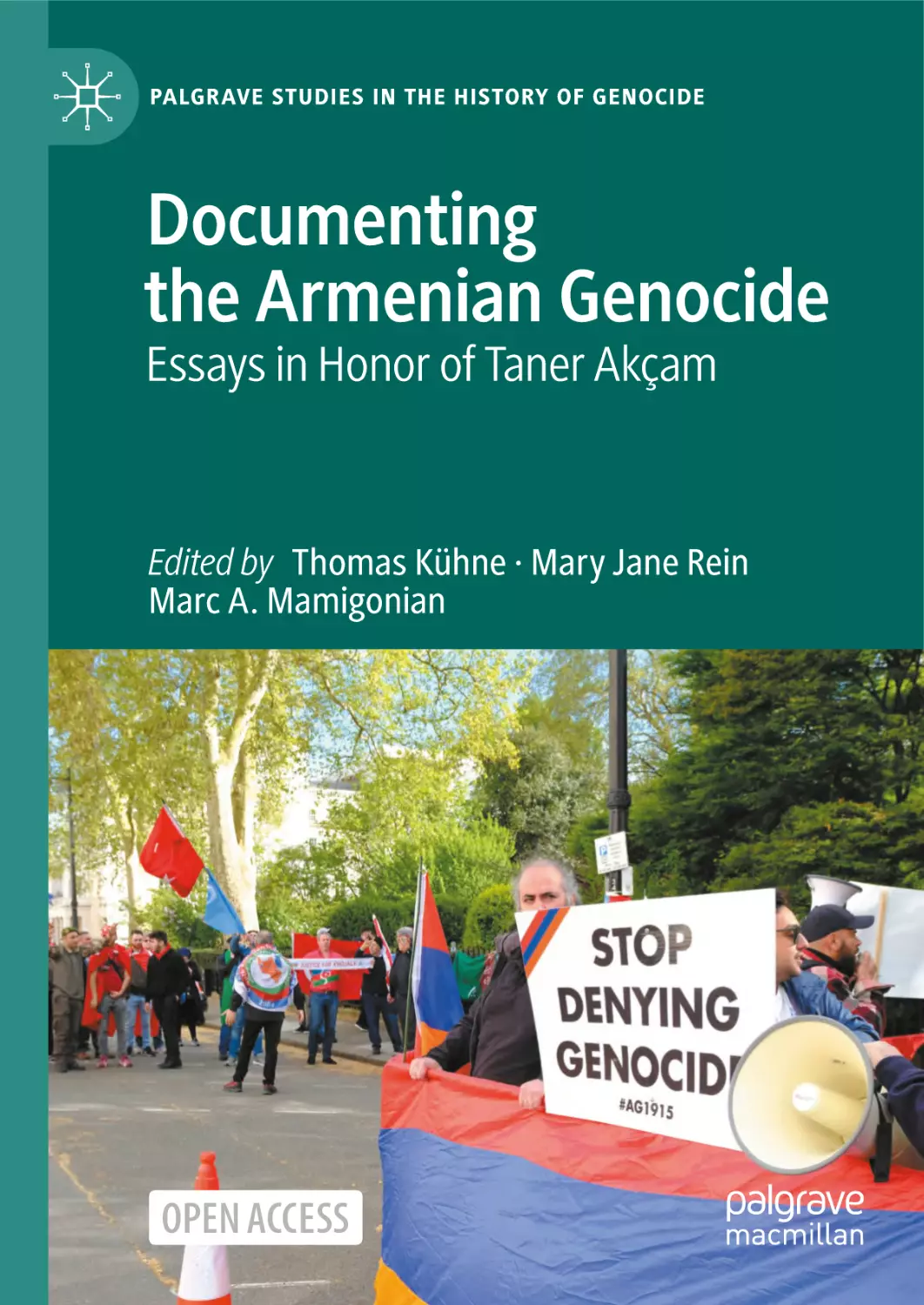
Documenting
the Armenian Genocide
Essays in Honor of Taner Akçam
Edited by Thomas Kühne · Mary Jane Rein
Marc A. Mamigonian
Palgrave Studies in the History of Genocide
Series Editors
Thomas Kühne
Clark University
Worcester, MA, USA
Deborah Mayersen
Australian Defence Force Academy
University of New South Wales
Canberra, ACT, Australia
Tom Lawson
Northumbria University
UK
Genocide has shaped human experience throughout history and is one of
the greatest challenges of the twenty-first century. Palgrave Studies in the
History of Genocide is dedicated to the study of this phenomenon across
its entire geographic, chronological and thematic range. The series acts as
a forum to debate and discuss the nature, the variety, and the concepts of
genocide. In addition to histories of the causes, course, and perpetration
of genocide, the series devotes attention to genocide’s victims, its aftermaths
and consequences, its representation and memorialization, and to genocide prevention. Palgrave Studies in the History of Genocide encompasses
both comparative work, which considers genocide across time and space,
and specific case studies.
Thomas Kühne • Mary Jane Rein
Marc A. Mamigonian
Editors
Documenting the
Armenian Genocide
Essays in Honor of Taner Akçam
Editors
Thomas Kühne
Clark University
Worcester, MA, USA
Mary Jane Rein
Clark University
Worcester, MA, USA
Marc A. Mamigonian
National Association for Armenian
Studies and Research
Belmont, MA, USA
ISSN 2731-569X ISSN 2731-5703 (electronic)
Palgrave Studies in the History of Genocide
ISBN 978-3-031-36752-6 ISBN 978-3-031-36753-3 (eBook)
https://doi.org/10.1007/978-3-031-36753-3
© The Editor(s) (if applicable) and The Author(s) 2024. This book is an open access
publication.
Open Access This book is licensed under the terms of the Creative Commons Attribution
4.0 International License (http://creativecommons.org/licenses/by/4.0/), which permits
use, sharing, adaptation, distribution and reproduction in any medium or format, as long as
you give appropriate credit to the original author(s) and the source, provide a link to the
Creative Commons licence and indicate if changes were made.
The images or other third party material in this book are included in the book’s Creative
Commons licence, unless indicated otherwise in a credit line to the material. If material is not
included in the book’s Creative Commons licence and your intended use is not permitted by
statutory regulation or exceeds the permitted use, you will need to obtain permission directly
from the copyright holder.
The use of general descriptive names, registered names, trademarks, service marks, etc. in this
publication does not imply, even in the absence of a specific statement, that such names are
exempt from the relevant protective laws and regulations and therefore free for general use.
The publisher, the authors, and the editors are safe to assume that the advice and information
in this book are believed to be true and accurate at the date of publication. Neither the
publisher nor the authors or the editors give a warranty, expressed or implied, with respect
to the material contained herein or for any errors or omissions that may have been made.
The publisher remains neutral with regard to jurisdictional claims in published maps and
institutional affiliations.
Cover illustration: ©Eleventh Hour Photography / Alamy Stock Photo
This Palgrave Macmillan imprint is published by the registered company Springer Nature
Switzerland AG.
The registered company address is: Gewerbestrasse 11, 6330 Cham, Switzerland
Paper in this product is recyclable.
Praise for Documenting the Armenian Genocide
“This book of essays by leading scholars on the Armenian Genocide is a fitting
tribute to Taner Akçam and a major contribution to the field he has helped to
define. Embodying the virtues of his pathbreaking work, they present both microand macro-perspectives on one of the twentieth-century’s defining events.”
—A. Dirk Moses, City College of New York, USA
“This book is a major contribution to the field of Armenian Genocide Studies. The
interdisciplinary aspect of the book - that ranges from gender violence, humanitarianism, the role of cinema, and memoirs, to the economic dimension of the
genocide, activism in genocide studies, and historiographic analysis – provides new
perspectives on the Armenian Genocide and its repercussions. This groundbreaking volume brings together leading senior and junior scholars in the field whose
research will have a tremendous impact on future generations of scholars. The
book is a must read to all those interested in understanding the different facets of
the Armenian Genocide.”
—Bedross Der Matossian, University of Nebraska-Lincoln, USA
Contents
Introduction 1
Thomas Kühne, Marc A. Mamigonian, and Mary Jane Rein
Taner
Akçam, Istanbul, My Bridge 17
Peter Balakian
The
Victims of “Safety”: The Destiny of Armenian Women and
Girls Who Were Not Deported from Trabzon 23
Anna Aleksanyan
Cohabitating
in Captivity: Vartouhie Calantar Nalbandian
(Zarevand) at the Women’s Section of Istanbul’s Central
Prison (1915–1918) 39
Lerna Ekmekçioğlu
Mediatized
Witnessing, Spectacles of Pain, and Reenacting
Suffering: The Armenian Genocide and Humanitarian Cinema 73
Nazan Maksudyan
“Special
Kind of Refugees”: Assisting Armenians in Erzincan,
Bayburt, and Erzurum103
Asya Darbinyan
vii
viii
Contents
the Verge of Death and Survival: Krikor Bogharian’s Diary123
On
Ümit Kurt
Categories
and Their Interstices: The Armenian Genocide
Beyond Resistance and Accommodation145
Khatchig Mouradian
The
Property Law and the Spoliation of Ottoman Armenians159
Raymond H. Kévorkian
Refocusing on—Crimes Against—Humanity187
Hans-Lukas Kieser
Taner
Akçam as Scholar-Activist and Armenian-Turkish
Relations211
Henry C. Theriault
The
Margins of Academia or Challenging the Official Ideology229
Hamit Bozarslan
The
Genocide of the Christians, Turkey 1894–1924251
Benny Morris and Dror Ze’evi
Since
the Centennial: New Departures in the Scholarship on
the Armenian Genocide, 2015–2021273
Ronald Grigor Suny
Index301
List of Contributors
Anna Aleksanyan The Promise Armenian Institute, UCLA, Los Angeles,
CA, USA
Peter Balakian Colgate University, Hamilton, NY, USA
Hamit Bozarslan École des Hautes Études en Sciences Sociales,
Paris, France
Asya Darbinyan Center for Holocaust, Human Rights, and Genocide
Education (Chhange), Brookdale Community College, Lincroft, NJ, USA
Lerna Ekmekçioğlu MIT (Massachusetts Institute of Technology),
Cambridge, MA, USA
Mary Jane Rein Clark University, Worcester, MA, USA
Raymond H. Kévorkian University of Paris 8 Saint-Denis, Paris, France
Hans-Lukas Kieser University of Newcastle, Newcastle, NSW, Australia
Thomas Kühne Clark University, Worcester, MA, USA
Ümit Kurt University of Newcastle, Newcastle, NSW, Australia
Nazan Maksudyan Freie Universität Berlin/Centre Marc Bloch,
Berlin, Germany
Marc A. Mamigonian National Association for Armenian Studies and
Research, Belmont, MA, USA
ix
x
LIST OF CONTRIBUTORS
Benny Morris Ben Gurion University, Be’er Sheva, Israel
Khatchig Mouradian Library of Congress, Washington, DC, USA
Ronald Grigor Suny University of Michigan, Ann Arbor, MI, USA
Henry C Theriault Worcester State University, Worcester, MA, USA
Dror Ze’evi Ben Gurion University, Be’er Sheva, Israel
List of Figures
Cohabitating in Captivity: Vartouhie Calantar Nalbandian
(Zarevand) at the Women’s Section of Istanbul’s Central
Prison (1915–1918)
Fig. 1 Miss. V. Calantar (Hay Gin, no. 1, issue 6, January 16, 1920)
40
Fig. 2 A sample of Vartouhie Calantar Nalbandian’s handwriting. Letter
to Zaruhi Bahri, March 26, 1926. Madenataran (Mesrop
Mashtots Institute of Ancient Manuscripts), Zaruhi Bahri
Archives, box. No 764
47
Fig. 3 “Surgery room in Istanbul prison” published in Polis Mecmuası
(Police Journal), September 15, 1916 (no. 77). The doctor
second to the far-left side (the tallest) must be Dr. Zati based on
my comparison with later pictures. Picture credit: Ufuk Adak
60
Fig. 4 Zarevand duo, June 1967, Washington DC, Levon Saryan private
collection69
Fig. 5 Vartouhie Calantar and Zaven Nalbandian’s tombstone at the
Washington National Cemetery. Photo by Nora Lessersohn
70
Mediatized Witnessing, Spectacles of Pain, and Reenacting
Suffering: The Armenian Genocide and Humanitarian Cinema
Fig. 1 The movie poster for Ravished Armenia. Source: Wikimedia
Commons, https://commons.wikimedia.org/wiki/
File:Ravished_Armenia.jpg85
Fig. 2 Alice asks Armenian orphans if they are “children.” Source:
Elisabeth Edland, “Shadows: A Children’s Play for the Near East
Relief,” The New Near East, January 1922, 12
89
xi
xii
List of Figures
Fig. 3 The cover of the New Near East magazine promoting Alice in
Hungerland. Source: The New Near East, January 1922
Fig. 4 Alice distributing bread to “ravenous groups.” Source: The New
Near East, November 1921
Fig. 5 Esther Razon with Henry Morgenthau. Source: Sign of the Times,
vol. 49, no. 22, 30 May 1922
91
97
97
“Special Kind of Refugees”: Assisting Armenians in Erzincan,
Bayburt, and Erzurum
Fig. 1 Dr. Zavrean (Source: Armenian Revolutionary Federation (ARF)
Archives, Photographs, Box 6, N 80/front)
117
Introduction
Thomas Kühne, Marc A. Mamigonian,
and Mary Jane Rein
Taner Akçam, while born in Turkey, is a citizen of the world due to his
long engagement with the history of genocide and mass violence that has
put him at odds with the government of his birth country. Politically brave
and academically outspoken, he has defied death threats and defamation as
a traitor in order to enlighten Turkish society about its violent past. An
advocate of democracy and free expression since his student days at Middle
East Technical University (METU) in Ankara, he is a prolific scholar and
internationally renowned human rights activist. Above all, Akçam is widely
praised as the first Turkish intellectual to acknowledge and research the
Armenian Genocide.
T. Kühne • M. Jane Rein (*)
Clark University, Worcester, MA, USA
e-mail: TKuehne@clarku.edu; MRein@clarku.edu
M. A. Mamigonian
National Association for Armenian Studies and Research, Belmont, MA, USA
e-mail: marc@naasr.org
© The Author(s) 2024
T. Kühne et al. (eds.), Documenting the Armenian Genocide,
Palgrave Studies in the History of Genocide,
https://doi.org/10.1007/978-3-031-36753-3_1
1
2
T. KÜHNE ET AL.
The Life of a Scholar Activist
Taner Akçam was born in 1953 into a family of limited means in the Ardahan
province of eastern Turkey, where his father worked as a teacher in their village.1 A socialist and a believer in the secular ideology of Kemalism, his
father became a trade union activist and remained close to the Turkish
Republican Peoples Party (CHP), only to be arrested and imprisoned for six
months in 1971, at the time of the second military intervention in the
Republic of Turkey. Akçam grew up in a social milieu that was shaped by
political debates, fights against authoritarian governments, and socialist
visions that imagined a better future for Turkey. The military coup of 1971
led to the persecution of the political left in Turkey but did not crush it.
As a student at the Middle East Technical University (METU), Akçam
was deeply engaged in student activism. In 1975, he became the editor-in-
chief of a new journal, Devrimci Gençlik (Revolutionary Youth), which
made him a prominent figure of Turkish leftwing activism and a target for
arrest. He was arrested, not for the first time, on March 10, 1976, shortly
after graduating from METU. This time he received a ten-year sentence
for spreading Kurdish and communist propaganda.
Jailed for a year, Akçam managed to escape from Ankara Central Prison,
together with other inmates. After hiding for some months in Ankara, he
decided to seek political asylum in West Germany by crossing the Syrian
border and flying to Munich.2 It wasn’t an easy transfer. Afraid of being
returned to the Turkish authorities, Akçam initially hesitated to reveal his
identity and was considered an illegal immigrant in Germany. He was
arrested again and spent weeks in a Munich prison, which, as he later joked,
was at least better than the one he had fled in Turkey. Amnesty International
had already adopted him as a “prisoner of conscience” while he was jailed in
Turkey and the German government eventually granted him asylum. Akçam,
by now a prominent figure of the exiled Turkish left and one of the leading
members of the movement known as Devrimci Yol (Revolutionary Path),
started working to help friends escape Turkey, especially after another
military coup in September 1980. Shortly after, he traveled to Syria and
Lebanon to organize a resistance movement against the Turkish
1
The following paragraphs are based on Vicken Cheterian, Open Wounds. Armenians,
Turks and Century of Genocide (New York: Oxford University Press, 2015), pp. 143–156,
and on interviews conducted by Mary Jane Rein in September 2015.
2
Elizabeth Kolbert, “Dead Reckoning: The Armenian Genocide and the Politics of
Silence,” The New Yorker, November 6, 2006.
INTRODUCTION
3
dictatorship, in conjunction with leaders of the Kurdistan Workers’ Party
(PKK) and supported by other Turkish and Kurdish political
organizations.
The many years of his life as a militant, of political persecution, and of
hiding, took a toll on him. Moreover, by 1982, doubts about the effectiveness of armed resistance against the Turkish military authorities caused
Akçam to part ways with the PKK, which targeted him for assassination.
Indeed, after the assassination of two friends, Akçam turned away from
political activity. By 1988, Akçam decided to dedicate himself to his scholarly ambitions and enrolled at Hamburg University.3 While conducting
research on the history of torture in the Ottoman Empire and Turkish
Republic at the Hamburg Institute for Social Research, he recognized that
the democratic development of modern Turkey was tied to confronting its
“original sin,” the persecution of the Armenian and other Christian
minorities.4 He began publishing articles that led him to write a doctoral
dissertation at Hannover University. In 1991, he organized a workshop on
the 1919–1920 Istanbul Trials that brought court martial cases against
the main perpetrators of war-time atrocities. Having published a 1992
book in Turkish that described the Armenian massacres,5 his dissertation
put the trials in the larger context of Turkish-Armenian relations. With a
thesis entitled Turkish Nationalism and the Armenian Genocide: On the
Background of the Military Tribunals in Istanbul between 1919 and 1922,
he earned a doctorate from the Sociology Departmentof Hannover
University in 1995.6
Akçam’s public persona as an advocate for facing Turkey’s painful history coincides with his participation in a conference in Yerevan, where he
declared, on the 80th anniversary, that “1915 was genocide,” the first
public acknowledgment by a Turkish academic. By then, he was permitted
to visit Turkey after the Turkish penal code was reformed in 1991 and the
statute of limitations on his prison escape expired. He moved to Turkey in
1993 in order to establish a research and documentation center in Istanbul.
Bilgi University accepted his proposal in 1995 but canceled soon
Cheterian, Open Wounds, p. 150.
Cheterian, Open Wounds, pp. 153–154.
5
Taner Akçam, The Armenian Question and Turkish National Identity (Türk Ulusal
̇
̇
Kimliği ve Ermeni Sorunu). Istanbul:
Iletiş
im Yayınları, 1992 (original in Turkish; Russian
edition in 1995, Armenian in 1996, and Arabic in 1997).
6
Taner Akçam, Armenien und die Völkermord. Die Istanbuler Prozesse und die türkische
Nationalbewegung (Hamburg: Verlag Hamburger Edition, 1996).
3
4
4
T. KÜHNE ET AL.
afterwards because of pressure from the Turkish secret service. Turkish
ultranationalists objected to his findings that implicated Turkey’s founding fathers in the massacres of Armenians and to the idea that national
heroes had benefited materially from the Genocide. A series of car bombings targeting intellectuals and a campaign of intimidation against him
made clear that an academic career in Turkey was impossible.7 Akçam
moved to the United States in 2000, with the help of his mentor Vahankn
Dadrian, to teach at the University of Michigan and then accepted a visiting professorship at the University of Minnesota, thanks to the mediation
of Eric D. Weitz (1953–2021).8
His first English language book, From Empire to Republic, was a partial
translation of his first Turkish book but with additional material. In 2006,
he published his most influential book to-date, A Shameful Act: The
Armenian Genocide and the Question of Turkish Responsibility with
Metropolitan Books.9 Highly praised in major outlets such as The New York
Times10 and now considered a classic, the book solidified his reputation as
one of the leading North American scholars in the field. In 2008, Akçam
joined Clark University as the Robert Aram and Marianne Kaloosdian and
Stephen and Marian Mugar Professor and a core faculty member at the
Strassler Center for Holocaust and Genocide Studies.11 Renowned for his
efforts to identify archival sources confirming the role of the Ottoman
government in perpetrating genocide and already the author of several
books, his position at Clark University was his first tenure line position.12
7
During interviews conducted in September 2015, Akçam described how, during the early
1990s, he was accustomed to check the undercarriage of his car and start the engine before
his wife and child would join him.
8
Taner Akçam, “Eric Weitz: A Very Personal Eulogy,” H-Diplo/ISSF Forum, No. 30
(2021), pp. 4–6, https://networks.h-net.org/node/9023945/pdf (accessed March
6, 2022).
9
Taner Akçam, From Empire to Republic (Zed Books, 2004); Taner Akçam, A Shameful
Act: The Armenian Genocide and the Question of Turkish Responsibility (New York:
Metropolitan Books, 2006).
10
Gary J. Bass, “Turkey’s Killing Fields,” The New York Times, December 17, 2006,
(accessed March 6, 2022).
11
The professorship in Armenian Genocide Studies was established at Clark University in
2002 thanks to the efforts of Carolyn Mugar and alumnus Robert Aram Kaloosdian. Akçam
was the second holder of the chair.
12
David Abel, “Turkish historian to study genocide. Armenians praise appointment at
Clark,” Boston Globe, May 29, 2008, https://archive.boston.com/news/local/articles/2008/05/29/turkish_historian_to_study_genocide/ (accessed March 6, 2022).
INTRODUCTION
5
Even in North America, Turkish intimidation and threats from ultranationalists continued to plague him. In reaction to a 2001 conference
planned with the Turkish-German Union for Social Science and
Humanities Exchange, the Turkish daily Hürriyet launched a smear campaign that included articles and editorial letters vilifying Akçam. On the
last day of the conference, a group of ultranationalists overran the police
barricades searching for him. Over the next years, extremists continued to
disrupt Akçam’s lectures and sent poison-pen letters to hosting universities. Following the publication of A Shameful Act, he was physically
assaulted after lecturing at the City University of New York and could only
leave the university under heavy police protection. In 2007, on his way to
lecture in Montreal, Canadian authorities detained Akçam at the airport
on the basis of false terrorism claims posted to his Wikipedia page.13 Such
politically motivated attacks culminated with the 2008 discovery that a
shadowy, deep state group within Tukey, Ergenekon, had included him on
a hit list for assassination.14
These events unfolded against the backdrop of the 2007 assassination
of Akcam’s friend Hrant Dink, editor of the Armenian Turkish newspaper
Agos. Akçam, a frequent contributor, had criticized the prosecution against
Dink, under Article 301 of Turkey’s penal code (which prohibited insulting Turkey or Turkishness), for using the word genocide. Charges against
Akçam for the same criminal offense “against Turkey” were eventually
dropped. Nonetheless, fearing prosecution under Article 301, Akçam filed
a case in the European Court of Human Rights. In 2011, ruling in his
favor, the court agreed with his claim that he faced the risk of prosecution
despite amendments having been made to the Turkish law.15
As a student, Akçam had risked arrest and physical torments to bring
attention to the rights of all Turks. Now an established academic holding
the only named chair dedicated to research on the Armenian Genocide, he
was well positioned to continue research aimed at the transformation of
Turkish society. He deepened his commitment to shedding light on the
13
Juan Cole, “Detained in Two Worlds Taner Akam Story,” Informed Comment, April 7,
2007, https://www.juancole.com/ (accessed February 25, 2022). Taner Akcam, “Turkey
and history: shoot the messenger,” OpenDemocracy, August 16, 2007, https://www.opendemocracy.net/en/turkey_and_history_shoot_the_messenger/ (accessed March 6, 2022).
14
Harut Sassunian, (May 14, 2010) “Turkish Scholar Taner Akcam Advocates Change in
Policy of Genocide Denial,” Asbarez, https://asbarez.com/ (accessed February 25, 2022).
15
Aisha Labi, “European Court Rules for American Scholar in Freedom-of-Expression
Case,” The Chronicle of Higher Education, October 28, 2011.
6
T. KÜHNE ET AL.
legacy of genocide and mass violence carried out against minority
Christians, including the Greeks and Assyrians, and Muslim populations,
such as the Kurds and Dersim. Interested in political violence throughout
late Ottoman and modern Turkish history, he was nevertheless primarily
focused on the Armenian Genocide. Among the many dimensions of this
subject, he examined forced conversions to Islam and the treatment of
orphaned Armenian children who were assimilated into the Turkish majority. Long mentored by the Armenian-American sociologist Vahakn
Dadrian (1926–2019), one of the first historians of the Armenian
genocide,16 they published Judgment at Istanbul: The Armenian Genocide
Trials.17 In 2015, he published The Spirit of the Laws: The Plunder of
Wealth in the Armenian Genocide, co-authored with his doctoral student
Ümit Kurt, which examined the expropriation of Armenian property and
demands for reparations.18
In addition to advancing new scholarship, he dedicated himself to training future scholars in order to carry the field forward at institutions around
the world. In 2016, Khatchig Mouradian, the initial student in a stream of
talented PhD candidates under Akçam’s supervision, graduated from
Clark.19 Ümit Kurt,20 Asya Darbinyan,21 and Anna Aleksanyan followed
quickly after.
During his tenure as Kaloosdian Mugar Professor, Akçam taught his
students to work with archival source materials and recruited their help
with important initiatives documenting the Armenian Genocide. One of
his most significant projects was to assemble an online archive of materials
16
Paul R. Bartrop and Steven Leonard Jacobs, Fifty Key Thinkers on the Holocaust and
Genocide (London: Routledge, 2011), pp. 79–85.
17
Taner Akçam and with Vahakn Dadrian, Judgment at Istanbul: The Armenian Genocide
Trials (New York: Berghahn Books, 2011).
18
Taner Akçam and Ümit Kurt, The Spirit of the Laws: The Plunder of Wealth in the
Armenian Genocide (New York: Berghahn, 2015).
19
Khatchig Mouradian, Genocide and Humanitarian Resistance in Ottoman Syria,
1915–1917, phil. dissertation, Clark University, 2016; The Resistance Network: The Armenian
Genocide and Humanitarianism in Ottoman Syria, 1915–1918 (Michigan State University
Press, 2021).
20
Ümit Kurt, The Making of the Aintab Elite: Social Support, Local Incentives and Provincial
Motives Behind the Armenian Genocide (1890s–1920s), phil. dissertation, Clark University,
2016; The Armenians of Aintab: The Economics of Genocide in an Ottoman Province
(Cambridge, Mass.: Harvard University Press, 2021).
21
Asya Darbinyan, Russian Humanitarian Response to Armenian Genocide, dissertation,
Clark University, 2019.
INTRODUCTION
7
compiled by the Armenian Catholic priest Krikor Guergerian, a Genocide
survivor who preserved highly significant materials held by the Jerusalem
Armenian Patriarchate, the Ottoman, British, German, American, and
Austro-Hungarian state archives. Akçam assembled a team, including several of his doctoral advisees, to translate, catalogue, and index this vast
collection of documents that were previously unknown or thought lost.22
And significant items from the collection became the focus of doctoral
research as well as the basis for his 2018 book, Killing Orders: Talat
Pasha’s Telegrams and the Armenian Genocide.23
The publication and careful analysis of materials from the Guergerian
Archive have strengthened the record regarding the premeditated and
centrally organized effort of the Ottoman Turkish Government to annihilate Armenians and other Christians. With ready access to these documents, Turkish citizens gained the opportunity to assess their own history
for the first time in more than a century. And Akçam has persuasively
argued that facing this history offers the potential to transform Turkish
society into a more open and democratic system where citizens hold their
government to account. His relentless pursuit of the facts regarding events
that transpired a century ago is grounded in his deep belief that that when
historic injustices are denied and concealed, they prevent the possibility
for sustained peace.
Taner Akçam and Armenian Genocide Studies
The past thirty years have witnessed the advancement of Armenian
Genocide scholarship from a state of relative backwardness to where it
stands today as one of the best documented occurrences of genocide or
mass violence other than the Holocaust. It is not a coincidence that this
thirty-year period coincides with Akçam’s scholarly career. As a researcher,
lecturer, and mentor to a new generation of scholars, including those he
has trained and those for whom he has served as an inspiration, Akçam has
led the effort to utilize previously unknown, ignored, or under-studied
sources, whether in Turkish, Armenian, German, or other languages, thus
22
The digital Krikor Guerguerian Archive is now available online, https://wordpress.
clarku.edu/guerguerianarchive/ (accessed March 6, 2022). Cf. Bernhard Whitmore,
“Professor Taner Akcam: The Quest for Truth,” Vitality. A Magazine for Active Adults, Vol.
68 (February/March 2019), pp. 4–6.
23
Taner Akçam, Killing Orders: Talat Pasha’s Telegrams and the Armenian Genocide
(Cham: Palgrave Macmillan, 2018).
8
T. KÜHNE ET AL.
immeasurably expanding the scholarly project of documenting and analyzing the Armenian Genocide.
While genocide studies as an academic discipline is a relatively new
field, important works of documentation were published in Armenian in
the immediate aftermath of the Armenian Genocide. By gathering documentation from the survivors, these works provided an important foundation for the study of the Armenian Genocide. For decades, non-academic
researchers writing in Armenian dominated inquiries. Lacking institutional
support and limited in their readership to those fluent in Armenian, these
early researchers nevertheless conducted foundational work. One of them
was Fr. Guerguerian, who devoted much of his adult life to researching the
Armenian Genocide, traveling to important archival repositories, such as
the Jerusalem Patriarchate and the Nubarian Library in Paris, where he
photographed or copied crucial materials. Guergerian’s archives contain
several unpublished book-length works, as well as vast quantities of notes
and documents that he gathered for these projects and for others he was
never fully able to realize that are now available electronically thanks to
Akçam’s initiative.
Vahakn Dadrian, together with Richard Hovannisian one of the pioneers of Armenian Genocide Studies, was deeply affected by the example
of Fr. Guerguerian.24 He recalled that his “actual initiation into research
on the Armenian Genocide coincides with an encounter with [Fr.
Guerguerian] in the Beirut, Lebanon, in the summer of 1965. … For the
first time, I became aware of the existence of authentic documents pertaining to the Armenian Genocide, as he became my guidepost at this initial
stage of my involvement in genocide research.”25 Just as Guerguerian
opened a door for Dadrian, so Dadrian performed a similar role for Akçam.
Following the death of Dadrian in 2019, Akçam, stated: “Were it not for
Dadrian, I would most likely neither have studied the Armenian Genocide
nor have come to the United States. … Dadrian did not hesitate to send
24
Vahakn Dadrian, The History of the Armenian Genocide: Ethnic Conflict from the Balkans
to Anatolia to the Caucasus (Providence, RI: Berghahn, 1995); Richard Hovannisian, The
Armenian Genocide in Perspective (London: Routledge, 1986), and idem, The Armenian
Genocide: History, Politics, Ethics (New York: St. Martin’s Press, 1992).
25
Vahakn N. Dadrian, “The Quest for Scholarship in My Pathos for the Armenian Tragedy
and Its Victims,” in Samuel Totten and Steven Leonard Jacobs, eds., Pioneers of Genocide
Studies (New Brunswick, NJ: Transaction Publishers, 2002), p. 241.
INTRODUCTION
9
me special documents that even he had not yet had a chance to analyze.”26
There exists, therefore, an unbroken line of transmission from Guerguerian,
a survivor and a pioneer of the pre-academic era of genocide research, to
Dadrian, who was among the first to bring academic methods and standards to the study of genocide, to Akçam, and now through him to his
students who have already begun to take their places in the scholarly world.
Unlike Richard Hovannisian and Vahakn Dadrian, however, Akçam is
not so much a historian of the Armenians and their suffering from, and
agency during, persecution since the late 19th century and then during
the First World War than a historian of the Turks. Akcam’s peculiar contribution to Armenian genocide studies lies in the precise documentation of
the conditions and decisions that led to the genocide and in the no less
precise analysis of the motivations and intentions of the Turkish perpetrators and the Turkish perpetrator society. Intellectually and politically
rooted in the fight for a democratic Turkey, he is convinced that a democratic society, built on human rights, cannot succeed without acknowledging past violations of these rights and of past injustices, especially when
they have reached genocidal dimensions. “If you really want to establish a
democratic society that respects human rights you have to face you own
history. If you deny the historic injustices of the past, there is a potential
that you will repeat them,” he says.27 It is in this spirit that he wrote his
first book on the impact of the eventually failed, early attempts in Turkey
to work through the genocide of the Armenians and the effect of this failure on Turkish national identity in the 20th century.28 And it is this impetus that has driven his many following books, most of all his now famous
trilogy A Shameful Act: The Armenian Genocide and the Question of
Turkish Responsibility (2006), The Young Turks' Crime Against Humanity:
The Armenian Genocide and Ethnic Cleansing in the Ottoman Empire
(2012), and most recently Killing Orders: Talat Pasha’s Telegrams and the
Armenian Genocide (2018).
26
“Prof. Taner Akçam: We Have to Create Institutions that Carry the Legacy of Vahakn
Dadrian,” text of talk given on September 15, 2019, to commemorate the forty-day anniversary of Dadrian’s death. See https://hyetert.org/2019/09/17/prof-taner-akcam-we-have-
to-create-institutions-that-carry-the-legacy-of-vahakn-dadrian/ (accessed March 11, 2022).
27
Cited in Whitmore, “Professor Taner Akcam: The Quest for Truth,” p. 6.
28
Taner Akçam, Turkey and the Armenian Ghost,” Armenian Weekly, December 15,
2012,
https://armenianweekly.com/2012/12/15/akcam-turkey-and-the-armenian-
ghost/ (accessed March 6, 2022).
10
T. KÜHNE ET AL.
None of these books are easy reads. Instead, they intrigue by the presentation of the sheer mass of often previously unknown archival sources,
and by the “kind of forensic exercise” Akçam performs to defuse doubts
of the authenticity of the documents collected to prove the genocidal
character of the massacres of the Armenians.29 That these massacres constitute the crime of genocide, has long been stated and occasionally even
before Raphael Lemkin and the United Nations popularized the term.
Before that, eyewitnesses and contemporary observers used equivalent
concepts such as the German Völkermord (annihilation of nations or a
nation). Denialists in and outside of Turkey, however, conveniently discarded such accounts by pointing to their Christian or otherwise foreign,
supposedly biased background. Akçam’s genuine contribution to
Armenian genocide studies and to the political debate on whether the
plight of the Armenians constitutes genocide has therefore always been to
employ Ottoman and other documents produced by the perpetrators,
those who initiated, administered, and collaborated in the genocide on
various levels of the political and military hierarchy, and to demonstrate
clearly that these sources present the genocide as such just as clearly as
western and Armenian sources. Especially The Young Turks' Crime Against
Humanity has been praised for its author’s “mastery of sources in at least
five languages” and his “proficiency in so many archives,” including
American, British, Austrian” and German ones, and his ability to link them
to “several Ottoman collections, notably the Prime Ministerial Archives.”30
Taken together, these sources have left no doubt of the multilayered genocide of the Armenians in which resettlement policies, individual executions, wholesale massacres, mass rape, enforced conversion to and
assimilations into Islam, in other words physical destruction and cultural
genocide went hand in hand. Yet Akçam’s analysis has been reluctant to
conceive of the genocide as the consequence of any pre-existing blueprint.
Instead, Akçam acknowledges the Turkish leaders’ fears of uprisings and
their desperation after a series of military failures at the beginning of the
First World War. And yet there was no veritable danger from the Armenians,
and thus the deliberate extermination cannot be justified as a military
29
Mark Mazower, “An Archive of Atrocities,” The New York Review of Books,” April 4,
2019,
https://www.nybooks.com/articles/2019/04/04/talat-pasha-archive-atrocitiesarmenia/ (accessed March 6, 2022), on Akcam, Killing Orders.
30
Margaret Lavinia Anderson, “Shooting an elephant,” Journal of Genocide Research, Vol.
15, No. 4 (2013), p. 465.
INTRODUCTION
11
necessity, as Turkish and other denialists often have pretended. Instead,
the chain of evidence that Akçam’s research has forged has become ever
tighter. In his 2012 book, by then arguably the most sophisticated documentation of the genocide, Akçam forecast somewhat pessimistically that
thanks to the secretiveness of the major Ottoman operations and orders,
“there is practically no chance of finding records of the plans for annihilation, the ‘smoking gun.’” Six years later, after intense further research and
the utilization of the Guerguerian Archive, Killing Orders (2018) provided exactly that “smoking gun,” as Akçam asserted, finally proving the
authenticity of the infamous killing orders signed by the Ottoman Minister
of Interior Talat Pasha, previously denounced as forgeries by denialists.31
Akçam’s impact has gone well beyond the academy. For many
Armenians, their first exposure to Akçam was when he spoke at the Yerevan
conference held to mark the 80th anniversary of the Genocide. Some years
later, Richard Hovannisian, who was also a participant at the conference,
recalled that “Taner Akçam was brave enough to come to Yerevan in 1995
to give a paper on the Armenian Question. What was disconcerting prior
to that time (and which still remains largely the case) was that even left-
wing Turkish scholars and intellectuals who struggled against the repressive measures of the Turkish state showed themselves to be extremely
cautious and even reactionary when it came to Armenian issues.”32
It ought to have been clear at this point that Akçam was determined
not only to make an impact on the scholarship on the Armenian Genocide
but also to break down the “wall of silence” that existed between Turks
and Armenians. Indeed, in the 1997 Dutch television documentary aptly
titled A Wall of Silence, and which featured Akçam and his academic mentor Vahakn Dadrian, Akçam declares: “A mass murder took place. As long
as [Turks and Armenians] refuse to communicate and talk about this issue
they will remain enemies. It is my modest intention to bring this animosity
to an end.”33
For a great many Armenians, Akçam became the first Turk they came
to know; and although, especially at the beginning, his exceptional status
31
Akçam, Killing Orders, 75–121, and Tim Arango, “‘Sherlock Holmes of Armenian
Genocide’ Uncovers Lost Evidence,” The New York Times (April 22, 2017), for the quote.
32
Richard G. Hovannisian, “Reflections on Academic Dialogue: Impediments and
Prospects, Journal of Armenian Studies, Vol. 9 (2010), p. 6.
33
A Wall of Silence: The Unspoken Fate of the Armenians, produced and directed by
Dorothée Forma (Hilversum, the Netherlands: Humanist Broadcasting Foundation, 1997).
12
T. KÜHNE ET AL.
was apparent, the very fact of his existence—a Turk who talks openly
about the Armenian Genocide—held the promise that there were others.
Akçam may not have brought animosity between Armenians and Turks to
an end, but he made it impossible to refer to “the Turks” as a monolith.
Indeed, many others have followed in his wake, scholars who may approach
the history differently than Akçam but whose work has nevertheless been
shaped by his example. The fact that it is no longer remarkable that Turkish
scholars are among the leading researchers on the Armenian Genocide and
that their numbers continue to grow is itself a measure of the sea-change
effected by Akçam.
Essays Honoring Taner Akçam
An international group of scholars readily agreed to contribute chapters to
this volume, including senior academics from Europe, Israel, Turkey, and
the United States and younger scholars from Armenia, Lebanon, and
Turkey whom Akçam mentored. The diversity of authors is a fitting tribute to a scholar who has made his home on three continents and who has
consistently worked in a transnational fashion. University educated in
Turkey, trained in Germany, a professor in the United States, renowned
and honored for his research and activism in Armenia, Europe, and the
Americas, Akçam is an indefatigable lecturer who has traveled widely sharing his work with vast audiences through his books, lectures, opinion
pieces, and media interviews.
This volume opens with a prefatory poem by the poet, memoirist, and
scholar Peter Balakian that conjures a visit to Istanbul, where he encounters present-day violence as well as the trauma of returning to the city
where his family had prospered before the Armenian Genocide.
Balakian continues with a personal reflection on the importance of
Akçam’s efforts to push Turkish society to document and acknowledge
the past. The chapters that follow respond to a broad theme that has animated Akçam’s scholarly achievements: documenting the Armenian
Genocide through the discovery and analysis of primary sources. Organized
in four parts, each is dedicated to a topic that has concerned him in his
capacity as a scholar and public intellectual.
Part One, Women and Girls, is a subject of particular interest to Akçam,
especially following a 2021 controversy regarding Armenian grievances
against Kurds. In a Turkish media interview, he described how
some Kurdish aghas in certain regions would demand the first night with
INTRODUCTION
13
Armenian brides (otherwise known as jus primae noctis or droit de seigneur). In response to Kurdish intellectuals who politicized the discussion
of this historic practice, Akçam identified the Russian, Armenian, English
and Turkish sources that document the custom not as de jure but as praxis.
Gendered violence is the subject of Anna Alexanyan’s examination of the
Black Sea city of Trabzon, which offers a case study in the treatment of
women and girls during the Armenian Genocide. She draws on the perpetrator trials conducted in Istanbul to document the range of crimes committed against the female population of Trabzon and highlights individual
women who bravely detailed their victimization by testifying in court.
Lerna Ekmekçioğlu introduces readers to Vartouhie Calantar Nalbandian,
a highly educated Armenian woman who served time as a political prisoner
during the Genocide and published her prison memoirs in the feminist
journal Hay Gin (Armenian Woman). The life of this previously little known feminist is examined through her experiences on trial, her prison
years, and her partnership with her husband analyzing Turkish threats to
the Armenian people in a jointly authored study from 1926. Two silent
films, the topic of Nazan Maksudyan’s chapter, reveal a gendered perspective in the early efforts of the Near East Relief organization to represent
the Armenian Genocide to American audiences. Each film features an
orphan girl whose victimhood is exploited as part of a marketing strategy
to promote humanitarianism.
The chapters in the part Agency and Assistance are written by three
scholars, mentored by Akçam, who tap new sources to explore the help
Armenians received as well as efforts at self-help. Asya Darbinyan utilizes
Armenian, Georgian, and Russian archives to establish the nature of
humanitarian assistance in response to the refugee crisis resulting from the
deportations and war on the Caucasus front. She documents Russian
Imperial efforts to aid refugees in the newly occupied areas of the Ottoman
Empire—Erzincan, Bayburt, Erzurum—in summer 1916 and reflects on
the nature of Armenian-Russian relations in this period. Likewise, Ümit
Kurt identifies a new source for documenting the experience of an
Armenian refugee from the city of Aintab. The diary of Krikor Bogharian
details the struggles faced by deportees during their march to the desert
and the choices and non-choices they made in their efforts to survive.
Khatchig Mouradian challenges the stringent categorization of Armenian
victims during the Genocide and proposes a new way of understanding
medical personnel who do not fit neatly into established frameworks that
view victims as stripped of agency. He shows how a fraction of Armenian
14
T. KÜHNE ET AL.
doctors, nurses, and others with skills deemed useful found means to survive by operating within the interstices of collaboration and resistance.
Trained as both a historian and a sociologist, Akçam is attuned to how
unresolved injustices impede the development of communal bonds that
are essential to a well-functioning society. In countless editorials, especially
in the Turkish media, he has commented on how genocide and its denial
impact society, a theme explored in Genocide and Society. Raymond
Kévorkian examines the laws underlying the expropriation of Armenian
communal property, such as churches and schools, as well as the seizure of
individual assets that accompanied the physical destruction of the population. These material gains formed the foundation of the modern
Turkish Republic and remain a powerful motivation for continued
Genocide denial by the Turkish state and society. Hans Lukas Kieser investigates the tension between genocide and social contracts in so far as the
former is destructive and the latter is constructive. He locates modern
human rights and the idea of social contracts in Abrahamic beliefs that
depend on a covenant between humans and God, a system that entails
boundaries that leave some groups included and others excluded. Henry
Theriault interrogates the role of the scholar and examines whether those
who work on genocide have a responsibility to engage in activism, as
Akçam has done so effectively throughout his career. In his contribution,
Theriault develops an important distinction, within the sphere of engaged
scholarship, between “objectivity” and “interest.”
As a human rights activist and scholar who has challenged accepted
truths throughout his career, Akçam is no stranger to scholarly disputes.
The contributions in the final part, Consensus and Debate, explore issues
and arguments in the academic discourse. Hamit Bozarslan compares
̇
Akçam and the sociologist Ismail
Beşikçi, whose careers both demonstrate
a willingness to challenge official narratives that dominated Turkish universities and research centers. He shows how Akçam confronted taboos
and questioned the academic historiography in which facts about the
Armenian Genocide were not systematically denied, but were considered
as necessary to national survival in light of western “imperialism.” Benny
Morris and Dror Ze’evi challenge the predominant narrative regarding
the periodization of the Armenian Genocide to argue that the Genocide
lasted for thirty years and encompassed Armenians, Assyrians and Greeks.
The destruction of these Christian communities was the deliberate policy
of three successive Ottoman and Turkish governments–a policy that most
Muslim inhabitants did not oppose, and many enthusiastically supported.
INTRODUCTION
15
Ronald Suny provides an important overview of the historiography on the
Armenian Genocide and identifies areas of consensus reached by leading
academics. Yet, while the historical record has established a firm foundation for understanding the ethnic cleansing, forced assimilation, property
confiscations, and mass killing of Armenians and Assyrians as a genocide,
political and polemical campaigns against truth and accurate and evidenced historical knowledge continue in Turkey and elsewhere.
The future of Armenian Genocide research shines brightly, as Akçam
has embarked on another chapter in his career. As the inaugural director
of the Armenian Genocide Research Program of the Promise Armenian
Institute at UCLA, he is well positioned to initiate new endeavors that will
strengthen the field and add to the historical record.34 With the 2023 centennial anniversary of the Turkish Republic, Akçam has undertaken to
examine the premises that underlie its foundational myths as part of a
conversation to construct a more peaceful and democratic future. A forthcoming book, The Hundred Years of Apartheid (published in Turkish in
2023 as Yüz-Yillik Apartheid), examines the modernTurkish legal system
that resulted in a stratified citizenry favoring Sunni Muslims. Other
research projects will materialize as Akçam continues to identify sources
that illuminate the historical record and inspire efforts to acknowledge
past injustices that can leading to healing and reconciliation.
34
“Promise Armenian Institute names Taner Akçam inaugural director of Armenian
Genocide Research Program,” Armenian Weekly, February 16, 2022, https://armenianweekly.com/2022/02/16/promise-armenian-institute-names-taner-akcam-inaugural-
director-of-armenian-genocide-research-program/ (accessed March 6, 2022).
16
T. KÜHNE ET AL.
Open Access This chapter is licensed under the terms of the Creative Commons
Attribution 4.0 International License (http://creativecommons.org/licenses/
by/4.0/), which permits use, sharing, adaptation, distribution and reproduction
in any medium or format, as long as you give appropriate credit to the original
author(s) and the source, provide a link to the Creative Commons licence and
indicate if changes were made.
The images or other third party material in this chapter are included in the
chapter’s Creative Commons licence, unless indicated otherwise in a credit line to
the material. If material is not included in the chapter’s Creative Commons licence
and your intended use is not permitted by statutory regulation or exceeds the
permitted use, you will need to obtain permission directly from the copyright holder.
Taner Akçam, Istanbul, My Bridge
Peter Balakian
Coming to Istanbul1
Follow the gaze of Athena
down a cistern where water glows.
Follow silver snakes along Marmara
and Golden Horn.
Walk over the black plaque for Hrant Dink
smack in the street in Shishli.
Follow the ferry-waves to Üsküdar—
where your father was born,
where your uncle returned
incognito from prison—
1
“Coming to Istanbul” was published in the poetry collection No Sign (University of
Chicago Press 2022) and dedicated to Taner Akçam.
P. Balakian (*)
Colgate University, Hamilton, NY, USA
e-mail: pbalakian@colgate.edu
© The Author(s) 2024
T. Kühne et al. (eds.), Documenting the Armenian Genocide,
Palgrave Studies in the History of Genocide,
https://doi.org/10.1007/978-3-031-36753-3_2
17
18
P. BALAKIAN
Drink the split bourbon voice of Ray Charles
in the café in Taxsim
under the red flags of star and moon
guns to the head, wild prayer—
streets banging with pots and pans—
rage at the dictator.
Walk by in oblivion and terror
an American, an Armenian, black shirt
under the olive-trellised restaurant
hotel rooftop light-rinsed Bosphorus
hot raki fumes in the throat
under the wind-umbrellas
and boutique-glass facades of Beyoglu
galleries of blue mosaics, magenta carpets—
the Ottoman historian pours you
tahn and wine into the sunset.
Follow the lights on the bridge
into the chandelier of the sky
trompe l’oeil of Gray Wolves
voices of Turkish friends in the stone.
Follow ghost signs midnight cab
smashed café windows
night-sea journey of beloveds
Byzantine dirt smoke roads
past Tobacco Regie and sultana crates—
Haydarpasha of Armenian-soul death hour.
Lost family come greet me in your city.
for Taner Akçam
TANER AKÇAM, ISTANBUL, MY BRIDGE
19
Istanbul, My Bridge
I first met Taner Akçam about twenty years ago at the University of
Minnesota, where I was doing a reading for my just-published book The
Burning Tigris: The Armenian Genocide and America’s Response. After my
reading, a group of Turkish students who had come out to my talk with
pamphlets to protest me were milling around, upset and trying to figure
out how to intrude on the question and answer session. I was watching
them from the corner of my eye while answering questions and getting
ready for another encounter with miseducated Turks who had been shaped
by their nation’s propaganda to reject the factual history of the Armenian
Genocide of 1915.
Then, I saw a man in a sport jacket with short cropped hair and black
framed glasses, come over to the students and engage them in conversation. In a minute the students were huddled in a corner listening to this
man, who was speaking to them in their native tongue. The man, of
course, was Taner Akçam, whose work on the Armenian Genocide was
becoming a hot topic because he was, as far as we all knew, the first Turkish
scholar to be researching and writing about the Armenian Genocide from
Turkish and Ottoman sources. He was writing in riveting and clear ways
that were also nuanced and contextualized. I have no idea what the students were thinking, and I’m guessing that they were disturbed and probably uncomfortable by what Taner was explaining to them.
After the reading Taner and I shook hands and went for dinner with
Professors Steven Feinstein and Eric Weitz, who were hosting me. That
evening was the beginning of a friendship that helped me cross the border
into Turkey, and for the first time, feel the pulse of progressive Turkish
intellectuals and scholars who were doing what scholars do: critiquing
their national history, standing up to government propaganda, writing
with complexity and ethical honesty about difficult histories. They were
brave and dedicated, and they were often risking their lives—given the
brutal repression in their country. In the ensuing years, I would come to
know and have rich conversations with other Turkish scholars and writers,
including Müge Göçek, Elif Shafak, and Ragip Zarakolu, who would
become my Turkish publisher. Taner and I would commence a dialogue
that deepened my understanding of the Turkish plan to exterminate the
Armenians and the other Christian minorities of the Ottoman Empire
during the first quarter of the twentieth century. We spent time together
at Colgate, where I invited him to speak a couple times, at my friend
20
P. BALAKIAN
Robert Jay Lifton’s Seminar for the Study of Mass Violence, then held at
Harvard, and at Clark University, where Taner would hold the Kaloosdian
Mugar Chair in Armenian Genocide Studies.
When I was planning to go to Istanbul in 2013, after much hesitation
and with much ambivalence coupled with my anger and fear, it was Taner’s
assurance that convinced me. Both sides of my family had been mass murdered or exiled from their homes and lands of centuries. In the larger
sense, Historic Armenia throughout Turkey and especially in central and
eastern Turkey had been destroyed and thousands of ancient churches and
monasteries along with schools had been burned and ruined. More than a
million Armenians were massacred, another million and a half marched
out of the country—all their wealth confiscated. And, as a writer of books
about the Armenian Genocide and a spokesperson in the media, I knew I
was not invisible to the Turkish authorities.
But, Taner said. “Don’t worry. It’s a good time to go. I’ll help connect
you with some wonderful people. You’ll see another Turkey through their
eyes.” And so, when I landed with Donna Frieze, intrepid scholar of genocide and human rights, in late June of 2013, I found myself in the city of
my father’s birth, the city of my grandparents’ early lives, the city of the
Balakians and Panosyans who lived well in the Scutari (now Üsküdar) section of the city. The Panosyans were wealthy coal merchants, my grandfather Diran Balakian, a physician, his cousin, my great uncle Krikoris
Balakian, a vardapet (later a Bishop), who was in 1913 a clerical diplomat
at the Armenian Patriarchate in Istanbul. They were among the ascending
generation of Ottoman Armenians who were hopeful for a new age of
equality in the Ottoman Empire after the 1908 Revolution.
There I was in Taxism Square as Taner greeted me and Donna on a hot
summer day, showing us the controversial Gezi Park, where citizens had
been congregating that summer in protest of a capricious urban development plan, and where old Armenian tombstones had been dug up in the
recent excavations. We walked down Istikal Street gazing at the boutiques
and restaurants amidst the bustling crowds. It was beyond my expectations. That morning, Taner introduced me to the director of Dur De
(Stop Racism) Foundation in Beyoğlu, which was, among other things,
devoted to the civic remembrance of the Armenian Genocide. I learned
from the Turkish director how Dur De had created the first public commemoration of April 24 (Armenian Genocide commemoration day) in
Istanbul several years ago. In the coming days, Taner arranged for me to
meet with the staff of the Armenian publishing house Aras in their
TANER AKÇAM, ISTANBUL, MY BRIDGE
21
beautiful offices. I had a festive meeting with the editors and staff of staff
of Agos—the Armenian newspaper that was then the largest newspaper of
an ethnic minority in Turkey and the congruent Hrank Dink Foundation
that had been founded in the wake of the assassination of the brave
Armenian human rights activist and journalist Hrant Dink, who was killed
by Turkish nationalists in broad daylight in January 2007. Taner took me
to meet Osman Kavala at his elegant building and foundation Anadolu
Kultur—where at the moment a seminar on LGBT rights was going on.
Through Osman and his work for democracy, I would gain a view of a
whole other Turkey where multicultural life was vital and inclusive in ways
that I couldn’t have imagined. Taner arranged dinners and lunches with
scholars and activists and I discovered that, as taboo as the study and representation of the Armenian Genocide might be in Turkey, intellectuals
were researching and teaching it in the ways they could.
I left Turkey after a week—feeling a strange kind of liberation. I had
come to the land of my ancestors, the land of the great crime against the
Armenians. I had walked the streets of the legendary city of Byzantium,
where several Armenian emperors had once sat on the throne, the city of
Constantinople, where the Armenian architects—the Balians—had built
many of the city’s great buildings and monuments. I had come to the
nation that was steeped in corruption and lies and exported propaganda
about its great crime against the Armenians. I had—if ever so briefly—seen
and felt and smelled and heard the place. I had talked with others. It was
real. I was realer for it. I would go to Turkey three more times in the coming two years, and do readings in public from Boğaziçi University in
Istanbul to a vegan café in Diyarbakir. I would walk the ruins of Ani, the
desolate streets of Elizag, the bustling streets of Kurdish Diyarbakir. I owe
my first journey over that big bridge to Taner. His intrepid voice continues. May it always.
22
P. BALAKIAN
Open Access This chapter is licensed under the terms of the Creative Commons
Attribution 4.0 International License (http://creativecommons.org/licenses/
by/4.0/), which permits use, sharing, adaptation, distribution and reproduction
in any medium or format, as long as you give appropriate credit to the original
author(s) and the source, provide a link to the Creative Commons licence and
indicate if changes were made.
The images or other third party material in this chapter are included in the
chapter’s Creative Commons licence, unless indicated otherwise in a credit line to
the material. If material is not included in the chapter’s Creative Commons licence
and your intended use is not permitted by statutory regulation or exceeds the
permitted use, you will need to obtain permission directly from the copyright holder.
The Victims of “Safety”: The Destiny
of Armenian Women and Girls Who Were
Not Deported from Trabzon
Anna Aleksanyan
Introduction
The genocide of Trabzon Armenians is one of the best-documented
crimes of the Armenian Genocide, because after World War I the Turkish
Courts-Martial brought the perpetrators to trial in Constantinople
(present-day Istanbul). Evidence was collected and provided to the court,
and many witnesses and survivors gave their testimonies during the trial’s
20 sessions. Most of the survivors were women, who were not deported
from the city. During the course of the Trabzon trial, survivors and witnesses testified how perpetrators terrorized and robbed hundreds of
Armenian girls and women of their jewelry and other possessions, raped
them, kept some of them at the branch of the Red Crescent hospital as sex
slaves, and distributed others among the Ittihadist (Committee of Union
and Progress) leaders in Trabzon. Female witnesses testified how children
A. Aleksanyan (*)
The Promise Armenian Institute, UCLA, Los Angeles, CA, USA
e-mail: aaleksanyan@g.ucla.edu
© The Author(s) 2024
T. Kühne et al. (eds.), Documenting the Armenian Genocide,
Palgrave Studies in the History of Genocide,
https://doi.org/10.1007/978-3-031-36753-3_3
23
24
A. ALEKSANYAN
were starved to death and killed and their bodies were thrown to the sea,
and how young girls and women were raped in front of other women to
terrorize them and force them to convert to Islam and marry Muslim
men, who would come to choose them. Forced marriages, which usually
followed the rape, were presented by the perpetrators as “their decision”
or “an act of salvation” for these women.
Since the beginning of the formation of Armenian Genocide scholarship, researchers of the subject have referred, in one way or another, to
different forms of sexual violence committed against Armenian women
and girls. But this was never the main focus of their research, including in
the Trabzon case. Armenian Genocide scholars such as Dadrian and
Akçam,1 Kévorkian,2 Hovannisian,3 Suakjian,4 and Payaslian5 used the
Trabzon trial records to shed light on the Armenian Genocide, but they
did not focus on the experiences of women and girls who were not
deported but stayed in the city and became victims of rape, forced marriages, and forced prostitution. Only recently have Armenian Genocide
scholars started to pay attention to gendered aspects of it, because scholarship on gender and genocide is a relatively a new phenomenon.
As Dr. Allison Ruby Reid-Cunningham argues, forced intercourse and
impregnation represent a symbolic conquest of women by the rapist, and
rape is used as a war and a genocidal tactic because of its physical and
psychological consequences for individuals, families, and communities.6 In
this chapter, I argue that the strategy of widespread, systematic sexual
violence and rape perpetrated against Armenian women and girls was
1
Dadrian V. N., “The Role of Turkish Physicians in the World War I genocide of Ottoman
Armenians,” in Holocaust and Genocide Studies, Vol 1, no. 2 (1986): 169–192;
Dadrian V. N. and Akçam T., Judgment at Istanbul, The Armenian Genocide Trials (New
York, Oxford: Berghahn Books 2011).
2
Kévorkian, R. The Armenian Genocide: A Complete History. (New York: I.B. Tauris,
2011), 467–494; 775–782.
3
Hovannisian R. G., “The Postwar Trebizond Court-Martial,” in Armenian Pontus: The
Trebizond-Black Sea Communities ed. by R. G. Hovannisian (California: Mazda Publishers,
2009), 343–352.
4
Suakjian A., “Genocide in Trebizond: A Case Study of Armeno-Turkish Relations during
the First World War,” Ph.D. Diss., University of Nebraska, 1981.
5
Payaslian S., “The Fate of the Armenians in Trebizond, 1915,” in Armenian Pontus: The
Trebizond-Black Sea Communities ed. by R. G. Hovannisian (California: Mazda Publishers,
2009), 271–292.
6
Reid-Cunningham, Allison Ruby, “Rape as a Weapon of Genocide,” in Genocide Studies
and Prevention: An International Journal: Vol.3: Iss. 3, (2008), 279.
THE VICTIMS OF “SAFETY”: THE DESTINY OF ARMENIAN WOMEN…
25
intended to destroy them physically as well as their standing in their community and their identity both as women and as Armenians. Furthermore,
the details of the Trabzon genocide show that “rape camps” were used as
a tool of genocide against Armenians.
The Official Decree of the Deportation
and Assurances of “Safety”
The official decree ordering the Armenian deportation was hung on the
city walls of Trabzon on June 26, 2015. The document7 informed
Armenians that they would be exiled within five days. The damp heat of
summer, dust, and insects of Trabzon province made traveling difficult
even for someone with proper transportation, but for pregnant women
and children traveling on foot such a journey would have been fatal. The
city’s residents understood this and tried to prevent the deportation of
their friends and loved ones. Trabzon Armenians were actively involved in
industrial and commercial life in the port towns of the Black Sea. Using
their cultural and commercial ties with Europe, and being able to communicate in several languages, Armenians were connected at different levels to foreign representatives in the city. Some foreign representatives
already knew that deportation under inhumane conditions had been
implemented in the neighboring region of Erzurum, and their Armenian
associates and employees consequently became aware of this. Accordingly,
the American consul, Italian,8 German and Austro-Hungarian9 representatives, and the Greek metropolitan10 tried to intervene on behalf of the
Armenian women and children and managed to achieve some concessions.
Oscar S. Heizer, the American Consul in Trabzon, wrote to Henry
7
Ghazarian H., Tseghaspan Turke [The Genocidal Turk] (Beirut: Hamazgayin Press,
1968), 75–78. For the full translated version of the official proclamation in English see
United States Official Documents on the Armenian Genocide; compiled and introduced by Ara
Sarafian, Volume II, (Watertown: Armenian Review, 1994), 15–16.
8
Naslian, Hovhannes Arch. Nasliani Hushere trans. H. Stepanian [Memoirs of Archbishop
Nazlian], Vol. I, (Beirut: Hay Catolice tparan, 1960), 197; United States Official Documents
on the Armenian Genocide, 4.
9
United States Official Documents on the Armenian Genocide; compiled and introduced
by Ara Sarafian, Vol. II, (Armenian Review, Watertown, 1994), 8.
10
Hovakimian H., Patmutyun Haykakan Pontosi, [History of Armenian Pontus] (Beirut:
Mshak Press, 1967), 228.
26
A. ALEKSANYAN
Morgenthau, the American Ambassador in Constantinople, on June 30,
1916, saying:
The Vali informed me that it had been decided to make an exception in favor
of old men and women, widows, women expecting to give birth soon, and
Armenians in the employment of the Turkish government, but all others would
be sent away.11
As Kévorkian (2011) points out,12 among the compromises given by
perpetrators in Trabzon, that differed significantly from those made elsewhere was the fact that parents were allowed “whenever [they] so desire”
to leave girls up to the age of fifteen and boys up to the age of ten in the
city. With this announcement, the Vali took “responsibility” for their
“safety” but Armenians did not trust the Turkish state with their children
because they did not know how long they would be gone nor if they
would ever return. To protect their children, Armenians entrusted them
to their non-Armenian friends, the Greek metropolitan, American missionaries, and other Christian organizations operating in the city. Both
Bishop Chrysantos and American College director and missionary Dr.
Crawford communicated their readiness to shelter Armenian women and
children. A day before the deportation, Armenians hurried to hand over
their girls and children to Bishop Chrysantos for safekeeping. The building of the Greek metropolitan filled with Armenians.13 Many children and
about 150 girls found refuge there, among them children of notable families. The missionary station of the American Board of Commissioners for
Foreign Missions at Trabzon also made efforts to shelter women and children. In an urgent telegram sent through the American Consulate of
Trabzon dated on June 28th, Dr. Crawford wrote to the American
Ambassador in Constantinople:
We beg that little children of our schools and their teachers and caretakers,
women and children generally, may be exempted from the orders of general
deportation of Armenians from Trabzon on Thursday, July 1st.14
United States Official Documents on the Armenian Genocide, Vol. II, 7.
Kévorkian R., The Armenian Genocide: A Complete History, 470.
13
Hovakimian H., Patmutyun Haykakan Pontosi, 227.
14
United States Official Documents on the Armenian Genocide, Vol. II, 5.
11
12
THE VICTIMS OF “SAFETY”: THE DESTINY OF ARMENIAN WOMEN…
27
Two hundred pupils were summoned to the school and former students, relatives and friends came with them. According to Mrs. Crawford,
up to 450 Armenians were crowded into the mission building.15
Meanwhile, Dr. Crawford met with the Vali and pleaded to keep the boys
and girls who had come to them for shelter. The Vali gave him permission
to choose 200 while the rest would be placed in nearby houses. Upon his
return to the mission, Mrs. Crawford was given the task of deciding who
should stay and who should go. Some of children were very small and
there were a few newborns. Some parents left money or jewelry with the
missionaries to cover the expenses of their children, or for safe keeping.16
The soldiers were to come at two o’clock to remove the 250 who were
rejected. But after a few hours the soldiers came to remove all Armenians.17
The authorities also called upon Dr. Crawford to turn over all money and
belongings given by the Armenian parents.18 On that day, the girls and
children were also removed from the Greek metropolitan. Haykuhi,
remembering those days, wrote only one sentence:
My God, after throwing us into the street what did they not do to us.19
Zvard Khushian, who was there with his 12-year-old brother Arsen,
and 22-year-old aunt Vartiter, wrote:
The first group of Armenians was exiled on Thursday morning. We spent that
night in the Metropolis. The next day the second group was leaving the city,
among them our family. In the morning, while we were crying for our families,
the building was surrounded by four policemen and a hundred gendarmes, who
came to get us out from the building.20
All the children and girls were taken from the Greek metropolitan to
the Turkish school Zeytinlik. Zvard recalled:
15
Ethel Daniels Hubbard, Lone Sentinels in the Near East (Boston: Woman’s Board of
Missions, 1920), 38–39.
16
United States Official Documents on the Armenian Genocide, Vol. II, 12–13.
17
Ethel Daniels Hubbard, Lone Sentinels in the Near East, 39–40.
18
United States Official Documents on the Armenian Genocide, Vol. II, 12–13.
19
Hovakimian H., Patmutyun Haykakan Pontosi, 483.
20
Khushian Zvard, Turkio Aghete ev im djamporduteans notere [The Disaster of Turkey and
the Notes of My Journey], a handwritten memoir, (May 1916), Grakanut‘ean yev Arvesti
Tangaran, (Yerevan), Hovakim Hovakimian fond no. 136, 8.
28
A. ALEKSANYAN
When we entered the school, we found a large number of children from Latin
and American schools. Then Nail Bey21 came, separated the children from the
girls, and ordered to deport the girls.22
Frustrated with these events, the Greek metropolitan convinced the
Vali not to deport young women and children and agreed with him to
open an orphanage for them, under the care of the Greek community. On
July 3, the third day of the deportation, the American consul reported to
Constantinople that the children had all been taken and placed in “schools”
which the Vali and the Greek metropolitan organized together.23 They
formed a local committee for this purpose, with the Vali as president and
the Greek metropolitan as vice president. The Turks placed approximately
three thousand Armenian children in homes called orphanages or schools.
Several Armenian women and girls stayed in these houses to look after the
infants and children. The schools were guarded by gendarmes and each had
a Turkish Mudir or director.24 Nonetheless, after a very short time, the
shelter provided to the Armenian children and girls in these schools, with
the Greek metropolitan’s participation, was abandoned. Once all the
Armenians were deported from the city, the real plan was launched for
those who received permission to stay in the city.
Four years later, only a few Trabzon Armenians placed in these schools
and hospitals were still living and most were women and girls. They survived in Turkish households where they were given as gifts or sold to serve
as wives, servants, and sex slaves.
Female Witnesses of the Trabzon Trial
In 1919, the Turkish Courts-Martial brought the perpetrators of the
Trabzon Genocide to trial. Cemal Azmi, Nail Bey and five officials who
worked with them stood before the court. The charges against them
included organizing and implementing the annihilation of the Trabzon
21
Yenibahçeli Nail bey was the head of the Committee of Union and Progress in Trabzon
in 1915. He played a crucial role in organizing and implementing the genocide of Trabzon
Armenians, and at the 1919 Court-Martial in Constantinople, he was sentenced to death for
his crimes.
22
Khushian Zvard, Turkio Aghete ev im djamporduteans notere, 9.
23
United States Official Documents on the Armenian Genocide, Vol. II, 10.
24
Hovakimian H., Patmutyun Haykakan Pontosi, 228; United States Official Documents
on the Armenian Genocide, Vol. II, 12–13.
THE VICTIMS OF “SAFETY”: THE DESTINY OF ARMENIAN WOMEN…
29
Armenians, the plunder of their property, the rape and murder of women
and children, and the drowning of around 50 pregnant women in the
Black Sea. The Trabzon trial was held over 20 sessions between March 26
and May 20, 1919, during which witnesses, and survivors testified. Among
them were Misses Siranush Manukian, Philomene Nurian, Sofia
Makhokhian, Aruseak Gylchian, Miss Arabian, Verjin Odabashian and
other women who were survivors of rape, forced marriages, and forced
prostitution. Despite the impact of denial, victim-blaming, and stigmatization, these women testified in detail about their experiences in front of
the perpetrators and their community.
A representative of the Armenian Patriarchate of Constantinople also
attended the trial sessions and took extensive notes, which were immediately published in the local Armenian and French daily newspapers covering the trials.25 The trial proceedings were partly published in the Turkish
press too, but the official journal Takvim-i Vakayi only published the final
verdict of the trials. These detailed publications attest to the intent to
eliminate those who remained in the city for their safety.
Upon being taken from the Greek metropolitan and American missionaries, Armenian women and children remaining in the city were kept in
ten large houses, some of which belonged to Armenians deported from
Trabzon. These so-called temporary orphanages or schools were placed
under the control of Mehmed Ali, who was simultaneously the chief customs officer, president of the local Red Crescent, director of the Red
Cross hospital, and one of the leaders of the ruling Ittihad in Trabzon.
Around 50 pregnant women, the sick, and elderly Armenians who were
not deported, were placed in the Red Crescent and Red Cross hospitals,
again under the supervision of Mehmed Ali.
Hranush Makunts was an ordinary girl from Trabzon who was engaged
to a young Armenian man from the Caucasus named Ghazar. Her mother
died a year before the deportation, and her older brother was seriously ill
and in the hospital. She lived with her elderly father and two younger
brothers and sisters when they received the news of the official deportation decree. Two days before the deportation, Ghazar decided to entrust
his fiancée’s protection to a Georgian man named Sergo, one of the leaders of the Georgian legion of Trabzon. Sergo was Ghazar’s closest friend
25
The Trabzon trials were mainly covered by the following newspapers: Nor Giank,
Jamanag, Joghovurtee Tzain, Djakatamart, Renaissance, Le Bosphore, Le Spectateur d’Orient,
Ikdam, Sabah, Alemdar, Hadisat, and Tasviri Efkâr.
30
A. ALEKSANYAN
and promised him “to protect her honor at any cost.”26 After securing
Hranush’s safety, Ghazar left the city with his two friends (Artashes
Kuleserian and Arshak from Baberd) and hid in the mountains somewhere
next to Zurmela village.27 At the same time Hranush’s father heard that he
could leave his children with American missionaries, and took Arpik (age
three), Tsolin (age five), Gaspar (age seven), and Melik (age ten) to the
missionary station. His eldest son Melik did not want to be separated from
him and was deported with him, but the other three stayed with the missionaries. During her stay in Sergo’s house, Hranush heard about the horrific massacres of Armenian deportees and how Armenian children were
taken from Greeks and Americans and placed at some schools in the city.
Despite the danger, she convinced Sergo to let her go to these shelters to
try to find her siblings. Accompanied by a Georgian man named Hasan,
who was appointed by Sergo, Hranush searched for her siblings in the
schools. She found them in Paltrian’s house in Yeni Mahale, where, according to her memoires, about 300 children were crowded into 8–10 rooms.
Hranush noticed that “all of them were younger than 8 to 7 years old.28”
Not being able to take her siblings out of the building with her, she asked
the Mudir of the school to stay in the house and take care of them. She
recalled her days in that house:
Few young women like me with the broken hearts were working day and night
to take care of these orphans, and provide some food for them, which was not
regular and not on time. There were no beds, and children were sleeping on the
floor. But the worst was the situation of newborns, who were covered with dirt
and constantly attacked by flies and mosquitos. Those wretched children were
crying day and night, and this was unbearable for all of us.29
Mehmed Ali found a way to resolve the issue with newborns and children, who often cried and disturbed Müdürs. They were either killed at
the houses or transferred to hospitals and poisoned there.30 The bodies of
26
Pokharian A., “Unger Ghazar ev Hranush Makuntsianneru Husheren” [From Memories
of Comrade Khazar and Hranush Makuntsies] Hayrenik Amsagir (1934), 75.
27
Makunts G., Trabizoni Hayots teghahanutyune [The Deportation of the Trabzon
Armenians], (Tehran: Alik, 1963), 76.
28
Pokharian A., “Unger Ghazar ev Hranush Makuntsianneru Husheren,” 76.
29
Ibid.
30
For more see: Dadrian V., “The Role of Turkish Physicians in the World War I genocide
of Ottoman Armenians,” in Holocaust and Genocide Studies, Vol 1, no. 2 (1986), 169–192.
THE VICTIMS OF “SAFETY”: THE DESTINY OF ARMENIAN WOMEN…
31
victims were put in baskets and thrown into the sea. Armenian survivors
and Turkish witnesses confirmed these crimes during the Trabzon trial
sessions. Verjin Odabashian, who was responsible for caring 30–40 boys
between the ages of two to four at the hospital, appeared as the second
witness during the eleventh session of the trial on April 7, 1919. She testified that, one day, Ittihadist Nail and director of health services Dr. Ali
Sahib told her that there were deaths among the children and ordered her
to bring baskets. They filled the baskets with the corpses of dead babies
and threw them into the sea.
I could not look at it. I knew one of these children. There was not enough food
for the children. For 40 children only two packs of Nestle per day was not enough.
They were starving to death.31
Azniv Ghaptanian, a Catholic Armenian girl from Tots village was
brought to Trabzon and placed in the Malkhasian’s house, which was
robbed after its owner’s deportation, and confiscated by Ittihadists. This
house, which was full of children and young girls, was similar to other
houses where Armenian children and girls were placed. One day, the
Müdür opened the doors for Turks to choose children and girls to take.
Eventually, those who were not chosen were transferred to the branch of
the Red Crescent hospital in front of Meydan, where they stayed for five
days. Azniv went with them and witnessed how the exhausted and skeletal
children were poisoned by a doctor. Afterward, the same doctor ordered
horses to bring the corpses in baskets directly to the seaside.32 Azniv wrote:
From all these children only my sister’s san survived thanks to Eomer effendi
who was acquainted with my uncle Yervand. He gave the child in the care of a
Turk who brought him to Polis [Constantinople] after the war and returned
him to my sister. My uncle paid him in full.33
During the trial, survivors testified how Mehmed Ali terrorized and
robbed hundreds of Armenian girls and women of their jewelry and other
possessions, raped them, kept some of them at the branch of the Red
Crescent hospital for his pleasure, and distributed others among the
31
Jamanak daily, April 15, 1919, “JA datavarutyun Trapizoni jardararnerun” [The eleventh trial of Trabzon perpetrators], 4.
32
Hovakimian H., Patmutyun Haykakan Pontosi, 247.
33
Ibid., 248.
32
A. ALEKSANYAN
Ittihadist leaders in Trabzon. Miss Mannik, who was kept at the same
school with Hranush Makunts, testified at the twelfth session of the trial on
April 14, 1919 that children were starved to death and killed in the basement of the house on Mehmed Ali’s order. Moreover, he raped a girl in
front of other women to terrorize them and force them to convert to
Islam and marry Muslim men, who would come to choose them.34
At the “school” the situation was getting worse every day. We were envious of
those who were already dead … One day we were surprised to see that the doors
of all “schools” were open for the public. The right was granted to those who
wanted to adopt some of those orphans or marry girls. After a while, in the
“schools” only a few dozens of children left. Some young girls from our building
were also taken to be forcibly married, but many of them, especially provincial
girls, preferred to die rather than go and live a disgraceful life in Turkish
harems. Those who refused these marriage offers were deported, and no one
knew what happened to them.35
Sergo took all measures to rescue Hranush Makunts from the school. A
Muslim man named Hasan agreed to marry her, and after passing legal
proceedings (converting to Islam, changing her Armenian name, registering their marriage), returned her to Sergo’s house. Hranush recalled:
Because my sisters were beautiful, whoever came wanted to take them, so I
warned them whenever Turks would show up to hide from them. I had the
intention to take children with me, but the officials were against it. – Why you
do not allow me to take my relatives?”: – Hranush asked them: – “We do not
want them to have your influence”: – was the answer: – “Why? I am already
Muslim, and my name is Fatma”: – contradicted Hranush. “This is not
enough to become a real Turk.
Thanks to Sergo, who had a good reputation among Turks in Trabzon,
she managed to save her siblings and later reunited with her fiancé when
the Russian army occupied the region. But the other girls were not as
lucky as Hranush Makunts. On April 11, 1919 at the seventh session of
the trial, the testimony of policeman Nuri was read at court, detailing that
Mehmed Ali sent four packages of carpet plundered from deported
34
Jamanak daily, April 23, 1919, “JD datavarutyun Trapizoni jardararnerun” [The fourteenth trial of Trabzon perpetrators], 4.
35
Pokharian A., “Unger Ghazar ev Hranush Makuntsianneru Husheren,” 79.
THE VICTIMS OF “SAFETY”: THE DESTINY OF ARMENIAN WOMEN…
33
Armenians along with three Armenian girls to Constantinople as a present. Mehmed Ali confirmed that the governor sent these girls to the
Ittihad members as gifts.36 During the trial, it was revealed that certain
documents signed by Nail Bey and a few other people, ordered: allot such-
and-such a person so many girls.37 The governor alone took 15 girls according to Mehmed Ali Effendi, who testified on the ninth session of the
trial.38 When the beautiful and healthy girls were taken, the rest were kept
at the schools as sex slaves and after few months were deported and killed
not far from Trabzon. Girls chosen by Mehmed Ali were transferred to a
branch of the Red Crescent hospital, which became a rape station for
them. According to a statement of the survivor Miss Arapian, read in court
on March 20, 1919 and corroborated by other evidence, Ziya Bey
abducted her from the hospital and took her to his house.39
Sofia Makhokhian and her mother also became victims thanks to the
safety provided by Mehmed Ali and his friends. Being members of one of
the wealthy and prominent Armenian families of Trabzon, they gave Dr.
Avni, the health service inspector, 300 gold pieces to keep them in the
Red Cross hospital. Later, the property of the Makhokhyan family was
completely looted- an act in which Dr. Avni was also actively involved.
Not satisfied with the plunder, he demanded more from the Makhokhyan
women hoping to get more gold. But the director of the hospital, Mehmed
Ali, got to the women first. Sofia Makhokhian testified at the third session
of the trial that she was temporarily placed in the Red Crescent hospital
and then forcibly Islamicized and adopted by Mehmed Ali.40 Verjin
Odabashian told the court that Mehmed Ali came to the hospital every
day demanding that Sofia reveal where she had hidden gold. Tiring of his
threats, Sofia told him what she knew.41 At the seventh session of the trial,
the presiding judge asked Mehmed Ali what happened to Sofia Makhokhian,
and he answered: “She was at the hospital, she wanted to convert to Islam, we
36
Jamanak daily, March 29, 1919, “E ̄ datavarutyun Trapizoni jardararnerun” [The seventh trial of Trabzon perpetrators], 1–2.
37
Kévorkian R., The Armenian Genocide: A Complete History, 472.
38
Jamanak daily, March 31, 1919, “T‛ datavarutyun Trapizoni jardararnerun” [The
ninth trial of Trabzon perpetrators], 4.
39
Jamanak daily, March 20, 1919, “G datavarutyun Trapizoni jardararnerun” [The third
trial of Trabzon perpetrators], 3.
40
Ibid., 3; Kévorkian, R. The Armenian Genocide: A Complete History, 472.
41
Jamanak daily, April 15, 1919, “JA datavarutyun Trapizoni jardararnerun” [The eleventh trial of Trabzon perpetrators], 4.
34
A. ALEKSANYAN
did it.” “What happened to their property?”—he was asked. “I have no
idea”—insisted Mehmed Ali.42
Approximately 50 pregnant women were placed in the Red Crescent
hospital to be deported as soon as they were able to go. Mehmed Ali and
his accomplice Dr. Ali Saib murdered them all by poisoning or drowning
in the sea. A survivor named Azniv, another victim of Mehmet Ali, was
kept at the hospital during the genocide. Mehmed Ali Islamized and
adopted Azniv as he did with Sofia. He plundered all their family shops,
proof of which was provided in the court. During the second session of
the trial, Azniv told the court that many Armenians who had been brought
to the hospital were poisoned and killed by Dr. Ali Saib. Those who were
administered his medication suffered from blue marks on their skin and all
died the same way. This was the fate of the pregnant women, of whom
Azniv personally knew a woman named Araksi.
When Araksi gave birth, we thought she would stay at the hospital. But she was
taken away, her baby was killed, and she went insane. Then a person named
Neshat took her and drowned her in the sea, this man was involved in every
drowning case.43
Other survivors, including Siranush Manukyan, Aruseak Ghltchian,
and Miss Satenik, confirmed that pregnant Armenians placed at the hospital were either poisoned or drowned in the sea.
There is logic to the fact that most of the women and girls who were
forcibly converted, and adopted or forcibly married to Ittihadists were
from wealthy and prominent families. It was the easiest way to legalize
their plunder and to become the owner of both their bodies and property.44 The case of Mrs. Noemi Arslanian,45 the wife of respected municipal
42
Jamanak daily, March 29, 1919, “E ̄ datavarutyun Trapizoni jardararnerun” [The seventh trial of Trabzon perpetrators], 1–2.
43
Djakatamart daily, no. 119, April 2, 1919, “Hayere ̌ inchpes k‛tunavorvein Trapizoni turk
hivandanots‛i mej” [How Armenians were poisoned at the Turkish hospital in Trabzon], 2.
44
Akçam T., Forced Islamization of Armenians: Silence, Denial and Assimilation (Yerevan,
2016), 240.
45
Noemi was born in Bursa in 1886 to the family of Ottoman court judge Gevorg
Adjemian. Her father moved to Trabzon as the president of the Commercial court, where
Noemi met Dr. Levon Arslanian whom she married. By 1915, they had two children: Mishel
who was ten, and Hilda who was eight.
THE VICTIMS OF “SAFETY”: THE DESTINY OF ARMENIAN WOMEN…
35
doctor Levon Arslanian,46 was not an exception, but her wealth and beauty
became the reason for her murder. Dr. Arslanian secured a new position as
a military doctor in Erzurum after the official decree of deportation, and
his family was supposed to join him there soon. But Arslanian never
reached Erzurum. He was killed in Gümüşhane, and when the news of his
murder reached Trabzon, Naomi was forced to join a convoy of deportees
with her son Mishel. They soon returned upon getting permission from
the Ittihad’s delegate Nail Bey who personally stepped in to get her back.
Agent Mustafa47 placed Mrs. Arslanian in a relative’s house to save her
from other men interested in her fortune and beauty. Eventually, she was
set to marry a man named Rushdi, and give her wealth to Agent Mustafa,
but when the Vali learned this, he took her from Rushdi’s house and temporarily placed her in the school with other Armenian women and children
while deciding what to do with her.48 In addition to Agent Mustafa,
Rushdi, and the Vali, Dr. Ali Sayib was also interested in Noemi. Some
witnesses believed that Dr. Ali Sayib had ordered the murder of Dr. Levon
Arslanian in order to take his wife, whom he knew before the deportation.
He asked Noemi to marry him, but she refused.49 Her wealth and her
reputation for beauty made her desirable to many Ittihadists, who started
to fight over her among themselves. One day, when she was at the school,
the police took her away while many near the seaside witnessed them pulling her as she cried for help. She was put on a boat, taken not far from the
city, and murdered.50 Her body was thrown into the sea upon the decision
of the Vali, who seized her gold after her murder.
46
Dr. Levon Arslanian was born in Kharberd in 1867. In 1905 he graduated from the
Medical school of Constantinople and moved to Trabzon for medical work, which he was
doing until his tragic death in 1915.
47
Agent Ahmed Mustafa was a representative of a maritime company and Ittihad associate
who was actively involved in the Trabzon Armenian genocide.
48
Jamanak daily, March 24, 1919, “D datavarutyun Trapizoni jardararnerun” [The
fourth trial of Trabzon perpetrators], 4; Jamanak daily, April 28, 1919 “JE datavarutyun
Trapizoni jardararnerun” [The fifteenth trial of Trabzon perpetrators], 2.
49
Naslian, Hovhannes Arch. Nasliani Hushere trans. H. Stepanian [Memoirs of Archbishop
Naslian], 200–202; Jamanak daily, April 28, 1919, “JE datavarutyun Trapizoni jardararnerun” [The fifteenth trial of Trabzon perpetrators], session 4, 3.
50
Jamanak daily, March 31, 1919, “T‛ datavarutyun Trapizoni jardararnerun” [The
ninth trial of Trabzon perpetrators], 4; Jamanak daily, April 28, 1919, “JE datavarutyun
Trapizoni jardararnerun” [The fifteenth trial of Trabzon perpetrators], 2.
36
A. ALEKSANYAN
Conclusion
The events of the Armenian Genocide in Trabzon had a different character from localities elsewhere in the empire for several reasons: First, the
organizers of the genocide, under the pretext of “humanitarianism” permitted a limited number of women, pregnant women, and children to stay
in the city. Those Armenians were placed in special institutions where they
were subjected to hunger, neglect, starvation, murder, and institutionalized rape. Sexual violence was a tool to foster submission and terror,
humiliation, self-hate, and stigmatization. As genocidal rape also prevented births within the target group through damage to the reproductive
capacities or the social status of women, it made it easier for Armenian
women and girls to become victims of forced marriages. After taking the
most desirable Armenians for themselves, the instigators allowed the
Turkish residents of the city to choose whom they desired. After being
selected, these Armenians were converted to Islam, given Turkish names,
and handed to their new owners. Those who refused to be converted and
forcibly married were killed not far from the city. After World War I, few
of these women were liberated from their captors; many were afraid to
return to their community and restore their national identity. Yet, despite
the impact of denial, victim-blaming, and stigmatization, these women
testified in detail about their experiences in front of the perpetrators and
their community. Their testimonies in the Trabzon trial show that systematic sexual violence against women and girls was one of the main components of the Armenian genocide, and the perpetrators used rape camps to
make their crimes even more effective.
THE VICTIMS OF “SAFETY”: THE DESTINY OF ARMENIAN WOMEN…
37
Open Access This chapter is licensed under the terms of the Creative Commons
Attribution 4.0 International License (http://creativecommons.org/licenses/
by/4.0/), which permits use, sharing, adaptation, distribution and reproduction
in any medium or format, as long as you give appropriate credit to the original
author(s) and the source, provide a link to the Creative Commons licence and
indicate if changes were made.
The images or other third party material in this chapter are included in the
chapter’s Creative Commons licence, unless indicated otherwise in a credit line to
the material. If material is not included in the chapter’s Creative Commons licence
and your intended use is not permitted by statutory regulation or exceeds the
permitted use, you will need to obtain permission directly from the copyright holder.
Cohabitating in Captivity: Vartouhie Calantar
Nalbandian (Zarevand) at the Women’s
Section of Istanbul’s Central Prison
(1915–1918)
Lerna Ekmekçioğlu
I first encountered the name Vartouhie Calantar in 2005 during my dissertation research while studying the post-World War I Armenian
It took a village to excavate Vartouhie out of oblivion. I am grateful to the
following people for sharing material with me: Mark Arslan, George Aghjayan,
Harout Arakelian, Marc Mamigonian, Anahid Astoyan, Anna Aleksanyan, Kevork
Büyükhagopyan, Marian MacCurdy, Simon Maghakyan, and Sevan
Deirmendjian. I thank Kent Schull, Ufuk Adak, and Gizem Sivri for answering
my questions regarding the Ottoman prisons. Ufuk Adak kindly shared the Fig. 3
used in this chapter. My research assistant Sinan Çetin’s help at the Ottoman
archives was invaluable. Levon Saryan and Judy Saryan shared their memories of
“Aunt Vart” with me and Levon Saryan allowed me to his archive of pictures and
even her will. I also thank Melissa Bilal and editors of this volume for their
careful reading of this chapter.
L. Ekmekçioğlu (*)
MIT (Massachusetts Institute of Technology), Cambridge, MA, USA
e-mail: lerna@mit.edu
© The Author(s) 2024
T. Kühne et al. (eds.), Documenting the Armenian Genocide,
Palgrave Studies in the History of Genocide,
https://doi.org/10.1007/978-3-031-36753-3_4
39
40
L. EKMEKÇIOĞLU
Fig. 1 Miss.
V. Calantar (Hay Gin,
no. 1, issue 6, January
16, 1920)
women’s journal Hay Gin (Armenian Woman).1 In early 1920, Hay Gin
announced that Calantar’s prison memoirs were to be serialized in the
journal.2 I was struck from this first moment on: prison memoirs of an
Armenian woman. A photo of her accompanied the announcement, a
young lady in a large-brimmed hat, looking innocent, inexperienced,
hopeful, and visibly content (see Fig. 1). It was hard to imagine that she
had served two and a half years in the Women’s Section of Constantinople’s
Central Prison (Hapishane-i Umumi Nisa Kısmı), during the early stages
of the war as the Armenian Genocide was unfolding. Hay Gin reported
that the Ottoman authorities had accused her of treason based on nationalist letters she had written home from Lausanne where she was pursuing
a university degree. All of this was already unheard of, but that Vartouhie
1
Lerna Ekmekçioğlu (2010). Improvising Turkishness: Being Armenian in Post-Ottoman
Istanbul (1918–1933) (PhD thesis). New York University.
2
Hay Gin, no 1, no. 6, 16 January 1920.
COHABITATING IN CAPTIVITY: VARTOUHIE CALANTAR NALBANDIAN…
41
survived to write a detailed memoir of her prison days and published it in
the most vocally feminist journal of the time was truly unexpected. And
wonderful.
This chapter is the first publication about Vartouhie Calantar-
Nalbandian, whom historians of all kinds have thus far ignored.3 There
isn’t a Wikipedia page on her at the time of this writing in September
2021.4 My primary goal is to write her back into history, to give birth to a
“Vartouhie Calantar Nalbandian (1893–1978)” as an object of study for
Armenian, Turkish, Ottoman, women’s, genocide and prison historians.
In order to do so, I first provide a concise biography of Calantar Nalbandian
until her move to the US in 1921 by combining bits and pieces of information from various essays she wrote throughout her life, mostly in the
US.5 Her arrest and trial before a military tribunal being vitally important
for her life trajectory, as well as of general historical importance, I devote
a section to this episode. I use Ottoman state archives, including prison
records, to collaborate Vartouhie’s own narration of events as well as for
her life in the prison. The second goal of this chapter is to provide an
analysis of her prison memoirs, the only known first-person narrative of a
woman prisoner of any ethnicity who served time in an Ottoman jail and
the first known woman’s prison memoir in the Middle East. My primary
interest is in how Vartouhie Calantar perceived her difference from others
and how she understood differences amongst the population of the prison,
including the inmates and staff. I examine her shifting positionality, her
insider-outsider status, and her ethnographic gaze as she depicts the colorful yet intimidating world of the women’s ward.
3
Her name has also been latinized as Vartoohy, Vartuhi, and Vartouhi and her last name as
Kalantar, Kalantarian, Kalantaryan, and Kalantaryants as well as the same versions beginning
with “C.” I use the one that she used in her publications in English.
4
In May 2022 Turkish Armenian publication house Aras Yayıncılık published Vartouhie’s
original memoirs as a book with my introduction: Vartouhie Calantar-Nalbandian,
Getronagan Pandin Gineru Pazhine, Lerna Ekmekcioglui harachapanov (Istanbul: Aras
Yay., 2022).
5
I have researched her, on and off, for the last seventeen years. My ongoing book and digital archive project titled Feminism in Armenian, co-authored with Melissa Bilal, allowed me
to do the in-depth research on Vartouhie over the last few years. She is one of the 12 women
we cover in the book, documentary website, and online exhibition. See also my talk
(September 22, 2021) on Calantar at the National Association of Armenian Studies and
Research (via zoom) titled “The Political Mademoiselle of the Women’s Ward: Vartouhie
Calantar-Nalbandian at Istanbul’s Central Prison (1915–1918)” https://www.youtube.
com/watch?v=2LeUMq6jnV4
42
L. EKMEKÇIOĞLU
Early Years
Vartouhie Calantar was born on February 2, 1893, in Ottoman Bursa.6
Her parents were both educators. Her father, a Russian Armenian named
Tavit Kalantarian, had come to the Ottoman Empire to teach in the
Armenian schools in order to prevent the Turkification of the Armenian
masses in the provinces, a fear shared by many proto-nationalist Russian
and Ottoman Armenian intellectuals. Her mother, Takuhie Manisalian,
was originally from an Ankara family that sent four of their seven daughters, including Takuhie, to Mezbourian Girls’ Boarding School in
Constantinople in the mid-1880s.7 Upon graduation, Takuhie went to
Trabzon, on the Black Sea, to serve as the principal of the Armenian Girls’
School. In 1889 she met and married Tavit Kalantarian, who was superintendent of the schools in the same city. The couple moved to Bursa and
opened up the Kalantarian Academy, which became known for its innovative pedagogy. Tavit had received a university education in philosophy and
pedagogy in Vienna and Leipzig.8 It is likely that the Kalantarian school
was the first co-ed primary and secondary school serving Ottoman
Armenians, once described as a “feminist initiative” by its contemporaries.9 After the 1908 Young Turk Revolution, the family moved to the
Ottoman capital as Tavit had been offered the influential job of
Superintendent (General Inspector) of all Armenian Schools in the
Ottoman Empire.
6
1895 is the birth year that is noted on her tombstone and it is the one she mentioned in
her short autobiography published posthumously (“Vartouhie Calantar-Nalbandian, Gyank
u Kordsuneutyun,” Hairenik Oratert, 18 July 1979). US Immigration records, specifically
the Ellis Island entry papers (November 11, 1921) and Petition for Naturalization filed on
December 19, 1928, note her birth year as 1893.
7
Zaruhi Bahri, “Digin Takuhie Calantar,” Hay Gin 2, no.15 (June 1, 1921). Vartouhie
was proud of her mother’s family’s commitment to education. Some of the pieces she wrote
about her Manisalian family, especially the two maternal aunts who established a girls’ school
named Manisalian in Egypt, include: “Yergu Gin Grtagan Mshagner,” Hayastani Gotchnag
12, no. 28, 12 July 1930, pp. 881–82; “Sofi Manisalian,” Hayastani Gotchnag 46, no. 39,
14 September 1946, pp. 877–78; “Morakuyr Sofin,” Hayastani Gotchnag 47, no. 19, 10
May 1947, pp. 441–42.
8
He had also worked in Etchmiadzin’s Gevorgyan Seminary (Yerevan) and Nersisian
Academy in Tbilisi. Vartouhie loved her father and wrote about him multiple times. Most
detailed is: Vartouhie Calantar Nalbandian “Jshdum Me,” Hairenik Amsakir 6, no. 22 (62),
Dec. 1927, pp. 124–28.
9
[no author] “Kalantaryan Varzharan i Brussa,” Manzume-i Efkar, 31 July 1903, no. 678.
COHABITATING IN CAPTIVITY: VARTOUHIE CALANTAR NALBANDIAN…
43
After living in Istanbul for three years, Vartouhie left for Europe in
1911 to pursue her undergraduate education. She studied history and
literature at the University of Lausanne under the mentorship of Avedis
Aharonian (1866–1948), a well-known Russian-Armenian writer and one
of the leaders of Tashnagtsutiun, Armenian Revolutionary Federation
(ARF).10 It was in Lausanne and in the company of many Armenian university students and activists that Vartouhie grew closer to the ideas of the
“Armenian revolution.” Her father had already familiarized her with this
nebulous cause that referred to a range of goals from reforming the
Ottoman Armenian provinces to working for autonomy or even liberation.11 While in its most conservative sense being an Armenian revolutionary meant publicly protesting against Ottoman misrule and atrocities,
“true revolutionaries” took up arms against the oppressor as she explained,
in passing, in a 1934 article.12
Vartouhie’s encounters with Turkish youth in Lausanne, almost all
sympathizers with the Young Turk movement, sharpened her political
ideas.13 She dreamed of becoming a professor of History in the liberated
future Armenia. Her graduate studies in pre-history and education at the
10
As a long-time protégé of Tavit Kalantarian, Aharonian acted as an older brother to
Vartouhie. He happened to be in Lausanne in the fall of 1911 because he had escaped
Yerevan where the Russian authorities had imprisoned him from 1909 to 1911. He returned
to Armenia in 1916 when the political prisoners were pardoned. Tavit Calantarian’s and
Avedis Aharonian’s relationship went back to the latter’s primary school education in Igdir/
Iğdır, where Tavit was Avedis’ primary school teacher. This was a point that Vartouhie
wanted to clarify for the public as she thought her father’s influence on him did not get
enough credit in scholarship and popular memory. See, for instance, the preamble of a 1965
piece where she published a few letters Aharonian wrote to her before she left for Lausanne.
“Kani Me Namagner Avedis Aharoniane,” Hairenik Amsakir 43, no. 1, January 1965.
Hayastani Gotchnag reprinted the article, vol. 65. no. 3, March 1965, pp. 82–86.
11
Vartouhie wrote about various meanings of the Armenian revolution in “Matheos
Mamurian Vorbes Kaghakagan Krogh,” Hairenik Amsakir 5, no. 4, February 1927.
Attesting to the enduring relevance of this topic Hairenik Oratert republished this piece in
1974 (March 7–9, 1974, vol. 75, no. 18644–46).
12
“Two Fundamental Attitudes and an Independent Opinion,” Hairenik Weekly 1, no. 1.
1 March 1934, p. 3.
13
She narrates her conversation about Ottoman identity and Turkhood with a nationalist
Turkish university student named Nail in Lausanne in 1912: “Turk yev Hay Dialogner,
Dialog 1- Lozan, Svitseria, 1912,” Hairenik Amsakir 44, no. 4, April 1966, pp. 1–6. For a
detailed discussion of Lausanne as the most important educational destination for Young
̇
̇
Turk youth, see Hans-Lukas Kieser, Türklüğe Ihtida:
1870–1939 Isviçre’sinde
Yeni Türkiye’nin
̇
Öncüleri (Istanbul: Iletiş
in Yay., 2018).
44
L. EKMEKÇIOĞLU
University of Leipzig (which she attended after Lausanne) were cut short
as the outbreak of WWI occurred while she was in Istanbul for summer
vacation. She decided not to return to Europe until the war ended as she
did not want to leave her parents alone. Her only sibling, a younger
brother called Arshavir had recently died in an accident at the age of 17.14
Vartouhie Calantar never resumed her formal education because in the
spring of 1915 the Ottoman authorities arrested her and her parents.
Arrest and Military Tribunal
Ottoman archival documents record that on April 15, 1915, the Governor
of Bursa, Ali Osman, sent a ciphered telegram to the Ministry of Internal
Affairs about an incident. In the school documents of a certain Hermine
the police found papers containing anti-Turkish discourse (Türklerin ‘aleyhinde bir takım hezeyânlar). The testimonies of another Armenian (the
unnamed daughter of Ohannes Aslanian) revealed the source as Tavit
Kalantarian, whom the governor noted “appears to have made a habit of
inciting Armenian children towards harmful purposes” (Ermeni çocuklarını
muzır gâyelere sevki i’tiyad etmiş bulunduğu).15 That “habit” stands in
stark contrast to another document found in the Ottoman archives: in
1901, the administration of Abdulhamid II gave a medal of excellence to
the same Tavit Kalantar for his educational work.16 But even more strikingly, as late as December 1914 the Ottoman Ministry of Education had
offered Vartouhie Calantar a teaching job in the soon to be established
14
We learn from Zaruhi Bahri that Arshavir died when their apartment building collapsed
as a result of construction in the next building. The Bahri family owned the building and the
Kalantaryans were their tenants. After this catastrophe, the two families grew closer and
Zaruhi Bahri became like an older sister to Vartouhie exchanging personal letters for decades
to come. Zaruhi Bahri, Gyankis Vebe (Beirut, 1995), p. 155. The only known letters of
Vartouhie are in Zaruhi Bahri archives in Armenia.
15
Başbakanlık Osmanlı Arşivi (BOA), Dahiliye Şifre Kalemi (DHŞ) 470/55. From the
Governor of Bursa Ali Osman to the Ministry of Internal Affairs, 15 April 1915.
16
̇
BOA. I.TAL.
259/61, 28 Ca. 1319 [=11.09.1901]
COHABITATING IN CAPTIVITY: VARTOUHIE CALANTAR NALBANDIAN…
45
girls’ teaching college in Bursa.17 She declined the offer as she did not
want to relocate.18
It is likely that the police raided the Kalantarian residence sometime in
May 1915, based on the information received from Bursa in April or perhaps using it as a pretext.19 They found Vartouhie’s letters to her parents
from Lausanne as well as her father’s correspondence with Avedis
Aharonian and Dr.Hovhannes Kalantarian, Tavit’s brother in England
who had long been engaged in pro-Armenian lobbying activities among
British politicians. Enough incriminating evidence was produced to detain
Vartouhie and her parents.
Vartouhie Calantar thus became the only Armenian woman, other than
her mother, arrested by the Ottoman authorities as part of the bloody
campaign to collect and neutralize Armenian intellectual and political
leadership in the capital starting from April 24, 1915. While Vartouhie
would later avoid mentioning it, the Armenian newspaper Hayasdan in
Sofia reported that Vartouhie’s mother, Takouhie, voluntarily went to the
jail in order stay with her daughter.20 The Military Tribunal, which they
faced in late August 1915, eventually freed Takouhie.
Vartouhie Calantar Nalbandian did not provide a detailed account of
their day in court until 1966 when she was 71. She depicted her 20-year-
old self as “small, dainty body, short skirt, and curly, shoulder-length hair,
look[ing] more like a child than a ‘revolutionary conspirator.’”21 Her
father, almost 70, stood tall and confident. He was somewhat naïve,
Vartouhie wrote, in his honest answers to the judge’s questions. Her
17
̇ [Maarif Nezareti Tedrisat-ı Ibtidaiye
̇
BOA.MF.IBT
Kalemi] 528/2, Dec.12, 1914 notes
that the job of third-teacher with a salary of 500 ghurush would be offered to “Der-sa’âdet
Ermeni Mekâtibi Müfettişi Kalantaryan Efendi’nin kerîmesi olub Almanya’da üç sene Dârü’l-
fünûn tahsîli görmüş olan Vartoy Hanim [sic].”
18
̇
BOA.MF.IBT,
529/14, Dec. 30, 1914. Vartouhie never mentioned this offer in her
own writing. In retrospect we know this was a good decision as almost all of Bursa’s Armenian
population perished during the genocide.
19
The record in the Central Prison registers dated August 4, 1917 notes that Tavit was
arrested on May 17 and Vartouhie on June 17. BOA.DH.MB.HPS [Dahiliye Nezareti
Hapishaneler Müdüriyeti].159/35. The document also details that they don’t have a previous criminal record and that they are in good health. Vartouhie’s personal narrations give the
impression that she and her parents were arrested on the same day.
20
“Haygagan Haladsanke-Tserpagalutyunner,” Hayastan (Armenia) 1, no. 28, June
17, 1915.
21
Vartouhie Calantar Nalbandian, “Turk yev Hay Dialogner, Dialog 2- G. Bolis, 1915”
Hairenik Amsakir 44, no. 4, April 1966, pp. 6–13, here p. 6.
46
L. EKMEKÇIOĞLU
mother looked invincible and proud. They knew they were innocent: all
that they had ever wanted was safety and security for Ottoman Armenians.
Two former students of the Kalantarians from Bursa were also in court,
both as witnesses and as accused. Another Armenian, the principal of
Kadıköy’s Armenian school whose name Vartouhie did not provide but
was most likely Haig Khorasanjian, was also on trial. His crime: a book of
Armenian patriotic songs was found in his office.
The prosecutor requested capital punishment for father and daughter
for having plotted against the Ottoman Empire’s territorial integrity. In
his defense, Tavit argued that “What we want is the chance to live and
develop in security on the land of our ancestors – within your borders, but
free of oppression and massacre.”22 They learned in court that their Armenian
correspondence had been translated into Turkish by Reşat Bey
(Mimaroğlu), the head of the second political section of the Constantinople
Police Department and one of the two main organizers of the April and
May 1915 arrests of Armenian leaders.23
Vartouhie was accused of the crime of “participation in the Armenian
nationalist and separatist movement.” Her summary to her parents of the
Armenian revolutionary Rupen Sevag’s lecture at Lausanne’s Armenian
Student Union was given as proof of her support for Armenians’ anti-
Turkish politics.24 Due to a mistake that Reşat made in decoding
Vartouhie’s difficult handwriting, he got the name wrong (see Fig. 2). He
read “Sevag” as “Anag” and interrogated Vartouhie as to who this person
Italics in original. Ibid, p. 8.
Ibid., 10. In 1915, Mustafa Reşat (Mimaroğlu, 1882–1953) a member of the Committee
of Union and Progress, was head of the second political section of the Istanbul Police
̇
̇
Department (Istanbul
Emniyet Müdürlüğü, Siyasi Kısım Ikinci
Şube). He had taken
Armenian lessons during his education at the Ankara University’s Political Science
Department (Mülkiye) and later advanced his Armenian while privately tutoring Armenians
in Turkish. He employed spies from the Armenian community to prepare a list of Armenians
to be deported beginning in April 1915. In 1920, he was among the CUP war criminals
(accused of “deportation and torture”) arrested by the British and sent into exile on Malta.
Upon his return, he worked for the Ankara government in various positions. From 1939 to
̇
̇
1942 he was the Izmir MP to the Parliament. Nesim Ovadya Izrail,
24 Nisan 1915 Istanbul,
̇
̇
Çankırı, Ayaş, Ankara (Istanbul:
Iletiş
im, 2013), pp. 72–75. For a detailed discussion, see
the forthcoming (Aras Yay.) book on Mimaroğlu by Ümit Kurt, which he summarized in this
̇
talk “Bir Soykırım Teknokratı: Mustafa Reşat Mimaroğlu,” organized by Kıraathane Istanbul
Edebiyat Evi aired on April 22, 2022: https://www.youtube.com/watch?v=NYWLWa284og
24
Rupen Sevag (Rupen Chilingiryan, 1886–1915) was a medical doctor, poet, and prose
writer. In 1914, after graduating from medical school in Lausanne, he returned to Istanbul,
his birthplace. He was arrested on April 24, 1915 and murdered in August 1915.
22
23
COHABITATING IN CAPTIVITY: VARTOUHIE CALANTAR NALBANDIAN…
47
Fig. 2 A sample of Vartouhie Calantar Nalbandian’s handwriting. Letter to
Zaruhi Bahri, March 26, 1926. Madenataran (Mesrop Mashtots Institute of
Ancient Manuscripts), Zaruhi Bahri Archives, box. No 764
48
L. EKMEKÇIOĞLU
was. Vartouhi knew that Sevag was arrested but did not know if he had
been killed (Rupen Sevag was killed on August 26, 1915, around the time
that this interrogation was happening). She responded by saying that
Anag was an Iranian student about whom she did not know much. In fact,
Vartouhie had asked Rupen Sevag to give that particular lecture in
Lausanne to explain his ideas about the brotherhood of nations and
whether Turks could be trusted to which Rupen answered in the negative.25
Vartouhie defended herself by arguing that her letters were personal
and were only ideas, not actions. The presiding judge noted that their goal
was “to forestall the actions.” Vartouhie found the courage to assert that
if Turks had the right to be patriotic, Armenians should be given the same
freedom. Her frightened father claimed that Vartouhie was merely an
impressionable youth, only 16 or 17 when writing the letters, and her
sentence should be transferred to him as her guardian. Vartouhie responded
that her father, an old man with one foot in the grave, should be allowed
to die in freedom and she should carry his sentence.26
An Ottoman state document, dated October 2, 1915 and signed by the
Minister of War Enver Pasha, claims that both Kalantarians produced documents with malicious content and tried to incite foreign public opinion
against the Ottoman Empire in order to realize an independent Armenia.27
In accordance with Civil Penal Code’s 54th article (second paragraph of
the addendum), the court convicted both father and daughter to life sentences in the Çorlu fortress, 120 km. west of the capital while the mother
was found innocent and released.28 The girls from Bursa, too, were set free
“for their services to the state.”29 The school principle, whom Vartouhie
“Turk yev Hay Dialogner, Dialog 2- G. Bolis, 1915,” pp. 11–12.
“Turk yev Hay Dialogner, Dialog 2- G. Bolis, 1915.”
27
̇
BOA I.HB
175/25, 2 October 1915. Signed by Enver.
28
The second paragraph of the 54th article of the penal code reads: “Persons attempting
to cause a piece or a part of the Imperial Ottoman dominions or one of the privileged
Vilayets thereof to be forcibly annexed in whole or in part to some other privileged Vilayet
or generally to detach from the administration of the Government a piece of the Imperial
Ottoman dominions are put to death, and if there appear circumstances helping a mitigation
of punishment they are confined in a fortress temporarily for not under five years.” John
A. Strachey Bucknill and Haig Apisoghom S. Utidjian, The Imperial Ottoman Penal Code- A
Translation from Turkish Text (Oxford University Press, 1913), p. 43.
29
“Turk yev Hay Dialogner, Dialog 2- G. Bolis, 1915.”
25
26
COHABITATING IN CAPTIVITY: VARTOUHIE CALANTAR NALBANDIAN…
49
clearly disliked for being scared and denying any involvement with
Armenian revolutionaries, was also released after a short interrogation.30
Thanks to high diplomatic interventions, the father and daughter’s sentences were soon reduced to five years at the Central Prison of
Constantinople. Among those who tried to help them was the well-known
feminist writer Zabel Yesayan, who had escaped to Bulgaria to avoid the
April 24 arrests.31 According to Calantar, Yesayan applied to the Bulgarian
royal family for assistance and personally visited the Tsarina Eleonore
Reuss to secure her intervention.32 Bulgaria, later an ally of the Ottomans,
requested a pardon from the Sultan. Neutral Spain’s King Alfonso also did
the same thanks to the intervention of Dr. Hovhannes Kalantarian,
Vartouhie’s influential uncle in London. After almost three years of imprisonment, the Kalantarians were discharged thanks to Tavit’s Russian citizenship, which he passed to his daughter as well. The Brest-Litovsk Peace
Treaty between the new Bolshevik government and the Central Powers,
signed in March 1918, granted the release of prisoners of war. Since they
had been tried in Military Court, father and daughter were considered
prisoners of war and set free. In August of the same year, however, Tavit
Kalantar passed away.33 Vartouhie attributed his death to the deplorable
conditions he had endured in the prison.34
30
Khorasanjian was a Ramgavar MP in the Armenian National Assembly. He had been
deported during the April 1915 arrests to Ayaş. Thanks to interventions, Talat Pasha allowed
his return to the capital. BOA.DH.ŞFR, 53/149, 29 May 1915.
31
Vartouhie Calantar Nalbandian “Kani Me Namagner Avedis Aharoniane.” In her posthumously published Hairenik Daily piece, Vartouhie repeated the same cadre of helpers
(which includes Libarid Azadiants in Sofia) seeking to ease their punishment.
32
Already in 1915, the Tsarina was sympathetic to the plight of Armenians thanks to
Josephine Morgenthau, the wife of the US ambassador to the Ottoman Empire. For the
Morgenthau and Tsarina meeting see: Mark Strecker, Americans in a splintering Europe:
Refugees, missionaries and journalists in World War I (Jefferson, North Carolina: McFarland
& Company, Inc., Publishers, 2019), p. 125.
33
A delegation from independent Armenia attended Tavit Kalantar’s funeral, their first
public engagement with local Armenians in Istanbul, as they had previously kept a low profile
in order not to jeopardize the sensitive situation of local Armenians. Zhamanag, 23
August 1918.
34
According to Vartouhie, from the time that he was arrested until the Military Tribunal,
Tavit was held in solitary confinement in an extremely small, dark cell inside the Ministry of
War (likely in the Divan-ı Harb-I Örfi Tavkifhanesi tecrid odası). This is corroborated by
Teotig’s note that Tavit came to the prison on September 1, 1915. Teotig, “Pandi yev Aksori
Dariner,” Amenun Daretsuytse 1916–1920, pp. 211–264. The note on Tavit and Vartuhi
on p. 228.
50
L. EKMEKÇIOĞLU
The Ottoman defeat and the signing of the Mudros Armistice in
October 1918 breathed life into the Constantinopolitan Armenian community. Aid societies for survivors, organizations for political activism, and
all kinds of press flourished, especially after the Allied occupation of the
capital. Vartouhie’s public life started in this period as she aided in the
establishment of the Constantinople chapter of the Hayreniki Oknutyan
Miutyun/Committee (HOK, Society for Aid to the Fatherland) and acted
as its general secretary.35 She and her mother were among the founders
and early members of the Armenian Women’s Association (AWA), a feminist organization that worked for women’s equality and for refugee/
orphan care.36 As a representative of AWA, Vartouhie helped to organize
the “Gold Fund Day,” the campaign for women to donate their jewelry to
the Republic of Armenia.37 She also campaigned for the Armenian Red
Cross’ initiative to collect money and gifts for the Republic of Armenia’s
army, then fighting against Turkish Kemalist forces. Her writing career,
too, which she would continue all her life, commenced at this time.
Hayganush Mark invited her to contribute to the first issue of Hay Gin,
effectively the organ of AWA, for which she wrote a few opinion pieces and
a number of personal essays.38 But it was her prison memoirs that established her presence in Hay Gin.
The Ward World of a “Political Mademoiselle”
Vartouhie and Tavit Calantar spent two and a half years confined at
Istanbul’s Central Prison (Hapishane-i Umumi) in Sultanahmed Square
(Hippodrome of Constantinople).39 Opened in 1871 and demolished in
35
Established in the late summer of 1921 by the new government of Soviet Armenia,
HOK or Committee/Society for Aid to Armenia, aimed to raise funds from diaspora
Armenians for the development of the newly established, impoverished country.
36
See Lerna Ekmekçioğlu, Recovering Armenia: The Limits of Belonging in Post-Genocide
Turkey (Stanford University Press, 2016), esp. Chap. 2.
37
Recovering Armenia, pp. 57–58.
38
For example, see her piece in the first issue of the journal: “Hay Gin,” Hay Gin 1, no. 1,
1 November 1919.
39
This building, the “old” Central Prison should not be confused with the Dersaadet
Cinayet Tevkifhanesi, the “new” Sultanahmet Prison (which is also located in the same
square) and is currently the Four Seasons Hotel. The “old” prison (which was demolished in
̇
1939) was located where the Turkish and Islamic Arts Museum and the Istanbul
Il̇ Milli
Eğitim Müdürlüğü (Istanbul Headquarters of the Directorship of National Education) currently stand.
COHABITATING IN CAPTIVITY: VARTOUHIE CALANTAR NALBANDIAN…
51
1939, it is considered to be the first modern Ottoman prison.40 Usually
referred to as “Mehterhane,” this is where Armenian leaders were imprisoned on the night of 24 April 1915 until they were deported out of the
city.41 One of the most prominent Armenian intellectuals of the time,
Teotig (Teodoros Lapjinjian) was incarcerated here for one year starting
from March 1915. Together with his publisher, he was jailed because of an
essay he published in his almanac’s 1915 edition. Similarly, Vahan
Toshigian, husband of Hay Gin editor Hayganush Mark, was kept in solitary confinement in this prison sometime in late 1914 or early 1915. In
1920, Teotig published a 25-page narrative of his arrest, trial, and imprisonment in which he provided detailed information about the Central
Prison. It is quite likely that Hayganush Mark invited Vartouhie to write
her prison memoirs after reading Teotig’s memoirs.42
In her 16-part memoir, Vartouhie Calantar emerges as a shrewd
observer and talented writer with strong language skills and flashes of sarcasm.43 “The Women’s Ward of the Central Prison” (Getronagan
40
On the Ottoman prison system and modernization reforms see: Gültekin Yıldız,
̇
Mapusâne: Osmanlı Hapishanelerinin Kuruluş Serüveni (1839–1908), (Istanbul:
Kitabevi,
2012); Kent Schull, Prisons in the Late Ottoman Empire: Microcosms of Modernity (Edinburgh
University Press, 2014); Ufuk Adak, “Central Prisons (Hapishane-i Umumi) in Istanbul and
Izmir in the Late Ottoman Empire: In-Between Ideal and Reality,” Journal of the Ottoman
and Turkish Studies Association 4, no. 1 (May 2017), pp. 73–94.
41
Aram Andonian, Grigoris Balakian, and Mikayel Shamdanciyan are some of the inmates
who survived their arrest and deportation and wrote about prison conditions in their memoirs. Aram Andonian, Exile, Trauma and Death, On the Road to Chankiri with Komitas
Vartabed (Gomidas Institute: London, 2010), pp. 10–69; Grigoris Balakian, Armenian
Golgotha, A Memoir of the Armenian Genocide, 1915–1918 (Alfred Knopf: New York, 2009),
pp. 56–57; Mikayel Shamtanchian, The Fatal Night, An Eyewitness Account of the
Extermination of Armenian Intellectuals in 1915 (Manjikian Publications: California, 2007),
pp. 4–12.
42
Teotig, “Pandi yev Aksori Dariner,” Amenun Daretsuytse 1916-1920, p. 211-264.
Teotig’s almanac (“Everyone’s Alamanc”) usually appeared right before the New Year’s Eve
of the same year.
43
“The Women’s Ward of the Central Prison” (Getronagan Pandi(n) Gineru Pazhine,
“GPGP” from now on) was serialized in Hay Gin in sixteen installments from mid-1920 to
mid-1921. It begins in Hay Gin 1, no 9 (1 March 1920) and ends in Hay Gin 2, no.12 (16
April 1921). As part of the ongoing project titled “Feminism in Armenian” (book, digital
archive, exhibition), Calantar’s prison memoirs have been digitized in searchable format both
in its original Armenian and in English translation (by G.M. Goshgarian). In addition to her
memoirs, I have located more than a hundred articles by her in various periodicals and her
personal letters to Zaruhi Bahri that will be fully accessible on the project’s website, which is
scheduled to launch in 2024.
52
L. EKMEKÇIOĞLU
Pandni(n) Gineru Pazhine, in Armenian; Mehterhane, in Turkish) is thick
in detail likely because she took notes during her imprisonment and
because she published her memoir less than two years after being released.
It is also written with minimal self-censorship. The historical moment in
which the memoirs were written and published is an anomaly from the
perspective of Turkish and Armenian relations. The Ottoman defeat and
the ensuing Allied occupation emboldened Armenian leaders to sever relations with the Ottoman government, work for territorial separatism, and
accuse the Turks of perpetrating massacres with the goal of systematically
annihilating Armenians. During these unique years (roughly three years
following the end of WWI), the Armenian press enjoyed relative freedom.
The lack of self-restraint makes Calantar’s chronicle feel candid as she
doesn’t mince her words.
The memoir calls for multiple layers of analysis from social, political,
linguistic, and anthropological perspectives. My central focus here is the
operations of difference and the workings of power. I take this prism for
my study following the author’s own fascination with the internal, hierarchically organized world of the ward where a matriarch-inmate dominates
her fellow prisoners, sometimes even the male prison administration.
Through her in-depth character and situation analyses, we are invited to
observe the Darwinist microcosm of the women’s cell where the fittest is
the one who has money and the talent to manipulate power.
My analysis has three parts. First, I discuss Vartouhie’s viewpoint as an
ethnographer trapped with her “subjects.” Second, I examine how she
perceives other inmates’ response to her: they are friendly when they see
her as an inexperienced, respectable girl but they become “Turks” (thus,
enemy) when they see her as an Armenian thus, a traitor. Through a discussion of three figures in the ward—Kurd Sinem, Kurd Nuriye, and Chief
Physician Zati Bey—I argue that class background was centrally relevant
to how difference manifested itself in the ward. Third, I offer a reading of
solidarity within the ward as expressed by Vartouhie not just with other
Armenian inmates but also with women of different class and ethnicity.
The example I use here is her neutral tone in depicting the sexual life of
the women inmates, which I trace back to her feminist perspective.
An Autoethnographer Behind the Bars
In her 65-page-long memoir, we follow Vartouhie Calantar’s cinematographic gaze as she invites the reader to participate in the daily prison
COHABITATING IN CAPTIVITY: VARTOUHIE CALANTAR NALBANDIAN…
53
routine, meet its main characters, follow the intrigues and never-ending
dramas of cell life, and even “hear” the inmates sing, chat, tell stories, and
fight. When characters speak, they almost always use their native Turkish,
written in Armenian letters in the text, usually with slight mistakes. Her
use of the local language, which Calantar knew but was not her native
tongue, along with her attention to detail lends an aura of authenticity to
the author’s voice. Former prostitute Acem (Persian) Atiye’s fictional stories are filled with “ondan soracghazım” [sic] (afterwards) and “efendime
söyleyim” (let me see….); on visiting days prison guards announce
“Madmazel maman geldi” (Mademoiselle, your mama is here); at parties
inside the kibars’ room (gentlewomen’s cell), Bulgurlulu Ayişe sings gazels
(odes); Kürt Sinem dances Laz mountain dances; all women sing patriotic
marches such as Annem beni yetişdirdi (My mama raised me), and Girit
bizim malımız (Crete is our property), and dance chifte-telli, zeybek or
hora, ending with heyamos. They sit on minders (cushion), put on yazma
or charshaf (head coverings), perform abdest (ablution), recite namaz
(prayers), eat pilaf and tahin-pekmez (mix of tahini and grape molasses).
They believe in the evliya of the prison, a non-gendered saintly figure to
whom they light candles. All this immersion in prison folklore turns the
author into a self-appointed ethnographer. Yet, Vartouhie Calantar does
not occupy the position of a freely detached participant observer. She is
literally and legally one of them, detained like the subjects of her writing.
Could her immobility and lack of choice render her a native informant?
Does she ever become one of them? How she perceived others and how
she was perceived by them (via her own rendering) attest to her insider-
outsider status.
The reader quickly understands that Vartouhie Calantar sees herself as
better than and above the other inmates. Her feelings of difference and
superiority sprang from multiple sources. By personality, Vartouhie was an
arrogant woman. She was proud of her parents’ lineage, especially her
paternal roots that she termed “aristocratic” more than once.44 She was
raised by parents who believed in gender equality, the value of education,
the importance of intellectuals, and a kind of Armenian supremacy in
terms of civilizational level. She was one of the first Armenian girls from
44
She was not too wrong about her father’s noble ancestry. Tavit Kalantar was from an
Agulis family in contemporary Azerbaijan. Argam Ayvazyan, Ginevet Goghtn: Patmazgagrakan
Aknark Lusangarchakan Patgeragirk (Yerevan: Heghinakayin Hratarakchutyun,
2006), p. 195.
54
L. EKMEKÇIOĞLU
the Ottoman Empire to go to Europe for higher education, a point of
pride for her. She also thought of herself as beautiful and attractive, not
shying away from sharing the minutia of her premarital adventures in love
with at least one confidante in her personal letters.45 Vartouhie carried this
attitude of a self-confident woman and self-righteous Armenian intellectual to the prison.
Her most salient identity in prison was that of a siyasi (political prisoner) and an Armenian one at that. She was an educated siyasi surrounded
by thieves, street fighters, and prostitutes. The prison record corroborates
her self-depiction. According to the defter/notebook/record that includes
both Tavit’s and Vartouhie’s name (August 4, 1917), their cause of imprisonment was “working against the government.” Throughout the whole
prison population above 18, which is 589 people (both men and women),
only one other person’s crime is noted to be the same as theirs (a certain
Abdülhalim Efendi bin Mustafa, a Muslim). The cause of imprisonment
for seven male prisoners is noted as “possessing harmful documents” and
as “releasing military secrets” in the case of two men. All nine of them
were non-Muslims but none of them were women.46 It is quite likely,
therefore, that at least in the women’s ward Vartouhie was the only political prisoner. She mentions that there were other mektepli (schooled) in the
ward but she does not depict them, focusing rather on petty criminals who
seem to have dominated ward life.
Another identity that seems to be foundational in her interactions with
the others is being a “madmazel.” In the prison, everyone addresses her as
“mademoiselle,” a respectful way to address elite non-Muslim young
women in the Ottoman Empire.47 The prison is a microcosm of Ottoman
45
I was able to count four former love interests in Vartouhie’s 25 June 1922 letter to
Zaruhi Bahri which is 44 pages. Recognizing the richness of this detailed letter about her
surroundings in the US and the life of the Armenian community, Vartouhie noted at the end
that Bahri should save this letter and might publish it after her passing or in her old age.
Madenataran (Mesrop Mashtots Institute of Ancient Manuscripts), Zaruhi Bahri Archives,
box. No 759.
46
DH.MB.HPS 159/35 Defter, 4 August 1917.
47
In the Military Tribunal, too, she is addressed as “mademoiselle.” “Turk yev Hay
Dialogner.” See also Maral Aktokmakyan’s discussion of the linguistic dimensions of the
memoir at a panel titled, “Across the Linguistic Divide: Translating a Century of Armenian
Feminist Literature,” at the first workshop of the Feminist Armenian Research Collective
(FemArc) organized by Lerna Ekmekçioğlu and Melissa Bilal at MIT on April 7, 2018 and
titled “Feminist Interventions in Armenian Studies, Armenian Interventions in Feminist
Studies.”
COHABITATING IN CAPTIVITY: VARTOUHIE CALANTAR NALBANDIAN…
55
society and Calantar wants to reflect that. The names of other inmates and
prison officials include their distinctive characteristic such as their ethnic
background, job, or place of origin (i.e., Hademe Mustafa, Muhacir
Feride, Arap Fatma, Rumelili Ali Efendi, Bakkal Salih Çavuş). Hers is
“madmazel,” which attests to the fact that she was seen as an upper class,
respectable young non-Muslim woman.
The prison record shows that, in August 1917, there were 41 women
in the prison (comprising 7% of the total inmate population). Of these, 15
were non-Muslims and of those 6 were Armenians, 8 Greeks, and one
Jew.48 Vartouhie mentions the other Armenian women (as I discuss below)
but she clearly is the “madmazel” of this ward, likely the only unmarried
one and the only siyasi. At least once, she is referred to as “saraylı” (of the
palace, meaning, higher class, elite) and once “namusli [sic]” virtuous.
Fellow Inmates: Friend or Foe?
When Vartouhie’s difference is seen as class- or education-based, she is
included in the life of the prison, respected, and even admired. She writes
letters (in Ottoman Turkish) on behalf of the illiterate inmates; they ask
her to pray on their behalf since, “as a virgin,” her prayers are considered
more effective; they trust her with their money for safekeeping; they protect her from lice. Calantar humanizes “the enemy” by sharing with readers some of the moments when “the enemy” humanized her. She observes
how sometimes the “human feeling got the better of racial hatred” when
other inmates murmur: “Yazık, çok tazedir” [What a pity. She’s so young
̇
and tender] or “Ihtiyar
validesine pek yazık” [What a pity for her old
49
mother].” When her difference is perceived to be based on ethnicity or
the cause of her imprisonment, however, the inmates’ attitudes change. As
soon as mother and daughter enter the prison, they hear whispers of millet
hayini (traitor of the nation) and hınzır ermeni [sic] (cunning Armenian).50
The women’s “hate-filled eyes” turn to them when they are summoned to
trial. Calantar writes about her feelings of insecurity in the following terms:
“They no longer are the friendly, fawning Turkish women they were. A
dark, cruel instinct, sending the same thrill from one to the next, has
DH.MB.HPS 159/35 Defter, 4 August 1917.
Hay Gin 1, no. 13, 1 May 1920 “GPGP, Kurd Sineme,” p. 205.
50
Hay Gin 1, no. 13, 1 May 1920 “GPGP, Kurd Sineme,” p. 205.
48
49
56
L. EKMEKÇIOĞLU
chained them, too, to a collectivity.”51 They murmur “idam” (capital
punishment).
Calantar, the aspiring ethnographer observes prison life “as if it were a
painting” with a dose of orientalization. She feels threatened by her subjects who can at any moment shift from being fellow-prisoners to members of the perpetrator group.52 The prison population is very much aware
of the massacres against Armenians unfolding in the provinces thanks to
communication with the world outside the prison walls. This happened,
for example, via Turkish soldiers visiting their wives or mistresses or influential inmates who secured privileges such as outside strolls. Kürt Sinem is
an important character in this regard.
When Vartouhie enters the prison, Kürt [Kurd] Sinem is the “lord and
master.” A Kurd from the Kasımpaşa neighborhood of Istanbul, she was
imprisoned after a street fight with the police. Calantar depicts her as a
complicated figure: even though “she had the sharp, fierce look of a savage
tribal chieftain,” she respected education and educated people. Sinem
accepted Vartouhie and Takuhie in the elite space of the kibars’ room
thanks to which they left the lepers’ room where they were first placed.53
Kibars’ room was home to artists with nice singing voices, intellectuals,
“hoja hanıms” who read the Quran, the schooled (who wrote and read
letters for others), beautiful prostitutes, and “some blacks.”54 According
to Calantar, Sinem was intelligent, capable, and quite agreeable. She had a
strange personal magnetism and was capable of inspiring enthusiasm and
respect in the multitude. But “this female version of the Kurdish bandit,”
Calantar wrote, was also audacious, two-faced, stubborn, ugly, and had
dirty legs and a horribly masculine voice. Despite her coarse ways, however, she had a gift for governance and in fact governed the prison.55 As
usual, Calantar is eager to give a well-rounded depiction of her main characters, not to flatten them into caricatures.
Kürt Sinem also spoke about politics freely and loudly. This made the
other inmates feel uncomfortable because she had the audacity to insult
the government and the Military Tribunal. Thanks to Sinem, mother and
Hay Gin 1, no. 18, 16 July 1920, “GPGP, ‘Gardiannere,’” p. 286.
Hay Gin 1, no. 13, 1 May 1920 “GPGP, Kurd Sineme,” p. 205.
53
Central Prison authorities were very concerned about the scabies and epidemics in the
women’s section since it was very crowded. On April 2, 1916 they decided to take measures
against it: BOA.DH.MB.HPS.106/10.
54
Hay Gin 1, no. 14, 16 May 1920, “GPGP, Kurd Sineme,” p. 223.
55
Hay Gin 1, no. 14, 16 May 1920, “GPGP, Kurd Sineme,” p. 224.
51
52
COHABITATING IN CAPTIVITY: VARTOUHIE CALANTAR NALBANDIAN…
57
̇
daughter learn that the prison director, Çetacı [Bandit] Ibrahim,
left for
56
Adapazarı to “wipe out the Armenians.” Similarly, Sinem informed
Vartouhie that the Armenians seized the city of Van.57 Recognizing that
this news cheered Vartouhie, Sinem kisses her forehead with enthusiasm.
A faint sense of solidarity was in the air between the Kurd and the
Armenian. While Sinem was no admirer of the current government,
Vartouhie never implied that she could be an ally to Armenians. In fact,
she associated another Kurd in the prison with the perpetrators. In one of
her most intriguing passages, Calantar describes Kurdish Nuriye, Sinem’s
former neighbor and her prison bodyguard, in the following words:
Nuriye’s bloodshot eyes and the wedding-rings adorning her fingers, which
always called up an image of Armenian brides’ tortured hands in my imagination, sufficed to keep all the Armenians at a terrified distance from her.
The fact was, however, that she herself maintained a standoffish silence with
one and all. A Kurd in soul and body, she hated Turks as much as she did
Armenians, for she considered them degenerate and immoral. She took care
to hide her hair and half of her face from men and even kept her voice to
herself in their presence. Whereas the Turkish women, light-hearted and
undisciplined, amused themselves or slept all day, she knitted winter socks
for her husband, carding and spinning the wool herself. At the same time,
with a rope attached to her big toe, she rocked a cradle placed in a corner of
the room. The child, the pup of a gypsy, (Arm. knchuyi tsak) barely six
months old, covered with blue beads and little gold ornaments, slept q
uietly,
56
Ibrahim (Hayri), sometimes referred to as Canavar (Monster) was the director of the
Central Prison in 1915. He was one of the two CUP delegates and members of Teşkilat-ı
Mahsusa sent to the region of Izmit to oversee the Armenians’ deportations and liquidation.
The order to deport Armenians was issued on 5/18 July 1915. Raymond Kevorkian, The
Armenian Genocide: A Complete History (New York: I.B. Tauris, 2011), p. 552. After the
war Ibrahim was tried in the military tribunals for pillage, deportation, and bribery. He was
found guilty and sentenced to fifteen years but he had already escaped to an unknown location. Vahakn Dadrian and Taner Akçam, Judgement at Istanbul, the Armenian Genocide
Trials (New York: Berghahn Books, 2011), pp. 216–17.
57
In her 1966 recollection, Vartouhie notes that during the Military Tribunal, too, there
was a mention of Van being seized by Armenians. The judge asked her: “Are you aware that,
in April, the Armenians of Van rose up in rebellion and that the Armenian flag is flying over
the Citadel of Van today? How did you expect the government to treat traitors to the state?
Answer that…” Vartouhie wrote that suddenly she felt her mother’s hand on her knee and,
together, they cast a glance at her father. She adds: “The old man was so deeply lost in
thought about the fate of his one and only child that he did not hear the good news. That is
all for the better; if he had heard it, he might have betrayed himself.” “Turk yev Hay
Dialogner.”
58
L. EKMEKÇIOĞLU
suspended between two of the prison’s walls, as happy as he would have
been at home, which was probably not very different. His mother’s hard,
pitiless face softened every time she looked at her child. Sinem, in particular,
adored him; she would kiss the baby, squeeze him, and make him utter little
cries for hours on end. All the subjects of the realm, big and little, showered
that child with countless compliments every day.58
Calantar humanizes a figure and a whole community of inmates that
she associates with the enemy (the perpetrators) all the while using what
we would call racist language about the lowly Nuriye and her likes.
However, an important nuance should be underlined so as not to fall into
anachronistic conclusions. She regards the inmates as “primitives” not
simply because of their race or ethnicity as such but because of their lower-
class status, “uncivilized” upbringing, and archaic ways of being in the
world, in binary opposition to how Vartouhie viewed herself as a refined,
modern, and cultured young woman belonging to a civilized ethnic group.
Vartouhie is often repulsed by other women’s behavior such as when they
eat pilaf with their hands and offer a piece of dessert to her with the tip of
their fingers. Despite her disgust, she is reluctant to refuse the desert
because she feels that they, “these monkeys,” could strangle her at any
moment.59 In these instances, it is left to the reader’s imagination to intuit
whether these women are truly capable of violence and if it stems from
their “savage” backgrounds or Turkishness/Muslimness at the time of
genocide, or a combination of the two. In any case, Vartouhie is “above”
the rest but at the same time so incredibly subject to their whims. And it
is this tension that is at the core of the whole memoir. In a way, she is the
most vulnerable person in the ward.
The depiction of “difference” in the ward, then, can better be imagined
as a matrix rather than a ladder. In other words, difference is not one
dimensional and does not map onto a single identity source. Vartouhie
belongs to a subjugated group but, in the enclosed space of the prison, she
is a noble outsider. Even though she never emerges as a full participant in
the life of the ward when inmates have fun together, she does cooperate
with them multiple times, usually in a leadership capacity of some sort. For
example, when Arap Fatma attempts suicide by trying to swallow a rusty
nail, Vartouhie, under the horrified gazes of other women, convinces her
58
59
Hay Gin 1, no. 14, 16 May 1920, “GPGP, Kurd Sineme,” p. 223.
Hay Gin 2, no. 3, 1 Dec. 1920, “GPGP, Sinemin Angume,” p. 431.
COHABITATING IN CAPTIVITY: VARTOUHIE CALANTAR NALBANDIAN…
59
to drop the nail. In another instance, when the inmates spot men on the
roof of the building next door and start screaming, Vartouhie recognizes
that they are not going to attack the women (as the inmates thought) but
are trying to escape.60 They all scream for the guards (who are all men) but
when the guards are about to shoot the escapees, the women scream again
even more loudly to prevent an unnecessary shootout.61 Vartouhie presents herself as the cool-headed, rational problem solver, an important distinction from the rest of the ward full of impulsive, uneducated, almost
childish women.
Calantar reserves her most laudatory words for the only other truly
educated person in the prison, a Turk, and for the system he created. She
presents the chief physician Zati Bey (see Fig. 3) as an ally and rescuer.
Ottoman archival records confirm that a certain Dr. Ibrahim Zati Öğet
(1885, Salonica, 1945-Istanbul) served first as a physician and then as the
chief physician in the Central Prison.62 He published eight books, a prison
report, multiple essays and gave many interviews during his lifetime. In
general, he was interested in the rehabilitation of children and youth in the
prison, juvenile justice, sexual education of children, the connection of
alcohol to crimes, among other topics. He pursued many charitable projects regarding orphaned children. We do not know if he mentioned or
gave credit to Vartouhie in any of his publications for having translated a
book for him.
In her memoir, Vartouhie gives a detailed account of the health care
services, calling them the best functioning part of the prison, detailing
how the inmates, including the sick, received good medical attention, and
informing the reader, somewhat proudly, that even during epidemics no
one died except for one already-sick inmate. Ser-tabib Zati Bey appreciated
education and learnedness, and needed it too. He asked Vartouhie to
translate a book about the reorganization of prison health care from
German to Ottoman Turkish. He must have asked her instead of her father
since, having grown up in the Russian Empire, Tavit had minimal Turkish
language skills (and his Turkish was closer to the Azeri dialect). Vartouhie
60
Of the many such fleeing incidences this is likely the one that happened on 24 June
1916: BOA.DH.MB.HPS 157/44.
61
Hay Gin 2, no 11, 1 April 1921, “GPGP, Tseregnern u Kishernere,” p. 561-62. Women
who act as guardians are referred to as kolcu.
62
Zati Bey was appointed to his position on 12 April 1914 (BOA.DH.MB.HPS, 149/38).
̇
̇
His publications include: Ibrahim
Zati, Osmanlı Gençlerine Hıfz-ı Sıhhat-i Ictimâ’iyemize
Dair Olan Silsile-i Neşriyatdan: Frengi ve Tedâbir-i Tahaffuziye (1914/15).
60
L. EKMEKÇIOĞLU
Fig. 3 “Surgery room in Istanbul prison” published in Polis Mecmuası (Police
Journal), September 15, 1916 (no. 77). The doctor second to the far-left side (the
tallest) must be Dr. Zati based on my comparison with later pictures. Picture
credit: Ufuk Adak
COHABITATING IN CAPTIVITY: VARTOUHIE CALANTAR NALBANDIAN…
61
undertook the translation, which she did for free. In return, Dr. Zati Bey
arranged for the father and daughter to see each other once or twice a
week in the prison secretary’s room, in his presence.63 The doctor must
have really appreciated Vartouhie’s translation and cooperation as he also
arranged for her to sleep in a separate room in a bed next to a guard. The
last lines of Vartouhie Calantar’s memoir read: “And, had it not been for
the protection of the good-hearted principal physician, […], I do not
know how my life would have unfolded in the midst of the vilest class of
the enemy race [tsegh] in that period of the most intense hatred and
fanaticism.”64
Clearly, the main divide that separates Vartouhie from others is not
exclusively founded upon ethnoreligious lines. The Turkish doctor is good
because he is able to appreciate Calantar’s potential, he is modern and
enlightened, and knows what she needs most: protection. Because of the
sponsorship of Zati Bey, Calantar does not experience any real confrontation as an Armenian in the prison. She was indeed safer in the prison than
most Ottoman Armenian women were outside of the walls of the prison
as they were going through different stages of the genocidal campaign.
Sisters of Misfortune
In further situating Vartouhie Calantar’s positionality in the prison, one
must recognize that her strongest source of strength comes from feeling
that she was partaking in Armenian history in the making. She never
expresses self-doubt about what she has written or said. She continues to
believe in the fairness and future success of the Armenian national struggle
(“a free, sunny country”), a form of resistance to Ottoman domination
shared by many Armenian intellectuals.65 When summoned for trial, she is
intimidated but knows that her destiny, “small and modest, is part of a
collectivity’s tragic, majestic destiny.”66 In the pale faces of the Armenians
around her, she reads “the holy suffering of all of them, all of us, which has
a miraculous capacity to bind and unify, and [her] heart is filled with
boundless elation.”67
Hay Gin 2, no 9, 1 March 1920, “GPGP, Aytselutyan Ore,” p. 537.
Hay Gin 2, no. 12, 16 April 1921, “GPGP, Pzhishgnern u Teghakordsnere,” p. 580.
65
Hay Gin 1, no. 18, 16 July 1920, “GPGP, ‘Gardiannere,’” p. 286.
66
Hay Gin 1, no. 18, 16 July 1920, “GPGP, ‘Gardiannere,’” p. 286.
67
Hay Gin 1, no. 18, 16 July 1920, “GPGP, ‘Gardiannere,’” p. 286.
63
64
62
L. EKMEKÇIOĞLU
Just as non-Armenian inmates are bound to each other when the
Armenianness of Vartouhie comes to the fore, Armenian inmates are
bound to each other—though invisibly—when one of them is summoned
to trial or a new Armenian enters the ward. It is thanks to an Armenian, a
certain Akabi Hanım that Vartouhie and her mother move from the lepers’ room to the kibars’ room. When they first enter the prison, no
Armenian dares to speak to them because of their “siyasi” status. But on
the third day, Akabi, who is a “veteran” of the prison and in good standing
with Kürt Sinem, brings them morning coffee, tells them that they can’t
stay among the lepers, and that she will talk to Sinem. Indeed, Akabi,
whom Vartouhie calls “our savior,” manages to convince Sinem to move
mother and daughter to the kibars’ room.68
Indeed, Calantar’s most empathetic words are uttered when describing
Armenian newcomers. She calls them anedski kuyr, an Armenian phrase
she invents that can be translated as a “fellow accursed sister” or “sister
of/in misfortune.” It connotes comradery and union in the shared condition of being accursed. As soon as they enter the ward, Vartouhie rushes
to them, telling them that she too is Armenian and that there is no reason
to be afraid. They smile, they raise their terror-filled eyes to look at her,
begging for help and protection. Every time a new Armenian enters the
ward Vartouhie re-lives the day that she entered the prison, the terrible
moment when she was thrown into that “hell filled with those devils’ clapping and laughter.”69
As these examples illustrate, Vartouhie Calantar’s memoirs are a treasure trove for advancing our understanding of Armenian subjectivities in
the twilight of the Ottoman Empire and during the Armenian Genocide.
They are also a great source to reach the world of the subaltern women,
however mediated it may be. The memoirs are populated by the illiterate
low-class inmates who usually do not make it into historical studies unless
they leave a criminal record and even then, they are underrepresented
since their legal personhood was always questionable.70 Calantar allows us
to have a glimpse of not only their life experiences but also their worldview
Hay Gin 1, no. 13, 1 May 1920, “GPGP, 3. Kurd Sineme,” p. 205.
Hay Gin 1, no. 17, 1 July 1920, “GPGP, Gardiannere,” p. 272.
70
̇
For more, see Gizem Sivri, “Hapiste Kadın Olmak: Osmanlı Imparatorluğ
unda Kadın
Suçlulugu ve Kadın Hapsedilmesi (1840–1919),” Feminist Tahayyül 1(1), 2020: 7-28;
Gizem Sivri, “Women behind Bards: Penal Policies and Women Offenders in the Late
Ottoman Empire (1840–1918)” (PhD dissertation, Ludwig-Maximilians University,
Munich, 2021).
68
69
COHABITATING IN CAPTIVITY: VARTOUHIE CALANTAR NALBANDIAN…
63
as she describes politics from bottom up. For example, we learn that the
“former whore” Acem Atiye cursed the Ittihadists (CUP leaders) and
longed for the Hamidian era because she loved dogs and the Ittihadists rid
the city’s streets of the stray dogs (which the CUP did in 1910 by deporting them to an island where they starved to death).71 We also learn that
this same Acem Atiye referred to Arap Fatma as “maymun” (monkey)
behind her back.72 Prison being a relatively representative sample of the
larger society, women behind bars observed similar lines of hierarchy.
“Blacks” (sevamortner) were at the bottom. They were in the kibars’ room
only because “they made a name for themselves thanks to their pugnacity”
and therefore served as the room’s fighting forces.73 Indeed, Vartouhie
uses “black” and “Arab” interchangeably and speaks in what we would
today call racist language.74
Calantar’s memoirs also provide a glimpse of how women sought intimacy and some fun in the enclosed space of the prison. They constantly
flirt and fall in and out of love: the meydancı75 flirts with the yard-keeper
during bread distribution, the grocer’s aid and women prisoners exchange
notes of gallantries in the guise of packages of salt and pepper, pharmacists
(medical college drop-outs who are now prisoners) leave charming poems
in the pocket of nurses’ white aprons (nurses also selected from among the
prisoners), the toilet cleaner Muhacir (Immigrant) Feride, is in love with
Hademe (Janitor) Mustafa, Kürt Sinem and Arap Fatma fall in love with
the same man, the Albanian prison guard Ibrahim, and the ensuing love
triangle ends with a cat fight, suicide attempt, and toppling of Kürt Sinem
by Acem Atiye.76 We also have a sense that the ward can be read as a
71
Hay Gin 1, no. 23, 1 Oct. 1920 “GPGP, Acem Atiyen,” p. 368. See Cihangir Gündoğdu,
“The State and the Stray Dogs in Late Ottoman Istanbul: from Unruly Subjects to Servile
Friends,” Middle Eastern Studies 54, no. 4 (2018), 555-574.
72
Hay Gin 2, no 1, 1 Nov. 1920 “GPGP, Acem Atiyen,” p. 398.
73
Hay Gin 1, no. 14, 16 May 1920, “GPGP, Kurd Sineme,” p. 223.
74
For a recent discussion of the “ungeographic-yet-Black” figure of the Arap Bacı and the
problems its non-study reveals in Ottoman Empire studies (such as the lack of the discussion
of African diaspora) see Zavier Wingham, “Arap Bacı’nın Ara Muhaveresi: Under the
Shadow of the Ottoman Empire and Its Study,” YILLIK: Annual of Istanbul Studies 2021,
3, 177–183.
75
The inmate who does some chores and cleans the toilets in exchange for money collected
from other inmates.
76
Albanian/ Immigrant from Rumeli Ibrahim was appointed to the prison on 19 April
1914 (BOA.DH.MB.HPS.149/42); Hademe Mustafa was appointed on 6 May 1914 (BOA.
DH.MB.HPS.149/61).
64
L. EKMEKÇIOĞLU
homoerotic space. When Atiye dances in an almost naked state, inmates,
“delighted by the suppleness of the old whore’s body and soul, cried
“Maşallah! Maşallah! [Wonderful! Praise be!].”77
The oversexualization of her fellow prisoners may be read as a way for
Calantar to debase them, to mark her difference from them—showing
them as lacking “respectability.” Yet, her tone in writing about these types
of encounters does not communicate any condemnation. There certainly
is no moral panic, no pathologizing; she does not portray the inmates as
sexually deviant women. Perhaps it was Calantar’s feminism that allowed
her to normalize these amorous adventures. What is certain is that her
attention to sexuality reveals her as a liberated woman for her times. That
she dares, as a 25-year-old unmarried elite Armenian female to write so
explicitly about flirting and love affairs demonstrates her nonchalance
regarding gendered norms of propriety. This freedom was likely instilled
in her in the open-minded and non-religious milieu in which she grew up,
one that was very different from the upbringing of those around her in the
ward. “Women’s Ward of the Central Prison,” then, enables us to imagine
different axes of inter-group differentiation, not just interethnic relations
but also divisions along the lines of class, education, respectability, and
cause of imprisonment.
Armenian Women’s Prison Memoirs in Comparison
Ottoman prison studies rely exclusively on Ottoman Turkish sources as
well as Western-language reports and observations. Therefore, they lack
an engagement with first-person prison narratives as there are no known
Turkish language prison memoirs about Ottoman prisons. There are,
however, quite a number of them in Armenian.78 To my knowledge, there
Hay Gin 1, no. 21, 1 Sept. 1920, “GPGP, Acem Atiyen,” p.332.
Vahan Tekeyan, “Pandyeghpayrnere” [Prison-brothers], Shirag no 24, 1909 (also in
Misak Kochunyan’s Gragin Mechen); Shavarsh Missakian, Derevner Teghnadz Hushadedre
Me [Pages from a Yellowish Memoir], (Beirut: Menashar “Aztag” Tiv 80, 1957); Ardashes
Solakhyan, Pandayin Husher (Vani Getronagan Pandi Zndan, 1914 Ped-14its 1915) [Prison
Memoirs: Van Central Prison, 1914 Feb. 14 to 1915], Yerevan: Zankag 97, 2002; Teotig,
“Pandi yev Aksori Dariner” [Years of Prison and Exile], Amenun Daretsuytse 1916–1920,
p. 211–64; Garabed Basmaciyan, “Pandi Hishadagner, Dervish-Baba” [Prison Memories,
Dervish-Baba], Hayastani Gotchnag 21, no. 2, January 10, 1931, pp. 54–55. It should also
be added that Smpad Piurad, a writer and activist, spent five years in the prison in Marash
together with his wife from 1890 to 1895 and wrote a novel based on his experiences. Pande
Pand [From Prison to Prison], Istanbul, 1910.
77
78
COHABITATING IN CAPTIVITY: VARTOUHIE CALANTAR NALBANDIAN…
65
is only one study that takes Armenian-language sources seriously. Using
late Ottoman Armenian political party periodicals and the voices of prisoners presented in those platforms, Nanor Kebranian uncovers different
aspects of political imprisonment of Armenians during the Hamidian
years, including those of unaffiliated peasants and artisans.79
In terms of women prisoners, however, Vartouhie’s text is the only
known one and it is the earliest prison memoir written by a Middle Eastern
woman. The political imprisonment of women in the broader Middle East
started in Egypt in the mid-1930s but personal memoirs weren’t written
before the 1970s. Historically, until the second part of the twentieth century, jailed women were usually illiterate petty criminals who would not
consider their experiences worthy of historical memory.80
There are two other prison memoirs written by Armenian women. One
of them belongs to Ellen Buzand (Yeghisapet Stamboltsian, 1895–1970),
an Eastern (Russian) Armenian originally from Gyumri. Along with a
handful of other Armenian women who were active members of the ARF,
she served time in Yerevan’s Cheka Prison and Central Prison when the
Bolsheviks came to power in December 1920, dissolved the ARF and considered its members to be dissidents.81 Buzand was imprisoned from
November 1920 until the night of February 18, 1921 when, thanks to the
ARF uprising, she was freed. She later escaped the country first to Iran,
79
Nanor Kebranian, “Imprisoned Communities: Punishing Politics in the Late Ottoman
Empire,” in Ottoman Armenians: Life, Culture, Society, ed. Vahé Tachjian (Houshamadyan,
Berlin, 2014), pp. 117–143.
80
Marilyn Booth, “Women’s Prison Memoirs in Egypt and Elsewhere: Prison, Gender,
Praxis.” MERIP Middle East Report 149 (1987): 35–41; Anthony Gorman, “In her Aunt’s
House: Women in Prison in the Middle East,” International Institute for Asian Studies
Newsletter (Cultures of Confinement: A Global History of the Prison), 39, Winter 2005,
p. 7; Hannah Elsisi, “They Threw her in with the Prostitutes!”: Negotiating Respectability
between the Space of Prison and the Place of Woman in Egypt (1943–1959),” Genre &
Histoire 25, Spring 2020.
81
Buzand became an ARF member during her university years while studying law at the
University of Warsaw, which was relocated to Rostov-on-Don because of WWI. When the
October 1917 Revolution began, she left the university, moved to Yerevan, and then participated in the Battle of Sardarabad against the Turkish Kemalist army. In the newly established,
ARF-controlled Republic of Armenia she served as a secretary in the Armenian Parliament.
For more on this interesting but largely unknown figure, see Arpine Haroyan, “From the
Forgotten Pages of History: Ellen Buzand’s Journey from the Battle of Sardarapat to a
Cheka Prison,” EVN Report, Dec. 15, 2019: https://evnreport.com/raw-unfiltered/
from-the-forgotten-pages-of-history-ellen-buzands-journey-from-the-battle-of-sardarapat-
to-a-cheka-prison/
66
L. EKMEKÇIOĞLU
then to Paris, then to Los Angeles. She published her memoirs in two
short installments in 1965 in the ARF’s Boston-based Armenian monthly
Hairenik (Fatherland).82 She prefaced her essays by noting that the names
of imprisoned women needed to be known as well as the reasons for their
incarceration, something that male memoirists usually failed to document.83
Unlike Vartouhie’s memoirs, Ellen’s are populated exclusively by
Armenians, almost all of them political prisoners like herself: Sato (Satenig)
Hakobyan, secretary of the Yerevan ARF, who distributed weapons to
party members right before her arrest (she is the one who hid the archives
of the party and refused to disclose them to the communists at any cost),
Yevgenia Nigidichna Sarkisyan, a Russian educated teacher who opened
up a girls’ gymnasium in Yerevan, Hayganush Gharipyan, the young and
cheerful idealist who declined to see her husband on visiting days because
he had become a communist. The male section of the prison was also full
of political prisoners, including the former prime minister and many MPs.
Ellen Buzand was proud to breathe the same air as it gave her a sense of
belonging and purpose. Like Vartouhie Calantar, her greatest source of
strength in prison was her consciousness that she was partaking in the
destiny of the fatherland, that she was becoming a “particle of the
Armenian society.”84
In Ellen Buzand’s memoirs the main “other” is the “communist
Armenians.” They are the heartless new rulers of the country who don’t
shy away from locking up innocent teenaged girls to make sure that their
fugitive fathers show up, who imprison the wife of a former MP together
with her three-day-old baby, who shoot inmates trying to flee. Nevertheless,
in the face of such serious danger, even the communists are seen as
“Armenians after all,” and thus, one of “us.” This happens when the ARF
uprisings begin in mid-February 1921. The inhabitants of the women’s
section are unaware of these events when they hear a commotion in the
middle of the night and screams of “Let the women free, save the women!”
Ellen’s first thought is that Turks must have entered Yerevan and a “godorads” (pogrom/massacre) must have started. That must be the reason, she
concludes, why their door was unlocked: Armenian men, despite their
82
“Hayuhinere Yerevani Chegayi Pandum,” Hairenik Amsakir 43, no. 8 August 1965 and
no. 9, September 1965.
83
“Hayuhinere Yerevani Chegayi Pandum,” Hairenik Amsakir 43, no. 8 August
1965, p. 1.
84
Ibid. pp. 12–13 and p. 52.
COHABITATING IN CAPTIVITY: VARTOUHIE CALANTAR NALBANDIAN…
67
political differences, try to save the life and honor of Armenian women.85
In conceptualizing the ultimate “enemy and danger,” Vartouhie and Ellen
were in unison.
Another woman who served time in Yerevan’s Cheka and Central
Prisons was Maro Alazan (Maro Muratyan Alazan, 1908–1974). A survivor of the genocide from the Van region, she had found refuge in Armenia
where she married another Armenian originally from Van, the poet and
literary critic Vahram Alazan. In 1937 Maro, a schoolteacher, was arrested
and imprisoned only because she was the wife of Vahram Alazan, the head
of the Writers’ Union whom the Soviet police had arrested in 1936 as an
“enemy of the people.” This was the early stages of Stalin’s purges. As an
intellectual on her own right, Maro had refused to “confess” to her husband’s “anti-Soviet, nationalist” activities. During her time in different
prisons and prisoner’s colonies in and near Yerevan she served time
together with more than a hundred political prisoners. This group included
both women who were themselves writers, translators, and so on (such as
Arusyak Poghosian and Arus Tatevosian) but also women like Maro who
were imprisoned merely because of their connections to men that the government deemed politically dangerous, such as the prominent poet
Yeghishe Charents’ wife Isabella and writer Aksel Bakunts’ wife Varvara.
In her old age Maro wrote a six-hundred-page memoir which was published only recently.86 Forty of these pages pertain to her prison years. It is
a fascinating account describing the life of the prison via Maro Alazan’s
matter-of-fact though humorous voice. We learn, for example, how the
political prisoners spent time (just sitting, talking, singing, playing chess,
sewing), slept (on the floor or wooden beds), ate (everything tasteless
except the bread), and encountered different characters (good-hearted
Kurdish guardians and the evil prison director who beats up Maro for
writing poetry for her husband on the walls of the bathroom).The memoir
also provides information on different “events,” such a New Year’s eve
party with a broom-turned Christmas tree and a memorial for the slain
poet Yeghishe Charents. Maro Alazan also gives an account of situations
avoided such as how she was spared from being dumped into the criminals’
85
“Hayuhinere Yerevani Chegayi Pandum,” Hairenik Amsakir 43, no.9, September 1965,
pp. 52–53.
86
Maro Alazan, Im Gyanki Voghperkutyune, Husher [The Tragedy of My Life, Memoirs],
ed.s. H.Kharatyan and L. Kharatyan (Yerevan: GAA Hnagitut‘yan ev Azgagrut‘yan Instituti
Hratarakchu‘ut‘yun, 2020), pp. 294–332.
68
L. EKMEKÇIOĞLU
cell, a place for prostitutes with severe syphilis one of whom had openly
told Maro how they had killed a guardian after raping him. Dense with
detail and analysis, this unique prison memoir too awaits its own study and
further comparisons with Ellen Buzand and Vartouhie Calantar
Nalbandian.
Vartouhie Calantar’s Later Life in America
Vartouhie Calantar Nalbandian’s life and work after her release from
prison is beyond the scope of this article. Suffice it to note here that, after
losing her mother, she left for the US in 1921 and never returned to
Turkey. In 1923, she met and married Zaven Nalbandian, an influential
ARF member and former participant in Operation Nemesis, the clandestine initiative to hunt down genocide perpetrators.87 She kept her maiden
name, a rarity even among her feminist peers of the time. Her passion for
pre-history endured throughout her life, especially the origins of the
Armenian people, about which she published various pieces.88 She also
wrote opinion pieces, book reviews, art criticism, music reviews, family
history, and essays on Armenian politics, the role of Armenian women in
past and present society, the importance of the Armenian Red Cross,
and so on.
In 1926, together with her husband she took up the penname
“Zarevand” and published, in addition to another book and many articles,
Miatsyal Angakh Turania, the well-known historical study of the
87
Born in Antioch in 1888, Nalbandian graduated from Central Turkey College in Aintab.
He arrived to the US in 1913 and received his BS in Chemistry from Harvard and a graduate
degree from Columbia in 1924. In 1919, he had traveled to Yerevan as part of a delegation
from America to the Second Congress of Western Armenians. Nalbandian worked for the
Financial Committee for Operation Nemesis. From 1920 to 1922, they gunned down eight
Turkish leaders and 3 Armenian traitors. For more and for a picture of youthful Nalbandian
(p. 116) see Marian MacCurdy, Sacred Justice: The Voices and Legacy of the Armenian
Operation Nemesis (Transaction Publishers: New Jersey, 2015).
88
Her study of pre-historic Armenians, “Nakhasiragan Armenennere,” was published in
four consecutive issues in Hayrenik Amsakir of Boston from January to April of 1938, no.
185 to 183 to 187. In English, she published her studies in Armenian Review. For example:
“About the Theory of the Babylonian Origins of the Armenian People,” Armenian Review
1, no 1, Winter 1948, pp. 21-32; “Babylonian Origins of the Armenian People,” Armenian
Review 1, no. 2, Summer 1948, p. 90- 94. She was an American Oriental Society member.
COHABITATING IN CAPTIVITY: VARTOUHIE CALANTAR NALBANDIAN…
69
Fig. 4 Zarevand duo, June 1967, Washington DC, Levon Saryan private
collection
pan-Turkist movement in the Ottoman Empire and Central Asia.89 It provides a detailed historical and political analysis of why and how Turkish
irredentism is a real threat for Armenians as they geographically stand in
the way of the unification of Turkic peoples under one state. Most sources
wrongfully attribute the book solely to her husband. In the late 1960s,
Vahakn Dadrian, the budding sociologist and another Turkish Armenian
like the Zarevand duo, translated their book into English. United and
Independent Turania: Aims and Designs of the Turks came out of the academic press E.J. Brill in 1971.90 It is one of the earliest academic studies of
the Armenian Genocide in the US (Fig. 4).
Vartouhie Calantar Nalbandian died in 1978 in her Washington, DC
home. She must have prepared the tombstone in advance as the death date
89
Zarevand, Miatsyal Angakh Turania: Inch Ge Dsrakren Turkere (n.p., 1926). It is translated to Russian, Arabic, and Persian.
90
Zarevand, United and Independent Turania: Aims and Designs of the Turks, translated by
V.N. Dadrian (Leiden:E.J. Brill, 1971).
70
L. EKMEKÇIOĞLU
Fig. 5 Vartouhie Calantar and Zaven Nalbandian’s tombstone at the Washington
National Cemetery. Photo by Nora Lessersohn
is left open in her tombstone at the Washington National Cemetery. What
is notable is that she ordered her birthplace engraved as “Armenia” (see
Fig. 5). Like so many in her generation she never set foot in Armenia proper.
As the couple never had children, she bequeathed most of their life savings to Hairenik publications, that is, the ARF press in Boston (the
Armenian Review, the Hairenik Daily, and the Armenian Weekly).91 A
91
A copy of Vartouhie’s will is in the possession of Levon Saryan. Vartouhie was like a
grandmother to Levon. He shared many details of Vartouhie’s life with me and since
Vartouhie did not have any descendants, this is especially valuable. Interview with Levon
Saryan, 25 May 2016, Chicago. In 1981, Armenian Review announced that they had
received the Nalbandian Bequest, which had been invested as a capital sum so that the subsequent proceeds might be used to support the work of three publications. Armenian Weekly
XLVII 52, no: 2449, 28 Feb.1981. This issue of the Armenian Weekly was dedicated to
the couple.
COHABITATING IN CAPTIVITY: VARTOUHIE CALANTAR NALBANDIAN…
71
few months before passing, she penned a short autobiography and sent it
to the Hairenik Daily asking them to publish it once she is no more.92 She
knew that she lived a life worth knowing about. Her personal archives are
yet to be located.
“Vartouhie Calantar-Nalbandian, Gyank u Kordsuneutyun,” Hairenik Oratert, 18
July 1979.
92
Open Access This chapter is licensed under the terms of the Creative Commons
Attribution 4.0 International License (http://creativecommons.org/licenses/
by/4.0/), which permits use, sharing, adaptation, distribution and reproduction
in any medium or format, as long as you give appropriate credit to the original
author(s) and the source, provide a link to the Creative Commons licence and
indicate if changes were made.
The images or other third party material in this chapter are included in the
chapter’s Creative Commons licence, unless indicated otherwise in a credit line to
the material. If material is not included in the chapter’s Creative Commons licence
and your intended use is not permitted by statutory regulation or exceeds the
permitted use, you will need to obtain permission directly from the copyright holder.
Mediatized Witnessing, Spectacles of Pain,
and Reenacting Suffering: The Armenian
Genocide and Humanitarian Cinema
Nazan Maksudyan
Introduction
As Leshu Torchin has recently noted, from the mid-nineteenth century
onward, human rights advocacy has largely relied on testimony to make
ethical claims on its audience.1 With the emergence of new media forms in
the early twentieth century, new “technologies of witnessing” increased
the role of visual images in determining the representation and
recognition of violence and humanitarian responses to it.2 Greatly
Leshu Torchin, “Ravished Armenia: Visual Media, Humanitarian Advocacy, and the
Formation of Witnessing Publics,” American Anthropologist 108/1 (2006): 214–220;
Saidiya Hartman, Scenes of Subjection: Terror, Slavery, and Self-Making in Nineteenth Century
America (New York: Oxford University Press, 1997).
2
Meg McLagan, “Introduction: Making Human Rights Claims Public,” American
Anthropologist 108.1 (2006): 191–195.
1
N. Maksudyan (*)
Freie Universität Berlin/Centre Marc Bloch, Berlin, Germany
e-mail: nazan.maksudyan@fu-berlin.de
© The Author(s) 2024
T. Kühne et al. (eds.), Documenting the Armenian Genocide,
Palgrave Studies in the History of Genocide,
https://doi.org/10.1007/978-3-031-36753-3_5
73
74
N. MAKSUDYAN
c onvinced of the force of visual evidence, as well of the power of a traumatized witness and a heart-breaking testimony, Western humanitarian discourse and practice both during and immediately after the Armenian
Genocide relied greatly on visibility, survivors/witnesses, and testimony.
The years following the Great War were decidedly significant for visual
media and humanitarian cinema. Between 1919 and 1923, there was an
intense production of silent movies, which focused on American relief
campaign for German-occupied Belgium and France, Armenian genocide
survivors, famine in Russia, Greek refugees (and the relief operations
directed to them). The first two movies on the Armenian Genocide,
Ravished Armenia/Auction of Souls (1919)3 and Alice in Hungerland
(1921), are the earliest examples of the representation of genocide in this
novel media form.
Both films were initiatives of and produced by the American Committee
for Armenian and Syrian Relief (ACASR), also later called the Near East
Relief (NER). Relying also on their legacy of decades long missionary
philanthropy through the American Board of Commissioners for Foreign
Missions (ABCFM) and experience with earlier Armenian massacres in the
1890s and 1909,4 NER translated its transnational evangelical legacy and
long-established rhetoric of Christian martyrdom and biblical iconography into a new human rights visual culture of testimony through these
two films. The NER films on the Armenian genocide were early examples
of the mediation of survivor testimony—in their terminology an innocent
Christian child “martyr,” who was paradoxically still alive—to create advocacy and politicize the public. American missionary activity, though familiar with practices of publicity and testimony in a humanitarian advocacy
context, was refashioned as a result of the encounter with the film industry
and the promises of a film set.
Humanitarian cinema as it was first produced in the early twentieth
century established and standardized certain long-term templates and
3
Ravished Armenia, aka The Auction of Souls, directed by Oscar Apfel (USA: Selig
Enterprises, 1919). The title of the production through its shooting and initial presentation
was Ravished Armenia, but at some point in 1919 the name was changed to Auction of Souls.
4
For a discussion of the American missionary involvement in the aftermath of the Hamidian
massacres, see Nazan Maksudyan, Orphans and Destitute Children in the Late Ottoman
Empire (Syracuse: Syracuse University Press, 2014), Ch. 4.
MEDIATIZED WITNESSING, SPECTACLES OF PAIN, AND REENACTING…
75
tropes for the depiction of human suffering.5 The visual representation of
the Armenian Genocide turned the plight of Armenian orphans into an
“icon of children’s suffering in Western humanitarian discourse and
intervention.”6 Ravished Armenia and Alice in Hungerland are pioneering and original films to analyze the use of new media technologies in
institutionalization and professionalization of humanitarian practices. First
of all, both of them benefitted from the immediacy of the cinema technology, which greatly strengthened the affective experience of the viewers.
The audience was compelled to witness the suffering of the victim through
repetitive images of the body in pain.7 Suffering, spectacle, and compassion became closely interconnected with each other. The chapter, in that
sense, addresses the new language of cinematic humanitarianism as a
“spectacle of suffering.”8
New technologies and medias of witnessing also coincided with the
growth of marketing as a new sector. Building upon newly developing
marketing techniques, mass culture, and “sensationalism,” modern mass
humanitarianism transformed fundraising into a marketing exercise and
charity-giving a mass consumer activity.9 Humanitarian organizations
relied on “business-like fundraising, purchasing, and accounting
procedures”10 and employed publicists, public relations experts, campaigning managers, filmmakers, and photographers.11 Although every humanitarian agency wanted to fundraise and promote their relief operations
5
Emily Baughan, Saving the Children: Humanitarianism, Internationalism, and Empire
(Oakland, CA: University of California Press, 2022); Jeremy Hicks, “Documentary Film and
the Volga Famine: Save the Children Fund’s Famine (1922)”, Historical Journal of Film,
Radio and Television, 43:3 (2023), 645–667.
6
Friederike Kind-Kovács, “The Great War, the child’s body and the American Red Cross,”
European Review of History: Revue européenne d’histoire 23/1-2 (2016), 33–62, here 36.
7
Valérie Gorin, “When ‘Seeing Was Believing’: Visual Advocacy in the Early Decades of
Humanitarian Cinema,” Journal of Humanitarian Affairs 3/2 (2021), 18–27.
8
Saidiya Hartman, Scenes of Subjection: Terror, Slavery, and Self-Making in Nineteenth
Century America (New York: Oxford University Press, 1997), 19.
9
Kevin Rozario, “‘Delicious Horrors’: Mass Culture, The Red Cross, and the Appeal of
Modern American Humanitarianism,” American Quarterly 55/3 (2003), 417–455,
here 418.
10
Norbert Götz et al., Humanitarianism in the Modern World: The Moral Economy of
Famine Relief (New York: Cambridge University Press, 2020), 46.
11
Gorin, “When ‘Seeing was Believing’,” 20.
76
N. MAKSUDYAN
through visual media and humanitarian cinema, the massive commercial
success of Ravished Armenia as a full-length Hollywood film, distinguishes
it greatly from similar titles.
The Armenian genocide as represented in the early cinema relied not
only on the marketing of the suffering body, but also on the reenactment
of victim testimony. Both Ravished Armenia and Alice in Hungerland
employed Ottoman subjects, and “survivors” as their lead child (orphan)
actresses. Arshalouys Mardigian (1901–1994) and Esther Razon
(1912–2015) were asked to relive, replay, and reenact their testimonies
through their acting in the film set. The chapter specifically underscores
the bodily violence inherent to the processes through which witness bodies’ and their testimonies are converted into humanitarian publicity material.12 Furthermore, the humanitarian publicity campaigns and release of
the NER films were always surrounded by other mediums and practices,
especially screenings and public lectures.13 Arshalouys and Esther took
part in these huge PR campaigns. On these occasions, the lead actresses of
the film, a genocide survivor and a war orphan, were expected to embody
both corporal evidence and affect. On the one hand, the presence of the
survivor, victim, suffering body was used to lay a “truth claim” to the narrative told. On the other hand, the young girl’s presence in the movie
theater, next to the screen and vis-à-vis the viewers, was crucial to speak to
the feelings of the audience and strengthen the affect through witnessing
a multiplied physical embodiment. The survivor/witness/victim, on the
other hand, was forced into a spiral of re-suffering.
Focusing on the conception, production, distribution (and disappearance) of Ravished Armenia and Alice in Hungerland, the chapter sheds
light on the early cinematic representation of the Armenian Genocide by
focusing on the ferocious mediatization and marketing strategies of
humanitarian bodies, specifically as to how they targeted the corporeal
bodies of their lead orphan actresses, Arshalouys Mardigian and Esther
Razon through extensive bodily interventions, enormous workload, and
reenactment of suffering.
12
Allen Feldman, “Violence and Vision: Prosthetics and Aesthetics of Terror,” in Violence
and Subjectivity. Veena Das, Arthur Kleinman, Mamphela Ramphele, and Pamela Reynolds,
eds. (Berkeley: University of California Press, 2000), 54.
13
For further on NER and post-genocide humanitarianism, see Davide Rodogno, “Beyond
Relief: A Sketch of the Near East Relief’s Humanitarian Operations, 1918–1929,” Monde(s)
6/2 (2014): 45–64; Merrill D. Peterson, “Starving Armenians”: America and the Armenian
Genocide, 1915–1930 and After (Charlottesville: University Press of Virginia, 2004).
MEDIATIZED WITNESSING, SPECTACLES OF PAIN, AND REENACTING…
77
Testimony, Truth-Claims, and Technologies
of Witnessing
Human rights activism in the aftermath of the Armenian genocide relied
heavily on testimony. In fact, the Armenian sources of testimony as a discourse genre or narrative practice became a pervasive and powerful tool in
the period. Survivors were also the witnesses of the genocide, and started
to tell their stories from the moment they experienced the genocide and
have not stopped telling them since. Narration had already started to serve
as a form of oral transmission by 1915, as people were reunited in convoys
or in camps; people from the same town or lost-and-found family members started to tell their own experiences to each other. When children in
Muslim households found out that the other servant in the same house, or
next door, or in the next village was also a converted Armenian, they
immediately met and told each other their stories.14 In written form,
numerous testimonies were already published as early as 1919. The first
generation of educated survivors gave accounts of their experience in the
form of memoirs, longer or shorter reports, or narratives written immediately after the event. They made a permanent impact regarding the necessity of testifying, conserving the memory of the events, and telling the
story of their ordeal.
There was an uninterrupted stream of Armenian literature and testimony over the course of the century. Marc Nichanian emphasizes that this
“memorial fervor” had a collective dimension in the years after the
Armistice of Mudros, and it continued to be an uninterrupted effort in the
following decades.15 During this same period, appeals were published in
Armenian newspapers inviting readers to forward relevant documents, evidence, and eyewitness accounts that would prove to be crucial for the
writing of the true account of the “catastrophe.” As Beledian notes, in this
context, survivor testimonies were destined to become evidence.16
14
Nazan Maksudyan, Ottoman Children and Youth during the World War One (Syracuse:
Syracuse University Press, 2019), 107.
15
Marc Nichanian, La perversion historiographique. Une réflexion arménienne (Paris:
Lignes, 2006), 104.
16
Krikor Beledian, “Traduire un témoignage écrit dans la langue des autres,” in Mémoires
du génocide arménien. Héritage traumatique et travail analytique, Vahram Altounian, Janine
Altounian (eds.) (Paris: Presses Universitaire de France), 111.
78
N. MAKSUDYAN
The survival testimony of Arshalouys Mardigian, Ravished Armenia:
The Story of Aurora Mardiganian. The Christian Girl Who Lived Through
The Great Massacres (1918), was published as part of this fervor. Arshalouys
left her home town, Çemişgezek in 1915 with her family, and after two
years of suffering, loss, persecution and torture, she landed on Ellis Island
in November 4, 1917, at the age of sixteen. She was taken in by an
Armenian-American couple, who helped her in her search for her brother
via advertisements in newspapers. These advertisements were followed by
newspaper interviews with the girl, and led to her “discovery” by the public. Shortly after, there were continuous proposals to mediatize her testimony. Henry L. Gates, a second-rate writer, and his wife Eleanor quickly
realized that Arshalouys, as a witness of horrors, and her account of trauma
would “sell well.” The couple volunteered to become her legal guardians
in 1917 and placed her in the charge of Nora Waln, publicity secretary of
the ACASR–NER. Their first interaction with Arshalouys was to make her
tell the detailed story of her suffering and survival. Henry L. Gates immediately resolved to write a book based on her testimony and it was published within as little as six months.
The missionary network of information and humanitarian action developed along with new technologies of marketing and publicity that created
new witnessing publics.17
Visual media technologies, specifically posters and “moving images,”
became a significant part of NER’s mass publicity policy in the post-war
period. James L. Barton’s detailed account of the history of NER also
discusses their publicity strategies in the pursuit of “letting the public
know.”18 In order to publicize its humanitarian operations and raise more
funds, NER produced a large amount of visual material especially in the
form of photographs, posters, and motion pictures.19 James L. Barton
noted that immediately after the Armistice of Mudros, NER established
“mutual arrangements” with moving picture companies. While they
17
Torchin, “Ravished Armenia: Visual media, humanitarian advocacy, and the formation
of witnessing publics,” 216.
18
James L. Barton, The Story of Near East Relief (1915–1930): An Interpretation (New
York: MacMillan, 1930), 389–398.
19
On NER’s visual practices, see Hazel Antaramian Hofman, “A Preliminary Visual
Assessment of The Near East Relief Posters,” Journal of the Society for Armenian Studies 23
(2014): 113–136.
MEDIATIZED WITNESSING, SPECTACLES OF PAIN, AND REENACTING…
79
assisted with procuring permissions and accessing material, NER received
in return the documentation on their relief agencies.20
As Rozario notes, philanthropy was being redefined in the period as a
marketing venture and the donors were treated as consumers. Their entertainment with techniques of sensationalistic mass media transformed
humanitarianism into a mass phenomenon.21 Ravished Armenia (1919)
set an example in creating a commercial sensation through humanitarian
cinema. The newly developing practices of linking testimony with marketing and publicity, as well as connecting global humanitarian advocacy with
entertainment media, crystallized in this cinematic representation. A
young Armenian woman’s testimony of genocidal violence, namely a
graphic account of the deportation march from her village to the Syrian
desert; the recurring massacres committed along the way; the sporadic
rapes of Armenian girls and women, was very quickly turned into a popular cinematic spectacle for the average American audience.
The famous producer William Selig held the rights to the film, but the
promotions boasted the film as “Produced for the American Committee
for Armenian and Syrian Relief.”22 At the first private screening in
New York on February 14, 1919, Mrs. Oliver Harriman, Chairperson of
the National Motion Picture Committee, clearly underlined the direct link
between the testimonial account of the victim and the humanitarian
response, saying that Mardigian established a “direct contact between a
stricken people and a generous human America.”23 Further stressing the
significance of this new technology of witnessing, Harriman continued:
20
“The Near East became an interesting part of the world for the newsreel, and moving
picture companies sent their experts to Constantinople and the east. The Committee,
because of its contacts with the people and the officials, was able to give these photographers
access to unusual material and the companies in turn graciously permitted their operators to
take special pictures of the relief conditions and the children for the exclusive use of the
Committee.
This mutual arrangement with the moving- picture producers was supplemented by a
wealth of camera pictures by the members of the staff.” In Barton, The Story of Near East
Relief, 390.
21
Rozario, “Delicious Horrors”, 419.
22
Michelle Tusan, “Genocide, Famine and Refugees On Film: Humanitarianism and the
First World War,” Past & Present 237/1 (2017): 197–235.
23
“Ravished Armenia in Film: Mrs. Harriman Speaks at Showing of Turkish and German
Devastation,” The New York Times, February 15, 1919.
80
N. MAKSUDYAN
The whole purpose of the picture is to acquaint America with ravished
Armenia, to visualize conditions so that there will be no misunderstanding in
the mind of any one about the terrible things which have transpired. It was
deemed essential that the leaders, social and intellectual, should first learn
the story, but later the general public shall be informed. It is proposed that
before this campaign of information is complete, as many adults as possible
shall know the story of Armenia, and the screen was selected as the medium
because it reached the millions, where the printed word reaches the
thousands.24
As part of their fascination with new technologies of witnessing,
NER produced more than a dozen publicity films in the early 1920s.25
Alice in Hungerland (1921) was one of these early examples of humanitarian cinema and the second movie produced by NER on the
Armenian genocide. The focus of the story was on the aftermath of the
genocide, starring mainly Armenian orphans in NER orphanages. With
an obvious, yet inelegant reference to Lewis Carroll’s Alice in
Wonderland, in which Alice falls through a rabbit hole and embarks
upon adventures, Alice in Hungerland was about the journey of a
pretty American girl to the Near East. The script of the film was written
by Emerson D. Owen, a newspaper editor and a publicity director at
NER.26 He was the co-producer of the movie along with William Selig,
who also produced Ravished Armenia. In other words, both movies
were shot at the initiative of the NER and with the same production
companies.
Unlike Ravished Armenia, which was set in the Ottoman Empire during the years of genocide, Alice in Hungerland focused on the lives and
predicament of Armenian orphans in the post-genocide context, without
even alluding to the genocide. As Fehrenbach and Rodogno argues,
humanitarian visual strategies that directed the audience’s attention to
24
“Ravished Armenia in Film: Mrs. Harriman Speaks at Showing of Turkish and German
Devastation,” The New York Times, February 15, 1919. (emphasis added).
25
These were: Alice in Hungerland; Jackie Coogan in Athens; Seeing is Believing;
Constructive Forces; Investment in Futures; One of These Little Ones; Stand By Them a
Little Longer; A Great Achievement or Uncle America’s Golden Rule Children; Earthquake
in Armenia; What the Flag Saw; Miracles from Ruins; Doorways to Happiness; Chautauqua
Pageant; Caucasus Snap Shots, Romance of a Rug; Making the Man. Barton, The Story of
Near East Relief, 391.
26
The Anaconda Standard, September 12, 1921. Cited in Nercessian, City of Orphans, 129.
MEDIATIZED WITNESSING, SPECTACLES OF PAIN, AND REENACTING…
81
pure suffering tended to disregard the political and/or social background.27 In the movie productions that followed Ravished Armenia,
NER was more interested in children who were saved and the reason for
their destitution was no longer a significant part of the storyline. The history of violence behind these child’s suffering was of only marginal
interest. As DuBois stresses unlike human rights networks that sought
justice, humanitarian organizations would not “confront perpetrators
with the consequences of their actions.”28 The message sent by the images
of NER orphans was directed solely at the future.29 Armenian orphans
were presented as agents of progress and peace within NER publicity campaigns. Their gratitude for the generosity and the humanitarianism of the
American public was also at the core of NER’s media campaign. Children
posed smilingly into cameras or got into huge formations that declared
“Thank You America.”
Just like Alice in Hungerland, many of the scenes in orphanage publicity films and photographs were shot in Armenia, at the City of Orphans in
Alexandropol (Gyumri/Leninakan).30 Professional photographers and
filmmakers produced quite striking works in these cinematographic venues and transmitted their spectacles to distant audiences. Children there
posed for photographers and filmmakers in small groups or in huge constellations, sometimes sorted by age and gender. They marched ceremoniously in honor of visitors from the US, Russian Commissars, and Armenian
religious authorities. Children’s bodies were exposed to hard discipline
and training for these performances, as they had to rehearse for weeks on
the vast open spaces. Their personal hygiene, haircut, clothing (often
white dresses and shirts) were all under scrutiny. In many of the publicity
material, children were interestingly walking barefoot. Without doubt, the
humanitarian bodies were not really concerned with how children were
influenced from this constant duties of acting, entertaining visitors and
reenacting their misery.
27
Heide Fehrenbach, David Rodogno (eds.), Humanitarian Photography: A History (New
York: Cambridge University Press, 2015), 6.
28
Marc DuBois, “Civilian Protection and Humanitarian Advocacy: Strategies and (False?)
Dilemmas”, Humanitarian Exchange Magazine 39 (2008): 12–15, here 12.
29
The New York Times called them “the builders of the new Armenia.” “Orphan City
Houses 20,000 Builders of New Armenia,” The New York Times, August 5, 1923.
30
Nora Nercessian, City of Orphans: Relief workers, Commissars and the “Builders of the
New Armenia” Alexandropol/Leninakan 1919-1931 (New Hampshire: Hollis
Publishing, 2016).
82
N. MAKSUDYAN
One of the first ceremonies in Alexandropol took place on August
1921, in honor of an American delegation headed by Charles V. Vickrey,
secretary of the NER. Among them was the NER Women’s Organizations
president Mrs. Florence Spencer Duryea from New York, along with
numerous photographers and filmmakers.31 The more than thirty-member
delegation made up of NER officials, as well as American politicians, diplomats, businessmen, and filmmakers, first went to Istanbul in the summer
of 1921. In Istanbul, on the way to Alexandropol, and in the City of
Orphans, the film crew was commissioned to shoot scenes for a humanitarian film documenting and publicizing NER’s relief activities. This was
the production three-reel silent film Alice in Hungerland, filmed during
this visit. Combining the genres of feature film with documentary, Alice in
Hungerland was a fictionalized documentary that relied on a script about
an American girl’s witnessing of actual orphans inside and outside of NER
orphanages. From the perspective of the NER, the film, featuring hundreds of actual Armenian orphans in NER orphanages (needless to say
free of charge) would blend “storytelling with journalism” and provide an
account of the post-genocide humanitarian activities in a “child-friendly
format.”32
As a visual publicity output designed to collect donations from children
and parents, the producers of Alice in Hungerland stressed the technological advantages of humanitarian cinema when it came to truth claims.
The publicists argued that the terrible conditions of children in need could
only through images be portrayed in a graphic and vivid way.
… the showing of a moving picture film, Alice in Hungerland, graphically
depicting the heartrending conditions in the stricken area for which American
contributions are solicited. (…)
Alice in Hungerland (…) portrayed more vividly than words the
need of aid.33
Humanitarian film as a new form of witnessing had the advantages of
immediacy and affective persuasion. During a screening, Mrs. Duryea
explained that “with the exception of a few introductory scenes, all of the
pictures shown were not staged, but were actual conditions as they found
Nercessian, City of Orphans, 126.
“Alice in Hungerland,” The New Near East, November 1921, 5.
33
“$628,000 is raised here for Near East,” Hartford Courant, October 7, 1921, p. 4.
(emphasis added).
31
32
MEDIATIZED WITNESSING, SPECTACLES OF PAIN, AND REENACTING…
83
them.”34 Cinema both imitated forensic evidence of visible, so real, suffering of children, and also documented how children were saved. The audience at the screenings would come to the theater with the anticipation of
seeing both a spectacle of pain and a happy end (humanitarian response).35
Suffering Bodies, Spectacles of Pain, and Marketing
of Agony
Humanitarian cinema provided global humanitarianism a new medium of
immediate contact with and a way to consume a distant suffering. In her
analysis of humanitarian cinema, Valérie Gorin differentiates “atrocity
images,” that relied on exhibition of death and inflicted violence, from
“about-to-die images,” which implied that there was still something to be
done. NER’s Ravished Armenia largely relied on the former, depicting a
wide range of physical abuses and graphic details of the body in pain. The
film allocated a significant portion of its narrative to mass atrocities, such
as mass burnings, rapes, impalings, and crucifixions. The visual strategy of
Alice in Hungerland, on the other hand, stressed “about-to-die images,”
in which suffering and vulnerable children’s bodies stressed the urgency of
humanitarian intervention to prevent impending death. The outcomes of
aid were also visually emphasized through before-and-after (or inside-or-
outside the orphanage) strategies.
Gendered Violence, Martyrdom, Slavery
Despite the novelty of the form of story-telling through visualization, the
content of Ravished Armenia told an already familiar account about
Christians suffering at the hands of infidels. Armenian suffering deserved
the action, recognition and compassion of the viewers, since they were
also Christians. Making use of extensive and well-established global
American evangelical missionary discourse and organizational networks,
the film highlighted the religious dimension to generate both support and
34
“$628,000 is raised here for Near East,” Hartford Courant, October 7, 1921, p. 4.
(emphasis added).
35
Gorin, “When ‘Seeing was Believing’,” 23.
84
N. MAKSUDYAN
outrage.36 Often presented as one of the first advocacy films, vivid representation of atrocities are considered to contribute to the film’s great
financial success (donations in the amount of $117 million). Furthermore,
the humanitarian campaign succeeded in raising consciousness as millions
of Americans learned about the plight of the “starving Armenians.”37
Once the testimony of Arshalouys Mardigian, the witness, was
recounted, and handed over to the Gates couple and ACASR, it was
reconstructed in such a way that would make it visible, showable, and sellable. The brutal translation of her memory and testimony increased the
distance between the lived experience of the genocide and the media representation of it as an exotic drama.38 In that sense, her experience illustrates the impossibility of witnessing when it comes to telling, processing,
and representing the genocide.39 Henry Gates’s book, as well as the
screenplay of the film attributed to Nora Waln, relied on established
Orientalist imaginary and an iconic Christian tradition of representing suffering. An undefended Armenia, represented by a woman-martyr, was
already part of a well-defined iconography in Western media (Fig. 1). The
poster of Ravished Armenia, reminiscent of the abduction of Persephone by
Hades, reproduced this tradition, as was clear from both the name and the
content.
One of the stereotypical visual mediations of the Armenian genocide
depicted a monstrous, cruel, sexually violent Turkish male, violating and
degrading Armenian women. Orientalist gender stereotypes, depicting
36
Shushan Avagyan, “Becoming Aurora: Translating the Story of Arshaluys Mardiganian,”
Dissidences. Hispanic Journal of Theory and Criticism 4/8 (2012): http://digitalcommons.
bowdoin.edu/dissidence/vol4/iss8/13.
37
Lawrence Baron, “The Armenian-Jewish Connection: The Influence of Holocaust
Cinema on Feature Films about the Armenian Genocide”, The Holocaust: Memories and
History, Victoria Khiterer, Ryan Barrick, David Misal (eds.), (Cambridge Scholars Publishing,
2014), 291.
38
Benedetta Guerzoni, “A Christian Harem: Ravished Armenia and the Representation of
the Armenian Woman in the International Press,” Mass Media and the Genocide of the
Armenians: One Hundred Years of Uncertain Representation, Joceline Chabot, Richard
Godin, Stefanie Kappler, Sylvia Kasparian (eds.) (New York: Palgrave Macmillan,
2016), 51–52.
39
There is a large body of literature on the issues of ethics, “irrepresentability”, impossibility of witnessing, that I can only briefly refer to here, as it is beyond the scope of this chapter.
Agamben, 2000; Nichanian 2006; Beledian 2009; Améry, 1986, Saxton, 2008, Hirsch, 2004.
MEDIATIZED WITNESSING, SPECTACLES OF PAIN, AND REENACTING…
85
Fig. 1 The movie poster for Ravished Armenia. Source: Wikimedia Commons,
https://commons.wikimedia.org/wiki/File:Ravished_Armenia.jpg
86
N. MAKSUDYAN
women as passive subjects (and victims), as objects of pleasure and lust,
living in harems, defined the representation of Armenian women in the
film.40 The recurrent theme of harems, slave markets, slave auctions, and
the abuse and trafficking of Christian women formed the film’s principal
leitmotiv.41 The use of the name “auction of souls” and the persistence of
“white slavery” narrative in the film attempted to connect with the visual
(and sensational) language of anti-slavery movement and cultural production, especially in literature and film. Similar to nineteenth-century abolition writings, the film was saturated with graphic images of suffering, as
well as horror, gore, and perversity.42 Slavery and atrocity images that surrounded it were exploited for their sensationalism.
The “pornography of pain,” which was utilized as “an integral aspect of
the humanitarian sensibility” in Karen Halttunen’s words, had a literal
resonance in the context of Ravished Armenia.43 Pornographic sexual violence and its connotations were exaggeratedly exploited in the publicity
campaign for the film. The press book for the film introduced headline
stories that primarily underlined the sexual violence: “Ravished Armenia
to Show Real Harems,” “Girls impaled on Soldiers’ Swords,” “With Other
Naked Girls, Pretty Aurora Mardiganian Was Sold for Eighty-Five
Cents.”44 In the film, Arshalouys was often naked and suffering in graphic
and disturbing rape, sexual torture and murder scenes. Violent scenes of
uncensored cruelty followed one another and without end.
As recent scholarship has demonstrated, the genocide was an essentially
gendered experience.45 Examining the sexual violence against women,
which took the shape of rape, abduction for slavery and concubinage, and
assimilation into Muslim families by force, these works focused on gender-
specific aspects of the genocide. In that respect, it was not unexpected for
the filmmakers to stage different forms of sexual violence. However, what
Guerzoni, “A Christian Harem,” 78–80.
Garibian, “Ravished Armenia (1919),” 39.
42
Elizabeth B. Clark, “‘The Sacred Rights of the Weak’: Pain, Sympathy, and the Culture
of Individual Rights in Antebellum America, Journal of American History (Sept., 1995);
Elaine Scarry, The Body in Pain: The Making and Unmaking of the World (New York: Oxford
Univ. Press, 1985); David S. Reynolds, Beneath the American Renaissance: The Subversive
Imagination in the Age of Emerson and Melville (New York: Alfred A. Knopf, 1988).
43
Karen Halttunen, “Humanitarianism and the Pornography of Pain in Anglo-American
Culture”, The American Historical Review 100/2 (1995), 303–34.
44
Slide, Ravished Armenia, 17.
45
See Akçam 2014; Avakian 2010; Derderian 2005; Sanasarian 1989; Bjørnlund, 2009.
40
41
MEDIATIZED WITNESSING, SPECTACLES OF PAIN, AND REENACTING…
87
was problematic in this mediated/distorted form of witnessing was the
omnipresence of a malevolent and threatening male gaze toward
Arshalouys. An Armenian young woman survivor, whose trauma and suffering were at the core of NER’s humanitarian advocacy, was depicted
simply as an object of desire. The audience behavior was, for that matter,
voyeuristic. After all, the book and the film reproduced the perpetrators’
perspective with a sickening sense of excitement, passion, and desire for
the ravishing to occur. As Nora Tataryan stresses, the exploitation of her
body, gender, testimony, misery, and labor remains within the legacy of
the genocide itself.46
Encounters with “Non-Children” and NER’s Doors to Heaven
As Cabanes notes, post WW1 humanitarian cinema directed its lens largely
to “the emaciated bodies and empty gazes of starving children.”47 The
child’s body was deployed as an irreplaceable image in humanitarian visual
vocabulary.48 Alice in Hungerland largely relied on these “other children”
as its victim image, but it was much less controversial than Ravished
Armenia since it focused primarily on humanitarianism and childcare in
NER orphanages. The juxtaposition of “homeless, starving children on
the streets, often sleeping next to dogs,” and “the neat, cheerful children
in the Committee’s orphanages” was a typical visual strategy for missionary work in the Ottoman Empire.49 The NER’s cinematic publicity also
followed this line. The movie presented a spectacle of suffering children,
who were often “piteously begging” and depicted as “sorrowful.” The
children in the orphanages, on the other hand, were “healthy” and
“happy,” always well-fed, dancing, and singing.50
Alice in Hungerland opens with a scene featuring Alice, a healthy, well-
loved American girl in a very nice white dress, reading Alice in Wonderland.
46
Nora Tataryan Aslan, “Facing the Past: Aesthetic Possibility and the Image of ‘Super-
Survivor,’” Journal of Middle East Women’s Studies 17/3 (2021): 348–365.
47
Bruno Cabanes, The Great War and the Origins of Humanitarianism, 1918–1924 (New
York: Cambridge University Press, 2014), 312.
48
Kind-Kovács, “The Great War, the Child’s Body…”, 39–40.
49
Nazan Maksudyan, “Physical Expressions of Winning Hearts and Minds: Body Politics
of the American Missionaries in ‘Asiatic Turkey,’” in Missionaries and Humanitarianism in
the Middle East, ed. by Karène M. J. Sanchez and Inger Marie Okkenhaug (Brill,
2020), 62–88.
50
The New Near East, 1921: 4.
88
N. MAKSUDYAN
In the spirit of seeking a similar adventure, Alice decides to go and see for
herself what her father (a NER relief worker) actually does in the Near
East and the tangled circumstances of the people whom he helps. She
conceals herself in one of the rescue ships bound for Constantinople,
miraculously leaves the vessel all in one piece, and manages to find her
father in the Ottoman capital. Throughout the film, Alice and her father
visit the NER orphanages opened for Armenian orphans. In fact, they do
not spend much time on orphanages in Istanbul, instead they go over the
Black Sea to Batum and then into the interior, to Tiflis, Alexandropol, Erivan.
The film exaggerated the idyllic life in NER orphanages, depicted like
an oasis in a desert. Even though there was no effort at contextualization,
the world outside the iron gates of the City of Orphans was described as
some sort of hell and the children there as non-children beasts. During the
journey Alice sees dirty, naked, sick, starving and dying children, and witnesses incongruous sights. When Alice alights from trains, she sees hundreds of children in groups, even younger than herself, but unaccompanied,
“homeless, ragged, starving and ill.” They beg for scraps of bread or lie
still in the street, dead for want of actual food. She also encounters children who found shelter in caves and protected themselves with dogs.51
Therefore, as NER publicity magazine warns its readers, she is quite different from Lewis Carroll’s Alice, as “these sights were underlaid with the
tragedy of being real.”52
Finally, the father and daughter arrive at the City of Orphans in
Alexandropol, which was at the center of NER’s visual publicity campaign.53 Alice is saddened by her encounter with desperate Armenian
orphans waiting at the gates of orphanages for admission. They have been
turned away for lack of resources. Alice distributes bread to these “non-
children” at the gates while trying to understand why there is not a place
for each child in the orphanage. Actually, at first, she cannot even be sure
whether they are children or not. Were these “little people” with ragged
clothes, naked feet, and dirty hair and faces children? When she approaches
them to distribute bread, she first asks: “Are you a child?”54 (Fig. 2).
Nercessian, City of Orphans, 129.
“Alice in Hungerland,” The New Near East, November 1921, 4.
53
Nercessian, City of Orphans, 129–132.
54
Elisabeth Edland, “Shadows: A Children’s Play for the Near East Relief”, The New Near
East, January 1922, 12.
51
52
MEDIATIZED WITNESSING, SPECTACLES OF PAIN, AND REENACTING…
89
Fig. 2 Alice asks Armenian orphans if they are “children.” Source: Elisabeth
Edland, “Shadows: A Children’s Play for the Near East Relief,” The New Near
East, January 1922, 12
90
N. MAKSUDYAN
“Alice:
Alice:
An older child:
Alice:
A younger child:
Are you children?
[Silence]
Please talk to me. You do not look like children in my
neighborhood.
You do not look like a child either. Did they give you
these nice clothes in the orphanage?
Orphanage? Oh no, my mom sewed it.
Your mom?”
As she enters the City of Orphans, Alice sees a different world, she
meets happy, healthy, smiling children eating at long tables. She sees contented children running to their classes and handicraft workshops. They
even entertain her with Armenian folk songs and dancing.55 When she
visits the dorms, she realizes that two or three children are sharing a single
crib, and then she understands why many children still wait outside the
doors. She then sees trucks full of flour and is astonished to learn how
much flour it takes to feed the children in just one orphanage. In her good
will, Alice occasionally manages to beg for bread from the kitchen to distribute to “ravenous” children outside the doors.56 But even at her age,
she understands that her efforts are never adequate. Her father later
explains the urgency of the situation as winter is approaching. The cold
climate and snow will make the lives of these “forlorn waifs” much more
difficult than in summer.
In the closing scene of the movie, a group of “filthy, miserable children” are seen stretching their hands toward Alice. Alice’s ironed, bright
white dress is now tainted and damaged, as the skirts were cut and used for
bandages. Her hair is now shorter. So, she appears as a hero who sacrifices
her comfort and habits like other “benevolent” women who work for the
NER57 (Fig. 3). The gates and the hell behind the gates were also used
graphically in future NER productions.58
The New Near East, June 1922: 16.
“Alice in Hungerland,” The New Near East, November 1921, 4.
57
Anat Lapidot-Firilla, “‘Subway Women’ and the American Near East Relief in Anatolia,
1919–1924”, Gendering Religion and Politics: Untangling Modernities, Hanna Herzog, Ann
Braude (eds.) (New York: Palgrave Macmillan, 2009), 153–171.
58
Nercessian, City of Orphans, 136–137.
55
56
MEDIATIZED WITNESSING, SPECTACLES OF PAIN, AND REENACTING…
Fig. 3 The cover of the New Near East magazine promoting
Hungerland. Source: The New Near East, January 1922
91
Alice in
92
N. MAKSUDYAN
Reenactment as Resuffering
Ravished Armenia was not only based on the testimony of an eyewitness,
but Arshalouys was also the one acting out her own experiences on the
screen by playing a leading role in a Hollywood movie.59 The star of Alice
in Hungerland, Esther Razon, was also not a child movie star from
Hollywood, but an actual 9-year-old orphan girl from Istanbul, “discovered” in the NER-supported Jewish orphanage (Orphelinat National
Israélite) in Ortaköy.60 So the lead (child) actresses of both films, a genocide survivor and a war orphan, were supposed to “live over again” their
past sufferings through acting and reenacting. The casting of victims and
witnesses in these movies was important for their “testimonial role,” as
they were instrumental to strengthen the “truth claim” of the visual evidence. Furthermore, humanitarian publicity campaigns, especially release
of films, was surrounded by other media and consumed as a larger performative process. It was not rare that silent movies were sounded with
orchestral music in the theater. More importantly, witness accounts
accompanied screenings. These were provided by field reports or travel
diaries of humanitarian workers (the Western witnesses) and survival testimony of the victim (the native witness) who documented the horrors in
the first person.61 Gorin notes that all these additional elements were
intended to facilitate “more intimate contact with suffering.”62 The presence of Arshalouys and Esther in the screenings were expected to embody
corporal evidence. The bodily presence of the survivor, victim, suffering
body was used to lay a “truth claim” to the narrative told. Moreover,
young girl’s presence in the movie theater, next to the screen and vis-à-vis
the viewers, would also increase the affect, transforming film-viewing into
59
The little sum of fifteen dollars a week that was offered to her suggests that she was not
really “employed”, but obliged to work. Slide, Ravished Armenia, 15.
60
Esther Razon was born in 1912 in the Ottoman capital to Jewish parents. Not only had
she lost her father to the injuries inflicted during World War I, but she had also lost her
mother and five siblings due to illness and malnutrition around the same time. As a complete
orphan, she was admitted in 1919 to the Jewish orphanage.
61
The accounts of Western witnesses, specifically the missionaries and diplomats who were
present during the Armenian Genocide, most notably that of Henry Morgenthau, but also
those of Clarence Ussher, James L. Barton, and others, are “unproblematically consumed as
authoritative accounts of genocide.” These figures and their “authoritative testimonies”,
often pervaded the (native) witness accounts and representations of the genocide. Rebecca
Jinks, Representing Genocide: The Holocaust as Paradigm? (London: Bloomsbury, 2016), 107.
62
Gorin, 23.
MEDIATIZED WITNESSING, SPECTACLES OF PAIN, AND REENACTING…
93
a multi-sensorial experience. While the feelings of the audience were
intensified through witnessing a multiplied physical embodiment, the survivor/witness/victim was pushed into a spiral of re-suffering.
An Embodied Representation of the Genocide
In a short publicity article for the Exhibitor’s Trade Review, Mrs. Oliver
Harriman, Chairperson of the National Motion Picture Committee,
stressed that Arshalouys did not act, but “lived over again” her traumatic
testimony as a fully embodied reenactment that had a corporal resonance
in her “flesh,” “bare shoulders,” “bleeding feet,” and “unsheltered head”:
With a courage past belief, Aurora threw herself into the part of motion
picture heroine in her own life history. For the sake of the love she bears her
people, this young girl lived over again all the horrors of those years of
deportation and hunger and misery worse than death. She felt again the
touch of fouling fingers upon her shuddering flesh, the whistling lash of the
whip across her bare shoulders, the blistering sand under her bleeding feet,
the glare of the blood-red sun upon her unsheltered head. With all a young
girl’s capacity for suffering, she passed a second time through the gates of
hell—in order that her people, the stricken people of the Near East, might
be saved.
The heroine’s part was played with amazing power and with a skill
beyond the reach of art—it was not acted, it was lived.63
The film was shot in less than a month in the Selig Studios in Los
Angeles. The exploitation of Hollywood actors, extras, and crews due to
the casual nature of their work and abusive employment practices were
common knowledge in the period.64 For Arshalouys, fooled into take part
in the film despite her very little knowledge of English and filmmaking,
the whole period of filming translated into brutal exploitation (for $15 a
week) and an enormous workload. The film also featured hundreds of
extras, most specifically 200 Armenian genocide orphans appeared in the
film. Their stories of survival and seeking refuge in the United States were
very similar to Arshalouys. Numerous survivors, therefore, who lived
through every phase of the genocide and had lost their families, were
Exhibitor’s Trade Review, May 10, 1919, 1706. In Slide, Ravished Armenia, 16–17.
Murray Ross, Stars and Strikes: Unionization of Hollywood, (New York: Columbia
University Press, 1941), 224.
63
64
94
N. MAKSUDYAN
trapped in the same nightmare again. The production was a horrifying
experience for the young woman, as she was heavily burdened with an
embodied representation of the genocide. Arshalouys had to reenact her
written survival testimony and re-live it on screen.65 The first time she
came out of the dressing room and walked into the set, she was shocked
to see so many men with red fezzes. She immediately assumed that her
“guardians” were ready to give her “back to the Turks” to end her life.66
During filming, Arshalouys broke her ankle while jumping from one roof
to another in a scene about escaping from a harem. The producers did not
agree to postpone shooting, so she acted her scenes with bandages around
her ankle, while being transferred from one scene to another. Mrs. Gates
even told her to press hard on her leg, claiming this would heal the fracture! 67 In some scenes, the bandages were visible, but the producers were
confident that the audiences would see them in connection with genocidal
violence. However, the workings of the film industry, humanitarian cinema, and marketing strategies literally perpetuated the logic of the
genocide.68
After the completion of filming, screenings was another phase of torture for the young woman. NER publicity department followed a very
busy media campaign. The victim/witness was constantly expected to talk
to the press and participate in social events (such as lunches, dinners, teas)
embedded into screenings. At the first screening of the movie in Los
Angeles on January 15, 1919, Arshalouys was introduced to the American
public.69 At the New York premiere on February 16, 1919, NER officials
stressed the “testimonial role” of the girl on these occasions.70 As the
movie was released all around the US, Arshalouys had to be dragged into
too many screenings for one witness to handle. She found these public
appearances difficult, due to her social responsibilities of conversing with
65
Advertisement for the film claimed that “every stirring scene through which Arshalouys
lives in the book, is lived again on the motion picture screen”. Gates, Ravished Armenia: The
Story of Aurora Mardiganian, 6.
66
Slide, Ravished Armenia, 15.
67
Slide, Ravished Armenia, 15.
68
Nora Tataryan Aslan, “Facing the Past: Aesthetic Possibility and the Image of ‘Super-
Survivor,’” Journal of Middle East Women’s Studies 17/3 (2021): 348–365.
69
Slide, Ravished Armenia, 19.
70
Guerzoni, “A Christian Harem,” 62.
MEDIATIZED WITNESSING, SPECTACLES OF PAIN, AND REENACTING…
95
strangers, networking, and giving interviews.71 She fulfilled her role one
last time in Buffalo, New York in May 1920. Immediately after the screening, she was banished to a convent school by Mrs. Gates and seven look-
alikes were hired to replace her in upcoming presentations of the film!
Representing her very self in front of the camera and her physical presence in theaters during the film’s promotional tour was first and foremost
an authentication strategy. The fact that seven doubles were hired to stand
in for her and be present at screenings in her place also points to the affect
dimension. Humanitarian publicity and mediatization strategy relied on
sensational and multiplied technologies of witnessing. By accompanying
her cinematic image on the screen with her own flesh and blood in the
theater, Arshalouys became a sort of augmented reality and an “infinitely
reproducible accessory.”72 Her personification through seven other women
literally multiplied Arshalouys as if she was a commercial product. She was
offering the audience “a copy of herself,”73 an additional prop to fully consume the suffering and trauma.
Being Saved to Serve
Esther Razon was “discovered” in the summer of 1921 on an official NER
visit to the Jewish Orphanage, where she had been staying for the past two
years. Her “saver” was Mrs. Florence Spencer Duryea, a philanthropist
from New York City, one of the initial supporters of NER, and the National
Director of Women’s Organizations. Due to Mrs. Duryea’s liking of the
girl, the filmmakers chose her for the main role in Alice in Hungerland.
The casting of Esther to play a typical American girl is highly interesting.
The American stereotype for the Jewish physiognomy most probably suggested that a Jewess can generate the illusion of being “authentic” (or
non-Oriental), activating both the “truth claim” and the “feeling.” For
the filming of Alice in Hungerland, Esther was then taken out of the
orphanage and she traveled with the entire NER publicity team to
Armenia. When the filming and the publicity tour was over, instead of
71
“Miss Aurora seemed to be annoyed; she avoided answering the questions put to her;
she plainly evinced a desire to be, as she expressed it, ‘let alone.’” New York American, March
9, 1919.
72
Garibian makes this analysis based on Walter Benjamin’s writings on mechanical reproduction, which is essentially inherent to the technique of film production. Garibian,
“Ravished Armenia (1919),” 41.
73
Avagyan, “Becoming Aurora.”
96
N. MAKSUDYAN
handing her over again to her orphanage, Mrs. Duryea decided to adopt
Esther—now called Alice not only in fiction, but in real life—and take her
to New York City in the Fall of 1921.74
In the film, Alice appears as an American girl who encounters starving
and begging Armenian orphans, and relates to them through pity and
philanthropy. Behind the scenes, however, Esther, an orphan who had also
lost her entire family, was witnessing the suffering of Armenian orphans.
Her witnessing was not quite the same as American school children being
moved by the film in the comfort of their homes and families. Esther had
to remember, if not relive, her own hunger, sickness, raggedness, and destitution in the preceding years while she herself was also “outside the
orphanage gates.” The making of Alice in Hungerland must have been a
strong emotional experience for her, not only because she had witnessed
actual scenes of misery among genocide orphans—that is beyond the polished presentation in NER publicity—but also because she was acutely
aware that she had so narrowly escaped a similar fate.75
Similar to Arshalouys, throughout 1922 Esther traveled across the
country—to Hawaii, Oregon, Utah, Nebraska, Arizona, New Hampshire,
Illinois—to promote Alice in Hungerland. Staying in Mrs. Duryea’s home
in New York, she was supposed to learn the “English language and the
customs.”76 The film was first presented in the November 1921 issue of
the NER magazine, New Near East. In July 1922, she was featured in the
New Near East magazine when she and another New York City orphans
pledged to donate a part of their pocket money to NER.77 Throughout
the year, she gave interviews to newspapers on the film. As apparent from
NER publicity material from 1922, both the movie and the little girl were
central to the fund-raising campaign for Armenian orphans (Fig. 4). In a
NER advertisement entitled “The Death of a Race” in the fundamentalist
evangelical magazine, Sign of the Times, Alice featured in the same photograph with Henry Morgenthau (Fig. 5). The caption read:
74
“Alice of Hungerland Comes to Wonderland”, The Prescott Evening Courier, 21
March 1922.
75
Nora Nercessian manages to provide a fuller account of the orphanage facilities in
Alexandropol that goes beyond the immaculate representaton of the NER.
76
“$628,000 is raised here for Near East,” Hartfort Courant, October 7, 1921, p. 4.
77
“Honoring Alice Duryea Kinney,” Near East Foundation, November 19, 2015, online,
https://neareastmuseum.com/2015/11/19/honoring-alice-duryea-kinney.
Fig. 4 Alice distributing bread to “ravenous groups.” Source: The New Near
East, November 1921
Fig. 5 Esther Razon with Henry Morgenthau. Source: Sign of the Times, vol. 49,
no. 22, 30 May 1922
98
N. MAKSUDYAN
Henry Morgenthau, one-time ambassador to Turkey. He and Mrs.
Morgenthau have been very active in Near East Relief work. On his right is
little Alice Duryea, a waif and refugee brought to America from the Near
East, and who plays the part of the heroine in the Near East Relief’s moving
picture, Alice in Hungerland.78
By introducing Esther as a “waif and refugee … from the Near East,”
the advertisement clearly implied that she was one of the 100.000
Armenian orphans in one of the 179 NER orphanages. If we were to
believe in the advertisement, Esther was also one of the “children of
Christian martyrs.” In the presentation in Hartford, the strategy was again
focused on hiding Esther’s identity and the circumstances behind her
adoption. She was presented as “Alice Duryea,” the foster-daughter of
Mrs. Florence Spencer Duryea, who found and saved her “from one of the
crowded Near East orphanages” during a trip to the “devastated
country.”79 The newspaper article calculatedly employed vague descriptions. Esther’s original name or age, where she was from, the orphanage
that she was taken from was left unelaborated. It was as if the expression,
“relief of destitute orphans and refugees in the Near East” was self-
explanatory and it required no further temporal, historical, or geographical specification.
Knowing very well that she might again be forced to beg for bread, it
was probably a blessing for Esther to be adopted and become the “daughter” of a rich American woman. Yet, Rabbi Stephen S. Wise of New York,
opposed legal adoption of the girl and brought a case to the court.80 The
Rabbi stated that the girl known as Alice Duryea was in fact Esther Razon,
and that she was not Armenian, but Jewish. Wise stressed that when Mrs.
Duryea had adopted the girl, she had promised to rear her as a Jew. He
had a statement to that effect from the authorities of the Jewish Orphanage
in Ortaköy, the institution that granted Esther’s custody to Duryea (telegram, 14 February 1922). Upon hearing that Esther was now being raised
as a Christian, Rabbi Wise argued that Esther, who had been born to
Jewish parents, should be placed with a Jewish family and raised according
to her religious heritage. The New York newspapers covered the issue for
78
Sign of the Times, vol. 49, no. 22, 30 May 1922, p. 16. (italics mine) Online access:
https://documents.adventistarchives.org/Periodicals/ST/ST19220530-V49-22.pdf.
79
“$628,000 is raised here for Near East,” Hartfort Courant, October 7, 1921, p. 4.
80
“Rabbi Wise Asks Possession of ‘Alice in Hungerland,’” The New York Tribune, 28
April 1922.
MEDIATIZED WITNESSING, SPECTACLES OF PAIN, AND REENACTING…
99
several weeks.81 Photos of Esther in the courtroom or scenes with her
from Alice in Hungerland accompanied the news items. It was as if the
controversy was also part of NER’s publicity of the film, since there was
always a reference to the film and she was called “Alice of Hungerland.”82
Thanks to NER’s unconditional endorsement of Mrs. Duryea’s character,
her financial standing, and strong lawyers, she won the case without
difficulty.
With the encouragement, if not enforcement of her foster mom, Esther
remained active in the activities of NER. Mrs. Duryea hosted “eastern
bazaars” in support of Near East Industries, where the handicrafts of refugees were sold. In 1931, the sale of embroideries brought a revenue of
$100,000.83 Esther served “Turkish tea” and “Turkish coffee” and
assumed the role of the “oriental beauty,” wearing “traditional costumes”
at these events. As if first imitating an American girl than impersonating an
Armenian “waif” was not enough, she should yet refashion her bodily
attire as the “Turkish girl.”
Conclusion
This chapter explores the centrality of visual media and new technologies
of witnessing in the development of international humanitarian advocacy.
I provide a close analysis of the production, content, and consumption of
two pioneering and original films, Ravished Armenia and Alice in
Hungerland, which set the tone for the visual representation of the
Armenian Genocide and re-invented Armenian children and young
women as the ultimate “icons” of bodily suffering. The campaigns organized around Ravished Armenia and Alice in Hungerland rested on the
intersection of overlapping humanitarian, commercial, and Christian networks in Europe and the United States. As the films moved through and
across these various networks, the Armenian Genocide became an object
of international humanitarianism.84
81
The Evening World, April 27 and 28, 1922; The New York Times, April 28 and May 16,
1922; The New York Tribune, April 28, April 29 and May 16, 1922.
82
“Alice of Hungerland Comes to Wonderland,” The Prescott Evening Courier, March
21, 1922.
83
“Novice Saleswoman Puts Drive Over Top,” The Brooklyn Daily Eagle, December, 7,
1931, p. 13.
84
Torchin, “Ravished Armenia: Visual media, humanitarian advocacy, and the formation
of witnessing publics,” 214–216.
100
N. MAKSUDYAN
Both films starred real orphans, Arshalouys Mardigian and Esther
Razon, who were forced to reenact their pain and trauma once again for
the screen. Not only were their personal traumatic experiences abused,
distorted, and disregarded, they were also forced to take part in huge publicity campaigns across the US, wearing traditional attire and praising the
NER. Stressing these merciless mediatization and publicity campaigns of
humanitarian agencies, specifically how they inflicted further pain and
caused truama for Arshalouys and Esther through extensive bodily interventions, massive workload, and embodied reenactment, the chapter
focused on instrumentalization of testimony and suffering and perpetual
victimization of survivors.
For a brief period of time, the humanitarian media around the genocide
managed to expand the witnessing publics, who recognized the severity of
the situation. However, the fate of both these films, shot on the initiative
of the NER to collect donations, was short-lived fame and great revenue
followed by disappearance and subsequent oblivion. New geopolitical
expediencies, especially in the form of American isolationism and the
definitive victories of the Turkish nationalist forces in Anatolia, eclipsed
these iconic visual representations of the Armenian Genocide and its aftermath.85 Already from the 1920s onward, the Armenian Genocide was rapidly removed from the international spotlight—justice claims for victims as
well as the humanitarian demands for the survivors faded out. The period
also curiously coincided with the mysterious disappearance of the films
and the beginning of the official Turkish policy of denial.86 Both movies
were entirely forgotten until the last two decades; there are no known copies of them. Just like the denial of the genocide, the first films about the
genocide, together with their leading orphan actresses, Arshalouys
Mardigian and Esther Razon, were lost and forgotten for the past hundred years.
85
86
Baron, “The Armenian-Jewish Connection,” 291.
Garibian, “Ravished Armenia (1919),” 43.
MEDIATIZED WITNESSING, SPECTACLES OF PAIN, AND REENACTING…
101
Open Access This chapter is licensed under the terms of the Creative Commons
Attribution 4.0 International License (http://creativecommons.org/licenses/
by/4.0/), which permits use, sharing, adaptation, distribution and reproduction
in any medium or format, as long as you give appropriate credit to the original
author(s) and the source, provide a link to the Creative Commons licence and
indicate if changes were made.
The images or other third party material in this chapter are included in the
chapter’s Creative Commons licence, unless indicated otherwise in a credit line to
the material. If material is not included in the chapter’s Creative Commons licence
and your intended use is not permitted by statutory regulation or exceeds the
permitted use, you will need to obtain permission directly from the copyright holder.
“Special Kind of Refugees”: Assisting
Armenians in Erzincan, Bayburt,
and Erzurum
Asya Darbinyan
The War on the Caucasus Front and the Armenians
“The Great War was not simply a clash of armies in the field but a total war
in which civilians would suffer as much if not more than the combatants,”
holds Ronald Suny.1 The war that erupted between the Ottoman and
Russian Empires in late 1914 was a calamity for both states and their
I would like to extend my gratitude to the Martin-Springer Institute at Northern
Arizona University. Thanks to the MSI’s postdoctoral fellowship I continued my
research work during the 2021–22 academic year and prepared this chapter for
publication.
Ronald Grigor Suny, “They Can Live in the Desert but Nowhere Else”: A History of the
Armenian Genocide (Princeton: Princeton University Press, 2015), 209.
1
A. Darbinyan (*)
Center for Holocaust, Human Rights, and Genocide Education (Chhange),
Brookdale Community College, Lincroft, NJ, USA
© The Author(s) 2024
T. Kühne et al. (eds.), Documenting the Armenian Genocide,
Palgrave Studies in the History of Genocide,
https://doi.org/10.1007/978-3-031-36753-3_6
103
104
A. DARBINYAN
populations. Hundreds of thousands of Ottoman Armenians as well as
Russian Armenians living in the vicinity of the Russo-Turkish border were
displaced from their homes and forced to move back and forth as a result
of military developments, rapidly changing borderlines, and the policies
pursued by the two empires toward their Armenian subjects. This chapter
examines those population movements and analyzes how tsarist Russia
confronted the refugee humanitarian crisis that ensued. It addresses such
key questions as: Who was and who wasn’t a refugee according to the
imperial Russian laws? How were those refugees to be fed, and assisted?
Where were they supposed to be sheltered, and by which organizations,
institutions, or agencies? The situation of refugees varied from place to
place. This chapter demonstrates how the military and civil authorities, as
well as the multiple organizations operating in the field, tried to control
and coordinate the relief work while simultaneously modifying the policies
and practices of assistance dependent on the military developments and
according to the refugees’ needs.
Following the declaration of war to the Ottoman Empire, in November
1914, Tsar Nicholas II proclaimed: “[W]e believe without fail that
Turkey’s reckless intervention in the present conflict will only accelerate
her submission to fate and open up Russia’s path towards the realization
of the historic task of her ancestors along the shores of the Black Sea.”2
And although the struggle for Gallipoli between the Ottoman army and
British and French forces that lasted from February 1915 to January 1916,
ended with the disastrous defeat of the Allies, on the Caucasus front,
Russian forces mainly prevailed against Ottoman advances.3 The Russian
military command had calculated that Ottoman troops would not have
enough time to shift their forces to Anatolia, and in January 1916, they
began an offensive on the strategically crucial fortress of Erzurum. By
mid-February Erzurum was under Russian control which was considered
a major victory for the Russian Empire on the Caucasus front. It was followed by another defeat of Ottoman forces in the Black Sea region, the fall
2
As cited in: Sean McMeekin, The Russian Origins of the First World War (Cambridge,
Mass.: Belknap Press of Harvard University Press, 2011), 114.
3
Ashot Arutyunyan, Kavkazskiı ̆ front 1914–1917 (Yerevan, 1971), 203–212; Ronald
P. Bobroff, Roads to Glory: Late Imperial Russia and the Turkish Straits (London; New York:
I.B. Tauris, 2006), 116–149; Kristian Ulrichsen, The First World War in the Middle East
(London: Hurst, 2014), 75–93.
“SPECIAL KIND OF REFUGEES”: ASSISTING ARMENIANS IN ERZINCAN…
105
of Trabzon in April, and the capture of Bayburt and Erzincan by Russian
troops in July 1916.4 Grand Duke Nikolai Nikolaevich, the Caucasus
Viceroy, appointed General Peshkov as the Governor-General to the newly
occupied eastern territories of the Ottoman Empire.5 As one historian
asserted: “Russian occupation of Erzincan meant Turkish loss of the entire
Armenian theater of military operations.” 6
The Russian Empire’s inconsistent policies toward her Armenian subjects during the war were defined predominantly by military developments
and by the empire’s geopolitical interests in the Caucasus; hence, they
fluctuated over time. As Peter Holquist has explained, the policies of the
Russian military authorities in the occupied regions of the Ottoman
Empire were part of the “standard operating procedure,” and the people
living and temporarily sheltered in those areas were a secondary concern.7
Meanwhile, in the Ottoman Empire, Armenians became the target of the
state-orchestrated and systematically implemented genocide.8 Thus, many
Ottoman Armenians saw the Russian troops approaching from the east as
a chance to escape the wholescale massacres, deportations, forced conversions, and enslavement.
Karo Sasuni, an Ottoman-Armenian activist, who shared his accounts
of the genocide and war, as well as the immense relief work for refugees
4
Ashot Arutyunyan, Kavkazskiı ̆ front 1914–1917, 227–250; Caucasian Battlefields: A
History of the Wars on the Turco-Caucasian Border, 1828–1921, W. Allen and P. Muratoff
(eds.) (New York: Cambridge University Press, 1953), 344–413; Michael A. Reynolds,
Shattering Empires: the Clash and Collapse of the Ottoman and Russian Empires, 1908–1918
(Cambridge; New York: Cambridge University Press, 2011), 136.
5
Peter Holquist, “The Politics and Practice of the Russian Occupation of Armenia, 1915 –
February 1917,” in Ronald G. Suny, et al. (eds.), A Question of Genocide: Armenians and
Turks at the end of the Ottoman Empire (New York: Oxford University Press, 2011), 166–167.
6
Nikolai Korsun, Pervaya Mirovaia voı ̆na na Kavkazskom fronte (Moscow, 1946), 68.
7
Peter Holquist, “The Politics and Practice of the Russian Occupation of Armenia, 1915 –
February 1917,” 166–167.
8
For a history of the Armenian Genocide in the Ottoman Empire see: Taner Akçam,
Killing Orders: Talat Pasha’s Telegrams and the Armenian Genocide (New York: Palgrave
Macmillan, 2018), and Young Turks’ Crime Against Humanity: the Armenian Genocide
and Ethnic Cleansing in the Ottoman Empire, (Princeton, N.J.: Princeton University
Press, 2012); Vahakn N. Dadrian, The History of the Armenian Genocide: Ethnic Conflict
from the Balkans to Anatolia to the Caucasus (Providence, R.I.: Berghahn Books, 1995);
Raymond Kévorkian, The Armenian Genocide: A Complete History (New York:
I.B. Tauris: 2011).
106
A. DARBINYAN
and their conditions in the aftermath, reflected on the feelings of both
Ottoman and Russian Armenians during this period. He described their
feelings of “excitement,” “confusion,” and “fear”.9 With every Russian
retreat and exodus of Armenians, Sasuni witnessed panic and distress. He
noticed the disappointment among the refugees treated violently by
Russian soldiers. Describing the first and long-awaited encounter of
Ottoman Armenians with Russians and the latter’s first retreat from Basen
(Pasin), Sasuni noticed: “the merciless and hard retreat inflamed hatred
[among Ottoman Armenians] towards their “Christian liberator.””10 At
the same time, with each advance of Russian troops, with each effort by
refugees to return and reconstruct their houses and farms in their homeland, Sasuni noticed hope for and trust in a better future among the
Armenians.11
Assisting Refugees
Trust in the successful solution of the Armenian question following the
victorious end of the war for the Russian Empire and her allies, was among
the major catalysts for Armenian leaders and activists working with Russian
imperial authorities and organizations to save refugees. In one historians
words, “[T]he outbreak of the war incited much enthusiasm and optimism among the Armenian intelligentsia and political circles in the
Caucasus.”12 Over 200,000 refugees from Turkey had reached the
Caucasus by July–August 1915.13 While the tremendous efforts of central
imperial and local Armenian organizations to assist the displaced had
Karo Sasuni, Tachkahayastane ̆ Rusakan Tirapetut‘yan tak (1914–1918) (Boston, 1927).
Ibid, 48.
11
For more on the experiences of Armenian refugees in the Caucasus, their understanding
of war, genocide, population movements, and imperial policies, see: Asya Darbinyan,
“Recovering the Voices of Armenian Refugees in Transcaucasia: Accounts of Suffering and
Survival,” the Armenian Review, Vol. 57, N. 1–2 (Fall-Winter 2020), 1–35.
12
Yektan Turkyilmaz, Rethinking Genocide: Violence and Victimhood in Eastern Anatolia,
1913–1915, unpublished dissertation (Duke University, 2011), 182.
13
sakartvelos sakhelmtsipo saistorio arkivi [Georgian State Historical Archive], hereafter
SSSA, f. 520, op. 1, d. 240, 5; Barby, Sarsap’i Yerkrin Mej Nahatak Hayastan (Constantinople,
1919), 110.
9
10
“SPECIAL KIND OF REFUGEES”: ASSISTING ARMENIANS IN ERZINCAN…
107
started as early as the fall of 1914, the relief work perpetually changed,
evolved, and adapted to the new circumstances.14
Among the agencies assisting the refugees in Transcaucasia and in the
Russian occupied regions of the Ottoman Empire were Russian organizations, such as the All-Russian Union of Towns (Vserossiı ̆skiı ̆ Soiuz Gorodov,
hereafter VSG), and the Committee of Her Highness Grand Duchess
Tatiana Nikolaevna (hereafter Tatiana Committee), as well as Armenian
organizations, such as the Caucasus Armenian Benevolent Society, the
Armenian Central Committee in Tiflis (Tbilisi), the Committee of
Brotherly Aid, and the Moscow Armenian Committee. These organizations were responsible for providing shelter and emergency relief to the
refugees by establishing medical and food stations on the main routes of
the population movements. They also organized long-term assistance for
and registration of the refugees in their new settlements and refugee hubs
in Alexandropol, Etchmiadzin, Igdir, Tiflis, and elsewhere.
The tsarist government attempted to augment and systematize the
humanitarian relief efforts starting in August 1915. A number of decrees
were adopted, and laws passed to create legal basis for this work. The
Special Council for Refugees was established under the Ministry of Interior
to supervise and coordinate it.15 The Special Council appointed General
Vasilii Mikhailovich Tamamshev the Chief Plenipotentiary for Refugees in
the Caucasus.16 With the aforementioned advance of Russian troops
toward the southwest and their military success in 1916, the humanitarian
efforts for the refugees also expanded to new regions and created new
opportunities for relief work.
On 13 July 1916, Aleksandr Khatisyan, Head Plenipotentiary for the
Caucasus Committee of VSG, learned that more than a hundred women
and children were found alive in Bayburt. The number of refugees was
14
For more on the initial stage of the population movements, Russian responses, and relief
work see: Asya Darbinyan, “Humanitarian crisis at the Ottoman–Russian border: Russian
imperial responses to Armenian refugees of war and genocide, 1914–15,” in Aid to Armenia.
Humanitarianism and intervention from the 1890s to the present, Jo Laycock, and Francesca
Piana, eds. (Manchester: Manchester University Press, 2020), 66–83.
15
On the establishment and the responsibilities of the Special Council for Refugees see:
Asya Darbinyan, “Humanitarian crisis at the Ottoman–Russian border …,” 74–77;
Rukovodiashchie polozheniia po ustroı ̆stvu bezhentsev (Petrograd, 1916), 1.
16
Rossiiskiı ̆ Gosudarstvennyı ̆ Voenno-istoricheskiı ̆ Arkhiv [Russian State Military-Historical
Archive], hereafter RGVIA, f. 12614, op.1, d. 26, 6; SSSA, f. 520, op. 1, d. 197, 1.
108
A. DARBINYAN
expected to rise, and they did not possess the necessary means to survive.
Among the refugees found there, only two were men, who had spent an
entire year in hiding. A majority of the women were pregnant (the report
did not specify whether that was or was not a result of a sexual abuse),17
and ate at the expense of the soldiers residing in Bayburt. “They [the refugees] should be evacuated soon, especially because the military units will
be moving forward and they may appear in even worse a situation,”
explained Khatisyan in his telegram.18 To this alarming message Chief
Plenipotentiary for Refugees in the Caucasus General Tamamshev
responded with an instruction to organize an evacuation of women and
children to Sarikamish, and send the bill for all expenses to his office.19
While this emergency assistance was necessary, General Tamamshev also
realized the importance of investigating the refugee situation in the area,
in order to prepare a more long-term plan.
“Special” Category of Refugees in Bayburt
and Erzincan
In late July 1916, General Tamamshev decided to delegate plenipotentiary Dmitry Strelkov to the regions of Bayburt, Dersim, and Erzincan to
determine the number of refugees in those areas, and to help with organizing an evacuation and establishing food stations. If necessary, Strelkov
was permitted to make independent decisions and to take measures for the
provision of food supplies to those in need.20 Strelkov together with
Sharafean, representative of the Caucasus Armenian Benevolent Society,
17
Most of the women and girls were survivors of Turkish and Kurdish attacks during the
genocide and were victims of sexual violence (see the further discussion in Strelkov’s report).
On the fate of the Armenian women and girls during the genocide, see: Lerna Ekmekçioğlu,
“A Climate for Abduction, a Climate for Redemption: The Politics of Inclusion During and
after the Armenian Genocide” in Comparative Studies of Society and History, 55, no. 03
(June 26, 2013): 522–553; Rubina Peroomian, “Women and the Armenian Genocide: The
Victim, the Living Martyr,” in Samuel Totten (ed.), Genocide: A Critical Bibliographic
Review: Vol. 7., Plight and Fate of Women during and following Genocide (Piscataway, NJ, US:
Transaction Publishers, 2009), 7–24; Ara Sarafian, “The Absorption of Armenian Women
and Children into Muslim Households as a Structural Component of the Armenian
Genocide,” in Omer Bartov, and Phyllis Mack, eds., In God’s Name: Genocide and Religion
in the Twentieth Century (New York: Berghahn Books, 2001), 209–21;
18
SSSA, f. 520, op. 1, d. 37, 1.
19
Ibid, 2.
20
SSSA, f. 520, op. 1, d. 37, 18.
“SPECIAL KIND OF REFUGEES”: ASSISTING ARMENIANS IN ERZINCAN…
109
and Dr. Pirumov, from the Refugees’ Department of the Erzurum VSG,
traveled to Erzurum, Mamakhatun, Erzincan, Kalkid-Chiftlik, and Bayburt
regions (from 1 to 17 August 1916). During that inspection visit, Strelkov
met with General Iudenich, Commander of the Caucasus Army, General
Tomilov, General Kalitin, Commander of the First Army Corps, and
General Przhevalskii, Commander of the Second Turkestan Army Corps,
to discuss refugee relief efforts. Strelkov submitted a detailed report upon
his return, on 22 August 1916, which included information about the
condition and needs of the refugees, region by region.21 Strelkov’s delegation—comprised of representatives from both local-national and central
relief agencies—demonstrates the diversity of actors involved in almost
every aspect of refugee assistance. Meanwhile, the mentioned meetings
that took place at the very beginning of this visit show how these efforts
had to be closely monitored, negotiated, and coordinated with the military authorities in the region.
Strelkov’s report asserted that the majority of people crowded into
Erzincan were Armenian residents of the Ottoman provinces occupied by
Russian troops at that point. According to Strelkov, they did not fit into
the “refugee” category defined by the 30 August 1915 decree, because
they were neither “individuals who left their localities threatened or
already occupied by the enemy,” nor “displaced from the military zones at
the command of either military or civil authorities.”22
“They are a very special kind [sovershenno osobago roda] of refugees,” he
asserted.23 Strelkov went on explaining his claim about this “special”
group of refugees.
Since the outbreak of war, the Armenian population of regions close to the
sea [pribrezhnye raı ̆ony] and to us [the Russian Empire], such as Trabzon,
Bayburt, Erzurum, Khnus, among others, were moved [sdvinuto] from their
places of permanent residence and resettled [pereseleno] to the country’s
interior by the order of Turkish authorities. During that process, according
to eyewitness testimonies, the majority of the men who did not manage to
Ibid, 161(ob.)
The 30 August 1915 Decree stated: “Individuals who left their localities threatened or
already occupied by the enemy or were displaced from the military zones at the command of
either military or civil authorities, as well as individuals originating from Russia’s enemy
states are to be identified as refugees.” See Zakony i raspolozheniia o bezhentsakh, Vol. 1
(Moscow, 1916), 2.
23
SSSA, f. 520, op. 1, d. 37, 162.
21
22
110
A. DARBINYAN
escape were slaughtered, and women, girls, and children were either
abducted by Turks or in hiding in the houses of Turks they knew or the
Kurds who were more pro-Armenian [raspolozhennykh k armianam kurdov]. After Russian troops took over Erzincan, Armenians of the mentioned
category, predominantly women and children, that had been hiding behind
the lines of our military, as well as those hiding in houses of local Kizilbash-
Kurds in Dersim,24 fled here [to Erzincan].25
Strelkov also mentioned that a smaller percentage of Armenians residing in Erzincan was comprised of people originating from the interior of
the Ottoman Empire, such as Kharpert (Harput), Diyarbekir, or they were
indigenous to Erzincan. These Armenians, Strelkov believed, could be
identified as refugees by the 30 August 1915 decree, since it stated: “individuals originating from Russia’s enemy states are to be identified as
refugees.”26
Strelkov’s description of refugeedom in these areas elucidates the complexity of population movements throughout the changing Ottoman-
Russian borderlines and in the Ottoman interior. By reflecting on the
status and condition of the so-called “special kind” of Armenian refugees,
he presented another important aspect of the humanitarian crisis, which
materialized during the war, yet, was not caused by the war directly: it was
the consequence of massacres and deportations of Armenians organized
by the Ottoman authorities and implemented throughout the Ottoman
Empire. With the advance of Russian troops to the southwest, the survivors of these atrocities emerged from hiding and hoped for safer conditions under Russian protection.
Refugees of this “special” category were found in Bayburt, Erzincan,
and other areas that were occupied by Russian troops. Every day new
groups of Armenians—sometimes forty to fifty people—came out from
24
For more on Kurds helping Armenians in this area, their motives and objectives, see Asya
Darbinyan, “Recovering the Voices of Armenian Refugees in Transcaucasia …,” 6–8;
Hambavaber, Tiflis, No 32, 7 August 1916, 1013; Hayastani azgayin arkhiv [National
Archives of Armenia], hereafter HAA, f. 28, op. 1, d. 453, 74.
25
SSSA, f. 520, op. 1, d. 37, 162. On Armenian survivors coming out of hiding and
returning to the town, see also Robert Tatoyan, “Hayots‘ ts‘eghaspanut‘yunĕ verapratsneri
yev pakhstakanneri hamar ognut‘yan kazmakerpumĕ Yerznkayum (1916 t‘. hulis – 1917 t‘.
verj), in Ts‘eghaspanagitakan Handes (Journal of Genocide Studies), 3 (1–2), (Yerevan:
AGMI, 2015), 271.
26
Zakony i raspolozheniia o bezhentsakh, 2.
“SPECIAL KIND OF REFUGEES”: ASSISTING ARMENIANS IN ERZINCAN…
111
the forests and mountains in desperate need of help.27 According to the
reports of local correspondents, most of these Armenian survivors were
women and children. They shared stories of “humiliation and torture,”
stories of how they had lost their “honor, relatives, and possessions.” They
could imagine or hope for a safe and secure future only under Russian
patronage.28
Challenges of the Relief Work
Erzincan
Although on 25 July 1916, Chief Plenipotentiary Tamamshev had ordered
the Caucasus Committee of VSG to begin the immediate organization of
medical-food assistance to refugees in Erzincan, when Strelkov arrived in
town on 12 August, the VSG had still not launched anything.29 Initially,
there was no specific organization responsible for meeting the needs of
refugees in Erzincan. Therefore, Colonel Poghos Bezhanbek, Commander
of the First Armenian Rifle Battalion,30 established a local Yerznka
(Erzincan) Committee, run by Military Doctor Terterov, Ensign of the
same battalion Ter-Abramyan, and others.31 Before the VSG could begin
the necessary relief work, these local committee members found two
buildings to serve refugees as a shelter and a hospital. They also organized
food provision for refugees, distributing goods purchased partly with
raised money and partly with funds provided by Colonel Bezhanbek.32
Furthermore, in July 1916, Dr. Asriev from the Moscow Armenian
Committee arrived in Erzincan and handed over to the newly established
Commander of 1st Army Corps General Kalitin assured that there were only Armenian
refugees within the region under his control. (SSSA, f. 520, op. 1, d. 37, 162.)
28
Hambavaber, Tiflis, No 32, 7 August 1916, 1012; see also Asya Darbinyan, “Recovering
the Voices of Armenian Refugees in Transcaucasia …,” 23–24.
29
SSSA, f. 520, op. 1, d. 37, 163.
30
For more on Armenian volunteer battalions and Colonel Bezhanbek, see: HAA, f. 121,
op. 1, d. 3, and d. 17, 1–4; Murad L. Karapetyan, Uchastie armian v Pervoı ̆ mirovoı ̆ voı ̆ne
(1914–1918 gg.) (Yerevan: “Gitutyun,” 2014), 108–111.
31
SSSA, f. 520, op. 1, d. 37, 162(ob); also: HAA, f. 32, op. 1, d. 14, 14.
32
In total, Colonel Bezhanbekov provided refugees with twenty cows, twenty bulls, and
thirty sheep, as well as twenty scythes to cut the crops. (SSSA, f. 520, op. 1, d. 37, 162(ob)).
27
112
A. DARBINYAN
committee another 1,600 rubles for refugee relief work.33 This shows that,
despite the efforts of the central administration to take the relief work
under control and manage the necessary assistance for refugees, the local
military authorities and national committees were the first to respond to
the crisis. In some cases, they had to find temporary shelter and initiate
fundraising to support the refugees.
One of the important decisions made by the local committee was to
request the permission of the Commander of the First Corps to settle the
newly arriving refugees in Erzincan into neighboring “vacant [pustykh]
Armenian villages,” where they could harvest that year’s crops and prepare
for winter, while also providing half of the food to the army.34 As there
were “no doubts about the strength [ustoichivyı ̆] of the frontline”—50
verst south and west from Erzincan—a decision was made to evacuate the
orphaned children and some women to Erzurum, and to settle the remaining families (preferably with a surviving male member) in the surrounding
“vacant” Armenian villages.35 Hence, by 17 August 1916, 1,200 people
were allowed to settle in seven villages adjacent to Erzincan.36 Two groups
of children and women—respectively consisting of 292 and 125 people—
were evacuated to Erzurum by car, while another 700 had to make their
way to Erzurum on foot.37 Families that did not have male members were
to stay in Erzincan; the plan was to open workshops for women to produce woolen clothes for the army—socks, sweaters, and other items.
Sharafean, the representative of the Armenian Benevolent Society, was in
charge of this task.38 To ensure the participation of representatives of different public and benevolent organizations as well as local activists in the
relief work, a Special Erzincan Committee was established, with Colonel
Antonov, commandant of the city of Erzincan, as its chair.39 Once again,
33
Ibid. Strelkov’s research in the area showed that there was enough goods and other
essentials available in town, and for an affordable price: 1 pood of wheat cost not more than
1.5 rubles, a sheep was for 3-6 rubles, a cow – for 10–20, and a bull for 20–30 rubles. (Ibid,
163 (ob)).
34
SSSA, f. 520, op. 1, d. 37, 162 (ob).
35
Ibid, 163 (ob).
36
They were settled in Akrak, Erkan, Mollagyugh, Gelentsik, Ulum-Akrak, Gyuladja, and
Megutsikh villages. (Ibid, 162(ob.); see also HAA, f. 32, op. 1, d. 14, 15.)
37
SSSA, f. 520, op. 1, d. 37, 163. The committee also searched for Armenians in Erzincan
and surrounding villages, as a result of which about 200 children were found in the town
“among Turks.”
38
Ibid, 163 (ob).
39
Ibid, 164.
“SPECIAL KIND OF REFUGEES”: ASSISTING ARMENIANS IN ERZINCAN…
113
the relief administrators’ decisions about the resettlement and/or evacuation of refugees in and from Erzincan depended greatly on the military
developments in the area and, most importantly, they were made only
after consulting with and receiving the permission of the local military
officials.
Bayburt
The town of Bayburt, too, needed a local organization to assist the refugees, as Strelkov observed.40 The relief work here was first organized by
Captain Andryushenko, Commandant of the Second Turkestan Corps,
and later by one of his officers, Ensign Pirumov, and by the veterinarian
Oganezov. These individuals collected donations from their compatriots—Armenians from military units stationed in the area. Then, they used
one part of the funds to procure food supplies for the refugees and the
other to obtain livestock.41
As there was a shortage of food supplies in Bayburt, and the refugees
came mostly from villages close by where the crops had not yet been harvested, 425 refugees were resettled in their villages; each village was provided with two bulls to facilitate the harvest. Ensign Pirumov and others
assured Strelkov, that the refugees in those resettled villages did not
require food assistance and could even manage to store supplies for the
winter.42 Meanwhile, refugees of the same “special” category as in
Erzincan, arrived in Bayburt every day. They were exhausted, malnourished, humiliated, and in need of urgent help. On 13 August 1916, there
were 170 refugees in Bayburt—including fifty orphans—who were to be
evacuated to Erzurum.43
A small number of refugees were found in the town of Kalkid-Chiftik:
twenty Armenians and nine Greeks. According to the report of General
Przhevalskii, Commander of the Second Turkestan Corps, there were no
Muslim refugees there. However, they expected the arrival of Muslim refugees in the area, because as General Przhevalskii explained, there was a
pending plan “to relocate the Turks from villages close to the frontlines to
Ibid, 165.
Ibid, 164 (ob).
42
Ibid.
43
Ibid, 165.
40
41
114
A. DARBINYAN
the rear.”44 While Strelkov’s report focused on the condition of Christian—
mostly Armenian—refugees, his conversation with the Commander of the
Second Turkestan Corps indicates that the status of and plans for the
Muslim refugees and locals were critical issues discussed among Russian
military and civil authorities during this period.
Initially the interactions between the Russian military authorities and
the Muslim population were strained. The military command had ordered
“the deportation of all Kurds from the occupied areas.”45 Yet, the situation was changing in 1916. Continuous negotiations with French and
British representatives regarding the future division of the Ottoman
Empire into influence zones resulted in a compromise (the Sykes-Picot-
Sazonov agreement) according to which after the war imperial Russia
would keep control over Erzurum, Bitlis, Van, and Trabzon vilayets.46
This was a major turning point that shaped the Russian approach to the
occupied eastern territories of the Ottoman Empire and its attitude to
various peoples—especially Armenians and Kurds—living within those
areas. Annexation was an actual plan, confirmed by the Great Powers, and
not a mere probability. The Russian Foreign Minister Sazonov’s correspondence with the Caucasus Viceroy Grand Duke Nikolai Nikolaevich
(July 1916) demonstrates his concern for the organization of the occupied
regions and the establishment of certain guidelines for future governance
of the territories and equal treatment of the populations—both Christian
and Muslim—residing there.47 Tsarist officials’ desire to ensure equal
treatment of Christians and Muslims in the region, as we shall see, was not
shared by all the officials and agencies working with the refugees.
Furthermore, this approach eventually led to new complications. The
Ibid, 164 (ob).
Halit D. Akarca, Imperial Formations in Occupied Lands: the Russian Occupation of
Ottoman Territories During the First World War, unpublished dissertation (Princeton
University, June 2014), 50. For Russian-Kurdish relations at the beginning of war see:
Mikhail S. Lazarev, Kurdskiı ̆ vopros (1891–1917) (Moscow: “Nauka,” 1972), 321–326.
46
Razdel Aziatskoı ̆ Turtsii: Po sekretnym dokumentam b. ministerstva inostrannykh del,
Evgenii Adamov, ed., (Moscow, 1924), 200.
47
Razdel Aziatskoı ̆ Turtsii, 209; Peter Holquist, “Forms of Violence during the Russian
Occupation of Ottoman Territory and Northern Persia (Urmia and Astrabad), October
1914–December 1917,” in Omer Bartov, and Eric Weitz, eds., Shatterzone of Empires:
Coexistence and Violence in the German, Habsburg, Russian, and Ottoman Borderlands
(D. Bloomington: Indiana University Press, 2013), 339, and “The Politics and Practice of
the Russian Occupation in Armenia, 1915 – 1917 February,” 157–158.
44
45
“SPECIAL KIND OF REFUGEES”: ASSISTING ARMENIANS IN ERZINCAN…
115
Armenian survivors of Kurdish and Turkish attacks raised questions and
complaints: they were confused and appalled by that new behavior of
Russian authorities.48
Erzurum
Erzurum was not among the regions Strelkov was sent to investigate.
Nonetheless, he found it important to examine the condition of refugees
and report about the relief efforts there, too, since “depending on future
developments, possibly, some refugees might have to be transferred there
from frontline areas.”49 Maksimov, the Head of the Civil Administration
of Erzurum, reported, that one of his major tasks was the relocation of the
populations from areas within 10 verst of military operations to villages
close to Erzurum.50 Maksimov emphasized that the relocation was terrible
for the people who were forced to move, and also for the Erzurum population: in addition to their own problems, they had to feed and assist the
newcomers.51
The situation of Muslims, according to Maksimov, was the worst. There
were about 10,000 refugees in need of assistance and the Muslim
Benevolent Society did not provide it despite many appeals for help.52 The
Caucasus army command furnished 100,000 rubles to the Military
Governor General of Turkish territories occupied by right of war in order
to fight against epidemics and starvation in this region.53 However, the
latter’s reaction to Maksimov’s request to help the Muslim population was
negative: “such assistance was categorically denied.”54 Chief Plenipotentiary
Tamamshev received complaints (June 1916) from the Baku Muslim
Society’s plenipotentiary Dr. Sultanov regarding the uneven distribution
and sometimes lack of aid to Muslims in other areas as well, including
Asya Darbinyan, “Recovering the Voices of Armenian Refugees in Transcaucasia …,” 8–9.
SSSA, f. 520, op. 1, d. 37, 165.
50
Following the occupation of Erzurum, a Civil Administration was established in the
region (13 February 1916), headed by Maksimov. In September 1916 he submitted a report
about the tasks and achievements of his administration. (See SSSA, f. 520, op. 1, d. 37,
180(7)).
51
Ibid. See also: Peter Holquist, “The Policies and Practice of the Russian Occupation of
Armenia, 1915-February 1917,” 171.
52
SSSA, f. 520, op. 1, d. 37, 180(3).
53
Ibid, 180 (3, ob).
54
Ibid.
48
49
116
A. DARBINYAN
Trabzon and Erivan (Yerevan). Sultanov had even warned Tamamshev
that he might contact the Caucasus Viceroy directly, relying on the Grand
Duke’s “sympathetic attitude towards the Muslim population.”55 These
discrepancies in the provision of assistance shed light on the complexity of
the relief networks in the empire. While, as mentioned before, some tsarist
officials, such as Foreign Minister Sazonov and the Grand Duke, insisted
on equal treatment of all refugees and intended to modify the relief work
according to the changing political concerns of the Russian Empire, other
military officials or local administrators refused to transfer and distribute
funds to Muslim organizations and institutions.
Meanwhile, in the case of Armenian refugees, only a verbal order was
given to assist their evacuation from Erzurum to the Caucasus. Due to the
lack of a formal written document or passes, the evacuation was not possible to carry out. The Civil Administration had to contact the Chief
Plenipotentiary Tamamshev and the Armenian Central Committee, to
find solutions.56 Thus, even though the work on behalf of Armenian refugee was not as disputed as the relief for Muslim refugees, the assistance
could still be inconsistent and problematic.
There was no special central committee to assist refugees in the town of
Erzurum, nor in the region. A local Armenian committee chaired by
Sedrak Ananyan, who also was the supervisor of the food-station established by the VSG, coordinated most of the work. Dr. Zavriev, an Armenian
physician and activist, was also engaged with these relief efforts (Fig. 1).57
He appealed to the Army Commander to allow refugees to settle in
“vacant” Armenian villages and harvest half of the crop for their use, just
as it was organized in the Erzincan and Bayburt regions. After receiving
55
SSSA, f. 520, op. 1, d. 32, 18; Also see: Halit D. Akarca, Imperial Formations in Occupied
Lands, 116.
56
SSSA, f. 520, op. 1, d. 37, 180(4).
57
Dr. Hakob Zavriev (Zavrean, in some Armenian language files) was a member of the
Armenian Revolutionary Federation (ARF). He participated in formation of voluntary regiments when the war on the Caucasus battlefront erupted and he served as a physician
together with the volunteers. He also established connections with Russian military and civil
authorities at the frontlines and in Petrograd. Dr. Zavriev’s was involved in diplomatic correspondence and negotiations with representatives of various European states to raise awareness about the Armenian cause. (See HAA, f. 503, op. 1, d. 7, 11-12; ARF Archives,
1872/37/1914, Personal Papers, Dr. Zavrean Hakob; Asya Darbinyan, “Recovering the
Voices of Armenian Refugees in Transcaucasia …,” 4, 29; Razdel Aziatskoı ̆ Turtsii, 135;
Ruben Sahakyan, “Pastat‘ght‘er Yakov Zavrievi arkhivits‘,” in Historical-Philological Journal,
No. 2 (Yerevan, 2011), 273).
“SPECIAL KIND OF REFUGEES”: ASSISTING ARMENIANS IN ERZINCAN…
117
Fig. 1 Dr. Zavrean
(Source: Armenian
Revolutionary
Federation (ARF)
Archives, Photographs,
Box 6, N 80/front)
the Russian authorities’ response, he realized the risks of misunderstanding and antagonism regarding the rules related to land and farming
between the local Russian administration and the Armenian peasants. To
prevent any such issues, Dr. Zavriev developed a directive listing the peasants’ rights and responsibilities. It emphasized that the peasants were to
harvest crops only from those fields identified by the Russian authorities
and they were obliged to deliver half of the harvest to the government’s
storehouse.58 He also collected funds from the local Armenian population
to purchase livestock for the refugees.59 As we see, once again, local individuals and committees had to work hand in hand with Russian organizations and military authorities to ensure continuity of relief efforts and to
avoid complications that could potentially cause delays and cost lives.
In the meantime, the cost to transport supplies to Erzurum (mostly
from Sarikamish) was very high. Food supplies for each refugee cost twice
or even three times more than normal.60 Moreover, in the fall, providing
supplies would become even harder because of the deteriorating weather
conditions. Strelkov saw the solution in the establishment of a food depot
HAA, f. 503, op. 1, d. 77, 6(ob)–8.
SSSA, f. 520, op. 1, d. 37, 165 (ob).
60
Ibid, 166.
58
59
118
A. DARBINYAN
in Erzurum by the Armenian Benevolent Society and the Central
Committee, considering their successful experience in handling food provision in other regions.61
Medical assistance to the refugees in Erzurum was provided by the
Moscow Armenian Committee, which had opened a hospital there run by
Military Doctor Bagdasarov, together with one female paramedic and two
female nurses. Nonetheless, conditions were far from ideal. There was no
separate department in the hospital for the contagious patients.
Furthermore, children and adults were treated together, since there was
no pediatric department. There was neither enough equipment nor
enough clothes at the hospital.62 Instead of opening a new hospital run by
the VSG in the region, Strelkov, considering the financial restrictions,
advised the Moscow Armenian Committee to use the available funds to
hire a special doctor to supervise the existing hospital, and to equip it with
the necessary tools, thus improving the quality of care.63 Sharing Strelkov’s
view with regard to the medical emergency and the condition of the
Erzurum hospital, General Tamamshev appealed to Mamikonyan of the
Moscow Committee to “pay closer attention to the unsatisfactory condition” of the hospital and to “take all the necessary measures for its improvement and expansion.”64
According to reports of contemporary newspapers, in May 1916, the
population of Erzurum was 28,000, of whom 9,554 were Turks [Muslim
refugees] who had arrived from surrounding areas, 503 were Armenians
from Mamakhatun, Derjan, Kghi and Alashkert, 327 local Armenians
from various villages, and there were another 350 Armenian refugees in
Erzurum.65 By 9 August 1916, the Armenian committee reported that
there were 850 Armenian refugees in thirty-one villages of the Erzurum
region: 750 of them were in the town of Erzurum, including 200 orphans.66
Toward the end of August, the number of orphans had already increased
to 300 in Erzurum, as the population movement from Erzincan did not
stop. By late September, another 114 orphans had arrived and needed a
transfer to the Caucasus.67 Arriving in Erzurum, refugee orphans were
SSSA, f. 520, op. 1, d. 37, 180(4).
SSSA, f. 520, op. 1, d. 37, 166.
63
Ibid.
64
SSSA, f. 520, op. 1, d. 53, 152.
65
Horizon, Tiflis, No 169, 31 July 1916, 1; Van-Tosp, Tiflis, No. 26, 22 May 1916, 16.
66
SSSA, f. 520, op. 1, d. 37, 165 (ob).
67
See SSSA, f. 520, op. 1, d. 87, 137; 242.
61
62
“SPECIAL KIND OF REFUGEES”: ASSISTING ARMENIANS IN ERZINCAN…
119
sheltered in the orphanages of the Moscow Armenian Committee and the
VSG. The local Armenian committee, with the support of Dr. Zavriev, had
requested permission to establish an orphanage in village of Dzitogh, 12
verst away from Erzurum, as appropriate buildings for that purpose were
available at that location.68 The main obstacle to establishing that orphanage was the high price of products, which could be solved with the help of
donations.
When Tamamshev received the request for a new orphanage close to
Erzurum, he was also informed by the Commander of the 1st Army Corps
General Kalitin, that honorary secretary Bekstone of the Lord Mayor’s
Fund had allotted 10,000 rubles for an orphanage.69 If it were to be established near Erzurum, secretary Bekstone was authorized to transfer that
amount to the respective organization, with General Tamamshev’s consent. However, the general believed that their goal was to evacuate children from the Erzurum region to the Caucasus and not to settle them in
the area.70 Therefore, a redistributing orphanage was set up there, to prepare the children for transfer to the Caucasus, to Elisavetpol guberniia.71
General Tamamshev also supported the idea of opening workshops for
women to produce wool socks, sweaters and other clothes for the army in
Erzurum. Just as in Erzincan, this project was to be implemented in cooperation with the Armenian Benevolent Society.72
The correspondence between the Chief Plenipotentiary’s office and the
army command regarding the involvement of the Lord Mayor’s Fund to
assist the refugees demonstrates the complexity of the humanitarian relief
work in Transcaucasia and the occupied territories of the Ottoman Empire
during the genocide and the Great War. It shows that, in addition to the
multilayered and intricate structure of the imperial Russian response to the
refugee crisis in the region, other international actors and institutions were
engaged with extensive humanitarian activities.
SSSA, f. 520, op. 1, d. 37, 166 (ob); d. 87, 105–107.
SSSA, f. 520, op. 1, d. 37, 166 (ob). Lord Mayor’s Fund was established in London
(September 1915) to coordinate efforts among aid organizations assisting Ottoman
Armenians, Greeks, and Assyrians. For more on British humanitarian efforts for Armenians
during the Great War, see: Michelle Tusan, The British Empire and the Armenian Genocide:
Humanitarianism and Imperial Politics from Gladstone to Churchill (London: I.B. Tauris, 2017).
70
Ibid, 174.
71
SSSA, f. 520, op. 1, d. 87, 140. In August 1916 an orphanage in Shushi (Elisavetpol)
ran by the local branch of the Committee for Brotherly Aid received 10,000 rubles for
orphan care by Tamamshev’s order. (Ibid, d. 87, 177.)
72
SSSA, f. 520, op. 1, d. 37, 170.
68
69
120
A. DARBINYAN
Conclusion
The assistance provided to the refugees in Erzincan, Bayburt, Erzurum
and the surrounding regions in summer 1916 represented an interplay of
non-state actors, such as local and international organizations and individual activists, and government entities—both military and civil. Imperial
authorities and numerous agencies and organizations had begun immense
relief efforts on behalf of the refugees from the very first days of the population movements across the Russo-Turkish border. Yet the gigantic scale
of assistance required and the complexity of the situation in which all these
displaced people and the committees assisting them found themselves,
created new challenges and obstacles to the timely and comprehensive
implementation of their plans. While the plenipotentiaries and imperial
administrators in charge of refugees envisioned and supervised these largescale operations from Moscow, Tbilisi and elsewhere, the situation on the
ground could change rapidly with the deployments of Ottoman or Russian
troops. The shifting borderline and new population movements led to the
emergence of new refugee hubs and even new refugee categories, such as
the discussed “special kind of refugees.” They required more assistance
and supervision and they put immense pressure on local populations, individual actors and organizations.
In addition to these relatively objective and operational issues, the relief
workers and agencies faced a number of hardships linked to the changing
agendas and differing policies of the Russian Empire’s military and civil
leadership toward the refugees. At the outset of the war, the Russian imperial authorities did not have a concrete vision for the eastern provinces of
the Ottoman Empire. As Peter Holquist has explained, the Russian government did not have a coherent plan or project for those regions as the
war raged, and annexation was not officially considered or confirmed at
that point.73 As discussed earlier, from spring 1916, after Russia joined the
Sykes-Picot agreement, that attitude changed. The tsarist army successfully annexed these regions and had to make long-term plans and
73
Peter Holquist, “The Politics and Practice of the Russian Occupation of Armenia,
1915 – February 1917,” 154. Michael Reynolds also holds that Russia did not have any plans
for those occupied territories initially, and emphasizes that, “the dynamic of global interstate
competition had spurred another empire’s expansion into Ottoman lands” (Michael
A. Reynolds, Shattering Empires, 141).
“SPECIAL KIND OF REFUGEES”: ASSISTING ARMENIANS IN ERZINCAN…
121
adjustments. That included a shift in policies toward the local Muslim—
particularly Kurdish—populations.
Russian imperial policies toward all the populations in the annexed
areas and the border regions were to be based on principles of justice and
equality, as Minister of Foreign Affairs Sazonov had expressed, “not providing exclusive protection to any one particular nationality at the expense
of the other.”74 Therefore, if at some point, the Muslim relief societies
complained to General Tamamshev about lack of proper financial assistance to refugees and especially about the military command’s reluctance
to help Muslims, the situation soon shifted. The Armenian refugees who
had escaped the attacks of their Turkish and Kurdish neighbors on their
villages, houses, families, and lives, and had settled in refugee camps or
temporary places of residence, complained to the tsarist authorities. They
saw how once the Kurds, who had attacked and violated them, pledged
loyalty to Russia, they were pardoned and released.75
These nuances display the complex nexus of relationships between the
local—both Christian and Muslim—populations and the imperial Russian
government. They also demonstrate the fluctuating attitudes and policies
of Russian military and civil authorities toward all these populations
depending on military developments on the warfronts, the negotiations
between the Russia Empire and her allies, and Russia’s growing interests
in the eastern provinces of the Ottoman Empire.
74
75
Razdel Aziatskoı ̆ Turtsii, 209; Peter Holquist, “Forms of Violence,” 339.
Asya Darbinyan, “Recovering the Voices of Armenian Refugees in Transcaucasia …,” 8–9.
122
A. DARBINYAN
Open Access This chapter is licensed under the terms of the Creative Commons
Attribution 4.0 International License (http://creativecommons.org/licenses/
by/4.0/), which permits use, sharing, adaptation, distribution and reproduction
in any medium or format, as long as you give appropriate credit to the original
author(s) and the source, provide a link to the Creative Commons licence and
indicate if changes were made.
The images or other third party material in this chapter are included in the
chapter’s Creative Commons licence, unless indicated otherwise in a credit line to
the material. If material is not included in the chapter’s Creative Commons licence
and your intended use is not permitted by statutory regulation or exceeds the
permitted use, you will need to obtain permission directly from the copyright holder.
On the Verge of Death and Survival: Krikor
Bogharian’s Diary
Ümit Kurt
In recent decades, much important work has been done on the Armenian
deportation and genocide that draws on previously inaccessible Ottoman
archival materials.1 However, in the process, there has been a corresponding tendency to downplay, either explicitly or through neglect, the value
of largely untapped Armenian-language source materials, including
1
Some examples to such studies: Taner Akçam, The Young Turks’ Crime Against Humanity:
The Armenian Genocide and Ethnic Cleansing in the Ottoman Empire (Princeton and Oxford:
Princeton University Press, 2012); Raymond Kévorkian, The Armenian Genocide: A Complete
History (London: I.B. Tauris, 2010); Fuat Dündar, Crime of Numbers: The Role of Statistics
in the Armenian Question (1878–1918) (New Brunswick and London: Transaction
Publishers, 2010); Ronald G. Suny, They Can Live in the Desert But Nowhere Else: A History
of the Armenian Genocide (Princeton, NJ: Princeton University Press, 2015); Donald
Bloxham, The Great Game of Genocide: Imperialism, Nationalism, and the Destruction of the
Ottoman Armenians (Oxford: Oxford University Press, 2005).
Ü. Kurt (*)
University of Newcastle, Newcastle, NSW, Australia
© The Author(s) 2024
T. Kühne et al. (eds.), Documenting the Armenian Genocide,
Palgrave Studies in the History of Genocide,
https://doi.org/10.1007/978-3-031-36753-3_7
123
124
Ü. KURT
personal memoirs and diaries.2 Until recently, few researchers in this area
have possessed the language skills to hone in on both Armenian-language
and Ottoman Turkish-language materials, and as a result, scholars who
rely predominantly on one set of sources have tended to marginalize the
other. A more well-rounded approach that is able to make use of sources
in various languages can only benefit the field.
This chapter builds on one such document, a diary, written by a young
Krikor Bogharian (1897–1975),3 that serves as a non-state primary
resource, providing insight into what being a survivor meant in a genocidal moment. The diary takes us to early twentieth-century Aintab,
modern-day Gaziantep, fifty-five kilometers to the west of the Euphrates
and forty-five kilometers to the north of the modern Turkish-Syrian border. The Armenian deportation is presented as a first-person account,
through the experience of an Armenian from the city of Aintab. This chapter, based on the diary entries Bogharian penned as he struggled through
this disastrous time, sheds light on the deportation experiences of Aintab
Armenians. While sharing tales of extraordinary suffering faced by ordinary people who were exiled and annihilated, it narrates the stories of
those who survived to tell their tale about how they trekked through the
desert under unimaginable conditions. This chapter analyzes the diary and
shares detailed information about both the personal and the family life of
Bogharian, in addition to the suffering endured by the Armenian
deportees.
Krikor Bogharian, who was deported to Aleppo, then Hama, and finally
to Salamiyya alongside his entire family, kept a diary about his life from
August 11, 1915 to December 19, 1916. Bogharian’s self-narration
zooms in on a small area within Bilad al-Sham, which as a whole, is the
Levant region, encompassing the Eastern Mediterranean. His entries
highlight the daily struggle of the Armenian population to survive for
2
Vahé Tachjian’s illuminative work on diaries of two genocide survivors Krikor Bogharian
and Nerses Tavukjian is an exception here. Employing these two diaries and intermeshing
them with other primary and secondary sources, Tachjian revealed the story of Bogharian
and Tavukjian families who went through every single process of Armenian deportation in
the district of Hama and Salamiyya in the province of Syria. Vahé Tachjian, Daily Life in the
Abyss: Genocide Diaries, 1915–1918 (Oxford and New York: Berghahn Books, 2017).
3
Krikor Bogharian, Orakro’wt’iwn Darakir Geanqis, Ceghasban T’o’wrqy Vgah’o’wt’iwnner
Qagho’wadz Hrashqo’v P’rgo’wadznero’w Zro’h’nere’n (Diary of My Life in Exile: The
Genocidal Turk: Eyewitness Accounts Culled from the accounts of People who were
Miraculously Saved), ed. Toros Toromanian (Beirut: Shirag, 1973).
ON THE VERGE OF DEATH AND SURVIVAL: KRIKOR BOGHARIAN’S DIARY
125
more than three years. The regions of Hama and Salamiyya became
“home” to the largest number of Aintab Armenians, where they suffered
disease, epidemics, and death.
On the eve of war, Aintab had an Armenian population that numbered
somewhere between 36,000 and 40,000.4 It was urban Armenians of
Aintab, in particular, who were deported to Salamiyya’s agricultural district. At the time, Salamiyya, with its population of around 6000, was a
district located in the southeast of Hama, some seven hours on foot from
Homs. The inhabitants were predominantly members of the Ismaili sect,
while the few Sunnis were the government officials of the town.
Bogharian’s diary is unique for its immediacy. He wrote in the heat of
the moment and his entries reflect the language of his time and the proximity of the events he recorded as they unfolded before his eyes on a daily
basis. As Salim Tamari demonstrates in the case of Ihsan Salih Turjman’s
diary, Bogharian’s diary is “unfiltered and unreconstructed by retrospective thought.”5 As a wartime document, its power lies in the way that it
exposes the texture of daily life. Bogharian’s diary reveals intimate aspects
of the victim experience during the Armenian Genocide. The diary, with
its attention to detail, proves invaluable for its depiction of local settings
and what was going on at the micro level from the perspective of a deportee
and it is “written with intimacy and simple but keen reflections on an
encircled city.”6 It contains a wealth of observation on daily life in Salamiyya
in 1915 and 1916. Bogharian’s world was permeated by deportation and
by the impending catastrophe that would include disease, starvation,
forced conversion, and sexual violence committed against Armenian
women and girls.
4
These figures reflect Armenian, British, and French sources. Turkish sources reduce these
numbers to 20,000 - 30,000. Population figures for the Ottoman Empire have always been
controversial, and the rich literature for these estimates is too extensive to list here. See some
sources: Yervant Babaian (ed.), Badmo’wt’iwnt Ah’nt’abi Hah’o’c (History of Aintab
Armenians) vol. III (LA, Union of the Armenians of Aintab: April Publishers, 1994), 11–12;
Kevork A. Sarafian, A Briefer History of Aintab: A concise history of the cultural, religious,
educational, political, industrial and commercial life of the Armenians of Aintab (CA, Los
Angeles: Union of the Armenians of Aintab, 1957), 11; Kemal Karpat, Ottoman Population
(1830–1914): Demographic and Social Character (Madison Wisconsin: University of Madison
Press, 1985), 176; Arşiv Belgeleriyle Ermeni Faaliyetleri 1914–1918, Vol. 1 (Ankara:
Genelkurmay Basımevi, 2005), 655.
5
Salim Tamari, Year of the Locust: A Soldier’s Diary and the Erasure of Palestine’s Ottoman
Past (CA: University of California Press, 2011), 86.
6
Ibid., 25.
126
Ü. KURT
The “objectivity” of personal narratives, such as survival accounts, as
verifiable historical document in comparison to archival documents is a
topic of debate. As such, materials such as memoirs, autobiographies and
diaries should be approached with caution, with it being necessary to test
their reliability and validity. Yet, these types of texts should be examined
not in terms of how coherently they are analyzed by the different actors
who are witnesses of the concerned era, but rather how they narrate the
events. It is impossible to objectify historical thinking. Historical thinking
is simultaneously dynamic, fluid and porous. In the case of Holocaust literature, for instance, Polish historian Marta Cobel-Tokarska argues that
personal documents constitute “a more valuable source of knowledge
about the opinions, feelings and psychological state of individuals, their
perception of reality and the place these individuals see for themselves in
this reality, than information about the actual course of historical events,
especially those in which the author of a testimony did not participate.”7
Many scholars rely on first-person accounts in the absence of additional
sources. Bogharian’s diary, as a survivor account, helps us to recognize the
advantage of individual, unique perspectives on the Armenian Genocide
inherent in such a primary source.
The diary was published in Beirut, in 1973, as a chapter in a general
work entitled “The genocidal Turk: Eyewitness accounts culled from the
accounts of people who were miraculously saved.” This chapter is eighty-
one pages long (the pages measure 5.5 by 9.4 inches [14 by 21.3
centimeters]).8
Deportations in Aintab
The deportation of Aintab’s Armenians began in August 1915,9 late compared to the deportations in most eastern regions. Previously, Aintab
Armenians had relied upon the honesty and kindness of Celal Bey, Şükrü
7
Marta Cobel-Tokarska, Bezludna wyspa nora grob. Wojenne kryjowki Zydow w okupowanej
Polsce (Desert Island, Burrow, Grave. War-time Hiding Places of Jews in Occupied Poland)
(Warsaw: IPN, 2012), 35 cited in Natalia Aleksiun, “Survivor Testimonies and Historical
Objectivity: Polish Historiography since Neighbors,” Holocaust Studies: A Journal of Culture
and History 20 (1–2): 2014, 161.
8
Tachjian, Daily Life in the Abyss, 7.
9
Bibliothèque arménienne Nubar, Paris (hereafter BNu) /Fonds A. Andonian, P.J. 1/3,
file 4, Aintab, “The Deportation of Armenians in Aintab,” 1.
ON THE VERGE OF DEATH AND SURVIVAL: KRIKOR BOGHARIAN’S DIARY
127
Bey, and Hilmi Bey to shield them from deportation.10 The period of
wishful thinking ended when Cemal Bey, general secretary of Aleppo’s
CUP branch, arrived in late June, accompanied by a few propagandists.
The mission of this Unionist cadre was to convince Aintab’s notables to
repeat their entreaties to Istanbul to issue a deportation order. Cemal Bey
succeeded in pressuring the local CUP and other Muslim leaders to send
new slander letters to the capital. On June 21, 1915, the German consul
at Aleppo, Walter Rössler, reported that Governor Celal Bey was to be
removed from his post because of his refusal to deport Armenians.11
Indeed on June 30, in a reshuffling of provincial governorships, Bekir
Sami Bey was given the Aleppo seat, while Celal Bey was moved to
Konya.12 On July 5, Celal left Aleppo. Aram Andonian mourned, noting
in his Aintab file: “Aintab Turks collaborating with Unionists in Aleppo
[have] succeeded in removing the honest, charitable, and reasonable governor of Aleppo from his post.”13
Still, as late as July 17, Aintab’s own district governor, Şükrü Bey, was
able to inform the Ministry of Interior that no Armenian had been
deported [harice çıkarılmadı] from Aintab.14 Dissatisfied with that state of
affairs, Talat replaced Şükrü with Ahmed Faik (Erner) on July 26, 1915.15
Around the same time, Hilmi Bey, Aintab’s military commander, also
resigned.16 On July 29, the local CUP at last received an “affirmative”
BNu/Fonds A. Andonian, P.J. 1/3, file 4, Aintab, 7.
AA-PA, Konsulat Aleppo, Paket 1, Vol. 1, J. No 1311, Rössler to Embassy, Aleppo, 21
June 1915, telegram 9 cited in Hilmar Kaiser, “Regional resistance to central government
policies: Ahmed Djemal Pasha, the governors of Aleppo, and Armenian deportees in the
spring and summer of 1915,” Journal of Genocide Research, 12 (3–4): 2010, 193; Rössler to
Embassy, Aleppo, 21 June 1915 J. No. 3790 AA-PA Konstantinopel 169 telegram 9; Rössler
to Embassy, Aleppo, 21 June 1915 J. No. 3799 AA-PA Konstantinopel 169 telegram 10 in
Kaiser—in collaboration with Luther and Nancy Eskijian, At the Crossroads of Der Zor: Death,
Survival, and Humanitarian Resistance in Aleppo, 1915–1917 (Princeton, NJ: Gomidas
Institute Books, Taderon Press, 2001), 15.
12
Kaiser, “Regional resistance to central government policies,” 193.
13
BNu/Fonds A. Andonian, P.J. 1/3, file 4, Aintab, 8.
14
BOA.DH.ŞFR 480/53, 17 July 1915.
15
BOA.DH.ŞFR 54A/113, 26 July 1915. Şükrü Bey was appointed to district governoṙ
ship of Çankırı on 27 July 1915. BOA.I.DH
1515/1333, 27 July 1915. His official appointment decree was promulgated in Takvim-i Vekayi on 21 August 1915. Takvim-i Vekayi, No.
2266, 1.
16
Aguni and Andonian believed that the district governor Şükrü Bey and military commander Hilmi Bey resigned so as not to have to carry out the deportation order as a final
blow to Aintab Armenians. Sebuh Aguni, Milion my Hah’ero’w Ch’arti Badmo’wt’iwny
(History of the Massacre of One Million Armenians) (Istanbul: H. Asaduryan Vortik, 1920),
310; BNu/Fonds A. Andonian, P.J. 1/3, file 4, Aintab, 4.
10
11
128
Ü. KURT
reply to its entreaties from the central government, and Aintab was added
to the deportation list.17 By the time Ahmed Faik Bey reached Aintab on
August 26, the deportation had already begun.
Once they received the anticipated news from Istanbul, local Young
Turks called an emergency meeting and prepared the list of Armenians to
be deported.18 The very next day Rössler notified his superiors that the
order to deport Armenians from Aintab and Kilis “had just been issued.”19
The American representative passed the news along to his ambassador a
few days later, adding that the order also applied to Antakya, Alexandretta,
and Kesab.20 In Beşgöz, located between Aintab and Kilis, the people of
the village were discussing the fact that the Aintab deportation was to
commence the next day. After a while, a well-dressed gentleman, by his
appearance a Circassian, wearing a combination of civilian and officer’s
clothing, joined them and inquired from which part of the town people
would leave, which road they would take, what kind of people were to be
deported and what one could possibly pilfer from them.21 “When one of
those present asked him if he was a civilian or a member of the military,”
he grinned slyly and questioned rhetorically, “Is there a more opportune
moment to be a soldier than the present one?”22 On July 30, fifty Armenian
BNu/Fonds A. Andonian, P.J. 1/3, file 4, Aintab, 7.
Ibid., 7.
19
Telegram from the German consul in Aleppo, Walter Rössler, to the embassy in Istanbul,
30 July 1915 in Archives du génocide des Arméniens, doc. 125, ed. Johannes Lepsius, 119–20,
cited in Kévorkian, The Armenian Genocide, 606–7.
20
Letter from the Consul Jackson to Morgenthau, 3 August 1915 in Ara Sarafian (ed.),
United States Official Records on the Armenian Genocide, 1915-1917 (London: Gomidas
Institute, 2004), 169.
21
1915-09-03-DE-002 cited in Wolfang Gust (ed.), The Armenian Genocide: Evidence
from the German Foreign Office Archives, 1915–1916 (New York and Oxford: Berghahn
Books, 2014), 351.
22
Ibid., 351.
17
18
ON THE VERGE OF DEATH AND SURVIVAL: KRIKOR BOGHARIAN’S DIARY
129
families were ordered to leave Aintab within the next twenty-four hours.23
Their deportation began on August 1, 1915.24
On August 1, the first convoy comprising these families (approximately
400 Armenians)25 departed with light belongings, locking their doors and
leaving behind nearly all their assets.26 On August 7, a second convoy of
fifty more Armenian families was deported.27 On the same day, gangs,
formed by peasants from the villages of Tılbaşar, Mezra, Kinisli, Kantara,
Ekiz Kapı, Bahne Hameyli, and Sazgın, attacked the deportees. These
chetes were led by Emin Efendi, the manager of Ziraat Bankası (Agricultural
Bank).28 The second convoy was systematically pillaged by gangs less than
a day’s march from Aintab.29 Meanwhile, a third convoy that departed on
August 8 was composed of one hundred families from the Kayacık and
23
Kevork A. Sarafian (ed.), Badmo’wt’iwn Ah’nt’abi Hah’o’c, vol. I (LA: Union of the
Armenians of Aintab, 1953), 1022; Nerses Tavukjian, Dar’abanqi Orakro’wt’iwn (Diary of
Miserable Days), ed. Toros Toramanian (Beirut: High Type Compugraph-Technopresses,
1991), 70; Vahe N. Gulesserian (ed.), H’o’wshamadean Awedis Kalemqereani (Memoir of
Avedis Kalemkerian) (Beirut: Dıbaran Der Sahagian, 1965), 56; Kevork Barsumian,
Badmo’wt’iwn Ah’nt’abi H. H. Tashnagco’wt’iwn 1898–1922 (History of the Aintab
Armenian Revolutionary Federation 1898–1922) (Aleppo: Tigris, 1957), 49; Sarkis
Balabanian, Geanqis Daq o’w Bagh Orery: Ah’nt’ab, Qe’sab, Hale’b (Hot and Cold Days of
My Life: Aintab, Kesap, Aleppo) (Aleppo: Shirag, 1983), 58.
24
Different dates are given in memoirs regarding the exact beginning of deportations of
Aintab Armenians, see. BNu/Fonds A. Andonian, P.J. 1/3, file 4, Aintab, 7; Bogharian,
Orakro’wt’iwn Darakir Geanqis, 122; 126–29; Elie H. Nazarian, Badmakirq Nazarean
Kertasdani (1475–1988) (History of Nazarian Family) (Beirut: Zartonk Press, 1988), 184;
Kersam Aharonian, H’o’wshamadean Medz Egher’ni (Memory of Great Crime) (Beirut:
Atlas, 1965), 46; M. Arzumian, Ha’hasdan, 1914–1917 (Armenia, 1914–1917) (Yerevan:
Hayasdan 1969), 438.
25
Tavukjian, Dar’abanqi Orakro’wt’iwn, 71. As opposed to Tavukjian’s accounts,
Gulesserian gave the number of thirteen affluent and well-known families and other people
from the Orthodox community who formed the first convoy of deportees; see Badmo’wt’iwn
Ah’nt’abi Hah’o’c, vol. I, 1023. Additionally, according to Miss Frearson’s accounts, the first
convoy of Aintab Armenians were sent away on 30 or 31 July 1915. “Miss Frearson’s
Experiences and Observations in Turkey,” ABCFM 16.9.6.1, 1817–1919, Harvard
University Microfilm Reel 670-7.1.14, Unit 5, Vol. 2, Part 1, 4.
26
Badmo’wt’iwn Ah’nt’abi Hah’o’c, vol. I, 1023.
27
Ibid., 1023; Tavukjian, Dar’abanqi Orakro’wt’iwn, 72.
28
BNu/Fonds A. Andonian, P.J. 1/3, file 4, Aintab, 8.
29
Ibid., 8; Tavukjian, Dar’abanqi Orakro’wt’iwn, 72; Balabanian, Geanqis Daq o’w Bagh
Orery, 57; NA/RG59/867.4016/148, Letter from the Consul Jackson to Morgenthau, 19
August 1915 in United States Official Records, 207. Another report to Morgenthau on 3
August 1915, Jackson notes “Now all Armenians have been ordered deported from the cities
of Aintab, Mardin, Kilis, Antioch, Alexandretta, Kesab, and all the smaller towns in Aleppo
province, estimated at 60,000 persons.” NA/RG59/867.4016/126, Letter from the
Consul Jackson to Morgenthau, 3 August 1915 in United States Official Records, 169.
130
Ü. KURT
Akyol neighborhoods.30 Similar to the deportees from previous convoys,
these people headed out with carts, camels, and other draught animals
early in the morning. After spending the night at Sazgın village, they were
led to Akçakoyunlu railroad station.31 The fourth convoy left Aintab on
August 11 and consisted of 120 families, many of them well-off, from the
̇
Kayacık, Ibn-i
Eyüp, and Kastelbaşı neighborhoods.32 On August 13,33
the fifth convoy of over 120 families (approximately 1200 people) departed
from Eblahan and Akyol.34
On August 23, the sixth convoy reached Akçakoyunlu with around 120
Armenian families from Kayacık, the neighborhood of Surp Asdvadzadzin
̇
(St. Mary, Armenian Orthodox) Church, Eblahan, Ibn-i
Eyüp, and
Kastelbaşı. Unlike other convoys, those from Aintab included men,
women, and children over the age of ten.35 From Akçakoyunlu, the first
two groups were sent to Damascus. The rest were held in a transit camp
surrounded by barbed wire while waiting to be loaded into stock cars for
transport to Aleppo. These deportees were later sent on foot to the region
of Deir ez-Zor.36 While the exact number of deportees, the death toll, and
the number of survivors are unknown, it is estimated that the number of
deported Armenians from Aintab was approximately 32,000, with 20,000
perishing in the genocide and 12,000 surviving.37 Those deported via the
30
Badmo’wt’iwn Ah’nt’abi Hah’o’c vol. I, 1025; Tavukjian, Dar’abanqi Orakro’wt’iwn,
72. Kayacık and Akyol were two neighborhoods where the majority of the Armenian population resided. Even today, its original features have been preserved, including its architectural
features such as Armenian schools and churches, which are now used for other purposes or
have become private property.
31
Ibid.
32
These were neighborhoods where most of the Aintab Armenians resided.
33
Badmo’wt’iwn Ah’nt’abi Hah’o’c vol. I, 1025; Tavukjian, Dar’abanqi Orakro’wt’iwn, 72.
34
As in Eblahan, Armenians and Muslims resided together in Akyol. However, the
Armenian population was higher in number within this neighborhood.
35
NA/RG59/867.4016/148, Letter from the Consul Jackson to Morgenthau, 19 August
1915 in United States Official Records, 207.
36
Badmo’wt’iwn Ah’nt’abi Hah’o’c vol. I, 1026; BNu/Fonds A. Andonian, P.J. 1/3, file
4, Aintab, 9.
37
BNu/Fonds A. Andonian, P.J. 1/3, file 4, Aintab, 20. According to missionary reports,
there were about 20,000 Armenians in Aintab “who were exiled, and about 10,000 were
drafted, so that the population of the city is about 30,000 less than it used to be; but in place
of them we have about 12,000 refugees, women and children, who are entirely dependent
on relief.” ABCFM 16.9.6.1, 1817–1919, Harvard University Microfilm Reel 670-7.1.11,
Unit 5, Vol. 2, Part 1, No 274.
ON THE VERGE OF DEATH AND SURVIVAL: KRIKOR BOGHARIAN’S DIARY
131
Homs-Hama-Damascus route were more likely to survive, as the majority
were allowed to convert to Islam.38
Krikor Bogharian in Exile and His Diary: Conditions
of Deportees
Krikor Bogharian, at age 18, was on the fourth convoy deported on
August 11, 1915. Along with his family and siblings, he was sent to
Aleppo, and then to Hama and then to Salamiyya. A diligent and intelligent young man, Bogharian was born to Priest Karekin Bogharian, a
prominent cleric, in Aintab in 1897. He completed his secondary educational studies at the Vartanian School in 1912.39 According to archival
records located at Beirut’s Haigazian University Library, Bogharian was a
successful student at the Vartanian School, which taught courses in
Armenian, Ottoman, French, and English.40 After graduating from the
Vartanian School, he went on to study at Cilicia College, which was
founded in Aintab that same year.41 However, his studies were cut short
during his final year when he and his family were targeted for deportation.
Bogharian was able to endure the treacherous environment faced by the
families exiled to Hama and Salamiyya thanks in part to the texts he
brought from the collection that his father—a notable bookseller and the
local official representing the Armenian daily newspaper Püzantion
(Byzantium), published out of Istanbul,—had acquired over the years.42 It
was this setting in which he was raised that contributed to his inclination
to books, his decision to maintain a journal of his experiences, and that
38
Bogharian, Orakrutyun Darakiri Gyankis, 139, 186, 189, 191, 192; Tavukjian,
Darabanki Orakrutyun, 141, 148, 178.
39
Offering high school education, this institution was established in 1882 thanks to the
contributions of wealthy and intellectual families of Kalusd Agha Gazarian, Nigoghos Agha
Nazaretian and V. M. Kurkjian from the Armenian community. For more comprehensive
information, see Sarafian, A Briefer History of Aintab, 92–97. Also see Tachjian, Daily Life
in the Abyss, 18.
40
Library Archives of Haigazian University, “‘Krikor Bogharian’s Archives’, ‘Vartanian
grtaran. Vgayagan (Vartanian School Certificate), 21 June 1912, Aintab.’”
41
Established by the administrators of Vartanian School, this institution offered excellent
education opportunities in the modern sense. There were departments training teachers and
religious men at Cilicia College. For more detailed information, see Sarafian, A Briefer
History of Aintab, 105–12.
42
Sarafian (ed.), Badmo’wt’iwn Ah’nt’abi Hah’o’c vol. II (History of Aintab Armenians)
(LA: Union of Aintab Armenians, 1953), 472–74.
132
Ü. KURT
prompted his father to bring along a chest filled with books when leaving
Aintab.43
According to some survivor accounts, Armenians were told that they
could leave everything, lock their doors, and either hold onto their keys or
leave them with a neighbor or the mukhtar (village head).44 They were
also assured that the government would carefully seal their properties and
protect them.45 As one of the first deportees to leave Aintab, neither
Bogharian nor his family members realized the murderous crimes committed against the Armenians of the Ottoman Empire. They were promised
that this was a temporary arrangement and that they would return to their
homes in a few months.46 However, as months rolled by in their new land
with the realization that there was no returning home, the Bogharians
came to understand the stark realities of exile, altering this initial belief.
Apart from Krikor himself, the Bogharian family included his father,
Karekin Bogharian (forty-eight years old); his mother, Santukh (thirty-
eight); his sister, Hripsime (nine); and his brothers, Khatchig (sixteen),
Norayr (eleven), and Nubar (four or five).47 Krikor Bogharian states that
their journey to Akçakoyunlu was uneventful and the people responsible
for their protection were serious about their safety. Having spent the night
of August 11 in tents pitched outside on an open field close to the Sazgın
village, the convoy arrived in the railroad station after a one-day journey.
When they reached this destination, they came upon other deportees, for
instance from Fındıcak, a town in Marash, waiting for trains in hundreds
of tents.
Tachjian, Daily Life in the Abyss, 18–19.
Bogharian, Orakro’wt’iwn Darakir Geanqis, 122; H’o’wshamadean Awedis
Kalemqereani, 56.
45
“Miss Frearson’s Experiences and Observations in Turkey.” ABCFM, 16.9.6.1,
1817–1919, Harvard University Microfilm Reel 670-7.1.11, Unit 5, Vol. 2, Part 1, 8. Alice
Kazazian, a genocide survivor from Aintab who was able to reach Aleppo through bribing
Kurdish escorts, was interviewed by Richard Hovannisian in 1986 in Philadelphia about her
experience during the genocide. As to the seizure, plunder, and confiscation of Armenians’
immovable and movable properties, Alice Kazazian stated that “a few days before our deportation, the local government told us to lock your houses’ doors; either take your keys with
you or hand them over to the government.” An interview conducted with Alice Kazazian,
1986, Philadelphia. I am grateful to late Pakrad Kazazian, a son of Alice Kazazian, for sharing
the transcription of his mother’s interview with me.
46
Bogharian, Orakro’wt’iwn Darakir Geanqis, 126–29.
47
Ibid., 127.
43
44
ON THE VERGE OF DEATH AND SURVIVAL: KRIKOR BOGHARIAN’S DIARY
133
Members of Bogharian’s convoy also set up their tents and started to
wait for the train, which would take them to Aleppo then to Hama.
Lieutenant Yasin (Kutluğ) Efendi was in charge of controlling and managing deportations there. In his diary, Bogharian depicts Yasin as a man who
seemed kind but sometimes treated deportees cruelly and punished them
with the whip he carried.48 After the war, he escaped to Ankara, joined the
Kemalist-nationalist forces (Kuvayi Milliye) and became a deputy for
Aintab in the first parliament founded in 1920.49 Bogharian shares an
anecdote about Yasin Efendi, who visited their tent while inspecting the
surrounding area. He ordered the chest filled with books to be opened
and asked Bogharian’s father what these books were. Karekin convinced
him that they were on baptism and funeral ceremonies. Yasin allowed him
to keep his books and in return Karekin gave him a handmade embroidery
as a gift.50
The Bogharians reached Hama along with other deportees on August
16, 1915, where they were greeted by Armenians from Aintab, Kilis,
Marash, Kığı, Fındıcak and Van. He explains that as there was no convenient place for one to relieve oneself, a disgusting smell had permeated
everywhere. For those who had money, there were shops. This is how
Bogharian portrays the place they were staying in Hama:
We were living under the scorching sun, in a filthy place. Naturally, we had
many difficulties but still we were close to the city and thank God we were
able to purchase the things we needed easily and freely. Two loaves of bread
were sold for one metelik [according to Ottoman currency, 1 metelik equals
to 0.25 piaster].51
Accompanying the last convoy of Aintab Armenians on August 19 were
Armenians from Antioch and Kesab. Bogharian underlines that his family
was able to get some cash by selling some of the items they brought with
them. He recounts that they sold “three carpets for 31 mecidiyes
Ibid., 127.
Yasin Kutluğ was a member of the Turkish nationalist forces in Halfeti, a town of Urfa,
in April 1920 and played an active role in the war between Aintab nationalist forces and
̇
French military units in 1920–1921; see Yasin Kutluğ, “Istiklal
Savaşı’ndan Hatıralar,”
Gaziantep Halkevi Mecmuası 25 (1940): 12; Başpınar Aylık Edebiyat ve Kültür Mecmuası 31
(1941): 7, 8, 13.
50
Bogharian, Orakro’wt’iwn Darakir Geanqis, 128.
51
Ibid., 129.
48
49
134
Ü. KURT
[according to Ottoman currency, one mecidiye equals to twenty piasters],
a large pot for three mecidiyes, a blanket for 1.15 mecidiyes and a silk
bundle for one mecidiye.”52 On August 26, another group of Aintab
Armenians reached the refugee station in Hama and was also sent south.
Toward the evening, Armenians from Fındıcak and Marash were deported
to Homs with camels. The next evening, there were deportees from Aintab
on the two trains passing through the station in Hama. They were in a
miserable state. The evening after, some of them from Kilis and Marash
were again sent to Homs. On September 14, fifteen more families from
Aintab arrived in Hama. Around 400 families from Aintab, Kilis and
Marash were settled at the center of Hama. On September 15, Armenians
from Konya, Siverek, Sivas and other places arrived. Most had been robbed
and were sick.
On October 14, Bogharian jots another important note in his diary and
specifies the origins of the deportees who had been in Hama since they
arrived: Aintab, Marash, Antioch, Kesab-Suediye, Kilis, Kayseri, Samsun,
Sivas and its villages; Amasya and its villages; Komerza (Tomarza in
̇
Kayseri), Gürün, Kığı, Iskenderun,
Dörtyol, Konya, Hacin, Diyarbakır,
Ehneş, Siverek, Harput, Bakır-Maden, Viranşehir, Vezirköprü, Agn,
Cihan, Beylan, and more.53
In his diary, Bogharian recounts that seventy-nine families, including
his own, began preparations to depart for Salamiyya on October 20.
Among these families were also Bogharian’s grandfather, uncle, eldest
brother-in-law and many neighboring families from Aintab. On October
21, they arrived in Salamiyya and spent that night at Barsumian’s and
Gouzougian’s place.54 After coming to Salamiyya, the first thing they did
was to find jobs. All houses for rent were built out of mud-bricks. Monthly
rent rates increased to almost sixty piasters. Bogharian and his family
rented a house close to the market and the main road for thirty-three piasters a month. In the meantime, new deportees from Aintab were being
placed in Salamiyya.
Ibid., 130.
Ibid., 140.
54
Barsumian and Gouzougian were among the most prominent and wealthy families in
Aintab. They were deported with the first convoy from the city on August 1, 1915.
52
53
ON THE VERGE OF DEATH AND SURVIVAL: KRIKOR BOGHARIAN’S DIARY
135
Starvation, Epidemics and Sexual Abuse
As Melanie S. Tanielian states, hunger, starvation, malnutrition and
its associated diseases were “far more deadly than the bullets and shells of
the enemy” during the WWI.55 Greater Syria was afflicted with famine,
and the provision of food to civilians gave way to battles over political
power.56 By the early spring of 1915, “grain and flour shortages had
become a serious issue in the Greater Syrian provinces of the Ottoman
Empire, and culminated into a full-fledged famine that would claim the
lives of approximately one-third of population by the time Allied troops
began occupying the region in October 1918.”57 Similarly, the famine that
devastated the population in Salamiyya transformed the city into a sprawling expanse of open graves due to the surging number of deaths from
starvation. While the hardships the Armenian population in Salamiyya
withstood were certainly a consequence of the 1915–1916 famine that
struck Syria and Lebanon, the decisions that the CUP, helmed by Cemal
Pasha, implemented in Beirut and throughout the Syrian provinces exacerbated the harsh conditions for Armenians who had been deported to the
region.58 Bogharian recorded this situation in his personal journal, noting
that in Salamiyya by late October 1915, eighty deaths from disease and
starvation were being reported each day, and residents had begun to face
daily struggles in obtaining basic food and materials.59 The gravity of the
situation had worsened by November 20, and Bogharian wrote that residents were making bread from whatever grain was available. A growing
number of individuals were in dire need of assistance, including his father,
Nerses Tavukjian, and many others. In total, Bogharian recorded 3050
residents requiring aid: 573 men and 1273 women who had fallen ill, 264
men and 706 women whose spouses or parents had perished, and 55 men
and 179 women who required some other form of assistance.60
55
Melanie Tanielian, “Food and Nutrition (Ottoman Empire/Middle East),” 2 in
1914–1918-online. International Encyclopedia of the First World War, ed. by Ute Daniel
et al., Freie Universität Berlin, 8 October 2014.
56
Tanelian, “Feeding the City: The Beirut Municipality and the Politics of Food During
World War I,” International Journal of Middle East Studies, 46 (4): 2014, 739.
57
Tanielian, “Politics of wartime relief in Ottoman Beirut (1914–1918),” First World War
Studies, 5 (1): 2014, 70.
58
Graham A. Pitts, “A Hungry Population Stops Thinking About Resistance: Class,
Famine, and Lebanon’s World War I Legacy,” JOTSA 7, no. 2 (2020): 217–36.
59
Bogharian, Orakro’wt’iwn Darakir Geanqis, 138.
60
Ibid., 147.
136
Ü. KURT
Bogharian himself visited a state physician on several occasions as he
had developed typhus, suggesting that government-appointed medical
practitioners were working in the city. In a journal entry dated January 12,
1916, he wrote that a group of Protestant Armenians had been deported
from Aintab to Deir ez-Zor amid brutal winter weather,61 while death and
disease continued to proliferate in Aleppo and Hama. A group of
Armenians deported from Bursa were forced to remain near Azez in Syria,
where they were left without housing or assistance in the frigid winter,
receiving no assistance from the local Turkish population. The corpses of
Armenians who had died of starvation or hypothermia were strewn about
the area.
The lack of adequate food precipitated a seemingly insurmountable
threat by February, around the time that Ali Kemal Bey, the newly
appointed district governor of Salamiyya, had arrived in the region.
Bogharian depicts him as an official bearing negative opinion about the
Armenian population.
Arab emirs and princes attempted to provide some assistance and protection. The brothers Emir Tamir and Emir Marza were two such Arab
figures.62 As the impacts of the famine and lack of adequate resources
began to deepen in March 1916, malaria, spotted typhus, cholera, and a
slew of other deadly and contagious ailments emerged in Bilad al-Sham
and Salamiyya and were among the most persistent threats to the Armenian
families living in exile there. March 13 marked the passage of seven months
since the Aintab Armenians had been deported to Salamiyya, and the
group discovered on April 6 that one-third of the Armenians, totaling
approximately 100 individuals, had died while being forcibly deported to
Deir ez-Zor from various causes, including hypothermia, consuming poisonous plants, and starvation.63 September of that year once again saw a
considerable increase in the death rate and disease as the famine persisted.
61
Ibid., 152. As of 24 August 1915, the population of Protestant Armenians in Aintab was
approximately 5,100; see BOA.DH.ŞFR 485/48 and BOA.DH.EUM. II. Şube 73/18, 11,
Aleppo Governor Bekir Sami Bey to Ministry of Interior, 24 August 1915. On 19 December
1915, the first convoy of Protestant Armenians was sent via Akçakoyunlu to Deir ez-Zor.
Badmo’wt’iwn Ah’nt’abi Hah’o’c vol. I, 1035; Balabanian, Geanqis Daq o’w Bagh Orery, 73.
It was followed by the second, third, and fourth convoys until 23 December. Hay Aintab 7
(1966): 35. Of 600 Protestant families in Aintab, 200 were deported, the majority of whom
were annihilated in Deir ez-Zor. Badmo’wt’iwn Ah’nt’abi Hah’o’c vol. I, 548, 552. Sarafian
stated that out of 5500 Protestants in Aintab, 2450 survived.
62
Ibid., 157.
63
Ibid., 165.
ON THE VERGE OF DEATH AND SURVIVAL: KRIKOR BOGHARIAN’S DIARY
137
Mass burial ceremonies and brief prayer offerings were all that were
afforded to the growing number of deceased Armenians.
In addition to the rampant starvation, illness, physical attacks, and weariness that they suffered, Armenian women and girls faced sexual assault
and degradation for prolonged periods of time. The growing number of
Armenian widows prompted a corresponding increase in the prevalence of
female-headed households, and many women were forced to engage in
prostitution—today referred to as “survival sex.”64 The trajectory these
women followed into prostitution was either through direct exploitation
or a lack of viable alternatives, and this phenomenon was most widespread
among Armenian women who had survived the initial deportation. In
fact, in his entries dated May 27, 1916, Bogharian outlines the spiritual
breakdown that Armenian women confronted. Those residing around
Hama, Homs and Salamiyya were forced to work as servants, mistresses
and prostitutes.65 Bogharian defines these conditions as “one of the heaviest blows Turks inflicted on us.”66
Forced Conversion
Forced conversion was one answer that the persecuted, including the
Bogharian family, considered. The conspiracy to eradicate the Armenian
population and all traces of it from Ottoman society that the Young Turks
had envisaged during World War I comprised deportation, genocide, and
forced assimilation. The mass murders almost entirely targeted Armenian
men, whereas Armenian women and children predominantly faced deportations and forced assimilation through relocation with Muslim families.67
64
Matthias Bjørnlund, “‘A Fate Worse than Dying’: Sexual Violence during the Armenian
Genocide,” in Dagmar Herzog (ed.), Brutality and Desire: War and Sexuality in Europe’s
Twentieth Century (London: Palgrave Macmillan, 2008), 16–59, 24; Tachjian, “Gender,
nationalism, exclusion: the reintegration process of female survivors of the Armenian genocide,” Nation and Nationalism, 15 (1): 2009, 71. For the most recent research on this topic,
see Anna Aleksanyan, “Gendered Aspects of the Armenian Genocide in the Experiences of
Its Victimized Females (1914-1918)”, Unpublished PhD diss., Clark University, 2023.
65
Bogharian, Orakro’wt’iwn Darakir Geanqis, 173. See too Yervant Odian, Accursed
Years: My Exile and Return from Der Zor, 1914–1919 (London: Gomidas Institute,
2009), 300–1.
66
Ibid., 173.
67
Eliz Sanasarian, “Gender Distinction in the Genocidal Process: A Preliminary Study of
the Armenian Case,” Holocaust and Genocide Studies, IV: 1989, 449–61; Uğur Ümit Üngör,
“Orphans, Converts, and Prostitutes: Social Consequences of War and Persecution in the
Ottoman Empire, 1914–1923,” War in History, 19 (2): 2012, 189.
138
Ü. KURT
The genocidal process initially sought to decimate the social fabric of
Armenian society and subsequently implemented a campaign of deportations that physically devastated the Armenians and, consequently, became
a way to identify potential Armenian individuals suitable for resettlement
in Muslim households. The forced assimilation of the surviving Armenians
into the Muslim population comprised the forcible conversion of these
Armenians, most of whom were women and children, to Islam. Ironically,
the Muslim families who accepted Armenians into their homes as part of
this forced conversion policy largely coordinated with the Ottoman state
to assist in its efforts to eliminate the Armenian population.
Conversion has been viewed as a practice that “varied from one region
to another at the discretion of local administrators and that was primarily
motivated by Muslim fanaticism.”68 Most deportees considered it a breach
of moral and social codes, as well as an infraction of their religious identity;
nonetheless, to convert and live inconspicuously in Muslim communities
remained their most viable option for survival. Demands for the conversion of Armenians, who had come to realize that deportation equaled
death, began in June 1915.69 On July 1, 1915, it was prohibited, though
reinstated four months later, albeit with certain restrictions. “It is understood that some of the Armenians being expelled pledged to convert en
masse or individually, and in this fashion worked to secure the way for
them to remain in their native lands,” observed Talat Pasha in a cable to
provincial administrators.70 The reinstatement was announced on
November 4, 1915, through a “secret” order sent to all provinces and
provincial districts as well as settlement areas in present-day Syria and Iraq.
On November 5, 1915, the government issued a regulation establishing
the rules for conversion. Accordingly, the only requests to be accepted
were those presented by Armenians who had been permitted to stay after
having been subjected to a stringent security vetting.71
Akçam, The Young Turks’ Crime Against Humanity, 289.
BOA.DH.ŞFR 54/100, 22 June 1915.
70
BOA.DH.ŞFR 54/254, Coded telegram from the Ministry of Interior’s General
Security Directorate to the Provinces and Provincial Districts of Erzurum, Adana, Bitlis,
̇ and
Aleppo, Diyarbakır, Trebizond, Mamuretülaziz, Musul, Van, Urfa, Kütahya, Maraş, Içel
Eskişehir, dated 1 July 1915.
71
BOA.DH.ŞFR 54/281, 5 November 1915.
68
69
ON THE VERGE OF DEATH AND SURVIVAL: KRIKOR BOGHARIAN’S DIARY
139
Conversion was not a stable process; it was initiated, ceased, and
restarted. Thus, there was no all-encompassing, definitive regulation or
piece of legislation. Execution and implementation of the policy by the
Ministry of Interior and relevant Ottoman bureaucracy was inconsistent.
The policies of religious conversion underwent a significant alteration in
the spring of 1916. Armenians who remained in various provinces and
districts of Anatolia and those who had been allowed to settle in Syria were
forced to choose between Islam and deportation to Deir ez-Zor.72 “At the
end of February and the beginning of March 1916, nearly all of the
Armenians in the labor battalion of Aleppo, urged upon partly with success, were converted to Islam,” wrote Consul Rössler.73 A similar report
came from Aleppo:
According to mutually corroborating news from Hama, Homs, Damascus,
and other places, in the last weeks, those sent away en masse [the Armenians]
were pressed to convert to Islam through the threat of further deportations.
This [conversion process] took place in a purely bureaucratic fashion:
Applying, and then changing of name.74
American consul Jackson of Aleppo attested that “at Hama, Homs,
Marash, etc., thousands have been forced to become Mohammedans.”75
The Ottoman government’s assimilationist policy continued to be implemented in the summer of 1916, a year after the main deportations had
started. The case of Krikor Bogharian is a prime example. His case shows
the continued genocidal policy of the Ottoman government a year after its
emergence. His diary illustrates in detail the organized nature of the assimilations, with Ottoman bureaucracy, police, judiciary, and clergy being both
directly involved and indirectly complicit in the approval of forced marriage,
conversion, and adoption, in keeping official records of these acts, and in
compiling lists of those who were to be deported, adopted, or converted.76
Akçam, The Young Turks’ Crime Against Humanity, 304.
Ibid., 305.
74
The report of Aleppo consul Hoffmann to the German Embassy, dated 29 July 1916.
75
See the letter from Mrs. Jesse Jackson, wife of Aleppo consul J.B. Jackson, to the State
Department, dated 13 October 1916, in United States Official Records, 119.
76
Bogharian, Orakro’wt’iwn Darakir Geanqis; 179–80, 188; Ara Sarafian, “The Absorption
of Armenian Women and Children Into Muslim Households as a Structural Component of
the Armenian Genocide,” in Omer Bartov and Mack Phylis (eds.), Genocide and Religion in
the Twentieth Century (Oxford: Berghahn Books, 2001), 212–14; Donald E. Miller & Lorna
T. Miller, “Children of the Armenian Genocide,” in Richard Hovannisian (ed.), Armenian
Genocide: History, Politics, Ethics (New York: St. Martin’s Press, 1992), 100–1;
72
73
140
Ü. KURT
According to his diary, on June 23, a proposal was made to convert
Armenians from Adana who settled in Hama.77 He writes that following
the physical, economic and cultural destruction of Armenians, this was “a
new evil” forced upon them. Actually, forced conversion was already
occurring in Aintab in May 1916.78 As of late July 1916, religious converts
in Salamiyya began to increase in number, as Ali Kemal Bey insisted that
Armenian deportees change their religion to Islam. In Hama in August
1916, Armenian deportees were pressured to convert en masse, to which
they acceded. In Hama and Salamiyya in September 1916, there were
reports of forcible conversions, targeting many prominent individuals
from Aintab and a number of alumni of Central Turkey College.79
Reports of local attempts to force the remaining Christians to “choose”
Islamization, led to a brief but critical reaction from the Armenians. The
alternative was deportation, the meaning of which was widely understood
by this point. Bogharian’s entries detailed that conversions occurred in
two ways. In the first option, the head of a household appealed to the kadı
to officially convert and he then announced in the town center that he had
embraced Islam, at which point he received a Muslim name.80 Following
the conversion of the other family members, they too were publicly given
new names. Alternatively, the head of a household applied to the conversion office along with the names of his family members, they would receive
new Muslim names and were reregistered as such in the register’s office
with a note stating that they had converted to Islam.81
Krikor Bogharian and his family chose the second option. Without taking his mother, sister, or brothers to the register’s office, he completed the
process himself. After becoming a Muslim, he changed his name to Şahap
Bogharian, Orakro’wt’iwn Darakir Geanqis, 176.
Aguni, Milion my Hah’ero’w Ch’arti Badmo’wt’iwny, 311.
79
ABCFM 16.9.6.1, 1817–1919, Harvard University Microfilm Reel 670-7.1.11, Vol. 2,
Part 1, No. 247. Central Turkey College was founded in 1876 with professors who were
among the most prominent educators in Turkey, with students (75 to 100) marked by their
interest in public affairs, with more than 300 alumni. Central Turkey College was the most
important American-Protestant institution in Aintab. It was formally established in October
1876 by Rev. Dr. Tilman C. Trowbridge, who served as the first president of the College
until 1888. Sarafian, Badmo’wt’iwn Ah’nt’abi Hah’o’c vol. I, 554–55.
80
Bogharian, Orakro’wt’iwn Darakir Geanqis, 188.
81
Ibid., 188.
77
78
ON THE VERGE OF DEATH AND SURVIVAL: KRIKOR BOGHARIAN’S DIARY
141
(his mother changed her name to Meryem) and had this name added to
his registry, at which time it was noted at the register office that he and his
family had converted.82 By August 1916, conversions in Salamiyya began
to increase. Bogharian participated in this process—both by converting to
Islam and by assuming an official duty. In his entry dated August 16, he
remarks that he had begun working as a clerk in the “conversion bureau,”
which maintained records of conversions to Islam. He writes in his diary
that people who accepted conversion, including himself, did so in order to
survive. He recorded that 250 families comprised of 1250 people converted to Islam in Hama on August 24, under watch of a special official
sent from Hama to monitor the proceedings.83 Among the registered
families were Aintab Armenians such as the families Sulahian, Babikian,
Levonian, and Yegavian. On August 28, the total number of families who
had converted to Islam increased to 500.84
Bogharian writes that the local people thought these conversions were
only for show, a means of placating the authorities. The number of people
who came from nearby villages to convert also increased, as people were
living in fear and did not want to be deprived of their food rations, which
were guaranteed to those who converted. On August 29, the number of
Armenian families who became Muslim reached 750. Among these were
Protestant families such as the Jebejians and Barsumians.
Around this time, Muslim men started to marry converted Armenian
girls. As one can discern from Bogharian’s diary entries, the deportations
were not only intended to exterminate every Armenian in the Ottoman
Empire but also to allow a large number of individuals to be absorbed as
Muslims, although Armenian converts were investigated and their movements controlled as late as 1918.85 In April of that year, all provinces and
districts were required to prepare a detailed list of Armenian converts,
including such information as their names, the date and manner of their
conversion, the names of family members, and their occupations.86
Through this, the Interior Minister sought to measure the loyalty of the
converts to the state.
82
Ibid., 189. Common names bestowed upon those who converted included Cemil,
Necip, and Şükrü, Yakup, Ahmet, Mustafa, and Ali.
83
Ibid., 191.
84
Ibid., 191.
85
BOA.DH.ŞFR 86/45, Talat to Provinces, 3 April 1918; BOA.DH.ŞFR 87/ 259,
Directorate for General Security to Mamuretül’aziz Province, 23 May 1918.
86
Akçam, The Young Turks’ Crime Against Humanity, 311.
142
Ü. KURT
Conclusion
Bogharian ended his diary on December 19, 1916. In early December
1916, he started to work at two jobs in Salamiyya thanks to Cevad Effendi,
the director of Arazi Mülkiye (Land Property) who helped him find a job
there as a clerk assistant. From morning until noon, he worked at the Land
Property clerk’s office and from noon until the evening he clerked as a
financial agent.87 In this way, he took care of his family. Since he was working very hard, he may have stopped keeping his diary. In October 1918,
the Ottoman Army retreated from Damascus, Homs and Hama. On
October 30, the Mudros Armistice was signed. After the armistice, he
worked as an assistant clerk for Armenian National Community founded,
under the presidency of Der Nerses Tavukjian, in Hama on December 30,
1918.88 In 1919, Bogharian and his family finally returned to Aintab,
where the occupying Allied forces had established their authority.89
The Bilad al-Sham region saw a wave of Armenian deportees numbering in the tens of thousands and subsequently had the most sizeable population of Armenian genocide survivors. Exacerbating the brutal conditions
that the deported Armenians faced were the rampant famine, disease, and
death, further constricting the lives of the genocide survivors and forcing
them to acclimate to a harsh environment fraught with challenges and
struggles. Krikor Bogharian’s diary represents a unique primary source
offering valuable insights into the experiences of the Armenian genocide
victims between 1915 and 1918. Although the nature of his personal writings may produce the greatest impact on historiographical research into
this locality, the text as a whole delivers a piece of the puzzle in explaining
how and why atrocities such as the Armenian genocide have transpired.
Bogharian, Orakro’wt’iwn Darakir Geanqis, 205.
Tavukjian, Dar’abanqi Orakro’wt’iwn, 176–77.
89
By May 31, 1919, 4221 Armenians returned to Aintab. Between January 1 and July 20,
1919, 5607 Armenian refugees repatriated to Aintab; see US National Archives RG 84, Vol.
83, Correspondence, American Consulate, Aleppo, 1919, Jackson, Political and Economic
Conditions, 31 May 1919; NA/RG59/867.00/897; NA/RG59/867.48/1316, Jackson to
Secretary of State, August 23, 1919; Harutyun Simonian (ed.), H’awelo’wazd: Ah’nt’abi
Hah’o’c Badmo’wt’iwn (Collected: History of Aintab Armenians) (Waltham: Mayreni,
1997), 105.
87
88
ON THE VERGE OF DEATH AND SURVIVAL: KRIKOR BOGHARIAN’S DIARY
143
Open Access This chapter is licensed under the terms of the Creative Commons
Attribution 4.0 International License (http://creativecommons.org/licenses/
by/4.0/), which permits use, sharing, adaptation, distribution and reproduction
in any medium or format, as long as you give appropriate credit to the original
author(s) and the source, provide a link to the Creative Commons licence and
indicate if changes were made.
The images or other third party material in this chapter are included in the
chapter’s Creative Commons licence, unless indicated otherwise in a credit line to
the material. If material is not included in the chapter’s Creative Commons licence
and your intended use is not permitted by statutory regulation or exceeds the
permitted use, you will need to obtain permission directly from the copyright holder.
Categories and Their Interstices:
The Armenian Genocide Beyond Resistance
and Accommodation
Khatchig Mouradian
Elmasd Santoorian managed to achieve a relatively privileged position
during the Armenian Genocide. A nurse by training, she was deported
from her home town of Marash, contracted typhus soon after finding shelter in Aleppo, and recovered from it with the help of an Armenian doctor,
Khachig Boghossian, a deportee himself.1 Her newly acquired immunity
Khachig Boghosian (1875–1950) was born in Kayseri, studied in Istanbul, and then traveled to Switzerland for his doctoral studies. Upon his return in 1914, he served as a military
doctor in Constantinople, and was arrested along with other Armenian intellectuals in 1915.
After spending several weeks in prison in Ayaş and Cankırı, he was deported and ended up in
Aleppo, where he became active in the underground humanitarian resistance network assisting deportees. After the war, he stayed in Aleppo, where he continued his medical practice,
helped found a maternity hospital, and established the newspaper Yeprad.
1
K. Mouradian (*)
Library of Congress, Washington, DC, USA
e-mail: km3253@columbia.edu
© The Author(s) 2024
T. Kühne et al. (eds.), Documenting the Armenian Genocide,
Palgrave Studies in the History of Genocide,
https://doi.org/10.1007/978-3-031-36753-3_8
145
146
K. MOURADIAN
to typhus, her connection to Dr. Boghossian, and a smattering of good
fortune helped her become the head nurse of an Ottoman military hospital in Aleppo’s Azizieh quarter as the genocide raged on. From this locus
of fleeting but not insignificant safety and authority, Santoorian hired
“Armenian refugee girls, some orphaned, but all hiding from the gendarmes,” helping save their lives. “I secured their work papers—which
exempted them and their families from deportation and certain death,”
she wrote decades later.2
Santoorian was among those Armenians afforded the opportunity to
avoid subsequent waves of deportation and massacres by working for the
Ottoman Turkish military. The authorities needed their skills and were
willing to “pay” for it by sparing their lives. To be sure, these deportees—
doctors, pharmacists, nurses, carpenters, seamstresses, and others whose
skills and training the military deemed useful—constituted just a few
thousand among more than half a million Armenian survivors from the
initial rounds of violence who made it to Syria. But their numbers were
large enough to make a difference not only for the Ottoman war effort,
but also for the less fortunate deportees targeted for annihilation. Having
secured a job in the military’s hospitals and workshops thanks to their
training, connections, and often bribes, these professionals often paid it
forward, providing compatriots with food and medication, offering hideouts, facilitating their escape from concentration camps, and sometimes
managing to procure jobs for them in the military.
I propose referring to these actors as interstitials—those operating in
the interstices of collaboration and resistance. The study of these actors
offers insight into an underexplored phenomenon in Armenian genocide
studies, long dominated by cookie-cutter categories. Serving the Ottoman
war effort and assisting those whom the state targeted for annihilation,
interstitials invite us to think about mass atrocity not only through less
stringent categories—a recent trend in the scholarship—but outside of
them. In this approach, we entertain the possibility that members of the
targeted group can, at the same time, work to save their own skin and help
other victims, collaborate with perpetrators and resist their genocidal
policies.
2
Paren Kazanjian, ed., The Cilician Armenian Ordeal (Boston: Hye Intentions, 1989),
442–454. Here, 449. More than a quarter of a century after it appeared in this collection of
survivor testimonies, Santourian’s story was published in book form. See John Halajian, A
Widow’s Story: Tales of an Armenian Genocide Survivor (Mustang, OK: Tate Publishing, 2016).
CATEGORIES AND THEIR INTERSTICES: THE ARMENIAN GENOCIDE…
147
In this chapter, I explore accommodation and resistance during the
Armenian Genocide, focusing on the experiences of a variety of actors—
adults and children—deported to Ottoman Syria. I then examine the
actions of Armenian doctors, pharmacists, and nurses who operated in the
interstices of collaboration and resistance, arguing that those operating in
this “grey zone” often stood a better chance of saving their own lives, and
helping rescue many others caught in the maelstrom of deportation and
massacres.
Collaborators
Standing at the crossroads of resistance and collaboration may not have
been the safest choice. Yet, many Armenians perceived efforts to distance
themselves from those targeted for destruction, even profiteer from them,
and collude with the perpetrator community as the more prudent (and
lucrative) of choices. Pharmacist Jivan Kaltakjian, a deportee from Kayseri,
is a case in point. In the fall of 1915, when deportees camped near Bab
were no longer allowed to visit the city to purchase goods or receive mail,
Kaltakjian used his connections with Ottoman officials to exploit deportees and accumulate wealth. He would secure written authorization from
deportees to go to the post office on their behalf and claim the money
family members had sent them only to betray them by splitting the funds
with the police and camp guards. Meanwhile, the victims of his schemes
would be redeported to another camp.3
Kaltakjian’s conduct was hardly an exception. Ottoman authorities had
rendered swaths of Syrian territory as breeding grounds for bribery, extortion, and profiteering from Armenian deportees. And although the main
beneficiaries were the state’s functionaries, the latter often relied on the
collusion of deportees. Armenian colluders exposed hideouts to the police,
extorted exorbitant bribes from their compatriots, and stole humanitarian
aid allocated to them. In a notebook chronicler Aram Andonian compiled
after the war, names of Armenian collaborators appeared alongside those
3
Khatchig Mouradian, The Resistance Network: The Armenian Genocide and
Humanitarianism in Ottoman Syria, 1915–1918 (East Lansing: Michigan State University
Press, 2021), 83. For an overview of concentration camps during the Armenian genocide,
see “Internment and Destruction: Concentration Camps during the Armenian Genocide,
1915–1916,” in Panikos Panayi, Stefan Manz, and Matthew Stibbe, eds., Internment during
the First World War: A Mass Global Phenomenon (London: Routledge Studies in First World
War History, 2018), 145–161.
148
K. MOURADIAN
of Turkish, Kurdish, Chechen, Circassian, and Arab perpetrators. These
included Hayg Boyajian and Hrant Mamigonian, both from Aleppo, who
worked for the authorities as agents and denouncers; Garabed Momjian
who abused his position and stole deportee aid; and Rev. Artin
Khachadurian, a relief committee member throughout the war who,
according to Andonian, enriched himself by stealing deportee relief money.4
Exploitation and profiteering were even more widespread in concentration camps. Armenian bekcis (guards), serving as enforcers for camp officials, demanded bribes and engaged in wanton violence against fellow
deportees. Some were auxiliaries in trafficking, rape, and even murder.
Artin Çavuş Nordigian (from Adana), the head of the guards in the Dipsi
camp, took bribes to allow deportees in transit to stay overnight at the
camp before marching onward.5 Mgrdich Bozouklian (from Nevşehir),
the head of the guards in the Karlık transit site outside of Aleppo, served
as a brutal enforcer for camp officials and military officers. When an
Ottoman officer by the name of Aziz Bey fancied a twelve-year-old
Armenian girl, Bozouklian abducted her for him. The officer enslaved her
until he was dispatched to Damascus a year later and had to let her go.
According to Andonian, Bozouklian helped deportation functionaries at
Karlık violate several other girls and women. When the Allies entered
Aleppo, he escaped to Aintab, where his family had lived during the war.
Nonetheless, collusion did not guarantee survival. Kaltakjian enriched
himself at the Bab camp and then left in late spring 1916 for Der Zor,
where he hoped to live comfortably under the patronage of Zeki Bey, the
newly appointed district governor whom he considered a friend. However,
bandits killed him on the city outskirts. Andonian recalled that the deportees in the Meskeneh concentration camp cheered upon hearing the news
of his death. Survivor Hovhannes Khacherian offered a more restrained
sendoff: “As if for the multiple evils he committed, [Jivan] eventually
became one of the victims of the massacre. Yet neither I, nor many others
will shed a tear for him.”6
Khacherian’s words imply some supernatural retribution for Kaltakjian’s
crimes. In the case of many other collaborators, the deportees they
4
Survivors made sure to mention the names of Armenian camp guards who abused deportees when they listed names of perpetrators. In his memoir, survivor Hagop Seropian names
ten of such collaborators in the camps whom he considers “the most evil.” Mouradian, The
Resistance Network, 75.
5
Ibid., 106.
6
Mouradian, The Resistance Network, 83.
CATEGORIES AND THEIR INTERSTICES: THE ARMENIAN GENOCIDE…
149
victimized reached them before karma did. Most Armenian camps guards
lost their authority when they were redeported to other camps and were
rendered helpless against acts of retribution from other inmates. Similarly,
informants in cities such as Aleppo and Istanbul were hunted down in the
aftermath of the war by Armenian avengers. One of the first assignments
of Soghomon Tehlirian, who assassinated Talat Pasha in Berlin in 1921,
had been to kill an Armenian informant a year earlier.7
Children collaborated too. Administrators of a state orphanage in
Antoura where Armenian children were Turkified (they were converted to
Islam, circumcised, given Muslim names, and forced to speak only Turkish)
adopted control tactics similar to those in the concentration camps. Karnig
Panian, a survivor of the orphanage, explains how “a few of the older
Armenian boys … became the overseers in the classrooms. They carried
whips to help keep order both inside the classrooms and outside in the
courtyard. They had names like Küçük Enver, Küçük Talaat, Küçük Jemal,
Küçük Hasan.”8 [Küçük means little or junior in Turkish, while the names
are those of Young Turk leaders. K.M.] The boys who collaborated with
the school administrators enjoyed some benefits until the Ottoman defeat
and withdrawal from Syria, at which point the overseers “cast off their
wolf’s clothing; they became sheep again. Now Little Talaat, Little Enver,
and Little Jemal again called themselves Toros, Mgrdich, and Dikran, and
they played with the rest of the boys as if nothing unpleasant had ever
happened.”
But not everyone was accepted into the fold. “One boy from Marash,
who had become completely Turkified, did his best to atone for his sins by
relearning Armenian and constantly insulting the Turkish language and
the old Turkish staff.” Some of the children at the orphanage clearly
thought his efforts were too little, too late. “One morning, his body was
found right outside the walls, beaten beyond recognition. Nobody ever
knew what had happened to him or who had killed him. He was buried in
the cemetery and left to the jackals.”9
7
Unlike the assassination of Turkish perpetrators, which has received ample attention from
scholars and journalists, the history of Armenian collaborators who were targeted during and
in the aftermath of the Armenian genocide remains to be written.
8
Karnig Panian, Goodbye, Antoura: A Memoir of the Armenian Genocide (Stanford:
Stanford University Press, 2015), 84–85.
9
Ibid., 149.
150
K. MOURADIAN
Resisters
Those who selflessly toiled to save deportees did not flinch at the risk of
exile, arrest, and death. Armenians engaged in resistance as soon as the
Committee of Union and Progress enacted the empire-wide arrests,
deportations, and massacres in the spring of 1915. In the aftermath of the
April 24 arrests, Shavarsh Misakian, an Armenian leader and intellectual in
Istanbul who had escaped arrest, organized a clandestine chain of communication between the Ottoman provinces, Istanbul, and the outside
world, smuggling reports of atrocities out of the country.10
Others organized groups for self-help efforts. They procured, transferred, and distributed funds, food, and medication to exiles, saved them
from sexual slavery, created safe houses and underground orphanages, and
upheld deportee morale as hundreds of communities were forcibly
removed from their ancestral lands and marched in the direction of Syria.
In The Resistance Network, I explore the role of an indigenous, organized,
and sustained effort to help deportees, led by Aleppo’s Armenian community. These groups were loosely interlinked, operating out of cities
where the population was only partly deported (Istanbul and Aleppo), and
along railroad lines stretching from Istanbul to Konya, Aleppo, Ras ul-
Ain, and Mosul.
Gulenia Danielian’s words about her husband, Rev. Hovhannes
Eskijian, capture the efforts of these resisters in general: “Barely out of bed
from his sickness, disregarding the personal hardships and peril to his own
life, relentlessly labored day and night to save other lives.”11 Until his
death in March 1916, Rev. Eskijian provided food, shelter, and medication
to Armenian deportees arriving in Aleppo. As the pastor’s health was failing, the Ottoman Turkish authorities were tracking his movements. The
disease got to him first. He died at thirty-four from typhoid contracted
from the deportees he served. Rev. Eskijian was one among hundreds of
Armenians in Ottoman Syria who chose—and this was a conscious, deliberate choice with full appreciation of the risks—the path of direct confrontation with the Ottoman Turkish authorities. The efforts of nearly all the
10
A collection of primary source documents pertaining to this extraordinary effort of
unarmed resistance was recently published in Lebanon. See Yervant Pamboukian, ed., Medz
Yegherni Arachin Vaverakroghe’ Shavarsh Misakian [The First Chronicler of the Great
Crime: Shavarsh Misakian] (Antelias, Lebanon: Catholicosate of Cilicia, 2017).
11
Mouradian, The Resistance Network, xv.
CATEGORIES AND THEIR INTERSTICES: THE ARMENIAN GENOCIDE…
151
central actors in the clandestine humanitarian network radiating from
Aleppo were interrupted by exile, imprisonment, or murder.
The resistance network also relied on children’s assistance. Here’s how
John Minassian, a teenage deportee from Sivas, describes his role:
I became a messenger from the railroad station back to the Reverend’s [reference to Rev. Eskijian, K.M.] house, a dangerous job. I took the sick to the
physician and, worse yet, visited daily almost all the underground hideouts
in Aleppo. College professors, ministers, and young graduates in hiding
were all subject to arrest. The Reverend would give me money to hand out
to these people, and they, in return, would ask me to buy food for them, or
a little charcoal to warm their cold, dark rooms. They were in constant fear
that the government’s arm would reach them and re-deport them.12
Away from urban centers, in the Meskeneh concentration camp, a
number of women who witnessed the destitute condition of children set
up an orphanage on March 11, 1916. Three women from Nigde assumed
responsibility for the care of orphans, with support from a priest, Yetvart
Tarpinian, who had arrived in Meskeneh only a week earlier.13 As word
spread, more and more orphans came to the tent. What started as a shelter
for a few soon provided refuge to one hundred children. The women frantically tried to secure supplies for their charges: they pleaded with camp
officials, asked deportees for donations and tried to solicit outside help.
They were not always successful. One of the women, Rakel Kirazian, was
beaten up on several occasions by the anbâr memuru (warehouse official)
Ali Riza for repeatedly requesting food for the starving children. Some
deportees at the camp gave from the little they had. Those who got married at the camp—and there were indeed dozens who did so, either despite
or because of the destitute conditions at the camp and the uncertain
future—made donations to the orphanage to celebrate the occasion.14 The
most significant assistance came from two Evangelical Armenian women
who were referred to as “members of the ruhci sect.” They offered to
provide bread to the orphans regularly and did so, with funds from a
Minassian, John. Many Hills Yet to Climb (Santa Barbara, CA: Jim Cook, 1986), 93.
Levon Mesrob, ed., 1915: Aghed yev Veradzenount (1915: Disaster and Rebirth) (Paris:
Arax Publishing, 1952), p. 459.
14
Mesrob, 1915: Aghed yev Veradzenount, p. 460.
12
13
152
K. MOURADIAN
German woman missionary based in Aleppo.15 After a confrontation with
camp director Hüseyin, two of the women and many of the orphans in the
tent were deported to Der Zor, where most of them perished.16
Although Minassian survived the genocide, most resisters, including
Rev. Eskijian and Kirazian did not. Pushing themselves “to the very limit
of [their] endurance,” these resisters saved the lives of many, but their
actions cost them their freedom and, often, their lives.
Interstitials
Commenting on the stringent categories that dominate the study of mass
atrocities, philosopher John K. Roth writes, “A three-term taxonomy—
perpetrator, victim, bystander—has long dominated studies of the
Holocaust, genocide, and other mass atrocities. In such contexts, those
terms are not separable, static, or purely descriptive. The intentions and
actions of perpetrators entail victims, and victims do not exist without
perpetrators. The power of perpetrators and the vulnerability of victims
also depend on bystanders. Importantly, a person is not by nature—born
or preordained—to be one or the other. A person becomes a perpetrator,
a victim, or a bystander.”17
In a similar vein, members of targeted groups—the victims in the above
taxonomy—are often either stripped of agency and lumped into one
amorphous category, or identified as resisters or collaborators. And while
Holocaust historiography boasts a decades-long tradition of striving for a
nuanced treatment of these categories, the study of other cases of genocide—most certainly the Armenian one—lag far behind. Yet, as mentioned
earlier in this essay, the Armenian case illustrates—arguably more so than
the Holocaust—the limitations of stringent categories and the importance
of thinking of the actors operating outside of them: in the interstices of
collaboration and resistance. After all, the proportion of Armenian deportees who were afforded the opportunity to inhabit this space was much
higher compared to the Jewish people during the Holocaust. Not only did
15
Mesrob, 1915: Aghed yev Veradzenount, pp. 460–461. Tarpinian does not mention the
name of the missionary in his account. He admits that “I was against turning a nation that
was being persecuted for their religion and ethnicity to be the plaything of sect members, but
did not dare prohibit them, because they were providing bread.”
16
Mesrob, 1915: Aghed yev Veradzenount, p. 461.
17
John K. Roth, The Failures of Ethics: Confronting the Holocaust, Genocide, and Other
Mass Atrocities (Oxford: Oxford University Press, 2015), 12.
CATEGORIES AND THEIR INTERSTICES: THE ARMENIAN GENOCIDE…
153
thousands of Armenians in cities and towns in Ottoman Syria alone survive in part due to jobs they had secured with the Ottoman military, many
thousands of others escaped massacres because of their connections to
these employees.
It is important to emphasize that only a fraction of Armenian doctors,
nurses, and others with skills deemed useful to the military survived the
genocide. Most others perished in the initial rounds of deportations and
violence, or the subsequent internment and massacres in Ottoman Syria.
And the thousands who managed to secure jobs often did as a result of
enormous toil, connections, bribes, and certainly happenstance. Hagop
Arsenian notes in his memoirs that many of his fellow pharmacist deportees, for instance, secured documentation as military pharmacists upon
arrival in Ottoman Syria, thus evading further deportation and death.18 In
Bab, Arsenian “appealed to the military governor and testified to my being
a certified pharmacist and requested that I be taken into military service as
they had done with others.” The attempt failed. “In an extremely ironic
and mercilessly rude tone, he advised me to go to Der Zor and apply
there.”19 Deported from one camp to the other along the Euphrates,
Arsenian arrived in Abuharar, where he “started giving medicine and
treating gendarmes for free and they in return allowed me to stay there.
We thus succeeded in staying for a while longer as doctor and pharmacist.20 Finally, in July 1915, just a month before the Der Zor massacres
that claimed the lives of 200,000 Armenians in the region, Arsenian
secured the coveted position of military pharmacist that saved his life and
that of his family. He writes:
Eventually, I was accepted to the position of military pharmacist and permission was granted to me to travel to Jerusalem in my newly assigned duty
there. I was eternally grateful to the old military physician Kaimakam
Baghdasar Bey [an Armenian doctor, K.M.], who did not spare any means
or effort to find me a position.21
We can think of interstitials during the Armenian Genocide such as
Arsenian as actors operating in a space not drastically different from what
18
Hagop Arsenian, Towards Golgotha: The Memoirs of Hagop Arsenian, a Genocide
Survivor, trans. Arda Arsenian Ekmekji (Beirut: Haigazian University Press, 2011), 97–98.
19
Ibid., 106.
20
Ibid., 118.
21
Ibid., 128.
154
K. MOURADIAN
Holocaust survivor and writer Primo Levi refers to as the “gray zone.”22
Another helpful formulation comes from Holocaust scholar Lawrence
Langer, who distinguishes between “selfish” acts and “self-ish” ones.
He writes:
The selfish act ignores the needs of others through choice when the agent is
in a position to help without injuring one’s self in any appreciable way.
Selfishness is motivated by greed, indifference, malice, and many other
value-laden categories. The former victim who describes self-ish acts is vividly aware of the needs of others but because of the nature of the situation
is unable to choose freely the generous impulse that a compassionate nature
yearns to express.23
Interstitials during the Armenian Genocide may indeed have operated
in a “gray zone” of sorts and often opted for “self-ish” acts (like the kapos
in concentration camps during the Holocaust), yet there is a nuance that
cannot be overstated: Armenian actors serving as doctors, nurses and
pharmacists in the Ottoman army or laboring in military uniform factories
were not direct participants in the mechanics of destruction. And while it
can be argued that any labor in support of the Turkish military effort,
minuscule as it may have been, helped prolong the war and, hence, the
genocide, the distinction remains an important one. Moreover, Armenian
interstitials often engaged in acts of mutual help and even resistance—
helping save fellow Armenian deportees and thus acting against the will
and sanction of the authorities.
Take, for instance, the case of Arika Amiralian, who ran a uniform production factory for the Turkish military. Survivor Loossin Chorbajian
Najarian remembered how he and his parents secured employment
in 1917.
In Aleppo, my father found a job in a Turkish military workshop called
“Imaret Khaneh,” the director of which was an Armenian lady from Marash,
Mrs. Arika Amiralian. Military uniforms were made there. Shortly thereafter, my mother too started working there and soon was made a supervisor.
Primo Levi, The Drowned and the Saved (London: Abacus, 1989), 22–51.
Lawrence Langer, Holocaust testimonies: The Ruins of Memory (New Haven: Yale
University Press, 1991), 124.
22
23
CATEGORIES AND THEIR INTERSTICES: THE ARMENIAN GENOCIDE…
155
The Arabs used to call her “moodira” (directoress). I was now old enough
myself to work and so I became a salaried employee of the same place.24
Survivor Yeranuhi Simonian too worked in one such factory, if not the
same one directed by Amiralian, until the end of the war.25 So did
Payladzou Captanian, who signed up to avoid redeportation as soon as she
heard about the workshops. A red and white piece of cloth with the
inscription “women of the Third Army” was sewn onto their outfits,
allowing them to walk freely in the city. “The government gave three
pieces of bread to each of us on a daily basis, in return for our labor. Rich
and poor, all came to work here, only to avoid exile,” she remembered.26
Walter Rossler, the German Consul in Aleppo, reported in November
1916 that “each of the indigenous church administrations has taken over
such workhouses, so that in total about 4,000 women have temporarily
been saved in this manner.”27 Survivor Yervant Odian recalled that by
March 1918, more than five thousand deportees labored in these
workshops.28
Some interstitials engaged in more dangerous acts of defiance and resistance than others, often paying dearly for it. Dr. Hovhannes Magarian
(deportee from Elbistan), benefitting from the opportunity to work for
the district governor of Der Zor, secured a special permit that anchored
him in the city. He was soon appointed health inspector general for
deportees in the region and helped with the procurement of bread to
some deportees. “The respected doctor had created an immediate wellbeing among the general deportee population, taking particular care of
women exiled from Armenia.” Witnessing the horrors of the genocide,
Magarian suffered a nervous breakdown and, within two months, “died in
Kazanjian, ed., The Cilician Armenian Ordeal, 380.
Yeranuhi Simonian, Im Koghkotas [My Golgotha] (Antelias: Armenian Catholicosate,
1960), 58.
26
Payladzou Captanian, Tsavag (New York: Armenia Printing, 1922), 260.
27
DE/PA-AA; R14094; A 31831, report from Rossler to Bethmann Hollweg, on 5
November 1916, in Wolfgang Gust, ed., The Armenian Genocide: Evidence from the German
Foreign Office Archives, 1915–1916 (New York: Berghahn, 2014), 673.
28
Yervant Odian, Accursed Years: My Exile and Return from Der Zor, 1914–1919 (London:
Gomidas Institute, 2009), 235.
24
25
156
K. MOURADIAN
severe seizures, and did not even have someone to carry his coffin,”
recounted survivor Mihran Aghazarian.29
Conclusion
“Multidimensional investigation of the Armenian Genocide has now
begun,” declared Richard G. Hovannisian in the introduction to an edited
volume four decades ago.30 Following the pioneering work of Vahakn
N. Dadrian, a handful of scholars—chief among them Taner Akçam and
Raymond Kévorkian—have produced a robust literature on the precipitating factors and mechanics of the genocide, laying the foundations for a
truly multidimensional investigation by a generation of scholars working
on regional and local dynamics as well as explorations of gender, resistance, and humanitarianism. My own research on the genocide in Ottoman
Syria and Armenian agency is one of many anchored in this framework.
In this essay, I build on my earlier work documenting the range of
responses of Armenian deportees caught in the maelstrom of the Armenian
Genocide to explore the experiences of deportee actors who operated in
the interstices of resistance and collaboration. Serving the Ottoman military through various jobs and assisting fellow Armenians caught in the
genocide, interstitials not only challenge stringent taxonomies such as
“collaborator” or “resister,” but also invite us to think about the spaces in
the interstices of such categories. Thousands of deportees during the
Armenian genocide tried, at the same time, to save their own skin and
engage in mutual help. Many collaborated with perpetrators, while waiting out the war and resisting their policies.
Ironically, for many of these interstitials, Ottoman Turkish withdrawal
from Syria in October 1918 meant the loss of both their oppressors and
their rations. And while their actions may not have been as selfless and
relentless as the efforts of resisters, they too played a part in salvaging a
fraction of the nation.
29
Mihran Aghazarian, Aksoragani Husher [Memoirs of an Exile] (Adana: Hay Tsayn
Printing House, 1919), 17–18.
30
Richard G. Hovannisian, The Armenian Genocide: History, Politics, Ethics (London:
Macmillan, 1992), xiv.
CATEGORIES AND THEIR INTERSTICES: THE ARMENIAN GENOCIDE…
157
Open Access This chapter is licensed under the terms of the Creative Commons
Attribution 4.0 International License (http://creativecommons.org/licenses/
by/4.0/), which permits use, sharing, adaptation, distribution and reproduction
in any medium or format, as long as you give appropriate credit to the original
author(s) and the source, provide a link to the Creative Commons licence and
indicate if changes were made.
The images or other third party material in this chapter are included in the
chapter’s Creative Commons licence, unless indicated otherwise in a credit line to
the material. If material is not included in the chapter’s Creative Commons licence
and your intended use is not permitted by statutory regulation or exceeds the
permitted use, you will need to obtain permission directly from the copyright holder.
The Property Law and the Spoliation
of Ottoman Armenians
Raymond H. Kévorkian
The genocide perpetrated against the Ottoman Armenians obviously had
several dimensions: in addition to the physical destruction of the population, the appropriation of all collective and individual assets, in other words
the systematic spoliation of a historical group for the benefit of a state or
of private individuals. Beyond the extreme violence perpetrated to accomplish these criminal aims, the later management of such spoils remains a
legal headache that will take generations and a panoply of laws to digest.
This aspect is all the more important since, for more than a century, it
has perpetuated a material memory of the Armenian presence through
houses, schools, churches, and so on, which have survived or still survive.
In certain respects, spoliation constitutes a central element of the immoral
development of individual and collective actors. Moreover, it clearly furnished a foundation for the construction of the modern Turkish state. It is
even today one of the central reasons for the denial organized by the
Turkish state and shared by a large part of Turkish society. It is this issue
that we propose to examine here over time.
R. H. Kévorkian (*)
University of Paris 8 Saint-Denis, Paris, France
© The Author(s) 2024
T. Kühne et al. (eds.), Documenting the Armenian Genocide,
Palgrave Studies in the History of Genocide,
https://doi.org/10.1007/978-3-031-36753-3_9
159
160
R. H. KÉVORKIAN
“National Assets”
The case of the Armenians is part of a state and legal context, that of an
Ottoman Empire in which not all constituent groups enjoyed the same
rights under the law. We are talking here about non-Muslims. In other
words, when it comes to “national assets” belonging to Armenian institutions like the Armenian Patriarchate and humanitarian or educational
foundations, for instance, their status seems to have evolved over time
and, by extension, was more or less assimilated to that of the Muslim institutions better known as waqf (charitable foundations), in conformity with
Sharia law. Properties belonging to God are by definition inalienable, and
are usually dedicated to a specific purpose that the beneficiaries were supposed to respect in their day-to-day management; but this definition could
not apply to Christian places of worship, whose development was contrary
to Sharia.1 In other words, in the absence of a decree from the sultan himself, the status of a religious establishment could not be regularized by a
Sharia court, nor was there any question of envisaging the construction of
a new building. Law and politics were thus closely intertwined and
required Armenian institutions to jump through countless administrative
hoops in a process that could last dozens of years. In most cases, however,
the oral testimony of a witness was the principal element retained by the
courts to confirm the legality of a waqf, unless the person held a decree
signed by the sultan himself.
A note on the ways of making donations of waqf properties, written by
jurists from the Armenian Patriarchate of Constantinople recommends, in
Article 3, that donors “entrust the settling of the estate to the Patriarch,
in the case of those living in Constantinople, and to the archbishops, for
those living outside the city.”2
The practical information contained in this document further indicates
that the donation can be made to a church or a school, a monastery or a
1
Hüseyin Hatemi, “Cemaat Vakıfları Konusunda Düşünceler” [Reflection on the minority
foundations], in Prof. Dr. Ergun Özsunay’a Armağan [Mélanges in honor of Prof. Dr. Ergun
Özsunay] (Istanbul, Vedat Kitapçılık, 2004), p. 803, cited in Fondation H. Dink, From
Empire to Republic, the Waqf [Foundations system in Ottoman Law and Non-Muslims],
available
at:
http://istanbulermenivakiflari.org/en/minority-foundations/legal-andhistorical-process/102.
2
Կտակի, նէրի եւ վագֆի վերաբերեալ ինչ ինչ օրինական ընդհանր տրամադրթիւնք
[Legal measures concerning legacies, donations and vakıf ] (Constantinople, Armenian
Patriarchate, April 1893), p. 6
THE PROPERTY LAW AND THE SPOLIATION OF OTTOMAN ARMENIANS
161
hospital, but only “to satisfy the needs of poor students or the sick”.3 In
addition, anyone can make a waqf donation of his land rents (mulk),
money or real estate in the following ways: (a) he can retain lifelong usufruct, with the beneficiaries entering into full possession of the legacy
upon the donor’s death; (b) he can also receive the income from the waqf
during his lifetime; (c) he can assign part of the waqf revenues to his children, grandchildren, parents and strangers; (d) he can require part of the
income from the legacy to be reinvested in the capital; (e) he can retain the
right to change the conditions of the management and distribution of
a waqf.4
One last important detail: since a waqf is inalienable, the “assets that
make up the waqf cannot be withheld or sold; only the distribution of the
income can be modified as the circumstances dictate.”5 The same document recalls that there are categories of real property that cannot be inherited or transformed into waqf; these are: emlakı mevkufe and arazi emiriye
properties.6 There were, therefore, appropriate mechanisms for transforming belongings, according to their nature, from personal to “national”
assets, a terminology commonly employed when talking about properties
belonging to Armenian institutions.
The transformations that occurred throughout Armenian society in the
Ottoman Empire in the 1860s would gradually restrict the prerogatives of
the religious orders, or at least impose the centralization of their control,
modeled on the state itself; these restrictions came from the Armenian
authorities, in this case the services of the administration of the Armenian
Patriarchate of Constantinople.7 In the 1870s, this administration went on
to impose even stricter methods of management.
Two committees were directly involved in the administration of
waqf assets:
• The Administrative Committee, made up of seven elected members
was responsible for the administration and upkeep of “national
assets” (churches, real estate, businesses, mills, rental properties,
Ibidem.
Ibidem, pp. 8–10, Article 11.
5
Ibidem, p. 12.
6
Ibidem, p. 16.
7
For an idea of the administrative structures of the Armenian Patriarchate, see Raymond
Kévorkian & Paul Paboudjian, Les Arméniens dans l’Empire ottoman à la veille du genocide
(Paris: Arhis, 1992), pp. 7–10.
3
4
162
R. H. KÉVORKIAN
etc.) and the income from them (collection of rents, taxes), purchase
and sale of real-estate properties, verification of the legacies, expenditures and revenues concerning hospitals, parish council accounts
and the establishment of the draft budget.8
• The Monasteries Committee, made up of seven appointed members,
was responsible for overseeing the administration of the convents,
which was in turn carried out by the religious congregations. The
same committee published regular detailed accounts of its activities,
which provided some indication of the way the bulk of the waqf held
by Armenian institutions were managed.9
Among the waqf held by the monastic congregations were one hundred sixty more or less wealthy active convents,10 and nearly three hundred
other convents that were unoccupied or had been confiscated by local
feudal chiefs, mainly Kurdish beys.
With the internal reform carried out under the services of the
Patriarchate in the 1870s, the religious congregations and the provincial
dioceses were required to report to the authorities in Istanbul and to keep
current lists of their properties and indicate those that did not have a tapu
or deed.11
In 1871, the Patriarchate decided to update the list of “national assets”;
in other words, assets that were waqf or considered to be such, which were
managed by the parish councils.12 It must be remembered, though, that in
the case of non-Muslim foundations, it was forbidden to mention a community institution as beneficiary in the deed of a waqf. This legal obstacle
could be circumvented by the use of a method known as the “right of
8
This committee was charged with administering assets (Avantits Tivan). It was required
to keep up-to-date records of all “national moveable and immovable properties,” and to
ensure that the attendant incomes were collected by the Patriarchal tax collectors: Statut de
l’administration du patriarcat, présenté à la chambre nationale le 20 mars 1913
(Constantinople, Patriarchate, 1913), Article 15, §2, p. 7.
9
Համարատթիւն Ազգային Կեդրոնական Վարջթեան Վանօրէից [Minutes of the
Central council of monasteries], 1872–1874 աﬕն (Constantinople: Armenian
Patriarchate, 1874).
10
Ibidem, pp. 32–34. List of 160 active monasteries, with the name of their superior, not
counting monasteries that were no longer active or those that were in ruins.
11
Ibidem, p. 2.
12 Տեղեկագիր Համարատթեան Տնտեսական Խորհրդոյ
[Report concerning the
accounts by the council of Finances], 1872 (Constantinople: Editions of Patriarcat, 1872),
pp. 2 & 32.
THE PROPERTY LAW AND THE SPOLIATION OF OTTOMAN ARMENIANS
163
collusion” (muvazaa).13 That is, the trustee would call upon a third party
to act for him, as, for example, a church that asks a trustworthy person—
one of its administrators, most often a priest—to register a real-estate
property in his own name. The prohibition could also be circumvented by
registering the property concerned under a fictitious name, that of a saint,
the Virgin Mary, Christ, son of Joseph, and so on.
The table of the expenditures and revenue of the Patriarchal administration for the fiscal year 1872–1873, which includes those of the Patriarch
himself, shows that, out of a total operating budget of 614,000 Turkish
pounds, 120,000 came from revenues generated by waqf directly attached
to the Patriarchate,14 which comes to nearly 20% of the sums entered. This
amount is an indication of the considerable value of the assets held by the
Patriarchate alone.
Private Assets
The status of private real-estate properties, too, was long governed by the
immutable rules established in the traditionally Muslim empire. The sultan
owned, as it were, the assets of all his subjects but granted them the right
to use them as they pleased. And so, what one passed on from one generation to the next was more the usufruct of a property than the property
itself, in the European sense of the term. Modernization of the Ottoman
state meant centralizing power and setting up an efficient administration—in other words applying a European model to the empire. The
result was a series of political and socio-economic transformations whose
scope had clearly not been anticipated by the instigators. The new Ottoman
land code, adopted in 1858, instituted individual property, in the European
sense, but it was immediately hijacked or exploited by the tribal chiefs,
sheiks and other urban aghas in view of obtaining the property deeds that
would challenge customary rights, in other words the usufruct of lands
that had been enjoyed by generations of peasants but without benefit of
the slightest official document.
13
Muvazaa is the name given the pre-arranged act in which each party agrees to have
recourse to a third party. Setrak Davuthan, untitled article in Cemaat Vakıfları, Bugünkü
Sorunları ve Çözüm Önerileri [Non-Muslim foundations, their problems today and the suggested solutions] (Istanbul: Bar Association Human Rights Center Publications, 2002), p. 13.
14
Ibidem, Table pp. 52–53.
164
R. H. KÉVORKIAN
After the 1878 Berlin Congress, which turned the Armenian question
into an issue of territory and politics in which land played a central role,
the state encouraged a new political occupation of land. This policy not
only encouraged the spoliation of Armenian peasants, but also settled
“Circassian” refugees from the North Caucasus in the Armenian provinces
and the Balkans.15 The concentration of domains in the hands of a few,
rarely qualified to farm them, accelerated a process of depopulation of the
region as the peasants were dispossessed of their livelihood and de facto
excluded from their ancestral lands. This was the end of an age-old “symbiosis” established by the sultans, which had consisted in allowing the
Kurdish population to settle in Armenian localities, which were then given
“godfathers” from the Kurdish tribes who ensured their security in return
for goods and services provided by the Armenian peasants. The consequences were pauperization, rural exodus, emigration or simply conversion to Islam. Furthermore, the Sublime Porte experienced the greatest
difficulty in imposing centralization, which challenged the power of local
tribes; nor was the collection of taxes or the draft any easier in these regions
whose masters had until then been the tribal chiefs.
The formation of Hamidiye light cavalry gave rise to considerable political and social change in all of the vilayets in the east.16 Appointed by the
sultan, the heads of these militia—approximately 60,000 men—became
the new “masters” of the region, replacing the former feudal families. The
regiments not only repressed the Armenians but also and especially policed
the region on behalf of the sultan and the empire. They enjoyed a number
of privileges in exchange for “working in the interests of the empire, or at
least for not working against it.”17 They were allowed to appropriate the
lands of sedentary peasants, whether Armenians or Kurds, since that
helped deprive these “internal enemies” of their means of subsistence,
even if the official rationale for these militias was the necessity of combatting “Armenian revolutionaries.”
15
Kemal Karpat, Ottoman Population, 1830–1914: Demography and social characteristics
(Madison: University of Wisconsin Press, 1985), p. 69. Karpat estimates that 2 million
Caucasians, in the majority Circassians, migrated to Turkey between 1855 and 1866, and
another half million after 1879.
16
Janet Klein, “Power in the Periphery: The Hamidiye Light Cavalry and the Struggle
over Ottoman Kurdistan, 1890–1914,” Doctoral dissertation, Princeton University,
2002, p. 5.
17
Klein, op. cit., p. 6.
THE PROPERTY LAW AND THE SPOLIATION OF OTTOMAN ARMENIANS
165
The spoliation procedures, which targeted primarily agricultural lands,
in other words the peasant’s livelihood, were extremely varied, but in
many ways similar both before and after the formation of the Hamidiye
light cavalry. The case of the Hayderan tribal chief, Hüseyin Pasha, whose
tribe dominated the lands along the Turko-Persian border, is exemplary.
Reputed for his violent dealings with villagers, imprisoned several times
but always set free, he was appointed head of a Hamidiye regiment in
1891.18 He took advantage of his new position to continue to harass the
Armenian villages, which he systematically emptied of their inhabitants,
replacing them with newly settled Kurds.
By creating the Hamidiye regiments and giving their chiefs a right of
predation, the sultan hoped to obtain the submission of a new generation
of Kurdish tribal chiefs. These he intended to use for various forms of
harassment designed to create a permanent state of insecurity and socio-
economic precariousness in view of driving the Armenian populations into
exile. This strategy, with its obvious demographic consequences, sparked
reactions of self-preservation and in particular self-defense movements
that were all the more revolutionary for following in the wake of dozens
of years of persecutions and spoliations. The land issue, which had become
a matter of survival, became even more acute with the massacres perpetrated between 1894 and 1896. The 135 volumes of complaints recorded
by the Armenian Patriarchate between 1890 and 1910 list some 7,000
cases of spoliation of lands in thirty-two departments (sancak).19
At the end of the day, one of the major consequences of these massacres
was the transfer of Armenian lands to the Kurdish tribal chiefs.20 Many
villages, for instance in the region of d’Erciş, were emptied of their
Armenian population and directly occupied by Hamidiye.21 Janet Klein
documents in remarkable detail the effects of these massacres on the people and the land. In particular she emphasizes that after the massacres, the
lands of Armenian emigrants and fugitives were considered by the local
land registry to be mahlul (“abandoned”) and were allocated or sold to
18
Klein, op. cit., pp. 272–273.
Տեղեկագիր Հողային Գրաւմանց Յանձնաժողովոյ [Report of the Commission on spoliated
lands], t. I (Constantinople: Armenian Patriarchate, 1910), p. 3; and a summary in four
volumes (Constantinople, 1910–1912); Տեղեկագիր համառատթեան, 1912–1914
[Activity report] (Constantinople: Armenian Patriarchate, 1914), p. 101 ff.
20
Ibidem, pp. 287–290, for numerous examples of the spoliation of whole villages.
21
Report of the British consul in Van, Williams, to Currie, no. 10, Van, 12 March 1897:
P.R.O, F.O. 424/191, FO 195/1985.
19
166
R. H. KÉVORKIAN
Muslims. In some cases, a whole village was occupied and its population
exterminated or driven out.22 In the Akhlat and Bulanik districts, in 1897,
villagers were still being forced to yield their lands, together with their
official documents, to Kurdish chiefs in order to secure their protection.23
In any case, these events facilitated the policy of sedentarizing the Kurdish
tribes through the transfer of land. This contributed greatly to the disintegration of the Armenian territory, something of which the Armenian
political elites were perfectly aware even from Constantinople.
The Constitutional Period (1908–1914)
When the Constitution was re-established, after the July 1908 constitutional revolution that brought the Committee for Union and Progress
(CUP) to power and allowed the Armenian political class to emerge from
hiding, the Armenian Chamber of Representatives renewed its membership and held its first session in October of the same year. The Political
Council, headed by the liberal Stepan Karayan, was soon faced with the
painful realities on the ground: alarming news of continuing insecurity
poured into the Patriarchate. At the 17 October session, the lawyer Krikor
Zohrab presented the Chamber with a report on the overall situation in
Armenia and the means to improve it. Despite the proclamation of the
Constitution, he stressed, nothing had really changed: the governors continued the Hamidian policy; famine had driven several thousands to seek
refuge in the capital, where they were being maintained by the Patriarchate.
In reply, Zohrab proposed the creation of a fact-finding mission composed
of Turks and Armenians, which would have executive powers; dismissal of
the Hamidiye valis and officers found guilty of abuse of power; prosecution of looters and assassins before a Constantinople court of justice;
return of confiscated lands to their legitimate owners; rights and waivers
for exiles wanting to return home similar to those accorded the muhajir;
a ban on the continuing ransom of peasants by the beys and aghas; emergency aid for populations on the brink of famine in the form of wheat and
seed.24 Archbishop Mattheos Izmirlian, newly returned from exile,
Klein, op. cit., p. 288; Bitlis, 25 July 1910: P.R.O, F.O. 424/224.
Ibidem, p. 289.
24 Ատենագրթիւն Ազգային Ժողովոյ, Վերաբացմ
1908–1909 Նստաշրջանի [Minutes
of the National Chamber, opening of the 1908–1909] (Constantinople: 1909), pp. 39
and 49–54.
22
23
THE PROPERTY LAW AND THE SPOLIATION OF OTTOMAN ARMENIANS
167
suggested urgent relief for destitute farmers in the form of beasts of burden and farming tools. During the same session it was reported that the
refugees returning from the Caucasus after the proclamation of the
Constitution had been unable to reclaim their lands, which were occupied
by Kurds.25 The Chamber therefore formed a delegation charged with taking these issues before the Sublime Porte. Led by Zohrab, Hrant Assadur
and Dr. Torkomian, they were assured by the authorities that every means
would be used to restore the Armenians in their rights.26
Nevertheless, Consul reports show that the situation remained tense
and there were threats of massacre in the Armenian provinces.27 The
Kurdish tribal chiefs and the local Turkish dignitaries saw the Armenians’
newfound freedom as a provocation. The Ittihad leaders did not disband
the Hamidiye cavalries, they simply renamed them. They were now known
as Aşiret Hafif Süvari Alayları. All of these initiatives were presented as a
policy for securing safety and order, but in reality, the regiments stayed in
place and in November 1908 officially became “reserve militias.”28
Under the guidance of local authorities, the policy of the Committee of
Union and Progress to placate the tribal chiefs amounted to nothing more
than expressions of good will. The expropriated farmers continued to
complain to the Armenian Chamber in Constantinople. At first the
Chamber simply brought the takrir (official complaints) before the appropriate services of the Ottoman government, but it soon became clear that
these were no longer simply time-honored abuses of power but a concerted policy emanating from the highest authorities of the state.29
Negotiations were begun between the Political Council and the
Defteraharhane in view of restoring the rights of the peasants. In fact,
however, in the name of the law and of the reorganization of the state
administration, the authorities launched a counter-attack on the sensitive
issue of national assets, demanding the deeds to the properties. The
Armenian response was obvious. Most of the assets in question, in
Ibidem, p. 55.
Ibidem, p. 57.
27
Dikran Mesrob Kaligian, The Armenian Revolutionary Federation under Ottoman
Constitutional Rule, 1908–1914, Doctoral Dissertation, Boston College, 2003, p. 50.
28
Klein, op. cit., Part III, pp. 191–255, esp. p. 214. At the same time, the CUP sent emissaries to the tribal chiefs and dignitaries urging them to support the regime.
29
Տեղեկագիր Համարատթեան, 1912–1914 [Audit of the accounts, 1912–1914]
(Constantinople: Patriarchate, 1914), p. 101 ff, for an idea of this type of ineffective
procedure.
25
26
168
R. H. KÉVORKIAN
articular the churches and monasteries, had been acquired or built well
p
before the Ottoman conquest, between the fifth and the fourteenth centuries. This was not enough to satisfy the authorities. A bargain was even
proposed: the government officials offered to draw up legal property
deeds if the Armenians would agree to pay taxes on these domains usually
exempt because they came under the law on assets belonging to religious
institutions.30
In an attempt to circumvent this harassment, the Armenian officials
turned to the Grand Vizier. To bolster their dossier, a special Commission,
elected by the Chamber, examined and analyzed the 135 volumes of petitions registered between 1890 and 1910, reporting 7,000 cases of spoliation in thirty-two departments (sancak) in Ottoman Armenia,31 and
published a four-volume summary.32 It appeared that national assets and
private property were appropriated without distinction; that examination
of the petitions revealed a systematic policy aimed at depriving the
Armenians of farmland; that the local government officials collaborated in
this either by closing their eyes to the brutality with which such operations
were carried out or by directly participating in the expropriations by means
of all manner of legal devices; that not only lands were targeted for confiscation but also houses, buildings, shops, and mills; that the state itself did
not hesitate to evict Christians from their homes and to install Circassians
or Kurds; that in some cases a whole village was forcefully expropriated
and its population’s assets confiscated; or that Kurdish beys took over
monasteries for their headquarters; that often the owner of a field continued to pay the tax on it even though he could no longer work it; that many
fields on which the farmer had had usufructuary rights for generations
without possessing an actual deed had been registered in the name of local
potentates.
The Commission counted no fewer than thirteen different methods of
expropriation, confiscation or spoliation. They admitted that they could
see no serious way of fighting these abuses insofar as the authorities did
not apply the law and no trial had ever resulted in a conviction. Nevertheless
some progress could be seen in the adoption of the decree-law of 1913,
30
Ibidem, pp. 101–102.
31 Տեղեկագիր
Հողային Գրաւմանց Յանձնաժողովոյ [Report of the Commission on Spoliated
Lands], t. I (Constantinople: Patriarchate, 1910), p. 3. The commission was established 16
November 1909.
32
Ibidem, 1910–1912.
THE PROPERTY LAW AND THE SPOLIATION OF OTTOMAN ARMENIANS
169
which established a status for legal persons, Article 3 of which authorized
non-Muslim community institutions to register a real-estate property in
their name as a waqf, thus putting an end to the practice of registering
these assets under the name of Christ or the Virgin Mary.33 In response to
this decree and in compliance with its guidelines, the Armenian Patriarchate
of Constantinople, whose status was compatible with this legal provision,
decided to register in its own name all the churches, monasteries and
“national assets” that had previously been registered in the name of private individuals or divine persons. The law gave institutions six months to
comply. The services of the Patriarchate, with the help of the provincial
diocesan administrations, quickly set to work and registered with the
Defter-i Hakani Emaneti (Department of property deeds),34 more than
2,000 churches, several hundreds of monasteries, cemeteries, hospitals
and schools that were under their authority, a portion of which—those
concerning the churches and monasteries—was published fifty years ago
by the Catholicosate in Etchmiadzin. But it is not certain that these lists
are exhaustive, because there may not have been time to register the
domains or buildings spoliated in the preceding decades.
The month of January 1913 was undeniably a turning point in the history of the constitutional period: after Enver and the radicals who had
returned to power in a coup d’état, after the first the first and disastrous
Balkan war, followed by the assassination of the Grand Vizier Mahmud
Şevket on 11 June 1913, the radical swing of the CUP was manifested
particularly by the declaration of a state of emergency, the arrest of opposition members, and the establishment of a dictatorship.
The Armenian Chamber followed the political developments with concern. At the session on 3 May 1913, the Patriarch told the deputies that
176 takrir had been filed with the government between October 1912
and May 1913. All reported looting and plunder, forced conversions and
33
Decree law of 1 March 1913, published in Takvim-i Vakâyi, 6 March 1913. A bill had
been introduced by the liberal government in 1912, but its adoption was prevented by the
first Balkan war; it was finally approved by the Şevket cabinet in March 1913.
34
Registration of national assets carried out by the Patriarchate of Constantinople in
1912/913 at the behest of the Ministry of Justice and Religious Affairs. A. Safrastyan,
“Կոստանդնպօլսի Հայոց Պատրիարքարանի կողﬕց Թրքիայի Արդարադատթյան եւ
Դավանանքների Մինիստրթյան ներկայացված հայկական եկեղեցիների եւ վանքերի
ց
ցակները եւ թագրիրներ 1912–1913” [Takrir and repertories of Armenian churches and
monasteries presented to the Turkish Ministry of Justice and Worship by the Armenian
Patriarchate of Constantinople], Etchmiadzin 1 (1965)—6 [1966].
170
R. H. KÉVORKIAN
confiscation of land in the provinces of Armenia.35 In Khizan, Van and
Mush, the agha and other beys terrorized the villagers and put them to
flight. According to the most recent information reaching the Patriarchate,
several thousand peasants had been forced to take refuge in the mountains. In this light, the steps taken by the Patriarchate to obtain reforms in
the Armenian provinces can be seen as a last attempt to secure the assets
and persons in these regions. Among the many points of the reform project envisaged, point 8 calls for “the formation of a special commission
charged with examining the confiscation of lands in recent decades,” in
other words the “agrarian” issue, a frequent term at the time for the land
problem created by the spoliation of Armenian assets in the preceding
decades.36
The Great War and the Spoliation
of Armenian Assets
The economic side of the liquidation of the Armenians of the Ottoman
Empire conceived by the CUP has rarely been seen, or at least put into
perspective, as one of the major material and ideological goals of the
Ittihad Central Committee and as one of the triggers of the subsequent
genocide. The Armenians themselves had the distinct feeling that these
acts of spoliation were different from traditional looting as it had occurred
under Abdülhamid II. The most astute understood that they were facing
35
Minutes …, session of 3 May 1913, op. cit., pp. 3 ff., and session on 17 May 1913, speech
by Stepan Karayan, pp. 49 ff. See also the AMAE, corresp[ondance] politique Turquie, n. s.,
vol. 85, 86, 87. In a letter addressed by the French ambassador to his supervising minister,
on 10 May 1913, we read that at Hadjine [Hacın], in Sis, things were said; mysterious figures, said to be from the Committee for Union and Progress, talk in secret with Muslim
dignitaries and visit the villages where Armenians sought to defend themselves in 1896 and
1909 … Throughout Eastern Anatolia, the Christian population is thus living in a state of
terror. What we hear from the Patriarchate agrees with the reports of our consuls in depicting
the general malaise that reigns Armenia” (vol. 87, pp. 21 ff). More than the euphemism
“malaise” to describe the situation within the Armenian provinces, the letters from the consuls are filled with references to the inflammatory language frequently coming from influential figures on the Committee for Union and Progress, aimed at turning the local populations
against Armenians, Greeks and Assyro-Chaldeans (see esp. vol. 87, pp. 31, 69).
36
Les Réformes arméniennes et l’intégrité de la Turquie d’Asie (Constantinople, 22 March
1913), 4 pp.; Les Réformes arméniennes et les populations musulmanes: les émigrants (mohadjirs) dans les provinces arméniennes (Constantinople, 5 May 1913); Les Réformes arméniennes
et le contrôle européen (Constantinople, 14 June 1913), 4 pp.
THE PROPERTY LAW AND THE SPOLIATION OF OTTOMAN ARMENIANS
171
a coordinated movement designed to ruin them and deprive them of their
assets. But it is not certain that they had fully measured the consequences
of the unilateral abolition of capitulatory rights on 1 October 1914.37
Traditionally presented in the official historiography as a manifestation of
the country’s desire to shake off colonial fetters, the suppression of these
bilateral agreements had the effect of depriving foreign investments and
assets in the Ottoman Empire of all legal protection and more particularly
of favoring their “nationalization.”
With this act, the Ittihad Central Committee set in place the first phase
of its nationalization of the economy; the second phase was aimed at
Greek and Armenian assets. Following the same global strategy, the Ittihad
authorities also targeted, in addition to private assets, what were then
called “national assets,” inalienable assets in large part administered by the
Armenian Patriarchate of Constantinople and the provincial dioceses,
which were classified as waqf. There are at least two types of national
assets: real-estate properties composed mainly of shops, buildings and
leased land; and religious edifices, principally 2,538 churches and 451
monasteries,38 which have the particularity of making up the bulk of the
Armenian architectural heritage; in other words “cultural assets” of which
the legitimate owner, the Patriarchate of Constantinople, was despoiled in
favor of the Ottoman state, soon to be replaced by the Republic of Turkey.
For the purpose of seizing Armenian assets, whatever their nature, the
authorities adopted, bit by bit, a whole arsenal of directives, laws and
implementing decrees. Shortly after adoption of the Temporary law on
deportation—the main tool designed to uproot the Armenian populations
from their homes—a Directive dated 10 June 1915, established local missions charged with “protecting” “abandoned assets.”39 This simple administrative measure, immediately accompanied by secret directives addressed
37
̇
̇
̇
“Imtiyazat-ı
Ecnebiyenin (Kapitülasyon) Ilgası
Hakkında Irade-i
Seniyye,” Takvim-i
Vekâyi, no. 1938, 17 September 1914. F. Weber, Eagles on the Crescent: Germany, Austria
and the Diplomacy of the Turkish Alliance, 1914–1918 (Ithaca and London: Cornell University
Press, 1970), pp. 77 and 165, also sets out the problems that created with the German and
Austro-Hungarian allies.
38
Archives of the Patriarchate of Constantinople/Bibliothèque Nubar, DOR 3/1–3/3.
When the figures were lacking, the number of churches and monasteries was completed from
the census carried out by the Patriarchate in 1912/1913, at the request of the Ottoman
Ministry of Justice and Worship (A. Safrastyan, “Takrir…,” art. cit.)
39
Askeri Tarih Belgeleri Dergisi, no. 81 (December 1982), doc. 1832.
172
R. H. KÉVORKIAN
to the valis of the provinces,40 formed the basis for the spoliations conducted until the autumn of 1915. The law formally authorizing the looting of Armenian assets can thus be said to have been adopted after the fact,
that is to say after most Ottoman Armenians had already been deported.
It is useful to add that this Temporary law concerning the assets, debts and
receivables of deportees, dated 13/26 September 1331/1915 (17 Zilkade
1333),41 had been prepared by the Directorate for Settlement of the tribes
and emigrants, attached to the Ministry of the Interior, with the primary
goal of planning a program of deportations. The temporary law was completed by Rules governing the application of the temporary law of 13
September 1331/1915 concerning the commissions for the liquidation of
assets left behind by deportees and their attribution, dated 26 October/8
November 1331/1915 (30 Zilhidiye 1333),42 and creating the commissions for Emvali Metruke (“abandoned assets”) similar to a regulatory decree.
Article 1 of the law alludes directly to persons “who have been deported
under the temporary law of 14/27 May 1331/1915,”43 but not to the
directive of 10 June 1915, which must have been insufficient. As we said,
the first phase of the deportations had almost been completed when the
law on “abandoned assets” and its implementing decree were published
on 13 September and 8 November 1915. This arsenal of legislative measures probably was meant to “legalize” the ongoing spoliations and to
arbitrate the countless disputes they spawned and, more surely to respond
to the protests from Foreign Legations, in particular from allied countries,
since the spoliation of Armenian movable and immovable assets also
BOA, Meclis-i Vükelâ Mazbatası 198/163, for an example of these secret directives.
Original version: Takvim-ı Vakayi, no. 2303, 14 September 1915, pp. 1–7; Armenian
version: Archives of the Armenian Patriarchate of Constantinople, now held in the Archives
of the Armenian Patriarchate of Jerusalem (cited APC/APJ).), է 177–179, Patriarchate
Bureau of Information; French version published 2 April 1923, of La Législation turque,
supplement B ( Constantinople, Editions Rizzo & Son), pp. 1–6 (held in the archives of the
Service historique de l’armée de Terre [Vincennes], series E, box 320, ff 49–51 v°).
42
Original version: Takvim-ı Vakayi, no. 2343, 28 October 1915, in twenty-five articles;
APC/APJ, Լ 205, Patriarchate Information Bureau; French version published 2 April 1923,
La Législation turque, supplement B (Constantinople, Editions Rizzo & Son), pp. 7–15
(held in the archives of the Service historique de l’armée de Terre [Vincennes], series E, box
320, fos, 52–56). Dadrian, Histoire..., op. cit., p. 361, mentions a complementary law of 26
September, taking his information from an erroneous source that is not cited.
43
Original version: Takvim-ı Vakayi, no. 2189, 19 May/1 June 1915/2 Moharrem 1333.
40
41
THE PROPERTY LAW AND THE SPOLIATION OF OTTOMAN ARMENIANS
173
harmed German or Austrian businesses to whom the Armenians owed
money or who owed them.44
None of these texts even mentions the Armenian population by name.
Yet we read, in Article I, that “the assets, receivables and debts abandoned
by natural or legal persons will be liquidated by the courts on the basis of
mazbata that the commissions established for this purpose have drawn up
for each case.”45 The “denationalization” of these assets is therefore aimed
at natural and legal persons, in other words, also at “inalienable” national
assets owned by religious institutions, known as waqf. This is explicit proof
that the law is aimed not only at despoiling Armenians but also at “requisitioning” their historical heritage, which includes thousands of churches
and monasteries.
Article 2 nevertheless provides that “officials in the Land Registration
Office will act as the opposing party in the event of complaints concerning
such assets.”46 In other words it is expected that “deportees” may complain! Another clause makes a provision for fraud, in this instance for the
possibility that the owners have “in the two weeks preceding their deportation, sold their real estate using a simulated act or for a fraudulently
lower price.” This in fact means that a deported owner does not have the
right to sell his assets before leaving. Implicitly the text says that in the
conditions in which the seller finds himself, he has no other choice but to
sell at a loss and consequently harm the interests of the state, which wants
to benefit from the liquidation of assets.
Article 9 stipulates more specifically that waqf assets “can, in accordance with the regulations concerning emigrants, be ceded and distributed free of charge to immigrants (muhacir).”47 In other words, the
removal of the deportees, although “temporary,” must make way for the
44
Hilmar Kaiser, “1915–1916 Ermeni Soykırımı Sirasinda Ermeni Mülkleri, Osmanlı
̇
Hukuku ve Milliyet Politikaları,” in Erik-Jan Zürcher (ed.), I mparatorluk’tan
Cumhuriyet’e
̇
Türkiye’de Etnik Catışma (Istanbul, Iletiş
im, 2007), pp. 137–138. The author even claims
that the law was adopted at the request of Talaat in response to a note of protest sent to the
Sublime Porte on 13 September 1915 following the losses incurred by German interests
from the spoliation of Armenian assets.
45
French version of the law of 13/26 September 1915, published 2 April 1923, La
Législation turque, supplement B (Constantinople, Editions Rizzo and Son), p. 3.
46
Ibidem.
47
Ibidem, p. 6.
174
R. H. KÉVORKIAN
muhacir. This means that, in the mind of the “lawmaker,” these departures are “definitive.”48
The implementation decree published 8 November 1915 also deserves
close examination. It provides that the commissions established in each
kaza to administer these assets be made up of tax officials, officials from
the Land Registration Office and from the Evkaf. Article 1 provides that
deportation “shall be recognized by a written act from the highest official
in the locality.”49 Article 2 also provides the rapid establishment of records
of all lands and buildings belonging to natural or legal persons and a list
“of the villages that have been entirely evacuated subsequent to the deportation of all inhabitants.”50 After which these documents are transmitted
to “commissions for the liquidation” of “unclaimed assets.” Article 5
states that these commissions are made up of a president “appointed by
the minister of the Interior and of two members appointed one each by
the minister of Justice and the minister of Finances.”51 Article 7 provides
that “the documents (mazbata) of liquidation shall be [registered] with
the civil court in the place of the deportee’s legal residence.”52 The following articles regulate the possibility for any creditor of a deportee to file a
petition with the presidents of the commission to claim “the movable or
immovable assets left by the deportees” (Article 12).53
Article 16 further provides that a “list of the objects, images, holy
books found in the churches shall be drawn up and the said objects conserved. The right to dispossess schools and monasteries of all their belongings shall be assigned to the Ministry of Public Instruction.”54 Article 18
recommends that the assets be auctioned off “at a price corresponding to
their true value,” while Article 22 stipulates that the “central administration” shall oversee the “operations of the commissions.”55
48
Ibidem, p. 6, the text is signed by Mehmed Reşad, as well as by “Ibrahim, Minister of
Justice, Talaat, Minister of the Interior, Mehmed Said [Halim], Grand Vizier, Hairi, Minister
of Evkaf.”
49
Ibidem, p. 7.
50
Ibidem, pp. 7–8.
51
Ibidem, p. 9.
52
Ibidem, p. 10.
53
Ibidem, p. 11.
54
Ibidem, p. 13.
55
Ibidem, p. 14. This implementation decree was also signed, aside from the Ministers
directly concerned by the law itself, by Enver (War), Halil (Foreign Affairs), Ahmed Şükrü
(Public Education), Abbas (Public Works) and Ahmed Nesimi (Commerce and Agriculture).
THE PROPERTY LAW AND THE SPOLIATION OF OTTOMAN ARMENIANS
175
We also have numerous details on the destruction of religious edifices
in 1915–1916, sometimes carried out by Armenian soldiers (amele taburi,
“work battalions”), as in the case of the Armenian cathedral of Sıvas.56
In Bayburt, according to one survivor, Mgrdich Muradian, the first
convoy of deportees left the town on 4 June 1915, followed by a second
on 8 June and a third on 14 June 1915. On 11 June, Ismail agha, Ibrahim
bey and Piri Mehmed Necati bey began the destruction of the monasteries
of Surp Kristapor in Bayburt and Surp Krikor in Lesonk, looting the monastery treasures at the same time.57 In the north of Cilicia, in December
1915, an American missionary writes that a “Kurd brought us secret news
that the building of the new church in Şar had been partially blown up
with dynamite.”58
We also have information on the destruction of the Armenian cathedral
in Erzinjan, begun on 7 July 1915, and of the cathedral in Angora (Ankara)
in the same period. These actions carried out in the immediate wake of the
massacres and deportations can in some ways be interpreted as a clear
statement of the official will to show the local populations that the régime
had also decided to eradicate every trace of the Armenian heritage and
presence. This phenomenon would be long lived.
To this end, the regime set up thirty-three liquidation commissions
based throughout the empire; they were given the task of making an
inventory of all movable and immovable assets. According to one reliable
German source (at the direction of the Deutsche Bank), the Ottoman
Imperial Bank collaborated directly with the authorities to seize deportees’ accounts.59
56
Raymond Kévorkian, The Armenian Genocide. A complete history (London and
New York: IB Tauris, 2011), pp. 444–445.
57
Ibidem, p. 369.
58
Hacın [AF], “Account dated 16 December 1915, by a foreign resident of Hacın [Miss
Edith M. Cold], communicated by the American Committee for Armenian and Syrian
Relief”: James Bryce (Viscount), Le Traitement des Arméniens dans l’Empire ottoman
(1915–1916), compiled by Arnold Toynbee (Paris, 1987) (2e édition, fac-similé); doc. 56,
pp. 424–432.
59
PAAA, Botschaft Konstantinopel 98, Bl. 1–3, branch of the Deutsche Bank in
Constantinople, at the German Embassy, 17 November 1915; Uğur Ümit Üngör and
Mehmet Polatel, Confiscation and Destruction. The Young Turk seizure of Armenian property
(London–New York, Continuum, 2011).
176
R. H. KÉVORKIAN
In the Wake of the Armistice: Restitution or
Absorption of Armenian Assets
The immediate priority after the signature of the armistice of Mudros at
the end of October 1918 was to restore the Armenian Patriarchate of
Constantinople. This also meant restoring the Armenians’ previous status,
which had been repealed by the authorities in the summer of 1916.60 The
restoration was therefore all the more urgent because several questions
crucial for hundreds of thousands of survivors remained to be resolved. In
a declaration made public in November 1918, the French and British
High Commissioners demanded that the Ottoman government assume
responsibility for repatriating the deported Greek populations and the
Armenian survivors, but also that it effect the restitution of the assets and
bank accounts that had been confiscated.61 The most urgent dossiers
before the Armenian authorities concerned the reestablishment of the
returning survivors in their rights, their maintenance and the implementation of a legal procedure.
Even before the return of the Patriarch of Constantinople Zaven, still
in exile in Mosul, an Armenian directorate had been formed. In January it
sent a Memorandum to the Entente Powers that laid out its position.62 If
it did not doubt the “good intentions” of Grand Vizier Tevfik, it wondered how the victims could be rehabilitated when “80% of the civil servants in place were Unionists and had been involved in the same crimes.”
In the rather peculiar climate that set in after the installation of the
High Commissioners of the three Entente Powers, the Armenians had the
feeling that the war experience had not altered the practices of those in
power. The Armenian directorate was even convinced that “the government would not punish the culprits.”63 The columnist for the Spectateur
d’Orient thoroughly understood this when he wrote: “It is the first time
in Turkish history that a former grand vizier and former ministers have
been brought to justice and risk punishment for crimes committed on the
60
Ibidem, pp. 691–693; dissolution decree published in Takvim-ı Vakayi, no. 2611, 28
July [10 August] 1916, pp. 1–5; Raymond Kevorkian, https://www.collectif2015.org/en/
Chapitre-2-Biens-Fonciers-et-Biens-Nationaux-Armeniens.aspx; Taner Akçam and Ümit
Kurt, The Spirit of the Laws: The Plunder of Wealth in the Armenian Genocide, translated by
Aram Arkun, New York-Oxford: Berghahnn, 2015.
61
APC/APJ, Information Bureau, դ 368.
62
La Renaissance, no. 50, Wednesday 29 January 1919.
63
Ibidem.
THE PROPERTY LAW AND THE SPOLIATION OF OTTOMAN ARMENIANS
177
population of this country. … Today, former leaders of Turkey are on trial
for having ordered the massacre of Christians. This is unique in the history
of the empire; it is a profound change in the mores of this country. Where
should we seek the cause? This cause lies nowhere but in the outcome of
the world war.”64
In other words, the perspective of the dismantling of the Ottoman
Empire drove the new authorities to bring the Ittihadist leaders to justice
against the majority opinion. The tone of the Istanbul newspapers convinced the Armenian directorate that it had no chance of obtaining reparation in the Ottoman courts. It therefore opted for the formation of an
“International Court of Justice” and began actively working in that direction. In a public statement made on 6 January 1919, Doctor Krikor
Tavitian, president of the political council, stressed that, despite the departure of those chiefly responsible for the massacres, the majority of the
Turkish population had not changed their attitude and remained a threat:
“we see, especially in the provinces, the same lack of interest in returning
the “booty,” the orphans, the girls and the women; the same threats hang
over the wreckage that escaped the carnage.”65
In the meantime, the destruction of Armenian religious edifices continued. In the south of the vilayet of Angora (Ankara), the local Turkish
population destroyed the church and the school in Fenese in July 1919:
“The religious objects were stolen by the Turk Ahmed Haci Saidoğlu.”66
Not far away, in November 1919, armed gangs attacked one of the
churches in Tomarza, then destroyed the houses of the Armenians in
Kayseri, and used them “for firewood.”67
Admiral Calthorpe rapidly set up a committee composed of Greeks and
Armenians,68 to care for refugees, but also to help him identify, arrest and
convict the authors of crimes against humanity. Doctor Krikor Tavitian
was the committee’s Armenian representative.69 But it would not be until
Patriarch Zaven returned from exile, on 19 February 1919, that a Bureau
Spectateur d’Orient, no. 116, 29 April 1919, “Le procès de l’Union et Progrès.”
La Renaissance, no. 43, Wednesday, 22 January 1919.
66
APC/APJ, կ 759–766, “Persecution of the Armenians. The Armenian population of the
vilayet of Angora, esp. կ 766.
67
APC/APJ, Information Bureau of the Armenian Patriarchate of Constantinople, կ 769.
68
Public Record Office, F.O. 371/4174, no. 118377, letter from Admiral Calthorpe to
Lord Curzon, 1st August 1919.
69
APC/APJ, E 900–902, report on Information Bureau activities during 1919–1920,
prepared and presented by Garabed Nurian, Member of the Political Council, in June 1920.
64
65
178
R. H. KÉVORKIAN
of Information (Deghegadu Tivan) could be established, headed by Arshag
Alboyajian (1879–1962) and placed under the direct authority of the
Armenian Political Council.70 Patriarch Zaven Yeghiayan was received, the
authorities complained, by a large crowd in conditions that were “likely to
upset the religious and national feelings of the people of Istanbul.”71
The second thorny dossier before the Patriarchate, which interests us
more particularly here, concerns the restitution of the assets spoliated during the genocide. It raised the question of reparation for the material
losses inflicted on the Armenian population and thus it challenged construction of the “national economy” and the transfer of Armenian assets
that had benefited especially those associated with the Young Turk movement. The first step obviously was to obtain the repeal of the Law of abandoned assets, adopted on 26 September 1915, which had legalized the
takeover of these assets.72 In February 1919, a mixed commission including representatives of the Armenian-Greek committee established by the
British, submitted a project for the repeal of the law to the Ottoman
Council of Ministers; the aim of the project was to regulate recovery of
properties illegally retained by the state or by individuals.73 It is easy to
imagine the host of problems thrown up by this procedure, in particular
in regions where muhacir had been installed in Armenian homes; and
equally to imagine that such a perspective did much to federate the local
dignitaries and tribal chiefs who were the main beneficiaries of these assets.
The murders and intimidations aimed at the survivors who returned to
their homes were no doubt motivated primarily by economic
considerations.
Repealing the law on abandoned assets meant taking on the local elites,
calling into question their ownership of assets they regarded as definitively
theirs and sparking a general outcry from these circles. Satisfying the
demands of the survivors was therefore very risky. And so, the Ottoman
70
Zaven Der Yeghiayan, Պատրիարքական Յշերս [Memoirs of the Patriarchate] (Cairo,
1947), pp. 301–302 and 304.
71
Ibidem, p. 277; La Renaissance, no. 71, Saturday 22 February 1919.
72
The Patriarchate was aided in this by the Greek Armenian Committee, formed by the
Allied Commission, where these questions were settled case by case, over the course of
eighty-five coordination meetings (19 February 1919–29 March 1922) attended by representatives of the Greek and Armenian Patriarchates and the American Committee for Relief
in the Near East: FO 371/ 3658, 371/4195, 371/4196, 371/4197, 371/5087, 371/
5213, 371/5214, 371/6548, 371/6549, 371-7879.
73
Zaven Der-Yeghiayan, Memoirs, op. cit., p. 321.
THE PROPERTY LAW AND THE SPOLIATION OF OTTOMAN ARMENIANS
179
government carefully refused to ratify the law that would have allowed
survivors to recover their assets throughout the empire and regularly
delayed taking action, all the while making a show of good will,74 which
exasperated both the Armenians and the Greeks. “National assets” were in
principle inalienable, and their legitimate owner was the Armenian
Patriarchate of Constantinople. The list of these assets included: more
than two thousand five hundred churches, four hundred monasteries with
their lands, two thousand teaching establishment, and rented lands and
buildings.75 In July 1919, the Political Council of the Patriarchate sent an
official note to the government, demanding aid and payment of the
income from the national assets, waqf, confiscated during the war. These
monies would help cover the enormous expenses occasioned by the return
of the survivors, who had flocked to the capital. According to Patriarch
Zaven, the Council never received a reply from the Sublime Porte.76
In the absence of a law, the Patriarchate tried to recover its assets as best
it could. When the Patriarch learned that there were still, in Istanbul and
in the provinces, warehouses containing Armenian assets, he did not hesitate to resort to “illegal” means to recover them. But he never succeeded.77 Furthermore the Entente Powers maintained a certain reserve in
order not to favor the development of the Unionist-Kemalist movement
and to preserve the social peace. A report by the Information Bureau thus
states that the warehouse of the Central Commission for “abandoned
assets,” located in Istanbul, Grand Bazar, Hurkci Han, first floor nos. 5
and 6, still held, after the armistice, some thirty strong-boxes, some of
which could not be opened, which remained “unclaimed.” The same floor
also held antiques, old manuscripts and sacred vessels, all looted during
the war.78 After more than a year of procrastination, on 8/21 January
1920, following one last complaint from the Patriarchate,79 the authorities
finally adopted a Law governing the “restitution of Armenian properties”;
Ibidem; La Renaissance, nos. 140–141–142, 15, 16 and 18 May 1919.
Cf. n. 2.
76
Zaven Der-Yeghiayan, Memoirs, op. cit., p. 312.
77
Ibidem, pp. 321–322.
78
APC/APJ, Information Bureau, Կ 126.
79
APC/APJ, Information Bureau, է 181–186, no. 193; letter from the Patriarchate to the
minister of Justice, dated 3 January 1920, concerning the restitution of so-called abandonned assets.
74
75
180
R. H. KÉVORKIAN
it contained thirty-three articles.80 The articles devoted to movable assets
constituted a sort of post-genocide legal vade-mecum. But the provisions
were by no means commensurate with the demands formulated in
February 1919 by the Mixed Armenian-Greek Committee, which proposed the following provisions:
“Art. 1. Are considered null any discharge or receipt given by a deported
Armenian, any alienation by him of his movable assets if the discharge
or receipt were given and the alienation converted during the time of
deportation or in the month preceding it.”
“Art. 2. Any Armenian having been deported or, in the event of his death,
his heir can demand return of his movable assets of which he was
despoiled, in one way or another by the administration or an ad hoc
commission, by whoever holds them.
“Art. 3. Any Armenian having been deported or, in the event of his death,
his heir is eligible to demand compensation from the government for
any loss he may have incurred owing to the sale of his movable assets by
ad hoc commissions. A commission made up of the president of the civil
court, the president of the local municipality and a delegate from the
Armenian Patriarchate will be charged with assessing the value of the
objects of which the plaintiff claims to have been despoiled.”
“Art. 4. Any violation by functionaries of the provisions set out in Articles
1, 2 and 3 is punishable by a fine of five hundred Turkish pounds and
two years in prison.”81
The Finance Minister sent the text of this law to the provincial
authorities,82 but it was never applied in the regions in which the central
administration had long since yielded its authority to the Kemalist
80
Takvim-ı Vakayi, no. 2747, 12/25 January 1920, p. 6, col. 1 and 2. For comment on
̇
the conditions in which this law was adopted, see: Taner Akcam, I nsan
Hakları ve Ermeni
̇
Sorunu: I ttihat
Terakki’den Kurtuluş Savaşı’na [Human Rights and the Armenian Question:
̇
From the Union and Progress Committee to the War of Independence] (Istanbul, Iletiş
im,
2002), p. 444; Suad Bertan, Ayni Haklar: Medeni Kanunun 618–764’üncü Maddelerinin
̇
Serhi (Bu Maddelerle I lgili
Kanunlar ve Eski Hükümler) (Ankara, Özel Basim, 1976), p. 203.
81
APC/APJ, Information Bureau, է 192, “Propriétés mobilières.”
82
La Renaissance, no. 382, 26 February 1920, and no. 388, 4 March 1920. La Renaissance,
no. 355, Sunday 25 January 1920, announces the publication of the new law on assets of
victims of the massacres. According to the article, the law legalizes the spoliations: “no one
will accept that the Turkish state can inherit all of the assets of those massacred.”
THE PROPERTY LAW AND THE SPOLIATION OF OTTOMAN ARMENIANS
181
movement; furthermore, in many provinces, especially in the eastern vilayets, there were no survivors to demand anything, and no civil or religious
authority had been reconstituted to re-appropriate the national assets and
other waqf.
More generally, the law confirmed the “sale” of the Armenian assets
agreed to during the war and envisaged financial “compensation” for the
legitimate owners if they or their heirs were living; in other words, this was
a way of confirming the definitive eradication of the presence of Armenians
in Asia Minor.
The failure to apply this law made it necessary to introduce a special
clause concerning “abandoned assets” into the Treaty of Sèvres.83 For,
despite its limitations, this law was firmly condemned and rejected by the
Kemalist counter-government in Ankara in a first vote on 20 April 192284;
then by a decision of the Kemalist authorities on 14 September of the
same year.85
Once the Kemalist regime was securely in power, it even adopted a new
law on “abandoned assets.” on 15 April 1923, based on the law of 26
September 1915; nevertheless, several articles were altered and the temporary document of 20 April 1922 was thus repealed.86 Among the significant changes were the new provisions relating to waqf assets, which were
originally registered with the Ministry for Charitable Foundations and the
Finance Ministry. After their liquidation, the income from these assets was
deposited with the Treasury for the “benefit of evacuees.” The new provisions thus provided that complaints with regard to these assets could be
83
At any rate, that was how the Patriarch interpreted it: Zaven Der-Yeghiayan, Memoirs,
op. cit., p. 321; Traité de paix entre les Puissances alliées et associées et la Turquie du 10 août
1920 (Sèvres), French text, Article 288, pp. 107–108.
84
Loi no. 224, of 20 April 1922. For the original article, see Salâhaddin Kardeş, “Tehcir”
ve Emval-i Metruke Mevzuatı [The “deportation” and the law on abandoned property]
(Ankara, Maliye Bakanlığı Strateji Geliştirme Başkanlığı, 2008), pp. 97–98; Üngör & Polatel,
Confiscation and Destruction, op. cit.
85
Decision no. 284, of 14 September 1922. For the original document, see: TBMM Zabıt
Ceridesi, period 1, volume 23, session 102 (14 September 1922); Kardeş, “Tehcir” ve Emval-i
Metruke Mevzuati, op. cit., p. 122; Üngör & Polatel, Confiscation and Destruction, op. cit.
86
Law no. 333, of 15 April 1923; Kardeş, “Tehcir” ve Emval-i Metruke Mevzuati, op. cit.,
pp. 101–104; Üngör & Polatel, Confiscation and Destruction, op. cit.
182
R. H. KÉVORKIAN
considered within four months after publication of the law for Turkish
residents and within six months for persons residing abroad.87
The Treaty of Lausanne officially recognized Turkey and at the same
time regulated the status of its recognized minorities; but it obliged the
Kemalist authorities to revise certain provisions of the laws relative to
“abandoned assets” because they were not in accordance with the terms of
the treaty signed by Turkey.88 According to these provisions, the Turkish
state was obliged unconditionally to restore the properties to their legitimate owners. The Kemalists adopted an arsenal of exclusion orders and
laws aimed at bringing the country into conformity with their relevant
obligations. But in fact, they refused in particular to return the assets of
non-Muslims residing outside the country.
The first decree was passed on 5 February 1925. It suggested that the
properties of persons having left the country after the signature of the
Treaty of Lausanne were not included.89 The second decree, dated 15 July
1925, concerned seizure of the bank accounts of “persons absent” which
were supposed to be returned to their legitimate owners.90
It could therefore be said that the Treaty of Lausanne had modified the
status of “abandoned assets” to a certain extent and thus opened a legal
breach in the system. The most important law, adopted on 13 June 1926,
modified the provisions contained in the laws of 26 September 1915 and
20 April 1923. It reiterated that the state has the obligation to seize abandoned properties, especially if the authorities became aware of the abandonment before the signature of the Treaty of Lausanne. But if this was
observed after the signature, the state would return the seized assets to
their legitimate owners, or if they were not found, would “manage them
[the assets] on their behalf.” The law also provided for compensation of
owners whose property was given to migrants.91 Insofar as the bulk of the
87
Decree No. 2453, of 29 April 1923 for the law of 15 April 1923; Kardeş, “Tehcir” ve
Emval-i Metruke Mevzuati, pp. 128–129; Üngör & Polatel, Confiscation and Destruction,
op. cit.
88
Lozan Barış Konferansı: Tutanaklar, Belgeler [Conférence de Lausanne: Minutes,
Documents], vol. 2/1 (Ankara, Ankara Üniversitesi Siyasal Bilgiler Fakültesi, 1969), p. 162.
89
Decree No. 1510, of 5 February 1925; Kardeş, “Tehcir” ve Emval-i Metruke Mevzuatı,
pp. 136–139; Üngör & Polatel, Confiscation and Destruction, op. cit.
90
Decree No. 2208, 15 July 1925; Kardeş, “Tehcir” ve Emval-i Metruke Mevzuatı, p. 139;
Üngör & Polatel, Confiscation and Destruction, op. cit.
91
Ordinance No. 3753, of 13 June 1926; Kardeş, “Tehcir” ve Emval-i Metruke Mevzuatı,
pp. 164-165; Üngör & Polatel, Confiscation and Destruction, op. cit.
THE PROPERTY LAW AND THE SPOLIATION OF OTTOMAN ARMENIANS
183
immovable assets were appropriated well before the signature of the Treaty
of Lausanne, this law, which claims to be in accordance with international
provisions, confirms, as it were, the fait accompli through a curious use of
the legal concept of retroactivity.
The minutes of the session of the Turkish Grande Assembly for 15 April
1923, concerning one of the laws on “abandoned assets,” contains an
interesting piece of information about the fate of waqf goods. After having
reported that one tenth of the immovable assets are still in the hands of
the state, the assets entrusted to the Directorate for Charitable Foundations
(Waqiflar Mudurlugu) alone are assessed at 500 million Turkish pounds.92
Compared with the 111.3 millions of Turkish pounds of the state budget
for 1923, as Üngör and Polatel93 rightly point out, these 500 million were
in proportion with the Turkish state’s extraordinary holdup of its minority
groups during and after the First World War.
The real problem the authorities had to solve in the 1920s was that
between 70% and 80% of the immovable assets listed as “abandoned” had
no legitimate owner in possession of a property deed. This seems to have
been behind Prime Minister Ismet Inonü’s move to adopt the revealingly
entitled order of 13 June 1926; “Legislation and transfer by notarized act
of abandoned assets transferred without documentation.”94 These repeated
“reforms” where thus motivated more by the need to regularize the situation of the usufructuaries of these Armenian assets than by the restitution
of any assets to their legitimate owners.
Nevzat Onaran lists other laws adopted on 2 June 1929 and 19 March
1931 also seeking to legalize the transfer of Armenian real-estate property
“considered vacant for fifteen years,” providing the petitioners could
prove they had occupied the site “continually for at least ten years.”95
National assets, and in particular the Armenian architectural heritage,
continued to be the victim not only of the onslaught of time but also of an
ongoing policy of eliminating all trace of the Armenian presence. In her
remarkable study of the Armenian experience in Turkey since the
92
TBMM, section I, volume 29, p. 159–175; Üngör & Polatel, Confiscation and
Destruction, op. cit.
93
Ibidem.
94
Nevzat Onaran, Emval-i Metruke Olayı: Osmanlı’da ve Cumhuriyette Ermeni ve Rum
Mallarının Türkleştirilmesi [The Effects of the Law of Abandoned Property: the Turkification of
the Property of Armenians and Greeks from Ottoman Empire to Republic] (Istanbul:
Belge, 2010).
95
Ibidem.
184
R. H. KÉVORKIAN
genocide, Talin Suciyan calls attention to a few cases, among others, of the
destruction of religious buildings, often presented as accidents. For example, she reports the case of the church of Ordu, destroyed in 1939 on the
pretext that it had been seriously damaged by the earthquake at Erzinjan,
some 500 km away. However, a witness notes that the local authorities had
fabricated a report presenting the church as a danger in order to carry out
the destruction lawfully, thus depriving the ten or fifteen Armenian families still living there of both their place of worship and their priest.96
On 24 April 1947, the central administration also attempted to publicly
auction off three Armenian churches in Kayseri and its vicinity as well as
the properties attached to them, or a total of three hundred properties.97
These were, namely, the church of Talas, with the grounds of the Armenian
school, the church of Munjusun (Muncusum) and the church of “Lise
Meydanı” at Kayseri with its adjoining school.98
The church of Sivas was destroyed in 1950. The daily newspaper
Marmara reports that the church, which had been disused and occupied
by the army for years, was dynamited on the pretext that it was in bad
condition. The Armenians still living there had made every attempt to
obtain permission to have the building restored, but since it was in a military zone, the demolition was carried out.99
The church of Tokat underwent a similar fate in the 1940s.100 The outbuildings and the seminary of the monastery of Aghtamar, on Lake Van,
were dynamited in 1951, and the tenth-century church, now restored, was
spared the same fate only due to the presence of a young journalist, at
present a famous writer, Yaşar Kemal, who prevailed on the editor-in-chief
of his daily, Cumhuriuet, Nadir, to intervene and stop the demolition.101
* * *
From this standpoint, the ideological and political continuity between the
Young Turk regime and the Kemalists is largely attested. The law
96
Talin Suciyan, The Armenians in Modern Turkey: State policies, society and everyday life,
PhD thesis, University of Münich, 2013, p. 63.
97
Marmara, 6 May 1947, no. 1628, cited by Suciyan, op. cit., p. 63.
98
Marmara, 1st May1947, no. 1623, op. cit., p. 63.
99
Ibidem.
100
Ibidem, p. 64.
101
Yaşar Kemal & Alain Bosquet, Yaşar Kemal Kendini Anlatıyor [Histories of Yaşar
Kemal ] (Istanbul: Toros Yay., 1993), pp. 67–69, cited by Suciyan, op. cit., p. 64.
THE PROPERTY LAW AND THE SPOLIATION OF OTTOMAN ARMENIANS
185
requiring the restitution to their owners, or failing that, the confiscation of
waqf assets received before 1936 was not officially repealed until the summer of 2011: it stipulated that, if the assets wrongly recovered by the
Turkish state were sold, the legitimate owners were to be compensated in
accordance with the formula used in the 1920s. This measure has since
been implemented, but it is already clear that few properties will be physically restored to their former owners, who at best will have to be content
with “compensation.” This law is a response to European Union demands
and, perhaps even more, to the countless cases lost in the last few years by
the Turkish state before the International Criminal Court in The Hague.
The relative openness that the AKP government has shown during its
first years in power can never hide the fact that it still depends on the army
for certain questions of security. General Tayyar Elmas, head of the planning department for mobilization and war preparedness and a member of
the National Security Council, which includes high-ranking military leaders and members of the government, questioned a directive dated 26
August 2005, which he had sent to the Directorate general charged with
property and land registers. That directorate had digitized and was preparing to post on an official Internet site of the registers from the
Ottoman period.
It reads: “The Ottoman archives that you keep on your premises must
be sealed and inaccessible to the public since they may be exploited to support complaints concerning purported genocide and claims to waqf assets
held by the Ottoman Charitable Foundation.”102 In other words, a ban
was placed on the diffusion of the land registers predating the First World
War, which contain a systematic inventory of all real-estate properties in
the former Ottoman territory, which would enable a complete inventory
of the Armenian assets spoliated in 1915, including private assets or
national assets, known as waqf, together with the names of their owners.
102
Hurriyet, 9 September 2005; Onaran, Emval-i Metruke Olayı, op. cit. According to
Raffi Bedrosyan, it seems that the initiative to digitize the Records of the Ottoman Land
Registration Office was the idea of the AKP government, in the context of talks to join the
European Union, before the armed forces vetoed making them public.
186
R. H. KÉVORKIAN
Open Access This chapter is licensed under the terms of the Creative Commons
Attribution 4.0 International License (http://creativecommons.org/licenses/
by/4.0/), which permits use, sharing, adaptation, distribution and reproduction
in any medium or format, as long as you give appropriate credit to the original
author(s) and the source, provide a link to the Creative Commons licence and
indicate if changes were made.
The images or other third party material in this chapter are included in the
chapter’s Creative Commons licence, unless indicated otherwise in a credit line to
the material. If material is not included in the chapter’s Creative Commons licence
and your intended use is not permitted by statutory regulation or exceeds the
permitted use, you will need to obtain permission directly from the copyright holder.
Refocusing on—Crimes Against—Humanity
Hans-Lukas Kieser
This chapter contrasts the terms genocide and social contract. It analyzes
the relationship of these notions, one constructive the other destructive.
Moreover, its investigation leads back to premodern religious categories
and theological fundamentals. In particular, it takes seriously the exterminatory rejection of human rights-based polities when génocidaires socially
engineer “new nations.” The chapter’s positive emphasis is directed
toward a society based on “the common good.” This key argument allows
for a debate inclusive of generally recognized genocides in the historical
core sense of the concept—exterminatory exclusion of a group from an
ethnoreligiously or racially biased social contract—as well as a broader
range of crimes against humanity. Of these, as this chapter contends,
“genocide” is a hyponym.
By examining genocidal intent in ancient holy scriptures, I take seriously the constitutional religious or ethnoreligious categorization in
modern genocides. I expose the fundamental tension between lethal
categorizations and the age-old faith in the sacredness of life in general
and human life in particular. We have to do here with a dialectical
H.-L. Kieser (*)
University of Newcastle, Newcastle, NSW, Australia
e-mail: hanslukas.kieser@newcastle.edu.au
© The Author(s) 2024
T. Kühne et al. (eds.), Documenting the Armenian Genocide,
Palgrave Studies in the History of Genocide,
https://doi.org/10.1007/978-3-031-36753-3_10
187
188
H.-L. KIESER
paradox. Modern human rights and democratic social contracts (versus
scapegoat-based ones) hail, I suggest, from ancient Athenian democracy plus the Abrahamic belief in a covenant between humans and one
just God, creator of equal humans in his/her image. As God is in the
equation, theology weighs heavily in the archeology of human rights
and of mankind’s crimes. Any shortcut in this respect is illusory. From
ancient to modern times, the social contract’s or covenant’s boundaries
have remained an essential question: who is included, who excluded?
The millennia-
old challenge to liberate social covenants from (too
exclusive) tribal, racial or imperial bonds and to prioritize belonging to
humankind on Earth, is far from having been met in the twenty-first
century.
A hundred years ago, the post–Great War League of Nations was a
first serious, if failed, attempt to promote democratic national constitutions and domesticate them within one binding supra-covenant. The
League’s failure is certainly a crucial antecedent of the Holocaust. As a
result, the post-1945 United Nations Organization was no longer a covenant among—as had been hoped for the League in the late 1910s—
growingly constitutional and democratic members, but in its core the
continuation of the anti-Axis war alliance that included dictatorships and
made the superpowers unchallengeable. The conviction that might ultimately made right informed already the 1923 Lausanne Conference that
started a new chapter of Western realpolitik and set the Middle East’s
enduring post-Ottoman coordinates. Lausanne was the final cornerstone
of the Paris Treaty system, and at the same time the end of the League as
a political project. A deal between Europe’s ageing imperialists and new
ultranationalists in Ankara, the Treaty of Lausanne made the League subservient to realpolitik.1 The Conference of Lausanne endorsed forcible
demographic engineering and an emerging Kemalist dictatorship. It
involved the League and the Red Cross in its “population exchange.” In
this process, it sacrificed basic human norms, penal requirements and the
initial goal of constitutional rule, nationally and internationally. Taner
Akçam—an academic who has persistently focused on human rights and
crimes against humanity—has from early on drawn attention to this fatal
1
The Lausanne Treaty does without the League of Nations Covenant that figures at the
beginning of all other treaties of the “Paris-Geneva” treaty system.
REFOCUSING ON—CRIMES AGAINST—HUMANITY
189
loss on the road from the eve of the stillborn Treaty of Sèvres to
Lausanne.2
Refocusing on Humankind and Crimes
Against Humanity
Murder of a people—the deliberate destruction of an ethnoreligious
group—takes center stage in the concept of genocide as established in the
UN Convention on the Prevention and Punishment of the Crime of
Genocide.3 This chapter considers genocide a subcategory of the universal
notion of “crimes against humanity,” an umbrella term that goes back to
the Enlightenment and the Enlightenment’s new thinking on human
rights. In French contemporary terminology, crimes against humanity
were about “lèse-humanité” and thus universal. They constituted a crime
against the “citoyenneté universelle”—an imagined cosmopolitan community—and thus a crime that topped “lèse-nation.”
The universal notion of “lèse-humanité” re-defined the premodern crimen magnum of “lèse-majesté,” that is crimes against a divine right-based
monarchy.4 According to a perspective well beyond royal, imperial or
national interests, this line of thought made humanity’s “common good”
(bien commun) a supreme positive notion in contrast to “lèse-humanité”
on the negative side. While this chapter appreciates this heritage of
European Enlightenment, it is well aware of the limits and aberrations
2
Taner Akçam, “Another History on Sèvres and Lausanne,” in H. Kieser and Dominik
J. Schaller (eds.), Der Völkermord an den Armeniern und die Schoah/ The Armenian Genocide
and the Shoah (Zurich: Chronos, 2002), 281–99. One of Taner Akçam’s main and finest
works carries his academic life-long orientation right in the title: The Young Turks’ Crime
Against Humanity: The Armenian Genocide and Ethnic Cleansing in the Ottoman Empire
(Princeton: Princeton University Press, 2011).
3
See UN Treaty Series on the UN website: https://treaties.un.org/doc/publication/
unts/volume%2078/volume-78-i-1021-english.pdf.
4
Daniel M. Segesser, “Die historischen Wurzel des Begriffs ‘Verbrechen gegen die
Menschlichkeit,’” Jahrbuch der Juristischen Zeitgeschichte 8 (2006–7): 75–101; Pierre Serna,
“Que s’est-il dit à la Convention les 15, 16 et 17 pluviôse an II? Ou lorsque la naissance de
la citoyenneté universelle provoque l’invention du ‘crime de lèse-humanité,’” La Révolution
française 7-2014, https://journals.openedition.org/lrf/1208; Antaki Mark, “Esquisse
d’une généalogie des crimes contre l’humanité,” Revue Québécoise de droit international,
hors-série avril 2007, 63–80, https://www.persee.fr/doc/rqdi_0828-9999_2007_
hos_1_1_1393; Michael J. Perry, The Idea of Human Rights: Four Inquiries (New York:
Oxford University Press, 1994).
190
H.-L. KIESER
linked to the postulate of rationality: the abandonment of human relations
with God, together with “emancipated” modern reason’s and rationality’s
potential for mass murderous hubris. The sociologist Zygmunt Bauman,
among others, has stressed this dark side of the Enlightenment with his
analysis of the modern discarding and mass-killing “gardener state.”5
Crimes against humanity belong to a category of crimes that negate
and destroy core values of humanity, without necessarily being linked to
war or targeting an ethnoreligious group.6 The intent to destroy an ethnoreligious group is, however, the core issue of genocide according to the
definition in the 1948 UN Convention. The destructive impact of exclusive racial and ethnoreligious nationalism in Greater Europe’s7 era of
World Wars determined the genesis of the term “genocide,” as conceived
and coined by Raphael Lemkin. In contrast, crimes against humanity, first
codified in the 1945 Nuremberg Charter, are closely related to the thinking and development of the positive notions of human rights and the common good. Today, they are primarily defined by the 1998 Rome Statute of
the International Criminal Court. They encompass murder and other
crimes “when committed as part of a widespread or systematic attack
directed against any civilian population, with knowledge of the attack”
(Article 7 of the Rome Statute). Thus, they clearly include attacks against
non-ethnoreligious victims, for example, politically, socially or economically defined groups of civilians.8 These groups are however not included
in the UN definition of genocide.9
Genocide is, as I argue here, the mass murderous exclusion of an ethnoreligious group from a new social contract, or rather pact, in formation.
Constitutive of a fundamental wrong, it inaugurates a new, crime-based
5
See Bauman’s Modernity and the Holocaust (Ithaca, New York: Cornell University
Press, 1989).
6
On the making of the complementary and competing notions “crimes against humanity”
and “genocide,” see Philippe Sands, East West Street: On the Origins of “Genocide” and
“Crimes Against Humanity” (New York: Alfred A. Knopf, 2016).
7
“Greater Europe” in the meaning given to this term in late nineteenth to early twentieth
century: Europe, Russia and late-Ottoman Turkey.
8
See UN website https://legal.un.org/icc/statute/romefra.htm.
9
This matter of fact as well as the terminological genesis and the neologism itself (geno-
cide: killing of a tribe or people) have made doubtful the use of “genocide,” for example, for
Stalin’s mass crimes. For this terminological reason, Norman Naimark’s monograph Stalin’s
Genocides (Princeton, NJ: Princeton University Press, 2010) has been criticized by many of
his colleagues, including the author of this chapter. See also Eric D. Weitz, A Century of
Genocide: Utopias of Race and Nation (Princeton: Princeton University Press, 2015).
REFOCUSING ON—CRIMES AGAINST—HUMANITY
191
social cohesion. In this kind of unjust contract, the destruction of others,
greed for power and the lack of universal references take center stage. The
long-term vitality of a functioning democratic polity, however, depends on
the common good, shared interests, consensus building, and the minimization of violence. What makes genocide a crime by intention, as defined
in the UN Convention, is purposeful, namely ultranationalist ideology
that entangles the act: constructing a new state or power organization by
destroying others, based on ethnoreligious claims. Such foundational
“communion in crime” is constitutive of societies and polities that lack the
assertion of universal norms from the start. Haunted by this deficit, they
fail to evolve into democracies—at least as long as they shirk historical-
critical introspection and fail to right the wrong.
Throughout all ideological competitions of the modern era, “democracy” has remained a basic key-notion of any constructive polity-building.
This is why also, for example, in today’s polarization between the USA
and China, both sides resolutely claim this term, though not both in the
same right. Well-developed democracies rest on a vital social contract; this
is codified in a non-discriminatory constitution that defines the political
and legal system. We might call “full-fledged” a democracy that implements a fully functioning free and general electoral system; civil liberties
and universal human rights; social solidarity and security; elements of popular decision-making (“direct democracy,” vs. elitism); and institutional
balances in favor of minorities or weaker parts of society. A full-fledged
democracy is a utopia insofar as it can only come to full fruition if it can
interconnect with, and be protected by, other democracies, ideally within
a binding world-wide cooperation in which—in President Wilson’s famous
words—“governments derive all their just powers from the consent of the
governed.”10 In a world of autocracy, plutocracy and aggression, while
insisting on their core values, democracies cannot do without compromises that allow them to survive and to testify to the democratic ethos that
might and majorities alone cannot make right.
During the emergence of the League of Nations in the late 1910s,
many politicians from Eastern Europe to the Middle East referred to
Switzerland as model democracy and instrumentalized at times the
10
“A World League for Peace” Speech, 22 January 1917, https://history.state.gov/historicaldocuments/frus1917Supp01v01/d22.
192
H.-L. KIESER
recourse to the idealized example.11 The effort to display democratic credentials was also an explicit factor for Turkey’s introduction of the Swiss
Civil Code in the aftermath of the Treaty of Lausanne. While Turkey’s
constitution removed any connection to religion in 1928, concomitant
with the start of a totalitarian decade, the Swiss constitution is the example
of a modern direct democracy “in the name of God” (as reads its preamble
from its original version in 1848 to its current one, going back to the
Confederates’ first letter-oath, or Federal Charter, in 1291).
Despite bitter failures—the worst being the refoulement of new refugees during the Second World War—the Swiss Confederation stood critical tests during the twentieth century. More hospital to Zionism than
other countries since the late nineteenth century, it proved a safe haven
amidst Nazi Europe for its resident Jews, and for ten thousands of refugees. Significantly, the then commanding general and main opinion leaders invoked universal core values12 in order to foster uncompromising
military resistance of “us confederates,” bound together not by (inexistent
primordial ties of) blood, language or religion, but by oath and constitutional values.13
Social contracts, if based on universal values, form vital communities of
law that possess the capacity to revise inherent wrongs, for example, the
exclusion of whole groups from equal participation in the political and
social life, even if this may take struggles for generations. In the case of a
deficient social contract with built-in mass crimes, the shared, but denied
or justified misdeed is a strong element of both national cohesion and
long-term conflict. Examples of such crimes, of the magnitude of crimes
against humanity, are slavery, landgrab-based settler colonialism, or murderous plundering in a revolutionary class struggle. “Crimes against
humanity” is a much broader notion than “genocide.” Such crimes violate
the belief in humankind as one “nation” held together by a utopian universal social contract and common fundamental law, and in one home of
11
In order to promote their new national ambitions. See Michael Havlin, Die Rede von der
Schweiz: Ein medial-politischer Nationalitätendiskurs in der Tschechoslowakei 1918–1938
(Frankfurt am Main: Lang, 2009).
12
Henri Guisan in his speech on 1 August 1940: “to appreciate the human being in the
neighbor and to respect the stranger in his convictions; to realize more and more our mission
of civic solidarity; to practice the social mutual aid,” https://www.arte.tv/de/articles/
koennten-wir-widerstand-leisten-henri-guisan.
13
See Karl Barth, Eine Schweizer Stimme 1938–1945 (Zollikon: Evangelischer Verlag,
1945), in particular his June 1940 speech “Im Namen Gottes des Allmächtigen!” 201–39.
REFOCUSING ON—CRIMES AGAINST—HUMANITY
193
humankind, the Earth, that offers many various habitations. Beside the
above-mentioned examples, the term “deficient social contract” includes
non-genocidal collective long-term crimes like the repression of indigenous peoples and systemic phenomena like recurring pogroms, lynching,
exploitation, and structural discriminations related to imperial, religious
or racial biases.
The legal binding of the UN Convention on Genocide is not retroactive. This is an additional reason to reflect and agree on a precise and distinct historical use of the historically apt and pertinent term genocide.
Genocide is not, in the assessment of this chapter, the crime of crimes as
many have declared it in recent decades, and as suggested by the UN
Convention’s strong legal instruments established in the immediate aftermath of the Holocaust, the genocide of the European Jews. This chapter
argues that the overuse, as it were, of the neologism “genocide” belongs
to a global post-1945 period of Pax Americana that largely stood in the
shadow of negative references related to Hitler and the Nazis. How the
term genocide was used, not used or misused are features that well characterize this period’s achievements and shortcomings in confronting,
naming and overcoming, or not, historical evil. In terms of academic relevance and public history, Holocaust and Genocide Studies benefitted
from genocide’s legal and media prominence in the last third of the twentieth century. They shed light on the darkest chapters, achieving high standards of scholarship and offered the context, in academia, to forcefully
return to the long-suppressed Armenian Genocide. Yet, the long prevailing focus of Holocaust and Genocide Studies came at the expense of
broader, more nuanced explorations of crimes against humanity. It paid
little attention to the corollary constructive challenge: new human rights-
based social contracts.
In the following three sections, this chapter makes three main arguments on genocide and the social contract, while referring to several historical cases:
(1) Largely informed by Greater Europe’s history of the first half of the
twentieth century and the extermination of Armenians and Jews
during the World Wars, the notion of genocide is limited and specific; accordingly, a restricted and precise use of the term in history
writing is appropriate.
(2) Despite their modernity, concepts of genocide in the twentieth
century are seminally rooted in religious terminology and catego-
194
H.-L. KIESER
ries that they partly or entirely translate into modern political language. In the twenty-first century, these roots, and religious
political language in general, have increasingly come to the fore,
even beyond the Middle East or in relation to Israel. Not only can
genocide not be understood without this background, but the terminology itself must be led back to its origin, that is to the primordial question of how to build a human polity and how to include or
exclude insiders/outsiders. In the terminology of this chapter, this
is a question of social contracts encompassing communal life,
regional autonomies, nation-states, international structures and
globally acting companies.
(3) What does the social covenant of a functioning, basically decent
and just society look like? They minimize violence; they are sustainable, based on human rights and centered on the common good
and interest. They dismantle ideologemes and make viable the
application of basic human rights. In contrast, deficient or wrong
“social contracts” (pacts, deals) are grounded in scapegoat logics in
the sense of René Girard,14 and in extreme cases on genocide. As a
result, they require the exclusion, robbery and murder of stigmatized others in order to constitute and reproduce the dominant
group. All modern social contracts, namely constitutions of existing nation-states, are at the beginning more or less deficient, for
example, not including female vote. But not all comprise a lasting
penchant for exclusion and scapegoating for racial, ethnic or religious reasons.
In the conclusion, I will (re-)emphasize the benefits of a history of violence and mass crime that not only considers genocide within a universal
framework of human rights and crimes against humanity, but that is
anchored in a vision of functioning polities and societies.
14
This argument, as developed further below, adopts elements from René Girard’s anthropological theory on violence, the scapegoat and the sacred. See his La Violence et le Sacré
(Paris: Grasset, 1972); Des choses cachées depuis la fondation du monde (Paris: Grasset, 1978;
Le Bouc émissaire (Paris: Grasset, 1982).
REFOCUSING ON—CRIMES AGAINST—HUMANITY
195
Conceiving Genocide
Inspired by the systematic extermination of Armenians in the First and
Jews in the Second World War, the term of genocide was coined by the
lawyer-historian Raphael Lemkin in the early 1940s. In Lemkin’s own
words, the 1921 Berlin trial of Soghomon Tehlirian, Talaat Pasha’s assassin, opened his eyes to the necessity of the international prosecution of a
mass crime like that organized by Ottoman Interior Minister Mehmed
Talaat against Ottoman Armenian citizens.15 In parallel, the lawyer Hersch
Lauterpacht, Lemkin’s contemporary (both came from Eastern European
“Yiddishland”) focused on developing the existing notion of crimes
against humanity. He did this in direct relation to his scholarship on
human rights, thus again and again returning to irreducible individual
rights. Lauterpacht fundamentally rejected the vision of states as “primitive tribes”—as they might (or not: see Bauman) be regarded in their
exercise of “barbaric” collective extermination. Lemkin, in contrast, fully
focused on the horror of such extermination—without dissecting and analyzing it through the prime prism of violated collective and individual
human rights.16
With Lemkin’s persistence, “genocide” was finally codified in the 1948
UN Convention. That said, focusing on Lemkin and his deliberations as
an amateur historian are of less use than taking seriously the contemporary
perceptions that informed the genesis of Lemkin’s seminal terminology.
His concept and his intellectual biography, including his autobiographical
notes and his main publication on Nazi war rule,17 leave little doubt that
at the core of his definition lies what others before him had called “murder
of a nation” (Arnold Toynbee),18 “Völkermord” (Johannes Lepsius)19 or
15
Raphael Lemkin, Totally Unofficial: The Autobiography of Raphael Lemkin, ed. Donna-
Lee Frieze (New Haven: Yale University Press, 2013), 19-24.
16
Ana Filipa Vrdoljak, “Human Rights and Genocide: The Work of Lauterpacht and
Lemkin in Modern International Law,” The European Journal of International Law 20–4
(2010), 1181; Dominik J. Schaller and Jürgen Zimmerer, eds., The Origins of Genocide:
Raphael Lemkin as a Historian of Mass Violence (London: Routledge, 2009).
17
Raphaël Lemkin, Axis Rule in Occupied Europe: Laws of Occupation, Analysis of
Government, Proposals for Redress (Washington: Carnegie Endowment for International
Peace, 1944).
18
Arnold J. Toynbee, Armenian Atrocities: The Murder of a Nation (London: n.p., 1915).
19
The already existing term “Völkermord” is the official German translation of genocide
since 1948. Johannes Lepsius, Der Todesgang des armenischen Volkes: Bericht über das Schicksal
des armenischen Volkes in der Türkei während des Weltkrieges (Potsdam: Tempelverlag,
1919), xxviii.
196
H.-L. KIESER
“eradication of the Armenian race from the Turkish Empire” (Ambassador
Hans von Wangenheim)20. All three wrote as contemporary observers of
the extermination of the Armenians under the Young Turks that deeply
impressed them. Closely followed by Lemkin, the early interwar discussion of this topic culminated internationally during the trial of Solomon
Teilirian, the killer of Talaat Pasha. Talaat was the man mainly responsible
for the systematic domestic anti-Armenian and, more generally, anti-
Christian mass violence in the 1910s. Genocide served his and his party-
state’s project of making Asia Minor—by way of “gardening,” or
demographic engineering—an exclusively Turkish Muslim “national
home” (Türk Yurdu).21
Against this historical background, which determined the original terminology, and by taking into account the 1948 definition, I have limited
my use of the term “genocide” (a) to periods of extreme violence with
high (relative and absolute) numbers of victims; (b) to violence that led to
an extermination and almost disappearance of the targeted group in its
habitat; and (c) to a violent attempt at remaking societies based on scapegoat logics: the robbery, murder and expulsion of stigmatized groups that
stood in the way of the project of remaking a society or nation. Also, I
understand related punishable measures like the forcible transfer of children (Article IIe of the Convention) as part of, not separated from (see
below), the holistic process of mass murderous destruction and exclusion.
According to this restrictive definition, for example, I understand the
so-called Dersim campaign in Turkey in 1938 as a genocide, although the
number of exterminated people is little more than 1–2 percentages of that
in the Armenian Genocide; also, a major part of Alevi Kurds in Dersim
were not targeted for death, but affected by removal, assimilation and—
notably girls—transfer to Turkish families. I do not, however, understand
the expulsion of fourteen million ethnic Germans from Eastern Europe as
a genocide, because the prevalent goal was their removal to the West, not
their extermination—in contrast to millions of targeted Armenians and
Jews sent to almost sure death, and to more than ten thousand Dersimi
civilians, out of a total population of ca. 80.000, purposefully massacred
20
Wangenheim to Reichskanzler, 17 June 1915, PA-AA/R (Archives of the German
Foreign Office) 14086, no. 372; 7 July 1915, PA-AA/R 14086, no. 433.
21
End of the Ottomans: The Genocide of 1915 and the Politics of Turkish Nationalism, ed.
Margaret L. Anderson, Seyhan Bayraktar, H.L. Kieser, and Thomas Schmutz (London:
I. B. Tauris-Bloomsbury, 2019), 36; Stefan Ihrig, Justifying Genocide: Germany and the
Armenians from Bismark to Hitler (Cambridge: Harvard University Press, 2016), 191–298.
REFOCUSING ON—CRIMES AGAINST—HUMANITY
197
by soldiers. A million or more German civilians died during often brutal
expulsions in 1944–46, and a high number of women fell victims to systematic rape. There is a clear case of crime against humanity. In the terminological perspective of crimes against humanity, individual aspects count
as much as collective ones—for example, the wrong done to ethnic
German families whose sons fought in the Polish or Czechoslovak armies
against the Nazis, but which were nonetheless categorized as people to be
expulsed.
The deliberations of this chapter target a precise, careful and responsible wording in history-writing. They are not intended to a priori deprecate
metaphorical uses, as it were, like “cultural genocide,” “social genocide,”
or “Thirty-Year Genocide” (although, as a historian, I reject this sweeping
notion).22 The Young Turks’ genocide is a case in point: in a late Ottoman
period of political frustration and looming cataclysm in the early 1910s,
efforts toward egalitarian social contracts were abandoned—although they
had explicitly been attempted in the 1908 constitutional revolution and,
tentatively, by former imperial reform edicts. Instead, a new vision of a
modern and expansionist, not only restorationist, Turkish-Islamic Esmpire
took center stage during the Young Turk single-party rule in the 1910s.
From 1913, these rulers chose war and pan-ideology. Genocide thus went
hand in hand not only with perilous defeats and imperial security concerns
since the Balkan Wars, but also a new and dominant ideology of Turkish-
Muslim greatness and expansion toward “Turan” (in Ziya Gökalp’s words
the “Turks’ eternal, infinite motherland,” vaguely centered in Central
Asia). Mehmed Talaat’s party friend Gökalp was the main prophet of such
Turanism, or Islamic pan-Turkism.23
This Young Turk ideologue and spiritual father of Turkish nationalism
rejected a negotiated social contract by arguing that given “natural” corporatist bonds dispensed with the need for democratic consent finding.
He believed in the identitarian supremacy of the new imperial nation
which he propagandized and craved. Defeat in 1918 forced the
22
Benny Morris, Dror Zeʼevi, The Thirty-Year Genocide: Turkey’s Destruction of its
Christian Minorities, 1894–1924 (Cambridge: Harvard University Press, 2019). Cf. review
of Thirty-Year Genocide by Hans-Lukas Kieser on H-Diplo, December, 2019, http://
www.h-net.org/reviews/showrev.php?id=54258.
23
Hans-Lukas Kieser, Talaat Pasha: Father of Modern Turkey, Architect of Genocide
(Princeton, NJ: Princeton University Press, 2018); idem, “Europe’s Seminal Proto-Fascism?
Historically Approaching Ziya Gökalp, Mentor of Turkish Nationalism,” Die Welt des Islams
61 (2021), 411–47.
198
H.-L. KIESER
predominant elites, including Gökalp, to do without imperial chimeras.
Although he and his cohort embraced the Kemalist waiver of empire, they
did not revise the corporatist definition of nation. A proto-fascist ideologue, Gökalp thus inspired a leader-led, culturally unified modern polity
that was primarily based on one predominant ethnoreligious identity, and
therefore fundamentally on assimilation or exclusion. The explosive mix of
pan-Islamism/pan-Turkism had determined imperial Turkey’s pro-active
turn to genocide during the World War. Although the Young Turks lost
their gamble in that imperial war, they succeeded in cleansing Asia Minor
to make it an exclusively Turkish-Islamic “home” (Türk Yurdu), thus laying the ground for the post-Ottoman Republic of Turkey.
Religious Prefiguration
Both most prominent genocides in the first half of the twentieth century—of the Armenians in the First World War, of the Jews in the Second
World War—largely obeyed religious categorization. This is true on the
mental as well as the operational level. The Ottoman ministry of the interior segregated and “removed” the Armenians based on the age-old
church administration’s registration: belonging, or not, to the Armenian
Gregorian, Catholic or Protestant millet (self-organized religious community). As far as the central administration could implement this in the
provinces, the scheme also comprised Armenians who had recently converted to Islam. Nazis determined Jewish identity not by any biological
test, but, like the Ottoman ministry, almost exclusively based on the religious registration, going back to the grandparents of targeted individuals.
They were interested in religious registration insofar as, for them, it was
indicative of a largely fictive racial status. Actual religious observance was
in both cases no issue; “otherness” and otherizing according to new
national boundaries however were. In both cases, perpetrators made organizational use of the victim group’s religious leadership during the
genocide.
Just as genocide, expulsion and flight of Armenians and other Christian
groups had led to Asia Minor’s demographic de-Christianization from
1913 to 1923, the Shoah (1933–45, including the Holocaust, 1941–45)
drastically reduced the Jewish presence in Europe. Religious categorization determined the de-Christianization process from the genocide to the
so-called population exchange agreed on at the Near East Peace Conference
in Lausanne (1922–23). Asia Minor lost about four million Ottoman
REFOCUSING ON—CRIMES AGAINST—HUMANITY
199
Christians in this whole process. The religious cleavage also informed the
war for Asia Minor (1919–23), when Ottoman Muslims led by ex-Young
Turk officers under Mustafa Kemal (Atatürk) prevailed against Armenians
and Greeks. The ensuing Lausanne Treaty was the final pillar of the post–
First World War treaty system. Its compulsory resettlement of “Greeks”
and “Turks” depended exclusively on religious belonging, so that Turkish-
speaking Christians, natives of Anatolia, had to leave their millennia-old
home, just as Greek-speaking Muslims had to leave Northern Greece. The
Turkish delegation in Lausanne pressed more categorically than the others
at the negotiation table for a comprehensive implementation of the compulsory transfer also of those natives who still survived in the country.
They were to be discarded from the “new Turkey,” and the few still
remaining small groups were to be made totally “incapable of doing
harm.”24 Western diplomacy’s (tacit) endorsement, in Lausanne, of genocidal demographic engineering and of victorious ultranationalism is the
most influential political link between Young Turk and Nazi rule, between
the Armenian Genocide and the Holocaust.25 Thus, old religious categories went hand in hand with entrenched perceptions and cleavages, fueling
modern notions of exclusion and fictions of pure nations. In the prevailing
ultra-versions of anti-liberal currents like Turkism, Italian fascism and
German National Socialism, premodern social-religious boundaries were
not overcome, but contributed to organize politically convenient hate,
even if the ruling elites’ political language did partly (Young Turks) or
almost entirely (Nazis) without premodern religious rhetoric.
An old and most prominent case is in the Bible: passages in parts of the
Hebrew Bible, traditionally called the five books of Moses and Joshua,
defined and ordered the complete extermination of other tribes or peoples. The outright “genocide commands”26 in those texts (Numbers 31,
24
Conférence de Lausanne sur les affaires du Proche-Orient (1922–1923). Recueil des actes
de la conférence (Paris : Imprimerie Nationale, 1923), first series, vol. 1, 163 (Ismet Inönü);
473–74, 577, 604, 607 (Rıza Nur).
25
As Dominik Schaller and I have argued already in Kieser and Schaller, Der Völkermord an
den Armeniern und die Schoah, 11–80. See also Umut Özsu, Formalizing Displacement.
International Law and Population Transfers (New York: Oxford University Press, 2015);
Hans-Lukas Kieser, “Minorities (Ottoman Empire/Middle East),” in: 1914–1918-online.
International Encyclopedia of the First World War, 2014, DOI: 10.15463/ie1418.10512;
Stefan Ihrig, Atatürk in the Nazi Imagination (Cambridge, MA: Harvard University
Press, 2014).
26
Yehuda Bauer in his Rethinking the Holocaust (New Haven, CT: Yale University Press,
2002), 19–20.
200
H.-L. KIESER
Deuteronomy 20, Joshua 6, 1 Samuel 15), directed the Israelites during
their conquest of the land Canaan (later called Palestine), and were meant
to save nascent Israel from detrimental native aliens. Canaanites and
Amalekites were considered not only a security threat, but also impure
outsiders who threatened to spoil from within the purity of the chosen
people’s project. It is true that in contrast to similar orders in expansionist
and grandiose ultranationalism like Nazism or Turanism, the extermination of others, as demanded in the above-mentioned sentences, remained
exceptional. It was not part of an imperial project without universal
references, but served settlement, survival and an ultimately universal
thought and faith of a small nation. Questioned by other voices in the
Hebrew Bible, it did not take center stage in Israel’s history.27 But still, the
texts in question brought aggressive tribal solidarity to the extreme of
genocidal scapegoating.
I agree with the anthropologist René Girard on the polity-founding
role of common violence in general, scapegoating in particular, and the
unique role of Jesus in the Gospel in unmasking deep-rooted mechanisms
of organized human groups.28 In contrast to ancient foundational myths
about exclusion and victimization that always end with the justification of
or at least resignation to a perpetrating majority’s viewpoint, the Gospel
narrative exposes with crystal clarity the crucifixion of an innocent victim
whose side it persistently takes. The contrary of a self-righteous narrative
of success, it untypically insisted on the “loser” Jesus’s ultimate justification against the national opinion leaders and vis-à-vis undecided Roman
overlords of his time. The opinion leaders had framed the execution as just
and necessary and the victim deserving of his fate. Prefigured in its
approach by Psalms, the book of Job and some prophets (notably Isaiah
27
Wes Morriston, “Ethical Criticism of the Bible: The Case of Divinely Mandated
Genocide,” Sophia 51 (2012), 117–135, https://doi.org/10.1007/s11841-011-0261-5;
Paul B. Coulter, “Old Testament Massacres,” 2011, https://www.paulcoulter.net/
apologetics.
28
For a succinct, to-the-point introduction, see: Chris Fleming, “Mimesis and Violence:
An Introduction to the Thought of René Girard,” Australian Religion Studies Review 15:1
(2002), 57–72; for a meaningful connection with Emmanuel Levinas’s ethics of otherness
and encounter, see: Sandor Goodhart, “The Self and Other People: Reading Conflict
Resolution and Reconciliation with René Girard and Emmanuel Levinas,” Journal of
Philosophy: A Cross-Disciplinary Inquiry 7:16 (Fall 2011), 14–25. Outspoken on the issue of
violence: Thomas Assheuer, “Was das Christentum über menschliche Gewalt lehrt: Ein
Gespräch mit dem Religionsphilosophen René Girard,” Die Zeit, 23 March 2005. For
Girard’s main works, see references in footnote above.
REFOCUSING ON—CRIMES AGAINST—HUMANITY
201
52–54), the Gospel’s “narrative of salvation” thus broke the entrenched
cycle of foundational scapegoating violence and all related narratives. It
annulled any residual biblical argument for genocidal acts; subordinated
tribal logics of social life to higher logics (inspired by humanity); and trenchantly upvalued individual freedom.
According to Girard, scapegoats and bloody sacrifices were and are an
inherent element of “archaic” polities. These require, mystify and control
the killing of the scapegoat in order to reproduce compulsory solidarity,
collective discipline and belief in the group’s unique identity. Denial of
wrongdoing is not only intrinsic to the group’s identity maintenance, but
also to the construction of historical narratives and to fundamental questions of true or wrong in human behavior. In contrast to archaic yet persistent conditions of scapegoating, human rights-based polities strive to
fight off the entrenched logics of otherizing. They liberate societies from
archaic routines. The supporters of French Jewish captain Alfred Dreyfus
at the end of the nineteenth century wanted to believe, like Dreyfus himself, in an age of emancipation, in independent justice and a secular, meritocratic Republican citizenship in France. Their belief only partly
materialized. Biblical prophecy—Torah and Gospel taken together—prefigured the belief in a “free society,” ultimately in a liberated humankind
on earth, held together by a law-based covenant beyond any birth- or
race-related privileges. It also fed and underpinned Islam in many respects.
The modern era did not overcome “ancient barbarities” that hailed from
outdated creeds, but it stood on the same ground, though in an evolved
world. The World Wars not only induced a Europe-wide “moratorium on
the Sermon on the Mount” (as the contemporaries Max J. Metzger and
Kurt Tucholsky had put it) in which “Old Testament patterns” of expulsion and extermination became prevalent in Europe. But in Greater
Europe of the World Wars even basic law, including Mosaic, lost its meaning as a protector of human dignity, however minimal.29
Beyond any direct concern for nation-building or -preservation, Jesus’s
Sermon on the Mount in the Gospel revisited the treatment of others and
enemies. Unmistakably revoking the genocide commands of Numbers,
Deuteronomy, Joshua and Samuel, it ostracized functional, built-in violence, a fortiori extermination, in societies that invoke the Gospel. The
salvation narrative of cross and resurrection henceforth made it
29
Karl Barth, Der Römerbrief – Zweite Fassung 1922 (Zürich: TVZ, 2010), 630–31,
including footnote 59.
202
H.-L. KIESER
theologically impossible to use human scapegoats for collective identity
preservation. Nevertheless, the logic of the genocide commands remained
efficacious in several Christian traditions. This was not only the case during anti-Jewish pogroms or colonialist massacres of indigenous populations. Blunt references to these commands underpinned action during the
1994 Genocide in Rwanda by (Hutu) Christians against “other” (mostly
Tutsi) Christians.30 Against this backdrop, effective clarification is called
for: that is, to historically critically contextualize the ancient commandments and to appreciate their Gospel- and human rights-based revocation.
Otherwise, religious respect for holy scriptures remains haunted by the
spell of mass killing.
The “Islamic State” (IS) of the 2010s provides the most recent and
graphic example of a genocide that made direct references to holy scriptures of a monotheistic tradition. By perpetrating systematic scapegoating,
murder, rape and plunder, the IS well perverted Islam’s holy scriptures,
but it also revealed deeply problematic authentic contents. IS ideologists
picked relevant passages in the Quran and hadiths to “justify” genocide
against Yazidis, including systematic massacre, plunder, slavery and transfer of children.31 References abound on analogous perversions, but of
greater magnitude, during the Armenian Genocide in Eastern Anatolia
and Northern Syria. Here, in order to foster Muslim support, the centrally
organized genocide of 1915–16 was largely implemented as a “domestic
jihad.” After the Young Turks and before IS, “secular” Baath party leader
Saddam Hussein, Iraq’s president from 1979 to 2003, made ample use of
Quranic references in his genocidal Anfal Campaign against Iraqi Kurds in
the 1980s.32
While Islam impacted rhetorically, doctrinally and operationally on
genocide, Christianity’s anti-Judaic traditions informed antisemitism, the
30
Carmen A. Lau, Stories from Rwandan Churches prior to the Genocide, MA thesis, The
University of Alabama at Birmingham, 2019, 49–62, https://media.proquest.com/media/
pq/classic/doc/4327417001/fmt/ai/rep/NPDF?_s=8NJ7jJTK5XaHByKmLthh
dZ4Qaqo%3D.
31
Caroline Schneider, “The Yazidis: Resilience in Times of Violence,” in: Stephan
Astourian and Raymond Kévorkian (eds.), Collective and State Violence in Turkey: The
Construction of a National Identity from Empire to Nation-State (New York: Berghahn,
2020), 400–25.
32
Zana Zangana, Where Was God Hijacked? (n.p., Lulu.com, 2018), 28–30; Human
Rights Watch Middle East, Iraq’s crime of genocide: the Anfal campaign against the Kurds
(New Haven: HRW, 1995), https://www.hrw.org/reports/1993/iraqanfal.
REFOCUSING ON—CRIMES AGAINST—HUMANITY
203
matrix of the Shoah. But they scarcely directed action. Neither could
lynching of blacks, endemic to segments of American society, use direct
references to the Gospel. During the Holocaust, action obeyed the modern language of the Nazis’ exterminatory antisemitism in which German
racism took center stage; anti-Judaic tradition, however, facilitated popular connivance and collaboration. The Nazis’ Hitler-centered völkisch messianism rejected a priori human rights and related law-based checks and
balances. Although it came along with a rational administration, archaic
tribal-racial solidarity in the modern language of social Darwinism determined the social pact in a “New Germany” that made the Jews its main
scapegoats. Shared by many millions, Hitler’s egomaniacal pursuit of
German grandeur rejected any subordination to humanity/humankind (a
core notion both of the Enlightenment and monotheism).
The Nazis’ mass murderous demographic engineering did not start
with Jews and Slavs, but with the extermination of mentally ill Germans
and handicapped German children who were considered obstacles to
social Darwinist performance. According to the UN Convention and the
terminology of this chapter, the Nazi euthanasia program does not constitute a genocide. Nonetheless, it was by no means a less vicious crime than
genocide. This confirms that historians do well by conceptualizing genocides within the terminology of crimes against humanity. Also, a paradoxical notion like “autogenocide,” which could apply here,33 refers back to
crimes against humanity. This proves the limits of the term “genocide”
and the need to overcome its over-emphasis.
33
Used by several authors in the third quart of the twentieth century notably for modern
mankind’s capacity of self-destruction, “autogenocide” has, since the mass deaths under the
Khmer Rouge in Cambodia, mostly been used to name the latter crime. See David Chandler,
Voices from S-21: Terror and History in Pol Pot’s Secret Prison (Berkeley: University of
California Press, 2000), vii. For a sarcastic use—autogenocide as self-inflicted mass suicide by
allegedly disloyal Armenians, Biafrans or Jews—see Richard Marienstras, “Un genocide contrariant,” Les nouveaux cahiers 15 (Paris: Alliance israélite universelle, 1968), 6–10: “D’abord,
les Arméniens sont surtout morts de soif, et ensuite, ils n’avaient qu’à être loyaux. Leur mort
retombe sur eux, on ne peut parler de génocide mais seulement d’auto-génocide. Et s’il y a
auto-génocide, on ne peut blâmer les Turcs.”
204
H.-L. KIESER
Social Contract: Agreeing on Individual Dignity,
Common Good and Vital Interests
Social contracts are codified in constitutions of states, substates (cantons),
international organizations and global companies. The League of Nations
in Geneva, established after the Great War, was a first and significant
attempt to found a post-imperial international peace, based on a global
social contract encompassing polities, economies, labor and health.34
This chapter borrows from Immanuel Kant’s reflection on global peace
as well as from the latter’s source: Jean Jacques Rousseau’s notion of
“social contract,” including “popular sovereignty,” “general will” and
“common good.”35 But it also takes up biblical notions that inspired the
modern understanding of inalienable human rights. Without this heritage,
modern reason loses its backbone: appreciating humans as equals in the
image of one beneficent God. As a principle, in line with this chapter’s
thought, true social contracts reembrace universal human dignity. They
result from the successful negotiation among all concerned individuals
and groups of a society, thus enabling a commonwealth to promote the
common interest of diverse people(s). It is an important consequence of
such a contract, that, if required, basic law tops popular and national sovereignty as well as the will of certain majorities. For polities with democratic social contracts, individual human dignity and the sacredness of life
is as important as the vital interest of collective, solidary survival. One
conditions, requires and defines the other, thus composing the polity’s
raison d’être. The minimal form of what is understood as “survival”—for
example, downsized democratic state versus restored imperial or a new
pan-ideological entity—depends on the quality (true, deficient, wrong) of
the social contract.
34
Given their global power and impact in the twenty-first century, the necessity of including and binding companies has become particularly urgent. For a recent reflection on the
search for a social contract-based world peace, see Philippe M. Defarges, Une histoire mondiale de la paix (Paris: Odile Jacob, 2020), 99–132. A number of fresh and appreciative in-
depth studies of the League of Nations have been published during the last twenty-five years,
notably Susan Pedersen, The Guardians: The League of Nations and the Crisis of Empire
(Oxford: Oxford University Press, 2017). Particularly insightful are contemporary writings
by insiders in Geneva or by members of worldwide League associations. See notably William
E. Rappard, The Geneva Experiment (Oxford: Oxford Univ. Press, 1931.
35
Immanuel Kant, Zum ewigen Frieden. Ein philosophischer Entwurf (Frankfurt: 1796);
Jean Jacques Rousseau, Du contrat social, ou, Principes du droit politique (Amsterdam: Chez
Marc Michel Rey, 1762).
REFOCUSING ON—CRIMES AGAINST—HUMANITY
205
Genocidal states include but go far beyond premodern imperial flaws
like prerogatives of birth, conquest and exploitation, or socio-political
hierarchies. They scorn human equality, suppress law-based politics and
embrace mass crime. Constructing themselves by reference to scapegoats,
entirely flawed social contracts like that of the short-lived Nazi “New
Germany” rest on the rejection of one-self’s and others’ humanity. True
and democratic social contracts agree on a constructive and inclusive project without the archaic need for scapegoats. Others intrinsically ground on
common crimes. The polities built on them are condemned to deny,
whitewash or justify, and to repeat in one form or another, initial crimes in
order to reproduce the common bound and benefit. The only exit from
the vicious cycle is a fundamental revision of the initial contract, comprising recognition and repair.
A polity can, de facto, agree to the binding communion of a historic
crime, in extreme cases on a pact that rests on common perpetration and
justification and/or denial of genocide. This stands in diametrical contrast
to a political project whose raison d’être includes human rights, and with
this the fundamental mutual assertion of humanity. This quality enables
recalibration and progress even after major failure. History displays a great
deal of grey zones. In reality, many modern states are a mix of both: the
verbal assertion of basic rights goes hand in hand with a national history
that includes more or less whitewashed collective crimes. Social contracts
can be deficient, that is, include systematic plunder, exclusion, and scapegoat logics, but still be grounded on a strong and efficacious affirmation
and codification of human rights—like the US constitution.
Resulting from and related to unassumed violence, historically wrong
elements in social contracts hardly appear bluntly in constitutions. Rather,
they are revealed by analyzing a polity’s national foundation and the perpetuated socio-political patterns. They resurge, if indirectly or by default
and denial, in public history. Some relevant markers can nevertheless
become visible also at the surface of constitutions. Thus, notions like
Eternal Nation, Sublime Indivisible State, Immortal Leader or
Incomparable Hero in the current Turkish constitution’s preamble36
reveal the country’s unitary, leader-centered nationalism. Such and similar
exuberance go hand in hand with hero worship and with the whitewash of
the mass murderous exclusion that attended the state’s foundation.
36
https://www.tbmm.gov.tr/anayasa/anayasa_2018.pdf.
206
H.-L. KIESER
Whereas polities based on foundational genocide are unlikely to thrive
in the long term, those starting with a constitutional commitment to
human rights, even if it is tarnished by the ongoing perpetration of crimes
against humanity, might eventually overcome their shortcomings. The
foundational tension between human rights and crimes against humanity
continues to determine US history to this day. The US founding fathers’
emphatic recognition of basic rights and universal equality went along
with their continuation of slavery and crimes against the indigenous population, including systematic dispossession. The initial exclusion, exploitation, killing and/or dispossession served the pursuit of happiness and the
creation of a democracy for their own people. Nonetheless, the dialectics
of wrong and right fueled powerful progress and soul-searching, including
the abolition of slavery and the implementation of equal civil rights.
Systemic discrimination against black Americans, nevertheless, continues to this day. Its current deeply polarized political and social landscape
indicates that the US is far from having achieved a fully functioning social
contract, and thus overcome the deficit of its birth. Related to this fact is
the post-1945 superpower’s incapacity to midwife, beyond utilitarian alliances, functioning polities abroad. In declarations and programs, this
noble, but failed ambition was explicit in all US interventions in Asia,
Africa, Latin America and the Middle and Far East. Such incapacity was
the logical corollary of an imperially biased “American Peace” in the second half of the twentieth century.
Another example is the post-Ottoman state of Israel, founded twenty-
five years after the Republic of Turkey. Since 1967, it has become more
and in a deeper sense than Turkey, a pillar of Pax Americana in the Middle
East. Israel still does without a constitution, thus leaving decisive aspects
of its polity in suspense and beyond the reach of fully codified basic law.
Whilst the definition of Israel by the Knesset as a “Jewish and democratic
state” gave space for dialectical progress to reach a true social contract, the
2018 Nation-State Bill codified a right wing’s nationalist doctrine, reducing the space for consent building. An effective social contract for all people on its territory—the territory that Israeli power factually
controls—would establish equality beyond national and religious claims.
Constitutional political praxis would unmask myths of supremacy on both
sides. Honestly assessing the history of its foundation, Israel’s social contract/constitution in spe would refer to the Nakba and the Shoah.
Although neither a genocide nor any crime of the Holocaust’s magnitude,
the Nakba and its long aftermath—the Arab Palestinians’ systematic
REFOCUSING ON—CRIMES AGAINST—HUMANITY
207
dispossession, repression and discrimination—display scapegoat logics
that arguably amount to crimes against humanity.
Nationalists who are not first constitutional patriots promote and exalt
their own group while devaluating others. De facto, they reject the notion
of humanity and common humankind. They make their own ethnoreligious references absolute, for which they are tempted to use “purifying”
violence against others and to embrace imperially or colonially biased policies. Structurally, ethnonationalists run the risk of committing genocide in
a situation that they believe critical for the survival of their political project.
Conclusion
This short chapter has stressed the notion of crimes against humanity and
contrasted the terms “genocide” and “social contract.” It has thus underlined the rejection by génocidaires, of human rights-based constitutional
polities. Antiliberal and totalitarian, often both imperial and ultranationalist, their projects came to exclude, plunder and kill other groups living on
a common, inherited or conquered territory. Their basic experience and
projection of the future was war and struggle in social Darwinist terms.
Because of its positive emphasis on human rights, which are individual
in the first place, this chapter has put crimes against humanity, not genocide, at the center of a history of political violence. It has dealt with genocide as a specific case of a crime against humanity that won unique
prominence both because of its magnitude and the relevant UN Genocide
Convention in the wake of the Holocaust. It has argued that historians do
best to approach ex negativo, from the disdain of positive universal standards, the measure and multiple forms of destruction and coercion, if they
seek an analysis and narrative that explores and transcends history’s
absorbing theatres of violence.
The sacredness of and respect for humanity and the individual is at the
core of Abrahamitic monotheism, and this respect always comprised
responsibility for humankind’s common environment, including animals
and nature. The human rights-founding notion of human dignity rests on
the Enlightenment’s faith in humans being born good and equal and/or
faith in God, the creator of equal humans in his/her image. It is to be realized within democratic social contracts. Or it remains utopian. This chapter has dealt with the perplexing paradox that affirmative genocide of
otherized groups has found entrance in ancient Israel’s nation-building
and holy scriptures—side by side with pioneering steps toward a law-based
208
H.-L. KIESER
society in which human dignity and the embrace of God are inseparably
tied. The modern age of globalization saw widespread progress in secular
terms of welfare, equality and knowledge. Dark side of our paradox, it also
saw old religious categories serving demographic exclusion, and multiple
explicit uses of passages from holy scriptures to justify genocide and crimes
against humanity.
My take is that we face an inescapable dialectical paradox of human
progress over millennia. This proves the need for approaches to violence
and genocide that include the crucial issue of “the other” and otherization
in the Bible and in modern theology.37 If “genocide” takes center-stage, or
serves as a stand-alone notion, it engenders a historical and political thinking that revolves too much around extreme violence, which may lead into
a scholarly dead-end. As a hyponym of crimes against humanity, “genocide” is connected, even subordinated, to the question of a covenant and
the common good of humans organized in polities. It requires an approach
ex negative; that is, it must be grasped as a failure and destructive ersatz.
Ultimately, it implies the supreme challenge of a functioning, multiform
commonwealth on earth.38
37
Karl Barth’s concept of the totally transcendent other, of which every concrete neighbor
reminds us, arguably became for Emmanuel Levinas (via Franz Rosenzweig) the horizon for
his concept of intersubjectivity. See Liisi Keedus (2020) “‘The New World’ of Karl Barth:
Rethinking the Philosophical and Political Legacies of a Theologian,” The European Legacy
25:2, 167–185, DOI: 10.1080/10848770.2019.1692598; Samuel Moyn, The Origins of the
Other (Ithaca, NY: Cornell University Press, 2005), 113–163.
38
Acknowledgments: My warmest thanks for the helpful suggestions made by the readers
of drafts for this chapter: Timothy Stanley, Thomas Kühne, Marc Mamigonian, Mary Jane
Rein, Adrian Hänni and Elizabeth Roberts-Pedersen.
REFOCUSING ON—CRIMES AGAINST—HUMANITY
209
Open Access This chapter is licensed under the terms of the Creative Commons
Attribution 4.0 International License (http://creativecommons.org/licenses/
by/4.0/), which permits use, sharing, adaptation, distribution and reproduction
in any medium or format, as long as you give appropriate credit to the original
author(s) and the source, provide a link to the Creative Commons licence and
indicate if changes were made.
The images or other third party material in this chapter are included in the
chapter’s Creative Commons licence, unless indicated otherwise in a credit line to
the material. If material is not included in the chapter’s Creative Commons licence
and your intended use is not permitted by statutory regulation or exceeds the
permitted use, you will need to obtain permission directly from the copyright holder.
Taner Akçam as Scholar-Activist
and Armenian-Turkish Relations
Henry C. Theriault
An important debate in the field of comparative genocide studies emerged
about 15 years ago. Should scholars of genocide disconnect themselves
from the political and even ethical dimensions of engagement with past
genocides and prevention of future genocides? In other words, does being
a proper scholar require disinterest, or is it permissible—and even laudable—for a scholar of genocide to take ethical stands and to advocate for
intervention against ongoing genocides, justice—however defined—for
past cases, and prevention of genocide in the future?
The stakes were very high and, as in any academic context, there were
numerous factors, possibly including personal ones. Nonetheless, the
question of whether scholarship must be engaged or disinterested precipitated a rupture in the membership of the International Association of
Genocide Scholars (IAGS) and led to the formation of the International
Network of Genocide Scholars (INoGS) in the mid-2000s. The latter
group espoused the view that activist scholarship favoring a particular ethical, policy, or related position, is necessarily tainted by the scholar’s agenda
H. C. Theriault (*)
Worcester State University, Worcester, MA, USA
e-mail: htheriault@worcester.edu
© The Author(s) 2024
T. Kühne et al. (eds.), Documenting the Armenian Genocide,
Palgrave Studies in the History of Genocide,
https://doi.org/10.1007/978-3-031-36753-3_11
211
212
H. C. THERIAULT
and thus poor scholarship. Many in the former group maintained the position that not taking ethical and policy stands on issues of justice for past
genocides, intervention against ongoing genocides or processes that are
leading to genocide, and prevention of future genocides is in effect to act
as bystanders. Their silence, moreover, enables ongoing and future genocides and perpetuates the suffering of victims of past genocides and the
denials and lack of rectification efforts that is their typical affliction.
While both sides failed to develop their viewpoints conclusively, each
side was based on a crucial foundation for good scholarship on genocide.
History is rife with the cooptation of systems of knowledge, including
academic systems in the modern era, for specific religious, political, economic, military, and other agendas. What is more, what might be termed
“human rights-rationalized interventionism” emerged in the post-Cold
War to replace (1) ideological defenses against all-consuming capitalism or
communism (depending on one’s location in the world system) and (2)
neo-imperialist post-World War II evolutions of “the White Man’s
Burden” advanced through international development programs and
related economic tools, such as conditional International Monetary Fund
and World Bank loans and the World Trade Organization. For instance,
the United States justified the Gulf War against Iraq and the subsequent
sanctions regime as well as later invasions of Iraq and Afghanistan on
humanitarian grounds, even though the clear goal was imposing a geopolitical order favorable to and dominated by the United Sates. Even women’s (and girl’s) liberation from oppression was invoked as a cover for US
military action, despite the contradiction with the US military’s own rampant internally and externally directed sexualized violence and endemically
sexist culture. Attacks on the field of genocide studies, such as Edward
S. Herman and David Peterson’s sophistical The Politics of Genocide, which
employs denial of the Rwanda Genocide and the genocide in Darfur in
order to make its faulty case,1 have leveled false claims and far exceeded
responsible criticisms based on reasonable analyses of available facts. Yet,
the “critical genocide studies” movement has advanced an important
intervention by challenging practitioners in the field to recognize problematic potentials and tendencies in approaches to genocide issues and
cases. It highlights the readiness to condemn and to advocate for intervention against regimes in the Global South for actions consistent with past
1
Edward S. Herman and David Peterson, The Politics of Genocide (New York, NY, USA:
Monthly Review Press, 2010), especially pp. 39–45 and 51–68.
TANER AKÇAM AS SCHOLAR-ACTIVIST AND ARMENIAN-TURKISH RELATIONS
213
and present standard operating of Global North states. Mass violence in
these states, particularly great powers, is rarely fully recognized let alone
made subject to international condemnation, and never seen as an appropriate justification for intervention.
Prior to the scholarly rift, the dominant focus was on genocide as a
problem and the condemnation of any genocidal regime, which was an
important phase in the development of the field and in the struggle against
mass violence and oppression. This included such things as a challenge to
the historically absolute principle of state sovereignty and its virtually total
protection of genocidal activities of powerful states. Yet, as these responses
became more established, their incompleteness or susceptibility to corruption and cooptation emerged. The next phase of genocide studies focused
on critical appraisal of “engaged” scholarship, but ultimately the limitations of this approach also emerged. Thus, it became apparent that it was
essential to balance the two opposing needs or tendencies, one toward
critical appraisal of engaged scholarship and the other toward critical
appraisal of disengaged scholarship.
I have recently developed a model of appropriately engaged genocide
scholarship based on specific concepts of “objectivity” and “interest.”2
The latter is not a taint that some scholars have and others do not—on the
contrary, all scholars are interested, whether motivated by a particular
political agenda, career advancement, compassion for victims, or something else. The former is not a delusional relic of modernism that can only
be claimed with that dramatic irony of those who fail to recognize that we
all operate with hidden assumptions and preconscious organizing frameworks as the very condition of human cognition. Objectivity is an epistemic limit condition that in practice becomes a goal to strive toward, even
if it is impossible to achieve. On the other hand, interest properly developed is what motivates a scholar to produce the best—including most
objective—research possible. I extend my previous theorization here to
add that advocacy in itself is neither necessarily corrupting nor necessarily
noble; what I term “reluctant advocacy” is advocacy imposed by the context in which research is done rather than being the standard against which
the content of that research is evaluated. Reluctant advocacy might
characterize the production of objective scholarship, or it might be
2
Henry C. Theriault, “The Ethics of Genocide Scholarship and New Trends in Rhetorical
Manipulation in Genocide Studies,” Genocide Studies International, 16, 1 (2022): 65–90.
214
H. C. THERIAULT
imposed on scholarly work the production of which is driven by another
motive or other motives.
A context of genocide denial makes it both easier and more difficult to
produce appropriately engaged scholarship. It is easier, because denialism
forces a coincidence between advocacy and objectivity. All scholarship that
attempts to be objective works in opposition to denial, regardless of
whether any particular scholar intends this or not. At the same time, the
force of denial itself can become the organizing principle of scholarship on
a denied genocide. Scholarship on a denied case tends to be constructed
in a manner that addresses existing and anticipates potential denial arguments and falsifications. While this does not determine what is presented
as the facts of a case, it does impact which specific facts are chosen for
presentation and how they are presented. In cases where denial is not a
privileged position, such as Rwanda or the Holocaust, scholars can devote
relatively little attention to proving the centralization of the intent to commit genocide, and they can focus instead on how rank-and-file perpetrators behaved in different contexts. In a denied case, such as the Armenian
Genocide, much more attention might be on the issue of major perpetrators’ planning, decision-making, and related issues. The hyper-cruelty of
perpetrator methods might be taken as a basic point in treatments of
genocides in which denial is not given significant credence, such that it is
treated as a datum providing insight into the mentality of perpetrators. At
the same time, in cases of effectively denied genocides, cruelty may require
explanation because it can be presented as belying genocidal intent, as
excessive cruelty actually interferes with advancement toward the goal of
elimination of a target population understood simply as their physical
destruction.3
3
For two examples of scholarship attempting to explain why hyper-cruelty is essential to
the goal of destroying a target group, see Elisa von Joeden-Forgey, “The Devil in the Details:
‘Life Force Atrocities’ and the Assault on the Family in Times of Conflict,” Genocide Studies
and Prevention 5, 1 (2010): 1–19, and Henry C. Theriault, “Rethinking Dehumanization in
Genocide,” in The Armenian Genocide: Cultural and Ethical Legacies, edited by Richard
Hovannisian (New Brunswick, NJ: Transaction Publishers, 2007), pp. 27–40. The former
might be seen as responding to the tendency to exclude sexualized violence in favor of focus
on direct killing simpliciter in genocide, while the latter to the mischaracterizing of the preservation of women and children for “deportations” instead of direct killing as evidence
against the intent to destroy of the perpetrators. This second point was made by Marc
Mamigonian in comments on my paper, “From Dehumanization to Imperial Dominance:
Rethinking Genocidal Violence” at the National Association for Armenian Studies and
Research, Belmont, Massachusetts, February 23, 2006.
TANER AKÇAM AS SCHOLAR-ACTIVIST AND ARMENIAN-TURKISH RELATIONS
215
The bulk of Taner Akçam’s important scholarly output on the Armenian
Genocide can be considered reluctant advocacy. In some cases, a particular
topic is clearly intended to address denialist claims. For instance, Killing
Orders: Talat Pasha’s Telegrams and the Armenian Genocide4 not only
responds to but definitively refutes long-standing efforts to dispute the
authenticity of the telegraphs from Talat Pasha ordering aspects of the
Armenian Genocide. Akçam also devotes attention to the memoirs of
Naim Efendi, which originally collected these telegrams and serve as a key
to authenticating them. From Empire to Republic: Turkish Nationalism
and the Armenian Genocide5 takes a somewhat different approach. While
it was clearly conceived in response to denialism and the pressure of denial
was a force in shaping the work, Akçam’s sophisticated method is not to
respond directly to denial. Rather, he situates an important comprehensive
account of how and why the Armenian Genocide occurred as a means of
providing an understanding of Turkish denial rather than engaging in a
debate with it. A Shameful Act: The Armenian Genocide and the Question
of Turkish Responsibility6 similarly approaches denial obliquely. The book
complements From Empire to Republic’s focus on the mechanics of the
genocide with a definitive treatment of the decision-making history that
generated and transformed motive into intention and then action.
Both books are first and foremost works of objective scholarship, which
provide accounts of aspects of the Armenian case that stand alone as
exceptional research. Their orientation toward denial is the function of a
secondary contextualizing apparatus that puts this first-rate scholarship
into a relationship to denial. This is crucial: the scholarship cannot be dismissed as reactive and thus suspect. On the contrary, it stands on its own
as important work with a supplementary contingent though important
relationship to denial that is created by the context but controlled by the
secondary apparatus Akçam has employed to orient his scholarship toward
denial. We see this method given its most developed form in The Young
Turks’ Crime Against Humanity: The Armenian Genocide and Ethnic
4
Taner Akçam, Killing Orders: Talat Pasha’s Telegrams and the Armenian Genocide
(London: Palgrave Macmillan, 2018).
5
Taner Akçam, From Empire to Republic: Turkish Nationalism and the Armenian Genocide
(London: Zed Books, 2004).
6
Taner Akçam, A Shameful Act: The Armenian Genocide and the Question of Turkish
Responsibility, translated by Paul Bessemer (New York: Henry Holt/Metropolitan
Books, 2006).
216
H. C. THERIAULT
Cleansing in the Ottoman Empire.7 It is not merely that Akçam separates
his treatment of denial into a specific chapter, but that he constructs an
account of the relevant history of the Ottoman Empire generally that
shows the destruction of the Armenians (and other Christians) to be
inseparable from any credible understanding of that general history and its
unfolding. The refutation of denial is thus implicit in the work. If the
struggle for historical truth and against denial motivated the research
behind the book, that research is the preexisting core around which the
refutation of denial is built.
A perhaps lesser-known work, co-written with Vahakn Dadrian,
Judgment at Istanbul,8 provides a perfect example of Akçam’s ability to
maintain objectivity and political force in his writings. In this work, the
authors present an account of the trials of Armenian Genocide perpetrators held by the Ottoman government in the immediate aftermath of
World War I. Through their account of the trials and the evidence they
fixed in the historical record, as well as the shifting attitudes of those in
power in Turkey in this period toward accountability for the genocide,
Akçam and Dadrian allow the historical record to make the case that justice for the Armenian Genocide is still outstanding. At the same time, they
provide one of the strongest sets of evidence for the veracity of the
Genocide and the culpability of the Turkish state. They do so without
polemic or even more than a cursory explanation of the denialist context
in which the book is situated. In this way, political utility arises organically
out of strong, unbiased scholarship, rather than scholarship imbued with
a political message that would inevitably warp it.
In this sense, Akçam is an important figure in genocide studies, in addition to producing innovative research on the Armenian case. He represents the synthesis of the two opposing moments in the genocide
scholarship, engagement and objectivity. A sign is his evolution regarding
the issue of reparations. Early in his career, Akçam’s remedy for addressing
the legacy of the Armenian Genocide was promotion of Armenian-Turkish
dialogue understood as joint projects of exchange meant to improve each
group’s understanding of the other.9 I will discuss the issue of dialogue
7
Taner Akçam, The Young Turks’ Crime Against Humanity: The Armenian Genocide and
Ethnic Cleansing in the Ottoman Empire (Princeton: Princeton University Press, 2012).
8
Vahakn N. Dadrian and Taner Akçam, Judgment at Istanbul: The Armenian Genocide
Trials (New York: Berghahn 2011).
9
Taner Akçam, Dialogue Across an International Divide: Essays Toward a Turkish-
Armenian Dialogue (Cambridge, MA: Zoryan Institute, 2001).
TANER AKÇAM AS SCHOLAR-ACTIVIST AND ARMENIAN-TURKISH RELATIONS
217
below, but the point here is that, in this work and others of the period,
Taner did not discuss reparations, suggesting that he did not see them as
important to the process of establishing justice for the Armenian Genocide.
This changed significantly and he eventually co-authored a work focused
on the expropriation of individual and institutional property of Armenians.10
Though the book does not offer a model for a reparative process nor a case
for reparations, it does provide an analysis and history of the legal mechanisms legitimizing the expropriation and subsequent failure to repair that
can serve as the basis for individual and institutional reparations claims.
This evolution suggests that the motivation behind his work has been an
evolving ethical engagement with the Armenian Genocide. That his views
have changed over time shows the genuineness of this effort. Indeed, his
work on dialogue and reparations reveal a continuing commitment to
engagement of the implications of his historical research, and not just the
research itself. Equally relevant has been his insistence on the importance
for Turkey of meaningful acknowledgement of the Armenian Genocide as
an essential part of Turkish history and key force in the development of
the Turkish Republic and its political, military, and social culture, It is not
just truth that Akçam pursues, but ethical action based on the truth.
Through nearly half of this chapter what has not been mentioned is for
most readers and students of Akçam the most salient fact about him as
researcher and teacher: he is a Turkish scholar of the Armenian Genocide.
This is a very challenging position to be in, and most who could put themselves in this position do not in order to avoid its ethical complexity and
risk. This risk is not just external condemnation by Turkish deniers, ultra-
nationalists, and others, which can escalate to death threats and threats of
governmental detention, de facto expulsion from one’s home country,
and more, all of which Akçam has experienced, but that of potentially
profound internal psychological tension caused by commitment to pursuit
of a morally correct course at the same time as one tries to maintain a personal psychological identity that depends on ultra-nationalist belonging
that cannot tolerate the truth about the genocidal sins of one’s “nation.”11
Unlike may progressive Turkish scholars who recognize that something
10
Taner Akçam and Umit Kurt, The Spirit of the Laws: The Plunder of Wealth in the
Armenian Genocide (New York: Berghahn Books, 2015).
11
This kind of molding of individuals such that personal identity is built around and
depends for its foundation on national identity is characteristic of the United States and many
other states in addition to Turkey.
218
H. C. THERIAULT
occurred in 1915 but fall short of labelling it genocide, Akçam has never
avoided or qualified his use of the term “genocide” and never tried to
contextualize the Armenian case as a mere historical moment for Turkey;
he has remained steadfast regarding the importance of facing the Armenian
Genocide for Turkey today. The takeaway here is not that Akçam is exceptional among Turks (only), but that he is exceptional among human
beings, for denial of Native American genocide(s) pervades North and
South American societies and cultures, denial of the genocide of Bosnians
pervades Serbian society, denial of the mass atrocity of the Vietnam War
(which I consider genocidal) pervades US society, denial of the genocide
of “communists” pervades Indonesia, and on and on. Akçam is among
those rare people in any society who is willing to stand up for truth and to
insist on its political relevance, even at great risk to himself.
To be fair, it is not difficult to distinguish oneself in this way relative to
Turkish society. Denial is so rampant and Armenians so disheartened by it
and so accustomed to aggressive, threatening ill-treatment by Turkish
people in positions of power and authority that mere use of the term
genocide in reference to 1915 causes exuberant celebration and praise of
the user. Indeed, those who hesitate at “genocide” but who nevertheless
recognize the targeting and suffering of Armenians are often given a pass
and lauded nonetheless. What is worse, even those who are outright hostile toward “uppity” Armenians who challenge them as equals12 continue
to receive praise from Armenians, perhaps because Armenians are so used
to a secondary status relative to Turks that disrespect is misperceived as
equal treatment.
A test of the morality of Akçam’s approach, however, reveals something
very important: he has gone far beyond what would have been necessary
to secure his place as one of the most important and respected Turkish
voices on the Armenian Genocide, far beyond what he would have needed
to do if earning praise from Armenians were his goal. If it seems inappropriate to put myself in the position of making claims about Akçam’s morality in relation to the Armenian Genocide, I should stress that there is
nothing in his work, public statements, relations with Armenians, Turks,
12
For a particularly appropriate example, see Halil Berktay, “A Genocide, Three
Constituencies, Thoughts for the Future (Part I),” in Controversy and Debate: Special
Armenian Genocide Issue of the Armenian Weekly, April 24, 2007: 4–5, 26. For an analysis of
this instance, see Henry C. Theriault, “Post-Genocide Imperial Domination,” in Controversy
and Debate: Special Armenian Genocide Issue of the Armenian Weekly, April 24, 2007:
6–8, 26.
TANER AKÇAM AS SCHOLAR-ACTIVIST AND ARMENIAN-TURKISH RELATIONS
219
or others, or anything else that makes such an evaluation pertinent. It is
not his conduct, but the context of overarching Armenian-Turkish history
and dynamics that makes this issue relevant. As in any case of interaction
between members of a victim and perpetrator group, especially based on
engagement of the perpetration and victimization itself, the nature of that
relationship is not just legitimately considered but must be considered, at
both the personal and political levels.
For progressive Turks and Armenians, the relationship between these
groups, states, and individuals has received significant attention for more
than two decades. Akçam’s career has spanned roughly the same period as
explicit consideration of this relationship has been the focus of popular,
political, and academic study and debate, and he himself has played an
important and complex role in the evolution of thinking about those relationships and how they should be constructed. A number of initiatives
have been tried during this time. Starting in 1998, the University of
Michigan promoted the Workshop for Armenian/Turkish Scholarship
(WATS), which over the next decade-plus organized a number of meetings of Turkish and Armenian scholars for interchange on the history of
the 1915 period13 and was an attempt at building academic relations
among Turks and Armenians. The year 2001 saw the formation of the
Turkish-Armenian Reconciliation Commission (TARC), which was primarily comprised of political figures in both communities, including former high-ranking government officials, most notably Gunduz Aktan, a
former Turkish ambassador.14 This was a “track-two” effort at unofficial
diplomatic relationship-building with implications for official relations.
On 10 October 2009, an initiative aimed at formal normalization of relations between the Turkish and Armenian Republic governments, driven
by the US Department of State, culminated in the signing of two agreements, the “Protocol on the Establishment of Diplomatic Relations
13
On the WATS initiative, see Gerard Libaridian, “A Report on the Workshop for
Armenian/Turkish Scholarship,” October 31, 2006, at https://www.google.com/url?sa=t
&rct=j&q=&esrc=s&source=web&cd=&ved=2ahUKEwjT9efAs-n2AhUMj4kEHT_4CS4
QFnoECAIQAQ&url=http%3A%2F%2Flibaridian.com%2Fwp-content%2Fuploads%2F201
8%2F09%2FA-Report-On-The-Workshop-For-ArmenianTurkish-Scholarship.doc&usg=AO
vVaw14QzosvBhSqjtkpyqADueD (accessed March 28, 2022), and “Workshop for
Armenian/Turkish Scholarship Records: 1998–2011,” n.d., at https://quod.lib.umich.
edu/b/bhlead/umich-bhl-2012175?view=text#c01-3 (accessed March 28, 2022).
14
On TARC, see David L. Phillips, Unsilencing the Past: Track Two Diplomacy and Turkish-
Armenian Reconciliation (New York: Berghahn Books, 2005).
220
H. C. THERIAULT
Between Republic of Armenia and Republic of Turkey” and the “Protocol
on Development of Relations Between the Republic of Armenia and the
Republic of Turkey.”15
In addition to these academic, civil society, and political processes, various individual-to-individual, small-group-to-small-group, and related initiatives developed during these years. These tended to provide the space
for personal relationship building among self-selected participants. While
in some cases organizers from inside and outside the Turkish and Armenian
communities have had significant goals for these projects, including that
they would serve as the basis for fundamental changes in relations between
the Turkish and Armenian peoples as a whole or their two states, more
realistically these projects offer benefits to participants themselves to the
extent that they seek opportunities for intergroup connections. An important intervention came in 2008 from Bilgin Ayata, who proposed that the
dialogue between Armenians and Turks should be expanded to include
Kurds. Kurds have a complex role as not only perpetrators in the Armenian
Genocide but also victims of Turkish governmental mass violence and
oppression since that period and especially in the late twentieth and early
twenty-first centuries.16
It should be noted that conditions in Turkey itself have prevented any
substantive attempts at transformation of the relationship between
Turkey’s state and society and its small Armenian minority. The lack of
progress on this front was punctuated and perhaps stopped for decades by
the assassination of Turkish-Armenian journalist Hrant Dink in 2007 in
the name of Turkish ultra-nationalism. This violent response to the then
growing trend toward greater Armenian voice and agency in discussions
about the legacy of the 1915 genocide exposed the limit of the Turkish
state and society’s tolerance for truth about the past. Akçam’s characterization of denial in Turkey as reflective of a psychological and political
“taboo” on confronting the truth of the Armenian Genocide drew attention to a limit that he hoped to weaken and did help weaken, but the
taboo was replaced with a more sophisticated active, even aggressive, control of discourse on 1915 that has since given way to physical aggression
15
Radio Free Europe/Radio Liberty, “Turkey, Armenia Sign Landmark Agreement to
Normalize Ties,” October 11, 2009, at https://www.rferl.org/a/Turkey_Armenia_To_
Sign_Landmark_Agreement_To_Normalize_Ties/1848293.html
(accessed
March
28, 2022).
16
Bilgin Ayata, remarks, “Subject and Citizens: (Un)even Relations Among Turks, Kurds,
and Armenians” panel, Bentley University, April 20, 2009.
TANER AKÇAM AS SCHOLAR-ACTIVIST AND ARMENIAN-TURKISH RELATIONS
221
in the form of Turkey’s extensive participation in the attack on Armenians
in Artsakh. In this way, the taboo on the 1915 genocide is no longer necessary, as domination of Armenians has gone from a source of embarrassment to one of pride. Armenian fears that advocacy for territorial
reparations and global criticism of Turkey for its denial have confronted a
burst of ultra-nationalist genocidal pride in the reassertion of unapologetic
Turkish violence against Armenians. The impunity of Turkish military violence against Armenians has completed a profoundly therapeutic transformation of Turkish attitudes toward violence against Armenians.
Akçam’s role in the evolution of concepts of Turkish-Armenian relations and of the actual relationship is two-fold. First is his overt contribution to this evolution, especially through the aforementioned Dialogue
Across and International Divide. In this work, Akçam lays out principles
for and an approach to future Armenian-Turkish relations based on dialogue. His approach reflects the dual commitment underlying his contributions to the struggle for Turkish recognition of the Armenian Genocide.
The first is dedication to scholarly accuracy as the means to account for the
harms done to Armenians. His later work on property expropriations confirms this concern.
The second is his dedication to the positive transformation of Turkey
from an exclusive, homogenizing authoritarian entity to an inclusive,
democratic, diverse state. This commitment predates his scholarship on
the Armenian Genocide, as evidenced by his imprisonment in the 1970s
for pro-democracy, pro-human rights political activism, and has driven it.
The link between the Armenian Genocide and democratization of Turkey
within Turkish progressive circles can be problematic. As I have pointed
out previously,17 this is true regarding the view that democratization of
Turkey will resolve the legacy of the Armenian Genocide by finally displacing the kind of ultra-nationalist and ethnocentrist features of Turkey today
that were at the root of the 1915 genocide. Just as a democratic United
States in 2022 is fully consistent with oppressive policies (including those
that have the effect of disenfranchising the targeted group), systems, and
17
See, for instance, Henry C. Theriault, Alfred de Zayas, Jermaine O. McCalpin, and Ara
Papian, Resolution with Justice: Reparations for the Armenian Genocide (Worcester, MA:
Armenian Genocide Studies Reparations Study Group, 2015): 100–101, at www.armeniangenocidereparations.info (accessed March 28, 2022), and Henry C. Theriault,
“Genocide, Denial, and Domination: Armenian-Turkish Relations from Conflict Resolution
to Just Transformation,” Journal of African Conflicts and Peace Studies 1, 2 (2009): 82–96
at 92–93.
222
H. C. THERIAULT
attitudes as well as systemic violence against African Americans (and
others), there is no reason that a democratic Turkey, even one that nominally recognizes Armenians in Turkey as full citizens, would not be characterized by pervasive attitudes of anti-Armenian-ism, denial of the
Armenian Genocide, and systemic oppression of and violence against
Armenians inside Turkey (and outside of it, as demonstrated by Turkey’s
participation in Azerbaijan’s attack on Artsakh). While democratization
would likely make the path to addressing the Armenian Genocide easier by
opening up a space for free exchange of ideas as well as implicitly promoting a general ethic of pluralism, respect for difference, and wariness of
governmental abuses and manipulations, democratization of Turkey and a
proper accounting for the Armenian Genocide remain conceptually distinct goals that can be linked only through actual practice that connects
them. No more than a socialist revolution ending capitalist exploitation
would necessarily simultaneously end sexism, racism, heteronormativism
and homophobia, xenophobia, and so on, would democratization of
Turkey necessarily result in an adequate resolution of the Armenian
Genocide legacy. Only by directly addressing the culturally embedded and
institutionalized anti-Armenian attitudes, policies, and structures can a
process leading to a democratic Turkey also include some kind of positive
progress on the Armenian Genocide.
Although in the past I included Akçam among those I criticized for
holding this view,18 the inclusion was based on a culpable reductive
approach to his relevant statements in print and public on this issue: his
position in fact has always been more complex. Specifically, a truly democratic Turkey for Akçam must include recognition of the Armenian
Genocide and is inconceivable without that recognition. By requiring the
Armenian Genocide to be part of the path through which the democratization of Turkey must be pursued, Akçam ensures that democratization
must include at least recognition of the Armenian Genocide. What is
more, for him, this recognition must be genuine and meaningful, with an
understanding of all that was destroyed through it and, at the minimum,
security for Armenians today.
At the same time, even this linkage carries the risk of instrumentalizing
the Armenian Genocide. If properly addressing the legacy of the genocide
18
Henry C. Theriault, “From Unfair to Shared Burden: The Armenian Genocide’s
Outstanding Damage and the Complexities of Repair,” Armenian Review 53, 1–4 (2012):
121–166 at 131, 143–145.
TANER AKÇAM AS SCHOLAR-ACTIVIST AND ARMENIAN-TURKISH RELATIONS
223
is not a goal in its own right, such that the linkage with democratization
of Turkey is between two equally necessary endpoints that independently
deserve pursuit even if an appropriate outcome for Turkey requires that
both be reached, not just one, then the Armenian Genocide is reduced to
a tool for the advancement of specifically Turkish interests. Even if recognition and reparations are pursued, if they are pursued because of the
benefits for Turks of democratization, then pursuit will represent a very
subtle but powerful continuation of domination of Armenians as secondary subjects not worthy of being supported by Turks but always in the role
of supporting them. This exploitative approach would render any recognition and even repair of the legacy of the genocide self-defeating, as the
process itself would reinforce the oppressed status that recognition and
repair are supposed to address.
Throughout his career as a scholar, on the contrary, Akçam’s primary
focus has been the Armenian Genocide. His concern for democratization
of Turkey in relation to it itself might, at least partially, be seen as instrumental: by appealing to the growing progressive movement in Turkey to
recognize the importance of resolving the Armenian Genocide legacy in a
manner respectful of Armenians, Akçam has helped ensure that the pro-
democracy movement in Turkey includes concern for the Armenian
Genocide. The response to the assassination of Hrant Dink marked a key
moment in this recognition of the importance of the Armenian Genocide.
While I have every faith that Akçam is sincerely devoted to the democratization of Turkey, it is also a tool for promotion of Armenian Genocide
recognition and repair. This use might even be seen to balance the above-
discussed instrumentalization of the Armenian Genocide in the Turkish
pro-democracy movement.
In this regard, it is telling that Akçam’s focus even within the broader
field of Genocide Studies has remained the Armenian case. While he has
taken progressive stands on a range of human rights issues and supported
the Clark University Strassler Center for Holocaust and Genocide Studies’
organization of programs and a curriculum covering a wide range of cases
and issues, Akçam has never moved away from the Armenian case. This
dedication to seeing this case through and not allowing it to slide out of
focus through comparative studies confirms a refusal to provide any possible opening to denial, through a decentering of the Armenian Genocide.
The logic of privileging the Armenian Genocide rather than simply
treating it as one case among many reflects an emphasis on equity rather
than mere equality. This logic is crucial to a productive and respectful
224
H. C. THERIAULT
approach to Armenian-Turkish relations. One of my main criticisms of
TARC and the Protocols process, as well as other negotiative dialogue
processes, is that by their structures and the nature of dialogue, they
depend on the interlocutors having equal power. Only in such a situation
can dialogue lead to genuine exchange. But, even before the 1915 genocide, Armenians vis-à-vis the Ottoman state and Turkish people in the
Ottoman Empire were not equals. There had never been equality between
Armenians and Turks, and the genocide only maximized the inequality
that previously existed,19 rendering it what might be termed “hyper-
asymmetry” or “hyper-domination.” Even at the personal, informal level,
this asymmetry of identities has force. Whether on the grandest, most
official, political stage or the smallest, most localized and personal, if the
asymmetry is not explicitly addressed, then mutuality is not possible; on
the contrary, the dialogue process actually functions to reinforce, consolidate, and even increase the degree of the asymmetry. Dialogue is always a
profound risk for the dominated side; under the condition of asymmetry,
even apparent gains for victim groups are made through the largess of the
dominant group and are thus more a matter of luck than a product of the
value of the process itself. On their side, those in the dominant group risk
only some unpleasant emotions at having their views challenged, as the
dominated have no power to affect them materially.
It is for this reason that Armenians across the world rejected the
Protocols; they recognized that entering into the relation defined by the
Protocols not only would not address the outstanding harms of the
Armenian Genocide but would further weaken an already vulnerable
dominated group. TARC disintegrated because the Turkish side had the
power to simply reject the veracity of the Armenian Genocide, the historical impact of which was what caused the need for TARC in the first place.
Even though it does recognize some level of asymmetry and so is halfway to an adequately developed equity-based model of dialogue, Akçam’s
proposal in Dialogue Across an International Divide does not provide a
dialogue structure that could balance the asymmetry and address the vulnerability of Armenians.20 What is as impressive as it is fascinating is that
his efforts before and since Dialogue have enacted precisely the equity-
based model of dialogue he does not fully articulate in his 2001 work.
Indeed, his relationships with me and other Armenians seem to have
19
20
Theriault, “Post-Genocide Imperial Domination”: 6.
Theriault, “From Unfair to Shared Burden”: 141.
TANER AKÇAM AS SCHOLAR-ACTIVIST AND ARMENIAN-TURKISH RELATIONS
225
organically generated a very successful model that goes beyond dialogue,
to the creation of teamwork and trust. I do not mean to suggest a lack of
intentionality or planning on his part, but that his approach was not to
impose a model of interconnection onto the fraught Armenian-Turkish
relationship, but to engage me and others in such a manner that relationships could grow up from a strong foundation. An obvious example of
how he did this is his reaction to the publication in which I criticized his
dialogue model. Instead of reacting as a typical academic might and treating me henceforward as an enemy or, at least, not worthy of a relationship,
Akçam treated me as a worthwhile interlocutor. This was not, I believe, a
function of the Turkish equivalent toward Armenians of white guilt toward
African Americans in the United States; he did not defer to me or change
his views simply because I was Armenian. On the contrary, because of the
tremendously solid scholarly nature of his work, he could be confident of
it regardless of criticisms while still being open to discussion and warranted change. To overstep even more than I already have, I experienced
subsequent interactions as assuming—not granting—my equality in a way
that precisely balanced the asymmetry in which we both had been thrust
through no action or fault of our own.
It is through this experience, and not study of many scholarly and popular texts on Armenian-Turkish relations, that I have learned the most
about dialogue possibilities and been changed through the relational process. As great a scholar as he is, one of Akçam’s most significant contributions has been to enact in lived reality, rather than theorized ideas, a viable,
productive approach to Armenian-Turkish relations on both the personal
and scholarly levels. Given his profound ill-treatment by Turkish state
authorities and those aligned with them, this is unlikely to result in any
major political progress. But it has, in the scholarly realm, led to the,
again, organic development of not just Turkish-Armenian relations but
solidarity. Even though we might hold different views about issues such as
territorial reparations, we are still part of a respectful process based on
common cause and trust. I could name a number of Armenians, Turks,
and others who have become part of Akçam’s experiment, but hesitate to
presume to characterize their experiences for them. Yet, they would perhaps agree that Akçam succeeded in transforming disagreement from a
manifestation of Turkish efforts to control discourse on Armenian issues
and thus a blockage point, into an opportunity for trust-building as well
as intellectual growth and scholarly insight. By rejecting the position of
the authoritative Turkish scholar adopted by too many others and at the
226
H. C. THERIAULT
same time maintaining his commitment to his own scholarly process and
its fruits, Akçam was able to foster a new space of Armenian-Turkish relations beyond what had been achieved in any other context.
In 2009, I penned an opinion piece in praise of true Turkish progressives like Akçam for setting an example even Armenians should follow.21
While it is true that his power as a Turk to have chosen whether or not to
concern himself with the Armenian Genocide is a privilege that Armenians
do not have, as turning our back on history does nothing to mitigate its
profound effects on us even today, it is just as true that engaging the genocide was and is a moral choice that Akçam has willingly made. And, despite
the legal challenges, public attacks, periods of exile from his homeland,
and expressions of hatred and threats of violence against him it has entailed,
Akçam has continued to affirm that choice every day for decades. In a
society in which non-Native Americans are unlikely to experience anything
akin to such reprisals in response to advocating for recognition and repair
of Native American genocides, how many Armenian Americans take a
stand for what is right? How many stand in solidarity with the Black Lives
Matter movement or for providing a haven for undocumented immigrants
who bear a striking similarity to their own parents, grandparents, or great
grandparents? Some certainly do, but many do not—and it would require
so little risk to do so. I very much appreciate that I have come far enough
in my thinking, in no small part due to Akçam, that I can see in a Turkish
person a model to aspire to.
Unfortunately, yet another test has appeared on the horizon. More and
more the actions and rhetoric of the Turkish and Azerbaijani leaders, who
began outright war against Armenians in 2020, take the form of the attitudes and behaviors that led to and characterized the genocide of 1915.
With every new incursion into Armenian Republic lands, with every
destruction of an Armenian church in Artsakh, with every fabricated proclamation about Armenian commission of genocide against Azeris, Talat,
Enver, and Cemal’s fantasy of the final end of Armenians in Asia
Henry C. Theriault, “Where Do We Go from Here? Rethinking the Challenge of the
Armenian Genocide and Progressive Turkish Politics,” The Armenian Weekly April 2009
Magazine, April 18, 2009, at https://armenianweekly.com/2009/04/18/where-do-we-
go-from-here-rethinking-the-challenge-of-the-armenian-genocide-and-progressive-turkishpolitics/ (accessed March 29, 2022).
21
TANER AKÇAM AS SCHOLAR-ACTIVIST AND ARMENIAN-TURKISH RELATIONS
227
Minor—and around the world—becomes more and more real. Despite
Akçam’s decades of efforts and whatever one’s criticisms of Armenians, it
is becoming all too clear that another phase in their century-plus process
of destruction has begun. Fortunately, Taner Akcam has provided some
key tools against realization of that destruction.
Open Access This chapter is licensed under the terms of the Creative Commons
Attribution 4.0 International License (http://creativecommons.org/licenses/
by/4.0/), which permits use, sharing, adaptation, distribution and reproduction
in any medium or format, as long as you give appropriate credit to the original
author(s) and the source, provide a link to the Creative Commons licence and
indicate if changes were made.
The images or other third party material in this chapter are included in the
chapter’s Creative Commons licence, unless indicated otherwise in a credit line to
the material. If material is not included in the chapter’s Creative Commons licence
and your intended use is not permitted by statutory regulation or exceeds the
permitted use, you will need to obtain permission directly from the copyright holder.
The Margins of Academia or Challenging
the Official Ideology
Hamit Bozarslan
This chapter aims to honor Taner Akçam’s pioneering inquiries into the
Armenian genocide and its impact on Turkish society and politics, as well
as the Turkish sociologist Ismail Beşikci’s contributions to the renewal of
the historiography on contemporary Turkey, and discusses avenues that
their oeuvre opens for the future research.
The Arab historian Ibn Khaldûn (1332–1406) was aware that important historical changes took place not only through the action of majorities but also thanks to the dynamism of the margins, that is, rustic groups
located in the remote suburbs of power centers, who may have had very
weak material and intellectual resources at their disposal. His hypothesis
on the leading forces behind historical changes diverged radically from
those of his successors in the nineteenth and twentieth centuries, such as
Emile Durkheim, Max Weber and Norbert Elias, or Karl Marx and Vilfredo
Pareto. In the interpretation of Ibn Khaldûn, the actors from the margins
are initially unaware of the historical meaning of their ventures; still, thanks
H. Bozarslan (*)
École des Hautes Études en Sciences Sociales, Paris, France
e-mail: hamit.bozarslan@ehess.fr
© The Author(s) 2024
T. Kühne et al. (eds.), Documenting the Armenian Genocide,
Palgrave Studies in the History of Genocide,
https://doi.org/10.1007/978-3-031-36753-3_12
229
230
H. BOZARSLAN
to their eruption on the historical scene, one can create new power relations, establish collective trust and thus restore stability and prosperity,
and regenerate a declining civilization. Following this Khaldûnien vision,
but interpreting it in a renewed approach, one can also say that intellectuals coming from the margins of academia, who often belong to dissident
circles and are therefore deprived of economic and symbolic resources, can
change the course of history-writing. They may remain marginal, and lack
any means to prevent the dynamics of de-civilization unleashed in their
country; still, they can radically transform intellectual life, renew social sciences, and redefine a given research field at the international level, despite
not having a prestigious institutional position, at least at the beginning of
their carrier.
In Turkey, two intellectuals, both “ethnic Turks,” if one can use this
term, coming from two rather marginalized regions and modest origins,
have challenged their country’s huge scientific machines. Their scholarship demolished the credibility of the official “social sciences” as they are
practiced, in the past and currently, within the extremely rigid and repetitive frameworks of Turkish society. The impact of their work and their
intellectual audacity gave birth to new intellectual traditions in Turkey and
shook international Turcology and “Turkish studies,” which constitute an
̇
important branch of Middle Eastern Studies. The first one, Ismail
Beşikçi,
̇
born in Iskilip (Çorum province) in 1939, obtained a PhD degree in sociology and seemed poised to join the academic establishment. Through a
series of sociological-ethnographic volumes published at the turn of the
1970s, however, he chose to show the centrality of the Kurdish issue in the
very fabric of the modern Turkey. In the second half of the 1970s, after he
was fired from his university and spent several years in prison, he directly
attacked the Kemalist academic establishment, deconstructed the famous
Turkish Thesis of History and the Sun-Language Theory.1 Revisiting
another pillar of “official ideology,” Beşikçi insisted on the fact that far
from being the initiator of modernity in Turkey, Kemalist power preserved, if not reinforced, pre-, or profoundly anti-modern institutions,
such as tribal leadership and religious brotherhoods, at least in the Kurdish
1
Elaborated in the 1930s, this “Thesis” and this “Theory” claimed to have “definitely
proved” that the Turks and the Turkish language were at the foundation of humanity and all
of its languages.
THE MARGINS OF ACADEMIA OR CHALLENGING THE OFFICIAL IDEOLOGY
231
region. He paid the price for his persistence in dissident research by additional long years in jail.2
The second intellectual, Taner Akçam (born in 1953 in Ardahan), one
of the main figures of the radical left in Turkey of the 1970s, was obliged
to flee the country. One of his largely unknown first books, published in
1992, was not on the Armenian issue, but on torture and cruelty in the
national history. The change of perspective that would mark his later work
was already clearly announced in this volume: Akçam did not read Ottoman
history as a history of backwardness, feudalism or religious “reaction”
(irtica), nor as that of economic and military battles between “imperialist”
powers, as the left-wing theoreticians used to do, but as a history of brutality. Cruelty was not only a marker of the past, but also a founding element of “our political culture.”3
The same year, Akçam published a second and path-breaking book on
the Armenian issue. One should remember that at the turn of 1990s,
scholars had hardly 20–25 scientifically solid titles on the Armenian genocide, and in Turkey, which painfully tried to leave behind her years of military rule and repression, it was simply impossible to speak about the
Armenian issue with the slightest empathy or compassion. Akçam had very
few archival resources at his disposal, but he was able to see the deeper
sense of what scholars shyly called by then the “Armenian question”:
questioning “1915” meant questioning the very foundation of Turkey, as
a state, but also as a country and a society, with all her components, including the Kurdish one, and all her political trends, including the liberal and
left-wing ones. Scholars working on contemporary Tukey had to establish
the facts, describe what happened in 1915 by establishing a distance from
official history-writing, and, more importantly, understand how such an
act could take place and how such a massive taboo on the genocide could
have been institutionalized.4
In his book, Akçam also insisted on the fact that this taboo did not
mean that the “events” were really forgotten or ignored. On the contrary,
while the official discourse categorically denied that the massacres were
planned and executed by the central power, collective memory was by and
2
Cf. my “Ismail Besikci ve Türkiye Tarihyaziminda Bilim Yöntemi Şoku,” in B. Ünlü et
̇
̇
O. Değer (ed.), Ismail
Besikçi, Istanbul, Iletiş
im, 2011, pp. 57–63.
3
̇
Taner Akçam, Siyasi Kültürümüzde Zulüm ve Iş̇ kence, Istanbul, Iletisim,
1992.
4
̇
Türk Ulusal Kimlig ̆i ve Ermeni Sorunu, Istanbul, Iletisim,
1992. For my review of this
book, cf. L’Intranquille, nos. 2–3, 1994, pp. 145–173.
232
H. BOZARSLAN
large marked by them. Moreover, street-level discourse as well as academic
historiography did not necessarily deny, but justified what happened. The
official discourse even contained some relevant nuances and proposed
brutal, but plural narratives. The first one of these narratives openly conveyed a discourse of hatred. According to some nationalist writers, the
Turks rendered a great service to humanity by “punishing” this “harmful”
group, which French and German antisemites qualified as “Jews of the
Orient.”5 The second narrative was more exclusively based on the argument of self-defense: the Turks as an ethnic group were obliged to take
some harsh measures against the Armenians, not in order to exterminate
them, but as a “cruel necessity” of their “war for their own survival.” The
third narrative, which insisted on the Social Darwinist necessity of war
between nations and extermination of the weakest, presented itself as axiologically neutral. As the so-called left-wing Unionist Muhiddin Birgen
put it, “history is founded on this right (to live), and this is true both for
the living beings, as well as for unanimated objects [sic!]. And this right
cannot be obtained without struggle […]. This struggle takes place sometimes through violence, and sometimes without violence […]. The conditions of the period had obliged the Unionists to undertake a violent
offensive. Personally I am against violence, but the history is not. It is
without emotion and does whatever it desires.”6
Thus, one could not conclude that Turkey suffered from amnesia due
to the decades that passed since 1915 or to the state’s official discourse
and education system: in reality, in some official publications, the facts
were not even denied, rather the violence against Armenians was presented
as a necessity either of national survival or of the elementary rule of a
biologized history. Moreover, Akçam suggested in his book that Turkish
identity has been constructed in relation to the genocide and that anti-
Armenian hatred still structured the official discourse. The fusion between
the state and the nation, as it took place in 1915 and during the following
years, explained the key to the understanding both the genocide and its
denial or, rather, non-denial.
Expelled from the academic world, Beşikçi was also abandoned by his
colleagues and friends until the preparation of a Festschrift for his 70th
5
Cf. Claire Mouradian & Georges Bensoussan, “Arménophobie, judéophobie: stéréotypes
croisés,” Revue de l’histoire de la Shoah, nos. 177–178, 2003, namely, pp. 368–377.
6
̇
Muhittin Birgen, “Ermenilerin Isyanı,”
in Gaston Gaillard, Zeki Arıkan, Muhittin Birgen
et al., Farklı Yönleriyle Ermeni Sorunu, Istanbul, Nergiz Yayınları, 2005, pp. 73–74.
THE MARGINS OF ACADEMIA OR CHALLENGING THE OFFICIAL IDEOLOGY
233
birthday, and his name is still associated with the dangerous if not “sulfurous” issues, that a career-seeking scholar should leave aside. Akçam still
remains a victim of massive campaigns of stigmatization. While young
scholars working on the Kurds or on the Armenian genocide do not necessarily need to mention these two names anymore, it is obvious that
thanks to their work it is no longer possible to write a history of Turkey
similar to The Emergence of Modern Turkey by the late Bernard Lewis, the
world-famous professor at Princeton.7
Beşikçi and Akçam do not belong to the same generation; they did not
have a shared research experience, nor a common militant past. Still, their
works, in the sense of an oeuvre, have at least two common points. First,
Beşikçi, and the “Young Akçam” used largely open sources, memoirs, official discourses, newspapers, and so on and they asked themselves and their
readers the same question: why these sources, which were celebrated by
the press, highlighted by academia, and sacralized by civil and military
decision-makers, had not been read, questioned, and used as the foundation for social science research on the Kurdish issue, or the Armenian
Genocide. Why didn’t they allow for re-thinking the history of the late
imperial and early republican periods? How does one explain that denial
and ignorance could prevail at the level of the official discourse, while far
from denying anything, the sources emanating from the state “confessed”
almost everything?
The second point that links the two scholars is much more important,
and marks a real paradigm shift in the Turkey of the1960s–1970s. Beşikçi,
who was never a militant, and Akçam, who was an important leader of a
revolutionary organization, both came from a left-wing tradition, and still
have democratic left-wing sensibilities. The Turkish left of the 1960s and
1970s was obsessed by two, and only two issues: the issue of class struggles
or social justice, which was at the heart of any reformist and revolutionary
left-wing concern, and the issue of anti-imperialism and independence.
These two issues were to a large extent interrelated, or even merged in one
single class-and-nation issue. Except Ibrahim Kaypakkaya, founder of an
7
Cf. Bernard Lewis, The Emergence of Modern Turkey, Oxford, Oxford University Press,
1961. This highly teleological book, which accompanied generations of scholars, devoted
only a couple of allusive footnotes to the Armenian genocide and to the Kurdish issue. For a
respectful but very critical reevaluation of this book, see Erik-Jan Zürcher, “The rise and fall
of ‘modern’ Turkey,” http://64.233.183.104/search?q=cache:duc-KbNfN8QJ:www.let.
leidenuniv.nl/tcimo/tulp/Research/Lewis.htm+%22Rise+and+fall+of+emergence+of+mod
ern+turkey%22&hl=fr&ct=clnk&cd=1&gl=fr.
234
H. BOZARSLAN
underground party and guerilla group (killed under torture in 1973)8, no
left-wing leader at the turn of 1970s mentioned the Great War, the
Unionist regime and its cruelties, nor the brutality of the Kemalist Kurdish
policy, as founding episodes of the modern Turkey. The interpretation
commonly given to World War I (WWI) was quite mechanical: it supposedly opposed “imperialist powers” fighting each other in order to share
the world. According to this reading, France, Great Britain and Russia
attacked the Ottoman Empire, governed by ill-advised leaders who happened to be collaborating in their turn with the “imperialist” Germany.
The “War of Independence” of Mustafa Kemal, which followed the disaster of the Great War, constituted a sacred struggle for national emancipation and had an anti-imperialist feature. But while ensuring Turkey’s
formal independence, this new war didn’t lead to a true emancipatory
revolution; moreover, its legacy was betrayed by the new Muslim/Turkish
“bourgeoisie” and the “feudal class,” both on the payroll of imperialism,
either under Mustafa Kemal himself or immediately after his death. No
one asked “how did Turkey become a Muslim country at 99.99%,” as
powerholders then and now proudly proclaim, while it obviously had a
massive Christian community before 1914, or how the “Turkish” bourgeoisie got their original wealth?
To be fair, the radical left expressed some sympathy for the non-Muslim
communities that were considered just as oppressed as the Turks (and the
Muslims) themselves by “imperialism.” It certainly did not share right-
wing intellectuals’ conspiracy theories on the “missionary-schools,” or
Freemasonry which, supposedly, aimed at the enslavement of Turks or
Muslims during the late Empire; still, it put the emphasis, almost unanimously, on the fact that Christian minorities were manipulated by imperialist powers, which used them to fulfill their world-domination strategies.
Thus, they were not and could not become agents of their own destiny
with their own reading of history, their projection in the future, their
dreams and their aspirations, and could remain but the “objects” of a history determined by the “imperialists.” The “imperialist,” in turn, was by
definition the gavur, that is, the non-Muslim, whose diabolic projects, as
in the past, consisting of exploiting the country and its resources. As a
widely known revolutionary song put it in the second half of the 1960s:
8
̇
Cf. my “Ibrahim
Kaypakkaya: Bir Devrimcinin Tarihsel ve Sosyal Portresi” in Emirali
Türkmen & Ümit Özger (dir.), Türkiye Sosyalist Solu Kitabı I, Ankara, Dipnot, 2016,
pp. 537–551.
THE MARGINS OF ACADEMIA OR CHALLENGING THE OFFICIAL IDEOLOGY
235
[E]ven if they come with their tanks and their canons
… the country of the Turk will become independent.
Workers and youth hand-in-hand;
we have our youth (mobilized) in this field.
Come oh! you, who are virile!
We have our hatred vis-à-vis the gavur!
Forwards, you! Bearer of the flag!
Youth and military hand-in-hand,
Independent Turkey! Independent Turkey!9
Mahir Çayan, a very sophisticated leader and theoretician of the radical
Turkish left (killed in 1972) would even complain in 1971 that the society
had been anesthetized to the extent of losing its reflexes against the
“gavur.”10
Anti-imperialism as Anti-Christian Discourse
It is certainly not my purpose to judge these men and women, and even
less Mahir Çayan, who were only in their early 20s, lacked intellectual
resources and time for maturation, and paid the price for their convictions
by death or by years of imprisonment: but mentioning them is also a way
of understanding the importance of the “Beşikçi Moment” and the
“Akçam Moment,” and questioning Turkey’s intellectual history, which is
inseparable from her political history and her history of mass-violence.
This questioning itself brings us to a very complex genealogy, where one
observes that certain dynamics persist over a very long period, but the
frontiers between left and right, emancipation and enslavement, revolution and order are constantly blurred. One could give many examples of
this quasi-systemic set of confusions: Ziya Pasha (1829–1880), a well-
known member of the Young Ottomans, aspired for liberty, constitution
and accountability for the powerholders; still, his main source of inquietude was the emancipation of Christians and the perspective of their
equality with the Muslims. Ziya did not hesitate to threaten these communities with a heavy but “just” revenge that the Turks might be tempted
9
Türk Solu, so. 43, 10 Eylül 1968, quoted by T. Feyizoğlu, Türkiye’de Devrimci Gençlik
̇
Hareketleri 1960–1968, Istanbul,
Belge, v. 1, 1993, p. 573.
10
̇
Cf. my “Mahir Cayan: Kuramsal Izleğ
i ve Politik Mirasi” in Emirali Türkmen & Ümit
Özger (dir.), Ankara, Türkiye Sosyalist Solu Kitabı I, Dipnot, 2016, pp. 473–501.
236
H. BOZARSLAN
to exert over them.11 Cevdet Pasha (1822–1895) a well-known statesman,
state chronicler and law-maker, was not attracted by the idea of liberty,
and even less by any constitutional project. He was perfectly aware of the
French Revolution and its meaning, for France as well as for the world,
and the importance that the idea of emancipation had become irreversible
in the world of the nineteenth century. Still, he shared Ziya Pasha’s distaste for equality between Muslims and non-Muslims.12 Abdülhamid II (r.
1867–1909) made a clear distinction between Muslims, to be empowered, and non-Muslims, to be disempowered; the large-scale massacres of
Armenians between 1894 and 1896 and the Ilinden massacre in Macedonia
in 1903 further attested to the legitimacy of exterminatory projects.
None of these three figures, who were each westernized in his own way,
used the concept of imperialism or class. It was, however, clear to them
that the Christians in the Ottoman Empire constituted an extension of
Christianity in Europe, enlarged to Russia (even British and French participation in the Crimean War, between 1853–1856, in order to save the
Ottoman Empire from fatal destruction did not change this imaginary),
and none of them asked: who are the Christians of our Empire? What do
they want? What kind of hopes, dreams, projections for the future do they
have? The “Christian” was simply the “Non-Muslim,” whose otherness
was associated either with economic wealth or with inferiority, and, in
both cases, potentially, with enmity. Ziya, Cevdet and Abdulhamid II were
forbearers of the Committee of Union and Progress which, after having
created an empire-wide revolutionary enthusiasm, planned and executed
the 1915 genocide.
Class Struggles, and Struggles Among the Nations
Many scholars explained the radicalization of this Committee, which took
power thanks to a pronunciamiento of some young officers in 1908, by the
dramatic events of the years 1908–1914.13 These circumstances gave birth
to a dark subjectivity, as well as a violent nostalgia for the lost Balkans
11
̇
̇
Quoted in Mümtazer Türk’öne, Siyasi Ideoloji
olarak Islamcılığ
ın Dogŭ șu, Istanbul,
̇
Iletiș
im, 1991, p. 70.
12
Quoted in Șerif Mardin, Yeni Osmanlı Düșüncesinin Doğușu, Istanbul, Iletișim Yayınları,
2004, p. 25.
13
This “revolutionary” committee overthrew Abdülhamid II in 1909; it was quite marginalized during the 1912 Balkan-War and was deeply traumatized by the Ottoman defeat and
lose of Salonika, which was sheltering its siege. After returning to power thanks to a military
coup in 1913, it joined the Empire to the Great War and organized the genocide in 1915.
THE MARGINS OF ACADEMIA OR CHALLENGING THE OFFICIAL IDEOLOGY
237
among the Unionists. On the other hand, these young komitaci (“secret
committee members”) had a specific ethos based on secretiveness, the
spirit of sacrifice and duty of revenge; they were not only victims, but also
authors of the tragedies they experienced and even felt flattered by them.
Their inability to master their hubris pushed them to greater adventures
that, by the end, they were unable to master. No doubt they imagined
themselves as genius revolutionaries; still, they were also strongly linked to
“Hamidianism,” this conservative, Islamist-Nationalist, anti-Christian,
anti-(liberal) Western weltanschauung, that offered them the only raison
d’état, which made sense to them and that they could radicalize to a genocidal extent. In 1908, the Unionist discourse proclaimed the unity of the
anasir, a term used to describe the Ottoman ethnic and confessional communities, yet we also know from their internal correspondences as well as
from the publication of Turk (1902)14, that the Committee was profoundly nationalist and considered that any other cause or goal had to be
subordinated to its exclusive nationalism. Their acceptance of the ethnic
and confessional plurality was real, but also conditional: Christians had to
accept being at the service of Turkishness, without seeking full equality. In
a speech delivered during a party-rally in Salonika (6 August 1910), Talaat
clearly insisted on the fact that theoretical equality was not the same thing
as equality in praxis:
If we follow the Constitution, all the Turkish subjects, Muslims as well as
non-Muslims, are equal before the law. But you can understand by yourselves that this is impossible. Before everything else, the Sharia, all our past,
and the feeling of hundreds of thousands of believers are opposed to that;
then, and that is much more important, the Christians themselves are
opposed to this because at any cost they want to be Ottomans.15
Thus, the Muslims (by this term the Unionists understood the “Turks”
both in the Balkans and in Minor Asia16), were and had to remain the real
14
Cf. for documents, M. Şükrü Hanioğlu, Preparation for a Revolution. The Young Turks,
1902–1908, Oxford, Oxford University Press, 2001.
15
Arthur Beylérian, Les Grandes puissances, l’Empire ottoman et les Arméniens dans les
archives françaises (1914–1918), Paris, Publications de la Sorbonne, 1983, p. XVII–XVIII.
16
According to Tunalı Hilmi Bey (1871–1928), one of the leaders of the Committee of
Union and Progress, “Turc” and “Ottoman” signified the same thing. Cf. M. Șükrü
Hanioğlu, “Turkishness and the Young Turks, 1889–1908,” in Hans-Lukas Kieser, Turkey
Beyond Nationalism. Towards Post-National Identities, Londres, I.B. Tauris, 2006, pp. 8–9.
238
H. BOZARSLAN
masters of the Empire. They were seen as the Empire’s Herrvolk17 and had
to be superior to the Christians. Power had to belong to the Turks, and to
the Turks alone. This did not mean that the Unionists also considered the
Turks as the socially and economically dominant element of the Empire.
On the contrary, according to them, while being the political-military
masters of the Empire, the Turks were socially, economically, and even
culturally18 oppressed by the Christian minorities. For the pro-Unionist
theoretician Tekin Alp, the “revolutionary fiat” couldn’t take place in the
post-1908 Ottoman context, because the first and second “états,” that is,
the Christians, while refused equality with the Muslims, continued to
exploit and oppress them19. For the Unionists, the Turks constituted “a
big, (but) disparate Race”20 that was the oppressed strata of the Empire.
Turkish nationalism and the perception of the Turks as a dominated/
persecuted group by their fellow-Ottomans, were unique to the so-called
Young Turk Revolution and this distinguished it from the 1905 Russian
and 1906 Persian revolutions. Except in some parts of the Russian Empire,
such as in Baku where inter-ethnic Armenian-Azeri violence took place,
the 1905 Russian revolution came from below, an uprising directly targeting the tsar, that had strong social and political content. Equally propelled
from below, the Persian revolution mobilized both “progressive” and
some conservative segments of society, and in spite of some complicity
between the revolutionaries and Great Britain, had a strong “anti-
imperialist” tonality. By contrast, the “Young Turk Revolution,” which
was celebrated as “1789 on the Bosporus” in Paris and Lyon, emanated
from within the state, mobilizing its young officers based in the Balkans,
and aimed at the salvation of the state. Although, at the beginning, it
advocated “progress” and the unity of Ottomans of all confessions, it rapidly switched into a profoundly conservative and anti-Christian movement.
With very rare exceptions, the Unionists did not use the concept of
“imperialism,” and even less that of “comprador bourgeoisie.” Still, as
Ibid., p. 11.
For the shame, but also fear that the cleanliness and high quality of the Armenian schools
produced on the Unionists see, Ahmed Șerif, Anadolu’da Tanin, Istanbul, Kavram Yayınları,
1977, p. 146.
19
Paul Risal (Tekin Alp), “Les Turcs à la recherche d’une Âme nouvelle,” in. J. Landau,
Tekin Alp. Turkish Patriot. 1883–1961, Istanbul, Nederlands Historisch-Archeologisch
Institut, 1984, pp. 66–67.
20
Umît Kurt, “Türk’ün Büyük Biçare Irkı.” Türk Yurdu’nda Milliyetçiliğin Esasları
̇
(1911–1916), Istanbul, Iletiș
im, 2012.
17
18
THE MARGINS OF ACADEMIA OR CHALLENGING THE OFFICIAL IDEOLOGY
239
readers (if not comrades) of Parvus Efendi, the Russian-German “socialist” economist,21 they analyzed interethnic relations in Asia Minor as relations between ethno-classes: the exploited Muslim/Turkish ethno-class, on
the one hand, and the oppressive, bourgeois Armenian and Greek ethno-
classes, on the other. The fight opposing them to each other was thus
simultaneously perceived as a struggle between two classes and two ethnic
groups. According to a Unionist paper, for instance, “the Greek” was the
“enemy of our religion, our history, our honor, our homeland, to put it in
one single word, our material and spiritual existence.”22 This idea also
appears in the post-war memoirs of Unionist leaders: “The Turk and the
Kurd were constrained to consider the Armenian as a snake introduced
into their country by the Russian”23. In his post-war memoirs, Talaat had
the same reading:
[E]ven a rapid observation would be enough to show that the Armenians
who are presented as victims and oppressed, live and enrich themselves
through confiscation of the harvest of the Kurds, who are exhibited as
oppressors and expropriators […]. Some Muslims, who possess villages
(but) generally live in the cities, unite themselves with the Armenians to
suck the blood of the Muslim element.24
“Only the Turk would thus not have a right to live in this world?” a
scandalized Talaat asked himself after the war,25 as did Cemal Pasha, a
member of the Unionist troika, in exactly similar terms.26 In their eyes,
however, this “right to live” was the right to exclusiveness. During the
genocide, Talaat expressed his ambition to create a “purely Muslim”
economy,27 as did Enver, the last member of the troika, who explained to
the German military attaché Otto von Lossow, on 9 May 1916, that
21
Alexandre Parvus (1867–1924). For his work, cf. Parvus Efendi, Türkiye’nin Mali
Tutsaklığı, Istanbul, May, 1977. For his impact on the Unionists, cf. Hans-Lukas Kieser,
Talaat Pasha. Father of Modern Turkey. Architect of Genocide, Princeton, Princeton University
Press, 2018, p. 174.
22
Cité in Hervé Georgelin, La fin de Smyrne. Du cosmopolitisme au nationalisme, Paris,
CNRS éditions, 2005, p. 191.
23
̇
Cemal Paşa, Hatıralar. Ittihat
ve Terakki, I. Dünya Savaşı Anıları, Istanbul, Cağdaş
Yayınları, 1977, p. 411.
24
Talat Paşa, Talat Paşa’nın Anıları, Istanbul, Say Yayınları, 1986; p. 75.
25
Cité in Muhittin Birgen, art.cit, p. 73
26
Cemal Paşa, op. cit., p. 12.
27
Ibid., p. 145.
240
H. BOZARSLAN
Armenians, Greeks, and Jews had to be excluded from production and
commerce in the Empire.28 One can find hundreds of similar comments
and passages in the Unionist and pro-Unionists papers, theoretical texts
(Yusuf Akçura), or poetry (Ziya Gökalp).
Kemalism, Revolution, Nationalism,
and Conservatism
As I have said, contrary to an over-interpretation that some historians
propose,29 very few Unionists used the concept of imperialism. To be sure,
they were familiar with the term “revolution,” but after 1909 they adopted
an exclusively nationalist, and what they called “Germanized” version of
this concept; for instance, they firmly condemned the “doctrine of human
rights” that was spreading like “microbes” in the Empire, and commanded
“discipline and order” (rabt-i-zabt) instead of political plurality and freedom. After 1917, and at least until mid- or late 1921, the terms “revolution” and “imperialism” together constituted the backbone of Unionist,
and consequently Kemalist discourses.
In 1917, the Unionists wanted to send a delegation to the Stockholm
Conference of anti-militarist socialists (also called the Third Zimmerwald
Conference, 5–12 September), without convincing the dissident socialist
representatives of the Second International that they were socialists and/
or pacifists.30 But they persisted. After the 1918 debacle, they understood
that they had to play the game of being genuine “socialists.” They had to
face the reality provoked by their defeat, but on the other hand, they
clearly understood that the Russian Revolution had changed Europe’s
political map, as well as its political syntax. In Russia, many liberal, or even
“reactionary” forces were henceforth defining themselves as socialists. In
Central Asia, Bolshevism was seen both as the near and unavoidable horizon of Russia (and Asia) and as compatible with Islam, but also as a doctrine of preservation of local and religious authorities, institutions,
structures and values, and not as a social upheaval.
28
Christian Gerlach, “Nationsbildung im Krieg”: Wirtschaftliche Faktoren bei der
Vernichtung der Armenier und beim Mord an der Ungarischen Juden “nation,” Hans-Lukas
Kieser & Dominik J. Schaller (ed.), Der Völkermörder an der Armeniers und die Shoah,
Chronos, 2002, p. 395.
29
Palmira Brummett, Image and Imperialism in the Ottoman Revolutionary Press,
1908–1911, Albany, State University of New York Press, 2000.
30
Mete Tunçay, Türkiye’de Sol Akımlar, v. 1, 1908–1925, Istanbul, Iletisim, 2009, p. 65.
THE MARGINS OF ACADEMIA OR CHALLENGING THE OFFICIAL IDEOLOGY
241
To be sure, the Unionists had no feeling of guilt: far from assuming any
responsibility concerning the imperial disaster created by their own will,
they were even proud of their legacy. But they also seemed to understand
that their time might have been over. As Talaat told his companions:
Our political life has come to an end; the nation’s hate and wrath are suspended on us. We have to find the shortest way in order to join Europe, or
withdraw us to some locality, and follow what happens without undertaking
an action. Of course, if an opportunity presents itself, we can profit from it.
But what we have to do (now) is to leave aside our personal concerns and
retire us somewhere. We have tried to save our nation, therefore, we are not
condemned by our conscience. But the fortune didn’t smile to us. We have
to pass over our duty to the others.31
In reality, however, even after their final defeat they remained profoundly chiliastic, worshiping, in Karl Mannheim’s terms,32 Kairos with
the hope that this god of opportunity would allow them to undo what
Cronos has established. And the new Russian context offered them precious margins of action. They could easily organize themselves as an informal “International,” or an international that Hans-Lukas Kieser defines as
“the anti-liberal International of Revolutionists.”33 Enver even founded a
new organization called Islam Ihtilâl Cemiyetleri Ittihadi or, according to
its official French translation L’Union pour la liberation de l’islam.34
Unionism made a significant comeback in Baku, where its representatives
participated in the First Congress of the Peoples of the East (1–8 September
1920), and paraded thereafter in Moscow, where it introduced itself to
Bolshevism and encountered Karl Radek, as well as other strong men of
the new regime.
Unlike the Bolsheviks and the newly formed communist parties, whose
main figures had been against the “imperialist war” of 1914–1918, the
Unionists had participated in the war and their primary objective was to
continue the war. Still, Talaat, Enver, Cemal, as well as the Kemalist
̇
̇
Talat Paşa quoted in Murat Bardakçı, Ittihadçı’nın
Sandığı, Istanbul,
Türkiye Iş̇ Bankası
Kültür Yayınları, 2013, s. 11.
32
Karl Mannheim, Ideology and Utopia. An Introduction to the Sociology of Knowledge,
New York, Harcourt & Brace & Co., 1954, pp. 190–197 (open access: https://ia802605.
us.archive.org/28/items/ideologyutopiain00mann/ideologyutopiain00mann.pdf).
33
Hans-Lukas Kieser, Talat Pasha, op. cit., p. 395.
34
Emel Akal, Moskova-Ankara-Londra Üçgeninde Iş̇ tirakiyuncular, Komünistler ve Paşa
̇
Hazretleri, Istanbul, Iletiş
im, 2013, pp. 168–170.
31
242
H. BOZARSLAN
resistance which, in its main body, constituted the organic continuity of
the Committee of Union and Progress, re-appropriated the Bolshevik
vocabulary in an extremely hastened process. In the words of Emel Akal,
during the first stage of the War of Independence (1919–1921), “everyone (was) a sympathizer of Bolsheviks” in Ankara.35
The move toward Bolshevism was partly opportunistic, not to say cynical, but only partly. Many Unionists were in fact passing through a real
revolutionary “drunkenness,” which marked the Zeitgeist at the turn of
1920s. Cemal Pasha, for instance, was transformed into a “vagabond of
the revolution, feeding himself only by the idea of an Indian revolution.”36
But what kind of revolution did they have in mind? Concerning the exiled
Unionist leadership, the answer to this question should not be sought in
Marx or Lenin, but in nationalism, which itself was inseparable from Pan-
Islamism: they wanted their revolution, with their own nationalist imaginary and agenda, that would allow them to take their generational revenge
and the revenge of Turkishness and Islam over their enemies. Their
“India,” for instance, was Afghanistan and Muslim India, and certainly
not India in her immense ethnic and religious plurality.
For them, the Turkish nation was a proletarian nation, and even the
“sole proletarian nation” of the world,37 that had to deliver a struggle as
an oppressed nation and integrate the world of tomorrow as a free and
dominant nation, politically, economically and culturally. Obviously many
eastern delegates at the Third International had the pretention of representing a nation proletarian in its essence and expressed their ambition to
participate to the world-wide socialist revolution as oppressed nations, and
not as oppressed classes; encouraged or at least tolerated by Lenin who
took note that the German, and therefore the European revolution would
not take place in the foreseeable future, and felt the urgency of protecting
the new regime through a series of contests in Asia, these “easterners”
would provoke the anger of some European delegates such as Giaconto
Menotti Serrati.38 But in contrast to what was expressed in the discourses
of Manabendra Nath Roy, a representative from India in the Komintern,
the Unionists had no social program at all, and their exclusive nationalism
Ibid., p. 532.
Cumhuriyet’in Harcı, v°1: Köktenci Modernitenin Doğușu, Istanbul, Bilgi üniversitesi
Yayınları, 2007, p. 397.
37
Taner Timur, 1915 ve Sonrası, Türkler ve Kürtler, Istanbul, Imge Kitabevi, 2000.
38
Cf. for the documents, Hélène H. Carrère d’Encausse & Stuart Schram, Le Marxisme et
l’Asie, 1853–1964, Paris, Armand Colin, 1964.
35
36
THE MARGINS OF ACADEMIA OR CHALLENGING THE OFFICIAL IDEOLOGY
243
and lately elaborated pan-Islamism were obviously at the antipode of what
Lenin or Roy meant by socialism.
In Asia Minor, the Unionist heartland of the Empire, the situation was
radically different from that in Baku, Moscow or Kabul. In Ankara, too,
“bolshevism” fascinated many people, but for the leaders of the Kemalist
resistance, to start with Kemal himself, the rapprochement with Soviet
Russia had before everything else a pragmatic dimension, and could not
lead to an adventurist policy as Talaat, Enver, and Cemal developed in
Afghanistan or in Russian Central Asia. It is true that Mustafa Kemal suggested the creation of a Communist Party to some of his closest friends,
but not with the purpose of “communizing” Turkey; on the contrary,
thanks to this subordinated “over-radicalism,” he wanted to show that
communism was unworkable in this peculiar country.
A short-lived “Green Army” pretending to be “socialist” was also set
up, but this time independent from Kemal’s recommendation. According
to the historian Mete Tunçay, the “reactionary aspect” of this later organization was much more prominent than its “communizing-ideas.”39 This
perspective defines the evolution of all Unionist-Kemalist circles based in
Turkey during this period. They were, above all, conservative and understood “anti-imperialism” as the fight of Turks and Muslims against France,
Great-Britain and Greece, and, even more urgently, against the Armenians.
The epistolary exchanges between Talaat and Kemal, Kemal and Lenin,
and broadly speaking the Unionist-Kemalist representatives with the
Bolsheviks were exclusively based on animosity against the Armenians.40
In his letters and speeches, Kemal frequently deployed the concept of
“imperialism,” but his first strategic goal was to crush the independent
Armenia, this “insolent and ingrate race” (17.9.1919).41
What Unionism-Kemalism understood by “imperialism” in Asia Minor
was in no way limited to opposition against the winners of WWI. To give
one example, in one of his letters, Kemal advised Lenin that his Red Army
should destroy “Georgian imperialism,” and allow at the same time Kazım
Karabekir’s Third Army, the main remaining military structure of the
Empire, to destroy “Armenian imperialism.”42 Almost all the meetings
Mete Tunçay, op. cit., p. 289.
̇
̇
Cf. Ilhan
Tekeli & Selim Ilkin,
op. cit., p. 125; Ali Birinci, Tarihin Gölgesinde. Meșahir-i
Meçhuleden Birkaç Zat, Istanbul, Dergâh Yayınları, 2001, p. 212 & Bardakçi, op. cit.
41 ̇
Ismet Görgü, Atatürk’ten Ermeni Sorunu, Ankara, Bilgi Yayınevi, 2002, p. 93.
42
̇ kileri, Ekim
Quoted in Emal Akal, op. cit. Cf. also Stéphane Yerasimos, Türk-Sovyet Iliș
Devrimi’nden ‘Milli Mücadele’ye, Istanbul, Gözlem Yayınları, 1979, p. 203–255.
39
40
244
H. BOZARSLAN
between Bekir Sami (Kunduk), Ankara’s minister of Foreign Affairs, and
Chicherin and Lenin, in August 1920, similarly focused on the necessity
of destroying Armenia.43
Harmony for the Nation, De-civilization
for the Enemies
The self-imaginary of the Turkish nation as a constantly exploited and
threatened proletarian nation has become a part of Turkish political culture. Accepted to some extent by both the right and the left, this imaginary could be used as a source of symbolic violence throughout the
twentieth century. During the 1920s and 1930s, for instance, both the
newspapers Akşam and Cumhuriyet, and the highly intellectual periodical
Kadro, published namely by the renegades of the Turkish Communist
Party, defined the Turks as an ethnic class oppressed by the feudal Kurdish
ethno-class, with the latter aiming at the destruction of the former through
primitive brutality and assimilationist methods.44 Notwithstanding the
active cooperation of Great Britain with Turkey, and to some extent
France, against the Kurdish movement/s, the theme of the Kurds manipulated by “imperialist powers” persists, a century later, as a constant element of Turkish official discourse and history writing.
This discourse and praxis, which remain vital in Turkey and elsewhere,
bring forward some important elements in understanding the formation
of national-socialism not as a specifically post-WWI German movement,
but as a world-wide phenomenon. It is obvious that the Unionists and
their organic continuators, the Kemalists, were “westernized” and “westernizers,” but the West that interested them was a profoundly anti-liberal,
anti-democratic and social-Darwinist one. Their “West” bore in itself
some germs of national-socialism too. As is well known, throughout the
long decades of the nineteenth century, the idea of the nation was mainly
linked to left-wing movements that insisted on citizenship, the end of
traditional hierarchies, “collective will,” national sovereignty, political participation and representation. By the end of the century, however, the
social integration, military service, emergence of Social-Darwinism, and
For the notes of these meetings, cf. Emal Akal, op. cit., pp. 171–180.
Cf. my “Sosyal Darwinizm, ‘Ötekileştirme’ ve Kürtlerin Diyabolizasyonu,” in I. Parla
(ed.), Öteki’nin Var Olma Sancısı, Türk Politik Kültüründe Seytanlaştırma Eğilimleri,
Istanbul, Dora Basım-Yayın, 2015, pp. 123–149.
43
44
THE MARGINS OF ACADEMIA OR CHALLENGING THE OFFICIAL IDEOLOGY
245
more importantly the challenge of the left and its revolutionary imaginary
and praxis pushed right-wing movements to reject, on the one hand, the
ideal of the nation as a democratic and internally divided entity, and to
develop, on the other hand, a nationalist doctrine considering the nation
as an organic body, threatened by other organic bodies and internal degeneration, a body that had to be constantly “empowered” externally and
purified internally. As Friedrich Engels, who himself developed some sympathy for his country of origin over the decades, tragically understood
after the 1870–1871 French-Prussian War, war between states could prevail over war between classes.45 The new form of war, however, was not a
war between two sovereign princes or simply two governments, but that
of the nations: the injection of the terms of the class struggle into the field
of struggle between nations has indeed changed the political and ideological landscape, opening the way to mass-violence.
The quest for internal equality at the cost of inequality in the world
system almost constituted a pattern that would survive in time and diffuse
itself in space. Nazism, for instance, that would emerge only after the
WWI, was a profoundly unequal system; still it aimed at the creation of a
society where equalized Germans would be governed by a new aristocracy
formed by the Wehrmacht, Waffen-SS and Nazi Party leaders.46 The price
to pay for this dark romantic utopia was however the destruction of civilization elsewhere.
Marxism and its postulate that class struggle was the engine of world
history, racism and social Darwinism were born in Europe, but in a world
that was already “Europeanized.” In the Japanese inter-war discourse, for
instance, Japan had to fight Western “imperialism” in order to secure the
ascension of Asia, but also to submit this continent by force to its own
hegemony as Asia’s aristocratic nation par excellence. The Koreans and the
Chinese were historically and culturally close to the Japanese, still, they
were situated at a much lower level of humanity, and thus could not enjoy
certain privileges and rights; as such, brutality against them was not
a crime.
That was also the case for post-1909/1910 Unionism, which considered the turcification of Asia Minor that it defined as belonging to the
45
Cf. his new introduction to Marx’s Class struggles in France, https://www.marxists.
org/archive/marx/works/1850/class-struggles-france/intro.htm.
46
Franz Leopold Neumann, Behemoth: The Structure and Practice of National Socialism,
New York, Harper, 1944.
246
H. BOZARSLAN
Turks, and the constitution of a Turanian Empire as the natural-right of
the Turkish nation and as the culmination of its historical mission.
Unionism was a system dominated by a paramilitary cartel, which aimed at
the same time at the creation of an internally equalized society. It is true
that the Unionist officers saw themselves as a Turkish Junkertum, the well-
known landed- military aristocracy that played a decisive role in post-
unification Germany47 and the Committee’s thinkers insisted on creating
a “national bourgeoisie,” while at the same time, preserving the Turkish
nation as a militarist body. According to Tunçay, Unionism also advocated
the internal equality of the Turks and projected itself in the New Life (Yeni
Hayat) promised by its main theoretician, Ziya Gökalp (1876–1924),
under which everything had to be Turkish, and solely Turkish. However,
the cost of this new life was high for the non-Turks: the heartland of the
Empire would be purified to become Turkish in all its dimensions, and
elsewhere would be put under the rule of de-civilization. As Ziya Gökalp
put it boldly: “Turkey will grow up, and become Turan; (and) the country
of the enemy will become a field of ruins.”48
In his letter to the Ottoman Emir of Mecca (5 December 1916), Talaat
clearly established a link between the extermination of the Armenians and
the prosperity of the Muslims. To his tremendous satisfaction, his trip in
Anatolia (Konya, Ankara, Sivas, Harput), convinced him once again of the
judiciousness of the deportation of Armenians, not less because the
muhacirs, those migrants coming from the Balkans and the Caucasus were
installed in the Armenian houses and were henceforth running commercial activities previously belonging to the Armenians.49 In contrast to the
fate he wished for his own “subjects,” in his letter to the governor of
Aleppo (13 January 1916), he ordered devastation for the non-Turks: no
rescue should be given to surviving Armenian children, whom he defined
as a source of threat for the future; instead, available resources should be
used for Turkish widows and orphans.50
47
M. Șükrü Hanioğlu, Atatürk. An Intellectual Biography, Princeton & Oxford, Princeton
University Press, 2011, p. 24.
48
Cf. https://www.sevilensozler.com/oku-dusmanin-ulkesi-viran-olacak-turkiye-buyuy
up-turan-olacak-21420.
49
Cité in Hans-Lukas Kieser, Der verpasste Friede. Mission, Ethnie und Staat in den
Ostprovinzen der Türkei, 1839–1938, Zürich, Chronos Verlag, 2000, p. 346.
50
̇
Vartkes Yeghiayan, Malta Belgeleri. Ingiltere
Dışişleri Bakanlığı “Türk Savaş Suçluları
Dosyası,” Istanbul, Belge, 2007, p. 277.
THE MARGINS OF ACADEMIA OR CHALLENGING THE OFFICIAL IDEOLOGY
247
2010s–2020s: The Old-New Anti-imperialism
The perception of Turks as an oppressed class and an oppressed nation,
struggling for their double emancipation, didn’t come to an end with the
“national liberation” of 1922–1923. In the 1960s, some intellectual and
political currents that presented themselves as Kemalist encountered the
hegemonic leftwing ideas then prevailing around the world. In a very
short period, they would elaborate a synthesis between national and class
issues in Turkey, and present the Turkish nation as an oppressed nation, at
least in its main body. According to Yön (“Orientation”) and Devrim
(“Revolution”) circles, which regrouped many young intellectuals as well
as some officers, the Kemalist revolution was interrupted, or, worse,
betrayed; thus, a second revolution, with a more clearly announced and
assumed anti-imperialist and social justice program was necessary. The
entirety of Turkish history, from the decline of Empire to prospective
Turkish integration with Europe was read according to this framework
that saw domination of the Turks by imperialist powers.
Such a reading of the world in the 1960s and 1970s was not restricted
to Turkey; many intellectuals and militants throughout the “Tree-
Continental” universe (Africa, Asia, Latin America) promoted the same
ideas and took up arms to obtain independence for their countries from
real or imagined imperialist domination. These intellectuals and militants,
however, did not have a genocide such as the Armenian Genocide in their
national history, and none of them had to justify the past crimes of their
former powerholders, such as the extermination of American Indian communities, or slavery. The “Kemalist-left,” in contrast, had to defend Turkey
in her historical formation and give a name and an explanation to the
Armenian issue (as well as other issues, such as the Kurdish, Ottoman
Greek and later on Cypriot ones).
And indeed, it did. For Doğan Avcıoğlu (1926–1983),51 Yön-Devrim
circles’ main source of inspiration, the Armenian issue was a purely imperialist creation, and had no other purpose than to protect the commercial
interests of Great Britain and other “imperialist” powers.52 The impact of
such an explanation was not limited to Turkish left-wing Kemalist figures.
A world-famous historian such as Feroz Ahmad (born in 1938 in Delhi),
51
Cf. for an analysis, the interview of Serdar Korucu with Emre Can Dagoglu, “Kürdistan
Kırmızı Çizgi, Hristiyanlar ve Yahudiler Düşman” https://bianet.org/biamag/
tarih/216771-kurdistan-kirmizi-cizgi-hristiyanlar-ve-yahudiler-dusman, 07.12.2019.
52
Cf. his Milli Kurtuluş Tarihi, Istanbul, Tekin Yayinevi, 2006, namely, pp. 1066–1075.
248
H. BOZARSLAN
for instance, continues to ignore the totality of scholarly work done over
the past three decades, as well as the tremendous documentation published (including Ottoman, German and Austrian sources) during this
period, just for the sake of maintaining his reading of the late Ottoman
period elaborated at the turn of the 1970s. According to him, the relationship between Christian communities and the Ottoman state is defined by
class relations, imposed by the gradual integration of the Empire into
world capitalism, and the non-Muslim communities constituted the main
body of the Ottoman comprador bourgeoisie.53
In such an interpretative framework, the extermination of the Armenians
could not be perceived as mass-violence, but rather as an unintended,
cruel, nevertheless ultimately logical consequence of class struggles, themselves intrinsic to imperialist domination and power relations. “Biz
soykırım yapmadık, vatan savunmasi yaptık”: “we didn’t commit a genocide, we defended our homeland,” is repeated ad nauseam by Doğu
Perinçek,54 a former “Marxist-Leninist-Maoist,” who is also a member of
the Talaat Pasha Committee. This Committee, which counted among its
preeminent figures of radical Turkish nationalism the late Rauf Denktaş
(1924–2014), long-time president of Turkish Republic of North Cyprus
(recognized exclusively by Ankara), is clearly a nationalist-socialist organization. The argument linking the Armenian issue to imperialism in order
either to relativize the gravity of genocide and explain it by attenuating
circumstances, or simply to justify it, is the standard argument bringing
together “social democrats,” liberals, Kemalists, nationalists, and Islamists,
in their internal plurality, fragmentation, but also sociological continuum.
It is impressive to see the frequency by which Recep Tayyip Erdoğan, the
Turkish president, references “imperialism” to justify both the past and his
own policies of cruelty against the Kurds in Turkey and Syria or against the
Armenians in the Caucasus, for almost a decade.
This should not sound astonishing: each of these currents is a de facto
heir of 1915, and will remain as such unless it is explicitly renounced.
Assuming the heritage of 1915 and justifying it by the argument of
53
Ferooz Ahmad, The Young Turks and the Ottoman Minorities: Armenians, Greeks,
Albanians, Jews, and Arabs, Utah, University of Utah Press, 2014 & Cf. also some texts of
the same nature Ersal Yavuz (dir.), 1856–1923-Emperyalizmin Kıskacında Türkler, Ermeniler
ve Kürtler, Istanbul, Yazıcı, 2007.
54
Dogu Perincek, “Soykırım Yapmadik, Vatan Savunduk,” https://yorumgazetesi.
com/-27897-yorum-0-3-eu.htm & Mehmet Perinçek, “Soyklrim Yapmadik, Vatan
Savunduk,” https://www.youtube.com/watch?v=3FM5LJ3yooka.
THE MARGINS OF ACADEMIA OR CHALLENGING THE OFFICIAL IDEOLOGY
249
anti-imperialism also requires ipso facto the reproduction of a rather brutally selective memory concerning the history itself: the one who justifies
or relativizes “1915” must also ignore that the Ottoman Empire entered
the Great War without the slightest provocation from France and Great
Britain, or by Russia, these three powers warranting, on the contrary, the
preservation of its integrity in exchange for its neutrality; one must also
omit the fact that the second and most important phase of the genocide
took place not in Asia Minor, but in the Syrian deserts, where the extenuated survivors, mostly elderly men, women and children had certainly no
link with “imperialism” and represented no threat to the Ottoman military apparatus. Finally, one must decide to blind oneself to the vast expropriation of Armenian proprieties confiscated in the immediate wake of the
deportations, and to ignore that this confiscation was juridically consolidated under Kemalist rule.
For the Unionists, the genocide was a part of the “war of ummah,”55
headed by the Turks. Erdoğan himself mentions that Turks have a double
historical mission consisting of protecting the “oppressed” Muslim world,
and dominating the world in order to bring harmony, justice and “stateness” to it. His often-repeated motto, “the world is bigger than Five (permanent members of the Security Council)” is not a call to democratize
international relations, but a claim to be recognized as the sixth world-
power representing the Muslim world.56 Here too, some comparisons
with inter-war Japan can be meaningful. The imperial Japanese military
and civil bureaucracy aimed at the creation of a “sphere of co-prosperity”
in Asia, with Japan as the “museum” par excellence of Asian civilization.57
Japan, in fact, sought to establish a “new world which will ensure the permanent stability of East Asia, a quasi-continental “harmonious, moral
supranational order” through use of force and “stationing of Japanese
troops in key areas, control of communications in areas where Japanese
troops were stationed, and special economic concessions.”58 Japanese brutality, namely in China and Korea, as well as the Japanese wars were justified by Asia’s struggle against Western “imperialism.”
Hans-Lukas Kieser, Talaat Pasha, op. cit., pp. 271–272.
For citations cf. my L’anti-démocratie au XXIe Iran, Russie, Turquie, Paris, CNRS
Editions, 2021.
57
Fabrice Abbad, Histoire du Japon, 1868–1945, Paris, Armand Colin, 1992, p. 155.
58
P.H.P. Mason a J. G. Caiger, A History of Japan, Singapore, Tuttle, 1997, p. 345.
55
56
250
H. BOZARSLAN
While underlying the constructive role played by the margins in the
regeneration of civilization, Ibn Khaldûn was also aware that war, brutality, and disintegration could transform a soil into a totally sterile one, thus
making any kind of renewal impossible. Such a soil would enter into a
phase of de-civilization, a concept that the sociologist Norbert Elias would
also use in the 1960s and 1970s,59 for a long period of time. Neither
Beşikçi’s pioneering work of 1970s nor Akçam’s work from the 1990s to
the present day could prevent the state of brutality and cruelty incarnated
today by MHP (Party of Nationalist Action, radical_right), the presumably modernist national-socialist circles and Erdoganism. It has consistently demonstrated, however, that a crime against humanity is and
remains a crime against humanity, and not “anti-imperialism,” “war for
survival,” “war of independence,” or defense of a “proletarian nation.”
Future generations in Turkey can play a historically emancipatory role
only if they renounce their “national heritage” built up by a brutal syntax
of enmity, myths, and taboos justifying the crime, and instead make their
own critical intellectual and ethical legacy that Taner Akçam so generously
hands over to them.
Cf. my Le luxe et la violence. Domination et contestation chez Ibn Khaldûn, Paris, CNRS
Edition, 2014.
59
Open Access This chapter is licensed under the terms of the Creative Commons
Attribution 4.0 International License (http://creativecommons.org/licenses/
by/4.0/), which permits use, sharing, adaptation, distribution and reproduction
in any medium or format, as long as you give appropriate credit to the original
author(s) and the source, provide a link to the Creative Commons licence and
indicate if changes were made.
The images or other third party material in this chapter are included in the
chapter’s Creative Commons licence, unless indicated otherwise in a credit line to
the material. If material is not included in the chapter’s Creative Commons licence
and your intended use is not permitted by statutory regulation or exceeds the
permitted use, you will need to obtain permission directly from the copyright
holder.
The Genocide of the Christians, Turkey
1894–1924
Benny Morris and Dror Ze’evi
We set out in 2010 to look afresh at the massacre of Turkey’s Armenians
in 1915. While most of the world’s historians accepted the narrative that
the Ottoman Turkish government had carried out a deliberate, pre-
planned, systematic “genocide,” there were some—especially in Turkey—
who disputed this. So, having no real knowledge or opinion either way, we
decided to take a look at the vast, accessible documentation, in Turkey, the
United States and Western Europe, and make up our own minds.
What we discovered was that the story was much deeper and wider.
The campaign of mass murder and ethnic cleansing was carried out, in
staggered fashion, over a thirty-year period, between 1894 and 1924. It
encompassed not only Turkey’s Armenians but also all the other Christian
communities in the country, primarily the Greeks, but also the various
Assyrian sects. The process of ethnic-religious cleansing was characterized by rounds of deliberate large-scale massacre, alongside systematic
B. Morris (*) • D. Ze’evi
Ben Gurion University, Be’er Sheva, Israel
e-mail: zeevi@bgu.ac.i; morrisbenny8@gmail.com
© The Author(s) 2024
T. Kühne et al. (eds.), Documenting the Armenian Genocide,
Palgrave Studies in the History of Genocide,
https://doi.org/10.1007/978-3-031-36753-3_13
251
252
B. MORRIS AND D. ZE’EVI
expulsions, forced conversions, and cultural annihilation that together
amounted to genocide. At the beginning of this period, Christians had
constituted about 20 percent of the population of Asia Minor; by 1924
the proportion of Christians in Turkey had fallen to 2 percent.1
The destruction of the Christian communities was the result of the
deliberate policy of three successive Ottoman and Turkish governments –Abdülhamid II in 1894–1896, the CUP (the Young Turks)
from 1914–1918, and the Nationalist regime under Ataturk during
1919–1924 –a policy that most of the country’s Muslim inhabitants did
not oppose, and many enthusiastically supported.2 The murders, expulsions, and forced conversions were ordered by government officials
and carried out by other officials, soldiers, gendarmes, policemen and,
often, tribesmen and the civilian inhabitants of towns and villages. All
of this occurred with the active participation of Muslim clerics and the
encouragement of the Turkish-language press. This, we believe, is the
inescapable conclusion to be drawn from the massive documentation we
consulted, some of it seen and used for the first time.
The number of Christians slaughtered between 1894 and 1924 by the
Turks and their helpers—chiefly Kurds but also Circassians, Chechens and,
on occasion, Arabs—cannot be accurately tallied. For decades, Armenian
spokesmen and historians have zoomed in on World War I and have
referred to 1–1.5 million Armenians murdered during 1915–1916, the
core genocidal event during the thirty years. Recent research, including by
Armenian historians, has revised that figure substantially downward. There
1
Ronald Suny, They Can Live in the Desert, 209. By 2016 Turkey’s population, according
to official data, was 99.8 percent Muslim, due to lower Christian birthrates and, more importantly, steady Christian emigration, especially after the anti-Greek pogrom in Istanbul in
1955 (see Speros Vyronis, The Mechanism of Catastrophe).
2
Since Turkey itself was only formally founded in 1923, our use of the designation “Turks”
here may seem anachronistic. But there are several reasons for this usage. One is that the
term (or its contemporary rival, “Turanian”) was used by the empire’s elite as a name for
itself as early as the end of the nineteenth century. The answer to the question “who is a
Turk?” was vague at the time in terms of geography, ethnicity and language, even to early
ideologues of Turkish nationalism such as Ziya Gökalp (a Kurd by birth). Members of the
political elite often defined “Turk” as a cultural category comprising almost all the Muslim
inhabitants of Anatolia, including Kurds, Azeris, Laz, and Circassians and other Dagestanis.
Many in the elite who were ethnically non-Turkish were patriots of an emerging Turkish
state. Such were Talât, who hailed from a Pomak-Romani family, Enver, whose ancestry was
mostly Albanian, and the Circassian-born governor of Diyarbakır, Reşid, who believed he
was fulfilling a patriotic duty by eliminating the Christians.
THE GENOCIDE OF THE CHRISTIANS, TURKEY 1894–1924
253
is no agreed figure as to the number of Armenians in the Ottoman Empire
in 1894 or 1914. Nor was a proper count made after the thirty-year period
of the number of Armenians who survived and reached foreign lands.
Most historians estimate that on the eve of World War I, there were 1.5–2
million Armenians in the empire, mostly in Anatolia, and that between
800,000 and 1.2 million of them were deported. Raymond Kevorkian has
written that 850,000 were deported and that “the number of those who
had perished [by late 1916] exceeded 600,000.”3 Presumably he believes
that more died during the following years. In a work based mainly on
Ottoman and British sources, Fuat Dundar was criticized for factual errors
Fuat Dündar maintains that about 800,000 were deported and that altogether 664,000 were dead by the end of World War I, consisting of those
who were slaughtered in place, died during the deportation marches, or
died in their places of resettlement.4 Taner Akçam has estimated, mainly
on the basis of Talât’s calculations in late 1917, that some 1.2 million
Armenians were deported. Of these only 200,000 or so were alive by late
1916, implying that one million were murdered in 1915–1916.5
But none of these estimates include the number of Armenians killed
before and after World War I. There is general agreement that about a
quarter of a million Armenians fled the empire during the war, most of
them to Russia, and that a similar number survived the deportations.
Moreover, about 300,000 Armenians remained in Turkey through the
war and were never deported; a hundred thousand of them were in
Constantinople and smaller numbers lived elsewhere, mainly in Smyrna,
Edirne, and Konya.6 Looking at the whole 1894–1924 period, in addition
to those murdered during the Great War, at least 200,000 Armenians died
during and as a result of the massacres of 1894–1896 and their aftermath.
Another 20,000–30,000 were slaughtered in 1909 during the Adana
pogroms. The Turks slaughtered many thousands more during 1919–1924.
It is therefore probable that the number of Armenians killed over the
1894–1924 period exceeded one million, perhaps substantially. In this
number we include not only those murdered outright but also those
Raymond Kevorkian, The Armenian Genocide: A Complete History, 693.
Fuat Dundar, Crime of Numbers: The Role of Statistics in the Armenian Question,
1878–1918, 150–151.
5
Taner Akçam, The Young Turks’ Crime Against Humanity: The Armenian Genocide and
Ethnic Cleansing in the Ottoman Empire, 258–261.
6
Dundar, Crime of Numbers, 150–151. The number presumably includes converts
to Islam.
3
4
254
B. MORRIS AND D. ZE’EVI
deliberately placed in circumstances of privation and disease that resulted
in death.
The number of Asia Minor and Edirne province Greeks murdered during 1894–1924 is also uncertain. Most historians speak of 1.5 to 2 million
Greeks living in Asia Minor and Edirne in 1913. Almost no Greeks were
killed in the massacres of 1894–1896. But hundreds, and perhaps thousands, died during the first half of 1914 as the Turks tried to ethnically
cleanse the Aegean coast and western Asia Minor of Greeks. During the
following years of the Great War, the Turks murdered many tens of thousands, and perhaps hundreds of thousands, in the course of the brutal
deportations inland of Greek coastal communities and in the army’s labor
battalions. Subsequently, hundreds of thousands of Greeks were murdered
during 1919–1924, when the Turks systematically massacred army-age
males and deported hundreds of thousands of men, women, and children
to the interior and then, in a second stage, to the coasts, from which the
survivors were shipped off to Greece. Prominent among the victims in
1920–1922 were those deported from the Pontic coast and Smyrna.
Tessa Hofmann, a historian of the ethnic cleansing of the Ottoman
Greeks, has argued that there were 2.7 million Greeks in the Ottoman
Empire before 1914, and 1.2 million of them reached Greece in
1922–1925; hence, 1.5 million were murdered.7 But the figure 2.7 million is likely an exaggeration. Moreover, several hundred thousand
Ottoman Greeks fled to Russia and other countries during 1914–1924,
and several hundred thousand escaped deportation altogether. Most
Greek historians accept the League of Nations’ estimate from 1926 that
about half of Asia Minor’s estimated 2,000,000 Greeks died during
1914–1924.8 At the opposite extreme, Justin McCarthy, a pro- Turkish
demographer and historian, has written that “between 1912 and 1922,
approximately 300,000 Anatolian Greeks were lost ... from starvation, disease and murder.”9 This phrasing omits from the count Greeks murdered
7
Tessa Hofmann, “Cumulative Genocide: The Massacres and Deportations of the Greek
Population of the Ottoman Empire (1912–1923),” in Hofmann, Bjornlund and
Meichanetsidis, The Genocide of the Ottoman Greeks: Studies on the State-Sponsored Campaign
of Extermination of the Christians of Asia Minor (1912–1922), 104.
8
For example, see Nikolaos Hlamides, “The Smyrna Holocaust: The Final Phase of the
Greek Genocide,” in Hofmann, Bjornlund, and Meichanetsidis, Genocide of the Ottoman
Greeks, 224–225, especially note 120.
9
Justin McCarthy, Death and Exile: The Ethnic Cleansing of Ottoman Muslims
1821–1922, 292.
THE GENOCIDE OF THE CHRISTIANS, TURKEY 1894–1924
255
before 1912—admittedly, a very small number—and those killed after
1922, a larger number. McCarthy's estimate also omits altogether what
befell Greeks in Thrace, Constantinople, and the Caucasus. En fin, what is
not in dispute is the inevitable conclusion that between 300,000 and one
million Greeks died at Turkish hands during 1913 and 1924.
The number of Assyrian (or Syriac) Christians murdered during
1894–1924 is also uncertain. Donald Bloxham has estimated that “perhaps 250,000” Anatolian and borderland Assyrians, of a total population
of 619,000, were massacred by the Turks and their helpers during World
War I.10 But his estimate does not appear to take account of Assyrians massacred before the world war or during 1919–1924. The preceding assessments suggest that the Turks and their helpers murdered, straightforwardly
or indirectly through privation and disease, between 1.5 and 2.5 million
Christians between 1894 and 1924.11
In recent decades historians have written persuasively about the
Armenian Genocide of 1915–1916. But what happened in Turkey during
the period 1894–1924 was the mass murder and expulsion of the country’s Christians—Armenians, Greeks, and Assyrians. All suffered massive
loss of life, all were equally shorn of their worldly goods, and nearly all
who survived—save the Christians of Constantinople—were expelled
from the country. In the wake of their demise, the ethno-religious infrastructure and culture of all three groups were erased, their homes, neighborhoods, towns and villages, churches, schools and cemeteries demolished
or appropriated and converted to Muslim use. In the end, no denomination was shown “favoritism”; all suffered the same fate.
It is true that the ruling Muslim Turkish elite was consistently most
hostile to the Armenians, who suffered the largest number of fatalities
during the thirty-year period. And the purge of Christians began in
1894–1896 with the mass murder of Armenians, although some Assyrians
were also caught up in the massacres. During the following decades the
Turks and their helpers intermittently killed and expelled Armenians en
10
Bloxham, The Great Game of Genocide: Imperialism, Nationalism and the Destruction of
the Ottoman Armenians, 98.
11
Rudolph Rummel, an American political scientist and statistician, estimated that the
Turks and their helpers killed “from 3,500,000 to over 4,300,000 Armenians, Greeks,
Nestorians and other Christians” between 1900 and 1923 (Rummel, Statistics of Democide:
Genocide and Mass Murder Since 1900, 78). He did not include in his estimate those murdered before 1900 or in 1924. In any event, his total seems vastly inflated and at odds with
the estimates of most historians and statisticians.
256
B. MORRIS AND D. ZE’EVI
masse, while designating them a disease that deserved and necessitated
extirpation. (The Turks’ language—“cancer,” “microbes”—would be
echoed years later in the Nazis’ description of the Jews.) Even in 1922,
when few Armenians remained in the country and the Greek Army had
just massacred Muslims in its helter-skelter retreat to the Ionian coast, the
Turks initially and deliberately murdered thousands of Smyrna's Armenians
and only subsequently turned their guns and knives on the city's Greeks.
Overall, during 1894–1924, the Turks seem to have murdered most of the
empire’s Armenians while expelling rather than murdering most of
its Greeks.
Another indication of the overriding animosity toward the Armenians
is that, through much of this period, they were barred from leaving the
country—and marched to destruction—whereas Greeks were generally
encouraged to expatriate. There were several reasons for this differential
treatment rooted in specific circumstances of time and place, as well as
more general reasons. Most importantly, the Armenians posed one of the
first nationalist challenges to the Ottoman Empire and to the Turks, and
they did so in the empire’s Asiatic core. The Armenian intellectual elite
took to nationalism a decade or two earlier than the Ottoman Greek elite
(and, for that matter, the intellectual fathers of Arab nationalism).
Moreover, there were several Armenian nationalist organizations, and
most of them called for autonomy or even independence in the Turks’
Anatolian heartland, not in its coastal peripheries. And the Armenians
resorted to terrorism. This terrorism was no doubt a consequence of the
Armenians’ desperation, a desperation partly resulting from the blighting
vassaldom of their rural masses. Unlike the Ottoman Greeks—who, since
1830, had the Kingdom of Greece to look to—the Armenians had no
homeland to offer succor or haven. The area known as the Armenian
Highland, now called Eastern Anatolia, perhaps including Cilicia, was
their homeland, as the Turks understood. And these were also, of course,
parts of the Turkish homeland. So, from the start, the Turks viewed the
Armenian nationalists as a dire threat to the empire’s territorial integrity,
indeed existence. The Turks’ worries may have been exaggerated, even
paranoid. But many felt them sincerely, much as many Nazis were later to
take seriously the absurd notion of a Jewish “mortal threat” to Germany.
To these underlying reasons must be added the Turks’ (somewhat
absurd) feeling, from 1914 on, that the Armenians had “betrayed” them—
a feeling that makes little sense given the Turks’ prior massacre of hundreds of thousands of Armenians. But there was a grain of logic to this
THE GENOCIDE OF THE CHRISTIANS, TURKEY 1894–1924
257
sense of betrayal. Armenian politicians, who had also sought Abdülhamid’s
removal, had been allies of the rebellious Young Turk leadership in the
years before the CUP seized power, and even in the first years following
their successful power-grab. At the same time, in the 1890s and early
1900s, Armenian spokesmen had often pleaded for Russian or Western
diplomatic, political, and even military intervention on their behalf—and
the Turks regarded their pleas as treasonous. And in 1914–1916, the CUP
trumpeted the Armenians’ alleged aid to the Russian armies fighting
Turkey in the east, beginning with the Battle of Sarıkamış.
On the other hand, the Turks’ attitude toward the Ottoman Greeks
was, at least initially, ambivalent. True, in the Balkan Wars of 1912–1913
the Kingdom of Greece had fought against Turkey, and this had given the
Ottomans a serious scare. But the Ottoman Greeks had posed no significant threat to the empire, having, before 1919, produced in Anatolia no
operative national movement or terrorism. To be sure, some Ottoman
Greeks during the Balkan Wars had openly displayed pro-Greece sentiments. But that was it: no rebellion, no terrorism. Moreover, the Ottoman
Greeks were to a degree a protected species. Before World War I, the
Turks worried that massacres of Ottoman Greeks might lead to war with
Greece and to retaliatory Greek persecution of Muslims. And during
August 1914– May 1917, the Turks’ desire to maintain Greek non-
belligerence was even stronger, as Greece’s entry into the world war on
the Allied side might have tilted the odds against them.12
In any event, during World War I there was no internal Ottoman Greek
insurgency against Istanbul. Nonetheless, in the first half of 1914 and during the Great War itself, the Turks made centrally orchestrated efforts to
rid Anatolia of at least some of its Greeks, and hundreds of thousands were
indeed hounded into the interior or out of the country, or killed. Then in
1919, against the backdrop of the war against the invading Greek army
(which had landed in Smyrna/Izmir in May), the gloves came off. The
Greek seizure of that coastal city and the repeated pushes inland—almost
to the outskirts of Ankara, the Nationalist capital—coupled with the
largely imagined threat of a Pontic Greek breakaway, triggered a widespread, systematic four-year campaign of ethnic cleansing in which hundreds of thousands of Ottoman Greeks were massacred and more than a
million expelled to Greece.
12
Henry Morgenthau, Ambassador Morgenthau’s Story, 325.
258
B. MORRIS AND D. ZE’EVI
Whereas during the Great War the Ottomans could march the
Armenians to empty marchland deserts, afterward, there were no such
places at hand. The Greek “problem” had to be solved within the boundaries of the newborn Turkish republic, by mass murder or forced assimilation (conversion), or else by expatriation to Greece. Initially the Greeks of
the littoral, especially in the Pontus, were deported inland, with genocidal
intent and praxis. Adult men were usually first taken aside and murdered,
while the convoys consisting of women, children and the elderly were
brutally marched to extinction hither and thither across the sunbaked plateaus and snow-covered mountains, or dispersed in Muslim villages. Then
in late 1922–1923, nationalist policy changed. While the Turks continued
killing many thousands of men from Ionia and the Pontus, women, children, and the elderly were driven from the interior and the coastal towns
and deported to Greece. This last stage meant ethnic cleansing through
exile rather than through genocide. But throughout 1914–1924, the
overarching aim was to achieve a Turkey free of Greeks.
The dispatch of the Armenians began earlier and was more thorough,
partly because they enjoyed no concrete foreign protection. Throughout
1894–1924, the Western Powers and Russia, while often intervening diplomatically, failed to send troops or gunboats to save Armenians. The
Turks were, and felt, free to murder or deport them at will. The repeated
Russian invasions of the Van-Urmia-Erzurum areas during World War I
probably saved some Christian lives, but this was incidental to the Russians'
war-making. Their objective was strategic rather than humanitarian. The
Armenians were abandoned to their fate, as the Turks, since 1894–1896,
understood they would be. British war-making in the Middle East, similarly, in no way was geared to saving Armenians though a handful were
certainly, incidentally, saved by Britain’s conquest of Iraq, Palestine and
Transjordan in 1916–1918.
Historians of the period have tended, as we have said, to focus on what
befell the Armenians, specifically in the years 1915–1916. But although
German genocidal acts—and those of other colonial powers—were not
uncommon in non-European colonies, the mass murder of the Armenians
in the Great War was not an aberration—as, say, the Holocaust of
1940–1945 was in the course of modern German history. The Turks systematically murdered Armenians en masse before, during, and after
1915–1916. We believe that what happened must be viewed as a whole,
beginning in 1894 and ending in 1924, and that one needs to look at the
whole thirty-year period in order to properly understand the events of
THE GENOCIDE OF THE CHRISTIANS, TURKEY 1894–1924
259
1915–1916. Looking at the Armenian segment of what unfolded, historian Richard Hovannisian has written, accurately in our view, that there
was a “continuum” of genocidal intent and a “continuum of ethnic cleansing,” aiming at the “de-Armenization of the Ottoman Empire and the
Republic of Turkey,” stretching from 1894 to the 1920s, even if “it is
unlikely that the sultan [Abdülhamid II in the 1890s] thought” in terms
of complete extermination.13
We would add, however, that it was not so much “de-Armenization” as
de-Christianization that the Ottoman and Nationalist Turks were after.14
Viewed in retrospect, the 1894–1896 massacres pointed the way to 1915–
1916, and 1915–1916 pointed the way to 1919–1924. On various levels
1894–1896 was a trial run. Abdülhamid was once quoted as saying, “The
only way to get rid of the Armenian question is to get rid of the
Armenians.”15 What happened in the 1890s persuaded the next generation of Muslims and Christians that genocide was possible—the populace
and troops would do the job, the great powers would not interfere, the
Richard Hovannisian, ed., The Armenian Genocide: Cultural and Ethical Legacies, 6–7.
By that time the definition of Turkishness came into sharper focus and the country’s
leaders were also eager to “Turkify” the state, which accounts for the successive anti-Kurdish
campaigns of the CUP and Kemal during World War I and the 1920s and 1930s. These
campaigns, though also guided by the lights of social or demographic engineering, fall outside the remit of this essay. But, in brief: hard on the heels of the vital Kurdish assistance
rendered to the government in destroying the Armenians, the Turks in 1916–1918 deported
hundreds of thousands of Kurds from eastern to central and western Anatolia. Turkification
was the goal, as defined in the secret statutes or bylaws of the Directorate for the Settlement
of Tribes and Refugees, headed by Şükrü Kaya Bey. The directorate orchestrated the deportations. Many Kurdish deportees died on the roads or were slaughtered by Turkish troops
and police. But here, unlike with the Armenians, the main aim was to assimilate—Turkify—
rather than exterminate, though killing Kurds was also acceptable. As Enver reportedly told
a session of the CUP Central Committee after the defeat at Sarıkamış, “Though we are
outwardly defeated … in actuality we are triumphal because we left the dead bodies of several
tens of thousands young Kurds on the roads from the forests of Sarıkamış to Erzurum.” But
the westward transplantation of the Kurds was far more difficult than the destruction of the
Armenians, which explains why it was drawn out and only partially successful. Firstly, the
Turks didn’t enjoy the service of Kurdish helpers, as they had with the Armenians. Secondly,
the Kurds were by and large warlike and well-armed (Vahan Baibourtian, The Kurds, the
Armenian Question, and the History of Armenian-Kurdish Relations, 214–216). Moreover,
being largely nomads, the Kurdish tribesmen proved more resilient and were able, in many
cases, to make their way back to the Kurdish heartland in the east. See also Uǧur Ümit
Üngör, The Making of Modern Turkey: Nation and State in Eastern Anatolia, 1913–1950,
107–169.
15
Quoted in Marjorie Housepian Dobkin, Smyrna 1922, The Destruction of a City, 34.
13
14
260
B. MORRIS AND D. ZE’EVI
Armenians would not resist—and conditioned the Muslims for the next
stage by dehumanizing and marginalizing the Armenians. In 1915–1916
the Turks were killing what some of them referred to as “infidel dogs.”16
The killing and massive confiscation of Christian property during World
War I, by individuals and the state, were merely a repetition, albeit
expanded, of what had happened in the 1890s, as was the rape and acquisition of Armenian women for immediate or long-term use. During the
Great War the Young Turk leadership understood and acknowledged the
connection between 1915–1916 and 1894–1896, and, indeed, saw themselves as improving on what Abdülhamid had begun. “I have accomplished,” Talât reportedly told friends, “more toward solving the Armenian
problem in three months than Abdul Hamid accomplished in thirty
years.”17 On May 12, 1915, as the mass Armenian deportations were getting under way, Vartkes Serengulian, the Armenian parliamentarian, anticipating massacres, asked Talât, “Will you continue the work of Abdul
Hamid?” Talât replied, “Yes.”18 Likewise the Armenian massacres of
1915–1916 paved the way for the anti-Greek (and anti-Armenian) atrocities of 1919–1924, in which many of the earlier measures were replicated:
mass arrest of local leaders, the initial killing of adult men, the use of lethal
convoys, and so on.
What drove the successive Ottoman and Turkish governments and the
Turkish people in 1894–1896, 1914–1918, and 1919–1924 to “de-
Christianize” the Ottoman Empire and Turkish Republic? To be sure,
there was a common political impulse and motive during the reigns of
Abdülhamid, the CUP, and Mustafa Kemal. Most Muslim Turks, including the country’s leaders, genuinely feared that the Christian minorities,
especially the Armenians, were destabilizing the empire and, later, Turkey.
The Turks believed the Christians’ actions threatened their country with
dismemberment, through a combination of internal subversion and precipitation of Western and Russian intervention.
16
See extracts from a letter written by Hafiz Mehmet, 23 November 1895, UKNA FO
195/1944; memorandum by Consul Barnham respecting the Zeitoun Insurrection,
1895–96,” 18 June 1896, attached to Barnham to Salisbury, 21 June 1896, Turkey No. 8
(1986), 213–214; and Greek Patriarchate, “Persecution of the Greeks in Turkey,
1914–1918,” undated but probably from 1919, Bodl. MS Toynbee Papers, 19–29.
17
Morgenthau, Morgenthau’s Story, 342.
18
Quoted in Taner Akçam, A Shameful Act: The Armenian Genocide and the Question of
Turkish Responsibility, 123.
THE GENOCIDE OF THE CHRISTIANS, TURKEY 1894–1924
261
Another key factor was the ideology of Muslim supremacy. All three
regimes, and the Muslim populace, regarded Christian subservience as a
state of nature. That had been the empire’s experience for centuries.
Christian victories and depredations against Muslims—as had occurred in
the nineteenth and early twentieth centuries in North Africa, the Balkans,
Crete, and the eastern marchlands—were unintelligible subversions of the
worldview Muslims had been brought up with. And Christian iterations of
equality with Muslims, as prompted and backed by the Christian great
powers and embodied in nineteenth-century Ottoman imperial firmans
and legal reforms, were seen as an affront to Allah’s will and the natural
order, based on the time-honored traditions of Christian dhimmitude. As
aggrieved Turkish notables from Kastamonu put it in 1920—against the
backdrop of the Franco- Turkish war in which Armenians, too, periodically fought the Turks—“The Armenians, whom we have always protected, now rise against their former masters, they massacre and plunder
the [Muslim] inhabitants. . . . We just wonder if an instance of this kind
has ever been witnessed in the history of Islam.”19
After the ethnic cleansing of the Christians, Kemal came to be identified in Western Europe with secularism and modernity. But Kemal, like
the CUP leaders, had been brought up Muslim and shared an Islamic
world view, as well as a history of familial dispossession and refugeedom at
Christian hands in the Balkans. During the Great War, and in the years
immediately before and after, Turkey's leaders shared with the Muslim
population at large a deeply ingrained feeling that the natural order had
somehow been overthrown and that matters had to be put right. Such
sentiments also underpinned the repeated abuses of the minute Christian
communities living in Turkey during the later republican years, from the
“wealth tax” of the 1940s to the pogroms of the 1950s and 1960s.
Those who orchestrated the mass murder and expulsions, from
Abdülhamid through the CUP triumvirs–Talât, Enver and Cemal–to
Mustafa Kemal, were motivated by the desire to maintain the territorial
integrity of the empire and then of the Turkish state. Imperial, religious,
and nationalist considerations motivated them to roll back foreign control, interference, and influence. Their memories comprehended the gradual diminution of Ottoman-Turkish domains as a result of internal
Christian rebellion (Greece, Serbia, Crete), external Christian invasion
19
Cheikh Ziaddin, Abdullah and Hajji Mehmed to? 1 February 1920, USNA RG 84,
Turkey (Constantinople), vol. 419.
262
B. MORRIS AND D. ZE’EVI
(Russia in the western and eastern marchlands, Britain in Egypt-Palestine-
Syria-Iraq, France in Algeria and Tunisia, and lately Italy in Libya) and the
occasional partnership between foreign intervention and pressure and
internal Christian subversion or rebelliousness. This political-religious
motive shifted from “imperial” to “nationalist” during the years immediately preceding the outbreak of World War I, when the Turks, under the
CUP, adopted nationalism as a unifying principle, gradually replacing
Ottoman imperialism. The subsequent anti-Greek and anti-Armenian
campaigns, leading to expulsion and mass murder, were in large measure
driven by this nationalism and its exclusionist (“Turkifying”) mentality.
But the nationalism that drove the murderous campaigns of 1909 and
1914–1924 also had a religious undertone, as nationalism in most Muslim
Middle Eastern countries in the twentieth century always had.
To put it another way, given the non-separation of church and state in
the Muslim Middle East, the nationalist politics of the region have often
been underwritten by, and are inseparable from, Islamic beliefs. Hence in
the anti-Christian urban pogroms of 1894–1896 and 1919–1922, Muslim
clerics and seminarians were prominent among the killers and jihadist rhetoric was prevalent, if not dominant, in sermons, billboards, and
the Turkish press. Hence, too, religious conversion was often the desired
result of depredations, and by becoming Muslim many of those who converted and survived, mainly women, were by and large incorporated into
the nation. (It is perhaps worth noting that we have encountered no evidence, not one case, of Greeks or Armenians forcing Muslims to convert to Christianity anywhere in the Ottoman Empire during 1894–1924.
We find no such instances even in the areas of western Anatolia and
Cilicia where Christians—Greeks and Frenchmen—dominated during
1919–1922. Nor, it should be added, have we found cases of Christian
priests leading the infrequent massacres of Muslims that occurred between
1894 and 1924).
To judge from the available documentation, among most of the actual
perpetrators of the mass murder and mass expulsion of Christians throughout the thirty-year period, the overriding motivation was religious. The
perpetrators viewed the Christians, of all denominations, as infidels who,
insurgent or resurgent, should be destroyed. The perpetrators believed
they were acting in defense of Islam and in defense of the sacred Islamic
domain. For most, the slaughter of Christians, innocents as well as combatants, was imperative in a state of declared jihad. And, of course, the fact
that conversion to Islam, in many cases, was sufficient to redeem potential
THE GENOCIDE OF THE CHRISTIANS, TURKEY 1894–1924
263
victims and take them into the fold is also proof of the religious impulse
underlying Turkish Muslims’ actions (although in many other cases even
those who converted were massacred or deported). Indeed, some Western
observers at the time situated the ethnic cleansing of Turkey’s Christians
within the wider context of a reborn clash of civilizations between the
Muslim East and the Christian West.20
The Thirty-Year Genocide can be seen as the most dramatic and significant chapter in the de-Christianization of the Middle East during the past
two centuries. It was not the last, though. The destruction of Syria’s and
Iraq’s significant Christian communities—which started with the Syrio-
Lebanese pogroms in the mid-nineteenth century—is today nearing completion, as is the de-Christianization, demographically speaking, of Syria,
Iraq, and Palestine. Bethlehem, once an overwhelmingly Christian town,
is now majority Muslim. It is no accident that the Ottoman Empire
declared jihad against the Allied powers in November 1914, days after
entering World War I. Some of the CUP leaders may have been atheists,
but even they could not imagine a state that was not based, to some extent,
on Islamic solidarity, and they were keenly aware of what it would take to
mobilize mass enthusiasm, hatred, and sacrifice. As Enver put it in early
August 1914, “War with England is now within the realm of possibilities.
... Since such a war would be a holy war . . . it will definitely be pertinent
to rally the Muslim population . . . [and] invite everyone to come to the
state’s defense in this war.”21 The Şeyhülislam’s fatwa (fetva) calling for
jihad against the Allied powers followed. That fatwa did not specifically
refer to the empire’s Christian minorities. But it didn’t have to. By 1914
the Turkish masses had been conditioned to regard their Christian neighbors as potentially or actually subversive and rebellious, helpmates of their
external enemies. It was only natural that removing or destroying them
would be a necessary part of the holy war, which the Turkish leadership
and masses viewed as a defensive, existential struggle.
Proofs that the Ottoman and Turkish leaders, from Abdülhamid to
Mustafa Kemal, saw the problem as one of the Christians rather than of
the Armenians or Greeks or Assyrians, are abundant, not only in their
actions but also in their words. Abdülhamid II, according to his private
secretary, believed that “within the limits of our State, we can tolerate but
members of our own [Turkish] nation and believers in our own [Muslim]
20
21
Horton to Secretary of State, 26 September 1922, USNA RG 59, 867.4016, roll 47.
Quoted in Suny, They Can Live, 215.
264
B. MORRIS AND D. ZE’EVI
faith.”22 As to the CUP triumvirs, the German ambassador in Istanbul
reported that in June 1915 Talât had told one of his embassy staff, “The
Turkish Government intended to make use of the World War to deal thoroughly with its internal enemies, the Christians of Turkey.”23 Ambassador
Morgenthau lumped the three CUP leaders—Enver, Talât, and Cemal—
together when he explained and defined their goal, in his wartime memoir: "Their passion for Turkifying the nation seemed to demand logically
the extermination of all Christians—Greeks, Syrians, and Armenians.
Much as they admired the Mohammedan conquerors of the fifteenth and
sixteenth centuries, they stupidly believed that these great warriors had
made one fatal mistake, for they had had it in their power completely to
obliterate the Christian populations and had neglected to do so. This policy in their opinion was a fatal error of statesmanship and explained all the
woes from which Turkey has suffered in modern times."24 And Kemal,
routinely careful in his public pronouncements, in September 1922, in the
exhilaration of victory, told Western officials that the country’s Christians
“had to go.” By then, of course, most had already “gone” under duress,
either overseas or deep into Turkey’s soil.
The mass slaughter and expulsion during 1914–1924 of the Assyrians
is the definitive “tell,” indicating that what the Turks sought was the elimination of Turkey’s Christians in toto, not the elimination of this or that
ethnic group that happened to adhere to Christianity. The various and
rival Assyrian sects—the Chaldean Catholic Church, the Assyrian Church
of the East, the Chaldean Syrian Church, the Syriac Orthodox Church,
the Jacobite Syrian Christian Church, and so on—had no “national” political agenda and were not thought by the Turks to have one. They did not
engage in terrorism. And they were so dispersed and demographically
insignificant as to threaten no one. Nonetheless they were murdered and
expelled en masse.
Many in the West added a racial veneer to the explanation of Turkish
behavior: their murderousness was an expression of the Turkish “character”; here was “the terrible Turk” unchained. Most memorable in this
respect was the anti-Turk charge sheet drawn up in the 1870s by Gladstone
in his pamphlet, “Bulgarian Horrors,” which alleged the massacre of tens
of thousands of Christian innocents. Harold Nicolson, a cultivated British
Quoted in Suny, They Can Live, 134.
Quoted in Dobkin, Smyrna 1922, 46.
24
Morgenthau, Morgenthau’s Story, 290. See also 276–286.
22
23
THE GENOCIDE OF THE CHRISTIANS, TURKEY 1894–1924
265
diplomat, later put it very clearly: “Long residence in Constantinople had
convinced me that behind his mask of indolence, the Turk conceals
impulses of the most brutal savagery. . . The Turks have contributed nothing whatsoever to the progress of humanity; they are a race of Anatolian
marauders.”25
But whether or not one believes that a nation can have an inherent
character and exhibit constant and predictable behavioral patterns, the
destruction of Turkey’s Armenian, Greek, and Assyrian communities during 1894–1924, like most great historical events and processes, was multilayered in motivation. And somewhat different motives or emphases
powered the different sectors of the Ottoman Muslim population. To be
sure, religion and politics were prevalent among both the organizers and
the perpetrators. But there were additional factors. Kevorkian and other
historians have pointed to “the construction of a Turkish nation-state—
the supreme objective of the Young Turks,” as an additional motive of the
CUP leadership in the post-Hamidian massacres. Indeed, Kevorkian designates the 1915–1916 genocide “the act that gave birth to the Turkish
nation,” the bloody handmaiden of the republic. And he rightly points to
another major motive: expropriation of Christian property. This was one
of “the major objectives of the Young Turk policy of ethnically homogenizing Asia Minor.”26
Economics drove the Turks on two levels, national and personal.
Nationally, the rulers, from Abdülhamid and the CUP through Kemal, all
sought to lay their hands on the vast wealth Christians possessed—land,
houses, money, businesses. In part, they hoped that the transfer of assets
from Christian to Turkish hands would help empower Turks and foster a
“national” and “modernized” Turkish economy.27 By the fin de siècle, the
minority communities appeared to have too much economic power and
too many financial assets: in 1900, twenty of twenty-one metalworking
factories in the empire were owned by Christians; in Bursa, thirty-three
raw-silk manufactories were owned by Christians and only six by Muslims.
(Two were owned by the government.)28 But the Turkish leaders—especially Kemal—were also driven by other economic considerations. They
25
Quoted in Stanford Shaw, From Empire to Republic: The Turkish War of National
Liberation 1918–1923, A Documentary Study, vol. 2, 399–400.
26
Kevorkian, Armenian Genocide, 1–2 and 810.
27
Suny, They Can Live, xiv–xv.
28
Suny, They Can Live, 52 and 56–57.
266
B. MORRIS AND D. ZE’EVI
needed money to finance their successive, impoverishing wars, and they
had to house and put on their feet the destitute Muslim muhacirs who had
been cast out of the Balkans and Caucasus.
Alongside national considerations, there was the personal motivation of
greed. Among the perpetrators—local officials, soldiers and gendarmes,
mob members, and Kurdish tribesmen—there was envy of the better-off,
or allegedly better-off, Christians and the desire to despoil them of their
lands and houses, household possessions, money, and farm animals.
Almost every attack on Christians during 1894–1896 and 1919–1923 was
accompanied or followed by massive looting, and in some cases the assaults
were actually preceded by a call to loot. During 1914–1916, too, a great
deal of “neighborly” plunder accompanied the exit of the Greek and
Armenian deportees.
Similarly a desire for revenge was operative on the national and personal
levels. Destroying the Ottoman Christians was payback for the territorial
losses and humiliations meted out to the empire and the Turks since the
1820s by the Christian powers and rebellious Christian minorities, from
the Balkans to the Caucasus. And millions of Turks—including muhacirs
and CUP leaders—had personal accounts to settle with Christians whose
“cousins” had dispossessed them and their families and driven them to
Anatolia.
Punishment and deterrence were also important motivators for those
unleashing the anti- Armenian pogroms, especially in 1894–1896.
Massacres would dampen Armenian enthusiasm to push for “reforms,” let
alone independence, and for individual civil rights. Moreover, once
embarked on genocide, the CUP leaders understood that there was no
turning back, and the mission had to be completed; Armenians left alive
would doubtless seek revenge.
The perpetrators included Ottoman and Turkish regular troops; Turkish
irregulars, including Kurdish Hamidiye regiments; Kurdish tribesmen;
Turkish, Laz, Arab, Chechen, and Circassian villagers; many Muslim
townspeople, and muhacirs. In 1894–1896 the massacres were carried out
initially by soldiers and Hamidiye cavalry, and then by a mix—different in
different sites—of soldiers, gendarmes, and civilians. In 1909 the main
perpetrators were Turkish and Kurdish civilians and army units sent “to
restore order.” In 1915–1916 the murderers were a mix of Turkish soldiers and gendarmes; Kurdish, Turkmen, and, occasionally Arab tribesmen; Special Organization members; and Chechen and other irregulars.
THE GENOCIDE OF THE CHRISTIANS, TURKEY 1894–1924
267
In 1919–1923 the killers were soldiers and Nationalist irregulars, gendarmes, Kurdish tribesmen, and villagers and townspeople.
Among perpetrators and local officials alike, sexual gratification seems
to have played a major role in the assault on the Christians, to judge by the
sheer volume of rapes and abductions during the successive bouts of violence. It is probable that rape and the abduction of women and children
also served as an assertion of social and religious mastery, especially in
societies governed by traditional repressive sexual norms. Perhaps it was
understood in some levels of Turkish officialdom that the production of
babies thus engendered would enhance Muslim numbers and help in the
destruction of the Christian communities. The bouts of violence were
characterized by an atmosphere of absolute sexual permissiveness vis-à-vis
Christians. We have encountered no evidence that any Muslim in the
Ottoman Empire or Turkey was punished for raping, abducting, or enslaving a Christian during 1894–1924. Indeed, rape and abduction throughout the period seem to have been tacitly approved, if not promoted, by the
Ottoman and Turkish authorities. Such acts were never publicized or condemned by Ottoman or Turkish spokesmen. Rather, as with the mass
murders, the official line was consistently one of blanket denial while
charging Christians with the very offences Muslims committed
against them.
Following World War II, commentators compared the Armenian genocide to the Nazi destruction of European Jewry. Even the term
“Holocaust”—from the Greek, meaning a sacrifice wholly consumed by
fire—was occasionally used in descriptions of the 1894–1923 massacres of
Christians; the massacres often saw Christians burnt to death in churches.
Indeed, Hitler at one point reportedly referred to the “annihilation of the
Armenians” when envisioning the coming destruction of Europe’s “lesser”
peoples. And throughout the 1920s and 1930s, the German ultra- nationalists, especially the Nazis, revered Kemal. They held up the Turkish “purification” of Anatolia, of its Armenians and Greeks, as a model in achieving
the desired völkisch state.29
Without doubt the twentieth-century wars in which the Germans and
Turks participated made both peoples more brutal, a precondition for
implementing genocide. But the Holocaust and the Thirty-Year Genocide
were different in important ways. For one thing, Hitler’s racist views led
29
See Stefan Ihrig, Ataturk in the Nazi Imagination, especially 81–87, 206–208 and
223–225.
268
B. MORRIS AND D. ZE’EVI
to the biological definition of the Jews and to their destruction. Jews who
had converted, or whose parents had converted, to Christianity were not
usually spared, and conversion did not offer a path to safety. In Turkey, by
contrast, conversion sometimes assured salvation, and Turks and other
Muslims willingly, indeed eagerly, took in Christian women and children
and turned them into Muslim Turks, Kurds, or Arabs. Such integration or
absorption of Jews into the German national body under the Nazis was
unthinkable; the Nazis, indeed, treated sex between Aryans and Jews as a
crime. The Turks, if anything, promoted cross-religious and cross-racial
sex between Muslim men and Christian women, with the offspring automatically bolstering Muslim numbers.
The Nazis’ anti-Jewish campaign was not based on personal sadism, of
the sort exhibited by SS officer Amon Goeth in the movie “Schindler’s
List” (1993). Sadism and cruelty were pervasive, of course, and massive
suffering was inflicted. But in most cases suffering was not the perpetrators’ purpose. The process was impersonal and cold, and geared only to
extermination. The Turks’ mass murder and deportation of the Christians
during 1894–1924, on the other hand, was highly upfront and personal
and involved countless acts of individual sadism. Where the Nazis used
guns and gas, many of the murdered Christians were killed with knives,
bayonets, axes, and stones; thousands were burned alive (the Nazis generally burned corpses); tens of thousands of women and girls were gang-
raped and murdered; clerics were crucified; and thousands of Christian
dignitaries were tortured—eyes gouged out, noses and ears cut off, feet
turned to mush—before being executed.
Another major difference between the two genocides was that many
Armenians and Greeks—especially in 1894–1896, 1909, and 1919–1923—
were murdered by civilians, not soldiers or gendarmes, and here and there
women and children participated in the killings. Only in 1915–1916 was
the murder of Armenians handled primarily by the military, paramilitary
units, and gendarmes, though Turkish villagers and Kurdish tribesmen
also took part. Throughout this period, the majority of Turkish civilians
saw what was happening to their neighbors, or otherwise knew, and largely
approved of it. During the Holocaust German civilians were almost never
involved in the killing, which occurred mainly in Poland and the Soviet
Union. They may have heard stories, and they certainly saw their Jewish
neighbors being rounded up and carted off, but they rarely witnessed an
actual killing. In Turkey the whole death-dealing process was routinely
accompanied by robbery and looting for personal gain by townspeople,
THE GENOCIDE OF THE CHRISTIANS, TURKEY 1894–1924
269
villagers, and tribesmen. Huge convoys of emaciated, starving and dying
people were often camped right outside the main cities. The number of
Muslim civilians personally involved, directly and indirectly, in the deportation and mass murder of Christians during 1894–1924 must have been
enormous.
Lastly, the two genocidal processes—against the Jews and against the
Christians—occurred on very different time-scales. The murderous persecution of the Jews lasted five years or, if one begins the count from
Kristallnacht in November 1938, seven years. The Christians of Turkey
suffered three decades of persecution even though there were years of
relative “quiet” between each murderous bout. This meant that the
Armenians—less so the Greeks and Assyrians—underwent an almost unrelenting torment: an Armenian woman from eastern Anatolia, born in the
1880s, might well have seen her parents killed in 1895 and her husband
and son massacred in 1915. If she survived, she probably would have been
raped or murdered, or raped and murdered, in 1919–1924. Certainly she
would have been expatriated in that last genocidal phase. For most Greeks
and Assyrians, the period of acute persecution would have been restricted
to a “mere” ten years, from 1914 to 1924.
Both the Nazis and the Turks benefitted from the docility of their victims. After the Holocaust, many Zionists in Palestine and later Israel
blamed the Jews of Europe for going “like sheep to the slaughter,” almost
unresisting collaborators in their own deaths. The anti- German uprisings
in Warsaw, Bialystok, Treblinka, and several other sites, and the activities
of a few Jewish partisan groups, were the rare exceptions rather than the
rule. Likewise the vast majority of Armenians, Greeks, and Assyrians went
to their deaths unresisting; the preemptive rebellions in Zeytun and Van,
and the resisters on Musadağ, all in 1915, were also almost unique. In
both cases the power of the state and the situation of the victim populations were such that effective resistance was impossible. Neither the Jews
in Europe nor the Christians in Turkey were “nationally” organized
or armed.
In the course of the massacres, both the Germans and the Turks
employed deceit to smooth the path of murder, to stanch potential trouble and rebelliousness on the part of the victims. The Germans told the
Jews they were being “resettled in the East” and that “work leads to freedom”; the Turks told the Armenians they were being resettled in the
southeast or in Konya, and Greeks were often led to believe that they were
merely being deported just before they were actually executed. In many
270
B. MORRIS AND D. ZE’EVI
cases Armenians were told that bribes or conversion would lead to salvation, but they were often murdered after paying bribes or converting.
Both the Germans and the Turks tried, during the years of massacre, to
hide what they were doing from the prying eyes of outsiders. The Turks
made sure that much of the killing was done well outside cities where
consuls and missionaries roamed; the Germans sequestered their murderous enterprise in closed-off ghettoes and camps, mostly in Poland and the
conquered parts of the Soviet Union. Both perpetrator peoples subsequently tried to cover up and expunge the physical traces of the mass killings, by burial and with lime and fire. Both, in describing what happened
and in the language used in operational orders and reports, they deployed
euphemisms. It must be pointed out, though, that much of the original
Turkish documentation is inaccessible; perhaps the Turks also used more
explicit terms.
Both genocides witnessed the assembly of victims in concentration
camps or special areas as a prelude to the coup de grace.30 In the case of the
Turks, these concentration camps were usually open fields, sometimes
marked off by barbed wire, in which deportation convoys were halted for
a night or a week or months. Often the camps located near railway terminals, were where the inmates died of disease, exposure, and starvation,
much as many Jews died of the same causes in the ghettos and concentration camps of Central and Eastern Europe.
In the course of both genocides, the perpetrators looted the victims’
property on a large scale; mass murder produced economic gain. In both,
gold teeth, and occasionally swallowed jewelry, were extracted from the
dead. But it would appear that German soldiers and civilians received less
personal economic gain than did their Turkish counterparts. Looted
Jewish property almost always went to the state or to the leadership,
whereas during the Thirty-Year Genocide, plundered property was routinely “shared” between the state and countless Muslim civilians, officials,
gendarmes, and soldiers.31
30
See Khatchig Mouradian, “Internment and Destruction: Concentration camps during
the Armenian Genocide 1915–1916,” in Manz, Panayi and Stibbe. (eds.) Internment
During the First World War (Routledge, 2020).
31
For a partial comparison between German and Turkish looting policies and practices, see
Umit Kurt, “Legal and Official Plunder of Armenian and Jewish Properties in Comparative
Perspective: The Armenian Genocide and the Holocaust,” Journal of Genocide Research 17,
no. 3 (2015), 305–326.
THE GENOCIDE OF THE CHRISTIANS, TURKEY 1894–1924
271
There were similarities also in the composition of the killing squads.
Both Turks and Germans deployed special operations units, not just regular troops. During the Holocaust, initially, much of the killing was carried
out in the East by specially formed Einsatzgruppen; in the Ottoman case,
the shadowy Special Organization (teşkilât-ı mahsusa) served a similar purpose, though its operatives used local troops, gendarmes, and Kurdish
hirelings to do the actual killing. During both genocides, the chief perpetrators—Germans and Turks—used other ethnic groups as auxiliaries—
Poles, Ukrainians, Lithuanians, and Frenchmen; Kurds, Circassians, and
Chechens—to round up the victims and murder them.
And, lastly, both nations, after defeat by the Allies and appropriate
regime changes, tried some of the perpetrators, though the postwar
Turkish governments very quickly abandoned the effort and punished
almost nobody whereas the Germans, after initial hesitation, persisted. For
decades, they tried and punished Nazi war criminals. Nonetheless, many
Nazis, including actual perpetrators, were re-employed in the bureaucracies of East and West Germany and Austria in the decades after World War
II. In the Turkish case, the most prominent World War I–era perpetrators
were assassinated by Armenian avengers, but others often resurfaced in the
state apparatus under Mustafa Kemal during the 1920s. And whereas the
German people acknowledged collective guilt, expressed remorse, made
financial reparation, tried to educate their young about what had happened, and strove to eradicate racism, successive Turkish governments and
the Turkish people have never owned up to what happened or to their
guilt. They continue to play the game of denial and to blame the victims.
We set out to discover what happened to the Armenians in Anatolia
during World War I. Our investigation convinced us that the story cannot
be confined to 1915–1916 or to the Armenians and that the Turks’ genocidal ethno-religious cleansings were designed to deal with all the country’s Christians and were implemented by successive governments over a
thirty-year period.
Since the massive bouts of atrocity were committed under three very
different ideological umbrellas, we must resist the temptation to attribute
what happened to an aberrant ideology or to an evil faction or person.
Clearly Islam was the banner under which, for a great majority of the
executioners, the atrocities were perpetrated. But “Islam” in itself is not a
sufficient explanation. After all, for centuries the Muslim Ottomans ran an
empire that respected or at least tolerated religious minorities and protected and allowed them a measure of autonomy, as long as they accepted
272
B. MORRIS AND D. ZE’EVI
subordination and obedience. As we have tried to show, it was the specific
convergence in the late nineteenth and early twentieth centuries of a
declining, threatened Islamic polity and people and the rise of modern
nationalisms and greed that brought forth this protracted evil.
We approached this study with no political agenda; indeed, we come
from different ideological perspectives. Our sole purpose was to clarify and
describe a fateful period of history. But in the years since we embarked on
this journey, the true dimensions of the tragedy gradually unfolded before
our eyes, file after file, document after document. We hope that this study
illuminates what happened in Asia Minor in 1894–1924, and that it will
generate debate and, among Turks, a reconsideration of their past.
Open Access This chapter is licensed under the terms of the Creative Commons
Attribution 4.0 International License (http://creativecommons.org/licenses/
by/4.0/), which permits use, sharing, adaptation, distribution and reproduction
in any medium or format, as long as you give appropriate credit to the original
author(s) and the source, provide a link to the Creative Commons licence and
indicate if changes were made.
The images or other third party material in this chapter are included in the
chapter’s Creative Commons licence, unless indicated otherwise in a credit line to
the material. If material is not included in the chapter’s Creative Commons licence
and your intended use is not permitted by statutory regulation or exceeds the
permitted use, you will need to obtain permission directly from the copyright holder.
Since the Centennial: New Departures
in the Scholarship on the Armenian
Genocide, 2015–2021
Ronald Grigor Suny
After the explosion of writing on the Armenian Genocide in the centennial
year, 2015, scholars have steadily produced new research and writing on
the late Ottoman Empire that have deepened our understanding of the
trajectories and tragedies of the events of 1915–1916. While a comprehensive review of everything published would require a small monograph,
in this chapter I review a selection of those I consider the most important
recent contributions. It is not too bold to claim that, by 2015, research on
the Armenian Genocide, particularly from the preceding twenty to twenty-
five years had essentially routed the denialist interpretation and established
a firm foundation for understanding the ethnic cleansing, forced assimilation, property confiscations, and mass killing of Armenians and Assyrians
as a genocide. The work of Raymond Kévorkian, Taner Akçam, Fatma
Müge Goçek, Hilmar Kaiser, Hans-Lukas Kieser, Richard Hovannisian
and his students, among them Stephan Astourian, as well as many Turkish,
Kurdish, and Armenian colleagues in Turkey made invaluable empirical
and conceptual contributions to the study of the Genocide. The meetings
of the Workshop on Armenian-Turkish Scholarship (WATS) from 2000 to
2018 established the historical record for anyone who sincerely wanted to
R. G. Suny (*)
University of Michigan, Ann Arbor, MI, USA
e-mail: rgsuny@umich.edu
© The Author(s) 2024
T. Kühne et al. (eds.), Documenting the Armenian Genocide,
Palgrave Studies in the History of Genocide,
https://doi.org/10.1007/978-3-031-36753-3_14
273
274
R. G. SUNY
discover what happened to Armenians and Assyrians in the late Ottoman
years. Explanations differed as to why the Young Turks adopted genocide
as their solution to the “Armenian Question,” but the facts were clear.
Nevertheless, political and polemical campaigns against truth and accurate
and evidenced historical knowledge persisted in Turkey and elsewhere.
Understanding the Armenian Genocide Before
the Centennial
My reading of what was accomplished by the centenary can be summarized in a number of major conclusions, though not all scholars subscribe
to all of these propositions. One of the first major contributions of the
new scholarship was the rejection and effective refutation of the “provocation thesis,” that is, blaming the victims for their fate because of rebellion
and treachery, alliance with foreign powers, or deliberately instigating
massacres to gain international recognition of the Armenians’ plight. Any
notion that there was an Armenian insurrection or a Muslim-Armenian
civil war in the late Ottoman Empire, a struggle for sovereignty or a serious, organized attempt on the part of Ottoman Armenians for separation
from the empire has been shown to be a fabrication of denialists. Rather,
armed clashes and resistance by Armenians and Assyrians occurred as a
defense against initial attacks by state and paramilitary forces.
The contention that the Genocide was planned long in advance and
realized a consistent Turkish policy of extermination harked back to the
essential notion of “the terrible Turk,” an irredeemable enemy of Christians
and European civilization, as well as to the debate in Holocaust scholarship between “intentionalists” and “structuralists.” Major Armenian
scholars, like the prolific Vahakn N. Dadrian, had previously claimed that
massacres of dissident minorities were a consistent Turkish practice, and
that the Hamidian massacres of the 1890s and the killing of Armenians in
Adana in 1909 were precursors of the Genocide.1 A “culture of massacre”
developed at the same time as a “culture of denial” that rationalized the
necessity of state violence. Rather than distinguishing the motives of the
conservative Sultan Abdul Hamid II, who used massacres in the 1890s to
1
Vahakn N. Dadrian, The History of the Armenian Genocide: Ethnic Conflict from the
Balkans to Anatolia to the Caucasus (Providence and Oxford: Berghahn Books, 1995). What
follows is in part taken from my review of that book in Slavic Review, LV, 3 (Autumn 1996),
pp. 676–677.
SINCE THE CENTENNIAL: NEW DEPARTURES IN THE SCHOLARSHIP…
275
restore a fragile repressive hierarchy in eastern Anatolia, from the revolutionary policy of the Young Turks in 1915, who sought to eliminate altogether the Armenians from the region, Dadrian collapses these distinct
forms of state violence into a single genocidal program that persisted over
many decades. Yet, more recently there have been efforts to disaggregate
the various episodes of mass killing and to see the earlier massacres as discrete events different in kind from the Genocide of 1915. Rather than an
organic continuum linking the Hamidian massacres with the pogrom in
Adana in 1909 and the Genocide of 1915–1916, many but not all scholars
have argued against the idea of a consistent and continuous policy of
genocidal intent against Armenians from the 1870s or 1890s through the
Great War.
Influential scholars, like Dadrian, also viewed the Genocide as a premeditated event planned before World War I. More recently, most scholars
have concluded that there was no well-conceived “blueprint” for genocide, though there were long-standing hostilities, fears, and resentments
both on the part of society and state officials, from Abdülhamid II to Talat
and Enver, which contributed to the ultimate decision to launch the
Genocide. Some scholars argue that the Genocide was a largely contingent
event that occurred in a moment of radicalization following the catastrophic defeat of the Ottoman army by the Russians at Sarıkamış in the
winter of 1914–1915. But even those who would disaggregate the episodes of Ottoman state violence against Armenians have agreed that the
earlier massacres reflected a propensity for violent repression. Repeated
official justifications based on security requirements, as well as inconsistent
and ineffective responses by the European powers, served only to open the
way for future episodes. It is undeniable that an anti-Armenian disposition
existed among the Turkish elite long before the war, that some extremists
contemplated radical solutions to the Armenian Question, particularly
after the Balkan Wars, and that the world war presented an opportunity for
carrying out the most revolutionary program against the Armenians.
Nonetheless, the particular conjuncture that brought the Young Turk triumvirate to ethnic cleansing and genocide came together only after the
outbreak of war as the leaders feared that their rule was in peril and that
276
R. G. SUNY
the Armenians were particularly dangerous as the wedge that the Russians
and other powers could use to pry apart their empire.2
Research has made it clear that the Young Turks planned and carried
out systematic killings, deportations, and forced assimilation that
amounted to a genocidal attempt to rid the empire of Armenians or at
least to render them impotent as a political and cultural community and
unable to reproduce themselves as a national, ethno-religious group. It
can no longer be controversial that the 1915–1916 policies toward
Armenians and Assyrians constituted a genocide.
In much of the scholarship produced over the last decade or so, an
imperial frame replaced the nation-state frame. Looking at late Ottoman
history, not so much as isolated histories of different peoples, but rather as
an integrated history of a multinational empire with all its distinctions and
conflicts, it has become clearer that Armenians were Ottomans, whose
leaders were trying to find a modus vivendi to live within a constitutionalist, perhaps federated empire, certainly with some autonomy and protected status. A major objective of Ottoman Armenian politicians and
clergy was to gain state support to prevent the predations of the Kurds of
eastern Anatolia. Armenians, it appears, wanted reforms but did not want
to extend such reforms and privileged status to the Kurds among whom
they lived. Imperial distinctions and hierarchies were to be maintained,
favoring some peoples over others. To the detriment of the Armenians,
both Hamidian and the Committee of Union and Progress (CUP) authorities ultimately bet on the Kurds rather than on reforms for the Armenians.
While popular conceptions of the Armenians have portrayed them as simply innocent and passive victims of the dominant Muslims, it is more accurate to see Armenians as agents who attempted to negotiate with the
Young Turks and to work with the Ottoman state to secure their well-
being and some degree of autonomy and protection. Over time Armenian
interests and demands were largely ignored as the Young Turks turned
away from Ottomanism and ideas of egalitarianism among religious groups
to more radical Turkic nationalist and exterminationist policies toward
non-Muslim minorities. Ottoman Armenians were caught in an
2
Ronald Grigor Suny, “Truth in Telling: Reconciling Realities in the Genocide of the
Ottoman Armenians,” American Historical Review, CXIV, 4 (October 2009), pp. 939–941.
On recent research on the Hamidian massacres that disaggregates them from the Genocide,
see the special issue of Etudes arméniennes contemporaines, no. 11 (2018), and my introductory essay, “The Hamidian Massacres, 1894–1897: Disinterring a Buried History,” ibid.,
pp. 125–134.
SINCE THE CENTENNIAL: NEW DEPARTURES IN THE SCHOLARSHIP…
277
inequitable imbalance of agency in which their abilities to moderate the
situation were thwarted by the state and its agents.
An extraordinarily fruitful line of inquiry has been carried out by scholars—among them, Stephan Astourian, Uğur Ümit Üngör, Mehmet
Polatel, and Ümit Kurt—that has definitively demonstrated the importance of the land question in the empire’s policies and practices toward the
Armenians and the Kurds. In the complex social ecology of Eastern
Anatolia, land was the key to one’s livelihood and survival. In the second
constitutional period after 1908, promises by the regime to3 deal with the
confiscations of land never materialized. Armenians were not interested in
monetary compensation for lost lands; they wanted the lands back, for the
land was the base of their communal existence. Their growing frustration
stemmed from the CUP’s failure to forge a consistent policy on this issue.
Scholars, like Fikret Adanır and others, have highlighted the Ottoman
defeats in the Balkan Wars as a turning point that intensified anxieties
about the fragility of the empire and reoriented the Young Turks’ attachment from the earlier Ottoman “heartland” in the Balkans toward new
interest in Anatolia.4 The actual instigators of the Genocide were intimately connected to their Balkan origins, most notably Talaat Paşa and
Enver Paşa, and their sense of loss and precarity contributed to the extraordinary choice to carry out mass killings of Ottoman subjects whom they
conceived as an existential threat to the empire. Scholars have achieved a
high degree of clarity, though not full consensus, about the motivations of
the perpetrators. They did not arise from some essential and unchanging
Islamic beliefs and practices, though religious constructions of us and
them worked their insidious influences. While ideologies and perceptions
were involved in how Ottoman authorities and ordinary people thought
of Armenians and Assyrians, what drove the Young Turks to mass killing
3
Stephan Astourian, “Testing World-System Theory, Cilicia (1830s-1890s): Armenian-
Turkish Polarization and the Ideology of Modern Ottoman Historiography,” PhD dissertation, University of California, Los Angeles, 1996; Uğur Ümit Üngör, The Making of Modern
Turkey: Nation and State in Eastern Anatolia, 1913–1950 (Oxford: Oxford University Press,
2011); Uğur Ümit Üngör, and Mehmet Polatel, Confiscation and Destruction: The Young
Turk Seizure of Armenian Property (London: Bloomsbury Publishing, 2011); Ümit Kurt,
The Armenians of Aintab: The Economics of Genocide in an Ottoman Province (Cambridge,
MA: Harvard University Press, 2021).
4
See, for example, Fikret Adanır, “Armenian Deportations and Massacres in 1915,” in
Daniel Chirot and Martin E. P. Seligman (eds.), Ethnopolitical Warfare: Causes, Consequences,
and Possible Solutions (Washington, DC: American Psychological Association, 2001),
pp. 71–81.
278
R. G. SUNY
was not fundamentally a religious difference between Muslims and
Christians. Rather, elite ambitions and anxieties intensified about how to
reshape the empire into a more Muslim and even Turkic state and society
and thus eliminate once and for all the “Armenian Question.” Scholars
like Fuad Dundar made it clear that the Young Turks had far-reaching and
radical ambitions to change the demography of Anatolia, rendering it
more Muslim and less Christian.5 Taner Akçam and others have correctly
insisted on the central role that the reform imposed by European powers
on the Ottomans in 1914 played in radicalizing the thinking of Young
Turk leaders.6
My own foray into the debate can be summarized by the claim that
“had there been no World War, there would have been no genocide.” Not
only would there have been no war to cover up the events, but also “the
radical sense of endangerment among Turks would not have been as acute.
Without the war there would have been less motivation for a revolutionary
solution and greater opportunities for political negotiation and compromise. On the eve of the Ottoman declaration of war on Russia, the government was engaged in negotiations with the leading Armenian political
party, the Dashnaktsutyun” [Armenian Revolutionary Federation], “to
secure their support in subverting the Russian Empire from within using
Russian Armenians. The Dashnaks sensibly refused,” but what is evident is
that the Young Turks were considering a variety of political options short
of genocide.7 I summed up my understanding of the causes of the Genocide
in my 2015 book.
When it came, the Armenian Genocide was the result of long-term, deep-
seated elite and popular hatreds, resentments, and fears intensified by war
and defeat – an affective disposition in which Armenians were perceived as
irredeemable enemies of Muslims – that in turn shaped the Committee of
5
Fuad Dündar, Crime of Numbers: The Role of Statistics in the Armenian Question
(1878–1918) (New Brunswick, NJ: Transaction Publishers, 2010).
6
One of the most prolific writers on the Armenian Genocide, and a pioneer among citizens
of Turkey to recognize the events of 1915 as a genocide, Taner Akçam’s most important
books since the centennial of the Genocide are Taner Akçam, Killing Orders: Talat Pasha’s
Telegrams and the Armenian Genocide (London and New York: Palgrave Macmillan, 2018)
and with Ümit Kurt, The Spirit of the Laws: The Plunder of Wealth in the Armenian Genocide,
translated by Aram Arkun (New York and London: Berghahn Books, 2015).
7
Ronald Grigor Suny, “They Can Live in the Desert But Nowhere Else:”A History of the
Armenian Genocide (Princeton: Princeton University Press, 2015), p. 359.
SINCE THE CENTENNIAL: NEW DEPARTURES IN THE SCHOLARSHIP…
279
Union and Progress’ strategic considerations as to the most effective ways to
save the empire. In the absence of fully opened archives, the evidence at
hand suggests that the decision to deport the Armenians was taken sometime early in 1915 and was related to the military disasters of that winter.
The circumstances were now propitious for such an effort, for the parliament had been shut down, the state appeared to be at risk from the British
navy and Russian armies, and the Armenians could be linked to the Russian
advance as collaborators.8
What appears in the sources as Turkish panic and paranoia at an imagined danger from their Armenian subjects metastasized in the hands of
apologists into justification for state-ordered murder.
The aftermath and legacy of the Genocide has led scholars to look at
what might be called the afterlife of the Genocide. Scholars, most impressively Khatchig Mouradian, also “discovered” that there had been a “second phase” of the Genocide in 1916, a program of deliberate and malicious
starvation as well as massacre of Armenian refugees who had reached the
deserts of Syria.9 Erik Jan Zürcher strongly proposed that there was a clear
personal and ideological link between the Young Turks and their successors, the Kemalists, as well as a fundamental shift from thinking primarily
about imperial renovation, within a framework of empire, to the later
Kemalist framework of an ethnonational Turkish nation-state; continuities
and changes mixed and melded with one another.10
I may have neglected some other breakthroughs that created a new,
more sophisticated, archivally and theoretically based narrative and explanation of the Genocide, but what I have called the “WATS consensus” was
basically in place by 2015. It has been amplified, elaborated, and supplemented, but in reviewing works written since the centennial it has so far
stood the test of time and new scholarship.
Suny, “They Can Live in the Desert But Nowhere Else,” p. 360.
Khachig Mouradian, The Resistance Network: The Armenian Genocide and
Humanitarianism in Ottoman Syria, 1915–1918 (East Lansing: Michigan State University
Press, 2021).
10
Erik Jan Zücher, The Unionist Factor: The Role of the Committee of Union and Progress in
the Turkish Nationalist Movement, 1905–1926 (Leiden: E. J. Brill, 1984); and his The Young
Turk Legacy and Nation-Building: From the Ottoman Empire to Atatürk’s Turkey (London
and New York: I. B. Tauris, 2010).
8
9
280
R. G. SUNY
The Architect of the Genocide: Talaat Pasa̧
In a truly ground-breaking book, Hans-Lukas Kieser shows us a Talat Paşa
who was the apostle of Ottoman imperial nationalism with its Islamist
overtones. He carefully differentiates Young Turk preservation of empire
from Kemalist secular ethnonationalism. Talat was at the center of
European Great Power politics, “a revolutionist obsessed by empire and
nation, the main reference of far right-wing thought in twentieth-century
Europe.”11 Talat was not only the architect of the Genocide but more
importantly the founder of the first single-party state in modern times that
established the rule of an empire by a committee of revolutionaries. He
was a radical demographic engineer, who through the mass deportations
and massacres of 1915–1916 laid the foundation for Kemal Atatürk's ethnonational Turkish Republic. After the war, international diplomacy
implicitly sanctioned the Genocide and endorsed Talat’s achievements by
ratifying the Treaty of Lausanne.
Even though Armenians originally had faith in Talat and considered
him on the left of the CUP, Kieser argues that the Minister of the Interior
did not have the fortitude to carry through on promises to reverse land
seizures in eastern Anatolia and harbored ideas of exterminating the
Armenians. Armenian political leaders were dedicated to constitutional
patriotism and rejected the accusations that they wanted to set up a separate “Armenian kingdom.” The CUP, however, remained a conspiratorial
revolutionary group never capable of the necessary liberal reforms of
decentralization and egalitarianism that might have saved the empire. As
Kieser puts it, the CUP represented “a politicized generation obsessed
with empire, at the expense of healthy domestic state building.”12
Fatally, abandoning his earlier Ottomanism and constitutionalism, Talat
turned to the “messianist Turkism” of Ziya Gökalp, a bizarre and lethal
combination of Turkish expansionism (the idea of Turan), étatism, Islamic
superiority, and the purification of the nation. Ultimately, he showed a
willingness to commit mass murder, to weed the garden in order to create
a Turco-Islamic imperial nation-state. What I have called the “affective
disposition” of the Young Turk leaders, Kieser explains as a combination
of “an elusive imperial mythology that its perpetrators pursued in what
11
Hans-Lukacs Kieser, Talaat Pasha: Father of Modern Turkey, Architect of Genocide
(Princeton: Princeton University Press, 2018), p. xii.
12
Ibid., p. 142.
SINCE THE CENTENNIAL: NEW DEPARTURES IN THE SCHOLARSHIP…
281
they considered a Darwinian total war – jihad with the exterior and interior of their state and society. The largely resentful character of their violence stemmed from accumulated feelings of victimhood and compensating
myths of ethnoreligious superiority. These myths were reembedded in
Islamism and the new ‘Turkish’ (Turkish nationalism), including pan-
Turkism, of the early twentieth century, which Gökalp spread most
seminally.”13 Talat’s political philosophy was not based on what Kieser
calls “a modern consensual social contract,” or respect for law or rationality but rather on an imperial conception that viewed certain religious,
ethnic, or social groups as inherently superior to others and therefore having the right to rule over them—in other words, the opposite of a democratic, egalitarian, homogeneous nation-state or democratic, egalitarian,
heterogeneous multinational state.
Kieser reviews the intricate, nearly incomprehensible politics of the second constitutional period, 1908–1914, in which the CUP moved into and
out of power. Talat and his comrades exploited the war fever in 1912 and
rallied students to push for entry into the first Balkan War. They benefitted
both from the passion for war and the predictable defeat by blaming it on
the government, even on two Armenians: the CUP member Bedros
Halajian and the foreign minister, Gabriel Noradunkian. In January 1913,
Talat organized the coup d’état that brought him and Enver to power. A
disgusted liberal commented, “A government that starts with murder can
never be solid.”14 Now the most radical CUP members—Talat, Nazim,
Şakır—were in control of the empire, though, as Kieser shows, Talat was
the real power, Enver a figurehead.
In early 1914, the Young Turks directed their first ethnic cleansing
project against the Aegean Rum, the Greeks living along the western coast
of Turkey.15 Talat kept the operation secret, even from the sultan, and
brazenly deceived those whom he felt did not need to know. The plight of
Muslim refugees from the Balkans, the mucahirler, was used as a rationale
Ibid., p. 28.
Ibid., p. 138.
15
The fundamental work on the removal of Greeks from the Aegean coast is Emre Erol,
The Ottoman Crisis in Western Anatolia: Turkey’s Belle Époque and the Transition to a Modern
Nation State (London & New York: I.B. Tauris, 2016). See also his “‘Macedonian Question’
in Western Anatolia: The Ousting of the Ottoman Greeks before the World War I” in Hans
Lukas Kieser, Kerem Öktem, and Maurus Reinkowski (eds.), World War I and the End of the
Ottoman World: From the Balkan Wars to the Armenian Genocide (London & New York:
I.B. Tauris, 2015).
13
14
282
R. G. SUNY
for emptying the villages near the coast. In the east the Special Organization
(SO) under Şakir’s command was intimately linked to Talat, and both men
were interested in conducting a campaign deep into the Caucasus and
Persia against the Russians. Kieser says that Edward Erickson’s notion of
“mutual armament and simultaneous guerilla warfare by the SO against
Russian-sponsored Armenians, and vice versa, lacks decisive accuracy, and
the tale of an SO countercampaign is simply wrong.”16
As for explanation—why the Genocide?—Kieser emphasizes “the interconnection of the early choice of expansive war at the eastern front with
considerations of demographic engineering,” which affected first Assyrians
and then Armenians.17 In contrast to some historians like Michael Reynolds
(he mentions specifically Erickson and Arslan Ozan), he takes “the vertiginous Turan project” seriously as part of the toxic disposition of the Young
Turks that contributed to deportation and mass murder.18 Considerations
of state security (security for whom, one may ask?) and strategy were part
of the mix, but ideology, in this case a brutal Social Darwinist understanding of ethnic and international relations, determined how interests and
security were calculated. Personal psychology is also noted. Each of the
major Young Turks is characterized. Enver was a second-rate mind; Nazim,
vicious, a man who threatened Cavid with assassination when he resigned
in protest over the deceitful provocation to war with Russia; the other
“eminence grise,” Şakır was wily and brutal; and all of them were deceitful,
cold-blooded Machiavellians, ready to lie and betray the trust even of their
comrades, or as Kieser notes of Talat “unconcerned by rules or ethics,”
but at the same time feverishly committed to the imperial designs of
expansion and Turkic superiority and dominance.19
Given their predilections, the government was prepared to take the
opportunity offered by a 1914 alliance with Germany to solve the empire’s
foreign and domestic problems through war. Even though Talat flirted
with the British and the Russians before the outbreak of the war, Germany’s
embrace of Talat and his nationalism enabled the Ottomans both to fight
a credible war for years and to carry out the Genocide without any serious
restraint or admonition from Berlin. As Kieser puts it, “Besides overstrung
16
Ibid., p. 201. Erickson makes this argument in his book Ottomans and Armenians: A
Study in Counterinsurgency (New York: Palgrave Macmillan, 2013), p. 146.
17
Kieser, Talaat Pasha, p. 205.
18
Ibid., p. 208.
19
Ibid., p. 217.
SINCE THE CENTENNIAL: NEW DEPARTURES IN THE SCHOLARSHIP…
283
neoimperial goals originating from a pan-ideology, world war at Germany’s
side offered the opportunity to abolish not only the reform plan but even
the conditions on the ground for this plan.”20
Summing up the decision made sometime in late March-early April
1915 to commit what would be known as genocide, Kieser writes:
“Euphoria over victory against the Entente’s navy merged with Şakir’s and
other political friends’ vehemently anti-Armenian stance, the initiation of
removal-resettlement schemes in Dörtyol and Zeitun, and demands by
militaries and valis for removal in the east, which gave Talaat the final compulsion to act comprehensively.”21 “The Armenians had become the
scapegoats of a failed war and of failed imperial expectations, and thus
targets of blame in the competition for a future in Asia Minor.”22 Kieser’s
sympathies are with liberal Ottomanism and constitutionalism, and he
believes that there were viable solutions to the internal problems of the
empire, but Talat and the radical Young Turks rejected them, opting
instead for Turkic nationalism and extermination. He ends his book by
connecting Talat’s evil legacy with modern dictatorships and the Kemalist
and post-Kemalist regimes in Turkey.
Religion and Genocide
In contrast to Kieser’s refreshing, illuminating work, Benny Morris and
Dror Ze’evi’s The Thirty-Year Genocide is a throwback to an earlier historiography. The authors have written a synthetic study of the fate of three
non-Muslim communities in the late Ottoman and early Republican periods that offers a revisionist account of the now-standard revisionist account
of the Armenian Genocide—what I am calling the “WATS consensus.” If
the official Turkish denialist writers obfuscate the genocidal intentions and
practices of the Young Turks and disaggregate them from earlier instances
of massacre by Abdül Hamid and later mass killings by the Kemalist
nationalists, Morris and Ze’evi argue instead—and this statement can be
considered their central, organizing argument—“from the documentation
now available, it is clear that treating the three periods separately, and
viewing what happened to each of the victim communities – Armenians,
Greeks, and Assyrians – in isolation, obfuscates the reality of what was
Ibid., p. 196.
Ibid., pp. 232–233.
22
Ibid., p. 298.
20
21
284
R. G. SUNY
intended by the Turks and what transpired. To be sure, there was an evolving process at work. What appeared to Abdulhamid and his entourage as a
vague and disembodied idea in the 1890s transmogrified and crystallized
under the Young Turks into a full-fledged genocidal program, with the last
nails being hammered into the coffin during Ataturk’s ‘National Struggle.’
Each of these regimes may have confronted a different cluster of dangers,
acted under different constraints and imagined a different future. But,
ultimately, all three engaged in a continuous, giant crime against
humanity.”23 The second thrust of their revisionist revisionism is to include
the killing and expulsion of Greeks into the story of the Armenian
Genocide as a single combined genocidal process—the de-Christianization of Anatolia.
Although I disagree with the amalgamation of these massacres into a
single story of genocidal intention and process, the reconstruction of
events and the authors’ argumentation provides a rounded picture of
Ottoman society, the complex ethnic ecology of Anatolia and the Balkans,
and the state’s policies. In dealing with the Hamidian period the authors
show the growing tensions between Armenians engaged in what they conceived as self-defense against Kurdish predations and the government,
which increasingly conceived of Armenians as subversive revolutionaries.
Responsibility for initiating the massacres, described in detail, using primarily Western diplomatic accounts, is clearly laid at the feet of the sultan,
who encouraged killing Armenians. As the authors conclude, “not spontaneous outrage among townspeople and local officials but direct and
indirect orders from the capital were behind the provincial massacres of
October 1895–January 1896.”24 And later, “The massacre at Sason [sic]
and the massacres of October 1895–January 1896 were all instigated by
the authorities, almost all without Armenian provocation.”25 “But from
the available evidence, and it is very substantial, it is clear that almost all
the massacres of 1894–1896 were organized by the state – either directly
by Constantinople or by local authorities executing what were, or were
understood to be, the government’s orders or intentions. While Ottoman
archives have been largely purged of anything self-incriminating, the consular and missionary documentation from the provinces has left myriad
23
Benny Morris and Dror Ze’evi, The Thirty-Year Genocide: Turkey’s Destruction of its
Christian Minorities, 1894–1924 (Cambridge, MA: Harvard University Press, 2019), p. 4.
24
Ibid., p. 110.
25
Ibid., p. 114.
SINCE THE CENTENNIAL: NEW DEPARTURES IN THE SCHOLARSHIP…
285
evidence of official Ottoman instigation and involvement.”26 The massacres occurred because of exaggerated fears of Armenian subversion and
potential rebellion. “The idea of an Armenian nation-state in eastern
Anatolia, previously inconceivable, began to take shape in the Turkish
imagination - and nightmares.”27
But, even though the massacres were not spontaneous and driven by
rage, Morris and Ze’evi argue that among the many causes for Ottoman
and Turkish mass killing, religion also “played a vital role in the massacres;
it was the glue that bound them all together, much as it bound together
the perpetrators, from Abdulhamid through the provincial organizers to
the hands-on murderers.”28 This is a central theme of their book: Muslim
versus Christian communities and faiths. Yet while earlier investigators like
Dadrian saw religion as key to his explanation of the Genocide, others are
less convinced. Religion was certainly in the mix but it was not a primary
motivator. It marked differences between communities and acted both to
regulate social relations, maintain inequitable faith-based hierarchies, and
keep peace (people of the book were to be protected by Muslims). On
occasion, some agitators or government officials used religion instrumentally to promote violence. Without a deeper investigation into how religion functioned in the empire, the argument in this work borders on an
essentialist analysis that deduces violence from religion.
Turning to the Genocide of 1915–1916, the authors give a detailed,
compelling account of the various massacres, deportations, and forced
conversions in the many locations of the country, from the Balkans
(Thrace) to eastern Anatolia. They conclude, “There is no doubt that the
deportation of the Armenians was planned and initiated from the political
center. Hundreds of documents published by the Turkish government
have definitively ended argument and controversy on this point and leave
no doubt that this huge ethnic cleansing project was not the incidental
result of wartime hardships and local clashes. The deportation was a premeditated, calculated and pedantically implemented operation.”29 On the
timing of the decision to carry out the annihilation of the Armenians, the
authors argue: “Although no definite proof has emerged of a planning
process that took place prior to the deportation decree (it is possible such
Ibid., p. 115.
Ibid., p. 117.
28
Ibid., p. 119.
29
Ibid., p. 232.
26
27
286
R. G. SUNY
proof will emerge if Turkey fully opens its archives), we believe that both
the deportations and mass killings were discussed already in the early
months of 1915. There are very strong indications that the subject was
bandied about by a small circle of CUP activists in the wake of the
December 1914—January 1915 debacle at Sarıkamış and before or during
the Allied naval attempts to break through the Dardanelles in February-
March, weeks before the rebellions in Zeytun and Van and the landings in
Gallipoli. They solidified into a set of guidelines for action when Bahaeddin
Şakır arrived in Istanbul in March. A concrete plan began to take shape,
which was consolidated in April.”
And, finally, while acknowledging the lack of definitive evidence, they
speculate: “In sum, although, hitherto, researchers have found no hard
evidence proving the existence of a genocidal plan, let alone a document
detailing the plan, we believe that such a plan, at least in general guidelines, was formulated in early spring 1915. Its necessary preliminary components were in place weeks before the mass deportations began. In 1916,
in the second stage of the genocide, the mass murder along the Euphrates
was ordered and orchestrated by Istanbul. That murderous second bout,
of course, may not have been included in the planning during spring 1915
(the organizers probably didn’t believe that substantial numbers would
actually survive the marches and reach the Syrian deserts). But it certainly
proves that genocide, not relocation, was in the minds of the CUP leaders
and that genocide toward the Armenians was the policy of the
government.”30 However plausible some will find such conclusions, the
usual protocols and conventions of professional historiography require
more definitive evidence.
Morris and Ze’evi distinguish between what happened to the Armenians
and the Ottoman Greeks. “Over all, during 1894–1924, the Turks probably murdered most of the empire’s Armenians while they expelled rather
than murdered most of their Greeks.”31 Thus, an important distinction is
made between genocide and ethnic cleansing. They follow the position of
Richard G. Hovannisian that there was a “continuum” of genocidal intent
and a “continuum of ethnic cleansing,” aimed at the “de-Armenization of
the Ottoman Empire and the Republic of Turkey,” stretching from 1894
to the 1920s, even if “it is unlikely that the sultan [Abdülhamid II in the
30
31
Ibid., p. 239.
Ibid., p. 468.
SINCE THE CENTENNIAL: NEW DEPARTURES IN THE SCHOLARSHIP…
287
1890s] thought” in terms of complete extermination.32 The authors’
point, however, is that it was not so much “de-Armenization” as de-
Christianization that the Ottoman and Nationalist Turks were after.”33
Throughout this book a central, driving theme obscures the complex
motives and the distinctions between different actors in different times,
and even among CUP leaders themselves. A deep Islamophobia underlies
their narrative, as in this sentence: “the nationalism that drove the murderous campaigns of 1909 and 1914–1923 also had a religious undertone – as nationalism in most Muslim Middle Eastern countries in the
Twentieth Century has always had. To put it another way, given the non-
separation of church and state in the Muslim Middle East, the nationalist
politics of the region have often been underwritten by an Islamic mindset
and beliefs.”34 Here we have moved beyond careful historical thinking
toward grand claims based on essentialist views of Islam and an ideological
construction of Muslims in general, which is most regrettable in what
appears to be a scholarly work complete with the apparatus of footnotes.
The role of religion, so radically simplified in The Thirty-Year Genocide,
is a subject that has not yet found a definitive conceptualization among
scholars of the Genocide. Some see religion as a structural factor of domination, which later became ethnicized under Kemal. Some argue that
Islam was a tool, not a conviction, for the Young Turks, while others like
Kieser and Akçam are convinced that faith influenced the policies of the
leading Young Turks. Religion was certainly a stimulus for ordinary people
to participate in the Genocide, as community and state leaders urged
neighbors to kill neighbors. Local antagonisms, like those between Kurds
and Assyrians, led to killing along religious lines. The CUP had not
included Assyrians in their plans for mass extermination, and yet the earliest massacres, along the Persian-Ottoman frontier, were carried out against
Assyrians. Many Muslims did not distinguish between Assyrians and
Armenians, placing them in a single category based on their religious
affinities. Assyrians have been known to say, the Armenians were the
onion, and we were the onionskin, and were eaten along with the onion.35
32
Richard G. Hovannisian (ed.), The Armenian Genocide: Cultural and Ethical Legacies
(New Brunswick, NJ: Transaction Books, 2007), pp. 6–7.
33
Morris and Ze’evi, The Thirty-Year Genocide, p. 470.
34
Ibid., p. 472.
35
On the genocide of the Assyrians (Sayfo), see David Gaunt, Massacres, Resistance,
Protectors: Muslim-Christian Relations in Eastern Anatolia During World War I. (Piscataway,
NJ: Gorgias Press, 2006).
288
R. G. SUNY
My own provisional resolution of this issue was given in “They Can Live
in the Desert but Nowhere Else.”
Difference need not lead to conflict, and conflict need not lead to killing,
mass murder, or genocide. But markers of difference define the lines along
which conflict or killing might take place. The lines are not given by nature
but are constructed in culture and experience. Armenians developed over
time ideas about Turks and Kurds and they about the Armenians, all against
the background of the enforced and religiously sanctioned superiority of
Muslims and the inferiority of the gavur (unbeliever).36
Abdülhamid II chose to end the Tanzimat and ally the state with the
Kurds, to encourage and permit massacres of Armenians in the 1890s, and
to spread rumors and myths about Armenian disloyalty that proved long-
lived. Whatever his personal dedication to his faith, the sultan used Islam
instrumentally as a weapon of governance, as a tool to keep his own idea
of social peace in his empire. That peace was based on the exercise of violence and the maintenance of religious hierarchies privileging some and
disadvantaging others, a strategy which the radicals in the CUP ultimately
adopted as they weaponized religious differences and abandoned a more
egalitarian Ottomanism. “The Young Turks’ sense of vulnerability – combined with resentment at what they took to be Armenians’ privileged status, Armenian dominance over Muslims in some spheres of life, and the
preference of many Armenians for Christian Russia – fed a fantasy that the
Armenians presented an existential threat to Turks.”37 Religion was certainly not irrelevant in the contours of that emerging fantasy.
Dispossession, Ethnic Cleansing, and Genocide
An effective antidote to the grand scheme of Morris and Ze’evi is a fine
study of a single town during the Genocide by Ümit Kurt, a student of
Taner Akçam.38 The author of this stunning book was born and grew up
in the eastern Turkish city of Gaziantep, originally known as Aintab. As a
Suny, “They Can Live in the Desert But Nowhere Else,” p. 132.
Ibid., p. 361.
38
Ümit Kurt, The Armenians of Aintab: The Economics of Genocide in an Ottoman Province
(Cambridge, MA: Harvard University Press, 2021). Much of the account here of Kurt’s
book is taken from my review published in Turkish Studies, published online, June 13, 2021.
https://doi.org/10.1080/14683849.2021.1936693
36
37
SINCE THE CENTENNIAL: NEW DEPARTURES IN THE SCHOLARSHIP…
289
young man, he accidentally learned that a beautiful neighborhood in his
hometown had been built and lived in by wealthy Armenians, who had
“left,” as a current houseowner remarked vaguely. Intrigued, Kurt set out
on a scholarly investigation and discovered a largely unknown history of a
thriving community that had been forcibly dispossessed of its property and
had either indeed “left” or been massacred. His decision to concentrate on
a single city during and after the Armenian Genocide of 1915 offers a
powerful lens into the intricacies on the local level of how genocides are
carried out, which at one and the same time illuminates motivations and
effects of genocidal violence, and the role of ordinary people given permission by the state to carry out what would ordinarily be considered
crimes against their neighbors. His chosen perspective focuses on “the
economy of plunder,” as he calls it, and how this particularly vicious primitive accumulation of capital produced the Muslim bourgeoisie of present-
day Turkey. “What was occurring was a legal operation of theft. The use
of the legal system was both an attempt to deny and legitimate the
Armenian genocide under the cover of legality. The law was used to provide a legitimation of what was an act of power and destruction.”39
Looking back from what we know happened, it is easy to spot the
sources of ethnic and social conflict between the relatively affluent
Armenians of Aintab, who made up the middle classes of the city and
dominated trade, industry, and agriculture, and the local Muslims, many
of them poorer, less well-educated, and feeling marginalized in their own
empire. Armenians were a minority, discriminated against in many ways,
and yet they appeared in the eyes of resentful Turks and Kurds to be
socially superior. Armenians’ Christianity gave them a certain communal
solidarity, connections to the outside world, and the patronage of American
missionaries who set up schools for fellows of the faith—all of which fostered a sense of national identity and ambitions. With this toxic mix of
ethnic and social distinctions, “Envy and resentment opened the door to
a hate-mongering atmosphere,” as was clear to anyone reading the
Ottoman press.40 For four days in November 1895, Muslims attacked and
killed some 300–400 Armenians in Aintab, ransacking shops and houses.
When the violence stopped, Armenians were arrested. “No Muslims were
punished in the wake of the massacres, and the authorities ‘systematically’
39
40
Kurt, The Armenians of Aintab, p. 25.
Ibid., p. 39.
290
R. G. SUNY
portrayed Christians as ‘the aggressors,’ a perspective occasionally represented in Turkish historiography even today.”41
Compared to other towns and regions of the Ottoman Empire, relations between Muslims and Armenians were comparatively peaceful in
Aintab. But the self-proclaimed constitutionalist revolution of the
Committee of Union and Progress in 1908, and its promise of equality
between Muslims and non-Muslims “further exacerbated feelings of
resentment toward the Armenians of the city.”42 Due to the efforts of local
Young Turk leaders in the city, Aintab avoided the kind of pogrom that
devastated Adana in April 1909, and deportations of Armenian Aintabtsis
began late, only in August 1915, half a year after they had been launched
in other places. For months local Armenians watched as convoys of destitute Armenian deportees from the north were driven through the city on
their way to the deserts of Syria. Then the architect of the Genocide,
Talaat, replaced the moderate governor of the city, and in late summer the
deportations commenced.
Those marched under guard from their homes were robbed, many
murdered, and whoever reached the desert faced starvation. The moveable goods of the deported Armenians were sold off, and their abandoned
houses, shops, and schools were confiscated and distributed to Muslims,
predominantly to refugees and immigrants. Churches were turned into
stables or barracks. The profile of this once multicultural city was homogenized into a religiously Muslim, ethnically Turkish and Kurdish one.
In exhaustive detail, much of it taken from Armenian sources, Kurt
records the losses of those sacrificed by the state. “The deportation and
genocide of Aintab Armenians was not implemented by a rabble brought
in from the countryside to carry out an act recognized as too despicable
for respectable people, nor performed by Aintab’s more ordinary have-
nots, but rather were brought about by the district’s notables, landowners,
dignitaries, and the city’s elites.”43 The orders had come from Istanbul,
but locals eagerly carried out the physical elimination of the Armenian
presence in Aintab. Narrowing motivation to economic self-interest, Kurt
contends that rather than a shared ideology, local elites and ordinary
Muslims acted “out of a base desire to plunder the assets and property of
Ibid., p. 55.
Ibid., p. 211.
43
Ibid., p. 141.
41
42
SINCE THE CENTENNIAL: NEW DEPARTURES IN THE SCHOLARSHIP…
291
the Armenian community.”44 Yet much of his evidence and narrative suggests that interest was understood through affective constructions of who
the Armenians were and what threats to Muslim well-being they presented. While calculations of economic self-interest were certainly present,
people are not as simple as liberal ideas of homo economicus or political
scientists’ notions of rational choice may lead us to believe. The property
seizures were clearly a bonus of genocide, but they may have been more
an effect than a cause and should not be isolated from emotional and cognitive constructions of identities, what was thought to be morally permissible, and understandings of what was in one’s interest.
With the defeat of the Ottomans in October 1918, and occupation of
much of the country by the victorious Allied Powers, Aintab first fell into
the hands of the British, and a year later was turned over to the French.
Thousands of Armenians returned to Aintab, and the new Ottoman government ordered the restitution of their properties. But over time British
attitudes toward the Muslims shifted from hostility to open friendship,
and the fortunes of the Armenians, their future completely dependent on
the occupation, deteriorated. The precarity of the Christians increased in
the fall of 1919 once the British turned the region of Cilicia over to the
French, who proved to be treacherous in the eyes of the Armenians.
Armenian legionnaires accompanied the French, and Muslims, “faced
with a terrifying threat,” gravitated toward the burgeoning nationalist
movement led by Mustafa Kemal and worked with the underground remnants of the Young Turk committees.45 War broke out between the Turks
and French, and though the French defeated the insurrection, they soon
left the region. “In the end, the French failed, not only to protect the
Armenians, but also to allow them the means of protecting themselves.”46
Once the Kemalists took over, they renamed the city Gaziantep, adding
the prefix Gazi (veteran) to honor the struggle against the occupation.
Rather than a heroic effort, writes Kurt, the resistance “seems to have
been as much the organized struggle of a group of genocide profiteers
seeking to hold onto their loot as it was a fight against an occupying
force.”47
Ibid., p. 214.
Ibid., p. 162.
46
Ibid., p. 163.
47
Ibid., p. 165.
44
45
292
R. G. SUNY
Armenians fled once more; their properties were again confiscated
“legally,” that is, by the new Republic adopting laws sanctioning theft.
Kurt shows repeatedly how Kemalism reproduced the practices of the disgraced Young Turks. The process reminds the reader how states—the
United States, Australia, Israel, and others—use legislation and the courts
to legitimize the transfer of property from the dispossessed to a new settler
class. In this courageous book, the product of prodigious research, Kurt
names names and details which houses and lands went to prominent
Muslim families, the founding generation of the ethnonational bourgeoisie of the Turkish Republic. He notes that the Kemalist state “pronounced
all Armenians, without exception, to be ‘harmful people’ and did not permit them to enter the country.”48 In their misguided efforts to modernize
by deploying mass violence, the Young Turks and their Kemalist successors in many ways turned time backward and stunted the progress their
peoples might have made.
The Primitive Accummulation of Capital
and Genocide
A much more unconventional treatment of the Genocide is by Harry
Harootunian, a prominent historian of Japan.49 In his highly personal
account, The Unspoken Heritage: The Armenian Genocide and its
Unaccounted Lives, Harootunian turned to this life writing from an initial
“voluntary indifference to anything related to Armenian life.” Harootunian
explains his ambivalence about his ancestry as the effects of “the force of
the Americanizing process to which he was subjected in the schools and in
daily life, the effort to make us all look like Americans or some version of
WASP American but not quite.”50 Harootunian deliberately decided not
to recycle the history of the Armenian Genocide but instead to unearth
archaeologically what his immigrant parents “sought to repress through
silence [but which] probably refused to go away.”51 That search into a
void without documents and a meager archive of photographs was a
Ibid., p. 193.
Harry Harootunian, The Unspoken Heritage: The Armenian Genocide and its Unaccounted
Lives (Durham and London: Duke University Press, 2019). This section is taken from my
review in New Perspectives on Turkey, LXIV (May 2021), pp. 196–202.
50
Harootunian, The Unspoken Heritage, pp. 2–3.
51
Ibid., p. 5.
48
49
SINCE THE CENTENNIAL: NEW DEPARTURES IN THE SCHOLARSHIP…
293
c onstruction rather than a reconstruction of their traumatic experiences
and simultaneously a search for himself and his two sisters, Sena and
Victoria, to whom he dedicates the book. He juxtaposes two modes of
cognition, history versus experience and memory, the first dealing with
narrative and events, the other with everydayness and uneventfulness. A
lasting heritage of genocide was the elimination of the everyday ordinary
ties of family life and the loss of affect and warmth that Harootunian sees
in his own parenting. The “affective division of labor” among family and
relatives was absent; closeness with aunts, uncles, and cousins, so much a
part of village life, was unavailable in Depression-era Detroit where his
parents ended up and raised their son. Genocide began the process of
removal and alienation from others. Capitalism, with its competitive,
instrumental utilization of people, along with American assimilation, with
its erasure of “everybody’s past” and its orientation “to a permanent present” dedicated to endless progress, completed it.52 Blood might be thicker
than water but not when your cousin cheats you in a business deal.
An ungenerous way to read this book would be as the author’s personal
therapy, and there certainly is much rummaging around in an empty trunk
of memory searching for the sources of his own affective profile. But the
careful and sensitive handling of the little evidence he finds repeatedly
unravels layered insights into a past that can only be surmised and suggested through imagination. “This loss or absence of affection among
survivors of genocide must be calculated as one of its greatest consequences, resembling an emotional emptying out and, perhaps, the principal condition of surviving its inhuman excess that demands unyielding
silence. For those, like us, who came after, this inheritance became an
inexpressible rage.”53 His parents deployed strategic silencing to deal with
grief, as well—I would add—an acquired courage.
His mother Vehanush had left village life, abandoned by her mother in
a German Protestant mission school in Maraş, and once she emigrated to
the United States, she evidenced no interest in returning to Armenia and
the past. His father, Ohannes, born in a village near Harput (current day
Elazig, Turkey), moved to America before the First World War and the
Genocide and returned as a fighter for the Armenian Revolutionary
Federation to his abandoned village only to find absence: “Even the fruit
trees had died.” This event reminded me of a trip along the shore of Lake
52
53
Ibid., p. 82.
Ibid., p. 56.
294
R. G. SUNY
Van in eastern Turkey a few years ago. A Kurdish friend driving me and my
daughter pointed out an empty field and mourned that once there had
been orchards there but now that his own people, Kurds, had taken over,
there was emptiness. The effects of genocide had scarred victims and perpetrators alike.
Adding to what Kurt shows in disturbing detail in Aintab, Harootunian
brilliantly elaborates the dispossession of Armenian property theoretically,
using Marx’s idea of the primitive and ongoing accumulation of capital as
his key explanation of genocide. He claims that making a nation-state and
capital accumulation work together: “neither could exist without the
other just as in time the nation came to serve as the placeholder for capital
and capitalism, which in turn was seen as the basis of the nation’s ‘natural
political economy.’”54 He rejects as a sufficient explanation organic nationalism, which he sees as “merely the political means to achieve primitive
accumulation and is not incompatible with the promotion of economic
interests.”55 In the Ottoman case, “Augmenting a process of capital accumulation necessitated the active dispossession and expropriations of the
wealth of minority ethnicities and deprivation of their forms of production
and subsistence.”56 The exercise of coercion—mass murder, deportation,
and forced assimilation by conversation to Islam—created the base for
ethnic, religious, and social cohesion among Turks by the excision of
Armenians, Assyrians, and eventually Greeks, who were “seen as pollutants and contaminants of the national body, corrupting their history and
fouling the idea of racial purity and religious homogeneity.”57
For his father Ohannes, escaping from Anatolia to America required an
adjustment from the precapitalist “natural economy” of village, household, and kin to the possessive individualism of modern capitalism.58 “If
Anatolia promised certain death, the U.S. signified permanent
uncertainty.”59 Ironically, the middle-class Armenians—merchants and
independent professionals (pharmacists, photographers, dentists, architects, etc.)—along with Greeks and Jews had been the harbingers of capitalism in the Ottoman lands. “Eliminating minorities like the Armenians
and Greeks in Anatolia by murder and mutilation,” writes Harootunian,
Ibid., p. 94.
Ibid., p. 104.
56
Ibid., p. 95.
57
Ibid., p. 92.
58
Ibid., p. 9.
59
Ibid., p. 84.
54
55
SINCE THE CENTENNIAL: NEW DEPARTURES IN THE SCHOLARSHIP…
295
“was actually unnecessary since the quest for capitalist modernization
would have been more easily carried out with their involvement and
cooperation.”60 But in the program of the Young Turks, capital accumulation was accompanied by an ambition to Turkify the empire. Plunder
accomplished both aims.
The Armenian Genocide was the most primitive accumulation of capital: mass killing accompanied by mass dispossession. “The whole campaign for Turkification, as it was called, was a thinly veiled explanation for
theft and murder, primitive accumulation, that would transform the Turks
overnight into a bourgeoisie, the CUP into a bourgeois rulership, and
Armenians into the forgotten rubble of everyday Ani.”61 Ani, of course, is
the remains in northeastern Turkey of the once flourishing metropolis of
a medieval Armenian kingdom. Along with the other authors discussed in
this chapter, Harootunian sees the Genocide as the foundational crime of
the Turkish nation-state, the Kemalist republic founded some eight
years later.
In my work, I have proposed that the aim of the Committee of Union
and Progress was not to create a homogeneous ethnonational state like the
Kemalist Republic but to preserve the empire. In their imaginary future
Turks would be the Herrenvolk in a more Islamic and Turkic but still multiethnic empire, which would continue to extend into Arab lands and perhaps even into the Caucasus. Harootunian suggests intriguingly that “the
modern Turkish state was probably a mistake or an accident of history. It
originated in the extermination of the Armenians with the unintended or
‘collateral’ effect of dismembering the empire the murders and theft were
supposed to rescue.”62 Born in the killing fields, the Turkish state has presided through the last century over a process of modernizing from the top
down, bereft of the Christian originators of its civil society and market
economy, and by the use of violence and militarization of society as recurring patterns of governance. In the aftermath of wanton and unrestrained
murder, Harootunian argues, “some form of criminality became the basis
of modern Turkish leadership.”63 The criminality continues, as successive
governments in Ankara and enabling “intellectuals” have not only averted
their eyes but actively, cynically denied that a genocide ever occurred.
Ibid., p. 91.
Ibid., p. 145.
62
Ibid., p. 102.
63
Ibid., p. 145.
60
61
296
R. G. SUNY
While the actual launching of the Genocide was determined by a myriad of longue durée factors—among them, conflicts over land intensified by
Muslim migration from the Caucasus and the Balkans; Armenian resistance movements; resentment toward the social advantages enjoyed by
Christians; international support for reforms favoring Armenians; and the
growth of Turkic nationalism with its racist overtones—as well as eventful
contingencies—among them, the seizure of power by the most radical
Young Turks in January 1913; the imposition by the Great Powers of the
1914 reform program; and the outbreak of the Great War—the deep
structuring of imperial rule allowed the shift from everyday oppression to
pogrom or massacre to genocide to proceed with few obstacles. Ruling
elites with few ties or little identification with their subjects have minimal
tolerance for resistance or requests from subordinated populations when
demands from below challenge the traditional order and elite property
and privilege. In an authoritarian order, despotic rulers unchecked by
institutional or traditional restraints use violence to keep those they rule in
their place or if existentially threatened to eliminate them altogether. Not
accidentally as Harootunian, Kieser, and others have argued, such excessive coercion extending to genocide has characterized regimes from
European overseas colonial powers to European empires—and, I would
add, to present-day nationalizing states. Post-colonial scholars in particular have shown that imperial regimes based on inequality and discrimination, coercion more than persuasion, as well as nationalizing states that
employ assimilation or ethnic cleansing, engage in practices that depend
on violence rather than democratic consultation. Nation-states, like
present-day Turkey or Israel, that occupy lands and control stateless peoples like Kurds and Palestinians are caught in an irresolvable dilemma that
threatens their claims to democracy.
As I have argued, Armenian Genocide scholars argue over continuity
and contingency in their assessment of the causes of the mass killings of
1915. Was there a plan for genocide before the war? Can it be denied that
the series of massacres—1894–1896, 1909—that preceded the Genocide
were merely an incomplete prelude to what was to come? Or are the series
of mass killings to be disaggregated—the Hamidian massacres of
1894–1896 as state-sanctioned, perhaps even initiated, certainly encouraged, brutalities aimed at repression of a rebellious population (as seen by
the state), exemplary repression to keep Armenians in their customary
place; the 1909 pogrom in Adana as a relatively spontaneous local event of
fearful Muslims expecting Armenians to threaten the prevailing
SINCE THE CENTENNIAL: NEW DEPARTURES IN THE SCHOLARSHIP…
297
order—both fundamentally different in cause and scale and degree of state
organization from the Genocide of 1915? Are Turks and Kurds fundamentally killers of Armenians once stirred up by religious and secular concerns? Is the “Terrible Turk,” who is always spoken of in the singular,
essentially a savage, a barbarian, the antithesis to European Christians, into
whose fold Armenians are embraced? Harootunian, like Hovannisian and
Morris and Ze’evi, appears to fall on the continuity side of the debate.
“While the genocide’s program of dispossession – theft – and expropriation began earlier,” he tells us,
it became policy by 1915 and continued in different forms after the massacres and deportations and well into modern Turkey’s history…. If the earlier
massacres in the nineteenth century under Abdülhamid II aimed to reduce
agitation from minority populations, the later genocide was a technique harnessed to the modernizing makeover of the Young Turks. In both instances,
the purpose amounted to primitive accumulation, and the only difference
between the two episodes is that the earlier massacres were unsystematic.
The deportations of the Armenians in 1915 into the Syrian Desert were
clearly devised to eliminate a whole population and suggest an interesting
analogue to the later Nazi death camps and their reliance on more advanced
technology to accelerate the killing of a whole population.64
Forgetting and Remembering
Nations promiscuously, deliberately forget the human horrors of their origins in a way that is similar to the erasure of the memory of the costs to
ordinary people of the original accumulation of capital. Turks, Kurds, and
Armenians are all defined in different ways defined by the Genocide, some
as perpetrators, others as victims, still others as bystanders. Harootunian
notes that given the fact of genocide “there is an unwanted symmetry
between the Armenian obsession to never forget and the Turkish endeavor
to never remember.”65 Armenians cannot forget that they were nearly
obliterated. Think of Czech writer Milan Kundera’s words: “a small nation
can disappear, and it knows it.” Turks, even though they are part of a
powerful nation, are also remarkably fearful. They remember the Treaty of
Sèvres of a century ago when they were to be eliminated by the Great
Powers, Greeks, and Armenians, and how they fought a Kurtuluş Savaşı
64
65
Ibid., pp. 128–129.
Ibid., p. 141.
298
R. G. SUNY
(War of Liberation, 1918–1923) to preserve their last “homeland,”
Anatolia. And on much of that land live the Kurds, who peer into a nationless future and lament to the Armenians that the Turks “had you for
breakfast and will have us for dinner.” All three peoples see themselves as
victims, and none recognize that they too have committed crimes against
humanity, albeit at different scales. Reflecting on the ongoing tragedies
that have fashioned these three peoples, Harootunian’s parents could not
help but recall “what they and we had lost,” and of their experience far
from their birthplaces, he concludes, “America is an environment that
banished memory and, in its own way, was as harsh and relentlessly uncertain and insecure (in an economic and social sense) as what they had faced
in Anatolia.”66
Where did they go, these Armenians? When I visited the Museum of
the Erzurum Congress and Turkish War of National Independence a few
years ago, I was intrigued as a historian how our guide would tell the story
of 1915. I asked what this impressive building had been before it was the
place of the Kemalist congress, even though I knew it had been the prominent Sanasaryan varzharan [Sanasarian College] where my grandfather,
Grikor Mirzoyan Suni, had taught music before World War I. The pleasant, accommodating guide unhesitatingly answered,
There was a very old Armenian college here. In 1863 a Russian Armenian,
Mkrtich Sanasaryan, built it. But this was a propaganda school here [bir
propaganda okulu]. The first Armenian revolts [isyanlar] began in the
school’s garden. And some time after, the leaders of the gangs raised in this
school carried out massacres [Ve daha sonra Doğu Anadolu da katliam
yapan çetelerinin reisleri bu okulda yetişmişler]. But it was a very good
school. There were classes in piano, skating, and philosophy. It was a school
like Robert College in Istanbul.
“Were there many Armenians in Erzurum at the time?” I went on.
“Not many,” she replied, “one in four in the population.” Mentioning
what happened to the Armenians before the Congress, her answer
deployed a wonderful tense in Turkish that we do not have in English,
the –miş tense. “Ama tabi o sırada Ermeniler gitmiş,” she said flatly, which
can be translated: “Before that time, the Armenians apparently left,” or “It
is said, the Armenians left.”
66
Ibid., p. 153.
SINCE THE CENTENNIAL: NEW DEPARTURES IN THE SCHOLARSHIP…
299
In contrast to the Erzurum guide’s dismissal of an inconvenient historical past, a few days later I met some Kurds in a café in Bitlis and asked
them if there had been Armenians in that beautiful, rundown, and yet
unrestored city. One of the men answered, “Yes, there had been.” “What
happened to them?” I enquired. “Soykırım,” he said with a sly smile.
“Genocide.” That was our shared secret. We high-fived, and I departed.
Open Access This chapter is licensed under the terms of the Creative Commons
Attribution 4.0 International License (http://creativecommons.org/licenses/
by/4.0/), which permits use, sharing, adaptation, distribution and reproduction
in any medium or format, as long as you give appropriate credit to the original
author(s) and the source, provide a link to the Creative Commons licence and
indicate if changes were made.
The images or other third party material in this chapter are included in the
chapter’s Creative Commons licence, unless indicated otherwise in a credit line to
the material. If material is not included in the chapter’s Creative Commons licence
and your intended use is not permitted by statutory regulation or exceeds the
permitted use, you will need to obtain permission directly from the copyright holder.
Index1
A
Abdülhamid II, Sultan, 44, 170, 236,
236n13, 252, 257, 259, 263,
275, 286, 288, 297
Adana, 140, 148, 253, 274, 275,
290, 296
Aegean, 254, 281n15
Agos, 5, 21
Aharonian, Avedis, 43, 43n10, 45
Aintab (Gaziantep), 13, 124–134,
132n45, 133n49, 134n54, 136,
136n61, 140, 140n79, 142, 148,
288–291, 294
Akçam, Taner, v, 1–15, 4n7, 4n11,
17–21, 24, 156, 188, 189n2,
211–227, 229, 231–233,
250, 253, 273, 278, 278n6,
287, 288
Aktan, Gundaz, 219
Aleppo, 124, 127, 127n11, 129n29,
130, 131, 132n45, 133, 136,
1
139, 145, 145n1, 146, 148–152,
154, 155, 246
Alexandropol, 81, 82, 88, 96n75, 107
Alfonso, King of Spain, 49
Algeria, 262
Ali, Mehmed, 29–34
Alice in Hungerland, 74–76, 80–83,
87, 92, 95, 96, 98, 99
Alp, Tekin, 238, 238n19
Amalekites, 200
American Board of Commissioners for
Foreign Missions, 26
Amnesty International, 2
Anatolia, 100, 104, 139, 199, 202,
246, 252n2, 253, 255–257,
259n14, 262, 266, 267, 269,
271, 275–278, 280, 284, 285,
294, 298
Andonian, Aram, 51n41, 127,
127n16, 147, 148
Anfal Campaign, 202
Note: Page numbers followed by ‘n’ refer to notes.
© The Author(s) 2024
T. Kühne et al. (eds.), Documenting the Armenian Genocide,
Palgrave Studies in the History of Genocide,
https://doi.org/10.1007/978-3-031-36753-3
301
302
INDEX
Ani, capital, Kingdom of Armenia, 295
Ankara, 1, 2, 42, 46n23, 133, 175,
177, 181, 188, 242–244, 246,
248, 257, 295
Ankara Central Prison, 2
Ardahan, 2, 231
Armenia, 12, 43, 43n10, 44n14, 48,
49n33, 50n35, 65n81, 67, 70,
80, 81, 84, 95, 155, 166, 170,
170n35, 243, 244, 293
Armenian Patriarchate, 6, 20, 29, 160,
160n2, 161, 161n7, 178n72, 180
Armenian Revolutionary Federation
(ARF), 43, 65, 65n81, 66, 68,
70, 116n57, 117, 278, 293
Armenian Weekly, 70, 70n91
Armenian Women’s Association
(AWA), 50
Arsenian, Hagop, 153
Artsakh, 221, 222, 226
Assyrian, 5, 14, 119n69, 251, 255,
263–265, 269, 273, 274, 276,
277, 282, 283, 287, 287n35, 294
Auction of Souls, 74, 74n3
Australia, 292
Austria, 271
Avcıoğlu. Doğan, 247
Azmi, Cemal, 28
B
Baku, 115, 238, 241, 243
Balakian, Krikoris, 20
Balkans, 164, 169, 169n33, 236–238,
246, 261, 266, 277, 281, 284,
285, 296
Bayburt, 13, 103–121, 175
Beirut, 8, 44n14, 126, 135
Berlin Congress, 164
̇
Beşikçi, Ismail,
229, 230, 232,
233, 250
Bethlehem, 263
Bezhanbek, Poghos, 111
Bialystok, 269
Bishop Chrysantos, 26
Bitlis, 114, 138n70, 299
Boğaziçi University, 21
Bogharian, Krikor, 13, 123–142
Boghossian, Khachig, 145, 146
Bolshevism, 240–243
Bozouklian, Mgrdich, 148
Brest-Litovsk Peace Treaty, 49
Bursa, 34n45, 42, 44–46, 48,
136, 265
Buzand, Ellen, 65, 65n81, 66, 68
C
Calantar, Vartouhie, 13, 68–70
Canaan, 200
Catholicosate, 169
Caucasus, 13, 29, 103–107, 106n11,
115, 116n57, 118, 119, 167,
246, 248, 255, 266, 282, 296
Cemal Pasha, 135, 239, 242
Cevdet, Pasha, 236
Chechens, 148, 252, 266, 271
China, 191, 249
Christianity, 202, 236, 262, 264,
268, 289
Christians, 3, 5, 7, 10, 14, 19, 26,
74, 83, 84, 99, 114, 121, 140,
160, 168, 170n35, 177, 198,
199, 202, 216, 234–238, 248,
251–272, 274, 278, 285, 290,
291, 295, 296
Church
Assyrian Church of the East, 264
Chaldean Catholic Church, 264
Chaldean Syrian Church, 264
Jacobite Syrian Christian
Church, 264
Syriac Orthodox Church, 264
Cilicia, 175, 256, 262, 277n3, 291
INDEX
Circassians, 128, 148, 164, 164n15,
168, 252, 252n2, 266, 271
City of Orphans, 81, 82, 88, 90
Clark University, 4, 20
Committee of Union and Progress
(CUP), 23, 28n21, 46n23, 150,
167, 236, 242, 276, 279,
290, 295
Constantinople, 21, 23, 26, 28,
28n21, 29, 31, 33, 35n46, 42,
50, 79n20, 88, 145n1, 160,
160n2, 166, 167, 170n36, 253,
255, 265, 284
Crete, 53, 261
Cumhuriyet, 244
D
Dadrian, Vahakn, 6, 8, 9, 11, 24,
57n56, 69, 156, 216, 274,
275, 285
Damascus, 130, 139, 142, 148
Dardanelles, 286
Darfur, 212
Darwinism, 203, 244, 245
social darwinism, 203, 244, 245
Dashnaks, 278
Dashnaktsutyun, 278
Denktaş, Rauf, 248
Dersim, 5, 108, 110, 196
Der Zor, 148, 152, 153, 155
Dink, Hrant, 5, 17, 21, 220, 223
Diyarbekir, 110
Dörtyol, 134, 283
Dreyfus, Alfred, 201
Dur De (Stop Racism) Foundation, 20
Durkheim, Emile, 229
Duryea, Florence Spencer, 82,
95, 96, 98
303
E
Eastern Europe, 191, 196, 270
Edirne, 253, 254
Efendi, Naim, 215
Efendi, Parvus, 239
Egypt, 42n7, 65
Einsatzgruppen (SS), 271
Elias, Norbert, 229, 250
Engels, Frederich, 245
Entente, 283
Enver Pasha, 48
Erdoğan, Recep Tayyip, 248, 249
Erdoğanism, 250
Ergenekon, 5
Erzerum, 25
Erzincan, 13, 103–121
Etchmiadzin, 107, 169
F
Feinstein, Steven, 19
First Congress of the Peoples of the
East, 241
France, 74, 201, 234, 236, 243, 244,
249, 262
G
Gallipoli, 104, 286
Gates, Henry L., 78, 84, 94, 95
Gavur, 235
Gazi, 291
Germany, 2, 3, 12, 246, 256,
282, 283
Gezi Park, 20
Girard, René, 194, 194n14, 200, 201
Goeth, Amon, 268
Gökalp, Ziya, 197, 198, 240, 246,
252n2, 280, 281
304
INDEX
Grand Vizier, 168, 169, 176
Great War, 74, 103, 119, 119n69,
170–175, 204, 234, 236n13,
249, 253, 254, 257, 258, 260,
261, 275, 296
Greece, Greeks, 5, 14, 28–30, 55, 74,
113, 119n69, 170n35, 171, 176,
177, 178n72, 179, 199, 239,
240, 243, 251, 254–258,
255n11, 261–269, 281, 281n15,
283, 284, 286, 294, 297
Greek Metropolitan, 25–29
Guergerian, Krikor, 6–8
H
Hairenik, 66, 70
Halajian, Bedros, 281
Hama, 124, 124n2, 125, 131, 133,
134, 136, 137, 139–142
Hamburg Institute for Social
Research, 3
Hamburg University, 3
Hamid, Abdul, 260, 274, 283
Hamidianism, 237
Harootunian, Harry, 292–298
Harput (Elazig, Turkey), 110, 134,
246, 293
Harriman, Mrs. Oliver, 79, 93
Hay Gin (Armenian Woman), 13, 39,
40, 50, 51, 51n43
Heizer, Oscar S., 25
Herman, Edward S., 212
Herrvolk (Herrenvolk), 238
Hitler, Adolf, 193, 203, 267
Holocaust, 4, 7, 126, 152, 154, 188,
193, 198, 199, 203, 206, 207,
214, 258, 267–269, 271, 274
Homs, 125, 134, 137, 139, 142
Hovannisian, Richard, 8, 9, 11, 24,
132n45, 156, 259, 259n13, 273,
286, 297
Hürriyet, 4, 185n102
Hüseyin Pasha, 165
Hussein, Saddam, 202
I
International Association of Genocide
Scholars (IAGS), 211
International Monetary Fund, 212
International Network of Genocide
Scholars (INoGS), 211
Iraq, 138, 202, 212, 258, 263
Islam, 5, 10, 24, 32, 36, 131,
138–141, 149, 164, 198,
201, 202, 240, 242,
253n6, 261, 262, 271, 287,
288, 294
Islamic State (ISIS), 202
Islam Ihtilâl Cemiyetleri Ittihadi
(L’Union pour la liberation de
l’islam), 241
Israel, 12, 194, 200, 206, 207, 269,
292, 296
Israelites, 200, 206
Istanbul, 3, 12, 17–21, 23, 82,
88, 92, 127, 128, 131,
145n1, 149, 150, 162,
177–179, 252n1, 257,
264, 286, 290, 298
Italy, 262
Ittihad, 29, 33, 35, 35n47,
167, 171
Izmir, 257
J
Japan, 245, 249, 292
Jerusalem Armenian Patriarchate, 6
Jesus, 200, 201
Jews, 55, 98, 192, 193, 195, 196,
198, 203, 203n33, 240, 256,
268–270, 294
INDEX
K
Kabul, 243
Kalantarian, Tavit, 41n3, 42, 43n10,
44–46, 48, 49
Kaloosdian Mugar Chair, 6, 20
Kaltakjian, Jivan, 147, 148
Kant, Immanuel, 204, 204n35
Karabekir, Kazım, 243
Kavala, Osman, 21
Kaypakkaya, Ibrahim, 233
Kayseri, 134, 145n1, 147, 177, 184
Kemal, Mustafa, 199, 234, 243, 260,
261, 263–265, 267, 271, 291
Ataturk, Kemal, 199, 252, 280, 284
kemalism, 2, 240–244, 292
Khaldûn, Ibn, 229, 250
Kharpert (Harput), 110
Khatisyan, Aleksandr, 107, 108
Kinney, Alice Duryea, 98
Knesset, 206
Konya, 127, 134, 150, 246, 253, 269
Kristallnacht, 269
Kundera, Milan, 297
Kurdistan Worker’s Party (PKK), 3
Kurds, 5, 12, 56, 57, 110, 110n24,
114, 121, 164, 165, 167, 168,
175, 220, 220n16, 233, 239,
244, 248, 252, 252n2, 259n14,
268, 271, 276, 277, 287–289,
294, 296–299
L
Lapjinjian, Teotig (Teodoros), 51
Lausanne, 40, 43–46, 43n10, 43n13,
46n24, 48, 188, 189, 198, 199
Treaty of Lausanne, 182, 183, 188,
192, 280
Lauterpacht, Hersch, 195
League of Nations, 188, 188n1, 191,
204, 204n34, 254
Lemkin, Raphael, 10, 190, 195, 196
305
Lenin, Vladimir I., 242–244
Lepsius, Johannes, 195, 195n19
Lifton, Robert Jay, 20
Libya, 262
M
Manisalian, Takuhie, 42, 42n7
Mannheim, Karl, 241
Marash, 64n78, 132–134, 139, 145,
149, 154
Mardigian, Arshalouys (Aurora), 76,
78, 79, 84, 100
Mark, Hayganush, 50, 51
Marx, Karl, 229, 242, 294
McCarthy, Justin, 254, 255
Mecca, 246
Middle East Technical University
(METU), 1, 2
Mimaroğlu, Reşat, 46, 46n23
Morgenthau, Henry, 25–26, 92n61,
96, 98, 129n29, 264
Moscow, 120, 241, 243
Mosul, 150, 176
Mudros Armistice, 50, 142
Munich, 2
Musadağ, 269
Mush, 170, 268
Muslim, 5, 14, 24, 32, 54, 77, 86,
113–116, 118, 121, 127,
130n34, 137, 138, 140, 141,
149, 160, 163, 166, 170n35,
199, 202, 234–239, 242, 243,
246, 249, 252, 252n1, 252n2,
255–263, 265–270, 276, 278,
281, 285, 287–292, 296
N
Nail, Yenibahçeli, 28n21
Nakba, 206
Nalbandian, Vartouhie Calantar, 13
306
INDEX
Nalbandian, Zaven, 68, 70
National-socialism, 244
Nazism, 245
Nazi Europe, 192
Near East Relief (NER), 13, 74, 76,
78–83, 87–90, 94–96,
96n75, 98–100
New Life (Yeni Hayat), 246
Nicholas II, Tsar, 104
Nicolson, Harold, 264
Nikolaevich, Grand Duke Nikolai,
105, 114
Nikolaevna, Grand Duchess
Tatiana, 107
Noradunkian, Gabriel, 281
Nubarian Library, 8
O
Orphelinat National Israélite, 92
Osman, Ali, 44
Ottoman Empire, 3, 13, 19, 20, 42,
46, 48, 54, 62, 63n74, 69, 80,
87, 103–105, 107, 110, 114,
119–121, 125n4, 132, 135, 141,
160, 161, 170, 171, 177, 216,
224, 234, 236, 249, 253, 254,
256, 259, 262, 263, 273, 274,
286, 290
Ottomans, 3–6, 10, 14, 18, 19,
34n45, 40–45, 43n13, 48–52,
51n40, 54, 59, 61, 64, 76, 88,
92n60, 104, 109, 110, 120,
120n73, 123, 131, 133, 134,
137–139, 146–150, 153, 154,
156, 159–185, 197, 198, 216,
224, 231, 236n13, 237,
238, 248, 249, 252, 257–263,
266, 267, 271, 274–278,
280, 282–285, 287, 289,
291, 294
P
Palestine, 200, 258, 263, 269
Pareto, Vilfredo, 229
Party of Nationalist Action
(MHP), 250
Pax Americana, 193, 206
Perinçek, Doğu, 248
Persia, 282
Poland, 268, 270
Promise Armenian Institute, 15
Q
Quran, 56, 202
R
Radek, Karl, 241
Ravished Armenia/Auction of Souls,
74–76, 74n3, 79–81, 83–85,
87, 92, 99
Razon, Esther, 76, 92, 92n60,
95, 98, 100
Red Army, 243
Red Crescent, 23, 29, 31, 33, 34
Red Cross, 29, 33, 188
Rössler, Walter, 127, 128, 155
Rousseau, Jean Jacques, 204
Roy, Manabendra Nath, 242, 243
Russia, 74, 104, 109n22, 110, 114,
120, 120n73, 121, 234, 236,
240, 249, 253, 254, 258, 262,
278, 282
Rwanda, 214
1994 Genocide in Rwanda, 202
S
Şakır, Bahaeddin, 281–283, 286
Salamiyya, 124, 124n2, 125, 131,
134–137, 140–142
INDEX
Salonika, 236n13, 237
Sami, Bekir, 244
Sanasarian College, 298
Sanasaryan, Mkrtich, 298
Santoorian, Elmasd, 145, 146
Sarikamish, 108, 117
Sason, 284
Sasuni, Karo, 105, 106
Schindler’s List, 268
Selig, William, 79, 80
Serbia, 261
Serrati, Giaconto Menotti, 242
Sèvres, 181n83
Treaty of Sèvres, 181, 189, 297
Shafak, Elif, 19
Sharia, 160, 237
Shoah, 198, 203, 206
Sinem, Kürt, 53, 56–58, 62, 63
Sivas, 134, 151, 175, 184, 246
Smyrna, 253, 254, 256, 257
Soviet Union, 268, 270
Strassler Center for Holocaust and
Genocide Studies, 4, 223
Strelkov, Dmitry, 108–111,
108n17, 112n33, 113–115,
117, 118
Sublime Porte, 164, 167,
173n44, 179
Suni, Grikor Mirzoyan, 298
Sun-Language Theory, 230
Syria, 2, 124n2, 135, 136, 138, 139,
146, 149, 150, 156, 248, 263,
279, 290
Syriac, 255
Syrio-Lebanese pogroms, 263
T
Takvim-i Vakayi, 29
Talaat, Pasha, 195, 196, 237,
239, 241, 243, 246,
280–283, 290
307
Tamamshev, Vasilii Mikhailovich, 107,
108, 116, 118, 119, 119n71, 121
Tanzimat, 288
Tatiana Committee, 107
Tavitian, Krikor, 177
Tehlirian, Soghomon, 149, 195
Thirty-Year Genocide, 197, 263, 267,
270, 283, 287
Thrace, 285
Tiflis (Tbilisi), 88, 107
Torah, 201
Toynbee, Arnold, 195
Trabzon, 12, 13, 23–36, 42, 105,
109, 114, 116
Treblinka, 269
Troika, 239
Tunisia, 262
Turan, 197, 246, 280, 282
Turkey, 1–5, 9, 10, 12, 14, 19–21, 68,
98, 104, 106, 140n79, 164n15,
177, 182, 183, 192, 196, 198,
199, 206, 216–218, 217n11,
220–223, 229–235, 243, 244,
246–248, 250–274, 278n6, 281,
283, 286, 289, 293–297
Turkish-Armenian Reconciliation
Commission (TARC), 219, 224
Turkish Republic, 3
U
UCLA, 15
United Nations (UN), 10, 190
United States (US), 4, 8, 12, 41,
49n32, 54n45, 68, 68n87, 69,
81, 93, 94, 99, 100, 191, 205,
206, 212, 217n11, 218, 221,
225, 251, 292, 293
University of Hannover, 3
University of Michigan, 4, 219
University of Minnesota, 4, 19
US Department of State, 219
308
INDEX
V
Van, 57, 57n57, 67, 114, 133, 170,
269, 286
Vickrey, Charles V., 82
Völkermord, 10, 195
Von Lossow, Otto, 239
Von Wangenheim, Ambassador
Hans, 196
W
Waffen-SS, 245
Waln, Nora, 78, 84
Waqf, 160–163, 169, 171, 173, 179,
181, 183, 185
Warsaw, 269
Weber, Max, 229
Wehrmacht, 245
Weitz, Eric, 4, 19
Wilson, President Woodrow, 191
Wise, Rabbi Stephen S., 98
Workshop for Armenian/Turkish
Scholarship (WATS), 219, 273,
279, 283
World Bank, 212
World Trade Organization, 212
World War I (WWI), 9, 10, 23, 36, 44,
52, 65n81, 92n60, 135, 137, 183,
185, 198, 216, 234, 243, 245,
252, 253, 255, 257, 258, 259n14,
260, 262, 263, 271, 275, 293, 298
World War II, 192, 195, 198,
267, 271
Y
Yazidis, 202
Yerevan, 3, 11, 43n10, 65–67, 65n81,
68n87, 116
Yesayan, Zabel, 49
Yön, 247
Young Turks, 3, 43, 128, 137, 149,
178, 184, 196–199, 202, 252,
257, 260, 265, 274–284, 287,
288, 290–292, 295–297
Z
Zarakolu, Ragip, 19
Zeytun, 269, 286
Zionism, 192
Ziya, Pasha, 235, 236