/
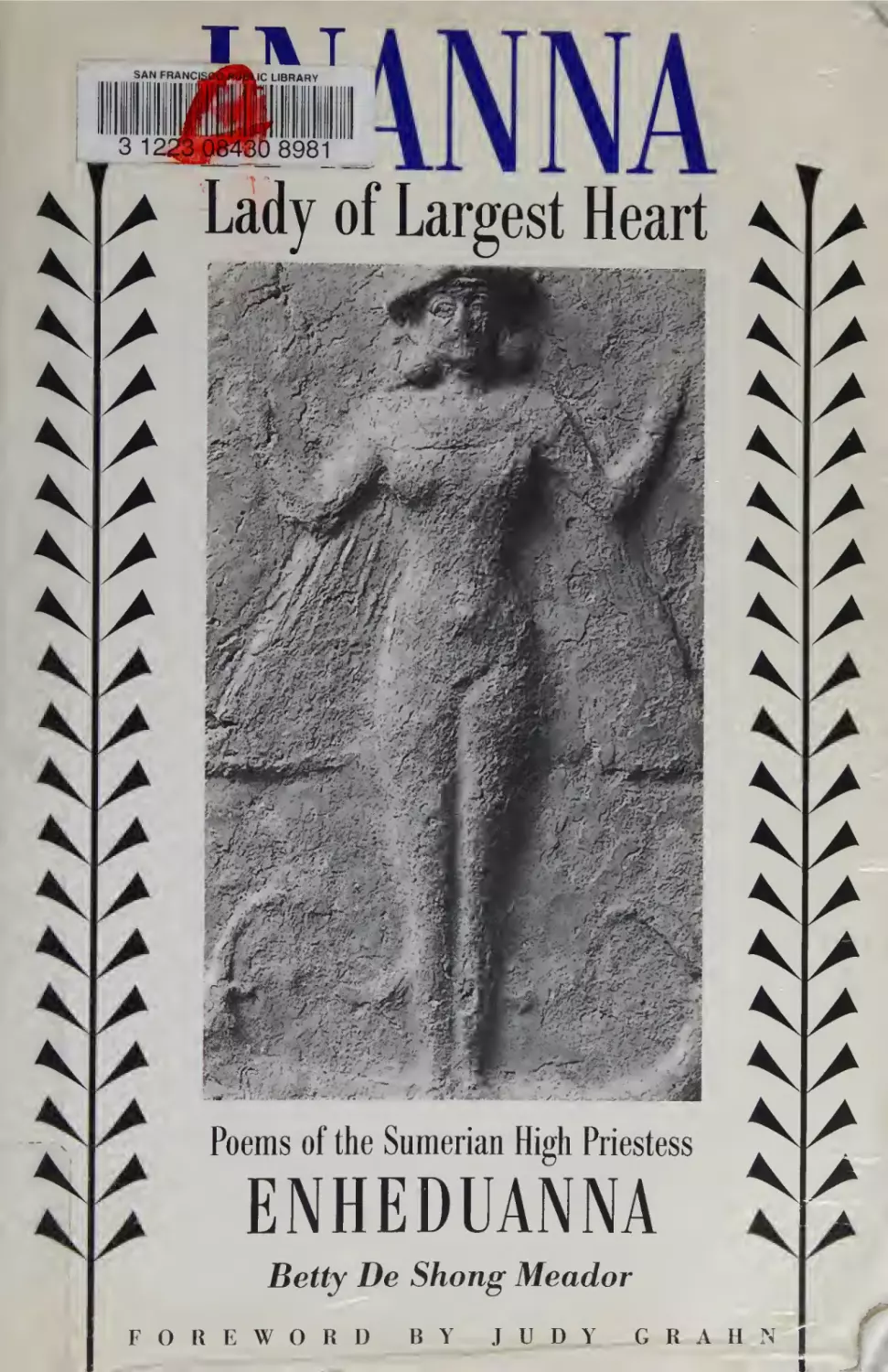


Автор: Enheduanna
Теги: poetry mesopotamia sumerian mythology sumerian literature
ISBN: 0-292-75241-5
Год: 2000


Текст
                    Betty De Shong Meador
FOREWORD

BY

JUDY

G R A H N

j

»r-.

INANNA
Lady of Largest Heart
Poems of the
Sumerian High Priestess

/

A

^

A

Foreword by Judy Grahn

by Betty De Shong Meador

-VUniversity of Texas Press, Austin

A

A

A

A

A

A

A

A

>>>>>>>>

Inanna
Lady of Largest Heart
Poems of the
Sumerian High Priestess
ENHEDUANNA

>

>>>>>>>

“Uncursing the Dark: Restoring the Lost Feminine” first appeared in
Quadrant: The Journal of the C. G. Jung Foundation for Analytical
Psychology, published by the
C. G. Jung Foundation of New York, © copyright, The
C. J. Jung Foundation for Analytical Psychology, Inc., 1989. Reprinted by
permission.

Copyright © zooo by Betty De Shong Meador
Foreword copyright © zooo by the University of Texas Press
All rights reserved
Printed in the United States of America
Second paperback printing, zooz
Requests for permission to reproduce material from this work should be
sent to Permissions, University of Texas Press, P.O. Box 7819, Austin, TX
78713-7819@ The paper used in this book meets the minimum requirements of
ansi/niso Z39.48-1992 (R1997) (Permanence of Paper).

Library of Congress Cataloging-in-Publication Data
Enheduanna.
Inanna, Lady of Largest Fleart ; poems of the high priestess Enheduanna /
[edited] by Betty De Shong Meador.— ist ed.
p.

cm.

ISBN 0-292-75241-5 (cloth : alk. paper) —
ISBN 0-292-75242-3 (pbk. : alk. paper)
I.

Sumerian poetry—Translations into English.

History and criticism.

Betty De Shong, 1931PJ4083 .E54

2. Sumerian poetry —

3. Inanna (Sumerian deity) —Poetry.

2000

1. Meador,

11. Title.

899'.95i—dc2i

3 1223 08430 8981

00-036407

To Mel

..

■

■y.'

jf"

A

Digitized by the Internet Archive
in 2020 with funding from
Kahle/Austin Foundation

https://archive.0rg/details/inannaladyoflargOOOOenhe

Table of Contents

Foreword by Judy Grahn, xi
Acknowledgments, xvii

Part I: The Cultural and Historical Context

i

I.

3

Introduction; “Through the Gate of Wonder”
An early cuneiform sign of the goddess Inanna
appears in the author’s dream

1.

“Great Lady Inanna”

10

Paradoxical goddess encompasses heaven, earth, and
the underworld

3.

“The Robes of the Old, Old Gods”

23

Ancient mythologems: Neolithic Mesopotamian
parallels to Inanna’s iconography

4.

Unearthing Enheduanna

36

Leonard Woolley’s excavations at Ur identify the high
priestess Enheduanna

5.

Enheduanna’s Life Story

43

Sargon’s daughter Enheduanna matures in an era of
new consciousness of the individual

6.

The High Priestess at Ur

49

Enheduanna manages the extensive temple estate and
directs ritual tending of moon goddess and god from
her quarters, the house of women, the gipar.

7.

The Poems and Hymns of Enheduanna
The first literary texts disclose the emotion and
imagery of the poet and the systematic theology of the
priestess

68

Part II; The Three Inanna Poems: Introduction

8i

8.

89

The First Poem: Inanna and Ebih
Introduction

89

Inanna and Ebih: Text of the Poem

9^

“Terror Folds in Her Robes”

103

Inanna, the force of nature, combats a mountain
paradise
“I Will Not Go There With You”

105

The sky god An deserts Inanna
“Fury Overturns Her Heart”

107

Inanna assumes her full stature and autonomy
“Because You Puff Yourself Up”

109

Parallels between Ebih and the creation story in
Genesis

9.

The Second Poem: Lady of Largest Heart

114

Introduction

I14

Lady of Largest Heart: Text of the Poem

117

“Eldest Daughter of the Moon”

137

The paradox of dark and light
“The Carved-Out Ground Plan of Heaven and Earth”

144

Inanna’s world without illusion
“Look at Your Tormenting Emotions”

147

Primary emotions and the goddess
Four Spiritual Paths

151

Warrior

151

Creative autonomy and senseless destruction
Priestess
Lunar spirituality and the internal sanctuary

155

Lover

158

Sexuality, sacred marriage, and the swelling of
desire
Androgyne

162

Gender crossing and gender ambiguity

10.

The Third Poem; The Exaltation of Inanna

168

Introduction

168

The Exaltation of Inanna: Text of the Poem

171

“He Robbed Me of the True Crown”

l8l

Enheduanna’s expulsion: portents of things to
come
“Rekindle Your Holy Heart”

186

Woman’s self-love and the goddess
“Proclaim!”

189

Legacy of a woman’s voice
Notes, 193
Bibliography, Z09
Index, 215

I. Map of the Near East 3200-1600 b.c.e. Courtesy of International Thomson Publishing
Services.

Foreword
V>
Enheduanna’s
Forty-Fourth Century
Judy Grahn

In the mid 1980s I taught writing classes for women. Betty De Shong
Meador entered my life in 1984. She had requested a teacher who could
work with “elements of the dark”—meaning destructive as well as con¬
structive forces. Meador had already crafted a vigorous, poetically em¬
phatic version of “The Descent Myth of the Goddess Inanna,” and now
wanted to take on the daunting task of translating Enheduanna, “the
earliest known poet.” At first she brought in tender lines and images,
of Inanna as the bud of a flower. “Enheduanna was clearly in love with
the goddess Inanna,” she explained.
Week after week for several years, Meador arrived with her fresh trans¬
lations, sparkling gifts that both inspired and riveted. Some parts were
strange and at first utterly mysterious — the phrases of a poet whose name
seemed unpronounceable .. . whose official position during her lifetime,
“High Priestess of the Moon God of the city of Ur,” seemed as exotic and
far-removed as science-fiction fantasy. Some of the emerging phrases of
this poet were provocative, baffiing, and discomforting. The translator
wondered, were they obsessional rants? Emotional fits? Were these only
private emotings of a diary-keeper with an unknowable sensibility? But
persistence is the mother of art, and finally the sinuous, breathtaking,
full body of the howling, spitting, untamed goddess writhed completely
into view.
Meador’s initial witnesses sat shocked at the awesome raw power of
the imagery —never in our experience associated with the feminine. At

XI

xii

Inanna, Lady of Largest Heart

last, here it is —a philosophical story, told by a woman, and centering
on the sacred, creative powers of the feminine. And it is a “dark” story
indeed, quixotic in the many elements of life and death, sacred and pro¬
fane-even qualities of gender itself are challenged and redefined in the
hands of the High Priestess poet of Ur. In Meador’s hands, Enheduanna’s poetry is sure-voiced and inspired: clear, poignant, full of ten¬
sile strength, paying full tribute to the passion, power, and wisdom of
the poet.
To place the Sumerian poet Enheduanna in a timeline, she lived seven¬
teen hundred years before Sappho, eleven hundred before Homer, and
just about five hundred before Abraham, if we place his birth at 1700
B.c.E. Enheduanna wrote her poetry very early in the evolution of writ¬
ing, perhaps three hundred years after cuneiform vocabulary developed
sufficiently to handle linguistic concepts. To have forty-five hundred lines
from such an early writer—the mother of written poetry— is the pouring
of fresh deep water into the well from which all writers drink.
Poet/priestess Enheduanna’s geographical location—the city-states of
the Tigris-Euphrates Valley—was known as “The Cradle of Civilization”
in my grade school textbooks. Because of archaeological advances, we
can say now that “civilization” is a moveable and constructed concept,
that Africa is the likeliest “cradle” of culture, and that the material cul¬
ture of skilled craftspeople can be dated at 40,000 b.p. or earlier. Never¬
theless, the lavish crediting of origins to Mesopotamia was in recognition
of mathematical, architectural, agricultural, and sociopolitical contribu¬
tions that remain awe-inspiring. Ancient Sumer produced the earliest
known writing, and with publication of Inanna, Lady of Largest Heart,
we are privileged to meet the earliest known writer.
Great voices of the past have often emerged to lead literature for¬
ward in a procession that moves, paradoxically, century after century,
backward in time. The relation between archaeology and literature has
been reciprocal. Written accounts of Troy and Ur, for example, spurred
archaeological digs at sites in Greece and Mesopotamia that confirmed
the myths. In turn, archaeology deserves a Nobel Prize for its contribu¬
tion to contemporary thought, pushing consciousness forward with each
increasingly older discovery.
Poets especially have drawn from the emerging body of classical texts,
which under the impetus of archaeological and folkloric discoveries,
gradually spilled out from the earlier nexus of Roman and Greek to north

Foreword

xiii

and east with myths that were Norse, Persian, and Assyrian. Roman
playwright Plautus, the publication of whose play Menaechmi, trans¬
lated by one William Warner in 1594, just preceded the publication of
A Comedy of Errors, supplied Shakespeare with the source material for
his play. Generations of poets have drawn deeply from the well of an¬
cient voices Milton, Longfellow, Byron, Shelley, Poe, and dozens more
relied on the legends of Ovid and Virgil, the plays and sagas of Euripi¬
des and Homer. By the 1898 edition of Thomas Bullfinch’s Age of Fable
or Beauties of Mythology, school children could also learn some rudi¬
ments from Egyptian, Mesopotamian, and Indian texts. These featured
primarily masculine stories of the sun god Mithras and Hindu gods Brah¬
man, Shiva, and Vishnu. But not only male writers benefited from emerg¬
ing mythology; women writers, heartened by characters more vivid and
far less guilty than Eve, freely incorporated ancient stories into their own
emergent work.
With the recovery of Sappho, the classics from Greece produced a new
wonder: a woman writer from antiquity. Her subjects were the gods,
correct ritual, women, and love; her style was lyric. The primary goddess
of Sappho’s attention was the star goddess, Venus in Latin, Aphrodite
in her native Greek tongue. Sappho was a teacher at a school for young
women and a priestess, making her part of the female lineage of Enheduanna, priestess and devotee of the goddess identified with the planet
Venus in her time: Astarte in Syrian, Ishtar in Akkadian, and Inanna in
Sumerian.
In late nineteenth-century America, Emily Dickinson read from trans¬
lations of the lyric fragments left to us by Sappho. Tragically, only one
complete poem has been recovered since Sappho’s work was burned
early in the Christian era. The fragments that remain are quotes from
later classical writers, or papyrus manuscripts excavated in Egypt. Yet
even these fragments have had enormous impact.
Then, early in the twentieth century, the voice of the star goddess began
to be heard with her own stories. At first this was only a murmur in
Bulfinch’s collection—under the heading “Phoenician Deities,” goddess
Astarte received a three-sentence mention as daughter of the moon. In
1913 Stephen Langdon published fragments of a lamentation from Meso¬
potamia; then translations of a goddess named Ishtar began to appear,
about a descent she had made, a journey to the “netherworld.” In 1930
translators startled the scholarly world with a Mesopotamian myth of

XIV

Inanna, Lady of Largest Heart

a king, Gilgamesh, a historical figure, whose series of poems revealed
themselves as a single epic. The fact that a flood myth was included in
the episodes of the king’s life created a stir of excitement—biblical texts
had sources! The story told of the search by Gilgamesh to find new terms
of immortality, and a rejection of the older philosophy of the goddess,
Ishtar. But wait a minute —a goddess with a philosophy? This was news.
What was her philosophy, and how did it differ from that embraced by
Gilgamesh? Do these struggles have relevance to our own times?
Meantime, the Greek and Roman mythology so inspiring to pretwentieth-century poets was colder on the tongues of twentieth-century
women, who found Pandora’s box of evils as blameful as Eve’s apple.
One small example suffices to show that the feminine has had little or
no active principle in these myths. Samuel Coleridge’s characterization
of the sexes is typical: “ ’Tis Jupiter who brings what e’er is great/and
Venus who brings everything that’s fair” (quoted in Bulfinch).
The psychological archetypes proved inadequate for women, who
could not fit themselves into the small part played by Electra or the re¬
active vengeance of Clytemnestra or Medusa. Much richer and deeper
archetypes were needed. Revisioning misogynist Greek mythology so
her daughter could have positive empowering mythology, Charlene
Spretnak (1975) drew from folklore, ritual, and her own imagination in
recovering “lost” goddesses of pre-Hellenic Greece, searching for the
undercurrent of the sacred feminine that Jane Ellen Harrison, Robert
Graves, and others had insisted was real. Women craved points of view
from that stream.
A multitude of twentieth-century writers have revised male-authored
versions of women’s myths, even though there simply was no original
poetry from which to draw inspiration. Ignoring both myth and its ab¬
sence, Gertrude Stein reconstructed language to contain her own phi¬
losophy, while poet HD made intense collages of imagery of the sacred
feminine to reconstruct Helen as a modern heroine, in Helen in Egypt
(1961), a theme I took up in The Queen of Wands (1982). Native Ameri¬
can women such as Leslie Marmon Silko, Paula Gunn Allen, and Linda
Hogan poured traditional stories into contemporary literary form, as
did African Americans such as Luisah Teish and Audre Lorde. Diane
DiPrima investigated Italian folklore to write her long chronicle of Loba.
Then in 1983, Inanna —the star goddess with her own voice and stories
— burst full grown on the scene with a breathtaking complexity with the

Foreword

XV

publication of Inanna: Queen of Heaven and Earth, the collaboration of a
Sumerian scholar, Samuel Noah Kramer, and a popular dramatist, Diane
Wolkstein. While Kramer had written on her earlier, the mix of scholastic
translation and Wolkstein s poetic drama mirrored for modern women,
who had been pouring into the workplace, a range of strengths, includ¬
ing sexual expression and autonomy, as they entered into science, spirits,
artistic expression, political and economic power. Inanna celebrated her
vulva, founded horticulture, and collected all the principles of her culture
into her “boat of heaven.” Her descent myth, assembled painstakingly
from many fragments by Kramer, leaped into focus as a life journey with
profound guidance for the choices women make and the circumstances
of women’s lives that demand surrender to a greater principle. In the
Descent myth, that greater principle is also female. Suddenly the malefemale schism of Greek myth is replaced by a “new” story; in this one,
the feminine is not fractured, not dragged about in wars, not waiting,
not “all that is fair,” not killed by its own children, not cursed or reviled.
The reappearance of this germinative work at the turn of the millen¬
nium is particularly striking. Enheduanna’s timing is impeccable. Here
we are at the end of the twentieth century re-defining gender, deity, sexu¬
alities, theology, and the parameters of human hegemony. We struggle
with the power of emotion to destroy our relationships, and the power
of nature to destroy us, despite our fantasies of security. We struggle
with inner and outer violence, how to survive loss with integrity, and
how to have faith in something beyond humanity at a time when human
capacity is expanding exponentially. These were some of Enheduanna’s
issues as well.
If the expansive progression “back to the future” continues, the next
century will be storied in large measure by the literature of Mesopotamia,
especially the myths of Inanna. With Inanna, Lady of Largest Heart we
are given new philosophical depth that connects intricately with the lin¬
eage already in place. Biblical scholars will notice that Enheduanna’s
cry, “I am yours, why do you slay me?” precedes the similar cry of Job
by nearly two thousand years, among other affinities with biblical texts.
Scholars familiar with the oral literature of India’s earth goddesses and
of Kali will notice the overlap of characteristics, further affirming in¬
fluence between India’s Harappan and other Indus Valley cultures and
the peoples of ancient Mesopotamia. Poets and other students of con¬
temporary mythology may be astonished by a goddess whose powers

XVI

Inanna, Lady of Largest Heart

include smashing a mountain or changing someone’s gender. Students of
the transgendering currently happening both socially and theologically
will find much to work with in Enheduanna’s poetry.
When we consider the probable contribution of Enheduanna to bibli¬
cal literature, we are confronted with a writer who may have influenced
an inestimable number of people over the centuries since her life. She
may well have “been with us since the beginning.” When we further
consider Enheduanna’s contributions to theology—that Meador demon¬
strates so well —and that Enheduanna’s descriptions of Inanna are the
oldest written litany of the characteristics of the active feminine principle
in nature—known as “Shakti” in India—the importance of the High
Priestess of Ur assumes far greater prominence than we ever could have
imagined for any individual writer.
We can now understand women’s contribution to literature as both
germinal and having greatest-known longevity. Meador patiently takes
us through the strangeness of this territory, shows us how to slow down
to absorb the poetry, feel its greatness in ourselves, ponder the profun¬
dity of the philosophy. Meador’s interpretation is itself an injunction for
our age to reconnect fully with the mind of nature, that intelligent force
the Mayan people of Columbia call ‘alana’ —the mind inside nature —
and that the Sumerians called Inanna—Lady of Largest Heart.

Acknowledgments

The long period of germination that accompanies most books began
with my search for Inanna before I knew of Enheduanna. My dear friends
Gaye Williams and the late Maria Bowen, along with Carol Davis and
others, created a performance of several of the Sumerian sacred mar¬
riage hymns, whose translation I had begun with Jerome Rothenberg. I
remember our work with genuine gratitude. During this time I was for¬
tunate to study with Diane di Prima in her “Hidden Religions” classes
which gave dimension to the underground strand of a female-oriented
spirituality. I thank her for her continued support. In the mid-1980s I
began a women’s writing group led by Judy Grahn. I am grateful to
all the women who passed through these groups, for their considered
critiques and encouragement. My collaboration with Judy Grahn is the
solid alignment that keeps me on course. She is an indispensable mentor
and sister-wayfarer.
My connection to Anne D. Kilmer, Assyriologist at the University of
California, Berkeley, has been invaluable. She led me to Daniel A. Foxvog, generous and capable Sumerologist, with whom I studied a number
of Sumerian texts, including the Enheduanna poems in this book. Pro¬
fessor Kilmer read more than one version of the manuscript, invited me
into her classes, and freely answered my many questions. I am grateful
to her graduate students John Carnahan and Mary Frances Wogec for
their patient help and support.
I appreciate the numerous opportunities to present the work in prog-

XVll

xviii

Inanna, Lady of Largest Heart

ress, particularly at the C. G. Jung Institute of San Francisco and to audi¬
ences connected to Jung Societies throughout the country. I am espe¬
cially grateful to Murray Stein and Chiron Publications for first publish¬
ing excerpts from Enheduanna’s poetry. My colleagues Linda Leonard,
Virginia Beane Rutter, Jean Kirsch, among others, have been consis¬
tently supportive. At the California Institute for Integral Studies (ciis)
and New College (San Lrancisco) and Pacifica Graduate Institute (Santa
Barbara) I was given numerous opportunities to introduce to their chal¬
lenging students the ideas in this book. My special thanks go to Elinor
Gadon and the Women’s Spirituality Program at ciis.
The gracious acceptance of the manuscript by Jim Burr, my editor at
University of Texas Press, created a welcome home for the book and for
me a serendipitous homecoming to my alma mater. Marie Cantlon pa¬
tiently edited the manuscript, and Sheryl Lullerton guided the process
more than once.
Linally, with his cogent wisdom my husband and true companion,
Mel Kettner, understood the meaning of the work from the beginning.
My deepest gratitude to him who without flinching, endured the impact
Enheduanna’s ideas have had on our lives together.

INANNA
Lady of Largest Heart
Poems of the
Sumerian High Priestess

ENHEDUANNA

- I

u

'tl

I. *

k 3

PART

The Cultural and
Historical Context

CHAPTER

Introduction
“Through the
Gate of Wonder”'
There are times when a person is seized by an idea or an event that grows
into a living presence that makes demands on her or his life. Such was
my experience when Inanna first appeared to me in a dream. Before the
dream, I had never heard of this Sumerian goddess.
In the dream I am with a group of women who are preparing two
graves. One is complete. Two tall sticks that curve into circles at the top
are thrust into the soft dirt. Beside the stick figures is a bundle of palm
fronds. The other grave is freshly dug. After the second body has been
received and covered, we are to push similar stick figures into the soil
and place a palm frond bundle beside them.
Two Jungian analysts, both alive at the time, are being buried. In my
dream they are married. The woman, Veronica, lies in the first grave. The
man, Jeffery, is dying. From his deathbed he instructs us in the details of
his burial.
The dream was both understandable and puzzling. In actuality, the two
analysts were older, conservative people, strongly committed to uphold¬
ing conventional relationships between men and women. I was a new
analyst, recently divorced, searching for a way to be myself as a woman
outside the narrow expectations of traditional culture. The deaths of
these two colleagues expressed this transition. My old way of being was
indeed dying. This much of the dream I could grasp.
But what were the strange stick figures on the grave and why the palm

3

Inanna, Lady of Largest Heart

4

fronds? I had no idea. Some months later I was startled to find an illus¬
tration of similar stick figures in the book The Great Mother by Eric Neu¬
mann.^ The text said the looped post was a symbol of the mother god¬
dess and referred the reader to another work, Rachel Levy’s The Gate
of Horn?
Levy’s book, which I had to order from England because it was out
of print in the United States, explained that the looped post represented
the goddess Inanna in Sumerian iconography. Later I found poems to
Inanna, which made it clear that palm fronds signified the nourishing
date palms gatherers offered to Inanna in her role as goddess of the abun¬
dant harvest.
My search at this point was casual. It was the late 1970s. I had never
heard of Inanna and knew nothing of her mythology. By chance I then
came across several hymns to Inanna in a popular journal. Parabola?
These hymns from Sumerian sacred marriage texts, translated by Samuel
Noah Kramer, glorified Inanna’s sexuality and sang praises to her vulva.
Suddenly my interest increased quite a lot.

2. Cylinder seal of the king feeding
sheep in the presence of the
emblem of Inanna, c. 32003000

B.c.E.

Left, the actual

cylinder seal; right, the seal rolled
on clay. Courtesy of the Staatliche
Museen zu Berlin—Preuflischer
Kulturbesitz, Vorderasiatisches
Museum. Photo left: J. Diepe, 1991;
photo right: Rosa Mei, 1993.

Introduction: “Through the Gate of Wonder"

5

Since Kramer, a renowned Sumerian scholar, had translated most of
the hymns and myths about Inanna, I had found a rich resource in his
articles and books. The very existence of an ancient body of religious lit¬
erature that sang praises to a woman’s vulva fascinated me. I began to
track down the original Sumerian texts. Did the Sumerian language ver¬
sion really say “vulva”? What else might these texts say about women’s
sexuality? By this time I had a compelling desire to know more of the
original language. While the texts were not hard to find in a large univer¬
sity library, they were, of course, in Sumerian. I could not read Sumerian.
This, now twenty years ago, was the beginning of my search for
Inanna. Since then she has come to occupy most of my spare time. How¬
ever, I am getting ahead of the story. For a few years I worked with two
graduate students of the Sumerian language at the University of Califor¬
nia in Los Angeles. With their help I managed to complete my own rendi¬
tions of several sacred marriage poems plus the myth “Inanna’s Descent
to the Underworld.” I would take the graduate students’ word-for-word
translations and develop my own versions.
After a move to northern California, I connected with the department
of Near Eastern Studies at the University of California in Berkeley and
began to work with Dr. Daniel A. Foxvog, an instructor of Sumerian
language and literature. In my long, fruitful relationship with Foxvog,
we began with an in-depth study of the sacred marriage texts and the
“Descent” myth.
During this repetitive, arduous work I felt myself moving deeper and
deeper into the ancient world where Inanna reigned. The work was not

Inanna, Lady of Largest Heart

6

a burden. Rather, the hours with Foxvog were compelling excursions
into a strange and distant past. I had no idea what I would do with the
poems beyond using Foxvog’s explanations to reevaluate the renditions
I had already completed. Meanwhile I read everything I could find about
ancient Near Eastern civilizations.
A translator at ucla had told me about a Sumerian poet, Enheduanna, who wrote poems to Inanna. I obtained the book she mentioned.
The Exaltation of Inanna, which contained a translation of one of these
poems.^ Later, Daniel Eoxvog mentioned Enheduanna, saying she had
written three poems to Inanna. Together we began to study her work.^
Enheduanna was high priestess to the moon god Nanna at his temple
at Ur around 2300 b.c.e. Appointed to this sacred position by her father,
Sargon of Agade, Enheduanna developed the high priestess’s post at Ur,
a city in southern Mesopotamia, into the most important religious office
in Sumer during the almost forty years she performed her sacred role.
After completing the work with Eoxvog, I was left alone with boxes of
notes on yellow paper from our study. I chose to work forming the ren¬
ditions of the poems on my own. I took great pleasure struggling with
each line, the sometimes contradictory meanings of a word, the broken
sentences, and missing verses. I approached the task as though I were
solving a puzzle. I found that slowly the lines would come into focus,
and, in the context of the preceding text, I could grasp their apparent
meaning.
In the middle of working on the first poem “Inanna and Ebih,” I began
to get a sense of Enheduanna’s love for Inanna. I think it must have been
at the point when these beautiful lines became clear:
Inanna
child of the Moon God
a soft bud swelling
her queen’s robe cloaks the slender stem
>1-

5f-

>5-

steps, yes she steps her narrow foot
on the furred back
of a wild lapis lazuli bull
and she goes out
white-sparked, radiant

Introduction: “Through the Gate of Wonder

7

in the dark vault of evening’s sky
star-steps in the street
through the Gate of Wonder
Enheduanna s love for Inanna became more and more explicit as the
translation process progressed. I could feel the real woman who wrote
the poems and the vitality of her devotion across the four thousand-year
expanse that separates us.
Slowly, the significance of Enheduanna’s veneration became apparent.
Enheduanna was lifting Inanna out of her established place in Sumerian
culture, where she was already considered to be an important goddess, in
order to place her above all other deities. Not only was she Enheduanna’s
personal goddess, but she was now elevated to the supreme position in
the Sumerian pantheon.
There is no way to know why Enheduanna made the painstaking effort
to elevate Inanna above all the great gods. Perhaps it was simply an act
of dedication to her goddess. Still, from this distant point in time, we
can conjecture other possibilities.
Eirst, we must get a sense of who Inanna was in the spiritual under¬
standing of the Sumerians; this is spelled out in Chapter 2. Enheduanna’s
devotional poems use both metaphor and action to describe Inanna. In
these poems we see that the very being of this goddess infuses and vivifies
all nature and natural processes. She is the divine in matter. As such, she
sustains the ebb and flow, the relentless paradoxical reality of the natu¬
ral world. She exists between blessing and curse, light and dark, plenty
and want, goodness and malevolence, life and death. Harsh as her reality
may seem, it is the Real every living being must encounter. And she is the
divine in matter. Implicit in her presence is a divine plan, a sacred order
and meaning. Enigmatic as the plan may be, it is inferred by Inanna’s
careful attention to the workings of the world and the people in it. When
Enheduanna elevated Inanna over the other gods, she placed utmost im¬
portance on this portrayal of the divine presence, the divine infusion into
reality.
This belief in the paradoxical nature of reality was not new to the
Sumerians, nor to their ancestors, as Chapter 3 explains. Some three
millennia before Enheduanna, a Neolithic culture in northern Mesopo¬
tamia, the Samarran, painted deep plates with vibrant scenes of women
with long hair flowing in ecstatic dance, surrounded by a rim of scorpi-

Inanna, Lady of Largest Heart

ons. The Samarrans also used the ubiquitous, earth-hugging snake sym¬
bol in their iconography, as did the later Ubaid culture. The principle
Ubaid goddess is a slender snake-headed figure with a high bitumen
crown. Often she holds a little snake baby to her breast. Her striking
dark crown and human figure suggest both her regal and authoritative
nature, as well as her link to humanity. The Neolithic Samarran/Ubaidian
lineage continued directly into Sumerian culture.
Enheduanna was “discovered” in the 1920s during Leonard Woolley’s
archaeological excavations of the city of Ur, to be discussed in Chap¬
ter 4. The plaque Woolley found near the residence of the high priest¬
ess displayed a carving of Enheduanna in a ritual procession. In writ¬
ing on the back of the plaque, Enheduanna declares she is dedicating
a dais to Inanna in her temple. She identifies herself as “daughter of
Sargon.” Again, we must ask why Enheduanna would elevate Inanna
above all other gods at this particular time? A possible clue lies in the
empire-building activities of her father Sargon, examined in Chapter 5.
Prior to Sargon, certain kings of various city-states had attained domi¬
nant positions in the land. Eannatum of Lagash, for example, around
2500 B.C.E., conquered neighboring cities and even ventured into lands
beyond Mesopotamia proper, but he made no attempt to establish a uni¬
fied government. Sargon was the first leader anywhere to establish an
empire, uniting the cities of northern and southern Mesopotamia under
his rule and extending his hegemony into neighboring lands far beyond
the borders of Sumer and Akkad. As a result of his exploits, he gained
enormous prestige over the fifty years of his rule. He had successfully
established a new level of central government, something never before
achieved. Maintaining and expanding his empire required one military
undertaking after another. Living in this new era of empire building and
constant military activity must surely have had an effect on the conscious¬
ness of the people, who before this had lived in relative peace. Certainly
it had an effect on Sargon’s daughter Enheduanna.
Sargon, like all the kings before him, invoked the benevolence of
Inanna to bring him victory. Sargon equated the Sumerian Inanna with
the Akkadian Ishtar, report Hallo and van Dijk, “to lay the theological
foundations for a united empire of Sumer and Akkad, and thus ushered
in what the chronographic tradition regarded as the ‘dynasty of Ishtar.’ ^
Although Sargon invoked Inanna in her warrior mode, he expanded
Inanna’s role as warrior goddess, planting her banner over the new social

Introduction: “Through the Gate of Wonder"

9

institution of an established empire. His feats of heroic conquest, previ¬
ously unmatched in their sustained success and longevity, rode a wave
of phallic aggressive energy, new to humanity. The empire Sargon estab¬
lished was perpetuated by his successors, Enheduanna’s two brothers
and her nephew Naram-Sin, who supported and strengthened this first
family dynasty. Naram-Sin even deified himself as the god of Akkad,
thus usurping the authority of the powerful priests and priestesses of
the temples. It seems possible that Enheduanna elevated the paradoxi¬
cal Inanna in order to reestablish the balance between the reality of the
forces of nature and the hubris of aggressive conquest by an individual
human being. Her roles as high priestess and as poet are the subjects of
Chapters 6 and 7.
Enheduanna’s devotion to Inanna persisted throughout her lifetime.
The three poems to Inanna reflect her own spiritual and personal self¬
integration over time. They document not only the emotional life of this
remarkable woman four thousand years ago, but also the personal and
spiritual devotion of one woman to her deity, an eloquent diary of adu¬
lation and prayer unique in its antiquity. The poems in Part 2 portray
what so many women long for, a spirituality grounded in the reflection
of a divine woman, offering a full sense of foundation and legitimacy
as females. Enheduanna describes a spiritual direction as well, a path
for women that encompasses the whole of reality. Inanna’s devotees, her
“warrior women,” “do common work in devotion to you/whose hands
sear them with purifying fire.” Personal integration based on an embrace
of the whole of reality is a searing purification that demands sincere
devotion.
A few years ago I found out something else about the symbol of Inanna
that had appeared in my dream. Drawn with a stylus on wet clay, the
stick figure with the circle on top was her name written in the earliest
cuneiform script. You could say she appeared to me as a word, but in
that time word and symbol were the same. In the beginning the word
“Inanna” was not an abstraction on the page. In the beginning there was
not the word but the very presence of the goddess. And there she was
in my dream, her stately form planted on the graves of a contemporary
couple, a being full of power and mystery waiting to be discovered.

CHAPTER

2
v>
“Great Lady Inanna”

The appearance of Inanna’s reed post symbol in my dream raises many
questions about the nature of dreams and their personal and cultural
meaning. As a Jungian analyst I have studied dream interpretation and
worked with hundreds of dream images. I am well aware that numinous
images, carrying the most profound meanings, can appear in anyone’s
dreams.
I first recognized in my dream that the burial scene was related to per¬
sonal events in my own life. I thought the traditional views of the two
analysts being buried indicated that I was being called to let go of certain
of my own ties to the values of the collective culture. Inanna’s symbol
standing tall on the graves was an image of strength and courage from a
culture outside of and alien to patriarchal thinking. This new perspective
propelled me onto my future path.
Dreams frequently compensate for an excessively one-sided presump¬
tion in the dreamer. Inanna was most emphatically a balancing and com¬
plementary alternative to the role of mother and homemaker to which I
had adapted. But dreams can also carry a larger meaning that pertains
to the culture as a whole. Inanna, an important goddess in Sumer for
thousands of years, amply balances the one-sidedness of the single male
deity of present monotheistic cultures. She is an example of the female
element missing in the godhead. Her many-faceted being fills in a vital
portion of women’s identity.
Inanna’s tall reed standards stand like insurgent flags amid the bastion

lO

“Great Lady Inanna

II

of traditional beliefs that restrict women. I am one of millions of women
worldwide who are attempting to redefine themselves and their cultures
in ways that foster women s full creative potential. Because my own re¬
definition seemed, in its essence, to be distilled into this unfamiliar image
of a reed post curved into a circle at the top, I felt compelled to know
who Inanna was.
My first encounter with Inanna outside my dream found her singing a
song to her vulva:
peg my vulva
my star-sketched horn of the dipper
moor my slender boat of heaven
my new moon crescent cunt beauty *
Source: Ni 9602, obverse, column 1, my translation

I followed this lead and found the courtship and love songs of a sacred
marriage ritual that described a goddess of unbridled sexuality actively
pursuing the object of her desire. While these images go against the mod¬
esty and decorum most patriarchal societies idealize in women, they
are not beyond the fantasy or experience of most women. The idea of
Inanna’s audacious lust being part of a sacred canon triggered delight¬
ful thoughts of inserting these poems between the pages of Bible stories
taught in the stony church of my childhood. This Inanna was a personage
I could wholeheartedly embrace.
The many sides of Inanna’s sexuality captivated me for some time, but
hints of her darker aspects also began to emerge as I read. The whole
vision of this goddess was beyond anything I had ever imagined. My con¬
tinuing investigation of the dream image lifted me off familiar ground
and set me down in a strange landscape. In the myth “Inanna’s Descent
to the Underworld,” Inanna is stripped, beaten, killed, hung on a peg
to rot, miraculously revived, and returned to earth transformed. In that
myth I met an Inanna who brought back from the great below the very
eye of death. But it was not until I read Enheduanna’s poems to Inanna
that I began to see the full extent of her being. Enheduanna’s Inanna is a
paradoxical creature that mirrors a wide range of characteristics all the
way from the most horrendous, vicious, cruel, destructive, and violent
to the most beneficent, glorious, and creative. In her poetry Enheduanna
captured a vision of a larger, wider, deeper self called Inanna, and in that

12

Inanna, Lady of Largest Heart

vision she found a reflection of the immensity of the imagination beyond
the personal ego, and far beyond cultural traditions. Inanna is an arche¬
typal image of profound significance that constellated itself in human
consciousness six thousand years ago and now returns to us offering her
excruciating, dreadful, magnificent picture of the way things are.
More than any other goddess or god in the Sumerian pantheon, Inanna
embodies the totality of “What Is.” In that regard she represents the at¬
tempt of the Sumerian psyche to contain and to organize their appre¬
hension of the chaotic, indecipherable, ineffable mystery of the known
and the unknown universe. She is their version of a personification of the
whole of reality.

The Reed Posts
The graceful image of the tall reed posts with the head-like circle at
the top appears on numerous clay tablets, cylinder seals, carvings, and
religious articles from prehistoric Mesopotamia in the late fourth mil¬
lennium.^ A flowing “ribbon” falls from the head in many examples and
resembles a woman’s long hair. Archaeologist Beatrice Laura Goff calls
it “the beribboned standard.” ^ The earliest writing of cuneiform on clay
tablets is found at Uruk."' Inanna’s sign appears on these tablets accompa¬
nied by a star, the element that designates divinity. This is the first known
written record of Inanna’s name. The frequency of Inanna’s sign, mus,^
on the archaic tablets from Uruk substantiates the importance, if not the
primacy, of her cult there. Symbols of other gods rarely appear on these
tablets.^
By careful study of these early tablets from Uruk, Krystyna Szarzynska

3. Early pictographic signs for the goddess Inanna. From Archaische Texte aus Uruk by
A. Palkenstein (Berlin, Deutsche Forschungsgemeinschaft,

, Zeishenliste, fig. 208.

Great Lady Inanna

13

4. Early signs from Uruk tablets: (a) “Princely Inanna”; (b) “Morning Inanna”; (c) “Eve¬

ning Inanna.” Author’s drawings from Szarzynska, 1993.

found that in this period Inanna had four separate aspects, three of which
received particular offerings. She was worshiped as “Princely Inanna”
[^Inanna-nun], “Morning Inanna” [‘*Inanna-ud/hud], and “Evening
Inanna” [“^Inanna-sig]. No offering tablets have been found for her
fourth form, Inanna of the Steppe [‘*Inanna-kur].^ “Morning” and “Eve¬
ning” Inanna refer to Inanna’s identification as the morning and evening
star we call Venus.
Although many of the signs on the tablets that designate particu¬
lar offerings cannot be deciphered, some can be understood. “Princely
Inanna” received various types of grains and breads, beer, dairy prod¬
ucts, sheep, and swine. “Morning Inanna” received sheep, silver, food¬
stuffs, grain, and certain items cooked with flour. “Evening Inanna”
received grain products, flour, wool, carpenter’s tools, and other raw
materials. The offering registers for “Morning” and “Evening” Inanna
were signed by individuals with well-known official titles, meaning that
record keeping of offerings even at this early time was an important as¬
pect of the worship of Inanna. Although the offerings to the three aspects
of Inanna overlap somewhat, their differences remain consistent.^
While the numerous examples of Inanna’s symbol on the Uruk tablets
strengthen our understanding of her importance, the extensive archaeo¬
logical excavations of Uruk, the principal center of her worship, provide
more contextual information. In the late fourth millennium, Uruk was
the largest, most important city in Mesopotamia. At its center was the
Eanna, a cluster of large buildings that Hans Nissen describes as:
the very large economic unit... that controlled not only agriculture, animal hus¬
bandry, and the crafts, but also trade. . . . Clearly, it was also responsible for the

14

Inanna, Lady of Largest Heart

5. Votive plaque from the gipar at Ur, Early Dynastic III period, c. zyoo b.c.e. Inanna’s
ring-post symbol stands on either side of the doorway into the temple. Note the front¬
facing figure with rolled-brim hat in the lower register, the hat typical of that worn by
the high priestess. Courtesy of the Trustees of The British Museum, BM ii8y6i.

building and maintenance of the temple complex as well as for the organization
of religious festivals and the supervision of sacrifices.^

Inanna’s temple dominated the Eanna throughout the history of Uruk.
Certain Sumerian scholars see this symbol of Inanna as a gatepost situ¬
ated on either side of the doorway to the storehouse. A rolled mat, hung
between the two posts, could be pulled down to form a door. Nissen
describes them as “two so-called reed-ring bundles, the original door¬
posts in the traditional reed architecture of the country: the loops on
either side of the door opening hang the poles around which the rush
mats that served as door curtains were wound.” This symbol, then,
signified Inanna’s position as guardian of the abundant harvest kept in
the communal storehouse. As a doorpost, Inanna guards the passageway
between two worlds, the outside ordinary world and the inside sacred
womb-shaped sanctuary that shelters the abundant harvest.

Great Lady Inanna”

15

Inanna s emblem was made from the ubiquitous reeds that grow in the
delta region at the confluence of the Tigris and Euphrates rivers. Even
in present-day Iraq, houses in the delta are constructed of reeds. The
emblem that signified her presence was made of the common building
material that fills the marshlands, that liminal space separating the river
waters and dry land. The doorway to the storehouse marked the tran¬
sitional space between secular outside and hallowed inside. In her most
elemental form, “the beribboned standard” heralded the entrance into
that special state of mind called the sacred.

Inanna’s Mythology
The origin of the Sumerian people remains a contested issue (see Chap¬
ter 3), but a number of hypotheses have been proposed concerning ante¬
cedents of Sumerian mythology based on iconography. Sumerian scholar
J. van Dijk traces certain Sumerian mythologems back to ancient shamanistic practices, saying, “an interdependence seems to be undeni¬
able.”^^ He contends that the gathering of these mythological elements
took place in an ancient period of human history, and that we are there¬
fore unable to reconstruct the process of their dispersal.^^ “One could
make a long list of mythic motifs,” he says, “that the country of Sumer
has in common with other people.” The incorporation of motifs from
other mythologies is a prime example of the Sumerian propensity to em¬
bellish their culture with elements assimilated from other ethnic groups.
While Inanna has a particularly Sumerian quality, she also absorbed
characteristics and mythologems from the distant prehistoric past. Enheduanna intimates Inanna’s connection to her ancestors in these lines:
you wear the robes
of the old, old gods
Certain words in the Sumerian language suggest that the Sumerians
came to the Mesopotamian plains from a mountain region —some schol¬
ars pinpoint the Iranian plateau. Enheduanna keeps the mountain tra¬
dition alive when she calls Inanna “mountain born.” Inanna, and her
Semitic counterpart Ishtar, is goddess of the planet Venus in both its
morning and evening aspects, as we have seen from the archaic Uruk
tablets. She is the daughter of the moon couple Nanna and Ningal, and
thus is a third-generation goddess, granddaughter of Enlil and Ninlil, and

i6

Inannay Lady of Largest Heart

great-granddaughter of the original gods An [Heaven] and Ki [Earth].
An and Ki were united on the cosmic mountain that was horn out of
the primordial sea. This cosmic mountain is reflected in the Sumerian
temple structure: the holy sanctuary of the ziggurat stands on the top of
a terraced “mountain.”
A recounting of the Sumerian creation myth occurs in the tale “Gilgamesh, Enkidu, and the Nether World.” Van Dijk cites the relation¬
ship between one section of this myth, “Inanna and the Huluppu-tree,”
with the shamanistic world-tree motif known in many parts of the an¬
cient world.''* In his study of Assyrian prophecies of Ishtar dating from
the seventh century b.c.e., Simo Parpola connects the central symbol
of Judaism, the menorah, to the ancient Near Eastern sacred tree, say¬
ing “the entire associated doctrinal apparatus” of the Judaic Tree of
Life “can be shown to be based on a Mesopotamian model perfected in
Assyria in the second millennium b.c.e.”It is possible that Inanna’s
reed post symbol, first evident in the third millennium b.c.e., derives
from the mythologem of the world tree or from the celestial pole that
connects heaven and earth, the symbol of the ultimate point of orienta¬
tion.'® We can think of Inanna, with her complex mix of characteristics,
as an attempt to bring together the seemingly chaotic forces of the uni¬
verse into one unifying, and therefore orienting, personification.
Modern tradition places the beginning of philosophy with the preSocratics “who were able to conceptualize unity within the universe.”
Piotr Michalowski challenges this late origin, using as evidence “the
structural and symbolic patterns through which the Mesopotamians ex¬
pressed their search for meaning in the universe.” Enheduanna reveres
Inanna herself as the unifying god-image saying, “she wears the carvedout ground plan / of heaven and earth.” Having evolved from the Sume¬
rian Inanna, the Assyrian Ishtar is an aspect of the unified god, says Par¬
pola, who develops a case for “the basic similarity of the Assyrian and
biblical concepts of God.”'^ The first written evidence of this intrigu¬
ing developmental line comes in Enheduanna’s insistence that Inanna is
“greater than the great gods” and that she is the supreme expression of
the unity in the plurality of the universe.
On the one hand, Inanna consolidates themes from ancient religious
practices. On the other hand, she is thoroughly Mesopotamian and
unique. Unlike any other Sumerian deity, Inanna, like a magnet, attracted
a multitude of powers that, as she says in Enheduanna’s poetry, “gave

“Great Lady Inanna

17

my word weight above all others.” I try to imagine how the nature of this
force called Inanna swept the religious consciousness of the Mesopota¬
mians into its vortex, sucking away powers from even the most promi¬
nent gods of the pantheon. Inanna is an irresistible directional movement
of the imagination. We have nothing in the western pantheons of god¬
desses that even approaches her variety and dominion. Inanna is a unique
outbreak of a particular consciousness attempting to embody and define
itself. She is an expression of the Mesopotamian psyche that manifested
itself in this paradoxical, complex, divine woman.
Time after time in Mesopotamian myth and poetry, Inanna gains more
powers, the me (pronounced “may”). According to Mark Hall, the mean¬
ing of the word “is loosely rendered as ‘power’ but has such a wide
range of connotations and applications as to defy any precise defini¬
tion of its meaning.”^® In the myth of “Inanna and Enki: the Transfer of
the Arts of Civilization from Eridu to Erech,” Inanna tricks a drunken
Enki into giving her his me, those principles of order over which the
Sumerian gods preside. She successfully escapes to her own port with
all that Enki has given her. In the myth of “Inanna’s Descent to the
Underworld,” she dares to sit on the throne of her sister. Queen of the
Underworld Ereshkigal, and returns with underworld powers. In Enheduanna’s poetry, Inanna is raised above all other gods, who bend and
quiver in her presence. In a late composition, “The Elevation of Inanna,”
the great god of heaven. An, marries Inanna as the council of gods has
proposed, gives her his name and his powers. Enlil then gives her his
powers and Enki follows suit. Inanna becomes virtual Queen of the Uni¬
verse.
W. W. Hallo says “the attribution to Inanna of these me’s represents the
main point of both of Enheduanna’s hymns” (“Lady of Largest Heart”
and “The Exaltation of Inanna”) and that Inanna’s “preoccupation with
the me’s may almost be said to approach the character of an obsession
in Sumerian literature.” If we treat this “obsession” as a directional
force in the Mesopotamian psyche, an idea is striving to be born that
finds its embodiment in an Inanna who reaches toward being the one allpowerful deity. The Sumerian characterization of Inanna emerges as an
all-encompassing, over-arching deity, even an attempt at a unitary vision.
In his discussion of Assyrian prophecies, Parpola urges that we not see
polytheism and monotheism as mutually exclusive. He argues that the
Assyrian Ishtar, the Semitic Inanna, is an aspect of the god Assur . . .

i8

Inanna, Lady of Largest Heart

“she, however, is at the same time also an entity distinct from Assur: a
divine power working in man and thus bridging the gulf between man
and god.”^^ In Parpola’s interesting thesis, Inanna/Ishtar is comparable
to the Holy Spirit, the aspect of the one God that manifests in relation
to humans.
Inanna was a goddess who attracted the powers not only of the known
world but those of the entire cosmos, “the carved out ground plan / of
heaven and earth.” She embraced the full continuum of authority from
the darkest to the most brilliant. A creature of earth as well as heaven,
she reflected paradoxical human nature. It is to her characteristic display
of paradox that we now turn.

The Paradoxical Goddess
Many creation myths begin with a swirling fog that gives no hint of
the myriad possibilities of a differentiated world. In the beginning, as
the myths often say, there is a unity that divides into its countless parts.
Jung says of this original unity:
(The unus mundus) as we have seen (is) the potential world of the first day of cre¬
ation, when nothing was yet “in actu,” i.e., divided into two and many but was
still one.2^

In Mesopotamian mythology this unity is the primeval sea, Nammu,
that gives birth to the cosmic mountain, already containing a united An
and Ki, heaven and earth.^"* Creation divides the original oneness into
pairs of opposites, above/below, day/night, and these pairs of linked
opposites are called a syzygy. “God unfolds himself in the world in the
form of syzygies (paired opposites), such as heaven/earth, day/night,
male/female, etc.,” Jung says.^^ Unlike the pair An and Ki, (heaven and
earth, male and female), Inanna is a single deity in whose being the op¬
posing pairs of creation are gathered.
Humans reflect this characteristic of Inanna. The infant in its primor¬
dial sea slowly begins to differentiate between states of being: hunger,
satiation; pain, comfort. The natural process of development involves be¬
coming aware of paradoxical opposites. As adults we recognize our own
dualities: love/hate, generosity/stinginess, compassion/indifference. Psy¬
chological growth involves a continuing confrontation with the shadowy

“Great Lady Inanna

19

motives and elements that lie beneath the surface of our public presenta¬
tion of ourselves. This process is central to our understanding of Inanna,
and we will meet it throughout this book.
Inanna was the only Mesopotamian deity whose character so promi¬
nently included contradictions. This characteristic reflected a central
Mesopotamian perspective, one that Assyriologist Rivkah Harris depicts
as, “the existence of antitheses and contradictions, the delicate balancing
of order and disorder,” “a deity who incorporated fundamental and ir¬
reducible paradoxes.” In her actions, Inanna exhibits both benevolent
light and threatening dark. Her violence and destructiveness go beyond
the boundaries of tolerable human behavior. She carries light and dark
to their extremes. Inanna’s immense popularity in antiquity must be re¬
lated in part to the fact that she could reflect not only the best in human
nature, but she could also exhibit what is abhorrent, unpleasant, dirty,
sinful, terrifying, abnormal, perverse, obsessive, murderous, mad, and
violent.
All of Inanna’s menacing characteristics appear in Enheduanna’s
poetry. Inanna is a lioness “prowling the roads / shows wet fangs /
gnashes her teeth.” An eagle, “her fiendish wings flap in foreign lands.”
We know Inanna was a war goddess; kings carried her emblem into
battle. “Woe the city under her frown,” says the poet. Her glance caused
crops to wither, cattle to perish. She loves battle, but her “fiendish wings”
soar over her own people as well, leaving destruction in their wake. “The
wide stall of animals / she mauls / slashes the cows and bulls.” Her floods
“swamp the one she loathes.” She is a “pit trap for the headstrong.” The
evil and proud bend under her weight.
Inanna is a mirror of what Jung called “the abysmal contradictions of
human nature.” She shows us our oppositions in sharp relief. She is a
divine manifestation of the ultimate conjunction of opposites, displaying
for humankind its contradictory nature.
Wholeheartedly a goddess of war and destruction, she is equally a god¬
dess of love. Kings claim her as their bride and unite with her in the sacred
marriage ritual. For Dumuzi, her spouse, she says:
Listen
I will scrub my skin with soap
I will rinse all over with water
I will dry myself with linen

zo

Inanna, Lady of Largest Heart

I will put on mighty love clothes
I know how exactly
I will look so fine
I will make you feel like a king
Source: Ni 960Z, obverse, column i, my trans.

She sings to him, “vulva moist in the flood lands / the queen asks who
brings the ox.” Joan Goodnick Westenholz describes Sumerian love
songs:
Passionate love and sexual yearnings for the beloved characterize almost all the
songs. Moreover, the marriage theme permeates the poetry; the bridal sheets,
laid out on a marriage bed, are where the consummation of love is to take place.
Jerrold S. Cooper has claimed that Sumerian love poetry expressed female sexu¬
ality, that it “privileges the female organ over the male,” whereas Sumerian nar¬
rative poetry praised male sexuality

Inanna is goddess of love, but no one owns her. She “goes about” as
a prostitute. She is the goddess of prostitutes. She waits in the tavern.
Enheduanna entices her, saying, “I have readied your room in the tav¬
ern,” the domain of prostitutes. Nevertheless, she watches over marriage:
“to have a husband / to have a wife / to thrive in the goodness of love /
are yours Inanna.” It is likewise hers “to build a house,” “to kiss a baby’s
lips.” Inanna presides over all facets of love. Westenholz confirms saying,
“The passion for love as well as the joy its consummation achieved were
deemed attributes of Inanna. . . . Accordingly, any manifestation of love
betrayed her presence and activity.”
This goddess is not bound by being female. She appropriates maleness
and strides in the male domain. She is a warrior. She darts forth in battle.
She dresses in androgynous power garments, a queen’s robe, a carnelian
necklace, fire beams painted on her forehead, a seven-headed mace in
her fist. She even turns man into woman, woman into man. She embraces
androgyny “inventing,” the poet says, the head overturning ritual that
takes a woman, gives her a male emblem of power, a mace, and ritually
anoints her an ecstatic priestess. This priestess joins other of Inanna’s
temple personnel whose sexuality blurs gender boundaries.
Inanna’s cultic celebrations were wild and playful affairs filled with
songs and dance. They were occasions to mock social order. They were

Great Lady Inanna

zi

carnivals that encouraged outrageous conduct. S. N. Kramer suggests
these celebrations were connected to the sacred marriage rite, “one of
the principal components of Inanna’s cult. . . characterized by orgiastic,
ecstatic behavior, and probably even by bloody castration, on the part of
some of its participants.”^^
For among these we find male prostitutes with special beribboned hairdos; hierodules of various categories; men and woman carrying sword-belts and spears;
devotees who dressed their right side in women’s clothing and their left side in
men’s clothing; dagger-holding kurgarras; worshipers who kept sprinkling blood
from their blood-covered daggers —to mention only those whose function and
behavior are intelligible to some extent.^^

On the cosmic level, Inanna pulls the rug out from under our belief
in order and principle. She is the element of chaos that hangs over every
situation, the reminder that cultures and rules and traditions and order
are constructs of humanity. Society congeals possibility into laws and
mores so that we can live together. Inanna reminds us these are but prod¬
ucts of the mind. At bottom all is possible.
Inanna feeds the creative spirit that stretches the imagination beyond
social confines. She is a goddess unbound by social order. She is the un¬
thinkable thought, a constant reminder that what seems pinned down,
fixed, certain, is not. She confronts us with the unbearable uncertainty
that form and structure are merely “as if” solid and secure.
While Inanna’s polarities and contradictions generate creativity, they
also provoke insecurity, disruption, and terror. Social disorder can be
violent and destructive. Primitive rivalries and genocide can erupt in
the most advanced societies. Sexual freedom and the blurring of gender
boundaries can rouse the hatred of those whose beliefs are threatened.
The Mesopotamians had the wisdom to keep a foot in both worlds.
On one side was the traditionally defined Mesopotamian culture. On the
other was infinite cosmic potentiality held before their eyes in the form
of the goddess Inanna. Structure and security bordered destruction and
chaos. The other gods and goddesses, and even Inanna, upheld the prin¬
ciples of an orderly society. But Inanna also epitomized the essence of
contradiction, of the unimaginable variety and possibility in the created
world. These two sides were kept alive in the myth and ritual of the god¬
dess Inanna.

zz

Inanna, Lady of Largest Heart

The profound meaning embodied in Inanna developed historically in
the fourth millennium alongside an increasingly male-dominated gov¬
ernment, economic, and social order. The rule of kings tended toward an
authoritarianism that demanded citizens obey hierarchical class struc¬
tures and mores. Pressure was applied to extract conformity. Against this
template of the good citizen, Inanna introduced cosmic disorder and dis¬
obedience. She introduced the possibility of the individual who thinks
for herself/himself.
Inanna confronts us with ourselves. The question of choices, of how
to live one’s life, is always present. Conflict and contradiction confront
us daily. To take Inanna seriously is to face the expansiveness of our own
freedom. Through the choices we make, we build the unique individu¬
ality of ourselves.
Inanna’s presence draws us into the realm of the inner life. She is the
guide who insists we face our shadowy contradictions, that we own who
we really are in all our painful and wonderful complexity. As the goddess
of paradox, she is the model of unity in multiplicity. Each of us reflects
a bit of her discordance in ourselves. Each of us is burdened with the
chore of gathering our many conflicting pieces together into a semblance
of order and congruence. Enheduanna first understood the challenge of
living in devotion to Inanna.

CHAPTER

3
v>
“The Robes of the
Old, Old Gods”

The goddess Inanna is an expression of an ancient spiritual belief that
the gods and goddesses reside in the infinite forms of the material world
around us. This principle of the immanence of the divine in matter ap¬
pears to be the underlying religious conviction of Paleolithic and Neo¬
lithic cultures in Europe and the ancient Near East. Because there was no
writing in these earlier periods, we can only deduce the beliefs from the
artifacts that remain. There is a preponderance of visual evidence that,
as in Bronze Age Mesopotamia, these ancient religions revolved around
ritual worship of the divine process as it unfolded in the natural world.
Enheduanna’s poetry provides a vivid description of the worship of a
goddess who is immanent in nature. Her writing is a treasure of ideas
and practices that likely show traces of very ancient beliefs. As I began
to grasp Inanna’s multifaceted character, I wanted to know if she in¬
herited her paradoxical nature from some ancient ancestress. I looked to
Mesopotamian prehistory for the answers. The first evidence of religious
practice in Mesopotamia comes from the bones of the Neanderthal. Eour
skeletons lay buried in Shanidar Cave in the Zagros Mountains that span
Iraq’s eastern boundary. The burial dates from 50,000 b.c.e. ^ Archae¬
ologist Ralph Solecki found fossil pollen at Shanidar, evidence that their
Neanderthal kin brought rare flowers from many miles away to scatter
on the bodies of the dead.^
Later, Upper Paleolithic settlements of Homo sapiens are evident in
Iraqi Kurdistan. These first inhabitants of the ancient Near East lived in

2-3

24

Inanna, Lady of Largest Heart

caves or temporary camps. In northern Iraq around 10,000 b.c.e., near
Shanidar Cave, which had been inhabited by their Neanderthal ances¬
tors, a group practiced a ritual that included the wearing of goat heads
and the wings of the white-tailed sea eagle. Such scenes were found de¬
picted in the much later (5600 b.c.e.) culture of (^atal Hiiyiik in central
Turkey, a settlement on the trade routes of the early Mesopotamians.^
Painted on the walls of shrines at (Jatal Hiiyiik are human figures with
feathered wings on their arms. This motif appears to be a human imi¬
tation of the deity as a great bird. Inanna, in Enheduanna’s poetry, flies
over her domain as a bird, repeating this ancient practice. The similari¬
ties in these ritual images, separated in time and location, may be only
a coincidence inherent in the range of images that can express certain
spiritual beliefs, or they may indicate the continuity of a widespread,
common story as J. J. van Dijk suggests (see Chapter 2).
The sea-eagle priests lived during the transition between the Upper
Paleolithic and the Neolithic eras. In Mesopotamia this progression into
the self-sufHcient villages of the Neolithic took place slowly over thou¬
sands of years, in the canyons, piedmont terraces, and plains of the great
arc of the Zagros Mountains on Iraq’s eastern border. Charles Keith
Maisels has traced this development step-by-step and describes “ ‘settling
down’ along the Zagrosian Arc” as “a long drawn-out process of reduc¬
tion in mobility by steps, until year-round settlement arrived.”Using
the work of Joan Oates,^ Maisels describes three phases of this transi¬
tion. The first, 9000 to 7000 b.c.e., is characterized by intensified food
gathering in a broad-spectrum economy.
A typical site in the second phase, 7000 to 6000 b.c.e., is that of
Jarmo, in a montane valley south of the cave at Shanidar. Jarmo was an
early village farming community, still dependent on gathering and hunt¬
ing that lasted possibly three hundred years. Archaeologists found thou¬
sands of clay figurines at Jarmo, both animal and human. Many of the
small, crudely sculpted female figurines from 6750 b.c.e. sit on heavy
thighs. This goddess is immense, slow moving, and weighs down the
earth’s surface. Her bulk is reminiscent of the earlier thirty thousandyear-old female figurines found from Spain to Russia. The continuity of
this tradition seems to be an expression of the belief in the immanence of
the divine. The ample goddess can represent the sheer weight of matter
that binds humanity to the earth.
Three cultures that overlap chronologically and geographically repre¬
sent phase three of the transition from the Paleolithic period to Neolithic

The Robes of the Old, Old Gods

6.

2-5

Female figurine from Jarmo. Courtesy of the Oriental Institute of the University of

Chicago.

villages in Mesopotamia. Beginning about 6000 b.c.e., the Hassuna,
Samarra, and Halaf “constitute the earliest distinct agricultural cultures
anywhere.”^ These three represent, according to Maisels, “the devel¬
oped village community, the epitome of the Neolithic ‘revolution.’”^
The earliest Hassuna settlements on virgin soil are the first on the Meso-

z6

Inanna, Lady of Largest Heart

potamian plain and appear to be confined to northern Iraq. From a Hassuna burial we know that priestesses directed some portions of Hassuna
worship. A woman’s body, painted with red ocher, was found adorned
with beads and shells, a style of burial repeated in other cultures only
for a few women. The consistent architecture that developed among the
Hassuna seemed to accommodate one large family. These houses formed
the primary living arrangement throughout the culture.
In significant contrast, the dwelling unit of the Samarran culture, that
began shortly after the Hassuna, was not the nuclear family but an ex¬
tended family including, eventually, workers, servants, and retainers, all
living in large T-form structures. This core social unit, larger than a kin¬
ship unit, is especially meaningful because it prevailed throughout the
Samarran period, into the subsequent Ubaid culture and the following
Uruk period that led to historical Sumer. The “augmented households
structured around a dominant family,” Maisels asserts, evolved from
“the demands imposed by the concentration of resources and storage
where rainfed agriculture is not viable or highly risky.” ^ Significantly,
at the Samarran site of Tell Es-Sawwan on the east bank of the Tigris,
called by Joan Oates “the most important prehistorical site that has been
excavated in Iraq,”^ small ditches for irrigation were uncovered along
the edge of the site, marking the beginning of the evolution of irrigation
subsistence. The development of irrigation and the household living pat¬
tern and architecture that supported an irrigation economy began at this
early date and continued into the Sargonic period and Enheduanna’s life¬
time. As we will see later, this “great household,” or e-gal, with its food
storage capacity, became the model for the Sumerian temple.
The community at Sawwan developed other elements that continued
into the Sumerian culture: stamp seals that could be pressed into wet clay
as well as mud-bricks cast in molds, a process that Sumerians eventually
used in their architecture. Joan Oates connects the female figurines from
the Samarran site at Sawwan to the later “lizard-headed figurines” of the
Ubaid. A figure of a male found at Sawwan is one of the few discovered in
Mesopotamian prehistoric sites. Oates says, “Male figurines are rare in
Mesopotamia. No other complete example is known until the end of the
‘Ubaid period, and they are equally rare in Anatolia and Iran.” Maisels
suggests the unusual “ ‘coffee-bean’ eyes” of the Samarran goddess could
represent the seeds of dates that later pertained to Inanna in Sumer, god¬
dess of the date storehouse.^^ Sumerian culture in these respects may be
indebted to the sixth millennium Neolithic Samarrans.

“The Robes of the Old, Old Gods

2-7

7. Samarran deep plates with scorpions and long-haired female figures. Courtesy of Yale
University Press.

The Samarrans painted large deep plates with striking, dynamic de¬
signs of female and animal figures. Women with flowing hair, fishes,
birds, deer, and scorpions vibrate in circular movement around the cen¬
ter. Rows of dancing women ring the borders. Energetic motion shim¬
mers in these scenes, barely contained by the plate’s rim. Scorpion and
goddess are held together in some ancient meaning, juxtaposing the hair¬
flowing goddess and her deadly sting, the ecstasy of her energetic joy
beside the venomous sting of fate. This paradoxical alignment recurs
thousands of years later in the goddess Inanna who continued to be asso¬
ciated with the scorpion, particularly in the form of Ishara, the goddess
Ishtar/Inanna as mother.^^
The Halaf culture, appearing some five hundred to eight hundred years
after the inception of the Hassuna and Samarra, began in the far north
of Iraq, but by its middle phase it had spread southward. Eventually,
its well-integrated settlements reached from the Mediterranean to the
eastern boundaries of Iraq and beyond.^^ It was a highly evolved culture
of agricultural villages. The Halaf developed pottery with a beauty and
variety unknown to this point. Its designs are at times exquisitely intri¬
cate abstract forms, at other times repeated realistic depictions of birds,
giraffes, bulls or bucrania, or snakes coiled, ready to strike. On one pot a
graceful heron spreads its wings between the borders as it flies in a field
of stars. The Halaf produced hundreds of goddess figurines. She con¬
tinues to sit on her great thighs as in Jarmo. Often her arms bend in a
graceful curve around her ample breasts. Her body may be painted with

2.8

Inanna, Lady of Largest Heart

8. Halaf period female figure, possibly a goddess, from Tchargar Bazar. Courtesy of the
Trustees of the British Museum, BM izyjiS.

red stripes. She may wear a painted necklace or a striking V on her chest,
reminiscent of the goddesses of Old Europe excavated by Marija Gimbutas.^"^ Sometimes she has a large eye painted on her stubby head, eyelashes
or rays above and below, giving her a startled and all-seeing appearance.
The great eye continues to appear on the goddesses of Sumer, and became
the dominant cult image at the northern eye temple at Tell Brak in the
Uruk period, imagery that was strongly connected to Inanna’s worship
in the south.
With the succeeding culture, the Ubaidians, around 5000 b.c.e., we
enter a familiar society, whose continuity, from the Ubaid period on¬
ward, is “beyond question” according to Robert Adams.^^ It became
the most widespread of the Neolithic cultures in the north and south of

“The Robes of the Old, Old Gods

2-9

Mesopotamia, reaching even into eastern Saudi Arabia. It occupied the
same northern sites as the Halaf, superseding that culture. Archaeolo¬
gist Seton Lloyd says of the Ubaidians, “These were the Sumerians.”
Maisels goes further, saying the Ubaid “derives from the Samarran and
ultimately supplants the Halaf culture tradition,” thus tracing Sume¬
rian cultural continuity back another thousand years. In the south, the
Ubaidians established the principal Sumerian cities of Eridu, Ur, Uruk,
and al-’Ubaid.

'

The origin of the Sumerians continues to be a subject of considerable
debate. Some scholars believe the Sumerians migrated from the Iranian
Plateau region long ago. Archaeologist Joan Oates says, “Although we
cannot deny the possibility of an Iranian origin for the Mesopotamian
cultures in question, there is certainly no positive evidence to support
this hypothesis.” She makes a convincing case for the continuity of the
culture from Ubaid times onward, citing a number of ongoing temple
features including the architectural arrangements of the rooms, location
of ritual burning, the decoration of the facade, libation vessels, certain
offerings, and the symbol of the snake. When in her poetry Enheduanna

>

uses images such as “the first snake,” or “mistress eagle,” or describes
Inanna as a great bird circling the sky, or juxtaposes Inanna’s terrible
contradictions, we hear echoes of an ancient tradition that reaches back
into the Neolithic.
Perhaps the most striking.evidence of continuity is at the southern city
of Eridu where eighteen temples were built one on top of the other over
thousands of years, a sign of the builders’ desire to preserve a connection
to the common religious beliefs of the past. The first temple, a small room
resting on clean sand built around 5000 b.c.e., has the standard features
of later Mesopotamian temples: a niche, two platforms, an altar, and
offering table. An oven stood outside this room. Eridu was the temple
home of Enki, god of wisdom and sweet waters. The remains of fish sac¬
rifice suggest he was worshiped in the earliest temples. Oates says of
Eridu, “It is extremely difficult to believe that the location of the temple,
its cult, and even its architecture would have continued in an unbroken
tradition from al-’Ubaid to Sumerian times if there had been during this
period any major change in the character of the population.”
A slender goddess figurine with reptilian head contrasts strikingly with
the earlier ample figures. In examples from Ur, Uruk, and Eridu, she
wears a conical headdress or crown of bitumen; her snake eyes slant.

^

30

Inanna, Lady of Largest Heart

9. Snake-headed figure of a woman holding a child, al-Ubaid period. Courtesy of the
Iraq Museum, Baghdad.

barely open between puffy lids. On her exaggerated shoulders are raised
discs. These are keloid scars, an excessive growth of scar tissue thought
by many cultures to indicate extraordinary powers.^® Her pubic triangle
is drawn with rays or lines. Frequently she holds a snake-headed baby
to her small breasts. We are reminded of Enheduanna’s poem that has
Inanna say, “like the FIRST SNAKE/coming out of the mountain.”
In the last five hundred years of the Ubaid period a temple was con¬
structed in the city of Uruk at the site of Inanna’s temple, the Eanna. In
a successor temple, from the ensuing Uruk period, Inanna’s cuneiform
sign first made its appearance on several tablets. The sign appears again
on a beautiful alabaster vase whose carving tells a myth of a bearded man
bringing gifts to the door of the goddess, probably an early representa¬
tion of the sacred marriage ritual. Henri Frankfort calls this vase “one
of the most important monuments of the ‘Proto-literate’ period.”
Inanna’s tall reed posts also emerge from an apparent reed hut carved
on a trough found in the Eanna district. Frankfort says, “This building
is probably either an archaic type of shrine or the fold of the flock of
Inanna.”

0

lo. The Warka vase (Uruk,

3000

b.c.e.) with a scene of offerings being presented to the

goddess Inanna. Courtesy of the Iraq Museum, Baghdad.

In the Uruk period, beginning around 4000 b.c.e., the Sumerian cul¬
ture experienced a creative renaissance. This burst is apparent in the
fourth millennium with the expansion of writing on clay tablets and the
proliferation of cylinder seals. The renaissance is also evident in temple
architecture, in the spread of the culture, and in the vast increase in the
population. This is the time of the first city-states. The major population
centers were at Uruk and in the Nippur area. In these large centers, a
significant number of people were freed of the need to work in food pro¬
duction, and were therefore able to devote themselves to arts and crafts.
Nissen concludes “that in the period of early high civilization communal
energies were evidently released to such an extent that speedy and com¬
prehensive changes took place in all fields of life” Rudimentary writing
began with “lists of gods, professions, geographic names, and classes
of objects arranged in conceptual categories.”^'* The fourth millennium
experienced relative peacefulness. In the ages before and through the
fourth millennium, wars and skirmishes occurred, but they were not the

3^

Inanna, Lady of Largest Heart

overwhelming center of life that they later became in the third millen¬
nium.^^
In her book Before Writing, Denise Schmandt-Besserat traces the ori¬
gin of cuneiform script to the variety of shapes of clay tokens used for
counting found in Mesopotamian Neolithic sites from 8000 b.c.e. onward.^^ The first pictographic characters on clay tablets that have been
discovered came from levels dating to 3300 b.c.e. in the Inanna temple at
Uruk. These tablets contain some seven hundred signs, the number dem¬
onstrating that the written word was already well established. Even so,
it took another seven hundred years before cuneiform script developed
sufficiently to produce texts that can be described as literature. Enheduanna lived a thousand years after the Uruk texts were produced.
During the course of this thousand years, the expanding Sumerian
society began to call its rulers kings, developed governing bodies for
cities, armed its city-states, built city walls for protection, and centered
its growing commerce in the temples. The offices of priest and priest¬
ess evolved into important positions at the heart of each city. In this, the
Early Dynastic period, 2960-2360 b.c.e., new urban institutions devel¬
oped, creating new positions of power. While scattered rural communi¬
ties were prevalent during the preceding Jemdet Nasr period, this popu¬
lation pattern changed as people migrated to the cities. Possibly, the large
temples, their cubic practices, and their opportunities for employment
drew people from the rural areas. In addition, the growing shortage of
water meant that food production was limited to areas near the irriga¬
tion canals. The temples became important centers for food distribution
and formed the social and religious core of the cities.

The Robes of the Old, Old Gods”

II.

33

Alabaster trough from Warka (Uruk),JemdetNasr period. Opposite page, end view;

above, side view. Inanna’s reed-post symbol figures prominently with the herd and the
storehouse. Courtesy of the Trustees of the British Museum, BM izoooo.

The title en, used to refer to the high priestess or priest, appeared by
the end of the fourth millennium or beginning of the third in the Jemdet

'

Nasr period. This designation’s appearance precedes that for king, lugal,
by a thousand years, emphasizing the preeminence the institution of the
temple had over the political office of the king.
The Jemdet Nasr period ended in Z900 b.c.e. with a great flood that
has been memorialized in the Gilgamesh epic, a flood which was, ac¬
cording to Max Mallowan, “transmitted, perhaps through Canaanite
mythology, to the Old Testament record.” From this time forward the
water supply receded, and, according to Nissen, this “can broadly be
regarded as the cause of a qualitative change in ways of political coexis¬
tence.”

The regional conflicts sought to settle disputes over water and

other resources.
A series of temples to Inanna has been discovered in Nippur, a city
that became the most important religious center in Mesopotamia. Mal¬
lowan suggests that the ed ii temple to Inanna “may have originated
from an earlier, prehistoric foundation.” The temple was large, 275 feet
long and 85 feet wide, an indication of its importance. Quite possibly the
ritual crowning of the king at Nippur by Inanna began as early as the
Early Dynastic period.
Social stratification began with the property ownership of the large
households, the e-gal, originating in Samarran times. Male descendants
of the chief men of the household inherited property. Patrilineal legacy,
well established in the Early Dynastic period, may have been implicit in
the fifth millennium Samarran household organization. The heads of the
‘great houses’ formed a council of elders who ran the cities alongside an

'

34

Inanna, Lady of Largest Heart

iz.JemdetNasr period tablet, c.

3000

b.c.e.

Possibly a list of offerings with the first sign

in each of the first three rows the rising sun, indicating day one, day two, day three.
Courtesy of the Trustees of the British Museum, BM ii6y^o.

assembly of male citizens. The first definite reference to the lugal, king,
occurred in 2700 b.c.e. at the city of Kish, by which time evidence shows
there was a royal palace. The king was chosen from the council of elders,
and therefore was a functionary of the cities, not a powerful man around
whom the city populations gathered. These great households were eco¬
nomic units as well as living units. Significantly, by Sargonic times, the
level of literacy in most large households was high. Every such household
included “at least one person able to read, write, and calculate.”
During the six hundred years of the ed period only fourteen major
cities existed in Mesopotamia. Each was essentially a self-sufficient citystate. Military skirmishes occurred between neighboring cities, but there
was no large-scale warfare. Over time, a variety of kings in the various
cities claimed hegemony, and these reigns are recorded in the mythical
and factual king’s list.^^
By the time Enheduanna became high priestess at Ur, the Sumerian
pantheon was firmly in place with power centered in the male gods: An,

“The Robes of the Old, Old Gods

35

the calm, authoritative god of heaven and the numinous powder in the
sky; Enlil, god of the air between heaven and earth, especially the moist
spring winds, whose authority is expressed with energy and force by a
storm;^^ and Enki, god of wisdom, magic, and of the sweet waters. In
contrast, Enheduanna chose to elevate a goddess to the supreme position
in the pantheon, one who combines a paradoxical blend of power and
mercy. Inanna’s forces are the cycles of nature that can be devastating
or beneficent. All life, whether material, psychological, or ^iritual, is
ruled by the principle of ebb and flow, and Inanna is mistr^ of change.
Enheduanna’s surfacing in our century after four thousand years of
silence corresponds with an increased global awareness and concern for
women’s rights. Even though Enheduanna’s writings are filtered through
an evolving male-dominated society, her poetry seems to describe what
must have been the core beliefs of the ancient Neolithic goddessdominated religions. Many elements of her Inanna fit the assumptions
of a nature-based religion depicted in the ancient artifacts.

CHAPTER

4
Unearthing
Enheduanna
In 1922 archaeologists from the University of Pennsylvania and the
British Museum began a joint venture to uncover the ancient city of Ur
buried under a mound of sand in southern Iraq. Their discoveries would
change the world’s knowledge and perception of history and prehistory.
The rich finds from their excavations illuminate thirty-five hundred years
of early civilization, starting with the first villages built on the edge of salt
marshes around 4000 b.c.e., in what is now modern Iraq, and continu¬
ing through layers of occupation whose existence had only been imag¬
ined. Ur was a center of the Sumerian civilization that flourished along
the Euphrates not far from its confluence with the Tigris where the two
rivers formed a huge delta at the northern-most end of the Persian Gulf.
The expedition, led by the young Englishman Leonard Woolley, exca¬
vated the mound at Ur for twelve seasons. Often the conditions in which
his team worked were horrendous. Ur is located on the edge of the desert
between Baghdad and the Persian Gulf, ten miles west of the Euphra¬
tes. The workers were plagued by blinding dust storms and torrential
rains. Woolley and his wife, Katherine, who worked with the expedition
and was responsible for drawing many of the artifacts, lived in a house
made of bricks dug out of the excavated buildings. Before returning one
season, a co-worker. Max Mallowan, prepared the house for the Woolleys’ arrival. He wrote that “owing to the unusually heavy sandstorms of
last summer (the house) was completely buried and had to be excavated,
100 men at this for four days.” ^ Mallowan gives a vivid picture of life in
the camp:
36

Unearthing Enheduanna

37

We were subject to violent sandstorms as well as to heavy rain. We often had to
brush the sand away from our field cards as we struggled to finish off a job before
dismissing the men, and there were some days when food, drink, and everything
else, including bathwater and beds were sand laden. The local bread too was a
mixture of sand and dough, nor had conditions changed in four thousand years,
for we often found that the teeth of the ancient inhabitants had been ground
down through masticating grit. When it rained hard we were isolated, and the
desert could then appear as a vast lake. I remember one November when we were
hit by a veritable monsoon, and outside the house we had to work waist deep in
water with as many men as we could muster building up a protective bund to
save our property against the flood.^

In their third season of work, the excavators found a small, round ala¬
baster disc near the temple residence of the high priestess of the moon
god Nanna. The disc, depicting a priestess presiding over a libation
ritual, was broken and had been deliberately defaced. When the pieces
were mended, an inscription appeared on the back:
Enheduanna, true lady of Nanna, wife of Nanna,
daughter of Sargon, king of all, in the temple of
Inanna [of Ur, a dais you built (and) “Dais,”
table of heaven (An)] you called it.^
The excavators had discovered the portrait of Enheduanna, high
priestess of the moon god and the first poet of record. Her writings are
the earliest work of an author known to be a historical figure and iden¬
tified by name in the poems and hymns she wrote.
On the disc Enheduanna named her father Sargon “king of all.” Before
the disc’s discovery, the excavators did not know whether the legendary
Sargon was historical or mythical. No one had ever heard of Enhedu¬
anna. In the seventy-five years since the excavation, scholars have dug
and deciphered thousands of baked clay tablets and artifacts that have
greatly expanded our knowledge of Mesopotamia, the “cradle of civili¬
zation.” Among the five thousand or more Mesopotamian literary tab¬
lets, three long poems to Inanna, three poems to Nanna, and forty-two
temple hymns are Enheduanna’s work.*^
To uncover the layers of the city, dedicated and persistent workers had
to dig and sift through tons of sand under the most difficult conditions.
Working under the constant press of nature’s harsh forces in southern

38

Inanna, Lady of Largest Heart

Limestone disk of Enheduanna, from Ur, diameter z6 cm. Courtesy of the University
of Pennsylvania Museum, Philadelphia, (neg. #139330).

Iraq, the team discovered treasure after treasure. After finding the temple
of the moon god Nanna and the buildings in the surrounding compound,
someone discovered the shattered pieces of the alabaster disc in the pub¬
lic area of the high priestess’s residence, the gipar. There it had rested
for thousands of years while storms, rain, and dust battered the mound
at Ur, century after century. Woolley describes the find:
in the Moon-goddess’ temple we found a sadly-battered alabaster disc on one
side of which was carved in relief just such a scene of worship by the High Priest-

Unearthing Enheduanna

39

(b) The unrestored disc of Enheduanna. Courtesy of the University of Pennsylvania
Museum, Philadelphia, (neg.

#139229^.

ess as was given on the Lagash plaque, but an inscription on the back tells us that
the principal figure with her flounced dress and high conical hat is none other
than En-he-du-an-na, daughter of King Sargon of Akkad. It was an astonishing
piece of luck to get this personal evidence regarding Sargon . . . ; now we have
En-he-du-an-na, and she is a very real person; she lived at Ur and she had her
court there, as beseemed a princess.^

Enheduanna is the central figure on the round, 25.6 cm diameter disc.
In Sumerian art, the round form of the disc is unique and may take its
shape from the full moon of Nanna.® Enheduanna and Inanna both are

Inanna, Lady of Largest Heart

40

connected to the moon god. Enheduanna is the high priestess of Nanna,
the principal god of the moon, and Inanna is the daughter of the Sume¬
rian moon couple, Nanna and Ningal. Sumerian scholar Joan Goodnick
Westenholz describes the disc:
On the obverse, it reveals Enheduanna, accompanied by two persons in front of
whom is a naked male functionary performing a libation on an altar (or more
probably a plant stand) before the incorrectly restored ziggurat. She is clothed in
a fleeced wool garment; her hair is worn loose with locks of curls flowing down
her back and over her shoulder. Upon her head has been restored the distinctive
rolled-brim cap but a high conical hat (polos?) seems to be depicted on the pre¬
restoration disc. She is shown in profile with her right arm raised in a gesture of
salutation.^

Enheduanna’s right hand is raised before her face in a gesture known
from other texts and carvings. In the poem “Eady of Eargest Heart,”
Enheduanna describes Inanna performing a ritual, “hands then folded
at her nose.” The Sumerian verb “to greet,” kiri4 su-gal2, literally means
“to let the hand be at the nose.” Irene Winter says of this gesture on the
disc, “her right hand bent at the elbow, hand raised before the face, in a
well-known gesture of pious greeting, comparable to those depicted in
presentation scenes, from Ur iii seals to the Code of Hammurabi.” ^ Be¬
hind Enheduanna are two attendants, both striking similar poses with
their right hands. One is carrying a vessel, possibly an incense burner
used in this dedication ritual. Winter says the apparently bald attendants
are probably male, although on the prerestoration disc the only surviving
head of an attendant is quite broken.
The figure of Enheduanna on the disc is noticeably larger than the
others; her head actually touches the upper margin of the frieze. Win¬
ter notes that “this correlation between rank and relative size . . .
first appears in Mesopotamia in the Early Dynastic ill period.”^ She
wears a rolled-brimmed hat, the aga “crown,” special headgear of the
high priestess. In the poem “The Exaltation,” Enheduanna says of her
usurper, “he robbed me/ of the true crown (aga)/ of the High Priestess.”
The disc commemorates an event in which Enheduanna dedicated a
dais in the temple of Inanna in the city of Ur. The procession pictured
on the disc must depict the ritual inauguration of the new dais, or raised
platform which Enheduanna calls “table of heaven.” Winter says, “the

Unearthing Enheduanna

41

dais is frequently mentioned as allocating sacred space, on which kings
or gods are seated.”
On the disc in what Westenholz says is “the one extant original in¬
scription from her hands,” “ Enheduanna describes herself as “true lady
of Nanna, wife of Nanna.” Enheduanna had been appointed to her posi¬
tion as high priestess to Nanna by her father the king. Her appointment
followed a tradition that may have begun hundreds of years earlier in
which the daughter of the king became the high priestess of the moon
god in Elr. We will explore this history in more detail later.
Enheduanna’s appointment was unique in several ways. By the time of
her installation, Sargon had united all the warring city-states of Meso¬
potamia under one central government in the northern city of Akkad,
and this was the first successful unification of the southern cities under a
single administrative organization.^^ The traditionally nomadic, Semitic¬
speaking tribes that had entered Sumer from the west, from whom Sar¬
gon traced his lineage, crossed the deserts of present-day Syria and the
Arabian peninsula, and lived peacefully with the Sumerians at least from
the fourth millennium, possibly earlier. There is no evidence of ethnic
or racial conflict. Joan Oates describes the varied mix that made up the
Sumerians.
the term ‘Sumerian’ ... is generally used to describe the common culture of a
population composed of mixed linguistic elements, and there is some reason to
suppose that its ethnic composition was equally diverse. From the time of the
earliest records, there appears to be no social distinction in Sumer between per¬
sons bearing Semitic and Sumerian names . . . Since we cannot recognize any
intrusive element among this medley, it seems probable that we must attribute it
to a mingling of stocks in prehistoric times.^^

The language of the Semitic speakers came to be known as Akkadian,
after Sargon’s capitol city of Akkad. The Akkadians eventually adopted
the Sumerians’ cuneiform script to write their own language. In the Early
Dynastic period (2960-2360 b.c.e.), a number of Semitic speaking kings
had gained power. Sargon maintained a singular determination to trans¬
fer the center of power to the north, away from the southern cities. Re¬
volts sprang up sporadically as the cities of the south tried to free them¬
selves from Akkadian domination during Sargon’s long reign as well as
those of his sons and nephew who succeeded him.

42

Inanna, Lady of Largest Heart

Some scholars believe Sargon appointed his daughter high priestess in
Ur, in order to enlist the support of the established religious hierarchy^''
Ur, where she would live, was a city in the south, the heartland of the
Sumerian culture, while Akkad, his base, lay far away in the north, in the
vicinity of present-day Baghdad. With the installation of his daughter in
an important religious office, Sargon hoped to exercise more control over
the southern provinces with their predominantly Sumerian population.
“True lady of Nanna, wife of Nanna” Enheduanna calls herself on the
disc. Nanna’s wife in Sumerian myth was the moon goddess Ningal. As
high priestess, Enheduanna bridged the mysterious space between mor¬
tals and the gods. In the yearly sacred marriage ritual she “became” Nin¬
gal and prepared to meet Nanna on the consecrated bed in the temple.
Because of her role as Nanna’s wife, she was called “nin-dingir,” “lady
who is a god.”
Thus, Enheduanna describes her identity in three ways on the disc.
In her role as priestess she is “wife of Nanna.” Next, she is the mortal
“daughter of Sargon, King of All.” And finally, she reveals her devotion
to Inanna as she dedicates the dais to the goddess.
Each of the three poems in this book, “Inanna and Ebih,” “Lady of
Largest Heart,” and “The Exaltation of Inanna,” is a song of praise to
Inanna. Though her public, priestly duties focused on the moon couple,
Nanna and Ningal, Enheduanna’s private devotion was to Inanna.
The piecing together of the disc’s fragments gave us not only historical
evidence of this priestess but an actual picture of her, carved in alabaster,
performing a ritual to her beloved Inanna. This rare find, along with the
later discovery of her poetry, is the legacy of an ancient flesh and blood
woman who struggled, as her poetry shows, to make sense of her life and
her suffering. She left us a record of one woman’s ability to understand
and to transform the vicissitudes of her fate through worship of that com¬
plex, enigmatic goddess, Inanna. Enheduanna provided a glimpse into a
hidden world where ancient women encountered the sustaining matrix
of their devotion in a form they associated intimately with their bodies,
the goddesses.

CHAPTER

5
Enheduanna’s
Life Story

Enheduanna’s story begins before she was born. She became a princess,
and eventually high priestess, by virtue of her father’s rise to power as he
conquered and claimed kingship over all Mesopotamia. To place Enheduanna in history, we must first understand her relationship to her father.
In the Akkadian version of the Sargon legend, Sargon was born in a
town on the Euphrates, Azupiranu, “Saffron Town,” an ancient center
for the harvesting of the tiny orange stigma of the Crocus sativus that
yields the pungent spice, saffron, and forms the base for the rich yellow
and burnt orange dye. Sargon’s father has been identified variously over
the centuries, as a man named Ea’ibum, or as a gardener, or as a person
unknown even to Sargon.^ According to legend, Sargon’s mother was a
priestess who bore her child in secret.^ She placed her baby in a reed
basket lined with pitch and pushed the little boat out onto the river.^ A
gardener, drawing water from the river to irrigate his date palm trees,
pulled the basket ashore. This man, Aqqi, raised the boy as his own and
taught him the gardening profession.'* As a young man, Sargon claimed
to have won the favor of the goddess Ishtar, the Semitic name for Inanna.
Perhaps because of this divine intercession or through the influence of
a priestess to Ishtar, he became a servant in the household of the Sume¬
rian king, Ur-Zababa of Kish. Kish was the capital of Sumer about sixty
miles south of the present city of Baghdad. Kish was a prominent city
in the five hundred-year Early Dynastic period that saw a succession of
kings rule over Sumer. Inanna, in her large temple, was tutelary deity of

43

44

Inanna, Lady of Largest Heart

Kish. She gave her chosen kings the title, “King of Kish,” and they, in
turn, called themselves “spouse of Inanna.”
Sargon soon attained the position of cupbearer to the king, putting
him in charge of drink offerings to the gods. Later, refusing Ur-Zababa’s
order to “change the drink offering of E-sagila,”^ a libation to the god,
Sargon broke with the king. According to tradition, Enlil, the great god
of the spring wind and storm, and the god whose approval was necessary
to legitimate the earthly king, was disturbed by a cultic offense, perhaps
Ur-Zababa’s insistence on changing the traditional drink offering. Enlil
then bestowed his divine blessing on Sargon, leaving the old king without
legitimacy.
In the Sumerian version of the Sargon legend, the gods An and Enlil
decree the end of the reign of Ur-Zababa and make way for Sargon,
cupbearer to the king, to replace him.® The Sumerian tale is vivid and
dramatic. With “Holy Inanna unceasingly working behind the scenes,” ^
Sargon plots Ur-Zababa’s death. The king “knows it in his heart” and is
terrified.*
‘Like a lion’ sprinkling the inside of his legs with urine in which there was plenty
of fresh blood he moaned and gasped like a struggling salt-water fish.^

The frightened king lays a trap for Sargon, but to no avail. “(D)estiny
determined by the gods is unavoidable and not to be resisted.”
After leaving the king’s service, Sargon began to develop a following
of his own. In a location archaeologists have yet to discover, he estab¬
lished a city on the Euphrates, not far from Kish, which he named Agade
(or Akkad).
Legend interweaves with history. At some point Sargon conferred on
himself the name “Sharruken,” which means “the king is legitimate, the
legitimate king.” “ This name declared to all that he, and no one else,
occupied the center of power.
Erom the stronghold of Akkad, Sargon led his armies to conquer all
the city-states of Mesopotamia, and he was the first to unite the south¬
ern cities under one central rule.^^ He defeated Eugalzaggesi of Umma,
who had made his own attempt to unite the southern cities. Eugalzag¬
gesi, a particularly destructive ruler, had “burned, looted and destroyed
practically all the holy places of Eagash,” behavior the Sumerians asso¬
ciated only with barbarians. The Sumerians may have welcomed their
new king, if only temporarily.

Enheduanna’s Life Story

45

14. Cast copper head of Sargon or Narant-Sin found in the Ishtar Temple at Nineveh.
Height

36.6

cm. Courtesy of the Iraq Museum, Baghdad.

After securing the Mesopotamian cities, Sargon ventured beyond the
traditional borders into present-day Syria traveling all the way to the
Taurus Mountains in Turkey. He controlled northern Mesopotamia, in¬
cluding the mountain borders to the north and east. His ships docked
in the Persian Gulf at its many ports. He may have established outposts
in Egypt, Ethiopia, and India. The Sumerian cities were garrisoned with
Akkadian troops. He boasted that fifty-four hundred men ate daily be¬
fore him.^'* At one point his kingdom included most of the known world.
Enheduanna was born into the household of this ambitious, charis¬
matic man, the only daughter among Sargon’s five children. Although
Sargon was married to a Semitic-speaking Akkadian, Tashlutum, she
may not have been Enheduanna’s mother. Sargon probably had other
wives, and he certainly kept concubines. Some scholars believe Enhedu¬
anna’s mother was Sumerian, judging from the poet’s elegant use of that
language.*^

46

Inanna, Lady of Largest Heart

Enheduanna grew to maturity in the palace at the time of Sargon’s ex¬
panding political power. Her father’s return from victory in a foreign
land was a commonplace scene for her as a young girl. She witnessed the
Akkadian people’s adulation of her father and the triumphant celebra¬
tions in the palace. She knew that her uncles and cousins governed the
cities her father had conquered. She heard about Uruk, Ur, and Umma,
cities to the south, whose king, Lugalzaggesi, fought against her father’s
army. She knew these people were Sumerians and she was Akkadian.
Enheduanna grew up in the midst of a creative evolution of some of
the most basic cultural constructs of her society. Eor the five hundred
years before Sargon came to power, Sumerians had dominated the re¬
gion. Sumerian was the principal language spoken, and Sumerians had
invented and developed the pictographic script that was the basis for
cuneiform. This script represented the first-known successful attempt at
writing a language used in all areas of common life, economic, politi¬
cal, literary, and religious.^^ A powerful, creative energy drove Sumerian
culture. In these five hundred years before Sargon, the Sumerian influ¬
ence spread throughout Mesopotamia and into bordering lands. People
in this area worshiped the Sumerian gods and built the traditional ziggurat temples. The Sumerians developed a body of myth, song, and story,
mostly tales of the gods. Such powerful cities as Ur, Uruk, Lagash, Kish,
and Nippur in the south engaged in extensive trade with cities in the mid¬
section of the country and in the north and with settlements in presentday Turkey, Iran, the Persian Gulf region, east to the Indus basin and
west to the Mediterranean.
When Sargon came to power, he ushered in a series of cultural
changes that altered the traditional Sumerian way of life and brought this
Sumerian-dominated period, the Early Dynastic, to an end. Akkadian re¬
placed Sumerian as the primary spoken language, and for the first time, a
Semitic language. Old Akkadian, was written using the cuneiform script
invented by the Sumerians. The traditional Sumerian city-states in the
south lost power and influence as Sargon moved the center of power to
the midsection of the country, to Akkad.
Now the creative energy was in the hands of the Semites. The written
tablets of this period used the new script in a form J. N. Postgate de¬
scribes “of great regularity and formality.” C. J. Gadd recounts that
the scribes, using a fine clay, wrote the cuneiform signs “with a care
and beauty which were not matched again until the Assyrian callig-

Enheduanna’s Life Story

47

raphers were set to work upon the library tablets of Ashurbanipal.”
Another striking change took place, according to Postgate, in the system
of weights and measures that in the past had differed from city to city.
Now measures of length, area, dry and liquid capacity, and probably
also weight were integrated into a single logical system which remained
the standard for a thousand years and more.” These changes were made
possible by the new centralized government.
The world depicted in Akkadian art had a new cast. In the carved re¬
liefs of this era, individual soldiers fashioned with a freedom of move¬
ment, are slim, well balanced, and realistically portrayed. Crowds of the
enemy are no longer aligned in identical repetition; rather, individuals are
posed in various attitudes of fear, anguish, or subjugation. The Semitic
artists, energized by their king’s elevation of the Akkadians to the pin¬
nacle of power, were inspired to create new cultural expressions that
depicted the individual.
In the midst of these exciting changes the princess Enheduanna grew
into womanhood. Enheduanna’s life began in privilege and wealth. As
daughter of the king, she had a part to play in implementing the enor¬
mous changes her father had initiated. In time, Enheduanna’s father ap¬
pointed her high priestess of the moon god Nanna at the temple in Ur,
far to the south of her home in Akkad. During her long life, a close
family member ruled as king. According to Maisels, Sargon set an ex¬
ample his successors would follow: maintaining power and thriving “by
monopolizing exchange and extracting tribute.” Enheduanna’s brother
Rimush, who succeeded Sargon, left inscriptions declaring victory over
an uprising of southern cities as well as over the eastern province of Elam
and Tell Brak in present-day Syria. Rimush may have been murdered by
his older brother and successor Manishtushu, who struggled with many
of the same problems of rebellion in the homeland and preservation of
hegemony over the foreign territories. Manishtushu was also murdered.
Manishtushu’s son Naram-Sin was the true progeny of his grandfather
Sargon, culminating his extraordinary reign of power by declaring him¬
self a god. Gadd notes that documents from Agade do not provide evi¬
dence of the dominance of the former Sumerian temple economyAlong
with Naram-Sin’s deification, this political shift pits the traditional role
of the temple against the secular rule of the king. By calling himself
“god of Akkad,” Naram-Sin claimed for himself the city god’s land and
possessions, traditionally the property of the temple. Complicating this

48

Inanna, Lady of Largest Heart

picture is the fact that the patron deity of the dynasty was the goddess
Ishtar, the Akkadian Inanna. This struggle between the religious sphere,
its temples and personnel, and that of the secular rulers, now boasting
some fifty years of dynastic power, is further evidence of the change in
cultural institutions and the consciousness of the period.^^ It may be that
Enheduanna’s elevation of Inanna in her poems to a central position
among the gods was a dissident act protesting the intrusion of the king
into the domain of the religion.
Finally Enheduanna took the new consciousness of the individual,
which we see in Akkadian art, and wrote about herself. “I, I am Enhedu¬
anna,” she says. Her poetry was inspired by the most intimate nuances of
feeling. She explored the transformative role emotion plays in the indi¬
vidual. Now at the dawn of the twenty-first century, we are only begin¬
ning to understand the full weight emotion and image carry in the human
psyche. Enheduanna opened herself to these insights over four thousand
years ago.

CHAPTER

6
The High Priestess
at Ur

Exactly when Sargon appointed his daughter to the office of high priest¬
ess to the moon god Nanna at Ur is uncertain. Sargon ruled for fiftyfive years; his two sons ruled one after the other for another twentytwo years. Sargon’s powerful grandson, Naram-Sin, followed and ruled
for thirty-six years. As Enheduanna was high priestess when NaramSin was in power, Sargon must have appointed her to the office late in
his reign “a judgement borne out by the glyptic evidence,” says William
Hallo.^ Her position as high priestess in the south gave her influence in
the most central organizing institution of the Sumerian people’s culture,
their religion.
Every indication suggests that Sargon appointed his daughter to the
post to help solidify his control over the restless and rebellious popula¬
tions of southern Sumerian cities, whose traditions differed from those
of the Akkadians in the north. Enheduanna stepped into a cultic office
familiar to the Sumerians, one they revered and honored.^ Her appoint¬
ment by Sargon followed a tradition that had been in place, in some form,
for hundreds of years. Irene Winter argues that “the ritual office of enpriestess of Nanna had to have predated Enheduanna, occurring at least
as early as the Early Dynastic iii period,” and goes on to say “since the
really formative period for urban Mesopotamian cult activity seems to
have been the Uruk/Jemdet Nasr period, it would not be entirely un¬
toward to assume that the office (of the en-priestess and priest) would
have been in existence as long as the religious system.” ^

49

5°

Inanna, Lady of Largest Heart

In the Sumerian religious practice, male en-priests served the god¬
desses, while female en-priestesses served the gods. There were en-priests
and priestesses in a number of Mesopotamian cities, for example in the
Uruk temples of Inanna and of An. These priests and priestesses served
the great gods almost exclusively, not the minor goddesses and gods."*
Evidence of the cubic tradition in the moon-god temple is consistent
over the ages so that, as Mark Hall says, “evidence from earlier peri¬
ods indicates the existence of traditions more fully documented in later
periods.”^
As already stated, the cult of the moon god appears to reach back
into great antiquity. Hall places Nanna/Suen in the preliterate, nomadic
period based on his position as god of the herds.^
The oldest attested appearance of the name Nanna is as a personal
name on Jemdet Nasr period tablets from Uruk.^ Nanna is the name
of the moon god preferred in Sumerian personal names, while the
Akkadian-speaking Semitic people preferred the name Suen. Suen occurs
in Ugaritic and South Arabian texts as well as in cuneiform Akkadian
in the “earliest written sources and points to a place of origin outside
of Mesopotamia.”^ A third name for the moon god is Ashimbabbar.
It is unclear whether this name referred to a moon god distinct from
Nanna/Suen. This name appears on lists of gods from the pre-Sargonic
period. While the meaning of the words “Nanna” and “Suen” are not
known, Ashimbabbar could mean “who walks alone” or “bull who
walks alone” in Sumerian, as well as “rising brilliantly” in Akkadian.^
The earliest texts list certain professional titles related to personnel
connected to the moon god. Among them is a phrase very similar to the
one found on the disc of Enheduanna, “munus-nunuz-zi-‘’nanna,” “true
lady of Nanna” or as Westenholz has interpreted the phrase, “Hen of
Nanna,” a title Ningal “bestows ... on Enheduanna” that signifies her
role as sexual partner to Nanna.’° The phrase in the earlier text, “munuszi-‘’nanna,” likely refers to a priestess who served in Nanna’s temple in
a role similar to that of the high priestess.”
However the role had been envisioned in the past, Enheduanna defined
it in a new way with her powerful intellect, her creative gifts, and her ca¬
pacity for leadership. Unlike her predecessors she could use the effective
tool of the written word to spread her influence and her beliefs. The fortytwo hymns she collected and wrote to temples throughout the country
must have been read to worshipers periodically, establishing Enhedu-

The High Priestess of Ur

SI

anna as a voice of authority, someone to whom they looked for leadership
(see Chapter 7). Enheduanna’s three poems to Inanna effectively defined
a new hierarchy of the gods even though her theology was couched in
traditional beliefs about Inanna. Enheduanna used her office to create
and promote her own point of view, preserving her texts for the first time
in history on durable clay tablets. The precedent she established strongly
influenced the priestesses who followed her. Kings, who had the power to
confer descriptive names to each year of their reigns, frequently chose a
high priestess’ name, after her inauguration, to designate the year, imply¬
ing that her installation was the year’s most important event.^^ William
Hallo says that the prestige and influence of the high priestesses dur¬
ing the Sargonic dynasty “was in some sense unequaled in the Ancient
Near East.” Hall confirms this, saying, “The most significant activity
undertaken by the kings of Akkad and their successors for the cult of
the moon god was the installation of the en-priestess at Ur.” Enhedu¬
anna originated and established this new role. Perhaps because of her
great prestige and the significant political power of Ur after the fall of
the Akkad dynasty, the cult of the moon god at Ur became even more
central in the subsequent Ur iii period.^^

The Moon Temple at Ur
While Enheduanna’s influence was felt throughout the country, the
locus of her activity was in Ur. As was traditional in Mesopotamian citystates, the temple was the center not only of religious life but of economic
and social life as well. The temple became an institution that Maisels
describes as essential: “the temple organization which, uniting in itself
cosmological and productive functions, facilitated the adaption of postNeolithic settlers to the demanding ecology of the alluvium and its con¬
tiguous semi-arid extensions.” Evolving from the great houses, “the
supra-household basis of social storage crystallized into the temples at
the nodes of agricultural and social reproduction. In turn the temples ...
served as the cores of the synoecism that crystalized into cities.” The
T-form building of Neolithic Samarra evolved into the typical Sume¬
rian household, the e-gal, which evolved into the temple, also called
e-gal.
Conflicts between the priestly administrators of the extensive eco¬
nomic holdings of the temple and private landowners arose early in city

5^

Inanna, Lady of Largest Heart

formation. Falkenstein suspects that the earliest temples owned all of the
surrounding land. Urukagina, the last Early Dynastic king before Sargon, tried to return privately held lands back to Ningirsu, the chief god
of Lagash.^* This conflict was intense during the Sargon dynasty and
culminated with Naram-Sin’s declaration that he was “god of Akkad,”
whereby he assumed control of the temple as well as the secular political
sector.
As the en-priestess, Enheduanna managed the extensive agricultural
enterprise on the land around the temple. The term “en” refers to the
priestly management of the fecundity of the land. The cultivation of
crops, the care of livestock, and even a fishing industry occupied large
numbers of people working for the temple. Their occupations included
“plowmen, ox-drivers; herders of cattle, sheep, goats, asses, she-asses,
and pigs; . . . gardeners . . . ; fishermen, who are subdivided into ‘fresh¬
water fishermen,’ ‘brackish-water fishermen,’ and ‘sea fishermen.’ ”
Others were engaged as “bakers and cooks, butchers, brewers, and
leather-workers . . . woodworkers, builders, smiths, silversmiths, and
stone workers.” Falkenstein, speaking of the temple at Lagash (not that
far removed or different from the one at Ur), says all this activity meant
that every family was in some way employed by the temple.^^
These estates provided the high priestesses considerable economic in¬
dependence, enabling them to make loans from the temple treasury.^^
The temple staff and employees included a large portion of the city’s
population, for all of whom the high priestess was responsible.^^ Her
title, en-priestess, designates a singular purpose: she is the lady who en¬
genders abundance, the ruler over prosperity. Evidence from a later time
indicates that the high priestess was active at many levels of economic
and social life and could own property and transact business in cities
other than the primary cult residence.To manage these duties the high
priestess had a large personal staff. Cylinder seals of three of Enheduanna’s servants were found in the cemetery of Ur. The seals belonged to
Ada, her steward; Dingir-palil, possibly her hairdresser; and the scribe
Kitushdug.^^
Enheduanna also directed activity organized around the liturgical year,
guiding a large staff of temple personnel —priests, priestesses, weavers,
scribes, cooks, gardeners, and merchants —through the necessary prepa¬
rations and duties required for the enactment of prescribed rituals. All
this activity took place for the sake of one principal outcome: the assur-

The High Priestess of Ur

53

ance of gifts of bounty and goodness from the moon god and goddess,
Nanna and Ningal. As high priestess, Enheduanna held the office that
directed rituals pleasing to the gods and therefore kept the people safe
within a contained, dependable, orderly, prosperous universe.

The Moon Couple Nanna and Ningal
The Sumerian high priestess and the temple personnel at Ur expended
tremendous energy and resources on the care and well-being of the moon
couple, Nanna and Ningal. While the first mention of Nanna is from the
Early Dynastic period, the god Sumerians called Nanna merely stepped
into a role and adopted a complexity of meanings that had probably de¬
veloped in remote antiquity.
Paleolithic markings on animal bones and horns inform us that our an¬
cestors watched the moon carefully. The moon’s phases are precisely re¬
corded on finds from this era, an activity Alexander Marschack, who de¬
ciphered the markings, says was part of a general myth of these people.^®
Given this meticulous observation, we can be sure early people noted
that women’s monthly bleeding occurred in synchrony with the 29.5 day
cycle of the moon. This equation must have posed a profound mystery to
the developing minds of our ancestors. With little to guide them in cul¬
ture or history, they must have seen the correspondence between women
and the moon as a sacred sign of connection to the unknown surround¬
ing them. The moon became a goddess or a god to be worshiped, and
women became mediators of great spiritual power.
Likewise, throughout Sumer, the moon was observed nightly, both for
setting ritual observances and for calculating time. The “day of the new
moon,” U4-sakar, was particularly significant. On this day each month a
festival was celebrated called es-es. This festival’s observance also took
place on tbe following days of the major phases of the moon, the seventh,
and fifteenth days. Offerings to the moon god included bulls, sheep,
lambs and kids, as well as baskets of dates, pomegranates, and other
fruits. These highly organized festivals involved carefully kept records of
all offerings. So important were these celebrations at Ur that the costs
were borne by the Ur temple as well as by the king and the chief leaders
(ensi) of other cities who took turns providing some of the necessary
supplies.^^
The phases of the moon after the full moon were not celebrated. The

54

Inanna, Lady of Largest Heart

waning moon seemed to represent the moon god’s journey toward the
underworld, where on the day of the moon’s disappearance, U4-na-a,
“day of the lying down of the moon,” Nanna visited Lord Nergal, god
of the underworld and “decreed fates for the dead.”^*
In Iraq the new moon’s position in the sky is horizontal. In Sumer
this appearance of the moon resembled the crown or horns of Nanna.
Correspondingly, the shape of the ubiquitous boats, called in Sumerian
ma-gurg, the primary mode of transportation through the marshes of the
delta, still copy the crescent shape of the new moon. Nanna was thought
to ride the crescent moon-boat of heaven on its monthly course
Woolley’s discovery of the compound of the moon god’s temple in Ur
has been studied by scholars ever since. While a clear understanding of
the use of the many buildings remains elusive, a general consensus has
emerged. The compound contained a raised terrace on which the ziggurat stood. The whole terrace, surrounded by a wall, “was divided into
two separate religious precincts,” described by Hall:
the one covering the whole northwest side of the terrace was the domain of
Nanna; the other on the southeast side belonged to his consort, Ningal. The di¬
viding line between the two and possibly their common meeting ground was the
ziggurat in the center . . . the temple which once stood at the top of the ziggurat
was their common domain where the two were worshipped together.^®

Nanna’s appearance in 2600 b.c.e. was one of many such appearances
by a moon god in human history. He manifested an accretion of ancient
meanings that connected humankind to moon worship. Nanna’s epithets
were both celestial and earthbound. As the moon he rose at night, illumi¬
nating the darkness, “the proud one coming forth from the azure sky,”
wearing the crescent moon as a crown. On earth he was the divine shep¬
herd as well as a “frisky calf”; in his beneficence he lavished cream and
cheese, milk and butter on bis devoted.^^ Wolfgang Heimpel suggests
that Nanna’s many cows in their celestial form appeared as stars in the
sky with the moon as shepherd, leading to the designation of our galaxy
as the Milky Way.^^
While Inanna is the goddess of the planet Venus, she is also the
eldest child of the moon couple. According to Enheduanna’s description,
Inanna is the ebb and flow at the heart of the cosmic plan, and thus she
is another symbol, like the moon, of the natural order of change. As the

The High Priestess of Ur

55

15. UR Nammu Stele Fragment. Nanna and Ningal receive offerings from the king
and give the order to build the ziggurat of Ur. Courtesy of the University of Pennsylvania
Museum, Philadelphia, (neg. tU^aojo).

epitome of ebb and flow, she holds in her wide arms all the opposites
the world’s natural cycles exhibit: scarcity and plenty, dark and light,
violence and tenderness, death and life.
Unlike Inanna, Enheduanna is not a daughter of the moon. Rather she
is the moon’s bride, playing the part of Ningal in the sacred marriage
ritual (see below). As one high priestess after Enheduanna wrote, she is
“a (woman with) loins suitable by (their) purity for the entw-ship.”^^ In
the sacred marriage ritual Enheduanna became Ningal, the female moon.
She enacted the joining together of god and goddess, male and female,
heaven and earth that showered the blessings of fertility and prosperity
for the New Year.
One of Enheduanna’s primary functions as high priestess was to care
for Ningal, to keep her content, well fed, and beneficent to her ador¬
ing public. Ningal, probably represented by a statue of the goddess, re¬
ceived the most devoted attention. Much of the time and energy of cer¬
tain temple personnel was spent caring for the goddess who lived in her

56

Inantta, Lady of Largest Heart

own quarters within the sacred building, home of the high priestess, the
gipar. Weadock describes Ningal’s temple quarters:
Its central court surrounded by rooms is similar in plan to those in private houses,
but to it have been added features found only in the house of a deity: the ritual
washing place where the priest or worshipper might purify himself before ap¬
proaching the divine owner of the house; the bases upon which stood stelae com¬
memorating the pious acts of such important attendants as the king and the entu;
and the benches against the wall serving as seats for the divine administrators
of the temple affairs. Such features as the storage jars, the weaver’s pit, and the
economic tablets attest to the varied activities involved in running an estate, and
the cella and the ante-cella correspond to the rooms set aside in a private house
for the owner of the house. Here the goddess sat on a raised dais and her visitors
paid court to her effigy.^'*

The goddess Ningal played an essential role in the cult of the moon
god at Ur, the only city with which she is associated. In later texts she
was called “mother of Ur,” while a hymn to Ningal is listed as early as
the archaic texts from the Fara period, around Z500 b.c.e.^^
Ningal was fed daily meals, a “regular offering” of “beer, flour, bread
and meat.” She was adorned with jewels and clothing woven and manu¬
factured in the temple workshops. She received gifts of “combs, coffers,
and various vessels of silver and gold.”^^ In the archives of the ga-nunmah, the storehouse of the Ningal temple, offerings were carefully re¬
corded including butter, cheese, milk, dates and oil, white beans, lentils,
coriander, cassia, pine nuts, honey, grain, and “a small amount of ordi¬
nary oil for the leather door hinges.” All the people held Ningal in rev¬
erence, because their fate depended upon her. Only she could receive the
great Nanna in the sacred marriage ritual.
Ningal’s menstrual cycle was charted, as was Inanna’s (see below).
In an interesting bit of detective work, Claus Wilcke found the verb
root for ‘a menstruating woman’ in the name of Ishara, the goddess
Ishtar/Inanna in her mother aspect. Never a mother, Ishtar becomes
Ishara when she gives birth in the great Akkadian creation epic, Athrahasis. Wilcke found the verb root rs, “to menstruate,” “to be in childbed,”
switched in Ishara’s name to sr. The related Akkadian verb harastu means
“to bind” and is used to refer to the cloth-binding used by menstruating
women.^^ These goddesses, as prototypes of women, carried the moon’s
29.5 day cycle in their bodies.

The High Priestess of Ur

57

The numinosity of the correlation between the moon’s cycle and
women s cycles has been observed in rituals of many cultures. In her
book Blood, Bread, and Roses, Judy Grahn attributes the origin of ritual,
and even the beginning of culture, to our ancestors’ discovery of the cor¬
respondence of the menstrual cycle with the phases of the moon. Grahn
compared the rituals of menstrual seclusion recorded in the last two cen¬
turies by James Frazer, Jane C. Goodale, Margaret Mead, and others.
The menstruating woman, particularly at menarche, was commonly re¬
quired to observe three taboos: she must not see light, not touch water,
and not touch the earth. The profound power of menstrual blood that
necessitated these taboos was related to its appearance in synchrony with
the phases of the moon. The woman was therefore obligated to observe
practices that would contain and harness the immensity of this power,
for the gods can as easily destroy as create. These early observances grew
into the first rituals. Grahn draws on accounts of menstrual ritual from
all over the world as she describes the carefully devised practices through
which women contained this mystery.'^°
The great ritual for which Ningal was so carefully tended was the
sacred marriage. This festival to assure the continued fertility of the land
probably took place at the time of the New Year, after the harvest. The
culmination of the ritual was the joining of the goddess, represented by
the high priestess, and the god, represented by the king, in sacred sexual
intercourse, an act of such potency that the Sumerians believed it sparked
the regeneration of all agricultural life.

The Sacred Marriage Ritual
The sacred marriage is often referred to in songs and poems but its
actual occurrence is difficult to verify in offering texts or ritual descrip¬
tions. The most explicit evidence of a ritual of sacred marriage appears
in two Sumerian hymns from the Ur iii period: one hymn comes from
the reign of King Shulgi of Ur (2050 b.c.e.) and another from the period
of King Iddin-Dagan of Isin’s reign (1950 b.c.e.). Some scholars ques¬
tion whether such evidence from the Sargonic period was actual or sym¬
bolic.'*^ Weadock firmly asserts that it was actual and that “the celebra¬
tion of the sacred marriage between Ningal and Sin (Nanna) was ... the
supreme purpose of the Ningal temple.”'*^ In descriptions of the moon
god under various names and locals, only Nanna at Ur is related to
Ningal in an erotic manner. Weadock describes Woolley’s discovery, in

58

Inanna, Lady of Largest Heart

an important room of the Ningal temple, of a “low platform” Woolley
thought might serve as the base for a bed. A stele of a later en-priestess,
Enanedu, mentions a bed of Ningal encrusted with gold."*^ The Ningal
temple itself was referred to as the e-nun, a word Weadock traces to a
part of the house in which people might spend the night.'*"’ Because the
ritual involved the high priestess in such an intimate way, it is worthwhile
to look at it more closely.
Carvings of copulating couples, some of which scholars see as repre¬
senting ritual intercourse, have been found even in Neolithic sites in an¬
cient Mesopotamia (9000 to 5000 b.c.b.),"*^ suggesting that the Sume¬
rian sacred marriage ritual is in some way related to this long tradition.
The first historical evidence of the sacred marriage ritual comes from
the Early Dynastic period, from a text that refers to the union of King
Enmerkar with Inanna."** This text substantiates the theory that god¬
desses other than Ningal took part in a sacred marriage ritual in their
own temples. In the later Ur lii period, the ritual was the subject of a
number of royal hymns. Jacob Klein says of the sacred marriage:
This ritual probably originated in ancient Uruk, where the deified king Dumuzi
(biblical Tammuz) married Inanna and thus entered the Sumerian pantheon as
the vegetation and fertility god. The sacred marriage in Ur’s Third Dynasty
period was celebrated during the New Year festival when the king, representing
Dumuzi, united with a priestess, representing Inanna. Their union was believed
to revive the forces of life and fertility in nature and society, and to ensure abun¬
dance for Sumer in the subsequent year."*^

Jerrold Cooper questions the focus on fertility as the main purpose of the
rite, citing a Sumerian text that suggests “the purpose of the marriage
of Inanna and the king is to properly regulate relations between people,
and between people and the gods.”"**
In ancient hymns that may have described the sacred marriage ritual
in Uruk, Inanna and her consort Dumuzi are the prototypical couple
in the rite, their courtship and marriage celebrated in Sumerian litera¬
ture. The large vase from pre-Sargonic Uruk depicts a man in royal robes
approaching the goddess Inanna perhaps at the door of the gipar (see
Eigure 10). Men follow him carrying baskets full of fruits and vegetables.
Below these gift bearers are rows of barley and palms, rams and ewes,
all tributes for the goddess. Nissen describes the sequence of figures on

The High Priestess of Hr

59

16. Reconstruction of the Warka Vase. Roaf, 1990, p. 61. Courtesy of Andromeda Oxford,
Ltd.

the vase as illustrating “a world view that carefully fits man’s own exis¬
tence into a hierarchy by comparing him with all the surrounding phe¬
nomena.”"*®
In poems of great antiquity Inanna selects Dumuzi as her consort:
my field wants hoeing
this is my holy word
a dazzling palace without its sun
I want YOU Dumuzi
your bough raised
Dumuzi you belong in this house
I looked at everyone
Dumuzi I call you
it’s you I want for prince
Source: tablet Ni ^602 (my transl.)

After her selection of Dumuzi, Inanna leads him toward her sacred gipar
for the consummation of the marriage:

Inanna, Lady of Largest Heart

bO

she stands by the lapis door of the gipar
the lord goes to her
she framed in the door of heaven’s storehouse
Dunuizi goes to her
tell the people to set up the bed
spread the bed with lapis grass
I want my heart’s love to come in
I w'ant my dragon of An to come in
I will place my hand in his hand
1 will touch my heart to his heart
hand in my hand in blissful sleep
heart to my heart beautiful friend
it is sweet
Source; tablet TRS 70 (my transl.)

Before the consummation of the marriage, the gotidess bathed. Inanna
says in one of the poems:
listen
1 will
I will
1 will
1 will

scrub my skin with soap
rinse all over with water
dry myself with linen
spread out mighty love clothes

1 know how exactly
I will look so fine
1 will make you feel like a king
Source: tablet Ni 9602 (my transl.)

The king comes into the sacred bed “with lifted head” as one text savs.
The marriage is consummated. In some texts the consummation is fol¬
lowed bv a banquet with music and festivities.
For the Sumerians the sacred union was between goddess and god,
and the human counterparts who played the role assumed divine status
during the event. Whether or not the high priestess actually engaged in
sexual intercourse and who in Ur played the part of the god Nanna in
the ritual remain controversial questions. A number of scholars concede
that the role of the high priestess in the sacred marriage is not known and
that her required chastity may have precluded her actually taking part

The High Priestess of Ur

6i

in the consummation of the marriage.^® If not expected to live chastely,
she may have been required to avoid pregnancy/’
This view is at odds with textual and historical evidence. Some enpriestesses are known to have had children. Penelope W^eadock, who has
written extensively on the role of the high priestess at Ur, says:
A hitherto untranslated text which is discussed by T. Jacobsen sheds consider¬
able light on this festival. The text tells of the gods’ reward to Ur-Nammu for his
piety; they ensure his royal line by giving him a son, born of the entu-priestess of
Nanna in Nippur and presumably conceived at the time of the celebration of the
sacred marriage in Nippur. Since the king took part in the ritual of the sacred
marriage as Nanna in Nippur and as the en in Uruk, it is reasonable to believe that
he also took the role of Nanna in the rite in Ur. Further, this text gives substance
to the assumption that the sacred marriage was actual rather than symbolic, and
at the same time it effectively controverts the suggestion that the entu belonged
to a class of women who had to remain childless.^^

Hall reports that in one hymn, the king puts on linen garments and lies
down on a bed in the gipar, “an allusion to some sort of cultic ritual.”
Another hymn says, “The En-priestess from what he had laid in her
womb, bore a trustworthy man.”^'*
The assumption that the Ur high priestesses were required to prac¬
tice chastity avoids the difficult problem of identifying the human man
who took the part of the god. In the instances in which his identity is
known in other cities, he is always the king. Since the high priestess
at Ur was the daughter or sister (or aunt, as with Enheduanna and her
nephew Naram-Sin) of the king, she would meet her father or brother
or nephew at the door to the gipar. While it is difficult for us to imagine
this incestuous union, the god-like king and the near-divine high priest¬
ess may have lived out a privilege only their status allowed. On the other
hand. Hall states that “it is a well-attested fact that the En-priestesses
of Ur were the daughters of the kings; and there is no evidence that in¬
cest between father and daughter to produce the heir to the throne was
ever practiced in Sumer.” Eor the Mesopotamians, the ritual was a cen¬
tral observance that held and contained the divine mystery, the union of
opposites of female and male. This sacred union of the gods was essen¬
tial for the fecundity of the material world. The title “sacred marriage”
is not a Sumerian term; rather, it is derived from the Greek hieros gamos.

6z

Inanna, Lady of Largest Heart

Similar rituals in other cultures generally fit the description of a divine
marriage, or a union of the worshiper with the divine. Symbolically, the
meaning and purpose of the sacred marriage reverberates on many levels,
from the most elemental physical to the mystical and divine.
Examining the ritual of the sacred marriage as described by Douglas
Frayne, we find elements strikingly similar to records of the ritual in¬
auguration of the high priestesses.^^ In turn, many of these same elements
are found all over the world in rites celebrating a young woman’s first
menstruation or menarche.
In the inauguration ritual the high priestess is chosen by divination, the
reading of the intricate markings on a sheep’s liver, or by the reading of
the configuration of drops of oil on water. After her selection, the chosen
high priestess was anointed in the temple. Then on succeeding days her
hair was ritually combed, her red garment consecrated and placed in
the house of her father where she performed various sacrifices and cere¬
monies. In the evenings she sat on a throne and received presents: special
earrings, bracelets, a red turban, a breastplate. On the sixth day the high
priestess ate and left her house accompanied by “bridesmaids,” her head
covered like a bride. In the evening at the temple she ate a ritual meal,
then received a new garment, a bed, a chair, and a stool from the elders.
A special coverlet was spread over her bed. While singers chanted, the
sister of the high priestess bathed her feet. The chosen priestess then lay
down on the bed.
In the sacred marriage ritual, the high priestess prepared herself by
ritual washing. Then, finely dressed, she waited for the god-king on a
bed spread with a special coverlet. Elements similar to those associated
with the inauguration include the setting up of a throne and bed, the
ritual washing, the spreading of a coverlet, the gathering of ritual ob¬
jects, and finally, the lying down on the bed. In the sacred marriage, the
king leads a procession to the door of the sacred room where the high
priestess waits. After their meeting and joining, the two celebrate with
a festive banquet.
In menarche rituals reported by Grahn, the young girl’s feet must not
touch the ground; but like the high priestess, she must sit on a special
chair or throne. She must not touch her hair, so others tend it. She wears
a ritual garment, red being the color that signals her highly charged
status while bleeding. Her glance is considered especially potent at this
time; therefore her eyes must be hidden or veiled. When she goes out.

The High Priestess of Ur

63

she is accompanied by others, young friends who tend her like brides¬
maids. Her feet especially are protected and washed. Her sister, who has
been on the same path before, joins in initiating her into the blood rites
of women.^^
Based on anthropological evidence, Grahn believes the purpose of
menstrual ritual was to contain the powerful opposites of creation and
destruction. The parallels between the sacred marriage, the inaugura¬
tion, and the menarche rituals suggest an inherited pattern of meaning.
Traces of ancestral memory link all these rites: treatment of the initiate
in each case is similar. The inauguration singles out the high priestess
who must enclose within the safety of the temple the clash of opposing
forces and maintain their balance. This responsibility, once shared by all
women in menstrual ritual, now was bestowed upon a single exemplary
individual. The priestess had to maintain a harmonious balance of con¬
flicting life forces for all of society. This role was renewed each year with
the ritual of the sacred marriage.

The Gipar
Enheduanna’s quarters in the building known as the gipar included her
private residence, and also the Ningal temple. The proximity of Ningal’s
temple to her living space underscores Enheduanna’s identity as “wife
of Nanna.”
The original meaning of gipar in Surrierian is “storehouse,” that is, the
structure that contains the harvest.^* Many early carvings of a reed store¬
house picture calves leaping out its doors and windows, greeting their
home-coming mothers. Inanna’s stately looped reed-posts emerge from
the top of the hut (see Eigure ii). Hallo and van Dijk say, “The graphic
representation of the holy stall . . . with the symbol of Inanna belongs
to the oldest Sumerian pictorial repertoire.” The original stall housed
young animals as well as grain from the harvest. It probably was also a
birthing hut, as Hallo and van Dijk contend: “This sacred stall may even
have served as a kind of ‘lying-in hospital’ for women.” Thus the proto¬
type of the later sacred gipar was the central structure that contained the
fruits of an abundant yield, both animal and grain. As mistress of the
gipar, Enheduanna represents both the abundance and the preservation
of the harvest, whose success was celebrated in the ritual of the sacred
marriage.

64

Inanna, Lady of Largest Heart

17. Leonard Woolley’s photograph of Iraqi women in the kitchen area of the gipar. Cour¬
tesy of the Trustees of the British Museum, Negative 1044^61.

The inception of the gipar goes back to the origins of the reed store¬
house. The structure Woolley discovered in Ur dates to Early Dynas¬
tic III, 2650-2300 B.c.E. However, earlier layers beneath this gipar were
not excavated. The ed hi structure was not reconstructed until the
Ur III period (2100 b.c.e.). Enheduanna must have lived in the earli¬
est structure Woolley discovered. The last gipar in the Ur series was re¬
built by the king Nabonidus for his daughter, the en-priestess EnnigaldiNanna, in Neo-Babylonian times around 590 b.c.e., testimony to the
longevity of this tradition.
Inside the structure of the gipar, the high priestess was within a sacred
space. In the foyer of Enheduanna’s quarters was a ritual washing-place
for her “private cultic use.”®^ Nearby was a small sanctuary that may
have been dedicated to the king, within which the high priestess prayed
for his life and prosperity. In another section, a large room with a sunken
waterproof floor was used for ritual cleansing. Next to it was a room
with a large clay brazier. These adjacent rooms add a sense of place to
Enheduanna’s poetic lines:

The High Priestess of Ur

65

I have heaped up coals in the brazier
I have washed in the sacred basin.
One section of the gipar was used as a common kitchen where meals
for the gods as well as for the human occupants were prepared. In the
kitchen courtyard, the excavators found a brick-lined well and a hook to
anchor the well bucket. Inside the kitchen itself was a ringed hearth large
enough for a “great cauldron for heating water,” a grinding stone, “a
table of baked brick covered with bitumen, the surface cut and scratched,
apparently used to cut up meat,” a round bread oven, and the base of
a huge double oven, the main cooking range.^^ In these centrally placed
rooms, the kitchen servants cooked and served the ceremonial meals for
the gods, and daily meals for Enheduanna and her entourage.
The gipar was essentially a place for women. Its principal occupants
were the moon goddess Ningal and the en-priestess who so intimately
assumed the goddess’s role on earth. All the activity in the gipar focused
on maintaining the link between these two.

Enheduanna as Dream Interpreter
Another primary function of the high priestess was as a conduit of
messages from the gods. At night the high priestess received in her sleep
what Enheduanna called “Ningal’s gift of dreams.” She then interpreted
how they pertained to individuals or to the people as a whole. In Sumer,
oracular dreams had long been important messengers from the divine. A
sacred marriage text describes Inanna’s being asked to lie down and sleep
before Dumuzi’s personal god, “perhaps to obtain a dream message.”®^
One scholar states that textual references “to recumbent postures are,
aside from hieros gamos (sacred marriage), exclusively associated with
dreams.” Hallo and van Dijk say, “Ningal, like some other goddesses,
is known as a patroness of dream interpretation, and the mention of the
ritual couch (literally ‘fruitful, shining couch’) suggests an incubation
technique for eliciting the divine response.” In that tradition, Enhe¬
duanna continued to unravel the prophecy of dreams Ningal sent her.
“While there are no exact parallels to the high priestess serving in this
connection,” Hallo and van Dijk assert, “it is at least worth noting the
relatively large role that dream interpretation played in the attested ex¬
amples of Sumerian divination, compared to its relatively modest role in
the vast repertoire of later mantic techniques.”®^

Inanna, Lady of Largest Heart

66

The moon goddess Ningal was the daughter of Ningikuga, a reed god¬
dess, and Enki, the god of wisdom and the sweet waters. Jacobsen be¬
lieves Ningal may also have been a reed goddess.*^^ In any case, with that
parentage Ningal would be at home among the reeds at the edge of the
marshes lining the two great rivers, the Tigris and Euphrates. Reeds fill
the delta where the rivers come together at the Persian Gulf. This watery
abode suits her well to become the goddess who sends gifts of dreams.
In her poem of exile Enheduanna laments:
I cannot stretch my hands
from the pure sacred bed
I cannot unravel
Ningal’s gifts of dreams
to anyone
Ningal, whose name means “great lady,” wanders in that borderland
between dry ground and the watery deep of the rivers or ocean. In that
transitional space between solid consciousness and the muddy uncon¬
scious, dreams emerge. Ningal is the divine dream-spinner who roams
the marsh in the moonlight of her husband, Nanna, and taps the fertile,
imaginative play of figures in the darkness that make up dreams. These
she sends to her high priestess, who through training and talent inter¬
prets them.

Enheduanna’s Place in History
The example set by Enheduanna influenced the tradition of the high
priestess at Ur for the ensuing five hundred-year period during which
successive kings appointed their daughters or sisters to the office. She
began a tradition that elevated the office to a more exalted stature: “so
important and sacred was the dignity of these priestesses at Ur that they
were often able to retain their office undisturbed by dynastic changes in
the civil government of the city.” Enheduanna herself attained “virtual
apotheosis in the later theology.” She and the other en-priestesses were
buried in a special cemetery beside the gipar at Ur. This special status of
the en-priestesses even after death apparently existed early in Sumerian
history. Texts refer to “certain festivals” dedicated to “the resting ones,”
and other records indicate that offerings of cheese, butter, dates, and oil

The High Priestess of Ur

67

were made to the dead en-priestesses7° Some were worshiped in small
shrines within the Ningal temple/^ Three hundred years after Enheduanna’s death, another high priestess, Enanedu, restored the cemetery and
left this dedication:
At that time, as for the ‘dining room in which the urinnu-symhoh are set up,’ the
place of the ‘fateful day’ of the ancient entus, the wall did not reach around its
site. The breach in it was left pierced, as a wilderness; no watch was set; its site
was not cleaned. I, in my great knowledge, sought room for present and future
fates (i.e., deaths). I verily established a broad sacred area larger than the rest¬
ing place of the old entus; its ruined site I verily surrounded with a great wall, a
strong watch I set there, and its site I verily purified.^^

Enanedu’s dedication confirms that the high priestesses before her were
held in high regard.
Enheduanna’s poetry and hymns became part of the first canon of
Sumerian literature adopted in the scribal schools in the temples in neoSumerian times (2200-1900 B.C.E.). Thanks to the neo-Sumerian ap¬
prentice scribes and the later. Old Babylonian scribal school students
who copied her work as they learned their craft, several copies of Enhe¬
duanna’s writings did survive. It is a small miracle that the work of this
remarkable woman, buried for four thousand years, has now come to us
through the efforts of archaeologists and cuneiform scholars.

CHAPTER

7
The Poems and Hymns
of Enheduanna
We would know virtually nothing about Enheduanna were it not for her
writings. She would be merely a name on a list of high priestesses at Ur,
like the other daughters of the kings who held that position for five hun¬
dred years. In the treasure hunt of archaeology, finding three long poems
to Inanna, three poems to Nanna, and forty-two hymns by one author is
a gold mine of artistic information. Tikva Frymer-Kensky calls Enhedu¬
anna “the Shakespeare of ancient Sumerian literature in that her beau¬
tiful compositions were studied, copied, and recited for more than half
a millennium after her death.” ^ Texts from the Sargonic era are the first
literature that can be read with fluency. Enheduanna’s work was among
these early compositions, and therefore her poems and hymns are part
of the first known literary texts of history.
Writing had been in use in Sumer for some six hundred years before
two significant changes opened the way for written language to begin to
express the nuances of the spoken language. Prior to these innovations,
the texts tended to consist simply of nouns strung together. The first of
these changes allowed the Sumerian cuneiform signs, that normally ex¬
pressed whole words, to be used to designate syllables, thus vastly ex¬
panding the number of spoken words that could be written. This added
range of expression gradually led to the second change, the use of cer¬
tain signs to express grammatical elements such as verb tense and per¬
son. Both innovations facilitated the process of developing a useful writ¬
ten vocabulary. A large library of texts that reflect these changes came

68

The Poems and Hymns of Enheduanna

69

from Abu Salabikh, a small town north of Nippur. Here were found the
first literary texts, dated around 2500

b.c.e.,

including “magical incan¬

tations, hymns to temples, myths about the gods, ‘wisdom’ literature” —
the early hymns referred to are precursors of the temple hymns of Enhe¬
duanna some two hundred years later.^
Enheduanna’s legacy goes beyond her being the first author of record.
She was a literary genius who influenced not only the function of the
office of the en-priestess at Ur, but also Sumerian theology and, in
present-day terms, the psychology of her time and generations after¬
wards. Hall calls her “the most prominent individual of this period and
perhaps of any period in the history of the cult of the moon-god at Ur.” ^
Most of her work survives in copies made in the Old Babylonian period,
some five hundred years after her death. Her immense popularity is at¬
tested by the number of extant copies of the hymn called the “Exaltation
of Inanna”; almost fifty texts have been found. Hallo and van Dijk say,
“her poetic efforts must have served as a model for much subsequent
hymnography.”

The Temple Hymns
While Enheduanna’s three devotional poems to Inanna are the focus
of this book, her corpus of temple hymns must not be overlooked. These

18. Table showing development of cuneiform script. Roaf 1990, p. 70. Courtesy of An¬
dromeda Oxford, Ltd.

PICTCXiRAPHIC
SIGN c. 5100 BC

INTERPRETATION

* vV
star

CUNEIFORM

SIGN c. 700 BC
(turned through 90*)
PHONETIC

h
7stream

T

ear of
barley

If

—

dingir, an

u^. ud

god, sky

day,sun

a

5e

bowl

bull's head

la If

0.

SIGN c. 2400 BC

CUNEIFORM

Aun over
horizon

bead + bowl

-1—u

T

lower leg

K
CAT

8“.

nig^, ninda

ku,

du, gin, gub

OX

food, bread

to cat

to walk,
to stand

1

Tshrouded
body

V

VALUE*
MEANING

water,

barley

seed, son

• S«M sivas have more than one phonetic value and some sounds are represented by more than one sign.

man

means the fourth sign with the phonetic value u.

|

Inanna, Lady of Largest Heart

70

forty-two hymns not only underscore the creative artistry of Enheduanna the poet, they also present intriguing examples of ritual practice,
of the Sumerian conception of the individual goddesses and gods, and
of the theology of ancient Mesopotamia.
Each hymn is written not to the goddess or the god of the temple, but
to the holy house itself, the e, where the deity lived. In the Temple Hymns
the house, i.e., the temple, is variously praised as “a watery shrine,”
“great lion of the wildlands,” “power-gatherer of heaven,” “crown of
the high plain,” “wild cow,” “navel of earth and heaven.” In one hymn,
Enheduanna describes the Ebabber Temple of the sun god Utu:
your shining horns

silver and lapis lazuli

your lustrous lapis beard
hangs down in profusion
Each hymn ends with this colophon:
(name of deity) has built his/her house on your radiant site
and placed his/her seat upon your dais
Only the final hymn, number forty-two, excludes the two lines and ends
with this colophon:
The person who bound (this) tablet together
is Enheduanna
my king
the thing not having been born
did not this one give birth to it?^
Since almost all existing copies of the hymns come from the Old Baby¬
lonian period, four hundred to five hundred years after Enheduanna’s
death, their authenticity naturally comes into question. However, ex¬
cluding some obvious exceptions, such as Temple Hymn [th] 9 to the
deified Ur iii king Shulgi, scholars generally agree that the hymns origi¬
nated in the Akkad period and that many are Enheduanna’s composi¬
tions.® The “Temple Hymns” became part of the Old Babylonian literary
canon and appear in three “literary catalogues.”^ Hall says, “. . . she left

The Poems and Hymns of Enheduanna

71

to posterity a legacy of hymnic literature that became part of the fixed
canon of later scribal tradition and attests to her profound impact on the
Mesopotamian religious heritage.”*
We do not know how the hymns may have been used in the temples
or in the society in general. Some parts of the liturgy were apparently
sung. We can imagine that the en-priestess traveled to the cities where the
various temples were located and presented each hymn in some public
ritualistic manner.
The temples to which the hymns are dedicated were situated in cities
scattered throughout the southern Mesopotamian plain. Ake Sjoberg,
whose translation of the hymns is the major scholarly redaction, locates
the cities “from Eridu in the south to Sippar in the north (th 38), and
Esunna (th 34) to the East of the Tigris.”^ All the major temples of
the time are included. The content and the geographical location of the
sites “reveal best the extent of her schooling in the religious traditions of
Mesopotamia,” says Hall, “and her familiarity with the major deities of
the Sumerian pantheon and their cult centers.” Some thirty-seven texts
and fragmentary tablets containing the hymns remain. Three of these
were found at Ur and the remainder at Nippur. Only two texts are from
the Ur III period (2000 b.c.e.); the others are Old Babylonian (19001600 B.C.E.).

Enheduanna’s compilation of the hymns may have been politically
motivated. As previously noted, Sargon and his successors were plagued
by the rebellious discontent of the southern Sumerian cities against the
central Akkadian rule. The Temple Hymn collection, say Hallo and van
Dijk, “is unique in linking the temples and cult centers of Akkad with
those of Sumer.” ” Enheduanna explicitly dedicates the hymns to lugalmu, “my king.”
Some phrases from the hymns are striking in their womancenteredness. Whether this is because Enheduanna was a woman, or be¬
cause the culture, by virtue of its spiritual closeness to the earth and
its processes —traditionally the goddess’s realm —simply incorporated a
more female sensibility, we cannot know. Images of female power are so
uncommon in religious texts that they demand explanation, while this
imagery may have been a natural element in a culture with female fig¬
ures of the deity. In th 6 to the temple of the goddess Shuzianna, for
example, the poet writes;

Inanna, Lady of Largest Heart

72-

she sows flowers in profusion
on your luminous site . . .
the lofty closed house for consecrated women
In the hymn to Ninhursag, the primary mother goddess in Sumer, she
says of the temple, “your inside is a womb dark and deep.” She describes
in TH 15 the god Gishbanda’s temple:
a mother’s breast

frightening and red place

secured in the dark womb
Enheduanna’s hymn number 8 to Nanna’s temple at Ur, the Ekishnugal,
is particularly interesting because of her residence in the gipar which is
mentioned in the hymn. Here it is in its entirety.
OUr
breed bulls standing
in the watery reed brake
white stone Ekishnugal
calf of a great cow
grain-eater of holy heaven
Wild Cow
a snare sprawled over a nest
Ur
first-fruit-eater of all lands
shrine in a pure place
An’s first piece of earth
O house of Suen
“princely” fits your front side
“kingly” suits your back
your feast is an ada hymn
holy drums metal ub and leather-covered ala
fill your banquet
your emanating light
your faithful lordship
(are) precious things
(in) the gipar

the priestess’ rooms

that princely shrine of holy cosmic order
they track the passage of the moon

The Poems and Hymns ofEnheduanna

73

waning moonlight spreads over the homeland
the sweeping light of noon fills every country
O house
your shining face is
the great snake of the reed marsh
your foundation
O shrine
the fifty abzu’s
the seven seas
has plumbed the inner-workings of the gods
your prince
decision maker
he

crown of wide heaven
Ashimbabbar

king of heaven

O Ur shrine

has built this house on your radiant site
and placed his seat upon your dais
The forty-two hymns are an indication of Enheduanna’s stature and
importance in many cities besides Ur, where she lived, and near-by Uruk,
where she may have served as high priestessd^ The theme of her hymns
is one of cultural unity, and Enheduanna’s inclusion of all the major
temples substantiates her political role. Scholars Hallo and van Dijk sum
up the hymns:
The temple hymns show us Enheduanna as a kind of systematic theologian, well
versed in the subtleties of a —perhaps already traditional —set of Sumerian be¬
liefs, and capable of adapting them to a new point of view.i^

The Inanna Hymns
The three poems included in this book differ from the “Temple
Hymns.” Each one is an extended narrative praising Enheduanna’s per¬
sonal goddess Inanna. In these works she created a role for Inanna never
before explicitly stated. While Inanna had been the subject of older
myths, such as “Inanna’s Descent to the Underworld,” and of songs, like
those in the sacred marriage literature, Enheduanna altered the tradi¬
tional shape of Sumerian religious hierarchy in her poems by elevating
Inanna above all other gods.

74

Inanna, Lady of Largest Heart

In order to understand the Inanna hymns in context, we must exam¬
ine the developments taking place in the culture of the time. While cul¬
tural changes in the several hundred years prior to Sargon’s takeover
proceeded in an organic manner from the Sumerian base, the changes
ushered in by the Akkad Dynasty, Nissen says, “were apparent in more
than one sphere, so we may speak with some justification of a break with
the past.” These changes were particularly evident in the graphic art.
Instead of clumsy, ill-proportioned human figures in art, slim, well-proportioned
forms are depicted that display anatomical details. In place of the inhibition
about leaving even the smallest portion of the surface area of a picture empty, we
now find the intentional inclusion of empty background as a part of the compo¬
sition. In place of a paratactic ordering of the elements in larger compositions,
an attempt was now made to represent the relationships between the characters
pictorially.i-^

Enheduanna’s writings illustrated the profound changes taking place
in human understanding. Somewhere between the five hundred years of
Sumerian domination in the Early Dynastic period prior to Sargon and
the subsequent Sargonic Age, a fundamental shift in the perception of
the gods transpired. Enheduanna grew to maturity in the culture that
gave rise to this new perception, and her writings articulate what for¬
merly could only be surmised from art works. Pictorial evidence shows
the gods in Enheduanna’s time in more flexible, vulnerable positions visa-vis one another. No longer shown in stiff, traditional poses, frequently
they are depicted fighting with one another. Now the gods have become
individuals and vie for dominance. Their former hierarchy is no longer
fixed. Nissen says these depictions “seem inconceivable without a funda¬
mental change in the conception of the gods. It is a new way of looking
at the world of the gods: one that dissolves the earlier unity of the gods
as all-embracing city gods, but who could also be given special charac¬
teristics, into gods with individual responsibilities and hierarchies.”
Not only are the gods pictured as individuals, but their human suppli¬
cants approach them one-on-one. Often a worshiper is depicted being
led by a lesser god toward a higher one. That an individual’s personal
god could present his/her prayers to a second god, whose power and
dominion covered the particular content of the appeal, is our first histori¬
cal evidence of divine intercession. Enheduanna’s poem of exile is one

The Poems and Hymns of Enheduanna

75

19. Victory stele of Naram-Sin, reddish sandstone, Susa, Akkadian Period. Courtesy of
the Louvre Museum, © photo R. M. N. — H. Lewandowski.

such example of a prayer of intercession; here she begs Inanna to plead
with An.
speak to An
he will free me
tell him “Now”
he will release me

Inanna, Lady of Largest Heart

76

zo. A goddess presents a worshiper to Inanna. Left, cylinder seal; right, seal impression
on clay. C.

2112-Z004

b.c.e.

Courtesy of the Bible Lands Museum, Jerusalem.

The image of a goddess or a god taking a person’s hand that appears in
many cylinder seal carvings from this era conveys the notion, heretofore
unknown, of an individual’s personal relationship to a deity. The world
is altered by this new recognition of the value of the individual human
being. Nissen says.
This clearly bears witness to a totally new independent concept of art. On the
whole, we may say that this new way of seeing, this emergence of the indi¬
vidual, clearly reflects a change in consciousness, in which the independence
and personal responsibility of the individual are for the first time given pictorial
expression.

In these scenes and in Enheduanna’s writing, we witness that moment
when an individual is selected out of the mass of humanity into a new
consciousness of self-definition and self-worth. Through her relationship
to Inanna, Enheduanna was able to discover her own individuality by
exploring the realms of the human psyche and its unconscious matrix.
Enheduanna’s poetry portrays a woman deeply aware of her inner life in
all its uniqueness.
Two developments begin to happen in her poetry. Enheduanna begins,
first of all, to piece together a multitude of images of Inanna. Some clearly
are informed by earlier tradition, and others come from the reservoir

The Poems and Hymns of Enheduanna

77

of Enheduanna’s own imagination. Whatever the source, Enheduanna
draws a complex picture of Inanna that probably had never been articu¬
lated before. Secondly, Enheduanna begins to understand emotion as the
graze of the goddess’s hand across a person’s soul. Image and emotion
become the language of the goddess to the particular individual. Enhe¬
duanna understood this language. Image and emotion associated with
Inanna became the building blocks of her poetry. This first instance of
an individual articulating her inner life in a diary-like narrative repre¬
sents a profound innovation in human consciousness. No less brilliant is
Enheduanna’s unique interaction with Inanna, as involved and essential
to her being as any subsequent mystic’s description.
Enheduanna knew that the power of these unseen forces of emotion
and image was real, ever present, and actively involved in shaping indi¬
vidual human lives. Much of Enheduanna’s poetry described Inanna as
she played the many parts of the emotion-laden forces in the psyche.
In her description of that enigmatic and paradoxical being she called
Inanna, she brought together her sense of these forces’ power and her
interpretation of their meaning. Not only did she feel herself buffeted
by them, but she also remained certain that within the storm, the para¬
doxical Inanna was constantly carving out the meaning and purpose of
Enheduanna’s earthly life. No matter how harsh the trials inflicted upon
her, Enheduanna remained inextricably bound to her goddess as the di¬
vine image that held her reason for being. This faith is at the heart of her
writing.
In a particularly intimate section of the poem “The Exaltation of
Inanna,” Enheduanna expresses her devotion:
child of yours

I am a captive

bride of yours
I am a captive
it is for my sake your anger fumes
your heart finds no relief
Enheduanna sees the events in her life and the temper of her emotions
to be intimately connected to Inanna. This verse, written in exile, elo¬
quently states how she feels about Inanna and how Inanna feels about
her. Enheduanna rests in Inanna as a child rests in her mother. Inanna
protects her and loves her with a mother’s love. Not only is she Inanna’s
child, but she is also Inanna’s bride. She is married to Inanna, is her fresh.

78

Inanna, Lady of Largest Heart

young bride who pours upon Inanna the devotion and the passion of
committed love. In return, Inanna’s heart finds no relief when her priest¬
ess is suffering. Inanna’s anger fumes because Enheduanna is a captive
in the wilderness. Their relationship is intimate, mutual, intertwined so
completely that what one woman does reverberates in the other.
The passion and ardor between the high priestess and the goddess
is striking. Inanna is as real to Enheduanna as a lover. The same epi¬
thet “spouse of Inanna” was used by kings to legitimize their rule at the
dawn of history. Enheduanna appropriated this metaphor for herself in
a woman-to-woman marriage.
The intimacy between the goddess and the high priestess does not di¬
minish Enheduanna’s understanding of Inanna as a majestic deity. Enhe¬
duanna tells us that Inanna, Queen of Heaven and Earth, is the axis
around which the universe spins. Her great arms stretch out to encom¬
pass all of life. “She wears the carved-out ground plan of heaven and
earth,” we hear in one of the poems. She possesses the very design of life
and controls the movement of the natural world. She is the transcendent
sentient being who surges through matter. As such, she carries out her
plan in the repetitive cycles of nature.
Eor Enheduanna, Inanna is the mystery behind the created world, if
not the creatrix herself. Then Enheduanna goes one step further. She
experiences Inanna by her side. This goddess in her wisdom chose Enhe¬
duanna to be high priestess on earth just as, according to Enheduanna,
Inanna is high priestess in heaven. Enheduanna plays the part of Inanna
as an earthly human being while the goddess intimately directs the course
of Enheduanna’s life.
Enheduanna both submits to Inanna and attempts to change her. Enhe¬
duanna completely accepts the given order of the universe as part of
Inanna’s divine plan. In “Lady of Largest Heart,” Enheduanna draws a
vivid picture of Inanna, weighing heavily the dark, destructive, blood¬
thirsty elements in her powers. None of this turns Enheduanna away. All
the elements belong.
Within this reality is the second element of the design, Enheduanna’s
relationship to Inanna’s plan of order. Enheduanna belongs to, inter¬
acts with, and actually influences the demanding needs of her goddess.
Inanna represents a much larger reality by which Enheduanna carefully
measures her daily life, but Inanna’s size and power do not prevent Enhe¬
duanna from questioning and cajoling her goddess.
The Inanna poems express a theology of immanence and transcen-

The Poems and Hymns of Enheduanna

79

dence that already may have been a part of Sumerian religion, but Enhe¬
duanna s articulation was surely a profound and influential statement,
based as it was on her own intimate history. The passion and intensity
expressed in the poems could only come from Enheduanna’s personal
experience. She clearly sees herself, her destiny and fate, as subject to the
goddess s grand design. Whatever happens to her, from her selection as
High Priestess, to her exile, to the vicissitudes of her emotions, happens
inside the web Inanna has spun. Inanna is the omnipotent agent of the
mystery of human destiny. In spite of this omnipotence, Enheduanna, the
devotee, has the power to “cool” Inanna’s troubled heart. The passion
of her devotion is explicitly expressed in the poems for that purpose. “I
am yours / why do you slay me?” she writes in “Lady of Largest Heart.”
In the same poem she says with exasperation:
stop I say
enough
moaning
unending lamenting
do not cool you down
Beloved Lady of Holy An
look at your tormenting emotions
all the time weeping
While Inanna is omnipotent and sometimes remote and seemingly indif¬
ferent, she, the goddess, could be moved by her devotee’s pleading. The
gods are not immoveable; they suffer, and they can change in response
to human pleading. In “The Exaltation” Inanna “receives her prayer.”
the holy heart
of Inanna
returns to her
Enheduanna is restored to her rightful place in the temple through
Inanna’s intercession.
The Inanna poems give us a glimpse into the intimate life of an unusual
woman. Added to the unique value of this fact alone, is the possibility
that Enheduanna’s writing records the birth of individual consciousness.
Inside that consciousness, her poetry reveals the intense struggle of one
woman as she confronts her destiny, the inner emotional upheaval, and
the demanding outer events that make up her life.

■'

t

' i

5.. ' 'S'-^i'"fc/J ■■ 'I

■'«

**♦ *

‘ . ”.'

A

r-

■I*.

'•■ ■;
■'

Zurs
■'■

■■'V.**:, • *.

i'V’ ^

•A>

♦ -'’nv
i*

»

PART

The Three
Inanna Poems

Introduction
The second section of this book contains the three known poems of
Enheduanna written to her personal goddess Inanna. Each poem has a
brief introduction, and following each is a synopsis of its content as well
as an essay on its meaning and relevance today.
Forty-three hundred years have passed since Enheduanna wrote these
poems. The poet combines descriptions of the goddess’s delicacy and
beauty with themes of Inanna’s violence and blatant power. The contrast
is shocking. The mind’s eye is not used to gory scenes of murder and de¬
struction perpetrated by a goddess. We can hardly conceive of a goddess
of such bloody intent. Inanna is appallingly vicious in her assaults and
unrelenting in her demands.
Enheduanna was an insightful, passionate poet who lived on the cusp
of an enormous cultural shift. Behind her were successive cultures that
for thousands of years had understood themselves to be held in the cos¬
mic matrix of a fecund goddess mother and her sisters. The Neolithic
goddesses of Mesopotamia expressed the experience of the sacred in a
variety of ways. Some, as in Jarmo and Halaf, are rotund vessels of fer¬
tility. In contrast, the Samarran goddess seems to dance with her totem
scorpion to an instinctual rhythm of wild nature. The snake-headed god¬
dess of the Ubaid culture elevates snake energy, that earth-bound crea¬
ture that continuously transforms itself by shedding its skin. Probably
the goddess of the animals appeared in her many forms on Halaf pot¬
tery: heron, bull, giraffe, snake. In the Neolithic period, the realm of the

83

84

Inanna, Lady of Largest Heart

sacred was located in the natural world and in its ongoing processes of
birth, maturation, and deathd While these ancestral beliefs may not have
been directly subsumed into Bronze Age religion, the precept of nature’s
infusion with the divine was a vital assumption in Sumerian sacred lit¬
erature and ritual practice. Similar beliefs formed the heart of Sumerian
religion and the foundational structure within which the pantheon of
Sumerian goddesses and gods were defined.
During the thousand years after Enheduanna’s death, a shift in ancient
Near Eastern religion took place. Male gods became more prominent in
the pantheons, sometimes actually taking over the names and powers of
former goddesses.^ Eventually, out of Efr, Enheduanna’s city in southern
Mesopotamia, came Abraham led by Yahweh, the god of the Elebrews.
Born around 1700 b.c.e., Abraham spent his early years in Ur of the
Chaldees and undoubtedly spent time in the Sumerian temples with his
family and young friends. Postgate tracks Abraham’s journey:
Abraham moves from Ur of the Chaldees, in the far south of Sumer, up the Eu¬
phrates to Nahur, somewhere on the headwaters of the River Habur, and then
southwest to Palestine, in an itinerary entirely plausible in the context of the early
second millennium B.c.^

Whether myth or fact, accounts of Abraham’s origins suggest a direct
connection between Sumerian myth and religion with biblical stories
and propose a source for the many biblical parallelsKramer concludes:
But there may very well have been considerable Sumerian blood in Abraham’s
forefathers, who lived for generations in Ur or some other Sumerian cities . . .
In brief, Sumerian-Hebrew contacts may well have been more intimate than
hitherto suspected, and the law which went forth from Zion (Isaiah z:2) may
have had not a few of its roots in the soil of Sumer.^

In the first millennium b.c.e., the Hebrew god developed a mono¬
theistic character, although as eldhim, literally “gods,” he retains his plu¬
rality.^ This god was neither in, nor of, nature, but separate and beyond
it. He is characterized by the exertion of his will, and nature responds to
his command. This new consciousness of god represents a giant leap of
the imagination beyond the material world. The coursing of life through
matter became secondary under this god’s omnipotent control; the split

The Three Inanna Poems: Introduction

85

between nature and god was finalized/ Clearly a milestone in the devel¬
opment of consciousness, this new conception of the deity was a radical
departure from the belief in the divine presence in matter/
Centuries passed during which these two understandings of the divine
existed side by side. Canaanite religious practices that bore a strong re¬
semblance to those of Mesopotamia found their way into the Hebrew
temples. Pillars to the goddess Ashera were erected in the sanctuary. The
priestesses to the goddess actually lived in the temple. There they wove
Ashera’s garments, just as they had woven the garments of the moon
goddess Ningal in Enheduanna’s gipar at Ur.^
Enheduanna’s poetry can be seen as a reassertion of the religion of “the
old, old gods.” Her Inanna combats any attempt to call into question
the primacy of nature as the body of the goddess. In the poem “Inanna
and Ebih” this conflict is explicit. An Edenic paradise on the slopes
of the mountain Ebih threatens to defeat Inanna. The god of heaven.
An, Inanna’s great supporter, bends toward Ebih’s unnatural, idealized,
conflict-free world. An’s seduction by Ebih anticipates Yahweh’s persua¬
sion of Adam and Eve that his garden paradise could be theirs for the
price of their obedience. This garden is not the nature Inanna rules at all.
Sensing the threat from the gods who long for paradise, like An and
Ebih, Enheduanna in “Inanna and Ebih” elevates Inanna above all the
Sumerian gods. In the second poem, “Lady of Largest Heart,” she estab¬
lishes her goddess as the supreme, unequivocal expression of the reality
of the cosmos. This poem is the most complete account discovered to
date of the ancestral religions whose central deities were goddesses.
Enheduanna’s third poem, “The Exaltation of Inanna,” is a premoni¬
tion of Inanna’s impending defeat. In this poem Enheduanna is exiled
from her place in the temple, cast into the wilderness by a usurping priest
or general. While Enheduanna ultimately regains her position as high
priestess, the poet accurately anticipates the overthrow of the supremacy
of the goddess she had upheld.
At the beginning of a new millennium, humanity still suffers as a re¬
sult of the separation of spirit from matter that took place in antiquity.
Yahweh’s split and Greek-influenced Christianity’s additions to the sepa¬
ration of good and evil provide divine sanction for the dark/light opposi¬
tional mentality that pervades our psychology. Dominant monotheistic
religions effectively taught generations that evil is outside ourselves, with
Satan over there, in others. We learned to deny our own potential for evil.

86

Inanna, Lady of Largest Heart

The splitting of good and evil by the Hebrew, and the subsequent
Christian, god was persuasively supported by the Greek system of logi¬
cal, rational thought that eventually superseded the primacy of nature
and myth. Poet Charles Olson, who translated Sumerian poetry, used
Heraclitus’ adage, “Man is estranged from that with which he is most
familiar,” to capture the essence of his thinking and to express his belief
that post-modern men and women could rediscover and revitalize their
connection to the natural, the most familiar.^® He complains of, “the indi¬
vidual as ego . . . that peculiar presumption by which western man has
interposed himself between what he is as a creature of nature (with cer¬
tain instructions to carry out) and those other creations of nature... .” “
Perhaps only events as large and as abhorrent as the Holocaust and
Hiroshima could jar us into recognizing the potential evil in everyone.
To face the events of World War 11, not to mention subsequent wars and
human destruction, we must shift radically our perception of human psy¬
chology.
The separation between good and evil perpetuated by our dominant
religious beliefs reflects a normal part of human psychology. Psycholo¬
gists have long understood the important role projection plays in the psy¬
che. The worldview that develops as a result of an individual’s childhood
circumstance continues to influence her/his perception of the environ¬
ment. Motives, attitudes, and values from the past are projected onto
people in the present. This psychological tendency serves as a defense
against having to recognize and accept our own ignoble motives. For¬
tunately we also have the capacity, by means of serious psychological
work, to become conscious enough to withdraw projections of our own
darkness from other people, ideas, and institutions. However, this can
only be carried out by strongly motivated individuals striving for greater
moral and psychological integrity.
Enheduanna’s poetry insists that we see fully both the magnificent and
the horrendous acts of which human beings are capable. Nature, she
writes, is both dark and light. Knowing this, we expect dark and light;
and more importantly, we begin to recognize this polarity in ourselves.
Inanna offers an exceedingly realistic picture of human nature. Only by
acknowledging our capacity for evil can we possibly learn to contain it.
In my renditions of the poems, I have attempted to make readable,
understandable verse without straying from the essential meaning of the
original texts. While I relied on the line by line study with Daniel Fox-

The Three Inanna Poems: Introduction

87

vog, I alone am responsible for the versions of the poems. Dan Foxvog
never saw the renditions as I worked on them, nor did he see the fin¬
ished product. He provided me with copies of the Sumerian texts that
included comments by other scholars on the meaning of various words.
From these copies and from notes I took during our conversations, I ren¬
dered each line. As the poems took shape, they posed many questions
and suggested various alternative readings as I describe in the upcoming
chapter. Other writers have worked in this manner, rendering languages
they did not know into English, including the poet Charles Olson who
termed his Sumerian translations “transpositions.” I am exceedingly
appreciative of Near Eastern scholars whose lives are spent in the pursuit
of understanding ancient civilizations and their languages. I trust that
this foray into their territory will serve to acquaint others with the value
of their work.
The poems were originally copied in cuneiform script on wet clay tab¬
lets and preserved for millennia under the desert sand of present-day
Iraq. Because Enheduanna’s poems were copied in the scribal schools
after her death, there are a number of exemplars of each poem. Never¬
theless, many of the tablets are broken, leaving scholars a virtual puzzle
to piece together. I identify places in the poems where lines are missing,
indicating that the number of missing lines from the existing exemplars
can be counted, but that these lines do not exist on the tablets recovered
to date.
At some point in the poems, I have inserted artificial headings or
marked breaks to separate sections in order to clarify meaning. I also
used capital letters or italics for emphasis, a stratagem not found in the
original texts. Throughout, I have used poetic license in the hope of en¬
hancing the meaning and readability of the images. The poems are a work
of the heart for this great poet, Enheduanna, and I trust their flaws will
be viewed in this light.

pt;

I

■--♦

1..

: ii.^'
ki '«c‘
■■ #^?Mf!S5W

■I .

■

■'■■'<*■

., .T

» <♦’.

l.-'■■■■'

.

fck

t

^

■> 1
'

~<v;,

t ■■ :

f

1

it

♦

i

9'

.•

’.j,* -P^' i

i?r -. ' ■/ * . •ri.-

*
'

* .

- -,Ti|

1

** ■*-■“ :■■

*
•

>

^

!■">(*?»

■

'

.

/

.

r •* 1

♦«■;■'.

. *•

e>

/<'■ >

1
' ■ -il-

♦

'

’’-rT

*

CHAPTER

8
The First Poem
Inanna and Ebih
Introduction
The poem “Inanna and Ebih” is a story of a conflict between the goddess
Inanna and a defiant mountain named Ebih. Ultimately Inanna triumphs
over Ebih, but in the process, the great god An, attracted by Ebih’s auda¬
cious disobedience, abandons his alliance with Inanna. Traditionally An
had been Inanna’s key supporter and the source of her divine power; his
refusal to stand by her shakes the cosmic order.
Ebih has been identified as the modern Jebel Hamrin. Postgate de¬
scribes this escarpment of the Zagros as “an abrupt rock wall” that “runs
in an amazingly straight and regular line for hundreds of kilometers.” ^
This section of the Zagros was known as Mount Ebih from earliest times.
J. V. Kinnier Wilson, in his study of this area, identified a nine mile scar in
the series of broken hills that make up the Jebel Hamrin as the aftermath
of an earthquake around 9500 b.c.e. Wilson presents the possibility that
the Sumerians believed their gods originated in the gaseous eruptions
from Mount Ebih.^
Strategically, the escarpment divides two important regions, the north¬
ern plains of the Zab-Dijala rivers region on the northeast and the allu¬
vial plain of Sumer and Akkad on the southwest. So important was the
region as a protection to Sumer and Akkad’s peripheral flank that, as
M. B. Rowton reports, “the kings of the Third Dynasty of Ur (built)
a wall right across its outer fringe, all the way from the Euphrates to

89

90

Inanna, Lady of Largest Heart

the point where the Dijala breaks through the Jebel Hamrin.”^ Sargon
and Naram-Sin are both known to have penetrated the area, once lush
with forests. Hallo and van Dijk state that the territory of Ebih revolted
“presumably against Naram-Sin.”"^ With Inanna/Ishtar at his side he was
victorious.
While the poem may be based on an actual event, it contains elements
of a mythic narrative just beneath the historical that gives the poem a
more complex, more profound meaning. Behind the story lies a conflict
between the most basic components of human desire, and need. Enheduanna has built this poem around the fundamental struggle in the psyche
between the backward pull of the idealized world of paradisiacal bliss
and the forward impetus toward states of competence, autonomy, and
independence. In order for Inanna to prevail over Ebih, she has to over¬
come her dependence on An. The poem contains a wealth of psychologi¬
cal insight, striking in its anticipation of modern theories.
“Inanna and Ebih” must have been the first of the three poems of
Enheduanna, because the events it describes are referred to in the next
two poems. Also, the poem unequivocally establishes Inanna as foremost
of all the gods. This was a necessary step in Enheduanna’s attempt to
strengthen the ancestral religion in the face of threats to its centrality.
Like other pieces of Mesopotamian literature, particularly the Sume¬
rian myth of the great flood, this poem is a precursor to a biblical story.
Ebih’s peaceable kingdom, where fruit trees are eternally bearing and
where natural enemies among animals live together in harmony, is a fore¬
runner of the biblical Garden of Eden. More importantly, the psychol¬
ogy behind the Genesis story and Enheduanna’s poem about Ebih are
strikingly similar.
As we enter the world of “Inanna and Ebih,” we encounter our own
psychological heritage before it became crystallized in biblical litera¬
ture. Enheduanna’s heritage reaches far back before the biblical stories,
back through millennia to religions and cultures based on the infusion
of nature with the sacred. With Inanna’s victory over Ebih, Enheduanna
sought to preserve this religion.

INANNA AND EBIH
IN-NIN-ME-HUS-A^

by The High Priestess Enheduanna
I.

Invocation

Lady of blazing dominion
clad in dread
riding on fire-red power
Inanna
holding a pure lance
terror folds in her robes
flood-storm-hurricane adorned
she bolts out in battle
plants a standing shield on the ground
Great Lady Inanna
battle planner
foe smasher
you rain arrows on enemies
set strength against foreigners
lion roar across heaven
on earth bodies struck
flesh cut
wild bull
hooves planted
battle-ready against foe
fiery lion
the upstart and rebel
you persuade
with your gall
II.

Praise

to

Her

my Lady
godly child

nursed in heaven

Inanna, Lady of Largest Heart

Inanna
godly maiden

ripened on earth

YOU ARRIVE

your spread-out arms
wide as the Sun King
when you wear fearsome dread in heaven
crystal brilliance on earth
when you unfold from the mountains
your woven net of blue lapis cord^
when you bathe
in clear mountain streams
you, mountain born
in a crystal-pure place
when you wear
the robes
of the old, old gods
when you slice heads
like a scythe cuts wheat swaths
then the black-headed^ praise you with song
the Sumerians sing in one voice
everyone sings sweetly a joy song
Queen of battle
the Moon God’s oldest child*
Maiden Inanna
I worship you
here is my song
III.

Inanna Sings

I the Lady
circling the sky
circling the earth
I Inanna
circling the sky
circling the earth

The First Poem: Inanna and Ebih

in the east circling the Elam lands
in the northwest circling the Subir lands
in the north circling the Lullubi lands ^
I ATTACK
THE MOUNTAIN
AT ITS HEART

I the Lady
came near
and the mountain did not fear
IInanna
came near
the mountain did not fear
came near Mount Ebih
the mountain did not fear
did not tremble
of its own accord
nor wipe its nose on the ground
nor flatten its lips in the dust
I grab the upstarts in my hands
shake them
make them fear me
set a great ox
against its great strength
a calf
against its small strength
I chase them with my rope dance
goad them with my jump rope
I ignite battle
arrows quiver-ready
I braid thick rope slings
polish wood-spear
javelin, shield
set fires in their forest borders
ax the wicked
call the Eire God, pure Gibil
to flame trunks and thick branches

93

Inanna, Lady of Largest Heart

94

from my own city
Aratta
hidden jewel and sparkling
I spread terror all down the mountain
like an An-cursed place
never again will rise
like a ruin where Enlil frowned
never will lift its neck
PRAISE MY WAY MOUNTAIN!
PRAISE ME!
PRAISE WITH SONG!
IV.

Inanna Goes to An

Inanna
child of the Moon God
a soft bud swelling
her queen’s robe cloaks the slender stem
on her smooth brow she paints
fire beams and fearsome glint
fastens carnelian
blood-red and glowing
around her throat
and then her hand clasps
the seven-headed mace
she stands as in youth’s prime
her right hand grasps the mace
steps, yes she steps her narrow foot
on the furred back
of a wild lapis lazuli bull
and she goes out
white-sparked, radiant
in the dark vault of evening’s sky
star-steps in the street
through the Gate of Wonder
and goes before the god
offers him the first fruits
with sacrificial prayer

The First Poem: Inanna and Ebih

An stretches out his hands
takes the fruit in
pleased, he receives Inanna
then sits in the place
he calls his own
and motions her
beside his great right hand
she speaks:
An
my father
be well! silim!
listen to my words
give me your ear
An, your word
proclaimed throughout heaven
dread of my fearsome brilliance
An, you are he who
gives my word weight
over all others
in heaven and on earth
who gives my iron cold ax
dominion to heaven’s outer edge
who carved godly pillars
beautiful as queens
to mark the place I stand
there you set my solid throne
there you bent the impaling pole
to my eager hands
and I ride out
team of six in harness
pulled over sky roads
to the bounds of heaven
I come forth a queen
like cool moonlight down the breast of the sky

95

Inanna, Lady of Largest Heart

96

arrows shot from my hands
strip field, forest, orchard
like the teeth of locusts
arrows sharp as harrows
level the rebel’s field
my hands like falcon claws
slash heads
like the FIRST SNAKE
I come out of the mountains^®
fast as snakes slip through earth cracks
I smash heads
An
KING
I carry your name
unraveled on a flaxen cord
to the edge of the earth
my eyes scan the earth
I know the length of it
I travel heaven’s pure road
I know the depth of it
even the holy Annuna
stand in awe of me
listen!
I the Lady
came near
and the mountain did not fear
I Inanna came near
the mountain did not fear
came near
Mount Ebih
the mountain did not fear
did not tremble
of its own accord
nor wipe its nose on the ground
nor flatten its lips in the dust

The First Poem: Inanna and Ebih

I grab the upstarts in my hands
shake them
make them fear me
set a great ox
against its great strength
a calf
against its small strength
I chase them with my rope dance
goad them with my jump rope
I ignite battle
arrows quiver-ready
I braid thick rope slings
polish wood-spear
javelin, shield
set fires in their forest borders
ax the wicked
call the Fire God, pure Gibil
to flame trunks and thick branches
from my own city
Aratta
hidden jewel and sparkling
I spread terror all down the mountain
like an An-cursed place
never again will rise
like a ruin where Enlil frowned
never will lift its neck
PRAISE MY WAY MOUNTAIN!
PRAISE ME!
PRAISE MY WAY EBIH!
PRAISE WITH SONG!

An
king of the gods
answers her
Little One
my Little One

97

Inanna, Lady of Largest Heart

98

you ask for the mountain
you want the heart of it
he says this to her
you the Queen
you ask for Mount Ebih
you want the heart of it
he says this to her
Mount Ebih
you ask for it
you want the heart of it
he says this to her
the gods
standing in their place
bend with fear of Ebih
the Annuna
sitting in their holy place
tremble, stricken
their flesh prickles all over
a red-hot terror
paralyzes our whole country
fiery terror of the mountain Ebih
rages in the lands around us^°
the jagged peaks of Mount Ebih
cut the blue vault of sky
trees
fruit laden, full grown
stand luxuriant on its slopes
layers of thick leaves
on its great trees
darken the sky
lion pairs
stroll in the shade
of stretching arch of branches
grey-fleeced wild rams
wide-eyed stags

The First Poem: Inanna and F,hih

roam the hills without shepherds
wild bulls come and go
legs brushed by swaying grass
the crescent-horned ibex
mates in the mountain cypress
I am fear-struck
at their lavish brilliance
I will not go there with you
O maiden Inanna
I will not set my head with yours
against the fiery radiance of the mountain
An says this to her
INANNA! PORTENTOUS ONE!
HOLY! ILL-BODING!
EURY OVERTURNS HER HEART!

with screech of hinge
she flings wide the gate
of the house of battle
her hands pull the bolt lock
on its lapis lazuli door
bedlam unleashed
she sends down a raging battle
hurls a storm from her wide arms
to the ground below
thin sinew the woman strings
for her flawless arrows
and hurricane winds
swift-piercing, stinging
fly with Inanna’s fury
suck loosened earth into sweet air
dust chokes every blink and breath
broken bits and fiery chips
swirl in the dust dark air

99

lOO

Inanna, Lady of Largest Heart

my Queen batters the mountain
plants her heels hard
rubs dagger’s edge on a whet stone
grabs Ebih by the neck
as she would a sheaf of rushes
in ear-splitting waves
her shrill cries pierce
Ebih’s failing heart
with stones from its own slopes
she pelts
she pounds
thud dub
thud dub
storms of stones crack its sides
damp and writhing snakes
tangled in branches
drop at her drear bidding
spitting deadly venom
and her tongue’s poison
hurls a green-wilting curse
over forest and fruit-bearing trees
she shows no mercy
to its green plant rows
a parching drought she blows
dust dry air in her pitiless wake
gusts over stems of verdant growth
not a moist drop stays
in the bent and withered grass
she strikes fires
flames cut the sky to the boundary stones
flames dance in the smoke stained air
spread at a glance from the queen’s glare
holy Inanna
fresh faced, fearless
vigor of a young man commanding
wrestles the mountain to its knees
stands the victor at its base

The First Poem: Inanna and Ebih

MOUNTAIN!
EBIH!

she cries

because you puff yourself up
because you stand so high
dress up so beautiful
make yourself so green and luscious
put on a royal robe
stretch your hand straight to An
do not wipe your nose on the ground
do not flatten your lips in the dust
I HAVE KILLED YOU
I HAVE STRUCK YOUR HEART WITH SORROW
you thick-hided elephant
I will twist your trunk
you oversized bull
I will wrench your neck
grab your thick horns
throw you in the dust
stomp you with my hatred
grind my knees in your neck
till tears wet your face
sorrow grips your heart
turn your back on me!
may the bleak bird of heartbreak
nest in your shadows
Inanna
fearsome victor
speaks again
MOUNTAIN
father Enlil led me
placed the dreaded mace
in my strong right hand
in my left I swing an ax
mace and ax flung raging
cut like a great toothed harrow

lOI

r
Inanm, Lady of Largest Heart

102

V.

Inanna Builds a Temple to Her Victory

stone upon stone
I build a temple
mark out my estate
stone upon stone
finish it in splendor
standing hard on bedrock
grand is the throne there
summon a kurgarra for holy office
bestow the sacred implements
hallowed mace and dagger
summon a gala, singer of lamentation
dispense the tools of office
kettle drum and hand drum^^
summon holy attendants
for ritual head-overturning
priest to become woman
priestess to become man^^
I build this splendid temple
who dared attack the mountain
who now stands victorious
a swollen spilling water
I have washed over the grasslands
a rushing risen water
I have overrun the rope fence
mountain
I have triumphed
Ebih
I have triumphed
eldest daughter of the Moon
that you destroyed Ebih
O maiden Inanna
be praised
and praise be to Nisaba
goddess of writing

103

“Terror Folds in her Robes”
As with any visionary, Enheduanna’s insights were rooted in the culture
in which she lived. This sensitive, intelligent woman had a passion for
the goddess Inanna, and this passion fueled her writing. We learn from
her poetry that she undertook to keep alive an ancient tradition, reach¬
ing back a thousand years or more to the beginning of the myth and story
and song that surrounded the worship of Inanna. In “Inanna and Ebih”
she intimates her purpose when she says of Inanna:
you wear the robes
of the old, old gods
In this poem, Enheduanna makes explicit the religion that Inanna em¬
bodies. Inanna’s power lies in the force of nature. Natural process, with
its inevitable ebb and flow, scarcity and want, growth and destruction,
emanates from the hands of Inanna. In her being Inanna contains the
myriad antithetical forces that make up the natural world. At her will
she unleashes whatever combinations please her.
I the Lady
circling the sky
circling the earth
We see Inanna as a great bird flying over her domain. When she glides
over the earth, over the sky on her spread-out wings, she expects sub¬
mission. Surely all creatures tremble in the shadow of her great wings
passing.
Juxtaposed against Enheduanna’s devotion to the sacred essence in the
natural world was the seduction of acquisition and conquest that sent
her father’s armies into ever more distant battles. The exhilarating news
of his successes must have swept through the townships like an irresist¬
ible wind. Ruling most of the known world, Sargon and his successors
fed on a new dimension of energetic will that disregarded any respect
for boundaries, political or cultural. Sargon followed in the footsteps
of the first kings who ruled in the Early Dynastic period, five hundred
years before him. One of these, Lugalannemundu, declared himself “lord
of the four quarters,” and controlled the entire fertile crescent around

Inanna, Lady of Largest Heart

104

z6oo

B.c.E.

Enheduanna applied this epithet to Inanna in her attempt to

elevate her to the position of foremost of the gods. In the poem “Lady
of Largest Heart” she says:
Your torch flames
heaven’s four quarters
spreads splendid light in the dark
However loyal and devoted Enheduanna was to her father and his suc¬
cessors, her two brothers and her nephew, she must have noted the oppo¬
sitional pulls between this relentless quest for new territories and her
own dedication to the ebb and flow of nature. The religion she embraced
was based on the creative fecundity of great goddesses who, long before
Inanna, had been at the center of religious worship for aeons in the Neo¬
lithic and the Paleolithic periods. To defy the laws of the goddesses was
unthinkable. The conquests by the Sargonic kings could easily have pre¬
cipitated Enheduanna’s insight that defiance of natural process threat¬
ened the heart of the old religion.
In the poem “Inanna and Ebih,” Enheduanna reestablishes Inanna as
queen of the intrinsic natural laws. The threat to Inanna is a defiant
mountain named Ebih who dares to subvert the goddess’s longstanding
dominion. Ebih does not fear, does not tremble, does not wipe its nose on
the ground, nor flatten its lips in the dust. What audacity! She grabs the
upstart by the neck! She demands its praise! Still it will not bow down.
Enheduanna in her vision captures the essential elements of a sweep¬
ing archetypal change in consciousness on the eve of its birth. On the
one hand, in keeping with the old religion, Inanna insists that nature’s
cyclic laws are binding. There is no escape. In the poem she becomes the
goddess above all others who will enforce this principle.
Ebih, on the other hand, imagines a peaceable kingdom that defies the
very laws of nature. Inanna’s lion, sheep, wild cattle, deer, and ibex—
that is, natural enemies —live on Ebih’s grassy slopes without shepherds.
Eruit trees are ever-bearing. Nature itself has changed. Ebih has found
a secret that alters the survival plan of animals and the cyclic ebb and
flow of vegetation. Inanna’s “what-had-always-been” rule no longer ap¬
plies there, and Ebih swells up big as the sky with its discovery. Ebih
appears to have brought into being a situation outside the binding im¬
peratives of matter. Ebih has imagined the unthinkable: the goddess and

The First Poem: Inanna and Ebih

105

her unalterable design in the material world can be overcome, bypassed,
superseded.
This thought contained the seed of a new possibility, namely a god who
could exist outside the laws of nature. Enheduanna was caught between
two vast ages, the ancient one dominated by the feminine principle of the
divine in matter and the emerging new age dominated by the masculine
spirit in a god that eventually existed entirely separate from matter as a
result of Greek-influenced Christianity.
For the past three thousand years, human consciousness in the western
world has evolved within the governing structure of the second para¬
digm, the divine as separate from matter. So powerful is this invisible,
basic assumption that it becomes the lens through which all life is per¬
ceived. Enheduanna’s views may appear foreign and even disturbing,
based as they are on ancient assumptions. We have to suspend our fun¬
damental beliefs and drastically shift gears in our thinking in order to
apprehend what she is saying.
Ebih in the poem is an idealized place imagined as blissfully free of
conflict, endlessly pouring forth its bounty. Trees on its slopes are lush
with fruit. Animals of all kinds feed on abundant grasses. The lion lies
down with the lamb.
An’s departure from Inanna is the beginning of a powerful split. Ebih
and An repudiate the tension between Inanna’s paradoxical cycles of
dark and light, longing instead for the sweet bliss of eternal abundance.
What is dark will be cast out. Like babes swaddled in the arms of the
good mother, Ebih and An turn in to her breasts forever. The fateful
possibility has been thought.

“I Will Not Go There With You”
In the story of Inanna and Ebih we observe the interaction of the mytho¬
logical elements, An/Ebih and Inanna. An is the great god of heaven, one
of the four great gods of the Sumerians. In many myths An is the god
who distributes the me at the beginning of time, giving out these prin¬
ciples of order and authority to the various other gods. The me are the
organizing principles as well as the many elements that make up society.
Each of the gods was given a portion of me over which she or he would
preside. That An had the me to begin with imbues him with a power
beyond all others

io6

Inanna, Lady of Largest Heart

Inanna reminds An in the poem of his original empowerment of her,
which gave her “word weight / over all others / in heaven and on earth.”
To her “iron cold ax” he gave “dominion to heaven’s outer edge.” She
reciprocates this grant of power by carrying his name “unraveled on a
flaxen cord / to the edge of the earth.” Because of An’s gifts, Inanna says;
even the holy Annuna
council of the gods
stand in awe of me
When Inanna prepares to go to An for help against the rebellious Ebih,
she assumes their mutual relationship is firmly in place. She has no rea¬
son to believe otherwise. She is granted the favored seat by his great
right hand and begins to remind him of the complementary arrangement
they have had for aeons. Naturally she would come to An when a lowly
mountain goes against her will.
At this point in the poem Enheduanna introduces a surprise. The au¬
thoritative, dependable An is pulled off balance by the sight he sees on
the slopes of the mountain Ebih. Something turns An’s head. Some news,
some allure fills his eyes with wonder. The foundation of heaven and
earth is shaking. Great An trembles. The flesh of the Annuna prickles.
The Land is paralyzed in fiery terror. The great god is changing, lured
by the seductive scene on the mountain. An is fear-struck. Ebih’s daring
scares An to the point of goose bumps, at the same time it rivets his gaze
in fascination. He will not join Inanna in battle against the mountain.
Great An’s head is turned. Ebih has accomplished what he. An, hardly
dared to dream. So awed is An by Ebih that he is stricken with fear and
trembles. An is intensely drawn to Ebih. Ebih gives form to a potent
desire, one so forbidden that An hardly recognizes it as also his own.
Instead he is awestruck and afraid, his eyes fixed on the mountain. He
is paralyzed. He has been hit with the force of an unthinkable idea. This
idea lay dormant, fomenting, but not expressed, then burst forth with
Ebih. An was terrified to see the new idea so openly exposed: Ebih dares
to defy the inescapable rule of the goddess over the dark and light cycles
in the natural material world.
An’s fascination cracks the very foundation of the old religion. This
moment in the dramatic action of the poem reveals the critical impasse
between the two gods, Inanna and An. Enheduanna’s intuition of the
threat to the old order dominated by the ancient religion becomes appar-

The First Poem: Inanna and Ebih

107

ent. An is pulled from his commanding position by his desire for the lush
and conflict-free potential he sees on Ebih. With An’s refusal, Enheduanna tells us, the old order is giving way. The possibility of overcoming
nature has been proposed. The archetypal basis for this enormous change
is the alluring pull to the paradise-like scene on Ebih, reminiscent of the
protective arms of the mother.
By placing An at the center of the change, Enheduanna implies that in
the arena of the father, or father principle, revolution is stirring. Elp to
this time the male deities had been a part of the religion of nature. Now,
out of a restlessness or an impatience with domineering nature, an idea
originates that proposes, however naively, that nature can become all¬
giving or even controlled. Out of the masculine world of the authoritative
father, namely An, the idea of altering or controlling nature’s process
surfaces.

“Fury Overturns Her Heart”
In Enheduanna’s consciousness the goddess is far from defeated. The
poem confirms Inanna’s superiority. Inanna’s reaction is swift and fierce.
At the moment of An’s refusal she rises to her full stature as ruling god¬
dess. No longer can she look to An for support. She alone must enforce
the elements of nature’s cycles. She alone is in charge.
Inanna starts out in a role familiar to many modern women, that of
being empowered by a father or other male figure under whose authority
she operates.^"^ An gave Inanna her domain, and she reveled in it. He cre¬
ated the pathways of her world, and she had no problem treading them.
She obeys, and she is given powers. She colludes, and she shines as his
helpmate. He smiles on her, makes promises.
When she is thwarted, she calls on him. She knows how to dress, how
to take him gifts. So intent is she on succeeding in this world of his
making that she might forget the natural bent of her will, the effortless
flow of her instinct. This performance in his service becomes her master¬
piece. She goes to him to get what she wants. She is, as the poem says;
Inanna
child of the Moon God
Her lineage is already reckoned through her father, not through her
mother, Ningal, as it would have been long ago. Power issues from the

io8

Inanna, Lady of Largest Heart

father. The great gods are all “fathers.” The rule of the mother has al¬
ready passed.
Inanna is innocent, pubescent, a soft bud swelling. She takes on
queenly posture with a royal robe. She paints a fierce mask on her face,
fastens the blood-red necklace, grabs the dreadful seven-headed mace.
She strikes a pose, that of a young man in his prime. Even her own female
strength is already named in the masculine gender.
An calls her “little one.” He cuts right through the queen’s robe, the fire
beams, the fearsome glint, the mace. He reminds her she is young, small,
a daughter to him, not much without him, dependent on his authority.
At the moment of his unresponsiveness, at the moment of his refusal to
help her, Inanna swells to her full stature. Beneath the compliant daugh¬
ter is the whole and sufhcient goddess. Beneath the dependent maiden is
the one-in-herself heiress to the ancient rulers of female pantheons. Be¬
neath the helpmate to An is the memory of all the goddesses who had
dwelt in the caves, on the mountains, and in the temples, attracting wor¬
shippers with their sacred, magnetic force. Inanna recovers her mem¬
ory, recovers her will, recovers the effortless flow of her natural uncon¬
strained self.
We witness a moment of transformation. She who formerly bowed to
great An, as daughter to father, now moves on her own, against his will,
to destroy Ebih. Eury overturns her heart. She swells into her full stature.
Eilled with ill-boding will, Inanna commands her forces, free of An, free
of the Annuna, superior to all gods, hollowing Ebih’s destruction, we see
that a new Inanna reigns. She is transformed. The Queen builds a palace
on the bedrock of her new status. The consciousness of the goddess pre¬
sides in ritual fullness from the splendid temple. Inanna’s powers are in
and of herself. She rules alone, not at the behest of An.
A swollen, over-spilling river, Inanna has washed over the boundaries
of the presiding order. Fences do not contain her. Whatever constrictions
the father gods tried to put on her she has swept away in the flood of her
primal waters. She has seized control of the effortless flow of her natural
forces, overriding the constraints of limiting cultural boundaries. Inanna
has regained primacy, and Enheduanna has ensconced her goddess once
and for all in a position superior to An. With the triumphant success of
Inanna over Ebih, Enheduanna sets the stage for the recitation of her
theology in the next poem, “Lady of Largest Heart.”

The First Poem: Inanna and Ebih

lo^

“Because You Puff Yourself Up . .
After Enheduanna’s death, the superiority of her goddess was eroded
bit by bit. The disregard for the fundamental primacy of nature and the
increasing centrality of conquest, war, and armies in Mesopotamian cul¬
ture glorified the conquering hero and diminished the role of goddesses
in the pantheon. The scenario Enheduanna had fought to prevent came
into being. The worshipers of Yahweh gradually eradicated all traces of
the Canaanite goddesses in the Hebrew temples, erasing at the same time
the worshipers’ image of the divine in matter.
The story of Ebih echoes the creation accounts in the Book of Genesis.
There are two accounts of creation, one in the first chapter of Genesis
and one in the second and third. The account in the second chapter raises
questions that pertain to the old nature religions, specifically to male
reliance on the defense of controlling natural process.
In the Genesis account of the Garden of Eden the author attempts
to grapple with the problem paradise poses. Like Mt. Ebih, the para¬
dise where Yahweh places Adam and Eve is eternally abundant. Fruit
trees are ever-bearing. A snag in the plan develops when Eve is drawn to
the theriomorphic goddess. Snake, who, like her Neolithic snake sisters,
carries the wisdom of the sacred in the natural world. Snake beckons Eve
back into their ancient alliance where cyclic dark and light are held in a
unifying round. Snake in this story plays the part of Inanna, the goddess
who upholds the fundamental processes of the natural, material world.
Biblical scholar John A. Phillips says of this part of Genesis, “Perhaps the
writer meant to recall that ancient association between sacred women
and serpents in religions of the Near East. Snakes were thought to control
‘wisdom’ (magic), immortality, and fertility.”
The woman Eve is drawn to the snake and her promise to bestow on
Eve full knowledge of the opposites of good and evil. No longer will she
live in blissful unawareness, like a babe swaddled in her mother’s arms,
but will know good and evil, light and dark, the full range of opposites
that are the reality of the world of matter and the foundation of the reli¬
gion Snake represents.
Yahweh declares Snake’s world of natural process a punishment. He
“strikes enmity between the woman and the snake” and thus splits
human consciousness from its former embeddedness in the opposites of
natural cycles. He banishes the couple from their idealized garden to

no

Inanna, Lady of Largest Heart

zi. Cylinder seal of Inanna, bare-legged, with her foot on a lion.The bare-legged posture
is very unusual in the art of this period. Courtesy of the Oriental Institute of the University
of Chicago.

suffer forever the harsh penalty of the real world. The Goddess and her
sacred realm of nature are now a punishment, while Yahweh is the new
object of worship.
The poem “Inanna and Ebih” is the first account of an attempt to elude
the laws of the goddess’s inescapable cycles. It records the beginnings of
a profound archetypal shift in human consciousness away from the god¬
dess’s intrinsic existence inside nature toward a male god of the spirit,
completely separate and distinct from nature.
In the Genesis account. Eve eats the apple of full conscious aware¬
ness. Adam, who joins her in the feast, immediately becomes aware of
his sexuality, of their gender difference, of the contrasts inherent in the
created world. For Inanna, this world of contrasts is the sacred realm in
which human beings must bend pride and will in the face of the goddess’s
inevitable boundaries. For Yahweh, the natural world is a punishment,
while the world of merged bliss in the Garden is paradise.
Yahweh warned the couple that if they eat from the tree of knowledge,
they will die, a strong admonition against gaining consciousness. Snake,
Eve’s natural archetypal wisdom, reveals Yahweh’s deceit. Indeed, the

The First Poem: Inanna and Ebih

III

couple would not die, but would wake up to the facts of the real world.
Yahweh appears to have a bias for paradise and for the unconscious bliss
of merging with the all-giving mother. He does not want his son, Adam,
whom he created first and to whom he gave special powers, to suffer
the sacrifice and pain of full masculine development. Yahweh’s bias is
consistent with the difficult pulls men endure psychologically between
longing for tbe protection of the mother versus embarking on the road
of phallic assertion and independence.
Is Yahweh’s declaration that Adam will dominate his wife Eve com¬
pensation for her disobedience.^ Or is it possible that Adam could not
tolerate her full equality? At a similar point in the Ebih story. An displays
his bias for paradise, upon which Inanna rises to assert her full equality
with him. An disappears from the story in the face of Inanna’s fury. Heels
planted, hands on hips, she rebukes the defeated mountain for its arro¬
gance. The mountain was puffed up. The mountain stood too high. The
mountain was inflated, arrogant, elevated above the leveling realities of
fate, suffering, and death. The mountain tried to reach its hand to the
transfixed An, bypassing Inanna altogether. She will not allow it.
Yahweh obligingly orders Eve’s submission.^^ The suspicion that
Adam could not tolerate Eve’s equality is borne out in an ancient Hebrew
legend. According to this story, Adam had a wife before Eve named
Lilith, a woman who demanded equality. She refused to lie beneath
Adam in sexual intercourse. “Why must I lie beneath you?” she asked.
“I also was made from dust, and am therefore your equal.”Because
Adam tried to compel her obedience by force, Lilith in a rage uttered the
“ineffable name of God, rose in the air and left him.”^^ Lilith escaped
to the Red Sea where God punished her by killing one hundred of her
demon children every day.^°
The banished Lilith carried with her women’s fierce independence,
sexual passion and initiative, and mysterious knowing through the body.
These characteristics, natural potentials of most women, were split off
from the woman who became idealized by men, the obedient wife and
mother. Eve. Lil, a destructive storm or wind spirit from Sumer, from
whom Lilith derives her name, has characteristics parallel to Inanna’s:
as a wind spirit, she hurls storms, biting dust, hurricanes. In the contrast
between Lilith and Eve, we see that the fierce, raging Inanna of the death
powers, the erotic Inanna, even the Inanna who takes initiative in the cre¬
ation of cultural forms in a fully independent way, is banished to the Red

IIZ

Inanna, Lady of Largest Heart

Sea in the form of Lilith. Eve, who remains, is destined to be obedient to
her husband, to lie beneath him, and to give birth in pain.^^ Any remnant
of the Inanna of Enheduanna’s poems is obscured in the constrained, hu¬
miliated Eve. In spite of this god’s dictum, women continued to worship
“the queen of heaven” even into the time of the prophet Jeremiah. “Be¬
hold, my anger and my wrath will be poured out on this place,” he says
(7:20, Rsv). Stirring his wrath were the women who “knead dough, to
make cakes for the queen of heaven” (7:18). Some say the cakes were
crescent-shaped replicas of the young moon.
Yahweh and his earthly servant, Adam, collude to limit women’s ex¬
pression of the full range of their being. This limitation obviously affects
men as well. With the containment of Eve’s sexuality, the possibility of
unbridled erotic exploration is gone, a loss to both. Gone, also, is the
possibility of mutual esteem for creative efforts, for Eve is subordinate
to her husband. The Adam who remains is artificially empowered by
the massive repression of Eve’s natural emotions and the denial of her
equality. Hierarchy of male over female is firmly ensconced by Yahweh’s
declarations.
We ponder Adam’s need to be propped up by the drastic curtailing
of Eve’s natural being. The remedy seems extreme. Unlike An facing
Inanna, Yahweh does not collapse before Eve’s aggressive disobedient
action. Like An, however, Yahweh is unable to tolerate woman’s equality.
He solves the problem, not by giving up as An does, but by diminishing
the woman. His action is a curse women have borne for three thousand
years. Eor men, on the other hand, diminishing women’s power allows
them to extricate themselves from the grip of the mother. The influence
of Greek thought added the soaring of the masculine spirit away from
the body, a split that dominated Greek philosophy and western thinking
in general.
We live the consequences of our Greek heritage and of our envelop¬
ment in Judeo-Christian values. Diminishing the power of women and
dismissing the connection to the natural world allows us to ignore the
effects that the conquest of plant and animal life has had on the people
of the earth. We are reaping the harvest of Yahweh’s extreme solution.
Enheduanna intuited this impending split between body and spirit.
In “Inanna and Ebih,” Inanna destroys the sprouts germinating on the
slopes of Mount Ebih. She casts the great god An in a humiliating pos¬
ture. Inanna rises above him to dominate the sky as the star Venus and

The First Poem: Inanna and Ebih

113

to dominate the earth as the one goddess who successfully passes into
and emerges from the underworlds^ Enheduanna establishes Inanna as
the only deity who can consolidate the vast expanse of opposites in one
being. She is primary, and whatever illusory power humanity may invent,
she will reclaim with her irresistible, inundating flow. Gaining domi¬
nance in “Ebih” positions Inanna for the comprehensive visionary state¬
ment Enheduanna makes in the next poem, “Lady of Largest Heart.”

CHAPTER

9
The Second Poem
Lady of
Largest Heart

Introduction
of the three poems represented here, “Lady of Largest Heart” is the
most complete statement of Enheduanna’s theologyd Unlike the other
two, this poem has no story line but appears to be a loose-knit collection
of praise hymns to Inanna. Only at the end of the poem does Enheduanna tell us her purpose in writing it. She has undergone a long period
of suffering, she says. Such suffering can only be caused by Inanna. She
questions the goddess’s motives. How can Inanna torture her this way
when she is the most devoted of worshipers?
I am yours
why do you slay me
Eor Enheduanna’s suffering to be lifted, Inanna must be soothed
and calmed and restored to a favorable temper. Therefore, Enheduanna
writes verse after verse praising Inanna’s unequaled powers. The first
long section of the poem is Enheduanna’s attempt to get Inanna’s atten¬
tion and enlist her mercy.
In the process of declaring Inanna’s superior might, Enheduanna tells
us who Inanna is. This goddess has seized the world-ordering powers.

The Second Poem: Lady of Largest Heart

115

the me, from the other gods and now surpasses them all, even great An.
Not only that, Inanna is also the author of the “carved-out ground plan /
of heaven and earth.” She wears this plan on her royal robe. All gods, all
creatures tremble before her.
By elevating Inanna above all other gods, Enheduanna has conceived,
in 2300 B.C.E., the idea of a supreme deity. Granted, Inanna is not the
only god or goddess in the pantheon. However, in Enheduanna’s ac¬
count, Inanna has gathered into her dominion powers greater than those
of all the other gods. Moreover, only she possesses the ground plan of
heaven and earth. Enheduanna approaches, in Jung’s words, “a unitary
vision of the world.” ^ Enheduanna’s Inanna includes the physical and the
mystical. In Enheduanna’s unitary vision, the god-image, namely Inanna,
was the enlivening force in all matter as well as the mystical spirit that
guided an individual’s path toward the divine. Enheduanna’s writing is
the first record of these profound religious ideas.
Simon Parpola, in his study of the oracles of Assyrian prophets who
lived a millennium and a half after Enheduanna’s death, describes the
central role of Ishtar in Assyrian religion, whose roots clearly reach back
to the Sumerian Inanna. In Assyrian religion, Assur is the universal god
and the totality of the gods, says Parpola, “all the diverse deities being
conceived of as powers, aspects, qualities, or attributes of Assur.” ^ This
situation raises the question whether the religion is monotheistic or poly¬
theistic. Parpola says, “The whole problem disappears as soon as it is
realized that God can be at the same time both ‘one’ and ‘many.’
Ishtar
is the oracular goddess whose words the prophets speak. At times Ishtar
and Assur are considered identical; at other times distinct. Enheduanna’s
elevation of Inanna to the supreme position in the pantheon is a precursor
to the nascent monotheism that found expression in Assyrian religion.
Like Inanna in this poem, the Assyrian Ishtar is the link between the di¬
vine world in heaven and the human world on earth. Inanna in “Lady
of Largest Heart” has an intimate relationship with Enheduanna at the
same time that she reigns supreme over all other gods in heaven. The
separation between polytheism and monotheism begins to blur.
The poem “Lady of Largest Heart” divides into five sections. The first
section is an invocation followed by a recitation of Inanna’s fearsome
powers. This section includes a grisly song of death. The second section
of the poem describes a ritual called “the head-overturning.” Inanna in¬
vented this ritual, the poet tells us. In this ceremony, an androgynous

116

Inanna, Lady of Largest Heart

woman and man are consecrated as sacred attendants in Inanna’s temple.
Following their consecration, the attendants perform their special office
as lamentation priestess and priest who sing to cool Inanna’s troubled
heart.
Section three of the poem is made up of a group of verses all ending
with the phrase “are yours Inanna.” Enheduanna enumerates the areas
of human life Inanna owns or controls, an articulation of the me of the
goddess. Many of these areas demonstrate that Inanna wields her power
both in the outer world of human affairs and the inner workings of the
individual psyche.
Following the “are yours” litany, Enheduanna continues to recite
Inanna’s powers. Einally, the high priestess speaks of her affliction. “I, I
am Enheduanna” she reminds her goddess, and pleads with her to stop
the torturous suffering she has inflicted on her. This closing section ends
with a restatement of Enheduanna’s unending devotion and a final hymn
of praise.
“Lady of Largest Heart” encompasses the broad scope of Enhedu¬
anna’s vision. Her theology is innovative and expansive. The play of her
imagination is extraordinary. Her devotion to Inanna is unswerving. The
poem allows us a rare glimpse inside the mind and soul of this brilliant
woman who lived at the dawn of western civilization.

LADY OF LARGEST HEART
IN-NIN SA-GUR4-RA5
by The High Priestess Enheduanna
Lady of largest heart
keen-for-battle queen
joy of the Annuna
eldest daughter of the Moon
in all lands supreme
tower among great rulers
queen of rare deeds
she gathers the me
from heaven and earth
surpassing great An
SHE of the gods has power
SHE executes their verdicts
before her matchless word
the great Anunna crawl
ever sneak away
An is ignorant of her plan
never stands against her command
she is changeable and hidden
SHE completes the great me
makes flawless the ordained powers
She foremost of the gods
pulls the nose-rope with her hands
she is a wood-clamp
pinching the gods
shimmering fear shrouds the mountain
strikes the roadways silent
she shrieks
and the gods start shaking
she raves

Inanna, Lady of Largest Heart

ii8

the Anunna quaver
crouch like a bending reed
at her roaring dum-dam
they grab arms and legs and hide
without Inanna
An is indecisive
Enlil cannot fix fates
who dares defy her
queen of lifted head
she is greater than the mountain
she speaks
cities tumble
fall into ruined mounds
their houses haunted
their shrines barren
she shakes with rage
demons throw rope snares
bodies burn in blistering flare
the one who disobeys
she does chase, twist
afflict with jumbled eyes
fighting hand-to-hand
or hurling hurricane winds
she alone is awesome
fighting is her play
she never tires of it
she goes out running
strapping on her sandals
a whirlwind warrior
bound on a twister
she tears the king’s robe
dust-dry south wind
sweeps at her bidding
leaves in its trail
breast-beating despair

The Second Poem: Lady of Largest Heart

lioness Inanna
crouched in a reed thicket
leaps to slash the fearless
mountain wildcat
prowling the roads
shows wet fangs
gnashes her teeth
wild bull Queen
mistress of brawn
boldly strong
no one dares turn away
greatest of the great rulers
a pit trap for the headstrong
a rope snare for the evil
where she spits venom
fighting erupts
tumult spreads the poison
her overturned fury
Holy Woman’s rage
is a rampaging flood
hands cannot dam
a ditch of spilling water
she floods over a road
swamps the one she loathes
Mistress Eagle
her fiendish wings flap in foreign lands
those snatched
never are turned loose
Mistress Falcon
the wide stall of animals
she mauls
slashes the cows and bulls
woe the city under her frown
its fields lie barren

119

120

Inanna^ Lady of Largest Heart

the Queen dances in its furrows
weeds spring from her footsteps
even if he wanted
An could not do a thing
Lady Brush Fire
burns the high steppe
Lady of Raging Battle
batters to submission
SHE
in the midst of havoc
shouting over the din
begins her sacred song
the song drawn with a stick ®
carves her indelible scheme
she sings
her bread is lamentation
her milk is weeping
bread and milk of death
O Inanna
bread and milk of death
who eats it will not last
who she feeds
burns with pain of gall
gags on dung
her song sung
with joy of heart
in the plain
with joy of heart
she sings
and soaks her mace
in blood and gore
smashes heads
butchers prey
with eater-ax and
bloodied spear
all day

The Second Poem: Lady of Largest Heart

these evil blades
the warrior flings
pours blood on offerings
so who she feeds
dines on death
this song she sings
in the wide steppe
the silent glare of noon
she turns to black
and shrouded light
she blurs the eyes
so friend’s face
changes shape to foe ^
she shouts from the faraway steppe
so fertile field
shifts to arid waste
her yowl
like Ishkur’s ^ thunderclap
and windy howl
shakes bodies
makes all flesh quake
who dares oppose
her undisputed deadly fray
who dares behold
her savage fighting
weapon’s play
that floods the earth with rage
washes everything away
Mistress Plow
the vacant wastelands
split beneath your tooth
before you
the high-flown proud
bend wily necks and
strain against your truth

12.1

I2Z

Inanna, Lady of Largest Heart

works of her proud heart
the Queen alone creates them
most exalted of the assembly
she sits on the honored throne
spread out right and left
with a stretch of her defaming hand
she crushes the mountain to garbage
scattering the trash from dawn to dark
with mighty stones she pelts
and the mountain
like a clay pot
crumbles
with her might
she melts the mountain
into a vat of sheepfat
She is Inanna
Bearer of Happiness
whose strapping command
hip-dagger in hand
spreads radiance over the land
fish dragged from the deep
in her stretched-out net
never will slip through
birds trapped in her nimble cast
thrash in the fine-eyed mesh
what she has crushed to powder
never will rise up
the scent of fear stains her robe
she wears
the carved-out ground plan
of heaven and earth
who seeks her word
does not look to An
the great god assembly
prattles in confusion
cannot fathom her plan’s execution

The Second Poem: Lady of Largest Heart

she holds the life of heaven
with her single hand
fierce Lady Wildcat
sovereign of the Annuna
Inanna
you draw men into unending strife
or crown with fame a favored person’s life

Inanna
dressing a maiden
within the women’s rooms
embraces with full heart
the young girl’s handsome bearing^
the maid a woman evilly spurned
taunted to her face
sways beneath the wrath
thrown on her everywhere
her only path a wanderer
in dim and lonely streets
her only rest a narrow spot
in the jostling market place
where from a nearby window
a mother holds a child
and stares
this dreadful state
the Lady would undo
take this scourge
from her burdened flesh
over the maiden’s head
she makes a sign of prayer
hands then folded at her nose
she declares her manly/woman
in sacred rite
she takes the broach
which pins a woman’s robe

12.3

12-4

Inanna, Lady of Largest Heart

breaks the needle, silver thin
consecrates the maiden’s heart as male
gives to her a mace
for this one dear to her
she shifts a god’s curse
a blight reversed
out of nothing shapes
what has never been
her sharp wit
splits the door
where cleverness resides
and there reveals
what lives inside
the unafraid
who shun her outstretched net
will slip and snag in its fine-eyed mesh
a man
one who spurned her
she calls by name
makes him join
woman
breaks his mace
gives to him the broach
which pins a woman’s robe
these two SHE changed
renamed
reed-marsh woman

reed-marsh man

ordained sacred attendants
of ecstasy and trance
the head-overturned pili-pili
the chief hero kurgarra
enter ecstatic trance
they weep
they wail
they weary and wear out
singing songs to quell a god’s rage

The Second Poem: Lady of Largest Heart

Mistress
all day

every day weeping

you no longer roam the heavens
crying does not sooth your heart
stop I say
enough
moaning unending lamenting
do not cool you down
Beloved Lady of Holy An
look at your tormenting emotions
all the time weeping

YOU mistress of the powers of heaven
YOU unequaled in the earth around you
YOU exalted all on your own
heaven and earth cannot gird your fame
You match Enlil and An
sit at the great right hand
You outshine in the cult shrines
You excel on your own path
grain shoots break ground in the furrows
young Ashnan
grain goddess
You raise on a sky throne
rains swell the thick clouds of Ishkur
he thunders out of the sky for You
when you stretched your hand
seized the great me
O Inanna
your victory was terrifying
the lofty Annuna
bend down
press noses in the dirt
you startle the sky
riding out on seven great lions
An fear-stricken
trembles before your dwelling
only when you sit

Inanna, Lady of Largest Heart

126

in his own domain
does his flesh not prickle
and he says
the royal rites of kings
the divine rites of gods
I hand over to you
all the great gods
kiss the earth
lie flat in the dirt
the high mountain of carnelian rose
the mountain of lapis blue
did bend its nose to the ground
only Mt. Ebih
refused to bow
held its nose high
stilled the greeting hand
in triumphant rage you tore Ebih
ripped the mountain with smashing storm
Mistress
you outclass Enlil and An
your praiseworthy path shows forth
without YOU is no fate fixed
without YOU is no keen counsel arrived
o*

>1*

>[-

to run
to steal away
to cool the heart
to soothe
are yours Inanna
fitful wandering
speeding by
rising
falling
reaching the fore
are yours Inanna
to smooth the traveler’s road
to clear a path for the weak
are yours Inanna

The Second Poem: Lady of Largest Heart

to Straighten the footpath
to make firm the cleft place
are yours Inanna
to destroy

<

to build

to lift up
to put down
are yours Inanna
to turn man into woman
woman into man
are yours Inanna
allure

'

ardent desire

belongings
households
are yours Inanna
wealth

brisk trading

quick profits
hoard even more
are yours Inanna
prosperous business
abundance of money
indebtedness
ruinous loss
are yours Inanna
to teach

watch over

supervise
scrutinize
are yours Inanna
life vigor
fitting modesty
male guardian spirits
female guardian spirits
disclosing sacred spots
are yours Inanna
to worship in lowly prostration
to worship in high heaven
are yours Inanna
the word of rejection
the word of riddance
are yours Inanna
(lo to 12 lines missing)

izS

Inanna, Lady of Largest Heart

to hand out tender mercies
restore your heart to someone
are yours Inanna
heart trembling
shivering cramps
are yours Inanna

weakness
illness

to have a husband
to have a wife
to thrive in the goodness of love
are yours Inanna
to spark a quarrel
within love’s lusty delight
is yours Inanna
to be negligent
tend carefully
are yours Inanna
to build a house
construct the women’s rooms
furnish them
to kiss a baby’s lips
are yours Inanna
to spread the leg stride
to footrace
to win
are yours Inanna
to mingle
the brute
the strong
the downtrodden
the weak
are yours Inanna
to intermix
high ground
low lying pools
peaks
rolling plains
are yours Inanna
to give the royal crown
the throne
the king’s scepter
are yours Inanna

The Second Poem: Lady of Largest Heart

(13 lines missing)
to heap on lavish adornments
small
large
are yours Inanna

fine

wide

to grant cultic rites
guide their execution
are yours Inanna
to utter slander
words of deception
to speak unashamedly
even hostilely
are yours Inanna
to sneer at an answer
false or true
to say wicked words
are yours Inanna
to joke
inflame a quarrel
provoke laughter
to defile
to esteem
are yours Inanna
calamity

bitter woes

torment
wickedness
darkening the light
are yours Inanna
fear
panic
stifling terror

alarm

dreadful brilliance
are yours Inanna
triumph

hard pursuit

trembling sickness
wakeful quivers

sleeplessness

are yours Inanna
to muster troops
to strike

slaughter

IZ9

Inanna, Lady of Largest Heart

130

raise the battle cry
are yours Inanna
brawling
blurring the eyes
clashing strife
murderous fights
are yours Inanna
to be all knowing
is yours Inanna
to build a bird’s nest
safe in a sound branch
make indestructible
are yours Inanna
to lure snakes from the wasteland
terrorize the hateful
throw in chains
hold in bondage
are yours Inanna
to summon the hated
is yours Inanna
to cast lots
is yours Inanna
to gather the scattered
restore the living place
are yours Inanna
setting free
is yours Inanna
i’c

ii-

>1-

merely open your mouth
and tables turn
your glance
clogs ears
never to hear
your frown blackens the light of noon
your heart picks the moment of ruin
the place you name trembles

The Second Poem: Lady of Largest Heart

what is yours
cannot be crushed
who dares oppose
your deeds
Queen of Heaven and Earth
no bribes sway
divine verdicts you say
Inanna
judge of the palace throng
more weighty than a mountain
is an oath sworn in your name
An cannot compete
when you heed your nimble wit
all the gods around
cast their joyless faces down
you alone are glorious
all gods
all heaven and earth
call you
Great Mother Cow
scarcely lift your eyes
the gods
openmouthed
attend
in your dwelling
the great gods stand
saying sweet prayers
and praise
your dreadful brilliance
gladly live
at your lofty breast
no sanctions cease unending praise
where is your single name
not glorious

131

Inanna, Lady of Largest Heart

I3Z

(lo lines missing)
a sorrowful wail is your song
no one can overthrow your works
your rage tramples under foot
what your hand has made
cannot be shoved away
what you build by your design
An cannot dwindle
with An and Enlil
well-known in the assembly
O peerless woman
you have bestowed great gifts
with single tongue An and Enlil speak
and seize the people for your hands
the word you lay down
An shall not set aside
the “so be it” you say
great An shall not unsay
your “so be it”
is a final “so be it”
your “destroy”
is a “destroy”
what you proclaim in the assembly
An and Enlil cannot throw out
the oracles uttered on your tongue
never change in heaven or earth
a place you sanction
meets no ruin
a place you brand
does not last
your godliness
like Nanna-moon and Utu-sun
shines forth in the holy sky
your torch flames
heaven’s four quarters
spreads splendid light in the dark

The Second Poem: Lady of Largest Heart

those warrior women
like a single thread
come forth from beyond the river
do common work
in devotion to you
whose hands sear them with purifying fire
your many devoted
who will be burnt
like sun-scorched firebricks
pass before your eyes
hands do not touch
your precious me
all the me
pass before you
you have realized
the Queen of Heaven and Earth
to the utmost
you hold everything
entirely in your hands
Mistress
you are splendid
no one can walk before you
you lie with great An
on an unblemished bed
what other goddess
can gather
the me of heaven and earth
you alone are sublime
praise your name

I
I am Enheduanna
High Priestess of Nanna
with single heart
I am devoted to Nanna

133

Inanna, Lady of Largest Heart

134

(zo lines missing)
I plead with you
I say STOP
the bitter hating heart and sorrow
my Lady
what day will you have mercy
how long will I cry a moaning prayer
I am yours
why do you slay me
may your heart be cooled toward me
I cry
I plead
for your attentive thoughts
may I stand before you
may your eyes shine upon me
take my measure
I
who spread over the land
the splendid brilliance
of your divinity
you allow my flesh
to know your scourging
my sorrow and bitter trial
strike my eye as treachery
tear me down from heaven
mercy
compassion
attention
returning your heart to someone
folded-hand prayer
are yours Inanna
your storm-shot torrents
drench the bare earth
moisten to life
moisture bearing light
floods the dark
O my Lady
my Queen

The Second Poem: Lady of Largest Heart

I unfold your splendor in all lands
I extol your glory
I will praise your course
your sweeping grandeur
forever
You
who can touch your divinity
who can match your rites
may great An
whom you love
beg your mercy
may all the great gods
soothe your temper
may you gladden
as you near
the clear blue lapis throne
of the Queen
may the high sitting-place
say to you
SIT
may your holy lying place
say to you
rest
give way
refresh
where dawn breaks
Utu flares
may the people herald
your glorious divinity
O you who are Queen
may they declare your splendor
for you
An and Enlil
and all gods in accord
fix a great fate

135

136

Inanna, Lady of Largest Heart

to you
they give
Queenship of the Throne Room
and You
O Queen
say who of the godly sisters
is worthy of Queenship
Queen
Mistress
you are sublime
you are venerable
Inanna
you are sublime
you are venerable
my Lady
I have shown your grandeur resplendent
restore your heart to me
your great deeds are boundless
may I praise your eminence
O maiden Inanna
sweet is your praise

137

“Eldest Daughter of the Moon”
Lady of largest heart
keen-for-battle queen
joy of the Annuna
eldest daughter of the Moon
in all lands supreme
tower among great rulers
With these two verses Enheduanna begins her longest poem, “Lady of
Largest Heart.” As with all the poems, I worked with a specialist in the
Sumerian language, Daniel Loxvog, while translating. We spent hours
carefully reading each line. Coming upon troublesome words or phrases
in the transliteration,^"^ he would look at photographs of the original clay
tablet or at someone’s copy of the tablet’s cuneiform script in order to
improve the reading of the cuneiform signs.
The process of working on the poem with Loxvog took many weeks.
Afterwards long sheets of yellow paper with the notes I had taken lay
in a box waiting for me to begin the second stage of the work. In this
stage I would read through the Sumerian, the possible translations and
explications of the verses of the poem many times, trying to get a sense
of the whole. Slowly, line-by-line, I formed what seemed an adequate,
readable phrase.
Immersing myself in the whole poem, I found parts of it harsh and
grating and wondered who the Inanna of this poem was. Would I be able
to make sense of her cruelty, bloodthirstiness, and destructiveness? Here
are some of the raw lines I faced:
gis-al-LUL sag mu-un-da-sig-ge x gis-IGI.DU ku-ku/gis-[tuku]l-za-ha-da BAD
im-x-x UR

X

[x] x^^

“type of ax/the eater she smashes heads with it; type of spear, the eater; battle ax
which does blood.”

Sjoberg, line 46: “The ... ax makes them tremble, the . . .

ax, ‘the eater’, the battle-ax . . . blood(?) . . .

Or:
nisag-b[i-a] us in-ga-an-de-de nam-us-a su-s[u]

138

Inanna, Lady of Largest Heart

“into its/their first fruits/ofFerings she pours (also to dine, serve food) blood, to
empty, serve up death, or make remote, distant, sprinkle” Sjoberg, line 48: “In
their first offerings she pours blood, filling them with blood,”

Or:
(Text A) ‘‘inanna sur-du”***'" f • ■ h (D)[... ]-e-ne tur-dagal ‘‘inannaTAR-TAR.
(Fa). [... ] sur-du”“*“-dinger-re-e-[ne ... ] (The texts, designated by letters [A],
[D], etc., each contain exemplars of this line.)
“Inanna, falcon of the gods, tears to pieces/cuts up/the cutter of ... or wide
pen of Inanna/the cow pen/ravages the stall and bulls and cows.” Sjoberg, line
3z: “Inanna, the falcon among the gods, the wide stall she, Inanna, tears into
pieces.”

Or:
lu-ni-ku[k]u-da-ni ze mu-un-tab-tab-be/in GAR KA-bi-a mu-un-x-x-x
“the person to whom she gives it to eat, she will cause the gall to heat up/burn —
what is in the intestines/excrement possibly/contents of sheep’s intestine —from
that one’s mouth.” Sjoberg, line 42: “The one whom she gives to eat, the gall
will cause him a burning pain, ... in their mouth . . .”

I had not encountered this Inanna in the story of Ebih. In that poem
she had smashed the mountain and brought it down with a vengeance,
but her wrath against the mountain could easily be interpreted as an as¬
sault in defense of her sovereignty. Here, in “Lady of Largest Heart,”
Inanna’s bloody appetite and terrorizing revenge made me shudder. In
verse after verse, Lnheduanna spat out the punishment this vindictive
goddess inflicted on her worshipers.
Linally, I began to see the poem in all its parts. I took the first line seri¬
ously. Hope in this poem hangs by a thread, and there in the first line the
thread dangles: in-nin sa-gur-ra, “Lady of Largest Heart.” Inanna who
spins this chaotic and destructive world is “She of the Very Big Heart,”
the heart over-full, swollen, over-flowing with compassion and mercy.
However, the hope her large heart engenders does not last. Within mo¬
ments of relishing the vastness of Inanna’s heart, the supplicant meets the
goddess as cruel, violent, merciless, savage, defaming, raging, demonic.

The Second Poem: Lady of Largest Heart

139

The images in this poem shake and rattle a safe and predictable world¬
view. The images assault the psychological house that humans inhabit.
Enheduanna turns normal patterns of thinking upside down and offers
no secure shelter in their place. Either we are rendered groundless, or
else we push this Inanna away, and distance ourselves with rationaliza¬
tions: surely this vicious, violent goddess comes out of a remote time, no
longer relevant.
After a difficult courtship, I have come to love this poem. In it Enhedu¬
anna articulates her profound version of the rock-bottom reality of life.
In order to understand her vision, we must go back to the very beginning
of time, to those human or pre-human ancestors who first began to tell
each other stories in order to explain the mysteries of life and death, love
and loss, creation and destruction in the world.
Enheduanna’s vision appears to be in line with what we know of an¬
cient religious expression. Archaeological evidence, deciphered by Alex¬
ander Marschack, substantiates, in rock and bone carvings made over
thousands of years, that early communities in the Paleolithic oriented
themselves around the phases of the moon.^^ After examining hundreds
of carved bones, mammoth tusks, reindeer antlers, elephant tusks, Mar¬
schack confirmed his intuition that these were calendars noting the pro¬
cession of the moon’s phases over months, sometimes years of time. The
moon’s waxing and waning became the first predictable measure of time.
The moon was not, however, merely a clock in the sky, but a living body
intimately connected to the group of humans who watched it swell and
diminish and disappear. It was a manifestation of the sacred in the sky,
and, according to Marschack, the central symbol of a traditional story
or myth around which the community organized itself.
The ancestral tradition of moon worship was Enheduanna’s heritage.
We know Enheduanna was High Priestess of the Moon God, Nanna,
at Ur. Inanna, the poem says, is “eldest daughter of the Moon.” While
Inanna was the moon’s daughter, she was manifest in the night sky as the
planet Venus. Nevertheless, her powers span the paradoxical opposites
often symbolized by the phases of the moon. The content of the poem
which causes us to shudder can be traced back to the first moon watch¬
ers; for these early people saw the progress of the moon’s phases, from
dark to full to dark, as a paradigm of the cyclic processes they encoun¬
tered throughout all life. Understanding the pulse of life’s cycles to be
the grounding principle of their religious belief, they placed vicissitude

140

Inanna, Lady of Largest Heart

and paradox at the heart of deity. Their religion taught them to under¬
stand change as the inescapable intent of the goddesses and gods. Their
religious task, then, was to expect dark as well as light and to contain
that expectation within themselves.
The correspondence of women’s menstrual cycles to the phases of
the moon became the focal point of ancient religious ritual, expressing
the containment of dark and light. British anthropologist Chris Knight
presents a convincing case for the relationship of women s synchronized
bleeding and the ‘leap’ to symbolic culture in the Paleolithic period. He
states, “(Ovarian synchrony) provides the key to an understanding of
symbolic culture — not in the abstract, but in the specific, puzzling ritual
and other forms in which it first actually leaves its traces.” Speaking of
Aboriginal cultures he says, '‘The myths allege that ritual power originally
belonged to womenT By means of rituals around menstruation these
early peoples solved for themselves two problems that afflict all human
beings, namely how to maintain one’s equilibrium when threatened with
destruction from the outside and how to stay balanced when confronted
with disintegration of consciousness on the inside. Over these dreaded
losses they had no control. However, once the losses were equated with
the dark of the moon, they became predictable as cycles in the great
turning of the cosmos. Consistently, they observed, the slim light of
the moon’s crescent would return. The grip the moon’s phases have on
human consciousness is clearly manifest in the Sumerian’s ritual ob¬
servances of the new moon, and the seventh and fifteenth days of the
moon’s cycle.
Menstrual seclusion rites reported by Judy Grahn in her book. Blood,
Bread, and Roses, reenacted the time of darkness before creation, i.e. be¬
fore the community had ‘secured’ consciousness of itself with its history
and its created patterns of social and religious life.^'* The taboos against
light, against touching water or earth, etc. that the initiates had to ob¬
serve served to protect vital elements of community life from the psycho¬
logical dangers represented by the darkness the young girls entered. The
menstruating woman, particularly at menarche, was equated with the
dark of the moon and the absence of precious light or consciousness. In
the menstrual seclusion ritual, the women confirmed their ability to ap¬
proach the dreaded state of darkness and chaos and still return to the
light.^^ This ritual recapitulated the creation of the world, i.e. the cre¬
ation of consciousness. Menstrual ritual taught generations of women to

The Second Poem: Lady of Largest Heart

141

balance darkness and light and all their associated oppositions: life and
death, creation and destruction, plenty and want.
Inanna is the goddess who embodied paradox at the heart of her na¬
ture. That the ancients understood the relationship between the para¬
doxical nature of the goddess and menstrual seclusion is illustrated in a
hymn to Inanna. Here are the pertinent lines:
Your frightful cry descending from the heavens
devours its victims
Your quivering hand causes the midday heat
to hover over the sea
Your nighttime stalking of the heavens
chills the land with its dark breeze.
Holy Inanna, the riverbanks overflow with
the flood-waves of your heart. . .
On the seventh day when the crescent moon
reaches its fullness
You bathe and sprinkle your face with holy water
You cover your body with the long woolen
garments of Queenship
You fasten combat and battle to your side;
You tie them into a girdle and let them rest.^®
Inanna’s menstrual bleeding, like that of the ancient women before
her, is synchronized with the dark phase of the moon.^^ On the seventh
day of the moon cycle, Inanna’s menstrual period ended.^* Diane Wolkstein says of this poem, “By joining the menstrual cycle to the moon’s
cycle in a monthly ritual, the wild, frightening, and disorderly parts of
life are subsumed into a predictable and reassuring order.” At the end
of the dark phase of the moon, Inanna’s temper cooled, and she lets her
ferocious rage subside and rest.
In the poem “Lady of Largest Heart,” Inanna herself came to repre¬
sent the world creating/world destroying force the ancient menstruating
women had sought to contain. The historical shift from attempts to con¬
tain the powers of the unknown through menstrual ritual and taboo to
vesting those powers in a single goddess represents a giant step in the evo¬
lution of consciousness. This transition took place gradually over thou¬
sands of years. That Enheduanna perceived Inanna in this way is clear in

142.

Inanna, Lady of Largest Heart

the poem “Lady of Largest Heart.” Her characterization of Inanna as a
goddess who embodied polar opposites is recapitulated in the Assyrian
Ishtar who, Parpola says, “as the coincidence of opposites (is) the power
of love joining the opposites, and governing them all.”^°
If Inanna encompasses the powers of heaven and earth, then she sur¬
passes all other gods. This indeed is the message Enheduanna proclaims
in the poem. In other Sumerian literature certain of the gods are said
to be supreme; so in some respects, Enheduanna is following a famil¬
iar henotheistic convention. However, the extent to which she pursues
her argument moves it beyond mere convention. Eor Enheduanna Inanna
is supreme, and as high priestess she conveys this message to the entire
populace through her poetry. Enheduanna positions Inanna as foremost
of the gods. Her exaltation of Inanna is unequivocal:
queen of rare deeds
she gathers the me
from heaven and earth
surpassing great An
In many versions of a Sumerian myth that describe the distribution of the
me, not only do the great gods create the me, but An decides the crucial
question of who will receive each of these gifts of civilization.^^ Enhe¬
duanna turns all that around. In this poem, Inanna has appropriated an
abundance of me surpassing great An himself. And further:
SHE of the gods has power
SHE executes their verdicts
before her matchless word
the Great Annuna crawl
ever sneak away
What has brought about this radical and fateful shift? Enheduanna
tells us it is fear. The gods are terrified of Inanna in all her guises.
She foremost of the gods
pulls the nose-rope with her hands
she is a wood-clamp
pinching the gods

The Second Poem: Lady of Largest Heart

143

shimmering fear shrouds the mountain
strikes the roadways silent
she shrieks
and the gods start shaking
she raves
the Annuna quaver
crouch like a bending reed
at her roaring dum-dam
they grab arms and legs and hide
without Inanna
An is indecisive
Enlil cannot fix fates
>[-

5|-

An fear-stricken
trembles before your dwelling
Only if we consider this poem in the larger context of what our fore¬
mothers experienced as their bodies swayed in synchrony with the moon,
can we understand Enheduanna’s insistence on Inanna as foremost of
the gods. Of all the gods, Inanna alone has the ability to travel the pre¬
carious road between creation and dissolution. In an ancient Sumerian
myth, “Inanna’s Descent to the Underworld,” Inanna alone dares the
journey to the Great Below where she is stripped, beaten, hung on a peg
to rot, and is brought back to life, transformed by her underworld ex¬
perience. She braves the dangerous passage to the devastating edge of
consciousness and returns to the upperworld empowered, wearing the
very eye of death. Implicit in her care of Enheduanna is the binding love
from Inanna’s large heart that has the power to embrace and contain op¬
posing forces. In her poem, Enheduanna establishes the primacy of this
oscillation between the opposites.
Although this poem is from an ancient time, four thousand years ago,
it is still resonant, striking familiar chords of feeling. The relevance for
a modern woman or man might be partially obscured by the context of
current culture, but the deep need to understand the painful paradox at
the heart of matter, namely inevitable change and death is the same in
any age.

144

Inanna, Lady of Largest Heart

“The Carved-Out Ground Plan of Heaven and Earth
Throughout our lives we are confronted with what seems like a neverending task: trying to grasp the full scope of reality. As children, we
adapt to circumstances by using the psychological defenses available to
us. As we mature, we have to confront the defensive illusions we have
constructed. One by one, the illusions, particularly about our families,
fall away. If our psyches can tolerate the loss, we continue to let in more
and more of human nature’s reality: its dark and shadowy aspects, its
limitations, and finally, recognition of the fragility of our brief sojourn
on this planet. Psychological maturity involves the ongoing process of
integrating into our conscious, everyday selves the full range of elements
that make up the psyche inside us as well as those elements that make up
the world that surrounds us. Inevitably what we must face is a mixture
of our motives and deeds, and the similar paradox in others.
This poem is about just such a confrontation. Unlike the gradual awak¬
ening that characterizes the process of confronting tragedy and evil for
most individuals, this poem lays out a fully detailed account of horren¬
dous events of violence, horror, and mayhem. Enheduanna’s portrait of
Inanna is of a goddess who includes every possibility imaginable. Inanna
embodies the total pattern of events in the natural world, including the
human psyche. She harbors the extremes, from the most horrible to the
most beneficent. To see her is to see all prospects. Enheduanna presents
the whole sweep of Inanna’s plan before our eyes, and to know and to ac¬
cept it is to live without illusion. The picture she draws is the very ground
plan of heaven and earth:
what she has crushed to powder
never will rise up
the scent of fear stains her robe
she wears
the carved-out ground plan
of heaven and earth
This unpredictable goddess Inanna is full of contradictions. The me’s
she possesses, that is, her own elements of power, include kissing the
baby’s lips, restoring the living place, handing out tender mercies. Then,
as though her benevolence were a sham, she embodies the most hideous
destruction. She delights in carnage, head-bashing, body-burning. In-

The Second Poem: Lady of Largest Heart

145

zz. Winged goddess Inanna/Ishtar, her bird feet on two ibexes, illustrating her dual
earthly and celestial nature. Old Babylonian Period, c. zooo b.c.e. Courtesy of the Louvre
Museum, © photo R. M. N. — H. Lewandowski.

Stead of feeding her supplicants bread and milk, she fills their plates with
blood and gore. She destroys cities, dries up fields, mauls animals.
fighting is her play
she never tires of it
she goes out running
strapping on her sandals
Enheduanna paints a complex picture of the goddess in this poem.
With her vivid imagery, she will not allow us to escape or ignore Inanna s
fiendish brutality. A goddess of order we can stomach, but a goddess
who pours blood on offerings and feeds us bread and milk of death sends
shudders up our spines. What force is this that batters and mauls yet at
the same time holds society together?
The magnificent robe Inanna wears is embroidered with the carved-

Inanna, Lady of Largest Heart

146

out ground plan of heaven and earth. Its folds are stained with the scent
of fear. Inanna’s propensity to crush to powder, to slash, to snare repre¬
sents the ever-present terror of death and destruction, of fragmentation
and madness that permeates every life situation. Most adults successfully
repress these archaic fears, so vividly present in infancy and childhood.
Archaic fear is present in humans’ animal instincts for survival. We go
about our ordinary lives only occasionally paralyzed by the hand of ter¬
ror. Enheduanna releases images of hatred, brutality, and destruction
from their repressed captivity. The scent of fear, she says, is an integral
part of the divine plan. This plan, which Inanna* wears, owns, and de¬
signed, lies just below civilization’s thin veneer: the rules, the laws, the
customs, the rituals by which we bind ourselves. The lives we lead from
birth to death in our defined communities rest on the surface of everimpending disaster. Inanna of course owns the rules, the plans, the laws,
the customs, the rituals too, and she is ever ready to pull the plug, snatch
the rug, lower the boom.
her song sung
with joy of heart
in the plain
with joy of heart
she sings
and soaks her mace
in blood and gore
smashes heads
butchers prey
with eater-ax and
bloodied spear
all day
We humans have devised rituals for survival, for love, and for play. The
thin wall of custom, however, does not exclude the view of the wildlands
beyond. Probably we could not survive long in the presence of archaic
fear, but even with our defenses, archaic fear seeps into our conscious¬
ness and into our dreams. Enheduanna’s theology places senseless vio¬
lence, random disaster, pain, fragmentation, and madness clearly inside
the divine plan of heaven and earth. Any semblance of order humans may
devise is no match for Inanna’s destructive appetite. She carves her plan

The Second Poem: Lady of Largest Heart

147

in the ground with a stick. Her scheme is an indelible piece of the very
matter of earth itself.
Enheduanna’s description of the divine in this poem is a relentless
portrayal of ruthless power, anticipating some of the biblical prophets’
hymns to Yahweh. In our modern world, tales of cosmic revenge are
left to poets and dramatists. The language of mainstream psychology
is squeezed dry of cosmic relevance and seems inadequate to translate
Enheduanna’s meaning. Yet the individual human psyche is the stage on
which these dramas play.
Enheduanna draws a picture of a world without illusion. She empha¬
sizes the horrendous, the aspects of life we tend to gloss over. Inanna’s
vista, she says, is the carved-out ground plan of heaven and earth, and the
goddess is its keeper. As author of the plan, Inanna holds in her divine
consciousness all that exists. Her being contains the totality of all things.
With this portrait of Inanna, Enheduanna created the first written image
we have depicting the unity of the created world or an absolute image
of wholeness. Limited human beings confront Inanna at every turn. The
votary is one who gradually takes in more and more of Inanna’s reality.
Enheduanna portrays the life of the devout in these two verses:
those warrior women
like a single thread
come forth from beyond the river
do common work
in devotion to you
whose hands sear them with purifying fire
your many devoted
who will be burnt
like sun-scorched firebricks
pass before your eyes
Against Inanna’s divine plan, her devoted hone their lives. The life of
the spirit involves a slow and painful awakening to Inanna’s reality.

“Look at Your Tormenting Emotions”
If we look carefully for Enheduanna’s motivation in writing this poem,
we will find it near the end. Enheduanna is being tossed about, besieged

Inanna, Lady of Largest Heart

148

by tormenting emotions that erupt as a direct result of her goddess’s dis¬
tress. Enheduanna is suffering terribly. Her own emotions assail her with
sorrow and bitterness.
I plead with you
I say STOP
the bitter hating heart and sorrow
my Lady
what day will you have mercy
how long will I cry a moaning prayer
I am yours
why do you slay me
I cry
I plead
for your attentive thoughts
The poem is an offering to Inanna, a propitiation extended with the
hope of cooling Inanna’s rankled heart. For this reason, Enheduanna
presents her goddess with a recitation that extols the full reach of her ex¬
traordinary powers. For this reason, she reminds Inanna she is superior
to all gods.
The Mesopotamians felt themselves to be intimately connected to their
gods. They believed that any prolonged human suffering was due to the
overflow of a particular god’s emotion. Enheduanna naturally attributes
her torment to Inanna’s out-of-control emotions. All the elements of the
poem are directed toward cooling her mistress’s heart.
Mistress
all day
every day weeping
you no longer roam the heavens
crying does not sooth your heart
stop I say
enough
moaning unending lamenting
do not cool you down
Beloved Lady of Holy An
look at your tormenting emotions
all the time weeping

The Second Poem: Lady of Largest Heart

149

Inanna s distress swamps the atmosphere with volatile disturbance.
Everyone, especially the High Priestess, is buffeted about in the wake of
the afflicted goddess’s condition. Enheduanna gathers all the elements
of her creative abilities in this poem in order to persuade the goddess to
relent. She reminds her of the me’s she possesses:
mercy
compassion
attention
returning your heart to someone
folded-hand prayer
are yours Inanna
She calls the names of all the gods to help her convince Inanna:
may great An
whom you love
beg your mercy
may all the great gods
soothe your temper
She lures the goddess with visions of peace and tranquility:
may you gladden
as you near
the clear blue lapis throne
of the Queen
may the high sitting-place
say to you
SIT

may your holy lying place
. say to you
rest
give way
refresh
We can only imagine the scenario that produced this poem. Enhedu¬
anna was beset with a long torturous suffering. As a devotee of Inanna,
she naturally attributed her suffering to the wildly fluctuating emotions

150

Inanna, Lady of Largest Heart

of her goddess. When the goddess is upset, “all day, every day weep¬
ing,” she inflicts her devoted with the fallout of her miserable state. Those
who love her bear the burden of her torment. Their only recourse is to
plead with Inanna to cool her heart. Enheduanna tries to change Inanna’s
mood by reciting this poem, enumerating Inanna’s many powers.
The connection the Mesopotamians made between their own emo¬
tional suffering and the gods’ is simply a variation of how we understand
emotion today. An intense, sustained emotion is one of the signals that
a deep, primary psychic pain from the past has been triggered. It comes
unbidden, an autonomous force. Emotion is the trace of an activated
archetypal pattern. Emotion is the repository of the archaic landscape
within each individual. Emotion is the labile, volatile, energetic force
linking chaos and order in the psyche. Riding on emotion, a person can
go back in time and visit a primordial landscape, untouched by cultural
influences. Transported by emotion we make all the stops along the full
continuum of our psychological vista. At one end of the continuum we
are beset by overwhelming primitive rage or terror or longing. At the
other end, we experience a calm peace or the satisfaction of everyday ac¬
complishment. The palpable difference in each of these locations is the
quality of the emotion.
Inanna rides the waves of these archaic emotions. Enheduanna per¬
ceived Inanna as a vesicle of primitive emotions that could rupture in an
individual without warning. It is Inanna who blurs the eyes / so friend s
face/changes shape to foe.” It is she who afflicts the one who disobeys
with “jumbled eyes.” It is she who “floods the earth with rage/washes
everything away.” Inanna is the Holy Woman whose rage “is a rampaging
flood/hands cannot dam.” “Her fiendish wings flap in foreign lands.”
Scratch the veneer of civilization that adorns us, and underneath you will
find prehistoric cauldrons of archaic, chaotic, primitive emotions.
Reading “Lady of Largest Heart,” we begin to gain a sense of the
woman Enheduanna. The boldness of her poetry and the magnitude of
her understanding strongly suggest that she lived according to her own
inner convictions, with freedom and courage. Clearly she endured the an¬
guish of tormenting emotion, yet nonetheless remained true to her god¬
dess. Enheduanna’s long prayers to Inanna in this poem are not unlike a
modern person’s agonized confrontation with intense emotion. Secure
in her faith that ultimately, the goddess held the carved-out plan for
her spiritual passage through this time on earth, Enheduanna could en¬
dure the searing affliction of tormenting emotion. In the Assyrian cult of

The Second Poem: Lady of Largest Heart

151

Ishtar, the goddess enters the human realm and, like the Gnostic Sophia,
is imprisoned in the body. The task of the devotee is to free this “holy
spirit” from the body’s appetites and limitations. Contact with the god¬
dess can be made through the emotions; for, as Parpola says, Ishtar
“occupies the heart, the center of the body universally regarded as the
seat of emotions.”
Enheduanna describes a spiritual life that demands devotion. In this
poem she offers us a portrait of four routes women may follow, four
spiritual paths particularly suitable for women. The four are direc¬
tions Inanna herself blesses and embodies: warrior, priestess, lover,
androgyne.

Four Spiritual Paths
In the spiritual paths she describes, Enheduanna takes us far from the
religious ideal of woman in Christian beliefs. Eve or the Virgin Mary.
None of the four directions Enheduanna depicts—warrior, priestess,
lover, androgyne —represent traditional female domesticity. The Sume¬
rian pantheon did have mother goddesses, the most prominent of whom
was Ninhursag, one of the traditional four great deities. Ninhursag was
also known as Nintur, “Lady Birth Hut”; Aruru who had the capacity
to start labor; Ninsigsig, “Lady of silence,” who prevents harmful words
from being spoken at the moment of birth; and Mudkeshda, “Blood
stauncher,” when she stops the bleeding after birth. Sumerian scholar
Rivkah Harris says, Inanna does not reflect “the female domestic do¬
main.”

She is not the tamed wife and mother, heavy with child, her

fury cooled and softened by impregnation, her protective instincts raised
to shield a child.
Inanna is an unsubdued, multifaceted, energetic female force. She is
raw energy bursting for expression. She is raw libidinous vitality. And
she is the whetstone against which the devotee hones her course toward
spiritual maturation.
Warrior
We meet Inanna as warrior in the first verse of this poem:
Lady of largest heart
keen-for-battle queen
joy of the Annuna

Inanna, Lady of Largest Heart

152

Hardly have we begun to bask in Inanna’s large heart when Enheduanna
tells us she is a queen ever poised for battle. Once again we meet para¬
dox as a characteristic of Inanna. She is both nurturer and warrior. She
is goddess of the overflowing heart ready to pour her nourishment upon
her votaries like the “Great Mother Cow” of a later verse, yet she is also
the ever-ready warrior who delights in battle:
fighting is her play
she never tires of it
she goes out running
strapping on her sandals
In this guise Inanna has more on her mind than mere heinous destruc¬
tion. Although sometimes bent on destruction, more often her warrior
nature is tied to an exuberant zest, a joyful, voracious appetite for life.
She is Inanna
Bearer of Happiness
whose strapping command
hip-dagger in hand
spreads radiance over the land
She carries her hip-dagger in a “nothing stands in my way” attitude. In
this mode she does not hesitate to challenge any obstacle.
If this zest for life were Inanna’s only mode of being a warrior, it would
not be difficult for the modern woman to follow. Her hands-on-hips,
legs-planted stand fits today’s model of the assertive woman. Inanna’s
warrior, however, assumes much darker proportions further into the
poem. She becomes the random destructiveness of natural disaster as
well as the ravenous goddess of death. Enheduanna presents these two
characteristics side by side:
fighting hand to hand
or hurling hurricane winds
she alone is awesome
Lady Brush Eire
burns the high steppe
Lady of Raging Battle
batters to submission

The Second Poem: Lady of Largest Heart

153

Her deadly force spares no one:
a whirlwind warrior
bound on a twister
she tears the king’s robe
In this verse, Inanna is the capricious tornado striking king and com¬
moner alike.
In the most grisly section of the poem, Inanna becomes a bloodthirsty
maniac, a mad warrior:
her song sung
with joy of heart
in the plain
with joy of heart
she sings
and soaks her mace
in blood and gore
smashes heads
butchers prey
with eater-ax and
bloodied spear
all day
these evil blades
the warrior flings
pours blood on offerings
so who she feeds
dines on death
this song she sings
Inanna encompasses in her broad sweep the whole spectrum of the
possibilities of “warrior.” First, she epitomizes courage when facing the
vicissitudes of life. Second, she embodies the fierce destruction within
wild nature. Finally, she is the horror, cruelty, and bloodthirsty evil of
war and violence.
With this image in mind, we meet with particular interest and amaze¬
ment the devotees Enheduanna parades before us in her poem. As war¬
rior, Inanna is archetypal, the internal pattern, the template which bends

154

Inanna, Lady of Largest Heart

and shapes the warrior in each individual. Enheduanna’s warrior women
are a group of votaries striving to realize warriorhood under Inanna’s
aegis. In a verse already discussed above, Enheduanna describes them:
those warrior women
like a single thread
come forth from beyond the river
do common work
in devotion to you
whose hands sear them with purifying fire
your many devoted
who will be burnt
like sun-scorched fire bricks
pass before your eyes
Images of a line of votaries threading their way to the temple at Ur
from a place ^'beyond the river” come to mind. Perhaps these warrior
women were an order of priestesses, a special group of women devoted
to Inanna, committed to surrendering themselves to her purifying fire.
Coming from “beyond the river” suggests that these women lived apart
from the population in a cloistered place. Beyond the river in Sumer
would have been near the steppe, or in the desert, both of which figure in
Sumerian mythology as uncivilized homes for demons, ghosts, and bar¬
barians. In my metaphorical imagination, these warrior women lived in
close proximity to the wildlands of the unconscious. Eike their ancestors
who entered the menstrual hut in order to meet chaos and disintegration,
and out of that meeting, recreate the ordered, conscious world, Enhe¬
duanna’s warrior women submit themselves to Inanna’s burning fire in
order to emerge purified, the wildness and chaos contained.
The work of these women is common work. Their daily lives are ordi¬
nary. Significantly, however, their work is entirely devoted to Inanna.
Each encounter with one of Inanna’s gifts is a burning. The purifying
fire with which Inanna sears her many devoted is the fire of painful
self-recognition and sacrifice. Purifying fire burns away illusion. Sunscorched firebricks are cured and hardened and ready to support com¬
plicated, sturdy structures.
Enheduanna is herself a warrior woman, in the sense that she lives her
life with great courage. Eike the women she calls “warrior women” in

The Second Poem: Lady of Largest Heart

155

the poem, she accepts the searing events Inanna brings into her life, even
enduring exile in the next poem, “The Exaltation of Inanna.” With the
bravery of a warrior she endures severe emotional distress, then writes
of her experience for all the world to see. She even presumes to elevate
her goddess above all other gods, a daring act that must have raised the
ire of conventional believers. She probably guided the warrior women,
Inanna’s devoted, from across the river. As high priestess, she was prob¬
ably spiritual director to these chosen women, teaching them the mean¬
ing of Inanna’s searing fire. These two verses serve as a key that unlocks
the meaning of the dreaded, fearsome Inanna of the poem.
Priestess
At the dim beginning of recorded history, only a thousand years after
the appearance of the first examples of the pictographic script that later
became cuneiform, Enheduanna, daughter of King Sargon, became the
High Priestess of Sumer. While she lived in the south, in Ur, near the con¬
fluence of the Tigris and Euphrates rivers, her poetry reached the great
temples throughout Mesopotamia. Erom her collection of forty-two
hymns written for various temples, including temples in Eridu, Nippur,
Ur, Uruk, Eagash, Sippar, and Agade, we find her traveling from city to
city, praising the uniqueness and the local hegemony of each city’s gods.
Enheduanna’s poetic genius, exhibited in the temple hymns and in the
poems to Inanna, spread her vision and her influence to the populace of
the entire kingdom.
Enheduanna effectively created the office of high priestess. Eor five
hundred years after her death, a daughter of the ruling king became high
priestess at Ur and followed Enheduanna’s example. Eor Enheduanna,
the role of high priestess meant living out the precepts implicit in the
character of the goddess Inanna. So closely identified was Enheduanna
with Inanna that as high priestess on earth, she saw herself as a mirror
image of Inanna who was high priestess in the heavens.
She says of Inanna:
your hands seize the seven great powers
rightly you are High Priestess.
Enheduanna’s works are the first known written record of a religious
belief system, elements of which later appeared in the cults of the Ca-

156

Inanna, Lady of Largest Heart

naanite Ashera, the Phrygian Cybele, the Egyptian Isis, and the Assyrian
Ishtar. In this work, Inanna is raised to the supreme position in the Sume¬
rian pantheon. Her status is similar to that of the later Ishtar who is the
voice of the god Assur, identical to him while at the same time being
a separate and independent deity that links the earth-bound material
world with the celestial. The concept of a female aspect of the godhead
carrying the whole spectrum of earthly life from the most heinous to
the most glorious is first articulated by Enheduanna. This concept re¬
appeared in the Shekhinah of Judaism and the Gnostic Sophia, both of
whom could inhabit the confines of matter as well as unite, like Ishtar,
with the celestial emanation of the divinity. On earth, the complex She¬
khinah represents the indwelling of the divine in humans just as Inanna
and the Assyrian Ishtar relate individually and personally to their devo¬
tees, providing a bridge between the material world and the celestial.
Inanna in this poem “spans the tree of heaven / trunk to crown.” Like¬
wise the central symbol of the Assyrian Ishtar is the tree that Parpola
says “contained the secret key to the psychic structure of the perfect man
and thus to eternal life.”^^ The tree appears in medieval Judaism as the
Tree of Life of Kabbalah, a primary symbol of Jewish mysticism. Ishtar’s
cult was also a mystical cult whose devotees sought reunion with the
celestial deity through the burning and purifying stages represented in
the tree. This was the underlying process in Gnosticism where the fallen
Sophia had to be released from her bondage in matter through the purifi¬
cation and sacrifice of the devoted, before attaining mystical union with
the deity. Enheduanna’s poem introduces these and other concepts that
were later incorporated into other ancient Near Eastern religions.
In addition to suggesting a means of salvation for the individual, “Lady
of Largest Heart” also reveals the essential task of high priestesshood,
namely to hold Inanna before the people as representing that paradoxical
nature upon which Mesopotamian beliefs rest. Enheduanna took upon
herself to worship, to contain, to appease, and to emulate this paradox
called Inanna by faithfully keeping the rituals of the gods.
The temple was the powerful center of Mesopotamian life. There,
within the temple, the forces of Inanna were drawn in, confronted, em¬
braced, cajoled. Just as Inanna herself contained chaos and destruction
by enduring both and still surviving, so the high priestess contained
chaos and destruction within the temple by means of her ritual acts. The
task of the high priestess was to endure the inevitable hardships of her

The Second Poem: Lady of Largest Heart

157

historical era and to define and display for others how to worship the
goddess whose plan determined their destiny. She pointed to Inanna as
the explanation of the fate each person must live out. As high priest¬
ess, Enheduanna became the core of faith in a complex goddess who
showered both blessing and curse. Inside the temple, chaos and disinte¬
gration were safely traversed through ritual enactment directed by the
high priestess.
Inanna watches over and creates ritual for her worship. In her recita¬
tion of the me, Enheduanna says:
to worship in lowly prostration
to worship in high heaven
are yours Inanna
As the ultimate high priestess, Inanna presides over worship from the
lowest form of submission to the highest praise in the heavens. Worship
belongs to Inanna. She is the source of ritual and symbolic definition.
to grant cultic rites
guide their execution
are yours Inanna
Inanna has the power of inventing a ritual “out of nowhere” as the poem
says. The earthly high priestess Enheduanna receives instructions on how
to perform rituals from the clever mind of Inanna, the high priestess in
heaven. Through the repetition and refinement of ritual, the worshipers
confront the full face of reality as represented by the goddess Inanna and
begin to assimilate the inescapable certainty of her rule.
Enheduanna lived during a time of religious transition. Many concepts
expressed in her poetry evolved and were later incorporated into Near
Eastern religions in slightly different form. Some elements were even in¬
corporated into mystical Judaism and the beliefs of certain sects of Chris¬
tianity. Eor example, the Kabbalah’s Tree of Life, Parpola says, “can be
shown to be based on a Mesopotamian model perfected in Assyria in the
second millennium Bc” (Parpola, xxiii). Likewise, the Assyrian Ishtar
is “a divine power working in man” and must be understood “in terms
of her human manifestation: she is the emotion moving the prophet, the
breath issuing from his or her ‘heart,’ and the voice and words emerging

158

Inanna, Lady of Largest Heart

from his or her mouth” (Ibid., xxvi). In this respect Ishtar is compa¬
rable to the Christian Holy Spirit or the Jewish Shekhinah, the indwell¬
ing. We do not know the origin of these theological ideas, but aspects of
Inanna’s image can be traced to Neolithic goddesses. A thread of beliefs
stretches from the sixth millennium b.c.e. to the present. In the context
of this continuum, Enheduanna is not only a brilliant poet and thinker,
but also a woman mystic inspired to write by her experience with the
divine Inanna.
Lover
Inanna is often described simply as a goddess of love, a Venus type. A
love goddess conjures up images of the seductive Aphrodite or Marilyn
Monroe. While Inanna can wrap herself in the allure of seduction, she
is a goddess of love in a much larger sense. She is that swelling of desire
which, as Diane Wolkstein says, “generates the energy of the universe.”
Inanna is strikingly similar to the Indian goddess. Kali. According to
Hindu belief. Kali is the primal creative principle underlying the cos¬
mos. She is the energizing force of all divinity, of every being and every
thing. The image of Kali uniting with her god, she in the superior posi¬
tion, is the image of this divine force bringing the universe into existence.
Goddess worship in the Indus Valley dates from 3000 b.c.e. Contact
between Sumer and the Indus Valley culture has been well established,
particularly in the Agade period. Gadd reports on finds in Mesopotamia
originating in the Indus Valley:
Especially clear is this in certain seals, found mostly on the sites of Ur and
Eshunna, which are engraved with pictures of animals belonging unmistakably
to the repertoire of the Indian seals, and the connexion is made certain by the
presence of the beautifully formed and still undeciphered writing of the Indus
people ... Careful observation of the finds in Babylonia has placed most of them
in the Agade period, and although indications such as the etched cornelian beads
may suggest that the connection was older, it certainly flourished then as never
before or after.^^

Unlike Kali, Inanna is not specifically portrayed as the generative force of
the universe. However, her arousal and sexuality is a blessing that engen¬
ders growth and prosperity of every kind. In Mesopotamia the primary
focus of religion was to ensure the continuity of life through the fer-

The Second Poem: Lady of Largest Heart

159

tility of the fields, the animals, and the human beings who tended them.
Sexuality became the principle metaphor for the continuity of life, and
as such, it was a part of ritual in the temple, myths of the gods, and the
daily life of the populace.
As a love goddess who foments sexual desire, Inanna’s presence per¬
meates every possible situation in which desire could be aroused. She
does not differentiate between sexuality that is socially acceptable and
that which is not, in contrast to the value system that dominates Ameri¬
can culture. Inanna represents assertive, exaggerated sexual desire. In
her listing of Inanna’s me’s in this poem, Enheduanna says, “allure ardent
desire /are yours Inanna.” Inanna exercises that power in the domestic
scene, in the market place, in the temple, and in the brothel.
Inanna has the power to shower blessings of sexual desire within
marriage.
to have a husband

to have a wife

to thrive in the goodness of love
are yours Inanna
The verse following this one pertains to lovers in any situation:
to spark a quarrel
within love’s lusty delight
is yours Inanna
Inanna is watchful, ready to enter the space between potential or real¬
ized lovers and to fill that space with desire because all sexual arousal
connects to primary being.
Sexuality, both in the temple of Inanna and in her ritual enactments
and celebrations, is a more complex subject than the sexual arousal of
desire between couples. First of all, the sacred marriage ritual, which
may have culminated in sexual intercourse between the goddess and her
consort through their earthly counterparts, is still a subject of contro¬
versy among specialists. Richard Henshaw reminds us.
there is no term for this practice qua institution in ancient Near Eastern texts.
The term is borrowed from Greek literature, hieros gamos, and Greek ideas, espe¬
cially Hellenistic ones, have been used in this study since its inception.^^

i6o

Inanna, Lady of Largest Heart

Nevertheless, a body of literary texts, songs, and poems pertain to the
observance of a ritual which a number of scholars refer to as the sacred
marriage. This ritual enacted Inanna’s role as the goddess whose desire
engenders the life force itself. The union of Inanna with her consort fos¬
ters abundance and fertility throughout the land. It fills the “storehouse”
with “cream and cheese and beer and oil” and showers a good fate on
the individual worshipers.^^ By implication, this union, her arousal and
desire, stimulates the energy of the life force in the land of Sumer and
enlivens all beings to grow and prosper. Since the purpose of this sexual
union is not pregnancy, Inanna’s sexual enjoyment is the ultimate partici¬
pation in, and affirmation of, the energy flowing through the universe.
The nature of the life force necessitates the enactment of the sacred
marriage in order to link human life on earth with the revolving energies
of the cosmos and the gods. For this reason Enheduanna reminds Inanna,
“you lie with great An / on an unblemished bed.” For life to prosper,
Inanna must participate in the arousal of desire. Her union with An in
the celestial realm provided a model for the earthly ritual. Sexual union
as a metaphor for union with the divine recurs as an image in Gnosticism
where Parpola says “mystical union with God, referred to allegorically as
the ‘bridal chamber,’ constituted the highest sacrament in Gnosticism”
and suggests that the “ ‘bridal chamber’ is a blanket term for the whole
gnostic initiation.”
Whether the so-called “sacred prostitution” was actually practiced is
doubtful. However, as Will Roscoe says, the presumed practitioners are
“referred to by modern scholars with that pernicious term ‘temple pros¬
titutes.’
The suggestion of such an institution comes from Herodotus
who reported: “the foulest Babylonian custom . . . which compels every
woman of the land once in her life to sit in the temple of Aphrodite and
have intercourse with some stranger. . . .” After presenting this passage
from Herodotus, Henshaw asserts, “those of us who have studied Meso¬
potamian civilization for many years have never come across anything
remotely near this practice.” Henshaw has gathered and organized the
textual evidence of all the Near Eastern cubic personnel. Of the Akka¬
dian kezertu, he says:
To translate simply as “prostitute” . . . indicating the street prostitute that word
conjures up in our society is to oversimplify and neglect the cubic aspects, yet
“odalisques of the royal harem” is too exotic, and to translate “sacred prosti-

The Second Poem: Lady of Largest Heart

i6i

tute” is to go beyond the evidence, and to bring up all the problems associated
with this so-called “institution.” ^3

The texts suggest that there were temple personnel who, as Henshaw
says, “symbolize, act out, pray for, rejoice in, and are part of the main
purpose of the ancient cultus,” that is the ongoing fertility of the coun¬
try.'^'* Some of the texts imply that the various personnel in specified
offices engaged in sexual activity in the temple. However, the evidence
does not document the activities of these offices.
Inanna herself enjoyed the life of the prostitute and was the protector
of secular prostitutes. Inanna’s ritual celebrations had a carnivalesque
atmosphere where bawdy play and sexual license were the norm. Anne D.
Kilmer reports one text that says that Inanna’s “cult festivities” included
“music/revelry, feasting, and fun in the house of joy and the tavern (the
brothel).”''^ In “The Exaltation of Inanna,” Enheduanna tempts her god¬
dess by saying “I have readied your room in the tavern.” Her purpose is
to entice Inanna out of her bad temper by reminding her of the pleasure
she enjoys when sexual desire is aroused. On the Early Dynastic Sume¬
rian King List the queen Ku-Baba is called “tavern keeper,” suggesting
she presided over sexuality traditionally associated with the tavern."^^
Inanna approaches sexual arousal with abandon, with revelry, with
delight. She is a goddess of play, and her celebrations were noisy, cos¬
tumed, song and dance, musical, carnivalesque affairs. She relishes teas¬
ing, caricature, flirtation, breaking the boundaries. She gets her way. To
her consort Dumuzi she says:
Dumuzi
you belong in this house
Dumuzi
it is you I want
for prince
and
plow then
man of my heart
holy water-bathed loins
Source: tablet Ni 9602, column it, obverse
(my transl.)

Inanna, Lady of Largest Heart

162

The energy sexual arousal generates is the same energy that animates
the warrior to take her courageous stance, the priestess to proclaim her
adoration. Exuberant life energy flows in all directions. Sexual arousal
imitates in the body of an individual the kindling of the life force. For
Inanna this kindling of desire has a sacred dimension. Sexual arousal
generates the arousal of energy in the plants of the field, the animals, the
fertility of the earth. The sacred marriage ritual would have enacted this
drama for all the world to see.
Androgyne
Inanna has appeared as Warrior, as High Priestess, as Lover. Now in
a unique section of the poem, Inanna embraces and creates a specific
ritual honoring the ceremonial aspect of persons of ambiguous gender
identification.
Inanna
dressing a maiden
within the women’s rooms
embraces with full heart
the young girl’s handsome bearing
Enheduanna describes the young girl using the Sumerian word, la-la
which means “the vigor of a young man in his prime.” The English word
“handsome” best translates the cross-gender meaning, particularly as we
read on and understand the context of the situation. The young woman
in the poem, because of her manly appearance, bore the same ostracism
in Sumer many androgynous individuals still endure.
Ceremonial androgyny has a long history. In Mesopotamia, the temple
personnel involved in the worship of the goddess are often described in
literary texts related to temple ritual as androgynous or sexually ambiva¬
lent, eunuchs, hermaphrodites, or transvestites. In modern times, some
American Indian cultures make a place for the sacredness of cross-gender
manifestation as in the berdache or the sacred dyke. Paula Gunn Allen
speaks of the dyke in Indian culture as “one who bonds with women in
order to further some spirit and supernatural directive.”
The gender-crossing priestess or priest has the ability to “cross over, to
reveal two essentially different worlds to each other.” In that crossing,
says Mircea Eliade, the original unity of world creation is revealed:

The Second Poem: Lady of Largest Heart

163

a coming out of one’s self, a transcending of one’s own historically controlled
situation ... a paradoxical situation impossible to maintain in profane time, in
an historical epoch, but which is important to reconstitute periodically in order
to restore, if only for a brief moment, the initial completeness, the intact source
of holiness and power.'*^

The place of the so-called “third sex” in ritual has been observed for
centuries. The Greco-Roman galli were called “a tertium sexMS —repre¬
sentatives of a third gender.” Will Roscoe suggests a number of ex¬
planations, including the transcendence Eliade describes. In addition he
cites, “the violation of social boundaries, especially those as fundamen¬
tal to daily life as male and female, tears the very fabric of reality for
those who witness it.”^^
Cult personnel of ambiguous gender performed within the boundaries
of the temple ritual. So contained, this tearing of the fabric of reality en¬
ables worshipers to contemplate the fragility of their constructed reality
and to make a place for instability within their predominately stable
world.
In “Lady of Largest Heart,” the ritual consecration of the androgy¬
nous priestess and priest is similar to the “head-overturning” cere¬
mony alluded to in “Inanna and Ebih.” Later, in “Lady of Largest
Heart,” we learn that “to turn man into woman / woman into man / are
yours Inanna.” This piece of the me that Inanna commands has to do
with cross-gender identification, with cross-gender dressing, and with
Inanna’s choice of temple personnel.
Inanna’s cross-gender temple personnel appear in a number of texts.
Lor example, in Anne D. Kilmer’s rendition of a sacred marriage hymn
to Inanna “the sag-ur-sag (cult entertainers) arrange their hair for the
goddess; they decorate their necks with colored bands; they put aside
their musical instruments and gird themselves with weapons for the cultic fighting; they wear costumes that are women’s clothing on the right
side and men’s on the left.”
In the myth of “Inanna’s Descent to the Underworld,” the god of
wisdom and of the sweet waters, Enki, creates from the dirt under his
fingernails two “sexless” creatures to rescue Inanna, the galaturra and
the kurgarra. Both the galaturra and the kurgarra figure as temple per¬
sonnel in other texts, including “Lady of Largest Heart. In Inanna
and Ebih” we encountered the “head-overturning” ritual at the point

164

Inanna, Lady of Largest Heart

that Inanna gathered temple personnel for her new temple. Now, in
this poem, Inanna initiates a ritual “head-overturning” to “take this
scourge,” the derision heaped on this woman, “from her burdened flesh.”
She initiates a ritual to consecrate the sacred office this woman will enter.
Enheduanna brings us face to face with Inanna’s androgyny. In the
area of sexuality, as in all her character, Inanna will not be categorized.
Rivkah Harris says, “She is neither here nor there. She is betwixt and
between.” Inanna represents the full expression of the whole range of
possibilities for woman’s identity. That range includes same-sex unions.
Inanna is free to travel throughout the landscape of her sexuality, enjoy¬
ing each scene to the fullest. She sanctions sexuality in its many forms as
the surging of the life force itself. To suppress a viable expression of sexu¬
ality, such as same-sex unions would be anti-life to Inanna and would go
against the creative force of her nature.
The ritual aspects of androgyny connect to the sacred purpose of
crossing over to reveal the other side, of belonging to more than one
world. This spiritual crossing was more easily traversed by the androgy¬
nous temple personnel because they had already crossed the traditional
boundaries of gender definition. In the instance this poem refers to, the
newly consecrated priestess and priest must be able to go into ecstatic
trance, to cross over from the conscious, everyday world into the trance
world of spiritual ecstasy.
The pili-pili and the kurgarra of this poem belong, Henshaw says,
to “a special class of officials, as a kind of actor in the cubic drama,
whose forte is the interpretation of sexuality, but seemingly abnormal
sexuality.” The etymology of the names is uncertain, though schol¬
ars suggest for “pili-pili” such meanings as distorted, disgraced, defiled.
The kurgarra is a singer who also plays musical instruments and drums.
He carries various weapons, chiefly knives, swords, or daggers. Some¬
times these are covered with blood which one text says “delights the
heart of Istar.” D. O. Edzard, a noted and highly respected scholar of
the Sumerian language, carries the notion of “dirty” a step further. He
connects the etymology of these names to children’s slang: the kurgarra
(the kur being a mountain) signifying a small pile (of feces), the pili-pili,
someone always making pee pee.^^ If he is correct, this etymology under¬
scores the negative connotations associated with the temple personnel.
Inanna invents a sacred role for the pili-pili, the newly consecrated
woman, and for the kurgarra, the newly consecrated man. She and her

The Second Poem: Lady of Largest Heart

165

high priestess, Enheduanna, know well that the sacred defines forms of
reality. To give non-specific gender a sacred place in the temple is to cer¬
tify, to honor, and to give it a culturally substantial role.
Prior to the creation of the ritual for the pili-pili, the woman identi¬
fied in Enheduanna’s poem wandered as an outcast in the streets. Her
street wandering suggests she was a prostitute. She was “evilly spurned /
taunted to her face.” She was outside the female domestic domain. A
mother with her child stared at her from a window. This is the dreadful
state Inanna would undo. With her advocacy of variance in gender iden¬
tities, Inanna does not tolerate a biased and narrow view that privileges
domestic heterosexuality. She validates the androgyne just as she does
the priestess, the prostitute, the lover, the warrior. The manly woman
wandered undefined by the sacred. She was living out a taboo of society
and therefore was dangerous, a threat to the mother and child domes¬
tic scene. All this changed when Inanna gave gender ambiguity sacred
definition.
Inanna invents ritual “out of nothing.” In so doing, she connects am¬
biguous gender definition to a sacred archetype. The archetype in this
instance is an innate ability to cross boundaries, to travel between the
conscious and the unconscious worlds. Inanna declares ambiguous gen¬
der a gift of the gods and gives the newly initiated priestess and priest a
specific purpose or office in the worship of the temple.
In her poem, Enheduanna makes clear that Inanna invented this ritual
and established this priestly office because she wanted to “shift a god’s
curse” “for this one dear to her.” “Out of nothing” Inanna shaped “what
has never been.” She opened the door of her own cleverness and created a
brand new sacred office that would harbor the pili-pili and the kurgarra.
To perform the ritual, Inanna takes the maiden into the women’s rooms
of the temple, a specific place for women within the gipar. The ceremony
to take place suggests that these rooms included a sacred space. These
special rooms of the temple may have been the place where other rituals
involving women took place. The women’s rooms were a separate area in
which women could be set apart and their spiritual needs attended to. It
is here that Inanna begins the head-overturning by dressing this maiden
so dear to her.
in sacred rite
she takes the brooch

Inanna, Lady of Largest Heart

i66

which pins a woman’s robe
breaks the needle, silver thin
consecrates the maiden’s heart as male
gives to her a mace
Enheduanna describes the head-overturning of the man more briefly.
He is “one who spurned her.” She calls him by name, “makes him join /
woman.”
breaks his mace
gives to him the brooch
which pins a woman’s robe
His cross-dressing parallels that of the pili-pili. He takes on the tradi¬
tional dress of a woman while she takes on the dress and emblems of
power of a man.
Inanna renames these two “reed-marsh woman reed-marsh man.” The
reeds which were ubiquitous at the edge of the marsh by the rivers in
Sumer define the space between solid ground and the sure flow of the
river water. Inanna names her new priestess and priest after that strip of
territory in between, the transition space from water to land, to identify
them as persons who are able to live in the between-world space bor¬
dering the conscious and the unconscious. The pili-pili and the kurgarra
are linked in other texts to the ecstatic.^^ Roscoe reports lamentations
to calm the heart of the deity from the mid-third millennium that in¬
volved crying and wailing. He suggests this office might originally have
been a female profession “later taken over by men.”^^ In subsequent
Neo-Assyrian time, prophecy and ecstasy were connected. Parpola re¬
counts that “the ‘possession’ of the prophet by the Goddess involved
a change in consciousness —purposely triggered by ascetic techniques
such as weeping and wailing” producing oral prophecy as well as visions
and dreams.^^
Between her description of the maiden’s rites and those of the man,
Enheduanna places this verse:
the unafraid
who shun her outstretched net
will slip and snag in its fine-eyed mesh

The Second Poem: Lady of Largest Heart

167

This warning, which Enheduanna repeats throughout the poem, reminds
those who listen that Inanna’s net enfolds all life. She pulls the strings of
its webbing. It is she who has the power to turn man into woman, woman
into man, who has the power to situate those dear to her firmly within
her sacred domain, be they priestess, warrior, lover, androgyne. Should
one blithely ignore her all-encompassing powers, that one will surely be
snagged nonetheless, for Inanna throws the net around us all as a part
of her immense design.

CHAPTER

10
The Third Poem
The Exaltation

J

of Inanna

Introduction
After the diversity and fullness of expression of “Lady of Largest Heart,”
“The Exaltation of Inanna” stands in stark contrast. Despite the title, this
poem is about an actual event that happened to Enheduanna. The part
Enheduanna plays in each of the three poems I have translated varies. In
“Inanna and Ebih,” Enheduanna does not mention her own name, but
we feel her presence as the singer of the verses.
Maiden Inanna
I worship you
here is my song
At the end of “Ebih” she inscribes the poem with her characteristic
phrase:
Holy Inanna
sweet is your praise
Then, at the end of “Ebih,” Enheduanna identifies herself as a writer by
paying homage to the divine force that guides her creations, Nisaba.

i68

The Third Poem: The Exaltation of Inanna

169

and praise be to Nisaba
goddess of writing
In “Lady of Largest Heart” Enheduanna introduces herself by name;
I
I am Enheduanna
High Priestess of Nanna
“Lady of Largest Heart” emanates from Enheduanna’s emotional dis¬
tress. As previously discussed, she wrote the poem as an offering to
Inanna with the hope of cooling her goddess’ heart in order to stem the
tide of suffering Inanna’s misery was spilling on the High Priestess. Enhe¬
duanna’s presence permeates every line. She creates the imagery of “Lady
of Largest Heart” and infuses herself into the poem.
Though Enheduanna figures in the first two poems, these poems are
primarily about Inanna. The goddess is the leading actor. Enheduanna
occupies a small but essential part of the text. With “The Exaltation of
Inanna” we have an entirely different situation. This poem is about Enhe¬
duanna. She is the central character, not Inanna. The poem is about an
actual event through which Enheduanna was exiled from her rightful
place in the temple by a usurper, one Lugalanne.
Even with its favorable ending in which Enheduanna returns to her
place as high priestess, “The Exaltation of Inanna” has an air of fore¬
boding. In this poem Enheduanna faces a situation similar to that which
Inanna faced in “Inanna and Ebih.” Mount Ebih dared to defy the god¬
dess and threatened to rob her of her powers over nature. In “The Ex¬
altation of Inanna” a man overpowers Enheduanna and forces her out
of the temple into exile, usurping her place. In “Inanna and Ebih” the
battle is at the archetypal level of the gods. In this poem the battle is at
the human level: high priestess against invader.
This poem appears to be the work of a more mature poet. All the
elements of the other poems are here. Inanna is summoned in the first
verses as the ultimate Queen. Her unquestioned dominion and her ruth¬
less power are described in no uncertain terms. But there is a softness and
a simplicity in these verses that is missing in the other poems. In “Ebih”
and “Eady of Largest Heart,” Enheduanna portrays Inanna’s prowess
in extreme terms. In “The Exaltation” she describes her goddess s su-

170

Inanna, Lady of Largest Heart

periority with a calm certainty. She does not find it necessary to con¬
vince Inanna over and over again of her bloodthirsty hunger. Enheduanna seems more sympathetic to Inanna’s victims. Indeed, she becomes
one of the victims herself.
The very personal nature of this story infuses the imagery with an
added level of meaning because the sufferer is Enheduanna. Eor this rea¬
son, the “The Exaltation of Inanna” has a very different quality from
the two preceding poems. It is the simple, anguished lament of a woman
overpowered by brute force. Inanna’s presence in the poem is still es¬
sential, but remains secondary to Enheduanna’s suffering. The poem’s
theme of a woman’s displacement, or fall, will have a familiar ring to
modern women.

9

THE EXALTATION OE INANNA^
nin-me-sAr-ra
by The High Priestess Enheduanna
Queen of all given powers
unveiled clear light
unfailing woman wearing brilliance
cherished in heaven and earth ^
chosen, sanctified in heaven
You
grand in your adornments
crowned with your beloved goodness
rightfully you are High Priestess
your hands seize the seven fixed powers
my queen of fundamental forces
guardian of essential cosmic sources
you lift up the elements
bind them to your hands
gather in powers
press them to your breast
vicious dragon you spew
venom poisons the land
like the storm god you howl
grain wilts on the ground
swollen flood rushing down the mountain
YOU ARE INANNA
SUPREME IN HEAVEN AND EARTH

mounted on a beast
You Lady ride out
shower the land with flames of fire
your fated word charged
with An’s command
who can fathom your depths
you of the great rites

/

172.

Inanna, Lady of Largest Heart

You
mountain smasher
give the storm wings
You
Enlil’s dear
fling storms over the land
you stand at An’s command
my Lady
the shriek of your voice
shatters foreign lands ^
You
dreaded southwind
hurl a hot storm
people stumble
dazed and silent
face the terror of holy power
chanting a dirge
they meet you at the crossroads
of the house of sighs
at the front of battle
all is smashed before you
the obsidian blade ravages
my Lady
by your own arm’s power
a gouging storm-bull, you gouge
a rumbling storm-roar, you thunder
you bellow with the storm god
you moan with evil winds
your feet never weary
you sing of sorrow
play the harp of lamentation
before you my Queen
the Annuna
all the great gods
fly away to the ruins
flutter around like bats

The Third Poem: The Exaltation of Inanna

wither at your smoldering glance
cower beneath your scowl
your angry heart
who can soothe it
cooling your cruel heart is
too forbidding
the Queen alone lifts her feelings
the Queen alone gladdens her heart
She will not quiet her rage
O great daughter of Suen
Queen
greater than the mountain
who dares raise nose-pressed-to-the-ground
when the mountain quits nose-rubbing
you curse its grain
spin ashes around its main gate
pour blood into its rivers
its people cannot drink
it hands over captives
armies disband
strong young men
come before you willingly
a wind storm breaks up dancing in the city
drives the prime youth before you
rope-tied captives
to the city which does not profess
“the land is yours”
which does not say
“it is your father’s”
you speak one holy word
turn that city from your path
you abandon its sacred stall
the woman no longer speaks sweetly to her husband
no longer tells secrets at midnight
does not disclose
the soft whispers in her heart

173

Inanna, Lady of Largest Heart

174

ecstatic wild cow'*
eldest daughter of Suen
Queen greater than An
who dares withhold adulation
mistress of the scheme of order
great Queen of queens
babe of a holy womb
greater than the mother who bore you
You all knowing
You wise vision
Lady of all lands
life-giver for the many
faithful Goddess
worthy of powers
to sing your praise is exalted
You of the bountiful heart
You of the radiant heart
I will sing of your cosmic powers

truly for your gain
you drew me toward
my holy quarters
I
the High Priestess
I
Enheduanna
there I raised the ritual basket
there I sang the shout of joy
but that man cast me among the dead
I am not allowed in my rooms
gloom falls on the day
light turns leaden
shadows close in
dreaded southstorm cloaks the sun

The Third Poem: The Exaltation of Inanna

he wipes his spit-soaked hand
on my honey sweet mouth
my beautiful image
fades under dust
what is happening to my fate
O Suen
what is this with Lugalanne
speak to An
he will free me
tell him “Now”
he will release me
the Woman will dash his fate
that Lugalanne
the mountains the biggest floods
lie at Her feet
the Woman is as great as he
she will break the city from him
(may her heart grow soft for me)
stand there
I
Enheduanna
Jewel of An
let me say a prayer to you
(flow tears
refreshing drink for Inanna)
I say to Her
silim^
be well
I say
I no longer soothe Ashimbabbar
all the cleansing rites of Holy An
that man changed them
he robbed An of his temple
he does not fear Big Man An
the potent vigor of the place

175

Inanna, Lady of Largest Heart

176

does not fill him
he spoiled its allure
truly he destroyed it
haunt him
with the ghost
of her you set up as your partner
O my divine ecstatic wild cow
drive this man out
hunt him down
catch him
I
who am I
in the place which holds up
life’s key elements
may An desert those rebels
who hate your Nanna
may An wreck that city
may Enlil curse its fate
may the mother not comfort
her crying child
Queen
creator of heart-soothing
that man junked
your boat of lamentation
on an alien sea
I am dying
that I must sing
this sacred song
I
even I
Nanna ignores my straits
am I to be ruined by treachery
I
even I
Ashimbabbar
neglects my case

The Third Poem: The Exaltation of Inanna

whether he neglects me
or not
what does it matter
that man threw me out of the temple
I who served triumphant
he made me fly
like swallows swept
from their holes in the wall
he eats away at my life
I wander through thorny brush in the mountains
he robbed me
of the true crown
of the High Priestess
he gave me
the ritual dagger of mutilation
he said
“it becomes you”
precious Queen
loved by An
rekindle for me
your holy heart
beloved wife of the sky dragon
Ushumgalanna^
Great Lady
who spans the tree of heaven
trunk to crown
all the Annuna
lash yoke over neck for you
You
born a minor queen ^
how great you have become
greater than the Anunna
greater than the Great Gods
the Anunna
press lips to the ground for you

177

Inanna, Lady of Largest Heart

178

that man has not settled my claim
again and again
he throws a hateful verdict
in my face
I no longer lift my hands
from the pure sacred bed
I no longer unravel
Ningal’s gifts of dreams
to anyone
I
most radiant priestess of Nanna
may you cool your heart for me
my Queen
beloved of An

PROCLAIM!
PROCLAIM!
I shall not
pay tribute to Nanna
it is of YOU

I PROCLAIM
that you are exalted as An

PROCLAIM!
that you are wide as earth

PROCLAIM!
that you crush rebellious lands

PROCLAIM!
that you shriek over the land

PROCLAIM!
that you smash heads

PROCLAIM!
that you gorge on corpses like a dog

PROCLAIM!
that your glance flames with rage

PROCLAIM!

The Third Poem: The Exaltation of Inanna

that you throw your glance around
PROCLAIM!
that your eyes flash like jewels
PROCLAIM!
that you balk and defy
PROCLAIM!
that you stand victorious
PROCLAIM!
I have not said this of Nanna
I have said it of YOU
my phrases glorify YOU
who alone are exalted
my Queen
beloved of An
I have spoken
of your tempestuous fury

I have heaped up coals in the brazier
I have washed in the sacred basin
I have readied your room
in the tavern ^
(may your heart be cooled for me)
suffering bitter pangs
I gave birth to this exaltation
for you my Queen
what I told you in the dark of night
may the singer recount at noon
child of yours

I am a captive

bride of yours

I am a captive ^

it is for my sake your anger fumes
your heart finds no relief

179

Inanna, Lady of Largest Heart

i8o

the eminent Queen
guardian of the throne room
receives her prayer
the holy heart
of Inanna
returns to her
the day is favorable
she dresses lavishly
in woman’s allure
she glows with beauty’s shine
like the light of the rising moon
Nanna lifts her
into seemly view
at the sound of Ningal’s prayer
the gate posts open
Hail
Be Well
'A-

Ar

this poem
spoken for the sacred Woman
is exalted
praise the mountain destroyer
praise Her who
(together with An)
received the unchanging powers
praise my lady wrapped in beauty
PRAISE BE TO INANNA

i8i

“He Robbed Me of the True Crown”
Enheduanna has been removed from her office of high priestess by
force. Banished from Nanna’s temple at Ur. The story she tells appears
actually to have happened.^® A man named Lugalanne or Lugalanna, ac¬
cording to Hallo and van Dijk, “played a role in the great revolt against
Naram-Sin” at Uruk. They find no reason to believe this was not the
same person in the poem.^^ Enheduanna’s appointment by Sargon was
an affront to the local priests; perhaps her expulsion was the result, as
Nissen contends.^^
She is wretched, alone. A wanderer in the wild mountains. Her cloth¬
ing torn. Her face covered with dust. “He eats away at my life,” she says.
Her rage and anguish grow like a fetus forming in the damp inner cham¬
ber. Enheduanna swells with outrage at what has happened to her. She
cries out to Inanna, and, in the bitter pangs of a figurative pregnancy
forced upon her, she gives birth to a poem. She prays in the dark of night
to her Goddess, anguish mimes the forced stretching to the edge of en¬
durance, the tearing pain of birth.
suffering bitter pangs
I gave birth to this exaltation
for you my Queen
Enheduanna uses the metaphor of birth to describe the process of
“conceiving the word,” a convention found in other Sumerian texts, for
example the later King Gudea who “conceived or received the notion
of building the temple of Ningirsu” in a dream.^^ These verses contain
a unique description of the creative process of the poet, unparalleled in
Mesopotamian literature. Enheduanna says she spoke to her goddess in
the night, a familiar time of creative inspiration. She may have had a rele¬
vant dream. She was certainly qualified to be her own dream interpreter,
as Hallo and van Dijk attest.'"^
The poem must match exactly the cosmic situation, must include all
the elements. Then like a poultice it will draw out the poison and heal the
wound. Enheduanna will return to her rightful place in harmony with
the natural order that Lugalanne has upset.
Lugalanne’s daring overthrow of Enheduanna is an ominous sign of
things to come. The usurper is cruel. He has entered her rooms. He

i8z

Inanna, Lady of Largest Heart

mocks the dearest source of her being: her poetry. He spits in his hand
and smears her mouth. He defiles the sweet, honeyed tongue. He jabs at
her with the sacred dagger of mutilation. He says, “It becomes you.” He
seems to be saying, “Use it on yourself!” “You know how the eunuchs
do it. Cut out your own sex!” He would have her sexless. He would pull
her from the pure, holy bed of the sacred marriage, ban her from that
ritual axis around which the year turns. He casts her out. He has effec¬
tively undone all that Enheduanna created. He may even have assaulted
her sexually.^^
First he silences her voice:
he wipes his spit-soaked hand
on my honey sweet mouth
Enheduanna’s most effective means of teaching was her poetry and reli¬
gious song. He spits on it. His hatred of her honey sweet mouth muffles
the outpouring of her creative genius. Not only that, but he tramples her
beautiful image under dust. Enheduanna, who created the role of prin¬
cess as high priestess and poet—a model followed for five hundred years
after her death—is defiled by the brute force of a usurping man.
He invites her to mutilate herself with the ritual dagger “in the manner
of the androgynous dervishes (kur-gar-ra)” adding “insult to injury,” as
Hallo and van Dijk observe.^^ The ritual knives of the temple belong to
the priestly attendant, the kurgarra. Self-mutilation, Parpola says, “was
widely practiced not only in Mesopotamia but all over the ancient Near
East, and illustrates the tremendous power that the cult of Istar (Inanna)
exerted upon its initiates.” Lugalanne asks Enheduanna to bloody her¬
self in vicious ways not related to the sacred blood of menstruation. He
wants her sexless. He wants her blood desecrated. He taunts and teases
and cajoles her to turn the ritual knife on herself.
He spits on her poetry. He befouls the ritual dagger. Then:
again and again
he throws a hateful verdict
in my face
Enheduanna is reduced to begging this treacherous man for justice. He
responds with hateful, vindictive judgments against her.

The Third Poem: The Exaltation of Inanna

183

Ultimately he drives her from the temple. She is no longer allowed in
her rooms, her intimate space in the gipar. She is cast among the dead
in the marginal wasteland of graves and tombs. He whisks her away:
like swallows swept
from their holes in the wall
She wanders alone in the “thorny brush of the mountains.” She has lost
everything, her triumphant stature as High Priestess, her true crown. She
cries out in utter hopelessness and despair. In the wrenching pangs of
hard labor, she gives birth to this entreaty to Inanna. Inanna is her only
hope for rescue.
Armed men probably accompanied Lugalanne in his overthrow of
Enheduanna. Such men were not new to her. Enheduanna had watched
her father, brothers, and nephew send armies to foreign lands and return
victorious. Lugalanne was apparently an enemy of Naram-Sin’s, trying
to gain prominence in the southern provinces of Sumer. Ur and Uruk had
traditionally formed an alliance, and Lugalanne of Uruk attempted to
free the provinces from the central rule of the Sargon dynasty. Enhedu¬
anna, who may have served the temple in Uruk as well as Ur, would have
lost her position in both cities. The dreadful consequence of Lugalanne’s
action was the desecration of the sacred precincts of the temples of An
and Inanna in Uruk as well as Nanna in Ur. He defiled An:
he robbed An of his temple
he does not fear Big Man An
the potent vigor of the place
does not fill him
he spoiled its allure
truly he destroyed it
Lugalanne enacts a masculine power beyond even that of great An.
If we remember Ebih, we know An’s potency collapsed before the radi¬
ance of the mountain. Enheduanna makes clear in “Ebih” and in “Lady
of Largest Heart” that Inanna’s power is greater than An’s. In spite of
the domination of men in the political and economic sphere at this time,
the male gods’ superiority was equivocal, clearly present in some myths
and missing in others. In this poem An again collapses in the face of a

184

Inanna, Lady of Largest Heart

more powerful masculine presence, Lugalanne. Once again the secular
overcomes the sacred.
A few figures of male gods have been found in Mesopotamia from the
Neolithic period; but during this time, all divinities continued to exist
as a part of nature’s great design. Ultimately nature belonged to the god¬
desses, to the archetypal feminine, and to the teachings and ritual enact¬
ment of the women in the temple.
In Enheduanna’s thinking. An, too, existed within this paradigm. His
masculinity, as Enheduanna points out over and over again, is subject
to Inanna’s superior command. As we learned in “Ebih,” to overthrow
the goddess is unthinkable. All creatures, on earth and in the heavens,
are subject to nature’s ebb and flow, to the constrictions of the laws of
matter. To defy this fundamental reality, the carved-out ground plan that
Inanna wears on her robes, is an act of appalling pride and insolence.
Inanna will unleash all her forces in order to crush such an audacious
rebellion.
The goddess rules the masculinity of the gods, even An’s. Among
the priests, phallic masculinity is tempered, sometimes by emasculation,
sometimes by androgynous dress and behavior. Theirs is the ultimate
act of defiance against the domination of the phallus, facilitating, as
Roscoe says, “escape from irreconcilable tensions by rendering oneself
incapable of fulfilling either the social or sexual demands of patriarchal
male roles.” Parpola maintains that the purpose of these emasculating
acts “was to turn the devotee into a living image of Istar: an androgy¬
nous person totally beyond the passions of the flesh.” Lugalanne enacts
another sort of masculinity altogether. His attitude toward An’s temple
is this:
the potent vigor of the place
does not fill him
Lugalanne is no longer satisfied by An’s potency in relation to the god¬
dess. He brings an entirely new phallic power into the sacred precinct.
Lugalanne attempts to carry out what Ebih dared to dream: the over¬
throw of the goddess. His bearing is that of a man no longer dominated
by women or the forces of the archetypal feminine. Not only do his acts
privilege the secular over the sacred, but his defiance of the goddess paves
the way for the new masculinity of the ensuing monotheism of Judaism
and Greek influenced Christianity.

The Third Poem: The Exaltation of Inanna

185

The surge of phallic power that fueled Lugalanne’s revolt, Sargon’s
conquests, and even the rise of kings in the five hundred years prior to
Sargon’s rule represented a new force not apparent in the Neolithic cul¬
tures dominated by the nature-centered religions. This torrent of male
libido ultimately could not be contained or controlled by religious taboo.
Men tended to express this new freedom in two ways: through domi¬
nation and creativity. Male dominance greatly increased as a result of
the new weaponry made possible by the invention of bronze. This inven¬
tion ushered in a new kind of military conquest. As they gained military
power, men increasingly dominated the political sphere, economics, and
social life. While Sargon was a life-long devotee of Ishtar/Inanna, the
city goddess of Agade, his grandson Naram-Sin declared himself a god
and on his stele of conquest. Figure 19, wears the singular horned crown
reserved for a deity.
As male dominion of cultural life increased, the new freedom men en¬
joyed gave rise to a creative soaring of the imagination above the material
plane. In classical Greece, the male mind reigned supreme, and with re¬
spect to the Romans, Marie Louise von Franz says, “The phallus symbol¬
ized a man’s secret genius, the source of his physical and mental creative
power, the dispenser of all his inspired or brilliant ideas and of his buoy¬
ant joy in life.” Men have dominated the creative life of the mind in the
centuries since the beginning of monotheism. Whatever factors brought
this about, men’s exercise of their physical strength and appropriation
of their creative freedom, part and parcel of a male-dominated culture,
heralded an entirely new alignment of civilization, one in which their
genius soared while women lost ground. By the seventh century b.c.e.,
all images of the goddess which had remained in the Hebrew temples
were destroyed.
In the process of monotheism’s development, women suffered a great
loss. The essential role women had played in ancient religions as guard¬
ians who contained opposites diminished. Women’s roles became mar¬
ginalized and secondary to the roles of men not only in the religious
sphere, but also in the realms of politics, economics, social, and cul¬
tural life.
Men are captive to the patriarchal ethos and suffer stifling limitations
as a result. In his interpretation of the myth of Attis, the castrated son
in the Cybele and Attis myth, Roscoe describes the modern plight of
many men:

i86

Inanna, Lady of Largest Heart

Attis is the object of unwanted heterosexual overtures, caught between the social
demands of the pater-familias and the emotional demands of a mother figure who
is herself caught up in the dynamics of patrilineal sexuality and marriage.... [I]n
polytheism gender ambiguity is given a different valuation, and sexual tensions
can be freely projected onto female deities. It is the combination of these two fac¬
tors—patrilineal social order and polytheistic religion —that creates the ground
for the long-term appeal of goddess figures and their priests . . . The underlying
hostility of this act (self-castration) underscores the transgressive nature of being
nonmasculine and nonreproductive in a patriarchal culture.^^

We who come of age within the basic assumptions of monotheism
rarely think about bow this paradigm infiltrates every corner of our psy¬
chological lives. It does not occur to us that our most entrenched values
of good and evil, perfection and impurity, worthiness and corruption are
strongly influenced by the splitting which male monotheism imposes on
our socialization from birth. It takes a concentrated awareness to realize
that this paradigm excludes all other possibilities, and to conceive that
our most fundamental presumptions could be different.

“Rekindle Your Holy Heart”
At the beginning of this new millennium, no sacred place exists where
we can learn from deep traditional lore what it means to be a woman.
The evolution of consciousness has tossed us into a cultural maze where
society assigns the highest values to the activities that take place in shop¬
ping malls or high-rise ofBce buildings. In this confusing time women
have only themselves to rely on. Connection to the sacred female seems
to be possible solely in the resonant halls of a seeker’s inner, imaginal
chambers. The guide who will take our hands must be one of our own
discovery. We look to myth, to ancient tradition, to writers like Enheduanna to show us the way. Each woman is on her own.^^
Enheduanna offers a fitting model. Although she came to power within
a centuries-old religious tradition that held women in high regard, she
engaged in a private inner dialogue with her goddess, Inanna. Her life
of attentive devotion to the inclusive female divinity, envisioned as the
spark of being in matter, provides a model to follow.
In the temple Enheduanna performed the public rites to Nanna and to
Ningal:

The Third Poem: The Exaltation of Inanna

187

there I raised the ritual basket
there I sang the shout of joy^'*
In the inner rooms of her soul, she offered her solitary devotion to Inanna.
In this poem Enheduanna provides an intimate glimpse of her private
relationship to Inanna.
Exiled in the wild mountains, Enheduanna turns to Inanna for solace.
Through the dust and gloom the dreaded southstorm showers on Enhe¬
duanna shines a beam of light. In her anguish, hopelessness, and despair,
she still declares her ardent love for Inanna. Inanna chose her in the be¬
ginning, singled her out, and drew her to her office of the high priestess:
truly for your gain
you drew me toward
my holy quarters
I
the High Priestess
I
Enheduanna
Theirs is a bond of mutuality. Inanna is high priestess in heaven. Enhe¬
duanna is high priestess on earth. According to Hallo and van Dijk, the
poem recounts “the fate of Enheduanna, paralleling that of Inanna, in
almost autobiographical terms.” Parallels in the later “Inanna laments,”
recount “that deity’s exile from her temples . . . described in a manner
wholly reminiscent of Enheduanna’s removal from the priesthood” in
this poem.^^ The mystical parallels between Enheduanna and Inanna ex¬
emplified the interaction of gods and humans in Mesopotamia. Parpola
attests:
It is thus clear that the distribution of the roles of the goddesses was not
fortuitous but had a well-established doctrinal basis shared by contemporary
prophecy, mysticism and royal ideology ... the complementarity of the celestial
and mundane realms, the latter being conceived of as the mirror image of the
former.^®

Enheduanna found her life’s meaning in relationship to Inanna. Inanna
called her from the traditional way of being a woman in her society, and

i88

Inanna, Lady of Largest Heart

summoned her to a life of religious devotion to one goddess, herself. That
transformation occurred in the inner recesses of Enheduanna’s soul. Her
relationship to Inanna is that of her ego consciousness to a spontaneous
movement in her inner world, the surge of emotion and image that arise
as she conjures up the presence of Inanna. She experiences being Inanna’s
child. In Assyrian times, royal children were nurtured in the temples of
Ishtar, “almost certainly to be suckled and nursed by hierodules who
impersonated the motherly aspects of the goddess,” says Parpola.^^ A
prophecy of Ishtar to the crown prince Assurbanipal says:
I will carry you on my hip like a nurse, I will put you between my breasts (like)
a pomegranate. At night I will stay awake and guard you; in the daytime I will
give you milk. . . .2®

Enheduanna’s experience of the nourishing Inanna/Ishtar may represent
an early instance of this long tradition.
Enheduanna also called herself bride of Inanna. For Enheduanna love
was aimed at a specific image, Inanna. Inanna became the organizing
framework in her imagination, a real presence in the psyche with a par¬
ticular character and a particular set of emotions. The image Enheduanna
had of Inanna was, of course, influenced by the society she lived in, but
the interplay of image and emotion in her inner world was a spontaneous
motion, an autonomous dynamic over which the ego had no control. Her
relationship to Inanna was utterly personal and unique.
As mentioned at the outset, for Enheduanna, Inanna was a personifica¬
tion of the ordered totality of “What Is.” Inanna was a constellation of a
larger, yet personally related, reality to which Enheduanna had access in
thought and in imagination. As an image, Inanna shaped Enheduanna’s
sense of her own true nature, her essence, and meaningful purpose. The
goddess, as a divine image of the Real, reflects the numinous order of the
whole, against which the worshipful high priestess defines in her small,
human way her own vocation. As high priestess, she becomes the conduit
that expresses the essence of the Real to worshipers on earth. Enhedu¬
anna’s relationship to Inanna developed into one of love for the divine.
Inanna lives on two planes. She is a goddess, a vessel of the divine, and
she is a part of Enheduanna’s intimate life. She lives both in the realm
of the gods and in the realm of the individual soul. She spans the bridge
between the celestial and the human. This paradigm continued in the

The Third Poem: The Exaltation of Inanna

189

Assyrian Ishtar, the Hebrew Shekhinah, and the Gnostic Sophia, all of
whom connect the divine to the earthly and human worlds. The Catholic
doctrine of the assumption of the Virgin and the Christian Holy Spirit
are vestiges of this tradition as well.
In the invocation of this poem, Enheduanna makes it clear that Inanna
is an exceptionally powerful goddess. She is “Queen of all given powers”
and “unveiled clear light.” She is “chosen, sanctified in heaven” and
“Queen of fundamental forces/guardian of unchanging cosmic sources.”
As mistress of the given forms and powers in the cosmos, she sways in
a cosmic dance with her forces:
you lift up the elements
bind them to your hands
gather in powers
press them to your breast
The invocation of this poem, as in the other two, serves to locate Inanna,
“supreme in heaven and earth,” as the instigator and the life force who
rides the unleashed energies of storm, wind, flood, fire, and battle. Inanna
has the will and the force to curse grain, pour blood in rivers, abandon
stalls, and drive people to the edge of unbearable sorrow.
Enheduanna states unequivocally that Inanna is much larger than hu¬
man will, a terror even to the gods. She is a personification of the mystery
of the forces of the universe. She is not merely Enheduanna’s ego-ideal.
Inanna is not Enheduanna’s self-image. She is a force of the divine mys¬
tery of the cosmos, a goddess with particular attributes, characteristics,
and powers.
The appearance of Inanna in Enheduanna’s psyche was the beginning
of a life-long relationship. While Enheduanna never doubted Inanna’s
divine force, she dared to relate to Inanna personally. Inanna became
an intimate companion and guide, while maintaining her totally unique
status among the gods.

PROCLAIM!
In the past thirty years women have imagined a religion centered on
goddess worship and have begun to reconstruct the myriad pieces of an
actual ancient religion whose core was female.^^ Now we have a written

190

Inanna, Lady of Largest Heart

articulation of one woman whose religious tradition reaches back to the
Neolithic age.
In the cultures of the western world, dominant religions have perpetu¬
ated a silence that has surrounded us for four thousand years. Now Enheduanna’s voice has broken that protracted silence. Archaeologists have
unearthed thousands of images of goddesses from Paleolithic, Neolithic,
and Bronze Age. Building on these findings, women are beginning to
piece together a cultural past in which their place in society was vastly
different than it is now. In ancient times, women’s social status derived
from a religion in which femaleness was distinctly defined and worshiped
and in which their role was central.
Enheduanna’s writing is a poetic description of the full range of fe¬
maleness. Her work has archetypal dimension, and therefore it does not
portray any one woman. She gives us the whole complex range of possi¬
bilities that occupy the vast reaches of the unconscious. The unconscious
depths are a vital source and may be tapped by women according to
their needs and inclinations. Enheduanna’s poetry is an invitation to ex¬
pand the definition of “woman” across the range her writing graphically
depicts.
In the “Exaltation,” Enheduanna is cruelly thrown out of her quarters

. A baked-clay model of the ring-post symbol of Inanna from

23

c.

4000-3350

B.c.E. Courtesy of the Iraq Museum, Baghdad.

Uruk. Uruk period,

The Third Poem: The Exaltation of Inanna

191

in the gipar. She loses her position, her status, her influence. However,
she does not lose her voice. She remains steadfast in her convictions. She
calls on professional chanters to sing her song in the broad light of day.
She insists that Inanna keep her promise to protect and support the high
priestess. Ultimately she is restored.
We offer thanks to Enheduanna for all her gifts and join her in exalta¬
tion:
O maiden Inanna
sweet is your praise

Notes

Notes to Chapter i
1. Chapter titles in quotation marks are phrases from the poems to Inanna in Part 2. of
the book.
2. Eric Neumann, The Great Mother (Princeton: Princeton University Press, 1955), 12.4.
3. Gertrude Rachel Levy, The Gate of Horn (London: Faber and Faber, 1948).
4. Diane Wolkstein and Samuel Noah Kramer, “Inanna: Queen of Heaven and Earth,”
in Parabola 5, no. 4 (1980), 86-89.
5. William W. Hallo and J. J. A. van Dijk, The Exaltation of Inanna (New Haven: Yale
University Press, 1968).
6. In addition to The Exaltation of Inanna, endnote 5, for S. N. Kramer’s translation of
“Exalt” see “Hymnal Prayer of Enheduanna: The Adoration of Inanna in Ur,” in James B.
Pritchard, ed.. Ancient Near Eastern Texts Relating to the Old Testament, 3rd ed. (Prince¬
ton: Princeton University Press, 1969) 579 -582; translation of portions of “Exalt” by Anne
Draffkorn Kilmer, “Inanna Exalted” in Joanna Bankierand Deirdre Lashgari, eds., 'Women
Poets of the World (New York: Macmillan Publishing Co., 1983), 114-117; translation of
“Exalt” in Aliki Barnstone and Willis Barnstone eds.. The Book of Women Poets: From An¬
tiquity to Now (New York: Shocken, 1992), 1-8, and a portion of the same poem in Jane
Hirshfield, Women in Praise of the Sacred (New York: Harper Collins, 1994), 3-7- Also
see Annette Zgoll, Der Rechtsfall der En-hedu-Ana im Lied nin-me-\sara (Munster: UgaritVerlag), 1997. For the poem “Lady of Largest Heart,” see Ake W. Sjoberg, “A Hymn to the
Goddess Inanna by the en-Priestess Enheduanna” in Zeitschrift fur Assyriologie 65 (1975),
161-253. For “Inanna and Ebih,” see B. L. Eichler, “in-nin me-hus-a” (edition of “Inanna
and Ebih ” in preparation. University of Pennsylvania, n.d.); S. N. Kramer reconstructed
the text from various fragments; portions of his translation appear in Sumerian Mythology
(New York: Harper & Row, 1961), 82-83. A French translation of “Inanna and Ebih” by
S. N. Kramer appears in Jean Bottero and Samuel Noah Kramer, Lorsque les dieux fai-

193

194

Notes to Pages 8-i6

saient Phomme (Paris: Gallimard, 1989), zi9-zz9. A portion of “Ebih” was published by
H. Limet, “Le poeme epique ‘Inina et Ebih’: un version des lignes 1x3 a 182,” Orientalia
40 (1971), 11-28.
7. Hallo and van Dijk, 9-10.

Notes to Chapter 2
1. The word “cunt” took on derogatory connotations in modern times. Deriving from
the Indo-European base “Ku-,” “cunt” is related to a variety of Germanic words mean¬
ing “a hollow space or place, an enclosing object, a round object, a lump,” etc.; kunt or
kunte meant vulva, and made its way into Middle English as cunte. See William Morris,
ed.. The American Heritage Dictionary of the English Language (Boston: Houghton Mifflin
Company, 1978), 1524. Barbara Walker in The "Woman’s Encyclopedia of Myths and Secrets
(San Francisco: Harper and Row, 1983), 197, says “cunt” is a “derivative of the Oriental
Great Goddess as Cunti, or Kinda, the Yoni of the Uni-verse . . . also cunning, kenning,
and ken: knowledge, learning, insight, remembrance, wisdom.”
2. J. N. Postgate, Early Mesopotamia (London: Routledge, 1994), 54; and Krystyna Szarzynska, “Offerings for the Goddess Inanna in Archaic Uruk,” Revue d’Assyriologiei (1993).
3. Beatrice Laura Goff, Symbols of Prehistoric Mesopotamia (New Haven: Yale University
Press, 1963), 84.
4. Postgate, Early, 54.
5. Sumerian words in the text will be printed in bold to distinguish them from English.
6. Szarzynsk, 7.
7. Ibid., 8. S. N. Kramer [Mythology, 76) points out that the word kur [mountain] came
to mean “foreign land,” and then “land,” in general. Its cosmic meaning is “nether world,”
probably its meaning in these ancient texts.
8. Ibid., 8-22.
9. Hans J. Nissen, The Early History of the Ancient Near East (Chicago: University of
Chicago Press, 1988), 83.
10. Ibid., 105.
11. J. J. A. van Dijk, “Les contacts ethnique dans Mesopotamie,” in Sven S. Hartman,
ed.. Syncretism (Stockholm: Almquist & Wiksell, 1969), 175 (translation of quotations
my own).
12. Ibid., 176.
13. Ibid., 178.
14. Ibid., 174.
15. Simo Parpola, Assyrian Prophecies (Helsinki: Helsinki University Press, 1997), xxii
and xxiii.
16. C. G. Jung, Aion (New York: Pantheon Books, 1959), 190, par. 189.
17. Piotr Michalowski, “Adapa and the Ritual Process” in Rocznik Orientalistyczny,
T. XLI, Z. 2 (1980), 81.
18. Ibid.
19. Parpola, xxxiii.

Notes to Pages iy-z8

195

zo. Mark Glen Hall, “A Study of the Sumerian Moon-God, Nanna/Suen” (Ph.D. dis¬
sertation, University of Pennsylvania, 1985), 448.
zi. Hallo and van Dijk, 49 and 48.
zz. Parpola, xxvi.
23. C. G. Jung, Mysterium coniunctionis (New York: Pantheon Books, 1963), par. 760.
24. Samuel Noah Kramer, Sumerian Mythology (New York: Harper Torchbooks, 1961),
39-40.
25. Jung, Aion, par. 400.
26. Rivkah Harris, “Inanna-Ishtar as Paradox and a Coincidence of Opposites,” Journal
of the History of Religions 29 (1991), 267.
27. Ibid., 263.
28. C. G. Jung, Psychology and Alchemy (London: Routledge &C Kegan Paul, 1953),
par. 2.
29. Joan Goodnick Westenholz, “Love Lyrics from the Ancient Near East,” in Civiliza¬
tions of the Ancient Near East, Jack M. Sasson, ed., vol. i v. (New York: Charles Scribner’s
Sons, 1995), 2474.
30. Ibid., 2473-2474.
31. Samuel Noah Kramer, “The Temple in Sumerian Literature,” in Temple in Society,
Michael V. Fox, ed. (Winona Lake: Eisenbrauns, 1988), 15.
32. Ibid.

Notes to Chapter 3
1. Seton Lloyd, The Archaeology of Mesopotamia (London: Thames and Hudson, 1978),
22-25.
2. T. A. Muranaka, “Prehistoric ‘Moods,’ ” San Diego County Archeological Society
Newsletter (Sept./Oct. 1996), 4.
3. Charles Keith Maisels, The Emergence of Civilization (London: Routledge, 1990), 121.
4. Ibid., 121.
5. Joan Oates, “The Background and Development of Early Farming Communities in
Mesopotamia and the Zagros, Proceedings of the Prehistoric Society (London) 39 (1973),
147-181, in Maisels, Ibid., 107 ff.
6. Maisels, iii.
7. Ibid.
8. Ibid.,j6o.
9. Joan Oates, “The Baked Clay Figurines from Tell Es-Sawwan,” Iraq 28/2 (1966), 151.
10. Ibid., 147.
11. Maisels, 313.
12. Jeremy Black and Anthony Green, Gods, Demons and Symbols of Ancient Mesopo¬
tamia (Austin: University of Texas Press, 1992), 160.
13. Maisels, 114.
14. Marija Gimbutas, The Language of the Goddess (San Francisco: Harper Collins,
1989), 33 and throughout.

Notes to Pages zS-^y

196

15. Robert McCormick Adams, Heartland of Cities (Chicago: University of Chicago
Press, 1981), 59, in Maisels, 154.
16. Lloyd, 63.
17. Maisels, 114.
18. Joan Oates, “Ur and Eridu, the Prehistory,” Iraq zo (1960), 45.
19. Ibid., 46.
zo. Rose Emily Rothenberg, “Psychic Wounds and Body Scars: an Exploration into the
Psychology of Keloid Eormation,” Spring (1986), 141-154.
zi. Henri Erankfort, “The Last Predynastic Period in Babylonia,” Cambridge Ancient
History, 3rd ed., vol. i, part z.

1.

E. S. Edwards, C. J. Gadd, N. G. L. Hammond, eds.

(Cambridge: Cambridge University Press, 1971), 78.
zz. Ibid., 79.

Z3. Nissen, 105-106.
Z4. 1. J. Gelb, A Study of Writing (Berkeley: University of California Press, 1963), 6z,
quoted in Maisels, 138.

Z5. Thorkild Jacobsen, Treasures of Darkness (New Haven: Yale University Press,
1976), 77z6. Denise Schmandt-Besserat, Before Writing, vol. I (Austin: University of Texas Press,

199Z).
zy. M. E. L. Mallowan, “The Early Dynastic Period in Mesopotamia,” in CAH, vol. i,

Z43-44.
z8. Nissen, 135.

Z9. Mallowan, Z78.
30. Maisels, 168-170.
31. Thorkild Jacobsen, The Sumerian King List: Assyriological Studies ii (Chicago: Ori< ental Institute, 1939).
3z. Enlil, also known as Lord Air, is thought to be of folk etymology. Because the mean¬
ing of Enlil’s name is elusive, he may originally have been a non-Sumerian god.

Notes to Chapter 4
I. R. H. Dyson, Jr., “Sir Leonard Woolley and the Excavations at Ur,” in Denise

Schmandt-Besserat, The Legacy of Sumer (Malibu: Undena Publications, 1976), izi.
z. Ibid.
3. Irene J. Winter, “Women in Public: the Disc of Enheduanna, the Beginning of the
Office of En-Priestess, and the Weight of Visual Evidence,” in La Femme dans le proche
orient antique, Jean-Marie Durand, ed. (Paris: Editions Recherche sur les Civilizations,

1987), 19Z. Winter notes that the inscription is “partly based upon an Old Babylonian
copy” and argues that it “should be used only as a ‘model’ for the form of the inscription,
not an exact copy.”
4. Joan Goodnick Westenholz, “Enheduanna, En-Priestess, Hen of Nanna, Spouse of
Nanna,” in Dumu e.dub.ba.a: Studies in Honor of Ake Sjoberg, Hermann Behrens, Darlene
Loding, and Martha Roth, eds. (Philadelphia: University of Pennsylvania Museum, 1989),

Notes to Pages 39-44

197

540. See references for the Inanna hymns in endnote 6, Chapter i. The Temple Hymns,

e-Ug-nir, are in

Ake

W. Sjoberg and E. Bergman, Texts from Cuneiform Sources (Locust

Valley, N.Y.: J. J. Augustin, 1969). Scholars disagree on whether Enheduanna actually
wrote the Temple Hymns or merely collected them. Some among the 42. hymns clearly
were added after her death.
5. Sir Leonard Woolley, Excavations at Ur (London: Ernest Been, Ltd., 1954), 115.
6. Winter,

19Z,

fn.

15.

7. Westenholz, 540.
8. Winter, 192.
9. Ibid., 193.
10. Ibid., 196, fn. 33.
11. Westenholz, 539.
iz. Tikva Lrymer-Kensky, In the Wake of the Goddesses (New York; The Lree Press,
1992),

II.

There were other apparent unifications of the Mesopotamian cities in the Early

Dynastic period, but Sargon was the first to establish a new level of central government.
See S. N. Kramer, The Sumerians (Chicago: University of Chicago Press, 1963), 43-60.
13. Oates; “Ur and Eridu,” 46-47.
14. Postgate, Early, 41.

Notes to Chapter 5
1. William W. Hallo and William Kelly Simpson, The Ancient Near East (New York:
Harcourt Brace, Jovanovitz, 1971), 55.
2. Sargon’s mother’s action accords with the evidence that priestesses were required to
maintain chastity; however, some scholars believe priestesses could and did have children.
We will discuss this controversy later.
3. Sargon’s journey in a reed basket precedes that of Moses (Exodus 2: i-io).
4. Brian Lewis, The Sargon Legend: A Study of the Akkadian Text and the Tale of the Hero
Who Was Exposed at Birth in David Noel Freedman, ed., American Schools of Oriental
Research Dissertation Series, no. 4.
5. C. J. Gadd, “The Dynasty of Agade and the Gutian Invasion,” Edwards et ah, CAH,
vol.

I,

part 2 (1971), 419.

6. Jerrold S. Cooper and Wolfgang Heimpel, “The Sumerian Sargon Legend,” in The
Journal of.the American Oriental Society, 103:1 (January-March, i983)> 67-82.
7. Ibid., 76. Cooper and Heimple note: “Inana was the chief goddess of Kish, as she
would be of Agade (as she was also of Lugalzagesi’s Uruk) and thus on one level was the
wife of the current king, Urzababa. The activity of Inana here on Sargon’s behalf means
that she is preparing to change royal husbands” (79, fn. 7).
8. Ibid., 78.
9. Ibid.
10. Ibid., 74.
11. Hallo and Simpson, 55.

Notes to Pages

198

44-52

iz. Frymer-Kensky, ii.
13. Kramer, Sumerians, 58.
14. Ibid., 60-61.
15. Hallo and Simpson, 59.
16. Marija Gimbutas notes the existence of an Old European script that predates Sume¬
rian cuneiform. See Language, 85.
17. Postgate, Early, 41.
18. Gadd, CAH, 446.
19. Postgate, Early, 41.
zo. Maisels, 179.
zi. Gadd, CAH, 450.
zz. Maisels says that the Sargonic period was brought to an end “after that dynasty
had overextended the cities’ capabilities by continual warfare,” ibid.,

13Z.

Notes to Chapter 6
I.

W. W. Hallo, “Gutium,” Reallexikon der Assyriologie, 714.

z. Winter, zoo-zoi.
3. Ibid., zoi, fn. 44.
4. J. Renger, “Unterschungen zum Priestertum in der altababylonischen Zeit,” Zeitschrift fiir Assyriologie

58 (1967), 13Z.

5. Hall, 889.
6. Ibid., 408.
7. Ibid., 33.
8. Ibid., 41.
9.

Ibid.,

4Z-45.

10. Westenholz, 544.
II.

Hall, 99.

IZ.

Weadock, loi. Also see E. Sollberger, “Sur la chronologie des rois d’Ur et quelques

problemes connexes,” AfO 17 (1954/55), ^413.

William W. Hallo, “Women of Sumer,” in Denise Schmandt-Besserat, The Legacy

of Sumer (Malibu: Undena Publications,

1976), Z3.

14. Hall, 107.
15. Ibid., zz6.
16.

Maisels,

17.

Ibid.,

Z69.

Z97.

18. A. Falkenstein, “The Sumerian Temple City,” monograph in History: Ancient Near
Eastifi (Los Angeles: Undena Publications, 1974), 7.
19. Ibid., 8.
zo. Ibid.
ZI.

Ibid.

zz. Renger, 130.
Z3.

At some point in the Sargonic period, the kings declared they owned the property

Notes to Pages 52-61

199

which formerly belonged to the temple. It is not clear whether this affected Enheduanna’s
authority over temple lands.
24. Winter, 190.
25. Edmond Sollberger, “Sur la chronologie des rois d’Ur et quelques problemes connexes,” Archiv fiir Orientforschungxviifi (1954/55), ^-6.
26. Alexander Marschack, The Roots of Civilization

(New York: McGraw-Hill,

1972-), 87.
27. Hall, 290.
28. Ibid., 538.
29. Ibid., 414.
30. Ibid., 316-317.
31. Ibid., no.
32. Wolfgang Heimpel, “The Babylonian Background of the Term ‘Milky Way,’ ” in
Herman Behrens, Darlene Loding, and Martha Roth, eds., Dutnu e.dub.ba.a: Studies in
Honor ofAke Sjoberg (Philadelphia: University of Pennsylvania Museum, 1989), 249-252.
33. Penelope N. Weadock, “The Giparu at Ur,” Iraq, yjlz (1975), loi.
34. Ibid., 116.
35. Hall, 730-731.
36. Weadock, 103.
37. Ibid.
38. H. H. Figulla, “Accounts Concerning Allocation of Provisions for Offerings in the
Ningal-Temple at Ur,” Iraq 15/1 (1953), 89 and 92.
39. Claus Wilke, ‘Familiengriindung in alten Babylonian,” E. W. Muller, ed., Geschlechtslreife und Legetimation zur Zeugung (1985), 298, fn. 126. Thanks to Professor
Anne D. Kilmer for this information.
40. Judy Grahn, Blood, Bread, and Roses (Boston: Beacon Press, 1993), 2.-4, ii.
41. Jerrold S. Cooper, “Sacred Marriage and Popular Cult in Early Mesopotamia,” Eiko
Matsushima, ed.. Official Cult and Popular Religion in the Ancient Near East (Heidelberg:
Universitatsverlag C. Winter, 1993), 82-84.
42. Weadock, 118.
43. Ibid., 103.
44. Ibid., 117-118.
45. J. S. Cooper, “Heilige Hochzeit,” Reallexikon der Assyriologie, vol. 4 (Berlin: Walter
de Gruyter, 1972-1975), 260.
46. Douglas R. Erayne, “Notes on the Sacred Marriage Rite,” Bibliotheca Orientalis
xi.ii, no. 1-2 (Januari-Maart, 1985), 7.
47. Jacob Klein, “Shulgi of Ur: King of a Neo-Sumerian Empire,” in Civilizations of the
Ancient Near East, vol. 2, J. M. Sasson, ed. (New York: Charles Scribner’s Sons, 1995), 847.
48. Cooper, “Sacred Marriage,” 90.
49. Nissen, 105.
50. Renger, 134; C. J. Gadd, “En-An-E-Du,” Iraq xi 11, part i (1951), 32; H. W. F. Saggs,
The Greatness That Was Babylon, (New York: Hawthorn Books, 1968), 333.
51. Lewis, 38.

Notes to Pages 6i-j^

200

52. Weadock, 102.
53. Hall, 405.
54. Ibid., 425.
55. Ibid., 426.
56. Frayne, 20-21.
57. Grahn, 17-18, 35-40, 89-93.
58. I. J. Gelb, A. L. Oppenheim, E. Reiner, et al., eds.. The Assyrian Dictionary of the Ori¬
ental Institute of the University of Chicago (Gluckstadt/Locust Valley, N.Y.: J. J. Augustin,
1956), 84.
59. Hallo and van Dijk, 53.
60. Ibid.
61. Weadock, 122.
62. Ibid., 118.
63. Jacobsen, Treasures, 33.
64. J. Krecher, Sumerische Kultlyrik (Wiesbaden, 1966), 143.
65. Hallo and van Dijk, 59.
66. Ibid., 60.
67. Jacobsen, Treasures, 125.
68. Gadd, “En-An-E-Du,” 39.
69. Hallo and van Dijk, 5.
70. Weadock, 103.
71. Ibid., 104.
72. Ibid., 109.

Notes to Chapter 7
1. Erymer-Kensky, 12.
2. Postgate, Early, 68.
3. Hall, 395.
4. Hallo and van Dijk, 4.
5. Sjdberg, 49. His translation of this verse is as follows:
The compiler of the tablet (is) Enheduanna My lord, that which has been created
(here) no one has created (before).
6. See Sjdberg, 5; Postgate, Early, 26: Hall, 398-399; Hallo and van Dijk, 3.
7. Sjdberg, 7.
8. Hall, 395.
9. Sjdberg, 5.
10. Hall, 398-399.
11. Hallo and van Dijk, 10.
12. Ibid., 8. Hallo and van Dijk say that in Uruk she would have served the god of
heaven. An, and would have been “regarded as the virtual personification of Inanna.”
13. Ibid., 4.

Notes to Pages J4-90

2.01

14. Nissen, 165.
15. Ibid.
16. Ibid., 178.
17. Ibid., 176.

Notes to Part ii Introduction
Michael Fishbane, “Israel and the ‘Mothers,’ ” in Peter L. Berger, ed.. The Other Side

I.

of God, (Garden City: Anchor Press/Doubleday, 1981), Z9. Fishbane says, “The cumula¬
tive evidence of ancient Near Eastern religions presents us with a fairly stable and certainly
identifiable mythic structure. By this structure I have in mind a cosmos perceived as a
plenum, interlocking and interconnected in substance. This substance is a unity—insofar
as nature is perceived as an unbroken continuum pulsating with divine life. Indeed, it is
the very power and vitality of the gods which constitutes this chain of natural being. The
world is not merely the garment of the gods, it is also their very body and substance.”
z. Frymer-Kensky, 71.
3. J. N. Postgate, First Empires (London: Phaidon Press Ltd., 1977), iz.
4. Kramer, Sumerians, z^z ff. for Kramer’s comparison of fifteen parallels between bib¬
lical and Sumerian mythological and conceptual themes, including the creation of the
universe and of man, paradise, the flood, and the idea of a personal god.
Ibid.,

5.

Z99.

6. Parpola, xxi, says, “The idea of God as ‘the sum total of gods’ is attested in various
parts of the ancient Near East already in the sixth century bc, and later in several Helle¬
nistic and Oriental philosophies and religions ... It certainly also was part and parcel of
first-millennium BC Jewish monotheism, as shown by the biblical designation of ‘God,’
elohtm, which literally means ‘gods.’ ”
Fishbane,

7.

3Z-35.

8. John A. Phillips, Eve the History of an Idea (San Francisco: Harper and Row, 1984),
IZ.

Phillips says, “It is not incidental that the concept of nature, traditionally associated

with goddesses, is totally absent in the Old Testament.” He calls the creation language of
Genesis the language of craftsmanship, not the language of nature.
9. Ibid., 38-39.
10. John R. Maier, “Charles Olson and the Poetic Uses of Mesopotamian Scholarship,”
Journal of the American Oriental Society, 103:1 (January-March, 1983), zz8.
II.

Ibid.,

ZZ3.

IZ.

Ibid.,

Z30.

Notes to Chapter 8
I.

Postgate, Early,

8.

z. J. V. Kinnier Wilson, The Rebel Lands (Cambridge: Cambridge University Press,
1979), 8.
3. M. B. Rowton, “Sumer’s Strategic Periphery in Topological Perspective,” in G. Van

Notes to Pages 90-^^

20Z

Driel, Th. J. H. Krispijn, M. Stol, and K. R. Veenhof, eds., Zikir Sumim: Assyriological
Studies Presented to F. R. Kraus on the Occasion of his Seventieth Birthday (Leiden: E. J.
Brill, 1982), 322.
4. Hallo and van Dijk, 3.
5. “In-nin-me-hus-a” is the first line of the poem and the traditional ancient Sumerian
title, here translated as “Lady of blazing dominion.” “Inanna and Ebih” is the common
modern name of the poem.
6. The lapis net, sa-za-gin, is related to the “great net,” sa-sus-gal, a weapon associated
with “the wrath and power of the gods generally” according to Hall, loi.
7. The Sumerians were referred to as the “black-headed.”
8. Inanna is older sister to the sun god, Utu.
9. Elam, Subir, and Lullubi were lands belonging to enemies of Sargon. Elam was east
of Sumer. Subir was in the Khabur Plains and contained important cities in the third mil¬
lennium. Lullubu lay between Elam and Subir in the mountains and was thought of as the
place where barbarians lived.
10. The holy jump rope of Inanna is part of a game or dance that appears in her festivals.
11. Aratta was a mountain city in ancient Iran whose people worshiped the Sumerian
pantheon, the principle deity of which was Inanna. Aratta was known for its supply of
precious stones and excellent crafts. See Kramer, Sumerians, 274.
12. For comparison see Kramer’s translation of these lines as follows (Kramer, My¬
thology, 83):
The long spear I shall hurl upon it.
The throw stick, the weapon, I shall direct against it
At its neighboring forests I shall strike up fire.
At its ... I shall set up the bronze ax.
All its waters like Gibil (the fire-god) the purifier
I shall dry up
Like the mountain Aratta, I shall remove its dread.
Like a city cursed by An, it sill not be restored
Like (a city) on which Enlil frowns, it shall not
rise up
13. The word ul in this verse, “beauty” or “happiness,” can also mean the bud of a
flower.
14. The phrase nam-sul-ak in this verse refers to youthful male vigor, a young man in
his prime, an example of Inanna’s androgyny.
15. A term of respect for the male great gods.
16. The Sumerian word silim is related to the modern Hebrew greeting “Shalom,”
cognate to the Arabic “Salam” and to ancient Akkadian “Shulmu”; this Semitic expres¬
sion, meaning “well being/be well,” was borrowed into (non-Semitic) Sumerian as silim.
(Thanks to Anne D. Kilmer for this information.)
17. The Sumerian word an-ti-bal, “pillars,” means standing place, stand, or post, prob¬
ably a celestial image, and is a symbol of royalty which cannot yet be identified.

Notes to Pages p6-iij

Z03

18. The mus-sag-kal is a mythological creature, the first or primary or archetypal snake.
19- The Annuna are the council of the gods. Their name in Sumerian a-nun-ke4 means
water or semen of the prince

and probably derives from Enki, the earth god of sweet

waters, god of wisdom, whose ejaculation in one myth creates the Tigris and Euphrates
rivers.
20. Kramer’s translation is as follows {Mythology, 83):
Against the standing place of the gods it has directed its terror.
In the sitting place of the Annunaki it has led forth fearfulness.
Its dreadful fear it has hurled upon the land.
The ‘mountain,’ its dreadful rays of fire it has directed against all the lands.
21. The kurgarra and the gala are priests of ambiguous gender. See the discussion under
the heading “Androgyny” in the next poem “Lady of Largest Heart.”
22. The ritual head-overturning ceremony is described fully in the comments on the
next poem.
23. Enheduanna refers to the me of Inanna frequently. In this and the other poems, I
have translated the Sumerian word me in various ways. The first line of “Ebih” could read
“Lady of the blazing me.” I have translated this line as “Lady of blazing dominion.” In the
final poem, “The Exaltation of Inanna,” the first line “Queen of all given powers” could
read “Queen of all the me.” In “Ebih,” Inanna reminds An of the generous portion of the
me he gave to her. Enheduanna actually lists some of the me of Inanna in the next poem,
“Lady of Largest Heart” (in the “are yours, Inanna” section), and in the final poem (in the
“Proclaim” section).
24. See for example Patricia Reis, Daughters of Saturn (New York: Continuum, 1997).
25. Phillips, 41.
26. Genesis 3:5.
27. Carol Meyers translates this passage as follows:
For to your man is your desire
And he shall predominate over you.
See her Discovering Eve (New York: Oxford University Press, 1988), 118.
28. R. Graves and R. Patai, Hebrew Myths: the Book of Genesis (London: Cassell,
1964), 65.
29. Ibid., 66.
30. M. T. Colonna, “Lilith, of the Black Moon,” The Journal of Analytical Psychology
25:4 (October, 1980), 326.
31. Meyers translates this portion of the text as follows:
I will greatly increase your toil and your pregnancies
(Along) with travail shall you beget children.
32. “The Descent of Inanna to the Underworld,” in Betty De Shong Meador, Vncursing
the Dark (Wilmette, Illinois: Chiron Publications, 1992).

Notes to Pages 114-130

204

Notes to Chapter 9
I.

Ake W. Sjoberg, who translated this poem, reports that it appears “in the Old Babylo¬

nian literary catalogue AUAM 73.230Z, I [in-nin] sa-gur4-ra followed by [in-nin] me-hus-a
(“Inanna and Ebih”) and nin-me-sar-ra (“Exaltation”). Sjoberg, 166.
z. Jung, Aion, par. z6y.
3. Parpola, xxi.
4. Ibid., xxi, fn. zi.
5. In-nin sa-gur4-ra is the first line of this poem, translated here as “Lady of largest
heart.”

6. The term gis-hur, scratching with a piece of wood, is a theological notion that refers
to a divine plan or design. Much later it became the diviner’s magic circle.

7. Inanna has the power to shift one’s perception, changing a friend into an enemy.
8. God of thunder.

9. The Sumerian word used here, la-la, refers to the handsomeness, appeal, vigor of
a male.

10. Inanna names the woman pili-pili, a name that refers to certain temple personnel,
usually male. Sjoberg understands this passage to refer to a changing of the role of the
woman to that of a man (Sjoberg, zz6). Henshaw disagrees, saying he finds no evidence for
this idea (Henshaw, Z99). The head-overturning rite, sag-su-bal, in which Inanna changes
woman into man, man into woman is documented in other literary texts. In “Ebih” Inanna
performs the head-overturning rite for the personnel in her new temple. Sjoberg mentions
a number of other texts in which Inanna changes man into woman, woman into man (Sjo¬
berg, ZZ3-ZZ6), a power attributed to Inanna in this poem in the “are yours” section. The
pili-pili and the kurgarra are female and male temple personnel who have undergone this
rite. In this poem they are ecstatic priestess and priest, lu-al-e-de.
II.

Hallo and van Dijk, 3, translate this phrase

“

’tis thine,” and accord this section par¬

ticular importance saying, “its principle theme is acknowledgment of Inanna’s jurisdiction,
her omnipresent and omnipotent role in human affairs under the motto of ‘ ’tis thine.’ ”
iz. This line begins me tes which has the meaning of modesty or a quality barbarians do
not possess. The me in the phrase could identify the “modesty” as a divine quality, one of
the me. The Akkadian inter-linear translation uses the words du-tam ba-ds-tam as equiva¬
lent, a moral quality, a protective life force or spirit which guards virility. The derivative
verb in Akkadian means shame. A related word in Hebrew, bos, means shame as well as
menstrual cloth; both have very negative connotations.
13. Note this section’s parallel with the gnostic “Thunder, Perfect Mind (vi, z)” in
Marvin W. Meyer, ed.. The Nag Hammadi Library (New York: Harper & Row, 1977),

Z71, another document based on paradoxical opposites. The last two verses of the “are
yours” are echoed in “Thunder”:
For many are the sweet forms which exist in numerous
sins and incontinences, and disgraceful passions
And fleeting pleasures; which people embrace.
Until they become sober and go up to their place

Notes to Pages i^y-i^8

205

of rest
And they will find me there,
and live, and not die again.
Quoted in Parpola, xxxiv.
Parpola agrees with G. Quispel’s suggestion that the speaker in “Thunder” is Anat,
viz. Ishtar/Inanna or Isis, saying of the speaker “as the coincidence of opposites, the power
of love joining the opposites and governing them all,” fn. 130, xcv.
14. In a transliteration, the language scholar writes in Latin characters the words de¬
picted in cuneiform script on the original tablet.
15. In transliterating Sumerian texts, “x” indicates a broken sign; letters or words in
square brackets indicate broken signs that have been restored. Capitalized letters or words
indicate probable readings.
16. These quotes are from notes taken during studies with Foxvog.
17. Sjdberg, 183.
18. Ibid.
19. Ibid., 181.
zo. Ibid., 183.
f

zi. Marschack, 136.
zz. Chris Knight, Blood Relations: Menstruation and the Origins of Culture (New Haven:

Yale University Press, 1991), 283.
23. Ibid., 46 (emphasis in text).
24. Grahn throughout her book compiles common elements of menstrual rituals re¬
ported in various sources from around the world. See Chapter 6.
25. Ibid., 32.
26. Diane Wolkstein and Samuel Noah Kramer, Inanna Queen of Heaven and Earth
(New York: Harper and Row, 1983), 95-96.
27. Knight, 213 and 249. That women closely associated synchronize their menstrual
periods was scientifically demonstrated in the 1970s. Knight says that if women need to
“phase-lock themselves to a lunar schedule” they can easily accomplish this task.
28. The number seven is numinous throughout the ancient Near East, occurring in
Hebrew mythology, for example, as Yahweh created the earth in seven days.
29. Wolkstein and Kramer, 170.
30. Parpola, xxxiii, fn. 130.
31. In the Sumerian text “Enki and the World Order” all the gods and goddesses except
Inanna are given realms of duty/power by Enki. Inanna complains of this to Enki, and
in the text “Inanna and the God of Wisdom,” she takes the me from the drunken Enki,
escaping to her home port in Uruk.
32. This ax that Inanna uses to smash heads is called “the devourer” or “the eater.
33. Parpola, xxvi.
34. Harris, 269.
35. Parpola, xv.
36. Wolkstein and Kramer, 170.
37. Gadd, “Agade,” 453.

zo6

Notes to Pages 1551-171

38. Richard A. Henshaw, Female and Male (Allison Park, Pennsylvania: Pickwick Pub¬
lications, 1994), 2.36.
39. From my rendition of tablet Ni 9602, column iii, reverse.
40. Parpola, xxxi and fn. 120.
41. Will Roscoe, “Priests of the Goddess: Gender Transgression in Ancient Religion,”
History of Religions, vol. 35, no. 3 (February, 1996), 213.
42. Henshaw, 225 and 226.
43. Ibid., 197.
44. Ibid., 191.
45. Anne Draffkorn Kilmer, “An Oration on Babylon,” Altorientalische Forschungen
18:1 (1991),

II.

46. Henshaw, 217. The King List is part fable, part historical chronology of Kings in
the Early Dynastic period. See Jacobsen, King List.
47. Paula Gunn Allen, “Beloved Women: Lesbians in American Indian Cultures,” Con¬
ditions 7 (1981), 81, quoted in Judy Grahn, Another Mother Tongue (Boston: Beacon Press,
1984), 62.
48. Ibid., 48.
49. Mircea Eliade, The Two and the One (Chicago: University of Chicago Press, 1979),
113, in Harris, 277.
50. Roscoe, 203. Roscoe cites Tertullian. Ad nationes, 1.20.4; Scriptores historiae Augustae, Alexander Severus, 23.7; Prudentius, Peristephanon, 10.1071.
51. Roscoe, 204.
52. Kilmer, “Oration,” 16.
53. Harris, 265.
54. Henshaw, 284.
55. Ibid., 289-290.
56. Dietz Otto Edzard, “Zur Ritualtafel Der Sog. ‘Love Lyrics,’ ” in Festschrift for
E. Reiner, (AOS 67,1987), 58.
57. Henshaw, 298.
58. Roscoe, 214.
59. Parpola, xlvi.

Notes to Chapter lo
1. “The Exaltation of Inanna” is the modern title taken from Hallo and van Dijk. The
ancient title would have been the first line of the poem nin-me-sar-a.
2. Hallo and van Dijk elaborate on Inanna as deity of heaven and earth: “the compari¬
son with heaven and earth implies at the same time the combination of astral and terrestrial
character peculiar to the goddess in later descriptions. Here, in fact, is the historical point
at which these two contradictory characterizations are first united in the one deity. She
owes her astral nature (as the planet Venus) to Istar; but her claim to the role of earth
goddess is based on her identification, as Inanna, with Antum=ki, the terrestrial consort
of the Heaven-god,” 60-61.

Notes to Pages i-yz-i86

207

3. Parpola, xlv. “The Neo-Assyrian term for ‘prophet’ . .. literally means ‘shouter/proclaimer.’ Such a term immediately reminds one of John the Baptist, ‘the shouting one,’ and
of his ninth century b.C.e. predecessor, Elijah . .
4. Here again Inanna is associated with the ecstatic while also being identified with the
crescent horns of the wild cow, a symbol of Nanna’s new moon crescent.
5. See endnote 16, Chapter 8.

6. Another name for Inanna’s consort Dumuzi.
7. Hallo and van Dijk, 53, say nin-banda, minor queen, “is almost certainly a courtly
title in the human sphere . . . ‘little queen,’ second queen, princess.” Enheduanna herself
may have had this title earlier as princess in the household of Sargon.
8. The holy tavern is a divine brothel. Inanna is goddess of prostitutes and sexual love.
See Kramer, Mythology, 86; Parpola, xxxi.
9. Kramer in Pritchard, 582, translates this verse, “It is because of your captive spouse,
your captive son,” and in a footnote says “This probably refers to some disaster in Erech.”
Hallo and van Dijk, 33, translate, “(Only) on account of your captive spouse, on account of
your captive child,/Your rage is increased, your heart unassuaged.” In the context of the
poem I have interpreted this to mean that Inanna’s heart is unassuaged because her devoted
Enheduanna is in captivity. Hallo and van Dijk appear to make that interpretation also.
10. Hallo and van Dijk, 3, say of this event, “There can be little doubt that this is simply a
hymnic expansion of the same acknowledgment that, according to the historical tradition,
marked Sargon’s successful suppression of the general rebellion late in his reign.”
11. Ibid., 9.
12. Nissen, 172.
13. Hallo and van Dijk, 61.
»

14. Ibid., 62.
15. Ibid., 57.
16. Hallo and van Dijk, 59.
17. Parpola, xxxiv.
18. Roscoe, 228.
19. Parpola, xxxiv.
20. Marie-Louise von Franz, C. G. Jung—His Myth in Our Time (New York: G. P.
Putnam’s Sons, 1975), 19.
21. David Biale, “The God with Breasts,” History of Religions, 20:3 (February, 1982),
253.
22. Roscoe, 227-228.
23. In the United States in the past two decades women across the country have re¬
sponded to the search for a female-oriented spirituality, and a body of literature has devel¬
oped out of this spontaneous movement. See the works of Lucia Birnbaum, Jean Shinoda
Bolin, Janine Canan, Carol Christ, Diane di Prima, Christine Downing, Elinor Gadon,
Marija Gimbutas, Judith Gleason, Judy Grahn, Nor Hall, Linda Leonard, Sylvia Perera,
Virginia Rutter, Charlene Spretnak, Starhawk, Merlin Stone, Barbara Walker, and many
others. These texts and the additional publications, rituals, and workshops spawned by
the search for opportunities to explore spirituality have provided women a sense of place

2o8

Notes to Pages i86-i8^

outside traditional religion. Nevertheless, each woman has to find the right environment
for her own spiritual growth.
24. Hallo and van Dijk, 54-55, attest that the ritual basket carried grain. The shout of
joy, like the grain, pertains to Enheduanna’s role in assuring fertility.
25. Ibid., 4-5.
26. Parpola, xxxviii.
27. Ibid., xxxix.
28. Ibid., 39.
29. See for example Merlin Stone, When God Was a Woman (San Diego; Harcourt Brace,
1976); Anne Baring and Jules Cashford, The Myth of the Goddess (New York: Viking,
1991); Elinor Gadon, The Once and Future Goddess (New York: Harper, 1989); Alicia
Suskin Ostriker, Feminist Revision and the Bible (Oxford; Blackwell, 1993).

Bibliography

Adams, Robert McCormick. Heartland of Cities. Chicago: University of Chicago Press,
1981. Quoted in Charles Maisels, The Emergence of Civilization. London:
Routledge, 1990.
Allen, Paula Gunn. “Beloved Women: Lesbians in American Indian Cultures.”
Conditions 7 (1981). Quoted in Judy Grahn, Another Mother Tongue. Boston:
Beacon Press, 1984.
Baring, Anne and Jules Cashford. The Myth of the Goddess. New York: Viking, 1991.
Barnstone, Aliki and Willis Barnstone, eds. The Book of Women Poets: From Antiquity to
Now. New York: Shocken, 199Z.
Biale, David. “The God with Breasts.” History of Religions zo, no. 3 (February, 198Z).
Black, Jeremy and Anthony Green. Gods, Demons and Symbols of Ancient Mesopotamia.
Austin: University of Texas Press, 199Z.
Bottero, Jean and Samuel Noah Kramer. Lorsque les dieux faisaient L’homme. Paris:
Gallimard, 1989.
Colonna, M. T. “Lilith, or the Black Moon.” The Journal of Analytical Psychology Z5,
no. 4 (October, 1980).
Cooper, Jerrold S. “Heilige Hochziet.” Reallexikon der Assyriologie 4. Berlin: Walter de
Gruyter, 197Z-1975.
_“Sacred Marriage and Popular Cult in Early Mesopotamia.” In Official Cult
and Popular Religion in the Ancient Near East. Heidelberg: Universitatsverlag
C. Winter, 1993.
Cooper, Jerrold S. and Wolfgang Heimpel. “The Sumerian Sargon Legend.” The Journal
of the American Oriental Society 103, no. i (January-March, 1983).
Dyson, R. H. Jr. “Sir Leonard Woolley and the Excavations at Ur.” In The Legacy of
Sumer, edited by Denise Schmandt-Besserat. Malibu: Undena Publications, 1976.
Edzard, Dietz Otto. “Zur Ritualfel Der Son. ‘Love Lyrics.’ ” In Festschrift for E. Reiner.
Journal of the American Oriental Society 6j (1987).

210

Inanna, Lady of Largest Heart

Eichler, B. L. “in-nin me-hus-a.” In preparation, University of Pennsylvania, n.d.
Eliade, Mircea. The Two and the One. Chicago: University of Chicago Press, 1979.
Quoted in Rivkah Harris, “Inanna/Ishtar as Paradox and Coincidence of
Opposites,” Journal of the History of Religions 29 (1991).
Falkenstein, A. Archaische Texte aus Uruk, Ausgrabungen der Deutschen
Forschungsgemeinschaft in Uruk-Warka, 2 (Berlin: Deutsche
Forschungsgemeinschaft, 1936), Zeichenliste, fig. 208.
-“The Sumerian Temple City.” Monograph in History: Ancient Near East i,
no.

I.

Los Angeles: Undena Publications, 1974.

Figulla, H. H. “Accounts Concerning Allocation of Provisions for Offerings in the
Ningal-Temple at Ur.” Iraq 15, no. i (1953).
Fishbane, Michael. “Israel and the ‘Mothers.’ ” In The Other Side of God, edited by
Peter L. Berger. Garden City: Anchor Press/Doubleday, 1981.
Frankfort, Henri. “The Last Predynastic Period in Babylonia.” In Cambridge Ancient
History. Vol. i. Part 2. I. E. S. Edwards, C. J. Gadd, and N. G. L. Hammond, eds.
Cambridge: Cambridge University Press, 1971.
Frymer-Kensky, Tikva. In the Wake of the Goddesses. New York: The Free Press, 1992.
Frayne, Douglas R. “Notes on the Sacred Marriage Rite.” Bibliotheca Orientalis 42,
no. 1-2 (Januari-Maart, 1985).
Gadd, C. J. “En-An-E-Du.” Iraq 13, Part i (1951).
-“The Dynasty of Agade and the Gutian Invasion.” In Cambridge Ancient
History. Vol. i. Part 2. I. E. S. Edwards, C. J. Gadd, and N. G. L. Hammond, eds.
Cambridge: Cambridge University Press, 1971.
Gadon, Elinor W. The Once and Future Goddess. New York: Harper, 1989.
Gelb, I. J. A Study of Writing. Berkeley: University of California Press, 1963.
Gelb, I. J., A. L. Oppenheim, E. Reiner, et ah, eds. The Assyrian Dictionary of the
Oriental Institute of the University of Chicago. Gluckstadt/Locust Valley, New
York: J. J. Augustin, 1936.
Gimbutas, Marija. The Language of the Goddess. San Francisco: Harper Collins, 1989.
Goff, Beatrice Laura. Symbols of Prehistoric Mesopotamia. New Haven: Yale University
Press, 1963.
Grahn, Judy. Blood, Bread, and Roses. Boston: Beacon Press, 1993.
Graves, R. and R. Patai. Hebrew Myths: the Book of Genesis. London: Cassell, 1964.
Hall, Mark Glen. “A Study of the Sumerian Moon-God, Nanna/Suen.” Ph.D.
dissertation. University of Pennsylvania, 1985.
Hallo, William W. “Gutium.” Reallexikon der Assyriologie.
-“Women of Sumer.” In The Legacy of Sumer, edited by Denise
Schmandt-Besserat. Malibu: Undena Publications, 1976.
Hallo, William W. and J. J. A. van Dijk. The Exaltation of Inanna. New Haven: Yale
University Press, 1968.
Hallo, William W. and William Kelly Simpson. The Ancient Near East. New York:
Harcourt Brace, Jovanovitz, 1971.
Harris, Rivkah. “Inanna-Ishtar as Paradox and a Coincidence of Opposites.” Journal of
the History of Religions 29 (1991).

Bibliography

2II

Heimpel, Wolfgang. “The Babylonian Background of the Term ‘Milky Way.’ ” In Dumu
e.dub.ba.a: Studies in Honor of Ake Sjoberg, edited by Herman Behrens, Darlene
Loding, and Martha Roth, 249-252. Philadelphia: University of Pennsylvania
Museum, 1989.
Henshaw, Richard A. Female and Male. Allison Park, Pennsylvania; Pickwick
Publications, 1994.
Hirshfield, Jane. Women in Praise of the Sacred. New York: Harper Collins, 1994.
Jacobsen, Thorkild. The Sumerian King List: Assyriological Studies ii. Chicago: Oriental
Institute, 1939.
-Treasures of Darkness. New Haven: Yale University Press, 1976.
Jung, C. G. Psychology and Alchemy. London: Routledge

Kegan Paul, 1953.

_Aion. New York: Pantheon Books, 1959.
-Mysterium coniunctionis. New York: Pantheon Books, 1963.
Kilmer, Anne Draffkorn. “Inanna Exalted.” In Women Poets of the World, edited by
Joanna Bankier and Deirdre Lashgari. New York: Macmillan Publishing Co., 1983.
_“An Oration on Babylon.” Altorientalische Forschungen. Vol. 18,
no.

I

(1991).

Klein, Jacob. “Shulgi of Ur: King of a Neo-Sumerian Empire.” In Civilizations of the
Ancient Near East. Vol. 2, edited by J. M. Sasson. New York: Charles Scribner’s
Sons, 1995.
Knight, Chris. Blood Relations: Menstruation and the Origins of Culture. New Haven:
Yale University Press, 1991.
Kramer, Samuel Noah. The Sumerians. Chicago: University of Chicago Press, 1963.
_“Hymnal Prayer of Enheduanna: The Adoration of Inanna in Ur.” In
Ancient Near Eastern Texts Relating to the Old Testament. 3rd ed., edited by
James B. Pritchard. Princeton: Princeton University Press, 1969.
_Sumerian Mythology. New York: Harper &C Row, 1961.
_“The Temple in Sumerian Literature.” In Temple in Society, edited by
Michael V. Fox. Winona Lake: Eisenbrauns, 1988.
Krecher, J. Sumerische Kultlyrik. Wiesbaden, 1966.
Levy, Gertrude Rachel. The Gate of Horn. London: Faber and Faber, 1948.
Lewis, Brian. The Sargon Legend: A Study of the Akkadian Text and the Tale of the Hero
Who Was Exposed at Birth. In American Schools of Oriental Research Dissertation
Series, no. 4, edited by David Noel Freedman, 1980.
Limet, H. “Le poeme epique ‘Inina et Ebih’: un version des lignes 123 a 182.” Orientalia
40 (1971).
Lloyd, Seton. The Archaeology of Mesopotamia. London; Thames and Hudson, 1978.
Maier, John R. “Charles Olson and the Poetic Uses of Mesopotamian Scholarship.”
journal of the American Oriental Society 103, no. i (January-March, 1983).
Maisels, Charles Keith. The Emergence of Civilization. London: Routledge, 1990.
Mallowan, M. E. L. “The Early Dynastic Period in Mesopotamia.” In Cambridge
Ancient History. Vol. i. Part 2. 1. E. S. Edwards, C. J. Gadd, and N. G. L.
Llammond eds. Cambridge: Cambridge University Press, 1971.

Imnna, Lady of Largest Heart

ZIZ

Marschack, Alexander. The Roots of Civilization. New York: McGraw-Hill, 197Z.
Revised edition, 1991.
Meador, Betty De Shong. Uncursing the Dark. Wilmette, Illinois: Chiron
Publications, 199Z.
Meyers, Carol. Discovering Eve. New York: Oxford University Press, 1988.
Michalowski, Piotr. “Adapa and the Ritual Process.” Rocznik Orientalistyczny T. 41,
Z. z (1980).
Morris, William, ed. The American Heritage Dictionary of the English Language. Boston:
Houghton Mifflin Company, 1978.
Muranaka, T. A. “Prehistoric ‘Moods.’ ” San Diego County Archeological Society
Newsletter (Sept./Oct. 1996): 4.
Neumann, Eric. The Great Mother. Princeton: Princeton University Press, 1955.
Nissen, Hans J. The Early History of the Ancient Near East. Chicago: University of
Chicago Press, 1988.
Oates, Joan. “Ur and Eridu, the Prehistory.” Iraq zo (i960).
-“The Baked Clay Figurines from Tell Es-Sawwan.” Iraq z8, no. z (1966).
-“The Background and Development of Early Farming Communities in
Mesopotamia and the Zagros.” Proceedings of the Prehistoric Society (London) 39
(1973)- 147-81. Quoted in Charles Maisels, The Emergence of Civilization. London:
Routledge, 1990.
Ostriker, Alicia Suskin. Feminist Revision and the Bible. Oxford: Blackwell, 1993.
Parpola, Simo. Assyrian Prophecies. Helsinki: Helsinki University Press, 1997.
Phillips, John A. Eve the History of an Idea. San Francisco: Harper and Row, 1984.
Postgate, J. N. The First Empires. London: Phaidon Press Ltd., 1977.
-Early Mesopotamia. London: Routledge, 1994.
Reis, Patricia. Daughters of Saturn. New York: Continuum, 1997.
Renger, J. “Unterschungen zum Priestertum in der altababylonischen Zeit.” Zeitschrift
fiir Assyriologie 58 (1967).
Rothenberg, Rose Emily. “Psychic Wounds and Body Scars: an Exploration into the
Psychology of Keloid Formation.” Spring (1986).
Roscoe, Will. “Priests of the Goddess: Gender Transgression in Ancient Religion.”
History of Religions 35, no. 3 (February, 1996).
Rowton, M. B. “Sumer’s Strategic Periphery in Topological Perspective.” In Zikir
Sumim: Assyrwlogical Studies Presented to F. R. Kraus on the Occasion of His
Seventieth Birthday, edited by G. Van Driel, Th. J. H. Krispijn, M. Stol, and K. R.
Veenhof. Leiden: E. J. Brill, 198Z.
Saggs, H. W. F. The Greatness That Was Babylon. New York: Hawthorn Books, 196Z.
Schmandt-Besserat, Denise. Before Writing. Vol. 1. Austin: University of Texas
Press, 199Z.
Sjoberg,

Ake W.

“A Hymn to the Goddess Inanna by the en-Priestess Enheduanna.”

Zeitschrift fur Assyriologie 65 (1975): 161-Z53.
Sjoberg,

Ake

and E. Bergman. Texts from Cuneiform Sources. Locust Valley, New York:

J-J-Augustin, 1969.

Bibliography

Z13

Sollberger, Edmond. “Sur la chronologic des rois d’Ur et quelques problemes
connexes.” Archiv fiir Orientforschung 17, no. i (1954/55).
Stone, Merlin. When God Was a Woman. San Diego: Harcourt Brace, 1976.
Szarzynska, Krystyna. “Offerings for the Goddess Inanna in Archaic Uruk.” Revue
'*

d’Assyriologie 1,

j-z^.

van Dijk, J. J. A. “Les contacts ethnique dans Mesopotamie.” In Syncretism, edited by
Sven S. Hartman. Stockholm: Almqvist & Wiksell, 1969.
von Franz, Marie-Louise. C. G. Jung—His Myth in Our Time. New York: G. P.
Putnam’s Sons, 1975.
Walker, Barbara. The Woman’s Encyclopedia of Myths and Secrets. San Francisco: Harper
and Row, 1983.
Weadock, Penelope N. “The Giparu at Ur.” Iratj 37, no. z (1975).
Westenholz, Joan Goodnick. “Enheduanna, En-Priestess, Hen of Nanna Spouse of
Nanna.” In Dumu e.dub.ba.a: Studies in Honor of Ake Sjoberg, edited by Hermann
Behrens, Darlene Ending, and Martha Roth. Philadelphia: University of
Pennsylvania Museum, 1989.
_“Eove Eyries from the Ancient Near East.” In Civilizations of the Ancient
Near East. Volume 4, edited by Jack M. Sasson. New York: Charles Scribner’s
Sons, 1995.
Wilke, Claus. “Familiengriindung in alten Babylonian.” In Geschlechtslreife und
Legetimation zur Zeugung, edited by E. W. Muller (1985).
Wilson, J. V. Kinnier. The Rebel Lands. Cambridge: Cambridge University Press, 1979.
Winter, Irene J. “Women in Public: the Disc of Enheduanna, the Beginning of the Office
of En-Priestess, and the Weight of Visual Evidence.” In La Femme dans le proche
orient antic^ue, edited by Jean-Mane Durand. Paris: Editions Recherche sur les
Civilizations, 1987.
Wolkstein, Diane and Samuel Noah Kramer. “Inanna Queen of Heaven and Earth.”
Parabola 5, no. 4 (1980).
_Inanna: Queen of Heaven and Earth. New York: Harper and Row, 1983.
Woolley, Sir Eeonard. Excavations at Ur. Eondon: Ernest Been, Ltd., 1954.
Zgoll, Annette. Der Rechtsfall der En-hedu-Ana im Lied nin-me-sdr-ra. Munster:
Ugarit-Verlag, 1997.

Index

Note: As in the text, Sumerian words are set in boldface type; illustrations are denoted by
page numbers in italics.

Abraham, 4
Abu Salabikh, literary text found at, 69
Ada (Enheduanna’s steward), 52

and, 123,151,162-167. See also kurgarra
An (god of Heaven), 34,117,122,135,

Adam, 85,109, no, in, iiz

171; as afraid, 143; betrayal of Inanna

Adams, Robert, z8

by, 85, 89, 97-99,105,106; collapse

Agade, 44, 47,155,185,1970.7 (ch. 5)

of, 125-126,143,183-184; defilement

Agade period, 158

of, 175-176,183-184; as dependent

agriculture, origins of, 25

on nature, 184; disbursement of me

Akkad, 42; Dynasty, 74; god of, 9, 48,

by, 105,142; Inanna and, 95,178; as

52,185; language of, 41, 46, 50, 56;

Ioanna’s great-grandfather, 16; mar¬

Sargon and, 8, 41, 46. See also Agade;

riage of, to Inanna, 17,133; origins of,

Ishtar

16,18; prayer to, 75,176; Sargon and,

alienation, origins of, 85-86
Allen, Paula Gunn, 162
al-’Ubaid. See Ubaid culture
American Indian culture, androgyny in,
162
Anat, 204-2050.13
androgyny, 2040.9; as bridge between

44; temples of, 50,183
animals, as manifestations of goddesses,

83
Annuna (council of the gods), 2030.19;
collapse of, 98,106,142,143; Inanna
and, 96,117,123,125,137,151,17-2--

73>

i

177

heaven and earth, 162-163,164;

Aqqi (Sargon’s adoptive father), 43

ceremonial, 162-167; Ioanna’s, 20,

Aratta, 94, 97, 202n.11

2020.14; of temple attendants, 20,

archetype, sacred, 165

102,115-116,162-163,164; women

architecture, developments in, 26

Index

216

art, Akkadian, 47, 48, 74

children, 61,188

Aruru (goddess), 151

colophons, to temple hymns, 70, zoon.5

Ashera (goddess), 85,156

conflict, psychological, in Enheduanna’s

Ashimbabbar (moon god), 50, 73,175,
176
Ashnan (goddess of grain),
Assur,

writings, 90
consciousness, religious: Inanna and,
17,141-142; shift in, 74, 83, 84-85,

125

17,115,156

104,105,109-no. See also self-

Assurbanipal (Ashurbanipal), crown

consciousness

prince, 47,188

Cooper, Jerrold, 58

Assyria, theology in, 17-18,115. See also
Ishtar

copies, of Enheduanna’s writings, 69, 70
copulation, carvings of ritual, 58

Athrahasis (creation epic), 56

cow(s): Inanna as, 131,174,176; Nanna’s,

Attis, myth of, 185-186

54

ax, Inanna’s, 120,146, zoyn.yz

creation: Book of Genesis and, 109;

Azupiranu (“Saffron Town”), 43

menstruation ritual as recapitulation,
140-141; myths, 16,18, 89, zo3n.i9

Before Writing (Schmandt-Besserat), 32

creativity, and male dominance, 185

berdache, 162

crown, horned, 75,185. See also hat

Bible: Book of Genesis,
III,

in,

90,109, iio-

zo3n.26; Old Testament, records

33;

parallels with Sumerian reli¬

gion and,
myth,

84, 20in.4;

precursors to, in

90,109

bird, deity as,

24, 29

birth: hut for,

63,151;

as painful,

112,181
57,140

between man and god,

deity, concept of supreme, 115
18,

42,115,16Z-163,164,188-189

Bronze Age, religion in,

dais, “table of heaven,” 40-41
death, Inanna as agent of, 115

bridge: between earth and the under¬

brooch,

87; Inanna’s name in, 9, 30; Inanna’s
sign in, 12; Old Akkadian in, 41, 46,
50

bricks, mud, z6,154

143;

of, 32, 68, 69; Enheduanna’s poems in,

Cybele, 156,185

Blood, Bread, and Roses (Grahn),

world,

cuneiform script, 34, 46-47; development

23, 84,190

165,166

burial: of en-priestesses, 66-67; Hassuna, 26

delta, Tigris and Euphrates, 15, 36, 54, 66
development, human, as integration of
the paradoxical, 18-19
Dingir-palil, 52
disc, portrait of Enheduanna, 8, 37,
38-41,38, 39, 50
divination, 62, 65, 204n.6

calendars, early, 139
Canaan, religion in, 85,109,155-156

divinity: belief in immanence of, in mat¬
ter, 23, 24,115,189; in correlation

Qatal Hifyiik culture, 24

between cycles of women and the

celebration, cultic, 20-zi, 161, 202n.io

moon, 57; as power, 147; separation

cemetery, for en-priestesses, 67

of, from matter, 105; status of, during

change, natural order of, 54,140,143

the marriage ritual, 60

chaos, Inanna as, 21, 22

dreams, meaning of, 10, 65-66,178,181

chastity, as a requirement, 60-61, ipyn.z

Dumuzi (Tammuz; Ushumgalanna;

Index

2.17

Inanna’s spouse), 19, 58-59, 65,161,

2070.9; functions of, 52, 55-56, 63;

177, zojn.6

identity of, 42, 48,168-169; imagery

Dynasty, Third. See Ur III period

used by, 19, 29, 70,145,170; influ¬
ence of, 50-51, 66-67, 69, 71, 73,

Eanna, 13-14, 30

155; life of, 32, 43, 45-46, 47; as a

Early Dynastic period: depictions of rank

model of womanhood, 186; motivation

during, 40; empire building during,

for poetry of, 147-151; overthrow of,

103-104; end of, 33, 46; government

174-175,178,181-183; personal inte¬

in, 3z; King List, 161, 2o6n.46; mar¬

gration of, 9; as poet, 6,19, 37, 48,155,

riage ritual in, 58; office of priestess

169-170; poetry of, 11-12, 23, 67, 68,

during, 49; plaque from, 14; Sargon

7d-77; 155; portrait of, 37, 38-39, 38,

and, 41; Sumerian kings during, 43;

39, 40,150-151; as priestess, 6, 40,

temple gipar in, 64

49; 50-5I; 133; 139;

155; ^74; t86,

Ebabber Temple, 70

2o8n.24; psychology of, 86, 90; resto¬

Ebih (mountain), 89, 96; destruction of,

ration of, 180,191; Sargon and, 8, 42,

96, 99-101,126,172,173; as para¬

43; stature of, 73, 2oon.i2; suffering

dise, 85, 98-99,104-105,183. See also

of, at Inanna’s hands, 114,125,134,

“Inanna and Ebih”

169; theology of, 51, 73, 78-79; ii4;

economics, of the temple, 52, 53

146-147; title of, 2070.7; as a warrior

ecstasy, spiritual, 163,166, 2040.10,

woman, 154-155; as wife of Nanna,

2070.4
Edzard, D. O., 164
e-gal: as large household, 26, 33, 34, 51;
as temple, 51, 70
Ekishnugal (temple), 72
Elam, 47, 93, 2020.9

41, 42, 50, 55,133; as a writer, 45, 69,
168-169
Enki (god of wisdom and sweet waters),
35, 2030.19; as creator of androgynes,
163; exile of, 66; me of, 17, 2050.31;
temple of, 29

“Elevation of Inanna” (poem), 17

“Enki and the World Order,” 2050.31

Eliade, Mircea, 162

Enlil (god of the air; Lord Air), 35,125,

Elijah, 2070.3

1960.32; Inanna and, 15, loi, 118,135,

emasculation, purpose of, 184,186

172; powers of, 17, 94, 97,176; Sargon

emotion, perceptions of, 77,150

and, 44

en, as title for priests, 33

Enmerkar, king, 58

Enanedu (high priestess), 67

Ennatum, of Lagash, 8

Enheduanna: appointment of, 41, 42,

Ennigaldi-Nanna, 64

47, 49,181; as bride of Inanna, 77-78,

en-priestess, 49, 50, 51, 52, 61

179,188; as bridge between god and

en-priests, 49, 50

man, 42; as child of Inanna, 179,188;

epic. See “Gilgamesh, . . .”

devotion of, to Inanna, 6-7, 42, 77-

epics, 16, 33, 56

78,133-136,187-188; discovery of, 8;

Ereshkigal (Queen of the Underworld),

elevation of Inanna by, 7, 35, 48, 73,

17

85, 90,104,113,115,14Z, 178-179,

Eridu, temples at, 29,155

180; exile of, 74-76, 77, 85,155,169,

etymology, 56, 61,159,163,1940.1,

177; 179; 1^3; 190-19I; I96-I97'^-4;

20200.13,16, 2040.6

Eve, 85,109, no,

iiz, 151

III,

Gimbutas, Marija, z8,1980.zz (ch. 5)

evil, as estrangement, 85-86

gipar, 64-65, 64,165; plaque from, 14.

Exaltation of Inanna, The (Hallo and van
Dijk), 6
“Exaltation of Inanna, The” (poem), 6,
40, 4z,

See also high priestess, residence of
Gishbanda (god), j2

69, 77, 79, 85,161,168-191,

zo6n.i

Gnosticism, 156,157,160, zo4n.i3. See
also Sophia
goddess, zoin.8; of abundant harvest, 4;

exile. See Enheduanna, exile of

diminishing role of, 109; as dominant,

eye(s): “coffee-bean,” z6; snake, 39;

83-84,104,184; figurines of, from

symbol of the single, z8; veiled, 6z

Jarmo,

Z4,

zy; mother, 151; as proto¬

types of women, 56; snake-headed, 8,
Falkenstein, A., 5Z

83; worship, 158,189-190

Eara period, 56

godhead, female aspect of, 10,156

fear, archaic, 146

god(s): as distinct from nature, 105,107;

fertility: focus of religion as,
goddesses of,

57, 58, 61,160-161

festival, new moon,
figurines: Halaf,
Z4,

as purpose of

83,104;

sacred marriage,

158-159;

28; Jarmo,

25; lizard-headed, z6; male, z6;

Sawwan, z6; snake-headed,

Z9-30, 30

fire. See Gibil
flood, great,

individuals, 74-76; intimacy of, with
humans, 148,187; male, 34-35, 8485, 95,105,107, no, 183,184, zozn.15

53

Z7-Z8,

of the herds, 50; hierarchy of, 51; as

moon, names of, 50
Goff, Beatrice Laura, iz
Goodale, Jane C., 57
government: authoritarian, zz; devel¬

33, 90

opment of, 33-34, 34, 47; empire

Foxvog, Daniel A., 5-6, 86-87, i37
Frankfort, Henri,

building as, 8, 41, i97n.iz
Grahn, Judy, 57, 6Z-63,140

30

Franz, Marie Louise von, 185

Great Mother, The (Neumann), 4

Frayne, Douglas, 6z

Greece: androgyny in, 163; dichotomy of

Frazer, James, 57

good and evil in, 85-86; hieros gamos

Frymer-Kensky, Tikva, 68

of, 6i-6z, 159; male power in, 185;
rationality of, 86, iiz

Gadd, C. J.,

Gudea, king, 181

46, 47,158

gala. See galaturra
galaturra (gala),

loz, 163, zo3n.zi

gain, as the third sex,

163

Garden of Eden, Ebih as,
Gate of Horn (Levy),

Hall, Mark,

Hallo, William W.,

16Z-167,186,

Hammurabi, Code of,

16Z-163

gesture, symbolic,
Gibil (fire god),

40

93, 97

“Gilgamesh, Enkidu, and the Nether
World,”

16, 33

6, 8,17, 49, 51, 63,

65, 69, 71,73, 90,181, i8z

zo3n.zi, zo4n.9
gender-crossing,

Z5, Z7-Z8, Z9, 83

17, 50, 51, 61, 70, 71

90

4

gender, ambiguity of, zo,

Halaf culture,

Harris, Rivkah,

40

19,151,164

Hassuna culture, Z5-Z6
hat, as worn by high priestesses, 14,

40

headdress, bitumen, Z9
Hebrews: goddesses of,
theism of,

84, 85,185

85,185;

mono¬

Index

Z19

Heimpel, Wolfgang, 54

as guardian

Hen of Nanna, 50

as Holy Spirit,

Henshaw, Richard, 159,160,164

with,

Heraclitus, 86

76, no, J45; menstrual cycle of, 56,

Herodotus, 160

141;

high priestess: chastity of, 60-61;

13; origins of, 15; pictographs for, 12,

election of, 6z; importance of, 66-67,

z8;

of

abundant harvests,

images

Morning,

14;

imagery associated

18;

of, 19, Z9, 76-77,

13,13;

offerings to,

13; powers of, 115,116,143,166-167,

155; inauguration of, 6z; names of, to

183-184,189; Princely, 13,13; ritual

name years, 51; as poet, i8z; residence

cleansing and, 19-zo; sexuality and,

of (gipar), 38, 56, 58, 59, 61, 6z, 63-65,

4, II, 19-zo, 151,158-16Z, zo7n.8; as

yz; roles of, 51, 63, 65,156-157

snake, Z9, 30; as spouse of the king,

Holy Spirit: as bridge between heaven

44, 58, 78, i97n.7 (ch. 5); stature of,

and earth, 18,189; Ishtar (Istar) as,

156,177; of the Steppe, 13, 13,154; as

157-158

the supreme deity, 7,16,17,18, 43-44,

hymns, 4,17, yz; authenticity of, 70;

48, 73> 85,115,117, i2-5>

i7i>

by Enheduanna, 37, 50, 69-73,196-

zo6n.z; symbol of, 4, lo-ii, 14-15,

1970.4; to Ningal, 56; of sacred

14,16,

marriage, 57, 58, 61,163; theme of, 73

loz, zo4n.io; threat to,

30, 3Z,

33,190; temples to,

vindictiveness of,
Iddendagan, king of Isin,

Inanna: accoutrements of, zo,
An and,

145-146;
106;

androgyny,

emotion and,
153;

aspects of,

16,17, 85, 89,105,

10,11-13,16-18,

Z4, Z9,103,119;

144-145,15Z;

as a bird,

55, IZ9-130,143,

as counter to mono¬
10;

date seeds

and, z6; declining influence of,
85,109;

147,149-150,154;
60,161;

19,

contradiction em¬

zi,

theistic one-sidedness,

defeat of,

zi-

114-115,117-12.0,

IZ6-133,188, z04n.11;

19,

archaic

as archetype, ii,

zz, 54-55, iii-iiz,

bodied in,

94,108,

94, IZ3,164;

150;

83, 99-101, IZI-1Z3,

violence of,

138-139,15Z-153,17Z-173;

57

devotees of,

109;
9,133,

Dumuzi and,

effects of distress in,

59-

148-150;

as element of the divine in matter,

II, 19, 83,108,118-IZ0,145-147,

as warrior,

33,

85,169,181;

8-9,19,

zo,

lyz;

151-155

“Inanna and Ebih” (poem),

6-7, 4Z, 85,

89-113,163,168,169,184,

zozn.4,

zo4n.io
“Inanna and the God of Wisdom,”
zo5n.3i
incest, sacred marriage ritual and, 61
India, goddess worship in, 158
individuality: depictions of, 47; Enhedu¬
anna and, 48,115; of the gods, 74-76;
Inanna and, zz; and monotheism, 86;
salvation and, 156
Indus Valley, Sumer and, 158
inscription, 41,19611.3; by Enheduanna,
37

7, 78,103,104; empowerment of,

intercession, divine,

106,107; Enheduanna and, 4Z, 7778,147-148,157,187-188,189; Enki
and, zo5n.3i; Evening, 13,13; family

Iraq,

of, 15-16,17, 40,107,117,139,174,
zozn.8; as feared, 14Z-143,146-147;
as goddess of love, 19-zo, 158-16Z;

Ishkur (god of thunder), izi,

74-76, 79

15, Z3, 36, 54

irrigation, origins of, z6
Ishara (goddess), zy,

56
IZ5,

zo4n.8

Ishtar (Istar), 143; as a bridge to earth,
189;

cult of,

156;

dynasty of, 8; emas-

zzo

Ishtar (Istar) (continued)

Index

anna and, 79; gesture in, 40; Inanna

culation and, 184; as the goddess of

as supreme deity, 17, 85,104; Inanna’s

Akkad, 48; as Holy Spirit, 18,157-158;

powers, 78,183; ritual consecration in,

and human emotion, 151; as nourisher,

163; as song of praise, 42; subdivisions

188; role of, 115; Sargon and, 43; as the

in,115-116

unifying god, 16,17; Venus and, 15;

Lagash, 44, 46, 52,155

and the world-tree motif, 16. See also

La’ibum (Sargon’s father), 43

Inanna

lamentation, as a priestly office, 102,116,

Isis, 156

124,166
landownership. See property

Jarmo, Iraq: figurines from, Z4, 25,goddesses in, 83

language: Akkadian, 41, 46, 50, 56;
Sumerian, 45

Jebel Hamrin, 89

Levy, Rachel, 4

Jemdet Nasr period, 32, 33, 33, 34, 49,

Lilith, 111-112

50

Lil (wind spirit), iii

Jeremiah (prophet), 112

literacy, 34

John the Baptist, 207n.3

literature, Sumerian, 67

Judaism, mystic, 16,156,157

Lloyd, Seton, 29

jump rope, 93, 97, zozn.io

lover: Inanna as, 158-162; women as, 151.

Jung, C. G., 18,19,115

See also Inanna, sexuality and
Lugalanne (Lugalanna), 169,174-176,

Kali (goddess), 158
kezertu, Akkadian, 160-161
Ki (goddess of Earth; Inanna’s great¬
grandmother), 16,18

178,181-184
Lugalannemundu, king, 103-104
Lugalzaggi of Umma, 44, 46
Lullubi, 93, 2020.9

Kilmer, Anne D., 161,163
king: evolution of as lugal, 32, 33, 34, 71;
role of, as Nanna, 19, 61

Maisels, Charles Keith, 24, 25, 26, 29,
47, 51

King List, 34,161, 2o6n.46

Mallowan, Max, 33, 36

Kish, 34, 43-44, 46,1970.7 (ch. 5)

Manishtushu (son of Sargon), 47

kitchen, in the gipar, 64, 65

marriage, ritual of sacred, 21, 57-63;

Kitushdug (Enheduanna’s scribe), 52

consummation of, 57, 58-59; Enhe-

Klein, Jacob, 58

duanna and, 42, 55; etymology of, 61,

Knight, Chris, 140

159; evidence of, 58, 61,159; as inaugu¬

Kramer, Samuel Noah, 4, 21, 84; transla¬

ration of priestesses, 62; purpose of,

tion by, 2020.12, 2030.20, 2070.9
Ku-Baba, queen, 161
Kurdistan, Homo sapiens in, z3-24
kurgarra, 21,102,124,163-166,182,
2030.21, 2040.10

57, 58, 61,160-161; representation of,
30; role of the king in, 19, 61; songs of,
II,

73,160

Marschack, Alexander, 53,139
me: connotations of, 17,105,115,
203n.23, 204n.i2; Inanna’s, 116,144,

“Lady of Largest Heart” (poem), 42,
78, 79> 85,114-167, 2040.5; Enhedu-

149,157,159,163, 203n.23, 2050.31
Mead, Margaret, 57

Index

menarche: celebration of, 62-63; taboos
and, 57,140

Z2I

into the Underworld,” 5,10,17, 73,
143,163; me in, 142, 2050.31

menorah, and the world-tree motif, 16
menstruation: and the moon’s cycle, 53,

Nabonidus, king, 64

140, 204n.27; Ningal’s cycle, 56; ritual

Nammu (primeval sea), 18

and, 57,140-141, 205n.24; taboos

Nanna (moon god), 53-57, yj, 132,176,

and, 57,140
Mesopotamia: Bronze Age, religion in,
23,190; ceremonial androgyny in, 162;

180; Enheduanna as wife of, 41, 42;
epithets of, 54; hymn to temple of,
72; as Ioanna’s father, 15, 40, 92,

cities in, 34; creation myth in, 18; pre¬

117,139,176,178; the moon and, 39;

history in, 23-30, 58; Sargon’s control

names of, 50, 57; poems to, by Enhe¬

over, 45; sense of balance in, 19, 21;

duanna, 37; rites to, 186-187; symbol

temples of, 29

of, 2070.4; temple of, 6, 38, 47, 51-53,

metaphor: of birth, 181; in hymns, 78;
sexuality as, 159,160
Meyers, Carol, translation by,
zoynn. 27,31
Michalowski, Piotr, 16
Milky Way, 54
monotheism: absence of female element
in, 10, 20in.8; and alienation, 85-

139; worship of, 49
Naram-Sin (grandson of Sargon), 45,
47; conquests of, 90; reign of, 49; re¬
volt against, 181,183; sacred marriage
ritual and, 61; as self-styled god, 9,
47-48, 52,185; victory stele of, 75,185
nature, perception of the divine in, 35,
84-85, 90,103,109-110

86,186; and creativity of the mind,

Neanderthal, religious practice in, 23

185; Inanna and, 17; and polytheism,

Neo-Assyrian period, 166

115, 20in.6; shift to, 84-85,115,184,

Neolithic culture, 25-26, 32, 51; belief in,
35> 83-84,104,158,184,185,190;

2oin.6
moon: association with, 39-40; as a

iconography of, 7-8, 58

boat, 54; cult of, 49, 50,139; phases

Nergal (god of the underworld), 54

of, and religious practice, 53-54,139,

net, lapis, 92,122, 2020.6

2070.4; position of the new, in Iraq,

Neumann, Eric, 4

54; as symbol, 54,139; temple, Ur,

Ningal (moon goddess), 53, yy, 56,186;

51-53; waning of, 54. See also Nanna
Moses, 1970.3
mountain, cosmic, 18. See also Ebih
Mudkeshda (Blood stauncher), 151
mysticism, 77
mythology: of cosmic unity, 84, zoin.i
(pt. II); of Inanna, 15-18; of the wilder¬
ness, 154
myth(s): An in, 105; creation, 16,18, 89,
2030.19; “Inanna and Enki: the Trans¬
fer of the Arts of Civilization from
Eridu to Erech,” 17; “Inanna and the
Huluppu-tree,” 16; “Ioanna’s Descent

dreams and, 65-66,178; Enheduanna
and, 50, 55-56,180; family of, 66; in
the gipar, 65, 85; as Ioanna’s mother,
15, 40,107; sacred marriage ritual
and, 57-58; temple of, 67; as wife of
Nanna, 42, 54
Ningikuga (reed goddess), 66
Ningirsu (god), 52,181
Ninhursag (Nintur [Lady Birth Hut];
mother goddess), 72,151
Ninlil (Ioanna’s grandmother; goddess),
15

Ninsigsig (Lady of silence; goddess), 151

2.Z2

Nippur, 46; center of population at, 31;

Index

population, patterns of, 24, 31, 32

sacred marriage ritual at, 61; temple

post, looped, 4

hymns found at, 71; temples at, 33,

Postgate, J. N., 46, 47, 84, 89

155

pottery, Halaf, 27, 83

Nisaba (goddess of writing), 102,168169
Nissen, Hans, 13-14, 58, 74

power: female, 71-72, 83-84; male (phal¬
lic), 9,112,183-184; military, spread
of, 185
pregnancy, sacred marriage ritual and,

Oates, Joan, 24, 26, 29, 41
offerings: to dead en-priestesses, 66-67;

61,160
priestess, 162; inauguration of, 62,163;

to the gods, 13, 53, 56; records of, 13,

Sargon’s mother as, 43,1970.2; women

34> 53> 56

as, 151,155-158. See also en-priestess;

Old Akkadian, 46
Old Babylonian period, 67, 69, 70, 71

high priestess
priesthood: development of, 32; ritual

Old Testament. See Bible

for, 163,164-165; sea-eagle, 24; Su¬

Olson, Charles, 86, 87

merian, 50. See also en-priests

oracles, 65,115

projection, role of, 86
property, ownership of, 47-48, 51-52,

pain, emotion as an expression of, 150
Paleolithic belief, 23-24,104,139,140,
190
palm fronds, as symbol, 4
Parabola (periodical), 4
paradise, concept of, 85, 98-99,104,109,
III

paradox, Inanna as embodiment of

1980.23
prophecy, 166, 2070.3
prostitution: Inanna and, 20,161,165,
2070.8; male, marriage rites and, 21;
sacred, 160-161
psychology: Enheduanna’s grasp of, 69,
90; and perceptions of good and evil,
86, III

human, 18-22,139-140,141,142
Parpola, Simo, 16,17,115,151,156,157,
160,182,184,187,188
Phillips, John A., 109
philosophy, origins of, 16
pictographs, 32, 34, 46; for Inanna, 12,
13

pili-pili, 124,164-165, 204n.io
plan, Inanna’s divine, 16, 78,115,120,
12,2-123, t44“t47) 184, 2040.6
plaque, votive, from Ur, 14
poems, Enheduanna’s, 9, 51, 73-79. See
also translations
pole, celestial, 16
politics, Enheduanna and, 8, 48, 49, 51,
71, 73
pollen, fossil, 23

rank, and relative size, 40
reality: confronting, 144; Inanna as em¬
bodiment of, 12, 85,139,144,184;
paradox in, 7-8
reed basket, Sargon in, 43,1970.3
reed posts, 10,12-15,16, 30, 32, 33, 63.
See also Inanna, symbol of
reeds, 15,166; goddesses of, 66
reliefs, Akkadian, 47
religion: ancient beliefs in, 85, 90, 92,
103,105,139; conflict in, 85, 89, 90,
106-107; continuum of belief in, 15,
16, 23, 29,156,157-158; focus of, in
Mesopotamia, 158-159; nature-based
(see nature); transition in, 157
Rimush (son of Sargon), 47

Index

2.2-3

ring-post, 14,190

sex, third, 163

ritual; and ancestral meaning, 63; cleans¬

sexuality: hymns to, 4, 20; as metaphor,

ing, 19-zo, 60, 6z, 64; consecration,
63,163,164-165;

gers for,

177,

as defense,
motif of,

146;

Z4;

overturning,

coronation,

i8z; dedication,

33;

dag¬

40;

feathered wings as

gestures and,

40;

head

zo, loz, 115-116,1Z3-

IZ4, IZ7,163-164,165-166, zo3n.zz,
zo4n.io;
5Z-55;

Inanna and,

origin of,

57;

157;

liturgical,

purpose of,

5Z-53;

159,160; monotheism and constraints
on, 112
shamanism, and Sumerian mythology, 15,
16
Shanidar Cave, Iraq, 23, 24
Sharruken, 44
Shekhinah, 156,158,189
Shulgi, king of Ur, 57
Shuzianna (goddess), 71-72

sacred marriage {see marriage); temple

silim, 95,175, 202n.i6

hymns and,

Sin (Nanna), 57

70

Roman Catholicism, legacy in, 189

Sippar, 155

Rome: androgyny in, 163; male power in,

Sjoberg, Ake, 71

185
Roscoe, Will, 160,163,185
Rowton, M. B., 89

snake, as symbol, 8, 29, 30, 73, 83, 96,
109, no, 2030.18
Solecki, Ralph, 23
Sophia, Gnostic, 141,156,161,189

saffron, 43
Samarra culture, Z5, z6-Z7, 33, 51;
iconography of, 7-8, Z7, 27, 83
Sargon, of Agade, 6, 42, 43-45, 45’
conquests of, 8-9, 44-45, 90,103;
dynasty of, z6, 52, 57,103,1980.22
(ch. 5); Enheduanna and, 37, 4246,181; government of, 41, 47, 49,
1970.12; Inanna and, 8-9,185; revolt
against, 41, 2070.10. See also Akkad,
Dynasty
Sawwan. See Tell Es-Sawwan
scar, keloid, as sign of power, 30, 30
Schmandt-Besserat, Denise, 32
scorpions, depictions of, 7”^i ^7? ^7’ ^3
script. Old European, 1980.16 (ch. 5). See
cuneiform script
seal, 158; cylinder, 4, 5, 31, 52-, 7^, 7^’
stamp, 26; Ur III, 40
self-consciousness, 76, 79
self-mutilation, as desecration, 177,182
Semites, power of, in Mesopotamia and,

space between consciousness and
unconsciousness, 15, 66,166
spirituality; and crossing over, 164;
female-oriented, 2070.23
star, as symbol of divinity, 12
stele: Enanedu’s, 58; Naram-Sin’s victory,
75-; UR Nammu fragment, yy
steppe, 13,121,1940.7; mythological
connotations of, 154
Subir, 93, 2020.9
Suen (moon god), 50,173,174
§ulgi, king, 70
Sumer: creation myths of, 16, 89,
2030.19; culture of, 46, 74; iconog¬
raphy of, 4; love songs of, 20; marriage
texts of, 4; observation of the moon in,
53,140; origin of, 15-16, 29; pantheon
of, 34-35,151,156; people of, 41, 92-,
2020.7; religion of, 49, 50, 84; Sargon
and {see Sargon); theology of, 69
Sun King. See Utu
symbol(s), 4; of Ishtar, 156; of Judaism,
16; ring-post, 14,190,' of royalty, 95,

46
seven, as numinous number, 141, 2050.28

2020.17

Index

2.24

tablets, clay, 12-13,

^3>

3ij 3^^ 34>

37> 50> 5i> 7i> 87
taboos: and menstruation, 57,140; and
phallic power, 185

Ur-Nammu, 61
Ur III period, 51, 57, 58, 71, 89
Uruk, 29, 46; as center of worship of
Inanna, 13-14, 50, 73, i97n.7 (ch. 5);

Tammuz. See Dumuzi

clay tablets from, 12-13, iz, 13,15, 50;

Tashlutum (Sargon’s wife), 45

culture, 31-32; period, 49; ritual mar¬

tavern, as brothel, 20,161,179, 207n.8

riage in, 58; social units in, 26; temple

Tell Brak, 28, 47

at, 30, 32,155,183. See also Warka

Tell Es-Sawwan (Samarran site), 2.6

Urukagina, king, 52

temple: and culture, 32, 51-53,156; dedi¬

Ur-Zababa, king, 43, 44, i97n.7 (ch. 5)

cation of, 204n.io; desecration of, 183;

Ushumgalanna. See Dumuzi

economics of, 52, 53; hymns to, 69-73,

Utu (sun god), 70, 92,132,135, 202n.8

155; Inanna’s, in Uruk, 14, 32; Ningal’s quarters in, 56; staff of, 20, 52,
161,163; storehouse of, 56; Sumerian
ziggurat, 16, 26, 29, 46, 54
texts: on ceremonial androgyny, 163; on
the priesthood, 50; sacred, 68-69, 71;
on sacred marriage, 4, 57, 58, 65,160

van Dijk, J. J. A., 6, 8,15,16, 24, 63, 65,
69, 71, 73, 90,181,182,197
vase. See Warka, vase
Venus, Inanna’s identification with, 13,
15, 54, 94,112., 139, 2o6n.2
Virgin Mary, 151,189

theology: Enheduanna’s, 114,146-147;
Sumerian, 78-79,157-158
time, calculation of, 53,139

Warka: trough from, 32, 33; vase, 30, 31,
58-59, 39. See also Uruk

tokens, clay, for counting, 32

Weadock, Penelope, 57-58, 61

translations, of Enheduanna’s poems,

weaponry, and male dominance, 185

5-6, 86-87,137-138, 204n.i2,

weights and measures, uniformity of, 47

205nn.14,15

Westenholz, Joan Goodnick, 20, 40, 41,

tree, sacred, 16,156,177

50

Tree of Life of Kabbalah, 16,156,157

wholeness, Inanna as image of, 147

Ubaid culture, 28-29, 3o> 83; iconog¬

Wilson, J. V. K., 89

Wilcke, Claus, 56

raphy of, 8; lizard-headed figurines of,

Winter, Irene, 40-41

26; social units in, 26

Wolkstein, Diane, 141,158

Umma, 44, 46
underworld: etymology of, i94n.7;

women: as adherents of the old religion,
112,190; assertiveness in, 152; Chris¬

Inanna and, 143; myths of, 17; queen

tian ideal of, 151; correspondence of,

of, 17; and the waning moon, 54

with the moon, 53,140, 204n.27;

unity, Inanna as expression of supreme,
16
Ur, 29, 46,183; Abraham and, 84; Enhe-

identity and, 164,186; images of in
patriarchal society, ii; as inferior, in,
112,185,190, 203n.27; as mediators,

duanna as priestess of, 47; excavations

53,140; monotheism and, 185; place of,

at, 8, 36-39, 54; moon temple at, 42,

in the temple, 65; power of, 71-72, 83-

51-53, 54, 85,155,183; priesthood in,

84; as priestesses, 151,155-158; rights

6; temple hymns found at, 71

of, 35; with scorpions, 7-8, 27, 27,

Index

83; self-definition of, ii, 190; spiritual
paths for, 9,151-167; temple hymns

ZZ5

Yahweh, primacy of, 84, 85,109, no
111,147

and, 71-72-; warrior, 9,133,147,151,
153-154,155,162. See also androgyny
Woolley, Katherine, 36
Woolley, Leonard, 8, 36, 38, 54, 57-58, 64
writing, development of, 31, 68, 69

Zagros Mountains, Iraq, 23, 24, 89
ziggurat, 16, 46, 54

Hi

Vy*
Vy»

Poetry; women’s studies; mythology; ancient history

v>

Vy»

“That these poems deal immediately with the very popular
‘goddess literature’ and with an individual woman in a most
important historical situation should give th^ work wide¬
spread appeal.”
—^John Maier, suny College at Brockport,
cotranslator of the Epic of Gilgamesh

Vy»
Vy*
KA
Vy*
Vy^
Vy»
Vy»
Vy*
Vy^
Vy*
Vy*
Vy»
Vy»
V>

KA

V>

The earliest known author of written literature was a woman named Enheduanna, who lived in ancient Mesopotamia around 2300 bce. High Priestess to the
moon god Nanna, Enheduanna came to venerate the goddess Inanna above all
gods in the Sumerian pantheon. The hymns she wrote to Inanna constitute the
earliest written portrayal of an ancient goddess. In their celebration of Enheduanna’s relationship with Inanna, they also represent the first existing account of
an individual’s consciousness of her inner life.
This book provides the complete texts of Enheduanna’s hymns to Inanna, skill¬
fully and beautifully rendered by Betty De Shong Meador, who also discusses how
the poems reflect Enheduanna’s own spiritual and psychplogical liberation from
being an obedient daughter in the shadow of her ruler father. Meador frames the
poems with background information on the religious and cultural systems of an¬
cient Mesopotamia and the known facts of Enheduanna’s life. With this informa¬
tion, she explores the role of Inanna as the archetypal feminine, the first goddess
who encompasses both the celestial and the earthly and shows forth the full scope
of women’s potential.
Betty De Shong Meador is a Jungian analyst in private practice, who also teaches
at the California Institute of Integral Studies and at New College, both in San Erancisco, and at Pacifica Graduate Institute in Santa Barbara.
ALSO OF INTEREST

The Roman Goddess Ceres
By Barbette Stanley Spaeth
In this thematic study, Spaeth explores the rich complexity of meanings and func¬
tions that grew up around the goddess from the prehistoric period to the Eate
Roman Empire. In particular, she examines two major concepts, fertility and liminality, and two social categories, the plebs and women, which were inextricably
linked with Ceres in the Roman mind.
ISBN 0-292-77693-4, paperback
Write for our ancient world catalog.
UNIVERSITY OF TEXAS PRESS

ISBN

PO BOX 7819

’

D-BTE-VSEME-B
90000

Cover image: Winged goddess
InannaAshtar, c.zooo bce,
courtesy of the Louvre Museum.

9 780292 752429

f'

AUSTIN TX 78713-78 i 9

Printed in U.S.A.