/


Похожие



Текст
                    —■^r
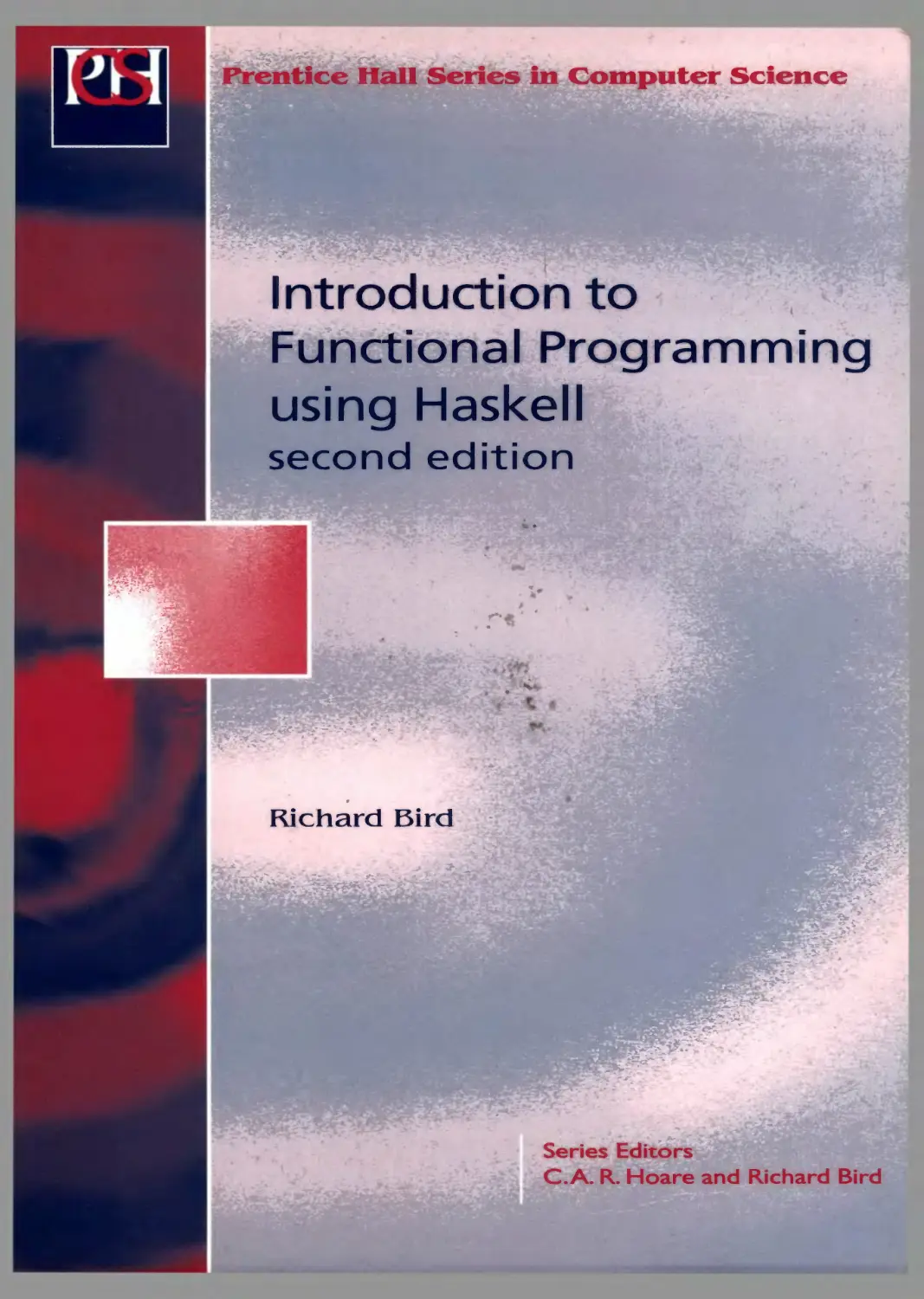
Prentice Hall Series in Computer Science
t. -
L> V*
Introduction to
Functional Programming
using Haskell
second edition
Richard Bird
M^'%v >
--*;
"■"* "" "
.£"**"
^.T- ■
"4^
-- '«/■££
_,
Y^"
" ^
—. -*V 1
-, . ^
* ^ 5-
-^ '
.%-
i
Series Editors
C. A. R. Hoare and Richard Bird

Introduction to Functional
Programming using Haskell

Prentice Hall Series in Computer Science
Series editors: Tony Hoare and Richard Bird
APT, K.R., From Logic Programming to Prolog
ARNOLD, A., Finite Transition Systems
ARNOLD, A. and GUESSARIAN, I., Mathematics for Computer Science
BARR, M. and WELLS, C, Category Theory for Computing Science (2nd edn)
BEN-ARI, M., Principles of Concurrent and Distributed Programming
BEN-ARI, M, Mathematical Logic for Computer Science
BEST, E., Semantics of Sequential and Parallel Programs
BIRD, R., and DE MOOR, O., The Algebra of Programming
BIRD, R., and WADLER, P., Introduction to Functional Programming
BOMAN, M., BUBENCKO, JR, J.A., JOHANNESSON, P. and WANGLER, B., Conceptual Modelling
BO VET, D.P. and CRESCENZI, P., Introduction to the Theory of Complexity
DE BROCK, B., Foundations of Semantic Databases
BRODA, EISENBACK, KHOSHNEVISAN and WICKERS, Reasoned Programming
BRUNS, G., Distributed Systems Analysis with CCS
BURKE, E. and FOXLEY, E., Logic and Its Applications
DAHL, O.-J., Verifiable Programming
ELDER, J., Compiler Construction
FREEMAN, T.L. and PHILLIPS, R.C., Parallel Numerical Algorithms
GOLDSCHLAGER, L. and LISTER, A., Computer Science: A modern introduction (2nd edn)
HAYES, I. (ed.), Specification Case Studies (2nd edn)
HINCHEY, M.G. and BOWEN, J.P., Applications of Formal Methods
HOARE, C.A.R., Communicating Sequential Processes
HOARE, C.A.R. and GORDON, M.J.C., Mechanized Reasoning and Hardware Design
HOARE, C.A.R. and JONES, C.B. (eds), Essays in Computing Science
HUGHES, J.G., Database Technology: A software engineering approach
HUGHES, J.G., Object-Oriented Databases
INMOS LTD, Occam 2 Reference Manual
JONES, C.B. and SHAW, R.C.F. (eds), Case Studies in Systematic Software Development
JONES, G., Programming in Occam
JONES, G. and GOLDSMITH, M., Programming in Occam 2
JONES, N.D., GOMARD, C.K. and SESTOFT, P., Partial Evaluation and Automatic Program Generation
JOSEPH, M., PRASAD, V.R., and NATARAJAN, N.,/1 Multiprocessor Operating System
JOSEPH, M. (ed.), Real-time Systems: Specification, verification and analysis
KALDEWAIJ, A., Programming: The derivation of algorithms
KING, P.J.B., Computer and Communications Systems Performance Modelling
LALEMENT, R., Computation as Logic
McCABE, F.G., High-level Programmer's Guide to the 68000
MEYER, B., Object-oriented Software Construction
MILNER, R., Communication and Concurrency
MORGAN, C, Programming from Specifications (2nd edn)
NISSANKE, N., Realtime Systems
OMONDI, A.R., Computer Arithmetic Systems
PATON, COOPER, WILLIAMS and TRINDER, Database Programming Languages
PEYTON-JONES, S.L., The Implementation of Functional Programming Languages
PEYTON-JONES, S. and LESTER, D., Implementing Functional Languages
POTTER, B., SINCLAIR, J. and TILL, D.,An Introduction to Formal Specification and Z (2nd edn)
ROSCOE, A.W. (ed.), A Classical Mind: Essays in honour of C.A.R. Hoare
ROSCOE, A. W., The Theory and Practice of Concurrency
ROZENBERG, G. and SALOMAA, A., Cornerstones ofUndecidability
SLOMAN, M. and KRAMER, J., Distributed Systems and Computer Networks
SHARP, R., Principles of Protocol Design
Series listing continued at back of be

Introduction to Functional
Programming using Haskell
Second edition
Richard Bird
University of Oxford
Prentice Hall Europe
London New York Toronto Sydney Tokyo Singapore
Madrid Mexico City Munich Paris

First published 1988
This second edition published 1998 by
Prentice Hall Europe
Campus 400, Maylands Avenue
Hemel Hempstead
Hertfordshire, HP2 7EZ
A division of
Simon & Schuster International Group
© Prentice Hall Europe 1998
All rights reserved. No part of this publication may be reproduced,
stored in a retrieval system, or transmitted, in any form, or by any
means, electronic, mechanical, photocopying, recording or otherwise,
without prior permission, in writing, from the publisher.
Printed and bound in Great Britain by
Redwood Books Ltd, Trowbridge
Library of Congress Cataloging-in-Publication Data
Available from the publisher
British Library Cataloguing in Publication Data
A catalogue record for this book is available from
the British Library
ISBN 0-13-484346-0
2 3 4 5 02 01 00 99 98

Contents
Preface to the second edition ix
1
1
4
7
9
17
21
25
27
29
29
35
38
41
46
48
50
55
57
57
63
70
75
78
81
1 Fundamental concepts
1.1
1.2
1.3
1.4
1.5
1.6
1.7
1.8
Sessions and scripts
Evaluation
Values
Functions
Definitions
Types
Specifications
Chapter notes
2 Simple datatypes
2.1
2.2
2.3
2.4
2.5
2.6
2.7
2.8
Booleans
Characters
Enumerations
Tuples
Other types
Type synonyms
Strings
Chapter notes
3 Numbers
3.1
3.2
3.3
3.4
3.5
3.6
Natural numbers
Induction
The fold function
Haskell numbers
Example: the rationals
Example: linear and binary search

3.7
3.8
Lists
4.1
4.2
4.3
4.4
4.5
4.6
4.7
Church numbers
Chapter notes
List notation
List operations
Map and filter
Zip
The fold functions
Laws of fold
Chapter notes
Contents
86
89
91
91
95
109
116
120
128
137
5 Examples 139
5.1 Converting numbers to words 139
5.2 Producing a class list 142
5.3 Arbitrary-precision arithmetic 150
5.4 Printing a calendar 161
5.5 Text processing 169
6 Trees 179
6.1 Binary trees 179
6.2 Binary search trees 187
6.3 Binary heap trees 192
6.4 Rose trees 195
6.5 Example: Huffman trees 202
6.6 Example: Meertens' number 209
6.7 Chapter notes 215
7 Efficiency 217
7.1 Lazy evaluation 217
7.2 Asymptotic analysis 222
7.3 Accumulating parameters 228
7.4 Tupling 233
7.5 Controlling space 239
7.6 Fusion, finite differencing, and deforestation 244
7.7 Chapter notes 249
8 Abstract datatypes 251
8.1 Basic concepts 251
8.2 Modules 262
8.3 Sets

Contents
vii
8.4 Bags 276
8.5 Flexible arrays 281
8.6 Queues 287
8.7 Chapter notes 292
9 Infinite lists 295
9.1 Review 295
9.2 Infinite lists as limits 298
9.3 Properties of infinite lists 303
9.4 Cyclic structures 306
9.5 Example: the paper-rock-scissors game 311
9.6 Stream-based interaction 319
9.7 Chapter notes 322
10 Monads 325
10.1 Monadic interaction 325
334
343
351
359
361
361
364
367
369
373
375
375
381
387
391
395
407
Appendix: Some standard functions 409
Bibliography 417
10.2
10.3
10.4
10.5
Variations on an evaluator
Monad laws
Combining monads
Chapter notes
11 Parsing
11.1
11.2
11.3
11.4
11.5
Sequencing
Alternation
Repetition
Efficiency
Chapter notes
12 An automatic calculator
12.1
12.2
12.3
12.4
12.5
12.6
Basic considerations
Expressions, laws, and calculations
Matchings and substitutions
Subexpressions and rewriting
Testing the calculator
Chapter notes
Index
425

Preface to the second edition
The second edition is a thoroughly reorganised and expanded version of the
first. Nevertheless, I have remained true to the aims of the original, as expressed
in the opening two paragraphs in the preface to the first edition:
This is an introductory textbook on programming in general and
functional programming in particular. No knowledge of computers
or experience in writing programs is assumed. The book is therefore
suitable for teaching a course in programming to first-year
undergraduates, but it can also be used as an introduction to functional
programming for students who are already experienced
programmers.
In order to get the most out of the book, the student should know
some mathematics, or at least possess a general appreciation of the
principles of mathematical reasoning. Our primary aim in writing
this book is to convey a view of prograrnming as a mathematical
activity, and mathematical reasoning lies at the heart of our subject.
Functional programming involves notation and concepts of a kind
which should be familiar to anyone with a little mathematical
experience. For example, any student who has used the basic
trigonometric functions to formulate problems in geometry, and has applied
simple trigonometric laws and identities to derive solutions to these
problems, will soon appreciate that a similar activity is being
suggested for computational problems and their solution by functional
programs. It follows that the kind of mathematical understanding
required is not very complicated or specialised, just the general
ability to follow manipulations of formulae through applying algebraic
laws, and the appreciation of why such manipulations can be useful
in the task of solving practical problems.

X
Preface to the second edition
One major change in the present edition has been to use a specific language,
Haskell, to express functional programs. At the time the first edition appeared,
the design of lazy functional languages was in a state of flux, with a number of
closely related but different dialects competing for attention. We tried to take
account of the changing state of affairs by using a neutral notation, similar to
but not identical with Miranda (Miranda is a trademark of Research Software
Limited), one of the more popular lazy functional languages at that time. Ten
years later, the situation has stabilised somewhat in that Haskell, a relative of
Mark Jones' popular language Gofer, is now widely regarded as the language of
choice among lazy functional programmers. In particular, HUGS (the Haskell
Users' Gofer System) was designed as a simple interactive system suitable for
use on PCs with modest capabilities. References to Haskell and HUGS, and how
to get hold of them, are given at the end of Chapter 1. The version of Haskell
we use in this book is Haskell 1.3 (and also HUGS 1.3). Haskell itself is currently
undergoing modest evolution and standardisation, and it is intended to publish
details of Standard Haskell in the summer of 1998. However, since we do not
cover all details of Haskell, it is unlikely that any proposed standardisation will
affect the text in any significant way.
The second major change concerns the organisation of material. The present
edition introduces the idea of defining new datatypes early on. The core of
the first part of the book is now devoted to the study of three recursive
datatypes: natural numbers, lists, and trees. Each datatype is introduced along with
the idea of defining recursive functions over the datatype, and also along with
the method of proof by induction to establish properties of these recursively
defined functions. Thus, three important ideas are introduced as different
aspects of a single coherent whole. The examples and case studies have also been
changed or updated. There are completely new chapters on abstract datatypes,
efficiency, and monadic functional programming. The bibliography has
expanded considerably, and there now are brief chapter notes at the end of each
chapter.
The third major change is that, owing to a number of commitments and
a change of environment, my co-author Philip Wadler could only give limited
assistance in the preparation of the text. He provided detailed comments and
suggestions on an early draft of the first six chapters, as well as material that
formed the basis of the chapter on monadic programming. Although his major
contributions to the understanding of functional programming over the past
ten years permeate the book, I alone take responsibility for errors of
understanding, mistakes, or inappropriate emphasis. If and when the need for a
third edition arises, I hope that we can again join forces to produce it.

Preface to the second edition
xi
Advice to the instructor
The second edition has grown by over a hundred pages, and the material
probably cannot be fully covered in a single course. A first course in functional
programming can be based on the first six chapters, with Chapter 3 being treated
more lightly than the others. In our experience, students only begin to
appreciate what a functional style of programming can offer when the subject of lists is
broached. The remaining material can be adapted for a second course on
programming, emphasising modularity and data structures. The material has also
been used for a course on algorithm design and efficiency, as well as courses
on the mathematics of program proof and synthesis.
Formal teaching should be supported by laboratory and practical work, and
many of the examples and case studies have been used as the basis of practical
projects with considerable success. Most of the individual sections also contain
a variety of exercises for self study. It is planned to publish answers to these
questions on the Web; see the URL
http://www.comlab.ox.ac.uk/oucl/publi cati ons/books/functi onal/
This web site will also contain many of the programs listed in the text, as well
as pointers to Haskell and HUGS, and to additional material.
Acknowledgements
This edition, like the first, took more time than expected. My greatest debt of
gratitude is to Phil Wadler. Apart from the reasons cited above, he generously
allowed me to complete the text by myself. The second edition was written
during a sabbatical year from teaching and administrative duties, and I am
truly grateful to the University of Oxford and Lincoln College for supporting
hard-pressed academics in this way.
The book has benefited enormously from the continued support,
enthusiasm, and constructive advice of colleagues and students, both at Oxford and
other universities. The suggestions of colleagues in the Programming Research
Group at Oxford have been particularly relevant, since they have been
personally responsible for teaching the material to their tutorial students while
a lecture course was in progress. Other people who have written or emailed
Phil or me with suggestions, or simply to point out typos and silly mistakes in
the first edition, include: Nils Andersen, Franklin Chen, Sharon Curtis, Martin
Filby, Simon Finn, Jeroen Fokker, Maarten Fokkinga, Jeremy Gibbons, Robert
Giegerich, Kevin Hammond, Gerard Huet, Michael Hinchey, Tony Hoare, Iain
Houston, John Hughes, Graham Hutton, Stephen Jarvis, Geraint Jones, Mark

xii
Preface to the second edition
Jones, John Launchbury, Paul Licameli, David Lester, Iain MacCullum, Ursula
Martin, Lambert Meertens, Erik Meijer, Quentin Miller, Oege de Moor, Chris Oka-
saki, Oskar Permvall, Simon Peyton Jones, Mark Ramaer, Hamilton Richards,
Dan Russell, Don Sannella, Antony Simmons, Deepak D'Souza, John Spanonda-
kis, Mike Spivey, Joe Stoy, Bernard Sufrin, Masato Takeichi, Peter Thiemann,
David Turner, Colin Watson, and Stephen Wilson. In particular, Jeremy Gibbons
and Rob Hoogerwoord read drafts of the manuscript and suggested a number
of corrections.
I would also like to thank Jim Davies for getting my KTjX into shape, and
Jackie Harbor of Prentice Hall for continued support. The text was prepared
on an Apple Macintosh Powerbook 180, using BBEdit as an editor, and OzIjX as
the KT{X processor. All three systems were a delight to use.
Oxford
December, 1997
Richard Bird

Chapter 1
Fundamental concepts
Programming in a functional language consists of building definitions and
using the computer to evaluate expressions. The primary role of the programmer
is to construct a function to solve a given problem. This function, which may
involve a number of subsidiary functions, is described in a notation that obeys
normal mathematical principles. The primary role of the computer is to act
as an evaluator or calculator; its job is to evaluate expressions and print the
results. In this respect the computer acts much like an ordinary pocket
calculator. What distinguishes a functional calculator from the humbler variety is
the programmer's ability to make definitions to increase its powers of
calculation. Expressions that contain occurrences of the names of functions defined
by the programmer are evaluated using the given definitions as simplification
rules for converting expressions to printable form.
1.1 Sessions and scripts
To illustrate the idea of using a computer as a calculator, imagine we are sitting
in front of a terminal screen displaying a prompt sign
?
in a window. We can now type an expression, followed by a newline character,
and the computer will respond by displaying the result of evaluating the
expression, followed by a new prompt on a new line, indicating that the process
can begin again with another expression.
One kind of expression we might type is a number:
?42
42

2
1 / Fundamental concepts
Here, the computer's response is simply to redisplay the number we typed.
The decimal numeral 42 is an expression in its simplest possible form and
evaluating it results in no further simplification.
We might type a slightly more interesting kind of expression:
?6x7
42
Here, the computer can simplify the expression by performing the
multiplication. In this book we will use common mathematical notations for writing
expressions; in particular, the multiplication operator will be denoted by the sign
x, rather than the asterisk * used in Haskell.
We will not elaborate for the moment on the possible forms of numerical
and other kinds of expression that can be submitted for evaluation; the
important point to absorb now is that one can just type expressions and have them
evaluated. This sequence of interactions between user and computer is called
a session.
The second and intellectually more challenging aspect of functional pro-
grarnming consists of building definitions. A list of definitions is called a script.
Here is an example of a simple script:
square :: Integer — Integer
square x = x x x
smaller :: (Integer, Integer) — Integer
smaller (x,y) = if x < y then x else y
In this script, two functions named square and smaller have been defined. The
function square takes an integer as argument and returns its square; the
function smaller takes a pair of integers as argument and returns the smaller value.
The syntax for making definitions follows that of Haskell, the programming
language adopted in this book, and will be explained in due course. Notice,
however, that definitions are written as equations between certain kinds of
expression; these expressions can contain variables, here denoted by the symbols
x and y. Furthermore, each function is accompanied by a description of its fype;
for example, (Integer, Integer) — Integer describes the type of functions that
take a pair of integers as argument, and deliver an integer as result. Such type
descriptions are also called type assignments or type signatures.
Having created a script, we can submit it to the computer and enter a session.
For example, the following session is now possible:
? square 3768
14197824

1.1 / Sessions and scripts
3
? square 14198724
201578206334976
? square (smaller (5,3+4))
25
Notice, in passing, that Integer arithmetic is exact: there is no restriction on
the sizes of integers that can be computed.
The purpose of a definition is to introduce a binding associating a given
name with a given definition. A set of bindings is called an environment or
context. Expressions are always evaluated in some context and can contain
occurrences of the names found in that context. The Haskell evaluator will use the
definitions associated with these names as rules for simplifying expressions.
Some expressions can be evaluated without having to provide a context. In
Haskell a number of operations are given as primitive in the sense that the rules
of simplification are built into the evaluator. For example, the basic operations
of arithmetic are provided as primitive. Other commonly useful operations are
predefined in special scripts, called preludes or libraries, that can be loaded
when we start the computer.
At any stage a programmer can return to the script in order to add or modify
definitions. The new script can then be resubmitted to the evaluator to provide
a new context and another session started. For example, suppose we return to
the above script and change it to read:
square :: Float — Float
square x = xxx
delta :: (Float, Float, Float) — Float
delta (a, b, c) = sqrt (square b - 4 x a x c)
The type assigned to square has been changed to Float — Float. In Haskell the
type Float consists of the single-precision floating-point numbers. The function
delta depends on a predefined function sqrt for taking square roots.
Having resubmitted the script, we can enter a new session and type, for
example:
?delta (4.2,7,2.3)
3.2187
To summarise the important points made so far:
• Scripts are collections of definitions supplied by the programmer.

4
1 / Fundamental concepts
• Definitions are expressed as equations between certain kinds of
expression and describe mathematical functions. Definitions are accompanied
by type signatures.
• During a session, expressions are submitted for evaluation; these
expressions can contain references to the functions defined in the script, as well
as references to other functions defined in preludes or libraries.
• In Haskell, at least two different kinds of number can be used in
computations: arbitrary-precision integers (elements of Integer), and single-
precision floating-point numbers (elements of Float).
Exercises
1.1.1 Using the function square, design a function quad that raises its
argument to the fourth power.
1.1.2 Define a function greater that returns the greater of its two arguments.
1.1.3 Define a function for computing the area of a circle with given radius r
(use 22/7 as an approximation to tt).
1.2 Evaluation
The computer evaluates an expression by reducing it to its simplest equivalent
form and displaying the result. The terms evaluation, simplification, and
reduction will be used interchangeably to describe this process. To give a brief
flavour, consider the expression square (3+4); one possible sequence is
square (3 + 4)
= {definition of +}
square 7
= {definition of square}
7x7
= {definition of x}
49
The first and third steps refer to use of the built-in rules for addition and
multiplication, while the second step refers to the use of the rule defining square
supplied by the programmer. That is to say, the definition square x = x x x is
interpreted by the computer simply as a left-to-right rewrite rule for reducing

1.2 / Evaluation
5
expressions involving square. The expression '49' cannot be further reduced,
so that is the result displayed by the computer. An expression is said to be
canonical, or in normal form, if it cannot be further reduced. Hence '49' is in
normal form.
Another reduction sequence for square (3 +4) is
square (3+4)
{definition of square}
(3+4)x(3 + 4)
= {definition of + (applied to first term)}
7x(3 + 4)
{definition of +}
7x7
= {definition of x}
49
In this reduction sequence the rule for square is applied first, but the final result
is the same. A characteristic feature of functional programming is that if two
different reduction sequences both terminate, then they lead to the same result.
In other words, the meaning of an expression is its value and the task of the
computer is simply to obtain it.
Let us give another example. Consider the script
three :: Integer — Integer
three x = 3
infinity :: Integer
infinity = infinity + 1
It is not clear what integer, if any, is defined by the second equation but the
computer can nevertheless use the equation as a rewrite rule. Now consider
simplification of three infinity. If we try to simplify infinity first, then we get
the reduction sequence
three infinity
= {definition of infinity}
three (infinity + 1)
{definition of infinity}

6
1 / Fundamental concepts
three ((infinity + 1) + 1)
= {and so on...}
This reduction sequence does not terminate. If, on the other hand, we try to
simplify three first, then we get the sequence
three infinity
{definition of three}
3
This sequence terminates in one step. So, some ways of simplifying an
expression may terminate while others do not. In Chapter 7 we will describe a
reduction strategy, called lazy evaluation, that guarantees termination whenever
termination is possible, and is also reasonably efficient. Haskell is a lazy
functional language, and we will explore what consequences such a strategy has in
the rest of the book. However, whichever strategy is in force, the essential point
is that expressions are evaluated by a conceptually simple process of
substitution and simplification, using both primitive rules and rules supplied by the
programmer in the form of definitions.
Exercises
1.2.1 In order to evaluate x x y, the expressions x and y are reduced to normal
form and then multiplication is performed. Does evaluation of square infinity
terminate?
1.2.2 How many terminating reduction sequences are there for the expression
square (3 + 4)?
1.2.3 Imagine a language of expressions for representing integers defined by
the syntax rules: (i) zero is an expression; (ii) if e is an expression, then so are
succ (e) and pred (e). An evaluator reduces expressions in this language by
applying the following rules repeatedly until no longer possible:
succ (pred (e)) = e
pred (succ (e)) = e
Simplify the expression succ (pred (succ (pred (pred (zero))))).
In how many ways can the reduction rules be applied to this expression? Do
they all lead to the same final result? Prove that the process of reduction must

1.3 / Values
7
terminate for all given expressions. (Hint: Define an appropriate notion of
expression size, and show that each reduction step does indeed reduce size.)
1.2.4 Carrying on from the previous question, suppose an extra syntactic rule
is added to the language: (iii) if e\ and 62 are expressions, then so is add(e\,62).
The corresponding reduction rules are
add (zero, e2) = e.i
add (succ (ei),ez) = succ (add (61,62))
add (pred (e\), e2) = pred (add (e\,ei)
Simplify the expression add (succ (pred (zero)), zero).
Count the number of different ways the reduction rules can be applied to the
above expression. Do they always lead to the same final result?
1.2.5 Now suppose we define the size of an expression by the following rules:
size (zero) = 1
size (succ (e)) = l+size(e)
size (pred (e)) = l+size(e)
size (add (e\,ez)) = 1 + 2 x (size (e\) + size (62))
Show that application of any of the five reduction rules given above reduces
expression size. Why does this prove that the process of reduction must always
terminate for any given initial expression?
1.3 Values
In functional prograrnming, as in mathematics, an expression is used solely
to describe (or denote) a value. Among the kinds of value an expression may
denote are included: numbers of various kinds, truth values, characters, tuples,
functions, and lists. All of these will be described in due course. As we will
also see, it is possible to introduce new kinds of value and define operations
for generating and manipulating them.
It is important to distinguish between values and their representations by
expressions. The simplest equivalent form of an expression, whatever that
may be, is not a value but a representation of it. Somewhere, in outer space
perhaps, one can imagine a universe of abstract values, but on earth they can
only be recognised and manipulated by concrete representations. There may
be many representations for one and the same value. For example, the abstract
number forty-nine can be represented by the decimal numeral 49, the roman
numeral XLIX, or the expression 7x7. Computers usually operate with the

8 1 / Fundamental concepts
binary representation of numbers in which forty-nine is represented by a certain
bit-pattern consisting of a number of Os followed by 110001.
The evaluator for a functional language prints a value by printing its
canonical representation; this representation is dependent both on the syntax given
for forming expressions, and the precise definition of the reduction rules.
Some values have no canonical representations, for example function
values. It is difficult to imagine a canonical representation for the function sqrt::
Float — Float; one can describe this function in various ways but none of the
descriptions can be regarded as canonical. Other values may have reasonable
representations, but no finite ones. For example, the number n has no finite
decimal representation. It is possible to get a computer to print out the decimal
expansion of n digit by digit, but the process will never terminate.
For some expressions the process of reduction never stops and never
produces any result. For example, the expression infinity defined in the previous
section leads to an infinite reduction sequence. Recall that the definition was
infinity :: Integer
infinity = infinity + 1
Such expressions do not denote well-denned values in the normal
mathematical sense. As another example, assuming the operator / denotes numerical
division, returning a number of type Float, the expression 1/0 does not denote
a well-defined floating-point number. A request to evaluate 1/0 may cause
the evaluator to respond with an error message, such as 'attempt to divide by
zero', or go into an infinitely long sequence of calculations without producing
any result.
In order that we can say that, without exception, every syntactically well-
formed expression denotes a value, it is convenient to introduce a special
symbol JL, pronounced 'bottom', to stand for the undefined value of a
particular type. In particular, the value of infinity is the undefined value _L of type
Integer, and 1/0 is the undefined value _L of type Float. Hence we can assert
that 1/0= _L
The computer is not expected to be able to produce the value JL. Confronted
with an expression whose value is JL, the computer may give an error message,
or it may remain perpetually silent. The former situation is detectable, but
the second one is not (after all, evaluation might have terminated normally the
moment after the programmer decided to abort it). Thus, J_ is a special kind
of value, rather like the special value oo in mathematical calculus. Like special
values in other branches of mathematics, _L can be admitted to the universe
of values only if we state precisely the properties it is required to have and its
relationship with other values.

1.4 / Functions
9
It is possible, conceptually at least, to apply functions to _L. For example,
with the definitions three x = 3 and square x = x x x, we have
? three infinity
3
? square infinity
{Interrupted*.}
In the first evaluation the value of infinity was not needed to complete the
calculation, so it was never calculated. This is a consequence of the lazy evaluation
reduction strategy mentioned earlier. On the other hand, in the second
evaluation the value of infinity is needed to complete the computation: one cannot
compute xxx without knowing the value of x. Consequently, the evaluator
goes into an infinite reduction sequence in an attempt to simplify infinity to
normal form. Bored by waiting for an answer that we know will never come, we
hit the the interrupt key.
If f _L = _L, then f is said to be a strict function; otherwise it is nonstrict.
Thus, square is a strict function, while three is nonstrict. Lazy evaluation allows
nonstrict functions to be defined, some other strategies do not.
Exercises
1.3.1 Suppose we define multiply by
multiply :: (Integer, Integer) — Integer
multiply (x, y) = if x == 0 then 0 else x x y
The symbol == is used for an equality test between two integers. Assume that
evaluation of e\ ---- e2 proceeds by reducing e\ and ez to normal form and testing
whether the two results are identical. Under lazy evaluation, what would be the
value of multiply (0, infinity)? What would be the value of multiply (infinity, 0)?
1.3.2 Suppose we define the function h by the equation hx = f(gx). Show that
if f and g are both strict, then so is h.
1.4 Functions
Naturally enough, the most important kind of value in functional programming
is a function value. Although we cannot display a function value, we can apply
functions to arguments and display the results (provided, of course, that the
result can be displayed). Mathematically speaking, a function f is a rule of
correspondence that associates each element of a given type A with a unique

10
I / Fundamental concepts
element of a second type B. The type A is called the source type, and B the
target type of the function. We express this information by writing f :: A - B.
This formula asserts that the type of f is A — B. In other words, the type
expression A — B denotes a type whenever A and B do, and describes the type
of functions from A to B. For example, we have already met the functions
three :: Integer - Integer
square :: Integer — Integer
delta :: (Float, Float, Float) ^ Float
The definition of three describes a rule of correspondence that associates every
integer, including the special integer _L, with the single number 3. The definition
of square associates every well-defined integer with its square, and associates
J_ with the undefined integer _L.
A function f :: A — B is said to take arguments in A and return results in B.
If x denotes an element of A, then we write f(x), or just fx, to denote the result
of applying the function f to x. This value is the unique element of B associated
with x by the rule of correspondence for f. The former notation, fix), is the
one normally employed in mathematics to denote functional application, but
the parentheses are not really necessary and we will use the second form, f x,
instead. On the other hand, parentheses are necessary when the argument is
not a simple constant or variable. For example, we have to write square (3 + 4)
(if that is what we mean) because squared + 4 means {squared) +4. The reason
why this is so is because application has a higher precedence than + (see below).
Similarly, we have to write square (square 3) and not square square 3.
We will be careful never to confuse a function with its application to an
argument. In some mathematics texts one often finds the phrase 'the function
f(x)\ when what is really meant is 'the function f\ In such texts, functions
are rarely considered as values which may themselves be used as arguments
to other functions and the traditional way of speaking causes no confusion. In
functional programming, however, functions are values with exactly the same
status as all other values; in particular, they can be passed as arguments to
other functions and returned as results. Accordingly, we cannot afford to be
casual about the difference between a function and the result of applying it to
an argument.
1.4.1 Extensionality
Two functions are equal if they give equal results for equal arguments. Thus,
f = g if and only if f x = g x for all x. This principle is called the principle
of extensionality. It says that the important thing about a function is the cor-

1.4 / Functions 11
respondence between arguments and results, not how this correspondence is
described.
For instance, we can define the function which doubles its argument in the
following two ways:
double, double' :: Integer — Integer
double x = x + x
double' x = 2 x x
The two definitions describe different procedures for obtaining the
correspondence, one involving addition and the other involving multiplication, but double
and double' define the same function value and we can assert double = double'
as a mathematical truth. Regarded as procedures for evaluation, one definition
may be more or less 'efficient' than the other, but the notion of efficiency is
not one that can be attached to function values themselves. This is not to say,
of course, that efficiency is not important; after all, we want expressions to be
evaluated in a reasonable amount of time. The point is that efficiency is an
intensional property of definitions, not an extensional one.
Extensionality means that we can prove f = g by proving that f x = g x for
all x. Depending on the definitions of f and g, we may also be able to prove
f = g directly. The former kind of proof is called an applicative or point-wise
style of proof, while the latter is called a point-free style. We will see examples
of both styles during the course of the book.
1.4.2 Currying
A useful device for reducing the number of parentheses in an expression is
the idea of replacing a structured argument by a sequence of simpler ones. To
illustrate, consider again the function smaller defined earlier:
smaller :: (Integer, Integer) — Integer
smaller (x,y) = if x < y then x else y
The function smaller takes a single argument consisting of a pair of integers,
and returns an integer. Another way of defining essentially the same function
is to write
smallerc :: Integer — (Integer — Integer)
smallerc xy = if x < y then x else y
The function smallerc takes two arguments, one after the other. More precisely,
smallerc is a function that takes an integer x as argument and returns a function

12
1 / Fundamental concepts
smallerc x; the function smallerc x takes an integer y as argument and returns
an integer, namely the smaller of x and y.
Here is another example:
plus :: (Integer, Integer) — Integer
plus (x,y) = x + y
plusc :: Integer — (Integer — Integer)
plusc xy = x + y
For each integer x the function pluscx adds x to an integer. In particular, plusc I
is the successor function that increments its argument by 1, and plusc 0 is the
identity function on integers.
This simple device for replacing structured arguments by a sequence of
simple ones is known as currying, after the American logician Haskell B. Curry
(after whom the prograrriming language Haskell is also named). For currying to
work properly in a consistent manner, we require that the operation of
functional application associates to the left in expressions. Thus,
smallerc 3 4 means (smallerc 3) 4
plusc xy means (plusc x) y
square square 3 means (square square) 3
Although square square 3 is a syntactically legal expression, it makes no sense
because square takes a single integer argument, not a function followed by
an integer. In fact, the expression will be rejected by the computer because
it cannot be assigned a sensible type. We will return to this point in a later
section.
There are two advantages of currying functions. Firstly, currying can help
to reduce the number of parentheses that have to be written in expressions.
Secondly, curried functions can be applied to one argument only, giving another
function that may be useful in its own right. For instance, consider the function
twice that applies a function twice in succession:
twice :: (Integer — Integer) — (Integer — Integer)
twice fx = f(fx)
This is a perfectly legitimate definition in Haskell. The first argument to twice
is a function (of type Integer — Integer), and the second argument is an integer.
Applying twice to the first argument f, we get a function twice f that applies f
twice. We can now define, for instance,
quad :: Integer — Integer
quad = twice square

1.4 / Functions
13
The function quad raises its argument to the fourth power. Suppose, on the
other hand, that we had defined twice by
twice :: {Integer — Integer, Integer) — Integer
twice (f,x) = f{fx)
Now there is no way we can name the function that applies a function twice
without also mentioning the argument to which the second function is applied.
Instead of saying 'quad, where quad = twice square', we would have to say
'quad, where quad x = twice {square, x) for all x\ The second style is clumsier.
If we want to, we can always convert an uncurried function into a curried
one. The function curry takes an uncurried function and returns a curried
version of the same function; its definition is
curry :: ((a,0) - y) - (a - 0 -* y)
curry fxy = f (x,y)
The type signature of curry will be explained in Section 1.6. Note that curry is
itself an example of a curried function: curry takes three arguments, one after
the other. We can now refer to curry f as the curried version of f. For example,
plusc = curry plus.
It is left as an exercise to define a function uncurry that goes the other way
and converts a curried function into a noncurried one.
1.4.3 Operators
Some functions are written between their (two) arguments rather than
preceding them. For example, we write
3+4 rather than plusc 3 4
3 < 4 rather than leq 3 4
A function written using infix notation is called an operator. To remove
ambiguity, special symbols are used to denote operators. Occasionally, we will
use names rather than symbols for operators, but write them in bold font. For
example, we write (15 div 4) and (15 mod 4), using names in bold font for the
operators associated with integer division and remainder. The Haskell
convention is to enclose the name in back quotes; for example, in Haskell one would
write (15 'div* 4) and (15 'mod* 4).
Enclosing an operator in parentheses converts it to a curried prefix function
that can be applied to its arguments like any other function. For example,
( + )34 = 3 + 4
(<)34 = 3<4

14
I / Fundamental concepts
In particular, plusc = (+). Like any other name, an operator enclosed in
parentheses can be used in expressions and passed as an argument to functions. For
example,
plus = uncurry (+)
introduces plus as another name for the uncurried version of addition.
1.4.4 Sections
The notational device of enclosing a binary operator in parentheses to convert
it into a normal prefix function can be extended: an argument can also be
enclosed along with the operator. If e denotes an arbitrary binary operator,
then (x©) and (ex) are functions with the definitions
(x©) y = x©y
(ey) x = xey
These two forms are called sections. For example:
(x 2) is the 'doubling' function
(> 0) is the 'positive number' test
(1 /) is the 'reciprocal' function
(12) is the'halving'function
(+1) is the'successor'function
There is one exception to the rule for forming sections: (-x) is interpreted
as the unary operation of negation applied to the number x. Sections are not
used heavily in what follows, but on occasion they provide a simple means for
describing expressions conveniently and without fuss.
1.4.5 Precedence
When several operators appear together in an expression, certain rules of
precedence are provided to resolve possible ambiguity. The precedence rules for
the common arithmetic operators are absorbed in childhood without ever being
stated formally. Their sole purpose in life is to allow one to reduce the number
of parentheses in an expression.
In particular, exponentiation, which we will denote by T, takes precedence
over multiplication, which in turn takes precedence over addition: for example,
?1 + 3 t4x2
163

1.4 / Functions
15
Thus, 1 + 3 !4x2 = l + ((3 t 4) x 2). Furthermore, functional application, the
operator denoted by a space, takes precedence over every other operator. For
example, square 3+4 means {square 3) + 4.
1.4.6 Association
Another device for reducing parentheses is to provide an order of association
for an operator. It is clear that when the same operator occurs twice in
succession, the rule of precedence is not sufficient to resolve ambiguity. Operators
can associate either to the left or to the right. We have already encountered
one example of declaring such a preference: functional application associates
to the left in expressions. In arithmetic, operators on the same level of
precedence are usually declared to associate to the left as well. Thus 5-4-2 means
(5 - 4) - 2 and not 5 - (4 - 2). One operator that associates to the right is the
function type operator (^); thus,
A - B - C means A - {B - C)
It is not necessary to insist that an order of association be prescribed for every
operator. If no preference is indicated, then parentheses must be used to avoid
ambiguity. In fact, to avoid complicating a basically simple idea, we will
always use parentheses to disambiguate sequences of different operators with
the same precedence.
Any declaration of a specific order of association should not be confused
with a different, though related, property of operators known as associativity.
An operator e is said to be associative if
(x®y)®z = x®(y®z)
for all values x, y, and z of the appropriate type. For example, + and x are
associative operators. For such operators, the choice of an order of association
has no effect on meaning.
1.4.7 Functional composition
The composition of two functions f and g is denoted by f • g and is defined by
the equation
(•) :: (0-y)-(a-0)-(a-y)
(f-g)x = f(gx)
The type signature will be explained in Section 1.6. In words, f • g applied to
x is defined to be the outcome of first applying g to x, and then applying f to

16
I / Fundamental concepts
the result. Not every pair of functions can be composed since the types have
to match up: we require that g has type g :: « — p for some types « and p, and
that f has type f :: f$ — y for some type y. Then we obtain f - g :: a -* y. For
example, given square:: Integer — Integer, we can define
gufld :: Integer — Integer
quad = square • square
By the definition of composition, this gives exactly the same function guad as
gufld :: Integer — Integer
quadx = square (square x)
This example illustrates the main advantage of using functional composition in
programs: definitions can be written more concisely. Whether to use a point-
free style or a point-wise style is partly a question of taste, and we will see
functions defined in both styles in the remainder of the book. However, whatever
the style of expression, it is good programming practice to construct
complicated functions as the composition of simpler ones.
Functional composition is an associative operation. We have
(fg)h = f(g-h)
for all functions ft g and h of the appropriate types. Accordingly, there is no
need to put in parentheses when writing sequences of compositions.
Exercises
1.4.1 Suppose f and g have the following types:
f :: Integer — Integer
g :: Integer — (Integer -* Integer)
Let h be defined by
h :: • • •
hxy = f(gxy)
Fill in the correct type assignment for h.
Now determine which, if any, of the following statements is true:
h = fg
hx = f-(gx)
hxy = (f-g)xy

1.5 / Definitions
17
1.4.2 Suppose we curry the arguments of the function delta, so that we can
write delta a b c rather than delta {a, b, c). What is the type of the curried
version?
1.4.3 In mathematics one often uses logarithms to various bases; for example,
log2, logg, and log10. Give an appropriate type of a function log that takes a
base and returns the logarithm function for that base.
1.4.4 Describe one appropriate type for the definite integral function of
mathematical analysis, as used in the phrase 'the integral of f from a to b\
1.4.5 Give examples of functions with the following types:
{Integer — Integer) — Integer
(Integer — Integer) — (Integer — Integer)
1.4.6 Which, if any, of the following statements is true?
(X)X = (XX)
(+)x = (x+)
(-)x = (-x)
1.4.7 Define a function uncurry that converts a curried function into a noncur-
ried version. Show that
curry (uncurry f) xy = f xy
uncurry (curry f) (x, y) = f (x, y)
for all x and y.
1.5 Definitions
So far, we have seen one or two simple definitions of functions, but definitions
of other kinds of value are possible. For example,
pi :: Float
pi = 3.14159
declares a single-precision approximation to n.
The definition of smaller seen earlier made use of a conditional expression.
Recall that the definition was
smaller :: (Integer, Integer) — Integer
smaller (x,y) = if x < y then x else y

18 1 / Fundamental concepts
The condition x < y evaluates to a boolean or truth value, True or False. Boolean
values will be considered in detail in the following chapter.
Another way to express essentially the same definition of smaller is to write
smaller :: {Integer, Integer) — Integer
smaller (x, y)
I x < y = x
I *>y = y
This form of definition uses guarded equations. The syntax of guarded
equations follows that of Haskell and consists of a sequence of clauses delimited
by a vertical bar. Each clause consists of a condition, or guard, and an
expression, which is separated from the guard by an = sign. In the definition of
smaller (x, y) the guards are (x < y) and (x > y), while the associated
expressions are x and y.
We will use guarded equations only sparingly in what follows, preferring
conditional expressions instead. The main advantage of guarded equations is
when there are three or more clauses in a definition. To illustrate, consider
the function signum that takes an integer argument x and returns -1 if x is
negative, 0 if x is zero, and 1 if x is positive. Using guarded equations, we
would write
signum :: Integer — Integer
signum x
I x<0 = -1
x==0 =0
I x> 0 =1
Using conditional expressions, we would have to write something like
signum :: Integer — Integer
signum x = if x < 0 then - 1 else
if x == 0 then 0 else 1
The definition using guarded equations is clearer because the three conditions
are made explicit. Note that an equality test is written in the form x == y. This
is to distinguish it from a definition, which is written in the form x = y. Equality
and comparison tests are considered further in the following chapter.

1.5 / Definitions
19
1.5.1 Recursive definitions
Definitions can also be recursive. Here is a well-known example:
fact :: Integer — Integer
fact n = if n-- 0 then 1 else nx fact (n- 1)
The function fact is the factorial function. Recursive definitions are evaluated
like any other definition. For example, one reduction sequence for evaluating
fact 1 is
fact I
{definition of fact}
if 1 == 0 then 1 else 1 x fact (1 - 1)
= {since (1 == 0) evaluates to False}
1 x fact (I - 1)
= {definition of fact}
1 x (if (1 - 1) == 0 then 1 else (1 - 1) x fact ((1 - 1) - 1))
= {definition of (-)}
1 x (if 0 - 0 then 1 else (1 - 1) x fact ((1 - 1) - 1))
{since (0 == 0) evaluates to True}
1 xl
{definition of x}
1
There are, of course, other reduction sequences of fact 1, but all lead to the
same result.
The above definition of fact is not completely satisfactory: if we apply fact
to a negative integer, then the computation never terminates. For example,
fact(-l)
{definition of fact}
if -1 == 0 then 1 else (-1) x fact{-\ - 1)
{since (-1 ==0) evaluates to False}
(-l)x fact (-1-1)
{as before}

20
I / Fundamental concepts
(-1) x ((-2) x fact (-1 - 1 - 1))
and so on. Although it is the case that fact x = 1 for negative x, we would
prefer that the computation terminated with a suitable error message rather
than proceeding indefinitely with a futile computation. One way of achieving
this is to rewrite the definition as
fact:: Integer -* Integer
fact n
I n < 0 = error "negative argument to fact"
n==0 =1
| n > 0 = nx fact (n- 1)
The predefined function error takes a string as argument; when evaluated it
causes immediate termination of the evaluator and displays the given error
message:
7 fact (-1)
Program error: negative argument to fact
There are other ways to define fact and we will discuss them later in the book.
1.5.2 Local definitions
The final piece of notation we will introduce here is called a local definition. In
mathematical descriptions one often finds an expression qualified by a phrase
of the form 'where ...'. For instance, one might find lf(x,y) = (a + l)(a + 2),
where a = (x + y)/2\ The same device can be used in a formal definition:
f :: (Float, Float) -* Float
f (x,y) = (a + l)x(a + 2) where a = (x + y)/2
The special word where is used to introduce a local definition whose context
(or scope) is the expression on the right-hand side of the definition of f.
When there are two or more local definitions we can lay them out in one of
two styles. For example, one can write
f :: (Float, Float) - Float
f(x,y) = (a + l)x(b + 2)
where a = (x + y)/2
b = (x + y)/3

1.6 / Types
21
One can also write
f :: {Float, Float) - Float
f(x,y) = (a + l)x(b + 2)
where a = (x + y)/2; b=(x + y)/3
In the second form, a semi-colon is used to separate the two definitions. A local
definition can be used in conjunction with a definition that relies on guarded
equations. Consider the following definition:
f :: Integer — Integer — Integer
fxy
I x < 10 = x + a
I x > 10 = x- a
where a = square (y + 1)
In this definition, the where clause qualifies both guarded equations.
Exercises
1.5.1 The Fibonacci numbers ft, ft,... are defined by the rule that fa = 0, ft = 1
and fn+z = fn + fn+i for all n > 0. Give a definition of the function fib that takes
an integer n and returns fn.
1.5.2 Define a function abs :: Integer — Integer that returns the absolute value
of an integer.
1.6 Types
In functional programming the universe of values is partitioned into
organised collections, called types. So far, we have mentioned Integer and Float,
but there are also other kinds of number, including Int and Double, as well as
booleans (elements of Bool), characters (elements of Char), lists, trees, and so
on. Moreover, we have already seen how to put types together to make an
infinite variety of other types; for example Integer — Float, and (Float, Float), and
so on. In the next chapter we will see how some of these types can be defined,
and how to define new types.
Each type has associated with it certain operations which are not meaningful
for other types. For instance, one cannot sensibly add a number to a character
or multiply two functions together. It is an important principle of many
programming languages that every well-formed expression can be assigned a type.
Moreover, this type can be deduced from the constituents of the expression

22 1 / Fundamental concepts
alone. In other words, just as the value of an expression depends only on the
values of its component expressions, so does its type. This principle is called
strong typing.
The major consequence of the discipline imposed by strong typing is that
any expression which cannot be assigned a sensible type is regarded as not
being well formed and is rejected by the computer before evaluation. Such
expressions are simply regarded as illegal. We saw one example earlier: the
expression squaresquareZ is rejected by the computer as not being well formed.
Similarly, the script
quad Integer — Integer
quad x = square square x
is rejected by the computer since the expression square square x is not well
formed.
One great advantage of strong typing is that it enables a range of errors, from
simple typographical mistakes to muddled definitions, to be detected before
evaluation. The other great advantage is that it steers the programmer into
a certain discipline of thought, namely to consider appropriate types for the
values being defined before considering the definitions themselves. In other
words, adherence to the discipline of strong typing can help significantly in the
design of clear and well-structured programs.
There are two stages of analysis when an expression is submitted for
evaluation. The expression is first checked to see whether it conforms to the correct
syntax laid down for constructing expressions. If it does not, the computer
signals a syntax error. If it does, then the expression is analysed to see if it
possesses a sensible type. If the expression fails to pass this stage, the computer
signals a type error. Only if the expression passes both stages can the process
of evaluation begin. Similar remarks apply to definitions created in a script.
1.6.1 Polymorphic types
Some functions and operations work with many types. For example, suppose
square :: Integer — Integer
sqrt :: Integer — Float
Then the expressions square • square and sqrt • square are both meaningful and
they have the following types:
square • square :: Integer — Integer
sqrt - square :: Integer — Float

1.6 / Types
23
However, the two uses of functional composition in these expressions have
different types, namely
(•):: (Integer — Integer) — (Integer — Integer) — (Integer — Integer)
(•):: (Integer — F/oflf) — (Integer — Integer) — (Integer — F/oaf)
Thus, the operation of functional composition is assigned different types in
different expressions.
The problem of assigning a single type to (•) is solved by introducing type
variables. The type assigned to (•) is
(•) :: (0-y)-(a-/S)-(a-y)
Here, a, 0, and y denote type variables. We will use greek letters to denote
type variables. Like other kinds of variable, a type variable can be instantiated
to different types in different circumstances. A type containing type variables
is called a polymorphic type.
Here is another example. Look again the previous definition of fact:
fact:: Integer — Integer
fact n
I n < 0 = error "negative argument to fact"
\ n----0 =1
| n > 0 = nx fact (n- 1)
Consider the function error. It takes a string as argument, so its type is String —
A for some type A. In the program above it is clear that A = Integer; only with
this type assignment is the program for fact well formed. After all, the second
and third clauses deliver integers, so the first one should do too. It doesn't
matter what integer is delivered, because the sole purpose in evaluating error
is to abort the computation with an error message. If, however, the general error
function had type error :: String — Integer, it would have limited usefulness.
Instead, the type assigned to error is String — a. Once again, the problem is
resolved by making use of type variables.
As a final example for now, consider the function curry defined in
Section 1.4.2 by the equation
curry fxy = f (x,y)
This function is used to convert functions with type (A, B) — C into functions
with type A — B — C. No properties of any specific types A, B, and C are
required in the definition of curry, so it is assigned the polymorphic type
curry :: ((«,£) - y) - (a - & - y)

24
1 / Fundamental concepts
The rightmost pair of parentheses could have been omitted, since the type
operator ( —) associates to the right, but it is clearer in this case to put them
in.
We now have the beginnings of a language of expressions that denote types.
This language contains constant expressions, such as Integer or Float, variables,
such as a and 0, and functions that take types to other types, such as the
function type operator (—).
1.6.2 Type classes
A careful reading of the first part of this chapter reveals that we have used
(curried) multiplication with two different type signatures:
(x) :: Integer — Integer — Integer
(x) :: Float — Float — Float
Like (•) and error, it seems that (x) should be assigned a polymorphic type,
namely
(x) a — « — a
But one can argue that this type is too general. For instance, we cannot sensibly
multiply two characters or two booleans.
In Haskell the resolution is to group together kindred types into type classes.
In particular, Integer and Float belong to the same class, the class of numbers.
The type assigned to (x) is
(x) :: Num a => a — a — «
The right-hand side should be read as the type a — a — « restricted to those
a that are instances of the type class Num.
The same device is used for the numeric constants. For example, 3 can be
used to describe a certain floating-point number as well as an integer;
accordingly, the type assigned to 3 is Num a =*> a. In words, any type, provided it is a
number type.
There are other kindred types apart from numbers. For example, there are
the types whose values can be displayed, the types whose values can be
compared for equality, the types whose values can be enumerated, and so on. A
type that is an instance of one type class may also be an instance of another.
For example, we can compare numbers for equality and we can also display
them. We will explain in the following chapter how type classes can be created
and how specific types can be declared to be instances of these classes.

1.7 / Specifications
25
Exercises
1.6.1 Give suitable polymorphic type assignments for the following functions:
const xy = x
substfgx = fx(gx)
apply f x = f x
flipfxy = fyx
1.6.2 Define a function swap so that
flip {curry f) = curry (f • swap)
for all f :: (a, 0) — y.
1.6.3 Can you find polymorphic type assignments for the following functions?
strange fg = g (f g)
stranger f = f f
1.6.4 Find a polymorphic type assignment for
square x = xxx
1.7 Specifications
In computing, a specification is a description of what task a program is to
perform, while an implementation is a program that satisfies the specification.
Specifications and implementations serve different purposes: specifications are
expressions of the programmer's intent (or client's expectations) and their
purpose is to be clear as possible; implementations are expressions for execution
by computer and their purpose is to be efficient enough to execute within the
time or space available. The link between the two is the requirement that the
implementations satisfies, or meets, the specification, and the programmer may
be obliged to provide a proof that this is indeed the case.
A specification for a function is some statement of the intended relationship
between arguments and results. A simple example is given by the following
specification of a function increase:
increase :: Integer — Integer
increase x > square x, whenever x ^ 0
This specification says that the result of increase should be strictly greater
than the square of its argument, whenever the argument is nonnegative. The

26 1 / Fundamental concepts
specification does not say how increase should be computed, but gives only a
property that any implementation should have. The specification is nor part of
our programming language, even though it is expressed in a similar style.
One possible implementation is to take increase x = square (x + 1). The
proof that this definition satisfies its specification is as follows:
increase x
= {definition of increase}
square (x + 1)
= {definition of square}
(x + l)x(x + 1)
= {algebra}
xxx+2xx+l
> {since x > 0 implies 2 x x + 1 > 0}
xxx
= {definition of square}
square x
The proof format used above will be followed in the rest of the book. Indeed,
we have used it already in the discussion of reduction sequences. A reduction
sequence is also a kind of proof, albeit one conducted with a very restricted set
of reasoning rules. So restricted, in fact, that a computer can be instructed to
carry out all the steps in a purely mechanical fashion.
Above, we invented a definition of increase first, and then verified that it
met its specification. There are many other functions that will satisfy the
specification and, since that is the only requirement, all are equally good.
One way of specifying a function is to state the rule of correspondence
explicitly. The notation of functional programming can be very expressive, and
sometimes the most sensible specification of a function is a legitimate program.
The specification can then be executed directly. However, it may prove to be
so grossly inefficient that the possibility of execution will be mostly of
theoretical interest. Having written an executable specification, the programmer is
not necessarily relieved of the burden (or pleasure) of producing an equivalent
but acceptably efficient alternative.
As one very simple example of the idea, consider the specification
quad :: Integer — Integer
quad x = xxxxxxx

1.8 / Chapter notes
27
In search of better things, we may calculate:
quadx
= {specification}
xxxxxxx
= {since x is associative}
(xxx) x (xxx)
= {definition of square}
square x x square x
{definition of square}
square (square x)
The result is that we can implement quad with two multiplications instead of
three, a significant saving with arbitrary-precision arithmetic.
In this case, we didn't invent the implementation of quad first, but developed
it from the specification. The derivation was not entirely mechanical: the
creative step was to employ the associativity of multiplication to put in brackets in a
clever way. Admittedly, this example is absurdly simple, but we will see other,
more convincing, examples of systematic program development, or program
synthesis, later on in the book.
This paradigm of software development - first write a clear specification,
then develop an acceptably efficient implementation - has been the focus of
active research over the past twenty years, and should not be taken as a cut-
and-dried method applicable in all circumstances. Two potential sources of
difficulty are that the formal specification may not match the client's informal
requirements, and the proof that the implementation meets the specification
may be so large that it cannot be guaranteed to be free of error. Nevertheless,
by trying to follow the approach whenever we can, the reliability of programs
can be greatly increased.
Exercises
1.7.1 Give another definition of increase that meets its specification.
1.8 Chapter notes
The interactive use of a functional language, as described in the text, is provided
by the HUGS (Haskell Users Gofer System) environment developed by Mark

28
1 / Fundamental concepts
Jones of Nottingham University. HUGS is available by FTP from
ftp://ftp.cs.nott.ac.uk/haskel1/hugs
Haskell proper is a non-interactive language. Haskell compilers are available
from Chalmers, Glasgow, and Yale Universities, by FTP from
ftp://ftp.cs.chalme rs.se/pub/haskel1
ftp://ftp.dcs.glasgow.ac.uk/pub/haskel1
ftp://nebula.cs.yale.edu/pub/haskel1
The language used in this book follows Haskell 1.3, although not all features
of Haskell 1.3 will be covered. Furthermore, normal mathematical symbols are
preferred over Haskell ones, which use a restricted character set. For example,
Haskell uses * for multiplication. The keywords if, then, else, and where are
reserved words in Haskell.
Web pages for Haskell, which include an on-line version of the Haskell 1.3
report, extensions to Haskell, and information about Haskell implementations,
can be found at the following site:
http://www.haskell.org/
A tutorial introduction to Haskell is given in Hudak, Fasel, and Peterson (1996).
Another elementary text on lazy functional programming that uses Haskell 1.3
is Thompson (1996).
While this text was being prepared there has been another release, Haskell
1.4. Currently the Haskell committee are aiming to move towards a
standardisation, Standard Haskell, of the language. None of the changes under discussion
is likely to affect the details described in the text.
Other nonstrict functional languages include Gofer and Miranda (Miranda
is a trade-mark of Research Software Ltd.). Miranda, which is fairly close to
Haskell, is described in Thompson (1995) and Clack, Myers, and Poon (1995).
Another popular functional language is ML, which differs from Haskell in that
it is strict rather than lazy. ML is described in Paulson (1996).
For further information about the denotational aspects of programming
languages, consult Stoy (1977) or Gordon (1979). The implementation of lazy
functional languages is covered in Peyton Jones (1987) and Peyton Jones and Lester
(1991). The formal derivation of programs from their specifications is the
subject of Morgan (1996) and Kaldewaij (1990), although the target programming
language is procedural, not functional. For a functional and relational
treatment of program derivation in a categorical setting, consult Bird and de Moor
(1997). This is an advanced text, suitable for those particularly interested in
the mathematics of programming, and can be studied after the present one.

Chapter 2
Simple datatypes
This chapter introduces some basic datatypes, including booleans, characters,
tuples, and strings. We will describe how the values of each type are represented
and give some useful operations for manipulating them. We will also describe
the mechanism for declaring new datatypes, and give an overview of some of
the major type classes in Haskell. One class of datatypes not discussed in this
chapter consists of numbers in their various manifestations. Numbers will be
dealt with in the following chapter. However, it is difficult to give interesting
examples of programs that do not make use of numbers in some form or other,
so we will just assume for the while that they exist and are available for service.
2.1 Booleans
As we saw in the first chapter, we need truth values in order to define a function
using conditional expressions. At the very least we would like to test whether
two values are equal and, if the notion makes sense, to see whether one value
is smaller or greater than another. There are two truth values, True and False.
These two values comprise the datatype Bool of boolean values (named after the
nineteenth-century logician George Boole). Notice that the names True, False,
and Bool each begin with a capital letter.
The datatype Bool can be introduced with a datatype declaration:
data Bool = False \ True
This declaration introduces Bool for the name of the datatype, and the two
values False and True for its members. Having introduced Bool, we can define
functions that take boolean arguments by pattern matching. For example, the

30
2 / Simple datatypes
negation function is defined by
not :: Bool — Bool
not False = True
not True = False
The two equations are used by the computer as rewrite rules to simplify
expressions of the form not e. First e is reduced to normal form. If this process
terminates and results in False, then the first equation is used; if reduction
results in True, then the second equation is used. If e cannot be reduced to
normal form, then the value of not e is undefined. Thus, not _L = _L and not
is a strict function. Notice that the two occurrences of _L here refer to the
undefined boolean value. It follows that there are not two but three boolean
values, namely False, True, and _L. In fact, every datatype declaration
introduces an extra anonymous value, the undefined value of the datatype.
Two basic functions on booleans are the operations of conjunction, denoted
by the binary operator a, and disjunction, denoted by v. These operations can
be defined by
(a), (v) :: Bool - Bool - Bool
False ax = False
True ax = x
False v x = x
True v x = True
The definitions use pattern matching on the left-hand argument. For example,
in order to simplify expressions of the form e\ a ei, the computer first reduces
e\ to normal form. If the result is False, then the first equation for a is used,
so the computer immediately returns the final value False. If e\ reduces to
True, then the second equation is used, so e2 is evaluated. It follows from this
description of how pattern matching works that
_L a False = J_
False a _L = False
True a _L = _L
Thus a is strict in its left-hand argument, but not strict in its right-hand
argument. Analogous remarks apply to v.
We could have defined a and v differently. For example, an alternative

2.1 / Booleans
31
definition of a is by four equations:
False a False = False
False a True = False
True a False = False
True a True = True
This version uses pattern matching on both arguments, so a is strict in both
arguments.
With either definition, a is an associative operation, so there is no need to
put in parentheses when writing expressions such as x a y a z. Similar remarks
apply to v. However, it is always good practice to put in parentheses when
writing expressions involving both a and v. Both operators have a precedence
below that of the equality and comparison operators (considered next), so
x <> y a y < z means (x <> y) a (y < z)
2.1.1 Equality and comparison operators
There are two equality operators == and =*=. They are defined for boolean
arguments by
(==) :: Bool - Bool -* Bool
x == y = (x a y) v (notx a noty)
(*) :: Bool - Bool - Bool
x * y = not (x == y)
It is important to observe the distinction between == and =. The symbol == is
used to denote a computable test for equality, while = is used both in definitions
and in its normal mathematical sense. In mathematics, the assertion double =
square is a false statement, and the assertion _L = _L is a true statement, since
anything equals itself. However, functions cannot be tested for equality, and the
result of evaluating 1 == _L is 1 not True. This is not to say that the evaluator
is an unmathematical machine, just that its behaviour is described by a limited
set of mathematical rules chosen so that they can be executed mechanically.
The whole purpose of introducing an equality test is to be able to use it with
a range of different types, not just elements of Bool. In other words, (==) and
(*) are overloaded operations. These operations will be defined differently for
different datatypes and the proper way to introduce them is first to declare

32
2 / Simple datatypes
a type class Eq consisting of all those types for which (==) and (*) are to be
defined. The declaration of Eq takes the form
class Eq « where
(==),(*) :: « — « — Bool
This declaration states that the type class Eq contains two member functions
(or methods), namely (==) and (*). These functions are assigned the type
(==),(*) :: Eq « => « — a — Bool
To declare that a certain type is an instance of the type class Eq we have to give
an instance declaration. For example,
instance Eq Bool where
(x==y) = (x a y) v {not x a not y)
(x * y) = not (x == y)
This declares Bool to be an equality type by giving specific definitions of (==)
and (*) for boolean arguments. We will see how to give other instances of Eq
in later sections.
If we wish, booleans can also be compared with (<),(<),(>), and (>). These
operations are also overloaded and make sense with elements from a number
of different types. Recognising this fact, we can set up another type class Ord,
which is declared in the following way:
class (Eq a) => Ord a where
(<),(<),(>),(>) :: a^a^Bool
(x<y) = {x < y) v (x == y)
(x > y) = (x > y) v (x == y)
(x > y) = not (x < y)
The first line says that Ord is a subclass of Eq, that is, only equality types can
be ordered. This makes sense since, in any sensible instance definition of {<.),
we would expect x == y if and only if x < y and y < x. The last three lines
give default definitions of the operations (<), (>), and (>). Haskell provides
for default definitions to save us the trouble of having to repeat them for each
instance declaration. It is therefore sufficient to give the definition of (<) for
each instance. Note that the default definitions make use of the fact that Ord
is a subclass of Eq since they make use of an equality test (==)•

2.1 / Booleans
33
Now we can declare Bool to be an instance of Ord by writing
instance Ord Bool where
False < False = False
False < True = True
True < False = False
True < True = False
The alternative definition, namely x < y = not x v y, doesn't quite work in the
way expected (see Exercise 2.1.2).
2.1.2 Example: leap years
Let us now give a couple of examples involving boolean values. First, suppose
we want a function to determine whether a year is a leap year or not. In the
Gregorian calendar, a leap year is a year that is divisible by 4, except that if it
is divisible by 100, then it must also be divisible by 400. We can express this in
a number of equivalent ways. One is to define
leapyear :: Int — Bool
leapyeary = (ymod4 == 0) a (ymod 100 * 0 vy mod 400 == 0)
The type Int describes the type of limited-precision integers and is considered
further in the following chapter. We could have used Integer in place of Int,
but it is unlikely that we would want to consider years with very large numbers
of digits. Note that the three occurrences of (==) in the definition of leapyear
refer to the equality test on Int. Number types, including Int, are also instances
of the type class Eq.
Another way of defining leapyear is to use a conditional expression:
leapyear y
= if (y mod 100 == 0) then (y mod 400 == 0) else (y mod 4 == 0)
2.1.3 Example: triangles
Next, suppose we want to construct a function, analyse say, that takes three
positive integers x, y and z in nondecreasing order. These numbers represent
the lengths of the sides of a possible triangle. The function analyse is to
determine whether or not the three sides do in fact form a proper triangle and, if
they do, whether the triangle is scalene (three different lengths), isosceles (two
equal lengths), or equilateral (three equal lengths). Three sides form a proper

34
2 / Simple datatypes
triangle if and only if the length of the longest side is less than the sum of the
lengths of the other two sides.
Thus, analyse is to return one of four distinct values. We could use four
distinct numbers for this purpose, but we can also use four values created
specially for the purpose:
data Triangle = Failure | Isosceles \ Equilateral \ Scalene
This declaration introduces a new datatype Triangle with four values. With
that, the program is
analyse:: (Int,Int,Int) — Triangle
analyse (x,y,z)
I x + y < z = Failure
\ x == z = Equilateral
(x zz y) v (y == z) = Isosceles
| otherwise = Scalene
The name otherwise is bound to the value True, so the final condition succeeds
whenever the preceding conditions return False. This definition of analyse is
correct only on the assumption that x <y < z. Note again that the occurrences
of (==) and (<,) in this definition refer to comparison operations on values of
type Int.
Exercises
2.1.1 Define a and v using conditional expressions.
2.1.2 The definition of (<) given in the text for arguments of type Bool has
False < True. This reflects the fact that False comes before True in the
declaration of the values of type Bool. Naturally, one also expects that both False <
False and True < True evaluate to False.
Now consider the alternative definition (x < y) = not x v y, where v is defined
by pattern matching on the left argument. Why is this definition of (<) not
correct?
2.1.3 In logic, implication, denoted by =>, is defined by the condition that x => y
is false only if x is true and y is false. Give a formal definition of implication
as an operation on Bool.
2.1 A Rewrite the declaration of the type class Eq by giving a default definition
of(*).

2.2 / Characters
35
2.1.5 Rewrite the definition of analyse so that the cases in the case analysis do
not depend on the order in which they are given.
2.1.6 Define a function sort3 that sorts three integers into nondecreasing order.
Hence define a function, analyse' say, that does not depend on the assumption
that its arguments are in nondecreasing order.
2.1.7 How many equations would you have to write to define Triangle as an
instance of the type class Ordl (See Section 2.3 for other ways of achieving this
end.)
2.1.8 Are there any numbers that can be compared by (==) but cannot sensibly
be compared by (<)?
2.1.9 The definition of (==) on a datatype should ensure that this operation is:
(i) reflexive, that is, x — x for all x; (ii) transitive, that is, x == y and y == z
imply x == z; and (iii) symmetric, that is, x--y implies y == x. Show that these
properties hold for the definition of (==) on Bool.
2.1.10 What properties of (<) would you expect to hold in any instance
declaration?
2.2 Characters
Mathematicians would be happy if given just numbers and booleans to play
with, but computer scientists prefer to fill their terminal screens with more
interesting kinds of symbol. The built-in datatype Char is provided for this
purpose and contains 256 characters, including both visible signs and
control characters. Characters are denoted by enclosing them in single quotation
marks. For example:
?'a'
'a'
?'7'
7'
?''
i I
Characters are expressions in their simplest possible forms, so they are simply
redisplayed by the evaluator, including the quotation marks. It is important to
understand that the character '7' is quite a different entity from the decimal
number 7: the former denotes a character, while the latter denotes a
number. The third example above shows one way of denoting the space character.

36
2 / Simple datatypes
For the purposes of this book, it is convenient to introduce special symbols
for denoting the two most important nonvisible control characters: space and
newline. The newline character will be denoted by the sign ' +' and the space
character by 'u\
Two primitive functions are provided for processing characters, ord and
chr. Their types are
ord :: Char — Int
chr :: Int — Char
Recall that Int describes the type of limited-precision integers. The function
ord converts a character c to an integer ord c in the range 0 < ord c < 256, and
the function chr does the reverse, converting an integer back into the character
it represents. Thus chr {ord c) = c for all characters c. For example:
? ord 'b'
98
? chr 98
'b'
? chr (ord 'b' + 1)
'c'
? ord€V
10
The correspondence between characters and the first 256 nonnegative integers
provides an alternative way of describing Char. One can think of Char as being
introduced by a datatype declaration
data Char = CharO | Charl I ... I Char255
in which the naming convention for values of Char is nonstandard. For
example, instead of Char98 we write 'b\ and instead of Char 10 we write ' +'. The
integer ord c describes the position of character c in the enumeration.
As with Bool, it is possible to define functions on Char by pattern matching,
but the number of patterns is so large that a definition by case analysis is
preferable.
Characters can be compared and tested for equality. We can declare Char
to be an equality type by writing
instance Eq Char where
(x == y) = (ord x == ord y)

2.2 / Characters
37
This makes use of the fact that Int is also an equality type. In a similar vein, we
can declare
instance Ord Char where
(x < y) = (ord x < ordy)
The linear ordering on letters is, in part, just what one would expect. For
example:
? *0' < '9'
True
? 'a' < 'z'
True
? *A' < 'Z'
True
Upper-case letters precede lower-case letters in the enumeration, so
? 'A' < 'a'
True
Using this information we can define simple functions on characters. For
instance, here are three functions for determining whether a character is a digit,
a lower-case letter, or an upper-case letter:
isDigit, isLower, isUpper:: Char — Bool
isDigit c = ('0' < c) a (c < '9')
isLower c = ('a' < c) a (c < 'z')
isUpper c = ('A' < c) a (c < 'Z')
Next, we can define a function for converting lower-case letters to upper-case:
capitalise :: Char — Char
capitalise c = if isLower c then chr {offset + ord c) else c
where offset = ord 'A' - ord 'a'
This definition uses the fact that the lower- and upper-case letters have codes
which are in numerical sequence, but do not depend on their actual values. In
particular, we can calculate
capitalise 'a'
{definition and isLower 'a' = True}

38
2 / Simple datatypes
chr (offset + ord'a')
= {definition of offset}
chr ((ord 'A' - ord 'a') + ord 'a')
= {arithmetic}
chr (ord1 A')
{since chr (ord c) = c for all c)
'A'
In the calculation we do not need to know the codes for 'A' and 'a'.
A list of characters is called a string. Strings will be considered in a later
section, where it will be shown how they can be used to give complete control
over what appears on a terminal screen.
Exercises
2.2.1 Define a function nextlet that takes a letter of the alphabet and returns
the letter coming immediately after it. Assume that letter 'A' follows 'Z'.
2.2.2 Define a function digitval that converts a digit character to its
corresponding numerical value.
2.3 Enumerations
We have seen in the case of Bool and Char that one way to define a new datatype
is by explicit enumeration of its values. Here is another example. Suppose
we are interested in a problem that deals with the days of the week. We can
introduce a new type Day with the declaration
data Day = Sun \ Mon \ Tue \ Wed \ Thu \ Fri \ Sat
The effect of this definition is to bind the name Day to a new type that consists
of eight distinct values, seven of which are represented by the constants Sun,
Mon, and so on, and the eighth by the ubiquitous _L, which is assumed to be
a value of every type. The seven new constants are called the constructors of
the datatype Day. By convention, constructor names are distinguished from
other kinds of name by beginning them with an upper-case letter. The name of
a declared datatype also begins with an upper-case letter.
It is possible to compare elements of type Day, so Day can be declared as
an instance of the type classes Eq and Ord. However, a definition of (==) and
(<) based on pattern matching would involve a large number of equations. A

2.3 / Enumerations
39
better idea is to code elements of Day as integers, and use integer comparisons
instead. Since the same idea can be employed with other enumerated types, we
introduce a new type class Enum that describes types whose elements can be
enumerated. The declaration is
class Enum a where
toEnum a — Int
fromEnum :: Int — a
A type is declared an instance of Enum by giving definitions of toEnum and
fromEnum, functions that convert between elements of the type and Int. In
instance declarations, fromEnum should be a left-inverse to toEnum, that is to
say,
fromEnum (toEnum x) = x
for all x. This requirement, like the requirement that (<) be a transitive
relation for Ord, cannot be expressed in Haskell. The specification of fromEnum
as a left-inverse of toEnum is nonconstructive and does not provide a default
definition. It is the task of the programmer to give a constructive definition of
fromEnum that meets the specification.
Now we can declare Day to be a member of Enum with the instance
declaration
instance Enum Day where
toEnum Sun
toEnum Mon
toEnum Tue
toEnum Wed
toEnum Thu
toEnum Fri
toEnum Sat
= 0
= 1
= 2
= 3
= 4
= 5
= 6
The function fromEnum can also be defined by seven equations, as we will see in
the following chapter when we discuss pattern matching with natural numbers.
Exactly the same idea of associating values of an enumerated type with
integers was used in the discussion of Char. In fact, we can declare
instance Enum Char where
toEnum = ord
fromEnum = chr

40
2 / Simple datatypes
Given the function toEnum on Day, we can now declare
instance Eq Day where
(x == y) = (toEnum x == toEnum y)
instance OrdDay where
(x < y) = (toEnum x < toEnumy)
Here are some simple examples of the use of the type Day. First, we might
define
workday Day — Bool
workday d = (Mon < d) a (d < Fri)
restday Day — Bool
restday d = (d == Sat) v (d == Sun)
Next, we can use toEnum and fromEnum to define a function day After that
returns the day after a given day:
dayAfter :: Day — Day
day After d = fromEnum ((toEnum d + 1) mod 7)
In particular, dayAfter Sat = Sun.
2.3.1 Automatic instance declarations
We have now met three type classes, Eq, Ord, and Enum. The instance
declarations for Bool, Char, and Day are in each case the obvious ones: the order in
which elements are presented in the datatype declaration gives all the
necessary information. Haskell allows a shortcut to save the programmer the bother
of writing out these instances directly. For instance, one can declare Day by
writing
data Day = Sun \ Mon \ Tue \ Wed \ Thu \ Fri \ Sat
deriving (Eq,Ord,Enum)
The deriving clause causes the evaluator to generate instance declarations of
the named type classes automatically, and these instances will be the ones we
have seen above. An automatically derived instance declaration of Enum is
possible only for a datatype that is declared by listing its values explicitly.

2.4 / Tuples
41
Exercises
2.3.1 Define a function dayBefore that returns the day before a given day.
2.3.2 Define a datatype Direction whose values describe the four major points
of the compass, and define a function reverse for reversing direction.
2.3.3 Declare Bool as a member of the type class Enum by giving an explicit
instance declaration.
2.4 Tuples
One way of combining types to form new ones is by pairing them. For example,
the type (Integer, Char) consists of all pairs of values (x, c) for which x is
an arbitrary-precision integer, and c is a character. In particular, (3,'a') and
(1765341, V) are both values of this type. The type {A, B) corresponds to the
cartesian product operation of set theory, where the notation Ax B is more
often seen.
The polymorphic type (a, f$) is, in effect, the same as the datatype Pair a $
introduced by the datatype declaration
data Pair a $ = MkPair a (5
The datatype Pair a $ has a single constructor MkPair. Unlike the constructors
of Bool and Char, this constructor is a function; its type is
MkPair :: a — 0 — Pair a fi
What distinguishes MkPairxy from (x, y) is simply that the latter form employs
a special and more traditional syntax.
Two basic functions on pairs are fst and snd, defined by
fst :: (a,p) — «
fst(x,y) = x
snd :: (a, 0) — f>
snd(x,y) = y
The definitions of fst and snd use pattern matching: the expression (x, y) on
the left of the equations is a pattern that is matched by any pair of values. Thus
fst e is evaluated by reducing e to the form (x,y) for some x and y, and then
returning x.

42
2 / Simple datatypes
Like other types, the type (<x,0) contains an additional value, namely the
undefined value J_. In particular, undefined = _L, where
undefined (a,0)
undefined = undefined
The value (_L, _L) is different from _L. To see why, consider the definition
test :: (a,0) — Bool
test (x,y) = True
Since test is defined by pattern matching, we have test _L = _l_. On the other
hand, test (_L, J_) = True. In the evaluation of test pt pattern matching is
required to reduce p to the form (x,y), but it is not required to determine the
values of x and y. Since _L * True it follows that (_L, _L) * _L.
More generally, if « is instantiated to an enumerated type with m declared
constructors, and similarly $ is instantiated to an enumerated type with n
declared constructors, then («, 0) will have l + (m + l)x(n + l) values in total.
We can also define functions that take pairs of functions as arguments; for
example,
pair :: (a -* 0, a -* y) -* a - (0, y)
pair(f,g)x = ifx,gx)
cross :: (« - 0,y - 5) - («,y) - (0,<5)
cross (f, #) = pa/r (f • /st, # • snd)
The word cross comes from category theory, where the notation f x g is used
instead of cross (f, g). Note that cross (f, g) ± = (f ±,g ±), which we can see
by arguing:
cross {f, g) i.
{definition of cross]
pair (f • fst,g • snd) L
= {definition of pair}
((f • fst) L,(g • snd) I.)
{definition of composition}
(f(fst±),g(snd±))
= {since both fst and snd are strict}
(fi-,0j-)

2.4 / Tuples
43
Contrast this with the following definition of cross:
cross' (f, g) (x, y) = (fx,gy)
The value _L fails to match the pattern (x,y), so cross' (f,g) _L = _L and so
cross' is a strict function. The function cross is 'lazier' than cross' and is to be
preferred because it can deliver additional results.
The functions pair and cross form part of a group of general-purpose
functions that can be used in an alternative, point-free style of programming. For
instance, the function leq = uncurry (<), the uncurried version of (<) on an
enumerated datatype, can be defined in terms of the same function leqlnt on
Int by
leq :: (Enuma) => (a, a) — Bool
leq = leqlnt • cross (toEnum, toEnum)
As another example, the function workday of the previous section can also be
defined by
workday = uncurry (a) • pair ((Mon <), (< Fri))
This point-free style works best when binary operators are typed as uncurried
functions. Since Haskell assigns curried types to operators, we have to uncurry
them explicitly.
The functions pair and cross satisfy a number of properties that are useful
in point-free calculations:
fst ■ pair (f,g) = f
snd- pair (f,g) = g
pair (f, g) • h = pair (f - h,g- h)
cross (f,g) • pair (h,k) = pair (f • h,g-k)
Here is a proof of the fourth equation, which uses the other three:
cross (f,g) - pair (h, k)
{definition of cross}
pair {f • fst, g • snd) • pair (fi, k)
= {third property}
pair (f • fst - pair (h,k),g • snd • pair (h,k))
{first and second properties}
pair(f- h,g-k)

44
2 / Simple datatypes
The calculation is conducted entirely with functions, and there is no appeal to
the principle of extensionality described in Section 1.4. In Chapter 12 we will
construct a program that performs such proofs automatically.
As well as forming pairs of values, we can also form triples, quadruples and
soon. Note, however, that each of the types («,(/?, y)), ((«, f$),y), and (a,f$, y)
is distinct from the others: the first is a pair whose second component is also
a pair, the second is a pair whose first component is a pair, and the third is a
triple. Pairs, triples, quadruples, and so on, all belong to different types.
For completeness, Haskell also provides a miliary tuple. By definition, the
unit expression () has type (). The type () has just two members, 1 and ().
One use of () is to turn constants into functions; for example,
pifun :: () -* Float
pifun () = 3.14159
By lifting constants to the function level, one can move even further along the
path to a point-free style of programming. For instance, one can write
square • square ■ pifun instead of (square • square) pi
The expression on the left is the composition of three functions, while the
expression on the right consists of the composition of two functions applied
to an argument. With lifted constants we do not need to mix composition with
application.
Finally, as a practical example in the use of tuples, here is a function that
returns a pair of numbers, the two real roots of a quadratic equation with
coefficients (a, b, c):
roots:: (Float,Float,Float) — (Float,Float)
roots (a,b,c)
I a - 0 = error "not quadratic"
\ e < 0 = error "complex roots"
| otherwise = ((-b - r)/d,(-b + r)/d)
where r = sqrt e
d = 2xa
e = bxb-4xaxc
The local definition defines three values, whose scope is the whole equation for
roots.

2.4 / Tuples
45
2.4.1 Comparison operations
We can compare elements of (a,f$) for equality only if the elements of both
a and f$ can themselves be compared for equality. Here is the appropriate
instance declaration:
instance (Eq a,Eq f$) => Eq (a,f$) where
(x,y) ==(u,v) = (x == u) a (y == v)
Similarly, we can declare pairs to be an ordered type:
instance (Ord a, Ord f$) => Ord («,/?) where
(x,y) < (u,v) = (x < u) v (x == u Ay < v)
This particular way of ordering pairs of values is called the lexicographic
ordering. In particular,
? (1, undefined) < (2, undefined)
True
? {undefined, 1) < (undefined, 2)
{Interrupted^
The first computation terminates because v is defined by pattern matching on
the left argument. Hence
(1, _L) < (2, _L) = (1< 2) v (1 == 2 A _L < _L) = True
On the other hand, the second computation fails to terminate, so we interrupt
it.
Exercises
2.4.1 Prove that cross (f,g) • cross (h,k) = cross (f • h,g • k).
2.4.2 Give a datatype declaration of a type Triple that corresponds to triples.
2.4.3 Suppose a date is represented by a triple (d, m, y) of three integers, where
d is the day, m is the month, and y the year. Define a function age that takes
two dates, the first being the current date, and the second being the birthdate
of some person P, and returns the age of P as a whole number of years.
2.4.4 Is it possible to declare (a, 0) as a member of the type class Enum, given
that both « and 0 are instances of Enum?

46
2 / Simple datatypes
2.5 Other types
As well as declaring a type by listing its constants, we can also declare types
whose values depend on those of other types. For example,
data Either = Left Bool \ Right Char
This declares a type Either whose values are denoted by expressions of the form
Left b, where b is a boolean, and Right c, where c is a character. There are three
boolean values (including _L) and 257 characters (including _L), so there are 261
distinct values of the type Either; these include Left _L, Right _L, and _L. When
they are functions, the constructors of a type are nonstrict, so Left _L * _L and
Right _L * _L.
The type Either combines booleans and characters into a single type. We
can generalise the idea, and define
data Either ap = Left a \ Right p
With this generalisation the previous type is described by Either Bool Char.
The names Left and Right introduce two constructors for building values of
type Either; these constructors are nonstrict functions with types
Left a — Either a f$
Right :: $ - Either a 0
There are two key properties that distinguish constructors such as Left and
Right from other functions. First of all, there is no associated definition:
constructors just construct. For example, Left 3 is an expression in its simplest
possible form:
? Left 3
Left 3
The second property is that expressions involving Left and Right can appear as
patterns on the left-hand side of definitions. For example,
case :: (a — y, p — y) — Either a (5 — y
case (f,g) {Left x) = fx
case (f,g) (Right y) = gy
Using case we can define plus by
plus (a — p, y — 5) — Either a fi -* Either y 6
plus (ftg) = case (Left • f, Right • g)

2.5 / Other types
47
The word plus comes from category theory, where the notation f + g is used
instead of plus(f,g).
The algebraic properties of case and plus are dual to those of pair and cross
described in the previous section:
case (f, g) ■ Left = f
case(f,g) Right = g
h case(f,g) = case(hf,h-g)
case(f',g) • plus (h,k) = case(f • h,g • k)
The proof of the last equation is left as an exercise.
Assuming that values of types a and £ can be compared, we can define
comparisons on the type Either a f$. The instance declarations are
instance (Eq a,Eq fi) => Eq (Either a fi) where
Left x - Left y = (x == y)
Left x - Right y = False
Right x == Left y = False
Right x -= Right y = (x -- y)
instance (Ord a, Ord fi) => Ord (Either a fi) where
Left x < Left y = (x < y)
Left x < Right y = True
Right x < Left y = False
Right x < Right y = (x < y)
We could also have installed these instances automatically by writing
data Either afi = Left a \ Right p
deriving (Eq,Ord)
Except for one important point we have now covered the main details of how
new datatypes are declared. The remaining point is the fact that datatype
declarations can be recursive. Recursive datatypes will be dealt with in the
following chapters.
Exercises
2.5.1 Define a function with source type Either Bool Char that behaves
differently on the three arguments Left ±, Right ±, and _L.
2.5.2 Prove that case (f, g) • plus (h,k) = case (f • h,g • k).

48
2 / Simple datatypes
2.6 Type synonyms
Before proceeding, it is convenient to introduce a simple notational device for
giving alternative names for types, names that are more suggestive of the
purposes for which they are intended. The device is called a type synonym
declaration. We will introduce the idea through a couple of simple examples.
First, recall the function roots of Section 2.4 which was assigned the type
roots :: (Float, Float, Float) — (Float, Float)
As an alternative to this type description we can introduce two type synonyms
type Coeffs = (Float, Float, Float)
type Roots = (Float, Float)
These declarations do not introduce new types but merely alternative names
for existing types. The type of roots can now be described in the equivalent
form
roots :: Coeffs — Roots
The new type description is shorter and more informative.
As another example, suppose we want to define a function, move say, that
takes a number, representing a distance, an angle and a pair consisting of a
coordinate position, and moves to a new position as indicated by the angle and
distance. We can introduce type synonyms for these values as follows:
type Position = (Float, Float)
type Angle = Float
type Distance = Float
Note that both Angle and Distance are introduced as synonyms for Float. We
can now define move by
move :: Distance — Angle — Position — Position
move d a(x,y) = (x + dx cos a,y + dx sin a)
The trigonometric functions cos and sin are predefined. As with the type
assignment of roots, the type assignment of move is both short and helpful in
understanding what move does.
Type synonyms can be parameterised with one or more type variables, just
like datatype definitions. For example, all of the following are valid synonym

2.6 / Type synonyms
49
declarations:
type Pairs a = (a, a)
type Automorph a = a — a
type Flag a = (a, Bool)
Two type synonyms cannot be declared in terms of each other since every
synonym must be expressible in terms of existing types. On the other hand, it is
legitimate to declare a synonym in terms of another synonym. For example,
type Bools = Pairs Bool
There is no circularity here since Bools is a type synonym for PairsBool, which in
turn is a synonym for (Bool, Bool). For the same reason, one can mix synonyms
and declarations; for example,
data OneTwoa = One a \ Two (Pairs a)
2.6.1 New types
It is important to emphasise that type synonyms, not being new types, inherit
whatever class instances are declared for the underlying type: one cannot give
new instance declarations. For example, (==) is defined on Bools because it is
defined on the underlying type (Bool, Bool). Similarly, the meaning of (==) on
Angle is just the meaning of (==) on Float. In practice, this may not be what we
want. For example, one might want to declare equality on Angle to be equality
modulo a multiple of 2tt. We can always use a specially defined function for
this purpose, but if we want to use (==), then we have to declare Angle to be a
new datatype and not a type synonym:
data Angle = MkAngle Float
instance Eq Angle where
MkAngle x == MkAngle y = normalise x == normalise y
normalise:: Float — Float
normalise x
I x < 0 = normalise (x+ rot)
\ x > rot = normalise (x- rot)
I otherwise = x
where rot = 2 x pi
The function normalise returns an angle 9 in the range 0 < 6 < 2n.

50
2 / Simple datatypes
The price paid for using the above definition of equality on angles is that
elements of Angle have to be 'wrapped' with a constructor MkAngle to give a new
datatype. This has two disadvantages. One is that operations to construct and
examine angles have to be continually unwrapped and rewrapped. This adds
to the running time of the operations. Secondly, in declaring a new datatype
we also declare possibly unwanted elements. For example, MkAngle _L is also
an element of Angle. In other words, Angle and Float are not isomorphic.
Recognising this, Haskell provides an alternative mechanism for creating
new types. The declaration
newtype Angle = MkAngle Float
introduces Angle as a new type whose representation is exactly the same as
Float. It differs from the type synonym in that a new type is constructed, one
that can have new class instances declared for it. It differs from a data
declaration in two ways. Firstly, wrapping and unwrapping with MkAngle does not
add to the execution time; although occurrences of MkAngle have to appear in
the text of a program, they can be eliminated before evaluation begins. The
values of a new type are systematically replaced by the corresponding values
of the underlying type. The second difference, necessary for the safe
elimination described above, is that MkAngle is a strict constructor, so MkAngle _L
and _L denote the same value. Hence the values of Angle and Float are in exact
one-to-one correspondence.
Exercises
2.6.1 Suppose you wanted to treat two distances as equal if they were less than
10 miles apart. Can you define an equality test on Distance, when Distance is a
type synonym? If you can, can you call it (==)?
2.6.2 Consider the declarations
data Jane = Mkjanelnt
newtype Dick = MkDicklnt
By defining appropriate functions, demonstrate that Jane and Dick are different
from one another.
2.7 Strings
A list of characters is called a string. The type String is a synonym type:
type String = [Char]

2.7 / Strings
51
The datatype [«] of lists of type a will be studied in Chapter 4. Strings are
denoted with a special syntax: the characters comprising the string are enclosed
in double quotation marks. The difference between 'a' and "a" is that the former
is a character, while the latter is a list of characters that happens to contain only
one element. For example,
? "a"
"a"
? "Hello World"
"Hello World"
? "This sentence contains +a newline."
"This sentence contains la newline."
Strings, being a type synonym and not a separate datatype, cannot be declared
separately as instances of Eq and Ord. They inherit whatever instances are
declared for general lists:
instance Eq a => Eq [a] where
instance Ord a => Ord [a] where
The missing instance definitions will be given in Chapter 4. Comparisons on
strings follow the normal lexicographic ordering since that will be the ordering
defined for lists. For example,
? "hello" < "hallo"
False
? "Jo" < "Joanna"
True
Most often, we want to print strings literally, which means that (i) the double
quotation marks do not appear in the output; and (ii) special characters, such
as ' +', are printed as the actual character they represent. Other effects we
might want could be printing a string to a file, or reading a string from a file.
The subject of input and output will be dealt with in Chapter 10; for now it is
sufficient to observe that Haskell provides a primitive command for printing
strings. The command is called putStr and its type is
putStr :: String ^ 10 {)

52
2 / Simple datatypes
Evaluating the command putStr causes the string to be printed literally. For
example,
? putStr "Hello World"
Hello World
? putStr "This sentence contains la newline."
This sentence contains
a newline.
In fact, every request to show a value at the terminal involves an explicit or
implicit application of putStr as we will now see.
2.7.1 The type class Show
Depending on the application, a programmer may want to produce tables of
numbers, pictures of various kinds, or formatted text. In order to achieve these
effects in a consistent fashion, Haskell provides a special type class Show, which
is declared by
class Show a where
showsPrec :: Int — a — String — String
The function showsPrec is provided for displaying values of type a. This
function is designed for flexibility and efficiency, but it is a little complicated and we
will not describe the purpose of each argument here (but see Sections 5.3 and
7.3 where more details are given). It is sufficient to say that, using showsPrec,
it is possible to define a simpler function
show :: Show a => « — String
The function show takes a value and converts it to a string. For example, Bool
is declared to be a member of Show and show is defined for booleans so that
show False = "False"
show True = "True"
A request to evaluate a boolean expression and display the result at the terminal
involves a silent application of the function putStr ■ show. The boolean value
is converted into a string via show and the result is printed via putStr. We can
make this application explicit:
? putStr (show True)
True

2.7 / Strings
53
Previous requests to evaluate and print values of type a have depended on a
declaration that a is an instance of Show. The types Char and String are also
instances of Show and, for example,
show 'a' = " 'a'"
Applying putStr to the last expression on the right removes the outer pair of
double quotation marks and results in the three characters 'a' being printed.
Some instances of Show are provided as primitive. For example, integers
are printable and the value show n for an element n of type Integer is the list
of characters that make up the decimal representation of n. The same is true
of other number types. For example,
show 42 = "42"
show (42.73) = "42.73"
Use of show enables us to control layout. In the following examples, the
operation -tf concatenates two lists and is described in detail in Chapter 4.
? putStr ("The year isu" -h- show (3 x 667))
The year is 2001
? putStr (show 100 -tf "V -tf show 101 -h- "V' -h- show 102)
100
101
102
If we do not declare, for example, Day to be a member of the type Show, then
the values of Day cannot be printed. Thus,
?Mon
Error: cannot find definition of show for Day
Fortunately, we do not have to provide an explicit declaration of Day as a
member of Show. It is sufficient to declare Day by
data Day = Sun \ Mon \ Tue \ Wed \ Thu \ Fri \ Sat
deriving (Eq, Ord, Enum, Show)
The Show class can be derived automatically for datatypes.
On the other hand, the derived definitions may not be exactly what we want.
For example, in Section 5.3 we will want to install a certain datatype as a member
of Show, but do not want the visible appearance of elements to be that given

54
2 / Simple datatypes
by the derived definition. Hence we will need to give an instance declaration
explicitly.
It is also useful to be able to introduce datatypes whose values should not
be printed, even though they could be by including Show in a deriving clause
for the datatype. We will explain this further in Chapter 8.
Finally, if we want to design a particular way of printing the elements of a
datatype, then we can always do so by setting up a specific function for the
purpose. We do not have to make use of the function show. To illustrate this
point, let us show how to customise the printing of elements of the datatype
data Data = Pair Bool Int
If we had asked for it, the derived instance of Show would lead to the following
way of printing elements of Data:
? Pair True (3 + 4)
Pair True 7
There is, however, nothing to prevent us defining
showData :: Data — String
showData (Pair b n)
= if b then "+" -tf show n else "-" -h- show n
putData = putStr • showData
For example,
? putData (Pair True (3+4))
+7
The definition of showData makes use of the function show for Int, but does
not provide a function show for Data. In other words, Data is not made a fully
paid-up member of Show just because we have provided a way of printing its
elements. Nor does non-membership imply a second-class status for Data: type
classes are there simply for our convenience and to provide standard methods
for handling the predefined types in Haskell. New datatypes do not have to join
if we don't want them to.
Exercises
2.7.1 Put the following strings in ascending order: "McMillan", "Macmillan",
and "MacMillan".

2.8 / Chapter notes
55
2.7.2 What are the values of the following expressions?
show (show 42)
show 42 -H- show 42
show ""+"
2.7.3 Suppose a date is represented by a triple (d, m,y) of three Int integers,
where d is the day, m the month, and y the year. Define a function showDate
that takes a date and prints the corresponding date. For example,
showDate (10,12,1997) prints as "10 December, 1997"
As a more complicated version, revise the definition so that
showDate (10,12,1997) prints as "10th December, 1997"
showDate (31,12,1997) prints as "31st December, 1997"
2.8 Chapter notes
Boole (1847) introduced a calculus for reasoning about truth-valued
expressions, though he wrote x + y for x v y and xy for x a y. Modern accounts of
boolean algebra and logic, suitable for computing scientists, include Ben-Ari
(1993), Burke and Foxley (1996), Gries and Schneider (1995).
Haskell uses the syntax && for a, and I I for v. The Haskell syntax for ==
and * is == and /=. The comparison operators < and > are written <= and >=.
The Haskell character set is based on the ISO Unicode standard 8859-1. In
common with most other languages, Haskell uses escape sequences for
denoting control characters. For example, a newline character is denoted by \n, tab
by \t, and backspace by \b. See the Haskell 1.3 report, or ISO (1989), for
further details on the representation of control codes and other nonstandard
characters.
The theoretical foundations of type classes are studied in Wadler and Blott
(1989) and Jones (1992, 1995). The standard type classes of Haskell have
evolved through various versions of the language.
The notations f x g and f + g are used in a branch of mathematics called
category theory, which from one point of view can be regarded as a foundation
for functional programming. Suitable texts for computing scientists include
Barr and Wells (1995), Pierce (1991), Bird and de Moor (1997).

Chapter 3
Numbers
We have already mentioned three distinct types of number: arbitrary-precision
integers (elements of Integer), limited-precision integers (elements of Int), and
single-precision floating-point numbers (elements of Float). Other types of
number one might wish to use include double-precision floating-point
numbers, rational numbers, and complex numbers. The definitions of the arithmetic
operations are different for different kinds of number; for example, integer
division is quite different from real division, and one cannot compare complex
numbers by (<). Haskell provides a sophisticated hierarchy of type classes for
describing various kinds of number, and we will give a simplified account of
the system in Section 3.4.
Although (some) numbers are provided as primitive datatypes, it is
theoretically possible to introduce them through suitable datatype declarations. We
will begin by seeing how this is done. The discussion serves to introduce three
important ideas: recursive datatypes, recursive definitions, and proof by
induction. These three ideas, which constitute the holy trinity of functional
programming, will be a major theme of the following three chapters as well.
3.1 Natural numbers
The natural numbers are the numbers 0,1, 2, and so on, used for counting. The
type Nat is introduced by the declaration
data Nat = Zero \ SuccNat
Nat is our first example of a recursive datatype declaration. The definition says
that Zero is a value of Nat, and that Succ n is a value of Nat whenever n is. In
particular, the constructor Succ (short for 'successor') has type Nat —■ Nat. For

58
3 / Numbers
example, each of
Zero, Succ Zero, Succ (Succ Zero)
is an element of Nat. As an element of Nat the number 7 would be represented
by
Succ (Succ (Succ (Succ (Succ (Succ (Succ Zero))))))
Every natural number is represented by a unique value of Nat. On the other
hand, not every value of Nat represents a well-defined natural number. In fact,
Nat also contains the values _L, Succ _L, Succ (Succ _L), and so on. These
additional values will be discussed later.
Let us see how to program the basic arithmetic and comparison operations
on Nat. Addition can be defined by
(+) :: Nat - Nat - Nat
m + Zero = m
m + Succ n = Succ (m + n)
This is a recursive definition, defining + by pattern matching on the second
argument. Since every element of Nat, apart from _L, is either Zero or of the
form Succ n where n is an element of Nat, the two patterns in the equations for
+ are disjoint and cover all numbers apart from _L.
Here is how Zero + Succ (Succ Zero) would be evaluated:
Zero + Succ (Succ Zero)
= {second equation for +}
Succ (Zero + Succ Zero)
= {second equation for +}
Succ (Succ (Zero + Zero))
{first equation for +}
Succ (Succ Zero)
This calculation shows why it is not a practical proposition to introduce natural
numbers through the datatype Nat: arithmetic would be just too inefficient. In
particular, calculating m + n would require (n + 1) evaluation steps. On the
other hand, counting on your fingers is a good way to understand addition.

3.1 / Natural numbers
59
Given +, we can define x by
(x) :: Nat - Nat - Nat
m x Zero = Zero
mx Succ n = (mxn) + m
Given x, we can define exponentiation (T) by
(t) :: Nat -* Nat - Nat
m \ Zero = Succ Zero
m f Succ n = (m T n) x m
The definitions of +, x, and t follow a similar pattern, and Section 3.3 contains
a discussion of how this common pattern can be exploited.
We can define Nat to be a member of the type class Eq with the instance
declaration
instance Eq Nat where
Zero == Zero = True
Zero - Succ n = False
Succ m -- Zero = False
Succ m == Succ n = {m--n)
This is also a recursive definition, using pattern matching on both arguments.
Similarly, we can define Nat to be a member of Ord with the declaration
instance Ord Nat where
Zero < Zero = False
Zero < Succ n = True
Succ m < Zero = False
Succ m < Succ n = (m < n)
We can print elements of Nat by defining a function showNat:
showNat :: Nat — String
showNat Zero = "Zero"
showNat (Succ Zero) = "Succ Zero"
showNat (Succ (Succ n)) = "Succu(" -h- showNat (Succ n) -h- ")"
The definition of showNat makes use of three patterns, namely Zero, SuccZero,
and Succ (Succ n). These patterns are different from one another and together
cover all the elements of Nat, apart from ±. There are three patterns in the

60
3 / Numbers
definition of showNat because the first two natural numbers are shown without
parentheses.
Alternatively, we could have introduced Nat with the declaration
data Nat = Zero \ Succ Nat
deriving (Eq, Ord, Show)
With this declaration, Nat is installed automatically as a member of each of
the type classes Eq, Ord> and Show. In particular, the function show for Nat
gives the same function as showNat. As we will see later, all number types are
equality types and are instances of Show. However, not all numbers can be
compared by (<).
The remaining arithmetic operation common to all numbers is subtraction
(-). However, subtraction is a partial operation on natural numbers. The
definition is
(-) :: Nat - Nat -* Nat
m - Zero = m
Succ m - Succ n = m - n
This definition uses pattern matching on both arguments; taken together, the
patterns are disjoint but not exhaustive. For example,
Succ Zero - Succ (Succ Zero)
{second equation for (-)}
Zero - Succ Zero
= {case exhaustion}
JL
The hint 'case exhaustion' in the last step indicates that no equation for (-)
has a pattern that matches (Zero - Succ Zero). More generally, m - n = _L if
m < n. The partial nature of subtraction on the natural numbers is the prime
motivation for introducing the integer numbers; over the integers (-) is a total
operation. On the other hand, we can always define a total operation e on
natural numbers so that men = m-n if m>n and me n = Zero if m < n.
The definition of e is left as an exercise.
Finally, here are two more examples of programming with Nat. The factorial
function is defined by
fact :: Nat — Nat
fact Zero = Succ Zero
fact (Succ n) = Succ n x fact n

3.1 / Natural numbers
61
The Fibonacci function is defined by
fib :: Nat - Nat
fib Zero = Zero
fib {Succ Zero) = Succ Zero
fib (Succ (Succ n)) = fib (Succ n) + fib n
The definition of fib uses the same three patterns as in showNat.
3.1.1 Partial numbers
Let us now return to the point about there being extra values in Nat. The values
±, Succ J_, Succ (Succ J.), ...
are all different and each is also an element of Nat. That they exist is a
consequence of three facts: (i) _L is an element of Nat because every datatype
declaration introduces at least one extra value, the undefined value of the type;
(ii) constructor functions of a datatype are assumed to be nonstrict; and (iii)
Succ n is an element of Nat whenever n is.
To appreciate why these extra values are different from one another,
suppose we define undefined :: Nat by the equation undefined = undefined. Then
? Zero < undefined
{Interrupted*.}
? Zero < Succ undefined
True
? Succ Zero < Succ undefined
{Interrupted*.}
? Succ Zero < Succ (Succ undefined)
True
One can interpret the extra values in the following way: _L corresponds to the
natural number about which there is absolutely no information; Succ _L to the
natural number about which the only information is that it is greater than Zero;
Succ (Succ _L) to the natural number about which the only information is that
it is greater than Succ Zero; and so on.
There is also one further value of Nat, namely the 'irifinite' number:
Succ (Succ(Succ (Succ ...)))

62
3 / Numbers
This number can be defined by
infinity :: Nat
infinity = Succ infinity
It is different from all the other numbers because it is the only number x for
which Succ m < x returns True for all finite numbers m. In this sense, infinity
is the largest element of Nat. If we request the value of infinity, then we obtain
? infinity
Succ (Succ (Succ (Succ (Succ {Interrupted^.}
The number infinity satisfies other properties, in particular n+infinity = infinity
for all numbers n. The dual equation infinity + n = infinity holds only for finite
numbers n. We will see how to prove assertions such as these in the next
section.
To summarise this discussion, we can divide the values of Nat into three
classes:
• The finite numbers, those that correspond to well-defined natural
numbers.
• The partial numbers, _L, Succ _L, and so on.
• The infinite numbers, of which there is just one, namely infinity.
We will see that this classification holds true of all recursive types. There will be
the finite elements of the type, the partial elements, and the infinite elements.
Although the infinite natural number is not of much use, the same is not true
of the infinite values of other datatypes.
Exercises
3.1.1 Construct the positive numbers as a recursive datatype.
3.1.2 Define a function convert:: Nat — Integer that converts a natural number
to an integer.
3.1.3 Define versions of + and x that use pattern matching on the first
argument. Can the same be done for t?
3.1.4 How many evaluation steps does it take to evaluate m x n?
3.1.5 Define a total version e of subtraction so that men = Zero if m < n.

3.2 / Induction
63
3.2 Induction
In order to reason about the properties of recursively defined functions over a
recursive datatype, we can appeal to a principle of structural induction. In the
case of Nat the principle of structural induction can be stated as follows: in
order to show that some property P(n) holds for each finite number n of Nat,
it is sufficient to show:
Case (Zero). That P(Zero) holds.
Case (Succ n). That if P(n) holds, then P(Succ n) holds also.
Induction is valid for the same reason that recursive definitions are valid: every
finite number is either Zero or of the form Succ n where n is a finite number. If
we prove the first case, then we have shown that the property is true for Zero;
if we also prove the second case, then we have shown that the property is true
for Succ Zero, since it is true for Zero. But now, by the same argument, it is true
for Succ (Succ Zero), and so on.
The principle needs to be extended if we want to assert that some
proposition is true for all elements of Nat, but we postpone discussion of this point
to the following section.
As an example, let us prove that Zero + n = n for all finite numbers n. In
words, Zero is a left unit of +. Recall that + is defined by the two equations
m + Zero = m
m + Succ n = Succ (m + n)
The first equation asserts that Zero is a right unit of +. In general, e is a left
unit of © if e e x = x for all x, and a right unit if x e e = x for all x. If e is
both a left unit and a right unit of an operator ©, then it is called me unit of
©. The terminology is appropriate since only one value can be both a left and
right unit. So, by proving that Zero is a left unit, we have proved that Zero is
the unit of +.
Proof. The proof is by induction on n. More precisely, we take for P(n) the
assertion Zero+n = n. This equation is referred to as the induction hypothesis.
Case (Zero). We have to show Zero + Zero = Zero, which is immediate from the
first equation defining +.
Case (Succ n). We have to show that Zero + Succ n = Succ n, which we do by

64
3 / Numbers
simplifying the left-hand expression:
Zero + Succ n
{second equation for +}
Succ (Zero + n)
= {induction hypothesis}
Succn
D
This example shows the format we will use for inductive proofs, laying out each
case separately and using a n to mark the end. The very last step made use of
the induction hypothesis, which is allowed by the way induction works.
As a more complicated example, let us prove the well-known law that for all
finite natural numbers x, m, and n,
xt(m + n) = (x t m) x (x t n)
For the proof we will need the definitions of x and t from the previous section,
repeated here for easy reference:
m x Zero = Zero
mx Succn = (mxn) + m
m t Zero = Succ Zero
m t Succ n = (m t n) x m
Proof. The proof is by induction on n, taking the induction hypothesis to be
xt(m+n) = (x t m) x (x t n)
It is important to state the variable we are doing the induction on, since there
are three possible choices, namely x, w, and n.
Case (Zero). The idea is to substitute Zero for n in the hypothesis, and then to
simplify both sides independently.
For the left-hand side we reason
x t (m + Zero)
= {first equation for +}
x t m

3.2 / Induction
65
For the right-hand side we reason
(x t m) x (x T Zero)
= {first equation for t}
(x T m) x Succ Zero
{second equation for x}
(x t m) + (x t m) x Zero
= {first equation for x}
(x T m) + Zero
= {first equation for +}
x t m
The two sides simplify to the same result, so they are equal. The simplification
of the right-hand side is the more complicated of the two because it involves
proving that Succ Zero is a right unit of multiplication.
Case (Succ ri). Again, the idea is to substitute Succ n for n in the hypothesis,
and to simplify both sides separately.
First, the left-hand side:
x t (m + Succ n)
= {second equation for +}
x T Succ (m + n)
{second equation for f}
(x t (m + n)) xx
= {induction hypothesis}
((x t m) x (x T n)) xx
Now, the right-hand side:
(x t m) x (x t Succ n)
= {second equation for f}
(x t m) x ((x t n) xx)
The two sides simplify to two different expressions, which are equal under
the assumption that x is associative. The proof of this claim involves another

66
3 / Numbers
induction argument and is left as an exercise.
D
Apart from one decision, the proof follows a fairly automatic sequence of steps:
in each case there is a substitution into both sides of the equation, and each
side is then simplified; each simplification step is determined by the shape of
the current expression in a fairly obvious way.
The one inventive part consists of deciding what choice of variable to do the
induction on. In this example, there were three possible choices, but only two
reasonable ones, namely m and n. What would happen if we did the induction
on m? Let us see by doing the proof again:
Proof. The proof is by induction on m.
Case {Zero). For the left-hand side we reason
x t {Zero + n)
= {claim: Zero + n = n for all n]
x T n
For the right-hand side we reason
(x t Zero) x {x \ n)
{first equation for t}
Succ Zero x (x t n)
= {claim: Succ Zero x n = n for all n}
x t n
The two claims are that Zero is a left unit of +, and Succ Zero is a left unit of
x. The proofs of the claims are left as exercises.
Case {Succ m). For the left-hand side we reason
x t {Succ m+ n)
{claim: Succ m+ n = Succ (m + n)}
x t Succ {m + n)
{second equation for f}
(x!(m + n)) xx

3.2 / Induction
67
= {induction hypothesis}
((x t m) x (x t n)) x x
For the right-hand side we reason
(x t Succ m) x (x t n)
= {second equation for f}
((x t m) x x) x (x t n)
Now we need an extra assumption, namely that x is commutative as well as
associative; that is, x x y = y x x. The two sides are equal under these two
assumptions.
□
The second proof is more complicated than the first in that it involves no fewer
than four additional assumptions, all of which themselves have to be proved
by induction. The lesson here is that the choice of variable on which to do
induction (if there is a choice, of course) can be crucial. It seemed sensible to
start out by doing an induction on n because + is defined by recursion on its
second argument; then at least the first step of simplification on the left-hand
side is known to be a simple one. Fortunately, the rest of the proof was simpler
too.
3.2.1 Full induction
In the form given above, the induction principle for Nat suffices only to prove
properties of the finite members of Nat. If we want to show that a property P
also holds for every partial number, then we have to prove three things:
Case (_L). That P(_L) holds.
Case (Zero). That P(Zero) holds.
Case (Succ n). That if P(n) holds, then P(Succ n) holds also.
We can omit the second case, but then we can conclude only that P(n) holds
for every partial number. The reason the principle is valid is that every partial
number is either _L or of the form Succ n for some partial number n.
To illustrate, let us prove the somewhat counterintuitive result that m + n =
n for all numbers m and all partial numbers n.
Proof. The proof is by partial number induction on n.

68
3 / Numbers
Case (J_). The equation m + _L = _L follows at once by case exhaustion in the
definition of +. That is, 1 does not match either of the patterns Zero or Succ n.
Case (Succ n). For the left-hand side we reason
m + Succ n
= {second equation for +}
Succ(m + n)
= {induction hypothesis}
Succ n
Since the right-hand side is also Succ n, we are done.
D
The omitted case, namely m + Zero = Zero, is false, which is why the assertion
does not hold for finite numbers.
So, it is easy to extend induction to apply to partial numbers. What we also
obtain as a bonus is that, having proved that an equation holds for all partial
numbers, we can assert that it holds for the infinite number infinity too. See
Exercise 3.2.7 for elaboration on this point. In particular, we can now assert
that m + infinity = infinity for all numbers m.
3.2.2 Program synthesis
In the proofs above we defined some functions and then used induction to
prove a certain property. We can also view induction as a way to synthesise
definitions of functions so that they satisfy the properties we want.
Let us illustrate with a simple example. Suppose we specify subtraction of
natural numbers by the condition
[m + n) - n = m
for all m and n. The specification does not give a constructive definition of (-),
merely a property that it has to satisfy. However, we can do an induction proof
on n of the equation above, but view the calculation as a way of generating a
suitable definition of (-). Unlike previous proofs, we reason with the equation
as a whole, since simplification of both sides independently is not possible if
we do not know what all the rules of simplification are.

3.2 / Induction
69
Case {Zero). We reason
(m + Zero) - Zero = m
= {first equation for +}
m - Zero = m
Hence we can take m - Zero = m to satisfy the case. The symbol = is used
to separate steps of the calculation since we are calculating with mathematical
assertions, not with values of a datatype.
Case (Succ n). We reason
(m + Succ n) - Succ n = m
= {second equation for +}
Succ (m + n) - Succ n = m
= {hypothesis (m + n) - n = m)
Succ (m + n) - Succ n = (m + n) - n
Replacing m + n in the last equation by m, we can take Succ m - Succ n= m-n
to satisfy the case. Hence we have derived
m - Zero = m
Succ m - Succ n = m-n
This is the program for (-) seen earlier.
Exercises
3.2.1 Prove that Succ Zero is a left unit of x.
3.2.2 Prove that if e has a left unit a and a right unit b, then a = b.
3.2.3 Does the law x t {m + n) = (x t m) x (x t n) hold for all natural numbers
x, m, and n?
3.2A Prove that + is associative, that is, (m + n) + p = m + (n + p) for all natural
numbers m, n, and p.
3.2.5 Prove that x distributes over +, that is,
kx(m + n) = (kxm) + (kxn)
for all natural numbers k, m, and n.

70
3 / Numbers
3.2.6 Define n by
Zero nn = Zero
Succ m n Zero = Zero
Succ mn Succ n = Succ(mnn)
What operation on integers does n correspond to? Prove that m n infinity = m
for all elements m of Nat, finite, partial, or infinite.
3.2.7 The claim made in the text is that if P(n) is an equation that holds for all
partial numbers n, then P(infinity) holds as well. Any free variables in P are
required to be universally quantified. For instance, we can take P(n) to be any
of the propositions
(for all x and m) xt(m + n) = (xtm)x(xt«)
(for allm) (m + n) - n = m
However, we cannot in general take P{n) to be an equation that involves an
existentially quantified variable. Consider, for instance, the proposition P(n)
given by
(for some finite number m) n e m = _L
where e is the total version of subtraction, satisfying ne m = Zero if n < m.
Show by induction that P(n) holds for all partial numbers n. Prove, also by
induction, that infinity e m = infinity for all finite numbers m.
3.3 The fold function
Many of the recursive definitions seen so far have a common pattern,
exemplified by the following definition of a function f:
f :: Nat - A
f Zero = c
f(Succn) = h(fn)
Here, A is some type, c is an element of A, and h :: A — A. Observe that f
works by taking an element of Nat and replacing Zero by c and Succ by h. For
example, f takes
Succ (Succ (Succ Zero)) to h(h(hc))

3.3 / The fold function
71
The two equations for f can be captured in terms of a single function, foldn,
called the fold function for Nat. The definition is
foldn :: (a — «) — a - Nat - a
foldn h c Zero = c
foldn h c (Succ n) = h (foldn hen)
In particular, we have
m + n = foldn Succ m n
m x n = foldn (+m) Zero n
m\ n = foldn (xm) (Succ Zero) n
It follows also that the identity function id on Nat satisfies id = foldn Succ Zero.
A suitable fold function can be defined for every recursive type, and we will see
other fold functions in the following chapters.
In the examples above, each instance of foldn also returned an element of
Nat. In the following two examples, foldn returns an element of (Nat, Nat):
fact :: Nat — Nat
fact = snd • foldn f (Zero, Succ Zero)
where f (m,ri) = (Succ m, Succ mx n)
fib :: Nat -* Nat
fib = fst • foldn g (Zero, Succ Zero)
where g (m, n) = (n,m + n)
The function fact computes the factorial function, and fib computes the
Fibonacci function. Each program works by first computing a more general result,
namely an element of (Nat, Nat), and then extracts the required result. In fact,
foldn f (Zero, Succ Zero) n = (n, fact n)
foldn g (Zero, Succ Zero) n = (fib n, fib (Succ n))
These equations can be proved by induction. The program for fib is more
efficient than a direct recursive definition. The recursive program requires an
exponential number of + operations, while the program above requires only a
linear number. We will discuss efficiency in more detail in Chapter 7, where the
programming technique that led to the invention of the new program for fib
will be studied in a more general setting.
There are two advantages of writing recursive definitions in terms of foldn.
Firstly, the definition is shorter; rather than having to write down two
equations, we have only to write down one. Secondly, it is possible to prove general

72
3 / Numbers
properties of foldn and use them to prove properties of specific instantiations.
In other words, rather than having to write down many induction proofs, we
have only to write down one.
3.3.1 Fusion
To illustrate, let us prove the following fusion law for Nat. It states that
f • foldn ga = foldn h b
under certain assumptions on the variables involved. The law is called a fusion
law because the computation of f is fused with the computation of foldn g a.
Fusion laws can lead to a significant increase in efficiency; instead of processing
an element of a datatype and then processing the result, we can sometimes
combine the two processing steps into one.
Rather than state at the outset what the assumptions are that make fusion
work, let us use the induction proof to bring them to the surface.
Proof. We prove that f (foldn gan) = foldn hbnby full induction on n, deriving
the required assumptions along the way.
Case (X). For the left-hand side we reason
f(foldngaL)
= {case exhaustion in definition of foldn}
For the right-hand side we reason
foldn hbL
= {case exhaustion in definition of foldn}
x
These two results have to be the same, so we have our first assumption, namely
that f is a strict function.
Case {Zero). For the left-hand side we reason
f (foldn g a Zero)
{first equation for foldn}
fa

3.3 / The fold function 73
For the right-hand side we reason
foldn h b Zero
= {first equation for foldn]
b
These two results have to be the same, so we have our second assumption,
namely that f a = b.
Case (Succ n). For the left-hand side we reason
f (foldn g a (Succ n))
= {second equation for foldn)
f (g (foldn g an))
For the right-hand side we reason
foldn h b (Succ n)
= {second equation for foldn]
h (foldn h b (Succ n))
= {induction hypothesis}
h(f (foldn g an))
These two results have to be the same, which follows if f • g = h • f.
D
Since an equation that holds for all partial numbers also holds for the infinite
number, we have proved
Fusion theorem for foldn. If f is strict, f a = b, and f • g = h • /", then
f • foldn ga = foldn h b
3.3.2 Examples
Let us now use the fusion theorem to prove that Zero is a left unit of +; in
symbols, Zero + n = n for all numbers n. Since n = foldn Succ Zero n, our
obligation is to prove that
(Zero+) • foldn Succ Zero = foldn Succ Zero

74
3 / Numbers
An appeal to the fusion law says that this equation holds provided
Zero + _L = _L
Zero + Zero = Zero
Zero + Succ n = Succ (Zero + n)
All three equations are immediate from the definition of +.
As a second example, let us show that Succ Zero is a left unit of x. By an
appeal to fusion, exactly as in the previous case, we have three conditions to
check:
Succ Zero x JL = JL
Succ Zero x Zero = Zero
Succ Zero x Succ n = Succ (Succ Zero x n)
The first two are immediate from the definition of x, and the third is proved as
follows:
Succ Zero x Succ n
= {definition of x}
(Succ Zero x n) + Succ Zero
= {definition of +}
Succ ((Succ Zero x n) + Zero)
{definition of +}
Succ (Succ Zero x n)
Neither of these two results was proved using induction explicitly. The single
use of induction was in the proof of the fusion law.
Exercises
3.3.1 Prove that foldn Succ Zero n = n for all elements n of Nat, finite, partial,
or infinite.
3.3.2 Use the fusion law to prove that + is commutative.
3.3.3 Division of natural numbers can be specified by the condition that (n x
m)/n = m for all positive n and all m. Construct a program for division and
prove that it meets the specification.
3.3.4 The function log can be specified by the condition that log (2 t m) = m
for all m. Construct a program for log and prove that it meets the specification.

3.4 / Haskell numbers
75
3.4 Haskell numbers
There are three kinds of integer: positive integers, zero, and negative integers.
Therefore we could declare Integer by a datatype declaration
data Integer = Neg Positive | Zero | Pos Positive
data Positive = One | Succ Positive
The type Positive delivers the positive natural numbers, and the type Integer
delivers a signed positive number, or zero. Having constructed the integers,
we could construct the rationals as pairs of integers, and the complex rationals
as pairs of rationals. We could also construct suitable approximations of the
real numbers as sequences of decimal digits. The bottom line is that we can
recreate all of arithmetic from scratch without appealing to anything more than
purely symbolic computation.
However, every computer possesses a built-in arithmetic unit, capable of
performing limited-precision integer arithmetic at least. In many computers
there is also a floating-point unit, and for those computers that do not have
such a device, floating-point arithmetic is coded efficiently as low-level software
routines. It is far more efficient to make use of these facilities than to rely on
symbolic alternatives.
Numbers are dealt with differently in different languages. For example, in
Miranda there is a single type num that contains both the arbitrary-precision
integers and limited-precision floating-point numbers. Haskell, on the other
hand, divides the numbers up into distinct types. In this book we will follow
the Haskell naming conventions and refer to the following types:
Int single-precision integers
Integer arbitrary-precision integers
Float single-precision floating-point numbers
Double double-precision floating-point numbers
There are other Haskell number-types, including the type Rational, but we will
not make use of them (the following section shows one way of defining rational
numbers). Nor will we say exactly what 'single-precision' and 'double-precision'
mean, because the meanings can differ depending on the available hardware,
although there is a standard to which most computers adhere. We will see one
way of implementing arbitrary-precision arithmetic in Section 5.3. Arithmetic
with Int is the fastest of all; arithmetic with Integer is appreciably slower.
However, where Integer arithmetic is exact, Int arithmetic is not; beyond a certain
range integer overflow occurs and the computer may either give an error
message or simply return incorrect results.

76
3 / Numbers
Note that there is no type Nat of natural numbers in Haskell. Nevertheless,
the ghost of natural numbers is present in the integers because we can still
make use of pattern matching. For example, we can define
fact :: Integer — Integer
fact 0 =1
fact(n + l) = (n + l)xfactn
This mirrors the recursive definition seen earlier, when we wrote Zero instead
of 0 and Succ n instead of n + 1. Pattern matching with integers is restricted
to the subclass of natural numbers. Thus, the pattern (n + 1) matches only a
positive integer. Even though we could avoid pattern matching by using a case
analysis (or, better, by using a new version of foldri), there are many examples
where pattern matching is the clearest method of definition. Furthermore, the
use of pattern matching parallels the cases in an induction proof.
There is one crucial difference between the constructor Succ of Nat and the
function ( + 1) on integers: whereas Succ is a nonstrict function, ( + 1) is strict.
Hence there are no partial numbers in built-in arithmetic.
3.4.1 The numeric type classes
The same symbols, +, x, and so on, are used for arithmetic on each numeric
type, even though these operators denote different operations on different
types. In other words, +, x, and so on, are overloaded functions like == and
<. Haskell uses a sophisticated system of type classes for describing the
various types of number and we will not give details in this book. Instead, we will
describe a simplified scheme that is intended to capture the essential ideas.
All Haskell number types are instances of the type class Num defined by
class (Eq a, Show a) => Num a where
( + ),(-),(x)
negate
fromlnteger
a — a — a
a — a
Integer — a
x-y = x + negate y
The class Num provides a default definition of (-) in terms of negate. All
numbers can be compared for equality and have printable representations. All
numbers can be added, subtracted, and multiplied. Finally, there is a conversion
function fromlnteger for dealing with constants. An integer constant, such as

3.4 / Haskell numbers
77
3 or 65472233, represents the application of fromlnteger to the appropriate
Integer value. Hence
65472233 :: Num a => a
Integer numeric constants are defined in this indirect way so that they may be
interpreted as values of any appropriate numeric type.
Not all numbers can be compared by (<); for example, complex numbers
cannot be. The type class Real captures those kinds of computable number for
which < is a meaningful operation:
class (Num a, Ord a) => Real a where
toRational :: a — Rational
The type Rational consists of pairs of Integer numbers and is discussed further
in the following section. The new function toRational captures the idea that
every finite-precision real number can be expressed as the ratio of two arbitrary-
precision integers. The remaining type classes we will mention are Integral and
Fractional. The type class Integral is declared by
class (Real a, Enum a) => Integral a where
(div), (mod) a — a — a
tolnteger :: a — Integer
The members of Integral are the two primitive types Int and Integer. For each
type, the operators div and mod are provided as primitive. If x and y are
integers, and y is not zero, then xdivy = [x/y\, where [x\, pronounced the
'floor' of x, is the largest integer n satisfying n < x. In particular, U3.8J = 13
and L-13.8J = -14. We will discuss how to compute [xj in Section 3.6. The
value x mod y is defined by the equation
x = (xdivy) x y + (xmody)
The number y in (x mod y) is called the modulus. In most applications the
modulus is positive. For positive y we have 0 < xmody < y. In fact, for positive
y the values x div y and x mod y are the unique integers q and r satisfying the
condition
*x = qxy + r and 0 < r < y
When y is negative, we have y < x mod y < 0.

78
3 / Numbers
The type class Fractional captures those kinds of numbers for which division
is meaningful and contains the floating-point number types Float and Double:
class (Nwn a) => Fractional a where
(/) :: a — a —• a
fromRational :: Rational — a
The conversion function fromRational is used for floating-point constants. A
constant, such as 2.1414, stands for an application of fromRational to the
appropriate value of type Rational. Thus,
2.1414 :: Fractional a =* a
Floating-point constants are defined in this indirect way so that they can be
interpreted as values of the appropriate numeric types.
Exercises
3.4.1 What is the value of 3 mod (-4)?
3.4.2 Show that when y is negative, y < x mod y < 0.
3.4.3 Is it the case that LL*JJ = L*J?
3.5 Example: the rationals
A rational number is a pair (x,y) of integers that represents the number x/y.
For example, (1,7), (3,21), and (168,1176) all denote the fraction 1/7, and
(-1,3), (1,-3) both denote the fraction -(1/3). However, only fractions (x,y)
with y * 0 represent well-defined values.
Since there is an infinite number of ways to represent one and the same
rational, it is sensible to choose a canonical representation. A fraction can
always be represented uniquely by a pair (x, y) in which y > 0 and gcd{x, y) = 1,
where gcd (x, y), the greatest common divisor of x and y, is defined below. In
particular, the unique representation of 0 satisfying these conditions is (0,1).
Our aim in this section is to install the rationals as a Haskell number type.
First, we introduce Rational as a datatype:
newtype Rational = Rat Integer Integer

3.5 / Example: the rationals
79
The function mkRat takes a pair of integers and returns an element of Rational
in canonical form:
mkRat :: {Integer, Integer) — Rational
mkRat (x,y) = Rat (udivd) (vdivd)
where u = (signumy)xx
v = abs y
d = gcd (u, v)
We will build rational numbers only through the use of mkRat, thereby
guaranteeing all rational numbers are in canonical form.
The type Rational is declared as a new type rather than simply a type
synonym for (Integer, Integer) because the equality and comparison operations
on Rational are different from the corresponding operations on pairs. For
example, (2,1) < (3,2) on pairs, but as rationals we want 2 > 3/2. Accordingly,
we define
instance Eq Rational where
Rat x y == Rat u v = (xxv)^(vxy)
instance Ord Rational where
Ratxy <Ratuv = (xxv)<(yxu)
The definition of (<) is correct only if both Rat x y and Rat u v are in canonical
form.
We can show a rational number by defining a special function showRat:
showRat {Rat x y)
= if y == 1 then show x else show x -h- "/" -h- show y
This definition makes use of the primitive show function for the type Integer,
and also the operator -h- for concatenating two strings (discussed in the
following chapter). Provided its argument is a rational in canonical form, showRat
prints a sensible result.
The problem with showRat is that it does not declare Rational as a
member of the type class Show. Such a declaration is needed if we want to install
Rational as a proper number type. One can use the default definition by
including a deriving clause in the declaration of Rational, but the result is a function
show that is different from showRat. This point aside, we can declare Rational

80
3 / Numbers
to be a member of Num by declaring
instance Num Rational where
Ratxy + Rat u v = mkRat (xxv + uxy,yxv)
Ratxy -Ratuv = mkRat (xxv - uxy,yxv)
RatxyxRatuv = mkRat (xxu,yxv)
negate (Rat x y) = mkRat (-x,y)
fromlntegerx = mkRat (x, 1)
It remains to define gcd. There are two slightly different ways that the function
gcd can be specified. One is to say that gcd (x, y) is the largest positive integer
d that divides both x and y. The other way is to say that gcd (x,y) = d if
and only if (i) d divides both x and y; and (ii) for all e, if e divides both x
and y, then e divides d. Under the first specification we have gcd (0,0) = J_
because every positive integer divides 0, so there is no largest one; under the
second specification we have gcd (0,0) =0. Apart from this one case, the two
definitions are equivalent. With the second specification, gcd can be computed
recursively by Euclid's algorithm:
gcd :: (Integer, Integer) — Integer
gcd (x, y) = if y = 0 then x else gcd (y, x mod y)
For example, since 0mod3 = 0, (-6)mod4 = 2, and (-3)mod 1 = 0, we obtain
gcd (0,3) = gcd (3,0) = 3
gcd (-6,4) = gcd (4,2) = gcd (2,0) = 2
gcd (-3,1) = gcd (1,0) = 1
Finally, we can declare Rational as an instance of the type class Fractional by
instance Fractional Rational where
fromRational = id
Ratxy I Rat uv
\u<0 = mkRat (-xx v,-yxu)
u == 0 = error "division by 0"
| u > 0 = mkRat (x xv, yxu)
Exercises
3.5.1 Using the fact that for positive integers x and y, if x divides y and y divides
x, then x = y, prove that each rational number has a unique representation

3.6 / Example: linear and binary search
81
(x,y) withy > 0 and gcd (x,y) = 1.
3.S.2 An integer x can be represented by a pair of integers (y, z) with x =
10 x y + z. For example, 27 can be represented by (2,7), (3, -3), and (1,17),
among others. Among possible representations we can choose one in which
abs z < 5 and abs y is as small as possible (subject to abs z < 5). Show that
each integer has a unique representation of this form, and define a function
repint so that repint x returns this canonical representation.
3.6 Example: linear and binary search
The function [-J, taking an arbitrary real number and returning an integer, is
more primitive than div, but it cannot be implemented in Haskell which can
represent only limited-precision real numbers. Nevertheless, it is instructive
to see how floor :: Float — Integer can be programmed. The problem isn't
as simple as one might think, so we will develop a program in a systematic
manner. In fact, we will develop two programs, one much more efficient than
the other. The two strategies behind the two programs are called linear and
binary search. The section ends with a second application of searching to the
problem of computing square roots.
Let us begin with the specification:
floor :: Float — Integer
floorx= n = n < x < n+ I
Thinking about what shape the program for floor might take, it is tempting to
plunge immediately into a case analysis, considering what to do if x is positive,
what to do if it is negative, and, possibly, what to do if it is zero. But the
specification does not mention cases and, since programs that avoid case analyses
are clearer and simpler than those that do, we should try not to mention cases
either.
We will have to search for n, and the specification suggests at least one way
that the search might be conducted: we can search for an n satisfying n < x
and then increase n until the condition x < n + 1 also holds. Dually, of course,
we could first search for an n such that x < n + 1 and then decrease n until the
condition n < x hold as well. The idea of searching until some condition holds
can be encapsulated in a function until, defined by
until :: (« — Bool) — (a — a) — a — a
untilpfx = if px then x else untilpf (f x)
To search for an n satisfying n < x, where x is some fixed number, we can

82
3 / Numbers
begin with any integer we like, and then decrease it until the condition holds.
For example, the search
lower :: Integer —> Integer
lower = until (< x) decrease, where decrease n = n - 1
applied to any starting value will do the job. The search will terminate because
for every real number x there is an integer n with n < x.
The integer n found by the first search may be far too small, so we need a
second search to increase n until the condition x < n + 1 is satisfied as well. We
need to increase n in steps of 1 to ensure that the condition n < x is maintained.
The second search can be written in two ways, either as
until (> (x - 1)) increase where increase n = n + 1
or as decrease • upper, where
upper = until (> x) increase where increase n = n + 1
In the second solution, upper is dual to lower. The function decrease • upper
will be applied to the result of the first search. The complete program can now
be expressed as
floor :: Float — Integer
floor x = searchFrom 0
where searchFrom = decrease ■ upper • lower
lower = until (< x) decrease
upper = until (> x) increase
decrease n = n - 1
increase n = n + 1
An attempt has been made to make this program as clear as possible. The
names searchFrom, increase (rather than the equivalent succ), and decrease
(rather than pred) have been chosen to bring out the contributions of the
associated parts of the definition, and the functions lower and upper have been
defined to be as dual to each other as possible. Finally, the various subsidiary
functions have been made local to the main definition. The program is
surprisingly short, owing mainly to the absence of a case analysis on the sign of
x. It is easy to see how the two cases are treated: if 0 < x, then the first loop
terminates at once, and the second loop does the real work; while if x < 0 it is
the other way around.
The above program is not very efficient, since it takes about abs x steps to
find the answer. A better method is first to find two integers m and n such that

3.6 / Example: linear and binary search
83
m < x < n, and then to bring m and n closer together, so that eventually the
condition m + 1 = n also holds. The advantage of decoupling the two searches
is that we can make use of larger steps. More precisely, consider the pair of
searches
lower = until (< x) double
upper = until (> x) double
where double n = 2 x n. Provided lower is applied to a negative number, and
upper is applied to a positive one, the two searches are guaranteed to find a
pair (m, n) with m < x < n in a number of steps proportional to log2 (abs x).
These two searches have to be supplemented with a third search that brings the
pair (m, n) closer together until m + 1 = n. We can choose either to increment
m in steps of 1, or similarly decrement n in steps of 1. But we can do better.
Consider the integer p = (m + n) div 2 that is halfway between m and n. More
precisely, if m + 1 < n, then m < p < n. If p < x, then we can increase m to
the value p\ dually, if x < p, then we can decrease n to p. The result is the new
program
floor x
= searchFrom (-1,1)
where searchFrom = fst • middle • cross (lower, upper)
lower = until (< x) double
upper = until (> x) double
middle = until done improve
done(m,n) = (m + 1 = n)
improve (m,n) = if p < x then (p, n) else (m, p)
where p = (m + n) div 2
The function cross was defined in Section 2.4. The new program takes a
number of steps proportional to log2 (abs x). For example, with x = 17.3, we get
lower (-1) = -1 and upper! = 32. The third search produces the intermediate
values
(-1,32) - (15,32) - (15,23) - (15,19) - (17,19) - (17,18)
and returns 17. Withx = -17.3, we get lower (-1) = -32 and upper 1 = 1. The
third search produces the intermediate values
(-32,1), (-32,-16), (-24,-16), (-20,-16), (-18,-16), (-18,-17)
and returns -18. The strategy behind this program is called binary search.
Rather than bring two integers together in steps of 1, while maintaining a certain

84
3 / Numbers
relationship between them, it is sometimes possible to cut the gap to half the
size.
3.6.1 Example: computing square roots
Let us give a second example of searching. Our aim is to construct a definition of
the function sqrt for computing the (nonnegative) square root of a nonnegative
number. The mathematical specification of sqrt is that
sqrt x > 0 and square {sqrt x) = x,
whenever x > 0. The specification is rather strong in that it does not make
allowances for the limited precision of arithmetic operations on actual
computers. For example, it requires that
sqrt 2 = 1.4142135623...
be computed exactly. As we will see in Chapters 4 and 9, it is quite possible to
design a function that returns an infinite list of digits, though the process of
printing this list will never terminate. The programmer can then show that sqrt
meets its specification by proving that the list of digits, if continued for long
enough, will approximate the answer to any required degree of accuracy.
However, for the purposes of the present example we will weaken the specification
to require only that sqrt:: Float — Float should satisfy
sqrt x > 0 and abs (square (sqrt x) - x) < eps
for a suitably small number eps > 0.
To illustrate the revised specification, suppose we take eps = 0.0001 and
x = 2. We require:
abs (square (sqrt 2) - 2) < 0.0001
and since
1.4141 x 1.4141 = 1.99967881
1.4142x1.4142 = 1.99996164
1.4143x1.4143 = 2.00024449
the value sqrt 2 = 1.4142 is an acceptable answer.
In order to construct sqrt we will use Newton's method for finding the roots
of a given function. This is an iterative method that repeatedly improves
approximations to the answer until the required degree of accuracy is achieved. In

3.6 / Example: linear and binary search
85
the case of square roots, Newton's method says that if y„ is an approximation
to Vx, then
yn+i = (yn + x/yn)R
is a better approximation. For example, taking x = 2 and yo = x, we have
yo =2
yi = (2 + 2/2)/2 = 1.5
y2 = (1.5 + 2/1.5)/2 = 1.4167
y3 = (1.4167 + 2/1.4167) = 1.4142157
and so on. By iterating this process we can determine n/2 to any required degree
of accuracy, subject to the limitations of computer arithmetic.
Using the search function until introduced above, we can implement sqrt
with the program
sqrt :: Float — Float
sqrt x = until done improve x
where doney = abs (y xy - x) < eps
improve y = (y + x/y) / 2
Exercises
3.6.1 Justify the claim that the second program for floor x takes 2 log2 (abs x)
steps.
3.6.2 Let p = (m + n) div 2. Show that m < p < n provided m + 1 < n. What
happens if m + 1 = n?
3.6.3 In Newton's method, the test for determining whether an approximation
y to y/x is good enough was taken to be abs (yxy - x) < eps. Another test is
abs (yxy-x) < eps x x
Rewrite the sqrt function to use this test.
3.6.4 Yet another test for convergence is to stop when two successive
approximations y and y' are sufficiently close:
abs (y-y') < eps x abs y
Rewrite the definition of sqrt to use this new test. Give reasons why these new
tests are likely to be superior in practice.

86
3 / Numbers
3.7 Church numbers
We end this chapter on numbers with an exercise in theoretical fancy; the
material is not used anywhere else and can safely be omitted by those wishing to
pursue more practical programming topics.
We have seen that it is not necessary to assume that numbers are built-in,
because we can always introduce them through datatype declarations. Now we
will see that datatypes are not necessary either: everything can be done with
functions alone! In fact, one can get away with functions as the sole primitive
mathematical entity; once we understand functions, we understand everything.
This was part of the programme that Alonzo Church set himself in the 1940s
when he was working on the A-calculus, the formal mathematical system that
underpins much of today's research on functional programming.
Let us begin, not with numbers, but with Bool. What are the truth values
actually for? Basically, one might answer, they are there to make decisions, to
help us choose between two alternatives. We can capture this impression by
defining them as functions:
true, false :: a — a — a
true xy = x
false xy = y
The function true chooses the first alternative; the function false chooses the
second. Thus, Church booleans are a synonym for a certain kind of function
type:
type Cbool a = a — a — a
The definition of negation with Church booleans is
not :: Cbool (Cbool a) — Cbool a
not x = x false true
Similarly, conjunction and disjunction with Church booleans are defined by
and, or :: Cbool (Cbool a) — Cbool a — Cbool a
and xy = xy false
orxy = x true y
In each case, the Church boolean x selects appropriate alternatives. This
function takes Church booleans as arguments, which explains the type signatures
of not, and, and or.

3.7 / Church numbers
87
In a similar spirit, one can ask the question: what are the natural numbers
actually for? The answer, one might say, is for counting things, for controlling
the number of times that something is done. Again, we can capture this
impression by defining the natural numbers as functions:
zero, one, two :: («—«) — « — «
zero f = id
one f = f
two f = f • f
and so on. The function zero f applies f no times to its argument, the function
one f applies f once, and so on. Thus, Church numbers are a synonym type
too:
type Cnum a = (a — a) — (a — a)
Instead of having to write down each number explicitly, we can make use of the
successor function, defined by
succ :: Cnum a — Cnum a
succ cnf = f-cnf
In words, succ en f applies f first en times, and then once more.
Here is a program that turns natural numbers into Church numbers and
back again:
church Int — Cnum Int
church = foldn succ zero
natural Cnum Int — Int
natural en = en (+1) 0
The function foldn was defined for Nat in Section 3.3. The value natural en is
computed by using en to apply the function (+1) exactly en times to the number
0. Note the types of church and natural. The source type of natural is required
to be Cnum Int because its argument is applied to an Int — Int function on the
right-hand side. The target type of church is chosen to be the same to ensure
that church and natural are each other's inverse.
We can also do arithmetic with Church numbers. In fact, there is more than
one way to implement the basic arithmetic operations, though not all of them
can be assigned the type Cnum a — Cnum a — Cnum a.

88
3 / Numbers
One legitimate definition of plus is
plusl Cnum a — Cnum a — Cnum a
plusl cndnf = cnf-dnf
This defines plusl en dn to be the result of doing f first dn times, and then
doing it en times more. An even briefer definition of plus is to write
plus2 Cnum {Cnum a) — Cnum a — Cnum a
plus2 en = en succ
The function plus2cndn applies succ exactly en times to dn. The first argument
of plus2 is a Church number that takes succ:: Cnum a — Cnum a as argument.
This explains the change in type.
Multiplication can also be given a brief definition:
timesl :: Cnum a — Cnum a — Cnum a
timesl en dn = en- dn
The function timesl en dn f applies dn f exactly en times. An alternative
definition is
times2 :: Cnum (Cnum a) — Cnum a — Cnum (« — a)
times2 en = en ■ plusl
The function times2cndn applies plusl dn exactly en times. We can replace plusl
by plus2 in the definition of times2 to obtain a third version of multiplication.
The type signatures of these functions are getting complicated, and we will not
attempt to justify them. In fact, they were deduced with the help of the Haskell
type inference system.
Finally, one version of exponentiation is
arrowl en = en- timesl
There is a switch of arguments here: the expression arrowl m n means nm.
The function arrowl en dn applies timesl dn exactly en times. An even briefer
definition is
arrow2 en dn = en dn
We leave it as an exercise to explain why this version works.
Exercises
3.7.1 Write a definition of isZero :: Cnum a — CBool a that determines whether
its argument is zero or not.

3.8 / Chapter notes
89
3.7.2 Consider the definition arrow2mn = mn. Why does this give the Church
number for nml What is the type of arrow2?
3.7.3 Use a computer to discover the type of arrowl.
3.7A Define a Church version of Either a f$.
3.8 Chapter notes
A full discussion of computer arithmetic can be found in Knuth (1981). Linear
and binary search are fundamental programming techniques and are covered
in Morgan (1996) and Kaldewaij (1990). The properties of floors, as well as
many other useful numerical functions, are given in Graham, Knuth, and Pata-
shnik (1990). Church numerals are presented in Church (1941) and discussed
in Gordon (1994).

Chapter 4
Lists
The datatype of lists is the workhorse of functional programming. Lists can
be used to fetch and carry data from one function to another; they can be
taken apart, rearranged, and combined with other lists; lists of numbers can be
summed and multiplied; lists of characters can be read and printed; and so on.
The list of useful operations on lists is a long one. The purpose of this chapter
is to introduce the more important functions on lists, giving their names and
definitions, simple examples of how they are used, and the properties they
satisfy. We also describe the principle of induction over lists for proving such
properties. More extended programming examples in the use of lists are given
in Chapter 5; this material is arranged so that it can be studied in parallel with
the present chapter.
4.1 List notation
A finite list is denoted using square brackets and commas. For example, [1,2,3]
is a list of three numbers and ["hallo", "goodbye"] is a list of two strings. All the
elements of a list must have the same type. The empty list is written as [ ] and
a singleton list, containing just one element x, is written as [x]. In particular,
[ [ ] ] is a singleton list, containing the empty list as its only member.
If the elements of a list all have type a, then the list itself will be assigned
the type [a] (pronounced 'list of a'). For example, all of the following are valid
type assignments:
[1,2,3] :: [Int]
['hVaVr.T.'o'] :: [Char]
[[1,2],[3]] :: [[Int]]
[(+),(x)] :: [Int - Int - Int]

92
4 / Lists
On the other hand, [1, "fine day"] is not a well-formed list because its elements
have different types. Strings, introduced in Chapter 2, are simply lists of
characters written with a special syntax. Thus, "hallo" is just a convenient additional
syntax for the particular list ['h\ 'a', T, T, 'o']. Every generic operation on lists
is therefore also applicable to strings.
Unlike a set, a list may contain the same value more than once. For example,
[1,1] is a list of two elements, both of which happen to be 1, and is distinct
from the list [1], which contains only one element. Two lists are equal if and
only if they contain the same values in the same order.
4.1.1 Lists as a datatype
A list can be constructed from scratch by starting with the empty list and
successively adding elements one by one. One can add elements to the front of the
list, or to the rear, or to somewhere in the middle. In the following datatype
declaration, nonempty lists are constructed by adding elements to the front of
a list:
data List a = Nil \ Cons a (List a)
For another view of lists, see Exercise 4.1.4. The constructor Cons (short for
'construct' - the name goes back to the programming language LISP) adds an
element to the front of a list. For example, the list [ 1,2,3 ] would be represented
as the following element of List Int:
Cons 1 (Cons 2 (Cons 3 Nil))
In functional programming, lists are defined as elements of List a. The syntax
[a] is used instead of List «, the constructor Nil is written as [ ], and the
constructor Cons is written as an infix operator (:). Moreover, (:) associates to the
right, so
[1,2,3] = 1: (2: (3 : [ ])) = 1:2:3:[]
In other words, the special syntax on the left can be regarded as an abbreviation
for the syntax on the right, which is also special but only by virtue of the fact
that the constructors are given nonstandard names.
Like functions over other datatypes, functions over lists can be defined by
pattern matching. For example, the following class instance declaration defines

4.1 / List notation
93
(==) over lists:
instance (Eq «) => Eq [a] where
[]==[] = True
[ ] == (y • ys) = False
(x : xs) — [ ] = False
(x : xs) == (y : ys) = (x == y) a (xs == ys)
Notice the names given to list variables. By convention, we will use the letters
x, y, z, and so on, to denote elements of lists, and the names xs, ys, zs, and
so on, to denote the lists themselves. The convention can be extended,
writing xss, yss, zss, and so on, to describe lists whose elements are themselves
lists. This convention is not enforced by Haskell, but is simply a useful aid to
comprehension.
It seems obvious that if one wants to test elements of [a] for equality, then
one needs an equality test on a. But there is one case where this is not true:
testing equality with the empty list. The function null, defined by
null :: [a] — Bool
null [ ] = True
null (x : xs) = False
does not require a to be an equality type; see Exercise 4.1.3.
4.1.2 Induction over lists
Recall from Section 3.2 that, for the datatype Nat of natural numbers, structural
induction is based on three cases: every element of Nat is either _L, or Zero,
or else has the form Succ n for some element n of Nat. Similarly, structural
induction on lists is also based on three cases: every list is either the undefined
list 1, the empty list [ ], or else has the form (x : xs) for some x and list xs.
To show by induction that a proposition P(xs) holds for all lists xs it suffices
therefore to establish three cases:
Case (J_). That P(_L) holds.
Case ([]). That P([]) holds.
Case (x: xs). That if P(xs) holds, then P(x: xs) also holds for every x.
If we prove only the second two cases, then we can conclude only that P(xs)
holds for every finite list; if we prove only the first and third cases, then we
can conclude only that P(xs) holds for every partial list. If P takes the form
of an equation, as all of our laws do, then proving the first and third cases is

94
4 / Lists
sufficient to show that P(xs) holds for every infinite list. Partial lists and infinite
lists are described in the following section. Examples of induction proofs are
given throughout the remainder of the chapter.
Exercises
4.1.1 Give an example of an expression that contains two occurrences of the
empty list, the first occurrence having type [Bool] and the second having type
[Char].
4.1.2 Complete the following instance declaration:
instance (Ord a) => Ord [a] where
Recall from Chapter 2 that, for the particular type [Char], the ordering on
strings is lexicographic. The general definition of < on lists should be
lexicographic too.
4.1.3 Consider the following two definitions of the function last that returns
the last element of a nonempty list:
last (x : xs) = if null xs then x else last xs
last' (x:xs) = if xs == [ ] then x else last' xs
The difference between last and last' is that they have slightly different types:
last :: [a] — a
last' :: {Eq a) => [a] — a
Since the definition of last' involves an explicit equality test, its type is restricted
to lists whose elements are drawn from an equality type. Give an expression e
such that the evaluator responds differently to last e and last' e.
4.1.4 The dual view of lists is to construct them by adding elements to the end
of the list:
data Listea = Nil \ Snoc (Liste a) a
Snoc, of course, is just Cons backwards. With this view of lists, [1,2,3] would
be represented as an element of Liste Int by
Snoc {Snoc {Snoc Nil 1)2) 3
Exactly the same information is provided by the two views, but it is organised
differently. For example, the function head, which returns the first element of

4.2 / List operations
95
a nonempty list, is easy to define with the datatype [a], but more complicated
with Liste «. Give the definitions of head for the two types. Give a function
convert :: Liste a — [a]
for converting from one datatype to the other.
4.2 List operations
This section introduces some of the most commonly used functions and
operations on lists. For each function we will give the definition, illustrate its use,
and state some of its properties. We will also appeal to structural induction
over lists to prove these properties.
4.2.1 Concatenation
Two lists can be concatenated to form one longer list. This function is denoted
by the binary operator -h- (pronounced 'concatenate'). As two simple examples,
we have
?[l,2,3]-H-[4,5]
[1,2,3,4,5]
?[1,2]-h-[]-h-[1]
[1,2,1]
The formal definition of -h- is
(-H-) :: [a] - [a] - [a]
[ ] -H- ys = ys
(x : xs) -H- ys = x : (xs -h- ys)
Concatenation takes two lists, both of the same type, and produces a third list,
again of the same type. Hence the type assignment. The definition of -h- is by
pattern matching on the left-hand argument; the two patterns are disjoint and
cover all cases, apart from the undefined list ±. It follows by case exhaustion
that J. -H- ys = _L.
However, it is not the case that xs -h- _L = _L. For example,
? [1,2,3] -H- undefined
[1,2,3 {Interrupted!}

96
4 / Lists
The list [1,2,3] -H- ± is a partial list; in full form it is the list 1 : 2 : 3 : _L.
The evaluator can compute the first three elements, but thereafter it goes into
a nonterminating computation, so we interrupt it.
The second equation for -h- is very succinct and requires some thought. Once
one has come to grips with the definition of -h-, one has understood a good deal
about how lists work in functional programming. Note that the number of steps
required to compute xs -h- ys is proportional to the number of elements in xs.
For example,
[1,2]-H-[3,4,5]
{notation}
(l:(2:[]))-H-(3:(4:(5:[])))
= {second equation for -h-}
1:((2:[])-h-(3:(4:(5:[]))))
{second equation for -h-}
1:(2:([]-h-(3:(4:(5:[])))))
= {first equation for -h-}
1: (2: (3: (4: (5 :[]))))
{notation}
[1,2,3,4,5]
Concatenation is an associative operation with unit [ ]:
(xs -H- ys) -H- zs = xs -H- {ys -h- zs)
XS-H- [ ] = [ ] -H-X5 = XS
Let us now use induction over lists to prove that -h- is associative.
Proof. The proof is by induction on xs.
Case (J_). For the left-hand side we reason
(_L -H- ys) -H- zs
{case exhaustion}
1 -H- ZS
{case exhaustion}
1

4.2 / List operations
97
The right-hand side simplifies to ± as well, establishing the case.
Case ([ ]). For the left-hand side we reason
([] -H-ys) -H- ZS
= {first equation for -h-}
ys-H- zs
The right-hand side simplifies to ys -h- zs as well, establishing the case.
Case (x : xs). For the left-hand side we reason
((x : xs) -H- ys) -h- zs
{second equation for -h-}
(x: (xs -H-ys)) -H- zs
{second equation for -h-}
x: ((xs -H-ys) -h- zs)
= {induction hypothesis}
x : (xs-H- (ys -H- zs))
For the right-hand side we reason
(x : xs) -H- (ys -h- zs)
= {second equation for -h-}
x : (xs-h- (ys -h- zs))
The two sides are equal, establishing the case.
□
The reader should consider why the induction in this proof is on xs rather
than on ys or zs. Note that associativity is proved for all lists, finite, partial,
or infinite. Hence we can assert that -h- is associative without qualification.
The reader should compare the proof above with a similar proof that + is an
associative operation on the type Nat of the previous chapter.
Let us now prove a result that is true for partial and infinite lists, but not for
finite lists. The claim is that xs -h- ys = xs for all partial lists xs. The assertion
is an equation, so it also holds for all infinite lists xs.
Proof. The proof of the claim xs -h- ys = xs is by partial induction on xs.

98
4 I Lists
Case (_L). Immediate by case exhaustion with -H-.
Case (x: xs). We reason
(x: xs) -H- ys
= {second equation for -h-}
x : (xs -h- ys)
{induction hypothesis}
x: xs
□
The reader should compare this claim with a similar one in the previous chapter
that m + n = n for all partial elements n of Nat.
To illustrate the result, consider the function from that returns an infinite
list of integers:
from :: {Integral a) =»«-*[«]
from n = n : from (n + 1)
Evaluation of from n will not terminate, so
? from 0
[0,1,2,3,4,5,6,7, {Interrupted*.}
Now consider
? from 0 -H- [0]
[0,1,2,3,4, 5,6, 7, {Interrupted*.}
Both evaluations, if continued for long enough, will produce only the elements
of the infinite list [0,1,...], which is exactly what the result predicts.
4.2.2 Concat
Concatenation performs much the same function for lists as the union operator
u does for sets. A companion function is concat, which concatenates a list of
lists into one long list. This function, which roughly corresponds to the big-
union operator U for sets of sets, is defined by
concat :: [[«]] — [a]
concat [ ] = [ ]
concat (xs : xss) = xs -h- concat xss

4.2 / List operations
99
For example:
? concat [[1,2], [], [3,2,1]]
[1,2,3,2,1]
? putStr (concat ["We", "u", "like", "u", "Usts."])
We like lists.
A basic property of concat is that
concat (xss -h- yss) = concat xss -h- concat yss
for all lists xss and yss. This property can be proved by induction on xss and is
left as an exercise.
4.2.3 Reverse
Another basic function on lists is reverse, the function that reverses the order
of elements in a finite list. For example:
? reverse "Madam, I'm Adam."
".madA m'l .madaM"
The definition is
reverse :: [«]-*[«]
reverse [] = [ ]
reverse (x: xs) = reverse xs -h- [x]
In words, to reverse a list (x : xs) one reverses xs and then adds x to the end.
As a program, the above definition is not very efficient: on a list of length n it
will need a number of reduction steps proportional to n2 to deliver the reversed
list. The first element will be appended to the end of a list of length (n- 1),
which will take about {n - 1) steps, the second element will be appended to a
list of length (n - 2), taking (n - 2) steps, and so on. The total time is therefore
about
(n - 1) + (n - 2) + • • • 1 = n(n - l)/2 steps
A more precise analysis is given in Chapter 7, and a more efficient program for
reverse is given in Section 4.5.
Let us now prove by induction that
reverse (reversexs) = xs

100
4 / Lists
for all finite Usts xs. The proof is instructive because it requires an auxiliary
result. Rather than give the auxiliary result first, we will start the induction
proof and see what is needed to complete it.
Proof. The proof is by induction on xs.
Case ([ ]). For the left-hand side we reason
reverse (reverse [ ])
{first equation for reverse}
reverse [ ]
= {first equation for reverse}
[]
The result is the right-hand side.
Case (x: xs). For the left-hand side we reason
reverse (reverse (x: xs))
= {second equation for reverse}
reverse (reverse xs -h- [x] )
There is nothing more we can do to the left-hand side, so we turn to the right-
hand side:
x: xs
{induction hypothesis}
x: reverse (reverse xs)
The two sides have simplified to two different expressions. We are left with the
task of showing that
reverse (reverse xs -h- [ x ]) = x : reverse (reverse xs)
for all finite lists xs. Trying to prove this result directly by induction does not
work, as the reader may verify. Instead, we have to generalise the equation to
read
reverse (ys -h- [x]) = x : reverse ys

4.2 / List operations
101
for all finite lists ys. By taking the special case ys = reverse xs, and making use
of the fact that reverse xs is a finite list if xs is, we can complete the proof of
the main result.
To prove the auxiliary result we need a second induction argument. Here is the
induction step:
Case (y: ys). For the left-hand side we reason
reverse ((y : ys) -h- [x])
= {definition of -h-}
reverse (y : (ys -h- [x]))
{second equation for reverse}
reverse (ys -h- [x]) -h- [y]
{induction hypothesis}
(x : reverse ys) -h- [y]
{definition of -h-}
x : (reverseys -h- [y])
{second equation for reverse}
x: reverse (y.ys)
The result is the right-hand side, establishing the case and the proof.
□
Since similar situations arise in many induction proofs, it is worth reiterating
how the proof of the main result was achieved. First we simplified both sides
of the equation in the inductive case, arriving at two different expressions. To
prove that these two expressions were equal, we needed to resort to a second
induction proof. However, before doing so, it was necessary to generalise the
auxiliary result to something more manageable. One might expect that this
would make the proof harder, but the reverse is the case. The induction
hypothesis of the generalised equation, being stronger, can carry more weight from
one side of the equation to the other.

102
4 / Lists
4.2.4 Length
The length of a list is the number of elements it contains:
length :: [«] — Int
length [ ] =0
length (x:xs) = 1 + length xs
The nature of the list elements is irrelevant when computing the length of a
list, whence the type assignment. For example,
? length [undefined, undefined]
2
However, not every list has a well-defined length. In particular, the partial lists
_L, x : _L, x : y : _L, and so on, have an undefined length. Only finite lists have
well-defined lengths. The list [_L, 1] is a finite list, not a partial list because it
is the list 1:1: [ ], which ends in [ ] not J_. The computer cannot produce the
elements, but it can produce the length of the list.
Like concat, the function length satisfies a distribution property:
length (xs -h- ys) = length xs + length ys
The proof is left as an exercise.
4.2.5 Head and tail, init and last
The function head selects the first element of a nonempty list, and tail selects
the rest:
head :: [a] — a
head {x:xs) = x
tail :: [a] — [a]
tail (x: xs) = xs
These are constant-time operations, since they deliver their results in one
reduction step.
The companion functions, last and init, which select the last element of
a nonempty list and what remains after the last element has been removed,
cannot be implemented so efficiently. One short definition of last is
last :: [a] — a
last = head • reverse

4.2 / List operations
103
However, the analogous definition of init, namely
init :: [«] — [«]
init = reverse • tail ■ reverse
defines init xs = _L for all partial and infinite lists xs (see Exercise 4.2.6). A
superior definition of these two functions is
last (x:xs) = if null xs then x else last xs
init (x:xs) = if null xs then [ ] else x: init xs
With this definition, init xs = xs for all infinite lists xs.
Since [x] is an abbreviation for x : [ ], and can be used as a pattern on the
left of definitions, one might be tempted to write the definitions of last and init
in the form
last [x] = x
last (x: xs) = last xs
init [x] = x
init (x:xs) = x: init xs
However, there is a serious danger of confusion with these particular
definitions. The patterns [x] and (x: xs) are not disjoint because the second includes
the first as a special case. Although the definitions are valid in many languages,
including Haskell, they depend on an understanding that patterns are matched
'top to bottom', that is, from the first equation downwards. If we had reversed
the order of the equations, writing, say,
last' (x: xs) = last' xs
last' [x] = x
then the definition of last' would simply be incorrect. In fact, last' xs = _l_ for
all xs. It is not good practice to write definitions that depend critically on the
order in which we put the equations.
The difficulties can be resolved with yet a third definition:
last [x] = x
last (x:y:ys) = last (y : ys)
The first pattern [x] matches only singleton lists, and the pattern x : y : ys
matches only lists that have at least two elements. Hence the two patterns
cover disjoint cases and everything in the garden is fine.

104 4 / Lists
4.2.6 Take and drop
The functions take and drop each take a nonnegative integer n and a list xs
as arguments. The value take n xs consists of the first n elements of xs, and
drop n xs is what remains. For example,
? take 3 "functional"
"fun"
? take 3 [1,2]
[1,2]
The definitions are
take :: Int — [a] — [a]
take Oxs = [ ]
take(n+l)[] = []
take (n + 1) (x: xs) = x: take n xs
drop :: Jnf — [a] — [a]
drop 0 xs = xs
drop(n+l)[] = []
drop (n + 1) (x : xs) = drop n xs
These definitions use a combination of pattern matching with natural numbers
and lists. Note that the patterns are disjoint and cover all possible cases: every
natural number is either zero (first equation) or the successor of a natural
number; in the latter case we distinguish between an empty list (second equation)
and a nonempty list (third equation).
Since there are two arguments on which pattern matching is performed, it is
important to know which argument gets matched first. As we have said, pattern
matching is performed on the clauses of a definition in order from first to last.
Within each clause, pattern matching is performed from left to right. Hence in
take and drop the numeric pattern is matched first. In particular, takeO _L = [ ]
and take _L [ ] = _L.
We could have written the definition of take in the form
take'n[] = []
take' 0 (x : xs) = [ ]
take' (n + 1) (x: xs) = x : take' n xs
However, the definition of take' is subtly different from that of take. This time,
pattern matching with the first equation gives take' _L [ ] = [ ], and pattern

4.2 / List operations 105
matching with the second equation gives take? 0 ± = _L.
The definition of take' is less satisfactory than that of take because the order
in which the equations are written is significant. Suppose take" is defined by
switching the first two equations for take':
take" 0(x:xs) = [ ]
take" n[) = [ ]
take" (n + 1) (x: xs) = x:take"nxs
We have take" J_ [ ] = _L because of the numeric pattern in the first equation.
Hence take" * take'. But also take" * take because take" 0 ± = _L
The functions take and drop satisfy a number of useful laws, including the
basic relationship
take n xs -h- drop nxs = xs
for all (finite) natural numbers n and all lists xs. The proof is instructive because
it uses a combination of induction on the natural numbers and case analysis.
Proof. The proof is an induction on n with a case analysis on xs.
Case (0, xs). For the left-hand side we reason
take 0 xs -h- drop 0 xs
{first equations for take and drop}
[] -H-X5
= {first equation for -h-}
xs
Case (n + 1,1). For the left-hand side we reason
take (n + 1) _L -H- drop (n + 1) _L
= {case exhaustion with take and drop}
J--H- 1
{case exhaustion with -h-}
J_
Case (n + 1, [ ]). For the left-hand side we reason
take (n + 1) [ ] -H- drop (n + 1) [ ]

106
4 / Lists
{definition of take and drop}
U-h-U
{definition of -h-}
[]
Case (n + 1, x: xs). For the left-hand side we reason
take (n + 1) (x : xs) -h- drop (n + 1) (x : xs)
= {definition of take and drop}
(x: take n xs) -h- drop n xs
{definition of -h-}
x: (take n xs -h- drop nxs)
= {induction hypothesis}
x: xs
□
The proof is straightforward but there are two points of interest. First, the
proof can be viewed as an induction argument on n with a case analysis on
xs. The various cases match the patterns in the definition of take and drop;
indeed, that is precisely why the patterns were chosen in the way they were.
The proof of the additional case (n +1, J_) is necessary if we want to assert that
the equation holds without restriction on xs.
The second point to note is that the equation fails to hold in the case n = _L
because
take _L xs -h- drop J_xs = 1-H-i. = _L, not xs
In a similar fashion, one can prove a number of additional laws about take and
drop, including
take m • take n = take (m min n)
drop m • drop n = drop (m+ n)
take m • drop n = drop n • take {m + n)
The expression (mmin n) denotes the smaller of m and n.
In a number of situations the value (take n xs, drop n xs) is required, and
Haskell provides a standard function for computing it. The function split At is

4.2 / List operations
107
specified by
splitAt :: Int - [a] - ([«], [«])
split At nxs = (take n xs, drop n xs)
However, splitAt is implemented by the equations
splitAt 0x5 = ([],xs)
splitAt (n + l)[] = ([],[])
splitAt (n + 1) (x : xs) = (x:ys, zs)
where (ys, zs) = splitAt n xs
It is easy to derive the second version, and we leave details as an exercise. As
we will see in Chapter 7, the alternative program is more efficient in the use of
space because the argument list is traversed only once. The difference in time
between the two versions is marginal.
4.2.7 List index
A list xs can be indexed by a natural number n to find the element appearing
at position n. This operation is denoted by xs!! n. For example,
?[1,2,3,4]!!2
3
?[1,2,3,4]!!0
1
Indexing begins at 0, which for most purposes is a better choice than beginning
at 1.
The operator (!!) is defined by
(!!) :: [a] - Int - a
(x:xs)!!0 = x
(x: xs)!! (n + 1) = xsWn
Indexing a list corresponds to the mathematical device of using subscripts and
so seems a very natural and useful operation. However, indexing is a fairly
expensive operation in functional programming, since xs!! n takes a number of
reduction steps proportional to n, and should be avoided whenever there is a
suitable alternative. On the other hand, there are situations when indexing a list
is appropriate and Section 5.1, which depends only on the material presented
so far, contains one such example.

108
4 / Lists
Exercises
4.2.1 Which of the following equations are true for all xs and which are false?
[]:xs = xs
[]:xs = [[],xs]
xs:[] = xs
xs:[] = [xs]
xs:xs = [xs,xs]
4.2.2 Which of the following equations are true for all xs and which are false?
[[ ]] -H-XS = XS
[[]]■* xs = [xs]
[[11-H-XS = [[],XS]
[[]]-H"[XS] = [[],XS]
[XS] -H- [ ] = [XS]
[XS] -H- [XS] = [XS,XS]
4.2.3 Prove by induction that xs -h- [ ] = xs for all lists xs.
4.2.4 Prove that concat (xss -H-yss) = concat xss -h- concat yss.
4.2.5 Prove that length (xs -h- ys) = length xs + length ys.
4.2.6 Prove that reverse xs = _L for all infinite lists xs, and show that z'm'rxs = ±
for all infinite lists xs, where init = reverse ■ tail ■ reverse.
4.2.7 Consider again the assertion reverse {reversexs) = xs. Since
reverse (reverse _L) = reverse _L = _L
it seems that the assertion is proved for all lists, not just the finite ones. But
one cannot reverse an infinite list (see the previous exercise), so what has gone
wrong?
4.2.8 Using pattern matching with (:), define a function rev2 that reverses all
lists of length 2, but leaves others unchanged. Ensure that the patterns are
exhaustive and disjoint.
4.2.9 Give an informal characterisation of those finite lists xs and ys which
satisfy xs -h- ys = ys -h- xs.
4.2.10 What is the value of [head xs] -h- tail xs when xs = [ ]?
4.2.11 Is it the case that (dropmxs)!! n = xs!! (m + n) for all finite lists xs and
all natural numbers m and n?

4.3 / Map and filter
109
4.2.12 Prove that
(x5-H-ys)!!k = if k < n then xs\\k else ys\\ {k - n)
where n = length xs
4.2.13 Since concatenation seems such a basic operation on lists, we can try to
construct a datatype that captures concatenation as primitive. For example,
data CatList a = Nil I Wrap a | Cat (CatList a) {CatList a)
The intention is that Nil represents [ ], and Wrapx represents [x], and Catxsys
represents xs -h- ys. However, since -h- is an associative operation, the
expressions
Cat xs (Cat ys zs) and Cat (Cat xs ys) zs
should be regarded as equal. Define appropriate instances of Eq and Ord for
CatList.
4.3 Map and filter
Two useful functions on lists are map and filter. The function map applies a
function to each element of a list. For example,
? map square [9,3]
[81,9]
?map(< 3) [1,2,3]
[ True, True, False]
? map nextLetter "HAL"
"IBM"
The definition is
map :: (a — 0) - [a] - [0]
mapf[] = []
map f (x:xs) = f x : map f xs
As another example, suppose we want to compute the sum of the squares of
the integers from 1 up to 100. The functions sum and upto can be defined by
sum :: (Num a) => [a] — a
sum [ ] =0
sum (x:xs) = x + sum xs

110
4 / Lists
upto :: (Integral a) => a — a — [«]
uptomn = if m > n then [] else m : upto (m + 1) n
Now we have
? sum (map square (upto 1 100))
338700
The use of map is neatly illustrated by the previous example: the English phrase
'the sum of the squares of the integers from 1 up to 100' can be translated
virtually word for word into a simple formal expression.
The function upto, and the related function from, crop up frequently in
computations, and Haskell provided a special and more convenient syntax. The
forms [m.. n] and [m.. ] are defined by
[m..n] = uptomn
[m..] = fromm
The special forms can be used with enumeration types other than Int or Integer,
though we will not do so in this book.
There are a number of useful algebraic identities concerning map. Two basic
facts are that
map id = id
map (f • Q) = map f ' map g
The first equation says that applying the identity function to every element of
a list leaves the list unchanged. The two occurrences of id in the first equation
have different types; on the left id :: a — a, and on the right id :: [a] — [a].
The second equation says that applying g to every element of a list, and then
applying f to each element of the result, gives the same result as applying f • g
to the original list. Read from right to left, the equation says that two traversals
of a list can be replaced by one, with a corresponding gain in efficiency. The
proofs of both laws use induction over lists and are left as exercises. In category
theory, functions like map that satisfy the two basic properties above are called
functors, and we will use the word functor when referring to the two properties
in calculations.
Here is a list of additional laws, all of which have a common theme:
f • head = head • map f
map f - tail = tail • map f
map f • reverse = reverse • map f
map f - concat = concat • map (map f)

4.3 / Map and filter
111
The first equation holds only if f is a strict function, but the other three hold
for arbitrary f. If we apply both sides of the first equation to [ ], then
f {head [ ]) = head {map f[]) = head [ ]
Hence, since head [ ] = 1, we require f to be strict.
Each equation has a simple interpretation. For example, the last equation
says that one can either concatenate a list of lists and apply f to each element
of the result, or apply map f to every component list and then concatenate the
result.
Since concat [xs,ys] = xs -h- ys, a special case of the last result is that
map f {xs -H- ys) = map f xs -h- map f ys
for all lists xs and ys. In words map f distributes over -h- for all f. In fact, the
special case is needed as an auxiliary result in the proof by induction of the
more general one.
The common theme behind each of these equations, and many others like
them, concerns the types of the functions involved:
head :: [a] — a
tail :: [«] — [«]
reverse :: [«] — [«]
concat :: [[«]] — [a]
The point about these functions is that they do not depend in any way on the
nature of the list elements; they are simply combinators that shuffle, rearrange,
or extract elements from lists. That is why they have polymorphic types. It
follows that we can either 'rename' the list elements (via map f) and then do
the operation, or do the operation and then rename the elements. This is exactly
what each equation above says. In category theory, such equations are called
naturality conditions, and we will use this terminology in calculation hints.
4.3.1 Filter
The second function, filter, takes a boolean function p and a list xs and returns
that sublist of xs whose elements satisfy p. For example,
? filter even[l, 2,4,5,32]
[2,4,32]
? {sum - map square • filter even) [1.. 10]
220

112
4 / Lists
The last example asks for the sum of the squares of the even integers in the
range 1 to 10.
The definition of filter is
filter :: (a — Bool) — [a] — [a]
filter p[] = []
filter p(x:xs) = if p x then x: filter p xs else filter p xs
Like map, there are a number of useful identities concerning filter, including
the basic fact that
filter p • filter q = filter (p and q)
where (p and q) x = p x a q x. This equation is valid only if p and q are strict
functions. Another law is
filter p • concat = concat • map (filter p)
which is valid for any p.
4.3.2 List comprehensions
Haskell, in common with some other functional languages, provides an
alternative notation, called a list comprehension, for describing computations involving
map and filter. Here is an example:
?[xxx | x«-[l.. 5], oddx]
[1,9,25]
This reads: the list of squares of odd numbers in the range 1 to 5.
Formally, a list comprehension takes the form [e | Q] where e is an
expression and Q is a qualifier. A qualifier is a possibly empty sequence of generators
and guards, separated by commas. A generator takes the form x «- xs, where x
is a variable or tuple of variables, and xs is a list-valued expression. A guard is
a boolean-valued expression. The qualifier Q may be empty, in which case we
just write [e]. Otherwise we define
[e\x^xs, Q] = concat (map f xs) where fx = [e | Q]
[e\p,Q] = if pthen[e| Q] else [ ]
The first equation is called the generator rule, and the second is called the guard
rule. Using these rules, we can calculate
[xxx | x«- [1.. 5], oddx]

4.3 / Map and filter
113
= {generator rule}
concat (map f[l ..5]) where fx = [xxx| odd x]
{guard rule}
concat (map f [1.. 5]) where f x = if odd x then [x x x] else [ ]
{map}
concat [[1],[], [9], [], [25]]
{concat}
[1,9,25]
Here are some more examples:
?[(a,b)\a*-[1..3]t fe-[1..2]]
[(1,1),(1,2),(2,1),(2,2),(3,1),(3,2)]
? [(fl.fr) |fr-[1..2],fl-[1..3]]
[(1,1),(2,1),(3,1),(1,2),(2,2),(3,2)]
Later generators can depend on the variables introduced by earlier ones:
?[(ij)|i-[1..4], j-[/ + 1..4]]
[(1,2),(1,3),(1,4),(2,3),(2,4),(3,4)]
We can freely intersperse generators with guards:
?[(U) I /-[1..4], eveni,j-[i+1..4]t oddj]
[(2,3)]
Here is an example where the generator takes the form (x, y) — xs. First, define
pairs = [(U)|i-[1..2],j-[1..3]]
Then we have
?[i+j I UJ) ~ pairs]
[2,3,4,3,4,5]
As a more interesting example, here is a program to list all Pythagorean triads
in a given range. These are triples of numbers (x,y,z) such that x2 +y2 = z2.
We define triads by
triads :: Int - [(Intjntjnt)]
triads n = [ (x, y, z) \ (x, y, z) — triples n, pyth (x, y, z) ]

114
4 / Lists
triples :: Int -* [ (Int, Int, Int) ]
triplesn = [(x,y,z) \ x~ [1.. n], y — [1.. n], z *- [1.. n]]
pyth :: (Int, Int, Int) - Bool
pyth(x,y,z) = (xxx + yxy = zxz)
For example:
? triads 5
[(3,4,5),(4,3,5)]
Since triads generates essentially the same triad in two different ways, the
following definition of triples is a better one:
triples n = [(x,y,z) \ x — [1 .. n], y — [x .. n], z — [y .. n]]
In the new definition, the value of y is restricted to the range x ^ y < n, and
the value of z to the range y < z < n. Since z must be at least as big as the
larger of x and y, all triads will still be found, but no triad will be found more
than once. For example,
? triads 5
[(3,4,5)]
4.3.3 Reasoning about list comprehensions
List comprehensions provide an attractive alternative to a combinatorial style
based on map, filter, and concat. There are also a number of derived rules for
reasoning about list comprehensions, including the following:
[/"x|x —xs] = mapfxs
[x\x~xs,px] = filter pxs
[e\Q,P] = concat [[e\P] \ Q]
[e\Q,x*-[d\P]] = [e[x := d] \ Q, P]
In the last equation e[x := d] denotes the expression that results when
occurrences of x in the expression e are replaced by the expression d. The last two
rules can be proved by induction on the structure of the qualifier Q.
On the other hand, the combinatory style has some advantages too. One is
that the algebraic properties of map and filter are easier to state and to use.
The fair conclusion is that the choice as to whether to use list comprehensions
or a combinatory style is mostly a matter of personal preference. The same is
true about a point-wise style versus a point-free style.

4.3 / Map and filter
115
Exercises
4.3.1 Evaluate map {map square) [[1,2], [3,4,5]].
4.3.2 What is the value of map f ±? What is the value of map _L [ ]?
4.3.3 What is the type of map map?
4.3.4 Prove that map f {xs -h- ys) = map f xs -h- map f ys. Hence prove that
map f • concat = concat ■ map {map f).
4.3.5 The function inits computes the list of initial segments of a list; its type
is inits:: [a] — [[a]]. What is the appropriate naturality condition for inits?
4.3.6 The function filter can be defined in terms of concat and map:
filter p = concat • map box
where boxx = ...
Give the definition of box.
4.3.7 The useful functions takeWhile and dropWhile are similar to take and
drop except that they both take a boolean function as first argument instead of
a natural number. In this respect, they are both similar to filter too. The value
takeWhile p xs is the longest initial segment of xs all of whose elements satisfy
p. For example
takeWhile even [2,4,6,1, 5,6] = [2,4,6]
The value dropWhile p xs gives what remains; for example,
dropWhile even [2,4,6,1, 5,6] = [1,5,6]
Give recursive definitions of takeWhile and dropWhile.
4.3.8 Under what conditions on xs and ys does the following equation hold?
[x | x *- xs, y — ys] = [x \ y — ys, x — xs]
4.3.9 Define a function pairs so that pairs n is a list of all distinct pairs of
integers 1 < x, y < n.
4.3.10 Write a program to find all essentially distinct quadruples {a, b, c, d) in
the range 0 < a, b, c, d < n such that a2 + b2 = c2 + d2.
4.3.11 Convert the following list comprehensions to combinatory style:
[(x,y) | x- [1.. n], oddx, y- [1.. n]]
[{x,y) | x*-[l..n], y-[l.. n], oddx]
Are they equal? Compare the costs of evaluating the two expressions.

116
4 / Lists
4.4 Zip
The function zip takes two lists and returns a list of pairs of corresponding
elements. For example,
?zz>?[0..4]"hallo"
[(0,'h'),(l,'a'),(2,T),(3,T),(4,'o')]
?zip [0,1] "hallo"
[(0,'h'),(l,'a')]
As the second example shows, if the two lists do not have the same length, then
the length of the zipped list is the shorter of the lengths of the two arguments.
The full definition of zip is
zip :: [a]-[/5]-[(a,0)]
zip []ys = []
zip (x : xs) [ ] = [ ]
zip (x : xs) (y: ys) = (x, y) : zip (xs, ys)
The pattern matching in this definition parallels that of take and drop. Matching
on the left-hand argument is performed first, so zip J_ [ ] = _L and zip[]±. = [ ].
The function zip has many uses. For example, the scalar product of two
vectors x and y is defined by X/Li *ix y/- The function sp, for computing scalar
products, can be defined by
sp :: (Num a) => [a] — [a] — a
spxsys = sum (map times (zip xs ys))
where times (x,y) = x x y
The function times is the uncurried version of x; in fact, times = uncurry (x).
As a second example, suppose we want to define a function nondec for
determining whether a sequence [xo,..., x„_i ] is nondecreasing. Thus, we want
to determine whether x^ < x^+i for all k in the range 0 < k < n - 2. The type of
nondec is
nondec :: (Ord a) => [a] — Bool
It is easy to give a direct recursive definition of nondec, but the following
definition also works:
nondec xs = and (map leq (zip xs (tail xs)))
where leq (x,y) = (x < y)

4.4 / Zip
117
The function and takes a list of booleans and returns True if all the elements
are True, and False otherwise:
and :: [Bool] — Bool
and [ ] = True
and (x:xs) = x a and xs
The expression zip xs (tail xs) returns the list of adjacent pairs of elements in
xs. In particular,
zip[](tail[]) = zip[]± = []
zip [x] (tail [x]) = zip[x][] = []
Note also that leq = uncurry (<).
As a third example, consider the problem of building a function position
with the property that position x xs denotes the position of the first occurrence
of x in xs (counting from 0), and -1 if x does not appear in xs. Thus position
has type
position :: (Eq a) =» a — [a] — Int
This is an instructive problem because the best way to tackle it is to solve a more
general problem first, namely to compute all positions at which x appears in
xs. The definition, which uses a list comprehension, is
positions :: (Eq a) => a — [a] — [Int]
positions xxs = [/ | (/, y) *- zip [0 .. ] xs, x == y]
The expression zip [0 .. ] xs pairs each element of xs with its position in xs.
Although [0 .. ] is an infinite list, zip [0 .. ] xs will return a finite list whenever
xs is a finite list. We can now define position by
position xxs = head (positions x xs -h- [ -1 ])
It turns out that the simplicity of this definition is achieved at no increase in
the cost of evaluation. In order to calculate the head of a list, it is not necessary
to determine the value of every element of the list.
These examples illustrate that combinations of map, filter, and zip can be
put to a variety of uses. In order to make the definitions shorter, we can
introduce the function zipWith, defined by
zipWith :: (« ^ 0 - y) - ([a] - [p] - [y])
zipWith f xsys = map (uncurry f) (zip xs ys)

118
4 / Lists
For example,
spxsys = sum(zipWith (x) xsys)
nondec xs = and {zipWith (<) xs (tail xs))
For greater brevity we can introduce noncurried versions of zip and zipWith:
zipp :: ([a],[0])-[(a,0)]
zzpp = uncurry zip
zippWith :: (a - 0 - y) - ([a], [0]) - [y]
zippWith f = map (uncurry f) • zipp
For example, with spp denoting the uncurried version of sp, we have
spp = sum • zippWith (x)
nondec = and • zippWith (<) • paz'r (id, ta/7)
The new definition of nondec uses the function
pair{f,g)x = (fx,gx)
defined in Section 2.4. It will be seen from the new definitions that a point-free
style of definition is possible only if some functions are given in noncurried
form. Haskell, in common with Miranda and some other functional languages,
defines all binary operators as curried functions, and also zip as a curried
function; consequently, the conversion to noncurried forms has to be made explicit.
4.4.1 Unzip
The function unzip takes a list of pairs and unzips it into two lists:
unzip :: [(<x,/3)] - ([«], [fi])
unzip = pair (map fst, map snd)
For example,
? unzip [(1, True), (2, True), (3, False)]
([1,2,3], [True, True,False])
The functions zipp (the noncurried version of zip) and unzip are related by the
equation
zipp (unzip xys) = xys

4.4 / Zip
119
for all lists xys of well-defined pairs (see Exercise 4.4.1 for the reason for the
restriction to well-defined pairs).
Since zip and unzip have polymorphic types, we might expect that they
satisfy appropriate naturality conditions of the kind described in the previous
section. For instance, to rename elements of the target type of unzip we need
two functions, a function map f to rename the first component, and a
function map g to rename the second. The function that does both renamings is
cross (map f, map g), where cross is given by
cross (f, g) = pair (f • fst, g ■ snd)
This function was also introduced in Section 2.4. To rename elements of the
source type of unzip we need to map with a single function, and it is not hard
to see that the function map (cross (fy g)) does the job. Hence we should expect
that
cross (map f, map g) • unzip = unzip • map (cross (f,g))
Indeed, this equation does hold. The proof is left as Exercise 4.4.3. The dual
result
zipp • cross (map f, map g) = map (cross (f,g)) • zipp
also holds.
A more extended programming exercise in the use of zip is given in
Section 5.2. This exercise also uses material from the following section.
Exercises
4.4.1 What is unzip [_L]? Using the fact that (_L, _L) * _L, construct a list xys
such that zipp (unzip xys) * xys.
4.4.2 Does the converse equation unzip • zipp = id hold?
4.4.3 Provided certain other laws are assumed, the equation
cross (map f, map g) • unzip = unzip • map (cross (f,g))
can be proved by simple calculation with functions. The necessary additional
laws are
map (f • g) = map f • map g
cross (f,g) • pair (h,k) = pair (f • h,g • k)
pair (f, g) h = pair (f ■ h,g • h)
fst • cross (f,g) = f • fst
snd • cross (f,g) = g ■ snd

120
4 / Lists
Use these laws, together with the definition of unzip, to prove the required
result.
4.5 The fold functions
We have seen in the case of the datatype Nat that many recursive definitions
can be expressed very succinctly using a suitable fold operator. Exactly the
same is true of lists. Consider the following definition of a function h:
h[] = e
h (x : xs) = x e hxs
The function h works by taking a list, replacing [ ] by e and (:) by e, and
evaluating the result. For example, h converts the list
xi : (x2 : (*3 : (*4 : [])))
to the value
xi e (X2 e (X3 e (X4 e e)))
Since (:) associates to the right, there is no need to put in parentheses in the
first expression. However, we do have to put in parentheses in the second
expression because we do not assume that e associates to the right.
The pattern of definition given by h is captured in a function foldr
(pronounced 'fold right') defined as follows:
foldr :: (« - 0 - 0) - /$ - [a] - 0
foldr f e [ ] = e
foldr f e (x : xs) = fx (foldr f exs)
We can now write h = foldr (e) e. The first argument of foldr is a binary operator
that takes an #-value on its left and a 0-value on its right, and delivers a 0-value.
The second argument of foldr is a 0-value. The third argument is of type [a],
and the result is a value of type 0. In many cases, a and 0 will be instantiated
to the same type, for instance when e denotes an associative operation.
The single function foldr can be used to define almost every function on
lists that we have met so far. Here are just some examples:
concat :: [[«]] — [a]
concat = foldr {•*¥)[]

4.5 / The fold functions 121
reverse :: [«]-[«]
reverse = foldr snoc [ ]
where snoc x xs = xs -h- [x]
length :: [a] — Int
length = foldr oneplus 0
where oneplus x n = 1 + n
sum :: Num a => [a] — «
sum = foldr (+)0
and [Bool] — Boo/
and = foldr (a) True
map :: (a — 0) — [a] — [0]
map f = /bWr (cons • O [ ]
where cons xxs = x: xs
unzip :: [(«,£)] - ([«],[0])
imz/p = /bWr co«55 ([],[])
where conss (x, y) (xs, ys) = (x : xs, y : y5)
In some of these definitions the operator e that replaces (:) is associative, and
the constant c that replaces [ ] is the unit of e. For example, (-H-, [ ]), (+,0),
(a, True), and so on. In other definitions, © is not associative; indeed, e may not
even have a type appropriate for an associative operator, namely a — a — a.
Not every function on lists can be defined as an instance of foldr. For
example, zip cannot be so defined. Even for those that can, an alternative
definition may be more efficient. To illustrate, suppose we want a function decimal
that takes a list of digits and returns the corresponding decimal number; thus
n
decimal [xo,xi,...,xn] = ^ *kl0{n~k)
k=0
It is assumed that the most significant digit comes first in the list. One way to
compute decimal efficiently is by a process of multiplying each digit by ten and
adding in the following digit. For example,
decimal [xq,x\,X2] = 10 x (10 x (10 x 0 + xq) + xi) +X2

122
4 / Lists
This decomposition of a sum of powers is known as Horner's rule. Suppose we
define © by n © x = lOxn + x. Then we can rephrase the above equation as
decimal [xo,x\,X2] = ((Oexo) ©*i) ©*2
This is almost like an instance of foldr, except that the grouping is the other way
round, and the starting value appears on the left, not on the right. In fact, the
computation is dual: instead of processing from right to left, the computation
processes from left to right.
This example motivates the introduction of a second fold operator, called
foldl (pronounced 'fold left'). Informally,
foldl(®) e[xo,Xi,...,xn-i] = (• • • ((eexo) exi) • •-)©xn_i
The parentheses group from the left, which is the reason for the name. The full
definition of foldl is
foldl :: (0 - a -> 0) - 0 - [a] - /$
foldl fe[] = e
foldl f e(x:xs) = foldl f (f ex) xs
For example,
foldl (©) e[xo,xi,x2]
= foldl (®) (e ® xo) [x\,x2]
= foldl (®) ((e® xq) ® xi) [x2]
= foldl (®) (((eexo) ©xi) 0x2) [ ]
= ((eexo) exi) 0x2
If © is associative with unit e, then foldr (©) e and foldl (©) e define the same
function on finite lists, as we will see in the following section.
As another example of the use of foldl, consider the following definition:
reverse' :: [a] — [a]
reverse' = foldl cons [ ] where cons xsx = x:xs
Note the order of the arguments to cons; we have cons = flip (:), where the
standard function flip is defined by flip f xy = f y x. The function reverse'
reverses a finite list. For example,
reverse' [xo,xi,X2]
= cons (cons (cons [ ] xo) xi) X2
= cons (cons [xo] xi) X2
= cons [xi,xo] X2
= [X2,Xi,Xo]

4.5 / The fold functions
123
One can prove that reverse' = reverse by induction, or as an instance of a more
general result to be described in the following section. Of greater importance
than the mere fact that reverse can be defined in a different way, is that reverse'
gives a much more efficient program: reverse' takes time proportional to n on
a list of length n, while reverse takes time proportional to n2.
There are a number of important laws concerning foldr and its relationship
to foldl, but we will postpone discussion to the following section.
4.5.1 Fold over nonempty lists
Say we wish to find the maximum element in a finite list of elements drawn
from an ordered type. We would like to do this by defining
maxlist :: (Ord a) => [a] — a
maxlist = foldr (max) e
where (xmaxy) returns the greater of x and y. But what should we choose as
the value of el In other words, what is maxlist [ ]? The choice is not arbitrary
because we naturally want maxlist [x] = x, and the definition gives (x max e)
instead. So e has to be smaller than any other value in the type a. Such a value
may not exist. In Haskell there is a type class Bounded whose instances are
types possessing maximum and minimum elements:
class Bounded a where
minBound, maxBound a
Hence one solution is to redefine maxlist to
maxlist :: (Ord a, Bounded a) =>[«] — «
maxlist = foldr (max) minBound
An alternative solution that does not make use of Bounded is to introduce a
new fold function, one that works on nonempty lists. In fact, there are two
such functions, foldr 1 and foldll. The definitions are
foldr 1 :: («—« — «) — [«] — «
foldrl f (x:xs) = if nullxs then x else fx (foldrl f xs)
foldll :: (a — a — «) — [«] — a
foldll f (x : xs) = foldl f xxs
For example,
foldrl (e) [xo,xi,x2,x3] = xq e (xi e (x2 ex3))
foldll (e) [xo,xi,X2,x3] = ((xo0xi)ex2) ex3

124
4 I Lists
Now we can solve the problem by defining
maxlist = foldrl (max)
Of course, since max is associative, we could equally well have defined maxlist
in terms of foldl 1.
4.5.2 Scan left
Sometimes it is convenient to apply a foldl operation to every initial segment
of a list. This is done by a function scanl, pronounced 'scan left'. For example,
scanl (®) e[xo,x\,X2] = [e,ee xq, (ee xo) e xi, ((ee xq) e xi) e x2]
In particular, scanl (+) 0 computes the list of accumulated sums of a list of
numbers, and scanl (x) 1 [ 1.. n] computes a list of the first n factorial numbers.
More substantial examples of the use of scanl are given in Sections 5.2 and 5.3.
We will give two programs for scanl] the first is the clearest, while the second
is more efficient.
For the first program we will need the function inits that returns the list of
all initial segments of a list. For example,
/mte[xo,xi,x2] = [[], [xo], [xo.xi], [xo,xi,x2]]
The empty list has only one segment, namely the empty list itself; a list (x: xs)
has the empty list as its shortest initial segment, and all the other initial
segments begin with x and are followed by an initial segment of xs. Hence
inits :: [a] — [[«]]
inits [] = [[]]
inits (x:xs) = [ ]: map (x :) (inits xs)
The function inits can be defined more succinctly as an instance of foldr:
inits = foldr f [[]] where f xxss = [ ]: map (x :) xss
Now we define
scanl :: (a - 0 - 0) - 0 - [a] - [a]
scanl f e = map (foldl f e) • inits
This is the clearest definition of scanl but it leads to an inefficient program. The
function f is applied k times in the evaluation of foldl fe on a list of length k and,
since the initial segments of a list of length n are lists with lengths 0,1,..., n,
the function f is applied about n212 times in total.

4.5 / The fold functions 12 5
Let us now synthesise a more efficient program. The synthesis is by an
induction argument on xs so we lay out the calculation in the same way.
Case ([ ]). Here we get scanl f e [ ] = [e]. The details are routine and are left as
an exercise.
Case (x: xs). We calculate
scanl f e(x:xs)
{definition of scanl}
map (foldl f e) Units (x:xs))
= {definition of inits}
map (foldl f e) ([ ]: map (x :) {inits xs))
= {second equation for map}
foldl f e [ ]: map {foldl f e) (map (x :) (initsxs))
= {first equation for foldl}
e: map (foldl f e) (map (x :) (initsxs))
{since map is a functor}
e: map (foldl f e • (x :)) (inits xs)
{claim: foldl fe-(x:) = foldl f (f ex)}
e: map (foldl f (f ex)) (initsxs)
{definition of scanl}
e: scanl f (f ex)xs
The claim is left as a short exercise. In summary, we have derived
scanl fe[] = [e]
scanl f e(x:xs) = e: scanl f (f ex)xs
This program is more efficient in that the function f is applied exactly n times
on a list of length n.
4.S.3 Scan right
The dual computation is given by scanr, defined by
scanr fa = map (foldr fa)- tails

126
4 / Lists
The function tails returns the tail segments of a list. For example,
tails[xo,xi,x2] = [[xo,xi,x2], [xi,x2], [x2], []]
Note that while inits produces a list of initial segments in increasing order of
length, tails produces the tail segments in decreasing order of length. We can
define tails by
tailsl] = [[]]
tails (x:xs) = (x: xs): tails xs
The corresponding efficient program for scanr is given by
scanr f a[] = [a]
scanr f a (x : xs) = f x (head ys): ys
where ys = scanr f axs
We will leave the synthesis of the more efficient version as an exercise.
4.5.4 Scans over nonempty lists
We can also define two further scan functions, scanll and scanr 1. We have
scanll f = map {foldll f) • initsl
scanrl f = map {foldrl f) • tailsl
where initsl and tailsl return the nonempty initial and final segments of a
nonempty list. For example,
initsl (x:xs) = map (x:) (inits xs)
Using foldll f • (x :) = foldl f x, we obtain
scanll :: (« — « — «) — [a] — [a]
scanll f (x:xs) = scanl f xxs
The efficient version of scanrl is left as an exercise.
Exercises
4.5.1 Define filter p as an instance of foldr.
4.5.2 Consider the two functions takeWhile and dropWhile, which were
discussed in Exercise 4.3.7. Define takeWhile as an instance of foldr. Can dropWhile
be defined as an instance of a fold function?

4.5 / The fold functions
127
4.5.3 Which, if either, of the following equations is true?
foldl (-) x xs = x- sum xs
foldr(-)xxs = x-sumxs
4.5.4 Consider the following definition of a function insert:
insert xxs = takeWhile (< x) xs -h- [x] -h- dropWhile (<, x) xs
Show that if xs is in nondecreasing order, then so is insert x xs for all x. Use
insert to define a function isort for sorting a list into nondecreasing order. Use
foldr.
4.5.5 The function remdups removes adjacent duplicates from a list. For
example, remdups [1,2,2,3,3,3,1,1] = [1,2,3,1]. Define remdups using either
foldl or foldr.
4.5.6 Given a list xs = [xi, X2, • • •, *n\ of numbers, the sequence of successive
maxima ssm xs is the longest subsequence [x,-,,Xj,,...,x,m] such that j\ = 1
and Xj < Xjk for j < j^. For example, the sequence of successive maxima of
[3,1,3,4,9,2,10,7] is [3,4,9,10]. Define ssm in terms of foldl.
4.5.7 Prove that scanl f e [ ] = [e].
4.5.8 Justify the efficient program for scanr.
4.5.9 What list does scanl (/) [1.. n] produce?
4.5.10 The mathematical constant e is defined by e = Xn=o lln\. Write down
an expression that can be used to evaluate e to some reasonable measure of
accuracy.
4.5.11 Consider the datatype Listea defined in Exercise 4.1.4. The fold function
for this datatype is defined by
folde :: (0 - a - 0) - 0 - Liste a - 0
folde f e Nil = e
folde f e {Snoc xs x) = f (folde f e xs) x
The type assigned to folde is very nearly the same type as that assigned to foldl,
the only difference being that [a] is replaced by Liste a. In fact,
folde f e = foldl f e • convert
where convert::[«] — Listea. Define the function convert and prove by
induction that the above equation holds.
4.5.12 Derive an efficient program for scanr 1.

128 4/Lists
4.6 Laws of fold
There are a number of important laws concerning foldr and its relationship
with foldl. As we saw in Section 3.3, instead of having to prove a property of
a recursively defined function over a recursive datatype by writing down an
explicit induction proof, one can often phrase the property as an instance of
one of the laws of the fold operator for the datatype.
4.6.1 Duality theorems
The first three laws are called duality theorems and concern the relationship
between foldr and foldl. The first duality theorem is as follows:
First duality theorem. Suppose e is associative with unit e. Then
foldr (e) exs = foldl (e) exs
for all finite lists xs.
For example, we could have defined
sum = foldl ( + )0
and = foldl ( a ) True
concat = foldl ( -h- ) [ ]
However, as we will elaborate in Chapter 7, it is sometimes more efficient to
implement a function using foldl, and sometimes more efficient to use foldr.
The second duality theorem is a generalisation of the first.
Second duality theorem. Suppose e, ®, and e are such that for all x, y, and z
we have
x®(y®z) = (x@y)®z
x® e = e® x
In other words, e and ® associate with each other, and e on the right of e is
equivalent to e on the left of ®. Then
foldr (e) exs = foldl (®) exs
for all finite lists xs.
Proof. The proof of the second duality theorem is by induction on xs.
Case ([ ]). Both sides simplify to e.

4.6 / Laws of fold
129
Case (x : xs). For the left-hand side we reason
foldr (e) e{x:xs)
= {definition of foldr}
x e foldr (e) exs
= {induction hypothesis}
xe foldl (®) exs
For the right-hand side we reason
foldl (®) e (x : xs)
= {definition of foldl}
foldl (®) (e® x) xs
= {assumption}
foldl (®) (x e e) xs
The two sides have simplified to two different expressions. To show that they
are equal we have to resort to a second induction proof. However, if one takes
as the second induction hypothesis the obvious assertion that
x e foldl (®) exs = foldl (®) (x e e) xs
for all x and finite lists xs, then the induction doesn't work. The only way to
appreciate this fact is to try it, a task we leave as an exercise. What is needed
is a stronger hypothesis, namely
x e foldl (®) y xs = foldl (®) (x e y) xs
for all x, y, and finite lists xs. As we saw in Section 4.2 in the discussion of
reverse, making an induction hypothesis stronger can often simplify a proof.
Case ([ ]). Both sides simplify to x e a.
Case (z : xs). (Note the use of z to avoid confusion with the variable x already
present in the assertion.) For the left-hand side we reason
xe foldl (®) y (z; xs)

130 4 / Lists
{definition}
x© foldl (®) (y®z)xs
= {induction hypothesis}
foldl W (x®(y®z))xs
= {assumption}
foldl (®) ((x©y) ® z)xs
For the right-hand side we reason
foldl (®) (xey) (z:xs)
= {definition}
foldl (0) ((x © y) ® z) xs
□
The second duality theorem has the first duality theorem as a special case,
namely when (e) = (®).
To illustrate the second duality theorem, consider the following definitions
of length and reverse:
length = foldr oneplus 0, where oneplus x n = 1 + n
length = foldl plusone 0, where plusone n x = n + 1
reverse = foldr snoc [ ], where snoc x xs = xs -tf [x]
reverse = /bW/cons [ ], where consxsx = x:xs
The functions oneplus, plusone, and 0 meet the conditions of the second
duality theorem, as do snoc, cons, and [ ]. We leave the verification as an exercise.
Hence the two definitions of length and reverse are equivalent on all finite lists.
It is not obvious whether there is any practical difference between the two
definitions of length, but the second program for reverse is the more efficient of the
two,
The proof of the third duality theorem is left as an exercise.
Third duality theorem. For all finite lists xs,
foldr f exs = foldl (flip f) e (reverse xs)
where flip f xy = fyx.
To illustrate the third duality theorem, consider
foldr (:) [ ] xs = foldl {flip (:))[] (reversexs)

4.6 / Laws of fold 131
Since foldr (:) [ ] = id and foldl (flip (:)) [ ] = reverse, we obtain
xs = reverse [reversexs)
for all finite lists xs, a result we have already proved directly.
4.6.2 Fusion
The duality theorems deal with the relationship between the two kinds of fold
operator on lists; the fusion theorems deal with one kind of fold operator only.
The fusion theorems for foldr and foldl are as follows.
Fusion theorem for foldr. If f is strict, f a = bt and f (gxy) = hx(f y) for all
x and y, then
f ■ foldr ga = foldr h b
Fusion theorem for foldl. If f is strict, f a = b, and f (gxy) = h (f x) y for all
x and y, then
f • foldl ga = foldl h b
The proof of the fusion theorem for foldr is very similar to the one in the
previous chapter for foldn, and is left as an exercise. The proof of the fusion
theorem for foldl is trickier, and is explored in Exercise 4.6.3.
The fusion law is very general, and there are useful special cases. Four of
these are considered next.
4.6.3 Fold-map fusion
Recall that map g = foldr (cons • g) [ ], where cons x xs = x : xs. Consider what
conditions ensure that
foldr f a - map g = foldr h b
Looking at the conditions of the fusion theorem for foldr, we have that foldr fa
is a strict function, and the second condition is satisfied by taking a = b. The
third condition expands to
foldr f a ((cons • g)xxs) = hx (foldr f axs)
= {definition of cons}
foldr f a(gx:xs) = hx (foldr f axs)
= {definition of foldr}

132
4 / Lists
f (gx) (foldr f axs) = hx {foldr f axs)
<= {generalisation}
f (gx)y = hxy
The symbol <= is pronounced 'follows from'. Since hxy = f (gx)y if and only
if h x = f (g x) if and only if h = f • g, we get the result that
foldr f a ■ map g = foldr (f • g) a
In words, a fold after a map can always be expressed as a single fold. We will
call this law the fold-map fusion law.
4.6.4 Fold-concat fusion
As a second example, recall that concat = foldr (-H-) [ ]. Consider what
conditions ensure that
foldr f a • concat = foldr h b
Again, looking at the conditions for fusion, we have that foldr f a is strict, and
the second condition is satisfied by taking a = b. The third condition expands
to
foldr f a (xs -h- ys) = h xs (foldr f a ys)
= {claim: foldr f a(xs-H-ys) = foldr f (foldr f a ys) xs}
foldr f (foldr f ays) xs = h xs (foldr f a ys)
Hence we can take hxsy = foldr f y xs or, more shortly, h = flip (foldr f). The
proof of the claim is left as an exercise. Hence we have shown that
foldr f a - concat = foldr (flip (foldr f)) a
We will call this the fold-concat fusion law.
4.6.5 Bookkeeping law
As a third example, consider what conditions on f and a ensure that
foldr f a • concat = foldr f a • map (foldr f a)
We will call this particular equation the bookkeeping law. The special instance
sum - concat = sum • map sum is exploited by every bookkeeper who sums each
individual day's accounts, and then gets the year's total by summing the sums.

4.6 / Laws of fold
133
We can use the fold-concat and fold-map fusion laws to rewrite the
bookkeeping law in the form
foldr (flip (foldr f)) a = foldr (f • foldr f a) a
This equation holds if flip (foldr f) = f • foldr f a. Applying both sides to xs
and then y, we get
foldr fyxs = f (foldr f axs)y
This equation holds if f is associative with unit a, a proof we will leave as an
exercise.
In summary, the bookkeeping law is valid whenever the arguments to foldr
are an associative operation and its unit. For example, since sum = foldr ( + ) 0,
the bookkeeper's accounting method is justified. As another example,
concat • concat = concat • map concat
This equation says that flattening a list of lists of lists into one long list can be
done by concatenating outside-in or inside-out.
4.6.6 Fold-scan fusion
Consider the equation
I+XO + X0XX1+X0XX1XX2 = 1 + ^0 x (1 +xl x (1 +x2))
The equation generalises to an arbitrary list of numbers and can be expressed
in the form
foldrl (+) • scanl (x) 1 = foldr (o) 1
where xoy= 1+xxy. This leads to a more general question: when does the
law
foldrl (©) • scanl (®) e = foldr (o) e
hold, where xoy = ee(x® y)?
Under the assumption that ® is associative and e is the unit of ®, we can
express scanl as an instance of foldr:
scanl (®) e = foldr g [e] where gx xs = e: map (x®) xs
The proof is left as an exercise. Having rewritten scanl as an instance of foldr,
we can see that the required law is yet another instance of the fusion law for

134
4 / Lists
foldr. The first two conditions are immediate, and the third expands to
foldrl (e) (gxxs) = x o (foldrl (©) xs)
= {definition of g}
foldrl (©) (e: map (x®) xs) = x o {foldrl (e) xs)
= {definition of foWrl and ©}
e e foldrl (e) (map (x®) xs) = e e (x ® foldrl (e) xs)
<= {substitution}
foldrl (©) • map (x®) = (x®) • foldrl (e)
The last equation holds if ® distributes over e, that is, if
x®{y®z) = (x®y)e(x®z)
for all x, y, and z. The proof is left as an exercise.
In summary, if ® is associative with unit e, and ® distributes over e, then
foldrl (e) • scanl (®) e = foldr (o) e where x o y = e e (x ® y). We will call this
the fold-scan fusion law.
In the remainder of this section we will give an example of how these laws
can be used in the synthesis of efficient programs.
4.6.7 Example: the maximum segment sum
The maximum segment sum problem is a famous one and its history is
described in J. Bentley's Programming Pearls (1987). Given a sequence of
numbers it is required to compute the maximum of the sums of all segments in the
sequence. For example, the sequence
[-1,2,-3,5,-2,1,3,-2,-2,-3,6]
has maximum sum 7, the sum of the segment [5, -2,1,3]. On the other hand,
the sequence [-1,-2,-3] has a maximum segment sum of zero, since the
empty sequence [ ] is a segment of every list and its sum is zero. It follows
that the maximum segment sum is always nonnegative. (The exercises deal
with a variant problem in which the empty sequence is excluded, so the
maximum segment sum can be negative.)
The problem can be specified formally by
mss :: [Int] — Int
mss = maxlist • map sum • segs

4.6 / Laws of fold
135
where segs returns a list of all segments of a list. This function can be defined
in a number of ways, including
segs = concat • map inits ■ tails
This definition corresponds to the process of taking all the initial segments of
all the tail segments. For example,
segs "abc" = ["", "a", "ab", "abc","", "b", "be","", "c",""]
The empty sequence appears four times in this list, once for every tail segment
of "abc".
Direct evaluation of mss will take a number of steps proportional to n3 on
a list of length n. There are about n2 segments, and summing them all takes
about n3 steps. It is not obvious that we can do better than cubic time for this
problem.
However, let us see what we can achieve with some calculation. Installing
the definition of segs in mss, we have to compute
maxlist ■ map sum • concat ■ map inits • tails
The only thing we can do with this expression (apart from going backwards) is
to use the law mapf • concat = concat • map (map f) to replace the second and
third terms, obtaining
maxlist ■ concat ■ map (map sum) • map inits • tails
There are two things we can do now: we can either apply the bookkeeping law
to the first two terms, or apply the law map (f • g) = map f • map g to the third
and fourth terms. Of course, we can also do both these steps at once, in which
case the result will be
maxlist • map maxlist • map (map sum • inits) • tails
For the next step we can apply the map law once more and obtain
maxlist • map (maxlist ■ map sum • inits) • tails
The term map sum ■ inits can be replaced by a scanl, a substitution that could
have been done one step earlier:
maxlist • map (maxlist • scanl (+) 0) • tails
Since maxlist = foldrl (max) and (+) distributes over (max), the fold-scan
fusion law now gives
maxlist • map (foldr (o) 0) • tails

136
4 I Lists
where x o y = 0 max (x + y). Finally, the last two terms can be replaced by a
scanr, and we obtain
mss = maxlist ■ scanr (o) 0
The result is a linear-time program for the maximum segment sum.
Exercises
4.6.1 Prove the third duality theorem.
4.6.2 Prove the fusion theorem for foldr.
4.6.3 The fusion theorem for foldl states that f ■ foldl g a = foldl h b provided
f is strict, f a = b, and f (gxy) = h(f x) y for all x and y.
In the induction proof the case (x : xs) requires us to show that
f (foldlg{gax) xs) = foldl h (h (f a) x) xs
To do this we need a second induction hypothesis, namely that
f (foldlg (gxy) zs) = foldl h (h (f x) y) zs
for all x and y and for all lists zs. Prove this equation and complete the proof
of the fusion law.
4.6.4 Prove the equations
foldr f a(xs -u-ys) = foldr f (foldr f ays)xs
foldl f a (xs -H- ys) = foldl f (foldl f a xs) ys
What restrictions on xs and ys are necessary, if any?
4.6.5 Prove that scanl (®) e can be written as a foldr if ® is associative with unit
e. Can scanl (®) e be written as a foldl without any assumptions on ® and el
4.6.6 Prove that if ® distributes over e, then
foldr 1 (e) • map (x®) = (x®) • foldr 1 (©)
4.6.7 It is tempting to try to push the calculation of the maximum segment sum
one step further and use the fold-scan fusion law to replace maxlist • scanr (o) 0
by a foldl. Why doesn't this work? (See Exercise 4.6.10 for a version of fold-scan
fusion that does work.)

4.7 / Chapter notes
137
4.6.8 Give a fusion law for foldrl and use it to give conditions on f, g, and h
so that the law
foldrl f • scanll g = foldrl h
is valid.
4.6.9 Define segsl by segsl = concat • map initsl • tailsl, where initsl returns
the nonempty initial segments of a list, and tailsl the nonempty tail segments.
Use this version to state and solve a version of the maximum segment sum
problem that leaves out empty segments.
4.6.10 There is a version of the fold-scan fusion law that does not depend on
any properties of the operators involved. The law is
foldll (©) • scanl (®) e = fst ■ foldl (o) (a, a)
with (x,y) 0 z = (x e r, f), where t = y ® z. Prove this version of fold-scan
fusion.
4.7 Chapter notes
Haskell provides many more standard functions on lists than we have described
in this chapter. For full details, consult the Haskell standard prelude and the
library of list functions.
A great deal of work has been done on automatic or machine-aided
generation of induction proofs; see, for example, Boyer and Moore (1979), Gordon,
Milner, and Wadsworth (1979), Paulson (1983), Martin and Nipkow (1990).
The relationship between polymorphic functions and naturality conditions
is explored in Wadler (1989); see also Bird and de Moor (1997).
The fusion laws for fold operators were systematised in Malcolm (1990),
Fokkinga (1992), Jeuring (1993), and Meijer (1992).
The maximum segment sum problem is described in Bentley (1987). The
derivation recorded in this chapter was first given in Bird (1989).

Chapter 5
Examples
The examples of list processing dealt with in the present chapter come from
a variety of sources and cover both numeric and symbolic applications. In
particular, we will build a simple package for doing arithmetic with arbitrary
precision integers, design some useful functions for handling text, and show
how to print a calendar. We begin with a simple problem in which list indexing
plays a central role.
5.1 Converting numbers to words
Sometimes we need to write numbers in words. For instance, to fill out a cheque
or cash transfer correctly, not only must the amount appear in figures, it must
also be written in words. Suppose, for simplicity, that the given number is an
integer greater than zero but less than one million. We want to design a function
convert so that, provided n is in the stated range, the value of convert n is the
list of characters corresponding to the usual English formulation of the whole
number n.
The informal specification above assumes we know exactly what 'the usual
English formulation' of a number is. In fact, different rules and conventions
are adopted in different places. The rules we shall follow are illustrated by the
following examples:
? convert 308000
"three hundred and eight thousand"
? convert 369027
"three hundred and sixty-nine thousand and twenty-seven"
? convert 369401
"three hundred and sixty-nine thousand four hundred and one"

140
5 / Examples
Notice the dash in the phrases "twenty-seven" and "sixty-nine", and the
connecting word "and" which appears: (i) after the word "hundred" if the tens part
is nonzero; and (ii) after the word "thousand" if the hundreds part is zero but
the tens part is not.
A good way to tackle such problems is to consider a simpler problem first.
There is, of course, no guarantee that solutions obtained for simpler problems
can be used directly in the problem that inspired them; they may only serve
to familiarise the solver with some of the features and difficulties involved.
Even so, the work is not wasted; familiarity with a problem is one of our most
important tools for solving it. And often we will be able to use the solution
directly or by adapting it.
An obvious place to begin is to suppose that the number n belongs to a
smaller interval, say 0 < n < 100. In this case n has one or two digits. These
digits are going to be needed, so we start with the definition
convert2 :: Int -* String
convert2 = combine2 ■ digits2
digits2 :: Int-+(Int, Int)
digits2 n = (ndiv 10, nmod 10)
In order to define combine2, we will need the English names for the simplest
numbers. These can be given as lists of strings:
units, teens, tens :: [String]
units = ["one", "two", "three", "four", "five",
"six", "seven", "eight", "nine"]
teens = ["ten", "eleven", "twelve", "thirteen", "fourteen",
"fifteen", "sixteen", "seventeen", "eighteen", "nineteen"]
tens = ["twenty", "thirty", "forty", "fifty",
"sixty", "seventy", "eighty", "ninety"]
The definition of combine2 uses these lists by extracting appropriate elements,
depending on the digits:
combine2 :: (Int, Int) — String
combine2 (0, u + 1) = units!! u
combine2 (l,u) = teens!! u
combine2 (t + 2,0) = tens!! t
combine2 (t + 2, u + 1) = tens!! f -h- "-" -h- units!! u
Recall that list-indexing begins at 0, not 1. The patterns on the left are mutually

5.1 / Converting numbers to words
141
disjoint, so the order of the equations is not important. However, no value is
specified for the pattern (0,0).
The case 0 < n < 100 yielded easily enough, so now let us investigate the
range 0 < n < 1000 when n can have up to three digits. We would like to make
use of convert2, as well as to exploit the simple structure of its definition, so
we define
convert3
convert3
digits3
digits3 n
combine3
combine3 (0, f + 1)
combine 3 (h + 1,0)
combine3(h + l,f + 1)
Int — String
combine3 • digits3
Int - (Int, Int)
(ndivlOO.nmodlOO)
(Int, Int) - String
convert! (t + 1)
units!! h -H- "uhundred"
units!! h -H- "uhundred andu"
■wconveri.2 (t + 1)
This step is the crucial one as far as the design of the overall algorithm is
concerned. We split n into digits in two stages: first into a hundreds part h and
a part t less than a hundred; and then, in the definition of convert2, split f into
a tens part and a part less than ten.
Now we are ready to tackle the next and final step in which n lies in the range
0 < n < 1000000 and so can have up to 6 digits. In a similar spirit to before, we
split n into two numbers m and h, where m is the thousands part and h is the
part less than a thousand. There will be a connecting "and" between the words
for m and h only in the case that m > 0 and 0 < h < 100. Hence we have
convert6
convert6
digits6
digits6 n
combine6
combine6 (0,/? + 1)
combine6 (m + 1,0)
combine6 (m + 1, h + 1)
link
link h
Int — String
combine6 • digits6
Int - (Int, Int)
(ndiv 1000, n mod 1000)
(Int, Int) - String
convert3 (h + 1)
convert3 (m + 1) -h- "uthousand"
convert3 (m + 1) -h- "uthousand"
■H-link (h + 1) -H- convert3 (h + 1)
Int — String
= if h < 100 then "uandu" else "
lu
u

142
5 / Examples
The required function convert is just the function convert6, so we are done.
As well as being a good illustration of the use of -h- and !!, this example also
demonstrates the advantages of pattern matching over a definition using
conditional expressions. Each case is expressed clearly and concisely, and it is easier
to check that all cases are covered.
Exercises
5.1.1 Modify the solution so that a full-stop character is printed after a number.
5.1.2 Generalise the solution to handle positive numbers up to one billion.
5.1.3 Show how the solution can be adapted to handle negative numbers and
zero.
5.1.4 Write a similar program to convert a whole number of pence into words.
For example, the number 3649 should convert to "thirty-six pounds and forty-
nine pence".
5.1.5 As a much more difficult exercise, write a program which will do the
inverse of convert. In other words, the input is the English formulation of a
number and the output is the corresponding decimal representation.
5.2 Producing a class list
Consider the problem of processing examination marks to produce a final class
list. There are two inputs to the problem, both of them nonempty lists. One
list, known only to the examiner, consists of an alphabetical list of candidate
names together with candidate identification numbers. For example,
ANDERSON 101372
BAYLIS 101369
CARTER 101370
DENNIS 101371
EDWARDS 101373
The second list, produced by the marker for the examination, consists of an
ordered list of candidate identification numbers and the marks. For example,
101369 62
101370 75
101371 62
101372 30
101373 50

5.2 / Producing a class list
143
The task of the examiner is to use these two lists to produce an alphabetical
class list of candidates, their marks, and their final ranking. It is also required
to print the result in a suitably attractive form. For example,
Name Mark Rank
ANDERSON 30 5
BAYLIS 62 2
CARTER 75 1
DENNIS 62 2
EDWARDS 50 4
Before starting to think about the problem, we introduce some appropriate type
synonyms:
type Name = String
type Iden = Integer
type Mark = Int
type Rank = Int
For brevity, we also introduce
type Codes = [(Name,Iden)]
type Marks = [(Iden,Mark)]
type Ranks = [(Name,Mark,Rank)]
The two functions we have to implement are
classlist :: (Codes, Marks) — Ranks
display :: Ranks — String
Defining classlist as a noncurried function means that we can exploit a
compositional style.
Let us concentrate first on classlist. It is sensible to construct this function in
two phases: collating marks with candidate names, and producing the ranking.
Hence we define
classlist = rank • collate
The types of the subsidiary functions are
collate :: (Codes,Marks) — [(Name,Mark)]
rank :: [(Name,Mark)] -* Ranks
We will deal with each of these functions separately.

144
5 / Examples
5.2.1 Collating
In the construction of collate we can assume that the list of codes is in
alphabetical order of Name and the list of marks is in numerical order of Iden.
Furthermore, no two candidates have the same name or the same
identification number, and the two lists have equal length. The result has to be a list in
alphabetical order of Name.
There is one fairly obvious way to construct collate: sort the first list by
identification numbers, zip with the second list, remove the identification numbers,
and sort the result by candidate name. Here is the definition, which is a faithful
transcription of the previous sentence:
collate = sortby name • remove • zipp ■ cross (sortby iden, id)
where name (xn,xm) = xn
iden (xn, xi) = xi
Recall from Section 4.4 that zipp is the noncurried version of zip. The function
remove is defined by
remove :: [((a,P), (0,y))] - [(«, y)]
remove = map (cross (fst, snd))
The function sortby has type
sortby :: Ord fi =» (a — /*) — [a] — [a]
The specification of sortbyfxs is that it returns a permutation ys of xs satisfying
and [f x < fy \ (x,y) — zip ys (tail ys) ]
In particular, the function sortby id sorts a list into ascending order. We will
give a definition of sortby at the end of the section. For now we mention only
that, assuming f takes constant time, sortby f can be implemented to run in
time proportional to n\og n steps on a list of length n.
The program for collate can be written in an alternative form. Recall the
naturality condition
map (cross (f,g)) • zipp = zipp • cross (map f, map g)
discussed in Section 4.4. Using this law, we obtain
remove • zipp = zipp • cross (map fst, map snd)

5.2 / Producing a class list
145
Now recall the law
cross (f,g) ■ cross (h,k) = cross (f • h,g ■ k)
proved in Section 2.4. Using this law, we obtain
cross (map fst, map snd) • cross (sortby iden, id)
= cross (map fst • sortby iden, map snd)
Putting these two facts together, we obtain
collate = sortby name • zipp • cross (map fst • sortby iden, map snd)
5.2.2 Computing rank
Now let us turn to the second problem, that of computing rank. What, precisely,
does it mean to say that a candidate A has rank n? We might answer that it
means that A comes in position n (counting from 1) in the list of candidates
in descending order of mark, but that is not quite correct. Two candidates can
have the same marks, and therefore the same rank, but they cannot both be in
the same position. The right answer is that A has rank n if and only if there
are exactly (n - 1) candidates with higher marks. One way of defining rank is
therefore to count, for each candidate, the number of candidates with better
marks:
rank [(Name, Mark)] — Ranks
rankxs = map (score xs) xs
scorexs (xn,xm) = (xn,xm, 1 + length (filter (beatsxm) xs))
beats xm (yn, ym) = xm < ym
Provided the class list is reasonably small, examiners do tend to use exactly this
method for computing rank. It is easy to see that computing score takes about
n steps on a list of size n, so computing the ranks of all candidates takes about
n2 steps. This is fine for small n, but classes are getting bigger these days; in
any case, most examiners can use computers to help them, so we should not
be restricted to a method that is easy to perform only by hand.
The problem of computing rank would be a lot easier if the marks were in
descending order. We could then assign ranks in a single pass through the list.
This suggests redefining rank by
rank = sortby name • assign • reverse • sortby mark
where mark (xn, xm) = xm
name (xn, xm, xr) = xn

146
5 / Examples
To define assign we can attach an initial rank of n to the nth candidate (counting
from 1), and then reduce it if a candidate has the same mark as the immediately
preceding candidate. The rank is reduced to that of the preceding candidate.
This method requires us to traverse the list from left to right. The following
implementation of assign uses the function scanll. Recall from Section 4.5 that
scanll (e) [xl,x2,x3] = [xl.xl ex2,(xl ex2) ex3]
The definition of assign is
assign :: [(Name, Mark)] — Ranks
assign xs = scanll reduce • initialise
initialise :: [(Name, Mark)] — Ranks
initialise xs = zipWith mktriplexs [1.. ]
where mktriple ((xn, xm), xr) = (xn, xm, xr)
The function reduce is defined by
reduce (xn, xm, xr) (yn, ym, yr)
= if ym - xm then (yn, ym, xr) else (yn, ym, yr)
Each candidate therefore gets the same rank as any previous candidate with the
same mark, or the rank initially assigned if there is no such previous candidate.
It is clear that, on an input of length n, the function assign takes time
proportional to n. The result is a program for rank that takes about the time required
to carry out two sorting procedures. As we mentioned above, the
implementation of sortby takes time proportional to n log n on a list of length n, so the
revised definition of rank can lead to a big saving.
At this point, we have obtained the following definition of classlist:
classlist = sortby name ■ assign ■ reverse •
sortby mark • sortby name' • zipp •
cross (map fst ■ sortby iden, map snd)
The two definitions of name are slightly different (see above), which is why the
second occurrence is decorated with a prime. But it is easy to see that
sortby f • sortby g = sortby f
In other words, there is no point in sorting the same list twice. Hence the term
sortby name' in the above expression for classlist is redundant.

5.2 / Producing a class list
147
5.2.3 Printing the class list
The implementation of display :: Ranks — String is straightforward as we are
not required to do anything sophisticated. The simplest method is to build a
list of the lines of the output and then flatten the result to a single string:
display [(Name,Mark,Rank)] -* String
display = unlines • (heading:) ■ map line
The definition of unlines is similar to concat except that newline characters are
inserted before concatenating:
unlines [String] — String
unlines = foldrl join where join xs ys = xs -h- " ♦" -h- ys
The string heading and the function line depend on how many columns should
be allocated to the names of candidates, the length of the identification
numbers, and the size of the marks in decimal notation. For concreteness we take
heading
= justify 12 "Name" -h- rjustify 4 "Mark" -h- rjustify 6 "Rank"
line (xn, xm, xr)
= ljustify 12 xn -h- rjustify 4 (show xm) -++• rjustify 6 (show xr)
The functions ljustify and rjustify are defined as follows:
ljustify, rjustify Int — String — String
ljustify nxs = xs -h- spaces (n - length xs)
rjustify nxs = spaces (n - length xs) -h- xs
In particular, ljustify n xs is the string xs padded with extra spaces on the right
to make a string of total length n. The definition of spaces is left as an exercise.
5.2.4 Sorting
It remains to implement the function sortby. We will give two implementations,
one is simple and the other is efficient.
The simple method is to insert elements of the list one by one in the correct
order:
sortby :: (Ord&) => (a -* 0) - [a] -* [a]
sortby f = foldr (insertby f)[]

148
5 / Examples
insertby (Ord 1$) => (« - 0) -* a -* [a] — [«]
insertby f x = insert • span test
where insert (xs, ys) = xs -h- [x] -h- ys
fesry = (fy<fx)
The function span can be defined by
span (a-* Bool) — [«] — ([«], [«])
span pxs = (takeWhile p xs, dropWhile p xs)
The functions takeWhile and dropWhile were considered in Exercise 4.3.7. The
way to write a more efficient program for span is discussed in Chapter 7.
The problem with the above method of sorting is that it can take time
proportional to n2 steps on a list of length n. A more efficient method for computing
sortby is to use a divide and conquer strategy: if the list has length at most one,
then it is already sorted; otherwise, divide it into two equal halves, recursively
sort each half, and then merge the two sorted halves together. This idea leads
to the following algorithm:
sortby f[] = []
sortby f [x] = [x]
sortby f (x:y : xs) = mergeby f {divide (x:y : xs))
The function divide allocates each element of the list to one of two lists in strict
alternation:
divide :: [ex] — ([«], [«])
divide = foldr allocate ([],[]) where allocatex (ys, zs) = (zs, x : ys)
For an alternative definition of divide, see Exercise 5.2.3.
The function mergeby is defined as follows:
mergeby Ordp => (« - £) — ([a], [a]) — [«]
mergeby f([],ys) = ys
mergeby f (x : xs, [ ]) = x : xs
mergeby f (x: xs,y: ys)
I f x < f y = x: mergeby f (xs, y : ys)
I otherwise = y: mergeby f (x:xs,ys)
Assuming f takes constant time, this program for sortby f takes time
proportional to n log n steps on a list of length n. We will prove this fact in Chapter 7.

5.2 / Producing a class list
149
As well as being a good illustration of a compositional style of programming,
the problem of producing a class list also demonstrates the importance of being
able to sort a list efficiently. The complete program is dominated by the time to
sort various lists. If there are n candidates, then the class list can be produced
in time proportional to n log n steps. The naive method that examiners do by
hand can take time proportional to n2 steps.
Exercises
5.2.1 In the list of candidate-identification pairs where was the assumption
used that the list was sorted in alphabetical order?
5.2.2 Assume that sortby f takes at most en log n steps on a list of length n,
and that mergeby f takes at most en steps when the result is a list of length n.
Prove that sortby f takes at most 2cnlog(2n) on a list of length 2n.
5.2.3 Give an alternative (though not equivalent) definition of divide that makes
use of the standard function splitAt defined in Section 4.2. The definition of
divide given in the text makes one traversal of the list. Does yours?
5.2.4 The equation reverse • zipp = zipp • cross (reverse, reverse) holds on pairs
of lists of equal length. Use this fact, together with
reverse • map f = map f • reverse
to rewrite the definition of classlist.
5.2.5 It could fairly be argued that the function sortby is not as useful as a
more general function sortwith with type
sortwith :: (ex — a — Bool) — [a] — [a]
The specification of sortwith compare xs is that it returns a permutation ys of
xs satisfying
and [comparexy \ (x,y) «- zip ys (tail ys)]
Rewrite the class list algorithm using sortwith. Show why there is no need to
reverse lists with the new algorithm.
5.2.6 The examination might have been for an optional course, so some
candidates will not appear on the marks list. How would you tackle this refinement
of the problem?

150
5 / Examples
5.3 Arbitrary-precision arithmetic
The aim of this section is to show how arbitrary-precision arithmetic, the
arithmetic of Integer, can be implemented in terms of arithmetic on limited-precision
integers, the arithmetic of Int. The full installation of a new class of integral
numbers in Haskell is a significant task, so we will go only part of the way.
An arbitrary-precision integer will be represented as a list of digits in some
given base base. Each digit d will lie in the range 0 < d < base, except possibly
for the first one, which will lie in the range -1 < d < base. An initial digit of
-1 will signify a negative integer. The representation of negative numbers is
considered later on; for the moment, assume that arbitrary-precision integers
are nonnegative.
The declaration
newtype Arbint = Norm [Digit]
type Digit = Int
introduces Arbint as a new type rather than a type synonym because we are
going to install Arbint as a member of the class Num, and so will need instances of
Show and Ord that are different from the generic instantiations of these classes
for lists. For simplicity, elements of Arbint will be referred to as numerals.
The conversion function
digits :: Arbint — [Digit]
digits (Norm xs) = xs
returns the digits of a numeral. Numerals will be represented with the most
significant digit first. This representation is the one used with ordinary
decimals and, in the absence of a compelling reason to the contrary, is the sensible
one to adopt for our arithmetic package. Thus, an integer x is represented by
a sequence [xo, xi,..., xn_i ] of digits, where
x = xo x basen~l + xi x base"'2 + • • • + x„-i x base0
The major criterion influencing the choice of base is that we want digit-by-digit
multiplications to be performed by the built-in multiplication provided by Int
without danger of going out of range. On the other hand, we would like our
digits to be reasonably large in order to keep the representation of numerals
reasonably small. For concreteness, we will take
base, baseSize :: Int
base = 10000
baseSize
= 4

5.3 / Arbitrary-precision arithmetic
151
This choice supposes that all numbers up to 108 lie within the permitted range
of limited-precision arithmetic. The quantity baseSize is needed for printing
numerals. To illustrate the choice of base, observe that
[1,2345,89] represents 123450089
[1,2,3] represents 100020003
These representations are not unique, since an arbitrary number of leading
zeros can be added to a numeral without changing its value.
We can normalise a numeral by applying a function norm to strip off
nonsignificant zeros. In particular, the number 0 will be represented by the empty list.
All numerals will be built using norm, so we can suppose in the definition of
the operations to come that numeral arguments are in normal form. It will be
convenient, however, to define norm as a more general function, one that
converts an arbitrary list of integers, rather than just a list of digits, into a numeral.
Thus, the type assigned to norm will be norm :: [Int] — Arblnt.
To specify norm, define
convert [Int] — Integer
convert = foldl (e) 0 where n® d = basex n + d
Then norm is specified by two conditions. Firstly,
convert • digits • norm = convert
This condition states that norm does not change the value of the represented
integer. Secondly, norm should return a value Norm xs, where xs is a list of
digits x in the range 0 < x < base, except possibly for the first digit, which will
be in the range -1 < x < base.
To implement norm, we process the list of integers from right to left,
reducing each digit modulo base after adding in a carry from the previous step.
The initial carry is 0. For example, supposing base = 10, the list [11,9,16] is
normalised by beginning with a carry 0, reducing 16 to the digit 6 and a carry
of 1, reducing 9 +1 to the digit 0 and a carry of 1, reducing 11 +1 to the digit 2
and a carry of 1, and finally adding in this carry to give the normalised number
[1,2,0,6].
If the final carry c is not in the required range -1 < c < base, then it has to
be processed further. For example, again supposing base = 10 the list [987] is
normalised to [7] with a carry of 98. This carry is not in the required range, so
it is reduced to the digit 8 and another carry of 9.

152
5 / Examples
The process can be described in terms of foldr. Define
type Carry = Int
carry Digit — {Carry, [Digit]) -* {Carry, [Digit])
carry x{c,xs) = {{x + c) div base, {x + c) mod base: xs)
Then norm is defined by
norm [Int] — Arblnt
norm = Norm ■ dropWhile (==0) • addCarry • foldr carry (0, [ ])
The term (0, [ ]) ensures that normalisation starts off with an initial carry of 0,
the term addCarry adds in the final carry as one or more new most significant
digits, and dropWhile (== 0) removes leading zeros. The definition of dropWhile
was given in Exercise 4.3.7. The final list of digits is converted to a numeral by
applying the constructor Norm. The definition of addCarry is
addCarry (Carry, [Digit]) ^ [Digit]
addCarry {c,xs) = if (-1 < c) a (c < base) then c : xs
else addCarry (c div base, c mod base: xs)
We will leave it as an exercise to show that addCarry terminates and that norm
satisfies the first condition of its specification. It is clear by construction that
norm returns a list of digits in the required range.
5.3.1 Comparison operations
Given our choice of representation, which has the most significant digit first,
comparison operations on numerals can be based on the standard lexicographic
ordering on lists. We first have to align the two lists by adding nonsignificant
zeros to the shorter one. For example, 57 is less than 126 because 057 is
lexicographically less than 126. We can align two lists of digits by
align :: ([Digit], [Digit]) - ([Digit], [Digit])
align (xs,ys)
I n > 0 = (replicate n 0 -h- xs, ys)
I n < 0 = (xs, replicate (-n) 0 -h- ys)
where n = length ys - length xs
The function replicate can be defined by
replicate Int — a — [a]
replicate nx = [x | k — [1.. n]]

5.3 / Arbitrary-precision arithmetic
153
The comparison functions can now be introduced by
instance EqArblnt where
(==) = translate^--)
instance Ord Arblnt where
(<) = translate (<)
translate:: ([Digit] - [Digit] - Bool) - {Arblnt - Arblnt - Bool)
translate opxy = opxsys
where (xs, ys) = align (digits x, digits y)
The test for zero can also be implemented directly by
isZero Arblnt — Bool
isZero = null • digits
This uses the assumption that the argument is a numeral in normal form.
5.3.2 Addition and subtraction
The functions (+) and (-) for doing arbitrary-precision addition and
subtraction are easily defined. We can align the two lists of digits, do the operation
digit by digit, and then normalise the result. For example, suppose we want
to add the numbers [7,3,7] and [4,6,9], where, temporarily, we suppose that
base = 10. The digit-by-digit addition of these numbers is [11,9,16] and, as
we saw above, the normalised result is [ 1,2,0,6].
The addition and subtraction operations can be introduced with their
conventional names, by declaring Arblnt as an instance of the class Num:
instance Num Arblnt where
x + y = norm (zippWith (+) (align (digits x, digits y)))
x - y = norm (zippWith (-) (align (digitsx, digitsy)))
xxy
negate x =
The definition of (x) and negate is considered later on. Recall that zippWith is
the noncurried version of zipWith. The type class Num has both Eq and Show
as a superclass, so the installation of Arblnt as a Num type is incomplete until
Arblnt is declared as an instance of the Show class. This task is postponed to
the end of the section.

154
5 / Examples
The interesting point about subtraction is what happens when the second
argument is greater than the first, so the answer is a negative number. For
example, again supposing base = 10, subtracting [3,7,5] from [1,0,6] gives
the list [-2,-7,1] after digit-by-digit subtraction, and normalisation yields
Norm [-1,7,3,1]. These digits represent the number
-1 xlO3 + 7x 10² + 3x 101 + 1 x 10° = -269
The answer is correct since 106 - 375 = -269. After normalisation, a negative
number is indicated by a leading digit of -1. The absolute value of a negative
number can be obtained by negating all the digits in the representation and
normalising. It follows that we can define the predicate negative, which tests
whether the result of subtraction is negative, and the function negate for
negating a number by
negative Arblnt — Bool
negative {Norm xs) = not (null xs) a (head xs < 0)
negate Arblnt — Arblnt
negate = norm • map neg • digits where neg x = -x
This method of representing negative numbers is called signed-complement
notation. Signed-complement representation is convenient both for arithmetic
and comparison operations, since no special measures have to be taken for
negative arguments and results. We leave the proof that the comparison operations
work without modification for negative numbers as an exercise.
Another representation of negative numbers is the one normally used with
decimal calculations done by hand. This is called signed-magnitude notation.
Here, a number is denoted by its absolute value, together with an indication of
whether the number is positive or negative. Arithmetic with signed-magnitude
representation requires case analyses on the sign of the number.
5.3.3 Multiplication
Next, we define (x) over the type Arblnt. The straightforward definition is a
translation of the school book method, whereby the multiplicand is multiplied
by each digit of the multiplier and the partial sums are added together, shifting
appropriately. The list of partial sums, in decreasing order of significance, is
returned by the function sums, where
sums Arblnt — Arblnt — [Arblnt]
sums xy = map (multl x) (digits y)

5.3 / Arbitrary-precision arithmetic
155
multl Arblnt — Digit — Arblnt
multl xd = norm {map (xd) (digits x))
The function multl multiplies a numeral by a single digit. To do the shifting
and adding, let splus be defined by
splus Arblnt — Arblnt — Arblnt
splus xy = shift x + y
shift Arblnt — Arblnt
shift (Norm xs) = if null xs then Norm [ ] else Norm (xs -h- [0])
The definition of shift does not use norm, but if xs is normalised and nonempty,
then so is xs -h- [0]. Now we can define
xx y = foldl splus (Norm [ ]) (sums x y)
The reader should consider why foldl is used here instead of foldr or foldl 1.
5.3.4 Division
Finally, we turn to the division of one integer by another. As every schoolchild
knows, division is the hardest of the arithmetic operations to get right; not only
is the algorithm complicated, it also involves a certain amount of guesswork.
In fact, the following algorithm for division is probably the most complicated
program in this book. We will define division only for nonnegative integers,
leaving the extension to negative integers as an exercise. Our aim is to define a
function
quotrem :: Arblnt — Arblnt — (Arblnt, Arblnt)
for returning the quotient and remainder of the division of a nonnegative
numeral by a positive numeral. We will not, however, install Arblnt as an instance
of the type class Integral, so the use of the names div and mod are denied
us. Haskell has a hierarchy of type classes above Integral, including Real and
Enum, and we do not want to complicate matters by going into a discussion of
this hierarchy.
Before tackling the full algorithm, let us consider a simpler problem first,
namely to compute the quotient and remainder when a numeral is divided by
a single digit. The corresponding function is
quotreml :: Arblnt — Digit — (Arblnt, Digit)

156
5 / Examples
For example, consider dividing 5 into 369. The steps of the process are learned
by rote in childhood: we divide 5 into 3 giving a quotient of 0 and a remainder
of 3; we then divide 5 into 36 giving a quotient of 7 and a remainder of 1; finally,
we divide 5 into 19 to give a quotient of 3 and a final remainder of 4. The final
quotient is 073.
In general, suppose x = Norm [xo,xi,...,xn-i] is the numeral, and d the
digit. The (unnormalised) digits [go. Qu • • •. <7n-i ] of the quotient can be
computed by setting an initial remainder ro = 0 and evaluating, for 0 < / < n,
q, = (base x r, + x,) divd
r,+i = (base x r, + x,) mod d
The single-digit remainder is rn. We can implement this scheme using the
function scant. Recall that
scanl(e) e[xo,x\,...] = [e,eexo, (eexo) ©xi,...]
We can define
quotreml :: Arblnt — Digit — (Arblnt, Digit)
quotreml xd = finishl (scanl (stepl d) (0,0) (digits x))
stepl :: Digit - (Digit, Digit) -* Digit -* (Digit, Digit)
stepl d (q, r) x = (y div d, y mod d) where y = base x r + x
finishl :: [(Digit,Digit)] -+ (Arblnt,Digit)
finishl qrs = (norm (map fst qrs), snd (last qrs))
The function finishl finishes off the computation by normalising the quotient
digits and extracting the final remainder.
For the full algorithm we will start with exactly the same structure. Later on
we will need to revise it slightly. Hence we take
quotrem :: Arblnt — Arblnt — (Arblnt, Arblnt)
quotrem xy = finish (scanl (step y) (0, Norm [ ]) (digits x))
finish :: [(Digit, Arblnt)] -* (Arblnt,Arblnt)
finish qrs = (norm (map fst qrs), snd (last qrs))
The difference between quotrem and quotreml is that, in the former, the
remainder at each step is not necessarily a single digit. The functions finish and
finishl differ only in their types.

5.3 / Arbitrary-precision arithmetic
157
The remaining function step has type
step :: Arblnt - {Digit, Arblnt) - Digit - (Digit, Arblnt)
Evaluation of step y (q,r) d involves dividing the numeral y into the numeral
x = splusl r d, where
splusl Arblnt — Digit — Arblnt
splusl r d = Norm (digits r -h- [d])
The function splusl is similar to the function splus used in the definition of
multiplication except for the change in type. In the algorithm for step we will
need to distinguish three cases, depending on the number of digits in x and y,
so we define
m = length (digits x) (= length(digits r) + 1)
n = length (digits y)
Note that m < n +1 since r, being the remainder from the previous step, is less
than y and so cannot have more digits than y. The definition of step is
stepy(q,r) d
m < n
m-n
otherwise
where m =
n =
x =
= astep x y
= bstep x y
= cstep x y
length (digits r) + 1
length (digits y)
splusl r d
The three cases, astep, bstep, and cstep, are in increasing order of difficulty.
The definition of astep is easy: if m < n, then the new quotient is 0 and the new
remainder is x. Hence
astep Arblnt — Arblnt — (Digit, Arblnt)
astep xy = (0,x)
Next, consider bstep. If m = n, then the new quotient q might be any value in
the range 0 < q < base. However, we will see that in the final version of the
algorithm, it will be a condition on the divisor y that y > base/ 2. Hence there
can be a quotient of at most 1 and we can define
bstep :: Arblnt — Arblnt — (Digit, Arblnt)
bstep xy = if negativez then (0, x) else (1, z)
where z = x- y

158
5 / Examples
The most complicated case is cstep when m = n + 1. Suppose x = xoXi ...xn
and y = yiy2 •■• yn are nonnegative numerals with x/y < base. We would like
a quick way of estimating [x/y\ and we can do this by looking at the first two
digits of x and the first digit of y. For example, with base =10 and x = 37???
and y = 4???, we would guess a quotient of 9 because L37/4J = 9. Similarly,
with x = 27??? and the same y, we would guess a quotient of 6. On the other
hand, with x = 41??? and the same y we would guess a quotient of 9, not 10,
because 9 is the maximum quotient possible. Accordingly, define the guess q
by
q = L(*o x base+ x\)/yi\min(base- 1)
How much can q differ from the true quotient q = [x/yJ? The answer, proved
in Exercise 5.3.5, is that provided y\ > base 12 we have q -2 < q < q. In words,
provided y\ is sufficiently large, the guess q can only overestimate q, and then
by at most 2.
We will take care of the assumption y\ > base 12 in a moment; let us first
see how to determine whether q is too large. First of all, by definition of floors,
[x/yj = q if and only if
qxy <, x < qxy + y
Next, since q is never an underestimate, we have
x < [x/y\ xy + y <qxy + y
Hence we obtain that [x/yj = q if and only if q x y < x. This leads to the
following implementation of cstep:
cstep :: Arblnt — Arblnt — (Digit, Arblnt)
cstep x y
I not (negative rO) = (q,r0)
not (negative rl) = (q-l,rl)
| otherwise = (q - 2, r2)
where q = guess x y
rO = x - multl y q
rl = rO + y
r2 = rl +y

5.3 / Arbitrary-precision arithmetic
159
The function guess is defined by
guess Arblnt — Arblnt — Digit
guess xy = if xO^yl then base - 1 else (x0 x base + xl) div yi
where xO = xs\\0
xl = xs!!l
xs = d/g/fs x
yl = {digitsy) WO
That leaves us with the problem of ensuring that the first digit of the divisor y
is at least base 12. We can do this by multiplying both the dividend x and the
divisor y by d = [base/(y\ +1) J. For a proof of this assertion see Exercise 5.3.6.
The result of this scaling will leave the final remainder too large, and we will
have to divide it by d at the end of the algorithm. Accordingly, we revise the
earlier definition of quotrem to read
quotrem Arblnt — Arblnt — (Arblnt, Arblnt)
quotrem xy = finish d (scanl (step y') (0, Norm [ ]) (digits x'))
where x' = mult 1 x d
y' = multl y d
d = base div (head (digits y) + 1)
finish :: Digit -* [(Digit, Arblnt)] -* (Arblnt, Arblnt)
finish d qrs = (norm (map fst qrs), divl (snd (last qrs)) d)
dtvl Arblnt — Digit — Arblnt
divl xd = fst (quotreml x d)
As we said at the beginning, division is a complicated process; now the reader
can appreciate why.
5.3.5 Showing numerals
The declaration of Arblnt as an instance of Num is not legitimate in Haskell
unless we also declare Arblnt to be an instance of the type class Show. In the
discussion of the Show class in Section 2.7 we said that this involved defining
a function
showsPrec :: Int — a — String — String
The function showsPrec takes an integer as argument to enable the user to
control whether the printed string is enclosed in brackets. It then takes the

160
5 / Examples
value to be converted and returns, not a string, but a function from strings to
strings. The function showsPrec should satisfy the law
showsPrec dxxs -H-ys = showsPrec d x(xs -h- ys)
The extra argument ys is called an accumulating parameter and is there for
efficiency. The reason is explained in Chapter 7. The auxiliary function show
is defined by
show x = showsPrec 0x[]
The argument 0 means that the result is never surrounded with brackets.
For completeness, we give the following instance declaration of Show. The
undefined functions are part of the standard Haskell prelude (in fact, showChar
is a synonym for (:) and showString is a synonym for (-H-)).
instance Show Arblnt where
showsPrec k x
I isZerox = showChar '0'
negativex = showChar'-'• showDigits (digits (negatex))
I otherwise = showDigits (digits x)
showDigits :: [Digit] — String — String
showDigits (d: ds)
= showString (show d) • showString(concat(map showDigit ds))
showDigit Digit — String
showDigit d = zeros -h- ds
where zeros = replicate (baseSize - length ds) '0'
ds = show d
All digits except the leading digit have to be padded with the correct number
of 0 characters.
Exercises
5.3.1 The program for addCarry terminates if repeatedly replacing c by cdiv
base eventually leads to a value c in the range -1 < c < base. Prove that this is
the case.
5.3.2 Prove that convert • digits • norm = convert.

5.4 / Printing a calendar
161
5.3.3 There is another way to define norm by using the function scanr. Recall
that
scanr (®) e[xo,xi,X2] = [xo 0 (xi © (X2 © e)),xi © (X2 © e),X2 0 e, e]
Define a by x a (c, y) = ((x + c) div base, (x + c) mod base). Hence define norm
using scanr.
5.3.4 Prove that the comparison operations work correctly when the arguments
are possibly negative decimals.
5.3.5 Let x = xoxi ...xn andy = yiy2...yn- Set q = [{xob + xi)/yiJ, so that
qyi < xob + xi < qyx +yx
Using only these inequalities, together with two similar ones,
yib"~l <y <y\bn~l + b"~l
xob" + Xib"~l <x < xob" + xib"~l + b"~l
prove that q - 2 < [x/y\ < q + 1 provided that y\ > b/2.
5.3.6 Suppose y and b are integers with 1 < y < b. Prove that
[b/2\<y[b/(y + l)\<b
5.3.7 Construct a function toArb :: String — Arbint that converts a string of
decimal digits into an element of Arbint.
5.3.8 The definition of quotrem given in the text can be tuned in a number of
ways. In particular, it is possible to improve the guess for q - see Knuth (1981)
- and a number of length calculations can be avoided by using versions of
addition and subtraction that produce (?i + 1)-digit results from n-digit arguments.
Show how to make quotrem more efficient.
5.4 Printing a calendar
In this section we will construct a program for printing a calendar. The aim
is to design two functions year and month so that, for example, year 2000
will produce a complete calendar for the year 2000, and month (1,2000) will
produce

162 5 / Examples
January 2000
Su Mo Tu We Th Fr Sa
1
2 3 4 5 6 7 8
9 10 11 12 13 14 15
16 17 18 19 20 21 22
23 24 25 26 27 28 29
30 31
The right way to tackle problems of this kind is to separate the construction
phase from the printing phase. As logically independent tasks, we can consider
how to provide the necessary information to build an abstract calendar and how
to print it in the required format. If we succeed in this separation of concerns,
modifications to the program, such as printing the calendar in a different format
or printing only part of the calendar, will be easier to carry out.
5.4.1 Building a calendar
The primary purpose of a calendar is to provide a suitable presentation of the
relationship between day names and dates. Each date is associated with a unique
day name, so the abstract problem is to determine a function day that takes a
date and returns the correct day name. Since we will need to do arithmetic on
day names, we will code them as numbers, with Sunday as day 0, Monday as
day 1, and so on. Accordingly, we introduce the type synonyms
type Date = (Day, Month, Year)
type Day = Int
type Month = Int
type Year = Int
type Dayname = Int
Given a function fstday :: (Month, Year) — Dayname that returns the name of
the first day in a month, we can define day by
day Date — Dayname
day (d, m, y) = (fstday (m, y) + d - 1) mod 7
In particular, day (1, m, y) = fstday (m,y).
To determine fstday we need to know the lengths of the months and the day
on which January 1 falls for the given year. The value of fstday is then obtained

5.4 / Printing a calendar
163
by indexing into a list of all first days for the year:
fstday
fstday(m,y)
fstdays
fstdays
mtotals
mtotals y
mlengths
mlengths y
m •
=
;;
=
mm
=
..
=
(Month, Year) — Dayname
(fstdays y)!! (m - 1)
Year — [Dayname]
take 12 • map (mod 7) • mtotals
Year - [Int]
scanl ( + ) {janl y) {mlengthsy)
Year - [Int]
[31, feb, 31,30, 31,30,31,31,30,31,30,31]
where feb = if leapy then 29 else 28
leap :: Year — Bool
leap y = if y mod 100 = 0 then (y mod 400 = 0) else (y mod 4 = 0)
The list of first days is obtained by computing the accumulated totals of the
month lengths, starting at the day on which January 1 falls, reducing these
totals modulo 7 to find the day names for the first days of each month, and
finally taking the first 12 values. Note that scanl applied to a list of length 12
produces a list of length 13; the last value on this list will be the day on which
January 1 falls in the following year.
It remains to define janl. In the Gregorian calendar, January 1 in the year 1
was a Monday. Hence, in order to discover janl y, we have to count all the days
in the previous (y - 1) years, add 1 and take the result modulo 7:
janl y :: Year — Dayname
janly = (365 x x + xdiv4 - xdivlOO + xdiv400 + l)mod7
where x = y - 1
The extra terms account for leap years.
5.4.2 Pictures
Let us now consider how to picture a calendar. The calendar for a year is built
out of the calendar for individual months, so the idea is to build pictures out
of smaller pictures. For the moment it is best to think of a picture simply
as an element of some type Picture. Each picture is a rectangular entity with
a positive height and width, so there are two primitive functions defined on

164
5 / Examples
pictures, height and width. We introduce two synonyms
type Height = Int
type Width = Int
and write the types of height and width in the form
height :: Picture — Height
width :: Picture — Wfdff?
To start with we will need some atomic pictures. Since our pictures are pictures
of text, and the smallest piece of text is a single character, we could get away
with a single function
pixel :: Char — Picture
for converting a single character into a (1 x 1) picture.
We can build new pictures out of other ones in a number of ways. Two fairly
obvious methods are to place one picture above another, or one picture beside
another. So we introduce two combinators
(above), (beside) Picture — Picture — Picture
It is clear what should happen if the widths of two pictures p and q are the
same: the width of (pabove q) will be the common width, and its height will be
the sum of the heights of p and q. If the widths of p and q are not equal, then
we have a decision to make: we can decide to align the thinner picture with
the wider one in some way, or simply not define the value (p above q). Dual
remarks apply to the operation (p beside q). Rather than make this decision
now, we will wait to see whether a logical choice arises during the course of the
development. Whatever we decide, both operators are associative; it doesn't
matter whether we put p above q and then the result above r, or put p above
the result of putting q above r.
Given above and beside, we can stack a nonempty list of pictures above one
another, or spread a nonempty list of pictures beside one another:
stack, spread :: [Picture] — Picture
stack = foldrl (above)
spread = foldrl (beside)
We choose to stack and spread only nonempty lists in order to avoid introducing
empty pictures.

5.4 / Printing a calendar
165
Using spread we can define a function for turning a nonempty string into a
picture:
row :: String — Picture
row = spread • map pixel
The function row turns a string into a(lxn) picture, where n > 0 is the length
of the string. Using row we can define a blank picture of given height and width:
blank :: (Height, Width) — Picture
blank = stack • map row • blanks
where blanks (h,w) = replicate h (replicate w 'u')
Two useful variants of stack and spread insert blank pictures between two
pictures before combining them:
stackWith Height — [[Picture]] — Picture
stackWith h = foldrl (e)
where p e q = p above (blank (h, width q) above q)
spreadWith Width -* [[Picture]] -* Picture
spreadWithw = foldrl (e)
where p® q = pbeside (blank (height q, w) beside q)
The function stackWith h stacks a list of pictures vertically with an inter-picture
gap of height h\ similarly with spreadWith w.
Given a list of lists of pictures we can build one large picture by tiling them,
that is, arranging them as a rectangular array. There are two variants:
tile [[Picture]] — Picture
tile = stack ■ map spread
tileWith (Height, Width) - [[Picture]] -* Picture
tileWith (h,w) = stackWith h ■ map (spreadWith w)
Finally, we will need a function to display a picture on a terminal screen:
showpic Picture — String
We will return to pictures and their representations after having seen how to
make use of the combinators for picturing calendars.

166
5 / Examples
5.4.3 Picturing a calendar
Recall that our objective is to define a function year for displaying a calendar
for a year, and a function month for displaying the calendar for a single month.
One way of defining year is to write
year Year — String
year = showpic • tileWith (1,4) • group 3 • map picture ■ months
The function year is defined as the composition of five simpler functions:
months takes a year and turns it into a list of length 12 of information for
each month; picture turns this information into a picture of the month; group 3
groups these pictures into a (4 x 3) array of pictures; tileWith (1,4) combines
these pictures, putting in one blank row between vertical components and four
blank columns between horizontal components; finally, showpic converts the
picture to printable form. The function month can be defined using a similar
scheme, and is left as an exercise. The function group n is defined by
group :: Int — [ex] — [[«]]
group nxs = if null ys then [ ] else ys : group n zs
where (ys, zs) = splitAt n xs
The function splitAt was defined in Section 4.2.
It remains to define picture and months. For each month we will need its
name, the year to which the month applies, the day name of the first of the
month, and the number of days in the month. So we define
months :: Year —> [{String, Year,Dayname,Int)]
months y = zipp4 (mnames, replicate 12 y, fstdays y, mlengths y)
The function zipp4 is similar to zipp except that it produces a list of quadruples
from a quadruple of lists.
The month names are given by a list:
mnames :: [String]
mnames = ["January", "February", "March",
"April", "May", "June",
"July", "August", "September",
"October", "November", "December"]
The functions fstdays and mlengths were defined earlier.

5.4 / Printing a calendar
167
Now we need to deal with picture. The picture of a month will consist of a
heading and some entries, so we define
picture :: (String, Year, Dayname, Int) — Picture
picture (m, y, d, s) = heading (m, y) above entries (d, s)
Let us deal with entries first. Suppose we set up an array of consecutive numbers
arranged so that the first day of the month occupies its rightful place. For
example, with d = 6 (Saturday) we get the array
-5 -4 -3 -2-10 1
2 3 4 5 6 7 8
9 10 11 12 13 14 15
16 17 18 19 20 21 22
23 24 25 26 27 28 29
30 31 32 33 34 35 36
Each of these numbers can be converted into a little picture of height 1 and
width 3 and then combined with tile:
entries (d,s) = tile ■ group 7 ■ pix
pix (d, s) = map (row ■ rjustify 3 • pic) [ 1 - d.. 42 - d]
where pic n = if 1 < n a n <, s then show n else ""
The result is a picture of width 7x3 = 21. Using this information, we can define
heading by
heading (m,y) = banner (m,y) above dnames
banner (m,y) = row (rjustify 21 (m -h- "u" -h- showy))
dnames = "uSuuMouTuuWeuThuFruSa"
This completes the definition of year.
5.4.4 Representing pictures
The final task is to settle on a representation of pictures. One possibility is to
take
type Picture = (Height, Width, [ [Char] ])
However, not every triple (h, w,xss) represents a valid picture; we need h =
length xss and h > 0, and w should be the common (positive) length of the

168
5 / Examples
components of xss. With this representation we have
height (h,w, xss) = h
width (f?, w, xss) = w
pixelc = (1,1, [[c]])
The combinators (above) and (beside) can be implemented as
(h, w, xss) above (j, v, yss)
I (w==v) = {h+j, w, xss -H-yss)
I otherwise = error "above: different widths"
(h, w, xss) beside 0", v»yss)
I (h -- j) = (h, w + v, zipWith ( -h- ) xss yss)
I otherwise = error "beside: different heights"
Since we did not exploit the idea of putting two pictures with different widths
above one another, or two pictures with different heights beside one another,
we have decided to make both operations partial.
It remains to define showpic:
showpic :: Picture — String
showpic (h, w, xss) = unlines xss
The function unlines was defined in Section 5.2 and will be discussed again in
the following section. All the other picture functions are defined in terms of
the functions above, so we are finished.
Exercises
5.4.1 Simplify the expression for janl y using (365 mod 7) = 1.
5.4.2 Define month :: (Month, Year) — String.
5.4.3 Define a version of the calendar problem that prints a month with the
days of the week running from Monday to Sunday.
5.4.4 Define a version of the calendar problem that has the days down the left-
hand side rather than across the top.
5.4.5 Under what conditions does the interchange law
(p above q) beside (r above s) = (pbeside r) above (qbeside s)
hold?

5.5 / Text processing
169
5.4.6 Develop a modified algebra of pictures that contains a null picture null of
zero height and width and is such that null is the unit of (above) and (beside).
5.5 Text processing
Our aim in this section is to construct a number of functions for processing
text in various ways. Most of these functions come in pairs, one function doing
the opposite of the other one.
A text can be viewed in many different ways. The basic view is that a text
is just a list of characters, including both visible and invisible characters. For
the moment, we suppose that there are just two invisible characters, a space
character 'u' and a newline character ' V. Later on, we will also allow a tab
character, which we will denote by 'h'. Depending on the problem, it may be
more convenient to view a text as a list of words, or as a list of lines, or even as a
list of paragraphs. Our primary objective is to develop functions for converting
from one view of texts to another.
Let us start by introducing some type synonyms:
type Text = [Char]
type Line = [Char]
type Word = [Char]
By definition, a Line is a list of characters not containing newlines, and a Word
is a nonempty list of characters not containing spaces or newlines. These
restrictions are not captured by the type synonyms but have to be enforced by
the programs that create lines and words.
5.5.1 Texts as lines
Consider first the problem of converting a text into a list of lines. We are
interested in constructing a function lines with type
lines :: Text — [Line]
For example, we want to have
? lines "This is a'ltextV
["Thisis a","text",""]
? lines "This is a t +Uuu +text r
["This is a","", "Uuu", "text",""]

170
5 / Examples
? lines "This is a text"
["This is a text"]
As these examples illustrate, any sequence of characters between two
successive newline characters constitutes a line, as does the sequence of characters
from the beginning of the text up to the first newline (if any), and the sequence
of characters from the last newline to the end of the text. Note that the sequence
of characters after the last newline may be empty. The decision to break a text
up in this way reflects the view that a newline is a separator character between
lines rather than a terminator character to signal the end of a line. In particular,
it implies that the number of lines in a text is always one more than the number
of newline characters. An empty text therefore has one empty line in it.
The function lines can be specified as the inverse of a second function,
unlines, defined by
unlines :: [Line] -* Text
unlines = foldrl (e)
where xs e ys = xs -h- " I" -h- ys
The operator e is associative but does not have a unit, so the value of unlines [ ]
is not defined. Hence a definition by foldrl is appropriate. We have already used
unlines in Sections 5.2 and 5.4.
The relationship between lines and unlines is that
unlines (lines xs) = xs
for all sequences xs of characters. We also have
lines (unlines xss) = xss
for all lists xss of lists of characters that do not contain newlines. Using the
first equation, one can synthesise the following implementation of lines:
lines :: Text — [Line]
lines xs = if null zs then [ys] else ys : lines (tail zs)
where (ys, zs) = span (* ' +') xs
This breaks a text xs into ys (the longest initial segment of xs that does not
contain newlines), followed by zs (the rest of xs, if any). If zs is not empty, then
its first character is a newline, so the process of constructing additional lines
is performed on tail zs. Details of the synthesis are left as an exercise. We will
see other instances of similar definitions, so the pattern of computation above
deserves to be generalised.

5.5 / Text processing
171
Consider the two functions breakOn and joinWith, defined as follows:
breakOn :: (Eq a) => « — [a] — [[a]]
breakOn x xs = if nu// zs then [xs] else ys: breakOn x (tail zs)
where (ys, zs) = span (=*= x) xs
joinWith :: a —[[«]] — [ex]
joinWith x = foldrl (e)
where xs e ys = xs -h- [x] -h- ys
The relationship between these two functions is that
joinWith x {breakOn x xs) = xs
for all lists xs. In particular,
lines = breakOn' +'
unlines = joinWith' V
5.S.2 Lines as words
By definition, a word is a nonempty sequence of visible characters. In a similar
spirit to before, we can seek a definition of a function words :: Line — [ Word]
that breaks a line into a list of its words. The companion function unwords is
defined by
unwords :: [Word]-* Line
unwords = joinWith 'u'
This takes a nonempty list of words, puts in a single space between each word,
and concatenates the result. It is tempting now to define words = breakOn 'u\
but this idea is not quite correct: unlike a line, a word is a nonempty sequence of
characters. Putting it another way, if two newline characters are adjacent, then
there is an empty line between them; but if two space characters are adjacent,
then there is no word between them. Instead, we define
words :: Line ^ [Word]
words = filter (not • null) • breakOn lu
This definition filters out empty words.
As one application of the functions lines and words, we can count the
number of words in a text by
wordcount :: Text — Int
wordcount = length • concat • map words • lines

172
5 / Examples
This breaks a text into lines, breaks each line into words, concatenates the result
to obtain all the words in the text, and finally counts how many there are.
As another application, we can reformat a text by
formatl :: Text — Text
formatl = unlines ■ map formatLine - lines
formatLine :: Line — Line
formatLine = rebuild ■ words
where rebuild ws = if null ws then [ ] else unwords ws
The function formatLine breaks a line into a list of its words. If this list is
empty, then an empty line is returned; otherwise, the line is reformatted by
removing redundant extra spaces between words. The function formatl applies
this operation to every line in the text. It therefore replaces lines containing
only space characters by empty lines. Below, we will see a more sophisticated
version, formatl, of this function.
5.5.3 Tab characters
Some texts make use of tab characters. In order to display a text containing
tabs, it is necessary to replace them by the right number of space characters to
reach the next tab stop. For simplicity, we will suppose that tab stops are fixed
at every f columns for some given constant t.
The function detab, for removing tabs, works line by line, so we can at once
define
detab :: Text — Text
detab = unlines • map detabLine • lines
The function detabLine removes tabs from a single line. One way to implement
it is to break the line up into fields, that is, lists of characters that do not contain
tabs. Introducing the type synonym
type Field = [Char]
we have
fields :: Line — [Field]
fields = breakOn 'n'
Now we can define
detabLine :: Line — Line
detabLine = unfields • fields

5.5 / Text processing
173
Unlike the functions unlines and unwords, the function unfields is not defined
as joinWith '-T because we want to replace tabs by spaces. Since the number of
spaces to which a tab expands depends on the number of characters to the left,
we have to rebuild the line from left to right. So we define
unfields :: [Field] — Line
unfields = foldll (e)
where xs e ys = xs -h- spaces (t - (length xs) mod f) -h- ys
The term xs e ys puts in enough spaces after xs to reach the next tab stop, that
is, the next multiple of t.
The problem with the program for unfields is that it is fairly inefficient: the
length of the line up to the next tab is recomputed for each field. A better
implementation is to use a tupling strategy, specifying a function expand by
expand :: [Field] — (Linejnt)
expand fs = (unfields fs, length (unfields fs))
The tupling strategy for improving the performance of programs will be
considered in Chapter 7. However, the following program for expand is quite easy
to synthesise and we leave details as an exercise:
expand
= foldll (e) • mapaddLength
where addhength xs = (xs, length xs)
(xs, m) e (ys, n) = (xs -h- spaces k-u-ys,m + k + n)
where k= t - m mod f
Now we can define unfields = fst • expand.
5.5.4 Paragraphs
Some texts can also be viewed as a list of paragraphs. Such texts consist of
continuous prose, without bits of mathematics, tables, poetry, programs, and
so on. Logically, a paragraph is simply a nonempty list of words, so we declare
type Para = [Word]
The function paras converts a text into a list of its paragraphs:
paras :: Text — [Para]
paras = map concat • filter (not • null) ■
breakOn [ ] • map words • lines

174
5 / Examples
This takes a text, converts it to a list of lines, and converts each line to a list
of words. Paragraph breaks are signalled by the presence of a line containing
no words. The empty paragraphs are then filtered out, and the remaining ones
are flattened into lists of words, discarding information about what words are
on what lines.
The reverse process, that of rebuilding the line structure of a paragraph, is
known as filling. To fill a paragraph is to arrange the words of the paragraph
into a sequence of nonempty lines in such a way that, firstly, the length of
each line does not exceed a fixed maximum and, secondly, the sequence as a
whole gives an aesthetically pleasing appearance. Note carefully the essential
difference between filling and formatting: filling says what words go on what
lines, formatting says how they should be displayed.
One way of formalising the notion of a pleasing paragraph is to ask that
some measure of waste be minimised. For instance, we might want the number
of lines in the filled paragraph to be as small as possible. One simple algorithm
for filling a paragraph is greedy in nature: at each stage select the longest
initial segment of the remaining words that will fit within the maximum limit.
For this algorithm to work, indeed for the filling problem to have any solution
at all, it is necessary to assume that the maximum line limit is large enough
to accommodate any single word. It can be shown that the greedy algorithm
returns a shortest possible list of lines.
Suppose we are given a function fillPara with type
fillPara :: Int -* Para - [[Word]]
The function fillPara n takes a nonempty list of words and structures it into a
nonempty list of nonempty lists of words. Each component list of words will
constitute a line in the reformatted text. We will give one implementation of
fillPara below. We can now reformat a text by a function format2, defined by
format! :: Int — Text — Text
format! n = unparas • map (fillPara n) • paras
This breaks a text into paragraphs, fills each paragraph, and then reconstitutes
the text as a string. The function unparas can be defined by
unparas :: [[[Word]]] — Text
unparas = unlines • joinWith [ ] • map (map unwords)
This converts the words in each line of each paragraph back into a line, joins
the lines together with empty lines, and converts the result back into a text by
inserting newline characters.

5.5 / Text processing
175
We are left with the function fillPara, so let us conclude by implementing
the greedy algorithm for filling a paragraph. The program is
fillPara :: Int - Para - [ [ Word] ]
fillPara nws = if null xs then [ ] else xs : fillPara n ys
where (xs,ys) = split At (greedy n) ws
This splits a list ws of words into the longest initial segment that will fit on
a line of maximum width n, and the remaining words, if any. The process is
continued recursively on the remaining words.
The function greedy is defined by
greedy :: Int — [ Word] — Int
greedy n = length • last • filter ((< n) • length • unwords) • initsl
The value of greedy n ws reads: the length of the longest nonempty initial
segment xs of ws satisfying length (unwords xs) < n. The function initsl returns
the list of nonempty initial segments of a list in increasing order of length; hence
the last element in any subsequence of initsl ws is the longest element of the
subsequence. Recall that unwords is not defined on empty lists, which is why
we generate only nonempty initial segments. Recall also our assumption that
the line limit n is large enough to accommodate any single word, so filtering
the initial segments of a nonempty sequence of words produces a nonempty
subsequence.
Although this solves the problem, the program for greedy is inefficient
because the value of unwords is recomputed for every nonempty initial segment
of the given list of words. In fact, greedy n takes quadratic time in the size of
the result. Let us finish by deriving a more efficient version.
As a first step, we can replace filter by takeWhile in the definition of greedy.
The reason is that if initial segment xs fails the test, so length (unwordsxs) > n,
then so does any longer initial segment. We can combine this substitution with
the property
length ■ last • takeWhile p - initsl = length • takeWhile p • initsl
It is easy to see why this law is valid: if takeWhile p (initsl xs) returns the list
[[Xl],[Xl,X2],...,[Xi,X2,...,Xn]]
then the length of the last element, namely n, is the length of the whole list.
Applying this rule gives the following expression for greedy n:
length • takeWhile ((< n) ■ length • unwords) • initsl

176
5 / Examples
The next law we want to use is
map f ■ takeWhile {p - f) = takeWhile p • map f
The aim is to apply this law to the expression for greedy n with p = (< n) and
f = length • unwords. To do this, we will need the fact that
length = length ■ map f
for any f. Applying first this law and then the one above, we obtain a new
expression for greedy n:
length ■ takeWhile (< n) • map {length • unwords) • initsl
For the next step, recall that unwords = foldrl (e), where xseys = xs-H-"u"-H-y.s.
An application of the fusion law for foldrl yields
length • unwords = foldrl (0) • map length
where m® n = m+l + n
Applying this result, we now obtain the following expression for greedy n:
length • takeWhile (< n) • map (foldrl (®) • map length) • initsl
The next step is to use the functor property of map, to obtain the new
expression
length • takeWhile (< n) • map (foldrl (0)) • map (map length) • initsl
Next we make use of the naturality condition
map (map f) • initsl = initsl-map f
to obtain a further simplification:
length • takeWhile (< n) • map (foldrl (0)) • initsl • map length
For the final step we would like to apply the following property of scanll:
scanll (0) = map (foldll (0)) • initsl
But, at the last hurdle, it seems that we have come unstuck: the above
expression for greedy n contains foldrl (0) not foldll (0). Fortunately, the first duality
theorem comes riding over the hill to our rescue: 0 is an associative operator,
as one can easily check. Moreover, the initial segments of a list are all finite.
Hence we can replace foldrl (0) in the expression by foldll (0).

5.5 / Text processing
177
The end result is that we can compute greedy n by the program
greedy n = length • takeWhile (< n) • scanll (®) • map length
This version takes linear time in the length of the result.
Exercises
5.5.1 Prove that unlines • lines = id. Why is it not the case that lines • unlines =
id?
5.5.2 Describe the lines for which unwords • words returns _L.
5.5.3 Suppose we adopt the convention that a newline character is a terminator
for lines, rather than a separator. In this case the number of lines in the text is
exactly the number of newline characters. We can then define unlines by
unlines = concat • map (-H-" I")
Use fold-map fusion to rewrite the definition of unlines as an instance of foldr.
What is the corresponding definition of lines?
5.5.4 Synthesise the efficient program for expand.
5.5.5 Define a version of detabLine that does not first split a line into fields.
5.5.6 One way of compressing texts is to reduce the number of spaces and tabs
to the minimum required to achieve the same spacing. Trailing spaces and tabs
can be removed from the end of a line without affecting its visible appearance.
Define a function entab for inserting tabs.
5.5.7 Why can't a text containing a mixture of prose and poetry be regarded as
a list of paragraphs?
5.5.8 In the text, paragraphs are formatted by left-justifying lines. Devise an
algorithm for formatting lines so that, except for the last line in a paragraph,
they extend from the left to the right margin when displayed.

Chapter 6
Trees
Any recursive datatype that exhibits a nonlinear structure is generically called
a tree. Trees serve as natural representations for any form of hierarchically
organised data. The syntactic structure of arithmetic or functional expressions
can also be modelled by a tree. Perhaps most useful of all, trees provide a
generalisation of lists as a means for organising information and retrieving it
efficiently.
There are numerous species and subspecies of tree. Trees can be classified
according to the precise form of the branching structure, the location of
information within the tree, and the relationship between the information stored in
different parts of the tree. In the present chapter we will introduce one or two
of the more common species, describe a little of the basic terminology
associated with trees, and give one or two simple applications. Further applications
are given in Chapter 8.
6.1 Binary trees
As its name implies, a binary tree is a tree with a simple two-way branching
structure. There are two or three different subspecies of binary tree, but we
will start by discussing the datatype
data Btree a = Leaf a \ Fork (Btree a) {Btree a)
A value of Btree a is either a leaf node, which contains a value of type «, or a
fork node, which consists of two further trees, called the left and right subtrees
of the node. A leaf is sometimes called an external node, or rip, and a fork node
is sometimes called an internal node.

180
6 / Trees
For example, the tree
Fork (Leaf 1) (Fork (Leaf 2) (Leaf 3))
consists of a node with a left subtree Leaf 1 and a right subtree which, in turn,
consists of a left subtree Leaf 2 and a right subtree Leaf 3. Compare this tree
with a second tree
Fork (Fork (Leaf 1) (Leaf 2)) (Leaf 3)
Although the second tree contains the same sequence of numbers in its leaves
as the first, the way the information is organised is quite different and the two
expressions denote different values. In essence, different elements of Btree a
express different ways of bracketing a sequence of values. For example, 1 (2 3)
and (12)3 are the two ways of bracketing 123. There are five ways of bracketing
four values, namely
1(2(34)) 1((23)4) (12)(34) (1(23))4 ((12)3)4
Hence there are five distinct binary trees with this sequence of leaf values.
Since we have used the names xs, ys,... to denote variables that range over
sequences, we will use xt,yt,... to denote variables that range over trees.
6.1.1 Induction on trees
The principle of structural induction that we have seen for natural numbers
and lists is easily extended to binary trees: in order to show that a proposition
P(xt) holds for all binary trees xt, it is sufficient to show:
Case (_l_). That P(±) holds;
Case (Leaf x). That P(Leaf x) holds for all x;
Case (Forkxtyt). That if both P(xt) and P(yt) hold, then P(Forkxtyt) holds as
well.
If we want P(xt) to hold only for all finite trees, then it is sufficient to prove
only the last two cases. By definition, a finite tree is one with a finite number
of leaves. An example induction proof is given below.

6.1 / Binary trees 181
6.1.2 Size and height
There are two important numerical measures on binary trees, size and height.
The size of a tree is the number of its leaf nodes:
size :: Btree a — Int
size (Leaf x) =1
size (Fork xtyt) = size xt + size yt
The function size plays the same role for trees as length does for lists. In fact,
size = length • flatten, where
flatten :: Btree a — [a]
flatten (Leaf x) = [x]
flatten (Fork xtyt) = flatten xt -h- flatten yt
The function flatten produces the sequence of leaf values in left-to-right order.
A tree is finite if and only if it has a well-defined size.
There is a simple but important relationship between the number of external
and internal nodes in a finite binary tree: the former is always one more than
the latter. Suppose we count the number of internal nodes by the function
nodes, where
nodes :: Btree a — Int
nodes (Leaf x) = 0
nodes (Fork xtyt) = 1 + nodes xt + nodes yt
Then size xt = 1 + nodes xt for all finite trees xt. This result is proved by
structural induction over trees, and details are left as an exercise.
The second useful measure on trees is the notion of the height of a tree.
The height of a tree measures how far away the furthest leaf is:
height :: Btree a — Int
height (Leaf x) = 0
height (Fork xtyt) = 1 + (height xt max height yt)
For example, the tree
Fork (Leaf 1) (Fork (Leaf 2) (Leaf 3))
has height 2. The height of a tree xt is the maximum of the depths of the leaves
in xt. In the tree above, (Leafl) has depth 1, while (Leaf 2) and (Leaf 3) both

182 6/Trees
have depth 2. The function depths takes a tree and replaces the value at each
leaf by the depth of the leaf in the tree:
depths
depths
down
down n (Leaf x)
:: Btree a — Btreelnt
= down 0
Int — Btree a — Btreelnt
= Leaf n
down n (Fork xt yt) = Fork (down (n+ 1) xt) (down (n + 1) yt)
If we define maxBtree by
maxBtree :: (Ord a) => Btree a -* a
maxBtree (Leaf x) = x
maxBtree (Fork xtyt) = (maxBtree xt) max (maxBtree yt)
then height = maxBtree • depths. For a proof, see Exercise 6.1.6.
A binary tree is said to be perfect if all its leaves have the same depth. For
example, the tree
Fork (Fork (Leaf 1) (Leaf 2)) (Fork (Leaf 3) (Leaf 4))
is a perfect binary tree. The size of a perfect binary tree is always a power of
two and, disregarding the values in the leaves, there is exactly one perfect tree
for each power of two.
Although two trees of the same size need not have the same height, the
two measures are not independent. The following result is one of the most
important facts about binary trees. It says that
height xt < size xt < 2 T height xt
for all finite trees xt. Equivalently, taking logarithms to base two, we have
[log (sizext)] < height xt < sizext
where |"*1 (the ceiling of x) denotes the smallest integer at least x. The proof
of this fundamental relationship is by structural induction. We will prove one
inequality and leave the other as an exercise.
Proof. We prove size xt < 2 t height xt by induction on xt.
Case (Leaf x). In a line, we have
size (Leafx) = 1 = 2 t 0 = 2 t height (Leaf x)

6.1 / Binary trees
183
Case (Fork xt yt). We reason:
size (Fork xt yt)
{definition of size}
size xt + size yt
< {induction hypothesis}
2 t (heightxt) + 2 t (heightyt)
< {arithmetic, writing h = (height xt max height yt)}
2t h + 2t h
= {arithmetic}
2 t (1 + fi)
{definition of h and height}
2 t (height (Forkxtyt))
D
Given any list xs of positive length n, it is possible to construct a tree xt with
flatten xt = xs and height xt = |"log n]
Such a tree has minimum possible height. In general there will be more than
one tree of minimum height with a given sequence of leaf values. Minimum
height trees are useful because they ensure that the cost of retrieving a leaf
value is as small as possible in the worst possible case.
One miriimum height tree can be obtained by dividing up the (nonempty)
input into two equal halves and recursively building a minimum height tree for
each half:
mkBtree::[«]— Btree a
mkBtree xs
I (m==0) = Leaf (unwrap xs)
| otherwise = Fork (mkBtreeys) (mkBtreezs)
where m = (length xs) div 2
(ys,zs) = splitAtmxs
Recall from Section 4.2 that split At nxs = (take n xs, drop n xs). The function
unwrap is defined by unwrap [x] = x. We will analyse the running time of this
program in the following chapter, showing that mkBtree takes time proportional

184 6 / Trees
to nlog n steps on a list of length n. As we will also see in the following chapter,
it is possible to give an implementation of mkBtree that works in linear time.
6.1.3 Map and fold
The functions map and fold for lists have analogues mapBtree and foldBtree
for trees. The function mapBtree is defined by
mapBtree :: (ex — 0) — Btree ex — Btree 0
mapBtree f (Leaf x) = Leaf (f x)
mapBtree f (Fork xt yt) = Fork (mapBtree f xt) (mapBtree f yt)
The function mapBtree satisfies laws similar to that of map. In particular,
mapBtree id = id
mapBtree (f • g) = mapBtree f • mapBtree g
Thus mapBtree, like map, is a functor. We also have
map f • flatten = flatten • mapBtree f
The function foldBtree has to provide a replacement for each of the constructors
of Btree ex. The two constructors have types
Leaf :: ex — Btree ex
Fork :: Btree ex — Bfree ex — Btree a
Hence foldBtree has to provide two replacement functions, f and g, with types
f :: ex - p
g :: $ ^ $ ^ $
The definition of foldBtree is
foldBtree :: (ex - 0) - (0 - 0 - 0) - Btree ex - 0
foldBtree f g (Leaf x) = fx
foldBtree f g (Fork xtyt) = g (foldBtree f gxt) (foldBtree f gyt)
Many operations on trees can be defined in terms of foldBtree. As examples,
we have
size = foldBtree (const 1) (+)
height = foldBtree (const 0) (e)
where m e n = 1 + (mmax n)

6.1 / Binary trees
185
flatten = foldBtree wrap (-H-)
maxBtree = foldBtree id (max)
mapBtreef = foldBtree (Leaf • 0 Fork
In the first two examples, the standard function const is defined by
const :: a — # — ex
co/isf x y = x
The function wrap is defined by wrap x = [x].
6.1.4 Augmented binary trees
The binary trees introduced above have information only in the tips of the tree.
A slight but important variation on the basic idea is to allow information to
be stored in the nodes as well. The technique of labelling the internal nodes
of a binary tree has many important applications in the design of efficient
algorithms on trees. We will give one illustration now; others are given in the
remainder of this chapter and in Chapter 8.
Suppose we augment binary trees with size information. More precisely,
consider the datatype
data Atree a = Leaf a \ Fork Int (Atree a) (Atree a)
For simplicity we use the same constructor names as for Btree, though different
names would have to be chosen in any script making use of both datatypes. In
the datatype Atree a, the internal nodes are labelled with an integer. The idea is
that in the element Fork n xt yt, the integer n satisfies the condition n = sizext,
where size is defined in the same way as for Btree a. Of course, we have to
ensure that this condition is satisfied when we construct the tree. We will do
this by building fork nodes only through the use of a function fork defined by
fork :: Atree a — Atree a — Atree a
fork xt yt = Fork n xt yt
where n = Isize xt + Isize yt
Isize :: Atree a — Int
Isize (Leaf x) =1
Isize (Fork nxtyt) = n

186
6 / Trees
For example, we can modify the function mkBtree to give a function mkAtree
for erecting a minimum height augmented tree on a given sequence of values:
mkAtree:: [a] — Atree <x
mkAtree xs
I (m-0) = Leaf (unwrap xs)
| otherwise = fork (mkBtreeys) (mkBtreezs)
where m = (length xs) div 2
(ys, zs) = splitAt m xs
Now, suppose we want to implement a function retrieve, specified by
retrieve :: Atree a — Int — a
retrievext k = (flatten xt)!! fc
In words, retrieve indexes a tree in the same way that (!!) indexes a list. We can
use the fact that
(xs-H-ys)Mk = if k < m then xs!! k else ys\\ (k - m)
where m = length xs
to synthesise the following more efficient program for retrieve:
retrieve (Leaf x) 0 = x
retrieve (Fork mxtyt) k
= if k < m then retrieve xt k else retrieve yt (k- m)
This implementation of retrieve uses the size information stored in binary
nodes to control the search for an element in a given position. What we have
gained by this move is a potentially more efficient alternative to indexing a
Ust. Instead of storing information in a list and using (!!) to retrieve values,
we can turn the list into a minimum height binary tree via mkAtree, and then
use retrieve. It is clear that retrieve takes a number of steps proportional to
log n, where n is the length of the list, while (!!) may take a number of steps
proportional to n. The former is much more efficient whenever the number of
retrievals is large enough to outweigh the cost of computing mkAtree.
Exercises
6.1.1 How many binary trees are there of size five? Write a program to calculate
the number of binary trees of size n for a given n.
6.1.2 Prove that the number of tips in a binary tree is always one more than
the number of internal nodes.

6.2 / Binary search trees
187
6.1.3 The subtrees of a binary tree can be defined by
subtrees :: Btree « — [Btree «]
subtrees (Tipx) = [Tipx]
subtrees (Bin xtyt) = [Bin xt yt] -h- subtrees xt -h- subtrees yt
State and prove a relationship between length (subtrees xt) and sizext.
6.1.4 Prove that height xt < sizext.
6.1.5 Prove that a list xs of length 2n can be made into a minimum height tree
xt satisfying flatten xt = xs in exactly one way.
6.1.6 Prove that height = maxBtree ■ depths by first proving the more general
result
(n+) • height = maxBtree • down n
6.2 Binary search trees
Subject to an extra condition described below, a binary search tree is an element
of the datatype
data (Ord a) => Stree a = Null | Fork (Stree a) a (Stree a)
This is the first example of a datatype declaration that makes use of a context:
the type Stree a is introduced only for types that are instances of the type
class Ord. Elements of Stree « no longer have Leaf nodes, and the information
stored in the labels has been moved to come between the two subtrees for a
reason explained below. The new constructor Null denotes the empty tree. The
datatype introduces a kind of tree that is either empty or consists of a node
with a left subtree, a label, and a right subtree. This species of tree is also called
a labelled binary tree. The function flatten, defined by
flatten :: (Ord a) => Stree a — [a]
flatten Null = [ ]
flatten (Fork xt x yt) = flatten xt -h- [x] -h- flatten yt
returns the list of labels in a tree in left-to-right order. The second equation
for flatten shows why we have placed the label of each tree between the two
subtrees.
There is an extra condition on elements of Stree a that make them binary
search trees. The condition is that flatten should return a list in ascending

188
6 / Trees
order. This is where the type class Ord comes in. In symbols, xt is a binary
search tree if inordered xt holds, where
inordered :: (Ord a) => Stree a — Bool
inordered = ordered • flatten
Here, ordered xs is the condition that xs is in ascending order.
As its name suggests, binary search trees are devised for efficient searching.
The function member, which determines whether a given value appears as the
label of some node in a binary search tree, can be defined by
member :: a — Stree a — Bool
member x Null = False
member x (Fork xtyyt)
I (x < y) = member xxt
(x == y) = True
I (x > y) = member xyt
In the worst case, the cost of evaluating member xxt is proportional to the height
of xt, where the definition of height is a modification of the earlier definition:
height :: Stree a — Integer
height Null = 0
height (Fork xt xyt) = 1 + (height xt max height yt)
The size of a binary search tree is the number of labels in the tree, and the
fundamental relationship between size and height takes the modified form
height t < size f < 2 t (height t)
for all trees f. Equivalently, a binary search tree of size n has a height h
satisfying
[log(n + 1)1</?<?i + 1
One can build a binary search tree from a given sequence of values by modifying
the definition of mkBtree given in the previous section:
mkStree :: (Ord a) => [a] — Stree a
mkStree [ ] = Null
mkStree (x:xs) = Fork (mkStree ys) x( mkStree zs)
where (ys, zs) = partition (< x) xs

6.21 Binary search trees
189
The function partition is specified by
partition :: (<x -* Bool) — [«] - ([«],[«])
partition pxs = (/i'/ter p xs, /i/ter (not • p) xs)
The implementation of partition as an instance of foldr is left as an exercise.
The difference between mkStree and mkBtree is that mkStree does not
guarantee that the result has rninimum possible height. For example, the value
x in the second equation may be smaller than any element in xs, so mkStree
may build a tree in which the left subtree of every node is Null. Whereas the
function mkBtree can be implemented to run in linear time, the most efficient
implementation of mkStree requires at least n log n steps on a list of length n.
The new version of mkStree can be used to implement the function sort for
sorting a list:
sort :: (Ord a) => [a]-* [a]
sort = flatten • mkStree
This algorithm will be studied in the following chapter, and we will see that,
by eliminating the intermediate tree, one can arrive at a version of a famous
sorting algorithm called quicksort.
6.2.1 Insertion and deletion
Binary search trees are useful for representing sets efficiently, a topic that will
be considered at greater length in Chapter 8. We will give the general flavour
of the more advanced algorithms here by implementing functions that add and
remove labels from a tree.
The function insert is easy to define:
insert:: (Ordcx) => a — Stree a — Stree a
insert x Null = Fork Null x Null
insert x (Fork xtyyt)
I (x < y) = Fork (insert x xt) y yt
(x == y) = Fork xt y yt
I (x > y) = Fork xt y (insert x yt)
Note that if a label is already present in the tree, then additional copies are not
added.

190
6 / Trees
The function delete is slightly more complicated:
delete:: {Ord «)=>« — Streea — Stree a
delete x Null = Null
delete x (Fork xtyyt)
I (x < y) = Fork {delete x xt) y yt
\ (x == y) = jozn xt yt
\ (x> y) = Fork xt y (deletex yt)
The subsidiary function join has to join two trees while satisfying the equation
flatten (join xtyt) = flatten xt -h- flatten yt
One possible implementation is to replace the rightmost empty subtree of the
first tree by the second tree:
join :: Stree a — Stree a — Stree a
join Null yt = yt
join (Fork utxvt)yt = Fork ut x (join vt yt)
This definition is unsatisfactory since it results in a tree of greater height than
necessary. The efficiency of tree membership and insertion depends on the
height of the tree being traversed, and we would like to ensure that when joining
trees we keep the height as small as is reasonably possible.
A second implementation is to promote the leftmost label of the second tree
(if there is one) to be the new label of the joined tree. In other words, we can
exploit the identity
xs -H- ys = xs -H- [ head y] -h- tail ys
This equation is valid provided ys is not the empty list. Suppose we specify the
functions headTree and tailTree by
headTree :: Stree a — a
headTree = head • flatten
tailTree :: Stree a — Stree a
flatten • tailTree = tail • flatten
Then we can define
join xt yt
= if empty yt then xt else Fork xt (headTree yt) (tailTree yt)

6.2 / Binary search trees
191
where
empty :: Stree« - Bool
empty Null = True
empty (Fork xt x yt) = False
To check this definition of join, we reason
flatten (Join xt yt)
{definition of join, assuming not (empty yt)}
flatten (Fork xt (headTree yt) (tailTree yt))
{definition of flatten}
flatten xt -h- [headTreeyt] -h- flatten (tailTreeyt)
= {specification of headTree and tailTree}
flatten xt -h- [head (flatten yt)] -h- tail (flatten yt)
= {identity on sequences}
flatten xt -h- flatten yt
It remains to implement headTree and tailTree. We can combine the two
functions in a function splitTree satisfying
splitTree :: Stree a — («, Stree a)
splitTree = pair (headTree, tailTree)
An efficient definition of splitTree is easily synthesised, and turns out to be
splitTree (Fork xtyyt)
= if empty xt then (y, yt) else (x, Fork wtyyt)
where (x, wt) = splitTree xt
Exercises
6.2.1 State the principle of structural induction for the type Stree a declared
in this section, and use it to prove the fundamental relationship between size
and height.
6.2.2 Define mapStree for the datatype Stree a.
6.2.3 Define foldStree for the datatype Stree «.
6.2.4 Prove that ordered (insert x xt) = True for all finite trees xt.

192
6 / Trees
6.2.5 Let hx = height xt and hy = height yt. Give bounds on height (Joinxtyt)
in terms of hx and hy for the two implementations of join considered in the
text.
6.2.6 Synthesise the efficient program for splitTree.
6.3 Binary heap trees
Subject to a certain condition described below, a binary heap tree is an element
of the datatype
data (Ord a) => Htree a = Null \ Fork a (Htree a) (Htree a)
The type Htree a is virtually identical to the type Stree a in the previous
section, except that the label has been placed before the two subtrees rather than
between them. Binary search trees and binary heap trees differ only in the
relationship between the labels in different parts of the tree. The condition to be
satisfied by a heap tree is that the label at each node has to be no greater than
the labels in any subtree of the node. In other words, the labels along any path
in the tree from the top downwards are always in ascending order.
We can formalise this condition in the following way. Consider first the
function flatten defined by
flatten :: (Ord a) => Htree a -* [a]
flatten Null = [ ]
flatten (Fork xxtyt) = x: merge (flatten xt) (flatten yt)
merge :: (Ord a) => [ex] — [ex] — [ex]
merge []ys = ys
merge (x : xs) [ ] = x : xs
merge (x :xs) (y: ys)
= if x < y then x : merge xs (y : ys) else y : merge (x : xs) ys
We met the idea of merging two ordered lists in Section 5.2. Now we can define
heapOrdered :: (Ord «) => Htree a — Bool
heapOrdered = ordered • flatten
This definition is structurally identical to that of inordered in the previous
section.

6.3 / Binary heap trees
193
Binary heap trees are used for different purposes than binary search trees.
While search trees are useful for general membership, insertion, and deletion
operations, heap trees are better suited to a different set of operations. In
particular, finding the smallest label in a heap can be done in constant time,
but requires time proportional to the distance to the leftmost node with
binary search trees. Two heaps can be merged together quickly, but combining
two search trees is an expensive operation. These matters are dealt with in
Chapter 8.
6.3.1 Building a heap
One way of building a binary heap tree is to define yet another version of
mkBtree. However, although the program is quite short, it doesn't lead to the
most efficient way of building a heap. It is possible to build a heap in linear
time, as we will now show.
The idea is to compute mkHeap as the composition of two subsidiary
functions:
mkHeap {Ord a) => [a] — Htreea
mkHeap = heapify • mkHtree
The function mkHtree builds a tree of minimum height, not necessarily a tree
satisfying heapOrdered, and heapify reorganises the labels to ensure that the
result does satisfy this condition. We will show how to build a tree efficiently
in the following chapter, so let us concentrate on heapify. We define
heapify Htree a — Htree a
heapify Null = Null
heapify (Fork xxtyt) = sift x (heapify xt) (heapify yt)
The function sift takes a label and two binary heap trees and rebuilds a tree in
which the label is sifted downwards until the heap property is established:
sift a — Htree a — Htree a — Htree a
sift x Null Null = Fork x Null Null
sift x (Fork y ab) Null
= if x < y then Forkx (Forky ab) Null else Forky (siftxab) Null
siftxNull (Forkzed)
= if x < z then ForkxNull (Forkzed) else ForkzNull (siftxcd)

194
6 / Trees
siftx {Forkyab) (Forkzed)
I x^(yminz) = Fork x (Fork y a b) (Fork z c d)
y<(xminz) = Fork y (sift x a b) (Fork z c d)
I z < (x min y) = Fork z (Fork yab) (sift xcd)
For brevity, we have used the single letters a, b, c, d to denote trees in this
program. The code is straightforward and we omit a formal proof that the
result satisfies heapOrdered.
Let us now show that heapify takes linear time when applied to a tree f of
size n and rninimum height h = riog(n + 1)1. Observe that the operation sift is
applied at every node of the tree and can take time proportional to the height
of the node. Now, t has one tree of height h, namely t itself, up to two subtrees
of height h - 1, up to four subtrees of height h - 2, and so on. Hence the total
time required to perform heapify is proportional to at most
h
h + 2(h - 1) + 4(h - 2) + • • • + 2h~l = £ 2h'kk
steps. But
h h
X k2h~k = 2h X k/2k < 2h+l < 4(n + 1)
A:=l A:=l
since h = \\og(n + 1)1 < log(n + 1) + 1.
Finally, we can use binary heap trees to obtain another algorithm for sorting:
sort :: (Ord a) =>[«] — [a]
sort = flatten • mkHeap
This algorithm is known as heapsort.
Exercises
6.3.1 One way of building a tree is to take a list [xq, x\ ,...] and build a tree with
xo as the label of the tree, xi, xz as the labels of the two immediate subtrees,
*3» *4, *5, *6 as tne labels of the four granddaughter trees, and so on. This way
of dividing a list into sublists of lengths that are successive powers of two can
be implemented by a function levels, defined by
levels :: [a] — [[a]]
levels = levelsWith 1
Give the definition of levelsWith.

6.4 / Rose trees
195
6.3.2 Next, the function mkHtrees takes the list of lists returned by levels and
builds a list of trees:
mkHtrees :: (Ord a) => [[a]] — [Htreea]
mkHtrees = foldr addLayer [Null]
Applied to a list of labels [xo, xi,...] and a list of trees [xfo, xfi,...] the function
addLayer produces the new list of trees
[Fork xq xfo xfi, Fork xi xf2 xf3,...]
If the list of trees is not long enough, it is filled with a sufficient number of
empty trees. Give a definition of addLayer.
6.3.3 Using the previous exercises, give a definition of mkHtree. Give an
informal argument to show that mkHtree takes linear time.
6.4 Rose trees
The name 'rose tree', a translation of rhododendron, has been coined by
Lambert Meertens (see Section 6.6) to describe trees with a multi-way branching
structure. The datatype Rose a is defined by
data Rose a = Node a [Rose a]
An element of Rosea consists of a labelled node together with a list of subtrees.
By definition, external nodes have no subtrees, while internal nodes have at
least one. For example, Node 0 [ ] is a rose tree, and so is
NodeO[Node 1 [ ],Node2 [ ],Node3[ ]]
It is even possible to have trees with an infinite number of immediate subtrees;
for example,
NodeO[Noden[] | n-[l.. ]]
A tree t is finitary if every node of t has a finite number of immediate subtrees.
The tree above is therefore not finitary. Note that a finitary tree need not have
finite size. A rose tree f has width w if all nodes of t have at most w immediate
subtrees. All finite rose trees have finite width. A rose tree is called k-ary if every
internal node has exactly k immediate subtrees. Binary trees are structurally
equivalent to 2-ary rose trees.
The principle of induction for finitary rose trees says that, in order to show
that a property P(xt) holds for all finitary rose trees xf, it is sufficient to prove:

196
6 / Trees
Case (1). That P(_L) holds.
Case (Node x xts). That P(Node x xts) holds if P(xt) holds for all trees xt in the
(finite) list xts.
If we omit the first case, then we can conclude only that P(xt) holds for all
finite rose trees. Note the restriction to nnitary trees in the statement of the
induction principle. It is possible to formulate a more careful statement of what
has to be shown in the second case when xts is a possibly partial list, but we
will not do so.
The notions of size and height extend to rose trees. We have
size :: Rose a — Int
size (Node x xts) = 1 + sum (map size xts)
height :: Rose a — Int
height (Node x xts) = 1 + maxlist (map height xts)
where maxlist = foldl (max) 0
According to this definition, the height of a rose tree is always greater than
zero. It is left as an exercise to show that
height = maxRose • depths
where
depths :: Rose a — Rose Int
depths = down 1
down :: Int — Rose a — Rose Int
down n (Nodexxts) = Node n (map (down (n + l)) xts)
and
maxRose :: (Ord «) => Rose a — «
maxRose (Node xxts) = x max maxlist (map maxRose xts)
A rose tree is said to be perfect if all its external nodes have the same depth.
The basic relationship between size and height says that
height xt < sizext < (k t (height xt) - l)/(k - 1)
for all finite fc-ary rose trees. The proof is left as an exercise in induction. A
perfect fc-ary rose tree with height h has size (kh - l)/(k- 1).

6.4 / Rose trees 197
The fold function foldRose can also be defined for the datatype Rosea. Since
Node :: a -* [Rose a] — Rose a
the function foldRose takes a single argument f with type
f :: a-[/J]-/J
for some type 0. The definition of foldRose is
foldRose :: (a - [0] - 0) - .Rase a - 0
foldRose f {Node xxts) = f x (map {foldRose f)xts)
As examples, we have
s/ze = foldRose f where f x ns = 1 + sum ns
maxRose = foldRose f where f xns = x max maxlist ns
The map function mapRose for rose trees is defined by
mapRose :: (« — 0) — .Rose « — Rosefi
mapRose f = foldRose {Node • f)
6.4.1 Representation by binary trees
Finite rose trees, with their multi-way branching structure, seem capable of
modelling more general structures than binary trees, so it may come as a
surprise that they are in one-to-one correspondence: every finite rose tree can be
represented by a unique finite binary tree and conversely. The correspondence
itself is not unique, but one method of associating rose trees with binary trees
is exactly the same as that between expressions written in curried or noncurried
form. For example, consider the two expressions
f{g{x,y)z,h{t)) and f{gxy)z{ht)
The expression on the left can be represented by the rose tree
Nodef [Node g [Node x[ ],Nodey [ ]],Nodez [ ],Node h [Nodet[ ]]]
The expression on the right in fully parenthesised form is
{f {{g x) y) z) {h t)

198
6 I Trees
and can be represented by the binary tree
Fork (Fork (Fork (Leaf f)
(Fork (Fork (Leaf g) (Leaf x)) (Leafy)))
(Leafz))
(Fork (Leaf h) (Leaf t))
We can convert a finite element of Rosea into an element of Btreea by a function
toB, defined by
toB :: Rose a — Btree a
toB (Node x xts) = fold! Fork (Leaf x) (map toB xts)
In words, to convert a rose tree to a binary tree we first convert all its subtrees
(via map toB) and then combine the results into a single binary tree by folding
from the left, following the left association order of application.
It is more difficult to implement the inverse correspondence toR. This
function is specified by
toR :: Btree a — Rose a
toR(WBxt) = xf
where xt ranges over finitary rose trees. In order to synthesise a program from
this specification, we will need the following two properties of toB:
toB(Nodex[]) = Leaf x
toB (Node x (xts -h- [xf ])) = Fork (toB (Node x xts)) (toB xt)
The first equation is immediate from the definition of toB, and the second can
be proved by first applying the third duality theorem to rewrite the definition
of toB in the form
toB (Node x xts) = foldr (flip Fork) (Leaf x) (reverse (map toB xts))
Further details are left as an exercise.
The synthesis of a program for toR is by cases.
Case (Nodex[ ]). We reason:
toR (toB (Nodex[})) = Nodex[ ]
<= {first property of toB}
toR(Leafx) = Nodex[]

6.4 / Rose trees
199
Case (Nodex (xts -h- [xt])). We reason:
toR (toB {Nodex (xts -h- [xt]))) = Nodex {xts -h- [xf])
<= {second property of toB)
toR (Fork (toB (Nodex xts))) (toBxt) = Nodex (xts -h- [xt])
= {introducing xb = toB (Nodex xts) and yb = toB xt}
toR (Fork xb yb) = Node x (xts -h- [xt])
where Node x xts = toR xb
xt = toR yb
In the last step we used the specification of toR twice. In summary, we have
derived
toR(Leafx) = Nodex[]
toR (Fork xb yb) = Node x (xts -h- [xt])
where Node x xts = toR xb
xt = toR yb
This program is not very efficient since appending xf to xfs takes time
proportional to the length of xts. For a more efficient version, define
collect :: Btree a — [Rose a] — Rose a
collect xb yts = Node x(xts-H-yts) where Node x xts = toR xb
In particular, toR xb = collect xb[]. It is now easy to derive that
collect (Leaf x) yts = Node x yts
collect (Fork xb yb) yts = collect xb (toR yb : yts)
The idea here is to use an accumulating parameter to eliminate the expensive
-H- operations. The accumulating parameter technique will be studied in the
following chapter, but exactly the same idea is behind the transformation of
the naive definition of reverse to the more efficient one.
6.4.2 Depth-first and breadth-first order
The function flatten lists the labels of a rose tree:
flatten :: Rose a — [a]
flatten (Node x xts) = x: concat (map flatten xts)

200
6 / Trees
This function produces, in order, the label of the tree, the labels of the leftmost
subtree, the labels of the second leftmost subtree, and so on. Labels are
produced in what is known as depth-first order. As we will show in the following
chapter, flatten takes time proportional to at most zilog n, where n is the size of
of the tree, but it is possible to implement depth-first order in time proportional
to n. Equally important, the amount of space required to carry out depth-first
order is proportional to at most the height of the tree multiplied by the
maximum number of subtrees of any node. The conclusion is that depth-first order
is efficient both in time and space.
There is another way of flattening a rose tree, one that works level by level.
The idea is to produce the label of the tree, then the labels of its immediate
subtrees, then the labels at the next level, and so on. This way of producing
the labels is known as breadth-first order. An example of a problem in which
breadth-first order is required is given in Section 6.6. Breadth-first order has
the advantage that it can be applied to an infinite tree, producing an infinite
list of all label values. On the other hand, a depth-first ordering of an infinite
tree will not in general produce an infinite list containing all the label values: in
particular, if the leftmost path is infinite, then flatten will produce only those
label values along this path.
Unlike depth-first order, the breadth-first ordering of a tree cannot be
produced from a breadth-first ordering of its subtrees. We can, however, define a
function levels by
levels :: Rose a ^ [[«]]
levels (Nodex xts) = [x]: combine (map levels xts)
for a suitable function combine, and then define
level :: Rosea — [a]
level = concat • levels
The function level produces labels in breadth-first order.
The problem now is to specify combine:: [[«]] — [ex]. This function has to
concatenate corresponding levels in the argument list. For example, given the
list
[[[xl,x2],[x3,x4,x5],[x6]], [[yl]], [[zl,z2,z3], [z4]]]
the result returned by combine will be the list
[[xl,x2,yl,zl,z2,z3], [x3,x4,x5,z4], [x6]]

6.4 / Rose trees
201
Suppose we define index by
index :: Int — [[<x]] — [a]
index ixss = if / < length xss then xss!! i else [ ]
Then we can specify combine by the condition
index i ■ combine = concat ■ map (index i)
for all i. Since concat = foldr (-h-)[ j, it seems reasonable to look for a definition
of combine of the form
combine :: [[«]] — [a]
combine = foldr (e) [ ]
for some suitable operator e. Appeal to the fusion law for foldr gives us the
specification of ©:
index i {xss © yss) = index i xss -h- index i yss
It is now a straightforward exercise in synthesis to derive the following program
for ©:
(©) :: [[«]]-[[«]]-[[«]]
[ ] © yss = yss
(xs: xss) © [ ] = xs: xss
(xs : xss) © (ys : yss) = (xs -h- ys): (xss © yss)
The operation (©) is similar to zipWith (-H-), except that the lists are not
truncated to the length of the shorter one.
Although the two procedures, flatten and level, have the same time
complexity, they have quite different space costs. The space required to carry out
evaluation of level t is proportional to the size of t. To appreciate what this
second statistic means, imagine a tree of height h with k subtrees at each node.
Then level requires space proportional to hk, whereas flatten requires space
proportional to h x k. It is simply not possible to flatten a large tree using
breadth-first order without ixinning out of available space. This point is taken
up in Section 6.6, which deals with a problem requiring just such a tree.
Exercises
6.4.1 What relationship, if any, holds between the size and height of a rose
tree?

202
6 / Trees
6.4.2 Suppose f is a finitary but infinite rose tree. Does toB t produce an infinite
binary tree?
6.4.3 The efficient definition of toR was obtained in two stages, but if we also
make use of the property toB (toR xb) = xb for all finite binary trees xb, then
we can do it in one stage. Define collect by
collect Btree a - [Rose a] — Btree a
collect xb yts = toR (foldl Fork xb (map toB yts))
Use this definition of collect to derive the one given in the text.
6.4.4 Define the function dfo (for depth-first order) by
dfo :: [Rosea] — [a]
dfo = concat - map flatten
Synthesise the following program for dfo:
dfo[) = []
dfo (Node x xts: yts) = [x] -h- dfo (xts -h- yts)
How is flatten defined in terms of dfo?
6.4.5 Define the function bfo (for breadth-first order) by
bfo :: [Rosea] — [a]
bfo = concat • combine • map levels
As a difficult exercise in synthesis, derive the following program for bfo:
bfo :: [Rosea] — [a]
bfo[] = []
bfo (Node x xts: yts) = [x] -h- bfo (yts -h- xts)
6.5 Example: Huffman trees
A good illustration of the use of binary trees is in the problem of data
compression. As many computer users know only too well, it is often necessary
to store files of information as compactly as possible in order to free precious
space for other, more urgent, purposes. Suppose the information to be stored
is a text consisting of a sequence of characters. The ISO standard code used in
Haskell uses eight bits to represent each of 28 = 256 different characters, so
a text of n characters contains 8n bits of information. The ISO standard is a

6.5 / Example: Huffman trees
203
fixed-length code, so the characters of the text can be recovered by decoding
each successive group of eight bits.
One idea for reducing the total number of bits required to code a text is to
abandon the notion of fixed-length codes, and seek instead a coding scheme
based on the relative frequency of occurrence of the characters in the text. The
basic idea is to take a sample piece of text, estimate the number of times each
character appears, and choose short codes for the more frequent characters
and longer codes for the rarer ones. For example, if we take the codes
t — 0
e — 10
x — 11
then "text" can be coded as the bit sequence 010110 of length 6.
It is important to realise that codes must be chosen in such a way as to
ensure that the coded text can be deciphered uniquely. To illustrate, suppose
the codes had been
f — 0
e — 10
x — 1
Under this scheme, "text" would be coded as the sequence 01010 of length 5.
However, the string "tee" would be coded by exactly the same sequence, and
obviously this is not what is wanted. The simplest way to prevent the problem
arising is to choose codes so that no code is a proper initial segment (or prefix)
of any other.
As well as requiring unique decipherability, we also want the coding to be
optimal. An optimal coding scheme is one that minimises the expected length
of the coded text. More precisely, if characters c,, for 1 < j' <, n, have
probabilities of occurrence pj, then we want to choose codes with lengths /,- such
that
is as small as possible.
One method for constructing an optimal code satisfying the prefix property
is called Huffman coding (after its inventor, David Huffman). Each character
is stored as a tip of a binary tree, the structure of which is determined by the
computed frequencies. The code for a character c is a sequence of binary values

204
6 / Trees
describing the path in the tree to the tip containing c. To illustrate the idea,
consider the tree
Fork (Fork (Leaf V) (Leaf 'e')) (Leaf't')
In this tree the character 'x' is coded by 00, the character 'e' by 01, and the
character V by 1.
There are four aspects to the problem of implementing Huffman coding: (i)
collecting information from a sample; (ii) building a binary tree; (iii) coding a
text; and (iv) decoding a bit sequence. We will deal with coding and decoding
first, then collection, and finally building a tree.
6.5.1 Coding and decoding
The function decode for decoding a bit sequence with respect to a given
Huffman tree is fairly straightforward. We use a prefix of the bit sequence to traverse
the tree until a tip is reached. The associated character is then produced and,
if the remainder of the bit sequence is not empty, the tree is traversed again to
find the next character. It is assumed that the bit sequence corresponds to a
correct encoding; if it does not, then decoding will fail. The program is
decode:: Btree Char -* [Bit] - [Char]
decode t cs
= if null cs then [ ] else decodel t cs
where decodel (Leaf x) cs = x : decode t cs
decodel (Fork xtyt) (0 : cs) = decodel xt cs
decodel (Fork xt yt) (1: cs) = decodel yt cs
The time for decoding is clearly linear in the length of the bit sequence, which
is the best one can achieve.
The function encode for coding a sequence of characters with respect to a
given Huffman tree is not so easy to define if one wants an efficient program.
Huffman trees are good for finding the character associated with a given bit
sequence, but poor at finding the bit sequence associated with a given character.
What we would like to do is first transform the tree into something for which the
second task can be made more efficient. One possibility is to define a function
transform :: Btree Char — CodeTable
where
type CodeTable = [(Char,[Bit])]

6.5 / Example: Huffman trees
205
The function transform produces a table consisting of a list of pairs of
characters and bit sequences. Now we can define
encode :: BtreeChar — [Char] — [Bit]
encode t = concat ■ map (lookup codetable)
where codetable = transform t
lookup :: CodeTable — Char — [Bit]
lookup ((x, bs) : xbs) y = if x == y then bs else lookup xbs y
The time required to perform a lookup operation depends precisely on where
in the table the character is found. It seems sensible to place characters that
are likely to appear in the input before characters that are less likely. Since
the frequency of occurrence corresponds inversely with the length of the
associated bit sequence (after all, that is the whole point of Huffman coding), the
conclusion is that the code table should be sorted in ascending order of length
of second component. We hence define
transform (Leaf x) = [ (x, [ ]) ]
transform (Fork xt yt) = hufmerge (transform xt) (transform yt)
The function hufmerge merges two tables, adding a zero bit to all codes coming
from the first table, and a one bit to codes coming from the second table:
hufmerge CodeTable — CodeTable — CodeTable
hufmerge [ ] yes = [(y, 1: cs) I (y, cs) «- yes]
hufmerge xbs [] = [(x, 0 : bs) \ (x, bs) *- xbs]
hufmerge ((x, bs): xbs) ((y, cs): yes)
I length bs < length cs = (x, 0 : bs) : hufmerge xbs ((y, cs): yes)
I otherwise = (y, 1: cs): hufmerge ((x, bs): xbs) yes
The efficiency of the program can be improved substantially by avoiding the
recomputation of the lengths of bit sequences. Code tables should therefore
really have been lists of triples:
type CodeTable = (Char, [Bit], Int)
The third component describes the length of the second. We will leave this
optimisation as an exercise.

206
6 I Trees
6.5.2 Analysing the sample
We will assume that the sample contains all the characters in the text to be
coded. The relative frequencies of the characters in the sample can be
computed by first sorting to bring occurrences of the same character together, and
then replacing runs of a single character by a pair consisting of the
character and the number of times it is repeated. Finally, we can sort the result in
ascending order of frequency. The program is
sample :: [Char] — [{Charjnt)]
sample = sortby freq • collate • sortby id
Recall from Section 5.2 that the function sortby has type
sortby :: {Ord p) => (a - $) - [a] - [a]
In particular, sortby id:: [Char] — [Char] sorts a list of characters into
alphabetical order.
The function collate replaces runs of a single character by the character and
the length of the run:
collate :: [Char] - [{Charjnt)]
collate [] = []
collate {x:xs) = (x, 1 + length ys): collate zs
where {ys, zs) = span (== x) (x: xs)
Recall that span pxs = (takeWhile pxs, dropWhilepxs).
Finally, the function sortby freq, where
freq :: {Charjnt) — Int
freq (x, m) - m
sorts a list of pairs into ascending order of frequency.
6.5.3 Building a Huffman tree
Now we turn to the most interesting part, which is building a Huffman tree.
Having analysed the sample, we are given a list of pairs:
[(c0,w0),(ci,wi),...,(cn,wn)]
where Cj (0 ^ j < n) are the characters and wjf (0 < j < n) are numbers, called
weights, indicating the frequencies. The probability of character c, occurring is
therefore Wj/W, where W = X w,-. We are also given that vv0 < wi < • • • <, wn.

6.5 / Example: Huffman trees
207
In outline, the procedure for building a Huffman tree is first to convert the
above list of pairs into a list of trees, and then repeatedly to combine two trees
with lightest weights until just one tree remains. The weight of a tree consisting
of a single tip is the weight of the character contained in the tip, and the weight
of a tree consisting of a binary node is the sum of the weights of its two subtrees.
To avoid recomputing weights, it is convenient to label trees with their weights.
Hence we introduce the type
data Huff = Tip Int Char | Node Int Huff Huff
When the tree has been built, we can strip off the weight information by a
function unlabel defined by
unlabel :: Huff — Btree Char
unlabel (Tipwx) = Leaf x
unlabel (Node wxtyt) = Fork (unlabel xt) (unlabel yt)
The function mkHuff for building a Huffman tree takes the form
mkHuff :: [(Charjnt)] -* Huff
mkHuff = unwrap • until singleton combine • map mktip
where
mktip :: (Char, Int) - Huff
mktip (c,w) = Tip w c
The standard function until p f repeatedly applies f until p becomes true, and
singleton is the test for a singleton list. The effect of combine on a list ts of
trees is to combine two trees in ts with the lightest weights.
In order to determine at each stage which are the lightest trees, we simply
keep the trees in increasing order of weight. Hence
combine :: [Huff] - [Huff]
combine (xt: yt: xts) = insert (Node w xt yt) xts
where w = weight xt + weight yt
weight :: Huff -* Int
weight (Tip w c) = w
weight (Node wxy) = w

208
6 / Trees
The function insert inserts a tree in the correct place to maintain the property
that the list of trees is in ascending order of weight:
insert :: Huff - [Huff] - [Huff]
insert xt yts = uts -h- [xt] -h- vts
where (uts, vts) = span p yts
pyt = (weight yt < weight xt)
Let us see this algorithm at work on an example. Consider the sequence
[('G\ 8), ('R\ 9), ('A', 11), (T, 13), ('E\ 17)]
of characters and their weights. The first step is to convert this into the list
[ Tip 8 'G', Tip 9 'R', Tip 11 'A', Tip 13 T, Tip 17 'E' ]
The next step is to combine the first two trees and insert the result in the correct
place:
[Tip 11 lA\
Tip 13 lT,
Node 17 (Tip 8 'G') (Tip 9 'R'),
Tip 17V]
The result of the second step is the list
[Node 17 (Tip8 G) (Tip9lR'),
Tip 17'V,
Node24 (Tip 11 'A') (Tip 13 'T')]
The third step gives
[Node24 (Tipll 'A') (Tip 13 T),
Node 34 (Node 17 (Tip 8 'G') (Tip 9 'R'))
(Tip 17'E')]
The final tree is
Node 58 (Node 24 (Tip 11 'A') (Tip 13 T))
(Node 34 (Node 17(Tip8lG')(Tip9 'R'))
{Tip 17 'E'))
In this tree the characters 'A', 'T' and 'E' are coded by two-bit sequences and 'G'
and 'R' by three-bit sequences.

6.6 / Example: Meertens' number
209
The average, or expected, length of a character code is
where /, is the number of bits assigned to character q. In the above example
this value is
((11 + 13 + 17) x 2 + (8 + 9) x 3)/(8 + 9+11 + 13 + 17) = 2.29...
The crucial property of a Huffman code is that it minimises expected length.
Putting it another way, a Huffman tree has the property that it is a binary tree,
over tip values wi, W2,..., w„, which minimises the sum of the 'weighted' path
lengths Wjlj for 1 < j < n. For a proof of this fact, the reader should consult
the references given at the end of the chapter
Exercises
6.5.1 Explain why a Huffman code has the prefix property.
6.5.2 Construct a code which does not satisfy the prefix property, but which
nevertheless is such that every text can be uniquely decoded.
6.5.3 Optimise the definition of transform by including length information in
code tables.
6.6 Example: Meertens' number
The aim of this section is to illustrate the use of rose trees in organising the
search for a number with a peculiar property. The problem concerns the prime
factorisation of numbers. For example, 400 = 243°52 and 432 = 24335°.
Suppose we define g(n) by taking the decimal representation d\d2 - - -dk of n and
setting g(n) = 2* 3d-... p£k, where pk is the fcth prime. Thus, #(402) = 400
and g(430) = 432. The numbers n and g(n) are not always so close together as
these two instances suggest; in fact, most of the time they are wildly different.
The question is: do they ever coincide?
The function g is named after Kurt Godel who exploited the idea of coding
a sequence of characters as a single number in his famous paper on the
incompleteness of arithmetic. Here we are using the same device, coding a number
by coding its decimal representation. If n = g(n), then n is called a Meertens'
number. The first Meertens' number was named in honour of a colleague of
ours, Lambert Meertens, on the occasion of his twenty-five years at the CW1,
Amsterdam.

210
6 / Trees
The existence of a Meertens' number is not at all obvious. The number has
to be even, and a little mental calculation shows that it cannot have one, two,
or three digits. For example, any three-digit number would have to end with a
zero and so be both divisible and not divisible by five. On the other hand, there
are some near misses; the examples above show that there are numbers n for
which n and g(n) differ by at most two. Furthermore, as n increases the value
g(n) jumps about quite a lot, so there is no obvious reason why they should
never coincide.
The problem is not specific to decimals of course. In base two each of the
numbers 2, 6, and 10 is a Meertens' number. For example, 6 in binary is 110
and 6 = 21315°. The number 10 is also a Meertens' number in base three: 10
in ternary is 101 and 10 = 213°51. Such results are encouraging, but finding
the Meertens' number for mere bits and bytes is not enough. Mere tens, on the
other hand, would be quite appropriate.
Our aim now is to construct a program for finding Meertens' numbers. The
most obvious method is to define
meertens :: [Integer]
meertens = [n | n — [1.. ], n - godel n]
godel :: Integer — Integer
godel n = product (zipWith (t) primes (digits n))
The function digits returns the digits of a natural number. The list of primes
can be defined in a number of ways, including
primes :: [Int]
primes = [p \ p «- [2 .. ], prime p]
We will leave the definitions of prime, product, and digits as an exercise.
The value of meertens is either an infinite list (if there are an infinite
number of Meertens' numbers) or a partial fist. In either case, evaluation will not
terminate. Even if we ask for head meertens, the computation turns out to be
painfully slow. The Godel number of each candidate is computed afresh and
this takes a significant number of steps.
As preparation for a change in representation, we can rewrite the definition
of meertens in the form
meertens = [n \ (n, g) — map gn[\ .. ],n== g]
where gnn = (n, godel n)
The idea now is to define a rose tree gtree so that
level gtree = map gn [ 1.. ]

6.6 / Example: Meertens' number
211
Recall from Section 6.4 that level produces the labels of a rose tree in breadth-
first order. Each node in the tree gtree, apart from the very first, has 10 subtrees,
one for each digit. The first tree has 9 subtrees since decimals begin with a
nonzero digit. Each node in the tree is labelled with two integers, n and g,
where g = godel n and the decimal representation of n defines the path in the
tree to the given node. The tree therefore has type Tree, where
data Tree = Node Label [ Tree]
type Label = {Integer, Integer)
The following program builds an infinite tree with a starting label of (0,1),
which is correct since g(0) = 2° = 1:
gtree :: Tree
gtree = snip (mktree prps (0,1))
The function snip snips off the leftmost branch to remove decimals beginning
with zero:
snip :: Tree — Tree
snip (Node x ts) = Node x (tail ts)
The work of building the tree is relegated to the function mktree. This function
takes an infinite list prps of the powers of each prime and a label. The list prps
is defined by
prps :: [[Integer]]
prps = map powers primes
The value of powers p is an infinite list [ 1, p, p2,...] of powers of p:
powers :: Integer — [Integer]
powers p = iterate (px) 1
The standard function iterate is defined by
iterate :: (a — a) — ex — [ex]
iterate f x = x : iterate f (f x)
Now we define
mktree :: [[Integer]] — Label — Tree
mktree (ps : pps) x = Nodex (map (mktreepps) (labels psx))

212
6 / Trees
where
labels :: [Integer] — Label -* [Label]
labels ps (n,g) = zip (map (m+) ds) {map (gx) ps)
where m = 10 x n\ ds = [0 .. 9]
The list meertens of Meertens' numbers can now be computed, in theory at
least, by
meertens = [n \ (n, g) — level gtree, n == g]
There is no theoretical difficulty in printing out the labels of an infinite tree
in breadth-first order because the ordering proceeds level by level. However,
there is a substantial practical difficulty: the computation rapidly runs out of
space and grinds to a halt. Searching a tree in breadth-first order requires space
proportional to the size of the tree, and the size of Meertens' tree grows
exponentially. No evaluator, real or imagined, has sufficient resources to proceed
very far with the computation.
The obvious solution is to restrict the height of the tree and to switch to
depth-first search. We have to make the tree finite if we want to use depth-first
search, because one cannot traverse an infinite Meertens' tree in depth-first
order. If we build a tree of height k, then we can search for Meertens' numbers
n in the range 1 < n < 10k. The revised definition is
meertens Int — [Integer]
meertens k = [n | (n, g) — flatten {gtree fc), n == g]
The function gtree returns trees of given height:
gtree Int — Tree
gtree k = snip (mktree prps (0,1))
where prps = map powers {take k primes)
mktree [[Integer]] — Label — Tree
mktree []x = Node x [ ]
mktree (ps: pps) x = Nodex (map (mktreepps) (labels psx))
Notice that we have replaced level by flatten in the definition of meertens. It
follows that meertens is no longer guaranteed to produce numbers in increasing
order.
The revised definition is faster, but it is still very slow. There is another
optimisation that can usefully be applied. There is no point in generating any
subtree with a label (n, g) in which g > 10k since, by construction, all labels

6.6 / Example: Meertens' number 213
(n, g) in the tree have n < 10k. To incorporate this test without carrying around
an extra parameter, we will make the functions mktree and labels local to the
definition of gtree:
gtree k =
snip (mktree prps (0,1))
where
prps
mktree [ ] x
mktree (ps:
labels ps (n,
chop
ds
pps)x
9)
=
=
=
=
=
=
map power*
Nodex [ ]
> (take k primes)
Node x (map (mktree pps) (labels ]
zip (map (m+) ds) (chop (map (g:
where m =
10 x n
takeWhile(< 10k)
[0..9]
vsx))
x)ps))
Even with these optimisations the search is still fairly slow. Apart from studying
the problem carefully to see what number theory can be applied, there is one
general technique for improving matters, and we consider this next.
6.6.1 Deforestation
Deforestation is the general name for a programming technique that removes
intermediate datatypes from a program. The idea will be considered in a general
setting in the following chapter, but we will employ it now to get rid of the tree
we have so carefully constructed. The saving will not be huge but it will be
significant. If the resulting program can be sped up by, say, a factor of two, then
the optimisation is worthwhile. (Surely by now the reader will have suspected,
correctly, that the first Meertens' number is not a small one.)
Like all sound techniques for optimisation, deforestation can be carried out
by program calculation. The theme of the calculation is to combine functions
that produce and consume elements of an intermediate datatype. We begin by
calculating, for k > 0, that
(flatten ■ gtree) k
= {definition of gtree, with prps = map powers (take k primes)}
(flatten ■ snip • mktree prps) (0,1)
{definition of mktree, with ps: pps = prps (since k > 0)}
(flatten ■ snip • Node (0,1) • map (mktree pps) • labels ps) (0,1)

214 6/Trees
We continue by simplifying
flatten • snip • Nodex • map (mktreepps)
{since snip • Node x = Node x • fa//}
flatten ■ Nodex • fa// • map (mktreepps)
= {since fa// • map f = map f • tail}
flatten • Nodex • map (mktreepps) • tail
{since flatten • Nodex = (x:) ■ concat ■ map flatten}
(x :) • concat • map flatten • map (mktree pps) • fa//
= {since map is a functor}
(x :) • concat • map (flatten • mktreepps) ■ tail
The final expression suggests introducing the function search, defined by
search pps = flatten ■ mktree pps
It is this function that captures the idea of deforestation. The building and
flattening of a tree is combined in a single function.
The aim now is to get a recursive definition of search. The simplification of
search [ ] is straightforward, and that of search (ps: pps) x is similar to that of
flatten • gtree. The result is
search []x = [x]
search (ps : pps) x = x: concat (map (search ps) (labels ps x))
Here is the final program, in which we suppose k > 0:
meertens k= [n\ (n, g) — candidates (0,1), n == g]
where
candidates
ps: pps
search [ ] x
search (ps: pps) x
labels ps (n, g)
chop
ds
=
=
=
=
=
=
=
concat • map (search pps) • tail • labels ps
map powers (take k primes)
M
x : concat (map (search pps) (labels ps x))
zip (map (m+) ds) (chop (map (gx) ps))
where m = 10 x n
takeWhile(< 10k)
[0..9]
This program was run on a small, and rather ancient, machine with a limited
amount of space:

6.7 / Chapter notes
215
? meertens 8
[81312000]
(2227857 reductions, 5423538 cells, 57 garbage collections)
As far as we are aware, 81312000 is the only known Meertens' number. To
reiterate, it has the peculiar property that
2831537111213017°190 = 81312000
Exercises
6.6.1 What is the first Meertens' number in base five?
6.6.2 In the definition of g{ri) the most significant digit of n is associated with
the smallest prime. There is a variant in which the most significant digit is
associated with the largest prime. Define h by taking h(n) = 2d*3d*-' ...p£\ where
d\d2...dk is the decimal representation of n. What is the smallest number n
for which n = h{n)l
6.6.3 Are there any amicable Meertens' numbers, that is, pairs of distinct
integers m and n such that m = g(n) and n = g{m)l More generally, are there
any cycles?
6.6.4 Find another Meertens' number or prove that none exists!
6.7 Chapter notes
Good source books on trees include Cormen, Leiserson, and Rivest (1990) and
Knuth (1973b). Rose trees, which also go under the name general trees, were
so named in Meertens (1987). Gibbons' thesis (1991) contains a systematic
treatment of a number of algorithms on trees.
Huffman coding was described in Huffman (1952); see also Hu (1982) and
Knuth (1973a). Thompson (1996) also gives a functional program for Huffman
coding.
The problem of computing Meertens' number was first considered in Bird
(1991). Godel numbering was used by Godel in his 1931 proof of his famous
theorem on the incompleteness of arithmetic; see the collected works: Godel
(1990). Popular accounts of the importance of this result on twentieth-century
thought are given in Hofstadter (1979) and Penrose (1994).

Chapter 7
Efficiency
References to efficiency have increased during the previous chapter, and the
time has come to focus on this important issue. In this chapter we will take
a closer look at the underlying model of reduction and the time and space
resources required to evaluate expressions. We will also describe a simple
calculus for estimating the running time of programs, and present a number of
programming techniques, some of which have already been exploited, for
improving performance.
7.1 Lazy evaluation
Let us start by revisiting the evaluation of squared +4) considered in Chapter 1.
Recall that one reduction sequence is
square (3 + 4)
{definition of +}
square 7
{definition of square}
7x7
{definition of x}
49
Another reduction sequence is
square (3 +4)
{definition of square}

218
7 / Efficiency
(3+4)x(3+4)
{definition of +}
7x(3 + 4)
= {definition of +}
7x7
= {definition of x}
49
These two reduction sequences illustrate two reduction policies, called
innermost and outermost reduction, respectively. In the first sequence, each step
reduces an innermost redex. The word 'redex' is short for 'reducible
expression', and an innermost redex is one that contains no other redex. In the second
sequence, each step reduces an outermost redex. An outermost redex is one
that is contained in no other redex.
Here is another example. First, innermost reduction:
fst (square4,square!)
= {definition of square]
fst (4 x 4, square2)
= {definition of x}
fst (16, square 2)
= {definition of square}
fst (16,2x2)
{definition of x}
fst (16,4)
{definition of fst}
16
This reduction takes five steps. In the first two steps there was a choice of
innermost redexes and the leftmost redex is chosen. The outermost reduction
policy for the same expression yields
fst (square 4, square 2)
= {definition of fst}
square 4

7.1 / Lazy evaluation
219
{definition of square]
4x4
{definition of x}
16
This reduction sequence takes three steps. By using outermost reduction,
evaluation of square 2 was avoided.
The two reduction policies have different characteristics. Sometimes
outermost reduction will give an answer when innermost reduction fails to terminate
(consider replacing square 2 by undefined in the expression above). However,
if both methods terminate, then they give the same result.
Outermost reduction has the important property that if an expression has a
normal form, then outermost reduction will compute it. Outermost reduction
is also called normal-order on account of this property. It would seem therefore
that outermost reduction is a better choice than innermost reduction, but there
is a catch. As the first example shows, outermost reduction can sometimes
require more steps than innermost reduction. The problem arises with any
function whose definition contains repeated occurrences of an argument. By
binding such an argument to a suitably large expression, the difference between
innermost and outermost reduction can be made arbitrarily large.
This problem can be solved by representing expressions as graphs rather
than trees. Unlike trees, graphs can share subexpressions. For example, the
graph
(Ixl) T(3 + 4)
represents the expression (3 + 4)x(3+4). Each occurrence of 3 + 4 is
represented by an arrow, called a pointer, to a single instance of (3 + 4). Now, using
outermost graph reduction we have
square (3 +4)
{definition of square}
(Ixl) *(3+4)
{definition of +}
{definition of x}
49

220 7 /Efficiency
The reduction sequence has only three steps. The representation of expressions
as graphs means that duplicated subexpressions can be shared and reduced at
most once. With graph reduction, outermost reduction never takes more steps
than innermost reduction. Henceforth we will refer to outermost graph
reduction by its common name, lazy evaluation, and to innermost graph reduction
as eager evaluation.
Shared subexpressions in a graph may also be introduced by local
definitions. For instance, given the definition
rootsabc = ((-b- d)/e,(-b + d)/e)
where d = sqrt (squareb- 4 x a x c)
e = 2 x a
the first reduction step of roots 15 3 produces the graph
((-5-
l.r-5 + lwh *
)/M-5 +
)/*) 'sqrt [squares-Ax 1x3) (2x1)
Actually, there are three additional pointers not shown on this graph, one
pointer for each of the variables a, b, and c. These pointers point to single
occurrences of the expressions 1,5, and 3.
Arrows have no meaning except to indicate binding and sharing. Both
(squarei) (3+4)
and square (3 + 4) are equivalent ways of writing the same expression. The size
of an expression or graph can be measured by counting the total number of
arguments involved. For example, the expression above has size three because
square has one argument and + has two. Similarly, the expression square 3 +
square 4 has size four since each occurrence of square has one argument and
+ has two. The graph
(1x1) *(3+4)
also has size four (x and + each have two arguments).
We will adopt lazy evaluation as our model of computation because it has
two desirable properties: (i) it terminates whenever any reduction order
terminates, and (ii) it requires no more (and possibly fewer) steps than eager
evaluation. To be precise, the time and space required to evaluate an expression eo
is defined as follows. Suppose
Cq => e\ ^ 62 => • • • => &n

7.1 / Lazy evaluation
221
is a sequence of outermost graph reduction steps yielding the normal form en.
Then the time required to reduce eo to normal form is defined to be n and the
space required is defined to be the size of the largest graph in the reduction
sequence, that is, the maximum of the sizes of eo,..., en. It is reasonable to
choose maximum expression size rather than total expression size because the
space used for one reduction step can always be reused at the next step. To
put it another way, the critical limitation is the width of the piece of paper
on which the calculation is done, not its length. With the help of an eraser (in
programming terms, a garbage collector) space can be reclaimed for subsequent
steps.
Defining time and space in this fashion has its limitations. In particular,
the number of reduction steps does not correspond exactly to the elapsed time
between submitting an expression for evaluation and getting the result. No
account has been taken of the time required to find an outermost redex in a
possibly complicated expression. Since expressions can get arbitrarily large,
this search time cannot be regarded as constant.
The space measure also has its limitations. One problem is that it takes no
account of the process of printing. To illustrate, printing [1.. 1000] does not
require 1000 units of space, even though reduction of the expression [ 1.. 1000]
to the normal form 1:2:...: 1000 : [ ] does require this amount. Printing a
list involves printing the head of the list, throwing the head away, and printing
the rest. The situation is, however, complicated by another aspect. Suppose we
defined
numbers = [1.. 1000]
in a script. This time, evaluating numbers does use up 1000 units of space.
The space cannot be thrown away after printing because there is a pointer to
numbers in the program. It is a consequence of lazy evaluation that no
expression at the end of an arrow is evaluated more than once. Hence the first
evaluation of numbers leaves numbers bound to an evaluated list of length 1000.
As a result, the space occupied by a script can grow with repeated evaluations
of the functions contained in it.
For such reasons, we will concentrate almost exclusively on time efficiency
in the analysis of programs. However, one technique for the limited control of
space is given in Section 7.5.

222
7 / Efficiency
Exercises
7.1.1 Describe the innermost, outermost, and outermost graph reduction
sequences for each of the following expressions:
head [1.. 1000]
map f [1.. 3] where f n = 10 x 10 + n
7.1.2 One definition of sort is to take sort = foldr insert [ ], where
insert x [ ] = [x]
insert x(y:ys) = if x < y then x'.y.ys else y: insert x ys
Give, in detail, the eager and lazy evaluation reduction sequences for the
expression sort [3,4,2,1], explaining where they differ.
7.1.3 Suppose we define minlist = head • sort, where sort is defined in the
previous question. How many reduction steps (approximately) are required to
evaluate minlist on a list of n numbers, with both lazy and eager evaluation?
7.1.4 Same question, but for maxlist = last • sort.
7.2 Asymptotic analysis
In general, one is less interested in estimating the cost of evaluating a particular
expression than in comparing the performance of one definition of a function
with another. For example, consider the following two programs for reversing
a list:
reverse [ ] = [ ]
reverse (x:xs) = reverse xs -h- [x]
reverse' = foldlprefix [ ] where prefixxsx = x:xs
It was claimed in Section 4.5 that the second program is more efficient than the
former, taking at most a number of steps proportional to n on a list of length
n, while the first program takes n2 steps. The aim of this section is to show
how to make such claims more precise and to justify them.
7.2.1 Order notation
To avoid explaining some special mathematical notation, the awkward phrase
'taking at most a number of steps proportional to' has appeared up to now
whenever efficiency is discussed. It is time to replace it by something shorter.

7.2 / Asymptotic analysis
223
Order notation is described in many books on the mathematics of computing
science, so we will content ourselves with recalling the basic definitions, and
giving some simple examples.
Given two functions f and g on the natural numbers, we say that f is order at
most g, and write f = 0(g)\f there is a positive constant C and a natural
number no such that f(n)£ Cg(ri) for all n ^ no. In other words, f is bounded above
by some constant times g for all sufficiently large arguments. The notation is
abused to the extent that one conventionally writes, for example, f(n) = 0(n2)
rather than the more correct f = O(square). Similarly, one writes f(n) = 0{n)
rather than f = 0{id).
The main use of O-notation is to hide constants; for example, we can write
n n
£j=0(n2) and ][j2 = 0(n3)
without bothering about the exact constants involved. However, O-notation
must be used with care. Although we write f = 0(g), we don't actually mean
that f is equal to 0(g). It is better to think of O(g) standing by itself on the
right of an equation as denoting the set of functions f satisfying the property
described above, and to interpret the equals sign in f = 0(g) as set
membership. Then one is never tempted to write 0(g) = f, or to conclude that f = g
from the assertions f = 0(h) and g = 0(h).
However, we will write expressions such as the following:
N
O(n) + 0(n)t X °("2)' T^ = 2T(n/2) + O(n)
When 0(g) appears in a formula it stands for some unnamed function f
satisfying f = 0(g). In particular, O(n) + O(n) denotes the sum of two anonymous
functions f\ and fo, where f\(n) = O(n) and ft = O(n). Since it follows that
fi(n) + ft(") = O(n), it is legitimate to conclude that O(n) + O(n) = O(n).
On the other hand, the expression ZSLi 0(n2) does not mean
0(l2) + 0(22) + - • • +0(N2)
Instead, it denotes the sum XjjLi f(n)t where f is a single function satisfying
fin) = 0(n2). In this case we have I^=1 0(n2) = 0(N3).
What O-notation brings out is an upper bound on the asymptotic growth
of functions. For this reason, estimating the performance of a program using
O-notation is called asymptotic upper-bound analysis. For example, the time
complexity of reverse on a list of length n is 0(n2), and the complexity of
reverse' is O(n). However, saying that reverse takes 0(n2) steps on a list of

224
7 / Efficiency
length n does not mean that it does not take, say, O(n) steps. For more precision
we need additional notation.
We say that f is order at least g, and write f = Q(g) if there exists a positive
constant C and natural number no such that f(n) > Cg(n) for all n > n0-
Since C is not required to be a whole number, we have f = 0{g) if and only if
g = Q(f). Now, to say that reverse takes Q(n2) steps on a list of length n is to
put a lower bound on the number of steps required to evaluate reverse on any
list of length n.
Putting the two kinds of bound together, we say f is order exactly g, and
write f = 0(g) if f = 0(g) and f = Q(g). In other words, f = ©(g) if there are
two positive constants C\ and C2 such that
Cig(n) <f(n) < C2g(n)
for all sufficiently large n. Then we can assert that the time of reverse is 0(n2)
and the time of reverse' is 0(n). These two functions are atypical in that lower
and upper bounds on running times do not normally coincide. In general, the
time required to evaluate a function f on a list of length n will depend not
only on n but on the actual elements in the list. For some lists the evaluation
may be quick, while on others the evaluation may be slow. In general we can
only make statements such as 'the running time of f is Cl(g) and 0(h)\ If we
want more information, then we have to consider the best-case and worst-case
performance (and, perhaps, average-case performance) separately. Then one
can make statements such as 'in the worst case, the running time of f is 0(n2)'.
7.2.2 Timing analysis
Given a function f we will write T(f)(n) to denote an asymptotic estimate of
the number of reduction steps required to evaluate f on an argument of 'size' n
in the worst case. Moreover, for reasons explained in a moment, we will assume
eager, not lazy, evaluation as the reduction strategy. In particular, we can write
T(reverse) (n) = 0(n2)
T(reverse')(n) = O(n)
The definition of T requires some amplification. Firstly, T(f) does not refer to
the time complexity of a function f but to the complexity of a given definition
of f. Time complexity is a property of an expression, not of the value of that
expression.
Secondly, we do not formalise the notion of size, since different measures
are appropriate in different situations. For example, the cost of evaluating

7.2 / Asymptotic analysis
225
xs -H- ys is best measured in terms of m and n, where m = length xs and n =
length ys. In fact, we have
7(-H-)(m, n) = 0(m)
The proof is left as an exercise. Next, consider concat xss. Here the measure of
xss is more difficult. In the simple case that xss is a list of length m, consisting
of lists all of length n, we have
T (concat) (m,n) = Q(mn)
We will prove this result below. The estimate for T(concat) therefore refers
only to lists of lists with a common length; though limited, such restrictions
make timing analyses more tractable.
The third remark is to emphasise that T(f)(n) is an estimate of worst-case
ninning time only. This will be sufficient for our purposes, although best-case
and average-case analyses are also important in practice.
The fourth and crucial remark is that T(f)(n) is determined under an eager
evaluation model of reduction. The reason is simply that estimating the number
of reduction steps under lazy evaluation is difficult, and is still the subject of
ongoing research. To illustrate, consider the definition
minlist = head • sort
Under eager evaluation, the time to evaluate minlist on a list of length n is given
by
T(minlist)(n) = T(sort)(n) + T(head)(n)
In other words, to compute minlist on a list of length n, we first sort the list,
taking T(sort)(n) reduction steps, and then compute the head of the result
(which is also a list of length n), taking T(head)(n) steps. This equation does
not hold under lazy evaluation, since the number of reduction steps required to
find the head of sortxs does not necessarily mean that sortxs has to be reduced
to normal form. It all depends on the precise algorithm used for sort. Timing
analysis under eager reduction is simpler because it is compositional. Since
lazy evaluation never requires more reduction steps than eager evaluation, any
upper bound for T(f)(n) will also be an upper bound under lazy evaluation.
Furthermore, in many cases of interest, a lower bound for T(f)(n) will also be
a lower bound under lazy evaluation.

226
7 / Efficiency
7.2.3 Reverse and concat
Let us now analyse the program for reverse. We have
T (reverse) (0) = 0(1)
T(reverse)(n + 1) = 7'{reverse) (n) + r(-H-)(n, 1)
The expression 0(1) denotes some constant, the precise value of which is not
of interest. Since 0(1) = O(l), we could have used 0(1) in the first equation.
The second equation says that to reverse a list of length n + 1 we have to
reverse a list of length n and then concatenate it with a list of length one. The
equation exploits the property that reverse does not change the length of the
list. Program analysis depends on such facts, which is why it is not simply a
mechanical exercise that can be delegated to a computer.
The recursive equation for T( reverse) is simple to solve. Using the estimate
T(-tf )(n, m) = 0(n), we obtain
n
T (reverse) (n) = Y.®M = 0("2)
For the analysis of the second function reverse' we can proceed in two different
ways. The first is to eliminate foldl in favour of a direct recursive definition:
reverse' xs = accum [ ]xs
accum ws[] = ws
accum ws (x:xs) = accum (x : ws) xs
The function accum has two arguments. If we denote the lengths of the two
arguments by m and n, then
T(accum)(m,0) = 0(1)
T(accum)(m, n + 1) = 0(1) + T (accum) (m,n)
The term 0(1) in the second equation accounts for the cons operation. The
solutionis T(accum)(m,n) = Q(n) and so T(reverse')(n) = 0(n).
The second method is less formal. Evaluating foldl f e on a list of length
n involves n computations of f. When f is a constant time operation, such as
prefix, we get at once that the total time is 0(n) steps.
As another example, the function concat can be defined directly by
concat [] = [ ]
concat (xs : xss) = xs-u- concat xss

7.2 / Asymptotic analysis
227
For the timing analysis, let the argument to concat be a list of length m
consisting of lists each of length n. The resulting list then has length mn. Then we
have
T(concat){0,n) = 0(1)
T(concat)(m + l,n) = T (concat) (m, n) + T(-H-)(n,mn)
Since T(-H-)(n, mn) = 0(n), we get
m
T(concat)(m,n) = £ ©(") = ©(win)
The above definition of concat is exactly what we would get from the definition
concat = foldr (-H-) [ ] by eliminating the foldr. Since -h- is associative with unit
[ ], we could also have defined concat by concat = foldl (-H-) [ ]. Eliminating
foldl as in the definition of reverse' leads to the program
concat xss = accum [ ] xss
accum ws[] = wss
accum ws (xs : xss) = accum (ws-h- xs) xss
For the analysis of accum let the first list have length k, and the second list be
a list of length m of lists each of length n. Then we have
T(accum) (k,0,n) = 0(1)
T(accum)(k, m+ l,n) = T(accum)(k + n,m,n) + T(-H-)(k,n)
Since T(-H-)(fc, n) = 0(fc), we obtain
m-\
T(accum)(k,m,n) = £ ©(^ +Jn) - ©(& + w2n)
Hence for this definition of concat we have T(concat)(m, n) = 0(m2n). The
conclusion is that using foldr rather than foldl in the definition of concat leads
to an asymptotically faster program.
Exercises
7.2.1 Prove that f = 0(g) if and only if g = Q(f).
7.2.2 What, precisely, does 0(1) mean? Prove that f = 0(1) if and only if
/• = ©(1).
7.2.3 Prove that n100 = 0(2").

228
7 / Efficiency
7.2.4 Using O-notation, estimate £k=o k2k.
7.2.5 Prove that T(-H-)(m,n) = 0(m).
7.2.6 Use induction to prove that if k > 2 and
T(0) = O(l)
T(n + l) = fcr(n)+0(kn+1)
then T(n) = Q(nkn). What is the solution if k = 1?
7.3 Accumulating parameters
By adding an extra parameter to a function we can sometimes improve the
running time. The most important use of the idea is to eliminate possibly
expensive -h- operations from a program. To take a basic example, consider the
function revcat defined by
revcat :: [«]-*[«]-*[«]
revcat xsys = reverse xs -u-ys
It is clear that reverse xs = revcat xs[], so reverse can be defined in terms of
revcat. It is a simple matter to derive a direct recursive program for revcat,
and the result is
revcat []ys = ys
revcat (x :xs)ys = revcat xs (x : ys)
Since revcat xs ys = accum ys xs, where accum was defined in the previous
section, it is clear from the timing analysis of accum that the new program for
reverse takes linear time.
To appreciate what is really going on, it is instructive to write down the
program for revcat in terms of function composition:
revcat [ ] = id
revcat (x : xs) =' revcat xs • (x :)
Equivalently, revcat = foldr f id, where f xg = g • (x :). By exactly the same
means we obtain
(-H-) = foldr consdot id, where consdotxg = (x :) ■ g
It is this expression for -h- that underlies most uses of the accumulating
parameter technique: concatenation is replaced by the composition of cons opera-

7.3 / Accumulating parameters
229
tions. For instance, we can argue
reverse xs
{since [ ] is the unit of -h-}
(-h-) (reverse xs) [ ]
= {above expression for -h-}
(foldr consdot id (reverse xs) []
{third duality theorem}
foldl (flip consdot) id xs [ ]
This gives another linear-time program for reverse, essentially the same as
before except that revcat is expressed using foldl rather than foldr.
7.3.1 Flattening a binary tree
Here is another example: the function flatten for flattening a binary tree was
defined in Section 6.1 by
flatten Btree «-*[«]
flatten (Leaf x) = [x]
flatten (Fork xt yt) = flatten xt -h- flatten yt
Now define
flatcat Btree a — [a] — [a]
flatcat xtxs = flatten xt -h- xs
We have flatten xt = flatcat xt[]. Synthesis of a recursive program for flatcat
gives
flatcat (Leaf x) xs = x : xs
flatcat (Fork xt yt) xs = flatcat xt (flatcat yt xs)
Let us now compare the running times of flatten and flatcat. Let T(flatten)(h)
estimate the time required to flatten a perfect binary tree of height h. Recall
from the previous chapter that such a tree has 2h leaves. We have
T(flatten)(0) = 0(1)
T(flatten)(h +1) = 2T (flatten) (h) + T(-H-)(2h,2h)
The second equation follows because the two subtrees of a perfect binary tree
of height h + 1 both have size 2h.

230
7 / Efficiency
Since 7(-H-)(m, n) = ®(m), we obtain
T{flatten){h + 1) = 21{flatten) (h) + ®{2h)
An induction argument now gives that T{flatten){h) = S{h2h), so flatten takes
0{s\ogs) steps on a perfect binary tree of size s.
Now let T{flatcat){h, n) estimate the time required to compute the
expression flatcat xt xs, where xt is a perfect binary tree of height h, and xs is a list of
length n. Then we have
T{flatcat) (0,n) = 0(1)
T{flatcat){h + 1, n) = 0(1) + T{flatcat){hf 2h + n) + T{flatcat){hf n)
It is easy to show by induction that T{flatcat){h, n) = &{2h), so the new
program for flatten takes linear time in the size of the tree.
7.3.2 Depth-first order
Exactly the same technique can be applied to the function flatten for rose trees.
Here the definition of flatten is
flatten Rose a ^ [a]
flatten {Nodex xts) = x : concat {map flatten xts)
This time, let us analyse the program for flatten before trying to improve it.
Let T{flatten){h, k) estimate the time to flatten a perfect k-ary tree of height
{h + 1). Recall that such a tree has size
s{h,k) = (kh+1 -l)/{k-l) = ®{kh)
Now we have
T{flatten) {0,k) = 0(1)
T{flatten){h + l,k) = 0(1) + T{concat) {k,s) + T{map flatten) {h,k)
where s = s{h, k). The term T{map flatten){h, k) estimates the running time of
map flatten on a list of length k consisting of trees all of height h. In general,
given a list of length fc, consisting of elements each of size n, we have
T{mapf){k,n) = kT{f){n)+e{k)
Hence, since 0(1) + ®{k) = ®{k), we obtain
T{flatten){h + l,k) = T{concat){k, s) + kT{flatten) {h, k) + S{k)

7.3 / Accumulating parameters 231
Since T(concat)(k, s) = Q(ks) = Q(kh+1), we obtain
T(flatten)(h + 1, k) = e(kh+1) + kT (flatten) (h, k)
One can now show by induction that T(flatten)(h,k) = ®(hkh) = ©(slogs).
Hence flattening a tree by flatten takes a time that is asymptotically greater
than the size of the tree.
Having established that the above method of flattening a tree is not the best
possible, let us see what an accumulating parameter can do. Define dfcat by
dfcat Rosea — [a] — [a]
dfcat xts xs = concat (map flatten xts) -+f xs
We have flatten xt = dfcat [xt] [ ]. The aim now is to synthesise a recursive
program for dfcat. Here is the inductive case:
dfcat (Node x xts : yts) xs
{definition}
concat (map flatten (Nodex xts : yts)) -h- xs
{definition of map and concat}
flatten (Node x xts) -h- concat (map flatten yts) -h- xs
= {definition of flatten}
x : concat (map flatten xts) -h- concat (map flatten yts) -h- xs
= {definition of dfcat}
x : concat (map flatten xts) -h- dfcat yts xs
= {definition of dfcat}
x: dfcat xts (dfcat yts xs)
The result is the following program for dfcat:
dfcat []xs = xs
dfcat (Node x xts: yts) xs = x: dfcat xts (dfcat yts xs)
For the timing analysis, let T(dfcat)(h, n) estimate the time required to
compute dfcat xts xs, where xts is a list of length n, each member of which is a
perfect fc-ary tree of height (h + 1). We will ignore the size of xs since it does
not affect the estimate.

232
7 / Efficiency
We have
Tidfcat){h,0) = 0(1)
T(dfcat)(0,n + 1) = O(l) + r(dfoir)(0,n)
T(dfcat)(h + 1, m + 1) = O(l) + T(dfcat)(h, k) + T(dfcat)(h + 1, n)
The first estimate counts the cost of evaluating the first equation for dfcat, the
second counts the cost of evaluating the second equation for dfcat when the
first element of the first list is a tree of height 1 (and so has no subtrees), and
the third estimate counts the remaining costs.
The first two equations give T(dfcat)(0, n) = 0(m). An induction argument
gives that T(dfcat)(h, n) = Q(khn), so T(dfcat)(h, 1) = e(kh) = 0(s).
Flattening a tree using an accumulating parameter can be done in time proportional
to the size of the tree.
7.3.3 Show
As a final example of the use of an accumulating parameter, consider the type
class Show. Recall from Sections 2.7 and 5.3 that the class declaration for Show
contains the method
showsPrec Int — a — String — String
We can now say what the third argument of showsPrec is: it is an accumulating
parameter. Use of an accumulating parameter is necessary if we want to print
nonlinear datatypes in linear time.
Exercises
7.3.1 The function digits :: /nt — [Digit] can be defined by
digits n = if n < 10 then [n] else digits {ndiv 10) -h- [nmod 10]
How long does computation of digits n take? Improve the running time by using
an accumulating parameter.
7.3.2 Consider the function unfoldl defined by
unfoldl :: (a - Bool) - (a - (a,j8)) - a - [0]
unfoldl pfx = if p x then [ ] else unfoldl p f y -h- [z]
where (y, z) = f x
Use an accumulating parameter to give a more efficient definition.

7.4 / Tupling
233
7.4 Tupling
The technique of program optimisation known as tupling is dual to that of
accumulating parameters: a function is generalised, not by including an extra
argument, but by including an extra result. Our aim in this section is to illustrate
this important technique through a number of instructive examples.
7.4.1 Building a tree
Consider the function mkBtree, defined in Section 6.1, for building a niinimum
height tree with a given (nonempty) sequence as tips:
mkBtree :: [a] — Btree a
mkBtree xs
= if m - 0 then Leaf (headxs) else Fork (mkBtreeys) (mkBtreezs)
where ys = take m xs
zs = drop m xs
m = (length xs) div2
To analyse this program, suppose xs is a list of length 2k. The time to compute
length xs, take m xs, and drop m xs, where m = 2k~l, is therefore 0(2*), so
T (mkBtree) (0) = 0(1)
T(mkBtree)(k + 1) = 2T(mkBtree) (k) + 0(2k)
The solution is T(mkBtree)(k) = ®(k2k). Hence, to build a minimum height
tree from a given list of length n takes 0(nlog n) steps.
Now consider the function mktwo defined by
mktwo :: Int — [a] — (Btree «,[«])
mktwo nxs = (mkBtree (take n xs), drop n xs)
It is clear that mkBtree xs = fst (mktwo (length xs) xs), so mkBtree can be
computed by computing mktwo. The aim now is to give a recursive program for
mktwo. It is easy to calculate
mktwo lxs = (Leaf (head xs), tail xs)
For the recursive case, we will need the laws
take m • take n = take m
drop m • take n = take (n- m) • drop m
drop n = drop m • drop (n- m)

234
7 / Efficiency
which hold provided m<,n. Now, we argue for n > 1 that
mktwo n xs
= {definition of mktwo}
(mkBtree (take n xs), drop n xs)
= {definition of mkBtree, using laws above with m = n div 2}
(Fork (mkBtree (take mxs)) (mkBtree (take (n-m) (drop mxs))),
drop n xs)
= {setting (xt, ys) = mktwo m xs and using third law above}
(Fork xt (mkBtree (take (n- m)ys)), drop (n-m) ys)
= {setting (yt, zs) = mktwo (n-m) ys}
(Fork xt yt, zs)
In summary:
mktwo n xs
= if n - 1 then (Leaf (head xs), tail xs) else (Fork xt yt, zs)
where (xt,ys) = mktwo mxs
(yt, zs) = mktwo (n- m)ys
m = n div 2
The timing analysis for mktwo gives in the recursive case that
T(mktwo)(n) = T(mktwo)(m) + T(mktwo)(n - m) + 0(1)
where m = n div 2
The solutionis T(mktwo)(n) = 0(n). Using mktwo as a subsidiary function, we
have improved the asymptotic complexity of mkBtree by a logarithmic factor.
7.4.2 Fibonacci function
Another example where tupling can improve the order of growth of the time
complexity of a program is provided by the Fibonacci function:
fibO = 0
fib 1 =1
fib(n + 2) = fibn + fib(n+l)

7.4 / Tupling 235
The time to evaluate fib n by these equations is given by T(fib)(n), where
T(fibHO) = 0(1)
T(fib)d) = 0(1)
T(fib)(n + 2) = T(fib)(n) + T{fib){n + 1) + 0(1)
The timing function T(fib) therefore satisfies equations very like that of fib
itself. It is easy to check by induction that T(fib)(n) = Q(fib n), so the time to
compute fib is proportional to the size of the result. Since fibn = 0(<£n), where
<t> is the golden ratio <f> = (1 + >/5)/2, the time is therefore exponential in n.
Now consider the function fibtwo defined by
fibtwo n = {fib n, fib (n + 1))
Clearly, fib n = fst (fibtwo n). Synthesis of a recursive program for fibtwo yields
fibtwo 0 = (0,1)
fibtwo (n + 1) = (b, a + b), where (a, b) = fibtwo n
It is clear that this program takes linear time. In this example, the tupling
strategy leads to a dramatic increase in efficiency, from exponential to linear.
7.4.3 Filling paragraphs
The examples above involved tupling two functions, but the same idea can be
used to good effect by tupling a list of functions. In this form, tupling is usually
referred to as tabulation. A simple example is provided by the problem of filling
paragraphs, a problem we considered in Section 5.5. We are given a list ws of
words and we want to find a list of lines wss such that ws = conceit wss, with the
additional constraints that each line in wss should be short enough to fit within
some given width, and that wss should minimise some notion of waste. For
simplicity, we will assume that waste is determined by some given numerical
function waste that takes the value oo if the paragraph contains a line that will
not fit in the given width. The algorithm in Section 5.5 was greedy in nature: if
at some stage the remaining list of words is ws, then the next line consists of
the longest initial segment of ws that will fit within the given width. Here, we
tackle the general problem of selecting a best possible next line, not necessarily
the longest legal initial segment of the remaining input.
The definition of fill takes the form
fill :: [Word] - [Line]
fill = best fills

236
7 / Efficiency
best:: [[Izne]] — [Line]
best =
foldll better
where better uss vss = if waste uss < waste vss then uss else vss
The function fills gives all possible ways of filling the paragraph:
fills :: [Word] - [[Line]]
fills [] = [[]]
fills (w : ws) = [us : vss \ (us, vs) «- splits (w : ws), vs — fills vs]
The function splits is specified by the condition that if xs is a nonempty list,
then splits xs returns a list of all pairs (us, vs) such that us -h- vs = xs and us is
not empty. The function splits can be defined in a number of ways, including
splits :: [«]-[([«],[«])]
splits (w : ws) = zip (map (w :) (inits ws)) (tails ws)
Here, inits ws returns the list of initial segments of ws in increasing order of
length, and tails ws returns the tail segments in decreasing order of length. The
function splits therefore returns a list of pairs of possible splits in which the
first component of each pair is a nonempty list.
How long does this program for fill take? There are 0(2") ways of
partitioning a sequence of length n into a list of nonempty lists, so fills returns 0(2")
results and the time complexity of fill is at least Q(2n).
To improve the program, we need the assumption that
best • map (us:) = (us:) - best
In words, given a fixed first line, a best paragraph is obtained by taking a best
paragraph for the remaining lines. This condition is an instance of what is
known as the principle of optimality in texts on algorithm design.
Given the assumption, it is easy to calculate that fill can be defined by
fill[] = []
fill (w : ws) = best [us : fill vs \ (us, vs) «- splits (w : ws)]
Assuming that best and splits each takes linear time, we have
T(fill)(0) = 0(1)
T(fill)(n+1) = Q(n)+£nk=0T(fill)(k)
The solution of this recurrence relation is T(fill)(n) = 0(2"), so fill still takes
exponential time. The reason is that fill vs is recomputed for every tail sequence

7.4 / Tup ling
237
of ws. The situation is very similar to that of the Fibonacci function, except that
instead of having two recursive terms, there is a list of them.
The solution is similar: define filltails by
filltails = map fill ■ tails
We have fill = head • filltails, so fill can be computed by computing filltails. It
remains to give a recursive program for filltails. The base case
filltails [] = [[]]
is easy, and for the inductive case we argue first that
fill {w: ws)
{definition of fill}
best [us : fill vs \ {us, vs) «- splits {w : ws)]
= {definition of splits}
best [us : fill vs | {us, vs) *- zip {map {w :) {inits ws)) {tails ws)]
= {claim}
best [{w.us): vss | {us, vss) — zip {inits ws) {map fill {tails ws))]
= {definition of filltails}
best [{w : us): vss \ {us, vss) *- zip {inits ws) {filltails ws)]
Proof of the claim is left as an exercise. Now we can argue
filltails {w: ws)
{definition of filltails, plus routine simplification}
fill {w : ws): filltails ws
= {above calculation of fill, setting fts = filltails ws}
best [{w : us): vss \ {us, vss) <- zip {inits ws)fts)]: fts
In summary,
filltails [ ] = [[]]
filltails {w : ws) =
best [{w : us): vss \ {us, vss) - zip {inits ws, fts)]: fts
where fts = filltails ws

238
7 / Efficiency
For the timing analysis, we have
T(filltails)(0) = 0(1)
T(filltails)(n + 1) = 6(n) + T (filltails) (n)
The solution is T(filltails)(n) = 0(n2). The revised program for fill therefore
takes quadratic time.
It is possible to improve the program for fill still further. Once a line is too
long to fit in the given width there is no point in generating any longer lines
for they will not fit either. This obvious but important fact is not explicit in the
program above, but is hidden in the definition of waste. By bringing it to the
surface and exploiting it, one can arrange to truncate filltails to a list of length
at most m, for some m depending on the given width. The program for filltails
will therefore take O(mn) steps, which is linear for fixed m.
7AA Average
The final illustration of tupling achieves a more modest increase in efficiency.
Compared to the asymptotic improvements recorded above, the example leads
to at best a constant factor improvement in running time.
The function average is defined on nonempty lists of numbers by
average [Float ] — Float
average xs = {sum xs) / (length xs)
Evaluation of average requires two traversals of the argument, but by tupling
we can bring it down to one. Define sumlen by
sumlenxs = (sum xs, length xs)
We have average' = uncurry (/) • sumlen. The direct recursive definition of
sumlen is
sumlen [x] = (x, 1)
sumlen (x : y: xs) = (x + z, n + 1), where (z, n) = sumlen (y: xs)
The function average' involves a single traversal of its argument. The two
versions both take ®(n) steps on a list of length n, and from the point of view
of timing there may be little to choose between them. The time saved by not
traversing a list a second time may be lost again by having to form a pair at each
step. Exactly the same situation arises with splitAt (see Section 4.2) and span
(see Section 5.2). So, why bother with a program that traverses its argument
only once?

7.5 / Controlling space
239
The answer has to do with space. There is a very great advantage of average'
over average when it comes to space. Consider the evaluation of
average [1.. 1000]
Since average xs contains two occurrences of xs on the right-hand side of its
definition, the list created by evaluation of [1 .. 1000] as a result of the first
traversal is retained for the second traversal. In other words, computing the
average of a very long list according to the first definition may result in the
evaluator running out of available space. With the second definition of average
we can arrange it so that the computation proceeds in constant space. This is
the subject of the following section.
Exercises
7.4.1 Suppose T(k + 1) = 2T(k) + 0(2k). Prove that T(k) = 0(2k).
7.4.2 Suppose T(n) = T(m) + T(n- m) + 0(1), where m = ndiv2. Prove that
T{n) = 0(n).
7.4.3 Prove by induction that fib n = (<t>n - <pn)/\/5, where c/> = (1 + V5)/2 and
4> = (1 - v^5)/2 are the two roots of x2 = x + 1.
7.4.4 Assuming that better (us : uss) {us : vss) = us : better uss vss, prove that
best • map (us :) = (us :) ■ best.
7.5 Controlling space
Consider reduction of the term sum [1.. 1000], where sum = foldl (+) 0:
sum[l.. 1000]
= foW/( + )0[l.. 1000]
= foW/( + )(0+l)[2.. 1000]
= foldl ( + ) ((0 + 1) + 2) [3 .. 1000]
= foldl (+)(•• -((0 + 1) + 2)+ ••• +1000)[]
= (• ■■((0 + l) + 2)+ •• • +1000)
= 500500
The point to notice is that in computing sum [1 .. n] by outermost reduction
the expressions grow in size proportional to n. On the other hand, if we use

240
7 / Efficiency
a judicious mixture of outermost and innermost reduction steps, then we can
obtain the following reduction sequence:
sum [1.. 1000]
= /bW/(+)0[1..1000]
= foldl (+) (0 + I) [2 .. 1000]
= foW/(+)l[2..1000]
= foldl ( + ) (1 + 2) [3 ..1000]
= foldl ( + ) 3 [3 .. 1000]
= foldl ( + ) 500500 []
= 500500
The maximum size of any expression in this sequence is bounded by a constant.
In short, reducing sum [ 1.. n] to normal form by purely outermost reduction
requires Q(n) space, while a combination of innermost and outermost reduction
requires only 0(1) space.
This suggests that it would be useful to have a way of controlling reduction
order, and we now introduce a special function, strict, that allows us to do so.
7.5.1 Head-normal form and the function strict
Reduction order may be controlled by use of the special function strict. A term
of the form strict f e is reduced by first reducing e to head-normal form, and
then applying f. An expression e is in head-normal form if e is a function or if
e takes the form of a datatype constructor applied to zero or more arguments.
Every expression in normal form is in head-normal form, but not vice versa. For
example, e\ : ez is in head-normal form but is in normal form only when e\ and
e2 are both in normal form. Similarly, Fork c\ ez and (e\, ez) are in head-normal
form but are not in normal form unless c\ and C2 are in normal form. In the
expression strict f e, the term e will itself be reduced by outermost reduction,
except, of course, if further calls of strict appear while reducing e.
As a simple example, let succ x = x + 1. Then
succ (succ (8 x 5))
= succ (8 x 5) + 1
= ((8x5) + l) + l

7.5 / Con trolling space 241
= (40 + D + l
= 41 + 1
= 42
On the other hand,
strict succ (strict succ (8x5))
= strict succ (strict succ 40)
= strict succ (succ 40)
= strict succ (40 + 1)
= strict succ 41
= succ 41
= 41 + 1
= 42
Both cases perform the same reduction steps, but in a different order.
Currying applies to strict as to anything else. From this it follows that if f
is a function of three arguments, writing strict (f e\) e2 e-$ causes the second
argument 22 to be reduced early, but not the first or third.
Given this, we can define a function sfoldl, a strict version of foldl, as follows:
sfoldl (®) a[] = a
sfoldl (0) a (x : xs) = strict (sfoldl (e)) (a 0 x) xs
With sum = sfoldl (+) 0 we now have
sum[l.. 1000]
= sfoldl (+)0[1.. 1000]
= strict (sfoldl ( + )) (0 + 1) [2 .. 1000]
= sfoldl ( + ) 1 [2 ..1000]
= strict (sfoldl (+)) (1 + 2) [3 .. 1000]
= sfoldl (+) 3 [3 .. 1000]
= sfoldl (+) 500500 []
= 500500
This reduction sequence evaluates sum in constant space.
Let us now consider the function average' of the previous section; this func-

242
7 / Efficiency
tion can be defined by
average' = uncurry (/) • sumlen
sumlen = foldl f (0,0)
where f {s,n)x= (s + x, n + 1)
Suppose we replace foldl in the definition of sumlen by sfoldl, do we then obtain
a constant space program for average'? To appreciate why the answer is no,
consider the reduction sequence
sumlen [1.. 1000]
= sfoldlf (0,0) [1.. 1000]
= strict (sfoldl f) (0 + 1,0 + 1) [2 .. 1000]
= sfoldl f (0 + 1,0+1) [2.. 1000]
= strict (sfoldl f) ((0 + 1) + 2, (0 + 1) + 1) [3 .. 1000]
= sfoldl f ((0 + 1) + 2, (0 + 1) + 1) [3 .. 1000]
and so on. The problem is that an expression such as((0 + l) + 2,(0 + l) + l)isin
head-normal form so no further evaluation is required by strict. The resulting
evaluation of sumlen [1 .. n] will use ®(n) units of space. The solution is to
make not only foldl f strict, but also to make f strict by defining
f (s, n) x = strict (strict tuple (s + x)) (n + 1)
where tupleab = (a,b)
The revised reduction sequence now reads
sumlen [I ..1000]
= sfoldl f (0,0) [1.. 1000]
= strict (sfoldl f) (strict (strict tuple (0 + 1)) (0 + 1)) [2 .. 1000]
= strict (sfoldl f) (strict (strict tuple (0 + 1)) 1) [2 .. 1000]
= strict (sfoldl f) (strict (strict tuple 1) 1) [2 .. 1000]
= strict (sfoldl f) (1,1) [2 .. 1000]
= sfoldl f (1,1) [2 ..1000]
and so on. It is clear that this sequence has the desired behaviour.
The operational definition of strict can be re-expressed in the following way:
strict f x = if x = _L then 1 else f x
Recall that a function f is said to be strict if f J_ = _L. It follows from the above
equation that f = strict f if and only if f is a strict function. To see this, just

7.5 / Controlling space
243
consider the values of f x and strict f x in the two cases x = ± and x * ±. This
explains the name strict.
Furthermore, if f is strict, but not everywhere ±, and e * ±, then reduction
of f e eventually entails reduction of e. Thus, if f is a strict function, evaluation
of f e and strict f e perform the same reduction steps, though possibly in a
different order. In other words, when f is strict, replacing it by strict f does
not change the meaning or the asymptotic time required to apply it, although
it may change the space required by the computation.
It is easy to show that if J_ ex = ± for every x, then fold (©) J_ xs = J_ for every
finite list xs. In other words, if (©) is strict in its left argument, then foldl (©)
is strict, and so is equivalent to strict (foldl (e)), and hence also equivalent to
sfoldl (©). It follows that replacing foldl by sfoldl in the definition of sum is
valid, and the same replacement is valid whenever foldl is applied to a binary
operation that is strict in its first argument.
7.5.2 Fold revisited
The first duality theorem, given in Section 4.5, states that if (©) is associative
with identity e, then
foldr (©) exs = foldl (©) exs
for all finite lists xs. On the other hand, the two expressions may have different
time and space complexities. Which one to use depends on the properties of
©.
First, suppose that © is strict in both arguments, and can be computed in
0(1) time and O(l) space. Examples that fall into this category are (+) and
(x). In this case it is not hard to verify that foldr (©) e and foldl (©) e both
require 0(n) time and 0(n) space to compute on a list of length n. However,
the same argument used above for sum generalises to show that, in this case,
foldl may safely be replaced by sfoldl. While sfoldl (©) a still requires O(n) time
to evaluate on a list of length n, it only requires 0(1) space. So, in this case,
sfoldl is the clear winner.
If © does not satisfy the above properties, then choosing a winner may not
be so easy. A good rule of thumb, though, is that if © is nonstrict in either
argument, then foldr is usually more efficient than foldl. We saw one example
in Section 7.2: the function concat is more efficiently computed using foldr
than using foldl. Observe that while -h- is strict in its first argument, it is not
strict in its second.
Another example is provided by the function and = foldr (a) True. Like
-H-, the operator a is strict in its first argument, but nonstrict in its second. In

244
7 / Efficiency
particular, False a x returns False without evaluating x. Assume we are given
a list xs of n boolean values and k is the first value for which xs !! k = False.
Then evaluation of foldr(A) Truexs takes O(k) steps, whereas foldl(A) Truexs
requires Q(n) steps. Again, foldr is a better choice.
To summarise: for functions, such as + or x, that are strict in both
arguments and can be computed in constant time and space, sfoldl is more efficient.
But for functions, such as a and -H-, that are nonstrict in some argument, foldr
is often more efficient.
Exercises
7.5.1 Write down a definition of the function sum that does not use strict but
nevertheless does evaluate in constant space.
7.5.2 How should minlist be defined?
7.6 Fusion, finite differencing, and deforestation
The final group of techniques have a common theme and are best treated
together. The theme is that, having expressed the solution to a problem in terms
of the composition ft • ft ft of a number of functions, efficiency may be
increased by combining, or fusing, two or more of the subsidiary functions ft
into a single function.
We have already met fusion in the context of fold operations on lists. Recall
from Section 4.5 that
f ■ foldr ga = foldr h (f a)
provided f is a strict function and f • (g x) = (h x) • f. Operationally, the
left-hand side says that a value is assembled out of the elements of a list, and
then is consumed by a function to produce a second value. The right-hand side
says that, provided a certain condition holds, the second value can be produced
directly from the elements of the list. The condition f • (gx) = (hx) • f asserts
that the value returned by f can be computed incrementally. The terms finite
differencing and formal differentiation have also been used to describe this
situation. We have seen a paradigm application of finite differencing in the
problem of the maximum segment sum, considered in Section 4.5. Recall that
this reduced a 0(m3) running time to 0(n).
One particular use of fusion is to eliminate intermediate datatypes from a
program. This particular device is called deforestation. We saw one example
in Section 6.6, and in the rest of this section we consider one more.

7.61 Fusion, finite differencing, and deforestation 245
7.6.1 Quicksort
Recall the function sort of Section 6.2:
sort = flatten • mkStree
The function mkStree builds a binary search tree, and flatten lists its labels in
ascending order. The definitions were
data (Ord a) => Stree a = Null | Fork (Stree a) a (Stree a)
mkStree (Ord a) => [«] — Stree a
mkStree [ ] = Null
mkStree (x : xs) = Fork (mkStree ys) x (mkStree zs)
where (ys, zs) = partition (< x) xs
partition (a — Bool) — [a] — ([«], [a])
partition pxs = (filter p xs, filter (not • p) xs)
flatten :: Stree a — [a]
flatten Null = [ ]
flatten (Fork xtxyt) = flatten xt +h [x] -h- flatten yt
The aim now is to fuse the computation of flatten and mkStree, thereby
eliminating values of type Stree a from the program. The result is a function qsort
defined by
qsort (Ord a) => [a] — [a]
qsort [ ] = [ ]
qsort (x:xs) = qsort ys -h- [x] -tf qsort zs
where (ys, zs) = partition (< x) xs
This is a version of a famous algorithm, called quicksort.
To time qsort xs, suppose xs is a list of length n > 0. The list filter (< x) xs
can have any length k in the range 0 < k < n, in which case filter (> x) xs has
length n - k - 1. Since T estimates the worst-case running time, we have to
choose the maximum timing estimate taken over all possible splits. Hence
T(qsort)(n) = maxo<k<n(T(qsort)(k) + T(qsort)(n - k-1)+Q(n))
The 0(m) term accounts both for the time to evaluate ys and zs on a list of
length n, and for the concatenation of the sorted results. Since the worst case
occurs when k = 0 or k = n - 1, we obtain
T(qsort)(n + l) = T(qsort) (n) +0(n)

246
7 / Efficiency
The solution is T (qsort) (n) = 0(n2). Hence quicksort is a quadratic-time
algorithm in the worst case. On the other hand, quicksort is efficient on average,
taking O(nlogn) steps.
Can we improve the performance of qsort? The presence of the -h-
operations signal that the accumulating parameter technique is likely to prove
beneficial. Suppose we define qcat by
qcat :: (Ord a) => [a] — [a] — [a]
qcat xsys = qsort xs -H- ys
Routine synthesis now yields
qsort xs = qcat xs [ ]
qcat [ ] ws = ws
qcat (x : xs) ws = qcat ys (x : qcat zs ws)
where (ys, zs) = partition (< x) xs
The result is a program that is faster than before, but which is still of quadratic-
time complexity.
There is another optimisation of qsort, one that involves space rather than
time. In the computation of partition (< x) xs, the list xs is traversed twice. A
similar situation arose with the function average in Section 7.4, so we should
combine the two traversals into one with an appeal to the tupling technique.
It is easy to rewrite the definition of partition in the form
partition p
= foldrf ([],[])
where f y (ys, zs) = if p y then (y : ys, zs) else (ys, y : zs)
In this version the argument list is traversed once.
Having rewritten the definition of partition, it may be thought that the
program for qsort is now as space efficient as possible, but unfortunately it is not.
For some inputs of length n the space required by the program is Q(n2). This
situation is referred to as a space leak. A space leak is a hidden loss of space
efficiency. The space leak in the above program for quicksort occurs with an
input which is already sorted, but in decreasing order. To explain why it arises,
let us rewrite the recursive case for qsort in the equivalent form
qsort (x:xs) = qsort (fst p) -h- [x] -h- qsort (snd p)
where p = partition (< x) xs
If (x : xs) has length (m+1) and is in decreasing order, then p = partition(<x)xs
is a pair of lists in which the first component has length n and the second

7.6 / Fusion, finite differencing, and deforestation 247
component length zero. Evaluation of p is triggered by evaluating the term
qsort (fst p). However, the n units of space occupied by p cannot be reclaimed
until the corresponding term qsortisndp) is evaluated when the pointer to p can
be thrown away. Between these two evaluations further triples are generated.
The first occupies n - 1 units of space, the second n-2 units, and so on. The
total space required to carry out the computation is therefore Q(n2).
In practice, this means that evaluation of qsort on some large inputs will
abort due to insufficient available space. The solution is somehow to force
evaluation of partition and, equally important, to bind ys and zs to the
respective components of the resulting pair, not to the pair itself.
One way of bringing about this situation is to fuse the computation of
partition into the main program. Define the function qhelp by
qhelp xxsusvs = qsort (us -H- ys) -H- [x] -h- qsort (vs -tf zs)
where (ys, zs) = partition (< x) xs
In particular, we have
qsort (x: xs)
= {definition of qsort, writing (ys, zs) = partition (<, x) xs}
qsort ys -h- [x] -h- qsort zs
{definition of qhelp}
qhelp xxs[][]
It follows that qsort can be defined in terms of qhelp by
qsort [ ] = [ ]
qsort (x:xs) = qhelpxxs[][]
The final step is to synthesise a recursive definition of qhelp. The base case is
qhelp x [ ] us vs = qsort us -H- [x] -h- qsort vs
For the recursive case qhelp x(y :xs) us vs, observe that
partition (< x) (y : xs) = if y < x then (y : ys,zs) else (ys,y : zs)
where (ys, zs) = partition (< x) xs
For brevity, we will calculate the recursive case assuming y <x:
qhelp x(y:xs) us vs
= {definition of qhelp, writing (ys, zs) = partition (< x) xs}

248 7 / Efficiency
qsort (us -H- y : ys) -H- [x] -H- qsort (vs -H- zs)
{claim: (see below)}
qsort (y: us -H- ys) -H- [x] -H- qsort (vs -h- zs)
= {definition of qhelp}
qhelp xxs (y : us) vs
The claim is that if ys is any permutation of xs, then qsort xs = qsort ys. The
claim is intuitively obvious: sorting a list depends only on the elements in the
list, not on their order. A formal proof is omitted. This property of sorting is
crucial to the development of a space efficient implementation of quicksort.
The result is the following program for qsort:
qsort [ ] = [ ]
qsort (x:xs) = qhelp xxs[][]
qhelp x[]usvs = qsort us -h- [x] -h- qsort vs
qhelp x(y :xs) usvs = if y < x
then qhelp xxs (y : us) vs
else qhelp xxs us (y : vs)
The result is a fairly unappealing program that, nevertheless, now has an O(n)
space complexity. Furthermore, the accumulating parameter technique can
again be invoked to bring the running time down by a small constant factor.
In functional programming there are better ways to sort than by using
quicksort. On the other hand, it is fascinating to study a single problem in which the
techniques of deforestation, accumulating parameters, tupling, and fusion, all
play a role.
Exercises
7.6.1 The value select k xs, where select k = (\\k) • sort, selects the kxh largest
element of a nonempty list. In particular, minlist = selectO. Taking sort = qsort,
use fusion to produce a more efficient algorithm for select.
7.6.2 If one assumes that each possible split in the recursive case of quicksort
is equally likely, and the same is true of all subsequent splits, then the average
case estimate A(qsort) of qsort satisfies
1
A(qsort)(n + 1) = - £ (A(qsort)(k) + A(qsort)(n - k) + 0(n))
n k=o
Prove that A(qsort)(n) = 0(nlog n).

7.7 / Chapter notes
249
7.7 Chapter notes
For more information on lazy evaluation and graph reduction, consult the books
Peyton Jones (1987) and Peyton Jones and Lester (1991). Asymptotic notation
and the solution of recurrence relations using O-notation is covered in Cor-
men et al. (1990). The subject of asymptotic timing analyses of lazy functional
programs is still a research area; for various approaches to the problem, see
Bjerner and Holmstrom (1989), Sands (1995), and Wadler (1987).
The idea of fusing two computations is as old as the subject of program
transformation itself; for an early reference on the technique in a functional
setting, see Bur stall and Darlington (1977). The accumulating parameter
technique is studied in Bird (1984).
For more on the tupling strategy of program optimisation, see Bird (1980)
and Pettorossi (1984). The principle of optimality, and its importance to
dynamic programming algorithms (of which the paragraph problem is an
example), is discussed in most books on algorithm design; see Bellman (1957)
where the technique was first discussed, and also de Moor (1994) which presents
the ideas in a categorical setting. Bird and de Moor (1997) contains a systematic
account of the use of dynamic programming in solving optimisation problems.
The problem of filling a paragraph is treated in Bird (1986) and in Knuth and
Plass (1981).
The idea of eliminating intermediate datatypes from a computation is
studied in Wadler (1984, 1990b); see also Bird and de Moor (1997) for other
examples.
Quicksort is due to Hoare (1962). Hughes (1984) was the first to notice the
space leak in quicksort when expressed as a functional program. See Runciman
and Rojemo (1996) for techniques for identifying space leaks.

Chapter 8
Abstract datatypes
The aim of this chapter is to introduce the idea of an abstract datatype and the
mechanisms provided by Haskell for defining them. Broadly speaking, abstract
datatypes differ from those introduced by a data declaration in that one can
choose how to represent their values. Each choice of representation leads to
a different implementation of the datatype. The main ideas are worked out
in the study of four abstract datatypes: sets, bags, arrays, and queues. In
each example, the datatype is specified formally, possible representations are
suggested, and the efficiency of different implementations is compared.
8.1 Basic concepts
The effect of a data declaration is to introduce a new datatype by describing
how its elements are constructed. Each element is named by an expression
built only from the constructors of the datatype. Moreover, different names
denote different elements. By using pattern matching on the constructors, we
can define operations that generate and process elements of the datatype in any
fashion we choose. Accordingly, there is no need to postulate the existence of
any additional primitive operations. Types in which the values are described,
but the operations are not, are called concrete types.
The situation is just the reverse with abstract datatypes. An abstract
datatype is defined not by naming its values, but by naming its operations. For
example, Float is an abstract datatype in Haskell. We are given the primitive
comparison and arithmetic operations, and also a means for displaying
floatingpoint numbers, but it is not stated how such numbers are represented by the
Haskell evaluator, and we cannot do pattern matching with them. In general,
the programmer who uses an abstract datatype may not know, and may even
be prevented from knowing, how the elements of the datatype are represen-

252 8 / Abstract datatypes
ted. Such abstraction barriers are useful when more than one programmer is
working on a project, and even when a single programmer is working on a non-
trivial task. In particular, a representation can be changed without affecting the
validity of scripts that make use of the datatype.
8.1.1 An example
Let us now give an example of an abstract datatype. Suppose a programmer
wants to make use of a datatype Queuea of queues over an arbitrary type a. The
basic idea of a queue is that one can add elements to the rear of a queue and take
elements off the front of a (nonempty) queue. A queue is therefore a species of
finite list with a restricted set of operations. The programmer wants an efficient
implementation of Queue a but is not interested in providing it. Instead, he or
she may ask another programmer to provide a suitable implementation, or may
use an off-the-shelf solution supplied by the system environment. How can this
situation be realised?
Firstly, the programmer wants to know what primitive operations are given.
Suppose that the queue operations are
empty :: Queue«
join :: a — Queue a -* Queue a
front Queue a — a
back Queue a — Queue a
isEmpty :: Queue a — Bool
The list of operations, together with their types, is called the signature of the
datatype Queue «.
Secondly, the programmer needs to know what these operations mean. The
names and types give some clues, as does an informal description, but more
precise information is needed. Users of the datatype need to know what they
can rely on, and the implementor of the datatype needs to know what has to
be provided.
8.1.2 Algebraic specifications
One way of supplying the information is to give what is called an algebraic or
axiomatic specification of Queue a. This consists of a list of axioms that the
operations should satisfy. One possible list is as follows:
isEmpty empty = True
isEmpty (Join xxq) = False

8.1 / Basic concepts
253
front {join x empty) = x
front {join x {joinyxq)) = front {joiny xq)
back (Join x empty) = empty
back (Join x (Join yxq)) = join x (back (Join yxq))
The first thing to notice is that these equations look very much like formal
definitions of isEmpty, front, and back, based on a datatype with
constructors empty and join. Indeed, they were designed precisely with this idea in
mind. However, they should be properly understood only as expressing
certain relationships between the five functions. The implementor is not forced
to implement queues by a datatype with empty and join as constructors.
The axiomatic specification of Queue a, together with what can be derived
from it, is the only thing that users of the datatype can rely on. In particular,
no value for back empty is prescribed by the specification. From the user's
point of view, back empty = _L, the undefined queue. Depending on how we
interpret the axioms, it may be possible to distinguish between JL and join xL.
For example, the axioms for isEmpty do not prescribe a value for isEmpty J_ but,
depending on the interpretation of the second axiom for isEmpty, we might be
able to deduce that isEmpty (Join x _L) = False. To resolve this ambiguity, we
add another axiom to the specification, namely that join x is a strict function
for all x. Then we have
isEmpty (Join x _L) = isEmpty J_ = J_
The major consequence of joinx being strict is that there are no partial queues
(apart from _L) or infinite queues. It is left as an exercise to prove by induction
that if join x is strict, then foldrjoin empty xs = J_ for all infinite lists xs. The
implementor of Queue a therefore does not have to provide for infinite queues.
It follows that every queue, apart from 1, can be expressed as a finite
number of join and back applications to the queue empty. Furthermore, by using
the axioms for back, we can eliminate occurrences of back from such an
expression. It is also clear that different expressions in terms of join and empty
describe different queues. Hence each queue can be named by a unique
expression in terms of join and empty. It will not, however, be the case that elements
of every abstract datatype can be named by unique expressions.
8.1.3 Representations
In order to implement an abstract type, a programmer has to provide a
representation of its values, define the operations of the type in terms of this

254
8 / Abstract datatypes
representation, and show that the implemented operations satisfy the
prescribed specification. Apart from these obligations, the implementor is free
to choose between different representations on the grounds of efficiency,
simplicity, or taste. In the following section we will describe mechanisms provided
by Haskell for hiding the implementation of an abstract type so that reference
to the chosen representation is not permitted elsewhere in the script.
Let us now continue the example by providing two implementations of the
abstract type Queue a.
First implementation. The first implementation makes use of finite lists to
represent queues. The implementations of the operations are as follows:
joinc :: « — [«] — [«]
joinc x xs = xs -h- [x]
emptyc [«]
emptyc = [ ]
isEmptyc :: [«] — Bool
isEmptyc xs = null xs
frontc [a] — a
frontc (x:xs) = x
backc :: [a] — [a]
backc (x: xs) = xs
The implemented operations are given different names to distinguish them
from the abstract ones. All operations take constant time, except for joinc
which takes 0(n) steps, where n is the number of elements in the queue.
(Actually, this apparently obvious statement requires qualification, but we will
postpone discussion to the end of the section.)
The next task is to show that the implemented operations satisfy the axioms
of the specification. In the present case this is easy because there is a one-to-
one correspondence between queues and finite lists (plus J_), and so each of the
axioms holds when the implemented operations are substituted for the abstract
ones. We can formalise this correspondence with the help of two functions,
abstr and reprn, defined by
abstr [«] — Queue a
abstr = foldrjoin empty • reverse

8.1 / Basic concepts
255
reprn Queue a —[a]
reprn empty = [ ]
reprn (Join xxq) = reprn xq -h- [x]
For example, abstr [1,2] = join 2 (Join 1 empty). It is left as an exercise to show
that reprn • abstr is the identity function on finite lists, and abstr • reprn is the
identity function on queues.
Second implementation. In the second implementation, the idea is to
represent a queue xq by a pair of lists (xs,ys) such that the elements of xq are, in
order, the elements of the list xs -h- reverse ys. By breaking the list into two
pieces and reversing the second piece, we hope to make the queue operations
more efficient. We will also impose an additional constraint on the
representation: queues will be represented by pairs (xs, ys) in which if xs is empty, then
ys is empty too. Thus not every pair of lists represents a queue; in particular,
([ ], M) does not represent a valid queue. This constraint has to be maintained
by the programs that create queues. Note also that two distinct pairs of lists
may represent the same queue. For example, both ([1,2],[]) and ([1],[2])
represent the queue join 2 (Join 1 empty).
For this implementation we can define the function abstr by
abstr ([«],[«]) — Queue a
abstr (xs,ys) = (foldrjoin empty • reverse) (xs -h- reverseys)
The function abstr is not injective, so there is no function reprn that is left-
inverse to abstr, and so no one-to-one correspondence between queues and
pairs of finite lists.
We also need to formalise the fact that not all representations are valid. We
do this with a function valid defined by
valid ([«],[«]) — Bool
valid (xs, ys) = not (null xs) v null ys
The function valid formalises what is known as a datatype invariant, an idea
that we have already met in a number of places. For example, in the
discussion of rational numbers in Section 3.5 we represented rational numbers
only by pairs of integers in what was called canonical form. Similarly, binary
search trees were trees constrained by a certain datatype invariant. The pair
(abstr, valid) formalises the representation of queues by pairs of lists.

256
8 / Abstract datatypes
Here are the implemented operations:
emptyc = ([],[])
isEmptyc (xs,ys) = nullxs
joinc x (ys, zs) = mkValid (ys, x : zs)
frontc (x:xs,ys) = x
backc (x : xs, ys) = mkValid (xs, ys)
mkValid :: ([a], [a]) -([a], [«])
mkValid (xs, ys) = if null xs then (reverse ys, [ ]) else (xs, ys)
The function mkValid maintains the datatype invariant, using the fact that
[ ] -H- reverse ys = reverse ys -h- [ ]
All operations now take constant time except for backc. In particular,
computation of join x (ys, zs) takes constant time because if ys is empty, then zs
is empty and reversing [x] takes constant time. The function back will take
constant time except when the first list is a singleton. (Again, at the end of the
section we will qualify these remarks on timing estimates.) The second
implementation therefore has a different efficiency than the first, and at the end of
the section we will show that the efficiency is superior.
The proof that the second implementation satisfies the specification is also
different from the previous one in that the axioms, as stated, do not hold for
the implemented operations. Consider the two axioms for back:
back (Join x empty) = empty
back (Join x (joinyxq)) = join x (back (joincyxq))
If these axioms hold for the implemented operations, then the following
equation should be true:
backc (joinc x (joinc y (joinc z emptyc))) =
backc (joincx (backc (joincy (joinc z (joinc w emptyc)))))
However, as one can easily check, the left-hand side simplifies to ([y, x], [ ]) and
the right-hand side to ([y], [x]). What we have not taken into account is that,
although the two pairs of lists are different, they represent the same queue.
The problem is resolved by realising that an equational axiom is intended
to mean that both sides should deliver the same queue, not the same
representation. Thus, we should require only that the equation
abstr • backc • joinc x • joinc y = abstr • joinc x • backc • joinc y

8.1 / Basic concepts
257
holds. More generally, for every axiom of the form f = g, where f and g return
queues, we require only that
abstr • fc = abstr ■ gc
where fc and gc are the results when the implemented operations are
substituted for the abstract ones. If f and g return other values, then the function
abstr is omitted in the equation above.
There is another potential problem, though it is not exhibited in the way
we have written the definitions of the operations. We could have written the
definition of join in the equivalent form
joinx ([],[]) = ([*],[])
joinx (y : ys,zs) = (y :ys,x: zs)
This definition is correct because of the datatype invariant on valid
representations. Now, assuming that we had defined join by the two cases above, consider
the axiom
isEmpty {join x xq) = False
Replacing isEmpty and join by isEmptyc and joinc, and xq by the pair (ys, zs),
the axiom translates to
isEmptyc {joincx (ys, zs)) = False
This equation does not hold for all ys and zs. If ys = [ ] and zs is a nonempty
list, the left-hand side reduces to J_ by case exhaustion in the definition of joinc.
The resolution of the problem is clear: queues should be replaced in the axioms
only by valid representations, so the equation above needs to be verified only
when (ys, zs) is a valid representation.
We can summarise the situation using the following notation: if f = g is an
axiom, where f and g return queues, then it is sufficient to prove
abstr ■ fc = abstr • gc (modulo valid)
where fc and gc are the results when the implemented operations are
substituted for the abstract ones.
There is another, more modular way to proceed. It is sufficient to show that
the following equations hold (all modulo valid):
abstr emptyc = empty
abstr • joinc x = join x ■ abstr

258 8 / Abstract datatypes
abstr • frontc = front • abstr
abstr ■ backc = back ■ abstr
isEmptyc = isEmpty • abstr
Using the fact that, by assumption, the abstract operations satisfy the axioms,
we can now prove that the implemented ones do (modulo abstr and valid). For
example,
abstr • backc • joinc x • joinc y = back ■ join x ■ join y • abstr
abstr • joinc x • backc • joinc y = join x • back • join y • abstr
and the two right-hand sides are equal by the second equation for back.
8.1.4 Interaction and amortised costs
Other things being equal, the best implementation of an abstract datatype is
one that makes the operations as efficient as possible. In practice, though,
there is usually a trade-off: one operation can be made more efficient only at
the expense of another operation. The crafting of an implementation requires
judgement as to where best to put one's effort in obtaining efficiency. There
may also be requirements attached to the specification of the datatype, in that
one operation or another may be required to possess a certain efficiency.
There is a complicating factor when using an abstract datatype with a lazy
functional language: evaluation of a particular operation may take place in
stages throughout the total computation. For example, consider the first
implementation of queues. We said before that all operations take constant time
except for join, which takes linear time in the length of the queue. In fact,
this statement is correct only under a policy of eager evaluation; under lazy
evaluation the situation is more complicated. To see why, consider evaluation
of
(front • join n • join (n - 1) • • • join 1) empty
To compute front the queue has to be reduced to the form x : xs. Hence the
queue is first reduced in 0(h) steps to
((([l]-tf[2])-H-[3])-H----)-H-[n]
and the first element is returned in a further 0(n) steps. Subsequently, a
demand for the front of the back of the queue takes another 0(n) steps. In other
words, the total cost of 0(n2) steps required to build the queue is paid for in
instalments when we demand information about the elements.

8.1 / Basic concepts
259
This might seem a small point - after all, costs are paid in full by the end of
the computation - but we can imagine a scenario in which the difference can be
important. Suppose we set up an interactive program to simulate queues. The
subject of how to write such programs will be covered in Chapter 10, but the
following session should give the general idea:
? interact queue
Welcome to Queue. Type "quit" to quit.
> join 1
ok
> join 2
ok
> front
1
> quit
bye
The interactive program sets up an empty queue. We then give a sequence of
commands to add elements to the queue, display the front element, and so on.
Each command is acknowledged, either by displaying the requested result, or
by saying "ok".
The point about this scenario is that the programmer who implements the
interaction (for a chosen representation of queues) can exercise total control
over the point at which evaluation takes place. The interaction can be made
to run eagerly, in which case the evaluation of the result of a join command
takes place before its acknowledgement, or it can be made to run lazily, in
which case evaluation takes place when a front or isEmpty command is given,
or something between the two. Depending on the policy, the user will perceive
different delays between giving a command and receiving an acknowledgement.
Given this scenario, we can talk about amortised costs as well as worst-case
costs. There are a number of ways of defining amortised costs, but a simple
approach is the following. Suppose we can show that, for all n, a sequence of n
queue commands takes worst-case time T(n) steps in total. Then the average
or amortised cost per operation is T{n)/n steps. Under this scheme, each
operation receives the same amortised cost, so amortised cost is a measure
of the efficiency of the chosen representation as a whole. It does not depend
on the speed at which the interaction is driven, which only controls when the
actual costs are paid.
In contrast, the worst-case cost of an individual operation, that is, the max-

260
8 / Abstract datatypes
imum delay that may be experienced between giving a command and receiving
an acknowledgement, depends on both the representation and the eagerness
of the interaction. By definition, the worst-case cost T(n) of an operation is the
maximum number of reduction steps required to process the operation when
it appears in any sequence of n commands. The timing estimates stated
previously for the first implementation of queues are worst-case estimates under
an eagerly-driven interaction.
Let us look at amortised costs in the two implementations of queues. In the
first implementation, the worst-case time for n queue operations is 0(n2) steps
in total. For example, this is the time required to execute n/2 joins followed by
(n/2) - 1 backs, and then to ask whether the result is empty. The amortised
cost per operation is therefore 0(n) steps. This is also the worst-case time of
any individual operation.
Compare this to the second implementation of queues. Here, a list of length
k is reversed only when there have been k joining operations since the
previous list reversal, or the start of the interaction. It follows that a sequence of
n queue operations takes 0{n) steps in total, so the amortised cost per
operation is 0(1) steps. On the other hand, the worst-case performance for any
individual operation in the sequence is 0(h) steps. The second implementation
of queues is therefore superior. In Section 8.6 we will describe two even better
implementations of queues.
Exercises
8.1.1 Finite lists can also be considered as an abstract datatype. For example,
consider the operations
nil
null
cons :
head :
tail
: List a
List a — Bool
a — List a — List a
List a — a
List a — List a
Give an algebraic specification of lists.
8.1.2 Following on from the previous question, an element of List a can be
represented by a pair {f, n) where f :: Nat — a and n :: Nat. The value n
is the length of the list and f k is the element at position k. Formalise this
representation by providing a suitable abstraction function, and implement the
list operations.
8.1.3 Check that the first implementation of queues satisfies the algebraic
specification.

8.1 / Basic concepts
261
8.1.4 Using the fusion law for foldr, show that reprn • foldrjoinempty = reverse.
Hence conclude that reprn • abstr is the identity function on finite lists. Using
the characterisation that every queue is either empty or of the form join x xq
for some x and some queue xq, prove that abstr • reprn is the identity function
on queues.
8.1.5 Simplify the representation of queues by pairs of lists by not imposing
the datatype invariant mentioned in the text. Thus it is not required that the
second component be empty if the first one is. How does the implementation
of the operations change?
8.1.6 Consider the problem of describing a simple line editor. Suppose a Line is
a sequence of characters C\ C2... cn together with a position p, where 0 < p < n,
called the cursor. The following operations on lines are required:
newline :
moveStart
moveEnd
moveLeft
moveRight
insert :
delete :
Line
: Line —
Line —
: Line —
Line —
: Char -
Line —
Line
Line
Line
Line
- Line
Line
— Line
The informal description of these operations is as follows: (i) the constant
newline denotes an empty line; (ii) moveLeft moves the cursor one position to
the left (if possible); similarly for moveRight, (iii) moveStart places the cursor
at the beginning of the line; similarly, moveEnd places the cursor at the end
of the line; (iv) delete deletes the character at the cursor position; and finally
(v) insert x inserts a new character x at the cursor position. Give an algebraic
specification for Line. Suggest a suitable representation for Line, implement
the given operations, and show that they meet their specifications.

262
8 / Abstract datatypes
8.2 Modules
Haskell provides a mechanism, called a module, for defining abstract datatypes.
In fact the module mechanism of Haskell can be used for more general
purposes, but we will confine ourselves to explaining how it works for abstract
datatypes. Here is an example module:
module Queue (Queue, empty, isEmptyJoin, front, back) where
newtype Queue a = MkQ {[a], [a])
empty :: Queue a
empty = MkQ ([],[])
isEmpty Queue a — Bool
isEmpty (MkQ (xs, ys)) = null xs
join a — Queue a — Queue a
join x (MkQ (ys, zs) = mkValid (ys, x : zs)
front Queue a — a
front (MkQ (x:xs,ys)) = x
back Queue a — Queue a
back (MkQ (x:xs,ys)) = mkValid (xs,ys)
mkValid :: ([«],[«]) — Queue a
mkValid (xs,ys)
= if null xs then MkQ (reverseys,[]) else MkQ (xs,ys)
This module contains the second implementation of queues described in the
previous section. Note that Queue a is implemented by a newtype declaration
rather than as a type synonym for pairs of lists. The reason for this is explained
below.
The first line of the declaration introduces a module called Queue. Module
names begin with upper-case letters. The declaration also contains an export
list consisting of the name of the abstract datatype (also called Queue), together
with its operations. No other types and values declared in the module may be
used elsewhere. In particular, the constructor MkQ is not exported, so values of
type Queued cannot be created in scripts that make use of the datatype, except
with the help of the five named operations. In other words, the implementation
of Queue a described in the module is hidden in any script that makes use of
the module.

8.2 / Modules
263
To use the module in a script we have to import it with a declaration
import Queue
Such a declaration is made at the beginning of a script. For example, here is a
script that imports the datatype Queue and defines two function for converting
between lists and queues:
import Queue
toQ :: [a] — Queue a
toQ = foldrjoin empty • reverse
fromQ :: Queue«— [a]
fromQq = if isEmpty q then [] else front q : fromQ (back q)
It is left as an exercise to show fromQ • toQ is the identity function on finite
lists.
The remaining point requiring explanation is why we have chosen to
implement Queue a as a new type rather than a type synonym. The reason has to do
with the desire to keep the implementation hidden. Type synonyms are simply
devices for giving alternative names to existing types. A synonym and its
definition are completely interchangeable. In particular, a type synonym inherits
the class methods defined for the underlying type. So, if Queue a was declared
as a type synonym, we could break the abstraction barrier. For example,
? join 1 {join 2 empty)
([2],[1])
? join 1 (Join 2 empty) ==join 2 (Join 1 empty)
False
It was not our intention to provide an equality test on queues, but since (==)
is defined on ([a], [a]) whenever it is defined on a, we nevertheless have one.
Similarly, since ([«],[«]) is an instance of Show whenever a is, we can reveal
how queues are represented. Introducing Queue a by a newtype declaration
means that new class instances can be declared for Queue oc, and that old class
instances defined for the underlying type no longer apply. In this way, the
abstraction barriers can be maintained without sacrificing efficiency.
Exercises
8.2.1 Prove that fromQueue • toQueue is the identity function on finite lists.

264 8 / Abstract datatypes
8.3 Sets
The primary example of an abstract datatype is the datatype of sets. Sets are
ubiquitous in mathematics and are also useful in many programming tasks.
Sets can be represented by lists, lists with no duplicates, ordered lists, trees,
boolean functions, and so on. Different representations are appropriate in
different circumstances, depending on the precise repertoire of operations to be
provided and their required efficiency.
There are numerous operations on sets, including the following:
empty
isEmpty
member :
insert
delete :
union
meet
minus ::
: Set a
: Set a — Bool
: Set a — a — Bool
: a — Set a — Set a
a — Set a -* Set a
Set a — Set a — Set a
Set a — Set a — Set a
Set a — Set a — Set a
These eight operations may not all be wanted in a particular application. A
type based on the first five operations is often called a dictionary. Dictionaries
are useful as a general device for maintaining a list of tasks to be performed.
Tasks can be done in any order and have to be done only once. New tasks are
created one by one and added to the list; tasks are ticked off when they have
been completed.
The algebraic specification of Set a can be formulated as the following list
of axioms:
insert x (insert xxs) = insert x xs
insert x (insert yxs) = insert y (insert x xs)
isEmpty empty = True
isEmpty (insert x xs) = False
member empty y = False
member (insert xxs)y = (x = y) v member xs y
delete x empty = empty
delete x (insert y xs)
= if x = y then deletex xs else insert y (deletex xs)

8.3 / Sets
265
union xs empty = xs
union xs (insert yys) = insert y (union xsys)
meet xs empty = empty
meet xs (insert y ys)
= if member xs y then insert y (meet xs ys) else meet xs ys
minus xs empty = xs
minus xs (insert y ys) = minus (delete y xs) ys
We will also assume, as for queues, that all operations are strict, so only finite
sets can be constructed.
The first two axioms are different in nature from the others. The first one
states that inserting an element twice in a set is the same as inserting it once.
The second equation states that it doesn't matter in which order two elements
are inserted into a set. Although every set can be expressed in terms of empty
and insert alone, such expressions are not unique. In other words, there are no
canonical forms for sets.
Two crucial operations are isEmpty and member; without them there would
be no way to tell two sets apart. Unlike queues, there is no operation for
extracting an element from a set. It is simply not possible, without further
assumptions on the type of the elements of a set, to specify a function that returns an
element of a set. The element cannot be chosen arbitrarily, because functions
return the same result given the same argument. For example, the definition
choose :: Set <x — a
choose (insert xxs) = x
does not work because it leads to an inconsistency:
choose (insert x (insert yxs)) = x
choose (insert x (insert yxs)) = choose (insert y (insert xxs)) = y
On the other hand, if «is restricted to instances of the type class Ord, we could
always extract the minimum (or maximum) element of a finite nonempty set.
For a different reason, it is not possible to implement member unless Set<x
is restricted to those types a that are instances of the type class Eq. In order
to determine whether a value is in a set, we have to be able to compare it with
the elements of the set. In particular, it is not possible to implement sets of
functions and be able to tell two nonempty sets apart.

266 8 / Abstract datatypes
8.3.1 Representation by lists
Assuming a is an instance of Eq, we can represent sets by lists. The abstraction
function in this case is
abstr :: [a] — Set a
abstr = foldr insert empty
There are two reasonable definitions of valid representations:
valid xs = True
valid xs = nonduplicated xs
With the first definition, all lists are allowed as valid representations of sets. In
such a case, we can implement the set operations quite simply. For example,
member xsx = some (== x) xs
insert xxs = x: xs
delete xxs = filter (* x)xs
union xsys = xs -h- ys
minus xsys = filter (not • member ys) xs
The function some is defined by
some :: (a — Bool) — [a] — Bool
some p = or ■ map p
Like the companion function allp = and ■ mapp, the function somep is a useful
programming idiom. Notice, in passing, how the type assigned to member is
exploited in the definition of minus. In the definition of the curried function
member there is a choice as to which argument should come first, the set or the
element. It is more convenient to put the set first. In fact, the type signature
member :: Set a — (« — Bool)
expresses one half of a correspondence between sets and boolean-valued
functions.
There are some advantages of this simple representation, but the
disadvantages are greater. The major advantage is that insert is a constant-time
operation. The problem, though, is that the length of the representing list can
be much larger than the size of the represented set, so the implementations of
the other operations are inefficient. To be more precise, suppose that xs and ys
both have length n and both represent sets of size N. Then, in the worst case,
evaluation of delete xxs takes Q(n) steps and evaluation of minus xs ys takes

8.3 / Sets
267
CI (n2) steps. Since n can be arbitrarily larger than N, the operations cannot be
guaranteed to be executable within any prescribed time bound.
To be more precise still, we should consider amortised costs. It is not too
difficult to show that the worst-case cost of demanding information, say by a
member test, from a set built by n dictionary operations is 0(n2) steps, so the
amortised cost of the dictionary operations is 0(n).
A better representation is to adopt the second definition of valid and restrict
the lists to have distinct elements. Under this representation, the operations
insert and union are implemented as follows:
insert xxs = x : filter (* x) xs
union xsys = xs -h- filter (not • member xs) ys
Under this representation the length of the representing list and the size of the
represented set are the same. However, the time for insert increases to 0(N),
where N is the size of the set, and the time for union is Q(N2) in the worst
case. The amortised cost of the dictionary operations is 0(N) steps.
To improve on the above representations we need to assume that a is an
instance of the type class Ord. Recall that Ord is a subclass of Eq. Then we
can represent sets by lists in increasing order. The datatype invariant valid
in this case is that valid holds for a list only if the elements of the list are
in strictly increasing order. Under this representation, we can improve the
implementation of member to read
member xs x = if null ys then False else (x == head ys)
where ys = dropWhile (< x) xs
Though still Q(N) in the worst case, the search for x in xs is made more efficient
by not looking past the first y for which y > x.
Here is the implementation of union under this new representation:
union []ys = ys
union (x : xs) [ ] = x : xs
union (x : xs) (y : ys)
I (x < y) = x : union xs (y : ys)
(x == y) = x: union xs ys
I (x > y) = y : union (x : xs) ys
The function union is like merge except that duplicated elements are removed.
The implementation of minus and meet are similar and are left as exercises.

268 8 / Abstract datatypes
The advantage of the new representation is that the running times for union,
meet, and minus drop to S(N) steps. On the other hand, the running times of
the dictionary operations member, insert, and delete are Q(N) in the worst case.
In the remainder of the section we will show how the dictionary operations can
be implemented more efficiently by moving to trees.
8.3.2 Representation by trees
We have already suggested in Section 6.2 how binary search trees can be used
to represent sets. Here are the relevant definitions again, this time organised
as a module:
module Set (Set, empty, isEmpty, member, insert, delete) where
data Stree a = Null | Fork (Stree a) a (Stree a)
empty Set a
empty = Null
isEmpty Set a — Bool
isEmpty Null = True
isEmpty (Fork xty zt) = False
member :: (Ord a) => Stree a — a — Bool
member Null x = False
member (Forkxty zt)x
(x < y) = member xt x
(x - y) = True
(x > y) = member zt x
insert:: (Orda) => a — Stree a — Stree a
insert x Null = Fork Null x Null
insert x (Fork xty zt)
(x < y) = Fork (insert x xt) y zt
(x =- y) = Fork xt y zt
(x > y) = Fork xt y (insert x zt)

8.3 / Sets
269
delete:: (Ord «)=>« — Stree a — Stree a
delete x Null = Null
delete x (Fork xt y zt)
\ (x<y) = Fork (deletexxt) y zt
(x -- y) = join xt zt
I (x > y) = Fork xt y (delete x zt)
join Stree a — Stree a — Stree a
join xt yt = if isEmpty yt then xt else Fork xt y zt
where (y,zt) = splitTreeyt
splitTree:: Stree a — (a, Stree a)
splitTree (Fork xtyzt)
= if isEmpty xt then (y, zt) else (u, Fork vr y zt)
where (u.vr) = splitTree xt
It is left as an exercise to provide the functions abstr and valid, and so formalise
the representation of sets by binary search trees.
Two extra functions, join and splitTree, are defined in this module but they
are not listed among the exports in the module header, so they cannot be used
in scripts that import the module Set. Note carefully that join will not serve
as an implementation of the function union on sets. The value of join xt yt is
defined under the assumption that every element in xt is smaller than every
element in yt. In fact, this representation of sets by trees is not particularly
useful if one wants to implement nondictionary operations efficiently.
The execution time of the operations member, insert, and delete depends
on the height of the tree representing the set. In the worst case, each operation
takes Q(height t) steps, where
height Stree a — Int
height Null = 0
height (Fork xty zt) = 1 + (height xt max height zt)
Recall that a tree of size n has a height h satisfying
riog(n + 1)1 < h < n + 1
Since a set of size n may be represented by a tree of height n, the dictionary
operations take Q(n) steps in the worst case. On the other hand, a set of size n
may be represented by a tree of height log(n + 1), so the dictionary operations
take 0(log n) in the best case. The way to bring these two bounds together is

270
8 / Abstract datatypes
to build only trees with a height h satisfying h = 0(log n), and we consider this
next.
8.3.3 Balanced trees
There are various schemes for building search trees with reasonably small
height. The one we will adopt is called a height-balanced binary search tree, and
also an AVL tree after the names of its Russian inventors, G. Adelson-Velski and
Y. Landis. The insertion and deletion algorithms on AVL trees are very similar
to those for ordinary binary search trees. We begin by defining balanced trees
formally.
A binary search tree is height-balanced if the heights of the left and right
subtrees of each node differ by at most one. This property is formalised with
a function balanced defined by
balanced Stree a — Bool
balanced Null = True
balanced (Fork xt x zt) = abs {height xt - height zt) < 1 a
balanced xt a balanced zt
The tree xt is balanced if balanced xt = True. In particular, a perfect binary
search tree is balanced since every node has two subtrees with equal heights. A
balanced tree representing a set may not have the minimum possible height of
all trees that represent the set, but its height is always reasonably small. More
precisely, if xt is a balanced binary search tree of size n and height h, then
h < 1.4404 log(n + l) + 0(1)
The proof of this result uses induction in a rather indirect way.
Proof. Suppose H( n) is the maximum possible height of a balanced tree of size
n. Our objective is to put an upper bound on H(n). We will do this by turning
the problem around. Suppose S(h) is the minimum possible size of a balanced
tree of height h. Taking a tree of size n and height H{ri), we therefore have
S(H(n)) < n, so we can estimate H by estimating 5.
Since Null is the only tree with height 0, it is clear that 5(0) = 0. Similarly, there
is only one kind of tree with height 1, namely a tree of the form Fork Null x Null,
so 5(1) = 1. The smallest possible balanced tree with height h + 2 has two
balanced subtrees, one with height h + 1 and the other with height h. Hence
S(h + 2) = S(fi + 1) + S(fc) + 1

8.3 / Sets
271
It is at this point that induction comes in. A simple induction argument shows
that S(h) = fib (h + 2) - 1, where fib is the Fibonacci function. To complete
the proof we will need the following fact about the Fibonacci function, which
can also be proved by induction. Let <f> and ip be the two roots of the quadratic
equationx2-x-l = 0, that is, <f> = (l + >/5)/2 andt// = (l->/5)/2. Then fibn =
(<f>n - ipn)/^/5. Furthermore, since ipn < 1, we obtain that fib n > (</>" - 1)/^.
Hence
(4>tf(n)+2 - i)/V5 - 1< fib (H(n) + 2) - 1 = S(H(n)) < n
Taking logarithms, we obtain
(H(n) + 2)\og<f> < login + 1) + 0(1)
Since log<f> = 1/1.4404.... the result now follows. D
By representing sets by balanced binary search trees, we can guarantee that
each of the dictionary operations take 0(log n) steps, where n is the size of the
set. The implementations of the operations basically follow the same scheme
as above, except that at various points rebalancing is required to maintain the
invariant balanced. In the remainder of the section we will present the details
of the insertion and deletion operations.
8.3.4 Representation by balanced trees
We will want to maintain information about the heights of subtrees, so we first
augment the type Stree a with height information:
data AStree a = Null \ Fork Int (AStree a) a (AStree a)
fork AStree a — a — AStree a — AStree a
fork xty zt = Fork hxty zt
where h = 1 + (ht xtmax ht zt)
ht AStree a — Int
ht Null = 0
ht (Fork hxtyzt) = h
By building trees with fork we maintain the invariant that the integer label of a
tree is its height. Furthermore, if xt and zt are binary search trees, and y lies

272
8 / Abstract datatypes
between the largest value in xt and the smallest value in zt, then fork xt y zt
builds a binary search tree. However, the result will only be a balanced tree if
xt and zt are both balanced and differ in height by at most 1.
In order to ensure that only balanced trees are built, we will need a variant
of fork which, for the sake of a name, we will call spoon. Its type is the same as
that of fork:
spoon AStree a — a — AStree a — AStree a
Apart from using spoon instead of Fork, the new definitions of insert and delete
are exactly the same as before:
insert:: (Ord a) => a — AStree a — AStree a
insert x Null = fork Null x Null
insert x (Fork hxty zt)
I (x < y) = spoon (insert x xt) y zt)
(x == y) = Fork hxty zt
I (x > y) = spoon xt y (insert x zt))
delete:: (Ord «)=>« — AStree a — AStree a
delete x Null = Null
delete x (Fork hxty zt)
I (x < y) = spoon (delete x xt) y zt)
(x == y) = join xt zt
| (x > y) = spoon xty (deletexzt))
join :: AStree a — AStree a -» AStree a
join xt yt = if isEmpty yt then xt else spoon xt y zt
where (y,zt) = splitTreeyt
splitTree :: AStree a — (a, AStree a)
splitTree (Fork hxty zt)
= if isEmpty xt then (y, zt) else (u, spoon vt y zt)
where (w.vt) = splitTree xt
It remains to implement spoon. Since a single insertion or deletion can alter
the height of any subtree of a tree by at most 1, it is sufficient to implement
spoon xt y zt under the assumption that xt and zt are both balanced binary
search trees whose heights can differ by at most 2. We will discuss only the
case htxt = fir zt + 2; the other interesting case, htzt = htxt + 2, is dual. And of

8.3 / Sets
273
course, if xt and zt differ in height by at most 1, then we can implement spoon
as a fork.
Since xt has positive height, it is not the empty tree, so suppose that
xt = Fork nutvwt
The value of spoon depends on the relative heights of ut and wt. There are two
cases. Firstly, suppose ht wt < ht ut, so all of the following relationships hold:
ht zt = ht xt - 2 = ht ut - 1 < ht wt < ht ut
In this case we can define
spoon xty zt = rotr (fork xty zt)
where rotr rotates a tree to the right:
rotr AStree a — AStree a
rotr (Fork m {Fork n ut v wt) y zt) = fork ut v (fork wt y zt)
To check that this is correct, we reason
abs (htut- ht (fork wt y zt))
{definition of height}
abs (htut - 1 - (ht wt maxhf zt))
= {since ht zt < ht wt}
abs (htut- 1 - htwt)
< {since ht ut - 1 < htwt < ht ut}
1
In the second case, suppose ht wt = 1 + ht ut. In this case, wt cannot be the
empty tree, so suppose wt = Fork prt stt. In this case, xt takes the form
xt = Fork nutvwt where wt = Fork prt stt
Furthermore, all of the following relationships hold:
ht zt = ht xt - 2 = ht ut = ht wt - 1 = (ht rt max ht tt)
In this case we can define
spoon xty zt = rotr (fork (rotl xt)y zt)

274
8 / Abstract datatypes
where rotl rotates a tree to the left:
rod :: AStree a — AStree a
rotl {Fork nutv {Fork prt stt)) = fork {fork utvrt) s tt
To check that this is correct, note that
spoon xtyzt = fork {fork ut v rt) s {fork tt y zt)
so we can argue
abs {ht {fork ut v rt) -
= {definition of height}
abs {{ht ut max ht rt) -
{since ht tt < ht zt}
abs {{ht ut max ht rt) -
{since ht rt < ht ut}
abs{htut- htzt)
= {since ht ut = ht zt}
0
The complete definition of spoon is as follows:
spoon xt y zt
I {hz + 1 < hx) a {biasxt < 0)
{hz + 1 < hx)
{hx + 1 < hz) a (0 < bias zt)
{hx + 1 < hz)
I otherwise
where hx = ht xt; hz = ht zt
bias :: AStree a — Int
bias {Fork hxty zt) = htxt - ht zt
rotr :: AStree a — AStree a
rotr {Fork m {Fork n ut v wt) y zt) = fork ut v {fork wt y zt)
ht {fork tt y zt))
- {ht tt max ht zt))
- ht zt)
= rotr {fork {rotl xt)y zt)
= rotr {fork xt y zt)
= rotl {fork xt y {rotr zt))
= rotl {fork xt y zt)
= fork xt y zt
rotl:: AStree a — AStree a
rotl {Fork mutv {Fork nrt stt)) = fork {fork utvrt) s tt

8.3 / Sets
275
Evaluation of spoon takes constant time, as one can easily check by inspection.
To summarise: using a balanced binary search tree one can implement the
dictionary operations so that member, insert, and delete each take 0(log n)
steps, where n is the size of the set.
Exercises
8.3.1 Implement meet and minus, assuming sets are represented by lists in
strictly increasing order.
8.3.2 Sets can be represented by boolean-valued functions. What is the
abstraction function in this case? All of the set operations described in the text, except
one, can be implemented quite easily under this representation. Give details,
and isolate the difficult one.
A set can also be represented by a pair of values, a boolean-valued function,
and an integer that represents the size of the set. Show that the troublesome
operation is easy to implement under the new representation. Does this cause
difficulties with any of the other operations?
8.3.3 Formalise the representation of sets by binary search trees by providing
definitions of abstr and valid.
8.3.4 Insert the letters of EQUATION into an initially empty tree and draw the
result. Do this for binary search trees and balanced binary search trees.
8.3.5 Suppose we want to represent sets by binary search trees, but also want
to implement union xs ys with a time complexity 0(m+ n), where m and n are
the sizes of xs and ys. Show how this can be done.
8.3.6 Recall that S(h) denotes the size of the smallest balanced tree with height
h, and H(n) denotes the height of the tallest tree with size n. Both S and H are
monotonic functions with h < H(S(h)) and S(H(n)) < n. Use these facts to
prove S(h) < n = h < H(n). [The functions S and H exemplify what is known
as a Galois correspondence.]
8.3.7 Why does at most one tree require rebalancing after an insert operation
into a balanced binary search tree?
8.3.8 How many binary trees of size 3 are there and what is the average height?
Now suppose a binary search tree is built by inserting some permutation of ABC
into an initially empty tree. How many different trees are possible and what is
the average height? What if the insertions are balanced tree insertions?
8.3.9 Draw up a table, labelling the rows with the various set operations, and
the columns with the various set representations. Using O-notation, fill in the
table with times taken by each operation under each representation.

276 8 / Abstract datatypes
8.4 Bags
Bags, unlike sets, are more commonly found in computing than in mathematics,
where they are usually called multisets. A bag is like a set in that the order of
its elements is immaterial, and like a list in that duplicate elements matter. For
example,
{[1,2,2,3]} = {[3,2,1,2]} and {[1,2,2,3]} * {[1,2,3]}
Suppose we want an abstract datatype Bag a, restricted to those a that are
instances of Ord, on which the following operations are defined:
mkBag
isEmpty :
union
minBag
delMin
[a] — Bag a
Bag a — Bool
Bag a — Bag a —
: Bag a — a
Bag a — Bag a
Bag a
The function mkBag converts a finite list into a bag of its elements, isEmpty
determines whether a bag is empty, and union takes the bag union of two bags.
For example,
union {[1,2,2,3]} {[2,4]} = {[1,2,2,2,3,4]}
The function minBag returns the smallest element in a nonempty bag, and
delMin deletes one occurrence of the smallest element. These last two
operations are meaningful only if bags are restricted to types that are instances of
Ord.
Let us now give an algebraic specification of Bag a. One possibility is the
following list of axioms:
isEmpty (mkBag xs) = nullxs
union (mkBag xs) (mkBag ys) = mkBag (xs -h- ys)
minBag (mkBag xs) = minlistxs
delMin (mkBag xs) = mkBag (deleteMin xs)
The function deleteMin deletes one occurrence of the smallest element of a
nonempty list; its definition is left as an exercise.
Another way to specify Bag a is to introduce two hidden constructors, empty
and insert, and define the other operations in terms of them. In this case, the

8.4 / Bags 277
axioms are
insert x (insert yxb) = insert y (insert x xb)
mkBag = foldr insert empty
union xb empty = xb
union xb (insert yyb) = insert y (union xb yb)
minBag (insert x empty) = x
minBag (insert x (insert y xb)) = x min minBag (insert y xb)
The axioms for delMin are left as an exercise. The hidden functions are not
provided as operations on bags, but serve only to aid the specification. The first
equation for insert says that it does not matter in which order two elements are
added to a bag; unlike the corresponding operation for sets, adding the same
element twice to a bag is different from adding it once.
The two operations empty and insert might well have been provided as
primitive operations on bags. In fact, together with minBag and delMin, they
constitute a useful datatype known as a priority queue. Elements joining a priority
queue possess a certain priority rating. Queue elements are processed in order
of priority. Thus, minBag replaces front and delMin replaces back.
It is easy to implement bags by nondecreasing lists, rather like we did for
sets in the previous section. This time, the union operation is exactly like merge
since duplicates are not removed. The mkBag operation is implemented by sort.
Under this representation, the running times for the various operations in the
worst case are as follows:
mkBag xs
isEmpty xb
union xb yb
minBag xb
delMin xb
takes
takes
takes
takes
takes
0(nlogrt) steps
0(1) steps
0(m + n) steps
0(1) steps
0(1) steps
In the first line, n = length xs, and in the third line, m and n are the sizes of the
two bags xb and yb.
In the remainder of the section we are going to implement the bag operations
so that they will have the following time complexities in the worst case:
mkBag xs takes 0(n) steps
isEmpty xb takes 0(1) steps
union xb yb takes 0(log m + log n) steps
minBag xb takes 0(1) steps
delMin xb takes 0(logtt) steps

278
8 / Abstract datatypes
The time for mkBag drops by a logarithmic factor, while the time for delMin
increases by a logarithmic factor. The big payoff, though, is with union whose
running time is decreased from linear to logarithmic.
8.4.1 Implementation by heaps
The implementation of bags is by leftist size-augmented binary heap trees.
Binary heap trees were defined in Section 6.3, and the size-augmented version is
declared by
data Htree a = Null \ Fork Int a (Htree a) (Htree a)
A leftist tree has the property that the size of each left subtree is at least as
large as the size of the corresponding right subtree. We will construct such
trees with the help of a function fork, defined by
fork :: a — Htree a — Htree a
fork xytzt = if m < n then Fork pxztyt else Fork pxyt zt
where m = sizeyt
n = size zt
p = m + n + 1
size :: Htree a — Int
size Null = 0
size (Fork nxyt zt) = n
The function fork takes a label and two heaps and builds a Fork by installing the
necessary size information and swapping the order of the two heaps if
necessary to ensure that the left one is the larger of the two. It is left as an exercise to
define the functions abstr and valid that formalise the representation of bags
by leftist heaps.
Leaving aside mkBag for the moment, the other heap operations are
implemented as follows:
isEmpty :: Htree a — Bool
isEmpty Null = True
isEmpty (Fork nxyt zt) = False
minBag Htree a — a
minBag (Fork nxyt zt) = x

8.4 / Bags 279
delMin :: Htree « — Htree «
delMin (Fork nxyt zt) = union yt zt
union :: Htree a — Htree a — Htree a
union Null yt = yt
union (Fork muvt wt) Null = Fork muvt wt
union (Fork muvt wt) (Fork nxyt zt)
u < x = fork u vt (union wt (Fork nxyt zt))
x < u = fork x yt (union (Fork muvt wt) zt)
The union operation is implemented by merging two heaps along their right
spines', this is the path in the heap from the topmost node to the rightmost
Null. The cost of evaluating union is clearly proportional to the sum of the
lengths of the right spines of the two heaps, so the next task is to estimate this
quantity. Define Irs (length of right spine) by
Irs :: Htree a — Int
Irs Null = 0
Irs (Fork nxyt zt) = 1 + Irs zt
The claim is that if xt is a leftist tree of size n, then Irs xt < Llog(n + 1) J.
Proof. The proof is by induction on xt. The base case is immediate. For the
induction step, suppose xt = Fork nxyt zt, where size yt = p and size zt = q
and p > q. We can now argue:
Irs (Fork nxyt zt)
= {definition of Irs}
1 + Irs zt
= {induction hypothesis}
l + Lk>g(4 + l)J
{arithmetic}
Llog(2<7 + 2)J
< {since n = p + q+ 1 > 2q + 1}
Llog(n + l)J
□

280 8 / Abstract datatypes
It follows from this result that the function union has the required time
complexity. Since delMin involves a single call of union, this function too has the
required time complexity.
It remains to implement mkBag. We use the tupling technique from
Section 7.4:
mkBag [a]^Htreea
mkBag xs = fst{ mkTwo (length xs)xs)
mkTwo :: Int — [a] — (Htree a, [a])
mkTwo n xs
(n==0) = (Null,xs)
(n ----1) = (fork (headxs) Null Null, tailxs)
otherwise = (union xt yt, zs)
where (xt,ys) = mkTwo mxs
(yt, zs) = mkTwo (n - m)ys
m = n div 2
As we have seen in Section 7.4, this implementation of mkBag takes linear time
in the length of the list.
Exercises
8.4.1 Build heaps for the letters in HELLO and WORLD and draw the heap of
their union.
8.4.2 Define deleteMin :: (Ord «)-[«]- [«].
8.4.3 Give the axioms for delMin in terms of insert and empty.
8.4.4 What is the advantage of providing an operation mkBag when it can easily
be defined as foldr insert empty?
8.4.5 Install Bag a as an abstract type by giving an appropriate module
declaration.
8.4.6 Why make n == 1 a special case in the definition of mkBag?
8.4.7 Write a function sortBag :: (Ord a) => Bag a — [a]. This function should
use only the specified operations on bags.

8.5 / Flexible arrays
281
8.5 Flexible arrays
We have seen how trees of various kinds can be used to implement sets and
bags efficiently, now we will see how they can be used to implement a datatype
called flexible arrays. The type Flex a has the following operations:
empty
isEmpty :
access :
update
hiext
hirem
loext
lorem
Flex a
: Flex a - Bool
: Flex a — Int — a
Flex a — Int — a — Flex a
a — Flex a — Flex a
Flex a — Flex a
a — Flex a — Flex a
Flex a — Flex a
Flexible arrays are a species of finite list in which one can access and change
elements identified by their position in the list, but one can add and remove
elements only from the two ends of the list. The names hiext and hirem are
short for high-extend and high-remove. Similarly, loext and lorem are short for
low-extend and low-remove. Array indexing begins at 0, so adding an element
at the low end means that the positions of the previous elements increase by 1.
Exercise 8.5.6 deals with a variant datatype in which two additional quantities,
the lower and upper bounds, are included for a more general indexing scheme.
A formal specification of Flex a can be based on the three constructor
functions empty, hiext, and loext. The first axiom states that
hiext x • loext y = loext y • hiext x
Although each array can be expressed in terms of the constructors, such
expressions are not unique. However, by applying the axiom above, every array
can be named by a unique expression in which all occurrences of loext precede
any occurrences of hiext. The remaining operations are characterised in terms
of the constructors. For example,
hirem empty
hirem (hiext x xf)
hirem (loext x empty)
hirem (loext x (hiext yxf))
hirem (loext x (loext y xf))
error
xf
empty
loext x xf
loext x (hirem (loext yxf))

282
8 / Abstract datatypes
access empty k = error "subscript out of range"
access (loextxxf)O = x
access (loext x xf) (k + 1) = access xf k
access (hiextxxf) k
I k < n = access xf k
\ k == n = x
I k > n = error
where n = length xf
The last axiom for access depends on a hidden function length, defined by
length Flex a — Int
length empty = 0
length (hiext xxf) = length xf + 1
length (loext xxf) = length xf + 1
The definition of lorem is dual to that of hirem, and update is similar to access.
The specifications of these functions, together with isEmpty, are left as
exercises.
If flexible arrays are implemented as lists, the operations access, update,
hirem, and lorem will take @(n) steps in the worst case, where n is the size
of the array. The other operations take constant time. The amortised cost of
the array operations is also 0(h) steps. In the remainder of the section we will
describe a simple implementation, designed by V. Dielissen and A. Kaldewaij,
which guarantees that all operations can be performed in 0(log n) steps.
8.5.1 Implementation
The implementation is to use quasi-perfect size-augmented binary trees. We
will postpone explaining what a quasi-perfect tree is until we have described
some of the basic operations. The type Flex a is declared by
data Flex a = Null | Leaf a \ Fork Int (Flex a) (Flex a)
The type Flex a is a variant of binary trees, with an added constructor Null and
size information in the fork nodes.
The datatype invariant on elements of Flex a consists of three conditions.
The first condition is that we will only build a tree Fork nxtytin which n is the

8.5 / Flexible arrays 283
sum of the sizes of xt and yt. That means we can define size by
size :: Flex a — Int
size Null = 0
size (Leaf x) =1
size (Fork nxtyt) = n
The second constraint on Flex a is that we will only build leaf trees. A leaf tree
is either the empty tree Null or a nonempty tree in which the empty tree does
not occur as a subtree. This condition is formalised by
isLeafTree :: Flex a — Bool
isLeafTree xt = isEmpty xt v isLeafy xt
where
isLeafy Null = False
isLeafy (Leaf x) = True
isLeafy (Fork nxtyt) = isLeafy xt a isLeafy yt
isEmpty :: Flex a — Bool
isEmpty Null = True
isEmpty (Leaf x) = False
isEmpty (Fork nxtyt) = False
In conformity with Section 6.1 we will define the height of a leaf tree by
height :: Flex a — Int
height Null = 0
height (Leaf x) =0
height (Fork nxtyt) = 1 + (height xt max height yt)
A leaf tree of size n has height at least Hog nl. The third constraint, considered
below, is that we will only build quasi-perfect trees.
The static array operations - those that do not extend or contract the array
- are implemented as in Section 6.1:
empty Flex a
empty = Null

284
8 / Abstract datatypes
access :: Flex a — Int — a
access (Leaf x) 0 = x
access (Fork nxtyt) k
= if k < m then access xt k else access yt(k-m)
where m = size xt
update:: Flex a — Int — a — F/ex a
update (Leaf y) 0 x = Leaf x
update (Fork nxtyt) kx
\ k < m = Fork n (updatext k x) yt
| otherwise = Fork n xt (updateyt k x)
where m = size xt
The operations access and update take O(h) steps, where h is the height of the
binary tree.
8.5.2 Adding one-sided flexibility
Forget for a moment the operations loext and lorem, and suppose that arrays
can be extended and contracted only at the high end. The basic strategy is to
implement hiext and hirem in such a way that the resulting tree has a height
that is logarithmic in its size. For this reason, the following straightforward
implementation of hiext is rejected:
hiext a — Flex a — Flex a
hiext x Null = Leaf x
hiext x (Leaf y) = Fork 2 (Leaf y) (Leaf x)
hiext x (Fork n xt yt) = Fork (n + 1) (Fork nxtyt) (Leaf x)
This implementation of hiext always increases the height of the tree by 1;
consequently, building a tree of size n by starting with the empty tree and applying
hiext to n values will result in a tree of height n.
Instead, the aim is to increase the height of the tree only when it is absolutely
necessary. In particular, adding an element to a perfect tree - a tree with 2k
leaves all at the same depth - will inevitably increase the height of the tree. For
a perfect tree xt of size 2k, we can define
hiext xxt = Fork (2k + 1) xt (Leaf x)
The idea can be extended. Say a tree is left-perfect if the left subtree of every
node is perfect. Also, recall from the previous section that a leftist tree is one

8.5 / Flexible arrays
285
in which the size of the left subtree of each node is at least as large as the size
of the corresponding right subtree. There is exactly one leftist left-perfect tree
(an lip-tree for short) of any given size; moreover, it has the minimum possible
height. The proof is an induction argument. In the inductive case, suppose xt
is a lip-tree of size n, where n > 2. The left subtree of xt is perfect and has size
2k for some k, and the right subtree has size m > 0, where
m <2k and n = 2k + m
Hence 2k < n < 2k+l. The left subtree of xt therefore has a size that is the
largest power of 2 strictly smaller than n. Since the left and right subtrees of xt
are also lip-trees, the shape of xt is determined uniquely. Moreover, its height
is k + 1 = Tlog n], which is the minimum possible.
Another immediate fact is that if xt is an lip-tree, then xt is perfect if and
only if its left and right subtrees have the same size. Using this result, we can
implement hiext on lip-trees by
hiext x Null = Leaf x
hiext x (Leaf y) = Fork 2 (Leaf y) (Leaf x)
hiext x (Fork n xt yt)
I size xt -- size yt = Fork (n + 1) (Fork n xt yt) (Leaf x)
I otherwise = Fork (n + 1) xt (hiext xyt)
The function hiext returns a Up-tree whenever its second argument is a lip-tree.
The operation hirem is implemented as follows:
hirem Flex a — Flex a
hirem (Leaf x) = Null
hirem (Fork (n + 1) xt yt) = fork n xt (hirem yt)
fork :: Int — Flex a — Flex a -» Flex a
fork n xt yt
I isEmptyxt = yt
isEmptyyt = xt
| otherwise = Fork n xt yt
8.5.3 Adding full flexibility
The operations loext and lorem are dual to hiext and hirem and can be
implemented by rightist right-perfect trees (rrp-trees). The problem is how to

286 81 Abstract datatypes
combine the two kinds of tree. One solution is not to combine them, and to
represent a flexible array by a pair of trees, the left component representing the
lower half of the array, and the right component the upper. This is a perfectly
adequate solution, except that it leads to a case analysis in hirem and lorem
when one of the component trees is empty.
Dielissen and Kaldewaij's solution is more subtle and more beautiful: allow
the four properties to co-exist in the one tree. By definition, a quasi-perfect
tree is one in which all left subtrees are rightist and right-perfect, and all right
subtrees are leftist and left-perfect. Perfect trees are quasi-perfect and the
shape of a quasi-perfect tree Fork n xt yt is completely determined by the sizes
of xt and yt. The maximum possible height h of a quasi-perfect tree of size
n > 0 is given by
h = 1+maxo<m<n (riogmlmaxriog(n-m)l)
More simply, h = 1 + Hog n], one more than the rninimum possible.
A quasi-perfect tree is neither an lip-tree nor an rrp-tree: the left subtree of
any right subtree of the tree is perfect but the left subtree of the tree itself is
not necessarily perfect. Accordingly, we have to modify the definition of hiext
slightly. Dual remarks apply to loext and the resulting programs take the form
hiext x Null = Leaf x
hiext x (Leaf y) = Fork 2 (Leaf y) (Leaf x)
hiext x (Fork n xt yt) = Fork (n + 1) xt (hi x yt)
hi:: a — Flex a — Flex a
hi x (Leaf y) = Fork 2 (Leaf y) (Leaf x)
hi x (Fork n xt yt)
size xt - size yt = Fork (n + 1) (Fork n xt yt) (Leaf x)
otherwise = Fork (n + 1) xt (hiext x yt)
The definition of loext is dual:
loext x Null = Leaf x
loext x (Leaf y) = Fork 2 (Leaf x) (Leaf y)
loext x (Fork n xt yt) = Fork (n + 1) (lo x xt) yt
lov.a^ Flex a — Flex a
lo x (Leaf y) = Fork 2 (Leaf x) (Leaf y)
lox (Forknxtyt)
size xt == size yt = Fork (n + 1) (Leaf x) (Fork n xt yt)
otherwise = Fork (n + 1) (lo x xt) yt

8.6 / Queues
287
The definition of hirem is the same as before, and the definition of lorem is left
as an exercise.
Exercises
8.5.1 Write down the possible quasi-perfect trees of size 6.
8.5.2 Give the functions abstr and valid for the representation of flexible arrays
by quasi-perfect binary trees.
8.5.3 Give the implementation of lorem.
8.5.4 Flexible arrays can be used to represent queues. Explain how, and give
the time complexities of the various queue operations.
8.5.5 Suppose that flexible arrays are augmented with two additional
operations
minFlex, maxFlex :: (Ord a) => Flex a — a
The operation minFlex returns the minimum element in a nonempty array.
Show how, by augmenting binary trees with additional information, these
operations can be implemented to run in constant time.
8.5.6 A bounded flexible array is a flexible array with two integer values, lower
and upper, denoting the lower and upper bounds of the index positions. The
lowest element of the array xs is xs !! lower and the highest element is xs!!
(upper -1). Show how bounded flexible arrays can be implemented with quasi-
perfect trees.
8.6 Queues
To complete a quartet of abstract datatypes, let us revisit the type Queue a
from Section 8.1. Recall that the implementation in terms of pairs of lists was
empty = ([],[])
isEmpty (xs,ys) = nullxs
join x (ys, zs) = mkValid (ys, x : zs)
front (x:xs,ys) = x
back (x:xs,ys) = mkValid {xs,ys)
mkValid (xs,ys) = if null xs then (reverseys,[]) else (xs, ys)

288 8 / Abstract datatypes
The functions abstr and valid, which formalise the representation of queues by
pairs of lists, were defined by
abstr (xs,ys) = (foldrjoin empty • reverse) (xs -h- reverseys)
valid (xs,ys) = not (nullxs) v nullys
Recall also that the amortised cost of the queue operations is O(l) steps, while
the worst-case cost is 0(n) steps on a queue of size n.
For this representation of queues, the worst-case cost applies under any
interactive scenario. If the interaction is driven eagerly, then a back command
can take Q(n) steps because a list of length n has to be reversed. If the
interaction is driven lazily, then executing a front command after a back can take
0(n) steps because that is the time required to produce the first element of a
reversed list.
The aim of this section is to show that we can do better. Firstly, there is
an implementation of queues which ensures that the worst-case cost can be
reduced to 0(log n) steps, provided the interaction is driven at a certain speed.
Secondly, there is an even better implementation that brings the worst-case
cost down to 0(1) steps. Both implementations are due to Chris Okasaki.
8.6.1 First implementation
The first implementation represents a queue by four quantities, a pair of lists
as before, and their lengths. The function abstr is defined by
abstr :: (Int,Int, [«],[«]) — Queue a
abstr (m, n, xs, ys) = foldr join empty (ys -h- reverse xs)
The function valid is defined by
valid :: (Int,Int, [«],[«])— Bool
valid (m,n,xs,ys) = (m > n) a m = length xs a n = length ys
The datatype invariant is stronger than before: previously we required only
that if xs is empty, then ys is empty too; now we require that the length of xs
is at least as great as the length of ys.
Except for the definition of mkValid, the implementation is virtually the
same as before:
empty = (0,0, [],[])
isEmpty (m, n, xs,ys) = (m == 0)
join x(m,n, xs,ys) = mkValid (m, n + 1, xs, x : ys)
front (m,n,x:xs,ys) = x
back (m + 1, n, x: xs, ys) = mkValid (m, n, xs,ys)

8.6 / Queues
289
Here is part of the definition of mkValid:
mkValid (m, n, xs, ys)
I m > n = (m, n,xs,ys)
| m + 1 == n =
To fill in the dots, we have to perform a rotation. This operation takes
(m, n, xs, ys) into (m + n, 0, xs -h- reverse ys, [ ])
The trick behind the faster implementation is to parcel out the computation of
xs -H- reverseys among the other operations, ensuring that each piece produces
exactly one element of the result. To perform the trick, recall that one efficient
implementation of reverse is to use an accumulating parameter:
reverse xs = revcat xs [ ]
revcat []ys = ys
revcat (x :xs)ys = revcat xs (x : ys)
The same idea is used in the computation of xs -h- reverseys. Define the function
rot (short for rotate) by
rot :: [a] — [a] — [a] — [a]
rot xsyszs = xs -h- revcat ys zs
Clearly, xs -h- reverseys = rot xsys[]. This expression will be computed only
in the case length xs + 1 = length ys, so we can implement rot by
rot [][y] zs = y.zs
rot (x :xs) (y : ys) zs = xirotxs ys (y : zs)
Note that each step in the evaluation of rot produces one new element of the
result. Note also that the invariant length xs + 1 = length ys is maintained in
the subsequent call of rot.
The full definition of mkValid is
mkValid (m, n,xs,ys)
I m > n = (m,n,xs,ys)
\ m + l-n = (m + n,0, rot xsys [],[])
The interaction is driven at a speed between fully eager and fully lazy. In
processing each join or back command, the function mkValid is reduced, but only
to head-normal form, that is, a quadruple. This reduction takes one evaluation
step. After processing any command, the queue is always in the form of a
quadruple, so processing an isEmpty or join command takes 0(1) steps.

290
8 / Abstract datatypes
It remains to estimate the cost of front and back. Both front and back
are defined by pattern matching and require that the third component of the
quadruple be reduced to the form x: xs. In general, the third component xso of
the quadruple (m, n, xso,yso) takes the form
xso = rot xs\ ys\ zs\
xsi = rot XS2 ys2 zsz
xsn-\ = rotxsnysnzsn
for some n > 0, where the lists xsn and ysk (0 < k < n) and zsk (1 ^ k < n) are
fully evaluated. Moreover, for 1 < k < n, we have
length xsk + 1 = length ysk
by the invariant on rot. Also, from the definition of rot we have, for 0 < k < n,
that
length xsk+i + lengthysk+i ^ length xsk
Hence lengthxsk+\ < (lengthxsk)/2 for 0 < k < n.
It follows that reducing xso to the form x : xs involves at most a logarithmic
number of reductions of rot to the same form. But each rot can be reduced to
this form in one step. Evaluation of front and back therefore takes 0(log n)
steps on a queue of size n.
To understand what is going on, it may be helpful to consider evaluation of
the commands
join 1; join 2; ...; join 14
Here are the states of the queue after processing these commands on an initially
empty queue:
(0,0, [],[])
— {after processing join 1}
(l,0,rot[][l][],[])
— {after processing join 2}
(l,l,rot[][l][]f[2])
— {after processing join 3}
(3,0,rot (rot [][!][]) [2,3] [],[])

8.6 / Queues
291
— {after processing join 4, join 5 and join 6}
(3,3,rot(ror[][l][])[2,3][],[4,5,6])
— {after processing join 7}
(7,0, rot (rot (rot [ ] [1] [ ]) [2,3] [ 1) [4, 5,6, 71 [ 1, [ ])
The pattern should now be clear: the next 7 joins result in
(7,7,rof(rof(rof[][l][])[2,3][])[4,5,6,7][],[8,...,14])
It is only when join 15 is applied that another rotation is invoked. Applying a
back command to the queue above involves three reductions of rot.
8.6.2 Second implementation
The game now is to ensure that no queue operation takes more than 0(1) steps
in the worst case. We can do this by ensuring that rot xs ys zs is applied only
to evaluated lists xs; that is, xs is not itself of the form rot applied to some
arguments. This is achieved by forcing one step of the evaluation of xs during
each evaluation of the other operations. Evaluation is forced by maintaining an
extra list in the representation; on the other hand, it is no longer necessary to
maintain the lengths of the lists
The representation of queues is by triples of lists. The function abstr is
defined by
abstr :: ([«],[«],[«]) — Queue a
abstr (xs,ys, zs) = (foldr join empty ■ reverse) (xs -H- reverse ys)
The function valid is defined by
valid :: ([«],[«],[«]) — Bool
valid (xs, ys, zs) = length xs = length ys + length zs a isTail xs zs
The test isTailxszs returns True if zs is a tail segment of xs. In fact, the definition
of valid does not quite express the whole truth, because the representation of xs
and zs is shared in the graph-reduction model of evaluation; zs is not a distinct
list, but points to the unevaluated portion of xs. If this portion is not empty,
then reducing zs to head-normal form results automatically in generating one
additional element of xs.

292 8 / Abstract datatypes
Here are the implemented operations:
empty = ([],[],[])
isEmpty (xs, ys, zs) = null xs
join x {xs, ys, zs) = mkValid (xs, x: ys, zs)
front (x : xs, ys, zs) = x
back (x : xs, ys, zs) = mkValid (xs, ys, zs)
mkValid (xs,ys, [ ]) = (zs,[], zs)
where zs = rotxsys[]
mkValid (xs, ys, z: zs) = (xs, ys, zs)
The sharing of the first and third components is introduced by the where clause
in the first equation for mkValid. Evaluating the second equation for mkValid
results in one more evaluation of the first component.
The interaction is driven at the same speed as before. Evaluating the test
isEmpty (xs, ys, zs) involves reducing xs to head-normal form. This may involve
a call of rot, but rot reduces to head-normal form in one reduction step, so
isEmpty takes O(l) steps. Evaluating join involves reducing mkValid (xs,x :
ys, zs) to head-normal form. Reducing zs to head-normal form takes 0( 1) steps,
so join takes O(l) steps. As a side-effect, one more element of xs is computed
whenever zs reduces to a nonempty list. Evaluating front (x : xs,ys,zs) takes
0(1) steps because the first component is already evaluated. Finally, back takes
0(1) steps for the same reason that join does.
Exercises
8.6.1 Show the final state of the queue after executing
join 1; ...; join 14; back; front
8.6.2 What alternative representation of queues ensures a worst-case running
time of 0(log n) for any operation on a queue of size n?
8.6.3 By definition a deque is a double-ended queue in which one can add and
remove elements from either end. The representation of queues by pairs of
lists can be extended to deal with deques. How can this be done to ensure an
amortised cost of 0(1) steps per deque operation?
8.7 Chapter notes
The algebraic specification of abstract datatypes is described in Guttag and
Horning (1978). Two useful source texts on datatypes and their specifications

8.7 / Chapter notes
293
are Martin (1986) and Harrison (1989). Amortised complexity is described in
Cormen et al. (1990) and, in a functional setting, in Schoenmakers (1992) and
Okasaki (1996).
The original presentation of AVL trees can be found in Adelson-Velski and
Landis (1962); see also Knuth (1973b). There are many other balanced tree
schemes; for example, Cormen et al. (1990) discusses red-black trees, and An-
dersson (1993) a simple scheme based on two operations, skew and split.
The simple implementation of flexible arrays is described in Dielissen and
Kaldewaij (1995); see also Hoogerwoord (1991). The fast queue
implementations can be found in Okasaki (1995). Okasaki's thesis (1996) contains a wealth
of additional material on purely functional data structures.

Chapter 9
Infinite lists
Although infinite lists and trees have been introduced alongside their finite
counterparts, the emphasis so far has mainly been on computing with finite
structures. The aim of this chapter is to explain in a little more detail than
before exactly what an infinite list is, and how an infinite list can be
represented by a cyclic structure in a lazy functional language. We will describe a
new technique for proving properties of infinite lists, and discuss a number of
applications in which infinite and cyclic lists can be used to good effect. In
particular, infinite lists can serve to model sequences of events ordered in time, so
they provide one suitable framework in which to study interactive processes.
9.1 Review
We begin by reviewing some material on infinite lists. Just as the finite list of
integers from m to n is denoted by [m.. n], the infinite list of all integers from
m upwards is denoted by [m.. ]. Thus, in a session one might have
?[1..]
[1,2,3,4, 5,6, 7,8,9,10,11,12,13,14,15,16, {Interrupted*}
It would take forever to print this list in full, so we interrupt it.
Infinite lists can be used just like any other lists in a program. A function
can take an infinite list as an argument or return an infinite list as a result. For
example, the following statements about infinite lists are all true:
taken [I.. ] = [1.. n]
[m.. ]!! n = m + n
map fact [0.. ] = scanl (x) 1 [1.. ]

296
9 / Infinite lists
It is also possible to use infinite lists in list comprehensions. For example, the
expression
[squarex | x — [1.. ], oddx]
denotes the list of all odd squares. It is even possible to have an infinite list
of infinite lists. For example, in Section 6.6 we made use of the infinite list of
infinite lists of powers of each prime:
prps :: [[Integer]]
prps = map powers primes
It is important not to assume that infinite lists in computing have the same
kinds of properties as infinite sets do in conventional mathematics. For
example, in set theory the expression
{x2 | xg {0,1,2,3,...}; x2 < 10}
denotes the finite set of all squares less than 10. However, if we type the
corresponding list comprehension in a session then we get
? [square x | x — [0 .. ], square x < 10]
[0,1,4,9
What has happened here is that the computer determines the first three
elements and then goes into an infinite loop searching for some element in the
infinite list [4,5,6,...] whose square is less than 10. Although it is reasonable
to expect a mathematician to recognise that there is no such value, it is not
reasonable to expect the same degree of sophistication from a computer
program. In other words, we do not suppose that a mechanical evaluator is capable
of conducting proofs, however trivial they might be. This does not mean that
the behaviour of the computer is unmathematical, only that set theory is not
the right theory for describing computations. As we have seen, the value of the
above expression is the partial list 0 :1: 4 : 9 : _L.
Incidentally, it is not difficult to rewrite the expression so that it does return
a finite list of all squares less than 10. The list comprehension is equivalent to
filter (< 10) (map square [0.. ])
and changing filter to takeWhile yields the desired result:
? takeWhile (< 10) (map square [0 .. ])
[0,1,4,9]

9.1 / Review
297
The mathematician's knowledge that one can stop looking as soon as the first
square greater than 10 is encountered is here encoded by the programmer's
decision to use takeWhile to write the expression.
9.1.1 Induction
We saw in Chapter 4 how induction can be used to prove properties of infinite
lists. Provided P(xs) is an equation involving a list xs, we can show that P(xs)
holds for all infinite lists xs by establishing:
Case (J_). That P(_L) holds.
Case (x : xs). That if P(xs) holds, then P(x: xs) also holds for every x.
Note carefully that there is a proviso in the statement of the induction principle,
namely that P(xs) should take the form of an equation. Without the proviso,
the two cases above are sufficient only to prove that P(xs) holds for all partial
lists xs. With the proviso, we then get for free that P{xs) holds for all infinite
lists xs. In the following section we will explain the nature of the relationship
between partial lists and infinite lists, and show why the proviso - or at least a
generalisation of it - is necessary.
Exercises
9.1.1 Can every element of prps be printed by first flattening the list of lists
with concat? If not, show how to define an infinite list that does return a list of
all powers of all primes.
9.1.2 Does map(x3)[0..] = iterate(+3)0? What is the value of this expression
when ( = ) is replaced by (==)?
9.1.3 Give conditions under which filter pxs = takeWhile p xs.
9.1.4 The Sieve of Eratosthenes is a method for generating the list of all prime
numbers. The idea is to start with the infinite list 2,3,... and then repeatedly
apply the following process: (i) mark the first element p of the list as prime;
and (ii) delete all multiples of p from the list. Step (ii) can be implemented by
the function sieve, defined by
sieve (p:xs) = [x \ x *- xs, x mod p * 0]
Using iterate, write down an expression for the list primes of all primes. Hence
define expressions for returning the first 1000 primes, and all the primes less
than 1000.

298
9 / Infinite lists
9.2 Infinite lists as limits
In mathematics, infinite objects are defined as limits of infinite sequences of
approximations. For example, the irrational number
tt = 3.14159265358979323846 • • •
can be defined as the limit of the infinite sequence of rational approximations
3, 3.1, 3.14, 3.141, 3.1415, ...
The first element of the sequence, 3, is a fairly crude approximation to tt. The
next element, 3.1, is a little better; 3.14 is better still, and so on.
Similarly, an infinite list can also be regarded as the limit of a sequence of
approximations. For example, the infinite list [1 .. ] is the limit of the infinite
sequence of partial lists
_L, 1 : _L, 1 :2: _L, 1: 2 : 3 : 1, ...
Again, the sequence consists of better and better approximations to the
intended limit. The first term, 1, is the undefined element, and thus a very crude
approximation: it tells us nothing about the limit. The next term, 1 : _L, is
a slightly better approximation: it tells us that the limit is a list whose first
element is 1, but says nothing about the rest of the list. The following term,
1:2: _L, is a little better still, and so on. Each successively better
approximation is derived by replacing 1 with a more defined value, and thus gives more
information about the limit.
Here is another sequence of approximations whose limit is [1.. ]:
_L, 1:2:_L, 1:2:3:4:_L, 1:2:3:4:5:6:1, ...
This sequence is a subsequence of the one above but it converges to the same
limit.
Here is a sequence of approximations that does not converge to a limit:
_L, 1 : _L, 2:1: 1, 3:2:1:1, ...
The problem with this sequence is that it gives conflicting information: the
second term says that the limit begins with 1; however, the third term says the
the limit begins with 2, and the fourth term says that it begins with 3, and so on.
No approximation tells us anything about the intended limit and the sequence
does not converge.
It should not be thought that the limit of a sequence of lists is necessarily
infinite. For example, the sequence
-L, 1:1, [1], [1],

9.2 / Infinite lists as limits
299
in which every element after the first two is [1], is a perfectly valid sequence
with limit [1]. Similarly,
1, 1:1, 1:2:_L, 1:2: _L, ...
is a sequence with limit 1 : 2 : _L. Finite and partial lists are limits of sequences
possessing only a finite number of distinct elements.
9.2.1 Approximation ordering
The way to formalise the property that an infinite sequence of partial lists
converges to a limit is to introduce the notion of an approximation ordering e on
the elements of each type. The assertion x e y means that x is an
approximation to y. The ordering e will be reflexive (x e x), transitive (xEy and y £ z
implies x e z), and anti-symmetric (xey and yEx implies x = y). However, it
is not the case that every pair of elements have to be comparable by e. Thus e
is what is known as a partial ordering. Note that £ is a mathematical operator
(like =), and not a Haskell operator returning boolean results.
We will now give a brief sketch of how e is defined for various types. The
subject, called Domain Theory, is a large one and full details can be found in
the references at the end of the chapter.
The approximation ordering for numbers, booleans, characters, and any
other enumerated type, is defined by
xEy = (x = J_) v (x = y)
The operator v on the right should be read as a mathematical connective. The
first clause says that _L is an approximation to everything. In other words, _L
is the bottom element of the ordering. This explains why _L is pronounced
'bottom'. The value _L is the bottom element of e for every type. The above
ordering is flat. With a flat ordering one either knows everything there is to
know about a value, or one knows absolutely nothing.
The approximation ordering on the type («, 0) is defined by _L E (x, y) and
(x,y) e (x'.y') = (xEx')A(ycy')
The occurrences of E on the right refer to the orderings on a and /?, respectively.
The ordering e on («, £) is not flat, even when the component orderings on a
and 0 are flat. For example, in (Bool, Bool) we have the following chain of
distinct elements:
_L g (_L, _L) e (L,False) £ (True,False)

300
9 / Infinite lists
The ordering e on [a] is defined by _!_ e xs and
[]QXS = XS = [ ]
(X I XS) E (y : ys) = (xQy)A(xSE y5)
These equations should be read as an inductive definition of a mathematical
assertion, not as a Haskell definition. The second condition says that [ ]
approximates only itself, and the third condition says that (x: xs) is an approximation
to (y : ys) if and only if x is an approximation to y and xs is an approximation to
ys. The first occurrence of e on the right-hand side refers to the approximation
ordering on a.
As two examples, we have
[1,1,3] E [1,2,3] and 1: 2 : _L E [1,2,3]
However, 1:2:1. and [1, ±, 3] are not related by e.
The approximation ordering for each type « is assumed to have another
property in addition to those described above: each chain of approximations
xo e xi e... has to possess a limit which is also a member of a. The limit, which
we denote by lim„_oo x„, is defined by two conditions:
1. xn e linin-oo x„ for all n. This condition states that the limit is an upper
bound on the sequence of approximations.
2. If x„ e y for all n, then lim^oo x„ e y. This condition states that the limit
is the least upper bound.
The definition of the limit of a chain of approximations applies to every type.
Partial orderings possessing this property are called complete. Domain theory
is the study of complete partial orderings (CPOs for short).
For lists there is a useful function approx that produces approximations to
a given list. The definition is
approx :: Integer — [a] — [a]
approx (n + l)[] = []
approx (n + 1) (x: xs) = x : approx n xs
The definition of approx is very similar to that of take except that, by case
exhaustion, we have approx 0 xs = _L for all xs. For example,
approx 0[1] = _L
approx 1 [ 1 ] = 1: _L
approx! [1] = 1: [ ]

9.2 / Infinite lists as limits
301
For n > 2 we have approx n[l] = [1]. The crucial property of approx, and one
we will exploit in the following section, is that
lim„_oo approx nxs = xs
for all lists xs, finite, partial, or infinite. The proof, an induction on xs, is left as
Exercise 9.2.6.
9.2.2 Computable functions
One can describe many functions but only some of them are computable. There
are two properties of computable functions that are not shared by arbitrary
functions. Firstly, a computable function f is monotonic with respect to the
approximation ordering. In symbols,
xq y => f x e f y
for all x and y. Roughly speaking, monotonicity states that the more
information you supply about the argument, the more information you get as a result.
Secondly, a computable function f is continuous, which means that
f (lim„-oo xn) = lim
for all chains of approximations xo e xi e .... Roughly speaking, continuity
states that there are no surprises on passage to the limit.
For example, since [1.. ] is the limit of the sequence
_L, 1 : _L, 1:2:1, 1:2:3: J.,...
we can compute map square [1.. ] as follows:
map square 1 = 1
map square (1: _L) = 1: _L
map square (1:2 : _L) = 1: 4 : _L
map square (1:2:3:_L) = 1:4:9:1.
The limit of this sequence is the infinite list [1,4,9,...] of squares. Similarly,
filter (< 10) -L = _L
filter (< 10) (1: _L) = 1:1
filter (< 10) (1:4: 1) = 1:4:1
filter (< 10) (1 :4:9: 1) = 1:4:9:1
filter (< 10) (1:4:9: 16: 1) = 1:4:9:1

302
9 / Infinite lists
Every element of the sequence after the third is equal to 1 : 4
that is also the limit of the sequence. On the other hand,
9 : 1, and so
takeWhile(< 10) _L
takeWhile(< 10) (1
takeWhile(< 10) (1
takeWhile(< 10) (1
takeWhile(< 10) (1
takeWhile(< 10) (1
1)
4:1)
4:9: 1)
4:9:16
4:9:16
-U
25: _L)
_L
1 :
1:
1:
1:
1 :
_L
4:1
4:9
4:9
4:9
1
[]
[]
The limit of this sequence is 1: 4 : 9: [ ] = [1,4,9].
9.2.3 Chain completeness
Suppose we have established by induction that a mathematical property P(xs)
is true for all partial lists xs. Under what conditions can we assert that P(xs) is
true for all infinite lists xs as well? Since an infinite list xs is the limit of a chain
of approximations xso, xs\,..., all of which are partial lists, we know that P(xsj)
holds for all /. It is clear now that the property we are after is that P should hold
in the limit if it holds for each approximation. This property of P is called chain
completeness. Chain completeness appears similar to continuity but differs
in two respects. One is that the chain completeness of P does not imply the
converse property that if P is false for all approximations, then P is false for
the limit, that is, that ->P is chain complete. Secondly, P is a mathematical
assertion, not a function returning a boolean value, so it does not live in the
same universe as continuous functions.
Not all assertions are chain complete. For example, consider the assertion
that drop n xs = 1 for some n. This assertion is clearly true for every partial
list, but true of no infinite list.
Fortunately, a wide range of assertions are chain complete. In particular, an
assertion P(xs) of the form e\ e e2, where e\ and £2 are expressions involving
xs, is chain complete. Any free variables in these expressions are assumed to
be universally quantified. Thus, if n and ys are variables occurring in e\ and 62,
then the assertion means that e\ e 62 for all n and ys. Notice that the assertion
above is not of this form since the variable n is existentially quantified: the
equation drop nxs = 1 is asserted for some n, not for all n.
If P(xs) and Q(xs) are chain complete, then so is P(xs) a Q(xs) (again, a is
used here as a propositional connective, not as an operation on boolean values).
In particular, an assertion of the form e\ = e2 is chain complete because it is

9.3 / Properties of infinite lists
303
equivalent to e\ g ei a ei e e\. Similarly, an assertion consisting of a list of
equations is chain complete.
Exercises
9.2.1 Draw a directed graph depicting the approximation ordering on the type
(Bool, Bool), drawing an edge from x to y if x e y.
9.2.2 Is the function f : Int — Int, defined by f J_ = 0 and f x = 1 for x * 1,
computable?
9.2.3 Using the fact that all computable functions are monotonic and
continuous, argue that one cannot define a computable function sort that correctly
sorts an infinite list.
9.2.4 Is [2,4,6,8,...] the limit of the following sequence of approximations?
_L, 2:_L, 2:_L:6:_L, 2 : _L : 6 : _L : 10 : _L,...
If not, what is?
9.2.5 Prove by induction that approx nxs e approx (n + 1) xs for all n and xs.
9.2.6 Prove by induction that approx nxs e xs for all n, and that if approx nxs^
ys for all n, then xs e ys.
9.3 Properties of infinite lists
Unfortunately, the principle of induction is not always sufficient to establish
every property of infinite lists we would like. Consider, for instance, the
function iterate defined by
iterate :: (« — «) — « — [a]
iterate f x = x : iterate f (f x)
The function iterate returns an infinite list. It satisfies the following equation:
iterate f x = x: map f (iterate f x)
This equation asserts that two infinite lists are equal. However, we cannot
use induction to prove the result because there is no appropriate argument on
which to do induction.
So, how do we prove such results? One tempting possibility is to prove that
elements in corresponding positions are equal; in other words, to make use of
the plausible assertion that two lists xs and ys are equal just in the case that
xs!! n = ys!! n for all natural numbers n. Unfortunately, this assertion is false.

304
9 / Infinite lists
As one counterexample, take xs = _L and ys = [_L]. These lists are different but
indexing with any natural number returns ± in all cases.
Another possibility is to make use of the function approx defined in the
previous section. Recall that
lim„^ oo approx nxs = xs
for all lists xs. It follows that if approx nxs = approx nys for all n, then xs = ys.
More generally, we can prove xs e ys by showing approx nxs^ approx n ys for
all n.
Let us now use this idea to prove the property of iterate given above. Using
the definition of iterate, we can formulate the following equivalent statement
of the desired result:
iterate f (f x) = map f (iterate f x)
Proof. We prove
approx n (iterate f (f x)) = approx n (map f (iterate f x))
by induction on n.
Case (0). Obvious, since approx 0 xs = _L for any list xs.
Case (n + 1). For the left-hand side, we reason:
approx (n + 1) (iterate f (f x))
= {definition of iterate}
approx (n + 1) (f x : iterate f (f {f x)))
= {definition of approx}
f x : approx n (iterate f (f (f x)))
= {induction hypothesis}
f x : approx n (map f (iterate f (f x)))
For the right-hand side, we reason:
approx (n + 1) (map f (iterate f x))
= {definition of iterate}
approx (n + 1) (map f (x: iterate f (f x)))

9.3 / Properties of infinite lists 305
{definition of map)
approx {n + 1) (f x: map f {iterate f (f x)))
= {definition of approx}
f x : approx n {map f {iterate f {f x)))
The two sides are the same, establishing the case and the proof. □
We will give one more example. Consider the infinite list nats defined by
nats :: [Integer]
nats = 0: map (+1) nats
We will prove nats = [0.. ] by showing that approx n nats = approx n [0.. ] for
all natural numbers n. To do this, we will need the subsidiary result that
approx n ■ map f = map f • approx n
for all f and n. In other words, approx n commutes with map f. The proof is
left as an exercise. The induction step for our assertion is
approx {n + 1) nats
{definition of nats}
approx (n + 1) (0 : map ( + 1) nats)
= {definition of approx}
0 : approx n {map (+1) nats)
= {since approx and map commute}
0 : map ( + 1) {approx n nats)
= {induction hypothesis}
0 : map ( + 1) approx n [0 .. ]
{since approx and map commute}
0 : approx n {map ( + 1) [0.. ])
= {definition of map}
0 : approx n [1.. ]
{definition of approx}
approx (n + 1) [0.. ]

306
9 / Infinite lists
Exercises
9.3.1 Prove that iterate (+a) b = [(/ x a) + b | i - [0.. ]].
9.3.2 Suppose we define fibs = 0 :1: [x + y | (x,y) — zip fibs (tail fibs)]. Prove
that fibs = map fib[Q..], where fib is the Fibonacci function. State carefully any
subsidiary results that you use in the proof.
9.3.3 Prove that xs = ys if and only if take nxs = take n ys for all n.
9.4 Cyclic structures
Data structures, like functions, may be defined recursively. As a simple
example, consider the definition
one :: [Int]
ones = 1: ones
We have
ones = 1: ones
= 1:1: ones
= 1:1:1: ones
The name ones is bound to the infinite list [1,1,1,...].
Recall from Chapter 7 that expressions are represented by graphs in the
evaluator. The representation of ones as a graph is particularly interesting, as
it involves a cyclic structure:
Q
The entire infinite list is therefore represented with a fixed amount of space.
As a second example, consider the definition
more :: String
more = "More " -h- andmore
where andmore = "and more " -h- andmore
The value of more is also an infinite list:
? putStr more
More and more and more and more and more and m{Interrupted\}

9.4 / Cyclic structures 307
After more has been evaluated, it will be represented by the graph
'M': *o': V : *e': *': T'a': *n': 'd': " : 'm': *o': V : 'e': " : A
which again involves a cycle.
We now consider three further examples of the use of cyclic structures.
9.4.1 Repeat
The function repeat is such that repeat x is the infinite list [x, x, x,...], so the
definition of ones above is equivalent to
ones = repeat 1
One way to define repeat is
repeat :: a — [a]
repeatx = x : repeatx
This definition is correct, but does not create a cyclic structure. If ones and
repeat are defined as above, then after displaying the first five elements, ones
will be represented by the graph
1:1:1:1:1: repeat 1
which is not cyclic. If the next element of the list is displayed, the subterm
repeat 1 will be replaced by 1 : repeat 1. Consequently, the list ones grows
longer with each evaluation. On the other hand, if the definition of repeat is
changed to
repeat x = xs where xs = x : xs
then the definition of ones in terms of repeat will produce the same cyclic
structure as before.
9.4.2 Iterate
Here is a new definition of the function iterate, this time using a cyclic structure:
iterate f x = xs where xs = x: map f xs

308
9 / Infinite lists
Consider the term iterate (2x) 1. The first few steps of evaluating this term are
as follows:
iterate (2x) 1
=> l:map(2x)
=> l-.2:map(2x)
=> 1:2:4: map (2x)i
In particular, if f x can be computed in O(l) steps, then the first n elements of
iterate f x can be computed in O(n) steps.
If we eliminate the where clause from the above definition, we get yet
another definition of iterate:
iterate f x = x: map f (iterate f x)
We showed earlier in the chapter that iterate satisfies this equation. The new
definition does not use cyclic lists, and turns out to be much less efficient than
the previous definition. Considering again the term iterate (2x) 1, the first few
steps of evaluating this term are
iterate (2x) 1
=> 1: map (2x) (iterate (2x) 1)
=> 1:2: map (2x) (map (2x) (iterate (2x) 1))
=> 1:2:4: map (2x) (map (2x) (map (2x) (iterate (2x) 1)))
It can be seen that evaluating the first n terms requires Q(n2) steps. In this
example, the use of cyclic structures is essential in achieving efficiency.
9.4.3 The Hamming problem
A well-known problem, due to the mathematician W. R. Hamming, is to write a
program that produces an infinite list of numbers with the following properties:
(i) The list is in strictly increasing order.
(ii) The list begins with the number 1.
(iii) If the list contains the number x, then it also contains the numbers 2 x x,
3 x x, and 5 x x.
(iv) The list contains no other numbers.

9.4 / Cyclic structures
309
Thus, the required list begins with the numbers
1,2,3,4,5,6,8,9,10,12,15,16,...
The Hamming problem is important, as it is typical of a class of problems known
as closure problems. In general, a closure problem specifies a collection of
initial elements and a class of generator functions. In this case, we are asked
to find the closure of the initial element 1 under the generating functions (2x),
(3x), and (5x). The Hamming problem has a particularly efficient solution
because the generating functions are mono tonic under (<); for example, (2x)
is monotonic because x < y implies 2x < 2y; similarly for the other generators.
The key to the solution is to make use of the function merge that takes two
infinite lists of numbers in increasing order, and merges these into a single list
of numbers in increasing order, removing duplicates:
merge :: [Integer] — [Integer] — [Integer]
merge (x :xs) (y: ys)
I x<y = x : merge xs (y : ys)
\ x - y = x : merge xs ys
| x > y = y : merge (x : xs) ys
Given merge it is easy to define hamming:
hamming [Integer]
hamming = 1: merge (map (2x) hamming)
(merge (map (3x) hamming)
(map (5x) hamming))
Initially, hamming will be represented by the following cyclic structure:
it i i
1: merge (map (2x)l)
(merge(map (3x)l)
(map(Sx)*))

310
9 / Infinite lists
After the first seven elements of hamming have been printed, the above
structure will have reduced to the following:
1:2
*4 : 5 : *6 : 8 : merge (10 : map (2x)l)
(9 : merge (map (3x)
)
(10: map (5x)
))
Note that first n elements of the list hamming can be computed in O(n) steps.
An obvious generalisation of the Hamming problem is to replace the
numbers 2, 3, and 5 by arbitrary positive numbers a, b, and c. We then have
hamming'ah c = 1: merge {map (ax) (hamming' a b c))
(merge (map (bx) (hamming' a be))
(map (ex) (hamming' a be)))
This solution produces the correct answer, but does not form a cyclic structure,
and so requires Cl(n2) steps to compute the first n elements of the result list. It
is left as an exercise to modify hamming' so that it does form a cyclic structure.
Exercises
9.4.1 Define dither by
dither = yes
where yes = "Yes." -h- no
no = "No!" -H- maybe
maybe = "Maybe?" -h- yes
What will be printed if dither is typed in a session? Draw the graph of the cyclic
structure that represents this value.
9.4.2 Draw the four cyclic graphs that represent hamming after the first 1,2,
3, and 4 elements have been printed.
9.4.3 Modify hamming' so that it forms a cyclic structure.
9.4.4 We can generalise the Hamming problem by replacing the multiples 2,3,
5 with a list as of positive numbers. That is, we wish to find a list in increasing
order that begins with 1 and such that if x is in the list and a is in as, then axx
is in the list. Write a program to solve the generalised Hamming problem.
9.4.5 We can also generalise the Hamming problem by replacing 1 with a list
bs of positive numbers sorted in ascending order. That is, we now wish to find

9.5 / Example: the paper-rock-scissors game
311
a list in ascending order such that every b in bs is in the list, and if x is in the
list then 2x, 3x, and 5x are in the list. Write a program to solve this version of
the Hamming problem.
9.5 Example: the paper-rock-scissors game
Our next example is instructive as well as entertaining. Not only does it
introduce the idea of using infinite lists to model a sequence of interactions between
processes, it also provides a concrete illustration of the necessity for formal
analysis.
The paper-rock-scissors game is a familiar one to children, though it is
known by different names in different places. The game is played by two people
facing one another. Behind their backs, each player forms a hand in the shape
of either a rock (a clenched fist), a piece of paper (a flat palm), or a pair of
scissors (two fingers extended). At a given instant, both players bring their
hidden hand forward. The winner is determined by the rule 'paper wraps rock,
rock blunts scissors, and scissors cut paper'. Thus, if player 1 produces a rock
and player 2 produces a pair of scissors, then player 1 wins because rock blunts
scissors. If both players produce the same object, then the game is a tie and
neither wins. The game continues in this fashion for a fixed number of rounds
agreed in advance.
Our objective in this section is to write a program to play and score the
game. We begin by introducing the types
data Move = Paper \ Rock \ Scissors
type Round = (Move, Move)
In order to score a round, we need the function
score:: Round — (Int, Int)
score (x, y)
I x beats y = (1,0)
y beats x = (0,1)
| otherwise = (0,0)
The comparison function beats can be defined by nine equations. Alternatively,
we can define
(beats) Move — Move — Bool
xbeatsy = (m + 1 == n) v (m == n + 2)
where m = code x; n = code y

312
9 / Infinite lists
code :: Move — Int
code Paper = 0
code Rock = 1
code Scissors = 2
Each player in the game will be represented by a certain strategy. For
instance, one simple strategy is, after the first round, always to produce what
the opposing player showed in the previous round. This strategy will be called
reciprocate, or recip for short. Another strategy, which we will call smart, is to
determine a move by analysing the number of times the opponent has produced
each of the three possible objects, and calculating an appropriate response
based on probabilities.
We will consider the details of particular strategies, and how they can be
represented, later on. For the moment, suppose the type Strategy is given in
some way. The function rounds will have type
rounds :: (Strategy, Strategy) — [Round]
This function takes a pair of strategies and returns the infinite list of rounds
that ensue when each player follows his or her assigned strategy. Given rounds
we can define a function match that determines the result of playing a given
number of rounds of the game. The definition is
match Int - {Strategy, Strategy) - (Int, Int)
match n = total • map score • take n • rounds
total :: [(Int,Int)] - (Int,Int)
total = pair (sum • map fst, sum • map snd)
9.5.1 Representing strategies
In order to complete the model of the game, we must decide on how strategies
are to be represented, and so supply the necessary definition of rounds. There
are at least two methods for representing strategies and it is instructive to
compare them in some detail. In the first, we take
type Strategy = [Move] — Move
Here, a strategy is a function which takes the (finite) list of moves made by the
opponent so far and returns an appropriate move for the subsequent round.
For example, the recip strategy can be implemented by
recip :: Strategy
recip ms = if null ms then Rock else last ms

9.5 / Example: the paper-rock-scissors game 313
The first move is arbitrary, and here we have chosen Rock. The second strategy
smart can be implemented by
smart :: Strategy
smart ms = if null ms then Rock else choose (count ms)
count :: [Move] — (Intjntjnt)
count = foldl{<5>) (0,0,0)
(e) (Intjntjnt) - Move - (Intjntjnt)
(p,r,s) ® Paper = (p + l,r,s)
(p,r,s) e Rock = (p, r + l,s)
(pt r, 5) e Scissors = (p, r, 5 + 1)
Again, Rock is some arbitrarily chosen first move. The function count counts
the number of times each move has been made.
The function choose determines a move by analysing the three numbers
p, q, and r. In order to define this function, suppose random :: Int — Int is a
function that takes a positive integer n and returns some integer m in the range
0 < m < n. One way to implement this function is to generate an infinite list
of pseudo-random integers, and then pick the nth element of this list, scaling
appropriately. We will not go into further details, but see Exercise 9.5.1.
We can now define choose by
choose:: (Intjntjnt) — Move
choose (p,r,s)
I m < p = Scissors
m< p + r = Paper
| otherwise = Rock
where m = random (p + r + s)
The function choose determines an appropriate move depending on whether m
falls in one of the three ranges
0 < m < p or p < m < p + r or p+r<m<p+r + s
For example, if p is large, then smart will choose Scissors with a large probability
(because scissors cuts paper); and if r is large, then smart will choose Paper
with high probability (because paper wraps rock); and so on.
We can now define the function rounds:
rounds :: (Strategy, Strategy) — [Round]
rounds (f,g) = (map last ■ tail ■ iterate (extend (f,g)))[]

314
9 / Infinite lists
extend :: {Strategy, Strategy) — [Round] — [Round]
extend (f, g) rs = rs -h- [(f (map snd rs), g (map fst rs))]
The function extend appends a new pair of moves to the list of existing rounds,
and rounds generates the infinite list of rounds by repeatedly applying extend
to the initially empty list.
The definition of rounds is clumsy. More importantly, it is not very efficient.
Suppose a strategy takes time proportional to the length of the input to compute
its result. It follows that extend takes Cl(n) steps to update a game of n rounds
by a new one. Therefore, to compute a game of N rounds requires Q(N2) steps.
A second representation. For comparison, let us now consider another way
we might reasonably represent strategies. This time we take
type Strategy = [Move] — [Move]
In the new representation, a strategy is a function that takes the infinite list
of moves made by the opponent and returns the infinite list of replies. For
example, the strategy recip is now implemented by the equation
recip ms = Rock : ms
This strategy returns Rock the first time, and thereafter returns just the move
made by the opponent in the previous round. Observe that this version of recip
produces each successive output with constant delay.
The strategy smart can be reprogrammed as follows:
smart xs = Rock : map choose (counts xs)
counts = tail • scanl (e) (0,0,0)
The function counts computes the running counts of the three possible moves.
The smart strategy is also efficient in that it produces each successive output
with constant delay.
With our new model of strategies we can redefine the function rounds to be
rounds (f,g) = zip xs ys
where xs = f ys; ys = gxs
Here, xs is the list of replies computed by f in response to the list ys which,
in turn, is the list of replies made by g in response to xs. To ensure that
rounds(f, g) does generate an infinite list of well-defined (that is, non _L) moves,
we require that the pair of mutually recursive definitions, xs = fys and ys = gxs,
generates infinite lists of well-defined elements. We will discuss this aspect
below. If f and g satisfy the requirement, then the new definition of rounds

9.5 / Example: the paper-rock-scissors game
315
computes the first n moves of the game in O(n) steps, assuming that f and
g compute each new move with constant delay. Thus, the second method for
modelling strategies leads to a more efficient program than the earlier one.
9.5.2 Cheating
Unfortunately, however, there is a crucial flaw with the second representation:
it offers no protection against a strategy that cheats! Consider the strategy
cheat xs = map trumps xs
where
trumps :: Move — Move
trumps Paper = Scissors
trumps Rock = Paper
trumps Scissors = Rock
The first reply of cheat is the move guaranteed to beat the opponent's first
move; similarly for subsequent moves. To see that cheat cannot be prevented
from subverting the game, consider a match in which it is played against recip.
Suppose xs and ys are defined by xs = cheat ys and ys = recip xs. The values xs
and ys are the limits of the chain of approximations xso,xs\,... and yso, ysi,...,
respectively, where xso = yso = _L and
xsn+i = cheat ysn
ysn+i = recip xsn
Now, we have
xsi = cheat _L
ysi = recip _L
XS2 = cheat (Rock : _L)
ys2 = recip J_
X53 = cheat (Rock : _L)
y$3 = recip (Paper : _L)
XS4 = cheat (Rock : Paper :
ys4 = recip (Paper : ±)
:-L)
=
=
=
=
=
=
=
=
1
Rock: _L
Paper: _L
Rock: _L
Paper: _L
Rock : Paper : _L
Paper : Scissors : _L
Rock : Paper : _L
Continuing in this way, we see that the limits of these sequences are indeed
infinite lists of well-defined moves and, moreover, cheat always triumphs.

316
9 / Infinite lists
The strategy cheat is not the only one that can cheat. Here are three more:
cunning xs = trumps (head xs): cunning (tail xs)
oneshot xs = trumps (headxs): recip (tailxs)
devious xs = take 2 (recip xs) -h- cheat (drop 2 xs)
The cunning strategy is equal to cheat on infinite lists, but whereas cheat _L = _L,
we have cunning _L = _L : _L : _L : .... The strategy oneshot cheats on the first
move, but thereafter acts like recip. The strategy devious plays fair for two
moves, and then cheats.
Can we find a way to protect against such strategies? To answer this
question, we need to take a closer look at what constitutes an honest strategy.
Informally speaking, a strategy f is honest if the first move is computed in the
absence of any information about the opponent's first move, the second move
is computed without any information about the opponent's second move, and
so on. Moreover, each of these moves should be well-defined, given that the
opponent's moves are well-defined.
More precisely, define open(n,xs) to be the assertion that the first n moves
in the list xs are well-defined. Then f is honest if
open(n.xs) => open(n + l,fxs)
for all n and all lists xs.
It is easy to show that recip is honest. On the other hand, cheat is not honest
because open(0, _L) holds but open(l, J_) does not, and
open(l, cheat _L) = open(l,_L)
It is easy to check that the other cheating strategies are not honest. Nor, by the
way, is the strategy dozy, where
dozy xs = repeat undefined
Although dozy doesn't actually cheat, it never returns a well-defined move.
Having identified the source of criminal, or lackadaisical, behaviour, can we
ensure that only honest strategies are admitted to the game? The answer is a
qualified yes: although it is not possible for a mechanical evaluator to recognise
cheating (in the same way that it is not possible to recognise _L, or strategies
that do not return well-defined moves), it is possible to define a function police
so that if f is an honest strategy and xs is an infinite sequence of well-defined
moves, then police f xs = f xs. On the other hand, if f is not honest at some
point, then the game ends at that point in _L. A more precise statement is given
in Exercise 9.5.8. Operationally speaking, police works by forcing f to return

9.5 / Example: the paper-rock-scissors game 317
the first (well-defined!) element of its output before it gives f the first element
of its input. Similarly for the other elements. The definition is
police f xs = ys where ys = f (synch xs ys)
synch :: [Move] — [Move] — [Move]
synch (x :xs)(y: ys)
= if defined y then x: synch xs ys else undefined
The test defined y returns True if y is a well-defined move, and _L otherwise;
a suitable definition is left as an exercise. The proof, due to Berend Sijtsma,
that this implementation meets its specification is rather involved, so we will
relegate it to the exercises.
It follows from the above analysis that to prevent cheating we must rewrite
the definition of rounds as follows:
rounds (f,g) = zip xs ys
where xs = police f ys; ys = police g xs
Exercises
9.5.1 One way to generate an infinite list of pseudo-random numbers is by
randoms [Int]
randoms = iterate f seed
where f x = (ax x + c) mod m
The four magic numbers here are: (i) the starting value seed; (ii) the multiplier
a; (iii) the increment c; and (iv) the modulus m. The method is known as the
linear congruential method. The four numbers should not be chosen randomly;
see Knuth (1981) for the principles of choosing the numbers appropriately. Use
this method to construct a suitable implementation of the function random of
the text.
9.5.2 Give a suitable definition of defined:: Move — Bool.
9.5.3 Suppose in the definition of police, the definition of synch was replaced
by the simpler
synch (x: xs) (y : ys) = x : synch xs ys
Show that the new version of police allows the cunning strategy to escape
detection.

318
9 / Infinite lists
9.5.4 The assertion open( nt xs) can be defined inductively by taking open(0, xs)
to be true, and
open(/i + 1, xs) = defined(head xs) a open(n, tail xs)
The assertion defined(x) is true if x is a well-defined move, and false otherwise.
Prove the following facts:
open(n,xs) = open(n, approxnxs)
open(n, xs) a xs Q ys =» approx nxs = approx n ys
open(n,xs) a xs e ys => open(/i, ys)
9.5.5 Using the results of the previous exercise, show that if f is honest and
open(n.xs), then approx (n + 1) (f xs) = approx (n + 1) (f (approx n xs)).
9.5.6 Prove that
open( n, zs) => approx n (synch xs ys) = approx n xs
for all lists zs and all partial (and hence infinite) lists xs.
9.5.7 Use the previous two exercises to show that if f is honest and open(n, xs),
then
approx (n + 1) (police f xs) = approx (n + 1) (f xs)
Hence show that (police f xs)!! k = (f xs)!! k for all k (0 < k < n).
9.5.8 Prove that
open(n, f xs) a -«open(n + l,fxs) => (police f xs) \\ n = ±
Explain why this fact is too weak to detect cheating. (Hint: take xs to be an
infinite list of well-defined moves, and f = cheat.) The result we are after in
the remaining exercises is
open(n, f (approx nxs)) a -«open(n + 1, f (approx nxs))
=> (police f xs)!! n = _L
In words, if f cheats at some (first) move n by failing to give (n +1) well-defined
replies for n well-defined inputs, then police f xs returns _L at move number n.
9.5.9 Prove that
-»open( n + 1, zs) => synch xs zs e approx n xs
for all lists zs and all partial (and hence all infinite) lists xs.

9.6 / Stream-based interaction
319
9.5.10 Assuming -»open(n + 1, f {approx n xs)), prove that
-»open(n + l,zs)
=> f (synch xs zs) e f (approx nxs) a ->open(r? + 1, f (synch xs zs))
9.5.11 If ys = f (synch xs ys), then ys is the limit of the sequence of
approximations ysk, where yso = _L and ysk+i = f (synchxsysk). Using the previous
exercise, prove that
-«open(n + ltf (approx nxs)) => police f xs e f (approx nxs)
Hence complete the proof of the claim in Exercise 9.5.8.
9.6 Stream-based interaction
So far, all of our sessions with the computer have involved a uniform and simple
pattern of interaction: the user types an expression to be evaluated at the
keyboard, and then the value of this expression is printed on the screen. This style
of interaction is suited for a wide range of purposes, but sometimes other forms
of interaction are required. As a trivial example, we might want everything
typed on the keyboard to be echoed on the screen, but with lower-case letters
converted to upper-case. We might also want to play games interactively with
the computer. More serious examples include a program to run a functional
computer interactively, or even a complete operating system.
Our aim in this section is to give a highly simplified view of one way in
which interactive programs can be written. The method, called stream-based
interaction, is the one adopted in some functional languages, and was also
used in early versions of Haskell. However, Haskell now provides an alternative,
much more general approach for handling interaction, and we will be discussing
this approach in the following chapter.
In the stream-based method, an interactive program is written as a function
f with type
f :: String — String
When f is run interactively, the input to f will be the sequence of characters
typed at the keyboard. The output of f will printed in the normal way. As a
simple example, the function
map capitalise :: String — String
is an interactive program for converting lower-case characters to upper-case.
The definition of capitalise was given in Section 2.2.

320
9 / Infinite lists
To run an interactive program, Haskell provides a command
interact :: (String - String) — 10 ()
We will explain the type 10 () in the following chapter. Now, if in a session, we
type interact (map capitalise), then the evaluator enters an interactive mode,
waiting for input from the keyboard. If we type the string "Hello, world!", then
we will see the output
? interact (map capitalise)
HELLO, WORLD!
The program is fully interactive: that is, as soon as 'H' is typed on the keyboard,
an 'H' appears on the screen, and then when 'e' is typed an 'E' appears on the
screen, and so on. The program will run until the interrupt key is typed or the
computer is turned off.
One can also design an interactive program that terminates. For example,
capitalises :: String — String
capitalises = takeWhile(* '.') • map capitalise
behaves in the same way as map capitalise, but terminates execution when a full-
stop character is typed. Note that the full-stop character will not be echoed on
the screen.
Suppose we wanted a different style of interaction, exemplified by
? interact echoCap
Hello, world!
HELLO, WORLD!
Goodbye, cruel world!
GOODBYE, CRUEL WORLD!
This time, each line typed by the user is first echoed on the screen before being
capitalised. Here we have to design echoCap so that it interleaves echoing and
the result of capitalisation:
echoCap xs = ys -h- " T-h-
map capitalise ys -h- " +" -h- echoCap (tail zs)
where (ys, zs) = span (* ' V) xs
The input xs is decomposed into the string ys of characters before the first
newline, and the remaining string zs. The string ys is echoed to the screen,
followed by a newline, and then capitalised. Another newline is printed, and the

9.6 / Stream-based interaction
321
remainder of the input is treated similarly. Note carefully that the
responsibility for interleaving input and output correctly is entirely in the programmer's
hands.
The above form of interaction is called stream-based because it makes
essential use of the fact that lists are evaluated lazily. The word 'stream' is often
used as a synonym for lazy lists. For example, the behaviour of the capitalises
program described above is modelled by the following sequence of partial lists:
capitalise _L
capitalise ('H':
capitalise ('H':
capitalise ('H':
capitalise ('H':
-L)
'e':
'e':
'e':
-L)
T:
T:
-L)
T:
-L)
=
=
=
=
=
_L
'H'
'H'
'H'
'H'
: _L
:'E':
:'E':
:'E':
J_
'L':
'L':
_L
'L'
-L
The sequence can be viewed as a history of the interactive session. When
nothing has been typed at the keyboard, nothing has appeared on the screen. When
an 'H' has been typed, an 'H' has appeared on the screen. When "He" has been
typed, "HE" has appeared on the screen. And so on. If we type a full-stop
character, then the history ends:
capitalise ('H': 'e': '1': T : V : _L) = ['H', 'E', 'L', 'L']
Just as earlier _L was used to denote a computation that has not yet completed,
here _L is used to denote input that has not yet been typed at the keyboard, and
output that has not yet appeared on the screen. A special case of a computation
that has not yet completed is a computation that will never complete, that is, an
infinite loop. Similarly, two special cases of input and output are the input that
results when the keyboard is never touched again and the output that causes
the screen never to be printed on again. These, too, are all denoted by _L.
9.6.1 Discussion
The model presented above is too simple for most practical purposes. In a
serious application one wants to do other things than reading and printing
characters to a screen. For example, one also wants to open and read files, to
write to or delete files, and in general to interact with all the mechanisms that
are available in the world outside the confines of a functional programming
language.
Interaction takes place in time, and the order in which events occur has
to be managed correctly by the programmer. In the stream-based approach,
this ordering of events is represented by the order of the elements in a list; in

322
9 / Infinite lists
other words, it is represented in the data and not reflected primarily in the way
the program is composed. In the following chapter we will consider another
approach to interaction, indeed, a general method for writing programs that
have to control an orderly sequence of events. In this approach, the order is
made explicit in the way the program is composed.
Exercises
9.6.1 Write an interactive program to interleave individual characters and their
upper-case equivalents. For example, typing "Hello, world!" should produce
HHeElLlLoO,, wWoOrRlLdD!!
9.6.2 Write a utility program read with type
read :: String — (String — String — String) — String — String
The function read msg f denotes an interactive program that first prints a
message msg on the screen, then reads the next line xs from the keyboard and
echoes it as it is read, and then evaluates the function f xs on the remainder of
the input.
9.6.3 Write a similar utility program write with type
write :: String — (String — String) — String — String
The function write msg f first writes the message msg on the screen, and then
evaluates f on the input.
9.6.4 Write an interactive program to model a queue, as illustrated in
Section 8.1.
9.6.5 The backspace character '-*-* when typed at the keyboard indicates that
the previously typed character should be deleted, and when printed on the
screen causes the cursor to be moved back one position. Write a utility function
readEdit that is similar to read except that '■*■' can be used to edit the input.
For example, typing "goop^d" followed by a newline should cause the string
"good" to be entered. (For echoing, note that a character already printed on the
screen can be removed by printing "*u^""; this backs over the character, writes
a space in its place, and then moves the cursor back over the space.)
9.7 Chapter notes
Domain theory grew out of the work of Dana Scott in the late 1960s, see Scott
(1976) and Scott (1982). An accessible account of the basic mathematics is given

9.7 / Chapter notes
323
in Davey and Priestley (1990); see also Gunter (1992) for a modern treatment
of domains and their importance in the semantics of programming languages.
Sijtsma's thesis (1988) studies various aspects of infinite-list programs, and
gives a number of techniques for reasoning about infinite lists. One chapter is
devoted to the proof of fairness in the paper-rock-scissors game.
Gordon's thesis (1993) contains a useful history of the various approaches
to the treatment of interaction in a functional setting.
One of the most exciting recent developments in programming semantics
has been the use of games and strategies to provide a model for interactive
processes. See the chapters by S. Abramsky and M. Hyland in Pitts and Dyber
(1997) for readable accounts of the basic ideas.

Chapter 10
Monads
This chapter introduces a new style of functional programming, called monadic
programming. Monadic programs provide a simple and attractive way to cope
with interaction in a functional setting. But, as we will see, a monadic style of
programming is capable of much more: it provides a structuring mechanism for
dealing with a range of problems, including exception handling, parsing, and
state-based computations. In a sense, a monadic style enables one to write
functional programs that mimic imperative programs, those programs constructed
in imperative languages such as Pascal and C.
We begin by considering a particular monad, the input-output monad 10 «,
for expressing programs that involve interaction, a topic that was introduced
at the end of the previous chapter. We will use this example to motivate the
definition of a monad, as well as give a number of examples of interactive
programs. After that, we will explore other ways in which monads can be used to
good effect, and introduce the fundamental laws for reasoning about monadic
programs.
10.1 Monadic interaction
The type of commands in Haskell is denoted by IO (). An expression of type
10 () denotes an action; when evaluated, the action is performed. The type
IO () is an abstract type in the sense of Chapter 8, so we are not told how
values of the type are represented; what is important is the operations that
the type provides. In fact, we will be interested in the operations of the more
general type IO a, but we start with the simple version first.
One fundamental operation is a function to print a character:
putChar :: Char - IO ()

326
10 / Monads
For instance, evaluating putChar'!' prints an exclamation mark:
? putChar'!'
Another command is done:: IO (); when performed done does nothing:
? done
?
Next, we need a way to combine commands. One such operator is
(») :: /OQ-JOO-JOO
If p and a are commands, then p » q is a command that, when performed,
first does p and then does q. Using (»), we can implement the function write,
which has the same effect as the Haskell predefined function putStr:
write :: String — IO ()
write [ ] = done
write (c : cs) = putChar c » write cs
One can also express write in terms of foldr:
write = foldr (») done • map putChar
The function writeln is similar to write, except that it prints a newline character
after printing the string:
writeln :: String — /O ()
writeln cs = write cs » putChar' +'
The type 70 () is adequate for output, but needs to be generalised for input.
The type 10 a is the type of commands that yield a value of type a. Thus, the
special case 10 () is when a is instantiated to the miliary type () that contains
just one proper member, also written (). This type was discussed briefly in
Chapter 2.
A primitive operation on the more general type reads a character:
getChar :: 10 Char
When the user types some characters at the keyboard, getChar returns the
first character. In Haskell, the default convention is that getChar echoes the
character to the screen. We will see how to use getChar in a moment.

10.1 / Monadic interaction
327
The generalisation of done is the command that does nothing and returns a
named value:
return :: a-/Oa
For instance, performing the command return 42 returns the value 42 without
consuming any input. In particular,
done :: 10 ()
done = return ()
The generalisation of (») is an operator with type
(») :: IOa^IOp^IOp
If p and g are commands, then p » q is a command that, when performed, first
does p, ignores the value returned, and then does q. For example,
? getChar » done
x
After entering the command (ended by typing a newline), the user typed the
letter 'x\ The command getChar echoed it to the screen, and then the command
done terminated the interaction.
The type of getChar » done is 10 () and, as we have said, expressions of
this particular type can be evaluated in a session, causing commands to be
performed. On the other hand, expressions of type 10 a for a * () cannot be
evaluated during a session; for example,
? getChar
ERROR: Cannot find show function for 10 Char
Haskell provides no mechanism for printing values of type 10 Char. We will
see in a moment how the programmer can process the value returned by a
command of type 10 a.
It is clear that the command p » q is useful only when the value returned
by p is not interesting, since there is no way that q can depend on it. What is
wanted is a more general operator
(>) :: IOa^(a^IOP) ^IO($
The combination p > q is a command that, when performed, first does p,
returning a value x of type «, then does q x, returning a final value y of type 0.
We will leave it as an exercise to show that (») can be defined in terms of (>).
The Haskell syntax for > is »=.
Here is an example using (>):

328
10 f Monads
? getChar > putChar
xx
After entering this command, which has type 10 (), the user typed the letter
'x'; the command getChar echoed this character to the screen; the function
putChar was then applied to the character, causing it to be printed once more.
Using (>), we can define a function readn for reading a fixed number of
characters from the keyboard:
readn :: Int — IO String
readn 0 = return [ ]
readn (n + 1) = getChar > q
where q c = readn n> r
where r cs = return (c : cs)
This has a straightforward reading: to get a string of length (n + 1), first get a
character c, then get a string cs of length n, and finally return the string (c: cs).
The use of nested where clauses is clumsy, and we will introduce a superior
notation in a moment.
Probably more useful than readn is a function readln that reads a line of
text from the keyboard, that is, the list of characters up to but not including
the first newline character:
readln :: IO String
readln = getChar > q
where q c = if c ==' +'
then return [ ]
else readln > r
where r cs = return (c : cs)
To summarise, the input-output monad IO a is an abstract type on which the
following operations, at least, are available:
return :: a — IO a
(>) :: IOa^ (a^IOfi) *IO$
putChar :: Char - IO ()
getChar :: IO Char
The first two operations are combining forms that characterise the class of
types called monads. Thus, by definition, M is a monad when the following
operations are given:
return :: « — M a
(>) :: Ma- (a- M 0) -* M f$

10.1 / Monadic interaction
329
These two operations are required to satisfy certain laws, which we will come to
in due course. The remaining primitive operations putChar and getChar of 10a
are specific to input and output. Haskell provides a range of other primitive
functions for input and output, some of which we will mention below.
10.1.1 Monads and do notation
We can declare monads as a type class in Haskell:
class Monad m where
return :: a — ma
(>) :: ma — (a — mfi) — mfi
The class Monad is our first example of a type class in which the restricted
variable ranges over type constructors rather than over types. To emphasise
this, we will use roman rather than greek letters (in fact, Haskell uses roman
letters for both kinds). The type constructor 10 is an example of a monad, the
corresponding instance declaration being supplied as primitive.
For instances of the class Monad, Haskell provides a notation - called do
notation - as an alternative to writing combinations of > with nested where
clauses. For example, the above program for readn can be written in the
alternative form
readn Int — IO String
readn 0 = return [ ]
readn (n + 1) = do c — getChar
cs«- readn n
return (c: cs)
This reads: perform the command getChar and bind the result to c; then
perform readn n and bind the result to cs; finally, return (c: cs).
Similarly, readln can be written using do notation as follows:
readln 10 String
readln = do c — getChar
if c=--'V
then return [ ]
else do cs — readln
return (c: cs)
Notice the layout of the conditional expression, with the indentation of the
then and else clauses. These are made necessary by Haskell's rules of layout.

330
10 / Monads
Alternatively, as with where clauses, a do clause can be written with braces and
semi-colons to make the separation of clauses explicit. For example,
readn (n + 1) = do {c — getChar, cs — readn n; return (c: cs)}
For a general monad M, a do expression has the form do {C; r}, where C is a
list of one or more commands separated by semicolons, and r is an expression
of type M /?, which is also the type of the entire do expression. Each command
takes the form lx «- p\ where x is a variable, or possibly a tuple of variables; if
p is an expression of type M «, then the type of x is a. In the particular case
« = (), the command () — p can be abbreviated to p.
The translation of a do expression into > operations and where clauses is
governed by two rules:
do {r} = r
do {x <-p\ C\ r] = p> q where q x = do {C; r}
It is easy to check that the former definitions of readn and readln are equivalent
to the new ones by applications of these rules, a task we leave as an exercise.
10.1.2 Examples
Let us now look at some simple examples of the use of 10 a. First, here is an
interactive program for reading a character and revealing its numeric value:
reveal :: 10 ()
reveal = do c — getChar
putChar 'V
write (show (ord c))
When reveal is performed, the user types a character, and the computer prints
its numeric value.
Next, here is an interactive program that prompts for a string, and then says
whether the string is a palindrome:
palindrome :: 10 ()
palindrome = do write "Enter a string:u"
cs — getLine
if palincs
then writeln "Yes"
else writeln "No"

10.1 / Monadic interaction
331
palin String — Bool
palinxs = (ys == reverse ys)
where ys = map toUpper (filter isLetter xs)
The definition of isLetter is left as an exercise. An example session might be
? palindrome
Enter a string: Madam, I'm Adam!
Yes
? palindrome
Enter a string: A Man, a plan, a canal - Suez!
No
As a more complicated example, here is a program to play the game of
"hangman". In this game, one player thinks of a word, and the other player tries to
deduce the word by making a sequence of guesses. For each guess, the
computer (which acts as mediator between the players) prints the secret word with
all those letters not guessed so far replaced by a '-'. The game ends when all
letters have been guessed correctly. An example session might go
? hangman
Think of a word:
Now try to guess it!
guess: last
—al
guess: dial
—al
guess: opal
-oal
guess: foal
-oal
guess: goal
You got it!
The program takes the form
hangman IO ()
hangman = do writeln "Think of a word:"
word — silentReadln
writeln "Now try to guess it!"
guess word

332
10 / Monads
The command silentReadln reads a line from the keyboard, but does not echo
the characters. Instead, it prints a'-' for each character read. To implement this,
we need another Haskell primitive function, getCh, which is similar to getChar
except that the character is not echoed. In fact
getChar = do {c — getCh; putChar c; return c}
The command silentReadln is now implemented as follows:
silentReadln 10 String
silentReadln = do c — getCh
if c ---- 'V
then do putChar c
return [ ]
else do putChar'-'
cs — silentReadln
return (c: cs)
The command guess word accepts input from the keyboard until the guess
matches word:
guess :: String — 10 ()
guess word = do write "guess:u"
cs — readln
if cs == word
then write/n "You got it!"
else do writeln (compare word cs)
guess word
compare :: String — String — String
compare word cs = map check word
where c/ieck w = if member cs w then w else '-'
Finally, here is a suggestive example that makes use of two Haskell file-handling
primitives:
readFile :: FilePath — 70 5fnn^
writeFile :: FilePath -* String - 70 ()
The type FilePath is a synonym for String; files are named by strings using some
implementation-specific convention. The example is to read a file, remove all

10.1 / Monadic interaction
333
non-ASCII characters, and write the result to a second file:
interfile :: 10 ()
filterFile = do write "Enter input file:u"
infile — getLine
write "Enter output file:u"
outfile — getLine
xs — readFile infile
writeFile outfile {filter isAscii xs)
writeln "Filtering successful"
The function isAscii is defined in a Haskell library.
As the foregoing examples show, writing monadic programs using do
notation is very similar to writing traditional imperative programs in a language
such as Pascal or C. But there are differences; for example, the function readFile
reads a file lazily on demand. Consequently, the two commands
xs — readFile infile
writeFile outfile (filter isAscii xs)
do not cause the entire contents of the file to be written into memory before
being filtered and written out.
Another difference with imperative programming is that the monadic style
is available in Haskell as an optional extra: for those portions of a program that
are independent of interaction, all of the functional techniques we have seen in
previous chapters still apply.
Exercises
10.1.1 Define (») in terms of (>).
10.1.2 What is the effect of the command foldl (») done ■ map putChar?
10.1.3 When performed, getChar reads a character and returns the character.
Describe the effect of performing getChar > return. What relationship between
> and return does this suggest?
10.1.4 Describe the effect of performing return '!' > putChar. What
relationship between > and return does this suggest?
10.1.5 Using t>, define an operator o with type
(o) :: (<x~I0p)~{P^I0y)^{a^I0y)
Using o, define >.

334
10 / Monads
10.1.6 By expanding do notation, show that
do{C; do{D; r}} = do{C; D; r}
10.1.7 Rewrite the reveal program so that it repeatedly prompts for a character,
revealing its numeric value, until the user types a particular character, 'q' say,
to terminate the interaction.
10.1.8 The hangman game is perhaps too easy. Modify the response to a guess
so that letters are revealed only if they are present in the guess in the correct
position.
10.2 Variations on an evaluator
In this section we are going to examine several variations on an evaluator for
simple arithmetic expressions. The aim is to show how a monadic style can
capture the essential similarities between the variations, and - more importantly -
enable each variation to be installed without changing the basic structure of the
program. We will begin with a simple evaluator, and then add certain features.
Specifically, we will add:
• Error handling, which involves modifying each recursive call to check for
and handle errors appropriately.
• An operation count, which involves modifying each recursive call to pass
around such counts appropriately.
• An execution trace, which involves modifying each recursive call to pass
around such traces appropriately.
In each case, the bookkeeping involved is straightforward, but tedious. Worse,
it threatens to overwhelm the essential simplicity of the evaluator with a welter
of detail. After giving these variations, we will revisit them, showing how a
monadic approach can be used to install each variation with far less fuss.
10.2.1 The basic evaluator
The evaluator acts on terms, which for purposes of illustration are taken to be
excessively simple:
data Term = Con Int \ Div Term Term
A term is either a constant Con x, where x is an integer, or a quotient, Div t u,
where t and u are terms.

10.2 / Variations on an evaluator
335
The basic evaluation function is defined by
eval Term — Int
eval {Con x) = x
eval(Divtu) = (eval t) div (eval u)
The function eval takes a term to an integer. If the term is a constant, the
constant is returned. If the term is a quotient, its subterms are evaluated and
the quotient is computed.
The following will be used as running examples:
answer, wrong :: Term
answer = Div (Div (Con 1972) (Con2)) (Con23)
wrong = Dtv (Con 2) (Div (Con 1) (Con 0))
Here's a simple trial of the evaluator:
? eval answer
42
leval wrong
[BOOMl]
The problem with the second example is that division by zero yields an
undefined result. Undefined operations may be implemented in any way, and this
particular computer implements division by zero with an explosion.
10.2.2 Exceptions
After we go out and buy a new computer, we may wish to modify our evaluator
to check for division by zero and return a suitable error message. It is not
appropriate to use the primitive function error for this purpose, since the evaluator
may be used interactively. The aim is not to abort the evaluator, but merely
to handle the error and display a suitable message to the user. Such exception
handling may be mimicked by introducing a type to represent computations
that may raise an exception:
data Exc a = Raise Exception \ Return a
type Exception = String
A computation Exc a will either raise an exception or return a value of type a.
Exceptions carry an error message, represented as a string.

336
10 / Monads
It is straightforward, but tedious, to adapt the evaluator to this
representation. We write the new evaluator in a particular way to emphasise the order in
which the computation is to be performed:
eval :: Term — Exc Int
eval(Conx) = Return x
eval (Div t u)
= h (eval t)
where
h (Raise e) = Raise e
h (Return x) = h' (eval u)
where
h' (Raise e') = Raise e'
h' (Return y)
= if y =-- 0
then Raise "division by zero"
else Return (x div y)
At each call of the evaluator, the form of the result is checked by the auxiliary
handling functions h and h'. If an exception was raised it is re-raised, and if a
value was returned it is processed.
We can also specify how to display an exception, by installing Exc a as an
instance of Show (for simplicity, we define the function show only):
instance Show a => Show (Exc a) where
show (Raise e) = "exception: " -h- e
show (Return x) = "value: " -h- show x
Here is a session with the new evaluator:
? eval answer
value: 42
? eval wrong
exception: division by zero
10.2.3 State
As another variation, suppose we want to count the number of divisions
performed during evaluation. One way is to introduce an additional component,
called the state. The state in this instance is an integer, initialised to zero at the
start of the computation, and incremented by one each time a division occurs.

10.2 / Variations on an evaluator
337
Such a state may be mimicked by introducing a type to represent computations
that act on state, called a state transformer:
newtype St a = MkSt (State - («, State))
type State = Int
A state transformer of type St a is a function that takes a state, and returns a
value of type a paired with a new state. The state will be used to count division
steps, and so is represented by an integer.
The constructor MkSt makes St a new type, distinct from the underlying
function type. The auxiliary function apply applies a state transformer to a
state, yielding a value paired with a new state:
apply :: St a — State — (a, State)
apply (MkSt f)s = fs
Here is the new evaluator:
eval :: Term — St Int
eval(Conx) = MkSt f
where f s = (x, s)
eval (Divtu) = MkSt f
where
fs = (xdivy,s" + l)
where
(x, s') = apply (eval t) s
(y, 5") = apply (eval u) s'
At each call of the evaluator, the resulting state transformer is applied to the
old state, and the value and new state are returned. Care must be taken to pass
on the state properly - it is all too easy accidentally to write s where we should
write 5'.
We can also specify how to display a state transformer:
instance Show a => Show (St a) where
show f = "value: " -h- show x -h- ", count: " -h- show s
where (x, s) = apply f 0
A state transformer f is displayed by applying it to the initial state 0, and then
displaying the final value and count. Here is a session with the new evaluator:
? eval answer
value: 42, count: 2

338
10 / Monads
10.2.4 Output
Finally, say we want to display a trace of the execution steps. Output can be
mimicked by introducing a type to represent computations that generate
output:
newtype Out a = MkOut {Output, a)
type Output = String
A value of type Out a consists of the generated output paired with the computed
value.
Here is the modified evaluator:
eval Term — Out Int
eval (Con x) = MkOut (line (Con x) x, x)
eval (Div t u) = MkOut (ox-h- oy -h- line (Div t u) z,z)
where MkOut (ox, x) = eval t
MkOut (oy,y) = evalu
z = x div y
line Term — Int — Output
line tx = "term: " -h- show t -h- ", yields " -h- show x -h- " I"
At each call of the evaluator the outputs are collected and assembled to form
the output of the enclosing call. The function line generates one line of the
output. We assume the usual definition of show on terms, and specify how to
display a computation with output:
instance Show a => Show (Out a) where
show (MkOut (ox,x)) = ox -h- "value: " -h- show x
Here is a session with the new evaluator:
? eval answer
term: Con 1972, yields 1972
term: Con 2, yields 2
term: Div (Con 1972) (Con 2), yields 986
term: Con 23, yields 23
term: Div (Div (Con 1972) (Con 2)) (Con 23), yields 42
value: 42
In passing, it is worthwhile mentioning that it is easy to install the execution
trace so that it prints in reverse order: just replace
ox -H- oy -H- line (Div tu) z by line (Div t u) z -h- oy -h- ox

10.2 / Variations on an evaluator
339
10.2.5 A monadic evaluator
The basic evaluator is easily rewritten to make use of a monad m:
eval Monad m => Term — m Int
eval {Con x) = return x
eval (Div t u) = do x — eval t
y — eval u
return (xdivy)
The type of eval indicates that it takes a term and performs a 'computation' m
yielding an integer. To evaluate Con x, just return x. To evaluate Div t u, first
evaluate t, bind x to the result, then evaluate u, bind y to the result, and then
return x div y.
The new evaluator is a little more complex than the original one, but it is
much more flexible. Each of the variations discussed above may be achieved
simply by defining m to be an appropriate instance of the Monad class, and by
making one or two local modifications.
First of all, in the basic evaluator a computation is simply the value returned.
The identity monad is declared by first introducing a new type Id a, isomorphic
to «:
newtype Id a = Mkld a
instance Monad Id where
return x = Mkld x
(Mkld x) > q = q x
In the identity monad, Id is isomorphic to the identity function on types, return
is isomorphic to the identity function, and (>) is isomorphic to functional
application, except that the argument comes before the function.
We can also specify how to display elements of type Id a:
instance Show a => Show (Id a) where
show (Mkld x) = "value: " -h- show x
The evaluator evalld is exactly eval, but specialised to m = Id:
evalld Term — Id Int
evalld = eval
For example:
? evalld answer
value: 42

340
10 / Monads
In the exception monad, a computation may either raise an exception or return
a value. Here we define
instance Monad Exc where
return x = Return x
{Raise e) > q = Raise e
(Return x) > q = qx
The call return x simply returns the value x. The call p > q examines the result
of the computation p\ if it is an exception, it is re-raised; otherwise the function
q is applied to the value returned. (It is a good exercise to check the types.)
We also define operations specific to the monad. In this case, there is an
operation to raise an exception:
raise :: Exception — Exc a
raise e = Raise e
To add error handling, we take the monadic evaluator as above, and just replace
the term return (xdivy) by a conditional expression:
evalEx :: Term — Exc Int
evalEx(Conx) = return x
evalEx (Div t u) = do x — eval t
y — eval u
if y =-- 0
then raise "division by zero"
else return (x div y)
Rather than rewrite the program from scratch, we only had to make a small
change to the code.
Next, in the state monad, a computation accepts an initial state and returns
a value paired with the final state. The instance declaration for St a is
instance Monad St where
return x = MkSt f where f s = (x, 5)
p > q = MkSt f
where
fs = apply (qx)s'
where (x, s') = apply p s
The call return x returns the state transformer that yields value x and leaves
the state unchanged. The call p > q applies the state transformer p to the

10.2 / Variations on an evaluator
341
initial state s, yielding value x and intermediate state s'\ then it applies the
state transformer q x to state 5'.
We also define operations specific to the monad. In this case, there is an
operation to increment the state:
tick :: St 0
tick = MkSt f where f s = ((),s + 1)
To add execution counts, we take the monadic evaluator as above, and just add
a call to tick at the right point. Rather than rewrite the program from scratch,
we only have to make a small, local change. Here is the result:
evalSt :: Term — St Int
evalSt(Conx) = return x
evalSt (Div t u) = do x *- evalSt u
y «- evalSt t
tick
return (xdivy)
Finally, in the output monad Out a, a computation consists of the generated
output paired with the final value. The instance declaration for Out a is
instance Monad Out where
return x = MkOut ("",x)
p > q = MkOut (ox -H- oy,y)
where MkOut (ox, x) = p
MkOut (oy,y) = qx
The call return x returns empty output paired with x. The call p > q extracts
an output ox and value x from computation p, then extracts an output oy and
value y from computation qx, and returns the output formed by concatenating
ox and oy, paired with the value y.
We also define operations specific to the monad. In this case, there is an
operation to generate output:
out :: Output^ Out ()
out ox = MkOut (ox, ())
To add execution traces to the monadic evaluator, we take the monadic
evaluator as above, and just decorate it with calls to generate output:
evalOut Term — Out Int
evalOut (Con x) = do out (line (Con x) x)
return x

342
10 / Monads
evalOut (Div t u) = do x — evalOut t
y — evalOut u
out (line (Div t u) (xdivy))
return (xdivy)
To get the output in the reverse order, all that is required is to change the
definition of >, replacing ox -h- oy by oy -h- ox. This is even simpler than the
change required in the previous version of the program.
The lesson to be learned from these examples is that a monadic style of
prograrnming is highly suitable when the program under construction may
require modification due to changes in specification. Any changes are localised
in the definition of the monad, and at one or two places in the program. There
is no need for a major restructuring of the program with every added bell and
whistle. In Section 10.4 we return to the evaluators, and tackle the question of
how different features can be combined.
Exercises
10.2.1 Modify the evaluator with exceptions to specify an alternative term to
evaluate in case of an exception. More specifically, extend the type Term to
include a new term Try Term Term. To evaluate Try t u, first evaluate t and, if it
succeeds, return its value; but if evaluation raises an exception, then evaluate
u. Here's a transcript of how the program should behave:
? eval (Try (Div (Con 1) (Con 0)) (Con 42))
42
Define a corresponding try operation on the type Exc to facilitate the
modification.
10.2.2 In the evaluator that counts the number of division, the use of state
is somewhat heavy-handed. Instead of keeping track of a current state, each
computation can simply return a value paired with the number of operations
required to compute it:
data Count a = (a, Counter)
type Counter = Int
Modify the evaluator to use this new computation type.
10.2.3 Modify the evaluator with state to be able to access the state in a
computation (so the shortcut of the previous exercise won't work). More specifically,
extend the type Term to include a new term Count. The value of Count is the
number of operations performed so far, a quantity that is retrieved by accessing
the state. Here's a transcript of how the program should behave:

10.3 / Monad laws
343
? eval (Div (Div (Div (Con 6) (Con 3)) Count) Count)
1
The answer here is 1 because the first instance of Count evaluates to 1 (since
the division of 6 by 3 is performed earlier) and the second instance returns
2 (since the divisions of 6 by 3 and 2 by 1 are performed earlier). Define a
corresponding count operation on the type St to facilitate the modification.
10.2.4 Modify the evaluator with output so that it only traces selected parts of
the computation. More specifically, extend the type Term with two extra terms,
Trace Term and Untrace Term. Tracing should be turned on for all subterms
surrounded by Trace and turned off for all subterms surrounded by Untrace.
To support this change, a computation should be represented by a function,
the argument of which is a boolean that indicates whether tracing is on. Define
suitable operations on computations to set and access the tracing status.
10.3 Monad laws
We have now seen a number of instances of the class Monad, including 10, Id,
Exc, St, and Out. In each case, the operations return and > have to satisfy a
number of laws. In this section we will state the monad laws in a number of
different but equivalent ways. First, recall the types of return and >:
return a — m a
(>) :: ma — (a -* mfi) — m$
The first law states that return is a right unit of >:
p > return = p
The second law states that return is a 'left unit' of > in the following sense:
(return e) > q = q e
The third law states that > is 'associative' in the following sense:
(p>q)>r = p>s where sx = (qx > r)
We have already encountered many examples of operations with type a — a —
a that have a left and right unit and are associative; algebraists call these
monoids. As we have introduced them, monads differ from monoids in that, instead
of an operation with type a — a — a for appropriate a, we have a binding
operation. However, as we will see below, > can also be defined in terms of a
monoid operation. Category theorists are infamous for stealing terms from

344
10 / Monads
philosophy, starting with the theft of category itself from Kant. The abduction
of monad from Leibniz was aided and abetted by the pun on monoid.
For each of the monads we have considered, it is easy to prove that the
monad laws hold. The left unit law for the exception monad is immediate from
the definition of >. Here is a proof of the right unit law for the state monad.
Recall that
instance Monad St where
return x = MkSt f where f s = (x, 5)
p > q = MkSt f
where
fs = apply (qx)s'
where (x, s') = apply p s
apply :: St a — State — («, State)
apply (MkSt f)s = fs
In the proof, we use a form of extensionality: p = q if apply p s = apply q s for
all states 5:
apply (p > return) s
{definition of > (in the state monad) and apply}
apply (return x) s' where (x, s') = apply p s
{definition of return and apply}
(x, s') where (x, 5') = apply p s
= {simplification}
apply p s
Here is a proof of the associative law for the output monad. Recall that
instance Monad Out where
return x = MkOut ("",x)
p > q = MkOut (ox -H- oy, y)
where MkOut (ox, x)
MkOut (oy,y)
First, we simplify the left-hand side:
(p > q) > r
= {definition of > in the output monad}
= V
= qx

10.3 / Monad laws 345
MkOut (ox -H- oy,y)
where MkOut (ox, x) = p > q
MkOut (oy,y) = rx
{definition of >}
MkOut (ox -H- oy,y)
where MkOut (ox, x) = MkOut (ou -h- ov, v)
where MkOut (ou,u) = p
MkOut (ov, v) = qu
MkOut (oy,y) = rx
= {simplification}
MkOut ((ou -H- ov) -H- oy,y)
where MkOut (ou,u) = p
MkOut (ov,v) = qu
MkOut (oyyy) = rv
Similarly, we simplify the right-hand side:
p > s where s x = q x > r
{definition of >, twice}
MkOut (ou -H- (ov -H- oy),y)
where MkOut (ou, u) = p
MkOut (ov,v) = qu
MkOut (oy,y) = rv
The result then follows from the associativity of -h- . Furthermore, the left and
right unit laws for the output monad follow from the left and right unit laws
for -H-, respectively.
10.3.1 Laws of do notation
We can also state the laws in terms of do notation. They read:
do {B; x — p\ return x} = do {B\ p]
do {B; x «- return e\ C; r\ = do {B\ C[x := e]\ r[x := e]}
do {B; x - do {C; p)\ D; r} = do {£; C; x - p\ D; r\
Here, B,C,D range over sequences of commands and C[x := e] means the
sequence C with all free occurrences of x replaced by e. We will leave as an
exercise the proofs that these three laws are equivalent to the ones stated earlier.

346
10 / Monads
There is also one additional rule, called the collapse law, which is a
consequence of the definition of do notation:
do {C; do {D; r}} = do {C; D; r}
To demonstrate these versions of the monad laws, consider a variant of the
evaluator of the previous section, based on addition rather than division:
data Term = Con Int \ Add Term Term
eval Monad m => Term — m Int
eval(Conx) = return x
eval (Add t u) = do {x — eval t; y^evalu; return (x + y)}
The aim is to show that evaluation of
Add t (Add u v) and Add (Add t u) v
both compute the same result. First, we simplify the left term:
eval (Add t (Add uv))
{definition of eval}
do {x — eval t; w — eval (Add u v); return (x + w)}
= {definition of eval}
do x — eval t
w — do {y — eval u\ z *- eval v; return (y + z)}\
return (x + w)
= {associative law}
do x — eval t
y — eval u
z +- eval v
w — return (y + z)
return (x + w)
{left unit law}
do {x — eval t\ y ^ eval u\ z *- eval v; return (x + (y + z))}
Simplification of the right term is similar:
eval (Add (Add t u) v)
= {as before}
do {x — eval t\ y ^ eval u; z — eval v; return ((x + y) + z)}
The result follows by the associativity of addition.

10.3 / Monad laws
347
Note carefully that the proof works in any monad, provided the program
is as above. In Section 10.2, we modified the program by adding calls to tick
in the case of the state monad. However, associativity still holds, as can be
demonstrated using the law
do {tick; x^p\ return x} = do {x — p\ tick; return x}
This law holds provided tick is the only action on state within m. Similarly, in
the case of the output monad, we modified the program by adding calls to line.
In this case, the two terms are no longer equivalent, because the traces will be
different. Of course, the two computations will still yield the same final value.
10.3.2 Laws of monad composition
Perhaps the best way to remember the monad laws is to restate them in terms
of a monad composition operator. The operator (o) is defined by
(o) :: («- mf$) - (0 - my) -* (a- my)
(fog)x = fx>g
Equivalently, using a section,
fog = (> g) • f
The operator (o) is like function composition (•), except that the component
functions each have type a — m ($ for appropriate a and 0, and the order in
which functions are composed is reversed. In fact, (o) can be used to define >:
(> g) = idog
Note also that (o) and (•) are related by the useful law
(fog)h = (fh)og
The proof follows immediately from the definition of (o). We will refer to this
law as the leapfrog law.
Now, reformulated, the first two monad laws state that return is a left and
right unit of (o):
p o return = p and return o q = q
And, reformulated, the third law states that (o) is associative:
(fog) oh = fo(goh)
Proof of the equivalence of the two sets of laws is left as an exercise.

348
10 / Monads
So a monad is, after all, a monoid. Although the monad laws are easier
to state in terms of (o), monadic programs are easier to state in terms of do
notation, which is based on >.
10.3.3 Map and concat
There is yet another, and very revealing, way we can describe the fundamental
laws of a monad. First of all, consider the following definitions:
mapm Monad m=>(«-J)-(/na-mf)
mapmfp = do {x — p\ return (fx)}
concatm Monad m => m (m a) — m a
concatm ps = do {p «- ps; p}
The function mapm applies a function to the result yielded by a computation.
To compute mapm f p, first compute p, bind x to the result, and then return
f x. In the definition of concatm ps, the variable ps denotes a computation
that, when performed, itself yields a computation. Thus, concatm flattens a
mind-boggling double layer of computation into a run-of-the-mill single layer
of computation.
We can also express mapm and concatm using the monad composition
operator o. First, we have
mapm f p
= {definition}
do {x — p\ return (f x)}
= {translating do notation into >}
p > (return • f)
{definition of o, using the identity function id)
(id o (return f))p
Hence mapm f = id o (return ■ f). Second,
concatm ps
{definition}
do{p-ps; p)
= {translating do notation into >}
ps > id
{definition of o}

10.3 / Monad laws
349
(ido id) ps
Hence concatm = id o id. The first id has type id :: m (m a) — m(ma), while
the second id has type id :: m « — m a.
There are seven laws that characterise mapm and concatm, all of which have
a familiar ring:
mapm id = id
mapm (f ■ g) = mapm f ■ mapm g
mapm f • return = return • f
mapm f • concatm = concatm • mapm (mapm f)
concatm • return = id
concatm • mapm return = id
concatm • mapm concatm = concatm • concatm
The first two laws state that mapm is a functor, just as map over lists is a
functor (see Section 4.3). The third and fourth laws are naturality conditions
on return and concatm, just as the laws
map f • wrap = wrap • f
map f ■ concat = concat • map (map f)
are naturality conditions on the list-processing functions wrap and concat
(again, see Section 4.3). And the final three laws are generalisations of
similar laws for wrap and concat.
These seven laws are equivalent to the three monad laws. For example, we
will prove the law
mapm f • concatm = concatm • mapm (mapm f)
We will need the fact that
(return • h) o g = g h
The proof is
(return • h) o g
{leapfrog law - (f • h) o g = (f o g) ■ h)
(return o g) • h
{left unit}
g h

350
10 / Monads
For the main proof, we simplify the left-hand side:
mapm f ■ concatm
= {definitions of mapm and concatm in terms of (o)}
(id o (return • f)) • (id o id)
= {leapfrog}
(id o id) o (return ■ f)
Similarly, we simplify the right-hand side:
concatm • mapm (mapm f)
= {definitions of mapm and concatm in terms of (o)}
(id o id) • (id o (return • (id o (return ■ f))))
{leapfrog}
(id o (return • (id o (return • f)))) o id
= {associativity}
id o (return • (id o (return ■ f))) o id
= {above, and id h= h}
id o (id o (return ■ f))
The two results are the same since o is associative. We will leave the other
proofs to the diligent reader.
10.3.4 Summary
We have now seen four different ways of expressing the laws of a monad. Each
has its advantages. The laws of >, and its equivalent in terms of do notation, are
most useful when reasoning about programs written in do notation. The laws
of (o) are the simplest to remember, and show that monads are examples of
monoids. The laws of mapm and concatm, which are the way category theorists
introduce monads, are the most revealing in that they suggest that monads may
be found in all kinds of places.
Exercises
10.3.1 Writing List a for [a], install List as a member of Monad.
10.3.2 Let M be a monoid with unit e and operation e. Install Mon as a member
of Monad, where
data Mon a = MkMon (M,a)

10.4 I Combining monads
351
The output monad is a special case of this monad, as is the counting monad
implicit in Exercise 10.2.2.
10.3.3 Prove the law concatm ■ mapm concatm = concatm • concatm.
10.4 Combining monads
Sometimes we want to combine monads. For instance, we may want to modify
the evaluator of Section 10.2 to use both exception handling and state. One
possibility is to construct yet another monad, combining aspects of both
exceptions and state. But it would be preferable if, having separately done the
work to define exception and state monads, we could combine them simply in
some way.
It would be delightful if there were a single, uniform rule that could be
used to combine any two monads. Unfortunately, no such rule exists. Indeed,
as we will see, there are sometimes two distinct ways in which two monads
can be combined. However, it is usually possible to define a uniform rule for
combining one monad with another. The basic idea is to define an operation
t, taking type constructors into type constructors, such that if m is a monad,
then t m is also a monad. Such an operation is called a monad transformer.
Each operation to be defined will be used in several different monads, so we
form a type class for each operation. Recall that we already have a type class
for the two basic monad operations:
class Monad m where
return :: a — ma
(>) :: ma — (a — mfi) — mfi
By definition, an exception monad is one with an operation to raise an exception:
class Monad m => ExMonad m where
raise :: Exception — m a
Similarly, a stare monad is one with an operation to increment the state:
class Monad m => StMonad m where
tick :: m()
Finally, a show monad is one with an operation to display an appropriate value:
class Monad m => ShowMonad m where
showMonad :: m String — String
Whereas the usual Show class takes a type as its argument, this version takes
a type constructor.

352
10 / Monads
By definition, a monad transformer is an operation t, taking monads to
monads, with the property that it is possible to promote computations from
the underlying monad into the transformed monad:
class Transformer t where
promote :: Monad m=»m« — t ma
Here a varies over types, m varies over type constructors, which act like
functions from types to types, and t varies over functions from type constructors
to type constructors.
Here is a version of the evaluator from Section 10.2 that both raises an
exception on division by zero, and counts the number of division operations.
The type indicates that it uses a monad that has both exceptions and state:
eval :: (ExcMonad m,StMonad m) =» Term — mint
eval(Conx) = return x
eval (Div t u) = do x — eval u
y — eval t
tick
if y-.--0
then raise "divide by zero"
else return (x div y)
10.4.1 Combining exceptions
Our first monad transformer combines an arbitrary monad m with the exception
monad. We will follow a convention of giving monad transformers names that
are all upper case.
newtype EXC m a = MkEXC (m (Exc a))
data Exc a = Raise Exception \ Return a
type Exception = String
Here, Exc and Exception are exactly as in Section 10.2. Why have we chosen to
write m (Exc a) rather than, say, Exc (m a)? The answer is: because it works.
It appears impossible to write a suitable definition of > for the other variant.
We will need an auxiliary function recover to recover the underlying type
from the new type:
recover :: EXC ma — m (Exca)
recover (MkEXC g) = g

10.4 / Combining monads
353
The next step is to install EXC m as a monad, using the assumption that m is a
monad:
instance Monad m => Monad (EXC m) where
returnx = MkEXC (return (Return x))
p > q = MkEXC (recover p > r)
where r (Raise e) = return (Raise e)
r (Return x) = recover (q x)
Here, return and > in the monad EXC m (those on the left-hand side of the
equations) are defined in terms of return and > in the underlying monad m
(those on the right-hand side of the equations). It is a useful exercise to check
the types:
x:: a
=> {definition of Exc}
Return x :: Exc a
=» {definition of return in monad m}
return (Return x) :: m (Exc a)
=> {definition of EXC}
MkEXC (return (Return x)):: EXC m a
Similarly,
p :: EXC m a and q :: a — EXC m f$
=> {definition of recover and > in monad m}
recover pv.m (Exc a) and r:: Exc a — m (Exc f$)
=> {definition of EXC}
MkEXC (recover p> r):: EXC m $
It is also necessary to show that if return and > in the underlying monad m
satisfy the three monad laws, then so do return and > in the new monad EXC m.
Here is the proof of the right unit law:
p > return
= {definition of return and > for monad EXC m}
MkEXC (recover p > r)
where r (Raise e) = return (Raise e)
r (Return x) = return (Return x)
{since, by extensionality, r = return}

354
10 / Monads
MkEXC (recover p > return)
= {right unit law for monad m]
MkEXC (recover p)
{definition of recover)
V
The other two proofs are similar.
We have now installed EXC m as a monad, and the next step is to install EXC
as a monad transformer:
instance Transformer EXC where
promote g = MkEXC (do {x — g\ return (Return x)})
This is similar to the definition of return on Exc, with an added bind and return
on m to get the types right.
The monad EXC m is an exception monad for any monad m:
instance Monad m =» ExMonad (EXC m) where
raise e = MkEXC (return (Raise e))
The monad EXC m is a state monad, whenever m is a state monad:
instance StMonad m => StMonad (EXC m) where
tick = promote tick
Here tick in the monad EXC m (on the left) is defined in terms of tick in the
monad m (on the right).
The monad EXC m is a show monad, whenever m is a show monad:
instance ShowMonad m => ShowMonad (EXC m) where
showMonad p = showMonad (recover p > a)
where
q (Raise e) = return ("exception: " -h- e)
q (Return cs) = return cs
On the left, showMonad :: EXC m String — String. On the right, showMonad ::
m String — String. We can use showMonad to install EXC ma as a member of
Show:
instance (ShowMonad m, Show a) => Show (EXC m a) where
show = showMonad • mapMonad show
The function mapMonad is as defined in Section 10.3, where it was called mapm.

10.4 / Combining monads
355
10.4.2 Combining state
Our second monad transformer combines an arbitrary monad m with the state
monad:
newtype STT ma = MkSTT (State - m (a, State))
type State = Int
Note this follows a slightly different pattern than the previous definition. The
underlying monad m is wrapped around the pair formed from the value and
the final state. Compare this with other possible variations, such as m (State —
(a, State)) or State — (m a, State). Again, this definition is chosen because it
works. It appears impossible to write a suitable definition of > for the other
variants.
We need an auxiliary function to apply a computation to an initial state:
apply :: STT m a — State — m (a, State)
apply (MkSTT f) = f
The next step is to install STT m as a monad, using the assumption that m is a
monad:
instance Monad m => Monad (STT m) where
return x = MkSTT f where f s = return (x, s)
p> q = MkSTTf
where
f s = do (x, s') — apply p s
apply (qx) s'
Again it is useful to check the types, a task we leave as an exercise.
It is also necessary to show that if return and > in the underlying monad
m satisfy the three monad laws, then so do return and > in the new monad
STT m. Here is the proof of the right unit law:
apply (p > return) s
= {definition of > for monad STT m}
do {(x, s') — apply p s\ apply (return x) s'}
= {definition of return and apply}
do {(x, s') — apply p s; return (x, s')}
{right unit law for monad m)
apply p s

356
10 / Monads
We have now installed STT m as a monad, and the next step is to install 57T
as a monad transformer:
instance Transformer STT where
promote g = MkSTT f
where
fs = do{x^g; return (x, s)}
This is similar to the definition of return on St, with an added bind and return
on m to get the types right.
The monad 57T m is a state monad for any monad m:
instance Monad m => StMonad (STT m) where
tick = MkSTT f where f s = return (0,5 + 1)
This is similar to the definition of raise on St, with an added return on m to get
the types right.
The monad STT m is an exception monad if m is an exception monad:
instance ExMonad m => ExMonad (STT m) where
raise e = promote (raise e)
The monad STT m is a show monad if m is a show monad:
instance ShowMonad m => ShowMonad (STT m) where
showMonad p
= showMonad q
where
q = do (x, s) — apply p 0
return ("value: " -h- x -h- ", count: " -h- show s)
We can use showMonad to install S7T m a as a member of Show:
instance (ShowMonad m, Show a) =» Show (STT m a) where
show = showMonad • mapMonad show
10.4.3 Putting it all together
Having carefully sown the seeds, we may now reap the benefits. The monad
transformers EXC and STT each take a monad into a monad. We need some
monad to start with, and the identity monad Id defined in Section 10.2 fills the
bill nicely. Recall that
newtype Ida = Mklda

10.4 / Combining monads
357
instance Monad Id where
return x = Mkld x
(Mkld x) > q = q x
We have to install Id as a show monad:
instance ShowMonad Id where
showMonad (Mkld cs) = cs
Observe that the monad EXC Id is equivalent to the monad Exc and that the
monad STT Id is equivalent to the monad St.
There are two different ways in which we can build up a monad that supports
both exceptions and state, depending on the order in which we apply our monad
transformers:
evalStEx :: Term - STT (EXC Id) Int
evalStEx = eval
evalExSt :: Term - EXC (STT Id) Int
evalExSt = eval
Either way around, the result seems to be the same. Given
answer = Div (Div (Con 1972) (Con 2)) (Con 23)
we have
? evalStEx answer
value: 42, count: 2
levalExSt answer
value: 42, count: 2
However, the similarity is only skin deep: the answers look the same, but they
have different types and different structure. In the first case, evaluation yielded
the computation
MkSTTf where f s = MkEXC (Mkld (Return (42, s + 2)))
whereas in the second case, evaluation yielded the computation
MkEXC (MkSTT f) where f s = (Mkld (Return 42), 5 + 2)
This difference becomes apparent when we consider evaluating a term that
raises an exception. Recall that
wrong = Div (Con 2) (Div (Con 1) (Con 0))

358
10 / Monads
We have
? evalStEx wrong
exception: division by zero
? evalExSt wrong
value: exception: division by zero, count: 1
In the first case, evaluation yielded the computation
MkSTT f where f s = MkEXC (Mkld (Raise "divide by zero"))
indicating only that an error occurred, whereas in the second case, evaluation
yielded the computation
MkEXC (MkSTT f) where f s = (Mkld (Raise "divide by zero"), 5+1)
indicating that one tick was counted before the exception was raised.
The second of these two combinations corresponds more closely to the way
state is normally implemented, namely with a global variable. With a global
variable, the value of the state can always be recovered from the variable, even
after an exception is raised. The first combination is akin to the case where
raising an exception causes a state to be 'rolled back' to its value at the point where
the exception handler is invoked, and can be considerably more expensive to
implement.
The moral is clear: complex features may interact in complex ways. There is
no fixed rule for combining monads because there is no fixed rule for combining
features. But monads do offer some help in structuring this complexity, as here,
where they reveal two alternative ways of combining state with exceptions.
Exercises
10.4.1 A transformer OUT that adds output to a given monad is given by
data OUT ma = m (a, Output)
Define suitable instances of the classes Monad, ShowMonad, and Transformer,
and define a class OutMonad with a suitable instance. Also, define instances to
ensure that if m is an exception or state monad then so is OUT m, and that if
m is an output monad then so are ST m and EXC m.
10.4.2 Build an evaluator that uses both EXC and OUT (from Exercise 10.4.1),
and show that the two ways of composing the transformers yield different
results. Which composition corresponds best to the usual implementation of
output? Repeat for ST and OUT.

10.5 / Chapter notes
359
10.4.3 The function promote should be a monad morphism, in that it should
preserve the monad structure:
promote (return x) = return x
promote (p> q) = (promote p) > [promote • q)
Here, return and > on the left are in the monad m, and on the right are in
the monad t m. Show that the promote operations defined on ST and EXC are
indeed monad morphisms.
10.5 Chapter notes
Moggi (1989,1991) introduced monads to computing science as a way of
structuring denotational semantics. Independently, Spivey (1990) noted that
monads provided a useful way of structuring exception handling in functional
programs. Subsequently, Wadler (1990a, 1995) proposed monads as a general
technique for structuring functional programs.
Monads are used to structure the Glasgow Haskell compiler, which itself
is written in Haskell; see Hall, Hammond, Partain, Jones, and Wadler (1992).
Each phase of the compiler uses a monad for bookkeeping information. For
instance, the type checker uses a monad that combines state (to maintain a
current substitution), a name supply (for fresh type variable names), and
exceptions. Monads for interaction have been extended to include concurrency;
see Jones, Gordon, and Finne (1996). Monad transformers are discussed in
Liang, Hudak, and Jones (1995).
The program for the game of Hangman was adapted from a similar program
in Hutton and Meijer (1996).
The special do notation was suggested by Launchbury (1993) and was first
implemented by Jones (1993) in a version of Gofer. Subsequently, it was
adopted in Haskell.

Chapter 11
Parsing
A parseris a program that analyses a piece of text to detennine its logical
structure. For example, the text may describe an arithmetic expression, a computer
program, or a database of information. The output of a parser is usually a
tree of some kind; for instance, a parser for arithmetic expressions might
return a tree with constants in the leaves, and operators at internal nodes. In
this chapter we will describe a monadic approach to designing parsers. The
material will be used in the following chapter.
11.1 Sequencing
Let us start by thinking of a parser as a function that takes a string as input
and returns a tree as output:
newtype Parser = MkP (String — Tree)
The type Parser is declared as a new type, distinct from but isomorphic to the
underlying type of functions from strings to trees.
What is inadequate about this definition is that it provides no obvious way
for sequencing parsers. For instance, in a parser for arithmetic expressions
one may want to look for, in sequence, a numeral, an operator, and another
numeral. The first parser for a numeral will consume some initial portion of
the input string, the parser for an operator some more of the input, and the
second parser for a numeral the remaining portion. It follows that a better idea
is to refine the type Parser to return the unconsumed suffix of the input string
as part of the result:
newtype Parser = MkP (String — (Tree, String))

362
11 / Parsing
Before considering how to combine two parsers in sequence, let us first look at
another aspect of parsing. It can happen that a parser may fail on some input.
It is not a mistake to construct parsers that may fail. For example, in a parser
for arithmetic expressions, we may want to look for either an operator symbol
or an opening bracket. One or either of these subsidiary parsers will certainly
fail. More generally, a parser may find a number of different ways that some
initial portion of the input can be structured as a tree. Failure then corresponds
to the particular case that there are no parses. In order to handle these various
possibilities, we refine the type Parser to return a list of pairs:
newtype Parser = MkP (String — [{Tree,String)])
Under this scheme a parser fails by returning the empty sequence. By definition,
a parser is deterministic if it returns an empty or singleton list in all possible
cases.
The final refinement comes from the observation that different parsers are
likely to return different kinds of trees. To deal with this point, we abstract
from any specific datatype Tree and define a parser as an element of type
newtype Parser a = MkP (String — [(a, String)])
At this point, it begins to look like a parser is equivalent to STTList, where STT
is the state transformer of the previous chapter, with the state being a string
rather than an integer. As in the previous chapter, we define a function apply
for applying a parser:
apply :: Parser a — String — [(«, String)]
apply (MkP f)s = f s
Using apply, we can define a function applyParser for returning one result of
a parse:
applyParser :: Parser a — String — a
applyParser p = fst • head • apply p
The function applyParser returns the first component of the first element in a
list of parses.
Using apply, we can now install Parser as an instance of a monad:
instance Monad Parser where
return x = MkP f where f s = [(x, s)]
p> q = MkP f
where f s=[(y,s") \ (x,s') - apply p s, (y,s") «- apply (qx) s']

11.1 / Sequencing
363
In the definition of p > q, the parser p is applied to an input string 5, producing
a list of possible parses, each paired with the corresponding remaining input;
the parser q is then applied to each parse and corresponding input to produce,
in turn, a list of results whose concatenation provides the final answer. One
must also show that the three monad laws hold, a task we will leave as an
exercise.
Having installed Parser as a monad, we can combine parsers in sequence
using do notation. We will need some basic parsers to start with, one of which
is
item Parser Char
item = MkP f
where f [ ] = [ ]
f(c:cs) = [(c,cs)]
The parser item returns the first character of the input, and fails if the input is
exhausted. Thus item plays the same role for parsers as getChar does for the
input-output monad of the previous chapter.
The second basic parser is one that always fails:
zero :: Parser a
zero = MkP f where f s = [ ]
The parser is called zero because it returns zero parses. Also, we have
zero > p = zero
p > (const zero) = zero
Hence zero is the zero element of >, just as 0 is the zero element of x.
To illustrate the use of item and zero, here is a parser for recognising a
character that satisfies a given property:
sat :: (Char — Bool) — Parser Char
sat p = do {c — item; if p c then return c else zero}
Using sat we can define a number of other parsers:
char :: Char — Parser ()
char x = do {c — sat (== x); return ()}
string :: String — Parser ()
string [ ] = return ()
string (x:xs) = do {char x; stringxs; return ()}
lower :: Parser Char
lower = sat isLower

364
11 / Parsing
digit Parser Int
digit = do {d <-sat isDigit; return (ord d - ord'O')}
The parser char x looks for the specific character x as the next item in the
input string, while string xs looks for a specific string xs\ both parsers return
() if successful. The parser lower looks for a lower-case letter, and digit looks
for a digit, returning the associated numeric value if successful.
Exercises
11.1.1 Show that the monad laws hold for the monad Parser.
11.1.2 Modify applyParser to return a suitable error message on parsers that
fail.
11.1.3 Prove that zero is the zero element of o, where o is the composition
operator associated with the monad Parser.
11.1.4 Define a parser upper that recognises an upper-case letter.
11.1.5 Define a parser that recognises an upper-case letter followed by a
lowercase letter.
11.2 Alternation
In order to be able to build more sophisticated parsers, we need an operator
for combining alternative parses. One such operator is
(plus) Parser a — Parser a — Parser a
p plus q = MkP f where f s = apply p s -h- apply q s
The parser p plus q takes an input string 5 and returns all parses of p applied
to 5, followed by all parses of q applied to 5.
The operator plus satisfies a number of useful laws. Firstly, it forms a
monoid with zero as the unit element:
zero plus p = p
p plus zero = p
pplus (q plus r) = (p plus q) plus r
Secondly, we have the distributive law
(pplus q) > r = (p> r) plus (q > r)
This law, like the others, is an easy consequence of the definitions.

11.2 / Alternation
365
To illustrate the use of plus, here is a parser for recognising a sequence of
lower-case letters:
lowers :: Parser String
lowers = do {c — lower; cs — lowers; return (c : cs)} plus return ""
In order to see how this parser works, suppose the input is the string "Upper".
In this case the parser on the left of plus fails, because 'U' is not a lower-case
letter. However, the parser on the right succeeds, so
lowers "Upper" = [ ("", "Upper")]
With input string "sUpper", the left-hand parser succeeds, and so does the right-
hand parser. Hence
lowers "sUpper" = [("s", "Upper), ("", "sUpper")]
Finally, applied to the input string "isUpper", lowers returns three parses:
[("is", "Upper), (V, "sUpper), ("", "isUpper")]
Each parse in this list consumes a smaller portion of the input string than its
predecessors.
Normally, we are interested only in that parse which consumes the longest
initial portion of the input. One solution is to return only the first parse in
a list of possible results, taking care to ensure that parses are produced in
an appropriate order. A superior alternative is to introduce another choice
combinator orelse, defined by
(orelse) Parser a — Parser a — Parser a
p orelse q = MkP f
where f s = if null ps then apply q s else ps
ps = apply p s
In words, p orelse q returns the same parses as p unless p fails, in which case
the parses of q are returned. If p and q are deterministic parsers, then so is
p orelse q. The operator orelse satisfies the same laws as plus, as the reader
can check.
To illustrate the use of orelse, suppose that plus is replaced by orelse in
the definition of lowers. Then we have
lowers "isUpper" = [("is", "Upper")]
Only the longest parse is returned, so lowers is a deterministic parser.

366
11 / Parsing
Use of orelse rather than plus requires care. For example, consider a very
simple form of arithmetic expression that consists of either a single digit or
a digit followed by a plus sign followed by another digit. Consider the two
parsers:
right Parser Int
right = digit plus addition
wrong :: Parser Int
wrong = digit orelse addition
addition Parser Int
addition = do {m «- digit; char V; n — digit; return (m + n)}
Applied to the input string "1 + 2", the parser right yields two parses:
[(l,"+2"),(3,"")]
However, wrong yields only the first of these parses. The parser digit succeeds,
so the parser addition is not invoked.
One way to correct wrong is to rewrite it in the form
better :: Parser Int
better = addition orelse digit
Applied to the input "1 + 2", the parser better yields [(3,"")]'. What is wrong
with better is that it is inefficient: applied to the input "1", it parses the digit but
fails to find a subsequent plus sign, so the left-hand argument to orelse fails.
As a result, the input is reparsed from scratch to find a digit. This is not so
much a problem with this little example, but it would be if digit were replaced
by a parser that recognised a sequence of digits. Such a sequence would be
parsed again when the left-hand parser failed.
The best solution is to factor the parser for digits out of the two component
parsers, writing
best :: Parser Int
best = do {m — digit; rest m}
rest m = do {char V; n «- digit; return (m + n)} orelse return m
The parser rest handles the rest of the input, if any. It takes an argument m
whose value is the digit parsed so far. We will return to the subject of efficiency
in Section 11.4 but the lesson to be learned here is that it is sensible to factorise
parsers to avoid repeating unnecessary work.

11.3 / Repetition
367
Exercises
11.2.1 Is the operator plus commutative?
11.2.2 Define a variant of lowers that produces a list of parses in which each
parse consumes a larger portion of the input string than its predecessors.
11.2.3 Show that orelse satisfies the same four laws as plus.
11.3 Repetition
Generalising from the definition of lowers in the previous section, we can define
a parser combinator that repeats a parser zero or more times:
many :: Parser a — Parser [a]
many p = do {x «- p; xs — many p\ return (x : xs)} orelse return [ ]
For example, we now have lowers = many lower.
The following parser recognises an identifier, which by definition is a string
of letters and digits beginning with a lower-case letter:
ident :: Parser String
ident = do {c «- lower; cs «- many alphanum; return (c: cs)}
The definition of alphanum is left as an exercise.
Sometimes we want to repeat a parser p one or more times, rather than zero
or more times. This can be done by a combinator some, defined by
some :: Parser a — Parser [a]
some p = do{x<- p; xs — many p\ return (x: xs)}
For example, here is a parser for natural numbers:
nat Parser Int
nat = do {ds — some digit; return {foldll (e) ds)}
where men=10xm + n
The parser digit was defined in Section 11.1.
Consider now how to define a parser for an integer numeral, which by
definition is a nonempty string of digits possibly prefixed by a minus sign. One
approach is to define
int Parser Int
int = do {char'-'; n «- nat; return (-n)} orelse nat

368
11 / Parsing
Another, rather more sophisticated, definition is
int = do {f^ op; n^nat; return (f n)}
where op = do {char'-'; return negate} orelse return id
The parser op returns a function, which is either negate if the next character is
a minus sign, or the identity function otherwise.
11.3.1 Repetition with separators
Consider the problem of parsing a nonempty list of integers, separated by
commas and enclosed in square brackets. Such a parser can be defined by
ints :: Parser [Int]
ints = do char'['
n — int
ns «- many (do {char','; int})
char T
return (n: ns)
It is useful to abstract on this fairly common pattern of repetition by defining a
special combinator somewith that acts like some but differs in that the instances
of the parser are separated by another parser whose results are ignored. The
definition is
somewith :: Parser f$ — Parser a — Parser [a]
somewith qp = do x «- p
xs «- many (do {q; p})
return (x: xs)
For possibly empty sequences we can define
manywith :: Parser f$ — Parser a — Parser [a]
manywithqp = somewithqporelse return [ ]
11.3.2 Skipping white-space
In most applications, white-space (sequences of space, newline and tab
characters) can appear between tokens (identifiers, numbers, and so on) to make the
text easier to read. The parser space recognises white-space:
space :: Parser ()
space = many (sat isSpace) > return ()

11.4 / Efficiency
369
A suitable definition of isSpace is left as an exercise. To take account of white-
space, we can define a parser combinator that skips white-space around a
parser:
token Parser a — Parser a
token p = do {space; x — p\ space; return x]
For example, the parser
symbol :: String — Parser ()
symbol xs = token (string xs)
looks for the string xs in the input, ignoring white-space before and after the
string.
Exercises
11.3.1 The bracketing of par* rs by other parsers, whose results are ignored,
can be formulated as a parse ombinator. Give details.
11.3.2 Redo the text-processing functions described in Section 5.5 as monadic
parsers.
11.4 Efficiency
The combinators described so far are sufficiently powerful for us to be able
to translate a natural structural description of what is required directly into a
functional program. However, unless one takes care, the result can be a parser
with unexpected time and space performance. In this section we will describe
some simple techniques for improving the efficiency of parsers.
11.4.1 Left recursion
Let us start by building a parser for the type Expr, defined by
data Expr = Con Int \ Bin Op Expr Expr
data Op = Plus \ Minus
Here is a grammar for fully parenthesised expressions, expressed in what is
known as Backus-Naur form, or BNF for short:
expr ::= const I '(' expr addop expr ')'
addop ::= V | '-'

370
11 / Parsing
Such a grammar provides a 'natural structural description' of what is required.
Each identifier in this grammar describes a syntactic category, while symbols
enclosed in quotation marks denote terminal symbols, symbols that actually
appear in the text. It is implicitly understood in the description that white-
space is ignored between terminal symbols where appropriate. The particular
grammar for expr states that an expression is either an (integer) constant or
else a compound expression consisting of an opening parenthesis, followed by
an expression, followed by either a plus or minus sign, followed by another
expression, and finally followed by a closing parenthesis. The grammar translates
directly into a parser for expressions:
expr :: Parser Expr
expr = token const orelse
do {symbol"("; f — term; symbol")"; return t}
const = do {n^int; return (Con n)}
term = do {f — expr; op — addop; u*-expr; return (Bin op t u)}
addop = do {symbol"+"; return Plus} orelse
do {symbol"-"; return Minus}
Now suppose we want a parser that also works for expressions that are not
fully parenthesised. In such a case, (+) and (-) should associate to the left in
expressions. The usual way to express such a grammar in BNF is to write
expr ::= expr addop factor \ factor
factor ::= const | '(' expr ')'
This grammar also translates directly into a parser:
expr = term orelse factor
term = do {t«- expr; op *- addop; u *- factor; return (Bin op t u)}
factor = token const orelse
do {symbol"("; e — expr; symbol")"; return e}
However, this parser is inefficient - so inefficient, in fact, that it fails to deliver
any result. The problem is that the first action of the parser expr is to invoke
the parser term, whose first action is to invoke the parser expr again, leading
to an infinite loop. Furthermore, as we have seen in Section 11.2, it isn't correct
to rewrite expr as
expr = factor orelse expr
because the result parses only a factor, ignoring the rest of the expression.
Replacing orelse in the definition of expr by plus doesn't work either: the parser

11.4 / Efficiency
371
will find the first factor, but then go into an infinite loop trying to complete the
remaining parses. The problem is called the left recursion problem and is a
difficulty with all recursive parsers, functional or otherwise.
The solution is to rewrite the grammar for expr in the following equivalent
form:
expr ::= factor rest
rest = addop factor rest \ nothing
The new syntactic category rest handles the rest of an expression, if any, and
nothing denotes the category that describes the empty sequence of terminal
symbols. The new parser for expr takes the form
expr = do {f — factor; rest t}
rest t = do {op — addop; u <-factor, rest (Bin op t u)}
orelse return t
The parser rest takes an argument corresponding to the expression parsed so
far, and acts as an accumulating parameter.
11.4.2 Improving laziness
A typical lazy functional program from lists to list works by reading its input
on demand, computing the first part of the output after only a portion of the
input is read. For example, the standard functions map and filter have this
behaviour. It is unreasonable to expect similar behaviour from a parser since,
in general, it cannot be known that the input will be parsed successfully until
all of it is read. However, in some cases one may hope to do better.
Consider, for example, the parser many p, whose definition was
many p = some p orelse return [ ]
some p = do {x — p\ xs *- many p; return (x: xs)}
Applying as = many (char 'a') to the input "aab" gives the output [("aa", "b")].
Under lazy evaluation, one might might hope that each letter 'a' in the output
becomes available after each corresponding letter in the input is processed.
After all, as is guaranteed to succeed, producing the longest possible sequence
of 'a's. But this is not what happens: as reads the entire input before any output
is generated. One can verify that
apply as J_ = _L
apply as ('a': _L) = _L
apply as ('a': 'a': J_) = _L
apply as ('a': *a': 'b*: J_) = [("aa", 'b*: _L)]

372 11 / Parsing
Only when the letter 'b' is read is the output produced. What is wanted is some
way to encode the fact that, for any p, the parser manyp always succeeds. This
is the purpose of the combinator force, defined by
force :: Parser a — Parser a
force p = MkP f
where f cs = (fst (head rs), snd (head rs)): tail rs
where rs = apply p cs
Here is the new definition of many with added force:
many p = force (some p orelse return [ ])
somep = do {x — p; xs *- many p; return (x : xs)}
Now one can verify that with as = many (char 'a') we have
apply as J_ = (J_, J_): J_
apply as ('a': _L) = ('a' :_L,_L):_L
apply as ('a': *a': _L) = ('a': 'a': _L, _L) : _L
apply as ('a': *a': 4b': _L) = [("aa", 'b': ±)]
Other parsers can also benefit from judicious use of force.
11.4.3 Limiting the number of results
One crucial difference between the choice combinators plus and orelse is that
if p and q are deterministic, then so is p orelse q, while pplus q is deterministic
only if either p or q is zero. There is a more general way to limit the number of
results. The idea is to provide a way of making explicit that we are interested
only in the first result returned by certain parsers. The combinator limit is
defined by
limit :: Parser a — Parser a
limit p = MkP (first • apply p)
first :: [«] — [«]
first [] = []
first (r:rs) = [r]
Now, for deterministic parsers p and q we have
p orelse q = limit (p plus q)
On the other hand, limit (p plus q) is deterministic even if p and q are not.

11.5 / Chapter notes
373
The reader may wonder why a function first was defined, when it is clearly
equivalent to take 1. The answer has to do with space efficiency. We have
take 1 (r: rs) = r: take0 rs
Although takeO rs evaluates to [ ], this evaluation is not performed until the
value is actually required. The effect is that a pointer to the remaining results
rs is retained, thereby causing a potential space leak. By defining first explicitly,
we avoid the problem.
Exercises
11.4.1 Prove that p orelse q = limit (p plus q).
11.5 Chapter notes
For a general introduction to practical parsing techniques, and their application
in compiler design, consult Aho, Sethi, and Ullman (1986). The design of
functional parsers has been a favourite application of functional programming for
many years, e.g. Burge (1975), Wadler (1985). Modern treatments include Fok-
ker (1995), Hutton (1992), and Hutton and Meijer (1996), on which this chapter
is closely based.
The converse problem to parsing is pretty printing, the laying out of a
structured document in an aesthetically pleasing manner. See Hughes (1995) for a
design for a pretty-printing library.

Chapter 12
An automatic calculator
The final chapter is devoted to a single programming project: the design and
implementation of a functional calculator for doing certain kinds of proof
automatically. It is based fairly closely on a theorem prover written by Mike Spivey.
Although the calculator provides only a small subset of the facilities one might
want in an automatic proof assistant, and is restrictive in a number of other
ways, it will nevertheless be powerful enough to prove many of the point-free
laws described in previous chapters.
12.1 Basic considerations
The idea is to construct a function calculate with type
calculate :: [Law] — Expr — Calculation
The first argument to calculate is a list of laws that may be applied. Each law
has a name and takes the form of an equation. The second argument is the
starting expression, and the result is a calculation. A calculation consists of a
sequence of steps; each step is generated by applying the left-hand side of one
of the given laws to the current expression. The calculation ends when no more
laws can be applied. The entire process is automatic, requiring no intervention
on the part of the human theorem prover. Example calculations produced by
calculate are given below and in Section 12.5.
Laws, expressions, and calculations are each elements of appropriate
datatypes to be defined in the following section. In order to be able to describe
and print elements of these datatypes in a readable form, we will need four

376
12 / An automatic calculator
conversion functions:
parseLaw :: String — Law
parseExpr :: String — Expr
printExpr :: Expr — String
printCalc :: Calculation — 5rrz'n^
For example, we can use parseLaw to set up a list of laws about pairs:
pai rs
= map parseLaw [
"definition fst: fst.pair(f, g) = f",
"definition snd: snd.pair(f, g) = g",
"definition cross: cross(f, g) = pair(f.fst, g.snd)",
"pair absorption: pair(f, g).h = pair(f.h, g.h)"]
Each law consists of a name and an equation. The name of the law is terminated
by a colon sign, and the equation consists of two expressions separated by
an equals sign. Expressions are built from constants, like fst and pair, and
variables, like f and g. The precise syntax allowed for expressions is given in
the following section.
Using parseExpr and printCalc, we can define a command simplify that
carries out a calculation:
simplify :: [Law] — String — 10 ()
simplify laws = putStr • printCalc • calculate laws • parseExpr
The command simplify uses parseExpr to interpret the given string as an
expression, then uses calculate to produce a calculation, then uses printCalc to
turn the result into a string, and finally causes the string to be printed. For
example,
? simplify pairs "cross(f, g).pair(h, k)"
cross(f, g).pair(h, k)
{definition cross}
pair(f.fst, g.snd).pair(h, k)
{pair absorption}
pair(f.fst.pair(h, k), g.snd.pair(h, k))
{definition fst}
pair(f.h, g.snd.pair(h, k))
{definition snd}
pair(f.h, g.k)

12.1 / Basic considerations
377
The steps of the calculation are displayed in the conventional format; the name
of the law used at each step is printed in curly brackets between the two
expressions to which it applies.
At each step of a calculation some subexpression of the current expression
is matched against the left-hand side of some law. The process results in a
substitution for the variables occurring in the law. For example, in the second
step of the calculation above, the expression
pair (f • fst, g ■ snd) • pair (h, k)
is successfully matched against the left-hand side of the pair absorption law,
resulting in a substitution in which the variable f of the pair absorption law is
bound to the expression f ■ fst, variable g is bound to g • snd, and h is bound
to pair (h, k). The result of the step is the instance of the right-hand side of
the pair absorption law in which each variable is replaced by the expression to
which it is bound. Notice that, although the expressions being manipulated also
contain variables, such variables are not changed by the steps of a calculation.
Substitutions are performed only for the variables appearing in laws.
A crucial aspect in the design of calculate is that laws are applied only from
left to right. This is to prevent calculations from looping. If laws could be
applied in both directions, then an automatic calculator could always oscillate
by applying a law in one direction and then immediately applying it in the
reverse direction. A related argument holds for a law such as
iterate f = cons • pair (id, iterate f • f)
This is the definition of iterate expressed in point-free form. The appearance
of the term iterate f on both sides of the law means that it is possible for an
automatic calculator to apply the law infinitely often, and so never reach a
conclusion.
Sometimes we do want to apply laws in both directions, and sometimes we
do want to make use of laws like that of iterate. Potential infinite loops are
avoided either by phrasing a law in a more generalised form than necessary, or
by prioritising the application of laws in some way.
12.1.1 Proofs
Sometimes we want to prove equations rather than just calculate alternative
forms for expressions. One method is to consider each side of the equation
separately and to simplify them to the same result. The two calculations can
then be pasted together by reversing the steps of the second one. To illustrate,
suppose we set up the following list of laws:

378
12 / An automatic calculator
laws = filters ++ ifs ++ others
filters
= map parseLaw [
"definition filter:
"definition box:
filter p = concat.map(box p)
box p = if(p, wrap, nil)"]
ifs
= map parseLaw [
"if over composition:
"composition over if:
if(p,f,g).h
h.if(p,f,g)
if(p.h, f.h, g.h)",
if(p, h.f, h.g)"]
others
= map parseLaw [
"nil constant:
"nil natural:
"wrap natural:
"concat natural
"map functor:
nil.f = nil",
map f.nil = nil",
map f.wrap = wrap.f",
map f.concat = concat.map(map f)",
map f.map g = map(f.g)"]
Given a function prove, described below, we have
? prove laws "filter p.map f = map f.filter(p.f)"
filter p.map f
{definition filter}
concat.map(box p).map f
{map functor}
concat.map(box p.f)
{definition box}
concat.map(if(p, wrap, nil).f)
{if over composition}
concat.map(if(p.f, wrap.f, nil.f))
{nil constant}
concat.map(if(p.f, wrap.f, nil))
{wrap natural}
concat.map(if(p.f, map f.wrap, nil))
{nil natural}
concat.map(if(p.f, map f.wrap, map f.nil))
{composition over if}
concat.map(map f.if(p.f, wrap, nil))
{definition box}
concat.map(map f.box(p.f))
{map functor}

12.1 / Basic considerations
379
concat.map(map f).map(box(p.f))
{concat natural}
map f.concat.map(box(p.f))
{definition filter}
map f.filter(p.f)
Although the calculation is laid out as a single sequence of steps, it proceeds in
two distinct phases. First, the left-hand expression filter p • map f is simplified,
yielding the result concat • map (if (p- f, wrap ■ f, nil)). Second, the right-hand
expression map f • filter (p • f) is simplified, yielding the same result. The two
parts of the calculation are then pasted together by reversing the steps of the
second half. The main advantage of this scheme is simplicity; we do not have
to invent another proof format, and we do not have to apply laws from right to
left in order to reach the desired goal.
There are two obvious disadvantages. One is stylistic, in that one half of
the calculation has to be read backwards. The other is that the method may
fail. It is not always the case that an equation holds because both sides can be
simplified to the same result (see Exercise 12.1.3).
The function prove can be defined as follows:
prove :: [Law] — String — 10 ()
prove laws = putStr • printCalc • proveEqn laws • parseEqn
proveEqn:: [Law] — (Expr,Expr) — Calculation
proveEqn laws (Ins, rhs)
= paste (calculate laws Ihs) (calculate laws rhs)
The remaining functions
parseEqn :: String — (Expr,Expr)
paste :: Calculation — Calculation — Calculation
will be defined in the following section.
12.1.2 Further considerations
It is unlikely that any automatic calculator can match the skill of a human one.
Over a range of examples, a human calculator is likely to find shorter
calculations, or calculations involving smaller intermediate expressions, than a
machine could hope to achieve. Unlike a machine, a human calculator will happily
apply laws in either direction without falling into a black hole.
In the scheme of automatic calculation that we are envisaging, there are
only two degrees of freedom: the choice of law to apply, and the choice of

380
12 / An automatic calculator
subexpression to be changed. The first degree of freedom can be resolved
by the order in which laws are presented to the calculator: if two different
laws are applicable, then the one earlier in the list can be chosen. The second
degree of freedom is represented by the order in which the subexpressions of
a given expression are presented as candidates for instances of laws: if laws
are applicable to two different subexpressions, then the subexpression coming
earlier in the enumeration can be chosen. This still leaves open the decision
whether to give preference to laws or subexpressions in proofs. In other words,
is a calculation dominated at each step by the desire to apply a particular law
or to change a particular subexpression?
In the main, the focus of a step in a calculation is usually at a particular
place in the expression, rather than in a law one might want to apply. However,
certain kinds of law are often applied between the major steps; these are laws
that reduce the complexity of intermediate expressions. A good example is the
law f • id = f (and also id ■ f = f). It is unlikely to be a mistake to apply this
law as soon as the opportunity arises. Similarly, early application of laws like
nil • f = nil and fst • pair (f, g) = f can help to reduce the sizes of intermediate
expressions. For the sake of a word, let us call these basic laws. It therefore
seems a sensible idea to divide the given list of laws into two kinds, basic laws
and others, and to give priority to the basic laws in the steps of a calculation.
Bearing this aspect in mind, we will change the definition of simplify and
calculate slightly:
simplify laws
= putStr • printCalc • calculate (basic, others) • parseExpr
where (basic, others) = partition basicLaw laws
The function partition p partitions the elements of a list into two sublists, those
satisfying p and the others. The function basicLaw :: Law — Bool is defined in
the following section. The type of calculate is changed to
calculate :: ([Law], [Law]) — Expr — Calculation
and prove is changed in a similar manner. The example calculations recorded
above were produced with the modified definitions.
Exercises
12.1.1 Some of the laws one might wish to use in calculations depend on certain
subsidiary conditions being satisfied. Give an example of such a law. Such
laws can only be used in the proposed scheme by assuming that the subsidiary
conditions hold.

12.2 / Expressions, laws, and calculations
381
12.1.2 Suggest an appropriate description of a basic law.
12.1.3 Can the law zipp ■ pair {map f, map g) = map {pair {f,g)) be proved
by simplifying both sides to the same result? It can be proved by simplifying
the expression zipp ■ unzip • map {pair {f, g)) in essentially two different ways;
one is to use the law zipp • unzip = id, and the other is to use the definition of
unzip. Give details.
12.1.4 The two functor laws for map are important in many proofs. Which
orientation of these laws is likely to be the most useful? Using the zipp law of
the previous exercise, prove zipp ■ pair {id, map g) = map {pair {id, g)). Did
your proof use the functor laws in the preferred direction?
12.1.5 There are many ways in which the design of the calculator can be
improved. For example, the laws could be read in from one or more files, the idea
of splitting laws into two kinds can be generalised into a more abstract notion
of a proof strategy, and the calculator could be made interactive. Give a list
of other features or improvements that you would like to see in an automatic
calculator.
12.2 Expressions, laws, and calculations
At the heart of the calculator is the datatype Expr of expressions; most of the
components of the calculator are concerned with recognising, manipulating, or
printing expressions. In the proposed framework, every expression describes
a function. Expressions are built from (function) variables and constants,
using functional composition as the basic combining form. Variables take no
arguments, but constant functions can take any number of arguments, which
themselves are expressions. We therefore will adopt the following definition of
Expr:
data Expr
= Var VarName \ Con ConName [Expr] \ Compose [Expr]
deriving {Eq)
type VarName = Char
type ConName = String
For simplicity, we suppose that single-letter names denote variables and multi-
letter names denote constants. We will avoid special symbols in the names of
constants, for example by writing plus for (+) and zero for 0. Thus the names
of constants are sequences of at least two alphanumeric characters beginning
with a letter. Variables and constants are referred to collectively as terms.

382
12 / An automatic calculator
The type Expr is declared to be an instance of Eq because we will need to test
expressions for equality.
Here are some examples of expressions:
fst => Con "fst" []
fst-f => Compose [Con "fst" [],VarT]
map f =» Con "map" [ Var T]
cross (f,g) =* Con "cross" [ Var T, Var *g']
Each constant takes a tuple of arguments, which may be the empty tuple (as in
the case of fst), a singleton tuple (as with map), a pair, and so on. The scheme
is very simple and does not allow us to represent expressions, such as foldr f e,
that make use of currying. But we can always represent foldr f e by the term
foldr (f, e). The two equations defining foldr can be expressed in the functional
form
foldr (f,e) • nil = e
foldr (f,e) • cons = f • cross (id, foldr (f,e))
In these equations both f and cons are noncurried functions taking a pair as
argument.
It is the intention of the design that the associativity of functional
composition is built-in. Thus, both (f • g) • h and f ■ (g • h) will be represented by the
same expression
Compose [Var T, Var 4g\ Var *h']
As a result, Expr has two datatype invariants: (i) the expression Compose xs
is valid only if the length of xs is at least two; (ii) no expression of the form
Compose xs contains an element of xs that is itself of the form Compose ys. To
maintain these invariants, compositions of expressions are constructed by the
function compose:
compose :: [Expr] — Expr
compose xs = if singleton xs
then headxs
else Compose (concat {map decompose xs))
decompose :: Expr — [Expr]
decompose (Var v) = [ Var v]
decompose (Con f xs) = [ Con f xs]
decompose (Composexs) = xs
The function compose will be applied only to nonempty lists.

12.2 / Expressions, laws, and calculations 383
The complexity of an expression is defined to be its number of terms:
complexity Expr — Int
complexity (Varv) = 1
complexity (Con f xs) =1
complexity (Compose xs) = length xs
It is possible to give a more refined definition of complexity, but the given one
suffices in practice.
In printing an expression, we put parentheses only around tuples of size at
least two, or around single arguments that are not simple terms:
printExpr Expr — String
printExpr (Var v) = [v]
printExpr (Con f xs)
null xs = f
simple xs = f -h- "u" -h- printExpr (head xs)
otherwise = f -h- "("-h-
joinWith ",u" (map printExpr xs) -h- ")"
printExpr (Compose xs) = joinWith"." (map printExpr xs)
simple :: [Expr] — Bool
simple xs = singleton xs a simpleton (head xs)
simpleton Expr — Bool
simpleton (Var v) = True
simpleton (Con f xs) = null xs
simpleton (Composexs) = False
The function join With was defined in Section 5.5. A more sophisticated
definition of printExpr should arrange to break an expression attractively across
lines if it is too large to fit on one line. This refinement is left as an exercise.
12.2.1 Parsing expressions
It remains to define parseExpr. Naturally, we will use the combinators described
in the previous chapter. The definition is
parseExpr String — Expr
parseExpr = applyParser expr

384
12 / An automatic calculator
The parser expr recognises a nonempty sequence of terms separated by
composition signs:
expr :: Parser Expr
expr = do {xs — somewith {symbol".") term; return (compose xs)}
The parser term recognises a variable or constant:
term Parser Expr
term = do space
c *- letter
cs *- many alphanum
if null cs
then return (Varc)
else do xs «- argument
return (Con (c : cs) xs)
The parser argument recognises the argument of a constant function, if any:
argument :: Parser [Expr]
argument = tupleorelse (notuple orelse return [ ])
The parser tuple recognises an expression in parentheses:
tuple :: Parser [Expr]
tuple = do symbol"("
xs — somewith (symbol",") expr
symbol T
return xs
The parser notuple recognises a variable or a constant with no arguments:
notuple :: Parser Expr
notuple = do space
c — letter
cs <- many alphanum
if null cs
then return [Varc]
else return [Con(c : cs) [ ]]
This completes the definition of parseExpr. The function parseEqn is similar
but simpler:
parseEqn :: String — (£xpr, £xpr)
parseEqn = applyParser eqn

12.2 / Expressions, laws, and calculations 385
eqn :: Parser (Expr, Expr)
eqn = do space
x — expr
symbol "="
y«- expr
return (x,y)
12.2.2 Laws
A law consists of three logical components: a name and two expressions:
type Law = (LawName, Expr, Expr)
type LawName = String
By definition, a law is a basic law if the complexity of its left-hand expression
is greater than its right-hand one:
basicLaw :: Law — Bool
basicLaw (name, Ins, rhs) = (complexity lbs > complexity rhs)
Other definitions of a basic law are possible, but this one works well enough in
most situations.
The remaining function on laws is parseLaw:
parseLaw :: String — Law
parseLaw = applyParser law
law :: Parser Law
law = do space
name — some (sat (^ ':'))
symbol":"
(x,y) - eqn
return (name,x,y)
12.2.3 Calculations
A calculation consists of a starting expression together with a sequence of steps.
Each step consists of the name of the law being applied and the resulting
expression. Hence we can define
type Calculation = (Expr, [Step])
type Step = (LawName, Expr)

386
12 / An automatic calculator
The conclusion of a calculation is the last expression in it:
conclusion :: Calculation — Expr
conclusion (x, steps) = if null steps then x else snd (last steps)
The function paste for pasting two calculations together can now be defined by
paste Calculation — Calculation — Calculation
paste Ihc rhc = (fst Ihc, snd Ihc -h- link xy -w shuffle rhc)
where x = conclusion Ihc
y = conclusion rhc
The function link inserts an indication of failure if the two conclusions are not
the same:
link :: Expr — Expr — [Step]
linkxy = if x ---- y then [ ] else [("... ??? ...",y)]
The function shuffle reverses the steps of a calculation, taking
(x,[(ri,yi),..., (r„,y„)]) to [(r„,yn-\),..., (r2lyi), (n.x)]
The definition is
shuffle :: Calculation — [Step]
shuffle(x, ss) = smJ (/b/rf/ stounr (x, [ ]) 55)
where 5f?unt (x, r.s) (r,y) = (y, (r,x): rs)
The function printCalc is defined by
printCalc :: Calculation — String
printCalc (x, 55) = " lUu" -h- printExpr x-h-
" I" -H- concat (map printStep ss)
printStep Step — 5trzn^
printStep (why, x) = "=Uu{" -«- wfey -H- "}"♦" -h-
"uu" -H- printExpr x -h- " V*
Exercises
12.2.1 Various alternative definitions of Expr are possible. One is to say that
an expression is either a variable, or a constant (with no arguments), or the
application of one expression to another. Formalise the associated datatype and
give the representation of fst • fold f e as an element. What are the advantages
and disadvantages of this representation?

12.3 / Matchings and substitutions
387
12.2.2 A useful generalisation of the proposed type for Expr is to replace the
constructor Compose by a more general constructor Ass ConName.
Constructions Assfxs are allowed when f is any associative operation on functions. Give
an example where this generalisation might be useful.
12.2.3 Give an improved definition of printExpr that handles line breaks in a
reasonable manner.
12.2.4 As an alternative to providing a function printExpr explicitly, Expr can
be made an instance of the class Show. Give details. Show how to handle the
printing of calculations in a similar fashion.
12.3 Matchings and substitutions
Let us now show how to match one expression x against another expression
y. Matching is used in the calculator when x is the left-hand side of some law,
and y is some subexpression of the current expression in a partially completed
calculation. The result of matching is a set of possible substitutions. A
substitution associates each variable of x with an expression in such a way that when
the substitution is applied to x, the result is y. We also say that y is an instance
of x under the substitution.
A match may fail, yielding the empty set of substitutions, or it may succeed
in one or more ways. For example, matching
foo (f • g,f • g) against foo {a • b • c,a • b • c)
succeeds in two different ways, either by binding ftoab and g to c, or by
binding f to a and g to b ■ c. Although the automatic calculator will select a single
substitution for use at each step of a calculation, it is important to take account
of multiple matchings in the process of determining the valid substitutions. As
we will see, the general scheme is to match expressions by matching
corresponding subexpressions and combining the results. For example, in matching
foo (f • g, bar g) against foo {a • b • c, bar c)
the subexpression f • g is matched against a • b • c, resulting in two possible
substitutions. Only when the subexpression bar g is matched with bar c is one
of the substitutions rejected. A premature commitment to a single substitution
for the first pair of subexpressions may result in a successful substitution being
missed.

388
12 / An automatic calculator
12.3.1 Substitutions
We will implement substitutions as elements of the type Subst, where
type Subst = [(VarName, Expr)]
In words, a substitution is represented as a list of bindings. An empty list does
not represent the undefined substitution, but rather the substitution in which
each variable v is associated with Var v. Thus an empty list represents the
identity substitution.
The function binding returns the expression associated with a given variable
in a substitution:
binding :: Subst — VarName — Expr
binding [ ] v = Var v
binding ((u, x): s) v = if u - v then x else binding s v
We will also want to apply a substitution to an expression:
applySub :: Subst — Expr — Expr
applySub s (Var v) = binding s v
applySub s (Con f xs) s = Con f (map (applySub s) xs)
applySub s (Compose xs) = compose (map (applySub s) xs)
Finally, we will want to extend a substitution with an additional binding:
extend :: Subst — (VarName,Expr) — [Subst]
extend s (v,x)
I y--=x = [s]
y - Varv = [(v,x): s]
| otherwise = [ ]
where y = binding s v
The function extend returns a list of substitutions; this list is empty if the
additional binding is incompatible with the given substitution, and is a singleton
list otherwise.
12.3.2 Matching
The function match takes a pair of expressions and returns a set of
substitutions. For reasons of efficiency, match is defined in terms of a generalised
function xmatch:
match :: (Expr, Expr) — [Subst]
match (x,y) = xmatch [ ] (x,y)

12.3 / Matchings and substitutions
389
The first argument to xmatch is an accumulating parameter of type Subst. The
following definition of xmatch will be derived formally in Section 12.5 from a
direct definition of match; for now, we will simply explain the definition clause
by clause. First,
xmatch :: Subst — (Expr,Expr) — [Subst]
xmatch s (War v, x) = extend s (v, x)
Matching a variable v against an arbitrary expression x always succeeds.
However, extending the substitution s with (v, x) may yield an empty list of
substitutions. Next,
xmatch s (Con f xs, Var v) = [ ]
xmatch s (Con f xs, Compose ys) = []
xmatch s (Con f xs, Con g ys)
= if f -- g then xmatchlist s (zip xs ys) else [ ]
Matching a constant against a variable or composition always fails. On the other
hand, matching a constant against the same constant succeeds if corresponding
elements in the two argument lists can be matched. The function xmatchlist is
defined by
xmatchlist :: Subst — [(Expr, Expr)] — [Subst]
xmatchlist s[] = [s]
xmatchlist s (xy : xys) = concat [xmatchlist t xys \ t«- xmatch s xy]
Matching an empty list always succeeds; matching a list (xy : xys) involves
first computing xmatch 5 xy to produce a list of possible substitutions, and
then refining each substitution t in this list by computing xmatchlist t xys. The
result is a list of lists of substitutions, which is flattened by concat.
The remaining three clauses of xmatch are
xmatch s (Compose xs, Var v) = [ ]
xmatch s (Compose xs, Con gys) = []
xmatch s (Compose xs, Compose ys)
= concat (map (xmatchlist s) (align xsys))
Matching a composition against a variable or constant fails because Composexs
is a valid expression only when length xs > 2. Matching two sequences of
compositions succeeds if matching appropriately aligned segments does. The
function align is defined below. For each list xys of appropriately aligned segments,
the value of xmatchlist s xys is computed and the results are concatenated.

390 12 / An automatic calculator
To define align xs ys suppose length xs = m and length ys = n. If m > n,
then xs cannot be matched to ys as there are not enough elements of ys to go
round. If m ^ n, then each element of xs has to be matched with some segment
of ys. In other words, if ysi,ys2,...,ysm is a partition of ys into nonempty
contiguous segments, then the first element of xs has to be matched to ysi,
the second element to ys2, and so on. We will therefore need to make use of a
function parts m that returns a list of all partitions of a sequence into a list of
m components. Given parts, we can define
align :: [Expr] — [Expr] — [[(Expr, Expr)]]
align xsys = [zip xs (map compose zs) \ zs — parts (length xs) ys]
The definition of parts is
parts :: Int — [a] — [[[«]]]
parts 0[] = [[]]
parts 0(x:xs) = [ ]
parts (n + l)[] = []
parts (n + 1) (x : xs) = map (newx) (parts nxs)-u-
map(gluex) (parts (n + 1) xs)
The first equation says that there is just one partition of the empty sequence
into a list of zero components, namely the empty partition. The second
equation says that there are no partitions of a nonempty sequence into zero
components. The third equation says that there are no partitions of the empty
sequence into m components if m > 0. Finally, the fourth equation says that
every partition of x : xs into n +1 components is obtained either by generating a
partition yss of xs of length n and then adding in [x] as a new first component,
or else by generating a partition ys : yss of xs of length n + 1 and then 'gluing'
x to the first component ys. The functions new and glue are defined by
new :: a — [[«]] — [[a]]
new x yss = [x]: yss
glue :: a - [[a]] - [[a]]
glue x (ys : yss) = (x: ys): yss
Exercises
12.3.1 Prove that applySub [ ] = id.

12.4 / Subexpressions and rewriting
391
12.3.2 The function match can be defined directly. Two of the clauses are
match (Con f xs, Con g ys)
= if f == g then matchlist (zip xs ys) else [ ]
match (Compose xs, Compose ys)
= concat (map matchlist (align xs ys))
Fill in the remaining clauses. (This exercise is answered in Section 12.5.)
12.3.3 The function matchlist of the previous exercise is defined by
matchlist :: [(Expr,Expr)] — [Subst]
matchlist = concat • map unify • cplist • map match
This definition reads: first compute the list of lists of partial substitutions
(via map match), then combine all partial substitutions into a list of candidate
substitutions (via cplist), then unify each candidate (via unify), and finally collect
the valid substitutions (via concat).
The function cplist (short for 'cartesian product over lists') is defined informally
by
cplist [xsi,...,xsn] = [[xi,...,xn] | xi ~xsi,...,xn~xsn]
Give a formal definition of cplist. (This exercise is answered in Section 12.5.)
12.3.4 The function unify :: [Subst] — [Subst] takes a list of partial
substitutions and combines them into a single complete substitution. Thus, unify
returns either an empty list, if the partial substitutions cannot be combined, or
a singleton list containing the unified substitution. It can be defined by
unify :: [Subst] - [Subst]
unify [] = [[]]
unify (s: ss) = concat [union s t \ t — unify ss]
The function union :: Subst — Subst — [Subst] takes two substitutions and,
provided they are compatible, merges them into a single substitution. Give a
definition of union. (This exercise is answered in Section 12.5.)
12.4 Subexpressions and rewriting
In the previous section we saw how to match one expression (the left-hand side
of a law) against another expression. Now we want to match an expression
against a subexpression of a given expression. If the matching succeeds, then

392
12 / An automatic calculator
the appropriate instance of the right-hand side of the law replaces the
subexpression. To carry out this replacement, it is necessary to locate subexpressions
in their parent expression. Hence we define
type SubExpr = (Location, Expr)
A subexpression of an expression x may be all of x, or a segment of x (if x is a
composition of terms), or a subexpression of some term of x. This leads to the
following declaration of Location:
data Location = All \ Seglntlnt \ Pos Int Location
The location Segj k denotes a segment beginning at position j and extending
for k > 2 terms; a location Posj loc denotes the subexpression located at loc of
the expression located at position j.
Let us see how this scheme works out on the expression
fst ■ pair (f • fst,g • snd) ■ zip
Here is a complete list of the subexpressions of the above expression and the
locations at which each subexpression appears:
fst • pair (f • fst,g • snd) • zip at All
fst • pair (f • fst,g • snd) at Seg 0 2
pair (f ■ fst,g • snd) ■ zip at Seg 1 2
fst at Pos 0 All
pair (f • fst,g ■ snd) at Pos 1 All
f-fst at Pos I (Pos 0 All)
f at Pos KPosO (Pos OAll))
fst at Pos 1 (Pos 0 (Pos 1 All))
g ■ snd at Pos 1 (Pos 1 All)
g at Pos 1 (Pos 1 (Pos 0 All))
snd at Pos 1 (Pos 1 (Pos 1 All))
zip at Pos 2 All
The above subexpressions are listed in the order in which they are generated
by the function subexprs:
subexprs :: Expr — [SubExpr]
subexprs (War v) = [ (All, Var v) ]
subexprs (Con f xs) = [ (All, Con f xs) ] -h- subterms xs
subexprs (Compose xs) = [ (All, Compose xs) ] -h- segments xs-u-
subterms xs

12.4 / Subexpressions and rewriting
393
subterms:: [Expr] — [SubExpr]
subterms xs
= [{Posj loc,y) | j«- [0.. n - 1], (loc,y) — subexprs (xs \\j)]
where n = length xs
segments :: [Expr] — [SubExpr]
segments xs
= [(Segj k, Compose (take k (dropj xs))) \k<-[2..n-l],
j ~[0..n-k]]
where n = length xs
The function subexprs produces segments before subterms; this is probably
sensible, though more sophisticated generation orders are possible. Again,
subterms are generated from left to right; in practice, manipulations usually
proceed right to left. Another option is to have subexprs take an additional
argument, the location at which the current expression was last changed, and then
to generate subexpressions around that location first. All these refinements are
left as exercises.
Finally, we need a function for replacing subexpressions by other
expressions:
replace :: Expr — Location — Expr — Expr
replace xAlly = y
replace (Con f xs) (Posj loc) y
= Con f (takej xs -h- [ replace (xs \\j) loc y] -h- drop (j + 1) xs)
replace (Compose xs) (Posj loc) y
= compose (takej xs -w- [ replace (xs!! j) loc y] -h- drop (j! + 1) xs)
replace (Composexs) (Segj k) y
= compose (takej xs -h- [y] -H- drop (j + k) xs)
12.4.1 Rewriting
We are at last in a position to define the function calculate. To calculate with
an expression means using the laws repeatedly to rewrite the expression until
no more steps are possible. Hence we can define
calculate ([Law], [Law]) — Expr — Calculation
calculate pis x = (x, repeatedly (rewrites pls)x)
Recall that the list of laws is split into two sublists, the basic laws that are
always tried first, and the others.

394
12 / An automatic calculator
The function rewrites produces all possible ways of rewriting an expression:
rewrites :: ([Law], [Law]) — Expr - [Step]
rewrites (llaws, rlaws) x
= concat ([ rewrite law sx x \ law — llaws, sx«- subexprs x]
-H- [ rewrite law sx x \ sx «- subexprs x, law«- r/aws])
The two kinds of law are treated differently. Basic laws are tried first, each
law being tried in sequence with all possible subexpressions. In the case of the
other laws, the rule is different: each subexpression is tried in sequence with
all possible laws.
The function rewrite produces all possible ways of rewriting a single
expression with a single law:
rewrite:: Law — SubExpr — Expr — [Step]
rewrite (name, Ins, rhs) (loc, y) x
= [(name, replacex loc (applySub srhs)) | s - match (Ihs,y)]
Finally, repeatedly applies the first rewrite at each step:
repeatedly:: (Expr — [Step]) —• Expr —• [Step]
repeatedly rws x
= if null steps then [ ] else (n, y): repeatedly rws y
where steps = rws x
(n,y) = head steps
Nondeterminism is resolved simply by choosing the first among many possible
steps. Other schemes are, of course, possible. For instance, in an interactive
setting the choice could be offered to the user. Another possibility is to explore
the complete tree of feasible calculations and return a shortest one.
Exercises
12.4.1 Modify the definition of subexprs so that one can install different
generation orders in a simple way. This will involve adding an extra argument to
calculate to indicate which of the orderings should be chosen.
12.4.2 Rewrite the calculator to implement the idea that subexprs should take
an additional argument, namely the location of the last replacement.
12.4.3 Explore the idea of making the calculator interactive, so that a choice of
steps can be offered to the user.

12.5 / Testing the calculator
395
12.5 Testing the calculator
How useful is the calculator in practice? The only way to answer the question
is to try it out on a nontrivial example. In this section we are going to use the
calculator to generate part of the definition of xmatch given in Section 12.3
from a direct definition of match. The part we have chosen to automate is the
most difficult one; the rest of the synthesis is sufficiently easy not to warrant
automation.
The direct definition of match (see Exercise 12.3.2) is as follows:
match :: (Expr,Expr) — [Subst]
match (Varv,x) = [[(v,x)]]
match {Con f xs, War v) = [ ]
match (Con f xs, Compose ys) = [ ]
match (Con f xs, Con g ys)
= if f == g then matchlist (zip xs ys) else [ ]
match (Compose xs, Var v) = [ ]
match (Compose xs, Con gys) = [ ]
match (Compose xs, Compose ys)
= concat (map matchlist (align xsys))
The function matchlist (see Exercise 12.3.3) is defined by
matchlist :: [(Expr,Expr)] — [Subst]
matchlist = concat • map unify • cplist • map match
The function matchlist computes the substitutions for each pair of expressions,
collects all combinations, and unifies each combination.
The function cplist is defined by
cplist :: [[a]] — [[«]]
cplist I ] = [[]]
cplist {xs : xss) = [y: ys | y — xs, ys — cplist xss]
The function unify is defined by
unify :: [Subst] - [Subst]
unify [] = [[]]
unify (s : ss) = concat [union s 11 f — unify ss]

396
12 / An automatic calculator
The function union can be defined by
union :: Subst — Subst — [Subsf]
union s t = if compatibles t then [merges t] else [ ]
Two substitutions are compatible if and only if they agree on the variables in
their common domain. The function merge can be implemented by (-H-), or
by merging the two lists of bindings, removing duplicates. We will not go into
details. Not only is union complicated to define, it is also expensive to compute.
A better idea, and one that motivates the efficient definition of xmatch, is to
compute the union of two substitutions only when one of them is a substitution
involving a single binding. This is the point of the function extend, which is
specified by
extends (v, x) = unions [(Varv,x)]
The definition of extend given in Section 12.3 implements this specification in
an obvious way.
However it is implemented, we will need two assumptions about union. First,
union [] s = [5] for all s. In words, the empty substitution is compatible with
every substitution and is the unit of merge. Second, define cup by
cup :: [Subst] - [Subst] -* [Subst]
cup ss ts = concat [union s 11 s «- ss, t — ts]
The assumption is that cup is associative:
cup ss (cup tsus) = cup (cup ss ts) us
It follows from the first assumption that [ [ ] ] is the unit of cup.
12.S.1 The generalisations
The function xmatch is specified by
xmatch :: Subst — (Expr,Expr) — [Subst]
xmatch sxy = concat [union s t \ t«- match xy]
Since union [ ] t = [f], we obtain match = xmatch [ ].
It is very easy to use the definition of match to derive the following equations
for xmatch:
xmatch s (Var v, x) = extend s (v, x)
xmatch s (Con f xs, Var v) = [ ]
xmatch s (Con f xs, Compose ys) = []
xmatch s (Compose xs, Var v) = [ ]
xmatch s (Compose xs, Con gys) = []

12.5 / Testing the calculator
397
xmatch s (Con f xs, Con g ys)
= if f == g then concat [union s 11 f — matchlist (zip xs ys)] else [ ]
xmatch s (Compose xs, Compose ys)
= concat [union s t \ t — concat (map matchlist (align xs ys))]
The last two equations can be simplified by introducing
xmatchlist :: Subst — [(Expr,Expr)] — [Subst]
xmatchlist s xys = concat [union s t \ t — matchlist xys]
Then we have
xmatch s (Con f xs, Con g ys)
= if f - g then xmatchlist s (zip xs ys) else [ ]
xmatch s (Compose xs, Compose ys)
= concat (map (xmatchlist s) (align xs ys))
The first equation is immediate, and the second is left as an easy exercise.
At this point we have derived the required definition of xmatch, except for
the crucial fact that xmatchlist is defined as above, and not in the form given
in Section 12.3, namely
xmatchlist s[] = [s]
xmatchlist s (xy : xys) = concat [xmatchlist t xys \ t — xmatch s xy]
This definition does not involve the function union, which is the whole point of
phrasing matching in terms of xmatch.
In order to prove that the two definitions of xmatchlist are equivalent, we
have to pass through an intermediate stage. Both xmatch and xmatchlist take a
single substitution as an accumulating parameter, while the functions gmatch
and gmatchlist each take a list of substitutions:
gmatch :: [Subst] — (Expr, Expr) — [Subst]
gmatch ssxy = concat [union s t \ s — ss, t — match xy]
gmatchlist :: [Subst] — [(Expr, Expr)] — [Subst]
gmatchlist ss xys = concat [union s t \ s — ss, t — matchlist xys]
It is clear that xmatch s = gmatch [s] and xmatchlist s = gmatchlist [s]. In
fact, except at one point, we will use these definitions of xmatch and xmatchlist
rather than the previous ones. It is also clear that match = gmatch [[]]. In
fact, one way of viewing the derivation of an efficient program for match is first
to express the program in terms of gmatch, and then refine the result to use
xmatch.

398
12 / An automatic calculator
12.5.2 The combinators
The first task is to recast all the previous equations in functional, noncurried
form. For this purpose we will need a number of special combinators.
First, the combinator star is defined by
star :: (a - [0]) - [a] - [0]
star f = concat • map f
Use of star is not absolutely necessary, but it will help to shorten expressions.
The next group of combinators are cpp, cpr, and cph
cpp :: ([«],[£])-[(«,£)]
cpp(xs,ys) = [(x,y) | x - xs, y^ys]
cpr :: (a, [/J]) - [(a, /J)]
c^r(x,y5) = [(x,y)|y-ys]
q?Z :: ([«]./&)-[(«,/$)]
cp/(xs,y) = [(x,y) | x-xs]
Use of cpp is convenient but not necessary, because cpp = star cpr • cp/, as the
reader can check from the laws of list comprehensions.
Finally, we will need the combinator assl (short for 'associate left'), defined
by
assl :: («, (0,y)) -* ((«,£), v)
ass/(x,(y,z)) = ((x,y),z)
Here are the definitions we will use:
matchs
= map parseLaw [
"def match!ist: matchlist = star unify.cplist.map match",
"def unify: unify.nil = wrap.nil",
"def unify: unify.cons = star union.cpr.cross(id,unify)",
"def cplist: cplist.nil = wrap.nil",
"def cplist: cplist.cons = map cons.cpp.cross(id,cplist)"]
gmatchs
= map parseLaw [
"def gmatchlist: gmatchlist
"def gmatch: gmatch
xmatchs
= map parseLaw [
"def xmatchlist: xmatchlist = gmatchlist.cross(wrap,id)",
"def xmatch: xmatch = gmatch.cross(wrap,id)"]
= star union.cpp.cross(id,matchlist)",
= star union.cpp.cross(id,match)"]

12.5 / Testing the calculator
399
The above definitions are straightforward translations of the previous ones
into functional form. Note that there is no definition of match because it is not
needed in the proof.
For the proof we will need a number of laws, including the following:
lawsl = stars ++ cps ++ ids ++ functors
stars
= map parseLaw [
"star after map:
"star after concat:
"star after wrap:
"star after nil:
star f.map g = star(f.g)",
star f.concat = star(star f)",
star f.wrap = f",
star f.nil = nil",
"star after star: star(star f.g) = star f.star g"]
The "star after star" law is an easy consequence of "star after concat" and "star
after map". One can use the calculator to prove these laws, a task we leave as
an exercise.
cps = cpps ++ cpls ++ cprs
cpps
= map parseLaw [
"def cpp:
cpp = star cpr.cpl"]
cpls
= map parseLaw [
"cpl after nil:
"cpl after wrap
"cpl after map:
cpl.cross(nil,id) = nil",
cpl.cross(wrap,id) = wrap",
cpl.cross(map f,id) = map(cross(f,id)).cpl",
"cpl after concat: cpl.cross(concat,id) = star cpl.cpl",
"cpl after id: cpl.cross(id,g) = map(cross(id,g)).cpl",
"cpl after star: cpl.cross(star f,g) = star(cpl.cross(f,g)).cpl"]
cprs
= map parseLaw [
"cpr after nil:
"cpr after wrap:
"cpr after map:
"cpr after concat:
"cpr after id:
"cpr after star:
cpr.cross(id,nil) = nil",
cpr.cross(id,wrap) = wrap",
cpr.cross(id,map g) = map(cross(id,g)).cpr",
cpr.cross(id,concat) = star cpr.cpr",
cpr.cross(f,id) = map(cross(f,id)).cpr",
cpr.cross(f,star g) = star(cpr.cross(f,g)).cpr"]
The "cpl after star" and "cpr after star" laws are easy consequences of the
associated "after concat" and "after map" laws. The "after id" laws are instances
of the corresponding "after map" laws, introduced simply to avoid use of the
law id = map id. The remaining laws are

400
12 / An automatic calculator
ids
= map parseLaw [
"id left unit: id.f = f",
"id right unit: f.id = f"]
functors
= map parseLaw [
"cross functor: cross(f,g).cross(h.k) = cross(f.h, g.k)",
"cross functor: cross(id.id) = id",
"map functor: map f.map g = map(f.g)",
"map functor: map id = id",
"map after nil: map f.nil = nil",
"map after cons: map f.cons = cons.cross(f,map f)"]
We will also need some additional laws, to be described in due course.
It is a fair question to ask why we have chosen the above laws and not others.
The answer is simply that we have recorded all the laws of star, cpr, and so on,
that might prove useful. In fact, many of the laws listed above are not used in
the proof.
12.5.3 The calculations
Our eventual objective is to show
xmatchlist.cross(id,nil) = wrap.fst
xmatchlist.cross(id,cons) = star xmatchlist.cpl.cross(xmatch,id).assl
At the point level, these equations read:
xmatchlist (s, [ ]) = [s]
xmatchlist (s,xy: xys)
= concat [xmatchlist (f, xys) \ t *- xmatch (s,xy)]
Apart from the fact that xmatchlist is a noncurried function, this is a faithful
transcription of the definition in Section 12.3.
It would be nice to just press a button and have the calculation unfold, but
life is not like that and we have to proceed more slowly. In outline, the proof
is in three stages:
• Obtain a recursive definition of matchlist.
• Use the result to obtain a recursive definition of gmatchlist.
• Use the result to obtain the required definition of xmatchlist.
For the first stage we will need a claim:

12.5 / Testing the calculator
401
claims
= map parseLaw [
"claim: star(cpr.cross(id,g)).cpp = cpp.cross(id,star g)M]
? prove lawsl "star(cpr.cross(id,g)).cpp = cpp.cross(id,star g)M
star(cpr.cross(id, g)).cpp
{def cpp}
star(cpr.cross(id, g)).star cpr.cpl
{star after star}
star(star(cpr.cross(id, g)).cpr).cpl
{cpr after star}
star(cpr.cross(id, star g)).cpl
{star after map}
star cpr.map(cross(id, star g)).cpl
{cpl after id}
star cpr.cpl.cross(id, star g)
{def cpp}
cpp.cross(id, star g)
Having established the claim, we can proceed with the task of obtaining a
recursive definition of matchlist:
laws2 = matchs ++ lawsl ++ claims
? prove laws2 "matchlist.nil = wrap.nil"
matchlist.nil
{def matchlist}
star unify.cplist.map match.nil
{map after nil}
star unify.cplist.nil
{def cplist}
star unify.wrap.nil
{star after wrap}
unify.nil
{def unify}
wrap.nil
The second proof is as follows:
? prove laws2 "matchlist.cons = star union.cpp.crossmatch,matchlist)"
matchlist.cons
{def matchlist}
star unify.cplist.map match.cons
{map after cons}
star unify.cplist.cons.crossmatch, map match)
{def cplist}
star unify.map cons.cpp.cross(id, cplist) .crossmatch, map match)

402
12 / An automatic calculator
{star after map}
star(unify.cons).cpp.cross(id, cplist) .crossmatch, map match)
{cross functor}
star(unify.cons).cpp.cross(id.match, cplist.map match)
{id left unit}
star(unify.cons).cpp.cross(match, cplist.map match)
{def unify}
star(star union.cpr.cross(id, unify)) .cpp.crossmatch, cplist.map match)
{star after star}
star union.star(cpr.cross(id, unify)) .cpp.crossmatch, cplist.map match)
{claim}
star union.cpp.cross(id, star unify) .crossmatch, cplist.map match)
{cross functor}
star union.cpp.cross(id.match, star unify.cplist.map match)
{id left unit}
star union.cpp.crossmatch, star unify.cplist.map match)
{def cpp}
star union.star cpr.cpl.cross(match, star unify.cplist.map match)
{def matchlist}
star union.star cpr.cpl.cross(match, matchlist)
{def cpp}
star union.cpp.cross(match, matchlist)
We install the results as new definitions, replacing the previous ones:
newmatchs
= map parseLaw [
"match"! ist-1: matchlist. nil = wrap, nil",
nmatchlist-2: matchlist.cons = star union.cpp.cross(match,matchlist)"]
The next stage is to use these new definitions to express gmatchlist recursively
as well. It is here that we will need the fact that cup, where cup = star union-cpp,
is associative and has [[ ]] as unit:
cups
= map parseLaw [
"cup intro: star union.cpp = cup",
"cup assoc: cup.cross(id,cup.f) = cup.cross(cup,id).assl.cross(id,f)M,
"iden cup: cup.cross(id,wrap.nil) = fst"]
The associative law for cup is really
cup.cross(id,cup) = cup.cross(cup,id).assl
The form above is needed to avoid using the cross functor law in the backwards
direction, thereby invoking a loop in calculations. The laws of assl are
assls
= map parseLaw [

12.5 / Testing the calculator
403
"assl natural: assl.cross(f,cross(g,h)) = cross(cross(f,g),h).assl",
"assl help: assl.cross(f,id) = cross(cross(f,id),id).assl"]
The second law is introduced to avoid using cross (id, id) = id in the reverse
direction.
We are ready for the proof:
laws3 = newmatchs ++ gmatchs ++ cups ++ assls ++ lawsl
? prove laws3 "gmatchlist.cross(id,nil) = fst"
gmatchlist.cross(id, nil)
{def gmatchlist}
star union.cpp.cross(id, matchlist).cross(id, nil)
{cup intro}
cup.cross(id, matchlist).cross(id, nil)
{cross functor}
cup.cross(id.id, matchli st.nil)
{id left unit}
cup.cross(id, matchlist.nil)
{matchlist-1}
cup.cross(id, wrap.nil)
{iden cup}
fst
? prove laws3 "gmatchlist.cross(id,cons) = gmatchlist.cross(gmatch,id).assl"
gmatchlist.cross(id, cons)
{def gmatchlist}
star union.cpp.cross(id, matchlist).cross(id, cons)
{cup intro}
cup.cross(id, matchlist).cross(id, cons)
{cross functor}
cup.cross(id.id, matchlist.cons)
{id left unit}
cup.cross(id, matchlist.cons)
{matchlist-2}
cup.cross(id, star union.cpp.crossmatch, matchlist))
{cup intro}
cup.cross(id, cup.crossmatch, matchlist))
{cup assoc}
cup.cross(cup, id).assl.cross(id, cross(match, matchlist))
{assl natural}
cup.cross(cup, id).cross(cross(id, match), matchlist).assl
{cross functor}
cup.cross(cup.cross(id, match), id.matchlist).assl
{id left unit}
cup.cross(cup.cross(id, match), matchlist).assl
{cup intro}
cup.cross(star union.cpp.cross(id, match), matchlist).assl

404
12 / An automatic calculator
{def gmatch}
cup.cross(gmatch, matchlist).assl
{id right unit}
cup.cross(gmatch, matchlist.id).assl
{id left unit}
cup.cross(id.gmatch, matchlist.id).assl
{cross functor}
cup.cross(id, matchlist).cross(gmatch, id).assl
{cup intro}
star union.cpp.cross(id, matchlist).cross(gmatch, id).assl
{def gmatchlist}
gmatchlist.cross(gmatch, id).assl
At the point level, we have shown
gmatchlist (ss, [ ]) = ss
gmatchlist (ss, xy : xys) = gmatchlist {gmatch (ss, xy), xys)
Hence we have shown that curry gmatchlist = foldl (curry gmatch).
In a sense, we have achieved the main objective of the optimisation of match,
namely to derive a computation in which the function union does not appear. It
is easy to use the definition of match to get a definition of gmatch that does not
mention union, so why bother with the extra refinement of replacing gmatch by
xmatch? The answer has to do with efficiency. If xmatch (s, xy) fails, returning
the empty list, then xmatchlist (s,xy : xys) fails at once; but if gmatch (ss,xy)
fails, then gmatchlist (ss, xy : xys) does not fail until all the remaining pairs xys
have been processed. In this context, see Exercise 12.5.4.
To continue, we install the recursive definition of gmatchlist as a
replacement for the previous one:
newgmatchs
= map parseLaw [
"gmatchlist-1: gmatchlist.cross(f,nil) = f.fst",
"gmatchli st-2: gmatchli st.cross(f,cons)
= gmatchlist.cross(gmatch,id).assl.cross(f,id)"]
The forms of these equations are made necessary in order to avoid appeal to
the law cross (f,g) = cross (id, g) • cross(f, id). The right-hand side of the first
equation is equal to fst ■ cross (f, id).
We can now use the recursive definition of gmatchlist to get close to the
result we are after:
laws4 = newgmatchs ++ xmatchs ++ assls ++ lawsl
? prove laws4 "xmatchlist.cross(id,nil) = wrap.fst"

12.5 / Testing the calculator
405
xmatchlist.cross(id, nil)
{def xmatchlist}
gmatchlist.cross(wrap, id).cross(id, nil)
{cross functor}
gmatchlist.cross(wrap.id, id.ni1)
{id left unit}
gmatchlist.cross(wrap.id, nil)
{id right unit}
gmatchlist.cross(wrap, nil)
{gmatchlist-1}
wrap.fst
? prove laws4 "xmatchlist.cross(id,cons) = gmatchlist.cross(xmatch,id).assl"
xmatchlist.cross(id, cons)
{def xmatchlist}
gmatchlist.cross(wrap, id).cross(id, cons)
{cross functor}
gmatchlist.cross(wrap.id, id.cons)
{id left unit}
gmatchlist.cross(wrap.id, cons)
{id right unit}
gmatchlist.cross(wrap, cons)
{gmatchlist-2}
gmatchlist.cross(gmatch, id).assl.cross(wrap, id)
{assl help}
gmatchlist.cross(gmatch, id).cross(cross(wrap, id), id).assl
{cross functor}
gmatchl ist.cross(gmatch.cross(wrap, id), id.id).assl
{id left unit}
gmatchlist.cross(gmatch.cross(wrap, id), id).assl
{def xmatch}
gmatchlist.cross(xmatch, id).assl
Comparison of the last result with the one we are after shows that we need
a final fact, namely that gmatchlist = star xmatchlist • cpl In order to prove
this equation, we have to go back to the original definitions of xmatchlist and
gmatchlist:
originals
= map parseLaw [
"xmatchlist: xmatchlist
"gmatchlist: gmatchlist
laws5 = originals ++ lawsl
? prove laws5 "gmatchlist = star xmatchlist.cpl"
star union.cpr.cross(id,matchlist)",
star union.cpp.cross(id.matchlist)"]
gmatchlist

406
12 / An automatic calculator
{gmatchlist}
star union.cpp.cross(id, matchlist)
{def cpp}
star union.star cpr.cpl.cross(id, matchlist)
{cpl after id}
star union.star cpr.map(cross(id, matchlist)).cpl
= {star after map}
star union.star(cpr.cross(id, matchlist)).cpl
{star after star}
star(star union.cpr.cross(id, matchlist)).cpl
{xmatchlist}
star xmatchlist.cpl
12.5.4 Conclusions
The positive conclusion from the exercise is that one indeed can get the
calculator to assist in the construction of detailed proofs. However, there remains
a need for human input to the process, to set up appropriate laws, to identify
subsidiary claims, and to control the order in which calculations are carried
out. The major negative conclusion is that some laws have to be installed in
a more complicated form than is desired, in order to avoid having to invoke
other laws in a right to left, as well as left to right, direction. The functor laws
cause particular trouble in this respect.
Perhaps the most interesting conclusion of the experiment is that it does
seem a viable approach to express all laws as equations between functions, and
to use a simple equational logic for proving results.
Exercises
12.5.1 Use the calculator to prove the laws of star.
12.5.2 Use the definition of match to get a program for gmatch that does not
mention union.
12.5.3 The proof that matchlist can be expressed recursively in effect shows
that matchlist = foldr (cup, [[]]). Apply the first duality theorem to obtain
another expression for matchlist.
12.5.4 Consider evaluation of foldl{@) e. Say that z is a left zero of e if zex = z
for all x. Prove that
foldl(®)zxs = z
for all finite lists xs whenever z is a left zero of e. How many steps does it take
to reduce the left-hand side to z?

12.6 / Chapter notes
407
Since
foldl (e) e(xs -h- ys) = foldl (e) (foldl (e) exs) ys
it is clear that if foldl (e) exs is a left zero of ©, then
foldl (©) e (xs -h- ys) = foldl (©) xs
In words, evaluation of foldl can be truncated as soon as a left zero is
encountered. Define a function
doWhile :: (p - Bool) - (0 - « - 0) - 0 - [«] - 0
so that if p is an effective test for left zeros of ©, then doWhilep (©) = foldl (©).
Using doWhile in the definition of gmatchlist leads to a program with the same
efficiency as matchlist.
12.6 Chapter notes
Mike Spivey's original calculator was written in Orwell, a predecessor of Haskell;
although the program hasn't been documented in the literature, Spivey (1990)
contains a discussion on matching and rewriting expressions. Another
interactive equational reasoning assistant for Orwell, called ERA, is described in Wilson
(1993).
Mechanical theorem proving and interactive proof assistance form a large
and buoyant subject, and dozens of systems are available to the interested user.
We will not attempt to enumerate them, but the references in Chapter 4 give
some pointers. For an easily accessible reference, consult Paulson (1996). This
text describes the implementation in ML of a tactical theorem prover called Hal.
The hidden agenda of this chapter has been to demonstrate the
advantages of phrasing laws and proofs as equations between functional expressions.
The mathematical foundations of this approach is the subject matter of
category theory (see the references cited in Chapter 2). However, for a truly viable
method of specification and proof, one needs to replace functional expressions
by relational ones, and equational reasoning by inequational reasoning. See
Bird and de Moor (1997) for details.

Appendix: Some standard functions
Below, arranged in alphabetical order, is a summary of the most commonly
used functions, together with their definitions. In some cases, these definitions
differ slightly from those found in the Haskell Standard Prelude.
1. (•). Functional composition:
(•) :: (0-y)-(a-/J)-(<x-y)
(f-9)x = f(9*)
2. (-H-). Concatenates two lists:
(-H-) :: [«] - [a] - [a]
[ ] -H- ys = ys
(x:xs) -H-ys = x : (xs -h- ys)
3. (a). Conjunction:
(a) :: Bool - Bool - Bool
True ax = x
False ax = False
4. (v). Disjunction:
(v) :: Bool - Bool -~ Bool
True v x = True
False v x = x

410
Appendix: Some standard functions
5. (!!). List indexing:
(!!) :: [a] - Inf - a
[ ]!! n = error"(!!): index too large"
(x:xs)!!0 = x
(x: xs)!! (n + 1) = xs\\n
6. and. Returns the logical conjunction of a list of booleans:
and :: [Bool] — Bool
and = foldr (a) True
7. concat. Concatenates a list of lists:
concat :: [[a]] — [a]
concat = foldr (•«-)[]
8. const. Creates a constant-valued function:
const :: a — $ — a
const x y = x
9. cross. Applies a pair of functions to corresponding elements of a pair:
cross :: (a - y,0 - 8) -> (a,0) - (y,6)
cross (f, 0) = pair (f • /sf, # • snd)
10. cwrry. Converts a noncurried function into a curried one:
curry :: ((a,0) - y) -* (a - p - y)
curry fxy = f (x,y)
11. drop. Selects a final segment of a list:
drop Int — [a] — [a]
drop 0 xs = xs
drop (n+l)[] = []
drop (n + 1) (x : xs) = drop n xs
12. dropWhile. Removes the longest initial segment of a list all of whose
elements satisfy a given predicate:
dropWhile :: (a — Bool) — [«] — [«]
dropWhile p[] = [ ]
dropWhile p (x : xs) = if p x then dropWhile p xs else x : xs

Appendix: Some standard functions 411
13. filter. Filters a list with a predicate:
filter (« — Bool) — [«] — [«]
/7/ferp[] = []
/7/ter p (x:xs) = if p x then x : filter p xs else filter p xs
14. flip. Flips the arguments to a function:
flip :: (0-cx-y)-cx-0-y
flipfxy = fyx
15. foldl. Fold-left:
foldl :: (0 - ex - 0) - 0 - [a] - 0
foldl fe[] = e
fo/d/ f e(x:xs) = strict {foldl f) (f ex) xs
16. foldl 1. Fold-left over nonempty lists:
foldll :: (a — ex — «) — [«] — ex
/bW/I f [ ] = error M/bW/I: empty list"
foldll f(x:xs) = foldl fxxs
17. foldr. Fold-right:
foldr :: (a - 0 - 0) - 0 - [a] - 0
/bWr f c [ ] = e
foldr f e(x:xs) = f x (foldr f exs)
18. foldr 1. Fold-right over nonempty lists:
foldrl :: (ex — ex — a) — [ex] — ex
foWrJ f [ ] = error" foldrl: empty list"
foldrl f[x] = x
foldrl f(x:xs) = fx (foldrl f xs)
19. fst. Selects the first component of a pair:
fst :: (ex,0) — a
fst(x,y) = x
20. head. Returns the first element of a nonempty list:
head [ex] — ex
head [ ] = error uhead: empty list"
head (x:xs) = xs

412
Appendix: Some standard functions
21. id. The identity function:
id a — a
idx = x
22. init. Returns a list without its last element:
init :: [a] — [a]
init [ ] = error "init: empty list"
init M = [ ]
init (x:y:xs) = x: init (y : xs)
23. iterate. Produces an infinite list of iterated applications of a function to a
value:
iterate :: (« — «) — «—[«]
iterate f x = x : iterate f (f x)
24. last. Returns the last element of a nonempty list:
last :: [a] — a
last [ ] = error "last: empty list"
last [x] = x
last (x:y :xs) = last (y : xs)
25. length. Returns the length of a list:
length :: [a] — Int
length [ ] =0
length (x:xs) = 1 + length xs
26. map. Applies a function to every element of a list:
map :: (a — 0) — [a] — [&]
mapf[] = []
mapf(x:xs) = fx:mapfxs
27. not. Negation:
not Bool — Bool
not True = False
not False = True
28. null. Tests a list for being empty:
null :: [a] — Boo/
nu// [ ] = True
null (x:xs) = False

Appendix: Some standard functions 413
29. or. Returns the logical disjunction of a list of booleans:
or [Bool] — Bool
or = foldr (v) False
30. pair. Applies a pair of functions to an argument:
pair :: (a -* p, a -* y) -* a -* (0,y)
pair(f,g)x = (fx,gx)
31. partition. Partitions a list according to a given test (compare span and
split At):
partition :: (« — Bool) — [a] — ([ex], [«])
partition p[] = ([],[])
partition p(x:?<s) = if p x then (x: ys, zs) else (ys, x: zs)
where (ys, zs) = partition p xs
32. reverse. Reverses a finite list:
reverse :: [«] — [«]
reverse = foldl {flip (:))[]
33. scanl. Applies foldl to every initial segment of a list:
scant :: (0 -> « -> 0) -> 0 - [a] -> [0]
scan/ f e xs = e: scanl f exs
where scanl' f a[] = []
scanl f a(y:ys) = scanl f (f ay)ys
34. scanll. Applies foldll to every nonempty initial segment of a nonempty
list:
scanll :: {a — a — ex) — [a] — [«]
scanll f [] = error "scanll: empty list"
scanll f (x:xs) = scanl f xxs
35. scanr. Applies foldr to every tail segment of a list:
scanr :: (a - 0 - 0) - 0 - [a] - [0]
5canrfe[] = [e]
scanr f e (x: xs) = f x (head ys): ys
where ys = scanr f exs

414
Appendix: Some standard functions
36. scanrl. Applies foldrl to every nonempty tail segment of a nonempty list:
scanrl :: (a — a — ex) — [a] — [ex]
scanrl f [] = error" scanrl: empty list"
scanrl f [x] = [x]
scanrl f (x:y:xs) = fx (headzs): zs
where zs = scanrl f (y.xs)
37. singleton. Tests a list for being a singleton list:
singleton :: [a] — Bool
singleton xs = not (null xs) a null (tail xs)
38. span. Splits a list into two parts:
span :: (a — Bool) — [ex] — ([a], [a])
spanp[] = ([],[])
span p (x\xs) = if p x then (x : ys, zs) else ([ ], x : xs)
where (ys, zs) = span p xs
39. splitAt. Splits a list into two parts of given length:
splitAt :: Int -* [a] -* ([a], [a])
splitAt 0x5 = ([],xs)
splitAt (n +I) [] = ([],[])
splitAt (n + 1) (x: xs) = (x: ys, zs)
where (ys, zs) = splitAt n xs
40. snd. Selects the second component of a pair:
snd :: (a,($) — /?
snd(x,y) = y
41. tail. Removes the first element of a nonempty list:
tail :: [a] — [a]
tail[] = error "tail: empty list"
tail (x:xs) = xs
42. take. Selects an initial segment of a list:
take :: Int — [ex] — [a]
take 0 xs = [ ]
take(n + l)[] = []
take (n + I) (x : xs) = x:takenxs

Appendix: Some standard functions
415
43. takeWhile. Selects the longest initial segment of a list all of whose elements
satisfy a given predicate:
takeWhile (a — Bool) — [a] — [a]
takeWhile p[] = []
takeWhile p (x: xs) = if p x then x : takeWhile p xs else [ ]
44. imcurry. Converts a curried function to noncurried form:
uncurry :: (a - 0 - y) - («, f$) -* y
uncurry f xy = f (fst xy) (snd xy)
45. until. Applied to a predicate, a function, and a value, returns the result
of applying the function to the value the smallest number of times in order to
satisfy the predicate:
until (« — Bool) — (a — «) — « — a
until pfx = if px then x else until p f (f x)
46. unzip. Unzips a list of pairs:
unzip :: [(a,0)] - ([«],[£])
unzip = foldrf ([],[])
where f (x,y) = cross ((x :), (y:))
47. wrap. Converts a value into a singleton list:
wrap a — [a]
wrapx = [x]
48. zip. Zips two lists:
zip :: [a]-[/$]-[(a,0)]
zip [ ] ys = []
zip {x:xs)[] = [ ]
zip (x : xs) (y : ys) = (x, y) : zip xs ys
49. zipp. The uncurried version of zip:
zipp :: ([«],[«)-[(«,£)]
z/pp = uncurry zip

Bibliography
Adelson-Velski, G. M. and Landis, E. M. (1962). An algorithm for the organisation
of information. Soviet Mathematics - Doklady, 3(5), 1259-1263. English
translation in Doklady Akademia Nauk SSSR, 146, 263-266.
Aho, A., Sethi, R., and Ullman, J. (1986). Compilers - Principles, Techniques and
Tools. Addison-Wesley, Reading, Mass., USA.
Andersson, A. (1993). Binary trees made simple. In Dehne, F., Sack, J.-R.,
Santoro, N., and Whitesides, S., editors, Workshop on Algorithm Design
and Data Structures, Volume 709 of Lecture Notes in Computer Science.
Springer-Verlag.
Ban, M. and Wells, C. (1995). Category Theory for Computing Science (second
edition). Prentice Hall International, Hemel Hempstead, Herts, UK.
Bellman, R. E. (1957). Dynamic Programming. Princeton University Press,
Princeton, USA.
Ben-Ari, M. (1993). Mathematical Logic for Computing Science. Prentice Hall
International, Hemel Hempstead, Herts, UK.
Bentley, J. R. (1987). Programming Pearls. Addison-Wesley, Reading, Mass., USA.
Bird, R. and de Moor, O. (1997). The Algebra of Programming. Prentice Hall
International, Hemel Hempstead, Herts, UK.
Bird, R. S. (1980). Tabulation techniques for recursive programs. ACM
Computing Surveys, 12(4), 403-417.
Bird, R. S. (1984). The promotion and accumulation strategies in functional
programming. ACM Transactions on Programming Languages and Systems,
6(4), 487-504.

418
Bibliography
Bird, R. S. (1986). Transformational programming and the paragraph problem.
Science of Computer Programming, 6(2), 159-189.
Bird, R. S. (1989). Algebraic identities for program calculation. Computer
Journal, 32(2), 122-126.
Bird, R. S. (1991). Meertens' number. In Jeuring, J., editor, Lambert Meertens,
Liber Amicorum, pages 4-10 Amsterdam, The Netherlands. CWI.
Bjerner, B. and Holmstrom, S. (1989). A compositional approach to time analysis
of first order lazy functional programs. In Conference on Functional
Programming Languages and Computer Architecture, pages 157-165. ACM.
Boole, G. (1847). The Mathematical Analysis of Logic. Cambridge. Reprinted,
1948, by Basil Blackwell, Oxford, UK.
Boyer, R. S. and Moore, J. S. (1979). A Computational Logic. Academic Press,
London, UK.
Burge, W. H. (1975). Recursive Programming Techniques. Addison-Wesley,
Reading, Mass., USA.
Burke, E. and Foxley, E. (1996). Logic and its Applications. Prentice Hall
International, Hemel Hempstead, Herts, UK.
Burstall, R. M. and Darlington, J. (1977). A transformational system for
developing recursive programs. Journal of the ACM, 24(1), 44-67.
Church, A. (1941). The Calculi ofLamda Conversion, Volume 6 of Annals of
Mathematical Studies. Princeton University Press, Princeton, USA.
Clack, C, Myers, C, and Poon, E. (1995). Programming with Miranda. Prentice
Hall International, Hemel Hempstead, Herts, UK.
Cormen, T. H., Leiserson, C. E., and Rivest, R. L. (1990). Introduction to
Algorithms. MIT Press, Cambridge, Mass., USA.
Davey, B. and Priestley, H. (1990). Introduction to Lattices and Order. Cambridge
University Press, Cambridge, UK.
de Moor, O. (1994). Categories, relations and dynamic programming.
Mathematical Structures in Computer Science, 4, 33-69.
Dielissen, V. J. and Kaldewaij, A. (1995). A simple, efficient, and flexible
implementation of flexible arrays. In Moller, B., editor, Third International
Conference on the Mathematics of Program Construction, Volume 947 of
Lecture Notes in Computer Science, pages 232-241. Springer-Verlag.
Fokker, J. (1995). Functional parsers. In Jeuring, J. and Meijer, E., editors,
Advanced Functional Programming, Volume 925 of Lecture Notes in Computer
Science, pages 1-23. Springer-Verlag.

Bibliography
419
Fokkinga, M. M. (1992). Law and Order in Algorithmics. Ph.D. thesis, Technical
University of Twente, The Netherlands.
Gibbons, J. (1991). Algebras for Tree Algorithms. Ph.D. thesis, Programming
Research Group, Oxford University, UK. Technical Monograph PRG-94.
Godel, K. (1990). Kurt Godel, Collected Works, Volume I. Oxford University
Press, Oxford, UK. Edited by S. Feferman ef al.
Gordon, A. (1993). Functional Programming and Input/Output. Ph.D. thesis,
Computing Laboratory, Cambridge, UK. Published as a Distinguished
Dissertation by Cambridge University Press.
Gordon, M. J., Milner, R., and Wadsworth, C. P. (1979). Edinburgh LCF, Volume 78
of Lecture Notes in Computer Science. Springer-Verlag.
Gordon, M. J. C. (1979). The Denotational Description of Programming
Languages, An Introduction. Springer-Verlag.
Gordon, M. J. C. (1994). Programming Language Theory and its Implementation.
Prentice Hall International, Hemel Hempstead, Herts, UK.
Graham, R. L., Knuth, D. E., and Patashnik, O. (1990). Concrete Mathematics: A
Foundation for Computer Science. Addison-Wesley, Reading, Mass., USA.
Gries, D. and Schneider, F. B. (1995). A Logical Approach to Discrete Math. Texts
and Monographs in Computer Science. Springer-Verlag.
Gunter, C. (1992). Semantics of Programming Languages. Foundations of
Computing. MIT Press, Cambridge, Mass., USA.
Guttag, J. V. and Horning, J. J. (1978). The algebraic specification of abstract
data types. Acta Informatica, 10(1), 27-52.
Hall, C, Hammond, K., Partain, W., Jones, S. P., and Wadler, P. (1992). The
Glasgow Haskell compiler: a retrospective. In Proceedings of the 1992 Glasgow
Workshop in Functional Programming, Springer-Verlag Workshops in
Computing, pages 134-143. Springer-Verlag.
Harrison, R. (1989). Abstract Data Types in Modula-2. John Wiley and Sons,
Chichester, UK.
Hoare, C. A. R. (1962). Quicksort. Computer Journal, 5(1), 10-15.
Hofstadter, D. R. (1979). Godel, Escher, Bach: An Eternal Golden Braid.
Harvester Press, Hassocks, Essex, UK.
Hoogerwoord, R. (1991). A logarithmic implementation of flexible arrays. In
Bird, R. S., Morgan, C. C, and Woodcock, J. P. C, editors, Second
International Conference on the Mathematics of Program Construction, Volume
669 of Lecture Notes in Computer Science, pages 191-207. Springer-Verlag.

420
Bibliography
Hu, T. C. (1982). Combinatorial Algorithms. Addison-Wesley, Reading, Mass.,
USA.
Hudak, P., Fasel, J., and Peterson, J. (1996). A gentle introduction to Haskell.
Technical Report YALEU/DCS/RR-901, Yale University, USA.
Huffman, D. A. (1952). A method for the construction of minimum redundancy
codes. Proceedings of the IRE, 40,1098-1101.
Hughes, R. J. M. (1984). The Design and Implementation of Programming
Languages. Ph.D. thesis, Programming Research Group, Oxford University,
Oxford, UK.
Hughes, R. J. M. (1995). The design of a pretty-printing library. In Jeuring, J.
and Meijer, E., editors, Advanced Functional Programming, Volume 925 of
Lecture Notes in Computer Science, pages 53-96. Springer-Verlag.
Hutton, G. (1992). Higher-order functions for parsing. Journal of Functional
Programming, 2, 323-343.
Hutton, G. and Meijer, E. (1996). Monadic parser combinators. Draft manuscript.
ISO (1989). A character set for Western European languages. ISO Standard
8859-1.
Jeuring, J. (1993). Theories for Algorithm Calculation. Ph.D. thesis, University
of Utrecht, The Netherlands.
Jones, M. P. (1992). Qualified Types: Theory and Practice. Ph.D. thesis,
Programming Research Group, Oxford University, Oxford, UK.
Jones, M. P. (1993). Release notes for Gofer 2.28. User manual for Gofer.
Jones, M. P. (1995). A system of constructor classes: overloading and implicit
higher-order polymorphism. Journal of Functional Programming, 5(1), 1-
35.
Jones, S. P., Gordon, A., and Finne, S. (1996). Concurrent Haskell. In 23rd
ACM Symposium on Principles of Programming Languages, St. Petersburg,
Florida. ACM.
Kaldewaij, A. (1990). Programming: The Derivation of Algorithms. Prentice Hall
International, Hemel Hempstead, Herts, UK.
Knuth, D. E. (1973a). The Art of Computer Programming: Fundamental
Algorithms (second edition)., Volume 1. Addison-Wesley, Reading, Mass.,
USA.
Knuth, D. E. (1973b). The Art of Computer Programming: Sorting and Searching,
Volume 3. Addison-Wesley, Reading, Mass., USA.

Bibliography
421
Knuth, D. E. (1981). The Art of Computer Programming: Seminumerical
Algorithms (second edition)., Volume 2. Addison-Wesley, Reading, Mass.,
USA.
Knuth, D. E. and Plass, M. F. (1981). Breaking paragraphs into lines. Software,
Practice and Experience, 11, 1119-1184.
Launchbury, J. (1993). Lazy imperative programming. In Proceedings of the
ACM SigPlan Workshop on State in Programming Languages. Also
University of Yale Research Report, YALEU/DCS/RR-968, New Haven, USA.
Liang, S., Hudak, P., and Jones, M. (1995). Monad transfomers and modular
interpreters. In Proceedings of the 22nd ACM Conference on Principles of
Programming Languages.
Malcolm, G. R. (1990). Algebraic Data Types and Program Transformation. Ph.D.
thesis, University of Groningen, Groningen, The Netherlands.
Martin, J. J. (1986). Data Types and Data Structures. Prentice Hall International,
Hemel Hempstead, Herts. UK.
Martin, U. and Nipkow, T. (1990). Automating squiggol. In Broy, M. and Jones,
C. B., editors, Programming Concepts and Methods, pages 223-236
Amsterdam, The Netherlands. North-Holland.
Meertens, L. G. L. T. (1987). First steps towards the theory of rose trees. Draft
Report, CWI, Amsterdam, The Netherlands.
Meijer, E. (1992). Calculating Compilers. Ph.D. thesis, University of Nijmegen,
The Netherlands.
Moggi, E. (1989). Computational lambda-calculus and monads. In IEEE
Symposium on Logic in Computer Science Asilomar, Calif., USA.
Moggi, E. (1991). Notions of computation and monads. Information and Control,
93, 55-92.
Morgan, C. (1996). Programming from Specifications (Second edition). Prentice
Hall International, Hemel Hempstead, Herts, UK.
Okasaki, C. (1995). Simple and efficient purely functional queues and deques.
Journal of Functional Programming, 5(4), 583-592.
Okasaki, C. (1996). Purely Functional Data Structures. Ph.D. thesis, School of
Computer Science, Carnegie Mellon University, Pittsburgh, USA.
Paulson, L. C. (1983). Rewriting in Cambridge LCF. Science of Computer
Programming, 3(2), 119-149.

422
Bibliography
Paulson, L. C. (1996). ML for the Working Programmer (second edition).
Cambridge University Press, Cambridge, UK.
Penrose, R. (1994). Shadows of the Mind. Oxford University Press, Oxford, UK.
Pettorossi, A. (1984). Methodologies for transformations and memoing in
applicative languages. Ph.D. thesis, University of Edinburgh, Edinburgh, UK.
Peyton Jones, S. (1987). The Implementation of Functional Programming
Languages. Prentice Hall International, Hemel Hempstead, Herts, UK.
Peyton Jones, S. and Lester, D. (1991). Implementing Functional Languages.
Prentice Hall International, Hemel Hempstead, Herts, UK.
Pierce, B. C. (1991). Basic Category Theory for Computer Scientists. Foundations
of Computing. MIT Press, Cambridge, Mass., USA.
Pitts, A. and Dyber, P., editors (1997). Semantics and Logics of Computation.
Publications of the Newton Institute, Cambridge University Press,
Cambridge, UK.
Runciman, C. and Rojemo, N. (1996). New dimensions in heap profiling. Journal
of Functional Programming, 6(4), 587-620.
Sands, D. (1995). A naive time analysis and its theory of cost equivalence.
Journal of Logic and Computation, 5(4), 495-541.
Schoenmakers, B. (1992). Data Structures and Amortized Complexity in a
Functional Setting. Ph.D. thesis, Eindhoven University of Technology,
Eindhoven, The Netherlands.
Scott, D. (1976). Data types as lattices. SIAM Journal of Computing, 5, 522-587.
Scott, D. (1982). Domains for denotational semantics. In International
Colloquium on Automata, Languages and Programming, Volume 140 of
Lecture Notes in Computer Science, pages 577-613. Springer-Verlag.
Sijtsma, B. (1988). Verification and Derivation of Infinite-list Programs. Ph.D.
thesis, University of Groningen, The Netherlands.
Spivey, M. (1990). A functional theory of exceptions. Science of Computer
Prograrnming, 14,25-42.
Stoy, J. (1977). Denotational Semantics: The Scott-Strachey Approach to
Programming Language Theory. MIT Press, Cambridge, Mass., USA.
Thompson, S. (1995). Miranda: The Craft of Functional Programming. Addison-
Wesley, London, UK.
Thompson, S. (1996). Haskell: The Craft of Functional Programming. Addison-
Wesley, London, UK.

Bibliography
423
Wadler, P. (1984). Listlessness is better than Laziness. Ph.D. thesis, School of
Computer Science, Carnegie Mellon University, Pittsburgh, USA.
Wadler, P. (1985). How to replace failure by a list of successes. In Second
International Conference on Functional Programming Languages and Computer
Architecture,, Volume 201 of Lecture Notes in Computer Science. Springer-
Verlag.
Wadler, P. (1987). Strictness analysis aids time analysis. In Proceedings of the
14 th ACM Symposium on the Principles of Programming Languages, pages
307-313.
Wadler, P. (1989). Theorems for free!. In Proceedings of the 16th ACM
Symposium on Principles of Programming Languages, pages 347-359.
Wadler, P. (1990a). Comprehending monads. In Proceedings of the ACM
Symposium on Lisp and Functional Programming, pages 347-359. Also in
Mathematical Structures in Computer Science, 2, 461-493, 1992.
Wadler, P. (1990b). Deforestation: transforming programs to eliminate trees.
Theoretical Computer Science, 73, 231-248.
Wadler, P. (1995). Monads for functional programming. In Jeuring, J. and
Meijer, E, editors, Advanced Functional Programming, Volume 925 of
Lecture Notes in Computer Science. Springer-Verlag.
Wadler, P. and Blott, S. (1989). How to make ad hoc polymorphism less ad hoc.
In Proceedings of the 16th ACM Symposium on Principles of Programming
Languages, pages 60-76.
Wilson, S. P. (1993). Equational reasoning support for Orwell. Technical
Report PRG Monographs, PRG-104, Oxford University Computing Laboratory,
Oxford, UK.

Index
0,44
(-H-), 53,95,228,409
(-), 15,24
(0,44,228,347,409
(:),92
(<), 32,57, 152
(<), 32,45, 55, 152
( = ), 11,31
(>), 32
(>), 32, 55
(!!), 107, 141,304,410
(>), 327
U),42
(==),9, 18, 31,49,93
(o), 347
(*), 31
(»), 326
(v), 30, 55, 409
(a), 30, 55, 409
[.. ], HO
_L, 8, 30, 61, 72, 95, 243, 253, 299
n, 182
=,69
L J, 77, 81, 158
[],91,92
rr, 298
above, 164
abs, 21, 81,82
abstract datatypes, x, 251, 325
abstraction barriers, 252, 263
abstraction functions, 254
accumulating parameters, 160,
199, 228, 246, 289, 371,
389, 397
actions, 325
addition, 14, 58, 76, 88, 153
algebraic laws, ix, 110
algebraic specifications, 252, 293
algorithm design, xi, 236
amortised complexity, 293
amortised costs, 258, 267
and, 117,410
approx, 300, 304
approximation ordering, 299
approximations, 298
arbitrary-precision integers, see
Integer
arguments of functions, 10
arithmetic expressions, 334
arrays, 251, 281
ascending order, see
nondecreasing order
association, 12, 15, 128
associativity, 15, 16, 31, 66, 69, 96,
120, 164, 176, 343, 348

426
Index
asymptotic analysis, 222
asymptotic exact bounds, 224
asymptotic lower bounds, 224
asymptotic upper bounds, 223
augmented trees, 185
auxiliary results, 100, 111, 129
average, 238
average-case analysis, 224, 246
AVL trees, 270, 293
axiomatic specifications, 252
backspace characters, 322
Backus-Naur form, 369
bags, 251, 276
balanced trees, 270
beside, 164
best-case analysis, 224
binary representation, 8
binary search, 81, 89
binary trees, 179, 187
bindings, 3, 220
bit-patterns, 8
bookkeeping law, 132
Bool, 18, 29, 86
boolean algebra, 55
booleans, see Bool
bottom, see J_
Bounded, 123
brackets, 91
breadth-first order, 199, 211
building a tree, 233
C, 325
calculations, 376, 381
canonical representations, 4, 8, 78,
81,265
cartesian product, 41
case analysis, 93
case exhaustion, 60, 72, 95
category theory, 28, 42, 47, 55,
110,111,343,350,407
chain completeness, 302
chain of approximations, 300, 315
Char, 35
characters, 35, 55
chr, 36
Church booleans, 86
Church numbers, 86, 89
class methods, 32
clauses (in guarded equations), 18
closure problems, 309
collapse law, 346
combinators, 398
combining monads, 351
commands, 51, 325
commutativity, 67, 74
comparison operators, see (<),
«),(>), and (>)
compatible substitutions, 396
complete partial ordering, 300
computable equality, see (==)
computable functions, 301
computer arithmetic, 89
concat, 98, 226, 348, 410
concatenation, see (-H-)
concrete datatypes, 251
conditional expressions, 17, 29, 33,
329
conjunction, see (a)
Cons, see (:)
const, 185,410
constructors, 38, 41, 46
contexts, 3
continuous functions, 301
control codes, 55
cross, 42, 119, 145,377,410
curried functions, 12, 266, 382
curry, 13,23,25,43,410
currying, 11, 12, 197,241
cyclic lists, 295
cyclic structures, 306, 310

Index
427
data declarations, 29
data compression, 202
datatype declarations, 50,187, 251
datatype invariants, 188, 192, 255
datatypes, 29
decimals, 121
default definitions, 32
definitions, 1, 17
deforestation, 213, 244
deletion, 189
depth of a node, 182
depth-first order, 199, 212, 230
deques, 292
deriving clauses, 40, 47, 53
deterministic parsers, 362
dictionaries, 264, 270
digits, 150
disjoint patterns, 103,104
disjunction, see (v)
div, 13, 77, 81, 155
divide and conquer, 148
division, 8, 74, 76,78, 155
do notation, 329
domain theory, 299, 322
Double, 75, 78
drop, 104, 410
dropWhile, 115, 148,410
duality theorems, 128
eager evaluation, 220, 224
efficiency, xi, 11, 26, 71, 99, 107,
117, 123, 135, 146, 148,
175, 184,186, 189,267,
366, 369
empty list, see [ ]
Enum, 39, 155
enumerations, 38
environments, see contexts
Eq, 32, 37, 59, 76, 79, 93, 94, 153,
265
equality operators, see (==) and (*)
equational axioms, 253, 256
equations, 2
error, 20, 23
error handling, 334
error messages, 8, 20, 23, 53, 327,
335
escape sequences, 55
Euclid's algorithm, 80
evaluation, 1,4, 22
evaluators, 334
Example
arbitrary-precision arithmetic,
150
automatic calculator, 375
class lists, 142
converting numbers, 139
Hamming's problem, 308
hangman, 331
Huffman trees, 202
leap years, 33
linear and binary search, 81
maximum segment sum, 134
Meertens' number, 209
paper-rock-scissors game, 311
position in a list, 117
printing a calendar, 161
Pythagorean triads, 113
quadratic equations, 44
rational arithmetic, 78
square roots, 84
text processing, 169
triangles, 33
exception handling, 335
exception monad, 351
exceptions, 335, 352
execution traces, 334
existential quantification, 70, 302
exponentiation, 14, 59, 88
export lists, 262
expressions, 1, 179, 381
extensionality, 10, 44

428
Index
external nodes, 179
fact, 19, 23, 71, 76
factorial function, see fact
factoring parsers, 366, 371
False, 29
Fibonacci function, 21, 61, 71, 234,
271
file-handling primitives, 332
filling paragraphs, 174, 235
filter, 109, 111,411
finitary trees, 195
finite differencing, 244
finite trees, 180
first duality theorem, 128, 176, 243
flat ordering, 299
flattening a tree, 229
flexible arrays, 281
flip, 25, 122,411
Float, 3, 8, 57, 75, 78, 252
floating-point numbers, see Float
floor function, see [ J
fold functions, 70, 120, 128, 184,
197
fold-concat fusion, 132
fold-map fusion, 131
fold-scan fusion, 133
foldl, 122, 226, 241, 243, 407, 411
foldll, 123,411
foldn, 70
foldr, 120, 152,243,411
foldrl, 123,411
formal differentiation, 244
Fractional, 78, 80
fromlnteger, 76
fromRational, 78
fst, 41, 411
full induction, see induction
function type operator, see (^)
functional application, 10, 12, 15,
44
functional composition, see (•)
functions, 9
functor properties, 110, 176, 184,
349, 406
fusion, 72, 131, 137, 176, 244, 247
fusion theorem
for foldl, 131
for foldn, 73
for foldr, 131,244
Galois correspondence, 275
game semantics, 323
garbage collection, 221
gcd, 78, 80
general trees, 215
generalisation, 100, 129
generator functions, 309
generator rule, 112
generators, 112
Gofer, x, 28
grammars, 369
graph reduction, 219
graphs, 306
greatest common divisor, see gcd
greedy algorithms, 174, 235
guard rule, 112
guarded equations, 18, 21, 44, 80
guards, 18, 112
Haskell, x, xi, 2, 6, 12, 18, 28, 39,
50,75,88, 137, 155
head, 102,411
head-normal form, 240
heaps, 192-194, 278
heapsort, 194
height of a tree, 181
height-balanced trees, 270
hidden constructors, 276
Horner's rule, 122
Huffman coding, 202
HUGS, x, xi, 28

Index
429
id, 412
identity function, 71
identity monad, 339
imperative programming, 325, 333
implementation hiding, 263
implementations, 25, 254
import declarations, 263
indexing a tree, 186
induction, x, 57, 63, 72, 93, 137,
180, 195, 297
induction hypothesis, 63
inequational reasoning, 407
infinite lists, 84, 97, 295
infinite loops, 377
infinite numbers, 61
infinite sets, 296
infinity, 5, 8, 68
inir, 102,412
initial segments, 124, 135, 203
inits, 124, 236
innermost reduction, 218, 240
insertion, 189
insertion sort, 147
instance declarations, 32, 39, 45,
51,93
Int, 33, 36, 57,75, 150
Integer, 3, 57, 75, 150
integer overflow, 75
Integral, 77, 155
intensionality, 11, 224
interact, 320
interaction, 258, 259, 288, 295,
319,325
internal nodes, 179
interrupts, 9, 45, 96, 295
IO, 51, 320, 325
isomorphic datatypes, 50
iterate, 211, 303, 307, 377, 412
labelled trees, 187
A-calculus, 86
last, 102,412
laws, 381
laws of fold, 128
laws of list comprehensions, 114
layout, 21, 330
lazy evaluation, 6, 9, 43, 217, 220,
225,371
leaf nodes, 179
leaf trees, 283
leapfrog law, 347
least upper bounds, 300
left association, 15
left inverses, 39, 255
left subtree, 179
left unit, 63, 73, 343
left zero, 406
left-perfect trees, 284
left-recursion problem, 371
length, 102, 130,412
lexicographic ordering, 45, 51, 94,
152
libraries, 3, 137
limited-precision integers, see Int
limits, 298
line editor, 261
linear congruential method, 317
linear search, 81, 89
lines, 169
list comprehensions, 112, 296
list index, see (!!)
list notation, 91
local definitions, 20, 44, 82, 213,
220
map, 109, 184, 197, 348, 412
matching, 377, 387
mathematical equality, see (=)
mathematical notation, 2
merge, 192, 309
merge sort, 148
merging, 267, 277

430
Index
Miranda, x, 28, 75
ML, 28, 407
mod, 13, 77, 155
modularity, xi
module declarations, 262
modules, 262
modulus, see mod
monad composition, see (o)
monad laws, 343
monad morphisms, 359
monad transformers, 351
monadic evaluation, 339
monadic interaction, 325
monadic parsing, 362
monadic programming, 325
monads, x, 328
monoids, 343, 348, 364
monotonic functions, 301
multiplication, 2, 6, 14, 21, 59, 76,
88, 154
multisets, 276
Nat, 57, 76
natural numbers, 62
naturality properties, 111, 119,
137, 144, 176,349
negate, 76, 154
negative numbers, 150
newline characters, 169
newline characters, 1, 36, 55, 326,
328
Newton's method, 84
newtype declarations, 49-50, 150,
262, 263
nondec, 116
nondecreasing order, 116
nondeterminism, 265
nonstrict functions, 9, 46, 243
normal form, 5, 30, 151
normal-order reduction, 219
nor, 30, 412
null, 93, 412
miliary tuple, see ()
Num, 24, 76, 153-160
numbers, 1, 24, 29, 75
numerals, 2, 7, 53, 121, 150
numeric type classes, 76
operators, 13
or, 413
Ord, 32, 37, 59, 79, 153
ord, 36
order notation, 222
otherwise, 34
outermost reduction, 218, 240
overloaded operations, 31
pair, 42, 118,377,413
paragraphs, 173-177, 235
parentheses, 10, 11, 13, 15, 31, 60
parsing, 361, 383
partial lists, 96, 97, 102, 296
partial numbers, 61, 67
partial operations, 60
partial ordering, 299
partition, 189,246,413
partitions, 390
Pascal, 325
pattern matching, 29-31, 36, 39,
46,60,92, 103, 104, 116,
142
perfect trees, 182, 196, 229
tt, 4, 8, 17
pictures, 163
point-free, 11, 16, 43, 44, 114, 118,
143,375,406
point-wise, 11, 16, 114
pointers, 219
polymorphic functions, 137
polymorphic types, 22, 111
precedence, 10, 14, 31
preludes, 3, 137

Index
431
pretty printing, 373
primes, 210, 297
primitive operations, 3, 4
principle of optimality, 236
priority queues, 277
procedures, 11
program derivation, see program
synthesis
program synthesis, xi, 27, 28, 68,
124, 173, 191, 198, 229,
246, 395
prompt sign, 1
proof format, 26, 64
pseudo-random numbers, 313, 317
putStr, 51, 326
qualifiers, 112
quasi-perfect trees, 282, 285
queues, 251-258, 287, 322
quicksort, 189, 245-248
quotation marks, 35, 51, 53
Rational, 77, 78
rational numbers, 75, 78
Real, 77, 155
recursive datatypes, 57
recursive datatypes, x, 47
recursive definitions, 19, 57
recursive functions, x
red-black trees, 293
redex, 218
reducible expression, see redex
reduction, 4
reduction rules, 6
reduction sequences, 4, 5, 19, 26,
41,217,240
repeat, 307
representations, 7
results of functions, 10
reverse, 99, 122, 130, 222, 226,
289,413
rewrite rules, 5, 30
right association, 15
right spines, 279
right subtree, 179
right unit, 63, 73, 343
right-perfect trees, 285
rose trees, 195-201, 209
scalar product, 116
scanl, 124, 156, 163,413
scanll, 126, 146, 176,413
scanr, 125, 413
scanrl, 126,414
scope, 20, 44
scripts, 1, 2, 263
search trees, 187,268
searching, 188
second duality theorem, 128
sections, 14, 347
semi-colon, see layout
separator characters, 170
separators, 368
sessions, 1, 2, 336
set representations, 189
set theory, 296
set union, 98
sets, 98, 251, 264,296
Show, 52, 60, 76, 79, 159, 232, 336
show, 52, 79, 160, 232, 336
show monad, 351
showsPrec, 159, 232
sieve of Eratosthenes, 297
signed-complement
representation, 154
signed-magnitude representation,
154
signum, 18
simplification, 4, 6, 101
singleton, 207,414
size of a tree, 181
smaller, 2

432
Index
snd, 41,414
snoc-lists, 94
sortby, 144, 147, 206
sorting, 35, 127, 144, 147-148,
189, 194, 303
sortwith, 149
source type, 10
space characters, 36, 55, 169
space efficiency, 107,148, 200,
201,212,221,238,239,
246
space leaks, 246, 373
span, 148, 238, 414
specifications, 25, 39, 68, 81, 134,
144
splitAt, 107, 183, 238, 414
sqrt, 3, 84
square, 2, 5, 6
standard functions, 137
state, 336
state monad, 351
state transformers, 337
stream-based interaction, 319
strict, 240
strict functions, 9, 30, 43, 72, 111,
242, 243, 253
String, 38, 50, 92
strings, see String, 92
strong typing, 22
structural induction, see induction
subclasses, 32
substitutions, 6, 377, 387
subtraction, 60, 68, 76, 153
successor function, 12, 57, 76, 87,
240
syntactic categories, 370
syntax, 8, 22, 41, 179
syntax errors, 22
tab characters, 169, 172-173
tail, 102,414
tail segments, 126, 135
tails, 126, 236
take, 104, 300, 306, 414
takeWhile, 115, 148, 175, 297, 415
target type, 10
terminal symbols, 370
termination, 6-8,19, 219
terminator characters, 170
terms, 382
text formatting, 172
text processing, 369
theorem proving, 375
third duality theorem, 130, 198,
229
time efficiency, 107,135,189,194,
221,267
timing analysis, 224
tips, 179
tokens, 368
toRational, 77
total operations, 60
transitive relations, 39
tree rotations, 273
trees, 179
triples, 44
True, 29
tuples, 41
tupling strategy, 173, 233, 246, 280
type classes, 24, 32, 39, 49, 52, 55,
76, 123, 329
type errors, 22
type expressions, 24
type inference, 88
type signatures, 2, 13, 15, 48, 252
type synonyms, 48, 50, 86, 143
type variables, 23
types, 2, 21
unary minus, 14
uncurried functions, 13, 118, 143,
382

Index
uncurry, 13, 17, 43, 415
undefined value, see _L
unit, 63
universal quantification, 70, 302
unlines, 147, 169, 170
until, 81,415
unwords, 171
unwrap, 183
unzip, 118, 415
upper bounds, 300
valid representations, 255
values, 7, 22
variables, 2, 377
well-formed expressions, 8,21
where clauses, 20, 308, 330
white space, 368
width (of a tree), 195
words, 171
worst-case analysis, 224, 225
wrap, 185, 415
zero elements, 363
zip, 116, 415
zipp, 118,415
zipp4, 166
zippWith, 153
zipWith, 117

Prentice Hall Series in Computer Science (continued)
SPI VEY, J.M., An Introduction to Logic Programming through Prolog
SPI VEY, J.M., The Z Notation: A reference manual (2nd edn)
TENNENT, R.D., Semantics of Programming Languages
WATT, D.A., Programming Language Concepts and Paradigms
WATT, D.A., Programming Language Processors
WATT, D.A., Programming Language Syntax and Semantics
WATT, D.A., WICHMANN, B.A. and FINDLAY, W., ADA: Language and methodology
WELSH, J. and ELDER, J., Introduction to Pascal (3rd edn)
WOODCOCK, J. and DAVIES, J., Using Z: Specification, refinement and proof

After the success of the first edition, Introduction to
Functional Programming using Haskell has been
thoroughly updated and revised to provide a complete
groun ing in the principles and techniques of
programming with functions.
The second edition uses the popular language Haskell to
express functional programs. There are new chapters on
program optimisation, abstract datatypes in a functional
setting, and programming in a monadic style. There are
completely new case studies, and many new exercises.
As in the first edition, there is an emphasis on the
fundamental techniques for reasoning about functional
programs, and for deriving them systematically from their
specifications
The book is self-contained, assuming no prior knowledge
of programming, and is suitable as an introductory
undergraduate text for first- or second-year students.
Richard Bird is Professor of Computation at Oxford
University and a Fellow of Lincoln College, Oxford.
-^l
y^
ISBN 0-13-484346-0
780134M843469">