/




Автор: Goodfellow Ian Bengio Yoshua Courville Aaron
Теги: informatics machine learning
ISBN: 978-0262035613
Год: 2016




Текст
Deep Learning
Ian Goodfellow
Yoshua Bengio
Aaron Courville
Contents
Website
vii
Acknowledgments
viii
Notation
xi
1 Introduction
1
1.1 WhoShouldReadThisBook?.................... 8
1.2 HistoricalTrendsinDeepLearning.................11
I Applied Math and Machine Learning Basics
29
2 Linear Algebra
31
2.1 Scalars,Vectors,MatricesandTensors ............... 31
2.2 MultiplyingMatricesandVectors.................. 34
2.3 IdentityandInverseMatrices.................... 36
2.4 LinearDependenceandSpan.................... 37
2.5Norms................................. 39
2.6 SpecialKindsofMatricesandVectors ............... 40
2.7Eigendecomposition.......................... 42
2.8SingularValueDecomposition.................... 44
2.9 TheMoore-PenrosePseudoinverse.................. 45
2.10TheTraceOperator ......................... 46
2.11TheDeterminant...........................47
2.12 Example:PrincipalComponentsAnalysis . . . . . . . . . . . . . 48
3 Probability and Information Theory
53
3.1 WhyProbability?........................... 54
i
CONTENTS
3.2 RandomVariables .......................... 56
3.3ProbabilityDistributions....................... 56
3.4 MarginalProbability......................... 58
3.5 ConditionalProbability ....................... 59
3.6 TheChainRuleofConditionalProbabilities . . . . . . . . . . . . 59
3.7 Independence and Conditional Independence . . . . . . . . . . . . 60
3.8 Expectation,VarianceandCovariance ............... 60
3.9CommonProbabilityDistributions................. 62
3.10 UsefulPropertiesofCommonFunctions .............. 67
3.11Bayes’Rule.............................. 70
3.12 TechnicalDetailsofContinuousVariables . . . . . . . . . . . . . 71
3.13InformationTheory..........................73
3.14StructuredProbabilisticModels................... 75
4 Numerical Computation
80
4.1 OverflowandUnderflow....................... 80
4.2 PoorConditioning..........................82
4.3Gradient-BasedOptimization.................... 82
4.4ConstrainedOptimization...................... 93
4.5Example:LinearLeastSquares................... 96
5 Machine Learning Basics
98
5.1 LearningAlgorithms......................... 99
5.2 Capacity,OverfittingandUnderfitting ...............110
5.3 HyperparametersandValidationSets................120
5.4Estimators,BiasandVariance....................122
5.5MaximumLikelihoodEstimation..................131
5.6BayesianStatistics..........................135
5.7SupervisedLearningAlgorithms...................140
5.8UnsupervisedLearningAlgorithms.................146
5.9StochasticGradientDescent.....................151
5.10 BuildingaMachineLearningAlgorithm . . . . . . . . . . . . . . 153
5.11 ChallengesMotivatingDeepLearning. . . . . . . . . . . . . . . .155
II Deep Networks: Modern Practices
166
6 Deep Feedforward Networks
168
6.1 Example:LearningXOR.......................171
6.2 Gradient-BasedLearning.......................177
ii
CONTENTS
6.3HiddenUnits.............................191
6.4ArchitectureDesign..........................197
6.5 Back-Propagation and Other Differentiation Algorithms . . . . . 204
6.6HistoricalNotes............................224
7 Regularization for Deep Learning
228
7.1 ParameterNormPenalties......................230
7.2 Norm Penalties as Constrained Optimization . . . . . . . . . . . . 237
7.3 Regularization and Under-Constrained Problems . . . . . . . . . 239
7.4DatasetAugmentation........................240
7.5NoiseRobustness...........................242
7.6Semi-SupervisedLearning......................243
7.7Multi-TaskLearning.........................244
7.8EarlyStopping............................246
7.9 ParameterTyingandParameterSharing .. ... .. .. ... ..253
7.10SparseRepresentations........................254
7.11 BaggingandOtherEnsembleMethods...............256
7.12Dropout................................258
7.13AdversarialTraining.........................268
7.14 Tangent Distance, Tangent Prop, and Manifold Tangent Classifier 270
8 Optimization for Training Deep Models
274
8.1 HowLearningDiffersfromPureOptimization . . . . . . . . . . . 275
8.2 Challenges in Neural Network Optimization . . . . . . . . . . . . 282
8.3BasicAlgorithms...........................294
8.4ParameterInitializationStrategies.................301
8.5 AlgorithmswithAdaptiveLearningRates . . . . . . . . . . . . . 306
8.6ApproximateSecond-OrderMethods................310
8.7 Optimization Strategies and Meta-Algorithms . . . . . . . . . . . 317
9 Convolutional Networks
330
9.1 TheConvolutionOperation.....................331
9.2Motivation...............................335
9.3Pooling.................................339
9.4 Convolution and Pooling as an Infinitely Strong Prior . . . . . . . 345
9.5 VariantsoftheBasicConvolutionFunction . . . . . . . . . . . . 347
9.6StructuredOutputs..........................358
9.7DataTypes..............................360
9.8EfficientConvolutionAlgorithms..................362
9.9RandomorUnsupervisedFeatures.................363
iii
CONTENTS
9.10 The Neuroscientific Basis for Convolutional Networks . . . . . . . 364
9.11 Convolutional Networks and the History of Deep Learning . . . . 371
10 Sequence Modeling: Recurrent and Recursive Nets
373
10.1UnfoldingComputationalGraphs..................375
10.2RecurrentNeuralNetworks.....................378
10.3BidirectionalRNNs..........................394
10.4 Encoder-Decoder Sequence-to-Sequence Architectures . . . . . . . 396
10.5DeepRecurrentNetworks......................398
10.6RecursiveNeuralNetworks......................400
10.7 TheChallengeofLong-TermDependencies. . . . . . . . . . . . . 401
10.8EchoStateNetworks.........................404
10.9 Leaky Units and Other Strategies for Multiple Time Scales . . . . 406
10.10 The Long Short-Term Memory and Other Gated RNNs . . . . . . 408
10.11 Optimization for Long-Term Dependencies . . . . . . . . . . . . . 413
10.12ExplicitMemory...........................416
11 Practical Methodology
421
11.1PerformanceMetrics.........................422
11.2DefaultBaselineModels.......................425
11.3 DeterminingWhethertoGatherMoreData . . . . . . . . . . . . 426
11.4SelectingHyperparameters......................427
11.5DebuggingStrategies.........................436
11.6 Example: Multi-Digit Number Recognition . . . . . . . . . . . . . 440
12 Applications
443
12.1Large-ScaleDeepLearning......................443
12.2ComputerVision...........................452
12.3SpeechRecognition..........................458
12.4NaturalLanguageProcessing....................461
12.5OtherApplications..........................478
III Deep Learning Research
486
13 Linear Factor Models
489
13.1 ProbabilisticPCAandFactorAnalysis . . . . . . . . . . . . . . . 490
13.2 IndependentComponentAnalysis(ICA).............. 491
13.3SlowFeatureAnalysis........................493
13.4SparseCoding.............................496
iv
CONTENTS
13.5 ManifoldInterpretationofPCA...................499
14 Autoencoders
502
14.1UndercompleteAutoencoders....................503
14.2RegularizedAutoencoders......................504
14.3 Representational Power, Layer Size and Depth . . . . . . . . . . . 508
14.4StochasticEncodersandDecoders..................509
14.5DenoisingAutoencoders.......................510
14.6 LearningManifoldswithAutoencoders . . . . . . . . . . . . . . . 515
14.7ContractiveAutoencoders......................521
14.8PredictiveSparseDecomposition..................523
14.9ApplicationsofAutoencoders....................524
15 Representation Learning
526
15.1 Greedy Layer-Wise Unsupervised Pretraining . . . . . . . . . . . 528
15.2 TransferLearningandDomainAdaptation. . . . . . . . . . . . . 536
15.3 Semi-Supervised Disentangling of Causal Factors . . . . . . . . . 541
15.4DistributedRepresentation......................546
15.5ExponentialGainsfromDepth ...................553
15.6 Providing Clues to Discover Underlying Causes . . . . . . . . . . 554
16 Structured Probabilistic Models for Deep Learning
558
16.1 TheChallengeofUnstructuredModeling. . . . . . . . . . . . . . 559
16.2 UsingGraphstoDescribeModelStructure. . . . . . . . . . . . . 563
16.3SamplingfromGraphicalModels..................580
16.4AdvantagesofStructuredModeling.................582
16.5LearningaboutDependencies....................582
16.6 InferenceandApproximateInference ................ 584
16.7 The Deep Learning Approach to Structured Probabilistic Models 585
17 Monte Carlo Methods
590
17.1SamplingandMonteCarloMethods................590
17.2ImportanceSampling.........................592
17.3MarkovChainMonteCarloMethods................595
17.4GibbsSampling............................599
17.5 The Challenge of Mixing between Separated Modes . . . . . . . . 599
18 Confronting the Partition Function
605
18.1TheLog-LikelihoodGradient....................606
18.2 Stochastic Maximum Likelihood and Contrastive Divergence . . . 607
v
CONTENTS
18.3Pseudolikelihood...........................615
18.4ScoreMatchingandRatioMatching................617
18.5DenoisingScoreMatching......................619
18.6Noise-ContrastiveEstimation....................620
18.7EstimatingthePartitionFunction..................623
19 Approximate Inference
631
19.1InferenceasOptimization......................633
19.2ExpectationMaximization......................634
19.3MAPInferenceandSparseCoding.................635
19.4VariationalInferenceandLearning.................638
19.5LearnedApproximateInference...................651
20 Deep Generative Models
654
20.1BoltzmannMachines.........................654
20.2RestrictedBoltzmannMachines...................656
20.3DeepBeliefNetworks.........................660
20.4DeepBoltzmannMachines......................663
20.5 BoltzmannMachinesforReal-ValuedData. . . . . . . . . . . . . 676
20.6ConvolutionalBoltzmannMachines.................683
20.7 Boltzmann Machines for Structured or Sequential Outputs . . . . 685
20.8OtherBoltzmannMachines.....................686
20.9 Back-Propagation through Random Operations . . . . . . . . . . 687
20.10DirectedGenerativeNets.......................692
20.11DrawingSamplesfromAutoencoders................ 711
20.12GenerativeStochasticNetworks...................714
20.13OtherGenerationSchemes......................716
20.14EvaluatingGenerativeModels....................717
20.15Conclusion...............................720
Bibliography
721
Index
777
vi
Website
www.deeplearningbook.org
This b ook is accompanied by the ab ove website. The website provides a
variety of supplementary material, including exercises, lecture slides, corrections of
mistakes, and other resources that should be useful to b oth readers and instructors.
vii
Acknowledgments
This book would not have been possible without the contributions of many people.
We would like to thank those who commented on our proposal for the bo ok
and helped plan its contents and organization: Guillaume Alain, Kyunghyun Cho,
Çağlar Gülçehre, David Krueger, Hugo Larochelle, Razvan Pascanu and Thomas
Rohée.
We would like to thank the people who offered feedback on the content of the
book itself. Some offered feedback on many chapters: Martín Abadi, Guillaume
Alain, Ion Androutsopoulos, Fred Bertsch, Olexa Bilaniuk, Ufuk Can Biçici, Matko
Bošnjak, John Boersma, Greg Brockman, Alexandre de Brébisson, Pierre Luc
Carrier, Sarath Chandar, Pawel Chilinski, Mark Daoust, Oleg Dashevskii, Laurent
Dinh, Stephan Dreseitl, Jim Fan, Miao Fan, Meire Fortunato, Frédéric Francis,
Nando de Freitas, Çağlar Gülçehre, Jurgen Van Gael, Javier Alonso García,
Jonathan Hunt, Gopi Jeyaram, Chingiz Kabytayev, Lukasz Kaiser, Varun Kanade,
Asifullah Khan, Akiel Khan, John King, Diederik P. Kingma, Yann LeCun, Rudolf
Mathey, Matías Mattamala, Abhinav Maurya, Kevin Murphy, Oleg Mürk, Roman
Novak, Augustus Q. Odena, Simon Pavlik, Karl Pichotta, Eddie Pierce, Kari Pulli,
Roussel Rahman, Tapani Raiko, Anurag Ranjan, Johannes Roith, Mihaela Rosca,
Halis Sak, César Salgado, Grigory Sapunov, Yoshinori Sasaki, Mike Schuster,
Julian Serban, Nir Shabat, Ken Shirriff, Andre Simp elo, Scott Stanley, David
Sussillo, Ilya Sutskever, Carles Gelada Sáez, Graham Taylor, Valentin Tolmer,
Massimiliano Tomassoli, An Tran, Shubhendu Trivedi, Alexey Umnov, Vincent
Vanhoucke, Marco Visentini-Scarzanella, Martin Vita, David Warde-Farley, Dustin
Webb, Kelvin Xu, Wei Xue, Ke Yang, Li Yao, Zygmunt Zając and Ozan Çağlayan.
We would also like to thank those who provided us with useful feedback on
individual chapters:
• Notation: Zhang Yuanhang.
• Chapter ,
: Yusuf Akgul, Sebastien Bratieres, Samira Ebrahimi,
1 Introduction
viii
CONTENTS
Charlie Gorichanaz, Brendan Loudermilk, Eric Morris, Cosmin Pârvulescu
and Alfredo Solano.
• Chapter ,
: Amjad Almahairi, Nikola Banić, Kevin Bennett,
2 Linear Algebra
Philippe Castonguay, Oscar Chang, Eric Fosler-Lussier, Andrey Khalyavin,
Sergey Oreshkov, István Petrás, Dennis Prangle, Thomas Rohée, Gitanjali
Gulve Sehgal, Colby Toland, Alessandro Vitale and Bob Welland.
• Chapter ,
: John Philip Anderson, Kai
3 Probability and Information Theory
Arulkumaran, Vincent Dumoulin, Rui Fa, Stephan Gouws, Artem Oboturov,
Antti Rasmus, Alexey Surkov and Volker Tresp.
• Chapter ,
: Tran Lam AnIan Fischer and Hu
4 Numerical Computation
Yuhuang.
• Chapter ,
: Dzmitry Bahdanau, Justin Domingue,
5 Machine Learning Basics
Nikhil Garg, Makoto Otsuka, Bob Pepin, Philip Popien, Emmanuel Rayner,
Peter Shepard, Kee-Bong Song, Zheng Sun and Andy Wu.
• Chapter ,
6 Deep Feedforward Networks: Uriel Berdugo, Fabrizio Bottarel,
Elizabeth Burl, Ishan Durugkar, Jeff Hlywa, Jong Wook Kim, David Krueger
and Aditya Kumar Praharaj.
• Chapter ,
: Morten Kolbæk, Kshitij Lauria,
7 Regularization for Deep Learning
Inkyu Lee, Sunil Mohan, Hai Phong Phan and Joshua Salisbury.
• Chapter ,
8 Optimization for Training Deep Models: Marcel Ackermann, Peter
Armitage, Rowel Atienza, Andrew Brock, Tegan Maharaj, James Martens,
Kashif Rasul, Klaus Strobl and Nicholas Turner.
• Chapter ,
9 Convolutional Networks: Martín Arjovsky, Eugene Brevdo, Kon-
stantin Divilov, Eric Jensen, Mehdi Mirza, Alex Paino, Marjorie Sayer, Ryan
Stout and Wentao Wu.
• Chapter
,
10 Sequence Modeling: Recurrent and Recursive Nets: Gökçen
Eraslan, Steven Hickson, Razvan Pascanu, Lorenzo von Ritter, Rui Rodrigues,
Dmitriy Serdyuk, Dongyu Shi and Kaiyu Yang.
• Chapter ,
: Daniel Beckstein.
11 Practical Methodology
• Chapter
,
: George Dahl, Vladimir Nekrasov and Ribana
12 Applications
Roscher.
• Chapter ,
13 Linear Factor Models: Jayanth Koushik.
ix
CONTENTS
• Chapter ,
: Kunal Ghosh.
15 Representation Learning
• Chapter
,
: Minh Lê
16 Structured Probabilistic Models for Deep Learning
and Anton Varfolom.
• Chapter ,
18 Confronting the Partition Function: Sam Bowman.
• Chapter ,
: Yujia Bao.
19 Approximate Inference
• Chapter
,
20 Deep Generative Models: Nicolas Chapados, Daniel Galvez,
Wenming Ma, Fady Medhat, Shakir Mohamed and Grégoire Montavon.
• Bibliography: Lukas Michelbacher and Leslie N. Smith.
We also want to thank those who allowed us to reproduce images, figures or
data from their publications. We indicate their contributions in the figure captions
throughout the text.
We would like to thank Lu Wang for writing pdf2htmlEX, which we used to
make the web version of the bo ok, and for offering support to improve the quality
of the resulting HTML.
We would like to thank Ian’s wife Daniela Flori Goodfellow for patiently
supporting Ian during the writing of the book as well as for help with proofreading.
We would like to thank the Google Brain team for providing an intellectual
environment where Ian could devote a tremendous amount of time to writing this
book and receive feedback and guidance from colleagues. We would esp ecially like
to thank Ian’s former manager, Greg Corrado, and his current manager, Samy
Bengio, for their supp ort of this pro ject. Finally, we would like to thank Geoffrey
Hinton for encouragement when writing was difficult.
x
Notation
This section provides a concise reference describing the notation used throughout
this book. If you are unfamiliar with any of the corresp onding mathematical
concepts, we describe most of these ideas in chapters 2–4.
Numbers and Arrays
a
A scalar (integer or real)
a
A vector
A
A matrix
A
A tensor
In
Identity matrix with rows and columns
n
n
I
Identity matrix with dimensionality implied by
context
e
()i
Standardbasisvector[0,...,0,1,0,...,0]witha
1 at position i
diag( )
a
A square, diagonal matrix with diagonal entries
given by a
a
A scalar random variable
a
A vector-valued random variable
A
A matrix-valued random variable
xi
CONTENTS
Sets and Graphs
A
A set
R
The set of real numbers
{}
01,
The set containing 0 and 1
{
}
01,,...,n
The set of all integers between and
0
n
[]
a,b
The real interval including and
a
b
(]
a,b
The real interval excluding but including
a
b
AB
\
Set subtraction, i.e ., the set containing the ele-
ments of that are not in
A
B
G
A graph
PaG(xi) The parents of xi in G
Indexing
ai
Element i of vector a , with indexing starting at 1
a−i
All elements of vector except for element
a
i
Ai,j Element
of matrix
i,j
A
Ai,:
Row of matrix
i
A
A:,i Column of matrix
i
A
Ai,j,k Element
of a 3-D tensor
()
i,j,k
A
A: :, ,i 2-D slice of a 3-D tensor
ai
Element of the random vector
i
a
Linear Algebra Operations
A Transpose of matrix A
A+ Moore-Penrose pseudoinverse of A
AB
Element-wise (Hadamard) product of
and
A
B
det( )
A Determinant of A
xii
CONTENTS
Calculus
dy
dx
Derivative of with respect to
y
x
∂y
∂x
Partial derivative of with respect to
y
x
∇xy
Gradient of with respect to
y
x
∇Xy
Matrix derivatives of with respect to
y
X
∇Xy
Tensor containing derivatives of y with resp ect to
X
∂f
∂x
Jacobian matrix J ∈ Rm n
×
off:Rn→Rm
∇2
xf
f
f
()(
x or H )( )x The Hessian matrix of at input point x
fd
()xx
Definite integral over the entire domain of x
S
fd
()xx
x
Definite integral with respect to over the set S
Probability and Information Theory
ab
The random variables a and b are independent
⊥
abc
They are conditionally independent given c
⊥|
P( )a
A probability distribution over a discrete variable
p( )a
A probability distribution over a continuous vari-
able, or over a variable whose type has not been
specified
a
Random variable a has distribution
∼P
P
Ex∼P[ ( )]
()
()
()
fx orEfx Expectationoffx withrespecttoP x
Var( ( ))
fx
Variance of
under
x
fx()
P()
Cov(()())
fx,gx
Covariance of
and
under
x
fx()
gx()
P()
H( )x
Shannon entropy of the random variable x
DKL(
)
PQ
Kullback-Leibler divergence of P and Q
N(; )
x μ,Σ
Gaussian distribution over x with mean μ and
covariance Σ
xiii
CONTENTS
Functions
f
f
:AB
→
The function with domain
and range
A
B
fg
fg
◦
Composition of the functions and
f(;)
xθ
A function of x parametrized by θ. (Sometimes
we write f (x) and omit the argument θ to lighten
notation)
log x
x
Natural logarithm of
σx
( ) Logistic sigmoid,
1
1+exp( )
−x
ζx
x
()
log(1 + exp(
Softplus,
))
||||xp
Lp
norm of x
|| ||x
L2normofx
x
+
Positive part of , i.e.,
x
max(0 )
,x
1condition is 1 if the condition is true, 0 otherwise
Sometimes we use a function f whose argument is a scalar but apply it to a
vector, matrix, or tensor: f (x), f(X), or f(X). This denotes the application of f
to the array element-wise. For example, if C = σ (X), then C i,j,k
= σ (Xi,j,k ) for all
valid values of , and .
ij
k
Datasets and Distributions
p data
The data generating distribution
ˆ
pdata
The empirical distribution defined by the training
set
X
A set of training examples
x
()i
The -th example (input) from a dataset
i
y( )i
or y( )i The target associated with x( )i for supervised learn-
ing
X
Them n
× matrix with input example x( )i in row
Xi,:
xiv
Chapter 1
Introduction
Inventors have long dreamed of creating machines that think. This desire dates
back to at least the time of ancient Greece. The mythical figures Pygmalion,
Daedalus, and Hephaestus may all be interpreted as legendary inventors, and
Galatea, Talos, and Pandora may all b e regarded as artificial life (
,
Ovid and Martin
2004 Sparkes 1996 Tandy 1997
;
,
;
,
).
When programmable computers were first conceived, p eople wondered whether
such machines might become intelligent, over a hundred years before one was
built (Lovelace 1842
,
). Today, artificial intelligence (AI) is a thriving field with
many practical applications and active research topics. We lo ok to intelligent
software to automate routine labor, understand speech or images, make diagnoses
in medicine and support basic scientific research.
In the early days of artificial intelligence, the field rapidly tackled and solved
problems that are intellectually difficult for human beings but relatively straight-
forward for computers—problems that can be described by a list of formal, math-
ematical rules. The true challenge to artificial intelligence proved to be solving
the tasks that are easy for p eople to p erform but hard for p eople to describe
formally—problems that we solve intuitively, that feel automatic, like recognizing
spoken words or faces in images.
This b ook is about a solution to these more intuitive problems. This solution is
to allow computers to learn from experience and understand the world in terms of a
hierarchy of concepts, with each concept defined in terms of its relation to simpler
concepts. By gathering knowledge from experience, this approach avoids the need
for human op erators to formally sp ecify all of the knowledge that the computer
needs. The hierarchy of concepts allows the computer to learn complicated concepts
by building them out of simpler ones. If we draw a graph showing how these
1
CHAPTER 1. INTRODUCTION
concepts are built on top of each other, the graph is deep, with many layers. For
this reason, we call this approach to AI
.
deep learning
Many of the early successes of AI took place in relatively sterile and formal
environments and did not require computers to have much knowledge ab out
the world. For example, IBM’s Deep Blue chess-playing system defeated world
champion Garry Kasparov in 1997 ( , ). Chess is of course a very simple
Hsu 2002
world, containing only sixty-four lo cations and thirty-two pieces that can move
in only rigidly circumscribed ways. Devising a successful chess strategy is a
tremendous accomplishment, but the challenge is not due to the difficulty of
describing the set of chess pieces and allowable moves to the computer. Chess
can be completely described by a very brief list of completely formal rules, easily
provided ahead of time by the programmer.
Ironically, abstract and formal tasks that are among the most difficult mental
undertakings for a human being are among the easiest for a computer. Computers
have long been able to defeat even the best human chess player, but are only
recently matching some of the abilities of average human beings to recognize objects
or speech. A person’s everyday life requires an immense amount of knowledge
about the world. Much of this knowledge is subjective and intuitive, and therefore
difficult to articulate in a formal way. Computers need to capture this same
knowledge in order to behave in an intelligent way. One of the key challenges in
artificial intelligence is how to get this informal knowledge into a computer.
Several artificial intelligence pro jects have sought to hard-code knowledge ab out
the world in formal languages. A computer can reason about statements in these
formal languages automatically using logical inference rules. This is known as the
knowledge base approach to artificial intelligence. None of these pro jects has led
to a ma jor success. One of the most famous such pro jects is Cyc (
,
Lenat and Guha
1989). Cyc is an inference engine and a database of statements in a language
called CycL. These statements are entered by a staff of human sup ervisors. It is an
unwieldy process. People struggle to devise formal rules with enough complexity
to accurately describe the world. For example, Cyc failed to understand a story
ab out a p erson named Fred shaving in the morning (
,
). Its inference
Linde 1992
engine detected an inconsistency in the story: it knew that people do not have
electrical parts, but because Fred was holding an electric razor, it believed the
entity “FredWhileShaving” contained electrical parts. It therefore asked whether
Fred was still a person while he was shaving.
The difficulties faced by systems relying on hard-co ded knowledge suggest
that AI systems need the ability to acquire their own knowledge, by extracting
patterns from raw data. This capability is known as machine learning. The
2
CHAPTER 1. INTRODUCTION
introduction of machine learning allowed computers to tackle problems involving
knowledge of the real world and make decisions that appear subjective. A simple
machine learning algorithm called logistic regression can determine whether to
recommend cesarean delivery (Mor-Yosef
1990
et al.,
). A simple machine learning
algorithm called naive Bayes can separate legitimate e-mail from spam e-mail.
The performance of these simple machine learning algorithms dep ends heavily
on the representation of the data they are given. For example, when logistic
regression is used to recommend cesarean delivery, the AI system does not examine
the patient directly. Instead, the doctor tells the system several pieces of relevant
information, such as the presence or absence of a uterine scar. Each piece of
information included in the representation of the patient is known as a feature.
Logistic regression learns how each of these features of the patient correlates with
various outcomes. However, it cannot influence the way that the features are
defined in any way. If logistic regression was given an MRI scan of the patient,
rather than the doctor’s formalized report, it would not be able to make useful
predictions. Individual pixels in an MRI scan have negligible correlation with any
complications that might occur during delivery.
This dep endence on representations is a general phenomenon that appears
throughout computer science and even daily life. In computer science, opera-
tions such as searching a collection of data can proceed exponentially faster if
the collection is structured and indexed intelligently. People can easily perform
arithmetic on Arabic numerals, but find arithmetic on Roman numerals much
more time-consuming. It is not surprising that the choice of representation has an
enormous effect on the performance of machine learning algorithms. For a simple
visual example, see figure
.
1.1
Many artificial intelligence tasks can b e solved by designing the right set of
features to extract for that task, then providing these features to a simple machine
learning algorithm. For example, a useful feature for sp eaker identification from
sound is an estimate of the size of sp eaker’s vocal tract. It therefore gives a strong
clue as to whether the speaker is a man, woman, or child.
However, for many tasks, it is difficult to know what features should be extracted.
For example, suppose that we would like to write a program to detect cars in
photographs. We know that cars have wheels, so we might like to use the presence
of a wheel as a feature. Unfortunately, it is difficult to describe exactly what a
wheel lo oks like in terms of pixel values. A wheel has a simple geometric shape but
its image may be complicated by shadows falling on the wheel, the sun glaring off
the metal parts of the wheel, the fender of the car or an object in the foreground
obscuring part of the wheel, and so on.
3
CHAPTER 1. INTRODUCTION
Figure 1.1: Example of different representations: supp ose we want to separate two
categories of data by drawing a line between them in a scatterplot. In the plot on the left,
we represent some data using Cartesian coordinates, and the task is impossible. In the plot
on the right, we represent the data with polar coordinates and the task becomes simple to
solve with a vertical line. Figure produced in collaboration with David Warde-Farley.
One solution to this problem is to use machine learning to discover not only
the mapping from representation to output but also the representation itself.
This approach is known as representation learning. Learned representations
often result in much better performance than can be obtained with hand-designed
representations. They also allow AI systems to rapidly adapt to new tasks, with
minimal human intervention. A representation learning algorithm can discover a
good set of features for a simple task in minutes, or a complex task in hours to
months. Manually designing features for a complex task requires a great deal of
human time and effort; it can take decades for an entire community of researchers.
The quintessential example of a representation learning algorithm is the au-
toencoder. An autoencoder is the combination of an encoder function that
converts the input data into a different representation, and a decoder function
that converts the new representation back into the original format. Auto enco ders
are trained to preserve as much information as p ossible when an input is run
through the encoder and then the decoder, but are also trained to make the new
representation have various nice properties. Different kinds of autoenco ders aim to
achieve different kinds of properties.
When designing features or algorithms for learning features, our goal is usually
to separate the factors of variation that explain the observed data. In this
context, we use the word “factors” simply to refer to separate sources of influence;
the factors are usually not combined by multiplication. Such factors are often not
4
CHAPTER 1. INTRODUCTION
quantities that are directly observed. Instead, they may exist either as unobserved
objects or unobserved forces in the physical world that affect observable quantities.
They may also exist as constructs in the human mind that provide useful simplifying
explanations or inferred causes of the observed data. They can b e thought of as
concepts or abstractions that help us make sense of the rich variability in the data.
When analyzing a speech recording, the factors of variation include the speaker’s
age, their sex, their accent and the words that they are sp eaking. When analyzing
an image of a car, the factors of variation include the position of the car, its color,
and the angle and brightness of the sun.
A major source of difficulty in many real-world artificial intelligence applications
is that many of the factors of variation influence every single piece of data we are
able to observe. The individual pixels in an image of a red car might be very close
to black at night. The shape of the car’s silhouette depends on the viewing angle.
Most applications require us to
the factors of variation and discard the
disentangle
ones that we do not care about.
Of course, it can be very difficult to extract such high-level, abstract features
from raw data. Many of these factors of variation, such as a speaker’s accent,
can b e identified only using sophisticated, nearly human-level understanding of
the data. When it is nearly as difficult to obtain a representation as to solve the
original problem, representation learning do es not, at first glance, seem to help us.
Deep learning solves this central problem in representation learning by intro-
ducing representations that are expressed in terms of other, simpler representations.
Deep learning allows the computer to build complex concepts out of simpler con-
cepts. Figure shows how a deep learning system can represent the concept of
1.2
an image of a person by combining simpler concepts, such as corners and contours,
which are in turn defined in terms of edges.
The quintessential example of a deep learning model is the feedforward deep
network or multilayer p erceptron (MLP). A multilayer perceptron is just a
mathematical function mapping some set of input values to output values. The
function is formed by comp osing many simpler functions. We can think of each
application of a different mathematical function as providing a new representation
of the input.
The idea of learning the right representation for the data provides one perspec-
tive on deep learning. Another perspective on deep learning is that depth allows the
computer to learn a multi-step computer program. Each layer of the representation
can be thought of as the state of the computer’s memory after executing another
set of instructions in parallel. Networks with greater depth can execute more
instructions in sequence. Sequential instructions offer great power b ecause later
5
CHAPTER 1. INTRODUCTION
Visible layer
(input pixels)
1st hidden layer
(edges)
2nd hidden layer
(corners and
contours)
3rd hidden layer
(object parts)
CAR
PERSON ANIMAL
Output
(object identity)
Figure 1.2: Illustration of a deep learning model. It is difficult for a computer to unde rstand
the meaning of raw sensory input data, such as this image represented as a collection
of pixel values. The function mapping from a set of pixels to an ob ject identity is very
complicated. Learning or evaluating this mapping seems insurmountable if tackled directly.
Deep learning resolves this difficulty by breaking the desired complicated mapping into a
series of nested simple mappings, each described by a different layer of the model. The
input is presented at the visible layer, so named because it contains the variables that
we are able to observe. Then a series of hidden layers extracts increasingly abstract
features from the image. These layers are called “hidden” because their values are not given
in the data; instead the model must determine which concepts are useful for explaining
the relationships in the observed data. The images here are visualizations of the kind
of feature represented by each hidden unit. Given the pixels, the first layer can easily
identify edges, by comparing the brightness of neighboring pixels. Given the first hidden
layer’s description of the edges, the second hidden layer can easily search for corners and
extended contours, which are recognizable as collections of edges. Given the second hidden
layer’s description of the image in terms of corners and contours, the third hidden layer
can detect entire parts of sp ecific ob jects, by finding sp ecific collections of contours and
corners. Finally, this description of the image in terms of the ob ject parts it contains can
be used to recognize the objects present in the image. Images reproduced with permission
from Zeiler and Fergus 2014
().
6
CHAPTER 1. INTRODUCTION
x1
x1
σ
w1
w1
×
x2
x2
w2
w2
×
+
Element
Set
+
×
σ
xx
w
w
Element
Set
Logistic
Regression
Logistic
Regression
Figure 1.3: Illustration of computational graphs mapping an input to an output where
each node p erforms an operation. Depth is the length of the longest path from input to
output but dep ends on the definition of what constitutes a p ossible computational step.
The computation depicted in these graphs is the output of a logistic regression model,
σ(w
T
x ), where σ is the logistic sigmoid function. If we use addition, multiplication and
logistic sigmoids as the elements of our computer language, then this model has depth
three. If we view logistic regression as an element itself, then this model has depth one.
instructions can refer back to the results of earlier instructions. According to this
view of deep learning, not all of the information in a layer’s activations necessarily
enco des factors of variation that explain the input. The representation also stores
state information that helps to execute a program that can make sense of the input.
This state information could b e analogous to a counter or p ointer in a traditional
computer program. It has nothing to do with the content of the input sp ecifically,
but it helps the model to organize its processing.
There are two main ways of measuring the depth of a model. The first view is
based on the numb er of sequential instructions that must be executed to evaluate
the architecture. We can think of this as the length of the longest path through
a flow chart that describes how to compute each of the model’s outputs given
its inputs. Just as two equivalent computer programs will have different lengths
depending on which language the program is written in, the same function may
be drawn as a flowchart with different depths dep ending on which functions we
allow to b e used as individual steps in the flowchart. Figure illustrates how this
1.3
choice of language can give two different measurements for the same architecture.
Another approach, used by deep probabilistic models, regards the depth of a
model as b eing not the depth of the computational graph but the depth of the
graph describing how concepts are related to each other. In this case, the depth
7
CHAPTER 1. INTRODUCTION
of the flowchart of the computations needed to compute the representation of
each concept may be much deep er than the graph of the concepts themselves.
This is because the system’s understanding of the simpler concepts can b e refined
given information about the more complex concepts. For example, an AI system
observing an image of a face with one eye in shadow may initially only see one eye.
After detecting that a face is present, it can then infer that a second eye is probably
present as well. In this case, the graph of concepts only includes two layers—a
layer for eyes and a layer for faces—but the graph of computations includes 2n
layers if we refine our estimate of each concept given the other times.
n
Because it is not always clear which of these two views—the depth of the
computational graph, or the depth of the probabilistic mo deling graph—is most
relevant, and because different people cho ose different sets of smallest elements
from which to construct their graphs, there is no single correct value for the
depth of an architecture, just as there is no single correct value for the length of
a computer program. Nor is there a consensus about how much depth a mo del
requires to qualify as “deep.” However, deep learning can safely be regarded as the
study of mo dels that either involve a greater amount of comp osition of learned
functions or learned concepts than traditional machine learning does.
To summarize, deep learning, the sub ject of this b ook, is an approach to AI.
Specifically, it is a type of machine learning, a technique that allows computer
systems to improve with experience and data. According to the authors of this
book, machine learning is the only viable approach to building AI systems that
can operate in complicated, real-world environments. Deep learning is a particular
kind of machine learning that achieves great power and flexibility by learning to
represent the world as a nested hierarchy of concepts, with each concept defined in
relation to simpler concepts, and more abstract representations computed in terms
of less abstract ones. Figure illustrates the relationship between these different
1.4
AI disciplines. Figure gives a high-level schematic of how each works.
1.5
1.1 Who Should Read This Bo ok?
This b ook can be useful for a variety of readers, but we wrote it with two main
target audiences in mind. One of these target audiences is university students
(undergraduate or graduate) learning ab out machine learning, including those who
are b eginning a career in deep learning and artificial intelligence research. The
other target audience is software engineers who do not have a machine learning
or statistics background, but want to rapidly acquire one and begin using deep
learning in their product or platform. Deep learning has already proven useful in
8
CHAPTER 1. INTRODUCTION
AI
Machine learning
Representation learning
Deep learning
Example:
Knowledge
bases
Example:
Logistic
regression
Example:
Shallow
autoencoders
Example:
MLPs
Figure 1.4: A Venn diagram showing how deep learning is a kind of representation learning,
which is in turn a kind of machine learning, which is used for many but not all approaches
to AI. Each section of the Venn diagram includes an example of an AI technology.
9
CHAPTER 1. INTRODUCTION
Input
Hand-
designed
program
Output
Input
Hand-
designed
features
Mapping from
features
Output
Input
Features
Mapping from
features
Output
Input
Simple
features
Mapping from
features
Output
Additional
layers of more
abstract
features
Rule-based
systems
Classic
machine
learning
Representation
learning
Deep
learning
Figure 1.5: Flowcharts showing how the different parts of an AI system relate to each
other within different AI disciplines. Shaded boxes indicate components that are able to
learn from data.
10
CHAPTER 1. INTRODUCTION
many software disciplines including computer vision, sp eech and audio pro cessing,
natural language processing, robotics, bioinformatics and chemistry, video games,
search engines, online advertising and finance.
This book has been organized into three parts in order to b est accommodate a
variety of readers. Part introduces basic mathematical tools and machine learning
I
concepts. Part describes the most established deep learning algorithms that are
II
essentially solved technologies. Part describes more speculative ideas that are
III
widely believed to be important for future research in deep learning.
Readers should feel free to skip parts that are not relevant given their interests
or background. Readers familiar with linear algebra, probability, and fundamental
machine learning concepts can skip part , for example, while readers who just want
I
to implement a working system need not read beyond part . To help choose which
II
chapters to read, figure provides a flowchart showing the high-level organization
1.6
of the book.
We do assume that all readers come from a computer science background. We
assume familiarity with programming, a basic understanding of computational
performance issues, complexity theory, introductory level calculus and some of the
terminology of graph theory.
1.2 Historical Trends in Deep Learning
It is easiest to understand deep learning with some historical context. Rather than
providing a detailed history of deep learning, we identify a few key trends:
• Deep learning has had a long and rich history, but has gone by many names
reflecting different philosophical viewpoints, and has waxed and waned in
popularity.
• Deep learning has become more useful as the amount of available training
data has increased.
• Deep learning models have grown in size over time as computer infrastructure
(both hardware and software) for deep learning has improved.
• Deep learning has solved increasingly complicated applications with increasing
accuracy over time.
11
CHAPTER 1. INTRODUCTION
1. Introduction
Part I: Applied Math and Machine Learning Basics
2. Linear Algebra
3. Probability and
Information Theory
4. Numerical
Computation
5. Machine Learning
Basics
Part II: Deep Networks: Modern Practices
6. Deep Feedforward
Networks
7. Regularization
8. Optimization
9. CNNs
10. RNNs
11. Practical
Methodology
12. Applications
Part III: Deep Learning Research
13. Linear Factor
Models
14. Autoencoders
15. Representation
Learning
16. Structured
Probabilistic Models
17. Monte Carlo
Methods
18. Partition
Function
19. Inference
20. Deep Generative
Models
Figure 1.6: The high-level organization of the book. An arrow from one chapter to another
indicates that the former chapter is prerequisite material for understanding the latter.
12
CHAPTER 1. INTRODUCTION
1.2.1 The Many Names and Changing Fortunes of Neural Net-
works
We exp ect that many readers of this book have heard of deep learning as an
exciting new technology, and are surprised to see a mention of “history” in a bo ok
ab out an emerging field. In fact, deep learning dates back to the 1940s. Deep
learning only appears to b e new, b ecause it was relatively unp opular for several
years preceding its current popularity, and b ecause it has gone through many
different names, and has only recently become called “deep learning.” The field
has b een rebranded many times, reflecting the influence of different researchers
and different perspectives.
A comprehensive history of deep learning is b eyond the scope of this textbook.
However, some basic context is useful for understanding deep learning. Broadly
sp eaking, there have b een three waves of development of deep learning: deep
learning known as cybernetics in the 1940s–1960s, deep learning known as
connectionism in the 1980s–1990s, and the current resurgence under the name
deep learning beginning in 2006. This is quantitatively illustrated in figure
.
1.7
Some of the earliest learning algorithms we recognize today were intended
to be computational models of biological learning, i.e . mo dels of how learning
happens or could happ en in the brain. As a result, one of the names that deep
learning has gone by is artificial neural networks (ANNs). The corresponding
perspective on deep learning models is that they are engineered systems inspired
by the biological brain (whether the human brain or the brain of another animal).
While the kinds of neural networks used for machine learning have sometimes
been used to understand brain function (
,
), they are
Hinton and Shallice 1991
generally not designed to b e realistic models of biological function. The neural
persp ective on deep learning is motivated by two main ideas. One idea is that
the brain provides a proof by example that intelligent behavior is possible, and a
conceptually straightforward path to building intelligence is to reverse engineer the
computational principles behind the brain and duplicate its functionality. Another
perspective is that it would be deeply interesting to understand the brain and the
principles that underlie human intelligence, so machine learning mo dels that shed
light on these basic scientific questions are useful apart from their ability to solve
engineering applications.
The modern term “deep learning” goes beyond the neuroscientific perspective
on the current breed of machine learning models. It appeals to a more general
principle of learning multiple levels of composition, which can be applied in machine
learning frameworks that are not necessarily neurally inspired.
13
CHAPTER 1. INTRODUCTION
1940
1950
1960
1970
1980
1990
2000
Year
0.000000
0.000050
0.000100
0.000150
0.000200
0.000250
F
r
e
q
u
e
n
c
y
o
f
W
o
r
d
o
r
P
h
r
a
s
e
cybernetics
(connectionism + neural networks)
Figure 1.7: The figure shows two of the three historical waves of artificial neural nets
research, as measured by the frequency of the phrases “cybernetics” and “connectionism” or
“neural networks” according to Google Books (the third wave is to o recent to appear). The
first wave started with cybernetics in the 1940s–1960s, with the development of theories
of biological learning (
,
;
,
) and implementations of
McCullo ch and Pitts 1943 Hebb 1949
the first models such as the perceptron (Rosenblatt 1958
,
) allowing the training of a single
neuron. The second wave started with the connectionist approach of the 1980–1995 period,
with back-propagation (
,
) to train a neural network with one or two
Rumelhart et al. 1986a
hidden layers. The current and third wave, deep learning, started around 2006 (Hinton
et al.
et al.
et al.
,
;
2006 Bengio
,
;
2007 Ranzato
,
), and is just now appearing in book
2007a
form as of 2016. The other two waves similarly appeared in book form much later than
the corresp onding scientific activity occurred.
14
CHAPTER 1. INTRODUCTION
The earliest predecessors of modern deep learning were simple linear models
motivated from a neuroscientific perspective. These mo dels were designed to
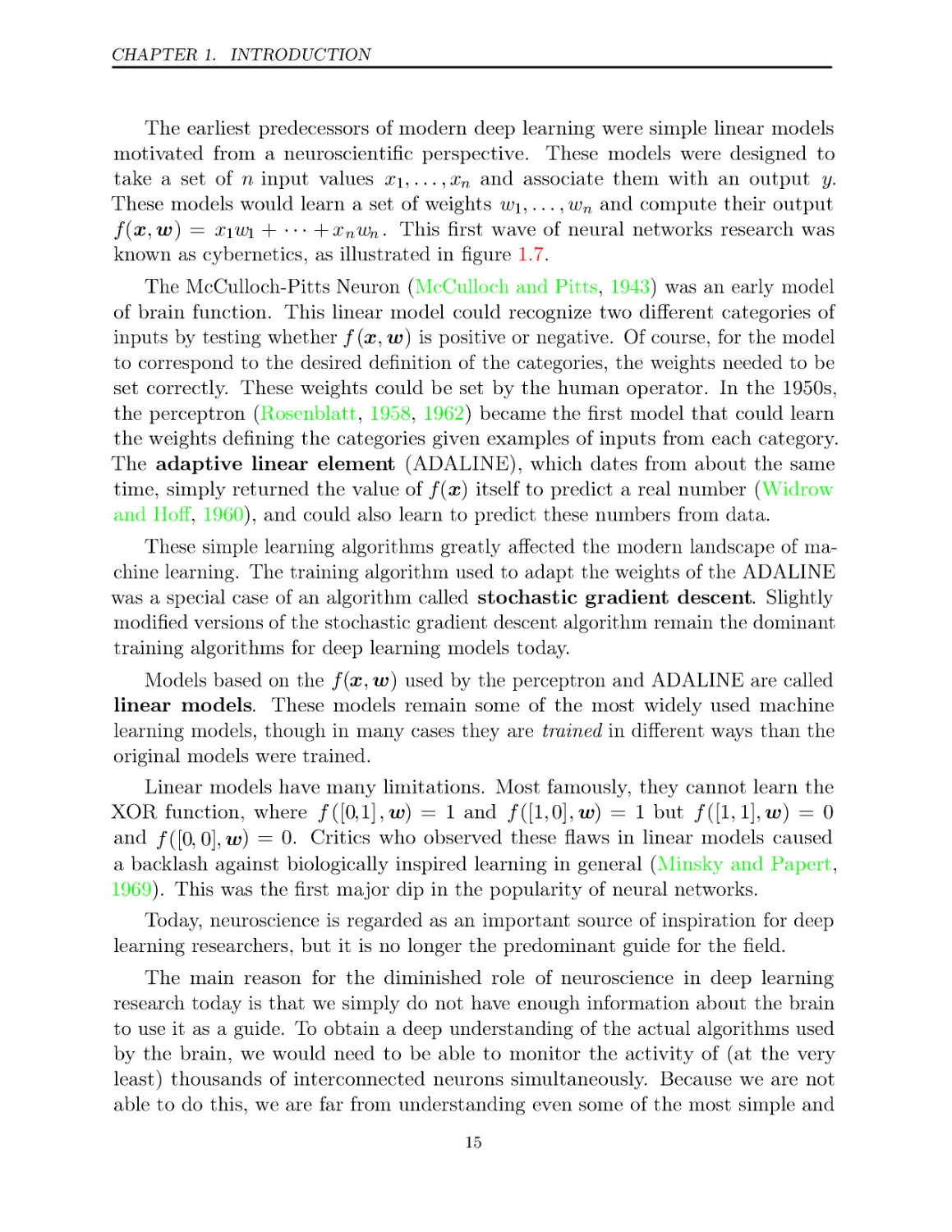
take a set of n input values x1, . . . , xn and associate them with an output y.
These models would learn a set of weights w1, . . . , wn and compute their output
f(x w
,
) = x1w1 + · · · + xnwn . This first wave of neural networks research was
known as cybernetics, as illustrated in figure
.
1.7
The McCullo ch-Pitts Neuron (
,
) was an early model
McCullo ch and Pitts 1943
of brain function. This linear mo del could recognize two different categories of
inputs by testing whether f (x w
,
) is positive or negative. Of course, for the model
to correspond to the desired definition of the categories, the weights needed to b e
set correctly. These weights could b e set by the human op erator. In the 1950s,
the perceptron (Rosenblatt 1958 1962
,
,
) became the first model that could learn
the weights defining the categories given examples of inputs from each category.
The adaptive linear element (ADALINE), which dates from about the same
time, simply returned the value of f(x) itself to predict a real number (Widrow
and Hoff 1960
,
), and could also learn to predict these numbers from data.
These simple learning algorithms greatly affected the mo dern landscap e of ma-
chine learning. The training algorithm used to adapt the weights of the ADALINE
was a special case of an algorithm called stochastic gradient descent. Slightly
modified versions of the stochastic gradient descent algorithm remain the dominant
training algorithms for deep learning models today.
Models based on the f(x w
,
) used by the perceptron and ADALINE are called
linear models. These models remain some of the most widely used machine
learning mo dels, though in many cases they are trained in different ways than the
original models were trained.
Linear models have many limitations. Most famously, they cannot learn the
XOR function, where f([0,1], w) = 1 and f([1,0], w) = 1 but f([1,1], w) = 0
and f ([0, 0], w) = 0. Critics who observed these flaws in linear models caused
a backlash against biologically inspired learning in general (Minsky and Papert,
1969). This was the first ma jor dip in the popularity of neural networks.
Today, neuroscience is regarded as an imp ortant source of inspiration for deep
learning researchers, but it is no longer the predominant guide for the field.
The main reason for the diminished role of neuroscience in deep learning
research today is that we simply do not have enough information ab out the brain
to use it as a guide. To obtain a deep understanding of the actual algorithms used
by the brain, we would need to be able to monitor the activity of (at the very
least) thousands of interconnected neurons simultaneously. Because we are not
able to do this, we are far from understanding even some of the most simple and
15
CHAPTER 1. INTRODUCTION
well-studied parts of the brain (
,
).
Olshausen and Field 2005
Neuroscience has given us a reason to hope that a single deep learning algorithm
can solve many different tasks. Neuroscientists have found that ferrets can learn to
“see” with the auditory processing region of their brain if their brains are rewired
to send visual signals to that area (Von Melchner
2000
et al.,
). This suggests that
much of the mammalian brain might use a single algorithm to solve most of the
different tasks that the brain solves. Before this hypothesis, machine learning
research was more fragmented, with different communities of researchers studying
natural language processing, vision, motion planning and speech recognition. Today,
these application communities are still separate, but it is common for deep learning
research groups to study many or even all of these application areas simultaneously.
We are able to draw some rough guidelines from neuroscience. The basic idea of
having many computational units that become intelligent only via their interactions
with each other is inspired by the brain. The Neocognitron (Fukushima 1980
,
)
introduced a powerful model architecture for processing images that was inspired
by the structure of the mammalian visual system and later became the basis
for the modern convolutional network (
,
),aswewillseein
LeCun et al. 1998b
section
.
Most neural networks today are based on a model neuron called
9.10
the rectified linear unit. The original Cognitron (Fukushima 1975
,
) introduced
a more complicated version that was highly inspired by our knowledge of brain
function. The simplified modern version was develop ed incorporating ideas from
many viewp oints, with
( )and
( ) citing
Nair and Hinton 2010
Glorot et al. 2011a
neuroscience as an influence, and
( ) citing more engineering-
Jarrett et al. 2009
oriented influences. While neuroscience is an imp ortant source of inspiration, it
need not be taken as a rigid guide. We know that actual neurons compute very
different functions than modern rectified linear units, but greater neural realism
has not yet led to an improvement in machine learning performance. Also, while
neuroscience has successfully inspired several neural network architectures, we
do not yet know enough about biological learning for neuroscience to offer much
guidance for the learning algorithms we use to train these architectures.
Media accounts often emphasize the similarity of deep learning to the brain.
While it is true that deep learning researchers are more likely to cite the brain as an
influence than researchers working in other machine learning fields such as kernel
machines or Bayesian statistics, one should not view deep learning as an attempt
to simulate the brain. Modern deep learning draws inspiration from many fields,
especially applied math fundamentals like linear algebra, probability, information
theory, and numerical optimization. While some deep learning researchers cite
neuroscience as an important source of inspiration, others are not concerned with
16
CHAPTER 1. INTRODUCTION
neuroscience at all.
It is worth noting that the effort to understand how the brain works on
an algorithmic level is alive and well. This endeavor is primarily known as
“computational neuroscience” and is a separate field of study from deep learning.
It is common for researchers to move back and forth between b oth fields. The
field of deep learning is primarily concerned with how to build computer systems
that are able to successfully solve tasks requiring intelligence, while the field of
computational neuroscience is primarily concerned with building more accurate
models of how the brain actually works.
In the 1980s, the second wave of neural network research emerged in great
part via a movement called connectionism or parallel distributed process-
ing (
,
;
,
). Connectionism arose in
Rumelhart et al. 1986c McClelland et al. 1995
the context of cognitive science. Cognitive science is an interdisciplinary approach
to understanding the mind, combining multiple different levels of analysis. During
the early 1980s, most cognitive scientists studied mo dels of symb olic reasoning.
Despite their popularity, symbolic models were difficult to explain in terms of
how the brain could actually implement them using neurons. The connectionists
began to study models of cognition that could actually be grounded in neural
implementations (Touretzky and Minton 1985
,
), reviving many ideas dating back
to the work of psychologist Donald Hebb in the 1940s (
,
).
Hebb 1949
The central idea in connectionism is that a large number of simple computational
units can achieve intelligent behavior when networked together. This insight
applies equally to neurons in biological nervous systems and to hidden units in
computational models.
Several key concepts arose during the connectionism movement of the 1980s
that remain central to today’s deep learning.
One of these concepts is that of distributed representation (Hinton et al.,
1986). This is the idea that each input to a system should be represented by
many features, and each feature should b e involved in the representation of many
possible inputs. For example, supp ose we have a vision system that can recognize
cars, trucks, and birds and these objects can each be red, green, or blue. One way
of representing these inputs would be to have a separate neuron or hidden unit
that activates for each of the nine possible combinations: red truck, red car, red
bird, green truck, and so on. This requires nine different neurons, and each neuron
must indep endently learn the concept of color and ob ject identity. One way to
improve on this situation is to use a distributed representation, with three neurons
describing the color and three neurons describing the object identity. This requires
only six neurons total instead of nine, and the neuron describing redness is able to
17
CHAPTER 1. INTRODUCTION
learn about redness from images of cars, trucks and birds, not only from images
of one sp ecific category of ob jects. The concept of distributed representation is
central to this book, and will be described in greater detail in chapter .
15
Another ma jor accomplishment of the connectionist movement was the suc-
cessful use of back-propagation to train deep neural networks with internal repre-
sentations and the popularization of the back-propagation algorithm (Rumelhart
et al.,
;
,
). This algorithm has waxed and waned in popularity
1986a LeCun 1987
but as of this writing is currently the dominant approach to training deep models.
During the 1990s, researchers made important advances in modeling sequences
with neural networks.
( )and
( ) identified some of
Hochreiter 1991
Bengio et al. 1994
the fundamental mathematical difficulties in mo deling long sequences, described in
section
.
10.7 Hochreiter and Schmidhuber 1997
( ) introduced the long short-term
memory or LSTM network to resolve some of these difficulties. Today, the LSTM
is widely used for many sequence mo deling tasks, including many natural language
processing tasks at Google.
The second wave of neural networks research lasted until the mid-1990s. Ven-
tures based on neural networks and other AI technologies b egan to make unrealisti-
cally ambitious claims while seeking investments. When AI research did not fulfill
these unreasonable exp ectations, investors were disapp ointed. Simultaneously,
other fields of machine learning made advances. Kernel machines (
,
Boser et al.
1992 Cortes and Vapnik 1995 Schölkopf
1999
Jor-
;
,
;
et al.,
) and graphical models (
dan 1998
,
) both achieved good results on many important tasks. These two factors
led to a decline in the popularity of neural networks that lasted until 2007.
During this time, neural networks continued to obtain impressive p erformance
on some tasks (
,
;
,
). The Canadian Institute
LeCun et al. 1998b Bengio et al. 2001
for Advanced Research (CIFAR) helped to keep neural networks research alive
via its Neural Computation and Adaptive Perception (NCAP) research initiative.
This program united machine learning research groups led by Geoffrey Hinton
at University of Toronto, Yoshua Bengio at University of Montreal, and Yann
LeCun at New York University. The CIFAR NCAP research initiative had a
multi-disciplinary nature that also included neuroscientists and experts in human
and computer vision.
At this point in time, deep networks were generally believed to be very difficult
to train. We now know that algorithms that have existed since the 1980s work
quite well, but this was not apparent circa 2006. The issue is perhaps simply that
these algorithms were too computationally costly to allow much experimentation
with the hardware available at the time.
The third wave of neural networks research began with a breakthrough in
18
CHAPTER 1. INTRODUCTION
2006. Geoffrey Hinton showed that a kind of neural network called a deep belief
network could be efficiently trained using a strategy called greedy layer-wise pre-
training (
,
), which will be described in more detail in section
.
Hinton et al. 2006
15.1
The other CIFAR-affiliated research groups quickly showed that the same strategy
could be used to train many other kinds of deep networks (
,
;
Bengio et al. 2007
Ranzato
2007a
et al.,
) and systematically helped to improve generalization on
test examples. This wave of neural networks research popularized the use of the
term “deep learning” to emphasize that researchers were now able to train deeper
neural networks than had been p ossible b efore, and to focus attention on the
theoretical importance of depth (
,
;
,
Bengio and LeCun 2007 Delalleau and Bengio
2011 Pascanu
2014a Montufar
2014
;
et al.,
;
et al.,
). At this time, deep neural
networks outperformed comp eting AI systems based on other machine learning
technologies as well as hand-designed functionality. This third wave of popularity
of neural networks continues to the time of this writing, though the focus of deep
learning research has changed dramatically within the time of this wave. The
third wave began with a focus on new unsupervised learning techniques and the
ability of deep models to generalize well from small datasets, but today there is
more interest in much older supervised learning algorithms and the ability of deep
models to leverage large labeled datasets.
1.2.2 Increasing Dataset Sizes
One may wonder why deep learning has only recently become recognized as a
crucial technology though the first experiments with artificial neural networks were
conducted in the 1950s. Deep learning has been successfully used in commercial
applications since the 1990s, but was often regarded as being more of an art than
a technology and something that only an expert could use, until recently. It is true
that some skill is required to get good performance from a deep learning algorithm.
Fortunately, the amount of skill required reduces as the amount of training data
increases. The learning algorithms reaching human performance on complex tasks
today are nearly identical to the learning algorithms that struggled to solve toy
problems in the 1980s, though the models we train with these algorithms have
undergone changes that simplify the training of very deep architectures. The most
important new development is that today we can provide these algorithms with
the resources they need to succeed. Figure shows how the size of benchmark
1.8
datasets has increased remarkably over time. This trend is driven by the increasing
digitization of so ciety. As more and more of our activities take place on computers,
more and more of what we do is recorded. As our computers are increasingly
networked together, it becomes easier to centralize these records and curate them
19
CHAPTER 1. INTRODUCTION
into a dataset appropriate for machine learning applications. The age of “Big
Data” has made machine learning much easier because the key burden of statistical
estimation—generalizing well to new data after observing only a small amount
of data—has b een considerably lightened. As of 2016, a rough rule of thumb
is that a supervised deep learning algorithm will generally achieve acceptable
performance with around 5,000 labeled examples per category, and will match or
exceed human performance when trained with a dataset containing at least 10
million labeled examples. Working successfully with datasets smaller than this is
an important research area, focusing in particular on how we can take advantage
of large quantities of unlab eled examples, with unsup ervised or semi-sup ervised
learning.
1.2.3 Increasing Model Sizes
Another key reason that neural networks are wildly successful today after enjoying
comparatively little success since the 1980s is that we have the computational
resources to run much larger models today. One of the main insights of connection-
ism is that animals become intelligent when many of their neurons work together.
An individual neuron or small collection of neurons is not particularly useful.
Biological neurons are not especially densely connected. As seen in figure
,
1.10
our machine learning models have had a number of connections per neuron that
was within an order of magnitude of even mammalian brains for decades.
In terms of the total number of neurons, neural networks have been astonishingly
small until quite recently, as shown in figure
.
Since the introduction of hidden
1.11
units, artificial neural networks have doubled in size roughly every 2.4 years. This
growth is driven by faster computers with larger memory and by the availability
of larger datasets. Larger networks are able to achieve higher accuracy on more
complex tasks. This trend looks set to continue for decades. Unless new technologies
allow faster scaling, artificial neural networks will not have the same number of
neurons as the human brain until at least the 2050s. Biological neurons may
represent more complicated functions than current artificial neurons, so biological
neural networks may be even larger than this plot portrays.
In retrospect, it is not particularly surprising that neural networks with fewer
neurons than a leech were unable to solve sophisticated artificial intelligence prob-
lems. Even today’s networks, which we consider quite large from a computational
systems p oint of view, are smaller than the nervous system of even relatively
primitive vertebrate animals like frogs.
The increase in model size over time, due to the availability of faster CPUs,
20
CHAPTER 1. INTRODUCTION
1900
1950
1985 2000 2015
Y
100
101
102
103
104
105
106
107
108
109
D
a
t
a
s
e
t
s
i
z
e
(
n
u
m
b
e
r
e
x
a
m
p
l
e
s
)
Iris
MNIST
Public SVHN
ImageNet
CIFAR-10
ImageNet10k
ILSVRC 2014
Sports-1M
Rotated T vs. C
Tvs.Gvs.F
Criminals
Canadian Hansard
WMT
Figure 1.8: Dataset sizes have increased greatly over time. In the early 1900s, statisticians
studied datasets using hundreds or thousands of manually compiled measurements (
,
Garson
1900 Gosset 1908 Anderson 1935 Fisher 1936
;
,
;
,
;
,
). In the 1950s through 1980s, the pioneers
of biologically inspired machine learning often worked with small, synthetic datasets, such
as low-resolution bitmaps of letters, that were designed to incur low computational cost and
demonstrate that neural networks were able to learn sp ecific kinds of functions (Widrow
and Hoff 1960 Rumelhart
1986b
,
;
et al.,
). In the 1980s and 1990s, machine learning
became more statistical in nature and b egan to leverage larger datasets containing tens
of thousands of examples such as the MNIST dataset (shown in figure
) of scans
1.9
of handwritten numbers (
,
). In the first decade of the 2000s, more
LeCun et al. 1998b
sophisticated datasets of this same size, such as the CIFAR-10 dataset (Krizhevsky and
Hinton 2009
,
) continued to b e produced. Toward the end of that decade and throughout
the first half of the 2010s, significantly larger datasets, containing hundreds of thousands
to tens of millions of examples, completely changed what was possible with deep learning.
These datasets included the public Street View House Numbers dataset (
,
Netzer et al.
2011), various versions of the ImageNet dataset (
,
,
;
Deng et al. 2009 2010a Russakovsky
et al.
et al.
,
), and the Sports-1M dataset (
2014a
Karpathy
,
).Atthetopofthe
2014
graph, we see that datasets of translated sentences, such as IBM’s dataset constructed
from the Canadian Hansard (
,
) and the WMT 2014 English to French
Brown et al. 1990
dataset (Schwenk 2014
,
) are typically far ahead of other dataset sizes.
21
CHAPTER 1. INTRODUCTION
Figure 1.9: Example inputs from the MNIST dataset. The “NIST” stands for National
Institute of Standards and Technology, the agency that originally collected this data.
The “M” stands for “modified,” since the data has been preprocessed for easier use with
machine learning algorithms. The MNIST dataset consists of scans of handwritten digits
and associated lab els describing which digit 0–9 is contained in each image. This simple
classification problem is one of the simplest and most widely used tests in deep learning
research. It remains popular despite being quite easy for modern techniques to solve.
Geoffrey Hinton has described it as “the drosophila of machine learning,” meaning that
it allows machine learning researchers to study their algorithms in controlled lab oratory
conditions, much as biologists often study fruit flies.
22
CHAPTER 1. INTRODUCTION
the advent of general purpose GPUs (described in section
), faster network
12.1 .2
connectivity and better software infrastructure for distributed computing, is one of
the most imp ortant trends in the history of deep learning. This trend is generally
expected to continue well into the future.
1.2.4 Increasing Accuracy, Complexity and Real-World Impact
Since the 1980s, deep learning has consistently improved in its ability to provide
accurate recognition or prediction. Moreover, deep learning has consistently been
applied with success to broader and broader sets of applications.
The earliest deep mo dels were used to recognize individual ob jects in tightly
cropped, extremely small images (
,
). Since then there has
Rumelhart et al. 1986a
been a gradual increase in the size of images neural networks could process. Modern
object recognition networks process rich high-resolution photographs and do not
have a requirement that the photo b e cropp ed near the object to b e recognized
(
,
). Similarly, the earliest networks could only recognize
Krizhevsky et al. 2012
two kinds of objects (or in some cases, the absence or presence of a single kind of
ob ject), while these mo dern networks typically recognize at least 1,000 different
categories of ob jects. The largest contest in ob ject recognition is the ImageNet
Large Scale Visual Recognition Challenge (ILSVRC) held each year. A dramatic
moment in the meteoric rise of deep learning came when a convolutional network
won this challenge for the first time and by a wide margin, bringing down the
state-of-the-art top-5 error rate from 26.1% to 15.3% (
,
),
Krizhevsky et al. 2012
meaning that the convolutional network produces a ranked list of possible categories
for each image and the correct category app eared in the first five entries of this
list for all but 15.3% of the test examples. Since then, these comp etitions are
consistently won by deep convolutional nets, and as of this writing, advances in
deep learning have brought the latest top-5 error rate in this contest down to 3.6%,
as shown in figure
.
1.12
Deep learning has also had a dramatic impact on speech recognition. After
improving throughout the 1990s, the error rates for speech recognition stagnated
starting in about 2000. The introduction of deep learning (
,
;
Dahl et al. 2010 Deng
et al.
et al.
et al.
,
;
2010b Seide
,
;
2011 Hinton
,
) to speech recognition resulted
2012a
in a sudden drop of error rates, with some error rates cut in half. We will explore
this history in more detail in section
.
12.3
Deep networks have also had spectacular successes for pedestrian detection and
image segmentation (
,
;
Sermanet et al. 2013 Farabet
2013 Couprie
et al.,
;
et al.,
2013) and yielded superhuman performance in traffic sign classification (Ciresan
23
CHAPTER 1. INTRODUCTION
1950
1985
2000
2015
101
102
103
104
C
o
n
n
e
c
t
i
o
n
s
p
e
r
n
e
u
r
o
n
1
2
3
4
5
6
7
8
9
10
Fruit fly
Mouse
Cat
Human
Figure 1.10: Initially, the number of connections between neurons in artificial neural
networks was limited by hardware capabilities. Today, the number of connections between
neurons is mostly a design consideration. Some artificial neural networks have nearly as
many connections p er neuron as a cat, and it is quite common for other neural networks
to have as many connections per neuron as smaller mammals like mice. Even the human
brain does not have an exorbitant amount of connections per neuron. Biological neural
network sizes from
().
Wikipedia 2015
1. Adaptive linear element (
,
)
Widrow and Hoff 1960
2. Neocognitron (Fukushima 1980
,
)
3. GPU-accelerated convolutional network (
,
)
Chellapilla et al. 2006
4. Deep Boltzmann machine (Salakhutdinov and Hinton 2009a
,
)
5. Unsupervised convolutional network (
,
)
Jarrett et al. 2009
6. GPU-accelerated multilayer p erceptron (
,
)
Ciresan et al. 2010
7. Distributed autoencoder (
,
)
Le et al. 2012
8. Multi-GPU convolutional network (
,
)
Krizhevsky et al. 2012
9. COTS HPC unsupervised convolutional network (
,
)
Coates et al. 2013
10. GoogLeNet (
,
)
Szegedy et al. 2014a
24
CHAPTER 1. INTRODUCTION
et al.,
).
2012
At the same time that the scale and accuracy of deep networks has increased,
so has the complexity of the tasks that they can solve.
()
Goodfellow et al. 2014d
showed that neural networks could learn to output an entire sequence of characters
transcribed from an image, rather than just identifying a single object. Previously,
it was widely believed that this kind of learning required labeling of the individual
elements of the sequence (
,
). Recurrent neural networks,
Gülçehre and Bengio 2013
such as the LSTM sequence model mentioned above, are now used to mo del
relationships between sequences
sequences
and other
rather than just fixed inputs.
This sequence-to-sequence learning seems to be on the cusp of revolutionizing
another application: machine translation (Sutskever
2014 Bahdanau
et al.,
;
et al.,
2015).
This trend of increasing complexity has been pushed to its logical conclusion
with the introduction of neural Turing machines (Graves
2014a
et al.,
) that learn
to read from memory cells and write arbitrary content to memory cells. Such
neural networks can learn simple programs from examples of desired b ehavior. For
example, they can learn to sort lists of numbers given examples of scrambled and
sorted sequences. This self-programming technology is in its infancy, but in the
future could in principle be applied to nearly any task.
Another crowning achievement of deep learning is its extension to the domain of
reinforcement learning. In the context of reinforcement learning, an autonomous
agent must learn to p erform a task by trial and error, without any guidance from
the human operator. DeepMind demonstrated that a reinforcement learning system
based on deep learning is capable of learning to play Atari video games, reaching
human-level performance on many tasks (
,
). Deep learning has
Mnih et al. 2015
also significantly improved the performance of reinforcement learning for robotics
(
,
).
Finn et al. 2015
Many of these applications of deep learning are highly profitable. Deep learning
is now used by many top technology companies including Google, Microsoft,
Facebook, IBM, Baidu, Apple, Adobe, Netflix, NVIDIA and NEC.
Advances in deep learning have also dep ended heavily on advances in software
infrastructure. Software libraries such as Theano (
,
;
Bergstra et al. 2010 Bastien
et al.
et al.
,
), PyLearn2 (
2012
Goodfellow
,
), Torch (
,
),
2013c
Collob ert et al. 2011b
DistBelief (
,
),Caffe( , ),MXNet(
,
), and
Dean et al. 2012
Jia 2013
Chen et al. 2015
TensorFlow (
,
) have all supported imp ortant research pro jects or
Abadi et al. 2015
commercial products.
Deep learning has also made contributions back to other sciences. Modern
convolutional networks for object recognition provide a model of visual pro cessing
25
CHAPTER 1. INTRODUCTION
that neuroscientists can study (
,
). Deep learning also provides useful
DiCarlo 2013
tools for processing massive amounts of data and making useful predictions in
scientific fields. It has been successfully used to predict how molecules will interact
in order to help pharmaceutical companies design new drugs (
,
),
Dahl et al. 2014
to search for subatomic particles (
,
), and to automatically parse
Baldi et al. 2014
microscope images used to construct a 3-D map of the human brain (Knowles-
Barley
2014
et al.,
). We expect deep learning to appear in more and more scientific
fields in the future.
In summary, deep learning is an approach to machine learning that has drawn
heavily on our knowledge of the human brain, statistics and applied math as it
develop ed over the past several decades. In recent years, it has seen tremendous
growth in its popularity and usefulness, due in large part to more powerful com-
puters, larger datasets and techniques to train deeper networks. The years ahead
are full of challenges and opp ortunities to improve deep learning even further and
bring it to new frontiers.
26
CHAPTER 1. INTRODUCTION
1950
1985 2000 2015
2056
10−2
10−1
100
101
102
103
104
105
106
107
108
109
1010
1011
N
u
m
b
e
r
o
f
n
e
u
r
o
n
s
(
l
o
g
a
r
i
t
h
m
i
c
s
c
a
l
e
)
1
2
3
4
5
6
7
8
910
11
12
13
14
15
16
17
18
19 20
Sponge
Roundworm
Leech
Ant
Bee
Frog
Octopus
Human
Figure 1.11: Since the introduction of hidden units, artificial neural networks have doubled
in size roughly every 2.4 years. Biological neural network sizes from
().
Wikipedia 2015
1. Perceptron (
,
,
)
Rosenblatt 1958 1962
2. Adaptive linear element (
,
)
Widrow and Hoff 1960
3. Neocognitron (Fukushima 1980
,
)
4. Early back-propagation network (
,
)
Rumelhart et al. 1986b
5. Recurrent neural network for speech recognition (Robinson and Fallside 1991
,
)
6. Multilayer perceptron for speech recognition (
,
)
Bengio et al. 1991
7. Mean field sigmoid belief network (
,
)
Saul et al. 1996
8. LeNet-5 (
,
)
LeCun et al. 1998b
9. Echo state network (
,
)
Jaeger and Haas 2004
10. Deep belief network (
,
)
Hinton et al. 2006
11. GPU-accelerated convolutional network (
,
)
Chellapilla et al. 2006
12. Deep Boltzmann machine (Salakhutdinov and Hinton 2009a
,
)
13. GPU-accelerated deep belief network (
,
)
Raina et al. 2009
14. Unsupervised convolutional network (
,
)
Jarrett et al. 2009
15. GPU-accelerated multilayer perceptron (
,
)
Ciresan et al. 2010
16. OMP-1 network (
,
)
Coates and Ng 2011
17. Distributed autoencoder (
,
)
Le et al. 2012
18. Multi-GPU convolutional network (
,
)
Krizhevsky et al. 2012
19. COTS HPC unsupervised convolutional network (
,
)
Coates et al. 2013
20. GoogLeNet (
,
)
Szegedy et al. 2014a
27
CHAPTER 1. INTRODUCTION
2010
2011
2012
2013
2014
2015
000
.
005
.
010
.
015
.
020
.
025
.
030
.
I
L
S
V
R
C
c
l
a
s
s
i
fi
c
a
t
i
o
n
e
r
r
o
r
r
a
t
e
Figure 1.12: Since deep networks reached the scale necessary to compete in the ImageNet
Large Scale Visual Recognition Challenge, they have consistently won the comp etition
every year, and yielded lower and lower error rates each time. Data from Russakovsky
et al.
et al.
( )and
2014b
He
().
2015
28
Part I
Applied Math and Machine
Learning Basics
29
This part of the book introduces the basic mathematical concepts needed to
understand deep learning. We begin with general ideas from applied math that
allow us to define functions of many variables, find the highest and lowest points
on these functions and quantify degrees of belief.
Next, we describe the fundamental goals of machine learning. We describe how
to accomplish these goals by specifying a mo del that represents certain b eliefs,
designing a cost function that measures how well those beliefs correspond with
reality and using a training algorithm to minimize that cost function.
This elementary framework is the basis for a broad variety of machine learning
algorithms, including approaches to machine learning that are not deep. In the
subsequent parts of the book, we develop deep learning algorithms within this
framework.
30
Chapter 2
Linear Algebra
Linear algebra is a branch of mathematics that is widely used throughout science
and engineering. However, because linear algebra is a form of continuous rather
than discrete mathematics, many computer scientists have little exp erience with it.
A good understanding of linear algebra is essential for understanding and working
with many machine learning algorithms, especially deep learning algorithms. We
therefore precede our introduction to deep learning with a focused presentation of
the key linear algebra prerequisites.
If you are already familiar with linear algebra, feel free to skip this chapter. If
you have previous experience with these concepts but need a detailed reference
sheet to review key formulas, we recommend The Matrix Cookbook (Petersen and
Pedersen 2006
,
). If you have no exp osure at all to linear algebra, this chapter
will teach you enough to read this bo ok, but we highly recommend that you also
consult another resource fo cused exclusively on teaching linear algebra, such as
Shilov 1977
( ). This chapter will completely omit many imp ortant linear algebra
topics that are not essential for understanding deep learning.
2.1 Scalars, Vectors, Matrices and Tensors
The study of linear algebra involves several types of mathematical objects:
• Scalars: A scalar is just a single number, in contrast to most of the other
objects studied in linear algebra, which are usually arrays of multiple numbers.
We write scalars in italics. We usually give scalars lower-case variable names.
When we introduce them, we specify what kind of number they are. For
31
CHAPTER 2. LINEAR ALGEBRA
example, we might say “Let s ∈ R be the slope of the line,” while defining a
real-valued scalar, or “Let n ∈ N be the number of units,” while defining a
natural number scalar.
• Vectors: A vector is an array of numbers. The numbers are arranged in
order. We can identify each individual number by its index in that ordering.
Typically we give vectors lower case names written in bold typeface, such
as x. The elements of the vector are identified by writing its name in italic
typeface, with a subscript. The first element of x is x1, the second element
is x 2 and so on. We also need to say what kind of numbers are stored in
the vector. If each element is in R, and the vector has n elements, then the
vector lies in the set formed by taking the Cartesian product of R n times,
denoted as R
n
.
When we need to explicitly identify the elements of a vector,
we write them as a column enclosed in square brackets:
x=
x1
x2
.
.
.
xn
.
(2.1)
We can think of vectors as identifying p oints in space, with each element
giving the coordinate along a different axis.
Sometimes we need to index a set of elements of a vector. In this case, we
define a set containing the indices and write the set as a subscript. For
example, to access x1, x3 and x6 , we define the set S = {1, 3, 6} and write
xS . We use the − sign to index the complement of a set. For example x−1 is
the vector containing all elements of x except for x1 , and x−S is the vector
containing all of the elements of except for
x
x1, x3 and x6.
• Matrices: A matrix is a 2-D array of numbers, so each element is identified
by two indices instead of just one. We usually give matrices upper-case
variable names with bold typeface, such as A. If a real-valued matrix A has
aheightofmandawidthofn,thenwesaythatA∈Rm n
×
.
We usually
identify the elements of a matrix using its name in italic but not bold font,
and the indices are listed with separating commas. For example, A1 1, is the
upper left entry of A and Am,n is the bottom right entry. We can identify all
of the numbers with vertical coordinate i by writing a “ ” for the horizontal
:
coordinate. For example, Ai,: denotes the horizontal cross section of A with
vertical coordinate i. This is known as the i-th row of A. Likewise, A :,i is
32
CHAPTER 2. LINEAR ALGEBRA
A=
A11, A12,
A21, A22,
A31, A32,
⇒A
=
A11, A21,
A3 1,
A12, A22,
A3 2,
Figure 2.1: The transpose of the matrix can be thought of as a mirror image across the
main diagonal.
the -th
of . When we need to explicitly identify the elements of
i column A
a matrix, we write them as an array enclosed in square brackets:
A11, A12,
A21, A22,
.
(2.2)
Sometimes we may need to index matrix-valued expressions that are not just
a single letter. In this case, we use subscripts after the expression, but do
not convert anything to lower case. For example, f (A)i,j gives element (i, j)
of the matrix computed by applying the function to .
fA
• Tensors: In some cases we will need an array with more than two axes.
In the general case, an array of numbers arranged on a regular grid with a
variable numb er of axes is known as a tensor. We denote a tensor named “A”
with this typeface: A. We identify the element of A at co ordinates (i, j, k)
by writing Ai,j,k.
One imp ortant operation on matrices is the transpose. The transpose of a
matrix is the mirror image of the matrix across a diagonal line, called the main
diagonal, running down and to the right, starting from its upper left corner. See
figure for a graphical depiction of this operation. We denote the transpose of a
2.1
matrix
as
A A, and it is defined such that
(A )i,j = Aj,i .
(2.3)
Vectors can be thought of as matrices that contain only one column. The
transpose of a vector is therefore a matrix with only one row. Sometimes we
33
CHAPTER 2. LINEAR ALGEBRA
define a vector by writing out its elements in the text inline as a row matrix,
then using the transpose operator to turn it into a standard column vector, e.g .,
x = [x1, x2, x3].
A scalar can be thought of as a matrix with only a single entry. From this, we
can see that a scalar is its own transpose: a a
=
.
We can add matrices to each other, as long as they have the same shape, just
by adding their corresp onding elements:
where
CAB
=
+
Ci,j = Ai,j +Bi,j.
We can also add a scalar to a matrix or multiply a matrix by a scalar, just
by performing that operation on each element of a matrix: D = a · B + c where
Di,j =a B
·
i,j+c.
In the context of deep learning, we also use some less conventional notation.
We allow the addition of matrix and a vector, yielding another matrix: C = A + b,
where Ci,j = Ai,j + bj. In other words, the vector b is added to each row of the
matrix. This shorthand eliminates the need to define a matrix with b copied into
each row before doing the addition. This implicit copying of b to many locations
is called
.
broadcasting
2.2 Multiplying Matrices and Vectors
One of the most important operations involving matrices is multiplication of two
matrices. The matrix product of matrices A and B is a third matrix C . In
order for this product to be defined, A must have the same number of columns as
Bhasrows. IfAisofshapem n
× andBisofshapen p
× ,thenCisofshape
mp
× . We can write the matrix product just by placing two or more matrices
together, e.g.
CAB
=
.
(2.4)
The product operation is defined by
Ci,j =
k
Ai,kB k,j.
(2.5)
Note that the standard product of two matrices is just a matrix containing
not
the product of the individual elements. Such an operation exists and is called the
element-wise product Hadamard product
or
, and is denoted as
.
AB
The dot product between two vectors x and y of the same dimensionality
is the matrix pro duct x y. We can think of the matrix product C = AB as
computing Ci,j as the dot pro duct between row of
and column of .
iA
jB
34
CHAPTER 2. LINEAR ALGEBRA
Matrix pro duct op erations have many useful prop erties that make mathematical
analysis of matrices more convenient. For example, matrix multiplication is
distributive:
ABCABAC
(+)=
+.
(2.6)
It is also asso ciative:
ABC
ABC
()=()
.
(2.7)
Matrix multiplication is
commutative (the condition
not
AB=BAdoesnot
always hold), unlike scalar multiplication. However, the dot product between two
vectors is commutative:
x
yy
=
x.
(2.8)
The transpose of a matrix pro duct has a simple form:
()
AB
=B
A.
(2.9)
This allows us to demonstrate equation
, by exploiting the fact that the value
2.8
of such a pro duct is a scalar and therefore equal to its own transpose:
x
y=
x y
= yx.
(2.10)
Since the focus of this textbook is not linear algebra, we do not attempt to
develop a comprehensive list of useful properties of the matrix product here, but
the reader should b e aware that many more exist.
We now know enough linear algebra notation to write down a system of linear
equations:
Axb
=
(2.11)
whereA∈Rm n
×
isaknownmatrix,b∈Rmisaknownvector,andx∈Rnisa
vector of unknown variables we would like to solve for. Each element x i of x is one
of these unknown variables. Each row of A and each element of b provide another
constraint. We can rewrite equation
as:
2.11
A1:,x=b1
(2.12)
A2:,x=b2
(2.13)
...
(2.14)
Am,:x = bm
(2.15)
or, even more explicitly, as:
A11, x1+A12, x2+
+
···
A1,nxn = b1
(2.16)
35
CHAPTER 2. LINEAR ALGEBRA
100
010
001
Figure 2.2: Example identity matrix: This is I3 .
A21, x1+A22, x2+
+
···
A2,nxn = b2
(2.17)
...
(2.18)
A m,1x1 + Am,2x2 +
+
···
Am,nxn = bm .
(2.19)
Matrix-vector product notation provides a more compact representation for
equations of this form.
2.3 Identity and Inverse Matrices
Linear algebra offers a p owerful tool called matrix inversion that allows us to
analytically solve equation
for many values of .
2.11
A
To describe matrix inversion, we first need to define the concept of an identity
matrix. An identity matrix is a matrix that does not change any vector when we
multiply that vector by that matrix. We denote the identity matrix that preserves
n-dimensional vectors as In. Formally, In ∈ Rn n
×
, and
∀∈
xR
n
,Inx x
=
.
(2.20)
The structure of the identity matrix is simple: all of the entries along the main
diagonal are 1, while all of the other entries are zero. See figure for an example.
2.2
The matrix inverse of A is denoted as A −1
, and it is defined as the matrix
such that
A−1A I
=
n.
(2.21)
We can now solve equation
by the following steps:
2.11
Axb
=
(2.22)
A−1
AxA
=
−1
b
(2.23)
Inx A
=
−1
b
(2.24)
36
CHAPTER 2. LINEAR ALGEBRA
xA
=
−1b.
(2.25)
Of course, this process depends on it being possible to find A −1
.
We discuss
the conditions for the existence of A−1 in the following section.
When A
− 1 exists, several different algorithms exist for finding it in closed form.
In theory, the same inverse matrix can then b e used to solve the equation many
times for different values of b . However, A
−1 is primarily useful as a theoretical
tool, and should not actually b e used in practice for most software applications.
Because A
−1
can b e represented with only limited precision on a digital computer,
algorithms that make use of the value of b can usually obtain more accurate
estimates of .
x
2.4 Linear Dependence and Span
In order for A−1 to exist, equation
must have exactly one solution for every
2.11
value of b. However, it is also possible for the system of equations to have no
solutions or infinitely many solutions for some values of b. It is not possible to
have more than one but less than infinitely many solutions for a particular b; if
both and are solutions then
x
y
z
x
y
=α+(1)
−
α
(2.26)
is also a solution for any real .
α
To analyze how many solutions the equation has, we can think of the columns
of A as sp ecifying different directions we can travel from the origin (the p oint
specified by the vector of all zeros), and determine how many ways there are of
reaching b. In this view, each element of x sp ecifies how far we should travel in
each of these directions, with xi specifying how far to move in the direction of
column :i
Ax=
i
xiA:,i.
(2.27)
In general, this kind of op eration is called a linear combination . Formally, a
linear combination of some set of vectors {v(1), . . . , v
( )n } is given by multiplying
each vector v
( )i by a corresponding scalar coefficient and adding the results:
i
civ
()i
.
(2.28)
The span of a set of vectors is the set of all points obtainable by linear combination
of the original vectors.
37
CHAPTER 2. LINEAR ALGEBRA
Determining whether Ax = b has a solution thus amounts to testing whether b
is in the span of the columns of A. This particular span is known as the column
space
range
or the
of.
A
In order for the system Ax = b to have a solution for all values of b ∈ Rm
,
we therefore require that the column space of A be all of Rm
.
If any point in R
m
is excluded from the column space, that point is a p otential value of b that has
no solution. The requirement that the column space of A be all of Rm implies
immediately that A must have at least m columns, i.e ., n
m
≥ . Otherwise, the
dimensionality of the column space would be less than m. For example, consider a
3 × 2 matrix. The target b is 3-D, but x is only 2-D, so modifying the value of x
at best allows us to trace out a 2-D plane within R 3. The equation has a solution
if and only if lies on that plane.
b
Having n m
≥ is only a necessary condition for every point to have a solution.
It is not a sufficient condition, because it is possible for some of the columns to
be redundant. Consider a 2 × 2 matrix where both of the columns are identical.
This has the same column space as a 2 × 1 matrix containing only one copy of the
replicated column. In other words, the column space is still just a line, and fails to
encompass all of R2
, even though there are two columns.
Formally, this kind of redundancy is known as linear dep endence. A set of
vectors is linearly indep endent if no vector in the set is a linear combination
of the other vectors. If we add a vector to a set that is a linear combination of
the other vectors in the set, the new vector does not add any points to the set’s
span. This means that for the column space of the matrix to encompass all of Rm
,
the matrix must contain at least one set of m linearly independent columns. This
condition is b oth necessary and sufficient for equation
to have a solution for
2.11
every value of b. Note that the requirement is for a set to have exactly m linear
independent columns, not at least m. No set of m -dimensional vectors can have
more than m mutually linearly independent columns, but a matrix with more than
m columns may have more than one such set.
In order for the matrix to have an inverse, we additionally need to ensure that
equation
has
one solution for each value of
2.11
at most
b.Todoso,weneedto
ensure that the matrix has at most m columns. Otherwise there is more than one
way of parametrizing each solution.
Together, this means that the matrix must be square , that is, we require that
m = n and that all of the columns must b e linearly independent. A square matrix
with linearly dependent columns is known as
.
singular
If A is not square or is square but singular, it can still be possible to solve the
equation. However, we can not use the method of matrix inversion to find the
38
CHAPTER 2. LINEAR ALGEBRA
solution.
So far we have discussed matrix inverses as b eing multiplied on the left. It is
also possible to define an inverse that is multiplied on the right:
AA−1
=I.
(2.29)
For square matrices, the left inverse and right inverse are equal.
2.5 Norms
Sometimes we need to measure the size of a vector. In machine learning, we usually
measure the size of vectors using a function called a norm . Formally, the Lp norm
is given by
||||xp=
i
|x i|
p
1
p
(2.30)
for p
,p
.
∈R ≥1
Norms, including the Lp norm, are functions mapping vectors to non-negative
values. On an intuitive level, the norm of a vector x measures the distance from
the origin to the point x. More rigorously, a norm is any function f that satisfies
the following properties:
•
⇒
f()=0
x
x=0
•
≤
f(+)
xyf
f
()+
x
( )y (the triangle inequality)
•∀∈
||
α R,fα(x)=αf()x
The L 2 norm, with p = 2, is known as the Euclidean norm. It is simply the
Euclidean distance from the origin to the p oint identified by x. The L
2
norm is
used so frequently in machine learning that it is often denoted simply as || ||
x,with
the subscript omitted. It is also common to measure the size of a vector using
2
the squared L2 norm, which can b e calculated simply as xx.
The squared L2 norm is more convenient to work with mathematically and
computationally than the L 2 norm itself. For example, the derivatives of the
squared L2
norm with resp ect to each element of x each depend only on the
corresponding element of x, while all of the derivatives of the L2
norm depend
on the entire vector. In many contexts, the squared L2 norm may be undesirable
because it increases very slowly near the origin. In several machine learning
39
CHAPTER 2. LINEAR ALGEBRA
applications, it is important to discriminate b etween elements that are exactly
zero and elements that are small but nonzero. In these cases, we turn to a function
that grows at the same rate in all locations, but retains mathematical simplicity:
the L1 norm. The L1 norm may be simplified to
||||x1=
i
|xi |.
(2.31)
The L1 norm is commonly used in machine learning when the difference between
zero and nonzero elements is very important. Every time an element of x moves
awayfrom0by ,the
L1
norm increases by .
We sometimes measure the size of the vector by counting its number of nonzero
elements. Some authors refer to this function as the “L 0 norm,” but this is incorrect
terminology. The numb er of non-zero entries in a vector is not a norm, because
scaling the vector by α does not change the number of nonzero entries. The L1
norm is often used as a substitute for the number of nonzero entries.
One other norm that commonly arises in machine learning is the L ∞ norm,
also known as the max norm. This norm simplifies to the absolute value of the
element with the largest magnitude in the vector,
||||x∞=max
i
|xi |.
(2.32)
Sometimes we may also wish to measure the size of a matrix. In the context
of deep learning, the most common way to do this is with the otherwise obscure
Frobenius norm:
||||AF=
i,j
A2
i,j
,
(2.33)
which is analogous to the L2 norm of a vector.
The dot product of two vectors can be rewritten in terms of norms. Specifically,
x
y
x
= || ||2|| ||
y 2cosθ
(2.34)
where is the angle between and .
θ
x
y
2.6 Special Kinds of Matrices and Vectors
Some special kinds of matrices and vectors are particularly useful.
Diagonal matrices consist mostly of zeros and have non-zero entries only along
the main diagonal. Formally, a matrix D is diagonal if and only if Di,j = 0 for
40
CHAPTER 2. LINEAR ALGEBRA
all i
= j . We have already seen one example of a diagonal matrix: the identity
matrix, where all of the diagonal entries are 1. We write diag(v) to denote a square
diagonal matrix whose diagonal entries are given by the entries of the vector v.
Diagonal matrices are of interest in part because multiplying by a diagonal matrix
is very computationally efficient. To compute diag(v)x, we only need to scale each
element xi by vi . In other words, diag(v) x = v x
. Inverting a square diagonal
matrix is also efficient. The inverse exists only if every diagonal entry is nonzero,
and in that case, diag(v) −1
= diag([1/v1, . . . , 1/vn]). In many cases, we may
derive some very general machine learning algorithm in terms of arbitrary matrices,
but obtain a less expensive (and less descriptive) algorithm by restricting some
matrices to be diagonal.
Not all diagonal matrices need be square. It is p ossible to construct a rectangular
diagonal matrix. Non-square diagonal matrices do not have inverses but it is still
possible to multiply by them cheaply. For a non-square diagonal matrix D, the
product Dx will involve scaling each element of x, and either concatenating some
zeros to the result if D is taller than it is wide, or discarding some of the last
elements of the vector if is wider than it is tall.
D
A
matrix is any matrix that is equal to its own transpose:
symmetric
AA
=
.
(2.35)
Symmetric matrices often arise when the entries are generated by some function of
two arguments that does not depend on the order of the arguments. For example,
if A is a matrix of distance measurements, with Ai,j giving the distance from point
i to point , then
j
Ai,j = Aj,i because distance functions are symmetric.
A
is a vector with
:
unit vector
unit norm
||||x2=1.
(2.36)
A vector x and a vector y are orthogonal to each other if x y = 0. If both
vectors have nonzero norm, this means that they are at a 90 degree angle to each
other. In Rn
, at most n vectors may be mutually orthogonal with nonzero norm.
If the vectors are not only orthogonal but also have unit norm, we call them
orthonormal.
An orthogonal matrix is a square matrix whose rows are mutually orthonor-
mal and whose columns are mutually orthonormal:
AA AA
=
=I.
(2.37)
41
CHAPTER 2. LINEAR ALGEBRA
This implies that
A−1
= A,
(2.38)
so orthogonal matrices are of interest because their inverse is very cheap to compute.
Pay careful attention to the definition of orthogonal matrices. Counterintuitively,
their rows are not merely orthogonal but fully orthonormal. There is no special
term for a matrix whose rows or columns are orthogonal but not orthonormal.
2.7 Eigendecomposition
Many mathematical objects can be understood better by breaking them into
constituent parts, or finding some properties of them that are universal, not caused
by the way we choose to represent them.
For example, integers can be decomposed into prime factors. The way we
represent the number
will change depending on whether we write it in base ten
12
or in binary, but it will always be true that 12 = 2× 2 × 3. From this representation
we can conclude useful properties, such as that is not divisible by , or that any
12
5
integer multiple of
will be divisible by .
12
3
Much as we can discover something about the true nature of an integer by
decomposing it into prime factors, we can also decompose matrices in ways that
show us information about their functional properties that is not obvious from the
representation of the matrix as an array of elements.
One of the most widely used kinds of matrix decomp osition is called eigen-
decomposition, in which we decompose a matrix into a set of eigenvectors and
eigenvalues.
An eigenvector of a square matrix A is a non-zero vector v such that multi-
plication by alters only the scale of :
A
v
Avv
=λ.
(2.39)
The scalar λ is known as the eigenvalue corresponding to this eigenvector. (One
can also find a left eigenvector such that vA = λv , but we are usually
concerned with right eigenvectors).
If v is an eigenvector of A, then so is any rescaled vector sv for s
,s
∈R
=0.
Moreover, sv still has the same eigenvalue. For this reason, we usually only look
for unit eigenvectors.
Suppose that a matrix A has n linearly indep endent eigenvectors, {v(1) , . . . ,
v()
n
}, with corresponding eigenvalues {λ1, . . . , λ n}. We may concatenate all of the
42
CHAPTER 2. LINEAR ALGEBRA
�
�
�
�
�
�
�
�
�
�
�
�
Figure 2.3: An example of the effect of eigenvectors and eigenvalues. Here, we have
a matrix A with two orthonormal eigenvectors, v
(1)
with eigenvalue λ1 and v (2)
with
eigenvalue λ2. (Left)We plot the set of all unit vectors u ∈ R2
as a unit circle. (Right)We
plot the set of all points Au. By observing the way that A distorts the unit circle, we
can see that it scales space in direction v
()i byλi.
eigenvectors to form a matrix V with one eigenvector per column: V = [v(1) , . . . ,
v()
n
]. Likewise, we can concatenate the eigenvalues to form a vector λ = [λ1 , . . . ,
λn ]. The
of is then given by
eigendecomposition A
AV
λV
=
diag( ) −1
.
(2.40)
We have seen that constructing matrices with specific eigenvalues and eigenvec-
tors allows us to stretch space in desired directions. However, we often want to
decompose matrices into their eigenvalues and eigenvectors. Doing so can help
us to analyze certain prop erties of the matrix, much as decomposing an integer
into its prime factors can help us understand the behavior of that integer.
Not every matrix can b e decomposed into eigenvalues and eigenvectors. In some
43
CHAPTER 2. LINEAR ALGEBRA
cases, the decomposition exists, but may involve complex rather than real numbers.
Fortunately, in this b ook, we usually need to decomp ose only a specific class of
matrices that have a simple decomp osition. Specifically, every real symmetric
matrix can b e decomposed into an expression using only real-valued eigenvectors
and eigenvalues:
AQQ
=
Λ,
(2.41)
where Q is an orthogonal matrix composed of eigenvectors of A , and Λ is a
diagonal matrix. The eigenvalue Λi,i is associated with the eigenvector in column i
of Q, denoted as Q:,i. Because Q is an orthogonal matrix, we can think of A as
scaling space by λi in direction v
()i
.
See figure for an example.
2.3
While any real symmetric matrix A is guaranteed to have an eigendecomposi-
tion, the eigendecomposition may not be unique. If any two or more eigenvectors
share the same eigenvalue, then any set of orthogonal vectors lying in their span
are also eigenvectors with that eigenvalue, and we could equivalently choose a Q
using those eigenvectors instead. By convention, we usually sort the entries of Λ
in descending order. Under this convention, the eigendecomposition is unique only
if all of the eigenvalues are unique.
The eigendecomp osition of a matrix tells us many useful facts about the
matrix. The matrix is singular if and only if any of the eigenvalues are zero.
The eigendecomposition of a real symmetric matrix can also be used to optimize
quadratic expressions of the form f( x) = x
Ax subject to || ||
x2=1.Wheneverx
is equal to an eigenvector of A, f takes on the value of the corresponding eigenvalue.
The maximum value of f within the constraint region is the maximum eigenvalue
and its minimum value within the constraint region is the minimum eigenvalue.
A matrix whose eigenvalues are all positive is called positive definite . A
matrix whose eigenvalues are all positive or zero-valued is called positive semidefi-
nite . Likewise, if all eigenvalues are negative, the matrix is negative definite, and
if all eigenvalues are negative or zero-valued, it is negative semidefinite. Positive
semidefinite matrices are interesting because they guarantee that ∀x x
,
Ax≥0.
Positive definite matrices additionally guarantee that xAx
x
=0⇒=0.
2.8 Singular Value Decomposition
In section
, we saw how to decompose a matrix into eigenvectors and eigenvalues.
2.7
The singular value decomp osition (SVD) provides another way to factorize
a matrix, into singular vectors and singular values. The SVD allows us to
discover some of the same kind of information as the eigendecomposition. However,
44
CHAPTER 2. LINEAR ALGEBRA
the SVD is more generally applicable. Every real matrix has a singular value
decomposition, but the same is not true of the eigenvalue decomposition. For
example, if a matrix is not square, the eigendecomp osition is not defined, and we
must use a singular value decomposition instead.
Recall that the eigendecomp osition involves analyzing a matrix A to discover
a matrix V of eigenvectors and a vector of eigenvalues λ such that we can rewrite
Aas
AV
λV
=
diag( ) −1
.
(2.42)
The singular value decomposition is similar, except this time we will write A
as a product of three matrices:
A UDV
=
.
(2.43)
SupposethatAisanm n
× matrix. ThenUisdefinedtobeanm m
× matrix,
D
V
tobean
matrix, and
mn
×
tobean
matrix.
nn
×
Each of these matrices is defined to have a special structure. The matrices U
and V are both defined to b e orthogonal matrices. The matrix D is defined to be
a diagonal matrix. Note that is not necessarily square.
D
The elements along the diagonal of D are known as the singular values of
the matrix A. The columns of U are known as the left-singular vectors. The
columns of
are known as as the
V
right-singular vectors.
We can actually interpret the singular value decomposition of A in terms of
the eigendecomposition of functions of A . The left-singular vectors of A are the
eigenvectors of AA . The right-singular vectors of A are the eigenvectors of A A.
The non-zero singular values of A are the square roots of the eigenvalues of A A.
The same is true for AA .
Perhaps the most useful feature of the SVD is that we can use it to partially
generalize matrix inversion to non-square matrices, as we will see in the next
section.
2.9 The Moore-Penrose Pseudoinverse
Matrix inversion is not defined for matrices that are not square. Suppose we want
to make a left-inverse
of a matrix , so that we can solve a linear equation
B
A
Axy
=
(2.44)
45
CHAPTER 2. LINEAR ALGEBRA
by left-multiplying each side to obtain
xBy
=
.
(2.45)
Dep ending on the structure of the problem, it may not be possible to design a
unique mapping from
to.
AB
If A is taller than it is wide, then it is p ossible for this equation to have
no solution. If A is wider than it is tall, then there could be multiple possible
solutions.
The Moore-Penrose pseudoinverse allows us to make some headway in
these cases. The pseudoinverse of is defined as a matrix
A
A+=lim
α0
(AA I
+α)
−1A .
(2.46)
Practical algorithms for computing the pseudoinverse are not based on this defini-
tion, but rather the formula
A+=VD+U,
(2.47)
where U , D and V are the singular value decomposition of A, and the pseudoinverse
D+ of a diagonal matrix D is obtained by taking the reciprocal of its non-zero
elements then taking the transp ose of the resulting matrix.
When A has more columns than rows, then solving a linear equation using the
pseudoinverse provides one of the many possible solutions. Specifically, it provides
the solution x = A+ y with minimal Euclidean norm || ||
x 2 among all possible
solutions.
When A has more rows than columns, it is possible for there to be no solution.
In this case, using the pseudoinverse gives us the x for which Ax is as close as
possible to in terms of Euclidean norm
y
|| −||
Axy2.
2.10 The Trace Operator
The trace operator gives the sum of all of the diagonal entries of a matrix:
Tr()=
A
i
Ai,i .
(2.48)
The trace operator is useful for a variety of reasons. Some operations that are
difficult to specify without resorting to summation notation can b e specified using
46
CHAPTER 2. LINEAR ALGEBRA
matrix pro ducts and the trace op erator. For example, the trace operator provides
an alternative way of writing the Frobenius norm of a matrix:
||||AF=
Tr(AA ).
(2.49)
Writing an expression in terms of the trace operator opens up opp ortunities to
manipulate the expression using many useful identities. For example, the trace
operator is invariant to the transp ose operator:
Tr( )=Tr(
A
A).
(2.50)
The trace of a square matrix composed of many factors is also invariant to
moving the last factor into the first position, if the shapes of the corresp onding
matrices allow the resulting product to b e defined:
Tr(
)=Tr(
)=Tr(
)
ABC
CAB
BCA
(2.51)
or more generally,
Tr(
n
i=1
F()i)=Tr(F()n
n−1
i=1
F()i).
(2.52)
This invariance to cyclic permutation holds even if the resulting product has a
different shape. For example, for A ∈ Rm n
×
andB∈Rn m
×
, we have
Tr( )=Tr( )
AB
BA
(2.53)
even though AB ∈ Rm m
×
andBA∈Rn n
×
.
Another useful fact to keep in mind is that a scalar is its own trace: a = Tr(a).
2.11 The Determinant
The determinant of a square matrix, denoted det(A), is a function mapping
matrices to real scalars. The determinant is equal to the pro duct of all the
eigenvalues of the matrix. The absolute value of the determinant can be thought
of as a measure of how much multiplication by the matrix expands or contracts
space. If the determinant is 0, then space is contracted completely along at least
one dimension, causing it to lose all of its volume. If the determinant is 1, then
the transformation preserves volume.
47
CHAPTER 2. LINEAR ALGEBRA
2.12 Example: Principal Comp onents Analysis
One simple machine learning algorithm, principal components analysis or PCA
can be derived using only knowledge of basic linear algebra.
Suppose we have a collection of m points {x(1), . . . , x( )
m
}in R
n
.
Suppose we
would like to apply lossy compression to these points. Lossy compression means
storing the points in a way that requires less memory but may lose some precision.
We would like to lose as little precision as possible.
One way we can encode these points is to represent a lower-dimensional version
of them. For each point x( )i ∈ Rn we will find a corresponding code vector c( )i ∈ Rl.
If l is smaller than n , it will take less memory to store the code points than the
original data. We will want to find some enco ding function that produces the co de
for an input, f(x) = c , and a decoding function that produces the reconstructed
input given its co de,
.
x
x
≈gf(())
PCA is defined by our choice of the decoding function. Specifically, to make the
decoder very simple, we choose to use matrix multiplication to map the code back
into Rn
.
Let
, where
g()=
c
Dc
D∈Rn l
×
is the matrix defining the decoding.
Computing the optimal code for this decoder could be a difficult problem. To
keep the encoding problem easy, PCA constrains the columns of D to be orthogonal
to each other. (Note that D is still not technically “an orthogonal matrix” unless
ln
=
)
With the problem as described so far, many solutions are possible, because we
can increase the scale of D:,i if we decrease c i proportionally for all points. To give
the problem a unique solution, we constrain all of the columns of to have unit
D
norm.
In order to turn this basic idea into an algorithm we can implement, the first
thing we need to do is figure out how to generate the optimal code p oint c∗ for
each input point x. One way to do this is to minimize the distance between the
input point x and its reconstruction, g(c ∗). We can measure this distance using a
norm. In the principal components algorithm, we use the L2 norm:
c
∗
= arg min
c
||− ||
x g()c 2.
(2.54)
We can switch to the squared L 2
norm instead of the L
2
norm itself, b ecause
both are minimized by the same value of c. Both are minimized by the same
value of c because the L2 norm is non-negative and the squaring operation is
48
CHAPTER 2. LINEAR ALGEBRA
monotonically increasing for non-negative arguments.
c
∗
= arg min
c
||− ||
x g()c
2
2.
(2.55)
The function being minimized simplifies to
( ())
x−gc(
())
x−gc
(2.56)
(by the definition of the L2 norm, equation
)
2.30
=x
xx
−
g
g
()c−()
c
x
c
+(g)g()c
(2.57)
(by the distributive property)
=x
x
x
−
2g
g
()+
c
()cg()c
(2.58)
(because the scalar g( )c x is equal to the transpose of itself ).
We can now change the function being minimized again, to omit the first term,
since this term do es not dep end on :
c
c
∗
= arg min
c
− 2xg
g
()+
c
()cg .
()c
(2.59)
To make further progress, we must substitute in the definition of
:
g( )c
c
∗
= arg min
c
− 2xDc c
+ DDc
(2.60)
= arg min
c
−2xDc c
+ Ilc
(2.61)
(by the orthogonality and unit norm constraints on )
D
= arg min
c
−2x
Dcc
+
c
(2.62)
We can solve this optimization problem using vector calculus (see section
if
4.3
you do not know how to do this):
∇c( 2
−
x
Dc c
+c)=0
(2.63)
−
2Dx
c
+2 =0
(2.64)
cD
=
x.
(2.65)
49
CHAPTER 2. LINEAR ALGEBRA
This makes the algorithm efficient: we can optimally encode x just using a
matrix-vector operation. To encode a vector, we apply the encoder function
f( )=
x
Dx.
(2.66)
Using a further matrix multiplication, we can also define the PCA reconstruction
operation:
r
gf
()=
x
(())=
x
DDx.
(2.67)
Next, we need to cho ose the encoding matrix D. To do so, we revisit the idea
of minimizing the L
2 distance between inputs and reconstructions. Since we will
use the same matrix D to decode all of the points, we can no longer consider the
points in isolation. Instead, we must minimize the Frobenius norm of the matrix
of errors computed over all dimensions and all points:
D∗
= arg min
D
i,j
x( )i
j −r(x()i)j
2
subject to DD I
=
l
(2.68)
To derive the algorithm for finding D∗
, we will start by considering the case
where l = 1. In this case, D is just a single vector, d. Substituting equation 2.67
into equation
and simplifying into , the problem reduces to
2.68
D
d
d∗
= arg min
d
i
||x( )i
−
ddx( )i ||
2
2 subject to || ||
d2=1.
(2.69)
The above formulation is the most direct way of performing the substitution,
but is not the most stylistically pleasing way to write the equation. It places the
scalar value dx ( )i on the right of the vector d . It is more conventional to write
scalar coefficients on the left of vector they operate on. We therefore usually write
such a formula as
d∗
= arg min
d
i
||x( )i
−
dx ( )i d||2
2 subject to || ||
d2=1,
(2.70)
or, exploiting the fact that a scalar is its own transpose, as
d∗
= arg min
d
i
||x( )i
−
x
( )i dd||2
2 subject to || ||
d2=1.
(2.71)
The reader should aim to become familiar with such cosmetic rearrangements.
50
CHAPTER 2. LINEAR ALGEBRA
At this point, it can be helpful to rewrite the problem in terms of a single
design matrix of examples, rather than as a sum over separate example vectors.
This will allow us to use more compact notation. Let X ∈ Rm n
×
be the matrix
defined by stacking all of the vectors describing the points, such that Xi,: = x
()i
.
We can now rewrite the problem as
d∗
= arg min
d
||−
X X dd||2
F subject to d
d=1.
(2.72)
Disregarding the constraint for the moment, we can simplify the Frobenius norm
portion as follows:
arg min
d
||−
X Xdd||2
F
(2.73)
= arg min
d
Tr
X Xdd
−
X Xdd
−
(2.74)
(by equation
)
2.49
= arg min
d
Tr(X X X
−
Xdd − ddX
Xdd
+X
X dd ) (2.75)
= arg min
d
Tr(X X ) Tr(
−
XXdd) Tr(
−
ddX X) + Tr(ddXXdd)
(2.76)
= arg min
d
−
Tr(X X dd ) Tr(
−
ddXX) + Tr(ddXXdd) (2.77)
(because terms not involving do not affect the
)
d
arg min
= arg min
d
− 2 Tr(XXdd) + Tr(ddXXdd)
(2.78)
(because we can cycle the order of the matrices inside a trace, equation
)
2.52
= arg min
d
− 2 Tr(XXdd) + Tr(XXdddd)
(2.79)
(using the same prop erty again)
At this point, we re-introduce the constraint:
arg min
d
− 2 Tr(XX dd ) + Tr(XXdddd) subject to d d = 1 (2.80)
= arg min
d
− 2 Tr(XXdd) + Tr(XXdd ) subject to dd = 1 (2.81)
(due to the constraint)
= arg min
d
−
Tr(XXdd) subject to dd = 1
(2.82)
51
CHAPTER 2. LINEAR ALGEBRA
= arg max
d
Tr(XXdd) subject to dd = 1
(2.83)
= arg max
d
Tr(dXXd
d
)subjectto d=1
(2.84)
This optimization problem may be solved using eigendecomposition. Specifically,
the optimal d is given by the eigenvector of X X corresponding to the largest
eigenvalue.
This derivation is specific to the case of l = 1 and recovers only the first
principal component. More generally, when we wish to recover a basis of principal
components, the matrix D is given by the l eigenvectors corresponding to the
largest eigenvalues. This may be shown using proof by induction. We recommend
writing this proof as an exercise.
Linear algebra is one of the fundamental mathematical disciplines that is
necessary to understand deep learning. Another key area of mathematics that is
ubiquitous in machine learning is probability theory, presented next.
52
Chapter 3
Probability and Information
Theory
In this chapter, we describe probability theory and information theory.
Probability theory is a mathematical framework for representing uncertain
statements. It provides a means of quantifying uncertainty and axioms for deriving
new uncertain statements. In artificial intelligence applications, we use probability
theory in two ma jor ways. First, the laws of probability tell us how AI systems
should reason, so we design our algorithms to compute or approximate various
expressions derived using probability theory. Second, we can use probability and
statistics to theoretically analyze the behavior of proposed AI systems.
Probability theory is a fundamental tool of many disciplines of science and
engineering. We provide this chapter to ensure that readers whose background is
primarily in software engineering with limited exposure to probability theory can
understand the material in this book.
While probability theory allows us to make uncertain statements and reason in
the presence of uncertainty, information theory allows us to quantify the amount
of uncertainty in a probability distribution.
If you are already familiar with probability theory and information theory, you
may wish to skip all of this chapter except for section
, which describes the
3.14
graphs we use to describe structured probabilistic models for machine learning. If
you have absolutely no prior experience with these subjects, this chapter should
be sufficient to successfully carry out deep learning research pro jects, but we do
suggest that you consult an additional resource, such as Jaynes 2003
().
53
CHAPTER 3. PROBABILITY AND INFORMATION THEORY
3.1 Why Probability?
Many branches of computer science deal mostly with entities that are entirely
deterministic and certain. A programmer can usually safely assume that a CPU will
execute each machine instruction flawlessly. Errors in hardware do occur, but are
rare enough that most software applications do not need to b e designed to account
for them. Given that many computer scientists and software engineers work in a
relatively clean and certain environment, it can be surprising that machine learning
makes heavy use of probability theory.
This is because machine learning must always deal with uncertain quantities,
and sometimes may also need to deal with stochastic (non-deterministic) quantities.
Uncertainty and stochasticity can arise from many sources. Researchers have made
compelling arguments for quantifying uncertainty using probability since at least
the 1980s. Many of the arguments presented here are summarized from or inspired
by Pearl 1988
().
Nearly all activities require some ability to reason in the presence of uncertainty.
In fact, beyond mathematical statements that are true by definition, it is difficult
to think of any proposition that is absolutely true or any event that is absolutely
guaranteed to occur.
There are three possible sources of uncertainty:
1. Inherent stochasticity in the system being mo deled. For example, most
interpretations of quantum mechanics describe the dynamics of subatomic
particles as b eing probabilistic. We can also create theoretical scenarios that
we postulate to have random dynamics, such as a hypothetical card game
where we assume that the cards are truly shuffled into a random order.
2. Incomplete observability. Even deterministic systems can appear stochastic
when we cannot observe all of the variables that drive the behavior of the
system. For example, in the Monty Hall problem, a game show contestant is
asked to choose b etween three doors and wins a prize held behind the chosen
door. Two doors lead to a goat while a third leads to a car. The outcome
given the contestant’s choice is deterministic, but from the contestant’s point
of view, the outcome is uncertain.
3. Incomplete modeling. When we use a mo del that must discard some of
the information we have observed, the discarded information results in
uncertainty in the model’s predictions. For example, suppose we build a
robot that can exactly observe the location of every object around it. If the
54
CHAPTER 3. PROBABILITY AND INFORMATION THEORY
robot discretizes space when predicting the future location of these objects,
then the discretization makes the robot immediately become uncertain about
the precise position of objects: each object could b e anywhere within the
discrete cell that it was observed to occupy.
In many cases, it is more practical to use a simple but uncertain rule rather
than a complex but certain one, even if the true rule is deterministic and our
modeling system has the fidelity to accommo date a complex rule. For example, the
simple rule “Most birds fly” is cheap to develop and is broadly useful, while a rule
of the form, “Birds fly, except for very young birds that have not yet learned to
fly, sick or injured birds that have lost the ability to fly, flightless species of birds
including the cassowary, ostrich and kiwi. . . ” is expensive to develop, maintain and
communicate, and after all of this effort is still very brittle and prone to failure.
While it should be clear that we need a means of representing and reasoning
about uncertainty, it is not immediately obvious that probability theory can provide
all of the tools we want for artificial intelligence applications. Probability theory
was originally developed to analyze the frequencies of events. It is easy to see
how probability theory can be used to study events like drawing a certain hand of
cards in a game of poker. These kinds of events are often repeatable. When we
say that an outcome has a probability p of occurring, it means that if we repeated
the experiment (e.g ., draw a hand of cards) infinitely many times, then prop ortion
p of the repetitions would result in that outcome. This kind of reasoning does not
seem immediately applicable to propositions that are not rep eatable. If a doctor
analyzes a patient and says that the patient has a 40% chance of having the flu,
this means something very different—we can not make infinitely many replicas of
the patient, nor is there any reason to believe that different replicas of the patient
would present with the same symptoms yet have varying underlying conditions. In
the case of the doctor diagnosing the patient, we use probability to represent a
degree of belief, with 1 indicating absolute certainty that the patient has the flu
and 0 indicating absolute certainty that the patient does not have the flu. The
former kind of probability, related directly to the rates at which events occur, is
known as frequentist probability, while the latter, related to qualitative levels
of certainty, is known as Bayesian probability.
If we list several properties that we expect common sense reasoning about
uncertainty to have, then the only way to satisfy those properties is to treat
Bayesian probabilities as behaving exactly the same as frequentist probabilities.
For example, if we want to compute the probability that a player will win a p oker
game given that she has a certain set of cards, we use exactly the same formulas
as when we compute the probability that a patient has a disease given that she
55
CHAPTER 3. PROBABILITY AND INFORMATION THEORY
has certain symptoms. For more details about why a small set of common sense
assumptions implies that the same axioms must control both kinds of probability,
see
().
Ramsey 1926
Probability can be seen as the extension of logic to deal with uncertainty. Logic
provides a set of formal rules for determining what propositions are implied to
be true or false given the assumption that some other set of prop ositions is true
or false. Probability theory provides a set of formal rules for determining the
likelihood of a proposition being true given the likelihood of other propositions.
3.2 Random Variables
A random variable is a variable that can take on different values randomly. We
typically denote the random variable itself with a lower case letter in plain typeface,
and the values it can take on with lower case script letters. For example, x1 and x2
are both possible values that the random variable x can take on. For vector-valued
variables, we would write the random variable as x and one of its values as x. On
its own, a random variable is just a description of the states that are p ossible; it
must be coupled with a probability distribution that sp ecifies how likely each of
these states are.
Random variables may be discrete or continuous. A discrete random variable
is one that has a finite or countably infinite numb er of states. Note that these
states are not necessarily the integers; they can also just be named states that
are not considered to have any numerical value. A continuous random variable is
associated with a real value.
3.3 Probability Distributions
A probability distribution is a description of how likely a random variable or
set of random variables is to take on each of its possible states. The way we
describe probability distributions depends on whether the variables are discrete or
continuous.
3.3.1 Discrete Variables and Probability Mass Functions
A probability distribution over discrete variables may be described using a proba-
bility mass function (PMF). We typically denote probability mass functions with
a capital P . Often we associate each random variable with a different probability
56
CHAPTER 3. PROBABILITY AND INFORMATION THEORY
mass function and the reader must infer which probability mass function to use
based on the identity of the random variable, rather than the name of the function;
P
P
()xisusuallynotthesameas ()y.
The probability mass function maps from a state of a random variable to
the probability of that random variable taking on that state. The probability
that x = x is denoted as P (x), with a probability of 1 indicating that x = x is
certain and a probability of 0 indicating that x = x is imp ossible. Sometimes
to disambiguate which PMF to use, we write the name of the random variable
explicitly: P (x = x ). Sometimes we define a variable first, then use ∼ notation to
specify which distribution it follows later: x
x.
∼P()
Probability mass functions can act on many variables at the same time. Such
a probability distribution over many variables is known as a joint probability
distribution. P(x = x,y = y) denotes the probability that x = x and y = y
simultaneously. We may also write
for brevity.
P x,y
()
To be a probability mass function on a random variable x, a function P must
satisfy the following properties:
• The domain of
must be the set of all possible states of x.
P
•∀∈
x x, 0 ≤ P( x) ≤ 1. An impossible event has probability and no state can
0
be less probable than that. Likewise, an event that is guaranteed to happ en
has probability , and no state can have a greater chance of occurring.
1
•
x∈x P (x) = 1. We refer to this prop erty as b eing normalized. Without
this property, we could obtain probabilities greater than one by computing
the probability of one of many events occurring.
For example, consider a single discrete random variable x with k different
states. We can place a uniform distribution on x—that is, make each of its
states equally likely—by setting its probability mass function to
P
x
(=
x
i)=
1
k
(3.1)
for all i. We can see that this fits the requirements for a probability mass function.
The value 1
k is positive because is a positive integer. We also see that
k
i
P
x
(=
x
i)=
i
1
k
=
k
k
=1,
(3.2)
so the distribution is properly normalized.
57
CHAPTER 3. PROBABILITY AND INFORMATION THEORY
3.3.2 Continuous Variables and Probability Density Functions
When working with continuous random variables, we describe probability distri-
butions using a probability density function (PDF) rather than a probability
mass function. To be a probability density function, a function p must satisfy the
following properties:
• The domain of must be the set of all possible states of x.
p
•∀∈
≥
≤
x x,px() 0
()
.
p
Note that we do not require x
1.
•
pxdx
() =1.
A probability density function p(x) does not give the probability of a specific
state directly, instead the probability of landing inside an infinitesimal region with
volume is given by
.
δx
pxδx
()
We can integrate the density function to find the actual probability mass of a
set of points. Specifically, the probability that x lies in some set S is given by the
integral of p (x) over that set. In the univariate example, the probability that x
lies in the interval
is given by
[]
a,b
[]
a,bpxdx
().
For an example of a probability density function corresponding to a sp ecific
probability density over a continuous random variable, consider a uniform distribu-
tion on an interval of the real numbers. We can do this with a function u(x; a, b),
where a and b are the endpoints of the interval, with b > a . The “;” notation means
“parametrized by”; we consider x to be the argument of the function, while a and
b are parameters that define the function. To ensure that there is no probability
mass outside the interval, we say u(x; a, b) = 0 for all x
∈ [a,b]
[
.
Within a, b],
uxa,b
(; )=
1
ba
−
.
We can see that this is nonnegative everywhere. Additionally, it
integrates to 1. We often denote that x follows the uniform distribution on [a, b]
by writing x
.
∼Ua,b
()
3.4 Marginal Probability
Sometimes we know the probability distribution over a set of variables and we want
to know the probability distribution over just a subset of them. The probability
distribution over the subset is known as the
distribution.
marginal probability
For example, suppose we have discrete random variables x and y, and we know
P,
(xy.Wecanfind
x with the
:
)
P()
sum rule
∀∈
xx
x
,P(=)=
x
y
P
x,
y.
(=
x
y=)
(3.3)
58
CHAPTER 3. PROBABILITY AND INFORMATION THEORY
The name “marginal probability” comes from the process of computing marginal
probabilities on paper. When the values of P (x y
, ) are written in a grid with
different values of x in rows and different values of y in columns, it is natural to
sum across a row of the grid, then write P( x) in the margin of the paper just to
the right of the row.
For continuous variables, we need to use integration instead of summation:
px()=
p x,y dy.
()
(3.4)
3.5 Conditional Probability
In many cases, we are interested in the probability of some event, given that some
other event has happened. This is called a conditional probability. We denote
theconditionalprobabilitythaty=ygivenx =x asP(y=y|x=x).This
conditional probability can be computed with the formula
P
y
x
(=
y
|x=)=
P
y,
x
(=
y
x=)
P
x
(=
x
).
(3.5)
The conditional probability is only defined when P( x = x ) > 0. We cannot compute
the conditional probability conditioned on an event that never happens.
It is important not to confuse conditional probability with computing what
would happen if some action were undertaken. The conditional probability that
a p erson is from Germany given that they speak German is quite high, but if
a randomly selected person is taught to speak German, their country of origin
do es not change. Computing the consequences of an action is called making an
intervention query. Intervention queries are the domain of causal modeling,
which we do not explore in this book.
3.6 The Chain Rule of Conditional Probabilities
Any joint probability distribution over many random variables may be decomposed
into conditional distributions over only one variable:
P(x(1),...,x
()n)=(
P x(1))Πn
i=2P(x()i|x(1),...,x
(1)
i−
).
(3.6)
This observation is known as the chain rule or product rule of probability.
It follows immediately from the definition of conditional probability in equation
.
3.5
59
CHAPTER 3. PROBABILITY AND INFORMATION THEORY
For example, applying the definition twice, we get
P,,
P
,
P,
(abc)=(ab
| c)(bc)
P,
P
P
(bc)=()
bc| ()
c
P,,
P
,
P
P.
(abc)=(ab
|c)()
bc| ()
c
3.7 Independence and Conditional Independence
Two random variables x and y are independent if their probability distribution
can be expressed as a product of two factors, one involving only x and one involving
only y:
∀∈∈
xx,yy
x
y
x
y
(3.7)
,p(=x, = )=(
yp=)(
xp =)y.
Two random variables x and y are conditionally indep endent given a random
variable z if the conditional probability distribution over x and y factorizes in this
way for every value of z:
∀∈∈∈
|
|
|
xx,yy,zz
x
y
,p(=x,=yz
x
=
)=(
z
p=xz
y
=
)(
zp=yz=)
z.
(3.8)
We can denote indep endence and conditional independence with compact
notation: x y
⊥ means that x and y are indep endent, while x y z
⊥ | meansthatx
and y are conditionally independent given z.
3.8 Expectation, Variance and Covariance
The expectation or expected value of some function f(x) with resp ect to a
probability distribution P (x) is the average or mean value that f takes on when x
is drawn from . For discrete variables this can be computed with a summation:
P
Ex∼P[ ( )]=
fx
x
Pxfx,
()()
(3.9)
while for continuous variables, it is computed with an integral:
Ex∼p[ ()]=
fx
pxfxdx.
()()
(3.10)
60
CHAPTER 3. PROBABILITY AND INFORMATION THEORY
When the identity of the distribution is clear from the context, we may simply
write the name of the random variable that the expectation is over, as in Ex[f(x)].
If it is clear which random variable the expectation is over, we may omit the
subscript entirely, as in E[f (x)]. By default, we can assume that E[ ·] averages over
the values of all the random variables inside the brackets. Likewise, when there is
no ambiguity, we may omit the square brackets.
Expectations are linear, for example,
Ex[ ()+ ()]=
αfxβgx
αEx[ ( )]+
fx βEx[()]
gx,
(3.11)
when and are not dependent on .
α
β
x
The variance gives a measure of how much the values of a function of a random
variable x vary as we sample different values of x from its probability distribution:
Var( ())=
fx
E
(() [()])
fx−Efx
2
.
(3.12)
When the variance is low, the values of f (x) cluster near their expected value. The
square root of the variance is known as the
.
standard deviation
The covariance gives some sense of how much two values are linearly related
to each other, as well as the scale of these variables:
Cov( () ())=[(() [()])(() [()])]
fx,gy
Efx−Efxgy−Egy.
(3.13)
High absolute values of the covariance mean that the values change very much
and are both far from their respective means at the same time. If the sign of the
covariance is positive, then both variables tend to take on relatively high values
simultaneously. If the sign of the covariance is negative, then one variable tends to
take on a relatively high value at the times that the other takes on a relatively
low value and vice versa. Other measures such as correlation normalize the
contribution of each variable in order to measure only how much the variables are
related, rather than also being affected by the scale of the separate variables.
The notions of covariance and dependence are related, but are in fact distinct
concepts. They are related because two variables that are independent have zero
covariance, and two variables that have non-zero covariance are dependent. How-
ever, independence is a distinct property from covariance. For two variables to have
zero covariance, there must be no linear dep endence between them. Independence
is a stronger requirement than zero covariance, because indep endence also excludes
nonlinear relationships. It is possible for two variables to be dependent but have
zero covariance. For example, suppose we first sample a real number x from a
uniform distribution over the interval [−1, 1]. We next sample a random variable
61
CHAPTER 3. PROBABILITY AND INFORMATION THEORY
s. With probability 1
2 , we choose the value of s to be . Otherwise, we choose
1
the value of s to be −1 . We can then generate a random variable y by assigning
y = sx. Clearly, x and y are not independent, b ecause x completely determines
the magnitude of . However,
y
Cov(
)=0
x,y
.
The covariance matrix of a random vector x ∈ Rn is an n n
× matrix, such
that
Cov( )
x i,j = Cov(xi, x j).
(3.14)
The diagonal elements of the covariance give the variance:
Cov(xi , xi) = Var(xi ).
(3.15)
3.9 Common Probability Distributions
Several simple probability distributions are useful in many contexts in machine
learning.
3.9.1 Bernoulli Distribution
The Bernoulli distribution is a distribution over a single binary random variable.
It is controlled by a single parameter φ ∈ [0, 1], which gives the probability of the
random variable being equal to 1. It has the following properties:
P
φ
(=1)=
x
(3.16)
P
φ
(=0)=1
x
−
(3.17)
P
x
φ
(=
x
)=
x
(1)
−
φ 1−x
(3.18)
Ex[]=
x
φ
(3.19)
Varx()=(1 )
x
φ−φ
(3.20)
3.9.2 Multinoulli Distribution
The multinoulli or categorical distribution is a distribution over a single discrete
variable with k different states, where k is finite.
1 The multinoulli distribution is
1
“Multinoulli” is a term that was recently coined by Gustavo Lacerdo and popularized by
Murphy 2012
( ). The multinoulli distribution is a special case of the multinomial distribution.
A multinomial distribution is the distribution over vectors in {0, . . . , n}
k
representing how many
times each of the k categories is visited when n samples are drawn from a multinoulli distribution.
Many texts use the term “multinomial” to refer to multinoulli distributions without clarifying
that they refer only to the
case.
n=1
62
CHAPTER 3. PROBABILITY AND INFORMATION THEORY
parametrized by a vector p ∈ [0, 1]k−1
, where p i gives the probability of the i -th
state. The final, k -th state’s probability is given by 1 − 1 p. Note that we must
constrain 1 p ≤ 1. Multinoulli distributions are often used to refer to distributions
over categories of objects, so we do not usually assume that state 1 has numerical
value 1, etc. For this reason, we do not usually need to compute the expectation
or variance of multinoulli-distributed random variables.
The Bernoulli and multinoulli distributions are sufficient to describe any distri-
bution over their domain. They are able to describe any distribution over their
domain not so much because they are particularly powerful but rather b ecause
their domain is simple; they model discrete variables for which it is feasible to
enumerate all of the states. When dealing with continuous variables, there are
uncountably many states, so any distribution described by a small number of
parameters must impose strict limits on the distribution.
3.9.3 Gaussian Distribution
The most commonly used distribution over real numbers is the normal distribu-
tion, also known as the
:
Gaussian distribution
N(;xμ,σ
2
)=
12πσ2
exp
−
1
2σ2
()
xμ
−
2
.
(3.21)
See figure for a plot of the density function.
3.1
The two parameters μ ∈ R and σ ∈ (0, ∞) control the normal distribution.
The parameter μ gives the co ordinate of the central peak. This is also the mean of
the distribution: E[x] = μ. The standard deviation of the distribution is given by
σ, and the variance by σ2 .
When we evaluate the PDF, we need to square and invert σ. When we need to
frequently evaluate the PDF with different parameter values, a more efficient way
of parametrizing the distribution is to use a parameter β ∈ (0, ∞) to control the
precision or inverse variance of the distribution:
N( ;x μ,β
−1
)=
β
2π
exp
−
1
2
βxμ
(−)
2
.
(3.22)
Normal distributions are a sensible choice for many applications. In the absence
of prior knowledge ab out what form a distribution over the real numbers should
take, the normal distribution is a good default choice for two ma jor reasons.
63
CHAPTER 3. PROBABILITY AND INFORMATION THEORY
−
−
−
−
20.
15.
10.
05 00
05
10
15
20
.
.
.
.
.
.
000
.
005
.
010
.
015
.
020
.
025
.
030
.
035
.
040
.
p
(
x
)
Maximum at =
x
μ
Inflection points at
x
μσ
=
±
Figure 3.1: The normal distribution: The normal distribution N (x ; μ, σ
2
) exhibits
a classic “b ell curve” shape, with the x coordinate of its central peak given by μ , and
the width of its peak controlled by σ. In this example, we depict the standard normal
distribution, with
and
.
μ=0
σ=1
First, many distributions we wish to mo del are truly close to being normal
distributions. The central limit theorem shows that the sum of many indepen-
dent random variables is approximately normally distributed. This means that
in practice, many complicated systems can be modeled successfully as normally
distributed noise, even if the system can be decomposed into parts with more
structured behavior.
Second, out of all possible probability distributions with the same variance,
the normal distribution encodes the maximum amount of uncertainty over the
real numb ers. We can thus think of the normal distribution as being the one
that inserts the least amount of prior knowledge into a model. Fully developing
and justifying this idea requires more mathematical tools, and is postponed to
section
.
19.4.2
The normal distribution generalizes to R
n
, in which case it is known as the
multivariate normal distribution. It may be parametrized with a p ositive
definite symmetric matrix :
Σ
N(; )=
x μ,Σ
1
(2 )π ndet( )
Σ
exp
−
1
2
()
xμ
−
Σ −1
()
xμ
−
. (3.23)
64
CHAPTER 3. PROBABILITY AND INFORMATION THEORY
The parameter μ still gives the mean of the distribution, though now it is
vector-valued. The parameter Σ gives the covariance matrix of the distribution.
As in the univariate case, when we wish to evaluate the PDF several times for
many different values of the parameters, the covariance is not a computationally
efficient way to parametrize the distribution, since we need to invert Σ to evaluate
the PDF. We can instead use a
:
precision matrix β
N(;xμβ
,
−1) =
det( )β
(2)πn
exp
−
1
2
()
xμ
−
βx μ
(−)
. (3.24)
We often fix the covariance matrix to be a diagonal matrix. An even simpler
version is the isotropic Gaussian distribution, whose covariance matrix is a scalar
times the identity matrix.
3.9.4 Exponential and Laplace Distributions
In the context of deep learning, we often want to have a probability distribution
with a sharp point at x = 0. To accomplish this, we can use the exp onential
distribution:
pxλ λ
(;)= 1x≥0exp( )
−λx .
(3.25)
The exponential distribution uses the indicator function 1 x≥0 to assign probability
zero to all negative values of .
x
A closely related probability distribution that allows us to place a sharp peak
of probability mass at an arbitrary point is the
μ
Laplace distribution
Laplace( ; ) =
x μ,γ
1
2γ
exp
−|
−
|
xμ
γ
.
(3.26)
3.9.5 The Dirac Distribution and Empirical Distribution
In some cases, we wish to specify that all of the mass in a probability distribution
clusters around a single point. This can be accomplished by defining a PDF using
the Dirac delta function,
:
δx()
pxδxμ.
()=(
−
)
(3.27)
The Dirac delta function is defined such that it is zero-valued everywhere except
0, yet integrates to 1. The Dirac delta function is not an ordinary function that
associates each value x with a real-valued output, instead it is a different kind of
65
CHAPTER 3. PROBABILITY AND INFORMATION THEORY
mathematical object called a generalized function that is defined in terms of its
properties when integrated. We can think of the Dirac delta function as being the
limit point of a series of functions that put less and less mass on all points other
than zero.
By defining p(x) to be δ shifted by −μ we obtain an infinitely narrow and
infinitely high peak of probability mass where
.
xμ
=
A common use of the Dirac delta distribution is as a component of an empirical
distribution,
ˆ
p( )=
x
1
m
m
i=1
δ(x x
−
()i)
(3.28)
which puts probability mass
1
m
on each of the m points x
(1)
,...,x
( )m forming a
given dataset or collection of samples. The Dirac delta distribution is only necessary
to define the empirical distribution over continuous variables. For discrete variables,
the situation is simpler: an empirical distribution can be conceptualized as a
multinoulli distribution, with a probability asso ciated to each possible input value
that is simply equal to the empirical frequency of that value in the training set.
We can view the empirical distribution formed from a dataset of training
examples as specifying the distribution that we sample from when we train a model
on this dataset. Another important persp ective on the empirical distribution is
that it is the probability density that maximizes the likelihood of the training data
(see section
).
5.5
3.9.6 Mixtures of Distributions
It is also common to define probability distributions by combining other simpler
probability distributions. One common way of combining distributions is to
construct a mixture distribution. A mixture distribution is made up of several
component distributions. On each trial, the choice of which component distribution
generates the sample is determined by sampling a component identity from a
multinoulli distribution:
P()=
x
i
P
iP
i
(=
c
)(=
xc
|)
(3.29)
where
c is the multinoulli distribution over component identities.
P()
We have already seen one example of a mixture distribution: the empirical
distribution over real-valued variables is a mixture distribution with one Dirac
component for each training example.
66
CHAPTER 3. PROBABILITY AND INFORMATION THEORY
The mixture model is one simple strategy for combining probability distributions
to create a richer distribution. In chapter , we explore the art of building complex
16
probability distributions from simple ones in more detail.
The mixture mo del allows us to briefly glimpse a concept that will be of
paramount imp ortance later—the latent variable . A latent variable is a random
variable that we cannot observe directly. The component identity variable c of the
mixture model provides an example. Latent variables may be related to x through
the joint distribution, in this case, P (x c
, ) = P(x c| )P(c). The distribution P(c)
over the latent variable and the distribution P (x c| ) relating the latent variables
to the visible variables determines the shap e of the distribution P (x) even though
it is possible to describe P (x) without reference to the latent variable. Latent
variables are discussed further in section
.
16.5
A very powerful and common type of mixture model is the Gaussian mixture
model, in which the components p(x | c = i ) are Gaussians. Each component has
a separately parametrized mean μ( )i
and covariance Σ( )i
.
Some mixtures can have
more constraints. For example, the covariances could be shared across components
via the constraint Σ( )i
= Σ, i∀ . As with a single Gaussian distribution, the mixture
of Gaussians might constrain the covariance matrix for each component to be
diagonal or isotropic.
In addition to the means and covariances, the parameters of a Gaussian mixture
sp ecify the prior probability αi = P (c = i) given to each component i. The word
“prior” indicates that it expresses the model’s beliefs about c before it has observed
x . By comparison, P( c | x) is a posterior probability, because it is computed
after observation of x . A Gaussian mixture model is a universal approximator
of densities, in the sense that any smooth density can be approximated with any
sp ecific, non-zero amount of error by a Gaussian mixture model with enough
components.
Figure shows samples from a Gaussian mixture model.
3.2
3.10 Useful Prop erties of Common Functions
Certain functions arise often while working with probability distributions, especially
the probability distributions used in deep learning models.
One of these functions is the
:
logistic sigmoid
σx
()=
1
1+exp( )
−x
.
(3.30)
The logistic sigmoid is commonly used to produce the φ parameter of a Bernoulli
67
CHAPTER 3. PROBABILITY AND INFORMATION THEORY
x1
x
2
Figure 3.2: Samples from a Gaussian mixture model. In this example, there are three
components. From left to right, the first component has an isotropic covariance matrix,
meaning it has the same amount of variance in each direction. The second has a diagonal
covariance matrix, meaning it can control the variance separately along each axis-aligned
direction. This example has more variance along the x2 axis than along the x1 axis. The
third component has a full-rank covariance matrix, allowing it to control the variance
separately along an arbitrary basis of directions.
distribution because its range is (0,1), which lies within the valid range of values
for the φ parameter. See figure
for a graph of the sigmoid function. The
3.3
sigmoid function saturates when its argument is very positive or very negative,
meaning that the function becomes very flat and insensitive to small changes in its
input.
Another commonly encountered function is the softplus function (
,
Dugas et al.
2001):
ζx
x.
()=log(1+exp( ))
(3.31)
The softplus function can be useful for producing the β or σ parameter of a normal
distribution because its range is (0, ∞ ). It also arises commonly when manipulating
expressions involving sigmoids. The name of the softplus function comes from the
fact that it is a smoothed or “softened” version of
x
+=max(0)
,x.
(3.32)
See figure for a graph of the softplus function.
3.4
The following prop erties are all useful enough that you may wish to memorize
them:
68
CHAPTER 3. PROBABILITY AND INFORMATION THEORY
−
−
10
5
0
5
10
00.
02.
04.
06.
08.
10.
σ
x
(
)
Figure 3.3: The logistic sigmoid function.
−
−
10
5
0
5
10
0
2
4
6
8
10
ζ
x
(
)
Figure 3.4: The softplus function.
69
CHAPTER 3. PROBABILITY AND INFORMATION THEORY
σx
()=
exp( )x
exp( ) + exp(0)
x
(3.33)
d
dx
σx
σx
σx
()=()(1− ())
(3.34)
1 ()=()
−
σx
σ−x
(3.35)
log()=()
σx
−ζ
−x
(3.36)
d
dx
ζx σx
()=()
(3.37)
∀∈
x (01)
,
,σ
−1( )=log
x
x
1−x
(3.38)
∀x> ,ζ
0−1
()=log(exp( ) 1)
x
x−
(3.39)
ζx()=
x
−∞
σydy
()
(3.40)
ζxζx
x
()−(−)=
(3.41)
The function σ
− 1(x) is called the logit in statistics, but this term is more rarely
used in machine learning.
Equation
provides extra justification for the name “softplus.” The softplus
3.41
function is intended as a smoothed version of the positive part function, x+ =
max{0, x}. The p ositive part function is the counterpart of the negative part
function, x
−
= max{0, x
−
}. To obtain a smo oth function that is analogous to the
negative part, one can use ζ (−x). Just as x can be recovered from its positive part
and negative part via the identity x + − x
−
= x, it is also p ossible to recover x
using the same relationship between
and
, as shown in equation
.
ζx()ζx
(−)
3.41
3.11 Bayes’ Rule
We often find ourselves in a situation where we know P (y x
| )and needtoknow
P(x y
| ). Fortunately, if we also know P (x), we can compute the desired quantity
using Bayes’ rule:
P( )=
xy
|PP
()x()
yx
|
P( )y
.
(3.42)
Note that while P (y) appears in the formula, it is usually feasible to compute
P()=
y
x
P xPx
P
(y|)(),sowedonotneedtobeginwithknowledgeof ()y.
70
CHAPTER 3. PROBABILITY AND INFORMATION THEORY
Bayes’ rule is straightforward to derive from the definition of conditional
probability, but it is useful to know the name of this formula since many texts
refer to it by name. It is named after the Reverend Thomas Bayes, who first
discovered a special case of the formula. The general version presented here was
independently discovered by Pierre-Simon Laplace.
3.12 Technical Details of Continuous Variables
A prop er formal understanding of continuous random variables and probability
density functions requires developing probability theory in terms of a branch of
mathematics known as measure theory. Measure theory is b eyond the scope of
this textbook, but we can briefly sketch some of the issues that measure theory is
employed to resolve.
In section
, we saw that the probability of a continuous vector-valued
3.3 .2
x
lying in some set S is given by the integral of p( x) over the set S . Some choices
of set S can produce paradoxes. For example, it is p ossible to construct two sets
S1andS2suchthatp(x∈S1)+p(x∈S2)>1butS1∩S2=∅.Thesesets
are generally constructed making very heavy use of the infinite precision of real
numb ers, for example by making fractal-shaped sets or sets that are defined by
transforming the set of rational numbers.2 One of the key contributions of measure
theory is to provide a characterization of the set of sets that we can compute the
probability of without encountering paradoxes. In this b ook, we only integrate
over sets with relatively simple descriptions, so this aspect of measure theory never
becomes a relevant concern.
For our purposes, measure theory is more useful for describing theorems that
apply to most points in R
n
but do not apply to some corner cases. Measure theory
provides a rigorous way of describing that a set of points is negligibly small. Such
a set is said to have measure zero. We do not formally define this concept in this
textbook. For our purposes, it is sufficient to understand the intuition that a set
of measure zero occupies no volume in the space we are measuring. For example,
within R2 , a line has measure zero, while a filled polygon has positive measure.
Likewise, an individual point has measure zero. Any union of countably many sets
that each have measure zero also has measure zero (so the set of all the rational
numbers has measure zero, for instance).
Another useful term from measure theory is almost everywhere. A property
that holds almost everywhere holds throughout all of space except for on a set of
2
The Banach-Tarski theorem provides a fun example of such sets.
71
CHAPTER 3. PROBABILITY AND INFORMATION THEORY
measure zero. Because the exceptions occupy a negligible amount of space, they
can be safely ignored for many applications. Some important results in probability
theory hold for all discrete values but only hold “almost everywhere” for continuous
values.
Another technical detail of continuous variables relates to handling continuous
random variables that are deterministic functions of one another. Supp ose we have
two random variables, x and y, such that y = g(x), where g is an invertible, con-
tinuous, differentiable transformation. One might expect that py (y) = p x ( g−1
(y)).
This is actually not the case.
As a simple example, supp ose we have scalar random variables x and y. Suppose
y=
x
2 and x ∼ U(0,1). If we use the rulepy(y) = px(2y) thenpy willbe 0
everywhere except the interval [0, 1
2]
1
, and it will be on this interval. This means
py() =
ydy
1
2
,
(3.43)
which violates the definition of a probability distribution. This is a common mistake.
The problem with this approach is that it fails to account for the distortion of
space introduced by the function g . Recall that the probability of x lying in an
infinitesimally small region with volume δx is given by p(x)δx . Since g can expand
or contract space, the infinitesimal volume surrounding x in x space may have
different volume in space.
y
To see how to correct the problem, we return to the scalar case. We need to
preserve the property
|py( ( ))
=
gxdy| |px()
xdx.|
(3.44)
Solving from this, we obtain
py()=
y px (g−1
( ))y
∂x
∂y
(3.45)
or equivalently
px()=
x
py(())
gx
∂gx()
∂x
.
(3.46)
In higher dimensions, the derivative generalizes to the determinant of the Jacobian
matrix—the matrix with Ji,j = ∂x i
∂yj
.
Thus, for real-valued vectors and ,
x
y
px()=
x
py(())
gx
det
∂g( )
x
∂x
.
(3.47)
72
CHAPTER 3. PROBABILITY AND INFORMATION THEORY
3.13 Information Theory
Information theory is a branch of applied mathematics that revolves around
quantifying how much information is present in a signal. It was originally invented
to study sending messages from discrete alphabets over a noisy channel, such as
communication via radio transmission. In this context, information theory tells how
to design optimal co des and calculate the expected length of messages sampled from
sp ecific probability distributions using various encoding schemes. In the context of
machine learning, we can also apply information theory to continuous variables
where some of these message length interpretations do not apply. This field is
fundamental to many areas of electrical engineering and computer science. In this
textbook, we mostly use a few key ideas from information theory to characterize
probability distributions or quantify similarity between probability distributions.
For more detail on information theory, see Cover and Thomas 2006 MacKay
( )or
().
2003
The basic intuition behind information theory is that learning that an unlikely
event has occurred is more informative than learning that a likely event has
o ccurred. A message saying “the sun rose this morning” is so uninformative as
to be unnecessary to send, but a message saying “there was a solar eclipse this
morning” is very informative.
We would like to quantify information in a way that formalizes this intuition.
Specifically,
• Likely events should have low information content, and in the extreme case,
events that are guaranteed to happen should have no information content
whatsoever.
• Less likely events should have higher information content.
• Independent events should have additive information. For example, finding
out that a tossed coin has come up as heads twice should convey twice as
much information as finding out that a tossed coin has come up as heads
once.
In order to satisfy all three of these prop erties, we define the self-information
of an event x
to be
=x
Ix
Px.
()= log
−
()
(3.48)
In this book, we always use log to mean the natural logarithm, with base e. Our
definition of I (x) is therefore written in units of nats . One nat is the amount of
73
CHAPTER 3. PROBABILITY AND INFORMATION THEORY
information gained by observing an event of probability 1
e
.
Other texts use base-2
logarithms and units called bits or shannons; information measured in bits is
just a rescaling of information measured in nats.
When x is continuous, we use the same definition of information by analogy,
but some of the properties from the discrete case are lost. For example, an event
with unit density still has zero information, despite not being an event that is
guaranteed to occur.
Self-information deals only with a single outcome. We can quantify the amount
of uncertainty in an entire probability distribution using the Shannon entropy:
H()=
x
Ex∼P[( )]=
Ix
−Ex∼P[log ( )]
Px.
(3.49)
also denoted H( P). In other words, the Shannon entropy of a distribution is the
expected amount of information in an event drawn from that distribution. It gives
a lower bound on the number of bits (if the logarithm is base 2, otherwise the units
are different) needed on average to encode symbols drawn from a distribution P.
Distributions that are nearly deterministic (where the outcome is nearly certain)
have low entropy; distributions that are closer to uniform have high entropy. See
figure
for a demonstration. When
3.5
x is continuous, the Shannon entropy is
known as the differential entropy.
If we have two separate probability distributions P (x) and Q (x) over the same
random variable x, we can measure how different these two distributions are using
the Kullback-Leibler (KL) divergence:
DKL( )=
P Q Ex∼P
log
Px()
Qx()
=Ex∼P[log () log ()]
Px−
Qx.
(3.50)
In the case of discrete variables, it is the extra amount of information (measured
in bits if we use the base logarithm, but in machine learning we usually use nats
2
and the natural logarithm) needed to send a message containing symbols drawn
from probability distribution P , when we use a code that was designed to minimize
the length of messages drawn from probability distribution .
Q
The KL divergence has many useful prop erties, most notably that it is non-
negative. The KL divergence is 0 if and only if P and Q are the same distribution in
the case of discrete variables, or equal “almost everywhere” in the case of continuous
variables. Because the KL divergence is non-negative and measures the difference
between two distributions, it is often conceptualized as measuring some sort of
distance between these distributions. However, it is not a true distance measure
because it is not symmetric: DKL( P Q )
= DKL(QP)forsomeP andQ.This
74
CHAPTER 3. PROBABILITY AND INFORMATION THEORY
00
02
04
06
08
10
.
.
.
.
.
.
00.
01.
02.
03.
04.
05.
06.
07.
S
h
a
n
n
o
n
e
n
t
r
o
p
y
i
n
n
a
t
s
Figure 3.5: This plot shows how distributions that are closer to deterministic have low
Shannon entropy while distributions that are close to uniform have high Shannon entropy.
On the horizontal axis, we plot p , the probability of a binary random variable being equal
to . The entropy is given by
1
(p−1)log(1−p)−p p
log . When p is near 0, the distribution
is nearly deterministic, because the random variable is nearly always 0. When p is near 1,
the distribution is nearly deterministic, because the random variable is nearly always 1.
When p = 0.5, the entropy is maximal, because the distribution is uniform over the two
outcomes.
asymmetry means that there are important consequences to the choice of whether
to use DKL( )
PQ orDKL( )
Q P . See figure for more detail.
3.6
A quantity that is closely related to the KL divergence is the cross-entropy
H(P, Q) = H (P ) + DKL (P Q ), which is similar to the KL divergence but lacking
the term on the left:
H P,Q
( )=−Ex∼Plog ()
Qx.
(3.51)
Minimizing the cross-entropy with respect to Q is equivalent to minimizing the
KL divergence, because does not participate in the omitted term.
Q
When computing many of these quantities, it is common to encounter expres-
sions of the form 0 log 0. By convention, in the context of information theory, we
treat these expressions as limx→0 x
x
log =0.
3.14 Structured Probabilistic Models
Machine learning algorithms often involve probability distributions over a very
large numb er of random variables. Often, these probability distributions involve
direct interactions between relatively few variables. Using a single function to
75
CHAPTER 3. PROBABILITY AND INFORMATION THEORY
x
P
r
o
b
a
b
i
l
i
t
y
D
e
n
s
i
t
y
q∗
= argmin qDKL( )
pq
px()
q∗( )
x
x
P
r
o
b
a
b
i
l
i
t
y
D
e
n
s
i
t
y
q∗
= argminqDKL( )
qp
p()
x
q∗( )
x
Figure 3.6: The KL divergence is asymmetric. Suppose we have a distribution p(x ) and
wish to approximate it with another distribution q ( x). We have the choice of minimizing
either DKL (p q ) or DKL (q p ). We illustrate the effect of this choice using a mixture of
two Gaussians for p , and a single Gaussian for q. The choice of which direction of the
KL divergence to use is problem-dependent. Some applications require an approximation
that usually places high probability anywhere that the true distribution places high
probability, while other applications require an approximation that rarely places high
probability anywhere that the true distribution places low probability. The choice of the
direction of the KL divergence reflects which of these considerations takes priority for each
application. (Left)The effect of minimizing DKL( p q ). In this case, we select a q that has
high probability where p has high probability. When p has multiple modes, q chooses to
blur the modes together, in order to put high probability mass on all of them. (Right)The
effect of minimizing DKL(q p ). In this case, we select a q that has low probability where
p has low probability. When p has multiple modes that are sufficiently widely separated,
as in this figure, the KL divergence is minimized by choosing a single mode, in order to
avoid putting probability mass in the low-probability areas between modes of p. Here, we
illustrate the outcome when q is chosen to emphasize the left mode. We could also have
achieved an equal value of the KL divergence by choosing the right mode. If the modes
are not separated by a sufficiently strong low probability region, then this direction of the
KL divergence can still choose to blur the modes.
76
CHAPTER 3. PROBABILITY AND INFORMATION THEORY
describe the entire joint probability distribution can be very inefficient (both
computationally and statistically).
Instead of using a single function to represent a probability distribution, we
can split a probability distribution into many factors that we multiply together.
For example, supp ose we have three random variables: a, b and c. Supp ose that
a influences the value of b and b influences the value of c, but that a and c are
independent given b. We can represent the probability distribution over all three
variables as a product of probability distributions over two variables:
p,,
pp
p
.
(abc)=()
a(
)
ba
|()
cb
|
(3.52)
These factorizations can greatly reduce the numb er of parameters needed
to describe the distribution. Each factor uses a number of parameters that is
exponential in the number of variables in the factor. This means that we can greatly
reduce the cost of representing a distribution if we are able to find a factorization
into distributions over fewer variables.
We can describe these kinds of factorizations using graphs. Here we use the word
“graph” in the sense of graph theory: a set of vertices that may be connected to each
other with edges. When we represent the factorization of a probability distribution
with a graph, we call it a structured probabilistic model or graphical model.
There are two main kinds of structured probabilistic models: directed and
undirected. Both kinds of graphical models use a graph G in which each no de
in the graph corresp onds to a random variable, and an edge connecting two
random variables means that the probability distribution is able to represent direct
interactions between those two random variables.
Directed models use graphs with directed edges, and they represent fac-
torizations into conditional probability distributions, as in the example ab ove.
Specifically, a directed model contains one factor for every random variable xi in
the distribution, and that factor consists of the conditional distribution over xi
given the parents of xi , denoted P aG (xi ):
p( )=
x
i
p(xi|PaG(xi)).
(3.53)
See figure for an example of a directed graph and the factorization of probability
3.7
distributions it represents.
Undirected models use graphs with undirected edges, and they represent
factorizations into a set of functions; unlike in the directed case, these functions
77
CHAPTER 3. PROBABILITY AND INFORMATION THEORY
aa
cc
bb
ee
dd
Figure 3.7: A directed graphical model over random variables a, b, c, d and e . This graph
corresponds to probability distributions that can b e factored as
p,,,,
pp
p
,
p
p
.
(abcde)=()
a(
)
ba|(ca|b)()
db
|()
ec
|
(3.54)
This graph allows us to quickly see some properties of the distribution. For example, a
and c interact directly, but a and e interact only indirectly via c.
are usually not probability distributions of any kind. Any set of no des that are all
connected to each other in G is called a clique. Each clique C ( )i in an undirected
mo del is associated with a factor φ ( )i (C( )i ). These factors are just functions, not
probability distributions. The output of each factor must be non-negative, but
there is no constraint that the factor must sum or integrate to 1 like a probability
distribution.
The probability of a configuration of random variables is proportional to the
product of all of these factors—assignments that result in larger factor values are
more likely. Of course, there is no guarantee that this product will sum to 1. We
therefore divide by a normalizing constant Z, defined to be the sum or integral
over all states of the pro duct of the φ functions, in order to obtain a normalized
probability distribution:
p( )=
x
1
Z
i
φ( )i
C( )i
.
(3.55)
See figure
for an example of an undirected graph and the factorization of
3.8
probability distributions it represents.
Keep in mind that these graphical representations of factorizations are a
language for describing probability distributions. They are not mutually exclusive
families of probability distributions. Being directed or undirected is not a prop erty
of a probability distribution; it is a property of a particular description of a
78
CHAPTER 3. PROBABILITY AND INFORMATION THEORY
aa
cc
bb
ee
dd
Figure 3.8: An undirected graphical model over random variables a, b, c, d and e . This
graph corresp onds to probability distributions that can be factored as
p,,,,
(abcde)=
1
Z
φ(1) (
)
abc
,,
φ(2)( )
bd, φ(3)( )
ce
,
.
(3.56)
This graph allows us to quickly see some properties of the distribution. For example, a
and c interact directly, but a and e interact only indirectly via c.
probability distribution, but any probability distribution may be described in both
ways.
Throughout parts and
of this book, we will use structured probabilistic
I
II
models merely as a language to describe which direct probabilistic relationships
different machine learning algorithms choose to represent. No further understanding
of structured probabilistic mo dels is needed until the discussion of research topics,
in part
, where we will explore structured probabilistic models in much greater
III
detail.
This chapter has reviewed the basic concepts of probability theory that are
most relevant to deep learning. One more set of fundamental mathematical tools
remains: numerical methods.
79
Chapter 4
Numerical Computation
Machine learning algorithms usually require a high amount of numerical compu-
tation. This typically refers to algorithms that solve mathematical problems by
methods that update estimates of the solution via an iterative process, rather than
analytically deriving a formula providing a symbolic expression for the correct so-
lution. Common operations include optimization (finding the value of an argument
that minimizes or maximizes a function) and solving systems of linear equations.
Even just evaluating a mathematical function on a digital computer can b e difficult
when the function involves real numbers, which cannot be represented precisely
using a finite amount of memory.
4.1 Overflow and Underflow
The fundamental difficulty in performing continuous math on a digital computer
is that we need to represent infinitely many real numbers with a finite number
of bit patterns. This means that for almost all real numbers, we incur some
approximation error when we represent the number in the computer. In many
cases, this is just rounding error. Rounding error is problematic, especially when
it compounds across many op erations, and can cause algorithms that work in
theory to fail in practice if they are not designed to minimize the accumulation of
rounding error.
One form of rounding error that is particularly devastating is underflow.
Underflow occurs when numb ers near zero are rounded to zero. Many functions
behave qualitatively differently when their argument is zero rather than a small
positive number. For example, we usually want to avoid division by zero (some
80
CHAPTER 4. NUMERICAL COMPUTATION
software environments will raise exceptions when this occurs, others will return a
result with a placeholder not-a -number value) or taking the logarithm of zero (this
is usually treated as −∞, which then becomes not-a -number if it is used for many
further arithmetic operations).
Another highly damaging form of numerical error is overflow. Overflow occurs
when numbers with large magnitude are approximated as ∞ or −∞ . Further
arithmetic will usually change these infinite values into not-a -number values.
One example of a function that must be stabilized against underflow and
overflow is the softmax function. The softmax function is often used to predict the
probabilities asso ciated with a multinoulli distribution. The softmax function is
defined to be
softmax( )
xi=
exp(xi )
n
j=1 exp(xj )
.
(4.1)
Consider what happens when all of the xi are equal to some constant c. Analytically,
we can see that all of the outputs should be equal to
1
n
.
Numerically, this may
not occur when c has large magnitude. If c is very negative, then exp(c) will
underflow. This means the denominator of the softmax will become 0, so the final
result is undefined. When c is very large and positive, exp (c) will overflow, again
resulting in the expression as a whole being undefined. Both of these difficulties
can be resolved by instead evaluating softmax (z ) where z = x − max i xi. Simple
algebra shows that the value of the softmax function is not changed analytically by
adding or subtracting a scalar from the input vector. Subtracting maxi xi results
in the largest argument to exp being 0, which rules out the possibility of overflow.
Likewise, at least one term in the denominator has a value of 1, which rules out
the possibility of underflow in the denominator leading to a division by zero.
There is still one small problem. Underflow in the numerator can still cause
the expression as a whole to evaluate to zero. This means that if we implement
log softmax(x) by first running the softmax subroutine then passing the result to
the log function, we could erroneously obtain −∞ . Instead, we must implement
a separate function that calculates log softmax in a numerically stable way. The
log softmax function can be stabilized using the same trick as we used to stabilize
the
function.
softmax
For the most part, we do not explicitly detail all of the numerical considerations
involved in implementing the various algorithms described in this book. Developers
of low-level libraries should keep numerical issues in mind when implementing
deep learning algorithms. Most readers of this b ook can simply rely on low-
level libraries that provide stable implementations. In some cases, it is possible
to implement a new algorithm and have the new implementation automatically
81
CHAPTER 4. NUMERICAL COMPUTATION
stabilized. Theano (
,
;
,
) is an example
Bergstra et al. 2010 Bastien et al. 2012
of a software package that automatically detects and stabilizes many common
numerically unstable expressions that arise in the context of deep learning.
4.2 Poor Conditioning
Conditioning refers to how rapidly a function changes with resp ect to small changes
in its inputs. Functions that change rapidly when their inputs are perturbed slightly
can be problematic for scientific computation because rounding errors in the inputs
can result in large changes in the output.
Consider the function f(x) = A
−1
x. WhenA∈Rnn
×
has an eigenvalue
decomposition, its condition number is
max
i,j
λi
λj
.
(4.2)
This is the ratio of the magnitude of the largest and smallest eigenvalue. When
this number is large, matrix inversion is particularly sensitive to error in the input.
This sensitivity is an intrinsic property of the matrix itself, not the result
of rounding error during matrix inversion. Poorly conditioned matrices amplify
pre-existing errors when we multiply by the true matrix inverse. In practice, the
error will be compounded further by numerical errors in the inversion process itself.
4.3 Gradient-Based Optimization
Most deep learning algorithms involve optimization of some sort. Optimization
refers to the task of either minimizing or maximizing some function f (x) by altering
x. We usually phrase most optimization problems in terms of minimizing f (x).
Maximization may be accomplished via a minimization algorithm by minimizing
−f()x.
The function we want to minimize or maximize is called the objective func-
tion or criterion. When we are minimizing it, we may also call it the cost
function, loss function, or error function . In this b ook, we use these terms
interchangeably, though some machine learning publications assign special meaning
to some of these terms.
We often denote the value that minimizes or maximizes a function with a
superscript . For example, we might say
∗
x
∗
=argmin()
fx.
82
CHAPTER 4. NUMERICAL COMPUTATION
−
−
−
−
20.
15.
10.
05 00
05
10
15
20
.
.
.
.
.
.
x
−20.
−15.
−10.
−0
5.
00.
05.
10.
15.
20.
Global minimum at = 0.
x
Since f( ) = 0, gradient
x
descent halts here.
For
0, we have
x<
f() 0,
x<
so we can decrease by
f
moving rightward.
For
0, we have
x>
f() 0,
x>
so we can decrease by
f
moving leftward.
fx()=1
2x2
f()=
x
x
Figure 4.1: An illustration of how the gradient descent algorithm uses the derivatives of a
function can b e used to follow the function downhill to a minimum.
We assume the reader is already familiar with calculus, but provide a brief
review of how calculus concepts relate to optimization here.
Suppose we have a function y = f (x), where b oth x and y are real numbers.
The derivative of this function is denoted as f (x) or as
dy
dx
.
The derivative f (x)
gives the slope of f (x) at the p oint x. In other words, it sp ecifies how to scale
a small change in the input in order to obtain the corresponding change in the
output:fx fx
f
(+)≈()+ ()
x.
The derivative is therefore useful for minimizing a function because it tells
us how to change x in order to make a small improvement in y . For example,
we know that f(x
−
sign(f (x))) is less than f (x) for small enough . We can
thus reduce f (x) by moving x in small steps with opposite sign of the derivative.
This technique is called gradient descent (Cauchy 1847
,
). See figure for an
4.1
example of this technique.
When f
(x) = 0, the derivative provides no information ab out which direction
to move. Points where f
(x) = 0 are known as critical points or stationary
points. A local minimum is a point where f (x) is lower than at all neighboring
points, so it is no longer possible to decrease f(x) by making infinitesimal steps.
A local maximum is a point where f (x) is higher than at all neighboring points,
83
CHAPTER 4. NUMERICAL COMPUTATION
Minimum
Maximum
Saddle point
Figure 4.2: Examples of each of the three types of critical points in 1-D . A critical point is
a point with zero slope. Such a point can either be a local minimum, which is lower than
the neighboring points, a local maximum, which is higher than the neighboring points, or
a saddle point, which has neighbors that are b oth higher and lower than the point itself.
so it is not possible to increase f (x) by making infinitesimal steps. Some critical
points are neither maxima nor minima. These are known as saddle points. See
figure for examples of each type of critical point.
4.2
A point that obtains the absolute lowest value of f (x) is a global minimum.
It is possible for there to be only one global minimum or multiple global minima of
the function. It is also possible for there to be local minima that are not globally
optimal. In the context of deep learning, we optimize functions that may have
many local minima that are not optimal, and many saddle p oints surrounded by
very flat regions. All of this makes optimization very difficult, especially when the
input to the function is multidimensional. We therefore usually settle for finding a
value of f that is very low, but not necessarily minimal in any formal sense. See
figure for an example.
4.3
We often minimize functions that have multiple inputs: f : R n → R. For the
concept of “minimization” to make sense, there must still be only one (scalar)
output.
For functions with multiple inputs, we must make use of the concept of partial
derivatives. The partial derivative ∂
∂xi
f (x) measures how f changes as only the
variable x i increases at point x. The gradient generalizes the notion of derivative
to the case where the derivative is with respect to a vector: the gradient of f is the
vector containing all of the partial derivatives, denoted ∇xf (x). Element i of the
gradient is the partial derivative of f with respect to x i. In multiple dimensions,
84
CHAPTER 4. NUMERICAL COMPUTATION
x
f
x
(
)
Ideally, we would like
to arrive at the global
minimum, but this
might not be possible.
This local minimum
performs nearly as well as
the global one,
so it is an acceptable
halting point.
This local minimum performs
poorly and should be avoided.
Figure 4.3: Optimization algorithms may fail to find a global minimum when there are
multiple local minima or plateaus present. In the context of deep learning, we generally
accept such solutions even though they are not truly minimal, so long as they correspond
to significantly low values of the cost function.
critical points are points where every element of the gradient is equal to zero.
The directional derivative in direction (a unit vector) is the slope of the
u
function f in direction u . In other words, the directional derivative is the derivative
of the function f (x + αu) with respect to α, evaluated at α = 0. Using the chain
rule, we can see that ∂
∂αf
α
(+
x
u) evaluates to u∇x f
α
()x when =0.
To minimize f , we would like to find the direction in which f decreases the
fastest. We can do this using the directional derivative:
min
uu
,
u=1
u
∇xf( )x
(4.3)
=
min
uu
,
u=1
|| ||u 2||∇xf( )x ||2 cos θ
(4.4)
where θ is the angle b etween u and the gradient. Substituting in || ||
u 2=1and
ignoring factors that do not depend on u, this simplifies to minu cos θ. This is
minimized when u points in the opposite direction as the gradient. In other
words, the gradient points directly uphill, and the negative gradient points directly
downhill. We can decrease f by moving in the direction of the negative gradient.
This is known as the
or
.
method of steepest descent gradient descent
Steepest descent proposes a new point
x
=x−∇
xf()x
(4.5)
85
CHAPTER 4. NUMERICAL COMPUTATION
where is the learning rate , a positive scalar determining the size of the step.
We can choose in several different ways. A popular approach is to set to a small
constant. Sometimes, we can solve for the step size that makes the directional
derivative vanish. Another approach is to evaluate f
(x− ∇xf())
x for several
values of and choose the one that results in the smallest objective function value.
This last strategy is called a line search.
Steepest descent converges when every element of the gradient is zero (or, in
practice, very close to zero). In some cases, we may be able to avoid running this
iterative algorithm, and just jump directly to the critical point by solving the
equation ∇xf( )= 0
x
for .
x
Although gradient descent is limited to optimization in continuous spaces, the
general concept of repeatedly making a small move (that is approximately the best
small move) towards b etter configurations can be generalized to discrete spaces.
Ascending an ob jective function of discrete parameters is called hill climbing
(
,
).
Russel and Norvig 2003
4.3.1 Beyond the Gradient: Jacobian and Hessian Matrices
Sometimes we need to find all of the partial derivatives of a function whose input
and output are both vectors. The matrix containing all such partial derivatives is
known as a Jacobian matrix. Specifically, if we have a function f : Rm → R n
,
then the Jacobian matrix J ∈ Rn m
×
of is defined such that
f
Ji,j=∂
∂xj
f()xi.
We are also sometimes interested in a derivative of a derivative. This is known
as a second derivative. For example, for a function f : R
n
→ R , the derivative
with respect to xi of the derivative of f with respect to xj is denoted as ∂2
∂xi ∂xj
f.
In a single dimension, we can denote d2
dx2 f by f (x). The second derivative tells
us how the first derivative will change as we vary the input. This is imp ortant
because it tells us whether a gradient step will cause as much of an improvement
as we would exp ect based on the gradient alone. We can think of the second
derivative as measuring curvature. Supp ose we have a quadratic function (many
functions that arise in practice are not quadratic but can be approximated well
as quadratic, at least locally). If such a function has a second derivative of zero,
then there is no curvature. It is a perfectly flat line, and its value can b e predicted
using only the gradient. If the gradient is , then we can make a step of size
1
along the negative gradient, and the cost function will decrease by . If the second
derivative is negative, the function curves downward, so the cost function will
actually decrease by more than . Finally, if the second derivative is positive, the
function curves upward, so the cost function can decrease by less than . See
86
CHAPTER 4. NUMERICAL COMPUTATION
x
f
x
(
)
Negative curvature
x
f
x
(
)
No curvature
x
f
x
(
)
Positive curvature
Figure 4.4: The second derivative determines the curvature of a function. Here we show
quadratic functions with various curvature. The dashed line indicates the value of the cost
function we would expect based on the gradient information alone as we make a gradient
step downhill. In the case of negative curvature, the cost function actually decreases faster
than the gradient predicts. In the case of no curvature, the gradient predicts the decrease
correctly. In the case of positive curvature, the function decreases slower than exp ected
and eventually begins to increase, so steps that are too large can actually increase the
function inadvertently.
figure
to see how different forms of curvature affect the relationship between
4.4
the value of the cost function predicted by the gradient and the true value.
When our function has multiple input dimensions, there are many second
derivatives. These derivatives can be collected together into a matrix called the
Hessian matrix. The Hessian matrix
is defined such that
Hx
()(f )
Hx
()(f )i,j =
∂2
∂xi∂xj
f.
()x
(4.6)
Equivalently, the Hessian is the Jacobian of the gradient.
Anywhere that the second partial derivatives are continuous, the differential
operators are commutative, i.e. their order can be swapped:
∂2
∂xi∂xj
f( )=
x
∂2
∂xj∂xi
f.
()x
(4.7)
This implies that Hi,j = H j,i, so the Hessian matrix is symmetric at such points.
Most of the functions we encounter in the context of deep learning have a symmetric
Hessian almost everywhere. Because the Hessian matrix is real and symmetric,
we can decompose it into a set of real eigenvalues and an orthogonal basis of
87
CHAPTER 4. NUMERICAL COMPUTATION
eigenvectors. The second derivative in a specific direction represented by a unit
vector d is given by d H d. When d is an eigenvector of H , the second derivative
in that direction is given by the corresponding eigenvalue. For other directions of
d, the directional second derivative is a weighted average of all of the eigenvalues,
with weights between 0 and 1, and eigenvectors that have smaller angle with d
receiving more weight. The maximum eigenvalue determines the maximum second
derivative and the minimum eigenvalue determines the minimum second derivative.
The (directional) second derivative tells us how well we can expect a gradient
descent step to perform. We can make a second-order Taylor series approximation
to the function
around the current point
f( )x
x
(0):
f
f
( )x ≈ (x(0))+(x x
−
(0))g +
1
2
(xx
−
(0))H x x
( − (0)). (4.8)
where g is the gradient and H is the Hessian at x(0). If we use a learning rate
of , then the new p oint x will be given by x (0) − g . Substituting this into our
approximation, we obtain
f (x(0) −
≈
g) f(x(0)) − gg +
1
2
2
gHg.
(4.9)
There are three terms here: the original value of the function, the expected
improvement due to the slope of the function, and the correction we must apply
to account for the curvature of the function. When this last term is too large, the
gradient descent step can actually move uphill. When gHg is zero or negative,
the Taylor series approximation predicts that increasing forever will decrease f
forever. In practice, the Taylor series is unlikely to remain accurate for large , so
one must resort to more heuristic choices of in this case. When gHg is positive,
solving for the optimal step size that decreases the Taylor series approximation of
the function the most yields
∗
=
gg
g Hg
.
(4.10)
In the worst case, when g aligns with the eigenvector of H corresponding to the
maximal eigenvalue λ max, then this optimal step size is given by 1
λ max
.
To the
extent that the function we minimize can b e approximated well by a quadratic
function, the eigenvalues of the Hessian thus determine the scale of the learning
rate.
The second derivative can be used to determine whether a critical point is
a lo cal maximum, a local minimum, or saddle point. Recall that on a critical
point, f
(x) = 0. When the second derivative f
(x) > 0, the first derivative f
(x)
increases as we move to the right and decreases as we move to the left. This means
88
CHAPTER 4. NUMERICAL COMPUTATION
f(x
−
)< 0 andf(x+) >0for small enough . In other words, as we move
right, the slope begins to point uphill to the right, and as we move left, the slope
begins to point uphill to the left. Thus, when f
(x)=0andf(x)>0,wecan
conclude that x is a local minimum. Similarly, when f
(x)=0andf(x)<0,we
can conclude that x is a local maximum. This is known as the second derivative
test. Unfortunately, when f (x) = 0, the test is inconclusive. In this case x may
be a saddle point, or a part of a flat region.
In multiple dimensions, we need to examine all of the second derivatives of the
function. Using the eigendecomposition of the Hessian matrix, we can generalize
the second derivative test to multiple dimensions. At a critical point, where
∇xf (x) = 0, we can examine the eigenvalues of the Hessian to determine whether
the critical point is a local maximum, local minimum, or saddle point. When the
Hessian is p ositive definite (all its eigenvalues are positive), the p oint is a lo cal
minimum. This can b e seen by observing that the directional second derivative
in any direction must be positive, and making reference to the univariate second
derivative test. Likewise, when the Hessian is negative definite (all its eigenvalues
are negative), the point is a local maximum. In multiple dimensions, it is actually
possible to find positive evidence of saddle p oints in some cases. When at least
one eigenvalue is p ositive and at least one eigenvalue is negative, we know that
x is a lo cal maximum on one cross section of f but a local minimum on another
cross section. See figure for an example. Finally, the multidimensional second
4.5
derivative test can be inconclusive, just like the univariate version. The test is
inconclusive whenever all of the non-zero eigenvalues have the same sign, but at
least one eigenvalue is zero. This is because the univariate second derivative test is
inconclusive in the cross section corresponding to the zero eigenvalue.
In multiple dimensions, there is a different second derivative for each direction
at a single point. The condition number of the Hessian at this point measures
how much the second derivatives differ from each other. When the Hessian has a
poor condition number, gradient descent performs poorly. This is because in one
direction, the derivative increases rapidly, while in another direction, it increases
slowly. Gradient descent is unaware of this change in the derivative so it does not
know that it needs to explore preferentially in the direction where the derivative
remains negative for longer. It also makes it difficult to choose a go od step size.
The step size must be small enough to avoid overshooting the minimum and going
uphill in directions with strong positive curvature. This usually means that the
step size is to o small to make significant progress in other directions with less
curvature. See figure for an example.
4.6
This issue can be resolved by using information from the Hessian matrix to guide
89
CHAPTER 4. NUMERICAL COMPUTATION
�
�
�
Figure 4.5: A saddle point containing both positive and negative curvature. The function
in this example isf(x) = x
2
1−x2
2. Along the axis corresponding to x1, the function
curves upward. This axis is an eigenvector of the Hessian and has a positive eigenvalue.
Along the axis corresponding to x2 , the function curves downward. This direction is an
eigenvector of the Hessian with negative eigenvalue. The name “saddle point” derives from
the saddle-like shap e of this function. This is the quintessential example of a function
with a saddle point. In more than one dimension, it is not necessary to have an eigenvalue
of 0 in order to get a saddle point: it is only necessary to have both positive and negative
eigenvalues. We can think of a saddle point with both signs of eigenvalues as being a local
maximum within one cross section and a lo cal minimum within another cross section.
90
CHAPTER 4. NUMERICAL COMPUTATION
−
−
−
30201001020
x1
−30
−20
−10
0
10
20
x
2
Figure 4.6: Gradient descent fails to exploit the curvature information contained in the
Hessian matrix. Here we use gradient descent to minimize a quadratic functionf( x) whose
Hessian matrix has condition number 5. This means that the direction of most curvature
has five times more curvature than the direction of least curvature. In this case, the most
curvature is in the direction [1, 1] and the least curvature is in the direction [1, − 1] . The
red lines indicate the path followed by gradient descent. This very elongated quadratic
function resembles a long canyon. Gradient descent wastes time repeatedly descending
canyon walls, because they are the steepest feature. Because the step size is somewhat
too large, it has a tendency to overshoot the b ottom of the function and thus needs to
descend the opposite canyon wall on the next iteration. The large positive eigenvalue
of the Hessian corresponding to the eigenvector pointed in this direction indicates that
this directional derivative is rapidly increasing, so an optimization algorithm based on
the Hessian could predict that the steepest direction is not actually a promising search
direction in this context.
91
CHAPTER 4. NUMERICAL COMPUTATION
the search. The simplest method for doing so is known as Newton’s method.
Newton’s method is based on using a second-order Taylor series expansion to
approximate
near some point
f( )x
x
(0) :
f
f
( )x ≈ (x(0))+(x x
−
(0))∇xf (x(0))+
1
2
(xx
−
(0))H
x
( )(f (0))(x x
−
(0) ). (4.11)
If we then solve for the critical point of this function, we obtain:
x
∗
=x
(0) −H
x
( )(f (0))−1 ∇x f (x(0)).
(4.12)
When f is a positive definite quadratic function, Newton’s method consists of
applying equation
once to jump to the minimum of the function directly.
4.12
When f is not truly quadratic but can be locally approximated as a p ositive
definite quadratic, Newton’s method consists of applying equation
multiple
4.12
times. Iteratively updating the approximation and jumping to the minimum of
the approximation can reach the critical point much faster than gradient descent
would. This is a useful prop erty near a local minimum, but it can be a harmful
prop erty near a saddle p oint. As discussed in section
, Newton’s method is
8.2 .3
only appropriate when the nearby critical point is a minimum (all the eigenvalues
of the Hessian are p ositive), whereas gradient descent is not attracted to saddle
points unless the gradient points toward them.
Optimization algorithms that use only the gradient, such as gradient descent,
are called first-order optimization algorithms. Optimization algorithms that
also use the Hessian matrix, such as Newton’s method, are called second-order
optimization algorithms (Nocedal and Wright 2006
,
).
The optimization algorithms employed in most contexts in this book are
applicable to a wide variety of functions, but come with almost no guarantees.
Deep learning algorithms tend to lack guarantees because the family of functions
used in deep learning is quite complicated. In many other fields, the dominant
approach to optimization is to design optimization algorithms for a limited family
of functions.
In the context of deep learning, we sometimes gain some guarantees by restrict-
ing ourselves to functions that are either Lipschitz continuous or have Lipschitz
continuous derivatives. A Lipschitz continuous function is a function f whose rate
of change is bounded by a Lipschitz constant L:
∀∀|
−
|≤L|| − ||
x, y,f()x f()y
x y2.
(4.13)
This prop erty is useful because it allows us to quantify our assumption that a
small change in the input made by an algorithm such as gradient descent will have
92
CHAPTER 4. NUMERICAL COMPUTATION
a small change in the output. Lipschitz continuity is also a fairly weak constraint,
and many optimization problems in deep learning can be made Lipschitz continuous
with relatively minor modifications.
Perhaps the most successful field of sp ecialized optimization is convex op-
timization. Convex optimization algorithms are able to provide many more
guarantees by making stronger restrictions. Convex optimization algorithms are
applicable only to convex functions—functions for which the Hessian is positive
semidefinite everywhere. Such functions are well-behaved because they lack saddle
points and all of their local minima are necessarily global minima. However, most
problems in deep learning are difficult to express in terms of convex optimization.
Convex optimization is used only as a subroutine of some deep learning algorithms.
Ideas from the analysis of convex optimization algorithms can be useful for proving
the convergence of deep learning algorithms. However, in general, the importance
of convex optimization is greatly diminished in the context of deep learning. For
more information about convex optimization, see Boyd and Vandenberghe 2004
()
or Rockafellar 1997
().
4.4 Constrained Optimization
Sometimes we wish not only to maximize or minimize a function f(x) over all
possible values of x. Instead we may wish to find the maximal or minimal
value of f (x) for values of x in some set S. This is known as constrained
optimization. Points x that lie within the set S are called feasible p oints in
constrained optimization terminology.
We often wish to find a solution that is small in some sense. A common
approach in such situations is to impose a norm constraint, such as
.
|| ||≤
x
1
One simple approach to constrained optimization is simply to mo dify gradient
descent taking the constraint into account. If we use a small constant step size ,
we can make gradient descent steps, then pro ject the result back into S . If we use
a line search, we can search only over step sizes that yield new x points that are
feasible, or we can pro ject each point on the line back into the constraint region.
When possible, this method can be made more efficient by pro jecting the gradient
into the tangent space of the feasible region before taking the step or b eginning
the line search (
,
).
Rosen 1960
A more sophisticated approach is to design a different, unconstrained opti-
mization problem whose solution can be converted into a solution to the original,
constrained optimization problem. For example, if we want to minimize f(x) for
93
CHAPTER 4. NUMERICAL COMPUTATION
x∈R2
with x constrained to have exactly unit L2
norm, we can instead minimize
g(θ) = f ([cos sin
θ, θ] ) with respect to θ , then return [cos sin
θ, θ] as the solution
to the original problem. This approach requires creativity; the transformation
between optimization problems must be designed specifically for each case we
encounter.
The Karush–Kuhn–Tucker (KKT) approach1 provides a very general so-
lution to constrained optimization. With the KKT approach, we introduce a
new function called the generalized Lagrangian or generalized Lagrange
function.
To define the Lagrangian, we first need to describe S in terms of equations
and inequalities. We want a description of S in terms of m functions g ( )i and n
functionsh()j sothatS={ |∀
x i,g()i (x) =0 and ∀j,h( )j (x)≤0}. The equations
involving g( )i are called the equality constraints and the inequalities involving
h( )j are called
.
inequality constraints
We introduce new variables λ i and α j for each constraint, these are called the
KKT multipliers. The generalized Lagrangian is then defined as
L,,
f
(xλα)=()+
x
i
λig()i( )+
x
j
αjh()j( )
x.
(4.14)
We can now solve a constrained minimization problem using unconstrained
optimization of the generalized Lagrangian. Observe that, so long as at least one
feasible point exists and
is not permitted to have value
, then
f( )x
∞
min
x
max
λ
max
αα
,≥0
L,,
.
(xλα)
(4.15)
has the same optimal objective function value and set of optimal points as
x
min
x∈S
f.
()x
(4.16)
This follows because any time the constraints are satisfied,
max
λ
max
αα
,≥0
L,,
f,
(xλα)=()
x
(4.17)
while any time a constraint is violated,
max
λ
max
αα
,≥0
L,,
.
(xλα)=∞
(4.18)
1
The KKT approach generalizes the method of Lagrange multipliers which allows equality
constraints but not inequality constraints.
94
CHAPTER 4. NUMERICAL COMPUTATION
These properties guarantee that no infeasible point can be optimal, and that the
optimum within the feasible points is unchanged.
To p erform constrained maximization, we can construct the generalized La-
grange function of
, which leads to this optimization problem:
−f( )x
min
x
max
λ
max
αα
,≥0
−f( )+
x
i
λig()i( )+
x
j
αjh()j()
x.
(4.19)
We may also convert this to a problem with maximization in the outer loop:
max
x
min
λ
min
αα
,≥0
f( )+
x
i
λig()i( )
x−
j
αjh()j()
x.
(4.20)
The sign of the term for the equality constraints does not matter; we may define it
with addition or subtraction as we wish, because the optimization is free to cho ose
any sign for each λi.
The inequality constraints are particularly interesting. We say that a constraint
h( )i (x) is active if h( )i (x∗) = 0. If a constraint is not active, then the solution to
the problem found using that constraint would remain at least a local solution if
that constraint were removed. It is p ossible that an inactive constraint excludes
other solutions. For example, a convex problem with an entire region of globally
optimal points (a wide, flat, region of equal cost) could have a subset of this
region eliminated by constraints, or a non-convex problem could have better lo cal
stationary points excluded by a constraint that is inactive at convergence. However,
the p oint found at convergence remains a stationary p oint whether or not the
inactive constraints are included. Because an inactive h( )i has negative value, then
the solution to min x maxλ max α α
, ≥0L(xλα
,,
)willhaveαi =0. We canthus
observe that at the solution, α h
(x) = 0. In other words, for all i, we know
that at least one of the constraints αi ≥ 0 and h( )i (x) ≤ 0 must be active at the
solution. To gain some intuition for this idea, we can say that either the solution
is on the b oundary imposed by the inequality and we must use its KKT multiplier
to influence the solution to x, or the inequality has no influence on the solution
and we represent this by zeroing out its KKT multiplier.
A simple set of properties describe the optimal points of constrained opti-
mization problems. These properties are called the Karush-Kuhn-Tucker (KKT)
conditions (
,
;
Karush 1939 Kuhn and Tucker 1951
,
). They are necessary conditions,
but not always sufficient conditions, for a point to be optimal. The conditions are:
• The gradient of the generalized Lagrangian is zero.
• All constraints on both and the KKT multipliers are satisfied.
x
95
CHAPTER 4. NUMERICAL COMPUTATION
• The inequality constraints exhibit “complementary slackness”: α h
(x)=0.
For more information about the KKT approach, see Nocedal and Wright 2006
().
4.5 Example: Linear Least Squares
Suppose we want to find the value of that minimizes
x
f( )=
x
1
2
|| −||
Axb
2
2.
(4.21)
There are specialized linear algebra algorithms that can solve this problem efficiently.
However, we can also explore how to solve it using gradient-based optimization as
a simple example of how these techniques work.
First, we need to obtain the gradient:
∇xf( )=
x
A(
)=
Axb
−
AAx A
−
b.
(4.22)
We can then follow this gradient downhill, taking small steps. See algorithm 4.1
for details.
Algorithm 4.1 An algorithm to minimize f(x) = 1
2||
−
||
Axb2
2 with respect to x
using gradient descent, starting from an arbitrary value of .
x
Set the step size ( ) and tolerance ( ) to small, positive numbers.
δ
while ||AAx A
−
b||2>δdo
x
x
←−
AAx A
−
b
end while
One can also solve this problem using Newton’s method. In this case, b ecause
the true function is quadratic, the quadratic approximation employed by Newton’s
method is exact, and the algorithm converges to the global minimum in a single
step.
Now suppose we wish to minimize the same function, but sub ject to the
constraint xx ≤ 1. To do so, we introduce the Lagrangian
L,λf
λ
(x)=()+
x
x
x−1
.
(4.23)
We can now solve the problem
min
x
max
λ,λ≥0
L,λ.
(x)
(4.24)
96
CHAPTER 4. NUMERICAL COMPUTATION
The smallest-norm solution to the unconstrained least squares problem may be
found using the Moore-Penrose pseudoinverse: x = A+ b. If this point is feasible,
then it is the solution to the constrained problem. Otherwise, we must find a
solution where the constraint is active. By differentiating the Lagrangian with
respect to , we obtain the equation
x
AAx A
−
b
x
+2λ =0.
(4.25)
This tells us that the solution will take the form
x
A
=(A
I
+ 2λ )−1Ab.
(4.26)
The magnitude of λ must be chosen such that the result obeys the constraint. We
can find this value by performing gradient ascent on . To do so, observe
λ
∂
∂λ
L,λ
(x)=x
x−1.
(4.27)
When the norm of x exceeds 1, this derivative is positive, so to follow the derivative
uphill and increase the Lagrangian with respect to λ, we increase λ. Because the
coefficient on the xx penalty has increased, solving the linear equation for x will
now yield a solution with smaller norm. The process of solving the linear equation
and adjusting λ continues until x has the correct norm and the derivative on λ is
0.
This concludes the mathematical preliminaries that we use to develop machine
learning algorithms. We are now ready to build and analyze some full-fledged
learning systems.
97
Chapter 5
Machine Learning Basics
Deep learning is a sp ecific kind of machine learning. In order to understand
deep learning well, one must have a solid understanding of the basic principles of
machine learning. This chapter provides a brief course in the most important general
principles that will be applied throughout the rest of the book. Novice readers or
those who want a wider persp ective are encouraged to consider machine learning
textbooks with a more comprehensive coverage of the fundamentals, such as Murphy
( )or
( ). If you are already familiar with machine learning basics,
2012 Bishop 2006
feel free to skip ahead to section
.
That section covers some persp ectives
5.11
on traditional machine learning techniques that have strongly influenced the
development of deep learning algorithms.
We begin with a definition of what a learning algorithm is, and present an
example: the linear regression algorithm. We then pro ceed to describe how the
challenge of fitting the training data differs from the challenge of finding patterns
that generalize to new data. Most machine learning algorithms have settings
called hyperparameters that must be determined external to the learning algorithm
itself; we discuss how to set these using additional data. Machine learning is
essentially a form of applied statistics with increased emphasis on the use of
computers to statistically estimate complicated functions and a decreased emphasis
on proving confidence intervals around these functions; we therefore present the
two central approaches to statistics: frequentist estimators and Bayesian inference.
Most machine learning algorithms can be divided into the categories of sup ervised
learning and unsupervised learning; we describe these categories and give some
examples of simple learning algorithms from each category. Most deep learning
algorithms are based on an optimization algorithm called stochastic gradient
descent. We describe how to combine various algorithm components such as
98
CHAPTER 5. MACHINE LEARNING BASICS
an optimization algorithm, a cost function, a model, and a dataset to build a
machine learning algorithm. Finally, in section
, we describe some of the
5.11
factors that have limited the ability of traditional machine learning to generalize.
These challenges have motivated the development of deep learning algorithms that
overcome these obstacles.
5.1 Learning Algorithms
A machine learning algorithm is an algorithm that is able to learn from data. But
what do we mean by learning? Mitchell 1997
( ) provides the definition “A computer
program is said to learn from experience E with respect to some class of tasks T
and performance measure P , if its performance at tasks in T , as measured by P ,
improves with experience E.” One can imagine a very wide variety of experiences
E, tasks T , and performance measures P , and we do not make any attempt in this
book to provide a formal definition of what may be used for each of these entities.
Instead, the following sections provide intuitive descriptions and examples of the
different kinds of tasks, performance measures and experiences that can be used
to construct machine learning algorithms.
5.1.1 The Task, T
Machine learning allows us to tackle tasks that are too difficult to solve with
fixed programs written and designed by human beings. From a scientific and
philosophical point of view, machine learning is interesting because developing our
understanding of machine learning entails developing our understanding of the
principles that underlie intelligence.
In this relatively formal definition of the word “task,” the process of learning
itself is not the task. Learning is our means of attaining the ability to perform the
task. For example, if we want a robot to be able to walk, then walking is the task.
We could program the robot to learn to walk, or we could attempt to directly write
a program that specifies how to walk manually.
Machine learning tasks are usually described in terms of how the machine
learning system should process an example. An example is a collection of features
that have been quantitatively measured from some object or event that we want
the machine learning system to process. We typically represent an example as a
vector x ∈ Rn where each entry x i of the vector is another feature. For example,
the features of an image are usually the values of the pixels in the image.
99
CHAPTER 5. MACHINE LEARNING BASICS
Many kinds of tasks can b e solved with machine learning. Some of the most
common machine learning tasks include the following:
• Classification: In this type of task, the computer program is asked to specify
which of k categories some input belongs to. To solve this task, the learning
algorithm is usually asked to produce a function f : Rn → {1, . . . , k}. When
y = f (x), the model assigns an input described by vector x to a category
identified by numeric code y . There are other variants of the classification
task, for example, where f outputs a probability distribution over classes.
An example of a classification task is object recognition, where the input
is an image (usually described as a set of pixel brightness values), and the
output is a numeric code identifying the ob ject in the image. For example,
the Willow Garage PR2 rob ot is able to act as a waiter that can recognize
different kinds of drinks and deliver them to people on command (Good-
fellow
2010
et al.,
). Modern object recognition is best accomplished with
deep learning (
,
;
,
). Object
Krizhevsky et al. 2012 Ioffe and Szegedy 2015
recognition is the same basic technology that allows computers to recognize
faces (Taigman
2014
et al.,
), which can be used to automatically tag p eople
in photo collections and allow computers to interact more naturally with
their users.
• Classification with missing inputs: Classification becomes more chal-
lenging if the computer program is not guaranteed that every measurement
in its input vector will always be provided. In order to solve the classification
task, the learning algorithm only has to define a
function mapping
single
from a vector input to a categorical output. When some of the inputs may
be missing, rather than providing a single classification function, the learning
algorithm must learn a
of functions. Each function corresponds to classi-
set
fying x with a different subset of its inputs missing. This kind of situation
arises frequently in medical diagnosis, because many kinds of medical tests
are exp ensive or invasive. One way to efficiently define such a large set
of functions is to learn a probability distribution over all of the relevant
variables, then solve the classification task by marginalizing out the missing
variables. With n input variables, we can now obtain all 2n different classifi-
cation functions needed for each possible set of missing inputs, but we only
need to learn a single function describing the joint probability distribution.
See Goodfellow
2013b
etal.(
) for an example of a deep probabilistic model
applied to such a task in this way. Many of the other tasks described in this
section can also be generalized to work with missing inputs; classification
with missing inputs is just one example of what machine learning can do.
100
CHAPTER 5. MACHINE LEARNING BASICS
• Regression: In this type of task, the computer program is asked to predict a
numerical value given some input. To solve this task, the learning algorithm
is asked to output a function f : R
n
→ R. This type of task is similar to
classification, except that the format of output is different. An example of
a regression task is the prediction of the expected claim amount that an
insured person will make (used to set insurance premiums), or the prediction
of future prices of securities. These kinds of predictions are also used for
algorithmic trading.
• Transcription: In this type of task, the machine learning system is asked
to observe a relatively unstructured representation of some kind of data and
transcribe it into discrete, textual form. For example, in optical character
recognition, the computer program is shown a photograph containing an
image of text and is asked to return this text in the form of a sequence
of characters (e.g ., in ASCII or Unico de format). Go ogle Street View uses
deep learning to pro cess address numbers in this way (
,
Goodfellow et al.
2014d). Another example is speech recognition, where the computer program
is provided an audio waveform and emits a sequence of characters or word
ID codes describing the words that were spoken in the audio recording. Deep
learning is a crucial component of modern speech recognition systems used
at ma jor companies including Microsoft, IBM and Google (
,
Hinton et al.
2012b).
• Machine translation: In a machine translation task, the input already
consists of a sequence of symbols in some language, and the computer program
must convert this into a sequence of symbols in another language. This is
commonly applied to natural languages, such as translating from English to
French. Deep learning has recently begun to have an important impact on
this kind of task (Sutskever
2014 Bahdanau
2015
et al.,
;
et al.,
).
• Structured output: Structured output tasks involve any task where the
output is a vector (or other data structure containing multiple values) with
important relationships between the different elements. This is a broad
category, and subsumes the transcription and translation tasks described
above, but also many other tasks. One example is parsing—mapping a
natural language sentence into a tree that describes its grammatical structure
and tagging nodes of the trees as being verbs, nouns, or adverbs, and so on.
See
( ) for an example of deep learning applied to a parsing
Collob ert 2011
task. Another example is pixel-wise segmentation of images, where the
computer program assigns every pixel in an image to a specific category. For
101
CHAPTER 5. MACHINE LEARNING BASICS
example, deep learning can b e used to annotate the locations of roads in
aerial photographs (Mnih and Hinton 2010
,
). The output need not have its
form mirror the structure of the input as closely as in these annotation-style
tasks. For example, in image captioning, the computer program observes an
image and outputs a natural language sentence describing the image (Kiros
et al.
et al.
,
,;
2014a b Mao
,
;
2015 Vinyals
2015b Donahue
2014
et al.,
;
et al.,
;
Karpathy and Li 2015 Fang
2015 Xu
2015
,
;
et al.,
;
et al.,
). These tasks are
called structured output tasks because the program must output several
values that are all tightly inter-related. For example, the words produced by
an image captioning program must form a valid sentence.
• Anomaly detection: In this type of task, the computer program sifts
through a set of events or objects, and flags some of them as being unusual
or atypical. An example of an anomaly detection task is credit card fraud
detection. By modeling your purchasing habits, a credit card company can
detect misuse of your cards. If a thief steals your credit card or credit card
information, the thief ’s purchases will often come from a different probability
distribution over purchase types than your own. The credit card company
can prevent fraud by placing a hold on an account as soon as that card has
been used for an uncharacteristic purchase. See
( )fora
Chandola et al. 2009
survey of anomaly detection methods.
• Synthesis and sampling: In this type of task, the machine learning al-
gorithm is asked to generate new examples that are similar to those in the
training data. Synthesis and sampling via machine learning can be useful
for media applications where it can be expensive or b oring for an artist to
generate large volumes of content by hand. For example, video games can
automatically generate textures for large objects or landscapes, rather than
requiring an artist to manually label each pixel (
,
). In some
Luo et al. 2013
cases, we want the sampling or synthesis procedure to generate some specific
kind of output given the input. For example, in a speech synthesis task, we
provide a written sentence and ask the program to emit an audio waveform
containing a spoken version of that sentence. This is a kind of structured
output task, but with the added qualification that there is no single correct
output for each input, and we explicitly desire a large amount of variation in
the output, in order for the output to seem more natural and realistic.
• Imputation of missing values: In this type of task, the machine learning
algorithm is given a new example x ∈ Rn
, but with some entries xi of x
missing. The algorithm must provide a prediction of the values of the missing
entries.
102
CHAPTER 5. MACHINE LEARNING BASICS
• Denoising: In this type of task, the machine learning algorithm is given in
input a corrupted example ̃
x∈Rn
obtained by an unknown corruption process
from a clean example x ∈ Rn
.
The learner must predict the clean example
x from its corrupted version ̃x, or more generally predict the conditional
probability distribution p(x | ̃x).
• Density estimation or probability mass function estimation: In
the density estimation problem, the machine learning algorithm is asked
to learn a function pmodel : R n → R, where p model(x) can be interpreted
as a probability density function (if x is continuous) or a probability mass
function (if x is discrete) on the space that the examples were drawn from.
To do such a task well (we will specify exactly what that means when we
discuss performance measures P ), the algorithm needs to learn the structure
of the data it has seen. It must know where examples cluster tightly and
where they are unlikely to occur. Most of the tasks described above require
the learning algorithm to at least implicitly capture the structure of the
probability distribution. Density estimation allows us to explicitly capture
that distribution. In principle, we can then perform computations on that
distribution in order to solve the other tasks as well. For example, if we
have performed density estimation to obtain a probability distribution p(x),
we can use that distribution to solve the missing value imputation task. If
a value x i is missing and all of the other values, denoted x−i , are given,
then we know the distribution over it is given by p(xi | x −i). In practice,
density estimation does not always allow us to solve all of these related tasks,
because in many cases the required operations on p( x) are computationally
intractable.
Of course, many other tasks and types of tasks are possible. The types of tasks
we list here are intended only to provide examples of what machine learning can
do, not to define a rigid taxonomy of tasks.
5.1.2 The Performance Measure, P
In order to evaluate the abilities of a machine learning algorithm, we must design
a quantitative measure of its performance. Usually this performance measure P is
specific to the task being carried out by the system.
T
For tasks such as classification, classification with missing inputs, and tran-
scription, we often measure the accuracy of the mo del. Accuracy is just the
proportion of examples for which the model produces the correct output. We can
103
CHAPTER 5. MACHINE LEARNING BASICS
also obtain equivalent information by measuring the error rate , the proportion
of examples for which the model produces an incorrect output. We often refer to
the error rate as the expected 0-1 loss. The 0-1 loss on a particular example is 0
if it is correctly classified and 1 if it is not. For tasks such as density estimation,
it does not make sense to measure accuracy, error rate, or any other kind of 0-1
loss. Instead, we must use a different performance metric that gives the model
a continuous-valued score for each example. The most common approach is to
report the average log-probability the model assigns to some examples.
Usually we are interested in how well the machine learning algorithm performs
on data that it has not seen before, since this determines how well it will work when
deployed in the real world. We therefore evaluate these performance measures using
a test set of data that is separate from the data used for training the machine
learning system.
The choice of p erformance measure may seem straightforward and objective,
but it is often difficult to choose a performance measure that corresponds well to
the desired behavior of the system.
In some cases, this is because it is difficult to decide what should be measured.
For example, when performing a transcription task, should we measure the accuracy
of the system at transcribing entire sequences, or should we use a more fine-grained
performance measure that gives partial credit for getting some elements of the
sequence correct? When performing a regression task, should we penalize the
system more if it frequently makes medium-sized mistakes or if it rarely makes
very large mistakes? These kinds of design choices depend on the application.
In other cases, we know what quantity we would ideally like to measure, but
measuring it is impractical. For example, this arises frequently in the context of
density estimation. Many of the best probabilistic models represent probability
distributions only implicitly. Computing the actual probability value assigned to
a specific point in space in many such models is intractable. In these cases, one
must design an alternative criterion that still corresponds to the design objectives,
or design a good approximation to the desired criterion.
5.1.3 The Experience, E
Machine learning algorithms can be broadly categorized as unsupervised or
supervised by what kind of experience they are allowed to have during the
learning process.
Most of the learning algorithms in this book can be understoo d as being allowed
to experience an entire dataset. A dataset is a collection of many examples, as
104
CHAPTER 5. MACHINE LEARNING BASICS
defined in section
.
Sometimes we will also call examples
.
5.1 .1
data points
One of the oldest datasets studied by statisticians and machine learning re-
searchers is the Iris dataset (
,
). It is a collection of measurements of
Fisher 1936
different parts of 150 iris plants. Each individual plant corresponds to one example.
The features within each example are the measurements of each of the parts of the
plant: the sepal length, sepal width, p etal length and petal width. The dataset
also records which species each plant belonged to. Three different species are
represented in the dataset.
Unsupervised learning algorithms experience a dataset containing many
features, then learn useful properties of the structure of this dataset. In the context
of deep learning, we usually want to learn the entire probability distribution that
generated a dataset, whether explicitly as in density estimation or implicitly for
tasks like synthesis or denoising. Some other unsupervised learning algorithms
perform other roles, like clustering, which consists of dividing the dataset into
clusters of similar examples.
Supervised learning algorithms experience a dataset containing features,
but each example is also asso ciated with a label or target. For example, the Iris
dataset is annotated with the species of each iris plant. A supervised learning
algorithm can study the Iris dataset and learn to classify iris plants into three
different species based on their measurements.
Roughly speaking, unsupervised learning involves observing several examples
of a random vector x, and attempting to implicitly or explicitly learn the proba-
bility distribution p(x), or some interesting properties of that distribution, while
supervised learning involves observing several examples of a random vector x and
an associated value or vector y, and learning to predict y from x, usually by
estimating p(y x
| ). The term supervised learning originates from the view of
the target y being provided by an instructor or teacher who shows the machine
learning system what to do. In unsupervised learning, there is no instructor or
teacher, and the algorithm must learn to make sense of the data without this guide.
Unsup ervised learning and sup ervised learning are not formally defined terms.
The lines between them are often blurred. Many machine learning technologies can
be used to perform both tasks. For example, the chain rule of probability states
thatforavectorx∈Rn
, the joint distribution can be decomposed as
p( )=
x
n
i=1
p(xi|x1,...,xi−1).
(5.1)
This decomposition means that we can solve the ostensibly unsupervised problem of
modeling p(x) by splitting it into n supervised learning problems. Alternatively, we
105
CHAPTER 5. MACHINE LEARNING BASICS
can solve the supervised learning problem of learning p(y | x) by using traditional
unsupervised learning technologies to learn the joint distribution p(x, y) and
inferring
py(|x)=
p,y
(x)
yp
,y
(x )
.
(5.2)
Though unsup ervised learning and supervised learning are not completely formal or
distinct concepts, they do help to roughly categorize some of the things we do with
machine learning algorithms. Traditionally, people refer to regression, classification
and structured output problems as supervised learning. Density estimation in
support of other tasks is usually considered unsupervised learning.
Other variants of the learning paradigm are possible. For example, in semi-
supervised learning, some examples include a supervision target but others do
not. In multi-instance learning, an entire collection of examples is labeled as
containing or not containing an example of a class, but the individual members
of the collection are not labeled. For a recent example of multi-instance learning
with deep models, see Kotzias
2015
etal.( ).
Some machine learning algorithms do not just experience a fixed dataset. For
example, reinforcement learning algorithms interact with an environment, so
there is a feedback loop between the learning system and its exp eriences. Such
algorithms are b eyond the scope of this bo ok. Please see
()
Sutton and Barto 1998
or Bertsekas and Tsitsiklis 1996
( ) for information about reinforcement learning,
and
( ) for the deep learning approach to reinforcement learning.
Mnih et al. 2013
Most machine learning algorithms simply experience a dataset. A dataset can
be described in many ways. In all cases, a dataset is a collection of examples,
which are in turn collections of features.
One common way of describing a dataset is with a
.
A design
design matrix
matrix is a matrix containing a different example in each row. Each column of the
matrix corresp onds to a different feature. For instance, the Iris dataset contains
150 examples with four features for each example. This means we can represent
the dataset with a design matrix X ∈ R150 4
×
, where Xi,1 is the sepal length of
plant i, X i,2 is the sepal width of plant i , etc. We will describe most of the learning
algorithms in this book in terms of how they op erate on design matrix datasets.
Of course, to describe a dataset as a design matrix, it must be p ossible to
describe each example as a vector, and each of these vectors must be the same size.
This is not always possible. For example, if you have a collection of photographs
with different widths and heights, then different photographs will contain different
numbers of pixels, so not all of the photographs may be described with the same
length of vector. Section
and chapter describe how to handle different
9.7
10
106
CHAPTER 5. MACHINE LEARNING BASICS
types of such heterogeneous data. In cases like these, rather than describing the
dataset as a matrix with m rows, we will describe it as a set containing m elements:
{x(1), x
(2),...,x
( )m } . This notation does not imply that any two example vectors
x
()i
and x( )j have the same size.
In the case of supervised learning, the example contains a label or target as
well as a collection of features. For example, if we want to use a learning algorithm
to perform object recognition from photographs, we need to specify which object
appears in each of the photos. We might do this with a numeric co de, with 0
signifying a person, 1 signifying a car, 2 signifying a cat, etc. Often when working
with a dataset containing a design matrix of feature observations X, we also
provide a vector of labels , with
y
yi providing the label for example .i
Of course, sometimes the lab el may be more than just a single numb er. For
example, if we want to train a speech recognition system to transcribe entire
sentences, then the label for each example sentence is a sequence of words.
Just as there is no formal definition of supervised and unsupervised learning,
there is no rigid taxonomy of datasets or experiences. The structures described here
cover most cases, but it is always possible to design new ones for new applications.
5.1.4 Example: Linear Regression
Our definition of a machine learning algorithm as an algorithm that is capable
of improving a computer program’s performance at some task via experience is
somewhat abstract. To make this more concrete, we present an example of a
simple machine learning algorithm: linear regression. We will return to this
example repeatedly as we introduce more machine learning concepts that help to
understand its behavior.
As the name implies, linear regression solves a regression problem. In other
words, the goal is to build a system that can take a vector x ∈ Rn as input and
predict the value of a scalar y ∈ R as its output. In the case of linear regression,
the output is a linear function of the input. Let ˆy be the value that our model
predicts should take on. We define the output to be
y
ˆ
y=w
x
(5.3)
wherew∈Rnisavectorof
.
parameters
Parameters are values that control the behavior of the system. In this case, wi is
the coefficient that we multiply by feature x i before summing up the contributions
from all the features. We can think of w as a set of weights that determine how
each feature affects the prediction. If a feature xi receives a p ositive weight wi ,
107
CHAPTER 5. MACHINE LEARNING BASICS
then increasing the value of that feature increases the value of our prediction ˆy.
If a feature receives a negative weight, then increasing the value of that feature
decreases the value of our prediction. If a feature’s weight is large in magnitude,
then it has a large effect on the prediction. If a feature’s weight is zero, it has no
effect on the prediction.
We thus have a definition of our task T : to predict y from x by outputting
ˆ
y=w
x. Next we need a definition of our performance measure,
.
P
Suppose that we have a design matrix of m example inputs that we will not
use for training, only for evaluating how well the model performs. We also have
a vector of regression targets providing the correct value of y for each of these
examples. Because this dataset will only be used for evaluation, we call it the test
set. We refer to the design matrix of inputs as X ( )
test and the vector of regression
targets as y( )
test
.
One way of measuring the performance of the model is to compute the mean
squared error of the mo del on the test set. If ˆy( )
test gives the predictions of the
model on the test set, then the mean squared error is given by
MSEtest =
1
m
i
(ˆy( )
test
−
y()
test
)2
i.
(5.4)
Intuitively, one can see that this error measure decreases to 0 when ˆy ( )
test
=y()
test
.
We can also see that
MSEtest =
1
m
||ˆy( )
test
−
y()
test
||22 ,
(5.5)
so the error increases whenever the Euclidean distance between the predictions
and the targets increases.
To make a machine learning algorithm, we need to design an algorithm that
will improve the weights w in a way that reduces MSEtest when the algorithm
is allowed to gain experience by observing a training set (X( )
train
,y( )
train ). One
intuitive way of doing this (which we will justify later, in section
)isjustto
5.5.1
minimize the mean squared error on the training set, MSEtrain .
To minimize MSEtrain, we can simply solve for where its gradient is :0
∇wMSEtrain = 0
(5.6)
⇒∇w
1
m
||ˆy( )
train
−
y()
train
||22=0
(5.7)
⇒
1
m
∇w ||X( )
train
wy
−
()
train
||22=0
(5.8)
108
CHAPTER 5. MACHINE LEARNING BASICS
−
−
10.05000510
.
.
.
.
x1
−3
−2
−1
0
1
2
3
y
Linear regression example
05
10
15
.
.
.
w1
020
.
025
.
030
.
035
.
040
.
045
.
050
.
055
.
M
S
E
(
t
r
a
i
n
)
Optimization of w
Figure 5.1: A linear regression problem, with a training set consisting of ten data points,
each containing one feature. Because there is only one feature, the weight vector w
contains only a single parameter to learn, w1 . (Left)Observe that linear regression learns
to set w1 such that the line y = w 1 x comes as close as possible to passing through all the
training points.
The plotted point indicates the value of
(Right)
w1 found by the normal
equations, which we can see minimizes the mean squared error on the training set.
⇒∇w
X( )
train
wy
−
()
train
X()
train
wy
−
()
train
=0
(5.9)
⇒∇w
wX( )
train X( )
train
w
w
−
2X()
train y( )
train +y( )
train y( )
train
=0
(5.10)
⇒2X( )
train X( )
train
w
X
−
2()
train y( )
train
=0
(5.11)
⇒w=
X( )
train X( )
train
−1
X()
train y( )
train
(5.12)
The system of equations whose solution is given by equation
is known as
5.12
the normal equations. Evaluating equation
constitutes a simple learning
5.12
algorithm. For an example of the linear regression learning algorithm in action,
see figure
.
5.1
It is worth noting that the term linear regression is often used to refer to
a slightly more sophisticated model with one additional parameter—an intercept
term . In this model
b
ˆ
y=w
x+b
(5.13)
so the mapping from parameters to predictions is still a linear function but the
mapping from features to predictions is now an affine function. This extension to
affine functions means that the plot of the model’s predictions still looks like a
line, but it need not pass through the origin. Instead of adding the bias parameter
109
CHAPTER 5. MACHINE LEARNING BASICS
b, one can continue to use the model with only weights but augment x with an
extra entry that is always set to . The weight corresponding to the extra entry
1
1
plays the role of the bias parameter. We will frequently use the term “linear” when
referring to affine functions throughout this book.
The intercept term b is often called the bias parameter of the affine transfor-
mation. This terminology derives from the point of view that the output of the
transformation is biased toward being b in the absence of any input. This term
is different from the idea of a statistical bias, in which a statistical estimation
algorithm’s expected estimate of a quantity is not equal to the true quantity.
Linear regression is of course an extremely simple and limited learning algorithm,
but it provides an example of how a learning algorithm can work. In the subsequent
sections we will describe some of the basic principles underlying learning algorithm
design and demonstrate how these principles can be used to build more complicated
learning algorithms.
5.2 Capacity, Overfitting and Underfitting
The central challenge in machine learning is that we must perform well on new,
previously unseen inputs—not just those on which our model was trained. The
ability to perform well on previously unobserved inputs is called generalization.
Typically, when training a machine learning model, we have access to a training
set, we can compute some error measure on the training set called the training
error, and we reduce this training error. So far, what we have described is simply
an optimization problem. What separates machine learning from optimization is
that we want the generalization error, also called the test error , to be low as
well. The generalization error is defined as the expected value of the error on a
new input. Here the expectation is taken across different possible inputs, drawn
from the distribution of inputs we expect the system to encounter in practice.
We typically estimate the generalization error of a machine learning model by
measuring its performance on a test set of examples that were collected separately
from the training set.
In our linear regression example, we trained the model by minimizing the
training error,
1
m(
)
train ||X ( )
train
wy
−
()
train
||22 ,
(5.14)
but we actually care about the test error,
1
m(
)
test ||X( )
testw y
−
()
test ||2
2.
How can we affect performance on the test set when we get to observe only the
110
CHAPTER 5. MACHINE LEARNING BASICS
training set? The field of statistical learning theory provides some answers. If
the training and the test set are collected arbitrarily, there is indeed little we can
do. If we are allowed to make some assumptions about how the training and test
set are collected, then we can make some progress.
The train and test data are generated by a probability distribution over datasets
called the data generating process. We typically make a set of assumptions
known collectively as the i.i .d . assumptions. These assumptions are that the
examples in each dataset are independent from each other, and that the train
set and test set are identically distributed, drawn from the same probability
distribution as each other. This assumption allows us to describe the data gen-
erating process with a probability distribution over a single example. The same
distribution is then used to generate every train example and every test example.
We call that shared underlying distribution the data generating distribution,
denoted pdata . This probabilistic framework and the i.i .d . assumptions allow us to
mathematically study the relationship between training error and test error.
One immediate connection we can observe between the training and test error
is that the expected training error of a randomly selected model is equal to the
exp ected test error of that model. Supp ose we have a probability distribution
p( x, y) and we sample from it repeatedly to generate the train set and the test
set. For some fixed value w , the expected training set error is exactly the same as
the expected test set error, because both expectations are formed using the same
dataset sampling process. The only difference between the two conditions is the
name we assign to the dataset we sample.
Of course, when we use a machine learning algorithm, we do not fix the
parameters ahead of time, then sample both datasets. We sample the training set,
then use it to choose the parameters to reduce training set error, then sample the
test set. Under this pro cess, the exp ected test error is greater than or equal to
the expected value of training error. The factors determining how well a machine
learning algorithm will perform are its ability to:
1. Make the training error small.
2. Make the gap between training and test error small.
These two factors correspond to the two central challenges in machine learning:
underfitting and overfitting . Underfitting occurs when the model is not able to
obtain a sufficiently low error value on the training set. Overfitting o ccurs when
the gap between the training error and test error is too large.
We can control whether a model is more likely to overfit or underfit by altering
its capacity. Informally, a model’s capacity is its ability to fit a wide variety of
111
CHAPTER 5. MACHINE LEARNING BASICS
functions. Models with low capacity may struggle to fit the training set. Models
with high capacity can overfit by memorizing properties of the training set that do
not serve them well on the test set.
One way to control the capacity of a learning algorithm is by choosing its
hypothesis space, the set of functions that the learning algorithm is allowed to
select as being the solution. For example, the linear regression algorithm has the
set of all linear functions of its input as its hypothesis space. We can generalize
linear regression to include p olynomials, rather than just linear functions, in its
hypothesis space. Doing so increases the model’s capacity.
A polynomial of degree one gives us the linear regression model with which we
are already familiar, with prediction
ˆ
ybwx.
=
+
(5.15)
By introducing x2 as another feature provided to the linear regression model, we
can learn a model that is quadratic as a function of :
x
ˆ
ybw
=
+1xw
+ 2x2
.
(5.16)
Though this model implements a quadratic function of its
, the output is
input
still a linear function of the parameters, so we can still use the normal equations
to train the mo del in closed form. We can continue to add more powers of x as
additional features, for example to obtain a polynomial of degree 9:
ˆ
yb
=
+
9
i=1
wix
i
.
(5.17)
Machine learning algorithms will generally perform best when their capacity
is appropriate for the true complexity of the task they need to p erform and the
amount of training data they are provided with. Models with insufficient capacity
are unable to solve complex tasks. Models with high capacity can solve complex
tasks, but when their capacity is higher than needed to solve the present task they
may overfit.
Figure
shows this principle in action. We compare a linear, quadratic
5.2
and degree-9 predictor attempting to fit a problem where the true underlying
function is quadratic. The linear function is unable to capture the curvature in
the true underlying problem, so it underfits. The degree-9 predictor is capable of
representing the correct function, but it is also capable of representing infinitely
many other functions that pass exactly through the training points, because we
112
CHAPTER 5. MACHINE LEARNING BASICS
have more parameters than training examples. We have little chance of choosing
a solution that generalizes well when so many wildly different solutions exist. In
this example, the quadratic model is p erfectly matched to the true structure of
the task so it generalizes well to new data.
Figure 5.2: We fit three models to this example training set. The training data was
generated synthetically, by randomly sampling x values and cho osing y deterministically
by evaluating a quadratic function. (Left)A linear function fit to the data suffers from
underfitting—it cannot capture the curvature that is present in the data.
A
(Center)
quadratic function fit to the data generalizes well to unseen points. It does not suffer from
a significant amount of overfitting or underfitting.
A polynomial of degree 9 fit to
(Right)
the data suffers from overfitting. Here we used the Moore-Penrose pseudoinverse to solve
the underdetermined normal equations. The solution passes through all of the training
points exactly, but we have not been lucky enough for it to extract the correct structure.
It now has a deep valley in between two training points that does not appear in the true
underlying function. It also increases sharply on the left side of the data, while the true
function decreases in this area.
So far we have described only one way of changing a model’s capacity: by
changing the number of input features it has, and simultaneously adding new
parameters associated with those features. There are in fact many ways of changing
a model’s capacity. Capacity is not determined only by the choice of model. The
model specifies which family of functions the learning algorithm can choose from
when varying the parameters in order to reduce a training objective. This is called
the representational capacity of the model. In many cases, finding the best
function within this family is a very difficult optimization problem. In practice,
the learning algorithm do es not actually find the best function, but merely one
that significantly reduces the training error. These additional limitations, such as
113
CHAPTER 5. MACHINE LEARNING BASICS
the imperfection of the optimization algorithm, mean that the learning algorithm’s
effective capacity may be less than the representational capacity of the model
family.
Our mo dern ideas about improving the generalization of machine learning
models are refinements of thought dating back to philosophers at least as early
as Ptolemy. Many early scholars invoke a principle of parsimony that is now
most widely known as Occam’s razor (c. 1287-1347). This principle states that
among competing hypotheses that explain known observations equally well, one
should choose the “simplest” one. This idea was formalized and made more precise
in the 20th century by the founders of statistical learning theory (Vapnik and
Chervonenkis 1971 Vapnik 1982 Blumer
1989 Vapnik 1995
,
;
,
;
et al.,
;
,
).
Statistical learning theory provides various means of quantifying model capacity.
Among these, the most well-known is the Vapnik-Chervonenkis dimension, or
VC dimension. The VC dimension measures the capacity of a binary classifier. The
VC dimension is defined as being the largest possible value of m for which there
exists a training set of m different x points that the classifier can label arbitrarily.
Quantifying the capacity of the model allows statistical learning theory to
make quantitative predictions. The most important results in statistical learning
theory show that the discrepancy between training error and generalization error
is bounded from above by a quantity that grows as the model capacity grows but
shrinks as the number of training examples increases (Vapnik and Chervonenkis,
1971 Vapnik 1982 Blumer
1989 Vapnik 1995
;
,
;
et al.,
;
,
). These bounds provide
intellectual justification that machine learning algorithms can work, but they are
rarely used in practice when working with deep learning algorithms. This is in
part because the bounds are often quite loose and in part because it can b e quite
difficult to determine the capacity of deep learning algorithms. The problem of
determining the capacity of a deep learning model is especially difficult because the
effective capacity is limited by the capabilities of the optimization algorithm, and
we have little theoretical understanding of the very general non-convex optimization
problems involved in deep learning.
We must rememb er that while simpler functions are more likely to generalize
(to have a small gap between training and test error) we must still choose a
sufficiently complex hypothesis to achieve low training error. Typically, training
error decreases until it asymptotes to the minimum possible error value as model
capacity increases (assuming the error measure has a minimum value). Typically,
generalization error has a U-shaped curve as a function of model capacity. This is
illustrated in figure
.
5.3
To reach the most extreme case of arbitrarily high capacity, we introduce
114
CHAPTER 5. MACHINE LEARNING BASICS
0
Optimal Capacity
Capacity
E
r
r
o
r
Underfitting zone Overfitting zone
Generalization gap
Training error
Generalization error
Figure 5.3: Typical relationship between capacity and error. Training and test error
behave differently. At the left end of the graph, training error and generalization error
are both high. This is the underfitting regime. As we increase capacity, training error
decreases, but the gap between training and generalization error increases. Eventually,
the size of this gap outweighs the decrease in training error, and we enter theoverfitting
regime, where capacity is too large, ab ove the optimal capacity.
the concept of non-parametric models. So far, we have seen only parametric
models, such as linear regression. Parametric models learn a function described
by a parameter vector whose size is finite and fixed before any data is observed.
Non-parametric models have no such limitation.
Sometimes, non-parametric models are just theoretical abstractions (such as
an algorithm that searches over all p ossible probability distributions) that cannot
be implemented in practice. However, we can also design practical non-parametric
models by making their complexity a function of the training set size. One example
of such an algorithm is nearest neighbor regression. Unlike linear regression,
which has a fixed-length vector of weights, the nearest neighbor regression model
simply stores the X and y from the training set. When asked to classify a test
point x , the model looks up the nearest entry in the training set and returns the
associated regression target. In other words, ˆ
y=yi wherei =argmin||Xi,:
−
||x 2
2.
The algorithm can also be generalized to distance metrics other than the L2 norm,
such as learned distance metrics (
,
). If the algorithm is
Goldberger et al. 2005
allowed to break ties by averaging the yi values for all Xi,: that are tied for nearest,
then this algorithm is able to achieve the minimum possible training error (which
might be greater than zero, if two identical inputs are associated with different
outputs) on any regression dataset.
Finally, we can also create a non-parametric learning algorithm by wrapping a
115
CHAPTER 5. MACHINE LEARNING BASICS
parametric learning algorithm inside another algorithm that increases the numb er
of parameters as needed. For example, we could imagine an outer lo op of learning
that changes the degree of the polynomial learned by linear regression on top of a
polynomial expansion of the input.
The ideal mo del is an oracle that simply knows the true probability distribution
that generates the data. Even such a model will still incur some error on many
problems, because there may still be some noise in the distribution. In the case
of sup ervised learning, the mapping from x to y may be inherently stochastic,
or y may be a deterministic function that involves other variables b esides those
included in x. The error incurred by an oracle making predictions from the true
distribution
is called the
p,y
(x)
Bayes error.
Training and generalization error vary as the size of the training set varies.
Expected generalization error can never increase as the numb er of training examples
increases. For non-parametric models, more data yields better generalization until
the best possible error is achieved. Any fixed parametric model with less than
optimal capacity will asymptote to an error value that exceeds the Bayes error. See
figure for an illustration. Note that it is possible for the model to have optimal
5.4
capacity and yet still have a large gap b etween training and generalization error.
In this situation, we may be able to reduce this gap by gathering more training
examples.
5.2.1 The No Free Lunch Theorem
Learning theory claims that a machine learning algorithm can generalize well from
a finite training set of examples. This seems to contradict some basic principles of
logic. Inductive reasoning, or inferring general rules from a limited set of examples,
is not logically valid. To logically infer a rule describing every member of a set,
one must have information about every member of that set.
In part, machine learning avoids this problem by offering only probabilistic rules,
rather than the entirely certain rules used in purely logical reasoning. Machine
learning promises to find rules that are probably
most
correct about
memb ers of
the set they concern.
Unfortunately, even this do es not resolve the entire problem. The no free
lunch theorem for machine learning (Wolpert 1996
,
) states that, averaged over
all possible data generating distributions, every classification algorithm has the
same error rate when classifying previously unobserved points. In other words,
in some sense, no machine learning algorithm is universally any b etter than any
other. The most sophisticated algorithm we can conceive of has the same average
116
CHAPTER 5. MACHINE LEARNING BASICS
Figure 5.4: The effect of the training dataset size on the train and test error, as well as
on the optimal model capacity. We constructed a synthetic regression problem based on
adding a moderate amount of noise to a degree-5 polynomial, generated a single test set,
and then generated several different sizes of training set. For each size, we generated 40
different training sets in order to plot error bars showing 95 percent confidence intervals.
(Top)The MSE on the training and test set for two different models: a quadratic model,
and a model with degree chosen to minimize the test error. Both are fit in closed form. For
the quadratic model, the training error increases as the size of the training set increases.
This is because larger datasets are harder to fit. Simultaneously, the test error decreases,
because fewer incorrect hypotheses are consistent with the training data. The quadratic
model does not have enough capacity to solve the task, so its test error asymptotes to
a high value. The test error at optimal capacity asymptotes to the Bayes error. The
training error can fall b elow the Bayes error, due to the ability of the training algorithm
to memorize specific instances of the training set. As the training size increases to infinity,
the training error of any fixed-capacity model (here, the quadratic model) must rise to at
least the Bayes error.
As the training set size increases, the optimal capacity
(Bottom)
(shown here as the degree of the optimal polynomial regressor) increases. The optimal
capacity plateaus after reaching sufficient complexity to solve the task.
117
CHAPTER 5. MACHINE LEARNING BASICS
performance (over all possible tasks) as merely predicting that every point belongs
to the same class.
Fortunately, these results hold only when we average over
possible data
all
generating distributions. If we make assumptions ab out the kinds of probability
distributions we encounter in real-world applications, then we can design learning
algorithms that perform well on these distributions.
This means that the goal of machine learning research is not to seek a universal
learning algorithm or the absolute best learning algorithm. Instead, our goal is to
understand what kinds of distributions are relevant to the “real world” that an AI
agent experiences, and what kinds of machine learning algorithms perform well on
data drawn from the kinds of data generating distributions we care about.
5.2.2 Regularization
The no free lunch theorem implies that we must design our machine learning
algorithms to p erform well on a sp ecific task. We do so by building a set of
preferences into the learning algorithm. When these preferences are aligned with
the learning problems we ask the algorithm to solve, it performs b etter.
So far, the only method of modifying a learning algorithm that we have discussed
concretely is to increase or decrease the mo del’s representational capacity by adding
or removing functions from the hypothesis space of solutions the learning algorithm
is able to choose. We gave the specific example of increasing or decreasing the
degree of a polynomial for a regression problem. The view we have described so
far is oversimplified.
The b ehavior of our algorithm is strongly affected not just by how large we
make the set of functions allowed in its hypothesis space, but by the specific identity
of those functions. The learning algorithm we have studied so far, linear regression,
has a hypothesis space consisting of the set of linear functions of its input. These
linear functions can be very useful for problems where the relationship between
inputs and outputs truly is close to linear. They are less useful for problems
that behave in a very nonlinear fashion. For example, linear regression would
not perform very well if we tried to use it to predict sin(x) from x. We can thus
control the performance of our algorithms by choosing what kind of functions we
allow them to draw solutions from, as well as by controlling the amount of these
functions.
We can also give a learning algorithm a preference for one solution in its
hypothesis space to another. This means that both functions are eligible, but one
is preferred. The unpreferred solution will be chosen only if it fits the training
118
CHAPTER 5. MACHINE LEARNING BASICS
data significantly better than the preferred solution.
For example, we can modify the training criterion for linear regression to include
weight decay . To perform linear regression with weight decay, we minimize a sum
comprising both the mean squared error on the training and a criterion J (w) that
expresses a preference for the weights to have smaller squared L2 norm. Specifically,
J( )=
w
MSEtrain + λw
w,
(5.18)
where λ is a value chosen ahead of time that controls the strength of our preference
for smaller weights. When λ = 0, we impose no preference, and larger λ forces the
weights to b ecome smaller. Minimizing J (w) results in a choice of weights that
make a tradeoff between fitting the training data and being small. This gives us
solutions that have a smaller slope, or put weight on fewer of the features. As an
example of how we can control a model’s tendency to overfit or underfit via weight
decay, we can train a high-degree polynomial regression model with different values
of . See figure for the results.
λ
5.5
Figure 5.5: We fit a high-degree polynomial regression model to our example training set
from figure
.
The true function is quadratic, but here we use only models with degree 9.
5.2
We vary the amount of weight decay to prevent these high-degree models from overfitting.
(Left)With very large λ, we can force the model to learn a function with no slope at
all. This underfits because it can only represent a constant function.
With a
(Center)
medium value of , the learning algorithm recovers a curve with the right general shape.
λ
Even though the model is capable of representing functions with much more complicated
shape, weight decay has encouraged it to use a simpler function described by smaller
coefficients.
With weight decay approaching zero (i.e ., using the Moore-Penrose
(Right)
pseudoinverse to solve the underdetermined problem with minimal regularization), the
degree-9 polynomial overfits significantly, as we saw in figure
.
5.2
119
CHAPTER 5. MACHINE LEARNING BASICS
More generally, we can regularize a model that learns a function f(x; θ) by
adding a penalty called a regularizer to the cost function. In the case of weight
decay, the regularizer is Ω(w ) = w
w. In chapter , we will see that many other
7
regularizers are possible.
Expressing preferences for one function over another is a more general way
of controlling a model’s capacity than including or excluding members from the
hypothesis space. We can think of excluding a function from a hypothesis space as
expressing an infinitely strong preference against that function.
In our weight decay example, we expressed our preference for linear functions
defined with smaller weights explicitly, via an extra term in the criterion we
minimize. There are many other ways of expressing preferences for different
solutions, both implicitly and explicitly. Together, these different approaches
are known as regularization. Regularization is any modification we make to a
learning algorithm that is intended to reduce its generalization error but not its
training error. Regularization is one of the central concerns of the field of machine
learning, rivaled in its importance only by optimization.
The no free lunch theorem has made it clear that there is no b est machine
learning algorithm, and, in particular, no best form of regularization. Instead
we must choose a form of regularization that is well-suited to the particular task
we want to solve. The philosophy of deep learning in general and this bo ok in
particular is that a very wide range of tasks (such as all of the intellectual tasks
that people can do) may all be solved effectively using very general-purpose forms
of regularization.
5.3 Hyperparameters and Validation Sets
Most machine learning algorithms have several settings that we can use to control
the behavior of the learning algorithm. These settings are called hyperparame-
ters. The values of hyperparameters are not adapted by the learning algorithm
itself (though we can design a nested learning procedure where one learning
algorithm learns the best hyperparameters for another learning algorithm).
In the polynomial regression example we saw in figure
, there is a single
5.2
hyperparameter: the degree of the polynomial, which acts as a capacity hyper-
parameter. The λ value used to control the strength of weight decay is another
example of a hyperparameter.
Sometimes a setting is chosen to be a hyperparameter that the learning al-
gorithm does not learn because it is difficult to optimize. More frequently, the
120
CHAPTER 5. MACHINE LEARNING BASICS
setting must b e a hyperparameter because it is not appropriate to learn that
hyperparameter on the training set. This applies to all hyperparameters that
control model capacity. If learned on the training set, such hyperparameters would
always cho ose the maximum possible model capacity, resulting in overfitting (refer
to figure ). For example, we can always fit the training set better with a higher
5.3
degree polynomial and a weight decay setting of λ = 0 than we could with a lower
degree polynomial and a positive weight decay setting.
To solve this problem, we need a validation set of examples that the training
algorithm does not observe.
Earlier we discussed how a held-out test set, composed of examples coming from
the same distribution as the training set, can be used to estimate the generalization
error of a learner, after the learning pro cess has completed. It is important that the
test examples are not used in any way to make choices about the model, including
its hyperparameters. For this reason, no example from the test set can b e used
in the validation set. Therefore, we always construct the validation set from the
training data. Specifically, we split the training data into two disjoint subsets. One
of these subsets is used to learn the parameters. The other subset is our validation
set, used to estimate the generalization error during or after training, allowing
for the hyperparameters to b e updated accordingly. The subset of data used to
learn the parameters is still typically called the training set, even though this
may be confused with the larger pool of data used for the entire training process.
The subset of data used to guide the selection of hyperparameters is called the
validation set. Typically, one uses ab out 80% of the training data for training and
20% for validation. Since the validation set is used to “train” the hyperparameters,
the validation set error will underestimate the generalization error, though typically
by a smaller amount than the training error. After all hyperparameter optimization
is complete, the generalization error may be estimated using the test set.
In practice, when the same test set has been used repeatedly to evaluate
performance of different algorithms over many years, and especially if we consider
all the attempts from the scientific community at beating the rep orted state-of-
the-art performance on that test set, we end up having optimistic evaluations with
the test set as well. Benchmarks can thus become stale and then do not reflect the
true field performance of a trained system. Thankfully, the community tends to
move on to new (and usually more ambitious and larger) benchmark datasets.
121
CHAPTER 5. MACHINE LEARNING BASICS
5.3.1 Cross-Validation
Dividing the dataset into a fixed training set and a fixed test set can be problematic
if it results in the test set being small. A small test set implies statistical uncertainty
around the estimated average test error, making it difficult to claim that algorithm
A works better than algorithm
on the given task.
B
When the dataset has hundreds of thousands of examples or more, this is not a
serious issue. When the dataset is too small, are alternative pro cedures enable one
to use all of the examples in the estimation of the mean test error, at the price of
increased computational cost. These procedures are based on the idea of repeating
the training and testing computation on different randomly chosen subsets or splits
of the original dataset. The most common of these is the k-fold cross-validation
procedure, shown in algorithm
, in which a partition of the dataset is formed by
5.1
splitting it into k non-overlapping subsets. The test error may then be estimated
by taking the average test error across k trials. On trial i, the i -th subset of the
data is used as the test set and the rest of the data is used as the training set. One
problem is that there exist no unbiased estimators of the variance of such average
error estimators (Bengio and Grandvalet 2004
,
), but approximations are typically
used.
5.4 Estimators, Bias and Variance
The field of statistics gives us many tools that can be used to achieve the machine
learning goal of solving a task not only on the training set but also to generalize.
Foundational concepts such as parameter estimation, bias and variance are useful
to formally characterize notions of generalization, underfitting and overfitting.
5.4.1 Point Estimation
Point estimation is the attempt to provide the single “best” prediction of some
quantity of interest. In general the quantity of interest can be a single parameter
or a vector of parameters in some parametric model, such as the weights in our
linear regression example in section
, but it can also be a whole function.
5.1.4
In order to distinguish estimates of parameters from their true value, our
convention will be to denote a point estimate of a parameter by
θ ˆθ.
Let{x(1),...,x
( )m } be a set of m independent and identically distributed
122
CHAPTER 5. MACHINE LEARNING BASICS
Algorithm 5.1 The k-fold cross-validation algorithm. It can b e used to estimate
generalization error of a learning algorithm A when the given dataset D is too
small for a simple train/test or train/valid split to yield accurate estimation of
generalization error, b ecause the mean of a loss L on a small test set may have to o
high variance. The dataset D contains as elements the abstract examples z
( )i (for
the i-th example), which could stand for an (input,target) pair z
()i
= (x()i
,y()i)
in the case of supervised learning, or for just an input z ( )i
=x
()i inthecase
of unsup ervised learning. The algorithm returns the vector of errors e for each
example in D , whose mean is the estimated generalization error. The errors on
individual examples can be used to compute a confidence interval around the mean
(equation
). While these confidence intervals are not well-justified after the
5.47
use of cross-validation, it is still common practice to use them to declare that
algorithm A is better than algorithm B only if the confidence interval of the error
of algorithm A lies below and does not intersect the confidence interval of algorithm
B.
Define KFoldXV(
):
D,A,L,k
Require: D, the given dataset, with elements z( )i
Require: A, the learning algorithm, seen as a function that takes a dataset as
input and outputs a learned function
Require: L, the loss function, seen as a function from a learned function f and
an example z( )i ∈
∈
Dtoascalar R
Require: k, the number of folds
Split into mutually exclusive subsets
D
k
Di, whose union is .
D
for
do
i
k
from to
1
fi= (
ADD
\i)
forz()j inDido
ej=(
Lfi,z
()j)
end for
end for
Return e
123
CHAPTER 5. MACHINE LEARNING BASICS
(i.i.d.) data points. A
or
is any function of the data:
point estimator
statistic
ˆ
θm = (gx(1),...,x
()m).
(5.19)
The definition do es not require that g return a value that is close to the true
θ or even that the range of g is the same as the set of allowable values of θ.
This definition of a point estimator is very general and allows the designer of an
estimator great flexibility. While almost any function thus qualifies as an estimator,
a good estimator is a function whose output is close to the true underlying θ that
generated the training data.
For now, we take the frequentist perspective on statistics. That is, we assume
that the true parameter value θ is fixed but unknown, while the point estimate
ˆ
θ is a function of the data. Since the data is drawn from a random pro cess, any
function of the data is random. Therefore ˆθ is a random variable.
Point estimation can also refer to the estimation of the relationship between
input and target variables. We refer to these types of point estimates as function
estimators.
Function Estimation As we mentioned above, sometimes we are interested in
performing function estimation (or function approximation). Here we are trying to
predict a variable y given an input vector x. We assume that there is a function
f (x) that describes the approximate relationship between y and x. For example,
we may assume that y = f(x) + , where stands for the part of y that is not
predictable from x. In function estimation, we are interested in approximating
f with a model or estimate ˆ
f. Function estimation is really just the same as
estimating a parameter θ; the function estimator ˆ
f is simply a p oint estimator in
function space. The linear regression example (discussed above in section
) and
5.1.4
the polynomial regression example (discussed in section
) are both examples of
5.2
scenarios that may be interpreted either as estimating a parameter w or estimating
a function ˆ
f
y
mapping from to
x
.
We now review the most commonly studied prop erties of point estimators and
discuss what they tell us about these estimators.
5.4.2 Bias
The bias of an estimator is defined as:
bias( ˆθm) = (
E ˆθm) −θ
(5.20)
124
CHAPTER 5. MACHINE LEARNING BASICS
where the expectation is over the data (seen as samples from a random variable)
and θ is the true underlying value of θ used to define the data generating distri-
bution. An estimator ˆθ m is said to be unbiased if bias( ˆθm) = 0, which implies
that E(ˆθm) = θ . An estimator ˆ
θm is said to be asymptotically unbiased if
limm→∞ bias( ˆθ m) = 0, which implies that limm→∞ E(ˆθ m) = θ .
Example: Bernoulli Distribution Consider a set of samples {x(1), . . . , x
()m}
that are independently and identically distributed according to a Bernoulli distri-
bution with mean :θ
Px(()i;)=
θ θx()i
(1)
−
θ(1−x()i)
.
(5.21)
A common estimator for the θ parameter of this distribution is the mean of the
training samples:
ˆ
θm=
1
m
m
i=1
x
()i
.
(5.22)
To determine whether this estimator is biased, we can substitute equation 5.22
into equation
:
5.20
bias(ˆθm) = [E ˆθm] −θ
(5.23)
=E
1
m
m
i=1
x
()i
−θ
(5.24)
=
1
m
m
i=1
E
x( )i
−θ
(5.25)
=
1
m
m
i=1
1
x()i=0
x()iθ
x( )i
(1)
−
θ(1−x()i)
−θ
(5.26)
=
1
m
m
i=1
()θ−θ
(5.27)
=
=0
θθ
−
(5.28)
Since bias( ˆθ) = 0, we say that our estimator ˆθ is unbiased.
Example: Gaussian Distribution Estimator of the Mean Now, consider
asetofsamples{x(1),...,x( )
m
} that are independently and identically distributed
according to a Gaussian distribution p(x( )i ) = N(x( )i ;μ, σ2), where i ∈ {1, . . . , m}.
125
CHAPTER 5. MACHINE LEARNING BASICS
Recall that the Gaussian probability density function is given by
px( ()i;μ,σ
2)=
1
√
2πσ2
exp
−
1
2
(x()i −μ)2
σ2
.
(5.29)
A common estimator of the Gaussian mean parameter is known as the sample
mean:
ˆ
μm=
1
m
m
i=1
x
()i
(5.30)
To determine the bias of the sample mean, we are again interested in calculating
its expectation:
bias(ˆμm) = [ˆ
Eμm]−μ
(5.31)
=E
1
m
m
i=1
x
()i
−μ
(5.32)
=
1
m
m
i=1
E
x( )i
−
μ
(5.33)
=
1
m
m
i=1
μ
−μ
(5.34)
=
=0
μμ
−
(5.35)
Thus we find that the sample mean is an unbiased estimator of Gaussian mean
parameter.
Example: Estimators of the Variance of a Gaussian Distribution As an
example, we compare two different estimators of the variance parameter σ2 of a
Gaussian distribution. We are interested in knowing if either estimator is biased.
The first estimator of σ2
we consider is known as the sample variance:
ˆ
σ
2
m=
1
m
m
i=1
x( )i
−
ˆ
μm
2
,
(5.36)
where ˆμm is the sample mean, defined above. More formally, we are interested in
computing
bias( ˆσ
2
m)=[ˆ
Eσ2
m]−σ2
(5.37)
126
CHAPTER 5. MACHINE LEARNING BASICS
We begin by evaluating the term E[ˆσ
2
m]:
E[ˆσ
2
m] =E
1
m
m
i=1
x()i − ˆ
μm
2
(5.38)
=
m−1
m
σ
2
(5.39)
Returning to equation
, we conclude that the bias of
5.37
ˆ
σ2
m is −σ 2/m . Therefore,
the sample variance is a biased estimator.
The unbiased sample variance estimator
̃
σ
2
m=
1
m−1
m
i=1
x( )i
−
ˆ
μm
2
(5.40)
provides an alternative approach. As the name suggests this estimator is unbiased.
That is, we find that E[̃σ
2
m]=σ
2
:
E[̃σ
2
m]=E
1
m−1
m
i=1
x()i − ˆ
μm
2
(5.41)
=
m
m−1
E[ˆσ
2
m]
(5.42)
=
m
m−1
m−1
m
σ
2
(5.43)
=σ
2
.
(5.44)
We have two estimators: one is biased and the other is not. While unbiased
estimators are clearly desirable, they are not always the “best” estimators. As we
will see we often use biased estimators that possess other important properties.
5.4.3 Variance and Standard Error
Another property of the estimator that we might want to consider is how much
we exp ect it to vary as a function of the data sample. Just as we computed the
exp ectation of the estimator to determine its bias, we can compute its variance.
The variance of an estimator is simply the variance
Var( ˆθ)
(5.45)
where the random variable is the training set. Alternately, the square root of the
variance is called the
, denoted
standard error
SE(ˆθ).
127
CHAPTER 5. MACHINE LEARNING BASICS
The variance or the standard error of an estimator provides a measure of how
we would expect the estimate we compute from data to vary as we indep endently
resample the dataset from the underlying data generating pro cess. Just as we
might like an estimator to exhibit low bias we would also like it to have relatively
low variance.
When we compute any statistic using a finite number of samples, our estimate
of the true underlying parameter is uncertain, in the sense that we could have
obtained other samples from the same distribution and their statistics would have
been different. The expected degree of variation in any estimator is a source of
error that we want to quantify.
The standard error of the mean is given by
SE(ˆμm) =
Var
1
m
m
i=1
x( )i
=
σ
√m
,
(5.46)
where σ2 is the true variance of the samples xi . The standard error is often
estimated by using an estimate of σ. Unfortunately, neither the square root of
the sample variance nor the square root of the unbiased estimator of the variance
provide an unbiased estimate of the standard deviation. Both approaches tend
to underestimate the true standard deviation, but are still used in practice. The
square root of the unbiased estimator of the variance is less of an underestimate.
For large , the approximation is quite reasonable.
m
The standard error of the mean is very useful in machine learning experiments.
We often estimate the generalization error by computing the sample mean of the
error on the test set. The number of examples in the test set determines the
accuracy of this estimate. Taking advantage of the central limit theorem, which
tells us that the mean will be approximately distributed with a normal distribution,
we can use the standard error to compute the probability that the true expectation
falls in any chosen interval. For example, the 95% confidence interval centered on
the mean ˆμm is
(ˆμm − 1 96SE(ˆ
.
μm) ˆ
,μm+196SE(ˆ
.
μm)),
(5.47)
under the normal distribution with mean ˆμm and variance SE( ˆμm )2 . In machine
learning experiments, it is common to say that algorithm A is better than algorithm
B if the upp er bound of the 95% confidence interval for the error of algorithm A is
less than the lower bound of the 95% confidence interval for the error of algorithm
B.
128
CHAPTER 5. MACHINE LEARNING BASICS
Example: Bernoulli Distribution We once again consider a set of samples
{x(1),...,x
( )m } drawn independently and identically from a Bernoulli distribution
(recall P(x()i ;θ)=θ
x( )i
(1 − θ)(1−x( )i )). This time we are interested in computing
the variance of the estimator ˆθm =
1
m
m
i=1 x( )i
.
Var
ˆθm
= Var
1
m
m
i=1
x
()i
(5.48)
=
1
m2
m
i=1
Var
x( )i
(5.49)
=
1
m2
m
i=1
θθ
(1− )
(5.50)
=
1
m2
mθ
θ
(1− )
(5.51)
=
1
m
θθ
(1− )
(5.52)
The variance of the estimator decreases as a function of m, the numb er of examples
in the dataset. This is a common prop erty of popular estimators that we will
return to when we discuss consistency (see section
).
5.4.5
5.4.4 Trading off Bias and Variance to Minimize Mean Squared
Error
Bias and variance measure two different sources of error in an estimator. Bias
measures the exp ected deviation from the true value of the function or parameter.
Variance on the other hand, provides a measure of the deviation from the expected
estimator value that any particular sampling of the data is likely to cause.
What happens when we are given a choice between two estimators, one with
more bias and one with more variance? How do we choose between them? For
example, imagine that we are interested in approximating the function shown in
figure and we are only offered the choice between a model with large bias and
5.2
one that suffers from large variance. How do we choose between them?
The most common way to negotiate this trade-off is to use cross-validation.
Empirically, cross-validation is highly successful on many real-world tasks. Alter-
natively, we can also compare the mean squared error (MSE) of the estimates:
MSE= [(
Eˆθm−θ)2]
(5.53)
= Bias(ˆθm)
2
+Var(ˆθm)
(5.54)
129
CHAPTER 5. MACHINE LEARNING BASICS
The MSE measures the overall expected deviation—in a squared error sense—
between the estimator and the true value of the parameter θ. As is clear from
equation
, evaluating the MSE incorporates b oth the bias and the variance.
5.54
Desirable estimators are those with small MSE and these are estimators that
manage to keep both their bias and variance somewhat in check.
Capacity
Bias
Generalization
error
Variance
Optimal
capacity
Overfitting zone
Underfitting zone
Figure 5.6: As capacity increases (x-axis), bias (dotted) tends to decrease and variance
(dashed) tends to increase, yielding another U-shaped curve for generalization error (bold
curve). If we vary capacity along one axis, there is an optimal capacity, with underfitting
when the capacity is below this optimum and overfitting when it is above. This relationship
is similar to the relationship b etween capacity, underfitting, and overfitting, discussed in
section
and figure
.
5.2
5.3
The relationship between bias and variance is tightly linked to the machine
learning concepts of capacity, underfitting and overfitting. In the case where gen-
eralization error is measured by the MSE (where bias and variance are meaningful
components of generalization error), increasing capacity tends to increase variance
and decrease bias. This is illustrated in figure
, where we see again the U-shaped
5.6
curve of generalization error as a function of capacity.
5.4.5 Consistency
So far we have discussed the properties of various estimators for a training set of
fixed size. Usually, we are also concerned with the b ehavior of an estimator as the
amount of training data grows. In particular, we usually wish that, as the number
of data points m in our dataset increases, our point estimates converge to the true
130
CHAPTER 5. MACHINE LEARNING BASICS
value of the corresponding parameters. More formally, we would like that
plimm→∞
ˆ
θm=θ.
(5.55)
The symbol plim indicates convergence in probability, meaning that for any > 0,
P(|ˆθm − |θ > ) → 0 as m → ∞. The condition described by equation
is
5.55
known as consistency. It is sometimes referred to as weak consistency, with
strong consistency referring to the almost sure convergence of ˆθ to θ. Almost
sure convergence of a sequence of random variables x (1)
,x
(2)
,... toavaluex
occurs when p(limm→∞ x
()m
=
)=1
x
.
Consistency ensures that the bias induced by the estimator diminishes as the
numb er of data examples grows. However, the reverse is not true—asymptotic
unbiasedness does not imply consistency. For example, consider estimating the
mean parameter μ of a normal distribution N (x; μ, σ 2 ), with a dataset consisting
of m samples: {x(1)
,...,x
( )m }. We could use the first sample x
(1) of the dataset
as an unbiased estimator: ˆθ = x
(1)
.
In that case, E(ˆθ m) = θ so the estimator
is unbiased no matter how many data p oints are seen. This, of course, implies
that the estimate is asymptotically unbiased. However, this is not a consistent
estimator as it is
the case that
not
ˆ
θm→
→∞
θm
as
.
5.5 Maximum Likelihood Estimation
Previously, we have seen some definitions of common estimators and analyzed
their properties. But where did these estimators come from? Rather than guessing
that some function might make a good estimator and then analyzing its bias and
variance, we would like to have some principle from which we can derive specific
functions that are good estimators for different models.
The most common such principle is the maximum likelihood principle.
Consideraset ofm examplesX={x(1),...,x
( )m } drawn indep endently from
the true but unknown data generating distribution pdata ( )
x.
Let pmodel(x; θ) be a parametric family of probability distributions over the
same space indexed by θ . In other words, p model(x; θ ) maps any configuration x
to a real number estimating the true probability pdata( )
x.
The maximum likelihood estimator for is then defined as
θ
θML = arg max
θ
pmodel( ; )
Xθ
(5.56)
= arg max
θ
m
i=1
pmodel(x ( )i ; )θ
(5.57)
131
CHAPTER 5. MACHINE LEARNING BASICS
This product over many probabilities can be inconvenient for a variety of reasons.
For example, it is prone to numerical underflow. To obtain a more convenient
but equivalent optimization problem, we observe that taking the logarithm of the
likelihood does not change its arg max but does conveniently transform a product
into a sum:
θML = arg max
θ
m
i=1
log pmodel(x( )i ; )θ .
(5.58)
Because the arg max does not change when we rescale the cost function, we can
divide by m to obtain a version of the criterion that is expressed as an expectation
with respect to the empirical distribution ˆpdata defined by the training data:
θML = arg max
θ
Ex∼ ˆ
pdata
logpmodel( ; )
xθ.
(5.59)
One way to interpret maximum likelihood estimation is to view it as minimizing
the dissimilarity between the empirical distribution ˆpdata defined by the training
set and the model distribution, with the degree of dissimilarity between the two
measured by the KL divergence. The KL divergence is given by
DKL (ˆpdata pmodel) = E x∼ ˆ
pdata
[log ˆpdata ( ) log
x−
pmodel( )]
x.
(5.60)
The term on the left is a function only of the data generating process, not the
model. This means when we train the model to minimize the KL divergence, we
need only minimize
−
Ex∼ ˆ
p data [log pmodel( )]
x
(5.61)
which is of course the same as the maximization in equation
.
5.59
Minimizing this KL divergence corresp onds exactly to minimizing the cross-
entropy between the distributions. Many authors use the term “cross-entropy” to
identify specifically the negative log-likelihood of a Bernoulli or softmax distribution,
but that is a misnomer. Any loss consisting of a negative log-likelihood is a cross-
entropy between the empirical distribution defined by the training set and the
probability distribution defined by model. For example, mean squared error is the
cross-entropy between the empirical distribution and a Gaussian model.
We can thus see maximum likelihood as an attempt to make the model dis-
tribution match the empirical distribution ˆpdata . Ideally, we would like to match
the true data generating distribution pdata , but we have no direct access to this
distribution.
While the optimal θ is the same regardless of whether we are maximizing the
likelihood or minimizing the KL divergence, the values of the objective functions
132
CHAPTER 5. MACHINE LEARNING BASICS
are different. In software, we often phrase both as minimizing a cost function.
Maximum likelihood thus becomes minimization of the negative log-likelihood
(NLL), or equivalently, minimization of the cross entropy. The p erspective of
maximum likelihood as minimum KL divergence b ecomes helpful in this case
because the KL divergence has a known minimum value of zero. The negative
log-likelihood can actually become negative when is real-valued.
x
5.5.1 Conditional Log-Likelihood and Mean Squared Error
The maximum likelihood estimator can readily be generalized to the case where
our goal is to estimate a conditional probability P (y x
| ;θ)in ordertopredicty
given x . This is actually the most common situation because it forms the basis for
most supervised learning. If X represents all our inputs and Y all our observed
targets, then the conditional maximum likelihood estimator is
θML = arg max
θ
P
.
(;)
YX
|θ
(5.62)
If the examples are assumed to be i.i.d., then this can be decomposed into
θML = arg max
θ
m
i=1
log (
Py()i|x()i; )θ.
(5.63)
Example: Linear Regression as Maximum Likelihood Linear regression,
intro duced earlier in section
, may be justified as a maximum likelihood
5.1.4
procedure. Previously, we motivated linear regression as an algorithm that learns
to take an input x and produce an output value ˆy. The mapping from x to ˆy is
chosen to minimize mean squared error, a criterion that we introduced more or less
arbitrarily. We now revisit linear regression from the point of view of maximum
likelihood estimation. Instead of producing a single prediction ˆy, we now think
of the model as pro ducing a conditional distribution p (y | x). We can imagine
that with an infinitely large training set, we might see several training examples
with the same input value x but different values of y. The goal of the learning
algorithm is now to fit the distribution p(y | x) to all of those different y values
that are all compatible with x. To derive the same linear regression algorithm
we obtained before, we define p(y | x) = N (y;ˆy(x; w), σ2). The function ˆy(x; w)
gives the prediction of the mean of the Gaussian. In this example, we assume that
the variance is fixed to some constant σ 2 chosen by the user. We will see that this
choice of the functional form of p(y | x) causes the maximum likelihood estimation
procedure to yield the same learning algorithm as we developed b efore. Since the
133
CHAPTER 5. MACHINE LEARNING BASICS
examples are assumed to b e i.i.d ., the conditional log-likelihood (equation
)is
5.63
given by
m
i=1
log(py()i|x()i; )θ
(5.64)
=
log
−
m
σ−
m
2
log(2 )π −
m
i=1
ˆy( )i
−
y()i
2
2σ2
,
(5.65)
where ˆy ( )i is the output of the linear regression on the i -th input x( )i
andmisthe
numb er of the training examples. Comparing the log-likelihood with the mean
squared error,
MSEtrain =
1
m
m
i=1
||ˆy ( )i
−
y()i||
2
,
(5.66)
we immediately see that maximizing the log-likelihood with resp ect to w yields
the same estimate of the parameters w as do es minimizing the mean squared error.
The two criteria have different values but the same location of the optimum. This
justifies the use of the MSE as a maximum likelihood estimation pro cedure. As we
will see, the maximum likelihood estimator has several desirable properties.
5.5.2 Properties of Maximum Likelihood
The main appeal of the maximum likelihood estimator is that it can be shown to
be the best estimator asymptotically, as the number of examples m → ∞ , in terms
of its rate of convergence as increases.
m
Under appropriate conditions, the maximum likelihood estimator has the
property of consistency (see section
above), meaning that as the number
5.4 .5
of training examples approaches infinity, the maximum likelihood estimate of a
parameter converges to the true value of the parameter. These conditions are:
• The true distribution pdata must lie within the model family pmodel(· ; θ).
Otherwise, no estimator can recover pdata .
• The true distribution pdata must correspond to exactly one value of θ. Other-
wise, maximum likelihood can recover the correct pdata , but will not be able
to determine which value of was used by the data generating processing.
θ
There are other inductive principles besides the maximum likelihood estima-
tor, many of which share the prop erty of being consistent estimators. However,
134
CHAPTER 5. MACHINE LEARNING BASICS
consistent estimators can differ in their statistic efficiency, meaning that one
consistent estimator may obtain lower generalization error for a fixed numb er of
samples m, or equivalently, may require fewer examples to obtain a fixed level of
generalization error.
Statistical efficiency is typically studied in the parametric case (like in linear
regression) where our goal is to estimate the value of a parameter (and assuming
it is possible to identify the true parameter), not the value of a function. A way to
measure how close we are to the true parameter is by the expected mean squared
error, computing the squared difference between the estimated and true parameter
values, where the expectation is over m training samples from the data generating
distribution. That parametric mean squared error decreases as m increases, and
for m large, the Cramér-Rao lower bound ( ,
;
,
) shows that no
Rao 1945 Cramér 1946
consistent estimator has a lower mean squared error than the maximum likelihood
estimator.
For these reasons (consistency and efficiency), maximum likelihood is often
considered the preferred estimator to use for machine learning. When the numb er
of examples is small enough to yield overfitting behavior, regularization strategies
such as weight decay may be used to obtain a biased version of maximum likelihood
that has less variance when training data is limited.
5.6 Bayesian Statistics
So far we have discussed frequentist statistics and approaches based on estimat-
ing a single value of θ, then making all predictions thereafter based on that one
estimate. Another approach is to consider all possible values of θ when making a
prediction. The latter is the domain of Bayesian statistics.
As discussed in section
, the frequentist perspective is that the true
5.4 .1
parameter value θ is fixed but unknown, while the point estimate ˆ
θ is a random
variable on account of it being a function of the dataset (which is seen as random).
The Bayesian persp ective on statistics is quite different. The Bayesian uses
probability to reflect degrees of certainty of states of knowledge. The dataset is
directly observed and so is not random. On the other hand, the true parameter θ
is unknown or uncertain and thus is represented as a random variable.
Before observing the data, we represent our knowledge of θ using the prior
probability distribution, p(θ) (sometimes referred to as simply “the prior”).
Generally, the machine learning practitioner selects a prior distribution that is
quite broad (i.e. with high entropy) to reflect a high degree of uncertainty in the
135
CHAPTER 5. MACHINE LEARNING BASICS
value of θ before observing any data. For example, one might assume
that
a priori
θ lies in some finite range or volume, with a uniform distribution. Many priors
instead reflect a preference for “simpler” solutions (such as smaller magnitude
coefficients, or a function that is closer to being constant).
Now consider that we have a set of data samples {x(1), . . . , x( )
m
}. We can
recover the effect of data on our belief about θ by combining the data likelihood
px((1),...,x
( )m | θ) with the prior via Bayes’ rule:
px
(θ| (1),...,x
()m)=
px((1),...,x
()m|θθ
)(p)
px((1),...,x( )
m)
(5.67)
In the scenarios where Bayesian estimation is typically used, the prior begins as a
relatively uniform or Gaussian distribution with high entropy, and the observation
of the data usually causes the posterior to lose entropy and concentrate around a
few highly likely values of the parameters.
Relative to maximum likelihood estimation, Bayesian estimation offers two
imp ortant differences. First, unlike the maximum likelihood approach that makes
predictions using a point estimate of θ, the Bayesian approach is to make predictions
using a full distribution over θ . For example, after observing m examples, the
predicted distribution over the next data sample, x( +1)
m
, is given by
px((+1)
m
| x(1)
,...,x
()m)=
px((+1)
m
||
θθ
) (p x(1)
,...,x
()m)d.θ
(5.68)
Here each value of θ with positive probability density contributes to the prediction
of the next example, with the contribution weighted by the posterior density itself.
After having observed {x(1), . . . , x
( )m } , if we are still quite uncertain about the
value of θ, then this uncertainty is incorporated directly into any predictions we
might make.
In section
, we discussed how the frequentist approach addresses the uncer-
5.4
tainty in a given point estimate of θ by evaluating its variance. The variance of
the estimator is an assessment of how the estimate might change with alternative
samplings of the observed data. The Bayesian answer to the question of how to deal
with the uncertainty in the estimator is to simply integrate over it, which tends to
protect well against overfitting. This integral is of course just an application of
the laws of probability, making the Bayesian approach simple to justify, while the
frequentist machinery for constructing an estimator is based on the rather ad ho c
decision to summarize all knowledge contained in the dataset with a single point
estimate.
The second important difference between the Bayesian approach to estimation
and the maximum likelihood approach is due to the contribution of the Bayesian
136
CHAPTER 5. MACHINE LEARNING BASICS
prior distribution. The prior has an influence by shifting probability mass density
towards regions of the parameter space that are preferred
.
In practice,
a priori
the prior often expresses a preference for models that are simpler or more smo oth.
Critics of the Bayesian approach identify the prior as a source of subjective human
judgment impacting the predictions.
Bayesian methods typically generalize much b etter when limited training data
is available, but typically suffer from high computational cost when the number of
training examples is large.
Example: Bayesian Linear Regression Here we consider the Bayesian esti-
mation approach to learning the linear regression parameters. In linear regression,
we learn a linear mapping from an input vector x ∈ R n to predict the value of a
scalar
.
The prediction is parametrized by the vector
y∈R
w∈Rn:
ˆ
y=w
x.
(5.69)
Given a set of m training samples (X ( )
train
,y( )
train ), we can express the prediction
of over the entire training set as:
y
ˆ
y()
train
=X( )
train
w.
(5.70)
Expressed as a Gaussian conditional distribution on y( )
train
, we have
p(y( )
train |X( )
train
,w
y
)=(
N()
train
;X( )
train
wI
,)
(5.71)
∝ exp
−
1
2
(y( )
train
−
X()
train
w)
(y( )
train
−
X()
train
w)
,
(5.72)
where we follow the standard MSE formulation in assuming that the Gaussian
variance on y is one. In what follows, to reduce the notational burden, we refer to
(X( )
train
,y( )
train )
()
as simply X y
,
.
To determine the posterior distribution over the model parameter vector w , we
first need to specify a prior distribution. The prior should reflect our naive belief
about the value of these parameters. While it is sometimes difficult or unnatural
to express our prior beliefs in terms of the parameters of the model, in practice we
typically assume a fairly broad distribution expressing a high degree of uncertainty
about θ. For real-valued parameters it is common to use a Gaussian as a prior
distribution:
p()=(;
w
N w μ0,Λ0) exp
∝
−
1
2
(wμ
−
0) Λ−1
0(wμ
−
0)
,
(5.73)
137
CHAPTER 5. MACHINE LEARNING BASICS
where μ0 and Λ 0 are the prior distribution mean vector and covariance matrix
respectively.1
With the prior thus specified, we can now proceed in determining the posterior
distribution over the model parameters.
p
,
p
,
p
(wX
| y)∝(yX
|w)()
w
(5.74)
∝ exp
−
1
2
(
)
yXw
−
(
)
yXw
−
exp
−
1
2
(wμ
−
0)Λ−1
0(wμ
−
0)
(5.75)
∝ exp
−
1
2
−2yX w w
+X
Xww
+Λ
−1
0w
μ
−
2
0Λ
−1
0w
.
(5.76)
We now define Λm =
XX + Λ−1
0
−1
andμm=Λm
Xy + Λ−1
0μ0
. Using
these new variables, we find that the posterior may be rewritten as a Gaussian
distribution:
p
,
(wX
|y)exp
∝
−
1
2
(wμ
−
m)Λ−1
m(wμ
−
m)+
1
2
μ
m
Λ−1
m
μm
(5.77)
∝ exp
−
1
2
(wμ
−
m)
Λ−1
m(wμ
−
m)
.
(5.78)
All terms that do not include the parameter vector w have been omitted; they
are implied by the fact that the distribution must be normalized to integrate to .
1
Equation
shows how to normalize a multivariate Gaussian distribution.
3.23
Examining this posterior distribution allows us to gain some intuition for the
effect of Bayesian inference. In most situations, we set μ0 to 0. If we set Λ0 = 1
α
I,
then μm gives the same estimate of w as does frequentist linear regression with a
weight decay penalty of αww . One difference is that the Bayesian estimate is
undefined if α is set to zero— -we
are not allowed to begin the Bayesian learning
process with an infinitely wide prior on w. The more important difference is that
the Bayesian estimate provides a covariance matrix, showing how likely all the
different values of
are, rather than providing only the estimate
w
μm.
5.6.1 Maximum
(MAP) Estimation
A Posteriori
While the most principled approach is to make predictions using the full Bayesian
posterior distribution over the parameter θ , it is still often desirable to have a
1
Unless there is a reason to assume a particular covariance structure, we typically assume a
diagonal covariance matrix Λ0 = diag(λ0).
138
CHAPTER 5. MACHINE LEARNING BASICS
single point estimate. One common reason for desiring a point estimate is that
most operations involving the Bayesian posterior for most interesting models are
intractable, and a point estimate offers a tractable approximation. Rather than
simply returning to the maximum likelihood estimate, we can still gain some of
the benefit of the Bayesian approach by allowing the prior to influence the choice
of the point estimate. One rational way to do this is to choose the maximum
a p osteriori (MAP) point estimate. The MAP estimate chooses the point of
maximal posterior probability (or maximal probability density in the more common
case of continuous ):
θ
θMAP = arg max
θ
p(
)= argmax
θx
|
θ
log (
)+log ( )
pxθ
|
pθ.
(5.79)
We recognize, above on the right hand side, log p(x θ
| ), i.e . the standard log-
likelihood term, and
, corresponding to the prior distribution.
log()
pθ
As an example, consider a linear regression mo del with a Gaussian prior on
the weights w. If this prior is given by N(w;0, 1
λ I 2), then the log-prior term in
equation
is proportional to the familiar
5.79
λw
w weight decay penalty, plus a
term that does not depend on w and does not affect the learning process. MAP
Bayesian inference with a Gaussian prior on the weights thus corresponds to weight
decay.
As with full Bayesian inference, MAP Bayesian inference has the advantage of
leveraging information that is brought by the prior and cannot be found in the
training data. This additional information helps to reduce the variance in the
MAP point estimate (in comparison to the ML estimate). However, it does so at
the price of increased bias.
Many regularized estimation strategies, such as maximum likelihood learning
regularized with weight decay, can be interpreted as making the MAP approxima-
tion to Bayesian inference. This view applies when the regularization consists of
adding an extra term to the ob jective function that corresponds to log p(θ ). Not
all regularization penalties correspond to MAP Bayesian inference. For example,
some regularizer terms may not be the logarithm of a probability distribution.
Other regularization terms depend on the data, which of course a prior probability
distribution is not allowed to do.
MAP Bayesian inference provides a straightforward way to design complicated
yet interpretable regularization terms. For example, a more complicated penalty
term can be derived by using a mixture of Gaussians, rather than a single Gaussian
distribution, as the prior (Nowlan and Hinton 1992
,
).
139
CHAPTER 5. MACHINE LEARNING BASICS
5.7 Supervised Learning Algorithms
Recall from section
that supervised learning algorithms are, roughly speaking,
5.1 .3
learning algorithms that learn to associate some input with some output, given a
training set of examples of inputs x and outputs y. In many cases the outputs
y may be difficult to collect automatically and must be provided by a human
“supervisor,” but the term still applies even when the training set targets were
collected automatically.
5.7.1 Probabilistic Supervised Learning
Most supervised learning algorithms in this book are based on estimating a
probability distribution p( y | x). We can do this simply by using maximum
likelihood estimation to find the best parameter vector θ for a parametric family
of distributions
.
py(|xθ
;)
We have already seen that linear regression corresponds to the family
py
y
(|
N
xθ
;)=(;θxI
,).
(5.80)
We can generalize linear regression to the classification scenario by defining a
different family of probability distributions. If we have two classes, class 0 and
class 1, then we need only sp ecify the probability of one of these classes. The
probability of class 1 determines the probability of class 0, because these two values
must add up to 1.
The normal distribution over real-valued numbers that we used for linear
regression is parametrized in terms of a mean. Any value we supply for this mean
is valid. A distribution over a binary variable is slightly more complicated, b ecause
its mean must always be b etween 0 and 1. One way to solve this problem is to use
the logistic sigmoid function to squash the output of the linear function into the
interval (0, 1) and interpret that value as a probability:
py
σ
(=1 ;)=
|xθ
(θ x).
(5.81)
This approach is known as logistic regression (a somewhat strange name since
we use the model for classification rather than regression).
In the case of linear regression, we were able to find the optimal weights by
solving the normal equations. Logistic regression is somewhat more difficult. There
is no closed-form solution for its optimal weights. Instead, we must search for
them by maximizing the log-likelihood. We can do this by minimizing the negative
log-likelihood (NLL) using gradient descent.
140
CHAPTER 5. MACHINE LEARNING BASICS
This same strategy can be applied to essentially any supervised learning problem,
by writing down a parametric family of conditional probability distributions over
the right kind of input and output variables.
5.7.2 Support Vector Machines
One of the most influential approaches to supervised learning is the support vector
machine (
,
;
Boser et al. 1992 Cortes and Vapnik 1995
,
). This mo del is similar to
logistic regression in that it is driven by a linear function w
x + b. Unlike logistic
regression, the supp ort vector machine do es not provide probabilities, but only
outputs a class identity. The SVM predicts that the positive class is present when
w
x + b is positive. Likewise, it predicts that the negative class is present when
w
x+bisnegative.
One key innovation associated with support vector machines is the kernel
trick. The kernel trick consists of observing that many machine learning algorithms
can be written exclusively in terms of dot products between examples. For example,
it can be shown that the linear function used by the support vector machine can
be re-written as
w
x+=+
bb
m
i=1
αix
x( )i
(5.82)
where x( )i is a training example and α is a vector of coefficients. Rewriting the
learning algorithm this way allows us to replace x by the output of a given feature
function φ(x) and the dot pro duct with a function k(x x
,
()i) =φ(x)·φ(x()i ) called
a kernel . The · operator represents an inner product analogous to φ(x)φ(x( )i ).
For some feature spaces, we may not use literally the vector inner product. In
some infinite dimensional spaces, we need to use other kinds of inner products, for
example, inner pro ducts based on integration rather than summation. A complete
development of these kinds of inner products is beyond the scope of this book.
After replacing dot products with kernel evaluations, we can make predictions
using the function
f
b
()=
x
+
i
αik ,
(xx()i).
(5.83)
This function is nonlinear with resp ect to x, but the relationship between φ(x)
and f (x) is linear. Also, the relationship between α and f(x) is linear. The
kernel-based function is exactly equivalent to preprocessing the data by applying
φ( )x to all inputs, then learning a linear model in the new transformed space.
The kernel trick is powerful for two reasons. First, it allows us to learn models
that are nonlinear as a function of x using convex optimization techniques that are
141
CHAPTER 5. MACHINE LEARNING BASICS
guaranteed to converge efficiently. This is possible because we consider φ fixed and
optimize only α, i.e., the optimization algorithm can view the decision function
as b eing linear in a different space. Second, the kernel function k often admits
an implementation that is significantly more computational efficient than naively
constructing two
vectors and explicitly taking their dot product.
φ( )x
In some cases, φ(x) can even b e infinite dimensional, which would result in
an infinite computational cost for the naive, explicit approach. In many cases,
k(x x
,
) is a nonlinear, tractable function of x even when φ (x) is intractable. As
an example of an infinite-dimensional feature space with a tractable kernel, we
construct a feature mapping φ(x) over the non-negative integers x. Suppose that
this mapping returns a vector containing x ones followed by infinitely many zeros.
We can write a kernel function k (x, x ( )i ) = min(x, x( )i ) that is exactly equivalent
to the corresponding infinite-dimensional dot product.
The most commonly used kernel is the Gaussian kernel
k,
,σ
(uv
uv
)=(
N−;02I)
(5.84)
where N(x; μ, Σ ) is the standard normal density. This kernel is also known as
the radial basis function (RBF) kernel, because its value decreases along lines
in v space radiating outward from u. The Gaussian kernel corresponds to a dot
product in an infinite-dimensional space, but the derivation of this space is less
straightforward than in our example of the
kernel over the integers.
min
We can think of the Gaussian kernel as performing a kind of template match-
ing. A training example x associated with training lab el y becomes a template
for class y. When a test point x
is near x according to Euclidean distance, the
Gaussian kernel has a large response, indicating that x
is very similar to the x
template. The model then puts a large weight on the associated training label y.
Overall, the prediction will combine many such training labels weighted by the
similarity of the corresponding training examples.
Support vector machines are not the only algorithm that can be enhanced
using the kernel trick. Many other linear models can be enhanced in this way. The
category of algorithms that employ the kernel trick is known as kernel machines
or kernel methods (
,
;
Williams and Rasmussen 1996 Schölkopf
1999
et al.,
).
A major drawback to kernel machines is that the cost of evaluating the decision
function is linear in the number of training examples, b ecause the i-th example
contributes a term αik(x x
,
( )i ) to the decision function. Support vector machines
are able to mitigate this by learning an α vector that contains mostly zeros.
Classifying a new example then requires evaluating the kernel function only for
the training examples that have non-zero α i. These training examples are known
142
CHAPTER 5. MACHINE LEARNING BASICS
as support vectors.
Kernel machines also suffer from a high computational cost of training when
the dataset is large. We will revisit this idea in section
.
Kernel machines with
5.9
generic kernels struggle to generalize well. We will explain why in section
.
The
5.11
modern incarnation of deep learning was designed to overcome these limitations of
kernel machines. The current deep learning renaissance began when Hinton et al.
( ) demonstrated that a neural network could outperform the RBF kernel SVM
2006
on the MNIST benchmark.
5.7.3 Other Simple Supervised Learning Algorithms
We have already briefly encountered another non-probabilistic supervised learning
algorithm, nearest neighbor regression. More generally, k -nearest neighbors is
a family of techniques that can be used for classification or regression. As a
non-parametric learning algorithm, k -nearest neighbors is not restricted to a fixed
numb er of parameters. We usually think of the k-nearest neighbors algorithm
as not having any parameters, but rather implementing a simple function of the
training data. In fact, there is not even really a training stage or learning process.
Instead, at test time, when we want to produce an output y for a new test input x,
we find the k -nearest neighbors to x in the training data X . We then return the
average of the corresp onding y values in the training set. This works for essentially
any kind of supervised learning where we can define an average over y values. In
the case of classification, we can average over one-hot code vectors c with cy = 1
and c i = 0 for all other values of i . We can then interpret the average over these
one-hot codes as giving a probability distribution over classes. As a non-parametric
learning algorithm, k -nearest neighbor can achieve very high capacity. For example,
suppose we have a multiclass classification task and measure performance with 0-1
loss. In this setting, -nearest neighbor converges to double the Bayes error as the
1
number of training examples approaches infinity. The error in excess of the Bayes
error results from cho osing a single neighbor by breaking ties b etween equally
distant neighbors randomly. When there is infinite training data, all test points x
will have infinitely many training set neighbors at distance zero. If we allow the
algorithm to use all of these neighbors to vote, rather than randomly choosing one
of them, the pro cedure converges to the Bayes error rate. The high capacity of
k-nearest neighbors allows it to obtain high accuracy given a large training set.
However, it does so at high computational cost, and it may generalize very badly
given a small, finite training set. One weakness of k-nearest neighbors is that it
cannot learn that one feature is more discriminative than another. For example,
imagine we have a regression task with x ∈ R 100 drawn from an isotropic Gaussian
143
CHAPTER 5. MACHINE LEARNING BASICS
distribution, but only a single variable x1 is relevant to the output. Suppose
further that this feature simply encodes the output directly, i.e . that y = x 1 in all
cases. Nearest neighbor regression will not be able to detect this simple pattern.
The nearest neighbor of most points x will be determined by the large number of
features x2 through x100 , not by the lone feature x1 . Thus the output on small
training sets will essentially be random.
144
CHAPTER 5. MACHINE LEARNING BASICS
0
1
01
111
0
1
011
1111
1110
110
10
010
00
1110
1111
110
10
01
00
010
011
11
111
11
Figure 5.7: Diagrams describing how a decision tree works. (Top)Each node of the tree
chooses to send the input example to the child node on the left (0) or or the child node on
the right (1). Internal nodes are drawn as circles and leaf nodes as squares. Each node is
displayed with a binary string identifier corresponding to its position in the tree, obtained
by appending a bit to its parent identifier (0=choose left or top, 1=choose right or bottom).
(Bottom)The tree divides space into regions. The 2D plane shows how a decision tree
might divide R2 . The nodes of the tree are plotted in this plane, with each internal node
drawn along the dividing line it uses to categorize examples, and leaf nodes drawn in the
center of the region of examples they receive. The result is a piecewise-constant function,
with one piece per leaf. Each leaf requires at least one training example to define, so it is
not possible for the decision tree to learn a function that has more local maxima than the
number of training examples.
145
CHAPTER 5. MACHINE LEARNING BASICS
Another type of learning algorithm that also breaks the input space into regions
and has separate parameters for each region is the decision tree (
,
Breiman et al.
1984) and its many variants. As shown in figure
, each node of the decision
5.7
tree is associated with a region in the input space, and internal nodes break that
region into one sub-region for each child of the node (typically using an axis-aligned
cut). Space is thus sub-divided into non-overlapping regions, with a one-to-one
correspondence b etween leaf no des and input regions. Each leaf node usually maps
every point in its input region to the same output. Decision trees are usually
trained with specialized algorithms that are beyond the scop e of this b ook. The
learning algorithm can be considered non-parametric if it is allowed to learn a tree
of arbitrary size, though decision trees are usually regularized with size constraints
that turn them into parametric mo dels in practice. Decision trees as they are
typically used, with axis-aligned splits and constant outputs within each node,
struggle to solve some problems that are easy even for logistic regression. For
example, if we have a two-class problem and the positive class o ccurs wherever
x2 > x1 , the decision boundary is not axis-aligned. The decision tree will thus
need to approximate the decision boundary with many no des, implementing a step
function that constantly walks back and forth across the true decision function
with axis-aligned steps.
As we have seen, nearest neighbor predictors and decision trees have many
limitations. Nonetheless, they are useful learning algorithms when computational
resources are constrained. We can also build intuition for more sophisticated
learning algorithms by thinking ab out the similarities and differences b etween
sophisticated algorithms and -NN or decision tree baselines.
k
See
(),
(),
( ) or other machine
Murphy 2012 Bishop 2006 Hastie et al. 2001
learning textbooks for more material on traditional supervised learning algorithms.
5.8 Unsupervised Learning Algorithms
Recall from section
that unsupervised algorithms are those that experience
5.1 .3
only “features” but not a supervision signal. The distinction between supervised
and unsupervised algorithms is not formally and rigidly defined because there is no
objective test for distinguishing whether a value is a feature or a target provided by
a sup ervisor. Informally, unsupervised learning refers to most attempts to extract
information from a distribution that do not require human lab or to annotate
examples. The term is usually associated with density estimation, learning to
draw samples from a distribution, learning to denoise data from some distribution,
finding a manifold that the data lies near, or clustering the data into groups of
146
CHAPTER 5. MACHINE LEARNING BASICS
related examples.
A classic unsupervised learning task is to find the “best” representation of the
data. By ‘b est’ we can mean different things, but generally speaking we are lo oking
for a representation that preserves as much information about x as possible while
obeying some penalty or constraint aimed at keeping the representation
or
simpler
more accessible than itself.
x
There are multiple ways of defining a
representation. Three of the
simpler
most common include lower dimensional representations, sparse representations
and indep endent representations. Low-dimensional representations attempt to
compress as much information about x as possible in a smaller representation.
Sparse representations (
,
;
,
;
Barlow 1989 Olshausen and Field 1996 Hinton and
Ghahramani 1997
,
) embed the dataset into a representation whose entries are
mostly zeroes for most inputs. The use of sparse representations typically requires
increasing the dimensionality of the representation, so that the representation
becoming mostly zeroes do es not discard too much information. This results in an
overall structure of the representation that tends to distribute data along the axes
of the representation space. Independent representations attempt to disentangle
the sources of variation underlying the data distribution such that the dimensions
of the representation are statistically independent.
Of course these three criteria are certainly not mutually exclusive. Low-
dimensional representations often yield elements that have fewer or weaker de-
pendencies than the original high-dimensional data. This is because one way to
reduce the size of a representation is to find and remove redundancies. Identifying
and removing more redundancy allows the dimensionality reduction algorithm to
achieve more compression while discarding less information.
The notion of representation is one of the central themes of deep learning and
therefore one of the central themes in this book. In this section, we develop some
simple examples of representation learning algorithms. Together, these example
algorithms show how to operationalize all three of the criteria ab ove. Most of the
remaining chapters introduce additional representation learning algorithms that
develop these criteria in different ways or introduce other criteria.
5.8.1 Principal Components Analysis
In section
, we saw that the principal components analysis algorithm provides
2.12
a means of compressing data. We can also view PCA as an unsupervised learning
algorithm that learns a representation of data. This representation is based on
two of the criteria for a simple representation described above. PCA learns a
147
CHAPTER 5. MACHINE LEARNING BASICS
−
−
201001020
x1
−20
−10
0
10
20
x
2
−
−
201001020
z1
−20
−10
0
10
20
z
2
Figure 5.8: PCA learns a linear projection that aligns the direction of greatest variance
with the axes of the new space. (Left)The original data consists of samples ofx . In this
space, the variance might occur along directions that are not axis-aligned. (Right)The
transformed data z = x W now varies most along the axis z1. The direction of second
most variance is now along z2.
representation that has lower dimensionality than the original input. It also learns
a representation whose elements have no linear correlation with each other. This
is a first step toward the criterion of learning representations whose elements are
statistically independent. To achieve full independence, a representation learning
algorithm must also remove the nonlinear relationships between variables.
PCA learns an orthogonal, linear transformation of the data that pro jects an
input x to a representation z as shown in figure
.
In section
, we saw that
5.8
2.12
we could learn a one-dimensional representation that best reconstructs the original
data (in the sense of mean squared error) and that this representation actually
corresponds to the first principal component of the data. Thus we can use PCA
as a simple and effective dimensionality reduction method that preserves as much
of the information in the data as possible (again, as measured by least-squares
reconstruction error). In the following, we will study how the PCA representation
decorrelates the original data representation .
X
Let us consider the m n
× -dimensional design matrix X . We will assume that
the data has a mean of zero, E [x] = 0. If this is not the case, the data can easily
be centered by subtracting the mean from all examples in a preprocessing step.
The unbiased sample covariance matrix associated with is given by:
X
Var[ ]=
x
1
m−1
XX.
(5.85)
148
CHAPTER 5. MACHINE LEARNING BASICS
PCA finds a representation (through linear transformation) z = x
W where
Var[ ]
z is diagonal.
In section
, we saw that the principal components of a design matrix
2.12
X
are given by the eigenvectors of XX . From this view,
XXWW
=
Λ
.
(5.86)
In this section, we exploit an alternative derivation of the principal comp onents. The
principal components may also be obtained via the singular value decomposition.
Specifically, they are the right singular vectors of X . To see this, let W be the
right singular vectors in the decomposition X = U W
Σ . We then recover the
original eigenvector equation with as the eigenvector basis:
W
XX =
UW
Σ
UW
Σ =WΣ2W.
(5.87)
The SVD is helpful to show that PCA results in a diagonal Var [z]. Using the
SVD of , we can express the variance of
as:
X
X
Var[ ]=
x
1
m−1
XX
(5.88)
=
1
m−1
(UW
Σ)UW
Σ
(5.89)
=
1
m−1
WΣUU W
Σ
(5.90)
=
1
m−1
WΣ2W,
(5.91)
where we use the fact that U U = I because the U matrix of the singular value
decomposition is defined to be orthogonal. This shows that if we take z = x
W,
we can ensure that the covariance of is diagonal as required:
z
Var[ ]=
z
1
m−1
ZZ
(5.92)
=
1
m−1
WXXW
(5.93)
=
1
m−1
WWΣ2W
W
(5.94)
=
1
m−1
Σ2,
(5.95)
where this time we use the fact that W W = I , again from the definition of the
SVD.
149
CHAPTER 5. MACHINE LEARNING BASICS
The above analysis shows that when we pro ject the data x to z, via the linear
transformation W, the resulting representation has a diagonal covariance matrix
(as given by Σ2) which immediately implies that the individual elements of z are
mutually uncorrelated.
This ability of PCA to transform data into a representation where the elements
are mutually uncorrelated is a very important property of PCA. It is a simple
example of a representation that attempts to disentangle the unknown factors of
variation underlying the data. In the case of PCA, this disentangling takes the
form of finding a rotation of the input space (described by W ) that aligns the
principal axes of variance with the basis of the new representation space associated
with .
z
While correlation is an important category of dep endency between elements of
the data, we are also interested in learning representations that disentangle more
complicated forms of feature dep endencies. For this, we will need more than what
can be done with a simple linear transformation.
5.8.2
-m e a n s Clustering
k
Another example of a simple representation learning algorithm is k -means clustering.
The k-means clustering algorithm divides the training set into k different clusters
of examples that are near each other. We can thus think of the algorithm as
providing a k-dimensional one-hot code vector h representing an input x. If x
belongs to cluster i, then hi = 1 and all other entries of the representation h are
zero.
The one-hot code provided by k-means clustering is an example of a sparse
representation, because the majority of its entries are zero for every input. Later,
we will develop other algorithms that learn more flexible sparse representations,
where more than one entry can be non-zero for each input x. One-hot co des
are an extreme example of sparse representations that lose many of the benefits
of a distributed representation. The one-hot code still confers some statistical
advantages (it naturally conveys the idea that all examples in the same cluster are
similar to each other) and it confers the computational advantage that the entire
representation may be captured by a single integer.
The k-means algorithm works by initializing k different centroids {μ(1), . . . , μ( )k }
to different values, then alternating between two different steps until convergence.
In one step, each training example is assigned to cluster i , where i is the index of
the nearest centroid μ( )i . In the other step, each centroid μ ( )i is updated to the
mean of all training examples x( )j assigned to cluster .i
150
CHAPTER 5. MACHINE LEARNING BASICS
One difficulty pertaining to clustering is that the clustering problem is inherently
ill-posed, in the sense that there is no single criterion that measures how well a
clustering of the data corresponds to the real world. We can measure properties of
the clustering such as the average Euclidean distance from a cluster centroid to the
memb ers of the cluster. This allows us to tell how well we are able to reconstruct
the training data from the cluster assignments. We do not know how well the
cluster assignments correspond to properties of the real world. Moreover, there
may be many different clusterings that all corresp ond well to some prop erty of
the real world. We may hope to find a clustering that relates to one feature but
obtain a different, equally valid clustering that is not relevant to our task. For
example, suppose that we run two clustering algorithms on a dataset consisting of
images of red trucks, images of red cars, images of gray trucks, and images of gray
cars. If we ask each clustering algorithm to find two clusters, one algorithm may
find a cluster of cars and a cluster of trucks, while another may find a cluster of
red vehicles and a cluster of gray vehicles. Suppose we also run a third clustering
algorithm, which is allowed to determine the number of clusters. This may assign
the examples to four clusters, red cars, red trucks, gray cars, and gray trucks. This
new clustering now at least captures information about both attributes, but it has
lost information about similarity. Red cars are in a different cluster from gray
cars, just as they are in a different cluster from gray trucks. The output of the
clustering algorithm do es not tell us that red cars are more similar to gray cars
than they are to gray trucks. They are different from both things, and that is all
we know.
These issues illustrate some of the reasons that we may prefer a distributed
representation to a one-hot representation. A distributed representation could have
two attributes for each vehicle—one representing its color and one representing
whether it is a car or a truck. It is still not entirely clear what the optimal
distributed representation is (how can the learning algorithm know whether the
two attributes we are interested in are color and car-versus -truck rather than
manufacturer and age?) but having many attributes reduces the burden on the
algorithm to guess which single attribute we care about, and allows us to measure
similarity between ob jects in a fine-grained way by comparing many attributes
instead of just testing whether one attribute matches.
5.9 Stochastic Gradient Descent
Nearly all of deep learning is powered by one very important algorithm: stochastic
gradient descent or SGD. Stochastic gradient descent is an extension of the
151
CHAPTER 5. MACHINE LEARNING BASICS
gradient descent algorithm introduced in section
.
4.3
A recurring problem in machine learning is that large training sets are necessary
for good generalization, but large training sets are also more computationally
expensive.
The cost function used by a machine learning algorithm often decomposes as a
sum over training examples of some per-example loss function. For example, the
negative conditional log-likelihood of the training data can be written as
J( )=
θ Ex,y∼ ˆ
pdata
L ,y,
(x θ)=
1
m
m
i=1
L(x( )i
,y()i
,θ)
(5.96)
where is the per-example loss
L
L ,y,
py
.
(x θ)= log
−
(|xθ
;)
For these additive cost functions, gradient descent requires computing
∇θJ()=
θ
1
m
m
i=1
∇θL(x( )i
,y()i
,
.
θ)
(5.97)
The computational cost of this operation is O(m). As the training set size grows to
billions of examples, the time to take a single gradient step becomes prohibitively
long.
The insight of sto chastic gradient descent is that the gradient is an expectation.
The expectation may b e approximately estimated using a small set of samples.
Specifically, on each step of the algorithm, we can sample a minibatch of examples
B = {x(1), . . . , x (m )} drawn uniformly from the training set. The minibatch size
m is typically chosen to be a relatively small number of examples, ranging from
1 to a few hundred. Crucially, m
is usually held fixed as the training set size m
grows. We may fit a training set with billions of examples using updates computed
on only a hundred examples.
The estimate of the gradient is formed as
g=
1
m
∇θ
m
i=1
L(x( )i
,y()i
,
.
θ)
(5.98)
using examples from the minibatch . The stochastic gradient descent algorithm
B
then follows the estimated gradient downhill:
θθg
←−,
(5.99)
where is the learning rate.
152
CHAPTER 5. MACHINE LEARNING BASICS
Gradient descent in general has often been regarded as slow or unreliable. In
the past, the application of gradient descent to non-convex optimization problems
was regarded as foolhardy or unprincipled. Today, we know that the machine
learning models described in part
work very well when trained with gradient
II
descent. The optimization algorithm may not b e guaranteed to arrive at even a
local minimum in a reasonable amount of time, but it often finds a very low value
of the cost function quickly enough to be useful.
Stochastic gradient descent has many important uses outside the context of
deep learning. It is the main way to train large linear models on very large
datasets. For a fixed model size, the cost per SGD update does not depend on the
training set size m. In practice, we often use a larger model as the training set size
increases, but we are not forced to do so. The number of updates required to reach
convergence usually increases with training set size. However, as m approaches
infinity, the model will eventually converge to its best possible test error before
SGD has sampled every example in the training set. Increasing m further will not
extend the amount of training time needed to reach the model’s best possible test
error. From this p oint of view, one can argue that the asymptotic cost of training
a model with SGD is
as a function of .
O(1)
m
Prior to the advent of deep learning, the main way to learn nonlinear models
was to use the kernel trick in combination with a linear model. Many kernel learning
algorithms require constructing an m m
× matrix Gi,j = k( x( )i , x( )j ). Constructing
this matrix has computational cost O(m 2), which is clearly undesirable for datasets
with billions of examples. In academia, starting in 2006, deep learning was
initially interesting because it was able to generalize to new examples better
than competing algorithms when trained on medium-sized datasets with tens of
thousands of examples. Soon after, deep learning garnered additional interest in
industry, because it provided a scalable way of training nonlinear mo dels on large
datasets.
Stochastic gradient descent and many enhancements to it are described further
in chapter .
8
5.10 Building a Machine Learning Algorithm
Nearly all deep learning algorithms can be described as particular instances of
a fairly simple recipe: combine a specification of a dataset, a cost function, an
optimization procedure and a model.
For example, the linear regression algorithm combines a dataset consisting of
153
CHAPTER 5. MACHINE LEARNING BASICS
X
y
and , the cost function
J,b
(w ) = −Ex,y∼ˆ
pdata
log pmodel (
)
y|x,
(5.100)
the model specification p model(y | x) = N (y; x w + b, 1), and, in most cases, the
optimization algorithm defined by solving for where the gradient of the cost is zero
using the normal equations.
By realizing that we can replace any of these components mostly independently
from the others, we can obtain a very wide variety of algorithms.
The cost function typically includes at least one term that causes the learning
process to perform statistical estimation. The most common cost function is the
negative log-likelihood, so that minimizing the cost function causes maximum
likelihood estimation.
The cost function may also include additional terms, such as regularization
terms. For example, we can add weight decay to the linear regression cost function
to obtain
J,bλ
(w)=||||
w
2
2 −Ex,y∼ˆ
pdata
log pmodel (
)
y|x.
(5.101)
This still allows closed-form optimization.
If we change the model to be nonlinear, then most cost functions can no longer
be optimized in closed form. This requires us to choose an iterative numerical
optimization procedure, such as gradient descent.
The recipe for constructing a learning algorithm by combining mo dels, costs, and
optimization algorithms supp orts both supervised and unsupervised learning. The
linear regression example shows how to support supervised learning. Unsupervised
learning can be supp orted by defining a dataset that contains only X and providing
an appropriate unsupervised cost and model. For example, we can obtain the first
PCA vector by specifying that our loss function is
J( )=
w
Ex∼ ˆ
pdata
||−
||
x r(;)
xw
2
2
(5.102)
while our model is defined to have w with norm one and reconstruction function
r( )=
x
wxw.
In some cases, the cost function may be a function that we cannot actually
evaluate, for computational reasons. In these cases, we can still approximately
minimize it using iterative numerical optimization so long as we have some way of
approximating its gradients.
Most machine learning algorithms make use of this recipe, though it may not
immediately be obvious. If a machine learning algorithm seems especially unique or
154
CHAPTER 5. MACHINE LEARNING BASICS
hand-designed, it can usually be understo od as using a special-case optimizer. Some
models such as decision trees or k-means require special-case optimizers because
their cost functions have flat regions that make them inappropriate for minimization
by gradient-based optimizers. Recognizing that most machine learning algorithms
can be described using this recipe helps to see the different algorithms as part of a
taxonomy of methods for doing related tasks that work for similar reasons, rather
than as a long list of algorithms that each have separate justifications.
5.11 Challenges Motivating Deep Learning
The simple machine learning algorithms described in this chapter work very well on
a wide variety of imp ortant problems. However, they have not succeeded in solving
the central problems in AI, such as recognizing speech or recognizing objects.
The development of deep learning was motivated in part by the failure of
traditional algorithms to generalize well on such AI tasks.
This section is about how the challenge of generalizing to new examples becomes
exponentially more difficult when working with high-dimensional data, and how
the mechanisms used to achieve generalization in traditional machine learning
are insufficient to learn complicated functions in high-dimensional spaces. Such
spaces also often impose high computational costs. Deep learning was designed to
overcome these and other obstacles.
5.11.1 The Curse of Dimensionality
Many machine learning problems become exceedingly difficult when the number
of dimensions in the data is high. This phenomenon is known as the curse of
dimensionality. Of particular concern is that the number of possible distinct
configurations of a set of variables increases exponentially as the numb er of variables
increases.
155
CHAPTER 5. MACHINE LEARNING BASICS
Figure 5.9: As the number of relevant dimensions of the data increases (from left to
right), the number of configurations of interest may grow exponentially. (Left)In this
one-dimensional example, we have one variable for which we only care to distinguish 10
regions of interest. With enough examples falling within each of these regions (each region
corresponds to a cell in the illustration), learning algorithms can easily generalize correctly.
A straightforward way to generalize is to estimate the value of the target function within
each region (and possibly interpolate between neighboring regions).
With 2
(Center)
dimensions it is more difficult to distinguish 10 different values of each variable. We need
to keep track of up to 10×10=100 regions, and we need at least that many examples to
cover all those regions.
With 3 dimensions this grows to
(Right)
103
= 1000 regions and at
least that many examples. For d dimensions and v values to b e distinguished along each
axis, we seem to need O(v
d
) regions and examples. This is an instance of the curse of
dimensionality. Figure graciously provided by Nicolas Chapados.
The curse of dimensionality arises in many places in computer science, and
especially so in machine learning.
One challenge posed by the curse of dimensionality is a statistical challenge.
As illustrated in figure
, a statistical challenge arises because the number of
5.9
possible configurations of x is much larger than the number of training examples.
To understand the issue, let us consider that the input space is organized into a
grid, like in the figure. We can describe low-dimensional space with a low numb er
of grid cells that are mostly o ccupied by the data. When generalizing to a new data
point, we can usually tell what to do simply by inspecting the training examples
that lie in the same cell as the new input. For example, if estimating the probability
density at some point x, we can just return the numb er of training examples in
the same unit volume cell as x, divided by the total number of training examples.
If we wish to classify an example, we can return the most common class of training
examples in the same cell. If we are doing regression we can average the target
values observed over the examples in that cell. But what about the cells for which
we have seen no example? Because in high-dimensional spaces the number of
configurations is huge, much larger than our numb er of examples, a typical grid cell
has no training example asso ciated with it. How could we possibly say something
156
CHAPTER 5. MACHINE LEARNING BASICS
meaningful about these new configurations? Many traditional machine learning
algorithms simply assume that the output at a new point should b e approximately
the same as the output at the nearest training point.
5.11.2 Local Constancy and Smoothness Regularization
In order to generalize well, machine learning algorithms need to be guided by prior
beliefs ab out what kind of function they should learn. Previously, we have seen
these priors incorporated as explicit beliefs in the form of probability distributions
over parameters of the model. More informally, we may also discuss prior beliefs as
directly influencing the
itself and only indirectly acting on the parameters
function
via their effect on the function. Additionally, we informally discuss prior beliefs as
being expressed implicitly, by choosing algorithms that are biased toward choosing
some class of functions over another, even though these biases may not be expressed
(or even possible to express) in terms of a probability distribution representing our
degree of belief in various functions.
Among the most widely used of these implicit “priors” is the smoothness
prior or local constancy prior. This prior states that the function we learn
should not change very much within a small region.
Many simpler algorithms rely exclusively on this prior to generalize well, and
as a result they fail to scale to the statistical challenges involved in solving AI-
level tasks. Throughout this book, we will describe how deep learning introduces
additional (explicit and implicit) priors in order to reduce the generalization
error on sophisticated tasks. Here, we explain why the smoothness prior alone is
insufficient for these tasks.
There are many different ways to implicitly or explicitly express a prior belief
that the learned function should be smooth or locally constant. All of these different
methods are designed to encourage the learning process to learn a function f ∗ that
satisfies the condition
f∗( )
x≈f
∗
(+)
x
(5.103)
for most configurations x and small change . In other words, if we know a good
answer for an input x (for example, if x is a labeled training example) then that
answer is probably good in the neighborhood of x. If we have several good answers
in some neighborho od we would combine them (by some form of averaging or
interpolation) to pro duce an answer that agrees with as many of them as much as
possible.
An extreme example of the local constancy approach is the k -nearest neighbors
family of learning algorithms. These predictors are literally constant over each
157
CHAPTER 5. MACHINE LEARNING BASICS
region containing all the p oints x that have the same set of k nearest neighbors in
the training set. For k = 1, the numb er of distinguishable regions cannot be more
than the number of training examples.
While the k -nearest neighbors algorithm copies the output from nearby training
examples, most kernel machines interpolate between training set outputs associated
with nearby training examples. An important class of kernels is the family of local
kernels where k(u v
, ) is large when u = v and decreases as u and v grow farther
apart from each other. A local kernel can be thought of as a similarity function
that performs template matching, by measuring how closely a test example x
resembles each training example x
()i
.
Much of the modern motivation for deep
learning is derived from studying the limitations of local template matching and
how deep models are able to succeed in cases where local template matching fails
(
,
).
Bengio et al. 2006b
Decision trees also suffer from the limitations of exclusively smoothness-based
learning because they break the input space into as many regions as there are
leaves and use a separate parameter (or sometimes many parameters for extensions
of decision trees) in each region. If the target function requires a tree with at
least n leaves to be represented accurately, then at least n training examples are
required to fit the tree. A multiple of n is needed to achieve some level of statistical
confidence in the predicted output.
In general, to distinguish O(k) regions in input space, all of these methods
require O(k) examples. Typically there are O (k) parameters, with O(1) parameters
associated with each of the O(k) regions. The case of a nearest neighbor scenario,
where each training example can be used to define at most one region, is illustrated
in figure
.
5.10
Is there a way to represent a complex function that has many more regions
to b e distinguished than the numb er of training examples? Clearly, assuming
only smo othness of the underlying function will not allow a learner to do that.
For example, imagine that the target function is a kind of checkerboard. A
checkerb oard contains many variations but there is a simple structure to them.
Imagine what happ ens when the number of training examples is substantially
smaller than the number of black and white squares on the checkerboard. Based
on only local generalization and the smoothness or local constancy prior, we would
be guaranteed to correctly guess the color of a new point if it lies within the same
checkerboard square as a training example. There is no guarantee that the learner
could correctly extend the checkerboard pattern to points lying in squares that do
not contain training examples. With this prior alone, the only information that an
example tells us is the color of its square, and the only way to get the colors of the
158
CHAPTER 5. MACHINE LEARNING BASICS
Figure 5.10: Illustration of how the nearest neighbor algorithm breaks up the input space
into regions. An example (represented here by a circle) within each region defines the
region boundary (represented here by the lines). The y value associated with each example
defines what the output should be for all points within the corresponding region. The
regions defined by nearest neighbor matching form a geometric pattern called a Voronoi
diagram. The number of these contiguous regions cannot grow faster than the number
of training examples. While this figure illustrates the behavior of the nearest neighbor
algorithm specifically, other machine learning algorithms that rely exclusively on the
local smoothness prior for generalization exhibit similar behaviors: each training example
only informs the learner about how to generalize in some neighborhood immediately
surrounding that example.
159
CHAPTER 5. MACHINE LEARNING BASICS
entire checkerboard right is to cover each of its cells with at least one example.
The smoothness assumption and the associated non-parametric learning algo-
rithms work extremely well so long as there are enough examples for the learning
algorithm to observe high points on most peaks and low points on most valleys
of the true underlying function to be learned. This is generally true when the
function to b e learned is smooth enough and varies in few enough dimensions.
In high dimensions, even a very smooth function can change smoothly but in a
different way along each dimension. If the function additionally behaves differently
in different regions, it can b ecome extremely complicated to describe with a set of
training examples. If the function is complicated (we want to distinguish a huge
numb er of regions compared to the number of examples), is there any hop e to
generalize well?
The answer to both of these questions—whether it is possible to represent
a complicated function efficiently, and whether it is possible for the estimated
function to generalize well to new inputs—is yes. The key insight is that a very
large number of regions, e.g., O(2k), can be defined with O(k) examples, so long
as we introduce some dependencies between the regions via additional assumptions
about the underlying data generating distribution. In this way, we can actually
generalize non-locally (
,
;
,
). Many
Bengio and Monperrus 2005 Bengio et al. 2006c
different deep learning algorithms provide implicit or explicit assumptions that are
reasonable for a broad range of AI tasks in order to capture these advantages.
Other approaches to machine learning often make stronger, task-sp ecific as-
sumptions. For example, we could easily solve the checkerboard task by providing
the assumption that the target function is periodic. Usually we do not include such
strong, task-sp ecific assumptions into neural networks so that they can generalize
to a much wider variety of structures. AI tasks have structure that is much too
complex to b e limited to simple, manually sp ecified prop erties such as p eriodicity,
so we want learning algorithms that embody more general-purpose assumptions.
The core idea in deep learning is that we assume that the data was generated by
the composition of factors or features, potentially at multiple levels in a hierarchy.
Many other similarly generic assumptions can further improve deep learning al-
gorithms. These apparently mild assumptions allow an exponential gain in the
relationship between the number of examples and the number of regions that can
be distinguished. These exponential gains are described more precisely in sections
6.4.1 15.4
15.5
,
and
.
The exp onential advantages conferred by the use of deep,
distributed representations counter the exponential challenges p osed by the curse
of dimensionality.
160
CHAPTER 5. MACHINE LEARNING BASICS
5.11.3 Manifold Learning
An imp ortant concept underlying many ideas in machine learning is that of a
manifold.
A manifold is a connected region. Mathematically, it is a set of points,
associated with a neighborhood around each point. From any given point, the
manifold locally appears to be a Euclidean space. In everyday life, we experience
the surface of the world as a 2-D plane, but it is in fact a spherical manifold in
3-D space.
The definition of a neighborhood surrounding each point implies the existence
of transformations that can be applied to move on the manifold from one position
to a neighboring one. In the example of the world’s surface as a manifold, one can
walk north, south, east, or west.
Although there is a formal mathematical meaning to the term “manifold,” in
machine learning it tends to be used more loosely to designate a connected set
of points that can be approximated well by considering only a small number of
degrees of freedom, or dimensions, embedded in a higher-dimensional space. Each
dimension corresponds to a lo cal direction of variation. See figure
for an
5.11
example of training data lying near a one-dimensional manifold embedded in two-
dimensional space. In the context of machine learning, we allow the dimensionality
of the manifold to vary from one point to another. This often happens when a
manifold intersects itself. For example, a figure eight is a manifold that has a single
dimension in most places but two dimensions at the intersection at the center.
05
10
15
20
25
30
35
40
.
.
.
.
.
.
.
.
−10.
−0
5.
00.
05.
10.
15.
20.
25.
Figure 5.11: Data sampled from a distribution in a two-dimensional space that is actually
concentrated near a one-dimensional manifold, like a twisted string. The solid line indicates
the underlying manifold that the learner should infer.
161
CHAPTER 5. MACHINE LEARNING BASICS
Many machine learning problems seem hopeless if we exp ect the machine
learning algorithm to learn functions with interesting variations across all of Rn
.
Manifold learning algorithms surmount this obstacle by assuming that most
of Rn
consists of invalid inputs, and that interesting inputs occur only along
a collection of manifolds containing a small subset of points, with interesting
variations in the output of the learned function occurring only along directions
that lie on the manifold, or with interesting variations happening only when we
move from one manifold to another. Manifold learning was introduced in the case
of continuous-valued data and the unsupervised learning setting, although this
probability concentration idea can be generalized to both discrete data and the
supervised learning setting: the key assumption remains that probability mass is
highly concentrated.
The assumption that the data lies along a low-dimensional manifold may not
always be correct or useful. We argue that in the context of AI tasks, such as
those that involve processing images, sounds, or text, the manifold assumption is
at least approximately correct. The evidence in favor of this assumption consists
of two categories of observations.
The first observation in favor of the manifold hypothesis is that the proba-
bility distribution over images, text strings, and sounds that o ccur in real life is
highly concentrated. Uniform noise essentially never resembles structured inputs
from these domains. Figure
shows how, instead, uniformly sampled points
5.12
look like the patterns of static that appear on analog television sets when no signal
is available. Similarly, if you generate a document by picking letters uniformly at
random, what is the probability that you will get a meaningful English-language
text? Almost zero, again, because most of the long sequences of letters do not
correspond to a natural language sequence: the distribution of natural language
sequences occupies a very small volume in the total space of sequences of letters.
162
CHAPTER 5. MACHINE LEARNING BASICS
Figure 5.12: Sampling images uniformly at random (by randomly picking each pixel
according to a uniform distribution) gives rise to noisy images. Although there is a non-
zero probability to generate an image of a face or any other object frequently encountered
in AI applications, we never actually observe this happening in practice. This suggests
that the images encountered in AI applications occupy a negligible proportion of the
volume of image space.
Of course, concentrated probability distributions are not sufficient to show
that the data lies on a reasonably small number of manifolds. We must also
establish that the examples we encounter are connected to each other by other
163
CHAPTER 5. MACHINE LEARNING BASICS
examples, with each example surrounded by other highly similar examples that
may be reached by applying transformations to traverse the manifold. The second
argument in favor of the manifold hypothesis is that we can also imagine such
neighborhoods and transformations, at least informally. In the case of images, we
can certainly think of many possible transformations that allow us to trace out a
manifold in image space: we can gradually dim or brighten the lights, gradually
move or rotate objects in the image, gradually alter the colors on the surfaces of
objects, etc. It remains likely that there are multiple manifolds involved in most
applications. For example, the manifold of images of human faces may not be
connected to the manifold of images of cat faces.
These thought experiments supporting the manifold hypotheses convey some in-
tuitive reasons supporting it. More rigorous experiments (Cayton 2005 Narayanan
,
;
and Mitter 2010 Schölkopf
1998 Roweis and Saul 2000 Tenenbaum
,
;
et al.,
;
,
;
et al.,
2000 Brand 2003 Belkin and Niyogi 2003 Donoho and Grimes 2003 Weinberger
;
,
;
,
;
,
;
and Saul 2004
,
) clearly supp ort the hypothesis for a large class of datasets of
interest in AI.
When the data lies on a low-dimensional manifold, it can b e most natural
for machine learning algorithms to represent the data in terms of coordinates on
the manifold, rather than in terms of coordinates in R
n
.
In everyday life, we can
think of roads as 1-D manifolds embedded in 3-D space. We give directions to
specific addresses in terms of address numbers along these 1-D roads, not in terms
of coordinates in 3-D space. Extracting these manifold coordinates is challenging,
but holds the promise to improve many machine learning algorithms. This general
principle is applied in many contexts. Figure
shows the manifold structure of
5.13
a dataset consisting of faces. By the end of this book, we will have developed the
methods necessary to learn such a manifold structure. In figure
, we will see
20.6
how a machine learning algorithm can successfully accomplish this goal.
This concludes part , which has provided the basic concepts in mathematics
I
and machine learning which are employed throughout the remaining parts of the
book. You are now prepared to embark upon your study of deep learning.
164
CHAPTER 5. MACHINE LEARNING BASICS
Figure 5.13: Training examples from the QMUL Multiview Face Dataset (
,
)
Gong et al. 2000
for which the subjects were asked to move in such a way as to cover the two-dimensional
manifold corresponding to two angles of rotation. We would like learning algorithms to be
able to discover and disentangle such manifold coordinates. Figure
illustrates such a
20.6
feat.
165
Part II
Deep Networks: Modern
Practices
166
This part of the bo ok summarizes the state of modern deep learning as it is
used to solve practical applications.
Deep learning has a long history and many aspirations. Several approaches
have been proposed that have yet to entirely bear fruit. Several ambitious goals
have yet to be realized. These less-developed branches of deep learning appear in
the final part of the book.
This part focuses only on those approaches that are essentially working tech-
nologies that are already used heavily in industry.
Modern deep learning provides a very powerful framework for supervised
learning. By adding more layers and more units within a layer, a deep network can
represent functions of increasing complexity. Most tasks that consist of mapping an
input vector to an output vector, and that are easy for a person to do rapidly, can
be accomplished via deep learning, given sufficiently large models and sufficiently
large datasets of labeled training examples. Other tasks, that can not be described
as associating one vector to another, or that are difficult enough that a p erson
would require time to think and reflect in order to accomplish the task, remain
beyond the scope of deep learning for now.
This part of the bo ok describes the core parametric function approximation
technology that is behind nearly all modern practical applications of deep learning.
We begin by describing the feedforward deep network model that is used to
represent these functions. Next, we present advanced techniques for regularization
and optimization of such models. Scaling these models to large inputs such as high
resolution images or long temporal sequences requires specialization. We introduce
the convolutional network for scaling to large images and the recurrent neural
network for processing temporal sequences. Finally, we present general guidelines
for the practical methodology involved in designing, building, and configuring an
application involving deep learning, and review some of the applications of deep
learning.
These chapters are the most important for a practitioner—someone who wants
to begin implementing and using deep learning algorithms to solve real-world
problems today.
167
Chapter 6
Deep Feedforward Networks
Deep feedforward networks, also often called feedforward neural networks,
or multilayer p erceptrons (MLPs), are the quintessential deep learning models.
The goal of a feedforward network is to approximate some function f
∗
.
For example,
for a classifier, y = f
∗
(x) maps an input x to a category y . A feedforward network
defines a mapping y = f (x; θ) and learns the value of the parameters θ that result
in the best function approximation.
These models are called feedforward because information flows through the
function being evaluated from x, through the intermediate computations used to
define f , and finally to the output y. There are no feedback connections in which
outputs of the model are fed back into itself. When feedforward neural networks
are extended to include feedback connections, they are called recurrent neural
networks, presented in chapter .
10
Feedforward networks are of extreme importance to machine learning practi-
tioners. They form the basis of many important commercial applications. For
example, the convolutional networks used for ob ject recognition from photos are a
sp ecialized kind of feedforward network. Feedforward networks are a conceptual
stepping stone on the path to recurrent networks, which power many natural
language applications.
Feedforward neural networks are called networks because they are typically
represented by composing together many different functions. The model is asso-
ciated with a directed acyclic graph describing how the functions are composed
together. For example, we might have three functions f (1), f (2), and f (3) connected
in a chain, to form f(x) = f(3)(f (2)(f(1) (x))). These chain structures are the most
commonly used structures of neural networks. In this case, f (1) is called the first
layer of the network, f (2) is called the second layer, and so on. The overall
168
CHAPTER 6. DEEP FEEDFORWARD NETWORKS
length of the chain gives the depth of the model. It is from this terminology that
the name “deep learning” arises. The final layer of a feedforward network is called
the output layer. During neural network training, we drive f(x) to match f∗ (x).
The training data provides us with noisy, approximate examples of f ∗(x) evaluated
at different training points. Each example x is accompanied by a lab el y f
≈
∗
(x).
The training examples sp ecify directly what the output layer must do at each point
x; it must produce a value that is close to y. The b ehavior of the other layers is
not directly sp ecified by the training data. The learning algorithm must decide
how to use those layers to pro duce the desired output, but the training data does
not say what each individual layer should do. Instead, the learning algorithm must
decide how to use these layers to best implement an approximation of f∗
.
Because
the training data does not show the desired output for each of these layers, these
layers are called hidden layers.
Finally, these networks are called neural b ecause they are lo osely inspired by
neuroscience. Each hidden layer of the network is typically vector-valued. The
dimensionality of these hidden layers determines the width of the mo del. Each
element of the vector may be interpreted as playing a role analogous to a neuron.
Rather than thinking of the layer as representing a single vector-to-vector function,
we can also think of the layer as consisting of many units that act in parallel,
each representing a vector-to-scalar function. Each unit resembles a neuron in
the sense that it receives input from many other units and computes its own
activation value. The idea of using many layers of vector-valued representation
is drawn from neuroscience. The choice of the functions f( )i (x) used to compute
these representations is also loosely guided by neuroscientific observations about
the functions that biological neurons compute. However, modern neural network
research is guided by many mathematical and engineering disciplines, and the
goal of neural networks is not to perfectly model the brain. It is best to think of
feedforward networks as function approximation machines that are designed to
achieve statistical generalization, o ccasionally drawing some insights from what we
know about the brain, rather than as models of brain function.
One way to understand feedforward networks is to begin with linear mo dels
and consider how to overcome their limitations. Linear models, such as logistic
regression and linear regression, are appealing because they may be fit efficiently
and reliably, either in closed form or with convex optimization. Linear mo dels also
have the obvious defect that the mo del capacity is limited to linear functions, so
the model cannot understand the interaction between any two input variables.
To extend linear models to represent nonlinear functions of x, we can apply
the linear mo del not to x itself but to a transformed input φ(x), where φ is a
169
CHAPTER 6. DEEP FEEDFORWARD NETWORKS
nonlinear transformation. Equivalently, we can apply the kernel trick described in
section
, to obtain a nonlinear learning algorithm based on implicitly applying
5.7 .2
the φ mapping. We can think of φ as providing a set of features describing x, or
as providing a new representation for .
x
The question is then how to choose the mapping .φ
1. One option is to use a very generic φ, such as the infinite-dimensional φ that
is implicitly used by kernel machines based on the RBF kernel. If φ(x) is
of high enough dimension, we can always have enough capacity to fit the
training set, but generalization to the test set often remains po or. Very
generic feature mappings are usually based only on the principle of lo cal
smoothness and do not encode enough prior information to solve advanced
problems.
2. Another option is to manually engineer φ. Until the advent of deep learning,
this was the dominant approach. This approach requires decades of human
effort for each separate task, with practitioners specializing in different
domains such as speech recognition or computer vision, and with little
transfer between domains.
3. The strategy of deep learning is to learn φ. In this approach, we have a mo del
y=f(x;θw
,
) = φ(x; θ)w . We now have parameters θ that we use to learn
φ from a broad class of functions, and parameters w that map from φ( x) to
the desired output. This is an example of a deep feedforward network, with
φ defining a hidden layer. This approach is the only one of the three that
gives up on the convexity of the training problem, but the b enefits outweigh
the harms. In this approach, we parametrize the representation as φ(x; θ)
and use the optimization algorithm to find the θ that corresponds to a good
representation. If we wish, this approach can capture the b enefit of the first
approach by being highly generic—we do so by using a very broad family
φ(x; θ). This approach can also capture the benefit of the second approach.
Human practitioners can enco de their knowledge to help generalization by
designing families φ(x; θ) that they exp ect will perform well. The advantage
is that the human designer only needs to find the right general function
family rather than finding precisely the right function.
This general principle of improving mo dels by learning features extends b eyond
the feedforward networks described in this chapter. It is a recurring theme of deep
learning that applies to all of the kinds of mo dels described throughout this bo ok.
Feedforward networks are the application of this principle to learning deterministic
170
CHAPTER 6. DEEP FEEDFORWARD NETWORKS
mappings from x to y that lack feedback connections. Other models presented
later will apply these principles to learning sto chastic mappings, learning functions
with feedback, and learning probability distributions over a single vector.
We begin this chapter with a simple example of a feedforward network. Next,
we address each of the design decisions needed to deploy a feedforward network.
First, training a feedforward network requires making many of the same design
decisions as are necessary for a linear mo del: cho osing the optimizer, the cost
function, and the form of the output units. We review these basics of gradient-based
learning, then proceed to confront some of the design decisions that are unique
to feedforward networks. Feedforward networks have introduced the concept of a
hidden layer, and this requires us to choose the activation functions that will
be used to compute the hidden layer values. We must also design the architecture
of the network, including how many layers the network should contain, how these
layers should be connected to each other, and how many units should be in
each layer. Learning in deep neural networks requires computing the gradients
of complicated functions. We present the back-propagation algorithm and its
modern generalizations, which can be used to efficiently compute these gradients.
Finally, we close with some historical perspective.
6.1 Example: Learning XOR
To make the idea of a feedforward network more concrete, we b egin with an
example of a fully functioning feedforward network on a very simple task: learning
the XOR function.
The XOR function (“exclusive or”) is an operation on two binary values, x1
and x2. When exactly one of these binary values is equal to , the XOR function
1
returns . Otherwise, it returns 0. The XOR function provides the target function
1
y=f
∗
(x) that we want to learn. Our model provides a function y = f(x; θ) and
our learning algorithm will adapt the parameters θ to make f as similar as possible
tof
∗
.
In this simple example, we will not be concerned with statistical generalization.
We want our network to p erform correctly on the four p oints X = {[0, 0] , [0,1],
[1, 0], and [1, 1]}. We will train the network on all four of these points. The
only challenge is to fit the training set.
We can treat this problem as a regression problem and use a mean squared
error loss function. We choose this loss function to simplify the math for this
example as much as possible. In practical applications, MSE is usually not an
171
CHAPTER 6. DEEP FEEDFORWARD NETWORKS
appropriate cost function for mo deling binary data. More appropriate approaches
are described in section
.
6.2.2.2
Evaluated on our whole training set, the MSE loss function is
J( )=
θ
1
4
x∈X
(f∗() (;))
x−fxθ
2
.
(6.1)
Now we must choose the form of our model, f (x; θ). Suppose that we choose
a linear model, with consisting of
and . Our model is defined to be
θ
w
b
f,b
(;xw )=x
w+b.
(6.2)
We can minimize J(θ) in closed form with resp ect to w and b using the normal
equations.
After solving the normal equations, we obtain w = 0 and b = 1
2. The linear
mo del simply outputs 0.5 everywhere. Why does this happ en? Figure shows
6.1
how a linear mo del is not able to represent the XOR function. One way to solve
this problem is to use a mo del that learns a different feature space in which a
linear model is able to represent the solution.
Specifically, we will introduce a very simple feedforward network with one
hidden layer containing two hidden units. See figure
for an illustration of
6.2
this model. This feedforward network has a vector of hidden units h that are
computed by a function f (1)(x; W c
, ). The values of these hidden units are then
used as the input for a second layer. The second layer is the output layer of the
network. The output layer is still just a linear regression model, but now it is
applied to h rather than to x . The network now contains two functions chained
together: h = f(1)(x; W c
, ) and y = f(2)(h; w, b), with the complete model being
f
,,
,bf
(;xWcw)=(2)(f(1)())
x.
What function should f (1) compute? Linear models have served us well so far,
and it may be tempting to make f (1) be linear as well. Unfortunately, if f(1) were
linear, then the feedforward network as a whole would remain a linear function of
its input. Ignoring the intercept terms for the moment, suppose f (1)(x) = W x
and f(2)(h) = hw. Then f(x) = w
W x. We could represent this function as
f( )=
x
x
w
where w
= Ww.
Clearly, we must use a nonlinear function to describe the features. Most neural
networks do so using an affine transformation controlled by learned parameters,
followed by a fixed, nonlinear function called an activation function. We use that
strategy here, by defining h = g(W x + c) , where W provides the weights of a
linear transformation and c the biases. Previously, to describe a linear regression
172
CHAPTER 6. DEEP FEEDFORWARD NETWORKS
0
1
x1
0
1
x
2
Original space
x
0
1
2
h1
0
1
h
2
Learned space
h
Figure 6.1: Solving the XOR problem by learning a representation. The bold numbers
printed on the plot indicate the value that the learned function must output at each point.
(Left)A linear model applied directly to the original input cannot implement the XOR
function. When x1 = 0, the model’s output must increase as x2 increases. When x1 = 1,
the model’s output must decrease as x2 increases. A linear model must apply a fixed
co efficient w 2 to x2. The linear model therefore cannot use the value of x1 to change
the coefficient on x2 and cannot solve this problem. (Right)In the transformed space
represented by the features extracted by a neural network, a linear model can now solve
the problem. In our example solution, the two points that must have output have been
1
collapsed into a single p oint in feature space. In other words, the nonlinear features have
mapped both x = [1,0]
and x = [0,1] to a single point in feature space, h = [1,0]
.
The linear model can now describe the function as increasing in h1 and decreasing in h2.
In this example, the motivation for learning the feature space is only to make the model
capacity greater so that it can fit the training set. In more realistic applications, learned
representations can also help the model to generalize.
173
CHAPTER 6. DEEP FEEDFORWARD NETWORKS
yy
hh
xx
W
w
yy
h1h1
x1
x1
h2h2
x2
x2
Figure 6.2: An example of a feedforward network, drawn in two different styles. Specifically,
this is the feedforward network we use to solve the XOR example. It has a single hidden
layer containing two units. (Left)In this style, we draw every unit as a node in the graph.
This style is very explicit and unambiguous but for networks larger than this example
it can consume too much space.
In this style, we draw a node in the graph for
(Right)
each entire vector representing a layer’s activations. This style is much more compact.
Sometimes we annotate the edges in this graph with the name of the parameters that
describe the relationship between two layers. Here, we indicate that a matrixW describes
the mapping from x to h, and a vector w describes the mapping from h to y. We
typically omit the intercept parameters asso ciated with each layer when labeling this kind
of drawing.
model, we used a vector of weights and a scalar bias parameter to describe an
affine transformation from an input vector to an output scalar. Now, we describe
an affine transformation from a vector x to a vector h, so an entire vector of bias
parameters is needed. The activation function g is typically chosen to be a function
that is applied element-wise, with hi = g (x W:,i + c i). In modern neural networks,
the default recommendation is to use the rectified linear unit or ReLU (Jarrett
et al.
et al.
,
;
,
;
2009 Nair and Hinton 2010 Glorot
,
) defined by the activation
2011a
function
depicted in figure
.
gz
,z
()=max0{ }
6.3
We can now specify our complete network as
f
,,
,b
(;xWcw)=w
max 0{,Wx c
+ }+b.
(6.3)
We can now specify a solution to the XOR problem. Let
W=
1111
,
(6.4)
c=
0
−1
,
(6.5)
174
CHAPTER 6. DEEP FEEDFORWARD NETWORKS
0
z
0
g
z
(
)
=
m
a
x
0
{
,
z
}
Figure 6.3: The rectified linear activation function. This activation function is the default
activation function recommended for use with most feedforward neural networks. Applying
this function to the output of a linear transformation yields a nonlinear transformation.
However, the function remains very close to linear, in the sense that is a piecewise linear
function with two linear pieces. Because rectified linear units are nearly linear, they
preserve many of the properties that make linear models easy to optimize with gradient-
based methods. They also preserve many of the properties that make linear models
generalize well. A common principle throughout computer science is that we can build
complicated systems from minimal comp onents. Much as a Turing machine’s memory
needs only to be able to store 0 or 1 states, we can build a universal function approximator
from rectified linear functions.
175
CHAPTER 6. DEEP FEEDFORWARD NETWORKS
w=
1
−2
,
(6.6)
and
.
b=0
We can now walk through the way that the model pro cesses a batch of inputs.
Let X be the design matrix containing all four points in the binary input space,
with one example per row:
X=
00
01
10
11
.
(6.7)
The first step in the neural network is to multiply the input matrix by the first
layer’s weight matrix:
XW=
00
11
11
22
.
(6.8)
Next, we add the bias vector , to obtain
c
01
−
10
10
21
.
(6.9)
In this space, all of the examples lie along a line with slope . As we move along
1
this line, the output needs to b egin at , then rise to , then drop back down to .
0
1
0
A linear model cannot implement such a function. To finish computing the value
of for each example, we apply the rectified linear transformation:
h
00
10
10
21
.
(6.10)
This transformation has changed the relationship between the examples. They no
longer lie on a single line. As shown in figure
, they now lie in a space where a
6.1
linear model can solve the problem.
We finish by multiplying by the weight vector :
w
0
1
1
0
.
(6.11)
176
CHAPTER 6. DEEP FEEDFORWARD NETWORKS
The neural network has obtained the correct answer for every example in the batch.
In this example, we simply sp ecified the solution, then showed that it obtained
zero error. In a real situation, there might be billions of mo del parameters and
billions of training examples, so one cannot simply guess the solution as we did
here. Instead, a gradient-based optimization algorithm can find parameters that
pro duce very little error. The solution we described to the XOR problem is at a
global minimum of the loss function, so gradient descent could converge to this
point. There are other equivalent solutions to the XOR problem that gradient
descent could also find. The convergence point of gradient descent depends on the
initial values of the parameters. In practice, gradient descent would usually not
find clean, easily understo od, integer-valued solutions like the one we presented
here.
6.2 Gradient-Based Learning
Designing and training a neural network is not much different from training any
other machine learning mo del with gradient descent. In section
, we described
5.10
how to build a machine learning algorithm by sp ecifying an optimization procedure,
a cost function, and a model family.
The largest difference b etween the linear models we have seen so far and neural
networks is that the nonlinearity of a neural network causes most interesting loss
functions to become non-convex. This means that neural networks are usually
trained by using iterative, gradient-based optimizers that merely drive the cost
function to a very low value, rather than the linear equation solvers used to train
linear regression models or the convex optimization algorithms with global conver-
gence guarantees used to train logistic regression or SVMs. Convex optimization
converges starting from any initial parameters (in theory—in practice it is very
robust but can encounter numerical problems). Sto chastic gradient descent applied
to non-convex loss functions has no such convergence guarantee, and is sensitive
to the values of the initial parameters. For feedforward neural networks, it is
imp ortant to initialize all weights to small random values. The biases may be
initialized to zero or to small positive values. The iterative gradient-based opti-
mization algorithms used to train feedforward networks and almost all other deep
models will be described in detail in chapter , with parameter initialization in
8
particular discussed in section
.
For the moment, it suffices to understand that
8.4
the training algorithm is almost always based on using the gradient to descend the
cost function in one way or another. The specific algorithms are improvements
and refinements on the ideas of gradient descent, introduced in section
, and,
4.3
177
CHAPTER 6. DEEP FEEDFORWARD NETWORKS
more specifically, are most often improvements of the stochastic gradient descent
algorithm, introduced in section
.
5.9
We can of course, train models such as linear regression and support vector
machines with gradient descent too, and in fact this is common when the training
set is extremely large. From this point of view, training a neural network is not
much different from training any other model. Computing the gradient is slightly
more complicated for a neural network, but can still be done efficiently and exactly.
Section
will describe how to obtain the gradient using the back-propagation
6.5
algorithm and modern generalizations of the back-propagation algorithm.
As with other machine learning mo dels, to apply gradient-based learning we
must choose a cost function, and we must choose how to represent the output of
the mo del. We now revisit these design considerations with sp ecial emphasis on
the neural networks scenario.
6.2.1 Cost Functions
An important asp ect of the design of a deep neural network is the choice of the
cost function. Fortunately, the cost functions for neural networks are more or less
the same as those for other parametric models, such as linear models.
In most cases, our parametric mo del defines a distribution p( y x
| ;θ)and
we simply use the principle of maximum likelihood. This means we use the
cross-entropy between the training data and the model’s predictions as the cost
function.
Sometimes, we take a simpler approach, where rather than predicting a complete
probability distribution over y, we merely predict some statistic of y conditioned
on . Specialized loss functions allow us to train a predictor of these estimates.
x
The total cost function used to train a neural network will often combine one
of the primary cost functions described here with a regularization term. We have
already seen some simple examples of regularization applied to linear mo dels in
section
.
The weight decay approach used for linear models is also directly
5.2.2
applicable to deep neural networks and is among the most popular regularization
strategies. More advanced regularization strategies for neural networks will be
described in chapter .
7
6.2.1.1 Learning Conditional Distributions with Maximum Likelihood
Most mo dern neural networks are trained using maximum likelihood. This means
that the cost function is simply the negative log-likelihood, equivalently described
178
CHAPTER 6. DEEP FEEDFORWARD NETWORKS
as the cross-entropy between the training data and the model distribution. This
cost function is given by
J( )=
θ −Exy
,∼ˆ
pdata
log pmodel (
)
yx
|.
(6.12)
The specific form of the cost function changes from model to model, depending
on the specific form of log pmodel. The expansion of the above equation typically
yields some terms that do not dep end on the mo del parameters and may be dis-
carded. For example, as we saw in section
,if
5.5 .1 pmodel(y x
| )=N(y;f(x;θ),I),
then we recover the mean squared error cost,
Jθ()=
1
2
Exy
,∼ˆ
pdata
||−
||
y f(;)
xθ
2
+ const,
(6.13)
up to a scaling factor of 1
2 and a term that does not depend on . The discarded
θ
constant is based on the variance of the Gaussian distribution, which in this case
we chose not to parametrize. Previously, we saw that the equivalence b etween
maximum likelihood estimation with an output distribution and minimization of
mean squared error holds for a linear mo del, but in fact, the equivalence holds
regardless of the
used to predict the mean of the Gaussian.
f(;)
xθ
An advantage of this approach of deriving the cost function from maximum
likelihood is that it removes the burden of designing cost functions for each model.
Specifying a model p(y x
| ) automatically determines a cost function log p( y x
|).
One recurring theme throughout neural network design is that the gradient of
the cost function must be large and predictable enough to serve as a good guide
for the learning algorithm. Functions that saturate (become very flat) undermine
this objective because they make the gradient become very small. In many cases
this happens because the activation functions used to produce the output of the
hidden units or the output units saturate. The negative log-likelihood helps to
avoid this problem for many mo dels. Many output units involve an exp function
that can saturate when its argument is very negative. The log function in the
negative log-likelihood cost function undoes the exp of some output units. We will
discuss the interaction between the cost function and the choice of output unit in
section
.
6.2.2
One unusual prop erty of the cross-entropy cost used to perform maximum
likelihood estimation is that it usually do es not have a minimum value when applied
to the models commonly used in practice. For discrete output variables, most
mo dels are parametrized in such a way that they cannot represent a probability
of zero or one, but can come arbitrarily close to doing so. Logistic regression
is an example of such a model. For real-valued output variables, if the mo del
179
CHAPTER 6. DEEP FEEDFORWARD NETWORKS
can control the density of the output distribution (for example, by learning the
variance parameter of a Gaussian output distribution) then it becomes p ossible
to assign extremely high density to the correct training set outputs, resulting in
cross-entropy approaching negative infinity. Regularization techniques described
in chapter provide several different ways of mo difying the learning problem so
7
that the model cannot reap unlimited reward in this way.
6.2.1.2 Learning Conditional Statistics
Instead of learning a full probability distribution p(y x
| ; θ) we often want to learn
just one conditional statistic of given .
y
x
For example, we may have a predictor f(x; θ) that we wish to predict the mean
of .y
If we use a sufficiently powerful neural network, we can think of the neural
network as being able to represent any function f from a wide class of functions,
with this class being limited only by features such as continuity and b oundedness
rather than by having a sp ecific parametric form. From this p oint of view, we
can view the cost function as b eing a functional rather than just a function. A
functional is a mapping from functions to real numbers. We can thus think of
learning as choosing a function rather than merely choosing a set of parameters.
We can design our cost functional to have its minimum occur at some specific
function we desire. For example, we can design the cost functional to have its
minimum lie on the function that maps x to the exp ected value of y given x.
Solving an optimization problem with respect to a function requires a mathematical
tool called calculus of variations, described in section
.
It is not necessary
19.4 .2
to understand calculus of variations to understand the content of this chapter. At
the moment, it is only necessary to understand that calculus of variations may be
used to derive the following two results.
Our first result derived using calculus of variations is that solving the optimiza-
tion problem
f∗
= arg min
f
Exy
, ∼pdata ||
−
||
y f()x
2
(6.14)
yields
f∗()=
x
Ey∼pdata(
)
yx| []y,
(6.15)
so long as this function lies within the class we optimize over. In other words, if we
could train on infinitely many samples from the true data generating distribution,
minimizing the mean squared error cost function gives a function that predicts the
mean of for each value of .
y
x
180
CHAPTER 6. DEEP FEEDFORWARD NETWORKS
Different cost functions give different statistics. A second result derived using
calculus of variations is that
f∗
= arg min
f
Exy
, ∼pdata ||
−
||
yf()x1
(6.16)
yields a function that predicts the median value of y for each x, so long as such a
function may be described by the family of functions we optimize over. This cost
function is commonly called
.
mean absolute error
Unfortunately, mean squared error and mean absolute error often lead to p oor
results when used with gradient-based optimization. Some output units that
saturate pro duce very small gradients when combined with these cost functions.
This is one reason that the cross-entropy cost function is more p opular than mean
squared error or mean absolute error, even when it is not necessary to estimate an
entire distribution
.
p(
)
yx
|
6.2.2 Output Units
The choice of cost function is tightly coupled with the choice of output unit. Most
of the time, we simply use the cross-entropy between the data distribution and the
model distribution. The choice of how to represent the output then determines
the form of the cross-entropy function.
Any kind of neural network unit that may be used as an output can also b e
used as a hidden unit. Here, we focus on the use of these units as outputs of the
mo del, but in principle they can b e used internally as well. We revisit these units
with additional detail about their use as hidden units in section
.
6.3
Throughout this section, we suppose that the feedforward network provides a
set of hidden features defined by h = f (x ; θ ). The role of the output layer is then
to provide some additional transformation from the features to complete the task
that the network must perform.
6.2.2.1 Linear Units for Gaussian Output Distributions
One simple kind of output unit is an output unit based on an affine transformation
with no nonlinearity. These are often just called linear units.
Given features h , a layer of linear output units produces a vector ˆy = W h +b.
Linear output layers are often used to pro duce the mean of a conditional
Gaussian distribution:
p(
)=(;
yx
| NyˆyI,).
(6.17)
181
CHAPTER 6. DEEP FEEDFORWARD NETWORKS
Maximizing the log-likelihood is then equivalent to minimizing the mean squared
error.
The maximum likelihood framework makes it straightforward to learn the
covariance of the Gaussian to o, or to make the covariance of the Gaussian b e a
function of the input. However, the covariance must be constrained to be a p ositive
definite matrix for all inputs. It is difficult to satisfy such constraints with a linear
output layer, so typically other output units are used to parametrize the covariance.
Approaches to modeling the covariance are described shortly, in section
.
6.2 .2.4
Because linear units do not saturate, they pose little difficulty for gradient-
based optimization algorithms and may be used with a wide variety of optimization
algorithms.
6.2.2.2 Sigmoid Units for Bernoulli Output Distributions
Many tasks require predicting the value of a binary variable y . Classification
problems with two classes can be cast in this form.
The maximum-likelihood approach is to define a Bernoulli distribution over y
conditioned on .
x
A Bernoulli distribution is defined by just a single number. The neural net
needs to predict only P(y = 1 | x). For this numb er to be a valid probability, it
must lie in the interval [0, 1].
Satisfying this constraint requires some careful design effort. Suppose we were
to use a linear unit, and threshold its value to obtain a valid probability:
Py(=1 )=max
|x
0 min
,
1, w
h+b
.
(6.18)
This would indeed define a valid conditional distribution, but we would not be able
to train it very effectively with gradient descent. Any time that wh + b strayed
outside the unit interval, the gradient of the output of the model with respect to
its parameters would b e 0. A gradient of 0 is typically problematic b ecause the
learning algorithm no longer has a guide for how to improve the corresp onding
parameters.
Instead, it is better to use a different approach that ensures there is always a
strong gradient whenever the model has the wrong answer. This approach is based
on using sigmoid output units combined with maximum likelihood.
A sigmoid output unit is defined by
ˆ
yσ
=
wh+b
(6.19)
182
CHAPTER 6. DEEP FEEDFORWARD NETWORKS
where is the logistic sigmoid function described in section
.
σ
3.10
We can think of the sigmoid output unit as having two comp onents. First, it
uses a linear layer to compute z = w h + b. Next, it uses the sigmoid activation
function to convert into a probability.
z
We omit the dep endence on x for the moment to discuss how to define a
probability distribution over y using the value z . The sigmoid can be motivated
by constructing an unnormalized probability distribution ̃
P (y), which does not
sum to 1. We can then divide by an appropriate constant to obtain a valid
probability distribution. If we begin with the assumption that the unnormalized log
probabilities are linear in y and z, we can exponentiate to obtain the unnormalized
probabilities. We then normalize to see that this yields a Bernoulli distribution
controlled by a sigmoidal transformation of :
z
log̃Py yz
()=
(6.20)
̃
Py
yz
()=exp( )
(6.21)
Py()=
exp( )
yz
1
y=0 exp(y z)
(6.22)
Pyσy
z.
()= ((2 −1))
(6.23)
Probability distributions based on exponentiation and normalization are common
throughout the statistical mo deling literature. The z variable defining such a
distribution over binary variables is called a
.
logit
This approach to predicting the probabilities in log-space is natural to use
with maximum likelihood learning. Because the cost function used with maximum
likelihood is − log P (y | x), the log in the cost function undoes the exp of the
sigmoid. Without this effect, the saturation of the sigmoid could prevent gradient-
based learning from making go od progress. The loss function for maximum
likelihood learning of a Bernoulli parametrized by a sigmoid is
J
Py
()= log
θ−
( |x)
(6.24)
=
log ((2 1))
−
σ
y−z
(6.25)
=
((1 2))
ζ−yz.
(6.26)
This derivation makes use of some properties from section
.
By rewriting
3.10
the loss in terms of the softplus function, we can see that it saturates only when
(1 − 2y )z is very negative. Saturation thus occurs only when the mo del already
has the right answer—when y = 1 and z is very positive, or y = 0 and z is very
negative. When z has the wrong sign, the argument to the softplus function,
183
CHAPTER 6. DEEP FEEDFORWARD NETWORKS
(1−2y)z, may be simplified to | |
z.As||
z b ecomes large while z has the wrong sign,
the softplus function asymptotes toward simply returning its argument | |z . The
derivative with respect to z asymptotes to sign(z), so, in the limit of extremely
incorrect z , the softplus function do es not shrink the gradient at all. This prop erty
is very useful b ecause it means that gradient-based learning can act to quickly
correct a mistaken .
z
When we use other loss functions, such as mean squared error, the loss can
saturate anytime σ (z) saturates. The sigmoid activation function saturates to 0
when z becomes very negative and saturates to when
1
z b ecomes very positive.
The gradient can shrink too small to be useful for learning whenever this happens,
whether the model has the correct answer or the incorrect answer. For this reason,
maximum likelihood is almost always the preferred approach to training sigmoid
output units.
Analytically, the logarithm of the sigmoid is always defined and finite, because
the sigmoid returns values restricted to the op en interval (0, 1), rather than using
the entire closed interval of valid probabilities [0, 1]. In software implementations,
to avoid numerical problems, it is best to write the negative log-likelihood as a
function of z, rather than as a function of ˆy = σ(z ). If the sigmoid function
underflows to zero, then taking the logarithm of ˆy yields negative infinity.
6.2.2.3 Softmax Units for Multinoulli Output Distributions
Any time we wish to represent a probability distribution over a discrete variable
with n p ossible values, we may use the softmax function. This can b e seen as a
generalization of the sigmoid function which was used to represent a probability
distribution over a binary variable.
Softmax functions are most often used as the output of a classifier, to represent
the probability distribution over n different classes. More rarely, softmax functions
can be used inside the model itself, if we wish the model to choose between one of
n different options for some internal variable.
In the case of binary variables, we wished to produce a single number
ˆ
yPy
.
=
(=1 )
|x
(6.27)
Because this number needed to lie between and , and b ecause we wanted the
0
1
logarithm of the numb er to b e well-behaved for gradient-based optimization of
the log-likelihood, we chose to instead predict a numb er z = log ̃P ( y = 1 | x).
Exp onentiating and normalizing gave us a Bernoulli distribution controlled by the
sigmoid function.
184
CHAPTER 6. DEEP FEEDFORWARD NETWORKS
To generalize to the case of a discrete variable with n values, we now need
to produce a vector ˆy, with ˆyi = P(y = i | x). We require not only that each
element of ˆyi be between and , but also that the entire vector sums to so that
0
1
1
it represents a valid probability distribution. The same approach that worked for
the Bernoulli distribution generalizes to the multinoulli distribution. First, a linear
layer predicts unnormalized log probabilities:
zW
=
hb
+,
(6.28)
where zi = log ̃P (y = i | x). The softmax function can then exp onentiate and
normalize to obtain the desired
z
ˆ
y. Formally, the softmax function is given by
softmax( )
zi=
exp(zi)
j exp(zj )
.
(6.29)
As with the logistic sigmoid, the use of the exp function works very well when
training the softmax to output a target value y using maximum log-likelihood. In
this case, we wish to maximize log P (y = i; z) = log softmax (z)i. Defining the
softmax in terms of exp is natural because the log in the log-likelihood can undo
the
of the softmax:
exp
log softmax( )
zi=zi−log
j
exp(zj ).
(6.30)
The first term of equation
shows that the input
6.30
z i always has a direct
contribution to the cost function. Because this term cannot saturate, we know
that learning can pro ceed, even if the contribution of z i to the second term of
equation
becomes very small. When maximizing the log-likelihood, the first
6.30
term encourages z i to be pushed up, while the second term encourages all of z to be
pushed down. To gain some intuition for the second term, log
j exp( zj ), observe
that this term can b e roughly approximated by maxj zj . This approximation is
based on the idea that exp (zk ) is insignificant for any zk that is noticeably less than
maxj zj . The intuition we can gain from this approximation is that the negative
log-likelihood cost function always strongly penalizes the most active incorrect
prediction. If the correct answer already has the largest input to the softmax, then
the −z i term and the log
j exp (z j) ≈ maxj zj = zi terms will roughly cancel.
This example will then contribute little to the overall training cost, which will be
dominated by other examples that are not yet correctly classified.
So far we have discussed only a single example. Overall, unregularized maximum
likelihood will drive the model to learn parameters that drive the softmax to predict
185
CHAPTER 6. DEEP FEEDFORWARD NETWORKS
the fraction of counts of each outcome observed in the training set:
softmax( ( ; ))
zxθi≈
m
j=1 1y( )j =i,x( )j =x
m
j=1 1x( )j =x
.
(6.31)
Because maximum likelihood is a consistent estimator, this is guaranteed to happ en
so long as the mo del family is capable of representing the training distribution. In
practice, limited mo del capacity and imperfect optimization will mean that the
model is only able to approximate these fractions.
Many ob jective functions other than the log-likelihood do not work as well
with the softmax function. Specifically, objective functions that do not use a log to
undo the exp of the softmax fail to learn when the argument to the exp becomes
very negative, causing the gradient to vanish. In particular, squared error is a
poor loss function for softmax units, and can fail to train the model to change its
output, even when the mo del makes highly confident incorrect predictions (
,
Bridle
1990). To understand why these other loss functions can fail, we need to examine
the softmax function itself.
Like the sigmoid, the softmax activation can saturate. The sigmoid function has
a single output that saturates when its input is extremely negative or extremely
positive. In the case of the softmax, there are multiple output values. These
output values can saturate when the differences b etween input values b ecome
extreme. When the softmax saturates, many cost functions based on the softmax
also saturate, unless they are able to invert the saturating activating function.
To see that the softmax function responds to the difference b etween its inputs,
observe that the softmax output is invariant to adding the same scalar to all of its
inputs:
softmax( ) = softmax( + )
z
zc.
(6.32)
Using this prop erty, we can derive a numerically stable variant of the softmax:
softmax( ) = softmax(
max
z
z−
i
zi).
(6.33)
The reformulated version allows us to evaluate softmax with only small numerical
errors even when z contains extremely large or extremely negative numbers. Ex-
amining the numerically stable variant, we see that the softmax function is driven
by the amount that its arguments deviate from maxi zi .
An output softmax(z) i saturates to when the corresponding input is maximal
1
(zi = maxi zi ) and zi is much greater than all of the other inputs. The output
softmax( z)i can also saturate to when
0
zi is not maximal and the maximum is
much greater. This is a generalization of the way that sigmoid units saturate, and
186
CHAPTER 6. DEEP FEEDFORWARD NETWORKS
can cause similar difficulties for learning if the loss function is not designed to
compensate for it.
The argument z to the softmax function can be produced in two different ways.
The most common is simply to have an earlier layer of the neural network output
every element of z, as described ab ove using the linear layer z = W h + b. While
straightforward, this approach actually overparametrizes the distribution. The
constraint that the n outputs must sum to means that only
1
n − 1 parameters are
necessary; the probability of the n -th value may be obtained by subtracting the
first n−1
1
probabilities from . We can thus imp ose a requirement that one element
of z b e fixed. For example, we can require that zn = 0. Indeed, this is exactly
what the sigmoid unit does. Defining P (y = 1 | x) = σ ( z) is equivalent to defining
P(y = 1| x) = softmax(z)1 with a two-dimensional z and z1 = 0. Both the n − 1
argument and the n argument approaches to the softmax can describe the same
set of probability distributions, but have different learning dynamics. In practice,
there is rarely much difference between using the overparametrized version or the
restricted version, and it is simpler to implement the overparametrized version.
From a neuroscientific p oint of view, it is interesting to think of the softmax as
a way to create a form of competition b etween the units that participate in it: the
softmax outputs always sum to 1 so an increase in the value of one unit necessarily
corresp onds to a decrease in the value of others. This is analogous to the lateral
inhibition that is believed to exist between nearby neurons in the cortex. At the
extreme (when the difference b etween the maximal ai and the others is large in
magnitude) it becomes a form of winner-take-all (one of the outputs is nearly 1
and the others are nearly 0).
The name “softmax” can be somewhat confusing. The function is more closely
related to the arg max function than the max function. The term “soft” derives
from the fact that the softmax function is continuous and differentiable. The
arg max function, with its result represented as a one-hot vector, is not continuous
or differentiable. The softmax function thus provides a “softened” version of the
arg max. The corresponding soft version of the maximum function is softmax( z) z.
It would perhaps b e better to call the softmax function “softargmax,” but the
current name is an entrenched convention.
6.2.2.4 Other Output Types
The linear, sigmoid, and softmax output units described above are the most
common. Neural networks can generalize to almost any kind of output layer that
we wish. The principle of maximum likelihood provides a guide for how to design
187
CHAPTER 6. DEEP FEEDFORWARD NETWORKS
a good cost function for nearly any kind of output layer.
In general, if we define a conditional distribution p(y x
| ; θ), the principle of
maximum likelihood suggests we use
as our cost function.
−
|
log(py xθ
;)
In general, we can think of the neural network as representing a function f (x; θ ).
The outputs of this function are not direct predictions of the value y. Instead,
f (x;θ) = ω provides the parameters for a distribution over y . Our loss function
can then be interpreted as
.
−
log(;())
pyωx
For example, we may wish to learn the variance of a conditional Gaussian for y,
given x. In the simple case, where the variance σ
2 is a constant, there is a closed
form expression because the maximum likelihood estimator of variance is simply the
empirical mean of the squared difference b etween observations y and their expected
value. A computationally more expensive approach that does not require writing
special-case code is to simply include the variance as one of the properties of the
distribution p(y | x) that is controlled by ω = f (x; θ). The negative log-likelihood
−
log p(y; ω (x)) will then provide a cost function with the appropriate terms
necessary to make our optimization procedure incrementally learn the variance. In
the simple case where the standard deviation does not dep end on the input, we
can make a new parameter in the network that is copied directly into ω . This new
parameter might be σ itself or could be a parameter v representing σ2 or it could
be a parameter β representing 1
σ 2 , depending on how we cho ose to parametrize
the distribution. We may wish our model to predict a different amount of variance
in y for different values of x. This is called a heteroscedastic model. In the
heteroscedastic case, we simply make the sp ecification of the variance be one of
the values output by f (x; θ). A typical way to do this is to formulate the Gaussian
distribution using precision, rather than variance, as described in equation
.
3.22
In the multivariate case it is most common to use a diagonal precision matrix
diag
(6.34)
()β.
This formulation works well with gradient descent because the formula for the
log-likelihood of the Gaussian distribution parametrized by β involves only mul-
tiplication by β i and addition of log βi . The gradient of multiplication, addition,
and logarithm operations is well-behaved. By comparison, if we parametrized the
output in terms of variance, we would need to use division. The division function
becomes arbitrarily steep near zero. While large gradients can help learning,
arbitrarily large gradients usually result in instability. If we parametrized the
output in terms of standard deviation, the log-likelihood would still involve division,
and would also involve squaring. The gradient through the squaring op eration
can vanish near zero, making it difficult to learn parameters that are squared.
188
CHAPTER 6. DEEP FEEDFORWARD NETWORKS
Regardless of whether we use standard deviation, variance, or precision, we must
ensure that the covariance matrix of the Gaussian is positive definite. Because
the eigenvalues of the precision matrix are the reciprocals of the eigenvalues of
the covariance matrix, this is equivalent to ensuring that the precision matrix is
positive definite. If we use a diagonal matrix, or a scalar times the diagonal matrix,
then the only condition we need to enforce on the output of the model is positivity.
If we suppose that a is the raw activation of the mo del used to determine the
diagonal precision, we can use the softplus function to obtain a positive precision
vector: β = ζ( a). This same strategy applies equally if using variance or standard
deviation rather than precision or if using a scalar times identity rather than
diagonal matrix.
It is rare to learn a covariance or precision matrix with richer structure than
diagonal. If the covariance is full and conditional, then a parametrization must
be chosen that guarantees p ositive-definiteness of the predicted covariance matrix.
This can be achieved by writing Σ( ) = ( )
x
BxB()
x , where B is an unconstrained
square matrix. One practical issue if the matrix is full rank is that computing the
likelihood is expensive, with a d d
× matrix requiring O(d3 ) computation for the
determinant and inverse of Σ(x) (or equivalently, and more commonly done, its
eigendecomposition or that of
).
Bx()
We often want to perform multimodal regression, that is, to predict real values
that come from a conditional distribution p(y x
| ) that can have several different
peaks in y space for the same value of x. In this case, a Gaussian mixture is
a natural representation for the output (
,
;
,
).
Jacobs et al. 1991 Bishop 1994
Neural networks with Gaussian mixtures as their output are often called mixture
density networks. A Gaussian mixture output with n comp onents is defined by
the conditional probability distribution
p(
)=
yx
|
n
i=1
p
i
(=
c
|N
x) (;yμ()i()
x,Σ()i())
x.
(6.35)
The neural network must have three outputs: a vector defining p( c = i | x), a
matrix providing μ( )i (x) for all i, and a tensor providing Σ( )i ( x) for all i. These
outputs must satisfy different constraints:
1. Mixture components p (c = i | x): these form a multinoulli distribution
over the n different components associated with latent variable1 c , and can
1
We consider c to be latent because we do not observe it in the data: given input x and target
y , it is not possible to know with certainty which Gaussian component was responsible for y, but
we can imagine that y was generated by picking one of them, and make that unobserved choice a
random variable.
189
CHAPTER 6. DEEP FEEDFORWARD NETWORKS
typically be obtained by a softmax over an n-dimensional vector, to guarantee
that these outputs are positive and sum to 1.
2. Means μ( )i (x): these indicate the center or mean associated with the i-th
Gaussian component, and are unconstrained (typically with no nonlinearity
at all for these output units). If y is a d-vector, then the network must output
ann d
× matrix containing all n of these d-dimensional vectors. Learning
these means with maximum likelihood is slightly more complicated than
learning the means of a distribution with only one output mode. We only
want to update the mean for the comp onent that actually pro duced the
observation. In practice, we do not know which component produced each
observation. The expression for the negative log-likelihood naturally weights
each example’s contribution to the loss for each component by the probability
that the component produced the example.
3. Covariances Σ( )i (x): these sp ecify the covariance matrix for each comp onent
i. As when learning a single Gaussian comp onent, we typically use a diagonal
matrix to avoid needing to compute determinants. As with learning the means
of the mixture, maximum likelihood is complicated by needing to assign
partial resp onsibility for each point to each mixture comp onent. Gradient
descent will automatically follow the correct process if given the correct
specification of the negative log-likelihood under the mixture model.
It has b een reported that gradient-based optimization of conditional Gaussian
mixtures (on the output of neural networks) can be unreliable, in part because one
gets divisions (by the variance) which can b e numerically unstable (when some
variance gets to be small for a particular example, yielding very large gradients).
One solution is to clip gradients (see section
) while another is to scale
10.11.1
the gradients heuristically (
,
).
Murray and Larochelle 2014
Gaussian mixture outputs are particularly effective in generative mo dels of
sp eech (Schuster 1999
,
) or movements of physical objects (Graves 2013
,
). The
mixture density strategy gives a way for the network to represent multiple output
modes and to control the variance of its output, which is crucial for obtaining
a high degree of quality in these real-valued domains. An example of a mixture
density network is shown in figure
.
6.4
In general, we may wish to continue to model larger vectors y containing more
variables, and to impose richer and richer structures on these output variables. For
example, we may wish for our neural network to output a sequence of characters
that forms a sentence. In these cases, we may continue to use the principle
of maximum likelihood applied to our model p( y; ω(x)), but the mo del we use
190
CHAPTER 6. DEEP FEEDFORWARD NETWORKS
x
y
Figure 6.4: Samples drawn from a neural network with a mixture density output layer.
The input x is sampled from a uniform distribution and the output y is sampled from
pmodel(y x
| ). The neural network is able to learn nonlinear mappings from the input to
the paramete rs of the output distribution. These parameters include the probabilities
governing which of three mixture components will generate the output as well as the
parameters for each mixture component. Each mixture component is Gaussian with
predicted mean and variance. All of these asp ects of the output distribution are able to
vary with respect to the input , and to do so in nonlinear ways.
x
to describe y becomes complex enough to be b eyond the scope of this chapter.
Chapter describes how to use recurrent neural networks to define such models
10
over sequences, and part describes advanced techniques for mo deling arbitrary
III
probability distributions.
6.3 Hidden Units
So far we have fo cused our discussion on design choices for neural networks that
are common to most parametric machine learning mo dels trained with gradient-
based optimization. Now we turn to an issue that is unique to feedforward neural
networks: how to cho ose the type of hidden unit to use in the hidden layers of the
model.
The design of hidden units is an extremely active area of research and does not
yet have many definitive guiding theoretical principles.
Rectified linear units are an excellent default choice of hidden unit. Many other
types of hidden units are available. It can b e difficult to determine when to use
which kind (though rectified linear units are usually an acceptable choice). We
191
CHAPTER 6. DEEP FEEDFORWARD NETWORKS
describe here some of the basic intuitions motivating each type of hidden units.
These intuitions can help decide when to try out each of these units. It is usually
impossible to predict in advance which will work b est. The design pro cess consists
of trial and error, intuiting that a kind of hidden unit may work well, and then
training a network with that kind of hidden unit and evaluating its p erformance
on a validation set.
Some of the hidden units included in this list are not actually differentiable at
all input points. For example, the rectified linear function g (z) = max{0, z} is not
differentiable at z = 0. This may seem like it invalidates g for use with a gradient-
based learning algorithm. In practice, gradient descent still performs well enough
for these models to be used for machine learning tasks. This is in part because
neural network training algorithms do not usually arrive at a lo cal minimum of
the cost function, but instead merely reduce its value significantly, as shown in
figure
.
These ideas will be described further in chapter . Because we do not
4.3
8
expect training to actually reach a point where the gradient is 0 , it is acceptable
for the minima of the cost function to correspond to p oints with undefined gradient.
Hidden units that are not differentiable are usually non-differentiable at only a
small number of points. In general, a function g (z) has a left derivative defined
by the slop e of the function immediately to the left of z and a right derivative
defined by the slope of the function immediately to the right of z. A function
is differentiable at z only if both the left derivative and the right derivative are
defined and equal to each other. The functions used in the context of neural
networks usually have defined left derivatives and defined right derivatives. In the
case of g(z) = max{0, z}, the left derivative at z = 0 0
is and the right derivative
is . Software implementations of neural network training usually return one of
1
the one-sided derivatives rather than rep orting that the derivative is undefined or
raising an error. This may be heuristically justified by observing that gradient-
based optimization on a digital computer is subject to numerical error anyway.
When a function is asked to evaluate g(0), it is very unlikely that the underlying
value truly was . Instead, it was likely to be some small value
0
that was rounded
to . In some contexts, more theoretically pleasing justifications are available, but
0
these usually do not apply to neural network training. The important point is that
in practice one can safely disregard the non-differentiability of the hidden unit
activation functions described below.
Unless indicated otherwise, most hidden units can b e described as accepting
a vector of inputs x, computing an affine transformation z = W x + b, and
then applying an element-wise nonlinear function g( z). Most hidden units are
distinguished from each other only by the choice of the form of the activation
function
.
g()
z
192
CHAPTER 6. DEEP FEEDFORWARD NETWORKS
6.3.1 Rectified Linear Units and Their Generalizations
Rectified linear units use the activation function
.
gz
,z
()=max0{ }
Rectified linear units are easy to optimize because they are so similar to linear
units. The only difference between a linear unit and a rectified linear unit is
that a rectified linear unit outputs zero across half its domain. This makes the
derivatives through a rectified linear unit remain large whenever the unit is active.
The gradients are not only large but also consistent. The second derivative of the
rectifying operation is almost everywhere, and the derivative of the rectifying
0
op eration is everywhere that the unit is active. This means that the gradient
1
direction is far more useful for learning than it would be with activation functions
that introduce second-order effects.
Rectified linear units are typically used on top of an affine transformation:
h
W
=
(gxb
+).
(6.36)
When initializing the parameters of the affine transformation, it can b e a go od
practice to set all elements of b to a small, positive value, such as 0 .1 . This makes
it very likely that the rectified linear units will be initially active for most inputs
in the training set and allow the derivatives to pass through.
Several generalizations of rectified linear units exist. Most of these general-
izations p erform comparably to rectified linear units and o ccasionally perform
better.
One drawback to rectified linear units is that they cannot learn via gradient-
based methods on examples for which their activation is zero. A variety of
generalizations of rectified linear units guarantee that they receive gradient every-
where.
Three generalizations of rectified linear units are based on using a non-zero
slopeαiwhenzi<0:hi=g(zα
,
)i = max (0, zi) + αi min (0, zi ). Absolute value
rectification fixes αi = −1 to obtain g(z) = | |
z . It is used for object recognition
from images (
,
), where it makes sense to seek features that are
Jarrett et al. 2009
invariant under a p olarity reversal of the input illumination. Other generalizations
of rectified linear units are more broadly applicable. A leaky ReLU (
,
Maas et al.
2013) fixes αi to a small value like 0.01 while a parametric ReLU or PReLU
treats αi as a learnable parameter (
,
).
He et al. 2015
Maxout units (
,
) generalize rectified linear units
Goodfellow et al. 2013a
further. Instead of applying an element-wise function g(z ), maxout units divide z
into groups of k values. Each maxout unit then outputs the maximum element of
193
CHAPTER 6. DEEP FEEDFORWARD NETWORKS
one of these groups:
g()zi=max
j∈G( )i
zj
(6.37)
whereG()i istheset ofindicesintotheinputsfor groupi,{(i−1)k+1,...,ik}.
This provides a way of learning a piecewise linear function that resp onds to multiple
directions in the input space.
x
A maxout unit can learn a piecewise linear, convex function with up to k pieces.
Maxout units can thus be seen as learning the activation function itself rather
than just the relationship between units. With large enough k, a maxout unit can
learn to approximate any convex function with arbitrary fidelity. In particular,
a maxout layer with two pieces can learn to implement the same function of the
input x as a traditional layer using the rectified linear activation function, absolute
value rectification function, or the leaky or parametric ReLU, or can learn to
implement a totally different function altogether. The maxout layer will of course
be parametrized differently from any of these other layer types, so the learning
dynamics will be different even in the cases where maxout learns to implement the
same function of as one of the other layer types.
x
Each maxout unit is now parametrized by k weight vectors instead of just one,
so maxout units typically need more regularization than rectified linear units. They
can work well without regularization if the training set is large and the numb er of
pieces per unit is kept low (
,
).
Cai et al. 2013
Maxout units have a few other benefits. In some cases, one can gain some sta-
tistical and computational advantages by requiring fewer parameters. Specifically,
if the features captured by n different linear filters can b e summarized without
losing information by taking the max over each group of k features, then the next
layer can get by with times fewer weights.
k
Because each unit is driven by multiple filters, maxout units have some redun-
dancy that helps them to resist a phenomenon called catastrophic forgetting
in which neural networks forget how to p erform tasks that they were trained on in
the past (
,
).
Goodfellow et al. 2014a
Rectified linear units and all of these generalizations of them are based on the
principle that models are easier to optimize if their behavior is closer to linear.
This same general principle of using linear behavior to obtain easier optimization
also applies in other contexts besides deep linear networks. Recurrent networks can
learn from sequences and produce a sequence of states and outputs. When training
them, one needs to propagate information through several time steps, which is much
easier when some linear computations (with some directional derivatives being of
magnitude near 1) are involved. One of the b est-p erforming recurrent network
194
CHAPTER 6. DEEP FEEDFORWARD NETWORKS
architectures, the LSTM, propagates information through time via summation—a
particular straightforward kind of such linear activation. This is discussed further
in section
.
10.10
6.3.2 Logistic Sigmoid and Hyperbolic Tangent
Prior to the introduction of rectified linear units, most neural networks used the
logistic sigmoid activation function
gz σz
()=()
(6.38)
or the hyperbolic tangent activation function
gz
z.
()=tanh()
(6.39)
These activation functions are closely related because
.
tanh()=2(2) 1
z
σz−
We have already seen sigmoid units as output units, used to predict the
probability that a binary variable is . Unlike piecewise linear units, sigmoidal
1
units saturate across most of their domain—they saturate to a high value when
z is very p ositive, saturate to a low value when z is very negative, and are only
strongly sensitive to their input when z is near 0. The widespread saturation of
sigmoidal units can make gradient-based learning very difficult. For this reason,
their use as hidden units in feedforward networks is now discouraged. Their use
as output units is compatible with the use of gradient-based learning when an
appropriate cost function can undo the saturation of the sigmoid in the output
layer.
When a sigmoidal activation function must be used, the hyperb olic tangent
activation function typically performs better than the logistic sigmoid. It resembles
the identity function more closely, in the sense that tanh(0) = 0 while σ (0) = 1
2.
Because tanh is similar to the identity function near , training a deep neural
0
network ˆy = w tanh( U tanh(V x )) resembles training a linear model ˆy =
w U V x so long as the activations of the network can b e kept small. This
makes training the
network easier.
tanh
Sigmoidal activation functions are more common in settings other than feed-
forward networks. Recurrent networks, many probabilistic mo dels, and some
autoencoders have additional requirements that rule out the use of piecewise
linear activation functions and make sigmoidal units more appealing despite the
drawbacks of saturation.
195
CHAPTER 6. DEEP FEEDFORWARD NETWORKS
6.3.3 Other Hidden Units
Many other types of hidden units are possible, but are used less frequently.
In general, a wide variety of differentiable functions perform perfectly well.
Many unpublished activation functions perform just as well as the p opular ones.
To provide a concrete example, the authors tested a feedforward network using
h = cos (W x + b) on the MNIST dataset and obtained an error rate of less than
1%, which is comp etitive with results obtained using more conventional activation
functions. During research and development of new techniques, it is common
to test many different activation functions and find that several variations on
standard practice perform comparably. This means that usually new hidden unit
types are published only if they are clearly demonstrated to provide a significant
improvement. New hidden unit types that perform roughly comparably to known
types are so common as to be uninteresting.
It would b e impractical to list all of the hidden unit types that have appeared
in the literature. We highlight a few especially useful and distinctive ones.
One possibility is to not have an activation g (z) at all. One can also think of
this as using the identity function as the activation function. We have already
seen that a linear unit can b e useful as the output of a neural network. It may
also b e used as a hidden unit. If every layer of the neural network consists of only
linear transformations, then the network as a whole will be linear. However, it
is acceptable for some layers of the neural network to be purely linear. Consider
a neural network layer with n inputs and p outputs, h = g( W x + b). We may
replace this with two layers, with one layer using weight matrix U and the other
using weight matrix V . If the first layer has no activation function, then we have
essentially factored the weight matrix of the original layer based on W . The
factored approach is to compute h = g(V Ux + b). If U produces q outputs,
then U and V together contain only (n + p)q parameters, while W contains np
parameters. For small q, this can be a considerable saving in parameters. It
comes at the cost of constraining the linear transformation to b e low-rank, but
these low-rank relationships are often sufficient. Linear hidden units thus offer an
effective way of reducing the number of parameters in a network.
Softmax units are another kind of unit that is usually used as an output (as
described in section
) but may sometimes be used as a hidden unit. Softmax
6.2 .2 .3
units naturally represent a probability distribution over a discrete variable with k
possible values, so they may be used as a kind of switch. These kinds of hidden
units are usually only used in more advanced architectures that explicitly learn to
manipulate memory, described in section
.
10.12
196
CHAPTER 6. DEEP FEEDFORWARD NETWORKS
A few other reasonably common hidden unit types include:
• Radial basis function or RBF unit: hi = exp
−1
σ2
i
||W:,i − ||
x2
. This
function becomes more active as x approaches a template W:,i . Because it
saturates to for most , it can be difficult to optimize.
0
x
• Softplus: g (a) = ζ (a) = log(1 + ea). This is a smo oth version of the rectifier,
intro duced by
( ) for function approximation and by
Dugas et al. 2001
Nair
and Hinton 2010
( ) for the conditional distributions of undirected probabilistic
mo dels.
( ) compared the softplus and rectifier and found
Glorot et al. 2011a
better results with the latter. The use of the softplus is generally discouraged.
The softplus demonstrates that the p erformance of hidden unit types can
be very counterintuitive—one might exp ect it to have an advantage over
the rectifier due to being differentiable everywhere or due to saturating less
completely, but empirically it does not.
• Hard tanh: this is shap ed similarly to the tanh and the rectifier but unlike
the latter, it is bounded, g(a) = max(−1 , min(1 , a)). It was introduced
by
().
Collobert 2004
Hidden unit design remains an active area of research and many useful hidden
unit types remain to be discovered.
6.4 Architecture Design
Another key design consideration for neural networks is determining the architecture.
The word architecture refers to the overall structure of the network: how many
units it should have and how these units should be connected to each other.
Most neural networks are organized into groups of units called layers. Most
neural network architectures arrange these layers in a chain structure, with each
layer being a function of the layer that preceded it. In this structure, the first layer
is given by
h(1)
= g(1)
W (1)x b
+ (1)
,
(6.40)
the second layer is given by
h(2) = g(2)
W (2)h(1) + b(2)
,
(6.41)
and so on.
197
CHAPTER 6. DEEP FEEDFORWARD NETWORKS
In these chain-based architectures, the main architectural considerations are
to cho ose the depth of the network and the width of each layer. As we will see,
a network with even one hidden layer is sufficient to fit the training set. Deeper
networks often are able to use far fewer units per layer and far fewer parameters
and often generalize to the test set, but are also often harder to optimize. The
ideal network architecture for a task must be found via exp erimentation guided by
monitoring the validation set error.
6.4.1 Universal Approximation Properties and Depth
A linear model, mapping from features to outputs via matrix multiplication, can
by definition represent only linear functions. It has the advantage of being easy to
train because many loss functions result in convex optimization problems when
applied to linear models. Unfortunately, we often want to learn nonlinear functions.
At first glance, we might presume that learning a nonlinear function requires
designing a specialized model family for the kind of nonlinearity we want to learn.
Fortunately, feedforward networks with hidden layers provide a universal approxi-
mation framework. Specifically, the universal approximation theorem (Hornik
et al.,
;
,
) states that a feedforward network with a linear output
1989 Cybenko 1989
layer and at least one hidden layer with any “squashing” activation function (such
as the logistic sigmoid activation function) can approximate any Borel measurable
function from one finite-dimensional space to another with any desired non-zero
amount of error, provided that the network is given enough hidden units. The
derivatives of the feedforward network can also approximate the derivatives of the
function arbitrarily well (
,
). The concept of Borel measurability
Hornik et al. 1990
is b eyond the scop e of this bo ok; for our purp oses it suffices to say that any
continuous function on a closed and bounded subset of Rn is Borel measurable
and therefore may be approximated by a neural network. A neural network may
also approximate any function mapping from any finite dimensional discrete space
to another. While the original theorems were first stated in terms of units with
activation functions that saturate both for very negative and for very p ositive
arguments, universal approximation theorems have also b een proved for a wider
class of activation functions, which includes the now commonly used rectified linear
unit (
,
).
Leshno et al. 1993
The universal approximation theorem means that regardless of what function
we are trying to learn, we know that a large MLP will be able to represent this
function. However, we are not guaranteed that the training algorithm will be able
to learn that function. Even if the MLP is able to represent the function, learning
can fail for two different reasons. First, the optimization algorithm used for training
198
CHAPTER 6. DEEP FEEDFORWARD NETWORKS
may not be able to find the value of the parameters that corresponds to the desired
function. Second, the training algorithm might choose the wrong function due to
overfitting. Recall from section
that the “no free lunch” theorem shows that
5.2 .1
there is no universally superior machine learning algorithm. Feedforward networks
provide a universal system for representing functions, in the sense that, given a
function, there exists a feedforward network that approximates the function. There
is no universal procedure for examining a training set of specific examples and
choosing a function that will generalize to points not in the training set.
The universal approximation theorem says that there exists a network large
enough to achieve any degree of accuracy we desire, but the theorem does not
say how large this network will be.
( ) provides some b ounds on the
Barron 1993
size of a single-layer network needed to approximate a broad class of functions.
Unfortunately, in the worse case, an exponential number of hidden units (possibly
with one hidden unit corresponding to each input configuration that needs to be
distinguished) may be required. This is easiest to see in the binary case: the
numb er of possible binary functions on vectors v ∈ {0, 1}n is 22 n
and selecting
one such function requires 2n bits, which will in general require O(2 n ) degrees of
freedom.
In summary, a feedforward network with a single layer is sufficient to represent
any function, but the layer may be infeasibly large and may fail to learn and
generalize correctly. In many circumstances, using deeper models can reduce the
numb er of units required to represent the desired function and can reduce the
amount of generalization error.
There exist families of functions which can be approximated efficiently by an
architecture with depth greater than some value d, but which require a much larger
model if depth is restricted to b e less than or equal to d. In many cases, the number
of hidden units required by the shallow model is exponential in n. Such results
were first proved for models that do not resemble the continuous, differentiable
neural networks used for machine learning, but have since been extended to these
models. The first results were for circuits of logic gates (
,
). Later
Håstad 1986
work extended these results to linear threshold units with non-negative weights
(
,
;
,
), and then to networks with
Håstad and Goldmann 1991 Ha jnal et al. 1993
continuous-valued activations (
,
;
,
). Many modern
Maass 1992 Maass et al. 1994
neural networks use rectified linear units.
( ) demonstrated
Leshno et al. 1993
that shallow networks with a broad family of non-p olynomial activation functions,
including rectified linear units, have universal approximation prop erties, but these
results do not address the questions of depth or efficiency—they sp ecify only that
a sufficiently wide rectifier network could represent any function. Montufar et al.
199
CHAPTER 6. DEEP FEEDFORWARD NETWORKS
( ) showed that functions representable with a deep rectifier net can require
2014
an exponential numb er of hidden units with a shallow (one hidden layer) network.
More precisely, they showed that piecewise linear networks (which can be obtained
from rectifier nonlinearities or maxout units) can represent functions with a number
of regions that is exp onential in the depth of the network. Figure illustrates how
6.5
a network with absolute value rectification creates mirror images of the function
computed on top of some hidden unit, with resp ect to the input of that hidden
unit. Each hidden unit specifies where to fold the input space in order to create
mirror resp onses (on both sides of the absolute value nonlinearity). By comp osing
these folding op erations, we obtain an exponentially large numb er of piecewise
linear regions which can capture all kinds of regular (e.g ., repeating) patterns.
Figure 6.5: An intuitive, geometric explanation of the exponential advantage of deeper
rectifier networks formally by
().
Montufar et al. 2014 (Left)An absolute value rectification
unit has the same output for every pair of mirror p oints in its input. The mirror axis
of symmetry is given by the hyperplane defined by the weights and bias of the unit. A
function computed on top of that unit (the green decision surface) will be a mirror image
of a simpler pattern across that axis of symmetry.
The function can be obtained
(Center)
by folding the space around the axis of symmetry.
Another rep eating pattern can
(Right)
be folded on top of the first (by another downstream unit) to obtain another symmetry
(which is now repeated four times, with two hidden layers). Figure reproduced with
permission from
().
Montufar et al. 2014
More precisely, the main theorem in
( ) states that the
Montufar et al. 2014
numb er of linear regions carved out by a deep rectifier network with d inputs,
depth , and units per hidden layer, is
l
n
O
n
d
d l( −1)
n
d
,
(6.42)
i.e., exponential in the depth . In the case of maxout networks with filters per
l
k
unit, the number of linear regions is
O
k( 1)+
l−d
.
(6.43)
200
CHAPTER 6. DEEP FEEDFORWARD NETWORKS
Of course, there is no guarantee that the kinds of functions we want to learn in
applications of machine learning (and in particular for AI) share such a property.
We may also want to choose a deep mo del for statistical reasons. Any time
we choose a sp ecific machine learning algorithm, we are implicitly stating some
set of prior b eliefs we have about what kind of function the algorithm should
learn. Choosing a deep model encodes a very general belief that the function we
want to learn should involve comp osition of several simpler functions. This can be
interpreted from a representation learning point of view as saying that we b elieve
the learning problem consists of discovering a set of underlying factors of variation
that can in turn b e described in terms of other, simpler underlying factors of
variation. Alternately, we can interpret the use of a deep architecture as expressing
a b elief that the function we want to learn is a computer program consisting of
multiple steps, where each step makes use of the previous step’s output. These
intermediate outputs are not necessarily factors of variation, but can instead be
analogous to counters or pointers that the network uses to organize its internal
pro cessing. Empirically, greater depth does seem to result in better generalization
for a wide variety of tasks (
,
;
,
;
,
;
Bengio et al. 2007 Erhan et al. 2009 Bengio 2009
Mesnil
2011 Ciresan
2012 Krizhevsky
2012 Sermanet
et al.,
;
et al.,
;
et al.,
;
et al.,
2013 Farab et
2013 Couprie
2013 Kahou
2013 Goodfellow
;
et al.,
;
et al.,
;
et al.,
;
et al.
et al.
,
;
2014d Szegedy
,
). See figure and figure for examples of
2014a
6.6
6.7
some of these empirical results. This suggests that using deep architectures does
indeed express a useful prior over the space of functions the model learns.
6.4.2 Other Architectural Considerations
So far we have described neural networks as b eing simple chains of layers, with the
main considerations being the depth of the network and the width of each layer.
In practice, neural networks show considerably more diversity.
Many neural network architectures have been developed for specific tasks.
Specialized architectures for computer vision called convolutional networks are
described in chapter . Feedforward networks may also b e generalized to the
9
recurrent neural networks for sequence processing, described in chapter , which
10
have their own architectural considerations.
In general, the layers need not be connected in a chain, even though this is the
most common practice. Many architectures build a main chain but then add extra
architectural features to it, such as skip connections going from layer i to layer
i + 2 or higher. These skip connections make it easier for the gradient to flow from
output layers to layers nearer the input.
201
CHAPTER 6. DEEP FEEDFORWARD NETWORKS
3
4
5
6
7
8
9
10
11
92 0.
92 5.
93 0.
93 5.
94 0.
94 5.
95 0.
95 5.
96 0.
96 5.
T
e
s
t
a
c
c
u
r
a
c
y
(
p
e
r
c
e
n
t
)
Figure 6.6: Empirical results showing that deep er networks generalize b etter when used
to transcribe multi-digit numb ers from photographs of addresses. Data from Go odfellow
etal.(
). The test set accuracy consistently increases with increasing depth. See
2014d
figure
for a control exp eriment demonstrating that other increases to the model size
6.7
do not yield the same effect.
Another key consideration of architecture design is exactly how to connect a
pair of layers to each other. In the default neural network layer described by a linear
transformation via a matrix W , every input unit is connected to every output
unit. Many specialized networks in the chapters ahead have fewer connections, so
that each unit in the input layer is connected to only a small subset of units in
the output layer. These strategies for reducing the number of connections reduce
the number of parameters and the amount of computation required to evaluate
the network, but are often highly problem-dependent. For example, convolutional
networks, described in chapter , use specialized patterns of sparse connections
9
that are very effective for computer vision problems. In this chapter, it is difficult
to give much more specific advice concerning the architecture of a generic neural
network. Subsequent chapters develop the particular architectural strategies that
have been found to work well for different application domains.
202
CHAPTER 6. DEEP FEEDFORWARD NETWORKS
00
02
04
06
08
10
.
.
.
.
.
.
Number of parameters
×108
91
92
93
94
95
96
97
T
e
s
t
a
c
c
u
r
a
c
y
(
p
e
r
c
e
n
t
)
3, convolutional
3, fully connected
11, convolutional
Figure 6.7: Deeper models tend to perform better. This is not merely because the model is
larger. This experiment from Go odfellow
2014d
etal.(
) shows that increasing the number
of parameters in layers of convolutional networks without increasing their depth is not
nearly as effective at increasing test set performance. The legend indicates the depth of
network used to make each curve and whether the curve represents variation in the size of
the convolutional or the fully connected layers. We observe that shallow models in this
context overfit at around 20 million parameters while deep ones can benefit from having
over 60 million. This suggests that using a deep model expresses a useful preference over
the space of functions the model can learn. Specifically, it expresses a belief that the
function should consist of many simpler functions comp osed together. This could result
either in learning a representation that is composed in turn of simpler representations (e.g.,
corners defined in terms of edges) or in learning a program with sequentially dep endent
steps (e.g., first locate a set of ob jects, then segment them from each other, then recognize
them).
203
CHAPTER 6. DEEP FEEDFORWARD NETWORKS
6.5 Back-Propagation and Other Differentiation Algo-
rithms
When we use a feedforward neural network to accept an input x and produce an
output ˆy, information flows forward through the network. The inputs x provide
the initial information that then propagates up to the hidden units at each layer
and finally pro duces ˆ
y . This is called forward propagation . During training,
forward propagation can continue onward until it produces a scalar cost J (θ).
The back-propagation algorithm (
,
), often simply called
Rumelhart et al. 1986a
backprop, allows the information from the cost to then flow backwards through
the network, in order to compute the gradient.
Computing an analytical expression for the gradient is straightforward, but
numerically evaluating such an expression can be computationally exp ensive. The
back-propagation algorithm does so using a simple and inexpensive procedure.
The term back-propagation is often misunderstood as meaning the whole
learning algorithm for multi-layer neural networks. Actually, back-propagation
refers only to the method for computing the gradient, while another algorithm,
such as stochastic gradient descent, is used to perform learning using this gradient.
Furthermore, back-propagation is often misunderstood as being sp ecific to multi-
layer neural networks, but in principle it can compute derivatives of any function
(for some functions, the correct resp onse is to report that the derivative of the
function is undefined). Specifically, we will describe how to compute the gradient
∇xf(x y
, ) for an arbitrary function f , where x is a set of variables whose derivatives
are desired, and y is an additional set of variables that are inputs to the function
but whose derivatives are not required. In learning algorithms, the gradient we most
often require is the gradient of the cost function with respect to the parameters,
∇θ J( θ). Many machine learning tasks involve computing other derivatives, either
as part of the learning process, or to analyze the learned model. The back-
propagation algorithm can be applied to these tasks as well, and is not restricted
to computing the gradient of the cost function with respect to the parameters. The
idea of computing derivatives by propagating information through a network is
very general, and can be used to compute values such as the Jacobian of a function
f with multiple outputs. We restrict our description here to the most commonly
used case where has a single output.
f
204
CHAPTER 6. DEEP FEEDFORWARD NETWORKS
6.5.1 Computational Graphs
So far we have discussed neural networks with a relatively informal graph language.
To describe the back-propagation algorithm more precisely, it is helpful to have a
more precise
language.
computational graph
Many ways of formalizing computation as graphs are possible.
Here, we use each node in the graph to indicate a variable. The variable may
be a scalar, vector, matrix, tensor, or even a variable of another type.
To formalize our graphs, we also need to introduce the idea of an operation.
An op eration is a simple function of one or more variables. Our graph language
is accompanied by a set of allowable op erations. Functions more complicated
than the operations in this set may be described by composing many operations
together.
Without loss of generality, we define an operation to return only a single
output variable. This do es not lose generality because the output variable can have
multiple entries, such as a vector. Software implementations of back-propagation
usually support op erations with multiple outputs, but we avoid this case in our
description because it introduces many extra details that are not imp ortant to
conceptual understanding.
If a variable y is computed by applying an operation to a variable x, then
we draw a directed edge from x to y . We sometimes annotate the output node
with the name of the op eration applied, and other times omit this lab el when the
operation is clear from context.
Examples of computational graphs are shown in figure
.
6.8
6.5.2 Chain Rule of Calculus
The chain rule of calculus (not to be confused with the chain rule of probability) is
used to compute the derivatives of functions formed by composing other functions
whose derivatives are known. Back-propagation is an algorithm that computes the
chain rule, with a specific order of operations that is highly efficient.
Let x be a real numb er, and let f and g both be functions mapping from a real
number to a real number. Suppose that y = g(x) and z = f(g(x)) = f(y). Then
the chain rule states that
dz
dx
=
dz
dy
dy
dx
.
(6.44)
We can generalize this beyond the scalar case. Suppose that x ∈ Rm
, y∈Rn
,
205
CHAPTER 6. DEEP FEEDFORWARD NETWORKS
zz
xx
yy
(a)
×
xx
w
w
(b)
u(1)
u(1)
dot
bb
u(2)
u(2)
+
ˆ
yˆy
σ
(c)
XX
WW
U (1)
U (1)
matmul
bb
U (2)
U (2)
+
HH
relu
xx
w
w
(d)
ˆ
yˆy
dot
λλ
u
(1)
u
(1)
sqr
u(2)
u(2)
sum
u(3)
u(3)
×
Figure 6.8: Examples of computational graphs.
The graph using the
(a)
× op eration to
compute z = xy. The graph for the logistic regression prediction
(b)
ˆ
y=σ
xw+b
.
Some of the intermediate expressions do not have names in the algebraic expression
but need names in the graph. We simply name the i -th such variable u( )i
.
The
(c)
computational graph for the expression H = max{0, X W + b}, which computes a design
matrix of rectified linear unit activations H given a design matrix containing a minibatch
of inputs X . Examples a–c applied at most one op eration to each variable, but it
(d)
is p ossible to apply more than one op eration. Here we show a computation graph that
applies more than one operation to the weights w of a linear regression model. The
weights are used to make b oth the prediction ˆy and the weight decay p enalty λ
iw
2
i.
206
CHAPTER 6. DEEP FEEDFORWARD NETWORKS
g maps from R
m
toR
n
, andfmapsfromR
n
toR.Ify=g(x)andz=f(y),then
∂z
∂xi
=
j
∂z
∂yj
∂yj
∂xi
.
(6.45)
In vector notation, this may be equivalently written as
∇xz =
∂y
∂x
∇y z,
(6.46)
where
∂y
∂x is the
Jacobian matrix of .
nm
×
g
From this we see that the gradient of a variable x can be obtained by multiplying
a Jacobian matrix ∂ y
∂x by a gradient ∇y z . The back-propagation algorithm consists
of performing such a Jacobian-gradient product for each operation in the graph.
Usually we do not apply the back-propagation algorithm merely to vectors,
but rather to tensors of arbitrary dimensionality. Conceptually, this is exactly the
same as back-propagation with vectors. The only difference is how the numb ers
are arranged in a grid to form a tensor. We could imagine flattening each tensor
into a vector b efore we run back-propagation, computing a vector-valued gradient,
and then reshaping the gradient back into a tensor. In this rearranged view,
back-propagation is still just multiplying Jacobians by gradients.
To denote the gradient of a value z with respect to a tensor X , we write ∇ X z,
just as if X were a vector. The indices into X now have multiple coordinates—for
example, a 3-D tensor is indexed by three co ordinates. We can abstract this away
by using a single variable i to represent the complete tuple of indices. For all
possible index tuples i, (∇X z)i gives ∂ z
∂Xi
.
This is exactly the same as how for all
possible integer indices i into a vector, (∇x z)i gives ∂ z
∂xi
.
Using this notation, we
can write the chain rule as it applies to tensors. If
and
, then
Y
X
=
(g)
zf
=
()Y
∇Xz=
j
(∇XYj )
∂z
∂Yj
.
(6.47)
6.5.3 Recursively Applying the Chain Rule to Obtain Backprop
Using the chain rule, it is straightforward to write down an algebraic expression for
the gradient of a scalar with respect to any node in the computational graph that
pro duced that scalar. However, actually evaluating that expression in a computer
introduces some extra considerations.
Specifically, many subexpressions may be rep eated several times within the
overall expression for the gradient. Any procedure that computes the gradient
207
CHAPTER 6. DEEP FEEDFORWARD NETWORKS
will need to cho ose whether to store these subexpressions or to recompute them
several times. An example of how these repeated sub expressions arise is given in
figure
.
In some cases, computing the same sub expression twice would simply
6.9
be wasteful. For complicated graphs, there can be exp onentially many of these
wasted computations, making a naive implementation of the chain rule infeasible.
In other cases, computing the same subexpression twice could b e a valid way to
reduce memory consumption at the cost of higher runtime.
We first begin by a version of the back-propagation algorithm that specifies the
actual gradient computation directly (algorithm along with algorithm for the
6.2
6.1
asso ciated forward computation), in the order it will actually be done and according
to the recursive application of chain rule. One could either directly perform these
computations or view the description of the algorithm as a symbolic specification
of the computational graph for computing the back-propagation. However, this
formulation does not make explicit the manipulation and the construction of the
symb olic graph that performs the gradient computation. Such a formulation is
presented below in section
, with algorithm
, where we also generalize to
6.5.6
6.5
nodes that contain arbitrary tensors.
First consider a computational graph describing how to compute a single scalar
u
( )n (say the loss on a training example). This scalar is the quantity whose
gradient we want to obtain, with respect to the ni input no des u(1) to u(ni)
.
In
other words we wish to compute ∂u( )
n
∂u()i foralli∈{1,2,...,ni}.Intheapplication
of back-propagation to computing gradients for gradient descent over parameters,
u
()n
will be the cost asso ciated with an example or a minibatch, while u
(1) to u(ni)
correspond to the parameters of the model.
We will assume that the nodes of the graph have been ordered in such a way
that we can compute their output one after the other, starting at u(ni +1) and
goinguptou()
n
.
As defined in algorithm
, each node
6.1
u( )i is asso ciated with an
operation f ( )i and is computed by evaluating the function
u
()i
=
(fA()i)
(6.48)
where A( )i is the set of all nodes that are parents of u( )i
.
That algorithm specifies the forward propagation computation, which we could
put in a graph G . In order to p erform back-propagation, we can construct a
computational graph that depends on G and adds to it an extra set of nodes. These
form a subgraph B with one node per no de of G. Computation in B pro ceeds in
exactly the reverse of the order of computation in G, and each node of B computes
the derivative ∂u ( )
n
∂u( )i associated with the forward graph node u ( )i . This is done
208
CHAPTER 6. DEEP FEEDFORWARD NETWORKS
Algorithm 6.1 A procedure that performs the computations mapping n i inputs
u
(1) tou(ni) to an output u( )
n
.
This defines a computational graph where each node
computes numerical value u( )i by applying a function f ( )i to the set of arguments
A( )i that comprises the values of previous nodes u( )j , j < i, with j P a
∈ (u()i).The
input to the computational graph is the vector x, and is set into the first ni no des
u(1) to u(ni )
.
The output of the computational graph is read off the last (output)
node u( )
n
.
for i
,...,n
=1
ido
u()i ←xi
end for
fori n
=
i+1,...,ndo
A()i ←{u()j| ∈
j Pau(()i)}
u()i ←f()i(A()i)
end for
return u( )
n
using the chain rule with respect to scalar output u( )
n
:
∂u( )
n
∂u()j =
ijPau
:∈ (()i)
∂u( )
n
∂u( )i
∂u( )i
∂u( )j
(6.49)
as specified by algorithm
.
The subgraph
6.2
B contains exactly one edge for each
edge from node u( )j to node u( )i of G. The edge from u( )j to u( )i is associated with
the computation of ∂u( )i
∂u( )j . In addition, a dot product is performed for each node,
between the gradient already computed with resp ect to nodes u
( )i that are children
of u( )j and the vector containing the partial derivatives ∂ u ( )i
∂u( )j for the same children
no des u( )i . To summarize, the amount of computation required for p erforming
the back-propagation scales linearly with the number of edges in G, where the
computation for each edge corresponds to computing a partial derivative (of one
node with respect to one of its parents) as well as performing one multiplication
and one addition. Below, we generalize this analysis to tensor-valued no des, which
is just a way to group multiple scalar values in the same node and enable more
efficient implementations.
The back-propagation algorithm is designed to reduce the number of common
subexpressions without regard to memory. Specifically, it performs on the order
of one Jacobian product per node in the graph. This can be seen from the fact
that backprop (algorithm ) visits each edge from node
6.2
u()jtonodeu()i of
the graph exactly once in order to obtain the associated partial derivative ∂ u( )i
∂u()j.
209
CHAPTER 6. DEEP FEEDFORWARD NETWORKS
Algorithm 6.2 Simplified version of the back-propagation algorithm for computing
the derivatives of u( )
n
with resp ect to the variables in the graph. This example is
intended to further understanding by showing a simplified case where all variables
are scalars, and we wish to compute the derivatives with resp ect to u(1), . . . , u (ni )
.
This simplified version computes the derivatives of all no des in the graph. The
computational cost of this algorithm is proportional to the numb er of edges in
the graph, assuming that the partial derivative associated with each edge requires
a constant time. This is of the same order as the numb er of computations for
the forward propagation. Each ∂u( )i
∂u( )j is a function of the parents u
()j ofu()i
, thus
linking the nodes of the forward graph to those added for the back-propagation
graph.
Run forward propagation (algorithm for this example) to obtain the activa-
6.1
tions of the network
Initialize grad_table , a data structure that will store the derivatives that have
been computed. The entry grad table
_
[ u( )i ] will store the computed value of
∂u( )
n
∂u()i .
grad table
_
[u( )
n
]1
←
for
do
jn
=
−
1downto1
The next line computes ∂u( )
n
∂u()j =
ijPau
:∈ (()i)
∂u( )
n
∂u( )i
∂u()i
∂u( )j using stored values:
grad table
_
[u()j]←
ijPau
: ∈ (()i)grad table
_
[u()i ]∂u( )i
∂u( )j
end for
return {grad table
_
[u()i] =1
|i ,...,ni}
Back-propagation thus avoids the exponential explosion in rep eated sub expressions.
However, other algorithms may be able to avoid more sub expressions by performing
simplifications on the computational graph, or may be able to conserve memory by
recomputing rather than storing some subexpressions. We will revisit these ideas
after describing the back-propagation algorithm itself.
6.5.4 Back-Propagation Computation in Fully-Connected MLP
To clarify the above definition of the back-propagation computation, let us consider
the specific graph associated with a fully-connected multi-layer MLP.
Algorithm first shows the forward propagation, which maps parameters to
6.3
the supervised loss L( ˆy y
, ) asso ciated with a single (input,target) training example
()
xy
,
, with ˆy the output of the neural network when is provided in input.
x
Algorithm
then shows the corresp onding computation to be done for
6.4
210
CHAPTER 6. DEEP FEEDFORWARD NETWORKS
zz
xx
yy
w
w
f
f
f
Figure 6.9: A computational graph that results in repeated subexpressions when computing
the gradient. Let w ∈ R be the input to the graph. We use the same function f : R R
→
as the operation that we apply at every step of a chain: x = f(w), y = f(x), z = f(y).
To compute ∂z
∂w , we apply equation
and obtain:
6.44
∂z
∂w
(6.50)
=
∂z
∂y
∂y
∂x
∂x
∂w
(6.51)
=f
()yf()
xf()
w
(6.52)
=f
((()))
ffw f
(())
fwf
()w
(6.53)
Equation
suggests an implementation in which we compute the value of
6.52
f (w) only
once and store it in the variable x. This is the approach taken by the back-propagation
algorithm. An alternative approach is suggested by equation
, where the subexpression
6.53
f(w) appears more than once. In the alternative approach, f (w) is recomputed each time
it is needed. When the memory required to store the value of these expressions is low, the
back-propagation approach of equation
is clearly preferable because of its reduced
6.52
runtime. However, equation
is also a valid implementation of the chain rule, and is
6.53
useful when memory is limited.
211
CHAPTER 6. DEEP FEEDFORWARD NETWORKS
applying the back-propagation algorithm to this graph.
Algorithms
and
are demonstrations that are chosen to be simple and
6.3
6.4
straightforward to understand. However, they are specialized to one specific
problem.
Modern software implementations are based on the generalized form of back-
propagation described in section
below, which can accommo date any compu-
6.5 .6
tational graph by explicitly manipulating a data structure for representing symbolic
computation.
Algorithm 6.3 Forward propagation through a typical deep neural network and
the computation of the cost function. The loss L ( ˆy y
, ) dep ends on the output
ˆ
y and on the target y (see section
for examples of loss functions). To
6.2 .1.1
obtain the total cost J , the loss may be added to a regularizer Ω(θ), where θ
contains all the parameters (weights and biases). Algorithm
shows how to
6.4
compute gradients of J with respect to parameters W and b. For simplicity, this
demonstration uses only a single input example x. Practical applications should
use a minibatch. See section
for a more realistic demonstration.
6.5.7
Require: Network depth, l
Require: W()i ,i
,...,l ,
∈ {1 } the weight matrices of the model
Require: b( )i , i
,...,l ,
∈ {1 } the bias parameters of the model
Require: x, the input to process
Require: y, the target output
h(0)=x
for
do
k ,...,l
=1
a()k=b()k+W()kh( 1)
k−
h()k = (fa()k)
end for
ˆ
yh
=
()l
JL
=
(ˆy y
, )+Ω()
λθ
6.5.5 Symbol-to-Symbol Derivatives
Algebraic expressions and computational graphs both operate on symb ols, or
variables that do not have sp ecific values. These algebraic and graph-based
representations are called symb olic representations. When we actually use or
train a neural network, we must assign specific values to these symbols. We
replace a symbolic input to the network x with a sp ecific numeric value, such as
[123765 18]
.
,.
,−
.
.
212
CHAPTER 6. DEEP FEEDFORWARD NETWORKS
Algorithm 6.4 Backward computation for the deep neural network of algo-
rithm
, which uses in addition to the input
6.3
x a target y. This computation
yields the gradients on the activations a( )k for each layer k, starting from the
output layer and going backwards to the first hidden layer. From these gradients,
which can be interpreted as an indication of how each layer’s output should change
to reduce error, one can obtain the gradient on the parameters of each layer. The
gradients on weights and biases can b e immediately used as part of a stochas-
tic gradient update (performing the update right after the gradients have b een
computed) or used with other gradient-based optimization methods.
After the forward computation, compute the gradient on the output layer:
g←∇ˆyJ=∇ˆyL(ˆyy
,)
for
do
k l,l
,...,
=
−
1
1
Convert the gradient on the layer’s output into a gradient into the pre-
nonlinearity activation (element-wise multiplication if is element-wise):
f
g←∇a()
kJ
f
= g (a()k)
Compute gradients on weights and biases (including the regularization term,
where needed):
∇b()kJ
λ
=
+
g ∇b()kΩ()θ
∇W()kJ=gh( 1)
k− +λ∇W()kΩ()θ
Propagate the gradients w.r.t. the next lower-level hidden layer’s activations:
g←∇h( 1)
k− J =W()kg
end for
213
CHAPTER 6. DEEP FEEDFORWARD NETWORKS
zz
xx
yy
w
w
f
f
f
zz
xx
yy
w
w
f
f
f
dz
dy
dz
dy
f
dy
dx
dy
dx
f
dz
dx
dz
dx
×
dx
dw
dx
dw
f
dz
dw
dz
dw
×
Figure 6.10: An example of the symbol-to-symbol approach to computing derivatives. In
this approach, the back-propagation algorithm do es not need to ever access any actual
sp ecific numeric values. Instead, it adds nodes to a computational graph describing how
to compute these derivatives. A generic graph evaluation engine can later compute the
derivatives for any sp ecific numeric values. (Left)In this example, we b egin with a graph
representing z = f (f (f (w))).
We run the back-propagation algorithm, instructing
(Right)
it to construct the graph for the expression corresponding to
dz
dw
.
In this example, we do
not explain how the back-propagation algorithm works. The purpose is only to illustrate
what the desired result is: a computational graph with a symbolic description of the
derivative.
Some approaches to back-propagation take a computational graph and a set
of numerical values for the inputs to the graph, then return a set of numerical
values describing the gradient at those input values. We call this approach “symbol-
to-numb er” differentiation. This is the approach used by libraries such as Torch
(
,
)andCaffe( , ).
Collobert et al. 2011b
Jia 2013
Another approach is to take a computational graph and add additional nodes
to the graph that provide a symbolic description of the desired derivatives. This
is the approach taken by Theano (
,
;
,
)
Bergstra et al. 2010 Bastien et al. 2012
and TensorFlow (
,
). An example of how this approach works
Abadi et al. 2015
is illustrated in figure
.
The primary advantage of this approach is that
6.10
the derivatives are described in the same language as the original expression.
Because the derivatives are just another computational graph, it is p ossible to run
back-propagation again, differentiating the derivatives in order to obtain higher
derivatives. Computation of higher-order derivatives is described in section
.
6.5 .10
We will use the latter approach and describe the back-propagation algorithm in
214
CHAPTER 6. DEEP FEEDFORWARD NETWORKS
terms of constructing a computational graph for the derivatives. Any subset of the
graph may then b e evaluated using sp ecific numerical values at a later time. This
allows us to avoid sp ecifying exactly when each op eration should b e computed.
Instead, a generic graph evaluation engine can evaluate every node as soon as its
parents’ values are available.
The description of the symbol-to-symbol based approach subsumes the symb ol-
to-numb er approach. The symbol-to-numb er approach can b e understood as
performing exactly the same computations as are done in the graph built by the
symb ol-to-symbol approach. The key difference is that the symbol-to-numb er
approach does not expose the graph.
6.5.6 General Back-Propagation
The back-propagation algorithm is very simple. To compute the gradient of some
scalar z with respect to one of its ancestors x in the graph, we begin by observing
that the gradient with resp ect to z is given by dz
dz
= 1. We can then compute
the gradient with resp ect to each parent of z in the graph by multiplying the
current gradient by the Jacobian of the operation that produced z. We continue
multiplying by Jacobians traveling backwards through the graph in this way until
we reach x. For any no de that may be reached by going backwards from z through
two or more paths, we simply sum the gradients arriving from different paths at
that node.
More formally, each no de in the graph G corresponds to a variable. To achieve
maximum generality, we describe this variable as b eing a tensor V. Tensor can
in general have any number of dimensions. They subsume scalars, vectors, and
matrices.
We assume that each variable is associated with the following subroutines:
V
• get operation
_
(V): This returns the op eration that computes V, repre-
sented by the edges coming into V in the computational graph. For example,
there may be a Python or C++ class representing the matrix multiplication
op eration, and the get_operation function. Supp ose we have a variable that
is created by matrix multiplication, C = AB. Then get operation
_
(V)
returns a pointer to an instance of the corresponding C++ class.
• get consumers
_
(V, G): This returns the list of variables that are children of
V in the computational graph .G
•
G
get inputs
_
(V, ): This returns the list of variables that are parents of V
in the computational graph .G
215
CHAPTER 6. DEEP FEEDFORWARD NETWORKS
Each op eration op is also asso ciated with a bprop op eration. This bprop
operation can compute a Jacobian-vector product as described by equation
.
6.47
This is how the back-propagation algorithm is able to achieve great generality.
Each op eration is resp onsible for knowing how to back-propagate through the
edges in the graph that it participates in. For example, we might use a matrix
multiplication op eration to create a variable C = AB. Suppose that the gradient
of a scalar z with resp ect to C is given by G. The matrix multiplication op eration
is responsible for defining two back-propagation rules, one for each of its input
arguments. If we call the bprop method to request the gradient with respect to
A given that the gradient on the output is G, then the bprop method of the
matrix multiplication op eration must state that the gradient with resp ect to A
is given by GB . Likewise, if we call the bprop method to request the gradient
with respect to B , then the matrix operation is responsible for implementing the
bprop method and specifying that the desired gradient is given by A G. The
back-propagation algorithm itself does not need to know any differentiation rules. It
only needs to call each op eration’s bprop rules with the right arguments. Formally,
op bprop inputs
.
(
,,
X G) must return
i
(∇ Xop f inputs
.
(
)i)Gi,
(6.54)
which is just an implementation of the chain rule as expressed in equation
.
6.47
Here, inputs is a list of inputs that are supplied to the operation, op.f is the
mathematical function that the operation implements, X is the input whose gradient
we wish to compute, and is the gradient on the output of the operation.
G
The op.bprop method should always pretend that all of its inputs are distinct
from each other, even if they are not. For example, if the mul op erator is passed
two copies of x to compute x2, the op.bprop method should still return x as the
derivative with resp ect to b oth inputs. The back-propagation algorithm will later
add b oth of these arguments together to obtain 2x, which is the correct total
derivative on .
x
Software implementations of back-propagation usually provide both the op era-
tions and their bprop methods, so that users of deep learning software libraries are
able to back-propagate through graphs built using common operations like matrix
multiplication, exponents, logarithms, and so on. Software engineers who build a
new implementation of back-propagation or advanced users who need to add their
own op eration to an existing library must usually derive the op.bprop method for
any new operations manually.
The back-propagation algorithm is formally described in algorithm
.
6.5
216
CHAPTER 6. DEEP FEEDFORWARD NETWORKS
Algorithm 6.5 The outermost skeleton of the back-propagation algorithm. This
portion does simple setup and cleanup work. Most of the imp ortant work happ ens
in the
subroutine of algorithm
build_grad
6.6
.
Require: T, the target set of variables whose gradients must be computed.
Require: G , the computational graph
Require: z , the variable to be differentiated
Let G be G pruned to contain only no des that are ancestors of z and descendents
of nodes in .
T
Initialize
, a data structure associating tensors to their gradients
grad_table
grad table
_
[]1
z←
for
do
VinT
build grad
_
(V,,GG
, grad table
_
)
end for
Return
restricted to
grad_table
T
In section
, we explained that back-propagation was develop ed in order to
6.5 .2
avoid computing the same subexpression in the chain rule multiple times. The naive
algorithm could have exp onential runtime due to these repeated subexpressions.
Now that we have specified the back-propagation algorithm, we can understand its
computational cost. If we assume that each operation evaluation has roughly the
same cost, then we may analyze the computational cost in terms of the number
of operations executed. Keep in mind here that we refer to an operation as the
fundamental unit of our computational graph, which might actually consist of very
many arithmetic operations (for example, we might have a graph that treats matrix
multiplication as a single operation). Computing a gradient in a graph with n no des
will never execute more than O(n 2) op erations or store the output of more than
O(n 2) op erations. Here we are counting operations in the computational graph, not
individual operations executed by the underlying hardware, so it is important to
remember that the runtime of each operation may be highly variable. For example,
multiplying two matrices that each contain millions of entries might corresp ond to
a single operation in the graph. We can see that computing the gradient requires as
most O(n 2) op erations b ecause the forward propagation stage will at worst execute
all n no des in the original graph (dep ending on which values we want to compute,
we may not need to execute the entire graph). The back-propagation algorithm
adds one Jacobian-vector pro duct, which should be expressed with O(1) nodes, per
edge in the original graph. Because the computational graph is a directed acyclic
graph it has at most O(n2 ) edges. For the kinds of graphs that are commonly used
in practice, the situation is even better. Most neural network cost functions are
217
CHAPTER 6. DEEP FEEDFORWARD NETWORKS
Algorithm 6.6 The inner lo op subroutine build grad
_
(V,,GG
, grad table
_
)of
the back-propagation algorithm, called by the back-propagation algorithm defined
in algorithm
.
6.5
Require: V , the variable whose gradient should be added to and
.
G grad_table
Require: G , the graph to modify.
Require: G
, the restriction of to nodes that participate in the gradient.
G
Require: grad_table, a data structure mapping nodes to their gradients
if
then
V is in grad_table
Return
_
grad table[ ]V
end if
i←1
for C
V
in
_
get consumers( , G
)do
op get operation
←
_
()C
D
C
← build grad
_
(,,GG
, grad table
_
)
G()i ←
G
op bprop get inputs
.
(_
(C,
))
,,
VD
ii
←+1
end for
G←
iG()i
grad table
_
[]=
VG
Insert
and the operations creating it into
G
G
Return G
roughly chain-structured, causing back-propagation to have O(n) cost. This is far
better than the naive approach, which might need to execute exponentially many
nodes. This p otentially exponential cost can be seen by expanding and rewriting
the recursive chain rule (equation
) non-recursively:
6.49
∂u( )
n
∂u()j =
path (u(π1 ),u(π2 ) ,...,u(πt) ),
fromπ1= to
j πt=n
t
k=2
∂u(πk)
∂ u(πk−1 )
.
(6.55)
Since the numb er of paths from node j to node n can grow exp onentially in the
length of these paths, the number of terms in the ab ove sum, which is the number
of such paths, can grow exponentially with the depth of the forward propagation
graph. This large cost would be incurred b ecause the same computation for
∂u( )i
∂u( )j would b e redone many times. To avoid such recomputation, we can think
of back-propagation as a table-filling algorithm that takes advantage of storing
intermediate results ∂u( )
n
∂u( )i . Each node in the graph has a corresponding slot in a
table to store the gradient for that no de. By filling in these table entries in order,
218
CHAPTER 6. DEEP FEEDFORWARD NETWORKS
back-propagation avoids repeating many common sub expressions. This table-filling
strategy is sometimes called
.
dynamic programming
6.5.7 Example: Back-Propagation for MLP Training
As an example, we walk through the back-propagation algorithm as it is used to
train a multilayer perceptron.
Here we develop a very simple multilayer p erception with a single hidden
layer. To train this mo del, we will use minibatch sto chastic gradient descent.
The back-propagation algorithm is used to compute the gradient of the cost on a
single minibatch. Specifically, we use a minibatch of examples from the training
set formatted as a design matrix X and a vector of associated class lab els y.
The network computes a layer of hidden features H = max{0, X W (1)}. To
simplify the presentation we do not use biases in this mo del. We assume that our
graph language includes a relu op eration that can compute max{0, Z} element-
wise. The predictions of the unnormalized log probabilities over classes are then
given by H W (2). We assume that our graph language includes a cross_entropy
operation that computes the cross-entropy between the targets y and the probability
distribution defined by these unnormalized log probabilities. The resulting cross-
entropy defines the cost JMLE. Minimizing this cross-entropy performs maximum
likelihood estimation of the classifier. However, to make this example more realistic,
we also include a regularization term. The total cost
JJ
=
MLE+λ
i,j
W (1)
i,j
2
+
i,j
W (2)
i,j
2
(6.56)
consists of the cross-entropy and a weight decay term with coefficient λ. The
computational graph is illustrated in figure
.
6.11
The computational graph for the gradient of this example is large enough that
it would b e tedious to draw or to read. This demonstrates one of the benefits
of the back-propagation algorithm, which is that it can automatically generate
gradients that would be straightforward but tedious for a software engineer to
derive manually.
We can roughly trace out the b ehavior of the back-propagation algorithm
by looking at the forward propagation graph in figure
.
To train, we wish
6.11
to compute b oth ∇W (1) J and ∇W (2) J . There are two different paths leading
backward from J to the weights: one through the cross-entropy cost, and one
through the weight decay cost. The weight decay cost is relatively simple; it will
always contribute 2λW ( )i to the gradient on W( )i
.
219
CHAPTER 6. DEEP FEEDFORWARD NETWORKS
XX
W (1)
W (1)
U (1)
U (1)
matmul
HH
relu
U (3)
U (3)
sqr
u(4)
u(4)
sum
λλ
u(7)
u(7)
W (2)
W (2)
U (2)
U (2)
matmul
yy
J MLE
J MLE
cross_entropy
U (5)
U (5)
sqr
u(6)
u(6)
sum
u(8)
u(8)
JJ
+
×
+
Figure 6.11: The computational graph used to compute the cost used to train our example
of a single-layer MLP using the cross-entropy loss and weight decay.
The other path through the cross-entropy cost is slightly more complicated.
Let G be the gradient on the unnormalized log probabilities U (2) provided by
the cross_entropy op eration. The back-propagation algorithm now needs to
explore two different branches. On the shorter branch, it adds H G to the
gradient on W (2) , using the back-propagation rule for the second argument to
the matrix multiplication operation. The other branch corresponds to the longer
chain descending further along the network. First, the back-propagation algorithm
computes ∇H J = GW (2) using the back-propagation rule for the first argument
to the matrix multiplication operation. Next, the relu op eration uses its back-
propagation rule to zero out components of the gradient corresponding to entries
of U (1) that were less than . Let the result be called
0
G
.
The last step of the
back-propagation algorithm is to use the back-propagation rule for the second
argument of the
operation to add
matmul
XG to the gradient on W (1).
After these gradients have b een computed, it is the resp onsibility of the gradient
descent algorithm, or another optimization algorithm, to use these gradients to
update the parameters.
For the MLP, the computational cost is dominated by the cost of matrix
multiplication. During the forward propagation stage, we multiply by each weight
220
CHAPTER 6. DEEP FEEDFORWARD NETWORKS
matrix, resulting in O(w) multiply-adds, where w is the number of weights. During
the backward propagation stage, we multiply by the transp ose of each weight
matrix, which has the same computational cost. The main memory cost of the
algorithm is that we need to store the input to the nonlinearity of the hidden layer.
This value is stored from the time it is computed until the backward pass has
returned to the same p oint. The memory cost is thus O(mnh ), where m is the
number of examples in the minibatch and nh is the number of hidden units.
6.5.8 Complications
Our description of the back-propagation algorithm here is simpler than the imple-
mentations actually used in practice.
As noted ab ove, we have restricted the definition of an op eration to b e a
function that returns a single tensor. Most software implementations need to
support operations that can return more than one tensor. For example, if we wish
to compute b oth the maximum value in a tensor and the index of that value, it is
best to compute both in a single pass through memory, so it is most efficient to
implement this procedure as a single operation with two outputs.
We have not described how to control the memory consumption of back-
propagation. Back-propagation often involves summation of many tensors together.
In the naive approach, each of these tensors would be computed separately, then
all of them would b e added in a second step. The naive approach has an overly
high memory bottleneck that can b e avoided by maintaining a single buffer and
adding each value to that buffer as it is computed.
Real-world implementations of back-propagation also need to handle various
data types, such as 32-bit floating point, 64-bit floating point, and integer values.
The policy for handling each of these types takes special care to design.
Some operations have undefined gradients, and it is important to track these
cases and determine whether the gradient requested by the user is undefined.
Various other technicalities make real-world differentiation more complicated.
These technicalities are not insurmountable, and this chapter has described the key
intellectual tools needed to compute derivatives, but it is important to b e aware
that many more subtleties exist.
6.5.9 Differentiation outside the Deep Learning Community
The deep learning community has been somewhat isolated from the broader
computer science community and has largely develop ed its own cultural attitudes
221
CHAPTER 6. DEEP FEEDFORWARD NETWORKS
concerning how to perform differentiation. More generally, the field of automatic
differentiation is concerned with how to compute derivatives algorithmically.
The back-propagation algorithm described here is only one approach to automatic
differentiation. It is a special case of a broader class of techniques called reverse
mode accumulation. Other approaches evaluate the subexpressions of the chain
rule in different orders. In general, determining the order of evaluation that
results in the lowest computational cost is a difficult problem. Finding the optimal
sequence of operations to compute the gradient is NP-complete (
,
),
Naumann 2008
in the sense that it may require simplifying algebraic expressions into their least
expensive form.
For example, suppose we have variables p1 , p2, . . . , pn representing probabilities
and variables z1 , z2 , . . . , zn representing unnormalized log probabilities. Suppose
we define
qi=
exp(zi)
i exp(zi)
,
(6.57)
where we build the softmax function out of exp onentiation, summation and division
op erations, and construct a cross-entropy loss J = −
i pilogqi. A human
mathematician can observe that the derivative of J with resp ect to z i takes a very
simple form: qi − pi . The back-propagation algorithm is not capable of simplifying
the gradient this way, and will instead explicitly propagate gradients through all of
the logarithm and exponentiation operations in the original graph. Some software
libraries such as Theano (
,
;
,
) are able to
Bergstra et al. 2010 Bastien et al. 2012
perform some kinds of algebraic substitution to improve over the graph proposed
by the pure back-propagation algorithm.
When the forward graph G has a single output no de and each partial derivative
∂u( )i
∂u( )j can b e computed with a constant amount of computation, back-propagation
guarantees that the number of computations for the gradient computation is of
the same order as the number of computations for the forward computation: this
can be seen in algorithm because each lo cal partial derivative
6.2
∂u( )i
∂u( )j needs to
be computed only once along with an associated multiplication and addition for
the recursive chain-rule formulation (equation
). The overall computation is
6.49
therefore O(# edges). However, it can potentially be reduced by simplifying the
computational graph constructed by back-propagation, and this is an NP-complete
task. Implementations such as Theano and TensorFlow use heuristics based on
matching known simplification patterns in order to iteratively attempt to simplify
the graph. We defined back-propagation only for the computation of a gradient of a
scalar output but back-propagation can b e extended to compute a Jacobian (either
of k different scalar no des in the graph, or of a tensor-valued no de containing k
values). A naive implementation may then need k times more computation: for
222
CHAPTER 6. DEEP FEEDFORWARD NETWORKS
each scalar internal node in the original forward graph, the naive implementation
computes k gradients instead of a single gradient. When the numb er of outputs of
the graph is larger than the numb er of inputs, it is sometimes preferable to use
another form of automatic differentiation called forward mode accumulation.
Forward mo de computation has been prop osed for obtaining real-time computation
of gradients in recurrent networks, for example (
,
). This
Williams and Zipser 1989
also avoids the need to store the values and gradients for the whole graph, trading
off computational efficiency for memory. The relationship between forward mode
and backward mo de is analogous to the relationship between left-multiplying versus
right-multiplying a sequence of matrices, such as
ABC D,
(6.58)
where the matrices can b e thought of as Jacobian matrices. For example, if D
is a column vector while A has many rows, this corresponds to a graph with a
single output and many inputs, and starting the multiplications from the end
and going backwards only requires matrix-vector products. This corresponds to
the backward mo de. Instead, starting to multiply from the left would involve a
series of matrix-matrix pro ducts, which makes the whole computation much more
exp ensive. However, if A has fewer rows than D has columns, it is cheap er to run
the multiplications left-to-right, corresponding to the forward mode.
In many communities outside of machine learning, it is more common to im-
plement differentiation software that acts directly on traditional programming
language code, such as Python or C code, and automatically generates programs
that differentiate functions written in these languages. In the deep learning com-
munity, computational graphs are usually represented by explicit data structures
created by sp ecialized libraries. The specialized approach has the drawback of
requiring the library developer to define the bprop methods for every op eration
and limiting the user of the library to only those op erations that have been defined.
However, the sp ecialized approach also has the b enefit of allowing customized
back-propagation rules to be develop ed for each operation, allowing the developer
to improve sp eed or stability in non-obvious ways that an automatic procedure
would presumably be unable to replicate.
Back-propagation is therefore not the only way or the optimal way of computing
the gradient, but it is a very practical method that continues to serve the deep
learning community very well. In the future, differentiation technology for deep
networks may improve as deep learning practitioners become more aware of advances
in the broader field of automatic differentiation.
223
CHAPTER 6. DEEP FEEDFORWARD NETWORKS
6.5.10 Higher-Order Derivatives
Some software frameworks supp ort the use of higher-order derivatives. Among the
deep learning software frameworks, this includes at least Theano and TensorFlow.
These libraries use the same kind of data structure to describe the expressions for
derivatives as they use to describe the original function b eing differentiated. This
means that the symbolic differentiation machinery can be applied to derivatives.
In the context of deep learning, it is rare to compute a single second derivative
of a scalar function. Instead, we are usually interested in properties of the Hessian
matrix. If we have a function f : R
n
→ R, then the Hessian matrix is of size n n
×.
In typical deep learning applications, n will be the numb er of parameters in the
model, which could easily numb er in the billions. The entire Hessian matrix is
thus infeasible to even represent.
Instead of explicitly computing the Hessian, the typical deep learning approach
is to use Krylov methods. Krylov methods are a set of iterative techniques for
performing various operations like approximately inverting a matrix or finding
approximations to its eigenvectors or eigenvalues, without using any operation
other than matrix-vector products.
In order to use Krylov methods on the Hessian, we only need to b e able to
compute the pro duct between the Hessian matrix H and an arbitrary vector v . A
straightforward technique (
,
) for doing so is to compute
Christianson 1992
Hv=∇x
(∇xf x( ))
v
.
(6.59)
Both of the gradient computations in this expression may be computed automati-
cally by the appropriate software library. Note that the outer gradient expression
takes the gradient of a function of the inner gradient expression.
If v is itself a vector pro duced by a computational graph, it is important to
sp ecify that the automatic differentiation software should not differentiate through
the graph that produced .
v
While computing the Hessian is usually not advisable, it is possible to do with
Hessian vector products. One simply computes H e( )i for all i = 1 , . . . , n, where
e
( )i is the one-hot vector with e( )i
i = 1 and all other entries equal to 0.
6.6 Historical Notes
Feedforward networks can b e seen as efficient nonlinear function approximators
based on using gradient descent to minimize the error in a function approximation.
224
CHAPTER 6. DEEP FEEDFORWARD NETWORKS
From this p oint of view, the modern feedforward network is the culmination of
centuries of progress on the general function approximation task.
The chain rule that underlies the back-propagation algorithm was invented
in the 17th century (
,
;
,
). Calculus and algebra have
Leibniz 1676 L’Hôpital 1696
long been used to solve optimization problems in closed form, but gradient descent
was not intro duced as a technique for iteratively approximating the solution to
optimization problems until the 19th century (Cauchy 1847
,
).
Beginning in the 1940s, these function approximation techniques were used to
motivate machine learning mo dels such as the perceptron. However, the earliest
models were based on linear models. Critics including Marvin Minsky pointed out
several of the flaws of the linear mo del family, such as its inability to learn the
XOR function, which led to a backlash against the entire neural network approach.
Learning nonlinear functions required the development of a multilayer per-
ceptron and a means of computing the gradient through such a model. Efficient
applications of the chain rule based on dynamic programming began to app ear
in the 1960s and 1970s, mostly for control applications (
,
;
Kelley 1960 Bryson and
Denham 1961 Dreyfus 1962 Bryson and Ho 1969 Dreyfus 1973
,
;
,
;
,
;
,
) but also for
sensitivity analysis (
,
).
Linnainmaa 1976 Werb os 1981
( ) proposed applying these
techniques to training artificial neural networks. The idea was finally developed
in practice after being indep endently rediscovered in different ways (
,
;
LeCun 1985
Parker 1985 Rumelhart
1986a
,
;
et al.,
). The book Parallel Distributed Pro-
cessing presented the results of some of the first successful exp eriments with
back-propagation in a chapter (
,
) that contributed greatly
Rumelhart et al. 1986b
to the p opularization of back-propagation and initiated a very active period of
research in multi-layer neural networks. However, the ideas put forward by the
authors of that book and in particular by Rumelhart and Hinton go much b eyond
back-propagation. They include crucial ideas ab out the p ossible computational
implementation of several central aspects of cognition and learning, which came
under the name of “connectionism” because of the imp ortance this scho ol of thought
places on the connections b etween neurons as the locus of learning and memory.
In particular, these ideas include the notion of distributed representation (Hinton
et al.,
).
1986
Following the success of back-propagation, neural network research gained pop-
ularity and reached a p eak in the early 1990s. Afterwards, other machine learning
techniques became more popular until the modern deep learning renaissance that
began in 2006.
The core ideas behind modern feedforward networks have not changed sub-
stantially since the 1980s. The same back-propagation algorithm and the same
225
CHAPTER 6. DEEP FEEDFORWARD NETWORKS
approaches to gradient descent are still in use. Most of the improvement in neural
network performance from 1986 to 2015 can be attributed to two factors. First,
larger datasets have reduced the degree to which statistical generalization is a
challenge for neural networks. Second, neural networks have become much larger,
due to more p owerful computers, and better software infrastructure. However, a
small numb er of algorithmic changes have improved the performance of neural
networks noticeably.
One of these algorithmic changes was the replacement of mean squared error
with the cross-entropy family of loss functions. Mean squared error was p opular in
the 1980s and 1990s, but was gradually replaced by cross-entropy losses and the
principle of maximum likelihood as ideas spread between the statistics community
and the machine learning community. The use of cross-entropy losses greatly
improved the p erformance of mo dels with sigmoid and softmax outputs, which
had previously suffered from saturation and slow learning when using the mean
squared error loss.
The other ma jor algorithmic change that has greatly improved the performance
of feedforward networks was the replacement of sigmoid hidden units with piecewise
linear hidden units, such as rectified linear units. Rectification using the max{0, z}
function was introduced in early neural network mo dels and dates back at least
as far as the Cognitron and Neocognitron (Fukushima 1975 1980
,
,
). These early
models did not use rectified linear units, but instead applied rectification to
nonlinear functions. Despite the early popularity of rectification, rectification was
largely replaced by sigmoids in the 1980s, perhaps because sigmoids perform better
when neural networks are very small. As of the early 2000s, rectified linear units
were avoided due to a somewhat superstitious b elief that activation functions with
non-differentiable p oints must be avoided. This began to change in about 2009.
Jarrett
2009
et al. ( ) observed that “using a rectifying nonlinearity is the single most
imp ortant factor in improving the p erformance of a recognition system” among
several different factors of neural network architecture design.
For small datasets,
( ) observed that using rectifying non-
Jarrett et al. 2009
linearities is even more important than learning the weights of the hidden layers.
Random weights are sufficient to propagate useful information through a rectified
linear network, allowing the classifier layer at the top to learn how to map different
feature vectors to class identities.
When more data is available, learning begins to extract enough useful knowledge
to exceed the performance of randomly chosen parameters.
()
Glorot et al. 2011a
showed that learning is far easier in deep rectified linear networks than in deep
networks that have curvature or two-sided saturation in their activation functions.
226
CHAPTER 6. DEEP FEEDFORWARD NETWORKS
Rectified linear units are also of historical interest because they show that
neuroscience has continued to have an influence on the development of deep
learning algorithms.
( ) motivate rectified linear units from
Glorot et al. 2011a
biological considerations. The half-rectifying nonlinearity was intended to capture
these properties of biological neurons: 1) For some inputs, biological neurons are
completely inactive. 2) For some inputs, a biological neuron’s output is proportional
to its input. 3) Most of the time, biological neurons operate in the regime where
they are inactive (i.e ., they should have sparse activations).
When the modern resurgence of deep learning began in 2006, feedforward
networks continued to have a bad reputation. From about 2006-2012, it was widely
believed that feedforward networks would not perform well unless they were assisted
by other mo dels, such as probabilistic models. Today, it is now known that with the
right resources and engineering practices, feedforward networks p erform very well.
Today, gradient-based learning in feedforward networks is used as a to ol to develop
probabilistic mo dels, such as the variational autoenco der and generative adversarial
networks, described in chapter
.
Rather than being viewed as an unreliable
20
technology that must be supp orted by other techniques, gradient-based learning in
feedforward networks has been viewed since 2012 as a powerful technology that
may be applied to many other machine learning tasks. In 2006, the community
used unsupervised learning to support supervised learning, and now, ironically, it
is more common to use supervised learning to support unsupervised learning.
Feedforward networks continue to have unfulfilled potential. In the future, we
exp ect they will be applied to many more tasks, and that advances in optimization
algorithms and model design will improve their p erformance even further. This
chapter has primarily described the neural network family of mo dels. In the
subsequent chapters, we turn to how to use these models—how to regularize and
train them.
227
Chapter 7
Regularization for Deep Learning
A central problem in machine learning is how to make an algorithm that will
perform well not just on the training data, but also on new inputs. Many strategies
used in machine learning are explicitly designed to reduce the test error, possibly
at the exp ense of increased training error. These strategies are known collectively
as regularization. As we will see there are a great many forms of regularization
available to the deep learning practitioner. In fact, developing more effective
regularization strategies has been one of the major research efforts in the field.
Chapter introduced the basic concepts of generalization, underfitting, overfit-
5
ting, bias, variance and regularization. If you are not already familiar with these
notions, please refer to that chapter before continuing with this one.
In this chapter, we describe regularization in more detail, focusing on regular-
ization strategies for deep models or models that may be used as building blocks
to form deep models.
Some sections of this chapter deal with standard concepts in machine learning.
If you are already familiar with these concepts, feel free to skip the relevant
sections. However, most of this chapter is concerned with the extension of these
basic concepts to the particular case of neural networks.
In section
, we defined regularization as “any mo dification we make to
5.2 .2
a learning algorithm that is intended to reduce its generalization error but not
its training error.” There are many regularization strategies. Some put extra
constraints on a machine learning model, such as adding restrictions on the
parameter values. Some add extra terms in the objective function that can be
thought of as corresponding to a soft constraint on the parameter values. If chosen
carefully, these extra constraints and penalties can lead to improved performance
228
CHAPTER 7. REGULARIZATION FOR DEEP LEARNING
on the test set. Sometimes these constraints and penalties are designed to encode
sp ecific kinds of prior knowledge. Other times, these constraints and penalties
are designed to express a generic preference for a simpler model class in order to
promote generalization. Sometimes penalties and constraints are necessary to make
an underdetermined problem determined. Other forms of regularization, known as
ensemble methods, combine multiple hypotheses that explain the training data.
In the context of deep learning, most regularization strategies are based on
regularizing estimators. Regularization of an estimator works by trading increased
bias for reduced variance. An effective regularizer is one that makes a profitable
trade, reducing variance significantly while not overly increasing the bias. When we
discussed generalization and overfitting in chapter , we fo cused on three situations,
5
where the model family being trained either (1) excluded the true data generating
process—corresponding to underfitting and inducing bias, or (2) matched the true
data generating pro cess, or (3) included the generating process but also many
other possible generating processes—the overfitting regime where variance rather
than bias dominates the estimation error. The goal of regularization is to take a
model from the third regime into the second regime.
In practice, an overly complex model family does not necessarily include the
target function or the true data generating process, or even a close approximation
of either. We almost never have access to the true data generating process so
we can never know for sure if the mo del family being estimated includes the
generating process or not. However, most applications of deep learning algorithms
are to domains where the true data generating process is almost certainly outside
the mo del family. Deep learning algorithms are typically applied to extremely
complicated domains such as images, audio sequences and text, for which the true
generation pro cess essentially involves simulating the entire universe. To some
extent, we are always trying to fit a square p eg (the data generating pro cess) into
a round hole (our model family).
What this means is that controlling the complexity of the mo del is not a
simple matter of finding the model of the right size, with the right number of
parameters. Instead, we might find—and indeed in practical deep learning scenarios,
we almost always do find—that the b est fitting mo del (in the sense of minimizing
generalization error) is a large model that has been regularized appropriately.
We now review several strategies for how to create such a large, deep, regularized
model.
229
CHAPTER 7. REGULARIZATION FOR DEEP LEARNING
7.1 Parameter Norm Penalties
Regularization has been used for decades prior to the advent of deep learning. Linear
models such as linear regression and logistic regression allow simple, straightforward,
and effective regularization strategies.
Many regularization approaches are based on limiting the capacity of models,
such as neural networks, linear regression, or logistic regression, by adding a pa-
rameter norm penalty Ω(θ) to the objective function J . We denote the regularized
objective function by ̃J :
̃
J
,
J
,
α
(;θXy)=(;θXy)+Ω()θ
(7.1)
where α ∈ [0, ∞) is a hyperparameter that weights the relative contribution of the
norm penalty term, , relative to the standard objective function
Ω
J. Setting α to 0
results in no regularization. Larger values of α correspond to more regularization.
When our training algorithm minimizes the regularized objective function ̃
Jit
will decrease both the original ob jective J on the training data and some measure
of the size of the parameters θ (or some subset of the parameters). Different
choices for the parameter norm
can result in different solutions b eing preferred.
Ω
In this section, we discuss the effects of the various norms when used as penalties
on the model parameters.
Before delving into the regularization behavior of different norms, we note that
for neural networks, we typically choose to use a parameter norm penalty that
Ω
penalizes
of the affine transformation at each layer and leaves
only the weights
the biases unregularized. The biases typically require less data to fit accurately
than the weights. Each weight sp ecifies how two variables interact. Fitting the
weight well requires observing both variables in a variety of conditions. Each
bias controls only a single variable. This means that we do not induce too much
variance by leaving the biases unregularized. Also, regularizing the bias parameters
can introduce a significant amount of underfitting. We therefore use the vector w
to indicate all of the weights that should b e affected by a norm p enalty, while the
vector θ denotes all of the parameters, including both w and the unregularized
parameters.
In the context of neural networks, it is sometimes desirable to use a separate
penalty with a different α coefficient for each layer of the network. Because it can
be expensive to search for the correct value of multiple hyperparameters, it is still
reasonable to use the same weight decay at all layers just to reduce the size of
search space.
230
CHAPTER 7. REGULARIZATION FOR DEEP LEARNING
7.1.1 L2 Parameter Regularization
We have already seen, in section
, one of the simplest and most common kinds
5.2 .2
of parameter norm penalty: the L
2
parameter norm penalty commonly known as
weight decay . This regularization strategy drives the weights closer to the origin1
by adding a regularization term Ω(θ) = 1
2
w
2
2 to the ob jective function. In other
academic communities, L2 regularization is also known as ridge regression or
Tikhonov regularization.
We can gain some insight into the behavior of weight decay regularization
by studying the gradient of the regularized ob jective function. To simplify the
presentation, we assume no bias parameter, so θ is just w. Such a model has the
following total objective function:
̃
J
,
(;
wXy)=
α
2
w
w
wXy
+(J;,),
(7.2)
with the corresponding parameter gradient
∇w
̃
J
,
α
(;
wXy)= w+∇wJ
,
.
(;
wXy)
(7.3)
To take a single gradient step to update the weights, we perform this update:
w
w
w
← −α
( +∇wJ
,
.
(;
wXy))
(7.4)
Written another way, the update is:
w
w
←−
(1 α) −∇
wJ
,
.
(;
wXy)
(7.5)
We can see that the addition of the weight decay term has modified the learning
rule to multiplicatively shrink the weight vector by a constant factor on each step,
just before p erforming the usual gradient update. This describes what happens in
a single step. But what happens over the entire course of training?
We will further simplify the analysis by making a quadratic approximation
to the ob jective function in the neighborho od of the value of the weights that
obtains minimal unregularized training cost, w
∗
= arg minw J(w). If the objective
function is truly quadratic, as in the case of fitting a linear regression model with
1
More generally, we could regularize the parameters to be near any specific point in space
and, surprisingly, still get a regularization effect, but better results will be obtained for a value
closer to the true one, with zero being a default value that makes sense when we do not know if
the correct value should be positive or negative. Since it is far more common to regularize the
model parameters towards zero, we will focus on this special case in our exp osition.
231
CHAPTER 7. REGULARIZATION FOR DEEP LEARNING
mean squared error, then the approximation is p erfect. The approximation ˆ
Jis
given by
ˆ
J
J
()=
θ
(w
∗
)+
1
2
(ww
−
∗
)Hw w
(−
∗
),
(7.6)
where H is the Hessian matrix of J with respect to w evaluated at w ∗
.
There is
no first-order term in this quadratic approximation, because w∗ is defined to be a
minimum, where the gradient vanishes. Likewise, because w∗ is the location of a
minimum of , we can conclude that is positive semidefinite.
J
H
The minimum of ˆJ occurs where its gradient
∇w
ˆ
J()=(
w
Hww
−
∗
)
(7.7)
is equal to .
0
To study the effect of weight decay, we modify equation
by adding the
7.7
weight decay gradient. We can now solve for the minimum of the regularized
version of ˆJ . We use the variable ̃
w to represent the location of the minimum.
α̃
wH
+(̃
ww
−
∗
)=0
(7.8)
(+)
HαĨwHw
=
∗
(7.9)
̃
w
HI
=(+α)
−1
Hw
∗
.
(7.10)
As α approaches 0, the regularized solution ̃
w approaches w
∗
.
But what
happens as α grows? Because H is real and symmetric, we can decomp ose it
into a diagonal matrix Λ and an orthonormal basis of eigenvectors, Q , such that
HQQ
=
Λ . Applying the decomposition to equation
, we obtain:
7.10
̃
w
QQ
=(Λ+)
αI
−1Q Q
Λw
∗
(7.11)
=
Q
IQ
(+
Λα)
−1
QQ
Λ
w
∗
(7.12)
=
(+)
QΛ αI
−1ΛQ w
∗
.
(7.13)
We see that the effect of weight decay is to rescale w ∗ along the axes defined by
the eigenvectors of H. Specifically, the component of w ∗ that is aligned with the
i-th eigenvector of H is rescaled by a factor of
λi
λi +α . (You may wish to review
how this kind of scaling works, first explained in figure ).
2.3
Along the directions where the eigenvalues of H are relatively large, for example,
where λi α, the effect of regularization is relatively small. However, components
with λi α will be shrunk to have nearly zero magnitude. This effect is illustrated
in figure
.
7.1
232
CHAPTER 7. REGULARIZATION FOR DEEP LEARNING
w1
w
2
w∗
̃
w
Figure 7.1: An illustration of the effect of L2 (or weight decay) regularization on the value
of the optimal w. The solid ellipses represent contours of equal value of the unregularized
objective. The dotted circles represent contours of equal value of the L 2 regularizer. At
the point ̃
w, these competing objectives reach an equilibrium. In the first dimension, the
eigenvalue of the Hessian of J is small. The objective function do es not increase much
when moving horizontally away from w ∗
.
Because the ob jective function do es not express
a strong preference along this direction, the regularizer has a strong effect on this axis.
The regularizer pulls w 1 close to zero. In the second dimension, the objective function
is very sensitive to movements away from w
∗
.
The corresponding eigenvalue is large,
indicating high curvature. As a result, weight decay affects the position of w2 relatively
little.
Only directions along which the parameters contribute significantly to reducing
the ob jective function are preserved relatively intact. In directions that do not
contribute to reducing the ob jective function, a small eigenvalue of the Hessian
tells us that movement in this direction will not significantly increase the gradient.
Components of the weight vector corresponding to such unimportant directions
are decayed away through the use of the regularization throughout training.
So far we have discussed weight decay in terms of its effect on the optimization
of an abstract, general, quadratic cost function. How do these effects relate to
machine learning in particular? We can find out by studying linear regression, a
mo del for which the true cost function is quadratic and therefore amenable to the
same kind of analysis we have used so far. Applying the analysis again, we will
be able to obtain a special case of the same results, but with the solution now
phrased in terms of the training data. For linear regression, the cost function is
233
CHAPTER 7. REGULARIZATION FOR DEEP LEARNING
the sum of squared errors:
(
)
Xwy
−
(
)
Xwy
−
.
(7.14)
When we add L2
regularization, the objective function changes to
(
)
Xwy
−
(
)+
Xwy
−
1
2
αw
w.
(7.15)
This changes the normal equations for the solution from
w
X
= ( X)−1X y
(7.16)
to
w
X
=(XI
+α)
−1Xy.
(7.17)
The matrix X X in equation
is proportional to the covariance matrix
7.16
1
m
XX.
Using L2 regularization replaces this matrix with
XX I
+α
−1
in equation
.
7.17
The new matrix is the same as the original one, but with the addition of α to the
diagonal. The diagonal entries of this matrix correspond to the variance of each
input feature. We can see that L2 regularization causes the learning algorithm
to “perceive” the input X as having higher variance, which makes it shrink the
weights on features whose covariance with the output target is low compared to
this added variance.
7.1.2 L1 Regularization
While L 2 weight decay is the most common form of weight decay, there are other
ways to p enalize the size of the mo del parameters. Another option is to use L
1
regularization.
Formally, L1 regularization on the model parameter is defined as:
w
Ω( )=
θ ||||
w1=
i
|wi |,
(7.18)
that is, as the sum of absolute values of the individual parameters.
2 We will
now discuss the effect of L1 regularization on the simple linear regression mo del,
with no bias parameter, that we studied in our analysis of L2 regularization. In
particular, we are interested in delineating the differences between L1 and L2 forms
2
As with L2 regularization, we could regularize the parameters towards a value that is not
zero, but instead towards some parameter value w( )
o
.
In that case the L
1
regularization would
introduce the term Ω( ) =
θ||−
ww
()o||1=
i|wi−w
()o
i|.
234
CHAPTER 7. REGULARIZATION FOR DEEP LEARNING
of regularization. As with L2
weight decay, L
1
weight decay controls the strength
of the regularization by scaling the penalty using a positive hyperparameter
Ω
α.
Thus, the regularized objective function ̃
J
,
(;
w Xy)isgivenby
̃
J
,
α
(;
wXy)=||||
w1+(;)
JwXy
,
,
(7.19)
with the corresponding gradient (actually, sub-gradient):
∇w
̃
J
,
α
(;
wXy)= sign()+
w
∇wJ
,
(Xyw
;)
(7.20)
where
is simply the sign of
applied element-wise.
sign( )
w
w
By inspecting equation
, we can see immediately that the effect of
7.20
L1
regularization is quite different from that of L2 regularization. Specifically, we can
see that the regularization contribution to the gradient no longer scales linearly
with each wi; instead it is a constant factor with a sign equal to sign(wi). One
consequence of this form of the gradient is that we will not necessarily see clean
algebraic solutions to quadratic approximations of J(X y
, ;w)aswedidforL2
regularization.
Our simple linear model has a quadratic cost function that we can represent
via its Taylor series. Alternately, we could imagine that this is a truncated Taylor
series approximating the cost function of a more sophisticated model. The gradient
in this setting is given by
∇w
ˆ
J()=(
w
Hww
−
∗
),
(7.21)
where, again,
is the Hessian matrix of with respect to
evaluated at
H
J
w
w∗
.
Because the L1 penalty does not admit clean algebraic expressions in the case
of a fully general Hessian, we will also make the further simplifying assumption
that the Hessian is diagonal, H = diag([H1 1, , . . . , Hn,n ]), where each Hi,i > 0.
This assumption holds if the data for the linear regression problem has b een
preprocessed to remove all correlation between the input features, which may be
accomplished using PCA.
Our quadratic approximation of the L1 regularized objective function decom-
poses into a sum over the parameters:
ˆ
J
,
J
(;
wXy)=(w
∗
;
)+
Xy
,
i
12
Hi,i(wi − w
∗
i)2+αw| i|
.
(7.22)
The problem of minimizing this approximate cost function has an analytical solution
(for each dimension ), with the following form:
i
wi = sign(w
∗
i)max
|w ∗
i|−
α
Hi,i
,0
.
(7.23)
235
CHAPTER 7. REGULARIZATION FOR DEEP LEARNING
Consider the situation where w
∗
i>
i
0 for all . There are two possible outcomes:
1. The case where w∗
i≤
α
Hi,i
.
Here the optimal value of wi under the regularized
objective is simply wi = 0. This occurs because the contribution of J (w; X y
,)
to the regularized objective ̃
J(w;X y
, ) is overwhelmed—in direction i—by
the L 1 regularization which pushes the value of wi to zero.
2. The case where w
∗
i>
α
H i,i
.
In this case, the regularization does not move the
optimal value of wi to zero but instead it just shifts it in that direction by a
distance equal to α
H i,i
.
A similar process happens when w ∗
i < 0, but with the L1 penalty making wi less
negative by α
Hi,i
,or0.
In comparison to L 2
regularization, L1
regularization results in a solution that
is more sparse. Sparsity in this context refers to the fact that some parameters
have an optimal value of zero. The sparsity of L1 regularization is a qualitatively
different behavior than arises with L2 regularization. Equation
gave the
7.13
solution ̃
w for L2 regularization. If we revisit that equation using the assumption
of a diagonal and positive definite Hessian H that we introduced for our analysis of
L1 regularization, we find that ̃wi =
Hi,i
Hi,i+αw
∗
i.Ifw∗
i was nonzero, then ̃
wi remains
nonzero. This demonstrates that L2
regularization does not cause the parameters
to become sparse, while L
1
regularization may do so for large enough .
α
The sparsity property induced by L 1 regularization has been used extensively
as a feature selection mechanism. Feature selection simplifies a machine learning
problem by choosing which subset of the available features should b e used. In
particular, the well known LASSO (
,
) (least absolute shrinkage and
Tibshirani 1995
selection operator) mo del integrates an L
1
penalty with a linear model and a least
squares cost function. The L
1
penalty causes a subset of the weights to b ecome
zero, suggesting that the corresponding features may safely be discarded.
In section
, we saw that many regularization strategies can be interpreted
5.6.1
as MAP Bayesian inference, and that in particular, L2 regularization is equivalent
to MAP Bayesian inference with a Gaussian prior on the weights. For L 1 regu-
larization, the p enalty αΩ(w) = α
i |wi | used to regularize a cost function is
equivalent to the log-prior term that is maximized by MAP Bayesian inference
when the prior is an isotropic Laplace distribution (equation
) over
3.26
w∈Rn
:
log()=
pw
i
log Laplace(w i; 0,
1
α
)=− ||
||
αw1+log
log 2
n
αn
−
.
(7.24)
236
CHAPTER 7. REGULARIZATION FOR DEEP LEARNING
From the p oint of view of learning via maximization with respect to w , we can
ignore the
terms because they do not depend on .
log
log 2
α−
w
7.2 Norm Penalties as Constrained Optimization
Consider the cost function regularized by a parameter norm penalty:
̃
J
,
J
,
α
.
(;θXy)=(;θXy)+Ω()θ
(7.25)
Recall from section
that we can minimize a function subject to constraints
4.4
by constructing a generalized Lagrange function, consisting of the original ob jective
function plus a set of penalties. Each penalty is a pro duct between a coefficient,
called a Karush–Kuhn–Tucker (KKT) multiplier, and a function representing
whether the constraint is satisfied. If we wanted to constrain Ω(θ) to be less than
some constant , we could construct a generalized Lagrange function
k
L
−
(; )=(; )+(Ω()
θ,αXy
,
JθXy
,
α
θ k.)
(7.26)
The solution to the constrained problem is given by
θ∗
= arg min
θ
max
α,α≥0
L()
θ,α .
(7.27)
As described in section
, solving this problem requires modifying both
4.4
θ
and α . Section
provides a worked example of linear regression with an
4.5
L2
constraint. Many different procedures are possible—some may use gradient descent,
while others may use analytical solutions for where the gradient is zero—but in all
procedures α must increase whenever Ω(θ) > k and decrease whenever Ω(θ) < k .
All positive α encourage Ω( θ) to shrink. The optimal value α
∗
will encourage Ω(θ)
to shrink, but not so strongly to make
become less than .
Ω( )θ
k
To gain some insight into the effect of the constraint, we can fix α ∗ and view
the problem as just a function of :θ
θ∗
= arg min
θ
L(θ, α
∗
)= argmin
θ
J
,
α
(;θXy)+ ∗Ω()θ.
(7.28)
This is exactly the same as the regularized training problem of minimizing ̃J .
We can thus think of a parameter norm penalty as imp osing a constraint on the
weights. If is the
Ω
L2 norm, then the weights are constrained to lie in an L 2
ball. If is the
Ω
L1 norm, then the weights are constrained to lie in a region of
237
CHAPTER 7. REGULARIZATION FOR DEEP LEARNING
limited L1
norm. Usually we do not know the size of the constraint region that we
impose by using weight decay with co efficient α
∗
because the value of α
∗
does not
directly tell us the value of k . In principle, one can solve for k, but the relationship
between k and α
∗
depends on the form of J. While we do not know the exact size
of the constraint region, we can control it roughly by increasing or decreasing α
in order to grow or shrink the constraint region. Larger α will result in a smaller
constraint region. Smaller will result in a larger constraint region.
α
Sometimes we may wish to use explicit constraints rather than penalties. As
described in section
, we can mo dify algorithms such as stochastic gradient
4.4
descent to take a step downhill on J (θ) and then pro ject θ back to the nearest
point that satisfies Ω(θ) < k. This can be useful if we have an idea of what value
of k is appropriate and do not want to spend time searching for the value of α that
corresponds to this .
k
Another reason to use explicit constraints and repro jection rather than enforcing
constraints with penalties is that penalties can cause non-convex optimization
procedures to get stuck in local minima corresponding to small θ . When training
neural networks, this usually manifests as neural networks that train with several
“dead units.” These are units that do not contribute much to the behavior of the
function learned by the network because the weights going into or out of them are
all very small. When training with a penalty on the norm of the weights, these
configurations can be locally optimal, even if it is possible to significantly reduce
J by making the weights larger. Explicit constraints implemented by re-pro jection
can work much better in these cases because they do not encourage the weights
to approach the origin. Explicit constraints implemented by re-pro jection only
have an effect when the weights become large and attempt to leave the constraint
region.
Finally, explicit constraints with repro jection can be useful because they impose
some stability on the optimization procedure. When using high learning rates, it
is possible to encounter a p ositive feedback lo op in which large weights induce
large gradients which then induce a large update to the weights. If these updates
consistently increase the size of the weights, then θ rapidly moves away from
the origin until numerical overflow occurs. Explicit constraints with repro jection
prevent this feedback lo op from continuing to increase the magnitude of the weights
without bound.
( ) recommend using constraints combined with
Hinton et al. 2012c
a high learning rate to allow rapid exploration of parameter space while maintaining
some stability.
In particular, Hinton
2012c
etal.(
) recommend a strategy introduced by Srebro
and Shraibman 2005
( ): constraining the norm of each column of the weight matrix
238
CHAPTER 7. REGULARIZATION FOR DEEP LEARNING
of a neural net layer, rather than constraining the Frobenius norm of the entire
weight matrix. Constraining the norm of each column separately prevents any one
hidden unit from having very large weights. If we converted this constraint into a
penalty in a Lagrange function, it would be similar to L2 weight decay but with a
separate KKT multiplier for the weights of each hidden unit. Each of these KKT
multipliers would be dynamically updated separately to make each hidden unit
obey the constraint. In practice, column norm limitation is always implemented as
an explicit constraint with repro jection.
7.3 Regularization and Under-Constrained Problems
In some cases, regularization is necessary for machine learning problems to be prop-
erly defined. Many linear models in machine learning, including linear regression
and PCA, depend on inverting the matrix X X. This is not possible whenever
X X is singular. This matrix can be singular whenever the data generating distri-
bution truly has no variance in some direction, or when no variance is observed in
some direction because there are fewer examples (rows of X) than input features
(columns of X ). In this case, many forms of regularization correspond to inverting
XX I
+ α instead. This regularized matrix is guaranteed to be invertible.
These linear problems have closed form solutions when the relevant matrix
is invertible. It is also possible for a problem with no closed form solution to be
underdetermined. An example is logistic regression applied to a problem where
the classes are linearly separable. If a weight vector w is able to achieve p erfect
classification, then 2w will also achieve perfect classification and higher likelihood.
An iterative optimization procedure like stochastic gradient descent will continually
increase the magnitude of w and, in theory, will never halt. In practice, a numerical
implementation of gradient descent will eventually reach sufficiently large weights
to cause numerical overflow, at which point its behavior will depend on how the
programmer has decided to handle values that are not real numbers.
Most forms of regularization are able to guarantee the convergence of iterative
methods applied to underdetermined problems. For example, weight decay will
cause gradient descent to quit increasing the magnitude of the weights when the
slope of the likelihood is equal to the weight decay coefficient.
The idea of using regularization to solve underdetermined problems extends
beyond machine learning. The same idea is useful for several basic linear algebra
problems.
As we saw in section
, we can solve underdetermined linear equations using
2.9
239
CHAPTER 7. REGULARIZATION FOR DEEP LEARNING
the Moore-Penrose pseudoinverse. Recall that one definition of the pseudoinverse
X+ of a matrix is
X
X+=lim
α0
(XX I
+α)
− 1X.
(7.29)
We can now recognize equation
as performing linear regression with weight
7.29
decay. Specifically, equation
is the limit of equation
as the regularization
7.29
7.17
coefficient shrinks to zero. We can thus interpret the pseudoinverse as stabilizing
underdetermined problems using regularization.
7.4 Dataset Augmentation
The b est way to make a machine learning mo del generalize b etter is to train it on
more data. Of course, in practice, the amount of data we have is limited. One way
to get around this problem is to create fake data and add it to the training set.
For some machine learning tasks, it is reasonably straightforward to create new
fake data.
This approach is easiest for classification. A classifier needs to take a compli-
cated, high dimensional input x and summarize it with a single category identity y .
This means that the main task facing a classifier is to be invariant to a wide variety
of transformations. We can generate new (x, y) pairs easily just by transforming
the inputs in our training set.
x
This approach is not as readily applicable to many other tasks. For example, it
is difficult to generate new fake data for a density estimation task unless we have
already solved the density estimation problem.
Dataset augmentation has been a particularly effective technique for a specific
classification problem: object recognition. Images are high dimensional and include
an enormous variety of factors of variation, many of which can be easily simulated.
Operations like translating the training images a few pixels in each direction can
often greatly improve generalization, even if the model has already been designed to
be partially translation invariant by using the convolution and pooling techniques
described in chapter . Many other op erations such as rotating the image or scaling
9
the image have also proven quite effective.
One must be careful not to apply transformations that would change the correct
class. For example, optical character recognition tasks require recognizing the
difference between ‘b’ and ‘d’ and the difference between ‘6’ and ‘9’, so horizontal
flips and 180◦
rotations are not appropriate ways of augmenting datasets for these
tasks.
240
CHAPTER 7. REGULARIZATION FOR DEEP LEARNING
There are also transformations that we would like our classifiers to be invariant
to, but which are not easy to perform. For example, out-of-plane rotation can not
be implemented as a simple geometric operation on the input pixels.
Dataset augmentation is effective for speech recognition tasks as well (Jaitly
and Hinton 2013
,
).
Injecting noise in the input to a neural network (Sietsma and Dow 1991
,
)
can also b e seen as a form of data augmentation. For many classification and
even some regression tasks, the task should still be possible to solve even if small
random noise is added to the input. Neural networks prove not to be very robust
to noise, however (Tang and Eliasmith 2010
,
). One way to improve the robustness
of neural networks is simply to train them with random noise applied to their
inputs. Input noise injection is part of some unsupervised learning algorithms such
as the denoising autoenco der (Vincent
2008
et al.,
). Noise injection also works
when the noise is applied to the hidden units, which can be seen as doing dataset
augmentation at multiple levels of abstraction. Poole
2014
et al. ( ) recently showed
that this approach can be highly effective provided that the magnitude of the
noise is carefully tuned. Dropout, a powerful regularization strategy that will be
described in section
, can be seen as a process of constructing new inputs by
7.12
multiplying by noise.
When comparing machine learning benchmark results, it is important to take
the effect of dataset augmentation into account. Often, hand-designed dataset
augmentation schemes can dramatically reduce the generalization error of a machine
learning technique. To compare the performance of one machine learning algorithm
to another, it is necessary to p erform controlled experiments. When comparing
machine learning algorithm A and machine learning algorithm B, it is necessary
to make sure that both algorithms were evaluated using the same hand-designed
dataset augmentation schemes. Suppose that algorithm A performs poorly with
no dataset augmentation and algorithm B performs well when combined with
numerous synthetic transformations of the input. In such a case it is likely the
synthetic transformations caused the improved performance, rather than the use
of machine learning algorithm B. Sometimes deciding whether an experiment
has been properly controlled requires subjective judgment. For example, machine
learning algorithms that inject noise into the input are performing a form of dataset
augmentation. Usually, operations that are generally applicable (such as adding
Gaussian noise to the input) are considered part of the machine learning algorithm,
while operations that are specific to one application domain (such as randomly
cropping an image) are considered to be separate pre-processing steps.
241
CHAPTER 7. REGULARIZATION FOR DEEP LEARNING
7.5 Noise Robustness
Section
has motivated the use of noise applied to the inputs as a dataset
7.4
augmentation strategy. For some models, the addition of noise with infinitesimal
variance at the input of the model is equivalent to imposing a penalty on the
norm of the weights (
,
, ). In the general case, it is imp ortant to
Bishop 1995a b
remember that noise injection can be much more powerful than simply shrinking
the parameters, esp ecially when the noise is added to the hidden units. Noise
applied to the hidden units is such an important topic that it merit its own separate
discussion; the dropout algorithm described in section
is the main development
7.12
of that approach.
Another way that noise has been used in the service of regularizing models
is by adding it to the weights. This technique has b een used primarily in the
context of recurrent neural networks (
,
;
Jim et al. 1996 Graves 2011
,
). This can
be interpreted as a stochastic implementation of Bayesian inference over the
weights. The Bayesian treatment of learning would consider the model weights
to be uncertain and representable via a probability distribution that reflects this
uncertainty. Adding noise to the weights is a practical, stochastic way to reflect
this uncertainty.
Noise applied to the weights can also b e interpreted as equivalent (under some
assumptions) to a more traditional form of regularization, encouraging stability of
the function to be learned. Consider the regression setting, where we wish to train
a function ˆy(x) that maps a set of features x to a scalar using the least-squares
cost function between the model predictions ˆy( )
x and the true values :y
J=Epx,y
()
(ˆy
y
()x − )2
.
(7.30)
The training set consists of labeled examples
m
{(x(1), y(1))
(
,..., x( )
m
,y( )
m
)}.
We now assume that with each input presentation we also include a random
perturbation W ∼ N(; 0, ηI) of the network weights. Let us imagine that we
have a standard l-layer MLP. We denote the perturb ed mo del as ˆy W ( x). Despite
the injection of noise, we are still interested in minimizing the squared error of the
output of the network. The objective function thus becomes:
̃
JW=Ep ,y,
(x W)
(ˆyW ( )
)
x−y
2
(7.31)
=Ep,y,
(x W)
ˆy
2
W
()2ˆ
x−yyW()+
x
y2
.
(7.32)
For small η, the minimization of J with added weight noise (with covariance
ηI) is equivalent to minimization of J with an additional regularization term:
242
CHAPTER 7. REGULARIZATION FOR DEEP LEARNING
ηEp ,y
(x)
∇W ˆy( )
x 2
.
This form of regularization encourages the parameters to
go to regions of parameter space where small perturbations of the weights have
a relatively small influence on the output. In other words, it pushes the model
into regions where the model is relatively insensitive to small variations in the
weights, finding points that are not merely minima, but minima surrounded by
flat regions (Hochreiter and Schmidhuber 1995
,
). In the simplified case of linear
regression (where, for instance, ˆ
y (x) = w x + b), this regularization term collapses
into ηEp( )
x
x2
, which is not a function of parameters and therefore does not
contribute to the gradient of ̃JW with respect to the model parameters.
7.5.1 Injecting Noise at the Output Targets
Most datasets have some amount of mistakes in the y lab els. It can b e harmful to
maximize log p(y | x) when y is a mistake. One way to prevent this is to explicitly
model the noise on the labels. For example, we can assume that for some small
constant , the training set label y is correct with probability 1 − , and otherwise
any of the other possible labels might be correct. This assumption is easy to
incorporate into the cost function analytically, rather than by explicitly drawing
noise samples. For example, lab el smoothing regularizes a model based on a
softmax with k output values by replacing the hard and classification targets
0
1
with targets of
k−1 and 1 − , respectively. The standard cross-entropy loss may
then be used with these soft targets. Maximum likelihood learning with a softmax
classifier and hard targets may actually never converge—the softmax can never
predict a probability of exactly or exactly , so it will continue to learn larger
0
1
and larger weights, making more extreme predictions forever. It is p ossible to
prevent this scenario using other regularization strategies like weight decay. Label
smoothing has the advantage of preventing the pursuit of hard probabilities without
discouraging correct classification. This strategy has b een used since the 1980s
and continues to be featured prominently in modern neural networks (Szegedy
et al.,
).
2015
7.6 Semi-Supervised Learning
In the paradigm of semi-supervised learning, both unlabeled examples from P (x)
and labeled examples from P (x y
, )areusedtoestimateP(y x
| ) or predict y from
x.
In the context of deep learning, semi-supervised learning usually refers to
learning a representation h = f (x). The goal is to learn a representation so
243
CHAPTER 7. REGULARIZATION FOR DEEP LEARNING
that examples from the same class have similar representations. Unsup ervised
learning can provide useful cues for how to group examples in representation
space. Examples that cluster tightly in the input space should be mapped to
similar representations. A linear classifier in the new space may achieve better
generalization in many cases (Belkin and Niyogi 2002 Chapelle
2003
,
;
et al.,
).A
long-standing variant of this approach is the application of principal components
analysis as a pre-processing step before applying a classifier (on the pro jected
data).
Instead of having separate unsupervised and sup ervised components in the
model, one can construct models in which a generative model of either P (x) or
P(x y
, ) shares parameters with a discriminative model of P (y x
|).Onecan
then trade-off the supervised criterion − log P ( y x
| ) with the unsupervised or
generative one (such as − logP(x) or − logP(x y
, )). The generative criterion then
expresses a particular form of prior b elief ab out the solution to the supervised
learning problem (
,
), namely that the structure of
Lasserre et al. 2006
P(x) is
connected to the structure of P (y x
| ) in a way that is captured by the shared
parametrization. By controlling how much of the generative criterion is included
in the total criterion, one can find a better trade-off than with a purely generative
or a purely discriminative training criterion (
,
;
Lasserre et al. 2006 Larochelle and
Bengio 2008
,
).
Salakhutdinov and Hinton 2008
( ) describe a method for learning the kernel
function of a kernel machine used for regression, in which the usage of unlabeled
examples for modeling
improves
quite significantly.
P( )x
P()
yx
|
See
( ) for more information about semi-supervised learning.
Chapelle et al. 2006
7.7 Multi-Task Learning
Multi-task learning (
,
) is a way to improve generalization by pooling
Caruana 1993
the examples (which can be seen as soft constraints imposed on the parameters)
arising out of several tasks. In the same way that additional training examples
put more pressure on the parameters of the model towards values that generalize
well, when part of a model is shared across tasks, that part of the model is more
constrained towards good values (assuming the sharing is justified), often yielding
better generalization.
Figure
illustrates a very common form of multi-task learning, in which
7.2
different supervised tasks (predicting y( )i given x) share the same input x, as well
as some intermediate-level representation h(shared) capturing a common po ol of
244
CHAPTER 7. REGULARIZATION FOR DEEP LEARNING
factors. The model can generally be divided into two kinds of parts and associated
parameters:
1. Task-specific parameters (which only benefit from the examples of their task
to achieve good generalization). These are the upper layers of the neural
network in figure
.
7.2
2. Generic parameters, shared across all the tasks (which b enefit from the
pooled data of all the tasks). These are the lower layers of the neural network
in figure
.
7.2
h(1)
h(1)
h(2)
h(2)
h(3)
h(3)
y(1)
y(1)
y(2)
y(2)
h(shared)
h(shared)
xx
Figure 7.2: Multi-task learning can be cast in several ways in deep learning frameworks
and this figure illustrates the common situation where the tasks share a common input but
involve different target random variables. The lower layers of a deep network (whether it
is supervised and feedforward or includes a generative component with downward arrows)
can be shared across such tasks, while task-specific parameters (associated respectively
with the weights into and from h(1) and h (2)) can be learned on top of those yielding a
shared representation h(shared) . The underlying assumption is that there exists a common
pool of factors that explain the variations in the input x, while each task is associated
with a subset of these factors. In this example, it is additionally assumed that top-level
hidden units h(1) and h(2) are sp ecialized to each task (resp ectively predicting y(1) and
y (2)) while some intermediate-level representation h(shared) is shared across all tasks. In
the unsup ervised learning context, it makes sense for some of the top-level factors to b e
associated with none of the output tasks (h (3)): these are the factors that explain some of
the input variations but are not relevant for predicting y(1)
or y(2)
.
Improved generalization and generalization error bounds (
,
)canbe
Baxter 1995
achieved because of the shared parameters, for which statistical strength can be
245
CHAPTER 7. REGULARIZATION FOR DEEP LEARNING
0
50
100
150
200
250
Time (epochs)
000
.
005
.
010
.
015
.
020
.
L
o
s
s
(
n
e
g
a
t
i
v
e
l
o
g
-
l
i
k
e
l
i
h
o
o
d
)
Training set loss
Validation set loss
Figure 7.3: Learning curves showing how the negative log-likelihood loss changes over
time (indicated as number of training iterations over the dataset, or epo chs). In this
example, we train a maxout network on MNIST. Observe that the training objective
decreases consistently over time, but the validation set average loss eventually begins to
increase again, forming an asymmetric U-shap ed curve.
greatly improved (in proportion with the increased numb er of examples for the
shared parameters, compared to the scenario of single-task mo dels). Of course this
will happen only if some assumptions ab out the statistical relationship between
the different tasks are valid, meaning that there is something shared across some
of the tasks.
From the p oint of view of deep learning, the underlying prior b elief is the
following: among the factors that explain the variations observed in the data
associated with the different tasks, some are shared across two or more tasks.
7.8 Early Stopping
When training large models with sufficient representational capacity to overfit
the task, we often observe that training error decreases steadily over time, but
validation set error b egins to rise again. See figure
for an example of this
7.3
behavior. This behavior occurs very reliably.
This means we can obtain a model with better validation set error (and thus,
hopefully better test set error) by returning to the parameter setting at the point in
time with the lowest validation set error. Every time the error on the validation set
improves, we store a copy of the model parameters. When the training algorithm
terminates, we return these parameters, rather than the latest parameters. The
246
CHAPTER 7. REGULARIZATION FOR DEEP LEARNING
algorithm terminates when no parameters have improved over the best recorded
validation error for some pre-sp ecified numb er of iterations. This procedure is
specified more formally in algorithm
.
7.1
Algorithm 7.1 The early stopping meta-algorithm for determining the best
amount of time to train. This meta-algorithm is a general strategy that works
well with a variety of training algorithms and ways of quantifying error on the
validation set.
Let be the number of steps between evaluations.
n
Let p be the “patience,” the number of times to observe worsening validation set
error before giving up.
Let θo be the initial parameters.
θθ
←o
i←0
j←0
v←∞
θ∗←θ
i∗←i
while
do
j<p
Update by running the training algorithm for steps.
θ
n
iin
←+
v ← ValidationSetError( )θ
ifv<vthen
j←0
θ∗←θ
i∗←i
v
v
←
else
jj
←+1
end if
end while
Best parameters are θ
∗
, best number of training steps is i
∗
This strategy is known as early stopping . It is probably the most commonly
used form of regularization in deep learning. Its p opularity is due both to its
effectiveness and its simplicity.
One way to think of early stopping is as a very efficient hyperparameter selection
algorithm. In this view, the number of training steps is just another hyperparameter.
We can see in figure
that this hyperparameter has a U-shaped validation set
7.3
247
CHAPTER 7. REGULARIZATION FOR DEEP LEARNING
performance curve. Most hyperparameters that control model capacity have such a
U-shaped validation set performance curve, as illustrated in figure
.
In the case of
5.3
early stopping, we are controlling the effective capacity of the model by determining
how many steps it can take to fit the training set. Most hyperparameters must be
chosen using an exp ensive guess and check process, where we set a hyperparameter
at the start of training, then run training for several steps to see its effect. The
“training time” hyperparameter is unique in that by definition a single run of
training tries out many values of the hyperparameter. The only significant cost
to choosing this hyperparameter automatically via early stopping is running the
validation set evaluation p eriodically during training. Ideally, this is done in
parallel to the training process on a separate machine, separate CPU, or separate
GPU from the main training pro cess. If such resources are not available, then the
cost of these p eriodic evaluations may be reduced by using a validation set that is
small compared to the training set or by evaluating the validation set error less
frequently and obtaining a lower resolution estimate of the optimal training time.
An additional cost to early stopping is the need to maintain a copy of the
best parameters. This cost is generally negligible, because it is acceptable to store
these parameters in a slower and larger form of memory (for example, training in
GPU memory, but storing the optimal parameters in host memory or on a disk
drive). Since the best parameters are written to infrequently and never read during
training, these occasional slow writes have little effect on the total training time.
Early stopping is a very unobtrusive form of regularization, in that it requires
almost no change in the underlying training pro cedure, the objective function,
or the set of allowable parameter values. This means that it is easy to use early
stopping without damaging the learning dynamics. This is in contrast to weight
decay, where one must be careful not to use too much weight decay and trap the
network in a bad local minimum corresponding to a solution with pathologically
small weights.
Early stopping may be used either alone or in conjunction with other regulariza-
tion strategies. Even when using regularization strategies that mo dify the objective
function to encourage better generalization, it is rare for the best generalization to
occur at a local minimum of the training objective.
Early stopping requires a validation set, which means some training data is not
fed to the model. To best exploit this extra data, one can perform extra training
after the initial training with early stopping has completed. In the second, extra
training step, all of the training data is included. There are two basic strategies
one can use for this second training procedure.
One strategy (algorithm ) is to initialize the model again and retrain on all
7.2
248
CHAPTER 7. REGULARIZATION FOR DEEP LEARNING
of the data. In this second training pass, we train for the same numb er of steps as
the early stopping procedure determined was optimal in the first pass. There are
some subtleties associated with this procedure. For example, there is not a good
way of knowing whether to retrain for the same number of parameter updates or
the same number of passes through the dataset. On the second round of training,
each pass through the dataset will require more parameter updates b ecause the
training set is bigger.
Algorithm 7.2 A meta-algorithm for using early stopping to determine how long
to train, then retraining on all the data.
LetX( )
train and y( )
train be the training set.
Split X( )
train and y( )
train into (X(
)
subtrain
, X (valid))
(
and y(
)
subtrain
, y(valid))
respectively.
Run early stopping (algorithm ) starting from random
7.1
θ using X(
)
subtrain
and
y(
)
subtrain for training data and X(valid) and y(valid) for validation data. This
returns i
∗
, the optimal number of steps.
Set to random values again.
θ
Train on X( )
train and y( )
train for i
∗
steps.
Another strategy for using all of the data is to keep the parameters obtained
from the first round of training and then continue training but now using all of
the data. At this stage, we now no longer have a guide for when to stop in terms
of a number of steps. Instead, we can monitor the average loss function on the
validation set, and continue training until it falls below the value of the training
set objective at which the early stopping procedure halted. This strategy avoids
the high cost of retraining the model from scratch, but is not as well-behaved. For
example, there is not any guarantee that the ob jective on the validation set will
ever reach the target value, so this strategy is not even guaranteed to terminate.
This procedure is presented more formally in algorithm
.
7.3
Early stopping is also useful because it reduces the computational cost of the
training procedure. Besides the obvious reduction in cost due to limiting the number
of training iterations, it also has the benefit of providing regularization without
requiring the addition of penalty terms to the cost function or the computation of
the gradients of such additional terms.
How early stopping acts as a regularizer: So far we have stated that early
stopping
a regularization strategy, but we have supported this claim only by
is
showing learning curves where the validation set error has a U-shaped curve. What
249
CHAPTER 7. REGULARIZATION FOR DEEP LEARNING
Algorithm 7.3 Meta-algorithm using early stopping to determine at what ob jec-
tive value we start to overfit, then continue training until that value is reached.
LetX( )
train and y( )
train be the training set.
Split X( )
train and y( )
train into (X(
)
subtrain
, X (valid))
(
and y(
)
subtrain
, y(valid))
respectively.
Run early stopping (algorithm ) starting from random
7.1
θ using X(
)
subtrain and
y(
)
subtrain for training data and X(valid) and y(valid) for validation data. This
updates .
θ
J,
← (θX(
)
subtrain
,y(
)
subtrain )
while J ,
(θ X(valid), y(valid)) > do
Train on X( )
train and y( )
train for steps.
n
end while
is the actual mechanism by which early stopping regularizes the mo del? Bishop
( )and
( ) argued that early stopping has the effect of
1995a
Sjöberg and Ljung 1995
restricting the optimization pro cedure to a relatively small volume of parameter
space in the neighborhood of the initial parameter value θo, as illustrated in
figure
.
More specifically, imagine taking
7.4
τ optimization steps (corresponding
to τ training iterations) and with learning rate . We can view the pro duct τ
as a measure of effective capacity. Assuming the gradient is bounded, restricting
both the number of iterations and the learning rate limits the volume of parameter
space reachable from θo . In this sense, τ b ehaves as if it were the recipro cal of
the coefficient used for weight decay.
Indeed, we can show how—in the case of a simple linear model with a quadratic
error function and simple gradient descent—early stopping is equivalent to L 2
regularization.
In order to compare with classical L2 regularization, we examine a simple
setting where the only parameters are linear weights (θ = w ). We can model
the cost function J with a quadratic approximation in the neighborhood of the
empirically optimal value of the weights w∗:
ˆ
J
J
()=
θ
(w
∗
)+
1
2
(ww
−
∗
)Hw w
(−
∗
),
(7.33)
where H is the Hessian matrix of J with respect to w evaluated at w
∗
.
Given the
assumption that w
∗
is a minimum of J(w), we know that H is p ositive semidefinite.
Under a local Taylor series approximation, the gradient is given by:
∇w
ˆ
J()=(
w
Hww
−
∗
).
(7.34)
250
CHAPTER 7. REGULARIZATION FOR DEEP LEARNING
w1
w
2
w∗
̃
w
w1
w
2
w∗
̃
w
Figure 7.4: An illustration of the effect of early stopping. (Left)The solid contour lines
indicate the contours of the negative log-likelihood. The dashed line indicates the tra jectory
taken by SGD beginning from the origin. Rather than stopping at the point w∗ that
minimizes the cost, early stopping results in the tra jectory stopping at an earlier point ̃w.
(Right)An illustration of the effect of L2 regularization for comparison. The dashed circles
indicate the contours of the L2 penalty, which causes the minimum of the total cost to lie
nearer the origin than the minimum of the unregularized cost.
We are going to study the trajectory followed by the parameter vector during
training. For simplicity, let us set the initial parameter vector to the origin,
3 that
is w (0) = 0 . Let us study the approximate behavior of gradient descent on J by
analyzing gradient descent on ˆ
J:
w
()τ
=w
(1)
τ−
−
∇
w
ˆ
J(w( 1)
τ−
)
(7.35)
=w
(1)
τ−
−
Hw
((1)
τ−
−
w∗
)
(7.36)
w
()τ
−
w
∗
=(
)(
IH
−
w
(1)
τ−
−
w
∗
).
(7.37)
Let us now rewrite this expression in the space of the eigenvectors of H , exploiting
the eigendecomp osition of H: H = Q Q
Λ , where Λ is a diagonal matrix and Q
is an orthonormal basis of eigenvectors.
w
()τ
−
w
∗
=(IQQ
−
Λ)(w(1)
τ−
−
w
∗
)
(7.38)
Q(w( )
τ
−
w
∗
)=( )
I−ΛQ(w( 1)
τ−
−
w
∗
)
(7.39)
3
For neural networks, to obtain symmetry breaking between hidden units, we cannot initialize
all the parameters to 0, as discussed in section
.
However, the argument holds for any other
6.2
initial value w(0)
.
251
CHAPTER 7. REGULARIZATION FOR DEEP LEARNING
Assuming that w (0) = 0 and that is chosen to b e small enough to guarantee
|1 − λ i| < 1, the parameter tra jectory during training after τ parameter updates
is as follows:
Q
w
()τ
=[
()
I−I
−
Λ
τ
]Q
w
∗
.
(7.40)
Now, the expression for Q ̃
w in equation
for
7.13 L2
regularization can be rear-
ranged as:
Q̃
w
I
=(+
Λα)
−1
ΛQ
w
∗
(7.41)
Q̃
w
I
I
=[
−
(+
Λα)
−1
α]Q
w
∗
(7.42)
Comparing equation
and equation
, we see that if the hyperparameters
7.40
7.42
,
α
τ
, and are chosen such that
()
I−Λ
τ
=(+)
ΛαI
−1
α,
(7.43)
then L 2 regularization and early stopping can be seen to b e equivalent (at least
under the quadratic approximation of the ob jective function). Going even further,
by taking logarithms and using the series expansion for log (1 + x), we can conclude
that if all λi are small (that is, λi 1 and λi/α 1) then
τ≈
1
α
,
(7.44)
α≈
1
τ
.
(7.45)
That is, under these assumptions, the number of training iterations τ plays a role
inversely proportional to the L2 regularization parameter, and the inverse of τ
plays the role of the weight decay coefficient.
Parameter values corresponding to directions of significant curvature (of the
objective function) are regularized less than directions of less curvature. Of course,
in the context of early stopping, this really means that parameters that correspond
to directions of significant curvature tend to learn early relative to parameters
corresponding to directions of less curvature.
The derivations in this section have shown that a tra jectory of length τ ends
at a point that corresponds to a minimum of the L2-regularized objective. Early
stopping is of course more than the mere restriction of the tra jectory length;
instead, early stopping typically involves monitoring the validation set error in
order to stop the tra jectory at a particularly good point in space. Early stopping
therefore has the advantage over weight decay that early stopping automatically
determines the correct amount of regularization while weight decay requires many
training experiments with different values of its hyperparameter.
252
CHAPTER 7. REGULARIZATION FOR DEEP LEARNING
7.9 Parameter Tying and Parameter Sharing
Thus far, in this chapter, when we have discussed adding constraints or penalties
to the parameters, we have always done so with resp ect to a fixed region or point.
For example, L2
regularization (or weight decay) penalizes model parameters for
deviating from the fixed value of zero. However, sometimes we may need other
ways to express our prior knowledge about suitable values of the mo del parameters.
Sometimes we might not know precisely what values the parameters should take
but we know, from knowledge of the domain and model architecture, that there
should be some dependencies between the model parameters.
A common type of dependency that we often want to express is that certain
parameters should be close to one another. Consider the following scenario: we
have two mo dels p erforming the same classification task (with the same set of
classes) but with somewhat different input distributions. Formally, we have model
A with parameters w ( )
A and model B with parameters w ( )
B . The two models
map the input to two different, but related outputs: ˆy ( )A = f(w( )
A,x) and
ˆ
y()B=(gw()
B,x).
Let us imagine that the tasks are similar enough (perhaps with similar input
and output distributions) that we believe the mo del parameters should be close
to each other: ∀i, w
()A
i should be close to w( )
B
i . We can leverage this information
through regularization. Specifically, we can use a parameter norm penalty of the
form: Ω(w( )
A,w()
B)=w()
A−w()
B2
2. Here we used an L 2 penalty, but other
choices are also possible.
This kind of approach was prop osed by
( ), who regularized
Lasserre et al. 2006
the parameters of one model, trained as a classifier in a sup ervised paradigm, to
be close to the parameters of another mo del, trained in an unsup ervised paradigm
(to capture the distribution of the observed input data). The architectures were
constructed such that many of the parameters in the classifier mo del could b e
paired to corresponding parameters in the unsupervised model.
While a parameter norm penalty is one way to regularize parameters to b e
close to one another, the more popular way is to use constraints: to force sets
of parameters to be equal. This method of regularization is often referred to as
parameter sharing, because we interpret the various models or mo del components
as sharing a unique set of parameters. A significant advantage of parameter sharing
over regularizing the parameters to b e close (via a norm p enalty) is that only a
subset of the parameters (the unique set) need to be stored in memory. In certain
models—such as the convolutional neural network—this can lead to significant
reduction in the memory footprint of the model.
253
CHAPTER 7. REGULARIZATION FOR DEEP LEARNING
Convolutional Neural Networks By far the most popular and extensive use
of parameter sharing occurs in convolutional neural networks (CNNs) applied
to computer vision.
Natural images have many statistical properties that are invariant to translation.
For example, a photo of a cat remains a photo of a cat if it is translated one pixel
to the right. CNNs take this property into account by sharing parameters across
multiple image locations. The same feature (a hidden unit with the same weights)
is computed over different locations in the input. This means that we can find a
cat with the same cat detector whether the cat appears at column i or column
i+1intheimage.
Parameter sharing has allowed CNNs to dramatically lower the number of unique
model parameters and to significantly increase network sizes without requiring a
corresponding increase in training data. It remains one of the b est examples of
how to effectively incorporate domain knowledge into the network architecture.
CNNs will be discussed in more detail in chapter .
9
7.10 Sparse Representations
Weight decay acts by placing a penalty directly on the model parameters. Another
strategy is to place a penalty on the activations of the units in a neural network,
encouraging their activations to be sparse. This indirectly imposes a complicated
penalty on the model parameters.
We have already discussed (in section
) how
7.1 .2
L1 penalization induces
a sparse parametrization—meaning that many of the parameters b ecome zero
(or close to zero). Representational sparsity, on the other hand, describes a
representation where many of the elements of the representation are zero (or close
to zero). A simplified view of this distinction can be illustrated in the context of
linear regression:
18
5
15
−9
−3
=
400
200
−
001030
−
050000
100
10
4
−
−
1000
50
−
2
3
−2
−5
1
4
y∈Rm
A∈Rm n
×
x∈Rn
(7.46)
254
CHAPTER 7. REGULARIZATION FOR DEEP LEARNING
−14
1
19
2
23
=
3
12
541
−
−
42
3113
−
−
−
−
−
1542
32
312
30
3
−
−
−
−
−
−
54
22
51
0
2
0
0
−3
0
y∈Rm
B∈Rm n
×
h∈Rn
(7.47)
In the first expression, we have an example of a sparsely parametrized linear
regression model. In the second, we have linear regression with a sparse representa-
tion h of the data x. That is, h is a function of x that, in some sense, represents
the information present in , but does so with a sparse vector.
x
Representational regularization is accomplished by the same sorts of mechanisms
that we have used in parameter regularization.
Norm penalty regularization of representations is performed by adding to the
loss function J a norm penalty on the representation. This penalty is denoted
Ω( )h . As before, we denote the regularized loss function by ̃J :
̃
J
,
J
,
α
(;θXy)=(;θXy)+Ω()h
(7.48)
where α ∈ [0, ∞) weights the relative contribution of the norm penalty term, with
larger values of corresponding to more regularization.
α
Just as an L1 penalty on the parameters induces parameter sparsity, an L 1
penalty on the elements of the representation induces representational sparsity:
Ω(h)=|| ||
h1=
i |hi |. Of course, the L 1 penalty is only one choice of penalty
that can result in a sparse representation. Others include the penalty derived from
a Student-t prior on the representation (
,
;
,
)
Olshausen and Field 1996 Bergstra 2011
and KL divergence penalties (
,
) that are especially
Larochelle and Bengio 2008
useful for representations with elements constrained to lie on the unit interval.
Lee
2008
Goodfellow
2009
etal.( )and
et al. ( ) both provide examples of strategies
based on regularizing the average activation across several examples, 1
m
ih()i,to
be near some target value, such as a vector with .01 for each entry.
Other approaches obtain representational sparsity with a hard constraint on
the activation values. For example, orthogonal matching pursuit (Pati et al.,
1993) encodes an input x with the representation h that solves the constrained
optimization problem
arg min
hh
, 0<k
−
x Wh2,
(7.49)
where
h 0 is the numb er of non-zero entries of h . This problem can b e solved
efficiently when W is constrained to be orthogonal. This method is often called
255
CHAPTER 7. REGULARIZATION FOR DEEP LEARNING
OMP-k with the value of k specified to indicate the number of non-zero features
allowed.
( ) demonstrated that OMP- can be a very effective
Coates and Ng 2011
1
feature extractor for deep architectures.
Essentially any model that has hidden units can be made sparse. Throughout
this bo ok, we will see many examples of sparsity regularization used in a variety of
contexts.
7.11 Bagging and Other Ensemble Methods
Bagging (short for bootstrap aggregating) is a technique for reducing gen-
eralization error by combining several models (
,
). The idea is to
Breiman 1994
train several different models separately, then have all of the models vote on the
output for test examples. This is an example of a general strategy in machine
learning called model averaging. Techniques employing this strategy are known
as ensemble methods.
The reason that mo del averaging works is that different models will usually
not make all the same errors on the test set.
Consider for example a set of k regression models. Suppose that each model
makes an error i on each example, with the errors drawn from a zero-mean
multivariate normal distribution with variances E[ 2
i ] = v and covariances E[ij] =
c. Then the error made by the average prediction of all the ensemble mo dels is
1
k
i i . The expected squared error of the ensemble predictor is
E
1
k
i
i
2
=
1
k2E
i
2
i+
ji
=
ij
(7.50)
=
1
k
v+
k−1
k
c.
(7.51)
In the case where the errors are perfectly correlated and c = v, the mean squared
error reduces to v , so the model averaging does not help at all. In the case where
the errors are perfectly uncorrelated and c = 0, the expected squared error of the
ensemble is only 1
k v. This means that the expected squared error of the ensemble
decreases linearly with the ensemble size. In other words, on average, the ensemble
will perform at least as well as any of its members, and if the memb ers make
independent errors, the ensemble will p erform significantly better than its members.
Different ensemble methods construct the ensemble of models in different ways.
For example, each member of the ensemble could be formed by training a completely
256
CHAPTER 7. REGULARIZATION FOR DEEP LEARNING
8
8
First ensemble member
Second ensemble member
Original dataset
First resampled dataset
Second resampled dataset
Figure 7.5: A cartoon depiction of how bagging works. Suppose we train an 8 detector on
the dataset depicted above, containing an 8, a 6 and a 9. Suppose we make two different
resampled datasets. The bagging training procedure is to construct each of these datasets
by sampling with replacement. The first dataset omits the 9 and rep eats the 8. On this
dataset, the detector learns that a loop on top of the digit corresponds to an 8. On
the second dataset, we repeat the 9 and omit the 6. In this case, the detector learns
that a loop on the bottom of the digit corresp onds to an 8. Each of these individual
classification rules is brittle, but if we average their output then the detector is robust,
achieving maximal confidence only when both loops of the 8 are present.
different kind of model using a different algorithm or objective function. Bagging
is a method that allows the same kind of mo del, training algorithm and ob jective
function to be reused several times.
Specifically, bagging involves constructing k different datasets. Each dataset
has the same numb er of examples as the original dataset, but each dataset is
constructed by sampling with replacement from the original dataset. This means
that, with high probability, each dataset is missing some of the examples from the
original dataset and also contains several duplicate examples (on average around
2/3 of the examples from the original dataset are found in the resulting training
set, if it has the same size as the original). Model i is then trained on dataset
i. The differences between which examples are included in each dataset result in
differences between the trained models. See figure for an example.
7.5
Neural networks reach a wide enough variety of solution points that they can
often benefit from model averaging even if all of the models are trained on the same
dataset. Differences in random initialization, random selection of minibatches,
differences in hyperparameters, or different outcomes of non-deterministic imple-
mentations of neural networks are often enough to cause different members of the
257
CHAPTER 7. REGULARIZATION FOR DEEP LEARNING
ensemble to make partially independent errors.
Model averaging is an extremely powerful and reliable method for reducing
generalization error. Its use is usually discouraged when benchmarking algorithms
for scientific papers, because any machine learning algorithm can benefit substan-
tially from mo del averaging at the price of increased computation and memory.
For this reason, benchmark comparisons are usually made using a single model.
Machine learning contests are usually won by methods using model averag-
ing over dozens of models. A recent prominent example is the Netflix Grand
Prize (Koren 2009
,
).
Not all techniques for constructing ensembles are designed to make the ensemble
more regularized than the individual models. For example, a technique called
boosting (Freund and Schapire 1996b a
,
, ) constructs an ensemble with higher
capacity than the individual models. Boosting has been applied to build ensembles
of neural networks (Schwenk and Bengio 1998
,
) by incrementally adding neural
networks to the ensemble. Boosting has also been applied interpreting an individual
neural network as an ensemble (
,
), incrementally adding hidden
Bengio et al. 2006a
units to the neural network.
7.12 Dropout
Drop out (Srivastava
2014
et al.,
) provides a computationally inexp ensive but
powerful method of regularizing a broad family of models. To a first approximation,
dropout can be thought of as a method of making bagging practical for ensembles
of very many large neural networks. Bagging involves training multiple models,
and evaluating multiple models on each test example. This seems impractical
when each model is a large neural network, since training and evaluating such
networks is costly in terms of runtime and memory. It is common to use ensembles
of five to ten neural networks—
( ) used six to win the ILSVRC—
Szegedy et al. 2014a
but more than this rapidly becomes unwieldy. Dropout provides an inexpensive
approximation to training and evaluating a bagged ensemble of exponentially many
neural networks.
Specifically, drop out trains the ensemble consisting of all sub-networks that
can b e formed by removing non-output units from an underlying base network,
as illustrated in figure
.
In most modern neural networks, based on a series of
7.6
affine transformations and nonlinearities, we can effectively remove a unit from a
network by multiplying its output value by zero. This procedure requires some
slight modification for models such as radial basis function networks, which take
258
CHAPTER 7. REGULARIZATION FOR DEEP LEARNING
the difference between the unit’s state and some reference value. Here, we present
the dropout algorithm in terms of multiplication by zero for simplicity, but it can
be trivially modified to work with other operations that remove a unit from the
network.
Recall that to learn with bagging, we define k different models, construct k
different datasets by sampling from the training set with replacement, and then
train model i on dataset i. Dropout aims to approximate this pro cess, but with an
exp onentially large number of neural networks. Specifically, to train with dropout,
we use a minibatch-based learning algorithm that makes small steps, such as
sto chastic gradient descent. Each time we load an example into a minibatch, we
randomly sample a different binary mask to apply to all of the input and hidden
units in the network. The mask for each unit is sampled independently from all of
the others. The probability of sampling a mask value of one (causing a unit to b e
included) is a hyperparameter fixed b efore training begins. It is not a function
of the current value of the model parameters or the input example. Typically,
an input unit is included with probability 0.8 and a hidden unit is included with
probability 0.5 . We then run forward propagation, back-propagation, and the
learning update as usual. Figure illustrates how to run forward propagation
7.7
with dropout.
More formally, suppose that a mask vector μ specifies which units to include,
and J(θ μ
, ) defines the cost of the mo del defined by parameters θ and mask μ.
Then drop out training consists in minimizing EμJ( θ μ
, ). The expectation contains
exponentially many terms but we can obtain an unbiased estimate of its gradient
by sampling values of .μ
Dropout training is not quite the same as bagging training. In the case of
bagging, the models are all indep endent. In the case of dropout, the mo dels share
parameters, with each model inheriting a different subset of parameters from the
parent neural network. This parameter sharing makes it possible to represent an
exponential number of mo dels with a tractable amount of memory. In the case of
bagging, each model is trained to convergence on its respective training set. In the
case of drop out, typically most mo dels are not explicitly trained at all—usually,
the model is large enough that it would b e infeasible to sample all possible sub-
networks within the lifetime of the universe. Instead, a tiny fraction of the possible
sub-networks are each trained for a single step, and the parameter sharing causes
the remaining sub-networks to arrive at good settings of the parameters. These
are the only differences. Beyond these, dropout follows the bagging algorithm. For
example, the training set encountered by each sub-network is indeed a subset of
the original training set sampled with replacement.
259
CHAPTER 7. REGULARIZATION FOR DEEP LEARNING
yy
h1
h1
h2h2
x1
x1
x2
x2
yy
h1
h1
h2h2
x1
x1
x2
x2
yy
h1h1
h2
h2
x2
x2
yy
h1h1
h2
h2
x1
x1
yy
h2h2
x1
x1
x2
x2
yy
h1
h1
x1
x1
x2
x2
yy
h1h1
h2
h2
yy
x1
x1
x2
x2
yy
h2h2
x2
x2
yy
h1
h1
x1
x1
yy
h1h1
x2
x2
yy
h2
h2
x1
x1
yy
x1
x1
yy
x2
x2
yy
h2
h2
yy
h1h1
yy
Base network
Ensemble of subnetworks
Figure 7.6: Dropout trains an ensemble consisting of all sub-networks that can be
constructed by removing non-output units from an underlying base network. Here, we
begin with a base network with two visible units and two hidden units. There are sixteen
possible subsets of these four units. We show all sixteen subnetworks that may be formed
by dropping out different subsets of units from the original network. In this small example,
a large proportion of the resulting networks have no input units or no path connecting
the input to the output. This problem becomes insignificant for networks with wider
layers, where the probability of dropping all possible paths from inputs to outputs becomes
smaller.
260
CHAPTER 7. REGULARIZATION FOR DEEP LEARNING
ˆ
x1ˆ
x1
μx1
μx1
x1
x1
ˆ
x2
ˆ
x2
x2
x2
μx2
μx2
h1
h1
h2
h2
μh1
μh1
μh2
μh2
ˆ
h1
ˆ
h1
ˆ
h2
ˆ
h2
yy
yy
h1
h1
h2
h2
x1
x1
x2
x2
Figure 7.7: An example of forward propagation through a feedforward network using
drop out. (Top)In this example, we use a feedforward network with two input units, one
hidden layer with two hidden units, and one output unit.
To perform forward
(Bottom)
propagation with dropout, we randomly sample a vector μ with one entry for each input
or hidden unit in the network. The entries of μ are binary and are sampled independently
from each other. The probability of each entry being is a hyperparameter, usually
1
0.5
for the hidden layers and 0.8 for the input. Each unit in the network is multiplied by
the corresponding mask, and then forward propagation continues through the rest of the
network as usual. This is equivalent to randomly selecting one of the sub-networks from
figure
and running forward propagation through it.
7.6
261
CHAPTER 7. REGULARIZATION FOR DEEP LEARNING
To make a prediction, a bagged ensemble must accumulate votes from all of
its members. We refer to this pro cess as inference in this context. So far, our
description of bagging and dropout has not required that the model be explicitly
probabilistic. Now, we assume that the mo del’s role is to output a probability
distribution. In the case of bagging, each model i produces a probability distribution
p( )i (y | x). The prediction of the ensemble is given by the arithmetic mean of all
of these distributions,
1
k
k
i=1
p()i( )
y|x.
(7.52)
In the case of dropout, each sub-model defined by mask vector μ defines a prob-
ability distribution p(y ,
| x μ). The arithmetic mean over all masks is given
by
μ
ppy,
()μ(|xμ)
(7.53)
where p(μ) is the probability distribution that was used to sample μ at training
time.
Because this sum includes an exp onential numb er of terms, it is intractable
to evaluate except in cases where the structure of the model permits some form
of simplification. So far, deep neural nets are not known to permit any tractable
simplification. Instead, we can approximate the inference with sampling, by
averaging together the output from many masks. Even 10-20 masks are often
sufficient to obtain good performance.
However, there is an even better approach, that allows us to obtain a good
approximation to the predictions of the entire ensemble, at the cost of only one
forward propagation. To do so, we change to using the geometric mean rather than
the arithmetic mean of the ensemble memb ers’ predicted distributions. Warde-
Farley
2014
et al. ( ) present arguments and empirical evidence that the geometric
mean performs comparably to the arithmetic mean in this context.
The geometric mean of multiple probability distributions is not guaranteed to be
a probability distribution. To guarantee that the result is a probability distribution,
we impose the requirement that none of the sub-models assigns probability 0 to any
event, and we renormalize the resulting distribution. The unnormalized probability
distribution defined directly by the geometric mean is given by
̃
pensemble (
)=
y|x
2d
μ
py,
(|xμ)
(7.54)
where d is the number of units that may be dropped. Here we use a uniform
distribution over μ to simplify the presentation, but non-uniform distributions are
262
CHAPTER 7. REGULARIZATION FOR DEEP LEARNING
also possible. To make predictions we must re-normalize the ensemble:
pensemble (
)=
y|x
̃
pensemble (
)
y|x
ỹ
pensemble(y | x)
.
(7.55)
A key insight (
,
) involved in dropout is that we can approxi-
Hinton et al. 2012c
mate p ensemble by evaluating p(y | x) in one model: the model with all units, but
with the weights going out of unit i multiplied by the probability of including unit
i. The motivation for this modification is to capture the right expected value of the
output from that unit. We call this approach the weight scaling inference rule.
There is not yet any theoretical argument for the accuracy of this approximate
inference rule in deep nonlinear networks, but empirically it performs very well.
Because we usually use an inclusion probability of 1
2 , the weight scaling rule
usually amounts to dividing the weights by at the end of training, and then using
2
the model as usual. Another way to achieve the same result is to multiply the
states of the units by during training. Either way, the goal is to make sure that
2
the expected total input to a unit at test time is roughly the same as the expected
total input to that unit at train time, even though half the units at train time are
missing on average.
For many classes of models that do not have nonlinear hidden units, the weight
scaling inference rule is exact. For a simple example, consider a softmax regression
classifier with input variables represented by the vector :
n
v
P
y
(=
y
| v) = softmax
Wv+b
y
.
(7.56)
We can index into the family of sub-models by element-wise multiplication of the
input with a binary vector :
d
P
y
(=
y
|v; )=
d softmax
W (
)+
dv b
y
.
(7.57)
The ensemble predictor is defined by re-normalizing the geometric mean over all
ensemble members’ predictions:
Pensemble( = ) =
y y|v
̃
Pensemble( = )
y y|v
y
̃
Pensemble( =
y y|v)
(7.58)
where
̃
Pensemble( = ) =
y y|v
2n
d∈{ }
01, n
P
y
.
(=
y
|v; )d
(7.59)
263
CHAPTER 7. REGULARIZATION FOR DEEP LEARNING
To see that the weight scaling rule is exact, we can simplify ̃Pensemble:
̃
Pensemble ( = ) =
y y|v
2n
d∈{ }
01,
n
P
y
(=
y
|v; )d
(7.60)
=2n
d∈{ }
01,
n
softmax (W (
)+)
dv by
(7.61)
=2
n
d∈{ }
01,
n
exp
W
y,:
()+
dv by
y exp
W
y ,:
()+
dv by
(7.62)
=
2n
d∈{ }
01,
n exp
W
y,:
()+
dv by
2n
d∈{ }
01,
n
y exp
W
y ,:
()+
dv by
(7.63)
Because ̃
P will be normalized, we can safely ignore multiplication by factors that
are constant with respect to :
y
̃
Pensemble( = )
yy|v∝2n
d∈{ }
01,
n
exp
W
y,:(
)+
dv by
(7.64)
= exp
12n
d∈{ }
01,
n
W
y ,:(
)+
dv by
(7.65)
= exp
12
W
y,:v + by
.
(7.66)
Substituting this back into equation
we obtain a softmax classifier with weights
7.58
1
2W.
The weight scaling rule is also exact in other settings, including regression
networks with conditionally normal outputs, and deep networks that have hidden
layers without nonlinearities. However, the weight scaling rule is only an approxi-
mation for deep models that have nonlinearities. Though the approximation has
not been theoretically characterized, it often works well, empirically. Goodfellow
et al.(
) found experimentally that the weight scaling approximation can work
2013a
better (in terms of classification accuracy) than Monte Carlo approximations to the
ensemble predictor. This held true even when the Monte Carlo approximation was
allowed to sample up to 1,000 sub-networks.
( ) found
Gal and Ghahramani 2015
that some models obtain better classification accuracy using twenty samples and
264
CHAPTER 7. REGULARIZATION FOR DEEP LEARNING
the Monte Carlo approximation. It appears that the optimal choice of inference
approximation is problem-dependent.
Srivastava
2014
et al. ( ) showed that dropout is more effective than other
standard computationally inexpensive regularizers, such as weight decay, filter
norm constraints and sparse activity regularization. Dropout may also be combined
with other forms of regularization to yield a further improvement.
One advantage of drop out is that it is very computationally cheap. Using
dropout during training requires only O(n) computation per example per update,
to generate n random binary numbers and multiply them by the state. Depending
on the implementation, it may also require O(n) memory to store these binary
numbers until the back-propagation stage. Running inference in the trained model
has the same cost per-example as if dropout were not used, though we must pay
the cost of dividing the weights by 2 once before b eginning to run inference on
examples.
Another significant advantage of dropout is that it does not significantly limit
the type of model or training procedure that can be used. It works well with nearly
any model that uses a distributed representation and can be trained with sto chastic
gradient descent. This includes feedforward neural networks, probabilistic models
such as restricted Boltzmann machines (Srivastava
2014
et al.,
), and recurrent
neural networks (Bayer and Osendorfer 2014 Pascanu
2014a
,
;
et al.,
). Many other
regularization strategies of comparable power impose more severe restrictions on
the architecture of the model.
Though the cost per-step of applying dropout to a specific model is negligible,
the cost of using dropout in a complete system can be significant. Because dropout
is a regularization technique, it reduces the effective capacity of a model. To offset
this effect, we must increase the size of the model. Typically the optimal validation
set error is much lower when using dropout, but this comes at the cost of a much
larger model and many more iterations of the training algorithm. For very large
datasets, regularization confers little reduction in generalization error. In these
cases, the computational cost of using dropout and larger models may outweigh
the benefit of regularization.
When extremely few labeled training examples are available, drop out is less
effective. Bayesian neural networks (
,
) outperform dropout on the
Neal 1996
Alternative Splicing Dataset (
,
) where fewer than 5,000 examples
Xiong et al. 2011
are available (Srivastava
2014
et al.,
). When additional unlabeled data is available,
unsupervised feature learning can gain an advantage over dropout.
Wager
2013
et al. ( ) showed that, when applied to linear regression, dropout
is equivalent to L2 weight decay, with a different weight decay coefficient for
265
CHAPTER 7. REGULARIZATION FOR DEEP LEARNING
each input feature. The magnitude of each feature’s weight decay co efficient is
determined by its variance. Similar results hold for other linear models. For deep
models, dropout is not equivalent to weight decay.
The stochasticity used while training with drop out is not necessary for the
approach’s success. It is just a means of approximating the sum over all sub-
models. Wang and Manning 2013
( ) derived analytical approximations to this
marginalization. Their approximation, known as fast dropout resulted in faster
convergence time due to the reduced sto chasticity in the computation of the
gradient. This method can also be applied at test time, as a more principled
(but also more computationally expensive) approximation to the average over all
sub-networks than the weight scaling approximation. Fast drop out has been used
to nearly match the performance of standard dropout on small neural network
problems, but has not yet yielded a significant improvement or been applied to a
large problem.
Just as sto chasticity is not necessary to achieve the regularizing effect of
dropout, it is also not sufficient. To demonstrate this, Warde-Farley
2014
etal.( )
designed control experiments using a method called dropout bo osting that they
designed to use exactly the same mask noise as traditional drop out but lack
its regularizing effect. Dropout boosting trains the entire ensemble to jointly
maximize the log-likelihood on the training set. In the same sense that traditional
dropout is analogous to bagging, this approach is analogous to b oosting. As
intended, exp eriments with drop out boosting show almost no regularization effect
compared to training the entire network as a single model. This demonstrates that
the interpretation of drop out as bagging has value b eyond the interpretation of
dropout as robustness to noise. The regularization effect of the bagged ensemble is
only achieved when the stochastically sampled ensemble members are trained to
perform well independently of each other.
Dropout has inspired other stochastic approaches to training exponentially
large ensembles of models that share weights. DropConnect is a sp ecial case of
dropout where each product between a single scalar weight and a single hidden
unit state is considered a unit that can b e dropp ed (Wan
2013
et al.,
). Stochastic
pooling is a form of randomized pooling (see section
) for building ensembles
9.3
of convolutional networks with each convolutional network attending to different
spatial lo cations of each feature map. So far, drop out remains the most widely
used implicit ensemble method.
One of the key insights of dropout is that training a network with stochastic
behavior and making predictions by averaging over multiple stochastic decisions
implements a form of bagging with parameter sharing. Earlier, we described
266
CHAPTER 7. REGULARIZATION FOR DEEP LEARNING
dropout as bagging an ensemble of models formed by including or excluding
units. However, there is no need for this model averaging strategy to be based on
inclusion and exclusion. In principle, any kind of random modification is admissible.
In practice, we must choose modification families that neural networks are able
to learn to resist. Ideally, we should also use mo del families that allow a fast
approximate inference rule. We can think of any form of modification parametrized
by a vector μ as training an ensemble consisting of p(y ,
| x μ) for all possible
values of μ. There is no requirement that μ have a finite numb er of values. For
example, μ can be real-valued. Srivastava
2014
et al. ( ) showed that multiplying the
weights by μ ∼ N (1, I) can outperform dropout based on binary masks. Because
E[μ] = 1 the standard network automatically implements approximate inference
in the ensemble, without needing any weight scaling.
So far we have described dropout purely as a means of performing efficient,
approximate bagging. However, there is another view of drop out that goes further
than this. Drop out trains not just a bagged ensemble of models, but an ensemble
of models that share hidden units. This means each hidden unit must be able to
perform well regardless of which other hidden units are in the model. Hidden units
must be prepared to be swapped and interchanged between models. Hinton et al.
( ) were inspired by an idea from biology: sexual reproduction, which involves
2012c
swapping genes b etween two different organisms, creates evolutionary pressure for
genes to become not just good, but to become readily swapped between different
organisms. Such genes and such features are very robust to changes in their
environment because they are not able to incorrectly adapt to unusual features
of any one organism or mo del. Dropout thus regularizes each hidden unit to b e
not merely a good feature but a feature that is go od in many contexts. Warde-
Farley
2014
et al. ( ) compared dropout training to training of large ensembles and
concluded that drop out offers additional improvements to generalization error
beyond those obtained by ensembles of independent models.
It is imp ortant to understand that a large portion of the power of drop out
arises from the fact that the masking noise is applied to the hidden units. This
can b e seen as a form of highly intelligent, adaptive destruction of the information
content of the input rather than destruction of the raw values of the input. For
example, if the model learns a hidden unit hi that detects a face by finding the nose,
then dropping hi corresponds to erasing the information that there is a nose in
the image. The model must learn another h i, either that redundantly encodes the
presence of a nose, or that detects the face by another feature, such as the mouth.
Traditional noise injection techniques that add unstructured noise at the input are
not able to randomly erase the information about a nose from an image of a face
unless the magnitude of the noise is so great that nearly all of the information in
267
CHAPTER 7. REGULARIZATION FOR DEEP LEARNING
the image is removed. Destroying extracted features rather than original values
allows the destruction process to make use of all of the knowledge ab out the input
distribution that the model has acquired so far.
Another important aspect of drop out is that the noise is multiplicative. If the
noise were additive with fixed scale, then a rectified linear hidden unit hi with
added noise could simply learn to have h i become very large in order to make
the added noise insignificant by comparison. Multiplicative noise does not allow
such a pathological solution to the noise robustness problem.
Another deep learning algorithm, batch normalization, reparametrizes the model
in a way that introduces both additive and multiplicative noise on the hidden
units at training time. The primary purp ose of batch normalization is to improve
optimization, but the noise can have a regularizing effect, and sometimes makes
dropout unnecessary. Batch normalization is described further in section
.
8.7.1
7.13 Adversarial Training
In many cases, neural networks have b egun to reach human performance when
evaluated on an i.i .d . test set. It is natural therefore to wonder whether these
mo dels have obtained a true human-level understanding of these tasks. In order
to probe the level of understanding a network has of the underlying task, we can
search for examples that the model misclassifies.
( ) found that
Szegedy et al. 2014b
even neural networks that perform at human level accuracy have a nearly 100%
error rate on examples that are intentionally constructed by using an optimization
procedure to search for an input x near a data p oint x such that the model
output is very different at x
.
In many cases, x
can be so similar to x that a
human observer cannot tell the difference between the original example and the
adversarial example, but the network can make highly different predictions. See
figure for an example.
7.8
Adversarial examples have many implications, for example, in computer security,
that are b eyond the scop e of this chapter. However, they are interesting in the
context of regularization because one can reduce the error rate on the original i.i .d .
test set via adversarial training—training on adversarially perturbed examples
from the training set (
,
;
Szegedy et al. 2014b Goodfellow
2014b
et al.,
).
Goodfellow
2014b
etal.(
) showed that one of the primary causes of these
adversarial examples is excessive linearity. Neural networks are built out of
primarily linear building blocks. In some exp eriments the overall function they
implement proves to be highly linear as a result. These linear functions are easy
268
CHAPTER 7. REGULARIZATION FOR DEEP LEARNING
+.007×
=
x
sign(∇xJ (θ x
, ,y))
x+
sign(∇xJ(θ x
, ,y))
y =“panda”
“nematode”
“gibbon”
w/ 57.7%
confidence
w/ 8.2%
confidence
w/ 99.3 %
confidence
Figure 7.8: A demonstration of adversarial example generation applied to GoogLeNet
(
,
) on ImageNet. By adding an imperceptibly small vector whose
Szegedy et al. 2014a
elements are equal to the sign of the elements of the gradient of the cost function with
respect to the input, we can change GoogLeNet’s classification of the image. Reproduced
with permission from
().
Goodfellow et al. 2014b
to optimize. Unfortunately, the value of a linear function can change very rapidly
if it has numerous inputs. If we change each input by , then a linear function
with weights w can change by as much as || ||
w 1, which can be a very large
amount if w is high-dimensional. Adversarial training discourages this highly
sensitive locally linear behavior by encouraging the network to be locally constant
in the neighborhood of the training data. This can be seen as a way of explicitly
introducing a local constancy prior into supervised neural nets.
Adversarial training helps to illustrate the p ower of using a large function
family in combination with aggressive regularization. Purely linear models, like
logistic regression, are not able to resist adversarial examples because they are
forced to be linear. Neural networks are able to represent functions that can range
from nearly linear to nearly locally constant and thus have the flexibility to capture
linear trends in the training data while still learning to resist local perturbation.
Adversarial examples also provide a means of accomplishing semi-supervised
learning. At a p oint x that is not associated with a label in the dataset, the
model itself assigns some label ˆy . The model’s label ˆy may not be the true label,
but if the model is high quality, then ˆy has a high probability of providing the
true label. We can seek an adversarial example x that causes the classifier to
output a label y with y
=ˆ
y . Adversarial examples generated using not the true
label but a label provided by a trained model are called virtual adversarial
examples (Miyato
2015
et al.,
). The classifier may then be trained to assign the
same label to x and x
.
This encourages the classifier to learn a function that is
269
CHAPTER 7. REGULARIZATION FOR DEEP LEARNING
robust to small changes anywhere along the manifold where the unlabeled data
lies. The assumption motivating this approach is that different classes usually lie
on disconnected manifolds, and a small perturbation should not be able to jump
from one class manifold to another class manifold.
7.14 Tangent Distance, Tangent Prop, and Manifold
Tangent Classifier
Many machine learning algorithms aim to overcome the curse of dimensionality
by assuming that the data lies near a low-dimensional manifold, as described in
section
.
5.11.3
One of the early attempts to take advantage of the manifold hypothesis is the
tangent distance algorithm (
,
,
). It is a non-parametric
Simard et al. 1993 1998
nearest-neighbor algorithm in which the metric used is not the generic Euclidean
distance but one that is derived from knowledge of the manifolds near which
probability concentrates. It is assumed that we are trying to classify examples and
that examples on the same manifold share the same category. Since the classifier
should be invariant to the local factors of variation that correspond to movement
on the manifold, it would make sense to use as nearest-neighbor distance b etween
points x1 and x2 the distance between the manifolds M1 and M2 to which they
respectively belong. Although that may be computationally difficult (it would
require solving an optimization problem, to find the nearest pair of points on M1
and M2), a cheap alternative that makes sense locally is to approximate Mi by its
tangent plane at xi and measure the distance between the two tangents, or between
a tangent plane and a point. That can be achieved by solving a low-dimensional
linear system (in the dimension of the manifolds). Of course, this algorithm requires
one to specify the tangent vectors.
In a related spirit, the tangent prop algorithm (
,
) (figure )
Simard et al. 1992
7.9
trains a neural net classifier with an extra penalty to make each output f(x) of
the neural net lo cally invariant to known factors of variation. These factors of
variation correspond to movement along the manifold near which examples of the
same class concentrate. Lo cal invariance is achieved by requiring ∇xf (x) to be
orthogonal to the known manifold tangent vectors v
()i
at x, or equivalently that
the directional derivative of f at x in the directions v
( )i be small by adding a
regularization penalty :
Ω
Ω( )=
f
i
(∇xf( ))
x
v
()i
2
.
(7.67)
270
CHAPTER 7. REGULARIZATION FOR DEEP LEARNING
This regularizer can of course be scaled by an appropriate hyperparameter, and, for
most neural networks, we would need to sum over many outputs rather than the lone
output f( x) described here for simplicity. As with the tangent distance algorithm,
the tangent vectors are derived a priori, usually from the formal knowledge of
the effect of transformations such as translation, rotation, and scaling in images.
Tangent prop has been used not just for supervised learning (
,
)
Simard et al. 1992
but also in the context of reinforcement learning (
,
).
Thrun 1995
Tangent propagation is closely related to dataset augmentation. In both
cases, the user of the algorithm encodes his or her prior knowledge of the task
by specifying a set of transformations that should not alter the output of the
network. The difference is that in the case of dataset augmentation, the network is
explicitly trained to correctly classify distinct inputs that were created by applying
more than an infinitesimal amount of these transformations. Tangent propagation
do es not require explicitly visiting a new input point. Instead, it analytically
regularizes the model to resist perturbation in the directions corresponding to
the specified transformation. While this analytical approach is intellectually
elegant, it has two major drawbacks. First, it only regularizes the model to resist
infinitesimal perturbation. Explicit dataset augmentation confers resistance to
larger perturbations. Second, the infinitesimal approach poses difficulties for models
based on rectified linear units. These mo dels can only shrink their derivatives
by turning units off or shrinking their weights. They are not able to shrink their
derivatives by saturating at a high value with large weights, as sigmoid or tanh
units can. Dataset augmentation works well with rectified linear units because
different subsets of rectified units can activate for different transformed versions of
each original input.
Tangent propagation is also related to double backprop (Drucker and LeCun,
1992) and adversarial training (
,
;
,
).
Szegedy et al. 2014b Goodfellow et al. 2014b
Double backprop regularizes the Jacobian to be small, while adversarial training
finds inputs near the original inputs and trains the model to produce the same
output on these as on the original inputs. Tangent propagation and dataset
augmentation using manually specified transformations both require that the
model should b e invariant to certain sp ecified directions of change in the input.
Double backprop and adversarial training both require that the model should be
invariant to directions of change in the input so long as the change is small. Just
all
as dataset augmentation is the non-infinitesimal version of tangent propagation,
adversarial training is the non-infinitesimal version of double backprop.
The manifold tangent classifier (
,
), eliminates the need to
Rifai et al. 2011c
know the tangent vectors a priori. As we will see in chapter , autoenco ders can
14
271
CHAPTER 7. REGULARIZATION FOR DEEP LEARNING
x1
x
2
Normal Tangent
Figure 7.9: Illustration of the main idea of the tangent prop algorithm (
,
Simard et al.
1992
Rifai
2011c
) and manifold tangent classifier (
et al.,
), which both regularize the
classifier output function f(x). Each curve represents the manifold for a different class,
illustrated here as a one-dimensional manifold embedded in a two-dimensional space.
On one curve, we have chosen a single point and drawn a vector that is tangent to the
class manifold (parallel to and touching the manifold) and a vector that is normal to the
class manifold (orthogonal to the manifold). In multiple dimensions there may be many
tangent directions and many normal directions. We expect the classification function to
change rapidly as it moves in the direction normal to the manifold, and not to change as
it moves along the class manifold. Both tangent propagation and the manifold tangent
classifier regularize f (x) to not change very much as x moves along the manifold. Tangent
propagation requires the user to manually specify functions that compute the tangent
directions (such as sp ecifying that small translations of images remain in the same class
manifold) while the manifold tangent classifier estimates the manifold tangent directions
by training an autoencoder to fit the training data. The use of autoencoders to estimate
manifolds will be described in chapter .
14
estimate the manifold tangent vectors. The manifold tangent classifier makes use
of this technique to avoid needing user-sp ecified tangent vectors. As illustrated
in figure
, these estimated tangent vectors go beyond the classical invariants
14.10
that arise out of the geometry of images (such as translation, rotation and scaling)
and include factors that must be learned b ecause they are object-specific (such as
moving body parts). The algorithm prop osed with the manifold tangent classifier
is therefore simple: (1) use an auto enco der to learn the manifold structure by
unsup ervised learning, and (2) use these tangents to regularize a neural net classifier
as in tangent prop (equation
).
7.67
This chapter has described most of the general strategies used to regularize
neural networks. Regularization is a central theme of machine learning and as such
272
CHAPTER 7. REGULARIZATION FOR DEEP LEARNING
will be revisited periodically by most of the remaining chapters. Another central
theme of machine learning is optimization, described next.
273
Chapter 8
Optimization for Training Deep
Models
Deep learning algorithms involve optimization in many contexts. For example,
performing inference in mo dels such as PCA involves solving an optimization
problem. We often use analytical optimization to write proofs or design algorithms.
Of all of the many optimization problems involved in deep learning, the most
difficult is neural network training. It is quite common to invest days to months of
time on hundreds of machines in order to solve even a single instance of the neural
network training problem. Because this problem is so important and so expensive,
a specialized set of optimization techniques have b een developed for solving it.
This chapter presents these optimization techniques for neural network training.
If you are unfamiliar with the basic principles of gradient-based optimization,
we suggest reviewing chapter . That chapter includes a brief overview of numerical
4
optimization in general.
This chapter focuses on one particular case of optimization: finding the param-
eters θ of a neural network that significantly reduce a cost function J(θ), which
typically includes a performance measure evaluated on the entire training set as
well as additional regularization terms.
We begin with a description of how optimization used as a training algorithm
for a machine learning task differs from pure optimization. Next, we present several
of the concrete challenges that make optimization of neural networks difficult. We
then define several practical algorithms, including both optimization algorithms
themselves and strategies for initializing the parameters. More advanced algorithms
adapt their learning rates during training or leverage information contained in
274
CHAPTER 8. OPTIMIZATION FOR TRAINING DEEP MODELS
the second derivatives of the cost function. Finally, we conclude with a review of
several optimization strategies that are formed by combining simple optimization
algorithms into higher-level procedures.
8.1 How Learning Differs from Pure Optimization
Optimization algorithms used for training of deep mo dels differ from traditional
optimization algorithms in several ways. Machine learning usually acts indirectly.
In most machine learning scenarios, we care ab out some performance measure
P , that is defined with respect to the test set and may also be intractable. We
therefore optimize P only indirectly. We reduce a different cost function J(θ) in
the hope that doing so will improve P . This is in contrast to pure optimization,
where minimizing J is a goal in and of itself. Optimization algorithms for training
deep models also typically include some specialization on the specific structure of
machine learning objective functions.
Typically, the cost function can b e written as an average over the training set,
such as
J( )=
θE()ˆ
x,y ∼pdata
Lf
,y,
((;)
xθ)
(8.1)
where L is the p er-example loss function, f (x; θ) is the predicted output when
the input is x, ˆ
pdata is the empirical distribution. In the supervised learning case,
y is the target output. Throughout this chapter, we develop the unregularized
supervised case, where the arguments to L are f(x; θ) and y . However, it is trivial
to extend this development, for example, to include θ or x as arguments, or to
exclude y as arguments, in order to develop various forms of regularization or
unsupervised learning.
Equation
defines an objective function with respect to the training set. We
8.1
would usually prefer to minimize the corresponding objective function where the
expectation is taken across the data generating distribution pdata rather than just
over the finite training set:
J∗()=
θE()
x,y ∼pdata
Lf
,y.
((;)
xθ)
(8.2)
8.1.1 Empirical Risk Minimization
The goal of a machine learning algorithm is to reduce the expected generalization
error given by equation
.
This quantity is known as the
8.2
risk. We emphasize here
that the expectation is taken over the true underlying distribution pdata. If we knew
the true distribution pdata (x, y), risk minimization would be an optimization task
275
CHAPTER 8. OPTIMIZATION FOR TRAINING DEEP MODELS
solvable by an optimization algorithm. However, when we do not know pdata(x, y)
but only have a training set of samples, we have a machine learning problem.
The simplest way to convert a machine learning problem back into an op-
timization problem is to minimize the expected loss on the training set. This
means replacing the true distribution p(x, y) with the empirical distribution ˆp(x, y)
defined by the training set. We now minimize the empirical risk
Ex,y∼ ˆ
pdata(
)
x,y[((;))]=
Lfxθ,y
1
m
m
i=1
Lf((x()i; )θ,y()i)
(8.3)
where is the number of training examples.
m
The training pro cess based on minimizing this average training error is known
as empirical risk minimization. In this setting, machine learning is still very
similar to straightforward optimization. Rather than optimizing the risk directly,
we optimize the empirical risk, and hope that the risk decreases significantly as
well. A variety of theoretical results establish conditions under which the true risk
can be expected to decrease by various amounts.
However, empirical risk minimization is prone to overfitting. Models with
high capacity can simply memorize the training set. In many cases, empirical
risk minimization is not really feasible. The most effective modern optimization
algorithms are based on gradient descent, but many useful loss functions, such
as 0-1 loss, have no useful derivatives (the derivative is either zero or undefined
everywhere). These two problems mean that, in the context of deep learning, we
rarely use empirical risk minimization. Instead, we must use a slightly different
approach, in which the quantity that we actually optimize is even more different
from the quantity that we truly want to optimize.
8.1.2 Surrogate Loss Functions and Early Stopping
Sometimes, the loss function we actually care ab out (say classification error) is not
one that can be optimized efficiently. For example, exactly minimizing expected 0-1
loss is typically intractable (exponential in the input dimension), even for a linear
classifier (Marcotte and Savard 1992
,
). In such situations, one typically optimizes
a surrogate loss function instead, which acts as a proxy but has advantages.
For example, the negative log-likelihood of the correct class is typically used as a
surrogate for the 0-1 loss. The negative log-likelihood allows the model to estimate
the conditional probability of the classes, given the input, and if the model can
do that well, then it can pick the classes that yield the least classification error in
expectation.
276
CHAPTER 8. OPTIMIZATION FOR TRAINING DEEP MODELS
In some cases, a surrogate loss function actually results in being able to learn
more. For example, the test set 0-1 loss often continues to decrease for a long
time after the training set 0-1 loss has reached zero, when training using the
log-likelihood surrogate. This is because even when the expected 0-1 loss is zero,
one can improve the robustness of the classifier by further pushing the classes apart
from each other, obtaining a more confident and reliable classifier, thus extracting
more information from the training data than would have been p ossible by simply
minimizing the average 0-1 loss on the training set.
A very important difference between optimization in general and optimization
as we use it for training algorithms is that training algorithms do not usually halt
at a local minimum. Instead, a machine learning algorithm usually minimizes
a surrogate loss function but halts when a convergence criterion based on early
stopping (section
) is satisfied. Typically the early stopping criterion is based
7.8
on the true underlying loss function, such as 0-1 loss measured on a validation set,
and is designed to cause the algorithm to halt whenever overfitting begins to occur.
Training often halts while the surrogate loss function still has large derivatives,
which is very different from the pure optimization setting, where an optimization
algorithm is considered to have converged when the gradient becomes very small.
8.1.3 Batch and Minibatch Algorithms
One aspect of machine learning algorithms that separates them from general
optimization algorithms is that the ob jective function usually decomposes as a sum
over the training examples. Optimization algorithms for machine learning typically
compute each update to the parameters based on an expected value of the cost
function estimated using only a subset of the terms of the full cost function.
For example, maximum likelihood estimation problems, when viewed in log
space, decompose into a sum over each example:
θML = arg max
θ
m
i=1
log pmodel(x( )i
,y()i; )θ.
(8.4)
Maximizing this sum is equivalent to maximizing the expectation over the
empirical distribution defined by the training set:
J()=
θ Ex,y∼ ˆ
pdata
log pmodel( ; )
x,yθ.
(8.5)
Most of the prop erties of the ob jective function J used by most of our opti-
mization algorithms are also expectations over the training set. For example, the
277
CHAPTER 8. OPTIMIZATION FOR TRAINING DEEP MODELS
most commonly used property is the gradient:
∇θJ()=
θ Ex,y∼ ˆ
pdata ∇θ log pmodel ( ; )
x,yθ.
(8.6)
Computing this expectation exactly is very expensive because it requires
evaluating the model on every example in the entire dataset. In practice, we can
compute these exp ectations by randomly sampling a small number of examples
from the dataset, then taking the average over only those examples.
Recall that the standard error of the mean (equation
) estimated from
5.46
n
samples is given by σ/
√n, where σ is the true standard deviation of the value of
the samples. The denominator of
√n shows that there are less than linear returns
to using more examples to estimate the gradient. Compare two hypothetical
estimates of the gradient, one based on 100 examples and another based on 10,000
examples. The latter requires 100 times more computation than the former, but
reduces the standard error of the mean only by a factor of 10. Most optimization
algorithms converge much faster (in terms of total computation, not in terms of
number of updates) if they are allowed to rapidly compute approximate estimates
of the gradient rather than slowly computing the exact gradient.
Another consideration motivating statistical estimation of the gradient from a
small number of samples is redundancy in the training set. In the worst case, all
m samples in the training set could b e identical copies of each other. A sampling-
based estimate of the gradient could compute the correct gradient with a single
sample, using m times less computation than the naive approach. In practice, we
are unlikely to truly encounter this worst-case situation, but we may find large
numbers of examples that all make very similar contributions to the gradient.
Optimization algorithms that use the entire training set are called batch or
deterministic gradient methods, because they process all of the training examples
simultaneously in a large batch. This terminology can b e somewhat confusing
because the word “batch” is also often used to describe the minibatch used by
minibatch stochastic gradient descent. Typically the term “batch gradient descent”
implies the use of the full training set, while the use of the term “batch” to describe
a group of examples does not. For example, it is very common to use the term
“batch size” to describe the size of a minibatch.
Optimization algorithms that use only a single example at a time are sometimes
called stochastic or sometimes online methods. The term online is usually
reserved for the case where the examples are drawn from a stream of continually
created examples rather than from a fixed-size training set over which several
passes are made.
Most algorithms used for deep learning fall somewhere in b etween, using more
278
CHAPTER 8. OPTIMIZATION FOR TRAINING DEEP MODELS
than one but less than all of the training examples. These were traditionally called
minibatch or minibatch stochastic methods and it is now common to simply
call them stochastic methods.
The canonical example of a sto chastic method is stochastic gradient descent,
presented in detail in section
.
8.3.1
Minibatch sizes are generally driven by the following factors:
• Larger batches provide a more accurate estimate of the gradient, but with
less than linear returns.
• Multicore architectures are usually underutilized by extremely small batches.
This motivates using some absolute minimum batch size, b elow which there
is no reduction in the time to process a minibatch.
• If all examples in the batch are to b e processed in parallel (as is typically
the case), then the amount of memory scales with the batch size. For many
hardware setups this is the limiting factor in batch size.
• Some kinds of hardware achieve better runtime with specific sizes of arrays.
Especially when using GPUs, it is common for power of 2 batch sizes to offer
better runtime. Typical power of 2 batch sizes range from 32 to 256, with 16
sometimes being attempted for large models.
• Small batches can offer a regularizing effect (
,
),
Wilson and Martinez 2003
perhaps due to the noise they add to the learning process. Generalization
error is often best for a batch size of 1. Training with such a small batch
size might require a small learning rate to maintain stability due to the high
variance in the estimate of the gradient. The total runtime can b e very high
due to the need to make more steps, both because of the reduced learning
rate and because it takes more steps to observe the entire training set.
Different kinds of algorithms use different kinds of information from the mini-
batch in different ways. Some algorithms are more sensitive to sampling error than
others, either because they use information that is difficult to estimate accurately
with few samples, or because they use information in ways that amplify sampling
errors more. Methods that compute updates based only on the gradient g are
usually relatively robust and can handle smaller batch sizes like 100. Second-order
methods, which use also the Hessian matrix H and compute updates such as
H−1g , typically require much larger batch sizes like 10,000. These large batch
sizes are required to minimize fluctuations in the estimates of H−1g. Supp ose
that H is estimated perfectly but has a poor condition number. Multiplication by
279
CHAPTER 8. OPTIMIZATION FOR TRAINING DEEP MODELS
H or its inverse amplifies pre-existing errors, in this case, estimation errors in g.
Very small changes in the estimate of g can thus cause large changes in the up date
H−1g , even if H were estimated perfectly. Of course, H will be estimated only
approximately, so the update H
− 1g will contain even more error than we would
predict from applying a poorly conditioned operation to the estimate of .g
It is also crucial that the minibatches b e selected randomly. Computing an
unbiased estimate of the expected gradient from a set of samples requires that those
samples be independent. We also wish for two subsequent gradient estimates to be
independent from each other, so two subsequent minibatches of examples should
also be independent from each other. Many datasets are most naturally arranged
in a way where successive examples are highly correlated. For example, we might
have a dataset of medical data with a long list of blood sample test results. This
list might be arranged so that first we have five blood samples taken at different
times from the first patient, then we have three blood samples taken from the
second patient, then the blood samples from the third patient, and so on. If we
were to draw examples in order from this list, then each of our minibatches would
be extremely biased, because it would represent primarily one patient out of the
many patients in the dataset. In cases such as these where the order of the dataset
holds some significance, it is necessary to shuffle the examples b efore selecting
minibatches. For very large datasets, for example datasets containing billions of
examples in a data center, it can be impractical to sample examples truly uniformly
at random every time we want to construct a minibatch. Fortunately, in practice
it is usually sufficient to shuffle the order of the dataset once and then store it in
shuffled fashion. This will impose a fixed set of possible minibatches of consecutive
examples that all models trained thereafter will use, and each individual model
will be forced to reuse this ordering every time it passes through the training
data. However, this deviation from true random selection does not seem to have a
significant detrimental effect. Failing to ever shuffle the examples in any way can
seriously reduce the effectiveness of the algorithm.
Many optimization problems in machine learning decomp ose over examples
well enough that we can compute entire separate updates over different examples
in parallel. In other words, we can compute the update that minimizes J(X) for
one minibatch of examples X at the same time that we compute the update for
several other minibatches. Such asynchronous parallel distributed approaches are
discussed further in section
.
12.1.3
An interesting motivation for minibatch stochastic gradient descent is that it
follows the gradient of the true generalization error (equation
)solong as no
8.2
examples are rep eated. Most implementations of minibatch stochastic gradient
280
CHAPTER 8. OPTIMIZATION FOR TRAINING DEEP MODELS
descent shuffle the dataset once and then pass through it multiple times. On the
first pass, each minibatch is used to compute an unbiased estimate of the true
generalization error. On the second pass, the estimate becomes biased because it is
formed by re-sampling values that have already been used, rather than obtaining
new fair samples from the data generating distribution.
The fact that sto chastic gradient descent minimizes generalization error is
easiest to see in the online learning case, where examples or minibatches are drawn
from a stream of data. In other words, instead of receiving a fixed-size training
set, the learner is similar to a living being who sees a new example at each instant,
with every example ( x, y) coming from the data generating distribution p data( x, y ).
In this scenario, examples are never rep eated; every experience is a fair sample
from pdata.
The equivalence is easiest to derive when both x and y are discrete. In this
case, the generalization error (equation
) can be written as a sum
8.2
J∗()=
θ
x
y
pdata(
)((;))
x,yLfxθ,y ,
(8.7)
with the exact gradient
g=∇θJ
∗
()=
θ
x
y
pdata (
)
x,y∇θLf
,y.
((;)
xθ)
(8.8)
We have already seen the same fact demonstrated for the log-likelihood in equa-
tion
and equation
; we observe now that this holds for other functions
8.5
8.6
L
besides the likelihood. A similar result can be derived when x and y are continuous,
under mild assumptions regarding pdata and .L
Hence, we can obtain an unbiased estimator of the exact gradient of the
generalization error by sampling a minibatch of examples {x (1), . . . x
( )m} withcor-
responding targets y( )i from the data generating distribution pdata , and computing
the gradient of the loss with respect to the parameters for that minibatch:
ˆ
g=
1
m
∇θ
i
Lf((x()i; )θ,y()i).
(8.9)
Updating in the direction of
θ
ˆ
g performs SGD on the generalization error.
Of course, this interpretation only applies when examples are not reused.
Nonetheless, it is usually best to make several passes through the training set,
unless the training set is extremely large. When multiple such ep ochs are used,
only the first epoch follows the unbiased gradient of the generalization error, but
281
CHAPTER 8. OPTIMIZATION FOR TRAINING DEEP MODELS
of course, the additional epochs usually provide enough benefit due to decreased
training error to offset the harm they cause by increasing the gap between training
error and test error.
With some datasets growing rapidly in size, faster than computing power, it
is becoming more common for machine learning applications to use each training
example only once or even to make an incomplete pass through the training
set. When using an extremely large training set, overfitting is not an issue, so
underfitting and computational efficiency become the predominant concerns. See
also
( ) for a discussion of the effect of computational
Bottou and Bousquet 2008
bottlenecks on generalization error, as the number of training examples grows.
8.2 Challenges in Neural Network Optimization
Optimization in general is an extremely difficult task. Traditionally, machine
learning has avoided the difficulty of general optimization by carefully designing
the objective function and constraints to ensure that the optimization problem is
convex. When training neural networks, we must confront the general non-convex
case. Even convex optimization is not without its complications. In this section,
we summarize several of the most prominent challenges involved in optimization
for training deep models.
8.2.1 Ill-Conditioning
Some challenges arise even when optimizing convex functions. Of these, the most
prominent is ill-conditioning of the Hessian matrix H. This is a very general
problem in most numerical optimization, convex or otherwise, and is described in
more detail in section
.
4.3.1
The ill-conditioning problem is generally believed to be present in neural
network training problems. Ill-conditioning can manifest by causing SGD to get
“stuck” in the sense that even very small steps increase the cost function.
Recall from equation
that a second-order Taylor series expansion of the
4.9
cost function predicts that a gradient descent step of
will add
−g
1
2
2gHg g
−
g
(8.10)
to the cost. Ill-conditioning of the gradient becomes a problem when 1
22gHg
exceeds g g. To determine whether ill-conditioning is detrimental to a neural
network training task, one can monitor the squared gradient norm g g and
282
CHAPTER 8. OPTIMIZATION FOR TRAINING DEEP MODELS
−50
0 50100150200250
Training time (epochs)
−2
0
2
4
6
8
10
12
14
16
G
r
a
d
i
e
n
t
n
o
r
m
050100150200250
Training time (epochs)
01.
02.
03.
04.
05.
06.
07.
08.
09.
10.
C
l
a
s
s
i
fi
c
a
t
i
o
n
e
r
r
o
r
r
a
t
e
Figure 8.1: Gradient descent often do es not arrive at a critical point of any kind. In this
example, the gradient norm increases throughout training of a convolutional network used
for ob ject detection. (Left)A scatterplot showing how the norms of individual gradient
evaluations are distributed over time. To improve legibility, only one gradient norm
is plotted per epoch. The running average of all gradient norms is plotted as a solid
curve. The gradient norm clearly increases over time, rather than decreasing as we would
expect if the training process converged to a critical point.
Despite the increasing
(Right)
gradient, the training process is reasonably successful. The validation set classification
error decreases to a low level.
the gH g term. In many cases, the gradient norm does not shrink significantly
throughout learning, but the g Hg term grows by more than an order of magnitude.
The result is that learning becomes very slow despite the presence of a strong
gradient because the learning rate must be shrunk to compensate for even stronger
curvature. Figure
shows an example of the gradient increasing significantly
8.1
during the successful training of a neural network.
Though ill-conditioning is present in other settings besides neural network
training, some of the techniques used to combat it in other contexts are less
applicable to neural networks. For example, Newton’s method is an excellent to ol
for minimizing convex functions with poorly conditioned Hessian matrices, but in
the subsequent sections we will argue that Newton’s method requires significant
modification before it can be applied to neural networks.
8.2.2 Local Minima
One of the most prominent features of a convex optimization problem is that it
can be reduced to the problem of finding a local minimum. Any local minimum is
283
CHAPTER 8. OPTIMIZATION FOR TRAINING DEEP MODELS
guaranteed to be a global minimum. Some convex functions have a flat region at
the b ottom rather than a single global minimum point, but any point within such
a flat region is an acceptable solution. When optimizing a convex function, we
know that we have reached a good solution if we find a critical point of any kind.
With non-convex functions, such as neural nets, it is possible to have many
local minima. Indeed, nearly any deep model is essentially guaranteed to have
an extremely large numb er of local minima. However, as we will see, this is not
necessarily a ma jor problem.
Neural networks and any mo dels with multiple equivalently parametrized latent
variables all have multiple local minima b ecause of the model identifiability
problem. A model is said to be identifiable if a sufficiently large training set can
rule out all but one setting of the mo del’s parameters. Models with latent variables
are often not identifiable because we can obtain equivalent models by exchanging
latent variables with each other. For example, we could take a neural network and
modify layer 1 by swapping the incoming weight vector for unit i with the incoming
weight vector for unit j , then doing the same for the outgoing weight vectors. If we
have m layers with n units each, then there are n!
m
ways of arranging the hidden
units. This kind of non-identifiability is known as weight space symmetry.
In addition to weight space symmetry, many kinds of neural networks have
additional causes of non-identifiability. For example, in any rectified linear or
maxout network, we can scale all of the incoming weights and biases of a unit by
α if we also scale all of its outgoing weights by 1
α. This means that—if the cost
function does not include terms such as weight decay that dep end directly on the
weights rather than the models’ outputs—every lo cal minimum of a rectified linear
or maxout network lies on an (m n
× )-dimensional hyperbola of equivalent local
minima.
These model identifiability issues mean that there can be an extremely large
or even uncountably infinite amount of lo cal minima in a neural network cost
function. However, all of these local minima arising from non-identifiability are
equivalent to each other in cost function value. As a result, these local minima are
not a problematic form of non-convexity.
Local minima can be problematic if they have high cost in comparison to the
global minimum. One can construct small neural networks, even without hidden
units, that have local minima with higher cost than the global minimum (Sontag
and Sussman 1989 Brady
1989 Gori and Tesi 1992
,
;
et al.,
;
,
). If local minima
with high cost are common, this could pose a serious problem for gradient-based
optimization algorithms.
It remains an open question whether there are many lo cal minima of high cost
284
CHAPTER 8. OPTIMIZATION FOR TRAINING DEEP MODELS
for networks of practical interest and whether optimization algorithms encounter
them. For many years, most practitioners believed that local minima were a
common problem plaguing neural network optimization. Today, that do es not
appear to be the case. The problem remains an active area of research, but experts
now susp ect that, for sufficiently large neural networks, most local minima have a
low cost function value, and that it is not important to find a true global minimum
rather than to find a point in parameter space that has low but not minimal cost
(
,
;
,
;
,
;
Saxe et al. 2013 Dauphin et al. 2014 Goodfellow et al. 2015 Choromanska
et al.,
).
2014
Many practitioners attribute nearly all difficulty with neural network optimiza-
tion to local minima. We encourage practitioners to carefully test for specific
problems. A test that can rule out local minima as the problem is to plot the
norm of the gradient over time. If the norm of the gradient does not shrink to
insignificant size, the problem is neither local minima nor any other kind of critical
point. This kind of negative test can rule out local minima. In high dimensional
spaces, it can b e very difficult to positively establish that lo cal minima are the
problem. Many structures other than local minima also have small gradients.
8.2.3 Plateaus, Saddle Points and Other Flat Regions
For many high-dimensional non-convex functions, local minima (and maxima)
are in fact rare compared to another kind of point with zero gradient: a saddle
point. Some points around a saddle point have greater cost than the saddle p oint,
while others have a lower cost. At a saddle point, the Hessian matrix has both
positive and negative eigenvalues. Points lying along eigenvectors associated with
positive eigenvalues have greater cost than the saddle point, while p oints lying
along negative eigenvalues have lower value. We can think of a saddle point as
being a local minimum along one cross-section of the cost function and a local
maximum along another cross-section. See figure for an illustration.
4.5
Many classes of random functions exhibit the following behavior: in low-
dimensional spaces, lo cal minima are common. In higher dimensional spaces, local
minima are rare and saddle p oints are more common. For a function f : R n → R of
this type, the expected ratio of the number of saddle points to local minima grows
exponentially with n. To understand the intuition b ehind this behavior, observe
that the Hessian matrix at a local minimum has only positive eigenvalues. The
Hessian matrix at a saddle point has a mixture of positive and negative eigenvalues.
Imagine that the sign of each eigenvalue is generated by flipping a coin. In a single
dimension, it is easy to obtain a local minimum by tossing a coin and getting heads
once. In n-dimensional space, it is exponentially unlikely that all n coin tosses will
285
CHAPTER 8. OPTIMIZATION FOR TRAINING DEEP MODELS
be heads. See
( ) for a review of the relevant theoretical work.
Dauphin et al. 2014
An amazing prop erty of many random functions is that the eigenvalues of the
Hessian become more likely to be positive as we reach regions of lower cost. In
our coin tossing analogy, this means we are more likely to have our coin come up
heads n times if we are at a critical point with low cost. This means that lo cal
minima are much more likely to have low cost than high cost. Critical p oints with
high cost are far more likely to be saddle points. Critical points with extremely
high cost are more likely to be local maxima.
This happens for many classes of random functions. Do es it happ en for neural
networks?
( ) showed theoretically that shallow autoenco ders
Baldi and Hornik 1989
(feedforward networks trained to copy their input to their output, described in
chapter ) with no nonlinearities have global minima and saddle points but no
14
local minima with higher cost than the global minimum. They observed without
proof that these results extend to deep er networks without nonlinearities. The
output of such networks is a linear function of their input, but they are useful
to study as a mo del of nonlinear neural networks because their loss function is
a non-convex function of their parameters. Such networks are essentially just
multiple matrices composed together.
( ) provided exact solutions
Saxe et al. 2013
to the complete learning dynamics in such networks and showed that learning in
these mo dels captures many of the qualitative features observed in the training of
deep models with nonlinear activation functions.
( ) showed
Dauphin et al. 2014
experimentally that real neural networks also have loss functions that contain very
many high-cost saddle p oints. Choromanska
2014
et al. ( ) provided additional
theoretical arguments, showing that another class of high-dimensional random
functions related to neural networks does so as well.
What are the implications of the proliferation of saddle points for training algo-
rithms? For first-order optimization algorithms that use only gradient information,
the situation is unclear. The gradient can often become very small near a saddle
point. On the other hand, gradient descent empirically seems to be able to escape
saddle p oints in many cases.
( ) provided visualizations of
Goodfellow et al. 2015
several learning tra jectories of state-of-the-art neural networks, with an example
given in figure
.
These visualizations show a flattening of the cost function near
8.2
a prominent saddle p oint where the weights are all zero, but they also show the
gradient descent trajectory rapidly escaping this region.
()
Goodfellow et al. 2015
also argue that continuous-time gradient descent may be shown analytically to b e
rep elled from, rather than attracted to, a nearby saddle point, but the situation
may be different for more realistic uses of gradient descent.
For Newton’s method, it is clear that saddle points constitute a problem.
286
CHAPTER 8. OPTIMIZATION FOR TRAINING DEEP MODELS
P
r
o
j
e
c
t
i
o
n
2
o
f
θ
P
r
o
j
e
c
t
i
o
n
1
o
f
θ
J
(
)
θ
Figure 8.2: A visualization of the cost function of a neural network. Image adapted
with permission from Go odfellow
2015
et al. ( ) . These visualizations appear similar for
feedforward neural networks, convolutional networks, and recurrent networks applied
to real ob ject recognition and natural language processing tasks. Surprisingly, these
visualizations usually do not show many conspicuous obstacles. Prior to the success of
sto chastic gradient descent for training very large models beginning in roughly 2012,
neural net cost function surfaces were generally believed to have much more non-convex
structure than is revealed by these pro jections. The primary obstacle revealed by this
pro jection is a saddle point of high cost near where the parameters are initialized, but, as
indicated by the blue path, the SGD training tra jectory escapes this saddle point readily.
Most of training time is sp ent traversing the relatively flat valley of the cost function,
which may be due to high noise in the gradient, p oor conditioning of the Hessian matrix
in this region, or simply the need to circumnavigate the tall “mountain” visible in the
figure via an indirect arcing path.
287
CHAPTER 8. OPTIMIZATION FOR TRAINING DEEP MODELS
Gradient descent is designed to move “downhill” and is not explicitly designed
to seek a critical point. Newton’s method, however, is designed to solve for a
point where the gradient is zero. Without appropriate modification, it can jump
to a saddle point. The proliferation of saddle points in high dimensional spaces
presumably explains why second-order methods have not succeeded in replacing
gradient descent for neural network training.
( ) introduced a
Dauphin et al. 2014
saddle-free Newton method for second-order optimization and showed that it
improves significantly over the traditional version. Second-order methods remain
difficult to scale to large neural networks, but this saddle-free approach holds
promise if it could be scaled.
There are other kinds of points with zero gradient besides minima and saddle
points. There are also maxima, which are much like saddle p oints from the
perspective of optimization—many algorithms are not attracted to them, but
unmo dified Newton’s method is. Maxima of many classes of random functions
become exponentially rare in high dimensional space, just like minima do.
There may also be wide, flat regions of constant value. In these locations, the
gradient and also the Hessian are all zero. Such degenerate locations pose ma jor
problems for all numerical optimization algorithms. In a convex problem, a wide,
flat region must consist entirely of global minima, but in a general optimization
problem, such a region could corresp ond to a high value of the objective function.
8.2.4 Cliffs and Exploding Gradients
Neural networks with many layers often have extremely steep regions resembling
cliffs, as illustrated in figure
.
These result from the multiplication of several
8.3
large weights together. On the face of an extremely steep cliff structure, the
gradient update step can move the parameters extremely far, usually jumping off
of the cliff structure altogether.
288
CHAPTER 8. OPTIMIZATION FOR TRAINING DEEP MODELS
Figure 8.3: The ob jective function for highly nonlinear deep neural networks or for
recurrent neural networks often contains sharp nonlinearities in parameter space resulting
from the multiplication of several parameters. These nonlinearities give rise to very
high derivatives in some places. When the parameters get close to such a cliff region, a
gradient descent update can catapult the parameters very far, possibly losing most of the
optimization work that had been done. Figure adapted with permission from Pascanu
etal.( ).
2013
The cliff can be dangerous whether we approach it from ab ove or from below,
but fortunately its most serious consequences can be avoided using the gradient
clipping heuristic described in section
.
The basic idea is to recall that
10.11 .1
the gradient does not specify the optimal step size, but only the optimal direction
within an infinitesimal region. When the traditional gradient descent algorithm
proposes to make a very large step, the gradient clipping heuristic intervenes to
reduce the step size to b e small enough that it is less likely to go outside the region
where the gradient indicates the direction of approximately steepest descent. Cliff
structures are most common in the cost functions for recurrent neural networks,
because such mo dels involve a multiplication of many factors, with one factor
for each time step. Long temporal sequences thus incur an extreme amount of
multiplication.
8.2.5 Long-Term Dep endencies
Another difficulty that neural network optimization algorithms must overcome
arises when the computational graph becomes extremely deep. Feedforward
networks with many layers have such deep computational graphs. So do recurrent
networks, described in chapter , which construct very deep computational graphs
10
289
CHAPTER 8. OPTIMIZATION FOR TRAINING DEEP MODELS
by repeatedly applying the same operation at each time step of a long temporal
sequence. Rep eated application of the same parameters gives rise to especially
pronounced difficulties.
For example, suppose that a computational graph contains a path that consists
of rep eatedly multiplying by a matrix W . After t steps, this is equivalent to mul-
tiplying by W t . Suppose that W has an eigendecomposition W = V diag( λ)V −1
.
In this simple case, it is straightforward to see that
Wt
=
V λV
diag( ) −1
t
=
()
VdiagλtV
−1
.
(8.11)
Any eigenvalues λi that are not near an absolute value of will either explode if they
1
are greater than in magnitude or vanish if they are less than in magnitude. The
1
1
vanishing and exploding gradient problem refers to the fact that gradients
through such a graph are also scaled according to diag(λ )t. Vanishing gradients
make it difficult to know which direction the parameters should move to improve
the cost function, while exploding gradients can make learning unstable. The cliff
structures described earlier that motivate gradient clipping are an example of the
exploding gradient phenomenon.
The repeated multiplication by W at each time step described here is very
similar to the p ower method algorithm used to find the largest eigenvalue of
a matrix W and the corresponding eigenvector. From this point of view it is
not surprising that x W t will eventually discard all comp onents of x that are
orthogonal to the principal eigenvector of
.
W
Recurrent networks use the same matrix W at each time step, but feedforward
networks do not, so even very deep feedforward networks can largely avoid the
vanishing and exploding gradient problem (
,
).
Sussillo 2014
We defer a further discussion of the challenges of training recurrent networks
until section
, after recurrent networks have been described in more detail.
10.7
8.2.6 Inexact Gradients
Most optimization algorithms are designed with the assumption that we have
access to the exact gradient or Hessian matrix. In practice, we usually only have
a noisy or even biased estimate of these quantities. Nearly every deep learning
algorithm relies on sampling-based estimates at least insofar as using a minibatch
of training examples to compute the gradient.
In other cases, the ob jective function we want to minimize is actually intractable.
When the objective function is intractable, typically its gradient is intractable as
well. In such cases we can only approximate the gradient. These issues mostly arise
290
CHAPTER 8. OPTIMIZATION FOR TRAINING DEEP MODELS
with the more advanced models in part
. For example, contrastive divergence
III
gives a technique for approximating the gradient of the intractable log-likelihood
of a Boltzmann machine.
Various neural network optimization algorithms are designed to account for
imperfections in the gradient estimate. One can also avoid the problem by cho osing
a surrogate loss function that is easier to approximate than the true loss.
8.2.7 Poor Corresp ondence between Lo cal and Global Structure
Many of the problems we have discussed so far corresp ond to prop erties of the
loss function at a single point—it can be difficult to make a single step if J(θ ) is
poorly conditioned at the current point θ, or if θ lies on a cliff, or if θ is a saddle
point hiding the opportunity to make progress downhill from the gradient.
It is p ossible to overcome all of these problems at a single point and still
perform poorly if the direction that results in the most improvement locally does
not point toward distant regions of much lower cost.
Goodfellow
2015
et al. ( ) argue that much of the runtime of training is due to
the length of the tra jectory needed to arrive at the solution. Figure shows that
8.2
the learning tra jectory spends most of its time tracing out a wide arc around a
mountain-shaped structure.
Much of research into the difficulties of optimization has fo cused on whether
training arrives at a global minimum, a local minimum, or a saddle point, but in
practice neural networks do not arrive at a critical point of any kind. Figure 8.1
shows that neural networks often do not arrive at a region of small gradient. Indeed,
such critical points do not even necessarily exist. For example, the loss function
−
log p( y | x; θ) can lack a global minimum p oint and instead asymptotically
approach some value as the model becomes more confident. For a classifier with
discrete y and p(y | x) provided by a softmax, the negative log-likelihood can
become arbitrarily close to zero if the mo del is able to correctly classify every
example in the training set, but it is imp ossible to actually reach the value of
zero. Likewise, a model of real values p(y | x) = N (y; f(θ), β
−1) can have negative
log-likelihood that asymptotes to negative infinity—if f(θ) is able to correctly
predict the value of all training set y targets, the learning algorithm will increase
β without b ound. See figure for an example of a failure of local optimization to
8.4
find a good cost function value even in the absence of any local minima or saddle
points.
Future research will need to develop further understanding of the factors that
influence the length of the learning tra jectory and better characterize the outcome
291
CHAPTER 8. OPTIMIZATION FOR TRAINING DEEP MODELS
θ
J
(
)
θ
Figure 8.4: Optimization based on lo cal downhill moves can fail if the lo cal surface do es
not point toward the global solution. Here we provide an example of how this can occur,
even if there are no saddle points and no lo cal minima. This example cost function
contains only asymptotes toward low values, not minima. The main cause of difficulty in
this case is being initialized on the wrong side of the “mountain” and not being able to
traverse it. In higher dimensional space, learning algorithms can often circumnavigate
such mountains but the tra jectory associated with doing so may be long and result in
excessive training time, as illustrated in figure
.
8.2
of the process.
Many existing research directions are aimed at finding good initial points for
problems that have difficult global structure, rather than developing algorithms
that use non-local moves.
Gradient descent and essentially all learning algorithms that are effective for
training neural networks are based on making small, local moves. The previous
sections have primarily focused on how the correct direction of these local moves
can b e difficult to compute. We may be able to compute some properties of the
objective function, such as its gradient, only approximately, with bias or variance
in our estimate of the correct direction. In these cases, local descent may or may
not define a reasonably short path to a valid solution, but we are not actually
able to follow the local descent path. The ob jective function may have issues
such as po or conditioning or discontinuous gradients, causing the region where
the gradient provides a good model of the objective function to be very small. In
these cases, local descent with steps of size may define a reasonably short path
to the solution, but we are only able to compute the local descent direction with
steps of size δ
. In these cases, local descent may or may not define a path
to the solution, but the path contains many steps, so following the path incurs a
292
CHAPTER 8. OPTIMIZATION FOR TRAINING DEEP MODELS
high computational cost. Sometimes local information provides us no guide, when
the function has a wide flat region, or if we manage to land exactly on a critical
point (usually this latter scenario only happens to methods that solve explicitly
for critical points, such as Newton’s method). In these cases, lo cal descent does
not define a path to a solution at all. In other cases, lo cal moves can be too greedy
and lead us along a path that moves downhill but away from any solution, as in
figure
, or along an unnecessarily long tra jectory to the solution, as in figure
.
8.4
8.2
Currently, we do not understand which of these problems are most relevant to
making neural network optimization difficult, and this is an active area of research.
Regardless of which of these problems are most significant, all of them might be
avoided if there exists a region of space connected reasonably directly to a solution
by a path that local descent can follow, and if we are able to initialize learning
within that well-behaved region. This last view suggests research into choosing
good initial points for traditional optimization algorithms to use.
8.2.8 Theoretical Limits of Optimization
Several theoretical results show that there are limits on the p erformance of any
optimization algorithm we might design for neural networks (Blum and Rivest,
1992 Judd 1989 Wolpert and MacReady 1997
;
,
;
,
). Typically these results have
little bearing on the use of neural networks in practice.
Some theoretical results apply only to the case where the units of a neural
network output discrete values. However, most neural network units output
smo othly increasing values that make optimization via local search feasible. Some
theoretical results show that there exist problem classes that are intractable, but
it can be difficult to tell whether a particular problem falls into that class. Other
results show that finding a solution for a network of a given size is intractable, but
in practice we can find a solution easily by using a larger network for which many
more parameter settings corresp ond to an acceptable solution. Moreover, in the
context of neural network training, we usually do not care about finding the exact
minimum of a function, but seek only to reduce its value sufficiently to obtain good
generalization error. Theoretical analysis of whether an optimization algorithm
can accomplish this goal is extremely difficult. Developing more realistic bounds
on the p erformance of optimization algorithms therefore remains an important
goal for machine learning research.
293
CHAPTER 8. OPTIMIZATION FOR TRAINING DEEP MODELS
8.3 Basic Algorithms
We have previously introduced the gradient descent (section
) algorithm that
4.3
follows the gradient of an entire training set downhill. This may be accelerated
considerably by using stochastic gradient descent to follow the gradient of randomly
selected minibatches downhill, as discussed in section
and section
.
5.9
8.1.3
8.3.1 Stochastic Gradient Descent
Stochastic gradient descent (SGD) and its variants are probably the most used
optimization algorithms for machine learning in general and for deep learning
in particular. As discussed in section
, it is p ossible to obtain an unbiased
8.1 .3
estimate of the gradient by taking the average gradient on a minibatch of m
examples drawn i.i.d from the data generating distribution.
Algorithm
shows how to follow this estimate of the gradient downhill.
8.1
Algorithm 8.1 Sto chastic gradient descent (SGD) update at training iteration k
Require: Learning rate k .
Require: Initial parameter θ
while
do
stopping criterion not met
Sample a minibatch of m examples from the training set {x(1), . . . , x
( )m} with
corresponding targets y( )i
.
Compute gradient estimate: ˆg ← + 1
m
∇θ
iLf((x()i; )θ,y()i)
Apply update: θ θ
← −ˆg
end while
A crucial parameter for the SGD algorithm is the learning rate. Previously, we
have described SGD as using a fixed learning rate . In practice, it is necessary to
gradually decrease the learning rate over time, so we now denote the learning rate
at iteration as
k k.
This is because the SGD gradient estimator introduces a source of noise (the
random sampling of m training examples) that does not vanish even when we arrive
at a minimum. By comparison, the true gradient of the total cost function b ecomes
small and then 0 when we approach and reach a minimum using batch gradient
descent, so batch gradient descent can use a fixed learning rate. A sufficient
condition to guarantee convergence of SGD is that
∞
k=1
k=
and
∞,
(8.12)
294
CHAPTER 8. OPTIMIZATION FOR TRAINING DEEP MODELS
∞
k=1
2
k<.
∞
(8.13)
In practice, it is common to decay the learning rate linearly until iteration :
τ
k=(1 )
−
α0+ατ
(8.14)
withα=
k
τ
.
After iteration , it is common to leave constant.
τ
The learning rate may be chosen by trial and error, but it is usually best
to choose it by monitoring learning curves that plot the objective function as a
function of time. This is more of an art than a science, and most guidance on this
sub ject should be regarded with some skepticism. When using the linear schedule,
the parameters to choose are 0 , τ , and τ . Usually τ may be set to the number of
iterations required to make a few hundred passes through the training set. Usually
τ should be set to roughly the value of
1%
0. The main question is how to set 0.
If it is too large, the learning curve will show violent oscillations, with the cost
function often increasing significantly. Gentle oscillations are fine, especially if
training with a stochastic cost function such as the cost function arising from the
use of dropout. If the learning rate is to o low, learning proceeds slowly, and if the
initial learning rate is too low, learning may become stuck with a high cost value.
Typically, the optimal initial learning rate, in terms of total training time and the
final cost value, is higher than the learning rate that yields the best performance
after the first 100 iterations or so. Therefore, it is usually best to monitor the first
several iterations and use a learning rate that is higher than the best-performing
learning rate at this time, but not so high that it causes severe instability.
The most important property of SGD and related minibatch or online gradient-
based optimization is that computation time per update does not grow with the
numb er of training examples. This allows convergence even when the numb er
of training examples becomes very large. For a large enough dataset, SGD may
converge to within some fixed tolerance of its final test set error b efore it has
processed the entire training set.
To study the convergence rate of an optimization algorithm it is common to
measure the excess error J ( θ) − minθ J(θ), which is the amount that the current
cost function exceeds the minimum possible cost. When SGD is applied to a convex
problem, the excess error is O ( 1√
k
) after k iterations, while in the strongly convex
case it is O(1
k ). These b ounds cannot be improved unless extra conditions are
assumed. Batch gradient descent enjoys better convergence rates than stochastic
gradient descent in theory. However, the Cramér-Rao bound (
,
;
,
Cramér 1946 Rao
1945) states that generalization error cannot decrease faster than O ( 1
k ). Bottou
295
CHAPTER 8. OPTIMIZATION FOR TRAINING DEEP MODELS
and Bousquet 2008
( ) argue that it therefore may not be worthwhile to pursue
an optimization algorithm that converges faster than O( 1
k ) for machine learning
tasks—faster convergence presumably corresponds to overfitting. Moreover, the
asymptotic analysis obscures many advantages that stochastic gradient descent
has after a small number of steps. With large datasets, the ability of SGD to make
rapid initial progress while evaluating the gradient for only very few examples
outweighs its slow asymptotic convergence. Most of the algorithms described in
the remainder of this chapter achieve benefits that matter in practice but are lost
in the constant factors obscured by the O( 1
k ) asymptotic analysis. One can also
trade off the benefits of both batch and stochastic gradient descent by gradually
increasing the minibatch size during the course of learning.
For more information on SGD, see
().
Bottou 1998
8.3.2 Momentum
While stochastic gradient descent remains a very popular optimization strategy,
learning with it can sometimes b e slow. The method of momentum (Polyak 1964
,
)
is designed to accelerate learning, especially in the face of high curvature, small but
consistent gradients, or noisy gradients. The momentum algorithm accumulates
an exponentially decaying moving average of past gradients and continues to move
in their direction. The effect of momentum is illustrated in figure
.
8.5
Formally, the momentum algorithm introduces a variable v that plays the role
of velocity—it is the direction and speed at which the parameters move through
parameter space. The velocity is set to an exponentially decaying average of the
negative gradient. The name momentum derives from a physical analogy, in
which the negative gradient is a force moving a particle through parameter space,
according to Newton’s laws of motion. Momentum in physics is mass times velo city.
In the momentum learning algorithm, we assume unit mass, so the velocity vector v
may also be regarded as the momentum of the particle. A hyperparameter α ∈ [0, 1)
determines how quickly the contributions of previous gradients exp onentially decay.
The update rule is given by:
v
v
←α−∇
θ
1
m
m
i=1
L( (fx()i; )θ,y()i)
,
(8.15)
θθv
←+.
(8.16)
The velocity v accumulates the gradient elements ∇ θ
1
m
m
i=1L( (fx()i; )θ,y()i).
The larger α is relative to , the more previous gradients affect the current direction.
The SGD algorithm with momentum is given in algorithm
.
8.2
296
CHAPTER 8. OPTIMIZATION FOR TRAINING DEEP MODELS
−
−
−
30201001020
−30
−20
−10
0
10
20
Figure 8.5: Momentum aims primarily to solve two problems: poor conditioning of the
Hessian matrix and variance in the stochastic gradient. Here, we illustrate how momentum
overcomes the first of these two problems. The contour lines depict a quadratic loss
function with a poorly conditioned Hessian matrix. The red path cutting across the
contours indicates the path followed by the momentum learning rule as it minimizes this
function. At each step along the way, we draw an arrow indicating the step that gradient
descent would take at that point. We can see that a poorly conditioned quadratic ob jective
looks like a long, narrow valley or canyon with steep sides. Momentum correctly traverses
the canyon lengthwise, while gradient steps waste time moving back and forth across the
narrow axis of the canyon. Compare also figure
, which shows the behavior of gradient
4.6
descent without momentum.
297
CHAPTER 8. OPTIMIZATION FOR TRAINING DEEP MODELS
Previously, the size of the step was simply the norm of the gradient multiplied
by the learning rate. Now, the size of the step depends on how large and how
aligned a sequence of gradients are. The step size is largest when many successive
gradients point in exactly the same direction. If the momentum algorithm always
observes gradient g , then it will accelerate in the direction of −g , until reaching a
terminal velocity where the size of each step is
|| ||
g
1−α
.
(8.17)
It is thus helpful to think of the momentum hyperparameter in terms of
1
1−α
.
For
example, α = .9 corresponds to multiplying the maximum speed by relative to
10
the gradient descent algorithm.
Common values of α used in practice include .5, .9, and .99. Like the learning
rate, α may also be adapted over time. Typically it begins with a small value and
is later raised. It is less imp ortant to adapt α over time than to shrink over time.
Algorithm 8.2 Stochastic gradient descent (SGD) with momentum
Require: Learning rate , momentum parameter .
α
Require: Initial parameter , initial velocity .
θ
v
while
do
stopping criterion not met
Sample a minibatch of m examples from the training set {x(1), . . . , x( )
m
} with
corresponding targets y( )i .
Compute gradient estimate: g ← 1
m
∇θ
iLf((x()i; )θ,y()i)
Compute velocity update: v
v
g
←α −
Apply update: θ θ v
←+
end while
We can view the momentum algorithm as simulating a particle sub ject to
continuous-time Newtonian dynamics. The physical analogy can help to build
intuition for how the momentum and gradient descent algorithms behave.
The position of the particle at any point in time is given by θ(t). The particle
experiences net force
.
This force causes the particle to accelerate:
f( )t
f()=
t
∂2
∂t2θ()t.
(8.18)
Rather than viewing this as a second-order differential equation of the position,
we can introduce the variable v(t) representing the velo city of the particle at time
t and rewrite the Newtonian dynamics as a first-order differential equation:
v()=
t
∂
∂t
θ()t,
(8.19)
298
CHAPTER 8. OPTIMIZATION FOR TRAINING DEEP MODELS
f()=
t
∂
∂t
v()t.
(8.20)
The momentum algorithm then consists of solving the differential equations via
numerical simulation. A simple numerical method for solving differential equations
is Euler’s method, which simply consists of simulating the dynamics defined by
the equation by taking small, finite steps in the direction of each gradient.
This explains the basic form of the momentum update, but what specifically are
the forces? One force is prop ortional to the negative gradient of the cost function:
− ∇θ J (θ). This force pushes the particle downhill along the cost function surface.
The gradient descent algorithm would simply take a single step based on each
gradient, but the Newtonian scenario used by the momentum algorithm instead
uses this force to alter the velocity of the particle. We can think of the particle
as being like a hockey puck sliding down an icy surface. Whenever it descends a
steep part of the surface, it gathers speed and continues sliding in that direction
until it begins to go uphill again.
One other force is necessary. If the only force is the gradient of the cost function,
then the particle might never come to rest. Imagine a hockey puck sliding down
one side of a valley and straight up the other side, oscillating back and forth forever,
assuming the ice is p erfectly frictionless. To resolve this problem, we add one
other force, proportional to −v(t). In physics terminology, this force corresponds
to viscous drag, as if the particle must push through a resistant medium such as
syrup. This causes the particle to gradually lose energy over time and eventually
converge to a local minimum.
Why do we use −v(t) and viscous drag in particular? Part of the reason to
use −v(t) is mathematical convenience—an integer power of the velocity is easy
to work with. However, other physical systems have other kinds of drag based
on other integer powers of the velocity. For example, a particle traveling through
the air experiences turbulent drag, with force proportional to the square of the
velocity, while a particle moving along the ground exp eriences dry friction, with a
force of constant magnitude. We can reject each of these options. Turbulent drag,
proportional to the square of the velocity, b ecomes very weak when the velocity is
small. It is not powerful enough to force the particle to come to rest. A particle
with a non-zero initial velocity that experiences only the force of turbulent drag
will move away from its initial p osition forever, with the distance from the starting
point growing like O(log t). We must therefore use a lower power of the velocity.
If we use a p ower of zero, representing dry friction, then the force is too strong.
When the force due to the gradient of the cost function is small but non-zero, the
constant force due to friction can cause the particle to come to rest before reaching
a local minimum. Viscous drag avoids both of these problems—it is weak enough
299
CHAPTER 8. OPTIMIZATION FOR TRAINING DEEP MODELS
that the gradient can continue to cause motion until a minimum is reached, but
strong enough to prevent motion if the gradient does not justify moving.
8.3.3 Nesterov Momentum
Sutskever
2013
et al. ( ) introduced a variant of the momentum algorithm that was
inspired by Nesterov’s accelerated gradient method (
,
,
). The
Nesterov 1983 2004
update rules in this case are given by:
v
v
←α−∇
θ
1
m
m
i=1
L
fx(()i; + )
θ αv ,y()i
,
(8.21)
θθv
←+,
(8.22)
where the parameters α and play a similar role as in the standard momentum
method. The difference between Nesterov momentum and standard momentum is
where the gradient is evaluated. With Nesterov momentum the gradient is evaluated
after the current velocity is applied. Thus one can interpret Nesterov momentum
as attempting to add a correction factor to the standard method of momentum.
The complete Nesterov momentum algorithm is presented in algorithm
.
8.3
In the convex batch gradient case, Nesterov momentum brings the rate of
convergence of the excess error from O (1/k) (after k steps) to O(1/k2) as shown
by Nesterov 1983
( ). Unfortunately, in the stochastic gradient case, Nesterov
momentum does not improve the rate of convergence.
Algorithm 8.3 Stochastic gradient descent (SGD) with Nesterov momentum
Require: Learning rate , momentum parameter .
α
Require: Initial parameter , initial velocity .
θ
v
while
do
stopping criterion not met
Sample a minibatch of m examples from the training set {x(1), . . . , x( )
m
} with
corresponding labels y( )i .
Apply interim update: ̃θ
θv
←+α
Compute gradient (at interim point): g ← 1
m
∇̃θ
iLf((x()i;̃θ y
), ()i)
Compute velocity update: v
v
g
←α −
Apply update: θ θ v
←+
end while
300
CHAPTER 8. OPTIMIZATION FOR TRAINING DEEP MODELS
8.4 Parameter Initialization Strategies
Some optimization algorithms are not iterative by nature and simply solve for a
solution point. Other optimization algorithms are iterative by nature but, when
applied to the right class of optimization problems, converge to acceptable solutions
in an acceptable amount of time regardless of initialization. Deep learning training
algorithms usually do not have either of these luxuries. Training algorithms for deep
learning models are usually iterative in nature and thus require the user to specify
some initial point from which to begin the iterations. Moreover, training deep
mo dels is a sufficiently difficult task that most algorithms are strongly affected by
the choice of initialization. The initial point can determine whether the algorithm
converges at all, with some initial points being so unstable that the algorithm
encounters numerical difficulties and fails altogether. When learning does converge,
the initial point can determine how quickly learning converges and whether it
converges to a p oint with high or low cost. Also, p oints of comparable cost
can have wildly varying generalization error, and the initial point can affect the
generalization as well.
Modern initialization strategies are simple and heuristic. Designing improved
initialization strategies is a difficult task b ecause neural network optimization is
not yet well understoo d. Most initialization strategies are based on achieving some
nice properties when the network is initialized. However, we do not have a good
understanding of which of these prop erties are preserved under which circumstances
after learning begins to pro ceed. A further difficulty is that some initial points
may be beneficial from the viewpoint of optimization but detrimental from the
viewp oint of generalization. Our understanding of how the initial point affects
generalization is esp ecially primitive, offering little to no guidance for how to select
the initial point.
Perhaps the only prop erty known with complete certainty is that the initial
parameters need to “break symmetry” between different units. If two hidden
units with the same activation function are connected to the same inputs, then
these units must have different initial parameters. If they have the same initial
parameters, then a deterministic learning algorithm applied to a deterministic cost
and model will constantly update b oth of these units in the same way. Even if the
model or training algorithm is capable of using stochasticity to compute different
updates for different units (for example, if one trains with drop out), it is usually
best to initialize each unit to compute a different function from all of the other
units. This may help to make sure that no input patterns are lost in the null
space of forward propagation and no gradient patterns are lost in the null space
of back-propagation. The goal of having each unit compute a different function
301
CHAPTER 8. OPTIMIZATION FOR TRAINING DEEP MODELS
motivates random initialization of the parameters. We could explicitly search
for a large set of basis functions that are all mutually different from each other,
but this often incurs a noticeable computational cost. For example, if we have at
most as many outputs as inputs, we could use Gram-Schmidt orthogonalization
on an initial weight matrix, and b e guaranteed that each unit computes a very
different function from each other unit. Random initialization from a high-entropy
distribution over a high-dimensional space is computationally cheaper and unlikely
to assign any units to compute the same function as each other.
Typically, we set the biases for each unit to heuristically chosen constants, and
initialize only the weights randomly. Extra parameters, for example, parameters
encoding the conditional variance of a prediction, are usually set to heuristically
chosen constants much like the biases are.
We almost always initialize all the weights in the model to values drawn
randomly from a Gaussian or uniform distribution. The choice of Gaussian
or uniform distribution do es not seem to matter very much, but has not been
exhaustively studied. The scale of the initial distribution, however, does have a
large effect on both the outcome of the optimization procedure and on the ability
of the network to generalize.
Larger initial weights will yield a stronger symmetry breaking effect, helping
to avoid redundant units. They also help to avoid losing signal during forward or
back-propagation through the linear component of each layer—larger values in the
matrix result in larger outputs of matrix multiplication. Initial weights that are
too large may, however, result in exploding values during forward propagation or
back-propagation. In recurrent networks, large weights can also result in chaos
(such extreme sensitivity to small perturbations of the input that the behavior
of the deterministic forward propagation procedure appears random). To some
extent, the exploding gradient problem can b e mitigated by gradient clipping
(thresholding the values of the gradients before performing a gradient descent step).
Large weights may also result in extreme values that cause the activation function
to saturate, causing complete loss of gradient through saturated units. These
competing factors determine the ideal initial scale of the weights.
The p erspectives of regularization and optimization can give very different
insights into how we should initialize a network. The optimization persp ective
suggests that the weights should b e large enough to propagate information success-
fully, but some regularization concerns encourage making them smaller. The use
of an optimization algorithm such as sto chastic gradient descent that makes small
incremental changes to the weights and tends to halt in areas that are nearer to
the initial parameters (whether due to getting stuck in a region of low gradient, or
302
CHAPTER 8. OPTIMIZATION FOR TRAINING DEEP MODELS
due to triggering some early stopping criterion based on overfitting) expresses a
prior that the final parameters should be close to the initial parameters. Recall
from section
that gradient descent with early stopping is equivalent to weight
7.8
decay for some models. In the general case, gradient descent with early stopping is
not the same as weight decay, but does provide a lo ose analogy for thinking about
the effect of initialization. We can think of initializing the parameters θ to θ0 as
being similar to imposing a Gaussian prior p(θ ) with mean θ0 . From this point
of view, it makes sense to choose θ0 to be near 0. This prior says that it is more
likely that units do not interact with each other than that they do interact. Units
interact only if the likelihood term of the ob jective function expresses a strong
preference for them to interact. On the other hand, if we initialize θ 0 to large
values, then our prior specifies which units should interact with each other, and
how they should interact.
Some heuristics are available for choosing the initial scale of the weights. One
heuristic is to initialize the weights of a fully connected layer with m inputs and
n outputs by sampling each weight from U (−
1
√m
,
1
√m), while Glorot and Bengio
( ) suggest using the
2010
normalized initialization
Wi,j ∼U
−
6
mn
+
,
6
mn
+
.
(8.23)
This latter heuristic is designed to compromise between the goal of initializing
all layers to have the same activation variance and the goal of initializing all
layers to have the same gradient variance. The formula is derived using the
assumption that the network consists only of a chain of matrix multiplications,
with no nonlinearities. Real neural networks obviously violate this assumption,
but many strategies designed for the linear model perform reasonably well on its
nonlinear counterparts.
Saxe
2013
et al. ( ) recommend initializing to random orthogonal matrices, with
a carefully chosen scaling or gain factor g that accounts for the nonlinearity applied
at each layer. They derive specific values of the scaling factor for different types of
nonlinear activation functions. This initialization scheme is also motivated by a
model of a deep network as a sequence of matrix multiplies without nonlinearities.
Under such a model, this initialization scheme guarantees that the total number of
training iterations required to reach convergence is independent of depth.
Increasing the scaling factor g pushes the network toward the regime where
activations increase in norm as they propagate forward through the network and
gradients increase in norm as they propagate backward.
( ) showed
Sussillo 2014
that setting the gain factor correctly is sufficient to train networks as deep as
303
CHAPTER 8. OPTIMIZATION FOR TRAINING DEEP MODELS
1,000 layers, without needing to use orthogonal initializations. A key insight of
this approach is that in feedforward networks, activations and gradients can grow
or shrink on each step of forward or back-propagation, following a random walk
behavior. This is because feedforward networks use a different weight matrix at
each layer. If this random walk is tuned to preserve norms, then feedforward
networks can mostly avoid the vanishing and exploding gradients problem that
arises when the same weight matrix is used at each step, described in section
.
8.2.5
Unfortunately, these optimal criteria for initial weights often do not lead to
optimal performance. This may be for three different reasons. First, we may
be using the wrong criteria—it may not actually be beneficial to preserve the
norm of a signal throughout the entire network. Second, the properties imp osed
at initialization may not persist after learning has b egun to proceed. Third, the
criteria might succeed at improving the speed of optimization but inadvertently
increase generalization error. In practice, we usually need to treat the scale of the
weights as a hyperparameter whose optimal value lies somewhere roughly near but
not exactly equal to the theoretical predictions.
One drawback to scaling rules that set all of the initial weights to have the
same standard deviation, such as
1
√m
, is that every individual weight becomes
extremely small when the layers become large.
( ) introduced an
Martens 2010
alternative initialization scheme called sparse initialization in which each unit is
initialized to have exactly k non-zero weights. The idea is to keep the total amount
of input to the unit indep endent from the number of inputs m without making the
magnitude of individual weight elements shrink with m. Sparse initialization helps
to achieve more diversity among the units at initialization time. However, it also
imposes a very strong prior on the weights that are chosen to have large Gaussian
values. Because it takes a long time for gradient descent to shrink “incorrect” large
values, this initialization scheme can cause problems for units such as maxout units
that have several filters that must be carefully coordinated with each other.
When computational resources allow it, it is usually a good idea to treat the
initial scale of the weights for each layer as a hyperparameter, and to choose these
scales using a hyperparameter search algorithm described in section
, such
11.4.2
as random search. The choice of whether to use dense or sparse initialization
can also b e made a hyperparameter. Alternately, one can manually search for
the b est initial scales. A good rule of thumb for cho osing the initial scales is to
look at the range or standard deviation of activations or gradients on a single
minibatch of data. If the weights are too small, the range of activations across the
minibatch will shrink as the activations propagate forward through the network.
By repeatedly identifying the first layer with unacceptably small activations and
304
CHAPTER 8. OPTIMIZATION FOR TRAINING DEEP MODELS
increasing its weights, it is possible to eventually obtain a network with reasonable
initial activations throughout. If learning is still too slow at this point, it can be
useful to look at the range or standard deviation of the gradients as well as the
activations. This procedure can in principle be automated and is generally less
computationally costly than hyperparameter optimization based on validation set
error because it is based on feedback from the behavior of the initial model on a
single batch of data, rather than on feedback from a trained model on the validation
set. While long used heuristically, this protocol has recently been specified more
formally and studied by
().
Mishkin and Matas 2015
So far we have focused on the initialization of the weights. Fortunately,
initialization of other parameters is typically easier.
The approach for setting the biases must be coordinated with the approach
for settings the weights. Setting the biases to zero is compatible with most weight
initialization schemes. There are a few situations where we may set some biases to
non-zero values:
• If a bias is for an output unit, then it is often b eneficial to initialize the bias to
obtain the right marginal statistics of the output. To do this, we assume that
the initial weights are small enough that the output of the unit is determined
only by the bias. This justifies setting the bias to the inverse of the activation
function applied to the marginal statistics of the output in the training set.
For example, if the output is a distribution over classes and this distribution
is a highly skewed distribution with the marginal probability of class i given
by element ci of some vector c, then we can set the bias vector b by solving
the equation softmax(b) = c. This applies not only to classifiers but also to
models we will encounter in Part
, such as autoencoders and Boltzmann
III
machines. These mo dels have layers whose output should resemble the input
data x, and it can be very helpful to initialize the biases of such layers to
match the marginal distribution over .
x
• Sometimes we may want to choose the bias to avoid causing too much
saturation at initialization. For example, we may set the bias of a ReLU
hidden unit to 0.1 rather than 0 to avoid saturating the ReLU at initialization.
This approach is not compatible with weight initialization schemes that do
not expect strong input from the biases though. For example, it is not
recommended for use with random walk initialization (
,
).
Sussillo 2014
• Sometimes a unit controls whether other units are able to participate in a
function. In such situations, we have a unit with output u and another unit
h ∈ [0, 1], and they are multiplied together to produce an output uh. We
305
CHAPTER 8. OPTIMIZATION FOR TRAINING DEEP MODELS
can view h as a gate that determines whether uh u
≈ or uh≈0.Inthese
situations, we want to set the bias for h so that h ≈ 1 most of the time at
initialization. Otherwise u does not have a chance to learn. For example,
Jozefowicz
2015
et al. ( ) advocate setting the bias to for the forget gate of
1
the LSTM model, described in section
.
10.10
Another common type of parameter is a variance or precision parameter. For
example, we can p erform linear regression with a conditional variance estimate
using the model
py
y
(|N
x)= (|wT
x+1)
b, /β
(8.24)
where β is a precision parameter. We can usually initialize variance or precision
parameters to 1 safely. Another approach is to assume the initial weights are close
enough to zero that the biases may be set while ignoring the effect of the weights,
then set the biases to produce the correct marginal mean of the output, and set
the variance parameters to the marginal variance of the output in the training set.
Besides these simple constant or random methods of initializing model parame-
ters, it is possible to initialize model parameters using machine learning. A common
strategy discussed in part
of this book is to initialize a supervised model with
III
the parameters learned by an unsup ervised model trained on the same inputs.
One can also p erform sup ervised training on a related task. Even performing
supervised training on an unrelated task can sometimes yield an initialization that
offers faster convergence than a random initialization. Some of these initialization
strategies may yield faster convergence and better generalization because they
encode information about the distribution in the initial parameters of the model.
Others apparently perform well primarily because they set the parameters to have
the right scale or set different units to compute different functions from each other.
8.5 Algorithms with Adaptive Learning Rates
Neural network researchers have long realized that the learning rate was reliably one
of the hyperparameters that is the most difficult to set because it has a significant
impact on model performance. As we have discussed in sections
and
, the
4.3
8.2
cost is often highly sensitive to some directions in parameter space and insensitive
to others. The momentum algorithm can mitigate these issues somewhat, but
do es so at the expense of introducing another hyperparameter. In the face of this,
it is natural to ask if there is another way. If we b elieve that the directions of
sensitivity are somewhat axis-aligned, it can make sense to use a separate learning
306
CHAPTER 8. OPTIMIZATION FOR TRAINING DEEP MODELS
rate for each parameter, and automatically adapt these learning rates throughout
the course of learning.
The
algorithm (
,
) is an early heuristic approach
delta-bar-delta
Jacobs 1988
to adapting individual learning rates for model parameters during training. The
approach is based on a simple idea: if the partial derivative of the loss, with respect
to a given mo del parameter, remains the same sign, then the learning rate should
increase. If the partial derivative with respect to that parameter changes sign,
then the learning rate should decrease. Of course, this kind of rule can only be
applied to full batch optimization.
More recently, a number of incremental (or mini-batch-based) methods have
been introduced that adapt the learning rates of model parameters. This section
will briefly review a few of these algorithms.
8.5.1 AdaGrad
The AdaGrad algorithm, shown in algorithm
, individually adapts the learning
8.4
rates of all model parameters by scaling them inversely proportional to the square
root of the sum of all of their historical squared values (
,
). The
Duchi et al. 2011
parameters with the largest partial derivative of the loss have a correspondingly
rapid decrease in their learning rate, while parameters with small partial derivatives
have a relatively small decrease in their learning rate. The net effect is greater
progress in the more gently sloped directions of parameter space.
In the context of convex optimization, the AdaGrad algorithm enjoys some
desirable theoretical properties. However, empirically it has been found that—for
training deep neural network models—the accumulation of squared gradients from
the beginning of training can result in a premature and excessive decrease in the
effective learning rate. AdaGrad performs well for some but not all deep learning
models.
8.5.2 RMSProp
The RMSProp algorithm (
,
) mo difies AdaGrad to perform better in
Hinton 2012
the non-convex setting by changing the gradient accumulation into an exp onentially
weighted moving average. AdaGrad is designed to converge rapidly when applied
to a convex function. When applied to a non-convex function to train a neural
network, the learning tra jectory may pass through many different structures and
eventually arrive at a region that is a lo cally convex bowl. AdaGrad shrinks the
learning rate according to the entire history of the squared gradient and may
307
CHAPTER 8. OPTIMIZATION FOR TRAINING DEEP MODELS
Algorithm 8.4 The AdaGrad algorithm
Require: Global learning rate
Require: Initial parameter θ
Require: Small constant , perhaps
δ
10−7
, for numerical stability
Initialize gradient accumulation variable r = 0
while
do
stopping criterion not met
Sample a minibatch of m examples from the training set {x(1), . . . , x
()m}with
corresponding targets y( )i
.
Compute gradient: g ← 1
m
∇θ
iLf((x()i; )θ,y()i)
Accumulate squared gradient: r
rgg
←+
Compute update: ∆θ ← −
δ+
√r g. (Division and square root applied
element-wise)
Apply update: θ θ
θ
←+∆
end while
have made the learning rate too small before arriving at such a convex structure.
RMSProp uses an exponentially decaying average to discard history from the
extreme past so that it can converge rapidly after finding a convex bowl, as if it
were an instance of the AdaGrad algorithm initialized within that bowl.
RMSProp is shown in its standard form in algorithm
and combined with
8.5
Nesterov momentum in algorithm
.
Compared to AdaGrad, the use of the
8.6
moving average introduces a new hyperparameter, ρ , that controls the length scale
of the moving average.
Empirically, RMSProp has b een shown to be an effective and practical op-
timization algorithm for deep neural networks. It is currently one of the go-to
optimization methods being employed routinely by deep learning practitioners.
8.5.3 Adam
Adam (
,
) is yet another adaptive learning rate optimization
Kingma and Ba 2014
algorithm and is presented in algorithm
.
The name “Adam” derives from
8.7
the phrase “adaptive moments.” In the context of the earlier algorithms, it is
perhaps best seen as a variant on the combination of RMSProp and momentum
with a few important distinctions. First, in Adam, momentum is incorp orated
directly as an estimate of the first order moment (with exponential weighting) of
the gradient. The most straightforward way to add momentum to RMSProp is to
apply momentum to the rescaled gradients. The use of momentum in combination
with rescaling does not have a clear theoretical motivation. Second, Adam includes
308
CHAPTER 8. OPTIMIZATION FOR TRAINING DEEP MODELS
Algorithm 8.5 The RMSProp algorithm
Require: Global learning rate , decay rate .
ρ
Require: Initial parameter θ
Require: Small constant δ, usually 10−6
, used to stabilize division by small
numbers.
Initialize accumulation variables r = 0
while
do
stopping criterion not met
Sample a minibatch of m examples from the training set {x(1), . . . , x
()m}with
corresponding targets y( )i
.
Compute gradient: g ← 1
m
∇θ
iLf((x()i; )θ,y()i)
Accumulate squared gradient: r
r
gg
←ρ+(1)
−
ρ
Compute parameter update: ∆θ = −
√
δ+r
g.(1
√
δ+r
applied element-wise)
Apply update: θ θ
θ
←+∆
end while
bias corrections to the estimates of both the first-order moments (the momentum
term) and the (uncentered) second-order moments to account for their initialization
at the origin (see algorithm ). RMSProp also incorporates an estimate of the
8.7
(uncentered) second-order moment, however it lacks the correction factor. Thus,
unlike in Adam, the RMSProp second-order moment estimate may have high bias
early in training. Adam is generally regarded as being fairly robust to the choice
of hyperparameters, though the learning rate sometimes needs to be changed from
the suggested default.
8.5.4 Choosing the Right Optimization Algorithm
In this section, we discussed a series of related algorithms that each seek to address
the challenge of optimizing deep mo dels by adapting the learning rate for each
model parameter. At this point, a natural question is: which algorithm should one
choose?
Unfortunately, there is currently no consensus on this point.
()
Schaul et al. 2014
presented a valuable comparison of a large number of optimization algorithms
across a wide range of learning tasks. While the results suggest that the family of
algorithms with adaptive learning rates (represented by RMSProp and AdaDelta)
performed fairly robustly, no single best algorithm has emerged.
Currently, the most popular optimization algorithms actively in use include
SGD, SGD with momentum, RMSProp, RMSProp with momentum, AdaDelta
and Adam. The choice of which algorithm to use, at this point, seems to depend
309
CHAPTER 8. OPTIMIZATION FOR TRAINING DEEP MODELS
Algorithm 8.6 RMSProp algorithm with Nesterov momentum
Require: Global learning rate , decay rate , momentum coefficient .
ρ
α
Require: Initial parameter , initial velocity .
θ
v
Initialize accumulation variable r = 0
while
do
stopping criterion not met
Sample a minibatch of m examples from the training set {x(1)
,...,x
()m}with
corresponding targets y( )i
.
Compute interim update: ̃θ
θv
←+α
Compute gradient: g ← 1
m
∇̃θ
iLf((x()i;̃θ y
), ()i)
Accumulate gradient: r
r
gg
←ρ+(1)
−
ρ
Compute velocity update: v
v
←α−
√rg. (
1√
r
applied element-wise)
Apply update: θ θ v
←+
end while
largely on the user’s familiarity with the algorithm (for ease of hyperparameter
tuning).
8.6 Approximate Second-Order Methods
In this section we discuss the application of second-order methods to the training
of deep networks. See
( ) for an earlier treatment of this subject.
LeCun et al. 1998a
For simplicity of exp osition, the only ob jective function we examine is the empirical
risk:
J( )=
θ Ex,y∼ ˆ
pdata (
)
x,y[((;))]=
Lfxθ,y
1
m
m
i=1
Lf((x()i; )θ,y()i). (8.25)
However the methods we discuss here extend readily to more general ob jective
functions that, for instance, include parameter regularization terms such as those
discussed in chapter .
7
8.6.1 Newton’s Method
In section
, we introduced second-order gradient methods. In contrast to first-
4.3
order methods, second-order methods make use of second derivatives to improve
optimization. The most widely used second-order method is Newton’s method. We
now describe Newton’s method in more detail, with emphasis on its application to
neural network training.
310
CHAPTER 8. OPTIMIZATION FOR TRAINING DEEP MODELS
Algorithm 8.7 The Adam algorithm
Require: Step size (Suggested default:
)
0 001
.
Require: Exp onential decay rates for moment estimates, ρ1 and ρ2 in [0, 1).
(Suggested defaults:
and
respectively)
09.
0 999
.
Require: Small constant δ used for numerical stabilization. (Suggested default:
10 −8)
Require: Initial parameters θ
Initialize 1st and 2nd moment variables
,
s=0r=0
Initialize time step t = 0
while
do
stopping criterion not met
Sample a minibatch of m examples from the training set {x(1), . . . , x
()m}with
corresponding targets y( )i .
Compute gradient: g ← 1
m
∇θ
iLf((x()i; )θ,y()i)
tt
←+1
Update biased first moment estimate: s ← ρ1s + (1 − ρ1 )g
Update biased second moment estimate: r ← ρ2r + (1 − ρ 2 )g g
Correct bias in first moment: ˆs ←
s
1−ρ t
1
Correct bias in second moment: ˆr ←
r
1−ρ t
2
Compute update: ∆ =
θ−
ˆ
s
√
ˆ
r+δ
(operations applied element-wise)
Apply update: θ θ
θ
←+∆
end while
Newton’s method is an optimization scheme based on using a second-order Tay-
lor series expansion to approximate J (θ) near some p oint θ 0, ignoring derivatives
of higher order:
J
J
()θ≈ (θ0)+(θ θ
−
0)∇θJ(θ0)+
1
2
(θθ
−
0)Hθ θ
(−0),
(8.26)
where H is the Hessian of J with respect to θ evaluated at θ 0. If we then solve for
the critical point of this function, we obtain the Newton parameter update rule:
θ∗
=θ0−H
−1
∇θJ(θ0)
(8.27)
Thus for a locally quadratic function (with positive definite H ), by rescaling
the gradient by H −1
, Newton’s method jumps directly to the minimum. If the
ob jective function is convex but not quadratic (there are higher-order terms), this
update can be iterated, yielding the training algorithm associated with Newton’s
method, given in algorithm
.
8.8
311
CHAPTER 8. OPTIMIZATION FOR TRAINING DEEP MODELS
Algorithm 8.8 Newton’s
method
with objective J(θ )
=
1
m
m
i=1Lf((x()i; )θ,y()i).
Require: Initial parameter θ0
Require: Training set of
examples
m
while
do
stopping criterion not met
Compute gradient: g ← 1
m
∇θ
iLf((x()i; )θ,y()i)
Compute Hessian: H ← 1
m
∇2
θ
iLf((x()i; )θ,y()i)
Compute Hessian inverse: H−1
Compute update: ∆ =
θ−H
−1
g
Apply update: θ θ
θ
=
+∆
end while
For surfaces that are not quadratic, as long as the Hessian remains positive
definite, Newton’s method can be applied iteratively. This implies a two-step
iterative procedure. First, update or compute the inverse Hessian (i.e. by updat-
ing the quadratic approximation). Second, update the parameters according to
equation
.
8.27
In section
, we discussed how Newton’s method is appropriate only when
8.2.3
the Hessian is positive definite. In deep learning, the surface of the objective
function is typically non-convex with many features, such as saddle points, that
are problematic for Newton’s method. If the eigenvalues of the Hessian are not
all positive, for example, near a saddle p oint, then Newton’s method can actually
cause updates to move in the wrong direction. This situation can b e avoided
by regularizing the Hessian. Common regularization strategies include adding a
constant, , along the diagonal of the Hessian. The regularized update becomes
α
θ∗
=θ0−[((
Hfθ0))+ ]
αI
−1
∇θ f (θ0).
(8.28)
This regularization strategy is used in approximations to Newton’s method, such
as the Levenberg–Marquardt algorithm (Levenberg 1944 Marquardt 1963
,
;
,
), and
works fairly well as long as the negative eigenvalues of the Hessian are still relatively
close to zero. In cases where there are more extreme directions of curvature, the
value of α would have to be sufficiently large to offset the negative eigenvalues.
However, as α increases in size, the Hessian b ecomes dominated by the αI diagonal
and the direction chosen by Newton’s method converges to the standard gradient
divided by α. When strong negative curvature is present, α may need to be so
large that Newton’s method would make smaller steps than gradient descent with
a properly chosen learning rate.
Beyond the challenges created by certain features of the ob jective function,
312
CHAPTER 8. OPTIMIZATION FOR TRAINING DEEP MODELS
such as saddle points, the application of Newton’s method for training large neural
networks is limited by the significant computational burden it imposes. The
number of elements in the Hessian is squared in the number of parameters, so with
k parameters (and for even very small neural networks the number of parameters
k can be in the millions), Newton’s method would require the inversion of a k k
×
matrix—with computational complexity of O(k3 ). Also, since the parameters will
change with every update, the inverse Hessian has to be computed at every training
iteration. As a consequence, only networks with a very small number of parameters
can be practically trained via Newton’s method. In the remainder of this section,
we will discuss alternatives that attempt to gain some of the advantages of Newton’s
method while side-stepping the computational hurdles.
8.6.2 Conjugate Gradients
Conjugate gradients is a method to efficiently avoid the calculation of the inverse
Hessian by iteratively descending conjugate directions. The inspiration for this
approach follows from a careful study of the weakness of the method of steepest
descent (see section
for details), where line searches are applied iteratively in
4.3
the direction asso ciated with the gradient. Figure illustrates how the method of
8.6
steepest descent, when applied in a quadratic bowl, progresses in a rather ineffective
back-and-forth, zig-zag pattern. This happens because each line search direction,
when given by the gradient, is guaranteed to be orthogonal to the previous line
search direction.
Let the previous search direction be d t−1
.
At the minimum, where the line
search terminates, the directional derivative is zero in direction d t−1: ∇ θJ (θ) ·
dt−1 = 0. Since the gradient at this point defines the current search direction,
dt = ∇θJ (θ) will have no contribution in the direction dt−1
.
Thus dt is orthogonal
to dt−1
.
This relationship between dt−1 and d t is illustrated in figure
for
8.6
multiple iterations of steepest descent. As demonstrated in the figure, the choice of
orthogonal directions of descent do not preserve the minimum along the previous
search directions. This gives rise to the zig-zag pattern of progress, where by
descending to the minimum in the current gradient direction, we must re-minimize
the ob jective in the previous gradient direction. Thus, by following the gradient at
the end of each line search we are, in a sense, undoing progress we have already
made in the direction of the previous line search. The method of conjugate gradients
seeks to address this problem.
In the method of conjugate gradients, we seek to find a search direction that
is conjugate to the previous line search direction, i.e . it will not undo progress
made in that direction. At training iteration t, the next search direction dt takes
313
CHAPTER 8. OPTIMIZATION FOR TRAINING DEEP MODELS
�
��
�
�
�
Figure 8.6: The method of steepest descent applied to a quadratic cost surface. The
method of steepest descent involves jumping to the point of lowest cost along the line
defined by the gradient at the initial point on each step. This resolves some of the problems
seen with using a fixed learning rate in figure
, but even with the optimal step size
4.6
the algorithm still makes back-and-forth progress toward the optimum. By definition, at
the minimum of the ob jective along a given direction, the gradient at the final point is
orthogonal to that direction.
the form:
dt=∇θJ
β
()+
θ
td t−1
(8.29)
where β t is a coefficient whose magnitude controls how much of the direction, dt−1 ,
we should add back to the current search direction.
Two directions, dt and dt−1, are defined as conjugate if d
t Hdt−1
= 0, where
H is the Hessian matrix.
The straightforward way to impose conjugacy would involve calculation of the
eigenvectors of H to choose β t , which would not satisfy our goal of developing
a method that is more computationally viable than Newton’s method for large
problems. Can we calculate the conjugate directions without resorting to these
calculations? Fortunately the answer to that is yes.
Two popular methods for computing the βt are:
1. Fletcher-Reeves:
βt=
∇θJ(θt)∇θJ(θt)
∇θJ (θt−1 )∇θJ (θt−1)
(8.30)
314
CHAPTER 8. OPTIMIZATION FOR TRAINING DEEP MODELS
2. Polak-Ribière:
βt=
(∇θJ (θt) − ∇θ J (θt−1))
∇θJ(θt)
∇θJ (θt−1 )∇θJ (θt−1)
(8.31)
For a quadratic surface, the conjugate directions ensure that the gradient along
the previous direction does not increase in magnitude. We therefore stay at the
minimum along the previous directions. As a consequence, in a k-dimensional
parameter space, the conjugate gradient method requires at most k line searches to
achieve the minimum. The conjugate gradient algorithm is given in algorithm
.
8.9
Algorithm 8.9 The conjugate gradient method
Require: Initial parameters θ0
Require: Training set of
examples
m
Initialize ρ0 = 0
Initialize g0 = 0
Initialize t = 1
while
do
stopping criterion not met
Initialize the gradient gt = 0
Compute gradient: gt ←
1
m
∇θ
iLf((x()i; )θ,y()i)
Compute βt =
(g t−gt−1)
gt
g
t−1gt−1
(Polak-Ribière)
(Nonlinear conjugate gradient: optionally reset βt to zero, for example if t is
a multiple of some constant , such as
)
k
k=5
Compute search direction: ρt = −gt + βtρt−1
Perform line search to find: ∗
= argmin
1
m
m
i=1Lf((x()i;θt+ρt),y()i)
(On a truly quadratic cost function, analytically solve for ∗ rather than
explicitly searching for it)
Apply update: θt+1 = θt + ∗ρt
tt
←+1
end while
Nonlinear Conjugate Gradients: So far we have discussed the method of
conjugate gradients as it is applied to quadratic ob jective functions. Of course,
our primary interest in this chapter is to explore optimization methods for training
neural networks and other related deep learning models where the corresponding
ob jective function is far from quadratic. Perhaps surprisingly, the method of
conjugate gradients is still applicable in this setting, though with some modification.
Without any assurance that the ob jective is quadratic, the conjugate directions
315
CHAPTER 8. OPTIMIZATION FOR TRAINING DEEP MODELS
are no longer assured to remain at the minimum of the ob jective for previous
directions. As a result, the nonlinear conjugate gradients algorithm includes
o ccasional resets where the method of conjugate gradients is restarted with line
search along the unaltered gradient.
Practitioners report reasonable results in applications of the nonlinear conjugate
gradients algorithm to training neural networks, though it is often beneficial to
initialize the optimization with a few iterations of stochastic gradient descent before
commencing nonlinear conjugate gradients. Also, while the (nonlinear) conjugate
gradients algorithm has traditionally been cast as a batch method, minibatch
versions have been used successfully for the training of neural networks (
,
Le et al.
2011). Adaptations of conjugate gradients specifically for neural networks have
been proposed earlier, such as the scaled conjugate gradients algorithm (
,
Moller
1993).
8.6.3 BFGS
The Broyden–Fletcher–Goldfarb–Shanno (BFGS) algorithm attempts to
bring some of the advantages of Newton’s method without the computational
burden. In that respect, BFGS is similar to the conjugate gradient method.
However, BFGS takes a more direct approach to the approximation of Newton’s
update. Recall that Newton’s update is given by
θ∗
=θ0−H
−1∇θ J (θ0),
(8.32)
where H is the Hessian of J with respect to θ evaluated at θ 0. The primary
computational difficulty in applying Newton’s update is the calculation of the
inverse Hessian H
−1
.
The approach adopted by quasi-Newton methods (of which
the BFGS algorithm is the most prominent) is to approximate the inverse with
a matrix Mt that is iteratively refined by low rank updates to become a better
approximation of H−1
.
The specification and derivation of the BFGS approximation is given in many
textbooks on optimization, including Luenberger 1984
().
Once the inverse Hessian approximation Mt is updated, the direction of descent
ρt is determined by ρt = Mtg t. A line search is performed in this direction to
determine the size of the step,
∗
, taken in this direction. The final update to the
parameters is given by:
θt+1=θt+
∗
ρt.
(8.33)
Like the method of conjugate gradients, the BFGS algorithm iterates a series of
line searches with the direction incorporating second-order information. However
316
CHAPTER 8. OPTIMIZATION FOR TRAINING DEEP MODELS
unlike conjugate gradients, the success of the approach is not heavily dependent
on the line search finding a point very close to the true minimum along the line.
Thus, relative to conjugate gradients, BFGS has the advantage that it can spend
less time refining each line search. On the other hand, the BFGS algorithm must
store the inverse Hessian matrix, M , that requires O( n2) memory, making BFGS
impractical for most modern deep learning models that typically have millions of
parameters.
Limited Memory BFGS (or L-BFGS) The memory costs of the BFGS
algorithm can be significantly decreased by avoiding storing the complete inverse
Hessian approximation M . The L-BFGS algorithm computes the approximation M
using the same method as the BFGS algorithm, but beginning with the assumption
that M( 1)
t− is the identity matrix, rather than storing the approximation from one
step to the next. If used with exact line searches, the directions defined by L-BFGS
are mutually conjugate. However, unlike the method of conjugate gradients, this
procedure remains well behaved when the minimum of the line search is reached
only approximately. The L-BFGS strategy with no storage described here can be
generalized to include more information about the Hessian by storing some of the
vectors used to update
at each time step, which costs only
per step.
M
On()
8.7 Optimization Strategies and Meta-Algorithms
Many optimization techniques are not exactly algorithms, but rather general
templates that can be specialized to yield algorithms, or subroutines that can be
incorporated into many different algorithms.
8.7.1 Batch Normalization
Batch normalization (
,
) is one of the most exciting recent
Ioffe and Szegedy 2015
innovations in optimizing deep neural networks and it is actually not an optimization
algorithm at all. Instead, it is a method of adaptive reparametrization, motivated
by the difficulty of training very deep models.
Very deep models involve the composition of several functions or layers. The
gradient tells how to update each parameter, under the assumption that the other
layers do not change. In practice, we update all of the layers simultaneously.
When we make the update, unexpected results can happen because many functions
composed together are changed simultaneously, using updates that were computed
under the assumption that the other functions remain constant. As a simple
317
CHAPTER 8. OPTIMIZATION FOR TRAINING DEEP MODELS
example, supp ose we have a deep neural network that has only one unit per layer
and do es not use an activation function at each hidden layer: ˆy = xw1 w2 w3 . . . wl .
Here, w i provides the weight used by layer i. The output of layer i is hi = hi−1wi .
The output ˆy is a linear function of the input x, but a nonlinear function of the
weights wi . Suppose our cost function has put a gradient of on
1 ˆy,sowewishto
decrease ˆy slightly. The back-propagation algorithm can then compute a gradient
g=∇wˆ
y. Consider what happens when we make an update w
w
g
←−
.
The
first-order Taylor series approximation of ˆy predicts that the value of ˆy will decrease
by gg . If we wanted to decrease ˆy by .1, this first-order information available in
the gradient suggests we could set the learning rate to
.1
gg
.
However, the actual
update will include second-order and third-order effects, on up to effects of order l .
The new value of ˆy is given by
xw
(1−g1)(w2−g2) (
...
wl − gl).
(8.34)
An example of one second-order term arising from this update is
2g1 g2
l
i=3wi.
This term might b e negligible if
l
i=3 w i is small, or might be exponentially large
if the weights on layers through
3
l are greater than . This makes it very hard
1
to choose an appropriate learning rate, b ecause the effects of an update to the
parameters for one layer dep ends so strongly on all of the other layers. Second-order
optimization algorithms address this issue by computing an update that takes these
second-order interactions into account, but we can see that in very deep networks,
even higher-order interactions can be significant. Even second-order optimization
algorithms are expensive and usually require numerous approximations that prevent
them from truly accounting for all significant second-order interactions. Building
an n-th order optimization algorithm for n > 2 thus seems hopeless. What can we
do instead?
Batch normalization provides an elegant way of reparametrizing almost any deep
network. The reparametrization significantly reduces the problem of co ordinating
updates across many layers. Batch normalization can b e applied to any input
or hidden layer in a network. Let H be a minibatch of activations of the layer
to normalize, arranged as a design matrix, with the activations for each example
appearing in a row of the matrix. To normalize
, we replace it with
H
H
=
Hμ
−
σ
,
(8.35)
where μ is a vector containing the mean of each unit and σ is a vector containing
the standard deviation of each unit. The arithmetic here is based on broadcasting
the vector μ and the vector σ to be applied to every row of the matrix H . Within
each row, the arithmetic is element-wise, so Hi,j is normalized by subtracting μj
318
CHAPTER 8. OPTIMIZATION FOR TRAINING DEEP MODELS
and dividing by σj . The rest of the network then op erates on H
in exactly the
same way that the original network operated on
.
H
At training time,
μ=
1
m
i
Hi,:
(8.36)
and
σ=
δ+
1
m
i
()
Hμ
−
2
i,
(8.37)
where δ is a small positive value such as 10−8 imp osed to avoid encountering
the undefined gradient of
√z at z = 0. Crucially, we back-propagate through
these operations for computing the mean and the standard deviation, and for
applying them to normalize H . This means that the gradient will never propose
an operation that acts simply to increase the standard deviation or mean of
hi; the normalization op erations remove the effect of such an action and zero
out its comp onent in the gradient. This was a ma jor innovation of the batch
normalization approach. Previous approaches had involved adding penalties to
the cost function to encourage units to have normalized activation statistics or
involved intervening to renormalize unit statistics after each gradient descent step.
The former approach usually resulted in imperfect normalization and the latter
usually resulted in significant wasted time as the learning algorithm repeatedly
proposed changing the mean and variance and the normalization step repeatedly
undid this change. Batch normalization reparametrizes the model to make some
units always be standardized by definition, deftly sidestepping both problems.
At test time, μ and σ may be replaced by running averages that were collected
during training time. This allows the model to be evaluated on a single example,
without needing to use definitions of μ and σ that dep end on an entire minibatch.
Revisiting the ˆy = xw1w2 . . . wl example, we see that we can mostly resolve the
difficulties in learning this model by normalizing hl−1
.
Supp ose that x is drawn
from a unit Gaussian. Then hl−1 will also come from a Gaussian, b ecause the
transformation from x to hl is linear. However, h l−1 will no longer have zero mean
and unit variance. After applying batch normalization, we obtain the normalized
ˆ
hl−1 that restores the zero mean and unit variance properties. For almost any
update to the lower layers,
ˆ
hl−1 will remain a unit Gaussian. The output ˆy may
then be learned as a simple linear function ˆy = wl
ˆ
h l−1
.
Learning in this model is
now very simple because the parameters at the lower layers simply do not have an
effect in most cases; their output is always renormalized to a unit Gaussian. In
some corner cases, the lower layers can have an effect. Changing one of the lower
layer weights to can make the output become degenerate, and changing the sign
0
319
CHAPTER 8. OPTIMIZATION FOR TRAINING DEEP MODELS
of one of the lower weights can flip the relationship between ˆhl−1 and y. These
situations are very rare. Without normalization, nearly every update would have
an extreme effect on the statistics of hl−1
.
Batch normalization has thus made
this model significantly easier to learn. In this example, the ease of learning of
course came at the cost of making the lower layers useless. In our linear example,
the lower layers no longer have any harmful effect, but they also no longer have
any beneficial effect. This is because we have normalized out the first and second
order statistics, which is all that a linear network can influence. In a deep neural
network with nonlinear activation functions, the lower layers can p erform nonlinear
transformations of the data, so they remain useful. Batch normalization acts to
standardize only the mean and variance of each unit in order to stabilize learning,
but allows the relationships between units and the nonlinear statistics of a single
unit to change.
Because the final layer of the network is able to learn a linear transformation,
we may actually wish to remove all linear relationships b etween units within a
layer. Indeed, this is the approach taken by
( ), who provided
Desjardins et al. 2015
the inspiration for batch normalization. Unfortunately, eliminating all linear
interactions is much more expensive than standardizing the mean and standard
deviation of each individual unit, and so far batch normalization remains the most
practical approach.
Normalizing the mean and standard deviation of a unit can reduce the expressive
power of the neural network containing that unit. In order to maintain the
expressive p ower of the network, it is common to replace the batch of hidden unit
activations H with γH + β rather than simply the normalized H
.
The variables
γ and β are learned parameters that allow the new variable to have any mean
and standard deviation. At first glance, this may seem useless—why did we set
the mean to 0 , and then introduce a parameter that allows it to be set back to
any arbitrary value β ? The answer is that the new parametrization can represent
the same family of functions of the input as the old parametrization, but the new
parametrization has different learning dynamics. In the old parametrization, the
mean of H was determined by a complicated interaction between the parameters
in the layers b elow H. In the new parametrization, the mean of γH + β is
determined solely by β. The new parametrization is much easier to learn with
gradient descent.
Most neural network layers take the form of φ(X W + b) where φ is some
fixed nonlinear activation function such as the rectified linear transformation. It
is natural to wonder whether we should apply batch normalization to the input
X, or to the transformed value XW +b.
( ) recommend
Ioffe and Szegedy 2015
320
CHAPTER 8. OPTIMIZATION FOR TRAINING DEEP MODELS
the latter. More specifically, XW + b should be replaced by a normalized version
of X W . The bias term should be omitted because it becomes redundant with
the β parameter applied by the batch normalization reparametrization. The input
to a layer is usually the output of a nonlinear activation function such as the
rectified linear function in a previous layer. The statistics of the input are thus
more non-Gaussian and less amenable to standardization by linear operations.
In convolutional networks, described in chapter , it is important to apply the
9
same normalizing μ and σ at every spatial location within a feature map, so that
the statistics of the feature map remain the same regardless of spatial location.
8.7.2 Coordinate Descent
In some cases, it may be p ossible to solve an optimization problem quickly by
breaking it into separate pieces. If we minimize f (x) with respect to a single
variable x i , then minimize it with respect to another variable x j and so on,
repeatedly cycling through all variables, we are guaranteed to arrive at a (local)
minimum. This practice is known as coordinate descent, because we optimize
one co ordinate at a time. More generally, block coordinate descent refers to
minimizing with resp ect to a subset of the variables simultaneously. The term
“coordinate descent” is often used to refer to block coordinate descent as well as
the strictly individual coordinate descent.
Coordinate descent makes the most sense when the different variables in the
optimization problem can be clearly separated into groups that play relatively
isolated roles, or when optimization with respect to one group of variables is
significantly more efficient than optimization with respect to all of the variables.
For example, consider the cost function
J,
(HW)=
i,j
|Hi,j| +
i,j
XW
−
H
2
i,j
.
(8.38)
This function describes a learning problem called sparse co ding, where the goal is
to find a weight matrix W that can linearly decode a matrix of activation values
H to reconstruct the training set X . Most applications of sparse coding also
involve weight decay or a constraint on the norms of the columns of W , in order
to prevent the pathological solution with extremely small
and large
.
H
W
The function J is not convex. However, we can divide the inputs to the
training algorithm into two sets: the dictionary parameters W and the code
representations H . Minimizing the objective function with resp ect to either one of
these sets of variables is a convex problem. Block coordinate descent thus gives
321
CHAPTER 8. OPTIMIZATION FOR TRAINING DEEP MODELS
us an optimization strategy that allows us to use efficient convex optimization
algorithms, by alternating between optimizing W with H fixed, then optimizing
H
W
with fixed.
Coordinate descent is not a very good strategy when the value of one variable
strongly influences the optimal value of another variable, as in the function f (x) =
(x1−x2)2+α
x2
1+x2
2
where α is a positive constant. The first term encourages
the two variables to have similar value, while the second term encourages them
to b e near zero. The solution is to set both to zero. Newton’s method can solve
the problem in a single step because it is a positive definite quadratic problem.
However, for small α, co ordinate descent will make very slow progress b ecause the
first term does not allow a single variable to b e changed to a value that differs
significantly from the current value of the other variable.
8.7.3 Polyak Averaging
Polyak averaging (Polyak and Juditsky 1992
,
) consists of averaging together several
points in the trajectory through parameter space visited by an optimization
algorithm. If t iterations of gradient descent visit points θ(1), . . . , θ ( )t , then the
output of the Polyak averaging algorithm is ˆ
θ( )t
=
1
t
i θ( )i . On some problem
classes, such as gradient descent applied to convex problems, this approach has
strong convergence guarantees. When applied to neural networks, its justification
is more heuristic, but it performs well in practice. The basic idea is that the
optimization algorithm may leap back and forth across a valley several times
without ever visiting a point near the bottom of the valley. The average of all of
the locations on either side should be close to the bottom of the valley though.
In non-convex problems, the path taken by the optimization tra jectory can be
very complicated and visit many different regions. Including points in parameter
space from the distant past that may be separated from the current point by large
barriers in the cost function does not seem like a useful b ehavior. As a result,
when applying Polyak averaging to non-convex problems, it is typical to use an
exponentially decaying running average:
ˆ
θ( )t
=α
ˆ
θ( 1)
t−
+(1 )
−
αθ()t
.
(8.39)
The running average approach is used in numerous applications. See Szegedy
et al. ( ) for a recent example.
2015
322
CHAPTER 8. OPTIMIZATION FOR TRAINING DEEP MODELS
8.7.4 Supervised Pretraining
Sometimes, directly training a model to solve a specific task can b e too ambitious
if the model is complex and hard to optimize or if the task is very difficult. It is
sometimes more effective to train a simpler model to solve the task, then make
the mo del more complex. It can also be more effective to train the model to solve
a simpler task, then move on to confront the final task. These strategies that
involve training simple models on simple tasks before confronting the challenge of
training the desired mo del to perform the desired task are collectively known as
pretraining.
Greedy algorithms break a problem into many components, then solve for
the optimal version of each comp onent in isolation. Unfortunately, combining the
individually optimal components is not guaranteed to yield an optimal complete
solution. However, greedy algorithms can be computationally much cheaper than
algorithms that solve for the b est joint solution, and the quality of a greedy solution
is often acceptable if not optimal. Greedy algorithms may also be followed by a
fine-tuning stage in which a joint optimization algorithm searches for an optimal
solution to the full problem. Initializing the joint optimization algorithm with a
greedy solution can greatly speed it up and improve the quality of the solution it
finds.
Pretraining, and especially greedy pretraining, algorithms are ubiquitous in
deep learning. In this section, we describe specifically those pretraining algorithms
that break supervised learning problems into other simpler supervised learning
problems. This approach is known as
.
greedy supervised pretraining
In the original (
,
) version of greedy supervised pretraining,
Bengio et al. 2007
each stage consists of a supervised learning training task involving only a subset of
the layers in the final neural network. An example of greedy supervised pretraining
is illustrated in figure
, in which each added hidden layer is pretrained as part
8.7
of a shallow supervised MLP, taking as input the output of the previously trained
hidden layer. Instead of pretraining one layer at a time, Simonyan and Zisserman
( ) pretrain a deep convolutional network (eleven weight layers) and then use
2015
the first four and last three layers from this network to initialize even deeper
networks (with up to nineteen layers of weights). The middle layers of the new,
very deep network are initialized randomly. The new network is then jointly trained.
Another option, explored by Yu
2010
etal.( )istousethe
of the previously
outputs
trained MLPs, as well as the raw input, as inputs for each added stage.
Why would greedy sup ervised pretraining help? The hypothesis initially
discussed by
( ) is that it helps to provide better guidance to the
Bengio et al. 2007
323
CHAPTER 8. OPTIMIZATION FOR TRAINING DEEP MODELS
yy
h(1)
h(1)
xx
(a)
U(1)
U(1)
W(1)
W(1)
yy
h(1)
h(1)
xx
(b)
U(1)
U(1)
W(1)
W(1)
yy
h(1)
h(1)
xx
(c)
U(1)
U(1)
W(1)
W(1)
h(2)
h(2)
yy
U(2)
U(2)
W(2)
W(2)
yy
h(1)
h(1)
xx
(d)
U(1)
U(1)
W(1)
W(1)
h(2)
h(2)
y
U(2)
U(2)
W(2)
W(2)
Figure 8.7: Illustration of one form of greedy supervised pretraining (
,
).
Bengio et al. 2007
(a)We start by training a sufficiently shallow architecture.
Another drawing of the
(b)
same architecture.
We keep only the input-to-hidden layer of the original network and
(c)
discard the hidden-to-output layer. We send the output of the first hidden layer as input
to another supervised single hidden layer MLP that is trained with the same ob jective
as the first network was, thus adding a second hidden layer. This can b e rep eated for as
many layers as desired. Another drawing of the result, viewed as a feedforward network.
(d)
To further improve the optimization, we can jointly fine-tune all the layers, either only at
the end or at each stage of this pro cess.
324
CHAPTER 8. OPTIMIZATION FOR TRAINING DEEP MODELS
intermediate levels of a deep hierarchy. In general, pretraining may help both in
terms of optimization and in terms of generalization.
An approach related to sup ervised pretraining extends the idea to the context
of transfer learning: Yosinski
2014
et al. ( ) pretrain a deep convolutional net with 8
layers of weights on a set of tasks (a subset of the 1000 ImageNet ob ject categories)
and then initialize a same-size network with the first k layers of the first net. All
the layers of the second network (with the upper layers initialized randomly) are
then jointly trained to perform a different set of tasks (another subset of the 1000
ImageNet object categories), with fewer training examples than for the first set of
tasks. Other approaches to transfer learning with neural networks are discussed in
section
.
15.2
Another related line of work is the FitNets (
,
) approach.
Romero et al. 2015
This approach begins by training a network that has low enough depth and great
enough width (number of units per layer) to be easy to train. This network then
becomes a teacher for a second network, designated the student. The student
network is much deep er and thinner (eleven to nineteen layers) and would be
difficult to train with SGD under normal circumstances. The training of the
student network is made easier by training the student network not only to predict
the output for the original task, but also to predict the value of the middle layer
of the teacher network. This extra task provides a set of hints ab out how the
hidden layers should be used and can simplify the optimization problem. Additional
parameters are introduced to regress the middle layer of the 5-layer teacher network
from the middle layer of the deeper student network. However, instead of predicting
the final classification target, the ob jective is to predict the middle hidden layer
of the teacher network. The lower layers of the student networks thus have two
ob jectives: to help the outputs of the student network accomplish their task, as
well as to predict the intermediate layer of the teacher network. Although a thin
and deep network appears to b e more difficult to train than a wide and shallow
network, the thin and deep network may generalize b etter and certainly has lower
computational cost if it is thin enough to have far fewer parameters. Without
the hints on the hidden layer, the student network performs very po orly in the
experiments, both on the training and test set. Hints on middle layers may thus
be one of the tools to help train neural networks that otherwise seem difficult to
train, but other optimization techniques or changes in the architecture may also
solve the problem.
325
CHAPTER 8. OPTIMIZATION FOR TRAINING DEEP MODELS
8.7.5 Designing Models to Aid Optimization
To improve optimization, the best strategy is not always to improve the optimization
algorithm. Instead, many improvements in the optimization of deep models have
come from designing the models to be easier to optimize.
In principle, we could use activation functions that increase and decrease in
jagged non-monotonic patterns. However, this would make optimization extremely
difficult. In practice, it is more important to choose a model family that is easy to
optimize than to use a powerful optimization algorithm. Most of the advances in
neural network learning over the past 30 years have been obtained by changing
the model family rather than changing the optimization procedure. Stochastic
gradient descent with momentum, which was used to train neural networks in the
1980s, remains in use in modern state of the art neural network applications.
Specifically, modern neural networks reflect a design choice to use linear trans-
formations between layers and activation functions that are differentiable almost
everywhere and have significant slope in large p ortions of their domain. In par-
ticular, model innovations like the LSTM, rectified linear units and maxout units
have all moved toward using more linear functions than previous models like deep
networks based on sigmoidal units. These models have nice properties that make
optimization easier. The gradient flows through many layers provided that the
Jacobian of the linear transformation has reasonable singular values. Moreover,
linear functions consistently increase in a single direction, so even if the model’s
output is very far from correct, it is clear simply from computing the gradient
which direction its output should move to reduce the loss function. In other words,
modern neural nets have b een designed so that their local gradient information
corresponds reasonably well to moving toward a distant solution.
Other mo del design strategies can help to make optimization easier. For
example, linear paths or skip connections between layers reduce the length of
the shortest path from the lower layer’s parameters to the output, and thus
mitigate the vanishing gradient problem (Srivastava
2015
et al.,
). A related idea
to skip connections is adding extra copies of the output that are attached to the
intermediate hidden layers of the network, as in Go ogLeNet (
,
)
Szegedy et al. 2014a
and deeply-sup ervised nets (
,
). These “auxiliary heads” are trained
Lee et al. 2014
to perform the same task as the primary output at the top of the network in order
to ensure that the lower layers receive a large gradient. When training is complete
the auxiliary heads may be discarded. This is an alternative to the pretraining
strategies, which were introduced in the previous section. In this way, one can
train jointly all the layers in a single phase but change the architecture, so that
intermediate layers (especially the lower ones) can get some hints about what they
326
CHAPTER 8. OPTIMIZATION FOR TRAINING DEEP MODELS
should do, via a shorter path. These hints provide an error signal to lower layers.
8.7.6 Continuation Methods and Curriculum Learning
As argued in section
, many of the challenges in optimization arise from the
8.2.7
global structure of the cost function and cannot be resolved merely by making better
estimates of local up date directions. The predominant strategy for overcoming this
problem is to attempt to initialize the parameters in a region that is connected
to the solution by a short path through parameter space that local descent can
discover.
Continuation methods are a family of strategies that can make optimization
easier by choosing initial points to ensure that local optimization spends most of
its time in well-behaved regions of space. The idea behind continuation methods is
to construct a series of objective functions over the same parameters. In order to
minimize a cost function J (θ ), we will construct new cost functions {J (0), . . . , J ( )n }.
These cost functions are designed to be increasingly difficult, with J(0) being fairly
easy to minimize, and J( )n
, the most difficult, being J (θ), the true cost function
motivating the entire process. When we say that J ( )i is easier than J ( +1)
i ,we
mean that it is well behaved over more of θ space. A random initialization is more
likely to land in the region where local descent can minimize the cost function
successfully because this region is larger. The series of cost functions are designed
so that a solution to one is a good initial point of the next. We thus begin by
solving an easy problem then refine the solution to solve incrementally harder
problems until we arrive at a solution to the true underlying problem.
Traditional continuation methods (predating the use of continuation methods
for neural network training) are usually based on smoothing the objective function.
See Wu 1997
( ) for an example of such a method and a review of some related
methods. Continuation methods are also closely related to simulated annealing,
which adds noise to the parameters (Kirkpatrick
1983
et al.,
). Continuation
methods have been extremely successful in recent years. See Mobahi and Fisher
( ) for an overview of recent literature, especially for AI applications.
2015
Continuation methods traditionally were mostly designed with the goal of
overcoming the challenge of lo cal minima. Specifically, they were designed to
reach a global minimum despite the presence of many local minima. To do so,
these continuation methods would construct easier cost functions by “blurring” the
original cost function. This blurring operation can be done by approximating
J()i()=
θ Eθ
∼N(θ;θ,σ( )2
i )J(θ)
(8.40)
via sampling. The intuition for this approach is that some non-convex functions
327
CHAPTER 8. OPTIMIZATION FOR TRAINING DEEP MODELS
become approximately convex when blurred. In many cases, this blurring preserves
enough information about the location of a global minimum that we can find the
global minimum by solving progressively less blurred versions of the problem. This
approach can break down in three different ways. First, it might successfully define
a series of cost functions where the first is convex and the optimum tracks from
one function to the next arriving at the global minimum, but it might require so
many incremental cost functions that the cost of the entire procedure remains high.
NP-hard optimization problems remain NP-hard, even when continuation methods
are applicable. The other two ways that continuation methods fail both correspond
to the method not being applicable. First, the function might not become convex,
no matter how much it is blurred. Consider for example the function J( θ) = −θθ .
Second, the function may become convex as a result of blurring, but the minimum
of this blurred function may track to a lo cal rather than a global minimum of the
original cost function.
Though continuation methods were mostly originally designed to deal with the
problem of local minima, lo cal minima are no longer believed to be the primary
problem for neural network optimization. Fortunately, continuation methods can
still help. The easier objective functions introduced by the continuation method can
eliminate flat regions, decrease variance in gradient estimates, improve conditioning
of the Hessian matrix, or do anything else that will either make lo cal updates
easier to compute or improve the correspondence between local update directions
and progress toward a global solution.
Bengio
2009
et al. ( ) observed that an approach called curriculum learning
or shaping can be interpreted as a continuation method. Curriculum learning is
based on the idea of planning a learning process to begin by learning simple concepts
and progress to learning more complex concepts that dep end on these simpler
concepts. This basic strategy was previously known to accelerate progress in animal
training (
,
;
,
;
Skinner 1958 Peterson 2004 Krueger and Dayan 2009
,
) and machine
learning (
,
;
,
;
,
).
()
Solomonoff 1989 Elman 1993 Sanger 1994 Bengio et al. 2009
justified this strategy as a continuation method, where earlier J( )i
are made easier by
increasing the influence of simpler examples (either by assigning their contributions
to the cost function larger coefficients, or by sampling them more frequently), and
experimentally demonstrated that better results could b e obtained by following a
curriculum on a large-scale neural language modeling task. Curriculum learning
has been successful on a wide range of natural language (Spitkovsky
2010
et al.,
;
Collobert
2011a Mikolov
2011b Tu and Honavar 2011
et al.,
;
et al.,
;
,
) and computer
vision (
,
;
,
;
,
)
Kumar et al. 2010 Lee and Grauman 2011 Supancic and Ramanan 2013
tasks. Curriculum learning was also verified as being consistent with the way in
which humans teach (
,
): teachers start by showing easier and
Khan et al. 2011
328
CHAPTER 8. OPTIMIZATION FOR TRAINING DEEP MODELS
more prototypical examples and then help the learner refine the decision surface
with the less obvious cases. Curriculum-based strategies are more effective for
teaching humans than strategies based on uniform sampling of examples, and can
also increase the effectiveness of other teaching strategies (
,
Basu and Christensen
2013).
Another important contribution to research on curriculum learning arose in the
context of training recurrent neural networks to capture long-term dependencies:
Zaremba and Sutskever 2014
( ) found that much b etter results were obtained with a
stochastic curriculum, in which a random mix of easy and difficult examples is always
presented to the learner, but where the average prop ortion of the more difficult
examples (here, those with longer-term dependencies) is gradually increased. With
a deterministic curriculum, no improvement over the baseline (ordinary training
from the full training set) was observed.
We have now described the basic family of neural network models and how to
regularize and optimize them. In the chapters ahead, we turn to specializations of
the neural network family, that allow neural networks to scale to very large sizes and
process input data that has sp ecial structure. The optimization methods discussed
in this chapter are often directly applicable to these specialized architectures with
little or no modification.
329
Chapter 9
Convolutional Networks
Convolutional networks (
,
), also known as
LeCun 1989
convolutional neural
networks or CNNs, are a sp ecialized kind of neural network for pro cessing data
that has a known, grid-like topology. Examples include time-series data, which can
be thought of as a 1D grid taking samples at regular time intervals, and image data,
which can b e thought of as a 2D grid of pixels. Convolutional networks have b een
tremendously successful in practical applications. The name “convolutional neural
network” indicates that the network employs a mathematical op eration called
convolution. Convolution is a sp ecialized kind of linear op eration. Convolutional
networks are simply neural networks that use convolution in place of general matrix
multiplication in at least one of their layers.
In this chapter, we will first describe what convolution is. Next, we will
explain the motivation b ehind using convolution in a neural network. We will then
describe an operation called pooling, which almost all convolutional networks
employ. Usually, the op eration used in a convolutional neural network do es not
corresp ond precisely to the definition of convolution as used in other fields such
as engineering or pure mathematics. We will describe several variants on the
convolution function that are widely used in practice for neural networks. We
will also show how convolution may be applied to many kinds of data, with
different numb ers of dimensions. We then discuss means of making convolution
more efficient. Convolutional networks stand out as an example of neuroscientific
principles influencing deep learning. We will discuss these neuroscientific principles,
then conclude with comments about the role convolutional networks have played
in the history of deep learning. One topic this chapter do es not address is how to
cho ose the architecture of your convolutional network. The goal of this chapter is
to describe the kinds of tools that convolutional networks provide, while chapter 11
330
CHAPTER 9. CONVOLUTIONAL NETWORKS
describes general guidelines for cho osing which to ols to use in which circumstances.
Research into convolutional network architectures pro ceeds so rapidly that a new
best architecture for a given benchmark is announced every few weeks to months,
rendering it impractical to describe the b est architecture in print. However, the
best architectures have consistently been comp osed of the building blo cks described
here.
9.1 The Convolution Operation
In its most general form, convolution is an op eration on two functions of a real-
valued argument. To motivate the definition of convolution, we start with examples
of two functions we might use.
Supp ose we are tracking the lo cation of a spaceship with a laser sensor. Our
laser sensor provides a single output x(t), the position of the spaceship at time
t. Both x and t are real-valued, i.e., we can get a different reading from the laser
sensor at any instant in time.
Now supp ose that our laser sensor is somewhat noisy. To obtain a less noisy
estimate of the spaceship’s position, we would like to average together several
measurements. Of course, more recent measurements are more relevant, so we will
want this to b e a weighted average that gives more weight to recent measurements.
We can do this with a weighting function w (a), where a is the age of a measurement.
If we apply such a weighted average op eration at every moment, we obtain a new
function providing a smoothed estimate of the p osition of the spaceship:
s
st()=
xawt ada
()(−)
(9.1)
This op eration is called convolution. The convolution op eration is typically
denoted with an asterisk:
st
xwt
()=( ∗ )()
(9.2)
In our example, w needs to b e a valid probability density function, or the
output is not a weighted average. Also, w needs to b e for all negative arguments,
0
or it will look into the future, which is presumably beyond our capabilities. These
limitations are particular to our example though. In general, convolution is defined
for any functions for which the ab ove integral is defined, and may be used for other
purp oses b esides taking weighted averages.
In convolutional network terminology, the first argument (in this example, the
function x) to the convolution is often referred to as the input and the second
331
CHAPTER 9. CONVOLUTIONAL NETWORKS
argument (in this example, the function w) as the kernel. The output is sometimes
referred to as the
.
feature map
In our example, the idea of a laser sensor that can provide measurements
at every instant in time is not realistic. Usually, when we work with data on a
computer, time will be discretized, and our sensor will provide data at regular
intervals. In our example, it might be more realistic to assume that our laser
provides a measurement once p er second. The time index t can then take on only
integer values. If we now assume that x and w are defined only on integer t , we
can define the discrete convolution:
st
xwt
()=( ∗)()=
∞
a=−∞
xawt a
()(−)
(9.3)
In machine learning applications, the input is usually a multidimensional array
of data and the kernel is usually a multidimensional array of parameters that are
adapted by the learning algorithm. We will refer to these multidimensional arrays
as tensors. Because each element of the input and kernel must be explicitly stored
separately, we usually assume that these functions are zero everywhere but the
finite set of points for which we store the values. This means that in practice we
can implement the infinite summation as a summation over a finite number of
array elements.
Finally, we often use convolutions over more than one axis at a time. For
example, if we use a two-dimensional image I as our input, we probably also want
to use a two-dimensional kernel :
K
S i,j
IKi,j
()=(∗)()=
m
n
Im,nKi m,j n.
()(−−)
(9.4)
Convolution is commutative, meaning we can equivalently write:
S i,j
KIi,j
()=( ∗)()=
m
n
Iim,j nKm,n.
(−−)()
(9.5)
Usually the latter formula is more straightforward to implement in a machine
learning library, b ecause there is less variation in the range of valid values of m
and .
n
The commutative property of convolution arises b ecause we have flipped the
kernel relative to the input, in the sense that as m increases, the index into the
input increases, but the index into the kernel decreases. The only reason to flip
the kernel is to obtain the commutative property. While the commutative property
332
CHAPTER 9. CONVOLUTIONAL NETWORKS
is useful for writing proofs, it is not usually an important prop erty of a neural
network implementation. Instead, many neural network libraries implement a
related function called the cross-correlation, which is the same as convolution
but without flipping the kernel:
S i,j
IKi,j
()=(∗)()=
m
n
Iim,j nKm,n.
(++)()
(9.6)
Many machine learning libraries implement cross-correlation but call it convolution.
In this text we will follow this convention of calling both op erations convolution,
and sp ecify whether we mean to flip the kernel or not in contexts where kernel
flipping is relevant. In the context of machine learning, the learning algorithm will
learn the appropriate values of the kernel in the appropriate place, so an algorithm
based on convolution with kernel flipping will learn a kernel that is flipped relative
to the kernel learned by an algorithm without the flipping. It is also rare for
convolution to b e used alone in machine learning; instead convolution is used
simultaneously with other functions, and the combination of these functions do es
not commute regardless of whether the convolution op eration flips its kernel or
not.
See figure for an example of convolution (without kernel flipping) applied
9.1
to a 2-D tensor.
Discrete convolution can b e viewed as multiplication by a matrix. However, the
matrix has several entries constrained to b e equal to other entries. For example,
for univariate discrete convolution, each row of the matrix is constrained to b e
equal to the row ab ove shifted by one element. This is known as a To eplitz
matrix. In two dimensions, a doubly block circulant matrix corresp onds to
convolution. In addition to these constraints that several elements b e equal to
each other, convolution usually corresp onds to a very sparse matrix (a matrix
whose entries are mostly equal to zero). This is b ecause the kernel is usually much
smaller than the input image. Any neural network algorithm that works with
matrix multiplication and does not dep end on sp ecific prop erties of the matrix
structure should work with convolution, without requiring any further changes
to the neural network. Typical convolutional neural networks do make use of
further sp ecializations in order to deal with large inputs efficiently, but these are
not strictly necessary from a theoretical perspective.
333
CHAPTER 9. CONVOLUTIONAL NETWORKS
a
b
c
d
e
f
g
h
i
j
k
l
w
x
y
z
aw+bx+
ey+fz
aw+bx+
ey+fz
bw+cx+
fy+gz
bw+cx+
fy+gz
cw+dx+
gy+hz
cw+dx+
gy+hz
ew+fx+
iy+jz
ew+fx+
iy+jz
fw+gx+
jy+kz
fw+gx+
jy+kz
gw+hx+
ky+lz
gw+hx+
ky+lz
Input
Kernel
Output
Figure 9.1: An example of 2-D convolution without kernel-flipping. In this case we restrict
the output to only positions where the kernel lies entirely within the image, called “valid”
convolution in some contexts. We draw b oxes with arrows to indicate how the upper-left
element of the output tensor is formed by applying the kernel to the corresp onding
upp er-left region of the input tensor.
334
CHAPTER 9. CONVOLUTIONAL NETWORKS
9.2 Motivation
Convolution leverages three imp ortant ideas that can help improve a machine
learning system: sparse interactions, parameter sharing and equivariant
representations. Moreover, convolution provides a means for working with
inputs of variable size. We now describe each of these ideas in turn.
Traditional neural network layers use matrix multiplication by a matrix of
parameters with a separate parameter describing the interaction b etween each input
unit and each output unit. This means every output unit interacts with every input
unit. Convolutional networks, however, typically have sparse interactions (also
referred to as sparse connectivity or sparse weights ). This is accomplished by
making the kernel smaller than the input. For example, when pro cessing an image,
the input image might have thousands or millions of pixels, but we can detect small,
meaningful features such as edges with kernels that o ccupy only tens or hundreds of
pixels. This means that we need to store fewer parameters, which both reduces the
memory requirements of the mo del and improves its statistical efficiency. It also
means that computing the output requires fewer op erations. These improvements
in efficiency are usually quite large. If there are m inputs and n outputs, then
matrix multiplication requires m n
× parameters and the algorithms used in practice
have O(m n
× ) runtime (per example). If we limit the numb er of connections
each output may have to k, then the sparsely connected approach requires only
kn
× parameters and O(k n
× ) runtime. For many practical applications, it is
possible to obtain go od performance on the machine learning task while keeping
k several orders of magnitude smaller than m . For graphical demonstrations of
sparse connectivity, see figure and figure
.
In a deep convolutional network,
9.2
9.3
units in the deep er layers may indirectly interact with a larger p ortion of the input,
as shown in figure
.
This allows the network to efficiently describe complicated
9.4
interactions b etween many variables by constructing such interactions from simple
building blocks that each describe only sparse interactions.
Parameter sharing refers to using the same parameter for more than one
function in a mo del. In a traditional neural net, each element of the weight matrix
is used exactly once when computing the output of a layer. It is multiplied by
one element of the input and then never revisited. As a synonym for parameter
sharing, one can say that a network has tied weights, b ecause the value of the
weight applied to one input is tied to the value of a weight applied elsewhere. In
a convolutional neural net, each memb er of the kernel is used at every position
of the input (except p erhaps some of the b oundary pixels, depending on the
design decisions regarding the b oundary). The parameter sharing used by the
convolution operation means that rather than learning a separate set of parameters
335
CHAPTER 9. CONVOLUTIONAL NETWORKS
x1
x1
x2
x2
x3
x3
s2
s2
s1
s1
s3
s3
x4
x4
s4
s4
x5
x5
s5
s5
x1
x1
x2
x2
x3
x3
s2
s2
s1
s1
s3
s3
x4
x4
s4
s4
x5
x5
s5
s5
Figure 9.2: Sparse connectivity, viewed from below: We highlight one input unit, x3 ,
and also highlight the output units in s that are affected by this unit. (Top)When s is
formed by convolution with a kernel of width , only three outputs are affected by
3
x.
(Bottom)When is formed by matrix multiplication, connectivity is no longer sparse, so
s
all of the outputs are affected by x3 .
336
CHAPTER 9. CONVOLUTIONAL NETWORKS
x1
x1
x2
x2
x3
x3
s2
s2
s1
s1
s3
s3
x4
x4
s4
s4
x5
x5
s5
s5
x1
x1
x2
x2
x3
x3
s2
s2
s1
s1
s3
s3
x4
x4
s4
s4
x5
x5
s5
s5
Figure 9.3: Sparse connectivity, viewed from above: We highlight one output unit, s3 ,
and also highlight the input units in x that affect this unit. These units are known
as the receptive field of s3 . (Top)When s is formed by convolution with a kernel of
width , only three inputs affect
3
s3.
When
(Bottom)
s is formed by matrix multiplication,
connectivity is no longer sparse, so all of the inputs affect s3 .
x1
x1
x2
x2
x3
x3
h2h2
h1h1
h3h3
x4
x4
h4h4
x5
x5
h5h5
g2g2
g1g1
g3g3
g4g4
g5g5
Figure 9.4: The receptive field of the units in the deep er layers of a convolutional network
is larger than the receptive field of the units in the shallow layers. This effect increases if
the network includes architec tural features like strided convolution (figure
) or p ooling
9.12
(section ). This means that even though
9.3
direct connections in a convolutional net are
very sparse, units in the deep er layers can be indirectly connected to all or most of the
input image.
337
CHAPTER 9. CONVOLUTIONAL NETWORKS
x1
x1
x2
x2
x3
x3
s2
s2
s1
s1
s3
s3
x4
x4
s4
s4
x5
x5
s5
s5
x1
x1
x2
x2
x3
x3
x4
x4
x5
x5
s2
s2
s1
s1
s3
s3
s4
s4
s5
s5
Figure 9.5: Parameter sharing: Black arrows indicate the connections that use a particular
parameter in two different models. (Top)The black arrows indicate uses of the central
element of a 3-element kernel in a convolutional model. Due to parameter sharing, this
single parameter is used at all input locations.
The single black arrow indicates
(Bottom)
the use of the central element of the weight matrix in a fully connected model. This model
has no parameter sharing so the parameter is used only once.
for every location, we learn only one set. This do es not affect the runtime of
forward propagation—it is still O(k n
× )—but it do es further reduce the storage
requirements of the mo del to k parameters. Recall that k is usually several orders
of magnitude less than m. Since m and n are usually roughly the same size, k is
practically insignificant compared to m n
× . Convolution is thus dramatically more
efficient than dense matrix multiplication in terms of the memory requirements
and statistical efficiency. For a graphical depiction of how parameter sharing works,
see figure
.
9.5
As an example of both of these first two principles in action, figure shows
9.6
how sparse connectivity and parameter sharing can dramatically improve the
efficiency of a linear function for detecting edges in an image.
In the case of convolution, the particular form of parameter sharing causes the
layer to have a prop erty called equivariance to translation. To say a function is
equivariant means that if the input changes, the output changes in the same way.
Sp ecifically, a function f (x) is equivariant to a function g if f(g(x)) = g (f(x)).
In the case of convolution, if we let g b e any function that translates the input,
i.e ., shifts it, then the convolution function is equivariant to g . For example, let I
be a function giving image brightness at integer co ordinates. Let g be a function
338
CHAPTER 9. CONVOLUTIONAL NETWORKS
mapping one image function to another image function, such that I
= g(I) is
the image function with I(x, y ) = I(x − 1 , y). This shifts every pixel of I one
unit to the right. If we apply this transformation to I, then apply convolution,
the result will be the same as if we applied convolution to I
, then applied the
transformation g to the output. When pro cessing time series data, this means
that convolution produces a sort of timeline that shows when different features
app ear in the input. If we move an event later in time in the input, the exact
same representation of it will app ear in the output, just later in time. Similarly
with images, convolution creates a 2-D map of where certain features app ear in
the input. If we move the object in the input, its representation will move the
same amount in the output. This is useful for when we know that some function
of a small number of neighboring pixels is useful when applied to multiple input
lo cations. For example, when pro cessing images, it is useful to detect edges in
the first layer of a convolutional network. The same edges appear more or less
everywhere in the image, so it is practical to share parameters across the entire
image. In some cases, we may not wish to share parameters across the entire
image. For example, if we are pro cessing images that are cropp ed to b e centered
on an individual’s face, we probably want to extract different features at different
lo cations—the part of the network pro cessing the top of the face needs to lo ok for
eyebrows, while the part of the network pro cessing the b ottom of the face needs to
look for a chin.
Convolution is not naturally equivariant to some other transformations, such
as changes in the scale or rotation of an image. Other mechanisms are necessary
for handling these kinds of transformations.
Finally, some kinds of data cannot be pro cessed by neural networks defined by
matrix multiplication with a fixed-shap e matrix. Convolution enables pro cessing
of some of these kinds of data. We discuss this further in section
.
9.7
9.3 Pooling
A typical layer of a convolutional network consists of three stages (see figure ).
9.7
In the first stage, the layer p erforms several convolutions in parallel to produce a
set of linear activations. In the second stage, each linear activation is run through
a nonlinear activation function, such as the rectified linear activation function.
This stage is sometimes called the detector stage. In the third stage, we use a
pooling function to modify the output of the layer further.
A pooling function replaces the output of the net at a certain location with a
summary statistic of the nearby outputs. For example, the max p ooling (Zhou
339
CHAPTER 9. CONVOLUTIONAL NETWORKS
Figure 9.6: Efficiency of edge detection. The image on the right was formed by taking
each pixel in the original image and subtracting the value of its neighboring pixel on the
left. This shows the strength of all of the vertically oriented edges in the input image,
which can be a u seful op eration for object detection. Both images are 280 pixels tall.
The input image is 320 pixels wide while the output image is 319 pixels wide. This
transformation can b e described by a convolution kernel containing two elements, and
requires 319 × 280 × 3 = 267, 960 floating point op erations (two multiplications and
one addition p er output pixel) to compute using convolution. To describe the same
transformation with a matrix multiplication would take 320× 280× 319 × 280, or over
eight billion, entries in the matrix, making convolution four billion times more efficient for
representing this transformation. The straightforward matrix multiplication algorithm
performs over sixteen billion floating point operations, making convolution roughly 60,000
times more efficient computationally. Of course, most of the entries of the matrix would be
zero. If we stored only the nonzero entries of the matrix, then b oth matrix multiplication
and convolution would require the same numb er of floating p oint op erations to compute.
The matrix would still need to contain 2 × 319 × 280 = 178, 640 entries. Convolution
is an extremely efficient way of describing transformations that apply the same linear
transformation of a small, lo cal region across the entire input. (Photo credit: Paula
Goodfellow)
340
CHAPTER 9. CONVOLUTIONAL NETWORKS
Convolutional Layer
Input to layer
Convolution stage:
A ne transform
ffi
Detector stage:
Nonlinearity
e.g., rectified linear
Pooling stage
Next layer
Input to layers
Convolution layer:
A ne transform
ffi
Detector layer: Nonlinearity
e.g., rectified linear
Pooling layer
Next layer
Complex layer terminology
Simple layer terminology
Figure 9.7: The comp onents of a typical convolutional neural network layer. There are two
commonly used sets of terminology for describing these layers. (Left)In this terminology,
the convolutional net is viewed as a small numb er of relatively complex layers, with
each layer having many “stages.” In this terminology, there is a one-to-one mapping
between kernel tensors and network layers. In this b ook we generally use this terminology.
(Right)In this terminology, the convolutional net is viewed as a larger number of simple
layers; every step of processing is regarded as a layer in its own right. This means that
not every “layer” has parameters.
341
CHAPTER 9. CONVOLUTIONAL NETWORKS
and Chellappa 1988
,
) op eration rep orts the maximum output within a rectangular
neighborhood. Other p opular p o oling functions include the average of a rectangular
neighborhood, the L2 norm of a rectangular neighborho od, or a weighted average
based on the distance from the central pixel.
In all cases, p o oling helps to make the representation b ecome approximately
invariant to small translations of the input. Invariance to translation means that
if we translate the input by a small amount, the values of most of the p ooled
outputs do not change. See figure for an example of how this works.
9.8
Invariance
to local translation can be a very useful property if we care more about whether
some feature is present than exactly where it is. For example, when determining
whether an image contains a face, we need not know the lo cation of the eyes with
pixel-p erfect accuracy, we just need to know that there is an eye on the left side
of the face and an eye on the right side of the face. In other contexts, it is more
imp ortant to preserve the lo cation of a feature. For example, if we want to find a
corner defined by two edges meeting at a sp ecific orientation, we need to preserve
the lo cation of the edges well enough to test whether they meet.
The use of p ooling can b e viewed as adding an infinitely strong prior that
the function the layer learns must b e invariant to small translations. When this
assumption is correct, it can greatly improve the statistical efficiency of the network.
Pooling over spatial regions produces invariance to translation, but if we p ool
over the outputs of separately parametrized convolutions, the features can learn
which transformations to b ecome invariant to (see figure ).
9.9
Because p o oling summarizes the responses over a whole neighborho od, it is
p ossible to use fewer p ooling units than detector units, by reporting summary
statistics for p ooling regions spaced k pixels apart rather than 1 pixel apart. See
figure
for an example. This improves the computational efficiency of the
9.10
network b ecause the next layer has roughly k times fewer inputs to pro cess. When
the numb er of parameters in the next layer is a function of its input size (such as
when the next layer is fully connected and based on matrix multiplication) this
reduction in the input size can also result in improved statistical efficiency and
reduced memory requirements for storing the parameters.
For many tasks, p o oling is essential for handling inputs of varying size. For
example, if we want to classify images of variable size, the input to the classification
layer must have a fixed size. This is usually accomplished by varying the size of an
offset between p ooling regions so that the classification layer always receives the
same number of summary statistics regardless of the input size. For example, the
final pooling layer of the network may be defined to output four sets of summary
statistics, one for each quadrant of an image, regardless of the image size.
342
CHAPTER 9. CONVOLUTIONAL NETWORKS
0.1
1.
0.2
1.
1.
1.
0.1
0.2
...
...
...
...
0.3
0.1
1.
1.
0.3
1.
0.2
1.
...
...
...
...
DETECTOR STAGE
POOLING STAGE
POOLING STAGE
DETECTOR STAGE
Figure 9.8: Max p ooling introduces invariance. (Top)A view of the middle of the output
of a convolutional layer. The b ottom row shows outputs of the nonlinearity. The top
row shows the outputs of max po oling, with a stride of one pixel b etween p o oling regions
and a p ooling region width of three pixels.
A view of the same network, after
(Bottom)
the input has b een shifted to the right by one pixel. Every value in the b ottom row has
changed, but only half of the values in the top row have changed, b ecause the max p ooling
units are only sensitive to the maximum value in the neighborho od, not its exact location.
343
CHAPTER 9. CONVOLUTIONAL NETWORKS
Large response
in pooling unit
Large response
in po oling unit
Large
response
in detector
unit 1
Large
response
in detector
unit 3
Figure 9.9: Example of learned invariances: A pooling unit that pools over multiple features
that are learned with separate parameters can learn to be invariant to transformations of
the input. Here we show how a set of three learned filters and a max p ooling unit can learn
to become invariant to rotation. All three filters are intended to detect a hand-written 5.
Each filter attempts to match a slightly different orientation of the 5. When a 5 app ears in
the input, the corresponding filter will match it and cause a large activation in a detector
unit. The max p o oling unit then has a large activation regardless of which detector unit
was activated. We show here how the network processes two different inputs, resulting
in two different detector units b eing activated. The effect on the p ooling unit is roughly
the same either way. This principle is leveraged by maxout networks (Goodfellow et al.,
2013a) and other convolutional networks. Max po oling over spatial positions is naturally
invariant to translation; this multi-channel approach is only necessary for learning other
transformations.
0.1
1.
0.2
1.
0.2
0.1
0.1
0.0
0.1
Figure 9.10: Pooling with downsampling. Here we use max-p ooling with a po ol width of
three and a stride between p ools of two. This reduces the representation size by a factor
of two, which reduces the computational and statistical burden on the next layer. Note
that the rightmost pooling region has a smaller size, but must be included if we do not
want to ignore some of the detector units.
344
CHAPTER 9. CONVOLUTIONAL NETWORKS
Some theoretical work gives guidance as to which kinds of pooling one should
use in various situations (
,
). It is also possible to dynamically
Boureau et al. 2010
p ool features together, for example, by running a clustering algorithm on the
lo cations of interesting features (
,
). This approach yields a
Boureau et al. 2011
different set of pooling regions for each image. Another approach is to learn a
single p ooling structure that is then applied to all images (
,
).
Jia et al. 2012
Pooling can complicate some kinds of neural network architectures that use
top-down information, such as Boltzmann machines and auto encoders. These
issues will be discussed further when we present these types of networks in part
.
III
Pooling in convolutional Boltzmann machines is presented in section
.
The
20.6
inverse-like operations on p o oling units needed in some differentiable networks will
be covered in section
.
20.10.6
Some examples of complete convolutional network architectures for classification
using convolution and pooling are shown in figure
.
9.11
9.4 Convolution and Pooling as an Infinitely Strong
Prior
Recall the concept of a prior probability distribution from section
.
This is
5.2
a probability distribution over the parameters of a mo del that enco des our b eliefs
about what mo dels are reasonable, before we have seen any data.
Priors can b e considered weak or strong dep ending on how concentrated the
probability density in the prior is. A weak prior is a prior distribution with high
entropy, such as a Gaussian distribution with high variance. Such a prior allows
the data to move the parameters more or less freely. A strong prior has very low
entropy, such as a Gaussian distribution with low variance. Such a prior plays a
more active role in determining where the parameters end up.
An infinitely strong prior places zero probability on some parameters and says
that these parameter values are completely forbidden, regardless of how much
supp ort the data gives to those values.
We can imagine a convolutional net as b eing similar to a fully connected net,
but with an infinitely strong prior over its weights. This infinitely strong prior
says that the weights for one hidden unit must be identical to the weights of its
neighbor, but shifted in space. The prior also says that the weights must be zero,
except for in the small, spatially contiguous receptive field assigned to that hidden
unit. Overall, we can think of the use of convolution as introducing an infinitely
strong prior probability distribution over the parameters of a layer. This prior
345
CHAPTER 9. CONVOLUTIONAL NETWORKS
Input image:
256x256x3
Output of
convolution +
ReLU: 256x256x64
Output of po oling
with stride 4:
64x64x64
Output of
convolution +
ReLU: 64x64x64
Output of po oling
with stride 4:
16x16x64
Output of reshape to
vector:
16,384 units
Output of matrix
multiply: 1,000 units
Output of softmax:
1,000 class
probabilities
Input image:
256x256x3
Output of
convolution +
ReLU: 256x256x64
Output of pooling
with stride 4:
64x64x64
Output of
convolution +
ReLU: 64x64x64
Output of po oling to
3x3 grid: 3x3x64
Output of reshape to
vector:
576 units
Output of matrix
multiply: 1,000 units
Output of softmax:
1,000 class
probabilities
Input image:
256x256x3
Output of
convolution +
ReLU: 256x256x64
Output of po oling
with stride 4:
64x64x64
Output of
convolution +
ReLU: 64x64x64
Output of
convolution:
16x16x1,000
Output of average
pooling: 1x1x1,000
Output of softmax:
1,000 class
probabilities
Output of po oling
with stride 4:
16x16x64
Figure 9.11: Examples of architectures for classification with convolutional networks. The
sp ecific strides and depths used in this figure are not advisable for real use; they are
designed to b e very shallow in order to fit onto the page. Real convolutional networks
also often involve significant amounts of branching, unlike the chain structures used
here for simplicity. (Left)A convolutional network that processes a fixed image size.
After alternating between convolution and pooling for a few layers, the tensor for the
convolutional feature map is reshap ed to flatten out the spatial dimensions. The rest
of the network is an ordinary feedforward network classifier, as described in chapter .
6
(Center)A convolutional network that processes a variable-sized image, but still maintains
a fully connected section. This network uses a pooling op eration with variably-sized pools
but a fixed numb er of pools, in order to provide a fixed-size vector of 576 units to the
fully connected portion of the network.
A convolutional network that do es not
(Right)
have any fully connected weight layer. Instead, the last convolutional layer outputs one
feature map per class. The model presumably learns a map of how likely each class is to
o ccur at each spatial lo cation. Averaging a feature map down to a single value provides
the argument to the softmax classifier at the top.
346
CHAPTER 9. CONVOLUTIONAL NETWORKS
says that the function the layer should learn contains only lo cal interactions and is
equivariant to translation. Likewise, the use of pooling is an infinitely strong prior
that each unit should b e invariant to small translations.
Of course, implementing a convolutional net as a fully connected net with an
infinitely strong prior would b e extremely computationally wasteful. But thinking
of a convolutional net as a fully connected net with an infinitely strong prior can
give us some insights into how convolutional nets work.
One key insight is that convolution and p ooling can cause underfitting. Like
any prior, convolution and p ooling are only useful when the assumptions made
by the prior are reasonably accurate. If a task relies on preserving precise spatial
information, then using p ooling on all features can increase the training error.
Some convolutional network architectures (
,
) are designed to
Szegedy et al. 2014a
use p ooling on some channels but not on other channels, in order to get both
highly invariant features and features that will not underfit when the translation
invariance prior is incorrect. When a task involves incorp orating information from
very distant lo cations in the input, then the prior imp osed by convolution may be
inappropriate.
Another key insight from this view is that we should only compare convolu-
tional mo dels to other convolutional mo dels in b enchmarks of statistical learning
p erformance. Models that do not use convolution would b e able to learn even
if we p ermuted all of the pixels in the image. For many image datasets, there
are separate b enchmarks for mo dels that are p ermutation invariant and must
discover the concept of top ology via learning, and mo dels that have the knowledge
of spatial relationships hard-co ded into them by their designer.
9.5 Variants of the Basic Convolution Function
When discussing convolution in the context of neural networks, we usually do
not refer exactly to the standard discrete convolution operation as it is usually
understo od in the mathematical literature. The functions used in practice differ
slightly. Here we describe these differences in detail, and highlight some useful
prop erties of the functions used in neural networks.
First, when we refer to convolution in the context of neural networks, we usually
actually mean an op eration that consists of many applications of convolution in
parallel. This is b ecause convolution with a single kernel can only extract one kind
of feature, albeit at many spatial locations. Usually we want each layer of our
network to extract many kinds of features, at many lo cations.
347
CHAPTER 9. CONVOLUTIONAL NETWORKS
Additionally, the input is usually not just a grid of real values. Rather, it is a
grid of vector-valued observations. For example, a color image has a red, green
and blue intensity at each pixel. In a multilayer convolutional network, the input
to the second layer is the output of the first layer, which usually has the output
of many different convolutions at each p osition. When working with images, we
usually think of the input and output of the convolution as being 3-D tensors, with
one index into the different channels and two indices into the spatial co ordinates
of each channel. Software implementations usually work in batch mo de, so they
will actually use 4-D tensors, with the fourth axis indexing different examples in
the batch, but we will omit the batch axis in our description here for simplicity.
Because convolutional networks usually use multi-channel convolution, the
linear op erations they are based on are not guaranteed to b e commutative, even if
kernel-flipping is used. These multi-channel op erations are only commutative if
each op eration has the same number of output channels as input channels.
Assume we have a 4-D kernel tensor K with element Ki,j,k,l giving the connection
strength between a unit in channel i of the output and a unit in channel j of the
input, with an offset of k rows and l columns b etween the output unit and the
input unit. Assume our input consists of observed data V with element Vi,j,k giving
the value of the input unit within channel i at row j and column k . Assume our
output consists of Z with the same format as V. If Z is pro duced by convolving K
across
without flipping , then
V
K
Zi,j,k
=
l,m,n
Vl,jm,kn
+ −1 + −1Ki,l,m,n
(9.7)
where the summation over l, m and n is over all values for which the tensor indexing
op erations inside the summation is valid. In linear algebra notation, we index into
arrays using a for the first entry. This necessitates the
1
− 1 in the ab ove formula.
Programming languages such as C and Python index starting from , rendering
0
the ab ove expression even simpler.
We may want to skip over some positions of the kernel in order to reduce the
computational cost (at the exp ense of not extracting our features as finely). We
can think of this as downsampling the output of the full convolution function. If
we want to sample only every s pixels in each direction in the output, then we can
define a downsampled convolution function such that
c
Zi,j,k = (
)
cKV
, ,si,j,k =
l,m,n
Vl, j
sm,k
sn
(−×
1)+(−×
1) + Ki,l,m,n
. (9.8)
We refer to s as the stride of this downsampled convolution. It is also p ossible
348
CHAPTER 9. CONVOLUTIONAL NETWORKS
to define a separate stride for each direction of motion. See figure
for an
9.12
illustration.
One essential feature of any convolutional network implementation is the ability
to implicitly zero-pad the input V in order to make it wider. Without this feature,
the width of the representation shrinks by one pixel less than the kernel width
at each layer. Zero padding the input allows us to control the kernel width and
the size of the output indep endently. Without zero padding, we are forced to
cho ose between shrinking the spatial extent of the network rapidly and using small
kernels—b oth scenarios that significantly limit the expressive p ower of the network.
See figure
for an example.
9.13
Three sp ecial cases of the zero-padding setting are worth mentioning. One is
the extreme case in which no zero-padding is used whatso ever, and the convolution
kernel is only allowed to visit positions where the entire kernel is contained entirely
within the image. In MATLAB terminology, this is called valid convolution. In
this case, all pixels in the output are a function of the same numb er of pixels in
the input, so the b ehavior of an output pixel is somewhat more regular. However,
the size of the output shrinks at each layer. If the input image has width m and
the kernel has width k , the output will be of width m k
−
+ 1. The rate of this
shrinkage can b e dramatic if the kernels used are large. Since the shrinkage is
greater than 0, it limits the numb er of convolutional layers that can b e included
in the network. As layers are added, the spatial dimension of the network will
eventually drop to 1 × 1, at which point additional layers cannot meaningfully
be considered convolutional. Another sp ecial case of the zero-padding setting is
when just enough zero-padding is added to keep the size of the output equal to
the size of the input. MATLAB calls this same convolution. In this case, the
network can contain as many convolutional layers as the available hardware can
supp ort, since the op eration of convolution do es not mo dify the architectural
p ossibilities available to the next layer. However, the input pixels near the b order
influence fewer output pixels than the input pixels near the center. This can make
the b order pixels somewhat underrepresented in the mo del. This motivates the
other extreme case, which MATLAB refers to as full convolution, in which enough
zero es are added for every pixel to b e visited k times in each direction, resulting
in an output image of width m + k − 1 . In this case, the output pixels near the
border are a function of fewer pixels than the output pixels near the center. This
can make it difficult to learn a single kernel that performs well at all positions in
the convolutional feature map. Usually the optimal amount of zero padding (in
terms of test set classification accuracy) lies somewhere b etween “valid” and “same”
convolution.
349
CHAPTER 9. CONVOLUTIONAL NETWORKS
x1
x1
x2
x2
x3
x3
s1
s1
s2
s2
x4
x4
x5
x5
s3
s3
x1
x1
x2
x2
x3
x3
z2
z2
z1
z1
z3
z3
x4
x4
z4
z4
x5
x5
z5
z5
s1
s1
s2
s2
s3
s3
Strided
convolution
Downsampling
Convolution
Figure 9.12: Convolution with a stride. In this example, we use a stride of two.
(Top)Convolution with a stride length of two implemented in a single operation. (Bot-
tom)Convolution with a stride greater than one pixel is mathematically equivalent to
convolution with unit stride followed by downsampling. Obviously, the two-step approach
involving downsampling is computationally wasteful, because it computes many values
that are then discarded.
350
CHAPTER 9. CONVOLUTIONAL NETWORKS
...
...
...
...
...
...
...
...
...
Figure 9.13: The effect of zero padding on network size: Consider a convolutional network
with a kernel of width six at every layer. In this example, we do not use any pooling, so
only the convolution op eration itself shrinks the network size. (Top)In this convolutional
network, we do not use any implicit zero padding. This causes the representation to
shrink by five pixels at each layer. Starting from an input of sixteen pixels, we are only
able to have three convolutional layers, and the last layer does not ever move the kernel,
so arguably only two of the layers are truly convolutional. The rate of shrinking can
be mitigated by using smaller kernels, but smaller kernels are less expressive and some
shrinking is inevitable in this kind of architecture.
By adding five implicit zeroes
(Bottom)
to each layer, we prevent the representation from shrinking with depth. This allows us to
make an arbitrarily deep convolutional network.
351
CHAPTER 9. CONVOLUTIONAL NETWORKS
In some cases, we do not actually want to use convolution, but rather lo cally
connected layers (
,
,
). In this case, the adjacency matrix in the
LeCun 1986 1989
graph of our MLP is the same, but every connection has its own weight, sp ecified
by a 6-D tensor W. The indices into W are resp ectively: i, the output channel,
j, the output row, k , the output column, l , the input channel, m, the row offset
within the input, and n, the column offset within the input. The linear part of a
lo cally connected layer is then given by
Zi,j,k =
l,m,n
[Vl,jm,kn
+ −1 + −1wi,j,k,l ,m,n ] .
(9.9)
This is sometimes also called unshared convolution, b ecause it is a similar op er-
ation to discrete convolution with a small kernel, but without sharing parameters
across locations. Figure
compares local connections, convolution, and full
9.14
connections.
Lo cally connected layers are useful when we know that each feature should b e
a function of a small part of space, but there is no reason to think that the same
feature should o ccur across all of space. For example, if we want to tell if an image
is a picture of a face, we only need to lo ok for the mouth in the b ottom half of the
image.
It can also b e useful to make versions of convolution or locally connected layers
in which the connectivity is further restricted, for example to constrain each output
channel i to b e a function of only a subset of the input channels l . A common
way to do this is to make the first m output channels connect to only the first
n input channels, the second m output channels connect to only the second n
input channels, and so on. See figure
for an example. Modeling interactions
9.15
between few channels allows the network to have fewer parameters in order to
reduce memory consumption and increase statistical efficiency, and also reduces
the amount of computation needed to p erform forward and back-propagation. It
accomplishes these goals without reducing the numb er of hidden units.
Tiled convolution (
,
;
,
) offers a com-
Gregor and LeCun 2010a Le et al. 2010
promise b etween a convolutional layer and a lo cally connected layer. Rather than
learning a separate set of weights at
spatial lo cation, we learn a set of kernels
every
that we rotate through as we move through space. This means that immediately
neighboring lo cations will have different filters, like in a lo cally connected layer,
but the memory requirements for storing the parameters will increase only by a
factor of the size of this set of kernels, rather than the size of the entire output
feature map. See figure
for a comparison of lo cally connected layers, tiled
9.16
convolution, and standard convolution.
352
CHAPTER 9. CONVOLUTIONAL NETWORKS
x1
x1
x2
x2
x3
x3
s2
s2
s1
s1
s3
s3
x4
x4
s4
s4
x5
x5
s5
s5
x1
x1
x2
x2
s1
s1
s3
s3
x5
x5
s5
s5
x1
x1
x2
x2
x3
x3
s2
s2
s1
s1
s3
s3
x4
x4
s4
s4
x5
x5
s5
s5
a
b
a
b
a
b
a
b
a
a
b
c
d
e
f
g
h
i
x4
x4
x3
x3
s4
s4
s2
s2
Figure 9.14: Comparison of lo cal connections, convolution, and full connections.
(Top)A locally connected layer with a patch size of two pixels. Each edge is lab eled with
a unique letter to show that each edge is asso ciated with its own weight parameter.
(Center)A convolutional layer with a kernel width of two pixels. This model has exactly
the same connectivity as the lo cally connected layer. The difference lies not in which units
interact with each other, but in how the parameters are shared. The lo cally connected layer
has no parameter sharing. The convolutional layer uses the same two weights repeatedly
across the entire input, as indicated by the rep etition of the letters lab eling each edge.
(Bottom)A fully connected layer resembles a lo cally connected layer in the sense that each
edge has its own parameter (there are to o many to lab el explicitly with letters in this
diagram). However, it does not have the restricted connectivity of the lo cally connected
layer.
353
CHAPTER 9. CONVOLUTIONAL NETWORKS
Input Tensor
Output Tensor
Spatial coordinates
C
h
a
n
n
e
l
c
o
o
r
d
i
n
a
t
e
s
Figure 9.15: A convolutional network with the first two output channels connected to
only the first two input channels, and th e second two output channels connected to only
the second two input channels.
354
CHAPTER 9. CONVOLUTIONAL NETWORKS
x1
x1
x2
x2
x3
x3
s2
s2
s1
s1
s3
s3
x4
x4
s4
s4
x5
x5
s5
s5
x1
x1
x2
x2
x3
x3
s2
s2
s1
s1
s3
s3
x4
x4
s4
s4
x5
x5
s5
s5
a
b
a
b
a
b
a
b
a
a
b
c
d
e
f
g
h
i
x1
x1
x2
x2
x3
x3
s2
s2
s1
s1
s3
s3
x4
x4
s4
s4
x5
x5
s5
s5
a
b
c
d
a
b
c
d
a
Figure 9.16: A comparison of locally connected layers, tiled convolution, and standard
convolution. All three have the same sets of connections between units, when the same
size of kernel is used. This diagram illustrates the use of a kernel that is two pixels wide.
The differences between the methods lies in how they share parameters. (Top)A locally
connected layer has no sharing at all. We indicate that each connection has its own weight
by lab eling each connection with a unique letter.
Tiled convolution has a set of
(Center)
t different kernels. Here we illustrate the case of t = 2. One of these kernels has edges
lab eled “a” and “b,” while the other has edges lab eled “c” and “d.” Each time we move one
pixel to the right in the output, we move on to using a different kernel. This means that,
like the locally connected layer, neighboring units in the output have different parameters.
Unlike the lo cally connected layer, after we have gone through all t available kernels,
we cycle back to the first kernel. If two output units are separated by a multiple of t
steps, then they share parameters.
Traditional convolution is equivalent to tiled
(Bottom)
convolution with t = 1. There is only one kernel and it is applied everywhere, as indicated
in the diagram by using the kernel with weights labeled “a” and “b” everywhere.
355
CHAPTER 9. CONVOLUTIONAL NETWORKS
To define tiled convolution algebraically, let k be a 6-D tensor, where two of
the dimensions correspond to different lo cations in the output map. Rather than
having a separate index for each location in the output map, output locations cycle
through a set of t different choices of kernel stack in each direction. If t is equal to
the output width, this is the same as a locally connected layer.
Zi,j,k =
l,m,n
Vl,jm,kn
+ −1 + −1Ki,l,m,n,j t ,k t
%+1 %+1,
(9.10)
where is the mo dulo operation, with
%
t%t=0(
, t+1)%t=1,etc. Itis
straightforward to generalize this equation to use a different tiling range for each
dimension.
Both lo cally connected layers and tiled convolutional layers have an interesting
interaction with max-po oling: the detector units of these layers are driven by
different filters. If these filters learn to detect different transformed versions of
the same underlying features, then the max-p ooled units b ecome invariant to the
learned transformation (see figure ). Convolutional layers are hard-co ded to b e
9.9
invariant sp ecifically to translation.
Other op erations besides convolution are usually necessary to implement a
convolutional network. To p erform learning, one must b e able to compute the
gradient with resp ect to the kernel, given the gradient with resp ect to the outputs.
In some simple cases, this op eration can b e p erformed using the convolution
op eration, but many cases of interest, including the case of stride greater than 1,
do not have this property.
Recall that convolution is a linear op eration and can thus b e described as a
matrix multiplication (if we first reshap e the input tensor into a flat vector). The
matrix involved is a function of the convolution kernel. The matrix is sparse and
each element of the kernel is copied to several elements of the matrix. This view
helps us to derive some of the other op erations needed to implement a convolutional
network.
Multiplication by the transpose of the matrix defined by convolution is one
such op eration. This is the op eration needed to back-propagate error derivatives
through a convolutional layer, so it is needed to train convolutional networks
that have more than one hidden layer. This same op eration is also needed if we
wish to reconstruct the visible units from the hidden units (
,
).
Simard et al. 1992
Reconstructing the visible units is an op eration commonly used in the mo dels
described in part
of this b o ok, such as auto enco ders, RBMs, and sparse co ding.
III
Transp ose convolution is necessary to construct convolutional versions of those
mo dels. Like the kernel gradient op eration, this input gradient op eration can b e
356
CHAPTER 9. CONVOLUTIONAL NETWORKS
implemented using a convolution in some cases, but in the general case requires
a third op eration to b e implemented. Care must be taken to co ordinate this
transp ose op eration with the forward propagation. The size of the output that the
transp ose op eration should return depends on the zero padding policy and stride of
the forward propagation op eration, as well as the size of the forward propagation’s
output map. In some cases, multiple sizes of input to forward propagation can
result in the same size of output map, so the transp ose op eration must be explicitly
told what the size of the original input was.
These three op erations—convolution, backprop from output to weights, and
backprop from output to inputs—are sufficient to compute all of the gradients
needed to train any depth of feedforward convolutional network, as well as to train
convolutional networks with reconstruction functions based on the transp ose of
convolution. See
( ) for a full derivation of the equations in the
Goodfellow 2010
fully general multi-dimensional, multi-example case. To give a sense of how these
equations work, we present the two dimensional, single example version here.
Supp ose we want to train a convolutional network that incorp orates strided
convolution of kernel stack K applied to multi-channel image V with stride s as
defined by c(K V
, , s) as in equation
.
Supp ose we want to minimize some loss
9.8
function J (V K
,
). During forward propagation, we will need to use c itself to
output Z, which is then propagated through the rest of the network and used to
compute the cost function J . During back-propagation, we will receive a tensor G
such that Gi,j,k = ∂
∂Zi,j,k
J,
.
(V K)
To train the network, we need to compute the derivatives with resp ect to the
weights in the kernel. To do so, we can use a function
g,,s
(G V )i,j,k,l =
∂
∂Ki,j,k,l
J,
(VK)=
m,n
Gi,m,n Vj, m
sk,n
sl
(−×
1)+(−×
1) + . (9.11)
If this layer is not the b ottom layer of the network, we will need to compute
the gradient with respect to V in order to back-propagate the error farther down.
To do so, we can use a function
h,,s
(K G )i,j,k
=
∂
∂Vi,j,k
J,
(V K)
(9.12)
=
l,m
s.t.
(1)+=
l−×smj
n,p
s.t.
(1)+=
n−×spk
q
Kq,i,m,pG q,l,n
.
(9.13)
Auto encoder networks, described in chapter
, are feedforward networks
14
trained to copy their input to their output. A simple example is the PCA algorithm,
357
CHAPTER 9. CONVOLUTIONAL NETWORKS
that copies its input x to an approximate reconstruction r using the function
W W x. It is common for more general auto encoders to use multiplication
by the transp ose of the weight matrix just as PCA do es. To make such mo dels
convolutional, we can use the function h to p erform the transp ose of the convolution
op eration. Supp ose we have hidden units H in the same format as Z and we define
a reconstruction
R
KH
=
(h,,s.)
(9.14)
In order to train the auto encoder, we will receive the gradient with resp ect
to R as a tensor E . To train the deco der, we need to obtain the gradient with
resp ect to K. This is given by g(H E, , s). To train the enco der, we need to obtain
the gradient with resp ect to H . This is given by c(K E
, , s). It is also possible to
differentiate through g using c and h, but these op erations are not needed for the
back-propagation algorithm on any standard network architectures.
Generally, we do not use only a linear operation in order to transform from
the inputs to the outputs in a convolutional layer. We generally also add some
bias term to each output b efore applying the nonlinearity. This raises the question
of how to share parameters among the biases. For lo cally connected layers it is
natural to give each unit its own bias, and for tiled convolution, it is natural to
share the biases with the same tiling pattern as the kernels. For convolutional
layers, it is typical to have one bias p er channel of the output and share it across
all lo cations within each convolution map. However, if the input is of known, fixed
size, it is also p ossible to learn a separate bias at each lo cation of the output map.
Separating the biases may slightly reduce the statistical efficiency of the model, but
also allows the mo del to correct for differences in the image statistics at different
lo cations. For example, when using implicit zero padding, detector units at the
edge of the image receive less total input and may need larger biases.
9.6 Structured Outputs
Convolutional networks can be used to output a high-dimensional, structured
object, rather than just predicting a class lab el for a classification task or a real
value for a regression task. Typically this object is just a tensor, emitted by a
standard convolutional layer. For example, the mo del might emit a tensor S, where
Si,j,k is the probability that pixel (j, k) of the input to the network belongs to class
i. This allows the mo del to lab el every pixel in an image and draw precise masks
that follow the outlines of individual objects.
One issue that often comes up is that the output plane can b e smaller than the
358
CHAPTER 9. CONVOLUTIONAL NETWORKS
ˆ
Y
(1)
ˆ
Y
(1)
ˆ
Y
(2)
ˆ
Y
(2)
ˆ
Y
(3)
ˆ
Y
(3)
H(1)
H(1)
H(2)
H(2)
H(3)
H(3)
XX
U
U
U
V
V
V
W
W
Figure 9.17: An example of a recurrent convolutional network for pixel lab eling. The
input is an image tensor , with axes corresponding to image rows, image columns, and
X
channels (red, green, blue). The goal is to output a tensor of lab els ˆY , with a probability
distribution over lab els for each pixel. This tensor has axes corresponding to image rows,
image columns, and the different classes. Rather than outputting ˆY in a single shot, the
recurrent network iteratively refines its estimate ˆY by using a previous estimate of ˆY
as input for creating a new estimate. The same parameters are used for each updated
estimate, and the estimate can b e refined as many times as we wish. The tensor of
convolution kernels U is used on each step to compute the hidden representation given the
input image. The kernel tensor V is used to produce an estimate of the lab els given the
hidden values. On all but the first step, the kernels W are convolved over ˆY to provide
input to the hidden layer. On the first time step, this term is replaced by zero. Because
the same parameters are used on each step, this is an example of a recurrent network, as
described in chapter .
10
input plane, as shown in figure
.
In the kinds of architectures typically used for
9.13
classification of a single object in an image, the greatest reduction in the spatial
dimensions of the network comes from using p ooling layers with large stride. In
order to pro duce an output map of similar size as the input, one can avoid po oling
altogether (
,
). Another strategy is to simply emit a lower-resolution
Jain et al. 2007
grid of lab els (
,
,
). Finally, in principle, one could
Pinheiro and Collob ert 2014 2015
use a p o oling op erator with unit stride.
One strategy for pixel-wise lab eling of images is to pro duce an initial guess
of the image lab els, then refine this initial guess using the interactions b etween
neighboring pixels. Repeating this refinement step several times corresp onds to
using the same convolutions at each stage, sharing weights b etween the last layers of
the deep net (
,
). This makes the sequence of computations p erformed
Jain et al. 2007
by the successive convolutional layers with weights shared across layers a particular
kind of recurrent network (
,
,
). Figure
shows
Pinheiro and Collob ert 2014 2015
9.17
the architecture of such a recurrent convolutional network.
359
CHAPTER 9. CONVOLUTIONAL NETWORKS
Once a prediction for each pixel is made, various methods can b e used to
further pro cess these predictions in order to obtain a segmentation of the image
into regions (
,
;
Briggman et al. 2009 Turaga
2010 Farab et
2013
et al.,
;
et al.,
).
The general idea is to assume that large groups of contiguous pixels tend to be
asso ciated with the same lab el. Graphical mo dels can describe the probabilistic
relationships b etween neighboring pixels. Alternatively, the convolutional network
can b e trained to maximize an approximation of the graphical model training
objective (
,
;
,
).
Ning et al. 2005 Thompson et al. 2014
9.7 Data Types
The data used with a convolutional network usually consists of several channels,
each channel b eing the observation of a different quantity at some p oint in space
or time. See table for examples of data types with different dimensionalities
9.1
and numb er of channels.
For an example of convolutional networks applied to video, see Chen et al.
().
2010
So far we have discussed only the case where every example in the train and test
data has the same spatial dimensions. One advantage to convolutional networks
is that they can also pro cess inputs with varying spatial extents. These kinds of
input simply cannot b e represented by traditional, matrix multiplication-based
neural networks. This provides a comp elling reason to use convolutional networks
even when computational cost and overfitting are not significant issues.
For example, consider a collection of images, where each image has a different
width and height. It is unclear how to mo del such inputs with a weight matrix of
fixed size. Convolution is straightforward to apply; the kernel is simply applied a
different numb er of times depending on the size of the input, and the output of the
convolution op eration scales accordingly. Convolution may be viewed as matrix
multiplication; the same convolution kernel induces a different size of doubly blo ck
circulant matrix for each size of input. Sometimes the output of the network is
allowed to have variable size as well as the input, for example if we want to assign
a class label to each pixel of the input. In this case, no further design work is
necessary. In other cases, the network must pro duce some fixed-size output, for
example if we want to assign a single class lab el to the entire image. In this case
we must make some additional design steps, like inserting a p o oling layer whose
p ooling regions scale in size prop ortional to the size of the input, in order to
maintain a fixed numb er of pooled outputs. Some examples of this kind of strategy
are shown in figure
.
9.11
360
CHAPTER 9. CONVOLUTIONAL NETWORKS
Single channel
Multi-channel
1-D Audio waveform: The axis we
convolve over corresp onds to
time. We discretize time and
measure the amplitude of the
waveform once p er time step.
Skeleton animation data: Anima-
tions of 3-D computer-rendered
characters are generated by alter-
ing the p ose of a “skeleton” over
time. At each point in time, the
pose of the character is described
by a sp ecification of the angles of
each of the joints in the charac-
ter’s skeleton. Each channel in
the data we feed to the convolu-
tional mo del represents the angle
about one axis of one joint.
2-D Audio data that has b een prepro-
cessed with a Fourier transform:
We can transform the audio wave-
form into a 2D tensor with dif-
ferent rows corresp onding to dif-
ferent frequencies and different
columns corresp onding to differ-
ent points in time. Using convolu-
tion in the time makes the mo del
equivariant to shifts in time. Us-
ing convolution across the fre-
quency axis makes the mo del
equivariant to frequency, so that
the same melody played in a dif-
ferent o ctave produces the same
representation but at a different
height in the network’s output.
Color image data: One channel
contains the red pixels, one the
green pixels, and one the blue
pixels. The convolution kernel
moves over b oth the horizontal
and vertical axes of the image,
conferring translation equivari-
ance in b oth directions.
3-D Volumetric data: A common
source of this kind of data is med-
ical imaging technology, such as
CT scans.
Color video data: One axis corre-
sp onds to time, one to the height
of the video frame, and one to
the width of the video frame.
Table 9.1: Examples of different formats of data that can b e used with convolutional
networks.
361
CHAPTER 9. CONVOLUTIONAL NETWORKS
Note that the use of convolution for processing variable sized inputs only makes
sense for inputs that have variable size b ecause they contain varying amounts
of observation of the same kind of thing—different lengths of recordings over
time, different widths of observations over space, etc. Convolution do es not make
sense if the input has variable size b ecause it can optionally include different
kinds of observations. For example, if we are pro cessing college applications, and
our features consist of both grades and standardized test scores, but not every
applicant took the standardized test, then it do es not make sense to convolve the
same weights over b oth the features corresp onding to the grades and the features
corresp onding to the test scores.
9.8 Efficient Convolution Algorithms
Modern convolutional network applications often involve networks containing more
than one million units. Powerful implementations exploiting parallel computation
resources, as discussed in section
, are essential. However, in many cases it
12.1
is also p ossible to sp eed up convolution by selecting an appropriate convolution
algorithm.
Convolution is equivalent to converting both the input and the kernel to the
frequency domain using a Fourier transform, p erforming p oint-wise multiplication
of the two signals, and converting back to the time domain using an inverse
Fourier transform. For some problem sizes, this can b e faster than the naive
implementation of discrete convolution.
When a d-dimensional kernel can b e expressed as the outer pro duct of d
vectors, one vector p er dimension, the kernel is called separable. When the
kernel is separable, naive convolution is inefficient. It is equivalent to comp ose d
one-dimensional convolutions with each of these vectors. The comp osed approach
is significantly faster than performing one d-dimensional convolution with their
outer pro duct. The kernel also takes fewer parameters to represent as vectors.
If the kernel is w elements wide in each dimension, then naive multidimensional
convolution requires O (wd ) runtime and parameter storage space, while separable
convolution requires O (w d
× ) runtime and parameter storage space. Of course,
not every convolution can b e represented in this way.
Devising faster ways of performing convolution or approximate convolution
without harming the accuracy of the model is an active area of research. Even tech-
niques that improve the efficiency of only forward propagation are useful b ecause
in the commercial setting, it is typical to devote more resources to deployment of
a network than to its training.
362
CHAPTER 9. CONVOLUTIONAL NETWORKS
9.9 Random or Unsupervised Features
Typically, the most expensive part of convolutional network training is learning the
features. The output layer is usually relatively inexp ensive due to the small number
of features provided as input to this layer after passing through several layers of
pooling. When p erforming sup ervised training with gradient descent, every gradient
step requires a complete run of forward propagation and backward propagation
through the entire network. One way to reduce the cost of convolutional network
training is to use features that are not trained in a sup ervised fashion.
There are three basic strategies for obtaining convolution kernels without
sup ervised training. One is to simply initialize them randomly. Another is to
design them by hand, for example by setting each kernel to detect edges at a
certain orientation or scale. Finally, one can learn the kernels with an unsup ervised
criterion. For example,
( ) apply
Coates et al. 2011
k -means clustering to small
image patches, then use each learned centroid as a convolution kernel. Part III
describes many more unsup ervised learning approaches. Learning the features
with an unsup ervised criterion allows them to b e determined separately from the
classifier layer at the top of the architecture. One can then extract the features for
the entire training set just once, essentially constructing a new training set for the
last layer. Learning the last layer is then typically a convex optimization problem,
assuming the last layer is something like logistic regression or an SVM.
Random filters often work surprisingly well in convolutional networks (Jarrett
et al.
et al.
et al.
,
;
2009 Saxe
,
;
2011 Pinto
,
;
2011 Cox and Pinto 2011 Saxe
,
).
et al.
( ) showed that layers consisting of convolution following by pooling naturally
2011
become frequency selective and translation invariant when assigned random weights.
They argue that this provides an inexp ensive way to cho ose the architecture of
a convolutional network: first evaluate the p erformance of several convolutional
network architectures by training only the last layer, then take the b est of these
architectures and train the entire architecture using a more exp ensive approach.
An intermediate approach is to learn the features, but using methods that do
not require full forward and back-propagation at every gradient step. As with
multilayer perceptrons, we use greedy layer-wise pretraining, to train the first layer
in isolation, then extract all features from the first layer only once, then train the
second layer in isolation given those features, and so on. Chapter has described
8
how to p erform sup ervised greedy layer-wise pretraining, and part
extends this
III
to greedy layer-wise pretraining using an unsup ervised criterion at each layer. The
canonical example of greedy layer-wise pretraining of a convolutional mo del is the
convolutional deep belief network (
,
). Convolutional networks offer
Lee et al. 2009
363
CHAPTER 9. CONVOLUTIONAL NETWORKS
us the opportunity to take the pretraining strategy one step further than is possible
with multilayer p erceptrons. Instead of training an entire convolutional layer at a
time, we can train a mo del of a small patch, as
( )do with
Coates et al. 2011
k -means.
We can then use the parameters from this patch-based mo del to define the kernels
of a convolutional layer. This means that it is possible to use unsup ervised learning
to train a convolutional network without ever using convolution during the training
process. Using this approach, we can train very large models and incur a high
computational cost only at inference time (
,
;
,
Ranzato et al. 2007b Jarrett et al.
2009 Kavukcuoglu
2010 Coates
2013
;
et al.,
;
et al.,
). This approach was p opular
from roughly 2007–2013, when lab eled datasets were small and computational
p ower was more limited. Today, most convolutional networks are trained in a
purely sup ervised fashion, using full forward and back-propagation through the
entire network on each training iteration.
As with other approaches to unsup ervised pretraining, it remains difficult to
tease apart the cause of some of the b enefits seen with this approach. Unsup ervised
pretraining may offer some regularization relative to sup ervised training, or it may
simply allow us to train much larger architectures due to the reduced computational
cost of the learning rule.
9.10 The Neuroscientific Basis for Convolutional Net-
works
Convolutional networks are perhaps the greatest success story of biologically
inspired artificial intelligence. Though convolutional networks have b een guided
by many other fields, some of the key design principles of neural networks were
drawn from neuroscience.
The history of convolutional networks b egins with neuroscientific experiments
long before the relevant computational mo dels were developed. Neurophysiologists
David Hub el and Torsten Wiesel collab orated for several years to determine many
of the most basic facts ab out how the mammalian vision system works (Hub el and
Wiesel 1959 1962 1968
,
,
,
). Their accomplishments were eventually recognized with
a Nobel prize. Their findings that have had the greatest influence on contemporary
deep learning mo dels were based on recording the activity of individual neurons in
cats. They observed how neurons in the cat’s brain resp onded to images pro jected
in precise lo cations on a screen in front of the cat. Their great discovery was
that neurons in the early visual system resp onded most strongly to very sp ecific
patterns of light, such as precisely oriented bars, but resp onded hardly at all to
other patterns.
364
CHAPTER 9. CONVOLUTIONAL NETWORKS
Their work helped to characterize many aspects of brain function that are
beyond the scop e of this b ook. From the p oint of view of deep learning, we can
fo cus on a simplified, carto on view of brain function.
In this simplified view, we fo cus on a part of the brain called V1, also known
as the primary visual cortex. V1 is the first area of the brain that begins to
p erform significantly advanced pro cessing of visual input. In this carto on view,
images are formed by light arriving in the eye and stimulating the retina, the
light-sensitive tissue in the back of the eye. The neurons in the retina perform
some simple prepro cessing of the image but do not substantially alter the way it is
represented. The image then passes through the optic nerve and a brain region
called the lateral geniculate nucleus. The main role, as far as we are concerned
here, of both of these anatomical regions is primarily just to carry the signal from
the eye to V1, which is lo cated at the back of the head.
A convolutional network layer is designed to capture three prop erties of V1:
1. V1 is arranged in a spatial map. It actually has a two-dimensional structure
mirroring the structure of the image in the retina. For example, light
arriving at the lower half of the retina affects only the corresp onding half of
V1. Convolutional networks capture this prop erty by having their features
defined in terms of two dimensional maps.
2. V1 contains many simple cells. A simple cell’s activity can to some extent
be characterized by a linear function of the image in a small, spatially
lo calized receptive field. The detector units of a convolutional network are
designed to emulate these prop erties of simple cells.
3. V1 also contains many complex cells. These cells resp ond to features that
are similar to those detected by simple cells, but complex cells are invariant
to small shifts in the p osition of the feature. This inspires the p o oling units
of convolutional networks. Complex cells are also invariant to some changes
in lighting that cannot be captured simply by pooling over spatial lo cations.
These invariances have inspired some of the cross-channel p ooling strategies
in convolutional networks, such as maxout units (
,
).
Goodfellow et al. 2013a
Though we know the most about V1, it is generally believed that the same
basic principles apply to other areas of the visual system. In our cartoon view of
the visual system, the basic strategy of detection followed by pooling is rep eatedly
applied as we move deep er into the brain. As we pass through multiple anatomical
layers of the brain, we eventually find cells that resp ond to some sp ecific concept
and are invariant to many transformations of the input. These cells have b een
365
CHAPTER 9. CONVOLUTIONAL NETWORKS
nicknamed “grandmother cells”—the idea is that a person could have a neuron that
activates when seeing an image of their grandmother, regardless of whether she
app ears in the left or right side of the image, whether the image is a close-up of
her face or zo omed out shot of her entire b ody, whether she is brightly lit, or in
shadow, etc.
These grandmother cells have b een shown to actually exist in the human brain,
in a region called the medial temp oral lob e (
,
). Researchers
Quiroga et al. 2005
tested whether individual neurons would resp ond to photos of famous individuals.
They found what has come to b e called the “Halle Berry neuron”: an individual
neuron that is activated by the concept of Halle Berry. This neuron fires when a
person sees a photo of Halle Berry, a drawing of Halle Berry, or even text containing
the words “Halle Berry.” Of course, this has nothing to do with Halle Berry herself;
other neurons resp onded to the presence of Bill Clinton, Jennifer Aniston, etc.
These medial temp oral lob e neurons are somewhat more general than mo dern
convolutional networks, which would not automatically generalize to identifying
a p erson or object when reading its name. The closest analog to a convolutional
network’s last layer of features is a brain area called the inferotemporal cortex
(IT). When viewing an ob ject, information flows from the retina, through the
LGN, to V1, then onward to V2, then V4, then IT. This happ ens within the first
100ms of glimpsing an ob ject. If a p erson is allowed to continue lo oking at the
object for more time, then information will begin to flow backwards as the brain
uses top-down feedback to update the activations in the lower level brain areas.
However, if we interrupt the p erson’s gaze, and observe only the firing rates that
result from the first 100ms of mostly feedforward activation, then IT proves to b e
very similar to a convolutional network. Convolutional networks can predict IT
firing rates, and also p erform very similarly to (time limited) humans on object
recognition tasks (
,
).
DiCarlo 2013
That being said, there are many differences b etween convolutional networks
and the mammalian vision system. Some of these differences are well known
to computational neuroscientists, but outside the scop e of this b ook. Some of
these differences are not yet known, because many basic questions ab out how the
mammalian vision system works remain unanswered. As a brief list:
• The human eye is mostly very low resolution, except for a tiny patch called the
fovea . The fovea only observes an area about the size of a thumbnail held at
arms length. Though we feel as if we can see an entire scene in high resolution,
this is an illusion created by the sub conscious part of our brain, as it stitches
together several glimpses of small areas. Most convolutional networks actually
receive large full resolution photographs as input. The human brain makes
366
CHAPTER 9. CONVOLUTIONAL NETWORKS
several eye movements called saccades to glimpse the most visually salient
or task-relevant parts of a scene. Incorp orating similar attention mechanisms
into deep learning mo dels is an active research direction. In the context of
deep learning, attention mechanisms have b een most successful for natural
language pro cessing, as described in section
.
Several visual models
12.4.5.1
with foveation mechanisms have b een developed but so far have not b ecome
the dominant approach (Laro chelle and Hinton 2010 Denil
2012
,
;
et al.,
).
• The human visual system is integrated with many other senses, such as
hearing, and factors like our mo o ds and thoughts. Convolutional networks
so far are purely visual.
• The human visual system do es much more than just recognize ob jects. It is
able to understand entire scenes including many objects and relationships
between ob jects, and pro cesses rich 3-D geometric information needed for
our b odies to interface with the world. Convolutional networks have b een
applied to some of these problems but these applications are in their infancy.
• Even simple brain areas like V1 are heavily impacted by feedback from higher
levels. Feedback has b een explored extensively in neural network mo dels but
has not yet been shown to offer a comp elling improvement.
• While feedforward IT firing rates capture much of the same information as
convolutional network features, it is not clear how similar the intermediate
computations are. The brain probably uses very different activation and
pooling functions. An individual neuron’s activation probably is not well-
characterized by a single linear filter response. A recent model of V1 involves
multiple quadratic filters for each neuron (
,
). Indeed our
Rust et al. 2005
carto on picture of “simple cells” and “complex cells” might create a non-
existent distinction; simple cells and complex cells might both be the same
kind of cell but with their “parameters” enabling a continuum of behaviors
ranging from what we call “simple” to what we call “complex.”
It is also worth mentioning that neuroscience has told us relatively little
ab out how to train convolutional networks. Model structures with parameter
sharing across multiple spatial lo cations date back to early connectionist mo dels
of vision (
,
), but these mo dels did not use the mo dern
Marr and Poggio 1976
back-propagation algorithm and gradient descent. For example, the Neo cognitron
(Fukushima 1980
,
) incorp orated most of the mo del architecture design elements of
the mo dern convolutional network but relied on a layer-wise unsup ervised clustering
algorithm.
367
CHAPTER 9. CONVOLUTIONAL NETWORKS
Lang and Hinton 1988
( ) intro duced the use of back-propagation to train
time-delay neural networks (TDNNs). To use contemporary terminology,
TDNNs are one-dimensional convolutional networks applied to time series. Back-
propagation applied to these mo dels was not inspired by any neuroscientific observa-
tion and is considered by some to be biologically implausible. Following the success
of back-propagation-based training of TDNNs, (
,
) developed
LeCun et al. 1989
the mo dern convolutional network by applying the same training algorithm to 2-D
convolution applied to images.
So far we have described how simple cells are roughly linear and selective for
certain features, complex cells are more nonlinear and b ecome invariant to some
transformations of these simple cell features, and stacks of layers that alternate
between selectivity and invariance can yield grandmother cells for very specific
phenomena. We have not yet described precisely what these individual cells detect.
In a deep, nonlinear network, it can b e difficult to understand the function of
individual cells. Simple cells in the first layer are easier to analyze, b ecause their
resp onses are driven by a linear function. In an artificial neural network, we can
just display an image of the convolution kernel to see what the corresp onding
channel of a convolutional layer resp onds to. In a biological neural network, we
do not have access to the weights themselves. Instead, we put an electro de in the
neuron itself, display several samples of white noise images in front of the animal’s
retina, and record how each of these samples causes the neuron to activate. We can
then fit a linear mo del to these resp onses in order to obtain an approximation of
the neuron’s weights. This approach is known as reverse correlation (Ringach
and Shapley 2004
,
).
Reverse correlation shows us that most V1 cells have weights that are described
by Gab or functions. The Gab or function describes the weight at a 2-D point
in the image. We can think of an image as b eing a function of 2-D co ordinates,
I(x, y). Likewise, we can think of a simple cell as sampling the image at a set of
lo cations, defined by a set of x co ordinates X and a set of y co ordinates, Y , and
applying weights that are also a function of the lo cation, w(x, y ). From this p oint
of view, the resp onse of a simple cell to an image is given by
sI()=
x∈X
y∈Y
wx,yIx,y.
()()
(9.15)
Specifically,
takes the form of a Gab or function:
w x,y
()
w x,y α,β
( ; x,βy,f,φ,x0,y0,τ
α
)= exp
−βxx
2
−
βyy
2
cos(f x
+ )φ , (9.16)
where
x
=(x x
−
0)cos()+(
τ
yy
−
0) sin( )
τ
(9.17)
368
CHAPTER 9. CONVOLUTIONAL NETWORKS
and
y
=
(−x x
−
0)sin( )+(
τ
yy
−
0) cos( )
τ.
(9.18)
Here, α, β x , βy , f, φ, x 0 , y0, and τ are parameters that control the prop erties
of the Gab or function. Figure
shows some examples of Gab or functions with
9.18
different settings of these parameters.
The parameters x0, y0 , and τ define a co ordinate system. We translate and
rotatex andytoformx
and y
.
Specifically, the simple cell will resp ond to image
features centered at the p oint (x0, y 0), and it will resp ond to changes in brightness
as we move along a line rotated radians from the horizontal.
τ
Viewed as a function of x and y
, the function w then resp onds to changes in
brightness as we move along the x
axis. It has two imp ortant factors: one is a
Gaussian function and the other is a cosine function.
The Gaussian factor α exp
−βx x
2
−
βyy 2
can be seen as a gating term that
ensures the simple cell will only resp ond to values near where x and y are b oth
zero, in other words, near the center of the cell’s receptive field. The scaling factor
α adjusts the total magnitude of the simple cell’s response, while β x and β y control
how quickly its receptive field falls off.
The cosine factor cos(f x + φ) controls how the simple cell resp onds to changing
brightness along the x axis. The parameter f controls the frequency of the cosine
and controls its phase offset.
φ
Altogether, this carto on view of simple cells means that a simple cell resp onds
to a sp ecific spatial frequency of brightness in a sp ecific direction at a sp ecific
lo cation. Simple cells are most excited when the wave of brightness in the image
has the same phase as the weights. This o ccurs when the image is bright where the
weights are positive and dark where the weights are negative. Simple cells are most
inhibited when the wave of brightness is fully out of phase with the weights—when
the image is dark where the weights are p ositive and bright where the weights are
negative.
The cartoon view of a complex cell is that it computes the L2 norm of the
2-D vector containing two simple cells’ resp onses: c( I) =
s0()I2+s1()I2.An
imp ortant sp ecial case o ccurs when s1 has all of the same parameters as s0 except
for φ, and φ is set such that s1 is one quarter cycle out of phase with s0. In this
case, s 0 and s1 form a quadrature pair. A complex cell defined in this way
resp onds when the Gaussian reweighted image I(x, y ) exp(−β x x
2
− βyy 2) contains
a high amplitude sinusoidal wave with frequency f in direction τ near (x0 , y0),
regardless of the phase offset of this wave. In other words, the complex cell is
invariant to small translations of the image in direction τ , or to negating the image
369
CHAPTER 9. CONVOLUTIONAL NETWORKS
Figure 9.18: Gab or functions with a variety of parameter settings. White indicates
large p ositive weight, black indicates large negative weight, and the background gray
corresp onds to zero weight. (Left)Gab or functions with different values of the parameters
that control the coordinate system: x 0, y0, and τ . Each Gab or function in this grid is
assigned a value of x0 and y0 prop ortional to its position in its grid, and τ is chosen so
that each Gab or filter is sensitive to the direction radiating out from the center of the grid.
For the other two plots, x0, y 0, and τ are fixed to zero.
Gabor functions with
(Center)
different Gaussian scale parameters βx and βy . Gab or functions are arranged in increasing
width (decreasing βx) as we move left to right through the grid, and increasing height
(decreasing βy) as we move top to b ottom. For the other two plots, the β values are fixed
to 1.5× the image width.
Gabor functions with different sinusoid parameters
(Right)
f
and φ. As we move top to bottom, f increases, and as we move left to right, φ increases.
For the other two plots, is fixed to 0 and is fixed to 5 the image width.
φ
f
×
(replacing black with white and vice versa).
Some of the most striking corresp ondences b etween neuroscience and machine
learning come from visually comparing the features learned by machine learning
mo dels with those employed by V1.
( ) showed that
Olshausen and Field 1996
a simple unsup ervised learning algorithm, sparse co ding, learns features with
receptive fields similar to those of simple cells. Since then, we have found that
an extremely wide variety of statistical learning algorithms learn features with
Gab or-like functions when applied to natural images. This includes most deep
learning algorithms, which learn these features in their first layer. Figure 9.19
shows some examples. Because so many different learning algorithms learn edge
detectors, it is difficult to conclude that any sp ecific learning algorithm is the
“right” mo del of the brain just based on the features that it learns (though it can
certainly be a bad sign if an algorithm do es
learn some sort of edge detector
not
when applied to natural images). These features are an imp ortant part of the
statistical structure of natural images and can b e recovered by many different
approaches to statistical mo deling. See Hyvärinen
2009
etal.( )forareviewofthe
field of natural image statistics.
370
CHAPTER 9. CONVOLUTIONAL NETWORKS
Figure 9.19: Many machine learning algorithms learn features that detect edges or specific
colors of edges when applied to natural images. These feature detectors are reminiscent of
the Gabor functions known to be present in primary visual cortex. (Left)Weights learned
by an unsup ervised learning algorithm (spike and slab sparse coding) applied to small
image patches. (Right)Convolution kernels learned by the first layer of a fully supervised
convolutional maxout network. Neighboring pairs of filters drive the same maxout unit.
9.11 Convolutional Networks and the History of Deep
Learning
Convolutional networks have played an imp ortant role in the history of deep
learning. They are a key example of a successful application of insights obtained
by studying the brain to machine learning applications. They were also some of
the first deep models to perform well, long before arbitrary deep mo dels were
considered viable. Convolutional networks were also some of the first neural
networks to solve imp ortant commercial applications and remain at the forefront
of commercial applications of deep learning today. For example, in the 1990s, the
neural network research group at AT&T developed a convolutional network for
reading checks (
,
). By the end of the 1990s, this system deployed
LeCun et al. 1998b
by NEC was reading over 10% of all the checks in the US. Later, several OCR
and handwriting recognition systems based on convolutional nets were deployed by
Microsoft (
,
). See chapter for more details on such applications
Simard et al. 2003
12
and more mo dern applications of convolutional networks. See
()
LeCun et al. 2010
for a more in-depth history of convolutional networks up to 2010.
Convolutional networks were also used to win many contests. The current
intensity of commercial interest in deep learning began when Krizhevsky et al.
( ) won the ImageNet object recognition challenge, but convolutional networks
2012
371
CHAPTER 9. CONVOLUTIONAL NETWORKS
had b een used to win other machine learning and computer vision contests with
less impact for years earlier.
Convolutional nets were some of the first working deep networks trained with
back-propagation. It is not entirely clear why convolutional networks succeeded
when general back-propagation networks were considered to have failed. It may
simply be that convolutional networks were more computationally efficient than
fully connected networks, so it was easier to run multiple exp eriments with them
and tune their implementation and hyperparameters. Larger networks also seem
to b e easier to train. With mo dern hardware, large fully connected networks
app ear to p erform reasonably on many tasks, even when using datasets that were
available and activation functions that were p opular during the times when fully
connected networks were b elieved not to work well. It may b e that the primary
barriers to the success of neural networks were psychological (practitioners did
not exp ect neural networks to work, so they did not make a serious effort to use
neural networks). Whatever the case, it is fortunate that convolutional networks
performed well decades ago. In many ways, they carried the torch for the rest of
deep learning and paved the way to the acceptance of neural networks in general.
Convolutional networks provide a way to sp ecialize neural networks to work
with data that has a clear grid-structured top ology and to scale such mo dels to
very large size. This approach has b een the most successful on a two-dimensional,
image top ology. To process one-dimensional, sequential data, we turn next to
another powerful specialization of the neural networks framework: recurrent neural
networks.
372
Chapter 10
Sequence Modeling: Recurrent
and Recursive Nets
Recurrent neural networks or RNNs (
,
) are a family of
Rumelhart et al. 1986a
neural networks for processing sequential data. Much as a convolutional network
is a neural network that is specialized for processing a grid of values X such as
an image, a recurrent neural network is a neural network that is specialized for
processing a sequence of values x
(1)
,...,x
()τ
.
Just as convolutional networks
can readily scale to images with large width and height, and some convolutional
networks can process images of variable size, recurrent networks can scale to much
longer sequences than would b e practical for networks without sequence-based
specialization. Most recurrent networks can also pro cess sequences of variable
length.
To go from multi-layer networks to recurrent networks, we need to take advan-
tage of one of the early ideas found in machine learning and statistical models of
the 1980s: sharing parameters across different parts of a model. Parameter sharing
makes it possible to extend and apply the model to examples of different forms
(different lengths, here) and generalize across them. If we had separate parameters
for each value of the time index, we could not generalize to sequence lengths not
seen during training, nor share statistical strength across different sequence lengths
and across different positions in time. Such sharing is particularly important when
a sp ecific piece of information can occur at multiple positions within the sequence.
For example, consider the two sentences “I went to Nepal in 2009” and “In 2009,
I went to Nepal.” If we ask a machine learning model to read each sentence and
extract the year in which the narrator went to Nepal, we would like it to recognize
the year 2009 as the relevant piece of information, whether it appears in the sixth
373
CHAPTER 10. SEQUENCE MODELING: RECURRENT AND RECURSIVE NETS
word or the second word of the sentence. Suppose that we trained a feedforward
network that processes sentences of fixed length. A traditional fully connected
feedforward network would have separate parameters for each input feature, so it
would need to learn all of the rules of the language separately at each position in
the sentence. By comparison, a recurrent neural network shares the same weights
across several time steps.
A related idea is the use of convolution across a 1-D temporal sequence. This
convolutional approach is the basis for time-delay neural networks (Lang and
Hinton 1988 Waibel
1989 Lang
1990
,
;
et al.,
;
et al.,
). The convolution operation
allows a network to share parameters across time, but is shallow. The output
of convolution is a sequence where each member of the output is a function of
a small number of neighboring members of the input. The idea of parameter
sharing manifests in the application of the same convolution kernel at each time
step. Recurrent networks share parameters in a different way. Each member of the
output is a function of the previous members of the output. Each member of the
output is produced using the same up date rule applied to the previous outputs.
This recurrent formulation results in the sharing of parameters through a very
deep computational graph.
For the simplicity of exposition, we refer to RNNs as operating on a sequence
that contains vectors x( )t with the time step index t ranging from to
1τ.In
practice, recurrent networks usually operate on minibatches of such sequences,
with a different sequence length τ for each member of the minibatch. We have
omitted the minibatch indices to simplify notation. Moreover, the time step index
need not literally refer to the passage of time in the real world. Sometimes it refers
only to the position in the sequence. RNNs may also be applied in two dimensions
across spatial data such as images, and even when applied to data involving time,
the network may have connections that go backwards in time, provided that the
entire sequence is observed before it is provided to the network.
This chapter extends the idea of a computational graph to include cycles. These
cycles represent the influence of the present value of a variable on its own value
at a future time step. Such computational graphs allow us to define recurrent
neural networks. We then describe many different ways to construct, train, and
use recurrent neural networks.
For more information on recurrent neural networks than is available in this
chapter, we refer the reader to the textbook of Graves 2012
().
374
CHAPTER 10. SEQUENCE MODELING: RECURRENT AND RECURSIVE NETS
10.1 Unfolding Computational Graphs
A computational graph is a way to formalize the structure of a set of computations,
such as those involved in mapping inputs and parameters to outputs and loss.
Please refer to section
for a general introduction. In this section we explain
6.5.1
the idea of unfolding a recursive or recurrent computation into a computational
graph that has a repetitive structure, typically corresp onding to a chain of events.
Unfolding this graph results in the sharing of parameters across a deep network
structure.
For example, consider the classical form of a dynamical system:
s
()t
=
(fs( 1)
t−
;)θ,
(10.1)
where s( )t is called the state of the system.
Equation
is recurrent because the definition of
10.1
s at time t refers back to
the same definition at time
.
t−1
For a finite number of time steps τ , the graph can be unfolded by applying
the definition τ − 1 times. For example, if we unfold equation
for
10.1
τ=3time
steps, we obtain
s
(3) = (f s(2); )θ
(10.2)
=((
ffs(1););)
θθ
(10.3)
Unfolding the equation by repeatedly applying the definition in this way has
yielded an expression that does not involve recurrence. Such an expression can
now be represented by a traditional directed acyclic computational graph. The
unfolded computational graph of equation
and equation
is illustrated in
10.1
10.3
figure
.
10.1
s(t−1)
s(t−1)
s( )t
s( )t
s( +1)
t
s( +1)
t
ff
s()
...
s()
...
s()
...
s()
...
ff
ff
ff
Figure 10.1: The classical dynamical system described by equation
, illustrated as an
10.1
unfolded computational graph. Each node represents the state at some timet and the
function f maps the state at t to the state at t + 1. The same parameters (the same value
of used to parametrize ) are used for all time steps.
θ
f
As another example, let us consider a dynamical system driven by an external
signal x( )t
,
s
()t
=
(fs( 1)
t−
,x
()t;)θ,
(10.4)
375
CHAPTER 10. SEQUENCE MODELING: RECURRENT AND RECURSIVE NETS
where we see that the state now contains information about the whole past sequence.
Recurrent neural networks can b e built in many different ways. Much as
almost any function can be considered a feedforward neural network, essentially
any function involving recurrence can be considered a recurrent neural network.
Many recurrent neural networks use equation
or a similar equation to
10.5
define the values of their hidden units. To indicate that the state is the hidden
units of the network, we now rewrite equation
using the variable
10.4
h to represent
the state:
h( )t
=
(fh( 1)
t−
,x
()t;)θ,
(10.5)
illustrated in figure
, typical RNNs will add extra architectural features such
10.2
as output layers that read information out of the state to make predictions.
h
When the recurrent network is trained to perform a task that requires predicting
the future from the past, the network typically learns to use h( )t as a kind of lossy
summary of the task-relevant aspects of the past sequence of inputs up to t. This
summary is in general necessarily lossy, since it maps an arbitrary length sequence
(x( )t
,x
(1)
t−
,x
(2)
t−
,...,x
(2), x
(1)) to a fixed length vector h ( )t
.
Depending on the
training criterion, this summary might selectively keep some aspects of the past
sequence with more precision than other aspects. For example, if the RNN is used
in statistical language modeling, typically to predict the next word given previous
words, it may not be necessary to store all of the information in the input sequence
up to time t , but rather only enough information to predict the rest of the sentence.
The most demanding situation is when we ask h( )t to be rich enough to allow
one to approximately recover the input sequence, as in autoencoder frameworks
(chapter ).
14
ff
hh
xx
h(t−1)
h(t−1)
h( )t
h( )t
h( +1)
t
h( +1)
t
x(t−1)
x(t−1)
x( )t
x( )t
x( +1)
t
x( +1)
t
h()
...
h()
...
h()
...
h()
...
ff
Unfold
ff
ff
f
Figure 10.2: A recurrent network with no outputs. This recurrent network just processes
information from the input x by incorporating it into the state h that is passed forward
through time. (Left)Circuit diagram. The black square indicates a delay of a single time
step.
The same network seen as an unfolded computational graph, where each
(Right)
no de is now asso ciated with one particular time instance.
Equation
can be drawn in two different ways. One way to draw the RNN
10.5
is with a diagram containing one node for every component that might exist in a
376
CHAPTER 10. SEQUENCE MODELING: RECURRENT AND RECURSIVE NETS
physical implementation of the model, such as a biological neural network. In this
view, the network defines a circuit that operates in real time, with physical parts
whose current state can influence their future state, as in the left of figure
.
10.2
Throughout this chapter, we use a black square in a circuit diagram to indicate
that an interaction takes place with a delay of a single time step, from the state
at timettothestateattimet+1.TheotherwaytodrawtheRNNisasan
unfolded computational graph, in which each component is represented by many
different variables, with one variable per time step, representing the state of the
component at that point in time. Each variable for each time step is drawn as a
separate node of the computational graph, as in the right of figure
.
What we
10.2
call unfolding is the operation that maps a circuit as in the left side of the figure
to a computational graph with repeated pieces as in the right side. The unfolded
graph now has a size that depends on the sequence length.
We can represent the unfolded recurrence after steps with a function
t
g()t:
h( )t
=g( )t (x( )t
,x
(1)
t−
,x
(2)
t−
,...,x
(2)
,x
(1))
(10.6)
= (fh( 1)
t−
,x
()t; )θ
(10.7)
The function g( )t takes the whole past sequence (x( )t , x( 1)
t−
,x( 2)
t−
,...,x(2),x(1))
as input and produces the current state, but the unfolded recurrent structure
allows us to factorize g ( )t into rep eated application of a function f . The unfolding
process thus introduces two ma jor advantages:
1. Regardless of the sequence length, the learned model always has the same
input size, because it is specified in terms of transition from one state to
another state, rather than specified in terms of a variable-length history of
states.
2. It is possible to use the
transition function
same
f with the same parameters
at every time step.
These two factors make it possible to learn a single model f that op erates on
all time steps and all sequence lengths, rather than needing to learn a separate
model g( )t for all possible time steps. Learning a single, shared model allows
generalization to sequence lengths that did not appear in the training set, and
allows the model to b e estimated with far fewer training examples than would be
required without parameter sharing.
Both the recurrent graph and the unrolled graph have their uses. The recurrent
graph is succinct. The unfolded graph provides an explicit description of which
computations to perform. The unfolded graph also helps to illustrate the idea of
377
CHAPTER 10. SEQUENCE MODELING: RECURRENT AND RECURSIVE NETS
information flow forward in time (computing outputs and losses) and backward
in time (computing gradients) by explicitly showing the path along which this
information flows.
10.2 Recurrent Neural Networks
Armed with the graph unrolling and parameter sharing ideas of section
,we
10.1
can design a wide variety of recurrent neural networks.
UU
VV
WW
o(t −1)
o(t −1)
hh
oo
yy
LL
xx
o( )t
o( )t
o( +1)
t
o( +1)
t
L(t −1)
L(t −1)
L( )t
L( )t
L( +1)
t
L( +1)
t
y(t−1)
y(t−1)
y( )t
y( )t
y( +1)
t
y( +1)
t
h(t−1)
h(t−1)
h( )t
h( )t
h( +1)
t
h( +1)
t
x(t −1)
x(t −1)
x( )t
x( )t
x( +1)
t
x( +1)
t
W
W
WW
WW
WW
h()
...
h()
...
h()
...
h()
...
VV
VV
VV
UU
UU
UU
Unfold
Figure 10.3: The computational graph to compute the training loss of a recurrent network
that maps an input sequence of x values to a corresponding sequence of output o values.
A loss L measures how far each o is from the corresponding training target y . When using
softmax outputs, we assume o is the unnormalized log probabilities. The loss L internally
computes ˆy = softmax(o) and compares this to the target y. The RNN has input to hidden
connections parametrized by a weight matrix U , hidden-to-hidden recurrent connections
parametrized by a weight matrix W , and hidden-to-output connections parametrized by
a weight matrix V . Equation
defines forward propagation in this model.
10.8
(Left)The
RNN and its loss drawn with recurrent connections. (Right)The same seen as an time-
unfolded computational graph, where each node is now associated with one particular
time instance.
Some examples of important design patterns for recurrent neural networks
include the following:
378
CHAPTER 10. SEQUENCE MODELING: RECURRENT AND RECURSIVE NETS
• Recurrent networks that produce an output at each time step and have
recurrent connections b etween hidden units, illustrated in figure
.
10.3
• Recurrent networks that produce an output at each time step and have
recurrent connections only from the output at one time step to the hidden
units at the next time step, illustrated in figure 10.4
• Recurrent networks with recurrent connections between hidden units, that
read an entire sequence and then produce a single output, illustrated in
figure
.
10.5
figure
is a reasonably representative example that we return to throughout
10.3
most of the chapter.
The recurrent neural network of figure
and equation
is universal in the
10.3
10.8
sense that any function computable by a Turing machine can b e computed by such
a recurrent network of a finite size. The output can be read from the RNN after
a number of time steps that is asymptotically linear in the number of time steps
used by the Turing machine and asymptotically linear in the length of the input
(Siegelmann and Sontag 1991 Siegelmann 1995 Siegelmann and Sontag 1995
,
;
,
;
,
;
Hyotyniemi 1996
,
). The functions computable by a Turing machine are discrete,
so these results regard exact implementation of the function, not approximations.
The RNN, when used as a Turing machine, takes a binary sequence as input and its
outputs must be discretized to provide a binary output. It is possible to compute all
functions in this setting using a single specific RNN of finite size (Siegelmann and
Sontag 1995
( ) use 886 units). The “input” of the Turing machine is a sp ecification
of the function to be computed, so the same network that simulates this Turing
machine is sufficient for all problems. The theoretical RNN used for the proof
can simulate an unbounded stack by representing its activations and weights with
rational numbers of unbounded precision.
We now develop the forward propagation equations for the RNN depicted in
figure
.
The figure does not sp ecify the choice of activation function for the
10.3
hidden units. Here we assume the hyperb olic tangent activation function. Also,
the figure does not specify exactly what form the output and loss function take.
Here we assume that the output is discrete, as if the RNN is used to predict words
or characters. A natural way to represent discrete variables is to regard the output
o as giving the unnormalized log probabilities of each possible value of the discrete
variable. We can then apply the softmax op eration as a post-pro cessing step to
obtain a vector ˆy of normalized probabilities over the output. Forward propagation
begins with a sp ecification of the initial state h(0). Then, for each time step from
379
CHAPTER 10. SEQUENCE MODELING: RECURRENT AND RECURSIVE NETS
U
V
W
o(t−1)
o(t−1)
hh
oo
yy
LL
xx
o( )t
o( )t
o( +1)
t
o( +1)
t
L(t−1)
L(t−1)
L( )t
L( )t
L( +1)
t
L( +1)
t
y (t−1)
y (t−1)
y( )t
y( )t
y( +1)
t
y( +1)
t
h(t−1)
h(t−1)
h( )t
h( )t
h( +1)
t
h( +1)
t
x(t−1)
x(t−1)
x( )t
x( )t
x( +1)
t
x( +1)
t
W
W
W
W
o()
...
o()
...
h()
...
h()
...
V
V
V
U
U
U
Unfold
Figure 10.4: An RNN whose only recurrence is the feedback connection from the output
to the hidden layer. At each time step t , the input is x t, the hidden layer activations are
h( )t
, the outputs are o
()t
, the targets are y( )t and the loss is L( )t
.
(Left)Circuit diagram.
(Right)Unfolded computational graph. Such an RNN is less powerful (can express a
smaller set of functions) than those in the family represented by figure
.
The RNN
10.3
in figure
can choose to put any information it wants about the past into its hidden
10.3
representation h and transmit h to the future. The RNN in this figure is trained to
put a specific output value into o , and o is the only information it is allowed to send
to the future. There are no direct connections from h going forward. The previous h
is connected to the present only indirectly, via the predictions it was used to produce.
Unless o is very high-dimensional and rich, it will usually lack important information
from the past. This makes the RNN in this figure less powerful, but it may be easier to
train b ecause each time step can be trained in isolation from the others, allowing greater
parallelization during training, as described in section
.
10.2 .1
380
CHAPTER 10. SEQUENCE MODELING: RECURRENT AND RECURSIVE NETS
t
tτ
= 1 to = , we apply the following update equations:
a
()t
=
+
bWh(1)
t−
+Ux()t
(10.8)
h( )t
=
tanh(a( )t )
(10.9)
o
()t
=
+
c Vh()t
(10.10)
ˆ
y( )t
=
softmax(o( )t )
(10.11)
where the parameters are the bias vectors b and c along with the weight matrices
U , V and W , respectively for input-to-hidden, hidden-to-output and hidden-to-
hidden connections. This is an example of a recurrent network that maps an
input sequence to an output sequence of the same length. The total loss for a
given sequence of values paired with a sequence of values would then be just
x
y
the sum of the losses over all the time steps. For example, if L( )t is the negative
log-likelihood of y( )t given x(1), . . . , x( )t , then
L
{x(1)
,...,x
()τ}{
, y(1)
,...,y()τ}
(10.12)
=
t
L( )t
(10.13)
=−
t
log pmodel
y()t|{x(1),...,x
()t}
,
(10.14)
where pmodel
y()t|{x(1),...,x
()t}
is given by reading the entry for y ( )t from the
model’s output vector ˆy ( )t . Computing the gradient of this loss function with resp ect
to the parameters is an expensive op eration. The gradient computation involves
performing a forward propagation pass moving left to right through our illustration
of the unrolled graph in figure
, followed by a backward propagation pass
10.3
moving right to left through the graph. The runtime is O(τ ) and cannot be reduced
by parallelization because the forward propagation graph is inherently sequential;
each time step may only be computed after the previous one. States computed
in the forward pass must be stored until they are reused during the backward
pass, so the memory cost is also O(τ). The back-propagation algorithm applied
to the unrolled graph with O( τ) cost is called back-propagation through time
or BPTT and is discussed further in section
.
The network with recurrence
10.2 .2
between hidden units is thus very p owerful but also expensive to train. Is there an
alternative?
10.2.1 Teacher Forcing and Networks with Output Recurrence
The network with recurrent connections only from the output at one time step to
the hidden units at the next time step (shown in figure ) is strictly less powerful
10.4
381
CHAPTER 10. SEQUENCE MODELING: RECURRENT AND RECURSIVE NETS
because it lacks hidden-to-hidden recurrent connections. For example, it cannot
simulate a universal Turing machine. Because this network lacks hidden-to-hidden
recurrence, it requires that the output units capture all of the information about
the past that the network will use to predict the future. Because the output units
are explicitly trained to match the training set targets, they are unlikely to capture
the necessary information ab out the past history of the input, unless the user
knows how to describe the full state of the system and provides it as part of the
training set targets. The advantage of eliminating hidden-to-hidden recurrence
is that, for any loss function based on comparing the prediction at time t to the
training target at time t, all the time steps are decoupled. Training can thus b e
parallelized, with the gradient for each step t computed in isolation. There is no
need to compute the output for the previous time step first, because the training
set provides the ideal value of that output.
h(t−1)
h(t−1)
W
h( )t
h( )t
...
...
x(t−1)
x(t−1)
x( )t
x( )t
x()
...
x()
...
W
W
U
U
U
h( )τ
h( )τ
x()
τ
x()
τ
W
U
o()
τ
o()
τ
y( )τ
y( )τ
L( )τ
L( )τ
V
...
...
Figure 10.5: Time-unfolded recurrent neural network with a single output at the end
of the sequence. Such a network can be used to summarize a sequence and produce a
fixed-size representation used as input for further processing. There might b e a target
right at the end (as depicted here) or the gradient on the output o( )t can b e obtained by
back-propagating from further downstream modules.
Models that have recurrent connections from their outputs leading back into
the mo del may be trained with teacher forcing. Teacher forcing is a procedure
that emerges from the maximum likelihood criterion, in which during training the
model receives the ground truth output y( )t
as input attimet+1. We can see
this by examining a sequence with two time steps. The conditional maximum
382
CHAPTER 10. SEQUENCE MODELING: RECURRENT AND RECURSIVE NETS
o
(t−1)
o
(t−1)
o
()t
o
()t
h(t−1)
h(t−1)
h( )t
h( )t
x(t−1)
x(t−1)
x( )t
x( )t
W
V
V
U
U
o
(t −1)
o
(t −1)
o
()t
o
()t
L(t−1)
L(t−1)
L( )t
L( )t
y(t−1)
y(t−1)
y( )t
y( )t
h(t−1)
h(t−1)
h( )t
h( )t
x(t −1)
x(t −1)
x( )t
x( )t
W
V
V
U
U
Train time
Test time
Figure 10.6: Illustration of teacher forcing. Teacher forcing is a training technique that is
applicable to RNNs that have connections from their output to their hidden states at the
next time step. (Left)At train time, we feed the correct output y ( )t drawn from the train
set as input toh( +1)
t
.
When the model is deployed, the true output is generally
(Right)
not known. In this case, we approximate the correct output y( )t with the model’s output
o
()t
, and feed the output back into the model.
383
CHAPTER 10. SEQUENCE MODELING: RECURRENT AND RECURSIVE NETS
likelihood criterion is
log p
y(1), y(2) | x(1), x
(2)
(10.15)
= logp
y(2) | y (1)
,x
(1)
,x
(2)
+logp
y (1) | x(1)
,x
(2)
(10.16)
In this example, we see that at time t = 2, the model is trained to maximize the
conditional probability of y(2) given both the x sequence so far and the previous y
value from the training set. Maximum likelihood thus specifies that during training,
rather than feeding the model’s own output back into itself, these connections
should be fed with the target values specifying what the correct output should b e.
This is illustrated in figure
.
10.6
We originally motivated teacher forcing as allowing us to avoid back-propagation
through time in models that lack hidden-to-hidden connections. Teacher forcing
may still be applied to models that have hidden-to-hidden connections so long as
they have connections from the output at one time step to values computed in the
next time step. However, as so on as the hidden units b ecome a function of earlier
time steps, the BPTT algorithm is necessary. Some models may thus be trained
with both teacher forcing and BPTT.
The disadvantage of strict teacher forcing arises if the network is going to be
later used in an open-loop mo de, with the network outputs (or samples from
the output distribution) fed back as input. In this case, the kind of inputs that
the network sees during training could be quite different from the kind of inputs
that it will see at test time. One way to mitigate this problem is to train with
both teacher-forced inputs and with free-running inputs, for example by predicting
the correct target a number of steps in the future through the unfolded recurrent
output-to-input paths. In this way, the network can learn to take into account
input conditions (such as those it generates itself in the free-running mode) not
seen during training and how to map the state back towards one that will make
the network generate proper outputs after a few steps. Another approach (Bengio
et al.,
) to mitigate the gap between the inputs seen at train time and the
2015b
inputs seen at test time randomly chooses to use generated values or actual data
values as input. This approach exploits a curriculum learning strategy to gradually
use more of the generated values as input.
10.2.2 Computing the Gradient in a Recurrent Neural Network
Computing the gradient through a recurrent neural network is straightforward.
One simply applies the generalized back-propagation algorithm of section 6.5 .6
384
CHAPTER 10. SEQUENCE MODELING: RECURRENT AND RECURSIVE NETS
to the unrolled computational graph. No specialized algorithms are necessary.
Gradients obtained by back-propagation may then be used with any general-purpose
gradient-based techniques to train an RNN.
To gain some intuition for how the BPTT algorithm behaves, we provide an
example of how to compute gradients by BPTT for the RNN equations above
(equation
and equation
). The nodes of our computational graph include
10.8
10.12
the parameters U , V , W , b and c as well as the sequence of nodes indexed by
tforx
()t
,h()t
,o
()t
and L( )t
.
For each no de N we need to compute the gradient
∇NL recursively, based on the gradient computed at nodes that follow it in the
graph. We start the recursion with the no des immediately preceding the final loss
∂L
∂L( )t
=1.
(10.17)
In this derivation we assume that the outputs o( )t are used as the argument to the
softmax function to obtain the vector ˆy of probabilities over the output. We also
assume that the loss is the negative log-likelihood of the true target y( )t given the
input so far. The gradient ∇o( )t L on the outputs at time step t, for all i, t, is as
follows:
(∇o( )t L)i =
∂L
∂o( )t
i
=
∂L
∂L( )t
∂L( )t
∂o( )t
i
=ˆ
y
()t
i −1i,y()t .
(10.18)
We work our way backwards, starting from the end of the sequence. At the final
time step ,
τ h()τ onlyhaso()
τ
as a descendent, so its gradient is simple:
∇h()τL =V∇o()
τL.
(10.19)
We can then iterate backwards in time to back-propagate gradients through time,
fromt=τ −1downtot=1,notingthath()t (fort<τ)hasasdescendentsboth
o
()t
and h( +1)
t
.
Its gradient is thus given by
∇h()tL=
∂h( +1)
t
∂h( )t
(∇h( +1)
t
L)+
∂o( )t
∂h( )t
(∇o( )t L)
(10.20)
= W(∇h( +1)
t
L) diag
1−
h( +1)
t
2
+V(∇o()t L)
(10.21)
where diag
1−
h( +1)
t
2
indicates the diagonal matrix containing the elements
1−(h(+1)
t
i
)2
.
This is the Jacobian of the hyperbolic tangent asso ciated with the
hidden unit at time
.
i
t+1
385
CHAPTER 10. SEQUENCE MODELING: RECURRENT AND RECURSIVE NETS
Once the gradients on the internal nodes of the computational graph are
obtained, we can obtain the gradients on the parameter no des. Because the
parameters are shared across many time steps, we must take some care when
denoting calculus operations involving these variables. The equations we wish to
implement use the bprop method of section
, that computes the contribution
6.5 .6
of a single edge in the computational graph to the gradient. However, the ∇ W f
operator used in calculus takes into account the contribution of W to the value
offdueto
edges in the computational graph. To resolve this ambiguity, we
all
introduce dummy variables W ( )t that are defined to be copies of W but with each
W ( )t used only at time step t. We may then use ∇ W( )t to denote the contribution
of the weights at time step to the gradient.
t
Using this notation, the gradient on the remaining parameters is given by:
∇cL =
t
∂o( )t
∂c
∇o()tL=
t
∇o()tL
(10.22)
∇bL =
t
∂h( )t
∂b( )t
∇h()tL=
t
diag
1−
h( )t
2
∇h( )t L (10.23)
∇VL =
t
i
∂L
∂o( )t
i
∇V o
()t
i=
t
(∇o( )t L)h()t
(10.24)
∇WL =
t
i
∂L
∂h( )t
i
∇W( )t h()t
i
(10.25)
=
t
diag
1−
h( )t
2
(∇h( )t L)h( 1)
t−
(10.26)
∇UL =
t
i
∂L
∂h( )t
i
∇U( )t h( )t
i
(10.27)
=
t
diag
1−
h( )t
2
(∇h( )t L)x()t
(10.28)
We do not need to compute the gradient with respect to x( )t for training because
it does not have any parameters as ancestors in the computational graph defining
the loss.
386
CHAPTER 10. SEQUENCE MODELING: RECURRENT AND RECURSIVE NETS
10.2.3 Recurrent Networks as Directed Graphical Models
In the example recurrent network we have developed so far, the losses L( )t
were
cross-entropies between training targets y( )t
and outputs o
()t
.
As with a feedforward
network, it is in principle possible to use almost any loss with a recurrent network.
The loss should be chosen based on the task. As with a feedforward network, we
usually wish to interpret the output of the RNN as a probability distribution, and
we usually use the cross-entropy associated with that distribution to define the loss.
Mean squared error is the cross-entropy loss associated with an output distribution
that is a unit Gaussian, for example, just as with a feedforward network.
When we use a predictive log-likelihood training ob jective, such as equa-
tion
, we train the RNN to estimate the conditional distribution of the next
10.12
sequence element y( )t given the past inputs. This may mean that we maximize
the log-likelihood
log (py()t|x(1)
,...,x
()t),
(10.29)
or, if the model includes connections from the output at one time step to the next
time step,
log(py()t|x(1),...,x
()t
,y(1),...,y( 1)
t−
).
(10.30)
Decomp osing the joint probability over the sequence of y values as a series of
one-step probabilistic predictions is one way to capture the full joint distribution
across the whole sequence. When we do not feed past y values as inputs that
condition the next step prediction, the directed graphical model contains no edges
from any y( )i in the past to the current y( )t . In this case, the outputs y are
conditionally independent given the sequence of x values. When we do feed the
actual y values (not their prediction, but the actual observed or generated values)
back into the network, the directed graphical model contains edges from all y( )i
values in the past to the current y( )t value.
As a simple example, let us consider the case where the RNN models only a
sequence of scalar random variables Y = {y(1), . . . , y ( )τ } , with no additional inputs
x. The input at time step t is simply the output at time step t − 1. The RNN then
defines a directed graphical model over the y variables. We parametrize the joint
distribution of these observations using the chain rule (equation
) for conditional
3.6
probabilities:
P
P
()=
Y
(y (1)
,...,y()τ)=
τ
t=1
P(y()t |y( 1)
t−
,y( 2)
t−
,...,y(1))
(10.31)
where the right-hand side of the bar is empty for t = 1, of course. Hence the
negative log-likelihood of a set of values {y(1), . . . , y ( )τ } according to such a mo del
387
CHAPTER 10. SEQUENCE MODELING: RECURRENT AND RECURSIVE NETS
y (1)
y (1)
y (2)
y (2)
y (3)
y (3)
y (4)
y (4)
y (5)
y (5)
y( )...
y( )...
Figure 10.7: Fully connected graphical model for a sequence y(1)
, y(2)
,...,y()t
,...: every
past observation y( )i may influence the conditional distribution of some y( )t (for t > i),
given the previous values. Parametrizing the graphical model directly according to this
graph (as in equation
) might be very inefficient, with an ever growing number of
10.6
inputs and parameters for each element of the sequence. RNNs obtain the same full
connectivity but efficient parametrization, as illustrated in figure
.
10.8
is
L=
t
L( )t
(10.32)
where
L( )t
=
log (
−
Py()t
= y()t|y( 1)
t−
,y( 2)
t−
,...,y(1)).
(10.33)
y (1)
y (1)
y (2)
y (2)
y (3)
y (3)
y (4)
y (4)
y (5)
y (5)
y()
...
y()
...
h(1)
h(1)
h(2)
h(2)
h(3)
h(3)
h(4)
h(4)
h(5)
h(5)
h()
...
h()
...
Figure 10.8: Introducing the state variable in the graphical model of the RNN, even
though it is a deterministic function of its inputs, helps to see how we can obtain a very
efficient parametrization, based on equation
.
Every stage in the sequence (for
10.5
h( )t
and y( )t ) involves the same structure (the same number of inputs for each node) and can
share the same parameters with the other stages.
The edges in a graphical model indicate which variables depend directly on other
variables. Many graphical models aim to achieve statistical and computational
efficiency by omitting edges that do not correspond to strong interactions. For
388
CHAPTER 10. SEQUENCE MODELING: RECURRENT AND RECURSIVE NETS
example, it is common to make the Markov assumption that the graphical model
should only contain edges from {y( )
tk
−
,...,y( 1)
t−
}toy()t
, rather than containing
edges from the entire past history. However, in some cases, we believe that all past
inputs should have an influence on the next element of the sequence. RNNs are
useful when we believe that the distribution over y( )t may depend on a value of y( )i
from the distant past in a way that is not captured by the effect of y( )i on y( 1)
t−
.
One way to interpret an RNN as a graphical model is to view the RNN as
defining a graphical model whose structure is the complete graph, able to represent
direct dependencies b etween any pair of y values. The graphical model over the y
values with the complete graph structure is shown in figure
.
The complete
10.7
graph interpretation of the RNN is based on ignoring the hidden units h( )t by
marginalizing them out of the model.
It is more interesting to consider the graphical model structure of RNNs that
results from regarding the hidden units h( )t
as random variables.
1 Including the
hidden units in the graphical model reveals that the RNN provides a very efficient
parametrization of the joint distribution over the observations. Suppose that we
represented an arbitrary joint distribution over discrete values with a tabular
representation—an array containing a separate entry for each possible assignment
of values, with the value of that entry giving the probability of that assignment
occurring. If y can take on k different values, the tabular representation would
have O (k τ ) parameters. By comparison, due to parameter sharing, the number of
parameters in the RNN is O (1) as a function of sequence length. The number of
parameters in the RNN may be adjusted to control model capacity but is not forced
to scale with sequence length. Equation
shows that the RNN parametrizes
10.5
long-term relationships between variables efficiently, using recurrent applications
of the same function f and same parameters θ at each time step. Figure 10.8
illustrates the graphical mo del interpretation. Incorporating the h ( )t nodes in
the graphical model decouples the past and the future, acting as an intermediate
quantity between them. A variable y ( )i in the distant past may influence a variable
y( )t
via its effect on h . The structure of this graph shows that the model can be
efficiently parametrized by using the same conditional probability distributions at
each time step, and that when the variables are all observed, the probability of the
joint assignment of all variables can be evaluated efficiently.
Even with the efficient parametrization of the graphical mo del, some operations
remain computationally challenging. For example, it is difficult to predict missing
1
The conditional distribution over these variables given their parents is deterministic. This is
perfectly legitimate, though it is somewhat rare to design a graphical model with such deterministic
hidden units.
389
CHAPTER 10. SEQUENCE MODELING: RECURRENT AND RECURSIVE NETS
values in the middle of the sequence.
The price recurrent networks pay for their reduced numb er of parameters is
that
the parameters may be difficult.
optimizing
The parameter sharing used in recurrent networks relies on the assumption
that the same parameters can be used for different time steps. Equivalently, the
assumption is that the conditional probability distribution over the variables at
time t+ 1 given the variables at time t is stationary , meaning that the relationship
between the previous time step and the next time step does not depend on t . In
principle, it would be possible to use t as an extra input at each time step and let
the learner discover any time-dependence while sharing as much as it can between
different time steps. This would already b e much better than using a different
conditional probability distribution for each t, but the network would then have to
extrapolate when faced with new values of .t
To complete our view of an RNN as a graphical model, we must describe how
to draw samples from the model. The main op eration that we need to perform is
simply to sample from the conditional distribution at each time step. However,
there is one additional complication. The RNN must have some mechanism for
determining the length of the sequence. This can be achieved in various ways.
In the case when the output is a symbol taken from a vocabulary, one can
add a special symbol corresponding to the end of a sequence (Schmidhub er 2012
,
).
When that symbol is generated, the sampling pro cess stops. In the training set,
we insert this symbol as an extra member of the sequence, immediately after x( )
τ
in each training example.
Another option is to introduce an extra Bernoulli output to the model that
represents the decision to either continue generation or halt generation at each
time step. This approach is more general than the approach of adding an extra
symbol to the vocabulary, because it may be applied to any RNN, rather than
only RNNs that output a sequence of symbols. For example, it may be applied to
an RNN that emits a sequence of real numb ers. The new output unit is usually a
sigmoid unit trained with the cross-entropy loss. In this approach the sigmoid is
trained to maximize the log-probability of the correct prediction as to whether the
sequence ends or continues at each time step.
Another way to determine the sequence length τ is to add an extra output to
the model that predicts the integer τ itself. The model can sample a value of τ
and then sample τ steps worth of data. This approach requires adding an extra
input to the recurrent up date at each time step so that the recurrent update is
aware of whether it is near the end of the generated sequence. This extra input
can either consist of the value of τ or can consist of τ t
−
, the number of remaining
390
CHAPTER 10. SEQUENCE MODELING: RECURRENT AND RECURSIVE NETS
time steps. Without this extra input, the RNN might generate sequences that
end abruptly, such as a sentence that ends b efore it is complete. This approach is
based on the decomposition
P (x(1)
,...,x
()τ)=()(
PτPx(1)
,...,x
()τ|τ.)
(10.34)
The strategy of predicting τ directly is used for example by Goodfellow et al.
().
2014d
10.2.4 Modeling Sequences Conditioned on Context with RNNs
In the previous section we described how an RNN could correspond to a directed
graphical mo del over a sequence of random variables y ( )t
with no inputs x. Of
course, our development of RNNs as in equation
included a sequence of
10.8
inputs x
(1)
,x
(2)
,...,x
()τ
.
In general, RNNs allow the extension of the graphical
model view to represent not only a joint distribution over the y variables but
also a conditional distribution over y given x. As discussed in the context of
feedforward networks in section
, any model representing a variable
6.2 .1.1
P(y;θ)
can be reinterpreted as a model representing a conditional distribution P (y ω| )
with ω = θ. We can extend such a mo del to represent a distribution P ( y x
| )by
using the same P (y ω
| ) as before, but making ω a function of x. In the case of
an RNN, this can be achieved in different ways. We review here the most common
and obvious choices.
Previously, we have discussed RNNs that take a sequence of vectors x( )t for
t = 1, . . . , τ as input. Another option is to take only a single vector x as input.
When x is a fixed-size vector, we can simply make it an extra input of the RNN
that generates the y sequence. Some common ways of providing an extra input to
an RNN are:
1. as an extra input at each time step, or
2. as the initial state h(0), or
3. both.
The first and most common approach is illustrated in figure
.
The interaction
10.9
between the input x and each hidden unit vector h( )t is parametrized by a newly
intro duced weight matrix R that was absent from the model of only the sequence
of y values. The same pro duct xR is added as additional input to the hidden
units at every time step. We can think of the choice of x as determining the value
391
CHAPTER 10. SEQUENCE MODELING: RECURRENT AND RECURSIVE NETS
of x R that is effectively a new bias parameter used for each of the hidden units.
The weights remain independent of the input. We can think of this model as taking
the parameters θ of the non-conditional model and turning them into ω, where
the bias parameters within are now a function of the input.
ω
o(t−1)
o(t−1)
o
()t
o
()t
o
( +1)
t
o
( +1)
t
L(t−1)
L(t−1)
L( )t
L( )t
L( +1)
t
L( +1)
t
y (t−1)
y (t−1)
y( )t
y( )t
y( +1)
t
y( +1)
t
h(t−1)
h(t−1)
h( )t
h( )t
h( +1)
t
h( +1)
t
W
W
W
W
s()
...
s()
...
h()
...
h()
...
V
V
V
U
U
U
xx
y( )...
y( )...
R
R
RRR
Figure 10.9: An RNN that maps a fixed-length vector x into a distribution over sequences
Y. This RNN is appropriate for tasks such as image captioning, where a single image is
used as input to a model that then produces a sequence of words describing the image.
Each element y( )t of the observed output sequence serves b oth as input (for the current
time step) and, during training, as target (for the previous time step).
Rather than receiving only a single vector x as input, the RNN may receive
a sequence of vectors x( )t as input. The RNN described in equation
corre-
10.8
sponds to a conditional distribution P(y(1), . . . , y( )τ | x(1), . . . , x( )
τ
) that makes a
conditional independence assumption that this distribution factorizes as
t
P(y()t|x(1),...,x
()t).
(10.35)
To remove the conditional independence assumption, we can add connections from
the output at time t to the hidden unit at time t + 1, as shown in figure
.
The
10.10
model can then represent arbitrary probability distributions over the y sequence.
This kind of model representing a distribution over a sequence given another
392
CHAPTER 10. SEQUENCE MODELING: RECURRENT AND RECURSIVE NETS
o
(t−1)
o
(t−1)
o( )t
o( )t
o( +1)
t
o( +1)
t
L(t−1)
L(t−1)
L( )t
L( )t
L( +1)
t
L( +1)
t
y (t−1)
y (t−1)
y( )t
y( )t
y( +1)
t
y( +1)
t
h(t−1)
h(t−1)
h( )t
h( )t
h( +1)
t
h( +1)
t
W
W
W
W
h()
...
h()
...
h()
...
h()
...
V
V
V
U
U
U
x(t−1)
x(t−1)
R
x( )t
x( )t
x( +1)
t
x( +1)
t
R
R
Figure 10.10: A conditional recurrent neural network mapping a variable-length sequence
of x values into a distribution over sequences of y values of the same length. Compared to
figure
, this RNN contains connections from the previous output to the current state.
10.3
These connections allow this RNN to model an arbitrary distribution over sequences ofy
given sequences of x of the same length. The RNN of figure
is only able to represent
10.3
distributions in which the y values are conditionally independent from each other given
the values.
x
393
CHAPTER 10. SEQUENCE MODELING: RECURRENT AND RECURSIVE NETS
sequence still has one restriction, which is that the length of both sequences must
be the same. We describe how to remove this restriction in section
.
10.4
o(t −1)
o(t −1)
o( )t
o( )t
o( +1)
t
o( +1)
t
L(t−1)
L(t−1)
L( )t
L( )t
L( +1)
t
L( +1)
t
y (t−1)
y (t−1)
y( )t
y( )t
y(+1)
t
y(+1)
t
h(t−1)
h(t−1)
h( )t
h( )t
h( +1)
t
h( +1)
t
x(t−1)
x(t−1)
x( )t
x( )t
x( +1)
t
x( +1)
t
g (t−1)
g (t−1)
g( )t
g( )t
g(+1)
t
g(+1)
t
Figure 10.11: Computation of a typical bidirectional recurrent neural network, meant
to learn to map input sequences x to target sequences y, with loss L( )t at each step t.
The h recurrence propagates information forward in time (towards the right) while the
g recurrence propagates information backward in time (towards the left). Thus at each
point t , the output units o( )t can b enefit from a relevant summary of the past in its h( )t
input and from a relevant summary of the future in its g( )t input.
10.3 Bidirectional RNNs
All of the recurrent networks we have considered up to now have a “causal” struc-
ture, meaning that the state at time t only captures information from the past,
x(1),...,x
(1)
t−
, and the present input x ( )t . Some of the mo dels we have discussed
also allow information from past y values to affect the current state when the y
values are available.
However, in many applications we want to output a prediction of y( )t
which may
394
CHAPTER 10. SEQUENCE MODELING: RECURRENT AND RECURSIVE NETS
depend on the whole input sequence. For example, in speech recognition, the correct
interpretation of the current sound as a phoneme may depend on the next few
phonemes because of co-articulation and potentially may even dep end on the next
few words because of the linguistic dependencies between nearby words: if there
are two interpretations of the current word that are b oth acoustically plausible, we
may have to look far into the future (and the past) to disambiguate them. This is
also true of handwriting recognition and many other sequence-to-sequence learning
tasks, described in the next section.
Bidirectional recurrent neural networks (or bidirectional RNNs) were invented
to address that need (Schuster and Paliwal 1997
,
). They have b een extremely suc-
cessful (Graves 2012
,
) in applications where that need arises, such as handwriting
recognition (Graves
2008 Graves and Schmidhuber 2009
et al.,
;
,
), speech recogni-
tion (Graves and Schmidhuber 2005 Graves
2013
Baldi
,
;
et al.,
) and bioinformatics (
et al.,
).
1999
As the name suggests, bidirectional RNNs combine an RNN that moves forward
through time beginning from the start of the sequence with another RNN that
moves backward through time beginning from the end of the sequence. Figure 10.11
illustrates the typical bidirectional RNN, with h( )t
standing for the state of the
sub-RNN that moves forward through time and g( )t
standing for the state of the
sub-RNN that moves backward through time. This allows the output units o( )t
to compute a representation that depends on both the past and the future but
is most sensitive to the input values around time t , without having to specify a
fixed-size window around t (as one would have to do with a feedforward network,
a convolutional network, or a regular RNN with a fixed-size lo ok-ahead buffer).
This idea can be naturally extended to 2-dimensional input, such as images, by
having
RNNs, each one going in one of the four directions: up, down, left,
four
right. At each point (i, j) of a 2-D grid, an output Oi,j could then compute a
representation that would capture mostly local information but could also dep end
on long-range inputs, if the RNN is able to learn to carry that information.
Compared to a convolutional network, RNNs applied to images are typically more
exp ensive but allow for long-range lateral interactions b etween features in the
same feature map (
,
;
Visin et al. 2015 Kalchbrenner
2015
et al.,
). Indeed, the
forward propagation equations for such RNNs may be written in a form that shows
they use a convolution that computes the bottom-up input to each layer, prior
to the recurrent propagation across the feature map that incorporates the lateral
interactions.
395
CHAPTER 10. SEQUENCE MODELING: RECURRENT AND RECURSIVE NETS
10.4 Encoder-Decoder Sequence-to-Sequence Architec-
tures
We have seen in figure
how an RNN can map an input sequence to a fixed-size
10.5
vector. We have seen in figure
how an RNN can map a fixed-size vector to a
10.9
sequence. We have seen in figures
,
,
and
how an RNN can
10.3 10.4 10.10
10.11
map an input sequence to an output sequence of the same length.
Encoder
...
x(1)
x(1)
x(2)
x(2)
x()
...
x()
...
x(nx)
x(nx)
Decoder
...
y (1)
y (1)
y (2)
y (2)
y()
...
y()
...
y(ny )
y(ny )
CC
Figure 10.12: Example of an enco der-decoder or sequence-to-sequence RNN architecture,
for learning to generate an output sequence (y (1) , . . . , y(n y)) given an input sequence
(x(1)
,x
(2)
,...,x
(nx )). It is composed of an encoder RNN that reads the input sequence
and a decoder RNN that generates the output sequence (or computes the probability of a
given output sequence). The final hidden state of the encoder RNN is used to compute a
generally fixed-size context variable C which represents a semantic summary of the input
sequence and is given as input to the decoder RNN.
Here we discuss how an RNN can b e trained to map an input sequence to an
output sequence which is not necessarily of the same length. This comes up in
many applications, such as speech recognition, machine translation or question
396
CHAPTER 10. SEQUENCE MODELING: RECURRENT AND RECURSIVE NETS
answering, where the input and output sequences in the training set are generally
not of the same length (although their lengths might be related).
We often call the input to the RNN the “context.” We want to produce a
representation of this context, C . The context C might be a vector or sequence of
vectors that summarize the input sequence X
x
= ((1),...,x(nx)).
The simplest RNN architecture for mapping a variable-length sequence to
another variable-length sequence was first proposed by
( )and
Cho et al. 2014a
shortly after by Sutskever
2014
et al. ( ), who independently developed that archi-
tecture and were the first to obtain state-of-the-art translation using this approach.
The former system is based on scoring proposals generated by another machine
translation system, while the latter uses a standalone recurrent network to generate
the translations. These authors respectively called this architecture, illustrated
in figure
, the encoder-deco der or sequence-to-sequence architecture. The
10.12
idea is very simple: (1) an encoder or reader or input RNN processes the input
sequence. The enco der emits the context C , usually as a simple function of its
final hidden state. (2) a decoder or writer or output RNN is conditioned on
that fixed-length vector (just like in figure
) to generate the output sequence
10.9
Y = (y(1)
, . . . , y (ny )). The innovation of this kind of architecture over those
presented in earlier sections of this chapter is that the lengths n x and ny can
vary from each other, while previous architectures constrained nx = ny = τ . In a
sequence-to-sequence architecture, the two RNNs are trained jointly to maximize
theaverageoflogP(y(1),...,y(ny)|x(1),...,x(nx))overallthepairsof xandy
sequences in the training set. The last state hnx of the encoder RNN is typically
used as a representation C of the input sequence that is provided as input to the
decoder RNN.
If the context C is a vector, then the decoder RNN is simply a vector-to-
sequence RNN as described in section
.
As we have seen, there are at least
10.2 .4
two ways for a vector-to-sequence RNN to receive input. The input can be provided
as the initial state of the RNN, or the input can b e connected to the hidden units
at each time step. These two ways can also b e combined.
There is no constraint that the enco der must have the same size of hidden layer
as the decoder.
One clear limitation of this architecture is when the context C output by the
encoder RNN has a dimension that is too small to properly summarize a long
sequence. This phenomenon was observed by
( ) in the context
Bahdanau et al. 2015
of machine translation. They proposed to make C a variable-length sequence rather
than a fixed-size vector. Additionally, they introduced an attention mechanism
that learns to associate elements of the sequence C to elements of the output
397
CHAPTER 10. SEQUENCE MODELING: RECURRENT AND RECURSIVE NETS
sequence. See section
for more details.
12.4.5 .1
10.5 Deep Recurrent Networks
The computation in most RNNs can be decomposed into three blocks of parameters
and associated transformations:
1. from the input to the hidden state,
2. from the previous hidden state to the next hidden state, and
3. from the hidden state to the output.
With the RNN architecture of figure
, each of these three blo cks is associated
10.3
with a single weight matrix. In other words, when the network is unfolded, each
of these corresponds to a shallow transformation. By a shallow transformation,
we mean a transformation that would b e represented by a single layer within
a deep MLP. Typically this is a transformation represented by a learned affine
transformation followed by a fixed nonlinearity.
Would it be advantageous to introduce depth in each of these operations?
Experimental evidence (Graves
2013 Pascanu
2014a
et al.,
;
et al.,
) strongly suggests
so. The exp erimental evidence is in agreement with the idea that we need enough
depth in order to perform the required mappings. See also Schmidhuber 1992
(),
El Hihi and Bengio 1996
Jaeger 2007a
( ),or
( ) for earlier work on deep RNNs.
Graves
2013
et al. ( ) were the first to show a significant benefit of decomp osing
the state of an RNN into multiple layers as in figure
(left). We can think
10.13
of the lower layers in the hierarchy depicted in figure
a as playing a role
10.13
in transforming the raw input into a representation that is more appropriate, at
the higher levels of the hidden state. Pascanu
2014a
etal.(
) go a step further
and prop ose to have a separate MLP (possibly deep) for each of the three blocks
enumerated above, as illustrated in figure
b. Considerations of representational
10.13
capacity suggest to allocate enough capacity in each of these three steps, but doing
so by adding depth may hurt learning by making optimization difficult. In general,
it is easier to optimize shallower architectures, and adding the extra depth of
figure
b makes the shortest path from a variable in time step
10.13
t to a variable
in time step t + 1 become longer. For example, if an MLP with a single hidden
layer is used for the state-to-state transition, we have doubled the length of the
shortest path between variables in any two different time steps, compared with the
ordinary RNN of figure
.
However, as argued by
10.3
Pascanu
2014a
etal.(
), this
398
CHAPTER 10. SEQUENCE MODELING: RECURRENT AND RECURSIVE NETS
h
y
x
z
(a)
(b)
(c)
x
h
y
x
h
y
Figure 10.13: A recurrent neural network can be made deep in many ways (Pascanu
et al.,
). The hidden recurrent state can b e broken down into groups organized
2014a (a)
hierarchically. Deep er computation (e.g ., an MLP) can b e introduced in the input-to-
(b)
hidden, hidden-to-hidden and hidden-to-output parts. This may lengthen the shortest
path linking different time steps.
The path-lengthening effect can be mitigated by
(c)
introducing skip connections.
399
CHAPTER 10. SEQUENCE MODELING: RECURRENT AND RECURSIVE NETS
can be mitigated by introducing skip connections in the hidden-to-hidden path, as
illustrated in figure
c.
10.13
10.6 Recursive Neural Networks
x (1)
x (1)
x(2)
x(2)
x(3)
x(3)
V
V
V
yy
LL
x(4)
x(4)
V
oo
UW
UW
U
W
Figure 10.14: A recursive network has a computational graph that generalizes that of the
recurrent network from a chain to a tree. A variable-size sequence x(1), x (2) , . . . , x( )t can
be mapped to a fixed-size representation (the output o), with a fixed set of parameters
(the weight matrices U , V , W ). The figure illustrates a supervised learning case in which
some target is provided which is associated with the whole sequence.
y
Recursive neural networks2
represent yet another generalization of recurrent
networks, with a different kind of computational graph, which is structured as a
deep tree, rather than the chain-like structure of RNNs. The typical computational
graph for a recursive network is illustrated in figure
.
Recursive neural
10.14
2
We suggest to not abbreviate “recursive neural network” as “RNN” to avoid confusion with
“recurrent neural network.”
400
CHAPTER 10. SEQUENCE MODELING: RECURRENT AND RECURSIVE NETS
networks were introduced by Pollack 1990
( ) and their p otential use for learning to
reason was described by
( ). Recursive networks have been successfully
Bottou 2011
applied to processing data structures as input to neural nets (Frasconi
1997
et al.,
,
1998
Socher
2011a c 2013a
), in natural language processing (
et al.,
,,
)aswell asin
computer vision (
,
).
Socher et al. 2011b
One clear advantage of recursive nets over recurrent nets is that for a sequence
of the same length τ, the depth (measured as the number of comp ositions of
nonlinear operations) can be drastically reduced from τ to O(log τ ), which might
help deal with long-term dependencies. An op en question is how to best structure
the tree. One option is to have a tree structure which does not depend on the data,
such as a balanced binary tree. In some application domains, external metho ds
can suggest the appropriate tree structure. For example, when processing natural
language sentences, the tree structure for the recursive network can be fixed to
the structure of the parse tree of the sentence provided by a natural language
parser (
,
,
). Ideally, one would like the learner itself to
Socher et al. 2011a 2013a
discover and infer the tree structure that is appropriate for any given input, as
suggested by
().
Bottou 2011
Many variants of the recursive net idea are possible. For example, Frasconi
etal.( )and
1997
Frasconi
1998
et al. ( ) associate the data with a tree structure,
and associate the inputs and targets with individual nodes of the tree. The
computation performed by each node does not have to be the traditional artificial
neuron computation (affine transformation of all inputs followed by a monotone
nonlinearity). For example,
( ) propose using tensor operations
Socher et al. 2013a
and bilinear forms, which have previously b een found useful to model relationships
between concepts (Weston
2010 Bordes
2012
et al.,
;
et al.,
) when the concepts are
represented by continuous vectors (embeddings).
10.7 The Challenge of Long-Term Dep endencies
The mathematical challenge of learning long-term dependencies in recurrent net-
works was introduced in section
.
The basic problem is that gradients prop-
8.2.5
agated over many stages tend to either vanish (most of the time) or explode
(rarely, but with much damage to the optimization). Even if we assume that the
parameters are such that the recurrent network is stable (can store memories,
with gradients not exploding), the difficulty with long-term dep endencies arises
from the exponentially smaller weights given to long-term interactions (involving
the multiplication of many Jacobians) compared to short-term ones. Many other
sources provide a deeper treatment (
,
;
Hochreiter 1991 Doya 1993 Bengio
,
;
et al.,
401
CHAPTER 10. SEQUENCE MODELING: RECURRENT AND RECURSIVE NETS
−
−
−
60
40
20
0
20
40
60
Input coordinate
−4
−3
−2
−1
0
1
2
3
4
P
r
o
j
e
c
t
i
o
n
o
f
o
u
t
p
u
t
0
1
2
3
4
5
Figure 10.15: When composing many nonlinear functions (like the linear-tanh layer shown
here), the result is highly nonlinear, typically with most of the values asso ciated with a tiny
derivative, some values with a large derivative, and many alternations between increasing
and decreasing. In this plot, we plot a linear pro jection of a 100-dimensional hidden state
down to a single dimension, plotted on the y-axis. The x-axis is the coordinate of the
initial state along a random direction in the 100-dimensional space. We can thus view this
plot as a linear cross-section of a high-dimensional function. The plots show the function
after each time step, or equivalently, after each numb er of times the transition function
has been comp osed.
1994 Pascanu
2013
;
et al.,
) . In this section, we describe the problem in more
detail. The remaining sections describe approaches to overcoming the problem.
Recurrent networks involve the composition of the same function multiple
times, once per time step. These compositions can result in extremely nonlinear
behavior, as illustrated in figure
.
10.15
In particular, the function composition employed by recurrent neural networks
somewhat resembles matrix multiplication. We can think of the recurrence relation
h( )t
=W
h( 1)
t−
(10.36)
as a very simple recurrent neural network lacking a nonlinear activation function,
and lacking inputs x. As described in section
, this recurrence relation
8.2 .5
essentially describes the p ower method. It may be simplified to
h( )t
=
W t
h(0) ,
(10.37)
and if admits an eigendecomposition of the form
W
WQQ
=
Λ
,
(10.38)
402
CHAPTER 10. SEQUENCE MODELING: RECURRENT AND RECURSIVE NETS
with orthogonal , the recurrence may be simplified further to
Q
h( )t
= QΛtQh(0) .
(10.39)
The eigenvalues are raised to the power of t causing eigenvalues with magnitude
less than one to decay to zero and eigenvalues with magnitude greater than one to
explode. Any component of h(0) that is not aligned with the largest eigenvector
will eventually be discarded.
This problem is particular to recurrent networks. In the scalar case, imagine
multiplying a weight w by itself many times. The product w
t
will either vanish or
explode depending on the magnitude of w. However, if we make a non-recurrent
network that has a different weight w ( )t at each time step, the situation is different.
If the initial state is given by , then the state at time
1
t is given by
t w( )t . Suppose
that the w ( )t values are generated randomly, indep endently from one another, with
zero mean and variance v. The variance of the product is O(v n ). To obtain some
desired variance v ∗ we may choose the individual weights with variance v =
n
√
v∗.
Very deep feedforward networks with carefully chosen scaling can thus avoid the
vanishing and exploding gradient problem, as argued by
().
Sussillo 2014
The vanishing and exploding gradient problem for RNNs was indep endently
discovered by separate researchers (
,
;
,
,
).
Hochreiter 1991 Bengio et al. 1993 1994
One may hope that the problem can be avoided simply by staying in a region of
parameter space where the gradients do not vanish or explode. Unfortunately, in
order to store memories in a way that is robust to small perturbations, the RNN
must enter a region of parameter space where gradients vanish (
,
,
Bengio et al. 1993
1994). Specifically, whenever the model is able to represent long term dependencies,
the gradient of a long term interaction has exponentially smaller magnitude than
the gradient of a short term interaction. It does not mean that it is impossible
to learn, but that it might take a very long time to learn long-term dep endencies,
because the signal about these dependencies will tend to be hidden by the smallest
fluctuations arising from short-term dep endencies. In practice, the experiments
in
( ) show that as we increase the span of the dependencies that
Bengio et al. 1994
need to be captured, gradient-based optimization becomes increasingly difficult,
with the probability of successful training of a traditional RNN via SGD rapidly
reaching 0 for sequences of only length 10 or 20.
For a deeper treatment of recurrent networks as dynamical systems, see Doya
(),
( )and
( ), with a review
1993 Bengio et al. 1994
Siegelmann and Sontag 1995
in Pascanu
2013
et al. ( ). The remaining sections of this chapter discuss various
approaches that have b een prop osed to reduce the difficulty of learning long-
term dep endencies (in some cases allowing an RNN to learn dependencies across
403
CHAPTER 10. SEQUENCE MODELING: RECURRENT AND RECURSIVE NETS
hundreds of steps), but the problem of learning long-term dependencies remains
one of the main challenges in deep learning.
10.8 Echo State Networks
The recurrent weights mapping from h( 1)
t− to h( )t and the input weights mapping
from x( )t to h( )t are some of the most difficult parameters to learn in a recurrent
network. One proposed (
,
;
,
;
,
;
Jaeger 2003 Maass et al. 2002 Jaeger and Haas 2004
Jaeger 2007b
,
) approach to avoiding this difficulty is to set the recurrent weights
such that the recurrent hidden units do a go od job of capturing the history of past
inputs, and learn only the output weights. This is the idea that was indep endently
proposed for echo state networks or ESNs (
,
;
,
)
Jaeger and Haas 2004 Jaeger 2007b
and liquid state machines (
,
). The latter is similar, except
Maass et al. 2002
that it uses spiking neurons (with binary outputs) instead of the continuous-valued
hidden units used for ESNs. Both ESNs and liquid state machines are termed
reservoir computing (Lukoševičius and Jaeger 2009
,
) to denote the fact that
the hidden units form of reservoir of temporal features which may capture different
aspects of the history of inputs.
One way to think about these reservoir computing recurrent networks is that
they are similar to kernel machines: they map an arbitrary length sequence (the
history of inputs up to time t) into a fixed-length vector (the recurrent state h( )t ),
on which a linear predictor (typically a linear regression) can be applied to solve
the problem of interest. The training criterion may then be easily designed to be
convex as a function of the output weights. For example, if the output consists
of linear regression from the hidden units to the output targets, and the training
criterion is mean squared error, then it is convex and may be solved reliably with
simple learning algorithms (
,
).
Jaeger 2003
The imp ortant question is therefore: how do we set the input and recurrent
weights so that a rich set of histories can be represented in the recurrent neural
network state? The answer proposed in the reservoir computing literature is to
view the recurrent net as a dynamical system, and set the input and recurrent
weights such that the dynamical system is near the edge of stability.
The original idea was to make the eigenvalues of the Jacobian of the state-to-
state transition function be close to . As explained in section
, an important
1
8.2 .5
characteristic of a recurrent network is the eigenvalue spectrum of the Jacobians
J()t =
∂s( )t
∂s( 1)
t−
.
Of particular importance is the spectral radius of J ( )t , defined to
be the maximum of the absolute values of its eigenvalues.
404
CHAPTER 10. SEQUENCE MODELING: RECURRENT AND RECURSIVE NETS
To understand the effect of the spectral radius, consider the simple case of
back-propagation with a Jacobian matrix J that does not change with t. This
case happens, for example, when the network is purely linear. Suppose that J has
an eigenvector v with corresp onding eigenvalue λ. Consider what happens as we
propagate a gradient vector backwards through time. If we begin with a gradient
vector g , then after one step of back-propagation, we will have J g, and after n
steps we will have J n g. Now consider what happens if we instead back-propagate
a perturbed version of g. If we begin with g + δv, then after one step, we will
have J(g + δv). After n steps, we will have J n(g +δv). From this we can see
that back-propagation starting from g and back-propagation starting from g + δv
diverge by δJ n v after n steps of back-propagation. If v is chosen to be a unit
eigenvector of J with eigenvalue λ , then multiplication by the Jacobian simply
scales the difference at each step. The two executions of back-propagation are
separated by a distance of δ λ| |n
. W hen v corresponds to the largest value of | |λ ,
this perturbation achieves the widest possible separation of an initial perturbation
of size .
δ
When | |λ > 1, the deviation size δ λ| |n grows exponentially large. When | |λ < 1,
the deviation size becomes exponentially small.
Of course, this example assumed that the Jacobian was the same at every
time step, corresponding to a recurrent network with no nonlinearity. When a
nonlinearity is present, the derivative of the nonlinearity will approach zero on
many time steps, and help to prevent the explosion resulting from a large sp ectral
radius. Indeed, the most recent work on echo state networks advocates using a
spectral radius much larger than unity (
,
;
,
).
Yildiz et al. 2012 Jaeger 2012
Everything we have said about back-propagation via repeated matrix multipli-
cation applies equally to forward propagation in a network with no nonlinearity,
where the state h( +1)
t
= h()tW.
When a linear map W always shrinks h as measured by the L
2 norm, then
we say that the map is contractive . When the spectral radius is less than one,
the mapping from h( )t to h( +1)
t
is contractive, so a small change becomes smaller
after each time step. This necessarily makes the network forget information about
the past when we use a finite level of precision (such as 32 bit integers) to store
the state vector.
The Jacobian matrix tells us how a small change of h ( )t propagates one step
forward, or equivalently, how the gradient on h( +1)
t
propagates one step backward,
during back-propagation. Note that neither W nor J need to be symmetric (al-
though they are square and real), so they can have complex-valued eigenvalues and
eigenvectors, with imaginary components corresponding to potentially oscillatory
405
CHAPTER 10. SEQUENCE MODELING: RECURRENT AND RECURSIVE NETS
behavior (if the same Jacobian was applied iteratively). Even though h( )t or a
small variation of h ( )t of interest in back-propagation are real-valued, they can
be expressed in such a complex-valued basis. What matters is what happ ens to
the magnitude (complex absolute value) of these p ossibly complex-valued basis
coefficients, when we multiply the matrix by the vector. An eigenvalue with
magnitude greater than one corresponds to magnification (exponential growth, if
applied iteratively) or shrinking (exponential decay, if applied iteratively).
With a nonlinear map, the Jacobian is free to change at each step. The
dynamics therefore become more complicated. However, it remains true that a
small initial variation can turn into a large variation after several steps. One
difference between the purely linear case and the nonlinear case is that the use of
a squashing nonlinearity such as tanh can cause the recurrent dynamics to b ecome
bounded. Note that it is possible for back-propagation to retain unbounded
dynamics even when forward propagation has bounded dynamics, for example,
when a sequence of tanh units are all in the middle of their linear regime and are
connected by weight matrices with spectral radius greater than . However, it is
1
rare for all of the
units to simultaneously lie at their linear activation point.
tanh
The strategy of echo state networks is simply to fix the weights to have some
spectral radius such as , where information is carried forward through time but
3
does not explode due to the stabilizing effect of saturating nonlinearities like tanh.
More recently, it has been shown that the techniques used to set the weights
in ESNs could be used to
the weights in a fully trainable recurrent net-
initialize
work (with the hidden-to-hidden recurrent weights trained using back-propagation
through time), helping to learn long-term dependencies (Sutskever 2012 Sutskever
,
;
et al.,
). In this setting, an initial spectral radius of 1.2 performs well, combined
2013
with the sparse initialization scheme described in section
.
8.4
10.9 Leaky Units and Other Strategies for Multiple
Time Scales
One way to deal with long-term dependencies is to design a model that operates
at multiple time scales, so that some parts of the model operate at fine-grained
time scales and can handle small details, while other parts operate at coarse time
scales and transfer information from the distant past to the present more efficiently.
Various strategies for building both fine and coarse time scales are p ossible. These
include the addition of skip connections across time, “leaky units” that integrate
signals with different time constants, and the removal of some of the connections
406
CHAPTER 10. SEQUENCE MODELING: RECURRENT AND RECURSIVE NETS
used to model fine-grained time scales.
10.9.1 Adding Skip Connections through Time
One way to obtain coarse time scales is to add direct connections from variables in
the distant past to variables in the present. The idea of using such skip connections
dates back to
( ) and follows from the idea of incorporating delays in
Lin et al. 1996
feedforward neural networks (
,
). In an ordinary recurrent
Lang and Hinton 1988
network, a recurrent connection goes from a unit at time t to a unit at time t + 1.
It is possible to construct recurrent networks with longer delays (
,
).
Bengio 1991
As we have seen in section
, gradients may vanish or explode exp onentially
8.2.5
with respect to the number of time steps.
( ) introduced recurrent
Lin et al. 1996
connections with a time-delay of d to mitigate this problem. Gradients now
diminish exponentially as a function of
τ
d rather than τ . Since there are both
delayed and single step connections, gradients may still explode exponentially in τ .
This allows the learning algorithm to capture longer dependencies although not all
long-term dependencies may be represented well in this way.
10.9.2 Leaky Units and a Spectrum of Different Time Scales
Another way to obtain paths on which the product of derivatives is close to one is to
have units with linear self-connections and a weight near one on these connections.
When we accumulate a running average μ( )t of some value v( )t by applying the
update μ( )t ← αμ( 1)
t−
+ (1 − α) v( )t the α parameter is an example of a linear self-
connection from μ( 1)
t−
toμ()t
.
When α is near one, the running average remembers
information about the past for a long time, and when α is near zero, information
ab out the past is rapidly discarded. Hidden units with linear self-connections can
behave similarly to such running averages. Such hidden units are called leaky
units.
Skip connections through d time steps are a way of ensuring that a unit can
always learn to be influenced by a value from d time steps earlier. The use of a
linear self-connection with a weight near one is a different way of ensuring that the
unit can access values from the past. The linear self-connection approach allows
this effect to be adapted more smoothly and flexibly by adjusting the real-valued
α rather than by adjusting the integer-valued skip length.
These ideas were proposed by
( )andby
().
Mozer 1992
El Hihi and Bengio 1996
Leaky units were also found to be useful in the context of echo state networks
(
,
).
Jaeger et al. 2007
407
CHAPTER 10. SEQUENCE MODELING: RECURRENT AND RECURSIVE NETS
There are two basic strategies for setting the time constants used by leaky
units. One strategy is to manually fix them to values that remain constant, for
example by sampling their values from some distribution once at initialization time.
Another strategy is to make the time constants free parameters and learn them.
Having such leaky units at different time scales appears to help with long-term
dependencies (
,
;
Mozer 1992 Pascanu
2013
et al.,
).
10.9.3 Removing Connections
Another approach to handle long-term dep endencies is the idea of organizing
the state of the RNN at multiple time-scales (
,
), with
El Hihi and Bengio 1996
information flowing more easily through long distances at the slower time scales.
This idea differs from the skip connections through time discussed earlier
because it involves actively removing length-one connections and replacing them
with longer connections. Units modified in such a way are forced to operate on a
long time scale. Skip connections through time
edges. Units receiving such
add
new connections may learn to operate on a long time scale but may also choose to
focus on their other short-term connections.
There are different ways in which a group of recurrent units can be forced to
operate at different time scales. One option is to make the recurrent units leaky,
but to have different groups of units asso ciated with different fixed time scales.
This was the proposal in
( ) and has been successfully used in
Mozer 1992
Pascanu
et al. ( ) . Another option is to have explicit and discrete up dates taking place
2013
at different times, with a different frequency for different groups of units. This is
the approach of
( )and
El Hihi and Bengio 1996
Koutnik
2014
et al. ( ). It worked
well on a number of benchmark datasets.
10.10 The Long Short-Term Memory and Other Gated
RNNs
As of this writing, the most effective sequence models used in practical applications
are called gated RNNs . These include the long short-term memory and
networks based on the
.
gated recurrent unit
Like leaky units, gated RNNs are based on the idea of creating paths through
time that have derivatives that neither vanish nor explode. Leaky units did
this with connection weights that were either manually chosen constants or were
parameters. Gated RNNs generalize this to connection weights that may change
408
CHAPTER 10. SEQUENCE MODELING: RECURRENT AND RECURSIVE NETS
at each time step.
×
input
input gate
forget gate
output gate
output
state
self-loop
×
+
×
Figure 10.16: Block diagram of the LSTM recurrent network “cell. ” Cells are connected
recurrently to each other, replacing the usual hidden units of ordinary recurrent networks.
An input feature is computed with a regular artificial neuron unit. Its value can be
accumulated into the state if the sigmoidal input gate allows it. The state unit has a
linear self-loop whose weight is controlled by the forget gate. The output of the cell can
be shut off by the output gate. All the gating units have a sigmoid nonlinearity, while the
input unit can have any squashing nonlinearity. The state unit can also be used as an
extra input to the gating units. The black square indicates a delay of a single time step.
Leaky units allow the network to accumulate information (such as evidence
for a particular feature or category) over a long duration. However, once that
information has b een used, it might be useful for the neural network to forget the
old state. For example, if a sequence is made of sub-sequences and we want a leaky
unit to accumulate evidence inside each sub-subsequence, we need a mechanism to
forget the old state by setting it to zero. Instead of manually deciding when to
clear the state, we want the neural network to learn to decide when to do it. This
409
CHAPTER 10. SEQUENCE MODELING: RECURRENT AND RECURSIVE NETS
is what gated RNNs do.
10.10.1 LSTM
The clever idea of introducing self-loops to produce paths where the gradient
can flow for long durations is a core contribution of the initial long short-term
memory (LSTM) model (Hochreiter and Schmidhuber 1997
,
). A crucial addition
has been to make the weight on this self-loop conditioned on the context, rather than
fixed (
,
). By making the weight of this self-lo op gated (controlled
Gers et al. 2000
by another hidden unit), the time scale of integration can be changed dynamically.
In this case, we mean that even for an LSTM with fixed parameters, the time scale
of integration can change based on the input sequence, because the time constants
are output by the model itself. The LSTM has been found extremely successful
in many applications, such as unconstrained handwriting recognition (Graves
et al.,
), speech recognition (
2009
Graves
2013 Graves and Jaitly 2014
et al.,
;
,
),
handwriting generation (Graves 2013
,
), machine translation (Sutskever
2014
et al.,
),
image captioning (
,
;
Kiros et al. 2014b Vinyals
2014b Xu
2015
et al.,
;
et al.,
) and
parsing (Vinyals
2014a
et al.,
).
The LSTM block diagram is illustrated in figure
.
The corresponding
10.16
forward propagation equations are given below, in the case of a shallow recurrent
network architecture. Deeper architectures have also been successfully used (Graves
et al.,
;
2013 Pascanu
2014a
et al.,
). Instead of a unit that simply applies an element-
wise nonlinearity to the affine transformation of inputs and recurrent units, LSTM
recurrent networks have “LSTM cells” that have an internal recurrence (a self-loop),
in addition to the outer recurrence of the RNN. Each cell has the same inputs
and outputs as an ordinary recurrent network, but has more parameters and a
system of gating units that controls the flow of information. The most important
component is the state unit s
()t
i that has a linear self-loop similar to the leaky
units described in the previous section. However, here, the self-loop weight (or the
associated time constant) is controlled by a forget gate unit f( )t
i (for time step t
and cell ), that sets this weight to a value between 0 and 1 via a sigmoid unit:
i
f( )t
i=σ
bf
i+
j
Uf
i,j x
()t
j+
j
Wf
i,j h( 1)
t−
j
,
(10.40)
where x
( )t is the current input vector and h( )t is the current hidden layer vector,
containing the outputs of all the LSTM cells, and bf ,Uf , W f are respectively
biases, input weights and recurrent weights for the forget gates. The LSTM cell
410
CHAPTER 10. SEQUENCE MODELING: RECURRENT AND RECURSIVE NETS
internal state is thus updated as follows, but with a conditional self-loop weight
f( )t
i:
s
()t
i =f()t
is
(1)
t−
i
+g()t
iσ
bi+
j
Ui,jx( )t
j+
j
Wi,j h( 1)
t−
j
, (10.41)
where b, U and W respectively denote the biases, input weights and recurrent
weights into the LSTM cell. The external input gate unit g
()t
i is computed
similarly to the forget gate (with a sigmoid unit to obtain a gating value between
0 and 1), but with its own parameters:
g
()t
i=σ
bg
i+
j
Ug
i,jx
()t
j+
j
Wg
i,jh( 1)
t−
j
.
(10.42)
The output h( )t
i of the LSTM cell can also be shut off, via the output gate q
()t
i,
which also uses a sigmoid unit for gating:
h( )t
i =tanh
s( )t
i
q( )t
i
(10.43)
q( )t
i=σ
bo
i+
j
Uo
i,j x( )t
j+
j
Wo
i,j h( 1)
t−
j
(10.44)
which has parameters b
o
,U
o
,W
o
for its biases, input weights and recurrent
weights, respectively. Among the variants, one can choose to use the cell state s
()t
i
as an extra input (with its weight) into the three gates of the i-th unit, as shown
in figure
.
This would require three additional parameters.
10.16
LSTM networks have b een shown to learn long-term dependencies more easily
than the simple recurrent architectures, first on artificial data sets designed for
testing the ability to learn long-term dependencies (
,
;
Bengio et al. 1994 Hochreiter
and Schmidhuber 1997 Hochreiter
2001
,
;
et al.,
), then on challenging sequence
processing tasks where state-of-the-art performance was obtained (Graves 2012
,
;
Graves
2013 Sutskever
2014
et al.,
;
et al.,
). Variants and alternatives to the LSTM
have been studied and used and are discussed next.
10.10.2 Other Gated RNNs
Which pieces of the LSTM architecture are actually necessary? What other
successful architectures could be designed that allow the network to dynamically
control the time scale and forgetting behavior of different units?
411
CHAPTER 10. SEQUENCE MODELING: RECURRENT AND RECURSIVE NETS
Some answers to these questions are given with the recent work on gated RNNs,
whose units are also known as gated recurrent units or GRUs (
,
;
Cho et al. 2014b
Chung
2014 2015a Jozefowicz
2015 Chrupala
2015
et al.,
,
;
et al.,
;
et al.,
). The main
difference with the LSTM is that a single gating unit simultaneously controls the
forgetting factor and the decision to update the state unit. The update equations
are the following:
h( )t
i=u
(1)
t−
i
h( 1)
t−
i
+(1−u
(1)
t−
i
)σ
bi +
j
Ui,j x
(1)
t−
j+
j
Wi,j r
(1)
t−
j h(1)
t−
j
,
(10.45)
where u stands for “up date” gate and r for “reset” gate. Their value is defined as
usual:
u
()t
i=σ
bu
i+
j
Uu
i,jx
()t
j+
j
Wu
i,j h( )t
j
(10.46)
and
r
()t
i=σ
br
i+
j
Ur
i,j x( )t
j+
j
Wr
i,jh( )t
j
.
(10.47)
The reset and updates gates can individually “ignore” parts of the state vector.
The update gates act like conditional leaky integrators that can linearly gate any
dimension, thus choosing to copy it (at one extreme of the sigmoid) or completely
ignore it (at the other extreme) by replacing it by the new “target state” value
(towards which the leaky integrator wants to converge). The reset gates control
which parts of the state get used to compute the next target state, introducing an
additional nonlinear effect in the relationship between past state and future state.
Many more variants around this theme can be designed. For example the
reset gate (or forget gate) output could be shared across multiple hidden units.
Alternately, the pro duct of a global gate (covering a whole group of units, such as
an entire layer) and a lo cal gate (per unit) could be used to combine global control
and local control. However, several investigations over architectural variations
of the LSTM and GRU found no variant that would clearly beat both of these
across a wide range of tasks (
,
;
Greff et al. 2015 Jozefowicz
2015 Greff
et al.,
).
et al. ( ) found that a crucial ingredient is the forget gate, while
2015
Jozefowicz
et al. ( ) found that adding a bias of 1 to the LSTM forget gate, a practice
2015
advocated by
( ), makes the LSTM as strong as the best of the
Gers et al. 2000
explored architectural variants.
412
CHAPTER 10. SEQUENCE MODELING: RECURRENT AND RECURSIVE NETS
10.11 Optimization for Long-Term Dep endencies
Section
and section
have described the vanishing and exploding gradient
8.2.5
10.7
problems that occur when optimizing RNNs over many time steps.
An interesting idea prop osed by Martens and Sutskever 2011
( ) is that second
derivatives may vanish at the same time that first derivatives vanish. Second-order
optimization algorithms may roughly be understood as dividing the first derivative
by the second derivative (in higher dimension, multiplying the gradient by the
inverse Hessian). If the second derivative shrinks at a similar rate to the first
derivative, then the ratio of first and second derivatives may remain relatively
constant. Unfortunately, second-order methods have many drawbacks, including
high computational cost, the need for a large minibatch, and a tendency to be
attracted to saddle points. Martens and Sutskever 2011
( ) found promising results
using second-order methods. Later, Sutskever
2013
et al. ( ) found that simpler
methods such as Nesterov momentum with careful initialization could achieve
similar results. See Sutskever 2012
( ) for more detail. Both of these approaches
have largely been replaced by simply using SGD (even without momentum) applied
to LSTMs. This is part of a continuing theme in machine learning that it is often
much easier to design a mo del that is easy to optimize than it is to design a more
powerful optimization algorithm.
10.11.1 Clipping Gradients
As discussed in section
, strongly nonlinear functions such as those computed
8.2 .4
by a recurrent net over many time steps tend to have derivatives that can be
either very large or very small in magnitude. This is illustrated in figure and
8.3
figure
, in which we see that the objective function (as a function of the
10.17
parameters) has a “landscape” in which one finds “cliffs”: wide and rather flat
regions separated by tiny regions where the ob jective function changes quickly,
forming a kind of cliff.
The difficulty that arises is that when the parameter gradient is very large, a
gradient descent parameter update could throw the parameters very far, into a
region where the objective function is larger, undoing much of the work that had
been done to reach the current solution. The gradient tells us the direction that
corresponds to the steepest descent within an infinitesimal region surrounding the
current parameters. Outside of this infinitesimal region, the cost function may
begin to curve back upwards. The update must be chosen to be small enough to
avoid traversing too much upward curvature. We typically use learning rates that
413
CHAPTER 10. SEQUENCE MODELING: RECURRENT AND RECURSIVE NETS
decay slowly enough that consecutive steps have approximately the same learning
rate. A step size that is appropriate for a relatively linear part of the landscape is
often inappropriate and causes uphill motion if we enter a more curved part of the
landscape on the next step.
Figure 10.17: Example of the effect of gradient clipping in a recurrent network with
two parameters w and b . Gradient clipping can make gradient descent perform more
reasonably in the vicinity of extremely steep cliffs. These steep cliffs commonly occur
in recurrent networks near where a recurrent network behaves approximately linearly.
The cliff is exponentially steep in the number of time steps because the weight matrix
is multiplied by itself once for each time step. (Left)Gradient descent without gradient
clipping overshoots the bottom of this small ravine, then receives a very large gradient
from the cliff face. The large gradient catastrophically propels the parameters outside the
axes of the plot.
Gradient descent with gradient clipping has a more moderate
(Right)
reaction to the cliff. While it does ascend the cliff face, the step size is restricted so that
it cannot be propelled away from steep region near the solution. Figure adapted with
permission from Pascanu
2013
etal.( ).
A simple type of solution has b een in use by practitioners for many years:
clipping the gradient. There are different instances of this idea (Mikolov 2012
,
;
Pascanu
2013
et al.,
). One option is to clip the parameter gradient from a minibatch
element-wise (Mikolov 2012
,
) just before the parameter update. Another is to clip
the norm || ||
g of the gradient g (Pascanu
2013
et al.,
) just before the parameter
update:
if||||
g>v
(10.48)
g←
gv
|| ||g
(10.49)
414
CHAPTER 10. SEQUENCE MODELING: RECURRENT AND RECURSIVE NETS
where v is the norm threshold and g is used to update parameters. Because the
gradient of all the parameters (including different groups of parameters, such as
weights and biases) is renormalized jointly with a single scaling factor, the latter
method has the advantage that it guarantees that each step is still in the gradient
direction, but exp eriments suggest that both forms work similarly. Although
the parameter update has the same direction as the true gradient, with gradient
norm clipping, the parameter update vector norm is now b ounded. This bounded
gradient avoids p erforming a detrimental step when the gradient explodes. In
fact, even simply taking a random step when the gradient magnitude is above
a threshold tends to work almost as well. If the explosion is so severe that the
gradient is numerically Inf or Nan (considered infinite or not-a-number), then
a random step of size v can be taken and will typically move away from the
numerically unstable configuration. Clipping the gradient norm per-minibatch will
not change the direction of the gradient for an individual minibatch. However,
taking the average of the norm-clipped gradient from many minibatches is not
equivalent to clipping the norm of the true gradient (the gradient formed from
using all examples). Examples that have large gradient norm, as well as examples
that appear in the same minibatch as such examples, will have their contribution
to the final direction diminished. This stands in contrast to traditional minibatch
gradient descent, where the true gradient direction is equal to the average over all
minibatch gradients. Put another way, traditional stochastic gradient descent uses
an unbiased estimate of the gradient, while gradient descent with norm clipping
introduces a heuristic bias that we know empirically to be useful. With element-
wise clipping, the direction of the update is not aligned with the true gradient
or the minibatch gradient, but it is still a descent direction. It has also b een
proposed (Graves 2013
,
) to clip the back-propagated gradient (with respect to
hidden units) but no comparison has been published between these variants; we
conjecture that all these methods behave similarly.
10.11.2 Regularizing to Encourage Information Flow
Gradient clipping helps to deal with exploding gradients, but it does not help with
vanishing gradients. To address vanishing gradients and b etter capture long-term
dependencies, we discussed the idea of creating paths in the computational graph of
the unfolded recurrent architecture along which the product of gradients associated
with arcs is near 1. One approach to achieve this is with LSTMs and other self-
loops and gating mechanisms, described above in section
.
Another idea is
10.10
to regularize or constrain the parameters so as to encourage “information flow.”
In particular, we would like the gradient vector ∇h( )t L being back-propagated to
415
CHAPTER 10. SEQUENCE MODELING: RECURRENT AND RECURSIVE NETS
maintain its magnitude, even if the loss function only penalizes the output at the
end of the sequence. Formally, we want
(∇h( )t L)
∂h( )t
∂h( 1)
t−
(10.50)
to be as large as
∇h( )t L.
(10.51)
With this objective, Pascanu
2013
et al. ( ) propose the following regularizer:
Ω=
t
|∇( h()tL) ∂h()t
∂h( 1)
t−
|
||∇h( )t L| |
−
1
2
.
(10.52)
Computing the gradient of this regularizer may appear difficult, but Pascanu
et al. ( ) prop ose an approximation in which we consider the back-propagated
2013
vectors ∇h ( )t L as if they were constants (for the purpose of this regularizer, so
that there is no need to back-propagate through them). The experiments with
this regularizer suggest that, if combined with the norm clipping heuristic (which
handles gradient explosion), the regularizer can considerably increase the span of
the dependencies that an RNN can learn. Because it keeps the RNN dynamics
on the edge of explosive gradients, the gradient clipping is particularly imp ortant.
Without gradient clipping, gradient explosion prevents learning from succeeding.
A key weakness of this approach is that it is not as effective as the LSTM for
tasks where data is abundant, such as language modeling.
10.12 Explicit Memory
Intelligence requires knowledge and acquiring knowledge can b e done via learning,
which has motivated the development of large-scale deep architectures. However,
there are different kinds of knowledge. Some knowledge can be implicit, sub-
conscious, and difficult to verbalize—such as how to walk, or how a dog looks
different from a cat. Other knowledge can be explicit, declarative, and relatively
straightforward to put into words—every day commonsense knowledge, like “a cat
is a kind of animal,” or very specific facts that you need to know to accomplish
your current goals, like “the meeting with the sales team is at 3:00 PM in room
141.”
Neural networks excel at storing implicit knowledge. However, they struggle to
memorize facts. Stochastic gradient descent requires many presentations of the
416
CHAPTER 10. SEQUENCE MODELING: RECURRENT AND RECURSIVE NETS
Task network,
controlling the memory
Memory cells
Writing
mechanism
Reading
mechanism
Figure 10.18: A schematic of an example of a network with an explicit memory, capturing
some of the key design elements of the neural Turing machine. In this diagram we
distinguish the “representation” part of the model (the “task network,” here a recurrent
net in the bottom) from the “memory” part of the model (the set of cells), which can
store facts. The task network learns to “control” the memory, deciding where to read from
and where to write to within the memory (through the reading and writing mechanisms,
indicated by bold arrows p ointing at the reading and writing addresses).
417
CHAPTER 10. SEQUENCE MODELING: RECURRENT AND RECURSIVE NETS
same input before it can be stored in a neural network parameters, and even then,
that input will not be stored especially precisely. Graves
2014b
etal.(
) hypothesized
that this is because neural networks lack the equivalent of the working memory
system that allows human beings to explicitly hold and manipulate pieces of
information that are relevant to achieving some goal. Such explicit memory
comp onents would allow our systems not only to rapidly and “intentionally” store
and retrieve specific facts but also to sequentially reason with them. The need
for neural networks that can process information in a sequence of steps, changing
the way the input is fed into the network at each step, has long been recognized
as important for the ability to reason rather than to make automatic, intuitive
responses to the input (
,
).
Hinton 1990
To resolve this difficulty, Weston
2014
et al. ( ) introduced memory networks
that include a set of memory cells that can be accessed via an addressing mecha-
nism. Memory networks originally required a sup ervision signal instructing them
how to use their memory cells. Graves
2014b
etal.(
) introduced the neural
Turing machine , which is able to learn to read from and write arbitrary content
to memory cells without explicit supervision ab out which actions to undertake,
and allowed end-to-end training without this supervision signal, via the use of
a content-based soft attention mechanism (see
( )and sec-
Bahdanau et al. 2015
tion
). This soft addressing mechanism has become standard with other
12.4 .5.1
related architectures emulating algorithmic mechanisms in a way that still allows
gradient-based optimization (
,
;
Sukhbaatar et al. 2015 Joulin and Mikolov 2015
,
;
Kumar
2015 Vinyals
2015a Grefenstette
2015
et al.,
;
et al.,
;
et al.,
).
Each memory cell can b e thought of as an extension of the memory cells in
LSTMs and GRUs. The difference is that the network outputs an internal state
that cho oses which cell to read from or write to, just as memory accesses in a
digital computer read from or write to a specific address.
It is difficult to optimize functions that produce exact, integer addresses. To
alleviate this problem, NTMs actually read to or write from many memory cells
simultaneously. To read, they take a weighted average of many cells. To write, they
modify multiple cells by different amounts. The coefficients for these operations
are chosen to be focused on a small number of cells, for example, by producing
them via a softmax function. Using these weights with non-zero derivatives allows
the functions controlling access to the memory to be optimized using gradient
descent. The gradient on these co efficients indicates whether each of them should
be increased or decreased, but the gradient will typically be large only for those
memory addresses receiving a large coefficient.
These memory cells are typically augmented to contain a vector, rather than
418
CHAPTER 10. SEQUENCE MODELING: RECURRENT AND RECURSIVE NETS
the single scalar stored by an LSTM or GRU memory cell. There are two reasons
to increase the size of the memory cell. One reason is that we have increased the
cost of accessing a memory cell. We pay the computational cost of producing a
coefficient for many cells, but we expect these coefficients to cluster around a small
number of cells. By reading a vector value, rather than a scalar value, we can
offset some of this cost. Another reason to use vector-valued memory cells is that
they allow for content-based addressing, where the weight used to read to or
write from a cell is a function of that cell. Vector-valued cells allow us to retrieve a
complete vector-valued memory if we are able to produce a pattern that matches
some but not all of its elements. This is analogous to the way that people can
recall the lyrics of a song based on a few words. We can think of a content-based
read instruction as saying, “Retrieve the lyrics of the song that has the chorus ‘We
all live in a yellow submarine.’ ” Content-based addressing is more useful when we
make the objects to be retrieved large—if every letter of the song was stored in a
separate memory cell, we would not be able to find them this way. By comparison,
location-based addressing is not allowed to refer to the content of the memory.
We can think of a location-based read instruction as saying “Retrieve the lyrics of
the song in slot 347.” Lo cation-based addressing can often be a perfectly sensible
mechanism even when the memory cells are small.
If the content of a memory cell is copied (not forgotten) at most time steps, then
the information it contains can be propagated forward in time and the gradients
propagated backward in time without either vanishing or exploding.
The explicit memory approach is illustrated in figure
, where we see that
10.18
a “task neural network” is coupled with a memory. Although that task neural
network could be feedforward or recurrent, the overall system is a recurrent network.
The task network can choose to read from or write to sp ecific memory addresses.
Explicit memory seems to allow models to learn tasks that ordinary RNNs or LSTM
RNNs cannot learn. One reason for this advantage may be because information and
gradients can be propagated (forward in time or backwards in time, respectively)
for very long durations.
As an alternative to back-propagation through weighted averages of memory
cells, we can interpret the memory addressing coefficients as probabilities and
stochastically read just one cell (Zaremba and Sutskever 2015
,
). Optimizing models
that make discrete decisions requires specialized optimization algorithms, described
in section
.
So far, training these stochastic architectures that make discrete
20.9 .1
decisions remains harder than training deterministic algorithms that make soft
decisions.
Whether it is soft (allowing back-propagation) or stochastic and hard, the
419
CHAPTER 10. SEQUENCE MODELING: RECURRENT AND RECURSIVE NETS
mechanism for choosing an address is in its form identical to the attention
mechanism which had been previously introduced in the context of machine
translation (
,
) and discussed in section
.
The idea
Bahdanau et al. 2015
12.4 .5.1
of attention mechanisms for neural networks was intro duced even earlier, in the
context of handwriting generation (Graves 2013
,
), with an attention mechanism
that was constrained to move only forward in time through the sequence. In
the case of machine translation and memory networks, at each step, the focus of
attention can move to a completely different place, compared to the previous step.
Recurrent neural networks provide a way to extend deep learning to sequential
data. They are the last ma jor tool in our deep learning toolbox. Our discussion now
moves to how to choose and use these tools and how to apply them to real-world
tasks.
420
Chapter 11
Practical Methodology
Successfully applying deep learning techniques requires more than just a go od
knowledge of what algorithms exist and the principles that explain how they
work. A good machine learning practitioner also needs to know how to choose an
algorithm for a particular application and how to monitor and respond to feedback
obtained from experiments in order to improve a machine learning system. During
day to day development of machine learning systems, practitioners need to decide
whether to gather more data, increase or decrease model capacity, add or remove
regularizing features, improve the optimization of a model, improve approximate
inference in a model, or debug the software implementation of the model. All of
these operations are at the very least time-consuming to try out, so it is important
to be able to determine the right course of action rather than blindly guessing.
Most of this b o ok is ab out different machine learning models, training algo-
rithms, and objective functions. This may give the impression that the most
important ingredient to being a machine learning expert is knowing a wide variety
of machine learning techniques and being good at different kinds of math. In prac-
tice, one can usually do much b etter with a correct application of a commonplace
algorithm than by sloppily applying an obscure algorithm. Correct application of
an algorithm depends on mastering some fairly simple methodology. Many of the
recommendations in this chapter are adapted from
().
Ng 2015
We recommend the following practical design process:
• Determine your goals—what error metric to use, and your target value for
this error metric. These goals and error metrics should b e driven by the
problem that the application is intended to solve.
• Establish a working end-to-end pipeline as soon as p ossible, including the
421
CHAPTER 11. PRACTICAL METHODOLOGY
estimation of the appropriate performance metrics.
• Instrument the system well to determine bottlenecks in performance. Diag-
nose which components are performing worse than expected and whether it
is due to overfitting, underfitting, or a defect in the data or software.
• Repeatedly make incremental changes such as gathering new data, adjusting
hyperparameters, or changing algorithms, based on sp ecific findings from
your instrumentation.
As a running example, we will use Street View address number transcription
system (
,
). The purp ose of this application is to add
Goodfellow et al. 2014d
buildings to Google Maps. Street View cars photograph the buildings and record
the GPS coordinates associated with each photograph. A convolutional network
recognizes the address number in each photograph, allowing the Google Maps
database to add that address in the correct location. The story of how this
commercial application was developed gives an example of how to follow the design
methodology we advocate.
We now describe each of the steps in this process.
11.1 Performance Metrics
Determining your goals, in terms of which error metric to use, is a necessary first
step because your error metric will guide all of your future actions. You should
also have an idea of what level of performance you desire.
Keep in mind that for most applications, it is impossible to achieve absolute
zero error. The Bayes error defines the minimum error rate that you can hope to
achieve, even if you have infinite training data and can recover the true probability
distribution. This is because your input features may not contain complete
information about the output variable, or because the system might be intrinsically
stochastic. You will also be limited by having a finite amount of training data.
The amount of training data can be limited for a variety of reasons. When your
goal is to build the best possible real-world product or service, you can typically
collect more data but must determine the value of reducing error further and weigh
this against the cost of collecting more data. Data collection can require time,
money, or human suffering (for example, if your data collection process involves
performing invasive medical tests). When your goal is to answer a scientific question
about which algorithm performs better on a fixed b enchmark, the benchmark
422
CHAPTER 11. PRACTICAL METHODOLOGY
specification usually determines the training set and you are not allowed to collect
more data.
How can one determine a reasonable level of performance to expect? Typically,
in the academic setting, we have some estimate of the error rate that is attainable
based on previously published b enchmark results. In the real-word setting, we
have some idea of the error rate that is necessary for an application to be safe,
cost-effective, or appealing to consumers. Once you have determined your realistic
desired error rate, your design decisions will be guided by reaching this error rate.
Another important consideration besides the target value of the performance
metric is the choice of which metric to use. Several different performance metrics
may be used to measure the effectiveness of a complete application that includes
machine learning components. These performance metrics are usually different
from the cost function used to train the model. As described in section
,itis
5.1 .2
common to measure the accuracy, or equivalently, the error rate, of a system.
However, many applications require more advanced metrics.
Sometimes it is much more costly to make one kind of a mistake than another.
For example, an e-mail spam detection system can make two kinds of mistakes:
incorrectly classifying a legitimate message as spam, and incorrectly allowing a
spam message to appear in the inbox. It is much worse to block a legitimate
message than to allow a questionable message to pass through. Rather than
measuring the error rate of a spam classifier, we may wish to measure some form
of total cost, where the cost of blocking legitimate messages is higher than the cost
of allowing spam messages.
Sometimes we wish to train a binary classifier that is intended to detect some
rare event. For example, we might design a medical test for a rare disease. Suppose
that only one in every million p eople has this disease. We can easily achieve
99.9999% accuracy on the detection task, by simply hard-coding the classifier
to always report that the disease is absent. Clearly, accuracy is a poor way to
characterize the performance of such a system. One way to solve this problem is
to instead measure precision and recall . Precision is the fraction of detections
reported by the model that were correct, while recall is the fraction of true events
that were detected. A detector that says no one has the disease would achieve
perfect precision, but zero recall. A detector that says everyone has the disease
would achieve perfect recall, but precision equal to the percentage of people who
have the disease (0.0001% in our example of a disease that only one people in a
million have). When using precision and recall, it is common to plot a PR curve,
with precision on the y -axis and recall on the x-axis. The classifier generates a score
that is higher if the event to be detected occurred. For example, a feedforward
423
CHAPTER 11. PRACTICAL METHODOLOGY
network designed to detect a disease outputs ˆy = P (y = 1 | x), estimating the
probability that a p erson whose medical results are described by features x has
the disease. We choose to report a detection whenever this score exceeds some
threshold. By varying the threshold, we can trade precision for recall. In many
cases, we wish to summarize the p erformance of the classifier with a single number
rather than a curve. To do so, we can convert precision p and recall r into an
F-score given by
F=
2pr
pr
+
.
(11.1)
Another option is to report the total area lying beneath the PR curve.
In some applications, it is possible for the machine learning system to refuse to
make a decision. This is useful when the machine learning algorithm can estimate
how confident it should be about a decision, especially if a wrong decision can
be harmful and if a human operator is able to occasionally take over. The Street
View transcription system provides an example of this situation. The task is to
transcribe the address number from a photograph in order to associate the location
where the photo was taken with the correct address in a map. Because the value
of the map degrades considerably if the map is inaccurate, it is important to add
an address only if the transcription is correct. If the machine learning system
thinks that it is less likely than a human being to obtain the correct transcription,
then the b est course of action is to allow a human to transcrib e the photo instead.
Of course, the machine learning system is only useful if it is able to dramatically
reduce the amount of photos that the human operators must process. A natural
performance metric to use in this situation is coverage. Coverage is the fraction
of examples for which the machine learning system is able to produce a response.
It is possible to trade coverage for accuracy. One can always obtain 100% accuracy
by refusing to process any example, but this reduces the coverage to 0%. For the
Street View task, the goal for the pro ject was to reach human-level transcription
accuracy while maintaining 95% coverage. Human-level performance on this task
is 98% accuracy.
Many other metrics are possible. We can for example, measure click-through
rates, collect user satisfaction surveys, and so on. Many sp ecialized application
areas have application-specific criteria as well.
What is important is to determine which performance metric to improve ahead
of time, then concentrate on improving this metric. Without clearly defined goals,
it can be difficult to tell whether changes to a machine learning system make
progress or not.
424
CHAPTER 11. PRACTICAL METHODOLOGY
11.2 Default Baseline Models
After choosing performance metrics and goals, the next step in any practical
application is to establish a reasonable end-to-end system as soon as possible. In
this section, we provide recommendations for which algorithms to use as the first
baseline approach in various situations. Keep in mind that deep learning research
progresses quickly, so better default algorithms are likely to become available soon
after this writing.
Dep ending on the complexity of your problem, you may even want to b egin
without using deep learning. If your problem has a chance of being solved by
just choosing a few linear weights correctly, you may want to b egin with a simple
statistical model like logistic regression.
If you know that your problem falls into an “AI-complete” category like ob ject
recognition, speech recognition, machine translation, and so on, then you are likely
to do well by beginning with an appropriate deep learning model.
First, choose the general category of model based on the structure of your
data. If you want to perform supervised learning with fixed-size vectors as input,
use a feedforward network with fully connected layers. If the input has known
topological structure (for example, if the input is an image), use a convolutional
network. In these cases, you should begin by using some kind of piecewise linear
unit (ReLUs or their generalizations like Leaky ReLUs, PreLus and maxout). If
your input or output is a sequence, use a gated recurrent net (LSTM or GRU).
A reasonable choice of optimization algorithm is SGD with momentum with a
decaying learning rate (popular decay schemes that perform b etter or worse on
different problems include decaying linearly until reaching a fixed minimum learning
rate, decaying exponentially, or decreasing the learning rate by a factor of 2-10
each time validation error plateaus). Another very reasonable alternative is Adam.
Batch normalization can have a dramatic effect on optimization performance,
especially for convolutional networks and networks with sigmoidal nonlinearities.
While it is reasonable to omit batch normalization from the very first baseline, it
should be introduced quickly if optimization appears to be problematic.
Unless your training set contains tens of millions of examples or more, you
should include some mild forms of regularization from the start. Early stopping
should be used almost universally. Drop out is an excellent regularizer that is easy
to implement and compatible with many models and training algorithms. Batch
normalization also sometimes reduces generalization error and allows dropout to
be omitted, due to the noise in the estimate of the statistics used to normalize
each variable.
425
CHAPTER 11. PRACTICAL METHODOLOGY
If your task is similar to another task that has been studied extensively, you
will probably do well by first copying the model and algorithm that is already
known to perform best on the previously studied task. You may even want to copy
a trained mo del from that task. For example, it is common to use the features
from a convolutional network trained on ImageNet to solve other computer vision
tasks (
,
).
Girshick et al. 2015
A common question is whether to begin by using unsupervised learning, de-
scribed further in part
. This is somewhat domain specific. Some domains, such
III
as natural language processing, are known to benefit tremendously from unsuper-
vised learning techniques such as learning unsupervised word embeddings. In other
domains, such as computer vision, current unsupervised learning techniques do
not bring a benefit, except in the semi-supervised setting, when the number of
lab eled examples is very small (
,
;
Kingma et al. 2014 Rasmus
2015
et al.,
). If your
application is in a context where unsupervised learning is known to be imp ortant,
then include it in your first end-to-end baseline. Otherwise, only use unsupervised
learning in your first attempt if the task you want to solve is unsupervised. You
can always try adding unsupervised learning later if you observe that your initial
baseline overfits.
11.3 Determining Whether to Gather More Data
After the first end-to-end system is established, it is time to measure the perfor-
mance of the algorithm and determine how to improve it. Many machine learning
novices are tempted to make improvements by trying out many different algorithms.
However, it is often much better to gather more data than to improve the learning
algorithm.
How does one decide whether to gather more data? First, determine whether
the performance on the training set is acceptable. If performance on the training
set is poor, the learning algorithm is not using the training data that is already
available, so there is no reason to gather more data. Instead, try increasing the
size of the model by adding more layers or adding more hidden units to each layer.
Also, try improving the learning algorithm, for example by tuning the learning
rate hyperparameter. If large models and carefully tuned optimization algorithms
do not work well, then the problem might be the
of the training data. The
quality
data may be too noisy or may not include the right inputs needed to predict the
desired outputs. This suggests starting over, collecting cleaner data or collecting a
richer set of features.
If the p erformance on the training set is acceptable, then measure the per-
426
CHAPTER 11. PRACTICAL METHODOLOGY
formance on a test set. If the performance on the test set is also acceptable,
then there is nothing left to be done. If test set p erformance is much worse than
training set performance, then gathering more data is one of the most effective
solutions. The key considerations are the cost and feasibility of gathering more
data, the cost and feasibility of reducing the test error by other means, and the
amount of data that is expected to be necessary to improve test set performance
significantly. At large internet companies with millions or billions of users, it is
feasible to gather large datasets, and the expense of doing so can be considerably
less than the other alternatives, so the answer is almost always to gather more
training data. For example, the development of large labeled datasets was one of
the most important factors in solving object recognition. In other contexts, such as
medical applications, it may be costly or infeasible to gather more data. A simple
alternative to gathering more data is to reduce the size of the model or improve
regularization, by adjusting hyperparameters such as weight decay coefficients,
or by adding regularization strategies such as drop out. If you find that the gap
between train and test performance is still unacceptable even after tuning the
regularization hyperparameters, then gathering more data is advisable.
When deciding whether to gather more data, it is also necessary to decide
how much to gather. It is helpful to plot curves showing the relationship between
training set size and generalization error, like in figure
.
By extrapolating such
5.4
curves, one can predict how much additional training data would b e needed to
achieve a certain level of performance. Usually, adding a small fraction of the total
number of examples will not have a noticeable impact on generalization error. It is
therefore recommended to experiment with training set sizes on a logarithmic scale,
for example doubling the number of examples between consecutive experiments.
If gathering much more data is not feasible, the only other way to improve
generalization error is to improve the learning algorithm itself. This becomes the
domain of research and not the domain of advice for applied practitioners.
11.4 Selecting Hyperparameters
Most deep learning algorithms come with many hyperparameters that control many
aspects of the algorithm’s behavior. Some of these hyperparameters affect the time
and memory cost of running the algorithm. Some of these hyperparameters affect
the quality of the model recovered by the training process and its ability to infer
correct results when deployed on new inputs.
There are two basic approaches to choosing these hyperparameters: choosing
them manually and choosing them automatically. Choosing the hyperparameters
427
CHAPTER 11. PRACTICAL METHODOLOGY
manually requires understanding what the hyperparameters do and how machine
learning models achieve go od generalization. Automatic hyperparameter selection
algorithms greatly reduce the need to understand these ideas, but they are often
much more computationally costly.
11.4.1 Manual Hyp erparameter Tuning
To set hyperparameters manually, one must understand the relationship b etween
hyperparameters, training error, generalization error and computational resources
(memory and runtime). This means establishing a solid foundation on the fun-
damental ideas concerning the effective capacity of a learning algorithm from
chapter .
5
The goal of manual hyperparameter search is usually to find the lowest general-
ization error subject to some runtime and memory budget. We do not discuss how
to determine the runtime and memory impact of various hyperparameters here
because this is highly platform-dependent.
The primary goal of manual hyperparameter search is to adjust the effective
capacity of the model to match the complexity of the task. Effective capacity
is constrained by three factors: the representational capacity of the model, the
ability of the learning algorithm to successfully minimize the cost function used to
train the model, and the degree to which the cost function and training procedure
regularize the model. A model with more layers and more hidden units p er layer has
higher representational capacity—it is capable of representing more complicated
functions. It can not necessarily actually learn all of these functions though, if
the training algorithm cannot discover that certain functions do a good job of
minimizing the training cost, or if regularization terms such as weight decay forbid
some of these functions.
The generalization error typically follows a U-shap ed curve when plotted as
a function of one of the hyperparameters, as in figure
.
At one extreme, the
5.3
hyperparameter value corresponds to low capacity, and generalization error is high
because training error is high. This is the underfitting regime. At the other extreme,
the hyperparameter value corresponds to high capacity, and the generalization
error is high because the gap b etween training and test error is high. Somewhere
in the middle lies the optimal model capacity, which achieves the lowest possible
generalization error, by adding a medium generalization gap to a medium amount
of training error.
For some hyperparameters, overfitting occurs when the value of the hyper-
parameter is large. The number of hidden units in a layer is one such example,
428
CHAPTER 11. PRACTICAL METHODOLOGY
because increasing the number of hidden units increases the capacity of the model.
For some hyperparameters, overfitting o ccurs when the value of the hyperparame-
ter is small. For example, the smallest allowable weight decay coefficient of zero
corresponds to the greatest effective capacity of the learning algorithm.
Not every hyperparameter will be able to explore the entire U-shaped curve.
Many hyperparameters are discrete, such as the number of units in a layer or the
number of linear pieces in a maxout unit, so it is only possible to visit a few points
along the curve. Some hyperparameters are binary. Usually these hyperparameters
are switches that specify whether or not to use some optional comp onent of
the learning algorithm, such as a preprocessing step that normalizes the input
features by subtracting their mean and dividing by their standard deviation. These
hyperparameters can only explore two points on the curve. Other hyperparameters
have some minimum or maximum value that prevents them from exploring some
part of the curve. For example, the minimum weight decay coefficient is zero. This
means that if the model is underfitting when weight decay is zero, we can not enter
the overfitting region by modifying the weight decay coefficient. In other words,
some hyperparameters can only subtract capacity.
The learning rate is p erhaps the most imp ortant hyperparameter. If you
have time to tune only one hyperparameter, tune the learning rate. It con-
trols the effective capacity of the model in a more complicated way than other
hyperparameters—the effective capacity of the model is highest when the learning
rate is correct for the optimization problem, not when the learning rate is especially
large or esp ecially small. The learning rate has a U-shaped curve for training error,
illustrated in figure
.
When the learning rate is too large, gradient descent
11.1
can inadvertently increase rather than decrease the training error. In the idealized
quadratic case, this occurs if the learning rate is at least twice as large as its
optimal value (
,
). When the learning rate is too small, training
LeCun et al. 1998a
is not only slower, but may become permanently stuck with a high training error.
This effect is p oorly understood (it would not happen for a convex loss function).
Tuning the parameters other than the learning rate requires monitoring both
training and test error to diagnose whether your model is overfitting or underfitting,
then adjusting its capacity appropriately.
If your error on the training set is higher than your target error rate, you have
no choice but to increase capacity. If you are not using regularization and you are
confident that your optimization algorithm is performing correctly, then you must
add more layers to your network or add more hidden units. Unfortunately, this
increases the computational costs associated with the model.
If your error on the test set is higher than than your target error rate, you can
429
CHAPTER 11. PRACTICAL METHODOLOGY
10−2
10−1
100
Learning rate (logarithmic scale)
0
1
2
3
4
5
6
7
8
T
r
a
i
n
i
n
g
e
r
r
o
r
Figure 11.1: Typical relationship between the learning rate and the training error. Notice
the sharp rise in error when the learning is above an optimal value. This is for a fixed
training time, as a smaller learning rate may sometimes only slow down training by a
factor proportional to the learning rate reduction. Generalization error can follow this
curve or be complicated by regularization effects arising out of having a too large or
too small learning rates, since poor optimization can, to some degree, reduce or prevent
overfitting, and even points with equivalent training error can have different generalization
error.
now take two kinds of actions. The test error is the sum of the training error and
the gap between training and test error. The optimal test error is found by trading
off these quantities. Neural networks typically perform best when the training
error is very low (and thus, when capacity is high) and the test error is primarily
driven by the gap between train and test error. Your goal is to reduce this gap
without increasing training error faster than the gap decreases. To reduce the gap,
change regularization hyperparameters to reduce effective model capacity, such as
by adding dropout or weight decay. Usually the best performance comes from a
large model that is regularized well, for example by using dropout.
Most hyperparameters can be set by reasoning about whether they increase or
decrease model capacity. Some examples are included in Table
.
11.1
While manually tuning hyperparameters, do not lose sight of your end goal:
good performance on the test set. Adding regularization is only one way to achieve
this goal. As long as you have low training error, you can always reduce general-
ization error by collecting more training data. The brute force way to practically
guarantee success is to continually increase model capacity and training set size
until the task is solved. This approach does of course increase the computational
cost of training and inference, so it is only feasible given appropriate resources. In
430
CHAPTER 11. PRACTICAL METHODOLOGY
Hyperparameter Increases
capacity
when. . .
Reason
Caveats
Number of hid-
den units
increased Increasing the number of
hidden units increases the
representational capacity
of the model.
Increasing the number
of hidden units increases
both the time and memory
cost of essentially every op-
eration on the model.
Learning rate
tuned op-
timally
An improper learning rate,
whether too high or too
low, results in a model
with low effective capacity
due to optimization failure
Convolution ker-
nel width
increased Increasing the kernel width
increases the number of pa-
rameters in the model
A wider kernel results in
a narrower output dimen-
sion, reducing model ca-
pacity unless you use im-
plicit zero padding to re-
duce this effect. Wider
kernels require more mem-
ory for parameter storage
and increase runtime, but
a narrower output reduces
memory cost.
Implicit zero
padding
increased Adding implicit zeros be-
fore convolution keeps the
representation size large
Increased time and mem-
ory cost of most opera-
tions.
Weight decay co-
efficient
decreased Decreasing the weight de-
cay coefficient frees the
model parameters to be-
come larger
Dropout rate
decreased Dropping units less often
gives the units more oppor-
tunities to “conspire” with
each other to fit the train-
ing set
Table 11.1: The effect of various hyperparameters on model capacity.
431
CHAPTER 11. PRACTICAL METHODOLOGY
principle, this approach could fail due to optimization difficulties, but for many
problems optimization does not seem to be a significant barrier, provided that the
model is chosen appropriately.
11.4.2 Automatic Hyperparameter Optimization Algorithms
The ideal learning algorithm just takes a dataset and outputs a function, without
requiring hand-tuning of hyperparameters. The p opularity of several learning
algorithms such as logistic regression and SVMs stems in part from their ability to
perform well with only one or two tuned hyperparameters. Neural networks can
sometimes perform well with only a small number of tuned hyperparameters, but
often benefit significantly from tuning of forty or more hyperparameters. Manual
hyperparameter tuning can work very well when the user has a good starting point,
such as one determined by others having worked on the same type of application
and architecture, or when the user has months or years of exp erience in exploring
hyperparameter values for neural networks applied to similar tasks. However,
for many applications, these starting points are not available. In these cases,
automated algorithms can find useful values of the hyperparameters.
If we think about the way in which the user of a learning algorithm searches for
good values of the hyperparameters, we realize that an optimization is taking place:
we are trying to find a value of the hyperparameters that optimizes an objective
function, such as validation error, sometimes under constraints (such as a budget
for training time, memory or recognition time). It is therefore possible, in principle,
to develop hyperparameter optimization algorithms that wrap a learning
algorithm and choose its hyperparameters, thus hiding the hyperparameters of the
learning algorithm from the user. Unfortunately, hyperparameter optimization
algorithms often have their own hyperparameters, such as the range of values that
should be explored for each of the learning algorithm’s hyperparameters. However,
these secondary hyperparameters are usually easier to choose, in the sense that
acceptable performance may be achieved on a wide range of tasks using the same
secondary hyperparameters for all tasks.
11.4.3 Grid Search
When there are three or fewer hyperparameters, the common practice is to p erform
grid search. For each hyperparameter, the user selects a small finite set of
values to explore. The grid search algorithm then trains a mo del for every joint
specification of hyperparameter values in the Cartesian product of the set of values
for each individual hyperparameter. The experiment that yields the best validation
432
CHAPTER 11. PRACTICAL METHODOLOGY
Grid
Random
Figure 11.2: Comparison of grid search and random search. For illustration purposes we
display two hyperparameters but we are typically interested in having many more. (Left)To
perform grid search, we provide a set of values for each hyperparameter. The search
algorithm runs training for every joint hyperparameter setting in the cross product of these
sets.
To perform random search, we provide a probability distribution over joint
(Right)
hyperparameter configurations. Usually most of these hyperparameters are independent
from each other. Common choices for the distribution over a single hyperparameter include
uniform and log-uniform (to sample from a log-uniform distribution, take the exp of a
sample from a uniform distribution). The search algorithm then randomly samples joint
hyperparameter configurations and runs training with each of them. Both grid search
and random search evaluate the validation set error and return the best configuration.
The figure illustrates the typical case where only some hyperparameters have a significant
influence on the result. In this illustration, only the hyperparameter on the horizontal axis
has a significant effect. Grid search wastes an amount of computation that is exponential
in the number of non-influential hyperparameters, while random search tests a unique
value of every influential hyperparameter on nearly every trial. Figure reproduced with
permission from
().
Bergstra and Bengio 2012
433
CHAPTER 11. PRACTICAL METHODOLOGY
set error is then chosen as having found the b est hyperparameters. See the left of
figure
for an illustration of a grid of hyperparameter values.
11.2
How should the lists of values to search over b e chosen? In the case of numerical
(ordered) hyperparameters, the smallest and largest element of each list is chosen
conservatively, based on prior experience with similar experiments, to make sure
that the optimal value is very likely to be in the selected range. Typically, a grid
search involves picking values approximately on a logarithmic scale, e.g ., a learning
rate taken within the set {.1, .01, 10−3
, 10−4
, 10−5}, or a number of hidden units
taken with the set
.
{
}
50 100 200 500 1000 2000
,
,
,
,
,
Grid search usually performs best when it is performed repeatedly. For example,
suppose that we ran a grid search over a hyperparameter α using values of {−1, 0 , 1}.
If the b est value found is , then we underestimated the range in which the best
1
α
lies and we should shift the grid and run another search with α in, for example,
{1,2,3}. Ifwefindthatthebest value of αis , thenwemay wishto refine our
0
estimate by zooming in and running a grid search over
.
{−}
.
,,.
101
The obvious problem with grid search is that its computational cost grows
exponentially with the number of hyperparameters. If there are m hyperparameters,
each taking at most n values, then the number of training and evaluation trials
required grows as O(nm ). The trials may be run in parallel and exploit loose
parallelism (with almost no need for communication between different machines
carrying out the search) Unfortunately, due to the exponential cost of grid search,
even parallelization may not provide a satisfactory size of search.
11.4.4 Random Search
Fortunately, there is an alternative to grid search that is as simple to program, more
convenient to use, and converges much faster to good values of the hyperparameters:
random search (
,
).
Bergstra and Bengio 2012
A random search proceeds as follows. First we define a marginal distribution
for each hyperparameter, e.g ., a Bernoulli or multinoulli for binary or discrete
hyperparameters, or a uniform distribution on a log-scale for positive real-valued
hyperparameters. For example,
log learning rate
_
_
∼
−
−
u(1,5)
(11.2)
learning rate
_
= 10log learning rate
_
_
.
(11.3)
where u(a, b) indicates a sample of the uniform distribution in the interval (a, b).
Similarly the log number of hidden units
_
_
_
_
may be sampled from u(log(50),
log(2000)).
434
CHAPTER 11. PRACTICAL METHODOLOGY
Unlike in the case of a grid search, one should not discretize or bin the values
of the hyperparameters. This allows one to explore a larger set of values, and does
not incur additional computational cost. In fact, as illustrated in figure
,a
11.2
random search can be exp onentially more efficient than a grid search, when there
are several hyperparameters that do not strongly affect the performance measure.
This is studied at length in
( ), who found that random
Bergstra and Bengio 2012
search reduces the validation set error much faster than grid search, in terms of
the number of trials run by each method.
As with grid search, one may often want to run repeated versions of random
search, to refine the search based on the results of the first run.
The main reason why random search finds go od solutions faster than grid search
is that there are no wasted experimental runs, unlike in the case of grid search,
when two values of a hyperparameter (given values of the other hyperparameters)
would give the same result. In the case of grid search, the other hyperparameters
would have the same values for these two runs, whereas with random search, they
would usually have different values. Hence if the change between these two values
does not marginally make much difference in terms of validation set error, grid
search will unnecessarily repeat two equivalent experiments while random search
will still give two independent explorations of the other hyperparameters.
11.4.5 Model-Based Hyperparameter Optimization
The search for good hyperparameters can b e cast as an optimization problem.
The decision variables are the hyperparameters. The cost to be optimized is the
validation set error that results from training using these hyperparameters. In
simplified settings where it is feasible to compute the gradient of some differentiable
error measure on the validation set with respect to the hyperparameters, we can
simply follow this gradient (
,
;
,
;
,
Bengio et al. 1999 Bengio 2000 Maclaurin et al.
2015). Unfortunately, in most practical settings, this gradient is unavailable, either
due to its high computation and memory cost, or due to hyperparameters having
intrinsically non-differentiable interactions with the validation set error, as in the
case of discrete-valued hyperparameters.
To compensate for this lack of a gradient, we can build a mo del of the validation
set error, then prop ose new hyperparameter guesses by performing optimization
within this model. Most model-based algorithms for hyperparameter search use a
Bayesian regression model to estimate both the expected value of the validation set
error for each hyperparameter and the uncertainty around this expectation. Opti-
mization thus involves a tradeoff between exploration (proposing hyperparameters
435
CHAPTER 11. PRACTICAL METHODOLOGY
for which there is high uncertainty, which may lead to a large improvement but may
also perform poorly) and exploitation (prop osing hyperparameters which the mo del
is confident will perform as well as any hyperparameters it has seen so far—usually
hyperparameters that are very similar to ones it has seen before). Contemporary
approaches to hyperparameter optimization include Spearmint (
,
),
Snoek et al. 2012
TPE (
,
)andSMAC(
,
).
Bergstra et al. 2011
Hutter et al. 2011
Currently, we cannot unambiguously recommend Bayesian hyperparameter
optimization as an established tool for achieving better deep learning results or
for obtaining those results with less effort. Bayesian hyperparameter optimization
sometimes performs comparably to human experts, sometimes b etter, but fails
catastrophically on other problems. It may be worth trying to see if it works on
a particular problem but is not yet sufficiently mature or reliable. That being
said, hyperparameter optimization is an important field of research that, while
often driven primarily by the needs of deep learning, holds the potential to benefit
not only the entire field of machine learning but the discipline of engineering in
general.
One drawback common to most hyperparameter optimization algorithms with
more sophistication than random search is that they require for a training ex-
periment to run to completion before they are able to extract any information
from the exp eriment. This is much less efficient, in the sense of how much infor-
mation can b e gleaned early in an experiment, than manual search by a human
practitioner, since one can usually tell early on if some set of hyperparameters is
completely pathological.
( ) have introduced an early version
Swersky et al. 2014
of an algorithm that maintains a set of multiple experiments. At various time
points, the hyperparameter optimization algorithm can choose to begin a new
experiment, to “freeze” a running experiment that is not promising, or to “thaw”
and resume an experiment that was earlier frozen but now appears promising given
more information.
11.5 Debugging Strategies
When a machine learning system performs poorly, it is usually difficult to tell
whether the p oor p erformance is intrinsic to the algorithm itself or whether there
is a bug in the implementation of the algorithm. Machine learning systems are
difficult to debug for a variety of reasons.
In most cases, we do not know a priori what the intended behavior of the
algorithm is. In fact, the entire point of using machine learning is that it will
discover useful behavior that we were not able to specify ourselves. If we train a
436
CHAPTER 11. PRACTICAL METHODOLOGY
neural network on a
classification task and it achieves 5% test error, we have
new
no straightforward way of knowing if this is the expected b ehavior or sub-optimal
behavior.
A further difficulty is that most machine learning models have multiple parts
that are each adaptive. If one part is broken, the other parts can adapt and still
achieve roughly acceptable performance. For example, suppose that we are training
a neural net with several layers parametrized by weights W and biases b. Suppose
further that we have manually implemented the gradient descent rule for each
parameter separately, and we made an error in the up date for the biases:
bb
←−α
(11.4)
where α is the learning rate. This erroneous up date does not use the gradient at
all. It causes the biases to constantly become negative throughout learning, which
is clearly not a correct implementation of any reasonable learning algorithm. The
bug may not be apparent just from examining the output of the model though.
Depending on the distribution of the input, the weights may be able to adapt to
compensate for the negative biases.
Most debugging strategies for neural nets are designed to get around one or
both of these two difficulties. Either we design a case that is so simple that the
correct behavior actually can be predicted, or we design a test that exercises one
part of the neural net implementation in isolation.
Some important debugging tests include:
Visualize the model in action : When training a mo del to detect objects in
images, view some images with the detections proposed by the model displayed
superimposed on the image. When training a generative model of speech, listen to
some of the speech samples it produces. This may seem obvious, but it is easy to
fall into the practice of only looking at quantitative p erformance measurements
like accuracy or log-likelihood. Directly observing the machine learning mo del
performing its task will help to determine whether the quantitative p erformance
numb ers it achieves seem reasonable. Evaluation bugs can be some of the most
devastating bugs because they can mislead you into believing your system is
performing well when it is not.
Visualize the worst mistakes : Most mo dels are able to output some sort of
confidence measure for the task they perform. For example, classifiers based on a
softmax output layer assign a probability to each class. The probability assigned
to the most likely class thus gives an estimate of the confidence the model has in
its classification decision. Typically, maximum likelihood training results in these
values being overestimates rather than accurate probabilities of correct prediction,
437
CHAPTER 11. PRACTICAL METHODOLOGY
but they are somewhat useful in the sense that examples that are actually less
likely to b e correctly lab eled receive smaller probabilities under the mo del. By
viewing the training set examples that are the hardest to model correctly, one can
often discover problems with the way the data has been preprocessed or labeled.
For example, the Street View transcription system originally had a problem where
the address number detection system would crop the image too tightly and omit
some of the digits. The transcription network then assigned very low probability
to the correct answer on these images. Sorting the images to identify the most
confident mistakes showed that there was a systematic problem with the cropping.
Modifying the detection system to crop much wider images resulted in much better
performance of the overall system, even though the transcription network needed
to be able to process greater variation in the p osition and scale of the address
numbers.
Reasoning about software using train and test error: It is often difficult to
determine whether the underlying software is correctly implemented. Some clues
can be obtained from the train and test error. If training error is low but test error
is high, then it is likely that that the training procedure works correctly, and the
model is overfitting for fundamental algorithmic reasons. An alternative possibility
is that the test error is measured incorrectly due to a problem with saving the
model after training then reloading it for test set evaluation, or if the test data
was prepared differently from the training data. If both train and test error are
high, then it is difficult to determine whether there is a software defect or whether
the model is underfitting due to fundamental algorithmic reasons. This scenario
requires further tests, described next.
Fit a tiny dataset: If you have high error on the training set, determine whether
it is due to genuine underfitting or due to a software defect. Usually even small
models can be guaranteed to be able fit a sufficiently small dataset. For example,
a classification dataset with only one example can be fit just by setting the biases
of the output layer correctly. Usually if you cannot train a classifier to correctly
lab el a single example, an autoenco der to successfully repro duce a single example
with high fidelity, or a generative mo del to consistently emit samples resembling a
single example, there is a software defect preventing successful optimization on the
training set. This test can be extended to a small dataset with few examples.
Compare back-propagated derivatives to numerical derivatives: If you are using
a software framework that requires you to implement your own gradient com-
putations, or if you are adding a new op eration to a differentiation library and
must define its bprop method, then a common source of error is implementing this
gradient expression incorrectly. One way to verify that these derivatives are correct
438
CHAPTER 11. PRACTICAL METHODOLOGY
is to compare the derivatives computed by your implementation of automatic
differentiation to the derivatives computed by a
.
Because
finite differences
f()=lim
x
→0
fxfx
(+)−()
,
(11.5)
we can approximate the derivative by using a small, finite :
f( )
x≈
fxfx
(+)−()
.
(11.6)
We can improve the accuracy of the approximation by using the centered differ-
ence:
f( )
x≈
fx( +1
2
fx
)−(
−
1
2)
.
(11.7)
The perturbation size must chosen to be large enough to ensure that the p ertur-
bation is not rounded down too much by finite-precision numerical computations.
Usually, we will want to test the gradient or Jacobian of a vector-valued function
g:R
m
→Rn
.
Unfortunately, finite differencing only allows us to take a single
derivative at a time. We can either run finite differencing mn times to evaluate all
of the partial derivatives of g , or we can apply the test to a new function that uses
random pro jections at both the input and output of g. For example, we can apply
our test of the implementation of the derivatives to f (x) where f (x) = uT g (vx),
where u and v are randomly chosen vectors. Computing f (x) correctly requires
being able to back-propagate through g correctly, yet is efficient to do with finite
differences because f has only a single input and a single output. It is usually
a good idea to rep eat this test for more than one value of u and v to reduce
the chance that the test overlooks mistakes that are orthogonal to the random
pro jection.
If one has access to numerical computation on complex numbers, then there is
a very efficient way to numerically estimate the gradient by using complex numbers
as input to the function (Squire and Trapp 1998
,
). The method is based on the
observation that
fxifxif
(+)=()+ ()+(
x
O 2)
(11.8)
real((+))=()+(
fx i
fx O
2
) imag(
,
fx i
(+)
)=f
()+(
x
O
2
), (11.9)
where i =
√−1 . Unlike in the real-valued case above, there is no cancellation effect
due to taking the difference between the value of f at different points. This allows
the use of tiny values of like = 10 −150, which make the O(2) error insignificant
for all practical purp oses.
439
CHAPTER 11. PRACTICAL METHODOLOGY
Monitor histograms of activations and gradient: It is often useful to visualize
statistics of neural network activations and gradients, collected over a large amount
of training iterations (maybe one epoch). The pre-activation value of hidden units
can tell us if the units saturate, or how often they do. For example, for rectifiers,
how often are they off ? Are there units that are always off ? For tanh units,
the average of the absolute value of the pre-activations tells us how saturated
the unit is. In a deep network where the propagated gradients quickly grow or
quickly vanish, optimization may be hampered. Finally, it is useful to compare the
magnitude of parameter gradients to the magnitude of the parameters themselves.
As suggested by
( ), we would like the magnitude of parameter updates
Bottou 2015
over a minibatch to represent something like 1% of the magnitude of the parameter,
not 50% or 0.001% (which would make the parameters move too slowly). It may
be that some groups of parameters are moving at a go od pace while others are
stalled. When the data is sparse (like in natural language), some parameters may
be very rarely updated, and this should be kept in mind when monitoring their
evolution.
Finally, many deep learning algorithms provide some sort of guarantee about
the results produced at each step. For example, in part
, we will see some approx-
III
imate inference algorithms that work by using algebraic solutions to optimization
problems. Typically these can be debugged by testing each of their guarantees.
Some guarantees that some optimization algorithms offer include that the ob jective
function will never increase after one step of the algorithm, that the gradient with
respect to some subset of variables will be zero after each step of the algorithm,
and that the gradient with resp ect to all variables will be zero at convergence.
Usually due to rounding error, these conditions will not hold exactly in a digital
computer, so the debugging test should include some tolerance parameter.
11.6 Example: Multi-Digit Number Recognition
To provide an end-to-end description of how to apply our design methodology
in practice, we present a brief account of the Street View transcription system,
from the point of view of designing the deep learning components. Obviously,
many other components of the complete system, such as the Street View cars, the
database infrastructure, and so on, were of paramount importance.
From the p oint of view of the machine learning task, the process began with
data collection. The cars collected the raw data and human op erators provided
labels. The transcription task was preceded by a significant amount of dataset
curation, including using other machine learning techniques to detect the house
440
CHAPTER 11. PRACTICAL METHODOLOGY
numbers prior to transcribing them.
The transcription pro ject began with a choice of performance metrics and
desired values for these metrics. An important general principle is to tailor the
choice of metric to the business goals for the pro ject. Because maps are only useful
if they have high accuracy, it was important to set a high accuracy requirement
for this pro ject. Specifically, the goal was to obtain human-level, 98% accuracy.
This level of accuracy may not always b e feasible to obtain. In order to reach
this level of accuracy, the Street View transcription system sacrifices coverage.
Coverage thus b ecame the main p erformance metric optimized during the pro ject,
with accuracy held at 98%. As the convolutional network improved, it became
possible to reduce the confidence threshold below which the network refuses to
transcribe the input, eventually exceeding the goal of 95% coverage.
After choosing quantitative goals, the next step in our recommended methodol-
ogy is to rapidly establish a sensible baseline system. For vision tasks, this means a
convolutional network with rectified linear units. The transcription pro ject began
with such a model. At the time, it was not common for a convolutional network
to output a sequence of predictions. In order to begin with the simplest possible
baseline, the first implementation of the output layer of the model consisted of n
different softmax units to predict a sequence of n characters. These softmax units
were trained exactly the same as if the task were classification, with each softmax
unit trained independently.
Our recommended methodology is to iteratively refine the baseline and test
whether each change makes an improvement. The first change to the Street View
transcription system was motivated by a theoretical understanding of the coverage
metric and the structure of the data. Specifically, the network refuses to classify
an input x whenever the probability of the output sequence p(y x
|)<tfor
some threshold t. Initially, the definition of p(y x
| ) was ad-hoc, based on simply
multiplying all of the softmax outputs together. This motivated the development
of a specialized output layer and cost function that actually computed a principled
log-likelihood. This approach allowed the example rejection mechanism to function
much more effectively.
At this point, coverage was still below 90%, yet there were no obvious theoretical
problems with the approach. Our methodology therefore suggests to instrument
the train and test set performance in order to determine whether the problem
is underfitting or overfitting. In this case, train and test set error were nearly
identical. Indeed, the main reason this pro ject proceeded so smoothly was the
availability of a dataset with tens of millions of labeled examples. Because train
and test set error were so similar, this suggested that the problem was either due
441
CHAPTER 11. PRACTICAL METHODOLOGY
to underfitting or due to a problem with the training data. One of the debugging
strategies we recommend is to visualize the mo del’s worst errors. In this case, that
meant visualizing the incorrect training set transcriptions that the model gave the
highest confidence. These proved to mostly consist of examples where the input
image had been cropped too tightly, with some of the digits of the address being
removed by the cropping operation. For example, a photo of an address “1849”
might be cropped too tightly, with only the “849” remaining visible. This problem
could have been resolved by spending weeks improving the accuracy of the address
number detection system responsible for determining the cropping regions. Instead,
the team took a much more practical decision, to simply expand the width of the
crop region to be systematically wider than the address number detection system
predicted. This single change added ten percentage p oints to the transcription
system’s coverage.
Finally, the last few percentage p oints of performance came from adjusting
hyperparameters. This mostly consisted of making the model larger while main-
taining some restrictions on its computational cost. Because train and test error
remained roughly equal, it was always clear that any performance deficits were due
to underfitting, as well as due to a few remaining problems with the dataset itself.
Overall, the transcription pro ject was a great success, and allowed hundreds of
millions of addresses to be transcribed both faster and at lower cost than would
have been possible via human effort.
We hope that the design principles described in this chapter will lead to many
other similar successes.
442
Chapter 12
Applications
In this chapter, we describe how to use deep learning to solve applications in com-
puter vision, speech recognition, natural language processing, and other application
areas of commercial interest. We begin by discussing the large scale neural network
implementations required for most serious AI applications. Next, we review several
sp ecific application areas that deep learning has b een used to solve. While one
goal of deep learning is to design algorithms that are capable of solving a broad
variety of tasks, so far some degree of sp ecialization is needed. For example, vision
tasks require pro cessing a large number of input features (pixels) per example.
Language tasks require modeling a large number of possible values (words in the
vocabulary) per input feature.
12.1 Large-Scale Deep Learning
Deep learning is based on the philosophy of connectionism: while an individual
biological neuron or an individual feature in a machine learning model is not
intelligent, a large p opulation of these neurons or features acting together can
exhibit intelligent behavior. It truly is important to emphasize the fact that the
numb er of neurons must be large. One of the key factors resp onsible for the
improvement in neural network’s accuracy and the improvement of the complexity
of tasks they can solve b etween the 1980s and today is the dramatic increase in
the size of the networks we use. As we saw in section
, network sizes have
1.2.3
grown exponentially for the past three decades, yet artificial neural networks are
only as large as the nervous systems of insects.
Because the size of neural networks is of paramount imp ortance, deep learning
443
CHAPTER 12. APPLICATIONS
requires high performance hardware and software infrastructure.
12.1.1 Fast CPU Implementations
Traditionally, neural networks were trained using the CPU of a single machine.
Today, this approach is generally considered insufficient. We now mostly use GPU
computing or the CPUs of many machines networked together. Before moving to
these expensive setups, researchers worked hard to demonstrate that CPUs could
not manage the high computational workload required by neural networks.
A description of how to implement efficient numerical CPU code is b eyond
the scop e of this bo ok, but we emphasize here that careful implementation for
sp ecific CPU families can yield large improvements. For example, in 2011, the best
CPUs available could run neural network workloads faster when using fixed-p oint
arithmetic rather than floating-point arithmetic. By creating a carefully tuned fixed-
point implementation, Vanhoucke
2011
et al. ( ) obtained a threefold sp eedup over
a strong floating-point system. Each new model of CPU has different performance
characteristics, so sometimes floating-p oint implementations can b e faster too.
The imp ortant principle is that careful specialization of numerical computation
routines can yield a large payoff. Other strategies, b esides choosing whether to use
fixed or floating point, include optimizing data structures to avoid cache misses
and using vector instructions. Many machine learning researchers neglect these
implementation details, but when the performance of an implementation restricts
the size of the model, the accuracy of the model suffers.
12.1.2 GPU Implementations
Most mo dern neural network implementations are based on graphics pro cessing
units. Graphics pro cessing units (GPUs) are sp ecialized hardware comp onents
that were originally developed for graphics applications. The consumer market for
video gaming systems spurred development of graphics processing hardware. The
performance characteristics needed for good video gaming systems turn out to b e
beneficial for neural networks as well.
Video game rendering requires p erforming many operations in parallel quickly.
Models of characters and environments are specified in terms of lists of 3-D
coordinates of vertices. Graphics cards must perform matrix multiplication and
division on many vertices in parallel to convert these 3-D coordinates into 2-D
on-screen coordinates. The graphics card must then perform many computations
at each pixel in parallel to determine the color of each pixel. In both cases, the
444
CHAPTER 12. APPLICATIONS
computations are fairly simple and do not involve much branching compared to
the computational workload that a CPU usually encounters. For example, each
vertex in the same rigid object will be multiplied by the same matrix; there is no
need to evaluate an if statement per-vertex to determine which matrix to multiply
by. The computations are also entirely independent of each other, and thus may
be parallelized easily. The computations also involve processing massive buffers of
memory, containing bitmaps describing the texture (color pattern) of each object
to be rendered. Together, this results in graphics cards having been designed to
have a high degree of parallelism and high memory bandwidth, at the cost of
having a lower clock speed and less branching capability relative to traditional
CPUs.
Neural network algorithms require the same performance characteristics as the
real-time graphics algorithms described ab ove. Neural networks usually involve
large and numerous buffers of parameters, activation values, and gradient values,
each of which must be completely updated during every step of training. These
buffers are large enough to fall outside the cache of a traditional desktop computer
so the memory bandwidth of the system often becomes the rate limiting factor.
GPUs offer a compelling advantage over CPUs due to their high memory bandwidth.
Neural network training algorithms typically do not involve much branching or
sophisticated control, so they are appropriate for GPU hardware. Since neural
networks can be divided into multiple individual “neurons” that can be processed
indep endently from the other neurons in the same layer, neural networks easily
benefit from the parallelism of GPU computing.
GPU hardware was originally so sp ecialized that it could only be used for
graphics tasks. Over time, GPU hardware became more flexible, allowing custom
subroutines to b e used to transform the co ordinates of vertices or assign colors to
pixels. In principle, there was no requirement that these pixel values actually be
based on a rendering task. These GPUs could be used for scientific computing by
writing the output of a computation to a buffer of pixel values. Steinkrau et al.
( ) implemented a two-layer fully connected neural network on a GPU and
2005
reported a threefold sp eedup over their CPU-based baseline. Shortly thereafter,
Chellapilla
2006
et al. ( ) demonstrated that the same technique could be used to
accelerate supervised convolutional networks.
The popularity of graphics cards for neural network training exploded after
the advent of general purp ose GPUs. These GP-GPUs could execute arbitrary
code, not just rendering subroutines. NVIDIA’s CUDA programming language
provided a way to write this arbitrary code in a C-like language. With their
relatively convenient programming model, massive parallelism, and high memory
445
CHAPTER 12. APPLICATIONS
bandwidth, GP-GPUs now offer an ideal platform for neural network programming.
This platform was rapidly adopted by deep learning researchers soon after it became
available (
,
;
,
).
Raina et al. 2009 Ciresan et al. 2010
Writing efficient co de for GP-GPUs remains a difficult task best left to sp e-
cialists. The techniques required to obtain good performance on GPU are very
different from those used on CPU. For example, good CPU-based code is usually
designed to read information from the cache as much as possible. On GPU, most
writable memory locations are not cached, so it can actually be faster to compute
the same value twice, rather than compute it once and read it back from memory.
GPU co de is also inherently multi-threaded and the different threads must be
coordinated with each other carefully. For example, memory operations are faster if
they can b e coalesced. Coalesced reads or writes occur when several threads can
each read or write a value that they need simultaneously, as part of a single memory
transaction. Different models of GPUs are able to coalesce different kinds of read
or write patterns. Typically, memory op erations are easier to coalesce if among n
threads, thread i accesses byte i + j of memory, and j is a multiple of some p ower
of 2. The exact sp ecifications differ b etween models of GPU. Another common
consideration for GPUs is making sure that each thread in a group executes the
same instruction simultaneously. This means that branching can b e difficult on
GPU. Threads are divided into small groups called warps. Each thread in a warp
executes the same instruction during each cycle, so if different threads within the
same warp need to execute different code paths, these different code paths must
be traversed sequentially rather than in parallel.
Due to the difficulty of writing high performance GPU co de, researchers should
structure their workflow to avoid needing to write new GPU code in order to test
new models or algorithms. Typically, one can do this by building a software library
of high performance operations like convolution and matrix multiplication, then
specifying models in terms of calls to this library of operations. For example, the
machine learning library Pylearn2 (Goodfellow
2013c
et al.,
) specifies all of its
machine learning algorithms in terms of calls to Theano (
,
;
Bergstra et al. 2010
Bastien
2012
et al.,
) and cuda-convnet (
,
), which provide these
Krizhevsky 2010
high-performance op erations. This factored approach can also ease supp ort for
multiple kinds of hardware. For example, the same Theano program can run on
either CPU or GPU, without needing to change any of the calls to Theano itself.
Other libraries like TensorFlow (
,
) and Torch (
,
Abadi et al. 2015
Collob ert et al.
2011b) provide similar features.
446
CHAPTER 12. APPLICATIONS
12.1.3 Large-Scale Distributed Implementations
In many cases, the computational resources available on a single machine are
insufficient. We therefore want to distribute the workload of training and inference
across many machines.
Distributing inference is simple, because each input example we want to process
can be run by a separate machine. This is known as
.
data parallelism
It is also p ossible to get model parallelism , where multiple machines work
together on a single datapoint, with each machine running a different part of the
model. This is feasible for both inference and training.
Data parallelism during training is somewhat harder. We can increase the size
of the minibatch used for a single SGD step, but usually we get less than linear
returns in terms of optimization performance. It would be better to allow multiple
machines to compute multiple gradient descent steps in parallel. Unfortunately,
the standard definition of gradient descent is as a completely sequential algorithm:
the gradient at step is a function of the parameters produced by step
.
t
t−1
This can be solved using asynchronous stochastic gradient descent (Ben-
gio
2001 Recht
2011
et al.,
;
et al.,
). In this approach, several pro cessor cores share
the memory representing the parameters. Each core reads parameters without a
lock, then computes a gradient, then increments the parameters without a lo ck.
This reduces the average amount of improvement that each gradient descent step
yields, because some of the cores overwrite each other’s progress, but the increased
rate of production of steps causes the learning process to be faster overall. Dean
et al. ( ) pioneered the multi-machine implementation of this lock-free approach
2012
to gradient descent, where the parameters are managed by a parameter server
rather than stored in shared memory. Distributed asynchronous gradient descent
remains the primary strategy for training large deep networks and is used by
most major deep learning groups in industry (
,
;
Chilimbi et al. 2014 Wu et al.,
2015). Academic deep learning researchers typically cannot afford the same scale
of distributed learning systems but some research has fo cused on how to build
distributed networks with relatively low-cost hardware available in the university
setting (
,
).
Coates et al. 2013
12.1.4 Model Compression
In many commercial applications, it is much more important that the time and
memory cost of running inference in a machine learning model b e low than that
the time and memory cost of training be low. For applications that do not require
447
CHAPTER 12. APPLICATIONS
personalization, it is possible to train a model once, then deploy it to be used by
billions of users. In many cases, the end user is more resource-constrained than
the developer. For example, one might train a speech recognition network with a
powerful computer cluster, then deploy it on mobile phones.
A key strategy for reducing the cost of inference is model compression (Bu-
ciluˇa
2006
et al.,
). The basic idea of model compression is to replace the original,
expensive model with a smaller model that requires less memory and runtime to
store and evaluate.
Model compression is applicable when the size of the original model is driven
primarily by a need to prevent overfitting. In most cases, the mo del with the
lowest generalization error is an ensemble of several independently trained mo dels.
Evaluating all n ensemble members is expensive. Sometimes, even a single model
generalizes better if it is large (for example, if it is regularized with dropout).
These large models learn some function f(x), but do so using many more
parameters than are necessary for the task. Their size is necessary only due to
the limited number of training examples. As soon as we have fit this function
f(x), we can generate a training set containing infinitely many examples, simply
by applying f to randomly sampled points x. We then train the new, smaller,
model to match f (x) on these p oints. In order to most efficiently use the capacity
of the new, small model, it is best to sample the new x points from a distribution
resembling the actual test inputs that will be supplied to the model later. This can
be done by corrupting training examples or by drawing points from a generative
model trained on the original training set.
Alternatively, one can train the smaller model only on the original training
points, but train it to copy other features of the mo del, such as its p osterior
distribution over the incorrect classes (Hinton
2014 2015
et al.,
,
).
12.1.5 Dynamic Structure
One strategy for accelerating data processing systems in general is to build systems
that have dynamic structure in the graph describing the computation needed
to process an input. Data pro cessing systems can dynamically determine which
subset of many neural networks should b e run on a given input. Individual neural
networks can also exhibit dynamic structure internally by determining which subset
of features (hidden units) to compute given information from the input. This
form of dynamic structure inside neural networks is sometimes called conditional
computation (
,
;
,
). Since many comp onents of
Bengio 2013 Bengio et al. 2013b
the architecture may be relevant only for a small amount of possible inputs, the
448
CHAPTER 12. APPLICATIONS
system can run faster by computing these features only when they are needed.
Dynamic structure of computations is a basic computer science principle applied
generally throughout the software engineering discipline. The simplest versions
of dynamic structure applied to neural networks are based on determining which
subset of some group of neural networks (or other machine learning models) should
be applied to a particular input.
A venerable strategy for accelerating inference in a classifier is to use a cascade
of classifiers. The cascade strategy may be applied when the goal is to detect the
presence of a rare object (or event). To know for sure that the object is present,
we must use a sophisticated classifier with high capacity, that is expensive to run.
However, because the object is rare, we can usually use much less computation
to reject inputs as not containing the ob ject. In these situations, we can train
a sequence of classifiers. The first classifiers in the sequence have low capacity,
and are trained to have high recall. In other words, they are trained to make sure
we do not wrongly reject an input when the object is present. The final classifier
is trained to have high precision. At test time, we run inference by running the
classifiers in a sequence, abandoning any example as so on as any one element in
the cascade rejects it. Overall, this allows us to verify the presence of objects with
high confidence, using a high capacity model, but does not force us to pay the cost
of full inference for every example. There are two different ways that the cascade
can achieve high capacity. One way is to make the later members of the cascade
individually have high capacity. In this case, the system as a whole obviously has
high capacity, because some of its individual memb ers do. It is also possible to
make a cascade in which every individual model has low capacity but the system
as a whole has high capacity due to the combination of many small models. Viola
and Jones 2001
( ) used a cascade of boosted decision trees to implement a fast and
robust face detector suitable for use in handheld digital cameras. Their classifier
localizes a face using essentially a sliding window approach in which many windows
are examined and rejected if they do not contain faces. Another version of cascades
uses the earlier mo dels to implement a sort of hard attention mechanism: the
early memb ers of the cascade lo calize an object and later members of the cascade
perform further processing given the location of the object. For example, Google
transcribes address numbers from Street View imagery using a two-step cascade
that first locates the address number with one machine learning model and then
transcribes it with another (Goodfellow
2014d
et al.,
).
Decision trees themselves are an example of dynamic structure, because each
node in the tree determines which of its subtrees should be evaluated for each input.
A simple way to accomplish the union of deep learning and dynamic structure
449
CHAPTER 12. APPLICATIONS
is to train a decision tree in which each no de uses a neural network to make the
splitting decision (
,
), though this has typically not been
Guo and Gelfand 1992
done with the primary goal of accelerating inference computations.
In the same spirit, one can use a neural network, called the gater to select
which one out of several expert networks will be used to compute the output,
given the current input. The first version of this idea is called the mixture of
experts (Nowlan 1990 Jacobs
1991
,
;
et al.,
), in which the gater outputs a set
of probabilities or weights (obtained via a softmax nonlinearity), one p er expert,
and the final output is obtained by the weighted combination of the output of
the exp erts. In that case, the use of the gater does not offer a reduction in
computational cost, but if a single expert is chosen by the gater for each example,
we obtain the hard mixture of exp erts (
,
,
), which
Collob ert et al. 2001 2002
can considerably accelerate training and inference time. This strategy works well
when the numb er of gating decisions is small b ecause it is not combinatorial. But
when we want to select different subsets of units or parameters, it is not possible
to use a “soft switch” because it requires enumerating (and computing outputs for)
all the gater configurations. To deal with this problem, several approaches have
been explored to train combinatorial gaters.
( ) experiment with
Bengio et al. 2013b
several estimators of the gradient on the gating probabilities, while Bacon et al.
( )and
( ) use reinforcement learning techniques (policy
2015
Bengio et al. 2015a
gradient) to learn a form of conditional drop out on blocks of hidden units and get
an actual reduction in computational cost without impacting negatively on the
quality of the approximation.
Another kind of dynamic structure is a switch, where a hidden unit can
receive input from different units depending on the context. This dynamic routing
approach can be interpreted as an attention mechanism (
,
).
Olshausen et al. 1993
So far, the use of a hard switch has not proven effective on large-scale applications.
Contemporary approaches instead use a weighted average over many possible inputs,
and thus do not achieve all of the p ossible computational b enefits of dynamic
structure. Contemporary attention mechanisms are described in section
.
12.4.5.1
One major obstacle to using dynamically structured systems is the decreased
degree of parallelism that results from the system following different code branches
for different inputs. This means that few operations in the network can be described
as matrix multiplication or batch convolution on a minibatch of examples. We
can write more sp ecialized sub-routines that convolve each example with different
kernels or multiply each row of a design matrix by a different set of columns
of weights. Unfortunately, these more sp ecialized subroutines are difficult to
implement efficiently. CPU implementations will be slow due to the lack of cache
450
CHAPTER 12. APPLICATIONS
coherence and GPU implementations will be slow due to the lack of coalesced
memory transactions and the need to serialize warps when members of a warp take
different branches. In some cases, these issues can be mitigated by partitioning the
examples into groups that all take the same branch, and processing these groups
of examples simultaneously. This can b e an acceptable strategy for minimizing
the time required to process a fixed amount of examples in an offline setting. In
a real-time setting where examples must be processed continuously, partitioning
the workload can result in load-balancing issues. For example, if we assign one
machine to process the first step in a cascade and another machine to pro cess
the last step in a cascade, then the first will tend to b e overloaded and the last
will tend to be underloaded. Similar issues arise if each machine is assigned to
implement different nodes of a neural decision tree.
12.1.6 Specialized Hardware Implementations of Deep Networks
Since the early days of neural networks research, hardware designers have worked
on specialized hardware implementations that could speed up training and/or
inference of neural network algorithms. See early and more recent reviews of
specialized hardware for deep networks (
,
;
,
Lindsey and Lindblad 1994 Beiu et al.
2003 Misra and Saha 2010
;
,
).
Different forms of specialized hardware (Graf and Jackel 1989 Mead and
,
;
Ismail 2012 Kim
2009 Pham
2012 Chen
2014a b
,
;
et al.,
;
et al.,
;
et al.,
, )have
been developed over the last decades, either with ASICs (application-sp ecific inte-
grated circuit), either with digital (based on binary representations of numbers),
analog (Graf and Jackel 1989 Mead and Ismail 2012
,
;
,
) (based on physical imple-
mentations of continuous values as voltages or currents) or hybrid implementations
(combining digital and analog components). In recent years more flexible FPGA
(field programmable gated array) implementations (where the particulars of the
circuit can be written on the chip after it has been built) have been developed.
Though software implementations on general-purpose processing units (CPUs
and GPUs) typically use 32 or 64 bits of precision to represent floating point
numb ers, it has long been known that it was p ossible to use less precision, at
least at inference time (Holt and Baker 1991 Holi and Hwang 1993 Presley
,
;
,
;
and Haggard 1994 Simard and Graf 1994 Wawrzynek
1996 Savich
,
;
,
;
et al.,
;
et al.,
2007). This has b ecome a more pressing issue in recent years as deep learning
has gained in popularity in industrial products, and as the great impact of faster
hardware was demonstrated with GPUs. Another factor that motivates current
research on specialized hardware for deep networks is that the rate of progress of
a single CPU or GPU core has slowed down, and most recent improvements in
451
CHAPTER 12. APPLICATIONS
computing speed have come from parallelization across cores (either in CPUs or
GPUs). This is very different from the situation of the 1990s (the previous neural
network era) where the hardware implementations of neural networks (which might
take two years from inception to availability of a chip) could not keep up with
the rapid progress and low prices of general-purpose CPUs. Building specialized
hardware is thus a way to push the envelope further, at a time when new hardware
designs are being developed for low-power devices such as phones, aiming for
general-public applications of deep learning (e.g ., with sp eech, computer vision or
natural language).
Recent work on low-precision implementations of backprop-based neural nets
(Vanhoucke
2011 Courbariaux
2015 Gupta
2015
et al.,
;
et al.,
;
et al.,
) suggests
that between 8 and 16 bits of precision can suffice for using or training deep
neural networks with back-propagation. What is clear is that more precision is
required during training than at inference time, and that some forms of dynamic
fixed point representation of numb ers can be used to reduce how many bits are
required per numb er. Traditional fixed point numb ers are restricted to a fixed
range (which corresponds to a given exponent in a floating point representation).
Dynamic fixed point representations share that range among a set of numb ers
(such as all the weights in one layer). Using fixed point rather than floating point
representations and using less bits p er numb er reduces the hardware surface area,
power requirements and computing time needed for p erforming multiplications,
and multiplications are the most demanding of the operations needed to use or
train a modern deep network with backprop.
12.2 Computer Vision
Computer vision has traditionally been one of the most active research areas for
deep learning applications, because vision is a task that is effortless for humans
and many animals but challenging for computers (
,
). Many of
Ballard et al. 1983
the most popular standard benchmark tasks for deep learning algorithms are forms
of object recognition or optical character recognition.
Computer vision is a very broad field encompassing a wide variety of ways
of pro cessing images, and an amazing diversity of applications. Applications of
computer vision range from repro ducing human visual abilities, such as recognizing
faces, to creating entirely new categories of visual abilities. As an example of
the latter category, one recent computer vision application is to recognize sound
waves from the vibrations they induce in objects visible in a video (
,
Davis et al.
2014). Most deep learning research on computer vision has not focused on such
452
CHAPTER 12. APPLICATIONS
exotic applications that expand the realm of what is p ossible with imagery but
rather a small core of AI goals aimed at replicating human abilities. Most deep
learning for computer vision is used for ob ject recognition or detection of some
form, whether this means reporting which object is present in an image, annotating
an image with bounding boxes around each object, transcribing a sequence of
symbols from an image, or labeling each pixel in an image with the identity of the
object it belongs to. Because generative modeling has been a guiding principle
of deep learning research, there is also a large body of work on image synthesis
using deep mo dels. While image synthesis
is usually not considered a
ex nihilo
computer vision endeavor, models capable of image synthesis are usually useful for
image restoration, a computer vision task involving repairing defects in images or
removing objects from images.
12.2.1 Preprocessing
Many application areas require sophisticated preprocessing because the original
input comes in a form that is difficult for many deep learning architectures to
represent. Computer vision usually requires relatively little of this kind of pre-
processing. The images should b e standardized so that their pixels all lie in the
same, reasonable range, like [0,1] or [-1, 1]. Mixing images that lie in [0,1] with
images that lie in [0, 255] will usually result in failure. Formatting images to have
the same scale is the only kind of prepro cessing that is strictly necessary. Many
computer vision architectures require images of a standard size, so images must be
cropped or scaled to fit that size. Even this rescaling is not always strictly necessary.
Some convolutional mo dels accept variably-sized inputs and dynamically adjust
the size of their po oling regions to keep the output size constant (Waibel et al.,
1989). Other convolutional models have variable-sized output that automatically
scales in size with the input, such as mo dels that denoise or label each pixel in an
image (
,
).
Hadsell et al. 2007
Dataset augmentation may be seen as a way of preprocessing the training set
only. Dataset augmentation is an excellent way to reduce the generalization error
of most computer vision models. A related idea applicable at test time is to show
the model many different versions of the same input (for example, the same image
cropp ed at slightly different lo cations) and have the different instantiations of the
model vote to determine the output. This latter idea can b e interpreted as an
ensemble approach, and helps to reduce generalization error.
Other kinds of preprocessing are applied to both the train and the test set with
the goal of putting each example into a more canonical form in order to reduce the
amount of variation that the model needs to account for. Reducing the amount of
453
CHAPTER 12. APPLICATIONS
variation in the data can both reduce generalization error and reduce the size of
the model needed to fit the training set. Simpler tasks may be solved by smaller
models, and simpler solutions are more likely to generalize well. Prepro cessing
of this kind is usually designed to remove some kind of variability in the input
data that is easy for a human designer to describe and that the human designer
is confident has no relevance to the task. When training with large datasets and
large models, this kind of prepro cessing is often unnecessary, and it is best to just
let the mo del learn which kinds of variability it should become invariant to. For
example, the AlexNet system for classifying ImageNet only has one preprocessing
step: subtracting the mean across training examples of each pixel (Krizhevsky
et al.,
).
2012
12.2 .1.1 Contrast Normalization
One of the most obvious sources of variation that can b e safely removed for
many tasks is the amount of contrast in the image. Contrast simply refers to the
magnitude of the difference between the bright and the dark pixels in an image.
There are many ways of quantifying the contrast of an image. In the context of
deep learning, contrast usually refers to the standard deviation of the pixels in an
image or region of an image. Supp ose we have an image represented by a tensor
X∈Rr c
××3
, with Xi,j,1 being the red intensity at row i and column j , Xi,j,2 giving
the green intensity and Xi,j,3 giving the blue intensity. Then the contrast of the
entire image is given by
1
3rc
r
i=1
c
j=1
3
k=1
X i,j,k −
̄
X
2
(12.1)
where ̄X is the mean intensity of the entire image:
̄
X=
1
3rc
r
i=1
c
j=1
3
k=1
Xi,j,k .
(12.2)
Global contrast normalization (GCN) aims to prevent images from having
varying amounts of contrast by subtracting the mean from each image, then
rescaling it so that the standard deviation across its pixels is equal to some
constant s. This approach is complicated by the fact that no scaling factor can
change the contrast of a zero-contrast image (one whose pixels all have equal
intensity). Images with very low but non-zero contrast often have little information
content. Dividing by the true standard deviation usually accomplishes nothing
454
CHAPTER 12. APPLICATIONS
more than amplifying sensor noise or compression artifacts in such cases. This
motivates introducing a small, positive regularization parameter λ to bias the
estimate of the standard deviation. Alternately, one can constrain the denominator
to b e at least . Given an input image X, GCN produces an output image X
,
defined such that
X
i,j,k
=s
Xi,j,k −
̄
X
max
,
λ+ 1
3rc
r
i=1
c
j=1
3k=1
Xi,j,k
−
̄
X
2 .
(12.3)
Datasets consisting of large images cropped to interesting objects are unlikely
to contain any images with nearly constant intensity. In these cases, it is safe
to practically ignore the small denominator problem by setting λ = 0 and avoid
division by 0 in extremely rare cases by setting to an extremely low value like
10 −8
.
This is the approach used by
( ) on the CIFAR-10
Goodfellow et al. 2013a
dataset. Small images cropped randomly are more likely to have nearly constant
intensity, making aggressive regularization more useful.
( )used
Coates et al. 2011
λ
= 0 and = 10 on small, randomly selected patches drawn from CIFAR-10.
The scale parameter s can usually be set to , as done by
(),
1
Coates et al. 2011
or chosen to make each individual pixel have standard deviation across examples
close to 1, as done by
().
Goodfellow et al. 2013a
The standard deviation in equation
is just a rescaling of the
12.3
L2 norm
of the image (assuming the mean of the image has already been removed). It is
preferable to define GCN in terms of standard deviation rather than L2
norm
because the standard deviation includes division by the number of pixels, so GCN
based on standard deviation allows the same s to b e used regardless of image
size. However, the observation that the L2 norm is proportional to the standard
deviation can help build a useful intuition. One can understand GCN as mapping
examples to a spherical shell. See figure
for an illustration. This can b e a
12.1
useful property because neural networks are often better at resp onding to directions
in space rather than exact lo cations. Resp onding to multiple distances in the
same direction requires hidden units with collinear weight vectors but different
biases. Such coordination can b e difficult for the learning algorithm to discover.
Additionally, many shallow graphical models have problems with representing
multiple separated modes along the same line. GCN avoids these problems by
reducing each example to a direction rather than a direction and a distance.
Counterintuitively, there is a prepro cessing operation known as sphering and
it is not the same operation as GCN. Sphering does not refer to making the data
lie on a spherical shell, but rather to rescaling the principal comp onents to have
455
CHAPTER 12. APPLICATIONS
−15 00
15
.
.
.
x0
−15.
00.
15.
x
1
Raw input
−15 00
15
.
.
.
x0
GCN,
=10
λ
−2
−15 00
15
.
.
.
x0
GCN,
=0
λ
Figure 12.1: GCN maps examples onto a sphere. (Left)Raw input data may have any norm.
(Center)GCN with λ = 0 maps all non-zero examples perfectly onto a sphere. Here we use
s=1and=10−8
.
Because we use GCN based on normalizing the standard deviation
rather than the L 2 norm, the resulting sphere is not the unit sphere. (Right)Regularized
GCN, with λ > 0, draws examples toward the sphere but does not completely discard the
variation in their norm. We leave and the same as before.
s
equal variance, so that the multivariate normal distribution used by PCA has
spherical contours. Sphering is more commonly known as
.
whitening
Global contrast normalization will often fail to highlight image features we
would like to stand out, such as edges and corners. If we have a scene with a large
dark area and a large bright area (such as a city square with half the image in
the shadow of a building) then global contrast normalization will ensure there is a
large difference between the brightness of the dark area and the brightness of the
light area. It will not, however, ensure that edges within the dark region stand out.
This motivates local contrast normalization. Lo cal contrast normalization
ensures that the contrast is normalized across each small window, rather than over
the image as a whole. See figure
for a comparison of global and local contrast
12.2
normalization.
Various definitions of lo cal contrast normalization are possible. In all cases,
one modifies each pixel by subtracting a mean of nearby pixels and dividing by
a standard deviation of nearby pixels. In some cases, this is literally the mean
and standard deviation of all pixels in a rectangular window centered on the
pixel to be modified (
,
). In other cases, this is a weighted mean
Pinto et al. 2008
and weighted standard deviation using Gaussian weights centered on the pixel to
be modified. In the case of color images, some strategies pro cess different color
456
CHAPTER 12. APPLICATIONS
Input image
GCN
LCN
Figure 12.2: A comparison of global and local contrast normalization. Visually, the effects
of global contrast normalization are subtle. It places all images on roughly the same
scale, which reduces the burden on the learning algorithm to handle multiple scales. Local
contrast normalization modifies the image much more, discarding all regions of constant
intensity. This allows the model to focus on just the edges. Regions of fine texture,
such as the houses in the second row, may lose some detail due to the bandwidth of the
normalization kernel being too high.
channels separately while others combine information from different channels to
normalize each pixel (
,
).
Sermanet et al. 2012
Lo cal contrast normalization can usually be implemented efficiently by using
separable convolution (see section
) to compute feature maps of lo cal means and
9.8
local standard deviations, then using element-wise subtraction and element-wise
division on different feature maps.
Lo cal contrast normalization is a differentiable operation and can also be used as
a nonlinearity applied to the hidden layers of a network, as well as a preprocessing
operation applied to the input.
As with global contrast normalization, we typically need to regularize local
contrast normalization to avoid division by zero. In fact, b ecause local contrast
normalization typically acts on smaller windows, it is even more important to
regularize. Smaller windows are more likely to contain values that are all nearly
the same as each other, and thus more likely to have zero standard deviation.
457
CHAPTER 12. APPLICATIONS
12.2 .1.2 Dataset Augmentation
As described in section
, it is easy to improve the generalization of a classifier
7.4
by increasing the size of the training set by adding extra copies of the training
examples that have b een mo dified with transformations that do not change the
class. Ob ject recognition is a classification task that is especially amenable to
this form of dataset augmentation because the class is invariant to so many
transformations and the input can be easily transformed with many geometric
operations. As described before, classifiers can benefit from random translations,
rotations, and in some cases, flips of the input to augment the dataset. In specialized
computer vision applications, more advanced transformations are commonly used
for dataset augmentation. These schemes include random p erturbation of the
colors in an image (
,
) and nonlinear geometric distortions of
Krizhevsky et al. 2012
the input (
,
).
LeCun et al. 1998b
12.3 Speech Recognition
The task of speech recognition is to map an acoustic signal containing a sp oken
natural language utterance into the corresponding sequence of words intended by
thespeaker. LetX=(x(1),x(2),...,x( )
T ) denote the sequence of acoustic input
vectors (traditionally produced by splitting the audio into 20ms frames). Most
speech recognition systems preprocess the input using specialized hand-designed
features, but some (
,
) deep learning systems learn features
Jaitly and Hinton 2011
from raw input. Let y = (y1 , y2 , . . . , yN ) denote the target output sequence (usually
a sequence of words or characters). The automatic sp eech recognition (ASR)
task consists of creating a function f
∗
ASR that computes the most probable linguistic
sequence given the acoustic sequence :
y
X
f∗
ASR( )=argmax
X
y
P∗(
=
)
yX
|X
(12.4)
where P
∗
is the true conditional distribution relating the inputs X to the targets
y.
Since the 1980s and until ab out 2009–2012, state-of-the art speech recognition
systems primarily combined hidden Markov models (HMMs) and Gaussian mixture
models (GMMs). GMMs modeled the asso ciation between acoustic features and
phonemes (
,
), while HMMs mo deled the sequence of phonemes.
Bahl et al. 1987
The GMM-HMM model family treats acoustic waveforms as being generated
by the following pro cess: first an HMM generates a sequence of phonemes and
discrete sub-phonemic states (such as the b eginning, middle, and end of each
458
CHAPTER 12. APPLICATIONS
phoneme), then a GMM transforms each discrete symbol into a brief segment of
audio waveform. Although GMM-HMM systems dominated ASR until recently,
speech recognition was actually one of the first areas where neural networks were
applied, and numerous ASR systems from the late 1980s and early 1990s used
neural nets (Bourlard and Wellekens 1989 Waibel
1989 Robinson and
,
;
et al.,
;
Fallside 1991 Bengio
1991 1992 Konig
1996
,
;
et al.,
,
;
et al.,
). At the time, the
performance of ASR based on neural nets approximately matched the p erformance
of GMM-HMM systems. For example, Robinson and Fallside 1991
( ) achieved
26% phoneme error rate on the TIMIT (
,
) corpus (with 39
Garofolo et al. 1993
phonemes to discriminate b etween), which was better than or comparable to
HMM-based systems. Since then, TIMIT has b een a b enchmark for phoneme
recognition, playing a role similar to the role MNIST plays for object recognition.
However, because of the complex engineering involved in software systems for
sp eech recognition and the effort that had been invested in building these systems
on the basis of GMM-HMMs, the industry did not see a comp elling argument
for switching to neural networks. As a consequence, until the late 2000s, b oth
academic and industrial research in using neural nets for speech recognition mostly
focused on using neural nets to learn extra features for GMM-HMM systems.
Later, with much larger and deeper models and much larger datasets, recognition
accuracy was dramatically improved by using neural networks to replace GMMs
for the task of associating acoustic features to phonemes (or sub-phonemic states).
Starting in 2009, speech researchers applied a form of deep learning based on
unsupervised learning to speech recognition. This approach to deep learning was
based on training undirected probabilistic models called restricted Boltzmann
machines (RBMs) to model the input data. RBMs will be described in part
.
III
To solve sp eech recognition tasks, unsupervised pretraining was used to build
deep feedforward networks whose layers were each initialized by training an RBM.
These networks take sp ectral acoustic representations in a fixed-size input window
(around a center frame) and predict the conditional probabilities of HMM states
for that center frame. Training such deep networks helped to significantly improve
the recognition rate on TIMIT (
,
,
), bringing down the
Mohamed et al. 2009 2012a
phoneme error rate from about 26% to 20.7%. See
( )for an
Mohamed et al. 2012b
analysis of reasons for the success of these models. Extensions to the basic phone
recognition pipeline included the addition of speaker-adaptive features (Mohamed
et al.,
) that further reduced the error rate. This was quickly followed up
2011
by work to expand the architecture from phoneme recognition (which is what
TIMIT is focused on) to large-vocabulary speech recognition (
,
),
Dahl et al. 2012
which involves not just recognizing phonemes but also recognizing sequences of
words from a large vocabulary. Deep networks for speech recognition eventually
459
CHAPTER 12. APPLICATIONS
shifted from being based on pretraining and Boltzmann machines to being based
on techniques such as rectified linear units and dropout (
,
;
Zeiler et al. 2013 Dahl
et al.,
). By that time, several of the major sp eech groups in industry had
2013
started exploring deep learning in collaboration with academic researchers. Hinton
etal.(
) describe the breakthroughs achieved by these collaborators, which
2012a
are now deployed in products such as mobile phones.
Later, as these groups explored larger and larger lab eled datasets and incorpo-
rated some of the methods for initializing, training, and setting up the architecture
of deep nets, they realized that the unsupervised pretraining phase was either
unnecessary or did not bring any significant improvement.
These breakthroughs in recognition performance for word error rate in speech
recognition were unprecedented (around 30% improvement) and were following a
long period of about ten years during which error rates did not improve much with
the traditional GMM-HMM technology, in spite of the continuously growing size of
training sets (see figure 2.4 of Deng and Yu 2014
( )). This created a rapid shift in
the speech recognition community towards deep learning. In a matter of roughly
two years, most of the industrial products for sp eech recognition incorporated deep
neural networks and this success spurred a new wave of research into deep learning
algorithms and architectures for ASR, which is still ongoing today.
One of these innovations was the use of convolutional networks (
,
Sainath et al.
2013) that replicate weights across time and frequency, improving over the earlier
time-delay neural networks that replicated weights only across time. The new
two-dimensional convolutional mo dels regard the input sp ectrogram not as one
long vector but as an image, with one axis corresponding to time and the other to
frequency of spectral components.
Another important push, still ongoing, has been towards end-to-end deep
learning speech recognition systems that completely remove the HMM. The first
ma jor breakthrough in this direction came from Graves
2013
et al. ( ) who trained
a deep LSTM RNN (see section
), using MAP inference over the frame-to-
10.10
phoneme alignment, as in
( ) and in the CTC framework (
LeCun et al. 1998b
Graves
et al.,
;
2006 Graves 2012
Graves
2013
,
). AdeepRNN(
et al.,
) has state variables
from several layers at each time step, giving the unfolded graph two kinds of depth:
ordinary depth due to a stack of layers, and depth due to time unfolding. This
work brought the phoneme error rate on TIMIT to a record low of 17.7%. See
Pascanu
2014a
Chung
2014
etal.(
) and
et al. ( ) for other variants of deep RNNs,
applied in other settings.
Another contemp orary step toward end-to-end deep learning ASR is to let the
system learn how to “align” the acoustic-level information with the phonetic-level
460
CHAPTER 12. APPLICATIONS
information (
,
;
,
).
Chorowski et al. 2014 Lu et al. 2015
12.4 Natural Language Processing
Natural language pro cessing (NLP) is the use of human languages, such as
English or French, by a computer. Computer programs typically read and emit
sp ecialized languages designed to allow efficient and unambiguous parsing by simple
programs. More naturally o ccurring languages are often ambiguous and defy formal
description. Natural language processing includes applications such as machine
translation, in which the learner must read a sentence in one human language and
emit an equivalent sentence in another human language. Many NLP applications
are based on language mo dels that define a probability distribution over sequences
of words, characters or bytes in a natural language.
As with the other applications discussed in this chapter, very generic neural
network techniques can be successfully applied to natural language pro cessing.
However, to achieve excellent performance and to scale well to large applications,
some domain-specific strategies become important. To build an efficient model of
natural language, we must usually use techniques that are specialized for processing
sequential data. In many cases, we choose to regard natural language as a sequence
of words, rather than a sequence of individual characters or bytes. Because the total
number of possible words is so large, word-based language mo dels must operate on
an extremely high-dimensional and sparse discrete space. Several strategies have
been develop ed to make models of such a space efficient, b oth in a computational
and in a statistical sense.
12.4.1
-grams
n
A language model defines a probability distribution over sequences of tokens
in a natural language. Dep ending on how the model is designed, a token may
be a word, a character, or even a byte. Tokens are always discrete entities. The
earliest successful language mo dels were based on models of fixed-length sequences
of tokens called -grams. An -gram is a sequence of tokens.
n
n
n
Models based on n-grams define the conditional probability of the n-th token
given the preceding n − 1 tokens. The mo del uses products of these conditional
distributions to define the probability distribution over longer sequences:
Px(1,...,xτ)=(
Px1,...,xn−1)
τ
tn
=
Px(t|xtn
−
+1,...,xt−1).
(12.5)
461
CHAPTER 12. APPLICATIONS
This decomp osition is justified by the chain rule of probability. The probability
distribution over the initial sequence P ( x1 , . . . , xn−1) may be modeled by a different
model with a smaller value of .
n
Training n-gram models is straightforward because the maximum likelihood
estimate can be computed simply by counting how many times each possible n
gram o ccurs in the training set. Models based on n -grams have been the core
building blo ck of statistical language modeling for many decades (Jelinek and
Mercer 1980 Katz 1987 Chen and Goodman 1999
,
;
,
;
,
).
For small values of n, models have particular names: unigram for n=1, bigram
for n=2, and trigram for n=3. These names derive from the Latin prefixes for
the corresponding numbers and the Greek suffix “-gram” denoting something that
is written.
Usually we train both an n-gram mo del and an n − 1 gram model simultaneously.
This makes it easy to compute
Px(t|xtn
−
+1,...,xt−1)=
Pn(xt n
−
+1,...,xt)
Pn−1(xt n
−
+1,...,xt−1)
(12.6)
simply by looking up two stored probabilities. For this to exactly repro duce
inference in P n, we must omit the final character from each sequence when we
train P n−1
.
As an example, we demonstrate how a trigram model computes the probability
of the sentence “THE DOG RAN AWAY.” The first words of the sentence cannot be
handled by the default formula based on conditional probability because there is no
context at the beginning of the sentence. Instead, we must use the marginal prob-
ability over words at the start of the sentence. We thus evaluate P3(THE DOG RAN).
Finally, the last word may be predicted using the typical case, of using the condi-
tional distribution P (AWAY DOG RAN
|
). Putting this together with equation
,
12.6
we obtain:
P
P
(
)=
THE DOG RAN AWAY
3(
)
THE DOG RAN P3(
)
DOG RAN AWAY /P 2(
)
DOG RAN .
(12.7)
A fundamental limitation of maximum likelihood for n -gram models is that Pn
as estimated from training set counts is very likely to be zero in many cases, even
though the tuple (x t n
−
+1,...,xt) may appearinthetest set. Thiscancausetwo
different kinds of catastrophic outcomes. When P n−1 is zero, the ratio is undefined,
so the model does not even produce a sensible output. When P n−1 is non-zero but
Pn is zero, the test log-likelihood is −∞ . To avoid such catastrophic outcomes,
most n-gram mo dels employ some form of smoothing. Smoothing techniques
462
CHAPTER 12. APPLICATIONS
shift probability mass from the observed tuples to unobserved ones that are similar.
See
( ) for a review and empirical comparisons. One basic
Chen and Goodman 1999
technique consists of adding non-zero probability mass to all of the possible next
symb ol values. This method can b e justified as Bayesian inference with a uniform
or Dirichlet prior over the count parameters. Another very popular idea is to form
a mixture model containing higher-order and lower-order n-gram models, with the
higher-order mo dels providing more capacity and the lower-order models being
more likely to avoid counts of zero. Back-off methods lo ok-up the lower-order
n-grams if the frequency of the context xt−1, . . . , x t n
−
+1 is too small to use the
higher-order model. More formally, they estimate the distribution over xt by using
contexts xt n k
−
+ , . . . , x t−1, for increasing k, until a sufficiently reliable estimate is
found.
Classical n -gram mo dels are particularly vulnerable to the curse of dimension-
ality. There are | |V n possible n-grams and | |V is often very large. Even with a
massive training set and mo dest n, most n-grams will not occur in the training set.
One way to view a classical n-gram model is that it is performing nearest-neighbor
lookup. In other words, it can be viewed as a local non-parametric predictor,
similar to k-nearest neighbors. The statistical problems facing these extremely
local predictors are described in section
.
The problem for a language model
5.11.2
is even more severe than usual, b ecause any two different words have the same dis-
tance from each other in one-hot vector space. It is thus difficult to leverage much
information from any “neighbors”—only training examples that repeat literally the
same context are useful for lo cal generalization. To overcome these problems, a
language mo del must be able to share knowledge b etween one word and other
semantically similar words.
To improve the statistical efficiency of n-gram models, class-based language
models (Brown
1992 Ney and Kneser 1993 Niesler
1998
et al.,
;
,
;
et al.,
) introduce
the notion of word categories and then share statistical strength between words that
are in the same category. The idea is to use a clustering algorithm to partition the
set of words into clusters or classes, based on their co-o ccurrence frequencies with
other words. The model can then use word class IDs rather than individual word
IDs to represent the context on the right side of the conditioning bar. Composite
models combining word-based and class-based models via mixing or back-off are
also possible. Although word classes provide a way to generalize between sequences
in which some word is replaced by another of the same class, much information is
lost in this representation.
463
CHAPTER 12. APPLICATIONS
12.4.2 Neural Language Models
Neural language models or NLMs are a class of language model designed
to overcome the curse of dimensionality problem for modeling natural language
sequences by using a distributed representation of words (
,
).
Bengio et al. 2001
Unlike class-based n-gram models, neural language mo dels are able to recognize
that two words are similar without losing the ability to enco de each word as distinct
from the other. Neural language models share statistical strength between one
word (and its context) and other similar words and contexts. The distributed
representation the model learns for each word enables this sharing by allowing the
model to treat words that have features in common similarly. For example, if the
word dog and the word cat map to representations that share many attributes, then
sentences that contain the word cat can inform the predictions that will be made by
the model for sentences that contain the word dog, and vice-versa. Because there
are many such attributes, there are many ways in which generalization can happen,
transferring information from each training sentence to an exp onentially large
number of semantically related sentences. The curse of dimensionality requires the
model to generalize to a numb er of sentences that is exponential in the sentence
length. The model counters this curse by relating each training sentence to an
exponential number of similar sentences.
We sometimes call these word representations word embeddings . In this
interpretation, we view the raw symbols as points in a space of dimension equal
to the vocabulary size. The word representations embed those points in a feature
space of lower dimension. In the original space, every word is represented by
a one-hot vector, so every pair of words is at Euclidean distance
√
2 from each
other. In the emb edding space, words that frequently appear in similar contexts
(or any pair of words sharing some “features” learned by the model) are close to
each other. This often results in words with similar meanings being neighbors.
Figure
zo oms in on specific areas of a learned word embedding space to show
12.3
how semantically similar words map to representations that are close to each other.
Neural networks in other domains also define embeddings. For example, a
hidden layer of a convolutional network provides an “image embedding.” Usually
NLP practitioners are much more interested in this idea of embeddings because
natural language does not originally lie in a real-valued vector space. The hidden
layer has provided a more qualitatively dramatic change in the way the data is
represented.
The basic idea of using distributed representations to improve models for
natural language processing is not restricted to neural networks. It may also b e
used with graphical models that have distributed representations in the form of
464
CHAPTER 12. APPLICATIONS
multiple latent variables (Mnih and Hinton 2007
,
).
−
−
−
−
−
3432302826
−14
−13
−12
−11
−10
−9
−8
−7
−6
Canada
Europe
Ontario
North
English
Canadian
Union
African
Africa
British
France
Russian
China
Germany
French
Assembly
EU
Japan
Iraq
South
European
350 355 360 365 370 375 380
.
.
.
.
.
.
.
17
18
19
20
21
22
1995
1996
1997
1998
1999
2000
2001
2002
2003
2004
2005
2006
2007
2008
2009
Figure 12.3: Two-dimensional visualizations of word embeddings obtained from a neural
machine translation model (
,
), zooming in on specific areas where
Bahdanau et al. 2015
semantically related words have embedding vectors that are close to each other. Countries
appear on the left and numbers on the right. Keep in mind that these embeddings are 2-D
for the purp ose of visualization. In real applications, embeddings typically have higher
dimensionality and can simultaneously capture many kinds of similarity between words.
12.4.3 High-Dimensional Outputs
In many natural language applications, we often want our models to produce
words (rather than characters) as the fundamental unit of the output. For large
vocabularies, it can b e very computationally expensive to represent an output
distribution over the choice of a word, because the vocabulary size is large. In many
applications, V contains hundreds of thousands of words. The naive approach to
representing such a distribution is to apply an affine transformation from a hidden
representation to the output space, then apply the softmax function. Suppose
we have a vo cabulary V with size | |V . The weight matrix describing the linear
comp onent of this affine transformation is very large, because its output dimension
is | |V . This imposes a high memory cost to represent the matrix, and a high
computational cost to multiply by it. Because the softmax is normalized across all
| |V outputs, it is necessary to p erform the full matrix multiplication at training
time as well as test time—we cannot calculate only the dot product with the weight
vector for the correct output. The high computational costs of the output layer
thus arise both at training time (to compute the likelihood and its gradient) and
at test time (to compute probabilities for all or selected words). For sp ecialized
465
CHAPTER 12. APPLICATIONS
loss functions, the gradient can b e computed efficiently (
,
), but
Vincent et al. 2015
the standard cross-entropy loss applied to a traditional softmax output layer p oses
many difficulties.
Suppose that h is the top hidden layer used to predict the output probabilities
ˆ
y. If we parametrize the transformation from h to ˆy with learned weights W
and learned biases b, then the affine-softmax output layer performs the following
computations:
ai=bi+
j
Wijhj ∀ ∈{
||}
i1,...,V,
(12.8)
ˆ
yi=
e
ai
| |V
i=1 eai
.
(12.9)
If h contains n h elements then the above operation is O(| |V n h). With nh in the
thousands and | |V in the hundreds of thousands, this operation dominates the
computation of most neural language models.
12.4 .3.1 Use of a Short List
The first neural language models (
,
,
) dealt with the high cost
Bengio et al. 2001 2003
of using a softmax over a large number of output words by limiting the vocabulary
size to 10,000 or 20,000 words. Schwenk and Gauvain 2002
Schwenk 2007
( )and
()
built upon this approach by splitting the vocabulary V into a shortlist L of most
frequent words (handled by the neural net) and a tail T = V L
\ of more rare words
(handled by an n-gram model). To b e able to combine the two predictions, the
neural net also has to predict the probability that a word appearing after context
C belongs to the tail list. This may be achieved by adding an extra sigmoid output
unit to provide an estimate of P (i
C
∈|
T ). The extra output can then be used to
achieve an estimate of the probability distribution over all words in
as follows:
V
PyiC
(=|)=1i∈LPy iC,i
Pi
C
(=|
∈
−
L)(1 (∈|
T))
+1i∈TP y i C,i
Pi
C
(=|
∈T)(∈|
T)
(12.10)
where P(y =i C,i
| ∈ L) is provided by the neural language model and P (y = i |
C, i ∈ T) is provided by the n-gram mo del. With slight mo dification, this approach
can also work using an extra output value in the neural language mo del’s softmax
layer, rather than a separate sigmoid unit.
An obvious disadvantage of the short list approach is that the potential gener-
alization advantage of the neural language models is limited to the most frequent
466
CHAPTER 12. APPLICATIONS
words, where, arguably, it is the least useful. This disadvantage has stimulated
the exploration of alternative methods to deal with high-dimensional outputs,
described below.
12.4 .3.2 Hierarchical Softmax
A classical approach (
,
) to reducing the computational burden
Goodman 2001
of high-dimensional output layers over large vocabulary sets V is to decomp ose
probabilities hierarchically. Instead of necessitating a number of computations
proportional to | |V (and also prop ortional to the number of hidden units, nh),
the| |V factor can be reducedto as low as log| |V.
( )and
Bengio 2002
Morin and
Bengio 2005
( ) introduced this factorized approach to the context of neural language
models.
One can think of this hierarchy as building categories of words, then categories
of categories of words, then categories of categories of categories of words, etc.
These nested categories form a tree, with words at the leaves. In a balanced tree,
the tree has depth O(log | |V ). The probability of a choosing a word is given by
the product of the probabilities of choosing the branch leading to that word at
every node on a path from the root of the tree to the leaf containing the word.
Figure
illustrates a simple example.
( ) also describe
12.4
Mnih and Hinton 2009
how to use multiple paths to identify a single word in order to b etter model words
that have multiple meanings. Computing the probability of a word then involves
summation over all of the paths that lead to that word.
To predict the conditional probabilities required at each node of the tree, we
typically use a logistic regression model at each node of the tree, and provide the
same context C as input to all of these models. Because the correct output is
encoded in the training set, we can use supervised learning to train the logistic
regression models. This is typically done using a standard cross-entropy loss,
corresponding to maximizing the log-likelihood of the correct sequence of decisions.
Because the output log-likelihood can be computed efficiently (as low as log | |V
rather than | |V ), its gradients may also b e computed efficiently. This includes not
only the gradient with resp ect to the output parameters but also the gradients
with respect to the hidden layer activations.
It is possible but usually not practical to optimize the tree structure to minimize
the expected numb er of computations. Tools from information theory specify how
to choose the optimal binary code given the relative frequencies of the words. To
do so, we could structure the tree so that the numb er of bits associated with a word
is approximately equal to the logarithm of the frequency of that word. However, in
467
CHAPTER 12. APPLICATIONS
(1)
(0)
(0,0,0) (0,0,1)
(0,1,0) (0,1,1)
(1,0,0) (1,0,1)
(1,1,0)
(1,1,1)
(1,1)
(1,0)
(0,1)
(0,0)
w0
w0
w1
w1
w2
w2
w3
w3
w4
w4
w5
w5
w6
w6
w7
w7
Figure 12.4: Illustration of a simple hierarchy of word categories, with 8 wordsw0 , . . . , w7
organized into a three level hierarchy. The leaves of the tree represent actual specific words.
Internal nodes represent groups of words. Any node can be indexed by the sequence
of binary decisions (0=left, 1=right) to reach the node from the root. Super-class (0)
contains the classes (0, 0)
(0
and , 1), which respectively contain the sets of words{w 0, w1 }
and {w 2, w3 } , and similarly super-class
contains the classes
(1)
(1, 0)
(1
and , 1), which
respectively contain the words (w 4, w 5 )
(
and w6, w 7). If the tree is sufficiently balanced,
the maximum depth (number of binary decisions) is on the order of the logarithm of
the number of words | |V : the choice of one out of | |V words can be obtained by doing
O(log | |V ) operations (one for each of the nodes on the path from the root). In this example,
computing the probability of a word y can be done by multiplying three probabilities,
asso ciated with the binary decisions to move left or right at each node on the path from
the root to a node y . Let bi( y) be the i-th binary decision when traversing the tree
towards the value y. The probability of sampling an output y decomposes into a product
of conditional probabilities, using the chain rule for conditional probabilities, with each
node indexed by the prefix of these bits. For example, no de (1, 0) corresp onds to the
prefix (b0 (w4 ) = 1, b1(w4 ) = 0), and the probability of w4 can b e decomp osed as follows:
P
w
(=
y
4)=(
Pb0=1,b1=0,b2=0)
(12.11)
=
(Pb0=1)(
Pb1=0|b0=1)(
Pb2=0|b0=1,b1=0). (12.12)
468
CHAPTER 12. APPLICATIONS
practice, the computational savings are typically not worth the effort because the
computation of the output probabilities is only one part of the total computation
in the neural language model. For example, suppose there are l fully connected
hidden layers of width n h . Let nb be the weighted average of the number of bits
required to identify a word, with the weighting given by the frequency of these
words. In this example, the number of operations needed to compute the hidden
activations grows as as O (ln2
h) while the output computations grow as O(nh nb ).
As long as nb ≤ lnh, we can reduce computation more by shrinking nh than by
shrinking nb . Indeed, nb is often small. Because the size of the vocabulary rarely
exceeds a million words and log2 (106) ≈ 20, it is possible to reduce nb to about ,
20
but nh is often much larger, around 103 or more. Rather than carefully optimizing
a tree with a branching factor of , one can instead define a tree with depth two
2
and a branching factor of
| |V . Such a tree corresponds to simply defining a set
of mutually exclusive word classes. The simple approach based on a tree of depth
two captures most of the computational benefit of the hierarchical strategy.
One question that remains somewhat open is how to best define these word
classes, or how to define the word hierarchy in general. Early work used existing
hierarchies (
,
) but the hierarchy can also b e learned, ideally
Morin and Bengio 2005
jointly with the neural language mo del. Learning the hierarchy is difficult. An exact
optimization of the log-likelihood appears intractable because the choice of a word
hierarchy is a discrete one, not amenable to gradient-based optimization. However,
one could use discrete optimization to approximately optimize the partition of
words into word classes.
An important advantage of the hierarchical softmax is that it brings computa-
tional benefits both at training time and at test time, if at test time we want to
compute the probability of specific words.
Of course, computing the probability of all | |V words will remain expensive
even with the hierarchical softmax. Another important operation is selecting the
most likely word in a given context. Unfortunately the tree structure do es not
provide an efficient and exact solution to this problem.
A disadvantage is that in practice the hierarchical softmax tends to give worse
test results than sampling-based methods we will describe next. This may be due
to a poor choice of word classes.
12.4 .3.3 Imp ortance Sampling
One way to speed up the training of neural language models is to avoid explicitly
computing the contribution of the gradient from all of the words that do not appear
469
CHAPTER 12. APPLICATIONS
in the next position. Every incorrect word should have low probability under the
mo del. It can b e computationally costly to enumerate all of these words. Instead,
it is p ossible to sample only a subset of the words. Using the notation introduced
in equation
, the gradient can be written as follows:
12.8
∂PyC
log(|)
∂θ
=
∂ log softmaxy ( )
a
∂θ
(12.13)
=
∂
∂θ
log
e
ay
i eai
(12.14)
=
∂
∂θ
(ay−log
i
e
ai
)
(12.15)
=
∂ay
∂θ
−
i
PyiC
(=|)
∂ai
∂θ
(12.16)
where a is the vector of pre-softmax activations (or scores), with one element
per word. The first term is the positive phase term (pushing ay up) while the
second term is the negative phase term (pushing ai down for all i, with weight
P(i C
| ). Since the negative phase term is an expectation, we can estimate it with
a Monte Carlo sample. However, that would require sampling from the model itself.
Sampling from the model requires computing P (i C
| ) for all i in the vocabulary,
which is precisely what we are trying to avoid.
Instead of sampling from the mo del, one can sample from another distribution,
called the proposal distribution (denoted q ), and use appropriate weights to correct
for the bias introduced by sampling from the wrong distribution (Bengio and
Sénécal 2003 Bengio and Sénécal 2008
,
;
,
). This is an application of a more general
technique called imp ortance sampling, which will be described in more detail
in section
.
Unfortunately, even exact imp ortance sampling is not efficient
17.2
because it requires computing weights pi/qi , where pi = P (i C
| ), which can
only be computed if all the scores ai are computed. The solution adopted for
this application is called biased importance sampling, where the imp ortance
weights are normalized to sum to 1. When negative word ni is sampled, the
associated gradient is weighted by
wi=
pni /qn i
N
j=1 pnj/qn j
.
(12.17)
These weights are used to give the appropriate importance to the m negative
samples from q used to form the estimated negative phase contribution to the
470
CHAPTER 12. APPLICATIONS
gradient:
| |V
i=1
PiC
(|)∂ai
∂θ
≈
1
m
m
i=1
wi
∂ani
∂θ
.
(12.18)
A unigram or a bigram distribution works well as the proposal distribution q . It is
easy to estimate the parameters of such a distribution from data. After estimating
the parameters, it is also possible to sample from such a distribution very efficiently.
Imp ortance sampling is not only useful for speeding up mo dels with large
softmax outputs. More generally, it is useful for accelerating training with large
sparse output layers, where the output is a sparse vector rather than a -of-
1n
choice. An example is a bag of words . A bag of words is a sparse vector v
where vi indicates the presence or absence of word i from the vocabulary in the
document. Alternately, v i can indicate the number of times that word i appears.
Machine learning models that emit such sparse vectors can be expensive to train
for a variety of reasons. Early in learning, the model may not actually choose to
make the output truly sparse. Moreover, the loss function we use for training might
most naturally be described in terms of comparing every element of the output to
every element of the target. This means that it is not always clear that there is a
computational benefit to using sparse outputs, because the model may choose to
make the ma jority of the output non-zero and all of these non-zero values need to
be compared to the corresponding training target, even if the training target is zero.
Dauphin
2011
et al. ( ) demonstrated that such models can be accelerated using
importance sampling. The efficient algorithm minimizes the loss reconstruction for
the “positive words” (those that are non-zero in the target) and an equal number
of “negative words.” The negative words are chosen randomly, using a heuristic to
sample words that are more likely to be mistaken. The bias introduced by this
heuristic oversampling can then be corrected using importance weights.
In all of these cases, the computational complexity of gradient estimation for
the output layer is reduced to be proportional to the number of negative samples
rather than proportional to the size of the output vector.
12.4 .3.4 Noise-Contrastive Estimation and Ranking Loss
Other approaches based on sampling have been proposed to reduce the computa-
tional cost of training neural language models with large vocabularies. An early
example is the ranking loss proposed by Collob ert and Weston 2008a
( ), which
views the output of the neural language model for each word as a score and tries to
make the score of the correct word ay be ranked high in comparison to the other
471
CHAPTER 12. APPLICATIONS
scores ai . The ranking loss proposed then is
L=
i
max(01, −ay+ai).
(12.19)
The gradient is zero for the i-th term if the score of the observed word, a y, is
greater than the score of the negative word ai by a margin of 1. One issue with
this criterion is that it do es not provide estimated conditional probabilities, which
are useful in some applications, including speech recognition and text generation
(including conditional text generation tasks such as translation).
A more recently used training ob jective for neural language model is noise-
contrastive estimation, which is introduced in section
.
This approach has
18.6
been successfully applied to neural language models (Mnih and Teh 2012 Mnih
,
;
and Kavukcuoglu 2013
,
).
12.4.4 Combining Neural Language Models with -grams
n
A ma jor advantage of n-gram mo dels over neural networks is that n-gram models
achieve high mo del capacity (by storing the frequencies of very many tuples)
while requiring very little computation to process an example (by looking up
only a few tuples that match the current context). If we use hash tables or trees
to access the counts, the computation used for n -grams is almost indep endent
of capacity. In comparison, doubling a neural network’s number of parameters
typically also roughly doubles its computation time. Exceptions include models
that avoid using all parameters on each pass. Embedding layers index only a single
embedding in each pass, so we can increase the vocabulary size without increasing
the computation time per example. Some other models, such as tiled convolutional
networks, can add parameters while reducing the degree of parameter sharing
in order to maintain the same amount of computation. However, typical neural
network layers based on matrix multiplication use an amount of computation
proportional to the number of parameters.
One easy way to add capacity is thus to combine both approaches in an ensemble
consisting of a neural language mo del and an n-gram language model (Bengio
et al.,
,
). As with any ensemble, this technique can reduce test error if
2001 2003
the ensemble members make independent mistakes. The field of ensemble learning
provides many ways of combining the ensemble members’ predictions, including
uniform weighting and weights chosen on a validation set. Mikolov
2011a
etal.(
)
extended the ensemble to include not just two mo dels but a large array of models.
It is also possible to pair a neural network with a maximum entropy mo del and
train both jointly (Mikolov
2011b
et al.,
). This approach can be viewed as training
472
CHAPTER 12. APPLICATIONS
a neural network with an extra set of inputs that are connected directly to the
output, and not connected to any other part of the model. The extra inputs are
indicators for the presence of particular n-grams in the input context, so these
variables are very high-dimensional and very sparse. The increase in model capacity
is huge—the new p ortion of the architecture contains up to | |
sV n parameters—but
the amount of added computation needed to process an input is minimal because
the extra inputs are very sparse.
12.4.5 Neural Machine Translation
Machine translation is the task of reading a sentence in one natural language and
emitting a sentence with the equivalent meaning in another language. Machine
translation systems often involve many components. At a high level, there is
often one component that prop oses many candidate translations. Many of these
translations will not be grammatical due to differences between the languages. For
example, many languages put adjectives after nouns, so when translated to English
directly they yield phrases such as “apple red.” The prop osal mechanism suggests
many variants of the suggested translation, ideally including “red apple.” A second
comp onent of the translation system, a language mo del, evaluates the prop osed
translations, and can score “red apple” as better than “apple red.”
The earliest use of neural networks for machine translation was to upgrade the
language model of a translation system by using a neural language mo del (Schwenk
et al.,
;
2006 Schwenk 2010
,
). Previously, most machine translation systems had
used an n-gram mo del for this comp onent. The n-gram based models used for
machine translation include not just traditional back-off n-gram models (Jelinek
and Mercer 1980 Katz 1987 Chen and Goodman 1999
,
;
,
;
,
) but also maximum
entropy language models (
,
), in which an affine-softmax layer
Berger et al. 1996
predicts the next word given the presence of frequent -grams in the context.
n
Traditional language mo dels simply report the probability of a natural language
sentence. Because machine translation involves producing an output sentence given
an input sentence, it makes sense to extend the natural language model to b e
conditional. As described in section
, it is straightforward to extend a model
6.2 .1 .1
that defines a marginal distribution over some variable to define a conditional
distribution over that variable given a context C , where C might be a single variable
or a list of variables.
( ) beat the state-of-the-art in some statistical
Devlin et al. 2014
machine translation benchmarks by using an MLP to score a phrase t1, t2, . . . , tk
in the target language given a phrase s1 , s2, . . . , s n in the source language. The
MLPestimatesP(t1,t2,...,tk|s1,s2,...,sn).TheestimateformedbythisMLP
replaces the estimate provided by conditional -gram models.
n
473
CHAPTER 12. APPLICATIONS
Decoder
Output object (English
sentence)
Intermediate, semantic representation
Source object (French sentence or image)
Encoder
Figure 12.5: The encoder-decoder architecture to map back and forth between a surface
representation (such as a sequence of words or an image) and a semantic representation.
By using the output of an encoder of data from one modality (such as the encoder mapping
from French sentences to hidden representations capturing the meaning of sentences) as
the input to a decoder for another modality (such as the decoder mapping from hidden
representations capturing the meaning of sentences to English), we can train systems that
translate from one modality to another. This idea has b een applied successfully not just
to machine translation but also to caption generation from images.
A drawback of the MLP-based approach is that it requires the sequences to be
preprocessed to be of fixed length. To make the translation more flexible, we would
like to use a model that can accommodate variable length inputs and variable
length outputs. An RNN provides this ability. Section
describes several ways
10.2.4
of constructing an RNN that represents a conditional distribution over a sequence
given some input, and section
describes how to accomplish this conditioning
10.4
when the input is a sequence. In all cases, one model first reads the input sequence
and emits a data structure that summarizes the input sequence. We call this
summary the “context” C . The context C may be a list of vectors, or it may be a
vector or tensor. The model that reads the input to produce C may be an RNN
(
,
;
Cho et al. 2014a Sutskever
2014 Jean
2014
et al.,
;
et al.,
) or a convolutional
network (Kalchbrenner and Blunsom 2013
,
). A second model, usually an RNN,
then reads the context C and generates a sentence in the target language. This
general idea of an encoder-decoder framework for machine translation is illustrated
in figure
.
12.5
In order to generate an entire sentence conditioned on the source sentence, the
model must have a way to represent the entire source sentence. Earlier mo dels
were only able to represent individual words or phrases. From a representation
474
CHAPTER 12. APPLICATIONS
learning point of view, it can be useful to learn a representation in which sentences
that have the same meaning have similar representations regardless of whether
they were written in the source language or the target language. This strategy was
explored first using a combination of convolutions and RNNs (Kalchbrenner and
Blunsom 2013
,
). Later work intro duced the use of an RNN for scoring proposed
translations (
,
) and for generating translated sentences (
Cho et al. 2014a
Sutskever
et al.
et al.
,
).
2014 Jean
( ) scaled these models to larger vocabularies.
2014
12.4 .5.1 Using an Attention Mechanism and Aligning Pieces of Data
α
(t−1)
α
(t−1)
α( )t
α( )t
α( +1)
t
α( +1)
t
h(t−1)
h(t−1)
h( )t
h( )t
h( +1)
t
h( +1)
t
cc
××
××
××
+
Figure 12.6: A modern attention mechanism, as introduced by
( ),is
Bahdanau et al. 2015
essentially a weighted average. A context vector c is formed by taking a weighted average
of feature vectors h ( )t with weights α ( )t . In some applications, the feature vectors h are
hidden units of a neural network, but they may also be raw input to the model. The
weights α
( )t are produced by the model itself. They are usually values in the interval
[0, 1] and are intended to concentrate around just one h( )t
so that the weighted average
approximates reading that one sp ecific time step precisely. The weights α
( )t are usually
produced by applying a softmax function to relevance scores emitted by another portion
of the model. The attention mechanism is more exp ensive computationally than directly
indexing the desired h( )t
, but direct indexing cannot be trained with gradient descent. The
attention mechanism based on weighted averages is a smooth, differentiable approximation
that can be trained with existing optimization algorithms.
Using a fixed-size representation to capture all the semantic details of a very
long sentence of say 60 words is very difficult. It can b e achieved by training a
sufficiently large RNN well enough and for long enough, as demonstrated by Cho
etal.(
) and
2014a
Sutskever
2014
et al. ( ) . However, a more efficient approach is
to read the whole sentence or paragraph (to get the context and the gist of what
475
CHAPTER 12. APPLICATIONS
is being expressed), then produce the translated words one at a time, each time
focusing on a different part of the input sentence in order to gather the semantic
details that are required to produce the next output word. That is exactly the
idea that
( ) first introduced. The attention mechanism used
Bahdanau et al. 2015
to focus on specific parts of the input sequence at each time step is illustrated in
figure
.
12.6
We can think of an attention-based system as having three components:
1. A process that “ reads” raw data (such as source words in a source sentence),
and converts them into distributed representations, with one feature vector
associated with each word position.
2. A list of feature vectors storing the output of the reader. This can be
understo od as a “
” containing a sequence of facts, which can be
memory
retrieved later, not necessarily in the same order, without having to visit all
of them.
3. A process that “
” the content of the memory to sequentially perform
exploits
a task, at each time step having the ability put attention on the content of
one memory element (or a few, with a different weight).
The third component generates the translated sentence.
When words in a sentence written in one language are aligned with corresp ond-
ing words in a translated sentence in another language, it becomes possible to relate
the corresponding word embeddings. Earlier work showed that one could learn a
kind of translation matrix relating the word emb eddings in one language with the
word emb eddings in another (Kočiský
2014
et al.,
), yielding lower alignment error
rates than traditional approaches based on the frequency counts in the phrase table.
There is even earlier work on learning cross-lingual word vectors (Klementiev et al.,
2012). Many extensions to this approach are p ossible. For example, more efficient
cross-lingual alignment (
,
) allows training on larger datasets.
Gouws et al. 2014
12.4.6 Historical Perspective
The idea of distributed representations for symbols was introduced by Rumelhart
etal.(
) in one of the first explorations of back-propagation, with symbols
1986a
corresponding to the identity of family members and the neural network capturing
the relationships between family memb ers, with training examples forming triplets
such as (Colin, Mother, Victoria). The first layer of the neural network learned
a representation of each family member. For example, the features for Colin
476
CHAPTER 12. APPLICATIONS
might represent which family tree Colin was in, what branch of that tree he was
in, what generation he was from, etc. One can think of the neural network as
computing learned rules relating these attributes together in order to obtain the
desired predictions. The mo del can then make predictions such as inferring who is
the mother of Colin.
The idea of forming an embedding for a symbol was extended to the idea of an
embedding for a word by Deerwester
1990
et al. ( ) . These embeddings were learned
using the SVD. Later, embeddings would be learned by neural networks.
The history of natural language processing is marked by transitions in the
popularity of different ways of representing the input to the model. Following
this early work on symbols or words, some of the earliest applications of neural
networks to NLP (
,
;
Miikkulainen and Dyer 1991 Schmidhuber 1996
,
) represented
the input as a sequence of characters.
Bengio
2001
et al. ( ) returned the focus to modeling words and introduced
neural language models, which pro duce interpretable word emb eddings. These
neural models have scaled up from defining representations of a small set of symb ols
in the 1980s to millions of words (including proper nouns and missp ellings) in
mo dern applications. This computational scaling effort led to the invention of the
techniques described above in section
.
12.4 .3
Initially, the use of words as the fundamental units of language models yielded
improved language modeling performance (
,
). To this day,
Bengio et al. 2001
new techniques continually push both character-based mo dels (Sutskever et al.,
2011) and word-based models forward, with recent work (
,
) even
Gillick et al. 2015
modeling individual bytes of Unicode characters.
The ideas b ehind neural language models have been extended into several
natural language processing applications, such as parsing (
,
,
;
Henderson 2003 2004
Collobert 2011
,
), part-of-speech tagging, semantic role labeling, chunking, etc,
sometimes using a single multi-task learning architecture (Collobert and Weston,
2008a Collobert
2011a
;
et al.,
) in which the word embeddings are shared across
tasks.
Two-dimensional visualizations of emb eddings b ecame a p opular to ol for an-
alyzing language mo dels following the development of the t-SNE dimensionality
reduction algorithm (van der Maaten and Hinton 2008
,
) and its high-profile appli-
cation to visualization word embeddings by Joseph Turian in 2009.
477
CHAPTER 12. APPLICATIONS
12.5 Other Applications
In this section we cover a few other types of applications of deep learning that
are different from the standard ob ject recognition, speech recognition and natural
language processing tasks discussed above. Part
of this book will expand that
III
scope even further to tasks that remain primarily research areas.
12.5.1 Recommender Systems
One of the major families of applications of machine learning in the information
technology sector is the ability to make recommendations of items to p otential
users or customers. Two ma jor types of applications can be distinguished: online
advertising and item recommendations (often these recommendations are still for
the purpose of selling a product). Both rely on predicting the association between
a user and an item, either to predict the probability of some action (the user
buying the pro duct, or some proxy for this action) or the expected gain (which
may dep end on the value of the pro duct) if an ad is shown or a recommendation is
made regarding that pro duct to that user. The internet is currently financed in
great part by various forms of online advertising. There are major parts of the
economy that rely on online shopping. Companies including Amazon and eBay
use machine learning, including deep learning, for their product recommendations.
Sometimes, the items are not products that are actually for sale. Examples include
selecting posts to display on social network news feeds, recommending movies to
watch, recommending jokes, recommending advice from exp erts, matching players
for video games, or matching people in dating services.
Often, this association problem is handled like a supervised learning problem:
given some information about the item and about the user, predict the proxy of
interest (user clicks on ad, user enters a rating, user clicks on a “like” button, user
buys product, user spends some amount of money on the product, user sp ends
time visiting a page for the product, etc). This often ends up being either a
regression problem (predicting some conditional exp ected value) or a probabilistic
classification problem (predicting the conditional probability of some discrete
event).
The early work on recommender systems relied on minimal information as
inputs for these predictions: the user ID and the item ID. In this context, the
only way to generalize is to rely on the similarity between the patterns of values of
the target variable for different users or for different items. Supp ose that user 1
and user 2 both like items A, B and C. From this, we may infer that user 1 and
478
CHAPTER 12. APPLICATIONS
user 2 have similar tastes. If user 1 likes item D, then this should be a strong
cue that user 2 will also like D. Algorithms based on this principle come under
the name of collaborative filtering. Both non-parametric approaches (such as
nearest-neighbor methods based on the estimated similarity between patterns of
preferences) and parametric methods are p ossible. Parametric methods often rely
on learning a distributed representation (also called an embedding) for each user
and for each item. Bilinear prediction of the target variable (such as a rating) is a
simple parametric method that is highly successful and often found as a component
of state-of-the-art systems. The prediction is obtained by the dot product between
the user embedding and the item embedding (possibly corrected by constants that
depend only on either the user ID or the item ID). Let ˆR be the matrix containing
our predictions, A a matrix with user embeddings in its rows and B a matrix with
item embeddings in its columns. Let b and c be vectors that contain respectively
a kind of bias for each user (representing how grumpy or positive that user is
in general) and for each item (representing its general popularity). The bilinear
prediction is thus obtained as follows:
ˆ
Ru,i =bu+ci+
j
Au,jBj,i.
(12.20)
Typically one wants to minimize the squared error b etween predicted ratings
ˆ
Ru,i and actual ratings Ru,i . User embeddings and item embeddings can then be
conveniently visualized when they are first reduced to a low dimension (two or
three), or they can be used to compare users or items against each other, just
like word embeddings. One way to obtain these embeddings is by performing a
singular value decomposition of the matrix R of actual targets (such as ratings).
This corresp onds to factorizing R = U DV (or a normalized variant) into the
product of two factors, the lower rank matrices A = U D and B = V
.
One
problem with the SVD is that it treats the missing entries in an arbitrary way,
as if they corresp onded to a target value of 0. Instead we would like to avoid
paying any cost for the predictions made on missing entries. Fortunately, the sum
of squared errors on the observed ratings can also be easily minimized by gradient-
based optimization. The SVD and the bilinear prediction of equation
both
12.20
performed very well in the competition for the Netflix prize (
,
Bennett and Lanning
2007), aiming at predicting ratings for films, based only on previous ratings by
a large set of anonymous users. Many machine learning experts participated in
this competition, which took place between 2006 and 2009. It raised the level of
research in recommender systems using advanced machine learning and yielded
improvements in recommender systems. Even though it did not win by itself,
the simple bilinear prediction or SVD was a comp onent of the ensemble mo dels
479
CHAPTER 12. APPLICATIONS
presented by most of the comp etitors, including the winners (
,
;
Töscher et al. 2009
Koren 2009
,
).
Beyond these bilinear mo dels with distributed representations, one of the first
uses of neural networks for collab orative filtering is based on the RBM undirected
probabilistic mo del (Salakhutdinov
2007
et al.,
). RBMs were an imp ortant element
of the ensemble of methods that won the Netflix competition (Töscher
2009
et al.,
;
Koren 2009
,
). More advanced variants on the idea of factorizing the ratings matrix
have also been explored in the neural networks community (Salakhutdinov and
Mnih 2008
,
).
However, there is a basic limitation of collaborative filtering systems: when a
new item or a new user is introduced, its lack of rating history means that there
is no way to evaluate its similarity with other items or users (respectively), or
the degree of association b etween, say, that new user and existing items. This
is called the problem of cold-start recommendations. A general way of solving
the cold-start recommendation problem is to introduce extra information ab out
the individual users and items. For example, this extra information could b e user
profile information or features of each item. Systems that use such information
are called content-based recommender systems. The mapping from a rich
set of user features or item features to an embedding can b e learned through a
deep learning architecture (
,
;
Huang et al. 2013 Elkahky
2015
et al.,
).
Specialized deep learning architectures such as convolutional networks have also
been applied to learn to extract features from rich content such as from musical
audio tracks, for music recommendation (van den Oörd
2013
et al.,
). In that work,
the convolutional net takes acoustic features as input and computes an embedding
for the associated song. The dot pro duct between this song embedding and the
embedding for a user is then used to predict whether a user will listen to the song.
12.5 .1.1 Exploration Versus Exploitation
When making recommendations to users, an issue arises that goes b eyond ordinary
sup ervised learning and into the realm of reinforcement learning. Many recom-
mendation problems are most accurately described theoretically as contextual
bandits (
,
;
,
). The issue is that when we
Langford and Zhang 2008 Lu et al. 2010
use the recommendation system to collect data, we get a biased and incomplete
view of the preferences of users: we only see the resp onses of users to the items
they were recommended and not to the other items. In addition, in some cases
we may not get any information on users for whom no recommendation has been
made (for example, with ad auctions, it may be that the price proposed for an
480
CHAPTER 12. APPLICATIONS
ad was below a minimum price threshold, or do es not win the auction, so the
ad is not shown at all). More imp ortantly, we get no information about what
outcome would have resulted from recommending any of the other items. This
would be like training a classifier by picking one class ˆy for each training example
x (typically the class with the highest probability according to the mo del) and
then only getting as feedback whether this was the correct class or not. Clearly,
each example conveys less information than in the supervised case where the true
label y is directly accessible, so more examples are necessary. Worse, if we are not
careful, we could end up with a system that continues picking the wrong decisions
even as more and more data is collected, because the correct decision initially had a
very low probability: until the learner picks that correct decision, it does not learn
about the correct decision. This is similar to the situation in reinforcement learning
where only the reward for the selected action is observed. In general, reinforcement
learning can involve a sequence of many actions and many rewards. The bandits
scenario is a special case of reinforcement learning, in which the learner takes only
a single action and receives a single reward. The bandit problem is easier in the
sense that the learner knows which reward is associated with which action. In
the general reinforcement learning scenario, a high reward or a low reward might
have been caused by a recent action or by an action in the distant past. The term
contextual bandits refers to the case where the action is taken in the context of
some input variable that can inform the decision. For example, we at least know
the user identity, and we want to pick an item. The mapping from context to
action is also called a p olicy. The feedback loop between the learner and the data
distribution (which now depends on the actions of the learner) is a central research
issue in the reinforcement learning and bandits literature.
Reinforcement learning requires choosing a tradeoff between exploration and
exploitation. Exploitation refers to taking actions that come from the current,
best version of the learned policy—actions that we know will achieve a high reward.
Exploration refers to taking actions sp ecifically in order to obtain more training
data. If we know that given context x, action a gives us a reward of 1, we do not
know whether that is the best possible reward. We may want to exploit our current
policy and continue taking action a in order to b e relatively sure of obtaining a
reward of 1. However, we may also want to explore by trying action a
.
We do not
know what will happen if we try action a
.
Wehopetogetarewardof ,butwe
2
run the risk of getting a reward of . Either way, we at least gain some knowledge.
0
Exploration can be implemented in many ways, ranging from occasionally
taking random actions intended to cover the entire space of possible actions, to
model-based approaches that compute a choice of action based on its expected
reward and the model’s amount of uncertainty about that reward.
481
CHAPTER 12. APPLICATIONS
Many factors determine the extent to which we prefer exploration or exploitation.
One of the most prominent factors is the time scale we are interested in. If the
agent has only a short amount of time to accrue reward, then we prefer more
exploitation. If the agent has a long time to accrue reward, then we begin with
more exploration so that future actions can b e planned more effectively with more
knowledge. As time progresses and our learned policy improves, we move toward
more exploitation.
Supervised learning has no tradeoff between exploration and exploitation
because the sup ervision signal always sp ecifies which output is correct for each
input. There is no need to try out different outputs to determine if one is better
than the model’s current output—we always know that the label is the best output.
Another difficulty arising in the context of reinforcement learning, b esides the
exploration-exploitation trade-off, is the difficulty of evaluating and comparing
different policies. Reinforcement learning involves interaction b etween the learner
and the environment. This feedback loop means that it is not straightforward to
evaluate the learner’s performance using a fixed set of test set input values. The
policy itself determines which inputs will be seen.
( ) present
Dudik et al. 2011
techniques for evaluating contextual bandits.
12.5.2 Knowledge Representation, Reasoning and Question An-
swering
Deep learning approaches have been very successful in language modeling, machine
translation and natural language processing due to the use of embeddings for
symbols (
,
) and words (
Rumelhart et al. 1986a
Deerwester
1990 Bengio
et al.,
;
et al.,
2001). These embeddings represent semantic knowledge ab out individual words
and concepts. A research frontier is to develop emb eddings for phrases and for
relations between words and facts. Search engines already use machine learning for
this purpose but much more remains to be done to improve these more advanced
representations.
12.5 .2.1 Knowledge, Relations and Question Answering
One interesting research direction is determining how distributed representations
can be trained to capture the relations between two entities. These relations
allow us to formalize facts about objects and how objects interact with each other.
In mathematics, a binary relation is a set of ordered pairs of objects. Pairs
that are in the set are said to have the relation while those who are not in the set
482
CHAPTER 12. APPLICATIONS
do not. For example, we can define the relation “is less than” on the set of entities
{1, 2 ,3 } by defining the set of ordered pairs S = {(1, 2), (1, 3), (2, 3)}. Once this
relation is defined, we can use it like a verb. Because (1, 2) ∈ S , we say that 1 is
less than 2. Because (2,1)
∈ S, we can not say that 2 is less than 1. Of course, the
entities that are related to one another need not be numbers. We could define a
relation
containing tuples like (
,
).
is_a _type_of
dog mammal
In the context of AI, we think of a relation as a sentence in a syntactically
simple and highly structured language. The relation plays the role of a verb,
while two arguments to the relation play the role of its subject and object. These
sentences take the form of a triplet of tokens
(subject verb object)
,
,
(12.21)
with values
(entityi, relationj, entity k).
(12.22)
We can also define an attribute, a concept analogous to a relation, but taking
only one argument:
(entityi, attribute j).
(12.23)
For example, we could define the has_fur attribute, and apply it to entities like
dog.
Many applications require representing relations and reasoning about them.
How should we best do this within the context of neural networks?
Machine learning models of course require training data. We can infer relations
between entities from training datasets consisting of unstructured natural language.
There are also structured databases that identify relations explicitly. A common
structure for these databases is the relational database , which stores this same
kind of information, alb eit not formatted as three token sentences. When a
database is intended to convey commonsense knowledge ab out everyday life or
exp ert knowledge about an application area to an artificial intelligence system,
we call the database a knowledge base. Knowledge bases range from general
ones like Freebase, OpenCyc, WordNet, or Wikibase,
1 etc. to more specialized
knowledge bases, like GeneOntology.2 Representations for entities and relations
can b e learned by considering each triplet in a knowledge base as a training example
and maximizing a training objective that captures their joint distribution (Bordes
et al.,
).
2013a
1
Respectively available from these web sites: freebase.com, cyc.com/opencyc, wordnet.
princeton.edu wikiba.se
,
2
geneontology.org
483
CHAPTER 12. APPLICATIONS
In addition to training data, we also need to define a model family to train.
A common approach is to extend neural language models to model entities and
relations. Neural language mo dels learn a vector that provides a distributed
representation of each word. They also learn ab out interactions between words,
such as which word is likely to come after a sequence of words, by learning functions
of these vectors. We can extend this approach to entities and relations by learning
an emb edding vector for each relation. In fact, the parallel between mo deling
language and mo deling knowledge enco ded as relations is so close that researchers
have trained representations of such entities by using both
and
knowledge bases
natural language sentences (
,
,
;
Bordes et al. 2011 2012 Wang
2014a
et al.,
)or
combining data from multiple relational databases (
,
). Many
Bordes et al. 2013b
possibilities exist for the particular parametrization asso ciated with such a model.
Early work on learning ab out relations b etween entities (
,
Paccanaro and Hinton
2000) posited highly constrained parametric forms (“linear relational embeddings”),
often using a different form of representation for the relation than for the entities.
For example, Paccanaro and Hinton 2000
Bordes
2011
( )and
et al. ( ) used vectors for
entities and matrices for relations, with the idea that a relation acts like an operator
on entities. Alternatively, relations can be considered as any other entity (Bordes
et al.,
), allowing us to make statements about relations, but more flexibility is
2012
put in the machinery that combines them in order to model their joint distribution.
A practical short-term application of such models is link prediction : predict-
ing missing arcs in the knowledge graph. This is a form of generalization to new
facts, based on old facts. Most of the knowledge bases that currently exist have
been constructed through manual labor, which tends to leave many and probably
the majority of true relations absent from the knowledge base. See Wang et al.
(),
( )and
( ) for examples of such an
2014b Lin et al. 2015
Garcia-Duran et al. 2015
application.
Evaluating the performance of a model on a link prediction task is difficult
because we have only a dataset of positive examples (facts that are known to
be true). If the model prop oses a fact that is not in the dataset, we are unsure
whether the model has made a mistake or discovered a new, previously unknown
fact. The metrics are thus somewhat imprecise and are based on testing how the
model ranks a held-out of set of known true positive facts compared to other facts
that are less likely to be true. A common way to construct interesting examples
that are probably negative (facts that are probably false) is to begin with a true
fact and create corrupted versions of that fact, for example by replacing one entity
in the relation with a different entity selected at random. The popular precision at
10% metric counts how many times the model ranks a “correct” fact among the
top 10% of all corrupted versions of that fact.
484
CHAPTER 12. APPLICATIONS
Another application of knowledge bases and distributed representations for
them is word-sense disambiguation (Navigli and Velardi 2005 Bordes
,
;
et al.,
2012), which is the task of deciding which of the senses of a word is the appropriate
one, in some context.
Eventually, knowledge of relations combined with a reasoning process and
understanding of natural language could allow us to build a general question
answering system. A general question answering system must be able to process
input information and rememb er important facts, organized in a way that enables
it to retrieve and reason about them later. This remains a difficult open problem
which can only be solved in restricted “toy” environments. Currently, the b est
approach to remembering and retrieving sp ecific declarative facts is to use an
explicit memory mechanism, as described in section
.
Memory networks were
10.12
first proposed to solve a toy question answering task (Weston
2014 Kumar
et al.,
).
et al. ( ) have proposed an extension that uses GRU recurrent nets to read
2015
the input into the memory and to pro duce the answer given the contents of the
memory.
Deep learning has b een applied to many other applications b esides the ones
described here, and will surely be applied to even more after this writing. It would
be impossible to describe anything remotely resembling a comprehensive coverage
of such a topic. This survey provides a representative sample of what is p ossible
as of this writing.
This concludes part , which has described modern practices involving deep
II
networks, comprising all of the most successful methods. Generally speaking, these
methods involve using the gradient of a cost function to find the parameters of a
model that approximates some desired function. With enough training data, this
approach is extremely powerful. We now turn to part
, in which we step into the
III
territory of research—methods that are designed to work with less training data
or to p erform a greater variety of tasks, where the challenges are more difficult
and not as close to being solved as the situations we have described so far.
485
Part III
Deep Learning Research
486
This part of the book describes the more ambitious and advanced approaches
to deep learning, currently pursued by the research community.
In the previous parts of the b ook, we have shown how to solve sup ervised
learning problems—how to learn to map one vector to another, given enough
examples of the mapping.
Not all problems we might want to solve fall into this category. We may
wish to generate new examples, or determine how likely some point is, or handle
missing values and take advantage of a large set of unlabeled examples or examples
from related tasks. A shortcoming of the current state of the art for industrial
applications is that our learning algorithms require large amounts of supervised
data to achieve go od accuracy. In this part of the b ook, we discuss some of
the sp eculative approaches to reducing the amount of lab eled data necessary
for existing models to work well and be applicable across a broader range of
tasks. Accomplishing these goals usually requires some form of unsup ervised or
semi-supervised learning.
Many deep learning algorithms have b een designed to tackle unsupervised
learning problems, but none have truly solved the problem in the same way that
deep learning has largely solved the supervised learning problem for a wide variety of
tasks. In this part of the book, we describe the existing approaches to unsupervised
learning and some of the popular thought about how we can make progress in this
field.
A central cause of the difficulties with unsupervised learning is the high di-
mensionality of the random variables being modeled. This brings two distinct
challenges: a statistical challenge and a computational challenge. The statistical
challenge regards generalization: the numb er of configurations we may want to
distinguish can grow exp onentially with the number of dimensions of interest, and
this quickly becomes much larger than the number of examples one can possibly
have (or use with bounded computational resources). The computational challenge
associated with high-dimensional distributions arises b ecause many algorithms for
learning or using a trained model (especially those based on estimating an explicit
probability function) involve intractable computations that grow exponentially
with the number of dimensions.
With probabilistic models, this computational challenge arises from the need to
perform intractable inference or simply from the need to normalize the distribution.
• Intractable inference: inference is discussed mostly in chapter . It regards
19
the question of guessing the probable values of some variables a, given other
variables b, with respect to a model that captures the joint distribution over
487
a, b and c. In order to even compute such conditional probabilities one needs
to sum over the values of the variables c, as well as compute a normalization
constant which sums over the values of a and c.
• Intractable normalization constants (the partition function): the partition
function is discussed mostly in chapter . Normalizing constants of proba-
18
bility functions come up in inference (ab ove) as well as in learning. Many
probabilistic models involve such a normalizing constant. Unfortunately,
learning such a mo del often requires computing the gradient of the loga-
rithm of the partition function with respect to the model parameters. That
computation is generally as intractable as computing the partition function
itself. Monte Carlo Markov chain (MCMC) methods (chapter ) are of-
17
ten used to deal with the partition function (computing it or its gradient).
Unfortunately, MCMC methods suffer when the modes of the model distribu-
tion are numerous and well-separated, especially in high-dimensional spaces
(section
).
17.5
One way to confront these intractable computations is to approximate them,
and many approaches have b een prop osed as discussed in this third part of the
book. Another interesting way, also discussed here, would be to avoid these
intractable computations altogether by design, and methods that do not require
such computations are thus very appealing. Several generative models have been
proposed in recent years, with that motivation. A wide variety of contemporary
approaches to generative modeling are discussed in chapter .
20
Part is the most imp ortant for a researcher—someone who wants to un-
III
derstand the breadth of perspectives that have been brought to the field of deep
learning, and push the field forward towards true artificial intelligence.
488
Chapter 13
Linear Factor Models
Many of the research frontiers in deep learning involve building a probabilistic mo del
of the input, pmodel (x). Such a model can, in principle, use probabilistic inference to
predict any of the variables in its environment given any of the other variables. Many
of these models also have latent variables h, with pmodel( ) =
x
Eh pmodel(
)
xh
|.
These latent variables provide another means of representing the data. Distributed
representations based on latent variables can obtain all of the advantages of
representation learning that we have seen with deep feedforward and recurrent
networks.
In this chapter, we describe some of the simplest probabilistic models with
latent variables: linear factor mo dels. These models are sometimes used as building
blocks of mixture models (Hinton
1995a Ghahramani and Hinton 1996
et al.,
;
,
;
Roweis
2002
Tang
2012
et al.,
) or larger, deep probabilistic models (
et al.,
). They
also show many of the basic approaches necessary to build generative mo dels that
the more advanced deep models will extend further.
A linear factor mo del is defined by the use of a stochastic, linear decoder
function that generates by adding noise to a linear transformation of .
x
h
These mo dels are interesting because they allow us to discover explanatory
factors that have a simple joint distribution. The simplicity of using a linear decoder
made these models some of the first latent variable models to be extensively studied.
A linear factor model describes the data generation process as follows. First,
we sample the explanatory factors from a distribution
h
h∼p
,
()h
(13.1)
where p(h) is a factorial distribution, with p(h) =
i p(hi), so that it is easy to
489
CHAPTER 13. LINEAR FACTOR MODELS
sample from. Next we sample the real-valued observable variables given the factors:
xWhb
=
+ + noise
(13.2)
where the noise is typically Gaussian and diagonal (independent across dimensions).
This is illustrated in figure
.
13.1
h1h1
h2h2
h3h3
x1
x1
x2
x2
x3
x3
x
h
noise
x
h
noise
=W++
b
=W++
b
Figure 13.1: The directed graphical model describing the linear factor model family, in
which we assume that an observed data vector x is obtained by a linear combination of
independent latent factors h, plus some noise. Different models, such as probabilistic
PCA, factor analysis or ICA, make different choices about the form of the noise and of
the prior
.
p( )h
13.1 Probabilistic PCA and Factor Analysis
Probabilistic PCA (principal components analysis), factor analysis and other linear
factor mo dels are special cases of the ab ove equations (
and
) and only
13.1
13.2
differ in the choices made for the noise distribution and the mo del’s prior over
latent variables before observing .
h
x
In factor analysis (
,
;
,
), the latent variable
Bartholomew 1987 Basilevsky 1994
prior is just the unit variance Gaussian
h
0
∼N(;h,I)
(13.3)
while the observed variables xi are assumed to b e conditionally independent,
given h. Specifically, the noise is assumed to be drawn from a diagonal co-
variance Gaussian distribution, with covariance matrix ψ = diag(σ2), with
σ
2
=[σ
2
1,σ
2
2,...,σ
2
n ] a vector of per-variable variances.
The role of the latent variables is thus to capture the dependencies between
the different observed variables xi . Indeed, it can easily be shown that x is just a
multivariate normal random variable, with
x∼N(;xbWW
,
+ )ψ.
(13.4)
490
CHAPTER 13. LINEAR FACTOR MODELS
In order to cast PCA in a probabilistic framework, we can make a slight
modification to the factor analysis model, making the conditional variances σ
2
i
equal to each other. In that case the covariance of x is just W W + σ2I, where
σ
2 is now a scalar. This yields the conditional distribution
x∼N(;xbWW
,
+σ
2
I)
(13.5)
or equivalently
x
h
z
=W++
bσ
(13.6)
where z ∼ N (z; 0, I) is Gaussian noise.
( )thenshow an
Tipping and Bishop 1999
iterative EM algorithm for estimating the parameters
and
W
σ2.
This probabilistic PCA model takes advantage of the observation that most
variations in the data can b e captured by the latent variables h, up to some small
residual reconstruction error σ2. As shown by
(),
Tipping and Bishop 1999
probabilistic PCA becomes PCA as σ → 0. In that case, the conditional expected
value of h given x becomes an orthogonal pro jection of x b
−
onto the space
spanned by the columns of
, like in PCA.
d
W
As σ → 0, the density model defined by probabilistic PCA becomes very sharp
around these d dimensions spanned by the columns of W . This can make the
model assign very low likelihood to the data if the data does not actually cluster
near a hyperplane.
13.2 Independent Component Analysis (ICA)
Independent comp onent analysis (ICA) is among the oldest representation learning
algorithms (
,
;
,
;
,
;
Herault and Ans 1984 Jutten and Herault 1991 Comon 1994
Hyvärinen 1999 Hyvärinen
2001a Hinton
2001 Teh
2003
,
;
et al.,
;
et al.,
;
et al.,
).
It is an approach to mo deling linear factors that seeks to separate an observed
signal into many underlying signals that are scaled and added together to form
the observed data. These signals are intended to be fully independent, rather than
merely decorrelated from each other.1
Many different sp ecific methodologies are referred to as ICA. The variant
that is most similar to the other generative models we have described here is a
variant (
,
) that trains a fully parametric generative model. The
Pham et al. 1992
prior distribution over the underlying factors, p(h), must be fixed ahead of time by
the user. The model then deterministically generates x = W h. We can perform a
1
See section for a discussion of the difference between uncorrelated variables and indepen-
3.8
dent variables.
491
CHAPTER 13. LINEAR FACTOR MODELS
nonlinear change of variables (using equation
) to determine
3.47
p(x). Learning
the model then proceeds as usual, using maximum likelihood.
The motivation for this approach is that by choosing p(h) to be independent,
we can recover underlying factors that are as close as possible to independent.
This is commonly used, not to capture high-level abstract causal factors, but to
recover low-level signals that have been mixed together. In this setting, each
training example is one moment in time, each xi is one sensor’s observation of
the mixed signals, and each hi is one estimate of one of the original signals. For
example, we might have n people speaking simultaneously. If we have n different
microphones placed in different lo cations, ICA can detect the changes in the volume
between each speaker as heard by each microphone, and separate the signals so
that each h i contains only one person speaking clearly. This is commonly used
in neuroscience for electroencephalography, a technology for recording electrical
signals originating in the brain. Many electrode sensors placed on the sub ject’s
head are used to measure many electrical signals coming from the b ody. The
experimenter is typically only interested in signals from the brain, but signals from
the subject’s heart and eyes are strong enough to confound measurements taken
at the sub ject’s scalp. The signals arrive at the electrodes mixed together, so
ICA is necessary to separate the electrical signature of the heart from the signals
originating in the brain, and to separate signals in different brain regions from
each other.
As mentioned b efore, many variants of ICA are possible. Some add some noise
in the generation of x rather than using a deterministic deco der. Most do not
use the maximum likelihood criterion, but instead aim to make the elements of
h=W
−1 x indep endent from each other. Many criteria that accomplish this goal
are possible. Equation
requires taking the determinant of
3.47
W, which can be
an exp ensive and numerically unstable operation. Some variants of ICA avoid this
problematic operation by constraining
to be orthogonal.
W
All variants of ICA require that p( h) b e non-Gaussian. This is because if p(h)
is an independent prior with Gaussian comp onents, then W is not identifiable.
We can obtain the same distribution over p(x) for many values of W . This is very
different from other linear factor mo dels like probabilistic PCA and factor analysis,
that often require p (h) to be Gaussian in order to make many operations on the
model have closed form solutions. In the maximum likelihood approach where the
user explicitly specifies the distribution, a typical choice is to use p(hi ) = d
dhi
σ(hi).
Typical choices of these non-Gaussian distributions have larger p eaks near 0 than
does the Gaussian distribution, so we can also see most implementations of ICA
as learning sparse features.
492
CHAPTER 13. LINEAR FACTOR MODELS
Many variants of ICA are not generative models in the sense that we use the
phrase. In this book, a generative model either represents p(x) or can draw samples
from it. Many variants of ICA only know how to transform between x and h, but
do not have any way of representing p(h), and thus do not impose a distribution
over p(x). For example, many ICA variants aim to increase the sample kurtosis of
h=W
−1 x , because high kurtosis indicates that p(h) is non-Gaussian, but this is
accomplished without explicitly representing p(h). This is b ecause ICA is more
often used as an analysis to ol for separating signals, rather than for generating
data or estimating its density.
Just as PCA can be generalized to the nonlinear autoenco ders described in
chapter
, ICA can b e generalized to a nonlinear generative mo del, in which
14
we use a nonlinear function f to generate the observed data. See Hyvärinen and
Pajunen 1999
( ) for the initial work on nonlinear ICA and its successful use with
ensemble learning by
( )and
().
Roberts and Everson 2001
Lappalainen et al. 2000
Another nonlinear extension of ICA is the approach of nonlinear indep endent
components estimation, or NICE (
,
), which stacks a series
Dinh et al. 2014
of invertible transformations (encoder stages) that have the prop erty that the
determinant of the Jacobian of each transformation can be computed efficiently.
This makes it possible to compute the likelihood exactly and, like ICA, attempts
to transform the data into a space where it has a factorized marginal distribution,
but is more likely to succeed thanks to the nonlinear enco der. Because the encoder
is associated with a decoder that is its perfect inverse, it is straightforward to
generate samples from the model (by first sampling from p(h) and then applying
the decoder).
Another generalization of ICA is to learn groups of features, with statistical
dependence allowed within a group but discouraged between groups (Hyvärinen and
Hoyer 1999 Hyvärinen
2001b
,
;
et al.,
). When the groups of related units are chosen
to b e non-overlapping, this is called independent subspace analysis . It is also
possible to assign spatial coordinates to each hidden unit and form overlapping
groups of spatially neighboring units. This encourages nearby units to learn similar
features. When applied to natural images, this top ographic ICA approach learns
Gabor filters, such that neighboring features have similar orientation, location or
frequency. Many different phase offsets of similar Gabor functions o ccur within
each region, so that pooling over small regions yields translation invariance.
13.3 Slow Feature Analysis
Slow feature analysis (SFA) is a linear factor model that uses information from
493
CHAPTER 13. LINEAR FACTOR MODELS
time signals to learn invariant features (
,
).
Wiskott and Sejnowski 2002
Slow feature analysis is motivated by a general principle called the slowness
principle. The idea is that the important characteristics of scenes change very
slowly compared to the individual measurements that make up a description of a
scene. For example, in computer vision, individual pixel values can change very
rapidly. If a zebra moves from left to right across the image, an individual pixel
will rapidly change from black to white and back again as the zebra’s stripes pass
over the pixel. By comparison, the feature indicating whether a zebra is in the
image will not change at all, and the feature describing the zebra’s position will
change slowly. We therefore may wish to regularize our mo del to learn features
that change slowly over time.
The slowness principle predates slow feature analysis and has been applied
to a wide variety of mo dels (
,
;
,
;
,
;
Hinton 1989 Földiák 1989 Mobahi et al. 2009
Bergstra and Bengio 2009
,
). In general, we can apply the slowness principle to any
differentiable mo del trained with gradient descent. The slowness principle may be
introduced by adding a term to the cost function of the form
λ
t
Lf((x(+1)
t
) (,f x()t))
(13.7)
where λ is a hyperparameter determining the strength of the slowness regularization
term, t is the index into a time sequence of examples, f is the feature extractor
to b e regularized, and L is a loss function measuring the distance between f (x( )t )
and f (x( +1)
t ). A common choice for is the mean squared difference.
L
Slow feature analysis is a particularly efficient application of the slowness
principle. It is efficient because it is applied to a linear feature extractor, and can
thus be trained in closed form. Like some variants of ICA, SFA is not quite a
generative mo del per se, in the sense that it defines a linear map between input
space and feature space but does not define a prior over feature space and thus
does not impose a distribution
on input space.
p()
x
The SFA algorithm (Wiskott and Sejnowski 2002
,
) consists of defining f (x; θ)
to be a linear transformation, and solving the optimization problem
min
θ
Et( (f x( +1)
t
)i−f(x()t)i)
2
(13.8)
subject to the constraints
Etf(x()t)i =0
(13.9)
and
Et[ (fx()t)
2
i]=1.
(13.10)
494
CHAPTER 13. LINEAR FACTOR MODELS
The constraint that the learned feature have zero mean is necessary to make the
problem have a unique solution; otherwise we could add a constant to all feature
values and obtain a different solution with equal value of the slowness objective.
The constraint that the features have unit variance is necessary to prevent the
pathological solution where all features collapse to . Like PCA, the SFA features
0
are ordered, with the first feature being the slowest. To learn multiple features, we
must also add the constraint
∀i<j,Et[ (fx()t)if(x()t)j]=0.
(13.11)
This sp ecifies that the learned features must be linearly decorrelated from each
other. Without this constraint, all of the learned features would simply capture the
one slowest signal. One could imagine using other mechanisms, such as minimizing
reconstruction error, to force the features to diversify, but this decorrelation
mechanism admits a simple solution due to the linearity of SFA features. The SFA
problem may be solved in closed form by a linear algebra package.
SFA is typically used to learn nonlinear features by applying a nonlinear basis
expansion to x b efore running SFA. For example, it is common to replace x by the
quadratic basis expansion, a vector containing elements x ixj for all i and j. Linear
SFA modules may then be comp osed to learn deep nonlinear slow feature extractors
by repeatedly learning a linear SFA feature extractor, applying a nonlinear basis
expansion to its output, and then learning another linear SFA feature extractor on
top of that expansion.
When trained on small spatial patches of videos of natural scenes, SFA with
quadratic basis expansions learns features that share many characteristics with
those of complex cells in V1 cortex (Berkes and Wiskott 2005
,
). When trained
on videos of random motion within 3-D computer rendered environments, deep
SFA learns features that share many characteristics with the features represented
by neurons in rat brains that are used for navigation (Franzius
2007
et al.,
). SFA
thus seems to be a reasonably biologically plausible model.
A major advantage of SFA is that it is possibly to theoretically predict which
features SFA will learn, even in the deep, nonlinear setting. To make such theoretical
predictions, one must know ab out the dynamics of the environment in terms of
configuration space (e.g ., in the case of random motion in the 3-D rendered
environment, the theoretical analysis proceeds from knowledge of the probability
distribution over position and velocity of the camera). Given the knowledge of how
the underlying factors actually change, it is possible to analytically solve for the
optimal functions expressing these factors. In practice, experiments with deep SFA
applied to simulated data seem to recover the theoretically predicted functions.
495
CHAPTER 13. LINEAR FACTOR MODELS
This is in comparison to other learning algorithms where the cost function depends
highly on specific pixel values, making it much more difficult to determine what
features the model will learn.
Deep SFA has also b een used to learn features for object recognition and pose
estimation (Franzius
2008
et al.,
). So far, the slowness principle has not become
the basis for any state of the art applications. It is unclear what factor has limited
its performance. We speculate that perhaps the slowness prior is too strong, and
that, rather than imposing a prior that features should b e approximately constant,
it would be better to impose a prior that features should be easy to predict from
one time step to the next. The position of an object is a useful feature regardless of
whether the object’s velocity is high or low, but the slowness principle encourages
the model to ignore the position of objects that have high velocity.
13.4 Sparse Coding
Sparse coding (
,
) is a linear factor mo del that has
Olshausen and Field 1996
been heavily studied as an unsupervised feature learning and feature extraction
mechanism. Strictly speaking, the term “sparse coding” refers to the process of
inferring the value of h in this mo del, while “sparse modeling” refers to the process
of designing and learning the model, but the term “sparse co ding” is often used to
refer to both.
Like most other linear factor models, it uses a linear decoder plus noise to
obtain reconstructions of x, as sp ecified in equation
.
More sp ecifically, sparse
13.2
coding models typically assume that the linear factors have Gaussian noise with
isotropic precision :
β
p
,
()=(;
+
xh
|NxWhb
1
β I).
(13.12)
The distribution p(h) is chosen to b e one with sharp p eaks near 0 (Olshausen
and Field 1996
,
). Common choices include factorized Laplace, Cauchy or factorized
Student-t distributions. For example, the Laplace prior parametrized in terms of
the sparsity penalty coefficient is given by
λ
p h( i) = Laplace(hi ; 0,
2
λ
)=
λ
4
e
−
1
2λh|i|
(13.13)
and the Student- prior by
t
ph(i)∝
1
(1+h2
i
ν
)ν+1
2
.
(13.14)
496
CHAPTER 13. LINEAR FACTOR MODELS
Training sparse co ding with maximum likelihood is intractable. Instead, the
training alternates between encoding the data and training the decoder to better
reconstruct the data given the encoding. This approach will be justified further as
a principled approximation to maximum likelihood later, in section
.
19.3
For models such as PCA, we have seen the use of a parametric encoder function
that predicts h and consists only of multiplication by a weight matrix. The encoder
that we use with sparse coding is not a parametric encoder. Instead, the encoder
is an optimization algorithm, that solves an optimization problem in which we seek
the single most likely code value:
h∗
=
()=argmax
fx
h
p
.
()
hx
|
(13.15)
When combined with equation
and equation
, this yields the following
13.13
13.12
optimization problem:
arg max
h
p(
)
hx
|
(13.16)
= arg max
h
log (
)
phx
|
(13.17)
= arg min
h
λ|| ||
h1+β||− ||
x Wh2
2,
(13.18)
where we have dropp ed terms not dep ending on h and divided by positive scaling
factors to simplify the equation.
Due to the imposition of an L1 norm on h, this procedure will yield a sparse
h∗ (See section
).
7.1.2
To train the model rather than just perform inference, we alternate between
minimization with resp ect to h and minimization with resp ect to W . In this
presentation, we treat β as a hyperparameter. Typically it is set to 1 because its
role in this optimization problem is shared with λ and there is no need for both
hyperparameters. In principle, we could also treat β as a parameter of the model
and learn it. Our presentation here has discarded some terms that do not depend
on h but do depend on β . To learn β, these terms must be included, or β will
collapse to .
0
Not all approaches to sparse co ding explicitly build a p (h) and a p(x h
|).
Often we are just interested in learning a dictionary of features with activation
values that will often be zero when extracted using this inference procedure.
If we sample h from a Laplace prior, it is in fact a zero probability event for
an element of h to actually be zero. The generative model itself is not especially
sparse, only the feature extractor is.
( ) describe approximate
Goodfellow et al. 2013d
497
CHAPTER 13. LINEAR FACTOR MODELS
inference in a different model family, the spike and slab sparse coding model, for
which samples from the prior usually contain true zeros.
The sparse coding approach combined with the use of the non-parametric
encoder can in principle minimize the combination of reconstruction error and
log-prior better than any specific parametric encoder. Another advantage is that
there is no generalization error to the encoder. A parametric encoder must learn
how to map x to h in a way that generalizes. For unusual x that do not resemble
the training data, a learned, parametric enco der may fail to find an h that results
in accurate reconstruction or a sparse code. For the vast ma jority of formulations
of sparse coding models, where the inference problem is convex, the optimization
procedure will always find the optimal code (unless degenerate cases such as
replicated weight vectors occur). Obviously, the sparsity and reconstruction costs
can still rise on unfamiliar p oints, but this is due to generalization error in the
decoder weights, rather than generalization error in the enco der. The lack of
generalization error in sparse coding’s optimization-based encoding process may
result in better generalization when sparse coding is used as a feature extractor for
a classifier than when a parametric function is used to predict the code. Coates
and Ng 2011
( ) demonstrated that sparse coding features generalize better for
object recognition tasks than the features of a related mo del based on a parametric
encoder, the linear-sigmoid autoencoder. Inspired by their work, Go odfellow et al.
( ) showed that a variant of sparse coding generalizes better than other feature
2013d
extractors in the regime where extremely few lab els are available (twenty or fewer
labels per class).
The primary disadvantage of the non-parametric encoder is that it requires
greater time to compute h given x b ecause the non-parametric approach requires
running an iterative algorithm. The parametric autoencoder approach, developed
in chapter
, uses only a fixed number of layers, often only one. Another
14
disadvantage is that it is not straight-forward to back-propagate through the
non-parametric encoder, which makes it difficult to pretrain a sparse coding model
with an unsupervised criterion and then fine-tune it using a supervised criterion.
Modified versions of sparse coding that permit approximate derivatives do exist
but are not widely used (
,
).
Bagnell and Bradley 2009
Sparse co ding, like other linear factor models, often pro duces poor samples, as
shown in figure
.
This happ ens even when the mo del is able to reconstruct
13.2
the data well and provide useful features for a classifier. The reason is that each
individual feature may be learned well, but the factorial prior on the hidden code
results in the model including random subsets of all of the features in each generated
sample. This motivates the development of deep er mo dels that can imp ose a non-
498
CHAPTER 13. LINEAR FACTOR MODELS
Figure 13.2: Example samples and weights from a spike and slab sparse coding model
trained on the MNIST dataset. (Left)The samples from the model do not resemble the
training examples. At first glance, one might assume the model is p oorly fit.
The
(Right)
weight vectors of the model have learned to represent penstrokes and sometimes complete
digits. The model has thus learned useful features. The problem is that the factorial prior
over features results in random subsets of features being combined. Few such subsets
are appropriate to form a recognizable MNIST digit. This motivates the development of
generative models that have more p owerful distributions over their latent codes. Figure
reproduced with permission from Go odfellow
2013d
etal.(
).
factorial distribution on the deepest code layer, as well as the development of more
sophisticated shallow models.
13.5 Manifold Interpretation of PCA
Linear factor models including PCA and factor analysis can b e interpreted as
learning a manifold (
,
). We can view probabilistic PCA as
Hinton et al. 1997
defining a thin pancake-shaped region of high probability—a Gaussian distribution
that is very narrow along some axes, just as a pancake is very flat along its vertical
axis, but is elongated along other axes, just as a pancake is wide along its horizontal
axes. This is illustrated in figure
.
PCA can be interpreted as aligning this
13.3
pancake with a linear manifold in a higher-dimensional space. This interpretation
applies not just to traditional PCA but also to any linear autoencoder that learns
matrices W and V with the goal of making the reconstruction of x lie as close to
x as possible,
Let the encoder be
h
x
W
=
(f)= (
)
xμ
−
.
(13.19)
499
CHAPTER 13. LINEAR FACTOR MODELS
The encoder computes a low-dimensional representation of h. With the autoenco der
view, we have a decoder computing the reconstruction
ˆ
x
hbVh
=
(g)=+
.
(13.20)
Figure 13.3: Flat Gaussian capturing probability concentration near a low-dimensional
manifold. The figure shows the upper half of the “pancake” above the “manifold plane”
which goes through its middle. The variance in the direction orthogonal to the manifold is
very small (arrow pointing out of plane) and can be considered like “noise,” while the other
variances are large (arrows in the plane) and correspond to “signal,” and a coordinate
system for the reduced-dimension data.
The choices of linear encoder and decoder that minimize reconstruction error
E[|| −
x ˆx||
2
]
(13.21)
correspond to V = W , μ = b = E[x] and the columns of W form an orthonormal
basis which spans the same subspace as the principal eigenvectors of the covariance
matrix
C
xμxμ
=
[(E−)(
−
)].
(13.22)
In the case of PCA, the columns of W are these eigenvectors, ordered by the
magnitude of the corresponding eigenvalues (which are all real and non-negative).
One can also show that eigenvalue λi of C corresp onds to the variance of x
in the direction of eigenvector v
()i
.
Ifx∈RD andh∈Rdwithd<D,thenthe
500
CHAPTER 13. LINEAR FACTOR MODELS
optimal reconstruction error (choosing , ,
and
as above) is
μbV
W
min [E|| −
x ˆx||
2
]=
D
id
=+1
λi.
(13.23)
Hence, if the covariance has rank d , the eigenvalues λd+1 to λD are 0 and recon-
struction error is 0.
Furthermore, one can also show that the ab ove solution can be obtained by
maximizing the variances of the elements of h, under orthogonal W , instead of
minimizing reconstruction error.
Linear factor mo dels are some of the simplest generative models and some of the
simplest mo dels that learn a representation of data. Much as linear classifiers and
linear regression models may be extended to deep feedforward networks, these linear
factor models may be extended to autoenco der networks and deep probabilistic
models that perform the same tasks but with a much more powerful and flexible
model family.
501
Chapter 14
Autoencoders
An auto encoder is a neural network that is trained to attempt to copy its input
to its output. Internally, it has a hidden layer h that describes a code used to
represent the input. The network may be viewed as consisting of two parts: an
encoder function h = f (x) and a decoder that pro duces a reconstruction r = g(h).
This architecture is presented in figure
.
If an autoenco der succeeds in simply
14.1
learning to set g(f (x)) = x everywhere, then it is not esp ecially useful. Instead,
autoenco ders are designed to be unable to learn to copy perfectly. Usually they are
restricted in ways that allow them to copy only approximately, and to copy only
input that resembles the training data. Because the mo del is forced to prioritize
which aspects of the input should be copied, it often learns useful properties of the
data.
Modern autoencoders have generalized the idea of an enco der and a de-
co der beyond deterministic functions to sto chastic mappings pencoder (h x
| )and
pdecoder (
)
xh
|.
The idea of autoencoders has been part of the historical landscap e of neural
networks for decades (
,
;
,
;
,
LeCun 1987 Bourlard and Kamp 1988 Hinton and Zemel
1994). Traditionally, auto enco ders were used for dimensionality reduction or
feature learning. Recently, theoretical connections between auto encoders and
latent variable models have brought autoencoders to the forefront of generative
modeling, as we will see in chapter . Autoencoders may be thought of as being
20
a special case of feedforward networks, and may be trained with all of the same
techniques, typically minibatch gradient descent following gradients computed
by back-propagation. Unlike general feedforward networks, auto enco ders may
also b e trained using recirculation (Hinton and McClelland 1988
,
), a learning
algorithm based on comparing the activations of the network on the original input
502
CHAPTER 14. AUTOENCODERS
to the activations on the reconstructed input. Recirculation is regarded as more
biologically plausible than back-propagation, but is rarely used for machine learning
applications.
xx
rr
hh
f
g
Figure 14.1: The general structure of an auto encoder, mapping an input to an output
x
(called reconstruction) r through an internal representation or code h. The auto encoder
has two comp onents: the encoder f (mapping x to h) and the decoder g (mapping h to
r).
14.1 Undercomplete Autoenco ders
Copying the input to the output may sound useless, but we are typically not
interested in the output of the decoder. Instead, we hope that training the
autoencoder to perform the input copying task will result in h taking on useful
properties.
One way to obtain useful features from the auto enco der is to constrain h to
have smaller dimension than x. An auto enco der whose code dimension is less
than the input dimension is called undercomplete. Learning an undercomplete
representation forces the autoencoder to capture the most salient features of the
training data.
The learning process is described simply as minimizing a loss function
L ,gf
(x(()))
x
(14.1)
where L is a loss function penalizing g(f (x)) for being dissimilar from x, such as
the mean squared error.
When the decoder is linear and L is the mean squared error, an undercomplete
autoenco der learns to span the same subspace as PCA. In this case, an auto encoder
trained to p erform the copying task has learned the principal subspace of the
training data as a side-effect.
Autoencoders with nonlinear encoder functions f and nonlinear decoder func-
tions g can thus learn a more powerful nonlinear generalization of PCA. Unfortu-
503
CHAPTER 14. AUTOENCODERS
nately, if the encoder and decoder are allowed too much capacity, the auto enco der
can learn to perform the copying task without extracting useful information ab out
the distribution of the data. Theoretically, one could imagine that an autoenco der
with a one-dimensional co de but a very p owerful nonlinear encoder could learn to
represent each training example x( )i with the code i . The decoder could learn to
map these integer indices back to the values of sp ecific training examples. This
sp ecific scenario does not o ccur in practice, but it illustrates clearly that an auto en-
coder trained to perform the copying task can fail to learn anything useful about
the dataset if the capacity of the autoencoder is allowed to become too great.
14.2 Regularized Autoenco ders
Undercomplete autoencoders, with code dimension less than the input dimension,
can learn the most salient features of the data distribution. We have seen that
these autoenco ders fail to learn anything useful if the enco der and deco der are
given too much capacity.
A similar problem occurs if the hidden code is allowed to have dimension
equal to the input, and in the overcomplete case in which the hidden co de has
dimension greater than the input. In these cases, even a linear encoder and linear
decoder can learn to copy the input to the output without learning anything useful
about the data distribution.
Ideally, one could train any architecture of autoencoder successfully, choosing
the co de dimension and the capacity of the encoder and decoder based on the
complexity of distribution to b e modeled. Regularized auto enco ders provide the
ability to do so. Rather than limiting the model capacity by keeping the encoder
and decoder shallow and the code size small, regularized autoencoders use a loss
function that encourages the mo del to have other prop erties besides the ability
to copy its input to its output. These other prop erties include sparsity of the
representation, smallness of the derivative of the representation, and robustness
to noise or to missing inputs. A regularized autoenco der can be nonlinear and
overcomplete but still learn something useful about the data distribution even if
the model capacity is great enough to learn a trivial identity function.
In addition to the methods described here which are most naturally interpreted
as regularized auto enco ders, nearly any generative mo del with latent variables
and equipped with an inference pro cedure (for computing latent representations
given input) may be viewed as a particular form of autoencoder. Two generative
modeling approaches that emphasize this connection with auto encoders are the
descendants of the Helmholtz machine (
,
), such as the variational
Hinton et al. 1995b
504
CHAPTER 14. AUTOENCODERS
autoenco der (section
) and the generative stochastic networks (section
).
20.10.3
20.12
These models naturally learn high-capacity, overcomplete encodings of the input
and do not require regularization for these encodings to be useful. Their encodings
are naturally useful because the models were trained to approximately maximize
the probability of the training data rather than to copy the input to the output.
14.2.1 Sparse Autoencoders
A sparse auto encoder is simply an autoencoder whose training criterion involves a
sparsity penalty Ω(h) on the code layer h, in addition to the reconstruction error:
L ,gf
(x(()))+Ω()
x
h
(14.2)
where g (h) is the decoder output and typically we have h = f (x), the enco der
output.
Sparse autoencoders are typically used to learn features for another task such
as classification. An autoencoder that has b een regularized to b e sparse must
resp ond to unique statistical features of the dataset it has b een trained on, rather
than simply acting as an identity function. In this way, training to p erform the
copying task with a sparsity penalty can yield a model that has learned useful
features as a byproduct.
We can think of the penalty Ω(h) simply as a regularizer term added to
a feedforward network whose primary task is to copy the input to the output
(unsupervised learning objective) and possibly also perform some supervised task
(with a supervised learning objective) that depends on these sparse features.
Unlike other regularizers such as weight decay, there is not a straightforward
Bayesian interpretation to this regularizer. As described in section
, training
5.6.1
with weight decay and other regularization penalties can be interpreted as a
MAP approximation to Bayesian inference, with the added regularizing penalty
corresp onding to a prior probability distribution over the mo del parameters. In
this view, regularized maximum likelihood corresp onds to maximizing p(θ x
|),
which is equivalent to maximizing log p(x θ
| )+logp(θ). The logp(x θ
| )term
is the usual data log-likelihood term and the log p(θ) term, the log-prior over
parameters, incorporates the preference over particular values of θ. This view was
described in section
.
Regularized auto enco ders defy such an interpretation
5.6
because the regularizer depends on the data and is therefore by definition not a
prior in the formal sense of the word. We can still think of these regularization
terms as implicitly expressing a preference over functions.
Rather than thinking of the sparsity penalty as a regularizer for the copying
task, we can think of the entire sparse autoenco der framework as approximating
505
CHAPTER 14. AUTOENCODERS
maximum likelihood training of a generative model that has latent variables.
Supp ose we have a model with visible variables x and latent variables h, with
an explicit joint distribution pmodel (x h
, ) = p model(h)pmodel(x h
|).Wereferto
pmodel(h) as the model’s prior distribution over the latent variables, representing
the model’s beliefs prior to seeing x. This is different from the way we have
previously used the word “prior,” to refer to the distribution p(θ) enco ding our
beliefs about the model’s parameters before we have seen the training data. The
log-likelihood can be decomposed as
logpmodel( ) = log
x
h
pmodel (
)
hx
,
.
(14.3)
We can think of the autoencoder as approximating this sum with a p oint estimate
for just one highly likely value for h. This is similar to the sparse co ding generative
model (section
), but with
13.4
h being the output of the parametric encoder rather
than the result of an optimization that infers the most likely h. From this point of
view, with this chosen , we are maximizing
h
log pmodel (
)=log
hx
,
pmodel( ) + log
h
pmodel (
)
xh
|.
(14.4)
The log p model ( )h term can be sparsity-inducing. For example, the Laplace prior,
pmodel(hi) =
λ
2
e
−
|λhi|
,
(14.5)
corresponds to an absolute value sparsity penalty. Expressing the log-prior as an
absolute value penalty, we obtain
Ω( )=
hλ
i
|hi |
(14.6)
−
logpmodel( ) =
h
i
λh| i| − log
λ
2
=Ω( )+const
h
(14.7)
where the constant term depends only on λ and not h. We typically treat λ as a
hyperparameter and discard the constant term since it does not affect the parameter
learning. Other priors such as the Student-t prior can also induce sparsity. From
this point of view of sparsity as resulting from the effect of pmodel(h) on approximate
maximum likelihood learning, the sparsity penalty is not a regularization term at
all. It is just a consequence of the model’s distribution over its latent variables.
This view provides a different motivation for training an autoencoder: it is a way
of approximately training a generative mo del. It also provides a different reason for
506
CHAPTER 14. AUTOENCODERS
why the features learned by the auto enco der are useful: they describe the latent
variables that explain the input.
Early work on sparse autoenco ders (
,
,
) explored
Ranzato et al. 2007a 2008
various forms of sparsity and proposed a connection between the sparsity penalty
and the log Z term that arises when applying maximum likelihood to an undirected
probabilistic model p(x) = 1
Z ̃p(x). The idea is that minimizing log Z prevents a
probabilistic model from having high probability everywhere, and imposing sparsity
on an autoenco der prevents the auto enco der from having low reconstruction
error everywhere. In this case, the connection is on the level of an intuitive
understanding of a general mechanism rather than a mathematical correspondence.
The interpretation of the sparsity penalty as corresp onding to log pmodel (h) in a
directed model pmodel ( )h pmodel(
)
xh
| is more mathematically straightforward.
One way to achieve actual zeros in h for sparse (and denoising) autoencoders
was intro duced in
( ). The idea is to use rectified linear units to
Glorot et al. 2011b
produce the code layer. With a prior that actually pushes the representations to
zero (like the absolute value penalty), one can thus indirectly control the average
number of zeros in the representation.
14.2.2 Denoising Autoencoders
Rather than adding a p enalty to the cost function, we can obtain an autoenco der
Ω
that learns something useful by changing the reconstruction error term of the cost
function.
Traditionally, autoencoders minimize some function
L ,gf
(x(()))
x
(14.8)
where L is a loss function penalizing g(f (x)) for being dissimilar from x, such as
the L2 norm of their difference. This encourages g f
◦
to learn to be merely an
identity function if they have the capacity to do so.
A
or DAE instead minimizes
denoising autoencoder
L ,gf
(x ( ( ̃x))),
(14.9)
where ̃x is a copy of x that has been corrupted by some form of noise. Denoising
autoenco ders must therefore undo this corruption rather than simply copying their
input.
Denoising training forces f and g to implicitly learn the structure of pdata (x),
as shown by
( )and
( ). Denoising
Alain and Bengio 2013
Bengio et al. 2013c
507
CHAPTER 14. AUTOENCODERS
autoenco ders thus provide yet another example of how useful properties can emerge
as a byproduct of minimizing reconstruction error. They are also an example of
how overcomplete, high-capacity mo dels may be used as auto enco ders so long
as care is taken to prevent them from learning the identity function. Denoising
autoencoders are presented in more detail in section
.
14.5
14.2.3 Regularizing by Penalizing Derivatives
Another strategy for regularizing an auto enco der is to use a penalty as in sparse
Ω
autoencoders,
L ,gf
,
,
(x (()))+Ω(
x
hx)
(14.10)
but with a different form of :Ω
Ω( )=
hx
,
λ
i
||∇xh i||
2.
(14.11)
This forces the mo del to learn a function that do es not change much when x
changes slightly. Because this p enalty is applied only at training examples, it forces
the auto enco der to learn features that capture information about the training
distribution.
An autoencoder regularized in this way is called a contractive autoencoder
or CAE. This approach has theoretical connections to denoising autoencoders,
manifold learning and probabilistic mo deling. The CAE is described in more detail
in section
.
14.7
14.3 Representational Power, Layer Size and Depth
Auto enco ders are often trained with only a single layer enco der and a single layer
decoder. However, this is not a requirement. In fact, using deep enco ders and
decoders offers many advantages.
Recall from section
that there are many advantages to depth in a feedfor-
6.4 .1
ward network. Because autoencoders are feedforward networks, these advantages
also apply to autoencoders. Moreover, the encoder is itself a feedforward network
as is the decoder, so each of these components of the autoencoder can individually
benefit from depth.
One major advantage of non-trivial depth is that the universal approximator
theorem guarantees that a feedforward neural network with at least one hidden
layer can represent an approximation of any function (within a broad class) to an
508
CHAPTER 14. AUTOENCODERS
arbitrary degree of accuracy, provided that it has enough hidden units. This means
that an autoenco der with a single hidden layer is able to represent the identity
function along the domain of the data arbitrarily well. However, the mapping from
input to code is shallow. This means that we are not able to enforce arbitrary
constraints, such as that the code should be sparse. A deep autoencoder, with at
least one additional hidden layer inside the encoder itself, can approximate any
mapping from input to code arbitrarily well, given enough hidden units.
Depth can exponentially reduce the computational cost of representing some
functions. Depth can also exponentially decrease the amount of training data
needed to learn some functions. See section
for a review of the advantages of
6.4 .1
depth in feedforward networks.
Experimentally, deep autoencoders yield much better compression than corre-
sponding shallow or linear autoencoders (Hinton and Salakhutdinov 2006
,
).
A common strategy for training a deep auto encoder is to greedily pretrain
the deep architecture by training a stack of shallow autoencoders, so we often
encounter shallow autoencoders, even when the ultimate goal is to train a deep
autoencoder.
14.4 Stochastic Encoders and Decoders
Autoencoders are just feedforward networks. The same loss functions and output
unit types that can be used for traditional feedforward networks are also used for
autoencoders.
As described in section
, a general strategy for designing the output units
6.2 .2 .4
and the loss function of a feedforward network is to define an output distribution
p(y x
| ) and minimize the negative log-likelihood − log p(y x
| ). In that setting, y
was a vector of targets, such as class labels.
In the case of an autoencoder, x is now the target as well as the input. However,
we can still apply the same machinery as before. Given a hidden code h, we may
think of the deco der as providing a conditional distribution p decoder(x h
|).We
may then train the auto enco der by minimizing − log p decoder(
)
xh
| . The exact
form of this loss function will change depending on the form of pdecoder . As with
traditional feedforward networks, we usually use linear output units to parametrize
the mean of a Gaussian distribution if x is real-valued. In that case, the negative
log-likelihood yields a mean squared error criterion. Similarly, binary x values
correspond to a Bernoulli distribution whose parameters are given by a sigmoid
output unit, discrete x values correspond to a softmax distribution, and so on.
509
CHAPTER 14. AUTOENCODERS
Typically, the output variables are treated as being conditionally indep endent
given h so that this probability distribution is inexpensive to evaluate, but some
techniques such as mixture density outputs allow tractable modeling of outputs
with correlations.
xx
rr
hh
pencoder (
)
hx
|
pdecoder(
)
xh
|
Figure 14.2: The structure of a sto chastic autoencoder, in which both the encoder and the
decoder are not simple functions but instead involve some noise injection, meaning that
their output can be seen as sampled from a distribution, pencoder ( h x
| ) for the encoder
and pdecoder (
)
xh
| for the decoder.
To make a more radical departure from the feedforward networks we have seen
previously, we can also generalize the notion of an encoding function f (x) to
an encoding distribution pencoder(
)
hx
| , as illustrated in figure
.
14.2
Any latent variable model pmodel (
)
hx
,
defines a stochastic encoder
pencoder (
)=
hx
| pmodel (
)
hx
|
(14.12)
and a stochastic deco der
pdecoder(
)=
xh
| pmodel(
)
xh
|.
(14.13)
In general, the enco der and decoder distributions are not necessarily conditional
distributions compatible with a unique joint distribution pmodel(x h
, ). Alain et al.
( ) showed that training the encoder and deco der as a denoising autoencoder
2015
will tend to make them compatible asymptotically (with enough capacity and
examples).
14.5 Denoising Autoenco ders
The denoising autoencoder (DAE) is an autoencoder that receives a corrupted
data point as input and is trained to predict the original, uncorrupted data point
as its output.
The DAE training procedure is illustrated in figure
.
We intro duce a
14.3
corruption process C(̃x x
| ) which represents a conditional distribution over
510
CHAPTER 14. AUTOENCODERS
̃
x̃x
LL
hh
f
g
xx
C(̃x x
|)
Figure 14.3: The computational graph of the cost function for a denoising autoencoder,
which is trained to reconstruct the clean data point x from its corrupted version ̃x.
This is accomplished by minimizing the loss L = − log pdecoder (x h
| = f(̃x)), where
̃
x is a corrupted version of the data example x, obtained through a given corruption
process C(̃x x
| ). Typically the distribution pdecoder is a factorial distribution whos e mean
parameters are emitted by a feedforward network .g
corrupted samples ̃x, given a data sample x. The autoencoder then learns a
reconstruction distribution preconstruct(x | ̃x ) estimated from training pairs
(x, ̃
x), as follows:
1. Sample a training example from the training data.
x
2. Sample a corrupted version ̃
x from C(̃x x
|=)
x.
3.Use(x, ̃
x) as a training example for estimating the autoencoder reconstruction
distribution p reconstruct( x | ̃x) = pdecoder (x h
| ) with h the output of encoder
f(̃
x) and pdecoder typically defined by a decoder
.
g( )h
Typically we can simply perform gradient-based approximate minimization (such
as minibatch gradient descent) on the negative log-likelihood − log pdecoder(x h
|).
So long as the enco der is deterministic, the denoising autoencoder is a feedforward
network and may be trained with exactly the same techniques as any other
feedforward network.
We can therefore view the DAE as performing stochastic gradient descent on
the following expectation:
−
Ex∼ ˆ
pdata ( )
xẼ
x∼C(̃x|x) log pdecoder (
=
(
xh
| f̃x))
(14.14)
where ˆpdata ( )
x is the training distribution.
511
CHAPTER 14. AUTOENCODERS
x
̃
x
gf
◦
̃
x
C(̃x x
|)
x
Figure 14.4: A denoising autoencoder is trained to map a corrupted data point ̃x back to
the original data point x. We illustrate training examples x as red crosses lying near a
low-dimensional manifold illustrated with the bold black line. We illustrate the corruption
process C (̃x x
| ) with a gray circle of equiprobable corruptions. A gray arrow demonstrates
how one training example is transformed into one sample from this corruption process.
When the denoising autoencoder is trained to minimize the average of squared errors
||g(f(̃x)) − ||
x 2 , the reconstruction g(f (̃x)) estimates E x, ̃
x∼pdata ( ) (
xC̃xx
| )[x| ̃x]. Thevector
g(f(̃x)) − ̃
x p oints approximately towards the nearest point on the manifold, since g (f(̃x))
estimates the center of mass of the clean p oints x which could have given rise to ̃x . The
autoencoder thus learns a vector field g(f (x)) − x indicated by the green arrows. This
vector field estimates the score ∇ xlog pdata (x) up to a multiplicative factor that is the
average ro ot mean square reconstruction error.
512
CHAPTER 14. AUTOENCODERS
14.5.1 Estimating the Score
Score matching (
,
) is an alternative to maximum likelihood. It
Hyvärinen 2005
provides a consistent estimator of probability distributions based on encouraging
the model to have the same score as the data distribution at every training point
x. In this context, the score is a particular gradient field:
∇xlog ( )
px.
(14.15)
Score matching is discussed further in section
.
For the present discussion
18.4
regarding auto encoders, it is sufficient to understand that learning the gradient
field of log pdata is one way to learn the structure of pdata itself.
A very imp ortant property of DAEs is that their training criterion (with
conditionally Gaussian p( x h
| )) makes the auto enco der learn a vector field
(g(f(x)) − x) that estimates the score of the data distribution. This is illustrated
in figure
.
14.4
Denoising training of a specific kind of autoencoder (sigmoidal hidden units,
linear reconstruction units) using Gaussian noise and mean squared error as
the reconstruction cost is equivalent (
,
) to training a specific kind
Vincent 2011
of undirected probabilistic model called an RBM with Gaussian visible units.
This kind of mo del will be described in detail in section
; for the present
20.5 .1
discussion it suffices to know that it is a model that provides an explicit pmodel(x; θ ).
When the RBM is trained using denoising score matching (
,
Kingma and LeCun
2010), its learning algorithm is equivalent to denoising training in the corresponding
autoenco der. With a fixed noise level, regularized score matching is not a consistent
estimator; it instead recovers a blurred version of the distribution. However, if
the noise level is chosen to approach 0 when the number of examples approaches
infinity, then consistency is recovered. Denoising score matching is discussed in
more detail in section
.
18.5
Other connections between auto enco ders and RBMs exist. Score matching
applied to RBMs yields a cost function that is identical to reconstruction error
combined with a regularization term similar to the contractive p enalty of the
CAE (Swersky
2011 Bengio and Delalleau 2009
et al.,
).
( ) showed that an auto en-
co der gradient provides an approximation to contrastive divergence training of
RBMs.
For continuous-valued x, the denoising criterion with Gaussian corruption and
reconstruction distribution yields an estimator of the score that is applicable to
general enco der and decoder parametrizations (
,
). This
Alain and Bengio 2013
means a generic encoder-decoder architecture may be made to estimate the score
513
CHAPTER 14. AUTOENCODERS
by training with the squared error criterion
||g f( (̃x
x
))− ||
2
(14.16)
and corruption
C(̃x=̃
xx
|)=(
Ñx
x
;=
μ,
σ
Σ= 2I)
(14.17)
with noise variance σ 2. See figure
for an illustration of how this works.
14.5
Figure 14.5: Vector field learned by a denoising auto encoder around a 1-D curved manifold
near which the data concentrates in a 2-D space. Each arrow is proportional to the
reconstruction minus input vector of the autoencoder and points towards higher probability
according to the implicitly estimated probability distribution. The vector field has zeros
at both maxima of the estimated density function (on the data manifolds) and at minima
of that density function. For example, the spiral arm forms a one-dimensional manifold of
local maxima that are connected to each other. Lo cal minima app ear near the middle of
the gap between two arms. When the norm of reconstruction error (shown by the length
of the arrows) is large, it means that probability can be significantly increased by moving
in the direction of the arrow, and that is mostly the case in places of low probability.
The auto encoder maps these low probability points to higher probability reconstructions.
Where probability is maximal, the arrows shrink because the reconstruction becomes more
accurate. Figure reproduced with permission from
().
Alain and Bengio 2013
In general, there is no guarantee that the reconstruction g(f (x)) minus the
input x corresponds to the gradient of any function, let alone to the score. That is
514
CHAPTER 14. AUTOENCODERS
why the early results (
,
) are specialized to particular parametrizations
Vincent 2011
where g (f (x)) − x may be obtained by taking the derivative of another function.
Kamyshanska and Memisevic 2015
Vincent 2011
( ) generalized the results of
( )by
identifying a family of shallow autoencoders such that g(f (x)) − x corresp onds to
a score for all members of the family.
So far we have described only how the denoising auto enco der learns to represent
a probability distribution. More generally, one may want to use the autoencoder as
a generative mo del and draw samples from this distribution. This will be described
later, in section
.
20.11
14.5 .1.1 Historical Perspective
The idea of using MLPs for denoising dates back to the work of
()
LeCun 1987
and
().
( ) also used recurrent networks to denoise
Gallinari et al. 1987 Behnke 2001
images. Denoising autoencoders are, in some sense, just MLPs trained to denoise.
However, the name “denoising auto enco der” refers to a model that is intended not
merely to learn to denoise its input but to learn a go od internal representation
as a side effect of learning to denoise. This idea came much later (Vincent
et al.,
,
). The learned representation may then b e used to pretrain a
2008 2010
deeper unsupervised network or a supervised network. Like sparse autoenco ders,
sparse coding, contractive autoencoders and other regularized auto enco ders, the
motivation for DAEs was to allow the learning of a very high-capacity encoder
while preventing the enco der and deco der from learning a useless identity function.
Prior to the introduction of the mo dern DAE, Inayoshi and Kurita 2005
()
explored some of the same goals with some of the same methods. Their approach
minimizes reconstruction error in addition to a supervised objective while injecting
noise in the hidden layer of a supervised MLP, with the objective to improve
generalization by introducing the reconstruction error and the injected noise.
However, their method was based on a linear enco der and could not learn function
families as powerful as can the modern DAE.
14.6 Learning Manifolds with Autoenco ders
Like many other machine learning algorithms, auto enco ders exploit the idea
that data concentrates around a low-dimensional manifold or a small set of such
manifolds, as described in section
.
Some machine learning algorithms exploit
5.11.3
this idea only insofar as that they learn a function that behaves correctly on the
manifold but may have unusual behavior if given an input that is off the manifold.
515
CHAPTER 14. AUTOENCODERS
Auto encoders take this idea further and aim to learn the structure of the manifold.
To understand how auto enco ders do this, we must present some important
characteristics of manifolds.
An important characterization of a manifold is the set of its tangent planes.
At a p oint x on a d-dimensional manifold, the tangent plane is given by d basis
vectors that span the lo cal directions of variation allowed on the manifold. As
illustrated in figure
, these local directions specify how one can change
14.6
x
infinitesimally while staying on the manifold.
All auto encoder training pro cedures involve a compromise between two forces:
1. Learning a representation h of a training example x such that x can b e
approximately recovered from h through a decoder. The fact that x is drawn
from the training data is crucial, because it means the auto enco der need
not successfully reconstruct inputs that are not probable under the data
generating distribution.
2. Satisfying the constraint or regularization penalty. This can be an architec-
tural constraint that limits the capacity of the auto enco der, or it can be
a regularization term added to the reconstruction cost. These techniques
generally prefer solutions that are less sensitive to the input.
Clearly, neither force alone would be useful—copying the input to the output
is not useful on its own, nor is ignoring the input. Instead, the two forces together
are useful because they force the hidden representation to capture information
about the structure of the data generating distribution. The imp ortant principle
is that the auto encoder can afford to represent only the variations that are needed
to reconstruct training examples. If the data generating distribution concentrates
near a low-dimensional manifold, this yields representations that implicitly capture
a lo cal co ordinate system for this manifold: only the variations tangent to the
manifold around x need to correspond to changes in h = f(x). Hence the enco der
learns a mapping from the input space x to a representation space, a mapping that
is only sensitive to changes along the manifold directions, but that is insensitive to
changes orthogonal to the manifold.
A one-dimensional example is illustrated in figure
, showing that, by making
14.7
the reconstruction function insensitive to p erturbations of the input around the
data points, we cause the autoencoder to recover the manifold structure.
To understand why auto enco ders are useful for manifold learning, it is in-
structive to compare them to other approaches. What is most commonly learned
to characterize a manifold is a representation of the data p oints on (or near)
516
CHAPTER 14. AUTOENCODERS
Figure 14.6: An illustration of the concept of a tangent hyperplane. Here we create a
one-dimensional manifold in 784-dimensional space. We take an MNIST image with 784
pixels and transform it by translating it vertically. The amount of vertical translation
defines a co ordinate along a one-dimensional manifold that traces out a curved path
through image space. This plot shows a few points along this manifold. For visualization,
we have projected the manifold into two dimensional space using PCA. An n-dimensional
manifold has an n-dimensional tangent plane at every point. This tangent plane touches
the manifold exactly at that point and is oriented parallel to the surface at that point.
It defines the space of directions in which it is possible to move while remaining on
the manifold. This one-dimensional manifold has a single tangent line. We indicate an
example tangent line at one point, with an image showing how this tangent direction
appears in image sp ace. Gray pixels indicate pixels that do not change as we move along
the tangent line, white pixels indicate pixels that brighten, and black pixels indicate pixels
that darken.
517
CHAPTER 14. AUTOENCODERS
x0
x1
x2
x
00.
02.
04.
06.
08.
10.
r
x
(
)
Identity
Optimal reconstruction
Figure 14.7: If the autoencoder learns a reconstruction function that is invariant to small
perturbations near the data points, it captures the manifold structure of the data. Here
the manifold structure is a collection of -dimensional manifolds. The dashed diagonal
0
line indicates the identity function target for reconstruction. The optimal reconstruction
function crosses the identity function wherever there is a data p oint. The horizontal
arrows at the b ottom of the plot indicate the r (x) − x reconstruction direction vector
at the base of the arrow, in input space, always p ointing towards the nearest “manifold”
(a single datapoint, in the 1-D case). The denoising auto encoder explicitly tries to make
the derivative of the reconstruction function r(x) small around the data p oints. The
contractive autoencoder does the same for the encoder. Although the derivative of r(x) is
asked to be small around the data p oints, it can be large between the data points. The
space between the data p oints corresponds to the region between the manifolds, where
the reconstruction function must have a large derivative in order to map corrupted points
back onto the manifold.
the manifold. Such a representation for a particular example is also called its
emb edding. It is typically given by a low-dimensional vector, with less dimensions
than the “ambient” space of which the manifold is a low-dimensional subset. Some
algorithms (non-parametric manifold learning algorithms, discussed below) directly
learn an embedding for each training example, while others learn a more general
mapping, sometimes called an encoder, or representation function, that maps any
point in the ambient space (the input space) to its embedding.
Manifold learning has mostly focused on unsupervised learning procedures that
attempt to capture these manifolds. Most of the initial machine learning research
on learning nonlinear manifolds has focused on non-parametric methods based
on the nearest-neighbor graph . This graph has one no de per training example
and edges connecting near neighbors to each other. These methods (Schölkopf
et al.,
;
1998 Roweis and Saul 2000 Tenenbaum
2000 Brand 2003 Belkin
,
;
et al.,
;
,
;
518
CHAPTER 14. AUTOENCODERS
Figure 14.8: Non-parametric manifold learning procedures build a nearest neighbor graph
in which nodes represent training examples a directed edges indicate nearest neighbor
relationships. Various pro cedures can thus obtain the tangent plane associated with a
neighborhood of the graph as well as a coordinate system that associates each training
example with a real-valued vector position, or emb edding. It is possible to generalize
such a representation to new examples by a form of interpolation. So long as the number
of examples is large enough to cover the curvature and twists of the manifold, these
approaches work well. Images from the QMUL Multiview Face Dataset (
,
Gong et al.
2000).
and Niyogi 2003 Donoho and Grimes 2003 Weinberger and Saul 2004 Hinton
,
;
,
;
,
;
and Roweis 2003 van der Maaten and Hinton 2008
,
;
,
) associate each of no des with a
tangent plane that spans the directions of variations associated with the difference
vectors between the example and its neighbors, as illustrated in figure
.
14.8
A global coordinate system can then be obtained through an optimization or
solving a linear system. Figure
illustrates how a manifold can be tiled by a
14.9
large number of locally linear Gaussian-like patches (or “pancakes,” b ecause the
Gaussians are flat in the tangent directions).
However, there is a fundamental difficulty with such local non-parametric
approaches to manifold learning, raised in
( ):ifthe
Bengio and Monp errus 2005
manifolds are not very smooth (they have many peaks and troughs and twists),
one may need a very large number of training examples to cover each one of
519
CHAPTER 14. AUTOENCODERS
Figure 14.9: If the tangent planes (see figure
) at each location are known, then they
14.6
can be tiled to form a global coordinate system or a density function. Each local patch
can be thought of as a local Euclidean coordinate system or as a locally flat Gaussian, or
“pancake,” with a very small variance in the directions orthogonal to the pancake and a
very large variance in the directions defining the coordinate system on the pancake. A
mixture of these Gaussians provides an estimated density function, as in the manifold
Parzen window algorithm (
,
) or its non-lo cal neural-net based
Vincent and Bengio 2003
variant (
,
).
Bengio et al. 2006c
these variations, with no chance to generalize to unseen variations. Indeed, these
methods can only generalize the shap e of the manifold by interpolating between
neighboring examples. Unfortunately, the manifolds involved in AI problems can
have very complicated structure that can b e difficult to capture from only local
interpolation. Consider for example the manifold resulting from translation shown
in figure
.
If we watch just one coordinate within the input vector,
14.6
xi, as the
image is translated, we will observe that one coordinate encounters a peak or a
trough in its value once for every p eak or trough in brightness in the image. In
other words, the complexity of the patterns of brightness in an underlying image
template drives the complexity of the manifolds that are generated by performing
simple image transformations. This motivates the use of distributed representations
and deep learning for capturing manifold structure.
520
CHAPTER 14. AUTOENCODERS
14.7 Contractive Autoencoders
The contractive autoenco der (
,
, ) introduces an explicit regularizer
Rifai et al. 2011a b
on the code h = f(x), encouraging the derivatives of f to b e as small as p ossible:
Ω( )=
hλ
∂f( )x
∂x
2
F
.
(14.18)
The penalty Ω(h) is the squared Frob enius norm (sum of squared elements) of the
Jacobian matrix of partial derivatives associated with the encoder function.
There is a connection b etween the denoising autoencoder and the contractive
auto enco der:
( ) showed that in the limit of small Gaussian
Alain and Bengio 2013
input noise, the denoising reconstruction error is equivalent to a contractive
penalty on the reconstruction function that maps x to r = g ( f(x)). In other
words, denoising autoencoders make the reconstruction function resist small but
finite-sized perturbations of the input, while contractive autoencoders make the
feature extraction function resist infinitesimal perturbations of the input. When
using the Jacobian-based contractive p enalty to pretrain features f(x) for use
with a classifier, the b est classification accuracy usually results from applying the
contractive penalty to f (x) rather than to g(f (x)). A contractive penalty on f (x)
also has close connections to score matching, as discussed in section
.
14.5.1
The name contractive arises from the way that the CAE warps space. Specifi-
cally, because the CAE is trained to resist perturbations of its input, it is encouraged
to map a neighborho od of input points to a smaller neighborho od of output points.
We can think of this as contracting the input neighborhood to a smaller output
neighborhood.
To clarify, the CAE is contractive only lo cally—all perturbations of a training
point x are mapped near to f( x). Globally, two different points x and x may be
mapped to f (x) and f( x ) points that are farther apart than the original points.
It is plausible that f be expanding in-b etween or far from the data manifolds (see
for example what happ ens in the 1-D toy example of figure
). When the
14.7
Ω(h)
penalty is applied to sigmoidal units, one easy way to shrink the Jacobian is to
make the sigmoid units saturate to or . This encourages the CAE to enco de
01
input points with extreme values of the sigmoid that may be interpreted as a
binary code. It also ensures that the CAE will spread its code values throughout
most of the hypercube that its sigmoidal hidden units can span.
We can think of the Jacobian matrix J at a p oint x as approximating the
nonlinear enco der f (x) as b eing a linear operator. This allows us to use the word
“contractive” more formally. In the theory of linear operators, a linear op erator
521
CHAPTER 14. AUTOENCODERS
is said to b e contractive if the norm of J x remains less than or equal to for
1
all unit-norm x. In other words, J is contractive if it shrinks the unit sphere.
We can think of the CAE as p enalizing the Frobenius norm of the lo cal linear
approximation of f (x) at every training point x in order to encourage each of
these local linear operator to become a contraction.
As described in section
, regularized auto enco ders learn manifolds by
14.6
balancing two opp osing forces. In the case of the CAE, these two forces are
reconstruction error and the contractive penalty Ω(h). Reconstruction error alone
would encourage the CAE to learn an identity function. The contractive penalty
alone would encourage the CAE to learn features that are constant with respect to x.
The compromise b etween these two forces yields an auto encoder whose derivatives
∂f( )x
∂x are mostly tiny. Only a small numb er of hidden units, corresponding to a
small number of directions in the input, may have significant derivatives.
The goal of the CAE is to learn the manifold structure of the data. Directions
x with large J x rapidly change h, so these are likely to be directions which
approximate the tangent planes of the manifold. Experiments by
()
Rifai et al. 2011a
and
( ) show that training the CAE results in most singular values
Rifai et al. 2011b
of J dropping below in magnitude and therefore b ecoming contractive. However,
1
some singular values remain above , because the reconstruction error p enalty
1
encourages the CAE to encode the directions with the most local variance. The
directions corresp onding to the largest singular values are interpreted as the tangent
directions that the contractive autoencoder has learned. Ideally, these tangent
directions should correspond to real variations in the data. For example, a CAE
applied to images should learn tangent vectors that show how the image changes as
objects in the image gradually change p ose, as shown in figure
.
Visualizations
14.6
of the experimentally obtained singular vectors do seem to correspond to meaningful
transformations of the input image, as shown in figure
.
14.10
One practical issue with the CAE regularization criterion is that although it
is cheap to compute in the case of a single hidden layer autoencoder, it becomes
much more expensive in the case of deep er autoenco ders. The strategy followed by
Rifai
2011a
etal.(
) is to separately train a series of single-layer autoencoders, each
trained to reconstruct the previous autoencoder’s hidden layer. The composition
of these autoencoders then forms a deep autoencoder. Because each layer was
separately trained to be lo cally contractive, the deep auto encoder is contractive
as well. The result is not the same as what would be obtained by jointly training
the entire architecture with a p enalty on the Jacobian of the deep mo del, but it
captures many of the desirable qualitative characteristics.
Another practical issue is that the contraction penalty can obtain useless results
522
CHAPTER 14. AUTOENCODERS
Input
point
Tangent vectors
Local PCA (no sharing across regions)
Contractive autoencoder
Figure 14.10: Illustration of tangent vectors of the manifold estimated by local PCA
and by a contractive autoencoder. The location on the manifold is defined by the input
image of a dog drawn from the CIFAR-10 dataset. The tangent vectors are estimated
by the leading singular vectors of the Jacobian matrix ∂h
∂x of the input-to-code mapping.
Although both local PCA and the CAE can capture lo cal tangents, the CAE is able to
form more accurate estimates from limited training data b ecause it exploits parameter
sharing across different locations that share a subset of active hidden units. The CAE
tangent directions typically corresp ond to moving or changing parts of the ob ject (such as
the head or legs). Images reproduced with permission from
().
Rifai et al. 2011c
if we do not impose some sort of scale on the decoder. For example, the encoder
could consist of multiplying the input by a small constant and the decoder
could consist of dividing the co de by . As approaches , the encoder drives the
0
contractive penalty Ω(h) to approach without having learned anything ab out the
0
distribution. Meanwhile, the deco der maintains perfect reconstruction. In Rifai
etal.(
), this is prevented by tying the weights of
2011a
fandg.Bothfandgare
standard neural network layers consisting of an affine transformation followed by
an element-wise nonlinearity, so it is straightforward to set the weight matrix of g
to be the transpose of the weight matrix of .f
14.8 Predictive Sparse Decomp osition
Predictive sparse decomp osition (PSD) is a model that is a hybrid of sparse
co ding and parametric auto enco ders (Kavukcuoglu
2008
et al.,
). A parametric
encoder is trained to predict the output of iterative inference. PSD has been
applied to unsupervised feature learning for object recognition in images and video
(Kavukcuoglu
2009 2010 Jarrett
2009 Farabet
2011
et al.,
,
;
et al.,
;
et al.,
), as well
as for audio (
,
). The model consists of an enco der
Henaff et al. 2011
f(x) and a
decoder g (h) that are b oth parametric. During training, h is controlled by the
523
CHAPTER 14. AUTOENCODERS
optimization algorithm. Training proceeds by minimizing
||− ||
x g( )h 2+λ| |h1+
()
γ
f
||−
h
x||
2.
(14.19)
Like in sparse coding, the training algorithm alternates b etween minimization with
respect to h and minimization with respect to the model parameters. Minimization
with respect to h is fast because f (x) provides a go od initial value of h and the
cost function constrains h to remain near f (x) anyway. Simple gradient descent
can obtain reasonable values of in as few as ten steps.
h
The training procedure used by PSD is different from first training a sparse
co ding model and then training f(x) to predict the values of the sparse coding
features. The PSD training pro cedure regularizes the decoder to use parameters
for which
can infer good code values.
f( )x
Predictive sparse coding is an example of learned approximate inference.
In section
, this topic is developed further. The tools presented in chapter
19.5
19
make it clear that PSD can b e interpreted as training a directed sparse co ding
probabilistic model by maximizing a lower b ound on the log-likelihood of the
model.
In practical applications of PSD, the iterative optimization is only used during
training. The parametric enco der f is used to compute the learned features when
the model is deployed. Evaluating f is computationally inexpensive compared to
inferring h via gradient descent. Because f is a differentiable parametric function,
PSD mo dels may be stacked and used to initialize a deep network to be trained
with another criterion.
14.9 Applications of Autoencoders
Auto encoders have been successfully applied to dimensionality reduction and infor-
mation retrieval tasks. Dimensionality reduction was one of the first applications
of representation learning and deep learning. It was one of the early motivations
for studying auto encoders. For example, Hinton and Salakhutdinov 2006
( ) trained
a stack of RBMs and then used their weights to initialize a deep autoenco der
with gradually smaller hidden layers, culminating in a b ottleneck of 30 units. The
resulting code yielded less reconstruction error than PCA into 30 dimensions and
the learned representation was qualitatively easier to interpret and relate to the
underlying categories, with these categories manifesting as well-separated clusters.
Lower-dimensional representations can improve p erformance on many tasks,
such as classification. Models of smaller spaces consume less memory and runtime.
524
CHAPTER 14. AUTOENCODERS
Many forms of dimensionality reduction place semantically related examples near
each other, as observed by Salakhutdinov and Hinton 2007b
Torralba
( )and
et al.
( ). The hints provided by the mapping to the lower-dimensional space aid
2008
generalization.
One task that benefits even more than usual from dimensionality reduction is
information retrieval, the task of finding entries in a database that resemble a
query entry. This task derives the usual benefits from dimensionality reduction
that other tasks do, but also derives the additional benefit that search can become
extremely efficient in certain kinds of low dimensional spaces. Specifically, if
we train the dimensionality reduction algorithm to produce a co de that is low-
dimensional and
, then we can store all database entries in a hash table
binary
mapping binary co de vectors to entries. This hash table allows us to p erform
information retrieval by returning all database entries that have the same binary
co de as the query. We can also search over slightly less similar entries very
efficiently, just by flipping individual bits from the encoding of the query. This
approach to information retrieval via dimensionality reduction and binarization
is called semantic hashing (Salakhutdinov and Hinton 2007b 2009b
,
,
), and has
been applied to both textual input (Salakhutdinov and Hinton 2007b 2009b
,
,
) and
images (Torralba
2008 Weiss
2008 Krizhevsky and Hinton 2011
et al.,
;
et al.,
;
,
).
To produce binary codes for semantic hashing, one typically uses an encoding
function with sigmoids on the final layer. The sigmoid units must be trained to be
saturated to nearly 0 or nearly 1 for all input values. One trick that can accomplish
this is simply to inject additive noise just before the sigmoid nonlinearity during
training. The magnitude of the noise should increase over time. To fight that
noise and preserve as much information as p ossible, the network must increase the
magnitude of the inputs to the sigmoid function, until saturation occurs.
The idea of learning a hashing function has b een further explored in several
directions, including the idea of training the representations so as to optimize
a loss more directly linked to the task of finding nearby examples in the hash
table (
,
).
Norouzi and Fleet 2011
525
Chapter 15
Representation Learning
In this chapter, we first discuss what it means to learn representations and how
the notion of representation can be useful to design deep architectures. We discuss
how learning algorithms share statistical strength across different tasks, including
using information from unsup ervised tasks to perform supervised tasks. Shared
representations are useful to handle multiple mo dalities or domains, or to transfer
learned knowledge to tasks for which few or no examples are given but a task
representation exists. Finally, we step back and argue about the reasons for the
success of representation learning, starting with the theoretical advantages of
distributed representations (Hinton
1986
et al.,
) and deep representations and
ending with the more general idea of underlying assumptions about the data
generating process, in particular about underlying causes of the observed data.
Many information processing tasks can be very easy or very difficult dep ending
on how the information is represented. This is a general principle applicable to
daily life, computer science in general, and to machine learning. For example, it
is straightforward for a p erson to divide 210 by 6 using long division. The task
becomes considerably less straightforward if it is instead posed using the Roman
numeral representation of the numb ers. Most mo dern p eople asked to divide CCX
by VI would b egin by converting the numb ers to the Arabic numeral representation,
permitting long division procedures that make use of the place value system. More
concretely, we can quantify the asymptotic runtime of various operations using
appropriate or inappropriate representations. For example, inserting a numb er
into the correct position in a sorted list of numbers is an O(n) op eration if the
list is represented as a linked list, but only O(log n) if the list is represented as a
red-black tree.
In the context of machine learning, what makes one representation better than
526
CHAPTER 15. REPRESENTATION LEARNING
another? Generally sp eaking, a good representation is one that makes a subsequent
learning task easier. The choice of representation will usually dep end on the choice
of the subsequent learning task.
We can think of feedforward networks trained by sup ervised learning as p er-
forming a kind of representation learning. Specifically, the last layer of the network
is typically a linear classifier, such as a softmax regression classifier. The rest of
the network learns to provide a representation to this classifier. Training with a
supervised criterion naturally leads to the representation at every hidden layer (but
more so near the top hidden layer) taking on properties that make the classification
task easier. For example, classes that were not linearly separable in the input
features may become linearly separable in the last hidden layer. In principle, the
last layer could be another kind of mo del, such as a nearest neighbor classifier
(Salakhutdinov and Hinton 2007a
,
). The features in the penultimate layer should
learn different properties depending on the type of the last layer.
Sup ervised training of feedforward networks does not involve explicitly imposing
any condition on the learned intermediate features. Other kinds of representation
learning algorithms are often explicitly designed to shap e the representation in
some particular way. For example, suppose we want to learn a representation that
makes density estimation easier. Distributions with more indep endences are easier
to model, so we could design an objective function that encourages the elements
of the representation vector h to b e independent. Just like sup ervised networks,
unsup ervised deep learning algorithms have a main training objective but also
learn a representation as a side effect. Regardless of how a representation was
obtained, it can be used for another task. Alternatively, multiple tasks (some
sup ervised, some unsupervised) can be learned together with some shared internal
representation.
Most representation learning problems face a tradeoff between preserving as
much information about the input as possible and attaining nice properties (such
as independence).
Representation learning is particularly interesting because it provides one
way to p erform unsup ervised and semi-sup ervised learning. We often have very
large amounts of unlabeled training data and relatively little labeled training
data. Training with supervised learning techniques on the lab eled subset often
results in severe overfitting. Semi-supervised learning offers the chance to resolve
this overfitting problem by also learning from the unlab eled data. Specifically,
we can learn go od representations for the unlabeled data, and then use these
representations to solve the supervised learning task.
Humans and animals are able to learn from very few labeled examples. We do
527
CHAPTER 15. REPRESENTATION LEARNING
not yet know how this is possible. Many factors could explain improved human
performance—for example, the brain may use very large ensembles of classifiers
or Bayesian inference techniques. One p opular hypothesis is that the brain is
able to leverage unsupervised or semi-supervised learning. There are many ways
to leverage unlabeled data. In this chapter, we focus on the hypothesis that the
unlabeled data can be used to learn a go od representation.
15.1 Greedy Layer-Wise Unsupervised Pretraining
Unsupervised learning played a key historical role in the revival of deep neural
networks, enabling researchers for the first time to train a deep supervised network
without requiring architectural specializations like convolution or recurrence. We
call this procedure unsupervised pretraining, or more precisely, greedy layer-
wise unsup ervised pretraining . This pro cedure is a canonical example of how
a representation learned for one task (unsupervised learning, trying to capture
the shape of the input distribution) can sometimes be useful for another task
(supervised learning with the same input domain).
Greedy layer-wise unsup ervised pretraining relies on a single-layer represen-
tation learning algorithm such as an RBM, a single-layer auto encoder, a sparse
coding model, or another model that learns latent representations. Each layer is
pretrained using unsup ervised learning, taking the output of the previous layer
and producing as output a new representation of the data, whose distribution (or
its relation to other variables such as categories to predict) is hopefully simpler.
See algorithm
for a formal description.
15.1
Greedy layer-wise training procedures based on unsupervised criteria have long
been used to sidestep the difficulty of jointly training the layers of a deep neural net
for a supervised task. This approach dates back at least as far as the Neocognitron
(Fukushima 1975
,
). The deep learning renaissance of 2006 began with the discovery
that this greedy learning procedure could be used to find a good initialization for
a joint learning procedure over all the layers, and that this approach could b e used
to successfully train even fully connected architectures (Hinton
2006 Hinton
et al.,
;
and Salakhutdinov 2006 Hinton 2006 Bengio
2007 Ranzato
2007a
,
;
,
;
et al.,
;
et al.,
).
Prior to this discovery, only convolutional deep networks or networks whose depth
resulted from recurrence were regarded as feasible to train. Today, we now know
that greedy layer-wise pretraining is not required to train fully connected deep
architectures, but the unsupervised pretraining approach was the first method to
succeed.
Greedy layer-wise pretraining is called greedy because it is a greedy algo-
528
CHAPTER 15. REPRESENTATION LEARNING
rithm, meaning that it optimizes each piece of the solution independently, one
piece at a time, rather than jointly optimizing all pieces. It is called layer-wise
because these indep endent pieces are the layers of the network. Specifically, greedy
layer-wise pretraining pro ceeds one layer at a time, training the k -th layer while
keeping the previous ones fixed. In particular, the lower layers (which are trained
first) are not adapted after the upper layers are introduced. It is called unsup er-
vised because each layer is trained with an unsupervised representation learning
algorithm. However it is also called pretraining, because it is supp osed to b e
only a first step before a joint training algorithm is applied to fine-tune all the
layers together. In the context of a sup ervised learning task, it can b e viewed
as a regularizer (in some exp eriments, pretraining decreases test error without
decreasing training error) and a form of parameter initialization.
It is common to use the word “pretraining” to refer not only to the pretraining
stage itself but to the entire two phase proto col that combines the pretraining
phase and a supervised learning phase. The sup ervised learning phase may involve
training a simple classifier on top of the features learned in the pretraining phase,
or it may involve sup ervised fine-tuning of the entire network learned in the
pretraining phase. No matter what kind of unsupervised learning algorithm or
what mo del type is employed, in the vast ma jority of cases, the overall training
scheme is nearly the same. While the choice of unsup ervised learning algorithm
will obviously impact the details, most applications of unsup ervised pretraining
follow this basic protocol.
Greedy layer-wise unsupervised pretraining can also be used as initialization
for other unsup ervised learning algorithms, such as deep auto encoders (Hinton
and Salakhutdinov 2006
,
) and probabilistic models with many layers of latent
variables. Such models include deep belief networks (
,
) and deep
Hinton et al. 2006
Boltzmann machines (Salakhutdinov and Hinton 2009a
,
). These deep generative
models will be described in chapter .
20
As discussed in section
, it is also possible to have greedy layer-wise
8.7 .4
supervised pretraining. This builds on the premise that training a shallow network
is easier than training a deep one, which seems to have b een validated in several
contexts (
,
).
Erhan et al. 2010
15.1.1 When and Why Does Unsupervised Pretraining Work?
On many tasks, greedy layer-wise unsup ervised pretraining can yield substantial
improvements in test error for classification tasks. This observation was resp onsible
for the renewed interested in deep neural networks starting in 2006 (Hinton et al.,
529
CHAPTER 15. REPRESENTATION LEARNING
Algorithm 15.1 Greedy layer-wise unsupervised pretraining protocol.
Given the following: Unsupervised feature learning algorithm L, which takes a
training set of examples and returns an enco der or feature function f . The raw
input data is X , with one row per example and f (1)(X) is the output of the first
stage encoder on X . In the case where fine-tuning is performed, we use a learner
T which takes an initial function f , input examples X (and in the sup ervised
fine-tuning case, associated targets Y ), and returns a tuned function. The number
of stages is .
m
f ← Identity function
̃
XX
=
for
do
k ,...,m
=1
f()k = (L ̃X)
ff
←()k◦f
̃
X←f()k(̃X)
end for
if fine-tuning then
f
f,,
←T(XY)
end if
Return f
2006 Bengio
2007 Ranzato
2007a
;
et al.,
;
et al.,
). On many other tasks, however,
unsup ervised pretraining either does not confer a benefit or even causes noticeable
harm.
( ) studied the effect of pretraining on machine learning
Ma et al. 2015
models for chemical activity prediction and found that, on average, pretraining was
slightly harmful, but for many tasks was significantly helpful. Because unsupervised
pretraining is sometimes helpful but often harmful it is imp ortant to understand
when and why it works in order to determine whether it is applicable to a particular
task.
At the outset, it is imp ortant to clarify that most of this discussion is restricted
to greedy unsup ervised pretraining in particular. There are other, completely
different paradigms for performing semi-sup ervised learning with neural networks,
such as virtual adversarial training described in section
.
It is also p ossible to
7.13
train an auto encoder or generative model at the same time as the sup ervised mo del.
Examples of this single-stage approach include the discriminative RBM (Larochelle
and Bengio 2008
,
) and the ladder network (
,
), in which the total
Rasmus et al. 2015
objective is an explicit sum of the two terms (one using the labels and one only
using the input).
Unsupervised pretraining combines two different ideas. First, it makes use of
530
CHAPTER 15. REPRESENTATION LEARNING
the idea that the choice of initial parameters for a deep neural network can have
a significant regularizing effect on the model (and, to a lesser extent, that it can
improve optimization). Second, it makes use of the more general idea that learning
about the input distribution can help to learn about the mapping from inputs to
outputs.
Both of these ideas involve many complicated interactions b etween several
parts of the machine learning algorithm that are not entirely understood.
The first idea, that the choice of initial parameters for a deep neural network
can have a strong regularizing effect on its performance, is the least well understood.
At the time that pretraining became popular, it was understood as initializing the
model in a lo cation that would cause it to approach one local minimum rather than
another. Today, lo cal minima are no longer considered to b e a serious problem
for neural network optimization. We now know that our standard neural network
training pro cedures usually do not arrive at a critical point of any kind. It remains
possible that pretraining initializes the model in a location that would otherwise
be inaccessible—for example, a region that is surrounded by areas where the cost
function varies so much from one example to another that minibatches give only
a very noisy estimate of the gradient, or a region surrounded by areas where the
Hessian matrix is so po orly conditioned that gradient descent methods must use
very small steps. However, our ability to characterize exactly what aspects of the
pretrained parameters are retained during the sup ervised training stage is limited.
This is one reason that modern approaches typically use simultaneous unsupervised
learning and sup ervised learning rather than two sequential stages. One may
also avoid struggling with these complicated ideas about how optimization in the
sup ervised learning stage preserves information from the unsupervised learning
stage by simply freezing the parameters for the feature extractors and using
supervised learning only to add a classifier on top of the learned features.
The other idea, that a learning algorithm can use information learned in the
unsupervised phase to p erform b etter in the supervised learning stage, is better
understood. The basic idea is that some features that are useful for the unsupervised
task may also be useful for the supervised learning task. For example, if we train
a generative model of images of cars and motorcycles, it will need to know about
wheels, and about how many wheels should b e in an image. If we are fortunate,
the representation of the wheels will take on a form that is easy for the sup ervised
learner to access. This is not yet understood at a mathematical, theoretical level,
so it is not always possible to predict which tasks will benefit from unsup ervised
learning in this way. Many aspects of this approach are highly dep endent on
the sp ecific models used. For example, if we wish to add a linear classifier on
531
CHAPTER 15. REPRESENTATION LEARNING
top of pretrained features, the features must make the underlying classes linearly
separable. These properties often occur naturally but do not always do so. This
is another reason that simultaneous supervised and unsupervised learning can be
preferable—the constraints imp osed by the output layer are naturally included
from the start.
From the point of view of unsupervised pretraining as learning a representation,
we can exp ect unsupervised pretraining to b e more effective when the initial
representation is po or. One key example of this is the use of word emb eddings.
Words represented by one-hot vectors are not very informative because every two
distinct one-hot vectors are the same distance from each other (squared L2 distance
of ). Learned word emb eddings naturally enco de similarity between words by their
2
distance from each other. Because of this, unsupervised pretraining is especially
useful when pro cessing words. It is less useful when pro cessing images, p erhaps
because images already lie in a rich vector space where distances provide a low
quality similarity metric.
From the p oint of view of unsup ervised pretraining as a regularizer, we can
exp ect unsup ervised pretraining to be most helpful when the numb er of labeled
examples is very small. Because the source of information added by unsup ervised
pretraining is the unlab eled data, we may also expect unsupervised pretraining
to p erform best when the number of unlab eled examples is very large. The
advantage of semi-supervised learning via unsup ervised pretraining with many
unlab eled examples and few lab eled examples was made particularly clear in
2011 with unsup ervised pretraining winning two international transfer learning
comp etitions (
,
;
,
), in settings where the
Mesnil et al. 2011 Goodfellow et al. 2011
numb er of labeled examples in the target task was small (from a handful to dozens
of examples per class). These effects were also documented in carefully controlled
experiments by Paine
2014
etal.( ).
Other factors are likely to b e involved. For example, unsupervised pretraining
is likely to be most useful when the function to be learned is extremely complicated.
Unsupervised learning differs from regularizers like weight decay because it does not
bias the learner toward discovering a simple function but rather toward discovering
feature functions that are useful for the unsup ervised learning task. If the true
underlying functions are complicated and shap ed by regularities of the input
distribution, unsupervised learning can be a more appropriate regularizer.
These caveats aside, we now analyze some success cases where unsup ervised
pretraining is known to cause an improvement, and explain what is known about
why this improvement occurs. Unsupervised pretraining has usually been used
to improve classifiers, and is usually most interesting from the p oint of view of
532
CHAPTER 15. REPRESENTATION LEARNING
� �
� �
�
�
�
Figure 15.1: Visualization via nonlinear pro jection of the learning tra jectories of different
neural networks in function space (not parameter space, to avoid the issue of many-to-one
mappings from parameter vectors to functions), with different random initializations
and with or without unsupervised pretraining. Each point corresp onds to a different
neural network, at a particular time during its training process. This figure is adapted
with permission from
( ). A coordinate in function space is an infinite-
Erhan et al. 2010
dimensional vector associating every input x with an output y .
( )made
Erhan et al. 2010
a linear pro jection to high-dimensional space by concatenating the y for many specific x
points. They then made a further nonlinear projection to 2-D by Isomap (Tenenbaum
et al.,
). Color indicates time. All networks are initialized near the center of the plot
2000
(corresponding to the region of functions that produce approximately uniform distributions
over the class y for most inputs). Over time, learning moves the function outward, to
points that make strong predictions. Training consistently terminates in one region when
using pretraining and in another, non-overlapping region when not using pretraining.
Isomap tries to preserve global relative distances (and hence volumes) so the small region
corresp onding to pretrained models may indicate that the pretraining-based estimator
has reduced variance.
533
CHAPTER 15. REPRESENTATION LEARNING
reducing test set error. However, unsup ervised pretraining can help tasks other
than classification, and can act to improve optimization rather than b eing merely
a regularizer. For example, it can improve b oth train and test reconstruction error
for deep autoencoders (Hinton and Salakhutdinov 2006
,
).
Erhan
2010
et al. ( ) performed many experiments to explain several successes of
unsup ervised pretraining. Both improvements to training error and improvements
to test error may be explained in terms of unsup ervised pretraining taking the
parameters into a region that would otherwise b e inaccessible. Neural network
training is non-deterministic, and converges to a different function every time it
is run. Training may halt at a point where the gradient becomes small, a p oint
where early stopping ends training to prevent overfitting, or at a p oint where the
gradient is large but it is difficult to find a downhill step due to problems such as
sto chasticity or po or conditioning of the Hessian. Neural networks that receive
unsup ervised pretraining consistently halt in the same region of function space,
while neural networks without pretraining consistently halt in another region. See
figure
for a visualization of this phenomenon. The region where pretrained
15.1
networks arrive is smaller, suggesting that pretraining reduces the variance of the
estimation pro cess, which can in turn reduce the risk of severe over-fitting. In
other words, unsup ervised pretraining initializes neural network parameters into
a region that they do not escap e, and the results following this initialization are
more consistent and less likely to be very bad than without this initialization.
Erhan
2010
et al. ( ) also provide some answers as to
pretraining works
when
best—the mean and variance of the test error were most reduced by pretraining for
deep er networks. Keep in mind that these exp eriments were p erformed b efore the
invention and popularization of mo dern techniques for training very deep networks
(rectified linear units, drop out and batch normalization) so less is known ab out the
effect of unsupervised pretraining in conjunction with contemporary approaches.
An imp ortant question is how unsupervised pretraining can act as a regularizer.
One hypothesis is that pretraining encourages the learning algorithm to discover
features that relate to the underlying causes that generate the observed data.
This is an important idea motivating many other algorithms b esides unsup ervised
pretraining, and is described further in section
.
15.3
Compared to other forms of unsupervised learning, unsupervised pretraining
has the disadvantage that it op erates with two separate training phases. Many
regularization strategies have the advantage of allowing the user to control the
strength of the regularization by adjusting the value of a single hyperparameter.
Unsupervised pretraining does not offer a clear way to adjust the the strength
of the regularization arising from the unsup ervised stage. Instead, there are
534
CHAPTER 15. REPRESENTATION LEARNING
very many hyperparameters, whose effect may be measured after the fact but
is often difficult to predict ahead of time. When we p erform unsupervised and
supervised learning simultaneously, instead of using the pretraining strategy, there
is a single hyperparameter, usually a coefficient attached to the unsup ervised
cost, that determines how strongly the unsup ervised objective will regularize
the supervised model. One can always predictably obtain less regularization by
decreasing this coefficient. In the case of unsupervised pretraining, there is not a
way of flexibly adapting the strength of the regularization—either the supervised
model is initialized to pretrained parameters, or it is not.
Another disadvantage of having two separate training phases is that each phase
has its own hyperparameters. The p erformance of the second phase usually cannot
be predicted during the first phase, so there is a long delay between proposing
hyperparameters for the first phase and b eing able to update them using feedback
from the second phase. The most principled approach is to use validation set error
in the sup ervised phase in order to select the hyperparameters of the pretraining
phase, as discussed in
( ). In practice, some hyperparameters,
Larochelle et al. 2009
like the number of pretraining iterations, are more conveniently set during the
pretraining phase, using early stopping on the unsupervised objective, which is
not ideal but computationally much cheaper than using the supervised objective.
Today, unsup ervised pretraining has been largely abandoned, except in the
field of natural language processing, where the natural representation of words as
one-hot vectors conveys no similarity information and where very large unlabeled
sets are available. In that case, the advantage of pretraining is that one can pretrain
once on a huge unlab eled set (for example with a corpus containing billions of
words), learn a good representation (typically of words, but also of sentences), and
then use this representation or fine-tune it for a sup ervised task for which the
training set contains substantially fewer examples. This approach was pioneered
by by Collobert and Weston 2008b Turian
2010
Collob ert
(),
etal.( ),and
et al.
( ) and remains in common use today.
2011a
Deep learning techniques based on sup ervised learning, regularized with dropout
or batch normalization, are able to achieve human-level performance on very many
tasks, but only with extremely large lab eled datasets. These same techniques out-
perform unsupervised pretraining on medium-sized datasets such as CIFAR-10 and
MNIST, which have roughly 5,000 lab eled examples p er class. On extremely small
datasets, such as the alternative splicing dataset, Bayesian methods outperform
methods based on unsupervised pretraining (Srivastava 2013
,
). For these reasons,
the popularity of unsupervised pretraining has declined. Nevertheless, unsupervised
pretraining remains an important milestone in the history of deep learning research
535
CHAPTER 15. REPRESENTATION LEARNING
and continues to influence contemporary approaches. The idea of pretraining has
been generalized to sup ervised pretraining discussed in section
,asavery
8.7.4
common approach for transfer learning. Supervised pretraining for transfer learning
is p opular (
,
;
Oquab et al. 2014 Yosinski
2014
et al.,
) for use with convolutional
networks pretrained on the ImageNet dataset. Practitioners publish the parameters
of these trained networks for this purp ose, just like pretrained word vectors are
published for natural language tasks (
,
;
Collobert et al. 2011a Mikolov
2013a
et al.,
).
15.2 Transfer Learning and Domain Adaptation
Transfer learning and domain adaptation refer to the situation where what has b een
learned in one setting (i.e ., distribution P1 ) is exploited to improve generalization
in another setting (say distribution P2). This generalizes the idea presented in the
previous section, where we transferred representations b etween an unsupervised
learning task and a supervised learning task.
In transfer learning, the learner must perform two or more different tasks,
but we assume that many of the factors that explain the variations in P1 are
relevant to the variations that need to be captured for learning P2. This is typically
understood in a supervised learning context, where the input is the same but the
target may be of a different nature. For example, we may learn ab out one set of
visual categories, such as cats and dogs, in the first setting, then learn ab out a
different set of visual categories, such as ants and wasps, in the second setting. If
there is significantly more data in the first setting (sampled from P1 ), then that
may help to learn representations that are useful to quickly generalize from only
very few examples drawn from P2. Many visual categories share low-level notions
of edges and visual shapes, the effects of geometric changes, changes in lighting,
etc. In general, transfer learning, multi-task learning (section
), and domain
7.7
adaptation can be achieved via representation learning when there exist features
that are useful for the different settings or tasks, corresp onding to underlying
factors that appear in more than one setting. This is illustrated in figure
, with
7.2
shared lower layers and task-dependent upper layers.
However, sometimes, what is shared among the different tasks is not the
semantics of the input but the semantics of the output. For example, a sp eech
recognition system needs to produce valid sentences at the output layer, but
the earlier layers near the input may need to recognize very different versions of
the same phonemes or sub-phonemic vocalizations dep ending on which person
is speaking. In cases like these, it makes more sense to share the upper layers
(near the output) of the neural network, and have a task-specific preprocessing, as
536
CHAPTER 15. REPRESENTATION LEARNING
illustrated in figure
.
15.2
Selection switch
h(1)
h(1)
h(2)
h(2)
h(3)
h(3)
yy
h(shared)
h(shared)
x(1)
x(1)
x(2)
x(2)
x(3)
x(3)
Figure 15.2: Example architecture for multi-task or transfer learning when the output
variable has the same semantics for all tasks while the input variable has a different
y
x
meaning (and possibly even a different dimension) for each task (or, for example, each
user), called x(1)
,x
(2)
and x(3) for three tasks. The lower levels (up to the selection
switch) are task-sp ecific, while the upper levels are shared. The lower levels learn to
translate their task-sp ecific input into a generic set of features.
In the related case of domain adaptation, the task (and the optimal input-to-
output mapping) remains the same between each setting, but the input distribution
is slightly different. For example, consider the task of sentiment analysis, which
consists of determining whether a comment expresses positive or negative sentiment.
Comments posted on the web come from many categories. A domain adaptation
scenario can arise when a sentiment predictor trained on customer reviews of
media content such as bo oks, videos and music is later used to analyze comments
about consumer electronics such as televisions or smartphones. One can imagine
that there is an underlying function that tells whether any statement is p ositive,
neutral or negative, but of course the vocabulary and style may vary from one
domain to another, making it more difficult to generalize across domains. Simple
unsupervised pretraining (with denoising auto encoders) has been found to be very
successful for sentiment analysis with domain adaptation (
,
).
Glorot et al. 2011b
A related problem is that of concept drift, which we can view as a form
of transfer learning due to gradual changes in the data distribution over time.
Both concept drift and transfer learning can b e viewed as particular forms of
537
CHAPTER 15. REPRESENTATION LEARNING
multi-task learning. While the phrase “multi-task learning” typically refers to
supervised learning tasks, the more general notion of transfer learning is applicable
to unsupervised learning and reinforcement learning as well.
In all of these cases, the objective is to take advantage of data from the first
setting to extract information that may be useful when learning or even when
directly making predictions in the second setting. The core idea of representation
learning is that the same representation may be useful in b oth settings. Using the
same representation in b oth settings allows the representation to b enefit from the
training data that is available for both tasks.
As mentioned before, unsup ervised deep learning for transfer learning has found
success in some machine learning competitions (
,
;
Mesnil et al. 2011 Goodfellow
et al.,
). In the first of these comp etitions, the experimental setup is the
2011
following. Each participant is first given a dataset from the first setting (from
distribution P1), illustrating examples of some set of categories. The participants
must use this to learn a go od feature space (mapping the raw input to some
representation), such that when we apply this learned transformation to inputs
from the transfer setting (distribution P2), a linear classifier can b e trained and
generalize well from very few lab eled examples. One of the most striking results
found in this comp etition is that as an architecture makes use of deeper and
deeper representations (learned in a purely unsupervised way from data collected
in the first setting, P1), the learning curve on the new categories of the second
(transfer) setting P2 becomes much b etter. For deep representations, fewer lab eled
examples of the transfer tasks are necessary to achieve the apparently asymptotic
generalization p erformance.
Two extreme forms of transfer learning are one-shot learning and zero-shot
learning, sometimes also called zero-data learning. Only one labeled example
of the transfer task is given for one-shot learning, while no labeled examples are
given at all for the zero-shot learning task.
One-shot learning (Fei-Fei
2006
et al.,
) is possible b ecause the representation
learns to cleanly separate the underlying classes during the first stage. During the
transfer learning stage, only one labeled example is needed to infer the label of many
possible test examples that all cluster around the same point in representation
space. This works to the extent that the factors of variation corresponding to
these invariances have b een cleanly separated from the other factors, in the learned
representation space, and we have somehow learned which factors do and do not
matter when discriminating objects of certain categories.
As an example of a zero-shot learning setting, consider the problem of having
a learner read a large collection of text and then solve object recognition problems.
538
CHAPTER 15. REPRESENTATION LEARNING
It may be possible to recognize a specific object class even without having seen an
image of that ob ject, if the text describes the ob ject well enough. For example,
having read that a cat has four legs and pointy ears, the learner might be able to
guess that an image is a cat, without having seen a cat before.
Zero-data learning (Larochelle
2008
Palatucci
et al.,
) and zero-shot learning (
et al.,
;
2009 Socher
2013b
et al.,
) are only possible because additional information
has b een exploited during training. We can think of the zero-data learning scenario
as including three random variables: the traditional inputs x, the traditional
outputs or targets y, and an additional random variable describing the task, T .
The model is trained to estimate the conditional distribution p(y x
| ,T)where
T is a description of the task we wish the mo del to perform. In our example of
recognizing cats after having read ab out cats, the output is a binary variable y
with y = 1 indicating “yes” and y = 0 indicating “no.” The task variable T then
represents questions to be answered such as “Is there a cat in this image?” If we
have a training set containing unsupervised examples of objects that live in the
same space as T , we may be able to infer the meaning of unseen instances of T .
In our example of recognizing cats without having seen an image of the cat, it is
important that we have had unlabeled text data containing sentences such as “cats
have four legs” or “cats have pointy ears.”
Zero-shot learning requires T to b e represented in a way that allows some sort
of generalization. For example, T cannot be just a one-hot co de indicating an
object category.
( ) provide instead a distributed representation
Socher et al. 2013b
of object categories by using a learned word embedding for the word asso ciated
with each category.
A similar phenomenon happens in machine translation (Klementiev
2012
et al.,
;
Mikolov
2013b Gouws
2014
et al.,
;
et al.,
): we have words in one language, and
the relationships between words can b e learned from unilingual corp ora; on the
other hand, we have translated sentences which relate words in one language with
words in the other. Even though we may not have lab eled examples translating
word A in language X to word B in language Y , we can generalize and guess a
translation for word A because we have learned a distributed representation for
words in language X , a distributed representation for words in language Y , and
created a link (possibly two-way) relating the two spaces, via training examples
consisting of matched pairs of sentences in b oth languages. This transfer will be
most successful if all three ingredients (the two representations and the relations
between them) are learned jointly.
Zero-shot learning is a particular form of transfer learning. The same principle
explains how one can p erform multi-modal learning, capturing a representation
539
CHAPTER 15. REPRESENTATION LEARNING
hx=fx()
x
xtest
y test
hy=fy()
y
y−space
Relationship between embedded p oints within one of the domains
Maps between representation spaces
fx
fy
x−space
( ) pairs in the training set
xy
,
fx : encoder function for x
fy : encoder function for y
Figure 15.3: Transfer learning between two domains x and y enables zero-shot learning.
Lab eled or unlab eled examples of x allow one to learn a representation function fx and
similarly with examples of y to learn fy . Each application of the f x and f y functions
appears as an upward arrow, with the style of the arrows indicating which function is
applied. Distance in hx space provides a similarity metric between any pair of points
in x space that may be more meaningful than distance in x space. Likewise, distance
in hy space provides a similarity metric between any pair of points in y space. Both
of these similarity functions are indicated with dotted bidirectional arrows. Labeled
examples (dashed horizontal lines) are pairs (x y
, ) which allow one to learn a one-way
or two-way map (solid bidirectional arrow) between the representations fx(x) and the
representations f y (y ) and anchor these representations to each other. Zero-data learning
is then enabled as follows. One can asso ciate an image xtest to a word y test, even if no
image of that word was ever presented, simply because word-representationsfy (ytest )
and image-representations fx (xtest ) can be related to each other via the maps between
representation spaces. It works b ecause, although that image and that word were never
paired, their resp ective feature vectors fx(xtest ) and fy( ytest ) have b een related to each
other. Figure inspired from suggestion by Hrant Khachatrian.
540
CHAPTER 15. REPRESENTATION LEARNING
in one modality, a representation in the other, and the relationship (in general a joint
distribution) between pairs (x y
, ) consisting of one observation x in one mo dality
and another observation y in the other mo dality (Srivastava and Salakhutdinov,
2012). By learning all three sets of parameters (from x to its representation, from
y to its representation, and the relationship between the two representations),
concepts in one representation are anchored in the other, and vice-versa, allowing
one to meaningfully generalize to new pairs. The pro cedure is illustrated in
figure
.
15.3
15.3 Semi-Supervised Disentangling of Causal Factors
An imp ortant question ab out representation learning is “what makes one repre-
sentation b etter than another?” One hypothesis is that an ideal representation
is one in which the features within the representation corresp ond to the under-
lying causes of the observed data, with separate features or directions in feature
space corresp onding to different causes, so that the representation disentangles the
causes from one another. This hypothesis motivates approaches in which we first
seek a go od representation for p(x). Such a representation may also b e a good
representation for computing p(y x
| ) if y is among the most salient causes of
x. This idea has guided a large amount of deep learning research since at least
the 1990s (Becker and Hinton 1992 Hinton and Sejnowski 1999
,
;
,
), in more detail.
For other arguments about when semi-sup ervised learning can outperform pure
supervised learning, we refer the reader to section 1.2 of
().
Chapelle et al. 2006
In other approaches to representation learning, we have often b een concerned
with a representation that is easy to mo del—for example, one whose entries are
sparse, or indep endent from each other. A representation that cleanly separates
the underlying causal factors may not necessarily be one that is easy to model.
However, a further part of the hypothesis motivating semi-sup ervised learning
via unsupervised representation learning is that for many AI tasks, these two
properties coincide: once we are able to obtain the underlying explanations for
what we observe, it generally becomes easy to isolate individual attributes from
the others. Specifically, if a representation h represents many of the underlying
causes of the observed x , and the outputs y are among the most salient causes,
then it is easy to predict from .
y
h
First, let us see how semi-sup ervised learning can fail because unsup ervised
learning of p(x) is of no help to learn p(y x
| ). Consider for example the case
where p(x) is uniformly distributed and we want to learn f (x) = E[y | x]. Clearly,
observing a training set of values alone gives us no information about
.
x
p(
)
yx
|
541
CHAPTER 15. REPRESENTATION LEARNING
x
p
x
(
)
y=1
y=2
y=3
Figure 15.4: Example of a density over x that is a mixture over three components.
The comp onent identity is an underlying explanatory factor, y. Because the mixture
components (e.g ., natural ob ject classes in image data) are statistically salient, just
modeling p( x) in an unsup ervised way with no labeled example already reveals the factor
y.
Next, let us see a simple example of how semi-supervised learning can succeed.
Consider the situation where x arises from a mixture, with one mixture comp onent
per value of y, as illustrated in figure
.
If the mixture comp onents are well-
15.4
separated, then mo deling p(x) reveals precisely where each comp onent is, and a
single lab eled example of each class will then be enough to p erfectly learn p(y x
|).
But more generally, what could make
and
be tied together?
p(
)
yx
|
p()
x
If y is closely asso ciated with one of the causal factors of x, then p(x) and
p(y x
| ) will be strongly tied, and unsupervised representation learning that
tries to disentangle the underlying factors of variation is likely to b e useful as a
semi-supervised learning strategy.
Consider the assumption that y is one of the causal factors of x, and let
h represent all those factors. The true generative process can b e conceived as
structured according to this directed graphical model, with as the parent of :
h
x
p,
p
p.
(hx)=( )
xh
| ()h
(15.1)
As a consequence, the data has marginal probability
p( )=
x
Ehp
.
()
xh
|
(15.2)
From this straightforward observation, we conclude that the best possible model
of x (from a generalization point of view) is the one that uncovers the above “true”
542
CHAPTER 15. REPRESENTATION LEARNING
structure, with h as a latent variable that explains the observed variations in x.
The “ideal” representation learning discussed above should thus recover these latent
factors. If y is one of these (or closely related to one of them), then it will be
very easy to learn to predict y from such a representation. We also see that the
conditional distribution of y given x is tied by Bayes’ rule to the components in
the above equation:
p(
)=
yx
|pp
()
xy
| ()y
p()
x
.
(15.3)
Thus the marginal p(x) is intimately tied to the conditional p(y x
| ) and knowledge
of the structure of the former should b e helpful to learn the latter. Therefore, in
situations respecting these assumptions, semi-supervised learning should improve
performance.
An imp ortant research problem regards the fact that most observations are
formed by an extremely large number of underlying causes. Suppose y = hi, but
the unsupervised learner do es not know which hi. The brute force solution is for
an unsup ervised learner to learn a representation that captures the reasonably
all
salient generative factors h j and disentangles them from each other, thus making
it easy to predict from , regardless of which h
y
h
i is associated with .y
In practice, the brute force solution is not feasible b ecause it is not possible
to capture all or most of the factors of variation that influence an observation.
For example, in a visual scene, should the representation always enco de all of
the smallest ob jects in the background? It is a well-documented psychological
phenomenon that human b eings fail to perceive changes in their environment that
are not immediately relevant to the task they are p erforming—see, e.g ., Simons
and Levin 1998
( ). An important research frontier in semi-sup ervised learning is
determining
to encode in each situation. Currently, two of the main strategies
what
for dealing with a large number of underlying causes are to use a supervised
learning signal at the same time as the unsupervised learning signal so that the
model will choose to capture the most relevant factors of variation, or to use much
larger representations if using purely unsupervised learning.
An emerging strategy for unsupervised learning is to modify the definition of
which underlying causes are most salient. Historically, autoenco ders and generative
models have been trained to optimize a fixed criterion, often similar to mean
squared error. These fixed criteria determine which causes are considered salient.
For example, mean squared error applied to the pixels of an image implicitly
sp ecifies that an underlying cause is only salient if it significantly changes the
brightness of a large number of pixels. This can be problematic if the task we wish
to solve involves interacting with small objects. See figure
for an example
15.5
543
CHAPTER 15. REPRESENTATION LEARNING
Input
Reconstruction
Figure 15.5: An auto encoder trained with mean squared error for a robotics task has
failed to reconstruct a ping pong ball. The existence of the ping pong ball and all of its
spatial coordinates are important underlying causal factors that generate the image and
are relevant to the robotics task. Unfortunately, the autoencoder has limited capacity,
and the training with mean squared error did not identify the ping pong ball as being
salient enough to encode. Images graciously provided by Chelsea Finn.
of a rob otics task in which an autoencoder has failed to learn to enco de a small
ping pong ball. This same robot is capable of successfully interacting with larger
objects, such as baseballs, which are more salient according to mean squared error.
Other definitions of salience are p ossible. For example, if a group of pixels
follow a highly recognizable pattern, even if that pattern do es not involve extreme
brightness or darkness, then that pattern could be considered extremely salient.
One way to implement such a definition of salience is to use a recently developed
approach called generative adversarial networks (
,
).
Goodfellow et al. 2014c
In this approach, a generative mo del is trained to fo ol a feedforward classifier.
The feedforward classifier attempts to recognize all samples from the generative
model as b eing fake, and all samples from the training set as being real. In this
framework, any structured pattern that the feedforward network can recognize is
highly salient. The generative adversarial network will be described in more detail
in section
.
For the purp oses of the present discussion, it is sufficient to
20.10.4
understand that they learn how to determine what is salient.
()
Lotter et al. 2015
showed that models trained to generate images of human heads will often neglect
to generate the ears when trained with mean squared error, but will successfully
generate the ears when trained with the adversarial framework. Because the
ears are not extremely bright or dark compared to the surrounding skin, they
are not esp ecially salient according to mean squared error loss, but their highly
544
CHAPTER 15. REPRESENTATION LEARNING
Ground Truth
MSE
Adversarial
Figure 15.6: Predictive generative networks provide an example of the imp ortance of
learning which features are salient. In this example, the predictive generative network
has been trained to predict the appearance of a 3-D model of a human head at a specific
viewing angle. (Left)Ground truth. This is the correct image, that the network should
emit.
Image produced by a predictive generative network trained with mean
(Center)
squared error alone. Because the ears do not cause an extreme difference in brightness
compared to the neighboring skin, they were not sufficiently salient for the model to learn
to represent them. (Right)Image produced by a model trained with a combination of
mean squared error and adversarial loss. Using this learned cost function, the ears are
salient because they follow a predictable pattern. Learning which underlying causes are
important and relevant enough to model is an imp ortant active area of research. Figures
graciously provided by
().
Lotter et al. 2015
recognizable shap e and consistent position means that a feedforward network
can easily learn to detect them, making them highly salient under the generative
adversarial framework. See figure
for example images. Generative adversarial
15.6
networks are only one step toward determining which factors should be represented.
We exp ect that future research will discover better ways of determining which
factors to represent, and develop mechanisms for representing different factors
depending on the task.
A benefit of learning the underlying causal factors, as p ointed out by Schölkopf
et al. ( ), is that if the true generative process has
2012
xasaneffectandyas
a cause, then modeling p(x y
| ) is robust to changes in p(y). If the cause-effect
relationship was reversed, this would not be true, since by Bayes’ rule, p( x y
|)
would be sensitive to changes in p(y). Very often, when we consider changes in
distribution due to different domains, temp oral non-stationarity, or changes in
the nature of the task, the causal mechanisms remain invariant (the laws of the
universe are constant) while the marginal distribution over the underlying causes
can change. Hence, better generalization and robustness to all kinds of changes can
545
CHAPTER 15. REPRESENTATION LEARNING
be expected via learning a generative model that attempts to recover the causal
factors and
.
h
p(
)
xh
|
15.4 Distributed Representation
Distributed representations of concepts—representations comp osed of many ele-
ments that can b e set separately from each other—are one of the most imp ortant
tools for representation learning. Distributed representations are p owerful b ecause
they can use n features with k values to describe k
n
different concepts. As we
have seen throughout this book, b oth neural networks with multiple hidden units
and probabilistic mo dels with multiple latent variables make use of the strategy of
distributed representation. We now introduce an additional observation. Many
deep learning algorithms are motivated by the assumption that the hidden units
can learn to represent the underlying causal factors that explain the data, as
discussed in section
.
Distributed representations are natural for this approach,
15.3
because each direction in representation space can corresp ond to the value of a
different underlying configuration variable.
An example of a distributed representation is a vector of n binary features,
which can take 2
n
configurations, each potentially corresp onding to a different
region in input space, as illustrated in figure
.
This can b e compared with
15.7
a symbolic representation, where the input is asso ciated with a single symbol or
category. If there are n symbols in the dictionary, one can imagine n feature
detectors, each corresponding to the detection of the presence of the associated
category. In that case only n different configurations of the representation space
are p ossible, carving n different regions in input space, as illustrated in figure
.
15.8
Such a symbolic representation is also called a one-hot representation, since it can
be captured by a binary vector with n bits that are mutually exclusive (only one
of them can be active). A symbolic representation is a sp ecific example of the
broader class of non-distributed representations, which are representations that
may contain many entries but without significant meaningful separate control over
each entry.
Examples of learning algorithms based on non-distributed representations
include:
• Clustering methods, including the k-means algorithm: each input point is
assigned to exactly one cluster.
• k-nearest neighbors algorithms: one or a few templates or prototype examples
are associated with a given input. In the case of k > 1, there are multiple
546
CHAPTER 15. REPRESENTATION LEARNING
h1
h2
h3
h=[1, ,11]
h=[0, ,11]
h=[1, ,01]
h=[1, ,10]
h=[0, ,10]
h=[0, ,01]
h=[1, ,00]
Figure 15.7: Illustration of how a learning algorithm based on a distributed representation
breaks up the input space into regions. In this example, there are three binary features
h1 , h2 , and h3 . Each feature is defined by thresholding the output of a learned, linear
transformation. Each feature divides R2 into two half-planes. Let h+
i be the set of input
points for which hi = 1 and h−
i be the set of input points for which hi = 0. In this
illustration, each line represents the decision boundary for one h i, with the corresponding
arrow p ointing to the h
+
i side of the boundary. The representation as a whole takes
on a unique value at each possible intersection of these half-planes. For example, the
representation value [1, 1 , 1]
corresponds to the region h
+
1 ∩h+
2 ∩h+
3 . Compare this to the
non-distributed representations in figure
.
In the general case of
15.8
d input dimensions,
a distributed representation divides R
d
by intersecting half-spaces rather than half-planes.
The distributed representation with n features assigns unique codes to O(n
d ) different
regions, while the nearest neighbor algorithm with n examples assigns unique codes to only
n regions. The distributed representation is thus able to distinguish exponentially many
more regions than the non-distributed one. Keep in mind that not all h values are feasible
(there is no h = 0 in this example) and that a linear classifier on top of the distributed
representation is not able to assign different class identities to every neighboring region;
even a deep linear-threshold network has a VC dimension of only O (w w
log ) where w
is the number of weights (
,
). The combination of a powerful representation
Sontag 1998
layer and a weak classifier layer can be a strong regularizer; a classifier trying to learn
the concept of “person” versus “not a p erson” do es not need to assign a different class to
an input represented as “woman with glasses” than it assigns to an input represented as
“man without glasses.” This capacity constraint encourages each classifier to fo cus on few
hi and encourages to learn to represent the classes in a linearly separable way.
h
547
CHAPTER 15. REPRESENTATION LEARNING
values describing each input, but they can not be controlled separately from
each other, so this does not qualify as a true distributed representation.
• Decision trees: only one leaf (and the nodes on the path from root to leaf) is
activated when an input is given.
• Gaussian mixtures and mixtures of exp erts: the templates (cluster centers) or
experts are now associated with a degree of activation. As with the k -nearest
neighbors algorithm, each input is represented with multiple values, but
those values cannot readily be controlled separately from each other.
• Kernel machines with a Gaussian kernel (or other similarly lo cal kernel):
although the degree of activation of each “supp ort vector” or template example
is now continuous-valued, the same issue arises as with Gaussian mixtures.
• Language or translation mo dels based on n -grams. The set of contexts
(sequences of symbols) is partitioned according to a tree structure of suffixes.
A leaf may correspond to the last two words being w1 and w2, for example.
Separate parameters are estimated for each leaf of the tree (with some sharing
being possible).
For some of these non-distributed algorithms, the output is not constant by
parts but instead interpolates between neighboring regions. The relationship
between the number of parameters (or examples) and the number of regions they
can define remains linear.
An imp ortant related concept that distinguishes a distributed representation
from a symbolic one is that generalization arises due to shared attributes b etween
different concepts. As pure symbols, “ cat” and “ dog” are as far from each other
as any other two symbols. However, if one associates them with a meaningful
distributed representation, then many of the things that can b e said about cats
can generalize to dogs and vice-versa . For example, our distributed representation
may contain entries such as “has_fur ” or “number_of_legs” that have the same
value for the embedding of both “ cat ” and “ dog.” Neural language mo dels that
op erate on distributed representations of words generalize much b etter than other
models that operate directly on one-hot representations of words, as discussed in
section
.
Distributed representations induce a rich
12.4
similarity space, in which
semantically close concepts (or inputs) are close in distance, a prop erty that is
absent from purely symbolic representations.
When and why can there b e a statistical advantage from using a distributed
representation as part of a learning algorithm? Distributed representations can
548
CHAPTER 15. REPRESENTATION LEARNING
Figure 15.8: Illustration of how the nearest neighbor algorithm breaks up the input space
into different regions. The nearest neighbor algorithm provides an example of a learning
algorithm based on a non-distributed representation. Different non-distributed algorithms
may have different geometry, but they typically break the input space into regions,
with a separate set of parameters for each region. The advantage of a non-distributed
approach is that, given enough parameters, it can fit the training set without solving a
difficult optimization algorithm, b ecause it is straightforward to choose a different output
independently for each region. The disadvantage is that such non-distributed models
generalize only locally via the smoothness prior, making it difficult to learn a complicated
function with more p eaks and troughs than the available number of examples. Contrast
this with a distributed representation, figure
.
15.7
549
CHAPTER 15. REPRESENTATION LEARNING
have a statistical advantage when an apparently complicated structure can b e
compactly represented using a small number of parameters. Some traditional non-
distributed learning algorithms generalize only due to the smo othness assumption,
which states that if u v
≈ , then the target function f to b e learned has the
property that f( u) ≈ f(v), in general. There are many ways of formalizing such an
assumption, but the end result is that if we have an example (x, y ) for which we
know that f (x) ≈ y, then we choose an estimator ˆ
f that approximately satisfies
these constraints while changing as little as p ossible when we move to a nearby
input x + . This assumption is clearly very useful, but it suffers from the curse of
dimensionality: in order to learn a target function that increases and decreases
many times in many different regions,1 we may need a number of examples that is
at least as large as the number of distinguishable regions. One can think of each of
these regions as a category or symb ol: by having a separate degree of freedom for
each symbol (or region), we can learn an arbitrary decoder mapping from symbol
to value. However, this do es not allow us to generalize to new symbols for new
regions.
If we are lucky, there may be some regularity in the target function, besides being
smo oth. For example, a convolutional network with max-po oling can recognize an
object regardless of its location in the image, even though spatial translation of
the object may not correspond to smooth transformations in the input space.
Let us examine a special case of a distributed representation learning algorithm,
that extracts binary features by thresholding linear functions of the input. Each
binary feature in this representation divides Rd into a pair of half-spaces, as
illustrated in figure
.
The exp onentially large number of intersections of
15.7
n
of the corresp onding half-spaces determines how many regions this distributed
representation learner can distinguish. How many regions are generated by an
arrangement of n hyperplanes in Rd ? By applying a general result concerning the
intersection of hyperplanes (
,
), one can show (
Zaslavsky 1975
Pascanu
2014b
et al.,
)
that the number of regions this binary feature representation can distinguish is
d
j=0
n
j
=(
O nd).
(15.4)
Therefore, we see a growth that is exp onential in the input size and polynomial in
the number of hidden units.
1
Potentially, we may want to learn a function whose behavior is distinct in exponentially many
regions: in a d-dimensional space with at least 2 different values to distinguish per dimension, we
might want to differ in
f
2d different regions, requiring O(2 d) training examples.
550
CHAPTER 15. REPRESENTATION LEARNING
This provides a geometric argument to explain the generalization power of
distributed representation: with O(nd ) parameters (for n linear-threshold features
in Rd ) we can distinctly represent O(nd) regions in input space. If instead we made
no assumption at all about the data, and used a representation with one unique
symbol for each region, and separate parameters for each symbol to recognize its
corresponding portion of Rd, then sp ecifying O (nd) regions would require O(nd )
examples. More generally, the argument in favor of the distributed representation
could b e extended to the case where instead of using linear threshold units we
use nonlinear, p ossibly continuous, feature extractors for each of the attributes in
the distributed representation. The argument in this case is that if a parametric
transformation with k parameters can learn about r regions in input space, with
kr
, and if obtaining such a representation was useful to the task of interest, then
we could potentially generalize much better in this way than in a non-distributed
setting where we would need O (r) examples to obtain the same features and
asso ciated partitioning of the input space into r regions. Using fewer parameters to
represent the model means that we have fewer parameters to fit, and thus require
far fewer training examples to generalize well.
A further part of the argument for why models based on distributed represen-
tations generalize well is that their capacity remains limited despite being able to
distinctly encode so many different regions. For example, the VC dimension of a
neural network of linear threshold units is only O(w w
log ), where w is the number
of weights (Sontag 1998
,
). This limitation arises because, while we can assign very
many unique co des to representation space, we cannot use absolutely all of the co de
space, nor can we learn arbitrary functions mapping from the representation space
h to the output y using a linear classifier. The use of a distributed representation
combined with a linear classifier thus expresses a prior b elief that the classes to
be recognized are linearly separable as a function of the underlying causal factors
captured by h. We will typically want to learn categories such as the set of all
images of all green ob jects or the set of all images of cars, but not categories that
require nonlinear, XOR logic. For example, we typically do not want to partition
the data into the set of all red cars and green trucks as one class and the set of all
green cars and red trucks as another class.
The ideas discussed so far have been abstract, but they may be experimentally
validated.
( ) find that hidden units in a deep convolutional network
Zhou et al. 2015
trained on the ImageNet and Places b enchmark datasets learn features that are very
often interpretable, corresponding to a label that humans would naturally assign.
In practice it is certainly not always the case that hidden units learn something
that has a simple linguistic name, but it is interesting to see this emerge near the
top levels of the b est computer vision deep networks. What such features have in
551
CHAPTER 15. REPRESENTATION LEARNING
-
+
=
Figure 15.9: A generative model has learned a distributed representation that disentangles
the concept of gender from the concept of wearing glasses. If we begin with the repre-
sentation of the concept of a man with glasses, then subtract the vector representing the
concept of a man without glasses, and finally add the vector representing the concept
of a woman without glasses, we obtain the vector representing the concept of a woman
with glasses. The generative model correctly decodes all of these representation vectors to
images that may be recognized as b elonging to the correct class. Images reproduced with
permission from
().
Radford et al. 2015
common is that one could imagine learning about each of them without having to
see al l the configurations of all the others.
( ) demonstrated that
Radford et al. 2015
a generative mo del can learn a representation of images of faces, with separate
directions in representation space capturing different underlying factors of variation.
Figure
demonstrates that one direction in representation space corresponds
15.9
to whether the person is male or female, while another corresp onds to whether
the p erson is wearing glasses. These features were discovered automatically, not
fixed a priori. There is no need to have labels for the hidden unit classifiers:
gradient descent on an objective function of interest naturally learns semantically
interesting features, so long as the task requires such features. We can learn about
the distinction b etween male and female, or about the presence or absence of
glasses, without having to characterize all of the configurations of the n − 1 other
features by examples covering all of these combinations of values. This form of
statistical separability is what allows one to generalize to new configurations of a
person’s features that have never been seen during training.
552
CHAPTER 15. REPRESENTATION LEARNING
15.5 Exponential Gains from Depth
We have seen in section
that multilayer perceptrons are universal approxima-
6.4 .1
tors, and that some functions can b e represented by exponentially smaller deep
networks compared to shallow networks. This decrease in model size leads to
improved statistical efficiency. In this section, we describe how similar results apply
more generally to other kinds of models with distributed hidden representations.
In section
, we saw an example of a generative model that learned about
15.4
the explanatory factors underlying images of faces, including the person’s gender
and whether they are wearing glasses. The generative mo del that accomplished
this task was based on a deep neural network. It would not be reasonable to exp ect
a shallow network, such as a linear network, to learn the complicated relationship
between these abstract explanatory factors and the pixels in the image. In this
and other AI tasks, the factors that can be chosen almost indep endently from
each other yet still corresp ond to meaningful inputs are more likely to b e very
high-level and related in highly nonlinear ways to the input. We argue that this
demands deep distributed representations, where the higher level features (seen as
functions of the input) or factors (seen as generative causes) are obtained through
the composition of many nonlinearities.
It has been proven in many different settings that organizing computation
through the composition of many nonlinearities and a hierarchy of reused features
can give an exp onential b o ost to statistical efficiency, on top of the exponential
boost given by using a distributed representation. Many kinds of networks (e.g .,
with saturating nonlinearities, Boolean gates, sum/products, or RBF units) with
a single hidden layer can be shown to b e universal approximators. A model
family that is a universal approximator can approximate a large class of functions
(including all continuous functions) up to any non-zero tolerance level, given enough
hidden units. However, the required number of hidden units may be very large.
Theoretical results concerning the expressive power of deep architectures state that
there are families of functions that can be represented efficiently by an architecture
of depth k, but would require an exponential number of hidden units (with respect
to the input size) with insufficient depth (depth 2 or depth
).
k−1
In section
, we saw that deterministic feedforward networks are universal
6.4.1
approximators of functions. Many structured probabilistic mo dels with a single
hidden layer of latent variables, including restricted Boltzmann machines and deep
belief networks, are universal approximators of probability distributions (Le Roux
and Bengio 2008 2010 Montúfar and Ay 2011 Montúfar 2014 Krause
,
,
;
,
;
,
;
et al.,
2013).
553
CHAPTER 15. REPRESENTATION LEARNING
In section
, we saw that a sufficiently deep feedforward network can have
6.4.1
an exp onential advantage over a network that is to o shallow. Such results can also
be obtained for other models such as probabilistic mo dels. One such probabilistic
model is the sum-product network or SPN (Poon and Domingos 2011
,
). These
models use polynomial circuits to compute the probability distribution over a
set of random variables.
( ) showed that there exist
Delalleau and Bengio 2011
probability distributions for which a minimum depth of SPN is required to avoid
needing an exp onentially large mo del. Later,
()
Martens and Medabalimi 2014
showed that there are significant differences between every two finite depths of
SPN, and that some of the constraints used to make SPNs tractable may limit
their representational power.
Another interesting development is a set of theoretical results for the expressive
power of families of deep circuits related to convolutional nets, highlighting an
exp onential advantage for the deep circuit even when the shallow circuit is allowed
to only approximate the function computed by the deep circuit (
,
Cohen et al.
2015). By comparison, previous theoretical work made claims regarding only the
case where the shallow circuit must exactly replicate particular functions.
15.6 Providing Clues to Discover Underlying Causes
To close this chapter, we come back to one of our original questions: what makes one
representation better than another? One answer, first intro duced in section
,is
15.3
that an ideal representation is one that disentangles the underlying causal factors of
variation that generated the data, esp ecially those factors that are relevant to our
applications. Most strategies for representation learning are based on introducing
clues that help the learning to find these underlying factors of variations. The clues
can help the learner separate these observed factors from the others. Supervised
learning provides a very strong clue: a label y, presented with each x , that usually
sp ecifies the value of at least one of the factors of variation directly. More generally,
to make use of abundant unlab eled data, representation learning makes use of
other, less direct, hints ab out the underlying factors. These hints take the form of
implicit prior b eliefs that we, the designers of the learning algorithm, imp ose in
order to guide the learner. Results such as the no free lunch theorem show that
regularization strategies are necessary to obtain go od generalization. While it is
impossible to find a universally superior regularization strategy, one goal of deep
learning is to find a set of fairly generic regularization strategies that are applicable
to a wide variety of AI tasks, similar to the tasks that people and animals are able
to solve.
554
CHAPTER 15. REPRESENTATION LEARNING
We provide here a list of these generic regularization strategies. The list is
clearly not exhaustive, but gives some concrete examples of ways that learning
algorithms can b e encouraged to discover features that correspond to underlying
factors. This list was introduced in section 3.1 of
( )andhas
Bengio et al. 2013d
been partially expanded here.
• Smoothness: This is the assumption that f(x + d) ≈ f (x) for unit d and
small . This assumption allows the learner to generalize from training
examples to nearby points in input space. Many machine learning algorithms
leverage this idea, but it is insufficient to overcome the curse of dimensionality.
• Linearity: Many learning algorithms assume that relationships b etween some
variables are linear. This allows the algorithm to make predictions even
very far from the observed data, but can sometimes lead to overly extreme
predictions. Most simple machine learning algorithms that do not make the
smo othness assumption instead make the linearity assumption. These are
in fact different assumptions—linear functions with large weights applied
to high-dimensional spaces may not be very smo oth. See Go odfellow et al.
( ) for a further discussion of the limitations of the linearity assumption.
2014b
• Multiple explanatory factors: Many representation learning algorithms are
motivated by the assumption that the data is generated by multiple underlying
explanatory factors, and that most tasks can be solved easily given the state
of each of these factors. Section
describes how this view motivates semi-
15.3
supervised learning via representation learning. Learning the structure of p(x)
requires learning some of the same features that are useful for mo deling p(y |
x) because both refer to the same underlying explanatory factors. Section 15.4
describes how this view motivates the use of distributed representations, with
separate directions in representation space corresp onding to separate factors
of variation.
• Causal factors: the mo del is constructed in such a way that it treats the
factors of variation described by the learned representation h as the causes
of the observed data x, and not vice-versa . As discussed in section
, this
15.3
is advantageous for semi-supervised learning and makes the learned model
more robust when the distribution over the underlying causes changes or
when we use the model for a new task.
• Depth
a hierarchical organization of explanatory factors
,or
: High-level,
abstract concepts can be defined in terms of simple concepts, forming a
hierarchy. From another point of view, the use of a deep architecture
555
CHAPTER 15. REPRESENTATION LEARNING
expresses our b elief that the task should b e accomplished via a multi-step
program, with each step referring back to the output of the pro cessing
accomplished via previous steps.
• Shared factors across tasks: In the context where we have many tasks,
corresp onding to different yi variables sharing the same input x or where
each task is associated with a subset or a function f ( )i ( x) of a global input
x, the assumption is that each y i is associated with a different subset from a
common pool of relevant factors h. Because these subsets overlap, learning
all the P (y i | x) via a shared intermediate representation P (h x
| ) allows
sharing of statistical strength between the tasks.
• Manifolds: Probability mass concentrates, and the regions in which it con-
centrates are locally connected and occupy a tiny volume. In the continuous
case, these regions can be approximated by low-dimensional manifolds with
a much smaller dimensionality than the original space where the data lives.
Many machine learning algorithms behave sensibly only on this manifold
(
,
). Some machine learning algorithms, esp ecially
Goodfellow et al. 2014b
autoencoders, attempt to explicitly learn the structure of the manifold.
• Natural clustering: Many machine learning algorithms assume that each
connected manifold in the input space may be assigned to a single class. The
data may lie on many disconnected manifolds, but the class remains constant
within each one of these. This assumption motivates a variety of learning
algorithms, including tangent propagation, double backprop, the manifold
tangent classifier and adversarial training.
• Temporal and spatial coherence: Slow feature analysis and related algorithms
make the assumption that the most imp ortant explanatory factors change
slowly over time, or at least that it is easier to predict the true underlying
explanatory factors than to predict raw observations such as pixel values.
See section
for further description of this approach.
13.3
• Sparsity: Most features should presumably not be relevant to describing most
inputs—there is no need to use a feature that detects elephant trunks when
representing an image of a cat. It is therefore reasonable to impose a prior
that any feature that can be interpreted as “present” or “absent” should be
absent most of the time.
• Simplicity of Factor Dependencies: In go od high-level representations, the
factors are related to each other through simple dep endencies. The simplest
556
CHAPTER 15. REPRESENTATION LEARNING
possible is marginal indep endence, P (h) =
i P ( hi), but linear dependencies
or those captured by a shallow auto enco der are also reasonable assumptions.
This can b e seen in many laws of physics, and is assumed when plugging a
linear predictor or a factorized prior on top of a learned representation.
The concept of representation learning ties together all of the many forms
of deep learning. Feedforward and recurrent networks, auto enco ders and deep
probabilistic models all learn and exploit representations. Learning the best
possible representation remains an exciting avenue of research.
557
Chapter 16
Structured Probabilistic Models
for Deep Learning
Deep learning draws upon many modeling formalisms that researchers can use to
guide their design efforts and describe their algorithms. One of these formalisms
is the idea of structured probabilistic models. We have already discussed
structured probabilistic models briefly in section
.
That brief presentation was
3.14
sufficient to understand how to use structured probabilistic models as a language to
describe some of the algorithms in part . Now, in part
, structured probabilistic
II
III
models are a key ingredient of many of the most important research topics in deep
learning. In order to prepare to discuss these research ideas, this chapter describes
structured probabilistic models in much greater detail. This chapter is intended
to be self-contained; the reader does not need to review the earlier intro duction
before continuing with this chapter.
A structured probabilistic model is a way of describing a probability distribution,
using a graph to describe which random variables in the probability distribution
interact with each other directly. Here we use “graph” in the graph theory sense—a
set of vertices connected to one another by a set of edges. Because the structure
of the model is defined by a graph, these models are often also referred to as
graphical models.
The graphical mo dels research community is large and has developed many
different mo dels, training algorithms, and inference algorithms. In this chapter, we
provide basic background on some of the most central ideas of graphical models,
with an emphasis on the concepts that have proven most useful to the deep learning
research community. If you already have a strong background in graphical models,
you may wish to skip most of this chapter. However, even a graphical model expert
558
CHAPTER 16. STRUCTURED PROBABILISTIC MODELS FOR DEEP LEARNING
may benefit from reading the final section of this chapter, section
, in which we
16.7
highlight some of the unique ways that graphical models are used for deep learning
algorithms. Deep learning practitioners tend to use very different model structures,
learning algorithms and inference procedures than are commonly used by the rest
of the graphical mo dels research community. In this chapter, we identify these
differences in preferences and explain the reasons for them.
In this chapter we first describe the challenges of building large-scale proba-
bilistic models. Next, we describe how to use a graph to describe the structure
of a probability distribution. While this approach allows us to overcome many
challenges, it is not without its own complications. One of the major difficulties in
graphical mo deling is understanding which variables need to be able to interact
directly, i.e ., which graph structures are most suitable for a given problem. We
outline two approaches to resolving this difficulty by learning about the dependen-
cies in section
.
Finally, we close with a discussion of the unique emphasis that
16.5
deep learning practitioners place on specific approaches to graphical modeling in
section
.
16.7
16.1 The Challenge of Unstructured Modeling
The goal of deep learning is to scale machine learning to the kinds of challenges
needed to solve artificial intelligence. This means b eing able to understand high-
dimensional data with rich structure. For example, we would like AI algorithms to
be able to understand natural images,
1 audio waveforms representing speech, and
documents containing multiple words and punctuation characters.
Classification algorithms can take an input from such a rich high-dimensional
distribution and summarize it with a categorical lab el—what ob ject is in a photo,
what word is spoken in a recording, what topic a document is about. The pro cess
of classification discards most of the information in the input and produces a
single output (or a probability distribution over values of that single output). The
classifier is also often able to ignore many parts of the input. For example, when
recognizing an object in a photo, it is usually possible to ignore the background of
the photo.
It is possible to ask probabilistic models to do many other tasks. These tasks are
often more expensive than classification. Some of them require pro ducing multiple
output values. Most require a complete understanding of the entire structure of
1
A natural image is an image that might be captured by a camera in a reasonably ordinary
environment, as opposed to a synthetically rendered image, a screenshot of a web page, etc.
559
CHAPTER 16. STRUCTURED PROBABILISTIC MODELS FOR DEEP LEARNING
the input, with no option to ignore sections of it. These tasks include the following:
• Density estimation: given an input x, the machine learning system returns
an estimate of the true density p (x) under the data generating distribution.
This requires only a single output, but it does require a complete understand-
ing of the entire input. If even one element of the vector is unusual, the
system must assign it a low probability.
• Denoising: given a damaged or incorrectly observed input ̃x , the machine
learning system returns an estimate of the original or correct x. For example,
the machine learning system might be asked to remove dust or scratches
from an old photograph. This requires multiple outputs (every element of the
estimated clean example x) and an understanding of the entire input (since
even one damaged area will still reveal the final estimate as being damaged).
• Missing value imputation: given the observations of some elements of x,
the model is asked to return estimates of or a probability distribution over
some or all of the unobserved elements of x. This requires multiple outputs.
Because the model could be asked to restore any of the elements of x, it
must understand the entire input.
• Sampling: the model generates new samples from the distribution p(x).
Applications include speech synthesis, i.e. pro ducing new waveforms that
sound like natural human sp eech. This requires multiple output values and a
good model of the entire input. If the samples have even one element drawn
from the wrong distribution, then the sampling process is wrong.
For an example of a sampling task using small natural images, see figure
.
16.1
Modeling a rich distribution over thousands or millions of random variables is a
challenging task, b oth computationally and statistically. Suppose we only wanted
to model binary variables. This is the simplest possible case, and yet already it
seems overwhelming. For a small, 32 × 32
2
pixel color (RGB) image, there are 3072
possible binary images of this form. This number is over 10800 times larger than
the estimated number of atoms in the universe.
In general, if we wish to model a distribution over a random vector x containing
n discrete variables capable of taking on k values each, then the naive approach of
representing P (x) by storing a lookup table with one probability value per possible
outcome requires k
n
parameters!
This is not feasible for several reasons:
560
CHAPTER 16. STRUCTURED PROBABILISTIC MODELS FOR DEEP LEARNING
Figure 16.1: Probabilistic modeling of natural images. (Top)Example 32× 32 pixel color
images from the CIFAR-10 dataset (
,
).
Samples
Krizhevsky and Hinton 2009 (Bottom)
drawn from a structured probabilistic model trained on this dataset. Each sample appears
at the same p osition in the grid as the training example that is closest to it in Euclidean
space. This comparison allows us to see that the model is truly synthesizing new images,
rather than memorizing the training data. Contrast of b oth sets of images has been
adjusted for display. Figure reproduced with permission from
().
Courville et al. 2011
561
CHAPTER 16. STRUCTURED PROBABILISTIC MODELS FOR DEEP LEARNING
• Memory: the cost of storing the representation: For all but very small values
of n and k , representing the distribution as a table will require too many
values to store.
• Statistical efficiency: As the numb er of parameters in a mo del increases,
so do es the amount of training data needed to choose the values of those
parameters using a statistical estimator. Because the table-based model
has an astronomical number of parameters, it will require an astronomically
large training set to fit accurately. Any such model will overfit the training
set very badly unless additional assumptions are made linking the different
entries in the table (for example, like in back-off or smoothed n -gram mo dels,
section
).
12.4 .1
• Runtime: the cost of inference: Suppose we want to perform an inference
task where we use our model of the joint distribution P (x) to compute some
other distribution, such as the marginal distribution P (x1) or the conditional
distribution P (x2 | x1 ). Computing these distributions will require summing
across the entire table, so the runtime of these operations is as high as the
intractable memory cost of storing the model.
• Runtime: the cost of sampling: Likewise, suppose we want to draw a sample
from the model. The naive way to do this is to sample some value u ∼ U (0, 1),
then iterate through the table, adding up the probability values until they
exceed u and return the outcome corresponding to that position in the table.
This requires reading through the whole table in the worst case, so it has
the same exponential cost as the other operations.
The problem with the table-based approach is that we are explicitly modeling
every possible kind of interaction between every possible subset of variables. The
probability distributions we encounter in real tasks are much simpler than this.
Usually, most variables influence each other only indirectly.
For example, consider mo deling the finishing times of a team in a relay race.
Suppose the team consists of three runners: Alice, Bob and Carol. At the start of
the race, Alice carries a baton and begins running around a track. After completing
her lap around the track, she hands the baton to Bob. Bob then runs his own
lap and hands the baton to Carol, who runs the final lap. We can model each of
their finishing times as a continuous random variable. Alice’s finishing time does
not dep end on anyone else’s, since she goes first. Bob’s finishing time depends
on Alice’s, because Bob does not have the opp ortunity to start his lap until Alice
has completed hers. If Alice finishes faster, Bob will finish faster, all else b eing
562
CHAPTER 16. STRUCTURED PROBABILISTIC MODELS FOR DEEP LEARNING
equal. Finally, Carol’s finishing time depends on both her teammates. If Alice is
slow, Bob will probably finish late too. As a consequence, Carol will have quite a
late starting time and thus is likely to have a late finishing time as well. However,
Carol’s finishing time depends only indirectly on Alice’s finishing time via Bob’s.
If we already know Bob’s finishing time, we will not be able to estimate Carol’s
finishing time better by finding out what Alice’s finishing time was. This means
we can model the relay race using only two interactions: Alice’s effect on Bob and
Bob’s effect on Carol. We can omit the third, indirect interaction b etween Alice
and Carol from our model.
Structured probabilistic mo dels provide a formal framework for modeling only
direct interactions between random variables. This allows the models to have
significantly fewer parameters and therefore be estimated reliably from less data.
These smaller models also have dramatically reduced computational cost in terms
of storing the model, performing inference in the mo del, and drawing samples from
the model.
16.2 Using Graphs to Describe Model Structure
Structured probabilistic models use graphs (in the graph theory sense of “nodes” or
“vertices” connected by edges) to represent interactions b etween random variables.
Each node represents a random variable. Each edge represents a direct interaction.
These direct interactions imply other, indirect interactions, but only the direct
interactions need to be explicitly modeled.
There is more than one way to describe the interactions in a probability
distribution using a graph. In the following sections we describe some of the most
popular and useful approaches. Graphical models can be largely divided into
two categories: models based on directed acyclic graphs, and models based on
undirected graphs.
16.2.1 Directed Models
One kind of structured probabilistic mo del is the directed graphical model,
otherwise known as the b elief network
Bayesian network
or
2 (Pearl 1985
,
).
Directed graphical mo dels are called “directed” because their edges are directed,
2
Judea Pearl suggested using the term “Bayesian network” when one wishes to “emphasize
the judgmental” nature of the values computed by the network, i.e. to highlight that they usually
represent degrees of belief rather than frequencies of events.
563
CHAPTER 16. STRUCTURED PROBABILISTIC MODELS FOR DEEP LEARNING
t0t0
t1t1
t2t2
Alice
Bob
Carol
Figure 16.2: A directed graphical model depicting the relay race example. Alice’s finishing
time t0 influences Bob’s finishing time t1 , because Bob do es not get to start running until
Alice finishes. Likewise, Carol only gets to start running after Bob finishes, so Bob’s
finishing time t1 directly influences Carol’s finishing time t2 .
that is, they p oint from one vertex to another. This direction is represented in
the drawing with an arrow. The direction of the arrow indicates which variable’s
probability distribution is defined in terms of the other’s. Drawing an arrow from
a to b means that we define the probability distribution over b via a conditional
distribution, with a as one of the variables on the right side of the conditioning
bar. In other words, the distribution over b depends on the value of a.
Continuing with the relay race example from section
, suppose we name
16.1
Alice’s finishing time t 0, Bob’s finishing time t1, and Carol’s finishing time t2.
As we saw earlier, our estimate of t 1 depends on t0 . Our estimate of t2 depends
directly on t1 but only indirectly on t0 . We can draw this relationship in a directed
graphical model, illustrated in figure
.
16.2
Formally, a directed graphical mo del defined on variables x is defined by a
directed acyclic graph G whose vertices are the random variables in the model,
and a set of local conditional probability distributions p(xi | P aG (xi)) where
P aG(xi ) gives the parents of xi in G . The probability distribution over x is given
by
p( )=Π
x
ip(xi |PaG(xi)).
(16.1)
In our relay race example, this means that, using the graph drawn in figure
,
16.2
p(t0,t1,t2)= (pt0) (pt1|t0) (pt2|t1).
(16.2)
This is our first time seeing a structured probabilistic model in action. We
can examine the cost of using it, in order to observe how structured mo deling has
many advantages relative to unstructured modeling.
Suppose we represented time by discretizing time ranging from minute 0 to
minute 10 into 6 second chunks. This would make t0 , t1 and t2 each be a discrete
variable with 100 possible values. If we attempted to represent p (t0, t 1 , t2) with a
table, it would need to store 999,999 values (100 values of t0 × 100 values of t 1 ×
100 values of t2, minus 1, since the probability of one of the configurations is made
564
CHAPTER 16. STRUCTURED PROBABILISTIC MODELS FOR DEEP LEARNING
redundant by the constraint that the sum of the probabilities be 1). If instead, we
only make a table for each of the conditional probability distributions, then the
distribution over t 0 requires 99 values, the table defining t1 given t0 requires 9900
values, and so does the table defining t2 given t1. This comes to a total of 19,899
values. This means that using the directed graphical model reduced our number of
parameters by a factor of more than 50!
In general, to model n discrete variables each having k values, the cost of the
single table approach scales like O(k n), as we have observed b efore. Now supp ose
we build a directed graphical mo del over these variables. If m is the maximum
number of variables appearing (on either side of the conditioning bar) in a single
conditional probability distribution, then the cost of the tables for the directed
model scales like O( km). As long as we can design a model such that m << n, we
get very dramatic savings.
In other words, so long as each variable has few parents in the graph, the
distribution can b e represented with very few parameters. Some restrictions on
the graph structure, such as requiring it to be a tree, can also guarantee that
op erations like computing marginal or conditional distributions over subsets of
variables are efficient.
It is important to realize what kinds of information can and cannot be encoded in
the graph. The graph encodes only simplifying assumptions about which variables
are conditionally indep endent from each other. It is also possible to make other
kinds of simplifying assumptions. For example, supp ose we assume Bob always
runs the same regardless of how Alice performed. (In reality, Alice’s performance
probably influences Bob’s performance—depending on Bob’s personality, if Alice
runs esp ecially fast in a given race, this might encourage Bob to push hard and
match her exceptional performance, or it might make him overconfident and lazy).
Then the only effect Alice has on Bob’s finishing time is that we must add Alice’s
finishing time to the total amount of time we think Bob needs to run. This
observation allows us to define a mo del with O(k) parameters instead of O(k 2).
However, note that t0 and t1 are still directly dependent with this assumption,
because t1 represents the absolute time at which Bob finishes, not the total time
he himself spends running. This means our graph must still contain an arrow from
t0 to t1. The assumption that Bob’s personal running time is independent from
all other factors cannot be encoded in a graph over t0, t1 , and t2 . Instead, we
encode this information in the definition of the conditional distribution itself. The
conditional distribution is no longer a k k
× − 1 element table indexed by t0 and t1
but is now a slightly more complicated formula using only k − 1 parameters. The
directed graphical model syntax does not place any constraint on how we define
565
CHAPTER 16. STRUCTURED PROBABILISTIC MODELS FOR DEEP LEARNING
our conditional distributions. It only defines which variables they are allowed to
take in as arguments.
16.2.2 Undirected Models
Directed graphical models give us one language for describing structured probabilis-
tic models. Another popular language is that of undirected models, otherwise
known as Markov random fields (MRFs) or Markov networks (Kinder-
mann 1980
,
). As their name implies, undirected models use graphs whose edges
are undirected.
Directed models are most naturally applicable to situations where there is
a clear reason to draw each arrow in one particular direction. Often these are
situations where we understand the causality and the causality only flows in one
direction. One such situation is the relay race example. Earlier runners affect the
finishing times of later runners; later runners do not affect the finishing times of
earlier runners.
Not all situations we might want to mo del have such a clear direction to their
interactions. When the interactions seem to have no intrinsic direction, or to
operate in both directions, it may be more appropriate to use an undirected mo del.
As an example of such a situation, suppose we want to mo del a distribution
over three binary variables: whether or not you are sick, whether or not your
coworker is sick, and whether or not your roommate is sick. As in the relay race
example, we can make simplifying assumptions about the kinds of interactions that
take place. Assuming that your coworker and your roommate do not know each
other, it is very unlikely that one of them will give the other an infection such as a
cold directly. This event can be seen as so rare that it is acceptable not to model
it. However, it is reasonably likely that either of them could give you a cold, and
that you could pass it on to the other. We can mo del the indirect transmission of
a cold from your coworker to your ro ommate by mo deling the transmission of the
cold from your coworker to you and the transmission of the cold from you to your
roommate.
In this case, it is just as easy for you to cause your ro ommate to get sick as
it is for your roommate to make you sick, so there is not a clean, uni-directional
narrative on which to base the model. This motivates using an undirected model.
As with directed models, if two nodes in an undirected mo del are connected by an
edge, then the random variables corresponding to those nodes interact with each
other directly. Unlike directed mo dels, the edge in an undirected mo del has no
arrow, and is not associated with a conditional probability distribution.
566
CHAPTER 16. STRUCTURED PROBABILISTIC MODELS FOR DEEP LEARNING
hrhr
hyhy
hchc
Figure 16.3: An undirected graph representing how your roommate’s health hr , your
health hy , and your work colleague’s health hc affect each other. You and your roommate
might infect each other with a cold, and you and your work colleague might do the same,
but assuming that your roommate and your colleague do not know each other, they can
only infect each other indirectly via you.
We denote the random variable representing your health as h y , the random
variable representing your roommate’s health as hr , and the random variable
representing your colleague’s health as h c. See figure
for a drawing of the
16.3
graph representing this scenario.
Formally, an undirected graphical model is a structured probabilistic model
defined on an undirected graph G . For each clique C in the graph,3 a factor φ(C)
(also called a clique potential) measures the affinity of the variables in that clique
for being in each of their possible joint states. The factors are constrained to be
non-negative. Together they define an unnormalized probability distribution
̃
p( )=Π
x
C∈Gφ .
()C
(16.3)
The unnormalized probability distribution is efficient to work with so long as
all the cliques are small. It encodes the idea that states with higher affinity are
more likely. However, unlike in a Bayesian network, there is little structure to the
definition of the cliques, so there is nothing to guarantee that multiplying them
together will yield a valid probability distribution. See figure
for an example
16.4
of reading factorization information from an undirected graph.
Our example of the cold spreading between you, your roommate, and your
colleague contains two cliques. One clique contains h y and hc . The factor for this
clique can be defined by a table, and might have values resembling these:
hy=0 hy=1
hc=0
2
1
hc=1
1
10
3
A clique of the graph is a subset of nodes that are all connected to each other by an edge of
the graph.
567
CHAPTER 16. STRUCTURED PROBABILISTIC MODELS FOR DEEP LEARNING
A state of 1 indicates good health, while a state of 0 indicates poor health
(having been infected with a cold). Both of you are usually healthy, so the
corresponding state has the highest affinity. The state where only one of you is
sick has the lowest affinity, because this is a rare state. The state where b oth of
you are sick (because one of you has infected the other) is a higher affinity state,
though still not as common as the state where both are healthy.
To complete the mo del, we would need to also define a similar factor for the
clique containing hy and hr .
16.2.3 The Partition Function
While the unnormalized probability distribution is guaranteed to b e non-negative
everywhere, it is not guaranteed to sum or integrate to 1. To obtain a valid
probability distribution, we must use the corresp onding normalized probability
distribution:
4
p( )=
x
1
Z
̃
p()
x
(16.4)
where Z is the value that results in the probability distribution summing or
integrating to 1:
Z=
̃p d.
()xx
(16.5)
You can think of Z as a constant when the φ functions are held constant. Note
that if the φ functions have parameters, then Z is a function of those parameters.
It is common in the literature to write Z with its arguments omitted to save space.
The normalizing constant Z is known as the partition function , a term borrowed
from statistical physics.
Since Z is an integral or sum over all possible joint assignments of the state x
it is often intractable to compute. In order to be able to obtain the normalized
probability distribution of an undirected model, the model structure and the
definitions of the φ functions must be conducive to computing Z efficiently. In
the context of deep learning, Z is usually intractable. Due to the intractability
of computing Z exactly, we must resort to approximations. Such approximate
algorithms are the topic of chapter .
18
One important consideration to keep in mind when designing undirected models
is that it is p ossible to sp ecify the factors in such a way that Z do es not exist.
This happens if some of the variables in the model are continuous and the integral
4
A distribution defined by normalizing a product of clique p otentials is also called a Gibbs
distribution.
568
CHAPTER 16. STRUCTURED PROBABILISTIC MODELS FOR DEEP LEARNING
of ̃p over their domain diverges. For example, suppose we want to model a single
scalar variable x
with a single clique potential
∈R
φxx
()=
2
.
In this case,
Z=
x2dx.
(16.6)
Since this integral diverges, there is no probability distribution corresponding to
this choice of φ(x). Sometimes the choice of some parameter of the φ functions
determines whether the probability distribution is defined. For example, for
φ(x;β) = exp
−β x
2
, the β parameter determines whether Z exists. Positive β
results in a Gaussian distribution over x but all other values of β make φ impossible
to normalize.
One key difference between directed modeling and undirected modeling is that
directed models are defined directly in terms of probability distributions from
the start, while undirected models are defined more loosely by φ functions that
are then converted into probability distributions. This changes the intuitions one
must develop in order to work with these models. One key idea to keep in mind
while working with undirected models is that the domain of each of the variables
has dramatic effect on the kind of probability distribution that a given set of φ
functions corresponds to. For example, consider an n-dimensional vector-valued
random variable x and an undirected mo del parametrized by a vector of biases
b. Suppose we have one clique for each element of x, φ( )i (xi ) = exp( bixi). What
kind of probability distribution do es this result in? The answer is that we do
not have enough information, because we have not yet specified the domain of x.
Ifx∈Rn
, then the integral defining Z diverges and no probability distribution
exists. If x ∈ {0, 1}n
, then p(x) factorizes into n independent distributions, with
p(x i = 1) = sigmoid (bi ). If the domain of x is the set of elementary basis vectors
({[1,0,...,0],[0,1,...,0],...,[0,0,...,1]})thenp(x)=softmax(b),soalarge
value of bi actually reduces p(x j = 1) for j
= i . Often, it is possible to leverage
the effect of a carefully chosen domain of a variable in order to obtain complicated
behavior from a relatively simple set of φ functions. We will explore a practical
application of this idea later, in section
.
20.6
16.2.4 Energy-Based Models
Many interesting theoretical results about undirected mo dels depend on the as-
sumption that ∀x, ̃
p(x) > 0. A convenient way to enforce this condition is to use
an
(EBM) where
energy-based model
̃
p
E
( )= exp(
x
−
( ))x
(16.7)
569
CHAPTER 16. STRUCTURED PROBABILISTIC MODELS FOR DEEP LEARNING
a
b
c
d
e
f
Figure 16.4: This graph implies that p(a b c d e f
,,,,,)canbewrittenas
1
Zφab
, (ab
, )φbc
, (bc
, )φad
, (ad
, )φbe
, (be
, )φef,(ef
, ) for an appropriate choice of the φ func-
tions.
and E(x) is known as the energy function. Because exp(z ) is p ositive for all
z, this guarantees that no energy function will result in a probability of zero
for any state x. Being completely free to choose the energy function makes
learning simpler. If we learned the clique potentials directly, we would need to use
constrained optimization to arbitrarily impose some specific minimal probability
value. By learning the energy function, we can use unconstrained optimization.
5
The probabilities in an energy-based model can approach arbitrarily close to zero
but never reach it.
Any distribution of the form given by equation
is an example of a
16.7
Boltz-
mann distribution. For this reason, many energy-based models are called
Boltzmann machines (Fahlman
1983 Ackley
1985 Hinton
et al.,
;
et al.,
;
et al.,
1984 Hinton and Sejnowski 1986
;
,
). There is no accepted guideline for when to call
a model an energy-based model and when to call it a Boltzmann machine. The
term Boltzmann machine was first introduced to describe a mo del with exclusively
binary variables, but today many models such as the mean-covariance restricted
Boltzmann machine incorporate real-valued variables as well. While Boltzmann
machines were originally defined to encompass both models with and without la-
tent variables, the term Boltzmann machine is today most often used to designate
models with latent variables, while Boltzmann machines without latent variables
are more often called Markov random fields or log-linear models.
Cliques in an undirected graph correspond to factors of the unnormalized
probability function. Because exp(a) exp( b) = exp( a+ b), this means that different
cliques in the undirected graph correspond to the different terms of the energy
function. In other words, an energy-based model is just a special kind of Markov
network: the exp onentiation makes each term in the energy function correspond
to a factor for a different clique. See figure
for an example of how to read the
16.5
5
For some models, we may still need to use constrained optimization to make sure
exists.
Z
570
CHAPTER 16. STRUCTURED PROBABILISTIC MODELS FOR DEEP LEARNING
a
b
c
d
e
f
Figure 16.5: This graph implies that E(a b c d e f
, , , , , )canbewrittenasEab
, (ab
,)+
Ebc
, (bc
, )+Ead
, (ad
, )+Ebe
, (be
, )+Eef,(ef
, ) for an appropriate choice of the per-clique
energy functions. Note that we can obtain the φ functions in figure
by setting each
16.4
φ
to the exponential of the corresponding negative energy, e.g ., φ a b
, (ab
, )=exp( ( ))
−Eab
,
.
form of the energy function from an undirected graph structure. One can view an
energy-based model with multiple terms in its energy function as being a product
of experts (Hinton 1999
,
). Each term in the energy function corresp onds to
another factor in the probability distribution. Each term of the energy function can
be thought of as an “expert” that determines whether a particular soft constraint
is satisfied. Each expert may enforce only one constraint that concerns only
a low-dimensional pro jection of the random variables, but when combined by
multiplication of probabilities, the exp erts together enforce a complicated high-
dimensional constraint.
One part of the definition of an energy-based model serves no functional purpose
from a machine learning point of view: the − sign in equation
.
This
16.7
−
sign
could be incorporated into the definition of E. For many choices of the function
E , the learning algorithm is free to determine the sign of the energy anyway. The
−
sign is present primarily to preserve compatibility between the machine learning
literature and the physics literature. Many advances in probabilistic modeling
were originally developed by statistical physicists, for whom E refers to actual,
physical energy and do es not have arbitrary sign. Terminology such as “energy”
and “partition function” remains asso ciated with these techniques, even though
their mathematical applicability is broader than the physics context in which they
were developed. Some machine learning researchers (e.g.,
( ),who
Smolensky 1986
referred to negative energy as harmony) have chosen to emit the negation, but
this is not the standard convention.
Many algorithms that op erate on probabilistic models do not need to compute
pmodel (x) but only log ̃pmodel(x). For energy-based models with latent variables h,
these algorithms are sometimes phrased in terms of the negative of this quantity,
571
CHAPTER 16. STRUCTURED PROBABILISTIC MODELS FOR DEEP LEARNING
a
s
b
a
s
b
(a)
(b)
Figure 16.6: (a) The path between random variable a and random variable b through s is
active, b ecause s is not observed. This means that a and b are not separated. (b) Here s
is shaded in, to indicate that it is observed. Because the only path between a and b is
through s , and that path is inactive, we can conclude that a and b are separated given s.
called the
:
free energy
F
−
()=
x
log
h
exp( ( ))
−Exh
,
.
(16.8)
In this book, we usually prefer the more general log ̃pmodel( )
x formulation.
16.2.5 Separation and D-Separation
The edges in a graphical model tell us which variables directly interact. We often
need to know which variables indirectly interact. Some of these indirect interactions
can b e enabled or disabled by observing other variables. More formally, we would
like to know which subsets of variables are conditionally independent from each
other, given the values of other subsets of variables.
Identifying the conditional independences in a graph is very simple in the case
of undirected mo dels. In this case, conditional independence implied by the graph
is called separation . We say that a set of variables A is separated from another
set of variables B given a third set of variables S if the graph structure implies that
A is independent from B given S. If two variables a and b are connected by a path
involving only unobserved variables, then those variables are not separated. If no
path exists between them, or all paths contain an observed variable, then they are
separated. We refer to paths involving only unobserved variables as “active” and
paths including an observed variable as “inactive.”
When we draw a graph, we can indicate observed variables by shading them in.
See figure
for a depiction of how active and inactive paths in an undirected
16.6
model lo ok when drawn in this way. See figure
for an example of reading
16.7
separation from an undirected graph.
Similar concepts apply to directed models, except that in the context of
directed models, these concepts are referred to as d-separation. The “d” stands
for “dependence.” D-separation for directed graphs is defined the same as separation
572
CHAPTER 16. STRUCTURED PROBABILISTIC MODELS FOR DEEP LEARNING
a
b
c
d
Figure 16.7: An example of reading separation properties from an undirected graph. Here
b is shaded to indicate that it is observed. Because observingb blocks the only path from
a to c, we say that a and c are separated from each other given b . The observation of b
also blocks one path between a and d, but there is a second, active path between them.
Therefore, a and d are not separated given b.
for undirected graphs: We say that a set of variables A is d-separated from another
set of variables B given a third set of variables S if the graph structure implies
that is independent from given .
A
B
S
As with undirected mo dels, we can examine the independences implied by the
graph by looking at what active paths exist in the graph. As before, two variables
are dependent if there is an active path between them, and d-separated if no such
path exists. In directed nets, determining whether a path is active is somewhat
more complicated. See figure
for a guide to identifying active paths in a
16.8
directed model. See figure
for an example of reading some properties from a
16.9
graph.
It is imp ortant to rememb er that separation and d-separation tell us only
about those conditional independences that are implied by the graph. There is no
requirement that the graph imply all independences that are present. In particular,
it is always legitimate to use the complete graph (the graph with all possible edges)
to represent any distribution. In fact, some distributions contain independences
that are not possible to represent with existing graphical notation. Context-
specific indep endences are independences that are present dependent on the
value of some variables in the network. For example, consider a model of three
binary variables: a, b and c. Suppose that when a is 0, b and c are independent,
but when a is 1, b is deterministically equal to c. Enco ding the behavior when
a = 1 requires an edge connecting b and c. The graph then fails to indicate that b
and c are independent when a
.
=0
In general, a graph will never imply that an independence exists when it does
not. However, a graph may fail to encode an independence.
573
CHAPTER 16. STRUCTURED PROBABILISTIC MODELS FOR DEEP LEARNING
a
s
b
a
s
b
a
s
b
a
s
b
a
s
b
c
(a)
(b)
(c)
(d)
Figure 16.8: All of the kinds of active paths of length two that can exist between random
variables a and b . Any path with arrows pro ceeding directly from
(a)
a to b or vice versa.
This kind of path becomes blo cked if s is observed. We have already seen this kind of
path in the relay race example. (b)a and b are connected by a common cause s . For
example, suppose s is a variable indicating whether or not there is a hurricane and a and
b measure the wind speed at two different nearby weather monitoring outposts. If we
observe very high winds at station a , we might exp ect to also see high winds at b. This
kind of path can b e blocked by observing s. If we already know there is a hurricane, we
expect to see high winds at b, regardless of what is observed at a . A lower than expected
wind at a (for a hurricane) would not change our expectation of winds at b (knowing
there is a hurricane). However, if s is not observed, then a and b are dependent, i.e., the
path is active. (c)a and b are both parents of s . This is called a V-structure or the
collider case. The V-structure causes a and b to be related by the explaining away
effect. In this case, the path is actually active when s is observed. For example, suppose
s is a variable indicating that your colleague is not at work. The variable a represents
her being sick, while b represents her being on vacation. If you observe that she is not
at work, you can presume she is probably sick or on vacation, but it is not especially
likely that both have happened at the same time. If you find out that she is on vacation,
this fact is sufficient to
her absence. You can infer that she is probably not also
explain
sick. The explaining away effect happens even if any descendant of
(d)
s is observed! For
example, supp ose that c is a variable representing whether you have received a report
from your colleague. If you notice that you have not received the report, this increases
your estimate of the probability that she is not at work today, which in turn makes it
more likely that she is either sick or on vacation. The only way to block a path through a
V-structure is to observe none of the descendants of the shared child.
574
CHAPTER 16. STRUCTURED PROBABILISTIC MODELS FOR DEEP LEARNING
a
b
c
d
e
Figure 16.9: From this graph, we can read out several d-separation properties. Examples
include:
• a and b are d-separated given the empty set.
• a and e are d-separated given c.
• d and e are d-separated given c.
We can also see that some variables are no longer d-separated when we observe some
variables:
• a and b are not d-separated given c.
• a and b are not d-separated given d.
575
CHAPTER 16. STRUCTURED PROBABILISTIC MODELS FOR DEEP LEARNING
16.2.6 Converting between Undirected and Directed Graphs
We often refer to a specific machine learning mo del as being undirected or directed.
For example, we typically refer to RBMs as undirected and sparse co ding as directed.
This choice of wording can be somewhat misleading, because no probabilistic model
is inherently directed or undirected. Instead, some models are most easily described
using a directed graph, or most easily described using an undirected graph.
Directed models and undirected models both have their advantages and disad-
vantages. Neither approach is clearly superior and universally preferred. Instead,
we should choose which language to use for each task. This choice will partially
depend on which probability distribution we wish to describe. We may choose to
use either directed mo deling or undirected modeling based on which approach can
capture the most independences in the probability distribution or which approach
uses the fewest edges to describe the distribution. There are other factors that
can affect the decision of which language to use. Even while working with a single
probability distribution, we may sometimes switch between different modeling
languages. Sometimes a different language becomes more appropriate if we observe
a certain subset of variables, or if we wish to perform a different computational
task. For example, the directed model description often provides a straightforward
approach to efficiently draw samples from the model (described in section
)
16.3
while the undirected mo del formulation is often useful for deriving approximate
inference pro cedures (as we will see in chapter
, where the role of undirected
19
models is highlighted in equation
).
19.56
Every probability distribution can be represented by either a directed model
or by an undirected mo del. In the worst case, one can always represent any
distribution by using a “complete graph.” In the case of a directed model, the
complete graph is any directed acyclic graph where we impose some ordering on
the random variables, and each variable has all other variables that precede it in
the ordering as its ancestors in the graph. For an undirected mo del, the complete
graph is simply a graph containing a single clique encompassing all of the variables.
See figure
for an example.
16.10
Of course, the utility of a graphical mo del is that the graph implies that some
variables do not interact directly. The complete graph is not very useful because it
does not imply any independences.
When we represent a probability distribution with a graph, we want to cho ose
a graph that implies as many indep endences as possible, without implying any
independences that do not actually exist.
From this p oint of view, some distributions can be represented more efficiently
576
CHAPTER 16. STRUCTURED PROBABILISTIC MODELS FOR DEEP LEARNING
Figure 16.10: Examples of complete graphs, which can describe any probability distribution.
Here we show examples with four random variables. (Left)The complete undirected graph.
In the undirected case, the complete graph is unique.
A complete directed graph.
(Right)
In the directed case, there is not a unique complete graph. We choose an ordering of the
variables and draw an arc from each variable to every variable that comes after it in the
ordering. There are thus a factorial numb er of complete graphs for every set of random
variables. In this example we order the variables from left to right, top to b ottom.
using directed models, while other distributions can be represented more efficiently
using undirected models. In other words, directed models can encode some
independences that undirected models cannot encode, and vice versa.
Directed models are able to use one specific kind of substructure that undirected
models cannot represent perfectly. This substructure is called an immorality.
The structure occurs when two random variables a and b are both parents of a
third random variable c, and there is no edge directly connecting a and b in either
direction. (The name “immorality” may seem strange; it was coined in the graphical
models literature as a joke about unmarried parents.) To convert a directed mo del
with graph D into an undirected model, we need to create a new graph U. For
every pair of variables x and y, we add an undirected edge connecting x and y to
U if there is a directed edge (in either direction) connecting x and y in D or if x
and y are both parents in D of a third variable z. The resulting U is known as a
moralized graph. See figure
for examples of converting directed models to
16.11
undirected models via moralization.
Likewise, undirected models can include substructures that no directed model
can represent perfectly. Specifically, a directed graph cannot capture all of the
D
conditional independences implied by an undirected graph U if U contains a loop
of length greater than three, unless that loop also contains a chord . A loop is
a sequence of variables connected by undirected edges, with the last variable in
the sequence connected back to the first variable in the sequence. A chord is a
connection between any two non-consecutive variables in the sequence defining a
loop. If U has loops of length four or greater and does not have chords for these
loops, we must add the chords b efore we can convert it to a directed model. Adding
577
CHAPTER 16. STRUCTURED PROBABILISTIC MODELS FOR DEEP LEARNING
h1h1
h2h2
h3h3
v1
v1
v2
v2
v3
v3
a
b
c
a
c
b
h1h1
h2h2
h3h3
v1
v1
v2
v2
v3
v3
a
b
c
a
c
b
Figure 16.11: Examples of converting directed models (top row) to undirected models
(bottom row) by constructing moralized graphs. (Left)This simple chain can be converted
to a moralized graph merely by replacing its directed edges with undirected edges. The
resulting undirected model implies exactly the same set of independences and conditional
independences.
This graph is the simplest directed model that cannot be converted
(Center)
to an undirected model without losing some indep endences. This graph consists entirely
of a single immorality. Because a and b are parents of c, they are connected by an active
path when c is observed. To capture this dep endence, the undirected model must include
a clique encompassing all three variables. This clique fails to encode the fact that a b
⊥.
(Right)In general, moralization may add many edges to the graph, thus losing many
implied independences. For example, this sparse coding graph requires adding moralizing
edges between every pair of hidden units, thus introducing a quadratic number of new
direct dep endences.
578
CHAPTER 16. STRUCTURED PROBABILISTIC MODELS FOR DEEP LEARNING
a
b
d
c
a
b
d
c
a
b
d
c
Figure 16.12: Converting an undirected model to a directed model. (Left)This undirected
mo del cannot be converted directed to a directed model because it has a loop of length four
with no chords. Specifically, the undirected model encodes two different independences that
no directed model can capture simultaneously: a c b d
⊥|{,}andbd ac
⊥|{,}.
To
(Center)
convert the undirected model to a directed model, we must triangulate the graph, by
ensuring that all loops of greater than length three have a chord. To do so, we can either
add an edge connecting a and c or we can add an edge connecting b and d . In this
example, we choose to add the edge connecting a and c.
To finish the conversion
(Right)
process, we must assign a direction to each edge. When doing so, we must not create any
directed cycles. One way to avoid directed cycles is to impose an ordering over the nodes,
and always p oint each edge from the node that comes earlier in the ordering to the node
that comes later in the ordering. In this example, we use the variable names to impose
alphabetical order.
these chords discards some of the indep endence information that was encoded in U.
The graph formed by adding chords to U is known as a chordal or triangulated
graph, because all the loops can now be described in terms of smaller, triangular
loops. To build a directed graph D from the chordal graph, we need to also assign
directions to the edges. When doing so, we must not create a directed cycle in
D, or the result do es not define a valid directed probabilistic model. One way
to assign directions to the edges in D is to imp ose an ordering on the random
variables, then point each edge from the node that comes earlier in the ordering to
the node that comes later in the ordering. See figure
for a demonstration.
16.12
16.2.7 Factor Graphs
Factor graphs are another way of drawing undirected models that resolve an
ambiguity in the graphical representation of standard undirected model syntax. In
an undirected model, the scope of every φ function must be a
of some clique
subset
in the graph. Ambiguity arises because it is not clear if each clique actually has
a corresp onding factor whose scope encompasses the entire clique—for example,
a clique containing three nodes may corresp ond to a factor over all three no des,
or may corresp ond to three factors that each contain only a pair of the nodes.
579
CHAPTER 16. STRUCTURED PROBABILISTIC MODELS FOR DEEP LEARNING
Factor graphs resolve this ambiguity by explicitly representing the scope of each φ
function. Specifically, a factor graph is a graphical representation of an undirected
mo del that consists of a bipartite undirected graph. Some of the nodes are drawn
as circles. These nodes correspond to random variables as in a standard undirected
model. The rest of the no des are drawn as squares. These no des corresp ond to
the factors φ of the unnormalized probability distribution. Variables and factors
may be connected with undirected edges. A variable and a factor are connected
in the graph if and only if the variable is one of the arguments to the factor in
the unnormalized probability distribution. No factor may be connected to another
factor in the graph, nor can a variable be connected to a variable. See figure 16.13
for an example of how factor graphs can resolve ambiguity in the interpretation of
undirected networks.
a
b
c
a
b
c
f1f1
a
b
c
f1f1
f2f2
f3f3
Figure 16.13: An example of how a factor graph can resolve ambiguity in the interpretation
of undirected networks. (Left)An undirected network with a clique involving three variables:
a,bandc.
A factor graph corresponding to the same undirected model. This
(Center)
factor graph has one factor over all three variables.
Another valid factor graph
(Right)
for the same undirected model. This factor graph has three factors, each over only two
variables. Representation, inference, and learning are all asymptotically cheaper in this
factor graph than in the factor graph depicted in the center, even though both require the
same undirected graph to represent.
16.3 Sampling from Graphical Models
Graphical models also facilitate the task of drawing samples from a model.
One advantage of directed graphical models is that a simple and efficient pro ce-
dure called ancestral sampling can pro duce a sample from the joint distribution
represented by the model.
The basic idea is to sort the variables xi in the graph into a topological ordering,
so that for alli and j, j is greater than i if xi is a parent of xj. The variables
580
CHAPTER 16. STRUCTURED PROBABILISTIC MODELS FOR DEEP LEARNING
can then b e sampled in this order. In other words, we first sample x1 ∼ P (x1),
then sample P(x2 | PaG(x2)), and so on, until finally we sample P(xn | PaG(xn)).
So long as each conditional distribution p( xi | P aG (xi )) is easy to sample from,
then the whole model is easy to sample from. The topological sorting operation
guarantees that we can read the conditional distributions in equation
and
16.1
sample from them in order. Without the topological sorting, we might attempt to
sample a variable before its parents are available.
For some graphs, more than one top ological ordering is possible. Ancestral
sampling may be used with any of these topological orderings.
Ancestral sampling is generally very fast (assuming sampling from each condi-
tional is easy) and convenient.
One drawback to ancestral sampling is that it only applies to directed graphical
mo dels. Another drawback is that it do es not supp ort every conditional sampling
operation. When we wish to sample from a subset of the variables in a directed
graphical model, given some other variables, we often require that all the condition-
ing variables come earlier than the variables to be sampled in the ordered graph.
In this case, we can sample from the local conditional probability distributions
sp ecified by the mo del distribution. Otherwise, the conditional distributions we
need to sample from are the posterior distributions given the observed variables.
These posterior distributions are usually not explicitly sp ecified and parametrized
in the model. Inferring these posterior distributions can be costly. In mo dels where
this is the case, ancestral sampling is no longer efficient.
Unfortunately, ancestral sampling is applicable only to directed models. We
can sample from undirected models by converting them to directed models, but this
often requires solving intractable inference problems (to determine the marginal
distribution over the root nodes of the new directed graph) or requires introducing
so many edges that the resulting directed model b ecomes intractable. Sampling
from an undirected model without first converting it to a directed model seems to
require resolving cyclical dependencies. Every variable interacts with every other
variable, so there is no clear beginning point for the sampling pro cess. Unfortunately,
drawing samples from an undirected graphical model is an expensive, multi-pass
process. The conceptually simplest approach is Gibbs sampling. Suppose we
have a graphical model over an n-dimensional vector of random variables x. We
iteratively visit each variable xi and draw a sample conditioned on all of the other
variables, from p(xi | x−i ). Due to the separation properties of the graphical
model, we can equivalently condition on only the neighbors of xi. Unfortunately,
after we have made one pass through the graphical model and sampled all n
variables, we still do not have a fair sample from p(x). Instead, we must repeat the
581
CHAPTER 16. STRUCTURED PROBABILISTIC MODELS FOR DEEP LEARNING
process and resample all n variables using the updated values of their neighbors.
Asymptotically, after many rep etitions, this process converges to sampling from
the correct distribution. It can be difficult to determine when the samples have
reached a sufficiently accurate approximation of the desired distribution. Sampling
techniques for undirected models are an advanced topic, covered in more detail in
chapter
.
17
16.4 Advantages of Structured Modeling
The primary advantage of using structured probabilistic mo dels is that they allow
us to dramatically reduce the cost of representing probability distributions as well
as learning and inference. Sampling is also accelerated in the case of directed
models, while the situation can be complicated with undirected mo dels. The
primary mechanism that allows all of these op erations to use less runtime and
memory is choosing to not model certain interactions. Graphical models convey
information by leaving edges out. Anywhere there is not an edge, the mo del
specifies the assumption that we do not need to model a direct interaction.
A less quantifiable benefit of using structured probabilistic models is that
they allow us to explicitly separate representation of knowledge from learning of
knowledge or inference given existing knowledge. This makes our models easier to
develop and debug. We can design, analyze, and evaluate learning algorithms and
inference algorithms that are applicable to broad classes of graphs. Independently,
we can design mo dels that capture the relationships we believe are important in our
data. We can then combine these different algorithms and structures and obtain
a Cartesian product of different possibilities. It would be much more difficult to
design end-to-end algorithms for every possible situation.
16.5 Learning ab out Dependencies
A good generative mo del needs to accurately capture the distribution over the
observed or “visible” variables v . Often the different elements of v are highly
dependent on each other. In the context of deep learning, the approach most
commonly used to model these dependencies is to intro duce several latent or
“hidden” variables, h . The model can then capture dependencies b etween any pair
of variables vi and vj indirectly, via direct dep endencies b etween vi and h, and
direct dependencies between and v
h
j.
A good mo del of v which did not contain any latent variables would need to
582
CHAPTER 16. STRUCTURED PROBABILISTIC MODELS FOR DEEP LEARNING
have very large numbers of parents per node in a Bayesian network or very large
cliques in a Markov network. Just representing these higher order interactions is
costly—both in a computational sense, b ecause the number of parameters that
must be stored in memory scales exponentially with the number of members in a
clique, but also in a statistical sense, because this exponential number of parameters
requires a wealth of data to estimate accurately.
When the model is intended to capture dependencies between visible variables
with direct connections, it is usually infeasible to connect all variables, so the
graph must be designed to connect those variables that are tightly coupled and
omit edges between other variables. An entire field of machine learning called
structure learning is devoted to this problem For a good reference on structure
learning, see (Koller and Friedman 2009
,
). Most structure learning techniques are
a form of greedy search. A structure is proposed, a model with that structure
is trained, then given a score. The score rewards high training set accuracy and
penalizes model complexity. Candidate structures with a small number of edges
added or removed are then proposed as the next step of the search. The search
proceeds to a new structure that is expected to increase the score.
Using latent variables instead of adaptive structure avoids the need to perform
discrete searches and multiple rounds of training. A fixed structure over visible
and hidden variables can use direct interactions between visible and hidden units
to impose indirect interactions between visible units. Using simple parameter
learning techniques we can learn a model with a fixed structure that imputes the
right structure on the marginal
.
p()
v
Latent variables have advantages b eyond their role in efficiently capturing p(v).
The new variables h also provide an alternative representation for v. For example,
as discussed in section
, the mixture of Gaussians model learns a latent variable
3.9 .6
that corresponds to which category of examples the input was drawn from. This
means that the latent variable in a mixture of Gaussians mo del can b e used to do
classification. In chapter we saw how simple probabilistic mo dels like sparse
14
coding learn latent variables that can be used as input features for a classifier,
or as coordinates along a manifold. Other models can b e used in this same way,
but deeper models and mo dels with different kinds of interactions can create even
richer descriptions of the input. Many approaches accomplish feature learning
by learning latent variables. Often, given some model of v and h , experimental
observations show that E[h v
| ]or argmaxhp(h v
, ) is a good feature mapping for
v.
583
CHAPTER 16. STRUCTURED PROBABILISTIC MODELS FOR DEEP LEARNING
16.6 Inference and Approximate Inference
One of the main ways we can use a probabilistic model is to ask questions about
how variables are related to each other. Given a set of medical tests, we can ask
what disease a patient might have. In a latent variable model, we might want to
extract features E[h v
| ] describing the observed variables v. Sometimes we need
to solve such problems in order to perform other tasks. We often train our mo dels
using the principle of maximum likelihood. Because
log()=
pvEhh
∼p( |v)[log ( ) log (
)]
phv
,
−
phv
|,
(16.9)
we often want to compute p(h | v) in order to implement a learning rule. All of
these are examples of inference problems in which we must predict the value of
some variables given other variables, or predict the probability distribution over
some variables given the value of other variables.
Unfortunately, for most interesting deep models, these inference problems are
intractable, even when we use a structured graphical model to simplify them. The
graph structure allows us to represent complicated, high-dimensional distributions
with a reasonable number of parameters, but the graphs used for deep learning are
usually not restrictive enough to also allow efficient inference.
It is straightforward to see that computing the marginal probability of a general
graphical model is #P hard. The complexity class #P is a generalization of the
complexity class NP. Problems in NP require determining only whether a problem
has a solution and finding a solution if one exists. Problems in #P require counting
the number of solutions. To construct a worst-case graphical model, imagine that
we define a graphical model over the binary variables in a 3-SAT problem. We
can impose a uniform distribution over these variables. We can then add one
binary latent variable p er clause that indicates whether each clause is satisfied.
We can then add another latent variable indicating whether all of the clauses are
satisfied. This can be done without making a large clique, by building a reduction
tree of latent variables, with each node in the tree reporting whether two other
variables are satisfied. The leaves of this tree are the variables for each clause.
The root of the tree rep orts whether the entire problem is satisfied. Due to the
uniform distribution over the literals, the marginal distribution over the root of the
reduction tree sp ecifies what fraction of assignments satisfy the problem. While
this is a contrived worst-case example, NP hard graphs commonly arise in practical
real-world scenarios.
This motivates the use of approximate inference. In the context of deep
learning, this usually refers to variational inference, in which we approximate the
584
CHAPTER 16. STRUCTURED PROBABILISTIC MODELS FOR DEEP LEARNING
true distribution p(h | v) by seeking an approximate distribution q (h v| ) that is as
close to the true one as possible. This and other techniques are described in depth
in chapter .
19
16.7 The Deep Learning Approach to Structured Prob-
abilistic Models
Deep learning practitioners generally use the same basic computational tools as
other machine learning practitioners who work with structured probabilistic models.
However, in the context of deep learning, we usually make different design decisions
ab out how to combine these to ols, resulting in overall algorithms and mo dels that
have a very different flavor from more traditional graphical models.
Deep learning do es not always involve especially deep graphical models. In the
context of graphical mo dels, we can define the depth of a model in terms of the
graphical model graph rather than the computational graph. We can think of a
latent variable hi as being at depth j if the shortest path from h i to an observed
variable is j steps. We usually describe the depth of the model as being the greatest
depth of any such hi. This kind of depth is different from the depth induced by
the computational graph. Many generative models used for deep learning have no
latent variables or only one layer of latent variables, but use deep computational
graphs to define the conditional distributions within a model.
Deep learning essentially always makes use of the idea of distributed represen-
tations. Even shallow models used for deep learning purp oses (such as pretraining
shallow models that will later b e composed to form deep ones) nearly always
have a single, large layer of latent variables. Deep learning models typically have
more latent variables than observed variables. Complicated nonlinear interactions
between variables are accomplished via indirect connections that flow through
multiple latent variables.
By contrast, traditional graphical models usually contain mostly variables that
are at least occasionally observed, even if many of the variables are missing at
random from some training examples. Traditional mo dels mostly use higher-order
terms and structure learning to capture complicated nonlinear interactions b etween
variables. If there are latent variables, they are usually few in number.
The way that latent variables are designed also differs in deep learning. The
deep learning practitioner typically does not intend for the latent variables to
take on any sp ecific semantics ahead of time—the training algorithm is free to
invent the concepts it needs to model a particular dataset. The latent variables are
585
CHAPTER 16. STRUCTURED PROBABILISTIC MODELS FOR DEEP LEARNING
usually not very easy for a human to interpret after the fact, though visualization
techniques may allow some rough characterization of what they represent. When
latent variables are used in the context of traditional graphical models, they are
often designed with some specific semantics in mind—the topic of a document,
the intelligence of a student, the disease causing a patient’s symptoms, etc. These
models are often much more interpretable by human practitioners and often have
more theoretical guarantees, yet are less able to scale to complex problems and are
not reusable in as many different contexts as deep models.
Another obvious difference is the kind of connectivity typically used in the
deep learning approach. Deep graphical models typically have large groups of units
that are all connected to other groups of units, so that the interactions between
two groups may be described by a single matrix. Traditional graphical mo dels
have very few connections and the choice of connections for each variable may be
individually designed. The design of the model structure is tightly linked with
the choice of inference algorithm. Traditional approaches to graphical mo dels
typically aim to maintain the tractability of exact inference. When this constraint
is too limiting, a popular approximate inference algorithm is an algorithm called
loopy belief propagation. Both of these approaches often work well with very
sparsely connected graphs. By comparison, models used in deep learning tend to
connect each visible unit vi to very many hidden units hj, so that h can provide a
distributed representation of vi (and probably several other observed variables too).
Distributed representations have many advantages, but from the point of view
of graphical models and computational complexity, distributed representations
have the disadvantage of usually yielding graphs that are not sparse enough for
the traditional techniques of exact inference and lo opy belief propagation to be
relevant. As a consequence, one of the most striking differences between the larger
graphical models community and the deep graphical models community is that
loopy belief propagation is almost never used for deep learning. Most deep models
are instead designed to make Gibbs sampling or variational inference algorithms
efficient. Another consideration is that deep learning models contain a very large
number of latent variables, making efficient numerical co de essential. This provides
an additional motivation, besides the choice of high-level inference algorithm, for
grouping the units into layers with a matrix describing the interaction b etween
two layers. This allows the individual steps of the algorithm to be implemented
with efficient matrix pro duct operations, or sparsely connected generalizations, like
block diagonal matrix products or convolutions.
Finally, the deep learning approach to graphical modeling is characterized by
a marked tolerance of the unknown. Rather than simplifying the model until
all quantities we might want can be computed exactly, we increase the p ower of
586
CHAPTER 16. STRUCTURED PROBABILISTIC MODELS FOR DEEP LEARNING
the model until it is just barely possible to train or use. We often use models
whose marginal distributions cannot be computed, and are satisfied simply to draw
approximate samples from these models. We often train mo dels with an intractable
ob jective function that we cannot even approximate in a reasonable amount of
time, but we are still able to approximately train the model if we can efficiently
obtain an estimate of the gradient of such a function. The deep learning approach
is often to figure out what the minimum amount of information we absolutely
need is, and then to figure out how to get a reasonable approximation of that
information as quickly as possible.
16.7.1 Example: The Restricted Boltzmann Machine
The restricted Boltzmann machine (RBM) (
,
)or
Smolensky 1986 harmonium
is the quintessential example of how graphical models are used for deep learning.
The RBM is not itself a deep model. Instead, it has a single layer of latent variables
that may be used to learn a representation for the input. In chapter
, we will
20
see how RBMs can b e used to build many deeper models. Here, we show how the
RBM exemplifies many of the practices used in a wide variety of deep graphical
models: its units are organized into large groups called layers, the connectivity
between layers is described by a matrix, the connectivity is relatively dense, the
model is designed to allow efficient Gibbs sampling, and the emphasis of the model
design is on freeing the training algorithm to learn latent variables whose semantics
were not sp ecified by the designer. Later, in section
, we will revisit the RBM
20.2
in more detail.
The canonical RBM is an energy-based model with binary visible and hidden
units. Its energy function is
E,
(vh
b
)=−
vc
−
hv
−
W h,
(16.10)
where b, c , and W are unconstrained, real-valued, learnable parameters. We can
see that the model is divided into two groups of units: v and h , and the interaction
between them is described by a matrix W . The model is depicted graphically
in figure
.
As this figure makes clear, an important aspect of this mo del is
16.14
that there are no direct interactions between any two visible units or b etween any
two hidden units (hence the “restricted,” a general Boltzmann machine may have
arbitrary connections).
The restrictions on the RBM structure yield the nice properties
p(
)=Π
hv
|
ip(hi | v)
(16.11)
587
CHAPTER 16. STRUCTURED PROBABILISTIC MODELS FOR DEEP LEARNING
h1h1
h2h2
h3h3
v1
v1
v2
v2
v3
v3
h4h4
Figure 16.14: An RBM drawn as a Markov network.
and
p(
)=Π
vh
|
ip(vi |h).
(16.12)
The individual conditionals are simple to compute as well. For the binary RBM
we obtain:
P(hi=1 )=
|v
σ
vW :,i + bi
,
(16.13)
P(hi=0 )=1
|v
−
σ
v W:,i + bi
.
(16.14)
Together these properties allow for efficient block Gibbs sampling, which alter-
nates between sampling all of h simultaneously and sampling all of v simultane-
ously. Samples generated by Gibbs sampling from an RBM model are shown in
figure
.
16.15
Since the energy function itself is just a linear function of the parameters, it is
easy to take its derivatives. For example,
∂
∂Wi,j
E,
(v h) = −vihj.
(16.15)
These two properties—efficient Gibbs sampling and efficient derivatives—make
training convenient. In chapter
, we will see that undirected models may be
18
trained by computing such derivatives applied to samples from the model.
Training the model induces a representation h of the data v. We can often use
Ehh
∼p( |v)[ ]h as a set of features to describe .
v
Overall, the RBM demonstrates the typical deep learning approach to graph-
ical models: representation learning accomplished via layers of latent variables,
combined with efficient interactions between layers parametrized by matrices.
The language of graphical mo dels provides an elegant, flexible and clear language
for describing probabilistic mo dels. In the chapters ahead, we use this language,
among other perspectives, to describe a wide variety of deep probabilistic models.
588
CHAPTER 16. STRUCTURED PROBABILISTIC MODELS FOR DEEP LEARNING
Figure 16.15: Samples from a trained RBM, and its weights. Image reproduced with
permission from
().
LISA 2008 (Left)Samples from a model trained on MNIST, drawn
using Gibbs sampling. Each column is a separate Gibbs sampling process. Each row
represents the output of another 1,000 steps of Gibbs sampling. Successive samples are
highly correlated with one another.
The corresp onding weight vectors. Compare
(Right)
this to the samples and weights of a linear factor model, shown in figure
.
The samples
13.2
here are much better because the RBM prior p(h) is not constrained to be factorial. The
RBM can learn which features should appear together when sampling. On the other hand,
the RBM posterior
is factorial, while the sparse coding posterior
is not,
p(
)
hv
|
p(
)
hv
|
so the sparse coding model may be b etter for feature extraction. Other models are able
to have both a non-factorial
and a non-factorial
.
p( )h
p(
)
hv
|
589
Chapter 17
Monte Carlo Methods
Randomized algorithms fall into two rough categories: Las Vegas algorithms and
Monte Carlo algorithms. Las Vegas algorithms always return precisely the correct
answer (or report that they failed). These algorithms consume a random amount
of resources, usually memory or time. In contrast, Monte Carlo algorithms return
answers with a random amount of error. The amount of error can typically be
reduced by exp ending more resources (usually running time and memory). For any
fixed computational budget, a Monte Carlo algorithm can provide an approximate
answer.
Many problems in machine learning are so difficult that we can never expect to
obtain precise answers to them. This excludes precise deterministic algorithms and
Las Vegas algorithms. Instead, we must use deterministic approximate algorithms
or Monte Carlo approximations. Both approaches are ubiquitous in machine
learning. In this chapter, we focus on Monte Carlo methods.
17.1 Sampling and Monte Carlo Methods
Many imp ortant technologies used to accomplish machine learning goals are based
on drawing samples from some probability distribution and using these samples to
form a Monte Carlo estimate of some desired quantity.
17.1.1 Why Sampling?
There are many reasons that we may wish to draw samples from a probability
distribution. Sampling provides a flexible way to approximate many sums and
590
CHAPTER 17. MONTE CARLO METHODS
integrals at reduced cost. Sometimes we use this to provide a significant sp eedup to
a costly but tractable sum, as in the case when we subsample the full training cost
with minibatches. In other cases, our learning algorithm requires us to approximate
an intractable sum or integral, such as the gradient of the log partition function of
an undirected mo del. In many other cases, sampling is actually our goal, in the
sense that we want to train a mo del that can sample from the training distribution.
17.1.2 Basics of Monte Carlo Sampling
When a sum or an integral cannot be computed exactly (for example the sum
has an exp onential numb er of terms and no exact simplification is known) it is
often p ossible to approximate it using Monte Carlo sampling. The idea is to view
the sum or integral as if it was an exp ectation under some distribution and to
approximate the expectation by a corresponding average. Let
s=
x
pf
E
()x()=
x
p[()]
fx
(17.1)
or
s=
pfdE
()x()
xx=p[()]
fx
(17.2)
be the sum or integral to estimate, rewritten as an exp ectation, with the constraint
that p is a probability distribution (for the sum) or a probability density (for the
integral) over random variable .
x
We can approximate s by drawing n samples x(1), . . . , x( )
n
from p and then
forming the empirical average
ˆ
sn=
1
n
n
i=1
f(x( )i ).
(17.3)
This approximation is justified by a few different prop erties. The first trivial
observation is that the estimator ˆs is unbiased, since
E[ˆsn ] =
1
n
n
i=1
E[(fx()i)]=
1
n
n
i=1
ss.
=
(17.4)
But in addition, the law of large numb ers states that if the samples x
()i are
i.i.d., then the average converges almost surely to the expected value:
lim
n→∞
ˆ
sn=s,
(17.5)
591
CHAPTER 17. MONTE CARLO METHODS
provided that the variance of the individual terms, Var[f (x( )i )], is b ounded. To see
this more clearly, consider the variance of ˆsn as n increases. The variance Var[ ˆsn]
decreases and converges to 0, so long as Var[ (f x( )i )] < ∞:
Var[ˆsn ] =
1
n2
n
i=1
Var[ ( )]
fx
(17.6)
=
Var[ ( )]
fx
n
.
(17.7)
This convenient result also tells us how to estimate the uncertainty in a Monte
Carlo average or equivalently the amount of exp ected error of the Monte Carlo
approximation. We compute b oth the empirical average of the f (x( )i ) and their
empirical variance,
1 and then divide the estimated variance by the number of
samples n to obtain an estimator of Var[ˆs n ]. The central limit theorem tells
us that the distribution of the average, ˆ
sn , converges to a normal distribution
with mean s and variance
Var[ ( )]
fx
n
.
This allows us to estimate confidence intervals
around the estimate ˆsn , using the cumulative distribution of the normal density.
However, all this relies on our ability to easily sample from the base distribution
p(x), but doing so is not always possible. When it is not feasible to sample from
p, an alternative is to use importance sampling, presented in section
.
A
17.2
more general approach is to form a sequence of estimators that converge towards
the distribution of interest. That is the approach of Monte Carlo Markov chains
(section
).
17.3
17.2 Importance Sampling
An important step in the decomposition of the integrand (or summand) used by the
Monte Carlo method in equation
is deciding which part of the integrand should
17.2
play the role the probability p( x) and which part of the integrand should play the
role of the quantity f(x) whose exp ected value (under that probability distribution)
is to b e estimated. There is no unique decomposition because p(x)f( x) can always
be rewritten as
pf
q
()x()=
x
()x
pf
()x()
x
q()
x
,
(17.8)
where we now sample from q and average
pf
q . In many cases, we wish to compute
an expectation for a given p and an f , and the fact that the problem is sp ecified
1
The unbiased estimator of the variance is often preferred, in which the sum of squared
differences is divided by
instead of .
n−1
n
592
CHAPTER 17. MONTE CARLO METHODS
from the start as an exp ectation suggests that this p and f would b e a natural
choice of decomp osition. However, the original sp ecification of the problem may
not be the the optimal choice in terms of the numb er of samples required to obtain
a given level of accuracy. Fortunately, the form of the optimal choice q
∗
can be
derived easily. The optimal q∗
corresponds to what is called optimal imp ortance
sampling.
Because of the identity shown in equation
, any Monte Carlo estimator
17.8
ˆ
sp=
1
n
n
i,
=1x()i∼p
f(x( )i )
(17.9)
can be transformed into an importance sampling estimator
ˆ
sq=
1
n
n
i,
=1x()i∼q
p(x()i) (fx()i)
q(x( )i )
.
(17.10)
We see readily that the expected value of the estimator do es not dep end on :
q
Eq[ˆsq] = Eq[ˆsp] = s.
(17.11)
However, the variance of an importance sampling estimator can b e greatly sensitive
to the choice of . The variance is given by
q
Var[ˆsq ] = Var[
pf
()x()
x
q()
x
]/n.
(17.12)
The minimum variance o ccurs when is
q
q∗()=
x
pf
()x|()
x|
Z
,
(17.13)
where Z is the normalization constant, chosen so that q ∗ (x) sums or integrates to
1 as appropriate. Better importance sampling distributions put more weight where
the integrand is larger. In fact, when f(x) do es not change sign, Var [ˆsq ∗ ] = 0,
meaning that
when the optimal distribution is used.
a single sample is sufficient
Of course, this is only because the computation of q∗ has essentially solved the
original problem, so it is usually not practical to use this approach of drawing a
single sample from the optimal distribution.
Any choice of sampling distribution q is valid (in the sense of yielding the
correct expected value) and q∗ is the optimal one (in the sense of yielding minimum
variance). Sampling from q
∗
is usually infeasible, but other choices of q can b e
feasible while still reducing the variance somewhat.
593
CHAPTER 17. MONTE CARLO METHODS
Another approach is to use biased imp ortance sampling , which has the
advantage of not requiring normalized p or q . In the case of discrete variables, the
biased importance sampling estimator is given by
ˆ
sBIS =
n
i=1
p(x( )i )
q(x( )i )f(x( )i )
n
i=1
p(x( )i )
q(x( )i )
(17.14)
=
n
i=1
p(x( )i )
̃
q(x( )i )f(x( )i )
n
i=1
p(x( )i )
̃
q(x( )i )
(17.15)
=
n
i=1
̃
p(x( )i )
̃
q(x( )i )f(x( )i )
n
i=1
̃
p(x( )i )
̃
q(x( )i )
,
(17.16)
where ̃p and ̃q are the unnormalized forms of p and q and the x( )i are the samples
from q. This estimator is biased because E[ˆs BIS]
= s, except asymptotically when
n → ∞ and the denominator of equation
converges to 1. Hence this estimator
17.14
is called asymptotically unbiased.
Although a go od choice of q can greatly improve the efficiency of Monte Carlo
estimation, a p oor choice of q can make the efficiency much worse. Going back to
equation
, we see that if there are samples of
17.12
q for which
pf
()x|()
x|
q()
x
is large,
then the variance of the estimator can get very large. This may happen when
q(x) is tiny while neither p(x) nor f (x) are small enough to cancel it. The q
distribution is usually chosen to b e a very simple distribution so that it is easy
to sample from. When x is high-dimensional, this simplicity in q causes it to
match p or p f| | poorly. When q(x( )i ) p(x( )i )|f(x( )i )|, importance sampling
collects useless samples (summing tiny numbers or zeros). On the other hand, when
q(x( )i ) p(x( )i ) |f(x( )i )|, which will happ en more rarely, the ratio can b e huge.
Because these latter events are rare, they may not show up in a typical sample,
yielding typical underestimation of s , compensated rarely by gross overestimation.
Such very large or very small numb ers are typical when x is high dimensional,
because in high dimension the dynamic range of joint probabilities can b e very
large.
In spite of this danger, importance sampling and its variants have been found
very useful in many machine learning algorithms, including deep learning algorithms.
For example, see the use of importance sampling to accelerate training in neural
language mo dels with a large vocabulary (section
) or other neural nets
12.4 .3 .3
with a large numb er of outputs. See also how imp ortance sampling has b een
used to estimate a partition function (the normalization constant of a probability
594
CHAPTER 17. MONTE CARLO METHODS
distribution) in section
, and to estimate the log-likelihood in deep directed
18.7
models such as the variational auto enco der, in section
.
Importance sampling
20.10.3
may also b e used to improve the estimate of the gradient of the cost function used
to train model parameters with stochastic gradient descent, particularly for models
such as classifiers where most of the total value of the cost function comes from a
small number of misclassified examples. Sampling more difficult examples more
frequently can reduce the variance of the gradient in such cases (
,
).
Hinton 2006
17.3 Markov Chain Monte Carlo Methods
In many cases, we wish to use a Monte Carlo technique but there is no tractable
method for drawing exact samples from the distribution pmodel (x) or from a go od
(low variance) importance sampling distribution q (x). In the context of deep
learning, this most often happens when p model(x) is represented by an undirected
model. In these cases, we introduce a mathematical tool called a Markov chain
to approximately sample from p model (x). The family of algorithms that use Markov
chains to perform Monte Carlo estimates is called Markov chain Monte Carlo
methods (MCMC). Markov chain Monte Carlo methods for machine learning are
described at greater length in Koller and Friedman 2009
( ). The most standard,
generic guarantees for MCMC techniques are only applicable when the model
do es not assign zero probability to any state. Therefore, it is most convenient
to present these techniques as sampling from an energy-based mo del (EBM)
p(x) ∝
−
exp( E( ))
x as described in section
.
In the EBM formulation, every
16.2 .4
state is guaranteed to have non-zero probability. MCMC methods are in fact
more broadly applicable and can b e used with many probability distributions that
contain zero probability states. However, the theoretical guarantees concerning the
behavior of MCMC methods must be proven on a case-by-case basis for different
families of such distributions. In the context of deep learning, it is most common
to rely on the most general theoretical guarantees that naturally apply to all
energy-based models.
To understand why drawing samples from an energy-based mo del is difficult,
consider an EBM over just two variables, defining a distribution a b . In order
p(,)
to sample a, we must draw a from p(a b
| ), and in order to sample b, we must
draw it from p(b a
| ). It seems to be an intractable chicken-and-egg problem.
Directed mo dels avoid this b ecause their graph is directed and acyclic. To perform
ancestral sampling one simply samples each of the variables in topological order,
conditioning on each variable’s parents, which are guaranteed to have already been
sampled (section
). Ancestral sampling defines an efficient, single-pass method
16.3
595
CHAPTER 17. MONTE CARLO METHODS
of obtaining a sample.
In an EBM, we can avoid this chicken and egg problem by sampling using a
Markov chain. The core idea of a Markov chain is to have a state x that begins
as an arbitrary value. Over time, we randomly update x rep eatedly. Eventually
x b ecomes (very nearly) a fair sample from p( x). Formally, a Markov chain is
defined by a random state x and a transition distribution T (x
| x) sp ecifying
the probability that a random update will go to state x
if it starts in state x.
Running the Markov chain means rep eatedly updating the state x to a value x
sampled from T (x
| x).
To gain some theoretical understanding of how MCMC methods work, it is
useful to reparametrize the problem. First, we restrict our attention to the case
where the random variable x has countably many states. We can then represent
the state as just a p ositive integer x. Different integer values of x map back to
different states in the original problem.
x
Consider what happ ens when we run infinitely many Markov chains in parallel.
All of the states of the different Markov chains are drawn from some distribution
q( )t (x), where t indicates the numb er of time steps that have elapsed. At the
beginning, q(0) is some distribution that we used to arbitrarily initialize x for each
Markov chain. Later, q ( )t is influenced by all of the Markov chain steps that have
runsofar. Ourgoalisforq()t()
x to converge to
.
px()
Because we have reparametrized the problem in terms of positive integer x, we
can describe the probability distribution using a vector , with
q
v
q
iv
(=
x
)= i.
(17.17)
Consider what happens when we update a single Markov chain’s state x to a
new state x
.
The probability of a single state landing in state x is given by
q( +1)
t
(x
)=
x
q()t()(
xTx
|x .)
(17.18)
Using our integer parametrization, we can represent the effect of the transition
operator using a matrix . We define
so that
T
A
A
Ai,j=(
Tx
=
=
)
i|xj.
(17.19)
Using this definition, we can now rewrite equation
.
Rather than writing it in
17.18
terms of q and T to understand how a single state is updated, we may now use v
and A to describe how the entire distribution over all the different Markov chains
(running in parallel) shifts as we apply an update:
v
()t
=Av(1)
t−
.
(17.20)
596
CHAPTER 17. MONTE CARLO METHODS
Applying the Markov chain update repeatedly corresponds to multiplying by the
matrix A rep eatedly. In other words, we can think of the pro cess as exponentiating
the matrix :
A
v
()t
=A
t
v
(0).
(17.21)
The matrix A has sp ecial structure b ecause each of its columns represents a
probability distribution. Such matrices are called stochastic matrices. If there
is a non-zero probability of transitioning from any state x to any other state x
for
some p ower t, then the Perron-Frob enius theorem (
,
;
Perron 1907 Frobenius 1908
,
)
guarantees that the largest eigenvalue is real and equal to . Over time, we can
1
see that all of the eigenvalues are exp onentiated:
v
()t
=
V λV
diag( ) −1
t v(0) =
()
VdiagλtV
−1
v
(0).
(17.22)
This process causes all of the eigenvalues that are not equal to to decay to zero.
1
Under some additional mild conditions, A is guaranteed to have only one eigenvector
with eigenvalue . The pro cess thus converges to a
1
stationary distribution ,
sometimes also called the
.
At convergence,
equilibrium distribution
v
=
=
Av v,
(17.23)
and this same condition holds for every additional step. This is an eigenvector
equation. To be a stationary point, v must be an eigenvector with corresp onding
eigenvalue . This condition guarantees that once we have reached the stationary
1
distribution, rep eated applications of the transition sampling pro cedure do not
change the
over the states of all the various Markov chains (although
distribution
transition operator does change each individual state, of course).
If we have chosen T correctly, then the stationary distribution q will be equal
to the distribution p we wish to sample from. We will describe how to cho ose T
shortly, in section
.
17.4
Most prop erties of Markov Chains with countable states can b e generalized
to continuous variables. In this situation, some authors call the Markov Chain
a Harris chain but we use the term Markov Chain to describe b oth conditions.
In general, a Markov chain with transition operator T will converge, under mild
conditions, to a fixed point described by the equation
q (x
)=Ex∼qT(x
| x),
(17.24)
which in the discrete case is just rewriting equation
.
When
17.23
x is discrete,
the expectation corresponds to a sum, and when x is continuous, the exp ectation
corresponds to an integral.
597
CHAPTER 17. MONTE CARLO METHODS
Regardless of whether the state is continuous or discrete, all Markov chain
methods consist of rep eatedly applying sto chastic updates until eventually the
state begins to yield samples from the equilibrium distribution. Running the
Markov chain until it reaches its equilibrium distribution is called “burning in”
the Markov chain. After the chain has reached equilibrium, a sequence of infinitely
many samples may be drawn from from the equilibrium distribution. They are
identically distributed but any two successive samples will be highly correlated
with each other. A finite sequence of samples may thus not be very representative
of the equilibrium distribution. One way to mitigate this problem is to return
only every n successive samples, so that our estimate of the statistics of the
equilibrium distribution is not as biased by the correlation b etween an MCMC
sample and the next several samples. Markov chains are thus exp ensive to use
because of the time required to burn in to the equilibrium distribution and the time
required to transition from one sample to another reasonably decorrelated sample
after reaching equilibrium. If one desires truly indep endent samples, one can run
multiple Markov chains in parallel. This approach uses extra parallel computation
to eliminate latency. The strategy of using only a single Markov chain to generate
all samples and the strategy of using one Markov chain for each desired sample are
two extremes; deep learning practitioners usually use a numb er of chains that is
similar to the numb er of examples in a minibatch and then draw as many samples
as are needed from this fixed set of Markov chains. A commonly used numb er of
Markov chains is 100.
Another difficulty is that we do not know in advance how many steps the
Markov chain must run b efore reaching its equilibrium distribution. This length of
time is called the mixing time. It is also very difficult to test whether a Markov
chain has reached equilibrium. We do not have a precise enough theory for guiding
us in answering this question. Theory tells us that the chain will converge, but not
much more. If we analyze the Markov chain from the p oint of view of a matrix A
acting on a vector of probabilities v, then we know that the chain mixes when At
has effectively lost all of the eigenvalues from A besides the unique eigenvalue of .1
This means that the magnitude of the second largest eigenvalue will determine the
mixing time. However, in practice, we cannot actually represent our Markov chain
in terms of a matrix. The numb er of states that our probabilistic model can visit
is exp onentially large in the number of variables, so it is infeasible to represent
v, A , or the eigenvalues of A. Due to these and other obstacles, we usually do
not know whether a Markov chain has mixed. Instead, we simply run the Markov
chain for an amount of time that we roughly estimate to b e sufficient, and use
heuristic methods to determine whether the chain has mixed. These heuristic
methods include manually inspecting samples or measuring correlations between
598
CHAPTER 17. MONTE CARLO METHODS
successive samples.
17.4 Gibbs Sampling
So far we have described how to draw samples from a distribution q(x) by repeatedly
updating x
x
←
∼ T (x | x). However, we have not described how to ensure that
q(x) is a useful distribution. Two basic approaches are considered in this b ook.
The first one is to derive T from a given learned pmodel , described below with the
case of sampling from EBMs. The second one is to directly parametrize T and
learn it, so that its stationary distribution implicitly defines the pmodel of interest.
Examples of this second approach are discussed in sections
and
.
20.12
20.13
In the context of deep learning, we commonly use Markov chains to draw
samples from an energy-based mo del defining a distribution pmodel (x). In this case,
we want the q (x ) for the Markov chain to b e pmodel (x). To obtain the desired
q()
x , we must choose an appropriate T (x | x).
A conceptually simple and effective approach to building a Markov chain
that samples from p model(x) is to use Gibbs sampling, in which sampling from
T(x
| x) is accomplished by selecting one variable xi and sampling it from p model
conditioned on its neighbors in the undirected graph G defining the structure of
the energy-based mo del. It is also p ossible to sample several variables at the same
time so long as they are conditionally indep endent given all of their neighbors.
As shown in the RBM example in section
, all of the hidden units of an
16.7 .1
RBM may be sampled simultaneously because they are conditionally indep endent
from each other given all of the visible units. Likewise, all of the visible units may
be sampled simultaneously because they are conditionally independent from each
other given all of the hidden units. Gibbs sampling approaches that update many
variables simultaneously in this way are called block Gibbs sampling.
Alternate approaches to designing Markov chains to sample from p model are
possible. For example, the Metropolis-Hastings algorithm is widely used in other
disciplines. In the context of the deep learning approach to undirected modeling,
it is rare to use any approach other than Gibbs sampling. Improved sampling
techniques are one possible research frontier.
17.5 The Challenge of Mixing between Separated Modes
The primary difficulty involved with MCMC methods is that they have a tendency
to mix poorly. Ideally, successive samples from a Markov chain designed to sample
599
CHAPTER 17. MONTE CARLO METHODS
from p(x) would b e completely indep endent from each other and would visit many
different regions in x space prop ortional to their probability. Instead, esp ecially
in high dimensional cases, MCMC samples become very correlated. We refer
to such b ehavior as slow mixing or even failure to mix. MCMC methods with
slow mixing can be seen as inadvertently performing something resembling noisy
gradient descent on the energy function, or equivalently noisy hill climbing on the
probability, with resp ect to the state of the chain (the random variables b eing
sampled). The chain tends to take small steps (in the space of the state of the
Markov chain), from a configuration x( 1)
t− to a configuration x( )t , with the energy
E(x( )t ) generally lower or approximately equal to the energy E(x( 1)
t− ),witha
preference for moves that yield lower energy configurations. When starting from a
rather improbable configuration (higher energy than the typical ones from p(x)),
the chain tends to gradually reduce the energy of the state and only occasionally
move to another mo de. Once the chain has found a region of low energy (for
example, if the variables are pixels in an image, a region of low energy might be
a connected manifold of images of the same ob ject), which we call a mo de, the
chain will tend to walk around that mo de (following a kind of random walk). Once
in a while it will step out of that mode and generally return to it or (if it finds
an escap e route) move towards another mo de. The problem is that successful
escap e routes are rare for many interesting distributions, so the Markov chain will
continue to sample the same mo de longer than it should.
This is very clear when we consider the Gibbs sampling algorithm (section
).
17.4
In this context, consider the probability of going from one mode to a nearby mode
within a given number of steps. What will determine that probability is the shap e
of the “energy barrier” b etween these modes. Transitions b etween two mo des
that are separated by a high energy barrier (a region of low probability) are
exp onentially less likely (in terms of the height of the energy barrier). This is
illustrated in figure
.
The problem arises when there are multiple mo des with
17.1
high probability that are separated by regions of low probability, esp ecially when
each Gibbs sampling step must update only a small subset of variables whose
values are largely determined by the other variables.
As a simple example, consider an energy-based mo del over two variables a and
b, which are b oth binary with a sign, taking on values −1
1
and .IfE(ab
, )=−wab
for some large p ositive number w , then the mo del expresses a strong belief that a
and b have the same sign. Consider updating b using a Gibbs sampling step with
a = 1. The conditional distribution over b is given by P(b=1 |a = 1) = σ(w).
If w is large, the sigmoid saturates, and the probability of also assigning b to be
1 is close to 1. Likewise, if a = −1, the probability of assigning b to b e −1 is
close to 1. According to Pmodel (a b
, ), both signs of both variables are equally likely.
600
CHAPTER 17. MONTE CARLO METHODS
Figure 17.1: Paths followed by Gibbs sampling for three distributions, with the Markov
chain initialized at the mode in b oth cases. (Left)A multivariate normal distribution
with two independent variables. Gibbs sampling mixes well because the variables are
independent.
A multivariate normal distribution with highly correlated variables.
(Center)
The correlation between variables makes it difficult for the Markov chain to mix. Because
the update for each variable must be conditioned on the other variable, the correlation
reduces the rate at which the Markov chain can move away from the starting point.
(Right)A mixture of Gaussians with widely separated modes that are not axis-aligned.
Gibbs sampling mixes very slowly because it is difficult to change modes while altering
only one variable at a time.
According to P model (a b
| ), b oth variables should have the same sign. This means
that Gibbs sampling will only very rarely flip the signs of these variables.
In more practical scenarios, the challenge is even greater because we care not
only ab out making transitions b etween two mo des but more generally between
all the many modes that a real mo del might contain. If several such transitions
are difficult because of the difficulty of mixing between modes, then it becomes
very expensive to obtain a reliable set of samples covering most of the mo des, and
convergence of the chain to its stationary distribution is very slow.
Sometimes this problem can b e resolved by finding groups of highly dep endent
units and updating all of them simultaneously in a blo ck. Unfortunately, when
the dependencies are complicated, it can b e computationally intractable to draw a
sample from the group. After all, the problem that the Markov chain was originally
introduced to solve is this problem of sampling from a large group of variables.
In the context of mo dels with latent variables, which define a joint distribution
pmodel(x h
, ), we often draw samples of x by alternating between sampling from
pmodel(x h
| ) and sampling from p model(h x
| ). From the point of view of mixing
601
CHAPTER 17. MONTE CARLO METHODS
Figure 17.2: An illustration of the slow mixing problem in deep probabilistic models.
Each panel should b e read left to right, top to b ottom. (Left)Consecutive samples from
Gibbs sampling applied to a deep Boltzmann machine trained on the MNIST dataset.
Consecutive samples are similar to each other. Because the Gibbs sampling is p erformed
in a deep graphical model, this similarity is based more on semantic rather than raw visual
features, but it is still difficult for the Gibbs chain to transition from one mode of the
distribution to another, for example by changing the digit identity.
Consecutive
(Right)
ancestral samples from a generative adversarial network. Because ancestral sampling
generates each sample indep endently from the others, there is no mixing problem.
rapidly, we would like pmodel (h x
| ) to have very high entropy. However, from the
point of view of learning a useful representation of h, we would like h to enco de
enough information ab out x to reconstruct it well, which implies that h and x
should have very high mutual information. These two goals are at odds with each
other. We often learn generative mo dels that very precisely enco de x into h but
are not able to mix very well. This situation arises frequently with Boltzmann
machines—the sharp er the distribution a Boltzmann machine learns, the harder
it is for a Markov chain sampling from the mo del distribution to mix well. This
problem is illustrated in figure
.
17.2
All this could make MCMC methods less useful when the distribution of interest
has a manifold structure with a separate manifold for each class: the distribution
is concentrated around many mo des and these mo des are separated by vast regions
of high energy. This type of distribution is what we expect in many classification
problems and would make MCMC methods converge very slowly because of poor
mixing between mo des.
602
CHAPTER 17. MONTE CARLO METHODS
17.5.1 Tempering to Mix between Modes
When a distribution has sharp p eaks of high probability surrounded by regions of
low probability, it is difficult to mix b etween the different mo des of the distribution.
Several techniques for faster mixing are based on constructing alternative versions
of the target distribution in which the peaks are not as high and the surrounding
valleys are not as low. Energy-based models provide a particularly simple way to
do so. So far, we have described an energy-based model as defining a probability
distribution
p
E
.
() exp(
x∝
−
( ))x
(17.25)
Energy-based mo dels may be augmented with an extra parameter β controlling
how sharply peaked the distribution is:
pβ( ) exp(
())
x∝
−βEx .
(17.26)
The β parameter is often described as b eing the reciprocal of the temp erature ,
reflecting the origin of energy-based mo dels in statistical physics. When the
temperature falls to zero and rises to infinity, the energy-based model becomes
β
deterministic. When the temp erature rises to infinity and β falls to zero, the
distribution (for discrete ) becomes uniform.
x
Typically, a mo del is trained to be evaluated at β = 1. However, we can make
use of other temperatures, particularly those where β < 1. Temp ering is a general
strategy of mixing between modes of p1 rapidly by drawing samples with
.
β<1
Markov chains based on tempered transitions (
,
) temp orarily
Neal 1994
sample from higher-temperature distributions in order to mix to different modes,
then resume sampling from the unit temp erature distribution. These techniques
have b een applied to mo dels such as RBMs (Salakhutdinov 2010
,
). Another
approach is to use parallel tempering ( , ), in which the Markov chain
Iba 2001
simulates many different states in parallel, at different temp eratures. The highest
temp erature states mix slowly, while the lowest temp erature states, at temperature
1, provide accurate samples from the model. The transition op erator includes
stochastically swapping states b etween two different temp erature levels, so that a
sufficiently high-probability sample from a high-temperature slot can jump into a
lower temperature slot. This approach has also been applied to RBMs (Desjardins
et al.
et al.
,
;
2010 Cho
,
). Although temp ering is a promising approach, at
2010
this p oint it has not allowed researchers to make a strong advance in solving the
challenge of sampling from complex EBMs. One p ossible reason is that there
are critical temp eratures around which the temp erature transition must be
very slow (as the temperature is gradually reduced) in order for temp ering to b e
effective.
603
CHAPTER 17. MONTE CARLO METHODS
17.5.2 Depth May Help Mixing
When drawing samples from a latent variable model p(h x
, ), we have seen that if
p(h x
| ) encodes x too well, then sampling from p(x h
| ) will not change x very
much and mixing will be p oor. One way to resolve this problem is to make h be a
deep representation, that encodes into in such a way that a Markov chain in
x
h
the space of h can mix more easily. Many representation learning algorithms, such
as auto encoders and RBMs, tend to yield a marginal distribution over h that is
more uniform and more unimo dal than the original data distribution over x. It can
be argued that this arises from trying to minimize reconstruction error while using
all of the available representation space, because minimizing reconstruction error
over the training examples will be better achieved when different training examples
are easily distinguishable from each other in h-space, and thus well separated.
Bengio
2013a
etal.(
) observed that deep er stacks of regularized autoencoders or
RBMs yield marginal distributions in the top-level h-space that app eared more
spread out and more uniform, with less of a gap between the regions corresponding
to different mo des (categories, in the exp eriments). Training an RBM in that
higher-level space allowed Gibbs sampling to mix faster between modes. It remains
however unclear how to exploit this observation to help better train and sample
from deep generative models.
Despite the difficulty of mixing, Monte Carlo techniques are useful and are
often the best to ol available. Indeed, they are the primary tool used to confront
the intractable partition function of undirected models, discussed next.
604
Chapter 18
Confronting the Partition
Function
In section
we saw that many probabilistic models (commonly known as undi-
16.2 .2
rected graphical models) are defined by an unnormalized probability distribution
̃
p(x; θ). We must normalize ̃p by dividing by a partition function Z(θ) in order to
obtain a valid probability distribution:
p(;)=
xθ
1
Z( )θ
̃
p
.
(;)
xθ
(18.1)
The partition function is an integral (for continuous variables) or sum (for discrete
variables) over the unnormalized probability of all states:
̃p d
()xx
(18.2)
or
x
̃
p.
()x
(18.3)
This operation is intractable for many interesting models.
As we will see in chapter
, several deep learning models are designed to
20
have a tractable normalizing constant, or are designed to b e used in ways that do
not involve computing p(x) at all. However, other models directly confront the
challenge of intractable partition functions. In this chapter, we describe techniques
used for training and evaluating models that have intractable partition functions.
605
CHAPTER 18. CONFRONTING THE PARTITION FUNCTION
18.1 The Log-Likelihood Gradient
What makes learning undirected models by maximum likelihood particularly
difficult is that the partition function depends on the parameters. The gradient of
the log-likelihood with respect to the parameters has a term corresponding to the
gradient of the partition function:
∇θlog(;)=
pxθ ∇θlog̃p(;)
xθ−∇θlog()
Zθ.
(18.4)
This is a well-known decomposition into the p ositive phase and negative
phase of learning.
For most undirected models of interest, the negative phase is difficult. Models
with no latent variables or with few interactions between latent variables typically
have a tractable p ositive phase. The quintessential example of a mo del with a
straightforward positive phase and difficult negative phase is the RBM, which has
hidden units that are conditionally independent from each other given the visible
units. The case where the p ositive phase is difficult, with complicated interactions
between latent variables, is primarily covered in chapter . This chapter focuses
19
on the difficulties of the negative phase.
Let us look more closely at the gradient of
:
log Z
∇θlogZ
(18.5)
=
∇θZ
Z
(18.6)
=
∇θ
x̃
p()
x
Z
(18.7)
=
x
∇θ̃p( )
x
Z
.
(18.8)
For models that guarantee p(x) > 0 for all x, we can substitute exp (log ̃p( ))
x
for ̃p( )
x:
x ∇θexp(log ̃p( ))
x
Z
(18.9)
=
x
exp (log ̃p( ))
x ∇θlog ̃p( )
x
Z
(18.10)
=
x
̃
p()
x ∇θlog̃p( )
x
Z
(18.11)
=
x
p()
x ∇θlog ̃p( )
x
(18.12)
606
CHAPTER 18. CONFRONTING THE PARTITION FUNCTION
=Ex
x
∼p( )∇θ log ̃p
.
()x
(18.13)
This derivation made use of summation over discrete x, but a similar result
applies using integration over continuous x. In the continuous version of the
derivation, we use Leibniz’s rule for differentiation under the integral sign to obtain
the identity
∇θ
̃p d
()x x=
∇θ̃p d .
()x x
(18.14)
This identity is applicable only under certain regularity conditions on ̃p and ∇θ ̃p(x).
In measure theoretic terms, the conditions are: (i) The unnormalized distribution ̃p
must be a Lebesgue-integrable function of x for every value of θ; (ii) The gradient
∇θ ̃p(x) must exist for all θ and almost all x; (iii) There must exist an integrable
function R(x) that bounds ∇ θ ̃p (x) in the sense that maxi | ∂
∂θi
̃
p(x)| ≤ R(x) for all
θ and almost all x. Fortunately, most machine learning models of interest have
these properties.
This identity
∇θlog =
ZExx
∼p( )∇θlog ̃p( )
x
(18.15)
is the basis for a variety of Monte Carlo methods for approximately maximizing
the likelihood of models with intractable partition functions.
The Monte Carlo approach to learning undirected models provides an intuitive
framework in which we can think of both the positive phase and the negative
phase. In the positive phase, we increase log ̃p(x) for x drawn from the data. In
the negative phase, we decrease the partition function by decreasing log ̃p(x) drawn
from the model distribution.
In the deep learning literature, it is common to parametrize log ̃p in terms of
an energy function (equation
). In this case, we can interpret the positive
16.7
phase as pushing down on the energy of training examples and the negative phase
as pushing up on the energy of samples drawn from the model, as illustrated in
figure
.
18.1
18.2 Stochastic Maximum Likeliho od and Contrastive
Divergence
The naive way of implementing equation
is to compute it by burning in
18.15
a set of Markov chains from a random initialization every time the gradient is
needed. When learning is performed using stochastic gradient descent, this means
the chains must be burned in once per gradient step. This approach leads to the
607
CHAPTER 18. CONFRONTING THE PARTITION FUNCTION
training procedure presented in algorithm
.
The high cost of burning in the
18.1
Markov chains in the inner loop makes this procedure computationally infeasible,
but this procedure is the starting point that other more practical algorithms aim
to approximate.
Algorithm 18.1 A naive MCMC algorithm for maximizing the log-likelihood
with an intractable partition function using gradient ascent.
Set , the step size, to a small positive number.
Set k, the number of Gibbs steps, high enough to allow burn in. Perhaps 100 to
train an RBM on a small image patch.
while not converged do
Sample a minibatch of
examples
m
{x(1),...,x( )
m
} from the training set.
g←1
m
m
i=1∇θlog̃p(x()i; )θ.
Initialize a set of m samples{̃x(1),..., ̃
x()
m
} to random values (e.g ., from
a uniform or normal distribution, or possibly a distribution with marginals
matched to the model’s marginals).
for
do
i
k
= 1to
for
do
j
m
= 1to
̃
x( )j ← gibbs_update(̃x( )j ).
end for
end for
gg
←−1
m
m
i=1∇θlog ̃p(̃x( )i; )θ .
θθ
←+.
g
end while
We can view the MCMC approach to maximum likelihood as trying to achieve
balance between two forces, one pushing up on the model distribution where the
data occurs, and another pushing down on the model distribution where the model
samples occur. Figure
illustrates this process. The two forces correspond to
18.1
maximizing log ̃p and minimizing log Z. Several approximations to the negative
phase are possible. Each of these approximations can be understo od as making
the negative phase computationally cheaper but also making it push down in the
wrong locations.
Because the negative phase involves drawing samples from the model’s distri-
bution, we can think of it as finding points that the model b elieves in strongly.
Because the negative phase acts to reduce the probability of those points, they
are generally considered to represent the model’s incorrect beliefs about the world.
They are frequently referred to in the literature as “hallucinations” or “fantasy
particles.” In fact, the negative phase has b een proposed as a possible explanation
608
CHAPTER 18. CONFRONTING THE PARTITION FUNCTION
x
p
(
x
)
The p ositive phase
pmodel ( )
x
pdata( )
x
x
p
(
x
)
The negative phase
pmodel ( )
x
pdata( )
x
Figure 18.1: The view of algorithm
as having a “positive phase” and “negative phase.”
18.1
(Left)In the positive phase, we sample points from the data distribution, and push up on
their unnormalized probability. This means points that are likely in the data get pushed
up on more. (Right)In the negative phase, we sample points from the model distribution,
and push down on their unnormalized probability. This counteracts the positive phase’s
tendency to just add a large constant to the unnormalized probability everywhere. When
the data distribution and the model distribution are equal, the positive phase has the
same chance to push up at a point as the negative phase has to push down. When this
o ccurs, there is no longer any gradient (in expectation) and training must terminate.
for dreaming in humans and other animals (Crick and Mitchison 1983
,
), the idea
being that the brain maintains a probabilistic model of the world and follows
the gradient of log ̃p while experiencing real events while awake and follows the
negative gradient of log ̃p to minimize log Z while sleeping and experiencing events
sampled from the current model. This view explains much of the language used to
describe algorithms with a positive and negative phase, but it has not been proven
to be correct with neuroscientific exp eriments. In machine learning models, it is
usually necessary to use the positive and negative phase simultaneously, rather
than in separate time p eriods of wakefulness and REM sleep. As we will see in
section
, other machine learning algorithms draw samples from the mo del
19.5
distribution for other purposes and such algorithms could also provide an account
for the function of dream sleep.
Given this understanding of the role of the positive and negative phase of
learning, we can attempt to design a less expensive alternative to algorithm
.
18.1
The main cost of the naive MCMC algorithm is the cost of burning in the Markov
chains from a random initialization at each step. A natural solution is to initialize
the Markov chains from a distribution that is very close to the model distribution,
609
CHAPTER 18. CONFRONTING THE PARTITION FUNCTION
so that the burn in operation does not take as many steps.
The contrastive divergence (CD, or CD-k to indicate CD with k Gibbs steps)
algorithm initializes the Markov chain at each step with samples from the data
distribution (Hinton 2000 2010
,
,
). This approach is presented as algorithm
.
18.2
Obtaining samples from the data distribution is free, because they are already
available in the data set. Initially, the data distribution is not close to the model
distribution, so the negative phase is not very accurate. Fortunately, the positive
phase can still accurately increase the model’s probability of the data. After the
positive phase has had some time to act, the mo del distribution is closer to the
data distribution, and the negative phase starts to become accurate.
Algorithm 18.2 The contrastive divergence algorithm, using gradient ascent as
the optimization procedure.
Set , the step size, to a small positive number.
Set k, the number of Gibbs steps, high enough to allow a Markov chain sampling
from p(x;θ ) to mix when initialized from pdata. Perhaps 1-20 to train an RBM
on a small image patch.
while not converged do
Sample a minibatch of
examples
m
{x(1),...,x( )
m
} from the training set.
g←1
m
m
i=1∇θlog̃p(x()i; )θ.
for
do
i
m
= 1to
̃
x()i ←x()i.
end for
for
do
i
k
= 1to
for
do
j
m
= 1to
̃
x
( )j ← gibbs_update(̃x
()j).
end for
end for
gg
←−
1
m
m
i=1∇θlog ̃p(̃x( )i; )θ .
θθ
←+.
g
end while
Of course, CD is still an approximation to the correct negative phase. The
main way that CD qualitatively fails to implement the correct negative phase
is that it fails to suppress regions of high probability that are far from actual
training examples. These regions that have high probability under the model but
low probability under the data generating distribution are called spurious modes.
Figure
illustrates why this happens. Essentially, it is b ecause modes in the
18.2
model distribution that are far from the data distribution will not be visited by
610
CHAPTER 18. CONFRONTING THE PARTITION FUNCTION
x
p
(
x
)
pmodel ( )
x
pdata( )
x
Figure 18.2: An illustration of how the negative phase of contrastive divergence (algo-
rithm
) can fail to suppress spurious modes. A spurious mo de is a mode that is
18.2
present in the model distribution but absent in the data distribution. Because contrastive
divergence initializes its Markov chains from data p oints and runs the Markov chain for
only a few steps, it is unlikely to visit modes in the model that are far from the data
points. This means that when sampling from the model, we will sometimes get samples
that do not resemble the data. It also means that due to wasting some of its probability
mass on these modes, the model will struggle to place high probability mass on the correct
modes. For the purpose of visualization, this figure uses a somewhat simplified concept
of distance—the spurious mode is far from the correct mode along the number line in
R. This corresponds to a Markov chain based on making local moves with a single x
variable in R. For most deep probabilistic models, the Markov chains are based on Gibbs
sampling and can make non-local moves of individual variables but cannot move all of
the variables simultaneously. For these problems, it is usually better to consider the edit
distance between modes, rather than the Euclidean distance. However, edit distance in a
high dimensional space is difficult to depict in a 2-D plot.
Markov chains initialized at training points, unless is very large.
k
Carreira-Perpiñan and Hinton 2005
( ) showed experimentally that the CD
estimator is biased for RBMs and fully visible Boltzmann machines, in that it
converges to different points than the maximum likelihood estimator. They argue
that because the bias is small, CD could be used as an inexpensive way to initialize
a model that could later be fine-tuned via more expensive MCMC methods. Bengio
and Delalleau 2009
( ) showed that CD can be interpreted as discarding the smallest
terms of the correct MCMC update gradient, which explains the bias.
CD is useful for training shallow models like RBMs. These can in turn b e
stacked to initialize deep er models like DBNs or DBMs. However, CD does not
provide much help for training deeper models directly. This is because it is difficult
611
CHAPTER 18. CONFRONTING THE PARTITION FUNCTION
to obtain samples of the hidden units given samples of the visible units. Since the
hidden units are not included in the data, initializing from training points cannot
solve the problem. Even if we initialize the visible units from the data, we will still
need to burn in a Markov chain sampling from the distribution over the hidden
units conditioned on those visible samples.
The CD algorithm can b e thought of as penalizing the model for having a
Markov chain that changes the input rapidly when the input comes from the data.
This means training with CD somewhat resembles auto encoder training. Even
though CD is more biased than some of the other training methods, it can b e
useful for pretraining shallow models that will later be stacked. This is b ecause
the earliest models in the stack are encouraged to copy more information up to
their latent variables, thereby making it available to the later models. This should
be thought of more of as an often-exploitable side effect of CD training rather than
a principled design advantage.
Sutskever and Tieleman 2010
( ) showed that the CD update direction is not the
gradient of any function. This allows for situations where CD could cycle forever,
but in practice this is not a serious problem.
A different strategy that resolves many of the problems with CD is to initial-
ize the Markov chains at each gradient step with their states from the previous
gradient step. This approach was first discovered under the name stochastic max-
imum likelihood (SML) in the applied mathematics and statistics community
(Younes 1998
,
) and later independently rediscovered under the name p ersistent
contrastive divergence (PCD, or PCD-k to indicate the use of k Gibbs steps
per update) in the deep learning community (
,
). See algorithm
.
Tieleman 2008
18.3
The basic idea of this approach is that, so long as the steps taken by the stochastic
gradient algorithm are small, then the model from the previous step will be similar
to the model from the current step. It follows that the samples from the previous
model’s distribution will be very close to being fair samples from the current
model’s distribution, so a Markov chain initialized with these samples will not
require much time to mix.
Because each Markov chain is continually updated throughout the learning
pro cess, rather than restarted at each gradient step, the chains are free to wander
far enough to find all of the model’s modes. SML is thus considerably more
resistant to forming models with spurious modes than CD is. Moreover, because
it is possible to store the state of all of the sampled variables, whether visible or
latent, SML provides an initialization point for both the hidden and visible units.
CD is only able to provide an initialization for the visible units, and therefore
requires burn-in for deep models. SML is able to train deep models efficiently.
612
CHAPTER 18. CONFRONTING THE PARTITION FUNCTION
Marlin
2010
et al. ( ) compared SML to many of the other criteria presented in
this chapter. They found that SML results in the best test set log-likelihood for
an RBM, and that if the RBM’s hidden units are used as features for an SVM
classifier, SML results in the best classification accuracy.
SML is vulnerable to becoming inaccurate if the stochastic gradient algorithm
can move the mo del faster than the Markov chain can mix between steps. This
can happen if k is too small or is too large. The permissible range of values is
unfortunately highly problem-dependent. There is no known way to test formally
whether the chain is successfully mixing between steps. Subjectively, if the learning
rate is to o high for the number of Gibbs steps, the human op erator will be able
to observe that there is much more variance in the negative phase samples across
gradient steps rather than across different Markov chains. For example, a model
trained on MNIST might sample exclusively 7s on one step. The learning process
will then push down strongly on the mo de corresponding to 7s, and the model
might sample exclusively 9s on the next step.
Algorithm 18.3 The stochastic maximum likelihood / persistent contrastive
divergence algorithm using gradient ascent as the optimization procedure.
Set , the step size, to a small positive number.
Set k, the number of Gibbs steps, high enough to allow a Markov chain sampling
from p(x;θ + g) to burn in, starting from samples from p(x; θ). Perhaps 1 for
RBM on a small image patch, or 5-50 for a more complicated model like a DBM.
Initializeaset of m samples{̃x(1),..., ̃
x()
m
} to random values (e.g., from a
uniform or normal distribution, or p ossibly a distribution with marginals matched
to the model’s marginals).
while not converged do
Sample a minibatch of
examples
m
{x(1),...,x
( )m } from the training set.
g←1
m
m
i=1∇θlog̃p(x()i; )θ.
for
do
i
k
= 1to
for
do
j
m
= 1to
̃
x( )j ← gibbs_update(̃x( )j ).
end for
end for
gg
←−
1
m
m
i=1∇θlog ̃p(̃x( )i; )θ .
θθ
←+.
g
end while
Care must be taken when evaluating the samples from a model trained with
SML. It is necessary to draw the samples starting from a fresh Markov chain
613
CHAPTER 18. CONFRONTING THE PARTITION FUNCTION
initialized from a random starting point after the model is done training. The
samples present in the persistent negative chains used for training have been
influenced by several recent versions of the model, and thus can make the model
appear to have greater capacity than it actually does.
Berglund and Raiko 2013
( ) performed experiments to examine the bias and
variance in the estimate of the gradient provided by CD and SML. CD proves to
have lower variance than the estimator based on exact sampling. SML has higher
variance. The cause of CD’s low variance is its use of the same training points
in both the p ositive and negative phase. If the negative phase is initialized from
different training points, the variance rises above that of the estimator based on
exact sampling.
All of these methods based on using MCMC to draw samples from the model
can in principle be used with almost any variant of MCMC. This means that
techniques such as SML can be improved by using any of the enhanced MCMC
techniques described in chapter , such as parallel tempering (
,
17
Desjardins et al.
2010 Cho
2010
;
et al.,
).
One approach to accelerating mixing during learning relies not on changing
the Monte Carlo sampling technology but rather on changing the parametrization
of the model and the cost function. Fast PCD or FPCD (
,
Tieleman and Hinton
2009) involves replacing the parameters θ of a traditional model with an expression
θθ
=
()
slow
+θ( )
fast
.
(18.16)
There are now twice as many parameters as before, and they are added together
element-wise to provide the parameters used by the original model definition. The
fast copy of the parameters is trained with a much larger learning rate, allowing
it to adapt rapidly in resp onse to the negative phase of learning and push the
Markov chain to new territory. This forces the Markov chain to mix rapidly, though
this effect only o ccurs during learning while the fast weights are free to change.
Typically one also applies significant weight decay to the fast weights, encouraging
them to converge to small values, after only transiently taking on large values long
enough to encourage the Markov chain to change modes.
One key benefit to the MCMC-based methods described in this section is that
they provide an estimate of the gradient of log Z , and thus we can essentially
decompose the problem into the log ̃p contribution and the log Z contribution.
We can then use any other method to tackle log ̃p(x), and just add our negative
phase gradient onto the other method’s gradient. In particular, this means that
our positive phase can make use of methods that provide only a lower bound on
̃
p. Most of the other methods of dealing with log Z presented in this chapter are
614
CHAPTER 18. CONFRONTING THE PARTITION FUNCTION
incompatible with bound-based positive phase methods.
18.3 Pseudolikelihood
Monte Carlo approximations to the partition function and its gradient directly
confront the partition function. Other approaches sidestep the issue, by training
the mo del without computing the partition function. Most of these approaches are
based on the observation that it is easy to compute ratios of probabilities in an
undirected probabilistic model. This is because the partition function appears in
both the numerator and the denominator of the ratio and cancels out:
p()
x
p()
y
=
1
Z̃p()
x
1
Z̃p()
y
=
̃
p()
x
̃
p()
y
.
(18.17)
The pseudolikelihood is based on the observation that conditional probabilities
take this ratio-based form, and thus can be computed without knowledge of the
partition function. Suppose that we partition x into a , b and c, where a contains
the variables we want to find the conditional distribution over, b contains the
variables we want to condition on, and c contains the variables that are not part
of our query.
p(
)=
ab
|p,
(a b)
p( )b
=
p,
(a b)
ac
,
p,,
(abc)
=
̃
p,
(a b)
ac
,
̃
p,,
(abc)
.
(18.18)
This quantity requires marginalizing out a, which can be a very efficient operation
provided that a and c do not contain very many variables. In the extreme case, a
can be a single variable and c can be empty, making this operation require only as
many evaluations of ̃p as there are values of a single random variable.
Unfortunately, in order to compute the log-likelihood, we need to marginalize
out large sets of variables. If there are n variables total, we must marginalize a set
of size
.
By the chain rule of probability,
n−1
log ( )=log (
px
px1)+log(px2|x1)+ +(
···
pxn|x1: 1
n− ).
(18.19)
In this case, we have made a maximally small, but c can be as large as x2:n . What
if we simply move c into b to reduce the computational cost? This yields the
pseudolikelihood (
,
) ob jective function, based on predicting the value
Besag 1975
of feature xi given all of the other features x−i:
n
i=1
log (p xi | x−i).
(18.20)
615
CHAPTER 18. CONFRONTING THE PARTITION FUNCTION
If each random variable has k different values, this requires only k n
× evaluations
of ̃p to compute, as opposed to the k
n
evaluations needed to compute the partition
function.
This may look like an unprincipled hack, but it can be proven that estimation
by maximizing the pseudolikelihood is asymptotically consistent (
,
).
Mase 1995
Of course, in the case of datasets that do not approach the large sample limit,
pseudolikelihood may display different behavior from the maximum likelihood
estimator.
It is possible to trade computational complexity for deviation from maximum
likelihood behavior by using the generalized pseudolikelihood estimator (Huang
and Ogata 2002
,
). The generalized pseudolikelihood estimator uses m different sets
S( )i , i = 1, . . . , m of indices of variables that appear together on the left side of the
conditioning bar. In the extreme case of m = 1 and S(1) = 1, . . . , n the generalized
pseudolikelihood recovers the log-likelihood. In the extreme case of m = n and
S( )i
= { }i , the generalized pseudolikelihood recovers the pseudolikelihood. The
generalized pseudolikelihood objective function is given by
m
i=1
log (pxS()i |x−S()i).
(18.21)
The performance of pseudolikelihood-based approaches depends largely on how
the model will be used. Pseudolikelihood tends to perform po orly on tasks that
require a good model of the full joint p(x), such as density estimation and sampling.
However, it can perform better than maximum likelihood for tasks that require only
the conditional distributions used during training, such as filling in small amounts
of missing values. Generalized pseudolikelihood techniques are esp ecially powerful if
the data has regular structure that allows the S index sets to b e designed to capture
the most important correlations while leaving out groups of variables that only
have negligible correlation. For example, in natural images, pixels that are widely
separated in space also have weak correlation, so the generalized pseudolikelihood
can be applied with each set b eing a small, spatially localized window.
S
One weakness of the pseudolikelihood estimator is that it cannot be used with
other approximations that provide only a lower bound on ̃p(x), such as variational
inference, which will be covered in chapter
.
This is b ecause
19
̃
p appears in the
denominator. A lower bound on the denominator provides only an upper bound on
the expression as a whole, and there is no benefit to maximizing an upper bound.
This makes it difficult to apply pseudolikelihood approaches to deep models such
as deep Boltzmann machines, since variational methods are one of the dominant
approaches to approximately marginalizing out the many layers of hidden variables
616
CHAPTER 18. CONFRONTING THE PARTITION FUNCTION
that interact with each other. However, pseudolikelihood is still useful for deep
learning, because it can be used to train single layer models, or deep models using
approximate inference methods that are not based on lower bounds.
Pseudolikelihood has a much greater cost per gradient step than SML, due to
its explicit computation of all of the conditionals. However, generalized pseudo-
likelihood and similar criteria can still perform well if only one randomly selected
conditional is computed per example (Goodfellow
2013b
et al.,
), thereby bringing
the computational cost down to match that of SML.
Though the pseudolikelihood estimator does not explicitly minimize log Z , it
can still be thought of as having something resembling a negative phase. The
denominators of each conditional distribution result in the learning algorithm
suppressing the probability of all states that have only one variable differing from
a training example.
See Marlin and de Freitas 2011
( ) for a theoretical analysis of the asymptotic
efficiency of pseudolikelihood.
18.4 Score Matching and Ratio Matching
Score matching (
,
) provides another consistent means of training a
Hyvärinen 2005
model without estimating Z or its derivatives. The name score matching comes
from terminology in which the derivatives of a log density with respect to its
argument, ∇x log p( x), are called its score. The strategy used by score matching
is to minimize the exp ected squared difference between the derivatives of the
mo del’s log density with respect to the input and the derivatives of the data’s log
density with respect to the input:
L,
(xθ)=
1
2
||∇x log pmodel ( ; )
x θ −∇xlogpdata( )
x||
2
2
(18.22)
J( )=
θ
1
2
Epdata ( )
xL
,
(x θ)
(18.23)
θ∗
= min
θ
J( )θ
(18.24)
This ob jective function avoids the difficulties asso ciated with differentiating
the partition function Z because Z is not a function of x and therefore ∇x Z = 0.
Initially, score matching appears to have a new difficulty: computing the score
of the data distribution requires knowledge of the true distribution generating
the training data, pdata. Fortunately, minimizing the expected value of
is
L,
(x θ)
617
CHAPTER 18. CONFRONTING THE PARTITION FUNCTION
equivalent to minimizing the expected value of
̃
L,
(xθ)=
n
j=1
∂2
∂x2
j
logpmodel( ; )+
xθ
1
2
∂∂xj
logpmodel( ; )
xθ
2
(18.25)
where is the dimensionality of .
n
x
Because score matching requires taking derivatives with respect to x, it is not
applicable to models of discrete data. However, the latent variables in the model
may be discrete.
Like the pseudolikelihood, score matching only works when we are able to
evaluate log ̃p(x) and its derivatives directly. It is not compatible with methods
that only provide a lower bound on log ̃p( x), because score matching requires
the derivatives and second derivatives of log ̃p(x) and a lower bound conveys no
information ab out its derivatives. This means that score matching cannot be
applied to estimating models with complicated interactions b etween the hidden
units, such as sparse co ding mo dels or deep Boltzmann machines. While score
matching can be used to pretrain the first hidden layer of a larger model, it has
not been applied as a pretraining strategy for the deeper layers of a larger model.
This is probably because the hidden layers of such models usually contain some
discrete variables.
While score matching does not explicitly have a negative phase, it can b e
viewed as a version of contrastive divergence using a sp ecific kind of Markov chain
(
,
). The Markov chain in this case is not Gibbs sampling, but
Hyvärinen 2007a
rather a different approach that makes local moves guided by the gradient. Score
matching is equivalent to CD with this type of Markov chain when the size of the
local moves approaches zero.
Lyu 2009
( ) generalized score matching to the discrete case (but made an error
in their derivation that was corrected by
( )).
Marlin et al. 2010 Marlin et al.
( ) found that
2010
generalized score matching (GSM) does not work in high
dimensional discrete spaces where the observed probability of many events is 0.
A more successful approach to extending the basic ideas of score matching
to discrete data is ratio matching (
,
). Ratio matching applies
Hyvärinen 2007b
specifically to binary data. Ratio matching consists of minimizing the average over
examples of the following objective function:
L()
RM(
)=
xθ
,
n
j=1
1
1+ pmodel( ; )
xθ
pmodel(( ) );)
fx,jθ
2
,
(18.26)
618
CHAPTER 18. CONFRONTING THE PARTITION FUNCTION
where
returns with the bit at position flipped. Ratio matching avoids
f,j
(x)
x
j
the partition function using the same trick as the pseudolikelihood estimator: in a
ratio of two probabilities, the partition function cancels out.
()
Marlin et al. 2010
found that ratio matching outperforms SML, pseudolikelihood and GSM in terms
of the ability of models trained with ratio matching to denoise test set images.
Like the pseudolikelihood estimator, ratio matching requires n evaluations of ̃p
per data point, making its computational cost per update roughly n times higher
than that of SML.
As with the pseudolikelihood estimator, ratio matching can be thought of as
pushing down on all fantasy states that have only one variable different from a
training example. Since ratio matching applies sp ecifically to binary data, this
means that it acts on all fantasy states within Hamming distance 1 of the data.
Ratio matching can also be useful as the basis for dealing with high-dimensional
sparse data, such as word count vectors. This kind of data poses a challenge for
MCMC-based methods because the data is extremely expensive to represent in
dense format, yet the MCMC sampler does not yield sparse values until the model
has learned to represent the sparsity in the data distribution. Dauphin and Bengio
( ) overcame this issue by designing an unbiased stochastic approximation to
2013
ratio matching. The approximation evaluates only a randomly selected subset of
the terms of the ob jective, and does not require the model to generate complete
fantasy samples.
See Marlin and de Freitas 2011
( ) for a theoretical analysis of the asymptotic
efficiency of ratio matching.
18.5 Denoising Score Matching
In some cases we may wish to regularize score matching, by fitting a distribution
psmoothed( ) =
x
pdata( ) (
)
yqxy
|dy
(18.27)
rather than the true pdata. The distribution q(x y
| ) is a corruption pro cess, usually
one that forms by adding a small amount of noise to .
x
y
Denoising score matching is especially useful because in practice we usually do
not have access to the true p data but rather only an empirical distribution defined
by samples from it. Any consistent estimator will, given enough capacity, make
pmodel into a set of Dirac distributions centered on the training points. Smoothing
by q helps to reduce this problem, at the loss of the asymptotic consistency property
619
CHAPTER 18. CONFRONTING THE PARTITION FUNCTION
described in section
.
( ) introduced a procedure for
5.4 .5 Kingma and LeCun 2010
performing regularized score matching with the smoothing distribution q being
normally distributed noise.
Recall from section
that several autoenco der training algorithms are
14.5 .1
equivalent to score matching or denoising score matching. These autoenco der
training algorithms are therefore a way of overcoming the partition function
problem.
18.6 Noise-Contrastive Estimation
Most techniques for estimating models with intractable partition functions do not
provide an estimate of the partition function. SML and CD estimate only the
gradient of the log partition function, rather than the partition function itself.
Score matching and pseudolikelihood avoid computing quantities related to the
partition function altogether.
Noise-contrastive estimation (NCE) (Gutmann and Hyvarinen 2010
,
)
takes a different strategy. In this approach, the probability distribution estimated
by the model is represented explicitly as
logpmodel( ) = log ̃
x
pmodel( ; )+
xθ
c,
(18.28)
where c is explicitly introduced as an approximation of − log Z(θ). Rather than
estimating only θ , the noise contrastive estimation pro cedure treats c as just
another parameter and estimates θ and c simultaneously, using the same algorithm
for both. The resulting log pmodel(x) thus may not correspond exactly to a valid
probability distribution, but will become closer and closer to b eing valid as the
estimate of improves.
c
1
Such an approach would not be possible using maximum likelihood as the
criterion for the estimator. The maximum likelihood criterion would choose to set
c
c
arbitrarily high, rather than setting to create a valid probability distribution.
NCE works by reducing the unsupervised learning problem of estimating p(x)
to that of learning a probabilistic binary classifier in which one of the categories
corresponds to the data generated by the mo del. This supervised learning problem
is constructed in such a way that maximum likelihood estimation in this supervised
1
NCE is also applicable to problems with a tractable partition function, where there is no
need to introduce the extra parameter c. However, it has generated the most interest as a means
of estimating models with difficult partition functions.
620
CHAPTER 18. CONFRONTING THE PARTITION FUNCTION
learning problem defines an asymptotically consistent estimator of the original
problem.
Specifically, we introduce a second distribution, the noise distribution pnoise( x).
The noise distribution should be tractable to evaluate and to sample from. We
can now construct a mo del over b oth x and a new, binary class variable y . In the
new joint model, we specify that
pjoint( = 1) =
y
1
2
,
(18.29)
pjoint(
= 1)=
x|y
pmodel( )
x,
(18.30)
and
pjoint(
= 0)=
x|y
pnoise( )
x.
(18.31)
In other words, y is a switch variable that determines whether we will generate x
from the model or from the noise distribution.
We can construct a similar joint model of training data. In this case, the
switch variable determines whether we draw x from the data or from the noise
distribution. Formally, p train( y = 1) =
1
2, ptrain(x| y = 1) = pdata(x), and
ptrain (
= 0)=
x|y
pnoise( )
x.
We can now just use standard maximum likelihood learning on the supervised
learning problem of fitting pjoint to ptrain:
θ,c =argmax
θ,c
Ex,
p
y∼ train log pjoint (
)
y|x.
(18.32)
The distribution pjoint is essentially a logistic regression model applied to the
difference in log probabilities of the model and the noise distribution:
pjoint( =1 )=
y
|x
pmodel ( )
x
pmodel( )+
x
pnoise( )
x
(18.33)
=
1
1 + pnoise( )
x
pmodel ( )
x
(18.34)
=
1
1+exp
log
pnoise( )
x
pmodel( )
x
(18.35)
=σ
− log
pnoise( )
x
pmodel( )
x
(18.36)
=
(log
σ
pmodel( ) log
x−
pnoise( ))
x.
(18.37)
621
CHAPTER 18. CONFRONTING THE PARTITION FUNCTION
NCE is thus simple to apply so long as log ̃p model is easy to back-propagate
through, and, as specified ab ove, p noise is easy to evaluate (in order to evaluate
pjoint) and sample from (in order to generate the training data).
NCE is most successful when applied to problems with few random variables,
but can work well even if those random variables can take on a high number of
values. For example, it has been successfully applied to modeling the conditional
distribution over a word given the context of the word (Mnih and Kavukcuoglu,
2013). Though the word may be drawn from a large vocabulary, there is only one
word.
When NCE is applied to problems with many random variables, it becomes less
efficient. The logistic regression classifier can reject a noise sample by identifying
any one variable whose value is unlikely. This means that learning slows down
greatly after p model has learned the basic marginal statistics. Imagine learning a
model of images of faces, using unstructured Gaussian noise as pnoise . If pmodel
learns ab out eyes, it can reject almost all unstructured noise samples without
having learned anything about other facial features, such as mouths.
The constraint that pnoise must be easy to evaluate and easy to sample from
can be overly restrictive. When pnoise is simple, most samples are likely to be too
obviously distinct from the data to force pmodel to improve noticeably.
Like score matching and pseudolikelihood, NCE does not work if only a lower
bound on ̃p is available. Such a lower bound could b e used to construct a lower
bound on pjoint(y = 1 | x), but it can only be used to construct an upp er bound on
pjoint(y = 0 | x), which appears in half the terms of the NCE objective. Likewise,
a lower bound on p noise is not useful, b ecause it provides only an upp er b ound on
pjoint( = 1 )
y
|x.
When the model distribution is copied to define a new noise distribution before
each gradient step, NCE defines a procedure called self-contrastive estimation ,
whose expected gradient is equivalent to the expected gradient of maximum
likelihood (
,
). The special case of NCE where the noise samples
Goodfellow 2014
are those generated by the mo del suggests that maximum likelihood can be
interpreted as a procedure that forces a model to constantly learn to distinguish
reality from its own evolving beliefs, while noise contrastive estimation achieves
some reduced computational cost by only forcing the model to distinguish reality
from a fixed baseline (the noise model).
Using the supervised task of classifying between training samples and generated
samples (with the model energy function used in defining the classifier) to provide
a gradient on the model was introduced earlier in various forms (Welling et al.,
2003b Bengio 2009
;
,
).
622
CHAPTER 18. CONFRONTING THE PARTITION FUNCTION
Noise contrastive estimation is based on the idea that a good generative
model should be able to distinguish data from noise. A closely related idea
is that a good generative model should be able to generate samples that no
classifier can distinguish from data. This idea yields generative adversarial networks
(section
).
20.10.4
18.7 Estimating the Partition Function
While much of this chapter is dedicated to describing methods that avoid needing
to compute the intractable partition function Z(θ ) associated with an undirected
graphical model, in this section we discuss several methods for directly estimating
the partition function.
Estimating the partition function can be important because we require it if
we wish to compute the normalized likelihood of data. This is often important in
evaluating the model, monitoring training performance, and comparing models to
each other.
For example, imagine we have two mo dels: model MA defining a probabil-
ity distribution pA(x;θA) = 1
ZA
̃
pA (x; θA ) and mo del MB defining a probability
distribution pB(x;θB) = 1
ZB
̃
pB (x ; θB ). A common way to compare the mo dels
is to evaluate and compare the likelihood that both models assign to an i.i.d .
test dataset. Suppose the test set consists of m examples {x(1)
,...,x
()m}.If
i pA(x()i ;θA)>
i pB(x( )i ; θB ) or equivalently if
i
logpA(x()i;θA)−
i
logpB(x()i;θB) 0
>,
(18.38)
then we say that MA is a better model than MB (or, at least, it is a better model
of the test set), in the sense that it has a b etter test log-likelihood. Unfortunately,
testing whether this condition holds requires knowledge of the partition function.
Unfortunately, equation
seems to require evaluating the log probability that
18.38
the mo del assigns to each point, which in turn requires evaluating the partition
function. We can simplify the situation slightly by re-arranging equation 18.38
into a form where we need to know only the ratio of the two model’s partition
functions:
i
logpA(x()i ;θA)−
i
logpB(x()i;θB) =
i
log
̃
pA(x()i ;θA)
̃
pB(x( )i ;θB)
−m log
Z(θA)
Z(θB)
.
(18.39)
623
CHAPTER 18. CONFRONTING THE PARTITION FUNCTION
We can thus determine whether MA is a better model than MB without knowing
the partition function of either model but only their ratio. As we will see shortly,
we can estimate this ratio using importance sampling, provided that the two models
are similar.
If, however, we wanted to compute the actual probability of the test data under
either MA or MB, we would need to compute the actual value of the partition
functions. That said, if we knew the ratio of two partition functions, r =
Z (θB)
Z (θA)
,
and we knew the actual value of just one of the two, say Z (θA ), we could compute
the value of the other:
Z(θB) = (
rZθA)=
Z(θB)
Z(θA)
Z(θA).
(18.40)
A simple way to estimate the partition function is to use a Monte Carlo
method such as simple imp ortance sampling. We present the approach in terms
of continuous variables using integrals, but it can b e readily applied to discrete
variables by replacing the integrals with summation. We use a proposal distribution
p0(x) = 1
Z0
̃
p0(x) which supports tractable sampling and tractable evaluation of
both the partition function Z0 and the unnormalized distribution ̃p0( )
x.
Z1=
̃p1( )
xdx
(18.41)
=
p0( )
x
p0( )
x
̃
p1( )
xdx
(18.42)
=Z0
p0( )
x
̃
p1( )
x
̃
p0( )
x
dx
(18.43)
ˆ
Z1=
Z0
K
K
k=1
̃
p1(x( )k )
̃
p0(x( )k )
st:
.
.
x
()k ∼p0
(18.44)
In the last line, we make a Monte Carlo estimator, ˆ
Z 1 , of the integral using samples
drawn from p 0(x) and then weight each sample with the ratio of the unnormalized
̃
p1 and the proposal p0 .
We see also that this approach allows us to estimate the ratio b etween the
partition functions as
1
K
K
k=1
̃
p1(x( )k )
̃
p0(x( )k )
st:
.
.
x
()k ∼p0.
(18.45)
This value can then be used directly to compare two models as described in
equation
.
18.39
624
CHAPTER 18. CONFRONTING THE PARTITION FUNCTION
If the distribution p0 is close to p1, equation
can be an effective way of
18.44
estimating the partition function (Minka 2005
,
). Unfortunately, most of the time
p1 is both complicated (usually multimodal) and defined over a high dimensional
space. It is difficult to find a tractable p0 that is simple enough to evaluate while
still being close enough to p1 to result in a high quality approximation. If p0 and
p1 are not close, most samples from p0 will have low probability under p 1 and
therefore make (relatively) negligible contribution to the sum in equation
.
18.44
Having few samples with significant weights in this sum will result in an
estimator that is of poor quality due to high variance. This can b e understood
quantitatively through an estimate of the variance of our estimate ˆ
Z1:
ˆ
Var
ˆZ1
=
Z0
K2
K
k=1
̃p 1(x( )k )
̃
p0(x( )k )
−
ˆ
Z1
2
.
(18.46)
This quantity is largest when there is significant deviation in the values of the
importance weights
̃
p1(x( )
k)
̃
p0(x( )
k)
.
We now turn to two related strategies developed to cop e with the challeng-
ing task of estimating partition functions for complex distributions over high-
dimensional spaces: annealed imp ortance sampling and bridge sampling. Both
start with the simple importance sampling strategy introduced above and both
attempt to overcome the problem of the proposal p0 being too far from p1 by
introducing intermediate distributions that attempt to
between
bridge the gap
p0
and p1.
18.7.1 Annealed Importance Sampling
In situations where D KL(p0p1) is large (i.e ., where there is little overlap between
p0 and p1), a strategy called annealed imp ortance sampling (AIS) attempts
to bridge the gap by introducing intermediate distributions (
,
;
,
Jarzynski 1997 Neal
2001). Consider a sequence of distributions pη0 , . . . , pηn
, with0=η0<η1< <
···
ηn−1 < ηn = 1 so that the first and last distributions in the sequence are p0 and p1
respectively.
This approach allows us to estimate the partition function of a multimodal
distribution defined over a high-dimensional space (such as the distribution defined
by a trained RBM). We begin with a simpler model with a known partition function
(such as an RBM with zeroes for weights) and estimate the ratio between the two
model’s partition functions. The estimate of this ratio is based on the estimate
of the ratios of a sequence of many similar distributions, such as the sequence of
RBMs with weights interpolating between zero and the learned weights.
625
CHAPTER 18. CONFRONTING THE PARTITION FUNCTION
We can now write the ratio
Z1
Z0
as
Z1
Z0
=
Z1
Z0
Zη1
Zη1
···
Zηn−1
Zηn−1
(18.47)
=
Zη1
Z0
Zη2
Zη1
···
Zηn−1
Zηn−2
Z1
Zηn−1
(18.48)
=
n−1
j=0
Zηj+1
Zηj
(18.49)
Provided the distributions pηj and pηj +1 , for all 0 ≤ ≤ −
j n 1, are sufficiently
close, we can reliably estimate each of the factors
Zηj+1
Zηj
using simple importance
sampling and then use these to obtain an estimate of
Z1
Z0
.
Where do these intermediate distributions come from? Just as the original
proposal distribution p0 is a design choice, so is the sequence of distributions
pη1...pηn−1
.
That is, it can b e specifically constructed to suit the problem domain.
One general-purpose and popular choice for the intermediate distributions is to
use the weighted geometric average of the target distribution p1 and the starting
proposal distribution (for which the partition function is known) p0:
pηj∝p
ηj
1p
1−η j
0
(18.50)
In order to sample from these intermediate distributions, we define a series of
Markov chain transition functions Tη j(x | x) that define the conditional probability
distribution of transitioning to x given we are currently at x. The transition
operator Tηj (x | x) is defined to leave pηj ( )
x invariant:
pηj( )=
x
pηj(x
)Tηj (x x|
)dx
(18.51)
These transitions may be constructed as any Markov chain Monte Carlo method
(e.g., Metrop olis-Hastings, Gibbs), including methods involving multiple passes
through all of the random variables or other kinds of iterations.
The AIS sampling strategy is then to generate samples from p0 and then use
the transition operators to sequentially generate samples from the intermediate
distributions until we arrive at samples from the target distribution p1:
•fork
...K
=1
–
Sample x
()k
η1 ∼p0()
x
626
CHAPTER 18. CONFRONTING THE PARTITION FUNCTION
–
Sample x
()k
η2 ∼Tη1(x()k
η2 |x()k
η1)
–
...
–
Sample x
()k
ηn−1 ∼ Tηn−2(x( )k
ηn−1|x()k
ηn−2)
–
Sample x
()k
ηn ∼ Tηn−1 (x( )k
ηn|x()k
ηn−1 )
• end
For sample k, we can derive the imp ortance weight by chaining together the
imp ortance weights for the jumps between the intermediate distributions given in
equation
:
18.49
w
()k=
̃
pη1 (x( )k
η1)
̃
p0(x( )k
η1)
̃
pη2(x ( )k
η2)
̃
pη1(x ( )k
η2)
...
̃
p1 (x( )k
1)
̃
p ηn−1(x( )k
ηn)
.
(18.52)
To avoid numerical issues such as overflow, it is probably best to compute log w( )k by
adding and subtracting log probabilities, rather than computing w( )k by multiplying
and dividing probabilities.
With the sampling procedure thus defined and the importance weights given
in equation
, the estimate of the ratio of partition functions is given by:
18.52
Z1
Z0
≈
1
K
K
k=1
w
()k
(18.53)
In order to verify that this procedure defines a valid importance sampling
scheme, we can show (
,
) that the AIS procedure corresponds to simple
Neal 2001
importance sampling on an extended state space with points sampled over the
product space [xη1 , . . . , xηn−1 , x1]. To do this, we define the distribution over the
extended space as:
̃
p(xη1,...,xηn−1,x1)
(18.54)
=̃
p 1(x1) ̃Tηn−1(x ηn−1 | x1) ̃Tηn−2 (xηn−2 | xηn−1 ) . . . ̃Tη 1 (xη1 | xη2 ), (18.55)
where ̃Ta is the reverse of the transition operator defined by Ta (via an application
of Bayes’ rule):
̃
Ta (x
|x) =
pa(x
)
pa( )
x
Ta(x x|
)=
̃
pa (x
)
̃
pa( )
x
Ta(x x|
).
(18.56)
Plugging the above into the expression for the joint distribution on the extended
state space given in equation
, we get:
18.55
̃
p(xη1,...,xηn−1,x1)
(18.57)
627
CHAPTER 18. CONFRONTING THE PARTITION FUNCTION
=̃
p1(x1)
̃
pη n−1(xηn−1 )
̃
pηn−1(x1)
Tηn−1(x1 | xηn−1 )
n−2
i=1
̃
pηi (xηi)
̃
pηi (xηi+1)
Tη i(xηi+1 | xηi )
(18.58)
=
̃
p1(x1 )
̃
pηn−1 (x1 )
Tηn−1(x1 | xηn−1) ̃pη1 (xη1)
n−2
i=1
̃
pηi+1 (xηi+1 )
̃
pηi (xηi+1)
Tηi(xηi+1 | xηi ).
(18.59)
We now have means of generating samples from the joint prop osal distribution
q over the extended sample via a sampling scheme given ab ove, with the joint
distribution given by:
q(xη1, . . . , xηn−1,x1) =p0(xη1)Tη1(xη2 | xη1). ..Tηn−1(x1 | xηn−1). (18.60)
We have a joint distribution on the extended space given by equation
.
Taking
18.59
q(xη1,...,xηn−1
, x 1 ) as the prop osal distribution on the extended state space from
which we will draw samples, it remains to determine the importance weights:
w
()k =
̃
p(xη1
,...,xηn−1
,x1)
q(xη1, . . . , xηn−1,x1)
=
̃
p1(x( )k
1)
̃
pηn−1 (x( )k
ηn−1 )
...
̃
pη2 (x( )k
η2)
̃
p1(x ( )k
η1)
̃
pη1 (x( )k
η1)
̃
p 0(x( )k
0)
.
(18.61)
These weights are the same as proposed for AIS. Thus we can interpret AIS as
simple importance sampling applied to an extended state and its validity follows
immediately from the validity of importance sampling.
Annealed importance sampling (AIS) was first discovered by
()
Jarzynski 1997
and then again, independently, by
( ). It is currently the most common
Neal 2001
way of estimating the partition function for undirected probabilistic models. The
reasons for this may have more to do with the publication of an influential paper
(Salakhutdinov and Murray 2008
,
) describing its application to estimating the
partition function of restricted Boltzmann machines and deep belief networks than
with any inherent advantage the method has over the other method described
below.
A discussion of the properties of the AIS estimator (e.g .. its variance and
efficiency) can be found in
().
Neal 2001
18.7.2 Bridge Sampling
Bridge sampling
( ) is another method that, like AIS, addresses the
Bennett 1976
shortcomings of importance sampling. Rather than chaining together a series of
628
CHAPTER 18. CONFRONTING THE PARTITION FUNCTION
intermediate distributions, bridge sampling relies on a single distribution p ∗ , known
as the bridge, to interpolate b etween a distribution with known partition function,
p0, and a distribution p1 for which we are trying to estimate the partition function
Z1.
Bridge sampling estimates the ratio Z1 /Z0 as the ratio of the expected impor-
tance weights between ̃p0 and ̃p ∗ and between ̃p1 and ̃p∗ :
Z1
Z0
≈
K
k=1
̃
p∗ (x( )k
0)
̃
p0 (x( )k
0)
K
k=1
̃
p∗ (x( )k
1)
̃
p1 (x( )k
1)
(18.62)
If the bridge distribution p∗ is chosen carefully to have a large overlap of support
with both p0 and p1, then bridge sampling can allow the distance between two
distributions (or more formally, DKL (p0p 1)) to be much larger than with standard
importance sampling.
It can be shown that the optimal bridging distribution is given by p( )
opt
∗
(x) ∝
̃
p0( )̃
xp1()
x
r̃p0( )+̃
x p1()
x
where r = Z1/Z0 . At first, this appears to be an unworkable solution
as it would seem to require the very quantity we are trying to estimate, Z1 /Z0 .
However, it is possible to start with a coarse estimate of r and use the resulting
bridge distribution to refine our estimate iteratively (
,
). That is, we
Neal 2005
iteratively re-estimate the ratio and use each iteration to update the value of .
r
Linked imp ortance sampling Both AIS and bridge sampling have their ad-
vantages. If DKL (p 0p1) is not too large (because p0 and p1 are sufficiently close)
bridge sampling can be a more effective means of estimating the ratio of partition
functions than AIS. If, however, the two distributions are too far apart for a single
distribution p ∗ to bridge the gap then one can at least use AIS with potentially
many intermediate distributions to span the distance b etween p0 and p1. Neal
( ) showed how his linked importance sampling method leveraged the power of
2005
the bridge sampling strategy to bridge the intermediate distributions used in AIS
to significantly improve the overall partition function estimates.
Estimating the partition function while training While AIS has become
accepted as the standard method for estimating the partition function for many
undirected models, it is sufficiently computationally intensive that it remains
infeasible to use during training. However, alternative strategies that have b een
explored to maintain an estimate of the partition function throughout training
Using a combination of bridge sampling, short-chain AIS and parallel tempering,
Desjardins
2011
et al. ( ) devised a scheme to track the partition function of an
629
CHAPTER 18. CONFRONTING THE PARTITION FUNCTION
RBM throughout the training process. The strategy is based on the maintenance of
independent estimates of the partition functions of the RBM at every temperature
operating in the parallel temp ering scheme. The authors combined bridge sampling
estimates of the ratios of partition functions of neighboring chains (i.e . from
parallel tempering) with AIS estimates across time to come up with a low variance
estimate of the partition functions at every iteration of learning.
The tools described in this chapter provide many different ways of overcoming
the problem of intractable partition functions, but there can be several other
difficulties involved in training and using generative models. Foremost among these
is the problem of intractable inference, which we confront next.
630
Chapter 19
Approximate Inference
Many probabilistic models are difficult to train b ecause it is difficult to perform
inference in them. In the context of deep learning, we usually have a set of visible
variables v and a set of latent variables h. The challenge of inference usually
refers to the difficult problem of computing p(h v
| ) or taking expectations with
respect to it. Such operations are often necessary for tasks like maximum likelihood
learning.
Many simple graphical models with only one hidden layer, such as restricted
Boltzmann machines and probabilistic PCA, are defined in a way that makes
inference operations like computing p(h v
| ), or taking expectations with respect
to it, simple. Unfortunately, most graphical models with multiple layers of hidden
variables have intractable p osterior distributions. Exact inference requires an
exp onential amount of time in these models. Even some models with only a single
layer, such as sparse coding, have this problem.
In this chapter, we introduce several of the techniques for confronting these
intractable inference problems. Later, in chapter , we will describe how to use
20
these techniques to train probabilistic mo dels that would otherwise be intractable,
such as deep belief networks and deep Boltzmann machines.
Intractable inference problems in deep learning usually arise from interactions
between latent variables in a structured graphical mo del. See figure
for some
19.1
examples. These interactions may be due to direct interactions in undirected
models or “explaining away” interactions between mutual ancestors of the same
visible unit in directed models.
631
CHAPTER 19. APPROXIMATE INFERENCE
Figure 19.1: Intractable inference problems in deep learning are usually the result of
interactions between latent variables in a structured graphical model. These can be
due to edges directly connecting one latent variable to another, or due to longer paths
that are activated when the child of a V-structure is observed. (Left)Asemi-restricted
Boltzmann machine (
,
) with connections between hidden
Osindero and Hinton 2008
units. These direct connections between latent variables make the posterior distribution
intractable due to large cliques of latent variables.
A deep Boltzmann machine,
(Center)
organized into layers of variables without intra-layer connections, still has an intractable
posterior distribution due to the connections between layers.
This directed model
(Right)
has interactions between latent variables when the visible variables are observed, because
every two latent variables are co-parents. Some probabilistic models are able to provide
tractable inference over the latent variables despite having one of the graph structures
depicted ab ove. This is possible if the conditional probability distributions are chosen to
introduce additional independences beyond those described by the graph. For example,
probabilistic PCA has the graph structure shown in the right, yet still has simple inference
due to special properties of the sp ecific conditional distributions it uses (linear-Gaussian
conditionals with mutually orthogonal basis vectors).
632
CHAPTER 19. APPROXIMATE INFERENCE
19.1 Inference as Optimization
Many approaches to confronting the problem of difficult inference make use of
the observation that exact inference can b e described as an optimization problem.
Approximate inference algorithms may then b e derived by approximating the
underlying optimization problem.
To construct the optimization problem, assume we have a probabilistic model
consisting of observed variables v and latent variables h. We would like to compute
the log probability of the observed data, log p(v; θ). Sometimes it is too difficult
to compute log p(v; θ) if it is costly to marginalize out h. Instead, we can compute
a lower bound L(v θ
, , q) on log p(v; θ). This bound is called the evidence lower
bound (ELBO). Another commonly used name for this lower bound is the negative
variational free energy. Specifically, the evidence lower bound is defined to be
L
−
( )=log(;)
vθ
,,q
pvθ DKL((
)( ;))
qhv
|phv
|θ
(19.1)
where is an arbitrary probability distribution over .
q
h
Because the difference between log p(v) and L(v θ
, ,q)isgivenbytheKL
divergence and because the KL divergence is always non-negative, we can see that
L always has at most the same value as the desired log probability. The two are
equal if and only if is the same distribution as
.
q
p(
)
hv
|
Surprisingly, L can b e considerably easier to compute for some distributions q.
Simple algebra shows that we can rearrange L into a much more convenient form:
L
−
( )=log(;)
vθ
,,q
pvθ DKL((
)( ;))
qhv
|phv
|θ
(19.2)
=log(;)
pvθ −Eh∼qlog
q(
)
hv
|
p(
)
hv
|
(19.3)
=log(;)
pvθ −Eh∼qlog
q(
)
hv
|
p,
(hvθ;)
p(;)
vθ
(19.4)
=log(;)
pvθ −Eh∼q[log(
)log( ;)+log(;)]
qhv
|−phv
,
θ
pvθ (19.5)
= − Eh∼q[log (
)log( ;)]
qhv
|−phv
,
θ.
(19.6)
This yields the more canonical definition of the evidence lower bound,
L(
)=
vθ
, ,q Eh∼q[log( )]+ ()
phv
,
Hq.
(19.7)
For an appropriate choice of q, L is tractable to compute. For any choice
of q, L provides a lower bound on the likelihood. For q(h v
| ) that are better
633
CHAPTER 19. APPROXIMATE INFERENCE
approximations of p(h v
| ), the lower bound L will be tighter, in other words,
closer to log p(v). When q (h v
| )=p(h v
| ), the approximation is p erfect, and
L(
)=log(;)
vθ
,,q
pvθ.
We can thus think of inference as the pro cedure for finding the q that maximizes
L. Exact inference maximizes L perfectly by searching over a family of functions
q that includes p(h v
| ). Throughout this chapter, we will show how to derive
different forms of approximate inference by using approximate optimization to
find q. We can make the optimization procedure less expensive but approximate
by restricting the family of distributions q the optimization is allowed to search
over or by using an imperfect optimization procedure that may not completely
maximize but merely increase it by a significant amount.
L
No matter what choice of q we use, L is a lower b ound. We can get tighter
or looser bounds that are cheaper or more expensive to compute dep ending on
how we choose to approach this optimization problem. We can obtain a p oorly
matched q but reduce the computational cost by using an imperfect optimization
procedure, or by using a perfect optimization pro cedure over a restricted family of
q distributions.
19.2 Expectation Maximization
The first algorithm we intro duce based on maximizing a lower b ound L is the
expectation maximization (EM) algorithm, a popular training algorithm for
models with latent variables. We describe here a view on the EM algorithm
developed by
( ). Unlike most of the other algorithms we
Neal and Hinton 1999
describe in this chapter, EM is not an approach to approximate inference, but
rather an approach to learning with an approximate posterior.
The EM algorithm consists of alternating between two steps until convergence:
• The E-step (Expectation step): Let θ(0) denote the value of the parameters
at the beginning of the step. Set q(h()i | v) = p(h()i | v()i ;θ(0)) for all
indices i of the training examples v ( )i we want to train on (both batch and
minibatch variants are valid). By this we mean q is defined in terms of the
current parameter value of θ(0); if we vary θ then p( h v
| ; θ) will change but
q
p
()
hv
| will remain equal to (
;
hv
| θ(0) ).
• The
(Maximization step): Completely or partially maximize
M-step
i
L(v( )i
,,q
θ)
(19.8)
634
CHAPTER 19. APPROXIMATE INFERENCE
with respect to using your optimization algorithm of choice.
θ
This can be viewed as a co ordinate ascent algorithm to maximize L. On one
step, we maximize L with resp ect to q , and on the other, we maximize L with
respect to .
θ
Sto chastic gradient ascent on latent variable models can be seen as a special
case of the EM algorithm where the M step consists of taking a single gradient
step. Other variants of the EM algorithm can make much larger steps. For some
model families, the M step can even be p erformed analytically, jumping all the
way to the optimal solution for given the current .
θ
q
Even though the E-step involves exact inference, we can think of the EM
algorithm as using approximate inference in some sense. Specifically, the M-step
assumes that the same value of q can be used for all values of θ. This will introduce
a gap between L and the true log p(v ) as the M-step moves further and further
away from the value θ(0) used in the E-step. Fortunately, the E-step reduces the
gap to zero again as we enter the loop for the next time.
The EM algorithm contains a few different insights. First, there is the basic
structure of the learning process, in which we update the mo del parameters to
improve the likelihood of a completed dataset, where all missing variables have
their values provided by an estimate of the posterior distribution. This particular
insight is not unique to the EM algorithm. For example, using gradient descent to
maximize the log-likelihood also has this same property; the log-likelihood gradient
computations require taking expectations with resp ect to the posterior distribution
over the hidden units. Another key insight in the EM algorithm is that we can
continue to use one value of q even after we have moved to a different value of θ.
This particular insight is used throughout classical machine learning to derive large
M-step updates. In the context of deep learning, most models are too complex
to admit a tractable solution for an optimal large M-step update, so this second
insight which is more unique to the EM algorithm is rarely used.
19.3 MAP Inference and Sparse Coding
We usually use the term inference to refer to computing the probability distribution
over one set of variables given another. When training probabilistic models with
latent variables, we are usually interested in computing p(h v
| ). An alternative
form of inference is to compute the single most likely value of the missing variables,
rather than to infer the entire distribution over their possible values. In the context
635
CHAPTER 19. APPROXIMATE INFERENCE
of latent variable models, this means computing
h∗
= arg max
h
p
.
()
hv
|
(19.9)
This is known as maximum a p osteriori inference, abbreviated MAP inference.
MAP inference is usually not thought of as approximate inference—it does
compute the exact most likely value of h∗
.
However, if we wish to develop a
learning process based on maximizing L(v h
, , q), then it is helpful to think of MAP
inference as a procedure that provides a value of q. In this sense, we can think of
MAP inference as approximate inference, b ecause it do es not provide the optimal
q.
Recall from section
that exact inference consists of maximizing
19.1
L(
)=
vθ
, ,q Eh∼q[log( )]+()
phv
,
Hq
(19.10)
with respect to q over an unrestricted family of probability distributions, using
an exact optimization algorithm. We can derive MAP inference as a form of
approximate inference by restricting the family of distributions q may be drawn
from. Specifically, we require to take on a Dirac distribution:
q
q
δ
.
()=
hv
|
()
hμ
−
(19.11)
This means that we can now control q entirely via μ. Dropping terms of L that
do not vary with , we are left with the optimization problem
μ
μ∗
= arg max
μ
log(=)
ph μv
,
,
(19.12)
which is equivalent to the MAP inference problem
h∗
= arg max
h
p
.
()
hv
|
(19.13)
We can thus justify a learning pro cedure similar to EM, in which we alternate
between performing MAP inference to infer h ∗ and then update θ to increase
log p(h∗
, v ). As with EM, this is a form of co ordinate ascent on L, where we
alternate between using inference to optimize L with respect to q and using
parameter updates to optimize L with resp ect to θ. The pro cedure as a whole can
be justified by the fact that L is a lower bound on log p(v). In the case of MAP
inference, this justification is rather vacuous, because the bound is infinitely loose,
due to the Dirac distribution’s differential entropy of negative infinity. However,
adding noise to would make the bound meaningful again.
μ
636
CHAPTER 19. APPROXIMATE INFERENCE
MAP inference is commonly used in deep learning as both a feature extractor
and a learning mechanism. It is primarily used for sparse coding models.
Recall from section
that sparse coding is a linear factor model that imposes
13.4
a sparsity-inducing prior on its hidden units. A common choice is a factorial Laplace
prior, with
ph(i)=
λ
2
e
−
|λhi|
.
(19.14)
The visible units are then generated by performing a linear transformation and
adding noise:
p
,β
()=(;
+
xh
|NvWhb−1
I).
(19.15)
Computing or even representing p( h v
| ) is difficult. Every pair of variables h i
and hj are both parents of v. This means that when v is observed, the graphical
model contains an active path connecting hi and hj . All of the hidden units thus
participate in one massive clique in p (h v
| ). If the mo del were Gaussian then
these interactions could be modeled efficiently via the covariance matrix, but the
sparse prior makes these interactions non-Gaussian.
Because p(h v
| ) is intractable, so is the computation of the log-likelihood and
its gradient. We thus cannot use exact maximum likelihood learning. Instead, we
use MAP inference and learn the parameters by maximizing the ELBO defined by
the Dirac distribution around the MAP estimate of .h
If we concatenate all of the h vectors in the training set into a matrix H , and
concatenate all of the vectors into a matrix , then the sparse coding learning
v
V
process consists of minimizing
J,
(HW)=
i,j
|Hi,j | +
i,j
V HW
−
2
i,j
.
(19.16)
Most applications of sparse coding also involve weight decay or a constraint on
the norms of the columns of W , in order to prevent the pathological solution with
extremely small
and large
.
H
W
We can minimize J by alternating between minimization with resp ect to H
and minimization with resp ect to W . Both sub-problems are convex. In fact,
the minimization with respect to W is just a linear regression problem. However,
minimization of J with respect to both arguments is usually not a convex problem.
Minimization with resp ect to H requires specialized algorithms such as the
feature-sign search algorithm (
,
).
Lee et al. 2007
637
CHAPTER 19. APPROXIMATE INFERENCE
19.4 Variational Inference and Learning
We have seen how the evidence lower bound L(v θ
, ,q)isalower bound on
log p(v ; θ), how inference can b e viewed as maximizing L with respect to q , and
how learning can be viewed as maximizing L with resp ect to θ. We have seen
that the EM algorithm allows us to make large learning steps with a fixed q and
that learning algorithms based on MAP inference allow us to learn using a point
estimate of p(h v
| ) rather than inferring the entire distribution. Now we develop
the more general approach to variational learning.
The core idea behind variational learning is that we can maximize L over a
restricted family of distributions q . This family should be chosen so that it is easy
to compute Eq log p(h v
, ). A typical way to do this is to introduce assumptions
about how factorizes.
q
A common approach to variational learning is to impose the restriction that q
is a factorial distribution:
q(
)=
hv
|
i
qh(i|v).
(19.17)
This is called the mean field approach. More generally, we can impose any graphi-
cal model structure we choose on q, to flexibly determine how many interactions we
want our approximation to capture. This fully general graphical model approach
is called structured variational inference (
,
).
Saul and Jordan 1996
The b eauty of the variational approach is that we do not need to specify a
sp ecific parametric form for q. We sp ecify how it should factorize, but then the
optimization problem determines the optimal probability distribution within those
factorization constraints. For discrete latent variables, this just means that we
use traditional optimization techniques to optimize a finite number of variables
describing the q distribution. For continuous latent variables, this means that we
use a branch of mathematics called calculus of variations to perform optimization
over a space of functions, and actually determine which function should b e used
to represent q . Calculus of variations is the origin of the names “variational
learning” and “variational inference,” though these names apply even when the
latent variables are discrete and calculus of variations is not needed. In the case
of continuous latent variables, calculus of variations is a powerful technique that
removes much of the responsibility from the human designer of the model, who
now must specify only how q factorizes, rather than needing to guess how to design
a specific that can accurately approximate the posterior.
q
Because L(v θ
, ,q)isdefinedtobelogp(v;θ)−DKL(q(h v
| )p(h v
| ;θ)), we
can think of maximizing L with respect to q as minimizing DKL(q(h v
| )p(h v
| )).
638
CHAPTER 19. APPROXIMATE INFERENCE
In this sense, we are fitting q to p . However, we are doing so with the opp osite
direction of the KL divergence than we are used to using for fitting an approximation.
When we use maximum likelihood learning to fit a model to data, we minimize
DKL(pdata pmodel). As illustrated in figure
, this means that maximum likelihood
3.6
encourages the model to have high probability everywhere that the data has high
probability, while our optimization-based inference procedure encourages q to
have low probability everywhere the true posterior has low probability. Both
directions of the KL divergence can have desirable and undesirable properties. The
choice of which to use depends on which properties are the highest priority for
each application. In the case of the inference optimization problem, we choose
to use DKL(q(h v
| )p(h v
| )) for computational reasons. Specifically, computing
DKL(q(h v
| )p(h v
| )) involves evaluating expectations with resp ect to q, so by
designing q to b e simple, we can simplify the required exp ectations. The opposite
direction of the KL divergence would require computing expectations with resp ect
to the true p osterior. Because the form of the true p osterior is determined by
the choice of model, we cannot design a reduced-cost approach to computing
DKL( (
)( ))
phv
|qhv
| exactly.
19.4.1 Discrete Latent Variables
Variational inference with discrete latent variables is relatively straightforward.
We define a distribution q, typically one where each factor of q is just defined
by a lookup table over discrete states. In the simplest case, h is binary and we
make the mean field assumption that factorizes over each individual
q
hi. In this
case we can parametrize q with a vector ˆh whose entries are probabilities. Then
qh(i=1 )=
|v
ˆ
hi.
After determining how to represent q , we simply optimize its parameters. In
the case of discrete latent variables, this is just a standard optimization problem.
In principle the selection of q could be done with any optimization algorithm, such
as gradient descent.
Because this optimization must occur in the inner loop of a learning algorithm,
it must be very fast. To achieve this speed, we typically use special optimization
algorithms that are designed to solve comparatively small and simple problems in
very few iterations. A popular choice is to iterate fixed point equations, in other
words, to solve
∂
∂ˆhi
L=0
(19.18)
for ˆhi . We rep eatedly update different elements of ˆh until we satisfy a convergence
639
CHAPTER 19. APPROXIMATE INFERENCE
criterion.
To make this more concrete, we show how to apply variational inference to the
binary sparse coding model (we present here the model developed by Henniges
et al. ( ) but demonstrate traditional, generic mean field applied to the model,
2010
while they introduce a specialized algorithm). This derivation goes into considerable
mathematical detail and is intended for the reader who wishes to fully resolve
any ambiguity in the high-level conceptual description of variational inference and
learning we have presented so far. Readers who do not plan to derive or implement
variational learning algorithms may safely skip to the next section without missing
any new high-level concepts. Readers who proceed with the binary sparse coding
example are encouraged to review the list of useful properties of functions that
commonly arise in probabilistic mo dels in section
.
We use these properties
3.10
liberally throughout the following derivations without highlighting exactly where
we use each one.
In the binary sparse co ding mo del, the input v ∈ R n is generated from the
model by adding Gaussian noise to the sum of m different components which
can each b e present or absent. Each comp onent is switched on or off by the
corresponding hidden unit in h ∈ { }
01,
m
:
ph(i=1)=(
σ bi)
(19.19)
p
,
()=(;
vh
| NvWhβ−1)
(19.20)
where b is a learnable set of biases, W is a learnable weight matrix, and β is a
learnable, diagonal precision matrix.
Training this mo del with maximum likelihood requires taking the derivative
with respect to the parameters. Consider the derivative with resp ect to one of the
biases:
∂
∂bi
log()
pv
(19.21)
=
∂
∂bi
p()
v
p( )v
(19.22)
=
∂
∂bi
hp,
(h v)
p( )v
(19.23)
=
∂
∂bi
hpp
()h( )
vh
|
p( )v
(19.24)
640
CHAPTER 19. APPROXIMATE INFERENCE
h1h1
h2h2
h3h3
v1
v1
v2
v2
v3
v3
h4h4
h1h1
h2h2
h3h3
h4h4
Figure 19.2: The graph structure of a binary sparse coding model with four hidden units.
(Left)The graph structure of p(h v
, ). Note that the edges are directed, and that every two
hidden units are co-parents of every visible unit.
The graph structure of
(Right)
p(h v
|).
In order to account for the active paths between co-parents, the posterior distribution
needs an edge between all of the hidden units.
=
hp(
)
vh
| ∂∂bi
p( )h
p( )v
(19.25)
=
h
p(
)
hv
|
∂
∂bi
p( )h
p( )h
(19.26)
=Eh∼ |
p(h v)
∂
∂bi
log()
ph.
(19.27)
This requires computing expectations with respect to p(h v
| ). Unfortunately,
p(h v
| ) is a complicated distribution. See figure
for the graph structure of
19.2
p(h v
, )andp(hv
| ). The posterior distribution corresp onds to the complete graph
over the hidden units, so variable elimination algorithms do not help us to compute
the required expectations any faster than brute force.
We can resolve this difficulty by using variational inference and variational
learning instead.
We can make a mean field approximation:
q(
)=
hv
|
i
qh(i|v).
(19.28)
The latent variables of the binary sparse coding model are binary, so to represent
a factorial q we simply need to model m Bernoulli distributions q (hi | v). A natural
way to represent the means of the Bernoulli distributions is with a vector ˆh of
probabilities, with q(hi = 1 | v) =
ˆ
hi . We imp ose a restriction that ˆh i is never
equal to 0 or to 1, in order to avoid errors when computing, for example, log ˆhi.
We will see that the variational inference equations never assign or to
01ˆhi
641
CHAPTER 19. APPROXIMATE INFERENCE
analytically. However, in a software implementation, machine rounding error could
result in or values. In software, we may wish to implement binary sparse
01
coding using an unrestricted vector of variational parameters z and obtain ˆh via
the relation ˆh = σ (z ). We can thus safely compute log ˆhi on a computer by using
the identity log (σ zi) = (
−ζ
−z i ) relating the sigmoid and the softplus.
To begin our derivation of variational learning in the binary sparse co ding
model, we show that the use of this mean field approximation makes learning
tractable.
The evidence lower bound is given by
L(
)
vθ
,,q
(19.29)
=Eh∼q[log ( )]+ ()
phv
,
Hq
(19.30)
=Eh∼q[log ( ) + log (
)log(
)]
ph
pvh
|−qhv
|
(19.31)
=Eh∼q
m
i=1
log (phi)+
n
i=1
log (p vi|
−
h)
m
i=1
log(qhi|v)
(19.32)
=
m
i=1
ˆhi(log (σ bi) log
−
ˆ
hi)+(1−
ˆ
hi)(log (σ −b i) log(1
−
−
ˆ
hi))
(19.33)
+ Eh∼q
n
i=1
log
βi
2π
exp
−βi
2
(vi − Wi,:h)2
(19.34)
=
m
i=1
ˆhi(log (σ bi) log
−
ˆ
hi)+(1−
ˆ
hi)(log (σ −b i) log(1
−
−
ˆ
hi))
(19.35)
+
1
2
n
i=1
log
βi
2π
−
βi
v2
i − 2viWi,:
ˆ
h+
j
W2
i,j
ˆ
hj+
kj
=
Wi,j Wi,k
ˆ
hjˆhk
.
(19.36)
While these equations are somewhat unappealing aesthetically, they show that L
can be expressed in a small number of simple arithmetic operations. The evidence
lower bound L is therefore tractable. We can use L as a replacement for the
intractable log-likelihood.
In principle, we could simply run gradient ascent on b oth v and h and this
would make a perfectly acceptable combined inference and training algorithm.
Usually, however, we do not do this, for two reasons. First, this would require
storing ˆh for each v . We typically prefer algorithms that do not require per-
example memory. It is difficult to scale learning algorithms to billions of examples
if we must rememb er a dynamically updated vector asso ciated with each example.
642
CHAPTER 19. APPROXIMATE INFERENCE
Second, we would like to be able to extract the features ˆh very quickly, in order to
recognize the content of v . In a realistic deployed setting, we would need to b e
able to compute ˆh in real time.
For b oth these reasons, we typically do not use gradient descent to compute
the mean field parameters ˆh . Instead, we rapidly estimate them with fixed point
equations.
The idea b ehind fixed point equations is that we are seeking a local maximum
with respect to ˆh , where ∇hL(v θ
,,
ˆ
h) = 0 . We cannot efficiently solve this
equation with respect to all of ˆh simultaneously. However, we can solve for a single
variable:
∂
∂ ˆhi
L(v θ
,,ˆ
h)=0.
(19.37)
We can then iteratively apply the solution to the equation for i = 1 , . . . , m ,
and repeat the cycle until we satisfy a converge criterion. Common convergence
criteria include stopping when a full cycle of updates does not improve L by more
than some tolerance amount, or when the cycle does not change ˆh by more than
some amount.
Iterating mean field fixed point equations is a general technique that can
provide fast variational inference in a broad variety of mo dels. To make this more
concrete, we show how to derive the updates for the binary sparse coding mo del in
particular.
First, we must write an expression for the derivatives with resp ect to ˆhi . To
do so, we substitute equation
into the left side of equation
:
19.36
19.37
∂
∂ ˆhi
L(v θ
,,
ˆ
h)
(19.38)
=
∂
∂ ˆhi
m
j=1
ˆhj(log (σ bj) log
−
ˆ
hj)+(1−
ˆ
hj )(log (σ −bj ) log(1
−
−
ˆ
hj ))
(19.39)
+
1
2
n
j=1
log
βj
2π
−
βj
v2
j −2vjWj,:
ˆ
h+
k
W2
j,k
ˆ
hk+
lk
=
W j,kWj,l
ˆ
hk
ˆ
hl
(19.40)
=log(σbi) log
−
ˆ
hi−
−
1+log(1 ˆhi)+1 log (
−
σ −bi)
(19.41)
+
n
j=1
βj
vj Wj,i −
1
2
W2
j,i
−
ki
=
W j,kWj,i
ˆ
hk
(19.42)
643
CHAPTER 19. APPROXIMATE INFERENCE
=bi −log ˆhi+log(1−
ˆ
hi)+vβW:,i −
1
2
W
:,i βW:,i −
ji
=
W
:,j βW:,i
ˆ
hj. (19.43)
To apply the fixed point update inference rule, we solve for the ˆhi that sets
equation
to 0:
19.43
ˆ
hi=σ
bi+ vβW:,i −
1
2
W
:,i βW:,i −
ji
=
W
:,j βW:,i
ˆ
hj
.
(19.44)
At this point, we can see that there is a close connection between recurrent
neural networks and inference in graphical mo dels. Specifically, the mean field
fixed point equations defined a recurrent neural network. The task of this network
is to p erform inference. We have described how to derive this network from a
model description, but it is also p ossible to train the inference network directly.
Several ideas based on this theme are described in chapter .
20
In the case of binary sparse coding, we can see that the recurrent network
connection specified by equation
consists of rep eatedly updating the hidden
19.44
units based on the changing values of the neighboring hidden units. The input
always sends a fixed message of v βW to the hidden units, but the hidden units
constantly update the message they send to each other. Specifically, two units ˆh i
and ˆhj inhibit each other when their weight vectors are aligned. This is a form of
comp etition—b etween two hidden units that both explain the input, only the one
that explains the input best will be allowed to remain active. This competition is
the mean field approximation’s attempt to capture the explaining away interactions
in the binary sparse coding posterior. The explaining away effect actually should
cause a multi-modal posterior, so that if we draw samples from the posterior,
some samples will have one unit active, other samples will have the other unit
active, but very few samples have b oth active. Unfortunately, explaining away
interactions cannot be modeled by the factorial q used for mean field, so the mean
field approximation is forced to choose one mo de to mo del. This is an instance of
the behavior illustrated in figure
.
3.6
We can rewrite equation
into an equivalent form that reveals some further
19.44
insights:
ˆ
hi=σ
bi +
v−
ji
=
W:,j
ˆ
hj
βW:,i
−
1
2
W
:,i βW:,i
.
(19.45)
In this reformulation, we see the input at each step as consisting of v −
ji
=
W :,j
ˆ
hj
rather than v . We can thus think of unit i as attempting to encode the residual
644
CHAPTER 19. APPROXIMATE INFERENCE
error in v given the code of the other units. We can thus think of sparse coding as
an iterative auto encoder, that repeatedly encodes and decodes its input, attempting
to fix mistakes in the reconstruction after each iteration.
In this example, we have derived an update rule that updates a single unit at
a time. It would b e advantageous to b e able to update more units simultaneously.
Some graphical models, such as deep Boltzmann machines, are structured in such a
way that we can solve for many entries of ˆh simultaneously. Unfortunately, binary
sparse coding does not admit such block updates. Instead, we can use a heuristic
technique called damping to p erform block updates. In the damping approach,
we solve for the individually optimal values of every element of ˆh, then move all of
the values in a small step in that direction. This approach is no longer guaranteed
to increase L at each step, but works well in practice for many models. See Koller
and Friedman 2009
( ) for more information about choosing the degree of synchrony
and damping strategies in message passing algorithms.
19.4.2 Calculus of Variations
Before continuing with our presentation of variational learning, we must briefly
intro duce an imp ortant set of mathematical tools used in variational learning:
calculus of variations.
Many machine learning techniques are based on minimizing a function J (θ) by
finding the input vector θ ∈ Rn for which it takes on its minimal value. This can
be accomplished with multivariate calculus and linear algebra, by solving for the
critical points where ∇θJ(θ) = 0. In some cases, we actually want to solve for a
function f(x), such as when we want to find the probability density function over
some random variable. This is what calculus of variations enables us to do.
A function of a function f is known as a functional J [f ]. Much as we
can take partial derivatives of a function with respect to elements of its vector-
valued argument, we can take functional derivatives , also known as variational
derivatives, of a functional J [ f] with resp ect to individual values of the function
f (x) at any specific value of x. The functional derivative of the functional J with
respect to the value of the function at point is denoted
f
x
δ
δf x( )J.
A complete formal development of functional derivatives is beyond the scope of
this book. For our purposes, it is sufficient to state that for differentiable functions
f
gy,
( )x and differentiable functions ( x) with continuous derivatives, that
δ
δf( )x
gf,d
(()xx) x=
∂
∂y
gf,
.
(()xx)
(19.46)
645
CHAPTER 19. APPROXIMATE INFERENCE
To gain some intuition for this identity, one can think of f(x) as b eing a vector
with uncountably many elements, indexed by a real vector x. In this (somewhat
incomplete view), the identity providing the functional derivatives is the same as
we would obtain for a vector θ ∈ R n indexed by positive integers:
∂
∂θi
j
gθ(j,j)=
∂
∂θi
gθ(i,i .)
(19.47)
Many results in other machine learning publications are presented using the more
general Euler-Lagrange equation which allows g to depend on the derivatives
of f as well as the value of f , but we do not need this fully general form for the
results presented in this book.
To optimize a function with resp ect to a vector, we take the gradient of the
function with resp ect to the vector and solve for the point where every element of
the gradient is equal to zero. Likewise, we can optimize a functional by solving for
the function where the functional derivative at every point is equal to zero.
As an example of how this process works, consider the problem of finding the
probability distribution function over x ∈ R that has maximal differential entropy.
Recall that the entropy of a probability distribution
is defined as
px()
Hp[]=−Exlog()
px.
(19.48)
For continuous values, the expectation is an integral:
Hp[]=−
px
pxdx.
()log()
(19.49)
We cannot simply maximize H[p ] with respect to the function p(x ), b ecause the
result might not be a probability distribution. Instead, we need to use Lagrange
multipliers to add a constraint that p(x) integrates to 1. Also, the entropy
increases without bound as the variance increases. This makes the question of
which distribution has the greatest entropy uninteresting. Instead, we ask which
distribution has maximal entropy for fixed variance σ 2 . Finally, the problem
is underdetermined b ecause the distribution can b e shifted arbitrarily without
changing the entropy. To impose a unique solution, we add a constraint that the
mean of the distribution b e μ. The Lagrangian functional for this optimization
problem is
L[]=
pλ1
pxdx
() −1
+λ2([] )+
Ex−μλ3
E[( )
xμ
−
2
]−σ
2
+[]
H p (19.50)
646
CHAPTER 19. APPROXIMATE INFERENCE
=
λ1p x λ
()+2pxx λ
()+3pxxμ
()(−)
2
−
px
px
()log()
dx λ
−
1−μλ2−σ
2
λ3.
(19.51)
To minimize the Lagrangian with respect to p, we set the functional derivatives
equal to 0:
∀x,
δ
δpx()
L=λ1+λ2x λ
+3(
)
xμ
−
2
−
−
1 log()=0
px
.
(19.52)
This condition now tells us the functional form of p(x ). By algebraically
re-arranging the equation, we obtain
px()=exp
λ1+λ2x λ
+3(
)
xμ
−
2−1
.
(19.53)
We never assumed directly that p( x) would take this functional form; we
obtained the expression itself by analytically minimizing a functional. To finish
the minimization problem, we must choose the λ values to ensure that all of our
constraints are satisfied. We are free to cho ose any λ values, b ecause the gradient
of the Lagrangian with respect to the λ variables is zero so long as the constraints
are satisfied. To satisfy all of the constraints, we may set λ1 = 1 − log σ
√
2π,
λ2=0,andλ3= −
1
2σ 2 to obtain
px
x μ,σ
()= (
N;2).
(19.54)
This is one reason for using the normal distribution when we do not know the
true distribution. Because the normal distribution has the maximum entropy, we
impose the least possible amount of structure by making this assumption.
While examining the critical points of the Lagrangian functional for the entropy,
we found only one critical point, corresponding to maximizing the entropy for
fixed variance. What about the probability distribution function that minimizes
the entropy? Why did we not find a second critical point corresp onding to the
minimum? The reason is that there is no specific function that achieves minimal
entropy. As functions place more probability density on the two p oints x = μ + σ
andx=μ σ
−
, and place less probability density on all other values of x, they lose
entropy while maintaining the desired variance. However, any function placing
exactly zero mass on all but two points does not integrate to one, and is not a
valid probability distribution. There thus is no single minimal entropy probability
distribution function, much as there is no single minimal positive real number.
Instead, we can say that there is a sequence of probability distributions converging
toward putting mass only on these two points. This degenerate scenario may be
647
CHAPTER 19. APPROXIMATE INFERENCE
described as a mixture of Dirac distributions. Because Dirac distributions are
not described by a single probability distribution function, no Dirac or mixture of
Dirac distribution corresponds to a single specific point in function space. These
distributions are thus invisible to our method of solving for a sp ecific p oint where
the functional derivatives are zero. This is a limitation of the method. Distributions
such as the Dirac must be found by other methods, such as guessing the solution
and then proving that it is correct.
19.4.3 Continuous Latent Variables
When our graphical mo del contains continuous latent variables, we may still
perform variational inference and learning by maximizing L . However, we must
now use calculus of variations when maximizing with respect to
.
L
q(
)
hv
|
In most cases, practitioners need not solve any calculus of variations problems
themselves. Instead, there is a general equation for the mean field fixed point
updates. If we make the mean field approximation
q(
)=
hv
|
i
qh(i|v),
(19.55)
andfixq(hj|v)forallj
= i, then the optimal q(h i | v) may be obtained by
normalizing the unnormalized distribution
̃
qh(i|v)=exp
Eh−i ∼q(h−i|v) log ̃p ,
(v h)
(19.56)
so long as p does not assign probability to any joint configuration of variables.
0
Carrying out the expectation inside the equation will yield the correct functional
form of q(hi | v). It is only necessary to derive functional forms of q directly using
calculus of variations if one wishes to develop a new form of variational learning;
equation
yields the mean field approximation for any probabilistic model.
19.56
Equation
is a fixed point equation, designed to b e iteratively applied for
19.56
each value of i repeatedly until convergence. However, it also tells us more than
that. It tells us the functional form that the optimal solution will take, whether
we arrive there by fixed point equations or not. This means we can take the
functional form from that equation but regard some of the values that appear in it
as parameters, that we can optimize with any optimization algorithm we like.
As an example, consider a very simple probabilistic model, with latent variables
h ∈ R2 and just one visible variable, v. Suppose that p(h) = N(h;0,I) and
p(v | h) = N (v ; w h; 1). We could actually simplify this mo del by integrating
out h ; the result is just a Gaussian distribution over v . The mo del itself is not
648
CHAPTER 19. APPROXIMATE INFERENCE
interesting; we have constructed it only to provide a simple demonstration of how
calculus of variations may be applied to probabilistic modeling.
The true posterior is given, up to a normalizing constant, by
p(
)
hv
|
(19.57)
∝p,
(h v)
(19.58)
= (ph1)(ph2)( )
pvh
|
(19.59)
∝ exp
−
1
2
h2
1+h2
2+(v h
−
1w1 − h2w2 )2
(19.60)
= exp
−
1
2
h2
1+h2
2+v
2
+h2
1w
2
1+h2
2w
2
2 −2vh1w1 − 2vh2w2 +2h1w1h2w2
.
(19.61)
Due to the presence of the terms multiplying h1 and h2 together, we can see that
the true posterior does not factorize over h1 and h2 .
Applying equation
, we find that
19.56
̃
qh(1|v)
(19.62)
= exp
Eh2∼q (h2 |v) log ̃p
,
(v h)
(19.63)
= exp
−
1
2
E h2∼q (h2 |v)
h2
1+h2
2+v2+h2
1w2
1 +h2
2w2
2
(19.64)
−2vh1w1 − 2vh2w2+ 2h1w1h2w2]
.
(19.65)
From this, we can see that there are effectively only two values we need to obtain
from q(h2| v): Eh2∼ |
q(h v)[h2] and Eh2∼ |
q(h v)[h2
2]. Writing these as h2 and h2
2,
we obtain
̃
qh(1|v)=exp
−
1
2
h2
1+h2
2+v
2+h2
1w2
1 +h2
2w
2
2
(19.66)
−2vh1w1−
2v h2w2 + 2h1w1h2w2]
.
(19.67)
From this, we can see that ̃q has the functional form of a Gaussian. We can
thus conclude q (h v
| )=N(h;μβ
,
−1) where μ and diagonal β are variational
parameters that we can optimize using any technique we choose. It is important
to recall that we did not ever assume that q would b e Gaussian; its Gaussian
form was derived automatically by using calculus of variations to maximize q with
649
CHAPTER 19. APPROXIMATE INFERENCE
respect to L . Using the same approach on a different model could yield a different
functional form of .q
This was of course, just a small case constructed for demonstration purposes.
For examples of real applications of variational learning with continuous variables
in the context of deep learning, see
().
Goodfellow et al. 2013d
19.4.4 Interactions between Learning and Inference
Using approximate inference as part of a learning algorithm affects the learning
process, and this in turn affects the accuracy of the inference algorithm.
Specifically, the training algorithm tends to adapt the model in a way that makes
the approximating assumptions underlying the approximate inference algorithm
become more true. When training the parameters, variational learning increases
Eh∼qlog( )
pvh
,
.
(19.68)
For a specific v , this increases p(h v
| ) for values of h that have high probability
under q(h v
| ) and decreases p(h v
| ) for values of h that have low probability
under
.
q(
)
hv
|
This behavior causes our approximating assumptions to become self-fulfilling
prophecies. If we train the mo del with a unimodal approximate posterior, we will
obtain a model with a true p osterior that is far closer to unimo dal than we would
have obtained by training the model with exact inference.
Computing the true amount of harm imposed on a model by a variational
approximation is thus very difficult. There exist several methods for estimating
log p(v). We often estimate log p(v; θ) after training the model, and find that
the gap with L(v θ
, , q) is small. From this, we can conclude that our variational
approximation is accurate for the specific value of θ that we obtained from the
learning process. We should not conclude that our variational approximation is
accurate in general or that the variational approximation did little harm to the
learning process. To measure the true amount of harm induced by the variational
approximation, we would need to know θ ∗
= maxθ log p(v; θ). It is possible for
L(v θ
, , q) ≈ logp(v;θ) and logp(v;θ) logp(v; θ∗) to hold simultaneously. If
maxqL(v θ
,
∗
, q ) log p(v ; θ∗), because θ∗ induces too complicated of a posterior
distribution for our q family to capture, then the learning process will never
approach θ∗
.
Such a problem is very difficult to detect, because we can only know
for sure that it happened if we have a superior learning algorithm that can find θ∗
for comparison.
650
CHAPTER 19. APPROXIMATE INFERENCE
19.5 Learned Approximate Inference
We have seen that inference can b e thought of as an optimization pro cedure
that increases the value of a function L . Explicitly performing optimization via
iterative procedures such as fixed point equations or gradient-based optimization
is often very expensive and time-consuming. Many approaches to inference avoid
this expense by learning to perform approximate inference. Specifically, we can
think of the optimization process as a function f that maps an input v to an
approximate distribution q ∗
= arg maxq L(v, q). Once we think of the multi-step
iterative optimization process as just being a function, we can approximate it with
a neural network that implements an approximation ˆ
f(;)
vθ.
19.5.1 Wake-Sleep
One of the main difficulties with training a mo del to infer h from v is that we
do not have a supervised training set with which to train the model. Given a v ,
we do not know the appropriate h. The mapping from v to h dep ends on the
choice of model family, and evolves throughout the learning process as θ changes.
The wake-sleep algorithm (Hinton
1995b Frey
1996
et al.,
;
et al.,
) resolves this
problem by drawing samples of both h and v from the mo del distribution. For
example, in a directed model, this can be done cheaply by performing ancestral
sampling beginning at h and ending at v . The inference network can then b e
trained to perform the reverse mapping: predicting which h caused the present
v . The main drawback to this approach is that we will only be able to train the
inference network on values of v that have high probability under the model. Early
in learning, the model distribution will not resemble the data distribution, so the
inference network will not have an opportunity to learn on samples that resemble
data.
In section
we saw that one p ossible explanation for the role of dream sleep
18.2
in human b eings and animals is that dreams could provide the negative phase
samples that Monte Carlo training algorithms use to approximate the negative
gradient of the log partition function of undirected mo dels. Another possible
explanation for biological dreaming is that it is providing samples from p( h v
,)
which can be used to train an inference network to predict h given v . In some
senses, this explanation is more satisfying than the partition function explanation.
Monte Carlo algorithms generally do not perform well if they are run using only
the p ositive phase of the gradient for several steps then with only the negative
phase of the gradient for several steps. Human b eings and animals are usually
awake for several consecutive hours then asleep for several consecutive hours. It is
651
CHAPTER 19. APPROXIMATE INFERENCE
not readily apparent how this schedule could support Monte Carlo training of an
undirected model. Learning algorithms based on maximizing L can b e run with
prolonged periods of improving q and prolonged periods of improving θ, however.
If the role of biological dreaming is to train networks for predicting q , then this
explains how animals are able to remain awake for several hours (the longer they
are awake, the greater the gap between L and log p(v), but L will remain a lower
bound) and to remain asleep for several hours (the generative model itself is not
modified during sleep) without damaging their internal models. Of course, these
ideas are purely sp eculative, and there is no hard evidence to suggest that dreaming
accomplishes either of these goals. Dreaming may also serve reinforcement learning
rather than probabilistic modeling, by sampling synthetic experiences from the
animal’s transition model, on which to train the animal’s policy. Or sleep may
serve some other purpose not yet anticipated by the machine learning community.
19.5.2 Other Forms of Learned Inference
This strategy of learned approximate inference has also been applied to other
models. Salakhutdinov and Laro chelle 2010
( ) showed that a single pass in a
learned inference network could yield faster inference than iterating the mean field
fixed point equations in a DBM. The training procedure is based on running the
inference network, then applying one step of mean field to improve its estimates,
and training the inference network to output this refined estimate instead of its
original estimate.
We have already seen in section
that the predictive sparse decomp osition
14.8
model trains a shallow enco der network to predict a sparse co de for the input.
This can b e seen as a hybrid between an autoencoder and sparse coding. It is
possible to devise probabilistic semantics for the model, under which the encoder
may be viewed as performing learned approximate MAP inference. Due to its
shallow encoder, PSD is not able to implement the kind of competition between
units that we have seen in mean field inference. However, that problem can be
remedied by training a deep encoder to perform learned approximate inference, as
in the ISTA technique (
,
).
Gregor and LeCun 2010b
Learned approximate inference has recently become one of the dominant
approaches to generative modeling, in the form of the variational autoencoder
(
,
;
,
). In this elegant approach, there is no need to
Kingma 2013 Rezende et al. 2014
construct explicit targets for the inference network. Instead, the inference network
is simply used to define L, and then the parameters of the inference network are
adapted to increase . This model is described in depth later, in section
.
L
20.10.3
652
CHAPTER 19. APPROXIMATE INFERENCE
Using approximate inference, it is possible to train and use a wide variety of
models. Many of these models are described in the next chapter.
653
Chapter 20
Deep Generative Models
In this chapter, we present several of the specific kinds of generative models that
can be built and trained using the techniques presented in chapters –
.
All of
16 19
these models represent probability distributions over multiple variables in some
way. Some allow the probability distribution function to be evaluated explicitly.
Others do not allow the evaluation of the probability distribution function, but
support operations that implicitly require knowledge of it, such as drawing samples
from the distribution. Some of these mo dels are structured probabilistic models
described in terms of graphs and factors, using the language of graphical models
presented in chapter
.
Others can not easily be described in terms of factors,
16
but represent probability distributions nonetheless.
20.1 Boltzmann Machines
Boltzmann machines were originally introduced as a general “connectionist” ap-
proach to learning arbitrary probability distributions over binary vectors (Fahlman
et al.,
;
1983 Ackley
1985 Hinton
1984 Hinton and Sejnowski 1986
et al.,
;
et al.,
;
,
).
Variants of the Boltzmann machine that include other kinds of variables have long
ago surpassed the popularity of the original. In this section we briefly introduce
the binary Boltzmann machine and discuss the issues that come up when trying to
train and perform inference in the model.
We define the Boltzmann machine over a d-dimensional binary random vector
x ∈ {0, 1}d . The Boltzmann machine is an energy-based model (section
),
16.2.4
654
CHAPTER 20. DEEP GENERATIVE MODELS
meaning we define the joint probability distribution using an energy function:
P( )=
x
exp( ( ))
−Ex
Z
,
(20.1)
where E (x) is the energy function and Z is the partition function that ensures
that
x
P( )=1
x
.
The energy function of the Boltzmann machine is given by
E( )=
x
−x
Ux b
−
x,
(20.2)
where U is the “weight” matrix of model parameters and b is the vector of bias
parameters.
In the general setting of the Boltzmann machine, we are given a set of training
examples, each of which are n-dimensional. Equation
describes the joint
20.1
probability distribution over the observed variables. While this scenario is certainly
viable, it do es limit the kinds of interactions between the observed variables to
those described by the weight matrix. Specifically, it means that the probability of
one unit being on is given by a linear mo del (logistic regression) from the values of
the other units.
The Boltzmann machine becomes more powerful when not all the variables are
observed. In this case, the latent variables, can act similarly to hidden units in a
multi-layer perceptron and model higher-order interactions among the visible units.
Just as the addition of hidden units to convert logistic regression into an MLP results
in the MLP being a universal approximator of functions, a Boltzmann machine
with hidden units is no longer limited to mo deling linear relationships b etween
variables. Instead, the Boltzmann machine becomes a universal approximator of
probability mass functions over discrete variables (
,
).
Le Roux and Bengio 2008
Formally, we decompose the units x into two subsets: the visible units v and
the latent (or hidden) units . The energy function becomes
h
E,
(vh
v
)=−
Rv v
−
Wh h
−
Sh b
−
vc
−
h.
(20.3)
Boltzmann Machine Learning Learning algorithms for Boltzmann machines
are usually based on maximum likelihood. All Boltzmann machines have an
intractable partition function, so the maximum likelihood gradient must be ap-
proximated using the techniques described in chapter .
18
One interesting property of Boltzmann machines when trained with learning
rules based on maximum likelihood is that the update for a particular weight
connecting two units depends only the statistics of those two units, collected
under different distributions: Pmodel(v) and ˆPdata ( v) Pmodel (h v
|).Therestofthe
655
CHAPTER 20. DEEP GENERATIVE MODELS
network participates in shaping those statistics, but the weight can be updated
without knowing anything about the rest of the network or how those statistics were
produced. This means that the learning rule is “local,” which makes Boltzmann
machine learning somewhat biologically plausible. It is conceivable that if each
neuron were a random variable in a Boltzmann machine, then the axons and
dendrites connecting two random variables could learn only by observing the firing
pattern of the cells that they actually physically touch. In particular, in the
positive phase, two units that frequently activate together have their connection
strengthened. This is an example of a Hebbian learning rule (
,
) often
Hebb 1949
summarized with the mnemonic “fire together, wire together.” Hebbian learning
rules are among the oldest hypothesized explanations for learning in biological
systems and remain relevant today (
,
).
Giudice et al. 2009
Other learning algorithms that use more information than local statistics seem
to require us to hypothesize the existence of more machinery than this. For
example, for the brain to implement back-propagation in a multilayer perceptron,
it seems necessary for the brain to maintain a secondary communication network for
transmitting gradient information backwards through the network. Proposals for
biologically plausible implementations (and approximations) of back-propagation
have been made (
,
;
,
) but remain to b e validated, and
Hinton 2007a Bengio 2015
Bengio 2015
( ) links back-propagation of gradients to inference in energy-based
models similar to the Boltzmann machine (but with continuous latent variables).
The negative phase of Boltzmann machine learning is somewhat harder to
explain from a biological point of view. As argued in section
, dream sleep
18.2
may be a form of negative phase sampling. This idea is more speculative though.
20.2 Restricted Boltzmann Machines
Invented under the name harmonium (
,
), restricted Boltzmann
Smolensky 1986
machines are some of the most common building blocks of deep probabilistic models.
We have briefly described RBMs previously, in section
.
Here we review the
16.7 .1
previous information and go into more detail. RBMs are undirected probabilistic
graphical models containing a layer of observable variables and a single layer of
latent variables. RBMs may be stacked (one on top of the other) to form deeper
mo dels. See figure
for some examples. In particular, figure
a shows the
20.1
20.1
graph structure of the RBM itself. It is a bipartite graph, with no connections
permitted between any variables in the observed layer or between any units in the
latent layer.
656
CHAPTER 20. DEEP GENERATIVE MODELS
h1h1
h2h2
h3h3
v1
v1
v2
v2
v3
v3
h4h4
h(1)
1
h(1)
1
h(1)
2
h(1)
2
h(1)
3
h(1)
3
v1
v1
v2
v2
v3
v3
h(2)
1
h(2)
1
h(2)
2
h(2)
2
h(2)
3
h(2)
3
h(1)
4
h(1)
4
(a)
(b)
h(1)
1
h(1)
1
h(1)
2
h(1)
2
h(1)
3
h(1)
3
v1
v1
v2
v2
v3
v3
h(2)
1
h(2)
1
h(2)
2
h(2)
2
h(2)
3
h(2)
3
h(1)
4
h(1)
4
(c)
Figure 20.1: Examples of models that may be built with restricted Boltzmann machines.
(a)The restricted Boltzmann machine itself is an undirected graphical model based on
a bipartite graph, with visible units in one part of the graph and hidden units in the
other part. There are no connections among the visible units, nor any connections among
the hidden units. Typically every visible unit is connected to every hidden unit but it
is possible to construct sparsely connected RBMs such as convolutional RBMs.
A
(b)
deep belief network is a hybrid graphical model involving both directed and undirected
connections. Like an RBM, it has no intralayer connections. However, a DBN has multiple
hidden layers, and thus there are connections b etween hidden units that are in separate
layers. All of the local conditional probability distributions needed by the deep belief
network are copied directly from the local conditional probability distributions of its
constituent RBMs. Alternatively, we could also represent the deep belief network with
a completely undirected graph, but it would need intralayer connections to capture the
dependencies b etween parents.
A deep Boltzmann machine is an undirected graphical
(c)
mo del with several layers of latent variables. Like RBMs and DBNs, DBMs lack intralayer
connections. DBMs are less closely tied to RBMs than DBNs are. When initializing a
DBM from a stack of RBMs, it is necessary to modify the RBM parameters slightly. Some
kinds of DBMs may be trained without first training a set of RBMs.
657
CHAPTER 20. DEEP GENERATIVE MODELS
We begin with the binary version of the restricted Boltzmann machine, but as
we see later there are extensions to other types of visible and hidden units.
More formally, let the observed layer consist of a set of n v binary random
variables which we refer to collectively with the vector v. We refer to the latent or
hidden layer of nh binary random variables as .
h
Like the general Boltzmann machine, the restricted Boltzmann machine is an
energy-based model with the joint probability distribution specified by its energy
function:
P
,
(=
v vh=)=
h
1
Z
exp( ( ))
−Evh
,
.
(20.4)
The energy function for an RBM is given by
E,
(vh
b
)=−
vc
−
hv
−
W h,
(20.5)
and is the normalizing constant known as the partition function:
Z
Z=
v
h
exp
()
{−Evh
,
}.
(20.6)
It is apparent from the definition of the partition function Z that the naive method
of computing Z (exhaustively summing over all states) could be computationally
intractable, unless a cleverly designed algorithm could exploit regularities in the
probability distribution to compute Z faster. In the case of restricted Boltzmann
machines,
( ) formally proved that the partition function
Long and Servedio 2010
Z
is intractable. The intractable partition function Z implies that the normalized
joint probability distribution
is also intractable to evaluate.
P( )v
20.2.1 Conditional Distributions
Though P (v) is intractable, the bipartite graph structure of the RBM has the
very special property that its conditional distributions P (h v
|)andP(v h
| )are
factorial and relatively simple to compute and to sample from.
Deriving the conditional distributions from the joint distribution is straightfor-
ward:
P(
)=
hv
|P,
(h v)
P( )v
(20.7)
=
1
P( )v
1
Z
exp
bv c
+hv
+ Wh
(20.8)
=
1
Z
exp
ch v
+ Wh
(20.9)
658
CHAPTER 20. DEEP GENERATIVE MODELS
=
1
Z exp
nh
j=1
cjhj +
nh
j=1
v
W:,j hj
(20.10)
=
1
Z
nh
j=1
exp
cjhj + v
W:,j hj
(20.11)
Since we are conditioning on the visible units v , we can treat these as constant
with respect to the distribution P (h v
| ). The factorial nature of the conditional
P(h v
| ) follows immediately from our ability to write the joint probability over
the vector h as the product of (unnormalized) distributions over the individual
elements, h j . It is now a simple matter of normalizing the distributions over the
individual binary hj .
Ph(j=1 )=
|v
̃
Ph(j=1 )
|v
̃
Ph(j=0 )+
|v
̃
Ph(j=1 )
|v
(20.12)
=
exp
cj + v W:,j
exp 0 +exp
{} {cj+vW:,j}
(20.13)
=σ
cj + v W:,j
.
(20.14)
We can now express the full conditional over the hidden layer as the factorial
distribution:
P(
)=
hv
|
nh
j=1
σ
(21)(+
h−cWv)
j
.
(20.15)
A similar derivation will show that the other condition of interest to us, P ( v h
|),
is also a factorial distribution:
P(
)=
vh
|
nv
i=1
σ((2 1)(+))
v− bWhi.
(20.16)
20.2.2 Training Restricted Boltzmann Machines
Because the RBM admits efficient evaluation and differentiation of ̃P (v) and
efficient MCMC sampling in the form of block Gibbs sampling, it can readily be
trained with any of the techniques described in chapter for training mo dels
18
that have intractable partition functions. This includes CD, SML (PCD), ratio
matching and so on. Compared to other undirected models used in deep learning,
the RBM is relatively straightforward to train because we can compute P(h | v)
659
CHAPTER 20. DEEP GENERATIVE MODELS
exactly in closed form. Some other deep mo dels, such as the deep Boltzmann
machine, combine both the difficulty of an intractable partition function and the
difficulty of intractable inference.
20.3 Deep Belief Networks
Deep belief networks (DBNs) were one of the first non-convolutional models
to successfully admit training of deep architectures (Hinton
2006 Hinton
et al.,
;
,
2007b). The introduction of deep belief networks in 2006 began the current deep
learning renaissance. Prior to the introduction of deep belief networks, deep models
were considered too difficult to optimize. Kernel machines with convex objective
functions dominated the research landscape. Deep belief networks demonstrated
that deep architectures can b e successful, by outperforming kernelized supp ort
vector machines on the MNIST dataset (
,
). Today, deep belief
Hinton et al. 2006
networks have mostly fallen out of favor and are rarely used, even compared to
other unsupervised or generative learning algorithms, but they are still deservedly
recognized for their important role in deep learning history.
Deep belief networks are generative models with several layers of latent variables.
The latent variables are typically binary, while the visible units may be binary
or real. There are no intralayer connections. Usually, every unit in each layer is
connected to every unit in each neighboring layer, though it is possible to construct
more sparsely connected DBNs. The connections between the top two layers are
undirected. The connections b etween all other layers are directed, with the arrows
pointed toward the layer that is closest to the data. See figure
b for an example.
20.1
A DBN with l hidden layers contains l weight matrices: W (1), . . . , W ( )l . It
also contains l+ 1 bias vectors: b (0), . . . , b( )l , with b(0) providing the biases for the
visible layer. The probability distribution represented by the DBN is given by
P(h()l ,h( 1)
l−) exp
∝
b()l
h()l +b( 1)
l− h( 1)
l− +h( 1)
l− W()lh()l
, (20.17)
Ph(()k
i =1|h(+1)
k )=σ
b( )k
i +W(+1)
k
:,i
h( +1)
k
∀∀ ∈
−
i, k 1,...,l 2, (20.18)
Pv( i=1|h(1))=σ
b(0)
i +W(1)
:,i h(1)
∀i.
(20.19)
In the case of real-valued visible units, substitute
v∼N
v b; (0) + W(1)h(1),β
−1
(20.20)
660
CHAPTER 20. DEEP GENERATIVE MODELS
with β diagonal for tractability. Generalizations to other exponential family visible
units are straightforward, at least in theory. A DBN with only one hidden layer is
just an RBM.
To generate a sample from a DBN, we first run several steps of Gibbs sampling
on the top two hidden layers. This stage is essentially drawing a sample from
the RBM defined by the top two hidden layers. We can then use a single pass of
ancestral sampling through the rest of the mo del to draw a sample from the visible
units.
Deep belief networks incur many of the problems associated with both directed
models and undirected models.
Inference in a deep belief network is intractable due to the explaining away
effect within each directed layer, and due to the interaction between the two hidden
layers that have undirected connections. Evaluating or maximizing the standard
evidence lower bound on the log-likelihood is also intractable, because the evidence
lower bound takes the expectation of cliques whose size is equal to the network
width.
Evaluating or maximizing the log-likelihood requires not just confronting the
problem of intractable inference to marginalize out the latent variables, but also
the problem of an intractable partition function within the undirected model of
the top two layers.
To train a deep belief network, one begins by training an RBM to maximize
Ev∼pdata log p(v) using contrastive divergence or sto chastic maximum likelihood.
The parameters of the RBM then define the parameters of the first layer of the
DBN. Next, a second RBM is trained to approximately maximize
Ev∼pdata Eh(1)∼p(1)(h(1)|v) log p(2)(h(1))
(20.21)
where p(1) is the probability distribution represented by the first RBM and p(2)
is the probability distribution represented by the second RBM. In other words,
the second RBM is trained to model the distribution defined by sampling the
hidden units of the first RBM, when the first RBM is driven by the data. This
procedure can be rep eated indefinitely, to add as many layers to the DBN as
desired, with each new RBM modeling the samples of the previous one. Each RBM
defines another layer of the DBN. This procedure can be justified as increasing a
variational lower bound on the log-likelihood of the data under the DBN (Hinton
et al.,
).
2006
In most applications, no effort is made to jointly train the DBN after the greedy
layer-wise procedure is complete. However, it is p ossible to p erform generative
fine-tuning using the wake-sleep algorithm.
661
CHAPTER 20. DEEP GENERATIVE MODELS
The trained DBN may be used directly as a generative model, but most of the
interest in DBNs arose from their ability to improve classification mo dels. We can
take the weights from the DBN and use them to define an MLP:
h(1)=σ
b(1) + v W(1)
.
(20.22)
h()l=σ
b( )l
i+h(1)
l− W()l
∀∈
l 2,...,m,
(20.23)
After initializing this MLP with the weights and biases learned via generative
training of the DBN, we may train the MLP to p erform a classification task. This
additional training of the MLP is an example of discriminative fine-tuning.
This sp ecific choice of MLP is somewhat arbitrary, compared to many of the
inference equations in chapter that are derived from first principles. This MLP
19
is a heuristic choice that seems to work well in practice and is used consistently
in the literature. Many approximate inference techniques are motivated by their
ability to find a maximally
variational lower bound on the log-likelihood
tight
under some set of constraints. One can construct a variational lower bound on the
log-likelihood using the hidden unit expectations defined by the DBN’s MLP, but
this is true of
probability distribution over the hidden units, and there is no
any
reason to believe that this MLP provides a particularly tight bound. In particular,
the MLP ignores many important interactions in the DBN graphical model. The
MLP propagates information upward from the visible units to the deep est hidden
units, but does not propagate any information downward or sideways. The DBN
graphical model has explaining away interactions between all of the hidden units
within the same layer as well as top-down interactions between layers.
While the log-likelihood of a DBN is intractable, it may be approximated with
AIS (Salakhutdinov and Murray 2008
,
). This p ermits evaluating its quality as a
generative model.
The term “deep belief network” is commonly used incorrectly to refer to any
kind of deep neural network, even networks without latent variable semantics.
The term “deep belief network” should refer sp ecifically to models with undirected
connections in the deep est layer and directed connections p ointing downward
between all other pairs of consecutive layers.
The term “deep belief network” may also cause some confusion because the
term “belief network” is sometimes used to refer to purely directed models, while
deep belief networks contain an undirected layer. Deep belief networks also share
the acronym DBN with dynamic Bayesian networks (Dean and Kanazawa 1989
,
),
which are Bayesian networks for representing Markov chains.
662
CHAPTER 20. DEEP GENERATIVE MODELS
h(1)
1
h(1)
1
h(1)
2
h(1)
2
h(1)
3
h(1)
3
v1
v1
v2
v2
v3
v3
h(2)
1
h(2)
1
h(2)
2
h(2)
2
h(2)
3
h(2)
3
h(1)
4
h(1)
4
Figure 20.2: The graphical model for a deep Boltzmann machine with one visible layer
(bottom) and two hidden layers. Connections are only between units in neighboring layers.
There are no intralayer layer connections.
20.4 Deep Boltzmann Machines
A deep Boltzmann machine or DBM (Salakhutdinov and Hinton 2009a
,
)is
another kind of deep, generative model. Unlike the deep belief network (DBN),
it is an entirely undirected model. Unlike the RBM, the DBM has several layers
of latent variables (RBMs have just one). But like the RBM, within each layer,
each of the variables are mutually independent, conditioned on the variables in
the neighboring layers. See figure
for the graph structure. Deep Boltzmann
20.2
machines have b een applied to a variety of tasks including do cument modeling
(Srivastava
2013
et al.,
).
Like RBMs and DBNs, DBMs typically contain only binary units—as we
assume for simplicity of our presentation of the model—but it is straightforward
to include real-valued visible units.
A DBM is an energy-based model, meaning that the the joint probability
distribution over the model variables is parametrized by an energy function E . In
the case of a deep Boltzmann machine with one visible layer, v , and three hidden
layers, h(1), h(2) and h(3) , the joint probability is given by:
P
vh
,
(1), h(2), h(3)
=
1
Z( )θ
exp
−E
,
(v h(1), h(2), h(3) ; )θ
. (20.24)
To simplify our presentation, we omit the bias parameters below. The DBM energy
function is then defined as follows:
E,
(v h(1)
, h(2)
,h(3); )=
θ−v
W(1)h(1)
−
h(1)W (2)h(2)
−
h(2)W (3) h(3)
.
(20.25)
663
CHAPTER 20. DEEP GENERATIVE MODELS
h(1)
1
h(1)
1
h(1)
2
h(1)
2
h(1)
3
h(1)
3
v1
v1
v2
v2
h(2)
1
h(2)
1
h(2)
2
h(2)
2
h(2)
3
h(2)
3
h(3)
1
h(3)
1
h(3)
2
h(3)
2
v
1
v
2
h(2)
1
h(2)
1
h(2)
2
h(2)
2
h(2)
3
h(2)
3
h(1)
1
h(1)
1
h(1)
2
h(1)
2
h(1)
3
h(1)
3
h(3)
1
h(3)
1
h(3)
2
h(3)
2
Figure 20.3: A deep Boltzmann machine, re-arranged to reveal its bipartite graph structure.
In comparison to the RBM energy function (equation
), the DBM energy
20.5
function includes connections b etween the hidden units (latent variables) in the
form of the weight matrices (W (2) and W (3)). As we will see, these connections
have significant consequences for b oth the model behavior as well as how we go
about performing inference in the model.
In comparison to fully connected Boltzmann machines (with every unit con-
nected to every other unit), the DBM offers some advantages that are similar
to those offered by the RBM. Specifically, as illustrated in figure
, the DBM
20.3
layers can be organized into a bipartite graph, with odd layers on one side and
even layers on the other. This immediately implies that when we condition on the
variables in the even layer, the variables in the odd layers become conditionally
independent. Of course, when we condition on the variables in the o dd layers, the
variables in the even layers also become conditionally independent.
The bipartite structure of the DBM means that we can apply the same equa-
tions we have previously used for the conditional distributions of an RBM to
determine the conditional distributions in a DBM. The units within a layer are
conditionally indep endent from each other given the values of the neighboring
layers, so the distributions over binary variables can b e fully described by the
Bernoulli parameters giving the probability of each unit being active. In our
example with two hidden layers, the activation probabilities are given by:
Pv(i=1|h(1))=σ
W(1)
i,:
h(1)
,
(20.26)
664
CHAPTER 20. DEEP GENERATIVE MODELS
Ph((1)
i =1|vh
,
(2))=σ
v W(1)
:,i + W(2)
i,:
h(2)
(20.27)
and
Ph((2)
k =1|h(1))=σ
h (1)W (2)
:,k
.
(20.28)
The bipartite structure makes Gibbs sampling in a deep Boltzmann machine
efficient. The naive approach to Gibbs sampling is to update only one variable
at a time. RBMs allow all of the visible units to be updated in one block and all
of the hidden units to be updated in a second block. One might naively assume
that a DBM with l layers requires l + 1 updates, with each iteration updating a
block consisting of one layer of units. Instead, it is possible to update all of the
units in only two iterations. Gibbs sampling can be divided into two blo cks of
updates, one including all even layers (including the visible layer) and the other
including all odd layers. Due to the bipartite DBM connection pattern, given
the even layers, the distribution over the odd layers is factorial and thus can be
sampled simultaneously and indep endently as a block. Likewise, given the odd
layers, the even layers can be sampled simultaneously and indep endently as a
block. Efficient sampling is esp ecially imp ortant for training with the stochastic
maximum likelihood algorithm.
20.4.1 Interesting Prop erties
Deep Boltzmann machines have many interesting properties.
DBMs were developed after DBNs. Compared to DBNs, the posterior distribu-
tion P(h v
| ) is simpler for DBMs. Somewhat counterintuitively, the simplicity of
this posterior distribution allows richer approximations of the posterior. In the case
of the DBN, we p erform classification using a heuristically motivated approximate
inference procedure, in which we guess that a reasonable value for the mean field
expectation of the hidden units can be provided by an upward pass through the
network in an MLP that uses sigmoid activation functions and the same weights as
the original DBN.
distribution
Any
Q(h) may be used to obtain a variational lower
bound on the log-likelihood. This heuristic pro cedure therefore allows us to obtain
such a bound. However, the bound is not explicitly optimized in any way, so the
bound may be far from tight. In particular, the heuristic estimate of Q ignores
interactions between hidden units within the same layer as well as the top-down
feedback influence of hidden units in deeper layers on hidden units that are closer
to the input. Because the heuristic MLP-based inference procedure in the DBN
is not able to account for these interactions, the resulting Q is presumably far
665
CHAPTER 20. DEEP GENERATIVE MODELS
from optimal. In DBMs, all of the hidden units within a layer are conditionally
indep endent given the other layers. This lack of intralayer interaction makes it
possible to use fixed point equations to actually optimize the variational lower
bound and find the true optimal mean field expectations (to within some numerical
tolerance).
The use of proper mean field allows the approximate inference pro cedure for
DBMs to capture the influence of top-down feedback interactions. This makes
DBMs interesting from the point of view of neuroscience, because the human brain
is known to use many top-down feedback connections. Because of this prop erty,
DBMs have b een used as computational mo dels of real neuroscientific phenomena
(
,
;
Series et al. 2010 Reichert
2011
et al.,
).
One unfortunate prop erty of DBMs is that sampling from them is relatively
difficult. DBNs only need to use MCMC sampling in their top pair of layers. The
other layers are used only at the end of the sampling pro cess, in one efficient
ancestral sampling pass. To generate a sample from a DBM, it is necessary to
use MCMC across all layers, with every layer of the model participating in every
Markov chain transition.
20.4.2 DBM Mean Field Inference
The conditional distribution over one DBM layer given the neighboring layers is
factorial. In the example of the DBM with two hidden layers, these distributions
are P(v h
|(1)),P(h(1)|vh
,
(2)) and P (h(2) | h(1)). The distribution over al l
hidden layers generally does not factorize because of interactions between layers.
In the example with two hidden layers, P (h(1), h(2) | v) do es not factorize due due
to the interaction weights W (2) between h(1) and h(2) which render these variables
mutually dependent.
As was the case with the DBN, we are left to seek out methods to approximate
the DBM posterior distribution. However, unlike the DBN, the DBM posterior
distribution over their hidden units—while complicated—is easy to approximate
with a variational approximation (as discussed in section
), specifically a
19.4
mean field approximation. The mean field approximation is a simple form of
variational inference, where we restrict the approximating distribution to fully
factorial distributions. In the context of DBMs, the mean field equations capture
the bidirectional interactions between layers. In this section we derive the iterative
approximate inference procedure originally introduced in Salakhutdinov and Hinton
().
2009a
In variational approximations to inference, we approach the task of approxi-
666
CHAPTER 20. DEEP GENERATIVE MODELS
mating a particular target distribution—in our case, the posterior distribution over
the hidden units given the visible units—by some reasonably simple family of dis-
tributions. In the case of the mean field approximation, the approximating family
is the set of distributions where the hidden units are conditionally independent.
We now develop the mean field approach for the example with two hidden
layers. Let Q (h(1) , h(2) | v) be the approximation of P (h(1) , h(2) | v). The mean
field assumption implies that
Q(h(1),h(2) |v) =
j
Qh((1)
j |v)
k
Qh((2)
k |v).
(20.29)
The mean field approximation attempts to find a member of this family of
distributions that best fits the true p osterior P ( h(1)
, h(2) | v). Importantly, the
inference process must be run again to find a different distribution Q every time
weuseanewvalueof .
v
One can conceive of many ways of measuring how well Q(h v
| )fitsP(h v
|).
The mean field approach is to minimize
KL(
)=
QP
h
Q(h(1), h(2) | v) log
Q(h(1), h(2) | v)
P (h(1), h(2) | v)
.
(20.30)
In general, we do not have to provide a parametric form of the approximating
distribution b eyond enforcing the indep endence assumptions. The variational
approximation pro cedure is generally able to recover a functional form of the
approximate distribution. However, in the case of a mean field assumption on
binary hidden units (the case we are developing here) there is no loss of generality
resulting from fixing a parametrization of the model in advance.
We parametrize Q as a pro duct of Bernoulli distributions, that is we associate
the probability of each element of h(1) with a parameter. Specifically, for each j,
ˆ
h(1)
j = Q(h(1)
j =1|v),whereˆh(1)
j ∈ [0,1]andfor eachk,
ˆ
h (2)
k = Q(h(2)
k =1|v),
where ˆh(2)
k ∈[01]
, . Thus we have the following approximation to the posterior:
Q(h(1)
,h(2)|v)=
j
Qh( (1)
j |v)
k
Qh( (2)
k |v)
(20.31)
=
j
(ˆh(1)
j )h(1)
j (1−
ˆ
h(1)
j )(1−h(1)
j)
×
k
(ˆh(2)
k )h(2)
k (1−
ˆ
h(2)
k )(1−h(2)
k)
.
(20.32)
Of course, for DBMs with more layers the approximate posterior parametrization
can be extended in the obvious way, exploiting the bipartite structure of the graph
667
CHAPTER 20. DEEP GENERATIVE MODELS
to update all of the even layers simultaneously and then to update all of the odd
layers simultaneously, following the same schedule as Gibbs sampling.
Now that we have specified our family of approximating distributions Q, it
remains to specify a pro cedure for choosing the member of this family that best
fits P. The most straightforward way to do this is to use the mean field equations
sp ecified by equation
.
These equations were derived by solving for where the
19.56
derivatives of the variational lower bound are zero. They describe in an abstract
manner how to optimize the variational lower bound for any model, simply by
taking expectations with respect to .
Q
Applying these general equations, we obtain the update rules (again, ignoring
bias terms):
ˆ
h(1)
j=σ
i
viW(1)
i,j +
k
W (2)
j,k
ˆ
h(2)
k
, j∀
(20.33)
ˆ
h(2)
k=σ
j
W (2)
j ,k
ˆ
h(1)
j
, k.
∀
(20.34)
At a fixed point of this system of equations, we have a local maximum of the
variational lower bound L(Q). Thus these fixed point update equations define an
iterative algorithm where we alternate updates of ˆh (1)
j (using equation
) and
20.33
updates of ˆh(2)
k (using equation
). On small problems such as MNIST, as few
20.34
as ten iterations can be sufficient to find an approximate positive phase gradient
for learning, and fifty usually suffice to obtain a high quality representation of
a single specific example to b e used for high-accuracy classification. Extending
approximate variational inference to deeper DBMs is straightforward.
20.4.3 DBM Parameter Learning
Learning in the DBM must confront both the challenge of an intractable partition
function, using the techniques from chapter , and the challenge of an intractable
18
posterior distribution, using the techniques from chapter .
19
As described in section
, variational inference allows the construction of
20.4.2
a distribution Q(h v
| ) that approximates the intractable P (h v
| ). Learning then
proceeds by maximizing L(v θ
, Q, ), the variational lower bound on the intractable
log-likelihood,
.
log(;)
Pvθ
668
CHAPTER 20. DEEP GENERATIVE MODELS
For a deep Boltzmann machine with two hidden layers, is given by
L
L( )=
Q,θ
i
j
vi W(1)
i,j
ˆ
h(1)
j+
j
k
ˆ
h(1)
j W(2)
j
,k
ˆ
h(2)
k−
H
log()+
Zθ
( )Q . (20.35)
This expression still contains the log partition function, log Z( θ). Because a deep
Boltzmann machine contains restricted Boltzmann machines as components, the
hardness results for computing the partition function and sampling that apply to
restricted Boltzmann machines also apply to deep Boltzmann machines. This means
that evaluating the probability mass function of a Boltzmann machine requires
approximate methods such as annealed imp ortance sampling. Likewise, training
the model requires approximations to the gradient of the log partition function. See
chapter for a general description of these methods. DBMs are typically trained
18
using stochastic maximum likelihood. Many of the other techniques described in
chapter are not applicable. Techniques such as pseudolikelihood require the
18
ability to evaluate the unnormalized probabilities, rather than merely obtain a
variational lower bound on them. Contrastive divergence is slow for deep Boltzmann
machines because they do not allow efficient sampling of the hidden units given the
visible units—instead, contrastive divergence would require burning in a Markov
chain every time a new negative phase sample is needed.
The non-variational version of stochastic maximum likelihood algorithm was
discussed earlier, in section
.
Variational stochastic maximum likelihood as
18.2
applied to the DBM is given in algorithm
.
Recall that we describe a simplified
20.1
varient of the DBM that lacks bias parameters; including them is trivial.
20.4.4 Layer-Wise Pretraining
Unfortunately, training a DBM using stochastic maximum likelihood (as described
above) from a random initialization usually results in failure. In some cases, the
model fails to learn to represent the distribution adequately. In other cases, the
DBM may represent the distribution well, but with no higher likelihood than could
be obtained with just an RBM. A DBM with very small weights in all but the first
layer represents approximately the same distribution as an RBM.
Various techniques that permit joint training have been developed and are
described in section
.
However, the original and most popular method for
20.4 .5
overcoming the joint training problem of DBMs is greedy layer-wise pretraining.
In this method, each layer of the DBM is trained in isolation as an RBM. The
first layer is trained to model the input data. Each subsequent RBM is trained to
model samples from the previous RBM’s posterior distribution. After all of the
669
CHAPTER 20. DEEP GENERATIVE MODELS
Algorithm 20.1 The variational stochastic maximum likelihood algorithm for
training a DBM with two hidden layers.
Set , the step size, to a small positive number
Set k , the number of Gibbs steps, high enough to allow a Markov chain of
p(v h
,
(1)
, h(2); θ + ∆θ ) to burn in, starting from samples from p(v h
,
(1)
, h(2);θ).
Initialize three matrices,
̃
V,
̃
H (1)
and ̃H (2)
each with m rows set to random
values (e.g., from Bernoulli distributions, p ossibly with marginals matched to
the model’s marginals).
while not converged (learning loop) do
Sample a minibatch of m examples from the training data and arrange them
as the rows of a design matrix .
V
Initialize matrices ˆ
H (1) and ˆH(2), possibly to the model’s marginals.
while not converged (mean field inference loop) do
ˆ
H(1)←σ
VW(1) + ˆH(2)W (2)
.
ˆ
H(2)←σ
ˆH(1)W (2)
.
end while
∆W(1)← 1
m
Vˆ
H (1)
∆W(2)← 1
m
ˆ
H(1) ˆH(2)
for
do
l
k
= 1 to (Gibbs sampling)
Gibbs block 1:
∀i, j,
̃
Vi,j sampled from P(̃Vi,j =1)= σ
W (1)
j,:
̃H(1)
i,:
.
∀i, j,
̃
H (2)
i,j sampled from P ( ̃H(2)
i,j
=1)=σ
̃H(1)
i,:
W (2)
:,j
.
Gibbs block 2:
∀i, j,
̃
H (1)
i,j sampled from P ( ̃H(1)
i,j
=1)=σ
̃Vi,: W (1)
:,j + ̃H(2)
i,:
W (2)
j,:
.
end for
∆W(1)←∆W(1) −
1
m
Ṽ
H(1)
∆W(2)←∆W(2) − 1
m
̃
H(1) ̃
H (2)
W (1) ← W (1) + ∆W (1) (this is a carto on illustration, in practice use a more
effective algorithm, such as momentum with a decaying learning rate)
W(2) ←W(2)+ ∆
W(2)
end while
670
CHAPTER 20. DEEP GENERATIVE MODELS
RBMs have been trained in this way, they can be combined to form a DBM. The
DBM may then be trained with PCD. Typically PCD training will make only a
small change in the model’s parameters and its performance as measured by the
log-likelihood it assigns to the data, or its ability to classify inputs. See figure 20.4
for an illustration of the training procedure.
This greedy layer-wise training procedure is not just co ordinate ascent. It bears
some passing resemblance to co ordinate ascent because we optimize one subset of
the parameters at each step. The two methods differ because the greedy layer-wise
training procedure uses a different objective function at each step.
Greedy layer-wise pretraining of a DBM differs from greedy layer-wise pre-
training of a DBN. The parameters of each individual RBM may be copied to
the corresponding DBN directly. In the case of the DBM, the RBM parameters
must be modified b efore inclusion in the DBM. A layer in the middle of the stack
of RBMs is trained with only bottom-up input, but after the stack is combined
to form the DBM, the layer will have b oth bottom-up and top-down input. To
account for this effect, Salakhutdinov and Hinton 2009a
( ) advocate dividing the
weights of all but the top and bottom RBM in half before inserting them into the
DBM. Additionally, the bottom RBM must be trained using two “copies” of each
visible unit and the weights tied to be equal between the two copies. This means
that the weights are effectively doubled during the upward pass. Similarly, the top
RBM should be trained with two copies of the topmost layer.
Obtaining the state of the art results with the deep Boltzmann machine requires
a modification of the standard SML algorithm, which is to use a small amount of
mean field during the negative phase of the joint PCD training step (Salakhutdinov
and Hinton 2009a
,
). Specifically, the exp ectation of the energy gradient should
be computed with respect to the mean field distribution in which all of the units
are indep endent from each other. The parameters of this mean field distribution
should be obtained by running the mean field fixed point equations for just one
step. See
( ) for a comparison of the performance of centered
Goodfellow et al. 2013b
DBMs with and without the use of partial mean field in the negative phase.
20.4.5 Jointly Training Deep Boltzmann Machines
Classic DBMs require greedy unsupervised pretraining, and to perform classification
well, require a separate MLP-based classifier on top of the hidden features they
extract. This has some undesirable prop erties. It is hard to track performance
during training because we cannot evaluate prop erties of the full DBM while
training the first RBM. Thus, it is hard to tell how well our hyperparameters
671
CHAPTER 20. DEEP GENERATIVE MODELS
d)
a)
b)
c)
Figure 20.4: The deep Boltzmann machine training procedure used to classify the MNIST
dataset (Salakhutdinov and Hinton 2009a Srivastava
2014
,
;
et al.,
). Train an RBM
(a)
by using CD to approximately maximize log P (v). Train a second RBM that models
(b)
h(1)
and target class y by using CD-k to approximately maximize log P (h(1)
, y) where
h(1) is drawn from the first RBM’s p osterior conditioned on the data. Increase k from 1
to 20 during learning. Combine the two RBMs into a DBM. Train it to approximately
(c)
maximize log P( v, y) using stochastic maximum likelihood with k = 5. Delete
(d)
y from
the model. Define a new set of features h
(1)
and h
(2) that are obtained by running mean
field inference in the model lacking y. Use these features as input to an MLP whose
structure is the same as an additional pass of mean field, with an additional output layer
for the estimate of y. Initialize the MLP’s weights to be the same as the DBM’s weights.
Train the MLP to approximately maximize log P (y | v) using stochastic gradient descent
and dropout. Figure reprinted from (
,
).
Goodfellow et al. 2013b
672
CHAPTER 20. DEEP GENERATIVE MODELS
are working until quite late in the training process. Software implementations
of DBMs need to have many different components for CD training of individual
RBMs, PCD training of the full DBM, and training based on back-propagation
through the MLP. Finally, the MLP on top of the Boltzmann machine loses many
of the advantages of the Boltzmann machine probabilistic model, such as b eing
able to perform inference when some input values are missing.
There are two main ways to resolve the joint training problem of the deep
Boltzmann machine. The first is the centered deep Boltzmann machine
(Montavon and Muller 2012
,
), which reparametrizes the model in order to make
the Hessian of the cost function better-conditioned at the beginning of the learning
process. This yields a model that can b e trained without a greedy layer-wise
pretraining stage. The resulting mo del obtains excellent test set log-likelihood
and produces high quality samples. Unfortunately, it remains unable to compete
with appropriately regularized MLPs as a classifier. The second way to jointly
train a deep Boltzmann machine is to use a multi-prediction deep Boltzmann
machine (Goodfellow
2013b
et al.,
). This model uses an alternative training
criterion that allows the use of the back-propagation algorithm in order to avoid
the problems with MCMC estimates of the gradient. Unfortunately, the new
criterion does not lead to good likelihood or samples, but, compared to the MCMC
approach, it does lead to superior classification p erformance and ability to reason
well about missing inputs.
The centering trick for the Boltzmann machine is easiest to describe if we
return to the general view of a Boltzmann machine as consisting of a set of units
x with a weight matrix U and biases b. Recall from equation
that he energy
20.2
function is given by
E( )=
x
−x
Ux b
−
x.
(20.36)
Using different sparsity patterns in the weight matrix U, we can implement
structures of Boltzmann machines, such as RBMs, or DBMs with different numbers
of layers. This is accomplished by partitioning x into visible and hidden units and
zeroing out elements of U for units that do not interact. The centered Boltzmann
machine introduces a vector that is subtracted from all of the states:
μ
E(;)=( )
xUb,
−
xμ
−
Uxμ
xμ
(−)(
−
−
)b.
(20.37)
Typically μ is a hyperparameter fixed at the beginning of training. It is usu-
ally chosen to make sure that x μ
−
≈ 0 when the model is initialized. This
reparametrization does not change the set of probability distributions that the
model can represent, but it does change the dynamics of stochastic gradient descent
applied to the likelihood. Specifically, in many cases, this reparametrization results
673
CHAPTER 20. DEEP GENERATIVE MODELS
in a Hessian matrix that is better conditioned.
( ) experimentally
Melchior et al. 2013
confirmed that the conditioning of the Hessian matrix improves, and observed that
the centering trick is equivalent to another Boltzmann machine learning technique,
the enhanced gradient (
,
). The improved conditioning of the
Cho et al. 2011
Hessian matrix allows learning to succeed, even in difficult cases like training a
deep Boltzmann machine with multiple layers.
The other approach to jointly training deep Boltzmann machines is the multi-
prediction deep Boltzmann machine (MP-DBM) which works by viewing the mean
field equations as defining a family of recurrent networks for approximately solving
every possible inference problem (
,
). Rather than training
Goodfellow et al. 2013b
the model to maximize the likelihood, the model is trained to make each recurrent
network obtain an accurate answer to the corresponding inference problem. The
training process is illustrated in figure
.
It consists of randomly sampling a
20.5
training example, randomly sampling a subset of inputs to the inference network,
and then training the inference network to predict the values of the remaining
units.
This general principle of back-propagating through the computational graph
for approximate inference has been applied to other models (Stoyanov
2011
et al.,
;
Brakel
2013
et al.,
). In these models and in the MP-DBM, the final loss is not
the lower bound on the likelihood. Instead, the final loss is typically based on
the approximate conditional distribution that the approximate inference network
imp oses over the missing values. This means that the training of these mo dels
is somewhat heuristically motivated. If we insp ect the p( v) represented by the
Boltzmann machine learned by the MP-DBM, it tends to be somewhat defective,
in the sense that Gibbs sampling yields poor samples.
Back-propagation through the inference graph has two main advantages. First,
it trains the model as it is really used—with approximate inference. This means
that approximate inference, for example, to fill in missing inputs, or to perform
classification despite the presence of missing inputs, is more accurate in the MP-
DBM than in the original DBM. The original DBM does not make an accurate
classifier on its own; the b est classification results with the original DBM were
based on training a separate classifier to use features extracted by the DBM,
rather than by using inference in the DBM to compute the distribution over the
class lab els. Mean field inference in the MP-DBM performs well as a classifier
without special modifications. The other advantage of back-propagating through
approximate inference is that back-propagation computes the exact gradient of
the loss. This is better for optimization than the approximate gradients of SML
training, which suffer from b oth bias and variance. This probably explains why MP-
674
CHAPTER 20. DEEP GENERATIVE MODELS
Figure 20.5: An illustration of the multi-prediction training process for a deep Boltzmann
machine. Each row indicates a different example within a minibatch for the same training
step. Each column represents a time step within the mean field inference process. For
each example, we sample a subset of the data variables to serve as inputs to the inference
process. These variables are shaded black to indicate conditioning. We then run the
mean field inference pro cess, with arrows indicating which variables influence which other
variables in the process. In practical applications, we unroll mean field for several steps.
In this illustration, we unroll for only two steps. Dashed arrows indicate how the pro cess
could be unrolled for more steps. The data variables that were not used as inputs to the
inference process b ecome targets, shaded in gray. We can view the inference process for
each example as a recurrent network. We use gradient descent and back-propagation to
train these recurrent networks to produce the correct targets given their inputs. This
trains the mean field process for the MP-DBM to produce accurate estimates. Figure
adapted from
().
Goodfellow et al. 2013b
675
CHAPTER 20. DEEP GENERATIVE MODELS
DBMs may be trained jointly while DBMs require a greedy layer-wise pretraining.
The disadvantage of back-propagating through the approximate inference graph is
that it does not provide a way to optimize the log-likelihood, but rather a heuristic
approximation of the generalized pseudolikelihood.
The MP-DBM inspired the NADE-k (Raiko
2014
et al.,
) extension to the
NADE framework, which is described in section
.
20.10.10
The MP-DBM has some connections to dropout. Dropout shares the same pa-
rameters among many different computational graphs, with the difference b etween
each graph being whether it includes or excludes each unit. The MP-DBM also
shares parameters across many computational graphs. In the case of the MP-DBM,
the difference between the graphs is whether each input unit is observed or not.
When a unit is not observed, the MP-DBM does not delete it entirely as dropout
does. Instead, the MP-DBM treats it as a latent variable to b e inferred. One could
imagine applying dropout to the MP-DBM by additionally removing some units
rather than making them latent.
20.5 Boltzmann Machines for Real-Valued Data
While Boltzmann machines were originally develop ed for use with binary data,
many applications such as image and audio modeling seem to require the ability
to represent probability distributions over real values. In some cases, it is possible
to treat real-valued data in the interval [0, 1] as representing the exp ectation of a
binary variable. For example,
( ) treats grayscale images in the training
Hinton 2000
set as defining [0,1] probability values. Each pixel defines the probability of a
binary value b eing 1, and the binary pixels are all sampled indep endently from
each other. This is a common pro cedure for evaluating binary models on grayscale
image datasets. However, it is not a particularly theoretically satisfying approach,
and binary images sampled independently in this way have a noisy appearance. In
this section, we present Boltzmann machines that define a probability density over
real-valued data.
20.5.1 Gaussian-Bernoulli RBMs
Restricted Boltzmann machines may be developed for many exponential family
conditional distributions (Welling
2005
et al.,
). Of these, the most common is the
RBM with binary hidden units and real-valued visible units, with the conditional
distribution over the visible units being a Gaussian distribution whose mean is a
function of the hidden units.
676
CHAPTER 20. DEEP GENERATIVE MODELS
There are many ways of parametrizing Gaussian-Bernoulli RBMs. One choice
is whether to use a covariance matrix or a precision matrix for the Gaussian
distribution. Here we present the precision formulation. The modification to obtain
the covariance formulation is straightforward. We wish to have the conditional
distribution
p
,
()=(;
vh
| NvWhβ−1).
(20.38)
We can find the terms we need to add to the energy function by expanding the
unnormalized log conditional distribution:
log(;
NvWhβ
,
−1
)=−
1
2
(
)
vWh
−
βvWh
β
(− )+(f).
(20.39)
Here f encapsulates all the terms that are a function only of the parameters
and not the random variables in the model. We can discard f because its only
role is to normalize the distribution, and the partition function of whatever energy
function we choose will carry out that role.
If we include all of the terms (with their sign flipped) involving v from equa-
tion
in our energy function and do not add any other terms involving
20.39
v, then
our energy function will represent the desired conditional
.
p(
)
vh
|
We have some freedom regarding the other conditional distribution, p(h v
|).
Note that equation
contains a term
20.39
1
2
hW βW h.
(20.40)
This term cannot be included in its entirety because it includes hi hj terms. These
correspond to edges b etween the hidden units. If we included these terms, we
would have a linear factor model instead of a restricted Boltzmann machine. When
designing our Boltzmann machine, we simply omit these h i hj cross terms. Omitting
them does not change the conditional p(v h
| ) so equation
is still respected.
20.39
However, we still have a choice ab out whether to include the terms involving only
a single h i. If we assume a diagonal precision matrix, we find that for each hidden
unit hi we have a term
1
2
hi
j
βjW 2
j,i
.
(20.41)
In the above, we used the fact that h2
i = hi because hi ∈ {0,1}. If we include this
term (with its sign flipped) in the energy function, then it will naturally bias h i
to be turned off when the weights for that unit are large and connected to visible
units with high precision. The choice of whether or not to include this bias term
do es not affect the family of distributions the mo del can represent (assuming that
677
CHAPTER 20. DEEP GENERATIVE MODELS
we include bias parameters for the hidden units) but it does affect the learning
dynamics of the model. Including the term may help the hidden unit activations
remain reasonable even when the weights rapidly increase in magnitude.
One way to define the energy function on a Gaussian-Bernoulli RBM is thus
E,
(vh)=
1
2
v
(
)()
βv
−vβ
Whb
−
h
(20.42)
but we may also add extra terms or parametrize the energy in terms of the variance
rather than precision if we choose.
In this derivation, we have not included a bias term on the visible units, but one
could easily be added. One final source of variability in the parametrization of a
Gaussian-Bernoulli RBM is the choice of how to treat the precision matrix. It may
either be fixed to a constant (perhaps estimated based on the marginal precision
of the data) or learned. It may also be a scalar times the identity matrix, or it
may be a diagonal matrix. Typically we do not allow the precision matrix to be
non-diagonal in this context, because some operations on the Gaussian distribution
require inverting the matrix, and a diagonal matrix can be inverted trivially. In
the sections ahead, we will see that other forms of Boltzmann machines p ermit
mo deling the covariance structure, using various techniques to avoid inverting the
precision matrix.
20.5.2 Undirected Models of Conditional Covariance
While the Gaussian RBM has b een the canonical energy mo del for real-valued
data,
( ) argue that the Gaussian RBM inductive bias is not
Ranzato et al. 2010a
well suited to the statistical variations present in some types of real-valued data,
especially natural images. The problem is that much of the information content
present in natural images is embedded in the covariance between pixels rather than
in the raw pixel values. In other words, it is the relationships between pixels and
not their absolute values where most of the useful information in images resides.
Since the Gaussian RBM only models the conditional mean of the input given the
hidden units, it cannot capture conditional covariance information. In response
to these criticisms, alternative models have been proposed that attempt to b etter
account for the covariance of real-valued data. These models include the mean and
covariance RBM (mcRBM1), the mean-product of t-distribution (mPoT) model
and the spike and slab RBM (ssRBM).
1
The term “mcRBM” is pronounced by saying the name of the letters M-C -R-B-M; the “mc”
is not pronounced like the “Mc” in “McDonald’s.”
678
CHAPTER 20. DEEP GENERATIVE MODELS
Mean and Covariance RBM The mcRBM uses its hidden units to indep en-
dently enco de the conditional mean and covariance of all observed units. The
mcRBM hidden layer is divided into two groups of units: mean units and covariance
units. The group that mo dels the conditional mean is simply a Gaussian RBM.
The other half is a covariance RBM (
,
), also called a cRBM,
Ranzato et al. 2010a
whose components model the conditional covariance structure, as described b elow.
Specifically, with binary mean units h( )m
and binary covariance units h ( )c
, the
mcRBM model is defined as the combination of two energy functions:
Emc(x h
,
()m
,h()c)=Em(xh
,
( )m)+Ec(xh
,
()c),
(20.43)
where Em is the standard Gaussian-Bernoulli RBM energy function:
2
Em(x h
,
()m)=
1
2
x
x−
j
x
W:,jh( )m
j−
j
b( )m
jh()m
j,
(20.44)
and Ec is the cRBM energy function that models the conditional covariance
information:
Ec(x h
,
()c)=
1
2
j
h( )c
j
x
r
()j
2
−
j
b( )c
j h()c
j.
(20.45)
The parameter r( )j corresponds to the covariance weight vector associated with
h( )c
j and b( )c is a vector of covariance offsets. The combined energy function defines
a joint distribution:
pmc(x h
,
()m
,h()c)=
1
Z
exp
−Emc(x h
,
()m
,h()c)
,
(20.46)
and a corresp onding conditional distribution over the observations given h( )m and
h( )c as a multivariate Gaussian distribution:
pmc(x h
|()m
,h()c)=N
xC
;mc
xh|
j
W:,jh( )m
j
,C
mc
xh|
.
(20.47)
Note that the covariance matrix C mc
xh| =
jh()c
jr()jr()j+I
−1
is non-diagonal
and that W is the weight matrix associated with the Gaussian RBM modeling the
2
This version of the Gaussian-Bernoulli RBM energy function assumes the image data has
zero mean, per pixel. Pixel offsets can easily be added to the model to account for nonzero pixel
means.
679
CHAPTER 20. DEEP GENERATIVE MODELS
conditional means. It is difficult to train the mcRBM via contrastive divergence or
persistent contrastive divergence because of its non-diagonal conditional covariance
structure. CD and PCD require sampling from the joint distribution of x h
,
()m
,h()c
which, in a standard RBM, is accomplished by Gibbs sampling over the conditionals.
However, in the mcRBM, sampling from p mc(x h
|()m
, h( )c ) requires computing
(Cmc)
− 1 at every iteration of learning. This can be an impractical computational
burden for larger observations.
( ) avoid direct sampling
Ranzato and Hinton 2010
from the conditional pmc (x h
|()m
, h( )c ) by sampling directly from the marginal
p(x) using Hamiltonian (hybrid) Monte Carlo (
,
) on the mcRBM free
Neal 1993
energy.
Mean-Product of Student’s -distributions
t
The mean-product of Student’s
t-distribution (mPoT) model (
,
) extends the PoT model (
Ranzato et al. 2010b
Welling
et al.,
) in a manner similar to how the mcRBM extends the cRBM. This
2003a
is achieved by including nonzero Gaussian means by the addition of Gaussian
RBM-like hidden units. Like the mcRBM, the PoT conditional distribution over the
observation is a multivariate Gaussian (with non-diagonal covariance) distribution;
however, unlike the mcRBM, the complementary conditional distribution over the
hidden variables is given by conditionally indep endent Gamma distributions. The
Gamma distribution G( k, θ) is a probability distribution over p ositive real numb ers,
with mean kθ . It is not necessary to have a more detailed understanding of the
Gamma distribution to understand the basic ideas underlying the mPoT model.
The mPoT energy function is:
EmPoT(x h
,
()m
,h()c)
(20.48)
=Em(xh
,
()m)+
j
h( )c
j
1+
1
2
r( )j x
2
+(1−γj)logh()c
j
(20.49)
where r
( )j is the covariance weight vector associated with unit h ( )c
j andEm(xh
,
( )m)
is as defined in equation
.
20.44
Just as with the mcRBM, the mPoT model energy function specifies a mul-
tivariate Gaussian, with a conditional distribution over x that has non-diagonal
covariance. Learning in the mPoT model—again, like the mcRBM—is compli-
cated by the inability to sample from the non-diagonal Gaussian conditional
pmPoT(x h
|()m
,h()c),so
( ) also advocate direct sampling of
Ranzato et al. 2010b
p()
x via Hamiltonian (hybrid) Monte Carlo.
680
CHAPTER 20. DEEP GENERATIVE MODELS
Spike and Slab Restricted Boltzmann Machines Spike and slab restricted
Boltzmann machines (
,
) or ssRBMs provide another means
Courville et al. 2011
of modeling the covariance structure of real-valued data. Compared to mcRBMs,
ssRBMs have the advantage of requiring neither matrix inversion nor Hamiltonian
Monte Carlo methods. Like the mcRBM and the mPoT model, the ssRBM’s binary
hidden units encode the conditional covariance across pixels through the use of
auxiliary real-valued variables.
The spike and slab RBM has two sets of hidden units: binary spike units h,
and real-valued slab units s . The mean of the visible units conditioned on the
hidden units is given by (h s
)W . In other words, each column W :,i defines a
comp onent that can appear in the input when hi = 1. The corresp onding spike
variable h i determines whether that component is present at all. The corresp onding
slab variable si determines the intensity of that comp onent, if it is present. When
a spike variable is active, the corresp onding slab variable adds variance to the
input along the axis defined by W:,i . This allows us to model the covariance of the
inputs. Fortunately, contrastive divergence and persistent contrastive divergence
with Gibbs sampling are still applicable. There is no need to invert any matrix.
Formally, the ssRBM model is defined via its energy function:
E ss(
)=
xsh
,,
−
i
x
W:,isihi +
1
2
x
Λ+
i
Φihi
x
(20.50)
+
1
2
i
αis
2
i−
i
αiμisihi −
i
bihi+
i
αi μ2
i hi,
(20.51)
where b i is the offset of the spike h i and Λ is a diagonal precision matrix on the
observations x. The parameter αi > 0 is a scalar precision parameter for the
real-valued slab variable si . The parameter Φi is a non-negative diagonal matrix
that defines an h-modulated quadratic penalty on x. Each μi is a mean parameter
for the slab variable si .
With the joint distribution defined via the energy function, it is relatively
straightforward to derive the ssRBM conditional distributions. For example,
by marginalizing out the slab variables s, the conditional distribution over the
observations given the binary spike variables is given by:
h
pss(
)=
xh
|
1
P( )h
1
Z
exp
()
{−Exsh
,,
}ds
(20.52)
=
N
xC
;ss
xh|
i
W:,iμihi , C
ss
xh|
(20.53)
681
CHAPTER 20. DEEP GENERATIVE MODELS
where C
ss
xh
|=
Λ+
iΦihi −
iα
−1
i hiW:,iW
:,i
−1
.
The last equality holds only if
the covariance matrix C
ss
x h| is positive definite.
Gating by the spike variables means that the true marginal distribution over
hs
is sparse. This is different from sparse coding, where samples from the model
“almost never” (in the measure theoretic sense) contain zeros in the code, and MAP
inference is required to impose sparsity.
Comparing the ssRBM to the mcRBM and the mPoT mo dels, the ssRBM
parametrizes the conditional covariance of the observation in a significantly different
way. The mcRBM and mPoT both model the covariance structure of the observation
as
jh()c
jr()jr()j+I
−1
, using the activation of the hidden units hj > 0 to
enforce constraints on the conditional covariance in the direction r
( )j . In contrast,
the ssRBM specifies the conditional covariance of the observations using the hidden
spike activations hi = 1 to pinch the precision matrix along the direction sp ecified
by the corresp onding weight vector. The ssRBM conditional covariance is very
similar to that given by a different model: the product of probabilistic principal
components analysis (PoPPCA) (Williams and Agakov 2002
,
). In the overcomplete
setting, sparse activations with the ssRBM parametrization permit significant
variance (above the nominal variance given by Λ−1) only in the selected directions
of the sparsely activated hi. In the mcRBM or mPoT models, an overcomplete
representation would mean that to capture variation in a particular direction in
the observation space requires removing potentially all constraints with positive
pro jection in that direction. This would suggest that these models are less well
suited to the overcomplete setting.
The primary disadvantage of the spike and slab restricted Boltzmann machine
is that some settings of the parameters can correspond to a covariance matrix
that is not positive definite. Such a covariance matrix places more unnormalized
probability on values that are farther from the mean, causing the integral over
all possible outcomes to diverge. Generally this issue can be avoided with simple
heuristic tricks. There is not yet any theoretically satisfying solution. Using
constrained optimization to explicitly avoid the regions where the probability is
undefined is difficult to do without being overly conservative and also preventing
the model from accessing high-performing regions of parameter space.
Qualitatively, convolutional variants of the ssRBM produce excellent samples
of natural images. Some examples are shown in figure
.
16.1
The ssRBM allows for several extensions. Including higher-order interactions
and average-po oling of the slab variables (
,
) enables the mo del
Courville et al. 2014
to learn excellent features for a classifier when labeled data is scarce. Adding a
682
CHAPTER 20. DEEP GENERATIVE MODELS
term to the energy function that prevents the partition function from becoming
undefined results in a sparse co ding mo del, spike and slab sparse coding (Goodfellow
et al.,
), also known as S3C.
2013d
20.6 Convolutional Boltzmann Machines
As seen in chapter , extremely high dimensional inputs such as images place
9
great strain on the computation, memory and statistical requirements of machine
learning models. Replacing matrix multiplication by discrete convolution with a
small kernel is the standard way of solving these problems for inputs that have
translation invariant spatial or temporal structure.
()
Desjardins and Bengio 2008
showed that this approach works well when applied to RBMs.
Deep convolutional networks usually require a p ooling operation so that the
spatial size of each successive layer decreases. Feedforward convolutional networks
often use a p ooling function such as the maximum of the elements to be po oled.
It is unclear how to generalize this to the setting of energy-based models. We
could introduce a binary pooling unit p over n binary detector units d and enforce
p = maxi di by setting the energy function to b e ∞ whenever that constraint is
violated. This do es not scale well though, as it requires evaluating 2n different
energy configurations to compute the normalization constant. For a small 3 × 3
pooling region this requires 29 = 512 energy function evaluations per pooling unit!
Lee
2009
et al. ( ) developed a solution to this problem called probabilistic
max pooling (not to be confused with “stochastic po oling,” which is a technique
for implicitly constructing ensembles of convolutional feedforward networks). The
strategy behind probabilistic max pooling is to constrain the detector units so
at most one may be active at a time. This means there are only n + 1 total
states (one state for each of the n detector units being on, and an additional state
corresponding to all of the detector units being off). The pooling unit is on if
and only if one of the detector units is on. The state with all units off is assigned
energy zero. We can think of this as describing a model with a single variable that
has n + 1 states, or equivalently as a model that has n + 1 variables that assigns
energy to all but
joint assignments of variables.
∞
n+1
While efficient, probabilistic max pooling does force the detector units to b e
mutually exclusive, which may be a useful regularizing constraint in some contexts
or a harmful limit on model capacity in other contexts. It also does not support
overlapping pooling regions. Overlapping pooling regions are usually required
to obtain the best performance from feedforward convolutional networks, so this
constraint probably greatly reduces the performance of convolutional Boltzmann
683
CHAPTER 20. DEEP GENERATIVE MODELS
machines.
Lee
2009
et al. ( ) demonstrated that probabilistic max po oling could be used
to build convolutional deep Boltzmann machines.3 This model is able to perform
op erations such as filling in missing portions of its input. While intellectually
appealing, this mo del is challenging to make work in practice, and usually do es
not perform as well as a classifier as traditional convolutional networks trained
with supervised learning.
Many convolutional mo dels work equally well with inputs of many different
spatial sizes. For Boltzmann machines, it is difficult to change the input size
for a variety of reasons. The partition function changes as the size of the input
changes. Moreover, many convolutional networks achieve size invariance by scaling
up the size of their p ooling regions proportional to the size of the input, but scaling
Boltzmann machine pooling regions is awkward. Traditional convolutional neural
networks can use a fixed number of pooling units and dynamically increase the
size of their po oling regions in order to obtain a fixed-size representation of a
variable-sized input. For Boltzmann machines, large pooling regions become too
exp ensive for the naive approach. The approach of
( ) of making
Lee et al. 2009
each of the detector units in the same po oling region mutually exclusive solves
the computational problems, but still does not allow variable-size pooling regions.
For example, suppose we learn a model with 2 × 2 probabilistic max pooling over
detector units that learn edge detectors. This enforces the constraint that only
one of these edges may appear in each 2 × 2 region. If we then increase the size of
the input image by 50% in each direction, we would expect the number of edges to
increase correspondingly. Instead, if we increase the size of the p ooling regions by
50% in each direction to 3 × 3, then the mutual exclusivity constraint now specifies
that each of these edges may only app ear once in a 3 × 3 region. As we grow
a mo del’s input image in this way, the model generates edges with less density.
Of course, these issues only arise when the model must use variable amounts of
pooling in order to emit a fixed-size output vector. Models that use probabilistic
max pooling may still accept variable-sized input images so long as the output of
the model is a feature map that can scale in size proportional to the input image.
Pixels at the boundary of the image also pose some difficulty, which is exac-
erbated by the fact that connections in a Boltzmann machine are symmetric. If
we do not implicitly zero-pad the input, then there are fewer hidden units than
visible units, and the visible units at the boundary of the image are not modeled
3
The publication describes the model as a “deep belief network” but because it can be described
as a purely undirected model with tractable layer-wise mean field fixed point updates, it best fits
the definition of a deep Boltzmann machine.
684
CHAPTER 20. DEEP GENERATIVE MODELS
well because they lie in the receptive field of fewer hidden units. However, if we do
implicitly zero-pad the input, then the hidden units at the b oundary are driven by
fewer input pixels, and may fail to activate when needed.
20.7 Boltzmann Machines for Structured or Sequential
Outputs
In the structured output scenario, we wish to train a mo del that can map from
some input x to some output y , and the different entries of y are related to each
other and must ob ey some constraints. For example, in the sp eech synthesis task,
y is a waveform, and the entire waveform must sound like a coherent utterance.
A natural way to represent the relationships between the entries in y is to
use a probability distribution p(y | x). Boltzmann machines, extended to model
conditional distributions, can supply this probabilistic model.
The same tool of conditional modeling with a Boltzmann machine can be used
not just for structured output tasks, but also for sequence mo deling. In the latter
case, rather than mapping an input x to an output y, the model must estimate a
probability distribution over a sequence of variables, p(x(1)
,...,x
( )τ ). Conditional
Boltzmann machines can represent factors of the form p(x( )t | x(1) , . . . , x
(1)
t−
)in
order to accomplish this task.
An important sequence modeling task for the video game and film industry
is mo deling sequences of joint angles of skeletons used to render 3-D characters.
These sequences are often collected using motion capture systems to record the
movements of actors. A probabilistic mo del of a character’s movement allows
the generation of new, previously unseen, but realistic animations. To solve
this sequence modeling task, Taylor
2007
et al. ( ) intro duced a conditional RBM
modeling p(x( )t | x( 1)
t−
,...,x
()
tm
−
) for small m. The model is an RBM over
p(x( )t ) whose bias parameters are a linear function of the preceding m values of x.
When we condition on different values of x( 1)
t− and earlier variables, we get a new
RBM over x . The weights in the RBM over x never change, but by conditioning on
different past values, we can change the probability of different hidden units in the
RBM being active. By activating and deactivating different subsets of hidden units,
we can make large changes to the probability distribution induced on x . Other
variants of conditional RBM (
,
) and other variants of sequence
Mnih et al. 2011
modeling using conditional RBMs are possible (Taylor and Hinton 2009 Sutskever
,
;
et al.,
;
2009 Boulanger-Lewandowski
2012
et al.,
).
Another sequence modeling task is to model the distribution over sequences
685
CHAPTER 20. DEEP GENERATIVE MODELS
of musical notes used to compose songs. Boulanger-Lewandowski
2012
etal.( )
intro duced the RNN-RBM sequence model and applied it to this task. The
RNN-RBM is a generative model of a sequence of frames x
()t
consisting of an RNN
that emits the RBM parameters for each time step. Unlike previous approaches
in which only the bias parameters of the RBM varied from one time step to the
next, the RNN-RBM uses the RNN to emit all of the parameters of the RBM,
including the weights. To train the model, we need to be able to back-propagate
the gradient of the loss function through the RNN. The loss function is not applied
directly to the RNN outputs. Instead, it is applied to the RBM. This means that
we must approximately differentiate the loss with resp ect to the RBM parameters
using contrastive divergence or a related algorithm. This approximate gradient
may then be back-propagated through the RNN using the usual back-propagation
through time algorithm.
20.8 Other Boltzmann Machines
Many other variants of Boltzmann machines are possible.
Boltzmann machines may be extended with different training criteria. We have
focused on Boltzmann machines trained to approximately maximize the generative
criterion log p(v). It is also possible to train discriminative RBMs that aim to
maximize log p(y | v) instead (
,
). This approach often
Larochelle and Bengio 2008
performs the b est when using a linear combination of both the generative and
the discriminative criteria. Unfortunately, RBMs do not seem to be as p owerful
supervised learners as MLPs, at least using existing methodology.
Most Boltzmann machines used in practice have only second-order interactions
in their energy functions, meaning that their energy functions are the sum of many
terms and each individual term only includes the product between two random
variables. An example of such a term is viWi,jhj . It is also p ossible to train
higher-order Boltzmann machines (
,
) whose energy function terms
Sejnowski 1987
involve the products between many variables. Three-way interactions between a
hidden unit and two different images can model spatial transformations from one
frame of video to the next (Memisevic and Hinton 2007 2010
,
,
). Multiplication by a
one-hot class variable can change the relationship between visible and hidden units
dep ending on which class is present (
,
). One recent example
Nair and Hinton 2009
of the use of higher-order interactions is a Boltzmann machine with two groups of
hidden units, with one group of hidden units that interact with both the visible
units v and the class label y, and another group of hidden units that interact only
with the v input values (
,
). This can be interpreted as encouraging
Luo et al. 2011
686
CHAPTER 20. DEEP GENERATIVE MODELS
some hidden units to learn to model the input using features that are relevant to
the class but also to learn extra hidden units that explain nuisance details that
are necessary for the samples of v to be realistic but do not determine the class
of the example. Another use of higher-order interactions is to gate some features.
Sohn
2013
et al. ( ) introduced a Boltzmann machine with third-order interactions
with binary mask variables associated with each visible unit. When these masking
variables are set to zero, they remove the influence of a visible unit on the hidden
units. This allows visible units that are not relevant to the classification problem
to be removed from the inference pathway that estimates the class.
More generally, the Boltzmann machine framework is a rich space of mo dels
permitting many more mo del structures than have been explored so far. Developing
a new form of Boltzmann machine requires some more care and creativity than
developing a new neural network layer, because it is often difficult to find an energy
function that maintains tractability of all of the different conditional distributions
needed to use the Boltzmann machine, but despite this required effort the field
remains open to innovation.
20.9 Back-Propagation through Random Operations
Traditional neural networks implement a deterministic transformation of some
input variables x. When developing generative models, we often wish to extend
neural networks to implement stochastic transformations of x. One straightforward
way to do this is to augment the neural network with extra inputs z that are
sampled from some simple probability distribution, such as a uniform or Gaussian
distribution. The neural network can then continue to perform deterministic
computation internally, but the function f (x z
, ) will appear sto chastic to an
observer who does not have access to z. Provided that f is continuous and
differentiable, we can then compute the gradients necessary for training using
back-propagation as usual.
As an example, let us consider the op eration consisting of drawing samples y
from a Gaussian distribution with mean and variance
μ
σ
2:
y∼N(μ,σ
2
).
(20.54)
Because an individual sample of y is not pro duced by a function, but rather by
a sampling pro cess whose output changes every time we query it, it may seem
counterintuitive to take the derivatives of y with respect to the parameters of
its distribution, μ and σ2 . However, we can rewrite the sampling process as
687
CHAPTER 20. DEEP GENERATIVE MODELS
transforming an underlying random value z ∼ N (z; 0, 1) to obtain a sample from
the desired distribution:
yμσz
=
+
(20.55)
We are now able to back-propagate through the sampling op eration, by regard-
ing it as a deterministic op eration with an extra input z. Crucially, the extra input
is a random variable whose distribution is not a function of any of the variables
whose derivatives we want to calculate. The result tells us how an infinitesimal
change in μ or σ would change the output if we could repeat the sampling operation
again with the same value of z.
Being able to back-propagate through this sampling op eration allows us to
incorporate it into a larger graph. We can build elements of the graph on top of the
output of the sampling distribution. For example, we can compute the derivatives
of some loss function J(y). We can also build elements of the graph whose outputs
are the inputs or the parameters of the sampling op eration. For example, we could
build a larger graph with μ = f(x; θ) and σ = g(x; θ). In this augmented graph,
we can use back-propagation through these functions to derive ∇θJ y( ).
The principle used in this Gaussian sampling example is more generally appli-
cable. We can express any probability distribution of the form p(y; θ) or p (y | x; θ)
as p(y | ω ), where ω is a variable containing both parameters θ , and if applicable,
the inputs x. Given a value y sampled from distribution p(y | ω), where ω may in
turn be a function of other variables, we can rewrite
y
y
∼p(|ω)
(20.56)
as
y
zω
=
(f;),
(20.57)
where z is a source of randomness. We may then compute the derivatives of y with
respect to ω using traditional tools such as the back-propagation algorithm applied
to f , so long as f is continuous and differentiable almost everywhere. Crucially, ω
must not be a function of z , and z must not be a function of ω. This technique
is often called the reparametrization trick, stochastic back-propagation or
perturbation analysis.
The requirement that f be continuous and differentiable of course requires y
to be continuous. If we wish to back-propagate through a sampling process that
produces discrete-valued samples, it may still be possible to estimate a gradient on
ω , using reinforcement learning algorithms such as variants of the REINFORCE
algorithm (
,
), discussed in section
.
Williams 1992
20.9.1
688
CHAPTER 20. DEEP GENERATIVE MODELS
In neural network applications, we typically choose z to be drawn from some
simple distribution, such as a unit uniform or unit Gaussian distribution, and
achieve more complex distributions by allowing the deterministic portion of the
network to reshape its input.
The idea of propagating gradients or optimizing through stochastic op erations
dates back to the mid-twentieth century (
,
;
,
) and was
Price 1958 Bonnet 1964
first used for machine learning in the context of reinforcement learning (
,
Williams
1992). More recently, it has b een applied to variational approximations (Opper
and Archamb eau 2009
,
) and stochastic or generative neural networks (Bengio
et al.,
;
,
;
2013b Kingma 2013 Kingma and Welling 2014b a Rezende
2014
,
,;
et al.,
;
Goodfellow
2014c
et al.,
). Many networks, such as denoising auto encoders or
networks regularized with dropout, are also naturally designed to take noise
as an input without requiring any special reparametrization to make the noise
independent from the model.
20.9.1 Back-Propagating through Discrete Stochastic Operations
When a mo del emits a discrete variable y, the reparametrization trick is not
applicable. Supp ose that the model takes inputs x and parameters θ , both
encapsulated in the vector ω , and combines them with random noise z to produce
y:
y
zω
=
(f;).
(20.58)
Because y is discrete, f must be a step function. The derivatives of a step function
are not useful at any point. Right at each step boundary, the derivatives are
undefined, but that is a small problem. The large problem is that the derivatives
are zero almost everywhere, on the regions between step boundaries. The derivatives
of any cost function J (y) therefore do not give any information for how to update
the model parameters .
θ
The REINFORCE algorithm (REward Increment = Non-negative Factor ×
Offset Reinforcement × Characteristic Eligibility) provides a framework defining a
family of simple but powerful solutions (
,
). The core idea is that
Williams 1992
even though J (f (z ; ω)) is a step function with useless derivatives, the expected
cost Ez z
∼p()Jf((;))
z ω is often a smooth function amenable to gradient descent.
Although that expectation is typically not tractable when y is high-dimensional
(or is the result of the composition of many discrete stochastic decisions), it can be
estimated without bias using a Monte Carlo average. The stochastic estimate of
the gradient can be used with SGD or other stochastic gradient-based optimization
techniques.
689
CHAPTER 20. DEEP GENERATIVE MODELS
The simplest version of REINFORCE can be derived by simply differentiating
the expected cost:
Ez[()]=
Jy
y
Jp
()y()
y
(20.59)
∂J
E[()]
y
∂ω
=
y
J( )y
∂p( )y
∂ω
(20.60)
=
y
Jp
()y()
y
∂p
log()y
∂ω
(20.61)
≈
1
m
m
y()i∼p
,i
()y =1
J(y( )i )
∂p
log (y()i)
∂ω
.
(20.62)
Equation
relies on the assumption that
20.60
J does not reference ω directly. It is
trivial to extend the approach to relax this assumption. Equation
exploits
20.61
the derivative rule for the logarithm,
∂p
log()
y
∂ω
=
1
p()
y
∂p( )
y
∂ω
.
Equation
gives
20.62
an unbiased Monte Carlo estimator of the gradient.
Anywhere we write p(y) in this section, one could equally write p(y x
| ). This
is because p(y) is parametrized by ω, and ω contains both θ and x, if x is present.
One issue with the above simple REINFORCE estimator is that it has a very
high variance, so that many samples of y need to b e drawn to obtain a go od
estimator of the gradient, or equivalently, if only one sample is drawn, SGD will
converge very slowly and will require a smaller learning rate. It is possible to
considerably reduce the variance of that estimator by using variance reduction
methods (
,
;
,
). The idea is to modify the estimator so
Wilson 1984 L’Ecuyer 1994
that its expected value remains unchanged but its variance get reduced. In the
context of REINFORCE, the proposed variance reduction methods involve the
computation of a baseline that is used to offset J (y). Note that any offset b(ω)
that does not dep end on y would not change the expectation of the estimated
gradient because
Ep( )
y
∂p
log()y
∂ω
=
y
p( )y
∂p
log()y
∂ω
(20.63)
=
y
∂p( )y
∂ω
(20.64)
=
∂
∂ω
y
p( )=
y
∂
∂ω
1=0,
(20.65)
690
CHAPTER 20. DEEP GENERATIVE MODELS
which means that
Ep( )
y
(() ())
Jy−bω
∂p
log()y
∂ω
=Ep()
y
J( )y
∂p
log()y
∂ω
−b E
()ω p()
y
∂p
log()y
∂ω
(20.66)
=Ep()
y
J( )y
∂p
log()y
∂ω
.
(20.67)
Furthermore, we can obtain the optimal b(ω) by computing the variance of (J(y) −
b(ω))
∂p
log()
y
∂ω
under p(y) and minimizing with respect to b (ω). What we find is
that this optimal baseline b∗ ( )
ω i is different for each element ωi of the vector :
ω
b∗( )
ωi=
Ep( )
y
J()y∂ p
log()
y
∂ωi
2
Ep( )
y
∂p
log()
y
∂ωi
2
.
(20.68)
The gradient estimator with respect to ωi then becomes
(() ()
Jy−bωi)
∂p
log()y
∂ωi
(20.69)
where b(ω )i estimates the above b∗(ω )i . The estimate b is usually obtained by
adding extra outputs to the neural network and training the new outputs to estimate
Ep( )
y [J(y)∂ p
log()
y
∂ωi
2
]andEp()
y
∂p
log()
y
∂ωi
2
for each element of ω . These extra
outputs can be trained with the mean squared error objective, using respectively
J(y)∂ p
log()
y
∂ωi
2
and
∂p
log()
y
∂ωi
2
as targets when y is sampled from p(y), for a given
ω . The estimate b may then be recovered by substituting these estimates into
equation
.
( ) preferred to use a single shared output
20.68 Mnih and Gregor 2014
(across all elements i of ω) trained with the target J( y), using as baseline b(ω) ≈
Ep( )
y[()]
Jy.
Variance reduction methods have b een introduced in the reinforcement learning
context (
,
;
Sutton et al. 2000 Weaver and Tao 2001
,
), generalizing previous work
on the case of binary reward by Dayan 1990
Bengio
2013b Mnih
( ).See
etal.(
),
and Gregor 2014 Ba
2014 Mnih
2014
Xu
2015
(),
etal.( ),
etal.( ),or
etal.( )for
examples of mo dern uses of the REINFORCE algorithm with reduced variance in
the context of deep learning. In addition to the use of an input-dependent baseline
b(ω)
(
,
( ) found that the scale of
Mnih and Gregor 2014
J(y) − b(ω)) could be
adjusted during training by dividing it by its standard deviation estimated by a
moving average during training, as a kind of adaptive learning rate, to counter
the effect of important variations that o ccur during the course of training in the
691
CHAPTER 20. DEEP GENERATIVE MODELS
magnitude of this quantity.
( ) called this heuristic
Mnih and Gregor 2014
variance
normalization.
REINFORCE-based estimators can be understood as estimating the gradient
by correlating choices of y with corresponding values of J (y). If a good value of y
is unlikely under the current parametrization, it might take a long time to obtain it
by chance, and get the required signal that this configuration should be reinforced.
20.10 Directed Generative Nets
As discussed in chapter , directed graphical models make up a prominent class
16
of graphical models. While directed graphical models have b een very popular
within the greater machine learning community, within the smaller deep learning
community they have until roughly 2013 been overshadowed by undirected models
such as the RBM.
In this section we review some of the standard directed graphical models that
have traditionally been associated with the deep learning community.
We have already described deep belief networks, which are a partially directed
model. We have also already described sparse coding models, which can be thought
of as shallow directed generative models. They are often used as feature learners
in the context of deep learning, though they tend to perform poorly at sample
generation and density estimation. We now describe a variety of deep, fully directed
models.
20.10.1 Sigmoid Belief Nets
Sigmoid belief networks (
,
) are a simple form of directed graphical mo del
Neal 1990
with a specific kind of conditional probability distribution. In general, we can
think of a sigmoid belief network as having a vector of binary states s, with each
element of the state influenced by its ancestors:
ps(i)=σ
j<i
Wj,isj+bi
.
(20.70)
The most common structure of sigmoid belief network is one that is divided
into many layers, with ancestral sampling pro ceeding through a series of many
hidden layers and then ultimately generating the visible layer. This structure is
very similar to the deep belief network, except that the units at the beginning of
692
CHAPTER 20. DEEP GENERATIVE MODELS
the sampling process are independent from each other, rather than sampled from
a restricted Boltzmann machine. Such a structure is interesting for a variety of
reasons. One reason is that the structure is a universal approximator of probability
distributions over the visible units, in the sense that it can approximate any
probability distribution over binary variables arbitrarily well, given enough depth,
even if the width of the individual layers is restricted to the dimensionality of the
visible layer (Sutskever and Hinton 2008
,
).
While generating a sample of the visible units is very efficient in a sigmoid
belief network, most other operations are not. Inference over the hidden units given
the visible units is intractable. Mean field inference is also intractable because the
variational lower b ound involves taking exp ectations of cliques that encompass
entire layers. This problem has remained difficult enough to restrict the popularity
of directed discrete networks.
One approach for performing inference in a sigmoid belief network is to construct
a different lower b ound that is sp ecialized for sigmoid belief networks (
,
Saul et al.
1996). This approach has only been applied to very small networks. Another
approach is to use learned inference mechanisms as described in section
.
The
19.5
Helmholtz machine (Dayan
1995 Dayan and Hinton 1996
et al.,
;
,
) is a sigmoid belief
network combined with an inference network that predicts the parameters of the
mean field distribution over the hidden units. Modern approaches (
,
Gregor et al.
2014 Mnih and Gregor 2014
;
,
) to sigmoid belief networks still use this inference
network approach. These techniques remain difficult due to the discrete nature of
the latent variables. One cannot simply back-propagate through the output of the
inference network, but instead must use the relatively unreliable machinery for back-
propagating through discrete sampling pro cesses, described in section
.
Recent
20.9 .1
approaches based on imp ortance sampling, reweighted wake-sleep (Bornschein and
Bengio 2015
Bornschein
2015
,
) and bidirectional Helmholtz machines (
et al.,
)
make it possible to quickly train sigmoid belief networks and reach state-of-the-art
performance on benchmark tasks.
A special case of sigmoid belief networks is the case where there are no latent
variables. Learning in this case is efficient, b ecause there is no need to marginalize
latent variables out of the likelihood. A family of models called auto-regressive
networks generalize this fully visible belief network to other kinds of variables
besides binary variables and other structures of conditional distributions besides log-
linear relationships. Auto-regressive networks are described later, in section
.
20.10.7
693
CHAPTER 20. DEEP GENERATIVE MODELS
20.10.2 Differentiable Generator Nets
Many generative models are based on the idea of using a differentiable generator
network. The model transforms samples of latent variables z to samples x or
to distributions over samples x using a differentiable function g(z; θ( )g ) which is
typically represented by a neural network. This model class includes variational
autoenco ders, which pair the generator net with an inference net, generative
adversarial networks, which pair the generator network with a discriminator
network, and techniques that train generator networks in isolation.
Generator networks are essentially just parametrized computational procedures
for generating samples, where the architecture provides the family of possible
distributions to sample from and the parameters select a distribution from within
that family.
As an example, the standard procedure for drawing samples from a normal
distribution with mean μ and covariance Σ is to feed samples z from a normal
distribution with zero mean and identity covariance into a very simple generator
network. This generator network contains just one affine layer:
x
z
Lz
=
(g)=+
μ
(20.71)
where is given by the Cholesky decomposition of .
L
Σ
Pseudorandom numb er generators can also use nonlinear transformations of
simple distributions. For example, inverse transform sampling (Devroye 2013
,
)
draws a scalar z from U(0, 1) and applies a nonlinear transformation to a scalar
x. In this case g(z) is given by the inverse of the cumulative distribution function
F(x) =
x
−∞
p(v)dv . If we are able to specify p (x), integrate over x, and invert the
resulting function, we can sample from
without using machine learning.
px()
To generate samples from more complicated distributions that are difficult
to specify directly, difficult to integrate over, or whose resulting integrals are
difficult to invert, we use a feedforward network to represent a parametric family
of nonlinear functions g, and use training data to infer the parameters selecting
the desired function.
We can think of g as providing a nonlinear change of variables that transforms
the distribution over into the desired distribution over .
z
x
Recall from equation
that, for invertible, differentiable, continuous ,
3.47
g
pz()=
z
px(())
gz
det(
∂g
∂z
)
.
(20.72)
694
CHAPTER 20. DEEP GENERATIVE MODELS
This implicitly imposes a probability distribution over :
x
px()=
x
pz(g−1( ))
x
det( ∂g
∂z)
.
(20.73)
Of course, this formula may be difficult to evaluate, depending on the choice of
g , so we often use indirect means of learning g, rather than trying to maximize
log()
p x directly.
In some cases, rather than using g to provide a sample of x directly, we use g
to define a conditional distribution over x. For example, we could use a generator
net whose final layer consists of sigmoid outputs to provide the mean parameters
of Bernoulli distributions:
p(xi=1 )=()
|z gzi.
(20.74)
In this case, when we use g to define p(x z| ), we imp ose a distribution over x by
marginalizing :
z
p( )=
x
Ezp
.
()
xz
|
(20.75)
Both approaches define a distribution p g(x) and allow us to train various
criteria of pg using the reparametrization trick of section
.
20.9
The two different approaches to formulating generator nets—emitting the
parameters of a conditional distribution versus directly emitting samples—have
complementary strengths and weaknesses. When the generator net defines a
conditional distribution over x, it is capable of generating discrete data as well as
continuous data. When the generator net provides samples directly, it is capable of
generating only continuous data (we could introduce discretization in the forward
propagation, but doing so would mean the mo del could no longer be trained using
back-propagation). The advantage to direct sampling is that we are no longer
forced to use conditional distributions whose form can be easily written down and
algebraically manipulated by a human designer.
Approaches based on differentiable generator networks are motivated by the
success of gradient descent applied to differentiable feedforward networks for
classification. In the context of supervised learning, deep feedforward networks
trained with gradient-based learning seem practically guaranteed to succeed given
enough hidden units and enough training data. Can this same recipe for success
transfer to generative modeling?
Generative modeling seems to b e more difficult than classification or regression
because the learning process requires optimizing intractable criteria. In the context
695
CHAPTER 20. DEEP GENERATIVE MODELS
of differentiable generator nets, the criteria are intractable because the data does
not specify both the inputs z and the outputs x of the generator net. In the case
of sup ervised learning, both the inputs x and the outputs y were given, and the
optimization pro cedure needs only to learn how to pro duce the sp ecified mapping.
In the case of generative modeling, the learning procedure needs to determine how
to arrange space in a useful way and additionally how to map from to .
z
z
x
Dosovitskiy
2015
et al. ( ) studied a simplified problem, where the correspondence
between z and x is given. Specifically, the training data is computer-rendered
imagery of chairs. The latent variables z are parameters given to the rendering
engine describing the choice of which chair mo del to use, the position of the chair,
and other configuration details that affect the rendering of the image. Using this
synthetically generated data, a convolutional network is able to learn to map z
descriptions of the content of an image to x approximations of rendered images.
This suggests that contemporary differentiable generator networks have sufficient
model capacity to be good generative models, and that contemporary optimization
algorithms have the ability to fit them. The difficulty lies in determining how to
train generator networks when the value of z for each x is not fixed and known
ahead of each time.
The following sections describe several approaches to training differentiable
generator nets given only training samples of .
x
20.10.3 Variational Autoencoders
The variational auto encoder or VAE (
,
;
,
)isa
Kingma 2013 Rezende et al. 2014
directed mo del that uses learned approximate inference and can b e trained purely
with gradient-based methods.
To generate a sample from the mo del, the VAE first draws a sample z from
the co de distribution p model (z). The sample is then run through a differentiable
generator network g(z ). Finally, x is sampled from a distribution p model(x; g (z)) =
pmodel (x z| ). However, during training, the approximate inference network (or
encoder) q(z x| ) is used to obtain z and pmodel (x z| ) is then viewed as a decoder
network.
The key insight behind variational auto encoders is that they may be trained
by maximizing the variational lower bound
associated with data point :
L( )q
x
L()=
qEzzx
∼q( | ) log pmodel(
)+(())
zx
,
Hqz|x
(20.76)
=Ez
zx
∼q( | ) log pmodel(
)
xz
| −DKL(( )
qz|x||pmodel( ))
z
(20.77)
≤logpmodel( )
x.
(20.78)
696
CHAPTER 20. DEEP GENERATIVE MODELS
In equation
, we recognize the first term as the joint log-likelihood of the visible
20.76
and hidden variables under the approximate posterior over the latent variables
(just like with EM, except that we use an approximate rather than the exact
posterior). We recognize also a second term, the entropy of the approximate
posterior. When q is chosen to b e a Gaussian distribution, with noise added to
a predicted mean value, maximizing this entropy term encourages increasing the
standard deviation of this noise. More generally, this entropy term encourages the
variational posterior to place high probability mass on many z values that could
have generated x, rather than collapsing to a single p oint estimate of the most
likely value. In equation
, we recognize the first term as the reconstruction
20.77
log-likelihood found in other autoencoders. The second term tries to make the
approximate posterior distribution q(z | x) and the model prior p model(z) approach
each other.
Traditional approaches to variational inference and learning infer q via an opti-
mization algorithm, typically iterated fixed point equations (section
). These
19.4
approaches are slow and often require the ability to compute Ez∼q log p model(z x
,)
in closed form. The main idea b ehind the variational auto encoder is to train a
parametric encoder (also sometimes called an inference network or recognition
model) that produces the parameters of q. So long as z is a continuous variable, we
can then back-propagate through samples of z drawn from q(z x| ) = q (z ; f(x; θ))
in order to obtain a gradient with respect to θ . Learning then consists solely of
maximizing L with respect to the parameters of the encoder and decoder. All of
the expectations in may be approximated by Monte Carlo sampling.
L
The variational autoenco der approach is elegant, theoretically pleasing, and
simple to implement. It also obtains excellent results and is among the state of the
art approaches to generative mo deling. Its main drawback is that samples from
variational autoenco ders trained on images tend to b e somewhat blurry. The causes
of this phenomenon are not yet known. One p ossibility is that the blurriness is
an intrinsic effect of maximum likelihood, which minimizes DKL (pdatapmodel). As
illustrated in figure
, this means that the model will assign high probability to
3.6
points that occur in the training set, but may also assign high probability to other
points. These other points may include blurry images. Part of the reason that the
model would choose to put probability mass on blurry images rather than some
other part of the space is that the variational autoencoders used in practice usually
have a Gaussian distribution for pmodel(x; g(z)). Maximizing a lower bound on
the likelihood of such a distribution is similar to training a traditional autoencoder
with mean squared error, in the sense that it has a tendency to ignore features
of the input that occupy few pixels or that cause only a small change in the
brightness of the pixels that they occupy. This issue is not sp ecific to VAEs and
697
CHAPTER 20. DEEP GENERATIVE MODELS
is shared with generative mo dels that optimize a log-likelihood, or equivalently,
DKL (p data pmodel ), as argued by
( )andby
( ). Another
Theis et al. 2015
Huszar 2015
troubling issue with contemporary VAE models is that they tend to use only a small
subset of the dimensions of z , as if the encoder was not able to transform enough
of the local directions in input space to a space where the marginal distribution
matches the factorized prior.
The VAE framework is very straightforward to extend to a wide range of model
architectures. This is a key advantage over Boltzmann machines, which require
extremely careful mo del design to maintain tractability. VAEs work very well with
a diverse family of differentiable op erators. One particularly sophisticated VAE
is the deep recurrent attention writer or DRAW model (
,
).
Gregor et al. 2015
DRAW uses a recurrent enco der and recurrent decoder combined with an attention
mechanism. The generation process for the DRAW model consists of sequentially
visiting different small image patches and drawing the values of the pixels at those
points. VAEs can also be extended to generate sequences by defining variational
RNNs (
,
) by using a recurrent encoder and decoder within
Chung et al. 2015b
the VAE framework. Generating a sample from a traditional RNN involves only
non-deterministic operations at the output space. Variational RNNs also have
random variability at the potentially more abstract level captured by the VAE
latent variables.
The VAE framework has been extended to maximize not just the traditional
variational lower b ound, but instead the importance weighted autoencoder
(
,
) objective:
Burda et al. 2015
Lk( )=
x, q Ez(1),...,z( )
k∼|
q(z x)
log
1
k
k
i=1
pmodel (x z
,
()i)
q(z()i |x)
.
(20.79)
This new objective is equivalent to the traditional lower bound L when k = 1.
However, it may also be interpreted as forming an estimate of the true log pmodel(x)
using importance sampling of z from proposal distribution q(z x| ). The importance
weighted autoencoder ob jective is also a lower bound on log pmodel (x) and becomes
tighter as increases.
k
Variational autoencoders have some interesting connections to the MP-DBM
and other approaches that involve back-propagation through the approximate
inference graph (Goodfellow
2013b Stoyanov
2011 Brakel
2013
et al.,
;
et al.,
;
et al.,
).
These previous approaches required an inference procedure such as mean field fixed
point equations to provide the computational graph. The variational autoenco der
is defined for arbitrary computational graphs, which makes it applicable to a wider
range of probabilistic model families because there is no need to restrict the choice
698
CHAPTER 20. DEEP GENERATIVE MODELS
of models to those with tractable mean field fixed point equations. The variational
autoencoder also has the advantage that it increases a b ound on the log-likelihood
of the mo del, while the criteria for the MP-DBM and related mo dels are more
heuristic and have little probabilistic interpretation beyond making the results of
approximate inference accurate. One disadvantage of the variational autoencoder
is that it learns an inference network for only one problem, inferring z given x.
The older methods are able to perform approximate inference over any subset of
variables given any other subset of variables, because the mean field fixed point
equations specify how to share parameters between the computational graphs for
all of these different problems.
One very nice property of the variational autoencoder is that simultaneously
training a parametric encoder in combination with the generator network forces the
model to learn a predictable coordinate system that the encoder can capture. This
makes it an excellent manifold learning algorithm. See figure
for examples of
20.6
low-dimensional manifolds learned by the variational auto encoder. In one of the
cases demonstrated in the figure, the algorithm discovered two independent factors
of variation present in images of faces: angle of rotation and emotional expression.
20.10.4 Generative Adversarial Networks
Generative adversarial networks or GANs (
,
) are another
Goodfellow et al. 2014c
generative modeling approach based on differentiable generator networks.
Generative adversarial networks are based on a game theoretic scenario in
which the generator network must compete against an adversary. The generator
network directly produces samples x = g (z; θ( )g ). Its adversary, the discriminator
network, attempts to distinguish between samples drawn from the training data
and samples drawn from the generator. The discriminator emits a probability value
given by d(x; θ( )d ), indicating the probability that x is a real training example
rather than a fake sample drawn from the model.
The simplest way to formulate learning in generative adversarial networks is
as a zero-sum game, in which a function v (θ( )g , θ( )d ) determines the payoff of the
discriminator. The generator receives −v (θ( )g , θ( )d ) as its own payoff. During
learning, each player attempts to maximize its own payoff, so that at convergence
g∗
= arg min
g
max
d
vg,d.
()
(20.80)
The default choice for is
v
v(θ( )g
,θ()d)=Ex∼pdatalog ( )+
d x Ex∼pmodel log(1 ( ))
−
dx.
(20.81)
699
CHAPTER 20. DEEP GENERATIVE MODELS
Figure 20.6: Examples of two-dimensional coordinate systems for high-dimensional mani-
folds, learned by a variational autoencoder (Kingma and Welling 2014a
,
). Two dimensions
may be plotted directly on the page for visualization, so we can gain an understanding of
how the model works by training a model with a 2-D latent code, even if we believe the
intrinsic dimensionality of the data manifold is much higher. The images shown are not
examples from the training set but images x actually generated by the model p( x z| ),
simply by changing the 2-D “co de” z (each image corresponds to a different choice of “code”
z on a 2-D uniform grid). (Left)The two-dimensional map of the Frey faces manifold.
One dimension that has been discovered (horizontal) mostly corresp onds to a rotation of
the face, while the other (vertical) corresp onds to the emotional expression.
The
(Right)
two-dimensional map of the MNIST manifold.
This drives the discriminator to attempt to learn to correctly classify samples as real
or fake. Simultaneously, the generator attempts to fool the classifier into believing
its samples are real. At convergence, the generator’s samples are indistinguishable
from real data, and the discriminator outputs
1
2 everywhere. The discriminator
may then be discarded.
The main motivation for the design of GANs is that the learning process
requires neither approximate inference nor approximation of a partition function
gradient. In the case where maxd v (g, d) is convex in θ( )g (such as the case where
optimization is performed directly in the space of probability density functions)
the procedure is guaranteed to converge and is asymptotically consistent.
Unfortunately, learning in GANs can be difficult in practice when g and d
are represented by neural networks and max d v(g, d) is not convex. Goodfellow
700
CHAPTER 20. DEEP GENERATIVE MODELS
( ) identified non-convergence as an issue that may cause GANs to underfit.
2014
In general, simultaneous gradient descent on two players’ costs is not guaranteed
to reach an equilibrium. Consider for example the value function v(a, b) = ab,
where one player controls a and incurs cost ab, while the other player controls b
and receives a cost −ab. If we model each player as making infinitesimally small
gradient steps, each player reducing their own cost at the exp ense of the other
player, then a and b go into a stable, circular orbit, rather than arriving at the
equilibrium point at the origin. Note that the equilibria for a minimax game are
not local minima of v . Instead, they are points that are simultaneously minima
for both players’ costs. This means that they are saddle p oints of v that are local
minima with respect to the first player’s parameters and local maxima with respect
to the second player’s parameters. It is possible for the two players to take turns
increasing then decreasing v forever, rather than landing exactly on the saddle
point where neither player is capable of reducing its cost. It is not known to what
extent this non-convergence problem affects GANs.
Goodfellow 2014
( ) identified an alternative formulation of the payoffs, in which
the game is no longer zero-sum, that has the same expected gradient as maximum
likelihood learning whenever the discriminator is optimal. Because maximum
likelihood training converges, this reformulation of the GAN game should also
converge, given enough samples. Unfortunately, this alternative formulation does
not seem to improve convergence in practice, p ossibly due to suboptimality of the
discriminator, or possibly due to high variance around the expected gradient.
In realistic experiments, the best-p erforming formulation of the GAN game
is a different formulation that is neither zero-sum nor equivalent to maximum
likelihood, introduced by
( ) with a heuristic motivation. In
Goodfellow et al. 2014c
this best-p erforming formulation, the generator aims to increase the log probability
that the discriminator makes a mistake, rather than aiming to decrease the log
probability that the discriminator makes the correct prediction. This reformulation
is motivated solely by the observation that it causes the derivative of the generator’s
cost function with respect to the discriminator’s logits to remain large even in the
situation where the discriminator confidently rejects all generator samples.
Stabilization of GAN learning remains an op en problem. Fortunately, GAN
learning performs well when the model architecture and hyperparameters are care-
fully selected.
( ) crafted a deep convolutional GAN (DCGAN)
Radford et al. 2015
that performs very well for image synthesis tasks, and showed that its latent repre-
sentation space captures important factors of variation, as shown in figure
.
15.9
See figure
for examples of images generated by a DCGAN generator.
20.7
The GAN learning problem can also be simplified by breaking the generation
701
CHAPTER 20. DEEP GENERATIVE MODELS
Figure 20.7: Images generated by GANs trained on the LSUN dataset. (Left)Images
of bedrooms generated by a DCGAN model, reproduced with permission from Radford
etal.( ).
Images of churches generated by a LAPGAN model, reproduced with
2015 (Right)
permission from
().
Denton et al. 2015
pro cess into many levels of detail. It is possible to train conditional GANs (Mirza
and Osindero 2014
,
) that learn to sample from a distribution p(x y
| ) rather
than simply sampling from a marginal distribution p( x).
()
Denton et al. 2015
showed that a series of conditional GANs can be trained to first generate a very
low-resolution version of an image, then incrementally add details to the image.
This technique is called the LAPGAN model, due to the use of a Laplacian pyramid
to generate the images containing varying levels of detail. LAPGAN generators
are able to fo ol not only discriminator networks but also human observers, with
exp erimental subjects identifying up to 40% of the outputs of the network as
being real data. See figure
for examples of images generated by a LAPGAN
20.7
generator.
One unusual capability of the GAN training procedure is that it can fit proba-
bility distributions that assign zero probability to the training points. Rather than
maximizing the log probability of sp ecific p oints, the generator net learns to trace
out a manifold whose points resemble training points in some way. Somewhat para-
doxically, this means that the model may assign a log-likelihood of negative infinity
to the test set, while still representing a manifold that a human observer judges
to capture the essence of the generation task. This is not clearly an advantage or
a disadvantage, and one may also guarantee that the generator network assigns
non-zero probability to all points simply by making the last layer of the generator
network add Gaussian noise to all of the generated values. Generator networks
that add Gaussian noise in this manner sample from the same distribution that one
obtains by using the generator network to parametrize the mean of a conditional
702
CHAPTER 20. DEEP GENERATIVE MODELS
Gaussian distribution.
Dropout seems to be important in the discriminator network. In particular,
units should b e stochastically dropp ed while computing the gradient for the
generator network to follow. Following the gradient of the deterministic version of
the discriminator with its weights divided by two does not seem to b e as effective.
Likewise, never using dropout seems to yield poor results.
While the GAN framework is designed for differentiable generator networks,
similar principles can b e used to train other kinds of mo dels. For example, self-
supervised boosting can be used to train an RBM generator to fo ol a logistic
regression discriminator (Welling
2002
et al.,
).
20.10.5 Generative Moment Matching Networks
Generative moment matching networks (
,
;
,
Li et al. 2015 Dziugaite et al.
2015) are another form of generative model based on differentiable generator
networks. Unlike VAEs and GANs, they do not need to pair the generator network
with any other network—neither an inference network as used with VAEs nor a
discriminator network as used with GANs.
These networks are trained with a technique called moment matching. The
basic idea behind moment matching is to train the generator in such a way that
many of the statistics of samples generated by the model are as similar as possible
to those of the statistics of the examples in the training set. In this context, a
moment is an expectation of different powers of a random variable. For example,
the first moment is the mean, the second moment is the mean of the squared
values, and so on. In multiple dimensions, each element of the random vector may
be raised to different powers, so that a moment may be any quantity of the form
ExΠix
ni
i
(20.82)
where n = [n 1, n2, . . . , nd] is a vector of non-negative integers.
Upon first examination, this approach seems to be computationally infeasible.
For example, if we want to match all the moments of the form xix j , then we need
to minimize the difference between a numb er of values that is quadratic in the
dimension of x. Moreover, even matching all of the first and second moments
would only be sufficient to fit a multivariate Gaussian distribution, which captures
only linear relationships b etween values. Our ambitions for neural networks are to
capture complex nonlinear relationships, which would require far more moments.
GANs avoid this problem of exhaustively enumerating all moments by using a
703
CHAPTER 20. DEEP GENERATIVE MODELS
dynamically updated discriminator that automatically focuses its attention on
whichever statistic the generator network is matching the least effectively.
Instead, generative moment matching networks can be trained by minimizing
a cost function called maximum mean discrepancy (Schölkopf and Smola,
2002 Gretton
2012
;
et al.,
) or MMD. This cost function measures the error in
the first moments in an infinite-dimensional space, using an implicit mapping
to feature space defined by a kernel function in order to make computations on
infinite-dimensional vectors tractable. The MMD cost is zero if and only if the two
distributions being compared are equal.
Visually, the samples from generative moment matching networks are somewhat
disapp ointing. Fortunately, they can be improved by combining the generator
network with an autoencoder. First, an autoencoder is trained to reconstruct the
training set. Next, the encoder of the auto encoder is used to transform the entire
training set into co de space. The generator network is then trained to generate
co de samples, which may be mapp ed to visually pleasing samples via the deco der.
Unlike GANs, the cost function is defined only with respect to a batch of
examples from b oth the training set and the generator network. It is not possible
to make a training update as a function of only one training example or only
one sample from the generator network. This is because the moments must be
computed as an empirical average across many samples. When the batch size is too
small, MMD can underestimate the true amount of variation in the distributions
being sampled. No finite batch size is sufficiently large to eliminate this problem
entirely, but larger batches reduce the amount of underestimation. When the batch
size is too large, the training procedure becomes infeasibly slow, because many
examples must be processed in order to compute a single small gradient step.
As with GANs, it is possible to train a generator net using MMD even if that
generator net assigns zero probability to the training points.
20.10.6 Convolutional Generative Networks
When generating images, it is often useful to use a generator network that includes
a convolutional structure (see for example Go odfellow
2014c Dosovitskiy
etal.(
)or
et al. ( )) . To do so, we use the “transpose” of the convolution operator,
2015
described in section
.
This approach often yields more realistic images and does
9.5
so using fewer parameters than using fully connected layers without parameter
sharing.
Convolutional networks for recognition tasks have information flow from the
image to some summarization layer at the top of the network, often a class label.
704
CHAPTER 20. DEEP GENERATIVE MODELS
As this image flows upward through the network, information is discarded as the
representation of the image b ecomes more invariant to nuisance transformations.
In a generator network, the opp osite is true. Rich details must be added as
the representation of the image to be generated propagates through the network,
culminating in the final representation of the image, which is of course the image
itself, in all of its detailed glory, with ob ject positions and poses and textures and
lighting. The primary mechanism for discarding information in a convolutional
recognition network is the pooling layer. The generator network seems to need to
add information. We cannot put the inverse of a pooling layer into the generator
network because most pooling functions are not invertible. A simpler operation is
to merely increase the spatial size of the representation. An approach that seems
to perform acceptably is to use an “un-pooling” as introduced by Dosovitskiy et al.
( ). This layer corresponds to the inverse of the max-pooling operation under
2015
certain simplifying conditions. First, the stride of the max-pooling operation is
constrained to be equal to the width of the po oling region. Second, the maximum
input within each pooling region is assumed to be the input in the upp er-left
corner. Finally, all non-maximal inputs within each pooling region are assumed to
be zero. These are very strong and unrealistic assumptions, but they do allow the
max-pooling op erator to be inverted. The inverse un-pooling operation allocates
a tensor of zeros, then copies each value from spatial coordinate i of the input
to spatial coordinate i k
× of the output. The integer value k defines the size
of the pooling region. Even though the assumptions motivating the definition of
the un-pooling operator are unrealistic, the subsequent layers are able to learn to
comp ensate for its unusual output, so the samples generated by the model as a
whole are visually pleasing.
20.10.7 Auto-Regressive Networks
Auto-regressive networks are directed probabilistic models with no latent random
variables. The conditional probability distributions in these models are represented
by neural networks (sometimes extremely simple neural networks such as logistic
regression). The graph structure of these models is the complete graph. They
decompose a joint probability over the observed variables using the chain rule of
probability to obtain a product of conditionals of the form P(xd | xd−1 , . . . , x 1).
Such models have been called fully-visible Bayes networks (FVBNs) and used
successfully in many forms, first with logistic regression for each conditional
distribution (Frey 1998
,
) and then with neural networks with hidden units (Bengio
and Bengio 2000b Larochelle and Murray 2011
,
;
,
). In some forms of auto-
regressive networks, such as NADE (
,
), described
Larochelle and Murray 2011
705
CHAPTER 20. DEEP GENERATIVE MODELS
in section
below, we can introduce a form of parameter sharing that
20.10.10
brings both a statistical advantage (fewer unique parameters) and a computational
advantage (less computation). This is one more instance of the recurring deep
learning motif of reuse of features.
x1
x1
x2
x2
x3
x3
x4
x4
P x( 4|x1,x2,x3)
P x( 4|x1,x2,x3)
Px( 3|x1,x2)
Px( 3|x1,x2)
Px(2|x1)
Px( 2|x1)
Px(1)
Px(1)
x1
x1
x2
x2
x3
x3
x4
x4
Figure 20.8: A fully visible belief network predicts the i-th variable from the i − 1
previous ones. (Top)
(Bottom)
The directed graphical model for an FVBN.
Corresponding
computational graph, in the case of the logistic FVBN, where each prediction is made by
a linear predictor.
20.10.8 Linear Auto-Regressive Networks
The simplest form of auto-regressive network has no hidden units and no sharing
of parameters or features. Each P (xi | x i−1 , . . . , x1) is parametrized as a linear
model (linear regression for real-valued data, logistic regression for binary data,
softmax regression for discrete data). This model was introduced by Frey 1998
()
and has O(d2 ) parameters when there are d variables to model. It is illustrated in
figure
.
20.8
If the variables are continuous, a linear auto-regressive mo del is merely another
way to formulate a multivariate Gaussian distribution, capturing linear pairwise
interactions between the observed variables.
Linear auto-regressive networks are essentially the generalization of linear
classification methods to generative modeling. They therefore have the same
706
CHAPTER 20. DEEP GENERATIVE MODELS
advantages and disadvantages as linear classifiers. Like linear classifiers, they may
be trained with convex loss functions, and sometimes admit closed form solutions
(as in the Gaussian case). Like linear classifiers, the mo del itself does not offer
a way of increasing its capacity, so capacity must be raised using techniques like
basis expansions of the input or the kernel trick.
x1
x1
x2
x2
x3
x3
x4
x4
h1h1
h2h2
h3h3
P x( 4|x1,x2,x3)
P x( 4|x1,x2,x3)
Px( 3|x1,x2)
Px( 3|x1,x2)
Px(2|x1)
Px(2|x1)
Px(1)
Px(1)
Figure 20.9: A neural auto-regressive network predicts the i-th variable xi from the i − 1
previous ones, but is parametrized so that features (groups of hidden units denoted hi )
that are functions of x1 , . . . , xi can be reused in predicting all of the subsequent variables
xi+1,xi+2,...,xd.
20.10.9 Neural Auto-Regressive Networks
Neural auto-regressive networks (
,
, ) have the same
Bengio and Bengio 2000a b
left-to-right graphical model as logistic auto-regressive networks (figure
) but
20.8
employ a different parametrization of the conditional distributions within that
graphical model structure. The new parametrization is more powerful in the sense
that its capacity can be increased as much as needed, allowing approximation of
any joint distribution. The new parametrization can also improve generalization
by introducing a parameter sharing and feature sharing principle common to deep
learning in general. The mo dels were motivated by the objective of avoiding the
curse of dimensionality arising out of traditional tabular graphical models, sharing
the same structure as figure
.
In tabular discrete probabilistic models, each
20.8
conditional distribution is represented by a table of probabilities, with one entry
and one parameter for each possible configuration of the variables involved. By
using a neural network instead, two advantages are obtained:
707
CHAPTER 20. DEEP GENERATIVE MODELS
1. The parametrization of each P (xi | xi−1 , . . . , x1 ) by a neural network with
(i − 1) × k inputs and k outputs (if the variables are discrete and take k
values, encoded one-hot) allows one to estimate the conditional probability
without requiring an exp onential number of parameters (and examples), yet
still is able to capture high-order dependencies between the random variables.
2. Instead of having a different neural network for the prediction of each xi ,
a
connectivity illustrated in figure
allows one to merge all
left-to-right
20.9
the neural networks into one. Equivalently, it means that the hidden layer
features computed for predicting xi can be reused for predicting xi k
+ (k>0).
The hidden units are thus organized in groups that have the particularity
that all the units in the i-th group only depend on the input values x1, . . . , xi.
The parameters used to compute these hidden units are jointly optimized
to improve the prediction of all the variables in the sequence. This is
an instance of the reuse principle that recurs throughout deep learning in
scenarios ranging from recurrent and convolutional network architectures to
multi-task and transfer learning.
Each P( xi | xi−1 , . . . , x1) can represent a conditional distribution by having
outputs of the neural network predict parameters of the conditional distribution
of xi , as discussed in section
.
Although the original neural auto-regressive
6.2.1.1
networks were initially evaluated in the context of purely discrete multivariate
data (with a sigmoid output for a Bernoulli variable or softmax output for a
multinoulli variable) it is natural to extend such models to continuous variables or
joint distributions involving both discrete and continuous variables.
20.10.10 NADE
The neural autoregressive density estimator (NADE) is a very successful
recent form of neural auto-regressive network (Larochelle and Murray 2011
,
). The
connectivity is the same as for the original neural auto-regressive network of Bengio
and Bengio 2000b
( ) but NADE introduces an additional parameter sharing scheme,
as illustrated in figure
.
The parameters of the hidden units of different groups
20.10
j are shared.
The weights W
j,k,i from the i-th input xi to the k -th element of the j -th group
of hidden unit h( )j
k(
) are shared among the groups:
ji
≥
W
j,k,i
= Wk,i
.
(20.83)
The remaining weights, where
, are zero.
j<i
708
CHAPTER 20. DEEP GENERATIVE MODELS
x1
x1
x2
x2
x3
x3
x4
x4
h1h1
h2h2
h3h3
P x( 4|x1,x2,x3)
P x( 4|x1,x2,x3)
Px( 3|x1,x2)
Px( 3|x1,x2)
Px( 2|x1)
Px( 2|x1)
Px(1)
Px(1)
W:1
,
W:1
,
W:1
,
W:2
,
W:2
,
W:3
,
Figure 20.10: An illustration of the neural autoregressive density estimator (NADE). The
hidden units are organized in groups h ( )j so that only the inputs x1 , . . . , x i participate
in computing h( )i
and predictingP (xj | xj−1 , . . . , x1), for j > i. NADE is differentiated
from earlier neural auto-regressive networks by the use of a particular weight sharing
pattern: W
j,k,i
= Wk,i is shared (indicated in the figure by the use of the same line pattern
for every instance of a replicated weight) for all the weights going out from xi to the k -th
unit of any group
.
Recall that the vector
ji
≥
(W1,i,W2,i, . . . ,Wn,i)isdenoted W:,i.
Larochelle and Murray 2011
( ) chose this sharing scheme so that forward
propagation in a NADE model loosely resembles the computations performed in
mean field inference to fill in missing inputs in an RBM. This mean field inference
corresponds to running a recurrent network with shared weights and the first step
of that inference is the same as in NADE. The only difference is that with NADE,
the output weights connecting the hidden units to the output are parametrized
indep endently from the weights connecting the input units to the hidden units. In
the RBM, the hidden-to-output weights are the transpose of the input-to-hidden
weights. The NADE architecture can be extended to mimic not just one time step
of the mean field recurrent inference but to mimic k steps. This approach is called
NADE- (
,
).
k Raiko et al. 2014
As mentioned previously, auto-regressive networks may be extend to process
continuous-valued data. A particularly powerful and generic way of parametrizing
a continuous density is as a Gaussian mixture (introduced in section
) with
3.9.6
mixture weights αi (the co efficient or prior probability for component i), per-
comp onent conditional mean μi and per-component conditional variance σ 2
i.A
model called RNADE (
,
) uses this parametrization to extend NADE
Uria et al. 2013
to real values. As with other mixture density networks, the parameters of this
709
CHAPTER 20. DEEP GENERATIVE MODELS
distribution are outputs of the network, with the mixture weight probabilities
produced by a softmax unit, and the variances parametrized so that they are
positive. Sto chastic gradient descent can b e numerically ill-behaved due to the
interactions between the conditional means μi and the conditional variances σ
2
i.
To reduce this difficulty,
( ) use a pseudo-gradient that replaces the
Uria et al. 2013
gradient on the mean, in the back-propagation phase.
Another very interesting extension of the neural auto-regressive architectures
gets rid of the need to choose an arbitrary order for the observed variables (Murray
and Laro chelle 2014
,
). In auto-regressive networks, the idea is to train the network
to be able to cope with any order by randomly sampling orders and providing the
information to hidden units sp ecifying which of the inputs are observed (on the
right side of the conditioning bar) and which are to b e predicted and are thus
considered missing (on the left side of the conditioning bar). This is nice because
it allows one to use a trained auto-regressive network to perform any inference
problem (i.e. predict or sample from the probability distribution over any subset
of variables given any subset) extremely efficiently. Finally, since many orders of
variables are possible (n! for n variables) and each order o of variables yields a
different
, we can form an ensemble of models for many values of :
po
(x| )
o
pensemble( ) =
x
1
k
k
i=1
po
(x| ()i).
(20.84)
This ensemble model usually generalizes better and assigns higher probability to
the test set than does an individual model defined by a single ordering.
In the same paper, the authors propose deep versions of the architecture, but
unfortunately that immediately makes computation as expensive as in the original
neural auto-regressive neural network (
,
). The first layer
Bengio and Bengio 2000b
and the output layer can still be computed in O(nh) multiply-add operations,
as in the regular NADE, where h is the numb er of hidden units (the size of the
groups h i , in figures
and
), whereas it is
20.10
20.9
O(n2h) in Bengio and Bengio
( ). However, for the other hidden layers, the computation is
2000b
O(n
2
h2) if every
“previous” group at layer l participates in predicting the “next” group at layer l + 1,
assuming n groups of h hidden units at each layer. Making the i -th group at layer
l + 1 only depend on the i -th group, as in Murray and Larochelle 2014
( )atlayerl
reduces it to O nh
( 2), which is still times worse than the regular NADE.
h
710
CHAPTER 20. DEEP GENERATIVE MODELS
20.11 Drawing Samples from Autoenco ders
In chapter , we saw that many kinds of autoencoders learn the data distribution.
14
There are close connections b etween score matching, denoising autoencoders, and
contractive autoenco ders. These connections demonstrate that some kinds of
autoencoders learn the data distribution in some way. We have not yet seen how
to draw samples from such models.
Some kinds of autoenco ders, such as the variational autoencoder, explicitly
represent a probability distribution and admit straightforward ancestral sampling.
Most other kinds of autoencoders require MCMC sampling.
Contractive autoencoders are designed to recover an estimate of the tangent
plane of the data manifold. This means that repeated encoding and decoding with
injected noise will induce a random walk along the surface of the manifold (Rifai
et al.
et al.
,
;
2012 Mesnil
,
). This manifold diffusion technique is a kind of
2012
Markov chain.
There is also a more general Markov chain that can sample from any denoising
autoencoder.
20.11.1 Markov Chain Asso ciated with any Denoising Auto en-
coder
The above discussion left open the question of what noise to inject and where,
in order to obtain a Markov chain that would generate from the distribution
estimated by the autoenco der.
( ) showed how to construct
Bengio et al. 2013c
such a Markov chain for generalized denoising autoencoders . Generalized
denoising autoencoders are specified by a denoising distribution for sampling an
estimate of the clean input given the corrupted input.
Each step of the Markov chain that generates from the estimated distribution
consists of the following sub-steps, illustrated in figure
:
20.11
1. Starting from the previous state x, inject corruption noise, sampling ̃x from
C(̃x x
|).
2. Encode ̃
xintoh= (f̃x).
3. Decode to obtain the parameters
of
h
ω
h
=
(g)p
g
p
(=
x|ω ())=
h
(x | ̃x).
4. Sample the next state from
x
p
g
p
(=
x|ω ())=
h
(x | ̃x).
711
CHAPTER 20. DEEP GENERATIVE MODELS
xx
̃
x̃x
hh
ωω
ˆ
xˆx
C(̃x x
|)
p(
)
x|ω
f
g
Figure 20.11: Each step of the Markov chain asso ciated with a trained denoising autoen-
coder, that generates the samples from the probabilistic model implicitly trained by the
denoising log-likelihood criterion. Each step consists in (a) injecting noise via corruption
process C in state x, yielding ̃x , (b) encoding it with function f , yielding h = f (̃x),
(c) decoding the result with function g , yielding parameters ω for the reconstruction
distribution, and (d) given ω, sampling a new state from the reconstruction distribution
p(x | ω = g(f ( ̃x ))). In the typical squared reconstruction error case, g (h) = ˆ
x, which
estimates E[x | ̃x], corruption consists in adding Gaussian noise and sampling from
p(x | ω) consists in adding Gaussian noise, a second time, to the reconstruction ˆx . The
latter noise level should correspond to the mean squared error of reconstructions, whereas
the injected noise is a hyperparameter that controls the mixing speed as well as the
extent to which the estimator smooths the empirical distribution (
,
). In the
Vincent 2011
example illustrated here, only the C and p conditionals are sto chastic steps (f and g are
deterministic computations), although noise can also be injected inside the autoencoder,
as in generative sto chastic networks (
,
).
Bengio et al. 2014
712
CHAPTER 20. DEEP GENERATIVE MODELS
Bengio
2014
et al. ( ) showed that if the autoencoder p( x | ̃x) forms a consistent
estimator of the corresp onding true conditional distribution, then the stationary
distribution of the above Markov chain forms a consistent estimator (albeit an
implicit one) of the data generating distribution of .
x
20.11.2 Clamping and Conditional Sampling
Similarly to Boltzmann machines, denoising autoenco ders and their generalizations
(such as GSNs, described below) can be used to sample from a conditional distri-
bution p(x f | x o), simply by clamping the observed units xf and only resampling
the free units xo given xf and the sampled latent variables (if any). For example,
MP-DBMs can be interpreted as a form of denoising auto encoder, and are able
to sample missing inputs. GSNs later generalized some of the ideas present in
MP-DBMs to perform the same operation (
,
).
()
Bengio et al. 2014 Alain et al. 2015
identified a missing condition from Prop osition 1 of
( ), which is
Bengio et al. 2014
that the transition op erator (defined by the stochastic mapping going from one
state of the chain to the next) should satisfy a property called detailed balance,
which sp ecifies that a Markov Chain at equilibrium will remain in equilibrium
whether the transition operator is run in forward or reverse.
An experiment in clamping half of the pixels (the right part of the image) and
running the Markov chain on the other half is shown in figure
.
20.12
713
CHAPTER 20. DEEP GENERATIVE MODELS
Figure 20.12: Illustration of clamping the right half of the image and running the Markov
Chain by resampling only the left half at each step. These samples come from a GSN
trained to reconstruct MNIST digits at each time step using the walkback procedure.
20.11.3 Walk-Back Training Procedure
The walk-back training pro cedure was proposed by
( )asaway
Bengio et al. 2013c
to accelerate the convergence of generative training of denoising autoencoders.
Instead of performing a one-step encode-decode reconstruction, this procedure
consists in alternative multiple stochastic encode-decode steps (as in the generative
Markov chain) initialized at a training example (just like with the contrastive
divergence algorithm, described in section
) and penalizing the last probabilistic
18.2
reconstructions (or all of the reconstructions along the way).
Training with k steps is equivalent (in the sense of achieving the same stationary
distribution) as training with one step, but practically has the advantage that
spurious modes further from the data can be removed more efficiently.
20.12 Generative Stochastic Networks
Generative sto chastic networks or GSNs (
,
) are generaliza-
Bengio et al. 2014
tions of denoising autoenco ders that include latent variables h in the generative
714
CHAPTER 20. DEEP GENERATIVE MODELS
Markov chain, in addition to the visible variables (usually denoted ).
x
A GSN is parametrized by two conditional probability distributions which
specify one step of the Markov chain:
1. p(x( )k | h( )k ) tells how to generate the next visible variable given the current
latent state. Such a “reconstruction distribution” is also found in denoising
autoencoders, RBMs, DBNs and DBMs.
2.p(h()k|h( 1)
k−
,x
(1)
k− ) tells how to update the latent state variable, given
the previous latent state and visible variable.
Denoising autoencoders and GSNs differ from classical probabilistic mo dels
(directed or undirected) in that they parametrize the generative process itself rather
than the mathematical specification of the joint distribution of visible and latent
variables. Instead, the latter is defined
,
, as the stationary
implicitly if it exists
distribution of the generative Markov chain. The conditions for existence of the
stationary distribution are mild and are the same conditions required by standard
MCMC methods (see section
). These conditions are necessary to guarantee
17.3
that the chain mixes, but they can be violated by some choices of the transition
distributions (for example, if they were deterministic).
One could imagine different training criteria for GSNs. The one prop osed and
evaluated by
( ) is simply reconstruction log-probability on the
Bengio et al. 2014
visible units, just like for denoising auto encoders. This is achieved by clamping
x(0) = x to the observed example and maximizing the probability of generating x
at some subsequent time steps, i.e ., maximizing log p(x( )k = x | h( )k ), where h( )k
is sampled from the chain, given x(0) = x. In order to estimate the gradient of
log p(x( )k = x | h( )k ) with respect to the other pieces of the model, Bengio et al.
( ) use the reparametrization trick, introduced in section
.
2014
20.9
The walk-back training protocol (described in section
)wasused(
20.11 .3
Ben-
gio
2014
et al.,
) to improve training convergence of GSNs.
20.12.1 Discriminant GSNs
The original formulation of GSNs (
,
) was meant for unsupervised
Bengio et al. 2014
learning and implicitly modeling p(x) for observed data x, but it is p ossible to
modify the framework to optimize
.
p(
)
y|x
For example, Zhou and Troyanskaya 2014
( ) generalize GSNs in this way, by
only back-propagating the reconstruction log-probability over the output variables,
keeping the input variables fixed. They applied this successfully to model sequences
715
CHAPTER 20. DEEP GENERATIVE MODELS
(protein secondary structure) and introduced a (one-dimensional) convolutional
structure in the transition operator of the Markov chain. It is important to
remember that, for each step of the Markov chain, one generates a new sequence
for each layer, and that sequence is the input for computing other layer values (say
the one below and the one above) at the next time step.
Hence the Markov chain is really over the output variable (and associated higher-
level hidden layers), and the input sequence only serves to condition that chain,
with back-propagation allowing to learn how the input sequence can condition the
output distribution implicitly represented by the Markov chain. It is therefore a
case of using the GSN in the context of structured outputs.
Zöhrer and Pernkopf 2014
( ) introduced a hybrid mo del that combines a sup er-
vised ob jective (as in the above work) and an unsupervised ob jective (as in the
original GSN work), by simply adding (with a different weight) the supervised and
unsup ervised costs i.e ., the reconstruction log-probabilities of y and x resp ectively.
Such a hybrid criterion had previously been introduced for RBMs by Larochelle
and Bengio 2008
( ). They show improved classification p erformance using this
scheme.
20.13 Other Generation Schemes
The methods we have described so far use either MCMC sampling, ancestral
sampling, or some mixture of the two to generate samples. While these are the
most popular approaches to generative mo deling, they are by no means the only
approaches.
Sohl-Dickstein
2015
et al. ( ) developed a diffusion inversion training scheme
for learning a generative model, based on non-equilibrium thermodynamics. The
approach is based on the idea that the probability distributions we wish to sample
from have structure. This structure can gradually be destroyed by a diffusion
process that incrementally changes the probability distribution to have more
entropy. To form a generative model, we can run the process in reverse, by training
a model that gradually restores the structure to an unstructured distribution.
By iteratively applying a process that brings a distribution closer to the target
one, we can gradually approach that target distribution. This approach resembles
MCMC methods in the sense that it involves many iterations to pro duce a sample.
However, the model is defined to b e the probability distribution produced by
the final step of the chain. In this sense, there is no approximation induced by
the iterative procedure. The approach introduced by
()
Sohl-Dickstein et al. 2015
is also very close to the generative interpretation of the denoising auto encoder
716
CHAPTER 20. DEEP GENERATIVE MODELS
(section
). As with the denoising autoencoder, diffusion inversion trains a
20.11 .1
transition op erator that attempts to probabilistically undo the effect of adding
some noise. The difference is that diffusion inversion requres undoing only one step
of the diffusion process, rather than traveling all the way back to a clean data point.
This addresses the following dilemma present with the ordinary reconstruction
log-likelihood objective of denoising auto encoders: with small levels of noise the
learner only sees configurations near the data p oints, while with large levels of
noise it is asked to do an almost impossible job (because the denoising distribution
is highly complex and multi-modal). With the diffusion inversion objective, the
learner can learn the shap e of the density around the data points more precisely
as well as remove spurious modes that could show up far from the data points.
Another approach to sample generation is the approximate Bayesian com-
putation (ABC) framework (
,
). In this approach, samples are
Rubin et al. 1984
rejected or modified in order to make the moments of selected functions of the
samples match those of the desired distribution. While this idea uses the moments
of the samples like in moment matching, it is different from moment matching
because it modifies the samples themselves, rather than training the model to
automatically emit samples with the correct moments.
()
Bachman and Precup 2015
showed how to use ideas from ABC in the context of deep learning, by using ABC
to shape the MCMC tra jectories of GSNs.
We expect that many other possible approaches to generative modeling await
discovery.
20.14 Evaluating Generative Models
Researchers studying generative models often need to compare one generative
model to another, usually in order to demonstrate that a newly invented generative
model is better at capturing some distribution than the pre-existing models.
This can be a difficult and subtle task. In many cases, we can not actually
evaluate the log probability of the data under the model, but only an approximation.
In these cases, it is important to think and communicate clearly about exactly what
is b eing measured. For example, supp ose we can evaluate a stochastic estimate of
the log-likelihood for model A, and a deterministic lower bound on the log-likelihood
for model B. If model A gets a higher score than model B, which is better? If we
care about determining which model has a better internal representation of the
distribution, we actually cannot tell, unless we have some way of determining how
loose the bound for model B is. However, if we care ab out how well we can use
the mo del in practice, for example to p erform anomaly detection, then it is fair to
717
CHAPTER 20. DEEP GENERATIVE MODELS
say that a mo del is preferable based on a criterion specific to the practical task of
interest, e.g ., based on ranking test examples and ranking criteria such as precision
and recall.
Another subtlety of evaluating generative models is that the evaluation metrics
are often hard research problems in and of themselves. It can be very difficult
to establish that models are being compared fairly. For example, suppose we use
AIS to estimate log Z in order to compute log ̃p(x) − log Z for a new mo del we
have just invented. A computationally economical implementation of AIS may fail
to find several modes of the model distribution and underestimate Z, which will
result in us overestimating log p(x). It can thus be difficult to tell whether a high
likelihood estimate is due to a good model or a bad AIS implementation.
Other fields of machine learning usually allow for some variation in the pre-
processing of the data. For example, when comparing the accuracy of object
recognition algorithms, it is usually acceptable to preprocess the input images
slightly differently for each algorithm based on what kind of input requirements
it has. Generative modeling is different because changes in preprocessing, even
very small and subtle ones, are completely unacceptable. Any change to the input
data changes the distribution to be captured and fundamentally alters the task.
For example, multiplying the input by 0.1 will artificially increase likelihood by a
factor of 10.
Issues with preprocessing commonly arise when benchmarking generative mo dels
on the MNIST dataset, one of the more p opular generative modeling benchmarks.
MNIST consists of grayscale images. Some mo dels treat MNIST images as points
in a real vector space, while others treat them as binary. Yet others treat the
grayscale values as probabilities for a binary samples. It is essential to compare
real-valued models only to other real-valued mo dels and binary-valued models only
to other binary-valued mo dels. Otherwise the likelihoods measured are not on the
same space. For binary-valued models, the log-likelihood can b e at most zero, while
for real-valued models it can be arbitrarily high, since it is the measurement of a
density. Among binary models, it is important to compare mo dels using exactly
the same kind of binarization. For example, we might binarize a gray pixel to 0 or 1
by thresholding at 0.5, or by drawing a random sample whose probability of being
1 is given by the gray pixel intensity. If we use the random binarization, we might
binarize the whole dataset once, or we might draw a different random example for
each step of training and then draw multiple samples for evaluation. Each of these
three schemes yields wildly different likelihood numbers, and when comparing
different models it is important that both models use the same binarization scheme
for training and for evaluation. In fact, researchers who apply a single random
718
CHAPTER 20. DEEP GENERATIVE MODELS
binarization step share a file containing the results of the random binarization, so
that there is no difference in results based on different outcomes of the binarization
step.
Because b eing able to generate realistic samples from the data distribution
is one of the goals of a generative model, practitioners often evaluate generative
models by visually inspecting the samples. In the best case, this is done not by the
researchers themselves, but by exp erimental subjects who do not know the source
of the samples (Denton
2015
et al.,
). Unfortunately, it is possible for a very poor
probabilistic mo del to pro duce very good samples. A common practice to verify if
the model only copies some of the training examples is illustrated in figure
.
16.1
The idea is to show for some of the generated samples their nearest neighbor in
the training set, according to Euclidean distance in the space of x. This test is
intended to detect the case where the model overfits the training set and just
reproduces training instances. It is even possible to simultaneously underfit and
overfit yet still pro duce samples that individually look good. Imagine a generative
model trained on images of dogs and cats that simply learns to reproduce the
training images of dogs. Such a model has clearly overfit, b ecause it does not
produces images that were not in the training set, but it has also underfit, b ecause
it assigns no probability to the training images of cats. Yet a human observer
would judge each individual image of a dog to b e high quality. In this simple
example, it would be easy for a human observer who can inspect many samples to
determine that the cats are absent. In more realistic settings, a generative model
trained on data with tens of thousands of modes may ignore a small numb er of
modes, and a human observer would not easily be able to insp ect or remember
enough images to detect the missing variation.
Since the visual quality of samples is not a reliable guide, we often also
evaluate the log-likelihood that the mo del assigns to the test data, when this is
computationally feasible. Unfortunately, in some cases the likelihood seems not
to measure any attribute of the model that we really care ab out. For example,
real-valued models of MNIST can obtain arbitrarily high likelihood by assigning
arbitrarily low variance to background pixels that never change. Models and
algorithms that detect these constant features can reap unlimited rewards, even
though this is not a very useful thing to do. The potential to achieve a cost
approaching negative infinity is present for any kind of maximum likelihood
problem with real values, but it is especially problematic for generative models of
MNIST because so many of the output values are trivial to predict. This strongly
suggests a need for developing other ways of evaluating generative models.
Theis
2015
et al. ( ) review many of the issues involved in evaluating generative
719
CHAPTER 20. DEEP GENERATIVE MODELS
models, including many of the ideas described ab ove. They highlight the fact
that there are many different uses of generative models and that the choice of
metric must match the intended use of the model. For example, some generative
models are better at assigning high probability to most realistic points while other
generative mo dels are b etter at rarely assigning high probability to unrealistic
points. These differences can result from whether a generative model is designed
to minimize D KL(pdatapmodel ) or D KL(pmodel pdata ), as illustrated in figure
.
3.6
Unfortunately, even when we restrict the use of each metric to the task it is most
suited for, all of the metrics currently in use continue to have serious weaknesses.
One of the most imp ortant research topics in generative modeling is therefore not
just how to improve generative models, but in fact, designing new techniques to
measure our progress.
20.15 Conclusion
Training generative models with hidden units is a powerful way to make models
understand the world represented in the given training data. By learning a mo del
pmodel (x) and a representation pmodel (h x
| ), a generative model can provide
answers to many inference problems about the relationships between input variables
in x and can provide many different ways of representing x by taking expectations
of h at different layers of the hierarchy. Generative models hold the promise to
provide AI systems with a framework for all of the many different intuitive concepts
they need to understand, and the ability to reason ab out these concepts in the
face of uncertainty. We hope that our readers will find new ways to make these
approaches more powerful and continue the journey to understanding the principles
that underlie learning and intelligence.
720
Bibliography
Abadi, M., Agarwal, A., Barham, P., Brevdo, E., Chen, Z., Citro, C., Corrado, G. S., Davis,
A., Dean, J., Devin, M., Ghemawat, S., Goodfellow, I., Harp, A., Irving, G., Isard, M.,
Jia, Y., Jozefowicz, R., Kaiser, L., Kudlur, M., Levenberg, J., Mané, D., Monga, R.,
Moore, S., Murray, D., Olah, C., Schuster, M., Shlens, J., Steiner, B., Sutskever, I.,
Talwar, K., Tucker, P., Vanhoucke, V., Vasudevan, V., Viégas, F., Vinyals, O., Warden,
P., Wattenberg, M., Wicke, M., Yu, Y., and Zheng, X. (2015). TensorFlow: Large-scale
machine learning on heterogeneous systems. Software available from tensorflow.org.
,
25
214 446
,
Ackley, D . H ., Hinton, G. E ., and Sejnowski, T. J . (1985). A learning algorithm for
Boltzmann machines. Cognitive Science , , 147–169.
,
9
570 654
Alain, G. and Bengio, Y. (2013). What regularized auto-encoders learn from the data
generating distribution. In
.
,
,
,
ICLR’2013, arXiv:1211.4246 507 513 514 521
Alain, G., Bengio, Y., Yao, L., Éric Thibodeau-Laufer, Yosinski, J., and Vincent, P. (2015).
GSNs: Generative stochastic networks. arXiv:1503.05571.
,
510 713
Anderson, E. (1935). The Irises of the Gaspé Peninsula. Bulletin of the American Iris
Society, , 2–5.
59
21
Ba, J., Mnih, V., and Kavukcuoglu, K. (2014). Multiple ob ject recognition with visual
attention.
.
arXiv:1412.7755 691
Bachman, P. and Precup, D. (2015). Variational generative stochastic networks with
collaborative shaping. In Proceedings of the 32nd International Conference on Machine
Learning, ICML 2015, Lil le, France, 6-11 July 2015 , pages 1964–1972. 717
Bacon, P. - L., Bengio, E., Pineau, J., and Precup, D. (2015). Conditional computation in
neural networks using a decision-theoretic approach. In 2nd Multidisciplinary Conference
on Reinforcement Learning and Decision Making (RLDM 2015). 450
Bagnell, J. A. and Bradley, D. M . (2009). Differentiable sparse coding. In D. Koller,
D. Schuurmans, Y. Bengio, and L. Bottou, editors, Advances in Neural Information
Processing Systems 21 (NIPS’08) , pages 113–120. 498
721
BIBLIOGRAPHY
Bahdanau, D ., Cho, K., and Bengio, Y. (2015). Neural machine translation by jointly
learning to align and translate. In
.
,
,
,
,
,
ICLR’2015, arXiv:1409.0473 25 101 397 418 420
465 475 476
,
,
Bahl, L. R ., Brown, P., de Souza, P. V., and Mercer, R. L . (1987). Speech recognition
with continuous-parameter hidden Markov models. Computer, Speech and Language ,2 ,
219–234. 458
Baldi, P. and Hornik, K. (1989). Neural networks and principal component analysis:
Learning from examples without local minima. Neural Networks , , 53 –58 .
2
286
Baldi, P., Brunak, S., Frasconi, P., Soda, G., and Pollastri, G. (1999). Exploiting the
past and the future in protein secondary structure prediction.
,
Bioinformatics 15(11),
937–946 . 395
Baldi, P., Sadowski, P., and Whiteson, D. (2014). Searching for exotic particles in
high-energy physics with deep learning. Nature communications , .
526
Ballard, D. H ., Hinton, G. E ., and Sejnowski, T. J . (1983). Parallel vision computation.
Nature . 452
Barlow, H. B . (1989). Unsupervised learning. Neural Computation , , 295–311.
1
147
Barron, A. E . (1993). Universal approximation b ounds for superp ositions of a sigmoidal
function. IEEE Trans. on Information Theory ,
, 930–945 .
39
199
Bartholomew, D. J. (1987). Latent variable models and factor analysis . Oxford University
Press. 490
Basilevsky, A. (1994). Statistical Factor Analysis and Related Methods: Theory and
Applications . Wiley. 490
Bastien, F., Lamblin, P., Pascanu, R., Bergstra, J., Goodfellow, I. J., Bergeron, A.,
Bouchard, N., and Bengio, Y. (2012). Theano: new features and sp eed improvements.
Deep Learning and Unsupervised Feature Learning NIPS 2012 Workshop.
,
,
,
25 82 214
222 446
,
Basu, S. and Christensen, J. (2013). Teaching classification boundaries to humans. In
AAAI’2013 . 329
Baxter, J. (1995). Learning internal representations. In Proceedings of the 8th International
Conference on Computational Learning Theory (COLT’95), pages 311–320, Santa Cruz,
California. ACM Press. 245
Bayer, J. and Osendorfer, C. (2014). Learning stochastic recurrent networks. ArXiv
e-prints . 265
Becker, S. and Hinton, G. (1992). A self-organizing neural network that discovers surfaces
in random-dot stereograms. Nature ,
, 161–163.
355
541
722
BIBLIOGRAPHY
Behnke, S. (2001). Learning iterative image reconstruction in the neural abstraction
pyramid. Int. J . Computational Intelligence and Applications , (4), 427–438 .
1
515
Beiu, V ., Quintana, J. M ., and Avedillo, M. J . (2003). VLSI implementations of threshold
logic-a comprehensive survey. Neural Networks, IEEE Transactions on , 14(5), 1217–
1243. 451
Belkin, M. and Niyogi, P. (2002). Laplacian eigenmaps and spectral techniques for
embedding and clustering. In T. Dietterich, S. Becker, and Z. Ghahramani, editors,
Advances in Neural Information Processing Systems 14 (NIPS’01), Cambridge, MA.
MIT Press. 244
Belkin, M. and Niyogi, P. (2003). Laplacian eigenmaps for dimensionality reduction and
data representation. Neural Computation ,
(6), 1373–1396.
,
15
164 518
Bengio, E., Bacon, P. -L ., Pineau, J., and Precup, D. (2015a). Conditional computation in
neural networks for faster models. arXiv:1511.06297. 450
Bengio, S. and Bengio, Y. (2000a). Taking on the curse of dimensionality in joint
distributions using neural networks. IEEE Transactions on Neural Networks, special
issue on Data Mining and Know ledge Discovery , (3), 550–557.
11
707
Bengio, S., Vinyals, O., Jaitly, N., and Shazeer, N. (2015b). Scheduled sampling for
sequence prediction with recurrent neural networks. Technical report, arXiv:1506.03099 .
384
Bengio, Y. (1991). Artificial Neural Networks and their Application to Sequence Recognition .
Ph.D . thesis, McGill University, (Computer Science), Montreal, Canada. 407
Bengio, Y. (2000). Gradient-based optimization of hyperparameters. Neural Computation ,
12(8), 1889–1900. 435
Bengio, Y. (2002). New distributed probabilistic language models. Technical Report 1215,
Dept. IRO, Université de Montréal. 467
Bengio, Y. (2009). Learning deep architectures for AI . Now Publishers.
,
201 622
Bengio, Y. (2013). Deep learning of representations: lo oking forward. In Statistical
Language and Speech Processing , volume 7978 of Lecture Notes in Computer Science ,
pages 1–37. Springer, also in arXiv at http://arxiv.org/abs/1305.0445 . 448
Bengio, Y. (2015). Early inference in energy-based models approximates back-propagation.
Technical Report arXiv:1510.02777, Universite de Montreal. 656
Bengio, Y. and Bengio, S . (2000b). Modeling high-dimensional discrete data with multi-
layer neural networks. In
, pages 400–406 . MIT Press.
,
,
,
NIPS 12
705 707 708 710
Bengio, Y. and Delalleau, O. (2009). Justifying and generalizing contrastive divergence.
Neural Computation ,
(6), 1601–1621.
,
21
513 611
723
BIBLIOGRAPHY
Bengio, Y. and Grandvalet, Y. (2004). No unbiased estimator of the variance of k-fold
cross-validation. In S. Thrun, L. Saul, and B. Schölkopf, editors, Advances in Neural
Information Processing Systems 16 (NIPS’03), Cambridge, MA. MIT Press, Cambridge.
122
Bengio, Y. and LeCun, Y. (2007). Scaling learning algorithms towards AI. In Large Scale
Kernel Machines . 19
Bengio, Y. and Monperrus, M. (2005). Non-local manifold tangent learning. In L. Saul,
Y. Weiss, and L. Bottou, editors, Advances in Neural Information Processing Systems
17 (NIPS’04), pages 129–136. MIT Press.
,
160 519
Bengio, Y. and Sénécal, J.- S . (2003). Quick training of probabilistic neural nets by
importance sampling. In Proceedings of AISTATS 2003 . 470
Bengio, Y. and Sénécal, J. -S . (2008). Adaptive importance sampling to accelerate training
of a neural probabilistic language model. IEEE Trans. Neural Networks , 19(4), 713–722.
470
Bengio, Y., De Mori, R., Flammia, G., and Kompe, R. (1991). Phonetically motivated
acoustic parameters for continuous sp eech recognition using artificial neural networks.
In Proceedings of EuroSpeech’91 .
,
27 459
Bengio, Y., De Mori, R., Flammia, G., and Kompe, R. (1992). Neural network-Gaussian
mixture hybrid for speech recognition or density estimation. In
, pages 175–182.
NIPS 4
Morgan Kaufmann. 459
Bengio, Y., Frasconi, P., and Simard, P. (1993). The problem of learning long-term
dependencies in recurrent networks. In IEEE International Conference on Neural
Networks , pages 1183–1195, San Francisco. IEEE Press. (invited pap er). 403
Bengio, Y., Simard, P., and Frasconi, P. (1994). Learning long-term dependencies with
gradient descent is difficult. IEEE Tr. Neural Nets .
,
,
,
18 401 403 411
Bengio, Y., Latendresse, S., and Dugas, C. (1999). Gradient-based learning of hyper-
parameters. Learning Conference, Snowbird. 435
Bengio, Y., Ducharme, R., and Vincent, P. (2001). A neural probabilistic language model.
In T. K. Leen, T. G . Dietterich, and V. Tresp, editors,
, pages 932–938. MIT
NIPS’2000
Press.
,
,
,
,
,
,
18 447 464 466 472 477 482
Bengio, Y., Ducharme, R., Vincent, P., and Jauvin, C. (2003). A neural probabilistic
language model.
, , 1137–1155.
,
JMLR 3
466 472
Bengio, Y., Le Roux, N., Vincent, P., Delalleau, O., and Marcotte, P. (2006a). Convex
neural networks. In
, pages 123–130.
NIPS’2005
258
Bengio, Y., Delalleau, O., and Le Roux, N. (2006b). The curse of highly variable functions
for local kernel machines. In
.
NIPS’2005 158
724
BIBLIOGRAPHY
Bengio, Y., Laro chelle, H., and Vincent, P. (2006c). Non-local manifold Parzen windows.
In
.
MIT Press.
,
NIPS’2005
160 520
Bengio, Y., Lamblin, P., Popovici, D., and Larochelle, H. (2007). Greedy layer-wise
training of deep networks. In
.
,
,
,
,
,
,
NIPS’2006 14 19 201 323 324 528 530
Bengio, Y., Louradour, J., Collobert, R., and Weston, J. (2009). Curriculum learning. In
ICML’09 . 328
Bengio, Y., Mesnil, G., Dauphin, Y., and Rifai, S. (2013a). Better mixing via deep
representations. In
.
ICML’2013 604
Bengio, Y., Léonard, N., and Courville, A. (2013b). Estimating or propagating gradients
through sto chastic neurons for conditional computation. arXiv:1308.3432.
,
,
448 450
689 691
,
Bengio, Y., Yao, L., Alain, G., and Vincent, P. (2013c). Generalized denoising auto-
encoders as generative models. In
.
,
,
NIPS’2013 507 711 714
Bengio, Y., Courville, A., and Vincent, P. (2013d). Representation learning: A review and
new perspectives. IEEE Trans. Pattern Analysis and Machine Intelligence (PAMI),
35(8), 1798–1828. 555
Bengio, Y., Thibodeau-Laufer, E., Alain, G., and Yosinski, J. (2014). Deep generative
sto chastic networks trainable by backprop. In
.
,
,
,
,
ICML’2014 711 712 713 714 715
Bennett, C. (1976). Efficient estimation of free energy differences from Monte Carlo data.
Journal of Computational Physics ,
(2), 245–268.
22
628
Bennett, J. and Lanning, S. (2007). The Netflix prize. 479
Berger, A. L ., Della Pietra, V. J ., and Della Pietra, S. A . (1996). A maximum entropy
approach to natural language processing.
,
, 39–71.
Computational Linguistics 22
473
Berglund, M. and Raiko, T. (2013). Stochastic gradient estimate variance in contrastive
divergence and persistent contrastive divergence.
,
.
CoRR abs/1312.6002 614
Bergstra, J. (2011). Incorporating Complex Cel ls into Neural Networks for Pattern
Classification . Ph.D . thesis, Université de Montréal. 255
Bergstra, J. and Bengio, Y. (2009). Slow, decorrelated features for pretraining complex
cell-like networks. In
.
NIPS’2009 494
Bergstra, J. and Bengio, Y. (2012). Random search for hyper-parameter optimization. J.
Machine Learning Res.,
, 281–305 .
,
,
13
433 434 435
Bergstra, J., Breuleux, O., Bastien, F., Lamblin, P., Pascanu, R., Desjardins, G., Turian,
J., Warde-Farley, D., and Bengio, Y. (2010). Theano: a CPU and GPU math expression
compiler. In Proc. SciPy .
,
,
,
,
25 82 214 222 446
725
BIBLIOGRAPHY
Bergstra, J., Bardenet, R., Bengio, Y., and Kégl, B. (2011). Algorithms for hyper-parameter
optimization. In
.
NIPS’2011 436
Berkes, P. and Wiskott, L. (2005). Slow feature analysis yields a rich repertoire of complex
cell properties.
, (6), 579–602.
Journal of Vision 5
495
Bertsekas, D. P. and Tsitsiklis, J. (1996). Neuro-Dynamic Programming . Athena Scientific.
106
Besag, J. (1975). Statistical analysis of non-lattice data.
,
The Statistician 24(3), 179–195.
615
Bishop, C. M . (1994). Mixture density networks. 189
Bishop, C. M . (1995a). Regularization and complexity control in feed-forward networks.
In Proceedings International Conference on Artificial Neural Networks ICANN’95 ,
volume 1, page 141–148.
,
242 250
Bishop, C. M . (1995b). Training with noise is equivalent to Tikhonov regularization.
Neural Computation , (1), 108–116.
7
242
Bishop, C. M . (2006). Pattern Recognition and Machine Learning . Springer.
,
98 146
Blum, A. L. and Rivest, R. L. (1992). Training a 3-node neural network is NP-complete.
293
Blumer, A., Ehrenfeucht, A., Haussler, D., and Warmuth, M . K. (1989). Learnability and
the Vapnik–Chervonenkis dimension.
,
(4), 929––865 .
Journal of the ACM 36
114
Bonnet, G. (1964). Transformations des signaux aléatoires à travers les systèmes non
linéaires sans mémoire. Annales des Télécommunications ,
(9–10), 203–220.
19
689
Bordes, A., Weston, J., Collobert, R., and Bengio, Y. (2011). Learning structured
embeddings of knowledge bases. In
.
AAAI 2011 484
Bordes, A., Glorot, X., Weston, J., and Bengio, Y. (2012). Joint learning of words and
meaning representations for open-text semantic parsing. AISTATS’2012 .
,
,
401 484 485
Bordes, A., Glorot, X., Weston, J., and Bengio, Y. (2013a). A semantic matching energy
function for learning with multi-relational data. Machine Learning: Special Issue on
Learning Semantics . 483
Bordes, A., Usunier, N., Garcia-Duran, A., Weston, J., and Yakhnenko, O. (2013b).
Translating embeddings for modeling multi-relational data. In C. Burges, L. Bottou,
M. Welling, Z. Ghahramani, and K. Weinberger, editors, Advances in Neural Information
Processing Systems 26 , pages 2787–2795. Curran Associates, Inc. 484
Bornschein, J. and Bengio, Y. (2015). Reweighted wake-sleep. In ICLR’2015,
arXiv:1406.2751 . 693
726
BIBLIOGRAPHY
Bornschein, J., Shabanian, S., Fischer, A., and Bengio, Y. (2015). Training bidirectional
Helmholtz machines. Technical report, arXiv:1506.03877. 693
Boser, B. E ., Guyon, I. M ., and Vapnik, V. N . (1992). A training algorithm for opti-
mal margin classifiers. In COLT ’92: Proceedings of the fifth annual workshop on
Computational learning theory , pages 144–152, New York, NY, USA. ACM.
,
18 141
Bottou, L. (1998). Online algorithms and sto chastic approximations. In D. Saad, editor,
Online Learning in Neural Networks . Cambridge University Press, Cambridge, UK. 296
Bottou, L. (2011). From machine learning to machine reasoning. Technical report,
arXiv.1102.1808. 401
Bottou, L. (2015). Multilayer neural networks. Deep Learning Summer Scho ol. 440
Bottou, L . and Bousquet, O. (2008). The tradeoffs of large scale learning. In
.
NIPS’2008
282 295
,
Boulanger-Lewandowski, N., Bengio, Y., and Vincent, P. (2012). Modeling temporal
dependencies in high-dimensional sequences: Application to polyphonic music generation
and transcription. In
.
,
ICML’12 685 686
Boureau, Y., Ponce, J., and LeCun, Y. (2010). A theoretical analysis of feature pooling in
vision algorithms. In Proc. International Conference on Machine learning (ICML’10) .
345
Boureau, Y., Le Roux, N., Bach, F., Ponce, J., and LeCun, Y. (2011). Ask the lo cals:
multi-way local pooling for image recognition. In Proc. International Conference on
Computer Vision (ICCV’11). IEEE . 345
Bourlard, H. and Kamp, Y. (1988). Auto-association by multilayer perceptrons and
singular value decomposition. Biological Cybernetics ,
, 291–294.
59
502
Bourlard, H. and Wellekens, C. (1989). Speech pattern discrimination and multi-layered
perceptrons. Computer Speech and Language , , 1–19.
3
459
Boyd, S. and Vandenberghe, L. (2004).
.
Cambridge University
Convex Optimization
Press, New York, NY, USA. 93
Brady, M . L ., Raghavan, R., and Slawny, J. (1989). Back-propagation fails to separate
where perceptrons succeed. IEEE Transactions on Circuits and Systems , 36, 665–674.
284
Brakel, P., Stroobandt, D., and Schrauwen, B. (2013). Training energy-based models for
time-series imputation. Journal of Machine Learning Research , 14 , 2771–2797.
,
674
698
Brand, M. (2003). Charting a manifold. In
, pages 961–968. MIT Press.
,
NIPS’2002
164
518
727
BIBLIOGRAPHY
Breiman, L. (1994). Bagging predictors. Machine Learning , (2), 123–140.
24
256
Breiman, L., Friedman, J. H ., Olshen, R. A ., and Stone, C. J. (1984). Classification and
Regression Trees . Wadsworth International Group, Belmont, CA. 146
Bridle, J. S . (1990). Alphanets: a recurrent ‘neural’ network architecture with a hidden
Markov model interpretation. Speech Communication , (1), 83–92.
9
186
Briggman, K., Denk, W., Seung, S., Helmstaedter, M. N ., and Turaga, S. C . (2009).
Maximin affinity learning of image segmentation. In
, pages 1865–1873.
NIPS’2009
360
Brown, P. F., Cocke, J., Pietra, S. A. D ., Pietra, V. J. D ., Jelinek, F., Lafferty, J. D .,
Mercer, R. L ., and Ro ossin, P. S . (1990). A statistical approach to machine translation.
Computational linguistics ,
(2), 79–85 .
16
21
Brown, P. F ., Pietra, V. J . D ., DeSouza, P. V ., Lai, J. C ., and Mercer, R. L. (1992). Class-
based -gram models of natural language.
,
n
Computational Linguistics 18, 467–479.
463
Bryson, A. and Ho, Y. (1969). Applied optimal control: optimization, estimation, and
control . Blaisdell Pub. Co. 225
Bryson, Jr., A. E . and Denham, W. F. (1961). A steepest-ascent method for solving
optimum programming problems. Technical Report BR-1303, Raytheon Company,
Missle and Space Division. 225
Buciluˇa, C., Caruana, R., and Niculescu-Mizil, A. (2006). Model compression. In
Proceedings of the 12th ACM SIGKDD international conference on Know ledge discovery
and data mining , pages 535–541. ACM. 448
Burda, Y., Grosse, R., and Salakhutdinov, R. (2015). Importance weighted auto encoders.
arXiv preprint arXiv:1509.00519 . 698
Cai, M., Shi, Y., and Liu, J. (2013). Deep maxout neural networks for speech recognition.
In Automatic Speech Recognition and Understanding (ASRU), 2013 IEEE Workshop
on , pages 291–296. IEEE . 194
Carreira-Perpiñan, M. A . and Hinton, G. E . (2005). On contrastive divergence learning.
In R. G. Cowell and Z. Ghahramani, editors, Proceedings of the Tenth International
Workshop on Artificial Intel ligence and Statistics (AISTATS’05), pages 33–40 . Society
for Artificial Intelligence and Statistics. 611
Caruana, R. (1993). Multitask connectionist learning. In Proc. 1993 Connectionist Models
Summer School , pages 372–379. 244
Cauchy, A. (1847). Méthode générale pour la résolution de systèmes d’équations simul-
tanées. In Compte rendu des séances de l’académie des sciences , pages 536–538 .
,
83
225
728
BIBLIOGRAPHY
Cayton, L. (2005). Algorithms for manifold learning. Technical Report CS2008-0923,
UCSD. 164
Chandola, V., Banerjee, A., and Kumar, V. (2009). Anomaly detection: A survey. ACM
computing surveys (CSUR), (3), 15.
41
102
Chapelle, O., Weston, J., and Schölkopf, B. (2003). Cluster kernels for semi-supervised
learning. In S. Becker, S. Thrun, and K. Obermayer, editors, Advances in Neural
Information Processing Systems 15 (NIPS’02), pages 585–592, Cambridge, MA. MIT
Press. 244
Chapelle, O., Schölkopf, B., and Zien, A., editors (2006). Semi-Supervised Learning . MIT
Press, Cambridge, MA.
,
244 541
Chellapilla, K., Puri, S., and Simard, P. (2006). High Performance Convolutional Neural
Networks for Document Processing. In Guy Lorette, editor, Tenth International
Workshop on Frontiers in Handwriting Recognition , La Baule (France). Université de
Rennes 1, Suvisoft. http://www.suvisoft.com .
,
,
24 27 445
Chen, B., Ting, J. -A ., Marlin, B. M ., and de Freitas, N. (2010). Deep learning of invariant
spatio-temporal features from video. NIPS*2010 Deep Learning and Unsupervised
Feature Learning Workshop. 360
Chen, S. F . and Goodman, J. T . (1999). An empirical study of smoothing techniques for
language modeling. Computer, Speech and Language ,
(4), 359–393 .
,
,
13
462 463 473
Chen, T., Du, Z., Sun, N., Wang, J., Wu, C., Chen, Y., and Temam, O. (2014a). DianNao:
A small-footprint high-throughput accelerator for ubiquitous machine-learning. In Pro-
ceedings of the 19th international conference on Architectural support for programming
languages and operating systems , pages 269–284. ACM. 451
Chen, T., Li, M., Li, Y., Lin, M., Wang, N., Wang, M., Xiao, T., Xu, B., Zhang, C.,
and Zhang, Z. (2015). MXNet: A flexible and efficient machine learning library for
heterogeneous distributed systems. arXiv preprint arXiv:1512.01274 . 25
Chen, Y., Luo, T., Liu, S., Zhang, S., He, L., Wang, J., Li, L., Chen, T., Xu, Z., Sun, N.,
et al.
Microarchitecture
(2014b). DaDianNao: A machine-learning sup ercomputer. In
(MICRO), 2014 47th Annual IEEE/ACM International Symposium on , pages 609–622.
IEEE. 451
Chilimbi, T., Suzue, Y., Apacible, J., and Kalyanaraman, K. (2014). Pro ject Adam:
Building an efficient and scalable deep learning training system. In 11th USENIX
Symposium on Operating Systems Design and Implementation (OSDI’14). 447
Cho, K., Raiko, T., and Ilin, A. (2010). Parallel tempering is efficient for learning restricted
Boltzmann machines. In
.
,
IJCNN’2010 603 614
729
BIBLIOGRAPHY
Cho, K., Raiko, T., and Ilin, A. (2011). Enhanced gradient and adaptive learning rate for
training restricted Boltzmann machines. In
, pages 105–112 .
ICML’2011
674
Cho, K., van Merriënboer, B., Gulcehre, C., Bougares, F., Schwenk, H., and Bengio, Y.
(2014a). Learning phrase representations using RNN encoder-decoder for statistical
machine translation. In Proceedings of the Empiricial Methods in Natural Language
Processing (EMNLP 2014).
,
,
397 474 475
Cho, K., Van Merriënboer, B., Bahdanau, D., and Bengio, Y. (2014b). On the prop-
erties of neural machine translation: Encoder-decoder approaches.
,
ArXiv e-prints
abs/1409.1259 . 412
Choromanska, A., Henaff, M., Mathieu, M., Arous, G. B., and LeCun, Y. (2014). The
loss surface of multilayer networks.
,
285 286
Chorowski, J., Bahdanau, D., Cho, K., and Bengio, Y. (2014). End-to-end continuous
speech recognition using attention-based recurrent NN: First results. arXiv:1412.1602.
461
Christianson, B. (1992). Automatic Hessians by reverse accumulation. IMA Journal of
Numerical Analysis ,
(2), 135–150.
12
224
Chrupala, G., Kadar, A., and Alishahi, A. (2015). Learning language through pictures.
arXiv 1506.03694 . 412
Chung, J. , Gulcehre, C., Cho, K., and Bengio, Y. (2014). Empirical evaluation of gated
recurrent neural networks on sequence mo deling. NIPS’2014 Deep Learning workshop,
arXiv 1412.3555 .
,
412 460
Chung, J., Gülçehre, Ç., Cho, K., and Bengio, Y. (2015a). Gated feedback recurrent
neural networks. In
.
ICML’15 412
Chung, J., Kastner, K., Dinh, L., Go el, K., Courville, A., and Bengio, Y. (2015b). A
recurrent latent variable model for sequential data. In
.
NIPS’2015 698
Ciresan, D., Meier, U., Masci, J., and Schmidhuber, J. (2012). Multi-column deep neural
network for traffic sign classification. Neural Networks ,
, 333–338 .
,
32
23 201
Ciresan, D. C ., Meier, U., Gambardella, L. M ., and Schmidhuber, J. (2010). Deep big
simple neural nets for handwritten digit recognition. Neural Computation , 22 , 1–14.
24 27 446
,
,
Coates, A. and Ng, A. Y . (2011). The importance of encoding versus training with sparse
co ding and vector quantization. In
.
,
,
ICML’2011 27 256 498
Coates, A., Lee, H., and Ng, A. Y . (2011). An analysis of single-layer networks in
unsupervised feature learning. In Proceedings of the Thirteenth International Conference
on Artificial Intel ligence and Statistics (AISTATS 2011).
,
,
363 364 455
730
BIBLIOGRAPHY
Coates, A., Huval, B., Wang, T., Wu, D ., Catanzaro, B., and Andrew, N. (2013).
Deep learning with COTS HPC systems. In S. Dasgupta and D. McAllester, editors,
Proceedings of the 30th International Conference on Machine Learning (ICML-13),
volume 28 (3), pages 1337–1345. JMLR Workshop and Conference Proceedings.
,
,
24 27
364 447
,
Cohen, N ., Sharir, O., and Shashua, A. (2015). On the expressive power of deep learning:
A tensor analysis. arXiv:1509.05009 . 554
Collobert, R. (2004). Large Scale Machine Learning . Ph.D . thesis, Université de Paris VI,
LIP6. 197
Collobert, R. (2011). Deep learning for efficient discriminative parsing. In AISTATS’2011 .
101 477
,
Collobert, R. and Weston, J. (2008a). A unified architecture for natural language processing:
Deep neural networks with multitask learning. In
.
,
ICML’2008 471 477
Collobert, R. and Weston, J. (2008b). A unified architecture for natural language
processing: Deep neural networks with multitask learning. In
.
ICML’2008 535
Collobert, R., Bengio, S., and Bengio, Y. (2001). A parallel mixture of SVMs for very
large scale problems. Technical Report IDIAP-RR -01-12 , IDIAP. 450
Collobert, R., Bengio, S., and Bengio, Y . (2002). Parallel mixture of SVMs for very large
scale problems. Neural Computation ,
(5), 1105–1114.
14
450
Collobert, R., Weston, J., Bottou, L., Karlen, M., Kavukcuoglu, K., and Kuksa, P. (2011a).
Natural language processing (almost) from scratch. The Journal of Machine Learning
Research ,
, 2493–2537.
,
,
,
12
328 477 535 536
Collobert, R., Kavukcuoglu, K., and Farabet, C. (2011b). Torch7: A Matlab-like environ-
ment for machine learning. In BigLearn, NIPS Workshop .
,
,
25 214 446
Comon, P. (1994). Independent component analysis - a new concept? Signal Processing ,
36, 287–314. 491
Cortes, C. and Vapnik, V. (1995). Support vector networks. Machine Learning , 20 ,
273–297.
,
18 141
Couprie, C., Farabet, C., Na jman, L., and LeCun, Y. (2013). Indo or semantic segmentation
using depth information. In International Conference on Learning Representations
(ICLR2013).
,
23 201
Courbariaux, M., Bengio, Y., and David, J. -P. (2015). Low precision arithmetic for deep
learning. In Arxiv:1412.7024, ICLR’2015 Workshop . 452
Courville, A., Bergstra, J., and Bengio, Y. (2011). Unsupervised models of images by
spike-and-slab RBMs. In
.
,
ICML’11 561 681
731
BIBLIOGRAPHY
Courville, A., Desjardins, G., Bergstra, J., and Bengio, Y. (2014). The spike-and-slab
RBM and extensions to discrete and sparse data distributions. Pattern Analysis and
Machine Intel ligence, IEEE Transactions on ,
(9), 1874–1887.
36
682
Cover, T. M . and Thomas, J. A . (2006). Elements of Information Theory, 2nd Edition .
Wiley-Interscience. 73
Cox, D. and Pinto, N. (2011). Beyond simple features: A large-scale feature search
approach to unconstrained face recognition. In Automatic Face & Gesture Recognition
and Workshops (FG 2011), 2011 IEEE International Conference on , pages 8–15. IEEE .
363
Cramér, H. (1946). Mathematical methods of statistics . Princeton University Press.
,
135
295
Crick, F. H. C . and Mitchison, G. (1983). The function of dream sleep. Nature , 304 ,
111–114. 609
Cybenko, G. (1989). Approximation by superpositions of a sigmoidal function. Mathematics
of Control, Signals, and Systems , , 303–314.
2
198
Dahl, G. E ., Ranzato, M., Mohamed, A., and Hinton, G. E . (2010). Phone recognition
with the mean-covariance restricted Boltzmann machine. In
.
NIPS’2010 23
Dahl, G. E ., Yu, D., Deng, L., and Acero, A. (2012). Context-dependent pre-trained deep
neural networks for large vocabulary speech recognition. IEEE Transactions on Audio,
Speech, and Language Processing , (1), 33–42.
20
459
Dahl, G. E ., Sainath, T. N ., and Hinton, G. E . (2013). Improving deep neural networks
for LVCSR using rectified linear units and dropout. In
.
ICASSP’2013 460
Dahl, G. E ., Jaitly, N., and Salakhutdinov, R. (2014). Multi-task neural networks for
QSAR predictions. arXiv:1406.1231. 26
Dauphin, Y. and Bengio, Y. (2013). Stochastic ratio matching of RBMs for sparse
high-dimensional inputs. In
. N IPS Foundation.
NIPS26
619
Dauphin, Y., Glorot, X., and Bengio, Y. (2011). Large-scale learning of embeddings with
reconstruction sampling. In
.
ICML’2011 471
Dauphin, Y., Pascanu, R., Gulcehre, C., Cho, K., Ganguli, S., and Bengio, Y. (2014).
Identifying and attacking the saddle point problem in high-dimensional non-convex
optimization. In
.
,
,
NIPS’2014 285 286 288
Davis, A., Rubinstein, M., Wadhwa, N., Mysore, G., Durand, F., and Freeman, W. T .
(2014). The visual microphone: Passive recovery of sound from video. ACM Transactions
on Graphics (Proc. SIGGRAPH), (4), 79:1–79:10.
33
452
732
BIBLIOGRAPHY
Dayan, P. (1990). Reinforcement comparison. In Connectionist Models: Proceedings of
the 1990 Connectionist Summer School , San Mateo, CA. 691
Dayan, P. and Hinton, G. E . (1996). Varieties of Helmholtz machine. Neural Networks ,
9(8), 1385–1403. 693
Dayan, P., Hinton, G. E ., Ne al, R. M ., and Zemel, R. S. (1995). The Helmholtz machine.
Neural computation , (5), 889 –904 .
7
693
Dean, J., Corrado, G., Monga, R., Chen, K., Devin, M., Le, Q., Mao, M., Ranzato, M.,
Senior, A., Tucker, P., Yang, K., and Ng, A. Y . (2012). Large scale distributed deep
networks. In
.
,
NIPS’2012 25 447
Dean, T. and Kanazawa, K. (1989). A model for reasoning about persistence and causation.
Computational Intel ligence , (3), 142–150.
5
662
Deerwester, S., Dumais, S. T ., Furnas, G. W ., Landauer, T. K., and Harshman, R. (1990).
Indexing by latent semantic analysis. Journal of the American Society for Information
Science ,
(6), 391–407.
,
41
477 482
Delalleau, O. and Bengio, Y. (2011). Shallow vs. deep sum-product networks. In
.
NIPS
19 554
,
Deng, J., Dong, W., Socher, R., Li, L.- J ., Li, K., and Fei-Fei, L. (2009). ImageNet: A
Large-Scale Hierarchical Image Database. In
.
CVPR09 21
Deng, J., Berg, A. C ., Li, K., and Fei-Fei, L. (2010a). What does classifying more than
10,000 image categories tell us? In Proceedings of the 11th European Conference on
Computer Vision: Part V , ECCV’10, pages 71–84, Berlin, Heidelberg. Springer-Verlag.
21
Deng, L. and Yu, D. (2014). Deep learning – methods and applications. Foundations and
Trends in Signal Processing . 460
Deng, L., Seltzer, M., Yu, D., Acero, A., Mohamed, A., and Hinton, G. (2010b). Binary
coding of speech spectrograms using a deep auto-encoder. In Interspeech 2010 , Makuhari,
Chiba, Japan. 23
Denil, M., Bazzani, L., Larochelle, H., and de Freitas, N. (2012). Learning where to attend
with deep architectures for image tracking. Neural Computation , 24(8), 2151–2184. 367
Denton, E., Chintala, S., Szlam, A., and Fergus, R. (2015). Deep generative image models
using a Laplacian pyramid of adversarial networks.
.
,
NIPS 702 719
Desjardins, G. and Bengio, Y. (2008). Empirical evaluation of convolutional RBMs for
vision. Technical Report 1327, Département d’Informatique et de Recherche Opéra-
tionnelle, Université de Montréal. 683
733
BIBLIOGRAPHY
Desjardins, G., Courville, A. C ., Bengio, Y., Vincent, P., and Delalleau, O. (2010).
Tempered Markov chain Monte Carlo for training of restricted Boltzmann machines. In
International Conference on Artificial Intelligence and Statistics , pages 145–152.
,
603
614
Desjardins, G. , Courville, A., and Bengio, Y. (2011). On tracking the partition function.
In
.
NIPS’2011 629
Desjardins, G., Simonyan, K., Pascanu, R.,
(2015). Natural neural networks. In
et al.
Advances in Neural Information Processing Systems , pages 2062–2070. 320
Devlin, J., Zbib, R., Huang, Z., Lamar, T., Schwartz, R., and Makhoul, J. (2014). Fast
and robust neural network joint models for statistical machine translation. In Proc.
ACL’2014 . 473
Devroye, L. (2013). Non-Uniform Random Variate Generation . SpringerLink : Bücher.
Springer New York. 694
DiCarlo, J. J. (2013). Mechanisms underlying visual ob ject recognition: Humans vs.
neurons vs. machines. NIPS Tutorial.
,
26 366
Dinh, L., Krueger, D., and Bengio, Y. (2014). NICE: Non-linear independent components
estimation. arXiv:1410.8516. 493
Donahue, J., Hendricks, L. A ., Guadarrama, S., Rohrbach, M., Venugopalan, S., Saenko,
K., and Darrell, T. (2014). Long-term recurrent convolutional networks for visual
recognition and description. arXiv:1411.4389 . 102
Donoho, D. L. and Grimes, C . (2003). Hessian eigenmaps: new locally linear embedding
techniques for high-dimensional data. Technical Report 2003-08, Dept. Statistics,
Stanford University.
,
164 519
Dosovitskiy, A., Springenberg, J. T ., and Brox, T. (2015). Learning to generate chairs with
convolutional neural networks. In Proceedings of the IEEE Conference on Computer
Vision and Pattern Recognition , pages 1538–1546.
,
,
696 704 705
Doya, K. (1993). Bifurcations of recurrent neural networks in gradient descent learning.
IEEE Transactions on Neural Networks , , 75–80 .
,
1
401 403
Dreyfus, S. E . (1962). The numerical solution of variational problems. Journal of
Mathematical Analysis and Applications ,
, 30–45 .
5(1)
225
Dreyfus, S. E. (1973). The computational solution of optimal control problems with time
lag. IEEE Transactions on Automatic Control ,
, 383–385.
18(4)
225
Drucker, H . and LeCun, Y . (1992). Improving generalisation performance using double
back-propagation. IEEE Transactions on Neural Networks , (6), 991–997.
3
271
734
BIBLIOGRAPHY
Duchi, J., Hazan, E., and Singer, Y. (2011). Adaptive subgradient methods for online
learning and stochastic optimization. Journal of Machine Learning Research . 307
Dudik, M., Langford, J., and Li, L. (2011). Doubly robust policy evaluation and learning.
In Proceedings of the 28th International Conference on Machine learning , ICML ’11.
482
Dugas, C., Bengio, Y., Bélisle, F., and Nadeau, C. (2001). Incorporating second-order
functional knowledge for better option pricing. In T. Leen, T. Dietterich, and V. Tresp,
editors, Advances in Neural Information Processing Systems 13 (NIPS’00) , pages
472–478. MIT Press.
,
68 197
Dziugaite, G. K ., Roy, D. M ., and Ghahramani, Z. (2015). Training generative neural net-
works via maximum mean discrepancy optimization. arXiv preprint arXiv:1505.03906 .
703
El Hihi, S. and Bengio, Y. (1996). Hierarchical recurrent neural networks for long-term
dep endencies. In
.
,
,
NIPS’1995 398 407 408
Elkahky, A. M ., Song, Y., and He, X. (2015). A multi-view deep learning approach for
cross domain user modeling in recommendation systems. In Proceedings of the 24th
International Conference on World Wide Web , pages 278–288. 480
Elman, J. L . (1993). Learning and development in neural networks: The importance of
starting small. Cognition ,
, 781–799.
48
328
Erhan, D., Manzagol, P. - A ., Bengio, Y., Bengio, S., and Vincent, P. (2009). The difficulty
of training deep architectures and the effect of unsupervised pre-training. In Proceedings
of AISTATS’2009 . 201
Erhan, D., Bengio, Y., Courville, A., Manzagol, P., Vincent, P., and Bengio, S. (2010).
Why does unsupervised pre-training help deep learning? J. Machine Learning Res.
529 533 534
,
,
Fahlman, S. E ., Hinton, G. E ., and Sejnowski, T. J. (1983). Massively parallel architectures
for AI: NETL, thistle, and Boltzmann machines. In Proceedings of the National
Conference on Artificial Intel ligence AAAI-83 .
,
570 654
Fang, H., Gupta, S., Iandola, F., Srivastava, R., Deng, L ., Dollár, P., Gao, J., He, X.,
Mitchell, M., Platt, J. C ., Zitnick, C. L ., and Zweig, G. (2015). From captions to visual
concepts and back. arXiv:1411.4952. 102
Farabet, C., LeCun, Y., Kavukcuoglu, K., Culurciello, E., Martini, B., Akselrod, P., and
Talay, S. (2011). Large-scale FPGA-based convolutional networks. In R. Bekkerman,
M. Bilenko, and J. Langford, editors, Scaling up Machine Learning: Parallel and
Distributed Approaches . Cambridge University Press. 523
735
BIBLIOGRAPHY
Farabet, C., Couprie, C., Na jman, L., and LeCun, Y. (2013). Learning hierarchical features
for scene labeling. IEEE Transactions on Pattern Analysis and Machine Intelligence ,
35(8), 1915–1929.
,
,
23 201 360
Fei-Fei, L ., Fergus, R., and Perona, P. (2006). One-shot learning of ob ject categories.
IEEE Transactions on Pattern Analysis and Machine Intel ligence , 28(4), 594–611. 538
Finn, C., Tan, X. Y ., Duan, Y., Darrell, T., Levine, S., and Abbeel, P. (2015). Learning
visual feature spaces for robotic manipulation with deep spatial autoencoders. arXiv
preprint arXiv:1509.06113 . 25
Fisher, R. A . (1936). The use of multiple measurements in taxonomic problems. Annals
of Eugenics , , 179–188.
,
7
21 105
Földiák, P. (1989). Adaptive network for optimal linear feature extraction. In International
Joint Conference on Neural Networks (IJCNN) , volume 1, pages 401–405, Washington
1989. IEEE , New York. 494
Franzius, M., Sprekeler, H., and Wiskott, L. (2007). Slowness and sparseness lead to place,
head-direction, and spatial-view cells. 495
Franzius, M., Wilbert, N., and Wiskott, L. (2008). Invariant ob ject recognition with slow
feature analysis. In Artificial Neural Networks-ICANN 2008 , pages 961–970. Springer.
496
Frasconi, P., Gori, M., and Sperduti, A. (1997). On the efficient classification of data
structures by neural networks. In Proc. Int. Joint Conf. on Artificial Intel ligence . 401
Frasconi, P., Gori, M., and Sperduti, A. (1998). A general framework for adaptive
processing of data structures. IEEE Transactions on Neural Networks , 9(5), 768–786.
401
Freund, Y. and Schapire, R. E . (1996a). Experiments with a new boosting algorithm. In
Machine Learning: Proceedings of Thirteenth International Conference , pages 148–156,
USA. ACM. 258
Freund, Y. and Schapire, R. E. (1996b). Game theory, on-line prediction and boosting. In
Proceedings of the Ninth Annual Conference on Computational Learning Theory , pages
325–332. 258
Frey, B. J. (1998). Graphical models for machine learning and digital communication .
MIT Press.
,
705 706
Frey, B. J., Hinton, G. E ., and Dayan, P. (1996). Does the wake-sleep algorithm learn good
density estimators? In D. Touretzky, M. Mozer, and M. Hasselmo, editors, Advances
in Neural Information Processing Systems 8 (NIPS’95) , pages 661–670. MIT Press,
Cambridge, MA. 651
736
BIBLIOGRAPHY
Frob enius, G. (1908). Über matrizen aus positiven elementen, s. B. Preuss. Akad. Wiss.
Berlin, Germany. 597
Fukushima, K. (1975). Cognitron: A self-organizing multilayered neural network. Biological
Cybernetics ,
, 121–136.
,
,
20
16 226 528
Fukushima, K. (1980). Neocognitron: A self-organizing neural network model for a
mechanism of pattern recognition unaffected by shift in position. Biological Cybernetics ,
36, 193–202.
,
,
,
,
162427226367
Gal, Y. and Ghahramani, Z. (2015). Bayesian convolutional neural networks with Bernoulli
approximate variational inference. arXiv preprint arXiv:1506.02158 . 264
Gallinari, P., LeCun, Y., Thiria, S., and Fogelman-Soulie, F. (1987). Memoires associatives
distribuees. In Proceedings of COGNITIVA 87 , Paris, La Villette. 515
Garcia-Duran, A., Bordes, A., Usunier, N., and Grandvalet, Y. (2015). Combining two
and three-way embeddings models for link prediction in knowledge bases. arXiv preprint
arXiv:1506.00999 . 484
Garofolo, J. S ., Lamel, L. F ., Fisher, W. M ., Fiscus, J. G ., and Pallett, D. S. (1993).
Darpa timit acoustic-phonetic continous speech corpus cd-rom . nist sp eech disc 1-1.1 .
NASA STI/Recon Technical Report N , , 27403.
93
459
Garson, J. (1900). The metric system of identification of criminals, as used in Great
Britain and Ireland. The Journal of the Anthropological Institute of Great Britain and
Ireland , (2), 177–227. 21
Gers, F. A ., Schmidhuber, J., and Cummins, F. (2000). Learning to forget: Continual
prediction with LSTM. Neural computation ,
(10), 2451–2471.
,
12
410 412
Ghahramani, Z. and Hinton, G. E. (1996). The EM algorithm for mixtures of factor
analyzers. Technical Report CRG-TR-96 -1, Dpt. of Comp. Sci., Univ. of Toronto. 489
Gillick, D., Brunk, C., Vinyals, O., and Subramanya, A. (2015). Multilingual language
processing from bytes. arXiv preprint arXiv:1512.00103 . 477
Girshick, R., Donahue, J., Darrell, T., and Malik, J. (2015). Region-based convolutional
networks for accurate object detection and segmentation. 426
Giudice, M. D ., Manera, V., and Keysers, C. (2009). Programmed to learn? The ontogeny
of mirror neurons.
,
(2), 350––363 .
Dev. Sci. 12
656
Glorot, X. and Bengio, Y. (2010). Understanding the difficulty of training deep feedforward
neural networks. In AISTATS’2010 . 303
Glorot, X., Bordes, A., and Bengio, Y. (2011a). Deep sparse rectifier neural networks. In
AISTATS’2011 .
,
,
,
,
16 174 197 226 227
737
BIBLIOGRAPHY
Glorot, X., Bordes, A., and Bengio, Y. (2011b). Domain adaptation for large-scale
sentiment classification: A deep learning approach. In
.
,
ICML’2011 507 537
Goldberger, J., Roweis, S., Hinton, G. E ., and Salakhutdinov, R. (2005). Neighbourho od
components analysis. In L. Saul, Y. Weiss, and L. Bottou, editors, Advances in Neural
Information Processing Systems 17 (NIPS’04). MIT Press. 115
Gong, S., McKenna, S., and Psarrou, A. (2000). Dynamic Vision: From Images to Face
Recognition . Imperial College Press.
,
165 519
Goodfellow, I., Le, Q., Saxe, A., and Ng, A. (2009). Measuring invariances in deep
networks. In
, pages 646–654 .
NIPS’2009
255
Goodfellow, I., Koenig, N., Muja, M ., Pantofaru, C., Sorokin, A., and Takayama, L. (2010).
Help me help you: Interfaces for personal robots. In Proc. of Human Robot Interaction
(HRI), Osaka, Japan. ACM Press, ACM Press. 100
Goodfellow, I. J . (2010). Technical report: Multidimensional, downsampled convolution
for autoencoders. Technical report, Université de Montréal. 357
Goodfellow, I. J . (2014). On distinguishability criteria for estimating generative models.
In International Conference on Learning Representations, Workshops Track .
,
,
622 700
701
Goodfellow, I. J., Courville, A., and Bengio, Y. (2011). Spike-and-slab sparse coding
for unsupervised feature discovery. In NIPS Workshop on Challenges in Learning
Hierarchical Models .
,
532 538
Goodfellow, I. J ., Warde-Farley, D ., Mirza, M ., Courville, A., and Bengio, Y. (2013a).
Maxout networks. In S. Dasgupta and D. McAllester, editors,
, pages 1319–
ICML’13
1327.
,
,
,
,
193 264 344 365 455
Goodfellow, I. J., Mirza, M., Courville, A., and Bengio, Y. (2013b). Multi-prediction deep
Boltzmann machines. In
. N I PS Foundation.
,
,
,
,
,
,
,
NIPS26
100 617 671 672 673 674 675
698
Goodfellow, I. J ., Warde-Farley, D., Lamblin, P., Dumoulin, V., Mirza, M., Pascanu, R.,
Bergstra, J., Bastien, F ., and Bengio, Y . (2013c). Pylearn2: a machine learning research
library. arXiv preprint arXiv:1308.4214 .
,
25 446
Goodfellow, I. J., Courville, A., and Bengio, Y. (2013d). Scaling up spike-and-slab models
for unsupervised feature learning. IEEE Transactions on Pattern Analysis and Machine
Intelligence ,
(8), 1902–1914.
,
,
,
,
35
497 498 499 650 683
Goodfellow, I. J., Mirza, M ., Xiao, D., Courville, A., and Bengio, Y. (2014a). An empirical
investigation of catastrophic forgeting in gradient-based neural networks. In
.
ICLR’2014
194
738
BIBLIOGRAPHY
Goodfellow, I. J ., Shlens, J., and Szegedy, C. (2014b). Explaining and harnessing adver-
sarial examples.
,
.
,
,
,
,
CoRR abs/1412.6572 268 269 271 555 556
Goodfellow, I. J., Pouget-Abadie, J., Mirza, M., Xu, B., Warde-Farley, D., Ozair, S.,
Courville, A., and Bengio, Y. (2014c). Generative adversarial networks. In
.
NIPS’2014
544 689 699 701 704
,
,
,
,
Goodfellow, I. J ., Bulatov, Y., Ibarz, J., Arnoud, S., and Shet, V. (2014d). Multi-digit
number recognition from Street View imagery using deep convolutional neural networks.
In International Conference on Learning Representations .
,
,
,
,
,
,
25 101 201 202 203 391
422 449
,
Goodfellow, I. J., Vinyals, O., and Saxe, A. M . (2015). Qualitatively characterizing neural
network optimization problems. In International Conference on Learning Representa-
tions .
,
,
,
285 286 287 291
Goodman, J. (2001). Classes for fast maximum entropy training. In International
Conference on Acoustics, Speech and Signal Processing (ICASSP) , Utah. 467
Gori, M . and Tesi, A. (1992). On the problem of lo cal minima in backpropagation. IEEE
Transactions on Pattern Analysis and Machine Intelligence , PAMI-14(1), 76–86 . 284
Gosset, W. S . (1908). The probable error of a mean.
,
Biometrika 6(1), 1–25. Originally
published under the pseudonym “Student”. 2 1
Gouws, S., Bengio, Y., and Corrado, G. (2014). BilBOWA: Fast bilingual distributed
representations without word alignments. Technical rep ort, arXiv:1410.2455.
,
476 539
Graf, H. P. and Jackel, L. D. (1989). Analog electronic neural network circuits. Circuits
and Devices Magazine, IEEE , (4), 44–49 .
5
451
Graves, A. (2011). Practical variational inference for neural networks. In
.
NIPS’2011 242
Graves, A. (2012). Supervised Sequence Label ling with Recurrent Neural Networks . Studies
in Computational Intelligence. Springer.
,
,
,
374 395 411 460
Graves, A. (2013). Generating sequences with recurrent neural networks. Technical report,
arXiv:1308.0850 .
,
,
,
190 410 415 420
Graves, A. and Jaitly, N. (2014). Towards end-to-end sp eech recognition with recurrent
neural networks. In
.
ICML’2014 410
Graves, A. and Schmidhuber, J. (2005). Framewise phoneme classification with bidirec-
tional LSTM and other neural network architectures. Neural Networks , 18(5), 602–610.
395
Graves, A. and Schmidhuber, J. (2009). Offline handwriting recognition with multidi-
mensional recurrent neural networks. In D. Koller, D. Schuurmans, Y. Bengio, and
L. Bottou, editors,
, pages 545–552.
NIPS’2008
395
739
BIBLIOGRAPHY
Graves, A., Fernández, S., Gomez, F., and Schmidhuber, J. (2006). Connectionist temporal
classification: Labelling unsegmented sequence data with recurrent neural networks. In
ICML’2006 , pages 369–376, Pittsburgh, USA. 460
Graves, A., Liwicki, M., Bunke, H., Schmidhuber, J., and Fernández, S. (2008). Uncon-
strained on-line handwriting recognition with recurrent neural networks. In J. Platt,
D. Koller, Y. Singer, and S. Roweis, editors,
, pages 577–584 .
NIPS’2007
395
Graves, A., Liwicki, M., Fernández, S., Bertolami, R., Bunke, H., and Schmidhuber, J.
(2009). A novel connectionist system for unconstrained handwriting recognition. Pattern
Analysis and Machine Intel ligence, IEEE Transactions on ,
(5), 855–868 .
31
410
Graves, A., Mohamed, A., and Hinton, G. (2013). Speech recognition with deep recurrent
neural networks. In
, pages 6645–6649 .
,
,
,
,
ICASSP’2013
395 398 410 411 460
Graves, A., Wayne, G., and Danihelka, I. (2014a). Neural Turing machines.
arXiv:1410.5401. 25
Graves, A., Wayne, G., and Danihelka, I. (2014b). Neural Turing machines. arXiv preprint
arXiv:1410.5401 . 418
Grefenstette, E., Hermann, K. M., Suleyman, M., and Blunsom, P. (2015). Learning to
transduce with unbounded memory. In
.
NIPS’2015 418
Greff, K., Srivastava, R. K., Koutník, J., Steunebrink, B. R ., and Schmidhuber, J. (2015).
LSTM: a search space odyssey. arXiv preprint arXiv:1503.04069 . 412
Gregor, K. and LeCun, Y. (2010a). Emergence of complex-like cells in a temporal product
network with local receptive fields. Technical report, arXiv:1006.0448 . 352
Gregor, K. and LeCun, Y. (2010b). Learning fast approximations of sparse coding. In
L. Bottou and M. Littman, editors, Proceedings of the Twenty-seventh International
Conference on Machine Learning (ICML-10) . ACM. 652
Gregor, K., Danihelka, I., Mnih, A., Blundell, C., and Wierstra, D. (2014). Deep
autoregressive networks. In International Conference on Machine Learning (ICML’2014).
693
Gregor, K., Danihelka, I., Graves, A., and Wierstra, D. (2015). DRAW: A recurrent neural
network for image generation. arXiv preprint arXiv:1502.04623 . 698
Gretton, A., Borgwardt, K. M ., Rasch, M. J ., Schölkopf, B., and Smola, A. (2012). A
kernel two-sample test. The Journal of Machine Learning Research , 13(1), 723–773.
704
Gülçehre, Ç. and Bengio, Y. (2013). Knowledge matters: Importance of prior information
for optimization. In International Conference on Learning Representations (ICLR’2013).
25
740
BIBLIOGRAPHY
Guo, H. and Gelfand, S. B. (1992). Classification trees with neural network feature
extraction. Neural Networks, IEEE Transactions on , (6), 923–933 .
3
450
Gupta, S., Agrawal, A., Gopalakrishnan, K., and Narayanan, P. (2015). Deep learning
with limited numerical precision.
,
.
CoRR abs/1502.02551 452
Gutmann, M. and Hyvarinen, A. (2010). Noise-contrastive estimation: A new estima-
tion principle for unnormalized statistical models. In Proceedings of The Thirteenth
International Conference on Artificial Intelligence and Statistics (AISTATS’10) . 620
Hadsell, R., Sermanet, P., Ben, J., Erkan, A., Han, J., Muller, U., and LeCun, Y.
(2007). Online learning for offroad robots: Spatial label propagation to learn long-range
traversability. In Proceedings of Robotics: Science and Systems , Atlanta, GA, USA. 453
Ha jnal, A., Maass, W., Pudlak, P., Szegedy, M., and Turan, G. (1993). Threshold circuits
of bounded depth.
,
, 129–154.
J. Comput. System. Sci. 46
199
Håstad, J. (1986). Almost optimal lower bounds for small depth circuits. In Proceedings
of the 18th annual ACM Symposium on Theory of Computing , pages 6–20, Berkeley,
California. ACM Press. 199
Håstad, J. and Goldmann, M. (1991). On the power of small-depth threshold circuits.
Computational Complexity , , 113–129.
1
199
Hastie, T., Tibshirani, R., and Friedman, J. (2001). The elements of statistical learning:
data mining, inference and prediction . Springer Series in Statistics. Springer Verlag.
146
He, K., Zhang, X., Ren, S., and Sun, J. (2015). Delving deep into rectifiers: Surpassing
human-level performance on ImageNet classification. arXiv preprint arXiv:1502.01852 .
28 193
,
Hebb, D. O . (1949). The Organization of Behavior . Wiley, New York.
,
,
14 17 656
Henaff, M., Jarrett, K., Kavukcuoglu, K ., and LeCun, Y. (2011). Unsupervised learning
of sparse features for scalable audio classification. In
.
ISMIR’11 523
Henderson, J. (2003). Inducing history representations for broad coverage statistical
parsing. In HLT-NAACL, pages 103–110. 477
Henderson, J. (2004). Discriminative training of a neural network statistical parser. In
Proceedings of the 42nd Annual Meeting on Association for Computational Linguistics ,
page 95. 477
Henniges, M., Puertas, G., Bornschein, J., Eggert, J., and Lücke, J. (2010). Binary sparse
coding. In Latent Variable Analysis and Signal Separation , pages 450–457. Springer.
640
741
BIBLIOGRAPHY
Herault, J. and Ans, B. (1984). Circuits neuronaux à synapses modifiables: Décodage de
messages comp osites par apprentissage non sup ervisé. Comptes Rendus de l’Académie
des Sciences ,
, 525––528.
299(III-13)
491
Hinton, G. (2012). Neural networks for machine learning. Coursera, video lectures. 307
Hinton, G ., Deng, L., Dahl, G. E ., Mohamed, A., Jaitly, N., Senior, A., Vanhoucke, V.,
Nguyen, P., Sainath, T., and Kingsbury, B. (2012a). Deep neural networks for acoustic
modeling in speech recognition. IEEE Signal Processing Magazine , 29(6), 82–97.
,
23
460
Hinton, G., Vinyals, O., and Dean, J. (2015). Distilling the knowledge in a neural network.
arXiv preprint arXiv:1503.02531 . 448
Hinton, G. E . (1989). Connectionist learning procedures. Artificial Intel ligence , 40 ,
185–234. 494
Hinton, G. E . (1990). Mapping part-whole hierarchies into connectionist networks. Artificial
Intelligence ,
(1), 47–75.
46
418
Hinton, G. E . (1999). Products of exp erts. In
.
ICANN’1999 571
Hinton, G. E . (2000). Training products of experts by minimizing contrastive divergence.
Technical Rep ort GCNU TR 2000-004, Gatsby Unit, University College London.
,
610
676
Hinton, G. E. (2006). To recognize shapes, first learn to generate images. Technical Report
UTML TR 2006-003, University of Toronto.
,
528 595
Hinton, G. E . (2007a). How to do backpropagation in a brain. Invited talk at the
NIPS’2007 Deep Learning Workshop. 656
Hinton, G. E . (2007b). Learning multiple layers of representation. Trends in cognitive
sciences ,
(10), 428–434 .
11
660
Hinton, G. E . (2010). A practical guide to training restricted Boltzmann machines.
Technical Report UTML TR 2010-003, Department of Computer Science, University of
Toronto. 610
Hinton, G. E . and Ghahramani, Z. (1997). Generative models for discovering sparse
distributed representations. Philosophical Transactions of the Royal Society of London .
147
Hinton, G. E. and McClelland, J. L . (1988). Learning representations by recirculation. In
NIPS’1987 , pages 358–366 . 502
Hinton, G. E . and Roweis, S. (2003). Stochastic neighbor embedding. In
.
NIPS’2002 519
742
BIBLIOGRAPHY
Hinton, G. E. and Salakhutdinov, R. (2006). Reducing the dimensionality of data with
neural networks. Science ,
(5786), 504–507.
,
,
,
,
313
509 524 528 529 534
Hinton, G. E . and Sejnowski, T. J. (1986). Learning and relearning in Boltzmann machines.
In D. E . Rumelhart and J. L . McClelland, editors, Parallel Distributed Processing ,
volume 1, chapter 7, pages 282–317. MIT Press, Cambridge.
,
570 654
Hinton, G. E . and Sejnowski, T. J . (1999). Unsupervised learning: foundations of neural
computation . MIT press. 541
Hinton, G. E . and Shallice, T. (1991). Lesioning an attractor network: investigations of
acquired dyslexia. Psychological review ,
(1), 74.
98
13
Hinton, G. E . and Zemel, R. S . (1994). Autoencoders, minimum description length, and
Helmholtz free energy. In
.
NIPS’1993 502
Hinton, G. E ., Sejnowski, T. J., and Ackley, D. H . (1984). Boltzmann machines: Constraint
satisfaction networks that learn. Technical Report TR-CMU-CS -84 -119, Carnegie-Mellon
University, Dept. of Computer Science.
,
570 654
Hinton, G. E ., McClelland, J., and Rumelhart, D . (1986). Distributed representations.
In D. E . Rumelhart and J. L . McClelland, editors, Parallel Distributed Processing:
Explorations in the Microstructure of Cognition , volume 1, pages 77–109. MIT Press,
Cambridge.
,
,
17 225 526
Hinton, G. E ., Revow, M., and Dayan, P. (1995a). Recognizing handwritten digits using
mixtures of linear models. In G. Tesauro, D. Touretzky, and T. Leen, editors, Advances
in Neural Information Processing Systems 7 (NIPS’94), pages 1015–1022. MIT Press,
Cambridge, MA. 489
Hinton, G. E., Dayan, P., Frey, B. J., and Neal, R. M . (1995b). The wake-sleep algorithm
for unsupervised neural networks. Science ,
, 1558–1161.
,
268
504 651
Hinton, G. E ., Dayan, P., and Revow, M. (1997). Modelling the manifolds of images of
handwritten digits. IEEE Transactions on Neural Networks , , 65–74.
8
499
Hinton, G. E ., Welling, M., Teh, Y. W ., and Osindero, S. (2001). A new view of ICA. In
Proceedings of 3rd International Conference on Independent Component Analysis and
Blind Signal Separation (ICA’01), pages 746–751, San Diego, CA. 491
Hinton, G. E ., Osindero, S., and Teh, Y. (2006). A fast learning algorithm for deep belief
nets. Neural Computation ,
, 1527–1554.
,
,
,
,
,
,
,
18
141927143528529660661
Hinton, G. E ., Deng, L., Yu, D., Dahl, G. E ., Mohamed, A., Jaitly, N., Senior, A.,
Vanhoucke, V., Nguyen, P., Sainath, T. N., and Kingsbury, B. (2012b). Deep neural
networks for acoustic modeling in speech recognition: The shared views of four research
groups. IEEE Signal Process. Mag.,
(6), 82–97.
29
101
743
BIBLIOGRAPHY
Hinton, G. E ., Srivastava, N., Krizhevsky, A., Sutskever, I., and Salakhutdinov, R. (2012c).
Improving neural networks by preventing co-adaptation of feature detectors. Technical
report, arXiv:1207.0580 .
,
,
238 263 267
Hinton, G. E ., Vinyals, O., and Dean, J. (2014). Dark knowledge. Invited talk at the
BayLearn Bay Area Machine Learning Symp osium. 448
Hochreiter, S. (1991). Untersuchungen zu dynamischen neuronalen Netzen. Diploma
thesis, T.U . München.
,
,
18 401 403
Hochreiter, S. and Schmidhuber, J. (1995). Simplifying neural nets by discovering flat
minima. In Advances in Neural Information Processing Systems 7 , pages 529–536 . MIT
Press. 243
Hochreiter, S. and Schmidhuber, J. (1997). Long short-term memory. Neural Computation ,
9(8), 1735–1780.
,
,
18 410 411
Hochreiter, S., Bengio, Y., and Frasconi, P. (2001). Gradient flow in recurrent nets: the
difficulty of learning long-term dependencies. In J. Kolen and S. Kremer, editors, Field
Guide to Dynamical Recurrent Networks . IEEE Press. 411
Holi, J. L . and Hwang, J.- N . (1993). Finite precision error analysis of neural network
hardware implementations. Computers, IEEE Transactions on ,
(3), 281–290.
42
451
Holt, J. L . and Baker, T. E . (1991). Back propagation simulations using limited preci-
sion calculations. In Neural Networks, 1991., IJCNN-91-Seattle International Joint
Conference on , volume 2, pages 121–126. IEEE . 451
Hornik, K., Stinchcombe, M., and White, H. (1989). Multilayer feedforward networks are
universal approximators. Neural Networks , , 359 –366 .
2
198
Hornik, K., Stinchcombe, M., and White, H. (1990). Universal approximation of an
unknown mapping and its derivatives using multilayer feedforward networks. Neural
networks , (5), 551–560 .
3
198
Hsu, F. - H . (2002). Behind Deep Blue: Building the Computer That Defeated the World
Chess Champion . Princeton University Press, Princeton, NJ, USA. 2
Huang, F. and Ogata, Y. (2002). Generalized pseudo-likelihood estimates for Markov
random fields on lattice. Annals of the Institute of Statistical Mathematics , 54(1), 1–18.
616
Huang, P.- S., He, X., Gao, J., Deng, L., Acero, A., and Heck, L. (2013). Learning deep
structured semantic models for web search using clickthrough data. In Proceedings of
the 22nd ACM international conference on Conference on information & knowledge
management , pages 2333–2338. ACM. 480
Hubel, D. and Wiesel, T. (1968). Receptive fields and functional architecture of monkey
striate cortex. Journal of Physiology (London),
, 215–243.
195
364
744
BIBLIOGRAPHY
Hubel, D . H. and Wiesel, T. N. (1959). Receptive fields of single neurons in the cat’s
striate cortex. Journal of Physiology ,
, 574–591.
148
364
Hubel, D. H. and Wiesel, T. N . (1962). Receptive fields, binocular interaction, and
functional architecture in the cat’s visual cortex. Journal of Physiology (London), 160 ,
106–154. 364
Huszar, F . (2015). How (not) to train your generative model: schedule sampling, likelihood,
adversary?
.
arXiv:1511.05101 698
Hutter, F., Ho os, H., and Leyton-Brown, K. (2011). Sequential model-based optimization
for general algorithm configuration. In
.
Extended version as UBC Tech report
LION-5
TR-2010-10. 436
Hyotyniemi, H. (1996). Turing machines are recurrent neural networks. In STeP’96 , pages
13–24. 379
Hyvärinen, A. (1999). Survey on independent component analysis. Neural Computing
Surveys , , 94–128.
2
491
Hyvärinen, A. (2005). Estimation of non-normalized statistical models using score matching.
Journal of Machine Learning Research , , 695 –709.
,
6
513 617
Hyvärinen, A. (2007a). Connections between score matching, contrastive divergence,
and pseudolikelihood for continuous-valued variables. IEEE Transactions on Neural
Networks ,
, 1529–1531.
18
618
Hyvärinen, A . (2007b). Some extensions of score matching. Computational Statistics and
Data Analysis ,
, 2499–2512.
51
618
Hyvärinen, A. and Hoyer, P. O . (1999). Emergence of topography and complex cell
properties from natural images using extensions of ica. In
, pages 827–833 .
NIPS
493
Hyvärinen, A. and Pajunen, P. (1999). Nonlinear independent component analysis:
Existence and uniqueness results. Neural Networks ,
(3), 429–439 .
12
493
Hyvärinen, A., Karhunen, J., and Oja, E. (2001a). Independent Component Analysis .
Wiley-Interscience. 491
Hyvärinen, A., Hoyer, P. O., and Inki, M . O . (2001b). Topographic independent component
analysis. Neural Computation ,
(7), 1527–1558.
13
493
Hyvärinen, A., Hurri, J., and Hoyer, P. O. (2009). Natural Image Statistics: A probabilistic
approach to early computational vision . Springer-Verlag. 370
Iba, Y. (2001). Extended ensemble Monte Carlo. International Journal of Modern Physics ,
C12, 623–656 . 603
745
BIBLIOGRAPHY
Inayoshi, H. and Kurita, T. (2005). Improved generalization by adding both auto-
association and hidden-layer noise to neural-network-based-classifiers. IEEE Workshop
on Machine Learning for Signal Processing , pages 141— -146. 515
Ioffe, S. and Szegedy, C. (2015). Batch normalization: Accelerating deep network training
by reducing internal covariate shift.
,
,
100 317 320
Jacobs, R. A . (1988). Increased rates of convergence through learning rate adaptation.
Neural networks , (4), 295–307.
1
307
Jacobs, R. A ., Jordan, M. I ., Nowlan, S. J., and Hinton, G. E . (1991). Adaptive mixtures
of local experts. Neural Computation , , 79–87.
,
3
189 450
Jaeger, H. (2003). Adaptive nonlinear system identification with echo state networks. In
Advances in Neural Information Processing Systems 15 . 404
Jaeger, H. (2007a). Discovering multiscale dynamical features with hierarchical echo state
networks. Technical rep ort, Jacobs University. 398
Jaeger, H. (2007b). Echo state network. Scholarpedia , (9), 2330.
2
404
Jaeger, H. (2012). Long short-term memory in echo state networks: Details of a simulation
study. Technical rep ort, Technical rep ort, Jacobs University Bremen. 405
Jaeger, H. and Haas, H. (2004). Harnessing nonlinearity: Predicting chaotic systems and
saving energy in wireless communication. Science ,
(5667), 78–80 .
,
304
27 404
Jaeger, H., Lukosevicius, M., Popovici, D ., and Siewert, U. (2007). Optimization and
applications of echo state networks with leaky- integrator neurons. Neural Networks ,
20(3), 335 –352. 407
Jain, V., Murray, J. F ., Roth, F., Turaga, S., Zhigulin, V., Briggman, K. L ., Helmstaedter,
M. N ., Denk, W., and Seung, H. S . (2007). Supervised learning of image restoration
with convolutional networks. In Computer Vision, 2007. ICCV 2007. IEEE 11th
International Conference on , pages 1–8 . IEEE . 359
Jaitly, N. and Hinton, G. (2011). Learning a better representation of speech soundwaves
using restricted Boltzmann machines. In Acoustics, Speech and Signal Processing
(ICASSP), 2011 IEEE International Conference on , pages 5884–5887. IEEE . 458
Jaitly, N. and Hinton, G. E . (2013). Vocal tract length perturbation (VTLP) improves
speech recognition. In
.
ICML’2013 241
Jarrett, K., Kavukcuoglu, K., Ranzato, M ., and LeCun, Y. (2009). What is the best
multi-stage architecture for ob ject recognition? In
.
,
,
,
,
,
,
ICCV’09 16 24 27 174 193 226
363 364 523
,
,
Jarzynski, C. (1997). Nonequilibrium equality for free energy differences. Phys. Rev. Lett.,
78, 2690–2693.
,
625 628
746
BIBLIOGRAPHY
Jaynes, E. T . (2003). Probability Theory: The Logic of Science . Cambridge University
Press. 53
Jean, S., Cho, K., Memisevic, R., and Bengio, Y. (2014). On using very large target
vo cabulary for neural machine translation. arXiv:1412.2007.
,
474 475
Jelinek, F. and Mercer, R. L . (1980). Interpolated estimation of Markov source parameters
from sparse data. In E. S. Gelsema and L. N . Kanal, editors, Pattern Recognition in
Practice . North-Holland, Amsterdam.
,
462 473
Jia, Y. (2013). Caffe: An open source convolutional architecture for fast feature embedding.
http://caffe.berkeleyvision.org/.
,
25 214
Jia, Y., Huang, C., and Darrell, T. (2012). Beyond spatial pyramids: Receptive field
learning for pooled image features. In Computer Vision and Pattern Recognition
(CVPR), 2012 IEEE Conference on , pages 3370–3377. IEEE . 345
Jim, K. -C ., Giles, C. L ., and Horne, B. G. (1996). An analysis of noise in recurrent neural
networks: convergence and generalization. IEEE Transactions on Neural Networks ,
7(6), 1424–1438. 242
Jordan, M. I . (1998). Learning in Graphical Models . Kluwer, Dordrecht, Netherlands. 18
Joulin, A. and Mikolov, T. (2015). Inferring algorithmic patterns with stack-augmented
recurrent nets. arXiv preprint arXiv:1503.01007 . 418
Jozefowicz, R., Zaremba, W., and Sutskever, I. (2015). An empirical evaluation of recurrent
network architectures. In
.
,
ICML’2015 306 412
Judd, J. S . (1989). Neural Network Design and the Complexity of Learning . MIT press.
293
Jutten, C. and Herault, J. (1991). Blind separation of sources, part I: an adaptive
algorithm based on neuromimetic architecture. Signal Processing ,
, 1–10.
24
491
Kahou, S. E ., Pal, C., Bouthillier, X., Froumenty, P., Gülçehre, c., Memisevic, R., Vincent,
P., Courville, A ., Bengio, Y., Ferrari, R. C ., Mirza, M., Jean, S., Carrier, P. L ., Dauphin,
Y., Boulanger-Lewandowski, N., Aggarwal, A., Zumer, J., Lamblin, P., Raymond,
J.- P., Desjardins, G., Pascanu, R., Warde-Farley, D., Torabi, A., Sharma, A ., Bengio,
E., Côté, M., Konda, K. R ., and Wu, Z. (2013). Combining modality specific deep
neural networks for emotion recognition in video. In Proceedings of the 15th ACM on
International Conference on Multimodal Interaction . 201
Kalchbrenner, N. and Blunsom, P. (2013). Recurrent continuous translation models. In
EMNLP’2013 .
,
474 475
Kalchbrenner, N., Danihelka, I., and Graves, A. (2015). Grid long short-term memory.
arXiv preprint arXiv:1507.01526 . 395
747
BIBLIOGRAPHY
Kamyshanska, H. and Memisevic, R. (2015). The potential energy of an autoencoder.
IEEE Transactions on Pattern Analysis and Machine Intel ligence . 515
Karpathy, A. and Li, F. -F . (2015). Deep visual-semantic alignments for generating image
descriptions. In
.
arXiv:1412.2306.
CVPR’2015
102
Karpathy, A., Toderici, G., Shetty, S., Leung, T., Sukthankar, R., and Fei-Fei, L. (2014).
Large-scale video classification with convolutional neural networks. In
.
CVPR 21
Karush, W. (1939). Minima of Functions of Several Variables with Inequalities as Side
Constraints . Master’s thesis, Dept. of Mathematics, Univ. of Chicago. 95
Katz, S. M . (1987). Estimation of probabilities from sparse data for the language model
component of a speech recognizer. IEEE Transactions on Acoustics, Speech, and Signal
Processing ,
(3), 400–401.
,
ASSP-35
462 473
Kavukcuoglu, K., Ranzato, M., and LeCun, Y. (2008). Fast inference in sparse coding
algorithms with applications to ob ject recognition. Technical report, Computational and
Biological Learning Lab, Courant Institute, NYU. Tech Report CBLL-TR-2008-12 -01.
523
Kavukcuoglu, K., Ranzato, M. - A., Fergus, R., and LeCun, Y. (2009). Learning invariant
features through topographic filter maps. In
.
CVPR’2009 523
Kavukcuoglu, K., Sermanet, P., Boureau, Y. - L ., Gregor, K., Mathieu, M., and LeCun, Y.
(2010). Learning convolutional feature hierarchies for visual recognition. In
.
NIPS’2010
364 523
,
Kelley, H. J. (1960). Gradient theory of optimal flight paths.
,
ARS Journal 30(10),
947–954 . 225
Khan, F., Zhu, X., and Mutlu, B. (2011). How do humans teach: On curriculum learning
and teaching dimension. In Advances in Neural Information Processing Systems 24
(NIPS’11), pages 1449–1457. 328
Kim, S. K., McAfee, L. C ., McMahon, P. L ., and Olukotun, K. (2009). A highly scalable
restricted Boltzmann machine FPGA implementation. In Field Programmable Logic
and Applications, 2009. FPL 2009. International Conference on , pages 367–372. IEEE.
451
Kindermann, R. (1980). Markov Random Fields and Their Applications (Contemporary
Mathematics ; V. 1). American Mathematical Society. 566
Kingma, D. and Ba, J. (2014). Adam: A method for stochastic optimization. arXiv
preprint arXiv:1412.6980 . 308
Kingma, D. and LeCun, Y. (2010). Regularized estimation of image statistics by score
matching. In
.
,
NIPS’2010 513 620
748
BIBLIOGRAPHY
Kingma, D., Rezende, D., Mohamed, S., and Welling, M . (2014). Semi-supervised learning
with deep generative models. In
.
NIPS’2014 426
Kingma, D. P. (2013). Fast gradient-based inference with continuous latent variable
mo dels in auxiliary form. Technical report, arxiv:1306.0733.
,
,
652 689 696
Kingma, D. P. and Welling, M. (2014a). Auto-encoding variational bayes. In Proceedings
of the International Conference on Learning Representations (ICLR).
,
689 700
Kingma, D . P. and Welling, M. (2014b). Efficient gradient-based inference through
transformations between bayes nets and neural nets. Technical report, arxiv:1402.0480 .
689
Kirkpatrick, S., Jr., C. D . G ., , and Vecchi, M. P. (1983). Optimization by simulated
annealing. Science ,
, 671–680 .
220
327
Kiros, R., Salakhutdinov, R., and Zemel, R. (2014a). Multimodal neural language models.
In
.
ICML’2014 102
Kiros, R., Salakhutdinov, R., and Zemel, R. (2014b). Unifying visual-semantic embeddings
with multimodal neural language models.
.
,
arXiv:1411.2539 [cs.LG] 102 410
Klementiev, A., Titov, I., and Bhattarai, B. (2012). Inducing crosslingual distributed
representations of words. In Proceedings of COLING 2012 .
,
476 539
Knowles-Barley, S., Jones, T. R., Morgan, J., Lee, D., Kasthuri, N., Lichtman, J. W ., and
Pfister, H. (2014). Deep learning for the connectome. GPU Technology Conference . 26
Koller, D . and Friedman, N. (2009). Probabilistic Graphical Models: Principles and
Techniques . MIT Press.
,
,
583 595 645
Konig, Y., Bourlard, H., and Morgan, N. (1996). REMAP: Recursive estimation and
maximization of a posteriori probabilities – application to transition-based connectionist
speech recognition. In D. Touretzky, M. Mozer, and M. Hasselmo, editors, Advances in
Neural Information Processing Systems 8 (NIPS’95). MIT Press, Cambridge, MA. 459
Koren, Y. (2009). The BellKor solution to the Netflix grand prize.
,
258 480
Kotzias, D., Denil, M., de Freitas, N., and Smyth, P. (2015). From group to individual
lab els using deep features. In
.
ACM SIGKDD 106
Koutnik, J., Greff, K., Gomez, F., and Schmidhuber, J. (2014). A clockwork RNN. In
ICML’2014 . 408
Kočiský, T., Hermann, K. M., and Blunsom, P. (2014). Learning Bilingual Word Repre-
sentations by Marginalizing Alignments. In Proceedings of ACL. 476
Krause, O., Fischer, A., Glasmachers, T., and Igel, C. (2013). Approximation properties
of DBNs with binary hidden units and real-valued visible units. In
.
ICML’2013 553
749
BIBLIOGRAPHY
Krizhevsky, A. (2010). Convolutional deep belief networks on CIFAR-10. Technical report,
University of Toronto. Unpublished Manuscript: http://www.cs .utoronto.ca/ kriz/conv-
cifar10-aug2010.pdf. 446
Krizhevsky, A. and Hinton, G. (2009). Learning multiple layers of features from tiny
images. Technical report, University of Toronto.
,
21 561
Krizhevsky, A. and Hinton, G. E. (2011). Using very deep auto encoders for content-based
image retrieval. In
.
ESANN 525
Krizhevsky, A., Sutskever, I., and Hinton, G. (2012). ImageNet classification with deep
convolutional neural networks. In
.
,
,
,
,
,
,
,
NIPS’2012 23 24 27 100 201 371 454 458
Krueger, K. A . and Dayan, P. (2009). Flexible shaping: how learning in small steps helps.
Cognition ,
, 380–394.
110
328
Kuhn, H. W . and Tucker, A. W . (1951). Nonlinear programming. In Proceedings of the
Second Berkeley Symposium on Mathematical Statistics and Probability , pages 481–492,
Berkeley, Calif. University of California Press. 95
Kumar, A., Irsoy, O., Su, J., Bradbury, J., English, R., Pierce, B., Ondruska, P., Iyyer,
M., Gulrajani, I., and Socher, R. (2015). Ask me anything: Dynamic memory networks
for natural language processing.
.
,
arXiv:1506.07285 418 485
Kumar, M. P., Packer, B., and Koller, D. (2010). Self-paced learning for latent variable
mo dels. In
.
NIPS’2010 328
Lang, K. J . and Hinton, G. E. (1988). The development of the time-delay neural network
architecture for speech recognition. Technical Report CMU-CS-88 -152, Carnegie-Mellon
University.
,
,
367 374 407
Lang, K. J., Waibel, A. H ., and Hinton, G. E . (1990). A time-delay neural network
architecture for isolated word recognition. Neural networks , (1), 23–43 .
3
374
Langford, J. and Zhang, T. (2008). The epo ch-greedy algorithm for contextual multi-armed
bandits. In
, pages 1096––1103.
NIPS’2008
480
Lappalainen, H., Giannakopoulos, X., Honkela, A., and Karhunen, J. (2000). Nonlinear
independent component analysis using ensemble learning: Experiments and discussion.
In Proc. ICA. Citeseer. 493
Larochelle, H. and Bengio, Y. (2008). Classification using discriminative restricted
Boltzmann machines. In
.
,
,
,
,
ICML’2008 244 255 530 686 716
Larochelle, H. and Hinton, G. E . (2010). Learning to combine foveal glimpses with a
third-order Boltzmann machine. In Advances in Neural Information Processing Systems
23 , pages 1243–1251. 367
750
BIBLIOGRAPHY
Larochelle, H. and Murray, I. (2011). The Neural Autoregressive Distribution Estimator.
In AISTATS’2011 .
,
,
705 708 709
Larochelle, H., Erhan, D., and Bengio, Y. (2008). Zero-data learning of new tasks. In
AAAI Conference on Artificial Intelligence . 539
Larochelle, H., Bengio, Y., Louradour, J., and Lamblin, P. (2009). Exploring strategies for
training deep neural networks. Journal of Machine Learning Research ,
, 1–40.
10
535
Lasserre, J. A ., Bishop, C. M ., and Minka, T. P. (2006). Principled hybrids of generative and
discriminative models. In Proceedings of the Computer Vision and Pattern Recognition
Conference (CVPR’06) , pages 87–94, Washington, DC, USA. IEEE Computer Society.
244 253
,
Le, Q., Ngiam, J., Chen, Z., hao Chia, D. J., Koh, P. W ., and Ng, A. (2010). Tiled
convolutional neural networks. In J. Lafferty, C. K . I. Williams, J. Shawe-Taylor,
R. Zemel, and A. Culotta, editors, Advances in Neural Information Processing Systems
23 (NIPS’10) , pages 1279–1287. 352
Le, Q., Ngiam, J., Coates, A., Lahiri, A., Prochnow, B., and Ng, A. (2011). On optimization
methods for deep learning. In Proc. ICML’2011 . ACM. 316
Le, Q., Ranzato, M., Monga, R., Devin, M., Corrado, G., Chen, K., Dean, J., and Ng,
A. (2012). Building high-level features using large scale unsupervised learning. In
ICML’2012 .
,
24 27
Le Roux, N. and Bengio, Y. (2008). Representational power of restricted Boltzmann
machines and deep belief networks. Neural Computation ,
(6), 1631–1649.
,
20
553 655
Le Roux, N. and Bengio, Y. (2010). Deep belief networks are compact universal approxi-
mators. Neural Computation ,
(8), 2192–2207.
22
553
LeCun, Y . (1985). Une procédure d’apprentissage pour Réseau à seuil assymétrique. In
Cognitiva 85: A la Frontière de l’Intel ligence Artificielle, des Sciences de la Connaissance
et des Neurosciences , pages 599–604, Paris 1985. CESTA, Paris. 225
LeCun, Y. (1986). Learning processes in an asymmetric threshold network. In F. Fogelman-
Soulié, E. Bienenstock, and G. Weisbuch, editors, Disordered Systems and Biological
Organization , pages 233–240. Springer-Verlag, Les Houches, France. 352
LeCun, Y. (1987). Modèles connexionistes de l’apprentissage . Ph.D . thesis, Université de
Paris VI.
,
,
18 502 515
LeCun, Y. (1989). Generalization and network design strategies. Technical Report
CRG-TR-89 -4, University of Toronto.
,
330 352
751
BIBLIOGRAPHY
LeCun, Y., Jackel, L. D ., Boser, B., Denker, J. S ., Graf, H. P., Guyon, I., Henderson, D.,
Howard, R. E ., a nd Hubbard, W. (1989). Handwritten digit recognition: Applications
of neural network chips and automatic learning. IEEE Communications Magazine ,
27(11), 41–46 . 368
LeCun, Y., Bottou, L., Orr, G. B., and Müller, K.- R . (1998a). Efficient backprop. In
Neural Networks, Tricks of the Trade , Lecture Notes in Computer Science LNCS 1524.
Springer Verlag.
,
310 429
LeCun, Y., Bottou, L., Bengio, Y., and Haffner, P. (1998b). Gradient based learning
applied to document recognition. Proc. IEEE .
,
,
,
,
,
,
16182127371458460
LeCun, Y., Kavukcuoglu, K., and Farabet, C. (2010). Convolutional networks and
applications in vision. In Circuits and Systems (ISCAS), Proceedings of 2010 IEEE
International Symposium on , pages 253–256. IEEE . 371
L’Ecuyer, P. (1994). Efficiency improvement and variance reduction. In Proceedings of
the 1994 Winter Simulation Conference , pages 122––132. 690
Lee, C. - Y ., Xie, S., Gallagher, P., Zhang, Z., and Tu, Z. (2014). Deeply-supervised nets.
arXiv preprint arXiv:1409.5185 . 326
Lee, H., Battle, A., Raina, R., and Ng, A. (2007). Efficient sparse coding algorithms.
In B. Schölkopf, J. Platt, and T. Hoffman, editors, Advances in Neural Information
Processing Systems 19 (NIPS’06) , pages 801–808 . MIT Press. 637
Lee, H., Ekanadham, C., and Ng, A. (2008). Sparse deep belief net model for visual area
V2. In
.
NIPS’07 255
Lee, H., Grosse, R., Ranganath, R., and Ng, A. Y . (2009). Convolutional deep belief
networks for scalable unsupervised learning of hierarchical representations. In L. Bottou
and M. Littman, editors, Proceedings of the Twenty-sixth International Conference on
Machine Learning (ICML’09). ACM, Montreal, Canada.
,
,
363 683 684
Lee, Y. J. and Grauman, K. (2011). Learning the easy things first: self-paced visual
category discovery. In
.
CVPR’2011 328
Leibniz, G. W . (1676). Memoir using the chain rule. (Cited in TMME 7:2&3 p 321-332,
2010). 225
Lenat, D. B . and Guha, R. V . (1989). Building large know ledge-based systems; representa-
tion and inference in the Cyc project . Addison-Wesley Longman Publishing Co., Inc.
2
Leshno, M., Lin, V. Y ., Pinkus, A., and Schocken, S. (1993). Multilayer feedforward
networks with a nonpolynomial activation function can approximate any function.
Neural Networks , , 861––867.
,
6
198 199
752
BIBLIOGRAPHY
Levenb erg, K. (1944). A method for the solution of certain non-linear problems in least
squares. Quarterly Journal of Applied Mathematics , (2), 164–168.
II
312
L’Hôpital, G. F. A . (1696). Analyse des infiniment petits, pour l’intel ligence des lignes
courbes . Paris: L’Imprimerie Royale. 225
Li, Y., Swersky, K., and Zemel, R. S. (2015). Generative moment matching networks.
CoRR,
.
abs/1502.02761 703
Lin, T., Horne, B. G ., Tino, P., and Giles, C. L . (1996). Learning long-term dependencies
is not as difficult with NARX recurrent neural networks. IEEE Transactions on Neural
Networks , (6), 1329–1338.
7
407
Lin, Y., Liu, Z., Sun, M., Liu, Y., and Zhu, X. (2015). Learning entity and relation
embeddings for knowledge graph completion. In Proc. AAAI’15 . 484
Linde, N. (1992). The machine that changed the world, episode 3. Documentary miniseries.
2
Lindsey, C. and Lindblad, T. (1994). Review of hardware neural networks: a user’s
perspective. In Proc. Third Workshop on Neural Networks: From Biology to High
Energy Physics , pages 195––202, Isola d’Elba, Italy. 451
Linnainmaa, S. (1976). Taylor expansion of the accumulated rounding error. BIT
Numerical Mathematics ,
(2), 146–160.
16
225
LISA (2008). Deep learning tutorials: Restricted Boltzmann machines. Technical rep ort,
LISA Lab, Université de Montréal. 589
Long, P. M . and Servedio, R. A . (2010). Restricted Boltzmann machines are hard to
approximately evaluate or simulate. In Proceedings of the 27th International Conference
on Machine Learning (ICML’10). 658
Lotter, W., Kreiman, G., and Cox, D. (2015). Unsupervised learning of visual structure
using predictive generative networks. arXiv preprint arXiv:1511.06380 .
,
544 545
Lovelace, A. (1842). Notes upon L. F . Menabrea’s “ Sketch of the Analytical Engine
invented by Charles Babbage”. 1
Lu, L., Zhang, X., Cho, K., and Renals, S. (2015). A study of the recurrent neural network
encoder-decoder for large vocabulary speech recognition. In Proc. Interspeech . 461
Lu, T., Pál, D ., and Pál, M. (2010). Contextual multi-armed bandits. In International
Conference on Artificial Intel ligence and Statistics , pages 485–492. 480
Luenberger, D. G. (1984). Linear and Nonlinear Programming . Addison Wesley. 316
Lukoševičius, M. and Jaeger, H. (2009). Reservoir computing approaches to recurrent
neural network training. Computer Science Review , (3), 127–149.
3
404
753
BIBLIOGRAPHY
Luo, H., Shen, R., Niu, C., and Ullrich, C. (2011). Learning class-relevant features and
class-irrelevant features via a hybrid third-order RBM. In International Conference on
Artificial Intel ligence and Statistics , pages 470–478. 686
Luo, H., Carrier, P. L ., Courville, A., and Bengio, Y. (2013). Texture modeling with
convolutional spike-and-slab RBMs and deep extensions. In AISTATS’2013 . 102
Lyu, S. (2009). Interpretation and generalization of score matching. In Proceedings of the
Twenty-fifth Conference in Uncertainty in Artificial Intel ligence (UAI’09). 618
Ma, J., Sheridan, R. P., Liaw, A., Dahl, G. E ., and Svetnik, V. (2015). Deep neural nets
as a method for quantitative structure – activity relationships. J . Chemical information
and modeling . 530
Maas, A. L ., Hannun, A. Y ., and Ng, A. Y . (2013). Rectifier nonlinearities improve neural
network acoustic models. In ICML Workshop on Deep Learning for Audio, Speech, and
Language Processing . 193
Maass, W. (1992). Bounds for the computational power and learning complexity of analog
neural nets (extended abstract). In Proc. of the 25th ACM Symp. Theory of Computing ,
pages 335–344 . 199
Maass, W., Schnitger, G., and Sontag, E. D . (1994). A comparison of the computational
power of sigmoid and Boolean threshold circuits. Theoretical Advances in Neural
Computation and Learning , pages 127–151. 199
Maass, W., Natschlaeger, T., and Markram, H. (2002). Real-time computing without
stable states: A new framework for neural computation based on perturbations. Neural
Computation ,
(11), 2531–2560.
14
404
MacKay, D. (2003). Information Theory, Inference and Learning Algorithms . Cambridge
University Press. 73
Maclaurin, D., Duvenaud, D., and Adams, R. P. (2015). Gradient-based hyperparameter
optimization through reversible learning. arXiv preprint arXiv:1502.03492 . 435
Mao, J., Xu, W., Yang, Y., Wang, J., Huang, Z., and Yuille, A. L . (2015). Deep captioning
with multimodal recurrent neural networks. In
.
arXiv:1410.1090.
ICLR’2015
102
Marcotte, P. and Savard, G. (1992). Novel approaches to the discrimination problem.
Zeitschrift für Operations Research (Theory), , 517–545 .
36
276
Marlin, B. and de Freitas, N. (2011). Asymptotic efficiency of deterministic estimators for
discrete energy-based models: Ratio matching and pseudolikelihood. In
.
,
UAI’2011 617
619
754
BIBLIOGRAPHY
Marlin, B., Swersky, K., Chen, B., and de Freitas, N. (2010). Inductive principles for
restricted Boltzmann machine learning. In Proceedings of The Thirteenth International
Conference on Artificial Intel ligence and Statistics (AISTATS’10), volume 9, pages
509–516.
,
,
613 618 619
Marquardt, D. W . (1963). An algorithm for least-squares estimation of non-linear param-
eters. Journal of the Society of Industrial and Applied Mathematics , 11(2), 431–441.
312
Marr, D. and Poggio, T. (1976). Co operative computation of stereo disparity. Science ,
194. 367
Martens, J. (2010). Deep learning via Hessian-free optimization. In L. Bottou and
M. Littman, editors, Proceedings of the Twenty-seventh International Conference on
Machine Learning (ICML-10), pages 735–742. ACM. 304
Martens, J. and Medabalimi, V. (2014). On the expressive efficiency of sum product
networks.
.
arXiv:1411.7717 554
Martens, J. and Sutskever, I. (2011). Learning recurrent neural networks with Hessian-free
optimization. In Proc. ICML’2011 . ACM. 413
Mase, S. (1995). Consistency of the maximum pseudo-likelihood estimator of continuous
state space Gibbsian processes. The Annals of Applied Probability , 5(3), pp. 603–612.
616
McClelland, J., Rumelhart, D., and Hinton, G. (1995). The appeal of parallel distributed
processing. In Computation & intelligence , pages 305–341. American Association for
Artificial Intelligence. 17
McCullo ch, W. S . and Pitts, W. (1943). A logical calculus of ideas immanent in nervous
activity. Bulletin of Mathematical Biophysics , , 115–133.
,
5
14 15
Mead, C. and Ismail, M. (2012). Analog VLSI implementation of neural systems , volume 80.
Springer Science & Business Media. 451
Melchior, J., Fischer, A., and Wiskott, L. (2013). How to center binary deep Boltzmann
machines. arXiv preprint arXiv:1311.1354 . 674
Memisevic, R. and Hinton, G. E. (2007). Unsupervised learning of image transformations.
In Proceedings of the Computer Vision and Pattern Recognition Conference (CVPR’07).
686
Memisevic, R. and Hinton, G . E . (2010). Learning to represent spatial transformations
with factored higher-order Boltzmann machines. Neural Computation ,22(6), 1473–1492.
686
755
BIBLIOGRAPHY
Mesnil, G., Dauphin, Y., Glorot, X., Rifai, S., Bengio, Y., Goodfellow, I., Lavoie, E.,
Muller, X., Desjardins, G., Warde-Farley, D., Vincent, P., Courville, A., and Bergstra,
J. (2011). Unsup ervised and transfer learning challenge: a deep learning approach. In
JMLR W&CP: Proc. Unsupervised and Transfer Learning , volume 7.
,
,
201 532 538
Mesnil, G., Rifai, S., Dauphin, Y., Bengio, Y., and Vincent, P. (2012). Surfing on the
manifold. Learning Workshop, Snowbird. 711
Miikkulainen, R. and Dyer, M. G. (1991). Natural language processing with modular
PDP networks and distributed lexicon. Cognitive Science ,
, 343–399 .
15
477
Mikolov, T . (2012). Statistical Language Models based on Neural Networks . Ph.D . thesis,
Brno University of Technology. 414
Mikolov, T., Deoras, A. , Kombrink, S., Burget, L., and Cernocky, J. (2011a). Empirical
evaluation and combination of advanced language modeling techniques. In Proc. 12th an-
nual conference of the international speech communication association (INTERSPEECH
2011). 472
Mikolov, T., Deoras, A., Povey, D., Burget, L., and Cernocky, J. (2011b). Strategies for
training large scale neural network language models. In Proc. ASRU’2011 .
,
328 472
Mikolov, T., Chen, K., Corrado, G., and Dean, J. (2013a). Efficient estimation of word rep-
resentations in vector space. In International Conference on Learning Representations:
Workshops Track . 536
Mikolov, T., Le, Q. V ., and Sutskever, I. (2013b). Exploiting similarities among languages
for machine translation. Technical report, arXiv:1309.4168. 539
Minka, T. (2005). Divergence measures and message passing. Microsoft Research Cambridge
UK Tech Rep MSRTR2005173 , (TR-2005-173).
72
625
Minsky, M. L . and Papert, S. A . (1969). Perceptrons . MIT Press, Cambridge. 15
Mirza, M. and Osindero, S. (2014). Conditional generative adversarial nets. arXiv preprint
arXiv:1411.1784 . 702
Mishkin, D. and Matas, J. (2015). All you need is a good init. arXiv preprint
arXiv:1511.06422 . 305
Misra, J. and Saha, I. (2010). Artificial neural networks in hardware: A survey of two
decades of progress. Neurocomputing , (1), 239–255.
74
451
Mitchell, T. M . (1997). Machine Learning . McGraw-Hill, New York. 99
Miyato, T., Maeda, S., Koyama, M., Nakae, K., and Ishii, S. (2015). Distributional
smoothing with virtual adversarial training. In
.
Preprint: arXiv:1507.00677.
ICLR
269
756
BIBLIOGRAPHY
Mnih, A. and Gregor, K. (2014). Neural variational inference and learning in belief
networks. In
.
,
,
ICML’2014 691 692 693
Mnih, A. and Hinton, G. E . (2007). Three new graphical models for statistical language
modelling. In Z. Ghahramani, editor, Proceedings of the Twenty-fourth International
Conference on Machine Learning (ICML’07) , pages 641–648 . ACM. 465
Mnih, A. and Hinton, G. E . (2009). A scalable hierarchical distributed language model.
In D. Koller, D. Schuurmans, Y. Bengio, and L. Bottou, editors, Advances in Neural
Information Processing Systems 21 (NIPS’08), pages 1081–1088. 467
Mnih, A. and Kavukcuoglu, K. (2013). Learning word embeddings efficiently with noise-
contrastive estimation. In C. Burges, L . Bottou, M. Welling, Z. Ghahramani, and
K. Weinberger, editors, Advances in Neural Information Processing Systems 26 , pages
2265–2273. Curran Associates, Inc.
,
472 622
Mnih, A. and Teh, Y. W . (2012). A fast and simple algorithm for training neural
probabilistic language models. In
, pages 1751–1758.
ICML’2012
472
Mnih, V . and Hinton, G. (2010). Learning to detect roads in high-resolution aerial images.
In Proceedings of the 11th European Conference on Computer Vision (ECCV). 102
Mnih, V., Larochelle, H., and Hinton, G. (2011). Conditional restricted Boltzmann
machines for structure output prediction. In Proc. Conf. on Uncertainty in Artificial
Intelligence (UAI) . 685
Mnih, V., Kavukcuoglo, K., Silver, D., Graves, A ., Antonoglou, I., and Wierstra, D. (2013).
Playing Atari with deep reinforcement learning. Technical report, arXiv:1312.5602. 106
Mnih, V., Heess, N., Graves, A., and Kavukcuoglu, K. (2014). Recurrent models of visual
attention. In Z. Ghahramani, M. Welling, C. Cortes, N. Lawrence, and K. Weinberger,
editors,
, pages 2204–2212 .
NIPS’2014
691
Mnih, V., Kavukcuoglo, K., Silver, D., Rusu, A. A ., Veness, J., Bellemare, M. G., Graves,
A., Riedmiller, M., Fidgeland, A. K ., Ostrovski, G., Petersen, S., Beattie, C., Sadik, A.,
Antonoglou, I., King, H., Kumaran, D., Wierstra, D., Legg, S., and Hassabis, D. (2015).
Human-level control through deep reinforcement learning. Nature ,
, 529–533 .
518
25
Mobahi, H. and Fisher, III, J. W. (2015). A theoretical analysis of optimization by
Gaussian continuation. In
.
AAAI’2015 327
Mobahi, H., Collobert, R., and Weston, J. (2009). Deep learning from temporal coherence
in video. In L. Bottou and M. Littman, editors, Proceedings of the 26th International
Conference on Machine Learning , pages 737–744, Montreal. Omnipress. 494
Mohamed, A., Dahl, G., and Hinton, G. (2009). Deep belief networks for phone recognition.
459
757
BIBLIOGRAPHY
Mohamed, A ., Sainath, T. N ., Dahl, G., Ramabhadran, B., Hinton, G. E., and Picheny,
M. A . (2011). Deep belief networks using discriminative features for phone recognition. In
Acoustics, Speech and Signal Processing (ICASSP), 2011 IEEE International Conference
on , pages 5060–5063 . IEEE . 459
Mohamed, A., Dahl, G., and Hinton, G. (2012a). Acoustic modeling using deep belief
networks. IEEE Trans. on Audio, Speech and Language Processing , 20(1), 14–22 . 459
Mohamed, A., Hinton, G., and Penn, G. (2012b). Understanding how deep belief networks
perform acoustic modelling. In Acoustics, Speech and Signal Processing (ICASSP),
2012 IEEE International Conference on , pages 4273–4276. IEEE . 459
Moller, M. F . (1993). A scaled conjugate gradient algorithm for fast supervised learning.
Neural Networks , , 525–533 .
6
316
Montavon, G. and Muller, K.- R. (2012). Deep Boltzmann machines and the centering
trick. In G. Montavon, G. Orr, and K. - R . Müller, editors, Neural Networks: Tricks of
the Trade , volume 7700 of Lecture Notes in Computer Science , pages 621–637. Preprint:
http://arxiv.org/abs/1203.3783. 673
Montúfar, G. (2014). Universal approximation depth and errors of narrow belief networks
with discrete units. Neural Computation ,
.
26 553
Montúfar, G. and Ay, N. (2011). Refinements of universal approximation results for
deep belief networks and restricted Boltzmann machines. Neural Computation , 23(5),
1306–1319. 553
Montufar, G. F ., Pascanu, R., Cho, K., and Bengio, Y. (2014). On the number of linear
regions of deep neural networks. In
.
,
,
NIPS’2014 19 199 200
Mor-Yosef, S., Samueloff, A., Modan, B ., Navot, D., and Schenker, J. G . (1990). Ranking
the risk factors for cesarean: logistic regression analysis of a nationwide study. Obstet
Gynecol , (6), 944–7 .
75
3
Morin, F. and Bengio, Y. (2005). Hierarchical probabilistic neural network language
mo del. In AISTATS’2005 .
,
467 469
Mozer, M. C . (1992). The induction of multiscale temporal structure. In J. M . S . Hanson
and R. Lippmann, editors, Advances in Neural Information Processing Systems 4
(NIPS’91), pages 275–282, San Mateo, CA. Morgan Kaufmann.
,
407 408
Murphy, K. P. (2012). Machine Learning: a Probabilistic Perspective . MIT Press,
Cambridge, MA, USA.
,
,
62 98 146
Murray, B. U . I . and Larochelle, H. (2014). A deep and tractable density estimator. In
ICML’2014 .
,
190 710
Nair, V. and Hinton, G. (2010). Rectified linear units improve restricted Boltzmann
machines. In
.
,
,
ICML’2010 16 174 197
758
BIBLIOGRAPHY
Nair, V. and Hinton, G. E . (2009). 3d ob ject recognition with deep belief nets. In Y. Bengio,
D. Schuurmans, J. D . Lafferty, C. K . I . Williams, and A. Culotta, editors, Advances in
Neural Information Processing Systems 22 , pages 1339–1347. Curran Associates, Inc.
686
Narayanan, H. and Mitter, S. (2010). Sample complexity of testing the manifold hypothesis.
In
.
NIPS’2010 164
Naumann, U. (2008). Optimal Jacobian accumulation is NP-complete. Mathematical
Programming ,
(2), 427–441.
112
222
Navigli, R. and Velardi, P. (2005). Structural semantic interconnections: a knowledge-
based approach to word sense disambiguation. IEEE Trans. Pattern Analysis and
Machine Intel ligence ,
(7), 1075––1086.
27
485
Neal, R. and Hinton, G. (1999). A view of the EM algorithm that justifies incremental,
sparse, and other variants. In M. I . Jordan, editor, Learning in Graphical Models . MIT
Press, Cambridge, MA. 634
Neal, R . M . (1990). Learning stochastic feedforward networks. Technical rep ort. 692
Neal, R. M . (1993). Probabilistic inference using Markov chain Monte-Carlo methods.
Technical Report CRG-TR-93 -1, Dept. of Computer Science, University of Toronto. 680
Neal, R. M . (1994). Sampling from multimodal distributions using tempered transitions.
Technical Report 9421, Dept. of Statistics, University of Toronto. 603
Neal, R. M . (1996). Bayesian Learning for Neural Networks . Lecture Notes in Statistics.
Springer. 265
Neal, R. M . (2001). Annealed importance sampling.
,
Statistics and Computing 11(2),
125–139.
,
,
625 627 628
Neal, R. M. (2005). Estimating ratios of normalizing constants using linked importance
sampling. 629
Nesterov, Y. (1983). A method of solving a convex programming problem with convergence
rate O /k
(1 2).
,
, 372–376.
Soviet Mathematics Doklady 27
300
Nesterov, Y. (2004). Introductory lectures on convex optimization : a basic course . Applied
optimization. Kluwer Academic Publ., Boston, Dordrecht, London. 300
Netzer, Y., Wang, T., Coates, A., Bissacco, A., Wu, B., and Ng, A. Y . (2011). Reading
digits in natural images with unsupervised feature learning. Deep Learning and
Unsupervised Feature Learning Workshop, NIPS. 21
Ney, H. and Kneser, R. (1993). Improved clustering techniques for class-based statistical
language modelling. In European Conference on Speech Communication and Technology
(Eurospeech), pages 973–976, Berlin. 463
759
BIBLIOGRAPHY
Ng,
A. (2015).
Advice for
applying
machine learning.
https://see.stanford.edu/materials/aimlcs229/ML-advice.pdf. 421
Niesler, T. R., Whittaker, E. W . D ., and Woodland, P. C. (1998). Comparison of part-of-
speech and automatically derived category-based language models for speech recognition.
In International Conference on Acoustics, Speech and Signal Processing (ICASSP),
pages 177–180. 463
Ning, F., Delhomme, D., LeCun, Y., Piano, F., Bottou, L., and Barbano, P. E. (2005).
Toward automatic phenotyping of developing embryos from videos. Image Processing,
IEEE Transactions on ,
(9), 1360–1371.
14
360
Nocedal, J. and Wright, S. (2006). Numerical Optimization . Springer.
,
92 96
Norouzi, M. and Fleet, D. J . (2011). Minimal loss hashing for compact binary codes. In
ICML’2011 . 525
Nowlan, S. J. (1990). Competing experts: An experimental investigation of associative
mixture models. Technical Report CRG-TR-90 -5, University of Toronto. 450
Nowlan, S. J. and Hinton, G. E . (1992). Simplifying neural networks by soft weight-sharing.
Neural Computation , (4), 473–493 .
4
139
Olshausen, B. and Field, D . J. (2005). How close are we to understanding V1? Neural
Computation ,
, 1665–1699.
17
16
Olshausen, B. A . and Field, D. J . (1996). Emergence of simple-cell receptive field properties
by learning a sparse code for natural images. Nature , 381, 607–609 .
,
,
,
147 255 370 496
Olshausen, B. A., Anderson, C. H ., and Van Essen, D. C . (1993). A neurobiological
mo del of visual attention and invariant pattern recognition based on dynamic routing
of information. J. Neurosci.,
(11), 4700–4719.
13
450
Opper, M. and Archambeau, C. (2009). The variational Gaussian approximation revisited.
Neural computation ,
(3), 786–792.
21
689
Oquab, M ., Bottou, L., Laptev, I., and Sivic, J. (2014). Learning and transferring mid-level
image representations using convolutional neural networks. In Computer Vision and
Pattern Recognition (CVPR), 2014 IEEE Conference on , pages 1717–1724. IEEE . 536
Osindero, S. and Hinton, G. E. (2008). Modeling image patches with a directed hierarchy
of Markov random fields. In J. Platt, D. Koller, Y. Singer, and S. Roweis, editors,
Advances in Neural Information Processing Systems 20 (NIPS’07), pages 1121–1128,
Cambridge, MA. MIT Press. 632
Ovid and Martin, C. (2004).
.
W.W. Norton.
Metamorphoses
1
760
BIBLIOGRAPHY
Paccanaro, A. and Hinton, G. E . (2000). Extracting distributed representations of concepts
and relations from positive and negative propositions. In International Joint Conference
on Neural Networks (IJCNN), Como, Italy. IEEE, New York. 484
Paine, T. L ., Khorrami, P., Han, W., and Huang, T. S. (2014). An analysis of unsupervised
pre-training in light of recent advances. arXiv preprint arXiv:1412.6597 . 532
Palatucci, M., Pomerleau, D., Hinton, G. E ., and Mitchell, T. M . (2009). Zero-shot
learning with semantic output codes. In Y. Bengio, D. Schuurmans, J. D . Lafferty,
C. K . I . Williams, and A. Culotta, editors, Advances in Neural Information Processing
Systems 22 , pages 1410–1418. Curran Asso ciates, Inc. 539
Parker, D. B . (1985). Learning-logic. Technical Report TR-47, Center for Comp. Research
in Economics and Management Sci., M IT. 225
Pascanu, R., Mikolov, T., and Bengio, Y. (2013). On the difficulty of training recurrent
neural networks. In
.
,
,
,
,
,
ICML’2013 289 402 403 408 414 416
Pascanu, R., Gülçehre, Ç., Cho, K., and Bengio, Y. (2014a). How to construct deep
recurrent neural networks. In
.
,
,
,
,
,
ICLR’2014 19 265 398 399 410 460
Pascanu, R., Montufar, G., and Bengio, Y. (2014b). On the number of inference regions
of deep feed forward networks with piece-wise linear activations. In
.
ICLR’2014 550
Pati, Y., Rezaiifar, R., and Krishnaprasad, P. (1993). Orthogonal matching pursuit:
Recursive function approximation with applications to wavelet decomposition. In Pro-
ceedings of the 27 th Annual Asilomar Conference on Signals, Systems, and Computers ,
pages 40–44 . 255
Pearl, J. (1985). Bayesian networks: A model of self-activated memory for evidential
reasoning. In Proceedings of the 7th Conference of the Cognitive Science Society,
University of California, Irvine , pages 329–334 . 563
Pearl, J. (1988). Probabilistic Reasoning in Intel ligent Systems: Networks of Plausible
Inference . Morgan Kaufmann. 54
Perron, O. (1907). Zur theorie der matrices. Mathematische Annalen , 64(2), 248–263. 597
Petersen, K. B . and Pedersen, M. S . (2006). The matrix cookbo ok. Version 20051003. 31
Peterson, G. B . (2004). A day of great illumination: B. F . Skinner’s discovery of shaping.
Journal of the Experimental Analysis of Behavior ,
(3), 317–328.
82
328
Pham, D.- T ., Garat, P., and Jutten, C. (1992). Separation of a mixture of independent
sources through a maximum likelihood approach. In
, pages 771–774.
EUSIPCO
491
761
BIBLIOGRAPHY
Pham, P. - H ., Jelaca, D., Farabet, C., Martini, B., LeCun, Y., and Culurciello, E. (2012).
NeuFlow: dataflow vision pro cessing system-on-a -chip. In Circuits and Systems (MWS-
CAS), 2012 IEEE 55th International Midwest Symposium on , pages 1044–1047. IEEE .
451
Pinheiro, P. H. O . and Collobert, R . (2014). Recurrent convolutional neural networks for
scene labeling. In
.
ICML’2014 359
Pinheiro, P. H . O . and Collobert, R. (2015). From image-level to pixel-level labeling with
convolutional networks. In Conference on Computer Vision and Pattern Recognition
(CVPR). 359
Pinto, N., Cox, D. D ., and DiCarlo, J. J. (2008). Why is real-world visual ob ject recognition
hard? PLoS Comput Biol , .
4 456
Pinto, N., Stone, Z., Zickler, T., and Cox, D. (2011). Scaling up biologically-inspired
computer vision: A case study in unconstrained face recognition on facebook. In
Computer Vision and Pattern Recognition Workshops (CVPRW), 2011 IEEE Computer
Society Conference on , pages 35–42. IEEE . 363
Pollack, J. B . (1990). Recursive distributed representations. Artificial Intel ligence ,46(1),
77–105. 401
Polyak, B. and Juditsky, A. (1992). Acceleration of stochastic approximation by averaging.
SIAM J. Control and Optimization ,
, 838–855 .
30(4)
322
Polyak, B. T. (1964). Some methods of speeding up the convergence of iteration methods.
USSR Computational Mathematics and Mathematical Physics , (5), 1 –17.
4
296
Poole, B., Sohl-Dickstein, J., and Ganguli, S. (2014). Analyzing noise in autoencoders
and deep networks.
,
.
CoRR abs/1406.1831 241
Poon, H. and Domingos, P. (2011). Sum-product networks: A new deep architecture. In
Proceedings of the Twenty-seventh Conference in Uncertainty in Artificial Intelligence
(UAI), Barcelona, Spain. 554
Presley, R. K . and Haggard, R. L . (1994). A fixed point implementation of the backpropa-
gation learning algorithm. In Southeastcon’94. Creative Technology Transfer-A Global
Affair., Proceedings of the 1994 IEEE , pages 136–138. IEEE . 451
Price, R. (1958). A useful theorem for nonlinear devices having Gaussian inputs. IEEE
Transactions on Information Theory , (2), 69 –72.
4
689
Quiroga, R. Q ., Reddy, L., Kreiman, G., Koch, C., and Fried, I. (2005). Invariant visual
representation by single neurons in the human brain. Nature , 435(7045), 1102–1107.
366
762
BIBLIOGRAPHY
Radford, A., Metz, L., and Chintala, S. (2015). Unsupervised representation learning with
deep convolutional generative adversarial networks. arXiv preprint arXiv:1511.06434 .
552 701 702
,
,
Raiko, T., Yao, L., Cho, K., and Bengio, Y. (2014). Iterative neural autoregressive
distribution estimator (NADE-k). Technical rep ort, arXiv:1406.1485.
,
676 709
Raina, R., Madhavan, A., and Ng, A. Y. (2009). Large-scale deep unsupervised learning
using graphics processors. In L. Bottou and M. Littman, editors, Proceedings of the
Twenty-sixth International Conference on Machine Learning (ICML’09), pages 873–880,
New York, NY, USA. ACM.
,
27 446
Ramsey, F. P. (1926). Truth and probability. In R. B . Braithwaite, editor, The Foundations
of Mathematics and other Logical Essays , chapter 7, pages 156–198. McMaster University
Archive for the History of Economic Thought. 56
Ranzato, M. and Hinton, G. H. (2010). Modeling pixel means and covariances using
factorized third-order Boltzmann machines. In
, pages 2551–2558.
CVPR’2010
680
Ranzato, M., Poultney, C., Chopra, S., and LeCun, Y. (2007a). Efficient learning of sparse
representations with an energy-based model. In
.
,
,
,
,
NIPS’2006 14 19 507 528 530
Ranzato, M., Huang, F., Boureau, Y., and LeCun, Y. (2007b). Unsupervised learning of
invariant feature hierarchies with applications to object recognition. In Proceedings of
the Computer Vision and Pattern Recognition Conference (CVPR’07). IEEE Press. 364
Ranzato, M., Boureau, Y., and LeCun, Y. (2008). Sparse feature learning for deep belief
networks. In
.
NIPS’2007 507
Ranzato, M., Krizhevsky, A., and Hinton, G. E. (2010a). Factored 3-way restricted
Boltzmann machines for modeling natural images. In Proceedings of AISTATS 2010 .
678 679
,
Ranzato, M., Mnih, V., and Hinton, G. (2010b). Generating more realistic images using
gated MRFs. In
.
NIPS’2010 680
Rao, C. (1945). Information and the accuracy attainable in the estimation of statistical
parameters. Bul letin of the Calcutta Mathematical Society , , 81–89 .
,
37
135 295
Rasmus, A., Valpola, H., Honkala, M., Berglund, M., and Raiko, T. (2015). Semi-supervised
learning with ladder network. arXiv preprint arXiv:1507.02672 .
,
426 530
Recht, B., Re, C., Wright, S., and Niu, F. (2011). Hogwild: A lock-free approach to
parallelizing stochastic gradient descent. In
.
NIPS’2011 447
Reichert, D. P., Seriès, P., and Storkey, A. J . (2011). Neuronal adaptation for sampling-
based probabilistic inference in perceptual bistability. In Advances in Neural Information
Processing Systems , pages 2357–2365. 666
763
BIBLIOGRAPHY
Rezende, D . J ., Mohamed, S., and Wierstra, D. (2014). Stochastic backpropagation
and approximate inference in deep generative models. In
.
Preprint:
ICML’2014
arXiv:1401.4082.
,
,
652 689 696
Rifai, S., Vincent, P., Muller, X., Glorot, X., and Bengio, Y. (2011a). Contractive
auto-enco ders: Explicit invariance during feature extraction. In
.
,
,
ICML’2011 521 522
523
Rifai, S., Mesnil, G., Vincent, P., Muller, X., Bengio, Y., Dauphin, Y., and Glorot, X.
(2011b). Higher order contractive auto-enco der. In
.
,
ECML PKDD 521 522
Rifai, S., Dauphin, Y., Vincent, P., Bengio, Y., and Muller, X. (2011c). The manifold
tangent classifier. In
.
,
,
NIPS’2011 271 272 523
Rifai, S., Bengio, Y., Dauphin, Y., and Vincent, P. (2012). A generative process for
sampling contractive auto-encoders. In
.
ICML’2012 711
Ringach, D. and Shapley, R. (2004). Reverse correlation in neurophysiology. Cognitive
Science ,
(2), 147–166.
28
368
Roberts, S. and Everson, R. (2001). Independent component analysis: principles and
practice . Cambridge University Press. 493
Robinson, A. J. and Fallside, F. (1991). A recurrent error propagation network speech
recognition system. Computer Speech and Language , (3), 259–274.
,
5
27 459
Rockafellar, R. T. (1997). Convex analysis. princeton landmarks in mathematics. 93
Romero, A., Ballas, N., Ebrahimi Kahou, S., Chassang, A., Gatta, C., and Bengio, Y.
(2015). Fitnets: Hints for thin deep nets. In
.
ICLR’2015, arXiv:1412.6550 325
Rosen, J. B . (1960). The gradient projection method for nonlinear programming. part i.
linear constraints. Journal of the Society for Industrial and Applied Mathematics , 8(1),
pp. 181–217. 93
Rosenblatt, F. (1958). The perceptron: A probabilistic model for information storage and
organization in the brain. Psychological Review ,
, 386–408 .
,
,
65
141527
Rosenblatt, F. (1962). Principles of Neurodynamics . Spartan, New York.
,
15 27
Roweis, S. and Saul, L. K . (2000). Nonlinear dimensionality reduction by locally linear
embedding. Science ,
(5500).
,
290
164 518
Roweis, S., Saul, L., and Hinton, G. (2002). Global coordination of local linear models. In
T. Dietterich, S. Becker, and Z. Ghahramani, editors, Advances in Neural Information
Processing Systems 14 (NIPS’01) , Cambridge, MA. MIT Press. 489
Rubin, D. B .
(1984). Bayesianly justifiable and relevant frequency calculations for
et al.
the applied statistician.
,
(4), 1151–1172.
The Annals of Statistics 12
717
764
BIBLIOGRAPHY
Rumelhart, D., Hinton, G., and Williams, R. (1986a). Learning representations by
back-propagating errors. Nature ,
, 533–536.
,
,
,
,
,
,
,
323
141823204225373476482
Rumelhart, D. E., Hinton, G. E ., and Williams, R. J . (1986b). Learning internal represen-
tations by error propagation. In D. E . Rumelhart and J. L . McClelland, editors, Parallel
Distributed Processing , volume 1, chapter 8, pages 318–362. MIT Press, Cambridge.
,
21
27 225
,
Rumelhart, D. E ., McClelland, J. L ., and the PDP Research Group (1986c). Parallel
Distributed Processing: Explorations in the Microstructure of Cognition . MIT Press,
Cambridge. 17
Russakovsky, O., Deng, J., Su, H., Krause, J., Satheesh, S., Ma, S., Huang, Z., Karpathy,
A., Khosla, A., Bernstein, M., Berg, A. C ., and Fei-Fei, L. (2014a). ImageNet Large
Scale Visual Recognition Challenge. 21
Russakovsky, O., Deng, J., Su, H., Krause, J., Satheesh, S., Ma, S., Huang, Z., Karpathy,
A., Khosla, A., Bernstein, M.,
(2014b). Imagenet large scale visual recognition
et al.
challenge. arXiv preprint arXiv:1409.0575 . 28
Russel, S. J . and Norvig, P. (2003). Artificial Intel ligence: a Modern Approach . Prentice
Hall. 86
Rust, N., Schwartz, O., Movshon, J. A ., and Simoncelli, E. (2005). Spatiotemporal
elements of macaque V1 receptive fields. Neuron ,
(6), 945–956 .
46
367
Sainath, T., Mohamed, A., Kingsbury, B., and Ramabhadran, B. (2013). Deep convolu-
tional neural networks for LVCSR. In
.
ICASSP 2013 460
Salakhutdinov, R. (2010). Learning in Markov random fields using tempered transitions. In
Y. Bengio, D. Schuurmans, C. Williams, J. Lafferty, and A. Culotta, editors, Advances
in Neural Information Processing Systems 22 (NIPS’09) . 603
Salakhutdinov, R. and Hinton, G . (2009a). Deep Boltzmann machines. In Proceedings of
the International Conference on Artificial Intel ligence and Statistics , volume 5, pages
448–455 .
,
,
,
,
,
,
24 27 529 663 666 671 672
Salakhutdinov, R. and Hinton, G. (2009b). Semantic hashing. In International Journal of
Approximate Reasoning . 525
Salakhutdinov, R. and Hinton, G. E . (2007a). Learning a nonlinear embedding by
preserving class neighbourhood structure. In Proceedings of the Eleventh International
Conference on Artificial Intelligence and Statistics (AISTATS’07), San Juan, Porto
Rico. Omnipress. 527
Salakhutdinov, R. and Hinton, G. E . (2007b). Semantic hashing. In
.
SIGIR’2007 525
765
BIBLIOGRAPHY
Salakhutdinov, R. and Hinton, G . E . (2008). Using deep belief nets to learn covariance
kernels for Gaussian processes. In J. Platt, D. Koller, Y. Singer, and S. Roweis, editors,
Advances in Neural Information Processing Systems 20 (NIPS’07), pages 1249–1256,
Cambridge, MA. MIT Press. 244
Salakhutdinov, R. and Larochelle, H. (2010). Efficient learning of deep Boltzmann machines.
In Proceedings of the Thirteenth International Conference on Artificial Intelligence and
Statistics (AISTATS 2010), JMLR W&CP , volume 9, pages 693–700. 652
Salakhutdinov, R. and Mnih, A. (2008). Probabilistic matrix factorization. In
.
NIPS’2008
480
Salakhutdinov, R. and Murray, I. (2008). On the quantitative analysis of deep belief
networks. In W. W . Cohen, A. McCallum, and S. T . Roweis, editors, Proceedings of
the Twenty-fifth International Conference on Machine Learning (ICML’08), volume 25,
pages 872–879. ACM.
,
628 662
Salakhutdinov, R., Mnih, A., and Hinton, G . (2007). Restricted Boltzmann machines for
collaborative filtering. In
.
ICML 480
Sanger, T. D . (1994). Neural network learning control of robot manipulators using
gradually increasing task difficulty. IEEE Transactions on Robotics and Automation,
10(3). 328
Saul, L. K . and Jordan, M. I. (1996). Exploiting tractable substructures in intractable
networks. In D. Touretzky, M. Mozer, and M. Hasselmo, editors, Advances in Neural
Information Processing Systems 8 (NIPS’95). MIT Press, Cambridge, MA. 638
Saul, L. K ., Jaakkola, T., and Jordan, M. I. (1996). Mean field theory for sigmoid belief
networks. Journal of Artificial Intelligence Research , , 61–76.
,
4
27 693
Savich, A. W ., Moussa, M., and Areibi, S. (2007). The impact of arithmetic representation
on implementing mlp-bp on fpgas: A study. Neural Networks, IEEE Transactions on ,
18(1), 240–252. 451
Saxe, A. M ., Koh, P. W ., Chen, Z., Bhand, M., Suresh, B., and Ng, A. (2011). On random
weights and unsupervised feature learning. In Proc. ICML’2011 . ACM. 363
Saxe, A. M ., McClelland, J. L ., and Ganguli, S. (2013). Exact solutions to the nonlinear
dynamics of learning in deep linear neural networks. In
.
,
,
ICLR 285 286 303
Schaul, T., Antonoglou, I., and Silver, D. (2014). Unit tests for stochastic optimization.
In International Conference on Learning Representations . 309
Schmidhuber, J. (1992). Learning complex, extended sequences using the principle of
history compression. Neural Computation , (2), 234–242.
4
398
Schmidhuber, J. (1996). Sequential neural text compression. IEEE Transactions on Neural
Networks , (1), 142–146.
7
477
766
BIBLIOGRAPHY
Schmidhuber, J. (2012). Self-delimiting neural networks. arXiv preprint arXiv:1210.0118 .
390
Schölkopf, B. and Smola, A. J . (2002). Learning with kernels: Support vector machines,
regularization, optimization, and beyond . MIT press. 704
Schölkopf, B ., Smola, A., and Müller, K.- R . (1998). Nonlinear component analysis as a
kernel eigenvalue problem. Neural Computation ,
, 1299–1319.
,
10
164 518
Schölkopf, B., Burges, C. J. C ., and Smola, A. J . (1999). Advances in Kernel Methods —
Support Vector Learning . MIT Press, Cambridge, MA.
,
18 142
Schölkopf, B., Janzing, D., Peters, J., Sgouritsa, E., Zhang, K., and Mooij, J. (2012). On
causal and anticausal learning. In
, pages 1255–1262.
ICML’2012
545
Schuster, M. (1999). On supervised learning from sequential data with applications for
speech recognition. 190
Schuster, M. and Paliwal, K. (1997). Bidirectional recurrent neural networks. IEEE
Transactions on Signal Processing , (11), 2673–2681.
45
395
Schwenk, H. (2007). Continuous space language models. Computer speech and language ,
21, 492–518. 466
Schwenk, H. (2010). Continuous space language models for statistical machine translation.
The Prague Bul letin of Mathematical Linguistics ,
, 137–146.
93
473
Schwenk, H. (2014). Cleaned subset of WMT ’14 dataset. 21
Schwenk, H. and Bengio, Y. (1998). Training methods for adaptive boosting of neural net-
works. In M. Jordan, M. Kearns, and S. Solla, editors, Advances in Neural Information
Processing Systems 10 (NIPS’97) , pages 647–653 . MIT Press. 258
Schwenk, H. and Gauvain, J.- L . (2002). Connectionist language modeling for large
vocabulary continuous speech recognition. In International Conference on Acoustics,
Speech and Signal Processing (ICASSP) , pages 765–768, Orlando, Florida. 466
Schwenk, H., Costa-jussà, M. R ., and Fonollosa, J. A. R . (2006). Continuous space
language models for the IWSLT 2006 task. In International Workshop on Spoken
Language Translation , pages 166–173. 473
Seide, F ., Li, G., and Yu, D. (2011). Conversational speech transcription using context-
dep endent deep neural networks. In Interspeech 2011 , pages 437–440 . 23
Sejnowski, T. (1987). Higher-order Boltzmann machines. In AIP Conference Proceedings
151 on Neural Networks for Computing , pages 398–403 . American Institute of Physics
Inc. 686
767
BIBLIOGRAPHY
Series, P., Reichert, D . P., and Storkey, A. J . (2010). Hallucinations in Charles Bonnet
syndrome induced by homeostasis: a deep Boltzmann machine model. In Advances in
Neural Information Processing Systems , pages 2020–2028. 666
Sermanet, P., Chintala, S., and LeCun, Y. (2012). Convolutional neural networks applied
to house numbers digit classification.
,
.
CoRR abs/1204.3968 457
Sermanet, P., Kavukcuoglu, K., Chintala, S., and LeCun, Y. (2013). Pedestrian detection
with unsupervised multi-stage feature learning. In Proc. International Conference on
Computer Vision and Pattern Recognition (CVPR’13). IEEE .
,
23 201
Shilov, G. (1977). Linear Algebra . Dover Books on Mathematics Series. Dover Publications.
31
Siegelmann, H. (1995). Computation beyond the Turing limit. Science , 268(5210),
545–548 . 379
Siegelmann, H. and Sontag, E. (1991). Turing computability with neural nets. Applied
Mathematics Letters , (6), 77–80 .
4
379
Siegelmann, H. T . and Sontag, E. D . (1995). On the computational power of neural nets.
Journal of Computer and Systems Sciences ,
(1), 132–150.
,
50
379 403
Sietsma, J. and Dow, R. (1991). Creating artificial neural networks that generalize. Neural
Networks , (1), 67–79.
4
241
Simard, D., Steinkraus, P. Y ., and Platt, J. C . (2003). Best practices for convolutional
neural networks. In
.
ICDAR’2003 371
Simard, P. and Graf, H. P. (1994). Backpropagation without multiplication. In Advances
in Neural Information Processing Systems , pages 232–239. 451
Simard, P., Victorri, B., LeCun, Y., and Denker, J. (1992). Tangent prop - A formalism
for specifying selected invariances in an adaptive network. In
.
,
,
,
NIPS’1991 270 271 272
356
Simard, P. Y., LeCun, Y., and Denker, J. (1993). Efficient pattern recognition using a
new transformation distance. In
.
NIPS’92 270
Simard, P. Y ., LeCun, Y. A ., Denker, J. S ., and Victorri, B. (1998). Transformation
invariance in pattern recognition — tangent distance and tangent propagation. Lecture
Notes in Computer Science ,
.
1524 270
Simons, D. J. and Levin, D . T . (1998). Failure to detect changes to people during a
real-world interaction. Psychonomic Bul letin & Review , (4), 644 –649 .
5
543
Simonyan, K. and Zisserman, A. (2015). Very deep convolutional networks for large-scale
image recognition. In
.
ICLR 323
768
BIBLIOGRAPHY
Sjöberg, J. and Ljung, L. (1995). Overtraining, regularization and searching for a minimum,
with application to neural networks. International Journal of Control ,62(6), 1391–1407.
250
Skinner, B. F . (1958). Reinforcement today. American Psychologist ,
, 94–99 .
13
328
Smolensky, P. (1986). Information pro cessing in dynamical systems: Foundations of
harmony theory. In D. E . Rumelhart and J. L . McClelland, editors, Paral lel Distributed
Processing , volume 1, chapter 6, pages 194–281. MIT Press, Cambridge.
,
,
571 587 656
Snoek, J., Larochelle, H., and Adams, R. P. (2012). Practical Bayesian optimization of
machine learning algorithms. In
.
NIPS’2012 436
Socher, R., Huang, E. H ., Pennington, J., Ng, A. Y ., and Manning, C. D . (2011a). Dynamic
pooling and unfolding recursive autoencoders for paraphrase detection. In
.
NIPS’2011
401
Socher, R., Manning, C., and Ng, A. Y. (2011b). Parsing natural scenes and natural lan-
guage with recursive neural networks. In Proceedings of the Twenty-Eighth International
Conference on Machine Learning (ICML’2011) . 401
Socher, R., Pennington, J., Huang, E. H ., Ng, A. Y ., and Manning, C. D . (2011c).
Semi-supervised recursive autoencoders for predicting sentiment distributions. In
EMNLP’2011 . 401
Socher, R., Perelygin, A., Wu, J. Y ., Chuang, J., Manning, C. D ., Ng, A. Y ., and Potts,
C. (2013a). Recursive deep models for semantic compositionality over a sentiment
treebank. In
.
EMNLP’2013 401
Socher, R., Ganjoo, M., Manning, C. D ., and Ng, A. Y . (2013b). Zero-shot learning through
cross-modal transfer. In 27th Annual Conference on Neural Information Processing
Systems (NIPS 2013). 539
Sohl-Dickstein, J., Weiss, E. A., Maheswaranathan, N., and Ganguli, S. (2015). Deep
unsupervised learning using nonequilibrium thermodynamics. 716
Sohn, K., Zhou, G., and Lee, H. (2013). Learning and selecting features jointly with
point-wise gated Boltzmann machines. In
.
ICML’2013 687
Solomonoff, R. J . (1989). A system for incremental learning based on algorithmic proba-
bility. 328
Sontag, E . D . (1998). VC dimension of neural networks. NATO ASI Series F Computer
and Systems Sciences ,
, 69–96 .
,
168
547 551
Sontag, E. D . and Sussman, H. J. (1989). Backpropagation can give rise to spurious local
minima even for networks without hidden layers.
, , 91–106.
Complex Systems 3
284
769
BIBLIOGRAPHY
Sparkes, B. (1996). The Red and the Black: Studies in Greek Pottery . Routledge. 1
Spitkovsky, V. I ., Alshawi, H., and Jurafsky, D. (2010). From baby steps to leapfrog: how
“less is more” in unsupervised dep endency parsing. In HLT’10 . 328
Squire, W. and Trapp, G. (1998). Using complex variables to estimate derivatives of real
functions. SIAM Rev.,
(1), 110––112 .
40
439
Srebro, N. and Shraibman, A. (2005). Rank, trace-norm and max-norm . In Proceedings of
the 18th Annual Conference on Learning Theory , pages 545–560 . Springer-Verlag. 238
Srivastava, N. (2013). Improving Neural Networks With Dropout . Master’s thesis, U.
Toronto. 535
Srivastava, N. and Salakhutdinov, R. (2012). Multimodal learning with deep Boltzmann
machines. In
.
NIPS’2012 541
Srivastava, N., Salakhutdinov, R. R., and Hinton, G. E . (2013). Modeling documents with
deep Boltzmann machines. arXiv preprint arXiv:1309.6865 . 663
Srivastava, N., Hinton, G., Krizhevsky, A., Sutskever, I., and Salakhutdinov, R. (2014).
Dropout: A simple way to prevent neural networks from overfitting. Journal of Machine
Learning Research ,
, 1929–1958.
,
,
,
15
258 265 267 672
Srivastava, R. K ., Greff, K., and Schmidhuber, J. (2015). Highway networks.
arXiv:1505.00387 . 326
Steinkrau, D ., Simard, P. Y ., and Buck, I. (2005). Using GPUs for machine learning
algorithms. 2013 12th International Conference on Document Analysis and Recognition ,
0, 1115–1119. 445
Stoyanov, V., Ropson, A., and Eisner, J. (2011). Empirical risk minimization of graphical
model parameters given approximate inference, decoding, and model structure. In
Proceedings of the 14th International Conference on Artificial Intelligence and Statistics
(AISTATS)
JMLR Workshop and Conference Proceedings
, volume 15 of
, pages 725–733,
Fort Lauderdale. Supplementary material (4 pages) also available.
,
674 698
Sukhbaatar, S., Szlam, A., Weston, J., and Fergus, R. (2015). Weakly supervised memory
networks. arXiv preprint arXiv:1503.08895 . 418
Supancic, J. and Ramanan, D. (2013). Self-paced learning for long-term tracking. In
CVPR’2013 . 328
Sussillo, D. (2014). Random walks: Training very deep nonlinear feed-forward networks
with smart initialization.
,
.
,
,
,
CoRR abs/1412.6558 290 303 305 403
Sutskever, I. (2012). Training Recurrent Neural Networks . Ph.D. thesis, Department of
computer science, University of Toronto.
,
406 413
770
BIBLIOGRAPHY
Sutskever, I. and Hinton, G. E . (2008). Deep narrow sigmoid belief networks are universal
approximators. Neural Computation ,
(11), 2629–2636.
20
693
Sutskever, I. and Tieleman, T. (2010). On the Convergence Properties of Contrastive
Divergence. In Y. W . Teh and M. Titterington, editors, Proc. of the International
Conference on Artificial Intel ligence and Statistics (AISTATS), volume 9, pages 789–795.
612
Sutskever, I., Hinton, G., and Taylor, G. (2009). The recurrent temporal restricted
Boltzmann machine. In
.
NIPS’2008 685
Sutskever, I., Martens, J., and Hinton, G. E . (2011). Generating text with recurrent
neural networks. In
, pages 1017–1024.
ICML’2011
477
Sutskever, I., Martens, J., Dahl, G., and Hinton, G. (2013). On the importance of
initialization and momentum in deep learning. In
.
,
,
ICML 300 406 413
Sutskever, I., Vinyals, O., and Le, Q. V . (2014). Sequence to sequence learning with
neural networks. In
.
,
,
,
,
,
,
NIPS’2014, arXiv:1409.3215 25 101 397 410 411 474 475
Sutton, R. and Barto, A. (1998). Reinforcement Learning: An Introduction . MIT Press.
106
Sutton, R. S., Mcallester, D., Singh, S., and Mansour, Y. (2000). Policy gradient methods
for reinforcement learning with function approximation. In
, pages 1057–
NIPS’1999
– 1063. MIT Press. 691
Swersky, K., Ranzato, M., Buchman, D., Marlin, B., and de Freitas, N. (2011). On
auto encoders and score matching for energy based models. In
. ACM.
ICML’2011
513
Swersky, K., Snoek, J., and Adams, R. P. (2014). Freeze-thaw Bayesian optimization.
arXiv preprint arXiv:1406.3896 . 436
Szegedy, C., Liu, W., Jia, Y., Sermanet, P., Reed, S., Anguelov, D., Erhan, D., Vanhoucke,
V., and Rabinovich, A. (2014a). Going deeper with convolutions. Technical report,
arXiv:1409.4842.
,
,
,
,
,
,
24 27 201 258 269 326 347
Szegedy, C., Zaremba, W., Sutskever, I., Bruna, J., Erhan, D ., Go odfellow, I. J., and
Fergus, R. (2014b). Intriguing properties of neural networks.
,
ICLR abs/1312.6199.
268 271
,
Szegedy, C., Vanhoucke, V., Ioffe, S., Shlens, J., and Wo jna, Z. (2015). Rethinking the
Inception Architecture for Computer Vision.
.
,
ArXiv e-prints 243 322
Taigman, Y., Yang, M., Ranzato, M., and Wolf, L. (2014). DeepFace: Closing the gap to
human-level performance in face verification. In
.
CVPR’2014 100
Tandy, D. W . (1997). Works and Days: A Translation and Commentary for the Social
Sciences . University of California Press. 1
771
BIBLIOGRAPHY
Tang, Y. and Eliasmith, C. (2010). Deep networks for robust visual recognition. In
Proceedings of the 27th International Conference on Machine Learning, June 21-24,
2010, Haifa, Israel . 241
Tang, Y., Salakhutdinov, R., and Hinton, G. (2012). Deep mixtures of factor analysers.
arXiv preprint arXiv:1206.4635 . 489
Taylor, G. and Hinton, G . (2009). Factored conditional restricted Boltzmann machines
for modeling motion style. In L. Bottou and M. Littman, editors, Proceedings of
the Twenty-sixth International Conference on Machine Learning (ICML’09), pages
1025–1032, Montreal, Quebec, Canada. ACM. 685
Taylor, G., Hinton, G. E., and Roweis, S . (2007). Modeling human motion using binary
latent variables. In B. Schölkopf, J. Platt, and T. Hoffman, editors, Advances in Neural
Information Processing Systems 19 (NIPS’06), pages 1345–1352. MIT Press, Cambridge,
MA. 685
Teh, Y., Welling, M., Osindero, S., and Hinton, G. E . (2003). Energy-based models
for sparse overcomplete representations. Journal of Machine Learning Research , 4 ,
1235–1260. 491
Tenenbaum, J., de Silva, V., and Langford, J. C . (2000). A global geometric framework
for nonlinear dimensionality reduction. Science ,
(5500), 2319–2323.
,
,
290
164 518 533
Theis, L., van den Oord, A., and Bethge, M. (2015). A note on the evaluation of generative
mo dels. arXiv:1511.01844.
,
698 719
Thompson, J., Jain, A., LeCun, Y., and Bregler, C. (2014). Joint training of a convolutional
network and a graphical m odel for human p ose estimation. In
.
NIPS’2014 360
Thrun, S. (1995). Learning to play the game of chess. In
.
NIPS’1994 271
Tibshirani, R. J . (1995). Regression shrinkage and selection via the lasso. Journal of the
Royal Statistical Society B , , 267–288.
58
236
Tieleman, T. (2008). Training restricted Boltzmann machines using approximations to
the likelihood gradient. In W. W. Cohen, A. McCallum, and S. T . Roweis, editors, Pro-
ceedings of the Twenty-fifth International Conference on Machine Learning (ICML’08),
pages 1064–1071. ACM. 612
Tieleman, T. and Hinton, G. (2009). Using fast weights to improve persistent contrastive
divergence. In L. Bottou and M. Littman, editors, Proceedings of the Twenty-sixth
International Conference on Machine Learning (ICML’09), pages 1033–1040. ACM.
614
Tipping, M. E . and Bishop, C. M . (1999). Probabilistic principal components analysis.
Journal of the Royal Statistical Society B , (3), 611–622.
61
491
772
BIBLIOGRAPHY
Torralba, A., Fergus, R., and Weiss, Y. (2008). Small codes and large databases for
recognition. In Proceedings of the Computer Vision and Pattern Recognition Conference
(CVPR’08), pages 1–8 . 525
Touretzky, D. S. and Minton, G. E . (1985). Symbols among the neurons: Details of
a connectionist inference architecture. In Proceedings of the 9th International Joint
Conference on Artificial Intel ligence - Volume 1 , IJCAI’85, pages 238–243, San Francisco,
CA, USA. Morgan Kaufmann Publishers Inc. 17
Tu, K. and Honavar, V. (2011). On the utility of curricula in unsupervised learning of
probabilistic grammars. In
.
IJCAI’2011 328
Turaga, S. C., Murray, J. F ., Jain, V., Roth, F., Helmstaedter, M., Briggman, K., Denk,
W., and Seung, H. S . (2010). Convolutional networks can learn to generate affinity
graphs for image segmentation. Neural Computation ,
(2), 511–538 .
22
360
Turian, J., Ratinov, L., and Bengio, Y. (2010). Word representations: A simple and
general method for semi-sup ervised learning. In Proc. ACL’2010 , pages 384–394 . 535
Töscher, A., Jahrer, M., and Bell, R. M . (2009). The BigChaos solution to the Netflix
grand prize. 480
Uria, B., Murray, I., and Larochelle, H. (2013). Rnade: The real-valued neural autoregres-
sive density-estimator. In
.
,
NIPS’2013 709 710
van den Oörd, A., Dieleman, S., and Schrauwen, B. (2013). Deep content-based music
recommendation. In
.
NIPS’2013 480
van der Maaten, L. and Hinton, G. E . (2008). Visualizing data using t-SNE. J . Machine
Learning Res.,
.
,
9 477 519
Vanhoucke, V., Senior, A., and Mao, M. Z . (2011). Improving the speed of neural networks
on CPUs. In Proc. Deep Learning and Unsupervised Feature Learning NIPS Workshop .
444 452
,
Vapnik, V. N. (1982). Estimation of Dependences Based on Empirical Data . Springer-
Verlag, Berlin. 114
Vapnik, V. N . (1995). The Nature of Statistical Learning Theory . Springer, New York.
114
Vapnik, V. N. and Chervonenkis, A. Y. (1971). On the uniform convergence of relative
frequencies of events to their probabilities. Theory of Probability and Its Applications ,
16, 264–280. 114
Vincent, P. (2011). A connection between score matching and denoising autoencoders.
Neural Computation ,
(7).
,
,
23
513 515 712
773
BIBLIOGRAPHY
Vincent, P. and Bengio, Y. (2003). Manifold Parzen windows. In
. MIT Press.
NIPS’2002
520
Vincent, P., Larochelle, H., Bengio, Y., and Manzagol, P. - A. (2008). Extracting and
comp osing robust features with denoising auto encoders. In
.
,
ICML 2008 241 515
Vincent, P., Larochelle, H ., La joie, I., Bengio, Y., and Manzagol, P.- A . (2010). Stacked
denoising autoencoders: Learning useful representations in a deep network with a local
denoising criterion. J . Machine Learning Res.,
.
11 515
Vincent, P., de Brébisson, A., and Bouthillier, X. (2015). Efficient exact gradient update
for training deep networks with very large sparse targets. In C. Cortes, N. D . Lawrence,
D. D . Lee, M. Sugiyama, and R. Garnett, editors, Advances in Neural Information
Processing Systems 28 , pages 1108–1116. Curran Associates, Inc. 466
Vinyals, O., Kaiser, L., Koo, T ., Petrov, S., Sutskever, I., and Hinton, G. (2014a).
Grammar as a foreign language. Technical rep ort, arXiv:1412.7449. 410
Vinyals, O., Toshev, A., Bengio, S., and Erhan, D. (2014b). Show and tell: a neural image
caption generator. arXiv 1411.4555 . 410
Vinyals, O., Fortunato, M., and Jaitly, N. (2015a). Pointer networks. arXiv preprint
arXiv:1506.03134 . 418
Vinyals, O., Toshev, A., Bengio, S., and Erhan, D. (2015b). Show and tell: a neural image
caption generator. In
.
arXiv:1411.4555 .
CVPR’2015
102
Viola, P. and Jones, M. (2001). Robust real-time ob ject detection. In International
Journal of Computer Vision . 449
Visin, F., Kastner, K., Cho, K., Matteucci, M., Courville, A., and Bengio, Y. (2015).
ReNet: A recurrent neural network based alternative to convolutional networks. arXiv
preprint arXiv:1505.00393 . 395
Von Melchner, L., Pallas, S. L ., and Sur, M . (2000). Visual behaviour mediated by retinal
pro jections directed to the auditory pathway. Nature ,
(6780), 871–876.
404
16
Wager, S., Wang, S., and Liang, P. (2013). Dropout training as adaptive regularization.
In Advances in Neural Information Processing Systems 26 , pages 351–359 . 265
Waibel, A., Hanazawa, T., Hinton, G. E ., Shikano, K., and Lang, K. (1989). Phoneme
recognition using time-delay neural networks. IEEE Transactions on Acoustics, Speech,
and Signal Processing ,
, 328–339 .
,
,
37
374 453 459
Wan, L., Zeiler, M., Zhang, S., LeCun, Y., and Fergus, R. (2013). Regularization of neural
networks using dropconnect. In
.
ICML’2013 266
Wang, S. and Manning, C. (2013). Fast drop out training. In
.
ICML’2013 266
774
BIBLIOGRAPHY
Wang, Z., Zhang, J., Feng, J., and Chen, Z. (2014a). Knowledge graph and text jointly
embedding. In Proc. EMNLP ’2014 . 484
Wang, Z., Zhang, J., Feng, J., and Chen, Z. (2014b). Knowledge graph embedding by
translating on hyperplanes. In Proc. AAAI’2014 . 484
Warde-Farley, D., Goodfellow, I. J ., Courville, A ., and Bengio, Y . (2014). An empirical
analysis of dropout in piecewise linear networks. In
.
,
,
ICLR’2014 262 266 267
Wawrzynek, J., Asanovic, K., Kingsbury, B., Johnson, D ., Beck, J., and Morgan, N.
(1996). Spert-II: A vector microprocessor system.
,
(3), 79–86 .
Computer 29
451
Weaver, L . and Tao, N. (2001). The optimal reward baseline for gradient-based reinforce-
ment learning. In Proc. UAI’2001 , pages 538–545 . 691
Weinberger, K. Q . and Saul, L. K . (2004). Unsupervised learning of image manifolds by
semidefinite programming. In
, pages 988–995 .
,
CVPR’2004
164 519
Weiss, Y., Torralba, A., and Fergus, R. (2008). Spectral hashing. In
, pages
NIPS
1753–1760. 525
Welling, M., Zemel, R. S ., and Hinton, G. E . (2002). Self supervised boosting. In Advances
in Neural Information Processing Systems , pages 665–672. 703
Welling, M., Hinton, G. E ., and Osindero, S. (2003a). Learning sparse topographic
representations with products of Student-t distributions. In
.
NIPS’2002 680
Welling, M., Zemel, R., and Hinton, G. E . (2003b). Self-supervised boosting. In S. Becker,
S. Thrun, and K. Obermayer, editors, Advances in Neural Information Processing
Systems 15 (NIPS’02), pages 665–672. MIT Press. 622
Welling, M., Rosen-Zvi, M., and Hinton, G. E . (2005). Exponential family harmoniums
with an application to information retrieval. In L. Saul, Y. Weiss, and L. Bottou,
editors, Advances in Neural Information Processing Systems 17 (NIPS’04), volume 17,
Cambridge, MA. MIT Press. 676
Werbos, P. J. (1981). Applications of advances in nonlinear sensitivity analysis. In
Proceedings of the 10th IFIP Conference, 31.8
-
4.9, NYC , pages 762–770. 225
Weston, J., Bengio, S., and Usunier, N. (2010). Large scale image annotation: learning to
rank with joint word-image embeddings. Machine Learning , (1), 21–35 .
81
401
Weston, J., Chopra, S., and Bordes, A. (2014). Memory networks. arXiv preprint
arXiv:1410.3916 .
,
418 485
Widrow, B. and Hoff, M. E . (1960). Adaptive switching circuits. In 1960 IRE WESCON
Convention Record , volume 4, pages 96–104. IRE, New York.
,
,
,
15212427
775
BIBLIOGRAPHY
Wikipedia (2015). List of animals by number of neurons — Wikipedia, the free encyclopedia.
[Online; accessed 4-March-2015].
,
24 27
Williams, C . K . I. and Agakov, F. V. (2002). Products of Gaussians and Probabilistic
Minor Component Analysis. Neural Computation ,
, 1169–1182.
14(5)
682
Williams, C . K . I . and Rasmussen, C. E . (1996). Gaussian processes for regression. In
D. Touretzky, M. Mozer, and M. Hasselmo, editors, Advances in Neural Information
Processing Systems 8 (NIPS’95) , pages 514–520. MIT Press, Cambridge, MA. 142
Williams, R. J . (1992). Simple statistical gradient-following algorithms connectionist
reinforcement learning. Machine Learning , , 229–256.
,
8
688 689
Williams, R. J . and Zipser, D. (1989). A learning algorithm for continually running fully
recurrent neural networks. Neural Computation , , 270–280.
1
223
Wilson, D. R . and Martinez, T. R . (2003). The general inefficiency of batch training for
gradient descent learning. Neural Networks ,
(10), 1429–1451.
16
279
Wilson, J. R . (1984). Variance reduction techniques for digital simulation. American
Journal of Mathematical and Management Sciences , (3), 277––312.
4
690
Wiskott, L. and Sejnowski, T. J . (2002). Slow feature analysis: Unsupervised learning of
invariances. Neural Computation ,
(4), 715–770.
14
494
Wolpert, D. and MacReady, W. (1997). No free lunch theorems for optimization. IEEE
Transactions on Evolutionary Computation , , 67–82.
1
293
Wolpert, D. H . (1996). The lack of a priori distinction between learning algorithms. Neural
Computation , (7), 1341–1390.
8
116
Wu, R., Yan, S., Shan, Y., Dang, Q., and Sun, G. (2015). Deep image: Scaling up image
recognition. arXiv:1501.02876. 447
Wu, Z. (1997). Global continuation for distance geometry problems. SIAM Journal of
Optimization , , 814–836 .
7
327
Xiong, H. Y ., Barash, Y., and Frey, B. J . (2011). Bayesian prediction of tissue-regulated
splicing using RNA sequence and cellular context.
,
Bioinformatics 27(18), 2554–2562.
265
Xu, K., Ba, J. L ., Kiros, R., Cho, K., Courville, A., Salakhutdinov, R., Zemel, R. S ., and
Bengio, Y . (2015). Show, attend and tell: Neural image caption generation with visual
attention. In
.
,
,
ICML’2015, arXiv:1502.03044 102 410 691
Yildiz, I. B., Jaeger, H., and Kiebel, S. J. (2012). Re-visiting the echo state property.
Neural networks ,
, 1–9.
35
405
776
BIBLIOGRAPHY
Yosinski, J., Clune, J., Bengio, Y., and Lipson, H. (2014). How transferable are features
in deep neural networks? In
.
,
NIPS’2014 325 536
Younes, L. (1998). On the convergence of Markovian stochastic algorithms with rapidly
decreasing ergodicity rates. In Stochastics and Stochastics Models , pages 177–228. 612
Yu, D ., Wang, S., and Deng, L. (2010). Sequential labeling using deep-structured
conditional random fields. IEEE Journal of Selected Topics in Signal Processing . 323
Zaremba, W. and Sutskever, I. (2014). Learning to execute. arXiv 1410.4615. 329
Zaremba, W. and Sutskever, I. (2015). Reinforcement learning neural Turing machines.
arXiv:1505.00521 . 419
Zaslavsky, T. (1975). Facing Up to Arrangements: Face-Count Formulas for Partitions
of Space by Hyperplanes . Number no. 154 in Memoirs of the American Mathematical
Society. American Mathematical Society. 550
Zeiler, M . D . and Fergus, R. (2014). Visualizing and understanding convolutional networks.
In
.
ECCV’14 6
Zeiler, M. D ., Ranzato, M., Monga, R., Mao, M., Yang, K., Le, Q., Nguyen, P., Senior,
A., Vanhoucke, V., Dean, J., and Hinton, G. E. (2013). On rectified linear units for
speech processing. In
.
ICASSP 2013 460
Zhou, B., Khosla, A., Lapedriza, A., Oliva, A., and Torralba, A. (2015). Object detectors
emerge in deep scene CNNs. ICLR’2015, arXiv:1412.6856 . 551
Zhou, J. and Troyanskaya, O. G . (2014). Deep supervised and convolutional generative
sto chastic network for protein secondary structure prediction. In
.
ICML’2014 715
Zhou, Y. and Chellappa, R. (1988). Computation of optical flow using a neural network.
In Neural Networks, 1988., IEEE International Conference on , pages 71–78. IEEE. 339
Zöhrer, M . and Pernkopf, F. (2014). General sto chastic networks for classification. In
NIPS’2014 . 716
777
Index
0-1 loss,
,
102 274
Absolute value rectification, 191
Accuracy, 420
Activation function, 169
Active constraint, 94
AdaGrad, 305
ADALINE, see adaptive linear element
Adam,
,
307 422
Adaptive linear element, , ,
152326
Adversarial example, 265
Adversarial training,
,
,
266 268 526
Affine, 109
AIS, see annealed imp ortance sampling
Almost everywhere, 70
Almost sure convergence, 128
Ancestral sampling,
,
576 591
ANN, see Artificial neural network
Annealed importance sampling,
,
,
621 662
711
Approximate Bayesian computation, 710
Approximate inference, 579
Artificial intelligence, 1
Artificial neural network, see Neural net-
work
ASR, see automatic sp eech recognition
Asymptotically unbiased, 123
Audio,
,
,
101 357 455
Autoencoder, ,
,
4 353 498
Automatic sp eech recognition, 455
Back-propagation, 201
Back-propagation through time, 381
Backprop, see back-propagation
Bag of words, 467
Bagging, 252
Batch normalization,
,
264 422
Bayes error, 116
Bayes’ rule, 69
Bayesian hyperparameter optimization, 433
Bayesian network, see directed graphical
mo del
Bayesian probability, 54
Bayesian statistics, 134
Belief network, see directed graphical model
Bernoulli distribution, 61
BFGS, 314
Bias,
,
123 227
Bias parameter, 109
Biased importance sampling, 589
Bigram, 458
Binary relation, 478
Block Gibbs sampling, 595
Boltzmann distribution, 566
Boltzmann machine,
,
566 648
BPTT, see back-propagation through time
Broadcasting, 33
Burn-in, 593
CAE, see contractive auto encoder
Calculus of variations, 178
Categorical distribution, see multinoulli dis-
tribution
CD, see contrastive divergence
Centering trick (DBM), 667
Central limit theorem, 63
Chain rule (calculus), 203
Chain rule of probability, 58
778
INDEX
Chess, 2
Chord, 575
Chordal graph, 575
Class-based language models, 460
Classical dynamical system, 372
Classification, 99
Clique potential, see factor (graphical model)
CNN, see convolutional neural network
Collaborative Filtering, 474
Collider, see explaining away
Color images, 357
Complex cell, 362
Computational graph, 202
Computer vision, 449
Concept drift, 533
Condition numb er, 277
Conditional computation, see dynamic struc-
ture
Conditional independence,
,
xiii 59
Conditional probability, 58
Conditional RBM, 679
Connectionism, ,
17 440
Connectionist temp oral classification, 457
Consistency,
,
128 509
Constrained optimization, ,
92 235
Content-based addressing, 416
Content-based recommender systems, 475
Context-sp ecific independence, 569
Contextual bandits, 476
Continuation methods, 324
Contractive autoencoder, 516
Contrast, 451
Contrastive divergence,
,
,
289 606 666
Convex optimization, 140
Convolution,
,
327 677
Convolutional network, 16
Convolutional neural network,
,
250 327, ,
422
456
Coordinate descent,
,
319 665
Correlation, 60
Cost function, see ob jective function
Covariance,
,
xiii 60
Covariance matrix, 61
Coverage, 421
Critical temperature, 599
Cross-correlation, 329
Cross-entropy,
,
74 131
Cross-validation, 121
CTC, see connectionist temporal classifica-
tion
Curriculum learning, 326
Curse of dimensionality, 153
Cyc, 2
D-separation, 568
DAE, see denoising auto encoder
Data generating distribution,
,
110 130
Data generating process, 110
Data parallelism, 444
Dataset, 103
Dataset augmentation,
,
268 454
DBM, see deep Boltzmann machine
DCGAN, , ,
547 548 695
Decision tree,
,
144 544
Decoder, 4
Deep belief network, ,
,
,
,
,
26 525 626 651 654
678 686
,
Deep Blue, 2
Deep Boltzmann machine, , ,
,
,
23 26 525 626
647 651 657 666 678
,
,
,
,
Deep feedforward network,
,
166 422
Deep learning, ,2 5
Denoising auto encoder,
,
506 683
Denoising score matching, 615
Density estimation, 102
Derivative,
,
xiii 82
Design matrix, 105
Detector layer, 336
Determinant, xii
Diagonal matrix, 40
Differential entropy, ,
73 641
Dirac delta function, 64
Directed graphical model, ,
,
,
76 503 559 685
Directional derivative, 84
Discriminative fine-tuning, see supervised
fine-tuning
Discriminative RBM, 680
Distributed representation, ,
,
17 149 542
Domain adaptation, 532
779
INDEX
Dot product, ,
33 139
Double backprop, 268
Doubly block circulant matrix, 330
Dream sleep,
,
605 647
DropConnect, 263
Dropout,
,
,
,
,
,
255 422 427 428 666 683
Dynamic structure, 445
E-step, 629
Early stopping,
,
,
,
,
244 246 270 271 422
EBM, see energy-based model
Echo state network, , ,
23 26 401
Effective capacity, 113
Eigendecomposition, 41
Eigenvalue, 41
Eigenvector, 41
ELBO, see evidence lower bound
Element-wise product, see Hadamard prod-
uct, see Hadamard product
EM, see exp ectation maximization
Embedding, 512
Empirical distribution, 65
Empirical risk, 274
Empirical risk minimization, 274
Encoder, 4
Energy function, 565
Energy-based model,
,
,
,
565 591 648 657
Ensemble methods, 252
Epoch, 244
Equality constraint, 93
Equivariance, 335
Error function, see ob jective function
ESN, see echo state network
Euclidean norm, 38
Euler-Lagrange equation, 641
Evidence lower b ound,
,
628 655
Example, 98
Expectation, 59
Expectation maximization, 629
Expected value, see expectation
Explaining away,
,
,
570 626 639
Exploitation, 477
Exploration, 477
Exponential distribution, 64
F-score, 420
Factor (graphical model), 563
Factor analysis, 486
Factor graph, 575
Factors of variation, 4
Feature, 98
Feature selection, 234
Feedforward neural network, 166
Fine-tuning, 321
Finite differences, 436
Forget gate, 304
Forward propagation, 201
Fourier transform,
,
357 359
Fovea, 363
FPCD, 610
Free energy,
,
567 674
Freebase, 479
Frequentist probability, 54
Frequentist statistics, 134
Frobenius norm, 45
Fully-visible Bayes network, 699
Functional derivatives, 640
FVBN, see fully-visible Bayes network
Gabor function, 365
GANs, see generative adversarial networks
Gated recurrent unit, 422
Gaussian distribution, see normal distribu-
tion
Gaussian kernel, 140
Gaussian mixture, ,
66 187
GCN, see global contrast normalization
GeneOntology, 479
Generalization, 109
Generalized Lagrange function, see general-
ized Lagrangian
Generalized Lagrangian, 93
Generative adversarial networks,
,
683 693
Generative moment matching networks, 696
Generator network, 687
Gibbs distribution, 564
Gibbs sampling,
,
577 595
Global contrast normalization, 451
GPU, see graphics processing unit
Gradient, 83
780
INDEX
Gradient clipping,
,
287 411
Gradient descent, ,
82 84
Graph, xii
Graphical model, see structured probabilis-
tic model
Graphics pro cessing unit, 441
Greedy algorithm, 321
Greedy layer-wise unsupervised pretraining,
524
Greedy sup ervised pretraining, 321
Grid search, 429
Hadamard product,
,
xii 33
Hard
,
tanh 195
Harmonium, see restricted Boltzmann ma-
chine
Harmony theory, 567
Helmholtz free energy, see evidence lower
bound
Hessian, 221
Hessian matrix,
,
xiii 86
Heteroscedastic, 186
Hidden layer, ,
6 166
Hill climbing, 85
Hyperparameter optimization, 429
Hyperparameters,
,
119 427
Hypothesis space,
,
111 117
i.i .d . assumptions,
,
,
110 121 265
Identity matrix, 35
ILSVRC, see ImageNet Large Scale Visual
Recognition Challenge
ImageNet Large Scale Visual Recognition
Challenge, 22
Immorality, 573
Imp ortance sampling,
,
,
588 620 691
Imp ortance weighted auto encoder, 691
Independence,
,
xiii 59
Independent and identically distributed, see
i.i .d . assumptions
Independent component analysis, 487
Independent subspace analysis, 489
Inequality constraint, 93
Inference,
,
,
,
,
,
,
,
558 579 626 628 630 633 643
646
Information retrieval, 520
Initialization, 298
Integral, xiii
Invariance, 339
Isotropic, 64
Jacobian matrix,
,
,
xiii 71 85
Joint probability, 56
k-means,
,
361 542
k-nearest neighbors,
,
141 544
Karush-Kuhn-Tucker conditions, ,
94 235
Karush–Kuhn–Tucker, 93
Kernel (convolution),
,
328 329
Kernel machine, 544
Kernel trick, 139
KKT, see Karush–Kuhn–Tucker
KKT conditions, see Karush-Kuhn-Tucker
conditions
KL divergence, see Kullback-Leibler diver-
gence
Knowledge base, ,
2 479
Krylov methods, 222
Kullback-Leibler divergence,
,
xiii 73
Lab el smoothing, 241
Lagrange multipliers, ,
93 641
Lagrangian, see generalized Lagrangian
LAPGAN, 695
Laplace distribution,
,
64 492
Latent variable, 66
Layer (neural network), 166
LCN, see lo cal contrast normalization
Leaky ReLU, 191
Leaky units, 404
Learning rate, 84
Line search, , ,
848592
Linear combination, 36
Linear dependence, 37
Linear factor models, 485
Linear regression,
,
,
106 109 138
Link prediction, 480
Lipschitz constant, 91
Lipschitz continuous, 91
Liquid state machine, 401
781
INDEX
Local conditional probability distribution,
560
Local contrast normalization, 452
Logistic regression, ,
,
3 138 139
Logistic sigmoid, ,7 66
Long short-term memory, ,
,
,
18 24 304 407,
422
Loop, 575
Loopy belief propagation, 581
Loss function, see ob jective function
Lp norm, 38
LSTM, see long short-term memory
M-step, 629
Machine learning, 2
Machine translation, 100
Main diagonal, 32
Manifold, 159
Manifold hypothesis, 160
Manifold learning, 160
Manifold tangent classifier, 268
MAP approximation,
,
137 501
Marginal probability, 57
Markov chain, 591
Markov chain Monte Carlo, 591
Markov network, see undirected model
Markov random field, see undirected model
Matrix, ,
,
xi xii 31
Matrix inverse, 35
Matrix product, 33
Max norm, 39
Max po oling, 336
Maximum likelihood, 130
Maxout,
,
191 422
MCMC, see Markov chain Monte Carlo
Mean field,
,
,
633 634 666
Mean squared error, 107
Measure theory, 70
Measure zero, 70
Memory network,
,
413 415
Method of steepest descent, see gradient
descent
Minibatch, 277
Missing inputs, 99
Mixing (Markov chain), 597
Mixture density networks, 187
Mixture distribution, 65
Mixture model,
,
187 506
Mixture of exp erts,
,
446 544
MLP, see multilayer perception
MNIST, , ,
20 21 666
Model averaging, 252
Model compression, 444
Model identifiability, 282
Model parallelism, 444
Moment matching, 696
Moore-Penrose pseudoinverse, ,
44 237
Moralized graph, 573
MP-DBM, see multi-prediction DBM
MRF (Markov Random Field), see undi-
rected model
MSE, see mean squared error
Multi-mo dal learning, 535
Multi-prediction DBM, 668
Multi-task learning,
,
242 533
Multilayer p erception, 5
Multilayer p erceptron, 26
Multinomial distribution, 61
Multinoulli distribution, 61
n-gram, 458
NADE, 702
Naive Bayes, 3
Nat, 72
Natural image, 555
Natural language pro cessing, 457
Nearest neighbor regression, 114
Negative definite, 88
Negative phase,
,
,
466 602 604
Neocognitron, , , ,
162326364
Nesterov momentum, 298
Netflix Grand Prize,
,
255 475
Neural language model,
,
460 472
Neural network, 13
Neural Turing machine, 415
Neuroscience, 15
Newton’s method, ,
88 309
NLM, see neural language model
NLP, see natural language processing
No free lunch theorem, 115
782
INDEX
Noise-contrastive estimation, 616
Non-parametric model, 113
Norm,
,
xiv 38
Normal distribution, , ,
62 63 124
Normal equations,
,
,
,
108 108 111 232
Normalized initialization, 301
Numerical differentiation, see finite differ-
ences
Object detection, 449
Object recognition, 449
Objective function, 81
OMP- ,
k see orthogonal matching pursuit
One-shot learning, 534
Operation, 202
Optimization, ,
79 81
Orthodox statistics, see frequentist statistics
Orthogonal matching pursuit, ,
26 252
Orthogonal matrix, 41
Orthogonality, 40
Output layer, 166
Parallel distributed processing, 17
Parameter initialization,
,
298 403
Parameter sharing,
,
,
,
,
249 332 370 372 386
Parameter tying, see Parameter sharing
Parametric model, 113
Parametric ReLU, 191
Partial derivative, 83
Partition function,
,
,
564 601 663
PCA, see principal components analysis
PCD, see sto chastic maximum likelihood
Perceptron,
,
15 26
Persistent contrastive divergence, see stochas-
tic maximum likelihood
Perturbation analysis, see reparametrization
trick
Point estimator, 121
Policy, 476
Pooling,
,
327 677
Positive definite, 88
Positive phase,
,
,
,
,
466 602 604 650 662
Precision, 420
Precision (of a normal distribution), ,
62 64
Predictive sparse decomp osition, 519
Prepro cessing, 450
Pretraining,
,
320 524
Primary visual cortex, 362
Principal components analysis, ,
,
,
47 145 146
486 626
,
Prior probability distribution, 134
Probabilistic max po oling, 677
Probabilistic PCA, , ,
486 487 627
Probability density function, 57
Probability distribution, 55
Probability mass function, 55
Probability mass function estimation, 102
Product of exp erts, 566
Product rule of probability, see chain rule
of probability
PSD, see predictive sparse decomposition
Pseudolikelihood, 611
Quadrature pair, 366
Quasi-Newton methods, 314
Radial basis function, 195
Random search, 431
Random variable, 55
Ratio matching, 614
RBF, 195
RBM, see restricted Boltzmann machine
Recall, 420
Receptive field, 334
Recommender Systems, 474
Rectified linear unit, , , ,
170 191 422 503
Recurrent network, 26
Recurrent neural network, 375
Regression, 99
Regularization,
,
,
,
,
119 119 176 226 427
Regularizer, 118
REINFORCE, 683
Reinforcement learning, ,
,
,
24 105 476 683
Relational database, 479
Relations, 478
Reparametrization trick, 682
Representation learning, 3
Representational capacity, 113
Restricted Boltzmann machine,
,
,
353 456
475 583 626 650 651 666 670
,
,
,
,
,
,
,
783
INDEX
672 674 677
,
,
Ridge regression, see weight decay
Risk, 273
RNN-RBM, 679
Saddle p oints, 283
Sample mean, 124
Scalar, ,
,
xi xii 30
Score matching,
,
509 613
Second derivative, 85
Second derivative test, 88
Self-information, 72
Semantic hashing, 521
Semi-sup ervised learning, 241
Separable convolution, 359
Separation (probabilistic modeling), 568
Set, xii
SGD, see sto chastic gradient descent
Shannon entropy,
,
xiii 73
Shortlist, 462
Sigmoid, ,
xiv see logistic sigmoid
Sigmoid belief network, 26
Simple cell, 362
Singular value, see singular value decompo-
sition
Singular value decomposition, ,
,
43 146 475
Singular vector, see singular value decom-
position
Slow feature analysis, 489
SML, see stochastic maximum likelihood
Softmax,
,
,
182 415 446
Softplus,
,
,
xiv 67 195
Spam detection, 3
Sparse coding,
,
,
,
,
319 353 492 626 686
Sparse initialization,
,
302 403
Sparse representation,
,
,
,
,
145 224 251 501
552
Spearmint, 433
Spectral radius, 401
Speech recognition, see automatic speech
recognition
Sphering, see whitening
Spike and slab restricted Boltzmann ma-
chine, 674
SPN, see sum-product network
Square matrix, 37
ssRBM, see spike and slab restricted Boltz-
mann machine
Standard deviation, 60
Standard error, 126
Standard error of the mean,
,
126 276
Statistic, 121
Statistical learning theory, 109
Steepest descent, see gradient descent
Stochastic back-propagation, see reparametriza-
tion trick
Stochastic gradient descent,
,
,
,
15 149 277
292, 666
Stochastic maximum likelihood,
,
608 666
Stochastic pooling, 263
Structure learning, 578
Structured output,
,
100 679
Structured probabilistic model, ,
76 554
Sum rule of probability, 57
Sum-product network, 549
Supervised fine-tuning,
,
525 656
Supervised learning, 104
Support vector machine, 139
Surrogate loss function, 274
SVD, see singular value decomposition
Symmetric matrix, ,
40 42
Tangent distance, 267
Tangent plane, 511
Tangent prop, 267
TDNN, see time-delay neural network
Teacher forcing,
,
379 380
Temp ering, 599
Template matching, 140
Tensor, ,
,
xi xii 32
Test set, 109
Tikhonov regularization, see weight decay
Tiled convolution, 349
Time-delay neural network,
,
364 371
Toeplitz matrix, 330
Top ographic ICA, 489
Trace operator, 45
Training error, 109
Transcription, 100
Transfer learning, 532
784
INDEX
Transp ose,
,
xii 32
Triangle inequality, 38
Triangulated graph, see chordal graph
Trigram, 458
Unbiased, 123
Undirected graphical model, ,
76 503
Undirected model, 562
Uniform distribution, 56
Unigram, 458
Unit norm, 40
Unit vector, 40
Universal approximation theorem, 196
Universal approximator, 549
Unnormalized probability distribution, 563
Unsupervised learning,
,
104 144
Unsupervised pretraining,
,
456 524
V-structure, see explaining away
V1, 362
VAE, see variational autoencoder
Vapnik-Chervonenkis dimension, 113
Variance,
,
,
xiii 60 227
Variational auto encoder,
,
683 690
Variational derivatives, see functional deriva-
tives
Variational free energy, see evidence lower
bound
VC dimension, see Vapnik-Chervonenkis di-
mension
Vector, ,
,
xi xii 31
Virtual adversarial examples, 266
Visible layer, 6
Volumetric data, 357
Wake-sleep,
,
646 655
Weight decay,
,
,
,
117 176 229 428
Weight space symmetry, 282
Weights, ,
15 106
Whitening, 452
Wikibase, 479
Wikibase, 479
Word emb edding, 460
Word-sense disambiguation, 480
WordNet, 479
Zero-data learning, see zero-shot learning
Zero-shot learning, 534
785