/






Текст
WINNER BEST TRADE MAGAZINE
nzmarketingmag.co.nz
NZME reaches
9 out of 10
Kiwis monthly.
Capture the attention of your
audience when you advertise
with New Zealand Media and
Entertainment, the country’s
largest multi-media company.
nzme.co.nz/advertise
Source: NZME Reach Study n=1000 nationally
representative Jan 2024 (unduplicated audience
across NZME print, digital, radio & podcasts)
COMMERCIAL MANAGER
Vernene Medcalf
vernene.medcalf@scg.net.nz
DESIGNER
Alisha Kumar
EDITORIAL TEAM
Bernadette Basagre
and Niko Kloeten
COVER PHOTOGRAPHY
Finn Cochran
CONTRIBUTING WRITERS
Graham Medcalf and Caitlin Salter
RETAIL & SUBSCRIPTIONS
MANAGER
Monique Bulman
monique.bulman@scg.net.nz
WINNER BEST TRADE MAGAZINE
SCG MEDIA CEO
nzmarketingmag.co.nz
Marcus Hawkins-Adams
marcus.hawkins@scg.net.nz
CONTACT
NZ Marketing is published by SCG Media
20 Vestey Drive, Mount Wellington, 1060
+64 9 361 2834
scgmedia.co.nz
Subscribe to NZ Marketing at
nzmarketingmag.co.nz or
scgmedia.co.nz/product/nz-marketing,
by calling 0800 782 347, or by emailing
support@scgmedia.co.nz
DISTRIBUTION
Are Direct NZ Limited
PRINTING
SCG
David Atkins
+64 21 781 002
NZ Marketing is printed using vegetable
or soy-based inks. Paper is supplied by
BJ Ball using wood from sustainable,
well-managed forests.
COPYRIGHT
NZ Marketing is subject to copyright
in its entirety. The contents may not
be copied without written permission
from its owners. All material sent to
NZ Marketing will be deemed to be
publishable unless marked ‘not for
publication’. NZ Marketing invites
contributions but takes no responsibility
for unsolicited material.
This magazine is subject to NZ Media
Council procedures. A complaint must
Ĥõö÷åèçìõèæ÷èçìñúõì÷ìñêúì÷ëìñòñè
month of publication, to the CEO’s
èðäìïäççõèööÒéñò÷öä÷ìöĤèçúì÷ë÷ëè
response, the complaint may be referred
to the Media Council PO Box 10-879,
The Terrace, Wellington 6143; info@
mediacouncil.org.nz. Or use the online
complaint form at mediacouncil.org.nz.
ISSN 0111 9044
Changing with the times
A
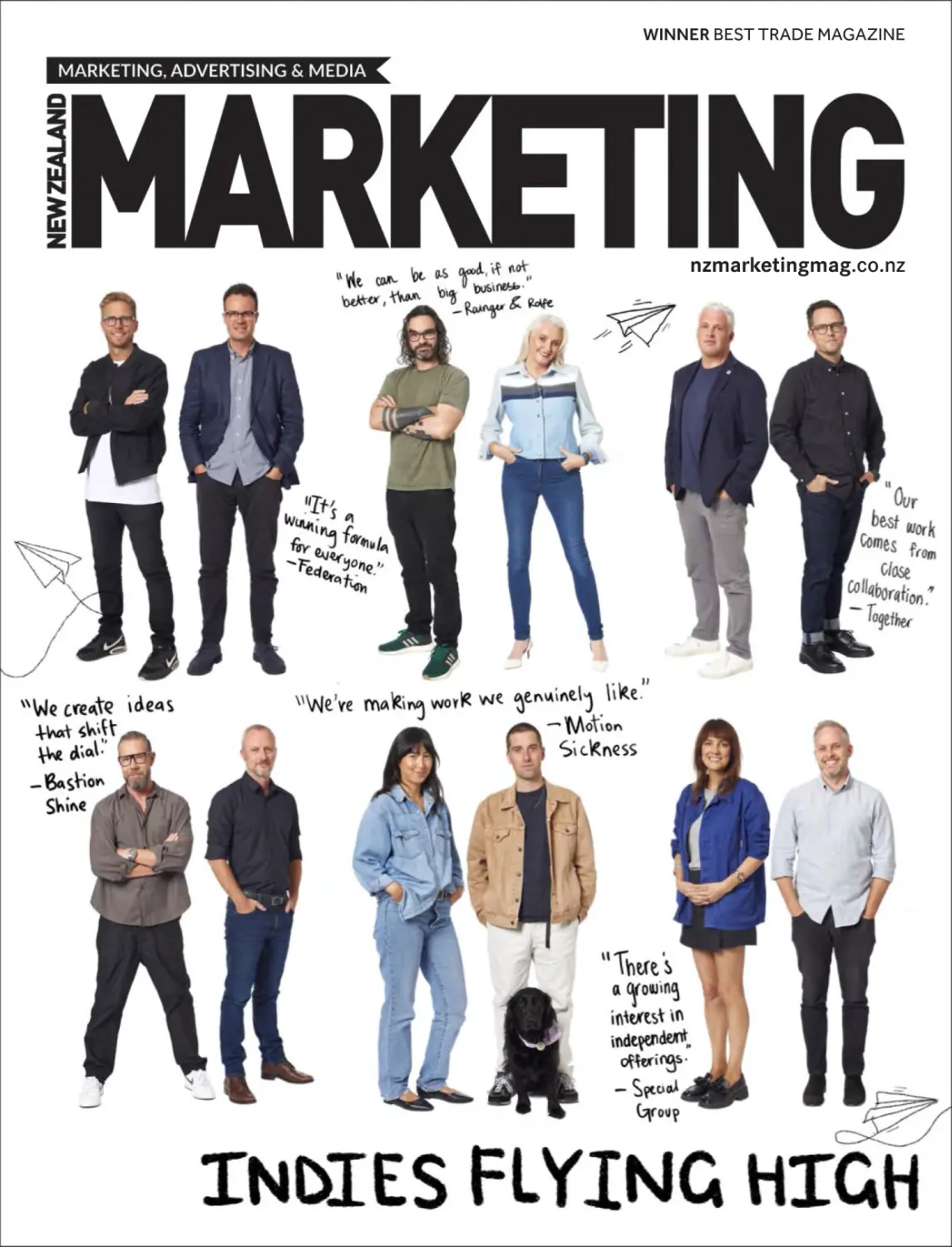
ON THE COVER…
… are the driving forces
behind some of New
Zealand’s most
successful indie
agencies (clockwise
from top left): Brad
Collett, Olly
Walker-Boden, Kelly
Putter, Jen Rolfe, Rufus
Chuter, Kris Hadley,
Jonathan McMahon,
Lisa Fedyszyn, Sam
Stuchbury, Hilary Ngan
Kee, Andy McLeish and
Richard Maddocks.
s we go to print, the industry’s still reeling
from the dramatic developments of Warner
Bros Discovery’s proposed Newshub closure
and TVNZ’s axing of beloved and profitable
shows like Fair Go and Sunday. It’s a tough time for the
media industry in New Zealand, and our thoughts are
with all of those affected by these changes. To get a
deeper – and more positive – view of the evolution
of media in Aotearoa, turn to page 92.
Bigger isn’t necessarily better for creativity, and
New Zealand’s smaller media agencies have been
winning pitches, grabbing headlines, attracting
talent from global networks, and scooping the
pool at local – and international – industry awards.
In late 2023, several of these Kiwi indies formed
IMANZ (Independent Media Agencies New Zealand), to
demonstrate the value of working with locally owned outfits.
Often, indie creative, media and digital agencies collaborate to offer diverse
capabilities. “We’re incredibly lucky to operate in such a supportive independent
agency environment,” says Chair of the Comms Council Media Committee, Rufus
Chuter, in our story on page 20, in which we pay tribute to how indies are thriving.
“We’re competitors, but also comrades, which is pretty special.”
It’s hard to believe, but the Marketing Association (MA) is celebrating its 50th
year of “helping marketers be brilliant”. Congratulations to our partners at the
MA on reaching this milestone; you can read about their journey on page 106.
The NZ Marketing Awards has a new naming sponsor, which secures our ability
to deliver a world-class awards offering that celebrates excellence in all areas of
marketing. Get the lowdown on this exciting development on page 6.
The rest of this issue is jam-packed with the usual news, insights, profiles,
opinions, features, case studies and more. Enjoy!
The NZ Marketing team (above, from left): Bernadette, Alisha, Niko and Vernene
PS We were sad to hear of the passing of industry legend David Gapes. RIP.
March-April 2024 NZMARKETINGMAG.CO.NZ | 1
contents
March-April 2024
MAP OF
ADLAND
26 32
Features
14
20
92
Ìõèä÷òõèæòñòðü÷õèñçö
Bernadette Basagre looks
into the evolving world
catering to social media
users – all 4.9 billion of us.
97
Òñçìèöĥüìñêëìêë
Ýëèêòòçñèúöìö
Ëäæî÷ò÷ëèéø÷øõè
36
àèđõèèñêäêèç
10
àëèñæøö÷òðèõöæòðèĤõö÷
understanding their preferences
is vital. Here’s how.
40
ÊÒìñ÷ëèöóò÷ïìêë÷
àëä÷çòäõ÷ìĤæìäïìñ÷èïïìêèñæè
and machine learning really
mean for the industry?
80
Ðè÷öäùùü
Òñçøö÷õüìñöìêë÷ö
Some bits and bobs to keep
in your back pocket.
26
ÊêèñæüóõòĤïè
Êé÷èõö÷äõ÷ìñêìñäö÷øçèñ÷ĥä÷
Motion Sickness is up there with
the best. How did that happen?
32
40
Out of Home but not out of
ideas, digital OOH is one of
the key remaining ways to
achieve mass reach.
Regulars
2 | NZMARKETINGMAG.CO.NZ March-April 2024
Presented by
Yes, it’s a tumultuous time,
but it’s not all doom and
gloom for traditional media.
Local independent agencies
punch above their weight.
We had a chat to some of the
small but mighty among them.
Niko Kloeten asks how clever
retail marketers can respond
to the cost-of-living crisis.
2024
47
Þó¡¡æòðèõ
56
Ýòó! äçöäñäïüöìö
ÖäóòéÊçïäñç
The fourth edition of our industry
resource provides marketers with
a comprehensive overview of the
agency landscape in Aotearoa.
Aaliyah Wattie of YoungShand
tells how ‘always on’ works in
her favour.
TRA’s Carl Sarney has the
secrets to making it onto the list
of New Zealand’s top 10 ads.
58
64
Ëèëìñç÷ëèöæèñèö
DDB Group Aotearoa gives a
glimpse into their hot summer
campaign for McDonald’s.
Ëõäñç÷òúä÷æë
Start-up investment company
Goldie is turning heads with its
disruptive, inclusive strategy.
108 Öèçìäðòùèõ
Karl Puschmann talked to Ryan
Bridge about his new show just
before the Newshub news.
Now what?
112
Ìõèä÷ìùèæïòöèõ
CCO at Bastion Shine, Richard
Maddocks, on the good, the
bad and how not to go mad.
Views .
66
76
88
111
Ùïäüìñê÷òúìñ
Super Bowl game plans with
Mikayla Hopkins of Tracksuit.
Üìýèðä÷÷èõö
Graham Medcalf investigates
New Zealand’s biggest venues
¢äõè÷ëèüøó÷òöñøģ
Óøö÷üòøõïøæî
Our insight gurus Carl Davidson
and Duncan Stuart embrace
an unavoidable uncertainty.
Üòæìäïðèçìäòé÷ëèðòðèñ÷
Go viral like it’s 2020 with advice
from The Attention Seeker’s
Stanley Henry.
58
97
March-April 2024 NZMARKETINGMAG.CO.NZ | 3
Our contributors
Our magazine leans
on the generosity
of industry thought
leaders sharing their
expertise. Some of
those who’ve weighed
in with news and views
this issue include:
4 | NZMARKETINGMAG.CO.NZ March-April 2024
Kyle Bell
Sinead Boucher
Head of Marketing at Live Nation
Entertainment on the power of brand
activations at a favourite festival.
CEO of Stuff on the proposal
to make technology giants pay
for the local news they use.
Karla Fisher
Jennifer Gunn
Lead Business Partner at DDB
on helping McDonald’s take
a bite out of summer.
Head of Sustainability, Ad Net Zero
at the Commercial Comms Council on
getting to grips with greenwashing.
Andrea Meredith
Natasha O’Connor
Chief Experience & Delivery
Officer at Merkle on crucial
CX imperatives to note now.
CEO of OOHMAA on what’s up
with Out of Home advertising and
the reach of the classic billboard.
Diane Clark
Mat Croad
Esther Dawson
Head of Marketing & CX for
Four Square on rebooting
a much-loved brand.
Co-founder of Pals on brand
presence and good times on top
of the hill at Rhythm & Vines.
Marketing Director at ODV on
putting your video-marketing
eggs in different baskets.
Stanley Henry
Hannah Koumakis
Cam Maclachlan
CEO of The Attention Seeker
on what TikTok forgot and
Instagram’s getting right.
Gen Z content creator on how
to deliver for an audience
and the algorithm.
Co-founder of Goldie on
taking an inventive approach
to a shiny new offering.
Luke Rive
Sam Stuchbury
Merv Williams
Director of Marketing at
McDonald’s on why ‘It’s Good
to be the Driver’ is so good.
Founder and Executive
Creative Director of Motion
Sickness on turning 10.
Chief Marketing Officer at Gallagher
Security on battling global rivals
with bigger budgets.
March-April 2024 NZMARKETINGMAG.CO.NZ | 5
YouTube moves to support our annual showcase of marketing magic.
T
he NZ Marketing Awards are set to change,
with YouTube becoming the primary naming
sponsor. This year, our exciting celebration
of industry excellence will be rebranded as
the YouTube-NZ Marketing Awards.
The YouTube-NZ Marketing Awards will laud the collective
expertise in strategic and creative thinking that underpins
Aotearoa’s top campaigns. Its prestigious accolades will
recognise exceptional professionals and their work that
has shaped successful businesses across all aspects of
the discipline, honouring visionaries who’ve pushed the
boundaries of marketing as we know it.
YouTube has a rich history of recognising the most
innovative and creative campaigns. As marketing has
evolved, the video-sharing platform has become an
epicentre of creativity, a canvas onto which brands
can paint their stories in vibrant hues that resonate
with their audiences.
“Everyone is on YouTube, yet every person’s YouTube
is different,” says Country Director for Google New Zealand,
Caroline Rainsford. “Advertisers can show up where
audiences are through the one platform that’s multicategory, multi-screen and multi-length. As times have
changed, YouTube has become the place for creativity.”
The numbers speak volumes. More than two million
6 | NZMARKETINGMAG.CO.NZ March-April 2024
people in New Zealand streamed YouTube on their TV
in June 2023, with the website reaching an astonishing
3.5 million individuals aged 18 and above, encompassing
a staggering 90 percent of the country’s adult population.
Although brands have many different objectives, they have
a big one in common – the desire to connect with audiences
and achieve marketing results across many platforms,
including YouTube’s solutions, powered by Google AI. This
new sponsorship deal between YouTube and the NZ Marketing
Awards highlights YouTube’s continued momentum, while
championing successful creators and brands.
NZ Marketing and the Marketing Association would like
to thank TVNZ for their support in previous years, and
now, as we anticipate this year’s event, which will take
place on September 4 at Auckland’s Spark Arena, we look
forward to enjoying the YouTube-NZ Marketing Awards
as it continues the long-standing tradition of celebrating
marketing success across all channels through meticulously
judged case studies. Categories will run the gamut, from
advertising to brand marketing, customer experience to
data-driven strategies and more. See you there?!
Think you’ve got what it takes to become one of this year’s
winners? Turn to page 17 for more information.
IN ASSOCIATION WITH FEDERATION
ÏÛØÖÕÎÏÝFEDERATION’S CHIEF STRATEGY OFFICER DAN BYE, FOUNDER AND CEO SHARON HENDERSON,
ÌÑÒÎÏÌÛÎÊÝÒßÎØÏÏÒÌÎÛËÛÊÍÌØÕÕÎÝÝÊ×ÍÖÊ×ÊÐÒ×ÐÍÒÛÎÌÝØÛØÕÕâàÊÕÔÎÛ´ËØÍÎ×
2024: the year for
transformation at speed
As the economic downturn intersects with unprecedented new opportunities,
indie advertising agency Federation says that for many brands and businesses,
now’s the perfect time to shake things up.
I
n 2024, Federation is an agency
that’s leading transformation
and defying downturn trends.
One of New Zealand’s most wellestablished independent advertising
agencies, it’s a company that’s built
a reputation for continually zigging
in a zagging industry. In recent
months, it has announced a string
of senior appointments, including
awarded creative leader Brad Collett
as Chief Creative Officer; internationally
recognised Dan Bye, a double-global
Effie winner, as Chief Strategy Officer;
and the promotion of Cambridge
University sustainability-qualified
Olly Walker-Boden to the role of
Managing Director.
Federation views 2024 as the
shake-out year for many brands
and organisations – a year in which
economic downturn intersects
neatly with unprecedented
opportunity via rapid strategy
acceleration and transformational
change that fully optimises future
results. CEO Sharon Henderson
says they know a thing or two
about ensuring a business remains
forward-facing. The agency – which
she herself founded in 2008, during
the global financial crisis (GFC) – forces
itself to change continually to ensure
it adapts to an ever-changing business
landscape she believes has accelerated
into three-year cycles.
“Our hypervigilance for staying
ahead of future trends on behalf of our
clients is how we’re able to continually
drive their brand growth and financial
performance,” she says.
Henderson says marketers need
to know they have experts working
alongside them who have genuine
commercial acumen, who can deliver
March-April 2024 NZMARKETINGMAG.CO.NZ | 7
day-to-day results while building
brands that consumers are glad to
have in their lives, and developing
marketing business cases that can
pass the most rigorous boardroom
tests if required. “It’s why our own
capabilities as an advertising company
and client partner never stand still,
making us the bedrock behind some
of New Zealand’s most resilient,
high-growth brands and some of the
world’s best-known consumer brands.”
ËÎÜÝ´ÌÊÜÎÜÞÌÌÎÜÜÜÌÎ×ÊÛÒØÜ
“We get it that marketing is a major
financial investment on any company’s
balance sheet, and never more so than
in 2024,” says Walker-Boden. “If you’re
a marketer or C-suite leader reading
this now and thinking, ‘Yes’, get us in
and let’s talk about what you want to
achieve. The first thing we’ll want to
know is what success looks like to
you. We’ll want to know your bestcase success scenario, and our
process works backwards from there.
“We’re genuinely in the business of
solving problems and bringing instant
horsepower and acceleration to market
opportunities – and it sets us apart,”
he continues. “We’ve always been
obsessed with creativity, but have
an equal obsession for delivering
commercial growth and consumer
behaviour change results. It’s why
we remain one of New Zealand’s
most progressive independent
advertising companies in 2024.”
Walker-Boden points to the success
of Federation client The Co-operative
8 | NZMARKETINGMAG.CO.NZ March-April 2024
ēØøõæäóäåìïì÷ìèö
äöäñäçùèõ÷ìöìñê
æòðóäñüäñçæïìèñ÷
óäõ÷ñèõñèùèõö÷äñç
ö÷ìïïðäîìñêøö÷ëè
åèçõòæîåèëìñçöòðè
òé×èúãèäïäñçđö
ðòö÷õèöìïìèñ÷ëìêë¡
êõòú÷ëåõäñçöĔ
SHARON HENDERSON
CEO, FEDERATION
Bank, which the agency won in
early 2023. He says that although
it’s a comparatively new partnership,
it has already produced step-change
market-share results, achieving more
than double the bank’s actual growth
target in less than a year. “It’s a truly
exciting time for The Co-operative
Bank and full credit to their Chief
Marketing Officer Catherine Bateman
for enabling this genuine strategic
partnership to deliver so quickly.”
Walker-Boden joined Federation
in 2018 from Colenso BBDO, having
previously been based in the UK,
where he worked at London agencies
RKCR/Y&R and Glue Isobar across
brands such as Adidas, Budweiser,
Lloyds Banking Group and Vodafone.
As Managing Director, he’s continuing
to raise the bar for Federation’s
sought-after strategy design-thinking
approach that combines creativity with
communications, tech and intelligence
capabilities, further integrating them
across all areas of the company’s
business and client offerings.
THE FOUR FORCES
Strategy design-thinking is the
cornerstone of the agency’s approach
to solving marketing and business
problems, and is led by Bye, who
had previously been consulting to
the agency for more than 12 months.
“Dan’s one of our industry’s most
talented strategy leaders and offers
our clients incredible knowledge
garnered from working across global
markets and brands, and a leadership
experience that spans a trifecta of
client-side, media and creative
agencies,” says Henderson.
The recently appointed Chief
Strategy Officer’s work has been
internationally recognised and has
led to him being ranked in the top
10 planners in the world. He’s also
a double Global WARC Effie winner
and is a huge proponent of creative
effectiveness and creativity as tools
to drive business performance.
Bye is equally ambitious for the
opportunity 2024 represents to
marketers. “Innovation is the biggest
problem clients are facing in 2024,
exacerbated by the economic climate,”
he says. “We’re living in an age of
strong prevailing headwinds, both
short- and long-term. It’s common
in this pressure-cooker environment
to overestimate the short-term and
IN ASSOCIATION WITH FEDERATION
underestimate the longer-term
impact of things [aka Amara’s Law].
“For marketers, there are four forces
to wrangle and get ahead of in 2024,”
he continues. “The first is economic
headwinds, particularly the significant
drop in consumer demand in the
current economic climate, and in
categories over-satiated over Covid.
The second is audience fragmentation.
Recent restructures at TVNZ and
Discovery have highlighted the
fragility of the New Zealand media
industry and the impacts of consumer
fragmentation at play. The ability to
reach audiences will require more
channels to achieve the same results.
“The third force is AI. Is it buzzword
bingo or a creativity killer? It’s too early
to tell, but if Amara’s Law is anything
to go by, we’re still a way off truly
understanding the future ramifications
of AI on society and marketing. In
the meantime, understanding and
appreciating it is something we’re
embracing as an agency, to identify how
to leverage technology to maximum
benefit for our clients.
“The fourth force is sustainability.
Both societally and from a business
perspective, we need to make conscious
decisions around how we transition
and move faster towards a net-zero
world. It’s why Federation has led
the industry as an early adopter,
qualifying with Cambridge University’s
Sustainability Leadership Institute
in 2021 and 2022, and working as
consultants to marketers and business
in that arena ever since, to maximise
the value of purpose and minimise
the risk of greenwashing.”
successful new market launches
in the world.
“Our remit covers the entire
marketing funnel. There’s a serious
push by clients to help them streamline
marketing efficiencies by connecting
different disciplines and channels
together. Resolving that tension is easy
for us and a skill that we’ve always had
– it’s implicit in the name Federation.”
“This is the year for an agency
like Federation,” says Collett, who
has helped secure creative and
effectiveness awards for New Zealand’s
multinational agency network brands
on the local and global stages. During
his career, Federation’s new CCO
has crafted some of New Zealand’s
most loved campaigns, for brands
including Lotto, KFC, McDonald’s,
Tui, Toyota, Heineken, The Warehouse,
BMW, Carl’s Jr, New World and
Rebel Sport.
“Federation has a future-fit,
forward-thinking business model
and breadth of talent that exudes
energy and drive,” he says. “There’s
a passion in the leadership team
combined with that indie spirit that
I think is everything clients need to
thrive in 2024. Already I’m seeing an
agency that cuts through bureaucracy
to prioritise clients’ interests, grasp
their unique challenges and deliver
work that cuts through and drives
results. It’s a winning formula
for everyone.”
For more info, email ollyb@federation.
net.nz or sharonh@federation.net.nz,
or visit federation.net.nz.
ÏÞÝÞÛÎÏÒÝÏØÛàÊÛÍ´ÝÑÒ×ÔÒ×Ð
Agencies like Federation that
were born in the GFC are now lead
agencies, helping clients navigate
the world. “Our role for clients has
increased over the past year and
become much more about being
both orchestrator and facilitator,
right into channel performance,”
says Henderson. “There’s been
a big shift away from TV-driven,
traditional multinational agencies.”
Walker-Boden agrees. “We’re
breaking down the barrier between
brand and performance marketing,
and our client DoorDash, the numberone on-demand delivery service in the
US and Canada, is testament to that.
Their full-funnel marketing launch
via Federation was among their most
March-April 2024 NZMARKETINGMAG.CO.NZ | 9
Ê÷õìòòéåì÷è¡öìýèçöñìóóè÷öéøïïòé÷äö÷ü
÷äîèäúäüöéõòð÷ëòöèìñ÷ëèîñòú
THE CASE FOR
ÌØ×ÝÎ×Ý´ÏÒÛÜÝ
ÝÑÒ×ÔÒ×Ð
Content Director at Digitas
New Zealand, Chris Brunner,
addresses the power of
æòñ÷èñ÷¡Ĥõö÷÷ëìñîìñêìñ÷ëè
era of information technology.
Content has long been the engine
powering businesses to succeed
in the information age. As we enter
the ‘intelligence age’, heralded by
democratised, generative AI, content
quality and structure are more
important than ever.
By putting content at the forefront
of the creative process, brands can
ensure substance is built into every
marketing effort. Because content
is everywhere and required by all,
content-first thinking unifies
stakeholders around tangible outputs.
Brands and their agency partners
often take a channel-by-channel
approach to content; one group thinks
about advertising, another thinks about
the website, another thinks about
customer communications. We have
a habit of rushing to the outputs without
underpinning them with a structure
that connects and enriches the
customer experience. To address this,
we use a connected model that brings
together our customer experience
experts at Digitas, creatives at Saatchi
& Saatchi and media specialists at
Spark Foundry and MBM, to develop
unified strategic responses built on
omnichannel experience.
Content-first thinking advocates
for starting with the message and
building everything else around it. It’s
about prioritising substance over style
and ensuring every design decision
10 | NZMARKETINGMAG.CO.NZ March-April 2024
serves the content’s purpose. In doing
so, brands can expect to see several
business impacts:
• Empowered teams. Digital
content isn’t just about products
and marketing – it’s about
empowering teams with shared
resources, skills and a unified
strategy. Through a contentfirst approach, teams can work
collaboratively, leveraging existing
assets and maximising efficiency.
Content can be a strategic asset
that drives productivity and
fosters innovation.
• Increased efficiencies. We’ve
applied a content-first mindset
while working with high-profile
local brands, connecting the dots
between above-the-line media and
personalised digital experiences.
It’s about strategically placing
content across the entire customer
journey and increasing content
reuse across channels. For one
major automotive client,
engagement increased by 17
percent and call centre enquiries
reduced by almost 30 percent.
• Better-informed and moreengaged customers. Customers
are dependent on content – it
helps them find what they need
and is often the very thing they’re
looking for. It’s in every interface
and every channel. It stands to
reason that putting content first
in our thinking is, in fact, putting
customers first.
For too long, customers have had
to cross the chasm between marketing
and product on their own. Content can
be the bridge between them. It’s the
very thing that takes them from being
an outside observer of your brand to
a loyal advocate within it.
Content-first strategies work because
they’re tied to real assets. Content
performance can be measured, tested
and shipped relatively easily. The next
time you’re solving for customers,
think about the content they’ll need
along their journey, and you’ll be
thinking content-first too.
We’re Momentum.
We’re full-service media.
We’re independent
and we go further.
We elevate performance.
We accelerate business.
We power potential.
We push creativity.
We drive results.
We move the dial
and we never stop.
That’s momentum.
Ready to go further?
Let’s give your business a little
more momentum.
momentumgroup.co.nz
You’ve got the
music in you
Don’t give up! We might be
experiencing a cost-of-living
crisis, but people are still forking
out big bucks to attend live music
and entertainment events. Live Nation
Entertainment reports that New
Zealand and Australia have seen an
increase of 26 percent in the number
of gigs, while ticket sales are up by 79
percent. Marketers can gain from this.
Two studies by Live Nation reveal
that live music and entertainment
are driving brand loyalty, despite
people’s urge to spend money being
at an all-time low. The Love Song
study by Live Nation and experiential
and creative agency Secret Sounds
focused on Gen Zers and revealed
that 83 percent of those surveyed
are seeking real-life experiences over
digital. With the return of live gigs,
many are finding solace in these kinds
of moments, with 89 percent saying
music is integral to who they are.
“We’re seeing Gen Z living in the
moment, with 90 percent preferring
12 | NZMARKETINGMAG.CO.NZ March-April 2024
KRISTY ROSSER
to spend on experiences over
possessions,” says Kristy Rosser,
Founder of Secret Sounds Connect,
and Senior Vice President, Marketing
Solutions & Client Services at Live
Nation ANZ. “They’re prioritising
‘little treats’ daily and over half are
saving towards a future experience
such as a concert or a music festival
over ‘big-ticket items’. More and
more, they value their escapism,
embracing experiences aligned to their
passions and living in the moment.
Their priority of saving for experiences
over possessions is in stark contrast
to [previous] generations.
“Live music and entertainment
continues to grow in scale for Gen
Z,” she continues. “They’re embracing
concerts, festivals and events that
combine the genres they love. After
friends, Gen Z trusts music artists,
which shows the incredible role
music plays in their life.”
In fan-insight study Driving Loyalty,
78 percent of Kiwis stated they’d sign
up for a new brand-loyalty programme
based on a brand’s live music and
entertainment offerings. Globally,
New Zealand is ranked as one of the
most engaged consumer groups when
it comes to brand loyalty programmes.
“Music remains our collective
obsession and audiences are more
engaged than ever, so we only see
this demand growing over the next
few years,” says Rosser.
For marketers, that’s an opportunity.
Telecommunications brand One NZ
is one that has identified it, jumping
on the bandwagon by offering its
customers perks like early access
to tickets. With Kiwis going so far
as to travel to Australia to see Taylor
Swift’s Eras tour, music presents a
way to tune into consumer behaviour
that may otherwise be restricted by
the current economic situation.
INSIGHTS
ÝÑÎ×ÎàÎÛÊØÏÙÛÒßÊÌâ´
ÌÎ×ÝÛÒÌÖÊÛÔÎÝÒ×Ð
Country Director of Google New Zealand,
Caroline Rainsford, has tips for how to prepare for
the upcoming year of privacy-centred marketing.
Over the years, people have grown increasingly aware of
what personal data is collected, used and shared. In a survey
of 1,500 Kiwis, 55 percent of adults said they’re concerned
about how their data is being used in online advertising,
and one in three don’t like personalised ads because they
don’t feel in control of how their data is used. The message
from consumers is clear: now is the time to take a hard
look at your ads’ privacy strategy and get a realistic picture
of how much you still rely on legacy technologies like thirdparty cookies.
Alongside existing platform changes in Safari, Chrome
intends to begin phasing out third-party cookies in the second
half of 2024. The Privacy Sandbox for the web reached “general
availability” for the relevance and measurement APIs, and
Chrome has deprecated one percent of third-party cookies
globally in January.
Major shifts may be daunting, but they’re not new.
Think of the pivot to mobile. Initially, many marketers
ignored it and resisted the change, partly because the tools
we used on desktop simply didn’t work on mobile at the
time. Eventually, marketers embraced where people were
headed, which unlocked an unprecedented period of growth
and innovation. Here’s how to prepare for the coming year
and beyond:
2.
3.
valuable sign-ups and better-quality customers,
and a 45 percent increase in return on ad spend.
Lean into AI-powered solutions. AI-driven tools
require less data to make predictions and fill in the
gaps for unknowns to help you optimise for your
campaign goals. Brittain Wynyard, a New Zealand
distributor of sports, outdoor and lifestyle brands,
doubled down on their Performance Max lead ads
strategy, complementing the approach with value-based
bidding and paid search. Their key brands Asics and
Birkenstock saw a 31 percent increase in return on
ad spend year on year by leveraging the best of AI.
Test and implement privacy-enhancing technologies
(PETs). Marketers should start testing and getting
comfortable with PETs. Ad-tech providers should
start testing the Privacy Sandbox APIs and other
privacy-centric tech to find the best outcomes for
your business.
THE TIME TO ACT IS NOW
Marketers who think the end of third-party cookies is far in
the future are already behind; companies that have started
to embrace this new mindset shift and privacy preserving
techniques are starting to see gains. Put bluntly, privacy
is good for business.
Regardless of where you stand, the landscape has changed.
Third-party identifiers are deteriorating fast. It’s time to
embrace the change and enter a new period of innovation
and growth – together.
RESET YOUR MINDSET
Today’s era of digital advertising requires a new approach.
Marketers need to shift from “precision” to “prediction”
in order to deliver results at scale. We’re building new
technologies to deliver advertising performance without
privacy compromises. Google’s approach centres on
first-party data, AI and privacy-preserving technology.
What we’ve traditionally come to expect in how we
reach and re-engage audiences and measure campaign
performance has been changing already and will come
to a head soon. Remarketing is an example. It’s arguably
been one of the catalysts for people’s concerns about privacy
online because it’s perceived as following people across
the web. In a world without third-party cookies, standalone
remarketing campaigns are unlikely to achieve the same
scale as today, without additional technology like AI.
CREATE A DURABLE STRATEGY
We’ve been talking about the importance of adopting
privacy-centric, durable strategies and solutions for
years, and now we’re at the point of no return. Three
key actions are required:
1. Strengthen your first-party data strategy. Building
and strengthening your first-party strategy is more
important than ever, especially as consumers move
from device to device and are harder to reach. New
Zealand-based global fitness brand Les Mills leveraged
their first-party data within value-based bidding to
improve the efficiency at which their search campaigns
drove valuable sign-up and subscription conversions.
The results showed a seven percent increase in more
March-April 2024 NZMARKETINGMAG.CO.NZ | 13
What’s trending
ìñ÷ëèæõèä÷òõèæòñòðü
With 4.9 billion social
media users globally
and the global spend
òñìñĥøèñæèõðäõîè÷ìñê
increasing by 17 percent
in the past year, it’s clear
the creator economy is
becoming a juggernaut.
How can brands take
advantage of this
emerging force in the
marketing world?
WORDS BERNADETTE BASAGRE
14 | NZMARKETINGMAG.CO.NZ March-April 2024
TREND 1:
ÒÝđÜÝÒÖÎÝØËÎÛÎÊÕ
Having grown up with the internet,
Gen Zers are considered digital
natives, unfamiliar with a world
before the world wide web. Since
they were born into this environment,
they know social media typically
involves the sharing of the highest
highs but never the lowest lows.
After years of being exposed to
picture-perfect Instagram feeds,
Gen Z is flipping the switch and using
social media as a place in which to be
their most authentic. BeReal took off
in 2023, and as its name suggests, is
all about being real. More than 20
million users get a random notification
from the app every day, prompting
them to take a picture in the following
two minutes of themselves ‘being real’.
“As Gen Z, we have such a small
attention span that if we sniff anything
that’s inauthentic, we’re like, ‘Nah’,”
says TikTok content creator Hannah
Koumakis. With 160,000 followers
at the time of writing, Koumakis has
paid partnerships with several brands
who hire her to promote their message.
“When brands approach influencers or
content creators, [they need to] make
sure it’s reciprocal because otherwise,
the audience knows,” she says.
Group CEO of creative company
Thompson Spencer, Melanie Spencer,
says this trend is being dubbed
as ‘lo-fi’ across the landscape.
“Authenticity has doubled down and
creators are upping the ante with even
more raw/real content that tends to
be lo-fi, but what’s imperative here
is the content has to really connect
with their audience.”
As a content creator known for her
financial advice, Koumakis says her
audience will know her relationship
with a brand is inauthentic if it’s a
brand that’s “super out of the blue” and
doesn’t align with her own. That’ll see
them swipe away faster than usual.
“I’m kind of more known for my
typical Hannah style – sit down and
talk to the camera in my office or
bedroom – so if I do a brand deal,
it’s like that because it’s familiar for
my audience and they can go, ‘We
know what this is and we know
what to expect’. It’s important to
know that as content creators,
we do say no. We don’t just take
everything for the money. We really,
truly admire our audience, and we
want to make sure we’re showing
people authentic stuff.”
Companies need to be taking
advantage of this trend and being
FEATURE
more selective when it comes to
influencer campaigns, says Spencer.
“Gone are the days of ‘spray and pray’
Wild West influencer campaigns.
[This year] will be far more strategic.
We’re going to see a move away
from transactional brand-creator
partnerships, and creators having
more control.”
On a global level, the annual spend
on influencer marketing has increased
by 17 percent, proving that these
creators are deepening their influence
as they tap into more authentic and
human content.
CEO of brand marketing agency
The Attention Seeker, Stanley Henry,
says companies need to be embracing
the influencer market now more than
ever, before these content creators steal
brands. “It’s either get on board or lose
your business.”
Spencer agrees, asserting that
2024 is expected to be the year that
influencers white-label products
and sell directly to their community.
It’s happening internationally, with
popular influencers taking products
they’re associated with for themselves.
An example of this is one of the
most popular creators on the lifestyle
scene, American Emma Chamberlain.
Heavily associated with coffee, she
saw an opportunity to tackle the
market and create her very own
Chamberlain Coffee, which is already
making a splash globally. What she
has that many of her competitors
don’t is influence, and for a creator
like her, marketing is cheap.
If brands miss opportunities to
partner up with creators, they might
just steal their business and ultimately
become their biggest rivals.
TREND 2:
ÜÑØÛÝØÛÕØ×Ð
ÝÒÌÔÊÕÕÝÑÎËØáÎÜ
Moving on from the years of 10- to
30-minute videos, platforms such
as TikTok are champions of shortform content, with audiences quickly
jumping from one 30-second video
to the next. The likes of TikTok,
Instagram Reels and YouTube Shorts
are disrupting the video industry,
says Spencer.
Trends are cyclical, though, and
this isn’t the first time we’ve seen
a renaissance of the short-form video;
six-second video platform Vine took
the world by storm in 2014. We may
ēÏòõåõäñçöäñç
æõèä÷òõöëäùìñê
üòøõåäöèöæòùèõèç
äñçêòìñê÷ëèèû÷õä
ðìïèìöäïúäüö
äêòòçìçèäĔ
ESTHER DAWSON
MARKETING DIRECTOR, ODV
be in an age of short-form video,
but it could only be a matter of time
before long-form content reprises
its role as a major form of content.
Digital Content Manager at creative
video agency ODV, Jaime Turner, says
that rather than jumping on trends,
now’s the time to be repurposing
content to ensure all your boxes
are ticked.
“You shouldn’t necessarily just
be banking on short videos really
working for you if A, you don’t have
much evidence to prove that, and
B, you never know who’s going to be
watching your content. Sometimes
you might have somebody who’d
actually much rather see an
informational, longer-form video
that can still be really engaging,
and then at other times, you have
somebody who needs to see six
seconds and is done, and the
message has got through. For
brands and creators, having your
bases covered and going the extra
mile is always a good idea.”
ODV’s Marketing Director, Esther
Dawson, adds that the most effective
video-marketing campaigns are
often the ones that offer a variety of
forms of content, whether integrated
YouTube ads or 15-second Instagram
stories. “The beauty of that is people
see them across different channels,
but [they all] see a different part
of the campaign and it all works
together beautifully.”
Rather than focusing solely on
trending platforms like TikTok,
Dawson says you should put your
eggs in different baskets, or in this
case, channels.
Brands need to be utilising the
tools in front of them, seeing TikTok
as a discovery platform and pushing
brand awareness via short-form
content, then later evolving into
platforms such as YouTube to
create longer videos to nurture
and maintain audiences.
The discussion of whether our
attention spans are shrinking is
misconstrued, says Turner. In an age
in which billions of videos and photos
are uploaded onto the internet every
day, audiences are being more selective
about the content they consume.
Given audiences are now able to
count down and skip ads at their
discretion, ads are no longer content
people need to sit through. Brands
should therefore be creating engaging
videos that will attract their desired
consumers’ attention.
“From a brand perspective, you
can have longer-form content if it’s
engaging, because people will watch,”
says Dawson. “If you edited a 60second video in a really engaging
style, it’d feel like short-form to
someone, so you have to be clever
about the way you approach video.
Brand videos need to be no more
than 60 seconds, but once you get
into that retargeting phase of people
who are brand aware, that’s when
you can branch out.”
With regards to fighting for the
audience’s attention when an ad
comes up on social media, Dawson
and Turner say videos need to be
“unexpected, and surprise and delight
the viewer”, to leave consumers with
an intriguing brand experience.
Long-form or short-form, whether
you’re a small or a large business, the
best approach to video is emotional
marketing that builds on deeper
connections with audiences.
“There’s going to be a lot more
marketing that plays into people’s
psyche when it comes to empathy
and putting themselves and the
brand in the consumer’s shoes
and really playing with their pain
points,” says Turner.
March-April 2024 NZMARKETINGMAG.CO.NZ | 15
TREND 3:
ÝÑÎÛÎÐÞÕÊÛÌÊÏŰ
ÌÞÜÝØÖÎÛÝÑÎØÛâ
Cafés don’t make a lot of spontaneous
money. A lot of their revenue comes
down to regular customers who come
in daily and order the same thing.
Henry relates this theory to the
regular audience – consumers who
are engaging with content on their
phones every day. This is the audience
that’s vital to unlocking the best of
marketing within the creator economy.
In general, social media platforms
and their algorithms champion
consistency, because it’s human
nature that if someone loves
something, they’ll come back to
it, even if that might not be daily.
“People love coming back to the
same thing and knowing they’re part
of something,” says Henry. “They
don’t have to come back every day,
but they know when you’re there.”
This isn’t a new concept. Daily
audiences are easy to capture on
mediums like radio and TV. The
6pm news is a form of content
audiences around the world
congregate to consume. Local
radio personalities like ZM’s
Carl Fletcher, Vaughan Smith
and Hayley Sproull are able
to develop a daily audience by
driving people to come back
to their show every day at 6am
and building a community with
their listeners.
With the advent of social media,
there’s a new way to capture a
regular audience, and brands do
well to pump out their own consistent
and consumable content to encourage
people to come back. Smart influencers
have already been able to capitalise on
this and build brands off the back of
these audiences. Coffee was a key
element of Chamberlain’s online
content, so in creating her own brand,
she’s been able to switch her daily
audience into daily customers.
Koumakis says that whether it’s
a TikTok vlog or an Instagram story,
posting consistently has built her
audience not only in number but
also engagement. “Just show up
genuinely every single day and
you’ll find you’ll start growing an
audience that truly loves your
brand,” she says. “If you’re a brand,
take people back and show them the
factory, show them all these things.
16 | NZMARKETINGMAG.CO.NZ March-April 2024
People love transparency, and
that’s why people love my budgeting
videos, because there’s no one
who’s transparent these days.”
Many businesses are already
focusing on posting every day.
Auckland-based bakery The Sugar
Dealer invites its audience to join
them behind the scenes of making
their products, while The Attention
Seeker lets its audience in on life
in the office.
With regards to producing
consistent material, Turner and
Dawson say the days of copycat
content are disappearing. Now,
the focus is on innovative ideas.
“[Brands] like Ryanair and Duolingo
have really established this space
with brand voice, something that’s
fresh and relatable to all generations,
and that’s really personable,” says
Dawson. “But a lot of companies
are almost just copying that voice
and tone, and it gives their customers
the ick, because they’re not being
true to the industry, or true to who
they are or what their customers
are looking for. You can’t just copy
a brand voice that’s worked for
someone else and assume it’s
going to work for you.”
In an era in which trends come
and go at the speed of light, imitating
trending videos puts brands at risk
of appearing inauthentic and not
what the company stands for.
Instead, it’s all about staying
true to brand values while
also throwing a little
unexpectedness into the mix
– perhaps something wacky
to catch people’s attention,
a bit of humour to lighten
the mood or storytelling
to retain interest.
“I think we undervalue
the customer too much
[and] assume they’re
a passive consumer
who might be
swayed this way
and that, but
they’re intelligent
beings who
aren’t just
going to
love your
brand
because you
did one funny
thing one time,”
says Dawson.
ēÙèòóïèïòùè
÷õäñöóäõèñæüäñç
÷ëä÷đöúëüóèòóïè
ïòùèðüåøçêè÷ìñê
ùìçèòöåèæäøöè
÷ëèõèđöñòòñè
úëòđö÷õäñöóäõèñ÷
÷ëèöèçäüöĔ
HANNAH KOUMAKIS
CONTENT CREATOR
Aotearoa’s finest marketing achievements are in the spotlight again with the return of
the NZ Marketing Awards, recognising exceptional strategies, campaigns and individuals.
If you have a strategy that’s delivered incredible results, a campaign that’s taken your brand
to new heights, or you work with a person or team you know is worthy of being celebrated
by their industry peers, enter the YouTube-NZ Marketing Awards now by visiting:
NZMARKETINGMAG.CO.NZ/NZ-MARKETING-AWARDS
18 | NZMARKETINGMAG.CO.NZ March-April 2024
Making their mark
Homegrown independent agencies are proving
they can compete with the global big guns.
20
Let’s take a walk
on the indie
side of Adland.
March-April 2024 NZMARKETINGMAG.CO.NZ | 19
Clients’ recognition that bigger isn’t necessarily
better is allowing a number of Aotearoa’s
independent agencies to come into their own.
WORDS GRAHAM MEDCALF
T
here’s an indisputable trend
towards New Zealand-owned
creative agencies thriving,
despite the dominance
of global networks. Local agencies
tend to be more agile and adaptable,
allowing them to quickly respond
to client needs and changing market
trends. This is particularly valuable
in today’s fast-paced digital landscape.
“There’s been a definite trend over
the past five to 10 years of larger clients
moving their business to smaller,
more integrated agencies,” Bastion
Creative’s Managing Director at Bastion
Shine, Toby Sellers, tells NZ Marketing.
“There are several reasons for this,
but the big one is diversity of thought
and a more nimble approach to idea
generation and delivery.
“Indies aren’t bound by the
same rigid processes and financial
structures imposed by the global
holding companies, and have been
successful in attracting top talent
away from the global networks.
Once this talent is given the freedom
to ideate and collaborate in more
entrepreneurial ways, the value
proposition for clients becomes
very attractive.”
Air New Zealand is Bastion Shine’s
largest client. It’s one that’s sought after
20 | NZMARKETINGMAG.CO.NZ March-April 2024
Rufus Chuter
Chair, Communications
Council Media Committee
by much of the advertising industry,
yet the airline has chosen an
independent Kiwi agency above the
heavyweight competition. “Bastion
Shine is a true business partner to
Air NZ, and to me personally,” says
the airline’s CEO, Greg Foran. “I meet
and speak regularly with members of
their team on a wide range of topics,
reflecting the intimate understanding
they have of our business and the value
we place on their thinking. I’ve enjoyed
working together on initiatives as
diverse as the future design of our
planes, refining the purpose and vision
of our business, unlocking the full
potential of our staff, and driving
loyalty and love for our brand. They’re
a deeply valued part of our business.”
CMO at Spark, Matt Bain, talks about
“the breadth and depth of capability
that enables [Bastion Shine] to partner
upstream with us to jointly create a
roadmap for growth, new offerings
and customer outcomes”.
Meanwhile, another Bastion
Shine client, Soraya Cottin, CMO
at Whittaker’s, confirms the benefits
of partnering with a local agency,
saying: “As a family-owned business,
we believe in long-term partnerships
and have been impressed by the people
and quality of creative and strategic
FEATURE
thinking from the Bastion Shine team.
Having the opportunity to partner with
a local business that’s also committed
to quality in everything they do, and
with agency owners closely connected
to the work was a huge motivator for
us. We believe they’re a great fit with
the Whittaker’s culture and the right
partner to deliver on our vision of the
world loving world-class chocolate
from Porirua.”
“There’s always been a desire for
the indies to have a voice outside
of the Big Five agencies,” says D3’s
Alex Radford, inaugural Chair of
Independent Media Agencies New
Zealand (IMANZ), launched in the
latter part of 2023, while acknowledging
the Communications Council does a
wonderful job of having an industry
voice across both creative and media.
“The big focus is about letting people
know, both private businesses and
government, that there are New
Zealand-owned and operated businesses
that do have a point of difference.”
Although the Communications
Council has always had a focus on the
big international agencies, the indies
now have their own representative
body, ensuring they have a voice
outside of the Big Five agencies.
“We’re incredibly lucky to operate
in such a supportive independent
agency environment,” says Chair of
the Communications Council Media
Committee, Rufus Chuter. “Unless
you’ve started your own business,
you don’t know how hard it is and
the challenges you face, so there’s
a special connection indie agencies
have. We’re competitors, but also
comrades, which is pretty special.”
Chuter, who’s also Managing
Partner of Together, believes local
knowledge plays a crucial role in
crafting successful advertising for
New Zealand clients, and its benefits
are multifaceted. “It’s critical for
consumer understanding, and for
understanding and connecting
with the local publisher, data and
technology community. Our best
work comes from close collaboration
with these partners and a deep
understanding of how they work,
what is and isn’t possible with them,
and a shared desire to create business
success for our clients. Teams that
are planning or buying New Zealand
media from another country miss
these opportunities to create more
customised local data and platform
partnerships, and these are
increasingly what drive results.”
Unburdened by bureaucracy
and legacy processes, independent
agencies often foster a culture of fresh
thinking and innovation. This can lead
to more creative and original campaigns
that resonate with audiences.
Managing Director of The Business,
Ben Cochrane, believes this trend is
driven by tighter budgets and a
realisation that efficiencies come from
smaller teams with lower overheads.
“You tend to be dealing with the people
who understand your business and are
on the tools every day, which leads to
more honest conversations and getting
things done faster – and clients tend to
love that. Also, creativity doesn’t scale
that well and a tighter team in a more
ÌÕØÌÔàÒÜÎÏÛØÖÝØÙÕÎÏÝÕØÌÊÕÕâÐÛØà×ÌÊÖÙÊÒÐ×ÜÏØÛàÑÒÝÝÊÔÎÛđÜ·ËÊÜÝÒØ×
ÜÑÒ×θ#àÒÜÎÖÎ×·ÝÑÎÎ×ÝÑÞÜÒÊÜÝܸÊ×ÍÙÊÛÝ×ÎÛÜÕÒÏηÜÙÎÌÒÊÕÐÛØÞÙ¸
March-April 2024 NZMARKETINGMAG.CO.NZ | 21
relaxed environment is always going
to be more creative.”
Overall, the trend towards smaller,
locally owned creative agencies gaining
success is likely to continue, driven
by client preferences for agility,
personalisation and local expertise.
Managing Director of industry
locals Special Group, Scott Coldham,
acknowledges the problems
multinational agencies face. “The
bigger agencies/network offices
are finding the global governance
they have to navigate increasingly
crippling for their creative product
and their ability to be commercially
entrepreneurial. I think clients can
feel it, I think talent can sense it,
and there’s a growing interest in
independent offerings as a result.”
The truth of this can be seen in the
awards Special Group has recently
won. Partners Life ‘Last Performance’
won a Grand Prix at Cannes, beating
out some of the best work in the world.
On the local scene, Special Group’s
Kiwibank body of work won the
Grand Effie in 2023.
Coldham pays tribute to the work
The Tuesday Club (home to all sorts
of makers and creators) did on NRMA
Insurance ‘A Fire Inside’. “Designed
to champion the power of NRMA’s
brand platform Help, they created
a feature doco and a book following
the Black Summer bushfires, and
heroed the people and first responders
who helped Australia get back on
its feet. It’s beautifully crafted and
dives into the real reason insurance
companies exist.”
Natalia Taylor
Managing Director, Momentum
Coldham also cites his respect for
the work Motion Sickness is doing for
Fire and Emergency New Zealand, as
does founder and CEO of Wrestler, Ben
Forman. “Every part of that campaign
felt so beautifully polished – 10 out
of 10,” he enthuses, demonstrating
the collegial feel that exists among
the independent agencies.
For his part, Motion Sickness’
Executive Creative Director, Sam
Stuchbury, chooses their ‘Rep Your
Suburb’ campaign as one of their
best, and their rebrand for Big Save
Furniture as a unique work that
“can succeed at scale”.
Strategy Partner at The Enthusiasts,
Martin Yeoman, is responsible for
bringing successful campaigns
to fruition for clients as diverse
as the Auckland City Mission, AUT,
Bell Tea, Graze Skinny Dipped Almonds,
Mānuka Health, The Ned wine and
Vogel’s bread. But one piece of work
he really admires is by String Theory
(Jeremy Taine) – the Hyundai ‘Pinnacle’
TV campaign, “big, ambitious
storytelling that changes the game
on how you build a car brand; great
New Zealand stories that have very
little to do with cars but tell you
a lot about the car brand”.
The Enthusiasts and Momentum
have a collaboration they’re calling
TE&M. Momentum’s founder and
Managing Director, Natalia Taylor,
says: “The independent agency scene in
New Zealand is thriving, characterised
by innovation, collaboration and a
relentless pursuit of excellence.”
On the subject of cars, the ‘Tina
from Turners’ campaign – which
picked up the Marketing Supreme
Award, won two gold Effies and
delivered record profits to the
business – is described by Spruik
Account Director Kate Poole as
“genius on so many different levels”.
A joint effort by brand planner and
advertising strategist David Thomason
and freelancer Darryl Parsons, with
assistance from Kim Thorpe, Olivia
Woodroffe, and agencies Eight, Stitch
and Lassoo, the campaign once again
ÕÎÏÝOOH FOR THE ’PRICES THAT MAKE
SENSE’ CAMPAIGN BY MOTION SICKNESS
FOR BIG SAVE FURNITURE.
22 | NZMARKETINGMAG.CO.NZ March-April 2024
FEATURE
ÝÑÒÜÙÊÐÎ MORE CAMPAIGN MATERIAL BY
THE ENTHUSIASTS FOR SOME OF THEIR
DIVERSE ROSTER OF NEW ZEALAND CLIENTS.
demonstrates the true collegial
nature of agencies and advertising
practitioners working in harmony.
Owner and Creative Director of
The Goat Farm, Vaughn Davis, values
lasting success above anything and
highlights their long-running work
with Graham Norton and Invivo.
“We especially love that it’s helped
grow our client’s business so they
can employ more people, contract
more grape growers and earn more
export dollars for New Zealand.”
Knowing Kiwi humour, slang
and cultural references allows
agencies to create campaigns that
resonate deeply with the target
audience. They can tap into shared
experiences, evoke nostalgia and
build a sense of connection that
transcends generic advertising.
Understanding the preferred
communication styles and language
nuances of New Zealanders lets
agencies tailor their messaging
accordingly. They can avoid cultural
faux pas, choose the right tone and
communicate effectively with the
target audience.
When advertising reflects a genuine
insight into local values and concerns,
Kelly Putter
Executive Creative Director,
Rainger & Rolfe
it builds trust and credibility with
consumers. New Zealanders can relate
to brands that ‘get’ them, leading to
increased brand loyalty and advocacy.
“It’s a bit like comedy,” says Director
of Walsh & Beck, Paula Hellyer.
“The rest of the world sometimes
struggles with Kiwi humour, so
having an agency that’s in on the
joke helps convey the message in
a way that resonates with Kiwis.”
“We’re seeing campaigns from
banking to insurance that properly
reflect this country’s social and race
demographics, and local humour too,
which just could not be incorporated
or understood in a campaign produced
internationally,” says Kindred’s owner
and Creative Director, Chris Boyd.
“Imagine a brand campaign for a
bank in this country that attempted
to convince us they understood
our financial issues and concerns,
while using work adapted from
overseas. Impossible!”
Executive Creative Director at
Rainger & Rolfe, Kelly Putter has
spent a lot of time overseas in big
global conglomerates. “The truth is,
you can have all the disciplines and
departments in the world, but if you
March-April 2024 NZMARKETINGMAG.CO.NZ | 23
don’t have a great creative idea
born from an authentic local insight,
you don’t have much. We indies
are agile and relentlessly curious,
which helps us adapt fast to the latest
tech. Combine this with our local
knowledge, and often we can be as
good, if not better, than big business.”
Although those in the multinationals
might believe small local ad agencies
do face challenges in competing with
global networks in terms of specialised
talent and resources, that’s wholly
denied by independents working
in New Zealand.
“Absolutely not,” says Director
of Independent Media New Zealand,
Mark Reekie. “In my conversations
with advertisers transitioning from
multinational agencies to independent
agencies, common patterns emerge.
Specifically, advertisers frequently
highlight that multinational agencies
have lengthy response times, individuals
[within them] are difficult to reach and
the decision-making process involves
an excessive number of individuals.
Advertisers also note that multinational
agencies often engage in ‘preferred
partnership agreements’, aiming to
steer clients towards specific media
platforms to fulfil annual agency spend
commitments, rather than prioritising
the media platform that’d genuinely
serve the clients’ best interests.”
Since forming Yarn almost four
years ago with business partners
Heath Davy and Rich Robson, Matt
Sellars, its Executive Creative Director,
has found that there are more and
more specialists leaving the global
agency networks for the freedom and
lifestyle of an independent offering.
“This has really reinforced our thinking
and our model, knowing that as an
independent, we have access to
specialised talent looking for this
change, talent we’re collaborating
with regularly across strategy, creative,
design, PR, production and more.”
Having said that, sourcing niche
expertise within a smaller local
market can be difficult, and indies can
struggle to compete with the salaries
and career opportunities offered by
global networks. Access to cuttingedge technology, extensive research
data and international reach can be
limited compared to larger networks,
potentially restricting campaign
scope and effectiveness.
It’s true that research forms the
foundation for all agencies, but smaller,
24 | NZMARKETINGMAG.CO.NZ March-April 2024
Matt Sellars
Executive Creative
Director, Yarn
independent media agencies such
as D3 can have access to similar data.
Its aforementioned co-founder and
Partner Alex Radford says: “What
sets D3 apart is the depth of analysis
and understanding that local agencies
can achieve. We go beyond the surface
to delve into the intricacies of New
Zealand consumers, unlocking insights
that might be missed by others.
Moreover, our ability to merge this
knowledge with data from various
other sources, such as Canda,
Tracksuit and client data, is a gamechanger. It allows us to create
comprehensive, multidimensional
consumer profiles that inform every
aspect of our campaigns.
“By harnessing the power of this
combined data, we gain a universal
understanding of our audience’s
behaviours, preferences and aspirations.
This ensures our advertising efforts
are backed by solid research, and
enables us to craft strategies that
are truly tailored to the heart of the
New Zealand market.”
It’s certainly true that some clients
might prioritise the perceived prestige
and resources of global networks,
while overlooking the agility and
local expertise of smaller agencies;
however, agencies like Rainger & Rolfe
have been attracting a lot of interest
from large corporates who value speed
and flexibility. “They appreciate the
fact they can have access to the most
senior people in our business at any
time,” says Putter. “Effective creative
solutions don’t have to cost more,
and often, they don’t. Bigger isn’t
better, smarter is better.”
New Zealand indies have always
punched above their weight, and there
are a couple of standouts for Putter.
“The first is ‘Quit the Tit’ for Boring
Oat Milk. Motion Sickness really
created something special here. The
second is Benne’s Bagels track for
ASB and Youthline, created by The
Monkeys. This is an ingenious creative
idea that uses science, music and one
of New Zealand’s biggest artists to help
young Kiwis when they need it most.”
Quantum Jump founder and CEO,
Ben Goodale, believes there’s an
argument to be made that there are
too many independents at the moment,
“but the market will dictate who
survives and who doesn’t”.
Smaller agencies often have
flatter hierarchies and fewer layers
of bureaucracy, allowing them to be
more responsive to client needs while
having a deeper understanding of the
local market, culture and consumer
preferences, which can be valuable
for brands targeting the New Zealand
audience. Ultimately, success for
independent agencies boils down
to playing to their strengths, and
thriving by emphasising agility,
personalised attention, local expertise
and innovative solutions focusing on
specific industries, sectors or client
types, where cultural knowledge
offers a distinct advantage. Remember,
David and Goliath stories happen in
the advertising world too!
Behind the
rise of Motion
Sickness
ÝëìöìñçìèúäöéòøñçèçìñäÍøñèçìñĥä÷åü÷ëõèèðä÷èö
with no traditional agency experience – now it’s approaching
its 10th year in business. Let’s take a look at its journey
from humble beginnings to the forefront of New Zealand’s
creative community.
WORDS BERNADETTE BASAGRE
L
ike many successful businesses, it all started
with a gap in the market. Friends Sam Stuchbury
(pictured opposite), Alex McManus and Hilary Ngan
Kee saw a creative industry niche they wanted to fill.
The upshot of that, Motion Sickness, took root in their
quintessential scarfie Dunedin flat. Back then, in 2014,
social media marketing was just beginning, and the boost
button was still a thing. Their entry into the industry came
at a time when they, like the rest of the world, were trying
to find their footing in the new world of advertising.
Ten years down the line, Motion Sickness has branched
out even further. Social media has become just a small part
of their channel-agnostic approach, as they’ve turned their
attention to large-scale integrated brand campaigns.
Looking back, social media “was a really great place for
us to start”, says Stuchbury. “[We] honed our craft and got
really good at what we did, and from there we were able
to grow into wider channels and larger-scale work.”
Motion Sickness’ journey “snowballed” as they moved
from Dunedin to Auckland, taking on bigger clients and
projects, and eventually growing to become one of the most
desired independent agencies in the business. In 2023, they
were named Australia/New Zealand Boutique Agency of the
Year at Campaign’s Agency of the Year awards in Singapore,
at which Stuchbury also walked away with Young Creative
Person and Young Business Person of the Year awards.
“People often ask what to focus on when building an
agency,” he says of their early years. “Was there a business
plan? But the reality is that as a creative agency, you’re only
26 | NZMARKETINGMAG.CO.NZ March-April 2024
PROFILE
as good as your work, so we just put all of our effort into
making the best work possible, always striving to approach
solutions differently.”
The creative industry is chock full of agencies – big,
small, local, global – but what Stuchbury says distinguishes
Motion Sickness from the rest are their results. “We’re really
confident in our work and our strategy. I hope we’ve proven
to other indies in the industry that it’s not about the size
of your business or how big your boardroom table is or any
of that stuff – it’s about how smart your ideas are and if
they have impact.”
He praises the fact that “New Zealand really does punch
above its weight”, which makes all the other players in
the field competitive. “When you’re pitching against
other Kiwi agencies, you’re pitching against some of
the best people in the world, so it makes you better, and
when you win those pitches, you grow your ability as well
as your business.”
In the field Motion Sickness is playing in, what matters
is the quality of the work and the outcome, he says. For
the agency to create work that’s high quality and delivers
on its goals, it’s important to choose clients they truly
believe in. The agency has scooped more than 100 local
and international awards in the past two years, with
highlights including their ‘You’re Cooked’ campaign for
Fire and Emergency New Zealand, and ‘Rep Your Suburb’
for Whānau Ora.
“We’re not an agency that always thinks about advertising
in that sense,” says Stuchbury. “We’re not competing against
the other brands or the other ads or the other people in
our category. We’re competing against everything else
people are looking at during their day, which is not just
advertising, so that comes into our minds around what’s
going to have meaningful impact, what’s going to catch
[people’s] attention.”
That’s exactly what Motion Sickness is doing and have
become known for, with their signature approach setting
them apart. Audiences seem to immediately connect
with a Motion Sickness campaign because it brings a
fresh perspective to a brand, ensuring it stands out from
the crowd and avoids being bland. Whether through
emotionally resonant storytelling or clever, witty insights,
they inject a unique edge that captures the imagination
and leaves an impression.
“We’re looking for deeper human insights that people
really connect with,” says Stuchbury.
As conventional advertising ages and creative agencies
battle the constant stream of content vying for audiences’
eyeballs, Motion Sickness is leaving a lasting imprint
“I hope we’ve proven to other
indies in the industry that it’s
not about the size of your business
or how big your boardroom table
is or any of that stuff – it’s about
how smart your ideas are and if
they have impact.”
for brands by making people fall in love with the ideas
and worlds they build for them. Their ‘Road By Karangahape’
campaign for Auckland’s Karangahape Road Business
Association embodied their purpose, creating a fragrance
based on the iconic inner-city suburb to encourage people
to visit it.
“That one [was] not conventional advertising – we made
a product, a perfume,” says Stuchbury. “We wanted to
create an object of desire that was really unexpected for
the brand – an object you could only get if you physically
ventured to K’ Road.
“A core insight was from our perfumer, Nath [Taare, of
Of Body],” he continues. “What makes a good perfume is
really good and really bad smells – it’s that contrast that
makes it stick. There’s a lot of good and bad on K’ Road,
so we thought if we could combine it and hijack the luxury
world of perfume, it could be really interesting.”
March-April 2024 NZMARKETINGMAG.CO.NZ | 27
The runaway success of that campaign cemented
Motion Sickness’ ability to forge deep emotional
connections between brand and audience. Although the
team couldn’t have anticipated the huge viral response
it generated, it became a testament to the creation of
a loved brand.
Despite the near-constant plaudits Motion Sickness has
received since their inception, Stuchbury says it’s not easy
being an independent business. Looking back at the 10year journey, he says the balance between creativity and
marketing worked almost instinctively, but it was the
business admin he had to wrap his head around. “I
remember Googling invoice templates because I didn’t
know how to make an invoice or what a pitch deck should
look like.”
Stuchbury says those who work in established agencies
have the privilege of learning the “nuts and bolts” of running
a business, whereas he and his fellow founders had to learn
everything themselves when it came to starting Motion
Sickness. This aspect of business may have been a challenge
on the road to becoming one of the top creative agencies in
the country, but these days Stuchbury sees it as an advantage
in the way they approach their clients.
“In many ways, we’re a completely different agency now,
as we’ve evolved and grown, but what we haven’t lost is a
culture of creativity and a fresh perspective. Everything
down to the structure of the agency feels like a fresh take
– building it all from the ground up has created the magic.
We’ve built this agency in a way that we believe works –
not because it’s the way it’s always been done.”
As they celebrate their 10-year anniversary, Stuchbury
says, “We’re really proud of the work we’ve made, and
we’re equally proud of how we go about making it. We’ve
built a culture of collaboration that has resulted in our
client relationships feeling more like friendships than
strained marriages. ”
28 | NZMARKETINGMAG.CO.NZ March-April 2024
Long may this continue for Motion Sickness, who hope to
carry on working for brands they’re passionate about, doing
bold work and continuing to grow.
“Someone said to us recently: ‘You guys are doing amazing
work and it kind of seems like you’re having too much fun
doing it,’” says Stuchbury. “Advertising should be fun. It’s the
magic and the people you get to work with that make this
industry what it is. I think maybe that’s part of the secret –
we’re making work we genuinely like, not really caring about
what people think, and just having fun while we do it.”
Reinventing
éòõäñèúúòõïç
How Bastion Shine’s big pivot has
æõèä÷èçäçìģèõèñ÷îìñçòéäêèñæü
Like many businesses, the catalyst for reinvention at
Bastion Shine came in 2020, when Covid shut down the
country. Realising the post-pandemic world would look quite
different to the one before it, successful indie ad agency
Shine made some bets. Today, it’s clear those bets were
the right ones. Back then, though, it was far less certain.
“Our first conclusion was that things would be tighter
than ever, from an advertising-budget perspective,” says
Bastion Shine founder, Simon Curran. “We figured, as
history shows, that ad budgets would be the first to be
cut, despite all the evidence suggesting that was a bad
move for business. In almost the same breath, though,
we recognised that organisations would still be required
by boards and shareholders to drive successful outcomes.
In short, they’d need to deliver more with less.”
‘More with less’ has been a consistent theme in the
marketing world for a number of years now, and the
Bastion Shine ownership team reckoned it wasn’t going
away anytime soon. “We started to think about success,
and specifically about growth in organisations and what
drives that for them,” says partner and CSO, Andy McLeish.
A unique mix of integrated services
AMPLIFY
ST R AT E GY &
DIRECTION
COM
MAKE
O
N
S
D
IP
SH T
E R MEN
A D OP URE
L E E L LT
EV C U
&
M U PR &
NI
CA
TI
PR, Social Media and Experiential
Create meaningful
growth for people,
organisations
and Aotearoa.
Content Production –
AV and Stills /Post-Production
VE
DI
GI
TI
EA
TA
L
CR
Creative Communications
DESIGN
“Of course, marketing is one tool at a business’s disposal,
but there are many others. We decided to take a big leap
and build out an offering that moved away from just
marketing and advertising, and into driving growth.”
ÝÊÔÒ×ÐØ×ÝÑÎËÒÐÌØ×ÜÞÕÝÊ×ÌÒÎÜ
Bastion Shine recognised that high-level strategic capability
was a fundamental enabler of growth, so they beefed up
their offering, developing into commercial strategy, product
strategy and helping organisations to build powerful DNA
and direction.
“We could also see that globally, human capital or the
performance of your people was becoming recognised
as one of the most fundamental drivers of organisational
success and growth,” says McLeish. “Big players like
Sequioa Capital were investing heavily in this space
within their investments, so we decided to build bestin-class capability in people and performance coaching.”
This sounds like a real departure from the core of an
advertising agency or marketing consultancy, and Curran
agrees. “This was probably the biggest pivot for Bastion
Shine as a business, and the biggest
risk, but it’s the fastest-growing part
of our organisation, and unlocking
real value for both our clients
and ourselves.”
Curran and his team now run
Building Culture and
executive coaching and performance
Commercial Strategy
programmes, and strategic consultancy
for many of New Zealand’s largest
corporates. And they work with global
businesses including Xero, Warner
Bros Discovery and Google.
“When you think about it, it makes
sense,” says McLeish. “We can work
DIGITAL
with an executive team to build team
Brand Experience,
Technology Experience
performance. Part of that’s around
and Customer Experience
setting shared organisational direction
and DNA, and then embedding that
into the wider organisation. We’ve
built real expertise in this area and
of course that dovetails with external
Brand Identity,
brand strategy and commercial strategy.
Brand Experiences,
Packaging, Digital UX/UI
30 | NZMARKETINGMAG.CO.NZ March-April 2024
IN ASSOCIATION WITH BASTION SHINE
BASTION SHINE PARTNERED WITH
SPARK ON ITS ACCELERATING
AOTEAROA INITIATIVE.
The creative part follows, as do a number of
our other capabilities.”
Those capabilities now include technology
consulting; high-end graphic, spatial and
experience design; PR; corporate communications;
social; and content creation to augment the
creative product that has long been at the
heart of Bastion Shine’s business.
“Commercial creativity has always been a
big part of what we do, and it always will be,”
says CCO, Rich Maddocks. “We create ideas
that shift the dial for clients’ businesses, and
we’re now able to apply that creativity to a more
diverse range of areas within organisations.”
‘INTEGRATION’ IS THE WORD
Curran concurs with Maddocks’ sentiment. “In
the ideal world for us, and actually for our clients,
all of these areas are integrated. Organisations
will have great partners that deliver each of the
capabilities we offer, but the cracks and gaps
between these services – such as a gap between
internal culture and external brand strategy, or
where there’s a disconnect between marketing
stack and marketing plan – create inconsistency
and inefficiency. Money falls through those
cracks for businesses, and they can’t afford
that anymore, so we try to bring everything
together, from high-level strategy and direction
right through to how a business shows up internally
with staff and on their social channels, for example.
That’s where we think real effectiveness and efficiencies
can be found.”
AMPLIFYING THE POSITIVE
To that end, Bastion Shine have recently launched an
end-to-end social offering, delivering clients fast, efficient
and effective social while utilising best-in-class capability.
They now deliver an integrated model of strategy, media,
planning and community management, through to
creative, full production and reporting.
“Bastion Amplify is the PR business we launched a year
ago and it’s growing really fast,” says Bastion Amplify’s
GM, Joanna James. “We now have an eight-person team
and it’s expanding every week. Working with the other
areas of our business, such as creative, design and our
production business Bastion Make, has enabled us to
launch this new integrated social offering.”
The digital world has evolved and integrated too. Head
of Bastion Digital, Melissa Harris, says: “From a digital
point of view, we’re able to work with all areas of the wider
business to bring together brand experience, customer
experience and technology experience in a seamless and
cohesive way. We think it’s unique to be able to offer this
breadth, and our clients are really enjoying the linked-up
nature of what we do as a group.”
Today, Bastion Shine – as they’re now called after a
majority buyout (the Shine owners are still shareholders and
run the business day to day) – is a multi-faceted consultancy
that’s helping some of New Zealand’s largest corporates to
find the growth they seek. They’re striving for the illusive
‘best of both worlds’ between a creative business and a
management consultancy.
How will
future
passengers
see the
world?
Inspiring the next
generation of Kiwi innovators
THE COMFORTABLE MIDDLE GROUND
Curran says of the position they’ve carved out: “We’ve
found a niche because we see agencies really struggle to
build true capability in the high-end strategic or consulting
space. They’ll typically have a strong suit in one thing –
creative, digital, retail, whatever – but it’s rare to find
one that has the depth and balance in so many areas that
we’ve been able to build, and the consultancies, despite
significant investment, have struggled in this part of the
world to really build strong credentials in the creative space.
We have both, and it’s proven to be a great place to be.”
Global CEO of Bastion Group, Jack Watts, who bought
a majority stake in Shine a couple of years ago, had this
to say: “What attracted us to Shine was the fact they’re
unique in New Zealand, and in fact, Australia too. They
have a market-leading strategic and creative offering, as
well as strings to their bow that no one else has. Commercial
strategy, business-model consulting, tech consulting and
high-performance coaching… We reckon this model is where
the ad industry is heading and where the consultancies are
trying to head. Shine’s just got there first, and we’re happy
to be there with them.”
So where to next for Bastion Shine in New Zealand? MD
of Bastion Creative, Toby Sellers, sums it up well. “We’ve been
busy reorganising ourselves to meet changing client needs in
a changing world, but the job is never actually done. The rate
of change is only likely to increase, and there are threats and
opportunities at every turn, so we’ll continue evolving our
offering to make sure we stay relevant, useful and ultimately
a valuable partner for our clients’ businesses. That’s what’s
really exciting about being part of such a dynamic industry.”
For more information, email hello@bastionshine.co.nz
or visit bastionshine.co.nz.
March-April 2024 NZMARKETINGMAG.CO.NZ | 31
MAP OF
2024
Presented by
MAPPING OUT AOTEAROA NEW ZEALAND’S CREATIVE,
MEDIA, DIGITAL, PR AND SPECIALIST AGENCIES.
Ýëìöéòøõ÷ë¡èçì÷ìòñ÷èäõ¡òø÷ðäóìöçèöìêñèç÷òêìùè
äñòùèõùìèúòéÊçïäñçäæõòöö÷ëèðò÷øðäóóìñêòø÷
úëòòúñöúëòäñçúëòçòèöúëä÷Ýëèäìðìö÷òëèïó
ðäõîè÷èõöåè÷÷èõñäùìêä÷è÷ëèïòæäïðäõîè÷èöóèæìäïïü
÷ëòöèñèú÷ò÷ëèöæèñèöòúèëòóèì÷đöäøöèéøïêøìçè
Ýëìöüèäõìñïìñèúì÷ëòøõéòæøöòñïòæäïìñçìèöúèđùè
ïìö÷èç÷ëèðøóéõòñ÷Üòðèòé÷ëèåèñèéì÷öòéúòõîìñê
úì÷ëäñìñçèóèñçèñ÷äêèñæüòõäêõòøóòéìñçìèöòģèõìñê
öóèæìäïìö÷öîìïïöìö÷ëèïäæîòéõèç÷äóè÷ëèéïèûìåìïì÷ü
äñçöóèèçäñç÷ëèóèõöòñäï÷òøæë¢öìñæèüòøđõè
øöøäïïüçèäïìñêçìõèæ÷ïüúì÷ë÷ëèäêèñæüòúñèõö
Òñæïøçèçìñòøõðäóäõè
• ìñçèóèñçèñ÷ïüòúñèçäêèñæüæòïïèæ÷ìùèö¦
æòïïäåòõä÷ìòñö
• ìñçèóèñçèñ÷ïüòúñèçéøïï¡öèõùìæèæõèä÷ìùè
äñçðèçìääêèñæìèö
• ìñçèóèñçèñ÷ïüòúñèçöóèæìäïìö÷äêèñæìèö
• ðøï÷ìñä÷ìòñäïêïòåäïäêèñæüñè÷úòõîöäñçæõèä÷ìùè
æòñöøï÷äñæìèöæòðóïè÷èúì÷ëäööòæìä÷èçäêèñæìèö¦
ïòæäïçìùìöìòñöòóèõä÷ìñêøñçèõ÷ëèìõøðåõèïïäö
32 | NZMARKETINGMAG.CO.NZ March-April 2024
ÙÛäêèñæìèöëäùèåèèñìñæïøçèç÷ëìöüèäõåèæäøöè
÷ëèçèéìñì÷ìòñòéäÙÛäêèñæüëäöèûóäñçèç÷òìñæïøçè
æòñ÷èñ÷æõèä÷ìòñìñĥøèñæèõäñçèûóèõìèñ÷ìäïðäõîè÷ìñê
äñçðòõèÒñïä÷è" "#ìñçèóèñçèñ÷ðèçìääêèñæìèö
æäðè÷òêè÷ëèõ÷òéòõðÒÖÊ×ã¤Òñçèóèñçèñ÷Öèçìä
Êêèñæìèö×èúãèäïäñç¥ÒÖÊ×ãðèðåèõöäõèðäõîèç
òñ÷ëèðäó
Ýëèõèđöäðøï÷ì÷øçèòéäêèñæìèöìñ×èúãèäïäñçöò
øñéòõ÷øñä÷èïüúèđçñèùèõëäùèèñòøêëöóäæèìñ÷ëìö
éòõðä÷÷òìçèñ÷ìéü÷ëèðäïïÖòö÷ïìö÷èçëèõèäõè÷ëòöè
úèđùèëäççèäïìñêöúì÷ëòùèõ÷ëèüèäõöùìäNZ Marketing
äñçòøõìñçøö÷õüñèúööì÷èÜ÷òóÙõèööÝëèõèäõèäïöò
ðüõìäçæòðåìñä÷ìòñöòéöóèæìäï÷ìèöäñçúèđùèäìðèç
÷òêè÷ì÷õìêë÷Ûèö÷äööøõèçúèđùèçòñèòøõåèö÷äñç
üòøđïïéìñçì÷ëäñçü
If this magazine has reached you without the tear-out
map, you can download a copy at nzmarketingmag.co.nz/
map-of-Adland-2024.
AUDIO. DIGITAL. OUTDOOR.
Media that Works.
CL
A S S IC R O C K
Onfire Design cracks
one of the world’s
toughest markets
Breaking into the Saudi Arabian market isn’t for the faint of heart, but that’s
èûäæ÷ïüúëä÷Êøæîïäñç¡åäöèçåõäñçìñêäêèñæüØñĤõèÍèöìêñäæëìèùèç
when it secured a lucrative rebranding contract for Fakieh Poultry Farms.
The Saudi Arabian giant undertook a worldwide search for the right design
äêèñæüäñçæëòöèØñĤõè÷òçèïìùèõì÷öåìêêèö÷èùèõõèåõäñç
T
he journey began in 2021,
when Onfire Design received
an email from a client,
advising them of the
rebranding plans for a “very traditional
business” moving fast with innovation
and needing to rebrand to match its
current aspirations. “We are mandated
to locate the top five global agencies
in branding and you are clearly on
that list,” the email said.
“In terms of deliverables, everything
was on the table – brand strategy, tone
of voice, brand identity, packaging
design and food photography,” says
Onfire Design Managing Director,
Sam Allan. “The brand had been
virtually unchanged since the 1960s,
so we needed to bring it up to date
for an increasingly complex and
sophisticated Arabic market.”
The year-long project saw the agency
working closely with Fakieh in Saudi
Arabia as they took a deep dive into
the culture, history and consumer
habits of the region.
For millions of families throughout
the Arab region, chicken is the numberone source of protein, but before
Fakieh’s establishment in 1967,
premium-grade fresh poultry was
available only to higher socioeconomic
groups. The company changed that,
introducing a wider range of products
priced for the mainstream customer.
It’s now seen as both a democratising
brand and a true local hero.
“In market, there is a lot of
goodwill for the brand, and relevance,
especially with the recent influx of
big international brands and the
growth of other local brands,” says
34 | NZMARKETINGMAG.CO.NZ March-April 2024
Allan, “but as a brand, Fakieh
has lacked investment in brand,
packaging and communications.”
The company was inspired by
the Saudi government’s strategic
initiative Vision 2030, which is a
call to action for all businesses to
grow and diversify the economy,
strengthen Islamic national identity
and offer a fulfilling and healthy life
for the Saudi population. Along with
the current retail market, this was
the impetus for Fakieh to refresh
its brand and positioning across
all touchpoints.
Fakieh project leader Tuba Terekli
says the decision to go offshore for the
assignment was for privacy reasons
and to source the best design agency
in the world that could handle such
a transformation. “It was indeed a
year well spent. We took a 65-yearold brand and brought it forward
to the Saudi Arabia of now.”
THE CONCEPT
“Led by the ideas of innovation, fit
for the future of the country, general
health and pride in Saudi culture,
we developed a new positioning of
‘We See Potential’,” says Allan. “The
rebrand was intended to make a
lifelong connection with modern
Saudis, appreciating the brand history
while fuelling them with nutritious
food and support so they can reach
their full potential.”
The new brand was treated as a
revolution, with the previous brand
incarnation devoid of relevant assets
to build and evolve from. Together
with the team at Fakieh, Onfire created
a new brand positioning, one that
demonstrated empathy for today’s
consumer while being future focused
for Saudi society. The campaign was
spearheaded by the agency’s Creative
Director Matt Grantham, one of
New Zealand’s most internationally
lauded designers.
“The wordmark is a radical
redesign, workshopped with English
and Arabic typographers to develop
a bespoke lockup,” says Allan. “The
new wordmark is a standard-bearer
– we developed a dual language
lockup that reflected its past while
being the trustworthy, humble and
compassionate brand to follow in the
future. The traditional Arabic script
was crafted to sit on top of Fakieh,
mimicking a crown and the comb
of a chicken. Subtle nods to chickens
were also built with beak-like shapes
in both parts of the device.”
The new colour system is simple
and iconic, dominated by a deep,
rich blue inspired by architectural
painting on doors and window framing,
and used extensively in textiles and
local fashion. Secondary colours
give the brand a sense of place –
hints of gold, sandstone and light
blue taken from the location and
historical buildings.
A brand pattern informed by
traditional mats and rugs with strong
connections to family gatherings and
food sharing was developed using
simple icons ranging from chickenfeed grain to meal ingredients. It
was designed to be used across all
consumer-facing touchpoints. “The
IN ASSOCIATION WITH ONFIRE DESIGN
ēÌïìèñ÷ööèèîøö
òø÷åèæäøöèòé
òøõ÷õäæîõèæòõç
÷òìêñì÷èåõäñçö
äñçìñæõèäöèöäïèö
Íòìñêæòððèõæìäïïü
öøææèööéøïúòõîìö
úëä÷êè÷öøöòø÷òé
åèçèùèõüðòõñìñêĔ
SAM ALLAN
MD, ONFIRE DESIGN
key visual asset is a new historical icon,
with chicken at the centre,” says Allan.
“The importance of this is paramount
for this heritage brand.”
The result is a brand inspired by
its heritage and looking to modern
Saudi families’ future health and diets.
Testament to the high level of creativity
and craft at Onfire, Fakieh recently
won an award at New Zealand’s Best
Design Awards, as well as a gold and
three silver awards at the World Brand
Design Society Awards in the UK. “We
couldn’t be prouder of the result,” says
Allan. “Matt Grantham and the team
have demonstrated our credentials
as a specialist branding and packagingdesign company capable of working
with any brand, anywhere in the world.”
DRIVING FORCE
But it’s not all about pretty pictures,
says Allan. “Clients seek us out because
of our track record to ignite brands
and increase sales. Doing commercially
successful work is what gets us out
of bed every morning. Both Matt
and I learned the ropes in the UK
and we’ve been building here in
Auckland for close to 20 years. Now
we’re finally seeing clients make a
shift away from older agencies to
more nimble teams like ours that
offer better returns.”
Onfire has been listed as one of
the top 10 most creative agencies by
the World Brand Design Society for
five years running. As well as being
specialist FMCG branding and
packaging designers, they work with
clients on strategy, tone of voice,
websites, content and more. They’ve
worked with a range of industries
– FMCG, marine and outdoors,
agriculture and manufacturing, and
beyond – for clients in New Zealand,
Australia, Thailand, China, the US and
now the Middle East. From breakfast
cereal to snacks, beauty products to
RTDs, dairy to pet food, you’d be hard
pressed to find a category the team
hasn’t covered.
Since their humble beginnings
above a barber shop in Auckland’s
Birkenhead, the team has worked hard
to earn every client and every piece of
work, says Allan. “That work ethic is in
our DNA. On top of being an incredibly
talented team, everyone puts in the
hard yards.”
Back in Saudi Arabia, how does
Fakieh Poultry Farms judge the
project’s success? Terekli is thrilled
with the result. “I feel so proud to walk
into our local supermarkets and see it
on the shelves!”
For more info, visit weareonfire.co.nz.
March-April 2024 NZMARKETINGMAG.CO.NZ | 35
ENGAGEMENT TO
EMPOWERMENT
ÖèõîïèđöÌëìèéÎûóèõìèñæèÍèïìùèõüØĦæèõÊñçõèäÖèõèçì÷ëëäöðòñèü¡
making insights into how local businesses can win in the experience economy.
I
n today’s hyperconnected world, consumers are
hyper-discerning. For marketers, that means
a key aim is to provide a holistic brand experience.
To do this well, it’s crucial that brands and marketers
understand and tap into consumer preferences when
looking to craft better user experiences.
To help gain a deeper understanding of consumer
preferences leading into 2024, Merkle surveyed 2,100
consumers and 810 CX professionals from 18 countries
across North America, Europe and Asia Pacific as part
of this year’s CX Imperatives study, and found six crucial
imperatives that are no less than money-making insights
for marketers. What do they mean for businesses in
Aotearoa, and how can we harness them to ensure
we’re getting the right strategies in place in 2024?
Let’s delve a little deeper.
THE 3 CS
For consumers, the language of shopping is ‘cost-efficient’,
‘convenient’ and ‘consistent’. In the current economic
conditions, 57 percent of APAC consumers want their
customer experiences to be more affordable or cost-
36 | NZMARKETINGMAG.CO.NZ March-April 2024
effective and 54 percent want them to be convenient.
Consistency is another major factor that keeps brand loyalty
alive; 43 percent of APAC consumers want their customer
experiences to be more reliable and consistent every time.
With inflation and climate change ongoing issues, Kiwis
are also increasingly mindful of quality and sustainability.
Businesses that align with these preferences and implement
suitable remedies are likely to thrive in this evolving
landscape. The best way to do this is to ensure you’re
harnessing data effectively.
ÍÊÝÊÒÜÔÎâ
With some essential digital changes over time and younger
audiences growing, brands have been successful in gaining
people’s trust – and their data. However, some consumers
still feel less confident about brands using that data to
improve the existing user experience cycle. Only half
of people surveyed in APAC trust how companies are
collecting and using their information.
To change this audience perception and build stronger
brand trust, marketers can leverage this knowledge with
a hint of cutting-edge technology, providing seamless,
FEATURE
These are just some examples that stand out for their
effective use of data to enhance the user experience cycle
while maintaining consumer trust through transparency,
data security measures and personalised offerings. There
are many others, and the trend is rising.
precise customer experiences targeted to the tech-savvy
youth. We’re seeing this more and more in New Zealand.
Local brands are increasingly using data-driven strategies
to enhance user experience and consumer trust. Below
is a snapshot of what we’re seeing and how.
• Personalisation and recommendations. Brands such
as Trade Me are starting to analyse user data to create
tailored recommendations and content, suggesting
products based on browsing and purchase history.
• Improved customer journeys. Within the airline
industry, we’re enjoying the likes of Air New Zealand
optimising touchpoints using data to enhance navigation
and support and create a streamlined booking process
and personalised in-flight experiences.
• Data-driven marketing. Leading local banks are
executing targeted campaigns that use demographic and
behavioural data to send personalised offers and content.
• Enhanced product development. Manufacturers such
as Fisher & Paykel benefit from using feedback and
usage data to improve products with enhanced design
and features.
• Consumer trust and data privacy. Trust varies among
consumers, so the government established the Consumer
Data Right to give consumers and businesses greater
rights over their data. Brands are now prioritising
security, transparency and consent to build trust.
BUILDING TRUST WITH ETHICAL AI
Technology has been one of the biggest contributing
factors in turning consumer data into valuable insights
worldwide, with generative AI being used to curate highly
personalised product recommendations. Practising ethical
AI eliminates the risk of losing valuable customers and
allows customers to be transparent with their data
security concerns.
Local consumers’ trust in AI is influenced by factors
such as transparency, reliability and the ethical use of
data. Many consumers appreciate AI-powered features that
simplify tasks, improve efficiency and provide personalised
experiences, but concerns about data privacy and bias in
algorithms can lead to skepticism among others.
There are some great examples of New Zealand brands
that are leveraging AI well. Three highlights among them
for me are:
• Xero, who are using AI to automate financial processes,
such as invoicing and expense management, providing
small businesses with real-time insights and streamlining
their operations.
• Orion Health, who are developing AI-powered healthcare
solutions that optimise patient care through the use of
predictive analytics, personalised treatment plans and
remote monitoring.
• Air New Zealand, which employs AI algorithms for
route optimisation, pricing strategies and customer
service interactions, ensuring seamless travel experiences
and efficient operations for passengers.
Overall, although Kiwi consumers may have varying levels
of trust in AI, businesses and brands effectively implementing
AI technologies have demonstrated tangible benefits in
improving customer experiences and driving innovation
across industries.
BUT WE STILL NEED HUMANS
Sometimes, replacing every problem with a digital solution
can leave consumers in a complex situation. To provide the
best-of-both-worlds solution, marketers should focus on
catering to consumer requirements – easy digital payments
combined with live human interaction.
More than 20 percent of consumers surveyed in the CX
Imperatives study prefer human support across industries
like media, automotive and financial services, and more than
40 percent in retail, healthcare and travel. An amalgamation
of technology and human support enhances interactions and
helps in analysing post-purchase behaviour to amplify the
customer journey.
ÕÎÝđÜÝÊÕÔÙØÜÝ´ÙÞÛÌÑÊÜÎ
Through the power of word of mouth, consumers hold the
maximum potential to influence the post-purchase stage.
In many sectors, people believe maintenance is the prime
issue in the customer’s journey. To curb this problem,
brands that provide loyalty programmes to offer lifetime
value help customers feel that the brand experience
isn’t limited to conversion.
March-April 2024 NZMARKETINGMAG.CO.NZ | 37
In the experience economy, the
biggest competitive advantage
exists in foreseeing the possible
shift in consumer preferences
to stay in step with the trends.
From the awareness to the purchase stage, it’s
important that marketers follow a consistent process
to keep the customer journey hassle-free. Several
New Zealand businesses and brands excel in utilising
technology to enhance this experience and foster
greater loyalty. Outside of the brands we’ve already
discussed, The Warehouse Group is a great example
of a company that’s using technology to enhance the
post-purchase experience for its customers, and this
extends to their brands Warehouse Stationery and
Noel Leeming too. Their digital initiatives include
personalised recommendations, click-and-collect
services and loyalty rewards programmes, all of
which drive greater customer engagement.
Kiwi brands that are focused on this stage in the
marketing life cycle are also those that have successfully
built long-term relationships with their target audiences.
TECHNOLOGY TO CONSUMER IS A BIT DIFFERENT
Everyday consumers perceive technology differently to
how brands and marketers see it. According to the Merkle
38 | NZMARKETINGMAG.CO.NZ March-April 2024
CX Imperatives study, consumers bifurcated technology into
two segments:
1. Low-impact tech, such as self-service checkout
systems and personalised messages, emails or chatbots.
2. High-impact tech, which includes smart devices, voice
commerce, natural language processing (NLP) platforms
and augmented reality, along with mobile apps, loyalty
programmes and personalised product recommendations.
In the age of the experience economy, the biggest competitive
advantage exists in foreseeing the possible shift in consumer
preferences to stay in step with the trends. The customer
journey is more than simply delivering the product or service.
To continually strengthen the bond with consumers,
marketers have to continuously refine their strategies based
on consumer feedback and changing tastes. Building lasting
customer relationships will only help you to thrive in this
competitive landscape, so if you’re working in our local
marketing industry and looking at your customer experience
strategy for the year ahead, these are the top five actions you
need to be taking:
1. Ensuring convenience and consistent experiences.
Monitor quality while focusing on providing seamless
and reliable service to customers.
2. Acknowledging that data and data security are key.
Prioritise data collection and security measures as
fundamental elements. Safeguard customer data
while utilising it effectively to enhance experiences
and inform decision-making processes.
3. Building trust with ethical AI. Ensure transparency
and accountability in AI-driven processes to maintain
consumer confidence and loyalty.
4. Optimising post-purchase experience and loyalty.
Extend the customer journey beyond the point of
purchase to enhance loyalty. Invest in post-purchase
support and engagement initiatives to foster lasting
relationships and encourage repeat business.
5. Remembering that humans are important.
Acknowledge the importance of human touchpoints
in customer experiences. Although technology plays
a crucial role, it’s important to recognise the value
of human interaction in addressing complex issues,
and to deliver personalised service when necessary.
By aligning their strategies with these themes, businesses
can effectively address key considerations and prioritise
actions to enhance their customer experiences and drive
their success in the New Zealand market. To learn more
about consumer preferences based on brand experiences,
you can download the 2024 Merkle CX Imperatives study
at merkle.com.
IN ASSOCIATION WITH INTRSCT
Love
o &
obsession
“If you want your customers to love
and obsess about your brand, you
need to really love and obsess about
your customers,” Matt Ellingsen of
indie agency Intrsct emphasised
to NZ Marketing recently.
T
o truly obsess about your customers, you need
to design your business around them. Businesses
are beginning to understand the benefits of a
customer-centric model and realising how this
differs from being customer-focused (designing products,
services and experiences for customers).
This new model requires a heightened understanding of
the customer. There’s a need to integrate specific elements
of customer understanding into key levers of change (above
just the offering), such as purpose, vision and strategy,
culture, environment, etc. At the heart and start of this
is a nuance and depth of customer understanding many
businesses are still grappling with, where polysemy is their
undoing. ‘Needs’ and ‘insights’ are still at the core, but if
we’re wanting to obsess in a way that builds a relationship
rather than puts up barriers, we must really get to grips with
what these are and mean, and how we use them effectively.
EASY, RIGHT?
Well, of course not. People are complex beings. Translating
information in the right way and at the right time requires
understanding. The biggest challenges we see businesses
grappling with are:
1. What people say they do/believe/need is not always
or typically what they do/believe/need. There are
numerous conscious and subconscious reasons why
people tell mistruths. How do you bring the proof
points you require to know the information you’re
gathering is accurate?
2. Keeping the voice of the customer alive for long
enough. The ‘direction’ the needs are taken from is
paramount. It’s what a customer needs and not what you
think they need, and this is where complexity arises.
3. Translating this into value for the company. The
direction the value takes from company to customer,
addressing the connection points of need/desire/
want and belief/value systems and the barriers this
may generate.
BUILDING MASTERY
Your agency shouldn’t know more about your customers than
you do. You need to build mastery within your business, and
not just within individuals.
At Intrsct, we’re obsessed with building human-centred
business design mastery. Everything we do designs New
Zealand’s most aspirational businesses to significantly
contribute to a thriving, equitable economy for all. We’re
unquestionably passionate about people, inspired by the
science of creativity, driven by results that matter.
For more information, email Matt at matt@intrsct.nz or
visit intrsct.nz.
WHAT DO CUSTOMERS REALLY NEED?
Do we really understand the difference between needs, desires
and wants? We often use these words interchangeably. The
neuroscience behind this is fascinating. Different parts of
the brain are activated when someone needs something
versus when they desire or want something. The ways in
which those parts of the brain connect and drive action
are different. When we refer to customer needs, we’re
often talking about desires and wants, and in these cases, it
requires different mechanisms to get a customer to engage.
NOT ALL INSIGHTS ARE CREATED EQUAL
Let’s address the elephant in the room. Not all insights are
created equal. Or, more importantly, not all human insights
are created equal.
The definition of a human insight is ‘an accurate and deep
level of understanding of someone and the things they attach
to their lives’. To truly understand what motivates people to
behave the way they do – at their deepest level – you must
understand the belief and/or value systems that guide them.
To do this effectively, it’s important to understand how layers
of information are housed and connected in the mind and,
therefore, how to ask questions effectively to peel back layers,
and how to work from actions/behaviours through thoughts
and emotions to beliefs and feelings. These beliefs and
feelings form the basis of the belief/value systems we’re after.
March-April 2024 NZMARKETINGMAG.CO.NZ | 39
The power of AI
in advertising
Many marketers believe AI and machine learning
will play a major role in shaping the direction of the
industry. Graham Medcalf ponders its potential.
40 | NZMARKETINGMAG.CO.NZ March-April 2024
FEATURE
T
he rise of AI and machine
learning (ML) presents
a massive opportunity
for advertising agencies
to leapfrog ahead. One of the ways
in which they can embrace it includes
investing in expertise by building
in-house AI/ML teams, and hiring
data scientists, ML engineers and
AI strategists to implement these
technologies effectively.
An alternative is to collaborate
with specialised firms to leverage their
expertise and avoid reinventing the
wheel. One such firm is Attain, whose
Growth Platforms Manager, Clint Gray,
says: “We leverage AI from the start
to the end of a campaign in so many
ways – storyboarding, target market
research, competitor analysis, offer
creation, digital data interpretations,
idea generation, script writing,
thumbnails, CRO testing.”
Media agencies have also fully
embraced the opportunities offered
by AI. Agency leader and customer
strategist at Together, Andy Bell, says:
“Our business model was designed
to embrace this opportunity from
day one. We’ve invested extensively
in data infrastructure, data
engineering, data science and
AI/ML engineering capability.”
Although initially focusing
this capability on the data-driven
transformation of their core
processes and media services,
Together was always intending to
enable the architecting and building
of innovative, data-enabled solutions
for their clients. The agency routinely
undertakes AI/ML work spanning
numerous use cases, including
segmentation, propensity modelling
and lifetime value prediction. Bell
says: “It’s also worth noting that we
have experienced consultants who can
advise clients on how to deliver growth
from the data-driven transformation
and AI enablement of their own sales
and marketing approaches.”
At the same time, agencies need
to upskill current employees in
AI/ML concepts and applications in
marketing, such as shifting towards
basing campaign strategies on insights
gleaned from AI-powered data analysis,
utilising AI to create highly targeted
and personalised ad experiences for
individual customers.
Exploring AI-powered tools for
generating personalised ad copy,
images and videos based on audience
ēàì÷ëìñäæòøóïè
òéüèäõöüòøđïïåè
äåïè÷òóõòçøæè
åõòäçæäö÷¡ôøäïì÷ü
ùìçèòöüòøđïïö÷õøêêïè
÷òìçèñ÷ìéüäöÊÒĔ
STEVE BALLANTYNE
BRAND IQ
profiles, and offering clients datadriven marketing audits, competitor
analysis and future trend predictions
using AI tools is now all possible.
Experimenting with AI for generating
innovative ad formats, interactive
experiences and personalised
storytelling is the way of the future.
“We expect that the advent of Gen
AI will accelerate transformation and
automation of core media planning
and content creation capabilities,”
says Bell. “Together is embracing this
and actively experimenting with using
AI to augment our human talent.”
The agency’s strategists already
make use of Gen AI tools, in addition
to more traditional sources of insight,
to support campaign strategy
development for clients, and their
content creators are using AI-enabled
tools to test designs and efficiently
produce the assets needed for
personalisation at scale.
“We expect more of the core media
tasks will continue to be automated
using AI,” says Bell. “Platforms like
DV360 are already AI-enabled, and
this trend is likely to continue.”
By proactively embracing AI and
ML, advertising agencies can turn
themselves into data-driven
powerhouses, offering unparalleled
value to clients and shaping the future
of marketing. The key is to start now,
invest in the right resources and
navigate the challenges thoughtfully.
As Steve Ballantyne of Brand IQ
notes, some brand agencies focus on
the generative AI images space, using
platforms like DALL-E and Midjourney
to create spectacular images for clients
at a fraction of the cost of photography
and in less time. Campaigns that would
take weeks to get to market can now
be executed in days.
“As we just focus on image generation,
I see it disrupting photography, stock
image libraries, illustration development
and, in time, video production houses,”
says Ballantyne. “The quality of still
images is improving by the week and
the cost/value proposition is just too
strong for agencies and clients to ignore
it long term. AI video is still quite
crude, but within a couple of years,
you’ll be able to produce broadcastquality short-form videos that you’ll
struggle to identify as being AI. AI
video will be huge.”
The advertising landscape is
primed for an AI explosion in 2024
and beyond. Ads will adapt in real
time to user context, location, mood
and even surrounding conversations,
creating eerily relevant experiences
– think ads adjusting tone based on
weather updates or tailoring content
to a user’s recent online searches.
AI will generate and test countless
ad variations on the fly, optimising
elements like visuals, copy and calls
to action for maximum impact on
individual users – personalised video
ads that morph based on viewer
demographics. It will power interactive
ad experiences like AR product demos
or personalised chatbots embedded
within ads, blurring the line between
advertising and entertainment. Imagine
trying on clothes virtually through an
ad or having a chatbot answer your
product questions directly.
AI-powered voice assistants will
become key ad platforms, with brands
competing for prime placement
during user queries. Enter dynamically
adjusted sponsored product
recommendations based on spoken
inquiries. AI will analyse vast datasets
to identify potential customers with
high conversion likelihood, allowing
for hyper-targeted campaigns that
reach the right people at the right time,
predicting which website visitors are
most likely to buy a specific product
and targeting them with personalised
ads. Algorithms will continuously
March-April 2024 NZMARKETINGMAG.CO.NZ | 41
ēËüèðóïòüìñêÊÒ¡
çõìùèñäñäïü÷ìæö
úèæäñêäìñçèèóèõ
ìñöìêë÷öìñ÷òøöèõ
åèëäùìòøõòó÷ìðìöè
æòñ÷èñ÷ìñõèäï÷ìðè
äñçðèäöøõè÷ëèÜÎØ
ìðóäæ÷òéòøõöòæìäï
ðèçìäæäðóäìêñö
ðòõèäææøõä÷èïüĔ
FRANCESCA ALEXANDER
CREATIVE DIRECTOR &
STRATEGIST, SOCIAL
GLOBAL GRIND
optimise campaign budgets in real
time, maximising ROI and eliminating
the need for manual adjustments.
Whether generating personalised
ad copy, composing music or scripting
video narratives, AI will assist (or
even spearhead) the creative process,
freeing up human minds for strategic
direction and emotional resonance,
while using AI-suggested headlines
or AI-generated video outlines based
on target-audience data.
Of course, challenges remain.
Navigating user data responsibly
and ensuring transparency in AI
decision-making will be crucial, and
finding the right balance between
AI automation and human creativity
will be key to crafting impactful
campaigns. Accurately measuring
the success of AI-powered campaigns
in complex ecosystems will require
new analytical approaches.
In the social media space, Creative
Director & Strategist at Social Global
Grind, Francesca Alexander, foresees
AI’s ability to analyse data at scale,
enabling the predictions of trends
and tailored SEO-friendly advertising
strategies that will be highly relevant
to individual user preferences.
“AI’s role in improving campaign
effectiveness is undeniable,” she says.
“By employing AI-driven analytics,
we can gain deeper insights into
user behaviour, optimise content
in real time and measure the SEO
impact of our social media campaigns
more accurately. Collaborating with
specialist AI agencies can provide
access to advanced tools and insights
42 | NZMARKETINGMAG.CO.NZ March-April 2024
that amplify our SEO efforts on
social media.”
So what do specialist AI agencies
offer marketers? Agencies with
dedicated teams of AI specialists,
data scientists and strategists possess
deep knowledge of various AI tools
and applications in marketing. They
can tailor AI solutions to your specific
needs and goals, going beyond generic
off-the-shelf applications, and expedite
the AI adoption process, saving you
time and resources compared to
building in-house expertise.
Specialist AI agencies are bringing
a lot of firepower to the table when
it comes to areas like personalisation,
efficiency and automation, optimised
advertising content, predictive analytics,
customer insights and CRM. AI can
analyse vast datasets to create hyperpersonalised segments based on
demographics, behaviour and
preferences. Agencies offer tools and
expertise to leverage this for tailored
messaging and ad experiences.
Such agencies often have access
to advanced AI tools and platforms
that might be out of reach for smaller
teams, and are able to provide ongoing
support and guidance throughout
the AI implementation process and
beyond. If you lack internal AI
expertise, agencies can bridge the gap
and ensure effective implementation.
Their experience can help achieve
faster results and unlock the full
potential of AI in any marketing.
In the rapidly evolving AI landscape,
agencies can help marketers stay ahead
of the curve and avoid falling behind
competitors, and partnering with
an agency allows the busy marketer
to focus internal resources on their
core marketing strengths, while
leveraging external expertise for AI.
Hiring a specialist agency can certainly
be more cost-efficient than building
and maintaining an in-house AI team,
especially for short-term projects
or specific needs.
Having said that, not all AI agencies
are on the same level. Marketers should
look for one with experience in their
specific industry and marketing goals,
to ensure transparent communication
and alignment of expectations
regarding project goals, data sharing
and reporting.
AI is a tool to augment human
expertise, not replace it, and overall,
working with a specialist AI agency
can be a strategic move for marketers
seeking to unlock the full potential
of AI in their campaigns.
The future of advertising is
undoubtedly intertwined with AI. By
embracing its potential and navigating
its challenges thoughtfully, agencies
and brands can unlock unprecedented
levels of personalisation, engagement
and effectiveness; however, as Gray
succinctly puts it: “There’s a lot of
fear regarding AI, as there are many
unknowns. AI significantly helps,
but it doesn’t provide us with the
completed end result. Human
input is still a necessity. A skilled
AI marketer can provide higherquality inputs and get better outputs,
but the garbage in, garbage out [GIGO]
principle still holds.”
IN ASSOCIATION WITH RASCAL MEDIA
Õòæîçòúñåäåü
The birth
of a Rascal
Self-confessed media nerd Rachel
Leyland talks exchanging big-agency
life for her own indie start-up.
WHEN DID THE IDEA OF STARTING YOUR OWN MEDIA
AGENCY COME ABOUT, AND WHY?
It was March 2020, in the midst of the first lockdown. Like a
lot of agency folk, I was feeling the grind of being too stretched,
under-resourced and racked with guilt that I wasn’t doing my
best work. Then Covid hit and shit hit the fan, creating extra
stress and work, which was the straw that broke my back.
I’d been marinating on the idea for a while. The thought
of putting energy into my own clients and business felt much
more motivating, along with the freedom to choose who
I work with and on what terms. Also, stress often sparked
anxiety for me, so I wanted to prioritise my mental health.
Looking back, I don’t know how I did it. I started the
business from my lounge in lockdown, while navigating
a full house reno. Picture me surrounded by plaster dust,
dodging power tools, my partner and kids, while taking
Zoom calls. It was an absolute cluster!
YOU POSITION RASCAL MEDIA AS PROVIDING ‘BIG
ÊÐÎ×ÌâÝÑÒ×ÔÒ×ÐÜÖÊÕÕÊÐÎ×ÌâÜÎÛßÒÌÎđÝÎÕÕ
US MORE ABOUT THAT…
Given their larger overheads, it’s hard for the big agencies
to service and make a profit from small to mid-tier clients,
so you often end up with junior people running accounts,
which isn’t always great. Plus, those young ’uns love to
travel, so it can be a sushi train of account managers,
resulting in lost IP and continuity for clients. Us smaller
indies typically have lower overheads, and we don’t have
to deliver profits back to overseas holding companies, so
we operate more cost-effectively, which means we can
provide more experienced business partners for our clients.
There’s also an extra care factor with us, given we’re often
running our own businesses as well. We love nothing more
than getting under the hood of our clients’ businesses so
we can properly assess what’s going on and how we can help.
Our relationships with our clients are everything and it’s
more than just work – we love a good laugh along the way.
RASCAL’S BEEN IN BUSINESS FOR MORE THAN THREE
âÎÊÛÜ×ØàµàÑÊÝđÜâØÞÛÜÎÌÛÎÝÜÊÞÌÎ
Definitely relationships. After 20-plus years in the industry,
I’ve been lucky to work with a lot of great characters, and
I like to think I’ve built up a good reputation. When I started
Rascal, I found connecting with ex-colleagues and clients
key to drumming up business – as well as getting great
advice, support and mentorship.
“Then Covid hit and shit hit the
fan, creating extra stress and
work, which was the straw that
broke my back.”
We’re also more than just media nerds – we work with
a network of fantastic talent, from creatives to PR, social,
digi and tech experts, so we act like a conduit for a lot of
our clients, pulling in other services as needed.
I think our clients also value our approach. Our industry
can be guilty of gravitating towards shiny, new things, but
we’ll always ground ourselves in the data and marketing
science of what works, while still applying a creative lens
to our media.
WHAT ADVICE WOULD YOU GIVE TO SOMEONE WHO’S
ÕØØÔÒ×ÐÝØÜÝÊÛÝÝÑÎÒÛØà×ÊÐÎ×Ìâ
• Ensure you have savings to buy you time – ideally four
to six months’ salary.
• Get a good accountant.
• Be savvy with your money. For example, work from
home or a shared space, make your own website using
free tools like Wix, etc.
• Tap all your contacts for advice, leads and favours.
• Get a mentor.
• Don’t underestimate the admin involved in setting up.
• Be clear about your offering and then, you know, use
those marketing skills!
• Just do it. You’ll never look back.
For more information, email Rachel at rachel@rascalmedia.co.nz
or visit rascalmedia.co.nz.
March-April 2024 NZMARKETINGMAG.CO.NZ | 43
DEEP IN THE DATA
A digital time capsule of Covid-19 data, The Delivery has put the facts on ice
to protect future generations.
I
n an age in which the validity
of information is contested
and scepticism runs high, the
significance of factual accuracy
has never been greater. Collaborating
with global health leaders CEPI,
Gavi, UNICEF and the World Health
Organization (WHO), New Zealandbased creative and technology studio
Daylight has launched an ambitious
endeavour to document the lessons
and revelations of the global pandemic.
Named The Delivery, the initiative
is a digital time capsule preserving
the findings of the Covid-19 vaccine
rollout, continuing the progress of the
world’s health systems and preparing
future generations, should they face
another global health threat.
44 | NZMARKETINGMAG.CO.NZ March-April 2024
Having already been viewed in more
than 176 countries, The Delivery offers
an engaging journey through this vital
data. It includes photo essays from
the front line, insightful analyses and
detailed case studies on how vaccines
were distributed worldwide, providing
a comprehensive overview of this
significant historical event.
A HUMBLE PLASTIC BOX
The-delivery.org is modelled on the
cold boxes that changed the course of
history. Used to transport life-saving
vaccines to the world’s most remote
locations, they were a crucial tool
carried across challenging terrain –
snow-capped mountains, expansive
rivers and bustling urban centres.
This digital cold box serves as the
gateway to an immersive journey that
showcases pivotal official findings.
It includes strategic milestones and
innovative breakthroughs related to
vaccine logistics and distribution,
and their implications for the future.
The cold box features prominently
within the narrative of The Delivery
and also plays a critical role in the
campaign’s communications strategy,
which is aimed at engaging the global
health and science community.
Working with an international
network of photojournalists and
documentarians, Daylight crafted
a launch film that depicts the
emotional and arduous journey
undertaken by front-line healthcare
FEATURE
workers to deliver vaccines to remote
and off-grid communities. This
powerful narrative was launched and
disseminated through the networks
of CEPI, Gavi, UNICEF and WHO,
and amplified by influencers within
the global health sector. The campaign
swiftly resonated on a broad scale,
achieving more than 33 million
impressions in the first month alone.
ÙÑØÝØÜ·ÝÑÒÜÙÊÐθÞ×ÒÌÎϹ×Ê×ÍÊ·ÝØÙ¸Ê×ÍÞ×ÒÌÎϹàÑعÖÒÌÑÊÎÕÍÞÏÏ
THE DATA IN DETAIL
The data found within this experience
has been contributed to by hundreds
of thousands of healthcare professionals
worldwide, offering a deep dive into the
pandemic’s impact, with information
about vaccination rates across nations,
details on the financial implications of
the pandemic, and insightful analyses
on how lower-income countries
navigated their unique and substantial
hurdles. Moreover, it brings to light
the human experiences at the forefront
of the pandemic and the monumental
public health effort.
In collaboration with Dumpark’s
data strategy experts, Daylight distilled
each data set into rich visualisations
that ensure the gravity of the stories
is accessible and engaging for a
worldwide audience. Released under
a Creative Commons licence, every part
of this platform can be republished by
anyone, anywhere, including global
news and media channels.
BUILDING THE EXPERIENCE
After aligning the narrative, design
identity and data strategy, Daylight’s
team embarked on the construction
of the digital experience, paying
thorough attention to the UX/UI
design. This process was critical
to ensure the extensive trove of
information was both presented
in an accessible manner and easy
to navigate.
With a keen focus on inclusivity,
the studio’s development team
dedicated themselves to custombuilding the platform, prioritising
rapid loading times and a smooth
experience. This commitment
was driven by the imperative
to guarantee accessibility in all
markets, including in regions
where connectivity is a challenge.
SAFEGUARDING OUR FUTURE
In partnership with CEPI, Gavi,
UNICEF and WHO, The Delivery
*Source: UNICEF COVID-19 Market Dashboard
ÛÒÐÑÝ A healthcare
worker delivers vaccines
to Mamanso and Mansunthu
villages in Sierra Leone.
recognises the critical role historical
insights play in charting a path
forward, setting a global benchmark
in the collective quest for health,
understanding and innovation.
“We’ve had the privilege of working
with WHO since the beginning of
the pandemic,” says Daylight Client
Services Director, Kristen Morris. “To
produce this immense retrospective in
partnership with CEPI, Gavi, UNICEF
and WHO is a full-circle moment.
“Although many of us have tried
to leave behind the trauma of the
pandemic, capturing this pivotal
moment in history and working
alongside these incredible agencies
has highlighted the selfless efforts
of the global health and science
community,” she continues. “The
Delivery has touched every single
person in our business, and bringing
this project to life has taken a huge
amount of passion and dedication.
To build a platform that’s available
to everyone in the world to learn
from is an extremely proud moment
for us at Daylight.”
March-April 2024 NZMARKETINGMAG.CO.NZ | 45
IN ASSOCIATION WITH CHARM
CHARM BY
NAME, charming
by nature
One of New Zealand’s longest-standing independent
äêèñæìèöõèĥèæ÷öòñæëäïïèñêèöäñçóòöì÷ìùèæëäñêè
with its founder and Managing Director, Jo Tacon,
attributing its success to the exceptional team and
innovative problem-solving that win its clients over.
HOW ARE YOU FEELING ABOUT
THE NEXT CHAPTER FOR
INDEPENDENT AGENCIES?
I feel positive about the opportunities
that’ll be presented to agencies like
Charm in the coming months. Charm
continues to remain steadfast in its
dedication to excellence for our clients,
and each other. We’re not unique in
the challenges we face as a business,
but when things get tough, we double
down for our clients.
Recently, this has included stepping
into a marketing support role for
our client Kora. When a key team
member went on maternity leave,
we immediately picked up this role.
The handover was seamless and a
relief to their CEO because of our
deep understanding of the business.
We really are ready to support our
clients in any way they need.
WHAT HAVE YOU LEARNED OVER
THE PAST 25 YEARS?
The business has transformed from
design and production only to a
full-service agency. I believe our
continued success is a combination
of our evolution and our promise to
solve clients’ briefs with ingenuity
and strategic prowess. We remain
effective as things around us change
at pace.
Having run an independent agency
for more than two decades, the
overwhelming feeling for me is pride,
and I’ve learned the importance of
adapting to ensure longevity. I still
feel excited at the prospect of what
we can do for our existing and new
clients – how we can enhance their
46 | NZMARKETINGMAG.CO.NZ March-April 2024
day, their budget and their business.
Charm is also successful because the
people around me know what levers to
pull and when. Our approach has been
a driving force from the beginning,
and we’re never afraid to seek outside
expertise when needed.
Maintaining fiscal responsibility for
our clients also remains a top priority,
reflecting our commitment to always
do the right thing.
SO TELL US A BIT ABOUT THE TEAM
AT CHARM…
Senior leaders in the business include
Strategy Director, David Bowles; Senior
Creative, Anton Evans; and Group
Account Director, Sophie Collett.
David has more than 25 years’
experience working in agencies
worldwide as an accomplished strategy
practitioner across the full spectrum
of the communications landscape.
Anton has been with Charm for 10
years and has had an equally notable
career working with some of New
Zealand’s biggest and best-known
businesses, such as Air New Zealand
and Metlifecare. A treasured find
in the world of advertising, our client
services lead Sophie has worked in
the industry for more than 15 years,
building trusted relationships with
her team and clients as a result of
her integrity.
With all three leaders having such
impressive CVs, it’s not lost on me how
important it is to have this calibre of
talent in the business. I get regular
compliments about the team from
both clients and partners. Given
people don’t always go out of their
way to provide positive feedback, this
only reinforces my understanding
of the outstanding service the
Charm team provides.
WHAT’S NEXT?
We know we can save clients’ money
and potentially help them save jobs
in their organisations by spending
less elsewhere. We actively promote
the idea that Charm can do clever work
with reduced budgets, and this could
keep good marketers employed. Just
as we can scale up, it works both ways,
and we can also pare things back when
needed, all while providing access,
in my opinion, to the best talent in
the industry.
For more information, email Jo at
jo@charm.co.nz or visit charm.co.nz.
ÞÙ´´ÌØÖÎÛ
Chronically
ONLINE
Many people see being ‘addicted’ to
the internet as a hindrance, but for
Aaliyah Wattie, Junior Art Director
at YoungShand, being online all the
time is hugely helpful.
W
ith the world at our
fingertips, agencies
across the motu are
tasked with competing
for people’s attention on not only
a local level, but also a global
scale. Today’s creatives must come
up with innovations that are several
steps ahead of the international
playing field.
Fortunately, Aaliyah Wattie has
never been short of ideas. “I fell in
love with being a creative because it’s
creative and I’m creative,” she says.
Wattie’s innate talent caught the eye
of independent agency YoungShand,
and now as their Junior Art Director,
she serves as their Gen Z eyes and
ears, providing new and unique
ideas for their clients’ campaigns.
Of the work she’s done since she
began at YoungShand, she says
she’s proudest of her contribution
to the social media campaign for
the Burnett Foundation (previously
the New Zealand AIDS Foundation),
an element of which is pictured right.
“It’s pretty amazing that [my creative
partner and I] were able to even touch
something like that, especially since
we’ve only been in the industry for
a year,” she says. “Being able to get
onto that and have some fun… We
got to make a song, write some
lyrics for the song, make animations
“I know what
21-year-olds think.
I am addicted to the
internet, absolutely,
and my creative
partner is too, so
we’re really tied
into that.”
and do the art direction behind that.
The whole story was really cool for
us to be part of.”
Wattie’s able to contribute youthful
suggestions to campaigns that
encourage younger audiences to
connect to brands. Being a regular
consumer of online content herself,
she has an advantage some others
in the industry don’t.
“I know what 21-year-olds think,”
she says. “I am addicted to the internet,
absolutely, and my creative partner is
too, so we’re really tied into that.”
As our lives expand ever more into
the digital realm, being online means
Wattie has her finger on the pulse of
where trends are heading, what pop
culture is looking like and how brands
should be approaching the evolving
advertising world.
“Constantly being alert to what’s
going on around the world, whether
that’s keeping up with art or fashion,
or finding out what everyone’s talking
about, you need to be chronically
online,” she says. “If you don’t want to
be constantly online, how are you going
to be able to keep an eye out for what
everyone wants to see?”
When YoungShand looks to Wattie
for what’s going on in the world of
Gen Z, she knows her perspectives
are valued. “At the end of the day,
we’re getting our voices heard.”
March-April 2024 NZMARKETINGMAG.CO.NZ | 47
TE&M IS A
meeting of minds
The Enthusiasts and Momentum have become a collaborative force in brand
strategy, creativity and media execution. Here, Martin Yeoman, Strategy
Partner at creative agency The Enthusiasts, and Natalia Taylor, founder
and Managing Director of media indie Momentum, share how their
partnership came to be and what it means for their clients.
So how did TE&M come about?
Martin Yeoman: Having long-standing careers in the
local advertising industry, we’ve bumped into and worked
with each other in different capacities over the years.
We’ve partnered on numerous client projects and realised
there was something special about our complementary
skill sets, shared values as local indies and natural synergy
in our approaches to client work. Initial collaborations
yielded great results for clients, which drove us to develop
a collaborative partnership we’re calling TE&M. We
remain two independent businesses but join forces in
partnership when required to leverage our combined
expertise to offer clients a full-service creative and
media offering.
How do you see the cultural alignment between the
two agencies playing a role in TE&M’s success?
Yeoman: The bond between The Enthusiasts and Momentum
goes beyond business – it’s all about our shared culture.
We both value openness, genuineness and putting clients
at the heart of everything, and this common ground makes
communication a breeze, effortlessly builds trust and
sparks collaboration that’s truly seamless. Our similar
work cultures create a unified approach, ensuring a
consistent and exceptional experience for our clients.
What does each agency bring to the table, and how
do you see those strengths playing off each other?
Natalia Taylor: The Enthusiasts excel in brand strategy,
creative ideation and creative execution, while Momentum
specialises in channel-agnostic media strategy, digital
marketing, technology and analytics. Our strengths naturally
complement each other, and both agency business models
prioritise client access to senior industry talent daily. This
enables us to provide comprehensive, full-service campaign
solutions backed by data-driven insights, resulting in
campaigns that captivate audiences and drive tangible
business results for clients.
How do you plan to use your combined expertise
and resources to spark innovation and creativity?
Taylor: We’re determined to cultivate a culture of
innovation and creativity that breaks free from the
constraints of traditional marketing. Utilising human
and data-driven insights to fuel our creative and media
48 | NZMARKETINGMAG.CO.NZ March-April 2024
strategies, we’ll also embrace the latest technology
to craft campaigns that not only deeply connect with
audiences but also deliver tangible ROI for our clients.
It’s also as simple as spending time together. So much
happens in the conversations between meetings, so having
that regular time together is often where the magic happens.
Ideally, you want media and creative to develop in tandem,
and doing that successfully means working together.
Yeoman: This is how it used to be when media and
creative were one business. In the process of ‘unbundling’,
we lost this – to the detriment of clients. So often these
days, it’s a media agency and a creative agency who have
no pre-existing relationship, no aligned view and no shared
way of working – and that has an impact on the work.
How do you think this partnership will benefit your
existing clients, and what about the potential for
other businesses out there?
Taylor: Our partnership brings added value to our existing
clients by granting them access to a wider array of services
and expertise. From comprehensive, channel-agnostic
media strategies to captivating creative, our clients can
seamlessly blend all facets of their marketing endeavours
with confidence and ease. For other businesses using
multiple agency partners with a less holistic approach
and often siloed thinking and execution, our collaboration
offers a compelling alternative, presenting a collaborative
and agile way of working that can be tailored to their
unique needs and business challenges.
Yeoman: The onus is on us to deliver a complete solution
to our clients, rather than a client trying to orchestrate
multiple parties working together.
How do collaborations like TE&M cater to local businesses’
unique needs and hurdles?
Yeoman: Partnerships like TE&M, born from two independent,
New Zealand-owned businesses, speak directly to the heart
of Kiwi enterprises’ needs. Our collaboration offers an agile,
personalised and locally focused approach that resonates
with the unique challenges and aspirations of businesses
in New Zealand.
Unlike larger agencies that might prioritise scale over
customisation, our joint effort enables us to deeply
comprehend the nuances of the local market and craft
strategies that truly resonate. Our unwavering commitment
ËÎÕØà×ÊÝÊÕÒÊÝÊâÕØÛ·ÜÎÌØ×ÍÏÛØÖÕÎÏݸÊ×ÍÖÊÛÝÒ×âÎØÖÊ×·ÏÊÛ
ÛÒÐÑݸàÒÝÑÝÑÎÎ×ÝÑÞÜÒÊÜÝÜđÌÛÎÊÝÒßÎÙÊÛÝ×ÎÛÓÊÖÒÎÑÒÝÌÑÌØÌÔ
·ÏÊÛÕÎÏݸÊ×ÍÖØÖÎ×ÝÞÖđÜÜÝÛÊÝÎÐâÙÊÛÝ×ÎÛÜØÙÑÒÎßÊÑÛâ
ēÝëìöìöëòúì÷øöèç÷òåèúëèñðèçìääñçæõèä÷ìùèúèõè
òñèåøöìñèööÒñ÷ëèóõòæèööòéĐøñåøñçïìñêđúèïòö÷ðäñü
òé÷ëèåèñèéì÷öòéæòïïäåòõä÷ìòñ¢÷ò÷ëèçè÷õìðèñ÷òéæïìèñ÷öĔ
MARTIN YEOMAN
to transparency ensures our clients have full insight into
the team and processes driving their campaigns, fostering
a relationship built on trust and mutual accountability.
Taylor: From a media perspective, we take immense
pride in having our team of digital specialists manage all
digital work in-house, rather than outsourcing offshore
or to external digital suppliers.
Yeoman: The reality is that every marketing dollar
is under pressure at the moment. Client organisations
are operating under greater efficiency and need to know
that every cent is working as hard as it can. Often, there’s
duplication in the roles of media and creative, and by
bringing them together, there are opportunities to
streamline. This has cost savings and also speeds things
up. Ultimately, we can do more with less – faster.
Taylor: Keeping a close eye on where a client’s investment
goes has never been more crucial. We’re passionate about
striking the perfect balance of creative, media and managing
costs, ensuring every dollar sweats and ultimately benefits
our clients’ bottom line.
Do you have any specific clients you believe will thrive
from this collaboration?
Yeoman: We often hear from clients who say they feel as
if they get passed around bigger agencies as agency staff
come and go. Being business owners who are hands-on,
we’re not going anywhere. That means we build a relationship
and really get to understand clients’ businesses and the
nuances of their brands and consumers.
Whereas global agencies excel at servicing large,
multinational clients, the personalised attention and tailored
solutions that smaller enterprises require can sometimes
get lost in their scale. In contrast, partnerships like ours
offer a more intimate and attentive approach, ensuring
that each client, regardless of size, receives the focused
support and innovative solutions they deserve.
How can you offer a more streamlined experience for
clients juggling multiple or large agency partners?
Taylor: Working together creates a more streamlined
experience for our clients, freeing them from the complexities
and inefficiencies of having multiple agency partners. Even
related to simple things like communication and day-to-day
management, we do a lot of communicating and organising
in the background, so the client doesn’t have to manage
multiple parties. TE&M should feel like one entity.
There are also benefits of a media and brand strategist
working together – they bounce off each other, bringing
different skills and perspectives, and arriving at a better
solution more quickly. So there are greater efficiencies in
the day-to-day, and also greater effectiveness in bringing
the skill sets together.
How do you envision TE&M evolving?
Taylor: Looking ahead, our vision includes expanding
our services to embrace emerging technologies and media
channels, delving deeper into understanding consumer
behaviour through advanced analytics, and strengthening
our role as trusted advisors and partners to our clients. Our
ultimate aim is to foster long-term growth and success for
our clients, all while staying rooted in our shared values
of transparency, creativity and excellence.
Yeoman: Our goal is simple – to do high-quality work
that truly delivers success for our clients; to work in a way
that promotes partnership, fun and excellence; and to have
faith that more work will come because of that. We’re only
as good as our last project – and our clients are our biggest
supporters and advocates.
March-April 2024 NZMARKETINGMAG.CO.NZ | 49
rethinking
integration
ÙÛäêèñæìèöõòïïúì÷ë
÷ëèæëäñêìñê÷ìçè
50 | NZMARKETINGMAG.CO.NZ March-April 2024
FEATURE
Just as marketers are increasingly asked to manage more channels, partners
äñç÷èæëñòïòêüÙÛäêèñæìèöäõèëäùìñê÷òòģèõðòõèæòðóïèûìñ÷èêõä÷èç
multi-channel communications and marketing services. Caitlin Salter talks
to a few at the top of their game.
P
roviding an integrated strategy for clients differs
from agency to agency. Digital and creative agencies
are increasingly partnering up to unlock the full
potential of both, with clients seeing streamlined
processes and improved bottom lines.
Director of boutique PR agency Campbell & Co, Vinny
Sherry, says he’s seen the shift in the past decade from
PR having a very specific place in the industry to becoming
indispensable across the board. “We used to do the dark
arts in the background of campaigns, with messaging,
and our currency was our relationships. That’s exploded
now. On any given day, we might be managing a paid media
partnership, working directly with influencers and weaving
in an experiential element to a campaign, as well as developing
earned strategies.”
Sherry says Campbell & Co still considers itself a PR-led
agency, but the definition of PR has expanded. Content has
now become a large part of their business and the agency
offers clients content-creation services.
Campbell & Co’s clients include big international brands
such as Ben & Jerry’s and Land Rover, clients with whom
the agency can share deep knowledge about messaging
and entering the New Zealand market.
“For some of our bigger clients, we offer more than
a PR agency – the offering is fully integrated,” says Sherry.
“Translating big global campaigns into the New Zealand
market doesn’t always work, because consumers are
different here. Because we’re a smaller, independent
agency, we can be nimble and help those brands
translate here really quickly.”
In 2023, Campbell & Co worked with FIFA Women’s
World Cup, partnering with their internal communications
team to provide a local perspective and PR. Sherry describes
the FIFA model as complex and says they had previously
largely used traditional PR, “but they came to us looking
for a solution to a problem. We shot some content for
them and worked with their existing ambassadors and
influencers to look at the problem they were trying to
solve. We figure out what the solution is first and wrap
the delivery around that. There are, of course, elements
of traditional earned PR in there; it’s all about leaning
on a good story and relationships.”
On the other side of their business, Campbell & Co
works with smaller New Zealand brands that require
not just communications advice but the whole package.
Sherry says they build into the business people who can
offer the capabilities a client needs, resulting in seamless
interactions with clients, who then don’t have to deal
with multiple agencies to get a campaign off the ground.
“What brands have now is a smorgasbord offering. The
big agency model is there if they want it, but more and
more, bigger brands understand that there are really
strong agencies that can sit alongside everyone. I see
a space for everyone in the market.”
It’s impossible to discuss integration in PR without
discussing the next big frontier – the role of AI in
campaigns and client relations. AI offers seemingly
limitless opportunities to economise, whether that be
putting together visual concepts for campaigns more
quickly and in-house, or speeding up internal processes.
Although Sherry says the volatility of it makes him
somewhat nervous, he knows it’s unlikely to replace
human thought anytime soon. “We’re in the game
of human emotions, and computers can’t replace
genuine human feelings just yet.”
Energi Advertising takes a similar approach to AI,
and has started weekly training sessions for their staff
to learn about how it can be positively incorporated into
communications strategies. Managing Director, Louise
Bentley, says AI isn’t going anywhere, so they want their
staff to be prepared.
“It’s possibly the most dangerous thing that has ever
been created, but we’re embracing it. If we can create
insights and content that’s more affordable for clients
who are facing real problems, that’s a good thing.”
Bentley has seen the industry evolve over the years
and although Adland looks different now, the constant
change really started gathering momentum during
the digital disruption of two decades ago. “Formerly,
the world was closed and the channels to get to consumers
were through ad agencies,” she says. “Once the industry
became democractised and the power was in the clients’
hands, the requirement for creative and strategy started
eroding because of the migration in-house.”
Bentley says the industry worked to protect itself by
rapidly upskilling – as seen in the continued rise of digital
and social agencies – and is now going through the next
phase of change brought on by the pandemic. As the
cost of shopping has increased, it has been passed on
to customers who are also dealing with a cost-of-living
crisis, she says.
“That’s why the new hot place is integration. It was
never about selling advertising, it was always about
selling a solution to a business problem, like acquiring
new customers with a direct marketing campaign.”
During the May 2022 Cystic Fibrosis Awareness Month,
Energi launched a new campaign for Cystic Fibrosis New
Zealand (CFNZ) called ‘Cruel Needs Kind’. As a charity,
CFNZ did not have the large budget it needed to drum
up awareness for its important cause.
March-April 2024 NZMARKETINGMAG.CO.NZ | 51
VINNY SHERRY
DIRECTOR, CAMPBELL & CO
52 | NZMARKETINGMAG.CO.NZ March-April 2024
ÊÞÌÔÕÊ×ÍÊÛÝÐÊÕÕÎÛâÝØÒØÝǙÖÊÔÒ" "#´$ÍÊßÒÍÜÝÐÎØÛÐÎ
ēàèđõèìñ÷ëèêäðè
òéëøðäñèðò÷ìòñö
äñçæòðóø÷èõöæäñđ÷
õèóïäæèêèñøìñè
ëøðäñéèèïìñêö
íøö÷üè÷Ĕ
Energi worked around this by creating a platform asking
the industry for deliberate acts of kindness – donating
expertise to put together a high-quality, multi-channel
campaign. “That’s when integration becomes beyond
a strategy – it becomes a passion project,” says Bentley.
In 2021, independent powerhouse Special announced
the launch of Special PR as a creative-led PR solution.
Managing Director, Kelly Grindle, says the indie agency
was designed to be different from the start – all centred
on the belief that ‘earned thinking’ can travel through
any channel.
“A creative idea with talkability at its heart should hit
the headlines, and it should also travel through the line,
across digital, social, partner channels, paid placements
and even into the retail environment,” he says.
Special PR uses its status as a ‘new’ agency to best serve
its clients by focusing on the hyper-relevant, which Grindle
believes gives them an advantage over some of the heritage
agencies in the market. Although traditional PR can serve
as acutely functional, widening the integration of a story
can add more tone and personality to the output.
“Integration allows us to produce work that’s reflective
of a brand, rather than purely a communication touchpoint.
It becomes so much richer and more impactful as you build
a brand over time.”
Inserting the distinctive creative Special New Zealand
is known for into the PR branch was integral from the start.
The agency continues to expand its team by drawing on
talent from experiential, content production and design
to produce a well-rounded offering for their clients.
Because Special PR belongs to a broader group, it can
also offer seamless integration into the wider agency services
PHOTOS OF GUO PEI: FASHION, ART, FANTASY 郭培:时装之幻梦, INSTALLATION VIEW,
THESE PAGES: ÊÛÌÑÎÛÝØØÔÊ×Ò×ÝÎÐÛÊÝÎÍ
ÊÙÙÛØÊÌÑÝØÙÞËÕÒÌÒÜÒ×ÐÊÞÌÔÕÊ×ÍÊÛÝ
ÐÊÕÕÎÛâđÜÛÎÌÎ×ÝÐÞØÙÎÒÎáÑÒËÒÝÒØ×
FEATURE
of Special New Zealand. “It’s not surprising to continue
pointing to the blurring of disciplines and the rise of digital,
but that has offered PR an opportunity to demonstrate
how a well-funded and targeted integrated campaign can
generate commercial impact,” says Grindle. “Historically,
PR has been expected to build buzz and top-of-funnel
awareness, but with many of our campaigns, we’re able
to point to direct commercial impact or returns.”
In February 2023, Trade Me launched New Zealand’s
first-ever entirely second-hand biddable fashion show,
‘Everyday Runway’, developed and executed by Special
PR. The event drew on experiential, PR, influencers,
content, and media partnerships to encourage people
to buy clothing second-hand.
“Crucially, this was supported with through-the-line
retail components, such as free-selling promotions,
and digital acquisition,” says Grindle. “This led to a
direct uptick of thousands of new listings registered
on the site.”
Similarly, independent marketing communications
consultancy Archer is working with their clients with an
increasingly integrated model. Managing Director, Angela
Spain, says the way the agency is integrating through media
partnerships is the evolution of what people consider the
traditional PR agency.
“We’re trying to make everything we do more seamless
and effective for the client. It makes commercial sense for
the client for their marketing activity to drive efficiency
and maximise every channel you can.”
This means using traditional PR methods, such as working
with journalists and media, as well as leveraging paid media
campaigns and working closely with client data teams.
Archer worked with Auckland Art Gallery on Guo Pei:
Fashion, Art, Fantasy, taking an integrated and multichannel approach to promoting the hugely successful
international exhibition. They worked with sponsor NZME
to promote the exhibition on their platforms, which included
editorial in Viva, radio competitions and promotions,
regional coverage and advertising, social media and inperson events.
“Integration or taking a holistic view of all these options
should be the norm, as different audiences consume content
in different ways, and you need to make sure you show up
fit-for-platform,” says Spain.
She says it’s clear to her that for integration to work, you
need to communicate clearly with clients and keep good
storytelling at the heart of the process. “It only works when
everyone communicates with each other and is focused on
the best outcome for the client. When people try to protect
their patch, things can unravel. Also, not everything needs
to be integrated – it’s about making smart choices about
what works best in that scenario and not trying to force
something that doesn’t.”
After a redesign of its business model in 2022, Bastion
Shine is redefining what integration can mean for an agency.
Part agency, part consultancy, with a range of specialist
communications business units, it works with clients to
integrate processes from the inside out.
Partner and Chief Strategy Officer, Andy McLeish, says
the consultancy is based around the core purpose of driving
meaningful growth for their clients – and that’s reflected
in their integration journey. Having identified years ago
that human capital and performance of people within
organisations was one of the most powerful drivers
of growth for business, Bastion Shine zeroed in on
developing that.
“We built market-leading capability in the coaching and
high-performing teams space, and have been delivering
that for our clients for the past few years,” says McLeish.
“What this enables is a truly unique integration model,
one that fits the evolving client needs.”
For example, Bastion Shine are engaged by the executive
team of an organisation to conduct a high-performing teams
programme with the group, helping the organisation define
or evolve their core organisational DNA – such as purpose
or mission – and offering extensive experience building
internal culture and engagement.
McLeish says brand and creative strategy and the natural
by-product of this ground-up approach work ‘hand-in-glove’
with organisation DNA and internal brand programmes.
“The upshot of this is that Bastion Shine is able to deliver an
integrated suite of services, all aimed at driving meaningful
growth for an organisation in a far more holistic way than
a traditional advertising agency. That’s what we mean when
we say our clients view us as somewhere between agency
and consultancy.”
Bastion Shine has recently worked with a large SaaS
[software as a service] brand in a consulting capacity to
help them develop a commercial strategy for a specific
market segment. The team developed a plan based on a
competitive review, bespoke qualitative research and global
best practice, which culminated in articulating a value
proposition that became the foundation of an advertising
brief and PR programme to deliver the commercial strategy
to market.
March-April 2024 NZMARKETINGMAG.CO.NZ | 53
THIS PAGE: ĐÎßÎÛâÍÊâÛÞ×àÊâđ
ËâÜÙÎÌÒÊÕÙÛÜÒÐ×ÒÏÒÌÊ×ÝÕâ
ËØØÜÝÎÍÝÛÊÍÎÖÎđÜÜÎÌØ×Í´
ÑÊ×ÍÌÕØÝÑÒ×ÐÕÒÜÝÒ×ÐÜ
“What our clients tell us is that agencies generally don’t
have the capability to conduct the higher-level strategic
work, and on the other hand, consultancies don’t have the
creative capability to go end to end,” says McLeish. “That’s
a niche we’ve been able to fill with some success.”
Thompson Spencer has always been an agency that
does things differently. Founded 14 years ago as a social
media agency, it’s now a fully integrated, full-service agency.
Group CEO Melanie Spencer says that because they started
in social and digital, they didn’t need to bolt on extra
capabilities to adapt.
“After starting life as a social media agency, we realised
everything was ultimately driven by the need to communicate
memorable creative across disparate and different mediums.
Advertising is becoming incredibly fragmented, and our
audience’s attention and how they consume media is
complex, so knowing who you need to engage, the type of
content needed to engage them and how your communications
should be crafted takes depth and skilled professionals
working together as a cohesive unit.”
Spencer understands the need for different fields to retain
their experts under the old Adland model, which is why many
of the solutions Thompson Spencer uses for their clients
don’t require the full-service toolkit. Some clients need
community and crisis management, others need a big brand
TV campaign or to launch a new product on social media.
“We have experts in all these services, but it’s our team’s
holistic, integrated approach that acts as a communications
superpower,” she says. “The problem is when things aren’t
integrated properly and agencies have people working in
areas that aren’t their speciality. That’s shoe-horning, and
it’s something we never subscribe to.”
54 | NZMARKETINGMAG.CO.NZ March-April 2024
ēÒñ÷èêõä÷ìòñòõ÷äîìñê
äëòïìö÷ìæùìèúòéäïï÷ëèöè
òó÷ìòñööëòøïçåè÷ëèñòõð
äöçìééèõèñ÷äøçìèñæèö
æòñöøðèæòñ÷èñ÷ìñ
çìééèõèñ÷úäüöäñçüòø
ñèèç÷òðäîèöøõèüòø
öëòúøóéì÷¡éòõ¡óïä÷éòõðĔ
ANGELA SPAIN
MANAGING DIRECTOR, ARCHER
IN ASSOCIATION WITH INSIDERS
Turning the agency
model inside out
Frustrated by a lack of collaboration,
ìñĥèûìåïèäóóõòäæëèöäñçöîü¡ëìêë
costs, a number of marketing clients
have grown weary of a traditional
advertising agency model that’s not
working for them. In light of that
dissatisfaction, NZ Marketing spoke
to Jarad O’Hara, one of the founders
of Insiders, a new-look agency that
òģèõöæøö÷òððòçèïöéòõèäæëæïìèñ÷
working from the inside and partnering
with client teams to produce more
èģèæ÷ìùèöòïø÷ìòñö
WHAT IS INSIDERS?
Insiders was founded by myself and Craig Whitehead,
two of New Zealand’s most experienced advertising
leaders, with an unparalleled specialism in the world
of retail communications. Over our – ahem – 25-plus
years in the industry, we’ve helped our clients create
some of Aotearoa’s most-loved, effective and iconic work,
all while building New Zealand’s most successful-ever retailspecialist strategic, creative and production agency.
WHAT’S BEHIND IT?
When we left the big agency world and the global network
a few years back, we saw that the traditional model was
broken. The CMOs we were speaking to were needing
more collaboration, more in-depth understanding, more
agility and speed, more retail and acquisition specialism,
more savings and more flexible arrangements – all
with no compromise on the quality of the strategic
and creative thinking.
At the same time, they were all on some sort of in-house
journey, which in the most part was working for them, but
they needed help augmenting that resource and getting their
agency partners working more closely with the in-house
resource, rather than being in competition with them.
That’s where we saw the opportunity for an all-new offer
that bridges client in-house operations and external
agencies, with tailor-made models for each client, featuring
harder-working creative and a more collaborative approach
than ever before – working from the inside.
àÑÊÝÍØÎÜĐàØÛÔÒ×ÐÏÛØÖÝÑÎÒ×ÜÒÍÎđÖÎÊ×
It means we’re a genuine extension of our clients’ marketing
and in-house creative and design teams. We’re there to help
whenever they need us, and we can scale to deliver as much
or as little of what they need, often working alongside
them in their own buildings.
It means we’re deep in their businesses, so we get
an in-depth understanding of their real issues and
challenges, so we can bring smarter, more relevant and
more commercially savvy solutions to the table. It means
we can short circuit the traditional process, taking hands
and steps out of how it usually works.
What all that ultimately means is more commercially
effective work, delivered faster and more efficiently than
they’ve had before.
àÑÊÝÝâÙÎØÏàØÛÔÍØâØÞÍØ
We’re experts in helping major retail and consumer-services
clients build strong communication platforms, with a
specialism in creating and producing hard-working retail
and promotional work in smarter, faster and more costeffective ways. We love the big positioning work as much
as the next agency, but we love the smaller stuff just as
much, because we know how important it is to our clients,
whether that’s day-in, day-out promo, product and price
work for retailers, building better sales collateral or even
helping win pitches for consumer service clients.
WHAT ARE YOUR EXPANSION PLANS WITH INSIDERS?
We’re very fortunate to be working with a bunch of enviable
clients already, who are some of New Zealand’s leading
retailers and consumer service companies. To be honest,
we have no desire to build another 100-plus person agency
– been there, done that! We’re more interested in partnering
with a small group of large clients with a view to becoming
a genuine extension of their teams and building long-lasting
relationships with them.
We are keen to round out our client list with a couple more
categories, though, but beyond that we’re keen to keep a lid
on it so we can keep delivering the high-level, personalised
help we currently provide for our clients.
For more information, email Jarad at jarado@insidersagency.com
or visit insidersagency.com.
March-April 2024 NZMARKETINGMAG.CO.NZ | 55
The secret
to becoming
New Zealand’s
favourite ad
As the best-loved campaigns of the summer
show, consistent investment in powerful
ideas is the key to rising above the rest.
WORDS CARL SARNEY, HEAD OF STRATEGY, TRA
T
RA is now in its fourth year
of tracking New Zealand’s
favourite ads. In that time,
we’ve seen some campaigns
come and go in the rankings, while
others have consistently made it
into the top 10.
Recently, we announced the
favourite ads of summer 2023, and
ASB secured first place for the third
consecutive time. What’s driving this
winning streak? The answer lies in
‘creative commitment’, a term coined
by industry experts James Hurman
and Peter Field, and it’s what’s setting
these top-performing brands apart.
UNDERSTAND THE CONCEPT
Creative commitment, as defined
by Hurman and Field, outlines three
crucial commitments for brands
to make if they want to embed their
campaigns more deeply into the
public’s consciousness. The first is that
to achieve greater commercial impact,
brands must commit to a recognisable
creative platform over the long term.
The second is media spend – brands
need to have a sufficient share of
voice in their category – and the
third is extending this commitment
across multiple advertising channels
and brand touchpoints.
This theory is evident in the
consistent success of brands like
ASB, ANZ, KFC, PAK’nSAVE and
Turners, all of which appear regularly
in the top 10 favourite ads named
by the public. These brands have
embraced a long-term campaign
platform or characters and extended
these well beyond TV ads alone.
Perhaps the most iconic example of
creative commitment is the PAK’nSAVE
‘Stickman’ campaign, which has been
running for almost 16 years and
regularly secures a top spot in our ad
rankings. More recently, ASB has also
reaped the rewards of this approach
with their ‘Ben and Amy’ campaign,
launched in February 2020 – a campaign
that continues to be one of the topperforming in recent years.
EXTEND THE COMMITMENT
Brands that remain among the top
10 favourite TV ads for years have
extended their idea beyond just
TVCs, using touchpoints throughout
the entire customer experience.
The distinctive brand assets KFC
uses on TV, for instance, are woven
throughout its stores, app, packaging
and advertising channels.
Similarly, PAK’nSAVE uses Stickman
in its stores, and on its website, mailer
and other customer touchpoints. ASB,
ANZ and Westpac mimic this approach,
even using their TVC characters to
talk about their partnerships and
sponsorships. In all these examples,
it’s clear that committing to characters,
soundtracks and brand codes pays off.
ÖÊÔÎâØÞÛËÞÍÐÎÝàØÛÔÑÊÛÍÎÛ
Although media spend helps, it isn’t
a controlling factor. The big banks’
big spending may be lifting the
salience of their campaigns and
56 | NZMARKETINGMAG.CO.NZ March-April 2024
ANALYSIS
pushing them to the front of people’s
minds, but lower budgets can still
achieve impact. Campaigns with longer
durations, diverse media channels and
multiple touchpoints achieve strong
salience and effectiveness – even if
their budgets aren’t as high.
You may not regard Lotto’s ad budget
as small, but it’s modest in comparison
to the banks and supermarkets. Lotto’s
‘Imagine’ series has been successful
since it launched with the ‘Pirate Ship’
execution in 2015. Lotto need to keep
showing new winners, and in every
fresh execution, they retain the core
‘Imagine’ idea, while every ad stars
the distinctive yellow ticket.
For the latest ‘House Hunt’ ad to
make it into the top 10, Lotto had
to compete against the snowballing
freshness. The most successful
brands understand that consistency
isn’t about creating something
entirely different every time. Instead,
it involves identifying elements that
resonate with the audience and
incorporating them into new
campaigns time and time again –
elements such as characters, colours,
music, sounds, taglines and images.
The sweet spot lies in blending
the familiar with the new. KFC has
mastered this art, launching a new,
humorous ad just about every month,
while maintaining familiar brand
elements. It’s an approach that keeps
the ads a favourite in the minds of
New Zealanders survey after survey.
ASB and ANZ are also adopting this
strategy, placing their characters in
ways over the long term.
In the competitive landscape of
New Zealand’s advertising scene, the
success of certain brands is not just
a stroke of luck. By embracing longterm campaign platforms, characters
and consistent brand codes, these
brands have etched themselves into
the public’s memory.
TRA’s brand and ad tracking points
to a clear lesson for marketers: don’t
just focus on individual campaigns
– instead, think about constructing
a creative platform that can evolve
and surprise over time. In doing so,
brands will achieve lasting impact
by resonating with audiences across
diverse touchpoints. The secret is in
the commitment and the results are
in the rankings.
NZ’s 10 favourite ads
in December 2023
creative commitment gained by the
likes of the aforementioned brands.
This is where they too used creative
commitment, sticking with their
long-standing ‘Imagine’ platform and
ensuring they’d secured the rights to
use the TVC characters across other
channels, such as outdoor, as well
as all their owned touchpoints: in
store and direct comms, and on
their MyLotto app. This maximised
exposure of the TV characters, helping
the campaign break into the favourite
ads list in September 2023.
Turners has likewise made their
budget go a long way, by committing
to their Tina from Turners character
across all touchpoints for years.
ÔÎÎÙÌØ×ÜÒÜÝÎ×Ý
Consistency often takes a back seat
in the pursuit of creating buzz and
excitement. To overcome the allure of
a creative overhaul, the key is finding
a balance between familiarity and
new, surprising scenarios to keep
their campaigns fresh and engaging.
When deciding what to keep
consistent, a brand code study is
a useful guide, advising marketers
on how to maintain a brand identity
while allowing for innovation. A brand
code study will identify which assets
are unmistakably linked to a brand
– assets that can be seamlessly woven
into new campaigns. Brand codes can
thread through a brand story without
getting in the way of the entertainment
– it’s much more effective than simply
relying on a logo at the end.
CONSTRUCT A PLATFORM
The main takeaway for marketers
is to shift the mindset from merely
briefing in something new to instead
constructing a built-to-last creative
platform. This means developing
a big idea that both encapsulates
the core brand proposition and can
be executed in new and surprising
1.
ASB
‘Ben and Amy’ (pictured
left) Unchanged
2.
ANZ
‘We Do How’ (pictured
opposite) Unchanged
3.
4.
5.
Turners
‘Tina from Turners’ +1
6.
The Warehouse
‘A Christmas Spent
Together’ New to list
7.
8.
9.
ÔÏÌ
General retail +1
10.
ÙÊÔđñÜÊßÎ
‘Stickman’ +1
McDonald’s
‘It’s Good to be the
Driver’ New to list
Genesis
‘George and her Family’ -5
Westpac
‘Together Greater’
Returns to list
Air New Zealand
‘The Great Christmas
Chase’ New to list
Note: ‘+/-’ indicators note how the
ranking of each ad has changed since
÷ëèïäö÷öøõùèüìñÜèó÷èðåèõ" "#
March-April 2024 NZMARKETINGMAG.CO.NZ | 57
Ëèëìñç÷ëèöæèñèö
Driving hotter
sales over summer
When the mercury rises,
telecommunications,
alcohol and ice-cream
campaigns can thrive,
capturing the mood
of the moment. This
year, McDonald’s
hit the road right
alongside them.
WORDS BERNADETTE BASAGRE
W
hen Kiwis are out on
road trips, swimming
in the sea and taking
well-deserved naps,
getting our attention is tough, but
some brands (ice-cream, anyone?)
that encapsulate the essence of
the Kiwi summer are successful
in capturing the interest of those
who’ve clocked off – and this summer,
McDonald’s was one of them. Seeking
to own the season, they engaged
DDB Group Aotearoa, and the result
was the ‘Driver Tax’ campaign.
Director of Marketing at McDonald’s,
Luke Rive, says the company chose DDB
to help “drive brand meaningfulness
and connection. This meant creating
a light-hearted and feel-good campaign
that would resonate with Kiwis across
the country and from all walks of life.”
DDB’s Lead Business Partner,
Karla Fisher, and Creative Director,
Ben Pegler, say that in order to make
McDonald’s synonymous with summer,
they needed to depict Kiwis in their
element. “We wanted to celebrate the
fact that all these groups of people were
out on the road enjoying the beautiful
land that is New Zealand [and] stopping
at McDonald’s,” says Fisher.
58 | NZMARKETINGMAG.CO.NZ March-April 2024
FEATURE
Knowing McDonald’s already had
a strong brand association with New
Zealanders, DDB expanded on it and
introduced the ‘driver tax’ concept
to their campaign. “We identified
that as a real ‘fan truth’,” says Fisher.
“These are the moments [when] Macca’s
intercepts their customers’ world in
a real, relatable, shared and special
way, and it’s what helps make people
feel the brand. If we tell stories about
these beautiful truths, we’re likely
to connect with Kiwis, because these
are real, relatable moments.”
Rive says they wanted to expand
on the fan truth and home in on it as
the key to their campaign. “We wanted
to really dial it up and celebrate it in an
authentic, simply told and playful way.”
When a lot of people are out and
about, television ads are the least
effective, so the team had to think
laterally. At this time of year, TV
is also competing with all sorts of
different advertising activations at the
season’s hottest events. “It’s the time
to pick your media wisely,” says Fisher.
The ‘Driver Tax’ campaign launched
with 60- and 15-second TV ads, social
and in-store placements, and through
ēÒéúè÷èïïö÷òõìèö
äåòø÷÷ëèöèåèäø÷ìéøï
÷õø÷ëöúèđõèïìîèïü
÷òæòññèæ÷úì÷ë
Ôìúìöåèæäøöè
÷ëèöèäõè
õèäïõèïä÷äåïè
ðòðèñ÷öĔ
KARLA FISHER
LEAD BUSINESS PARTNER, DDB
the McDonald’s app. With the latter,
Pegler says DDB was able to connect
to a “whole bunch of people in unique
and innovative ways”. Clocking up
nearly nine million users, McDonald’s
sees their app as a growing channel.
“It’s a great vehicle for us to attach
our brand-building activity to, a hardworking piece of bottom-of-the-funnel
media that also allows us to create
utility and customers to participate
in our campaigns,” says Fisher.
Choosing the right media wasn’t the
only challenge. “The whole summer
period is quite cluttered with ice-cream
and Coke and beer, so the challenge is
to stand out and not feel too generic,”
says Pegler.
DDB had to make something that
wasn’t simply just an ad, so they added
their refreshing summer twist. “We
did a few fun things on the side,”
says Fisher. “We’re graced with an
app that connects with nine million
people, so we were able to celebrate
our campaign in that app. We offered
a pack of bonus fries for customers
who ordered certain meals, so that
they could pay their ‘driver tax’. There
was also a calculator in the app that
March-April 2024 NZMARKETINGMAG.CO.NZ | 59
could work out how much ‘tax’ was
owed to the driver, depending on
how many passengers were in the
car and how far they were driving,
etc. All those little aspects [amplified
the message and allowed people
to] participate in different ways.”
Pegler says the fan truth of the
‘driver tax’ gave the campaign
something fresh and new for Kiwis
to connect with, and that’s ultimately
what resonated with them. Many
a summer campaign has tried to
depict the summer road trip, only
to fall short and end up ‘wallpapery’.
This campaign’s concept gives
New Zealanders a strong, new
brand association.
The moment they came up with the
idea, Fisher and Pegler knew it was a
winner. As well as Kiwis having their
own pre-existing experiences with the
‘driver tax’, internet culture backs it
up in the form of memes, TikTok
videos and more. Fisher and Pegler
say the campaign reflected what
virtually everyone was doing at that
time of year, not just a handful of
people, and that we’ve all fallen victim
60 | NZMARKETINGMAG.CO.NZ March-April 2024
ēÝëèöøððèõóèõìòç
ìöôøì÷èæïø÷÷èõèç
úì÷ëìæè¡æõèäðäñç
Ìòîèäñçåèèõöò
÷ëèæëäïïèñêèìö÷ò
ö÷äñçòø÷äñçñò÷
éèèï÷òòêèñèõìæĔ
BEN PEGLER
CREATIVE DIRECTOR, DDB
to the ‘tax hand’ held out by a driver to
ask for their share of road-trip treats.
“The reality of us all going to Macca’s
during summer and the tax hand being
a synonymous part of that experience
allowed us to do that,” says Pegler.
The success of this campaign proved
something else – that gone are the days
of ‘sadvertising’, something that first
came about during the pandemic. The
world of advertising is shifting from
deep stories “that had lots of light and
shade and twists and turns” to stories
being delivered as “simple truths”.
“[We’re] in a really light-hearted,
playful space,” says Fisher. “We call
it [the] feel-good way – [we’re seeking
to] make feel-good connections with
simple stories playfully told, [rather
than] the slightly more academic,
purposeful stories of the past.”
Amid this shift, McDonald’s holds
its own as a brand that embodies
bright and cheerful stories, with its
marketing appealing to people of all
cultures and ages. Older customers
still recall previous campaigns that
resonated with them, like the ‘Make
it Click’ programme, and now DDB
is creating something the younger
generations can look back on.
“They are our customers of
tomorrow,” says Fisher. “We’re
looking at what influences Gen Z,
their behaviours, habits and what they
watch, so we can be more relatable
to them. Almost every campaign has
a Gen Z lens on it now. It may not be
specifically targeted towards them, but
we need to make sure they can relate.”
With ‘Driver Tax’, DDB Group
Aotearoa and McDonald’s became
stiff competition for rival brands,
positioning Macca’s as a summer staple
for Gen Z and everyone else as well.
We offer it all in one place,
from creative conceptualisation and
content development to production
and deployment. We give our clients
excellent outcomes with minimal fuss.
A 15-year commitment to sustainability
and our communities ensures we also
do the right thing for our environment.
SCG - Think, make, do.
ÏÛØÖÕÎÏÝ
AARON TAYLOR,
TOM ROYDHOUSE
AND TROY FULLER.
A beautiful collision
Öøï÷ìóïìèç¢úëèõèæõèä÷ìùì÷üäñçèģèæ÷ìùèñèöö
meet to unleash commercial success.
T
hese days, creativity alone
just isn’t enough. Clients
need to see ideas lined up
alongside a commercial
strategy, but not in the way some
agencies are thinking. “Yeah, yeah,”
they say, “the effectiveness guys are
all over the ECD.” That sounds like
a fast-track to disunity and a lack
of cohesion, maybe best avoided.
Multiplied was formed with a clear
vision from day one: to be a commerce
agency at which creativity works in
unison with strategic effectiveness
principles. They call it a ‘beautiful
collision’, but this collision could be
a train wreck were it not for the allimportant cohesive tack they take.
It may be an uncommon approach,
but it’s working for them – and it’s
working for the local and international
brands they partner with.
Established in 2021, Multiplied
is the brainchild of three leaders
formerly of the Clemenger Group,
who saw the opportunity to align
agency objectives and values more
closely with those of clients. Troy
62 | NZMARKETINGMAG.CO.NZ March-April 2024
Fuller, Tom Roydhouse and Aaron
Taylor were ready to push a few
boundaries and redefine the way
brands could approach their
marketing endeavours.
Multiplied was born and set about
addressing the elephant in the agency
room: how to simply and cohesively
close the gap between long-term brand
building and short-term activation.
The groundwork they laid proved
immediately relatable to a number
of clients who came on board from
day one to enjoy the kind of work
that unleashed their brands’ potential.
Marketing and business goals were
soon met, then exceeded.
Since then, Multiplied has ticked
off a few sizeable accomplishments.
With growth comes expansion,
and a move to larger premises on
Auckland’s College Hill has helped
set up the agency for the continued
development of their vision of
better serving clients’ needs.
Early on, Fuller, Roydhouse and
Taylor had a clear strategy in mind:
not to explode onto the ad scene
guns blazing, but to quietly build
Multiplied as a core commerce
agency, sitting at the heart of a
larger venture strategy. This venturebased take was, and still is, a fresh
direction that sets them apart from
agency norms. Rather than claiming
specialist capability through a few
key hires, Multiplied has opted for
a more dynamic route, growing deep
specialism through ventures that
operate both as independent entities
and integral parts of the broader
agency when needed.
Aspiring entrepreneurs and
experienced agency leaders have
jumped at the chance to join Multiplied’s
stable of commerce brands. Through
fostering this talent, they’re now home
to a collective that’s making a mark.
With more exciting announcements
to come in 2024, two notable ventures
that have emerged from this model
already include Twenty4, a brand
experience agency launched in
September 2022 with partner Will
Ravlich, and Fox, a fast, easy and
affordable customer-research platform.
Both arose from opportunities
presented by Multiplied’s existing
client base, showcasing its ability
IN ASSOCIATION WITH MULTIPLIED
“No silos, no separation – just a beautifully cohesive collision between
creativity and our strategic principles to produce more effective work
for our clients’ brands.”
ÝØÖÛØâÍÑØÞÜÎÌØ´ÏØÞ×ÍÎÛÖÞÕÝÒÙÕÒÎÍ
to grow capabilities and add deeper
value organically.
The agency’s client roster of
successful brands is growing, as
the demand for truly cohesive and
commercially effective work has
proven in demand. From traditional
retail and shopper clients, to local
and international brands and services
that need to truly connect through
all layers from awareness through to
conversion, these client partnerships
speak volumes about the agency’s
ability to deliver results and provide
value across diverse sectors.
NZ Marketing recently sat down
with Fuller, Roydhouse and Taylor
to hear their opinions on the impact
their team is having.
“Marketers were saying to us
that their agency was offering longterm brand-building capability with
short-term tactical thinking, but
the problem they had was that it felt
like separate departments, operating
on different floors or even in different
offices,” says Fuller. “We believe
creativity is nothing without the
principles of strategic effectiveness,
and vice versa. Combined in a balanced
way, the two become a multiplier for
our clients’ commercial success.”
“The solution was obvious to the
three of us: form a cohesive team
with a shared knowledge of ‘effective
creativity’ underpinning everything
we do, so that long-term brand
building and short-term activation
come together as one to improve
gross margin and incremental
sales,” says Roydhouse. “No silos,
no separation – just a beautifully
cohesive collision between creativity
and our strategic principles to
produce more effective work for our
clients’ brands.”
“Our ambition was to be the agency
where brands and people unleash
their full potential,” says Taylor. “Like
attracts like, and now we’re surrounded
by talented people who bring so much
to the table. I’m super proud of what
we’ve achieved in such a short period
of time, including recent projects of
note like Wattie’s ‘Connection Tables’,
an evolution of the FreshChoice
grocery brand proposition [both
pictured below left], and partnering
closely with ANZCO Foods to connect
their Angel Bay brand with a wider
New Zealand audience.”
If there’s one thing you get from
talking to these guys, it’s a steadfast
belief they are doing what’s right for
their clients. They’re practical types
– not show ponies, but pragmatic
perfectionists – not a bad mix for
those in the marketing world who’re
looking for some kind of surety that
their budget is being well spent.
“It’s like this: everything we do
is underpinned by a set of ‘strategic
effectiveness principles’ that are
designed to identify the client’s
problem earlier, and make the brief
stronger and the creative solution
infinitely more razor sharp,” says
Fuller. “There might be a snappier,
catchier title to describe them, but
to be honest we’re too busy putting
them into practice to worry about that.”
That just about sums up the
Multiplied style. Good thinking
plus great work equals an outcome
that larger, more established agencies
would give their eye teeth for. Right
now, the ones enjoying this simple
but rewarding formula are Multiplied
and their list of valued clients – and
that list is growing. Going against
agency norms and cohesively aligning
creativity with effectiveness to put
the needs of a client’s business first
can indeed be a collision that reaps
the most beautiful rewards.
For more information, visit multiplied.nz.
March-April 2024 NZMARKETINGMAG.CO.NZ | 63
Out with the old,
in with the gold(ie)
Newly launched investment platform Goldie is
giving everyday Kiwis the opportunity to invest
in something new: real gold bars. Not content
with simply disrupting the investing industry,
they’re also disrupting the traditional approach
to marketing in this sector.
WORDS BERNADETTE BASAGRE
H
ow many people can say
they own a real gold bar?
Not many.
Co-founder and Director
of investment platform Goldie, Cam
Maclachlan, is big on breaking stigmas
in the complicated realm that is finance,
by giving Kiwis the opportunity to
do investment differently – and he’s
doing it through gold bars. “Disruption
is a big thing that our product does
64 | NZMARKETINGMAG.CO.NZ March-April 2024
– there’s nothing quite like it in the
market,” he says.
Goldie aims to remove the
complications that can come with
investing. As just one voice in a
growing industry providing accessible
investment advice, Maclachlan knows
Goldie isn’t the only option, but he
also knows it’s a highly innovative
one. Because the platform embodies
invention, he knew they had to focus
on that when launching to the public.
“We’re not actually appealing to
the educated gold trader, we’re
appealing to the everyday Kiwi
who has or hasn’t started investing.
We knew we had to be disruptive,
because we knew that if you needed
investment advice, it was already
there. We couldn’t be another investing
platform that had that same tone of
voice – we need to be ourselves and
embody a fun aspect.”
In their branding and how they
approach collaborative campaigns,
the team at Goldie is breaking away
from traditional marketing and
essentially making fun of themselves.
“Our slogan on our tote bags [‘Cash
poor, asset rich’] suggests we can’t
give investment advice, and we’re
going to take that further and further
and see how much fun we can have,”
says Maclachlan.
FEATURE
“We want to be leaning
in to the idea of being
a brand people want
to be part of. That’s
all about being real.”
By pushing themselves on the
marketing front by bringing a new
slant, Goldie’s stepping away from
traditional marketing that can cause
fatigue in this day and age. “Rather
than trying to create campaigns that
are about our product, [we thought],
‘Why don’t we just focus on having
fun in places you would never expect
us to be, so you can see exactly what
we stand for?’”
Going against the grain is what
Goldie has been doing since they
launched in 2023 with no budget for
advertising – in fact, with practically
no budget at all. Instead, they invested
in an “educator influencer budget”.
The way they approached this
was characteristically unconventional.
Maclachlan says they have a no-brief
policy when reaching out to their
chosen influencers. “We’ve approached
you, we trust you, we love what you’re
doing, tell us how you think it should
[go] and no approvals needed. It’d
be naive to approach these people
without having full respect for what
they’ve done and what they’re doing,
because it’s their community, not
ours. We hope their community sees
our values and aligns [with us], but
it’s purely up to them.”
Goldie hope that by giving their
educators free rein, they’ll become
known as an approachable brand
for regular people. In appealing to
regular Kiwis, they’re aiming to
keep all of their communications
equally easygoing.
Partnering up with influencers
isn’t the only marketing road they’ve
gone down. They’ve also worked
alongside burger joints, a T-shirt
brand and a poke bowl company.
“Another point of the business is to
actually be a desirable brand,” says
Maclachlan. “We want to be leaning
in to the idea of being a brand people
want to be part of. That’s all about
being real.”
They’ve nailed this so far, with their
tote bags quickly becoming popular
on social media, as people post photos
of them, creating conversations and
making others want to be part of the
movement. But where does owning
a gold bar (or part of it) fit in with this
standout strategy? Well, it doesn’t.
“If you talk about yourself too much
– which is interesting because I’m
in an interview talking about myself
– but if you talk about yourself to the
consumer too much, why do they
need to follow you? They’re already
following you, they’re already engaging
with you,” says Maclachlan. “Our goal
is to engage our communities [in other
ways]. When we’ve got something we
think you’ll want to follow or you’ll
appreciate and you’ll want to see
what’s next or see what the next
post is, that’s what we want to do.”
Having worked behind the scenes
on the project for several years
beforehand, the Goldie team found
success in this strategy from the
moment they launched. In only the
first two months of their beta year,
they had more than 3,500 sign-ups,
beating investment platform Sharesies,
which clocked the same number in
their first 12 months. Over the recent
Christmas and New Year period alone,
Goldie saw 200 percent growth, and at
the time of writing, they’re expecting
to hit 8,000 users, just a few months
after they kicked off.
Goldie’s disrupting the traditional
template by marketing creatively and
authentically and encouraging people
to join them. They’re giving Kiwis the
opportunity to own part of a real thing,
so what better way than to market this
than by bringing a real experience to
the people?
March-April 2024 NZMARKETINGMAG.CO.NZ | 65
OPINION
TUNE IN TO THE
SUPER BOWL’S
AD IDEAS
Head of Marketing
at Tracksuit, Mikayla
Hopkins, believes the
big game can help
marketers score big
with their strategies.
B
etween the action-packed
gridiron and the halftime
show, this year’s Super Bowl
proved it’s the equivalent of
the Oscars for brands and marketers.
As fans cheered the Chiefs’ overtime
victory and swooned over Taylor
Swift’s fairytale moment with its
player Travis Kelce, marketers were
glued to a different game, one that
was playing for eyeballs.
With almost 125 million people
watching, it’s no wonder a prized spot
in the ‘big game’ is every marketer’s
dream. Although an ad during the
halftime show is out of reach for most
brands (coming with a whopping
US$7 million price tag), the Super Bowl
is a goldmine of marketing strategies
that can be adapted and scaled to suit
even the leanest of budgets.
IT’S GIVING CULTURAL RELEVANCE
First and foremost is the importance
of tapping into trending cultural
moments. By incorporating what’s
hot in pop culture, brands can carve
out authentic ways to resonate with
consumers and spark conversations
that extend past a campaign itself.
Verizon’s ad was a study in cultural
relevance. Cleverly weaving in their
own AI version of Beyoncé among
playful nods to presidential campaigns,
it was packed with iconic references,
66 | NZMARKETINGMAG.CO.NZ March-April 2024
TV screen at 6pm? Identifying your
audience’s preferred platforms is
a first step. Once you know where
they spend their time, the key lies
in crafting engaging and immersive
experiences tailored to those channels.
MIKAYLA HOPKINS
and as a cherry on top, it teased Queen
B’s highly anticipated album, slated to
be one of the biggest cultural moments
of the year.
If Kiwi brands want to replicate this
strategy, they need to tune in to what’s
trending. Whether it’s the latest fad
on social media or what’s got everyone
talking at your next team coffee, you
should be looking at leveraging cultural
movements to make your marketing
efforts relatable and relevant.
ENGAGE WITH ENGAGEMENT
Of course, as marketers, we’ve got
to consider engagement. Beyond the
chase for eyeballs, the Super Bowl
teaches us a more valuable lesson:
engaged audiences are far more
impactful than the number of
views. During the game, viewers are
minimally distracted, which presents
a prime opportunity to create deeper
connections. This ‘quality over quantity’
mentality means brands can leave
a lasting impression and create that
brand affinity where consumers see
an ad and connect with the brand
on a deeper level.
Does your audience pay attention
to paid online ads? Is your target
consumer influenced by TikTok
creators, or are they glued to their
BEFORE, DURING & AFTER
Getting a brand to live rent-free
in consumers’ heads is all about
developing longevity with your
campaign, so it doesn’t disappear
once you’ve given it enough airtime.
Take CeraVe, for example. It didn’t
just drop a random ad during the
game. Instead, in the build-up to the
event, it executed a quirky integrated
campaign pondering how actor
Michael Cera is linked to the skincare
brand. Is he the founder or is this
simply a public stunt? No matter what
side of the coin you were on, everyone
was pulled into the discussion, and
by the time the Super Bowl rolled
around, we were all tuned in, ready
for the big reveal.
This was a move that had people
talking pre- and post-game, and we can
learn from that, shifting our marketing
focus from short-term buzz to creating
long-term engagement. You should ask
yourself how your campaign can come
alive before, during and after it’s gone
out publicly. Think multi-platform, and
create touchpoints for your audience
across all your key channels. This will
maximise exposure and keep the
momentum rolling for weeks, months
or even years.
For industry giants and scrappy
start-ups, the Super Bowl offers a
masterclass in marketing. Remember:
relevance, engagement and longevity
are the winning plays that can help
you stay ahead of the game.
ENJOY RESPONSIBLY
The crowd
goes wild
When it’s able to, that is. In light of recent
events, some can’t help but wonder if New
Zealand needs more large-scale venues.
68 | NZMARKETINGMAG.CO.NZ March-April 2024
76
Various
solutions
are being touted
to ensure we
don’t miss out
on big gigs.
PHOTO OF
ÎÍÎ×ÙÊÛÔ
PHOTOSPORT
March-April 2024 NZMARKETINGMAG.CO.NZ | 69
Selling
innovation
ìñ÷ìêë÷÷ìðèö
Iconic local company Gallagher Group is synonymous
úì÷ëìñùèñ÷ìòñòñ÷ëèéäõð¢äñçëäöäĥòøõìöëìñê
security technology business. How does it compete
with the big budgets of global rivals? We had a chat
over the fence with Security CMO Merv Williams.
WORDS NIKO KLOETEN
H
eadquartered in Hamilton,
with more than 1,300
employees in 15 countries
and selling to nearly 160,
Gallagher Group is one of Aotearoa’s
largest privately held companies. Ask
the average New Zealander about it
and they might mention the electric
fence famously invented by its founder
Bill Gallagher in the late 1930s.
Gallagher Animal Management still
does fencing (electric and virtual), along
with a range of other on-farm tech
solutions around farm management,
animal health and water monitoring,
but some Kiwis may not be aware
there’s also Gallagher Security, a
security systems specialist that
accounts for about half of the Gallagher
business and is growing rapidly.
“We’ve been around for 85 years,
and the security arm of Gallagher
has been around for 35 of those,” says
Gallagher Security Chief Marketing
Officer, Merv Williams. “We have
market dominance in New Zealand
and Australia and are an aggressive
challenger in areas such as Asia, the
Americas, the UK and Europe. For
70 | NZMARKETINGMAG.CO.NZ March-April 2024
me and for the global Security
marketing team here in New
Zealand, the biggest objective
is clear – growing market share.”
BROAD SCOPE
Williams was promoted to CMO of
the Security business at the start of
2024, having joined Gallagher two
years earlier as Brand & PR Manager.
Of his 27-strong marketing team, 17 are
based in New Zealand, while the rest
are spread across the company’s other
key markets. Unlike his colleagues on
the other side of the Gallagher fence,
his team are targeting a mainly urban
rather than rural audience.
“Our security solutions are trusted
to protect hospitals, universities,
government and commercial sites, you
name it, right across the spectrum,” he
says. “We’re one of the few companies
on the planet that meets the highest
certifications in the security space, and
it’s come from little old New Zealand,
which is super cool.”
These products cover a vast range of
uses, among them perimeter security
and alarms, and access control and
mobile-based solutions. During the
Covid era, Gallagher even developed
systems that could detect the
vaccination status of people looking
to enter a door in a facility.
This is far from the glamorous
world of retail campaigns; for Gallagher
Security’s marketing team, the focus
is very much B2B, and the audience
is primarily their channel partners
and end-user decision-makers.
Williams has a strong pedigree in
blue-collar marketing. Prior to joining
Gallagher, he was General Manager
Marketing at sealants and adhesives
specialist Holdfast, staying on in the
role when the business was purchased
PROFILE
by Belgium-based Soudal in 2018.
He also has agency experience, having
worked at Hamilton-based Bettle &
Associates from 2011 to 2016, including
a stint as GM, after Bettle bought his
previous employer, Brandish.
Williams’ background has given
him broad scope in terms of different
markets and different customer needs,
which he believes has set him up nicely
for his current role. “We’re not selling
heavily into the end-consumer space
with mobile phones or craft beer or
a great pair of jeans, and sometimes
I’d love to be doing that, but B2B poses
its own unique marketing challenges
that require a different kind of
creativity, which is fun.”
OUTCOMES IN FOCUS
One of the big changes at Gallagher
Security since Williams joined has
been to speak less about the solution
– “which is fantastic” – and more about
the human aspect of what the product
delivers, he says. He uses the example
of the education sector, which Gallagher
services all the way from primary
schools to universities.
“The end result that we want to
speak to is this amazing story of how
we send students home safe and sound
to their parents at the end of the day.”
This approach gives Gallagher a point
of difference in the jargon-plagued tech
space, he says. “So many people speak
about the technology, and they say,
‘Here’s this box, guess what’s inside it?’”
Williams is also keenly focused on
Gallagher Security’s brand, crediting
influential thinkers like Peter Field
and Les Binet for shaping his personal
marketing philosophy. “Their work in
and around the importance of brand
and brand building is fundamental to
the view I take on marketing,” he says.
“I strongly believe that executing in
the brand space first will see rewards
and wins all round.”
While the importance of brand is
something almost all marketers agree
on, Williams admits budgets are
always going to be an issue when
going up against giant, multinational
competitors. “We’re dealing with
some significant wallet sizes – global
companies that are speaking in the
tens of millions of dollars in terms of
what they invest into their marketing.
The challenge has been: how can we
execute to achieve some fantastic
positioning without the same level
of spend?”
BEING THE EXPERTS
One of the more budget-friendly brand
boosters has been developing a whole
strategy around thought leadership, to
position Gallagher Security as experts
in this ever-evolving space. “One of the
advantages we’ve got is having people
who’ve been in this business for 30
years and who know the securitysolutions business like no one else,”
says Williams. “We’re putting those
people front and centre, to sell
messages of thought leadership to the
audience within the C-suite. We’ve also
done some amazing security-industry
research, which we’ve then pumped
out to the global marketplace. It’s had
the beautiful by-product that we’re
presented as trusted thought leaders
and the experts in this space.”
As with any B2B business, the next
step is the knock on the door. Williams
says it’s a two-phase process, with the
marketing team’s brand work setting the
sales team up for success. “By pushing
brand, we’re trying to soften the C-suite
up for a conversation, so that we’re
a known quantity, we’ve established
a reputation, we’ve influenced via
thought leadership. Then there’s a
contact point and they think, ‘Oh yeah,
I know about you guys’, and we’ve got
a door already open for them.”
March-April 2024 NZMARKETINGMAG.CO.NZ | 71
IN ASSOCIATION WITH KRUNCH
Mapping out now and
next for your brand
There’s never been more noise in the marketing landscape, making even the
most seasoned marketers question where to point their brand. Krunch.co helps
æëäïïèñêèõöĤñç÷ëèìõóä÷ë÷òòúñ÷òçäüäñçúìñ÷òðòõõòúÛèäçòñ÷òèûóïòõè
how smart cookies can create brands that are ready for now and what comes next.
LIBERATING CREATIVE
Technology has democratised the
creative toolbox, and with so many
of us growing up digitally native, the
creative world has been massively
disrupted. On top of that, the
fragmented media landscape and
maturing of social media has changed
how we expect brands to show up.
We’ve been creatively liberated
to explore multifaceted campaigns
that can authentically connect with
our audiences. We’re creating as
many targeted niche campaigns as
we are large-scale brand plays. As
an integrated agency, at krunch.co,
we find ways to seamlessly marry
creativity with data-driven insights.
What’s more, effective targeted content
doesn’t always require a hefty budget.
We’re already seeing how the tools
become exponentially more powerful –
how we use them next remains critical.
Storytelling will always matter. Finding
a truth and human insight that will
connect will become more important
for a brand challenging the norms.
As we look for cost efficiencies, smart,
creative applications of new technology
will distinguish the outliers that
disrupt and build audiences.
STAY IN TOUCH WITH THE
ÖÊÛÔÎÝÒ×ÐÝÎÌÑ
It’s never been easier than it is now
for a customer to switch, so you can’t
underestimate the value of a solid
retention strategy. A brand has a
65 percent greater chance of selling
to an existing customer than a new
one. In these economically challenging
Ûìêë÷ñòúì÷éèèïöïìîèèùèõüöèæòñçæòøñ÷ö
Êöæäðóäìêñöøñéòïçäñçäøçìèñæèöèñêäêè
÷ëèäåìïì÷ü÷òæäó÷øõèõèäï¡÷ìðèìñöìêë÷ö
åèæòðèöóäõäðòøñ÷
times, a retention strategy becomes
a risk-mitigation strategy. We’re
helping a range of clients develop
CX strategies that harness their
existing customer base to engage,
cross-sell and upsell, creating a
foundation for future business growth.
What does ‘next’ look like? AI and
machine learning will play crucial
roles in delivering more personalised
experiences by analysing vast amounts
of data to understand individual
preferences and behaviour. They’ll
make those nurture journeys that
much easier to maintain and tailor
to the needs of individual customers.
Marketers will need to stay agile,
adapt to changes, and embrace
innovations that enable them to
connect in more meaningful ways.
EMBRACE MEDIA WITH
IMMEDIATE MEASURABILITY
We recognise the need for immediacy
now and have revolutionised our
approach with real-time live
dashboards. These dynamic tools offer
unparalleled visibility into campaign
performance, identifying which levers
are driving responses and empowering
our teams to make informed decisions
on campaign optimisation, resulting
in success like never before.
But what lies ahead? Looking
forward, the key to helping brands
win tomorrow lies in connected
campaigns that are more accessible
and cost-effective than ever. We’re
witnessing a shift in the advertising
landscape, where integrated strategies
seamlessly blend traditional and
digital channels to create cohesive
brand experiences.
Previously seen as a luxury for
big-budget advertisers, connected
TV is now within reach for brands
of all sizes, opening up a world of
possibilities for smart brands to
engage with consumers in a highly
personalised and cost-effective way.
As an integrated agency with a
focus on innovation and efficiency,
krunch.co is at the forefront of all this,
harnessing the power of connected
campaigns to deliver tangible results
for our clients. The integrated
krunch.co approach not only
maximises reach and impact but
also ensures consistent and relevant
creative messaging throughout the
customer journey now, building
a brand that’s ready for whatever
comes next.
For more information, visit krunch.co.
March-April 2024 NZMARKETINGMAG.CO.NZ | 73
RHYTHM, VINES &
BRAND ACTIVATIONS
Summer festivals are
a holiday staple for many
young Kiwis, and though
those festivalgoers have
æïòæîèçòģéòõäñò÷ëèõ
year, some brands
are utilising this time
to clock on.
WORDS BERNADETTE BASAGRE
F
or many a young New
Zealander, Rhythm &
Vines is the highlight of
the Kiwi summer. The
three-day musical extravaganza
held in a Gisborne vineyard attracts
around 88,000 attendees each year.
Unlike its contemporaries, Rhythm
& Vines is seen as something of an
It-festival, with many past attendees
considering their experience
unforgettable. Naturally, brands up
and down the country flock to be
associated with it. This involves
more than just slapping a logo on
74 | NZMARKETINGMAG.CO.NZ March-April 2024
the side of the stage and calling it
a day, though – it’s about creating an
experience that aligns with attendees
through brand activations. But how
effective are these activations exactly?
Head of Marketing at Live Nation
Entertainment and Rhythm &
Vines, Kyle Bell, says what makes
this festival unique is the time frame.
“It’s a four-day camping experience
versus that one-day concert model.”
And it’s not just constrained to the
four-day New Year period – Bell says
it’s considered a “year-round festival”.
Throughout the year, Rhythm &
Vines builds up excitement and hype
by keeping people talking through
special events such as pre-sales,
line-up announcements, a consistent
social media presence and more.
Rhythm & Vines 2023 featured 10
activation partners – drinks, footwear,
radio and telecommunications brands
and then some. Following the build-up,
when the actual event rolled around,
they were on the minds of festivalgoers
for four solid days, giving them a
significant number of opportunities
to build relationships with their
desired audiences.
Brands stand to greatly benefit
from the extended coverage on offer
at Rhythm & Vines. With the audience
predominantly between the ages of 18
and 25, the festival allows for brands
to connect with a hard-to-reach group,
and through this, they’re likely to gain
from organic and viral social media
coverage and engagement.
A standout from the 2023 event was
the One NZ activation, which allowed
existing customers of the telco access
to the side stage, a social-post-worthy
experience that can’t be beaten for that
kind of coverage. “What they do really
well is reward One NZ customers and
create those real FOMO moments,”
says Bell.
Rhythm & Vines is a social
media giant in itself, with upwards
of 2o million views on its hashtag
on TikTok and almost 80,000 (and
counting) followers on Instagram
alone. Looking back over its long
history, Bell recalls Panasonic’s
activation of a decade ago that involved
them handing out orange and yellow
sweatbands to attendees. “Every
photo that year was just all these
[bright] Panasonic sweatbands!”
FEATURE
During their second year at
the festival, RTD brand Pals had
a prominent activation on top of
the hill. What used to be considered
a not-so-popular location on the
site quickly switched to become
the prime one. Bell says the 2023
gig was yet another successful one
for the brand, with their activation
the highest-volume bar during the
festival, despite having shorter
operating times.
Pals co-founder Mat Croad says
measuring the success of a brand’s
performance at an event can be
quantified by brand elements,
awareness and alignment, but there’s
also a commercial element, and having
their bar seen as the highest volume
during Rhythm & Vines contributes
to their overall positive result.
Bell adds that Pals was able to
crack the code in creating the perfect
activation, and that’s because of both
their popularity and their work in
attracting people to the bar with new
products and a fun and sociable space.
“The consistent goal is always
to make sure that whatever brand
element we’re building, we integrate
it into the festival,” says Croad. “An
overall goal is generally to create a
better experience for all attendees,
but it still needs to be aligned with
what the festival’s delivering.”
Pals aims to be seen as the go-to
summer drink, so it’s a no-brainer
for them to seek to be prominent at
festivals and events associated with
the celebratory season. Thanks to
the experience they’ve been bringing
to Rhythm & Vines, the hill has even
been dubbed the Pals Hill.
“There are so many different avenues
you can go down with Rhythm &
Vines,” says Croad. “It’s such a grand
site, with major stages with all sorts
of different thoroughfares, so there
are all sorts of ways brands can utilise
that space. We were pretty sold on
the hill from day one. A lot of our
own memories are from time spent
at the top of that hill.”
Croad says that by taking a location
that embodies an experience and
elevating it by placing a brand
activation there, they’re leaving
attendees with a positive memory
of the festival and their brand.
Whiskey brand Jameson was
another related activation that saw
good success with its association with
the festival. Considered a drink for
ēÝëèõèäõèöòðäñüçìééèõèñ÷äùèñøèöüòøæäñ
êòçòúñúì÷ëÛëü÷ëðßìñèöÒ÷đööøæëäêõäñç
öì÷èöò÷ëèõèäõèäïïöòõ÷öòéúäüöåõäñçöæäñ
ø÷ìïìöè÷ëä÷öóäæèĔ
MAT CROAD
ÌØ´ÏØÞ×ÍÎÛÙÊÕÜ
an older demographic, it picked
Rhythm & Vines as an ideal chance
to introduce themselves to a younger
audience. “There’s some good proof
there that that kind of bar brandactivation space is a way to get your
product in hand,” says Bell.
Rhythm & Vines has just celebrated
its 21st birthday, making it the same age
as many of its attendees. So how does
the iconic event intend to remain
the place to be for brands? Key to
its success is working alongside its
brand activation partners to create
an experience that allows for people
to come back year after year, making
it their summer tradition. Rhythm &
Vines certainly seems to have cracked
the code to creating something people
will never forget.
March-April 2024 NZMARKETINGMAG.CO.NZ | 75
Does Aotearoa have adequate
venues for major events?
And is Eden Park 2.1
the answer? Graham
Medcalf investigates.
I
n the aftermath of Taylor Swift’s
absence from New Zealand
leaving fans disappointed,
questions have arisen about
whether the country possesses
a collection of venues that are fit
to host major events and concerts.
Although Aotearoa boasts a rich
sporting culture and vibrant arts
and entertainment scene, the lack
of concert venues with a capacity
of 60,000 or more often leaves us
overlooked by major international
tours. We’ve successfully hosted
events like the 2011 Rugby World Cup
and the 2023 FIFA Women’s World
Cup, but the future of such events is
uncertain here without larger stadiums.
The debate over a new main stadium
in Auckland has intensified, with a
panel set up in September 2023 to
evaluate long-term options and provide
non-binding recommendations to the
council. Initially, eight contenders
were considered, but the list has
been narrowed down to four:
1. Redeveloping Eden Park. This
option involves increasing the
capacity of our national stadium to
60,000, with plans for a retractable
roof, a new north stand, upgrades
to other grandstands, and a
pedestrian accessway.
76 | NZMARKETINGMAG.CO.NZ March-April 2024
2.
Quay Park proposal. Situated
near Spark Arena, this 50,000seat stadium would be part of
a new sports and entertainment
precinct on the waterfront.
3. Waterfront Arena Aotearoa.
A ‘sunken stadium’ at Bledisloe
Wharf, with a 50,000-seat
capacity that’s potentially
expandable to 70,000.
4. Tank Farm proposal. A 50,000
to 60,000-seat stadium at
Wynyard Point.
These proposals aim to address
the venue shortage, but concerns
have been raised about whether they’ll
provide sufficient capacity for future
major events. As CEO of Eden Park,
Nick Sautner, stated, “We’re not
opposed to a waterfront stadium;
however, serious consideration must
be given to the economic viability
of building an additional stadium
in a city that’s growing rapidly and
must deliver core infrastructure
projects to support that growth.”
Eden Park remains a jewel in
Auckland’s crown, offering unique
facilities for hire, suitable for a range
of events, whether meetings for 10
guests or sit-down functions for 1,500.
With its central location, multiple
function rooms, corporate suites,
catering services, ample parking
and proximity to public transport,
it’s a versatile venue, but the restriction
of six concerts per year due to noise,
traffic and community concerns has
been a contentious issue. Nearby
residents, including former Prime
Minister Helen Clark, have opposed
increasing the number of events,
citing noise pollution and disruption
to the surrounding residential areas.
It’s important to note that Eden
Park has the potential to host more
concerts by capacity – up to 60,000
on Saturdays and days before public
holidays – but the restrictions are in
place to manage the potential negative
impacts on the surrounding area and
its residents.
Eden Park Trust is working on an
application to amend the resource
consent, as some residents have
become more supportive following
the Taylor Swift disappointment.
Substantial public investment has
already been made in Eden Park, and
its financially and environmentally
sustainable approach to delivering
a covered, hybrid venue connected to
key transport networks is being touted.
“We would question the comparative
value that comes from supporting
Eden Park 2.1 as opposed to building
a separate venue that’s possibly not
suitable for all sports, entertainment
and community events,” says Sautner.
“Recognising that everyone has a role
to play in achieving Aotearoa New
Zealand’s net zero carbon goal by 2050,
Eden Park 2.1 prioritises the principles
of sustainability and carbon reduction
through the adaptation and reuse of
existing structures.”
FEATURE
Eden Park’s current sustainability
projects include converting stadium
lighting from halogen to LED; the
removal of plastics from food and
beverage operations; the introduction
of Morningside Urban Market Garden,
Morningside Urban Compost Kitchen
and Eden Park beehives on site;
restricting personal vehicles during
large events to encourage the use of
public transport, including free return
bus and train passes for some events;
addressing e-waste; sending match-day
waste to be sorted off site for recycling
and composting; the installation of
quiet rooms to support visitors with
different sensory needs; EV-charging
stations; shifting to virtual on-field
logos, as opposed to painted; the
use of eco-friendly cleaning products
and natural herbicides; harvesting
water for irrigation; and water bore
collaboration with Watercare that
saves 16 million litres of water per year.
The proposed transformation would
convert the existing 60,000-seat
Eden Park stadium into a sport
and entertainment fortress, with
a retractable roof, upgraded stands,
a new north stand, and a pedestrian
bridge linking to the Kingsland train
station. It has already cemented its
status as New Zealand’s national
stadium, but these additions would
guarantee play and broadcast in any
weather conditions, accommodate
multiple fields of play options
(including rectangle and oval play
formats) and deliver new function
and entertainment spaces. All-weather
events would provide certainty to
hirers and promoters, potentially
guaranteeing increased content for
Auckland and New Zealand, with
positive economic impacts through
increased visitor nights and spending
in local businesses.
As the only stadium in New Zealand
with a capacity large enough to host
World Cup tournaments, Eden Park
has played an important role in
securing three women’s world cup
tournaments in the past two years
– most recently the FIFA Women’s
World Cup, which had a significant
positive impact on the region.
Christchurch’s $683 million Te Kaha
stadium, which is expected to open in
2026, is designed to host 200 events
annually, attracting about 500,000
people and generating approximately
$28 million in economic activity.
With a 25,000-seat, roofed capacity
NICK SAUTNER
CEO, EDEN PARK
expandable to 30,000, it aims to host
major events like All Blacks tests,
World Cup football qualifiers and big
concerts. Other centres like Hamilton
(Waikato Stadium, 25,800 seats),
Wellington (Wellington Regional
Stadium, 34,500 seats) and Dunedin
(Forsyth Barr Stadium, 30,748 seats)
also offer additional venues.
Auckland’s Western Springs can host
concerts and festivals for up to 55,000
people. On the city’s waterfront, the
Viaduct Events Centre is a premium
venue with six spaces, including a
banquet space for up to 1,200 guests,
ideal for conventions, while the Cloud,
a multi-purpose venue erected as a
temporary structure in 2011, also
remains available for large events.
Although New Zealand has a diverse
range of venues, the lack of large-scale
concert venues other than Eden Park
continues to be a limitation, often
preventing the country from hosting
major international tours and events.
As the debate over a new main stadium
in Auckland rages, careful consideration
must be given to ensuring that any
new development has the capacity
and flexibility to meet the nation’s
future needs, while also addressing
concerns related to noise, traffic and
community impact.
“I’ve always believed that stadiums
should be considered a blank canvas,
ready to showcase a variety of events,
experiences and community functions,”
Sautner tells NZ Marketing. “With this
in mind, we’ve set out to diversify Eden
Park’s experiences over recent years,
and Eden Park is proud to host a wide
range of content. On any given day, the
stadium could be hosting a major event,
facilitating a corporate function, hosting
hundreds of tourists for stadium tours
or holding a community fundraiser.
“Eden Park’s core content covers
sports, arts and culture, community
events, concerts and entertainment,
and we also have a portfolio of tourism
experiences that run on both event
and non-event days, including the
Eden Park Haka Experience, Staydium
Glamping, stadium tours and the Sky
Sport Rooftop Tour. These experiences
give people the opportunity to see
the stadium from a new and exciting
perspective.”
Eden Park may be known as the
Fortress, thanks to the All Blacks’
undefeated record, but alongside the
traditional cricket and rugby fixtures,
it host events such as Art in the Park,
Te Matatini, concerts like the recent
spectacular Pink extravaganza, G9
Golf, and the recent FIFA Women’s
World Cup, so perhaps New Zealand
does have at least one fit-for-purpose
venue to host major events, concerts
and more.
ÝÑÒÜÙÊÐÎ
LA RAMS’
CHEERLEADERS
AND MASCOT
AT EDEN PARK
IN NOVEMBER.
March-April 2024 NZMARKETINGMAG.CO.NZ | 77
ÛÒÐÑÝ MEMBERS OF THE RX
TEAM, INCLUDING FOUNDER
AND MANAGING DIRECTOR
ÓÞÊ×ÒÝÊ×ÎßÒÕÕδÝÎÛÒÝØ
SEVENTH FROM LEFT.
Adaptive retail the next
evolution in retail
The word ‘retail’ refers to much more than just businesses that sell products.
àëè÷ëèõêõòæèõìèöèïèæ÷õòñìæöĤ÷ñèöö÷õäùèïòõäñü÷ëìñê÷ëä÷õèôøìõèö
customers to engage with a product or brand IRL or digitally, the same
principles play a part – and RX is leading the way.
T
he quest for growth is not
easy. Markets are mature,
customers are fickle,
competition is fierce and
new entrants can be more innovative
and have a lower cost to entry. Retail
is essentially everywhere. To win in
it is to create a memorable customer
experience that anticipates their
needs and behavioural shifts.
Failure to adapt leads to loss of
customers or loss of margin. Whether
you’re talking the convergence of the
physical to digital, brand identity
to product management, or creative
ideation to operational optimisation,
it all means retailers are faced with
everyday challenges that many are
struggling to solve.
That’s where RX Group comes
in. Previously known as RetailX,
RX is a multidisciplinary retail
78 | NZMARKETINGMAG.CO.NZ March-April 2024
practice that works alongside
businesses that want to re-energise
and reframe their business to grow.
It’s a consultancy that does things.
Here, Managing Director of RX
Group, Juanita Neville-Te Rito,
shares her thoughts on the changes
occurring in the sector and how RX
is a springboard for retailers who
need to deliver today, while shaping
the business of tomorrow.
àÑÊÝÖÊÔÎÜÛáÍÒÏÏÎÛÎ×ÝÝØ
OTHER RETAIL CONSULTANCIES
AND AGENCIES?
RX is incredibly unique as a retail
practice. Our clients see us as a trusted
partner and collaborator based on the
years of in-industry experience we
bring, the international expertise and
connections we have, and our ability
to right-size innovation to a truly Kiwi
perspective. As well as being the senior
and executive leadership at the board
table for many retailers, we’ve also all
been practitioners who’ve led change
within businesses all around the world.
We know and understand our clients’
worlds intimately, and assist them
in navigating challenges rationally,
functionally and emotionally.
WHAT ARE RX’S SECRET INGREDIENTS?
We focus on three distinct areas:
1. Staying ahead of the rest – we call
it Retail Springboard
RX gives you access to keeping ahead
of trends, from our own backyard retail
to international retail, through to how
to easily introduce innovation and
change into your business. We have
the expertise to ensure you don’t
make rookie mistakes, and to adopt
and adapt what’s most appropriate
IN ASSOCIATION WITH RX
RX is a springboard for retailers who need to deliver today, while shaping
the business of tomorrow.
for your unique environment.
Late last year, we undertook
a go-see to the US with a client’s
executive leadership team to get
behind the scenes of one of the
largest home-improvement retailers.
In doing so, we were able to learn
how they applied Salesforce as an
integrated tool through HQ to the
front-line team member view. We
got to touch, feel and poke at how
they managed process change to drive
efficiencies and improve the customer
experience. Compared to going on
a store tour on which you just look,
this is gold. Our client was able to ask
detailed questions and experience the
day-to-day workings of the business
in real life.
2. Being true partners in growth
– we call it Reframed Retail
This is about understanding what’s
needed in your business, so you can
take the appropriate steps – both
large and small – to propel it towards
sustained success. It’s not just about
us delivering a fancy report. We
understand that getting where
you need to go could require many
different things, be that developing
an innovative new concept or store
format, brand repositioning, or
refining a category strategy down
to the functional aspects of a post-
implementation review to ensure
learnings are implemented or
processes are upgraded.
Because we understand the full
process required, and because we’re
nimble, RX can be what you need us
to be, when and where you need us.
It’s consulting in action. You might
need our support in different areas of
your business in different capacities
– as experts in business strategy, store
concepting or a brand refresh, as
extra capacity in your internal team
as support for category or in-store
process development, or even as
your marketing department.
We can get involved where you
need us most, because we know as
retailers you need flex for periods
of time. We work ‘inside’ many
retailers as an extension of their
marketing, operations, merchandise
and innovation teams. Our ‘doing’
extends to providing fractional
capabilities within a business.
Need a specialist marketer to
bring a project to life? Need to backfill
someone temporarily while they
incubate a project? Recruiting new
roles but still need to work at pace?
We’re currently working with a client
for whom we’ve been their in-house
marketing and strategy team for the
past four years.
3. Future-fit business – we call it
Adaptive Retail
The team at RX are curious, and
we’re challengers. We don’t accept
the norm – unless the norm is best
practice (which it rarely is). We’re
experts in experiences, and no amount
of time or ‘learning from mistakes’
can buy that.
Adaptive Retail is where people and
businesses continue to learn and adapt
to make the future real, a future that
puts the customer first by blending
technology, human behaviour and
insights to make the retail experience
more delightful, more intelligent, more
connected from discovery to purchase
to receipt. It’s not about channel –
every engagement is interconnected,
frictionless and exceeds expectations,
something that’s hard to master and
juggle when you’re in the thick of it.
For more information, visit rxgroup.co.nz.
Turn the page for eight key trends and predictions from Juanita NevilleTe Rito regarding retail in 2024 and beyond.
March-April 2024 NZMARKETINGMAG.CO.NZ | 79
SAVVY
SPENDING,
ÝÑÒÜÙÊÐÎ
COMPETITORS
IN THE KEPLER
CHALLENGE
ÞÕÝÛÊ´ÖÊÛÊÝÑØ×
CHECK OUT THE
FRESHCHOICE
‘AID AISLE’.
SAVVIER
MARKETING
80 | NZMARKETINGMAG.CO.NZ March-April 2024
FEATURE
Amid the cost-of-living crisis seeing more Kiwis keeping their wallets closed,
abandoning brand loyalty and shopping around, marketers must double down
to keep their brands relevant.
WORDS NIKO KLOETEN
I
t’s been a rough start to the year for New Zealand’s
retail sector. Vacuum retailer Godfreys recently went
into voluntary administration, while The Warehouse
sold struggling outdoor brand Torpedo7 to an investment
group for $1. Earnings season has been a mixed bag; some
like jeweller Michael Hill saw their earnings drop, whereas
others like Briscoe Group held up well, despite the tough
economic conditions.
New Statistics New Zealand figures show why many
retailers are feeling the pinch. Due to rising costs for
necessities, Kiwis’ spending patterns have changed since
before the Covid pandemic. Between the years ended
June 2019 and June 2023, average household spending
rose significantly in six categories:
• Food – up 28.1 percent
• Housing and household utilities – up 15.5 percent
• Health – up 18.5 percent
• Transport – up 16.5 percent
• Miscellaneous goods and services (including
insurance and personal care) – up 21.6 percent
• Other expenditure (including payments) – up
31.4 percent.
Combined, these six groups accounted for 82.2 percent
of total household spending in the year ended June 2023. Many
Kiwi families have had to cut back on non-essentials, with
the proportion spent on recreation and culture dropping
from 9.6 percent to 8.3 percent over that four-year period.
people happy. “You’ve got to make people like you. Your
retail brand’s on TV, we interrupt people’s lives. People
get a whole night of ads, and you hope that they have
a little bit of a smile, and remember and feel good about
your brand.”
Stickman becoming a cult figure has been “hard won”,
says Kingston, but with that comes a familiarity that can
be a challenge of its own. He says having “a ruthlessly clear
positioning and sense of yourself ” is vital to the creativity
shown in PAK’nSAVE’s campaigns. “When you’re so clear
that everything we do is to save Kiwis money, it actually
liberates you to look in all kinds of directions for how you
might demonstrate that.”
Shopping around
Wardlaw says it’s “awful” to suggest the cost-of-living crisis
is good for a brand, but what has been good for PAK’nSAVE
is that many people in New Zealand are willing to switch
between supermarkets. “We’re seeing more switches come
into the brand, probably not out of necessity but of trying
to find ways to keep more money in their back pocket.”
“I think the other side of the coin is that with the costof-living crisis and pricing becoming more important,
Sticking with Stickman
Few local brands are more closely associated with shopping
on a budget than Foodstuffs-owned supermarket chain
PAK’nSAVE and its spokesman ‘Stickman’. NZ Marketing
spoke to the team at creative agency FCB Aotearoa – Managing
Director Jane Wardlaw, Co-Chief Creative Officers Leisa
Wall and Peter Vegas, and Chief Strategy Officer Matt
Kingston – about their work with PAK’nSAVE and how
the economic climate factors into their creative process.
Recent campaigns have featured plenty of the brand’s
trademark humour, including one leading into Christmas,
in which Stickman ‘borrowed’ TV ads and posters from
other ‘yellow’ brands such as Mercury. FCB also teamed
up with media agency PHD Aotearoa on a Stickman
‘internship’ at TVNZ, where he co-hosted the weather
bulletin on Breakfast and got to meet the hosts of
Seven Sharp.
Vegas says regardless of the economic gloom many
consumers are feeling, retail brands still need to make
ÊËØßÎPAK’NSAVE’S MISCHIEVOUS MASCOT STICKMAN
ĐËØÛÛØàÎÍđÊÍÜÏÛØÖØÝÑÎÛâÎÕÕØà´ÑÞÎÍËÛÊ×ÍÜ
March-April 2024 NZMARKETINGMAG.CO.NZ | 81
ÛÒÐÑÝNZME HOSTED THE WAREHOUSE’S ‘DAILY CHRISTMAS
DEAL’ CAMPAIGN ACROSS MULTIPLE PLATFORMS.
“In the scheme of
things, we do have a
very small marketing
budget, so adding
the humour helps
cut-through.’”
DIANE CLARK
HEAD OF MARKETING
& CX, FOUR SQUARE
we have other competitors coming into our lane,” adds
Vegas. “We’ve had this territory to ourselves, and we’ve
been able to bang that drum. Now, there’s much more
attention on it, so we need to be sharper about our
messages and what we’re saying.”
Wall notes that many consumers no longer shop at
a single supermarket, instead choosing different options
for different needs. “I don’t think I’ve ever gone to so many
places to buy fruit and veg, meat, grocery. I shop at most
of the supermarkets, obviously favouring PAK’nSAVE and
New World… but I do food boxes and all sorts. I think the
average shopper these days is quite promiscuous.”
Kingston says there are several different, occasionally
conflicting trends at play in the supermarket sector besides
just cost. “You could also say that globally, there’s a shift
to smaller, more convenient shopping. You could also say
there’s a shift to quality and people being more enthusiastic
about home cooking. I think from a single brand point of
view, you’ve got to be focused about what you’re tapping
into and not try to cater to everything at once.”
Price is top of mind
For more than 40 years, The Warehouse has been “where
everyone gets a bargain”, and its Chief Customer & Sales
Officer, Jonathan Waecker, says low prices are a huge factor
for shoppers. “Many Kiwis are doing it tough, so people are
really looking for ways to save money without compromising
on enjoyment. Quality is important, but I think price is
leading the way when it comes to how people are spending
their money.”
Waecker says customers care about other factors, such
as sustainability, but cost is top of mind. “When we can
put options in front of customers, like: ‘We’ll help you
save money and make a sustainable choice’, they love
82 | NZMARKETINGMAG.CO.NZ March-April 2024
that, but the key is that we have to help them save money
first. It can’t be: ‘Here’s a sustainable choice that costs you
more’. It has to be: ‘Here’s a sustainable option that costs
you the same or less’.”
The Warehouse has been moving into the grocery space,
amid controversy over supermarket pricing. Waecker says
shoppers are also looking for a fun in-store experience,
including cheap or free ways to entertain their kids. For The
Warehouse, this means things like recent in-store tastings,
and the annual Easter Red Rabbit scavenger hunt.
“Since Covid, people’s expectations of a fun shopping
experience have increased,” says Waecker. “Before, people
were willing to go shopping for more practical reasons,
but now they want to have a good time while they’re
shopping, so we’re thinking a lot about how we make
our stores more inviting.”
Family is also an important theme in The Warehouse’s
recent campaigns, including last year’s ‘A Christmas Spent
Together’, created with DDB Aotearoa, which was the
country’s number-one Christmas TV ad, according to TRA.
Waecker says, “The inspiration for ‘A Christmas Spent
Together’ was around spreading joy, creating memories
and tapping into that truism for all New Zealanders who
are looking for affordable ways to celebrate Christmas
together. It’s something that The Warehouse does really
well, because we can be that one-stop shop.”
Squeezing the middle
Managing Director of Auckland-based ecommerce
integration firm Convergence, Mark Presnell, says contrary
to predictions that the days of small retailers are numbered,
emerging technology and shopper values suggest small
retailers are well-positioned to thrive in the coming years
– unlike the retail middle, which he predicts will do it tough.
He says the recent challenges faced by medium-sized
retailers like Godfreys and Michael Hill highlight the
pressure on the retail middle ground. “They often lack
the scale of mega-stores and the customer focus of smaller
businesses, leaving them vulnerable to changing consumer
behaviour and rising overheads.”
The demise of the “impersonal middle ground”, says
Presnell, stems from a failure to adapt to the online landscape.
He believes many brick-and-mortar stores prioritise their
physical presence at the expense of their online operations,
resulting in outdated product listings, inaccurate pricing,
stock discrepancies and poor customer communication.
“This inconsistency breeds frustration for shoppers
who want a seamless experience, ultimately driving them
back to the convenience and reliability of larger online
platforms, or the more tailored service of smaller retailers.
Big-box stores can afford to dedicate significant resources
to online operations, which medium businesses often
struggle to match. Smaller businesses can now expand
beyond Invercargill, for example, and go national, if not
global. They have lower overheads and offer a more
intimate experience.”
The other ‘C’ word
Although ‘cheap’ features prominently in the lexicon
of consumers in 2024, ‘convenience’ isn’t far behind
for time-poor families. According to Diane Clark, Head
of Marketing & CX for another Foodstuffs chain, Four
Square, the quest for convenience has seen small-format
supermarkets “exploding” in popularity internationally.
Clark was a finalist for Marketer of the Year at the 2023
TVNZ-NZ Marketing Awards for her role in reinventing the
iconic brand, a process that was already underway when
she joined the team in 2021. Prior to the reset, Four Square
was seen as “more akin to a dairy than a supermarket” and
despite brand nostalgia it was not receiving rave reviews
from Kiwis, she says.
“We had insulting prices, and we didn’t have the right
range for their needs. The good news was that we had a large
store network, so really good reach across the country, and
we had latent brand love because everyone, even though
they were saying these horrible things about us, still loves
Four Square.”
Clark says Four Square’s transformation over the past
few years has been about marketing, and about revitalising
its product range, sharpening its pricing and adjusting the
store layout so shoppers can get in and out quickly. “So that
all kicked off and then this little thing called Covid came
along, which actually helped us. We were already planning
the journey, but that helped people rediscover, ‘Actually,
I’ve got this local store close by’.”
Four Square’s messaging has focused on its competitive
advantage, location, but Clark says the ads wouldn’t have
been as successful without the voice of “great New Zealand
icon”, actor and comedian Mark Hadlow. “He just adds a
lot of humour. I think for us, in the scheme of things, we
do have a very small marketing budget, so adding the
humour helps cut-through.”
Loving local
While Four Square has been refreshing its brand, 2023
marked the first-ever brand campaign for FreshChoice,
owned by rival supermarket chain Woolworths New
Zealand. ‘That’s Shopping Different’, developed with agency
Multiplied, follows store owner ‘Gav’ on his morning walk
to work, encountering various locals along the way. Head
of Marketing at FreshChoice, Travis Tompsett, says the
campaign focused on the brand’s key strengths.
March-April 2024 NZMARKETINGMAG.CO.NZ | 83
“When I landed at the brand, the first thing I did was
a piece of research to understand what we’re good at at
FreshChoice. The overwhelming sentiment was the fact
that customers perceive FreshChoice as being convenient,
being local and caring about their team. We took this as
proof points we could build into a device that differentiated
FreshChoice from the rest of the supermarket set.”
FreshChoice currently has 74 stores nationwide, including
SuperValue. The goal is to have 200 stores throughout New
Zealand by 2032, and for all the current SuperValue stores
to be converted to FreshChoice, says Tompsett. “Obviously,
we’ve got really good awareness and a lot of brand advocates
in the South Island, so for us, it’s about how we start growing
visibility in the North Island.”
FreshChoice and Multiplied built on ‘That’s Shopping
Different’ with sports-inspired campaign ‘Team Fresh’,
which introduced FreshChoice’s very own team of bakers,
butchers, and deli and produce specialists, led by a local
store owner as their captain. FreshChoice stuck to the
sports theme when it created a pop-up ‘aid aisle’ in the
bush (with dentsu New Zealand) for competitors in the
Kepler Challenge, the premier ultra-marathon that took
place near Te Anau in December.
Creative Partner at Multiplied, Aaron Taylor, says
FreshChoice is already a well-liked brand. “Consideration
was relatively low, but we knew that once people shopped
at FreshChoice, they came back, so there was an inherent
likability about the brand and the service. There’s a real
sense that people genuinely know your name and are
part of that community. It has a unique story to tell and
a great proposition to bring to the market.”
Other things to consider
The cost-of-living crisis is not the only factor giving retailers
sleepless nights. Managing Director of strategic consultancy
RX, Juanita Neville-Te Rito, says, “The sector remains in a
state of flux, with consumer habits continually evolving,
technological advancements accelerating and the economic
landscape fluctuating. Cash-strapped shoppers, unpredictable
weather, political jostling and international turmoil – [it’s]
a cauldron of instability.”
Neville-Te Rito shared with us eight key trends and
predictions for retail in 2024:
1. Embracing hyper-creativity for growth. You can’t just
keep “cutting” your way to success, she says. “Retailers
need to innovate, and they’re not renowned in this
space as it requires being comfortable with ambiguity.”
2. The rise of seamless retail. “The continuation of
embedding and nailing the fusion of the digital and
physical to make a customer journey seamless.”
3. The evolution of returns model. “The way retailers
handle returns is undergoing notable change. Some
retailers are already implementing stricter return
policies, requiring items to be returned within a week
of delivery.”
4. The expanding role of AI. In addition to delivering
tailored experiences such as personalised rewards
and recommendations based on past purchases,
AI can deliver faster and more precise decision-making
in the sector, says Neville-Te Rito. “Swiftly analysing
vast amounts of data in real time can lead to increased
efficiency, a reduction in human error and the automation
of routine tasks.”
84 | NZMARKETINGMAG.CO.NZ March-April 2024
“Discovery,
inspiration and
interaction are
what get shoppers
off the couch and
into your store.”
ÓÞÊ×ÒÝÊ×ÎßÒÕÕδÝÎÛÒÝØ
MANAGING DIRECTOR, RX
5.
Recommerce resurgence. The practice of selling
used or refurbished goods is set to continue to be
a significant trend in 2024, she predicts. “With
sustainability becoming a priority for consumers,
coupled with them being cash-strapped, recommerce
is well positioned to resurge.”
6. Enhanced retail experiences. “Remember, customers
don’t have to go to a store, you need a customer to want
to go to a store, so it’s critical to create an environment
that people want to visit. Discovery, inspiration and
interaction are what get shoppers off the couch
and into your store.”
7. The growing experience economy. Customers want
an experience and favour brands that present clear
solutions to everyday challenges or that simply bring
them joy, says Neville-Te Rito. “This opportunity for
retailers specifically comes to life in the provision of
service (‘Yes, thank you, Countdown, please put that
shopping in my boot’) to services (‘Thank you for
grooming my dog/doing my nails/servicing my car’).”
8. Going back to basics. “The past 12 months have seen
businesses cut, cut, cut, following an intense period
of doing more with less. This requires a reset of getting
back to basics; getting the processes and systems
reviewed – not overcomplicated – and right-sized for
the business, perhaps with a helping hand from AI?”
It also means ensuring your resources and talent are
focused where they’ll make the most impact, she says.
“It sounds boring, but it is essential. The framework of
systems and process within a business enable flow. Flow
delivers execution and only then can we layer in innovation.
You need to start by ensuring you do what you say you do,
and do it better than or different to the competition.”
GRAVY ON
THE SIDE
The founder, director and communications strategist behind Good Gravy,
Lina Montero Soto, has assembled a dream team of creative minds. Her
collective houses designers, writers, digital experts, editors, art directors,
strategists, PR specialists, event planners and innovative thinkers, all
dedicated to tackling businesses’ marketing challenges. With decades
of combined experience creating magic for companies of all sizes, the
full-service advertising agency has become a secret sauce to be reckoned
with. Read on as Montero Soto sheds light on its recipe for success.
ÖÊÛÔÎÝÎÛÜàÒÝÑÕÒÖÒÝÎÍ
BUDGETS AND RESOURCES CAN
OFTEN RULE THEMSELVES OUT
OF ACCESSING GOOD STRATEGIC
ADVICE, CREATIVE AND INEVITABLY
ÐÛÎÊÝÛÎÜÞÕÝÜÑØàÍØÎÜÐØØÍ
GRAVY FILL THAT GAP?
Caring too much about my clients’
businesses was the bane of my bigagency life. I’d been on the end of too
many internal conversations about
‘over-servicing’ clients, but I’m sorry,
I think that’s simply BS. I don’t believe
you can get the best for your clients
if you’re not 100 percent invested in
their challenges, brands and budgets
as if they were your own, so I decided
to set up Good Gravy.
At Good Gravy, we fill the gap by
caring about our clients and their
results. We place the marketer, their
audience and their brand at the centre
of our focus. We’re simply the gravy
on the side that makes the dish shine.
I’ve worked with plenty of talented,
creative and versatile people over the
years, both agency and client side. Out
of that group, I assembled a collective
of experts with a similar passion
for ‘doing what’s best for the client’,
speaking every language in the
marketing ecosystem. With access
to this large virtual team of people
who are some of the best out there,
we pick the most appropriate experts
to work on specific campaigns.
Good Gravy clients don’t have to
miss out on top-notch marketing
brilliance because of limited resources.
With all the remote working capabilities
available today, there’s no need for
expensive overheads and real estate.
Instead, we put our energy into
developing strategic and creative
toolkits and processes that can take
marketers from brand-problem
chaos to sustainable campaign
clarity and results.
We’re very conscious of the value
we want to add every day. We’re well
versed in the multifaceted pain points
marketers regularly endure and are
united by our Good Gravy philosophy,
which is to ‘Do Good. Be Great’ for
our clients, so they can achieve
great results.
“We place the marketer, their audience and their
brand at the centre of our focus. We’re simply the
gravy on the side that makes the dish shine.”
86 | NZMARKETINGMAG.CO.NZ March-April 2024
×ÎàãÎÊÕÊ×ÍÖÊÛÔÎÝÎÛÜÊÛÎ
ÕØØÔÒ×ÐÏØÛÜÑØÛÝ´Ê×ÍÕØ×д
ÝÎÛÖÐÊÒ×ÜÑØàÍØÎÜÐØØÍ
GRAVY HELP THEM ACHIEVE BOTH?
Marketers frequently need to make
trade-offs, so activity can end up
focused on short-term tactics of
unlinked ‘campaigns’ that may not
necessarily contribute to building
brand equity and leveraging results.
You know, those functional, productbased campaigns that lack a WIIFM
– what’s in it for me – factor for the
target audience.
Since marketers are time-poor
and heavily overloaded, our Good
Gravy model is designed around their
needs. We start working with clients
by spending time with the marketing
team and their stakeholders to answer
three key questions:
1.
Why does their business exist
– what’s their higher purpose?
2. What business are they truly in?
3. What’s the unmet emotional need
they serve?
You’d be surprised how many
organisations struggle with these
questions or can’t agree on the
answers. Our approach allows us to
turn things around quickly and develop
brand-equity campaigns within limited
budgets that are effective in both the
short and long term. We don’t just
IN ASSOCIATION WITH GOOD GRAVY
change things for the sake of it, but
look at ways to establish evergreen
assets brand owners can roll out for
years to come.
GOOD GRAVY BELIEVES THAT
TO DELIVER EFFECTIVE GROWTH
STRATEGIES AND CAMPAIGNS FOR
CLIENTS, YOU NEED TO START
àÒÝÑÒ×ÝÑÎØÛÐÊ×ÒÜÊÝÒØ×ÑØà
ÍØâØÞàØÛÔàÒÝÑÊÌÕÒÎ×ÝđÜ
COMPANY CULTURE TO HELP
AFFECT CHANGE?
I’ve never been a fan of the ‘slap on
a logo’ or ‘put lipstick on a pig’ [type
of] advertising. Audiences are looking
for authenticity and relatability before
they commit to a brand. We believe
that to be effective, a brand’s promise
and related messages need to come
from deep within the organisation,
from the people behind the delivery
of the brand.
It’s not just about what a brand
states – it’s the entire audience’s
decision-making journey and every
interaction that matters. We’ve created
fast-turnaround insight workshops
that bring in key stakeholders,
including senior leadership teams
and the people who interact with
customers on a day-to-day basis.
We ask the deep questions that are
focused on the customers’ beliefs,
desires and needs. It often involves
a lot of robust discussion and busting
false beliefs, but it’s worth it.
The result is alignment with the
audience’s needs and the brand’s
organisational higher purpose. Then,
to ensure everyone stays on the same
page, we develop a communications
roadmap and brand communication
playbook that serve as the guidebook
for future communication activity.
It’s all part of creating strategies
and tools that live longer within the
organisation and also help anyone
new to the brand get up to speed.
WHAT WAS THE SECRET BEHIND
GOOD GRAVY’S FINALIST RESULTS
ÊÝ" "#đÜ×ãÖÊÛÔÎÝÒ×ÐÊàÊÛÍÜ
AND AOTEAROA EFFIE AWARDS?
The Hato Hone St John Medical Alarm
‘Better Than Fine’ campaign finalist
recognition came about first and
foremost because of our client and
the outstanding medical alarm services
they provide to the New Zealand
community. We just had to ensure
that the benefit of those services
was communicated effectively to
the right people.
We dug deep into the underlying
insights of the key audiences to better
understand why people sign up for
a St John medical alarm. During our
insights journey, we discovered that
it wasn’t about the medical devices
themselves – it was about independence
for older adults. Our creative team
translated that powerful insight into
an integrated campaign that brings
to life that Kiwi character we all know
and love – an older parent who doesn’t
want to be a bother and always claims
that everything is ’fine’, even when it
isn’t. We’re proud of the marketing
campaign, not just because of the
finalist recognition but because of
the monthly lead growth results
gained over the past couple of years
and the difference it has made in
the senior community.
For more information, email lina@
goodgravy.co.nz or visit the website:
goodgravy.co.nz.
March-April 2024 NZMARKETINGMAG.CO.NZ | 87
LUCKY YOU!
Maybe the triumph of your last campaign was less
about your prowess than you’d like to think; maybe its
failure wasn’t your fault. Insights experts Carl Davidson
and Duncan Stuart weigh in on how much of marketing
can be a roll of the dice.
88 | NZMARKETINGMAG.CO.NZ March-April 2024
OPINION
J
ohn Wanamaker (1838-1922)
is regarded as a marketing
pioneer. A hugely successful
Philadelphia-based retail
merchant, he’s lauded by
marketers both for developing the
modern concept of the department
store and for his prodigious use
of advertising to drive sales, but the
late, great Wanamaker is perhaps
most famous for his quip: “Half the
money I spend on advertising is
wasted – the trouble is, I don’t
know which half.”
What was true for Wannamaker
in 1919 remains true for you and your
marketing team today. For instance,
one US study from 2006, which
examined a billion dollars of ad-spend
by 30 major corporations, put the
actual wastage at 63 percent. Today,
somewhere between one-third and
half of all new products launched fail
to thrive. The failure rate is even higher
for consumer packaged goods – only
three percent of those achieve what
the Harvard Business Review describes
as “a highly successful launch”.
All this wastage occurs despite the
undoubted skill and professionalism
of the advertising professionals, the
dedication of the marketers, and the
diligence of the insights professionals,
yet when a campaign fails, it’s common
to find experts to helpfully explain what
can be learned from the wreckage. We
believe that what marketers need is
not more wise-after-the-fact hindsight,
but a better understanding of the role
of sheer dumb luck.
Consider this. Back in February
1989, Management magazine was at
the printer. Taking up a double-page
spread inside it was an ad for United
Airlines that presented a couple of
dozen doors and United as your
doorway to these locations.
Alas, that same day, United Airlines
flight 811 leaving Honolulu suffered an
explosive decompression that ripped
open a door, leading to nine passengers
being sucked out of the aircraft 22,000
feet above the Pacific. United’s comms
team tried to pull the ‘Your Doorway’
advert, but it was already too late. The
presses had rolled.
Luck, both good and bad, plays a
bigger part in our lives than we care
to admit, but you’d never know this
from opening most books on marketing.
They’re much more likely to outline
a set of sure-fire rules to attain
marketing success. To take just
one example, in his 2009 book
Buyology, Martin Lindstrom talks
about “a new era” of precision
marketing that thanks to advances
in neuroscience will banish the
crapshoot lottery of marketing forever.
Open any media stream in the past
year and it’s not neuroscience but AI
that will solve Wanamaker’s riddle.
Hardly anyone seriously suggests
that marketing is as much about
luck as pluck. Indeed, where luck
is discussed, it’s usually to demand
that it’s a refuge for the weak. The
standard refrain is that “There’s no
such thing as luck”. Through hard
work and leaving nothing to chance,
the marketer can increase their
odds of success.
But luck doesn’t care about that.
A few years ago, Coca-Cola launched
a New Zealand campaign designed to
capture the spirit of the classic Kiwi
summer. Unfortunately, the weather
didn’t get the memo. As a marketer, it
pays to evaluate the risks. In Coke’s case,
a lousy summer contingency strategy
might have been a useful standby.
Risk shouldn’t be viewed purely as
a drawback. When Frucor launched
V, the common market wisdom was
that the energy drink’s popularity was
a flash in the pan, but sales were so
brisk during that summer that Frucor
were running out of cans. They were
staring down the barrel of an out-ofstock situation.
A long-time bottling plant worker
pointed out that there was a disused
bottling machine taking up space at
the back of the plant, and reckoned
he could get it going again. In those
days, the energy drink category was
defined by the slim can (although
absent in Thailand, where Red Bull
came in a small, syrupy bottle) –
nobody was selling energy drinks
in a screw-top bottle.
Frucor decided to risk breaking
the rules and ignore the sector
language. They sourced bottles,
(Valima from Fiji) and commissioned
a wrapper. By the time these elements
were ready, the old bottling machine
was too.
To be honest, the exercise was
nothing more than a roll of the
dice, but it went gangbusters. The
resealable screw-top opened up new
occasions for V and as a result of the
lucky turn of events, they significantly
increased market share.
Luck is part of the marketing world.
When you next run a planning session,
open up the discussion by asking
what factors dwell outside your direct
control. From there, consider what
bad luck would look like, and how
you might turn the situation around.
Wanamaker understood the role of
luck in his great success, so let’s give
him the final word: “No mistake or
failure is as bad as to stop and not
try again.”
Want to
learn more?
Richard Wiseman is one of the
most interesting psychologists
writing today. Britain’s only
professor in the Public
Understanding of Psychology,
he’s published more than 100
academic papers and created
psychology-based YouTube
videos that have attracted over
800 million views. In addition
to all that, Wiseman is a highly
regarded magician, a member
of the Inner Magic Circle, and a
consultant to illusionists David
Copperfield and Derren Brown.
The Luck Factor is a product of
Wiseman’s decade-long Luck
Project that involved interviews
with 400-plus people in an
attempt to understand why
some seem luckier than others.
It details what Wiseman learned
about luck and how it works
– and even how you can get
more of it.
March-April 2024 NZMARKETINGMAG.CO.NZ | 89
90 | NZMARKETINGMAG.CO.NZ March-April 2024
Taking hits
The recent news from Warner Bros Discovery and
TVNZ was a kick in the guts for traditional media;
however, when movies like Dune: Part Two are still
delivering at the box office, insiders say all is not lost.
92
It might feel as if
the media world
as we know it
is coming to an
end – but wait,
there’s hope…
March-April 2024 NZMARKETINGMAG.CO.NZ | 91
MAKING THE
MOST OF IT
Traditional media is going through a painful
adjustment, but there are bright spots in the gloom.
WORDS NIKO KLOETEN
92 | NZMARKETINGMAG.CO.NZ March-April 2024
FEATURE
W
arner Bros Discovery rocked the media
industry in late February, when it announced
that its news service Newshub is set to
close as part of a proposed restructure
of its free-to-air business in Aotearoa. The 6pm Newshub
bulletin has been a nightly staple of New Zealand television
for more than 30 years, since it began as Three News back
in 1989.
Days after the Newshub announcement, TVNZ dropped
a bomb of its own. After reporting a net loss of $16.7 million
for the six months to December 31, 2023, the broadcaster
revealed plans to axe iconic consumer affairs show Fair Go
and investigative current affairs show Sunday, along with
the Midday and Tonight news bulletins.
The core challenge faced by mainstream media companies
is falling revenue from their traditional channels, with
digital revenue rising but not quickly enough to compensate.
Yet if you think now’s a good time to negotiate some hard
bargains with desperate media providers, think again.
On supporting media
Managing Partner of media agency Together, Rufus Chuter,
says advertisers should be supporting local media. “As
agencies, we have a responsibility to develop the most effective
plans for advertisers’ businesses, while also highlighting those
plans’ wider environmental or societal impact. My view is that
healthy brands build healthy businesses, and healthy brands
need healthy, trusted local media contexts to grow in. This
is proven, so although there may be some that perceive a
short-term opportunity in a struggling local media market,
mid- to long-term, it’ll be very damaging for local brands
and therefore for local business.”
Chuter says the audience fragmentation both media
businesses and advertisers are dealing with isn’t new
– it’s a defining feature of the past 10 to 15 years of media.
“We’ve always had to build reach cumulatively based on
audiences and objectives, as well as take into account
quality of advertising exposure and recency. It just means
advertisers and agencies have to think harder about how
to build reach across platforms through tactics like media
stacking, dayparting and audience targeting. There are
still plenty of excellent mass-reach media opportunities
in New Zealand – it just requires more craft than banging
out spots into linear TV.”
Chuter adds that the quality of content should be
considered by advertisers alongside the raw viewership
numbers. He says there’s an “interesting discussion”
around at what point reach across low-involvement,
low-quality contexts becomes less valuable than slightly
lower reach in high-quality and high-engagement contexts.
“There’s been excellent dissection of the role of mass
reach in building brands and business, but less on how
that reach is built and whether a slight compromise in daily
reach for quality and engagement of that media exposure
is quantifiably more valuable. This is going to differ by
category and level of purchase involvement, but it’s an
important debate, given the increasing daily reach of
social and digital platforms.”
Tête-à-tête with tech
One of the issues publishers point to is competition from
March-April 2024 NZMARKETINGMAG.CO.NZ | 93
ēÏòõòøõäøçìèñæèö
úèñèèç÷òåè÷ëä÷
ìöïäñçìñ÷ëèöèä
òéöïìðèúëèõè
óèòóïèîñòúĐÒæäñ
÷õøö÷÷ëä÷ì÷đöõèäï
äñç÷õøèđĔ
SINEAD BOUCHER
OWNER & CEO, STUFF
big tech companies like search engines and social media
platforms that they claim are stripping away their ad revenue
and building their own businesses on the back of the hard
work of Kiwi newsrooms. New Zealand’s most-read news
publisher is Stuff Group, which reaches 3.377 million Kiwis
every month, according to the latest Nielsen CMI Readership
results. Its owner and CEO Sinead Boucher is also Chair
of the News Publishers’ Association and has been at the
forefront of the industry’s battle with big tech over the
use of locally produced news content.
The Fair Digital News Bargaining Bill, introduced
under the previous government, provides a mechanism
for publishers to negotiate with tech giants over the use
of their content. The recent news about Newshub and
TVNZ has added urgency to the industry’s efforts to get
the new National-led government to keep the bill alive.
Boucher says there’s “a lot of noise” about the bill. “We
want to be clear about what it is: just a mechanism to enable
a negotiation process. It’s nothing more than that. And
it’s to address the obvious power imbalance between the
publishers – and there are some much smaller publishers
than us – and the big tech companies who use our content
as the foundation of their own businesses.”
Not a tax
The proposed law is “not a tariff, not a tax, not imposing
a fee”, says Boucher. “It’s just a mechanism [that means] you
must come to the table, you must negotiate and agree on
fair value. We might think that value is a dollar and a tech
company might think that value is 10 cents, and then if we
can’t agree, there’s an independent arbitrator who’ll look
94 | NZMARKETINGMAG.CO.NZ March-April 2024
at it. I don’t think anyone, tech company or media company,
should have anything to fear from that.”
Boucher says international tech companies make “well
north of a billion” in ad revenue from their New Zealand
operations each year and are unlikely to exit the country
if the Fair Digital News Bargaining Bill passes. “But I do
see that Facebook behaviour in Australia, in which they
did block news. [It was] a display of monopoly power.”
Google, which accounts for around 90 percent of global
search engine traffic, says it doesn’t support the Fair
News Digital Bargaining Bill. “We’re proud of our ongoing
investments to contribute to a sustainable, diverse
and innovative news ecosystem in Aotearoa, including
through our commercial deals for Google News Showcase
– representing 50 local publications – and through
collaborative programmes designed to help strengthen
quality journalism, such as digital training for journalists
and for the digital transformation of news businesses,”
says Country Director of Google New Zealand, Caroline
Rainsford. “As outlined in our recent submission to the
government select committee, Google does not support the
Fair News Bargaining Bill, as we believe it would not lead to
fair outcomes for New Zealand citizens, New Zealand news
organisations, nor for digital platforms operating in New
Zealand. We are committed to continuing to work with the
government and industry and welcome the opportunity
to discuss this proposal further to share our concerns.”
AI overload
Boucher says there are other tech trends affecting news
providers beyond what’s covered in the bill. “I think we’re
already starting to see we’ve reached the end of one era on
the internet and we’re in the beginning of a new one when
all the rules we probably thought were true from the last
10, 20 years are going out the window.”
She says there are lots of new challenges coming through
in relation to search, and social is changing too. “We’re also
seeing, only a year after launch of ChatGPT, a proliferation
of AI-generated content drowning out the internet. You can
search for anything now, and you get a whole random list
of weird site names with auto-generated content. “For
news media, there’s a real opportunity in there, because
journalism is about investigating the facts and reporting
what’s true, to help people identify what’s real.”
Boucher also points to the recent demo for Sora, the
video-generating software being developed by OpenAI
that’s due for release later this year. “It just shows you we’re
right on the cusp of people being unable to identify what’s
real and what’s fake,” she says. “For a news media company
committed to truth and facts and ethics, there’s a need for
us to be the antidote to all the fakery out there. There’s an
opportunity in that for us as well, because for our audiences,
we need to be that island in the sea of slime where people
know: ‘I can trust that it’s real and true’.”
Boucher says Stuff must also make sure they’re telling their
commercial partners the right story about who they are and
what they do. “News media sites are real things happening
to real people in the real world, and audiences have a huge
thirst for that. Your brand is in a safe environment rooted in
reality and trust, versus out in the Wild West of the internet,
where now your brand is in among the fake, the maligned
and the scams.”
THIS PAGE:×ÎàÝÎÌÑ×ØÕØÐÒÎÜÜÞÌÑÊÜ
ØÙÎ×ÊÒđÜÜØÛÊßÒÍÎØ´ÙÛØÍÞÌÝÒØ×ÝØØÕ
ÌØÞÕÍÖÊÔÎÏÊÔÎ×ÎàÜÕØØÔÛÎÊÕ
Neon adds ads
One segment of the media market that has benefited from
new technology and changing viewer habits is subscription
video on demand (SVOD). Sky’s Head of Sales, Ben Gibb,
says Sky has a unique opportunity to launch advertising
across its streaming platforms – Neon, Sky Sport Now and
Sky Go – and collectively reach more than 750,000 Kiwis
a week.
“We prioritised the launch of advertising on Neon,
becoming the first Subscription Video on Demand platform
to incorporate advertising locally, providing a new, premium
digital opportunity for advertisers that hasn’t previously
existed in the New Zealand market,” he says. “Although this
has been a first for Aotearoa, globally we’ve seen a real shift
to advertising on SVOD platforms. Clearly, there’s demand,
and we’ve been fortunate to learn from international models.”
Neon’s Basic with Ads plan delivers 45 seconds of pre-roll
before the show starts, while its Ads on Pause allows viewers
to initiate a pause in playback. For Neon’s Standard and
Annual plans, Sky has introduced only Ads on Pause.
“This means that uninterrupted viewing for our customers
continues because the ad loads remain low,” says Gibb.
“When we compare this to BVOD [Broadcaster Video on
Demand] platforms, for example, they often run up to eight
to 10 minutes of advertising per hour, much higher than 45
seconds of pre-roll – so in a nutshell, the viewing experience
remains premium for our customers, while also delivering
a very high attention ad environment for advertisers. The
win-win here is that consumers have the choice to continue
to receive uninterrupted viewing or pay a little less for a
small amount of advertising, ensuring a positive viewer
experience, while also unlocking our streaming audience
for advertisers.”
YouTube, which was recently announced as naming
sponsor of the NZ Marketing Awards, is also operating in the
subscription space with YouTube Premium, which allows adfree viewing. “As YouTube continues to grow, we’ve learned
that different viewers want to watch different things and
in different ways,” says Rainsford of Google, which owns
YouTube. “We’re constantly working to improve our product
offering for users, creators and advertisers. With the new,
ad-free subscription service, we’ll be offering even more
features that some users are willing to pay for, like an adfree experience and offline playback. By meeting the needs
of a broader range of fans, we believe we can increase user
engagement on YouTube.”
The big screen
Despite the growth of subscription video streaming services,
the attraction of seeing a new movie on the big screen
remains. New Zealand cinema had a strong summer period,
with 1.27 million admissions nationwide, thanks to a host
of popular blockbusters.
It continued the momentum with the arrival of science
fiction epic Dune: Part Two, which delivered $1.8m at the
New Zealand box office during its Thursday to Sunday
opening weekend. This made it the biggest opening
weekend since ‘Barbenheimer’ (the double launch of
Barbie and Oppenheimer) in July last year.
NZ Sales Director of Val Morgan Cinema, Matt Tremain,
says Barbenheimer was “the undisputed biggest cultural
event” of 2023. “What we saw was two complete opposite
films on either end of the spectrum – drama and comedy
– releasing on the same day, [prompting] audiences to start
that whole Barbenheimer movement. The results we saw off
the back of that showed the power of cinema to dominate
March-April 2024 NZMARKETINGMAG.CO.NZ | 95
those cultural conversations. Barbie went on to become the
fifth-biggest film ever in New Zealand, and Oppenheimer
was the second-biggest drama.”
Tremain says another trend in the past year had been
a strong female skew in a lot of the content and audiences.
“We witnessed an abundance of compelling titles that
featured real strong female characters, and that really
played a pivotal role. If you go back and look at the summer
period, of the top 10 films, eight of them skewed towards
female audiences.”
From an advertising perspective, Tremain says one of the
things that sets cinema apart is the high level of attention
from audiences compared to other platforms. Val Morgan
Cinema collaborated with Dr Karen Nelson-Field’s research
company, Amplified Intelligence, to develop a world-first
attention-based model for cinemas. Tremain says: “Some
of the key [takeaways] are that cinema captures much more
undivided attention than any other media and has zero levels
of non-attention, which means you’ve got an unmatched
audience connection. Those audience attention levels
sustain through the entire pre-show, making cinema the
perfect medium to tell a brand story.”
Radio power
Radio is another medium that appears to be holding steady
in a period of change for the media industry. Contrary to
the famous song, video didn’t kill the radio star, and it
doesn’t look like podcasts will either. Radio Broadcasters
Association CEO, Alistair Jamison, says that unlike some
channels, the impact of new digital audio formats has
mostly been incremental or additive.
“We’re not seeing a lot of substitution in audio. Live
FROM LEFT: MIGRATION, WONKAÊ×ÍAQUAMAN & THE LOST KINGDOM
ÍÎÕÒßÎÛÎÍËÒÐÜÞÖÖÎÛ×ÞÖËÎÛÜÏØÛ×ÎàãÎÊÕÊ×ÍÌÒ×ÎÖÊ
96 | NZMARKETINGMAG.CO.NZ March-April 2024
radio is not the same as podcast. Podcast is not the same
as streaming music. Unlike TV and the SVOD/BVOD world,
where it’s largely direct substitution, audio continues to
create new listening points and access to audio content,
and in that way, fragmentation is good for us.”
Listener numbers for commercial radio remained stable
throughout 2023, at 74 or 75 percent a week, he says, with
the average time spent listening sitting at 15 hours and
32 minutes per week. “Importantly, the audio industry is
leading the digital change locally, as opposed having terms
dictated by a global platform doing little to support the
New Zealand media ecosystem.”
Jamison refers to Australian research conducted and
presented by Professor Mark Ritson, who found an 11
percent investment in radio can double your campaign’s
impact. “In the presentation of this study, Ritson states
that radio is the ultimate sidekick, in that when it’s used
on a media schedule, it makes all the other media better.
“Importantly, as part of this study, he also talks to what
it can do and speaks to the catalytic impact it can have on
a wide range of marketing objectives, including increased
retention, driving acquisition, mental availability, brand
awareness and brand association. His study proves how
powerful radio can be and I think should challenge any
advertiser to consider it.”
Putting his “general media industry hat on”, Jamison
says that although some of the big media players face
challenges in parts of their businesses, it doesn’t mean
they’re broken overall. “I think it’s really important
that we keep some perspective on what’s happening
and recognise the audience that still exists across
their channels and platforms, and the relative strength
of TV and the role it can continue to play for brands.”
FEATURE
THE LAST
OF THE MASS
MEDIA
Facing the decline of traditional media
and an increasingly fragmented overall
market, advertisers are looking to Out of Home to
provide reach with a broad audience. Time, then,
for a squiz at the trends in this growing sector.
ÊËØßÎ PHANTOM BILLSTICKERS
GET THE MESSAGE OUT FOR MAC’S.
WORDS NIKO KLOETEN
March-April 2024 NZMARKETINGMAG.CO.NZ | 97
T
here’s an element of ‘back to the future’ in the
growth of New Zealand’s Out of Home (OOH)
market in 2024. In a world of pop-up ads, AIgenerated content and a vast array of social media
platforms, the old-fashioned stick-an-ad-where-people-willsee-it approach is once again coming into its own. In a year
that saw many media channels experience a decline in
revenue, OOH maintained its growth trajectory, with the
Out of Home Media Association of Aotearoa (OOHMAA)
announcing that its members’ 2023 revenue grew by
9.4 percent year on year to $179m.
There’s much more to it these days than just your
traditional signs and posters. OOH might take the form
of roadside billboards and street furniture, advertising
on public transport and at airports, or on display screens
in shopping malls. Advertisers can use sophisticated
ad-buying technology to target certain audiences or
locations, or hand-painted signs and street art to leave
an impression on those walking by.
CEO of OOHMAA, Natasha O’Connor, says the growth
of digital and programmatic tools gives advertisers more
options, but the classic billboard still has its place. “Out
of Home today offers advertisers more ways to engage
with their audience with greater effectiveness. The speed
at which technology is advancing within digital Out of
Home (DOOH) and Programmatic Digital Out of Home
(pDOOH) allows a level of flexibility, immediacy and
dynamic targeting power [like never] before; however,
it’s important to remember the power of the classic
format that delivers 100 percent share of voice 24/7.”
àØÛÔÝÛÎ×ÍÜÐÒßÎÒÝÊËØØÜÝ
OOHMAA’s latest research project, Aotearoa In Motion,
found OOH reaches 80 percent of all urban-dwellers
18 years and older each day, higher than social media
ÝÑÒÜÙÊÐÎJCDECAUX
IS THE OOH PARTNER
OF THE NEW ZEALAND
OLYMPIC COMMITTEE.
98 | NZMARKETINGMAG.CO.NZ March-April 2024
(76 percent) and well ahead of other channels like online
video (48 percent), linear TV (47 percent) and radio (47
percent). The research showed the flexible work model is
causing an increase in commuter windows and more microtrips throughout the day; the average Kiwi spends three hours
a week commuting and 74 minutes a day travelling overall.
Although 67 percent of white-collar workers have flexibility
around the locations and hours they work, nearly 60 percent of
Kiwis still commute into city centres or inner suburbs to work.
“The strength of Out of Home now is what it’s always been
– the fact that it’s everywhere,” says O’Connor. “We’ve got over
10,000 sites in New Zealand, so the sheer scalability of it is
huge. You also have the fact that 83 percent of all trips taken
in Aotearoa are by car, often alone, so Out of Home messages
are seen as a welcome addition to the traveller’s landscape.”
In a digital world, OOH’s “probably the last true broadcast
medium out there”, according to GM of JCDecaux New Zealand,
Phil Eastwood. “Clients are using us to reach mass audiences
quickly and in a shared manner. When Out of Home’s done
well, it can create that ‘water-cooler moment’ TV used to
create – people discussing what they saw the night before.”
ÌÛÎÊÝÒßÒÝâÒÜÔÎâ
The benefits of OOH campaigns are only fully realised if
the creative is effective and designed specifically for the
channel, says Eastwood. “I’ve been selling Out of Home for
over 25 years now, but the one key factor is you can buy any
campaign you like, but if you don’t get the creative right,
you’re missing an opportunity – and we still have that
challenge where unfortunately Out of Home is sometimes
the medium that’s last considered in terms of creative.”
Eastwood says even though Out of Home is now one of
the key mediums most advertisers use in big campaigns, it’s
often considered after TV messaging. “They’re making that
TV ad today; they all love to do that. Then they think, ‘Oh,
FEATURE
ÝÑÒÜÙÊÐÎSCENTRE
GROUP’S WESTFIELD MALLS
ARE SEEING INCREASED
VISITOR NUMBERS.
we’ve got to do it for Out of Home’, and they all of a sudden
quickly grab a scene from the TV. Many campaigns assume
people have seen the TV ad, which is less likely with
fragmenting audiences.”
To help advertisers fine-tune campaigns, JCDecaux
uses a product called Optix, which uses predictive machine
learning to review the visual effectiveness of creative to
predict its saliency and potential memorability. Eastwood
says mistakes include putting too much on a billboard (“It
should be seven words or less”) and unclear branding. He
says OOH advertising has its own nuances and needs to be
built separately within a campaign, or even placed at the
forefront of it. “This is what’s happened in Europe; before
they actually start to work out what they’re going to do
on the rest of the campaign, they work out the messaging
they’ll want to put on the Out of Home component.”
SHOPPER FOOT TRAFFIC INCREASES
Roadside billboards are always going to be prime real estate
in gridlocked cities such as Auckland, but in these postpandemic times, advertisers are increasingly drawn to
destinations with significant foot traffic, such as malls
and airports. Scentre Group, the owner and operator of
Westfield destinations in New Zealand and Australia, saw
visitation for its New Zealand portfolio grow by 7.2 percent
in 2023, underpinned by activation programmes including
new strategic partnerships with leading brands such as
Disney and Live Nation Entertainment.
By offering more reasons to visit their destinations, Scentre
Group’s business partners achieved record performance,
with partner sales growing by 7.3 percent across Albany,
St Lukes, Newmarket, Manukau City and Riccarton
Westfield destinations. Richelle Scott, Head of Sales
NZ for BrandSpace, the in-house media and marketing
division of Scentre Group, reflects on the past year: “In
2023, BrandSpace went through a transformation with
regards to our media, marketing and retail capabilities to
better meet the needs of our business partners. We turned
on programmatic across our 100 percent digital SmartScreen
network, offered new 3D creative capabilities and developed
a market-leading approach to campaign planning, reporting
and measurement.”
BrandSpace has also spent time with their partners to
ascertain their expectations in OOH and what’s required
to enable businesses for growth, says Scott. “Resounding
feedback” from these conversations highlighted the need
for customer insights, measurement, and continued
strategic and elevated service.
“We listened and acted, collaborating with partners to
improve capabilities in campaign planning, aiding screen
selection and customer targeting via an intelligent, datainformed approach. We’ve also gone deeper on understanding
our customer, [going] beyond traditional demographics to
profile and segment against their diverse needs.”
ATTENTION GRABBING
Perhaps the most unique OOH asset in Aotearoa is ‘The
Sylvia’, oOh!media’s (almost) 30m2 3D-capable Video Out
of Home screen (VOOH) at Kiwi Property’s Sylvia Park
in Auckland. Product Innovation & Solutions Director
March-April 2024 NZMARKETINGMAG.CO.NZ | 99
ÝÑÒÜÙÊÐÎ: OOH!MEDIA’S
ÐÒÊ×Ý#ÍÊ×ÊÖØÛÙÑÒÌ
SCREEN ‘THE SYLVIA’ IS
A HIT WITH ADVERTISERS.
at oOh!media New Zealand, Rick Goodwin, says the ambitious
project had its share of challenges.
“Sylvia Park is New Zealand’s largest retail centre and
came with many engineering and logistical challenges to
get a 2.5-tonne large-format screen into a working mall. On
top of that, a big part of our product positioning is that all
assets are ‘designed to be seen’ – so to ensure we continued
this mantra, we angled the screen 10 degrees downwards to
maximise audience viewability, positioned it on the northern
side of The Cone to avoid sun strike, and optimised the pixel
pitch and media player for video content.”
At the other end of the scale, oOh!media has partnered
with Big Street Bikers, who operate Locky Dock, a nationwide
network of bike parking and charging facilities. Goodwin
says the move will help oOh!media grow its digital scale and
coverage into new regions in 2024 and is another initiative to
support its environmental objectives. “It’s about trying to get
people out of cars and onto bikes and/or public transport,
lessening the carbon footprint and impact on the environment.”
Regardless of screen size or location, measurement data
is increasingly important for advertisers. Goodwin says the
development of the Calibre tool (jointly owned by JCDecaux,
MediaWorks and oOh!media) is crucial for the industry.
Calibre now accounts for roughly 85 percent of total OOH
inventory in New Zealand and can provide audience data for
a range of OOH formats, including street furniture, billboards,
buses, and internal environments such as retail and airports.
“Outside of Calibre, we’re continuing to evolve our own
proprietary audience-targeting tools powered by mobile
location data, with Smart Reach coming to market in the
next few weeks,” says Goodwin.
ads allows for more precise targeting of audiences. OOHMAA
figures show pDOOH shot up from 2.6 percent of DOOH
revenue in Q2 2022 to 9.3 percent by the end of 2023.
NZ Sales Director for pDOOH platform Hivestack, Ash
Houghton, says that although it’s taking the ad industry by
storm, programmatic tech isn’t well understood by the public.
“When people ask what I do for a job, I say, ‘Do you know
anything about programmatic advertising?’, and 99 percent
of the time, they say, ‘No, I’ve never heard of it’,” he admits.
Houghton explains that when you search for a product on
Google and an ad appears on the screen, in the background
different advertisers are optioning against each other to serve
that ad to you at that time. “What we’re doing for programmatic
Out of Home is using that same sort of formula and trying
to serve relevant ads to people as they move throughout
the physical world through digital Out of Home panels.”
This technology enables advertisers to target audiences
based on location and demographic factors, time of day
and even the weather. Hivestack worked with Lumo Digital
Outdoor on Fire and Emergency New Zealand’s ‘Keep a metre
from the heater’ campaign, for which ads activated only
between 4 and 8pm, when the temperature dropped below
15°C, and a wildfire safety campaign that harnessed the
power of real-time localised fire risk levels.
“They didn’t want to buy a billboard in Nelson and have
the summer go by [only to find], actually, there’s no fire
danger in Nelson, so that booking was a waste,” says
Houghton. “We had a data signal feeding into the platform
that would look at fire danger levels throughout the country
and if the fire danger was very high in Gisborne, we’d then
start bidding on Out of Home screens in Gisborne.”
THE RISE OF PROGRAMMATIC
Reach and frequency remain the hallmarks of OOH, but the
addition of programmatic tools originally developed for online
ÊÍÒÐÒÝÊÕ´Ø×ÕâàØÛÕÍ
Lumo Digital has been involved in a number of innovative
campaigns, including the first successful effort in
100 | NZMARKETINGMAG.CO.NZ March-April 2024
FEATURE
ēàèëèïóöëäõè
ìðóòõ÷äñ÷ðèööäêèö÷òäñ
òé÷èñøñ÷äóóèçäøçìèñæè
¢÷ëä÷đöúëä÷Ò÷ëìñîðäîèö
÷ëìöåøöìñèööèûæì÷ìñêĔ
GRANT MORETON
MANAGING DIRECTOR,
VAST BILLBOARDS
programmatically activated split creative (for Uber). They
activated the first use of live sports data (Tribe) and filmsession time data (flicks.co.nz) for DOOH here in New
Zealand, and introduced split-messaged DOOH Dynamic
Creative Optimisation (DCO) creative as part of a campaign
for Speight’s.
GM of Platform & Partner Strategy at Lumo Digital,
Jack Plowright, has a bold prediction: the New Zealand
large-format and street-furniture OOH market will go 100
percent digital within the next decade. “The comments
that ‘there will always be a role for static/classic’ simply
aren’t backed up by the spend numbers,” he says. “Static
supply will continue to be offloaded where feasible.”
Plowright says that in the digital era, advertising is
starting to shift from the screens we walk around with
in our pockets all day to the ones we see outdoors. “We’re
now seeing the URL move to IRL. DOOH is a channel that
can firmly hold its own and better against other digital
inventory, but without the issues of ad fraud, transparency,
viewability and safety that plague a large majority of digital
inventory that exist online.”
However, he warns that these features of OOH advertising
will go to waste if you don’t get the basics right. “Recent
studies in the UK reported that seven out of 10 OOH ads
don’t work,” he says. “This is not to be mistaken as ‘OOH
doesn’t work’, but [interpreted to mean] that the treatment
of the channel creatively hasn’t provided the format much
to get its point across.”
SPLASHING OUT
One man still enamoured with paint is Robin McDonnell,
CEO of Phantom Billstickers. The company has been putting
up street posters since 1982, and McDonnell says handpainted formats are “really hot right now”, despite the
general shift to digital. Combined with modern technology
such as LED lights and soundscapes, they can create
an immersive experience that stands apart from typical
billboards and posters.
“We just did a really cool one for Pearl Jam, for the release
of their concerts later this year, which has basically taken
over our site that almost spans a whole city block, and
pumped the opening riff to Alive along the site so you
basically can’t escape it, even if you’re walking through that
site blindfolded,” he says. “On the hand-painted front, we
recently did a giant wallscape for beer brand Mac’s. It was
a hand-painted site and then a big poster wall in front of
it that created a whole experience. The common thread
there is that they’re creative ideas that are playing with
the format and taking it to the next level.”
The biggest trend in their market segment globally is
around “selling emotion”, says McDonnell. “Brands are
really looking to form emotional connections with their
audience, and that’s how you add value and create that
customer loyalty. That leads to the idea of using strong
storytelling and advertising as well, and our network’s
really, really poised for delivering on that.”
REACHING THE REGIONS
It’s not just the big cities in which OOH is proving useful
for advertisers. Managing Director of Vast Billboards, Grant
Moreton, says the regions had been somewhat forgotten by
the industry, but that’s changing. Founded in Christchurch
in 2020, Vast has quickly built up a significant network
of more than 40 sites nationwide, including in provincial
towns like Greymouth, Ashburton and Timaru.
“Covid showed that the regions were really important for
a lot of businesses, because while the big cities closed up,
the communities of smaller towns carried on,” says Moreton.
“The same people as you and I live in smaller communities,
and they all have to buy food, they all have a car, they’ve got
to buy insurance, they still want to go to Fiji once every two
years. That’s why we’re helping advertisers share their
messages with these audiences.”
Vast is a family business, with Moreton managing billboard
installation, his wife Louise running the finances and their
daughter Ivana handling the day-to-day business function.
At any one time, they may have between 10 and 15 billboards
in the process of getting approval, he says. “That involves the
resource consenting, going through traffic engineering and
urban design consultants, so some of these consents can
take anywhere from six months to two years. It can be quite
a lengthy process.”
Moreton, who started out running airport advertising
displays in New Zealand and Fiji, says OOH attracts a broad
and interesting mix of advertisers. “I was just talking to a
client who sells electric motor vehicles, and he said to me,
‘Newspaper no longer works. My audience for electric cars is
not reading newspapers – they’re young people’. Then he said,
‘I use your digital billboards to gain access to that audience’.
“I’d never have thought that rest homes would’ve been
a big advertiser, but they’re one of our core advertisers,
and it’s not the elderly who’re looking at our ads, it’s
their children. It doesn’t matter what sector; we had a
customer ring up not so long ago and say they were from
the Ashburton [Society of the Arts] and they’re having a
50-year get-together. We help share important messages
to an often untapped audience – that’s what I think makes
this business exciting.”
March-April 2024 NZMARKETINGMAG.CO.NZ | 101
People, assets &
innovation key
for MediaWorks
Advertising and media industry veteran Mike Watkins joined MediaWorks
as CEO Outdoor in November. We quizzed him on what the company’s
çòìñê÷òçèùèïòóì÷öòģèõìñêìñ÷ëèØø÷òéÑòðèäçùèõ÷ìöìñêöóäæè
What are your primary areas
of focus for the upcoming year?
MediaWorks’ main areas of focus
centre on our people, culture and
tangible assets. We strongly believe
our people and culture are the
cornerstone of our success. We
understand this isn’t something
we can simply set and forget, so
continuous development and
investment in our team is a top
priority throughout the year.
Nurturing strong external
relationships is crucial for us too.
Whether with our media agency
partners, direct clients or landlords,
these relationships play a pivotal role.
We’re also very committed to
enhancing our tangible assets as we
strive for a quality-first proposition.
This includes optimising our physical
locations, digital screens and
technology infrastructure to align
with our commitment to excellence.
Each of these elements is essential
in delivering value to our stakeholders
and maintaining our competitive
edge in the market.
MediaWorks recently announced
the appointment of Max Charnin
as Head of Programmatic Outdoor
and Audio. What does this new
appointment mean for the business?
Max’s appointment signifies a strategic
advancement for MediaWorks. With
a proven track record in developing
and expanding outdoor programmatic
offerings, coupled with expertise in
programmatic audio, he brings
invaluable experience to our team.
Programmatic Out of Home [OOH]
102 | NZMARKETINGMAG.CO.NZ March-April 2024
growth is doubling year on year, as
advertisers recognise the value it
can deliver. Max’s leadership will help
us to optimise client spend through
strategic planning and execution.
Our digital audio product Rova is
continuing to gain a strong audience,
with major developments in the
pipeline. Leveraging the audience
data we get from this platform to
enable effective targeting of audience
cohorts across customer journeys
will be a key point of difference
during MediaWorks’ transformation
to a digital-first business, supported
by linear. Integrated programmatic
offerings will be a core component
of Max’s role.
This strategic alignment underscores
our dedication to innovation and
customer-centric approaches,
positioning us at the forefront of
the evolving advertising landscape.
What advantage does MediaWorks
gain from having assets in both
OOH and radio?
MediaWorks occupies a unique
position in New Zealand’s media
landscape as the sole provider of
both radio and outdoor assets. This
dual offering presents unparalleled
advantages for advertisers seeking
to achieve mass reach at high velocity,
blending the auditory impact of
radio with the visual presence of
OOH advertising.
Within MediaWorks, we embrace a
‘creative spine’ approach that prioritises
both the development of innovative
solutions and maximising the potential
of each campaign across multiple
formats, including outdoor, radio
and digital channels. Our platforms
synergise when leveraged together.
While radio provides the brand voice,
OOH offers a compelling visual, and
digital channels complete the loop,
ensuring a seamless and immersive
brand experience.
Recent studies conducted by
OOHMAA [the Out of Home Media
Association of Aotearoa] in
collaboration with Analytic Partners
revealed that integrated campaigns
utilising OOH, radio and digital
channels experienced up to 70 percent
stronger engagement compared to
single-channel campaigns. Similarly,
research conducted by Radiocentre
in the UK in collaboration with
Neuro-Insight found that integrated
campaigns delivered up to 40 percent
stronger ad memorability and an
average of 19 percent greater ROI.
In today’s ever-evolving media
landscape, our ability to offer
advertisers a comprehensive suite
of advertising platforms empowers
them to effectively reach their target
audience while maximising the impact
of their campaigns. Marketers can
leverage our platforms to achieve
extensive reach with high frequency,
providing a significant advantage
for our customers.
How is OOH technology evolving,
and which brands are embracing
the capability?
OOH has consistently provided
advertisers with chances to break
the mould and connect directly
with consumers on the move in
IN ASSOCIATION WITH MEDIAWORKS
ēØøõóïä÷éòõðö
öüñèõêìöèúëèñ
ïèùèõäêèç÷òêè÷ëèõ
àëìïèõäçìòóõòùìçèö
÷ëèåõäñçùòìæè
ØØÑòééèõöä
æòðóèïïìñêùìöøäï
äñççìêì÷äïæëäññèïö
æòðóïè÷è÷ëèïòòóĔ
audience measurement tool you
were instrumental in developing
a few years ago. What does that
mean for MediaWorks and the
broader OOH ad industry?
The sole purpose of Calibre is to
deliver a base unified measurement
system across the industry. This
enables agencies to ingest the core
R&F [reach and frequency] data for
each site to build into their planning
process. Close to 85 percent of the
outdoor inventory of OOHMAA
members are included in Calibre, and
we’re having positive conversations
with the others.
distinctive and unforgettable ways.
Although special builds have historically
dominated, there’s been a significant
resurgence in recent years, particularly
in the realm of movies and TV shows.
Using glow-in-the-dark features, cutouts and other innovative techniques,
advertisers are captivating audiences
and achieving even greater impact.
As DOOH [digital Out of Home]
technology continues to advance,
there’s a growing demand for dynamic
content that goes beyond traditional
static displays, such as weathertriggered ads, interactive countdowns
and real-time social media feeds. The
most recent development has been
the integration of 3D technology into
DOOH. MediaWorks was the first
to launch 3DOOH in New Zealand in
partnership with Wētā Workshops.
Since then, it’s been used by advertisers
such as Air NZ, KFC, Mazda, Warner
Bros Pictures, Whakaata Māori (Māori
Television) and more. Full animation
allows brands to really drive creativity
and engagement.
Combining social and OOH is the
next wave to hit Aotearoa – already
seen in the UK and the US with the
likes of Maybelline and Barbie –
connecting OOH with AI that utilises
an OOH placement overlaid with
AI to amplify across social media to
extend campaign reach. MediaWorks
is also uniquely positioned to implement
CGI campaigns by extending activity
across our radio brands and their
associated social assets.
MediaWorks recently announced
that it’s integrated into Calibre, the
Calibre can now measure audiences
for a range of formats, including
roadside digital, billboard, bus,
commuter and even airports. How
does it come up with those figures?
Calibre uses a range of technologies
and data sources to measure how
people move around New Zealand.
The anonymous, aggregated raw data
is balanced and scaled to represent
the mobility patterns of the full
population. Each OOH advertising
site has a standardised Viewable
Corridor representing the specific
area within which the site is visible,
ensuring we only count the audience
that’s exposed to each site.
For more information, email Mike
at mikewatkins@mediaworks.co.nz
or visit mediaworks.co.nz.
March-April 2024 NZMARKETINGMAG.CO.NZ | 103
NEWS
IT’S NOT EASY
BEING GREEN
As part of an industryúìçèèģòõ÷÷òõèçøæè
greenhouse gas
emissions, advertising
experts are getting
together to recommend
updated standards.
WORDS NIKO KLOETEN
A
d Net Zero launched in
New Zealand in August
last year with a five-point
action plan designed to
support the decarbonisation of
developing, producing and running
advertising in Aotearoa:
1. Reduce operational carbon
emissions.
2. Reduce emissions from
advertising production.
3. Reduce emissions from media
planning and buying.
4. Reduce emissions through
awards and from events.
5. Harness advertising’s power
to support behaviour change.
Ad Net Zero recently released an
industry roadmap that outlines what
will be done for each point. For the
fifth action, behaviour change, one
of the key components is around
working with the Advertising
Standards Authority (ASA) on
updated greenwashing standards.
Head of Sustainability at the
Commercial Communications Council,
Jennifer Gunn, says Ad Net Zero’s a
collaborative process. “We’re getting
the industry together to talk through
greenwashing concerns, educate
people around the table, look at
104 | NZMARKETINGMAG.CO.NZ March-April 2024
what other markets are doing,
and ultimately bring forward a
recommendation to ASA. Although
there are rules now, through Ad
Net Zero, we have an opportunity
to contribute to and support clear
guidance in this important area.”
Preventing deceptive ‘green’ claims
is critical, and Gunn says it’s also about
giving advertisers confidence. “Some
advertisers are hesitant to talk about
their sustainability achievements or
product claims because of a fear of
saying the wrong thing – I’ve heard
it called ‘green hushing’. We want to
make sure people are confident and
have very clear standards on how
to represent a product well. As we
move forward to a more sustainable
economy, there are more and more
sustainable products that are coming
down to the market, so advertisers
need to have clear guidelines on how
to best represent them in a way that’s
going to help their clients and society.”
Updated standards related to
greenwashing will also benefit
customers, says Gunn. “As a consumer,
it’s complicated making the responsible
choice that best reflects your values,
especially when more sustainable
products can sometimes come with
a higher price tag or claims that are
difficult to compare across a product
line. We want to help customers feel
comfortable with the purchases
they’re making.”
NZ Marketing’s publisher, SCG, is
a foundation partner of Ad Net Zero.
Editor of SCG Media’s lifestyle and
wellbeing magazine Good, Carolyn
Enting, welcomes the move to review
the standards around ‘green’ ad claims.
“Sustainability has been a big area
of focus for Good and our readers
for a long time,” she says. “As interest
in sustainability has become more
mainstream, more brands are
incorporating it into their advertising.
We’re happy to see this trend, but it’s
important to ensure everyone’s on the
same page and that environmentally
conscious Kiwi consumers know what
they’re really buying.”
Marketing Association
celebrates 50 years
of helping marketers
be brilliant
106 | NZMARKETINGMAG.CO.NZ March-April 2024
IN ASSOCIATION WITH MARKETING ASSOCIATION
I
t was 1974 – the year ABBA released Waterloo,
President Nixon resigned and Muhammad Ali won
the Rumble in the Jungle. In New Zealand, 18-yearolds won the right to vote, a Committee for Women
was established and we were all singing along to Cheryl
Moana Marie.
It was also the year a group of marketing organisations
got together to form the Direct Mail Association, a precursor
to today’s Marketing Association (MA). Its initial objective
was to persuade the New Zealand Post Office to create
special rates for direct marketing campaigns. Personal
computers by Commodore and Wang were starting to
appear in progressive companies that realised the value
of storing and using personal data for marketing. American
Express was one of our 14 original signatories, and they’re
still a member of the MA to this day.
In 1985, the association’s newly elected president,
Keith Norris, changed the focus, and the Direct Marketing
Association was born. A new business plan was developed
that included creating the first New Zealand marketing
training course covering all aspects of direct mail. The
NZ Certificate of Direct Marketing was an instant success,
and over the next two decades, more than 2,000 marketers
became graduates of the 16-week course. Many of those
have since gone on to become CEOs and CMOs of major
organisations, and some have said they learned more
about marketing in that 16-week course than they did
in three years at university!
Marketing and leadership training have since become
the beating heart of the MA member benefit. We’ve evolved
each year into who we are today – an association dedicated
to upholding the value of marketing and the marketing
industry, helping Kiwi businesses succeed through the
training and upskilling of Kiwi marketers.
We’re humbled and proud to have reached 50 years. We
love what we do, and we love hosting our training, awards,
events and conferences that upskill marketers and facilitate
a strong connected community of 8,000-plus members.
It’s a real pleasure to be at the centre of the continued
fast-paced evolution of the marketing profession.
Fifty years of support from the marketing industry
We want to take a moment to thank the people who have
helped to shape the MA, supported our initiatives over
the years and worked hard in a raft of roles to help deliver
everything we do for our members. First of all, Keith Norris,
inaugural President and founder of the Direct Marketing
Association; MA’s indomitable right-hand woman for 36
years, Manager of Stakeholder Relations, Sylvia Devlin; and
everyone else who has worked at the MA or been part of the
board over the past five decades – a small but mighty team.
Thank you to past and present Special Interest Group &
Committee members, who volunteer their time to foster the
MA community; to our many workshop facilitators, speakers
and event hosts; to our awards judges, mentors, advisory
boards, suppliers and sponsors; and most importantly, to all
of our members, who make it possible. You support both the
association and the entire marketing industry. Thank you!
What’s next for the MA?
The MA has a clear and strong purpose, ‘Helping marketers
be brilliant’, and a team who want to deliver on that. We work
to connect the marketing community, facilitate meaningful
connections and upskill marketers so they’re at the forefront
of the latest trends, best practices and know-how. We want
to reach and engage with marketers of all levels and locations,
which is why this year, we’re running more online events
and workshops, and offering even more training programmes.
We have something for everyone, including:
• our thriving Resource Hub, filled with advice from
industry experts
• an Advanced Marketing Leadership programme
dedicated to senior marketers
• an additional five workshops to help you keep up with
the latest emerging challenges and tools
• regular monthly networking events, free for members
• expert international speakers, such as Dr Peter Wilton
coming in May.
So, how are we celebrating…?
… by involving our members. This year, we’ll be hosting
a big 50th party, offering special discounts and promotions
in honour of our birthday, and giving away 50th birthday
merch, so keep an eye out in case a 50th coupon finds its
way into your inbox.
Why marketing is the best job in the world
A word from MA’s CEO, John Miles
“It’s an honour for me to be leading the Marketing
Association in its 50th year. From where it started
to what we are today, it’s changed the lives of
many marketers.
Marketing has evolved so much over the years.
It’s the best job in the world – who else gets to
influence culture, help companies grow and
establish brands that become part of everyday
lives of New Zealanders?
We’re incredibly proud to have helped marketers
be brilliant for 50 years, starting with the first-ever
direct mail courses in the 1970s and now having
advanced training in areas including AI, Google
analytics and strategic thinking. All these skills
help position marketing as the growth engine of
New Zealand companies.
I really want to thank our partners, who over the
years have helped us to make all the diverse things
we do happen. Our current principal business
partners Google, Westpac, TRA, MediaWorks and
Spark are an integral part of MA and crucial to
helping us share the best nous and know-how
with our local marketers.
I hope you’ll join us in celebrating the industry
this year by participating in our various activities,
including our 50th birthday party – it’ll be a ripper!
And, of course, the highlight of the year will be the
YouTube-NZ Marketing Awards, for which we’ll once
again gather more than 1,000 people at Spark Arena.
Thanks for your support. We’re thrilled to celebrate
50 years of helping marketers be brilliant!”
March-April 2024 NZMARKETINGMAG.CO.NZ | 107
BRIDGE
OVER
TROUBLED
WATER
MEDIA MOVER
Mere weeks before the shock announcement of Newshub’s imminent closure,
Karl Puschmann sat down with Ryan Bridge to talk about Bridge, his upcoming
ñìêë÷ïüæøõõèñ÷äģäìõööëòúÊ÷÷ëè÷ìðè×èúöëøåđöçèðìöèúäöøñ÷ëìñîäåïè
looking back, perhaps the warning signs were there all along…
T
he breaking news on
an otherwise uneventful
Wednesday morning was
that Three’s parent company
Warner Bros Discovery was breaking
the news. Staff had been drafted to
an 11am meeting, where they were
given the unholy word that Newshub’s
newsroom would be shut down in
June. Job losses were reported to
be around 300 to 350 people.
The sudden closure was immediately
lamented on social media. While the
usual crowd of conspirators and nuts
responded with cold-hearted glee at
their foolhardy perceived ‘win’ over
the mainstream media, most were
sympathetic, troubled and worried.
There were a lot of voices, but for
my money, comedian Guy Williams,
whose excellent satirical news show
New Zealand Today screens on Three
and streams online on ThreeNow,
summed it up best.
“This has huge implications for
New Zealand’s democracy; we need
more sources of reporting, not less,”
he wrote.
Newshub’s imminent closure sent
shockwaves through the news industry,
with reports, analysis and opinion
pieces on Warner Bros Discovery’s
decision running non-stop in print,
on radio, on television and online ever
since. In a particularly cruel twist of
fate, Newshub’s 6pm news anchors,
Samantha Hayes and Mike McRoberts,
had to lead the Newshub bulletin with
the news they and their colleagues
would soon be out of work.
A lot of people had a lot to say, but
one who has been atypically silent is
the channel’s newly anointed golden
boy, Ryan Bridge. His only comment
at the time of writing was “We’re going
to go and have a drink”, when a
microphone was shoved in his face
as he left the building after receiving
the bad news.
Fair enough. In his situation, I’d
have had a few. His reply did, however,
leave a big question unanswered. What
would become of his high-profile,
brand-new, much-anticipated 7pm
current affairs show?
Everyone wanted to know. I suspect
that at the time, in the aftermath of the
announcement, he simply didn’t have
the answer. As we speak, there still
hasn’t been any formal announcement
from Three regarding the show’s fate.
I have to say the odds don’t look
great. How can you make a nightly
current affairs show without a
dedicated newsroom powering it
behind the scenes? Is such a thing
even possible?
To give an idea of how out of the
blue Newshub’s shock closure was,
only a few short weeks prior, NZ
Marketing sat down with Bridge to
talk about his show. The launch of
a new 7pm current affairs show is a
huge deal, and hype and expectations
were beginning to build. But there
was also an undercurrent of doubt
and uncertainty swirling, largely
because Three kept delaying the
launch date, pushing it back and
refusing to commit to an exact
start date.
During our conversation, I asked
him about all the negative speculation,
and he laughed it off. But we’ll get to
that in a moment…
NZ Marketing’s interview was one
of the first Bridge had given about
the show, rumoured to be simply
titled Bridge. Bridge was jazzed
about Bridge. He was bullish on how
it would beat Seven Sharp, TVNZ’s
rival current affairs show. He was
aware of the importance and weight
the 7pm current affairs timeslot
held, especially on Three, where the
legacy of John Campbell’s decade-long
Campbell Live still carries enormous
weight within the walls of its newsroom.
“I’m feeling really excited and
challenged. I’m very much involved
with the production, from the set to
the graphics, and we’re working closely
with the team here at Newshub to
put it together,” said Bridge, which
at the time made complete sense,
but subsequently raises a lot of
questions about how the show
could now move forward.
“It’s something that’s mine,” he
said. “Something that I’m being given
the privilege to help create from the
ground up.”
A few days before we spoke, the
launch date had shifted again, so it was
through an exhausted smile that Bridge
said: “I just can’t wait to get on with it.”
He told me about his strong vision
for Bridge. It was to be the antithesis
of TVNZ’s more fluffy and jocular
Seven Sharp. It would focus on the
news driving that day’s agenda and
would serve as “a bookend” to the
day. Live interviews played a big
part in that ambition, with Bridge
referring to interviewing as his
“bread and butter”.
“I’d like the show to be somewhere
we can have honest and challenging
discussions about issues of national
significance to people. Whatever the
big story is that day, we want to be
able to get to the bottom of it and
then debate it, or challenge an idea
or hopefully make people think
differently about something that’s
in the news or something they’ve
been talking about at work.”
He was adamant Bridge would not
be like previous shows that have held
the 7pm slot. Reading between the
lines, it sounded like he wanted to
March-April 2024 NZMARKETINGMAG.CO.NZ | 109
bring intelligence and news credibility
back to the timeslot and, by extension,
the whole current affairs format.
This is all well and good, and worthy,
but there were parameters he had
to stay within while conceptualising
the show. President of Warner Bros
Discovery Asia Pacific, James Gibbons,
is on record as saying the company’s
focus was on a “digital future”, with
their streaming site ThreeNow
replacing the free-to-air terrestrial
channel Three as the “core” of their
business model.
During our interview, Bridge
acknowledged that online engagement
had influenced the direction of the
show and his thinking while putting
it together, and in fact, it was actually
its focal point. “Our primary focus
is ThreeNow,” he said. “That’s an
area [in which] we’ve had huge growth
over the last couple of years. From
the beginning [of my time at Three],
I’ve made a conscious effort to target
and promote ThreeNow to people
as a way of watching us [on AM]. The
beauty of it is that people don’t have
to watch us at 7pm. You can watch
the show whenever you want to.”
It’s fair to say this marked an
entirely new way of thinking about
what is – or was? – ostensibly a
primetime TV show. Like most things
now swirling around Bridge and
Newshub and the future, it also raised
questions, most prominently being:
what was Warner Bros Discovery’s
barometer of success for Bridge?
Was it winning the nightly 7pm
timeslot war against its state-funded
rival, or was it the amount of clicks,
shares, comments and views the
show and its various segments
generated on ThreeNow? In short,
where did they want Bridge to get
people’s attention?
“That’s a good question and one
of the first I asked the bosses here at
Warner Bros Discovery when I started:
‘What do you actually want out of this?’”
said Bridge. “It’s ThreeNow that they’re
really focusing on. For me, it will be
a combination of both, but really, what
it comes down to in this environment
is how much you can grow the online
audience. We’re putting the show
together with a linear audience in mind,
but we’re thinking about how segments
might fit online, and people’s viewing
habits online and on certain platforms.
It’s quite different to just saying, ‘How’s
this going to play on TV?’”
110 | NZMARKETINGMAG.CO.NZ March-April 2024
Bridge now identifies
as a broadcaster, and
for any broadcaster,
the 7pm current
affairs slot has
always been the top
prize. It’s a position
of power, prestige
and a pretty huge
salary. Traditionally,
it’s been the
channel’s flagship
show, its host being
the de facto face of
the channel.
Reading the transcript of our
interview now, in the choppy wake
of Newshub’s looming closure, is
somewhat surreal. You don’t have to
squint too hard to see the multiple red
flags: the committed non-commitment
to Bridge, the prioritising of online
numbers over television’s traditional
ratings and, most obviously, the show’s
numerous launch delays, from late
January, to February, to April, to June
and now… well, now no one knows.
“I’m not worried about it,” smiled
Bridge when I asked how the constant
pushing back of the show was making
him feel. “I just can’t wait to get on air,
and that will happen.”
Yes, but when? As I said, Bridge
was bullish, yet unfailingly personable,
with his reply. “That’s really all I can
say about it,” he said. “Those questions
are best directed to Warner Bros. But
I’m pumped. I’m ready!”
There was not a shred of doubt
in his voice. He sounded like the star
athlete sitting on the bench of the
season’s opening game. Put him in,
coach. He’s ready for primetime!
Bridge considered his words for
a second, then added, “I do agree that
it’s worth taking the time to get things
right. You know, like, is anyone gonna
remember the date we started?”
He laughed at how ridiculous that
idea sounded, and I laughed with
him as we both dismissed the endless
newspaper columns about Bridge’s
delays and setbacks that now
read like portents. “So from that
perspective, I’m pretty chill,” he said.
Bridge sounded pretty chill. He
was a good dude to chat with. He
has an air of likeability around him
that has served him well in the news
business, first as a reporter here,
then as a reporter in China, where
he worked for China Central Television
(“The People’s Liberation Army was
downstairs in the foyer. It was crazy.
It was fascinating.”), then in talkback
radio, before making the jump to
breakfast television.
“I don’t see myself primarily as
a journalist,” he said. “I haven’t for
a long time.”
Bridge now identifies as a broadcaster,
and for any broadcaster, the 7pm
current affairs slot has always been
the top prize of the game. It’s a position
of power, prestige and a pretty huge
salary. Traditionally, it’s been the
channel’s flagship show, its host being
promoted to brand ambassador and
the de facto face of the channel.
After putting in the hard yards, Bridge
was Bridge’s shot at the title. He was
cognisant of the importance of the
timeslot, the legacy of those who’d gone
before and what it meant – or, perhaps
more accurately now, was supposed to
mean – to both the channel as a whole
and the suits upstairs.
“It’s definitely daunting and
intimidating, and you definitely go
through a phase of thinking that you’re
not qualified for this, but equally, it’s
a hugely exciting challenge,” he said.
“It’s a rare, golden opportunity, that
someone, somewhere, has decided
I have the skill set for. I’m not scared,
but I am kind of humbled. I’m aware
of what that slot has meant to different
broadcasters in the past and the
amazing work they’ve done, but at
the same time, I’m not dwelling on
it. I’m not freaking out about that.”
Even though he didn’t know when
Bridge would be hitting the airwaves,
Bridge had an easy confidence and
an unwavering belief in how his vision
of the show would resonate with Kiwis
around the country. His excitement
to get going was infectious, and if he
was feeling frustrated by Warner Bros
Discovery’s continual stalling of its
launch, he certainly didn’t show it.
He just said: “I’m focusing on all the
little things I can at the moment.” And
then he laughed, flashed a winning
smile and said, “and I’m hoping that
our wonderful audience will be there
with us when we launch”.
OPINION
The long and
the short
(-form) of it
Brand strategist Stanley Henry of The
Attention Seeker considers the simple
equation it seems TikTok forgot.
I
nstagram is dead! Zucks has killed
Meta. These were the comments
coming in everywhere in late
2021, after Mark announced
Facebook would be renamed Meta.
Its stock price plummeted and
confidence in its ability to turn
things around was waning. At the
same time, TikTok was on a meteoric
rise, gaining popularity in all areas
of society and no longer just an
app for young people to dance to.
Realising this was the future,
companies like ours started doubling
down into TikTok. Short-form, vertical
video wasn’t going anywhere and
we needed to capitalise on it. Every
company on the planet was trying to
figure out how to show up on TikTok
and stopped looking at how they did
the same on Instagram. For millennials,
it was the hardest. Instagram was our
app, we came of age on it and we were
watching our old friend die.
Then, in mid to late 2023, something
happened. It was hard to notice at
first. You only saw it if you were trying
to, so the casual onlooker wouldn’t,
but the subtleness of it was the very
reason it worked. Instagram didn’t
make a huge fuss over it, they just sat
back and watched it play out, as one
by one, creators on Instagram were
going viral and gaining followers at
a rate unprecedented on any Meta
platform before it.
The majority of them started with
a simple trend: Day one of X for every
new follower. The ‘X’ could be anything
– at the beginning we saw things like
walking one step, doing one push-up
STANLEY HENRY
or running 1cm. This got Creative
Producer at The Attention Seeker
Jony Lee and I thinking about how
we could do the same.
The next day, we went to work
and came up with a strategy. Day
one of counting one grain of rice for
every new follower. The concept was
that Jony would get 1 cent for every
new follower, and to visualise it, she’d
count a grain of rice. Fast forward 24
days and we went from 4,000 followers
to 200,000. We were right, something
was going on here. We’d amassed 15
million views in 24 days on a platform
that in years gone by you’d have had to
pay $150,000 to get the same reach on.
The more we looked into this, the
more we realised our own Instagram
accounts’ explore pages and reels tabs
were serving us content we actually
want to consume – that we were being
entertained. But I wasn’t limited to
short-form video. I could go on my
explore page and be shown interesting
and entertaining carousel posts.
Static posts were back? Wait, what?
When? How?
As marketers, we’d been told for
years that static posts were dying
and brands were actively asking their
social agencies to stop making them
and focus on video. Instagram showed
us all that wasn’t true anymore.
So it’s 2024 – where are we and
how is Instagram faring? Well, its
stock price has increased by 550
percent since hitting rock bottom
in 2022. People are still growing their
accounts exponentially and going viral
like it’s TikTok 2020. More importantly,
TikTok is having an identity crisis. In
its quest to be everything to everyone,
it’s made changes to its platform that
have its biggest fans questioning if it
can still deliver what they came there
for – entertaining videos.
There’s a simple equation here that
Instagram has finally realised, and
one TikTok’s forgetting. Attention goes
where the best content is, and the best
content goes where it’s most valuable.
The most valuable currency in our
world is attention, so if I can get more
predictable virality on Instagram,
I’m taking my content there.
If I were a brand today, I’d be
hedging my bets and playing them
both, but if Instagram is your preferred
platform, then just know it’s back. It’s
changed, though – the same content
that worked four years ago doesn’t
work now.
Get onto your explore page and start
consuming what’s going viral – and
just to throw a spanner in the works,
don’t forget that both Facebook and
YouTube have larger audiences than
Instagram and TikTok, with all the
same mechanisms and short-form
video capabilities.
March-April 2024 NZMARKETINGMAG.CO.NZ | 111
CREATIVE CLOSER
From scribbles
and lines to
CREATIVE
TIMES
Having to constantly come up with new ideas is anything but easy,
especially when you’re a creative for the biggest brands in the land.
ÌëìèéÌõèä÷ìùèØĦæèõä÷Ëäö÷ìòñÜëìñèÛìæëäõçÖäççòæîöëäöúòõîèç
with many of those and says he loves the challenge of a good brief.
How would you describe your
creative process when coming
up with fresh ideas for clients?
Nothing beats the excitement of
a new brief, because you’re about
to embark on a mini act of discovery,
but you need to be clear on the
problem, level of ambition and any
‘watch-outs’ first – clarity you only
gain from open discussions. That’s
where you get all the good clues.
Then I’m free to go away and make
a complete mess. I usually fill pages
and pages with half-thoughts, insights,
scribbles, lines and scenarios for a
few days, and try to exhaust every
possible angle. Most of it’s complete
rubbish, of course, but that’s the
point, really.
After that, I go back and start editing
to find out what’s worth building on,
but it’s important to have the space to
really explore first. Who knows what
you’ll find?
Of everything you’ve worked on,
what would you call your most
creative project, and why?
It’s difficult to point to the innovation
of past projects because things just
112 | NZMARKETINGMAG.CO.NZ March-April 2024
date so quickly, but right now, we’ve
got a collab with an AI artist in the
pipeline that we’re really excited about.
When you say you “exhaust every
possible angle”, does that ever
result in creative blocks and, if
so, how do you overcome them?
I run into a block every single day –
and it’s called the afternoon. Everything
happens in the morning for me. After
lunch, I generate ideas at the speed
of dial-up. It’s torture.
If I run into a real block, I go back
to the planning team to discuss the
brief again. They love me.
Where do you like to go to find
inspiration for your work?
I’m lucky to have a job that aligns
with my very small number of interests
– film, TV, music, news, culture – so
most of my time outside of work ends
up being creative fodder on some level.
I also get a lot of energy from being
around other creatives. I once tried
to write a novel sitting in a tiny office
above a café and drove myself mad.
I need people to bounce stuff off –
and to be bounced off too.
Quick
fire
5
1. Favourite album of all time?
It’s a dead heat between about
three Nick Cave & The Bad
Seeds albums.
2. Summer or winter?
Summer. Can’t ski, can’t wear
polo-neck jumpers.
3. Three things you’d take to
a deserted island?
My wife and two adult children
– and boy are they going to
be pissed with me when they
get there.
4. Best concert you’ve ever been to?
I sat on the same stage as Nick
Cave at the [Auckland] Town
Hall while he answered audience
questions and played songs
on the piano. I’m such a fanboy.
5. First thing you did this morning?
Escorted our dog outside to
ä÷÷èñç÷òëèõäģäìõö
When the news breaks,
market pivots,
technology updates,
data evolves, or when
Ȁdm_cdbhcdrhsr
itrs`ahslhc
We respond _
Culture
Content
Technology
Wdronmchmfsnsgdvnqkc`rhsrghƛr
daylightgroup.nz
“I used to avoid nuts,
then I saw Rainger & Rolfe’s
cashew campaign.”