/


Автор: Gerhardt C.
Теги: algebra geometry mathematical physics international press of boston publisher curvature problems
Год: 2006

Текст
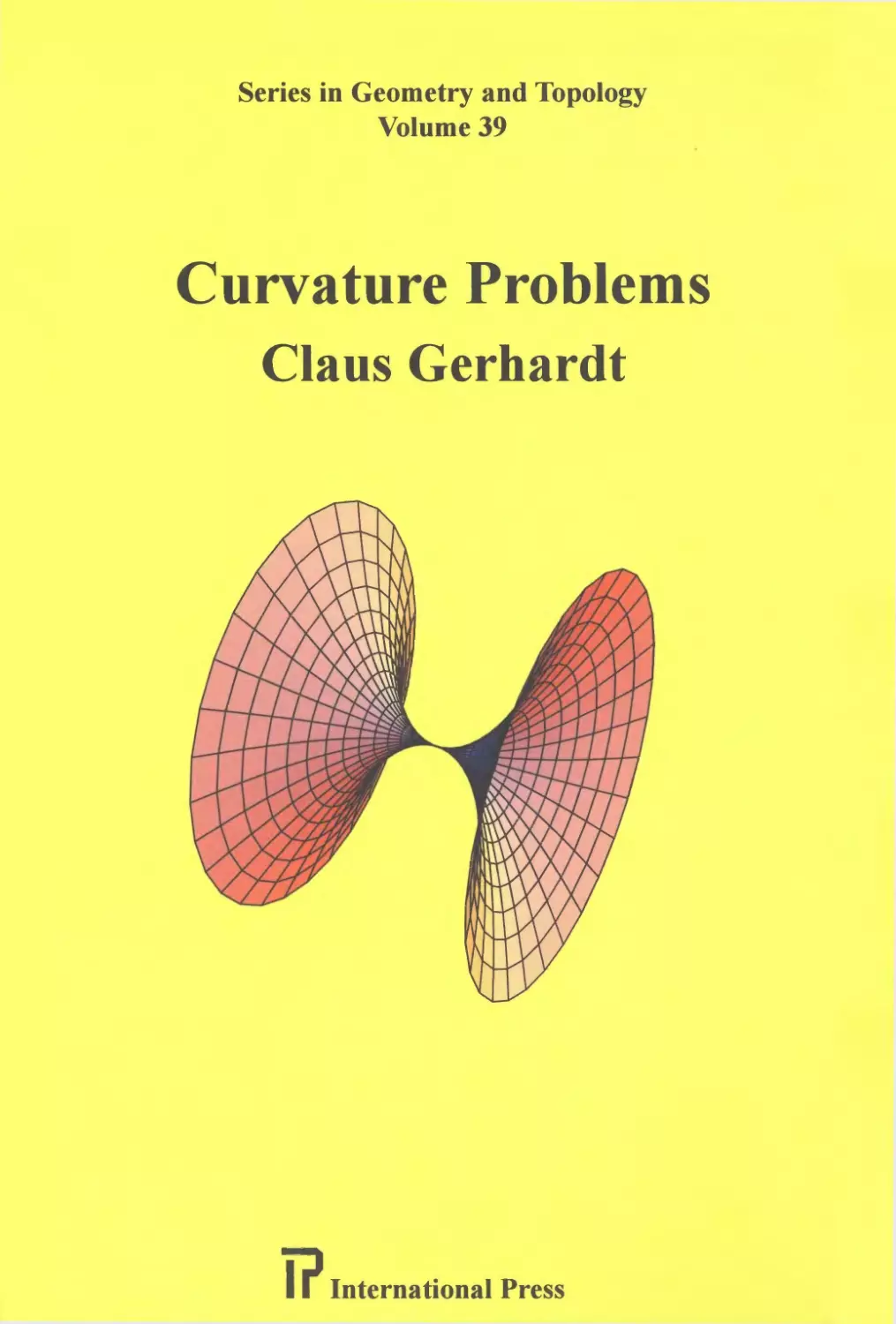
                    Series in Geometry and Topology
Volume 39
Curvature Problems
Claus Gerhardt
International Press

Series in Geometry and Topology
Editor
Shing-Tung Yau
i?
International Press

Series in Geometry and Topology
Volume 39
Curvature Problems
Claus Gerhardt
P
International Press

Claus Gerhardt
Ruprecht-Karls-Universitat
Institut fiir Angewandte Mathematik
Im Neuenheimer Feld 294
69120 Heidelberg
gerhardt@math.uni-heidelberg.de
http://www.math.uni-heidelberg.de/studinfo/gerhardt/
Mathematics Subject Classification (2000): 35J60, 53C21, 53C44, 53C50, 58J05
ISBN-10: 1-57146-162-0
ISBN-13: 978-1-57146-162-9
(c) International Press 2006
International Press, Somerville, MA

Preface
Applying analytic methods to geometric problems has proved to be extremely
fruitful in the last decades. Among the new techniques, with the help of which
many problems have been solved, curvature flows and a priori estimates for fully
non-linear elliptic partial differential equations are especially important.
The use of curvature flows started with the groundbreaking paper of Hamilton
[41] in which he considered the Ricci flow which is driven by the Ricci curvature.
Huisken [43] then studied the mean curvature flow. These fundamental papers
created a new analytical tool for solving problems in geometry and physics.
In the present book we consider curvature problems in Riemannian and
Lorentzian geometry which have in common that either the extrinsic curvature
of closed hypersurfaces is prescribed or that curvature flows driven by the extrinsic
curvature are studied and used to obtain some insight in the nature of possible
singularities.
The first chapter provides some background material from differential geometry
and some sections might even be interesting for those working in this field.
Chapter 1 gives a thorough introduction to the theory of curvature functions
and extrinsic curvature flows with detailed proofs and also offers a complete proof
of the short time existence and existence in a maximal time interval.
After this very general treatment of curvature flows, we consider specific
geometrical problems: Either finding closed hypersurfaces of prescribed curvature,
where the right-hand side is defined in the ambient space or in the tangent bundle
of the ambient space, or studying the inverse mean curvature flow in Lorentzian
manifolds having a future singularity in order to obtain some insight in the nature
of this singularity like finding a sufficiently smooth transition from big crunch to
big bang under certain circumstances.
This book is supposed to be an advanced textbook for graduate students and
researchers interested in geometry and general relativity.
I would like to thank Heiko Kroner and Christian Enz for proofreading large
parts of the final manuscript and Shing-Tung Yau for accepting the manuscript for
the Series in Geometry and Topology.
Heidelberg, July 2006
Claus Gerhardt

Contents
Chapter 1. Foundations 1
1.1. Hypersurfaces in semi-Riemannian manifolds 1
1.2. Polar coordinates in Rn+1 8
1.3. Gaussian coordinate systems 12
1.4. Global Gaussian coordinate systems 25
1.5. Graphs in Riemannian manifolds 32
1.6. Graphs in Lorentzian manifolds 33
1.7. Geodesic polar coordinates 35
1.8. Strictly convex functions 38
1.9. Focal points and tubular neighbourhoods 40
1.10. Closed umbilic hypersurfaces in Rn+1 are spheres 54
1.11. Fredholm operators and Sard's theorem 55
Chapter 2. Curvature flows in semi-Riemannian manifolds 61
2.1. Curvature functions 61
2.2. Curvature functions of class (K) 81
2.3. Evolution equations for some geometric quantities 92
2.4. Essential parabolic flow equations 96
2.5. Short time existence 102
2.6. Long time existence 119
2.7. First a priori estimates 120
Chapter 3. Hypersurfaces of prescribed curvature in Riemannian
manifolds 131
3.1. Formulation of the problem 131
3.2. Lifting of the problem to the universal cover 132
3.3. Curvature estimates 138
3.4. Existence of a solution 141
3.5. Prescribing curvature in arbitrary Riemannian manifolds 142
3.6. Existence of solutions to the auxiliary problem 147
3.7. Existence of a solution to the original problem 152
3.8. Hypersurfaces solving F = /(re, v) 153
Chapter 4. Hypersurfaces of prescribed curvature in Lorentzian
manifolds 157
4.1. Convex hypersurfaces of prescribed curvature 157
4.2. Hypersurfaces of prescribed mean curvature 160
4.3. Lower order estimates 162
4.4. C2-estimates 165
Vll

Vlll
Contents
4.5. Convergence to a stationary solution 166
4.6. Foliation of a spacetime by CMC hypersurfaces 167
4.7. Foliation of future ends 169
4.8. The case A = 0 174
Chapter 5. Hypersurfaces of prescribed scalar curvature 177
5.1. Formulation of the problem 177
5.2. Elliptic regularization 179
5.3. An auxiliary curvature problem 182
5.4. Lower order estimates for the auxiliary solutions 185
5.5. C2-estimates for the auxiliary solutions 190
5.6. Convergence to a stationary solution 191
5.7. Stationary approximations 192
5.8. C1-estimates for the stationary approximations 194
5.9. C2-estimates for the stationary approximations 198
5.10. Existence of a solution 207
Chapter 6. The IMCF in cosmological spacetimes 209
6.1. Formulation of the problem 209
6.2. The evolution problem 213
6.3. Lower order estimates 214
6.4. C^-estimates 218
6.5. C2-estimates 221
6.6. Longtime existence 222
6.7. A new time function 223
Chapter 7. The IMCF in ARW spaces 225
7.1. Formulation of the problem 225
7.2. The evolution problem 227
7.3. Lower order estimates 229
7.4. C^-estimates 232
7.5. C2-estimates 236
7.6. Higher order estimates 242
7.7. Convergence of u and the behaviour of derivatives in t 244
7.8. Transition from big crunch to big bang 248
7.9. ARW spaces and the Einstein equations 253
Chapter 8. The IMCF in Robertson-Walker spaces 257
8.1. Formulation of the problem 257
8.2. The Friedmann equation 258
8.3. The transition flow 259
8.4. A counter example 263
Chapter 9. Minkowski type problems in Sn+l 265
9.1. Formulation of the problem 265
9.2. Polar sets 267
9.3. Curvature estimates 276
9.4. Lower order bounds 277
9.5. A uniqueness result 281

Contents
ix
9.6. Existence of a solution 282
9.7. Proof of Theorem 9.1.4 289
Chapter 10. Minkowski type problems in Hn+1 291
10.1. Formulation of the problem 291
10.2. The Beltrami map 292
10.3. Hadamard's theorem in hyperbolic space 296
10.4. The GauB maps 298
10.5. Curvature flow 306
10.6. Curvature estimates 312
Bibliography 315
List of Symbols 319
Index 321

CHAPTER 1
Foundations
In this chapter we want to give an overview of the conventions and definitions
we rely on, and also provide an introduction to the theory of hypersurfaces of a
semi-Riemannian manifold for those readers who are not so familiar with this topic.
For a more thorough treatment we refer to the Chapters 11 and 12 of [36].
1.1. Hypersurfaces in semi-Riemannian manifolds
Let {N,g) be a (n+l)-dimensional semi-Riemannian manifold. The coordinates
(xa)o<a<n in N are labelled from 0 to n. In general the coordinate x° refers to
some special variable like the radial distance to a fixed point or the time function.
A Cm-hypersurface M is locally simply a map x = x(£) of an open subset
Q C Rn into Rn+1 of class Cm, 1 < m < oo, such that the partial derivatives
dx
(1.1.1) Xi = —i, l<i<n,
are linearly independent, which is in particular satisfied, if the induced metric
(1.1.2) gij = {xi,Xj)
is invertible. The (£l) are then coordinates for M.
Notice that we only consider hypersurfaces where the induced metric is really
a non-singular metric.
Since M has codimension 1, its normal space NX(M) is spanned by a single
vector v in each point x G M. In the present situation we can always define a
continuous normal vector field v G Cm-1(i?,T1'°(A/')) by requiring that
(1.1.3) det(rri,...,xn,i/) > 0 V£eft;
notice that we assume to work in an arbitrary but fixed coordinate system (xa) of
N.
Unless otherwise stated a normal vector v is always supposed to be normalized
to
(1.1.4) (v,v) = a = ±\.
a is called the signature of v.
In each point x G M the tangent vectors xi span TX(M) C TX(N), and
(1.1.5) {xt,u)=0 Vl<2<n.
Geometric quantities in the ambient space N are denoted by gap, Rap>y8, etc.,
and those in M by gij, Rijki, etc. Greek indices range from 0 to n and Latin from
1 to n.
l

2
1. Foundations
1.1.1. Remark. The tangent vectors xi = (xf) of M are full tensors and have
to be regarded as tensor fields over (fi,x), cf. [36, 12.1.6].
We also recall that covariant derivatives are always supposed to be full tensors.
There are four basic equations governing the geometry of a hypersurface. The
first is:
1.1.2. Theorem (Gaussian formula). Let x = x(£) be the local representation
of a hypersurface M C N of class Cm, 2 < ra < oo, where (xa) are local coordinates
in N. Then the second covariant derivatives of x, x^, with respect to the induced
metric (gij), are a symmetric tensor with values in the normal space of M, N(M),
i.e., if v = (va) is a continuous normal vector field of M with signature a, then we
can express x^ in the form
(1.1.6) x^ = —ahijV,
with a symmetric tensor {hij) G T0,2(M), which is called the second fundamental
form of M with respect to —ov.
The preceding equation is called the Gaussian formula. Notice that (hij)
changes sign, if we choose the opposite normal vector.
Proof. Differentiating gij = (xi,Xj) covariantly with respect to £fc, we obtain
(1.1.7) 0 = Dk(xi,Xj) = (xik,Xj) + {xi,xjk).
Now Xik can be expressed in the form
(1.1.8) xik = -ohikv + amikxTn
with symmetric tensors in the indices (i, k) on the right-hand side.
Multiplying this equation with Xj we deduce in view of (1.1.7)
(1.1.yj \Xik,Xj) = a ikgmj == yKjkiKi) == 0> jk9mii
from which we infer that the tensor
(1.1.10) ajik = gmjamik
is antisymmetric in the first two indices and symmetric in the last two, i.e.,
&jik = &ijk = &ikj == &kij
(1.1.11)
== @>kji ~ Qjki == Qjiki
and hence ay* = 0, and the Gaussian formula is proved. □
1.1.3. Remark, (i) Let (hij) G T^2(M) be symmetric. 77 = (rf) G T^°(M)
is said to be an eigenvector of (hij) with respect to the metric (gij), if here exists
A G R such that
(1.1.12) ^gijV3 = % = hijrf;
A is then called an eigenvalue of (hij) with respect to the metric (gij).
(ii) A is eigenvalue of (hij) with respect to (g^) if and only if
(1.1.13) det(hij - Xgij) = 0.

1.1. Hypersurfaces in semi-Riemannian manifolds
3
(iii) Let (hj) be the mixed representation of (/ly), then the eigenvectors and
eigenvalues of (/ij) can be defined without any reference to gij by requiring
(1.1.14) Xrf = h)r]
%<r>3
A satisfies the preceding relation if and only if
(1.1.15) det(/ij-A<$j) = 0.
(iv) The eigenvalues of the second fundamental form of a hypersurface M with
respect to the induced metric, which is also referred to as the first fundamental form,
are called principal curvatures of M. We usually denote the principal curvatures of
a hypersurface M by acj, 1 < i < n.
(v) In the choice of the normal v in the Gaussian formula we are completely
free, i.e., we could just as well have replaced v by —v, then the principal curvatures
Ki would have been replaced by — k».
However, if the ambient space is Riemannian, then we stipulate to always choose
the outer normal to M, if such a choice is possible. This will be the case if M is
compact and CM consists of exactly two components one of which is bounded and
the other unbounded. The outer normal is then the normal which points to the
unbounded component.
If the ambient space is Lorentzian and M spacelike, then we always choose v
to be past directed, and in this case the coordinate system (xQ) is supposed to be
future directed, where x° represents the time function, i.e., x° should increase on
future directed curves, or equivalently,
(1.1.16) dx°eC-,
for let 7 = (7a(£)) be a future directed curve, i.e., 7 G C+, and let ip(t) = f o "y(t),
where f = x°, then
(1-1.17) <P = far = WA)>0,
which is only possible, if Df is past directed.
If N is Riemannian, then we shall always choose a coordinate system (xa) such
that
(1.1.18) <^o-J/)>0-
Notice that with the preceding stipulations the relation
(1.1.19) <^0'^>0
will be valid in Riemannian spaces N as well as in Lorentzian manifolds N, if, in
the latter case, spacelike hypersurfaces will be considered, since
(1.1.20) (dx°, ^> = 1,
i.e., -j^p is future directed.
1.1.4. Theorem (Weingarten equation). For a hypersurface M of N there
holds
(1.1.21) Vi = hkiXk,

4
1. Foundations
where the covariant derivative is a full tensor, and the index of the second
fundamental form is raised with respect to the induced metric. This equation is known
as the Weingarten equation.
Proof. Differentiate the equation
(1.1.22) 0=(xk,v)
covariantly with respect to f * to get
(1.1.23) 0= <a?fci,i/> + <xjb,i/«>,
hence
(1.1.24) (xk,Vi) = hik,
since a2 = 1.
On the other hand, because of a = {v, i/), we deduce
(1.1.25) 0 =<!/<,!/>,
i.e., for fixed z, vi is a tangential vector
(1.1.26) Vi = a™Xrn.
Multiplying this equation with xk we infer
(1.1.27) (vi,xk) = a?gmk = hik,
in view of (1.1.24), and thus,
(1.1.28) a? = h?,
completing the proof. □
1.1.5. Lemma. Let M be a hypersurface in N and x = x(£) a local embedding
of M, then
(1.1.29) xijk ~ xikj = R ijkXm ~ *i &"j&Xi xjxki
and
a
m
(1.1.30) xfjk - x?kj = -a{hijik - hik.j}va + a{hikhf - hijh^x
where a = (i/, v), and xfjk = x^k are the triple covariant derivatives of x.
Proof, (i) Let r)a be a contravariant vector field of class C2 on M, or equiv-
alently, a contravariant vector field over (f2,x) and use the same notation for a
continuation of 77 in a small neighbourhood of M as a C2 vector field.
Differentiating 77 covariantly on M and applying the chain rule we deduce
(1.1.31) r,f = ijjaf,
(1.1.32) r,fk = ri^xl+ri^
and
(1.1.33) ^i=<7W^ + ^>t'
from which we infer
(1.1.34) rffk - ntj = {!&, - i&g}*?*Z = -k't^rf^xl,
in view of the Ricci identities, [36, Proposition 11.4.6].

1.1. Hypersurfaces in semi-Riemannian manifolds
5
(ii) xf is relative to the index a a contravariant vector field over (fi, x) and
relative to the index i a covariant vector field, hence, by combining the preceding
commutation relations with the standard Ricci identities for covariant vector fields,
we conclude
(1.1.35) Xijk — Xikj = R ijkxm ~ -™ Pi8Xi XjXk'
Thus equation (1.1.29) is proved.
The second relation (1.1.30) can be easily derived and is left as an exercise. □
As immediate corollaries of this lemma we obtain the Codazzi equation and
the Gaufi equation.
1.1.6. Theorem (Codazzi equation). Let M be a hypersurface in N of class
C3, then the second fundamental form of M satisfies
(1.1.36) hij.k - hik.j = Ra^s^Qxix]xi'
Proof. Multiply (1.1.29) and (1.1.30) with v and equate. □
1.1.7. Theorem (Gaufi equation). Let M be a hypersurface of class C3 in N,
then the Riemannian curvature tensor of M and the Riemannian curvature tensor
of the ambient space are related by the so-called Gaufi equation
(1.1.37) Rijki = <r{hikhji - hjkhu} + Ra(31sx?xj xZxf,
where a = {v, v) is the signature of v.
Proof. Multiply the equations (1.1.29) and (1.1.30) with x\ and equate. □
The Gaufi equation relates the intrinsic curvature, i.e., the Riemannian
curvature tensor of M, with the extrinsic curvature, i.e., the principal curvatures, and
the curvature of the ambient space.
1.1.8. Definition. A hypersurface M is said to be totally geodesic, if its
principal curvatures vanish identically, or equivalently, if hij = 0 throughout M.
1.1.9. Remark. The principal curvatures can be used to define several
curvature invariants for a n-dimensional hypersurface M in N. Let (g^) be the induced
metric and h^ be the second fundamental form.
(i) The most important invariant is the mean curvature of M, in symbols, H,
n
(1.1.38) H = gijhij = hl = ^2Ki.
i=l
Notice that the actual „mean curvature" is of course ^H, but it has many
advantages to simply define H as the trace of hij.
(ii) The second most important invariant is the Gaussian curvature, in symbols,
K,
("•») *-3s4-n*
_ det(frjj) =-pi

6
1. Foundations
(iii) The sum of the squares of the principal curvatures is denoted by \A\2
n
(1.1.40) \A\2 = hijhij =^kI
(iv) Contracting the Gaufi equation twice, we get
(1.1.41) R = a{H2 - \A\2} + R- 2aRapvavfj,
where R resp. R are the scalar curvatures of M resp. N.
Defining the Einstein tensor of N as
(1.1.42) GQ/3 = Ra(3 - 2^9a/3,
we deduce that (1.1.41) can be expressed as
(1.1.43) R = o{H2 - \A\2} - 2aGa(3vav13.
In Rn+1 the curvature invariant H2 — \A\2 is exactly the scalar curvature. In
general ambient spaces this invariant is therefore referred to as the scalar curvature
operator, a terminology that becomes more plausible later, when we shall write hy-
persurfaces as graphs of a real valued function and express the second fundamental
form in terms of the Hessian of that function. The curvature invariants discussed
so far and those to come can then be considered to be nonlinear partial differential
operators acting on real valued functions.
(v) Let Hk, 1 < k < n, be the elementary symmetric polynomials, homogeneous
of order k, defined in Rn
(1.1.44) fffc(Ai,...,An)= Y, A«i •••*<*> X = (\i)eRn.
ii<--<ifc
With the help of these symmetric polynomials we can define curvature invariants
in M by looking at
(1.1.45) Hk = #fc(«i,...,Kn),
where Ki are the principal curvatures of M. These curvature invariants are called
the k-th mean curvatures of M.
Obviously, there holds
(1.1.46) HX=H, H2 = \(H2-\A\2), Hn = K.
As we shall show in Section 2.1 on page 61, it is possible to define for each
k-th. mean curvature Hk an operator F defined on the symmetric tensor fields in
T°>2(M) by setting
(1.1.47) F(h)) = F{hij,gkl) = Hk(KU... ,«n),
where /q are the eigenvalues of hij with respect to the metric gij.
Hypersurfaces in conformal spaces
1.1.10. Definition. Let (N,g) and (N,g) be two semi-Riemannian spaces.
They are said to be conformal, or more precisely, pointwise conformal, if the
underlying manifolds are identical and the metrics are related as
(1.1.48) ga0 = e2*ga(3,

1.1. Hypersurfaces in semi-Riemannian manifolds 7
where ip is a smooth function. The metrics are then also referred to as conformal
metrics.
If M is a hypersurface in N then it is also a hypersurface in N and vice versa.
1.1.11. Proposition. Let (N,g), (N,g) be conformal semi-Riemannian spaces
of dimension n 4- 1, the metrics of which are related as in (1.1.48). Denote the
geometric quantities of M with respect to the metric g by a tilde and those with
respect to g as usual, then the following relations are valid
(1.1.49) Pii=e2%- A v = e~*v,
(1.1.50) hije~^ = hij + ippv^gij,
(1.1.51) e*h{=hi+iP(ji>(36i,
and
(1.1.52) e*H = H + nil>0i>f3.
Proof. Exercise.
Let us conclude this section with an interesting observation.
1.1.12. Proposition. Let M be a semi-Riemannian hypersurface in {N,g),
p G M, and let rja be a continuation of the normal ua in a small neighbourhood of
p, V = V(p) C N, with constant norm, i.e., (77,77) = a. Then the divergence of r)
evaluated atVDM is equal to the mean curvature of M
(1.1.53) div?7 = n% = gijhij = H.
Proof. Let (xa) be coordinates in N and (£z) coordinate in M. From the
Weingarten equation we then deduce
(1.1.54) 77>f = i/? = hfxg,
and hence
(1.1.55) hij = nQtfX?x?,
where 7]a is the covariant representation of n.
Fix a point q e M f\V and choose coordinates (xa) and (£J) such that in q
(1.1.56) §aj = tadaj, </00 = <7,
and
(1-1.57) xf=6f, K) = (1,0,...,0).
Then, evaluating div n in q, we conclude
n n
(1.1.58) pQ/V;/? = S°Vo + £ eitiatfxfx* = Y, aha = **,
t=l i=l
where we used (1.1.55) and the fact that (77,77) = a and thus
(1.1.59) p0Vo = <777a;077a = 0. □

8
1. Foundations
1.2. Polar coordinates in Rn+1
As a prelude to the treatment of Gaussian coordinate systems in general semi-
Riemannian spaces in the next section, let us consider polar coordinates in
Euclidean space.
Any point 0 ^ x G Rn+1 can be uniquely identified by its Euclidean norm
r = ||rr|| and its corresponding unit vector y G Sn
(1.2.1) x = ry.
Let (rrl), 1 < i < n be local coordinates for Sn and y = y(x%) be a local
embedding of Sn, \\y\\ = 1, then the induced metric in Sn is
(1-2-2) <Jij = {yuyj).
1.2.1. Definition. Let (xl) G i?, Q C Rn, be local coordinates for Sn and r the
radial distance to the origin of Rn+1, then we define polar coordinates (xa)o<a<n
by setting x° = r and let xl be the coordinates for Sn, i.e., (xa) G R+ x Q.
Furthermore, we define a local embedding
(1.2.3) / : R; x Q -> Rn+1\{0}
by
(1.2.4) f{xa) = ryix1).
This local embedding can be interpreted as a local representation of a globally
defined embedding, still denoted by /, from R\ x Sn onto Rn+1\{0}.
The local mapping / is the inverse of the coordinate map x = (xQ) which is
part of the chart (re, £/), where U is of the form U = R+ x V and ((rrl), V) is a chart
for Sn such that V = y{Q).
1.2.2. Lemma. In polar coordinates the coefficients of the Euclidean metric
are
(1-2.5) 9a0 = (fa,fp)
and there holds
(1.2.6) goo = 1, 9ij = r2(Jij, g0i = 0,
or equivalently,
(1.2.7) ds2 = dr2 + r^aijdtfdx?,
where a^ is the induced metric of Sn.
Proof. Simply compute
(1.2.8) g00 = {y,y) = 1, gtj = r2{yuyj) = r2^-,
and
(1.2.9) goi = r{y,yi) = 0. D

1.2. Polar coordinates in Rn+1
9
1.2.3. Proposition. Let ip G L1(Rn+1), then the integral of ip, expressed in
polar coordinates, has the form
(1.2.10) / f=r[ frndfidr,
7r"+i Jo Jsn
where fi is the induced measure of Sn.
Proof. Since the origin has measure zero, we may assume that the integration
domain is Rn+1\{0}. Introducing polar coordinates we deduce from the
transformation rules for integration that the Lebesgue measure /zn+i in Rn+1 is locally
expressed as
(1.2.11) diin+i = y/lfdxdr,
where
(1.2.12) g = det(ga/3) = r2n det((jij) = r2na,
and hence
(1.2.13) y/^ = rnV^,
and we conclude further, assuming for the moment that supp / C R+ x Q,
(1.2.14) / /= / / frny/^dxdr= / / frnd\xdr,
JRrt + l Jq Jq Jq Jgrt
from which the final result immediately follows by using a finite partition of unity.
□
There are two simple corollaries, the proofs of which are left as exercises.
1.2.4. Corollary. Let f G Lx(Rn+1) and let f = f(r,xl) be the local
representation of f in polar coordinates, then /(r, •) G L1(Sn) for a.e. r G R+.
1.2.5. Corollary. Let f G L1(BR), BR = BR{0), then
(1.2.15) f f= f [ frndfidr.
JBR Jo Jsn
Setting in particular f = R = 1 we deduce
(1.2.16) (n+l)|Bi| = |Sn|,
where \-\ stands for the canonical measure of the corresponding set
Starlike hypersurfaces or graphs over Sn
1.2.6. Definition. Let M C Rn+1 be a compact hypersurface, such
hypersurfaces are also dubbed closed, then M is called starlike, if every radial ray through
the origin intersects M exactly once. M can then be written as a graph in polar
coordinates, or equivalently, as a graph over Sn
(1.2.17) M = { {u{x),x):xeSn}
where u(x) = r is the Euclidean norm of the corresponding point p G M.

10
1. Foundations
1.2.7. Lemma. Let M = graph it be a graph over Sn with u G C2(Sn) and let
(xl) be local coordinates for Sn, then the (xl) are also coordinates for M and the
coefficients of the induced metric are
(1.2.18) gij = UiUj + u2CTij,
where (aij) is the metric of Sn, or equivalently,
(1.2.19) gij = e2<fi{ipnpj + Gij), (p = logu.
Proof. Let (ya) be Euclidean coordinates in Rn+1 and y = y(xl) be a local
embedding of Sn, then / = f(x%) = uy is a local embedding of M, and we compute
(1.2.20) fi = Uiy + uyi = u{<piy + yi),
(1.2.21) g^ = (fi, fj) = u^j + u2Vij,
with inverse
(1.2.22) gij = u~2(aij - v"VV),
where (<rZJ) = (ctjj)-1 and
(1.2.23) v = y/1 + \D<e\2 = y/l + aVyupj.
D
1.2.8. Lemma. The exterior normal v of M is given by
(1.2.24) v = v~\y - yup1), tf = a^cpj.
Proof. Fix a point p = uy G M and choose a coordinate system (xl) around
p such that Gij — Sij, then the yi are orthonormal, and hence
(1.2.25) \u\ = 1,
and
(1.2.26) <A,^> = 0, l<A;<n,
as can be easily verified.
The fact that v is pointing to the exterior of M follows by looking at a point,
where Dip = 0. □
The second fundamental form of M is given by:
1.2.9. Lemma. Let M = graph u over Sn, and ip = log it, and let (xl) be
coordinates for Sn, then the second fundamental form of M can be expressed as
(1.2.27) hij = uv~l(-pij + </Wj + 0y)>
where ipij are the covariant derivatives of ip with respect to the metric atj of Sn.
Proof. Fix a point p G Sn and choose coordinate (xl) such that
(1.2.28) aij = 8ij, o-ij}k = 0 V(iJ,k).
Let f = uy be the local embedding of M and observe that / is expressed in
Euclidean coordinates of Rn+1, i.e., the Christoffel symbols in Rn+1 vanish, then
(1-2-29) hij = -(fij,is) = -(lij,v),

1.2. Polar coordinates in Kn+1
11
where fij are the covariant derivatives of / with respect to the induced metric of
M, and the comma indicates ordinary partial derivatives.
Moreover,
(1.2.30) ftij = uipj((piy + yi) + u{tp4jy + <piVj + ytij).
However, in p there holds
(1-2.31) (fij = <ptijl yij = y,ij,
because of (1.2.28), and
(1.2.32) yij = -aijy,
since y is the embedding of Sn. The result then follows from (1.2.24). □
As a corollary we conclude:
1.2.10. Theorem. Let M = graph u be a C2-graph over Sn, and let (p = log u,
then its mean curvature H satisfies the partial differential equation
(1.2.33) A<p+z = Hu,
where
(1.2.34) A<p = -Diia^Dip)) = - div(ai), a* (Dtp) = v~ V,
and
(1.2.35) v = y/1 + |ZV|2,
and where all covariant derivatives are to be understood with respect to the metric
0-ij ofSn.
The Gaussian curvature K of M can be expressed as
(1.2.36) K = li-nt,-(n+2)detK+^-y<i)>
v ; det(<7y-)
Proof. ,,(1.2.33)" Combining (1.2.22) and (1.2.27) we infer
H = gljhij = u~1v~1{alj - v~2ipl(pj}{uij + cpupj - ipij}
(1.2.37)
On the other hand, we have
Ap = -divK) = —— —(yW)
(1.2.38) y°dx
= -v~l{aij - v~VV}<Py>
which proves (1.2.33).
,,(1.2.36)" From equation (1.1.39) on page 5 we obtain
(1.2.39) K = PM;>
det(py)
hence the result in view of (1.2.22) and (1.2.27). □

12
1. Foundations
1.3. Gaussian coordinate systems
Let (iV, g) be a (n+l)-dimensional semi-Riemannian manifold. We are mainly
interested in the case when N is Riemannian or Lorentzian, and we shall use a
parameter a to distinguish between the two cases, a = 1 corresponds to the
Riemannian case and a = —1 to the Lorentzian. As usual the generic coordinates in
N are of the form (#a)o<a<n5 and Latin indices range from 1 to n.
However most results will be stated and proved for general semi-Riemannian
manifold provided that the induced metric in the hypersurface is a metric, i.e.,
invertible. The restriction to N Riemannian or Lorentzian is only necessary, when
we speak of a distance and extremal geodesies.
1.3.1. Definition, (i) Let {N,g) be a general semi-Riemannian manifold. A
coordinate system (xa) is called a Gaussian coordinate system, if the metric in N
can be expressed in the form
(1.3.1) ds2 = e2*{(j{dx0)2 + a^dx*},
where Oij = crij(x°,xl) is a semi-Riemannian metric, a = ±1, and ip is smooth,
(ii) (xa) is said to be a normal Gaussian coordinate system, if ip = 0.
1.3.2. If N is Lorentzian and (xa) is a Gaussian coordinate system such that
a = —1 in (1.3.1), then o^ has necessarily to be positive definite.
Gaussian coordinate systems are usually associated with hypersurfaces, some
level hypersurfaces {x° = const}, in a neighbourhood of which the Gaussian
coordinate system is valid. If a Gaussian coordinate system is valid in U C iV, then it
is also said to cover U.
Of great importance are so-called tubular neighbourhoods of a hypersurface.
1.3.3. Definition. Let M C N be a hypersurface. An open subset U C N
is called a tubular neighbourhood of M, if M C U and if it is covered by a normal
Gaussian coordinate system (rra), such that
(1.3.2) M = {x° = const},
where, to be absolutely precise, the (xl) are local coordinates for M and only x° is
globally defined in U.
The tubular neighbourhood can be described as a cartesian product
(1.3.3) U = Ue = M x (-e, e), e > 0,
meaning that x°(Ue) = (—e, e) and the remaining coordinates (xl) are local
coordinates of M.
If U is a tubular neighbourhood for M, then, without loss of generality we may
assume that M = {x° = 0}, and any point p G U will be uniquely determined by
the value of x°(p) and its unique1 base point p G M with coordinates (0, x%) such
that p = (rc°,rcl), or independently of any local coordinates for M, p = (x°,p).
At least for the cases we consider there will be a unique base point.

1.3. Gaussian coordinate systems
13
The main effort of this section is to prove that tubular neighbourhoods exist
locally, i.e., in the neighbourhood of any point p G M, and if M is compact also
globally, i.e., M C U.
We shall prove this result in case the ambient space is either Riemannian or
Lorentzian, and under the assumption that the hypersurface M is spacelike, i.e.,
the induced metric has to be Riemannian.
The function, or coordinate, x° can then also be given a geometric meaning,
namely, it will be the signed distance to the hypersurface M.
In order to make this meaning precise, we need some definitions and preliminary
results.
From now on our stipulation that N is either Riemannian or Lorentzian will
be valid whenever we speak of a distance function.
A Riemannian manifold is said to be geodesically complete, if any geodesic can
be defined in the whole of R, in Lorentzian spaces the corresponding definition is a
bit more elaborate.
1.3.4. Definition. Let N be Lorentzian, then geodesic completeness is defined
relative to the causal character of the geodesic, i.e., there is timelike, spacelike, and
null completeness. Of course N is also simply said to be complete, if any geodesic
can be defined on R.
Causality in Lorentzian manifolds
To define a meaningful distance function in Lorentzian manifolds is not as easy
as in Riemannian spaces, and requires some additional definitions.
1.3.5. Definition, (i) Let N be a time oriented Lorentzian manifold, and let
C+ = C+(p) C TP(N) be the open light cone in p G N containing all future directed
timelike vectors, then a curve 7 G ^(^N) is said to be future directed timelike,
if i(i) G C+(y(t)) for all t G /, and future directed causal, if 7 G C+(7(£)) for all
t el.
Past directed curves are similarly defined.
(ii) Let p,q G N, then q is said to lie in the chronological future of p, in symbols
p « q, if there exists a future directed timelike piecewise C1-curve from p to q,
where this notion implies that the onesided limits of the tangent vectors in the
break points lie in the same light cone, i.e., in the future light cone.
q is said to lie in the future of p, in symbols, p < q, if there exists a future
directed causal piecewise C1 -curve from p to q.
We use the notation p < q, if p = q or there exists a future directed causal
piecewise C1 -curve from p to q.
(iii) Let p G N, then we define
(1.3.4) I+(p) = {q:p«q},
the chronological future of p, and
(1.3.5) J+(p) = {q-P<q},
the future of p.
The sets I~{p) and J~{p) are defined accordingly, they are the chronological
past resp. past of p.

14
1. Foundations
(iv) Let p,q G N, then we define the Lorentzian distance between p and q to be
(1.3.6) d{p,q) = \
0, ifq<£J+(p),
sup{ L(7): 7 G Qp,q }, if g G J+{p),
where, in case p < q, fip,q denotes the set of all causal future directed piecewise
C1 -curves from p to q.
1.3.6. (i) The Lorentzian distance is not symmetric, and not necessarily always
finite.
(ii) I~{p) and I+{p) are always open, yet J~{p) and J+{p) are in general
neither open nor closed.
1.3.7. Definition, (i) Let N be Lorentzian and time oriented. Then we say
the strong causality condition holds in p G iV, if every neighbourhood U(p) of p
contains a neighbourhood V(p) C U such that any causal curve with end points in
V lies entirely in U.
The strong causality condition holds in JV, if it holds in every point p G N.
(ii) A spacelike hypersurface M C N is said to be achronal, if a timelike piece-
wise C1-curve intersects M at most once, i.e., points p,q,€ M cannot be connected
by a timelike curve.
(iii) A spacelike hypersurface M C N is said to be a Cauchy hypersurface, if
every non-extendable causal curve is intersecting M exactly once.
An important class of Lorentzian manifolds are those that are globally
hyperbolic.
1.3.8. Definition. Let N be Lorentzian and time oriented. Then N is said to
be globally hyperbolic, if N is strongly causal, and if
(1.3.7) J+(p)C\J~(q) is compact Vp,qeN.
1.3.9. Theorem. Let N be globally hyperbolic, then the Lorentzian distance
function d is finite and continuous in N x N.
A proof is given in [42, Lemma 6.7.3].
Tubular neighbourhoods
1.3.10. To simplify some statements and the presentation of the results, we
shall also use terminology, that will only make sense in the Lorentzian case, like
spacelike, achronal, etc., if the ambient space is Riemannian, in which case it should
be simply ignored.
Let N = Nn+1 be semi-Riemannian and let M C N be a connected
hypersurface of class C1. M is called orientable, if there exists a continuous normal vector
field ueC°(M,T^°(N)).

1.3. Gaussian coordinate systems
15
1.3.11. Lemma, (i) Let M C N be a connected, spacelike, compact and ori-
entable hyper surf ace, then there exists a connected open neighbourhood U of M,
such that
(1.3.8) U\M = U+GU~,
U+,U~ are connected and v is pointing towards U+, while —v points towards U~.
In case N is Lorentzian and time oriented, we shall always suppose that v is
future directed, so that U+ C I+(M) and U~ C I~{M).
(ii) This result is also valid locally, i.e., for any point p G M, where now M is
not necessarily supposed to be compact, there exists a connected open neighbourhood
U = U(p) such that the preceding splitting of U\M and the ensuing statements are
valid, if M is replaced by the hyper surf ace M f\U.
Proof. „(ii)" Let us first proof the local result. Let p G M, then there exists
a coordinate systems (rca) around p such that locally M is described as x° = 0, cf.
[36, Corollary 12.1.8], i.e., there is an open connected subset i? C M.n such that
(1.3.9) Ue = ft x (-e,e), e > 0,
is a local coordinate neighbourhood of p in N, {xa) with (xl) G Q and x° G (-e,e)
are the coordinates, and in addition (xl) are also coordinates for M.
dx° is then a (covariant) normal vector, not necessarily normalized, for M, and
without loss of generality we may assume that
(1.3.10) £/+ = Qx (0,e)
is that part of Ue\M into which v points.2 U~ is accordingly defined and will be
that part — v is pointing to.
„(i)" M can be covered by finitely many open connected sets {Ui)i^i of the
form we just defined locally, i.e., each U{ is a neighbourhood Ue(pi).
It follows that U = (jiejUi is connected, for let pi G Ui and pj G Uj, then
there exist
(1.3.11) qi G Ui n M A qj G Uj D M,
and thus one can find a curve 7, contained in U, passing from pi to qi, then from
qi to qj, and finally from qj to pj.
For each i G /, Ui splits into
(1.3.12) (/i = (Mn Ui) U C/+ U £/",
such that all sets on the right-hand side are connected and v is pointing towards
U* and — v to U~.
Define
(1.3.13) U+ = \JU+ A U- = \JU~,
then it only remains to prove that the sets are connected, but this proof uses the
same arguments that we employed in proving the connectedness of U; we only have
to lift that part of the curve 7 that is contained in M a bit such that it is part
of U+. Using the (Ui) as an open covering of the image of 7, a corresponding
We are deliberately a bit negligent and do not clearly distinguish between a neighbourhood
U in N and its image x(U) C Rn+1.

16
1. Foundations
subordinate partition of unity, and local representations of 7, this lifting process is
not too demanding and is left as an exercise.
If U+ is connected, then the same holds for U~ by symmetry. □
1.3.12. Definition. Let N,M, U, U+ and U~ be as in the preceding lemma,
then we define in U the signed distance function relative to M, in symbols, dM, as
follows
(i) if N is Riemannian, then
(1.3.14) dM(p) = { *{*(P.^^M}f ifpe^UM,
V ' KyJ \-M{d{p,q):qeM}, ifp€lT,
(ii) if N is Lorentzian, then
(1.3.15) dM(p) = i -PM^^M}, ifpe^UM,
y-sup{d(p,q): q e M}, iipeU ,
where in both cases d(p,q) is the ordinary Riemannian resp. Lorentzian distance
function.
We can now prove the existence of tubular neighbourhoods.
1.3.13. Theorem. Let N = Nn+1 be Riemannian or Lorentzian, where in
case N is Lorentzian we assume in addition that N is strongly causal Let M C
N be a spacelike, connected, orientable and achronal hypersurface of class Cm,a,
ra > 2 and 0 < a < 1. Then, for any point po G M there exists a neighbourhood
U = U(po) C N as described in Lemma 1.3.11, such that, if we replace M by Mf)U,
the signed distance function d^f is in Cm,a(U).
Any point p £U has a unique base point q G M such that dhfip) is the distance
between p and q with the appropriate sign.
Furthermore, there exists a normal Gaussian coordinate system (xn) covering
U such that x° equals dM • In this coordinate system the coefficients of the metric
are of class Cm~2,a.
Moreover, if M is compact, then the above results are valid in a tubular
neighbourhood Ueo = M x (—eo,eo).
The local and global existence results of a tubular neighbourhood are also valid in
arbitrary semi-Riemannian spaces N and arbitrary semi-Riemannian hypersurfaces
M provided M is orientable. In this case, however, the function x° cannot be
identified with a distance function relative to M.
Proof. We prove the theorem in five steps.
First step
We first show that, for a fixed point po E M, there exists a neighbourhood
U = U(po) and a normal Gaussian coordinate system (xa) covering U, such that
Mf\U = {x° = 0}.
Let (xn) be local coordinates of N near p(), xq = rro(0> £ € ^ c ^n> a
local representation of M near po, and let v = i/(£) be a differentiate normal,
(v, v) = a — ±1. If AT is Lorentzian, then v should be future directed.

1.3. Gaussian coordinate systems
17
For small £, \t\ < e, define the mapping
(1.3.16) x = #(*, 0 : («, 0 -> x(t, 0 € iV,
as a solution of the differential equation
xa + r^ifix1 = 0,
(1.3.17) *(0,0 = *o(0,
A(0,0 = KO-
The geodesic flow 7 = 7(*,p,rj) is of class C°°(P(p)), cf. [36, Theorem 11.6.2],
and the solution x = #(£,£) can be expressed as
(1.3.18) * = 7(t,*o«WO),
hence # is defined in (—e,e) x £p(£o) satisfying
(1.3.19) re,i e C7m-1'a((-c, c) x £,(&))
for small values of p and e, in view of the chain rule, where po = #o(£o) and £p(£o)
is the standard ball of radius p and center £0 m ^n-
D<P(0,£) has maximal rank (n+ 1), since in (0,£)
— =x(0,0 = i/(0,
and ||£, i/(£) are linearly independent.
We want to choose (£,£*) *s new coordinates. Then the new coefficients of the
metric would be of class (7m_2'Q, since $ is of class CT"*"1'0, and hence they would
be only continuous, if m = 2.
Thus let us assume for the moment, that 3 < ra, so that # would be at least of
class C2, and let us choose (x°,xl) = (£,£*) as new coordinates, which is possible,
since <P is a local Cm_1,a-diffeomorphism in view of the inverse function theorem.
For fixed £, let 7 = (7°) = #(£,£) = (£,£) be the local representation of the
geodesic in the new coordinates, then
(1.3.21) (7«,7«> = const = <7(0),7(0)> = (v,v) = <r,
hence we deduce
(1.3.22) a = ^fV = 5bo(*,0 = Sbofr0,**).
Furthermore, (1.3.17), written in the new coordinates, yields
(1.3.23) ?£> = () Va,
or equivalently,
(1.3.24) 0 = [00,a] = ±{2g0a,o - Poo,«} = Poa,o,
and thus
(1.3.25) 9oa(x°1xi)=g0a{01xi).
But in (0, x%) there holds
(1.3.26) fc = <* |-> = { *>=0.

18
1. Foundations
Hence we have proved that (xa) = (£,£) are normal Gaussian coordinates and
they cover
(1-3.27) Ueo = #((-c0,€o) x BpoKo))
for small values of eo and po-
Now consider the case ra = 2. Approximating M locally by smooth hypersur-
faces, e.g., by writing M locally as the graph of a function u € C2'a(/2), Q C Rn
and mollifying it, we obtain a sequence of mappings $k all defined in (—e,e) x i?
such that (xQ) = (t,f) are normal Gaussian coordinates with respect to the
corresponding hypersurfaces M^. The $k converge uniformly in C1 to the unique
solution of (1.3.17), satisfying uniform C1,a-estimates, and the coefficients of the
metric converge uniformly; in the limit we have
(1.3.28) ftrf = li?1<_i,_*>,
where
(1.3.29) x° = t, xi = C,
completing the proof.
1.3.14. The length of the geodesic 7 from a base point (0, £) to a point p =
(£,£) € U€ is |£|, in view of (1.3.21), even in the case m = 2.
1.3.15. Remark. The preceding existence result for a local normal Gaussian
coordinate system is valid in arbitrary semi-Riemannian manifolds AT, and for
arbitrary semi-Riemannian hypersurfaces M C TV of class Cm'a, 2 < m and 0 < a < 1,
as is apparent from the proof.
Second step
Let us show that there exists an 'open neighbourhood U C Uf0 of po such that
(1.3.30) dMnU{p) = x°{p) Vp G U.
We treat the Riemannian and Lorentzian case separately.
First suppose that N is Riemannian. Fix 0 < p < po and for 0 < e < eo define
(1.3.31) tf+=*((0,c)x£Pteo)),
u; =#((-c, o)x£,teo)).
Let Mp = M n Ut; since Mp C i7eo any piecewise C1 -curve 7 starting from
q € Mp with length less than e has to lie completely in Ut0, if e is small enough,
for let Br(q) be the geodesic ball around q, then any C1-curve that starts at q and
leaves Br(q) has length strictly larger than r, cf. [36, Lemma 11.7.3], and there
exists 0 < r such that
(1.3.32) Br{q)cUeo V(? € Mp,
since the geodesic balls form a neighbourhood basis.

1.3. Gaussian coordinate systems
19
Consider now p G £/+, p = (t,£), then x°(p) = t, and in view of Note 1.3.14
there holds
(1.3.33) dMp (p) = dMnUe (p) < t.
Suppose that the strict inequality would be valid, then there would exist q G Mp
and a piecewise C1-curve 7 from q to p of length less than t. Let 7 be defined on
the interval I — [0,1], 7(0) = 9,7(1) = p, then 7(7) C Ueo, and hence 7 can be
represented in the normal Gaussian coordinates (xa), 7 = (7°), and we deduce
L(7) = /" t/frT + ftiW > / l7°l
(1.3.34) J\ J°
> /"170 = 7°(l)-7°(0) = t,
JO
and conclude further that 1/(7) > t and £(7) = t if and only if
(1.3.35) 7*(r) = 0 A 7°(t)>0.
Hence
(1.3.36) ^Afp(p) = ^°(p) Vpet/e+,
and 7(t) = (^,4) is the unique minimal geodesic from Mp to p realizing the distance
between p and Mp.
A similar argument covers the case p G U~.
Secondly, let us assume that N is Lorentzian and strongly causal, cf.
Definition 1.3.7. Choose a neighbourhood V = V(po) C Ueo such that all causal curves
with endpoints in V are contained in U€oi and choose 0 < p < po and 0 < e < €0
small enough such that
(1.3.37) Ue = *((-€, c) x £,(£<>)) C V.
Define Mp, C/f+, C/~ as in the Riemannian case and let p G C/e+, p = (<,^) in
the normal Gaussian coordinates (xa). Let q G Mp be arbitrary and 7 = 7(7"),
0 < r < 1, any future directed piecewise C1 -curve from q = 7(0) to p = 7(1). Then
7(r) G Ueo for all r, and, describing 7 = (7°) in the normal Gaussian coordinates,
we get
(1.3.38) ^ x °
< /l7°l= / 7° = 70(l)-7°(0) = t,
hence, £(7) < i and £(7) = £ if and only if 7* = 0, and we conclude that
(1.3.39) x\p) = dMp(p) VpeU+
and y(t) = (t, f) is the unique maximal geodesic from Mp to p realizing the distance
from Mp to p.
Similar arguments cover the case p G U~.

20
1. Foundations
Third step
Let us show that d,M is of class Cm'a, where we use the symbol M instead of
Mp.
In the Gaussian coordinates (xQ) = (£,£) relative to M we have
(1.3.40) dM{p)=x°(p)
and hence
(1.3.41) DdM =graddM(*,0 = (1,0,...,0)
as a covariant vector, i.e., DdM is equal to i/(f) parallel transported along the
geodesic 7(£,£) from (0,£) to (£,£)> if N ls Riemannian, and equal to the parallel
transport of — ^(£)> if N is Lorentzian, or equivalently, DdM is equal to 7 resp. —7.
But in view of (1.3.19), 7,7 G Cm-1'or((-e,e) x £p(£o)), and thus DdM is of
class Cm~1,a, or equivalently, g^m of class Cm,a.
Fourth step
Assume now that M is compact and orientable, and let us prove the existence
of a tubular neighbourhood Ue = (—e,e) x M and of a function x° : Ue —» (—e,e),
that will serve as the zero-th component of a normal Gaussian coordinate system.
The proof will again be valid in arbitrary semi-Riemannian manifold and arbitrary
semi-Riemannian hypersurfaces provided they are compact and orientable.
Consider the product manifold R x M, where M carries the induced metric and
the cartesian product the product metric. Let e > 0, then we define the mapping
(1.3.42) x = <P{t, q) : (-e, e) x M -> N
as the solution of the differential equation (1.3.17), which is again given by (1.3.18).
Since M is compact, there exists e > 0 such that a solution exists. The same
argument as in the local situation shows that # is of class Cm~l,a.
Since M is compact, there exists e > 0 and p > 0 such that, for any q €
M, the local solutions from the first step are defined in (—e,e) x Bp(q) and are
diffeomorphisms, where we use the notation
(1.3.43) Bp(q) = x0(Bp{Zo)) C M, while Bp{£0) C Rn.
Let us call the corresponding local solution #P)9.
Moreover, because of (1.3.18), the global solution #, restricted to (—e,e) x
Bp{q), agrees with the local solution #P)9.
Thus, if we can show that the global # is injective, if e is small enough, then $
will also be a diffeomorphism, cf. [36, Corollary 8.2.5].
Let q G M be arbitrary. Since # and $PA agree on (—e,e) x Bp(q), it suffices
to prove that the preimage satisfies
(1.3.44) ^(£((-€,e) x B£(q))) C (-e,e) x £,(<,),
2
or equivalently, that for
(1.3.45) pe<P((-e,e)xBE(q))
2
the corresponding base points p G M, with respect to #, are contained in Bp(q)
and thus unique, if e is small enough.

1.3. Gaussian coordinate systems
21
Suppose this were not the case, then for each e > 0, there would be
(1.3.46) pe €#((-€, e)xB£ fa))
2
having base points q€ G B^(q) and pe 4l BJq).
2
Letting e tend to zero, subsequences, not relabelled, would converge
(1.3.47) q<^qoeBE(q),
2
and
(1.3.48) Pe^PotBp{q).
However, pe would converge to qo, since $p,q is a diffeomorphism, as well as to po,
since $p,p0 is a diffeomorphism too; a contradiction.
To define the normal Gaussian coordinate system, let
(1.3.49) peUe= *((-e, e) x M)
with unique base point q G M, then there exists a unique t G (—e,e), such that
(1.3.50) p = #(t,g).
We define
(1.3.51) x° :Ue^ (-e,e)
by setting x° = t.
Then x° G Cm-1'a(C/e), since $~l G Cm-1'a(C/€) and x° = pro©^"1, where
Pr0{t,q) = t
Now let q G M and choose an arbitrary chart (£, V), V C M, around <j, then
(xa) = (£,£) are a normal Gaussian coordinate system that covers
(1.3.52) #((-e,e) x V) C C/e.
The coefficients of the metric in the new coordinates satisfy the required
conditions, since
dO dO
(1-3.53) ^ = (_,_),
and because of our previous observation that $ agrees with $p,q in (—e, e) x Bp(q).
Fifth step
Let M be compact and let us show that x° = d,M in Ue and that d,M G Cm,a(Ue).
To simplify the language, let us assume that the tubular neighbourhood, the
existence of which we have proved in step four, is described as Ueo. Now consider
0 < e < eo; we shall then show the equality of x° and <1m in Ue.
We first suppose that N is Riemannian. Let q G M and, without loss of
generality, p = (£,£) G C/f+ and let 7 = 7(7-) be a piecewise C1-curve from q = 7(0)
to p = 7(1). If 7(r) G ?/e for all 0 < r < 1, then the arguments from the second
step would imply that
(1.3.54) L{n) > t = x°(p)
and that L(7) = t if and only if the image of 7 would agree with the geodesic from
the base point (0,4) G M to p, i.e., x° = 6>m and the geodesic from the base point
to p would be the unique minimal geodesic from M to p realizing the distance from
M top.

22
1. Foundations
However, if 7 wouldn't stay in Ue, then there would be a smallest To such that
7(70) G dUe, but then
(1.3.55) L(7) > TllTll > \AlM)\ = « > *,
in view of the results proved in step number two.
Secondly, let us assume that N is Lorentzian and M achronal. As before we
shall only consider the case that q G M and p = (t,£) G U+. Let 7 = 7(7") be a
future directed timelike piecewise C1-curve from q = 7(0) to p = 7(1).
If 7(7-) G U+ for all 0 < r < 1, then our previous arguments from step number
two would yield
(1.3.56) L{n) < x°(p) = *
with equality if and only if the image of 7 would agree with the geodesic from the
base point (0, £) G M of p to p.
However, if 7 would leave £/+, then it would have to reenter it, since p G C/f+.
Suppose 7 would reenter C/+ at re = {x° = e}, then there would exist tq and S > 0
such that
(1.3.57) z°(7(T-o)) = e A x°(y(r)) > e Vr0-5<r<ro,
which is impossible, since 7 is future directed and x° increases on future directed
curves, since -^ is past directed, cf. the remarks after (1.3.41). Notice also, that
x° is well defined in Ueo and that 0 < e < eo-
Thus 7 would have to reenter C/e+ at M = {x° = 0}, contradicting the
assumption that M is achronal.
Therefore, we conclude that x° = dM and that the geodesic from the base point
(0, £) G M to p is the unique maximal geodesic realizing the distance between M
and p.
Finally, to complete the proof of the fifth step and the proof of the theorem as
well, let us show that dM G Cm'a.
The arguments in step number three remain valid in the present situation and
yield dM G Cm,n{Uf), if N is Riemannian or Lorentzian. □
The Gaussian divergence theorem
1.3.16. Theorem. Let N = Nn+1 be a semi-Riemannian manifold, Q C N
open, ^ = (£a) G C1^^1,0^)), and suppose that i7flsupp£ is compact. Assume
furthermore that M = dQ is an orientable, semi-Riemannian Cl -hypersurf ace,
such that Q lies on one side of M, i.e., there exists a continuous normal vector
field v of M such that —v points into Q n supp£. Suppose that M consists of
finitely many connected components^
m
(1.3.58) M = (J Mfc
fc=i
and let
(1.3.59) ak = iy,v) = ±1 in Mk.
This assumption is no restriction at all, since i?Dsupp^ is compact.

1.3. Gaussian coordinate systems
23
Then there holds
(1.3.60) /div£ = V / **<!/,0.
Jn fc=1 JMk
Proof, (i) First assume that M is of class C3.
Cover the compact set i?nsupp£ by finitely many open sets [/;, 0 < i < /, such
that Uo (e Q and where each C/j, 1 < i < Z, intersects some M^ and there exists a
normal Gaussian coordinate system in Ui f) Mk as stated in Theorem 1.3.13. Let
7]i G C}(Ui), 0 < i < I, be a subordinate partition of unity.
Since in i?
(1.3.61) div£ = div^r/iO = ^Tdiv^O, supp^O «= C/f
i i
it suffices to prove (1.3.60) for each (7ft£) separately. For simplicity we drop the
cut-off function rji assuming instead that £ G C}.(Ui).
(1) Let i = 0, then £ G C}{f2) and the result
(1.3.62) / div£ = / div£ = 0,
follows from integration by parts, cf. [36, Proposition 11.8.13].
(2) Let 1 < i < /, and assume that Ui D Mk ^ 0, notice that each Ui intersects
only one Af*. We also drop the index k and simply suppose that Ui D M ^ 0.
Introduce normal Gaussian coordinates in Ui f) M, so that
(1.3.63) ds2 = a{dx0)2 + (Tij{x°,xi)dxidxj,
where a — {v,v).
Suppose without loss of generality that
(1.3.64) QDUi C {x{) >0} A Ut DdQ C {x° = 0},
then the curve 7(2) = (£,#*), t > 0, moves into i? and hence
(1.3.65) 7(0,xi) = (7ft) = (l,0,...,0)
is the interior normal and hence
(1.3.66) (*/*) = (-1,0,..., 0)
is the exterior normal as a contravariant vector, and
(1.3.67) K) = (t(-1,0,...,0)
is the covariant version.
Thus we have
(1.3.68) <t(i/,£) = -£0.
We also note that
(1-3.69) div?= (VW\n
and \g\ = \det(aij)\ is also the relevant determinant for the volume element in M.
Suppose that Ui PI Q is covered in the Gaussian coordinates by the set
(1.3.70) (0, a)xA, A C Rn, a > 0,

24
1. Foundations
then
/div£= I" [ div£y/\f\
Jn Jo J a
(1A71) =fJAi{'Me)+[Li^)
= f-fy/S= f °M,
J A JM
in view of (1.3.68).
(ii) Now suppose that dQ is only of class C1. Then cover Q n supp £ by finitely
many open sets Ui, 0 < i < /, such that Uq <g. Q and each f/j, 1 < i < Z, is contained
in a chart (x, V) such that V n 0/2 = M can be written as the graph of function u
(1.3.72) M = { (rc°, x): rr° = u(x), xeAcW1},
such that
(1.3.73) rr(/2 flf/Jcf (rr°, x): rr° > u(x), xeA},
cf. [36, Corollary 12.1.9]. Notice that the symbol x is also used as an abbreviation
for (xl).
Using an appropriate subordinate finite partition of unity we may assume
without loss of generality that £ G C* (J? fl £/*), or expressed in local coordinates, that
(1.3.74) !?nsupp£c [0,a) x A! C i?, A' <e A.
By mollification we can approximate u in Cl(A') by smooth functions ue such
that
(1.3.75) u(x) < ue(x) x e A',
and
(1.3.76) Qe = { {x°,x): ue{x) < x° < a, rr € ./l' } C /?.
Let
(1.3.77) M€ = { (x°,x): x° = u€(x), xe/c Rn },
and let ^e be the exterior normal to Me, then
(1.3.78) / <£,i/e>-» / <£,«/>
and
(1.3.79) / div£-> / div£.
Thus we conclude
(1.3.80) / div£ = / <7<i/,f)
completing the proof of the theorem. □

1.4. Global Gaussian coordinate systems
25
1.3.17. Corollary. Let Q C N satisfy the assumptions of the preceding
theorem, and let £ G C1(^,T1-°(iV), /, <p G Cl{Q) and u G C2{Q) then
(1.3.81) / (Df,Q = - / /div£ + £ / fffc/(«/,0,
./j? Jq k JMk
and
(1.3.82) / Awp = - / (Dit, Zty) + Y^ / akip{v,Du).
JQ J SI . JMk
1.4. Global Gaussian coordinate systems
Let N = JVn+1 be a semi-Riemannian manifold. As in the previous section we
are mainly interested in the cases N Riemannian or Lorentzian. However, the first
definition is stated for arbitrary semi-Riemannian N.
1.4.1. Definition. Let N = Nn+1 be semi-Riemannian, and let M = Mn be
a manifold and J = (a, b) an open interval with a, 6 G M. Assume there is a mapping
# from the product manifold I x M onto N such that
(1.4.1) <2>:/xM->iV
is a diffeomorphism, and such that the induced metrics of the hypersurfaces
(1.4.2) ${{t} xM)cN
are non-singular for alH G /.
The coordinates in I x M are of the form (£,£)> where t G I and (£, V) is a
local chart for M, i.e., ((£,£),/ x V) is a coordinate chart in / x M, and, since <P
is a diffeomorphism, ((£,£) o#_1,#(7 x V)) is a chart for N.
$ is said to induce a global Gaussian coordinate system {xa)o<a<n m N, if
(1.4.3) (xa) = (t,Oo<P~1
and
d d d$ d$
for arbitrary charts (£, V) of M and all t G /.
In such a coordinate system the metric in N is expressed as
(1.4.5) ds2 = e2t/,{<r(d:r0)2 + <7ii(^z)dxVte>'},
where
(1-4.6) S« = (^-||> = e2*<Ty(x0,x)
is the induced metric of
(1.4.7) {x° = t}= ${{t} x M),
d<P d$,
(1-4-8) "= <-5T.-57> <^-'^r> = ±1>
at1 at
-i^ ##,
&' at

26
1. Foundations
and
= log y/\goo\>
Notice that poo ¥" 0> since (1.4.6) is supposed to be a non-singular metric,
(1.4.4) is valid, and $ is a diffeomorphism.
If # is only of class Cm, m > 2, then we speak of a global Gaussian coordinate
system of class Cm.
For the rest of the section N is supposed to be Riemannian or Lorentzian.
We stipulate as before that terminology that doesn't make sense in a Riemannian
setting should be ignored in this case.
1.4.2. Theorem. Let N = Nn+1 be a connected Riemannian or Lorentzian
manifold, let f : N —> R be a smooth, proper function with non-vanishing timelike
gradient Df. Then the image I = f(N) is open, and the level hypersurfaces {/ =
const} are compact and connected.
If we assume without loss of generality, that 0 G /(/) and set M = /-1(0),
then N is diffeomorphic to I x M and there exists a global Gaussian coordinate
system (xa) such that x° = f. The metric gQp can be expressed as
(1.4.10) ds2 = e2lp{a(dx0)2 + aij(x°,x)dxidxj},
where aij is positive definite and
(1.4.11) il> = log yfiiDTWri, a = \(Df,Df)\-l{Df,Df).
If N is Lorentzian, then N is globally hyperbolic.
Proof. „/ proper" means that the inverse images of compact sets are compact.
Let us first prove that J = f(N) is an open interval. Obviously, f(N) is
connected, and, since Df never vanishes, / cannot attain its maximum or minimum
in AT, hence f{N) is an open interval.
Since any open interval is diffeomorphic to R, we shall assume that / = R, for
otherwise let (p : I —> R be a diffeomorphism and consider (p o / instead of /.
Without loss of generality we may moreover assume that Df is a unit vector
field, i.e.,
(1.4.12) (Df,Df)=<r = ±l,
for otherwise we replace the metric gQp in N by the conformal metric
(1.4.13) e-2+gaP
where i/j is defined as in (1.4.11). If we can prove the theorem for the conformal
metric then we also have proved it for the original metric; this is immediately
obvious for all properties with the possible exception of global hyperbolicity of
AT, if N is Lorentzian. However, a moment's reflection will reveal that „global
hyperbolicity" is a conformal invariant, i.e., if N is globally hyperbolic in one
metric, then also in every conformal metric.
Furthermore, we may assume that Df is past directed, if N is Lorentzian.
The rest of the proof is divided into several steps.
(1.4.9)
ip = log
o<p o<p
m* dt

1.4. Global Gaussian coordinate systems
27
First step
Let c£/, where we shall assume for simplicity, that c = 0; then So = /-1(0)
is a compact spacelike hypersurface consisting of at most finitely many connected
components
k
(1.4.14) S0 = [JMi A MinMj=0, i ± j.
i=l
Let M be one of the components. Consider the flow x = #(£,£), £ G M,
(1A15) *«U) = 5,
where i: is of course a contravariant vector field, and hence the contravariant
representation of Df is on the right-hand side of the differential equation.
Let y = y(t,p) be the flow of the vector field crDf defined in V(<rDf), then y
is smooth, cf. [36, Theorem 11.5.13], and the solution of (1.4.15) is expressed as
(1.4.16) x(tiZ) = y(t1x0(Z)),
where xq is an embedding of M.
Since Df is a unit vector field, the integral curve is a geodesic. Indeed,
differentiating covariantly along x we obtain
(1.4.17) £*« = afgafi = fgf = f§f^a = 0,
where we used that the Hessian is symmetric, fap = fpa, and that
(1.4.18) (Df,Df)=<r.
For fixed £, x is defined on a maximal interval J = J{£). We claim
(1.4.19) J(0 = /.
Let t e «/(£)» then we obtain
f(x(t)) = f(x(t)) - f(x(0)) = [' £/(x(r))
Jo
(1.4.20)
I
t
— / Ja% — £»
and we conclude that x(t) stays in a compact subset of N as long as the parameter
t stays in a compact subset of /, hence J(£) = /.
The mapping
(1.4.21) <2> = #(t,0 : / x M -> N, <P(t,0 = x(t,0,
is injective, because of the uniqueness of the integral curves. Moreover, it is also a
diffeomorphism, as we shall now prove.
In Lemma 1.4.3 below we shall prove that for any t E I
(1.4.22) x(tr) :M -> N
is an embedding, and that
(1.4.23) 9ij = {xi,Xj)
is positive definite.

28
1. Foundations
Hence 0 : I x M —> N is & difFeomorphism, since
dO dO
(1-4.24) poo = ( 0^-, -fo) = (*, i> = <r,
dO dO
(1.4.25) flfij = (^-r, 0-j) = (rci,^>,
and
dO dO
(1-4.26) (_,__) = (^^=0.
Only the last equation is not immediately evident. However, in view of (1.4.20)
we have
(1.4.27) /(*(*, 0) = <•
Differentiating with respect to £* therefore yields
(1.4.28) 0 = fQx° = a{x,Xi).
Employing the inverse function theorem we deduce that O is a local
difFeomorphism and, since O is injective, it is also a diffeomorphism onto its image, cf. [36,
Corollary 8.2.5].
Second step
We shall show that f~l{t) is connected for any t € I, and that, setting M =
/_1(0), O : J x M —► N is surjective, and thus a difFeomorphism onto N.
From what we have proved so far, we conclude that 0(t, •) maps each component
of So = /_1(0) onto a component of /_1(£), i.e, /_1(£) has at least as many
components as Sq.
However, we could just as well have started with /-1(t) instead of /_1(0) in
the first step, hence each hypersurface /_1(<) has the same number of connected
components. Thus let Mj, 1 < i < &, be the components of So, we infer that the
cylinders
(1.4.29) d = 0{I x Mi)
form a disjoint partition of N by open sets.
The disjointness of the Ci follows from the uniqueness of the integral curves,
the openness from the fact that O is a difFeomorphism; notice that now O is defined
on / x <So, and that the previous observations are still valid, since J x Sq is the
disjoint union of finitely many product manifolds I x Mi.
On the other hand, N is connected and thus we conclude k = 1.
The theorem is now almost proved. The only point that remains to be shown
is the global hyperbolicity of N.
Third step
Let N be Lorentzian, then N is globally hyperbolic. Two conditions have to
be verified. The first one is, that N is strongly causal.
We still assume that Df is a unit vector field, though merely out of convenience.
Let po € N, we have to show that N is strongly causal in p0.
Without loss of generality assume that f(po) = 0, so that po = (0, xq), where
x = (xl) are local coordinates of M = /_1(0) around po, and (xn) = (x°,x) the

1.4. Global Gaussian coordinate systems
29
normal Gaussian coordinate system the existence of which we have just proved in
the previous two steps. The fact that the Gaussian coordinate system is normal
follows from (1.4.24)
Let the local coordinates (xl) for M be defined in Q C Rn and let 0 < p be so
small that B2p(xo) C Q. Then there exists 0 < e(p), such that, for all 0 < e < e(p),
the causal curves with endpoints in
(1.4.30) Ve = {-e,e) xBp(x0)
are contained in
(1.4.31) Ue = {-€,€) xB2p(x0).
To prove this claim, let pi,p2 € Ve be causally related points such that p\ < p2
and let 7 = j(t) be a future directed causal piecewise -curve from p\ = 7(0) to
p2 = 7(ti). As long as 7(r) stays in Ue it stays in the coordinate chart of (xa) and
is given locally as {^"{r)). Since 7 is non-spacelike and future directed, there holds
(1.4.32) -(70)2 + gijfy < 0 A 7° > 0.
Now we may suppose §ij to be uniformly positive definite in U = (—eo,eo) x Q
for some €0 > 0, hence, if 0 < e < to, we conclude
(1.4.33) 17*1 <C7°, Vl<2<n
with some uniform constant c, and we infer further
(1.4.34) |y(r) - V(0)| < /VI < c [T 70 = c{7°(r) - 7°(0)} < 2c€,
^0 Jo
since
(1.4.35) |7°(r)|<e V0<r<l.
Using the triangle inequality we then deduce
(1.4.36) ./EiyW-412 < P + ce < 2p,
if 0 < e < e(p) and e(p) is sufficiently small.
Thus, we deduce that 7(r) stays in Ue for all 0 < r < 1, proving that N is
strongly causal in po.
The second condition, that has to be satisfied, stipulates that for arbitrary
points
(1.4.37) pi = {ti,Xi), XiG M, z = 1,2,
(1.4.38) J+(Pl)nJ-(p2)
is compact, cf. Definition 1.3.8.
This is indeed the case, since
(1.4.39) J+fa) n J~(p2) d{h<f<t2} = K
and / is supposed to be proper, hence the set on the right-hand side is compact.
Moreover, the sets J+(p\) n K and J~(p2) n K are closed, and thus the claim
would be proved.
We shall only show that J+(pi) n K is closed.

30
1. Foundations
Let
(1.4.40) qke J+(Pl)nK,
be a sequence of points converging to some point q ^ p\ G N. Then q G K.
Furthermore, to each qk there exists a future directed causal curve 7^ from p\ to
qic, which all have to stay in K, since
(1.4.41) it = /(7fc(0)) < fhk(r)) < /(7fc(l)) = /(</*) < *2-
From [61, Lemma 14, p.409] it then follows that there exists a future directed
broken causal geodesic from p\ to q\ „broken" means that the curve consists of
finitely many smooth segments, such that the tangent vectors on the break points
belong to the same light cone.
If this broken geodesic is not a smooth null geodesic, then there is a smooth
future directed timelike curve connecting p\ and q, cf. [61, Proposition 46, p.294].
Thus, in either case we conclude q G J+(pi) n K. □
1.4.3. Lemma. Using the assumptions and notations in the first step of the
proof of Theorem 1.4.2, let M be a connected component of the spacelike hyper-
surface /_1(0), where f is supposed to be a smooth function with non-vanishing
timelike gradient Df such that
(1.4.42) <£>/,£>/) = <7 = ±1.
Then the flow
x = aDf,
(1-4-43) ,n ^ ^
where £ € M, is smooth fort € I = f{N), and for each t € I, x(t, •) is an embedding
of M into N, i.e.,
(1.4.44) gij = {xi,xj)
is positive definite.
Proof. In the proof of the theorem we have shown that the flow is smooth and
defined in / x M. Thus it remains to prove that g^ is strictly positive definite with
uniformly bounded positive eigenvalues as long as t stays in a compact subset of /.
We have Df <E N(f~l(t)), for all t € /; set v = (Va) = -Df, then the flow
takes the form
(1.4.45) x = —ov,
where v is the normal vector of the flow hypersurfaces M(t) = #[£](M).
In view of (1.4.20) we have
(1.4.46) M(t)cf-\t),
and thus M{t) is contained in a smooth hypersurface.
Using the normal v we define the second fundamental form of M and of the
M(t), provided M(t) is a hypersurface, through the Gaussian formula
(1.4.47) Xij = —ohijV.
Notice, that presently, we do not follow our usual convention that v has always to
be past directed, if N is Lorentzian.

1.4. Global Caussian coordinate systems
31
Since the flow is smooth and x(0, •) is an embedding the flow will remain an
embedding for small t, \t\ < e. We shall prove that it will be an embedding with
uniform bounds for the induced metric g^ as long as t stays in a compact subset
of/.
For simplicity we shall consider the case 0 < t G /.
Let J = [0, T*) C / be a maximal interval such that x(t, •) is an embedding,
then the metric in (1.4.44) is the induced metric of M(t) and we claim that the
metric satisfies the evolution equation
(1.4.48) Qij = -2crhij,
where h^ is the second fundamental form of M(t).
Indeed, let (£z) be local coordinates for M = M(0), so that x = x(0, •) is a local
embedding
(1.4.49) x = x(0, •) : Q C W1 -> N,
then the (£*) will also be coordinates for x(t, •), t G J, over the same set i?, by the
very definition of J.
Differentiating (1.4.44) covariantly with respect to t, noticing that x\ = (xf)
is, with respect to the index a, a vector field over the curve x such that
(1.4.50) DXi = D^Dx = {±).
as one easily checks, we obtain
Qij = 7ff9ij == y^ii^jl ~r \Xi,Xj)
(1.4.51)
= -<r(yi,Xj) -a{xi,Uj),
in view of (1.4.45).
The Weingarten equation, Theorem 1.1.4 on page 3, then implies
(1.4.52) gij = -2<rhij.
Now, M(t) C f~l{t), and for 0 < t < T*, M(t) is a connected compact
hypersurface contained in /_1(^), hence it must agree with a connected compact
component of f~l{t), since it is open as well as closed in /_1(£).
The second fundamental form hij is therefore the second fundamental of /-1(t)
and hence the principal curvatures are uniformly bounded as long as T* € /, i.e.,
there is a positive constant k such that
(1.4.53) —itgij < h^ < Kgij,
as long as T* £ [ri,r2] C /.
For fixed £ G Q the metric gij and also h^ can also be looked at as time
dependent covariant tensor fields defined in TV (M) and the evolution equation
(1.4.48) is simply an evolution equation in this tensor space.
Let 7]=(rji) e T^°(M) be arbitrary and set
(1.4.54) 0ij = 9ij(0).
Then consider the function
(1.4.55) <p = <p(t) = gijrfrf.
Differentiating with respect to t we obtain
(1.4.56) <p = gijrfrf = -2ahijTfrf < lag^rf r( = 2«y>,

32
1. Foundations
in view of (1.4.53). Hence
(1.4.57) (p{t) < <p{0)e2Kt V 0 < t < T*,
as can be easily proved by differentiating
(1.4.58) ip = <pe~2Kt.
Thus we obtain
(1.4.59) gijjfrf < e^a^rf V rj G 7^°(M)
or equivalently,
(1.4.60) gi:j < e2KtOij V 0 < t < T*.
To obtain a lower bound for g^, we define
(1.4.61) tl) = ipe2Kt
and infer
(1.4.62) ip = 2K,tp- 2ahijriirije2Kt > 0,
in view of (1.4.53), hence
(1.4.63) (p(t) > <p(0)e-2K\
or, by the same arguments as before,
(1.4.64) gi:j > e-2Kt(Tij V 0 < t < T*.
We conclude that x(t, •) is an embedding for alH G / with uniform bounds as
long as t stays in a compact subset of /. □
1.5. Graphs in Riemannian manifolds
Let N be a Riemannian manifold, not necessarily complete, that can be written
as a topological product I x So, where So is a compact Riemannian manifold, and
assume there exists a global Gaussian coordinate system (xa), such that the metric
in N has the form
(1.5.1) ds2 = e2*{(dx0)2 + aij(x°,x)dxidxj},
where a^ is positive definite.
Let M = graph u\s be the hypersurface
(1.5.2) M = { (rr°, x): x° = u(x), x G S0 },
then the induced metric has the form
(1.5.3) g^ = e2^{uiUj + a^}
where a^ is evaluated at (w,x), and its inverse (g1*) = {gij)-1 can be expressed as
(1.5.4) gv =e-2*{aij -— — },
where (crlJ) = {(Jij)~l and
ul = atjUj
(15 5)
v2 = 1 + ^'uiMj = 1 + \Du\2.

1.6. Graphs in Lorentzian manifolds
33
The covariant form of a normal vector of a graph looks like
(1.5.6) (i/a) = ±v_1et/'(l, -m).
and the contravariant version is
(1.5.7) (i/a) = ±v"1e-^(l, -u1).
Thus, we have
In the Gaussian formula
(1.5.8) Xij — —hijV
we are free to choose any normal, but we stipulate that we always use the normal
exterior normal if such a choice is possible.
1.5.1. Remark. In any case do we either choose the normal accordingly or
adjust the definition of x° to guarantee that
(1.5.9) <^r,">>0
Look at the component a = 0 in (1.5.8) and obtain in view of (1.5.9)
(1.5.10) e-+v-lhij = -Uij - r&muj - P^Uj - rgjUi - T°..
Here, the covariant derivatives are taken with respect to the induced metric of M,
and
(1.5.11) -r°=e-^-,
where (hij) is the second fundamental form of the hypersurfaces {x° = const}.
An easy calculation shows
(1.5.12) hije~^ = \&ij +ipaij,
where the dot indicates differentiation with respect to x°.
1.6. Graphs in Lorentzian manifolds
Let us assume that N is a Lorentzian manifold satisfying the conditions of
Theorem 1.4.2 on page 26. N is then a topological product I x So, where So is
a compact Riemannian manifold,4 and there exists a global Gaussian coordinate
system (xa), such that the metric in N has the form
(1.6.1) ds2 = e2lp{-{dx0)2 + aij{x°,x)dxidxj},
where dij is positive definite. We also assume that the coordinate system is future
oriented, i.e., the time coordinate x° increases on future directed curves. Hence,
the contravariant timelike vector (£a) = (1,0, ...,0) is future directed as is its
covariant version (£Q) = e2^(—1,0,... ,0).
Let M = graph u\s be a spacelike hypersurface
(1.6.2) M = { (x°, x): x° = u(x), xeS0},
then the induced metric has the form
(1.6.3) gtj = e2^{-UiUj + aij}
So is then a Cauchy hypersurface.

34
1. Foundations
where a^ is evaluated at (u, x), and its inverse (glJ) = (g^) can be expressed as
(1.6.4) p<i=c-2^{(7« + - —},
V V
where (<7U) = (crij)-1 and
wl = atJUj
(1.6.5) 0
v2 = 1 - aX3UiUj = 1 - |£>u|2.
Hence, graphs is spacelike if and only if \Du\ < 1.
The covariant form of a normal vector of a graph looks like
(1.6.6) (va) = ±v-1e%f)(l,-ui).
and the contravariant version is
(1.6.7) (i/a) = T«"1c"*(l,tii).
Thus, we have
1.6.1. Remark. Let M be spacelike graph in a future oriented coordinate
system. Then, the contravariant future directed normal vector has the form
(1.6.8) (i/°) = t;-1c-^(l,ti<)
and the past directed
(1.6.9) (va) = -v-le~*(l,ui).
In the Gaussian formula
(1.6.10) Xij = hijV
we are free to choose the future or past directed normal, but we stipulate that we
always use the past directed normal.
Look at the component a = 0 in (1.6.10) and obtain in view of (1.6.9)
(1.6.11) e-^v^hij = -Uij - rSoUiUj - r&uj - rgjUi - PI].
Here, the covariant derivatives a taken with respect to the induced metric of M,
and
(1.6.12) -f°. = e-^,
where (hij) is the second fundamental form of the hypersurfaces {x° = const}.
An easy calculation shows
(1.6.13) hije~^ = -\bij - i\><Jij,
where the dot indicates differentiation with respect to x°.
Next, let us analyze under which condition a spacelike hypersurface M can be
written as a graph over the Cauchy hypersurface So.
1.6.2. Definition. Let M be a closed, spacelike hypersurface in N. Then, M
is said to separate JV, if N\M is disconnected.
1.6.3. Proposition. Let N be connected and globally hyperbolic, So C N a
compact Cauchy hypersurface, and M C N a compact, connected spacelike
hypersurface of class Cm, m > 1. Then, M = graphu\s with u G Cm(So) iff M is
achronal.

1.7. Geodesic polar coordinates
35
Proof, (i) We first show that an achronal M is a graph over So- Let (xa) be the
special coordinate system associated with So such that Sq = {p G N: x°(p) = 0 },
and let p G M be arbitrary, p = (x°(p), x(p)). Since M is achronal, the timelike
curve {7P} = { (x°,x(p)) : x° G K. } through (0, x(p)) G So intersects M exactly
once, and we conclude that M = graph u\G with u G C°(G), where G C So is closed.
But G is also open, and hence G = So, for otherwise, there would be q G M such
that 7q G T9(M), which is impossible since M has a continuous timelike normal.
Furthermore, there exists a neighbourhood U = U(p) in N and a function
<I> G Cm(U) with timelike gradient such that
(1.6.14) U n M = { {x°, rr): $(z°, z) = 0 }.
M is connected with a continuous timelike normal. Thus, we obtain
(1-6-15) g = (M. ^o) * 0,
and we deduce from the implicit function theorem, that there is a neighbourhood
V of x(p) in So and a possibly smaller neighbourhood U of p such that
(1.6.16) Un M = graph<pw , <p G Cm(V).
Hence, y> = it|v and it is of class Cm.
(ii) To demonstrate the reverse implication, we use the fact that M is achronal
if M separates N, cf. [61, p. 427], and observe that any graph over So separates
N. □
In [61, p. 427] it is also proved that a closed, connected, spacelike hypersurface
M is achronal if N is simply connected. Hence, we infer
1.6.4. Remark. Assume that the Cauchy hypersurface So is homeomorphic
to Sn, n > 2, then any closed, connected spacelike hypersurface M is a graph over
<Sq.
1.7. Geodesic polar coordinates
Let N = Nn+1 be a Riemannian space, p G N and (xa) Riemannian normal
coordinates with center in p. Then there holds, cf. [36, Lemma 11.7.2],
1.7.1. Lemma. Let N be Riemannian, (xa) Riemannian normal coordinates
inp G N, Bp(p) = Bp(0), the geodesic ball of radius p, where p is so small that the
ball is a normal neighbourhood^ and letO <r be the function defined by
(1.7.1) r2 = 9a0(O)xaxfi = \x\2.
Then r is smooth in {x ^ 0},
(1.7.2) r2 = ga(3(x)xax(3,
the length of the radial geodesic from p to q = (x%) is r(x),
(1.7.3) 1 = \\Dr\\
5A normal neighbourhood Q C N is a convex, open set such that for any point p € Q the
~l : Q -* TP(N), is a diffeomorphism on exp~
inverse of the exponential map, exp_ 1 : Q —¥ TP(A/"), is a diffeomorphism on exp_ 1(17).

36
1. Foundations
and
(1.7.4) Dar(x) = r~lgap(x)xp.
Thus, we can apply Theorem 1.4.2 on page 26 with N replaced by Bp(p) =
Bp(p)\{p} to conclude there exist normal Gaussian coordinates (xa) such that
x° = r, (xl) are local coordinates of the hypersurface SPo = {x G Bp(p): r = po },
for any 0 < po < p, and the metric in Bp can be expressed as
(1.7.5) ds2 = dr2 + §i3;(r, x)dxldxK
1.7.2. Definition. The preceding coordinates (xa) with x° = r are called
geodesic polar coordinates with center p, r is the distance from p,
(1.7.6) BT(p) = {xe Bp{p): r(x) < r}
is the geodesic ball of radius r and center p, while ST = ST (p) is the corresponding
geodesic sphere.
1.7.3. Lemma. In Riemannian normal coordinates (xa) centered at p, the
outer normal v of a geodesic sphere Sp(p) is given by
(1.7.7) "=ri-
\x\
Proof. The result follows immediately from Lemma 1.7.1, since vn = ga(i(x)rp
and, if r = p,
(1.7.8) ra = p~1ga(3(x)x(3,
and
(1.7.9) p2 = ga(3(0)xax13 = |x|2.
D
1.7.4. Lemma. Let Ki, 1 < i < n, be the principal curvatures of the geodesic
spheres Sr = Sr(p), r small, with respect to the inward normal, then
(1.7.10) m - i = 0(r).
Hence these spheres are strictly convex.
Proof. We choose r so small that the geodesic balls are covered by a
Riemannian normal coordinate system (xa) in p such that x(p) = 0. We are using these
coordinates to compare geometric quantities in N with the corresponding
geometric quantities in Rn+1. To distinguish the Euclidean quantities from those in N
we embellish the terms in Rn+1 by a tilde, e.g., Sr, g^ hij, /^, etc., where we
emphasize that the (xa) are viewed as Euclidean coordinates in Rn+1.
Prom (1.7.9) we deduce that the Euclidean and geodesic spheres are identical
in the local description, i.e.,
(1.7.11) Sr = {x: ga(3(0)xaxP = r2} = Sr,
and that their normals also agree, v = />, in view of (1.7.7).
Let (£l) be local coordinates for Sr as well as Sr, and let fy be the metric of
Sr and gij the metric of Sr.

1.7. Geodesic polar coordinates
37
Using the Gaussian formula in AT as well as in Rn+1 we deduce
ij^k
(1.7.12) -hijua = xtij - f^xa
and
(1.7.13) -hi3v« = x4j + rfrxfx] - I%xl
yielding
(1.7.14) h^ = hijis* + {/* - J$}a£ - t^x].
Now, since we work in Riemannian normal coordinates, there holds
(1.7.15) \t^\ < cr,
and
(1.7.16) ga3 = gap(0) + r2ca3,
where caQ is a (locally) uniformly bounded tensor.
Hence, the metric gij can be expressed as
„ „ ,_ 9ij = 9apx?Xj = 9ccp(Q)Xirf + r2ca3x^x^
i1'7'17) 2 a 3
and we conclude, by multiplying (1.7.14) with is,
(1.7.18) hij = ±gij+0(r),
in view of (1.7.1) and (1.7.4). □
Riemannian manifolds with K^ < 0
When the sectional curvature of N is non-positive, geodesies have no
conjugate points and the following theorem is valid, the first part of which is known as
Hadamard's theorem.
1.7.5. Theorem. Let N be a complete, simply connected Riemannian manifold
with Km < 0. Then for every p G N the exponential map
(1.7.19) expp : TP(N) -+ N
is a diffeomorphism. Hence N is diffeomorphic to Rn+1, two points p,q G N can
be joined by a unique geodesic which is also minimizing.
For any p G N the geodesic polar coordinates with center in p cover N\{p} and
the corresponding geodesic spheres are strictly convex.
Proof. The first part is proved in [61, Theorem 10.22].
Since the exponential map is a diffeomorphism, the distance function r, r(q) =
d(p, q), is of class C171'2^ for q ^ p, if N is of class Cm'a, m > 3, 0 < a < 1. Hence
we deduce from Theorem 1.4.2 on page 26 that the geodesic polar coordinates with
center in p cover N\{p}.
The geodesic spheres Sr are strictly convex for small r, Lemma 1.7.4. They
correspond to the coordinate slices {x° = r} which can be looked at as a solution
of the evolution equation
(1.7.20) x = v,

38
1. Foundations
t1-7-24)
where, in geodesic polar coordinates (xa), the embedding x = x(r), r > 0, of an
abstract sphere Mo, which can be identified with some Sro, is given by
(1.7.21) x(r) = {r,xi),
where v is the outward normal of the coordinate slices, cf. Example 2.3.6 on page 95.
Let hij be the second fundamental form of Sr, depending on the evolution
parameter r, then h^ satisfies the evolution equation
(1.7.22) hij = h*hkj - Rap^xf^x*.
Let 0 ^ (77*) G T1'°(M0) be arbitrary and define
(1.7.23) <p = <p(rJxi) = hijr)irtj,
then ip satisfies
ip = hJZhkjrfrf - R^^x^x^r?
> tfhktfrf > 0,
if KN < 0.
if is therefore monotone increasing, i.e.,
(1.7.25) (p(r) > <p{r0) > 0 Vr>ro>0,
if ro is small. Thus, the geodesic spheres are strictly convex. □
1.8. Strictly convex functions
1.8.1. Definition. Let N be semi-Riemannian and J? C N open. A function
X £ C2(Q) is said to be strictly convex, if its Hessian satisfies
(1.8.1) Xa(3 > CoPa/3,
with a positive constant cq.
The existence of strictly convex functions is sometimes necessary to obtain
curvature estimates for hypersurfaces of prescribed curvature. A sufficient condition
for the existence is given in the following lemma.
1.8.2. Lemma. Let N be Riemannian and suppose that Q is compact and
covered by a normal Gaussian coordinate system (xn) such that the slices {x° =
const} that intersect Q are strictly convex with respect to the normal —v, where
(u, -r^p) > 0, then the function
(1.8.2) X = h\A2
is strictly convex in Q provided x° > 0 in Q.
Proof. Since (xa) are normal Gaussian coordinates, there holds
(1.8.3) ds2 = (dx0)2 + gijdx^xK
The function r = x° then satisfies
(1.8.4) ||Dr||2 = 1
and hence
(1.8.5) rQ0ra = r^ = 0.

1.8. Strictly convex functions
39
Let M C Q be a level hypersurfaces and hij be its second fundamental form.
Differentiating rjM covariantly with respect to the induced metric we obtain
(1.8.6) 0 = r< = raa;f,
where x = {r,xl) is the embedding of the coordinate slice, and
(1.8.7) 0 = rij = rnpx?Xj — ravahij = rapx?Xj — hij,
i.e.,
(1.8.8) hij = ra(3xfx^.
Now differentiating (1.8.2) yields
(1.8.9) x<*p = rarp + rrap,
hence the result in view of (1.8.5), (1.8.8) and the assumption that hij is positive
definite. □
The result of the preceding lemma would also be valid, with a slightly different
definition for \i ifthe coordinate system would only be Gaussian. We shall
formulate and prove the corresponding result in Lorentzian manifolds. The proof is also
valid in the Riemannian case.
1.8.3. Lemma. Let N be a globally hyperbolic Lorentzian manifold, So a
Cauchy hypersurface, (xa) a future directed, special coordinate system associated
with So, and ft C N be compact. Then, there exists a strictly convex function
X £ C2(ft) provided the level hypersurfaces {x° = const} that intersect ft are strictly
convex.
Proof. For greater clarity set t = x°, i.e., t is a (globally defined) time function.
Let x = x(£) be a local representation for {t = const}, and U,Uj be the covariant
derivatives of t with respect to the induced metric, and ta,tap be the covariant
derivatives in AT, then
(1.8.10) 0 = Uj = tapxfxP + tax%,
and therefore,
(1.8.11) tapxfx1* = -tax% = -hijtaua.
Here, (va) is past directed, i.e., the right-hand side in (1.8.11) is positive definite
in ft, since (ta) is also past directed.
Choose A > 0 and define X — eXt-> so tnat
(1.8.12) Xa(3 = \2exttQt(3 + \exttQf3.
Let p € ft be arbitrary, S = {t = t(p)} be the level hypersurface through p,
and (r;a) € TP(N). Then, we conclude
(1.8.13) e-AtXa/i7/V = A2|r/T + AMV + 2A*0jW,
where Uj now represents the left-hand side in (1.8.11), and we infer further
(1.0.14) ^ rt
>iA{-|^|2 + <T^V}

40
1. Foundations
for some e > 0, and where A is supposed to be large. Therefore, we have in Q,
(1.8.15) Xa/3 > CoPa/3 , C0 > 0,
i.e., x is strictly convex. □
Riemannian reference metric
1.8.4. Remark. In a Lorentzian manifold, we sometimes need a Riemannian
reference metric, e.g., if we want to estimate tensors. Since the Lorentzian metrics,
we consider, can always be expressed as
(1.8.16) ga0dxadx(3 = e2^{-dx°2 + a^dx*},
we define a Riemannian reference metric ((jap) by
(1.8.17) ga(3dxadxP = e2^{dx°2 + o^dx*}
and we abbreviate the corresponding norm of a vectorfield 77 by
(1.8.18) IIMII = (9„^V)1/2,
with similar notations for higher order tensors.
Notice that, when choosing coordinates (x%) such that in a fixed point &ij = <Sij,
the Riemannian reference metric is of the form
(1.8.19) ga0 = e2*6a(3.
1.9. Focal points and tubular neighbourhoods
Let N be a strongly causal (n+l)-dimensional semi-Riemannian manifold6 and
M C N a spacelike, connected, achronal, orientable hypersurface of class Cm'a,
m > 2 and 0 < a < 1, which need not be compact.
In Theorem 1.3.13 on page 16 we have proved that there exists a tubular
neighbourhood Ue of M and a corresponding normal Gaussian coordinate system (xa)
such that the time coordinate x° is of class Cm,a and equals the signed distance
function dM •
A tubular neighbourhood of M exists in general only for small e > 0. Under
special circumstances a one-sided part of C/e, e.g., C/6+ is well defined for larger values
of e or even any e > 0, e.g., the exterior of geodesic spheres in simply connected
Riemannian manifolds N satisfying K^ < 0, cf. Theorem 1.7.5 on page 37.
Our main interest, however, is the following situation: Let p £ M and suppose
there exists an extremal geodesic 7 from M to p with base point q € M. Extremal
means minimizing in the Riemannian case and maximizing, if N is Lorentzian. In
the latter case 7 is necessarily timelike.
It is well-known that the special Gaussian coordinate system (xa) is well defined
in a neighbourhood of r, where
(1.9.1) r = {-r(t):0<t<b},
and b is the length of the geodesic; we shall always suppose
(1.9.2) <7,7> = <t = ±1.
N should either be Riemannian or Lorentzian, and as usual we stipulate that terminology
that only makes sense in the Lorentzian case should be ignored otherwise.

1.9. Focal points and tubular neighbourhoods
41
We shall give a proof of this result and a few applications, and also show that
a largest tubular neighbourhood exists, which is open, dense, and connected. But
first we need a few definitions and lemmata.
1.9.1. Definition. Let 7 = "fit), t G I = [0,6], be a geodesic parametrized by
arc length. A vector field 77 over 7 of class C2, 77 G C2(/,T1'°(N);7), cf. [36, Def.
11.5.3], is said to be a Jacobi field, if it satisfies the so-called Jacobi equation
(1.9.3) r + fr^y Vi' = 0.
1.9.2. Example. Let x = x(t,r), t G I, r G J = (—e, e), be a variation of
7 = x(-, 0) such that x G C2(I x J, N) and the curves x(-,r) are geodesies for all r;
x is then said to be a variation of 7 through geodesies. Then
(l-M x'(.,0) = |U|t=o
is a Jacobi field.
Proof. Differentiate the equation
(1.9.5) x = 0
covariantly with respect to r, then
,, _ -. 0 = xttr = xtT< — it ^^Xj xt xT
(1-9.6) _ a
— Ta -I- 7?a T^rlV*
where we used the Ricci identities, hence the result. □
1.9.3. Remark. The Jacobi equation can be viewed as a linear ODE, i.e., it
is always solvable in J for given initial values t?(0) and t)(0), cf. the proof of [36,
Prop. 11.5.6].
The tubular neighbourhood of a spacelike, orientable hypersurface is defined
by the flow of geodesies normal to M: Let v be the continuous normal of M that
is used in the Gaussian formula
(1.9.7) Xij = —ohijV.
In case N is Lorentzian, i.e., a = — 1, we choose v past directed.
Let (£l) be local coordinates for M and y = y{C) an embedding of M into
N. Let 7 = y{t,p,r]) be the geodesic flow defined in V(g) C R x T1'°(iV), i.e.,
7 = 7[p>r?] is a geodesic with initial values 7(0) = p and 7(0) = rj, cf. [36, Section
11.6] for details.
Then we look at the map
( ■ ■ ' (*,0-»*(*,«) = 7(«.iK0.w(0).
where i/(£) is the normal of M in j/(£)«
For small e > 0, # is a diffeomorphism and, if we choose (6, £) as new coordinates
(xa), then
(1.9.9) ds2 = a(dx0)2 + aijdxidx>,

42
1. Foundations
where the metric oij is of class Cm 2,a, if M is of class Cm,a, cf. the proof of
Theorem 1.3.13 on page 16.
1.9.4. Proposition. The mapping $ is identical with the „curvature flow"
x = —o(—\)v
(1-9-10)
V ; x(0) = y
in U,
€■
Proof. The flow has the structure of a general curvature flow considered in
Section 2.3 on page 92
(1.9.11) x =-a(<P - f)v
with <P — f = —1, where of course this # has a different meaning then the map #
given by the geodesic flow.
Hence, a solution of (1.9.10) satisfies
(1.9.12) gij = 2ahtj
(1.9.13) *> = 0
(1.9.14) h{ = -ahih^ - aRaf3^axf^x8iglj
(1.9.15) hij = ahjhki - oRap1svax?v1 x*
and
(1.9.16) H = -o-{\A\2 + Ra(3^Q^}-
where the geometric quantities are those of the flow hypersurfaces M(t), cf.
Remark 2.3.5 and Example 2.3.6 on page 95.
Let # be the geodesic flow and set
(1.9.17) x(*,0 = *(*,0,
then the sets
(1.9.18) M(«) = {*(*,-): eeBptfo)}
are spacelike hypersurfaces, the level hypersurfaces in the corresponding normal
Gaussian coordinate system (xa) = (£,£) such that the normal v of M(t) is the
parallel transported normal v of M (0) = M along the orthogonal geodesic starting
in y(£). Since
(1.9.19) i(0,O = ^ = (l,0,...,0)
we deduce
(1.9.20) x(t, 0 = av = (1,0,..., 0)
expressed in the new coordinate system.
On the other hand, let x = x(t,£) be the „curvature flow" , then
(1.9.21) x = gv = 0,
hence x{t,£) is the geodesic flow 4>. □

1.9. Focal points and tubular neighbourhoods
43
1.9.5. Remark. The geodesic flow may still exist after # stops to be a diffeo-
morphism. However, the „curvature flow" only exists, if x(t, •) is an embedding.
Since x and Xi are orthogonal and satisfy
(1.9.22) a = (x, x) A (x, xi) = 0
and
(1.9.23) gij = (xi,Xj) > 0,
we conclude that x(t, •) is an embedding if and only if det(gij) > 0, and that it fails
to be one if and only if
(1.9.24) detfay) = 0,
since we shall always assume that the geodesic flow still exists being sufficiently
smooth, i.e., we have x = #, when x becomes singular, so that the only way how x
can stop to be an embedding is characterized by (1.9.24).
For a fixed £ let 0 < to = £o(0 De tne first * such that (1.9.24) is valid. After
an orthogonal transformation we may assume that gij {to) is diagonal and for some
i, 1 < i < n, there holds
(1.9.25) 0 = gii{tott) = {xitxi)
yielding
(1.9.26) 3i(to,0 = 0-
1.9.6. Lemma. Let the geodesic flow $(t, £) be defined and set x(t, £) = #(*, £)>
then the vector fields Xi(t,£) are Jacobi fields over the geodesies 7[y(0><7I/(0] sa^~
isfying
(1.9.27) Xi(0,0 = avi = <rh*xk.
Proof. The fact that the Xi are Jacobi fields over 7[2/(f)>°"I/(0] follows
immediately from Example 1.9.2, while (1.9.27) is due to the initial condition ±(0,f) =
ov(£,) and the Weingarten equation. □
We therefore define:
1.9.7. Definition. A vector field rj = (na) over a geodesic 7 = 7(2) orthogonal
to M with base point 7(0) G M is said to be a M-Jacobi field over 7, if 77 is a Jacobi
field
(1.9.28) r + fr^rPi8 = 0,
7/(0) e T7(0)M, and, if we write 7/(0) = (0,r/*), then
(1.9.29) 17(0) = avitf = ch^rfxk.
1.9.8. Lemma. Let n be a M-Jacobi field over 7, then
(1.9.30) (*?,7) = 0 V0<*<6.

44
1. Foundations
Proof. First we note that
(1.9.31) (77,7) = const
because of the Jacobi equation, hence
(1.9.32) «,7> = «(0),7(0)>=0
yielding
(1.9.33) £fa,7> = to,7>=0,
from which we deduce
(1.9.34) fo7> = fa(0),7(0)> = 0.
a
1.9.9. Corollary. Let$(t,£) be the geodesic flow, then
(1.9.35) (<Mi)=0 V (*,£)•
Proof. This follows from Lemma 1.9.6 and Lemma 1.9.8. □
An immediate consequence of this corollary is the following lemma.
1.9.10. Lemma. Let #(£,£) be the geodesic flow, then N(D$(t,£)) ^ {0} if
and only if
(1.9.36) det((<?i,^» = 0
in (*,£)•
Proof. Denote the variables (£,£) by (xa), then, in view of (1.9.35), we have
(1.9.37) det((£a,<^)) = <*,*>det«^,^» = <7det((<^,<^)),
hence the result. □
1.9.11. Definition. Let 7 = 7(2), t E I = [0,6], be an orthogonal geodesic to
M with base point 7(0) G M. A point p = 7(^0), 0 < to < b, is said to be focal
point of M along 7, if there exists a nontrivial M-Jacobi field 77 over 7 such that
V(to) = 0.
We can now prove:
1.9.12. Theorem. Let M be a spacelike, connected, achronal, orientable hy-
persurface of class Cm,a, m>2 and 0 < a < 1, and let 7 = 7(2), t € I = [0,b] be
an orthogonal geodesic to M which contains no focal points relative to M, then the
tubular neighbourhood ofM is well defined in a neighbourhood ofT={ j(t): t G I},
i.e., r is contained in an open set U which is covered by the flow (1.9.10).
7 is then extremal with respect to any timelike curve from Uf\M to a fixed point
in r that is contained in U. Let (xQ) = (£,£) be the normal Gaussian coordinate
system associated with the flow, then x° is of class Cm'a and represents the distance
function to U n M with respect to any timelike curves contained in U.

1.9. Focal points and tubular neighbourhoods
45
Proof. Let (£*) be local coordinates of M around the base point 7(0) such
that
(1.9.38) 7(0) = yKo) A 7(0) = <"/(&)
In [36, Theorem 11.5.13] it is proved that T>(g) is open and that there exists an
open interval J containing J and a small ball Bp(y(€o),<n/(€o)) C T1,0(N) such
that
(1.9.39) J x flp(yKo),<n/tfo)) C V(g),
i.e., the geodesic flow # = #(£,£) is well defined in J x Br(£o) for small r and of
class C™-1'".
Now, in view of Remark 1.9.5, Lemma 1.9.6 and Lemma 1.9.10 we conclude
that D$ has maximal rank in a J x Br(£o), if J, satisfying / C J, and r are chosen
small enough. Hence, the flow (1.9.10) exists in J x Br(£o) and
(1-9.40) #1,
is a diffeomorphism. The open set U can then be defined as
(1.9.41) U = <P{Jx Br{Zo)).
The remaining statements in the theorem follow immediately from the
arguments in the proof of Theorem 1.3.13 on page 16. □
1.9.13. Definition. Let N be a semi-Riemannian manifold, MciVa
compact, connected, spacelike, achronal, orientable hypersurface. Let v be a continuous
normal of M. Then we define the ridge of M, in symbols, Em, to be the set of
points p G N\M such that the absolute value of the signed distance dM{p)7 can be
realized by two different geodesies from M to p parametrized by arc length.
In case N is Riemannian, the special ridge of M, in symbols, EM, are the
points p G Em with the property that the distance d = d(p, M) can be realized by
two geodesies 7$, i = 1,2, parametrized by arc length such that 7i(0) = qi G M,
7i(d) =p, and
(1.9.42) 7i(0) = 1/fo) A <y2(0) = -u(q2).
Notice that, in case N is Lorentzian and time oriented and M spacelike and
achronal, E*M = 0, if we would have defined it, since M is achronal.
1.9.14. Lemma. Let N be a complete Riemannian manifold, M C N a
compact, connected, orientable hypersurface of class Cm,a, m > 2, 0 < a < 1. Let
7 = 7(£), 0 < t < b, be a minimizing geodesic from a point p G N\M to M
parametrized by arc length, then the open geodesic segment
(1.9.43) r = {7(«):0<t<6}
contains no point of EM.
In case N is Riemannian we could simply refer to the distance d(p, M).

46
1. Foundations
Proof. We argue by contradiction. Let i/bea continuous normal of M such
that 7(0) = q G M and 7(0) = v(q), and let 7(^0), 0 < to < b, be a point with the
property that £0 = d(7(£o)>M) can De realized by 7| as well as by a geodesic
7 = 7(£), 0 < t < to, satisfying
(1.9.44) 7(0) = qeM, ^(0) = -v(q).
We then distinguish two cases q ^ q and q = q.
In this case the broken geodesic
*> - te: <a
would be minimizing the distance between p = 7(6) and M, a contradiction, since
7 is not the reparametrization of an unbroken geodesic, cf. [61, Corollary 10.3, p.
265].
„q = q"
In this case we use the completeness of N. Let y = y(£)
(1.9.46) y : M0 ^ M C N
be an embedding of M, and $ = ${t,£) be the associated geodesic flow map #
(1.9.8), which is then defined in R x Mo, because of the completeness of N.
The geodesic 7 can now be expressed as
(1.9.47) <y(t) = <P(t,0 0<t<b,
where y(£) = q, and 7 is given by
(1.9.48) 7(t) = <?(-*, f) 0 < t < t0,
as one easily checks.
Defining the broken geodesic 7 as in (1.9.45), 7 is certainly minimizing, and
also genuinely broken, if
(1.9.49) i(to) ? 7(*o)
as well as
(1-9.50) 7(t0) ± -7(to).
Now the relation (1.9.49) is certainly valid, for otherwise
(1.9.51) 7(t) = 7(t) 0 < t < b,
a contradiction, since 7(0) = —7(0).
Thus, suppose that (1.9.50) doesn't hold, then we deduce
(1.9.52) #(2to + *,0 = #(*>0 Vt6R,
since, in view of (1.9.48),
(1.9.53) *(*o, 0 = 7(«o, 0 = -*r(U>) = *(-to, 0
and
(1.9.54) *(*o,0 = *(-*<>, 0

1.9. Focal points and tubular neighbourhoods
47
by assumption.
Hence, we conclude for 0 < e < min(£o, b — to)
t0 + e = d(7(t0 + e), M) = d{${t0 + e, £), M)
(1.9.55) = d(<P(2t0 + (-to + c), 0, M) = d(*(-*o + e, 0, M)
= d(7(to-e),M) = *0-e,
a contradiction. D
1.9.15. Theorem. >lsswrae £/ia£ tfie ambient space N is either geodesically
complete, in case N is Riemannian, or globally hyperbolic, if N is Lorentzian, and
let M C N be a compact, connected, spacelike, achronal, orientable hypersurface of
class Cm,a, ra > 2 and 0 < a < 1. Let 7 = i(t), 0 < t < b, be an extremal geodesic
from a point p G N to M, then there exists an open set U containing the half-open
geodesic segment
(1.9.56) f = { 7(0:0<t<b}cU
such that the flow (1.9.10) exists in U. Let (xa) be the corresponding normal
Gaussian coordinate system, then x° G CTn,a(U) and x° = d\j in U, where dM is
the signed distance function of M. Moreover, U C CZm-
Proof, (i) Let us first consider the case N Lorentzian.
Thus, assume that 7 is a maximal geodesic maximizing the distance from M
to p parametrized by arc length, i.e., b = dM{p) > 0, which we may suppose to be
positive, recall that dj^ is a signed distance function. Introducing local coordinates
(£*) around 7(0) G M assume 7(0) = y(£o).
Now, any extremal geodesic 7 contains no focal points in Z1, cf. [61, Theorem
10.34, p. 285] or [9, Proposition 12.29, p. 458]. Obviously, the theorem will be
proved, if, for arbitrary 0 < c < 6, we can find a ball Bp(£o) such that
(1.9.57) t = x°(t,0 = dM(x(t,£)) V(t,0 G [0,c] x Bpfco)
and
(1.9.58) x(t, 0 G ZEM V (*, 0 G [0, c] x Bptfo);
notice that there exists po > 0 and an open interval J, [0, c] C J, such that the flow
(1.9.10) exists in J x .Bpo(£0), in view of Theorem 1.9.12.
To prove (1.9.57), let 0 < p < po be arbitrary and fix £ G £p(£o)- Define
(1.9.59) A= {t: t = dM{x{t,£)), 0<t <r < c}
A ^ 0, since x° = dM in a tubular neighbourhood Ue, e > 0 but small. Let
(1.9.60) to = sup A
and suppose to < c, such that 0 < e < to < c. Then the point po = #(£o>£) would
be characterized by the properties
(1.9.61) t0 = dM(po)
and there exists a sequence Tj > £o> Ti —► ^o> such that
(1-9.62) dA/(*(Ti,0)>fi-
Since M is compact and N globally hyperbolic, there exists a maximizing
geodesic 7,; from M to :c(t;,£), parametrized by arc length, such that its base

48
1. Foundations
point qi = 7i(0) € M is not contained in y(BPo(£o)), for otherwise it would be the
geodesic #(•,£), which is maximal for its points, according to Theorem 1.9.12.
Letting T{ —> to, the base points qi, or more precisely, a subsequence of it, would
converge to a point
(1.9.63) q0 e M\y(BPo(Zo))
such that the distance to = ^m(po) would be realized by two different timelike
geodesies, one from qo to po, which we shall call %, and one from x(0, £) to x(to, £),
which is the geodesic #(-,£)•
If this situation would occur for any p > 0, we would find a sequence f* —>• £o>
corresponding values 0 < e < tk < c, points qk satisfying (1.9.63), such that in the
limit we would have points po = 7(^0) = #(£(b£o)> 0 < e <to < c, and
(1.9.64) q0 e M\y(BPo(£o))
and two different maximizing geodesies from M to po, one with base point qo,
which we shall call 7, parametrized by arc length, and the geodesic 7. 7 is also a
maximizing geodesic from M to the point p = 7(6), and we deduce that the broken
geodesic with the segments 7 and
(19-65) 7|1(0.H
also realizes the distance from M to p which is contradiction, since an extremal
piecewise smooth, timelike curve must be an unbroken geodesic, cf. [61, Corollary
10.3, p. 265] or [9, Theorem 4.13, p. 147].
The proof of (1.9.57) also reveals that (1.9.58) is satisfied.
(ii) Assume now that N is Riemannian and complete. The proof will be
essentially the same, we only have to take care of the possibility that £*M 7^ 0.
Thus, define A as in (1.9.59) and set
(1.9.66) £0 = supvl
assuming by contradiction that to < c such that 0 < e < to < c; notice that
E*M n ue = 0.
If po = x{to,0 i E*m, then the arguments in the first part of the proof will
lead to a contradiction.
Hence, we only have to exclude the possibility po G E*M.
In view of Lemma 1.9.14 the geodesic segment
(1.9.67) {7(f): 0<t<c}
contains no points of E*M. Moreover, as we shall prove in Lemma 1.9.19, E*M is
closed, hence there exists 0 < p < po such that
(1.9.68) $([0,c]x5^o))cCr;,
i.e., the arguments in part (i) of the proof can also be applied in the Riemannian
case. □
The previous results will enable us to define the largest tubular neighbourhood
of a compact, connected, spacelike, achronal, orientable hypersurface. Let Mo be a
compact, connected Riemannian manifold such that M C N is its image under the
embedding
(1.9.69)
y : Mq -» M.

1.9. Focal points and tubular neighbourhoods
49
Notice that we shall not distinguish between points £ G Mo and local coordinates
(£z) of Mo. The ambient space N should satisfy the conditions of Theorem 1.9.15.
The map # given by the geodesic flow can then be defined in an open set Q C R x Mo
which is defined by
(1.9.70) Q = |J J«) x {£},
£€Mo
where J(£) is the maximal open interval in which the geodesic 7[2/(£)>(TK£)l is
defined, cf. Remark 1.9.3.
1.9.16. Lemma, i? C R x M0 is open and connected, and $ G Cm_1'Q(J7, N),
ifM G Cm>a, m > 2, 0 < a < 1.
Proof. The openness of Q is due to the openness of T>(g), and the
connectedness can be deduced from the facts that each interval J(£) contains the origin,
0 G J(£), and Mo is connected.
Finally, the regularity of # follows from the representation in (1.9.8) by
observing that the geodesic flow 7 is sufficiently smooth: if N is of class Cfc'^, then 7 is
of class Cfc"2^, cf. [36, Theorem 11.6.2]. □
1.9.17. Lemma. Let N be either complete, in the Riemannian case, or globally
hyperbolic, if N is Lorentzian, then the set E($) of critical values of $ is closed.
Proof, (i) Let us consider only the Lorentzian case, since the arguments are
similar in both cases, but the proof in the Lorentzian case is slightly more elaborate.
Recall that p G R{&) is a critical value or singular value of #, if there exists
(£, £) G O such that p = #(£, £) and D$(t, £) has not maximal rank, or equivalently,
is not surjective.8
Thus, let pi = ${ti,£i) be a convergent sequence of critical values such that
Pi —► Po- Without loss of generality we may assume that pi G 7+(M), i.e., there
holds U > 0, and hence po lies in the future of M, po G J+(M), cf. Definition 1.3.5
on page 13. Moreover, we may assume
(1.9.71) U > e > 0
for otherwise the pi would belong to a tubular neighbourhood U€ of M and hence
couldn't be singular values.
Since N is globally hyperbolic, the (signed) Lorentzian distance function dM is
continuous, hence we deduce
(1.9.72) e < U < dM{Pi) -> dM{po)
and therefore, a subsequence (not relabelled) of the U and £i converges to to resp.
Co-
Now, there are points p' G I+{po) and q' G / (<7o)> where <jo = 2/(£o)> and hence
the end points pi resp. qi = y(£i) of the geodesies will belong to the open sets /" (pf)
resp. I+(q'), and therefore the geodesies will belong the compact set
(1.9.73) K = J-{p')nJ+{q'),
cf. Definition 1.3.8 on page 14.
This equivalence is only valid, when the dimension of the domain is larger or equal than the
dimension of the target space.

50
1. Foundations
(ii) Now, we claim that
(1.9.74) (*o,y(£oW(£o))G2%),
which would immediately imply
(1.9.75) 0 = ——-—-—{ti,£i) -> —-T-——r—(Eo,?o),
det(ga/3) det(flfQ/j)
since V(g) is open, i.e., po would be a critical value.
To prove (1.9.74), set
(1.9.76) A = {0<r<t0: #(*,&) -> #(*,£(>) V0 < t < r }.
A 7^ 0, since the interval [0, |] C ^4, as one easily checks. Moreover, A is open,
since T>(g) is open; we shall prove that A is also closed.
Let Tk G A converge to r, r ^ to, then the points pk = &{Tk,€o) belong to the
compact set K, since
(1.9.77) <P(rk,Zo) = lim#(Tfc,fc) A #(rfc,&) G tf.
Hence, we may assume that pk —> p € K. Consider a normal neighbourhood
U = C/(p), then the points pk belong to U for large k and are lying all on one
geodesic 7 = 7fe/(£o), <">(&)]•
Since the pk converge to p, the geodesic must be well defined for t = r, i.e.,
(T,yKo), *"(&)) € X>(<?) yielding r G A
Thus, the geodesic #(-,£o) is denned in the interval [0, £o)- A repetition of the
last argument, then shows that #(-,£o) is also denned for t = to. □
The convergence result of the geodesies in the preceding proof shows that # is
proper. Let us formulate this result as a separate lemma.
1.9.18. Lemma. Let N be complete, if N is Riemannian, or globally
hyperbolic, in case N is Lorentzian, then $ : Q C R x Mo —» N is proper.
1.9.19. Lemma. Let N be a complete Riemannian manifold, M a compact,
connected, orientable hypersurface, then E*M is closed and nowhere dense.
Proof. ,,U*M is closed." Let pi G £*M be sequence of points such that
(1.9.78) 0<d(pi,M)
and pi —> po G N. Then po $. M, for otherwise the pi would belong to a small
tubular neighbourhood U€ of M which is impossible.
Since pi G E*M, there exist, for fixed i, two minimizing geodesies from M to Pi
satisfying the conditions (1.9.42). These geodesies 7* and 7* can be expressed in
the form
(1.9.79) 7»W = *(*>&) *>0>
and
(1.9.80) 7tM = #(-*,&) *>0>
where
(1.9.81) 0<t<d(pi,M).

1.9. Focal points and tubular neighbourhoods
51
Since 4> is proper and M compact, there are subsequences of & and & (not
relabelled) converging to £o resp. £o such that
(1.9.82) *(<*(po,MUo) =Po = #(-d(po,M),£0),
hence po £ -Z7JJ^, since d(po, M) > 0.
„i^Jf is nowhere dense." Let p G EM, then there exists a minimizing geodesic
7 from M to p. Lemma 1.9.14 then implies that the open geodesic segment belongs
1.9.20. Definition. Let N be either complete, in the Riemannian case, or
globally hyperbolic with a compact Cauchy hypersurface,9 in the Lorentzian case.
Let M C N be a compact, connected, spacelike, achronal, orientable hypersurface
of class Cm,a, ?7i > 2, 0 < a < 1. Then we define the largest tubular neighbourhood
of M, in symbols, U = Um, by
(1.9.83) u = {peN:Pe Ci:(<P) n CrM},
i.e., U consists of the regular values of $ that are not part of the ridge of M.
1.9.21. Remark, (i) From Sard's theorem we infer that the complement of
I7(#), the set of regular values of #, is open and dense in N. Sard's theorem [66] is
quite difficult to prove in its general form, but in case the dimensions of the domain
and the target space coincide, the proof is rather simple, cf., e.g., [59, Theorem
1.2.2].
(ii) If N is globally hyperbolic with a compact Cauchy hypersurface, then
any other compact, connected, spacelike, achronal hypersurface will be a Cauchy
hypersurface, too.
1.9.22. Theorem. Let N be either complete, in the Riemannian case, or
globally hyperbolic with a compact Cauchy hypersurface So, if N is Lorentzian. Let
M C N be a compact, connected, spacelike, achronal, orientable hypersurface of
class Cm,a, m > 2, 0 < a < 1, then the largest tubular neighbourhood U = Um
is open, connected and dense in N, any point p G U can be connected with M by
a unique extremal geodesic 7, which is then also contained in U. Moreover, any
geodesic, orthogonal to M and completely contained inU, is extremal.
The signed distance function d\f *5 of class Cm,a, d\f G Cm,a(U), and there
exists an associated normal Gaussian coordinate system (xa) covering U, such that
the corresponding coefficients of the metric are of class Cm~2,a(U).
Proof. We shall only consider the case N Lorentzian, since the arguments in
the Riemannian case are almost identical; the only additional difficulty, E*M ^ 0,
can be taken care of with the help of Lemma 1.9.14 and Lemma 1.9.19.
Confer Definition 1.3.7 on page 14.

52
1. Foundations
U is open.
We shall show that CW = £{$) U Em is closed. Let pi G E($) U Em be a
convergent sequence, pi —>• po- We may assume that p^ G ZW, in view of
Lemma 1.9.17. Hence, there are corresponding maximizing geodesies 7$ = ii(t) resp.
7t = 7W from g* G M resp. ^ € M to pi, parametrized by arc length, 0 < t < bi,
such that
(1.9.84) dM(Pi) = h,
where q\ ^ q%, and where we may assume without loss of generality that d,M(Pi) > 0.
A subsequence of g*, qi (not relabelled) then converges to go resp. go £ M. Now
suppose that po £ E{$) and go — Qo- Since # is proper, and 7i(0) and 7(0) are both
future directed, there exists an orthogonal, future directed, maximizing geodesic 7
from qo e M to po, cf. Lemma 1.9.18, and, in view of Theorem 1.9.12 and due to
the fact that po is a regular value of #, an open neighbourhood U of the geodesic,
such that any maximizing geodesic 7 contained in U can be expressed in the normal
Gaussian coordinate system (xa) associated with the flow (1.9.10) as
(1.9.85) i(t) = {t,xi)
and therefore we deduce that two maximizing geodesies contained in U which
intersect are identical. Hence, we obtain a contradiction, since the geodesies 7$ and
7i are maximizing, contained in U, if i is large, and have the point pi in common.
Thus, we conclude that either p0 G E{$) or go 7^ <7o; in either case we infer
PoeVu.
U is dense.
Let p G N; we may assume without loss of generality that dM (p) > 0, since M
is also a Cauchy hypersurface. Then there exists a maximizing geodesic 7 = 7(£),
0 < t < b, parametrized by arc length, from M to p realizing the distance dM(p)-
The half-open segment
(1.9.86) r = {f(t): 0<t<b}
is then contained in U as we have proved in Theorem 1.9.15.
U is covered by the flow (1.9.10) and dM G Crn,a(U).
Let p G U\M, such that without loss of generality dM(p) > 0, then there exists
a maximal timelike geodesic 7, parametrized by arc length from M to p. In view
of Theorem 1.9.15 and due to the fact that p is a regular value of # and that any
point p G U has a unique base point in M, since U C CI7m> there exists an open
neighbourhood V in AT, containing the whole geodesic segment T, such that the
results of Theorem 1.9.12 are valid in V, i.e., V is covered by the flow (1.9.10),
dM G Cm'a(V) and dM = x°.
Since p EU was arbitrary, we have proved that U is covered by the flow (1.9.10),
dM G Cm,a(£V), £° = dM and the geodesies #(•,£) contained in U are maximal, and
any maximizing geodesic in U is of this form.

1.9. Focal points and tubular neighbourhoods
53
U is connected.
It remains to prove the connectedness of U. The proof of this property is similar
to the proof that Q C R x Mo is connected: Let pi G U\M, i = 1,2, and let qi G M
be the corresponding base points of the maximal geodesies, then it is obvious how
to define a curve in U that connects p\ and pi. □
To conclude this section, we shall prove, as an application of Theorem 1.9.15,
Hawking's singularity theorem for globally hyperbolic Lorentzian manifolds
satisfying the timelike convergence condition
(1.9.87) Ra^a^ > 0 V {v, v) = -1,
cf. [42, Theorem 4, p. 272]. Hawking's result was later generalized by Anderson-
Galloway, [4, Prop. 3.3], to spacetimes satisfying
(1.9.88) Rap^v0 >-A V (v, v) = -1,
where A > 0, and we shall prove this generalization.
1.9.23. Theorem. Let N = Nn+1 be globally hyperbolic, M C N a compact
spacelike achronal hypersurface of class C3 with positive mean curvature H with
respect to the past directed normal. Suppose that N satisfies the condition (1.9.88)
and assume that the mean curvature of M can be estimated from below by a positive
constant Ho
(1.9.89) H\M >H0> VnA.
Then the length of all future directed causal curves 7 starting from M is bounded
from above by
Proof. Let p G J+(M), then b = dM(p) > 0 and there exists a maximizing
geodesic 7, parametrized by arc length, from M to p with base point q G M.
According to Theorem 1.9.15 the tubular neighbourhood of M contains the half-
open segment t and the level hypersurfaces M(t) = {x° = t} are of class C3 such
that their mean curvature H evaluated at the point j(t), 0 < t < b satisfies
(1.9.91) H = {\A\2 + Rapv"^} > ±H2 - A
cf. equation (1.9.16). Since M(0) = M, we deduce
(1.9.92) H > 0
and hence H > Hq.
H satisfies the inequality
(1.9.93) H > iff2{l - ^}.
Let (p = if-1, then
(1-9-94) v < -1{1 - ^}
110

54
1. Foundations
and integration yields
n A
(1-995) i{l_" J^^O),
■"o
or equivalently,
(1.9.96) *<ZL_I_< nH°
Hl-zg ~ ffl-nA'
□
1.10. Closed umbilic hypersurfaces in Rn+1 are spheres
The following theorem is well-known, though we don't know who proved it first.
It certainly follows from Alexandrov's result that embedded closed hypersurfaces
of constant mean curvature are spheres. It also holds locally, see [72, Vol. IV, p.
ii].
1.10.1. Theorem. Let M be a closed, connected, umbilic immersion into Rn+1
of class C3, then M is a sphere and the immersion is an embedding.
Proof. Since every point of M is umbilic, we have
(1.10.1) hij = Kgij,
where k G Cl(M). Using the Codazzi equations we deduce
(1.10.2) m = h3^ = hjj;i = Hi = nKi
and hence n is constant.
Let
(1.10.3) x:M0^WLn+\ x = x(£)
be the immersion of M and £o € Mo be a point such that
(1.10.4) i|rr(£o)|2 = supi|z|2,
Mo
then we deduce
(1.10.5) 0 > (xij,x) + (xi,Xj) = -hij(x, v) -I- gij
and we infer further, since {x,v) = \x\,
(1.10.6) k > \x\~l > 0.
Thus, M is an immersed, closed, strictly convex hypersurface and hence
embedded, in view of Hadamard's theorem, and it bounds a strictly convex body
M.
After a translation we may assume that 0 G intM. Let u = (re, v) be the
support function of M. Using the GauB map we assume that u is defined on Sn
and then it satisfies the equation
(1.10.7) Kgij = h^ = Uij + UGij.
where o^ is the metric in Sn and the covariant derivatives of u are defined with
respect to that metric.

1.11. Fredholm operators and Sard's theorem
55
Moreover, a^ can be expressed as the induced metric of the embedding of Sn
via the Gaufi map, i.e.,
(1.10.8) Gij = {viyVj) = h^hkj = K2gij,
where we used the Weingarten equations
(1.10.9) Vi = h%xk.
Hence we conclude
(1.10.10) g^ = K~2Oij
and equation (1.10.7) can be rewritten as
(1.10.11) K~l(Jij = Uij 4-WCTjj,
or equivalently
(1.10.12) (u — n~l)<Jij = —Uij.
Setting
(1.10.13) cp = u-K~1
we conclude that <p is a spherical harmonic of degree 1, since
(1.10.14) -Aip = n<p A (p = 0,
Jsn
hence tp can be written as a linear combination of va, the coordinate functions of
Rn+1 restricted to Sn,
(1.10.15) <p = aava
and thus we obtain
(1.10.16) u = u — aav(* = Ac-1 = const,
which can be looked at as the support function of the translated hypersurface
x — (a01), the image of which we still denote by M. Let x = x{£) be the embedding
of M, then
(1.10.17) €t = (x, i/>
and differentiating cp = ^\x\2 covariantly we deduce
(1.10.18) % = g^ - hij(x, v) = gij - KgijK~l = 0,
i.e., (p = const and M is a sphere with center in the origin. □
1.11. Fredholm operators and Sard's theorem
In this section we shall prove Smale's generalization of Sard's theorem to infinite
dimensional Banach spaces, see [71]. Smale had to assume that the Banach spaces
involved are separable. Quinn and Sard [63] later showed that the separability
is unnecessary, if the Fredholm maps considered are proper. They even proved
their result for so-called a-proper maps, but since the elliptic differential operators,
we are interested in, are all proper, we shall present their result only for proper
Fredholm maps.

56
1. Foundations
1.11.1. Definition, (i) Let E, F be Banach spaces. A linear operator A G
L(E, F) is said to be a Fredholm operator, if R{A) is closed and the kernel and
cokernel of A are finite dimensional. The cokernel of A, in symbols, coker A, is the
algebraic complement of R{A), such that
(1.11.1) F = R{A) 0a coker A
(ii) The index of A, in symbols, ind A, is defined by
(1.11.2) dim N(A) - dim coker A
(iii) Let Q C E be open and / G CX(Q, F), then / is said to be a Fredholm
operator, or a Fredholm map, if Df(x) has this property for all rr G Q. We also
define the index of / in a point x by
(1.11.3) ind f{x) = ind Df(x).
Since ind/(x) depends continuously on x, and is thus a constant on connected
subsets, we also denote it simply by ind/.
1.11.2. Remark. The set of Fredholm operators in L(E, F) is open. Moreover,
if A G L(E, F) is Fredholm and K G L(E, F) compact, then A + K is Fredholm
and
(1.11.4) \n&A = md(A + K).
Let us recall the definition of critical and regular points of a mapping.
1.11.3. Definition. Let E, F be Banach spaces, i? C E open and / G
Cx(fi,F). A point x G Q is said to be a regular point of /, if R(Df(x)) = F.
If x G Q is not regular, then it is called a critical point, sometimes also referred to
as a singular point.
A point y G R(f) is said to be a critical value of /, if there exists x G f~1{y)
such that rr is a critical point. Let £{f) be the set of critical values, then its
complement in F is called the set of regular values of /, i.e., y G F is a regular
value of /, if either y £ R{f) or if f~1{y) consists only of regular points.
1.11.4. Lemma. Let f G CX(Q,F) be Fredholm, then the set of regular points
of f is open.
Proof. Let xq G i? be a regular point of /, then N = N(Df(xo)) is finite
dimensional, and hence splits E, i.e., E = E\ x N, cf. [36, Prop 8.2.13]. Writing
x = (re1, rr2) for a point x € E, then
(1.11.5) D1f(x0)€Ltop(EuF)1
i.e., it is a topological isomorphism, because of the open mapping theorem. Let
(1.11.6) x-Ex^E
be the canonical embedding of E\ into E, then
(1.11.7) £>i/(-) °X
is continuous relative to x G i? and belongs to the open subset Ltop(Ei,F) c
L(EUF) for x = x0. □

1.11. Fredholm operators and Sard's theorem 57
1.11.5. Corollary. Let f G Cl(fi,F) be Fredholm, then the set of critical
points of f is closed.
The next lemma is the key lemma for Smale's generalization of Sard's theorem.
1.11.6. Lemma. Let E,F be Banach spaces, Q C E open, f G Ck(f2,F),
k>l, be Fredholm, xq G Q, then E and F can be written as product spaces
(1.11.8) E = EixE2 A F = FixF2,
where E2 and F2 are finite dimensional, and there exist open sets U\ C F\ and
U2 C E2 and a Ck -diffeomorphism
(1.11.9) <p:UixU2^ <p(Ui x U2) cEixE2
such that xq G <p{U\ x U2) and
(1.11.10) f = foip = (pr1?pr2 ofoip) = (prl5ip),
(1.11.11) f{x\x2) = {xl,ip{xl,x2)) Vx = {x\x2) G C/i x U2.
Proof. Define
(1.11.12) E2 = N{Df{x0)) A F2 = coker Df{x0).
Since / is Fredholm, both spaces are finite dimensional and hence split E resp. F
(1.11.13) E = ExxE2 A F = Fi x F2,
cf. [36, Prop. 8.2.13].
Let # : Ei x E2 —> i*\ x E2 be defined by
(1.11.14) <P(x\x2) = (fl(x\x2),x2),
where / = (Z1,/2) according to the splitting in (1.11.13). Then
(1U15) M=(o idij'
hence D$(xq) G Ltop(Ei x E2,F\ x£2), and the inverse function theorem implies
that ^ is a Cfc-diffeomorphism in a neighbourhood of xq. We then choose a small
neighbourhood of $(xq) of the form U\ x U2 and define
D
1.11.7. Lemma. Let f : Q C E ->• F be Fredholm, f G Ck, k > \, then f
is locally proper, i.e., every point xq G Q has a neighbourhood U such that f\v is
proper.
U is in general not open, but it can be chosen as a product U = U\ xU2, where
U\ is a closed ball in a Banach space and U2 is a closed ball in finite dimensional
Banach space.

58
1. Foundations
Proof. Let xq 6 Q and choose a local representation / of / as in Lemma 1.11.6
(1.11.17) f(x\x2) = (x1,^*1,*2)) V{x\x2) e Ui x U2l
where both U\ and U2 are supposed to be closed balls, U\ = Bt(xq) C F\ and
f/2 = 5p(x§) C E2.
Since F2 is finite dimensional, U2 is compact. Let K C F = F\ xF2 be compact,
then we claim that f~l(K) is compact. Indeed, let a^ = (xj,x2) 6 f~l(K) be a
sequence and
(1.11.18) yi = f(xi) = (xliP(x},x2))
be the corresponding sequence in K, then we may assume without loss of generality
that yi is convergent,
(1.11.19) Vi^yeK, y = {y\y2),
from which we infer that x\ = y] is convergent
(1.11.20) x1 =limxj =y\
and by choosing a subsequence (not relabelled) we conclude that
(1.11.21) Xi = (xj,rr2) -► (x\x2),
and hence
(1.11.22) f(x\x2) = \imf(xi) = WmixlMxj^2)) = (y\y2) € K.
D
1.11.8. Definition. Let F, F be Banach spaces, i? C F not necessarily be
open. Then we say / is of class Ck in 12, Fredholm and proper, if /|n is proper,
and there exists an open set Q' such that Q C J?' and / is of class Cfc and Fredholm
mO'.
The cases we have in mind are those when F = E\ x E2 and Q = Q\ x Q2,
where Qi C F* are open balls, i?* = FPi(rr()) C F^, and / is of the class Ck and
Fredholm in Bp^x^) x F^rr2)) with pi < p\.
1.11.9. Lemma. Let f : fi C E -> F be of class Ck, k > 1, Fredholm and
proper. Then the set £{f) of its singular values is closed.
Proof. Let yi € £(f) be a convergent sequence, yi —> yo, and let Xi 6 f~1(yi)-
Then a subsequence of (rr^) (not relabelled) converges to xq 6 Q such that yo =
/(so).
Now, rro is a critical point of /, since the set of regular points is open, in view
of Lemma 1.11.4. □
1.11.10. Lemma. Let f : Q C F —> F be Fredholm, of class Ck such that
(1.11.23) fc>max(ind/,0)
and let f be a local representation of f as in Lemma 1.11.6 such that f is proper,
cf. Lemma 1.11.7,
(1.11.24) / : Ui x U2 -» F = Fx x F2.
Then the set E(f) of singular values of f is closed and nowhere dense.

1.11. Fredholm operators and Sard's theorem
59
Proof. The closedness of £(f) follows from Lemma 1.11.9.
To prove
(1.11.25) £(f) = 0,
we argue by contradiction. Let Bp(yo) = V\ x V2 C £(f) and choose
(1.11.26) x0 = (xlxl)ef-1(Vo)'
Then j/o has the form
(1.11.27) y0 = (</,Uo) = (xoM4>Xo))
and the points y2 6 V2 are singular values of tp = ^(xj, •)> f°r assume y2 to be a
regular value of </?, then <p_1(2/2) ^ 0 and any rr2 € </>-1(y2) is a regular point of <p,
and hence (xq,x2) a regular point of /, since
(1.11.28) Df = (i>T1,(D1il>,D2il>)).
Let w = (wl,w2) e F = F\ x F2, then (u;1,*;) € Fi x E2 satisfies
(1.11.29) Df(wl,v) = (w\w2)
provided
(1.11.30) £>2^ = w2 - D^w1,
but ^2^ is supposed to be surjective in (rrj,rr2).
Thus, we conclude
(1.11.31) V2cZ(iP(xl.)),
which, however, contradicts Sard's theorem. □
We can now prove:
1.11.11. Theorem (Quinn-Sard). Let E, F be Banach spaces, f : Q C E —> F
Fredholm, of class Ck, k > max(ind/, 0) and proper. Then the set of regular values
of f is open and dense in F.
Proof. The set of regular values of / is open, in view of Lemma 1.11.9.
The proof that the set is also dense is equivalent to show
(1.11.32) E(f) = 0.
Arguing by contradiction, assume
(1.11.33) Br(y0) C i(/)
andletii: = /-1(yo).
Then K is compact, since / is proper and, hence, can be covered by finitely
many neighbourhoods
(1.11.34) Ui = Ui(xi), XieK, 1 < i < to,
such that f\v is proper and has a representation / as in Lemma 1.11.6. Because
of Lemma 1.11.10 we therefore infer that £(f\v.) is closed and nowhere dense.

60
1. Foundations
Moreover, using again the property of / to be proper, we may suppose that the
radius r of the ball Br(yo) in (1.11.33) is so small that
n
(1.11.35) f-'iBriyo)) C |J Ui(xi) = U.
Then we deduce
n
(l-H-36) Br(y0) C%)= (J E(f{Ui)
i=l
a contradiction, since the right-hand side is a set of first category in view of
Lemma 1.11.10. □
Finally, let us prove Smale's theorem.
1.11.12. Theorem (Smale). Let E,F be separable Banach spaces, f : Q C
E —>- F Fredholm, of class Ck, k > max(ind/, 0), then the set of singular values of
f, E(f), is of first category.
Proof. Let i?* be a countable covering of Q by neighbourhoods fii such that
f\n, is proper, cf. Lemma 1.11.7. Then E(f\n,) is nowhere dense, in view of
Lemma 1.11.10, and hence
(1-11-37) r(/) = |j2;(/|„j)
is a set of first category. □

CHAPTER 2
Curvature flows in semi-Riemannian manifolds
2.1. Curvature functions
In Remark 1.1.9 on page 5 we have already defined a few curvature invariants
formed with the help of the principal curvatures of a hypersurface. Here we want
to consider more general curvature invariants, or curvature functions, which are
defined in an open, convex, symmetric cone fcRn.
2.1.1. Definition. Let f C ln be an open, convex, symmetric cone, i.e.,
(2.1.1) (*i) er=> (*»*) e r Vtt e vn,
where Vn is the set of all permutations of order n, and let / € Cm,a(r), m 6 N,
0 < a < 1, be symmetric, i.e.,
(2.1.2) /(in) = f{Kni) Vtt € Vn.
Then, / is said to be a curvature function of class Cm,a.
Let S C L(Rn, Rn) be the space of all symmetric, or selfadjoint, endomorphisms
of Rn and Sp be the open subset of those A 6 S the eigenvalues of which belong
toT.
We can then define a mapping
(2.1.3) F : Sr -> R,
by setting
(2.1.4) F(A) = /(kO,
where (ki) are the eigenvalues of A.
F is well defined and evidently continuous. Our goal is to prove that F is of
class Cni,n, if / has this property, provided that 0 < a < 1. If 0 < m < 1, this
assertion is also valid in the limiting cases a = 0 or a = 1, and it is also true that
F e C2(5r), if / € C2(r). These results are due to J.M. Ball [6].
2.1.2. Notice that S is a finite dimensional vector space, hence differentiation
of a function is well defined in open sets. We can define a scalar product in S by
setting
(2.1.5) (A,B) = tr(AB) = ^a^ftij,
id
where A = (a^) and B = (bij) is the matrix representation with respect to a given
orthonormal basis in Rn.
61

62
2. Curvature flows in semi-Riemannian manifolds
We have dim S = \n(n + 1) and any orthonormal frame (e*) of basis vectors in
Rn induces a orthogonal basis in S which can be labelled as
(2.1.6) [r,s] = ([r,s]ij), l<r<s<n.
The right-hand side of the preceding equation is the matrix representation of
the linear mapping, and the only non-vanishing components are those with i = r
and j = 5, or j = r and i = s, i.e.,
(2.1.7) [r,s]rs = [r,s]sr = 1.
Let A = (aij) be a representation of A with respect to (e^), then
(2.1.8) A= ^ aijlij],
l<z<j'<n
and the scalar product in S can be expressed as
(2.1.9) (A,B)= £ a^MIMII2,
l<Z<j<7l
where
(2.1.10) A= Yl a*iM A B= J2 *>ij[hj]-
Notice that
(2.1.11) IIMII2 = {j' iZJ-
(^2, Kj.
To prove the regularity result for F we need some preliminary results. First
the Weierstrafi approximation theorem in Rn.
2.1.3. Theorem. Let Q C Rn be open and u G Cni(f2), m G N, then, for any
compact K <Z Q, u can be approximated in Cm(K) by polynomials, i.e., there exists
a sequence of polynomials pk such that
(2.1.12) lim|u - Pk\rn,K = 0.
The proof will be an immediate consequence of the following two lemmata.
2.1.4. Lemma. Let c be a constant such that rj = ce-'*' satisfies
(2.1.13) / n= 1,
and define for 6 > 0
(2.1.14) m(x) = S-n71(^).
Let u G C?(Rn), m G N, and define
(2.1.15) us(x) = u(y)rjs{x-y),
then u5 eC°°(Rn) and
(2.1.16) limlit — us\m R" = 0.
<S-H)

2.1. Curvature functions
63
Proof. This result resembles very much the approximation result when 77 is a
Friedrichs mollifier, i.e., has compact support. We shall see that for the present rj
the proof will be identical.
Let a € Nn be a multiindex, \a\ < ra, and let e > 0 be given, then
(2.1.17) Daus{x) - Dau(x) = [ {Dau(x-8y)-Dau(x)}ri{y),
in view of (2.1.13), an integration by parts and a variable transformation.
Let Br = Br(0) C tn be a large ball containing the support of u, then
(2.1.18) / \{Dau(x - Sy) - Dnu(x)}n(y)\ < e,
JRn\BR
if R is chosen sufficiently large.
Furthermore, since u has compact support and is of class Cm, there is So > 0,
such that
(2.1.19) \D(*u(x - 8y) - Dau(x)\ < e Vx, y € BR,
if 0 < 6 < 60, proving the lemma. □
2.1.5. Lemma. Let r\, u, us, and Br be as in the preceding lemma. Then, for
fixed S > 0, us can be approximated in Ctti(Br) by polynomials.
Proof, r/s can be expanded as a power series
(2.1.20) ns(x) = cS~n £ -L(_l)fc<T2fc|affc
fc=0
and its partial sums
00 r-k„k
(2.1.21) st = c8-n J2 M(-l)^"2fck|2fc
fc=0
converge in Ctu(Br) to rjs for any m 6 N and any R > 0.
Define the polynomials
(2.1.22) Pi(x)= f u(y)si(x-y),
Jbr
then we deduce from (2.1.15)
OO e
(2.1.23) £ \D"(us(x) - p,(x))\ < 5- £ -^-
\a\<m k=l+l
for all x 6 Br, where c > 1 is a fixed constant depending only on 77, u, R, and m.
The right-hand side of this inequality converges to zero, if I —► 00. □
Let i/fc, 1 < k < n, be the elementary symmetric polynomials as defined in
(1.1.44) on page 6, and set Hq = 1. Then we can prove
2.1.6. Lemma. Let A 6 L(Rn,Rn) be self-adjoint with eigenvalues (A*) and
lett € R, then
n
(2.1.24) det(J + tA) = ]T tkHk(Xu..., A„).
fc=0

64
2. Curvature flows in semi-Riemannian manifolds
Proof. We use induction with respect to n. First, we may assume that A is
represented by a diagonal matrix
(2.1.25) A = diag(Ai,..., An).
We also set
(2.1.26) i4„_i =diag(Ai,...,A„_i),
with a similar definition for the identity matrix I = In, and we use the abbreviation
Hk,n-i to denote
(2.1.27) Hk,n-i = #fc(Ai,..., An_i).
Then, we have
(2.1.28) det(J + tA) = (1 + t\n) det(J„_i + L4„_i).
Suppose the relation (2.1.24) would be valid for n — 1, then
n-l
det(J + tA) = (1 + tXn) J2 tkHk,n-i
fc=0
n—1 n—1
(2.1.29) = Y, tkHk,n-i + ]T 1*+lKHk,n-i
fc=0 fc=0
n-l
= 1 + tn\nHn-i,n-i + 2_^ t {Hk,n-1 + Aniffc-ln-l},
fc=l
but
(2.1.30) Hk,n-l + Aniffc-l,n-l = Hk,n,
as one easily checks; proving the lemma, since the relation (2.1.24) is certainly valid
for n = 1. □
2.1.7. Theorem. Let A € S with eigenvalues (A*) and let A = (aij) be a
matrix representation of A as in (2.1.10). Let f = Hk, 1 < k < n, be one of the
elementary symmetric polynomials, then F(A) can be expressed as a polynomial in
the (aij), hence F is of class C°° in this case.
Proof. In the equation (2.1.24) choose |£| so small that I + tA is invertible,
and express A by its full matrix, then we deduce
(2.1-31) F(A) = ~det(I + tA)u=0,
but the right-hand side is a polynomial in the a^, as one sees by applying the rules
for differentiating the determinant of an invertible matrix. □
It is well-known that any symmetric polynomial can be expressed as a
polynomial in the variables Hk, 1 < k < n, i.e., if / = f(x) is a symmetric polynomial in
Rn, then there exists a polynomial ip = (p(y) such that
(2.1.32) f = iP(H1,...,Hn),
cf. [75, § 33]. Combining this result with Theorem 2.1.7 we conclude:
2.1.8. Proposition. Let f be a symmetric polynomial in Rn, then the
corresponding function F : S —> R is also a polynomial and hence of class Cc
too

2.1. Curvature functions
65
Proof. Let / and </? be related as in (2.1.32), then
(2.1.33) F(A) = rtHM),..., Hn(A)),
where we used the same symbol Hk to denote the operator dependent functions as
well as the elementary symmetric functions defined in Rn. □
We now have all necessary prerequisites to prove Ball's regularity result for the
operator dependent curvature functions F = F(A).
2.1.9. Lemma. Let f € C1^) be a symmetric curvature function and assume
that the corresponding curvature function F is of class C1, F 6 C1(«Sr). Let
A 6 Sp and let (ei) be an orthonormal basis of eigenvectors for A with corresponding
eigenvalues Ki, and let A = (aij) be a matrix representation of A as in (2.1.10),
then the partial derivatives of F in A
(2.1.34) Fi* = ^ = DF(A)[iJ]
oaij
satisfy
(2.1.35) Fii = ^- A Fij = 0, l<i<j<n.
Proof. Let (e^) be an orthonormal basis of eigenvectors of A and /q be the
eigenvalues. Let 0 ^ 6 be a real number and for a fixed basis element [r, s] € Sp
consider the difference quotient
(2.1.36) *e) = F(A + e[r,s])-F{A)
Since, by assumption, F is of class C1 there holds
(2.1.37) Frs = lim</?(e)
€—►0
and we shall show that the limit satisfies the relations in (2.1.35). We actually
prove a little more, namely, that the limites exist without assuming F 6 C1.
We shall distinguish two cases:
Case 1
Assume r = s and let hi be the eigenvalues of the perturbation, then the only
non-trivial eigenvalue kr satisfies
(2.1.38) kr = Kr 4- e.
Hence, we obtain
(2.1.39) u>(e) = /(*i>---^ + e,...,/cn)-/(ttz) ^ df_
e dKr

66
2. Curvature flows in semi-Riemannian manifolds
Case 2
Assume r < s and without loss of generality let r = 1 and s = 2. Then k\ and
&2 are the only non-trivial eigenvalues of the perturbation and they are solutions
of the equation
( K\ — k e
(2.1.40) 0 = det
«2 — K
i.e.,
*> +^ ± ,/^^77^ ^ «L+m ± R.
(2.1.41) « = 5L+^ ± ^(£1^)2+ €2 =
„«i 7^ «2U Then i? > 0 uniformly in e and
(2.1.42) lim<p(e) = 0.
„«! = Ki = k" Then
(2.1.43) « = «±e.
Let
(2.1.44) /ci = k + e A «2 = « — €,
then we obtain
(2.1.45) \\mip(e) = -—(«,/c,/c3,...,«n) - «—(k,«,«3,. .. ,/cn) = 0,
a«i a«2
in view of the symmetry of /. □
2.1.10. Remark, (i) From the equation (2.1.35) we immediately deduce
(2.1.46) \\DF(A)\\ = sup \DF(A)B\ < ||grad/||.
11*11=1
(ii) By definition DF(A) 6 <S*, i.e., DF(A) is a linear form, and hence it can
be expressed as an element of S by the Frechet-Riesz representation theorem
(2.1.47) DF(A)B = (DF{A), B),
where on the right-hand side DF(A) is identified with an element of <S, i.e., with a
self-adjoint operator.
Let (ei) be a basis of eigenvectors of A, B = (bij) a matrix representation of
£,then
(2.1.48) DF(A)B= £ DF(A)[i, j]btj = ^ F%,
hence DF(A) could be identified with the self-adjoint operator (#ij), if we set
(2.1.49) $ij = \ **, i = h
Of course with respect to this special basis of eigenvectors we have FZJ = 0,
if z < j, however the definition (2.1.49) can be applied in case of any orthonormal
frame (e^).
Using the same symbol for DF(A) € S* as well as for its representation in S,
we shall show how DF(A) € S can be defined independently of any basis:

2.1. Curvature functions
67
Let Hi be the eigenvalues of A 6 Sr including their multiplicities, i.e., we always
have n eigenvalues «*, and let Aj, 1 < j < ra, ra < n, be the distinct eigenvalues
which may have multiplicities larger than 1, and let E\j be the corresponding
eigenspaces and P\j the projectors onto the eigenspaces, then we deduce from
(2.1.35)
df
m
(2.1.50) D^) = E^PV
wnere -q^- a tanas 101
values Kik satisfy
(2.1.51)
since in this case
(2.1.52)
any partial uenva
/vjj — . . .
df _ Of
because of the symmetry of /.
llve a^' A ^ K
= Kir = Aj,
VI < k <r,
We can now prove the first regularity result for F.
2.1.11. Proposition. Let f 6 C1^) be symmetric, then we have F € Cl(Sr)-
Proof. Let Br(Ko) be a ball such that Br(/co) C r and let A C Sr be an open
subset such that the eigenvalues (/Cj) of A € A belong to Br(Ko).1 In view of the
Weierstrafi approximation theorem there exists a sequence of polynomials fs which
converge in C1(Br(/co)) to /, symmetrizing the fs
(Z.l.Oo) ^j y ^ JS\Knli • • • ■> K>Trn)i
we may assume that the fs are symmetric.
Let Fs be the corresponding operator dependent curvature function, then Fs is
of class C°°, cf. Proposition 2.1.8, and we deduce from Remark 2.1.10
(2.1.54) \\DF5(A) - DFS,(A)\\ < \fs - fs^E^) *A € A.
Since a corresponding estimate is also valid for the C°-norm, the Fs are a
Cauchy sequence in Cl(A) with limit F. □
The estimate (2.1.46) can also be used to prove Holder continuity of F, if / is
of class Ca. But first we need the following lemma, cf. [39, Lemma 1].
2.1.12. Lemma. Let u € Cm'Q(Rn), m € N, 0 < a < 1, be uniformly of class
Cm'a and let 77 € C~(Bi(0)) be a Friedrichs mollifier
(2.1.55) 0 < 77 A / 77 = 1,
(2.1.56) ns(y) =rnr?(f), S > 0,
More precisely, some permutation of (/ci,..., Kn) should belong to Br(/co), since the ball is
not supposed to be symmetric.

68
2. Curvature flows in semi-Riemannian manifolds
the corresponding Dirac sequence and
(2.1.57) us(x)= u(y)r)S(x - y) dy
be the mollification of u, then
(2.1.58) \DD<3u5\ < c[u}m^5a-\
where c = c(n, m), (3 € Nn is any multiindex of order m, and
(2.1.59) [u]m,a = ^2 P'Ho.a.R"
|7|=m
Proof. Differentiating us with respect to xl, and with respect to Z)^, we obtain
DiD^us = - f D(3u(y)DyiT1s(x - y)
(2.1.60) JBs{x)
= / (D^u(x) - D^u(y))Dyi7)6(x - y),
JBs(x)
where we used integration by parts in both integrals integral, if m > 0, otherwise
only in the second integral.
Now, we have in Bs(x)
(2.1.61) \D^u(x) - D^u(y)\ < [u]m,a6a
and
(2.1.62) \Dns\(x -y)< ||£>7?||oo<r("+1\
yielding the estimate (2.1.58). □
The Holder continuity of F can now derived with the help of a little trick, cf.
[22, Section 3].
2.1.13. Lemma. Let f 6 C0,a(r), 0 < a < 1, be a curvature function, then
FeC°>a(Sr).
Proof. We only have to prove a local result. Thus, let kq € r, Bp(kq) C r
and let Br C Sr be a ball such that the eigenvalues of any A e Br are contained
in Bp(ko). Let 0 < 6 be small
(2.1.63) 26 <r
and consider two arbitrary A, A 6 Br with eigenvalues (/c^) resp. (ki) such that
11A — A11 = S. Without loss of generality we may assume that / is uniformly Holder
continuous in Rn with the same Holder semi-norm
(2.L64) [f]o,a,Rn = [/]o,«,Bp(ko)>
cf. [56], and also symmetric, for otherwise symmetrize the extension to M.n
(2.1.65) f(Ki) = -iJ2 /(***),
and let fs be a mollification of / by a symmetric mollifier rj.

2.1. Curvature functions
69
Then f$ is a smooth curvature function defined in Rn. The corresponding
curvature function defined in S is called F$ and we know, in view of Proposition 2.1.11,
Remark 2.1.10 and Lemma 2.1.12, that F$ is of class C1 and
(2.1.66) \\DFS\\ < \\Dfs\\ < c[/]o,a^_1.
Now, we apply the triangle inequality
\\F(A) - F(A)\\ < \\F(A) - FS(A)\\ + \\FS(A) - FS(A)\\
(2.1.67) +11^)-™
<\f(Ki)-f6(Ki)\ + \\DFs\\\\A-A\\
+ !/(**)-/*(**)!•
To finish the proof of the lemma it remains to estimate the first and third
term of the preceding inequality accordingly—the second one is already estimated
because of (2.1.66).
It suffices to estimate
(2.1.68) /(«i) - /«(*i) = / T?(y){/(*i) " /(*i " <V)},
JBx(0)
which satisfies
(2.1.69) \f(Ki)-fs(Ki)\<c\f\o,a6a.
Hence we conclude
(2.1.70) \\F{A)-F(A)\\<c[f}0,a,BpiKo)\\A-A\\a VA,ieBr.
□
Next let us show that F is of class C2, if / is.
2.1.14. Lemma. Let f € C2(r) be a curvature function and assume that the
corresponding operator dependent curvature function satisfies F € C2(Sr). Let
A € Sp with eigenvalues (Ki) and eigenvectors (ei), and let A = (a^) be a matrix
representation of A as in (2.1.10). If we denote the second partial derivatives of F
by
(2.1.71) F^kl = -fL- = D2F(A)[i,j}[k,l},
where 1 < i < j < n and 1 < k < I < n, then
(2,.72) E F'm™« = £ sSb*™+? ^^
l<k<l<n
for any (rjij) 6 S. The quotient on the right-hand side is well defined, if
The derivatives are evaluated at A resp. (Ki).
Moreover, there exists c = c(n) such that
(2.1.73) ||D2F|U < c\\D2f\\Q
for any subsets A C Sr and Q C r satisfying the requirements that Q is convex
and that the eigenvalues of A € A are contained Q.

70
2. Curvature flows in semi-Riemannian manifolds
Proof. We follow our proof of a corresponding lemma in [26, Lemma 1.1]. Let
[r, s], 1 < r < s < n, be the orthogonal basis in S induced by the eigenvectors (e^).
We want to evaluate terms such as
(2.1.74) F*J''fcl[ri,r2]y[r3,r4]fci,
where at the moment we use the summation convention in the form
(2.1.75) F^n^Ar^nU = Y, ^j'fe'[n,r2]ij[r3,r4]
kl-
l<t<j<n
Kk<l<n
For simplicity we restrict the ranges of ri,...,r4 to {1,...,4}, i.e., [1,1]
represents a generic pair [ri,ri], and [1,2] a generic pair [ri,r2] with r\ < r2. Moreover,
fi and fij shall denote partial derivatives of /.
We shall consider several cases.
1. Case. Let us first consider a perturbation
(2.1.76) dij = dij + e[l, 2]ij.
The new non-trivial eigenvalues are
(2.L77) *1 = ^ + ^i^2>!+e2
and
(2.1.78) *2 = ^_^i^)f + e2.
Let R be the square root on the right-hand side. If K\ ^ «2, then it will be
uniformly positive.
„Assume k,\ ^ «2." Then
(2.1.T9) Fy[1)2l, = ^^_^^,
and
(2.1.80) ^•*'[1.2]«[1,2]h|.-, = 2A^-
„Assume k,\ = «2 = «•" Then
(2.1.81) /ci = /c + €,
(2.1.82) k2 = K-e,
(2.1.83) Fii[l,2]ij = f1-f2
and
(2.1.84) F^fc'[l,%[l,2]fc/U=0 = /„ - 2/i2 + /22.
2. Case. Choose
(2.1.85) d^ = aij + £[1,2]^ + (S[3,4]y
and conclude from (2.1.79) resp. (2.1.83)
(2.1.86) F^w[l,2]y[3,4]w = 0.

2.1. Curvature functions
71
3. Case. Choose
(2.1.87) ay = a{j + c[l, 2]y + <5[3,%,
and use the same arguments as before to deduce
(2.1.88) F«'fcl[l,2]y[3,3]fc, = 0.
^. Case. Choose
(2.1.89) hij = dij + e[l, l]y,
then
(2.1.90) «i = Ki-|-e
and we obtain
(2.1.91) Fi*>kl[l1i\ij[l1l]ki=fii.
5. Case. Choose
(2.1.92) hij = aij + e[l, l]y + <J[2,%,
and deduce
(2.1.93) /W'fc'[l,l]y[2,2]w = /i2.
#. Case. Choose
(2.1.94) fiy = ay + e[l, l]y + <5[1,%
and deduce from (2.1.79) resp. (2.1.83)
(2.1.95) JW'w[l,l]y[l,2]w=0.
7. Case. Choose
(2.1.96) dij = a^ + e[l,2]y + <5[1,%.
By approximation we may assume without loss of generality that the
eigenvalues «i,k;2 and «3 are mutually distinct. Then the three non-trivial eigenvalues of
the perturbation are the solutions of the cubic equation
(2.1.97) S2(k - k2) + e2(/c - /c3) - (k - «i)(/c - k2)(k - «3) = 0.
They depend smoothly on the parameters e, (5, and we deduce from the preceding
equation
(2198) & = 86 = OlbS = °
at e = 8 = 0, where k, represents any of the three eigenvalues. Hence, we obtain
(2.1.99) F*J'fcl[l,2]y[l,3]fc,=0.
Now, let (rjij) € «S, then
(2.1.100) rfij = ^2 Vrs [r, s] tj,
Kr<s<n

72
2. Curvature flows in semi-Riemannian manifolds
where rjij and [r, s]ij are supposed to be the coefficients of the full matrices, and
we conclude from our previous particular results
FiJM7]ijVkl = J2 FiJM lr' Sk IP' ^kWrsripq
\<r<s<n
l<p<q<n
(2.1.101)
p,r
Kr<s<n
/z /?
The equation (2.1.72) is now verified.
It remains to prove (2.1.73).
This will be achieved by estimating the quotient on the right-hand side of
(2.1.101) appropriately using the main theorem of calculus, cf. [17, Lemma 2].
Let us pick one quotient with m ^ Kj and for simplicity let us assume that
i = 1 and j = 2. Set
(2.1.102) f7 = (»fc) = (l,-l,0,...,0)
and consider the line segment
(2.1.103) <r(t) = k +1 —x] = (k\ + |(/c2 - «i), k2 + f («i - ^2)'*3, • • • >K")'
where /c = («i, k2, «3,..., «n), which connects <r(0) = « with
(2.1.104) <j(l) = ^(«l,K2,«3,--.,«n) + 5(«2,«l,«3,---,«n)-
<j(0) and cr(l) belong to r, since J1 is symmetric and convex, hence <r(t) € r
for all 0 < t < 1.
Let
(2.1.105) Dflf = firii,
then
(2.1.106) £>r//Wl)) = /1-/2=0,
because of the symmetry of / and we deduce
/2(«) " /i(«) = -A,/(*(0)) = -D,/((t(0)) + £>77/(a(l))
(2.1.107) r1 d f1 ■
= J0 JtDr)f{<7{t)) = 52^J0 /ijW
yielding
(2.1.108) A^A = i f frrfrf = i /" {/n _ 2/12 + /22}.
«1 — «2 JO JO
In case of «f 7^ k,j we obtain
(2.1.109) A^A = I / {/.. _ 2ftj + /,,,•}.
Notice that the quotients are non-positive, if / is concave, in view of (2.1.108).

2.1. Curvature functions
73
In case Ki = Kj, we approximate the point by points with Ki ^ Kj, hence
(2.1.109) yields
(2.1.110) lim J±^J± = l{fii-2fij + fjj},
in accordance with (2.1.80) and (2.1.84), i.e., the equation (2.1.109) can be viewed
as being valid in any point, regardless if t^ Kj for i ^ j.
The lemma is now completely proved. □
2.1.15. Remark, (i) The left-hand side of (2.1.72) is exactly the second
derivative of F defined in the Hilbert space <S, evaluated at a point A £ S and applied
to the pair (77,77) € S x S
(2.1.111) D2F(r),r1) = {D2Fr1,71),
where as usual the second derivative of a real valued function is identified with a
symmetric bilinear form, the left-hand side of the preceding equation, which can
also be expressed with help of the scalar product in S as a self-adjoint operator in
<S, the right-hand side of the equation.
(ii) It is now fairly easy to express the Laplacian of F in Sr- Let [i,j]' be an
orthonormal basis of <S, then
AF= E (D2F[i,j]',[i,j]')= £ F"-" + ! £ F™
l<i<.7<7i l<z<n l<i<j<n
(2.1.112)
= E /« + iE^-
l<t<n i^j J
= / ; hi ~r / J 4 / {Jii ~ ^Jij "t Jjjf-
l<i<n i,j ^°
where in the last sum we can now also allow i = j, since the corresponding integrals
vanish. The arguments of the integrands are the points of the line segments defined
in (2.1.102) and (2.1.103), with the simple modifications for general i and j. Notice
that in case Ki = Kj the line segment degenerates to a point.
2.1.16. Lemma. Let f € Cm,a(r), 2 < m, 0 < a < 1, be a curvature function,
then the right-hand side of the expression (2.1.112) is a symmetric function defined
inT of class Cm_2'a.
Proof. Let us call the right-hand side g.
(i) Looking at the expression, where all derivatives are expressed in terms of
second derivatives of /, it is obvious that g € Cm~2,a.
(ii) To prove the symmetry of g, it suffices to prove the symmetry only for
points (ki) where the Ki are mutually distinct, since g is continuous. These points
form an open, dense, symmetric set Q C r.
Let us express g as
(2.1.113) ff= E /«+ E £^£-
1<Z<71 l<fc<j<7l J
We shall consider the two terms separately.

74
2. Curvature flows in semi-Riemannian manifolds
H\<i<nfa ™ symmetric.
Let 7r € Vn be any permutation and («* 6 .T), then
(2.1.114) /(«<) = /(««).
Applying the differential operator 2Ji<i<n da dn to both sides and using the chain
rule on the right-hand side, we deduce
d2 f d2f
(2.1.H5) aim = E ^(*) = E ed^M = 4/(M
l<2<n l<i<n
Ei<i<i<n £^ is symmetric.
In view of the Weierstrafi approximation theorem it suffices to prove the
symmetry in case / is a symmetric polynomial. But then / can be expressed as in
(2.1.32) with the help of the elementary symmetric polynomials
(2.1.116) / = ¥>(#!,..., tffc),
and
(2.1.H7) A^/l = ^DiH.-DjH*
where we used the summation convention in k.
Hence, it suffices to prove the symmetry of
DiHk - DjHk
(2.1.118) Yl
\<i<j<n l 3
for fixed k. Then we immediately deduce
e DiHi: Tk=- e w*
l<i<j<n l i l<i<j<n
(2.1.119) =" XJ DiDJHk
l<i<j<n
= -^y^DjDjHk,
where we used the fact that DiDiHk = 0.
But for any symmetric C2-function / J^i . fa is symmetric, as we shall prove
now.
Let e, S be small real parameters and define
(2.1.120) ki = Ki + e + 5.
Let 7r € Pn be any permutation, then
(2.1.121) /fa) = /(fcrf)
Differentiating both sides with respect to e and S and evaluating the result at
e = S = 0 yields the symmetry of J^i /jj.
Hence, p is symmetric. □
2.1.17. Proposition. Let f 6 C2(r) be a curvature function, then F 6
C2{Sr), and if f € Cl>a(r), 0 < a < 1, tfien F € C1'"^).

2.1. Curvature functions
75
Proof, (i) Let us first consider the case / € C2.
Let Q <£ r be convex and open, and let A C Sr be an open, convex subset
such that the eigenvalues of operators A 6 A are contained in Q.
Consider a sequence fs of symmetric polynomials approximating / in C2(J?).
Let Fs be the corresponding operator dependent curvature functions, then the Fs
are of class C°° and we deduce from (2.1.73)
(2.1.122) \\D2F5 - D2F6>\\a < c\\D2f5 - D2f5,\\n,
hence the Fs are a Cauchy sequence in C2(A), since they are also a Cauchy sequence
in the lower norms, cf. the proof of Proposition 2.1.11. Since the limit is F we
conclude F € C2(Sr).
(ii) To prove that F € C1,a(Sr), if / is of class C1,a, we argue similarly as in
the proof of Lemma 2.1.13.
Let /Co 6 jT, B2P(k,o) <£ r and let Br C Sp be a ball such that the eigenvalues
of any A 6 Br are contained in Bp(k,o). Let 0 < S be small
(2.1.123) 26 < r
and consider two arbitrary operators A, A 6 Br with eigenvalues («*) resp. (ki) such
that || A — A|| = 6. Without loss of generality we may assume that / is uniformly
of class Cl,n in Rn such that its C1,Q semi-norm is bounded by
(2-1.124) [/]lta,Rn < c[f)h
and also symmetric, and let fs be a mollification of / by a symmetric mollifier 77.
Then fs is a smooth curvature function defined in Rn. The corresponding
curvature function defined in S is called Fs and we know, in view of Proposition 2.1.17,
(2.1.58), and (2.1.73), that Fs is of class C2 and
(2.1.125) ||£>2F5|| < \\D2f8\\ < cl/li,^"1.
Let 7] 6 S be arbitrary with unit norm and consider
(2.1.126) DF(.)»7 = (I>F,i?>= £ F^%,
l<i<j<n
where the last expression requires the choice of an (arbitrary) orthonormal basis in
Rn.
Now, we apply the triangle inequality
\\DF(A)rj - DF(A)r,\\
<\\DF(A)ri-DFs(A)ri\\
(2.1.127) + \\DFs(A)t] - DF6(A)ri\\ + \\DF6(A)ri - DF(A)ri\\
< iDiffatf* - DiMKjtf'l + ||£>2F5||P - i||
+ \Dif(kj)rjii-Dif6(Kj)rji%
where in the first and third term of the last inequality we introduced a basis of
eigenvectors of A resp. of A and used the summation convention.
To finish the proof of the lemma it remains to estimate the first and third
term accordingly—the second one is already estimated appropriately because of
(2.1.125).

76
2. Curvature flows in semi-Riemannian manifolds
It suffices to estimate
A/(«i)»7" - DMkjW* =
(2.1.128)
/ x(y){A/(*;>?" " Dif(Kj - Sy^h
where \ ls a rnollifier, which yields
(2.1.129) IA/(*jto" - A/*(«j)»7"l < 4f}haSa.
Hence we conclude
(2.1.130) \\DF(A) - DF(A)\\ < c[f]ha,B2p{Ko)\\A - A\\a Vi,ie Br
Now we can prove the final regularity result for F.
□
2.1.18. Theorem. Let f € Cm'a(r), m € N, 0 < a < 1, be a curvature
function, then F e Cm>a(Sr)-
Proof. We use induction by m. We know already that the theorem is valid for
0 < m < 1. Moreover, if m = 2, then F is of class C2 and AF satisfies equation
(2.1.112), cf. Proposition 2.1.17, where the right-hand of (2.1.112) is a symmetric
function g of class Cm_2,a(r'), cf. Lemma 2.1.16, i.e., we have
(2.1.131) AF = g
Applying now the induction hypotheses, there exists a curvature function G €
Cm~2'a(Sr) corresponding to g, such that the preceding equation can be written
as
(2.1.132) AF = G,
where the left and right-hand side are defined in <Sr, and where it is already
known that a solution F G C2(Sr) exists. The Schauder estimates then yield
F € Cm'a(<Sr). □
2.1.19. Remark. In local coordinates the curvature function F depends only
on dij, 1 < i < j < n, if A = (ay), and the partial derivatives F2-7 are also only
defined for these indices, which makes a tensor treatment a bit cumbersome. To
avoid this difficulty, let us consider the function
(2.1.133) <2>:L(Rn,Rn)->R,
which in local (Euclidean) coordinates is defined by
(2.1.134) <P(aij) = F(\(aij + aji)),
where on the right-hand side only the coefficients with i < j are considered.
# is as smooth as F, and the partial derivatives of 4> are given by
.. 0* |^' i<j>
(2.1.135) $» = — = ! F*\ i=j,
cf. also (2.1.49). Hence 4>2J is symmetric, and if we use other Euclidean coordinates
to express the coefficients of a linear mapping A 6 L(Rn,Rn), one can easily check
that $li transforms like a contravariant tensor of second order.

2.1. Curvature functions
77
Therefore we shall consider 4>IJ to be the partial derivatives of F writing from
now on FXJ instead of 4>2J. We then have
(2.1.136) DF(A)B = Fijbij VB € S
with the standard summation convention. Partial derivatives of higher order are
defined accordingly to be the derivatives of 4>.
Let / 6 Cm,a(r) be a curvature function, and let (£x, Q) be a coordinate chart
in Wl and g^ an arbitrary Riemannian metric defined in Q and expressed in the
local coordinates (£*). Denote by Sr C T°,2(Q) the symmetric tensors {hij) the
eigenvalues of which, with respect to gij, are contained in F.
Then we can define a curvature function F in Sp by setting
(2.1.137) F(hij) = f(*i),
where the metric g^ is supposed to be fixed.
We shall show in several steps that F is of class Cm,a, if / has this property.
First, suppose that / is an elementary symmetric polynomial iffc. Rewriting
equation (2.1.24) as
n
(2.1.138) ^j*/"^ =£«**»(«!, •••,«»),
\9%i' k=o
and observing that the left-hand side is a scalar, we deduce that the elementary
symmetric polynomials depend smoothly on hij and on the metric g^.
We want to prove that they can also be viewed as curvature functions depending
solely on the mixed tensor
(2.1.139) h) =gikhkj.
Let
(2.1.140) dij = gij + thij,
then dij is invertible for small \t\. Let d2J be its inverse and raise or lower indices
with the help of the metric as usual. Denote the left hand-side of (2.1.138) by
(p = </?(£), then
(2.1.141) (p = (pa1'3dij = ipaljhij = ipa,jh{.
Since one easily checks that
(2.1.142) (aj)' = 5j- = -asjaiars = -ojaj.^,
we conclude, arguing as in the proof of Theorem 2.1.7, that the elementary
symmetric polynomials #&, viewed as curvature functions in T°'2(i?), can be written as
polynomials depending on the mixed tensors /i*. Hence any symmetric polynomial
/ = /(«i) in Rn, when viewed as curvature function in T0,2(fi) with respect to a
given metric g^, can be written as a polynomial in hj, F = F(hj), as well as a
smooth function depending on the covariant tensors hij and g^
(2.1.143) F(hi) = F(hij,gkl).
Fli = -^- is then a contravariant tensor, while the mixed tensor
OF
(2.1.144) F? = t£-
v ; l dh)

78
2. Curvature flows in semi-Riemannian manifolds
is contravariant with respect to the index j and covariant with respect to the index
i.
Now, consider a symmetric curvature function / 6 Cm,a(r) and let Sr C
T°'2(i?) be the corresponding open set of symmetric, admissible tensors with
respect to a given metric gij. Since / can be locally approximated by symmetric
polynomials in Cm, we conclude that we can define a corresponding continuous
curvature function F in Sp, which can be viewed as depending on (hj) as well as
on the pair {hij,gki).
2.1.20. Theorem. Let f 6 Cm'Q(r), m € N, 0 < a < 1, be symmetric,
Q C Wl open, and denote by Sr C T0,2(f2) the open set of admissible tensors with
respect to a given metric gij, then there exists a curvature F € Cm'a(Sr), which
can be written in the form F = F(hlj) = F(hij) such that
(2.1.145) F(h)) = f(Ki)
for a given metric g^.
It is also possible to consider the metric gij as an additional independent
variable such that F = F(hij,gki), then F is also of class Cm,a in these two variables.
Proof, (i) Let us first consider the case that the metric g^ is fixed. Then / can
be approximated by symmetric polynomials </?€ which converge locally to / in Cm.
Let #e be the corresponding curvature functions in Sp- The 4>e converge uniformly
to a curvature F, where #e and F can be viewed as depending both either on hj
or on the covariant tensor hij.
Suppose now that ra > 1. Choosing coordinates (xl) such that, in a fixed point
p 6 /?, gij = Sij, we have already proved that the derivatives of <Pf up to order m
converge uniformly to the corresponding derivatives of F. Since the derivatives of
the 4>€ with respect to hj or h^ are tensors we conclude that the derivatives of the
#c also converge in an arbitrary (admissible) coordinate system to the derivatives
of F, which are therefore tensors too. Since the derivatives of order m > 0 are
Holder continuous with exponent a in the special coordinates with g^ = 6^, they
are also Holder continuous in arbitrary (admissible) coordinates.
(ii) Let us now consider the case when the metric g^ is supposed to be an
independent variable. Then F can certainly be viewed as a continuous function
depending on {hij,gki). We also know that
(2.1.146) F(h)) = F(hij,gkl),
where the left-hand side doesn't depend explicitly on the metric, since this is valid
for the symmetric polynomials. Let #c be a sequence of symmetric polynomials (or
their curvature functions) converging to F. For better readability we shall drop
the subscript e. The derivatives of 4> with respect to /ij up to order m converge
uniformly the corresponding derivatives of F.
We shall show that the derivatives of 4> with respect to g^ can expressed as an
algebraic combination of the derivatives of 4> with respect to /ij and the tensors h^
and gkL.
Thus, suppose that the metric depends continuously differentiable on a
parameter t, but that h^ is independent of t. Then
(2.1.147) h)=gikhkj

2.1. Curvature functions
79
is of class C1 in t and
(2.1.148) h) = -girgsk9rshkj.
On the other hand, we have
(2.1.149) ^-gij = *ih) = -<Pigtr9sk9rshkj,
hence we deduce
(2.1.150) |^ = -<P{hk\
since pfj is an arbitrary symmetric tensor.
Notice that the right-hand side of (2.1.150) is symmetric, since $ij and h^ can
be diagonalized simultaneously, cf. Lemma 2.1.9.
Thus, we have proved that the first derivative of # with respect to the metric
can be expressed as an algebraic combination of the derivative of # with respect to
h7j and hij and the metric.
Now we claim that the derivatives of # with respect to gij, or mixed derivatives,
up to order m can be expressed by an algebraic combination of derivatives of #
with respect to /i* and the tensors h^, gij, where on the right-hand side # and its
derivatives do not depend explicitly on the metric.
For 771 = 1 this is proved in (2.1.150), and for m > 2 this follows immediately
by induction using (2.1.147).
The relation (2.1.150), or its analogue for the higher order derivatives of order
m > 1, resp. the identity
(2.1.151) #(/*}) =#(fcy,0u),
in the case m = 0, reveal that the highest order derivatives of # with respect to g^,
and of course also with respect to h^ or mixed derivatives, are Holder continuous of
order a in the arguments (hij,gki), since 4> = <P(hJ) and its derivatives are Holder
continuous with respect to h^ and /ij is linear in gxK □
2.1.21. Remark, (i) This can be immediately generalized to n-dimensional
Riemannian manifolds M: The symmetric curvature function / is still defined in
an open, convex, symmetric cone fcRn, and the positive cone
(2.1.152) r+ = { (Ki) e Rn: k* > 0 }
is usually supposed to be contained in i~\ (g^) is a Riemannian metric on M and
we define Sp C T0,2(M) to be the symmetric tensors {hij) the eigenvalues of which,
with respect to g^, are contained in 7\
The most important examples are provided by spacelike hypersurfaces M which
are immersed in an ambient semi-Riemannian space N2
(2.1.153) x:M -» N,
where gtj is the induced metric, and h^ is the second fundamental form with respect
to a chosen normal, cf. the Gaussian formula (1.1.6) on page 2.
(ii) The tensor bundle T0,2(M) has dimension n + n2, i.e., in a local trivializa-
tion, it can be expressed by (xk, a^-), where (xk) are local coordinates of M and a^
N then has to be either Riemannian or Lorentzian.

80
2. Curvature flows in semi-Riemannian manifolds
are the components of an arbitrary covariant tensor field of second order. Thus, any
function F defined in T°,2(M) also depends on the base point x € M and locally
it will have the form F(xk,aij). Only those F that are invariant under parallel
transport can be written in the form
(2.1.154) F = F(ay),
since this condition is equivalent to
OF
(2.1.155) ^=0,
cf. [36, Proposition 11.5.7 and Proposition 11.5.8].
2.1.22. Definition. A function F e C°(Tk'l(Q)), where ft C M is open and
connected, is said to be invariant under parallel transport, if for all p,q £ ft and all
C1 curves 7 connecting p and q and lying entirely in ft,3 and corresponding parallel
transport maps P, there holds
(2.1.156) F{p,A) = F(q,PA) V A € T*'!(Af).
For such F we may write F(p, A) = F(A).
Now, curvature functions F are certainly invariant under parallel transport,
since they only depend on the eigenvalues of hij with respect to the metric gij and
the eigenvalues are invariant under parallel transport, as one easily checks.
2.1.23. Proposition. Let the curvature function f 6 C2(r) be concave, then
F 6 Sp is also concave, i.e.,
(2.1.157) i^'fcW* = E dSL7^ + E ^-^.^i)2 < 0 Vt; € 5.
i,j % J i^j % 3
Proof. The first sum on the right-hand side is non-positive, since / is concave,
and the non-positivity of the second sum is also due to the concavity of /, cf. the
remark after inequality (2.1.109). □
2.1.24. Remark. Prom now on we shall no longer distinguish between a
curvature function / defined in T C Mn and its counterpart Fe<Sf, but use the same
symbol F to denote both functions. We shall freely switch between the notations
(2.1.158) F = F(m) A F = F(hi:i).
Moreover, since we shall always assume F € Fm,0! with 0 < a < 1, if ra > 3, the
regularity properties will be identical in both views, because of Theorem 2.1.18 and
the previous results Proposition 2.1.11, Lemma 2.1.13 and Proposition 2.1.17.
2.1.25. Definition. Let hij 6 S and consider a coordinate system such that
the {h^) are diagonal. Then we call fjij 6 S diagonal relative to hij, if
(2.1.159) Vij = 0 fori ^ j
in that specific coordinate system, and fuj € S is said to be diagonal zero relative
to h^, if in the special coordinates
(2.1.160) fjij=0 fori = j.
Notice that Q is assumed to be connected.

2.2. Curvature functions of class (K)
81
Any given % € S can be decomposed in a diagonal part fjij and a diagonal
zero part fjij relative to h^ such that
(2.1.161) rjij = fjij + fjij.
From the proof of Lemma 2.1.14 we immediately deduce that
(2.1.162) FijMfjijfjki = 0
for such a decomposition, and conclude further:
2.1.26. Lemma. Let F € C2(Sr) be a curvature function, let hij 6 Sp, and
let
(2.1.163) rjij = fjij + fjij
be the decomposition of an arbitrary r\ij € S into a diagonal part and a diagonal
zero part relative to hij, then
(2.1.164) F^rjijTjki = F^klfjijfjkl + F^klfjijfjkl.
2.2. Curvature functions of class (K)
2.2.1. Definition. A symmetric curvature function F € C2'Q(r+) D C°(t+),
positively homogeneous of degree do > 0, is said to be of class (K), if
(2.2.1) jp. = |^>o inr+,
which is also referred to as F to be strictly monotone,
(2.2.2) Fhr+ = 0,
and
(2.2.3) F^klrjijrjkl < F"1^'^)2 " F^Vijriki V77 € S,
or, equivalently, if we set F = log F,
(2.2.4) F^klrjijrjkl < -F^fjyffc, V77 6 S,
where F is evaluated at (hij) and (h1*) is the inverse of (hij).
2.2.2. Remark, (i) Since any curvature function of class (K) is strictly
positive in r+, as we shall prove below, logF is well defined.
(ii) The symmetric tensors (h^) € Sp+ can be defined in Euclidean space Rn
or in a general Riemannian manifold (M,g).
(iii) Products and positive powers of functions of class (K) are again of class
(K), as can be immediately deduced from (2.2.4).
2.2.3. Lemma. Let F € C1(r+) D C°(P+) be strictly monotone satisfying
F(0) = 0, then F > 0 in F+.
Proof. Let k = («;) 6 F+ and 0 < t < 1, then
(2.2.5) F(k) = F(k) - F(0) = / ftF(tK) = [ FiKi > °- D
Jo Jo

82
2. Curvature flows in semi-Riemannian manifolds
We may use the results of Lemma 2.1.26 on page 81 to formulate the condition
(2.2.3) separately for the cases rjij diagonal and r/ij diagonal zero relative to hij.
2.2A. Lemma. Let F 6 C2(r+) satisfy the inequality (2.2.3) for all
symmetric, diagonal zero tensors r\ij relative to h^, where the left-hand side of (2.2.3) is
evaluated at hij € Sp+, then F satisfies
(2.2.6) ^El < -I^kJ1 + F^r1)
r\>i r\/j
for all i 7^ j, and vice versa.
Moreover, for any F € C1(r+), inequality (2.2.6) is equivalent to
(2.2.7) FiKi < FjKj V«j < m.
Proof. ,,(2.2.3) =$> (2.2.6)" Let hij 6 Sr+, and assume without loss of
generality that the eigenvalues Ki of h^ are simple, cf. (2.1.110) on page 73. Choose
a coordinate system such that h^ is diagonal and choose (rjij in (2.2.3) such that
7712 = rj2i = 1 and all other components are zero. Then we deduce inequality
(2.2.6), because of the relations (2.1.35) on page 65 and (2.1.72) on page 69.
Thus, (2.2.6) is valid for the indices i = 1 and j = 2, but this is as good as the
general case i ^ j.
,,(2.2.6) ==» (2.2.3)" This is obvious in view of (2.1.35) and (2.1.72).
It remains to prove
,,(2.2.7) 4=4> (2.2.6)" Assume k,j < ac*, multiply (2.2.7) with (acj — Kj) and
rearrange terms to conclude the equivalence. □
2.2.5. Lemma. Let F 6 C2(r+) satisfy the inequality (2.2.3) for all
symmetric, relative to hij diagonal tensors rjij, where the left-hand side of (2.2.3) is
evaluated at h^ € Sp+, then this inequality takes the form
d2F
(2.2.8) F^rjijTjkt = -^-^-VuVjj < (Ftf1)2 - i^ Y¥f
for all relative to hij diagonal tensors r\ij. The last inequality is equivalent to
d2F
(2-2-9) d^r -FiFj ~ FiK^Sij-
Proof. The equality in (2.2.8) follows immediately from (2.1.72) on page 69.
The rest is obvious. □
Thus, if we want to check, if a particular curvature function F is of class (K)
we only need to verify the inequalities (2.2.7) and (2.2.9) besides the other more
trivial conditions.
An important consequence of inequality (2.2.3) is:
2.2.6. Lemma. Let F be of class (K), let Kr be the largest eigenvalue of hij G
Sr+, then, for any rjij 6 S, there holds
(2.2.10) F^klrjijrjkl < F-\Fi^ij)2 - /^F^r^,
where F is evaluated at {h^).

2.2. Curvature functions of class (K)
83
Proof. Obvious. □
2.2.7. Remark. The inequality (2.2.3) is optimal, since it is an equality for
Vij = hij > as can De easily seen by using Euler's homogeneity relations
(2.2.11) Fijhij =d0F,
and
(2.2.12) Fij>klhi:ihki = (d0 - l)Fijhi:i = d0(d0 - 1)F.
To verify that a given curvature function is of class (K), the following lemma
is very useful.
2.2.8. Lemma. Let F 6 C2(r+) be a symmetric curvature function, positively
homogeneous of degree do > 0 that satisfies the relations (2.2.1) and
(2.2.13) F^rnjnkt < cF~l{F**rutf - FikV%jTlkl V77 e S,
where 1 < c = c(F) is a constant, then it satisfies the inequality also with the
constant c = 1.
Proof. From the proofs of Lemma 2.2.4 and Lemma 2.2.5 we know that F 6
C2(r+) satisfies inequality (2.2.13) if and only if
(2.2.14) FiKi < FjKj , for Kj < /c^,
and
(2.2.15) Fi:JCe < cF-\FiC)2 - FiK~l\C\2 V£ e Rn,
where Fi, F^ are ordinary partial derivatives of F in r+. Thus, we have to show
that (2.2.15) holds with c = 1 for the F's under consideration.
We note that F > 0, cf. Lemma 2.2.5. Let F = log F and
(2.2.16) fij=Fij + FiK-l8ij1
then the relation (2.2.15) is equivalent to
(2.2.17) fij-ic-^FiFj <0.
We shall demonstrate that
(2.2.18) f^ < 0.
Define A by
(2.2.19) A = {\eR+: fa- \FiFj < 0 },
and let Ao = inf A.
A is non-empty, so that the infimum is well defined and attained. If Ao = 0,
then the Lemma is proved. Thus, assume that Ao > 0, and let \x be the largest
eigenvalue of
(2.2.20) fij - XoFiFj
with eigenspace E. Evidently, \i must be zero.
Let (k,1) be the argument of F. Then, in view of the homogeneity of F we
conclude
(2.2.21) fijKj = 0

84
2. Curvature flows in semi-Riemannian manifolds
and
(2.2.22) Fiit* = d0.
Now, let rj = (rf) € E, then
(2.2.23) fijrf - XoFiFjrf = 0,
and, multiplying this equation with (/c2), we obtain
(2.2.24) XoFirf = 0,
i.e. DF is orthogonal to E, and
(2.2.25) fijif = 0.
For 0 < e < A0 set
(2.2.26) gtj=fij-(X0-e)FiFj.
Then the largest eigenvalue of g\p has to be positive because of the definition of
Ao. Let r)e be a corresponding unit eigenvector, then, r]e has to be orthogonal to E,
for E is also an eigenspace of gfj; but this is impossible, since a subsequence of the
77€'s converges to a unit vector in E, if e tends to zero.
Hence, we conclude that Ao = 0 and that inequality (2.2.13) is valid with
c= 1. □
2.2.9. Definition. Let F € C1(r+) be a curvature function, then we define
the inverse of F, in symbols F, by
(2.2.27) F(Ki) = t-^ztt-
^K )
We are going to prove that the inverses of the elementary symmetric
polynomials, restricted to F+, are of class (K).
The elementary symmetric polynomials Hk are defined in Rn, however, they are
in general not strictly monotone in all of Rn, with the exception of H\. Therefore
we define
2.2.10. Definition. For fixed 1 < k < n let i~fc be the connected component
of
(2.2.28) { (m) € Rn: Hk(*i) > 0 }
containing the positive cone.
The A are cones, Fn = i~+, and in [21] it is proved that
(2.2.29) Acrw.
Huisken and Sinestrari in [46, Section 2] gave an equivalent characterization of
i~fc by showing that
(2.2.30) rk = { (m) e Rn: Hi(Ki) > 0, H2(Ki) > 0,..., Hk{K{) > 0}.
They also proved that rk is convex.
The Hk are strictly monotone in i~fc, cf. [46, Lemma 2.4], and the k-th roots
(2.2.31) ak = Hi

2.2. Curvature functions of class (K)
85
are also concave, cf. [57].
We usually write H instead of Hi and K instead of Hn.
Let us now prove that the Hk are of class (K).
2.2.11. Lemma. The Hk are of class (K) for 1 < k < n.
Proof. Let F = Hk for fixed k,
(2.2.32) F(*)= l _Q, KGT+,
where / C Nn is the set of multiindices a that represent a combination of
(2.2.33) i\ < - - - < ik of {1,..., n}.
Then the only condition in Definition 2.2.1 that is not already proved or evident
is the inequality (2.2.3). In view of Lemma 2.2.4 and Lemma 2.2.5 we have to verify
the inequalities (2.2.7) and (2.2.9). The inequality (2.2.7) is obvious, because Hk
satisfies the reverse inequality.
To prove (2.2.9) we use Lemma 2.2.8, and we shall show that F satisfies the
formally less stringent inequality (2.2.13).
For each i, 1 < i < n, and multiindex a we define the multiindex a* through
(2.2.34) ai(j) = {
0, j = i,
<*(.?)> j ^ h
and a^ = (ai)j for 1 < j < n.
Then we have
(2.2.35) Ft = (Y. K~") ~2 E «"Q'«('K2
aei aei
and
(2.2.36)
°2F - = 2F~1FiFj - (^«-a)"2E«"QiiaW^^>^^2
-2(^«-Q)-2^«-tt'a(i)«-%-
aei aei
Let £ 6 Mn, then the corresponding quadratic form can be expressed as the
sum of three terms
where the last two are of special interest to us. In the second term we can replace
Qi(J) Dv a0")> if we only sum over * 7^ 3- Furthermore, we observe that a^ is
symmetric and that K~niia{j)n~l = K~aia(j) with the corresponding relation
when i and j are exchanged. Since a(i) is either 0 or 1 and the /q are positive we
conclude
h = -(2>-«)-a£5>-),/2«0K-s/V">)l/2
(2.2.38) ae/ »ei «#j

86
2. Curvature flows in semi-Riemannian manifolds
Evidently, 73 is exactly twice the missing diagonal term in I2 and we infer
(2.2.39) *S-«J ^ 2F-1(Fief - ^(F^)^"1^),
1 i i
which is exactly the inequality (2.2.9) with constant c = 2. □
2.2.12. Lemma. Let F € C°(P+) C\C2,a(r+) be symmetric, homogeneous of
degree do > 0, monotone increasing and convex. Then its inverse F is of class (K).
Proof. We only prove that the inequality (2.2.3), or equivalently, inequality
(2.2.13) is valid. The other properties can be easily verified: Notice that the
convexity and monotonicity imply
(2.2.40) lim F(/ci,... ,k„) = 00.
Kn—>00
Let hij € Sp+ and denote by (h**) = (/iij)-1 its inverse. Then
(2.2.41) F(ha) = —I—
and
(2.2.42) Fij = F-2Frshrahbs^- = F2Fr,Uhrihjs + hrjhia\,
ohij 2
where we used Remark 2.1.19, especially the equality (2.1.134) on page 76.
The second derivatives are
pijM _ 2p~lpijpkl
- F2Fr.%pqU~hrihjs + hrrtis}{hpkhlq + hvlhkq}
(2.2.43) ~2 1
4
{hrkhli + hrlhki}hjs + {hjkhls + hjlhks}hri
+ {hrkhlj + hrlhkj}his + {hikhls + hilhks}hrj
The last of the three terms in the preceding equality is equal to
(2.2.44) -hpjkhil + Fikhjl + Fjlhik + Filhjk},
and thus we derive
(2.2.45) F^ijyifci < 2F"1(F%j)2 - 2Fikhjlr}ijr}kl V77 6 S.
□
2.2.13. Remark. Some examples of symmetric, monotone, and convex
curvature functions in T+ are: the length of the second fundamental form
(2.2.46)
F-M-fiX
and the completely symmetric functions 7^, 1 < k < n, which are defined by
(2.2.47) 7*(*) = (£ «*)*;
|a|=fc

2.2. Curvature functions of class (K)
87
see [57, p. 105] for a proof that they are convex.
Let F € (K), then we immediately deduce from inequality (2.2.4) that logF
is concave. In fact we can even prove that any F € (K) that is homogeneous of
degree 1 is concave.
2.2.14. Lemma. Let F € (K) be homogeneous of degree 1, then F is concave.
Proof. In view of Proposition 2.1.23 on page 80 it suffices to prove
d2F
{2'2A8) d^T ~ °-
Now F satisfies inequality (2.2.9), and we shall show that the right-hand side of
this inequality is negative semi-definite, if F is homogeneous of degree 1.
Let £ = (£2) € Rn. Using Schwarz's inequality we deduce
(2 2 49) *
< (EWCEWKT)* = ^(E^"1imi.
i i i
hence the result. □
Unfortunately, the class (K) is too large to prove existence results in the
Lorentzian case. Instead, we have to consider a subclass (K*) which is defined
by the additional technical assumption
2.2.15. Definition. A function F € (K) is said to be of class (K*) if there
exists 0 < Co = cq(F) such that
(2.2.50) e{)FH < F^hikh) ,
for any {hij) € Sp+, where F is evaluated at (hy). H represents the mean curvature,
i.e., the trace of {hij).
Here, the index is raised with respect to the Euclidean metric.
Evidently, F = crn = an is of class (K*) since
(2.2.51) Fij = -Fhij ,
n
where (hij) = (hij)-1.
On the other hand, the dfc, 1 < k < n, do not seem to belong to {K*) as is easily
checked for k = 1, while their inverses, the ak, fulfill (2.2.50). However, we shall
show in Proposition 2.2.18 below that functions of the form FK, where F 6 (K)
and K = an belong to (K*).
We should note that any symmetric F € C1(r,+), positively homogeneous of
degree do, with Fi > 0 satisfies the estimate
(2.2.52) Fijhikhkj < d0FH
for any {h.,,j) € Sr+.
Before we establish some properties of {K*), we need the following definition.

88
2. Curvature flows in semi-Riemannian manifolds
2.2.16. Definition. A symmetric curvature function F 6 C2'a(.T+) positively
homogeneous of degree do > 0 is said to be of class {Kb), if it satisfies the conditions
of a function in class (K) except the relation (2.2.2).
2.2.17. Lemma. Any F € (Kb) is bounded on bounded subsets of r+ and
positive.
Proof. First, we note that F > 0 because of the homogeneity and Euler's
formula. Let F = logF and consider « = («*)€/+; in view of the concavity of F
we deduce
(2.2.53) F(k) < F(l,..., 1) + Fi(l,..., l)(«f - 1),
i.e., F is locally bounded from above. □
Now, we can prove:
2.2.18. Proposition.
(i) Let F e(K*) and r > 0, then Fr £(K*).
(ii) Let F € (Kb) and K €{K*), then FK e(K*).
(iii) The F € (K) satisfying
(2.2.54) FiKi > e0F Vi,
with some positive eo = ^o(F), are of class (K*), and they are precisely those,
that can be written in the form
(2.2.55) F = GKa, a > 0,
where G € (Kb) and K = an.
(iv) If n = 2, any F 6 (K*) satisfies (2.2.54), i.e., the functions in (K*) are
exactly those given in (2.2.55).
Proof. The demonstration of the first two properties is straightforward, since
the product FK, where F € (Kb) and K € (K), can be extended as a continuous
function to P+ vanishing on the boundary, so that FK € (K).
To prove (iii), we first note that any F 6 (K) satisfying (2.2.54) certainly
belongs to (K*), and for any F of the form (2.2.55) the preceding estimate is valid.
Thus, let us assume that F € (K*) is given for which (2.2.54) holds. Let e > 0 and
set G = FK~f. We shall show G € (Kb), if e is small, completing the proof of (iii).
As before, indicate the logarithm of a function by a hat; then
(2.2.56) Gi = Fi- eKi > (c0 - £K_1 > 0,
if e < neo, i.e., (2.2.1) is satisfied.
The inequality (2.2.4) is valid, because this inequality becomes an equality
when evaluated with F = K.
Finally, let us derive property (iv). Assume n = 2, and let F € (K*),
which, without loss of generality, should be homogeneous of degree 1. Consider
k = (k1,*,2) 6 r+ and suppose for simplicity that k1 < k2, then
(2.2.57) F2k2 <FlK\

2.2. Curvature functions of class (K)
89
cf. (2.2.14), and
(2.2.58) F = F1k1+F2k2.
Suppose that there is a sequence «€, with k\ < k2, such that F2k2 tends to 0. In
view of the homogeneity, we may assume that
(2.2.59) H = k\+k* = 1,
so that we conclude from (2.2.50) and (2.2.58)
(2.2.60) eo < (AkJK1 + (F2k2£)k2 < k\ + |,
for small €, i.e. k\ > ^, contradicting the assumption that F2k2 should tend to
zero, which is only possible if k\ —> 0. D
Let us conclude this section with the following two very useful lemmata.
2.2.19. Lemma. Let F 6 C2(r) n C°(P) be a strictly monotone, concave
curvature function, positively homogeneous of degree 1, then
(2.2.61) ^Fi(«)>F(l,...,l),
i
where of course the convex cone r is supposed to contain r+.
Proof, (i) Let k £ T and set e = (1,..., 1). Let us first show that
(2.2.62) K + /ie€T V//> 0.
We observe, that k + fie € T, if \i is small, since F is open, and for the same
reason that
(2.2.63) K + /ie = /i(/i_1K + e)€r,
if fi is large, since r is a cone.
Thus, for a given 0 < fj, there are 0 < //o < A* and A* < A*i such that
(2.2.64) K + noeeT A K + ^eef,
hence
(2.2.65) K + neeT,
since F is convex.
(ii) Now we use the concavity of F to deduce
(2 2 66) F(fie) - F{k) = Fi(K)(n - *i) + J Fy(/z - «*)(// - K,)
< Fi(K)(fJL ~ «i),
where we used a slightly modified version of the summation convention. Dividing
by fi and letting // —> 00 yields the result. □
2.2.20. Lemma. Let F € C2(F) be concave, homogeneous of degree 1, and
F(l,..., 1) > 0, then
(2.2.67) F < F(1,",1)i/.
n

90
2. Curvature flows in semi-Riemannian manifolds
Proof. Let e = (l,...,l). In view of the symmetry and homogeneity of F we
deduce
(2.2.68) F(e) = J2Fde) = nFj(e)
i
for any 1 < j < n, i.e.,
(2.2.69) Fi(e) = ^- V1 < i < n,
n
and we infer further, because of the concavity,
(2.2.70) F(k) - F(e) < £ Ff(e)(/^ - 1) = ^-H - F(e),
i
yielding
Fie)
(2.2.71) F < -^-H.
n
Elliptic regularization
D
Next, let us introduce the notion of elliptic regularization, which is a useful
tool in some existence proofs, when one has to approximate F € (K) by curvature
functions Fe 6 (K) the first derivatives of which are uniformly bounded.
2.2.21. Definition. Let F be a symmetric curvature functions in /"+, then we
define its elliptic regularization Fe through
(2.2.72) Fe(Ki) = F([K-1+e<j}-1),
where e > 0 and
n
(2.2.73) a = ^/K-1.
i=l
2.2.22. Remark. When F is the inverse of a curvature function G, then Fe is
the inverse of the function
(2.2.74) Ge = G(*i+cif),
where H is the mean curvature. We shall also call Ge the elliptic regularization of
if.
This second type of elliptic regularization is also very useful and will be analyzed
later in Lemma 5.2.1 and Lemma 5.2.3 on page 180.
2.2.23. Lemma. Let F € C2,a(.T+) n C°(/+) be symmetric, monotone
increasing, homogeneous of degree 1 and concave, then the Ff share these properties
and in addition there holds
dF
(2.2.75) -^ <F(l,...,l)e_1.
Furthermore, for c > 0 define Ac,e by
(2.2.76) Ac,€ = { k e r+: F€ > c },

2.2. Curvature functions of class (K)
91
then there exists eo > 0 such that for all 1 <i <n
(2.2.77) e0 < Ki \/K,eAc,e
and
dF
(2.2.78) ^ > e0«-2 Vk 6 A
Proof. The Fe are obviously homogeneous, monotone increasing and as smooth
as F, so let us consider inequality (2.2.75). In view of the homogeneity, we have
n dFf
(2.2.79) £^i = Fe,
2=1
eta;
and hence, for a fixed but arbitrary z,
BF
(2.2.80) -^ < F^"1 = F(k~1[k-1 + ea]"1) < F(l,..., ljc"1
because of the monotonicity.
To prove the concavity, let us define
k
e, k^i,
1 + e, k = i,
(2.2.81) < = ^
then
(2.2.82) ^ = Fka\ fa1 + ea]~2K^
,k„l[-l , 1—2r_ i 1-2-2-2
and
d2F
(2.2.83) 5^ = F»W«? + -l"'2^ + "I-VS"
+ 2Ffc(7xA:[^1 + c(7]-3(rj/6r2/c-2 - 2Ffc(72A:[«fc* + €a]-2«-3%,
where Fki stands for the second derivatives of F.
The first term on the right-hand side is negative semi-definite, since F is
concave.
To estimate the remaining terms, let (£l) 6 Rn and deduce for fixed k
of/cT^itjVK1+ »]-'<
(2.2.84) [<r?«-3|f |2]*hV¥kK3|«J|2]' fe1]*!"*1 +^]_1
= <^r3ri2,
since
(2.2.85) af/c"1 = /c£1+€(7;
notice that we summed over repeated indices regardless of their position.
The concavity of F€ is therefore proved.
The remaining claims of the lemma, inequalities (2.2.77) and (2.2.78), are left
as an exercise. □
2.2.24. Lemma. Let F e(K), then Fe € (K).

92
2. Curvature flows in semi-Riemannian manifolds
Proof. We only have to show that Fe satisfies inequality (2.2.3), or
equivalent^, the two inequalities (2.2.7) and (2.2.9). For notational convenience let us set
F = Fe.
To prove (2.2.7), we first observe that (no summation over i or j)
Pita = Fka* [*ll + ea]-2*-1
2.2.86 f J *
= eFfcl^1 + ea]-2K~l + F^"1 + ea]"2/."1,
where <rf is defined as before, and we deduce for Kj < Ki
FiKi - FjKj = eFkl^1 + e<j]~2[K~l - kj1]
(2.2.87) L* /c^+ca J kj1+c(t
< FjIkJ1 +^]"1f^ zt^—1 < 0,
J LKi +ecr Kj +ecrl
where we used
(2.2.88) Fi[K-x + ea]"1 < F^kJ1 + ea]"1,
because F satisfies (2.2.7).
To prove. (2.2.9), let (£*) 6 Rn. Then we have, in view of (2.2.83) and (2.2.84),
2 89) pv?ts = ^K1 + e<Tl"2^ + c*]-2*:2?*;2*'
+ Fk[K? + €*]-*[*}K~2C}2 - Fkat[K? + ea\-2K-\e)2,
Now F satisfies (2.2.9), i.e., the right-hand side of the preceding inequality is
estimated from above by
(2.2.90) + Fkfc1 + fc](K"' + e<r]-2<74W}2
-F^fK-' + ^i-V3^)2
= F-1(Fif)2-^«r1(«i)2.
in view of (2.2.82), and the lemma is proved. □
2.3. Evolution equations for some geometric quantities
Curvature flows are used for different purposes, they can be merely vehicles to
approximate a stationary solution, in which case the flow is driven not only by a
curvature function but also by the corresponding right-hand side, an external force,
if you like, or the flow is a pure curvature flow driven only by a curvature function,
and it is used to analyze the topology of the initial hypersurface, if the ambient
space is Riemannian, or the singularities of the ambient space, in the Lorentzian
case.

2.3. Evolution equations for some geometric quantities
93
In this section we are treating very general curvature flows4 in a semi-Riemann-
ian manifold N = Nn+1, though we only have the Riemannian or Lorentzian case
in mind, such that the flow can be either a pure curvature flow or may also be
driven by an external force. The nature of the ambient space, i.e., the signature of
its metric, is expressed by a parameter a = ±1, such that a = 1 corresponds to the
Riemannian and o = — 1 the Lorentzian case. The parameter a can also be viewed
as the signature of the normal of the spacelike hypersurfaces, namely,
(2.3.1) (7 = (i/,i/>.
Properties like spacelike, achronal, etc., however, only make sense, when N is
Lorentzian and should be ignored otherwise.
We consider a strictly monotone, symmetric, and concave curvature F 6
C4'a(r), homogeneous of degree 1, a function 0 < / € C4'Q(i7), where Q C N
is an open set, and a real function 4> € C4,Q;(R+) satisfying
(2.3.2) <£ > 0 and <£ < 0.
For notational reasons, let us abbreviate
(2.3.3) / = *(/)•
Important examples of functions 4> are
(2.3.4) #(r) = r, 4>(r) = logr, #(r) = —r-1
The curvature flow is given by the evolution problem
(2.3.5) V JJ
x(0) = xQ,
where xq is an embedding of an initial compact, spacelike hypersurface Mo C Q of
class C6'01, # = #(F), and F is evaluated at the principal curvatures of the flow
hypersurfaces M(t), or, equivalently, we may assume that F depends on the second
fundamental form (hij) and the metric (gij) of M(t)\ x(t) is the embedding of M(t)
and a the signature of the normal v = i/(i), which is identical to the normal used
in the Gaussian formula (1.1.6) on page 2.
The initial hypersurface should be admissible, i.e., its principal curvatures
should belong to the convex, symmetric cone fcRn.
This is a parabolic problem, so short-time existence is guaranteed, cf. the next
section.
There will be a slight ambiguity in the terminology, since we shall call the
evolution parameter time, but this lapse shouldn't cause any misunderstandings, if
the ambient space is Lorentzian.
At the moment we consider a sufficiently smooth solution of the initial value
problem (2.3.5) and want to show how the metric, the second fundamental form,
and the normal vector of the hypersurfaces M(t) evolve. All time derivatives are
total derivatives, i.e., covariant derivatives of tensor fields defined over the curve
x(t), cf. [36, Chapter 11.5]; t is the flow parameter, also referred to as time, and
(£z) are local coordinates of the initial embedding xq = Xo(Q which will also serve
as coordinates for the the flow hypersurfaces M(t). The coordinates in AT will be
labelled {x"), 0 < a < n.
We emphasize that we are only considering flows driven by the extrinsic curvature not by
the intrinsic curvature.

94
2. Curvature flows in semi-Riemannian manifolds
2.3.1. Lemma (Evolution of the metric). The metric gij of M(t) satisfies the
evolution equation
(2.3.6) 9ij = -M*-f)hij-
Proof. Differentiating
(2.3.7) 9ij = {xi,Xj)
covariantly with respect to t yields
9ij = x^i i "Ej I > \Xi i Xj I
(2'3' = -M$ - f){xi, "j> = -M$ - f)hij,
in view of the Codazzi equations. □
2.3.2. Lemma (Evolution of the normal). The normal vector evolves according
to
(2.3.9) v = VM(# - /) = 9ij(* ~ f)iXj.
Proof. Since v is unit normal vector we have v 6 T(M). Furthermore,
differentiating
(2.3.10) 0 = (i/,Xi)
with respect to t, we deduce
(2.3.11) {v,Xi) = -(v,Xi) = (* - f)i.
D
2.3.3. Lemma (Evolution of the second fundamental form). The second
fundamental form evolves according to
(2.3.12) h{ = (# - f){ + <r($ - f)hkh{ + v(* - f)RnPlsv<*x^xlgk>
and
(2.3.13) kj = (* - f)ij - o($ - f)hkhkj + o($ - f)Rot(i^nx(l^x5j.
Proof. We use the Ricci identities to interchange the covariant derivatives of
v with respect to t and £l
(2 3 14) %K] = ^'^ " *"^^x?i*
For the second equality we used (2.3.9). On the other hand, in view of the Wein-
garten equation we obtain
(2.3.15) B.(uf) = §(ft*xg) = ft?*J + hlxt
Multiplying the resulting equation with gapXj we conclude
(2.3.16) hkgkj - a($ - f)hkhkj = (# - f)ij + a($ - f)Rnflls^x(lv^x]
or equivalently (2.3.12).
To derive (2.3.13), we differentiate
(2.3.17) hij = hkgkj
with respect to t and use (2.3.6). □

2.3. Evolution equations for some geometric quantities
95
We emphasize that equation (2.3.12) describes the evolution of the second
fundamental form more meaningfully than (2.3.13), since the mixed tensor is
independent of the metric.
2.3.4. Lemma (Evolution of (4> — /)). The term (# — /) evolves according to
the equation
(2 3 18) (* " f)' " ^^ ~ f)ij = a^FiJhikh^ ~ & + a^Q^ ~ &
+ a$FiiRcte16VaxP^xsj(<P-f),
where
(2.3.19) (#_/)' = fL(#_/)
and
(2.3.20) * = J-*(r).
Proof. When we differentiate F with respect to t we consider F to depend on
the mixed tensor h\ and conclude
(2.3.21) (* - /)' = iF}h> - faxa;
The equation (2.3.18) then follows in view of (2.3.5) and (2.3.12). □
2.3.5. Remark. The preceding conclusions, except Lemma 2.3.4, remain valid
for flows which do not depend on the curvature, i.e., for flows
x = —cr{—f)v = crfv,
(2-3-22) /nx V J)
V J x(0) = x0,
where / = f(x) is defined in an open set Q containing the initial spacelike
hypersurface M0. In the preceding equations we only have to set # = 0 and / = /.
The evolution equation for the mean curvature then looks like
(2.3.23) H = -Af - a{\A\2 + £Q/3*/V}/,
where the Laplacian is the Laplace operator on the hypersurface M(t). This is
exactly the derivative of the mean curvature operator with respect to normal
variations as we shall see in a moment.
But first let us consider the following example.
2.3.6. Example. Let (xa) be a future directed Gaussian coordinate system in
N, such that the metric can be expressed in the form
(2.3.24) ds2 = e2tp{<j{dx0)2 + (TycteVb*}.
Denote by M(t) the coordinate slices {x° = t}, then M(t) can be looked at as the
flow hypersurfaces of the flow
(2.3.25) x = -<7(-e*)P,
where we denote the geometric quantities of the slices by g^, P, hij, etc.
Here x is the embedding
(2.3.26) x = x(t,C) = (t,x{).

96
2. Curvature flows in semi-Riemannian manifolds
Notice that, if N is Riemannian, the coordinate system and the normal are always
chosen such that i/° > 0, while, if N is Lorentzian, we always pick the past directed
normal.
Hence the mean curvature of the slices evolves according to
(2.3.27) H = -Ae* - a{\A\2 + R^v^e*.
We can now derive the linearization of the mean curvature operator of a
spacelike hypersurface, compact or non-compact.
2.3.7. Let Mo C N be a spacelike hypersurface of class C4. We first assume
that Mo is compact; then there exists a tubular neighbourhood U and a
corresponding normal Gaussian coordinate system (xa) of class C3 such that -£p is normal
to Mo, cf. Theorem 1.3.13 on page 16.
Let us consider in U of Mo spacelike hypersurfaces M that can be written as
graphs over Mo, M = graphs, in the corresponding normal Gaussian coordinate
system. Then the mean curvature of M can be expressed as
(2.3.28) H = {-Au + H- <nT2uV Jiy-}i;,
where a = {v,v), cf. equation (1.6.11) on page 34, and hence, choosing u = eip,
ip G C2(M0), we deduce
(2.3.29) de
= -A<p-(r(\A\2 + Rapisaisfi)ip,
in view of (2.3.27).
The right-hand side is the derivative of the mean curvature operator applied to
If Mo is non-compact, tubular neighbourhoods exist locally and the relation
(2.3.29) will be valid for any </? € C2(Mo) by using a partition of unity.
2.4. Essential parabolic flow equations
From (2.3.12) on page 94 we deduce with the help of the Ricci identities a
parabolic equation for the second fundamental form
2.4.1. Lemma. The mixed tensor h\ satisfies the parabolic equation
a^F^hrkh]^ - a&Fhrihrj + a($ - f)hkh{
- fa0X?x%gki + oj^hi + <PFkl>rshkl;ihrs.i
+ $FiF* + 2^FklRa^sx^xlx5rhTgrj
- &FklRafrSx%4xlx6lh?grj - &FklRafhSxZlx°x'rx6lhmt
+ a^FklRa^6vaxl^x5iyi - <7^FRa^s^Qx^^xsmgmj
+ <j{$ - })Ra(il8uax^x5mgm^
+ $FklRa^{v«xi xlxix'mgml + */"zf z^z^}.
(2.4.1)

2.4. Essential parabolic flow equations
97
Proof. We start with equation (2.3.12) on page 94 and shall evaluate the term
(2.4.2) (*-/&
since we are only working with covariant spatial derivatives in the subsequent proof,
we may—and shall—consider the covariant form of the tensor
(2.4.3) (#-/)y.
First we have
(2.4.4) fy = &Ft = <PFklhkl;i
and
(2.4.5) Sy = $Fklhmj + $Fklhkl;iFrshrs.j + $Fkl'shkl.ihrs;j.
Next, we want to replace hki-ij by hij.ki. Differentiating the Codazzi equation
(2.4.6) hki.i = hik.t + RafaSi/ax% x]xf,
where we also used the symmetry of hik, yields
hkl;ij = hik;ij + Ra0'y6;eV xkxl xixj
+ Ra^ffx^xf + Ua4jX]xl + VaX%xlx\ + «/**£ Xlx% }.
To replace hki,ij by hij]ki we use the Ricci identities
(2.4.8) hik;ij = hikji + hakRauj + haiRakij
and differentiate once again the Codazzi equation
(2.4.9) hik.j = hij.k + RQ0ySvaxixZxSj.
To replace fa we use the chain rule
Ji ^ Jaxi j
(2.4.10) ~ _ ~ a 0 ~ a
/ij — Ja/3xi xj i Jaxij'
Then, because of the Gaufi equation, Theorem 1.1.7 on page 5, Gaussian
formula, Theorem 1.1.2 on page 2, and Weingarten equation, Theorem 1.1.4 on page 3,
the symmetry properties of the Riemann curvature tensor and the homogeneity of
F, i.e.,
(2.4.11) F = Fklhkt,
we deduce (2.4.1) from (2.3.12) on page 94 after reverting to the mixed
representation. □
2.4.2. Remark. If we had assumed F to be homogeneous of degree do instead
of 1, then we would have to replace the explicit term F—occurring twice in the
preceding lemma—by d$F.
If the ambient semi-Riemannian manifold is a space of constant curvature, then
the evolution equation of the second fundamental form simplifies considerably, as
can be easily verified.

98
2. Curvature flows in semi-Riemannian manifolds
2.4.3. Lemma. Let N be a space of constant curvature K^, then the second
fundamental form of the curvature flow (2.3.5) on page 93 satisfies the parabolic
equation
h{ - $Fklhlkl = aQF^hrkhW - a<PFhrihrj + a($ - f)hkhi
,0 , 10* " /«/**?*&*' + rfa'fhi + <PFkl'*hkl;ih7J
(2.4.12)
+ QFiF3
+ KN{(<P - f)S{ + iFS{ - $Fklgklhi}.
Let us now assume that the open set Q C N containing the flow hypersurfaces
can be covered by a Gaussian coordinate system (xa) as in Section 1.5 on page 32
and Section 1.6 on page can be topologically viewed as a subset of
I x So, where «So is a compact Riemannian manifold and / an interval. We assume
furthermore, that the flow hypersurfaces can be written as graphs over So
(2.4.13) M(t) = {x° = u{xl): x = (xl) € S0 };
we use the symbol x ambiguously by denoting points p = (xQ) € iV as well as points
p = (xl) € So simply by x, however, we are careful to avoid confusions.
Suppose that the flow hypersurfaces are given by an embedding x = #(£,£),
where £ = (£*) are local coordinates of a compact manifold Mo, which then has to
be homeomorphic to So, then
x° = u(t,Z) = u(t,x(t,S)),
(2.4.14)
V a* = **(«, 0-
The induced metric can be expressed as
(2.4.15) gij = (xi,Xj) = auiUj + (7kixkXp
where
(2.4.16) Ui = ukxk,
i.e.,
(2.4.17) g^ = {(Tukui + afcjrr*^,
hence the (time dependent) Jacobian {xk) is invertible, and the (£2) can also be
viewed as coordinates for <So-
Looking at the component a = 0 of the flow equation (2.3.5) on page 93 we
obtain a scalar flow equation
(2.4.18) u = -e-*v-\<P-f),
which is the same in the Lorentzian as well as in the Riemannian case, where
(2.4.19) v2 = l-a<7ijuiuj,
and where
(2.4.20) \Du\2 = aijUiUj
is of course a scalar, i.e., we obtain the same expression regardless, if we use the
coordinates x% or £\

2.4. Essential parabolic flow equations
99
The time derivative in (2.4.18) is a total time derivative, if we consider u to
depend on it = u(£, #(£,£)). For the partial time derivative we obtain
du .k
(2.4.21) at k %
in view of (2.3.5) on page 93 and our choice of normal v = (i/°)
(2.4.22) (i/a) = ae-^-^l, -W),
where u1 = a^Uj.
Controlling the C1-norm of the graphs M(t) is tantamount to controlling v,
if N is Riemannian, and v = v_1, if AT is Lorentzian. The evolution equations
satisfied by these quantities are also very important, since they are used for the a
priori estimates of the second fundamental form.
Let us start with the Lorentzian case.
2.4.4. Lemma (Evolution of v). Consider the flow (2.3.5) in a Lorentzian
space N such that the spacelike flow hypersurfaces can be written as graphs over So.
Then, v satisfies the evolution equation
-^F^Ra^svax^x\x%x\gkl
-fpXiXkVagik,
where rj is the covariant vector field (t]q) = e^—1,0,... ,0).
Proof. We have v = {n,v). Let (£*) be local coordinates for M(i).
Differentiating v covariantly we deduce
(2.4.24) Vi = rja(3x^a + i^i/f,
Vij = riafrxfx]va + rjapxfjv01
(2.4.25) Q Q
The time derivative of v can be expressed as
V = flapX0^ + T)aVQ
(2.4.26) = Va^^i* ~ f) + (# ~ f)kxtVa
= Vap^^i* - /) + <i>Fkx%ria - f0x?x%gikria,
where we have used (2.3.9) on page 94.
Substituting (2.4.25) and (2.4.26) in (2.4.23), and simplifying the resulting
equation with the help of the Weingarten and Codazzi equations, we arrive at the
desired conclusion. □
In the Riemannian case we consider a normal Gaussian coordinate system (xQ),
for otherwise we won't obtain a priori estimates for u, at least not without additional
strong assumptions. We also refer to x° = r as the radial distance function.

100
2. Curvature flows in semi-Riemannian manifolds
2.4.5. Lemma (Evolution of v). Consider the flow (2.3.5) in a normal
Gaussian coordinate system where the M(t) can be written as graphs of a function u(t)
over some compact Riemannian manifold So. Then the quantity
(2.4.27) v = y/l + \Du\2 = (rai/Q)_1
satisfies the evolution equation
v - ^Fijvi:i = -SF^hikh^v - 2v-l$FijViVj
+ rQ/3i/*i/[(# - /) - <PF]v2 + 2#F^ra/3a^V
+ QF^R^s^x^xir^g^v2
+ SF^ra(3^ax^x]v2 + fax^g^r^v2.
Proof. Similar to the proof of the previous lemma. □
2.4.6. Curvature problems with f defined in T(N)
The previous problems can be generalized to the case when the right-hand side
/ is not only defined in N or in Q but in the tangent bundle T(N) resp. T{Q).
Notice that the tangent bundle is a manifold of dimension 2(n +1), i.e., in a local
trivialization of T(N) f can be expressed in the form
(2.4.29) / = /(x, v)
with x e N and v € TX(N), cf. [36, Note 12.2.14]. Thus, the case / = f(x) is
included in this general set up. The symbol v indicates that in an equation
(2-4.30) F,M = /
we want / to be evaluated at (x, v), where x 6 M and v is the normal of M in x.
The Minkowski problem or Minkowski type problems are also covered by the
present setting, though the Minkowski problem has the additional property that the
problem is transformed via the Gaufi map to a different semi-Riemannian manifold
as a dual problem and solved there. Minkowski type problems will be treated in
Chapter 9 on page 265 and Chapter 10 on page 291.
2.4.7. Remark. The equation (2.4.30) will be solved by the same methods as
in the special case when / = /(#), i.e., we consider the same curvature flow, the
evolution equation (2.3.5) on page 93, as before.
The resulting evolution equations are identical with the natural exception, that,
when / or / has to be differentiated, the additional argument has to be considered,
e.g.,
(2.4.31) fi = fax? + />*f = faxf + fv,xlh\
and
(2.4.32) / = faxa + faif = -o{$ - f)fava + fogVp - /)<*?•
The most important evolution equations are explicitly stated below.
Let us first state the evolution equation for (# — /).

2.4. Essential parabolic flow equations
101
2.4.8. Lemma (Evolution of (# — /)). The term (# — /) evolves according to
the equation
(# _ /)' _ ipH^ - f).. = oQF^hikh)^ - f)
(2-4.33) + <r/ai/a(# - /) - /U*f (* - f)j9ij
where
(2.4.34) (#_/)' = | (#_/)
and
(2.4.35) * = -^-#(r).
dr
Here is the evolution equation for the second fundamental form.
2.4.9. Lemma. The mixed tensor h\ satisfies the parabolic equation
= (T$Fklhrkti[hi - <J$Fhrihrj + <t($ - f)hkh{
- hfixf4g^j + vfaifhl - faue (*?*£/**' + xfx0khk glj)
- h^xtxihW - L,xih% gl> + afu^ahkh{
(2.4.36) + $Fki,rshkiiKsJ + 2^FklRa^sx^xlxsrhrgrj
- ^F^R^sx^x^xfhTg^ - iFMRa^sx^4xyxihmj
+ a&FklRafh6Vax%i/''xslhi - (T<PFRQ(3l5Vax?^xsmgmj
+ o($ - f)Ra(3^axf^xsmgmj + mF*
+ <PFklRawA"a4 xlxUem9mJ + "Q*f xlx*mx\gmi}.
The proof is identical to that of Lemma 2.4.1; we only have to keep in mind
that / now also depends on the normal.
If we had assumed F to be homogeneous of degree do instead of 1, then,
we would have to replace the explicit term F—occurring twice in the preceding
lemma—by doF.
2.4.10. Lemma (Evolution of v). Consider the flow (2.3.5) in a Lorentzian
space N such that the spacelike flow hypersurfaces can be written as graphs over So.
Then, v satisfies the evolution equation
v - QF^Vij = - SF^hikhkv + [(<£ - /) - #F]77Q/3i/V
(2.4.37)
- 2<J>Fiihkx°x(3krja(i - ^i^af x]va
b<* rJ* nSl Jb «n> ^^
-0Ft>RafhSifx?xla?jritrfg'
where n is the covariant vector field (rja) = e^(—1,0,..., 0).

102
2. Curvature flows in semi-Riemannian manifolds
The proof is identical to the proof of Lemma 2.4.4.
In the Riemannian case we have:
2.4.11. Lemma (Evolution of v). Consider the flow (2.3.5) in a normal
Gaussian coordinate system {xa), where the M(t) can be written as graphs of a
function u(t) over some compact Riemannian manifold Sq. Then the quantity
(2.4.38) v = y/l + \Du\2 = (rai/*)_1
satisfies the evolution equation
v - ^Fijvi:j = - <PFijhikhkv - 2v~1^Fijvivj
+ [(<P-f)-<PF]rapvavftv2
(2.4.39) + 2<PFijhkx°txk3ra(3v2 + &Fijrafhx?x]i/av2
+ $FiiRa(Bl8vax?xlx5jrex\gklv2
+ fpxfxiragikv2 + fv0xlhikx«rav2,
where r = x° and (rQ) = (1,0,... ,0).
2.5. Short time existence
We consider a general curvature flow
(2.5.1) x = -a($-f)i/
with initial hypersurface Mo, where
(2.5.2) <£ = 0(F)
and F is a strictly monotone curvature function defined in an open, convex
symmetric cone r C R", and we want to prove that for a small time interval [0, e)
a solution exists being almost as smooth as one would expect from the Schauder
theory for linear parabolic equations.
The main idea is to represent the solution hypersurfaces M(t) as graphs in
a Gaussian coordinate system (xQ) as in the previous sections. The Gaussian
coordinate system is either a priori given, this is the preferred case, or, we define
one by looking at a tubular neighbourhood of the initial hypersurface Mo, choosing
the corresponding normal Gaussian coordinate system.
The latter choice, however, has the disadvantage that the associated coordinate
system lacks one degree of regularity, i.e., if Mo is of class Cm'a, then (xQ) is only
of class Cm~1,Q instead of class Cm,Q which would be necessary to deduce that the
(scalar) solution is also of class Cm,a.
Thus, let us first assume that the initial hypersurface Mo is a spacelike graph
in Gaussian coordinates (rrQ) such that
(2.5.3) ds2 = a(dx0)2 + aij(x°,x)dxidxj
and
(2.5.4) M0 = graph u0|5o.

2.5. Short time existence
103
Let us look at the scalar version of the flow equation
(2.5.5) *! = _<>-*„(*_/),
cf. (2.4.21) on page 99.
For convenience let us write u instead of ^ as long as we consider the scalar
evolution problem.
The elliptic operator in the equation is given by — e~^v($(F) — /), where
(2.5.6) F = F(hij,gij)
and
yZ.o.l) e V tlij = Uij 1 qqUiUj 1 QiUj 1 QjUi 1 ij.
cf. (1.5.10) on page 33 resp. (1.6.11) on page 34.
Here the covariant derivatives of u are taken with respect to the induced metric,
hence the Christoffel symbols also depend on the second derivatives of u. However,
we want the Christoffel symbols to depend only on lower order terms. This can
be achieved by first considering M = graph u to be embedded in an ambient space
equipped with the conformal metric
(2.5.8) gQp = e~2i,gQ/3.
Distinguishing the corresponding geometric quantities of M by a tilde, we have
(2.5.9) hije"* = hij + ipava9ij,
cf. Proposition 1.1.11 on page 7.
From Lemma 2.7.6 on page 124 we then conclude that we can express h^ as
(2.5.10) hijV~l = —v~2Uij + hij,
where the covariant derivatives of u are taken with respect to the metric Oij (w, x)
and where h^ is the second fundamental form of the coordinate slices {x° = const}
with respect to the metric (2.5.8).
Combining (2.5.7) and (2.5.10) we obtain
(2.5.11) e-*v-lhij = -v^Uij+hij+v^^^gij-r^UiUj-r^Uj-r^jUi-rfj,
and we conclude that the differential equation(2.5.5) can be expressed in the form
(2.5.12) ii + F(rr, u, Du, D2u) = 0,
where we abused the notation a bit.
Assuming that the original curvature function and the functions / and # are
of class Crn~1,ot, then the new nonlinear operator F satisfies
p e C™-2-" with respect to % Du, D2u,
(2.5.13)
F£Cm-2-Q with respect to x,
provided the metric gn@ in N is supposed to be of class Cm,a
(2.5.14) ga(3 € r-1'0,
where, as a general assumption m > 4, unless otherwise stated.
The components of the Riemannian curvature tensor are of class Cm~s,a in
view of (2.5.14).

104
2. Curvature flows in semi-Riemannian manifolds
Let us also point out that
OF
(2.5.15) F13 = i— < 0.
OUij
Before we can formulate and prove short-time existence for the scalar parabolic
equation (2.5.12) we need to summarize a few definitions and results from the theory
of linear parabolic equations.
Defining Holder semi-norms for functions in a Riemannian manifold invariantly
can be easily achieved. For tensor fields of higher order it is not possible to define
a semi-norm invariantly, however, a full C°'a-norm, and hence higher order Holder
norms, can be invariantly defined, cf. [36, Note 11.8.18].
In the present context it appears reasonable and completely sufficient to define
Holder norms only locally by using their Euclidean definition. Since the (spatial
part) of the Riemannian manifolds considered is always compact, global norms can
then be defined with the help of a finite partition of unity.
2.5.1. Notice also that, when we consider a cylinder Qt = [0, T) x M, where M
is a (compact or precompact) Riemannian manifold, we suppose that M is equipped
with a time dependent Riemannian metric gij(t,x) and the metric in the cylinder
is defined by
(2.5.16) ds2 = dt2 + gij{t,x)dxidxj.
2.5.2. Definition (Parabolic Holder spaces). Let Q C W1 be an open set,
0 < T < oo, QT = [0, T) x Q, and 0 < / 6 R\N. We then define
(2.5.17) Hl(f2) = C{l]>l-{l](f2)
with the usual Holder norm, where [/] denotes the GauC bracket of /, i.e.,
(2.5.18) 0 </-[/]< 1.
H1'*(Qt) is the Banach space of all functions u = u(t,x) the derivatives of
which satisfy
(2.5.19) DrtDsxu£CQ(QT) V2r + s</
equipped with the norm
[i]
(2-5.20) \u\i,Qt = J2\u\j,Qt + [u]i,Qt,
j=o
where
(2.5.21) \u\j,qt= J2 \DrtD>\o,QT,
2r+s=j
(2.5.22) [u]t,QT = [u]i,x,Qt + Mi)tiQT,
(2-5.23) Mi,x,qt= Yl IAr£>>]M*],*,QT,
2r+s=[l]
(2.5.24) lv]t-V],x,QT= sup Kg;')~y)l, « = (-[/],
0<t<T

2.5. Short time existence
105
and
(2.5.25) M4lWh.= E K^ttlMp,,,^,
0<l-2r-s<2
v(t,x) — v(t, x)\
\t-T\a
(2.5.26) [v]*,t,QT = sup
Mr
xen
2.5.3. Example. Let / = 2 + a, then u € H1^{Qt) if and only if
w,u,Dxw,D^€C°(QT)
n(*,-),£^(V)eC°'a(J7) Vt€[0,T)
(2'5-27) u(-,x),D2(.,x)€C0't([0,T]) Vxett
Dxu(-,x)eC°'1*a([o,ri) Vxen
with uniformly bounded norms.
2.5.4. When M is a compact Riemannian manifold and Qt = [0, T) x M
equipped with a Riemannian metric as in Note 2.5.1, where the time dependent
Riemannian metrics gij(t,x) as well as their inverses are supposed to be uniformly
positive definite for 0 < t < T, then we extend the definition of the Holder spaces
in Definition 2.5.2 to the case when the spatial part of the cylinder is a Riemannian
manifold with the help of a finite covering by coordinate charts and a subordinate
finite partition of unity, where of course, M and the metrics gij(t,x) should be
sufficiently smooth with finite norms.
These remarks are also valid, when the metric gij(t,x) and the corresponding
covariant derivatives of the functions u € H1,*(Qt) will depend on u, e.g.,
(2.5.28) gij = <7ij(u,x)
as in the cases we shall consider.
The definitions of the parabolic Holder spaces are identical to those in the book
of Ladyzhenskaya, Solonnikov, Uraltseva [51, p. 7].
2.5.5. Definition. Let M be a compact Riemannian manifold and Qt a
cylinder as in Note 2.5.1. A uniformly parabolic linear differential operator L defined in
H1,*(Qt), / > 2, is a differential operator of the form
(2.5.29) Lu = u- atjUij + blui + cu,
where the coefficients
(2.5.30) aij =aij{t,x),bi = bi{t,x),c = c{t,x)
are tensor fields of class if/-2,~2~, (a2-7) is uniformly elliptic and the covariant
derivatives of u are defined with respect to a time dependent Riemannian metric gij(t, x)
which is also supposed to be uniformly positive definite and of class Hl~l,~*~.
For uniformly parabolic linear differential operators the following existence and
regularity theorem is valid.

106
2. Curvature flows in semi-Riemannian manifolds
2.5.6. Theorem. Let 0 < / € R\N, 0 < T < oo, M € #/+2, L a uniformly
parabolic linear differential operator with coefficients in H1^(Qt), and assume that
the time dependent metric gij is of class Hl+1' 2 (Qt)- Then, for any given initial
value uo 6 Hl+2(M) and right-hand side f 6 H1,*(Qt), there exists a uniquely
determined solution u € Hl+2, 2 (Qt) of the initial value problem
Lu = f
(2.5.31)
V ; u(0) = w0,
and there holds
(2-5.32) Hi+2,QT = c(|/|/,qt + \uo\i+2,m),
where the constant c is independent of f and uo.5
A proof of the theorem can be found in [51, Theorem 5.1 in Chap. IV, p. 320]
for the Euclidean case. The proof can be easily modified to apply to the present
assumptions.
Let us now consider the nonlinear parabolic equations (2.5.12) and prove short
time existence, first in the function space H2+(3,~2~.
2.5.7. Theorem. Let F be a nonlinear operator satisfying the conditions in
(2.5.13) for m = 4 and 0 < a < 1 and suppose that F is defined for functions u
belonging to an open set A C C2(M) and that F is elliptic for any u € A, i.e.,
(2.5.33) Fij (x, u, Du, D2u) < 0,
where the covariant derivatives of u are taken with respect to the metric
(2.5.34) <7ij(u,rr),
where the metric aij(x°,x) is defined in I x M, I ^ 0 an open interval, is of class
C2,ot in its arguments and all functions u € A satisfy
(2.5.35) u(M) C I.
Let Uo 6 A be of class C2,a, then, for any 0 < (3 < a, the initial value problem
problem
u + F(x,u,Du,D2u) = 0
(2.5.36) V '
u{0) = uo
has a unique solution u 6 H2+f3,~2~(Qe) for some e > 0, where e depends on /? and
on the data of the problem.
Proof. The proof consists of four steps.
(i) Let ubea solution of the linear parabolic problem
u-Au = -F(x,uo,Duo,dI)-Au0,
(2.5.37)
u(0) = uq,
where the Laplacian is defined with respect to the metric aij(uo,x). According to
Theorem 2.5.6 the initial value problem (2.5.37) has a solution u 6 iy2+os 2° (Qi).
Notice that we use the same symbol c to denote the lowest order coefficient of the operator
L as well as as a symbol for various constants used in estimates.

2.5. Short time existence
107
For small t, 0 < t < T0,
(2.5.38) u(t, -)eA V0 < t < T0.
(ii) Define now / € H(*^(QTo) by
(2.5.39) f = u + F{x,u,Du,D2u),
where the Hessian of u is defined with respect to the metric <Jij(u, x), then there
holds
(2.5.40) /(0) = 0,
in view of (2.5.37).
(iii) Consider the nonlinear operator 4>
(2.5.41) <P(u) = (ii + F(x, u, Du, D2u), u(0))
which is well defined in a neighbourhood of u € V = H2+P,~s~ (Qt0) with image
in W — H^'2 (Qt0) x H2+f3(M). 4> is continuously differentiable and its derivative
D4>, evaluated at u, equals the operator C
(2.5.42) Crj = (?) + ^7^+^+077,77(0)) Vt? € V,
where the covariant derivatives of r\ are taken with respect to (Jij{u, x) and the
coefficients bl and c are combinations of Flj, ^-, Fu, and
(2-5.43) JLl$
all evaluated at u, Dit and .D2{L Hence p^ o £ represents a uniformly parabolic
linear operator with coefficients in if^' 2 (Qt0)» and we conclude from Theorem 2.5.6
that £ is a topological isomorphism from V to W.
Applying the inverse function theorem we deduce that #, restricted to a small
ball Bp(u) is a C^-diffeomorphism onto an open neighbourhood U(f,uo) C W.
Now, let e > 0 be small and choose 7]e 6 C°°([0,1) such that 0 < rje < 1,
0<t)€ <2e~l,
(2.5.44) ifc(0 = ^
0, 0 < t < e
1, 2e<t<l
and define fe = f%. Then, as we shall prove in the lemma below, fe 6 ifQ'2 (Qt0)
with uniformly bounded norm and hence, due to Arcela-Ascoli's theorem,
(2.5.45) lim|/6 - f\M =0 V0 < (3 < a,
since obviously |/€ - /|o,qTo -> 0.
Therefore, for small e the pair (/e,ito) belongs to £/(/, tto), and there exists a
unique solution it 6 Bp(u) of the equation
(2.5.46) #(u) = (/6,uo),
or equivalently, of the initial value problem
u + Fix. u, Du, D2u) = t
(2.5.47) k ,
7j(0) = 7J0,
and we conclude that for 0 < t < e u solves the initial value problem (2.5.36).

108
2. Curvature flows in semi-Riemannian manifolds
(iv) It remains to prove that the solution of (2.5.36) is uniquely determined in
0_1_ /3
that function class. Let u and u be two solutions in H2+(3'~2~(Qe). We shall only
show that u and u agree on a small intervall 0 < t < 5, 5 < e, where we shall only
use the fact that uq € H2+(3(M). The final result, that the two solutions agree on
the whole interval [0, e], will then follow by a simple continuity argument because
u(t, •) as well as u(t, •) belong to H2+(3(M) for any 0 < t < e.
If 0 < S is sufficiently small then the convex combination satisfies
(2.5.48) ut = tu + (\-t)u£A V(*,r) € [0,<S] x [0,1],
hence we deduce
f1 d
0 = F(x,u,Du,D2u) — F(x,u,Du,D2u) = / —F(x,uT,DuT,D2uT)
(2.5.49) Jo dr
= —a^(u — u)ij +bl(u — u)i + c(u — u),
where a1-7 is uniformly elliptic and the covariant derivatives of (u — u) are taken
with respect to <Jij(u, rr), in fact we could use any metric which is smooth enough,
since the correction terms wouldn't alter the structure of the equation.
Since u(0) = w(0), the result u = u in [0, S] then follows from the parabolic
maximum princple. □
2.5.8. Lemma. Let f 6 Ha,%(QT0) satisfying /(0) = 0 and let ne = ne(t) be
defined as in (2.5.44), then
(2.5.50) fe = he£Ha^(QTo)
with norm bounded independently of0<e<l.
Proof. Apparently we only have to worry about the Holder semi-norm with
respect to t. Set 7 = f and let U € [0,To], i = 1,2, then we have to prove
(2.5.51) \fe(tl)-fe(t2)\<c\t1-t2\'r
with a suitable uniform constant, where we ignore that the fe also depend on rr.
Without loss of generality let 0 < £i <t2 < To, then we infer
(2.5.52) fe(tl) ~ fe(t2) = {f(tl) - f(t2)}Ve(t2) + /(*l){l?«(<l) - Ve(t2)},
and we see that the second term is the crucial one.
First, we may assume £i < 2e, for otherwise the second term vanishes. Then
we distinguish two cases
(2.5.53) t2 < Se A t2 > 3e.
Assume t2 <3e.
Then
(2.5.54) l/(*i){r?e(*i) - Ve(t2)}\ < ctje-'lh - t2\ < c\h - t2\\

2.5. Short time existence
109
Assume t2 > 3e.
Then e <t2 — t\ and we deduce
(2.5.55) \f(ti){rje(ti) - ru(t2)}\ < ctj < c\h - t2\\
D
By standard regularity estimates we can now prove that the solution u in
#2+/3,2±£(qc) is of class Hm+2+^Si±Tt&(Qe)1 if the data are better.
2.5.9. Theorem. Under the general hypotheses of the preceding theorem,
assume that M 6 Cm+2,a, Gij 6 Cm+1,a, F satisfies the conditions in (2.5.13) when
m is replaced by max(m + 2,4), and assume uq € CTn+2,Q(M), where m > 1, then
the solution
(2.5.56) u € H2+(3^ (Qe), 0 < /3 < a,
of the initial value problem (2.5.36) is of class ffrn+2+/3> 2 (Qe).
Moreover, ifm>2, then we have u 6 Hm+2+a, 2 (Qe).
Proof, (i) Let us first prove u € Hm+2+^m±ri±{Qe).
We want to prove the result for an arbitrary m > 1 by induction and start with
m = 1, where the proof is reduced to show that Du is of class H2+/3' 2 (Qe).
It suffices to prove a local result in a cylinder [0, e] x Bp, where Bp C M is
a small ball. Thus assume that Bsp is covered by a local coordinate chart of M
and we want to prove that for fixed k, 1 < k < n, the partial derivative v = DkU
belongs to //2+^^([0,e] x Bp).
Without loss of generality we shall assume k = n. Define the difference quotient
operator Ah by
(2.5.57) ZW = ^ + hl~^\
where by a slight abuse of notation we denote the n-tupel
(2.5.58) h = (0,...,0,/i), h^O
as well as its n-th component by the same symbol.
Set
(2.5.59) v = AhU A vq = AhUo,
then
(2.5.60) v + h~l{F(x + h,u(x + /i),...) - F{x,u, ...)} = 0
and v(0) = vo in [0, e] x i?2p, if h is sufficiently small.
Furthermore, the convex combination
(2.5.61) uT(i, rr) = ru(t, x + h) + (1 — r)u(t, x)
will be an admissible function for the nonlinear functional F for small |/i|, if we
restrict the evaluation to the cylinder with base B2P- Hence we deduce from (2.5.60)
d_
(2.5.62) ~ " ' '" Jo dr
= v - alj(h)vij + bz(h)vi + c(h)v - (f(h),
0 = v + /i-1 / -jzF(x + rh, uT,...)
Jo

110
2. Curvature flows in semi-Riemannian manifolds
where the coefficients and <p are uniformly in h of class HP'? ([0, e] x &2P) and a'^(/i)
is uniformly elliptic, and where the covariant derivatives of v are taken with respect
to (Tij(u,x).
Now, let rj € C™+2,a(B2P) be a cut-off function, then the function w = vrj
belongs to H2+&'~2~ (Q€) and satisfies a linear parabolic equation of the form
(2.5.63) w - aij{h)wij + b'^Wi + c(h)w = /,
where / 6 H^,^(Qe)i with initial value
(2.5.64) w(0) = v0T] € C2'a(M).
Applying then Theorem 2.5.6 we conclude w 6 H2+/3, 2 (Qf) with estimates
(2.5.65) \w\2+p,Qe < c
uniformly in h.
Thus we have proved that Du is of class H2+P,~2~(Qe).
Differentiating now the equation in (2.5.36) covariantly with respect to a spatial
variable x% we conclude that
(2.5.66) DtDxueH^iQz),
hence
(2.5.67) ueHs+(3^(Q(),
i.e., the regularity result is proved for m = 1.
Using now induction with respect to m we immediate conclude
(2.5.68) D^ueH2+/3^(Qe),
for arbitrary m > 1, if the assumptions of the theorem are fulfilled.
Estimates for the time derivatives
Consider now the case m = 2. In view of (2.5.68) we may differentiate the
equation in (2.5.36) twice with respect to a spatial variable and conclude that
(2.5.69) DtD2xu e H^ (Q£)
and
(2.5.70) t*(0) € C2-a{M)
as well as
(2.5.71) u{t, •) 6 C2^(M) V0 < t < e.
Repeating now the difference quotient method for the variable t, we conclude
that
(2.5.72) u € i/4+/3'^([^,e - 8] x M V0 < S < e,
where at the moment the estimates for the norm depend on S.
However, differentiating the equation in (2.5.8) with respect to £, we see that
v = u satisfies a linear parabolic equation the coefficients of which are uniformly of
class H2+P,~5~ (Qe) because of (2.5.67) and (2.5.69), and with initial values
(2.5.73) v(S) e C2^{M)

2.5. Short time existence
111
with uniform estimates independent of 6 in view of (2.5.71). Thus we conclude, by
applying again Theorem 2.5.6, and a subsequent convergence argument
(2.5.74) u£H4+(3^{Qe).
(ii) After we have proved the regularity for m = 2, we infer that DtD2u and
D*u are uniformly continuous in the cylinder, and hence the coefficients of the
linearized parabolic operator of class Ha,^(Qe), if m > 2. Repeating now the a
priori estimates for the successive derivatives of u with respect to time and space
by applying Theorem 2.5.6 we deduce that all previous regularity results are valid
with (3 replaced by a.
The case ra > 3 is then proved by induction. □
The regularity of the scalar flow improves immediately when t > 0 provided
F and the other data are smooth enough, e.g., if the data—apart from the initial
value—are of class C°°, then the scalar flow will be of class C°° in t > 0.
2.5.10. Theorem. Let m > 1 and assume that M € CTO+2''*, Gij e Cm+1'°!,
F satisfies the conditions in (2.5.13), when m is replaced by max(ra + 2,4), then a
solution
(2.5.75) ueH2+a^(Qe)
of the equation in (2.5.36) is of class H7n+2+a' 2 (Qs,f) for any 0 < 6 < e, where
(2.5.76) Qs,e = [S,e) x M.
Proof. We shall use similar arguments as in the proof of Theorem 2.5.9 and
shall obtain a priori estimates for the successive derivatives of u with respect to
time and space.
For simplicity we shall assume that u is already of class H[i+a' 2 (Qs,f), for
otherwise we use the difference quotient method in the first step.
Let rfs = Vs(t) e C°°(1R), 0 < ns < 1, be defined by
Let £ G Cm+1'a(T1'()(M)) be arbitrary, differentiate the equation in (2.5.36)
covariantly with respect to £ and define
(2.5.78) v = D^u = UiC
and
(2.5.79) w = vr]s.
Then w solves an initial value problem
w — atjWij + blW{ + cw = f
(2.5.80) 3
v ; w(0) = 0,
where the coefficients and the right-hand side / are of class Ha^(Qe), hence
(2.5.81) weH2+a^{Q()

112
2. Curvature flows in semi-Riemannian manifolds
with corresponding a priori estimates for the norm, in view of Theorem 2.5.6, and
thus
(2.5.82) ^.•)eC2'Q(M),
cf. Remark 2.5.11 below.
Iterating this argument we finally deduce
(2.5.83) u((5,.)eCm+2'Q(M),
applying then Theorem 2.5.9 to complete the proof of the theorem. □
2.5.11. Remark. To justify the conclusion in (2.5.82), that an estimate for w
yields an estimate for Du, we have to choose the vector field (£l) appropriately. For
a sufficient choice let p € M be arbitrary and assume that the ball #2p(p) C M is
contained in a coordinate chart ((#*), U). Fix j, 1 < j < n, and in local coordinates
define the vector field
(2.5.84) £ = (C) = (6})v,
where r\ 6 C™+2(B2P(p)) is a cut-off function such that rj\B = 1. Then w = DjU
in [0,e] x Bp(p).
2.5.12. Let us summarize what we have proved so far: If the initial embedding
xq = #(0,£) = t/(0 of the curvature flow in (2.5.1) corresponds to the embedding
of a graph, i.e., if Mo = graphuo\s such that
y : M ->• M0 C N
(2'5'85) «->y(0 = («o(y«)),y(0),
where £ = (£l) are local coordinates in M, and (xa) are Gaussian coordinates in N
such that (xl)i<i<n are local coordinates in <So and
(2.5.86) M0 = { (xa) :x° = u0(x), x = (xi)eS0},6
then the flow hypersurfaces M(t) near Mo can also be written as graphs over <So
(2.5.87) M(t) = { (xa): x° = u(t, x), xeS0}
and u satisfies the scalar flow equation (2.5.5) and hence coincides with the scalar
solution, the existence and regularity of which we proved previously, in a small
cylinder
(2.5.88) Q, = [0,e) x <S0.
To finish the short time existence proof for the evolution problem (2.5.1), under
the assumption (2.5.85), we have to solve the nonlinear ODE flow
(2.5.89) xj = -a(<P - f)vj = V(t,x),
where x = (xfc),
(2.5.90) ¥(t,x) = -o($ - f)vj
We occasionally use the same symbol x to denote an (n + l)-tupel, namely, (xa), as well as
an n-tupel, namely (xl).

2.5. Short time existence
113
and the right-hand side is expressed as a tensor depending only on (x, tt, Du, D2u).
Indeed there holds
(2.5.91) <P = <P{F), / = #(/), i/^-trV^tt*,
where
(2.5.92) F = F(hijJgij)J
(2.5.93) f = f(u,x),
or—in case / = f(x,v)
(2.5.94) f = f(x,u,Du),
and hij can be expressed as in (2.5.7) and gij as
(2.5.95) g^ = e2^{auiUj + <Jij(u,x)},
where
(2.5.96) ds2 = e2^{a(dx0)2 + aij{x°1x)dxidxj}.
Assuming then
(2 5 97) (<So € Cm+2'Q, gafleCm+1><*1 M0 6 C™+2>"
I • • J |#€Cm'a, F€Cm'Q, /€Cm'Q,
with ra > 2, then the solution tt of the scalar flow equation (2.5.36) satisfies
(2.5.98) u€r+2+a,^(ge)
where e is supposed to be small and Qe is the cylinder in (2.5.88). This follows
immediately from Theorem 2.5.6, Theorem 2.5.7 and Theorem 2.5.9.
Hence we conclude that the right-hand side \I>J in (2.5.89) satisfies
(2.5.99) # 6 Hm+a^ (Qe, Tlfi(So)).
We are first looking at the global flow x = x(t,y) associated with \I>, i.e.,
x = x(t,y) solves
x = V(t,x)
(2.5.100) frx ,
where we emphasize that x = (x-7).
Without loss of generality we may assume that the vector field # is defined in
(2.5.101) JxSo, J = (-c,e)
satisfying
(2.5.102) tf € firm+a«22*a (J x <S0, Th0(S0)),
cf. [1, Theorem 4.26 and Theorem 4.28].
Thus the global flow of \I> is defined in an open set
(2.5.103) V{V) cJxSo
such that
(2.5.104) pr2(£>W) = 5b,
cf. [36, Note 11.5.10]. Moreover, there holds

114
2. Curvature flows in semi-Riemannian manifolds
2.5.13. Theorem. Let So 6 Cm+2,a be an n-dimensional compact, connected
Riemannian manifold, J an open interval containing 0,
(2.5.105) # = (¥) € Hm+Q^ (J x 5b, Th0(S0))
and let x = (or-7) be the global flow of \I> defined in V(ty). Then
(2.5.106) '
x e #m+Q' *(£>(#), T1'0^))
and for any (to,yo) 6 Z>(#) there exists an open interval Jo C J containing 0, to
and p > 0 such that
(2.5.107) Jo x Bp{y0) C £>(#).
Proof. See Definition 2.5.14 for a definition of the parabolic Holder spaces,
when the domain is not a cylinder.
The theorem is a generalization of a corresponding theorem in [36, Theorem
11.5.13], where, instead of the parabolic Holder spaces, ordinary Holder spaces have
been used.
The former proofs are also valid in case of parabolic Holder spaces, cf. the proof
of [36, Theorem 9.4.4]. Especially the crucial part (2) in that proof carries over
without any change, and in part (3), the inductive step, we merely have to replace
the normal Holder spaces by parabolic Holder spaces.
However, since the result is so important for proving short time existence we
shall give an explicit second proof that relies on the lemma below. □
Before we shall formulate the lemma, let us define the parabolic Holder spaces
in Banach spaces including the case, when the domain is not a cylinder.
2.5.14. Definition. Let Ei, i = 1,2 be Banach spaces, Q C R x E\ an open
set satisfying the condition that for any (to, xo) 6 Q there exists an open interval
Jo containing 0, to and a ball Bp(xo) such that
(2.5.108) Jo x Bp(xo) C Q.
A function u € C°(i?, E2) is said to belong to Hm+Q^m^L{Q, E2), m e N, 0 < a < 1,
if for any (to, xo) 6 Q there exists Jo and Bp(xq) as above such that
(2.5.109) u € Hm+atS^&(J0 x Bp(x0),E2)
with definitions analogous to those in Definition 2.5.2 in the latter case.
If E<i = M, we drop the reference to the target space.
2.5.15. Lemma. Let E be a Banach space, Bp(£o) C E an open ball, Jo an
open interval containing 0, and let w = w(t,£) be a solution of the affine initial
value problem
(2.5.110) J = A(^)W + ^)
v ' w(0,Z) = g(Z)
withAe Hm+*^(JoxBp(Zo),L(E,E)), </> 6 #™+«<^(J0x £,(&), M£;£)),
g e C™^(Bp(Zo),Ln(E;E)), w € C°(J0 x Bp(&),Ln(E;E)), n eW,meN,

2.5. Short time existence
115
0 < a < 1, where Ln(E;E) is the space of the continuous multilinear mappings of
order n from E into E, and where it is already known that
(2.5.111) D%w € C°(Jo x £p(£o), Ln+k(E; E)) VO < k < m
with uniformly bounded norm, and
(2.5.112) D^w(tr)eC0^(Bp(^),Lm+n(E;E)) Vt 6 J0
such that
(2.5.113) sup[D?w(t, OlccBptfo) < const.
teJ0
Then there holds
(2.5.114) w,w € tfm+a^(J0 x Bp(£o), £„(£?;£)).
Proof. We argue by induction with respect to ra.
(i) Suppose ra = 0. Then the result follows from (2.5.112), (2.5.113) and the
fact that w also solves the equation in (2.5.110), i.e.,
(2.5.115) w e C°(Jo x Bptfo), Ln(E; E))
with uniformly bounded norm.
(ii) Let ra > 1 and asume that the claim is already proved for ra — 1. Then, by
assumption,
(2.5.116) w = D2we C°(Jo x Bp{Zo),Ln+1(E;E))
and looking at the integrated version of (2.5.110)
(2.5.117) w(t,£) = 0(0 + / i4(r,Ow(r,0 + / V>(r,0
Jo Jo
one immediately checks that (2.5.117) can be differentiated with respect to £
yielding
w(t,0 = Dg(0+ J D2A(t,Ow(t,0
(2.5.118) Jo
+ / A(t,0«Ht,0+ / D2^(t,0,
Jo Jo
for a proof see [36, Lemma 9.4.3].
Hence, w solves the affine initial value problem
1J = D2 A(t, Ow(«, 0 + A(t, 0«) + IW(*, 0
(2.5.119) ,
w(0,O = Dg(O,
where the coefficients are of class Hm~l+OL' * and Dg € Cm~1,a, and the
induction hypothesis yields
(2.5.120) w € H™-1**'*^(Jo x £,(&)), Wi(£;£))
from which we infer
(2.5.121) w,w e Hm+f*^(JQ x Bp(Zo),Ln{E;E)),
where we also used the property that w solves the equation in (2.5.119). □

116
2. Curvature flows in semi-Riemannian manifolds
Now we can give a second proof of Theorem 2.5.13.
We shall reformulate the theorem in a Banach space setting and shall prove
this version. The application to the original situation is straightforward.
2.5.16. Theorem. Let E be a Banach space, Q C E open, J an open interval
containing 0, and f e Hm+a,m^2' (J x Q,E), m e N*, 0 < a < 1, be a time
dependent vector field. Let V(f) be the domain of definition for the corresponding
flow x = x(t,£) of f, i.e., x solves
x = f(t,x)
(2-5-122) ,<oW
for £ € Q and t € J$ = (£-(£)> *+(£))> or ^quivalently, for (£,£) 6 T>(f), then
(2.5.123) x,x € ir"^'^(£>(/),£);
the partial derivatives with respect to t and £ commute with each other and D2X
satisfies the initial value problem
,omo. (D2x)' = D2f(t,x) o D2x V(t,0 € V(f)
(2.5.124)
V } D2x(0,0 = idE.
Proof, (i) The theorem is an exact generalization of a corresponding result,
when the parabolic Holder spaces are replaced by Cm'Q, see [36, Theorem 9.4.4].
In part (ii) of the proof of that theorem it is shown that for any (to, £0) € T>(f),
there exists an open, bounded interval Jo C J containing 0, to, a ball Bp(£o) C Q,
and an open set fto C J? such that
(2.5.125) x(t,i)eQo V(«,0€ JoxBpKo)
and
(2.5.126) ll/IL+a^Joxrto ^ const'
while in part (2), which is still valid under the present assumptions, since it only
requires / € C°(V(f), E), £>$/ € C°(V(f), Lk(E; E)), 1 < k < m, and D?f(t, •) €
C°'a, it is proved that there exists a smaller ball Bp(£o)—notice that we still use
the same symbol for the radius—and a function
(2.5.127) ^>eCm^(Bp(^W),
where
(2.5.128) W = C°(J0,E)
such that the flow x = x(t, £) can be expressed as
(2.5.129) x(t, 0 = ip(0(t) V (*, 0 € Jo x Bp(£o)
and w = x(t) ° Dip, where x(0 € L(W, E) is the linear operator defined by
(2.5.130) x(t)y = y(t) VyeW,teJ0,
satisfies
w = D2f{t,x)ow (*,£)€ Jox£„(4o)
(2.5.131) trx ^ .„
v } w(0,O = idE.

2.5. Short time existence
117
(ii) We now prove the theorem, or more precisely, the relation
(2.5.132) x, x e H^o^iJo x £,(&), E)
by induction with respect to ra > 1.
(1) Suppose ra = 1, then we deduce from (2.5.129) and (2.5.131) that
(2.5.133) x,xe Hl+a^(J0 x £,(&),£)•
(2) Suppose ra > 2 and that the claim (2.5.132) has already been proved for
ra—1. Then w = D2X satisfies the affine equation (2.5.131) such that the coefficients
are of class Hm~1+a,rn~2 a (J0 x Bp(£o),L(E,E)) with a constant initial value.
Moreover, the assumptions (2.5.111), (2.5.112) and (2.5.113) of Lemma 2.5.15 with
ra replaced by ra — 1 are also satisfied, hence we deduce
(2.5.134) w,w€ jyi-n-".2^(J0 x BP(£0),L(E,E))
and therefore
(2.5.135) x,i6 firm+a'22*a(J0 x Bpfa),E)
as one easily checks. □
As an application of Theorem 2.5.13 we obtain:
2.5.17. Lemma. Let y = y(£) = (y°,yl) = (2/°,y) be an embedding of the
Riemannian manifold Mq
(2.5.136) y.M^MoCN
such that the assumptions in (2.5.97) are satisfied with ra > 2. Then the evolution
problem
xj = iftj(t,x)
(2.5.137) .
^(0,0 = ^(0
has a solution
(2.5.138) x e Hm+a'I^([0,€) x M,«So),
where e is the value in (2.5.88).
Proof. Let x = x(t,y) be the global flow of #, then the solution of (2.5.137)
is given by
(2.5.139) x = x(t, 0 = x(t, y(0).
The regularity result then follows from Theorem 2.5.13 by applying the chain rule.
□
2.5.18. Remark. Thus we have proved that the original curvature flow
problem
x = —o($ — f)v
2.5.140) V }
K } x(0) = y
has a solution
(2.5.141) x = {xn) € ifm+a«***(&),

118
2. Curvature flows in semi-Riemannian manifolds
if Mo 6 Cm+2,a, and the other assumptions of Lemma 2.5.17 are satisfied, i.e., we
are loosing two degrees in the differentiablity properties compared with the initial
hypersurface.
Notice also that e is independent of m.
These results have been derived under the assumption that the flow hyper-
surfaces could be written as graphs in a Gaussian coordinate system (x'*) of class
Cm+2'a, ra > 2.
Let us now consider the case when the initial hypersurface of the flow (2.5.1)
is not a priori represented as a graph in a sufficiently smooth Gaussian coordinate
system. Then we look at a tubular neighbourhood U of Mo with an associated
normal Gaussian coordinate system (xa). If Mo is of class Cm+2,n, then (xn) is
of class Cm+1,a, provided the metric of the ambient space is smooth enough, cf.
Theorem 1.3.13 on page 16. Mo is then represented as {x° = 0} and the flow
hypersurfaces contained in U are graphs over A/0-
Thus, if we specify ra > 4, then (xa) is of class cm+1'a, and if the original
curvature function and the functions / and # are of class Cma, then we deduce
from Theorem 2.5.6, Theorem 2.5.7 and Theorem 2.5.9 that
(2.5.142) u e Hm+1+a>TJ1±^{Qe),
where e > 0 is small.
Let us summarize our results as a theorem.
2.5.19. Theorem. Let 4 < ra € N and 0 < a < 1, and assume the semi-
Riemannian space N to be of class Cm+2,a. Let the strictly monotone curvature
function F, the functions f and $ be of class Cm,a and let Mo 6 Cm+2'a be an
admissible compact, spacelike, achronal, connected, orientable hypersurface. Then
the curvature flow (2.5.1) with initial hypersurface Mq exists in a small time interval
[0,e), e > 0, and is of class Hm-1+^21z:^(Qe,N), where
(2.5.143) Qf = [0,e) x M,
and
(2.5.144) x : Qe -» N.
M is a connected compact Riemannian manifold of class Cm+2,t*. The value of e
is defined independently of m and corresponds to the minimal allowed value of m,
which is m = 4.
Hence, if M, M(> and the other data are smooth, then there exists a smooth
solution in Qe.
In case Mq and the flow hypersurfaces under consideration are covered by a
Gaussian coordinate system (xn) of class Cm+2,n such that Mq can be written as a
graph uq over some compact, spacelike, achronal, connected hypersurface So of class
Cm+2,a!, the solution of the curvature flow problem (2.5.1) with initial hypersurface
Mo are graphs over So
(2.5.145) M(t) = { (xa): x° = u(t, x), x e «S0 }
and u satisfies the scalar flow equation (2.5.5) with initial value uo such that u =
u(t,x) belongs to
(2.5.146) tfm+2+a«2!Lirta ([0, c) x 5b),

2.6. Long time existence
119
and the flow x = x(t,£) in (2.5.1) exists for 0 < t < e and is of class
(2.5.147) x e HTO+a'2i*SL([0,c) x M,N).
The latter results are valid for 2 < m and again e is independent of m.
2.6. Long time existence
Let us first establish that under the assumptions of Theorem 2.5.19 the
curvature flow (2.5.1) on page 102 exists on a maximal time interval [0, T*), 0 < T* < oo,
where we have to distinguish two cases, namely, the flow hypersurfaces are covered
by a Gaussian coordinate system (xa) and can be written as graphs, and secondly,
we merely consider a general embedding x = x(t,£).
2.6.1. Lemma. Under the assumptions of Theorem 2.5.19 the curvature flow
x = x(t,£) exists on a maximal time interval [0, T*), 0 < T* < oo, where in case
that the flow hypersurfaces cannot be expressed as graphs they are supposed to be
smooth, i.e, the conditions should be valid for arbitrary 4 <m 6 N in this case.
Proof, (i) Let us first consider the case that all flow hypersurfaces can be
expressed as graphs in a Gaussian coordinate system (xn), M(t) = graphu(t, -)\s •
Then u solves the scalar curvature flow equation (2.5.5) on page 103 such that the
differentiability properties of the initial function uq and of u match, see (2.5.146)
on page 118, which is a necessary prerequisite for proving maximality of the time
interval.
We shall show that the maximal time interval of the curvature flow is identical
with the maximal time interval of the scalar curvature flow, and that the latter
exists.
Thus let assume that the scalar curvature flow exists in [0, T*) with 0 < T* < oo
such that the norm of u in Hm+2+a,-^vL(QT,iV) is uniformly bounded for all
0 < T < T* independently of T.
The functions u(t, •) then are uniformly bounded in Cm+2'a(«So), hence there
exists a sequence tk —> T* such that
(2.6.1) uk = u{tk, •) -» u in CTn+2^{S0), 0 < 0 < a,
and u e Cm+2'a(<So).
Now we apply Theorem 2.5.7 on page 106 with initial function u € C2,n(So) and
infer that there exists a neighbourhood U = U(u) C C2,^(Sq) such that the scalar
flow equation has a short time solution for arbitrary initial values v 6 Uf)C2,a(So)
in an interval of length e > 0, where e depends on a — /3, U and |w|2.a,s0- Choosing
then as initial value uk € U such that
(2.6.2) tk + e > T*
we deduce that the scalar flow has been extended past T* in the class H2+(i,~2~,
and we conclude further that the extended scalar flow is also of class Hm+2+a' a-
in view of Theorem 2.5.9 on page 109.
After having extended the scalar flow we apply Lemma 2.5.17 on page 117 to
conclude that curvature flow exists in the same time interval as the scalar flow and
is of class Hm+0,'2Ji*a.

120
2. Curvature flows in semi-Riemannian manifolds
Hence, we have proved that the curvature flow exists on a maximal time interval
[0, T*) and that a finite T* is characterized by the requirement that
(2.6.3) H™7^f '^' '^ lm+2'a"So = °°'
(ii) Let us now consider the case that the curvature flow hypersurfaces are not
expressed as graphs. Then, assuming the initial hypersurface and the other data
to be smooth, the existence of a smooth short time solution can be proved for any
smooth initial hypersurface, where the length of the short time existence interval
only depends on the C4'Q-norm of the initial hypersurface. The existence on a
maximal time interval can now be proved fairly easily and is left as an exercise. □
2.6.2. Remark. Long time existence then follows by proving a priori
estimates in any compact time interval for the corresponding norms. In the smooth
case we have to prove a priori estimates in C°°, while in case the flow hypersurfaces
are graphs, we have to prove that the Cm+2+0!(«So)-norm of the u(t, •) is uniformly
bounded on compact intervals. The latter estimate can be achieved by obtaining
a uniform C2(<So)-estimate for the u(t, •) combined with the knowledge that the
nonlinear operator F is then also uniformly elliptic, which is tantamount to
requiring that the principal curvatures of the flow hypersurfaces stay compactly in the
convex cone r associated with the curvature function F.
Indeed, if these two assumptions are satisfied and if F is concave, then we can
apply the C2,0!-estimates of Krylov and Safonov [50, Chapter 5.5] to conclude that
we have uniform C2,/3(«So)-estimates, for some 0 < (3 < a which in turn will lead
to ifm+2+a'm 2 a (Qt) estimates for any finite T, in view of Theorem 2.5.9 on
page 109.
2.7. First a priori estimates
All a priori estimates in this section will be valid for functions / = /(x, i/),
though we shall only consider functions of the form / = f(x). The proofs in the
more general case are identical; the v dependence will only produce an additional
first spatial derivatives term in the parabolic equations to which we shall apply the
maximum principle and therefore will not alter the structure of the equations.
Furthermore, the definition of barriers in Definition 2.7.7 immediately applies
to functions / = f{x, v).
From Lemma 2.3.4 on page 95 we then deduce
2.7.1. Proposition. Consider the flow (2.3.5) in a maximal time interval
[0, T*). // the term (4> — /) has a (strict) sign in t = 0, then it has a (strict)
sign in [0,T*).
The proposition is a consequence of the following lemma.
2.7.2. Lemma. Let Mo be a compact manifold and let if be a sufficiently
smooth solution of the linear parabolic equation
(2.7.1) ip-aijifij +&Vi + C(/? = 0
in [0, T*) x Mo, where the coefficients depend on (t,x) and where the covariant
derivatives of ip are calculated with respect to a time dependent Riemannian metric

2.7. First a priori estimates
121
gij(t,x). Suppose that ip has a (strict) sign in t = 0, then <p has a (strict) sign in
[0,T*).
Proof. We only consider the cases <p(0) > 0 resp. </?(0) > 0.
ȴ>(0) > 0" Fix 0 < T < T* and let A < 0 be a negative constant to be
determined later. The function <p = <pext then satisfies
(2.7.2) (p - atjtpij + bl(pi + tip = \(p.
Suppose that there exists (*o, #o) € Qt = [0, T] x Mo such that 0 < to < T and
(2.7.3) <p(to,x0) = inf<p < 0,
Qt
then, after introducing local coordinates (xl) near rro, the relations
(2.7.4) q> < 0 A <Pi=0 A ipn>0
are valid in (£o, xo) and hence
(2.7.5) 0 > (A + c0)<p
where Co is an upper bound for \c\ in Qt- Choosing A < — Cq leads to a contradiction.
„</?(0) > 0" Suppose there exists a first to € [0, T*) such that
(2.7.6) ini>(<o) = ¥>(*o,a;o) = 0.
Mo
Let c0 be an upper bound for \c\ in Qto, choose A > Co and define <p = (pext.
Then the maximum principle, demonstrated in the first part of the proof, yields
(2.7.7) inf<£ = inf</?(0) >0 V0 < T < t0.
Qt Mo
Letting T tend to to leads to a contradiction. □
Before we can prove the next a priori estimate, we need some preparatory
results.
2.7.3. Lemma, (i) Let r cin be a convex, symmetric open cone containing
the positive cone F+f and assume that F is the cone of definition of a strictly
monotone curvature function F, i.e., F 6 C°(t) D Cl(r) such that
(2.7.8) F|r > 0 A F|ar = 0.
Then we have
(2.7.9) k£F a ker+=>K + ker.
(ii) Let hij, hij be symmetric tensors and let Ki resp. Ri be their eigenvalues
with respect to a common Riemannian metric gij. Assume that k = («i) 6 r, and
that h^ satisfies
(2.7.10) hij < hij ^
then R = (Ri) € F.

122
2. Curvature flows in semi-Riemannian manifolds
Proof, (i) We shall show that k, + k € 7\ The final conclusion k + k € T then
follows from
(2.7.11) 0<F(«) <F(/c + «),
in view of condition (2.7.8).
Let // > 1 and set A = //(l — //-1), then we deduce
(2.7.12) k-t-/c = //(//"1/c + A//"1A"1k) 6 f,
since jT is a convex cone.
(ii) We choose coordinates such that gij = Sij and write A = {hij) resp. A =
(hij) for the corresponding selfadjoint mappings in Rn. Labelling the eigenvalues
according the natural ordering of the real numbers, i.e.,
(2.7.13) «i < ••• < «n,
we shall show
(2.7.14) Ki <Ri 1 < i < n,
by using the Courant-Fischer-Weyl maximum-minimum principle, which says that
the i-th eigenvalue of A, in the above ordering, is determined by
(2.7.15) m = max{d(E): dimE <i-l},
where E c Rn is a subspace and
(2.7.16) d(E) = min{ (Autu): u € EL, \u\ = 1},
cf. [14, p. 26-29].
Denoting the corresponding term for A by d(E), we deduce
(2.7.17) d(E) < d(E),
hence
(2.7.18) Ki<Ri Vl<i<n.
D
The Hopf lemma is a well known tool in the theory of elliptic PDE; there is
also a very useful parabolic version.
2.7.4. Lemma. Let Bp(0) C Rn be a Euclidean ball, I = (to—(5, to) an interval,
Q = I x Bp(0), and u € C2(Q)7 a solution of the uniformly parabolic inequality
(2.7.19) u - aijUij + Vui + cu > 0
where the coefficients depend on (t,x) and are uniformly bounded in Q. The co-
variant derivatives of u are calculated with respect to the time dependent metrics
gij(t,x) € Cl(Q). Suppose that u > 0 and that there exists xq 6 dBp(0) such that
{to,xo) is the only point p € Q satisfying u(p) = 0, then there holds
(2.7.20) ^(<o,a;o)<0,
where v is the Euclidean exterior normal of Bp(0) in xq.
u only needs to be of class C1 with respect to the variable t.

2.7. First a priori estimates
123
Proof. The proof is similar to that in the elliptic case. First we observe that
we may assume without loss of generality that c < 0, for otherwise we look at the
function u = uext, X very large, which solves a corresponding inequality with c < 0.
Let ft be the annulus
(2.7.21) ft = BJ0)\B£(0)
2
and define h = h(x) by
(2.7.22) h = e-xp2 - e~xW2.
If A is chosen large enough, then h satisfies
(2.7.23) h - aijhij + b'hi + ch > 0
in / x ft as well as
(2.7.24) h<0 A fc,aflp(0) = 0.
Now, define
(2.7.25) <p = u + eh,
where 0 < e is sufficiently small, then we have
(2.7.26) (p - aijtpij + 6Vt + c<p > 0
in / x ft and
(2.7.27) V|„.»J(„,>0 A WV(to-*)>0.
The arguments which we used in the first part of the proof of Lemma 2.7.2 can
also be applied in the present situation, since <p only has to satisfy the inequality
(2.7.26) not the corresponding equation, yielding
(2.7.28) inf <p = ip(t0, x0) = 0,
IxQ
from which we deduce further
d(£> du dh du
where all normal derivatives are evaluated at (to,xo). D
As a corollary we obtain the strong maximum principle for parabolic
inequalities.
2.7.5. Theorem. Let M be a connected n-dimensional manifold, not
necessarily compact, let I = {to — S, to) be an interval and u = u(t, x) € C2(I x M) be a
solution of the parabolic inequality
(2.7.30) u - aijUij + Pin + cu > 0
in I x M, where the coefficients depend on (t,x) and are locally in M uniformly
bounded; the covariant derivatives of u are calculated with respect to the time
dependent metrics gij(t,x) € Cl(I x M). Assume that u> 0 in I x M and that there
exists xq € M such that
(2.7.31) ti(*o,*o) = 0,
then u(U)) vanishes in M.

124
2. Curvature flows in semi-Riemannian manifolds
Proof. Define A by
(2.7.32) A = {xe M: u(t0,x) = 0},
then A ^ 0, and we shall show that A is both open and closed, hence A = M.
A is certainly closed.
Suppose A is not open, then there exists yo € dA and, after introducing local
coordinates near yo, a Euclidean ball Bp(0) C Kn and a point
(2.7.33) x0 eAndBp(0),
such that the assumptions of Lemma 2.7.4 are satisfied in / x Bp(0). Hence the
normal derivative of u in (to, #o) has to be negative in contradiction to Du(to, xo) =
0. □
2.7.6. Lemma. Let M C N be a spacelike hypersurface that can be written as
a graph, M = graphu\s , in a normal Gaussian coordinate system (xa), i.e., the
metric in N can be expressed near M as
(2.7.34) ds2 = a(dx0)2 + aijdxidxj.
Denote the covariant derivatives of u with respect to the induced metric as usual by
Uij and the covariant derivatives with respect to the metric o~ij(u,x) by u.^j, then
(2.7.35) u^ = v~2u-ij.
Proof. This is an easy calculation by observing that the induced metric has
the form
(2.7.36) gij = crUiUj + cr^;
exercise. □
Proving C°-estimates for compact hypersurfaces of prescribed curvature is in
general not possible without additional requirements because of the presence of
isometries. The most common requirement is a barrier condition.
2.7.7. Definition, (i) Let F € C°(t) n C2>Q(r) be a strictly monotone
curvature function, where f C R" is a convex, open, symmetric cone containing the
positive cone, such that
(2.7.37) F)ar =0 A F|r > 0.
Let N be semi-Riemannian. A spacelike, orientable hypersurface M C N is
called admissible, if its principal curvatures with respect to a chosen normal lie in
r. This definition also applies to subsets of M.
(ii) Let M be an admissible hypersurface and / a function defined in a
neighbourhood of M. M is said to be an upper barrier for the pair (F, /), if
(2.7.38) FlM > f
(iii) Similarly, a spacelike, orientable hypersurface M is called a lower barrier
for the pair (F, /), if at the points E C M, where M is admissible, there holds
(2.7.39) F]E < f.
E may be empty.

2.7. First a priori estimates
125
(iv) If we consider the mean curvature function, F = H, then we suppose F to
be denned in Rn and any spacelike, orientable hypersurface is admissible.
2.7.8. Remark, (i) Let us look at the curvature flow (2.3.5) on page 93 in
an open, connected, precompact set Q C N, and suppose that the boundary of
Q has two components which are disjoint spacelike, orientable hypersurfaces Mf,
i = 1,2. If the Mi should act as barriers for (F, /), then we first have to define
the normals of the Mi and the flow hypersurfaces in such a way that the normals
coincide whenever the flow hypersurfaces and the boundary hypersurfaces touch
each other.
In case of a time oriented Lorentzian manifold N this is already achieved, due
to our convention always to choose the past directed normal v in the Gaussian
formula.
In case N is Riemannian there are several possibilities to ensure the
compatibility of the choice of the normals. We shall use one that is always given in the
situations we shall consider, namely, we assume that 17 can be covered by a normal
Gaussian coordinate system (xa) and we stipulate that the scalar product
(2.7.40) (^o-1^0
never vanishes for the hypersurfaces considered. Then we choose the normal v such
that
(2.7.41) <^o-">>0-
(ii) Thus we stipulate in case N is Lorentzian that M^ should be the upper
barrier for (F, /) and M\ the lower barrier, where in addition M\ is supposed to lie
in the past of M^.
In case N is Riemannian, we again label the upper barrier M2 and the lower
barrier M\ and assume in addition to (2.7.41) that the normal v of Mi points
outside of Q and the normal of M\ inside of 12; equivalently, if we shall write the
Mi as graphs in the normal Gaussian coordinate system, Mi = graphic, then there
holds
(2.7.42) m < u2.
The same relation is also valid in the Lorentzian case, if the barriers are written
as graphs in a future oriented Gaussian coordinate system, which will always be
the case unless otherwise stated.
We can now prove:
2.7.9. Theorem. Let F be a curvature function satisfying the assumptions in
Definition 2.7.7, N a semi-Riemannian manifold and Q C N open, connected and
precompact and 0 < / € C2'"(/?)8. Suppose that the boundary of Q has two
components Mi, which act as barriers for the pair (F, /) in the sense of Definition 2.7.7
and Remark 2.7.8, where M2 is the upper barrier and M\ the lower barrier; the
hypersurfaces M.-t are supposed to be compact, disjoint and of class C4,a.
Consider the curvature flow (2.3.5) with an initial spacelike, orientable,
connected, compact hypersurface Mq C Q of class C4,(X, then flow stays inside Q. If
In case F — H the condition / > 0 is unnecessary.

126
2. Curvature flows in semi-Riemannian manifolds
the flow hypersurfaces should touch one of the barriers, then that barrier is already
a solution of the equation
(2-7.43) F,M = /
and the flow will become stationary thereafter.
Proof. We shall only consider the case N Lorentzian, since the arguments in
the Riemannian case are essentially the same, only some references will be different
and maybe an occasional phrasing.
Furthermore, we shall suppose that the flow touches Mi, because of the small
complication that the point p £ Mi of contact is not a priori known to be admissible.
Thus, consider the flow (2.3.5) on page 93 in a maximal time interval [0, T*) and
suppose that the flow touches the lower barrier Mi at the first time fo, 0 < to < T*,
in a point po € Mi.
Introduce a tubular neighbourhood U of Mi, where the future part U+ is given
by
(2.7.44) u+ = nnu,
cf. Theorem 1.3.13 on page 16, and let (xa) be the corresponding normal Gaussian
coordinate system. The hypersurface Mi is then equal to the coordinate slice
{x° = 0} and the point po G Mi is expressed in local coordinates as
(2.7.45) p0 = (0,4) = (0,zo).
In a small neighbourhood V(po) C N the hypersurfaces M(t), to — 8<t< t{), 0 < 8
sufficiently small, can be written as graphs over a ball Bp(xq) C Mi
(2.7.46) M(t) f)V = {x° = u(t,x): x £ Bp(x0) } Vt0-8<t< tlh
such that
(2.7.47) u(t) > 0 W <E [t0 - 6, t0).
Since M\ is of class CA,OL the coordinate system (xa) is also of class C3'rv and
so are the functions u.
Po is an admisible point of M\.
Indeed, let u = u(to), then u attains its infimum in xo, u(xo) = 0, hence
Uij{xo) > 0, and we deduce from (1.6.11) and (1.6.12) on page 34 that in p()
(2.7.48) h^ < hij,
where hij is now the second fundamental form of Mi. Since the induced metric of
M(to) and Mi agree in p(), the result follows from Lemma 2.7.3.
M(t0) = Mi A FU/i = /
We want to show that we can apply Theorem 2.7.5 to obtain M(to) = M\; the
relation F|A/ = / will then immediately follow.
First, we observe that u satisfies the scalar flow equation
(2.7.49) u = -v($-f) in (t0 - S,t0) x Bp(x0)

2.7. First a priori estimates
127
where
(2.7.50) u=—,
cf. (2.4.21) on page 99.
Next, apply Lemma 2.7.6 and express the second fundamental form of the
graphs M(t) by the covariant derivative of u with respect the metric Oij{u,x) such
that for fixed t, to — S < t < to,
(2.7.51) hij = —v~1Uij +vhij,
where we denoted the second covariant derivatives again simply by indices, hij is
the second fundamental form of the slices x° = u and their arguments are (u, x).
In the small cylinder [to — 8, to] x Bp(xo) consider the hypersurfaces
(2.7.52) M(t,t) = {x° = ru(t,x):xeBp(x0)}, 0 < r < 1.
These hypersurfaces are also admissible, if p and 8 are chosen small enough, since
the point xo is admissible for M(to, t), for let t = to, x = xo, and hij(r) the second
fundamental form of M(to,r) evaluated in {to,xo), then
hij(r) = —TUij + hij = rhij - rhij + hij
(2.7.53) _
= rhij + (1 - r)hij > hij,
in view of (2.7.48), moreover, 9ij(r) = Oij, hence hij(r) is admissible, because of
Lemma 2.7.3, and the result follows by continuity, since r is open.
Now, let us write F in the form
(2.7.54) F(hij) = F(hij,gij) = F(x,u,Ui,Uij) = F(x,u)
and similarly for the hypersurfaces M(t,r)
(2.7.55) F{hij{r)) = F(x, tu, TUi, (ru)ij) = F(x, tu)
F depends differentiably on the new arguments, since it is of class C2a in the
variables (hij,gki), cf. Theorem 2.1.20 on page 78. Thus, we can apply the main
theorem of calculus to obtain for fixed t
(2 7 56) v$(F(x,u))-$(F(x,Q)) = JQ ^{v$(F(x,tu))}
= —a^Uij + blUi + cu,
which can be verified by applying the chain rule (for simplicity we omit the first
factor v = v(x, tu, TUi))
d dF dF
(2.7.57) —$(F(x,tu)) = <P{Fuu+—-Ui + — (Uij- +c£.ufc)},
1 XJ
where c^,. is a tensor; notice that we used
-%j
(ru)ij = tu4j - rrtkj(Tu)uk
(2-7.58)
= tu^ - T{r?j(Tu) - rtkj(u)}uk
with obvious notations for the Christoffel symbols.
Moreover,
OF
(2.7.59) -— = -FlJv
OUij
-l

128
2. Curvature flows in semi-Riemannian manifolds
because of (2.7.51).
By the same argument we can write
(2.7.60) f(u, x) - 7(0, x) = cu
with a different function c of course, and we finally conclude, by adding
(2.7.61) /(0, x) - $(F(x, 0)) > 0
to
(2.7.62) u + v($(F(x, u) - f(u, x)) = 0
that u satisfies a uniformly parabolic inequality of the form
(2.7.63) u - aijUij + Vm + cu > 0
in the cylinder (to — 5, to) x Bp(xo). Hence the assumptions of Theorem 2.7.5 are
satisfied and we conclude M(to) = M\.
Now, we know that u attains its minimum in every point of M\, hence u < 0
in Mi and we deduce in view of (2.7.49)
(2.7.64) <2> - 7 > 0.
On the other hand, M\ is a lower barrier, i.e.,
(2.7.65) 0 < 7,
and therefore
(2.7.66) F,Mi = /.
D
A general C1-estimate can only be proved for convex hypersurfaces that can
be written as graphs in a (normal) Gaussian coordinate system.
2.7.10. Theorem. Let N be a Riemannian ambient space and M C N a
closed, convex hypersurface of class C2 that can be represented as a graph M =
graph 14^ , with So compact, in a normal Gaussian coordinate system (x(*). Suppose
that the coordinate system covers a compact set Q, Q open, and that M C J2. Then
the quantity
(2.7.67) v = y/\ + \Du\2,
cf. equation (1.5.5) on page 32, can be estimated by
(2.7.68) v < c(Q).
Proof. With the help of (1.5.4) on page 32 we deduce that
in„.i2
(2.7.69)
and hence
(2.7.70)
Let <p
(2.7.71)
be defined by
\\Du\\2=gVuiuj = ^L-
v~2 = l- \\Du\\2.
(f = 10gV + \U,

2.7. First a priori estimates
129
where the parameter A will be determined later, and let Xq G «So be such that
(2.7.72) <f(xo) = sup (p.
.So
Then we have at xq
(2.7.73) 0 = & = v~lVi + Xui
or
(2.7.74) 0 = v-lViUl + A||Du||2.
Differentiating (2.7.70) yields
(2.7.75) Vi = UijtJv3,
hence
(2.7.76) viu* = UijtfvPv3.
Using then the relation (1.5.10) on page 33 we obtain
(2.7.77) 0 = -hijtfuiv + \\\Du\\2 + ^uVV\
We now observe that
(2.7.78) ul = gijUj = aijUjV~2.
Let 0 < R be an upper bound for the principal curvatures of the slices {x° = const}
intersecting J2, then
(2.7.79) hijtfvPv2 < Rv-2\Du\2,
and we derive from (2.7.77)
(2.7.80) 0< (R + \)\Du\2v-2
in xq.
Choosing A = — R — e,e>0, yields Du = 0, and thus
(2.7.81) (p < (f(x0) = \u(x0),
or equivalently
(2.7.82) V < eXiu(xo)-u} < e|A|{supu-infU}
Letting e tend to zero, we finally obtain
(2.7.83) v < e/c{supU-inf «}
□
Spacelike hypersurfaces in a time oriented Lorentzian manifold N satisfy a
similar estimate under even less restrictive assumptions. In the Lorentzian case the
Gaussian coordinate system no longer needs to be normal, and also, the convexity
assumption can be relaxed to a unilateral bound for the second fundamental form.
2.7.11. Theorem. Let M = graph u\s be a compact, spacelike hypersurface
represented in a Gaussian coordinate system with unilateral bounded principal
curvatures, e.g.,
(2.7.84) Ki >k0 Vi

130
2. Curvature flows in semi-Riemannian manifolds
Then, the quantity v = , l can be estimated by
y/l-\Du\2
(2.7.85) v < c{\u\,S0,(Tij,t/>,K0),
where we used the notation in Section 1.6, i.e., in the Gaussian coordinate system
the ambient metric has the form
(2.7.86) ds2N = e2lp{-dxo2 + ^(z0, x)dxidxj}.
Proof. We suppose as usual that the Gaussian coordinate system is future
oriented, and that the second fundamental form is evaluated with respect to the
past directed normal. From formulas (1.6.4) and (1.6.5) on page 34 we get
(2.7.87) ||Du||2 = gijuiUj = e~2^-^,
hence, it is equivalent to find an a priori estimate for ||.Dii||.
Let A be a real parameter to be specified later, and set
(2.7.88) w = \ log||Du||2 + Xu.
We may regard w as being defined on So; thus, there is xq €E <So such that
(2.7.89) w(xq) = supw,
So
and we conclude
(2.7.90) 0 = Wi= UijUj + Xm
\\Du\\2
in xq, where the covariant derivatives are taken with respect to the induced metric
Pij, and the indices are also raised with respect to that metric.
In view of (1.6.11) we deduce further
A||Du||4 = -Uiju'u?
(2.7.91) = e^vhijtfui + f0°0||Dw||4
+ 2r$jui\\Du\\2 + r?juiuK
Now, there holds
(2.7.92) u{ = gijUj = e~2tl'aijUyV'2,
and by assumption,
(2.7.93) hijuW >kq\\Du\\2,
i.e., the critical terms on the right-hand side of (2.7.91) are of fourth order in ||.Du||
with bounded coefficients, and we conclude that ||Dit|| can't be too large in xq if
we choose A such that
(2.7.94) A < -c|||f^||| - 1
with a suitable constant c; w, or equivalently, \\Du\\ is therefore uniformly bounded
from above. . □
Especially for convex graphs over «So the term v is uniformly bounded as long
as they stay in a compact set.

CHAPTER 3
Hypersurfaces of prescribed curvature in
Riemannian manifolds
3.1. Formulation of the problem
In a complete (n + l)-dimensional manifold iV, n > 2, we want to find closed
hypersurfaces M of prescribed curvature F, so-called Weingarten hypersurfaces.
To be more precise, let ft C N be connected, open, and precompact, / €
C4'Q(J?), F <E C4'Q(r+) fl C°(P+) a curvature function of class (K), cf. Section 2.2
on page 81, then we look for a convex, closed hypersurface M C Q such that
(3.1.1) F\„=f{x) VxgM,
where F\M means that F is evaluated for the principal curvatures «»(#) of M in
the point x.
This can be viewed as fully nonlinear partial differential equation, which is
elliptic, since by assumption the curvature function is strictly monotone
(3.1.2) g > 0.
Our main assumption for the existence proof is a barrier assumption as
formulated in Definition 2.7.7 and Remark 2.7.8 on page 125.
If the sectional curvature of the ambient space is non-positive, or, if AT is a
space of constant curvature, then these barrier conditions are sufficient to prove
the following theorem.
3.1.1. Theorem. Let the sectional curvature of the ambient N be non-positive,
or suppose that N is a space of constant curvature, let F £ (K) be of class C4,Qr(F+),
0 < / € C4,n(D) and assume that the boundary of Q has two components Mi,
i = 1,2, which are closed, disjoint strictly convex hypersurfaces of class C6,a,
homeomorphic to Sn, n > 2, which act as barriers for (F, /) in the sense of
Definition 2.7.7 and Remark 2.7.8 on page 125, where Mi is the upper barrier and M\
the lower barrier. Then the problem (3.1.1) has a strictly convex solution M C Q
of class C6^.
We shall prove this theorem with the help of a curvature flow.
If N is an arbitrary Riemannian manifold, some additional assumptions, which
are automatically satisfied under the conditions of Theorem 3.1.1, have to be
imposed like working in a normal Gaussian coordinate system and the existence of a
strictly convex function \ m &-
Moreover, we cannot use a curvature flow to find a stationary solution, instead
we shall employ the method of successive approximation.
131

132
3. Riemannian manifolds
We shall consider the the corresponding problem in an arbitrary Riemannian
manifold in Section 3.5 on page 142.
The existence of closed Weingarten hypersurfaces in Rn+1 has been studied
extensively by various authors: the case F = H by Bakelman and Kantor [5],
Treibergs and Wei [73], the case F = Hn by Oliker [60], Delanoe [15], and for
general curvature functions by Caffarelli, Nirenberg and Spruck [12]. In all papers—
except [15]—the authors imposed a sign condition for the radial derivative of the
right-hand side to prove the existence. This condition was necessary for two reasons,
first to derive a priori estimates for the C1-norm and secondly to apply the inverse
function theorem, which requires that the kernel of the linearized operator is trivial.
Without this condition the kernel is no longer trivial, and the inverse function
theorem or Leray-Schauder type arguments fail.
3.2. Lifting of the problem to the universal cover
Let us first recall the definition of a strictly convex hypersurface, which means
that the second fundamental form has a strict sign. If the hypersurface M is closed
and simply connected, and the sectional curvature of the ambient space is non-
positive, then we can unambiguously define an outer normal of M as we shall see
below. This normal will be identical to the outer normal which is defined in the
following definition.
3.2.1. Definition. Let M be a strictly convex, closed, connected hypersurface.
Then we define the outward normal v of M by requiring
(3.2.1) (Amx,v) <0.
Here Amx is the mean curvature vector of M. The outward normal is sometimes
also called exterior normal.
In the sequel we shall always assume that the second fundamental form of a
strictly convex hypersurface is positive definite, i.e., the normal used in the Gaussian
formula will be the outward normal.
Let us first suppose that the sectional curvature of N is non-positive, Kpj < 0.
Then we want to show that the open set Q bounded by the barriers is a distinguished
set, i.e., it can be isometrically lifted to the universal cover N of N.
If Kn < 0, then the universal cover is diffeomorphic to Rn+1, any geodesic in
N is minimizing, and the geodesic spheres are strictly convex with respect to the
inner normal, cf. Theorem 1.7.5 on page 37.
Let us now analyze the properties of a strictly convex, closed and connected
hypersurface M C N in some detail. We want to prove that it bounds a convex body
M. This result follows from a more general theorem of Karcher [48] under the
additional assumption that M is homeomorphic to Sn; S. Alexander [2] later showed
that this condition may be dropped by proving a generalized Jordan-Brouwer
separation theorem for closed, connected, embedded hypersurfaces in Rn+1.
If the hypersurface is strictly convex and embedded in N there exists a fairly
elementary proof, which also shows that N\M consists of two connected components
Q+ and X?_, where X?_ is bounded and convex.
Let us first define:

3.2. Lifting of the problem to the universal cover
133
3.2.2. Definition. Let M C N be a strictly convex, closed, connected and
embedded hypersurface. A point xq G N\M is said to be an interior point of M, if
there exists a geodesic 7 starting at xq and intersecting M such that, if x G M is
the first point of intersection, then
(3.2.2) <7,">>0,
where v is the exterior normal of M in a;.
Any point of N\M that is not an interior point is called exterior point. We
define ft- to be set of all interior points and £2+ the set of all exterior points, hence
(3.2.3) N\M = Q. U 12+,
where „U" indicates a disjoint union.
This definition is slightly ambiguous, since interior point of M has already a
different meaning. We shall show that Q- is open and convex and that it is the
interior of the convex body M, i.e., the condition (3.2.2) characterizes the interior
points of M.
3.2.3. Lemma. Let M be a strictly convex, closed and connected hypersurfaces
and xq G Q-, then there exists no point x G M with the properties that x is a point
of first intersection for a geodesic 7 emanating from xq, such that
(3.2.4) (7, v) = 0
in x, and x is the limit of a sequence Xk £ M of points of first intersection for a
sequence of geodesies 7^ emanating from xq with
(3.2.5) (7fc,^>>0
in Xk-
Proof. We argue by contradiction. Suppose there would exist a point x G M
with these properties for a given xq G ft-.
The geodesic 7 emanating from xq is then tangent to M in x. Introduce
Riemannian normal coordinates (xa) in x, such that in x = 0
(3-2.6) ^ = -v.
The hypersurface % = {x° = 0}, which is the image of the corresponding
hyperplane in TxN under the exponential map exp^, then touches M in x and
contains x0 as well as the whole geodesic 7.
In a neighbourhood of x M can be written as graph over K, M = graph it, such
that its second fundamental form is expressed as in (1.5.10) on page 33, except
that the left hand side of that equation has to be multiplied by —1, because of our
choice of x°.
In x the Christoffel symbols of the ambient space vanish, since we are working
in Riemannian normal coordinate coordinate, and Du vanishes as well. Hence, we
deduce that
(3.2.7) hij = uij
in x, where the indices indicate ordinary partial derivatives of u, i.e., in a
neighbourhood of x = 0 M can be viewed as a Euclidean strictly convex graph over the

134
3. Riemannian manifolds
hyperplane x° = 0. Hence, the punctured hypersurface W.\{x} does not intersect
M in a small neighbourhood Bp(x).
Consider a local tubular neighbourhood U of M around x, cf. Lemma 1.3.11
on page 15, such that
(3.2.8) U\M = U+(JU~
where the outward normal of M points into U+ and the inward normal into U~.
We have just proved that (K\{x})flBp(x) is contained in U+. Now, by
assumption, there exists a sequence of geodesies jk emanating from Xq and a corresponding
sequence of points of first intersection x^ € M which converge to x such that
(3.2.9) (7fc,^>>0
in Xk, which is impossible, since xq G H and therefore the geodesies 7^ are part of
U+ near Xk with the exception of Xk itself, i.e., the scalar product in (3.2.9) has to
be non-positive. □
3.2.4. Corollary. Let xq £ Q-, then every geodesic 7 emanating from Xq
intersects M at least once, and in a point of first intersection we have
(3.2.10) (7,1/) >0.
Hence the inward normal of M points into Q- and the outward normal into Q+,
i.e., when we look at a (global) tubular neighbourhood U of M, splitting U into U+,
U~ and M as in the local case, cf. Theorem 1.3.13 on page 16, then U+ C Q+ and
U~ CQ-.
Proof. Introduce geodesic polar coordinates (xa) with center in xq. The
geodesies emanating from xq are then written in geodesic polar coordinates as
7 = (r, x%), r > 0, and (xl) £ S\ fixed, 5i is the geodesic sphere of radius one.
By assumption there exists (xq) € Si such that the geodesic (r, xl()) intersects
M and satisfies (3.2.10) in a point of first intersection. Let (x%) G S\ be arbitrary
and connect (£q) and (xl) by a smooth curve x(t) G Si such that x(0) = (xl0) and
x(l) = (xl). If the geodesic 7 doesn't intersect M, or, if it does, the condition
(3.2.10) is violated in a point of first intersection, then there must exist 0 < to < 1,
a geodesic 70 = (r, x(to)), and a corresponding point of first intersection x, such
that
(3.2.11) (70,^) = 0
in x, contradicting the result of Lemma 3.2.3; hence a;(£o) cannot exist.
Thus, the first assertion is proved.
The second one is an immediate consequence of the first and the definitions of
X?_ and fi+. □
3.2.5. Proposition. M is star-shaped with respect to any interior point, i.e.,
let Xq £ ft-, then any geodesic 7 emanating from xq intersects M exactly once,
and in that point there holds
(3.2.12) <7,">>0,
where v is the exterior normal.

3.2. Lifting of the problem to the universal cover
135
Proof. Let x £ M be such that
(3.2.13) d(x0, x) = inf{ d(x0, x): x £ M },
and let 7S be the geodesic connecting xq and £, and [xo,x) its half-open segment.
Then
(3.2.14) [x0,x) C Q-
and
(3.2.15) (7*,*/)>0;
it is obvious, where the last expression has to be evaluated.
Now, let x £ M be arbitrary and let r C M be any curve connecting x and x
(3.2.16) r = {x(t): 0<t < 1}, x(0) = x, x(l) = x.
Define
(3.2.17) A = {t:{%it),v)>0 A [ar0,ar(i)) C /2_}.
Then ^4^0, since 0 £ A, and we shall show that A is both open and closed, and
hence coincides with the interval [0,1].
A is open.
If not, then, in view of the uniqueness of the geodesies, we would deduce the
existence of a sequence tk converging to to £ A such that there are Xk £ [xq, x(tk))0
M satisfying
(3.2.18) xk-*x(to)
clearly a contradiction, since the geodesies [xo,x(tk)] can intersect M only once for
large k.
A is closed.
Let tk £ A, tk -* to. Then there are two possibilities: First, suppose
(3.2.19) [a?o,s(to))nft+^0,
which implies
(3.2.20) [x0,x(tk))nn+^Q
for all but a finite number of fc's, since J2+ is open; a contradiction.
Thus, we have
(3.2.21) [xq, x{t0)) C Q- U M,
but then there exists a point of first intersection x £ [xo, x(to)]. Suppose x ^ x(to),
then we deduce with the help of Corollary 3.2.4
(3.2.22) <7^>>0,
and
(3.2.23) [a?o,s(*o))nJ?+^0,
which, however, leads to a contradiction as we we have just proved.
Therefore x = x(to) is the only possibility, i.e.,
(3.2.24) [x0,x(to)) C Q-

136
3. Riemannian manifolds
and we infer
(3.2.25) <7*<to)i">>0»
because of Corollary 3.2.4, yielding to £ A. □
3.2.6. Corollary. Let M C N be a closed, strictly convex and connected
embedded hypersurface of class C2, then M is homeomorphic to Sn and its interior
Q- is convex.
Proof. The convexity of i?_ follows immediately from the preceding
proposition, which also implies that M can be written as a graph in geodesic polar
coordinates centered in an arbitrary point xq € i?_, i.e., as a graph over a geodesic
sphere.
Since the geodesic spheres are homeomorphic to Sn, one only has to prove that
M is a continuous graph, but this can be easily verified. In fact, in a comparable
situation in Proposition 1.6.3 on page 34, we proved that M is as a graph as smooth
as it is as a hypersurface. □
Thus we have proved that M bounds a strictly convex body M, where we
stipulate that a convex body is always closed.
Now, that we know that M is homeomorphic to Sn, and since N is diffeomor-
phic to Rn+1, we could apply the Jordan-Brouwer separation theorem to conclude
that the exterior Q+ is connected, however, a fairly elementary argument—looking
at the geodesies realizing the distance to M for points in Q+—reveals that any two
points in Q+ can be connected by a curve completely contained in Q+.
Lifting of the problem to N
Let us consider the domain i? C N bounded by the barriers Mi, M^. Each
barrier is supposed to be homeomorphic to 5n, n > 2, so each Mi has a tubular
neighbourhood Ui which is simply connected, i.e., there is a well defined lift to N.
More precisely, let
(3.2.26) tt-.N-^N
be the covering map. Then each 7r_1(t/j) consists of several disjoint copies such
that the restriction of tt to each copy is an isometry on Ui. Let Mi, M[ be two
generic elements of 7r-1(Mi) and let (Mi), (M/) be the corresponding open convex
bodies. Then we have
3.2.7. Lemma. Let Mi ^ M[. Then
(3.2.27) (Mi) fl (M!) = 0.
Proof. Mi is the image of Mj under a deck transformation which is an isometry,
hence (M/) is the image of (Mi) under the same deck transformation, i.e., the
diameters of the convex bodies are the same.
Thus, if Mi ^ Ml, or equivalently, if Mi fl M/ = 0, and if
(3.2.28) (Ml) n (Mi) ? 0,
then (Mi) is strictly contained in (Ml) or vice versa, but this is impossible, since
the diameters are the same. □

3.2. Lifting of the problem to the universal cover
137
3.2.8. Corollary. For each {Mi), tt\ is an isometry. Let (Mi) be the image,
then
(3.2.29) Q = (M2)\(Mi).
Proof. The first claim is evident. To prove (3.2.29), we only have to show
(3.2.30) Q C (M2).
Let
(3.2.31) A = Qn(M2),
then there holds:
(i) A is non-empty, since the tubular neighbourhood £/2, previously defined,
corresponds to a tubular neighbourhood J72 of M2 and the notions interior and
exterior relative to M2 and M2, cf. Corollary 3.2.4, are the same.
(ii) A is evidently open.
(iii) A is closed in Q, for let
(3.2.32) Xk € A, Xk -> x e Q,
then we know x € (M2), but x £ M2.
Thus, we have proved that A = J?, since i? is connected by assumption. □
The case when N is a space form of arbitrary curvature.
Suppose now that N is a space form, then the only open case is the one when
N has positive curvature. In this case we shall assume without loss of generality
that the universal cover N = Sn+1.
First, let us quote a result due to Do Carmo and Warner [16].
3.2.9. Theorem. Let M C Sn+1 be a closed, connected, immersed, strictly
convex hypersurface, then M is embedded, contained in an open hemisphere and it
is the boundary of a convex body.
Since the shortest geodesic between two points in an open hemisphere is unique,
Proposition 3.2.5 remains valid with the obvious restriction that only geodesies
contained in the open hemisphere are considered; the other former considerations
also apply in this situation and we derive the following theorem.
3.2.10. Theorem. Suppose that N has non-positive sectional curvature, or
that the universal cover of N is Sn+1. Then the data of our problem Q, M\, M2,
and f can be lifted to the universal cover N, and Q is the difference of two convex
bodies, one of which is contained in the other.

138
3. Riemannian manifolds
3.3. Curvature estimates
We are now ready to prove Theorem 3.1.1 on page 131. In view of
Theorem 3.2.10 we may assume that N is simply connected. Moreover, we have also
shown that the set i? can be covered by normal Gaussian coordinates (xa), namely
geodesic polar coordinates centered in an arbitrary point po € (A^i)> sucn that any
strictly convex hypersurface M <Z ft can be expressed as a graph with respect to
x°, M = graph u.
We then solve the problem (3.1.1) on page 131 by considering a curvature flow
x = -($ - f)v,
(3.3.1) ^ "" '
x(0) = x0,
where #(r) = logr and Xq is an embedding for the initial hypersurface which is
supposed to be the lower barrier M\ = xq(Mq), where Mo is an abstract
compact, connected manifold, cf. equation (2.3.5) on page 93. The solution exists in a
maximal time interval J = [0, T*), 0 < T* < oo, cf. Section 2.6 on page 119.
In view of Proposition 2.7.1 on page 120 the flow hypersurfaces M(t) satisfy
(3.3.2) F<f
and they stay in the compact set /?, Theorem 2.7.9 on page 125.
Moreover, since the initial hypersurface is a graph, the flow hypersurfaces M(t)
are also graphs
(3.3.3) M(t) = {x° = u{t,x): x€S0],
where occasionally we express u(t, •) as a function of £ = (£*) G Mq
(3.3.4) u{t,Z) = u{t,x{0),
where (£*) are local coordinates for Mq and also M(t).
u satisfies the scalar flow equation (2.4.18) on page 98.
The term v = y/l + \Du\2 is uniformly bounded during the flow, since the
hypersurfaces M(t) are convex and the flow stays in the compact set I?, cf.
Theorem 2.7.10 on page 128.
3.3.1. Lemma. For convex hypersurfaces M which stay in a compact domain
we have
(3.3.5) IF^raflX^h^ < cF.
Proof. Choose a coordinate system (£*) such that in a fixed but arbitrary point
inM
^o.o.Oj Qij — Oij A tlij = K>idij.
Then
\F^rQ(3x^^\ < £|F^|sup|Z)2r|
(3.3.7) i □
= Fijhi:jsup\D2r\ = Fsup|D2r|.

3.3. Curvature estimates
139
3.3.2. Lemma. Let M(t) = graph u(t) be the flow hypersurfaces of the
curvature flow (3.3.1), then u satisfies the parabolic equation
(3.3.8) u - <PFijUij = -(<£ - /JtT1 + <PFv~l - <PFijhi:J,
where the time derivative is a total derivative. The second fundamental forms hij
of the coordinate slices are uniformly strictly convex in Q, i.e., we can estimate
(3.3.9) F^hij > c0F^gij > c0F(l,..., 1)
with a positive constant cq .
Proof. Equation (3.3.8) follows immediately by combining the scalar flow
equation (2.4.18) on page 98 and the expression (1.5.10) on page 33 for the second
fundamental form of a graph.
The last inequality in (3.3.9) is a restatement of inequality (2.2.61) on page 89.
D
We are now ready to derive the C2-estimates, or equivalently, let us prove that
the principal curvatures /q of the flow hypersurfaces are uniformly bounded.
3.3.3. Lemma. Let F be of class (K). Then, the principal curvatures Ki of
the evolution hypersurfaces M(t) are uniformly bounded from above by a positive
constant k2
(3.3.10) Ki < k2.
Proof. Let y> and w be respectively defined by
(3.3.11) iP = sap{hijrtirf: |M| = 1},
(3.3.12) w = log <p + log v + Au,
where A > 0 is supposed to be large. We claim that w is bounded, if A is chosen
sufficiently large.
Let 0 < T < T*, and xq = a?o(*o), with 0 < t0 < T, be a point in M(t0) such
that
(3.3.13) supw; < sup{ sup w: 0 <t <T} = w(xo).
Mo M(t)
We then introduce a Riemannian normal coordinate system (£*) at xq £ M(to)
such that at xq = x(to,£o) we have
(3.3.14) gij = Sij and <p = h™t.
Let f) = (77*) be the contravariant vector field defined by
(3.3.15) f7 = (0,...,0,l),
and set
(3.3.16) y=hJiltX.
9ijVlV3
(p is well defined in neighbourhood of (£o»£o)«
Now, define w by replacing <p by (p in (3.3.12); then, w assumes its maximum
at (£(),£()). Moreover, at (<o»^o) we nave
(3.3.17) q> = hl,

140
3. Riemannian manifolds
and the spatial derivatives do also coincide; in short, at (£o,£o) <P satisfies the same
differential equation (2.4.1) on page 96 as h™. For the sake of greater clarity, let us
therefore treat hi like a scalar and pretend that w is defined by
(3.3.18) w = log/i£ -\-\ogv-\- Xu.
At (to,£o) we have w > 0, and, in view of the maximum principle, we deduce
from (2.4.1), (2.4.27) on page 100, (3.3.5), (3.3.8) and (3.3.9)
0 < - K + c$Fij9ij + A{-c(# - /) + c) - Xc0<PFij9ij
(3.3.19) + QF1*(log KUXog h"), - iF**(log ^(log v)j
+ {$FnFn +$Fkl'shkl]nhr^}(hZ)-\
where we have estimated bounded terms by a constant c, assumed that hi and A
are larger than 1, and used the special choice of #.
Now the last term in the preceding inequality can be estimated from above by
(3.3.20) -(K)-2^F^hin,nhjn^
since F € (K). Moreover, because of the Codazzi equation we have
hence, abbreviating the curvature term by Ri, we conclude that (3.3.20) is equal to
(3.3.22) -(hnn)-HF^{K.yi + i^fe + R3).
Thus, the terms in (3.3.19) involving the derivatives are estimated from above
by
(3.3.23) -<>Fi^\ogv)i{\ogv)j - 2(hl)-1$Fii(\oghl)iRj.
On the other hand, at £o Dw vanishes, i.e.,
(3.3.24) DloghZ = -D\ogv - XDu
and we conclude that the terms in (3.3.23) are further estimated from above, by
(3.3.25) (h^)-1 XcSf^ 9ij
hence, we deduce from (3.3.19)
0 < -K + cX- cAlogF - ^XcoF-lFijgij
(3.3.26) < -hi + cX - cAlogF - ^XcoF^Fil,..., 1)
<-/C + Ac(c0,/),
if hi is large.
Thus, hi is a priori bounded. □
To complete the curvature estimates we have to show that the principal
curvature can be bounded from below by a positive constant, or equivalently, since F
vanishes on dT+, that F is uniformly bounded from below by a positive constant.
For this particular estimate we need the requirement that K^ < 0.
3.3.4. Lemma. Let M(t) be the flow hypersurfaces defined in a maximal
interval [0, T*), and suppose that K^ < 0. Then there exists a positive constant eo
such that
(3.3.27) €0 < F

3.4. Existence of a solution
141
during the evolution.
Proof. Consider the function
(3.3.28) w = -(<Z>-/) + Au,
where A > 0 is large. Let 0 < T < T* and suppose
(3.3.29) sup w < sup{ sup w: 0 < t < T }.
M(0) M(t)
From (2.4.33) on page 101, (3.3.8) and the maximum principle we then infer
0 < -QF^hah1;^ - f) - Mo^xP^xfa - f)
(3.3.30) - /«*/*(<£ - /) - A(# - f)v~l + \$Fv~l - \<PFijhij
< -$FH($ - f) + Ac{l - (# - /)} - AcoF-^fl,..., 1),
in view of (3.3.9) and the special choice of #, yielding that F-1 is bounded from
above, where we applied the known estimate (3.3.10). D
3.4. Existence of a solution
Let us now look at the scalar version of the flow (3.3.1) on page 138, cf. equation
(2.4.21) on page 99,
(3.4.1) g = _„(<*>_/).
This is a scalar parabolic differential equation defined on the cylinder
(3.4.2) QT. = [0,T*)x<So
with initial value u(0) = U2 £ C4'Q(«So). In view of the a priori estimates, which we
have established in the preceding sections, we know that
(3.4.3) \u\ < c
and
(3.4.4) ^(F) is uniformly elliptic inu
independently of t. Moreover, #(F) is concave, and thus, we have uniform C2^(Sq)-
estimates for u(t, •) and the flow exists for all t > 0, cf. Remark 2.6.2 on page 120,
i.e., the maximal time interval is unbounded.
Now, integrating (3.4.1) with respect to t, and observing that the right-hand
side is non-negative, yields
(3.4.5) u(t, x) - u(0, x) = - f v($ - f) > - f (<£ - /),
Jo Jo
i.e.,
/•OO
(3.4.6) / |<£ - /| < oo Vz € S0-
Hence, for any x E So there is a sequence tk —> oo such that (<P — f) —»• 0.
On the other hand, u(-,x) is monotone increasing and therefore
(3.4.7) lim u(t,x) = u(x)
t-too

142
3. Riemannian manifolds
exists and is of class C6'a(«So) in view of the a priori estimates and the linear
Schauder theory. We, finally, conclude that u is a stationary solution of our problem,
and that
(3.4.8) lim (#-/) = 0.
t—*oc
3.5. Prescribing curvature in arbitrary Riemannian manifolds
The existence proof based on a curvature flow in the previous sections only
works in Riemannian manifolds with K^ < 0, since Lemma 3.3.4 on page 140
couldn't be proved otherwise. Of course one could try to use the upper barrier as
initial hypersurface for the curvature flow, then the estimate
(3.5.1) F > /
would be automatically satisfied, however, deriving an upper bound for the principal
curvatures would then fail. At least we couldn't find a proof in this case.
On the other hand, obtaining all necessary a priori estimates for a stationary
solution poses no problem in a general Riemannian manifold provided one assumes
that the closed domain i? is covered by a normal Gaussian coordinate system (x(*)
such that the boundary components Mi, which should act as barriers for (F, /),
can be written as graphs
(3.5.2) Mi = graph Ui\So
over some compact level hypersurface <So = {x° = const} homeomorphic to Sn.
In addition there should exist a strictly convex function \ G C2(J2), cf.
Definition 1.8.1 on page 38 and Lemma 1.8.2.
The only remaining problem is to find a method which, when combined with
the a priori estimates, yields a solution. In [28] we have shown that the method of
successive approximation can be applied to prove an existence result.
3.5.1. Theorem. Let N be Riemannian, Q C N open, connected and precom-
pact, let F be of class {K), 0 < / € C2^(Q) and assume that the boundary of Q
has two components Mif i = 1,2, which are closed, disjoint strictly convex hyper-
surfaces of class C4,a, homeomorphic to Sn, n > 2, which act as barriers for (F, /)
in the sense of Definition 2.7.7 and Remark 2.7.8 on page 125, where M<i is the
upper barrier and Mi the lower barrier. Then the problem (3.1.1) on page 131 has
a strictly convex solution M C i? of class C4,Q provided Q is covered by a normal
Gaussian coordinate system (xa), such that the level hypersurfaces {x° = const}
are homeomorphic to Sn and the barriers Mi can be written as graphs over some
level hypersurface So
(3.5.3) Mi = graph Ui|5o.
Furthermore, we assume the existence of a strictly convex function \ G C2(J2).
The solution M can be written as the graph of a function u € C4,n(So) and is
therefore homeomorphic to Sn.
3.5.2. Remark, (i) We may assume without loss of generality that the barriers
Mi satisfy a strict inequality, i.e.,
(3.5.4) F|A/i < / A F,M2 > /,

3.5. Prescribing curvature in arbitrary Riemannian manifolds
143
for, let 77 G C°°(Q) be a function with support in a small neighbourhood of M\ UM2
such that
(3-5.5) 7/,Mi > 0 A 77U,2 < 0
and define for 5 > 0
(3.5.6) h = f + Sri.
Then, for small 8
(3.5.7) fs > i/
and the Mi are also barriers for {F,fs) satisfying the strict inequalities; since we
shall derive C4,n-estimates independent of <5, we shall have proved the existence for
/, if we can prove it for fs.
(ii) We shall first prove the existence for curvature functions F €E (K) satisfying
the estimate
(3.5.8) Fi<d Vz,
where c\ = ci(F), applying this result then to the elliptic regularizations Fe of F
according to Definition 2.2.21 on page 90. The Ff are of class (K), satisfy (3.5.8)
and the Mi are barriers for (Fe, /), if e is small, in view of (3.5.4).
After having solved the problems
(3-5.9) ^e|Me=/,
with Mf C i?, we shall show that all estimates for the stationary solutions are
independent of e, yielding the final solution in the limit.
Thus, we shall assume in the following that F £ (K) satisfies (3.5.8), and the
barriers Mi the inequalities in (3.5.4). We emphasize however that the a priori
estimates will be independent of the assumption (3.5.8), which is only needed to
prove the existence of solutions to certain auxiliary problems.
C2-estimates for solutions of an auxiliary problem
Let Mo = graphuo|s C Q be any upper barrier for (F, /), or equivalently, we
may call it a supersolution for (F, /), i.e., it satisfies
(3-5.10) F,Alo > /.
Then we want to prove that the auxiliary problem
(3.5.11) f = / - 7e-"> - tio] = /
has a smooth solution u satisfying
(3.5.12) u\ < u < iio,
if 7, // are sufficiently large.
In this section we shall derive a priori estimates for the C2-norm of u or
equivalent^ for the C°-norm of the principal curvatures of M = graphs.
Let us first derive an elliptic equation for the second fundamental form.

144
3. Riemannian manifolds
3.5.3. Lemma. Let M be a solution of the equation (3.5.11), then the second
fundamental form h\ satisfies
FMhrhhrM - FhrihT* - fapx«xfZgkl + faunh{
(3 5 13) + Fkl>rshkl,ihrsi + 2FklRa^8x^xlxsrhrgrj
+ Fk'RatilSvaxpkv->xthi - FRawVax?v-'xsmgm*
+ FklRawAvaxixlxU\n9mi + W'x'lxlxtx]^}.
Proof. This follows immediately from the parabolic version, equation (2.4.1)
on page 96, by ignoring all time derivatives, setting (# — /) = 0, a = 1, and
#(r) = r, such that # = 1 and # = 0. □
Since we only consider solutions satisfying the inequalities in (3.5.12), we know
M c i?, hence the quantity v = y/l + \Du\2 is uniformly bounded, since M is
convex, and satisfies an important elliptic equation.
3.5.4. Lemma. Let M = graphu\s be a strictly convex solution of (3.5.11),
then
(3.5.14) v = y/l + \Du\2 = (r(Yvn)~l
satisfies the elliptic equation
-FijVij = -Fijhikhkv - 2v-lFijvivj
- ra(jvais0Fv2 + 2Fijhkrn(3x^v2
(3.5.15)
+ FiiRafrSif'x?xl!xir€x€rngmkv2
j
Proof. The elliptic equation is immediately derived from the parabolic version,
equation (2.4.27) on page 100, by arguing as in the proof of the preceding lemma.
□
We can now prove the main curvature estimate.
3.5.5. Lemma. Let F be of class (K) and let M c Q be a strictly convex
solution of (3.5.11) and (3.5.12), then the principal curvatures of M can be a
priori bounded from above. More precisely, let \A\ denote the length of the second
fundamental form of M and let \Aq\ be the corresponding quantity for Mo, then the
estimate
(3.5.16) |A|2<c(l + |4)|)
is valid, where the constant c is larger than 1 and depends on the C2-norms of f and
\, inf/}/, \x, 7, the constant cq in (1.8.1) on page 38, and on geometric quantities
of the ambient space in the domain Q.

3.5. Prescribing curvature in arbitrary Riemannian manifolds
145
Proof. First, consider the strictly convex function \ restricted to the hyper-
surface M. It satisfies the elliptic equation
(3.5.17) -FijXij = Fx^a ~ F^Xaf3X?x^
where we employed the homogeneity of F.
Since the Hessian of \ satisfies
(3.5.18) Xa(3 > Co9a/3
with some positive constant Co, we infer
(3.5.19) -FijXij < Fxavn - co&FVgij.
We now define </? respectively w by
(3.5.20) <p = swp{hijr1ir?:\\r1\\ = l},
(3.5.21) w = \og(p + \ogv + Ax-
We claim that w is bounded, if A is chosen large enough.
Arguing as in the proof of Lemma 3.3.3 on page 139, we may assume, after
having introduced Riemannian normal coordinates in the point £o> where w attains
its maximum, that w is defined by
(3.5.22) w = log hi + log v + Ax,
where h7^ is the largest principal curvature.
Combining the formulas (3.5.13), (3.5.15), (3.5.19) and (3.3.5) on page 138 and
applying the maximum principle we deduce
(3 5 23) ° " ~FK + °{X + FiJ9ii) ~ •^"^"C*"1 - Xc<>Fii9iJ
+ F'^loghZMloghZ), - F^logt^OogtO, + Fk"°hkl.nhrs.n,
where we estimated, bounded terms by a constant c and assumed h™ to be larger
than 1.
The terms in the second line of the preceding inequality involving the derivatives
of the second fundamental form can be estimated from above by
(3.5.24) F^log/Oaog/C), - K)-2FV(hl4 + Ri){hnn]j + Rj) + c
which in turn is estimated from above by
(3.5.25) c - 2(hZ)-1Fii(log h^iRj.
Now, Dw vanishes in £o, hence
(3.5.26) D log hi = -D log v - \DX,
and we derive from (3.5.23) assuming hJJ > 1 and A sufficiently large
5 0 < -FK + c\- fapX°xl9kn(K)-X
< -fK + c\- Uxlxlgkn(hl)-K
Let us now have a closer look at the crucial term involving the second derivatives
of /. In the Gaussian coordinate system (r, x1) we write / as
(3.5.28) f = f-ie-tlu[u-u0]

146
3. Riemannian manifolds
and deduce that we only have to worry about the second derivatives of Uq with
respect to the metric in the ambient space. Let us abbreviate their norm in J? with
||.D2Mo||rh then we shall show in Lemma 3.5.6 below
(3.5.29) ||D2tio||/><c(l + |i4oU/o),
where
(3.5.30) \A0\m0 =sup|i40|,
A/0
and the constant c depends on /? and some geometric quantities of the ambient
space restricted to !?.
Hence, we derive from (3.5.27) that at £o £ M the estimate
(3.5.31) |^|2<c(1 + |A)|m0)
is valid, where c depends on the quantities mentioned in Lemma 3.5.5.
To complete the proof of the lemma we observe that by the very definition of
w(€o) we have at £o
(3.5.32) \A\M <c(1 + J£)
from which we infer the estimate (3.5.16) in view of (3.5.31). □
3.5.6. Lemma. Let M = graph u\s C fi be a closed hyper surf ace, where we
assume that Q is contained in a normal Gaussian coordinate neighbourhood U, then,
when viewing u = u(r, x) = u{x) as being defined in ft, we have
(3.5.33) \\D2u\\a < c(l + |i4|M), \A\M = sup|A|,
M
where c depends on v = y/l + |Dw|2, g%j, and on hij = \gij.
Proof. Let (r,xl) be the normal Gaussian coordinates, then the (xl) are also
coordinates for M = graph u. The metric gap has the form
(3.5.34) ds2 = dr2 + g{j (r, x)dxldxj
and the induced metric of M is given by
(3.5.35) gij = UiUj + (jij(u, x).
Indicate covariant derivatives with respect to (3.5.34) by a semicolon, with respect
to (3.5.35) simply by indices, and ordinary partial derivatives simply by a comma.
The only non-zero covariant second derivatives of it in AT are of the form
(3.5.36) u-ij = u.ij - r^Uk
and
(3.5.37) u.0j = -r£jUk,
where t^a are Christoffel symbols in N.
Only the derivatives in (3.5.36) demand further consideration. We evaluate
(3.5.36) at different points in i?, first in (it,jc) and secondly in (r,x). Then we
obtain
(3-5-38) M;y|(«.«) = u;y|(r.«) + {Ajl(r,x) - AiU,*)}"*-

3.6. Existence of solutions to the auxiliary problem
147
Let rjj be the Christoffel symbols of the metric gij(u(x),x) and denote the
covariant derivatives with respect to that metric by a colon, then (3.5.33) will be
proved, if we can show that
(3 5 39) ";»;!(«..) = U-J + (A; ~ AW.,,}"*
= «-2uii + {/iS-/Si(t.,,)K,
i.e., we have to verify
(3.5.40) u:ij=v~2Uij,
which, however, is an easy exercise, cf. Lemma 2.7.6 on page 124. □
3.6. Existence of solutions to the auxiliary problem
Assuming the conditions of Theorem 3.5.1 on page 142 to be valid, let
M = graph tt0|5 be a strictly convex supersolution of the pair (F, /) of class C4,Q
contained in J?, where in addition F is supposed to satisfy
(3.6.1) Fi < ci Vi.
3.6.1. Theorem. The auxiliary problem
(3.6.2) F^=f-ye-^[u-uo]
has a strictly convex solution M = graph u\s C /? of class C4a such that
(3.6.3) ui <u <Uo
provided the positive constants fi = fi(f,fi) and 7 = 7(//,ci,i?) are sufficiently
large. Here, the reference that a term depends on Q should also indicate that
geometrical quantities of the ambient space and of the barriers are involved.
Proof. The theorem will be proved in several steps, most are formulated as
lemmata, and the complete proof will stretch to the end of the section.
First, extend
(3-6-4) /o = /|Mo
to Q by setting
(3.6.5) fo(r,x) = fo(x), x e <S0,
and consider the convex combination
(3.6.6) /t=*/ + (l-*)/o, 0<«<1.
We shall show that the problem
[ F\Mt=ft-je-^[ut-u0}
(3.6.7) < u\ < ut < uq
{ ut€C4'«(«Sb)
has a solution for all t £ [0,1] by using the continuity method. There is a slight
ambiguity in the notation for t = 1, but that should not cause any confusion.
Let A be the set of all t € [0,1] such that (3.6.7) has a solution, then A ^ 0 for
0 G A, and we shall show that A is both open and closed.

148
3. Riemannian manifolds
A is closed.
Indeed, let t £ A, then we have
(3.6.8) kekso ^ const
independent of t, if 7, \i are sufficiently large, cf. Section 3.5, especially Lemma 3.5.5
on page 144. Hence, we are able to apply the C2,a-estimates of Evans-Krylov, see
[20], because the operator is now uniformly elliptic, since it is confined to a compact
subset of J+; note that
(3.6.9) ft - 7e-"> - tio] > ft > eQ > 0.
But then, the Schauder theory can be applied to lead uniform C4,r*-estimates, i.e.,
A is closed.
A is open.
Let to € A and define u = uto. For brevity set
(3.6.10) / = /t-7C""r[r-tto],
where we drop the subscript t of /.
As we shall prove in Lemma 3.6.8 below, the linearization
(3.6.11) Lip = je\F(u + eip) - f(u + e<^)]u=0
is an elliptic operator of the form
(3.6.12) L(p = -aij(pij + &Vi + op
with C1'"-coefficients such that
(3.6.13) c = c(x) > €0 > 0.
Thus, L is a homeomorphism from C3'a(«So) onto C1,a(So) and in view of the
inverse function theorem we obtain the existence of solutions Ut G C3,a(So) of the
equation
(3.6.14) F = /,
if \t — to\ is small, but these solutions are then of class C4,<*.
3.6.2. Lemma. There holds
(3.6.15) u\ < ut < uo,
if \t — to\ is small and /x, 7 are sufficiently large.
Proof. We first observe that U\ is a subsolution of (F, /) and uo a supersolu-
tion, because in the case of u\
(3.6.16) F,Mi <f = tf + (\-t)f
and
fiuux) < f{u0,x) - 7e_/mi[ui - u0]
(3.6.17)
</oW-7e-/XUl[^i-^o].

3.6. Existence of solutions to the auxiliary problem
149
The last inequality is merely a restatement of the fact that uq is a supersolution
for (F, /), while the first inequality is due to the monotonicity of
(3.6.18) tp(r) = f(r,x) +7e"^[r - u0]
in the interval U\ <r <uq for large 7. Hence, u\ is a subsolution.
To prove that uq is a supersolution for (F, /), we estimate
/Q a 1nX f(uo,x) = tf(u0,x) + (1 - t)f0(x)
(3.6.19)
<VoW + (l-*)/oW = Fk.
If one of the inequalities in (3.6.15) is strict for t = to in So, then it will also be
strict for small \t — to\ by continuity. Thus, suppose that one of the inequalities in
(3.6.15) is not strict for t = to, e.g., assume u\ = u at some point xo £ «So- Then,
the Harnack inequality or the strict maximum principle would yield
(3.6.20) ui = u;
notice that the difference 0 < ip = u — u\ will satisfy a linear elliptic inequality
satisfying the assumptions of the weak Harnack inequality: Simply follow the
arguments in the proof of Theorem 2.7.9 on page 125 and deduce an elliptic version of
inequality (2.7.63) on page 128, valid for (p, by dropping the u term and replacing
u by <p.
But (3.6.20) would then imply that the convex combination
(3.6.21) TUi + (l-T)ut, 0<t<1,
would be admissible functions for small |£ — to\, i.e., their graphs would be strictly
convex hypersurfaces and we could apply the maximum principle to
0 < F(ttt,...) -F(ui,...) + f(uux) - f(uux)
(3.6.22) = / £{...}
Jo
= -alj(fiij + bl(fii + C(p,
cf. the derivation of inequality (2.7.63) on page 128, where <p = ut — u\ and c =
c(x) > 0, since for t = to the coefficients of the linear operator are exactly the
coefficients of the linearization in (3.6.12).
Thus, we conclude
(3.6.23) m < ut
in this case.
By the same arguments we obtain
(3.6.24) ut < uo
for small \t — to\. □
So far, the parameter 7 still depends on /o = F\M , because of our definition of
ft, but we want it to be independent of tto- This can be easily achieved by applying
the previous arguments to the following situation: Let 70 be a constant such that
the linearization of the operator
(3.6.25) F = / - je~tlu [u - u0]

150
3. Riemannian manifolds
is injective provided u < Uq and 7 > 70, where 70 = 7o(/^, c\,/,/?), cf. Lemma 3.6.8
below. Then we know that (3.6.25) has a solution u with u\ < u < uq for large 7,
where 7 might depend on /o = F\M .
Now, let 7 > 70 be arbitrary and A be the set of 7 > 7 such that (3.6.25) has
a solution u with ui < u < uq. A ^ 0; let 7* = inf A, then 7* € A because of
the a priori estimates, and we also conclude 7* = 7 because of the inverse function
theorem. Hence, we have shown that the parameter 7 can be chosen independently
of tto> where of course all uq considered satisfy u\ < uq < u?,.
To complete the proof of Theorem 3.6.1 it remains to verify that the linearized
operator is injective.
To achieve this, let us first prove some preliminary lemmata. Let M C N
be a closed, strictly convex hypersurface, 77 = (r]a) a vector field defined in a
neighbourhood U of M and <p € C2(U). Then we consider the flow x = x(t) with
velocity
(3.6.26) x = (pr),
where a:(0) is an embedding of the hypersurface M. For small \t\ there exists a
smooth flow x(t) such that each x(t) is an embedding of a strictly convex, closed
hypersurface M(t).
Let (£*) be a coordinate system for M(t). We are interested in the evolution of
Qij, hij v and F.
3.6.3. Lemma (Evolution of the metric). The evolution equation for gij is
(3.6.27) fa = (pi (77, Xj) + <pj (77, xj + ^^{x^x^ + xfx? },
where r]afj = r]a.(j.
Proof. Differentiating
(3.6.28) gij = {xi,xj)
with respect to t yields
(3.6.29) g^ = (xi,Xj) + (xi,ij)
and
(3.6.30) x? = ipof + iprff = wof + WfWJ,
hence the result. □
3.6.4. Lemma (Evolution of the normal). The normal vector v evolves
according to
(3.6.31) v = -gkl{<pi(",v) + ^Vafi^xf}xk.
Proof. Since the v is a unit vector, we have v G T(M). Furthermore,
differentiating
(3.6.32) 0 = (v,Xi)
with respect to t, we deduce
(3.6.33) (v,Xi) = -{v,Xi) = -<pi(v,ri) - <prjnfi^x^,
hence the result. □

3.6. Existence of solutions to the auxiliary problem
151
3.6.5. Lemma (Evolution of the second fundamental form). The second
fundamental evolves according to
(3.6.34) - ^'(i/,^) + ^{-rj^xfx^g1^ - ^x^xfh^g1^
+ Vn^a^hi - ri^^xlxlg^ - Rn^sxak^x]r)Sg^}.
Proof. We use the Ricci identities to interchange the covariant derivatives of
v with respect to t and £*, cf. the proof of Lemma 2.3.3 on page 94,
ftK) = (ni-Ra^x]xs
(3.6.35) = -9kl{Vij{v,v) + <Pi{vi,rj) + M^Vi) + ^(^^)}^2
- <pgkl{r)spyx?xl + vsf^fxf + r)S(iv6xfyxl
- 9kl{M^v) + wM'K* - fr^xlrfip.
For the second equality we used (3.6.31).
On the other hand, in view of the Weingarten equation, we have
(3.6.36) jt(vf) = |(ftfxj) = htxt + hfiS.
Multiplying the resulting equation with gapx? we conclude
/3 6 3?x = -<Pij{viV) ~ <Pj{vi,ri) - <fj(v,m) - <pi(v,rjj)
- ^{m^^xj + risftxfx^hl - r)s{ivsv(ihij\
- (pRa(31sx<jV(ix]r]S
or equivalently (3.6.34). D
3.6.6. Lemma (Evolution of F). F evolves according to
F = -iy^piipij - 2FiV;(^> - 2Fi^h^j{r1jxk)
(3.6.38) + ¥>{F7^z/<V - 2FijrJn0x?xk3h* - F^^^x^x]
- FlRafrgxTifxy}.
Proof. We have in view of (3.6.34)
F = Fjhl = -(^ri)Fi^ij - 2Fi*<pi(v,Ttj) - 2Fi^h^j(rj,xk)
(3.6.39) + ip{Fria^^ - 2Fi^r1n(3xfxf3khkj - F^rj^^xfx]
-F4*Rafh6X?vflxl!ris}1
where we used homogeneity of F and the fact that FtJ and hij can be diagonalized
simultaneously, cf. Lemma 2.1.9 on page 65. □
3.6.7. Remark. Let us note that the coefficient of ip in (3.6.38) can be bounded
by C2{F + FZJgij) with a uniform constant c-i as long as the flow stays in a compact
domain, cf. Lemma 3.3.1 on page 138.

152
3. Riemannian manifolds
Let us now compute the linearization of the operator F — f.
3.6.8. Lemma. Let M = graph u\s C £2, u G C4,oc(Sq), be a solution of
(3.6.40) F = f-1e-^u[u-uQ] = j
with u <uq, and where F satisfies (3.6.1). Then, for any <p € C2,a(So), we have
(3.6.41) Jt{F(u + *¥>>•••)-/(" + ^))|t=o = -<*ij<Pij + &Vi + W,
where the coefficients are of class C1,a, aljf > 0 and c = c(x) > 0 provided \i and
7 are large, n = //(/, Q), and 7 = 7(//,ci,/,/?); c\ is the constant in (3.6.1). The
covariant derivatives in (3.6.41) are calculated with respect to the induced metric of
M.
Proof. For small \t\ the graphs of the functions (u + tip) are solutions of the
flow
(3.6.42) xa = <pra
with initial hypersurface M, where r is the radial function in the normal Gaussian
coordinate system (r, xl). The flow hypersurfaces M(t) are therefore strictly convex
for small \t\.
Applying then formula (3.6.38) with 77 replaced by gradr we see that the
linearized operator is of the form (3.6.41) with
(3.6.43) aij = varnFij = v~lFij.
To estimate the coefficient of <p we use the observation in Remark 3.6.7 to
deduce
(3.6.44)
where
c = c(x,u) > -c2(F + F^9ij) - ^\t=0<p-1
>-c2(F + nci)-__)r=u,
(3.6.45) g,_ = g + /rye-H" - u0] - 7e"^.
Hence, we conclude that the right-hand side in (3.6.44) is estimated from below
by
(3.6.46) 7e"MW + 7(M - c2)e"^K - u] - c2f - nc2Cl - |£,
which is strictly positive, if we choose // > c2 and 7 large enough. □
3.7. Existence of a solution to the original problem
We know that for each supersolution uo of (F, /), such that graph u C J?, the
auxiliary problem
(3.7.1) F = /-7C-"M[M-tio]

3.8. Hypersurfaces solving F — /(x, v)
153
(3.7.4)
has a solution u satisfying
(3.7.2) u\ < u < uq.
Moreover, u is also a supersolution of (F, /). We now define successively
(3.7.3) U2 = the upper barrier
and for k > 3, uk as the solution of
F = f-1e-»u«[uk-uk-l]
Thus, we obtain a monotone decreasing sequence of functions uk which converge
on So to some function u. The hypersurfaces Mk = graph uk\s are strictly convex,
i.e., we uniform C1-estimates, and from the estimates in Section 3.5 on page 142
we shall conclude that we also have uniform C2-estimates, or equivalently, uniform
estimates for Ak, where again we note that
(3.7.5) F\Mk>f Vfc>2-
To obtain the uniform estimates for \Ak\, we use the estimate (3.5.16) on
page 144 which yields
(3.7.6) |Afc|2 < c(l + l^fc-ilAf*-!) Vfc>2,
where
(3.7.7) l>U|Mfc =sup|i4fc|.
Mk
Set
(3.7.8) rfc = l + |Afe|Mfc,
then we deduce from (3.7.6)
(3.7.9) rfc^crf.! Vfc > 3
with a different constant c, and hence, by iteration
fc-2 _i I
2
2 >
(3.7.10) rk <c^=<?q r
where q = ^, yielding
(3.7.11) rk<c2rl \fk>S.
Therefore, the Uk are uniformly bounded in C4'a(«So) and the graph of the limit
function u is a solution of our problem.
3.8. Hypersurfaces solving F = f(x, v)
We are now going to prove an analogue of Theorem 3.1.1 on page 131 when the
right-hand side / is supposed to be defined in T(l?), cf. the remarks in Note 2.4.6
on page 100. The class (X), however, is too large to solve the equation
(3-8.1) F,M =/(*,!/),
we have to restrict the curvature functions F to the subclass {K*), cf.
Definition 2.2.15 on page 87.

154
3. Riemannian manifolds
3.8.1. Theorem. Let N be Riemannian and assume that the sectional
curvature satisfies K^ <0,,letttcNbe open, connected and precompact, F €E (K*) of
class C4,a(r+), 0 < / E C4,a(T(Q)) and suppose that the boundary of Q has two
components Mi} i = 1,2, which are closed, disjoint, strictly convex hypersurfaces
of class C6,a, homeomorphic to Sn, n > 2, which act as barriers for (F, /) in the
sense of Definition 2.7.7 and Remark 2.7.8 on page 125, where M<i is the upper
barrier and M\ the lower barrier. Then the problem (3.8.1) has a strictly convex
solution M C Q of class C6'a provided Q is covered by a normal Gaussian
coordinate system {xa), such that the level hypersurfaces {x° = const} are homeomorphic
to Sn and the barriers Mi can be written as graphs over some level hypersurface So
(3.8.2) Mi = graph Ui|So.
The solution M can be written as the graph of a function u £ C6,a(So) and is
therefore homeomorphic to Sn.
3.8.2. Remark. The problem in (3.8.1) could be considered as a
generalized Minkowski problem, though there is one important difference to the classical
Minkowski problem or to the problems that are considered in Chapter 9 and
Chapter 10, namely, in the present section the problem will be solved in the space,
where it is formulated, i.e., in N, while in the classical Minkowski problem in
Rn+1, or in their generalizations to the other simply connected Riemannian spaces
of constant curvature, actually a dual problem in a different Riemannian, or even
semi-Riemannian, manifold is solved, and then shown that the original problem
and the dual problem are equivalent.
The dual problems are interestingly of the form, where the right-hand side /
only depends on x and not on the normal.
Since the class (K*) is not closed under elliptic regularization, the successive
approximation method cannot be used to solve the problem, hence we have to
consider a curvature flow as in Section 3.3 on page 138, which in turn requires that
the sectional curvature of the ambient space is non-positive.
Thus, we consider the curvature flow in (3.3.1) on page 138, where again we
assume without loss of generality that F € (K*) is homogeneous of degree 1, using
the lower barrier Mi as initial hypersurface.
The lower order a priori estimates are identical to those obtained in the case
/ = f(x), i.e., the flow hypersurfaces stay in i? and the C^-norm of the functions
u = u(t, •) representing the graphs of M(t) are uniformly bounded with respect to
the metric gij(u,x). The fact, that the right-hand side is now defined in T(ft), or,
if we look at a local trivialization of the tangent bundle, depends on (x, v), only
comes into play, when we want to prove curvature estimates. The arguments will
be essentially the same combined with one additional observation.
Consider the curvature flow in (3.3.1) on page 138, where / €E C4,a(T(J?)), the
lower barrier M\ is the initial hypersurface, and # is chosen to be the logarithm,
#(r) = logr. The curvature estimates will be derived in two steps, as in Section 3.3
on page 138, namely, we first prove an a priori estimate for the principal curvature
of the flow hypersurfaces from above, and secondly, we show that the curvature
function F is bounded from below by a positive constant during the evolution.

3.8. Hypersurfaces solving F — f{x, v)
155
Let us first note that, due to our choice of the initial hypersurface, there holds
(3.8.3) F <f
during the evolution. This result follows immediately from the evolution equation
for # — /, cf. Lemma 2.4.8 on page 101.
3.8.3. Lemma. Let F be of class (K*). Then, the principal curvatures Ki of
the evolution hypersurfaces M(t) are uniformly bounded from above by a positive
constant k2
(3.8.4) Ki < k2.
Proof. Let ip and w be defined respectively by
(3.8.5) ip = sup{ hirfrf : |M| = 1},
(3.8.6) w = log <p + A log v + fiu,
where A > 0 and /i. are supposed to be large. We claim that w is bounded, if A and
H = £j(A) are chosen sufficiently large.
Let 0 < T < T*, and xq = :r0(£o), with 0 < t0 < T, be a point in M(t0) such
that
(3.8.7) supw; < sup{ sup w: 0 < t <T} = w(xo).
Mo M{t)
We then introduce a Riemannian normal coordinate system (£z) at Xq £ M(to)
such that at xq = x(to,£o) we have
(3.8.8) gij = 6ij and (p = h™.
Arguing as in the proof of Lemma 3.3.3 on page 139, we may define w by
(3.8.9) w = log /i™ + A log v + fjtu.
At (£(),£<)) we have w > 0, and, in view of the maximum principle, we deduce
from (2.4.36), (2.4.39) on page 102, (3.3.5), (3.3.8) and (3.3.9)
0 < c(hZ + 1) + c\<PFij9ij + fi{-c(<P - f) + c) - fico^F^gij
~ X*FiJhih*J ~ f^UrtriK)-1 - Xhikx?rav}
(o.o.lU) ... ...
+ W(log ^)i(loghnn)j - \$F»(logv)i{\ogv)j
+ {$FnFn +<PFkl<rshkl.nhrs.n}(hZ)-1,
where we have estimated bounded terms by a constant c, assumed that /i", A and
fj, are larger than 1, and used the special choice of #.
Now the last term in the preceding inequality can be estimated from above by
(3.8.11) -(hl)-2^F^hin,nhjn^
because of F € {K). Moreover, because of the Codazzi equation we have
hence, abbreviating the curvature term by Ri, we conclude that (3.8.11) is equal to
(3.8.13) -K)-24>Fi^hnn;i + Ri){h"j + Rj).

156
3. Riemannian manifolds
Thus, the terms in (3.8.10) involving the derivatives are estimated from above
by
(3.8.14) -A^'PogiOiPogt;),- - 2(h»)-liFil{\ogh»)iRj.
On the other hand, at £o Dw vanishes, i.e.,
(3.8.15) D\ogh% = -XD\ogv-fiDu
and we conclude that the terms in (3.8.14) are further estimated from above, by
(3.8.16) (K)-\\ + v)c$Fiigij.
Furthermore, since F €E (K*), we derive from (2.2.50) on page 87
(3.8.17) -\<PFijhkhkj < -\e0$FH = -Xe0H.
It remains to estimate the term
(3.8.18) -L*Jh{tik?(K)-1 - \hikx?rav}.
Using (3.8.12), we see that the first term inside the braces is essentially
(log h^)igkl, while
(3.8.19) -Xhikxfrav = \{\ogv)tgkl + \vraf3vQx?gkl,
due to the definition of v by v = (rQi/*)-1.
Thus, applying (3.8.15), we deduce that (3.8.18) can be estimated from above
by
(3.8.20) c(A + /i).
Finally, combining the estimates (3.8.16), (3.8.17) and (3.8.20), we see that
(3.8.10) yields
0 < -f e0hl + c(A + n) + (Ac - ^cq)F-1 Fijgij - cfilogF
(3.8.21) < -feo>C + C(A + AO - c^log F - \iicqF~1F(\, ..., 1)
< -faffi + pcico, f) + c(A + /x),
if /i™, A and // = //(A) are large.
Thus, h% is a priori bounded. □
Once we have an upper estimate for the «;, we immediately get a lower positive
bound for the curvature function F as in Lemma 3.3.4 on page 140, since Kpj < 0.
The former arguments in Section 3.4 on page 141 then yield that the curvature
flow converges to a stationary solution
(3.8.22) M = graph u\Sq
of the equation (3.8.1) such that u £ C6'a(«So).

CHAPTER 4
Hypersurfaces of prescribed curvature in
Lorentzian manifolds
4.1. Convex hypersurfaces of prescribed curvature
In this chapter we assume that the ambient iV is a globally hyperbolic1 Lorentzian
manifold satisfying the conditions of Theorem 1.4.2 on page 26, i.e., there exists a
(smooth) proper time function a:0. The metric in N can then be expressed as in
(1.6.1) on page 33 with a compact Cauchy hypersurface «So, and closed, connected
spacelike hypersurfaces can be written as graphs over <So, if and only if they are
achronal, cf. Proposition 1.6.3 on page 34.
We are considering problems of the form
(4.1.1) FlM = /,
where M is supposed to be a closed, connected, strictly convex, spacelike, achronal
hypersurface and 0 < / a function being defined in N or in T(N).
When the ambient was Riemannian, we could solve problems of this kind for
curvature functions F £ (K), if / was defined in N, and for F £ (K*), if /
was defined in T(N). In the Lorentzian case the extrinsic curvature part of the
GauB equations has the opposite sign compared to the Riemannian case, which
in turn produces an unfavourable sign in the differential equation satisfied by the
second fundamental of a hypersurface solving (4.1.1) or an approximating curvature
flow. Because of this technical difficulty curvature problems for strictly convex
hypersurfaces can in general only be solved for curvature functions of class {K*).
But for functions F £ (K*) it makes no difference, if / is defined in N or in T(N);
thus we shall assume that / is defined in T(N).
In N we consider an open, connected set O that is bounded by two achronal,
connected, spacelike hypersurfaces M\ and M2, where M\ is supposed to lie in the
past of M2.
Let F £ {K*) be of class C4'a(F+), and 0 < / € C4'Q(T(0)). Then, we
assume that the boundary components M* act as barriers for (F, /), according to
Definition 2.7.7 on page 124.
4.1.1. Theorem. Let M\ be a lower and M2 an upper barrier for (F, /) of
class C6'a. Then the problem
(4-1-2) F|M = /
has a strictly convex solution M C Cl of class C6,a that can be written as a graph
over So provided there exists a strictly convex function \ € C2(0).
Confer Definition 1.3.8 on page 14.
157

158
4. Hypersurfaces of prescribed curvature in Lorentzian manifolds
4.1.2. Remark. As we have shown in Lemma 1.8.3 on page 39, the existence
of a strictly convex function \ ls guaranteed by the assumption that the level
hypersurfaces {x° = const} are strictly convex in Q.
To prove the theorem, we look at a curvature flow
(4.1.3) X = -<T(0 - /> =(0- />,
with initial hypersurface Mo = M2, where 0{r) = logr, and where we assume
without loss of generality that F is homogeneous of degree 1. The flow exists in a
maximal time interval [0,T*), and due to the choice of initial hypersurface there
holds
(4.1.4) F>f
during the evolution, cf. Proposition 2.7.1 on page 120.
Moreover, the flow hypersurfaces M(t) stay inside Q because of the barrier
conditions, Theorem 2.7.9 on page 125, and the crucial quantity u, controlling
the eigenvalues of the induced metric with respect to the metric cr^, is uniformly
bounded, cf. Theorem 2.7.11 on page 129.
Hence, the proof of Theorem 4.1.1 reduces to derive an a priori estimate for
the principal curvatures of the flow hypersurfaces. In view of (4.1.4) it suffices to
prove
4.1.3. Lemma. Let F be of class (K*). Then, the principal curvatures of the
evolution hypersurfaces M(t) are uniformly bounded.
Proof. The proof is almost identical to the proof of Lemma 3.8.3 on page 155.
We only have to replace v, or more precisely, logv by v and u by the strictly convex
function \-> which satisfies the evolution inequality
,*i^ * " ****** = K* " ft ~ iFi\Xa^ ~ 0FijX^lx]
(4.1.5) . ...
< [(0 - f) - 0F]XaVa - c0&FV9ij,
where we used the homogeneity of F.
Let the functions tp and w be defined respectively by
(4.1.6) <p = sup{/lyiyV : M = 1 },
(4.1.7) w = \ogip + \v +fix*
where A,// are large positive parameters to be specified later. We claim that w is
bounded for a suitable choice of A, \i.
Let 0 < T < T*, and x0 = ar0(^o), with 0 < t0 < T, be a point in M(t()) such
that
(4.1.8) supw < sup{ sup it;: 0 < t < T} = w(xq).
Mo M(t)
We then introduce a Riemannian normal coordinate system (£*) at #0 € A/(£o)
such that at xq = x(to,£o) we have
(4.1.9) gij = Sij and <p = h".
Arguing as in the proof of Lemma 3.3.3 on page 139, we may define w by
(4.1.10) w = log/C + Xv + MX-

4.1. Convex hypersurfaces of prescribed curvature
159
At (£o,£o) we have w > 0, and, in view of the maximum principle, we deduce
from (2.4.36), (2.4.37) on page 101, and (4.1.5)
0 < c(hl + A) + cXQF^gij + /i{c(£ - /) + c) - ^F^gij
x ~ MFilhfhkj - lexlihi^K)-1 + Xhikx^n}
+ {<PFnFn + $FM>r'hklinhra.»}{hZ)-\
where we have estimated bounded terms by a constant c, assumed that /i™, A and
\i are larger than 1, and used the special choice of $ as well as the estimate
(4.1.12) li^Stl < |M|F
for any vector field (77*;), which can be easily derived with the help of the arguments
used in the proof of Lemma 3.3.1 on page 138.
Now the last term in inequality (4.1.11) can be estimated from above by
(4-1.13) -{hnn)-HF^hin,nhjn^
since F € (K). Moreover, because of the Codazzi equation we have
^4.1.14J ilin,n = >^nn,i > ■^■a/3'y8^ ^n^i^ni
hence, abbreviating the curvature term by R{, we conclude that (4.1.13) is equal to
(4.1.15) -(K)-^F^{h^ + Ri)^ 4- Rj).
Thus, the terms in (4.1.11) which are quadratic in the derivatives are estimated
from above by
(4.1.16) -2(^)-1^F^'(log^)iJRj.
On the other hand, at £0 Dw vanishes, i.e.,
(4.1.17) Dlogh^ = -XDv - fiDX,
from which we deduce, by combining (2.4.24) on page 99, the Weingarten equation
and (4.1.12), that the term in (4.1.16) is further estimated from above by
(4.1.18) Ac<£F + {hl)-\\^y)c^Fijgij.
Furthermore, since F € (K*), we derive from (2.2.50) on page 87
(4.1.19) -X<PFijhkhkj < -\e0$FH = -\e0H.
It remains to estimate the term
(4.1.20) -fue^Mrwr1+Atf**? u-
Using (4.1.14), we see that the first term inside the braces is essentially
(\ogh%)igkl, while
(4.1.21) Xhikxf r]a = Xvigkl - Xr]a(3vax(jfgkl,
due to (2.4.24) on page 99.
Thus, applying (4.1.17), we deduce that (4.1.20) can be estimated from above
by
(4.1.22) c(A + /i).

160
4. Hypersurfaces of prescribed curvature in Lorentzian manifolds
Finally, combining the estimates (4.1.18), (4.1.19) and (4.1.22), we see that
(4.1.11) yields
0 < -£e0/C + c(X + m) + (Ac - nc0)F-lFijgij + c/xlogF
(4.1.23) < -£e0/*n + c(A + AO+CMlogF
< -j^K + Mco, /) + c{\ + //),
if h™, A and // = //(A) are large.
Thus, /i™ is a priori bounded. □
Because of the estimate (4.1.4) the former arguments in Section 3.4 on page 141
then yield that the curvature flow converges to a stationary solution
(4.1.24) M = graph u\s
of the equation (4.1.1) such that u e C6'a(«So).
4.2. Hypersurfaces of prescribed mean curvature
Hypersurfaces of prescribed mean curvature especially those with constant
mean curvature play an important role in general relativity. In [24] the existence of
closed hypersurfaces of prescribed mean curvature in a globally hyperbolic Lorentz
manifold with a compact Cauchy hypersurface was proved provided there were
barriers. The proof consisted of two parts, the a priori estimates for the gradient and
the application of a fixed point theorem. That latter part of the proof was rather
complicated.
Ecker and Huisken, therefore, gave another existence proof using an
evolutionary approach, but they had to assume that the timelike convergence condition is
satisfied, and, even more important, that the prescribed mean curvature satisfies
a structural monotonicity condition, cf. [18]. These are serious restrictions which
had to be assumed because the authors relied on the gradient estimate of Bartnik
[7], who had proved another a priori estimate in the elliptic case.
We later gave an existence proof, using a curvature flow method, that works in
an arbitrary globally hyperbolic spacetime without any assumptions on the ambient
curvature as long as there are barriers, cf. [30].
Let AT be a globally hyperbolic Lorentzian manifold with a compact Cauchy
hypersurface «So and a sufficiently smooth proper time function a:0. Consider the
problem of finding a closed hypersurface of prescribed mean curvature H in JV, or
more precisely, let Q be a connected open subset of iV, / £ C0,a(f2), then we look
for a hypersurface M C Q such that
(4.2.1) H,M = f(x) Vor € M,
where H\M means that H is evaluated at the vector («;(#)) the components of
which are the principal curvatures of M.
We assume that dQ consists of two achronal, compact, connected, spacelike
hypersurfaces M\ and M2, where M\ is supposed to lie in the past of M2. The Mi
should act as barriers for (H,f), where M2 is an upper and Mi a lower barrier.
Notice that we do not assume / to be positive, hence the mean curvature
function is supposed to be defined in Rn and not in the usual cone J\, see
Definition 2.2.10 on page 84.

4.2. Hypersurfaces of prescribed mean curvature
161
In [24, Section 6] we proved the following theorem:
4.2.1. Theorem. Let Mi be a lower and Mi be an upper barrier for (H,f),
feC°>a(f2). Then, the problem
(4-2.2) tf ,M = /
has a solution M C Q of class C2,a that can be written as a graph over the Cauchy
hypersurface So.
The crucial point in the proof is an a priori estimate in the C1-norm and for
this estimate only the boundedness of / is needed, i.e., even for merely bounded /
#2'p-solutions exist.
We want to give a proof of Theorem 4.2.1 that is based on the curvature flow
method, and to make this method work, we have to assume temporarily slightly
higher degrees of regularity for the barriers and right-hand side, i.e., we assume the
barriers to be of class C6,oc and / to be of class C4,a. We can achieve these
assumptions by approximation without sacrificing the barrier conditions, cf. Remark 3.5.2
on page 142.
To solve (4.2.2) we look at the evolution problem
x = (H- f)v,
(4-2.3) ,n,
V ' x(0) = x0l
where x$ is an embedding of an initial hypersurface Mo, for which we choose Mo =
M2, H is the mean curvature of the flow hypersurfaces M(t) with respect to the
past directed normal v, and x(t) is an embedding of M(t).
From the general existence results in Section 2.5 on page 102 and Section 2.6
on page 119, we know that a solution exists on a maximal time interval [0, T*),
0 < T* < 00. We are going to show that T* = 00 and that the flow hypersurfaces
M(t) converge to a stationary solution.
The evolution equations in Section 2.3 on page 92 and Section 2.4 on page 96,
in case of a general curvature flow, are now of the following form:
4.2.2. Lemma. The metric, the normal vector, and the second fundamental
form of M(t) satisfy the evolution equations
(4.2.4) 9ij=2(H-f)hijt
(4.2.5) 0 = VM{H-f)= 9v(H - f)iXj,
and
(4.2.6) hi = (H- f){ -(H- f)hth{ -(H- f)Ra(3lsvax^ixskgki
(4.2.7) hij = (H- f)i:i + (H - f)h*hkj -(H- m^^x^x).
4.2.3. Lemma (Evolution of (H — /)). The term (H — f) evolves according
to the equation
(H~ A' -A(H~f) = - WM2(H - /) - fav«(H - f)
(4-2.8) _ _
-Rapva^(H-f),

162
4. Hypersurfaces of prescribed curvature in Lorentzian manifolds
where
(4-2.9) {H-f)' = ±(H-f)
and
(4.2.10) ||i4||2 = /iy/iij'.
The parabolic equation for the second fundamental form simplifies somewhat.
4.2.4. Lemma. The mixed tensor h\ satisfies the parabolic equation
hi - Ah\ = -\\A\\2h>+fhthi - fa0*?4sfj - f«»Qhi
+ 2Ra(376x^xfxlx5rhkmgrj
(4.2.11) - gklRa(3lSx^x0kxJxfhT9rj - gkl R^x^x] xf hmi
- Ra^a^h{ + fRa0^axf^xsmg^
+ 9klRa^sA^4^^£rn9mj + ^xfxlxlxfg^}.
4.2.5. Remark. Since we have chosen Mo = M<i as initial hypersurface, we
immediately deduce from (4.2.8) that
(4.2.12) H > f
during the evolution.
4.3. Lower order estimates
The barriers Mi are graphs over <So, Mj = graphUi, because they are achronal,
cf. Proposition 1.6.3, and we have
(4.3.1) u\ < it2,
for Mi should lie in the past of M2, and the enclosed domain is supposed to be
connected. Moreover, in view of the Harnack inequality, the strict inequality is
valid in (4.3.1) unless the barriers coincide and are a solution to our problem.
Since the initial hypersurface is a graph over So, we can write
(4.3.2) M(t) = graphw(£)|So V* £ I,
where u is defined in the cylinder Qt* = I x So.
Due to the barriers we deduce
4.3.1. Lemma. During the evolution the flow hypersurfaces stay in i?.
As a consequence of Lemma 4.3.1 we obtain
(4.3.3) mini <u <s\ipu2 Vtel.
So So
Let us now derive the C1-estimates, i.e., let us show that the hypersurfaces
remain uniformly spacelike, or equivalently, that the term
(4.3.4) v = v'1 = t l
y/l ~ \Du\*
is uniformly bounded.

4.3. Lower order estimates
163
The evolution equation (2.4.1) on page 96 for v can be restated as:
4.3.2. Lemma (Evolution off)). Consider the flow (4.2.3) on page 161 in the
coordinate system associated with So. Then, v satisfies the evolution equation
i>-Av = - \\A\\2v - fna(3isavP - U^riax%gik
(4.3.5) - 2ti*x?x$rtafl - gij naf3lx? x] v<*
- Raf3Vax%tyxlgkl,
where n is the covariant vector field (r]n) = e^(—1,0,..., 0).
Using the Riemannian reference metric in Remark 1.8.4 on page 40 we conclude:
4.3.3. Lemma. There is a constant c = c(Q) such that for any positive
function 0 < e = e(x) on So and any hypersurface M(t) of the flow we have
(4.3.6) |||i/||| < cv,
(4.3.7) gij < cv2aij,
and
(4.3.8) I^Wxfafl^fpfS + ^S8
where (r}a) is the vector field in Lemma 4.3.2.
Proof. The first two estimates can be immediately verified. To prove (4.3.8)
we choose local coordinates (£*) such that
\^±.o.\J) ilij — AviO^jf, gij = Oij
and deduce
\htJria0X?x?\ < ^2\Ki\\naf3xfx^\
(4.3.10)
<l\\A\\2v + ^v-lY^\^fi^\^
and
(4.3.11) I>a/9Z?*f |2 < 9ikria(3X?Xe ^V***?-
i
Hence, the result in view of (4.3.7). □
Combining the preceding lemmata we infer:
4.3.4. Lemma. There is a constant c = c(f2) such that for any positive
function e = e(x) on So the term v satisfies a parabolic inequality of the form
(4.3.12) i-Av<-(l- e)\\A\\2v + c[\f\ + |||£>/|||]t;2 + c[l + e"1]^3.
We note that the statement c depends on Q also implies that c depends on
geometric quantities of the ambient space restricted to Q.
We further need the following two lemmata.

164
4. Hypersurfaces of prescribed curvature in Lorentzian manifolds
4.3.5. Lemma. Let M(t) = graph u(t) be the flow hypersurfaces, then we have
(4.3.13) u-Au = e-*v~xf - e" V'^j + JooPull2 + ^u\
where the time derivative is a total derivative.
Proof. We use the relation
(4.3.14) u=-e-^v-\H-f)
together with (1.6.11) and (1.6.12) on page 34. □
4.3.6. Lemma. Let M C J? be a graph over So, M = graph u, then
(4.3.15) IviU*! < cv3 + ||j4||e*||Z?u||2,
where c = c(O).
Proof. First, we observe
(4.3.16) v2 = l + e2tl'\\Du\\2,
and thus,
(4.3.17) 2vvi = 2i>ax? e2t(,\\Du\\2 + 2e2lpuijuj,
from which we infer
(4.3.18) Iv^l < cv3 + fT^luijuV'l,
which gives the result because of (1.6.11) on page 34. □
We are now ready to prove the uniform boundedness of v.
4.3.7. Proposition. During the evolution the term v is uniformly bounded
(4.3.19) t;<c = c(l?,|/U||D/|||).
Proof. Let //, A be positive constants, where fi is supposed to be small and A
large, and define
(4.3.20) <p = e»e ,
where we assume without loss of generality that 1 < u, otherwise replace in (4.3.20)
u by (u + c), c large enough.
We shall show that
(4.3.21) w = v<p
is uniformly bounded if fi, A are chosen appropriately.
In view of Lemma 4.3.3 and Lemma 4.3.5 we have
(4.3.22) <p-Atp< Cfi\eXu[v\f\ + v2]<p - fi\2eXu[l + fieXu]\\Du\\2<p,
from which we further deduce, taking Lemma 4.3.4 and Lemma 4.3.6 into account,
W-Aw<-(1- e)\\A\\2v<p + c[\f\ + |||Z?/|||]i)V
(4.3.23) + c[l + e-l\v3ip - MA2eAu[l + yieXu}v\\Du\\2^
+ c[l + \f\\n\eXuv3<p + 2//AeAu||A||el/'||Du|| V

4.4. C2-estimates
165
We estimate the last term on the right-hand side by
2//AeAu||,4||et/'||ZH|V < (1 - e)\\A\\2v<p
(4'3'24) + ^^A^^tJ-^^HDiillV,
and conclude
w-Aw< c[\f\ + |p/|||]i>V + c[l + |/|]/iAeAttt;V
(4.3.25) + c[l + e-^V + [y^- - llM2A2e2Aw||Z)u||2^
-//A2eAu||Dw||2^,
where we have used that
(4.3.26) e2*\\Du\\2<v2.
Setting e = e_Ati, we then obtain
w-Aw< c[\f\ + |||I>/|||]uV + ceXuv3<p
(4.3.27) +c[l + |/|]/iAeAtti)V
+ [r^-l]M2eAw||Du||2^.
Now, we choose fi = ^ and Ao so large that
(4-3-28) r^N -! VA -Ao>
and infer that the last term on the right-hand side of (4.3.27) is less than
(4.3.29) -l\2eXu\\Du\\2v<p
8
which in turn can be estimated from above by
(4.3.30) -c\2eXuv3<p
at points where v > 2.
Thus, we conclude that for
(4.3.31) A>max(A0,4[l + |/U)
the parabolic maximum principle, applied to w, yields
(4.3.32) w < const(HO)|So,Ao, |/|, |||£>/|||, Q). D
4.4. C2-estimates
Since the mean curvature operator is a quasilinear operator, the uniform C1-
estimates we have established in the last section also yield uniform C2-estimates
during the evolution, but nevertheless, we would like to give an independent proof
of the C2-estimates.
4.4.1. Lemma. During the evolution the principal curvatures of the evolution
hyper surf aces M(t) are uniformly bounded.

166
4. Hypersurfaces of prescribed curvature in Lorentzian manifolds
Proof. As already mentioned in Remark 4.2.5 on page 162, we know that
/ < if, thus, it is sufficient to estimate the principal curvatures from above.
Let ip be defined by
(4.4.1) ^ = sup{/iijr?V:|H| = l}.
We claim that <p is uniformly bounded.
Let 0 < T < T*, and x0 = x0(to), with 0 < to <T,be a, point in M(t0) such
that
(4.4.2) sup</? < sup{ sup (p: 0 <t <T} = <p(xo).
Mo M(t)
We then introduce a Riemannian normal coordinate system (£*) at Xq G M(to)
such that at Xq = x(to,£o) we have
(4.4.3) gij = Sij and (p = h".
Arguing as in the proof of Lemma 3.3.3 on page 139, we may treat h7^ like a
scalar and pretend that <p = /i™.
At (£o,£o) we have (p > 0, and, in view of the maximum principle, we deduce
from Lemma 4.2.4 on page 162
(4.4.4) 0 < -\\AfK + f\K\2 + c[\f\ + HID/HI + |||D2/III][1 + K\\.
Thus, ip is uniformly bounded. □
4.5. Convergence to a stationary solution
Let us look at the scalar version of the flow as in equation (2.4.21) on page 99,
which translates to
(4.5.1) -^ = -e-*v(H - /).
This is a scalar parabolic differential equation defined on the cylinder
(4.5.2) QT. =[0,T*)x<S0
with initial value u(0) = U2 € C6'Q(«So). In view of the a priori estimates, which we
have established in the preceding sections, we know that
(4.5.3) Id < c
V ' ' '2,0, S0 —
and
(4.5.4) H is uniformly elliptic in u
independent of t. Thus, we can apply the arguments in Section 3.4 on page 141 to
conclude that T* = oo,
(4.5.5) lim u(t,x) = u(x)
£->oo
exists and is of class C6'Q(«So), in view of the a priori estimates and the linear
Schauder theory, and that u is a stationary solution of our problem, since
(4.5.6) lim (H-f)= 0.
t—KX)

4.6. Foliation of a spacetime by CMC hypersurfaces
167
To prove existence under the weaker assumptions of Theorem 4.2.1 on page 161,
we use approximation and the a priori estimate in [24, Theorem 4.1], valid for
bounded /, together with the fact that H is a quasilinear operator which is
uniformly elliptic as soon as v is uniformly bounded. Hence the solutions of the
approximating problems are uniformly bounded in C2,a(<So), if / £ C0,a(<So).
4.6. Foliation of a spacetime by CMC hypersurfaces
The existence result in Theorem 4.2.1 on page 161 can be used to prove that
a spacetime N, satisfying the assumptions of the previous sections, can be foliated
by constant mean curvature hypersurfaces, abbreviated (CMC) hypersurfaces, or
that at least important parts of AT, like a future or past end, can be foliated by
CMC hypersurfaces, and that in those parts, the mean curvature of the leaves of
the foliation can be used as new smooth time function.
Of course N has to satisfy some additional conditions in order that the existence
of such a foliation can be proved.
If the timelike convergence condition holds in in iV, i.e., if
(4.6.1) Rapvavp > 0 V (i/, i/> = -1,
and if N has future and past mean curvature barriers, see Definition 4.6.2 below for
details, then we proved in [24] that N can be foliated by CMC hypersurfaces. The
mean curvature of the leaves can then be used as a smooth time function at least
in those parts, where the mean curvature of the slices does not vanish, cf. [33].
We later generalized this result by replacing the condition (4.6.1) by the weaker
assumptions
(4.6.2) Ra(3Vav0 >-A V (i/, v) = -1,
where A > 0 is a constant, and showed that the former results were still valid in
future and past ends of N, cf. [38].
We shall first present the foliation results for a spacetime satisfying the
preceding weak condition on the Ricci tensor. Setting A = 0, we then immediately
obtain the corresponding results for spacetimes satisfying the timelike convergence
condition in those parts of N that are foliated by slices with non-zero CMC
hypersurfaces. Only the possible presence of maximal hypersurfaces will require some
additional arguments.
Thus let N be a (n + l)-dimensional spacetime with a compact Cauchy hyper-
surface, so that N is topologically a product, N = I x <So, where «So is a compact
Riemannian manifold and / = (a, b) an interval.
4.6.1. Definition. A future end of N, in symbols N+, is defined by
(4.6.3) JV+ = (:r0)-Vo,&)
and similarly a past end by
(4.6.4) N- = (x°)-l(a1b0]>
where a$ and bo belong to /.
To apply the existence result in Theorem 4.2.1 on page 161, we need barriers,
or more precisely, a future (past) mean curvature barrier.

168
4. Hypersurfaces of prescribed curvature in Lorentzian manifolds
4.6.2. Definition. Let N be a, globally hyperbolic spacetime with compact
Cauchy hypersurface So so that N can be written as a topological product N =
I x So and its metric expressed as
(4.6.5) ds2 = e2*(-(dx0)2 + <7ij{x°,x)dxidxj).
Here, a:0 is a globally defined future directed time function and (xl) are local
coordinates for <So- N is said to have a future mean curvature barrier resp. past mean
curvature barrier, if there are sequences M£ resp. M^ of closed, spacelike, achronal
hypersurfaces such that
(4.6.6) lim H\ . = oo resp. lim H\ = —oo
and
(4.6.7) lim sup inf x° > x°(p) Vp e N
M+
resp.
(4.6.8) lim inf sup x° < x°(p) Vp e N.
A future mean curvature barrier certainly represents a singularity, at least if N
satisfies (4.6.2), because of the future timelike incompleteness, which is proved in [4],
see also Theorem 1.9.23 on page 53. But these singularities need not be crushing,
cf. Note 6.1.6 on page 212 for a counterexample; the term crushing singularity is
defined in Section 6.1 on page 209.
Our first results are described in the following two theorems.
4.6.3. Theorem. Suppose that in a future end N+ of N the Ricci tensor
satisfies the estimate (4.6.2), and suppose that a future mean curvature barrier exists,
then a slightly smaller future end N+ can be foliated by CMC spacelike
hypersurfaces, and there exists a smooth time function x° such that the slices
(4.6.9) MT = {x° = r}, r0 < r < oo,
have mean curvature r for some To > \fn~A. The precise value of To depends on the
mean curvature of a lower barrier.
4.6.4. Theorem. Suppose that a future end N+ = (x°)_1[ao,6) of N can be
covered by a time function x° such that the mean curvature of the slices Mt = {x° =
t} is non-negative and the volume of Mt decays to zero
(4.6.10) lim|Mt| = 0,
t-tb
then the volume \Mk\ of any sequence of spacelike, achronal hypersurfaces Mk that
approach b, i.e.,
(4.6.11) liminfx° = &,
k Mk
decays to zero. Thus, in case the additional conditions of Theorem 4.6.3 are also
satisfied, the volume of the CMC hypersurfaces MT converges to zero
(4.6.12) lim \MT\ = 0.
T—>00

4.7. Foliation of future ends
169
N is also future timelike incomplete, if there is a compact spacelike hypersurface
M with mean curvature H satisfying
(4.6.13) H>H0> VnA,
due to a result in [4].
4.7. Foliation of future ends
Let us recall the results in Example 2.3.6 and Note 2.3.7 on page 96, which,
in the present situation, can be phrased like this: In a given Gaussian coordinate
system (xa) the coordinate slices M(t) = {x° = t} can be looked at as a solution
of the evolution problem
(4.7.1) x = -e+v,
where v = (i/Q) is the past directed normal vector. The embedding x = x(t,£) is
then given by x = (t,xl), where (xl) are local coordinates for «So-
Let §ij, hij and H be the induced metric, second fundamental and mean
curvature of the coordinate slices, then the evolution equations
(4.7.2) §ij = -2e*hij
and
(4.7.3) H = -Ae* + (\A\2 + R^v^e*
are valid.
Now, let Mo be a smooth connected spacelike hypersurface and consider in a
tubular neighbourhood U of Mo hypersurfaces M that can be written as graphs
over Mo, M = graph u, in the corresponding normal Gaussian coordinate system.
Then the mean curvature of M can be expressed as
(4.7.4) H = -Au + H + v^u^hij,
cf. equation (1.6.11) on page 34, and hence, choosing u = €</?, ip G C2(Mo), we
deduce
(4.7.5) de '<=°
= -A<p + (\A\2 + ROc0Vavl3)<p.
Next we shall prove that CMC hypersurfaces are monotonically ordered, if the
mean curvatures are sufficiently large.
4.7.1. Lemma. Let Mi = graphic, i = 1,2, be two spacelike hypersurfaces
such that the resp. mean curvatures Hi satisfy
(4.7.6) #i < H2
where if2 «s constant,2 if2 = t<i, and
(4.7.7) Vn~A < r2,
then there holds
(4.7.8) ui < u2.
It would suffice to require Hi < infjv/2 #2-

170
4. Hypersurfaces of prescribed curvature in Lorentzian manifolds
Proof. We first observe that the weaker conclusion
(4.7.9) ui < u2
is as good as the strict inequality in (4.7.8), in view of the maximum principle.
Hence, suppose that (4.7.9) is not valid, so that
(4.7.10) E{ui) = {xeS0: u2(x) <ui(x)} ^ 0.
Then there exist points pi G Mi such that
(4.7.11) 0 < d0 = rf(M2,Mi) = d(p2,pi) = sup{d(p,q): (p,q) € M2 x Mi },
where d is the Lorentzian distance function. Let ip be a maximal geodesic from M2
to Mi realizing this distance with endpoints p2 and pi, and parametrized by arc
length.
Denote by d the Lorentzian distance function to M2, i.e., for p G I+(M2)
(4.7.12) d(p) = sup d(q,p).
q€M2
Since <p is maximal, r = {<p(t): 0 < t < do } contains no focal points of M2,
cf. [61, Theorem 34, p. 285], hence there exists an open neighbourhood V = V(r)
such that d is smooth in V, cf. Theorem 1.9.15 on page 47. V is part of the largest
tubular neighbourhood of M2, and hence covered by an associated normal Gaussian
coordinate sytem (xa) satisfying x° = d in {x° > 0}, see Theorem 1.9.22 on page 51.
Now, M2 is the level set {d = 0}, and the level sets
(4.7.13) M{t) = {peV:d{p) = t}
are smooth hypersurfaces.
Thus, the mean curvature H(i) of M(t) satisfies the equation
(4.7.14) 5 = \A\2 + Rapv*^,
cf. (4.7.3), and therefore we have
(4.7.15) fi> ±\H\2-A>0,
in view of (4.7.7).
Next, consider a tubular neighbourhood U of Mi with corresponding normal
Gaussian coordinates {xa). The level sets
(4.7.16) M(s) = {x° = s}, -e<s< 0,
lie in the past of Mi = M(0) and are smooth for small e.
Since the geodesic (p is normal to Mi, it is also normal to M(s) and the length
of the geodesic segment of <p from M(s) to Mi is exactly —5, i.e., equal to the
distance from M(s) to Mi, hence we deduce
(4.7.17) d(M2,M(s)) = d0 + s,
i.e., {(p(t): 0 < t < do + s} is also a maximal geodesic from M2 to M(s), and we
conclude further that, for fixed 5, the hypersurface M(s) fl V is contained in the
past of M(do + s) and touches M(do + s) in ps = ip(do + s). The maximum principle
then implies
(4-7.18) Hl.(Jpa)>HlM(do+Jpa)>r2,
in view of (4.7.15).

4.7. Foliation of future ends
171
On the other hand, the mean curvature of M(s) converges to the mean
curvature of Mi, if s tends to zero, hence we conclude
(4.7.19) i?i(*o))>T2,
contradicting (4.7.6). □
4.7.2. Corollary. The CMC hypersurfaces with mean curvature
(4.7.20) r > VnA
are uniquely determined.
Proof. Let Mi = graph ttj, i = 1,2, be two hypersurfaces with mean curvature
r and suppose, e.g., that
(4.7.21) {xeS0: ui(x) <u2(x)} ^ 0.
Consider a tubular neighbourhood of Mi with a corresponding future oriented
normal Gaussian coordinate system (xa). Then the evolution of the mean curvature
of the coordinate slices satisfies
(4.7.22) B = \A\2 + Ra3Vav0 > -\H\2 -A>0
n
in a neighbourhood of Mi, i.e., the coordinate slices M(t) = {x° = t}, with t > 0,
have all mean curvature H(t) > r. Using now Mi and M(t), t > 0, as barriers, we
infer from Theorem 4.2.1 on page 161 that for any r' € E, r < r' < H(t), there
exists a spacelike hypersurface MT> with mean curvature r;, such that MT> can be
expressed as a graph over Mi, MT> = graph u, where
(4.7.23) 0 < u < t.
Writing MT> as graph over Sq in the original coordinate system without
changing the notation for u, we obtain
(4.7.24) m < u,
and, by choosing t small enough, we may also conclude that
(4.7.25) E(u) = { x e So: u(x) < u2(x) } ^ 0,
which is impossible, in view of the preceding result. D
4.7.3. Lemma. Under the assumptions of Theorem 4.6.3, let MTo = graph uTo
be a CMC hypersurface with mean curvature tq > VnA, then the future of MTQ can
be foliated by CMC hypersurfaces
(4.7.26) I+{MT0)= |J MT.
T0<T<OO
The MT can be written as graphs over So
(4.7.27) MT = graph u(t, •),
such that u is strictly monotone increasing with respect to t, and continuous in
[t0,oo) x50.

172
4. Hypersurfaces of prescribed curvature in Lorentzian manifolds
Proof. The monotonicity and continuity of u follows from Lemma 4.7.1 and
Corollary 4.7.2, in view of the a priori estimates.
Thus, it remains to verify the relation (4.7.26). Let p = (t,yl) € I+(MTo), then
we have to show p € MT for some t > tq.
Prom the existence result in Theorem 4.2.1 we deduce that there exists a family
of CMC hypersurfaces MT
(4.7.28) { MT : r0 < r < oo },
since there is a future mean curvature barrier.
Define u(t, •) by
(4.7.29) MT = graph u(r, •),
then we have
(4.7.30) u(r0,y)<t<u(T*,y)
for some large r*, because of the mean curvature barrier condition, which, together
with Lemma 4.7.1, implies that the CMC hypersurfaces run into the future
singularity, if r goes to infinity.
In view of the continuity of u(-,y) we conclude that there exists n such that
To < t\ < t* and
(4.7.31) u(TUy) = t,
hence p £ MTl. D
4.7.4. Remark. The continuity and monotonicity of u holds in any coordinate
system (xa), even in those that do not cover the future completely like the normal
Gaussian coordinates associated with a spacelike hypersurface, which are defined
in a tubular neighbourhood.
The proof of Theorem 4.6.3 on page 168 is now almost finished. The remaining
arguments are given in several steps.
We have to show that the mean curvature parameter r can be used as a time
function in {to < r < oo}, i.e., r should be smooth with a non-vanishing gradient.
Both properties are local properties.
4.7.5. First step
Fix an arbitrary r' €E (to,oo), and consider a tubular neighbourhood U of
M' = MTi. The MT C U can then be written as graphs over M;, MT = graph w(r, •).
For small e > 0 we have
(4.7.32) MTCU VT€(r'-e,r' + e)
and with the help of the implicit function theorem we shall show that u is smooth.
Indeed, define the operator G
(4.7.33) G(r,<p) = H(ip)-T,
where H((p) is an abbreviation for the mean curvature of graph y>\M,. Then G is
smooth and from (4.7.5) we deduce that D<iG{t'\ 0)ip equals
(4.7.34) -Atp + (||A||2 + Rapv"^,

4.7. Foliation of future ends
173
where the Laplacian, the second fundamental form and the normal correspond to
M'. Hence D2G(r'', 0) is an isomorphism and the implicit function theorem implies
that u is smooth.
4.7.6. Second step
Still in the tubular neighbourhood of M'', define the coordinate transformation
(4.7.35) Qfax1) = Wr,^),^);
note that x° = u(t, x%). Then we have
du
(4.7.36) det D<P = — = it.
or
u is non-negative; if it were strictly positive, then # would be a diffeomorphism,
and hence r would be smooth with non-vanishing gradient. To prove u > 0, observe
that the CMC hypersurfaces in U satisfy an equation
(4.7.37) H(u) = t,
where the left hand-side can be expressed as in (4.7.4). Differentiating both sides
with respect to r and evaluating for t = t', i.e., on M', where u(t', •) = 0, we get
(4.7.38) -Aii + (\A\2 + R^v^ix = 1.
In a point, where u attains its minimum, the maximum principle implies
(4.7.39) {\A\2 + RafivQv0)u > 1,
hence u ^ 0 and u is therefore strictly positive.
4.7.7. Remark. The results in Theorem 4.6.3 on page 168 are also valid in
a past end, if N has a past mean curvature barrier. Moreover, the assumption in
the future (past) mean barrier condition that the mean curvature of the barriers
converge to oo resp. — oo can be easily replaced by the assumption that the limits
are finite numbers as long as the absolute values of these numbers are strictly larger
than \fnA.
If A = 0, the mean curvature of future resp. past barriers are also allowed to
converge to 0.
Proof of Theorem 4.6.4
Let x° be time function satisfying the assumptions of Theorem 4.6.4 on
page 168, i.e., N+ = {ao < x° < 6}, the mean curvature of the slices M(t) =
{x° = t} is non-negative, and
(4.7.40) lim|M(*)| = 0,
t->b
and let Mk be a sequence of connected, spacelike, achronal hypersurfaces such that
(4.7.41) liminfar° = 6.
Let us write Mk = graphUk as graphs over So. Then
(4.7.42) gij = e^imuj + (7y(w, x))

174
4. Hypersurfaces of prescribed curvature in Lorentzian manifolds
is the induced metric, where we dropped the index k for better readability, and the
volume element of Mk has the form
(4.7.43) dfi = vyjdet(gij(u, x)) dx,
where
(4.7.44) v2 = 1 - aijUiUj < 1,
and {gij(t, •)) is the metric of the slices M(t).
Prom (4.7.2) we deduce
d
(4.7.45) -y/detfajit,')) = -e^tf^detfe) < 0.
Now, let ao < t < b be fixed, then for a.e. k we have
(4.7.46) t < uk
and hence
(4.7.47) S°
\Mk\= vJdet(gij(uk,x))dx
JSc> V
/ Jdet{gij{t,x)dx = |M(*)|,
JSn V
<
'So
in view of (4.7.44), (4.7.45) and (4.7.46), and we conclude
(4.7.48) limsup|Mfc| < \M(t)\ Va0<t< 6,
and thus
(4.7.49) lim|Mfc| =0.
4.8. The case A = 0
Suppose now that N satisfies the timelike convergence condition and assume
that there exist closed, achronal spacelike hypersurfaces with strictly positive and
strictly negative mean curvature. Then there exists a real number eo > 0 and
a family of Meo of closed spacelike graphs MT of mean curvature r for any r G
[—cch^o], in view of the preceding results.
The hypersurfaces can be written as graphs over «So, MT = graph u(r, •), and
(4.8.1) n < r2 ^ 0 => u{n) < u(r2),
in view of Lemma 4.7.1 on page 169.
In view of the a priori estimates in Section 4.3 on page 162 and Section 4.4 on
page 165, the preceding monotonicity relation yields that the limit functions
(4.8.2) Ui=limu(r) A U2 = limu(r)
are smooth functions the graphs of which are spacelike maximal hypersurfaces.
Moreover, any other maximal hypersurface M = graph u must satisfy
(4.8.3) U\ < u < 1*2-
The second inequality of this relation follows immediately from Lemma 4.7.1
on page 169 applied to u and any u(r) with r > 0, which in turn also proves the
first inequality by switching the light cones.

4.8. The case A = 0
175
4.8.1. Theorem. Assume that u\ ^ U2, then both hypersurfaces are totally
geodesic and the metric in the region Co of N determined by
(4.8.4) Co = {(x°,x):ui<x° <u2}
is stationary, i.e., the tubular neighbourhood U of M\ = graphu\ covers Co and in
the corresponding normal Gaussian coordinate system (xa) the metric has the form
(4.8.5) ds2 = -(dx0)2 + aij(x)dxidxj,
where &ij is the induced metric of Mi and is hence independent ofx°. The
hypersurface M2 is a level hypersurfaces in the new coordinate system
(4.8.6) M2 = {x° = t2},
and the slices
(4.8.7) Mt = {x° =t} 0<t< t2,
which foliate Co, are all totally geodesic.
Thus, a foliation of N is given by
(4.8.8) Co U (MT)r#o,
where the family (MT)T^o is the foliation of N\Co by CMC hypersurfaces with non-
vanishing mean curvature, the existence of which has been proved in Lemma 4.7.3.3
Proof. We first note that, in view of the maximum principle, there holds either
u\ < u2 or u\ = u2, hence ui < u2 and their Lorentzian distance do is positive.
Consider now a tubular neighbourhood Ue of Mi for small e, where e refers to
the upper bound of the signed Lorentzian distance from Mi, cf. Theorem 1.3.13 on
page 16. We are actually more interested in the future part of Ue, which is denoted
by £/+ and consists of those points in Ue which lie in the future of Mi.
Thus, we stipulate that in this proof Ue should be defined as
(4.8.9) Ue = U-\JMlUU+,
where ei > 0 is fixed and small, and e is a variable parameter, satisfying
(4.8.10) ei < e < do
which can be chosen as large as do, as we shall show.
Let (x(X) be the normal Gaussian coordinate system associated with the tubular
neighbourhood of Mi, i.e., x° denotes the signed Lorentzian distance from Mi and
(4.8.11) U+ = {peUe:0< x°(p) < e },
and the metric in Ue can be expressed as
(4.8.12) ds2 = -(dx0)2 + aij(xl\x)dxidxj.
Denote the coordinate slices {x° = t}, 0 < t < e, by M(£), then these slices can
also be written as graphs over the Cauchy hypersurface «So in the original coordinate
system
(4.8.13) M(t) = graph u(t)lsQ.
Formally, a foliation has only been proved in the future end 0 < To < r < oc, but it can
obviously be extended to cover 0 < r < oc, and similarly for the past end.

176
4. Hypersurfaces of prescribed curvature in Lorentzian manifolds
Since M(0) = Mi there holds u(t) < u2, if 0 < t is small, and we shall consider
only those e such that
(4.8.14) u(t) <u2 VO < £ < e.
We claim that all slices M(t) contained in Ut with t > 0 are totally geodesic
and that the metric <Jij in (4.8.12) is independent of a:0.
To prove this claim, let gij, hij, H and v be the corresponding geometric
quantities of M(t). The mean curvature satisfies the evolution equation
(4.8.15) fi=\A\2 + Ra(ivavf\
cf. (4.7.3) on page 169 and observe that i\) = 0.
Hence the mean curvature is non-decreasing, i.e., H(t) > 0. If one of the
M(£), say M(£o), would be not totally geodesic, then the linearization of the mean
curvature operator, evaluate at M(to) would be an isomorphism, cf. (4.7.5) on
page 169, and the inverse function theorem would yield the existence of a hyper-
surface M = graph u\s in a small neighbourhood of M(to) such that
(4.8.16) H|M > H(t0) > 0 A u < u2,
contradicting the results of Lemma 4.7.1 on page 169; notice that the mean
curvature H2 in that lemma need not be constant, it suffices, if the inequality
(4.8.17) #i<inf#2
Mi
is valid, since this is all that is needed for the arguments in the proof.
Thus all hypersurfaces M(t) are totally geodesic and hence the metric <7ij
independent of x°, because of the evolution equation (4.7.2) on page 169. In view of
the a priori estimates the slices M(t) are uniformly smooth and the tubular
neighbourhood Ue exists for all e until the inequality (4.8.14) is violated, which will only
be the case, if € > do, for let e < do and suppose that 0 < to < e is the first t
such that M(to) touches M2- Since both hypersurfaces are maximal, the maximum
principle would yield M(to) = M2, a contradiction, since to < do and to is also the
Lorentzian distance of M(to) to M\. □
4.8.2. Remark. The mean curvature of the CMC leaves MT, r ^ 0, can be
used as smooth time function. If N contains just one maximal hypersurface Mo,
then r is smooth in all of N unless Mo is totally geodesic, as can be easily deduced
from the arguments in Note 4.7.5 on page 172, where the differential operator in
(4.7.34) has to be injective, which will be the case, if Mq is not totally geodesic.

CHAPTER 5
Hypersurfaces of prescribed scalar curvature
5.1. Formulation of the problem
In the previous chapters we considered curvature problems for curvature
functions F which were either of class (K) or equal to the mean curvature.
A geometrically important curvature function, the elementary symmetric
polynomial H2, that corresponds to the scalar curvature operator, is of special interest,
and has completely different characteristics than the curvature functions treated so
far, at least if n > 3.
In this chapter we want to find closed spacelike hypersurfaces of prescribed
scalar curvature in a Lorentzian manifold.
Looking at the Gaufi equation for a spacelike hypersurface M, we deduce that
its scalar curvature R satisfies
(5.1.1) R=-[H2- hijhij] + R + 2JRQ0i/aiA
Denoting the curvature operator defined by H2 as usual by F, then this equation
is equivalent to
(5.1.2) R = -2F{hij) + R + 2Ra0vav(3
Thus, we have to allow that the right-hand side / of the equation
(5-1.3) F,M = /
is defined in T(N), or more precisely, after choosing a local trivialization of T(N),
that / depends on x G N and timelike vectors v € TX(N), and we look for closed
spacelike hypersurfaces M satisfying
(5.1.4) F,M =/(*,!/) VxGM,
where v = v(x) is the past-directed normal of M in the point x.
As in the previous chapter we assume that the ambient N is a (n + 1)-
dimensional globally hyperbolic Lorentzian manifold with a compact Cauchy
hypersurface «So- AT is then a topological product R x <So, where «So is a compact
Riemannian manifold, and there exists a future oriented Gaussian coordinate
system (xQ), where x° represents a global time function, such that the Lorentzian
metric takes the form
(5.1.5) ds% = e2^{-dx°2 + aij(x{\x)dxidxj}.
Furthermore, we assume that there exists a precompact, connected, open subset
Q of JV, that is bounded by two achronal, connected, spacelike hypersurfaces M\
and M2 of class C6,a, where M\ is supposed to lie in the past of M2, which act as
barriers for the pair (F, /), where M2 is an upper barrier and M\ a lower barrier
in the sense of Definition 2.7.7 on page 124.
177

178
5. Hypersurfaces of prescribed scalar curvature
The scalar curvature operator F = H2 is defined in the open cone jT^ C Kn, cf.
Definition 2.2.10 on page 84, and / = f(x, is) is supposed to be of class C4,a(T(i?))
such that, in a local trivialization,
(5.1.6) 0 < a < f(x, v) if (1/, i/> = -1,
(5-1.7) \\\f0(x,v)\\\<c2(l + \\\is\\\2),
and
(5.1.8) |||/^(ar,z/)|||<c3(l + WI),
for all x € /? and all past directed timelike vectors v e TX(X?), where ||| • ||| is the
Riemannian reference metric mentioned in Remark 1.8.4 on page 40.
Now, we can state the main theorem.
5.1.1. Theorem. Let M\ be a lower and M2 an upper barrier for (F, /), where
F = Hi- Then, the problem
(5.1.9) *]„=/(*,")
has an admissible solution M C Q of class C6,a that can be written as a graph over
So provided there exists a strictly convex function \ € C2(Q).
5.1.2. Remark. As we have shown in Lemma 1.8.3 on page 39 the existence
of a strictly convex function \ is guaranteed by the assumption that the level
hypersurfaces {a:0 = const} are strictly convex in /?, where (xa) is a Gaussian
coordinate system associated with So.
Looking at Robertson-Walker spacetimes it seems that the assumption of the
existence of a strictly convex function in the neighbourhood of a given compact set
is not too restrictive: in Minkowski space e.g. \ = —\x°\2 + \x\2 is a globally defined
strictly convex function. The only obstruction we are aware of is the existence of
a compact maximal slice. In the neighbourhood of such a slice a strictly convex
function cannot exist.
5.1.3. Remark. The condition (5.1.6) is reasonable as is evident from the
Einstein equations
(5.1.10) Rafj - 2^9a0 = Tap,
where the energy-momentum tensor Tap is supposed to be positive semi-definite
for timelike vectors (weak energy condition, cf. [42, p. 89]), and the relation
(5.1.11) R=-[H2 - hi:jhij] + R + 2JRa0i/V
for the scalar curvature of a spacelike hypersurface; but it would be convenient for
the approximations we have in mind, if the estimate in (5.1.6) would be valid for
all timelike vectors.
In fact, we may assume this without loss of generality: Let fl be a smooth real
function such that
(5.1.12) T-^ and *W=* Vt>cu
Li
then, we can replace / by d o f and the new function satisfies our requirements for
all timelike vectors.

5.2. Elliptic regularization
179
We therefore assume in the following that the relation (5.1.6) holds for all
timelike vectors v € TX(N) and all x e 4?.
5.2. Elliptic regularization
The scalar curvature function F = Hi can be expressed as
(5.2.1) F=\{tf-\A\*),
and we deduce that for («*) €E i~2
(5.2.2) |A|2 < if2,
(5.2.3)
and hence,
(5.2.4)
for (5.2.4)
(5.2.5)
is equivalent
to
Fi = H - Ki,
HFi > F,
^<iif2 + i|A|2,
which is obviously valid.
In important ingredient in our existence proof will be the method of elliptic
regularization, as defined in Remark 2.2.22 on page 90, which we shall now analyze
a bit more closely.
5.2.1. Lemma. For each e > 0, consider the linear isomorphism <pe in W1
given by
(5.2.6) (ki) = (fe{Ki) = {Ki + eH).
Let F G C2(F) D C°(r) be a curvature function defined in an open, convex,
symmetric cone r containing F+ such that
(5.2.7) F|dr = 0.
Then, F€ = cp~1(F) is an open, convex, symmetric cone and Fe = Fcxpe £ C2(Ft)fl
C°(te) a curvature function satisfying
(5.2.8) F€]dr{ = 0.
Assume furthermore, that
(5.2.9) H>0 in F.
Then,
(5.2.10) F C Ft,
and
(5.2.11) H > 0 in F£.

180
5. Hypersurfaces of prescribed scalar curvature
Proof. We only prove the assertions (5.2.10) and (5.2.11), since the other
assertions are obvious. Let (k,i) G r be fixed. Then,
(5.2.12) (Ki + eH)er Ve>0,
in view of (5.2.9) and Lemma 2.7.3 on page 121 and
(5.2.13) 0 < F(Ki) < F(k{ + eH),
because F is monotone.
To prove (5.2.11), we observe that
(5.2.14) ^2^i = (l + €n)^«i.
i i
D
5.2.2. Remark, (i) Let F be as in Lemma 5.2.1 and assume, moreover, that
F is homogeneous of degree 1, and concave, then,
(5.2.15) F{Ki) <-F(i,...,i)H v(m) e r,
n
and we conclude that condition (5.2.9) is satisfied.
(ii) Let F be as in Lemma 5.2.1, but suppose that F is homogeneous of degree
do > 0 and F*o concave, then, the relation (5.2.9) is also valid.
Proof. The inequality (5.2.15) has been proved in Lemma 2.2.20 on page 89,
while the other assertions are obvious. □
For better reference, we use a tensor setting in the next lemma, i.e., the (ki) £ r
are the eigenvalues of an admissible tensor {hij) with respect to a Riemannian metric
(gij). In this setting the elliptic regularization of F is given by
(5.2.16) F(hij) = F{hij + eH9ij).
5.2.3. Lemma. Let F be the elliptic regularization of a curvature function F
of class C2, then,
(5.2.17) Fij = FV + eFr'grs9ij,
and
pij,kl _ jpij,kl _|_ €jpij,abanhQkl
(5.2.18)
+ eF^klgrsg^ + e2 Fr^ab grsgabg^ gkl.
If F is concave, then, F is also concave.
Proof. The relations (5.2.17) and (5.2.18) are straightforward calculations.
To prove the concavity of F, let (77^) be a symmetric tensor, then,
2 19) FiJMVijVki = F^klnim + 2eFi^s7lijgrsgklnkl ^
+ c2F"'o65r8^(ftj)2<0.

5.2. Elliptic regularization
181
5.2.4. Remark. The M* are barriers for the pair (F, /). Let us point out that
without loss of generality we may assume
(5.2.20) F,M2 >/(*,!/) Vx£M2,
and
(5.2.21) F\E<f(x,v) VxeT,
for let 7] 6 C°°(Q) be a function with support in a small neighbourhood of Mi 0
M.2—the dot should indicate that the union is disjoint—such that
(5.2.22) 77,Mi > 0 and ^ < 0
and define for 8 > 0
(5.2.23) fs = f + St].
Then, if we assume / to be strictly positive with a positive lower bound, we have
for small 6
(5.2.24) fs > i/,
and the Mi are barriers for (F, fs) satisfying the strict inequalities; since we shall
derive C6'a-estimates independent of 6, we shall have proved the existence of a
solution for / if we can prove it for fs.
5.2.5. Lemma. Let Mi be barriers for (F, /) satisfying the strict inequalities
(5.2.20) and (5.2.21), where F is supposed to be monotone and concave. Then, they
are also barriers for the elliptic regularizations Fe for small e.
Proof. In view of Lemma 5.2.1, we know that F C Fc and H is positive in Ft.
Hence, M^ is certainly an upper barrier for (Fe,/) because of the monotonicity of
F.
Let Ee resp. E be the points in M\ where the principal curvatures belong to Fc
resp. F and assume that Ee ^ 0. Suppose M\ were not a lower barrier for (Fe,/)
for small e, then there exists a sequence e —> 0 and a corresponding convergent
sequence xf € £e, xf —»• xq £ Mi, such that
(5.2.25) Fe>/(ze,i/),
and hence,
(5.2.26) F>/(:ro,*/)>0,
from which we deduce Xq € E. Thus, the inequality (5.2.21) should be valid,
contradicting however the preceding inequality. □
Sometimes, we need a Riemannian reference metric, e.g., if we want to estimate
tensors. Since the Lorentzian metric can be expressed as
(5.2.27) gafidxadxft = e2^{-dx°2 + aijdxidxi},
we the Riemannian reference metric {gap) is defined by
(5.2.28) gnPdxadx(3 = e2lp{dx°2 + cr^ckrW}

182
5. Hypersurfaces of prescribed scalar curvature
and we abbreviate the corresponding norm of a vectorfield r\ by
(5-2.29) |M = (ftrfUV)"2,
with similar notations for higher order tensors, cf. Remark 1.8.4 on page 40.
For a spacelike hypersurface M = graph u the induced metrics with respect to
{9ap) resp. {gap) are related as follows
,K 0 om 9ij = 9a(3X?rf = e^lUiUj + <7ij\
(5.2.30)
= gij + 2e ^UiUj.
Thus, if (£*) € TP(M) is a unit vector for (gij), then
(5.2.31) giJZi? = l + 2e2+\ui?\2,
and we conclude for future reference
5.2.6. Lemma. Let M = graph u be a spacelike hypersurface in N', p € M,
and £ £TP(M) a unit vector, then
(5.2.32) infill <c(l + |ttif |) <c0,
where v = v~l.
5.3. An auxiliary curvature problem
Solving the problem (5.1.4) on page 177 involves two steps: first, proving a
priori estimates, and secondly, applying a method to show the existence of a solution.
In a general Lorentzian manifold the evolution method is the method of choice,
but unfortunately, one cannot prove the necessary a priori estimates during the
evolution when F is the scalar curvature operator. Both the C1 and C2-estimates
fail for general f = f(x,v).
Therefore, we use the elliptic regularization and consider the existence problem
for the operators
(5.3.1) Fe(m) = F(Ki + e#), e > 0,
i.e., we solve
(5.3.2) F€|M =/(*,!/).
Then, we prove uniform C2,a-estimates for the approximating solutions M€,
and finally, let e tend to zero.
The Fe—or some positive power of it—belong to a class of curvature functions
F that satisfy the following condition (H): F e C2^(r) n C°(f), where F CW1
is an open, convex, symmetric cone containing J + , F is symmetric, monotone,
i.e., Fi > 0, homogeneous of degree 1, concave, vanishes on dT, and there exists
eo = eo(F) > 0 such that
(5.3.3) Fi>e0Y^Fk Vl<i<
n.
Furthermore, the set
(5.3.4) As,K = { («i) e F: 0 < 6 < F(/q), m < k V1 < i < n }
is compact.

5.3. An auxiliary curvature problem
183
5.3.1. Remark. If the original curvature function F € C2'a{F) D C°{t) is
concave, homogeneous of degree 1, and vanishes on dT, then, the F€ are of class
(H) in the cone -Tf, and satisfy (5.3.3) with e0 = e. The set
(5.3.5) AS,K = {(ki) e rf: 0<6 < F€(«i), «i < « VI <i <n}
is compact for fixed e.
If the parameters k and 8 are independent of e, then the As,K are contained in
a compact subset of r uniformly in e, for small e, 0 < e < ei(8, k, F).
Proof. In view of the results in Lemma 5.2.3 on page 180 we only have to prove
the compactness of As,K. We shall also only consider the case when the estimates
hold uniformly in e.
Due to the concavity and homogeneity of Fe we conclude from (5.2.15) on
page 180 that
(5.3.6) Ff («,■) < -F(l,..., 1)(1 + ne)H.
n
For (ni) £ As,K we therefore infer
(5.3.7) 6 < Fe(Ki) < i±-^F(l,..., \)H < (1 + nc)F(l,..., l)/c,
n
and thus,
(5.3.8) lim eH = 0,
uniformly in As,K.
Suppose As,K would not stay in a compact subset of J1 for small e,0 < e <
ei(£, k, F). Then, there would exist a sequence e —> 0 and a corresponding sequence
(nl) G A$,k converging to a point («*) € dT, which is impossible in view of (5.3.7),
(5.3.8), and the continuity of F in r. □
To prove the existence of hypersurfaces of prescribed curvature F satisfying
Fe(H)n C^a(r) we look at the evolution problem
x = (F- /)i/,
K ' x{0) = xo,
where v is the past-directed normal of the flow hypersurfaces M(t), F the curvature
evaluated at M(£), x = x(t) an embedding and xq an embedding of an initial
hypersurface M0, which we choose to be the upper barrier M<i-
Since F is an elliptic operator, short-time existence, and hence, existence in
a maximal time interval [0,T*) is guaranteed, cf. Section 2.5 on page 102 and
Section 2.6 on page 119. If we are able to prove uniform a priori estimates in C2'a,
long-time existence and convergence to a stationary solution will follow immediately,
cf. Section 3.4 on page 141.
But before we prove the a priori estimates, let us state how the metric, the
second fundamental form, and the normal vector of the hypersurfaces M(t) evolve. All
time derivatives are total derivatives. The general evolution equations in Section 2.3
on page 92 translate to the following expressions.

184
5. Hypersurfaces of prescribed scalar curvature
5.3.2. Lemma (Evolution of the metric). The metric gij of M(t) satisfies the
evolution equation
(5.3.10) gij=2(F-f)hij.
5.3.3. Lemma (Evolution of the normal). The normal vector evolves according
to
(5.3.11) v = VM(F - /) = gij(F - f)iXj.
5.3.4. Lemma (Evolution of the second fundamental form). The second
fundamental form evolves according to
(5.3.12) h{ = (F- f){ - (F - f)hkh{ - (F - f)Rafil5^x^x{g^
and
(5.3.13) hij = (F- f)ij + (F - f)hkhkj - (F - ftR^s^xf^x*.
5.3.5. Lemma (Evolution of (F — /)). The term (F — /) evolves according to
the equation
(5 3 14) {F ~ ^ ~ FlJ{F ~ fhj = ~FiJhikh^F ~f)- f°"a(<F ~ f)
- U°x?(F - f)j9^ - F^R^s^x^^x^F - /).
Lemma 2.4.10 on page 101 now has the form:
5.3.6. Lemma. The mixed tensor h\ satisfies the parabolic equation
K-Fk%kl
= -Fk'hrkh;hi + fh*hi
- f„0X?49k3 - faMi - /«,« K4>>kj + *?4hki 9lJ)
- U^xfx^h1' - jvf,x{h% g» - fv«v"hkh?k
+ Fkl'rshkl-ihrs.f + 2FklRafilsxZlx(3ixlx5rh?gr>
- FklRa^svaxlv-'x6lh?i + fR„0ySvaxf^x5mgmJ
+ FktRa/3lsA^4^^em9mi + v°x?xlxix'igm>}.
5.3.7. Remark. In view of Lemma 2.7.2 on page 120, we immediately deduce
from (5.3.14) that the term (F — /) has a sign during the evolution, if it has one at
the beginning, i.e., if the starting hypersurface Mo is the upper barrier M2, then
(F — /) is non-negative
(5.3.16) F > /.

5.4. Lower order estimates for the auxiliary solutions
185
5.4. Lower order estimates for the auxiliary solutions
Since the two boundary components M\, M<i of dQ are spacelike, achronal,
connected hypersurfaces, they can be written as graphs over the Cauchy hypersurface
«S(), Mi = graphic, i = 1,2, and we have
(5.4.1) u\ < U2,
for Mi should lie in the past of M2, and the enclosed domain is supposed to be
connected.
Let us look at the evolution equation (5.3.9) on page 183 with initial
hypersurface Mo equal to M2 defined on a maximal time interval / = [0, T*), T* < 00.
Since the initial hypersurface is a graph over <So, we can write
(5.4.2) M(t) = graphu(t)\So V* (E /,
where u is defined in the cylinder Qt* = I x So. We then deduce from (5.3.9),
looking at the component a = 0, that u satisfies a parabolic equation of the form
(5.4.3) u=-e~ll}v-1{F-f),
where we emphasize that the time derivative is a total derivative, i.e.,
du
(5.4.4) u= — +UiX\
Since the past directed normal can be expressed as
(5.4.5) (*/*) =-e-^-^l,^),
we conclude from (5.3.9), (5.4.3), and (5.4.4)
(5.4.6) g = _e-*„(F_/).
Thus, ^ is non-positive in view of Remark 5.3.7 on page 184.
Because of the general result in Theorem 2.7.9 on page 125 we have:
5.4.1. Lemma. Suppose that the boundary components act as barriers for
(F,/), then the flow hypersurfaces stay in Q during the evolution.
For the C^-estimate the term v = v~l is of great importance. It satisfies the
following evolution equation:
5.4.2. Lemma (Evolution of v). Consider the flow (5.3.9) in the distinguished
coordinate system associated with Sq. Then, v satisfies the evolution equation
d - FijVij = - Fijhikhp - fr)^vav&
- 2F^hkjX^x^ - F^n^xfx]^
-FVR^s^xfxlxfaxig1*1
- f(3xfxnkVagik - fvf>4hikxfriai
where 77 is the covariant vector field (r}a) = e^(—1,0,... ,0).
Proof. This is a mere restatement of Lemma 2.4.11 on page 102. □

186
5. Hypersurfaces of prescribed scalar curvature
5.4.3. Lemma. Let M(t) = graph u(t) be the flow hypersurfaces, then, we
have
u- F^Uij = e~+vf + f0°0 F^UiUj
(5.4.8) ..__ ..__
where all covariant derivatives a taken with respect to the induced metric of the flow
hypersurfaces, and the time derivative u is the total time derivative, i.e., it is given
by (5.4.4).
Proof. We use the relation (5.4.3) together with (1.6.11) on page 34. □
As an immediate consequence we derive:
5.4.4. Lemma. The composite function
(5.4.9) <p = e»eXu
where fi, X are constants, satisfies the equation
<p - Fijipi:j =fe-^vfi\eXu ip + FijUiUj f0°0 fiXeXu<p
(5.4.10) + 2Fijuir$j fi\eXu <p + FijT°- fiXeXu if
- [1 + ^eXu]FijUiUj fiX2eXu (p.
Before we can prove the C1 -estimates we need two more lemmata.
5.4.5. Lemma. There is a constant c = c(Q) such that for any positive
function 0 < e = e(x) on So and any hypersurface M(t) of the flow we have
(5.4.11) |||i/||| < cv,
(5.4.12) gij <cv2aij,
(5.4.13) F** < Fklgklg{^
(5.4.14) iF^h^xfx^] < -F^hkhkjv + TFiigijv\
(5.4.15) \Fi1rtafhxf>x']S*\ < cv3F^9ij,
and
(5.4.16) \FijRa^svax?xlx8jilexelgkl\ < cv3Fijgij.
Proof, (i) The first three inequalities are obvious.
(ii) (5.4.14) follows from the generalized Schwarz inequality combined with
(5.4.12) and (5.4.13).
(in) (5.4.15) is a direct consequence of (5.4.12) and (5.4.13).
(iv) The proof of (5.4.16) is a bit more complicated and uses the symmetry
properties of the Riemann curvature tensor.
Let
(5.4.17) a{j = RaplSvaXiXlx5jriexelgkl.

5.4. Lower order estimates for the auxiliary solutions
187
We shall show that the symmetrization of a^ satisfies
(5.4.18) -cv3gij < -(aij + aji) < cv*gij
with a uniform constant c = c(i7), which in turn yields (5.4.16).
Let p € M(t) be arbitrary, (x^) be the special Gaussian coordinate system of
JV, and (£*) local coordinates around p such that
We also note that all indices are raised with respect to glJ with the exception
of the contravariant vector
(5.4.20)
We point out that
(5.4.21)
(5.4.22)
(5.4.23)
and
(5.4.24)
U1 = (T%3Uj.
\\Duf = gijUiUj = e-^vWuiUj,
v2 = l + e2*\\Du\\2,
(i/a) = -«(MV*,
r,€xigkl = -e*u\
First, let us observe that in view of (5.4.24) and the symmetry properties of
the Riemann curvature tensor we have
(5.4.25) aijtiP = 0.
Next, we shall expand the right-hand side of (5.4.17) explicitly.
a>ij = Roiojv\\Du\\2 + R0ikovujUk + R0ikjvuk
+ RiokovukulUiUj + RioojVulUi\\Du\\2
(5.4.26) _ , . _ . '
+ RiQkjvukulUi + RUojVul\\DuY
+ RukovukulUj + Riikjvukul
To prove the estimate (5.4.18), we may assume that Du ^ 0. Let e*, 1 < i < n,
be an orthonormal base of Tp(M{tj) such that
Du
(5.4.27) ei =
iiDuir
then, for 2 < k < n, the e& are also orthonormal with respect to the metric e2^<7ij,
and it is also valid that
(5.4.28) ffy-t^ej = 0 V2<fc<n,
where ek = (ek).
For 2 < r, s < n we deduce from (5.4.26)
dijelel = Hoi0jv||i?w||2e*eJ + RoikjVuk elre3s
(5.4.29) _ . 9 . . _ . . . .
+ RuojVUl\\Du\\jielreJs + Rlikjvukulelrejs

188
5. Hypersurfaces of prescribed scalar curvature
and hence,
(5.4.30) Ifltje*ej| < cv3 V 2 < r, s < n.
It remains to estimate aije\eJr for 2 < r < n, because of (5.4.25).
We deduce from (5.4.26)
(5.4.31) aije\e{ = Roi0jv\\Du\\2v~2e[eJr + Roikjv~luke\eJr,
where we used the symmetry properties of the Riemann curvature tensor.
Hence, we conclude
(5.4.32) kjejej| < cv2 V 2 < r < n,
and the relation (5.4.18) is proved. □
5.4.6. Lemma. Let M C ft be a graph over So, M = graph it, and e = e(x) a
function given in So, 0 < e < |. Let ip be defined through
,Au
(5.4.33) <p = e»e
where 0 < \i and A < 0. Then, there exists c = c(Q) such that
2\Fijvnpj\ < cFijgijV3\X\fj,eXu(p + (1 - 2e)Fijhkhkjv<p
+ —i— FijuiUjn2\2e2Xuv<p.
Proof. Since v = ri0Lv0c, we have
,_ , ocX *i = V<*0Vax? + nj^xl
(5-4>35) a P *uk
= Veep" %i - ewh1uk.
Thus, we derive
4 36) 2|F«tJW| = 2|F^||A|MeAV
< cFijgijv3\X\fieXucp + 2e*\Fijhkukuj\\\\fj,eXuip.
The last term of the preceding inequality can be estimated by
(5.4.37) (1 - 2e)Fijhkhkjv<p + -l—v-1e2i'\\Du\\2FijuiuJii2\2e2Xu<p
and we obtain the desired estimate in view of (5.4.22). □
Applying Lemma 5.4.5 to the evolution equation for v we conclude:
5.4.7. Lemma. There exists a constant c = c(Q) such that for any function
e, 0 < € = e(x) < 1, defined on So the term v satisfies an evolution inequality of
the form
v - FijVij < -(1 - e)Fijhkhkjv - ffiaPuai^
(5A38) + -eF^9ijv3 + cWlMWv2 + fu0x?hkluke*.
We are now ready to prove the uniform boundedness of v.

5.4. Lower order estimates for the auxiliary solutions
189
5.4.8. Proposition. Assume that there are positive constants Ci, 1 < i < 3,
such that for any x G J? and any past directed timelike vector v there holds
(5.4.39) -ci </(£,*/),
(5A40) \\\f0(x, i/)|||<c2(l + |MI|),
and
(5.4.41) 111/^(^^)111 <c3.
Then, the term v remains uniformly bounded during the evolution
(5.4.42) v < c = c(^,ci,c2,c3,e0),
where eo is the constant in (5.3.3) on page 182. Here, and in the following, the
reference that a constant depends on Q also means that it depends on the barriers
and geometric quantities of the ambient space restricted to ft.
Proof. We proceed similar as in Proposition 4.3.7 on page 164 and show that
the function
(5.4.43) w = vip,
(f as in (5.4.33), is uniformly bounded, if we choose
(5.4.44) 0 < fi < 1 and A << -1,
appropriately, and assume furthermore, without loss of generality, that u < — 1, for
otherwise replace u by (u — c), c large, in the definition of (p.
With the help of Lemma 5.4.4, Lemma 5.4.6, and Lemma 5.4.7 we derive from
the relation
(5.4.45) w - FijWij = [d- FijVij](p + [p - Fij(pi:j}v - 2Fijvnpj
the parabolic inequality
w - FijWij < -eF^hJZhkjVV + c[e~l + \\\fieXu]Fijgijv3<p
(5A46) - FijUiUjii>?eXuvw
+ fl-Vafi""^ + e-^fi\eXuv2]ip
+ c|||//3pV + /^a:f/ife/ufceV
where we have chosen the same function e = e(x) in Lemma 5.4.6 resp. Lemma 5.4.7.
Setting e = e~Xu and using Lemma 5.2.6 on page 182, the assumption (5.3.3),
which can be rewritten as
(5.4.47) F^>e0Fklgklgij,
as well as the assumptions (5.4.39), (5.4.40), and (5.4.41), and observing,
furthermore, that in view of the concavity and homogeneity of F
(5.4.48) Fijgij > F(l,..., 1) > 0,

190
5. Hypersurfaces of prescribed scalar curvature
we conclude
„_F^ < -iF^,e-^ + c|A|^F^V
(5A49) + —^-FijUiUj^\2eXuVip - F^UiUj^e^vip
+ ccifi\X\eXuv2(p + cc2v3ip + cc\€q 1eXuv:iip,
where |A| is chosen so large that
(5.4.50)
Choosing, furthermore,
(5.4.51)
e~Xu < -
4
1
we see that the terms involving F^mUj add up to a dominating negative quantity
that can be estimated from above by
(5.4.52) -}-FiJUiUjX2eXuvip < -^Fklgkl\\Du\\2\2eXuv<p,
in view of (5.4.47).
||Du||2 is of the order v2 for large v, hence, the parabolic maximum principle
yields a uniform estimate for w, if |A| is chosen large enough. □
5.5. C2-estimates for the auxiliary solutions
We want to prove that the principal curvatures of the flow hypersurfaces are
uniformly bounded.
5.5.1. Proposition. Let M(t), 0 < t < T*, be solutions of the evolution
problem (5.3.9) on page 183 with M(0) = M2, F e (H) H C4^{r), and f e
C^a(T(Q)) strictly positive,
(5.5.1) 0<c0</.
Then, the principal curvatures of the flow hypersurfaces are uniformly bounded
provided the M(t) are uniformly spacelike, i.e., uniform C1 -estimates are valid.
Proof. As we have already mentioned in Remark 5.3.7 on page 184, we know
that
(5.5.2) 0 < c0 < / < F
during the evolution, thus, it is sufficient to estimate the principal curvatures from
above.
Let ip be defined by
(5.5.3) (p = sup{ hijrfrf : \\n\\ = 1}.
We claim that <p is uniformly bounded.
Let 0 < T < T*, and xq = xo(t0), with 0 < to < T, be a point in M(t{)) such
that
(5.5.4) supy? < sup{ sup cp:0<t<T} = ip(xo).
M0 M(t)

5.6. Convergence to a stationary solution
191
We then introduce a Riemannian normal coordinate system (£z) at xq € M(t0)
such that at Xq = x(to,£o) we have
(5.5.5) Qij = Sij and <p = /i™.
Let ff = (fj1) be the contravariant vector field defined by
(5.5.6) i) = (0,...,0,1),
and set
(5-5.7) #=*4§-
(p is well defined in neighbourhood of (£o,£o), and <p assumes its maximum at
(£o,£o)- Moreover, at (£o>£o) we have
(5.5.8) q> = hnn,
and the spatial derivatives do also coincide; in short, at ($Oi€o) <P satisfies the same
differential equation (5.3.15) on page 184 as h™. For the sake of greater clarity, let
us therefore treat /i™ like a scalar and pretend that <p = h™.
At (£o,£o) we have ip > 0, and, in view of the maximum principle, we deduce
from Lemma 5.3.6 on page 184
0 < -e0F«9y\A\2hZ + fK\2 + cF»gii(K + 1)
+ c(l + M|2)(l + / + |||D/||| + |||D2/lll),
where we used the concavity of F, the Codazzi equations, (5.4.47), and where
(5.5.10) \A\2=giih$hkj.
Thus, (p is uniformly bounded in view of (5.4.48) on page 189. D
5.6. Convergence to a stationary solution
We shall show that the solution of the evolution problem (5.3.9) on page 183
exists for all time, and that it converges to a stationary solution.
5.6.1. Proposition. The solutions M(t) = graph u(t) of the evolution problem
(5.3.9) with F € (H) D C4,a(r), and M(0) = M2 exist for all time and converge
to a stationary solution provided f G C4,Q(T(i?)) satisfies the conditions (5.4.40),
(5.4.41) on page 189, and (5.5.1) on page 190.
Proof. Let us look at the scalar version of the flow as in (5.4.6) on page 185
(5.6.1) *L =-e-*v{F - f).
This is a scalar parabolic differential equation defined on the cylinder
(5.6.2) QT* =[0,r*)x<So
with initial value u(0) = u<i € C6,a(So). In view of the a priori estimates, which we
have established in the preceding sections, we know that
(5.6.3) Id < c
V ' ' '2,0, S0 ~

192
5. Hypersurfaces of prescribed scalar curvature
and
(5.6.4) Fis uniformly elliptic inu
independent of t due to the definition of the class (H). Thus, we can apply the
arguments of Section 3.4 on page 141 to conclude that T* = oo and that the
solutions u(t, •) converge to function u €E C6'a(«So) and M = graphu is a stationary
solution. □
An immediate consequence of the results we have proved so far—cf. especially
Lemma 5.2.5 on page 181 and Remark 5.3.1 on page 183—is the following theorem
which is of independent interest.
5.6.2. Theorem. Let F € C4,a(r) D C°(f) be a concave curvature function
vanishing on dT and homogeneous of degree 1. Let f = /(#, v) of class C4,a(T(D))
satisfy the conditions (5.4.40), (5.4.41) on page 189, and (5.5.1) on page 190, and
suppose that the boundary components Mi act as barriers for (F, /). Then there
exists an admissible hypersurface M = graph u, u €E C6,a(So), solving
(5-6.5) F6|M =/(*,!/)
for small e > 0.
5.7. Stationary approximations
We want to solve the equation
(5-7.1) H2]M = /(*,!/),
where / satisfies the conditions of Theorem 5.1.1 on page 178. The curvature
i
function F = if22 is concave and the elliptic regularization Fe of class (if), cf.
(5.3.1) on page 182 and Remark 5.3.1 on page 183.
Thus, we would like to apply the preceding existence result to find hypersurfaces
M€ C J? such that
(5-7.2) F<\Me=f->.
But, unfortunately, the derivatives fp grow quadratically in |||^||| contrary to
the assumption (5.4.40) in Proposition 5.4.8 on page 189.
Therefore, we define a smooth cut-off function 6 € C°°(R+), 0 < 6 < 2k, where
k > ko > 1 is to be determined later, by
t, 0<t<k,
2k, 2k < t,
such that
(5.7.4) 0 < 0 < 4,
and consider the problem
(5.7.5) FeUf =/>,*>),
where for a spacelike hypersurface M = graph u with past directed normal vector
v we set
(5.7.6) v = e(v)v-xv
(5.7.3) 0(t) = {

5.7. Stationary approximations
193
and
(5.7.7) /(*,*) = /*(*,*).
Then
(5.7.8) |||i>||| < ck,
so that the assumptions in Proposition 5.4.8 on page 189 are certainly satisfied.
The constant ko should be so large that v = v in case of the barriers Mi,
i = 1,2.
If we now start with the evolution equation
(5.7.9) x = (Fe- />,
then, the M; are barriers for (Fe,f) for small e, cf. Lemma 5.2.5 on page 181 and
we conclude:
5.7.1. Lemma. The flow hypersurfaces Me(t) = graphue stay in Q during the
evolution, if e is small 0 < e < e(J2).
5.7.2. Remark. When we consider the elliptic regularizations F€, we would
like to generalize the meaning of admissible hypersurface by calling a hypersurface
admissible if the tensor hij + eHgij is admissible, i.e., if its eigenvalues belong to
r2.
Next, let us consider the evolution equations for v and h\ which look slightly
different: In (5.4.7) on page 185 the term involving fVp has to be replaced by
(5.7.10) -hMv)v~lVi + OviV'1^ - Ov^ViU^xlg^r}^
But in view of (5.4.35) on page 188, the additional terms do not cause any new
problems in the proof of Proposition 5.4.8, and hence, the uniform C1-estimates
are still valid for the modified evolution problem, where the estimates depend on
k.
The C2-estimates in Section 5.5 on page 190 remain valid, too, since the second
derivatives of /, //, that occur on the right-hand side of (5.3.15) on page 184, can
be expressed as—we only consider the covariant form fa, no summation over i—
-fa = -fapxfx1? - 2fai>l3xfi>f
- favahu - j^vtvtv? - U°i>"i,
where
(5.7.12) v« = 0v~lv? + BviV-lva - AfT2^*/*,
0% = 26viV-lv? - 2ev~2Vivf + Ov'1^
(5.7.13) + 0viViV-lva - IdviViV'2^ + Ovuv'1^
+ 20v-*ViViVa - 0v-2vuva,
and
(5.7.14) vu = rjap1x?x]va + r}a^avphii + 2r)OL(ix&iv? + rja^.
(5.7.11)

194
5. Hypersurfaces of prescribed scalar curvature
(5.7.16)
Hence, the result of Proposition 5.5.1 on page 190 is still valid, since no
additional bad terms occur in inequality (5.5.9) on page 191 as one easily checks, and
since, furthermore, we also have
(5.7.15) f<Fe
during the evolution, for the modified version of (5.3.14) on page 184 now has the
form
(Fe - f)'- F^(Fe - f)^
= -Fyhikh^Ft - f) - fava(F€ - f)
- fa^lOv-1 - 0tTJWi/V(Fe - /)
- [Bv-1 - Ov-2]U0V0r,ax?(Ft - f)j9ij
-ev-lu^(F(-~f)jg^
- F'JR^s^x^x^F, - /).
Here, we used the relation
(5.7.17) b = r)a^]va + r)aua,
which follows immediately from (2.4.26) on page 99, together with (5.3.9) and
(5.3.11) on page 184.
The conclusions of Section 5.6 on page 191 are therefore applicable leading to
a solution of equation (5.7.5).
5.8. C1-estimates for the stationary approximations
Consider the solutions Mc = graph ue of equation (5.7.5) on page 192, which
at the moment not only depend on e but also on k, the parameter of the cut-off
function 0, cf. (5.7.3) on page 192. We shall prove that the hypersurfaces Me are
uniformly spacelike independent of e and fc, or, equivalently, that there exists a
constant mi such that
(5.8.1) v = (l-\Due\2)-* <rai Vc,fc,
where the parameter e is supposed to be small and k to be large, so that the barrier
conditions are satisfied.
5.8.1. Lemma. Letue be a solution of (5.7.5) on page 192, then, the estimate
(5.8.1) is valid uniformly in e and k. Hence, Me = graph ue is a solution of equation
(5.7.2), if we choose k > 2m\.
Proof. For arbitrary but fixed values of e and k, let us introduce the notation
F for Fe, where from now on through the rest of this chapter
(5.8.2) F = H2,
and where / = /(#, v) satisfies
(5.8.3) 0<ci </(£,*/),
(5.8.4) lll//3(^^lll<c2(l + ||HI|2),

5.8. C -estimates for the stationary approximations
195
and
(5.8.5) !/,*(*,Oil <cs(l + IIHII).
for all x G J? and all past directed timelike vectors v € Tx(i7).
Thus, F is homogeneous of degree 2, and we recall that
(5.8.6) Fij = Hgij - hij,
and
(5.8.7) Fij = Fij + e{n - 1)(1 + en)Hgij,
where Fu is evaluated at h^ and F*-7 at (h^ + eHgij).
We also drop the index e, writing u for ite and M for Me, i.e., M solves the
equation
(5.8.8) F,M =/(*,/>).
The C1-estimate will follow from the arguments in the proof of Proposition 5.4.8
on page 189, where at one point we shall introduce an additional observation
especially suitable for the curvature function F = H<i.
5.8.2. Remark. The former parabolic equations and inequalities, (5.4.10) on
page 186, (5.4.38), and (5.4.46) on page 189 can now be read as elliptic equations
resp. inequalities by simply assuming that the terms involved are time independent.
Though, to be absolutely precise, one has to observe that the present curvature
function is homogeneous of degree 2, which means that, whenever the term F—not
derivatives of F—occurs explicitly in the equations or inequalities just mentioned,
it has to be replaced by 2F because it was obtained as a result of Euler's formula
for homogeneous functions of degree do
(5.8.9) d0F = Fijhij.
We mention it as a matter of fact only, since it doesn't affect the estimates at
all.
However, we have to be aware that / now depends on v instead of */, i.e., the
elliptic version of inequality (5.4.46) on page 189 now takes the form
-FijWij < -8Fijhkihkjv^ + c[8-1 + \X\fieXu]Fijgijv3cp
+ IY^YS - l}F^uiUjn2X2e2Xuvcp
(5-8-10) - FijuiUjiJ,\2eXuv<p
+ 2/[-77a/?i/V + e"* n\eXuv2]ip + c\\\M\\v2<p
Here, we used the notation S = S(x) for the small parameter in the Schwarz
inequality instead of e, which has a different meaning in the present context, w is
defined as in (5.4.43) on page 189, where the parameters /x, A should satisfy the
conditions in (5.4.44), and u is supposed to be less than —1.

196
5. Hypersurfaces of prescribed scalar curvature
We claim that w is uniformly bounded provided // and A are chosen
appropriately. Following the arguments in Section 5.4 on page 185, we shall use the
maximum principle and consider a point xq G M, where
(5.8.11) w(xo) = supw.
M
As before, we choose 6 = e~Xu. But the further conclusions are no longer valid,
since we have a really bad term on the right-hand side of (5.8.10) that is of the
order vA due to the assumption (5.8.4).
The only possible good term which can balance it, is
(5.8.12) -6Fijh*hkjv(p.
To exploit this term we use the fact that Dw(xq) = 0, or, equivalently
—i>i = u\eXuvUi
= e1ph;uk-r)a(3uax^
where the second equation follows from (2.4.24) on page 99, the Weingarten
equation and the definition of the covariant vectorfield r] = e^(—1,0,..., 0).
Next, we choose a coordinate system (£l) such that in the critical point
(5.8.14) gij = Sij and h* = «»5f,
and the labelling of the principal curvatures corresponds to
(5.8.15) Ki < k.2 < - • • < Kn.
Then, we deduce from (5.8.13)
(5.8.16) e^KiUi = iiXeXuvUi + r)api>ax?.
Assume that v(xo) > 2, and let i = io be an index such that
(5.8.17) \ui0\2>-\\Du\\2.
n
Setting (el) = t^ and assuming without loss of generality that 0 < uiex in xq
we infer from Lemma 5.2.6 on page 182
(5.8.18) ** . '
< \x\e*uvuie% + cvz,
and we deduce further in view of (2.7.87) on page 130 and (5.8.17) that
(5.8.19) Kio < [fi\eXu + c]ve~^ < i/zAe^e"^,
Li
if |A| is sufficiently large, negative and of the same order as v.
The Weingarten equation and Lemma 5.2.6 on page 182 yield
(5.8.20) |||if ti'm = W/iN^fclll < cvlh^hktu1}?,
and therefore, we infer from (5.8.13)
(5.8.21) |*W| + |||if m^III < cn\\\eXuv3
in critical points of w, and hence, that in those points the term involving f^p on
the right-hand side of inequality (5.8.10) can be estimated from above by
(5.8.22) IMOv'1*? + OviV-1!/* - 0tT2t;ii/'Ve^V| < cn\\\eXuv4<p.

5.8. C1-estimates for the stationary approximations
197
Next, let us estimate the crucial term in (5.8.12). Using (5.8.7), the particular
coordinate system (5.8.14), as well as the inequalities (5.8.15), together with the
fact that Ki0 is negative, we conclude
-F^h1hkj < -F^h^hkj <-£*?*?
(5.8.23) i=1
^o
i=l
where we recall that the argument of F} is the n- tupel with components
(5.8.24) kj = Kj+eH
and observe that in the present coordinate system
<5-8-25> *? = §■
Let F = logF, then, F is concave, and therefore, we have in view of (5.8.15)
(5.8.26) Fl>F%>..-> F",
cf. the remark after (2.1.109) on page 72, or equivalently,
(5.8.27) Fl > F22 > • • • > F£.
Hence, we conclude
to 1 n
-<£Fi<-F}<--52*i
(5.8.28) i=i n t=i
= --{n - 1)[H + enH] < -—-H,
n n
where we also used (5.8.6) and (5.8.24).
Combining (5.8.19), (5.8.23), (5.8.28), and the estimate (5.2.2) on page 179, we
deduce further
FL
(5-8-29) < - —-c k- I3 - —-Hk2
~ 2n ' ol 2n io
< -a0//3|A|3e3Aui;3 - aiH^X2e2Xuv2
with some positive constants ao = ao{n, J?) and a\ = ai(n, J?).
Inserting this estimate, and the estimate in (5.8.22) in the elliptic inequality
(5.8.10), with S = e~Xu, we finally obtain
-Fijwi:i < -a0fjL3\X\3e2Xuv4cp - aiHii2X2eXuv3ip
+ t-^t F^uiUjn2\2eXuv^ + C[l + | A|M]//eA^V
(5.8.30) 1 - 2d
- F^UiUj^e^vif + c[c2 + c3//|A|eAu]f;V
+ 2f[c + e-^//AeAu]f)V-
Choosing, now, \i = \ and |A| large, the right-hand side of the preceding
inequality is negative, contradicting the maximum principle, i.e., the maximum of

198
5. Hypersurfaces of prescribed scalar curvature
w cannot occur at point where v > 2. Thus, the desired uniform estimate for w
and hence v is proved. D
Let us close this section with an interesting observation that is an immediate
consequence of the preceding proof, we have especially (5.8.23) and the first line of
inequality (5.8.28) in mind.
5.8.3. Lemma. Let F e C2(r) be a positive symmetric curvature function
such that the partial derivatives Fi are positive and F = log F is concave. Suppose
F is evaluated at a point («i), and assume that component that is either
negative or the smallest component of that particular n- tupel, then
n i n
(5.8.31) !>*? >-£***?
n
5.9. C2-estimates for the stationary approximations
We want to prove uniform C2-estimates for admissible solutions M of
(5.9.1) F,„ =/(*,!/),
where we use the notations and conventions of the preceding section.
The starting point is an elliptic equation for the second fundamental form.
5.9.1. Lemma. The tensor h\ satisfies the elliptic equation
= -Fklhrkhjh{ + 2fhkh{
- fapxfaZg* - fav«h{ - favf>{x?4hki + xfx$hkg^)
- f^xfaZhth1* - UtxZtit glj - f^ahkh{
+ Fkl>rshkl;ihrsi + 2FklRafh6xZxtxlx6rh?gr1
r t\OL^^XjnX^XTXi fl{ Q r rtafl^sX^XfcXi X\ tl
- F^R^s^x^xfhi + 2fRafh6vax?v'1'x6mgm*
+ F^R^sA^x^xfx^g^ + ^xfxlx8mxtgmj}.
Proof. The elliptic equation can be immediately derived from the
corresponding parabolic equation (5.3.15) on page 184 by dropping the time-derivative,
replacing F by F, and observing that the present curvature function is homogeneous
of degree 2, cf. Remark 5.8.2 on page 195. □
(5.9.2)

5.9. C2-estimates for the stationary approximations
199
Contracting over the indices (i,j) in (5.9.2) we obtain a differential equation
for//
-FklHkl
= -FklhrkhiH + 2f\A\2
- Ux^kgki - fav*H - 2fau0x<*xlhki
- f^xtx^h" - MHk4 + |X| V)
- RafH>a49klxlfs> + Fkl'shmhTSi
+ 2FklRa(}7sx?nx?xlxsrh?gri - 2FklRa(3lSx^xf3kx]xihrni
- FklRa(3l5Vaxl^xiH + 2fRafivavf>
+ FklRa(3,5)e{^4^^€rn9mi + ^*f X^*^ },
where we also used the symmetry properties of the Riemann curvature tensor and
the Codazzi equations at one point.
Next, let us improve the estimate in Proposition 5.5.1 on page 190.
5.9.2. Lemma. Let M = graphu be an admissible solution of (5.9.1), then
the principal curvatures of M satisfy the estimate
(5.9.4) e\A\2 < const,
where the constant depends on \\\Df\\\, |||D2/|||, the constant C\ in (5.8.3) on page 194,
and on known estimates of the C° and C1- norm of u.
Proof. We argue as in the proof of Proposition 5.5.1 on page 190 and define
(5.9.5) y? = sup{ hijrfrf : \\r)\\ = 1}.
Let xq 6 M be a point, where ip achieves its maximum, and assume without
loss of generality that, after having introduced normal Riemannian coordinates
around xo, we may write cp = h„, cf. the corresponding arguments in the proof of
Proposition 5.5.1.
Applying the maximum principle in #o, we deduce from (5.9.2) the following
inequality
0 < -«(n - l)H\A\2hZ + 2fK\2 + Fkl'°hkl.,nhTS»
+ c(l + HID/HI + |||D2/III)(1 + \A\2) + c(F»9ij + /),
where we also used (5.8.7) on page 195, the Weingarten and Codazzi equations,
and the fact that the pair (x, v) stays in a compact subset of Q x C_(J2), where
C_(J2) stands for the set of past directed timelike vectorfields in J?.
Furthermore, we know that
(5.9.7) Fij9ij < cH,
and
Fhl'rSh*>;«hr,r < F-lF.,nF« = f-'W
(5.9.5) t _
^cc^u + h2),
en
since log F is concave, cf. Lemma 5.2.3 on page 180.

200
5. Hypersurfaces of prescribed scalar curvature
Thus, we conclude that in xq the following inequality is valid
(5.9.9) 0<-e|,4|4 + c(l + |,4|2)
with a known constant c, and the lemma is proved. □
The estimate (5.9.4) will play an important role in the final a priori estimate.
5.9.3. Lemma. Let F = Hi, M = Mn a Riemannian manifold with metric
gij, hij a symmetric tensor field on M the eigenvalues of which belong to 7^, and
p G M an arbitrary point. Choose local coordinates around p such that the relations
(5.8.14) and (5.8.15) on page 196 are satisfied. Then, we have for 1 < j <n
(5.9.10) Yl Ki + 2F = l^l2 + 2FiKi>
(5.9.11) ^/<2 + 2F<cF>n,
and
(5.9.12) £|§ + ^(1 - S)|2 < c\F.j?F-\
with c = c(n), F is evaluated at h^, and where we point out that the summation
convention is not used.
Proof. Throughout the proof we shall use the ambivalent meaning of F as a
function depending on Ki or on hij switching freely from one viewpoint to the other.
(i) From the definition of F
(5.9.13) F = i(ff2 - |^|2),
and (5.8.6) on page 195 we conclude
2F = (^' + ^)2-£^
which proves (5.9.10).
(ii) If j = n, and thus Kn the largest eigenvalue, then, we derive from (5.8.6)
on page 195
(5.9.15) F£<H < nKn,
and (5.9.11) follows at once from (5.9.10).
(iii) A simple algebraic transformation yields
P P F* P
^ + ^(i - —) = -^M# - *,- + m)
F3 # F3 HF3
(5.9.16) 3 ° F.3
HF3 k±j

5.9. C -estimates for the stationary approximations
201
and hence,
(5.9.17)
IF3 HK FJ
We now treat the cases j = n and j ^ n separately.
If j = n, we apply (5.9.11) and (5.2.4) on page 179 and conclude
(5.9.18)
^\fj h v fj)
F
i±3 3
2 IF.I2 IP
< c\£j3± < c\£±>
HF>
If j ^ n, we deduce from (5.9.10)
(5.9.19) k2 <6|F/|2,
and deduce further
(5.9.20) 5>?<8|^'|2,
where apparently we only had to worry about the case 0 < Kj.
Thus, the right-hand side of (5.9.17) is estimated from above by
(5.9.21)
which in turn is less than
(5.9.22)
IFI2
I ij 1
H2 '
l^l2
1 U 1
D
5.9.4. Corollary. Let M be an admissible solution of (5.9.1) and p 6 M
arbitrary. Choose local coordinates around p such that the relations (5.8.14) and
(5.8.15) on page 196 are valid. Then, for any 1 < j < n, the following inequality is
valid in p
(5.9.23)
EHr + fa-f)!2^!2/-1.
i^j 3
where we use the notation H = (1 -I- en)H, and do not apply the summation
convention.
Proof. Let us recall the relation (5.8.7) on page 195, which we can also express
in the form
(5.9.24) Fij = Hgij - hij + eFrsgrsgij,
where
(5.9.25) hij = hij + eHgij.
Consider each summand in (5.9.23) separately. We have
f f F} i2
(5.9.26)
F] H
Fj
n
~ .. \H + F -Ftf
H2\F\2 J
< ———.—r> kk+&
3 I fc#j

202
5. Hypersurfaces of prescribed scalar curvature
in view of (5.9.24), i.e., we are exactly in the same situation as in the proof of
Lemma 5.9.3 after the equation (5.9.16) with the following modifications: we replace
hij,Ki and H by hij,ki resp. H and observe that F(hij) = /. □
5.9.5. Lemma. Let M be an admissible solution of equation (5.9.1), then, the
estimate
(5.9.27) F^klhij.rhkl.r + H-lF^HiHj < cf~l\\Df\\2 + ce\\DH\\2 + c
is valid in every point, where the smallest principal curvature ki satisfies
(5.9.28) max(-Ki,0) < — — H = eiH.
2{n — 1)
Proof. The proof is a modification of a similar result in [8, Section 5.1.1].
It follows immediately from the definition of F that
(5.9.29) F^kl = g^gkl - ±(gikgil + gilg^k)
and
F^h^rhki,^8 = F^klhij;rhkl;sgrs
(o.y.oU)
+ e[2(n-l) + e(n-l)n]||D#||2.
In a fixed point p 6 M introduce normal Riemannian coordinates such that the
relations (5.8,14) and (5.8.15) on page 196 are valid, and define the matrix (akl)
through
(5.9.31) akl = {h M*'
v ' [0, k = l.
We also set
(5.9.o2j tlijk = f^ij;k'
Then, we conclude from (5.9.29)
F^klhijrhklsgrs = \\DH\\2 - hijkh^k
= 2_^(hkkihiu — hicuhkii)
(5-9'33) =J2a"'(hkkihlli-hiu)
i
= 2J a hkkihiu - 2J X,a "in-
i I k,i
In the last summand let us interchange the roles of i and / to obtain
(5.9.34) -EE°M*«« = -EE«Hfci
The Codazzi equations yield
(5.9.35) hku = hku + Cku,
where (cku) is a uniformly bounded tensor in i?
(5.9.36) |||cfci/||| < const,
,2
lkil-

5.9. C -estimates for the stationary approximations
203
(5.9.38)
and hence,
(5.9.37) h2kU = h2kli + 2hklickil + c2kil
and
- y, E °kihi, < - E E aHfil'i -2 E «"*««*«
I> rv • 6 t» rv • 6 6 ^ rv ^ 6
<-2EE«Wfc?«-E^
— 2 2^ a thkuckii — 2 2^ a lhukCiki,
where Ylu j k] means that the summation is carried out over those triples {i,j,k)
where all three indices are different from each other.
The first linear term in the last inequality can be estimated from above by
—2 2_^ a thkuCkii = —2 2_^ /_^ a lhkkiCkik — 2 2_^ 2^ a l^kliCkU
i,k.l i k i kjU
(5.9.39) x * .
^EE^^E^^-1
i k [i,j,k]
for any 6 > 0, and the second term similarly. Thus, we deduce from (5.9.33) and
(5.9.38)
F^klhijrhkisgrs < "2(1 - ^)£Eafci/4*
(5.9.40) l k
+ 22, aklhkkihm + c8~l
i
for any 0 < 8 < 1.
Next, let us consider the second term on the left-hand side of (5.9.27); we have
— ~~ ~ fin ~
3 3 1 + en J
(5'9'41) < 5"1 £f"£>k)2 + ec\\DH||2,
i k
where c = c(n), in view of (5.8.7) on page 195, (5.9.25), and (5.2.2) on page 179.
Combining (5.9.40) and the preceding estimate, we conclude
Fij>klhijirhkliagr' + H-'F^HiHj
(5 9 42) < -2(1 - ^)EEafci^+£°w**«*'«+cs-1
^ ' ' ' i k i
+ H-1 £ F"(£ hkkif + ec||£># ||2.
z k
For each index i, let us estimate the corresponding summand separately, i.e.,
let us look at—no summation over i—
(5.9.43) -(1 - 6-) £akih\ki + \aklhkkihm + i**(£^;)2,
where we have divided the terms by 2.

204
5. Hypersurfaces of prescribed scalar curvature
Denote by ^2 a sum where the index i is omitted during the summation, then,
(5.9.43) can be expressed as
-(1 - o) Z^ a lhkki + hat 2_^,a ^fcfci + Z^ hickihiu
(5.9.44) fc fc fc<i
To replace /i^ in the preceding expression we use the chain rule
(5.9.45) fi = Fi = Fkkhkki
to derive
(5.9.46) hiU = -ir(/i - Y^Fkkhkki).
^ k
Inserting (5.9.46) in (5.9.44) we obtain, after some simple algebraic
manipulations, cf. [8, equation (17)],
-(i-fe'^-E'ft-S^-f)2]^
(5-9.47) - E' [^ " 1 " f (1 - f) 0 - %)\ ^
+r[4+i(i-5)i^i+^(4)2.
Let us write (5.9.47) as the sum of three expressions I\ + I2 + ^3, where
k k
(5.9.48) /, = -^hlki + £'[ £ + |(l - §)]^«,
F? / f \2
(5.9.49) 72 = i4r(4M ,
2H^Fl
and
(5.9.50)
/, = -d -*)E'fcL -E'[| - §(i -1) }*«
-E'[#-1-f(1-§)(1-|)]^
In view of (5.9.23) we can estimate I\ from above by
(5.9.51) /i<c<r7-1|/i|2.
I2 is estimated by
(5-9.52) I2 = -i- l/il^c/"1!/*!2,
2iJF/
because of (5.2.4) on page 179.

5.9. C -estimates for the stationary approximations
205
Finally, we claim that ^3 < 0, if we choose 8 = \. To verify this assertion, let
us multiply I3 by 2HF\ to obtain
- 2(1 - 6)HFiY^hlki - Y^PHFt - {F* - F*)2]h2kki
(5.9.53) , k k
- £ [2H(f£ + PI) - 2Hf; - 2(f; - f*)(f; - Fl)]hkkihlH.
k<l
Now, we use (5.8.7) on page 195 and replace any F3-, 1 < j < n, by
(5.9.54) F] + e(n - 1)(1 + en)Hgj = F]; + eyeH.
The expression in (5.9.53) is then equal to the sum of two terms I4 + J5, where
h = -2(1 - S)HFiY^h\ki - £'[2tfF* - (F* - F*?]hlki
(5.9.55) , k k
- Y, imFt + F<) - 2HF} - 2(F/ - Ft)(F; - Fl)]hkkihm,
k<l
and
h = -2(1 - 6)HeleHY^hlki - 2HneH^h2kki
(5.9.56) k , k
- 2He>y€H^2 hkkihm.
k<l
From the the binomial formula
(5.9.57) (J^ hkki) = Y hlki + 2J2 h^ihm
we infer that Is < 0, while I4 is non-positive provided we choose 6 = \ and assume
k<l
(5.9.58) max(-«i,0) < — — H,
2(n — 1)
cf. [8, pp. 23-29].
But the condition (5.9.58) is certainly satisfied in view of (5.9.28).
Combining (5.9.30), (5.9.42), (5.9.51), and (5.9.52) gives (5.9.27), and thus, the
Lemma is proved. □
From Lemma 5.9.2 and Lemma 5.9.5 we conclude:
5.9.6. Corollary. Let M = graph it be an admissible solution of equation
(5.9.1) in ft. Then, the estimate
9 59) F^hirAki-^H-1 + F«(logH)<(log H)j
^cH-'f-'WDff^cH-'WDlogHf^cH-1
is valid in every point p € M, where (5.9.28) is satisfied. The constant c depends on
ft, lll-D/IH, |||.D2/|||, the constant c\ in (5.8.3) on page 194, and on known estimates
of the C° and C1- norm of u.

206
5. Hypersurfaces of prescribed scalar curvature
As we already mentioned we have to assume the existence of a strictly convex
function \ € C2(J2), i.e., \ satisfies
(5.9.60) Xa/3 > C09a(3
with a positive constant cq.
We observe that then the restriction \ = X\M of \ to an admissible solution
M C ft of (5.9.1) satisfies the elliptic inequality
(5.9.61) -F^=-2^-F«XaflX?X»
<-2FxQva-coFV9ij,
where we used the homogeneity of F.
We can now prove uniform C2-estimates.
5.9.7. Theorem. Let M = graph it be an admissible solution of equation
(5.9.1) in ft, where f satisfies the estimates (5.8.3), (5.8.4) and (5.8.5) on page 195.
Then, the principal curvatures of M are uniformly bounded.
Proof. Let \ be the strictly convex function and fi a large positive constant.
We shall prove that w = log H + fix ls uniformly bounded from above.
Let xo € M be such that
(5.9.62) w(xo) = supiu,
M
and choose in rco a local coordinate system satisfying (5.8.14) and (5.8.15) on
page 196. Applying the maximum principle, we conclude from (5.9.3) and (5.9.61)
0 < -FklhkrhJ + cFij9ij + c/JLf - fic0Fij9ij
(5.9.63) + c(l + / + HID/I + |||£>2/lll)(l + H + ||D log H||)
+ Fij>klhijirhki.,agr'H-1 + F^log tf )i(log tf),,
where we also assumed H to be larger than 1.
We now consider two cases.
Case 1
Suppose that
(5.9.64) \Kl\>€lH=—^-—H.
2{n — 1)
Then, we infer from Lemma 5.8.3 on page 198 and (5.9.24)
(5.9.65) -Fklhkrh\ < -^—IhkI < -^—leJH3 = -e2H\
n n
Moreover, the concavity of log F implies
F^h^rh^g^H-1 < F-1giJFklhkl;iFr°hrs;jH-1
= f-1\\Df\\2H-1
(5.9.66) oo i
<cf-llDff\A\2H-1
<cf-'lDffH.

5.10. Existence of a solution
207
Furthermore, Dw(xq) = 0, or,
(5.9.67) {]ogH)i = -iiXi.
Inserting the last three relations in (5.9.63) we obtain
(5.9.68) 0 < -e2#3 + c(l + H + n) + c/x2//,
where, now, c depends on / and its derivatives in the ambient space.
Hence, H, and therefore, w are a priori bounded in xq.
Case 2
Suppose that
(5.9.69) |«i| <eiH.
Then, Corollary 5.9.6 is applicable, and we infer from (5.9.63) and (5.9.67)
(5.9.70) 0 < c(l + H + n + M2H_1) + (c - nco)Fijgij.
Choosing now // sufficiently large we obtain an a priori bound for H(xo), since
(5.9.71) Fijgi:i > (n - 1)H.
Thus, w, or equivalently, H are uniformly bounded. □
5.10. Existence of a solution
We can now demonstrate the final step in the proof of Theorem 5.1.1 on
page 178. Let Mf = graph uf be the stationary approximations. In the
preceding sections we have proved uniform estimates for ue up to the order two. Since, by
assumption, / is strictly positive, the principal curvatures of Mf stay in a compact
subset of the cone 7^ for small e, cf. Remark 5.3.1 on page 183, and therefore, the
operator F is uniformly elliptic for those e. Taking the square root on both sides
of equation (5.9.1) without changing the notation, we also know that F is concave.
Hence the C2a-estimates of Evans and Krylov are applicable, cf. [20] and [50],
and we deduce
(5.10.1) W2,/*,s0 ^ const
for some 0 < (3 < a, uniformly in e. If e tends to zero, a subsequence converges to
a solution u G C2,(3(Sq) of our problem. From the Schauder estimates we further
conclude u G C76'nr(50).

CHAPTER 6
The IMCF in cosmological spacetimes
6.1. Formulation of the problem
The inverse mean curvature flow (IMCF) has already been considered in
Euclidean space [25] or in asymptotically flat Riemannian spaces [45]. In the latter
case Huisken and Ilmanen used it to prove the Penrose inequality. One major
difficulty in their proof was that jumps might occur during the flow, i.e., the mean
curvature of the flow hypersurfaces might vanish even though the initial hypersur-
face has positive mean curvature.
The Lorentzian geometry is much more favourable for curvature flows, cf. [18,
29, 30, 32] and the results in the previous chapters, so that no jumps should occur
in case of the inverse mean curvature flow. We shall show that this is indeed the
case, if the ambient space is a globally hyperbolic (n + l)-dimensional Lorentzian
manifold N with a compact Cauchy hypersurface satisfying the timelike convergence
condition
(6.1.1) Ra^a^ > 0 V (z/, v) = -1.
Such spaces are called cosmological spacetimes, a terminology due to Bartnik.
Let Mo CiVbea spacelike hypersurface the mean curvature of which is either
strictly positive or negative, then we consider the inverse mean curvature flow
(6.1.2) x = -H~lv
with initial hypersurface Mq. Here, v is the past directed normal of the flow
hypersurfaces M(t) and H = H\M the corresponding mean curvature, i.e., the trace of
the second fundamental form.
If H\M is positive resp. negative, then the flow moves to the future resp. past
of Mq. Furthermore, H\M(t) will uniformly tend to oo resp. —oo, if the flow exists
for all time.
In former papers we referred to this latter phenomenon by saying that there
were crushing singularities in the future resp. past, erroneously assuming that only
big crunch or big bang type singularities could produce spacelike hypersurfaces the
mean curvatures of which become unbounded if the hypersurfaces approached the
singularities.
But a behaviour like that could also be caused by a null hypersurface W, e.g.,
by the event horizon of a black hole, if the spacetime can be viewed as having a past
or future boundary component H that can be identified with a compact null
hypersurface representing a non-crushing singularity, i.e., the Riemannian curvature
tensors remains uniformly bounded near H
(6.1.3) Rapl8Ra^s < const.
209

210
6. The IMCF in cosmological spacetiines
An example of such a spacetime is given in Note 6.1.6.
We shall therefore use the Definition 4.6.2 on page 168 for future (past) mean
curvature barrier to describe these phenomena.
6.1.1. Remark. Let N be a cosmological spacetime with future and past mean
curvature barriers, then it can be foliated by closed hypersurfaces of constant mean
curvature, and the mean curvature function r is continuous in N and smooth in
{r ^ 0} with non-vanishing gradient, hence it can be used as a time function, cf.
Theorem 4.8.1 on page 175. These results are also valid in future resp. past ends,
see Theorem 4.6.3 on page 168.
We shall assume in the following that N has a future mean curvature barrier.
By reversing the time direction this configuration also comprises the case that N
has a past mean curvature barrier.
Under this assumption we shall prove that, for a given compact, connected,
spacelike, achronal hypersurface Mo with H\M > 0, the future of Mo can be foliated
by the leaves of an IMCF starting at Mo provided a so-called future strong volume
decay condition is satisfied, cf. Definition 6.1.3. A strong volume decay condition
is both necessary and sufficient in order that the IMCF exists for all time.
The main result of this chapter can be summarized in the following theorem.
6.1.2. Theorem. Let N be a cosmological spacetime with compact Cauchy
hypersurface So and with a future mean curvature barrier. Let Mq be a closed,
connected, spacelike, achronal hypersurface with positive mean curvature and assume
furthermore that N satisfies a future volume decay condition. Then the IMCF
(6.1.2) with initial hypersurface Mo exists for all time and provides a foliation of
the future D+(M0) of M0.
The evolution parameter t can be chosen as a new time function. The flow
hypersurfaces M(t) are the slices {t = const} and their volume satisfies
(6.1.4) \M(t)\ = \Mo\e~1.
Defining a new time function r by choosing
(6.1.5) T = l-e_n'
we obtain 0 < r < 1,
(6.1.6) |M(r)| = |Mo|(l-T)n,
and the future singularity corresponds to r = 1.
Moreover, the length £(7) of any future directed curve 7 starting from M(r) is
bounded from above by
(6.1.7) L(7)<c(l-r),
where c = c(n, Mo). Thus, the expression 1 — r can be looked at as the radius of the
slices {r = const} as well as a measure of the remaining life span of the universe.
Next we shall define the strong volume decay condition.
6.1.3. Definition. Suppose there exists a time function x() such that the future
end of N is determined by {tq < x° < b} and the coordinate slices MT = {x° = r}

6.1. Formulation of the problem
211
have positive mean curvature with respect to the past directed normal for tq <r <
b. In addition the volume \MT\ should satisfy
(6.1.8) lim|MT|=0.
>6
A decay like that is normally associated with a future singularity and we simply
call it volume decay. If (g^) is the induced metric of MT and g = det(^ij), then we
have
(6.1.9) \ogg(T0,x)-\ogg(T,x)= [ 2e*H(s,x) Vie50,
where H(t,x) is the mean curvature of MT in (r, x). This relation can be easily
derived from Example 2.3.6 on page 95 and the general evolution equations for a
curvature flow. A detailed proof is given in [31].
In view of (6.1.8) the left-hand side of this equation tends to infinity if r
approaches b for a.e. x G <So, i«e-»
(6.1.10) lim / e^H(s,x) = oo for a.e. x 6 So.
Assume now, there exists a continuous, positive function <p = ip(r) such that
(6.1.11) e*H{r, x) > <p{r) V (r, x) e (r0, b) x <S0,
where
(6.1.12) / (p(r) = oo,
J T0
then we say that the future of N satisfies a strong volume decay condition.
6.1.4. Remark, (i) By approximation we may—and shall—assume that the
function (p above is smooth.
(ii) A similar definition holds for the past of N by simply reversing the time
direction. Notice that in this case the mean curvature of the coordinate slices has
to be negative.
6.1.5. Lemma. Suppose that the future of N satisfies a strong volume decay
condition, then there exist a time function x° = x°(x°), where x° is the time
function in the strong volume decay condition, such that the mean curvature H of the
slices x° = const satisfies the estimate
(6.1.13) e^H > 1.
The factor e^ is now the conformal factor in the representation
(6.1.14) ds2 = e2*(-(dx0)2 + aijdxidxj).
The range ofx° is equal to the interval [0, oo), i.e., the singularity corresponds
to x° = oo.
Proof. Define x° by
r°
(6.1.15) x° = (p(t),
J To
where (p is the function in (6.1.11) now assumed to be smooth.

212
6. The IMCF in cosmological spacetimes
The conformal factor in (6.1.14) is then equal to
(6.1.16) «"-^£-^.
and hence
(6.1.17) e^H = e^Hcp-1 > 1,
in view of (6.1.11). □
6.1.6. As we mentioned at the beginning of this section, there are spacetimes
which satisfy a mean curvature barrier condition but the resulting singularity is not
crushing.
To construct an example let us start with a S-AdS(n+2) spacetime with metric
(6.1.18) ds2 = -fdt2 + f~ldr2 + r2crijdxidxj,
where
(6.1.19) / = k - —r^—-Ar2 - mr'^-V
v J J n(n + l)
with constants A and m > 0; {(Tij) is the metric of a compact n-dimensional space
form of curvature k = 0,1, — 1.
This spacetime satisfies the Einstein equations
(6.1.20) Gap + Aga(} = 0.
Let us suppose for simplicity that k = 1 and A < 0, though this is not important
in our considerations. In {r = 0} is a black hole singularity and the event horizon
H = /_1(0) is characterized by r = ro-
The region {/ < 0} is the black hole region. In this region r is the time function
and t is a spatial variable. Let us pick the black hole region.
Normally the variable t describes the real axis, but, since it is a spatial variable,
we are free to compactify it, and we shall suppose that t is a variable for S1.
By this compactification we have defined a globally hyperbolic spacetime N with
compact Cauchy hypersurface So = S1 x Sn which satisfies the timelike convergence
condition since
(6.1.21) Ra(3 = lAga(5
and A is supposed to be negative.
N has a crushing singularity in r = 0, and, as we shall show in a moment,
also a mean curvature barrier singularity in r = ro, which is however not crushing,
since the metric quantities were not changed by the compactification but only the
topology.
Define
(6.1.22) /=-/ and </> = -±log/,
then the metric can be expressed as
ds2 = e2tlJ(-dr2 + f2dt2 + frtaijdx'dx*)
= e2*{-dr2+aabdxadxb).

6.2. The evolution problem
213
The second fundamental form of the hypersurfaces {r = const} with respect to
the past directed normal is given by
(6.1.24) e-*hab = \bah - \rlhab,
where the dot indicates differentiation with respect to r, and where we note that
the time function r is past directed in contrast to the usual convention. Hence the
mean curvature H is equal to
(6.1.25) H = f-Hy + nfr-1)
and we deduce that H tends to — oo, if the hypersurfaces approach the horizon H,
and to oo, if the hypersurfaces approach the black hole singularity r = 0.
Sometimes, we need a Riemannian reference metric; we shall use the one defined
in Remark 1.8.4 on page 40.
6.2. The evolution problem
The evolution problem (6.1.2) is a parabolic problem, hence a solution exists
on a maximal time interval [0, T*), 0 < T* < oo, cf. Section 2.5 on page 102 and
Section 2.6 on page 119.
Next, we want to show how the metric, the second fundamental form, and
the normal vector of the hypersurfaces M(t) evolve. The evolution equations for
general curvature flows in Section 2.3 on page 92 and Section 2.4 on page 96 now
have the following form.
6.2.1. Lemma. The metric, the normal vector, and the second fundamental
form of M(t) satisfy the evolution equations
(6.2.1) g{j = -2H-lhij,
(6.2.2) v = VMi-H-1) = ^(-H-^xj,
and
(6.2.3) h{ = {-H~l){ + H-^hi + H^R^s^x^xlgV
(6.2.4) kj = (-H-% - H-^hkj + H^R^s^x^^x].
6.2.2. Lemma (Evolution of H~l). The term H~l evolves according to the
equation
(6.2.5) (H-1)' - H-2AH~l = - H-2{\\A\\2 + R^u^H-1
where
(6.2.6) (/J"1)' =jtH-<
and
(6.2.7) \\A\\2 = hi:ihij.

214
6. The IMCF in cosmological spacetimes
6.2.3. Lemma. The mixed tensor h\ satisfies the parabolic equation
h{-H-2Ahi
= -H-2\\A\\2h{ + 2H-lhkh?k - 2H-3HiHj
+ 2H-2Ra(3lSx^xlxsrhkmgrj
(6.2.8) - H-2gklRa0lSxZxl*xlxslh?grj
- H-2Rapvai/ihi + 2H-1Ra(3lSvax?i;ixilgmi
+ H-2gklRa(ilsA^xtx]xlx^g^ + ^afa^sfa™'}.
Since the timelike convergence condition is assumed to be valid we immediately
deduce from Lemma 6.2.2:
6.2.4. Lemma. There exists a positive constant cq = cq(Mq), such that the
estimate
(6.2.9) if>coe»*
is valid during the evolution.
Proof. Let <p = H~le»t, then <p satisfies the inequality
(6.2.10) if - H~2Aif < -H~2\A\2<p + ±<p < 0,
hence we conclude
(6.2.11) tp < sup <p = sup H. D
Mo Mo
6.3. Lower order estimates
The evolution problem (6.1.2) on page 209 exists on a maximal time interval
/ = [0, T*). We want to prove that T* = oo, and that the flow hypersurfaces M(t)
run into the future singularity, if t tends to infinity.
The latter property is a characteristic of the inverse mean curvature flow under
very weak assumptions: if the flow exists for all time, then it cannot stay in a
compact region of AT, or, more precisely
6.3.1. Lemma. Let N be a cosmological spacetime with a future mean
curvature barrier, and let Mo be a compact, connected, spacelike, achronal hypersurface
with positive mean curvature. Suppose that N = E x <So and that the metric is
expressed in the usual Gaussian coordinate system as in (4.6.5) on page 168.
Assume that the inverse mean curvature flow with initial hypersurface Mq exists for
all time, and let the flow hypersurfaces M(t) be expressed as graphs of a function
u over So
(6.3.1) M{t) = { (xQ, x): x° = u{t, x), x e So }.
Then there holds
(6.3.2)
lim inf u(t, •) = oo.
*->oo So

6.3. Lower order estimates
215
Proof, (i) Because of the barrier condition a future end of N, N+, can be
foliated by hypersurfaces of positive constant curvature and we can choose the
mean curvature r of that CMC foliation as new time function x° = r in N+
(6.3.3) N+ = { (r, x): k < r < oo, x G S0 },
cf. Remark 6.1.1 on page 210, where k is a positive constant and where we used the
same symbol So for the compact Cauchy hypersurface—indeed, we could use the
original Cauchy hypersurface <So, since it need not be a level hypersurface.
Let to be such that
(6.3.4) c0en'° > 2k,
where Cq is the constant in inequality (6.2.9) on page 214, then we claim that
(6.3.5) M(t) CN+ \/t > t0.
To prove this claim we shall apply the Synge's lemma.1 Denote the coordinate
slices x° = t by MT, i.e., MT has constant mean curvature H = r.
It suffices to show that all M(t) with t > to lie in the future of M^. Suppose
this were not the case for some M(t), then the Lorentzian distance between M{t)
and Mfc would be positive
(6.3.6) d = d(M(t),Mk) >0
and hence there would exist a maximal future directed geodesic 7 from M(t) to
Mfc. Synge's lemma would then yield, cf. [36, Theorem 12.7.5],
(6.3.7) HiUt (7(d)) > Hium(7(0)) + / RafiT^;
Jo
a contradiction in view of (6.3.4) and the timelike convergence condition.
(ii) Thus, the flow hypersurfaces M(t) are covered by the new coordinate system
for t > U). The metric of N has again the form as in (4.6.5) on page 168.
Now, the mean curvature H of the coordinate slices satisfies the evolution
equation
(6.3.8) R = -Ae* + (\A\2 + i^i/VV,
where the dot indicates differentiation with respect to x°, the Laplace operator is
the'Laplace Beltrami operator of the slice, \A\2 the square of the second fundamental
form and v the past directed normal and e^ the conformal factor of the metric, cf.
Example 2.3.6 on page 95.
For the special time function x° = r we therefore obtain
(6.3.9) 1 = & > -Ae* + ^rV.
Moreover, let xo € <So be a point where, for fixed r,
(6.3.10) supe*(,v) = e*(T'Xo),
So
then the maximum principle implies
(6.3.11) 1 > ITV(T'Xo) > ±T2e+iT'x) Vx G 6b
We could also use Lemma 4.7.1 on page 169.

216
6. The IMCF in cosmological spacetimes
and hence
(6.3.12) He* < nH~l
for all slices MT.
This inequality will be the key ingredient to prove the limit relation (6.3.2).
(iii) Define the function (p on t > to by
(6.3.13) <p{t) =infu(*,-),
•So
then (p is Lipschitz continuous and for a.e. t there holds
(6.3.14) (p(t) = u(t,xt),
where xt is such that the infimum is attained in xt. This result is well known; we
shall give a short prove in Lemma 6.3.2 below for the sake of completeness.
Now, from (6.1.2), looking at the component a = 0, we deduce that u satisfies
the evolution equation
(6.3.15) u = V
He*'
where v = v~l and where the time derivative is the total derivative, i.e.,
(6.3.16) 1*=^+^
at
and hence
du v
(6-317) dt -He*'
From (1.6.11) on page 34 we infer
(6.3.18) e-^vH = -An - f0°0||D«||2 - 27^u< + e~*H,
and conclude further, with the help of the maximum principle, that in xt
(6.3.19)
and thus
(6.3.20)
in xt.
Therefore,
(6.3.21)
hence
(6.3.22)
<P
satisfies
£
>
H <H,
du 1
~di ~ ~He*
1
- . for a.e. t > tn,
He*
<p> ±H=±<p
in view of (6.3.12) and the fact that the slices MT have mean curvature r.
Prom this inequality we immediate deduce
(6.3.23) cp(t) > tp(t0)e"{t-to) Vt > t0
proving the lemma. □

6.3. Lower order estimates
217
6.3.2. Lemma. Let So be compact and f 6 Cl(J x So), where J is any open
interval, then
(6.3.24) y>(t) = inf/(*,-)
is Lipschitz continuous and there holds a.e.
(6.3.25) <p=^-(t,xt),
where xt is a point in which the infimum is attained.
A corresponding result is also valid if (p is defined by taking the supremum
instead of the infimum.
Proof, (p is obviously Lipschitz continuous and thus a.e. differentiable by
Rademacher's theorem.
For arbitrary t\,t<i £ J we have
(6.3.26) <p(ti) - <p(t2) = f(ti,xtl) - f(t2,xt2) > f(ti,xtl) - f{t2,xtl).
Now, let if be differentiable in t\, then, by choosing t2 > t\, and looking at the
difference quotients of both sides, we conclude
(6.3.27) <p(ti)<^(tuxtl).
Choosing t2 < t\ we obtain the opposite inequality, completing the proof of the
lemma. □
We have proved that the flow hypersurfaces run straight in the singularity, if
the flow exists for all time. However, it might happen that the flow runs into the
future singularity in finite time.
To exclude this possibility we have imposed the strong volume decay condition:
6.3.3. Lemma. Let N satisfy a strong volume decay condition with respect to
the future, then, for any finite T, 0 <T <T*, the flow stays in a precompact region
QT forO<t< T.
Proof. According to Lemma 6.1.5 we may choose a time function x° such that
the relation (6.1.13) on page 211 is valid for the coordinate slices x° = const.
Let M(t) = graph u be the flow hypersurfaces, and set
(6.3.28) <p(t) = supu(t,«).
So
Then, similarly as in the proof of Lemma 6.3.1, we deduce that for a.e. t
(6.3.29) 0 = —!-r < -J— < 1,
v ' * He^' He^
in view of (6.1.13).
Hence we infer
(6.3.30) if < (p(0) +1 V0 < t < T\
which proves the lemma, since the singularity corresponds to x° = oo. □

218
6. The IMCF in cosmological spacetimes
6.4. C1-estimates
We consider a smooth solution of the evolution equation (6.1.2) on page 209 in
a maximal time interval [0, T*) and shall prove a priori estimates for
(6.4.1) v = v~l = . 1
in QT = [0,T] x <S0 for any 0 < T < T*.
The proof is a slight modification of the proof of the corresponding result for the
mean curvature flow, cf. Proposition 4.3.7 on page 164. We note that the timelike
convergence condition is not necessary for this estimate.
Let us first state an evolution equation for v.
6.4.1. Lemma (Evolution of v). The quantity v satisfies the evolution equation
h - H~2Av = - H-2\\Afv - 2H-1r)a(3vQi;P
(6.4.2) - 2H-2hijx?x^r)a(3 - H-2gijr)n^x]iya
-H~2Ra(ivaxlVlx]gk\
where n is the covariant vector field (r)a) = e^(—1,0,... ,0).
Proof. This follows from Lemma 2.4.4 on page 99 by choosing &(r) = —r_1
and / = 0. □
6.4.2. Lemma. Consider the flow in a precompact region ft, then there exists
a constant c = c(ft) such that for any positive function 0 < e = e(x) on So and any
hypersurface M(t) C ft of the flow we have
(6.4.3) IMII < cu,
(6.4.4) gij < cv2aij,
and
(6.4.5) \h»Val)xfx?| < e-\\Afv + ^v3
where (r)Q) is the vector field in Lemma 6.4.1.
This is a mere restatement of Lemma 4.3.3 on page 163.
Combining the preceding lemmata we infer:
6.4.3. Lemma. Consider the flow in a precompact region ft, then there exists
a constant c = c(ft) such that for any positive function e = e(x) on So the term v
satisfies a parabolic inequality of the form
(6.4.6) b - H~2Av < -(1 - t)H-2\\A\\2v + cH~2[l + e"1]^3.
Proof. The terms on the right-hand side of (6.4.2) having a factor H~2 can
obviously be estimated as claimed.
The remaining term can be estimated by
2H-1toa*i/ai/| <2cH~1v2
< %±v + 2nc2e-1H-2v3.

6.4. C -estimates
219
The claim then follows from the relation
(6.4.8) itf2 < \A\2,
i.e.,
(6.4.9) -H~2\A\2v < -±v.
D
We further need the following two lemmata.
6.4.4. Lemma. Let M(t) = graph u(t) be the flow hyper surfaces, then we have
(6.4.10)
u - H~2Au = 2e-*vH~1 - H^e^g^hij
+ H-2rS0\\Du\\2 + 2H-2rgiui,
where the time derivative is a total derivative.
Proof. We use the relation
(6.4.11) u = e~tl;vH-1
together with (1.6.11) on page 34. □
6.4.5. Lemma. Let ft C N be precompact and M C ft be a spacelike graph
over So, M = graphu, then
(6.4.12) l^u*! < cv3 + m||e^||Dtt||2,
where c = c{Q).
Proof. This is a restatement of Lemma 4.3.6 on page 164. □
We are now ready to prove the a priori estimate for v.
6.4.6. Lemma. Let ft C N be precompact. Then, as long as the flow stays in
ft, the term v is a priori bounded
(6.4.13) i) < c = c(i?, supv).
Mo
In particular, we do not have to assume that the timelike convergence is valid, and
we note that c does not depend explicitly on T.
Proof. Let //, A be positive constants, where fi is supposed to be small and A
large, and define
(6.4.14) y> = e"e"Au,
where we assume without loss of generality that u < — 1, otherwise replace in
(6.4.14) u by (u — c), c large enough.
We shall show that
(6.4.15) w = Vip
is a priori bounded as indicated in (6.4.13) if //, A are chosen appropriately.
In view of Lemma 6.4.2 and Lemma 6.4.4 we have
(6.4.16) ip - H~2A<p < cfi\e-XuH-2v2ip - //A2e"Au[l + //e-Au]#-2||£H| V,

220
6. The IMCF in cosmological spacetimes
since 0 < #, from which we further deduce, taking Lemma 6.4.3 and Lemma 6.4.5
into account,
w-H~2Aw <
- (1 - e)H-2\\A\\2v<p + cH~2[l + e" W
(6.4.17)
- /iX2e-Xu[l + iie-Xu]H-2v\\Du\\\
+ c/i\e-XuH-2v3<p + 2iJL\e-XuH-2\\A\\e1p\\Du\\2<p.
We estimate the last term on the right-hand side by
2ii\e-XuH-2\\A\\e*\\Du\\2<p <
(6.4.18)
and conclude
(1 - e)H-2\\A\\2v<p + -^—ii2\2e-2XuH-2v-le2^\\Du\\V
w - H~2Aw < c[\ + e-l]H-2v*ip
(6.4.19) + [r^—e - l]n2\2e-2XuH-2\\Du\\2vtp
-/i\2e-XuH-2\\Du\\2v<p,
where we have used that
(6.4.20) e2*\\Duf <v2.
Setting e = eXu, we then obtain
H2{w - H~2Aw) < ce~Xuv3ip + c//Ae_Auf;V
(6A21) +[r^-l]MA2e-^||^||2^.
Now, we choose ii=\ and Ao so large that
<6-4-22) r^-l VA-Ao-
and infer that the last term on the right-hand side of (6.4.21) is less than
(6.4.23) -iA2e-Au||Dw||2^
8
which in turn can be estimated from above by
(6.4.24) -c\2e-Xuv3<p
at points where v > 2.
Thus, we conclude that for
(6.4.25) A>max(A0,4)
the parabolic maximum principle, applied to w, yields
(6.4.26) w<const(\w{0)\S(),\Q,Q). □

6.5. C2-estimates
221
6.5. C2-estimates
We want to prove that, as long as the flow stays in a precompact set ft C N, the
principal curvatures of the flow hypersurfaces are a priori bounded by a constant
depending only on ft and the initial hypersurface Mo- Again we do not need the
timelike convergence condition for this estimate.
Let us first prove an a priori estimate for H.
6.5.1. Lemma. Let ft c N be precompact and assume that the flow (6.1.2)
on page 209 stays in ft for 0 < t < T < T*, then the mean curvature of the flow
hypersurfaces is bounded by
(6.5.1) 0<H <c(J?,sup#).
Mo
Proof. From Lemma 6.2.2 on page 213 we immediately deduce that tp = log H
satisfies the evolution equation
(6.5.2) ip - H~2A<p = H~2(\A\2 + Ra^a^) - H~2\\D(p\\2.
Let A be large and set
(6.5.3) w = cp + Xv.
Then we conclude from (6.4.6) on page 218 that w satisfies the parabolic inequality
(6.5.4) w - H~2Aw < -%H~2\A\2 + c\H~2,
if A is large enough, A > X(ft). Hence the parabolic maximum principle yields the
result in view of the relation
(6.5.5) ±H2 < \A\2.
□
6.5.2. Lemma. Under the assumptions of Lemma 6.5.1 the principal
curvatures Ki, 1 < i < n, of the flow hypersurfaces are a priori bounded in ft
(6.5.6) \Ki\ < c(ft,sup\A\).
Mo
Proof. Since 0 < H, it suffices to estimate
(6.5.7) sup«i < c(J2, sup|>l|).
i Mq
Let </? be defined by
(6.5.8) <p = sup{ hirfr? : M = 1}.
We claim that cp is a priori bounded in ft.
Let 0 < T < T*, and x0 = xo(t0), with 0 < £0 < T, be a point in M(t0) such
that
(6.5.9) supy? < sup{ sup (p:0<t<T} = <p(xo).
M0 M{t)
We then introduce a Riemannian normal coordinate system (£l) at Xq E M(to)
such that at xq = x(£o,£o) we have
(6.5.10) gij = Sij and </? = /iJJ.

222
6. The IMCF in cosmological spacetimes
Let fj = (if) be the contravariant vector field defined by
(6.5.11) t) = (0,...,0,1),
and set
hijifff
(6.5.12) <p =
9ijrn
tfjj
<p is well defined in neighbourhood of (£o,£o), and (p assumes its maximum at
(£o,£o)- Moreover, at (£o,£o) we nave
(6.5.13) q> = /C
and the spatial derivatives do also coincide; in short, at (£o,£o) <P satisfies the same
differential equation (6.2.8) as /i". For the sake of greater clarity, let us therefore
treat /i£ like a scalar and pretend that (p = /i™.
At (£o,£o) we have tp > 0, and, in view of the maximum principle, we deduce
from Lemma 6.2.3 on page 214
(6.5.14) 0 < H~2(-\\A\\2hl + c\hl\2 + c).
Thus ip is a priori bounded in i? by a constant c depending only on Q and the
initial hypersurface Mq. □
6.6. Longtime existence
Let us look at the scalar version of the flow as in (6.3.17) on page 216
(6.6.1) ^=e-*vH~l
defined in the cylinder
(6.6.2) QT. =[0,r*)x<So
with initial value u(0) G C°°{S0).
Suppose that T* < oo, then, from Lemma 6.3.3 on page 217, we conclude that
the flow stays in a compact region of N. Furthermore, in view of Lemma 6.4.6 on
page 219 and the C2-estimates of Section 6.5, we obtain uniform C2-estimates for
u.
Thus, the differential operator on the right-hand side of (6.6.1) is uniformly
elliptic in u independent of t, since there are constants ci,C2 such that
(6.6.3) 0 < ci < H < c2 V0<t<T*,
in view of Lemma 6.2.4 on page 214.
Hence, we can apply the known regularity results, cf. Remark 2.6.2 on page 120,
to conclude that a maximal T* cannot be finite.
Therefore, T* = oo, i.e., the flow exists for all time, and for any finite T we
have a priori estimates in Cm([0, T] x So) for any m G N.

6.7. A new time function
223
6.7. A new time function
We know that the flow exists for all time and hence we conclude from
Lemma 6.3.1 and Lemma 6.3.3 on page 217 that the flow hypersurfaces provide a
foliation of the future of Mo, i.e., the flow parameter t could be used as a new time
function in D+(Mo), if grad£ is timelike.
6.7.1. Lemma. The flow parameter t can be used as future directed time
function in D+(M0).
Proof. Let (xa) be a future directed coordinate system such that the relation
(4.6.5) on page 168 is valid. Then look at the scalar version of the flow, equation
(6.6.1). If we can show that (xa) with
(6.7.1) x° = t, x{ = xi
represents a regular coordinate transformation with positive Jacobi determinant,
then the lemma is proved.
Now, the inverse coordinate transformation x = x(x), which exists, since we
already know that the flow hypersurfaces provide a foliation, has the form
(6.7.2) x° = u(t, x) = u(x), xl = x\
where we apologize for using the same symbol x to represent an (n + l)-tupel as
well as the space coordinates (xl).
We immediately deduce
(6.7.3)
dx
du
= at>0'
dx
hence the result in view of the inverse function theorem. □
The strong volume decay condition is not only sufficient to prove the long time
existence of the inverse mean curvature flow, but also necessary.
6.7.2. Proposition. Let N be a cosmological spacetime, Mo C N a compact,
connected, spacelike, achronal hypersurface with positive mean curvature, and
suppose that the inverse mean curvature flow with initial hypersurface Mo exists for all
time and provides a foliation of D+(Mo), then N satisfies a future strong volume
decay condition as well as a future mean curvature barrier condition.
Proof. Choose x° = t as new time function and let the metric of N be
expressed as
(6.7.4) ds2 = e2*(-(dx0)2 + aij(x°1x)dxidxj).
Mo now replaces the Cauchy hypersurface 5o and the flow hypersurfaces M(t) are
given as graphs of functions u with
(6.7.5) u(t, x) = t.
Thus we conclude from (6.6.1) that
(6.7.6) i = *! =«-♦#-»,
or equivalently,
(6.7.7) He* = 1 Vxe M{t),

224
6. The IMCF in cosmological spacetimes
i.e., the strong volume decay condition is satisfied.
The mean curvature of the leaves M(t) tends to oo in view of Lemma 6.2.4 on
page 214, hence N satisfies a future mean curvature barrier condition. □
From now on, let us assume that x° = t is the time function. Set
(6.7.8) r = l-e_»',
then the future spacetime singularity corresponds to r = 1, and there holds:
6.7.3. Theorem. The quantity 1 — r can be looked at as the radius of the slices
r = const as well as a measure of the remaining life span of the spacetime, since
we have
(6.7.9) |M(r)| = |M0|(l-rr,
and the length £(7) of any future directed curve starting from M(r) is estimated
from above by
(6.7.10) 1,(7) <c(l-r),
where
(6.7.11) c= U
infM~ H
Mo
Proof. Let g = det(^), where (gij) is the induced metric of M(t) = M(t),
then
(6-7.12) 5V5=-V5
in view of (6.2.1) on page 213, and hence
(6.7.13) \M(t)\ = \Mo\e-1 = |M0|(1 - r)n.
To prove (6.7.10), we first note that in view of Lemma 6.2.4 on page 214
(6.7.14) H > infHe"1 = 2(1 - r)_1,
Mo c
where c is the constant in (6.7.11). One of Hawking's singularity theorems then
asserts that
(6.7.15) L{i) < c(l - r),
cf. [36, Theorem 12.7.6], or Theorem 1.9.23 on page 53. □

CHAPTER 7
The IMCF in ARW spaces
7.1. Formulation of the problem
In the present chapter we consider spacetimes N satisfying some structural
conditions, which are still fairly general, and prove convergence results for the
leaves of the IMCF.
Moreover, we define a new spacetime N by switching the light cone and using
reflection to define a new time function, such that the two spacetimes N and N can
be pasted together to yield a smooth manifold having a metric singularity, which,
when viewed from the region N is a. big crunch, and when viewed from N is a big
bang.
The inverse mean curvature flows in N resp. N correspond to each other via
reflection. Furthermore, the properly rescaled flow in N has a natural smooth
extension of class C3 across the singularity into N. With respect to this natural
diffeomorphism we speak of a transition from big crunch to big bang.
7.1.1. Definition. A globally hyperbolic spacetime AT, dim AT = n + 1, is
said to be asymptotically Robertson- Walker (ARW) with respect to the future, if a
future end of AT, JV+, can be written as a product N+ = [a, b) x <So, where <So is
a Riemannian space, and there exists a future directed time function t = x° such
that the metric in N+ can be written as
(7.1.1) ds2 = e2^{-(dx°)2+aij(x°,x)dxidxj},
where So corresponds to x° = a, ip is of the form
(7.1.2) j>(x0,x) = f(x°) + iP(x°,x),
and we assume that there exists a positive constant cq and a smooth Riemannian
metric &ij on Sq such that
(7.1.3) lim e^ = cq A lim <Tij(T,x) = &ij(x),
T—tb t—>b
and
(7.1.4) lim/(r) = -oo.
r—>b
Without loss of generality we shall assume Co = 1. Then N is ARW with
respect to the future, if the metric is close to the Robertson-Walker metric
(7.1.5) ds2 = e2f{-dx°2 + aij{x)dxidxj}
near the singularity r = b. By close we mean that the derivatives of arbitrary order
with respect to space and time of the conformal metric e~2fgap in (7.1.1) should
converge to the corresponding derivatives of the conformal limit metric in (7.1.5)
225

226
7. The IMCF in ARW spaces
when x° tends to b. We emphasize that in our terminology Robertson-Walker
metric does not imply that (<7y) ls a metric of constant curvature, it is only the
spatial metric of a warped product.
We assume, furthermore, that / satisfies the following five conditions
(7.1.6) -/' > 0,
there exists wGR such that
(7.1.7) n + u;-2>0 A lim|/,|2c(n+u;-2)/ = m > 0.
t—>b
Set 7 = ^(n -|- u> — 2), then there exists the limit
(7.1.8) lim(/" + 7l/f)
t—>b
and
(7.1.9) \D?(f" + 7l/f )l < Cml/T Vm > 1,
as well as
(7.1.10) \D?f\ < Cml/T Vm > 1.
If So is compact, then we call N a normalized ARW spacetime, if
(7.1.11) / v/det^y = \S
JSn
7.1.2. Remark, (i) If these assumptions are satisfied, then we shall show that
the range of r is finite, hence, we may—and shall—assume w.l.o.g. that 6 = 0, i.e.,
(7.1.12) a < r < 0.
(ii) Any ARW spacetime with compact <So can be normalized as one easily
checks. For normalized ARW spaces the constant m in (7.1.7) is defined uniquely
and can be identified with the mass of iV, cf. [37].
(iii) In view of the assumptions on / the mean curvature of the coordinate slices
MT = {x° = t} tends to oo, if r goes to zero.
(iv) ARW spaces with compact <So satisfy a strong volume decay condition, cf.
Definition 6.1.3 on page 210.
(v) Similarly one can define N to be ARW with respect to the past. In this case
the singularity would lie in the past, correspond to r = 0, and the mean curvature
of the coordinate slices would tend to — oo.
We assume that N satisfies the timelike convergence condition and that So
is compact. Consider the future end N+ of N and let Mo C N+ be a spacelike
hypersurface with positive mean curvature H\M > 0 with respect to the past
directed normal vector v—we shall explain in Section 7.2 why we use the symbols
H and v and not the usual ones H and v. Then, as we have proved in the preceding
chapter, the inverse mean curvature flow
(7.1.13) x = -H~1i>
with initial hypersurface Mo exists for all time, is smooth, and runs straight into
the future singularity.
If we express the flow hypersurfaces M(t) as graphs over So
(7.1.14) M(t) = graph u(t, •),

7.2. The evolution problem
227
then the main results of this chapter can be formulated as:
7.1.3. Theorem, (i) Let N satisfy the above assumptions, then the range of
the time function x{) is finite, i.e., we may assume that 6 = 0. Set
(7.1.15) u = uelt,
where 7 = £7, then there are positive constants Ci,C2 such that
(7.1.16) -c2 < u < -ci < 0,
and u converges in C°°(Sq) to a smooth function, if t goes to infinity. We shall
also denote the limit function by u.
(ii) Let gij be the induced metric of the leaves M(t), then the rescaled metric
(7.1.17) e^gij
converges in C°°(Sq) to
(7.1.18) (ym)%(-u)$aij.
(iii) The leaves M(t) get more umbilical, if t tends to infinity, namely, there
holds
(7.1.19) H-^hi - ±A6i\ < ce~2lt.
In case n + u — 4 > 0, we even get a better estimate
(7.1.20) \hi - ±H6j\ < ce-&in+UJ-4)t.
For a description of the results related to the transition from big crunch to big
bang we refer to Section 7.8 on page 248.
7.2. The evolution problem
When proving the convergence results for the inverse mean curvature flow,
we shall consider the flow hypersurfaces to be embedded in N equipped with the
conformal metric
(7.2.1) ds2 = -(dx0)2 + <Tij{x0, x)dxidxj.
Though, formally, we have a different ambient space we still denote it by the
same symbol N and distinguish only the metrics gap and gap
(7.2.2) gnfj = e2*gaf3
and the corresponding geometric quantities of the hypersurfaces hij, g^, v resp.
hij,gij,v, etc., i.e., the standard notations now apply to the case when N is
equipped with the metric in (7.2.1).
The second fundamental forms h? and h\ are related by
(7.2.3) e*h\ = h{ + Tpava6j
and, if we define F by
(7.2.4) F = e^H,
then
(7.2.5) F = H - nvf + mpava,

228
7. The IMCF in ARW spaces
where
(7.2.6) v = v~\
and the evolution equation can be written as
(7.2.7) x = -F~1u,
since
(7.2.8) v = e~*v.
The flow exists for all time and is smooth, due to the results in Chapter 6 on
page 209.
Next, we want to show how the metric, the second fundamental form, and the
normal vector of the hypersurfaces M(t) evolve by adapting the general evolution
equations in Section 2.3 on page 92 to the present situation.
7.2.1. Lemma. The metric, the normal vector, and the second fundamental
form of M(t) satisfy the evolution equations
(7.2.9) gij = -2F"1/iij,
(7.2.10) v = VM(-F"1) = g^i-F-^xj,
and
(7.2.11) h* = (-F-1)! + F-^hi + F-'R^s^x^xig^
(7.2.12) hij = (-F-% - F-^hkj + F-1RaPl6^ifafi.
Since the initial hypersurface is a graph over 5o, we can write
(7.2.13) M(t) =graphu(%o Vt G/,
where u is defined in the cylinder R+ x 5o. We then deduce from (7.2.7), looking
at the component a = 0, that u satisfies a parabolic equation of the form
(7.2.14) u = j,
where we emphasize that the time derivative is a total derivative, i.e.
(7.2.15) u=-^+Uix\
Since the past directed normal can be expressed as
(7.2.16) (i/a) = -c-^w-1(l,u<),
we conclude from (7.2.14)
/»» .. _\ du v
(7.2.17) - = -.

7.3. Lower order estimates
229
7.3. Lower order estimates
We first draw a few immediate conclusions from our assumptions on /.
7.3.1. Lemma. Let f G C2([a, b)) satisfy the conditions
(7.3.1) lim/(r) = -oo
t—>b
and
(7.3.2) lim|/'|2e2^=m,
t—>b
where 7, m are positive, then b is finite.
Proof. From (7.3.2) we deduce that /' tends to —00 and
(7.3.3) lim(-/'e^) = sfm.
Moreover,
(7.3.4) e^r - e™ = / jfe" < -7^(r - r0),
J TO
if to is close to b in the topology of M and r > to. Hence b has to be finite. □
7.3.2. Corollary. We may—and shall—therefore assume that 6 = 0, i.e., the
time interval I is given by I = [a, 0).
A simple application of de L'Hospital's rule then yields
(7.3.5) lim = —71/m
t-^O T
From this relation and (7.1.8) on page 226 we conclude:
7.3.3. Lemma. There holds
(7.3.6) /'e^ + v/m-cT2,
where c is a constant, and where the relation
(7.3.7) <p ~ ct2
means
(7.3.8) lim ^V = c
t->0 T2
Proof. Applying de L'Hospital's rule we get
/'e^v/^_1:_(/" + 7|/'|2)e^
(7.3.9) lim 1 — = lim !—— = —cyy/m.
2
D
7.3.4. Lemma. The asymptotic relation
(7.3.10) 7 A - 1 ~ ct2
is valid.

230
7. The IMCF in ARW spaces
Proof. The relation (7.3.6) yields
(7.3.11) 7/Ve^ + Vmyr ~ C\T ,
or equivalently,
(7.3.12) (7/'r - l)e^ + Vmyr + e^ - Cir3.
Dividing by r3 and applying de L'Hospital's rule we infer
(7.3.13) lim 5^LzI. lim eJL + lim ^7 + 7/^' = Cl,
rJ r 3rJ
hence the result in view of (7.3.5) and (7.3.6). □
After these preliminary results we now want to prove that there are positive
constants c\, c<± such that
(7.3.14) -ci <u = uel1 < -c2 <0 VieR+,
where u is the solution of the scalar version of the inverse mean curvature flow, i.e.,
u is the solution of equation (7.2.14) on page 228.
We shall proceed in two steps, first we shall derive
(7.3.15) \uext\<c(X) V0 < A < 7,
and then the final result in the limiting case A = 7.
This procedure will also be typical for higher order estimates in the next
sections.
7.3.5. Lemma. For any 0 < A < 7, there exists a constant c(X) such that the
estimate (7.3.15) is valid.
Proof. Define (p = (p(t) by
(7.3.16) <f(t)= inf u(t,x).
x€«So
Then (p is Lipschitz continuous and
du
(7.3.17) (p(t) = — (t,xt) for a.e. t,
where xt G So is such that the infimum of u(t, •) is attained, cf. Lemma 6.3.2 on
page 217.
Let
(7.3.18) w = log(-<^) + Xt,
then, for a.e. t, we have
(7.3.19) w = <p~ V + A = u~l — + A,
at
where u is evaluated at (£, xt). In xt u(t, •) attains its infimum, i.e., Du = 0 and
-Au < 0.
From the parabolic equation (7.2.17) on page 228, we obtain in xt
,~ c ™x du 1 1
(7.3.20) — = — = r.
dt F H-nf'-ntp
The mean curvature H can be expressed as
(7.3.21) H = -Au + H = -Au + aijhij = -Au - \aijdij.

7.3. Lower order estimates
231
Thus we deduce
(7.3.22) £ > 1
dt -nf -nip- \o^dij
and
W< : r— + A
—nf'u — (nip — ^alJ&ij)u
(?'3'23) _ l-nfuX-jniP-^&i^Xu
—nf'u — (nip — ^al^&ij)u
Now, we observe that the argument of /' is u and
(7.3.24) lim inf u(t, x) = 0,
t-toc xeSo
cf. Lemma 6.3.1 on page 214. Hence
(7.3.25) lim /'w = 7"\
t—>oo
in view of Lemma 7.3.4, and we infer that the right-hand side of inequality (7.3.23)
is negative for large t, t >t\, and therefore
(7.3.26) w < w(tx) Vt > tx,
or equivalently,
(7.3.27) -uext < c(X) V* € R+.
□
7.3.6. Theorem. Let u be a solution of the evolution equation (7.2.14) on
page 228, where f satisfies the assumptions (7.1.7) and (7.1.8) on page 226, then
there are positive constants c\, C2 such that
(7.3.28) -ci < u = ue11 < -c2 < 0.
Proof. We only prove the estimate from above. Define
(7.3.29) cp(t) = sup u(t, x)
xeSo
and
(7.3.30) w = log(-ip) + 7*.
Arguing similar as in the proof of the previous lemma, we obtain for a.e. t
,7QQ1x 1 - nf'u-y - (nip - la^dij^u
(7.3.31) W > : p—; .
—nf'u — (nip — ^azi&ij)u
Since 7 = 727, we deduce from Lemma 7.3.4 that the right-hand side can be
estimated from below by cu, i.e.,
(7.3.32) w > cu > -ccxe~xt
for any 0 < A < 7. Hence w is bounded from below, or equivalently,
(7.3.33) u < -c2 < 0. □

232
7. The IMCF in ARW spaces
7.3.7. Corollary. For any fceN* there exists Ck such that
(7.3.34) |/(fc)|<cfcefc^,
where f^ is evaluated at u.
Proof. In view of the assumption (7.1.10) on page 226 there holds
(7.3.35) |/<*>| < cfcl/'l* = Cfcl/'lkuku-kek^.
Then use Lemma 7.3.4 and the preceding theorem. □
7.4. C1 -estimates
We want to prove estimates for v and ||£>ft||, where we recall that
(7.4.1) u = we7*.
Our final goal is to show that \\Du\\ is uniformly bounded, but this estimate
has to be deferred to Section 7.5 on page 236. At the moment we only prove an
exponential decay for any 0 < A < 7, i.e., we shall estimate ||Z)u||eA*.
The starting point is the evolution equation satisfied by v.
7.4.1. Lemma (Evolution off)). Consider the flow (7.2.7) on page 228. Then
v satisfies the evolution equation
i - F~2Av = -F-2\\A\\2v + F^R^^x^u1
- F~2(2H - nf'v + mpava)r)a8VavP
- F-2(ria^ax^x]g^ + Vafixf^)
- F-2{-nf'\\Du\\2v - nf'vkuk + n^^x^u1 + n^x^u1),
where n = (rja) = (—1,0,... ,0) is a covariant unit vectorfield.
Proof. We have
(7.4.3) v = r)ava.
Let (£*) be local coordinates for M(t); differentiating v covariantly we deduce
(7.4.4) Vi = riapx1?!/01 + riav?,
and
(7.4.5) Vij = r}a(31x(?x]i>a + rjapvfx? + r)apvav0hi:j + r}av^.
The time derivative of v is equal to
(7.4.6)
v = Vapv"^ + r)ava
= -r)Qf3vav<3F-1+F-2r}aFk
a
xk
From these relations the evolution equation for v follows immediately with the
help of the Weingarten and Codazzi equations, the Gaufi formula, and the definition
ofF. □

7.4. C1 -estimates
233
7.4.2. Lemma. The following estimates are valid
(7.4.7) \Tlafi^A<cv2i\ria4l
(7.4.8) foa/^afa^'l < cf)3|||^7|||,
(7.4.9) \riaf,va4uk\ < c|||77Q/3|||i;3,
(7.4.10) |Va^/iNi<c|||DV|||||A||t;2,
(7.4.11) \r,apxTx$W\ < clll^HIPIIf;2,
and
\R*(3Vax0kuk\ < cv3\Roktik\ + cv\Roo\\\Du\\2
\ ) o -
+ cir | jRijti'ti* |,
where
(7.4.13) u* = aijUj.
and HI • HI is £/ie Riemannian reference metric in Remark 1.8.4 on page 40.
Proof. Easy exercise.
We can now prove that v is uniformly bounded.
7.4.3. Lemma. The quantity v is uniformly bounded
(7.4.14) v<c.
Proof. For large T, 0 < T < oo, assume that
(7.4.15) sup sup v = v(to,xo).
[0,T] M(t)
Applying the maximum principle we shall deduce that either v < 2 or that to is a
priori bounded
(7.4.16) t0 < T0.
In (to,xo) the left-hand side of equation (7.4.2) is non-negative, assuming to ^
0. Multiplying the resulting inequality by F2 and using the estimates in
Lemma 7.4.2 we conclude
(7.4.17) 0 < -P||2i; + nf"\\Du\\2v + c(l + |/'|)i;3 + c||^||f;2.
If v > 2, then
(7.4.18) ||Dw||2 > e0v2
with a positive constant €o, and if to would be large, then — /" would be very large;
recall that limT_+o(—/") = oo.
In view of (7.1.8) on page 226, — /" is also dominating |/'|, hence v is a priori
bounded independent of T. □
Before we can show that \\Du\\ decays exponentially, we need the following
lemma.

234
7. The IMCF in ARW spaces
7.4.4. Lemma. For any k G N there exists Ck such that
(7-4.19) lll^lll < ck\r\k.
Corresponding estimates also hold for |||?7a/?7|||, |||rty>|||, |||-Ra/j??a|||, or more generally,
for any tensor that would vanish identically, if it would have been formed with respect
to the product metric
(7.4.20) ~{dx0)2 + Gijdx^xK
Proof. We only prove the estimate (7.4.19) in detail. The remaining claims
can easily be deduced with the help of the arguments that will follow; in case of
HIDVHI we use in addition the assumption that all derivatives of ip of arbitrary order
vanish if r tends to 0.
Let (£a), (xa) be arbitrary smooth contravariant vectorfields and set
(7.4.21) if = r^V-
Let us evaluate (p in (x°, x), x € So fixed. Then we have
(7'4-22) S = ""^XV + napC^x" + 1*W*V;,»f •
Since (r/Q^) is a tensor that vanishes identically in the product metric, we
conclude that -^ vanishes identically in the product metric, and by induction we
further deduce
(7.4.23) lim Dko<p = 0 VfceN
x°—>-0
and
(7.4.24) \Dkx0if\<ck VfceN.
The mean value theorem then yields
(7.4.25) \<p(t,x) - <p(r0yx)\ < sup |Dxo^||r - r0|,
lT>To]
and, by letting To tend to 0, we conclude
(7.4.26) |y>(r,^)| < sup|Dxoy?||r|.
M)
Applying now induction to |Ac0<^| yields the result because of the arbitrariness of
(D,(xa). □
7.4.5. Lemma. There exists e > 0 and a constant ce such that
.27) ||Du||e€*<cc VteR+.
Proof. We employ the relation
(7.4.28) v2 = 1 + ||£>u||2
and the fact that v is uniformly bounded to conclude that for small \\Du\\
(7.4.29) 2\ogv~ \\Du\\2,
i.e., we can equivalently prove that logf)e2c* is uniformly bounded.
Let e > 0 be small and set
(7.4.30) <p = \ogve2et,

7.4. C1 -estimates
235
then <p satisfies
(7.4.31) <p - F~2A(p = v~\b - F~2Av)e2et + F~2\\Dip\\2 + 2e<p.
To get an a priori estimate for (p we shall proceed as in the proof of Lemma 7.4.3.
For large T, 0 < T < oo, assume that
(7.4.32) sup sup (p = <p(to,xo).
[0,T] M{t)
Applying the maximum principle we infer from (7.4.31), (7.4.2), Lemma 7.4.2, and
Lemma 7.4.3, after multiplying by F2,
0 < - ||A||2e2e< + c||A|||w|e2ct + c\u\2e2€t + nf"\\Du\\2e2etv
(?A33) + cM||£>u||e2c' + c\\A\\ \\Du\\e2ft + c\\Du\\2e2et + 2eF2ip.
Now, we have
F2 = H2 + n2\ff\2v2 + n2\i>ava\2
- 2nHf'v + 2nHii)ava - 2n2fv^OLvOL,
hence </? is a priori bounded, if e is small enough, 0 < e « 7.
Here we also used the boundedness of v so that
(7.4.35) <p < ce2et,
as well as the boundedness of u = uel1.
To control the term
(7.4.36) en2\f\2v2(p
we employed the assumption (7.1.8) on page 226 yielding
(7.4.37) -c</" + 7l/f <c
as well as the estimate
(7.4.38) |logv - ^||£M|2| < c\\Du\\4
because of (7.4.28). D
After having established the exponential decay of ||Dtt||, we can improve the
decay rate.
7.4.6. Lemma. For any 0 < A < 7 there exists c\ such that
(7.4.39) \\Du\\ext < cA.
Proof. As in the proof of the preceding lemma set
(7.4.40) <p = \ogve2Xt.
Let T, 0 < T < 00, be large and {to,Xo) be such that
(7.4.41) sup sup <p = (p(to,xo).
[0,T] M(t)
Applying the maximum principle we then obtain an inequality as in (7.4.33), where
e has to be replaced by A.
The bad terms which need further consideration are part of
(7.4.42) 2AFV,

236
7. The IMCF in ARW spaces
especially
(7.4.43) 2\H2ip
and
(7.4.44) 2\n2\f'\2v2<p.
The quantity in (7.4.43) can be absorbed by
(7.4.45) -P||2e2At,
since (p = log v e2Xt and log v decays exponentially.
The second term is dominated by
(7.4.46) -nf"\\Du\\2e2Xtv,
because of (7.4.28), (7.4.37), (7.4.38), the exponential decay of ||-CHt||, and the
assumption that A < 7.
Thus we see that (p is a priori bounded independent of T. □
7.5. C2-estimates
The ultimate goal is to show that ||j4||e7* is uniformly bounded. However, this
result can only be derived by first establishing some preliminary estimates.
Let us start by proving that F grows exponentially fast. From the evolution
equation (7.2.11) on page 228 we deduce
(7.5.1) H - F~2AF = -2F-3||DF||2 + F"2(P||2 + Raf3ua^)F,
where we have used that
(7.5.2) H = 6ijh{.
Replacing H by F in the evolution equation (7.5.1) and observing that
F = H- nf"v2F-1 + nfrfa^^F-1
+ nf'uiFiF-2 -mpap^isPF-1 +mpQx?FiF-2
we obtain
F - F~2AF = -2F-3||DF||2 + F-2(||A||2 + R^v^F
(7.5.4) + F-2(-nf"v2 + nfr)a^au(3 - mp^^u^F
+ r2(nAi + n^)Fi.
7.5.1. Lemma. There exist positive constants 8 and cs such that
(7.5.5) csest <F Vt G R+.
Proof. Define
(7.5.6) <p = Fe~st.
Let T, 0 < T < 00, be large and {to,xo) be such that
(7.5.7) inf inf ip = (p(to,xo).
[0,T]M(t)
Applying the maximum principle we deduce from (7.5.4)
(7.5.8) 0 > ||A||2 + fla/ji/V + nfn^^u'3 - nf'v2 - ntp^v01^ - 5F2,

7.5. C -estimates
237
and we further conclude that, for small 8, to cannot exceed a certain value in view
of the relations (7.4.34) and (7.4.37) on page 235, hence the result. □
Replacing in (7.5.1) F by H we obtain an evolution equation for H
H - F~2AH = -2F-3||DF||2 + F-2(||A||2 + Ra(3ua^)F
+ F-2(nf"v2H - nf"vgijhij - nf'"\\Du\\2v - 2nf"r)apvaxfui
+ 4n/"fcytiV - nfria^i/^xj^ - 2nf,hijr)ot(3x?x^
(7 5 9)
- nriap^iSfH - nf'\\A\\2v + nf'Hkuk + nf'Rap^aPkuk)
+ nF-2(i>a(3lvaxPx]gij + ^v^^H + 2i;a(ixfx^hij
+ PH Vai/* + tl>axtHk + Ra^ax^x]gkl).
In deriving this equation we used the Weingarten and Codazzi equations, the
definition of F and the relation
(7.5.10) vH = -Au + gijhij,
where h+j is the second fundamental form of the slices {x° = const}.
7.5.2. Lemma. H is uniformly bounded from below during the evolution.
Proof. Let T, 0 < T < oo, be large and Xq = x(to,£o) be such that
(7.5.11) inf inf H = H(x0).
[0,T]M(0
Applying the maximum principle and some trivial estimates we deduce from (7.5.9)
0 > -2F-3||£>F||2 + F-2(||^||2 + Ra0vav0)F
(7.5.12)
_1_ ^—^-n f"«^ A/ _ M f I 2
+ F-2(nf"v2H - c\f'\i - 2f'\\Afv - c(l + ||i4||2)),
where we have used Corollary 7.3.7 on page 232, Lemma 7.4.4, Lemma 7.4.6 on
page 235 and assumed that H(xq) < — 1.
To estimate the term involving ||DF||2 we note that
||DF||2 = \\DH\\2 + n2|/"|2||£>u||2i;2 + n2|/f" ^"2
+ n2\\D(i>ava)\\2 - 2nf"Hkukv - 2nf'Hkvk
+ 2nH k(^ava)k + 2n2f'f"vkukv
- 2n2f"v(il)ava)kuk - 2n2f(ipava)kvk.
DH vanishes in x$, and because of (7.4.4) on page 232, Lemma 7.4.4 and
Lemma 7.4.6 we have
(7.5.14) \\Dv\\ < c\\\rjQ(3\\\ + p||||I>ti|| < cA(l + \\A\\)e-xt V0 < A < 7.
Combining these estimates with the exponential growth of F we conclude
(7.5.15) F-'WDFfKcil + W'l + WAf),
hence the a priori bound from below for H. □

238
7. The IMCF in ARW spaces
Next we shall show that the principal curvatures of M(t) are uniformly bounded
from above, i.e., we want to estimate h\ from above.
Let us first derive a parabolic equation satisfied by h\ from the evolution
equation (7.2.11) on page 228.
Using the definition of F we immediately obtain
h{ - F~2H{ = -2F~3FiFj + F-lhikhkj
(7.5.16) + F-lRaftlsvax^xlgki
+ F-2{-n{f'v)i+n^nv«)i)
and conclude further
h* - F-2Ah( =
- 2F~3FiFj + F~lhikhkj + F^Ra^s^xf^xigV
- F-2\\A\\2h{ + F~2Hhikhki + 2F-2hklRaPl5xix0ix]x8rg^
- F-2{gklRa0l8xZlx^>iK9r3+ gkl R^sx^A^i^
+ Ra^a^h{ - HR^s^x^^xtg^)
(7.5.17) + F-2gklRa^{vaxl x^xfx^g^ + */*rrf rr^rr^)
+ F-2(nf"h{v2 + nf'vrj^xfx^ - nfu^v
- nf"(viUj + vjUi) - nflrj^^x^xlg^ + r)af3xtx^hkj
+ Vccd^^K + hkh{v - h{kuk + RaplSvnx(lxlxfgljuk])
+ nF-2^Q01iyax^xlgk^ + ^a/,i/ai/*fcJ + ^ftxnkx^
+ iPnpxPxthkglj + ipavahkihkj + ipnx^hk.iglj),
where we used the relation
(7.5.18) hijV = -Uij + hij = -Uij - rjapxfx?,
equation (7.4.4) on page 232 as well as the Weingarten and Codazzi equations.
7.5.3. Lemma. The principal curvatures Ki of M(t) are uniformly bounded
during the evolution.
Proof. Since we already know that H > —c, it suffices to prove an uniform
estimate from above.
Let cp be defined by
(7.5.19) cp = sup{ hijrfrf : \\rj\\ = 1}.
We shall prove that
(7.5.20) w = log if + Xv
is uniformly bounded from above, if A is large enough.
Let 0 < T < oo be large, and Xq = Xo(to), with 0 < to < T, be a point in
M(t0) such that
(7.5.21) suptt; < sup{ sup w: 0<t<T} = w(xo).
M0 M(t)

7.5. C2-estimates
239
We then introduce a Riemannian normal coordinate system (£*) at Xq G M(to)
such that at xq = #(£o>£o) we have
(7.5.22) gij = Sij and <p = h\\.
Let r) = (rp) be the contravariant vector field defined by
(7.5.23) 7j = (0,...,0,l),
and set
(7.5.24) <p = ij7!.7!. A w = \og<p + Xv.
9ijVlr1J
w is well defined in neighbourhood of (£o,£o), and w assumes its maximum at
(£(),£()). Moreover, at (£o,fo) we have
(7.5.25) q> = /£,
and the spatial derivatives do also coincide; in short, at (£o>fo) <P satisfies the same
differential equation (7.5.17) as /i". For the sake of greater clarity, let us therefore
treat h™ like a scalar and pretend that w is defined by
(7.5.26) w = \oghl + \v.
At (£(),£<)) we have w > 0, and, in view of the maximum principle, we deduce
from (7.5.17) and (7.4.2) on page 232
0 < -\\\A\\2v + cA(l + ||4| + l/V^MII)
(7.5.27) + c(\H\K + \f'\K + |/'|) + nf'v2
+ c|r|||Dlog^||||Dn|| + ||Dlog/i-||2 + c||Dlog/i-||,
where we assumed hT^ > 1, and in addition used (7.4.4) and the known exponential
decay estimates for ||Dtt||.
Since Dw = 0 in Xo, we have
(7.5.28) \\D\oghZ\\=\\\Dv\\<\c(l + \\A\\\\Du\\).
Hence, if A is chosen large enough, we obtain an a priori bound for h1^ from above.
□
An immediate corollary is:
7.5.4. Corollary. There exist positive constants C\,C2 such that
(7.5.29) d < Fe_7t < c2.
Proof. Since H is uniformly bounded we conclude
(7.5.30) Fe'11 ~ -n/'e"^ = -nfuiue^Y^v
and the result follows from Lemma 7.3.4 on page 229 and Theorem 7.3.6 on
page 231. □
We can now prove an exponential decay for
7.5.5. Lemma. For any 0 < A < 7 there exists c\ such that
(7.5.31) P||eA* <cx Vte R+.

240
7. The IMCF in ARW spaces
Proof. Let <p = ^||^||2, then
(7.5.32) <p - F~2Aip = -F~2\\DA\\2 + (fcj - F-2Ah{)h),
where
(7.5.33) \\DA\\2 = hij;khij .l9kl.
Define w = (pe2Xt with 0 < A < 7. Let 0 < T < 00 be large, and xq = xo(to),
with 0 <to <T,be a. point in M(to) such that
(7.5.34) supw < sup{ sup w: 0 <t <T} = w(xq).
M0 M{t)
Applying the maximum principle we deduce from (7.5.32) and (7.5.17)
0 < -\\DA\\2e2Xt - 2F-1hijFiFje2M + 2n/"t;2u;
(7'5'35) + c€e-^\f,f I P||eA* + c\f'\(w + 1) + 2\F2w,
with some small positive e = e(A); here we used Lemma 7.4.6 on page 235 and
Corollary 7.3.7 on page 232.
It remains to estimate the second and the last term in the preceding inequality.
The only relevant term in 2XF2w is
(7.5.36) 2An2|/'|262t(;;
combining it with 2nf"v2w gives
(7.5.37) 2nf"v2w + 2An2|/'|2v2u; < -2n2(7 - \)\f'\2v2w + cw,
in view of (7.4.37) on page 235.
The remaining term can be estimated
(7.5.38) -F-ltijFiFje2Xt < ce-^\\DA\\2e2Xt + cc|/'|2e-e'||,4||eA* + c(l + w),
with some positive e = e(A).
Inserting these estimates in (7.5.35) we obtain an a priori bound for w. □
Though we now could prove an a priori estimate for ||j4||e7*, let us first derive
a corresponding estimate for ||Z)w||e7t. The estimate for the second fundamental
form is then slightly easier to prove.
7.5.6. Theorem. Let u = if*1, then \\Du\\ is uniformly bounded during the
evolution.
Proof. Let </? = <p(t) be defined by
(7.5.39) <p= sup log ve27'.
M(t)
Then, in view of the maximum principle, we deduce from equation (7.4.2) on
page 232
(7.5.40) <p < ce~et + F-2(n/"||Dtt||2 + 27F2y>)
for some positive e, where we have used the known exponential decay of ||^4|| and
\\Du\\ as well as Lemma 7.4.2 on page 233, Lemma 7.4.4, Corollary 7.5.4 and the
inequalities (7.4.37) and (7.4.38) on page 235; the inequality is valid for a.e. t.

7.5. C2-estimates
241
The second term on the right-hand side of (7.5.40) can be estimated from above
by
(7.5.41) ce-et(l + y>),
in view of (7.4.37), (7.4.38) and the known decay of \\A\\, \\Du\\ as well as the result
in Corollary 7.5.4. Hence we conclude
(7.5.42) ip<ce~et(l + (p),
i.e., cp is uniformly bounded. □
7.5.7. Theorem. The quantity w = ^\\A\\2e2,lt is uniformly bounded during
the evolution.
Proof. Define (p = cp(t) by
(7.5.43) (p = sup w.
M(t)
Applying the maximum principle we deduce from (7.5.32) that for a.e. t
$ < -F-2\\DA\\2e2^ + F-3(-2/iij'FiFje27t - nFf"hijiaujv)
(7.5.44) + F-2(nf"v2y + 7FV) + ce"ct(l + ip)
The last terms on the right-hand side of this inequality can be estimated as
follows
F~'s(-2hij FiFje2^ - nFf'hVuiUjv) <
(7.5.45) F"3(-2|/"|2 + f'Dh^UiiijvW + cF-3\\DA\\2e2^
+ ce"c'(l + y>).
Now, we observe that
(7.5.46) (/" + 7|/'|2)' = /'" + 27/'/" = Cf,
where C is a bounded function in view of assumption (7.1.9) on page 226, and hence
(7.5.47) 2|/"|2 - /'/'" = 2|/"|2 + 27|/f /" - C\f'\2,
i.e.,
(7.5.48) |2|/"|2 - f'f"'\ < c\f'\2,
and we conclude that the left-hand side of (7.5.45) can be estimated from above by
(7.5.49) ce-(t(l + <p) + cF^WDAfe^
Next, we estimate
(7.5.50) F-2(nf"v2 + jF2)cp < ce~et(p,
and finally
(7.5.51) F^Raf^s^xf^x^h^e2^ < ce~et(l + (p) + F^RoiQjh^e^v2,
but
(7.5.52) \RoiOj\ < c|m|,
cf. Lemma 7.4.4 on page 234.

242
7. The IMCF in ARW spaces
Hence, we deduce
(7.5.53) <p<ce-et{l + <p)
for some positive e and for a.e. £, i.e., cp is bounded. □
7.6. Higher order estimates
After having established the boundedness of
(7.6.1) Ufe2^
corresponding estimates for the derivatives of the second fundamental form will be
proved recursively.
Our starting point is the equation (7.5.17) on page 238. It contains two very
bad terms
(7.6.2) -nF-2f"uiUjv,
and another one which is hidden in the expression
(7.6.3) -2F-3FiFj.
To handle these terms we proceed as in the proof of Theorem 7.5.7 on page 241
by combining the two crucial terms in
(7.6.4) F~3(-2FiFj - nFf'"uiUjv)
to
(7.6.5) F-3(-2|/"|2 + f'f'")uiv?n2v2
and observing that
(7.6.6) <p = -2|/"|2 + /'/'" = (/" + 7l/f)'/' " 2/"(/" + 7l/T)•
In view of our assumption (7.1.9) on page 226 and Corollary 7.3.7 on page 232
we conclude that the spatial derivatives of <p can be estimated by
(7.6.7) IIZTVII < cm(l + llfilU.xJP—Hl + \\Dmu\\)e2^ Vm e N,
for some suitable Pm-i € N.
Let us introduce the following abbreviations.
7.6.1. Definition, (i) For arbitrary tensors S,T denote by S*T any linear
combination of tensors formed by contracting over S and T. The result can be a
tensor or a function. Note that we do not distinguish between S*T and cS*T, c
a constant.
(ii) The symbol A represents the second fundamental form of the hypersurfaces
M(t) in N, A = Ael1 is the scaled version, and DmA resp. DmA represent the
covariant derivatives of order m.
(iii) For m G N denote by Om a tensor expression defined on M(t) that satisfies
the pointwise estimates
(7.6.8) ||Om||<cm(l + ||i||m)p-,
where cm,pm are positive constants, and
(7.6.9) ||i||m = £ \\D<*A\\.
\a\<m

7.6. Higher order estimates
243
Moreover, the derivative of Om is of class Om+i and can be estimated by
(7.6.10) \\DOm\\ < cm(l + ||A||m)*»(l + ||Dm+1i||)
with (different) constants cm,pm.
(iv) The symbol O represents a tensor such that DO is of class Oq.
7.6.2. Remark. We emphasize the following relations
(7.6.11) DmO0 = Om Vm e N,
(7.6.12) F~lDF = F~lDA + O,
(7.6.13) DFe~^ = e~^DA + O,
(7.6.14) F-lOm = Om Vme N,
and
(7.6.15) \Roi0j\ < Cmlur Vm G N,
cf. Lemma 7.4.4 on page 234.
With these definitions and the relations (7.6.5) and (7.6.7) in mind we can write
the evolution equation for h\ in the form
M - F~2Ahi!= F~3DA * DA + F~20 • DA
(7.6.16)
+ F-3O0 *DA + F~2O0 + F~lO,
where the right-hand side is considered to be a mixed tensor of order two though
we omitted the indices.
Using the fact that
(7.6.17) gij = -2F-lhij = -2F-1e_7</iij = F~2O0
we can rewrite (7.6.16) in the form
A - F~2AA = F~3DA • DA + F~2G * DA
(7.6.18)
+ F~3Oo • DA + F~2O0 + F~lO
regardless of representing A as a, covariant, contravariant or mixed tensor.
Differentiating this equation covariantly with respect to a spatial variable we
deduce
%(DA) - F~2ADA = F-lOo + F~3D2A *DA + F~20* D2A
(7.6.19) + F~4DA *DA*DA + F~3G • DA • DA + F~2DA • O0
+ F~4DA *DA*O0 + F~3DA * DO0 + F~3D2A * 0O,
where we used the Ricci identities to commute the second derivatives of a tensor.
Finally, using induction, we conclude
%(Dm+1A) - F~2ADTn+1A = F-lOm + F"3Dm+2i • DA
(7.6.20) + F-2Dm+1A • Om + F"3Dm+2i • O0
+ eF-3Dm+1A*Dm+1A,
for any m 6 N*, where 0 = 1, if m = 1, and 6 = 0 otherwise.

244
7. The IMCF in ARW spaces
We are now going to prove uniform bounds for ^||Dm+M||2 for all m G N.
First we observe that
§(±\\Dm+1A\\2) - F-2Z\i||Dm+1i||2 = -F-2||Dm+2i||2
+ F-lOm *Dm+1A + F-3Dm+2A*DA*Dm+1i
(7 fi 91 "\
+ F-2Dm+1A • Om * Dm+lA + F-zDm+2A * O0 * Dm+1A
+ eF"3Dm+1i • Dm+1A • Dm+1i,
if m G N*, in view of (7.6.20), where similar equations are also valid for 2||j4||2 and
i||Di||2, cf. (7.6.18) and (7.6.19).
7.6.3. Theorem. The quantities ^||.D"M||2 are uniformly bounded during the
evolution for all m G N*.
Proof. We proof the theorem recursively by estimating
(7.6.22) <p = log i||Dm+1i||2 + /4||£>mi||2 + Ae"^,
where // is a small positive constant
(7.6.23) 0 < \x = n{m) « 1,
and A large, A = A(m) >> 1.
We shall only treat the case m = 0, since then the structure of the right-hand
side is worst, at least formally, cf. (7.6.19).
Fix 0 < T < oo, T very large, and suppose that
(7.6.24) 2sup||i||2 < sup sup <p = (p{x{t0,€o))
[0,T] M(t)
for 0 < to < T, where e-7'0 should be small compared with fi, i.e., to has to be
large.
Applying the maximum principle we deduce
0 < SF-*\\Dl\\A\\2f - iF-2||D2i||2||Di||-2 - I -re-"
(7.6.25) _ _ . _ _
-%F-2\\DA\\2 + cF-A\\DA\\2.
Now, we observe that
(7.6.26) \\D\\\An < c||iX4||2||i||2 < c||Di||2
and hence the right-hand side of inequality (7.6.25) would be negative, if fi is small,
A large and to large.
Thus </? is a priori bounded.
The proof for m > 1 is similar. □
7.7. Convergence of u and the behaviour of derivatives in t
Let us first prove that u converges when t tends to infinity.
7.7.1. Lemma, u converges in Cm(So) for any m G N, if t tends to infinity,
and hence DmA converges.

7.7. Convergence of u and the behaviour of derivatives in t
245
Proof, u satisfies the evolution equation
(7.7.1) u = —— + ju = ——(1 - jf'u + v^He~l1 + vjnipa^e'11),
F F
hence we deduce
(7.7.2) |&| < ce"2^,
in view of Lemma 7.3.4 on page 229 and the known estimates for if, F and ip,
i.e., u converges uniformly. Due to Theorem 7.6.3 on page 244, Dmu is uniformly
bounded, hence u converges in Cm(So).
The convergence of DmA follows from Theorem 7.6.3 and the convergence of
hij, which in turn can be deduced from equation (7.5.18) on page 238. □
Combining the equations (7.6.18), (7.6.19), (7.6.20) on page 243, and
Theorem 7.6.3 we immediately conclude:
7.7.2. Lemma. ||^Dm^4|| and \\^DmA\\ decay by the order e-7* for any m G
N.
7.7.3. Corollary. §DmAe^ converges, ift tends to infinity.
Proof. Applying the product rule we obtain
(7.7.3) TtDinA = TtDTnAelft + 1DmA,
hence the result, since the left-hand side converges to zero and DmA converges. □
In view of Lemma 7.3.4 on page 229 f'u converges to 7_1, if t tends to infinity,
moreover, because of the condition (7.1.10) on page 226 and the estimates for u
resp. w, we further deduce:
7.7.4. Lemma. For any m G N we have
(7.7.4) \\DmU'u)\\<cm.
Proof. We only consider the case m = 1. Differentiating f'u we get
(7.7.5) (f'u)k = f"uuk + f'uk = f"u2u~luk + f'uu~luk,
but
(7.7.6) u~lUk = u~lUk
and hence uniformly bounded in view of Theorem 7.3.6 on page 231 and
Theorem 7.5.6 on page 240. □
7.7.5. Corollary. We have
(7.7.7) ||DmF_11| < cmF_1 Vm G N.
Proof. Recall that
(7.7.8) F = H- nvf + nipava
and hence
(7.7.9) (F"1)* = -F-\Hk - nvkf - nvf"uk + n{^ava)k).

246
7. The IMCF in ARW spaces
(7.7.10) _ _x
Now, writing
F~l{Hk - nvkf - nvf'uk + n(V>«^a)fc) =
(Fu)~l(uHk - nvkfu - nvf'uuk + n(ipai>a)ku)
we conclude that the expression is smooth in x with uniformly bounded Crn- norms.
The estimate (7.7.7) follows by induction. □
7.7.6. Lemma. The following estimates are valid
(7.7.11) \\Du\\ < ce"7*,
(7.7.12) ll^-1H <cF~\
and
(7.7.13) \d\ + |i)| + \\Dti\\ < ce~2^.
Moreover, ve2lt andve2lt converge, ift goes to infinity.
Proof. ,,(7.7.11)" The estimate follows immediately from
(7.7.14) ii=^,
in view of Corollary 7.7.5.
,,(7.7.12)" Differentiating with respect to t we obtain
(7.7.15) ftF~l = -F~2(H - ndf - nvf'u + n£t(i>nvn))
and the result follows from (7.7.13) and the known estimates for \u\ and F.
,,(7.7.13)" We differentiate the relation v = f]nvn to get
v = rjap^xP + r]nvn
= -Jl*(ivavfiF-l + (F-l)kuk
yielding the estimate for \v\, in view of Corollary 7.7.5 and the decay of rj^fj.
Differentiating (7.7.16) covariantly with respect to x we infer the estimate for
||Z){;||, while the estimate for ||i;|| can be deduced after differentiating (7.7.16)
covariantly with respect to t, in view of (7.7.11).
The convergence of ve2,Jt and ve2lt can be easily verified. □
Finally, let us estimate hj and h?.
7.7.7. Lemma, h? and hj decay like e-7*.
Proof. The estimate for hi follows immediately by differentiating equation
(7.5.17) on page 238 covariantly with respect to t and by applying the above
lemmata as well as Theorem 7.6.3 on page 244.
Observing the remarks at the beginning of Section 7.6 on page 242 about
rearranging crucial terms in (7.5.17), cf. equations (7.6.4) and (7.6.5) on page 242, we
further conclude
(7.7.17) H^'ll <ce-7'". □
Using the same argument as in the proof of Corollary 7.7.3 we infer:
7.7.8. Corollary. The tensor h\el1 converges, ift tends to infinity.

7.7. Convergence of u and the behaviour of derivatives in t
247
The claims in Theorem 7.1.3 on page 227 are now almost all proved with the
exception of two. In order to prove the remaining claims we need:
7.7.9. Lemma. The function if = e^^u~l converges to —yy/m in C°°(So), if
t tends to infinity.
Proof, cp converges to —^\Jm in view of (7.3.5) on page 229. Hence, we only
have to show that
(7.7.18) H^^VII <Cm Vm G N*,
which will be achieved by induction.
We have
u>i = ye*^f'uiU~l — e^fu~2Ui
(7.7.19) , _,
= (f(jf U - 1)U Ui.
Now, we observe that
(7.7.20) u~lu = u~lUi
and f'u have uniformly bounded Cm- norms in view of Theorem 7.3.6 on page 231,
Lemma 7.7.1 and Lemma 7.7.4.
The proof of the lemma is then completed by a simple induction argument. □
7.7.10. Lemma. Let (gij) be the induced metric of the leaves of the inverse
mean curvature flow, then the rescaled metric
(7.7.21) el%j
converges in C°°{Sq) to
(7.7.22) (7m)*(-fi)**y,
where we are slightly ambiguous by using the same symbol to denote u(t,-) and
\imu(t, •).
Proof. There holds
(7.7.23) g^ = e2fe2^{-UiUj + Gij{u,x)).
Thus, it suffices to prove that
(7.7.24) e^e^^ftmjif-u)'
in C°°(5o). But this is evident in view of the preceding lemma, since
(7.7.25) e2fenl = (-c^ti-1)* (-£)*.
□
Finally, let us prove that the leaves M(t) of the IMCF get more umbilical, if t
tends to infinity. Denote by hij,i>, etc., the geometric quantities of the hypersurfaces
M(t) with respect to the original metric (gap) in iV, then
(7.7.26) ethi=hj+ii)ava6{,
and hence,
(7.7.27) H-^hi - iff^| = F-1!/,! - i-H6>\ < ce^K

248
7. The IMCF in ARW spaces
In case n + u) — 4>0, we even get a better estimate, namely,
(7.7.28) i • n .i i , n .i
in view of (7.7.24).
7.8. Transition from big crunch to big bang
We shall define a new spacetime N by reflection and time reversal such that
the IMCF in the old spacetime transforms to an IMCF in the new one.
By switching the light cone we obtain a new spacetime N. The flow equation
in N is independent of the time orientation, and we can write it as
(7.8.1) x = -H~li> = -(-H)-\-i>) = -H~l0,
where the normal vector v = — v is past directed in N and the mean curvature
H = —H negative.
Introducing a new time function x° = —a:0 and formally new coordinates (xQ)
by setting
(7.8.2) x° = -x°, xl = x\
we define a spacetime N having the same metric as N—only expressed in the new
coordinate system—such that the flow equation has the form
(7.8.3) x = -H~li>,
where M(t) = graphu(t), u = — u, and
(7.8.4) (i>a) = -ve-t(l,ui)
in the new coordinates, since
(7.8.5) v" = -""q-o = "
and
(7.8.6) P = -i>\
The singularity in x° = 0 is now a past singularity, and can be referred to as a
big bang singularity.
The union N U N is a smooth manifold, topologically a product (—a, a) x So—
we are well aware that formally the singularity {0} x <So is not part of the union;
equipped with the respective metrics and time orientation it is a spacetime which
has a (metric) singularity in a:0 = 0. The time function
(7.8.7) *°=( *!/ "^
v ; \-x{\ inJV,
is smooth across the singularity and future directed.
N U N can be regarded as a cyclic universe with a contracting part AT =
{x° < 0} and an expanding part N = {x° > 0} which are joined at the singularity
{x° = 0}, cf. [49, 74] for similar ideas.

7.8. Transition from big crunch to big bang
249
We shall show that the inverse mean curvature flow, properly rescaled,
defines a natural C3- diffeomorphism across the singularity and with respect to this
diffeomorphism we speak of a transition from big crunch to big bang.
Using the time function in (7.8.7) the inverse mean curvature flows in N and
N can be uniformly expressed in the form
(7.8.8) x = -H~li>,
where (7.8.8) represents the original flow in AT, if x° < 0, and the flow in (7.8.3), if
x°>0.
Let us now introduce a new flow parameter
—7_1e-7', for the flow in N,
7_1e-7', for the flow in N,
(7.8.9) s = {
and define the flow y = y(s) by y(s) = x(t). y = y(s,£) is then defined in
[—7_1,7_1] x <Sq, smooth in {s ^ 0}, and satisfies the evolution equation
(7-8.10) y' = fsy={
-H-l0e^, s < 0,
H~lve'\ s>0.
7.8.1. Theorem. The flow y = y(s,£) is of class C3 in (—7_1,7_1) x <So and
defines a natural diffeomorphism across the singularity. The flow parameter s can
be used as a new time function.
The flow y is certainly continuous across the singularity, and also future
directed, i.e., it runs into the singularity, if 5 < 0, and moves away from it, if 5 > 0.
The continuous differentiability of y = y(s, £) with respect s and £ up to order
three will be proved in a series of lemmata.
As in the previous sections we again view the hypersurfaces as embeddings with
respect to the ambient metric
(7.8.11) ds2 = ~{dx0)2 +<jij(x°,x)dxidxj.
The flow equation for s < 0 can therefore be written as
(7.8.12) y' = -F" W.
7.8.2. Lemma, y is of class C1 in (—7_1,7-1) x So.
Proof. Here, as in the proofs to come, we have to show that y' and yi are
continuous in {0} x <So-
Now, we have
(7.8.13) y°{s)=x°{t), yi{s)=xi{t) Vs < 0,
and
(7.8.14) y°(s) = -x°{t), tfis) = x^t) Vs > 0,
hence y' is continuous across the singularity if and only if
(7.8.15) lim-fw() = lim-f</(),
and
.16)
sfO "s" s4.()
(7-8.16) lim & = lim £y>

250
7. The IMCF in ARW spaces
Furthermore, we have to show that
(7.8.17) limy? = 0
sjO
and
(7.8.18) lim^ = hrW.
sjO sj.0
The last two relations are obviously valid.
To verify (7.8.15) and (7.8.16) we observe
7.8.3. Remark. The limit relations for (Dmy, -^) and {Dmy, g|r), where
Dmy stands for covariant derivatives of order m of y with respect to s or £*, are
identical to those for (Dmy, v) and (.Dm?/, Xi), because v converges to — ^frr, if s t 0.
Thus, in view of (7.8.10) and (7.8.12), it suffices to prove the convergence
of Fe-7*, if t goes to infinity. But this has already been shown in the proof of
Corollary 7.5.4, cf. equation (7.5.30) on page 239. □
Let us examine the second derivatives.
7.8.4. Lemma, y is of class C2 in (—7_1,7-1) x So.
Proof. „2/J" The normal component of y[ has to converge and the tangential
components have to converge to zero.
We may only consider the behaviour for s < 0. Then
(7.8.19) y' = -F_1e7'i/
and
(7.8.20) y'i = F^F^v - F^e1*^
The normal component is therefore equal to
(7.8.21) F-2e^(Hi - nvif - nvf'm + m/^i/^f, +™pnv?)
which converges to
(7.8.22) lim -F^e^nf'vtuiVT1 = ^uui.
The tangential components are equal to
(7.8.23) -F^e^/i*,
which converge to zero.
,,2/ij" The Gaufi formula yields
(7.8.24) yij = hijV,
which converges to zero as it should.
„y,,u Here, the normal component has to converge to zero, while the
tangential ones have to converge.
We get for s < 0
( ' = -F-l0e^1 + F-^Fe** - F~lne2yt.
The normal component is equal to
(7.8.26) F~2e2lt(H - nif - nvf'ii + nil>afii/ax^ + mpavn - 7F).

7.8. Transition from big crunch to big bang
251
F 2e2lt converges, all other terms converge to zero with the possible exception
of
(7.8.27) -nvf'u - 7F = -F-ln(v2f" + £7F2)
which however converges to zero too, in view of (7.4.37) on page 235 and the
estimate for \H\.
The tangential components are equal to
F^ACF-V7' = -F-3e2^(Hi - nvif - nvf"Ui
(7.8.28)
+ nipa^x'r + ?#Qi/f),
which converge to
(7.8.29) lim F-*e^tnvf"u2uiu-2.
D
7.8.5. Lemma, y is of class C3 in (—7_1,7_1) x So-
Proof, ,,2/ijfc" Now, the normal component has to converge to zero, while the
tangential ones have to converge. Again we look at s < 0 and get
(7.8.30) yij = hijV,
(7.8.31) yijk = h^v + hy-i/*.
Hence, y^k converges to zero.
„y^" The normal component has to converge, while the tangential ones
should converge to zero.
Using the Ricci identities it can be easily checked that, instead of j/J ■, we may
look at £(?/zj), since
(7.8.32) .Rozoj -> 0,
cf. Lemma 7.4.4 on page 234.
Prom (7.8.30) we deduce
(7.8.33) £yy = hijue11 + hijOe*1,
and conclude further that the normal component converges, in view of
Corollary 7.7.3 on page 245, and the tangential ones converge to zero, since v vanishes
in the limit.
,,3/J'" The normal component has to converge to zero and the tangential ones
have to converge.
From (7.8.25) we infer
y" =
(7 8 34) " F~*e2lt(Hk ~ ™kf ~ nf"uk + <^^)k)xk
+ F-2e2^(H - nijf + n^aua))u + F"3'e2^{-nv2[f + 7l/f]
- 7[#2 + n2{ipava)2 - 2nHfv + 2nHipQvQ - 2n2 f'wl>ai/*])i/

252
7. The IMCF in ARW spaces
and thus
y'! =
- (F-3e2^(Hk - nvkf - nf"uk + (n^ava)k))iXk
- F-3e2^(Hk - nvkf - nf"uk + (ni>ava)k)hikv
+ (F-2e2^(H - nhf + £(^1/*)))^
(7.8.35) + F-2e2^(i/ - nijf + %(ml>ava))vi
+ (F-3e2^(-nv2ir + 7I/I2] - l[H2 + (r#„*/*)2 - 2ntf/'i>
+ 2Hnipava - 2nf'vni>ava]))iV
+ F-3c^f (-nt;2!/" + 7l/f ] - 7[#2 + Wa^)2 - 2ntf/'t>
+ 2Hnipai/a - 2nfvni\)nvOL\)vi.
Therefore, the normal component converges to zero, while the tangential ones
converge.
„y'"" The normal component has to converge, while the tangential ones have
to converge to zero.
Differentiating the equation (7.8.34) we get
y'" = 3F-4e3^F(Hk - nvkf - nf'uk + (ni>aisa)k)xk
- 21F-3e3^{Hk - nvkf - nf"uk + (nipaua)k)xk
~ F-3e3^%(Hk - nvkf - nf"uk + (nipava)k)xk
- F-3e3^{Hk - nvkf - nf"uk + (mpava)k)xk
- 2F-3e3^F(H - nijf + %t(ntl)ava))v
+ 21F~2e3^{H - ni>f + %(nipaisa))is
+ F-2e3^(# - ni>f + %(mpava))v
(7.8.36) + F-2e3^(H - nhf + %(ml>aif))i,
- ZF-*e3^F(-nv2[f" + 7|/'|2] - 7[tf2 + (nipava)2 - 2nHf'v
+ 2Hnipava - 2nfvm}>ava])v
+ 21F-3e3^t(-nv2[f" + 7|/'|2] - 7[tf2 + (m/>«*/*)2 - 2nHf'v
+ 2Hnipava - 2n?vn*\)<xvOL\)v
+ F-3e3^^t{-nv2[f" + 7I/T] " 7[^2 + (ni^)2 - 2ntf/'«
+ 2Hnipava - 2nfvnipava])v
+ F"3e3^(-nf;2[r + 7I/I2] - 7[#2 + (#a^a)2 - 2nHf'v
+ 2Hni)ava - 2nf,vnipava})v
Observing that
(7.8.37) xk = F~2Fkv - F~luk
and
(7.8.38) iik = F-1^ - F~2vFk

7.9. ARW spaces and the Einstein equations
253
and taking the results of Lemma 7.7.6, Lemma 7.7.7, and Corollary 7.7.8 on
page 246 into account we conclude that the normal component converges.
The tangential components contain the following crucial terms
3F-4e3^n2S2|/" \2ukii + 21F^e^tnvf"uk
(7.8.39) + F-'ie^tnvf"uku + F^e^n2^" | V,
which can be rearranged to yield
(7.8.40) F" V^n™fc(4/"(/" + 7l/f) - /'(/" + 7l/T )')•
Hence, the tangential components tend to zero.
The remaining mixed derivatives of y, which are obtained by commuting the
order of differentiation in the derivatives we already treated, are also continuous
across the singularity in view of the Ricci identities and (7.8.32). □
7.9. ARW spaces and the Einstein equations
Let AT be a cosmological spacetime such that the metric has the form as specified
in Definition 7.1.1 on page 225, though, with regard to /, we only assume at the
moment that / is smooth and satisfies
(7.9.1) lim/(r) = -oo
t—>b
and
(7.9.2) lim /' = -oo.
r-¥b
The conformal metric
(7.9.3) ds2 = e2*(-(dx{))2 + aij(x°,x)dxidxj)
should satisfy the conditions in Definition 7.1.1, and, in addition, the partial
derivatives of ijj as well as the second fundamental form of the coordinate slices
{x° = const} and its derivatives should be integrable over the range [a, b) of x°.
In contrast to the previous sections we suppose that the Einstein equations are
valid
(7.9.4) Ga0 = KTafl,
where k is a positive constant, and the stress-energy tensor is asymptotically equal
to that of a perfect fluid.
7.9.1. Definition. Let x° be a time function such the preceding assumptions
are satisfied. A symmetric, divergent free tensor (Tap) is said to be asymptotically
equal to that of a perfect fluid with respect to the future, if the mixed tensor (T^)
splits in the form
(7.9.5) 7^ = 7^ + 7^,
where (T?) is the stress-energy tensor of a perfect fluid, i.e.,
(7-9.6) T0° = -p, T? = 6?p;

254
7. The IMCF in ARW spaces
0 < p is the density and p is the pressure, and (T^) as well as its partial derivatives
of arbitrary order are supposed to vanish, if x° tends to 6, and they should be inte-
grable over the range [a, b) of x°. Moreover, Tpf should vanish and be integrable
as well.
Let us assume an equation of state
(7-9.7) p = *p
holds, where a; 6 M is a constant such that
(7.9.8) n + u;-2>0.
We shall now show that, because of the Einstein equations, / has to satisfy the
conditions stated in Definition 7.1.1 on page 225, even slightly stronger ones.
7.9.2. Lemma. There exist To and c > 0 such that
(7.9.9) /?(r, x) > c> 0 Vr > r0, Vz € S0.
Moreover,
(7.9.10) limp = oo.
T-tb
Proof. We use the Einstein equations
(7.9.11) Goo = kT00
to conclude
(7.9.12) \n{n - 1)|/'|2 + \R + e = ape2* + /cf00,
where we recall that R is the scalar curvature of the metric in (7.9.3), and where e
represents terms that converge to zero, if r tends to 6, or equivalently,
(7.9.13) \n(n - lJI/fe"2^ + \Re~^ + ee"2^ = Kp + nig.
Hence, we have
(7.9.14) Kp ~ \n(n - 1)|/'|2e"2/,
which proves the result, in view of (7.9.1) and (7.9.2). □
7.9.3. Lemma. Let 7 = ^(n + u; — 2), then there exists a constant m > 0 such
that
(7.9.15) lim|/'|2e2^=m
and
(7.9.16) \Dmf\ < CmlfT Vm e N.
Furthermore, the limit metric (vij) must have constant scalar curvature R. The
function
(7.9.17) V = /" + 7l/'|2,
converges to
(7.9.18) linK^--^,

7.9. ARW spaces and the Einstein equations
255
where 7 = £7, and in addition
(7.9.19) \imDm(p = 0 Vm € N*.
T—►&
Proof. ,,(7.9.15)" Since (Tap) is divergent free, we deduce
= _p _ {n + ^ _ i^(l + a)p + C,
where C tends to zero and is integrable over the range [a, b) of x°.
In view of Lemma 7.9.2 we deduce
(7.9.21) ^logp = -(n + u;)^ + C,
where we still use the same symbol C, and hence, for fixed x,
(7.9.22) p(r, a:)e<n+wWT'x) = p(T', x)e(n+a,^(r''x)e^'c.
Thus, we conclude, first, that p(r,x)e^n+u;^T,x^ is uniformly bounded, and
then, that it converges to a positive function, if r tends to b.
At the moment the limit can depend on the spatial variables x, but we shall
see immediately that it is a constant.
Now, multiplying equation (7.9.13) with e(n+u'^ we deduce
(7.9.23) lim|/'|2e(n+u,-2)/ = ^rTyKlimpe(n+a,)/,
i.e., the limit on the left-hand side exists, and the limit on the right-hand side is a
constant.
,,(7.9.16)" We consider the contracted version of the Einstein equations
(7.9.24) GZ = kTZ
and infer with the help of equation (7.9.13)
^=-2-T/cp(l-u;)+C
(7.9.25) n_1 -
= n|/f e"^(l - u>) + ^Re-2*(1 - u>) + ee~2* + C,
and we further conclude
(7.9.26) ^R + /" + \{n + u - 2)|/f = e + Ce2*.
The estimate in (7.9.16) now follows immediately by induction.
,,(7.9.18) and (7.9.19)" One easily checks that
(7.9.27) lim R = R,
T->b
where R is the scalar curvature of (&ij).
The relation (7.9.26) implies that (p is uniformly Lipschitz continuous and
bounded, hence there exists a sequence r^ —> b such that (p{rk) converges, from
which we deduce that R has to be constant. Therefore, (p = f" + 7I.TI2 converges.
Moreover, after having established the relation (7.9.15), we can apply the result
of Lemma 7.3.1 on page 229, i.e., b is finite, and without loss of generality we may
assume that 6 = 0, which in turn allows us to conclude that derivatives of arbitrary
order of the right-hand side of (7.9.26) tend to zero in the limit, cf. Lemma 7.4.4
on page 234.
This completes the proof of the lemma. □

CHAPTER 8
The IMCF in Robertson-Walker spaces
8.1. Formulation of the problem
In this chapter we shall show that in general the differentiability class C3 is the
best possible for the transition flow. If it should be of class C°°, then additional
assumptions have to be satisfied.
We shall consider the problem in Robertson-Walker spaces N = I x So, where
So is a spaceform with curvature k = —1,0,1, it may be compact or not, and the
metric in N is of the form
(8.1.1) ds2 = e2f(-(dx0)2 + aij(x)dxidxj),
where x° = r is the time function, {<7ij) the metric of <So, / = /(t), and a:0 ranges
between — a < x° < 0. We assume that there is a big crunch singularity in {x° = 0},
i.e., we assume
(8.1.2) lim f(r) = — oo and lim — /' = oo.
T—►() T—)-0
The Einstein equations should be valid with a cosmological constant A
(8.1.3) GQp + Agap = K,Tap, k > 0,
or equivalently,
(8.1.4) Gap = K{Ta/3 - <t<m), ° = £•
If (Tnp) is the stress-energy tensor of a perfect fluid
(8.1.5) T0° = -p, T?=P8°:
with an equation of state
(8-1.6) p=>,
then the equation (8.1.4) is equivalent to the Friedmann equation
(8-1.7) l/'|2 = -«+S(^TT(P + ^2/.
which can be easily derived by looking at the component a = /3 = 0 in (8.1.4).
Assuming that u is of the form
(8.1.8) u = u>o + A(/), u>o = const,
where A = X(t) is smooth satisfying
(8.1.9) lim \(t) =0,
t—►—oo
such that there exists a primitive /2 = ji(t), fif = A, with
(8.1.10) lim //(*)= 0,
t—y — oo
257

258
8. The IMCF in Robertson-Walker spaces
then p obeys the conservation law
(8.1.11) p = p0e"(n+wo)/c-'i,
cf. [35, Lemma 0.2]. Hence we deduce from (8.1.7)
(8.1.12) |/'|2 = -k + ^i) (Poe-(n+Wo)/e^ + a)e2<.
The main result of this chapter can be summarized in the following theorem.
8.1.1. Theorem. Let 7 = ^(n + u>o — 2) > 0, and assume that A satisfies the
condition (8.2.2) and that fi can be viewed as a smooth and even function in the
variable (—r)*1, where r = —e* < 0, or that it can be extended to a smooth and even
function on (—7_1,7_1), then the transition flow y = y(s,£), as defined in (8.3.16)
and (8.3.17) on page 261, is smooth in (—7_1>7_1) x So, if either
(8.1.13) u0eR and a = 0,
or
(8.1.14) u0 = 4-n and jgR.
Let us emphasize that the smooth transition from big crunch to big bang
does not constitute the existence of a cyclic universe, cf. the end of Section 8.3
on page 259 for a detailed discussion.
In Section 8.4 on page 263 we prove that in general the transition flow is only
of class C3 by constructing a counter example.
8.2. The Friedmann equation
We want to solve the Friedmann equation (8.1.12) in an interval J = (—a,0)
such that the resulting spacetime N is an ARW space.
In Section 7.9 on page 253 we proved that a cosmological spacetime satisfying
the Einstein equations for a perfect fluid with an equation of state (8.1.6), u> =
const, is an ARW space, if
(8.2.1) 7= i(n + w-2) >0.
This result will also be valid in the present situation.
8.2.1. Lemma. Let 7 = |(n + 0J0 — 2) be positive and assume that X and fi
satisfy the conditions stated in the previous section, and in addition suppose
(8.2.2) |£>mA(*)| < cm VmGN.
Then the Friedmann equation (8.1.12) can be solved in an interval I = (—a, 0) such
that f 6 C°°(I) and the relations (8.1.2) are valid. Moreover, N is an ARW space.
Proof. We want to apply the existence result [35, Theorem 3.1]. Multiply
equation (8.1.12) by e2^ and set
(8.2.3) V? = #*
and
(8.2.4) r = -ef.

8.3. The transition flow
259
Then cp satisfies the differential equation
(8.2.5) 7"V = -*eW + ^Tj(^2"+1)/ +Poe-"),
where we defined // = //(r) by
(8.2.6) fjL(r) = A(log(-r)).
Suppose the Friedmann equation were solvable with / satisfying (8.1.2) on
page 257, then the right-hand side of (8.2.5) would tend to n(^1)po, if r —> 0.
Thus, we see that solving (8.1.12) and (8.1.2) is equivalent to solving
(8.2.7) 7"V=-\/%)
with initial value (/?(0) = 0, where
(8.2.8) F(tp) = -K<p2 + ^^(Poe-" + V(I+,"))
and fi should be considered to depend on
(8.2.9) M0 = M-^_1)-
We can now apply the existence result in [35, Theorem 3.1] to conclude that
(8.2.7) has a solution <p € Cl((—a, 0])nC°°((—a, 0)), where, if we choose a maximal,
a is determined by the requirement
(8.2.10) lim (p = oo or lim F(cp) = 0.
T—¥—a T—t—a
— ~-l
Set / = 7~ logy>, then / satisfies (8.1.2) on page 257, since F(0) > 0.
Moreover, differentiating (8.2.5) with respect to r and dividing the resulting
equation by 2/'e^ we obtain
(8.2.11) /" + 7l/'|2 = -«7 + ^T) (2^(7 + l)e2/ - Apoe""),
from which we conclude that N is an ARW space, in view of (8.1.9), (8.1.10) on
page 257 and (8.2.2). □
8.3. The transition flow
Let Mo be a spacelike hypersurface with positive mean curvature with respect
to the past directed normal, then the inverse mean curvature flow with initial
hypersurface Mq is given by the evolution equation
(8.3.1) x = -H~lv,
where v is the past directed normal of the flow hypersurfaces M(t) which are locally
defined by an embedding
(8.3.2) x = x(t,0, £ = «*)•
In general, even in Robertson-Walker spaces, this evolution problem can only
be solved, if <So is compact. However, if, in the present situation, we assume that
Mo is a coordinate slice {x° = const}, then the fairly complex parabolic system
(8.3.1) is reduced to a scalar ordinary differential equation.
Look at the component a = 0 in (8.3.1). Writing the hypersurfaces M(t) as
graphs over So
(8.3.3) M{t) = { (u, x): x e S0 },

260
8. The IMCF in Robertson-Walker spaces
we see that u only depends on t, u = u(t), and u satisfies the differential equation
(8.3.4) ii=—[—,
—nf
where / = f(u), with initial value u(0) = Uo, cf. Section 7.2 on page 227. The
mean curvature of the slices M(t) is given by
(8.3.5) H = e-f{-nf).
From (8.3.4) we immediately deduce
(8.3.6) ft (nf + t)= nf'ii +1 = 0,
and hence
(8.3.7) enfel = const = c,
or equivalently,
(8.3.8) e^e7* = c,
where 7 = £7, and where the symbol c may represent different constants.
The conservation law (8.3.8) can be viewed as the integrated version of the
inverse mean curvature flow.
According to Theorem 7.3.6 on page 231 there are positive constants Ci, C2 such
that
(8.3.9) -ci < u < -c2 < 0.
The old proof also works in the present situation, where So is not necessarily
compact, since u doesn't depend on x.
Moreover,
(8.3.10) lim u exists,
t—¥00
cf. Lemma 7.7.1 on page 244.
We shall define a new spacetime N by reflection and time reversal such that
the IMCF in the old spacetime transforms to an IMCF in the new one.
By switching the light cone we obtain a new spacetime N. The flow equation
in N is independent of the time orientation, and we can write it as
(8.3.11) x = -H~lv = -(-H)-l(-v) = -H~l0,
where the normal vector v = — v is past directed in AT and the mean curvature
H = —H negative.
Introducing a new time function x° = —a;0 and formally new coordinates (xa)
by setting
(8.3.12) x° = -x°, xl=x\
we define a spacetime AT having the same metric as N—only expressed in the new
coordinate system—such that the flow equation has the form
(8.3.13) x = -H~li>,
where M(t) = graph u(t), u = —u.
The singularity in x° = 0 is now a past singularity, and can be referred to as a
big bang singularity.

8.3. The transition flow
261
The union N U N is a smooth manifold, topologically a product (—a, a) x <So—
we are well aware that formally the singularity {0} x 50 is not part of the union;
equipped with the respective metrics and time orientation it is a spacetime which
has a (metric) singularity in x° = 0. The time function
(8.3.14) x° = I
x°, in N,
-x°, in N,
is smooth across the singularity and future directed.
Using the time function in (8.3.14) the inverse mean curvature flows in N and
N can be uniformly expressed in the form
(8.3.15) x = -H~l0,
where (8.3.15) represents the original flow in N, if x° < 0, and the flow in (8.3.13),
if x° > 0.
In Section 7.8 on page 248 we then introduced a new flow parameter
(8.3.16) s =
and defined the flow y = y(s) by y(s) = x(t). y = y(s) is then defined in
[—7_1,7_1] x Sq, smooth in {s ^ 0}, and satisfies the evolution equation
-l-le~^,
7-1e"^,
for the flow in N,
for the flow in AT,
l — d
(8.3-17) y' = fv=l
■H-Xve<\ s < 0,
H-l0e^\ s > 0,
or equivalently, if we only consider the scalar version with r] = r)(s) representing y°
,n n .^x / h I we7', s < 0,
(8-3-18 V = £V = { x ' ^ '
I-we7t, s > 0.
According to the results in Theorem 7.8.1 on page 249 y, and hence r], are of
class C3 across the singularity.
Now, looking at the relation (8.3.8) we see that the new parameter s could just
as well be defined by
•
(8.3.19) 5 = <
-7-1e7', s < 0,
7_1e7/, s > 0,
where in N as well as in N f is considered to be a function of it(£), / = f(u(t)).
Defining 5 by (8.3.19) we deduce for s < 0
(8.3.20) V = i£ = i_L_ = _L_^-i.
The same relation is also valid for 5 > 0.
Suppose now that (p, or equivalently, y?2,
(8.3.21) v>2 = |/'|V^ = -ke2^ + ^(oe^i+V' + ^.e""),
can be viewed as an even function in e7^, or equivalently, an even function in 5,
then rj would be of class C°° across the singularity, and hence the transition flow
y = y(s) would be smooth.
We have thus proved:

262
8. The IMCF in Robertson-Walker spaces
8.3.1. Theorem. Let 7 = \{n + ujq — 2) > 0, and assume that A satisfies
the condition (8.2.2) on page 258 and that fi is a smooth and even function in
the variable (—r)\ r < 0, or can be extended to a smooth and even function on
(—7_1,7_1), then the transition flow y = y(s,£) is smooth in (—7_1,7_1) x So, if
either
(8.3.22) w0GR and o = 0,
or
(8.3.23) ujo = 4 - n and a € R.
If n = 3 and (8.3.23) is valid, this means that we consider a radiation dominated
universe.
Let us also emphasize that in the preceding theorem we have only proved a
smooth transition from big crunch to big bang. This does not necessarily mean
that we have a cyclic universe—the same observation also applies to the transition
results we obtained in [35] in a brane cosmology setting.
It could well be that the following scenario holds: The spacetime N exists in
—00 < r < 0 with the only singularity in r = 0, a big crunch; the mean curvature
of the slices {a;0 = const} is always positive and
(8.3.24) lim ef = 00.
T—► — OC
After a smooth transition through the singularity the mirror image N develops.
Such a pair of universes (N,N) can be easily constructed, in fact, this will
always be the case, if the right-hand side of equation (8.2.8) on page 259 never
vanishes and grows at most quadratically in <p, which will be the case, if a = 0, since
then equation (8.2.7) will be solvable in an interval (—a, 0], where a is determined
by the requirement
(8.3.25) lim F((p) = 0.
T—*—a
Hence, if F((p) never vanishes, the solution of (8.2.7) on page 259 will exist in
(—00,0]. Moreover, in r = —00 there cannot be a singularity, a big bang, since this
would require that the mean curvature of the coordinate slices tend to —00. But
this impossible, since H never changes sign, there exist no maximal hypersurfaces
in AT.
To give an explicit example set a = \x = 0 and assume k = 0,-1. Then
equation (8.2.5) on page 259 has the form
(8.3-26) <p2 = -/C7V2 + ^)Po-
If k = — 1, we deduce
(8.3.27) y? = Asinh(cr), A < 0, c> 0,
and if k = 0, then
(8.3.28) <p = -c2,
hence
(8.3.29) <p = -c2t,

8.4. A counter example
263
i.e.,
(8.3.30) ef = {-c2rf~\
8.4. A counter example
We shall show that, even in the case of Robertson-Walker spaces, the transition
flow is in general only of class C3, by constructing a counter example.
8.4.1. Theorem. Let w = u>o be such that
(8.4.1) 7 = i(n + u;-2)>2,
and assume a ^ 0. Then the Friedmann equation (8.1.12) on page 258 has a
solution in the interval (—a, 0) such that corresponding spacetime is an A RW space.
The transition flow y = y(s), however, is only of class C3. 7/7 = 2, then y is of
class C3'1, but, if'7 > 2, then
d4T]
rfo' (dsY
where n = n(s) is defined as in (8.3.18) on page 261.
(8.4.2) ^l 737741 = oc'
Proof. Due to Lemma 8.2.1 on page 258 the Friedman equation is solvable
and the resulting spacetime is an ARW space.
Notice that
(8.4.3) s=[-Cel!: S<°'
v J \ ce7/, s>0,
and hence we conclude
(8.4.4) n'(s) = ip-\
cf. equation (8.3.20) on page 261, where ip2 can be expressed as
(8.4.5) if2 = -kclS2 + c2po + c3c7(52)1+^_1
with positive constants q.
The proof of the theorem can now be completed by elementary calculations. □

CHAPTER 9
Minkowski type problems in 5n+1
9.1. Formulation of the problem
In the classical Minkowski problem in Rn+1 one wants to find a strictly convex
closed hypersurface M C Rn+1 such that its GauB curvature K equals a given
function / defined in the normal space of M, or equivalently, defined on Sn
(9.1.1) Khl = /(*/).
The problem has been partially solved by Minkowski [55], Alexandrov [3], Lewy
[52], Nirenberg [58], and Pogorelov [62], and in full generality by Cheng and Yau
[13].
Instead of prescribing the Gaussian curvature other curvature functions F can
be considered, i.e., one studies the problem
(9-1.2) F{M = /(i/).
If F is one of the symmetric polynomials iffc, 1 < k < n, this problem has been
solved by Guan and Guan [40]. They proved that (9.1.2) has a solution, if / is
invariant with respect to a fixed point free group of isometries of Sn.
In this paper we consider the problem (9.1.2) for strictly convex hypersurfaces
M C Sn+1 and for curvature functions F the inverses of which are of class (jFQ,
see Definition 2.2.1 on page 81. These F include all i/fc, 1 < k < n, \A\2, and
also any symmetric, convex curvature function homogeneous of degree do > 0, cf.
Lemma 2.2.11 on page 85 and Lemma 2.2.12 on page 86.
We shall show in Section 9.2 that for any closed strictly convex hypersurface
M C Sn+l there exists a GauB map
(9.1.3) xeM^xeM*,
where M* is the polar set of M. M* is also strictly convex, as smooth as M, and
the GauB map is a diffeomorphism.
If we consider M as an embedding in Rn+2 of codimension 2, so that the tangent
spaces TX(M) and Tx(Sn+1) can be identified with subspaces of Tx(Rn+2), then the
image of the point x under the GauB map is exactly the normal vector v G Tx(Sn+1)
(9.1.4) x = v e Tx(Sn+1) C Tx(Rn+2).
Thus, the equation (9.1.2) can also be written in the form
(9.1.5) Fhi = f(x) Vx G M,
where / is given as a function defined in Sn+1.
We shall also prove that (9.1.5) has a dual problem, namely,
(9.1.6) F,M. =f~1(x) VxeM\
265

266
9. Minkowski type problems in Sn
where F is the inverse of F
1
(9.1.7) F(iu) =
In the dual problem the curvature is not prescribed by a function defined in
the normal space, but by a function defined on the hypersurface.
Both problems are equivalent, solving one also leads to a solution of the dual
one; notice also that
(9.1.8) M** = M A ~x = x.
To find a solution we either impose some symmetry requirement with respect
to a group of isometries or we assume the existence of barriers.
9.1.1. Assumption, (i) Let G C 0(n + 2) be a group of orthogonal
transformations with a common fixed point xq G Sn+1 and assume that the induced group
of isometries in Sn, i.e., the equator of the hemisphere with center in x$, is fixed
point free.
(ii) Let 0 < / € C5(Sn+1) be invariant with respect to the group G, i.e.,
(9.1.9) f(Ax) = f(x) VxeSn+\VAeG.
9.1.2. Theorem. Let F G C5(jT+) be a symmetric, positively homogeneous
and monotone curvature function such that its inverse F is of class (K), then the
dual problems
(9.1.10) F,M = f(x)
and
(9.1.H) FlM. =f~Hx)
have strictly convex solutions M resp. M* of class C4,a, 0 < a < 1, such that the
hypersurfaces M resp. M* are invariant with respect to the group G. Furthermore,
—xq is an interior point of the convex body M and xq an interior point of the
convex body M* of M*. The convex bodies M, M* are strictly contained in the
corresponding open hemispheres H(—xo) resp. H(xq).
Instead of imposing some symmetry assumption, a barrier condition will also
work.
9.1.3. Assumption. Let Mi, i = 1,2, be strictly convex hypersurfaces of class
C6or contained in an open hemisphere %(—xq). M\ is said to be a lower barrier
for the pair (F, /), if
(9.1.12) F,Mi < /,
and Mi is called an upper barrier for (F, /), if
(9.1-13) F|M2 > /,
where in both cases the right-hand side / may either depend on x G Mi or v £
Tx(Sn+1) for x £ Mi, or, in the latter case, equivalently onxe M*.

9.2. Polar sets
267
9.1.4. Theorem. Let F G C5(jT+) be a symmetric, positively homogeneous
and monotone curvature function such that its inverse F is of class (K), let and
0 < / G C5(5n+1). Assume that there exist upper and lower barriers for (F,f)
in the hemisphere H(—xq) as defined in the Assumption 9.1.3, where in addition
the barriers Mi should bound a connected open set Q such that the mean curvature
vector of M\ should point to the exterior of Q and the mean curvature vector of M2
should point into Q. Then the dual problems
(9-1.14) F,M = f(x)
and
(9.1.15) F\M.=f-\x)
have strictly convex solutions M resp. M* of class C6q, 0 < a < 1, such that the
convex bodies M, M* are strictly contained in the open hemispheres H(—xo) resp.
H(x0).
9.1.5. Remark. Let us emphasize that after Section 9.2 we shall only consider
equation (9.1.11). In order to simplify notation we then shall drop the tilde and
the other embellishments and shall solve the equation
(9.1-16) FlM = f(x)
for a curvature function F of class (K), where we note that we also replaced f~l
by/.
9.2. Polar sets
Let M C Sn+1 be a connected, closed, immersed, strictly convex hypersurface
given by an immersion
(9.2.1) x:M0^McSn+1,
then M is embedded, homeomorphic to Sn, contained in an open hemisphere and
is the boundary of a convex body M C Sn+l, cf. [16].
Considering M as a codimension 2 submanifold of Rn+2 such that
where x G Tx(Rn+2) represents the exterior normal vector v G Tx(Sn+1), we want
to prove that the mapping
(9.2.3) x : M0 -> Sn+1
is an embedding of a strictly convex, closed, connected hypersurface M. We call
this mapping the Gaufi map of M.
First, we shall show that the Gaufi map is injective. To prove this result we
need the following lemma.
9.2.1. Lemma. Let M C Sn+1 be a closed, connected, strictly convex
hypersurface and denote by M its (closed) convex body. Let x G M be fixed and x be the
corresponding outward normal vector, then
(9.2.4) (y,x)<0 VyeM
and also strictly less than 0 unless y = x.

268
9. Minkowski type problems in Sn
The preceding inequality also characterizes the points in M, namely, let y G
Sn+l be such that
(9.2.5) (y,x)<0 VxeM,
then y e M.
Proof. ,,(9.2.4)" First, we note that M is contained in an open hemisphere
Ufa).
Let y G int M be arbitrary and let z = z(t), 0 < t < d, be the unique minimizing
geodesic in 5n+1 connecting y and x such that
(9.2.6) z(0) = x A z(d) = y
parametrized by arc length, and hence 0 < d < n.
Viewing z as a curve in Rn+2 the geodesic equation has the form
(9.2.7) z = §z = -z.
cf. the lemma below. If the coordinate system in Rn+2 is Euclidean, the covariant
derivatives are just ordinary derivatives.
It is well-known that the geodesic z is contained in M and that
(9.2.8) (z(0),x) <0;
notice that, after introducing geodesic polar coordinates in 5n+1 centered in y, we
have
(9.2.9) (i(0),;r) = -(-,*/)
and hence is strictly negative, cf. Proposition 3.2.5 on page 134 and the remarks
after Theorem 3.2.9 on page 137.
Thus, ip(t) = (z(t),x) satisfies the initial value problem
(9.2.10) <p = -if, <p(0) = 0, <p(0) < 0,
and is therefore equal to
(9.2.11) (p(t) =-Xsint, A>0,
i.e.,
(9.2.12) <p(t) < 0 V0 < t < ir.
Now, let y G M, y ^ x, be arbitrary, and consider a sequence Zk of geodesies
parametrized in the interval 0 < t < 1, such that
(9.2.13) zk{0) = x A zfc(l)->y,
where Zk{l) G intM.
The geodesies Zk converge to a geodesic z connecting x and y. If
(9.2.14) (z(0),x) <0,
then the previous arguments are valid yielding
(9.2.15) {y,x)<0.
On the other hand, the alternative
(9.2.16) (y,x) = 0

9.2. Polar sets
269
leads to a contradiction, since then the geodesic z would be part of the tangent
space TX(M) which is impossible, cf. Lemma 3.2.3 on page 133.
„?/ G M" Suppose now that y G Sn+1 satisfies (9.2.5), and assume by
contradiction that y G CM. Pick an arbitrary xq G intM, xq ^ — y, and let z = z(t),
0 < t < d, be the minimizing geodesic joining xo and y parameterized by arc length,
such that z(0) = xq and z(d) = y. The geodesic intersects M in a unique point x,
x = z(ti), 0 < ti < d.
Define
(9.2.17) <p(t) = (z(t),x),
then
(9.2.18) <p(ti) = 0 A cp(ti)>0,
and hence
(9.2.19) (p(t) = Xsin(t-ti)1 A > 0,
and we conclude
(9.2.20) ip(t) > 0 V^i<^<ii+7r
contradicting the assumption <p(d) < 0.
Therefore we have proved y G M. D
9.2.2. Lemma. Let x = x(t) be a geodesic in Sn+1. Let z = z{xa) be a local
embedding of Sn+1 into Rn+2, then the corresponding geodesic, viewed as a curve
z = z(t) in Rn+2, satisfies the equation
(9.2.21) z = -z.
Proof. Differentiating z = z(x(t)) covariantly with respect to t yields
•• ' OL ' (3 I *• Oi
Z "Ol£}*b JL *| sCryJb
= -9aflX XPZ= -Z
□
9.2.3. Theorem. Let x : Mq —> M C 5Tl+1 be the embedding of a closed,
connected, strictly convex hyper surf ace, then the Gaufi map defined in (9.2.3) is
infective, where we identify Rn+2 with its individual tangent spaces.
Proof. We again assume M to be a codimension 2 submanifold in Rn+2.
Suppose there would be two points p\ ^ P2 in Mq such that
(9.2.23) x(Pl)=x(p2),
then the function
(9.2.24) ¥>(!/) = <l/,*(Pi)>
would vanish in the points x(pi) as well as x(p2) contrary to the results of
Lemma 9.2.1. □

270
9. Minkowski type problems in Sn
9.2.4. Lemma. As a submanifold of codimension 2 M satisfies the Weingarten
equations
(9.2.25) it = hiXk
for the normal x and also
(9.2.26) Xi = sltxk
for the normal x.
Proof. We only have to prove the non-trivial Weingarten equation.
First we infer from
(9.2.27) (x,x)=0
that
(9.2.28) 0 = (xi,x) + (x,Xi) = (x,Xi).
Furthermore, there holds
(9.2.29) 0= (x,Xi),
since (x, x) = 1. Hence, we deduce
(9.2.30) Xi = akiXk.
Differentiating the relation (xj , x) = 0 covariantly we obtain
and we infer (9.2.25) in view of (9.2.30). □
9.2.5. Theorem. Let x : M(> —> M C Sn+1 be a closed, connected, strictly
convex hypersurface of class Cm, m > 3, then the Gaufi map x in (9.2.3) is the
embedding of a closed, connected, strictly convex hypersurface M C Sn+1 of class
Cm-1
Viewing M as a codimension 2 submanifold in Rn+2, its Gaussian formula is
where gij, hij are the metric and second fundamental form of the hypersurface
M C Sn+l, and x = x(£) is the embedding of M which also represents the exterior
normal vector of M. The second fundamental form hij is defined with respect to
the interior normal vector.
The second fundamental forms of M, M and the corresponding principal
curvatures Ki, hi satisfy
and
(9.2.34) ki = k~1
%
Proof, (i) From the Weingarten equation (9.2.25) we infer
(9.2.35) g^ = {xi,Xj) = h^hkj
is positive definite, hence x = x(£) is an embedding of a closed, connected
hypersurface. where we also used Theorem 9.2.3.

9.2. Polar sets
271
(ii) The pair (x, x) satisfies
(9.2.36) (x,x)=0
and we claim that x is the exterior normal vector of M in x, where as usual we
identify the normal vector v = {va) <E T£(5n+1) with its embedding in T£(Rn+2).
Differentiating (9.2.36) covariantly and using the fact that x is a normal vector
for M we deduce
(9.2.37) 0= (x,Xj>,
i.e., x and x span the normal space of the codimension 2 submanifold M.
Let us define the second fundamental form hij of M C Sn+l with respect to the
normal vector v G Tx(5n+1) corresponding to x, then the codimension 2 Gaussian
formula is exactly (9.2.32).
Differentiating the Weingarten equation (9.2.25) covariantly with respect to
the metric gij and indicating the covariant derivatives with respect to g^ by a
semi-colon and those with respect to gij simply by indices, we obtain
(9.2.38) x-ij = hljXk + h^x.kj
and we deduce further
(9.2.39) hij = -(x;ij,x) = -h!*(xkj,x) = h^gkj = hy.
On the other hand, we infer from (9.2.37)
(9.2.40) hij = -(x.ij,x) = {xi,Xj)
which proves (9.2.33).
The last relation (9.2.34) follows from (9.2.39) and (9.2.35).
Finally, the normal vector x must correspond to the exterior normal of M in
Tx(Sn+l), since hij is positive definite. □
We can also define a GauB map from the strictly convex, connected, closed
hypersurfaces M C 5n+1 into 5n+1, and the preceding theorem shows that the
two Gaufi maps are inverse to each other, i.e., if we start with a closed, strictly
convex hypersurface M C 5n+1, apply the GauB map to obtain a strictly convex
hypersurface M C Sn+l, and then apply the second GauB map, then we return to
M with a pointwise equality.
Denoting the two GauB maps simply by a tilde, this can be expressed in the
form
(9.2.41) x = x,
or, equivalently, in the form of a commutative diagram
M M
(9.2.42) N^
M
Before we give an equivalent characterization of the images of the GauB maps,
let us show that the images of strictly convex hypersurfaces by the GauB maps are
as smooth as the original hypersurfaces.

272
9. Minkowski type problems in Sn
9.2.6. Lemma. Let M C Sn+l be a closed, connected, strictly convex hyper-
surface of class Cm,a, ra > 3, 0 < a < 1 and let M C 5n+1 be its image under the
Gaufi map. Let M C V.{xq) and express M as a graph in geodesic polar coordinates
(p, xl) centered in xq, M = graphu\sn, then h{j, expressed in corresponding local
coordinates x% of Sn, is of class Cm~2,a.
Proof. Notice that this is a non-trivial statement, since M is only known to
be of class C7"-1'".
Let (xa) = (x°,xl) be Euclidean coordinates in Rn+2 and assume without loss
of generality that xq = (1,0). Writing x = (x°, z), z £ Rn+1, we have
(9.2.43) |x°|2 = l-|z|2 Vx€5n+1,
i.e., after introducing Euclidean polar coordinates (r, x%) in Rn+1, the hemisphere
H(xo) is given as the embedding
(9.2.44) x = (x°,r,xf) = (Vl-r2,r,^)
and the lower hemisphere %{—xq) by the embedding
(9.2.45) x = (x°,r,xi) = {-y/l - r2,r,xf).
The metric in 5'n+1\{x0 = 0} is then expressed as
(9.2.46) ds2 = j^psdr2 + r2aijdxidxj,
where &ij is the metric of Sn.
Defining p by
(9.2.47) dp = * dr A p(0) = 0
V1 — r2
will give us geodesic polar coordinates (p, x1) in 1-L{xq) centered in xq.
Now, assuming M C %(#o) implies M C %(—xq), in view of Lemma 9.2.1. Let
(^) be local coordinates for M and express the Gaufi map x(£) in the coordinates
in (9.2.44)
(9.2.48) x(0 = (x°(0,r(0,xi(0),
then
(9.2.49) r(£)=u(xi(0) A x°(0 = y/l - u2(x^)),
where M has been written as a graph over Sn
(9.2.50) M = {r = u(xl): (xl) G Sn };
notice that in geodesic polar coordinates we have M = graph u with
(9.2.51) u = p(u).
In the coordinates (f *) the second fundamental form hij is already known to be
of class Crn~2,a because of the relation (9.2.33). Hence the lemma will be proved,
if we can show that the transformation (#*(£)) ys a C'm~1'Q-diffeomorphism, i.e., we
have to show that the Jacobian is invertible.

9.2. Polar sets
273
Now, the induced metric gij can be expressed as
gij = {xi,Xj) = x^x°j + TiTj + r2crkiXiX^
(9.2.52) = j^nrj + r2akix^xlj
= {j^pUkUi +u2aki}xiXlj,
hence (xf) is invertible, since the left-hand side of this equation has this property.
□
9.2.7. Theorem. Let M C Sn+1 be a closed, connected, strictly convex hyper-
surface of class Cm,a, m > 2, 0 < a < 1, then M C Sn+1, its image under the
Gaufi map is also of class C1
im.a
Proof, (i) First, let us assume that m > 3 and 0 < a < 1. The Gaufi map is
then of class Cni~l,a, i.e., M is of class Cm~l,a. Here, we use the coordinates (£*)
for M also as coordinates for M. The metric (jij and the Christoffel symbols of M
are then of class Cm~2,ot resp. Cm~3,a, while the second fundamental form hij is
of class Cm-2'Q, in view of (9.2.33).
We may assume that M C %(—xq) and M C %(xq), where xq = (1,0). Using
then geodesic polar coordinates (p,C) centered in #o, the metric in Sn+1 can be
expressed in the form
(9.2.53) ds2 = dp2 + eWtiaijdCdtf,
or, in conformal coordinates
(9.2.54) ds2 = e2^p){dr2 + <Hjd?dg}.
Writing M as a graph in the coordinates (t,£z)
(9.2.55) M = graph u\sn,
the second fundamental form h^ of M can be expressed as
(9.2.56) e~*v-lhij = -Uij - t^muj - f0%, - t^m - r°-,
where
(9.2.57) v2 = 1 -I- aijUiUj
and where we note that the second fundamental form h^ is of class Cm~2,a, cf.
Lemma 9.2.6.
We want to replace the covariant derivatives Uij of u with the covariant
derivatives u;ij of u with respect to the metric Oij to deduce that u-^j is of class Cm~2,a,
and hence u € Cm>a(Sn).
To achieve this we define a new metric gap in the ambient space
(9.2.58) ga(3 = e-2*gQ(3,
where gap is the metric in (9.2.54). Let gij, h^ and v be the obvious geometric
quantities of M with respect to the new metric, then there holds
(9.2.59) hije^ = h^ + ipaOagij
as one easily checks, cf. Proposition 1.1.11 on page 7.

274
9. Minkowski type problems in 5n+1
On the other hand, hij can be expressed in terms of the Hessian u;ij of u with
respect to the metric oij, namely,
(9.2.60) hij = -u;ijv-\
i.e.,
(9.2.61) hije~^ = -u-,ijV~l + ipai>a(uiUj + Oij),
hence, u-^j is of class Cm~2,a.
(ii) The case m = 2 and 0 < a < 1 follows by approximation and the uniform
C2'Q-estimates. Notice that the approximating second fundamental forms will
converge in C°. □
9.2.8. Definition, (i) Let M C S'n+1 be a closed, connected, strictly convex
hypersurface, then we define its polar set M* C 5n+1 by
(9.2.62) M* = {ye Sn+1: sup(x,y) = 0},
xeM
where the scalar product is the scalar product in Rn+2 and x, y are Euclidean
coordinates.
(ii) Let M be the convex body of M C 5n+1, then we define the polar of M by
(9.2.63) M* = { y £ Sn+1: sup (x, y) < 0 }.
xeM
9.2.9. Theorem. The M C 5n+1 be a closed, connected and strictly convex
hypersurface, then
(9.2.64) M* = M
and
(9.2.65) M* = M.
Proof. ,,(9.2.64)" In view of Lemma 9.2.1 there holds
(9.2.66) MCM*.
On the other hand, let y £ M* and x £ M be such that
(9.2.67) (x,y) = 0.
Then we deduce, after introducing local coordinates in M,
(9.2.68) (xi,y) = 0
and
(9.2.69) <*y,y><0,
where the derivatives are covariant derivatives with respect to the induced metric
Qij of M being viewed as a codimension 2 submanifold.
Combining (9.2.67) and (9.2.68) we infer
(9.2.70) y = ±x,
but because of (9.2.2) and (9.2.69) we deduce y = x.

9.2. Polar sets
275
,,(9.2.65)" In view of Lemma 9.2.1 we immediately deduce
(9.2.71) M* C i&,
hence we only have to prove the reverse inclusion.
Let y G M and x, z G M, x ^ 5, be arbitrary and let z = z{t) be the minimizing
geodesic connecting z(0) = x and 2(d) = z parametrized by arc length. Then it
suffices to prove
(9.2.72) cp(t) = (y,z(t)) < 0 VO < £ < d < ?r.
Assume by contradiction that there exists 0 <to < d such that
(9.2.73) 0 < ip(t0) = sup{ ip(t) :0<t<d},
then ip solves the initial value problem
(9.2.74) (p = -<p, (pfo) > 0, (j>(t0) = 0,
and hence, it is equal to
(9.2.75) (p(t) = A cos(£ - t0) A > 0,
contradicting the relations <p(0) < 0 and <p(d) < 0, cf. Lemma 9.2.1, since there
holds
(9.2.76) 0<*o<tj V 0<d-£o<7j.
D
9.2.10. Corollary, (i) Let Mi, i = 1,2, be connected, closed, strictly convex
hypersurfaces in Sn+1, then
(9.2.77) M1CM2 => Mi C Mf.
(ii) Let Br(xo) C %{xq) be a geodesic ball of radius 0 < r < ^, then its polar
set is a closed geodesic ball centered in —xq
(9.2.78) Br(x0y = Br* (-xo), 0 < r* = <p(r) < |,
where cp is continuous function.
Proof. We only need to prove (9.2.78). But since the convex body of a geodesic
sphere is the corresponding closed geodesic ball, it suffices to prove that the polar
of a geodesic sphere Sr(xo) is a geodesic sphere Sr*(—xo).
Let M be the polar of Sr(xo), then we deduce from (9.2.33), that M is totally
umbilic and hence a geodesic sphere, cf. Section 9.5 on page 281 for details. This
sphere must be centered in — xo, since it is invariant under all A G 0(n + 2) having
xo as a fixed point. □
To conclude this section, we note that, with the help of the GauB map, the
Minkowski type equation
(9-2-79) F|M = /(«/)
in Sn+1 can be expressed in the form
(9.2.80) FlM = /(*),
where / is supposed to be defined in Sn+l, or more precisely, in Tx(Rn+2) = M.n+2,
the latter can be achieved by extending / homogeneously of degree 0.

276
9. Minkowski type problems in Sn
Let M* be the polar set of M, F the inverse of F, then the equation (9.2.80)
is equivalent to
(9.2-81) F,M. =rHx),
where this time the right-hand side is looked at to be a function defined in the
ambient space of M*. Solving one equation is equivalent to solving the other.
9.3. Curvature estimates
We shall prove curvature estimates for the polar hypersurface M* satisfying
the equation (9.2.81). Since neither the result nor its proof relies on the fact that
the underlying hypersurface is a polar hypersurface, we consider in this and in the
following sections a strictly convex hypersurface M satisfying the equation
(9.3.1) FlM = f(x) Vx G M,
where 0 < / € C5(Sn+1) and F e (K) of class C5, and we shall prove that this
problem has a solution, if Assumption 9.1.1 is satisfied. Since any positive power
of F is again of class (K), we shall assume that F is homogeneous of degree 1 and
hence concave, cf. Lemma 2.2.14 on page 87.
9.3.1. Theorem. Let M e C4,Q be a strictly convex hypersurface in Sn+l
satisfying the equation (9.3.1), then its principal curvatures «j are uniformly bounded,
i.e., there exist positive constants C\,c<i such that
(9.3.2) 0 < ci < Ki < c2 V1 < i < n,
where the c\ only depend on F and f, which are supposed to satisfy the requirements
mentioned above.
Proof. It suffices to prove the upper estimate, since the lower estimate follows
from the fact that F is continuous in P+ and vanishes on the boundary.
The second fundamental form hij satisfies the equation
mt
-Fklh).kl = F^hkrKh) - Fhkihkj + F^'hkuhrsimg
(9.3.3)
- Uxk^9H + f^ah) + F8) - Fklgklh),
cf. the equation (2.4.12) on page 98, where an evolution problem is considered, the
present situation can be recovered by setting ^=1,^ = 0, / = /, $ — f = 0 and
KN = 1.
We want to apply the maximum principle to obtain an a priori estimate for
(9.3.4) y> = sup{ fcytyV = |M| = 1}.
Let xq G M be a point where </? attains its maximum. We then introduce
Riemannian normal coordinates £* at xq such that at xq = x(£o) we have
(9.3.5) gij=$ij, h^ = KiSij and </? = h".
Let r\ = (rf) be the contravariant vector field defined by
(9.3.6) rj = (0,..., 1)

9.4. Lower order bounds
277
in a neighbourhood of £o and set
(9.3.7) ^=^X.
9ijVlV3
<p is well defined in a neighbourhood of £o-
Now (p assumes its maximum at £ = £o- Moreover, at £ = £o the covariant
derivatives up to order two of (p coincide with those of /i", i.e., <p satisfies the same
differential equation at £o as h7^. For the sake of greater clarity let us therefore
treat h% like a scalar and pretend that ip is defined by
(9.3.8) <p = K.
Applying the maximum principle in £o we deduce
0 < Fklhkrh\hl - F\hl\2 + Fkl^hkl;nhrs]mgmn
(9.3.9)
- Uxakxigkn + favahnn + F - Fklgklhl,
yielding
(9.3.10) 0 < F^hkrhlK - F\h^\2 + Co(l + K) - FklgklK,
where
(9.3.11) c0 = co(|/|2(0).
The function F is of class (K) and thus satisfies the estimate (2.2.14) on page 83.
Let «i be the smallest principal curvature of M in xo, then
(9.3.12) F = ^2 Fi*i ^ nFi«i
i
and hence
n
Fklhkhrlh„ - F\h„\2 = FiKi(ki - Kn)Kn + y^FiK^Ki - Kn)Kn
(9.3.13) i=2
< -±F(nn -Ki)«n.
Now, if Kn is supposed to be large in #o, then
(9.3.14) Kl < ^,
because F = f is bounded, hence Kn = /i™ is a priori bounded. □
9.4. Lower order bounds
To derive the lower bounds we use the group invariance assumption. Let M C
Sn+1 be a strictly convex, closed hypersurface and suppose that M is invariant
with respect to the group GcO(n-f2)
(9.4.1) AM CM VAeG.
Assume furthermore that a common fixed point xq of G is an interior point of
M. The principal curvatures acj of M are then also invariant with respect to G, i.e.,
(9.4.2) Ki(x) = Ki(Ax) Vx6M,Vi€G,
as one easily checks.

278
9. Minkowski type problems in Sn
Representing M in geodesic polar coordinates with center xq as a graph u =
u(£) over ST\ we conclude that the function u is also invariant with respect to the
induced isometry group in Sn, still denoted by C?, i.e.,
(9.4.3) ti(0 = ti(;40 V£eSn, V,4gG.
Since by assumption the induced group has no fixed points in Sn, u is
orthogonal to the first eigenfunctions of the Laplace operator in Sn, i.e.,
(9.4.4) I x{u = 0 Vl<i<n+l,
Jsn
cf. [40, Proposition 2.5]. Let us state this result as lemma.
9.4.1. Lemma. Let u G C°(Sn) be invariant with respect to the induced group
G, then u is orthogonal to the spherical harmonics of degree 1.
Now, we use stereographic projection n to compare M with a strictly convex
hypersurface 7r(M) C Rn+1. Let — xq be the north pole of Sn+1 and assume that
M is contained in the lower open hemisphere 7i(xo)
(9.4.5) M C U(x0)
such that xq G int M, notice that by definition a convex body is always closed. The
metric gap of Sn+1 is then conformal to the Euclidean metric
(9.4.6) gap = ^x^2SaP,
where x = (xa) are Euclidean coordinates in Rn+1.
The point xq G 5n+1 corresponds to the origin 0 G Rn+1 and, introducing
Euclidean polar coordinates (p,^*), the metric in Sn+1 is expressed as
(9.4.7) ds2 = \ {dp2 + p2^-^^'}-
(1 + jP )
Comparing this expression with the representation of gQp in geodesic polar
coordinates (r,£l) centered in rco, namely,
(9.4.8) ds2 = dr2 + h(r)aijdCdij
and observing that the radial geodesies in Sn+l are mapped onto the radial
geodesies in Rn+1 we deduce that
rp i
(9.4.9) r= / r—= 2arctan§.
Jo 1 + i*2 2
Finally, defining
(9.4.10) r = logp,
we can express the metric in 5n+1 as
(9.4.11) ds2 = ? {dr2 + traded}.
(1 + \p2)2
Writing M in these coordinates as a graph over Sn
(9.4.12) M = graphw)sn

9.4. Lower order bounds
279
u is still invariant with respect to the induced group, and graph u also represents
7r(M).
Let
(9.4.13) V = -log(l + |p2),
such that
(9.4.14) ga0 = e2*ga(3,
where (gap) is the Euclidean metric, then the respective second fundamental forms
hij and hij are related by
(9.4.15) e*hi = hi+<pava6i,
where v is the exterior normal of n(M) and
(9.4.16) ^ava = ifov0 = -\ Px v~\
1 + \p2
with
(9.4.17) v2 = l + aijuiuj.
Thus, h^ is also positive definite and invariant with respect to the induced
group, as is the metric
(9.4.18) gij = e2u {uiUj + atj }.
Moreover, since M is contained in the lower hemisphere, we have
(9.4.19) 0 < r < |
and hence
(9.4.20) p<2tanj = 2.
Thus, if the principal curvatures of M are bounded by
(9.4.21) 0 < ki < Ki < fc2,
then those of ir(M) are bounded by
(9.4.22) 0 < Jki < ki < k2,
where
(9.4.23) kj =kj(ki,k2), j = 1,2.
Now we can prove that the convex body of n(M) contains a Euclidean ball
BPo(0) and therefore M a geodesic ball Bro(xo).
9.4.2. Lemma. Assume xq £ intM, M C %(xq), that M is invariant with
respect to the group G and the principal curvatures satisfy the estimate (9.4.21).
Then there exists 0 < ro = ^0(^1,^2) such that the geodesic ball
(9.4.24) Bro(x0) (sintM.

280
9. Minkowski type problems in Sn
Proof. We shall prove that there exists a Euclidean ball of radius 0 < po =
po(k\,k2) such that
(9.4.25) Bpo(0)(£int7r(M).
Let K be the Gaussian curvature of n(M) = graph u, then u, gij and
(9.4.26) K = K(u,Z)
are invariant functions in Sn with respect to the induced group G, and hence
orthogonal to the spherical harmonics of degree 1, cf. Lemma 9.4.1. Hence the
Steiner point p of ir(M) coincides with the origin, since in Euclidean coordinates
P I «/7r(
xlK
■ AM)
(9.4.27)
= 777-7/" xlenuKv = 0.
\sn\ y5n
The relation (9.4.25) is then proved in [13]. A similar, more general, result was
later proved in [67]. □
Let M* be the polar hypersurface of M, which is then also invariant with
respect to the group G, since
(9.4.28) 0 = (x,x) = (Ax, Ax) Vx G M, VA e G.
9.4.3. Lemma. Let M C %{xq) be a strictly convex hypersurface satisfying the
assumptions of Lemma 9.4.2. Then the polar convex body M* of M is contained in
1-L(—xq) and there exist radii 0 < r\ < Tq < § such that
(9.4.29) Br* (-x0) € int M* m Br*(-x0) € H(-x0).
Proof. Since M is compact there exists a geodesic ball Bri (xq) such that
(9.4.30) M C Bri (xo) m H(xQ).
Moreover, due to Lemma 9.4.2, there exists a geodesic ball Bro(xo) such that
(9.4.31) Bro(x0) (eintM,
hence we conclude
(9.4.32) Brl(-x0) = intB^ixo) € intM* € B;o{x0) = Br*(-xQ) € ri(-x0).
D
Combining the two lemmata, and having in mind that both M and M* are
invariant with respect to G, so that Lemma 9.4.2 can be applied to M as well as
M*, we obtain
9.4.4. Theorem. Let M C V.(xq) be a strictly convex hypersurface, invariant
with respect to the group G and assume that xq £ intM and that the principal
curvatures Ki satisfy the estimate (9.4.21), then there exist radii 0 < ro < r\ < \,
depending only on the constants kj, j = 1,2, in (9.4.21) such that
(9.4.33) Bro(x0) m intM m Bri(x0).

9.5. A uniqueness result
281
The dual relation then also holds for M *, namely,
(9.4.34) Br{ (-xq) € int M* € Br* (-x0),
where
(9.4.35) Br.(-x0) = B;.(x0), i = 0,1,
andO < rj" < Tq < f.
9.5. A uniqueness result
In this section we shall show that a strictly convex solution M C Sn+1 of the
equation
(9.5.1) F = c = const > 0,
where F is an arbitrary curvature function, homogeneous of degree 1 and concave,
is a geodesic sphere; notice that a curvature function is always supposed to be
symmetric and monotone.
9.5.1. Theorem. Let M C Sn+1 be a closed strictly convex solution of (9.5.1),
then M is a geodesic sphere. Assuming that M is invariant with respect to the
group G and contained in Wfao), where xq is a fixed point of G, then M has to be
a geodesic sphere with center in xq.
Proof. Assume without loss of generality that
(9.5.2) F(l,...,l) = n
and consider the equation (9.3.3) on page 276 for the second fundamental form. At
a point x £ M, where
(9.5.3) sup max «i = Kn = /i"
M «
is attained, the maximum principle yields, compare the proof of Theorem 9.3.1 on
page 276,
0 < Fklhkrh\hnn - F\hl\2 + F - Fklgklhl
i i
Hence x must be an umbilic and
(9.5.5) c = F(k, ...,«) = /«n,
i.e.,
(9.5.6) supmaxKj = -.
m *
But then all other points have to be umbilics too, since
(9.5.7) c = F(Ki)<F(fi,...,fi) = c.
Now, any convex umbilic hypersurface M of Sn+1 has to be a geodesic sphere,
as can be most easily seen by choosing a point yo G M and using stereographic
projection as in the previous section. From equation (9.4.15) on page 279 we then

282
9. Minkowski type problems in 5n
deduce that the projected hypersurface in Euclidean space is also umbilic and hence
a sphere, cf. Theorem 1.10.1 on page 54.
If M is invariant with respect to G and contained in %(xq), then its polar M*
is also a strictly convex umbilic hypersurface such that its convex body contains a
geodesic ball centered in — xq in its interior
(9.5.8) Br.(-x0) CintM*,
since M is contained in a geodesic ball Bri (xo) <s 'H(xo), in view of the compactness
of M and the assumption M C >H(xo). Now for our purpose M* is as good as M,
thus let us assume without loss of generality that Bro(xo) € M and let us discard
the assumption M <s H(xo), since the corresponding result isn't known yet for M*.
Looking again at the stereographic projection ir(M) of M, where xq is now
the south pole, i.e., ir(xo) = 0, we still deduce that n(M) is umbilic and hence a
sphere, which now is invariant with respect to the group G. But as in the proof of
Lemma 9.4.2 on page 279 we can then show that the Steiner point of ir(M) is the
origin, and hence the origin must be the center of the sphere as one easily checks.
We then conclude that M is a „geodesic" sphere centered in xq by the properties
of the stereographic projection. Using now the convexity of M and the fact that xq
is supposed to be part of M, we obtain the final result that M C H(xo) and that
M is a geodesic sphere centered in xq. □
9.6. Existence of a solution
The existence is proved by a continuity method using Smale's infinite
dimensional version of Sard's theorem [71], and Quinn-Sard's improvement of it for proper
Fredholm maps, cf. Theorem 1.11.11 on page 59.
Writing the strictly convex hypersurfaces as graphs over Sn it is convenient to
express the differential operator
(9.6.1) F = F(hij) = FlM
in terms of the standard Levi-Civita connection in Sn.
Let xo e Sn be a fixed point for the group G and W(xq) the corresponding
hemisphere. Introducing geodesic polar coordinates centered in #o, the metric in
/H{xq)\{xq} can be expressed as
(9.6.2) ds2 = dr2 + e^a^dCd^,
where ip = ip(r), or in conformal coordinates
(9.6.3) ds2 = e2^{dr2 + aijdgdg},
where
(9.6.4) r = / e"^, 0 < f < r < |,
and f very small. Since all hypersurfaces we are concerned with lie in a region
(9.6.5) «(xo,r0,ri) = {x e H(x0): 0 < r0 < r < n < | },

9.6. Existence of a solution
283
in view of Theorem 9.4.4 on page 280, choosing f < ro ensures that we do not
have to worry about a possible coordinate singularity and still have a positive r-
coordinate.
Let M C %(#(),ro,ri) be a strictly convex hypersurface, then, writing M as a
graph
(9.6.6) M = graphu = { (r,£): r = «(£),£ e Sn },
the induced metric and the second fundamental form of M are given by
(9.6.7) gij = e2ri){uiUj + gij)
and
(9.6.8) hije~^ = hij + ippi>()gij,
where the symbols with the tilde refer to the geometric quantities of M, when M
is considered to be embedded in the ambient space with metric
(9.6.9) ds2 = dr2 + c^dgd?.
hij is then given by the relation
(9.6.10) v~lhij = — Uij = —v~2utij,
where u^ is the Hessian of u with respect to the induced metric g^ and u;ij is the
Hessian of u with respect to the standard metric a^ of Sn. The term v is defined
by
(9.6.11) v2 = l + aijuiuj.
Writing u^ instead of u-ij in the following, we see that
(9.6.12) hije~^ = —v~1Uij + v~lipcjij,
where
(9.6.13) ip = ^.
dr
If M is invariant under G, then the function u is also invariant under the group
action. Let Ak(£) be the local representation of A£ and (A*) its derivative, then
the covariant derivatives of u satisfy
(9.6.14) tiite) = uk(A£)At
and
(9.6.15) uij{0 = ukl(A0AkiAlj,
notice that Ak., = 0.
9.6.1. Definition. A tensor field (p in T(Sn) is called invariant with respect
to G, if it satisfies transformation relations according to (9.6.14), (9.6.15), where
the contravariant indices transform like
(9.6.16) <Pi(Z) = <Pk(M)A{ VAeG,
and there holds
(9.6.17) A?kAk = 8).
These transformation rules hold for invariant tensor fields of arbitrary order.

284
9. Minkowski type problems in Sn
The metric oij of Sn is of course invariant by the very definition of an isometry.
Hence we conclude from (9.6.12) that the second fundamental form is also invariant
and consequently also the tensor
OF
(9.6.18) FlJ = ——.
ohij
Now consider the Banach spaces E\, E2 defined by
(9.6.19) Ei = { u e C4>a(Sn): uinvariant}
and
(9.6.20) E2 = { w e C2'Q(Sn): w invariant}
for some fixed 0 < a < 1.
Let !? C E\ be an open bounded set such that M(u) = graph u is uniformly
strictly convex, contained in %(xQ,rQ,ri), such that xq is in interior point of M(u)
for all u £ Q. We then define
(9.6.21) <P:Q^E2
by
(9.6.22) <P(u) = F{hij)-f{u,0
expressing a position vector x G H{xo) by x = (t,£)-
All possible solutions of # = 0 are strictly contained in I?, if !? is specified by
the requirements
(9.6.23) 0 < r0 = r(r0) <u<n= r(n),
(9.6.24) x0 £ int M(w),
and
(9.6.25) 0 < e0 < «i < k,
where Ki are the principal curvatures of graph w, in view of the a priori estimates
in Section 9.3 on page 276 and Section 9.4 on page 277.
9.6.2. Lemma. <P is a proper nonlinear Fredholm operator of index zero.
Proof. F and hence # are uniformly elliptic in Q. The properness is due to
the a priori estimates in Section 9.3 and Section 9.4, the Evans-Krylov estimates
and our assumption that F and / are of class C5.
If the Banach spaces Ei would have been defined without the symmetry
requirement, the other properties of # would have been well known. Let L be the
derivative of #, then L is an elliptic linear partial differential operator of second
order
(9.6.26) Lu = -FijUij + Wui + cu
and the lemma will be proved, if we can show that the operator
(9.6.27) -FijUij + Aw, A > 0,
is surjective, i.e., for arbitrary w G E2 there exists u G E\ such that
(9.6.28) -FijUij +\u = w.

9.6. Existence of a solution
285
It is well known that there exists a function u £ C4,a(Sn) that solves the
preceding equation, and we shall show u is invariant, if w is.
Let A £ G, then we claim that u = uo A also satisfies (9.6.28), which would
yield
(9.6.29) u = u
because of the uniqueness.
Now, differentiating u = u o A we obtain
(9.6.30) uij(Z) = ukl(AZ)AkiAlj
and we infer
(9.6.31) -FijUij = -F^AkAljUkl = -Fkluki,
since FtJ is invariant. □
Recall that w £ E<i is said to be a regular value for #, if either w £ R($), or if
for any u £ <P~l(w) D<P(u) is surjective.
For proper Predholm maps # the set of regular values in Ei is open and dense,
if 4> is of class Ck such that
(9.6.32) k> max(ind #, 0),
cf. Theorem 1.11.11 on page 59. All requirements are satisfied in the present
situation.
Next we want to use the uniqueness result in Theorem 9.5.1 on page 281. Let
c > 0 be a constant such that
(9.6.33) c<innf/
and let uq = const be such that the geodesic sphere Mq = graph uq satisfies
(9.6.34) FK = c.
We assume furthermore that the constants ro,ri and €q, k are chosen such that all
possible solutions of
(9.6.35) F = tf + (1 - t)c, 0<t<l,
in 'H(xo) satisfy the corresponding estimates.
The requirement (9.6.33) is not essential, it will only simplify some of the
following arguments.
Let 0 < S be small and define
(9.6.36) A : Q x [S, 1 + S] -> E2
by
(9.6.37) A(u,t) = F(hij) - {tf + (1 - t)c).
Then A is also a proper Predholm operator such that
(9.6.38) indyl = l,
and ind A(-,t) = 0 for fixed t.
Recall that
(9.6.39) indA = dim N(DA) - dimcoker (DA).
The relation (9.6.38) will be proved in Lemma 9.6.4 below.

286
9. Minkowski type problems in Sn+1
9.6.3. Theorem. Let 0 < / G C5(Sn) be invariant under G, then for any F G
(K) of class C5, there exists a strictly convex invariant hypersurface M C /H(xo)
satisfying
(9-6.40) F,M = /.
Proof. Consider the Fredholm map A = A(u, t). The theorem will be proved,
if we can show that there exists u G O such that
(9.6.41) A(u, 1) = 0.
On the other hand, there exists a unique solution of the equation
(9.6.42) A(u,0) = 0,
namely, u = ito, the geodesic sphere. In the lemma below we shall show that Uq is
also a regular point for A(-,0), or equivalently, (wo,0) a regular point for A.
Without loss of generality we may assume 0 ^ R(A(-, 1)), for otherwise we have
nothing to prove, and thus, 0 is also regular value for yl(-, 1).
Let € > 0 be small, then there exists a
(9.6.43) we G Be(0) C £2,
such that
(9.6.44) tf + (l-t)c + we >0 V -6<t<l + 6,
w€ G R(A(-,0)), and such that we is a regular value for A(-,0), A(-, 1) and A.
Consider
(9.6.45) re = A-\wt) n (Ei x (-(5,1 + 6)),
then re ^ 0 and re is a 1-dimensional submanifold without boundary.
The intersection
(9.6.46) fe = re fl {Ex x [0,1])
is then compact, since A, restricted to E\ x [0,1], is proper, and it consists of finitely
many closed curves or segments.
We want to prove that there is ue G Q such that (w€, 1) G tt. Suppose this were
not the case, then consider a point (ue ,0) G tf. Such points exist by assumption.
Moreover, the 1-dimensional connected submanifold Mf C r€ containing (uf, 0) can
be expressed near (ue, 0) by
(9.6.47) M€ = { {(p(t), t): -6<t<6},
where (p G C1, <^(0) = u€, and
(9.6.48) A(<p(t)yt) = we,
since by assumption DiA(u€, 0) is an isomorphism and the implicit function theorem
can be applied.
Let Mf = Menre, then Me isn't closed because of (9.6.47), and hence has two
endpoints, see [54, Appendix]. One of them is (ti€,0) and the other also belongs to
A(-,0)~l(we) and can therefore be expressed as
(9.6.49) (we,0),
where ue ^ ue, because of the implicit function theorem.

9.6. Existence of a solution
287
Hence we have proved that the assumption
(9.6.50) A(-,l)-1(wf) = <b
implies
(9.6.51) #yl(.,0)_1(w;e) is even.
However, we shall show that A(-, 0)~1(we) contains only one point, if e is small.
Indeed, let uf £ A(-,0)~1(we), then the ue converge to the unique solution w0
of (9.6.42). Thus, if e is small all ue are contained in a small open ball
(9.6.52) Bp{uQ) C Q,
where # = A(-,0) is a diffeomorphism due to Lemma 9.6.5, hence there exists just
one solution of the equation
(9.6.53) A{ue,0) = we.
Thus we have proved that there exists a sequence
(9.6.54) u^Ai^iy^We),
if e tends to zero. A subsequence will then converge to a solution u of
(9.6.55) A(u, 1) = 0.
□
It remains to prove two lemmata.
9.6.4. Lemma. Let A be defined as above, then
(9.6.56) ind/l=l.
Proof. Let (uo,to) £ E\ x [—6,1 + 6] be fixed, where we may assume that
to = 1, since ind^l is continuous. We distinguish two cases:
(1) (/ - c) £ R(D<P(uQ))
Notice that A can be extended as a class C2-function to E\ x R. We have
(9.6.57) DA = (D1A,-(f-c)),
where all derivatives are evaluated at (tio, 1) resp. Uq. Then we deduce
(9.6.58) dim N(DA) = dim N(DiA) + 1 = dim N(D<P) + 1,
for let
(9.6.59) DiAm = f -c,
then
(9.6.60) N(DA) = N(D$) x {0} 0 {(uu 1))
as one easily checks, and of course there holds
(9.6.61) R(DA) = R{D<P).

288
9. Minkowski type problems in Sn
(2) (/-c)P(WW)
In this case
(9.6.62) R(DA) = R{DXA) 0 ((/ - c)>
and
(9.6.63) N(DA) = N(DiA) x {0},
hence
(9.6.64) ind A = ind <2> + 1 = 1
in both cases. □
9.6.5. Lemma. Uq is a regular point for A(-,0).
Proof. Let (p € E\ be arbitrary and e > 0 so small that
(9.6.65) u = uq + e<p e Q.
Then we have to calculate
(9.6.66) ^(«.0)u_o = Te{F{hij) ~ c}'
Now,
(9.6.67) ^(M = FjK
and
(9.6.68) h{ = -v-le-^gjkuik + ^T^',
in view of (9.6.12), where
(9.6.69) gjk = <Pk - ^^
v2
Evaluating the resulting expressions at e = 0 we conclude
(9.6.70) h{ = -e" V + $ - \iP\2}e-^Si<p,
hence,
(9.6.71) £F(M = *~*{-A<P ~ "(M2 " <%>},
where the Laplace operator is taken with respect to the metric in Sn and e~^ is a
constant.
Looking at the equations (9.4.10), (9.4.11) on page 278 we deduce that ip can
be expressed as a function of r as
(9.6.72) </> = \ogp - log(l + ±p2), p = eT+T\
where To is an integration constant depending on the value of f in (9.6.4), yielding
(9.6.73) \xj>\2 - $ = 1.
Thus ip e N(DiA(uo,0)) satisfies
(9.6.74) -A<p -mp = 0

9.7. Proof of Theorem 9.1.4
289
and is therefore a spherical harmonic of degree 1 or identically zero. But the G-
invariant functions are orthogonal to the spherical harmonics of degree 1, hence
DiA(uo,0) is an isomorphism. □
9.7. Proof of Theorem 9.1.4
The barrier condition for the original pair (F, /) in H{—xq) immediately
translates to a barrier condition for (F,/-1) in ^.(xq). Following the stipulations in
Remark 9.1.5 on page 267, we again assume that we consider the problem
(9.7.1) F,M = f(x) Vx G M,
where F G (K) and M\ resp. M<i are lower resp. upper barriers for (F, f) bounding
a connected open set i? C %(#o)-
We want to apply Theorem 3.5.1 on page 142 in which we showed that the
problem (9.7.1) has a strictly convex solution M C J? of class C6,a assuming that
F is of class (K) fl C4'a(F+), homogeneous of degree 1, and concave. In addition
there should exist a strictly convex function ip € C2(i7). The ambient space was
an arbitrary Riemannian manifold N, Q was supposed to be compact, and should
be covered by a normal Gaussian coordinate system (xa).
All hypotheses are satisfied in the present situation: Q is compact, the normal
Gaussian coordinate system is given by choosing geodesic polar coordinates with
center in xq, the strictly convex function ip can be defined by
(9.7.2) ^=i|x°|2,
where x° is the radial distance to xo, as one easily checks by observing that the level
hypersurfaces {x° = const} which intersect Q are all uniformly strictly convex, and
F is homogeneous of degree 1 and therefore also concave.

CHAPTER 10
Minkowski type problems in Hn+1
10.1. Formulation of the problem
In this chapter we want to solve the problem
(10-1.1) F|„ = /M.
in hyperbolic space Hn+1, where M C Hn+1 is a closed, strictly convex, connected
hypersurface and F is a curvature function the inverse of which belongs to a subclass
of (K), the so-called class (K*), cf. Definition 2.2.15 on page 87.
Among the curvature functions F that satisfy this requirement are the Gaussian
curvature F = K = Hn, and all curvature functions that can be written as
(10.1.2) F = HkKa, l<k<n,
where a > 0 is a constant, as well as positive powers of those functions.
The Minkowski space Rn+1,1 contains two spaces of constant curvature as hy-
persurfaces, namely, Hn+1 which is defined as
(10.1.3) Hn+1 = {x€Rn+u: <x,x> = -l,x°>0}
and the de Sitter spacetime JV, a Lorentzian manifold of constant curvature K^ = 1
(10.1.4) N = { x G Rn+U : (x, x) = 1}.
We shall show in Section 10.4 on page 298 that for any closed strictly convex
hypersurface M C Hn+1 there exists a GauB map
(10.1.5) xeM->xeM*cN,
where M* is the polar set of M. M* is spacelike, also strictly convex, as smooth
as M, and the GauB map is a diffeomorphism.
On the other hand, for any given closed, spacelike, connected, strictly convex
hypersurface M C N there also exists a GauB map
(10.1.6) xeM^x€M*C Mn+1
which maps M onto a closed, strictly convex hypersurface in hyperbolic space.
These GauB maps are inverse to each other.
If we consider M C Hn+1 as an embedding in Rn+11 of codimension 2, so
that the tangent spaces TX(M) and Tx(Hn+1) can be identified with subspaces of
Tx(Rn+11), then the image of the point x under the GauB map is exactly the normal
vector i/eTx(Mn+1)
(10.1.7) x = v e Tx(MTl+1) C Tx(Rn+1'1).
Thus, the equation (10.1.1) can also be written in the form
(10.1.8) F,M = /(£) Vx G M,
291

292
10. Minkowski type problems in Hn+1
where / is given as a function defined in N.
Using (10.1.5) we shall prove that (10.1.8) has a dual problem, namely,
(10.1.9) F,M. =r\x) VxeM*,
where F is the inverse of F
(io.i.io) &(*) = -=^rv
In the dual problem the curvature is not prescribed by a function defined in
the normal space, but by a function defined on the hypersurface.
Both problems are equivalent, solving one also leads to a solution of the dual
one; notice also that
(10.1.11) M** = M A £ = x.
To find a solution we assume that the pair (F, /_1) satisfies a barrier condition,
cf. Definition 10.5.1 for details.
10.1.1. Theorem. Let F G Cm'Q(r+), 4 < m, 0 < a < 1, be a symmetric,
positively homogeneous and monotone curvature function such that its inverse F
is of class (K*), let 0 < / G Cm,a(N) and assume that the barrier conditions for
(F,/_1) are satisfied, then the dual problems
(10.1.12) F|M = /(*)
and
(10.1.13) F,M. =f~l(x)
have strictly convex solutions M resp. M* of class Cm+2,a, where M* is spacelike.
10.2. The Beltrami map
Let Rn+1'x be the (n + 2)-dimensional Minkowski space with points x = (xa),
0 < a < n + 1, where x° is the time function.
The submanifolds
(10.2.1) Hn+1 = { x G Rn+M : (x, x) = -1, x° > 0 }
and
(10.2.2) N = { x e Rn+U : (x, x) = 1 }
are spaces of constant curvature. Hn+1 is the (n + l)-dimensional hyperbolic space
with constant curvature K = — 1, and N is a Lorentzian manifold with constant
curvature K^ = 1, the de Sitter spacetime.
N is globally hyperbolic, as can be seen by introducing polar coordinates in the
Euclidean part of the Minkowski space such that the metric in Rn+1,1 is expressed
as
(10.2.3) ds2 = -dx°2 + dr2 + r^df d?,
where Oij is the metric in Sn.
Then Af is the embedding
(10.2.4) N = {(x°,r,C):r= y/l + |x°|2, x° G R, £ G Sn },

10.2. The Beltrami map
293
i.e., N = R x Sn topologically and
(10.2.5) ds2N = e2*{-dr2 + <7y dfd?},
where
(10.2.6) t = J -^ A ^ = ilog(l + |*°|2).
Notice that N is simply connected, since n > 2.
Let us analyze a special representation of Hn+1 over the unit ball Bi(0) C Rn+1
in some detail.
10.2.1. Lemma. Let ir be the so-called Beltrami map
7r:Hn+1 ->£i(0)cRn+1
(10-2.7)
(*V)->y = (S).
Then n is a diffeomorphism such that, after introducing Euclidean polar coordinates
(r,£) in B\(0), the hyperbolic metric can be expressed as
(10.2.8) dS2 = ^{-^L-^rfr2 + *«#<#}
or, if we define r by
(10.2.9) dr = rfr,
ry 1 — r2
,2 r
2
ds2 = s {dr2 + (TijdCde }
(10.2.10) 1-r21 tJ s s J
= e2*{dT2 + ayd?dp};
r is uniquely determined up to an integration constant.
Proof. Writing the points in Hn+1 in the form (x°, z) such that
(10.2.11) -\x°\2 + \z\2 = -\
we deduce
(10.2.12) x° = , 1 y = 4t,
hence
(10'2-13) ^{y) = (7f^W'7^W)
is a bijective mapping from B\(0) onto Hn+1.
In polar coordinates (ya) = (r, £*), 1 < a < n + 1,
(10.2.14) x = 7r-i(y) = (__L_,_l_), |£| = i,
and the form (10.2.8) of the hyperbolic metric can be deduced from
(10.2.15) ga0 = (xai x0), 1 < a, (3 < n + 1. □

294
10. Minkowski type problems in Hn
Now, let us denote the coordinates (r, £l) as usual by (xQ), 0 < a < n, r = x°,
and let {(jap) be the metric in (10.2.10).
Let {gap) be the Euclidean metric in -Bi(O) in the coordinate system (xa) =
(f,xl), such that
ds2 = ga8dxadxfi = r2{df2 + <Tiid£d£j}
(10.2.16)
where
(10.2.17) df = r~ldr.
Writing f = cp(r) we deduce
Let M C Hn+1 be an arbitrary closed, connected, strictly convex embedded
hypersurface, then M is the boundary of a convex body M. Without loss of gener-
1 ^ _
ality we may assume that Xq = (1,0) = n~l(0) is an interior point of M. Then M
can be written as a graph in geodesic polar coordinates centered at xo, cf.
Proposition 3.2.5 on page 134, or equivalent ly, as a graph over Sn in the coordinates
(10.2.19) M = graphu = {r = u(x): x € Sn }.
Because of (10.2.18) M can also be viewed as a graph M in #i(0) with respect
to the Euclidean metric
(10.2.20) M = graphu = {f = u{x): x£Sn}.
Then we derive
(10.2.21) u = <p(u).
Denote by {gij,hij) resp. {gij,hij) the metric and second fundamental form
of M with respect to the ambient metrics (gn(i) resp. (e~2^gap), and similarly
let (gij,hij) resp. (gij,hij) be the geometric quantities of M with respect to the
ambient metrics {gap) resp. (e~2^gap).
Then we have
(10.2.22) hije-* = hij + ^v"1^
dr
and
(10.2.23) hije-* = hij + ^-%jt
where
(10.2.24) v2 = l+aijUiUj
(10.2.25) v2 = l + aijUiUj,
see Proposition 1.1.11 on page 7.
Moreover, there holds
(10.2.26) gij = UiUj -f (Jij

10.2. The Beltrami map
295
and
(10.2.27) hij = -UijV-1,
cf. Lemma 2.7.6 on page 124, where {uij) is the Hessian of u with respect to the
metric (o^). Analogue formulas are valid for p^ and hij.
Hence we deduce
(10.2.28) hije-+ = -u^v-1 + ^~l9ij
and
(10.2.29) hije"* = -UijV'1 + -pv"1^-.
Using the relations
(10.2.30) Hi = tpui,
and
(10.2.31) Uij = ipuij + ipUiUj,
where
(10.2.32) (j> = Vl-r2, (p = -r2,
we obtain after some elementary calculations
(10.2.33) hijd = (1 - r2)hijV,
i.e., M is also strictly convex.
Moreover, let ul = a^Uj, then
• 2
(10.2.34) v
> r~2{aij - -ytiV},
since
(10.2.35) <p2 = 1 - r2 < 1
and we conclude
(10.2.36) /t^ > ftjv,
hence,
(10.2.37) H>hi^>hi.
Note also, that in points where Du = 0 there holds
(10.2.38) h{ = h{,
i.e., the principal curvatures are then identical.
Thus, we have proved:
10.2.2. Lemma. Let M C Hn+1 be a closed, connected, strictly convex
hypersurface, then the Beltrami map tt maps M onto a closed strictly convex hypersurface
M C B\ (0). Moreover, expressing the normal vectors v resp. v of M resp. M in
the common coordinate system (r,£*) yields that they are collinear.

296
10. Minkowski type problems in Hn+1
Proof. Only the last statement needs a verification. Up to a positive factor
the covariant normal vector {va) has the form
(10.2.39) (i/a) = (l,-ui)
and (£«), in the coordinate system (t,£*),
df
(10.2.40) (i>Q) = ( — -Ui) = (<p, -(fUi) = <p(l, -Ui).
D
10.2.3. Remark. The results of the preceding lemma can also be applied to a
local embedding of a strictly convex hypersurface M that can be represented as a
graph in geodesic polar coordinates centered in the Beltrami point (1,0) regardless
which side of M the Beltrami point is facing.
10.3. Hadamard's theorem in hyperbolic space
10.3.1. Theorem. Let Mq be a compact, connected n-dimensional manifold
and
(10.3.1) x : M0 -» Hn+1
a strictly convex immersion of class C2, i.e., the second fundamental form with
respect to any normal is always (locally) invertible, then the immersion is
actually an embedding and M = x(Mq) a strictly convex hypersurface that bounds a
strictly convex body M c Hn+1. M and Mq are moreover diffeomorphic to Sn and
orientable.
Proof. Since we shall again employ the Beltrami map, we consider Hn+1 as a
hypersurface in Rn+1»1 and M as a codimension 2 immersed submanifold in Rn+1,1,
i.e.,
(10.3.2) x:Mo-»Rn+1,1.
The Gaussian formula for M then looks like
where gij is the induced metric, hij the second fundamental form of M considered
as a hypersurface in Hn+1, and x is the representation of the (exterior1) normal
vector v = (i/*) of M in T(Hn+1) as a vector in T(Rn+1'1).
Without loss of generality we may assume that the Beltrami point (1,0) does
not belong to M, since the isometries of Hn+1 act transitively. Let tt be the Beltrami
map such that
(10.3.4) 7r(l,0) = 0€Rn+1
and denote by (p its inverse
(10.3.5) tp = tT1 : Rn+1 -» Mn+1 C Rn+M.
Corresponding to the immersion x = x(£) we then have an immersion y = it ox
(10.3.6) 2/:M0-»Rn+1.
Notice that M is orientable, since it is strictly convex, and that for any closed, connected,
orientable, immersed hypersurface in Hn+1 an exterior normal vector can be unambiguously defined.

10.3. Hadamard's theorem in hyperbolic space
297
Let M C Rn+1 be its image and cjij hij, v = (i>a) its geometric quantities. We
shall prove that M is an immersed, closed strictly convex hypersurface and hence
an embedded hypersurface, due to Hadamard's theorem, cf. [65].
In view of the relation
(10.3.7) x = <poy
we shall then deduce that x = x(£) is an embedding.
The inverse Beltrami map ip provides an embedding of Hn+1 in Rn+1,1, i.e., we
have the Gaussian formula
(10.3.8) <pap = ga(3<p,
where gap is the induced metric
(10.3.9) 9af3 = (<Pa,<P/3)-
Differentiating (10.3.7) covariantly with respect to the metric gij of M we
obtain
Xij = <pay?j + VccpvTy?
(10.3.10) "' ' lJ
= <p*y?j + gapyfyjV,
in view of (10.3.8).
Indicate covariant derivatives with respect to the metric gij by a preceding
semicolon such that
(10.3.11) y-ij = -hiji>,
then
(10.3.12) va = vmj - {r* - r&yu,
hence, we derive from (10.3.10)
(10.3.13) xy = <pay% - {/* - rgh/jfra + 9a(3y?yfy-
Let v = (va) be the exterior normal of M expressed in the coordinates (ya) of
Rn+1, then the representation x of v in TfR""1"1'1) is given by
(10.3.14) x = ipava
as can be easily checked.
Prom (10.3.3) and (10.3.13) we then deduce
(10.3.15) h^ = -(xij,y?7i/7) = hijgapi;ai>(},
where we used
(10.3.16) xk = <pay%
and
(10.3.17) {xklx) =0.
Thus, it remains to prove that
(10.3.18) gapvai>P 7-^0 in M0.
In view of our assumption that M is strictly convex, this follows immediately
from (10.3.15). However, we shall give a proof which is also valid, if M is only
supposed to be convex, hence proving Hadamard's theorem in Hn+1 under this
weaker assumption.

298
10. Minkowski type problems in Hn
So far we haven't used the fact 0 ^ M, or equivalently, (1,0) ^ M, but now
we introduce polar coordinates (yQ) in Rn+1 such that y° = r and distinguish two
cases
(10.3.19) <^'1/>=0
and
(10.3.20) (__,„) ^0,
where the metric is the one in Hn+1.
In Euclidean polar coordinates (ya) = (r, £z) the hyperbolic metric (<jQ/3) has
been expressed in (10.2.8) on page 293. Hence, if (10.3.19) is valid, we deduce
(10.3.21) i/° = 0,
and infer further, in view of (10.3.17),
0 = (Xi,x) = {<Pa,<P(3)y?^
(10-3.22) r2
= 9a(lVi vP = Y3^2^fcjI/< ^
from which we conclude that
(10.3.23) ~gapy?^ = o,
where gap is the Euclidean metric expressed in polar coordinates.
Thus, v and v are collinear, if (10.3.19) is valid.
On the other hand, if the assumption (10.3.20) is satisfied, then M, or more
precisely, a local embedding of Mo can be written as a graph in polar coordinates,
i.e., we are in the situation where the results of Lemma 10.2.2 on page 295 and the
equations (10.2.39), (10.2.40) can be applied locally, cf. Remark 10.2.3 on page 296,
and we deduce again that i/, v are collinear.
Therefore, Hadamard's theorem yields that the immersion is actually an
embedding and that Mo, and hence M, is diffeomorphic to Sn. □
10.4. The Gaufi maps
Let M C Hn+1 be a closed, connected, strictly convex hypersurface given by
an embedding
(10.4.1) x : M0 -► M.
Considering M as a codimension 2 submanifold of Rn+1,1 such that
^1U.4.ZJ 3/jj — yijX ilijXj
where x G Tx(Rn+1,1) represents the exterior normal vector v e Tx(Hn+1), we want
to prove that the mapping
(10.4.3) x:M0-> N
is an embedding of a strictly convex, closed, spacelike hypersurface M. We call this
mapping the Gaufi map of M.
First, we shall show that the Gaufi map is injective. To prove this result we
need the following lemma.

10.4. The GauB maps
299
10.4.1. Lemma. Let M C Hn+1 be a closed, connected, strictly convex hyper-
surface and denote by M its (closed) convex body. Let x G M be fixed and x be the
corresponding outward normal vector, then
(10.4.4) (</,£) <0 VyeM
and also strictly less than 0 unless y = x.
The preceding inequality also characterizes the points in M, namely, let y G
Hn+1 be such that
(10.4.5) (y,x)<0 VxGM,
then y e M.
Proof. ,,(10.4.4)" Let y G intM be arbitrary and let z = z(t), 0 < t < d, be
the unique geodesic in Hn+1 connecting y and x such that
(10.4.6) z(0) =x A z(d) = y
parametrized by arc length.
Viewing z as a curve in R""1"1'1 the geodesic equation has the form
(10.4.7) z=Dtz = z,
cf. the corresponding equation for geodesies in Sn+1 proved in Lemma 9.2.2 on
page 269; its proof can also be applied in the present situation. If the coordinate
system in Rn+1,1 is Euclidean, the covariant derivatives are just ordinary
derivatives.
It is well-known that the geodesic z is contained in M and that
(10.4.8) (i(0),x> <0;
notice that, after introducing geodesic polar coordinates in Hn+1 centered in y, we
have
(10.4.9) (i(0),x) = -<!:, v)
and hence is strictly negative, cf. Proposition 3.2.5 on page 134.
Thus, cp(t) = {z(t),x) satisfies the initial value problem
(10.4.10) <P = <P, <p(0) = 0, cp(0) < 0,
and is therefore equal to
(10.4.11) <p(t) =-Xsinht, A > 0,
i.e.,
(10.4.12) <p(*)<0 V*>0.
Now, let y £ M, y ^ re, be arbitrary, and consider a sequence Zk of geodesies
parametrized in the interval 0 < t < 1, such that
(10.4.13) z(0) =x A zfc(l) -»2/,
where 2fc(l) G intM.
The geodesies Zk converge to a geodesic z connecting x and y. If
(10.4.14) (z(0),x) <0,

300
10. Minkowski type problems in Hn
then the previous arguments are valid yielding
(10.4.15) (y,x) <0.
On the other hand, the alternative
(10.4.16) (y,x) = 0
leads to a contradiction, since then the geodesic z would be part of the tangent
space TX(M) which is impossible, cf. Lemma 3.2.3 on page 133.
„?/ G M" Suppose now that y G Hn+1 satisfies (10.4.5), and assume by
contradiction that y G CM. Pick an arbitrary xq G intM and let z = z(t), 0 <t < d,
be the geodesic joining xq and y parameterized by arc length, such that z(0) = xq
and z(d) = y. The geodesic intersects M in a unique point x, x = z(t\), 0 < t\ < d.
Define
(10.4.17) <p(t) = (z(t),x)
and let 0 <to < d be such that
(10.4.18) <p(t0) = sup{ <p(t) :0<t<d}.
We now distinguish two cases. First, we assume (f(to) > 0, then there must
hold 0 < to < d and <p(to) = 0. Thus <p satisfies the initial value problem
(10.4.19) $ = (p, <p(to)>0, y>(to) = 0,
and must therefore be equal to
(10.4.20) <p{t) = \cosh{t-t0), A>0,
which is a contradiction, since <p(0) < 0.
Hence, we must have (p(to) = 0 and we may choose to = t\t i.e., there holds
ifi{t\) = 0, which is a contradiction too, because of the inequality (10.4.8), which
now reads (p(t\) > 0.
Therefore we have proved y G M. □
10.4.2. Theorem. Let x : Mo —► M C Hn+1 be the embedding of a closed,
connected, strictly convex hypersurface, then the Gaufi map defined in (10.4.3) is
injective, where we identify Rn+1,1 with its individual tangent spaces.
Proof. We again assume M to be a codimension 2 submanifold in Rn+11.
Suppose there would be two points p\ ^ pi in Mo such that
(10.4.21) x(Pl) = x(p2),
then the function
(10.4.22) <p(v) = {v,Hpi))
would vanish in the points x(pi) as well as x(p2) contrary to the results of
Lemma 10.4.1. □
10.4.3. Lemma. As a submanifold of codimension 2 M satisfies the Weingar-
ten equations
(10.4.23) ii = hUk

10.4. The GauB maps
301
for the normal x and also
(10.4.24) Xi = g?xk
for the normal x.
Proof. We only have to prove the non-trivial Weingarten equation.
First we infer from
(10.4.25) (x,x)=0
that
(10.4.26) 0 = (xj,x) -I- (x,Xj) = (x,Xf).
Furthermore, there holds
(10.4.27) 0= (x,Xi),
since {x,x) = 1. Hence, we deduce
(10.4.28) xi = ajxfe.
Differentiating the relation (xj , x) = 0 covariantly we obtain
(10.4.29) {xj,xi) = hij
and we infer (10.4.23) in view of (10.4.28). □
10.4.4. Theorem. Let x : Mo -» M C Hn+1 be a closed, connected, strictly
convex hypersurface of class Crn, m > 3, then the Gaufi map x in (10.4.3) is the
embedding of a closed, spacelike, achronal, strictly convex hypersurface M C N of
class Cm_1.
Viewing M as a codimension 2 submanifold in Rn+1,1, its Gaussian formula is
(10.4.30) Xij = —(jijX -f hijX,
where g^, h^ are the metric and second fundamental form of the hypersurface
M C N, and x = x(£) is the embedding of M which also represents the future
directed normal vector of M. The second fundamental form h^ is defined with
respect to the future directed normal vector, where the time orientation of N is
inherited from Rn+1,1.
The second fundamental forms of M, M and the corresponding principal
curvatures K{, hi satisfy
(10.4.31) h^ = h^ = (£i,Xj)
and
(10.4.32) ki = K~1.
Proof, (i) From the Weingarten equation (10.4.23) we infer
(10.4.33) g^ = (xi,Xj) = hihkj
is positive definite, hence x = x(£) is an embedding of a closed, connected spacelike
hypersurface, where we also used Theorem 10.4.2.

302
10. Minkowski type problems in Hn
Since N is simply connected, we conclude further that M is achronal and thus
can be written as a graph over the Cauchy hypersurface {0} x Sn which we identify
with Sn
(10.4.34) M = graph u(sn C N,
cf. [61, p. 427] and Proposition 1.6.3 on page 34.
(ii) The pair (x, x) satisfies
(10.4.35) (x,x) = 0
and we claim that x is the future directed normal vector of M in x, where as usual
we identify the normal vector v = (i>a) G Tz(N) with its embedding in Ti(Rn+1,1).
Differentiating (10.4.35) covariantly and using the fact that x is a normal vector
for M we deduce
(10.4.36) 0 = (x,Xi),
i.e., x and x span the normal space of the codimension 2 submanifold M. By the
very definition of Hn+1 x is a future directed vector in Rn+1,1.
Let us define the second fundamental form hij of M C N with respect to the
future directed normal vector v G Tz(N), then the codimension 2 Gaussian formula
is exactly (10.4.30) because of (10.4.36).
Differentiating the Weingarten equation (10.4.23) covariantly with respect to
the metric g^ and indicating the covariant derivatives with respect to g^ by a
semi-colon and those with respect to g^ simply by indices, we obtain
(10.4.37) x-ij = hljXk + h^x-kj
and we deduce further
(10.4.38) hij = -{x;ij,x) = -hi(xkj,x) = h^gkj = hij.
On the other hand, we infer from (10.4.36)
(10.4.39) hij = -(x.ij,x) = (xi,Xj)
which proves (10.4.31).
The last relation (10.4.32) follows from (10.4.38) and (10.4.33). □
We can also define a GauB map from strictly convex, connected, spacelike
hypersurfaces M C N into Hn+1 such that the two GauB maps are inverse to each
other.
10.4.5. Theorem. Let M C N be a closed, connected, spacelike, strictly
convex, embedded hypersurface of class Cm, m > 3, such that, when viewed as a
codimension 2 submanifold in Rn+1,1, its Gaussian formula is
(10.4.40) Xij = —cjijX + hijX,
where x = x(£) is the embedding, x the future directed normal vector, and g^,
hij the induced metric and the second fundamental form of the hypersurface in N.
Then we define the Gaufi map as x = x(£)
(10.4.41) x : M -> Mn+1 C Rn+U.
The Gaufi map is the embedding of a closed, connected, strictly convex hypersurface
M inW,+l.

10.4. The Gaufi maps
303
Let gij, hij be the induced metric and second fundamental form of M, then,
when viewed as a codimension 2 submanifold, M satisfies the relations
(10.4.43) h^ = hij = (xi,Xj),
and
(10.4.44) Ki = hi
~-i
i i
where the corresponding principal curvatures.
Proof. The fact that x = x(£) is the immersion of a closed, connected, strictly
convex hypersurface M satisfying the relations (10.4.42), (10.4.43), and (10.4.44)
follows along the lines of the proof of the previous theorem.
Using Theorem 10.3.1 on page 296 we then deduce that the immersion is an
embedding. □
Combining the two theorems, looking especially at the Gaussian formulas
(10.4.30) and (10.4.42), we immediately conclude that the Gaufi maps are inverse to
each other, i.e., if we start with a closed, strictly convex hypersurface M C Hn+1,
apply the Gaufi map to obtain a spacelike, strictly convex hypersurface MciV, and
then apply the second Gaufi map, then we return to M with a pointwise equality.
Denoting the two Gaufi maps simply by a tilde, this can be expressed in the
form
(10.4.45) x = ~x,
or equivalently, in the form of a commutative diagram
M - M
(10.4.46) \^
M
Before we give an equivalent characterization of the images of the Gaufi maps,
let us show that the images of strictly convex hypersurfaces by the Gaufi maps are
as smooth as the original hypersurfaces.
10.4.6. Theorem. Let M C Hn+1 be a closed, connected, strictly convex
hypersurface of class Cm,Q, m > 2, 0 < a < 1, then M C N, its image under the
Gaufi map is also of class Crn,a.
The corresponding regularity result is also valid, if we start with a closed,
spacelike, connected, strictly convex hypersurface in N and use the Gaufi map to embed
itintoE.n+1.
Proof. We only consider the case when we apply the Gaufi map to M C Hn+1.
Moreover, without loss of generality we shall also assume that the Beltrami point
(1,0) is not part of M.
(i) First, let us assume that m > 3 and 0 < a < 1. The Gaufi map is then
of class Cm~1,a, i.e., M is of class Cm~1,a. Here, we use the coordinates (£l) for
M also as coordinates for M. The metric (jij and the Christoffel symbols of M are

304
10. Minkowski type problems in Hn+1
then of class Cm 2,a resp. Cm 3'Q, while the second fundamental form h^ is of
class Cm-2'Q, in view of (10.4.31).
Representing now M as a graph over Sn,
(10.4.47) M = graph u\sn
in conformal coordinates, i.e., we use the coordinates defined in the formulas (10.2.3)
to (10.2.6) on page 293 denoting them this time, however, by (r, x1) instead of (r, £*),
since (£z) are supposed to be given coordinates for M.
Notice that the transformation (xl(£k)) is a diffeomorphism of class Cm~1,Q,
since the underlying polar coordinates (x°,r, #*), defined in (10.2.3) on page 292,
also cover that part of Rn+1,1 that contains M, due to our assumption at the
beginning of the proof. Hence, expressing the Gaufi map in this ambient coordinate
system
(10.4.48) x(0 = (x°(0,r(0,^(0),
where
(10.4.49) r = vT+|x°|2,
we deduce
gij = (xi,Xj) = -x^x°j +riTj +r2<TkiXiXlj
-^x^x] + (1 + |x°|2)<7fcixja£
(10.4.50) 1 ro„o , ,, , ,„o,2^ ^
l + |xc'""
in view of (10.2.3) on page 292, proving that the Jacobian (a:*) is invertible.
Thus, we conclude that the second fundamental form hij expressed in the new
coordinates (xl) is still of class Cm~2,a.
We want to express the covariant derivatives Uij of u with respect to the metric
Gij in terms of hij to deduce that u^ is of class Cm~2,a, and hence u G Cm,(*(Sn).
To achieve this we define a new metric ga/3 in the ambient space
(10.4.51) ga0 = e-2*gaf3,
where gap is the metric in (10.2.5) on page 293. Let pij, hij and v be the obvious
geometric quantities of M with respect to the new metric, then there holds
(10.4.52) hue'* = hij + Va^&j
cf. (10.2.23) on page 294, where we already used this formula.
On the other hand, hij can be expressed in terms of the Hessian u.^j of u with
respect to the metric <jjj, namely,
(10.4.53) h^ = u-ijV~ ,
i.e.,
(10.4.54) hije~^ = w;ij- 4- i^ai>a{-UiUj + o^-),
hence, u-^j is of class Cm~2,a.
(ii) The case m = 2 and 0 < a < 1 follows by approximation and the uniform
C2'Q-estimates. Notice that the approximating second fundamental forms will
converge in C°. □

10.4. The GauB maps
305
10.4.7. Definition, (i) Let M C Hn+1 be a closed, connected, strictly convex
hypersurface, then we define its polar set M* C N by
(10.4.55) M* = {yeN: sup(x,y)=0},
xeM
where the scalar product is the scalar product in Rn+1,1 and x, y are Euclidean
coordinates.
(ii) A similar definition holds, if M C N is a spacelike, closed, connected,
strictly convex hypersurface MciV, then
(10.4.56) M* = {ye Hn+1: sup(x,y) = 0}.
xeM
10.4.8. Theorem. The polar sets agree with the images of the Gaufi maps.
Proof. Again we only consider the case M C Hn+1.
In view of Lemma 10.4.1 there holds
(10.4.57) M C M*.
On the other hand, let y G M* and x G M be such that
(10.4.58) (x,j/> = 0.
Then we deduce, after introducing local coordinates in M,
(10.4.59) (xi,v) = 0
and
(10.4.60) (xijty) <0,
where the derivatives are covariant derivatives with respect to the induced metric
gij of M being viewed as a codimension 2 submanifold.
Combining (10.4.58) and (10.4.59) we infer
(10.4.61) y = ±x,
but because of (10.4.42) and (10.4.60) we deduce y = x. □
10.4.9. Theorem. The Gaufi maps provide a bijective relation between the
connected, closed, strictly convex hypersurfaces M C Hn+1 having the Beltrami
point in the interior of their convex bodies and the spacelike, closed, connected,
strictly convex hypersurfaces M C N+, where
(10.4.62) N+ = {x £ N: x° > 0}.
The geodesic spheres with center in the Beltrami point are mapped onto the
coordinate slices {x° = const}.
Proof, (i) Let M C Hn+1 be a closed, strictly convex hypersurface such that
po G intM, where po = (1,0,...,0) G R**"*"1'1. According to Lemma 10.2.1 on
page 293, Hn+1 C Rn+1,1 can be written as the embedding of Rn+1 via the inverse
ip = 7T_1 of the Beltrami map 7r, and M can be represented as M = graph W|sn
in geodesic polar coordinates centered in po, or more precisely, in the coordinates
A moment's reflection reveals that the Gaufi map of M is given by
(10.4.63) x = cpava, v G Tx(Mn+1),

306
10. Minkowski type problems in Hn
where v is the exterior normal. In geodesic polar coordinates the normal v is given
by
(10.4.64) (va) = ve-*(l,-ui),
where v = v~l and ul = a^uy, notice that the metric in Hn+1 is expressed as in
(10.2.10) on page 293.
Hence, we deduce from (10.2.14) on page 293
(10.4.65) x° = —L—tie"* = . T J > 0,
1 - r2 y/l -r2
i.e., M C JV+.
If M is a geodesic sphere, then we deduce from (10.4.63) and (10.4.64) that it
is mapped onto a coordinate slice in N+.
(ii) To prove the inverse relation, consider a spacelike, closed, connected, strictly
convex hypersurface M C N+. Assuming the coordinate system in (10.2.4), (10.2.5)
on page 293, N+ can be viewed as the embedding of Rn+1\£i(0) in R^1-1 via the
map
(10.4.66) x = (p(r,Z) = (y/r2-l,rZ), £ E Sn.
The Gaufi map from M into Hn+1 can then be expressed as
(10.4.67) x = <pQva,
where
(10.4.68) v = ve~'l,(l,ui)
is the future directed normal vector in x G M. Let M C Hn+1 be its image. Then
we have to show that the Beltrami point po is an interior point of the corresponding
convex body, or equivalently, that
(10.4.69) (po,z)<0 VxeM,
in view of the second part of Lemma 10.4.1. But we immediately deduce
(10.4.70) (P(hx) = -Vr2-1,
in view of (10.4.66).
Again we conclude from (10.4.67) that coordinate slices are mapped onto
geodesic spheres. □
10.5. Curvature flow
Let us now consider the problem of finding a solution of
(10.5.1) F|M = /(i/),
where F is a curvature function defined in the open positive cone r+ C Mn, 0 < / is
a function defined in the normal space of M, and M C Hn+1 is a closed, connected,
strictly convex hypersurface yet to be determined.
Using the results of the previous section, especially Theorem 10.4.4 on page 301
and Theorem 10.4.5 on page 302, we can reformulate the problem equivalently by

10.5. Curvature flow
307
assuming that 0 < / G C4,a(N), 0 < a < 1, is given and a closed, strictly convex
hypersurface M C Hn+1 is to be found satisfying
(10.5.2) F,M = f(x) Vx £ M,
where x —>• x is the GauB map corresponding to M.
Let M C N be the image of M under the Gaufi map, which is identical with
the polar M* of M, and let F be the inverse of F, i.e.,
(10.5.3) F(Ki) = —^K,
*A*i )
then the equation (10.5.2) is equivalent to
(10.5.4) F|jC.=/"1(x) VxGM,
in view of (10.4.32) on page 301, where now the right-hand side depends on the
points x £ M, and M C N is a closed, spacelike, connected strictly convex
hypersurface in the de Sitter space N with curvature Kn = 1.
We solved problems of this kind in Theorem 4.1.1 on page 157 assuming barrier
conditions and some additional hypotheses. In that theorem we denoted the
curvature function, the right-hand side and the hypersurface by F, /, and M, which
would correspond to the present notation F, /_1, M.
Thus F has to be a curvature function of class (K*), and we shall solve the
original problem (10.5.2) for curvature functions F satisfying the requirement that
their inverses F £ (K*).
Notice that in case F = K there holds
(10.5.5) F = F£ (K*).
We shall also assume without loss of generality that F is homogeneous of degree
1, and hence concave, cf. Lemma 2.2.14 on page 87.
Now that we have formulated the condition for F, let us switch notations to
enhance the readability of the text and to simplify the comparison with former
results, and let us rewrite the equation (10.5.4) in the form
(10.5.6) Fu = f(x) Vx £ M,
where F £ (K*), 0 < / is defined in N and M C N is a closed, spacelike, connected,
strictly convex hypersurface, where its second fundamental form is defined with
respect to the future directed normal, in contrast to our default convention to
consider the past directed normal.
In order to make the comparison with former results and techniques easier,
we therefore switch the light cone, so that the future directed normal is now past
directed, and replace the time function r in (10.2.6) on page 293 by —r without
changing the notation, i.e., x° is still the time function inherited from Rn+1,1, but
dx° , , n.ox
(10.5.7) — = -(1 + x° 2 ,
ar
and the coordinate slices with positive curvature are now contained in {r < 0}.
We want to solve equation (10.5.6). For technical reasons, it is convenient to
solve instead the equivalent equation
(10.5.8) *(F),M = *(/),

308
10. Minkowski type problems in Hn
where ^ is a real function defined on R+ such that
(10.5.9) <£>0 and <£ < 0.
For notational reasons, let us abbreviate
(10.5.10) / = *(/)•
We also recall that we may—and shall—assume without loss of generality that
F is homogeneous of degree 1.
To solve (10.5.8) we look at the evolution problem
(10.5.11) V " '
x(0) = x0,
where xq is an embedding of an initial strictly convex, compact, spacelike hyper-
surface Mo, # = $(F), and F is evaluated at the principal curvatures of the flow
hypersurfaces M(t), or, equivalently, we may assume that F depends on the second
fundamental form (hij) and the metric (gij) of M(t); x(t) is the embedding of M{t),
and v is the past directed normal of the flow hypersurfaces M(t).
This is exactly one of the curvature flows which we considered in Section 2.3
on page 92, Section 2.5 on page 102, and Section 2.6 on page 119, hence the flow
exists in a maximal time interval [0,T*), 0 < T* < oo.
In N we consider an open, connected, precompact set Q that is bounded by two
achronal, connected, spacelike hypersurfaces M\ and M2, where M\ is supposed to
lie in the past of M2.
We assume that 0 < / G C4'Q(/2), 0 < a < 1, and that the boundary
components Mi act as barriers for (F, /).
10.5.1. Definition. Mi is an upper barrier for (F, /), if M2 is strictly convex
and satisfies
(10.5.12) FlM2 > /,
and Mi is a lower barrier for (F, /), if at the points E C Mi, where Mi is strictly
convex, there holds
(10.5.13) F,c < /.
E may be empty.
To simplify some calculations that are to follow, we introduce an eigen time
coordinate system in AT, i.e., we write the metric in the form
(10.5.14) ds2 = -dr2 + cosh2 ra^dCd?\
where cr^ is the standard metric of Sn. The time function r is globally defined,
and due to our convention the uniformly convex slices are contained in {r < 0}.
This preceding relation can be immediately deduced from (10.2.5) and (10.2.6)
on page 293. The special form of the metric with cosh r is of no importance. The
crucial facts are that TV has constant curvature, ^ is a timelike unit vector field,
and the coordinate slices {r = const} are totally umbilic.

10.5. Curvature flow
309
Notice also that, if M = graph it is a spacelike hypersurface, the previously
defined quantities v and v are identical to those defined in the new coordinate
system
(10.5.15) v2 = 1 — g^Uiiij, (jij = cosh2 TCTij.
However, when applying the formulas in Section 1.6 one should observe that in
the present coordinate system the terms in equation (1.6.1) on page 33 should read
(10.5.16) ip = 0 A oij = (jij.
We now consider the evolution problem (10.5.11) with Mo = M2. Then the
flow exists in a maximal time interval I = [0, T*), 0 < T* < oo, and, according to
the considerations after Remark 4.1.2 on page 158, there holds
10.5.2. Lemma. During the evolution the flow hypersurfaces stay inside Q.
The hypersurfaces M(t) can be written as graphs over Sn
(10.5.17) M(t) = graph u{t, •),
such that, if the barriers are expressed as Mi = graphs, i = 1,2, we have
(10.5.18) ui < u < u2
and the quantity
(10.5.19) v = X
yjl - |£>tz|2
is uniformly bounded for all t € I.
Moreover, the initial inequality F > f is valid throughout the evolution, which
can be equivalently formulated as
(10.5.20) <Z> > /.
Let us now look at the evolution equations satisfied by u, v, and hj.
10.5.3. Lemma. Let M(t) = graph u(t, -)|sn be the flow hypersurfaces, then u
satisfies the parabolic equation
(10.5.21) u - <PFijUij = -v{$ - f) + v$F - <PFijhij,
where
(10.5.22) * = ^ A "=f-
Proof. These equations immediately follow from the relations (2.4.18) on
page 98 and (1.6.11) on page 34. Notice that u is the total time derivative, where
„time" is just the usual name for the flow parameter. □
10.5.4. Lemma. The quantity v satisfies the evolution equation
i - $FijVij = -$FijhikhkjV - [(# - /) - <PF]hijuiujv2
(10.5.23) + 2$Fijhkjhki - R2<PFijgi:jv - 2R2<PFijUiUjV
+ KN<PFijUiUjV + /^f u\
where k is the principal curvature of the slices {r = const},
(10.5.24) ul = gijUj

310
10. Minkowski type problems in Hn
and Kn = 1 for the de Sitter spacetime.
Proof. Let (r]a) = (—1,0,...,0) be the covariant vector field representing
— gf • Differentiating v = r\OLvOL covariantly with respect to the induced metric of
M, where (i/a) is the past directed normal, we obtain
'v - i^Vij = - QF^hikhp + [(* - /) - SF]r]afl^^
10.5.25 . .._3 / . J, 3
- WRawifxtxlxfaxtg"1
- ffix?x%riagik,
where the ambient space can be a general Lorentzian manifold, cf. Lemma 2.4.4 on
page 99; however, in the general case the definition of 77 has to be adjusted, since
it has to be a unit vector field.
Now, if the ambient space is a space of constant curvature K^, the term
containing the Riemannian curvature tensor vanishes, and we shall show that the
crucial term
(10.5.26) -Fijr)a(3lxflx]ua
can be expressed as claimed.
First we observe th
{r = const} is given by
First we observe that the second fundamental form h^ of the coordinate slices
(10.5.27) hij = -5913.
Secondly, the vector field (?7Q) is a gradient field, namely,
(10.5.28) (?7Q) = grad<p
with
(10.5.29) <p(T,xi) = -T.
Since Dip is a unit vector field, we have
(10.5.30) ipa(3<pa = ip(3aipa = 0.
The restriction of ip to a coordinate slice is constant, hence, differentiating ip
covariantly with respect to the induced metric g^, we deduce
0 = <Pij= <PaX?j + PapX?***
(10.5.31) _ _ _
= yaVahij + ifapX^Xj,
where
(10.5.32) x = (T,x\...,xn), t = const,
is the embedding of the coordinate slice, and we conclude
(10.5.33) (papx?x? = -<paPahij = -hij
as well as
(10.5.34) (pap*13 = 0.

10.5. Curvature flow
311
DiflFerentiating (10.5.33) covariantly with respect to the induced metric of the
coordinate slices, we infer
(10.5.35) <papiX?x?xl = -hij.k = 0,
in view of (10.5.27), where we also used (10.5.34).
Finally, differentiating (10.5.30) covariantly, we conclude
(10.5.36) 0 = (pap^(pa + Waprf-
We can now evaluate the term
(10.5.37) -V*(3yVaXi x] = -<pafiyvax?x]
with the help of the relations (10.5.35) and (10.5.36) yielding
-tPapj^XiXj = -<POijV° + VlfkOjUkUi + VipkiOUkUj
(10.5.38) = -yh^hkj - vh™hmiUkUj - vh™hmjUkUi
+ KfifVUiUj,
where we applied the Ricci identities.
The indices of hij are raised with the help of the metric g^.
Taking then (10.5.27) into account completes the proof of the lemma. □
The equation (10.5.23) can be even simplified further by using the same
argument as in the case of its Riemannian analogue, cf. [27, Lemma 5.8].
Let n = t](t) be a positive solution of the ordinary differential equation
(10.5.39) r} = -^r1 = -Rr1,
notice that rj is defined for all r G R, and set
(10.5.40) x = vrj.
Then we can prove
10.5.5. Lemma. The function x satisfies the evolution equation
(10.5.41) x ~ i^xa = -$FijhkihkjX + [(* " /) + $F]vRX + faxfu'vx,
for any value of K^.
Proof. Differentiating (10.5.40) we deduce
X - ^FijXij = {v- QF^ViAr) + {u - <PFijUij}v<o
(10.5.42) ... ...
- 2f)$FtJViUj - V7)$FtJUiUj.
Now we first observe
(10.5.43) « = "11 ~ f« = -£{W2 + ft**"*'}'? + *V
= KN7).
Secondly, from
(10.5.44) v2 = 1 + \\Du\\2
we derive
(10.5.45)
Vi = vUijV? = —hijU3 + hijUJv
= —h^u3 + RiiiV,

312
10. Minkowski type problems in Hn
hence we obtain
(10.5.46) -2r)$FijViUj = -2Rr)<PFijhikukUj + 2R2$FijuiUjVr).
Inserting (10.5.43) and (10.5.46) in (10.5.42) we conclude
X - $FijXij = {v- $FijVij}r) - R{ii - $FijUij}vri
(10.5.47) - 2R<PFijhikukujr] + 2R2^Fijuiujvr]
- KN<PFtjUiUjV7],
from which the result immediately follows, in view of (10.5.21) and (10.5.23). □
10.5.6. Remark. Since the flow stays in a compact subset and the hypersur-
faces M(t) are uniformly convex, there exist positive constants c\, c<i such that
(10.5.48) 0 < ci < x < c2.
This follows immediately from the observation that in a point, where D\ = 0, there
holds
(10.5.49) hijVp = 0,
hence Du = 0, and thus \ = V-
In case of a Lorentzian space form the evolution equation for the second
fundamental form is a rather simple expression, cf. Lemma 2.4.3 on page 98.
10.5.7. Lemma. The second fundamental form (h\) satisfies the differential
equation
h{ - $Fklh{kl = -^Fklhrkh\hi + $Fhrihrj -(0- f)hkh{
,lft , _ " U*?49kj - falSh$ + <PFkl'*hkl;ihJ
+ QFiF*
+ KN{($ - f)6j + iF% - <PFklgklh{}.
10.6. Curvature estimates
We are now able to prove the a priori estimate for the principal curvatures of
the M(t).
10.6.1. Lemma. Consider the flow in a maximal interval I = [0, T*), choose
$ = log, and assume that the initial hypersurface Mi is of of class C6,a, where
F e (K*)C\ C4>a{r+) andO < f e C4'a(/2). Then there are positive constants
&i,&2, depending only on F, f and i?, such that the principal curvatures Ki are
estimated by
(10.6.1) 0 < ki < Ki < k2.
Proof. It suffices to prove an upper estimate for «j, since F\ar = 0.
We observe that it, v and \ are already uniformly bounded, and that \ is also
uniformly positive, cf. Remark 10.5.6 on page 312.

10.6. Curvature estimates
313
Let tp and w be defined respectively by
(10.6.2) <p = sup{ hirfrf: |M| = 1},
(10.6.3) w = \og(p + \x,
where A is a large positive parameter to be specified later. We claim that w is
bounded for a suitable choice of A.
Let 0 < T < T*, and x0 = x0(£o), witn ° < *o < T, be a point in M(t0) such
that
(10.6.4) supw < sup{ sup w: 0 <t <T] = w(xo).
Mo M(t)
We then introduce a Riemannian normal coordinate system (£*) at xq G M(£o)
such that at xo = x(to,£o) we have
(10.6.5) pij = Sij and <£> = /i™.
Let 7) = (7f) be the contravariant vector field defined by
(10.6.6) 77 = (0,..., 0,1),
and set
(10.6.7) f=1h4g.
9ijVlV3
(p is well defined in neighbourhood of (£o>£o)-
Now, define w by replacing tp by (p in (10.6.3); then, tD assumes its maximum
at (£o>£o)- Moreover, at (£o>£o) we have
(10.6.8) q> = K,
and the spatial derivatives do also coincide; in short, at (£o>£o) <P satisfies the same
differential equation (10.5.50) on page 312 as h™- For the sake of greater clarity, let
us therefore treat h% like a scalar and pretend that w is defined by
(10.6.9) w = \oghZ + \x.
At (£o>£o) we have w > 0, and, in view of the maximum principle, we deduce
from (2.2.50) on page 87, (10.5.50) on page 312, and (10.5.41) on page 311
0 < &Ft% - (* - f)K + Aci - \e0<PFHX
+ Aci [(<£ - /) + <PF]
(10.6.10) . :. ; J
+ *F»(logh»)i(\oghZ)j
+ {0FnFn + <PFkl'shkl.nhrs.n}(hZ)-\
where we have estimated bounded terms by a constant ci, assumed that h",A are
larger than 1, and used (2.2.50) on page 87 as well as the simple observation
(10.6.11) \Fijhk3r)ik\ < \\n\\F
valid for any tensor field (r]ik)-
Now, the last term in (10.6.10) is estimated from above by
(10.6.12) {0FnFn + ^F"1FnFn}(^)"1 - ^Fi^in;n/ijn.n(^)-2,

314
10. Minkowski type problems in Hn
cf. inequality (2.2.3) on page 81, where the sum in the braces vanishes, due to the
choice of #. Moreover, because of the Codazzi equation, we have
and hence, we conclude that (10.6.12) is bounded from above by
(io.6.i4) -(Kr^^KiKi-
Thus, the terms in (10.6.10) containing the derivatives of h% sum up to
something non-positive.
Choosing then in (10.6.10) A such that
(10.6.15) 2 < Ae0x
we derive
0 < - <PFH - (<P - f)hl
(10.6.16) " .
+ Aci[(<£-/) + <£F] + Aci.
We now observe that $F = 1, and deduce in view of (10.5.20) on page 309 that
h1^ is a priori bounded at (£o>£o)- □
The result of the preceding lemma can be restated as a uniform estimate for
the functions u(t) G C2(Sn). Since, moreover, the principal curvatures of the flow
hypersurfaces are not only bounded, but also uniformly bounded away from zero,
in view of (10.5.20) on page 309 and the assumption that F vanishes on #/+, we
conclude that F is uniformly elliptic on M(t).
Thus, the arguments in Section 3.4 on page 141 yield that the flow exists for
all time and that the the hypersurfaces M(t) converge to a stationary solution M
of the problem (10.5.8) on page 307.

Bibliography
[1] Robert A. Adams, Sobolev spaces, Academic Press [A subsidiary of Harcourt Brace Jo-
vanovich, Publishers], New York-London, 1975, Pure and Applied Mathematics, Vol. 65.
[2] S. Alexander, Local and global convexity in complete Riemannian manifolds, Pacific J. Math.
76 (1978), no. 2, 283-289.
[3] A.D. Alexandrov, On the theory of mixed volumes of convex bodies, Mat. Sb. 3 (1938), 27-46.
[4] Lars Andersson and Gregory Galloway, Ds/cft and spacetime topology, Adv. Theor. Math.
Phys. 68 (2003), 307-327, hep-th/0202161, 17 pages.
[5] I. Ja. Bakelman and B. E. Kantor, Existence of a hypersurface homeomorphic to the sphere
in Euclidean space with a given mean curvature, Geometry and topology, No. 1 (Russian),
Leningrad. Gos. Ped. Inst. im. Gercena, Leningrad, 1974, pp. 3-10.
[6] J. M. Ball, Differentiability properties of symmetric and isotropic functions, Duke Math. J.
51 (1984), no. 3, 699-728.
[7] Robert Bartnik, Existence of maximal surfaces in asymptotically flat spacetimes, Comm.
Math. Phys. 94 (1984), no. 2, 155-175.
[8] Pierre Bayard, Dirichlet problem for space-like hypersurfaces with prescribed scalar curvature
in R"'1., Calc. Var. Partial Differ. Equ. 18 (2003), no. 1, 1-30.
[9] John K. Beem, Paul E. Ehrlich, and Kevin L. Easley, Global Lorentzian geometry, second
ed., Monographs and Textbooks in Pure and Applied Mathematics, vol. 202, Marcel Dekker
Inc., New York, 1996.
[10] Arthur L. Besse, Einstein manifolds, Ergebnisse der Mathematik und ihrer Grenzgebiete (3)
[Results in Mathematics and Related Areas (3)], vol. 10, Springer-Verlag, Berlin, 1987.
[11] Richard L. Bishop and Samuel I. Goldberg, Tensor analysis on manifolds, Dover Publications
Inc., New York, 1980, Corrected reprint of the 1968 original.
[12] L. Caffarelli, L. Nirenberg, and J. Spruck, Nonlinear second order elliptic equations. IV.
Starshaped compact Weingarten hypersurfaces, Current topics in partial differential
equations, Kinokuniya, Tokyo, 1986, pp. 1-26.
[13] Shiu Yuen Cheng and Shing Tung Yau, On the regularity of the solution of the n-dimensional
Minkowski problem, Comm. Pure Appl. Math. 29 (1976), no. 5, 495-516.
[14] R. Courant and D. Hilbert, Methoden der mathematischen Physik. I, Springer-Verlag, Berlin,
1968, Dritte Auflage, Heidelberger Taschenbiicher, Band 30.
[15] Ph. Delanoe, Plongements radiaux Sn c-> Rn+1 a courbure de Gauss positive prescrite, Ann.
Sci. Ecole Norm. Sup. (4) 18 (1985), no. 4, 635-649.
[16] M. P. do Carmo and F. W. Warner, Rigidity and convexity of hypersurfaces in spheres, J.
Differential Geometry 4 (1970), 133-144.
[17] Klaus Ecker and Gerhard Huisken, Immersed hypersurfaces with constant Weingarten
curvature., Math. Ann. 283 (1989), no. 2, 329-332.
[18] , Parabolic methods for the construction of spacelike slices of prescribed mean
curvature in cosmological spacetimes., Commun. Math. Phys. 135 (1991), no. 3, 595-613.
[19] L.P. Eisenhart, Riemannian geometry, Princeton, N.J.: Princeton University Press; London:
Oxford University Press. VII, 306 p. , 1967.
[20] Lawrence C. Evans, Classical solutions of fully nonlinear, convex, second-order elliptic
equations, Comm. Pure Appl. Math. 35 (1982), no. 3, 333-363.
[21] Lars Garding, An inequality for hyperbolic polynomials, J. Math. Mech. 8 (1959), 957-965.
[22] Claus Gerhardt, Hypersurfaces of prescribed mean curvature over obstacles, Math. Z. 133
(1973), 169-185.
[23] , Evolutionary surfaces of prescribed mean curvature, J. Diff. Eq. 36 (1980), 139-172.
315

316
Bibliography
, H-surfaces in Lorentzian manifolds, Commun. Math. Phys. 89 (1983), 523-553.
, Flow of nonconvex hypersurfaces into spheres, J. Diff. Geom. 32 (1990), 299-314.
, Closed Weingarten hypersurfaces in Riemannian manifolds, J. Diff. Geom. 43
(1996), 612-641, pdf file.
, Closed Weingarten hypersurfaces in space forms, Geometric Analysis and the
Calculus of Variations (J Jost, ed.), International Press, Boston, 1996, pdf file, p. 71-98.
, Hypersurfaces of prescribed Weingarten curvature, Math. Z. 224 (1997), 167-194,
pdf file.
, Hypersurfaces of prescribed curvature in Lorentzian manifolds, Indiana Univ. Math.
J. 49 (2000), 1125-1153, arXiv.math.DG/0409457.
, Hypersurfaces of prescribed mean curvature in Lorentzian manifolds, Math. Z. 235
(2000), 83-97, arXiv:math.DG/0409465.
, Estimates for the volume of a Lorentzian manifold, Gen. Relativity Gravitation 35
(2003), 201-207, math.DG/0207049.
, Hypersurfaces of prescribed scalar curvature in Lorentzian manifolds, J. reine angew.
Math. 554 (2003), 157-199, math.DG/0207054.
, On the foliation of space-time by constant mean curvature hypersurfaces, 2003,
arXiv:math.DG/0304423, e-print, 7 pages.
, The inverse mean curvature flow in cosmological spacetimes, 2004,
arXiv:math.DG/0403097, 24 pages.
, Transition from big crunch to big bang in brane cosmology, Adv. Theor. Math. Phys.
8 (2004), 319-343, gr-qc/0404061.
, Analysis II, International Series in Analysis, International Press, Somerville, MA,
2006, 395 pp.
, The mass of a Lorentzian manifold, Adv. Theor. Math. Phys. 10 (2006), 33-48,
math.DG/0403002.
, On the CMC foliation of future ends of a spacetime, Pacific J. Math. 226 (2006),
no. 2, 297-308, math.DG/0408197.
Enrico Giusti, Boundary behavior of non-parametric minimal surfaces, Indiana Univ. Math.
J. 22 (1972/73), 435-444.
Bo Guan and Pengfei Guan, Convex hypersurfaces of prescribed curvatures., Ann. Math. 156
(2002), 655-673.
Richard S. Hamilton, Three-manifolds with positive Ricci curvature, J. Differential Geom.
17 (1982), no. 2, 255-306.
S. W. Hawking and G. F. R. Ellis, The large scale structure of space-time, Cambridge
University Press, London, 1973.
Gerhard Huisken, Flow by mean curvature of convex surfaces into spheres., J. Differ. Geom.
20 (1984), 237-266.
, Contracting convex hypersurfaces in Riemannian manifolds by their mean
curvature., Invent. Math. 84 (1986), 463-480.
Gerhard Huisken and Tom Ilmanen, The inverse mean curvature flow and the Riemannian
Penrose inequality, J. Differential Geom. 59 (2001), no. 3, 353-437.
Gerhard Huisken and Carlo Sinestrari, Convexity estimates for mean curvature flow and
singularities of mean convex surfaces., Acta Math. 183 (1999), no. 1, 45-70.
Jiirgen Jost, Riemannian geometry and geometric analysis, third ed., Universitext, Springer-
Verlag, Berlin, 2002.
Hermann Karcher, Schnittort und konvexe Mengen in vollstandigen Riemannschen Mannig-
faltigkeiten, Math. Ann. 177 (1968), 105-121.
Justin Khoury, A briefing on the ekpyrotic/cyclic universe, 2004, 8 pages, astro-ph/0401579.
N. V. Krylov, Nonlinear elliptic and parabolic equations of the second order, Mathematics
and its Applications (Soviet Series), vol. 7, D. Reidel Publishing Co., Dordrecht, 1987.
[51] O.A. Ladyzhenskaya, V.A. Solonnikov, and N.N. Ural'tseva, Linear and quasi-linear
equations of parabolic type. Translated from the Russian by S. Smith, Translations of
Mathematical Monographs. 23. Providence, RI: American Mathematical Society (AMS). XI, 648 p. ,
1968 (English).
[52] Hans Lewy, On differential geometry in the large. I. Minkowski's problem, Trans. Amer.
Math. Soc. 43 (1938), no. 2, 258-270.

Bibliography
317
[53] David Lovelock and Hanno Rund, Tensor, differential forms, and variational principles,
Wiley-Interscience [John Wiley & Sons], New York, 1975, Pure and Applied Mathematics.
[54] John W. Milnor, Topology from the differentiable viewpoint, Based on notes by David W.
Weaver, The University Press of Virginia, Charlottesville, Va., 1965.
[55] H. Minkowski, Volumen und Oberflache., Math. Annalen 43 (1903), 447-495.
[56] George J. Minty, On the extension of Lipschitz, Lipschitz-Holder continuous, and monotone
functions, Bull. Amer. Math. Soc. 76 (1970), 334-339.
[57] D. S. Mitrinovic, Analytic inequalities, In cooperation with P. M. Vasic. Die Grundlehren der
mathematischen Wisenschaften, Band 1965, Springer-Verlag, New York, 1970.
[58] Louis Nirenberg, The Weyl and Minkowski problems in differential geometry in the large,
Comm. Pure Appl. Math. 6 (1953), 337-394.
[59] , Topics in nonlinear functional analysis, Courant Lecture Notes in Mathematics,
vol. 6, New York University Courant Institute of Mathematical Sciences, New York, 2001,
Chapter 6 by E. Zehnder, Notes by R. A. Artino, Revised reprint of the 1974 original.
[60] V. I. Oliker, Hypersurfaces in R,n+1 with prescribed Gaussian curvature and related equations
of Monge-Ampere type, Comm. Partial Differential Equations 9 (1984), no. 8, 807-838.
[61] Barrett O'Neill, Semi-Riemannian geometry. With applications to relativity., Pure and
Applied Mathematics, 103. New York-London etc.: Academic Press. XIII, 1983.
[62] A. V. Pogorelov, Regularity of a convex surface with given Gaussian curvature, Mat. Sbornik
N.S. 31(73) (1952), 88-103.
[63] Frank Quinn and Arthur Sard, Hausdorff conullity of critical images of Fredholm maps,
Amer. J. Math. 94 (1972), 1101-1110.
[64] Walter Rudin, Real and complex analysis, third ed., McGraw-Hill Book Co., New York, 1987.
[65] Richard Sacksteder, On hypersurfaces with no negative sectional curvatures, Amer. J. Math.
82 (1960), 609-630.
[66] Arthur Sard, The measure of the critical values of differentiable maps, Bull. Amer. Math.
Soc. 48 (1942), 883-890.
[67] Rolf Schneider, Closed convex hypersurfaces with curvature restrictions, Proc. Amer. Math.
Soc. 103 (1988), no. 4, 1201-1204.
[68] , Convex bodies: the Brunn-Minkowski theory, Encyclopedia of Mathematics and its
Applications, vol. 44, Cambridge University Press, Cambridge, 1993.
[69] Oliver C. Schniirer, The Dirichlet problem for Weingarten hypersurfaces in Lorentz
manifolds., Math. Z. 242 (2002), no. 1, 159-181.
[70] Leon Simon, Lectures on geometric measure theory, Proceedings of the Centre for
Mathematical Analysis, Australian National University, vol. 3, Australian National University Centre
for Mathematical Analysis, Canberra, 1983.
[71] S. Smale, An infinite dimensional version of Sard's theorem, Amer. J. Math. 87 (1965),
861-866.
[72] Michael Spivak, A comprehensive introduction to differential geometry. Vol. I-V. 2nd ed.,
Publish Perish, Inc., Berkeley, 1979.
[73] Andrejs E. Treibergs and S. Walter Wei, Embedded hyperspheres with prescribed mean
curvature, J. Differential Geom. 18 (1983), no. 3, 513-521.
[74] Neil Turok and Paul J. Steinhardt, Beyond inflation: A cyclic universe scenario, 2004,
hep-th/0403020, 27 pages.
[75] B. L. van der Waerden, Algebra. Teil I, Siebte Auflage. Heidelberger Taschenbiicher, Band
12, Springer-Verlag, Berlin, 1966.

List of Symbols
C+ 13
C-(Q) 199
D+(M0) 210
F € {H) 182
H 5
H\Q) 104
H1^(Qt) 104
ifm+a'^(i?,E2) 114
#fc,n-l 64
/+(p) 13
Ln(E;E) 115
Ltop(£7i,F) 56
M* 274,305
N+ 167
Qt 121
S*T 242
f/1 104
Mi,,,QT 105
M/,Qt 104
M/-[/],x,QT 104
r+ 79
A 84
J?+ 132
/?_ 132
PiQ
Rn+1,1 291
£(#) 49,51
£(/) 56
^M 45
£m 45
\A\ 86
l>l|2 6
l«k(?r 104
coker A 56
319

320 List of Symbols
Bp(p) 36
<p ~ ct2 229
7[p,ry] 41
Ik 86
M 136,274
m&A 56
ind/ 56
Co 175
£>(#) 113
£>(/) H6
V(g) 41
(9 243
Om 242
^n 61
<S 61
Sr 79
<Sr 61
Nil 40
\\DA\\2 240
crjt 85
EM) 203
U 133
d,M 16
p«q 13
p<g 13
P<9 13

Index
A
achronal 14
admissible hypersurface 93,124
admissible tensors 78
algebraic complement 56
ambient space 1,5
asymptotically Robertson-Walker
225
B
base point 12
Beltrami map 293
black hole region 212
black hole singularity 212
broken geodesic 30
c
Cauchy hypersurface 14,33
causal curve 13
chronological future 13
chronological past 13
closed hypersurface 9
CMC hypersurface 167
Codazzi equation 5
cokernel 56
completely symmetric functions 86
cone of definition 121
conformal 6
conformal metrics 7
constant mean curvature (CMC) 167
cosmological constant 257
cosmological spacetimes 209
Courant-Fischer-Weyl maximum-
minimum principle 122
critical point 56
critical value 49,56
crushing singularity 168, 212
curvature function 61
curvature functions of class (H)
curvature functions of class (K)
curvature functions of class {K*)
cyclic universe 248
D
de Sitter spacetime 292
density 254
derivative of the mean curvature
operator 96
diagonal relative to hij 80
diagonal zero relative to h^ 80
Dirac sequence 68
distinguished set 132
dual problem 100
E
eigenvalue 2
eigenvector 2
Einstein equations 178,253,257
Einstein tensor 6
elliptic regularization 90,179
equation of state 254
Evans-Krylov estimates 148
event horizon 212
exterior normal 132
321

322
Index
exterior point 133
extremal geodesic 40
extrinsic curvature 5
F
first fundamental form 3
focal point 44
Fredholm maps 55
Fredholm operator 56
Friedmann equation 257
Friedrichs mollifier 63
fully nonlinear partial differential
equation 131
future 13
future directed 3,13
future end 167
future mean curvature barrier 168
G
Gaussian coordinate system 12
Gaussian curvature 5
Gaussian divergence theorem 22
Gaussian formula 2,93
GauB bracket 104
GauB equation 5
GauB map 100,267,271,291,298
generalized Jordan-Brouwer
separation theorem 132
geodesic ball 36
geodesic flow 41
geodesic polar coordinates 36
geodesic sphere 36
geodesically complete 13
global Gaussian coordinate system
25
globally hyperbolic 14,26,157
H
Hadamard's theorem 37
Harnack inequality 149
Hawking's singularity theorem 53
Hessian 6,38
Holder norm 104
Hopf lemma 122
hypersurface 1
I
index of a Fredholm map 56
integrated version of the inverse mean
curvature flow 260
interior point 133
intrinsic curvature 5
invariant under parallel transport 80
inverse curvature function 84
inverse function theorem 148
inverse mean curvature flow (IMCF)
209
J
Jacobi equation 41
Jacobi field 41
Jacobian 98
Jordan-Brouwer separation theorem
136
K
k-th mean curvatures 6
L
largest tubular neighbourhood 51
linearization of an operator 148
local trivialization 100
Lorentzian distance 14
lower barrier 124
M
maximal hypersurface 167
mean curvature 5
mean curvature vector 132
Minkowski problem 100,154
Minkowski type problems 100
M-Jacobi field 43
N
non-crushing singularity 209
nonlinear partial differential operators
6
normal Gaussian coordinate system
16
normal neighbourhood 35
normalized ARW spacetime 226
null completeness 13
o
orientable 14
outer normal 3
outward normal 132

Index
323
P
parabolic Holder spaces 104
parallel transport 80
past 13
past end 167
past mean curvature barrier 168
perfect fluid 253,257
piecewise C1-curve 13
polar coordinates 8
polar set 274,305
positive cone 79
pressure 254
principal curvatures 3
proper function 26
proper maps 55
R
radial distance function 99
regular point 56
regular value 51,56
Ricci identities 94
ridge of M 45
Riemannian normal coordinates 35
Riemannian reference metric 40
Robertson-Walker metric 226
s
Sard's theorem 282
scalar curvature operator 6
second fundamental form 2, 79
separating hypersurface 34
a-proper 55
signature 1
signed distance 13
signed distance function 16,40
singular point 56
singular value 49
spacelike completeness 13
special ridge of M 45
star-shaped 134
starlike 9
Steiner point 280
stress-energy tensor 253
strictly convex body 136
strictly convex functions 38
strictly convex hypersurface 132
strictly monotone 81
strong causality condition 14
strong maximum principle 123
strong volume decay condition 210
supersolution 143
symmetric cone 61
symmetric function 61
Synge's lemma 215
T
tangent bundle 100
tensor bundle 79
time 93
timelike completeness 13
timelike convergence condition 167
totally geodesic 5
transition flow 258
tubular neighbourhood 12,16
u
upper barrier 124
V
variation of 7 = x(-, 0) 41
volume decay 211
w
weak energy condition 178
Weierstrafi approximation theorem
62
Weingarten equation 3
Weingarten hypersurfaces 131

ISBN l-S7mb-lt2-0
9H781571H61
62 9l